Wisconsin Weekly Advocate
Thursday, November 29, 1906
Milwaukee, Wisconsin
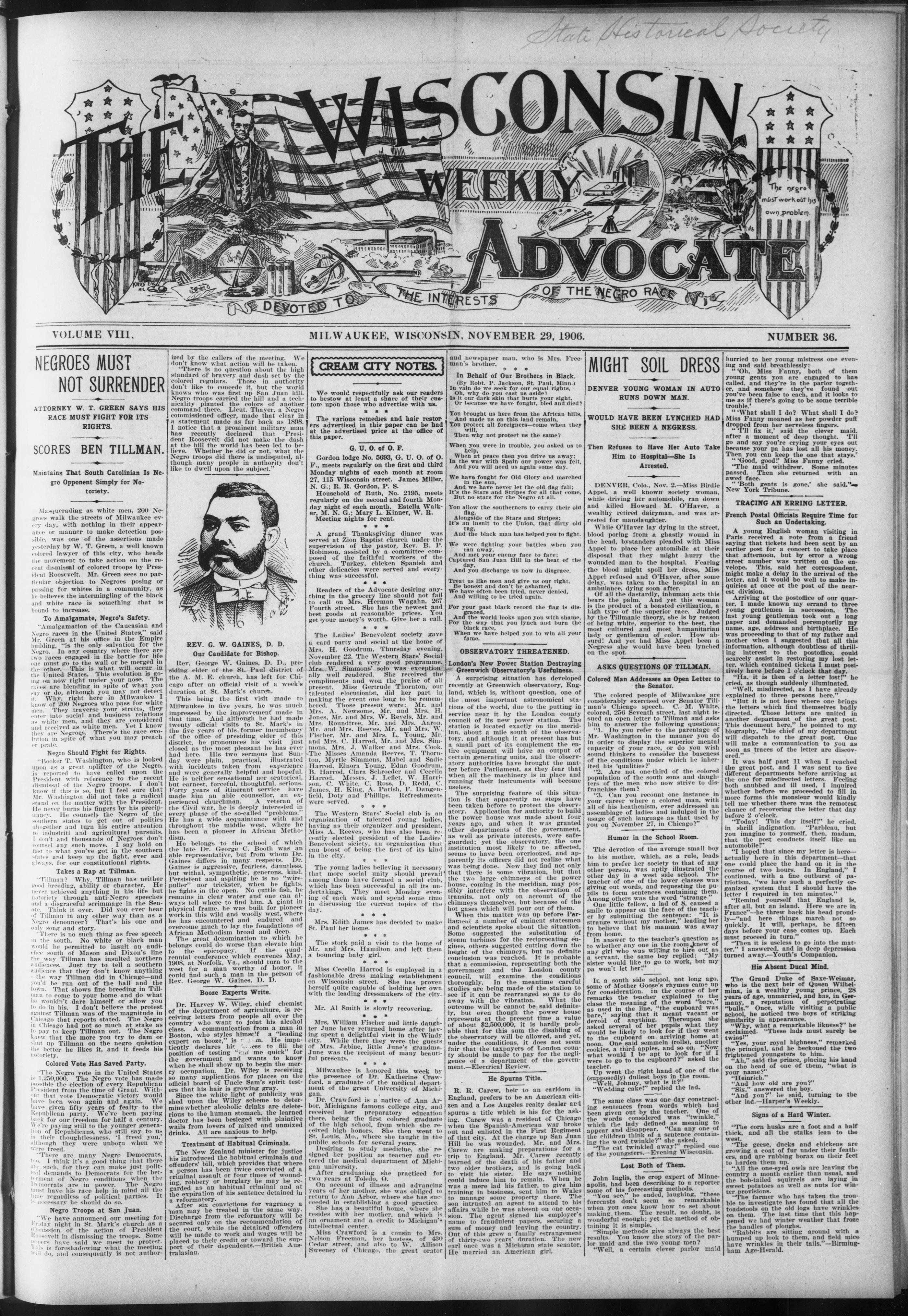

Page text (machine-generated)
WISCONSIN
WEEKLY
ADVOCATE
DEVOTED TO THE INTERESTS OF THE NEGRO RACE
VOLUME VIII.
NEGROES MUST NOT SURRENDER
ATTORNEY W. T. GREEN SAYS HIS RACE MUST FIGHT FOR ITS RIGHTS
Maintains That South Carolinian Is Negro Opponent Simply for No-
Masquerading as white men, 200 Negroes walk the streets of Milwaukee every day, with nothing in their appearance or manner to make detection possible, was one of the assertions made yesterday by W. T. Green, a well known colored lawyer of this city, who heads the movement to take action on the recent dismissal of colored troops by President Rooscvelt. Mr. Green sees no particular objection to Negroes posing or passing for whites in a community, as he believes the intermingling of the black and white race is something that is bound to increase.
To Amalgamate. Negro's Safety
"Amalgamation of the Caucasian and Negro races in the United States," said Mr. Green at his office in the Empire building, "is the only salvation for the Negro. In any country where there are two races engaged in the battle for life one must go to the wall or be merged in the other. This is what will occur in the United States. This evolution is going on now right under your nose. The races are blending in spite of what you say or do, although you may not detect it. Why, right here in Milwaukee I know of 200 Negroes who pass for white men. They traverse your streets, they enter into social and business relations as white men, and they are considered and received as white men. Yet I know they are Negroes. There's the race evolution in spite of what you may preach or prate.
Negro Should Fight for Rights.
"Booker T. Washington, who is looked upon as a great uplifter of the Negro, is reported to have called upon the President with reference to the recent dismissal of the Negro troops. I don't know if this is so, but I feel sure that Mr. Washington did not take a radical stand on the matter with the President. He never burns his fingers by his precipitancy. He counsels the Negro of the southern states to get out of politics altogether and turn his entire attention to industriol and agricultural pursuits. I don't and thousands of Negroes don't counsel any such move. I say hold on fast to what you've got in the southern states and keep up the fight, ever and always, for our constitutional rights.
Takes a Rap at Tillman.
Tillman? Why. Tillman has neither good breeding, ability or character. He never achieved anything in his life but notoriety through anti-Negro speeches and a disgraceful scrimmage in the Senate. Think it over. Did you ever hear of Tillman in any other way than as a Negro denouncer? That's his one and only song and story.
"There is no such thing as free speech in the south. No white or black man would be permitted to insult an audience south of Mason and Dixon's line the way Tillman has insulted northern audiences. Just try to tell a southern audience that they don't know anything—the way Tillman did in Chicago—and you'd be run out of the hall and the town. That shows fine breeding in Tillman to come to your home and do what he wouldn't dare himself or allow you to do in his. I don't believe the protest against Tillman was of the magnitude in Chicago that reports stated. The Negro in Chicago had not so much at stake as to pay to keep Tillman out. The Negro knew that the more you try to dam or shut up Tillman on the negro question the better he likes it, and it feeds his notoriety.
Colored Vote Has Saved Party.
"The Negro vote in the United States is 1,250,000. The Negro vote has made possible the election of every Republican President from the time of Grant. Without that vote Democratic victory would have been won again and again. We have given fifty years of fealty to the Republican party. We've been paying back for our freedom for half a century. We're paying still to the younger generation of Republicans, who still say to us in their thoughtlessness, 'I freed you,' although they were unborn when we were freed.
There are many Negro Democrats, too. I think it's a good thing that there are such, for they can make just political demands to Democrats for the betterment of Negro conditions when the Democrats are in power. The Negro must have his race help in mind all the time regardless of political parties. It is necessary he should do so.
Negro Troops at San Juan.
"We have announced our meeting for Friday night in St. Mark's church as a discussion of the action of President Roosevelt in dismissing the troops. Some papers have said we meet to protest. This is foreshadowing what the meeting will do, and consequently is not author-
ized by the callers of the meeting. We don't know what action will be taken.
don't know what action will be taken.
"There is no question about the high standard of bravery and dash set by the colored regulars. Those in authority don't like to concede it, but the world knows who was first up San Juan hill. Negro troops carried the hill and a technicality planted the colors of another command there. Lieut. Thayer, a Negro commissioned officer, made that clear in a statement made as far back as 1898. I notice that a prominent military man has recently declared that President Roosevelt did not make the dash at the hill the world has been led to believe. Whether he did or not, what the Negro troops did there is undisputed, although many people in authority don't like to dwell upon the subject."
Ch. M. M.
REV. G. W. GAINES, D. D. Our Candidate for Bishop.
Rev. George W. Gaines, D. D., presiding elder of the St. Paul district of the A. M. E. church, has left for Chicago after an official visit of a week's duration at St. Mark's church.
This being the first visit made to Milwaukee in five years, he was much impressed by the improvement made in that time. And although he had made twenty official visits to St. Mark's in the five years of his former incumbency of the office of presiding elder of this district, he pronounces his visit just closed as the most pleasant he has ever had here. His two sermons last Sunday were plain, practical, illustrated with incidents taken from experience and were generally helpful and hopeful. He is neither sensational nor oratorical, but earnest, forceful, thoughtful, serious. Forty years of itinerant service have made him an able counsellor, an experienced churchman. A veteran of the Civil war, he is deeply interested in every phase of the so-called "problems." He has a wide acquaintance with and throughout the middle west, where he has been a pioneer in African Methodism.
He belongs to the school of which the late Dr. George C. Booth was an able representative, but from whom Dr. Gaines differs in many respects. Dr. Gaines is aggressive, fearless, dauntless, but withal, sympathetic, generous, kind. Persistent and aspiring he is no "wire-puller" nor trickster, when he fights, he fights in the open. No cuttle fish, he remains in clear water and one can always tell where to find him. A giant in physical frame, he was built for pioneer work in this wild and woolly west, where he has encountered and endured and overcome much to lay the foundations of African Methodism broad and deep.
The great denomination to which he belongs could do worse than elevate him to the epicopacy. If the quadrennial conference which convenes May, 1908, at Norfolk, Va., should turn to the west for a man worthy of honor, it could find such a man in the person of Rev. George W. Gaines, D. D.
Booze Experts Write
Dr. Harvey W. Wiley, chief chemist of the department of agriculture, is receiving letters from people all over the country who want to joint his alcohol class. A communication from a man in Boston, who styles himself a "leading expert on booze," is written. He impatiently declares his success to fill the position of testing "and me quick" for the government and wants to know when he shall show up to begin the merry occupation. Dr. Wiley is receiving so many applications for places on the official board of Uncle Sam's spirit testers that his hair is growing gray.
Since the white light of publicity was shed upon the Wiley scheme to determine whether alcoholic drinks are deleterious to the human stomach, the learned doctor has been besieged with plaintive wails from lovers of mixed and unmixed drinks. All are anxious to help.
Treatment of Habitual Criminals
The New Zealand minister for justice his introduced the habitual criminals and offenders' bill, which provides that where a person has been twice convicted of a criminal assault or four times of wounding, robbery or burglary he may be regarded as an habitual criminal and at the expiration of his sentence detained in a reformatory.
After six convictions for vagrancy a man may be treated in the same way. Discharge from the reformatory will be secured only on the recommendation of the court, while the detained offenders will be made to work and wages will be placed to their credit or toward the support of their dependents.—British Australasian.
CREAM CITY NOTES.
We would respectfully ask our readers to bestow at least a share of their custom upon those who advertise with us.
The various remedies and hair restorers advertised in this paper can be had at the advertised price at the office of this paper.
G. U. O. of O. F.
Gordon lodge No. 5693, G. U. O. of O. F., meets regularly on the first and third Monday nights of each month at room 27, 115 Wisconsin street. James Miller, N. G.; R. R. Gordon, P. S. Household of Ruth, No. 2195, meets regularly on the second and fourth Monday night of each month. Estella Walker, M. N. G.; Mary L. Kinner, W. R.
***
A grand Thanksgiving dinner was served at Zion Baptist church under the supervision of the pastor, Kev. B. P. Robinson, assisted by a committee composed of the faithful workers of the church. Turkey, chicken Spanish and other delicacies were served and everything was successful.
***
Readers of the Advocate desiring anything in the grocery line should not fail to call on Mrs. Herman Wagahn, 267 Fourth street. She has the newest and best goods at reasonable prices. You get your money's worth. Give her a call.
宋 宋 宋
The Ladies' Benevolent society gave a card party and social at the home of Mrs. H. Goodrum, Thursday evening, November 22. The Western Stars' Social club rendered a very good programme. Mrs. W. Simmons' solo was exceptionally well rendered. She received the compliments and won the praise of all present. Miss Gertrude Thornton, our talented elocationist, did her part in making the event one long to be remembered. Those present were: Mr. and Mrs. A. Newsome, Mr. and Mrs. H. Jones, Mr. and Mrs. W. Revels, Mr. and Mrs. Roundtree, Mr. and Mrs. Aaron, Mr. and Mrs. Reeves, Mr. and Mrs. W. Fischer, Mr. and Mrs. L. Young, Mr. and Mrs. C. Harrod, Mr. and Mrs. Simmons, Mrs. J. Walker and Mrs. Cook. The Misses Amanda Reeves, T. Thornton, Myrtle Simmons, Mabel and Sadie Harrod, Elnora Young, Edna Goodrum, B. Harrod, Clara Schroeder and Cecelia Harrod. Messrs. J. Leflet, W. Harrison, C. White, C. Ross, D. Redd, C. James, H. King, A. Parish, F. Dangenfield, Doty and Phillips. Refreshments were served.
* * *
The Western Stars' Social club is an organization of talented young ladies, having as their organizer and president, Miss A. Reeves, who has also been recently elected president of the Ladies Benevolent society, an organization that can boast of being the first of its kind in the city.
* * *
The young ladies believing it necessary that more social unity should prevail among them have formed a social club, which has been successful in all its undertakings. They meet Monday evening of each week and spend some time in discussing the current topics of the day.
Mrs. Edith James has decided to make St. Paul her home.
\* \* \*
The stork paid a visit to the home of Mr. and Mrs. Hamilton and left them a bouncing baby girl.
* * *
Miss Cecelia Harrod is employed in a fashionable dress making establishment on Wisconsin street. She has proven herself quite capable of holding her own with the leading dressmakers of the city.
Mrs. William Fischer and little daughter June have returned home after having spent a delightful visit in the Windy city. While there they were the guests of Mrs. Jabine, little June's grandma. June was the recipient of many beautiful presents.
***
Milwaukee is honored this week by the presence of Dr. Katherine Crawford, a graduate of the medical department of the great University of Michigan. Dr. Crawford is a native of Ann Arbor, Michigans famous college city, and received her preparatory education there, being the first colored graduate of the high school, from which she received high honors. She then went to St. Louis, Mo., where she taught in the public schools for several years. Desiring to study medicine, she resigned her position as teacner and entered the medical department of Michigan university. After graduating she practiced for two years at Toledo, O.
two years at Toledo, G.
On account of illness and advancing years of her mother, she was obliged to return to Ann Arbor, where she has succeeded in establishing a good practice.
She has a beautiful home, where she resides with her mother, and which is an ornament and a credit to Michigan's intellectual center.
Miss Crawford is a cousin to Mrs. Nelson Freeman, her hostess, of 430 Cedar street, and also to W. Allison Sweeney of Chicago, the great orator
and newspaper man, who is Mrs. Freeman's brother.
* * *
In Behalf of Our Brothers in Black.
(By Robt. P. Jackson, St. Paul, Minn.)
In vain do we seek for our equal rights,
Oh, why do you cast us aside?
Is it our dark skin that hurts your sight.
Is it our dark skin that hurts your sight,
Or because we have fought, bled and died?
You brought us here from the African hills,
And made us on this land remain.
You protect all foreigners—come when they
will,
Then why not protect us the same?
When you were in trouble, you asked us to
help,
When at peace then you drive us away;
In the war with Spain our power was felt,
And you will need us again some day.
We have fought for Old Glory and marched
in the sun,
And we have never let the old flag fall;
It's the Stars and Stripes for all that come,
But no stars for the Negro at all.
You allow the southerners to carry their old
flag,
Alongside of the Stars and Stripes;
It's an insult to the Union, that dirty old
rag,
And the black man has helped you to fight.
We were fighting your battles when you
ran away,
And met your enemy face to face;
Captured San Juan Hill in the heat of the
day.
And you discharge us now in disgrace.
Treat us like men and give us our right,
Be honest and don't be ashamed,
We have often been tried, never denied,
And willing to be tried again.
For your past black record the flag is disgraced,
And the world looks upon you with shame. For the way that you lynch and burn the black race,
When we have helped you to win all your fame.
OBSERVATORY THREATENED
London's New Power Station Destroying Greenwich Observatory's Usefulness.
A surprising situation has developed recently at Greenwich observatory, England, which is, without question, one of the most important astronomical stations of the world, due to the putting in service near it by the London county council of its new power station. The station is located exactly on the meridian, about a mile south of the observatory, and although it at present has but a small part of its complement the entire equipment will have an output of certain generating units, and the observatory authorities have brought the matter before Parliament, as they fear that when all the machinery is in place and running their instruments will become useless.
The surprising feature of this situation is that apparently no steps have been taken before to protect the observatory. Application for authority to build the power house was made about four years ago, and when it was granted other departments of the government, as well as private interests, were safeguarded; yet the observatory, the one institution most likely to be affected, seems to have been overlooked, and apparently its officers did not realize what was being done. Now they find not only that there is some vibration, but that the two large chimneys of the power house, coming in the meridian, may possibly interfere with the observation of transits, not only on account of the chimneys themselves, but because of the hot gases which will pour out of them.
When this matter was up before Parliament a number of eminent statesmen and scientists spoke about the situation. Some suggested the substitution of steam turbines for the reciprocating engines, others suggested cutting down the height of the chimneys, but no definite conclusion was reached. It is probable that a commission, representing both the government and the London county council, will examine the conditions thoroughly. In the meantime careful studies are being made of the station to see if it can be rearranged so as to do away with the vibration. What the outcome will be cannot be said definitely, but even though the power house represents at the present time a value of about $2,500,000, it is hardly probable that for this sum the disabling of the observatory will be allowed, and yet, under the conditions, it does not seem fair that the taxpayers of London county should be made to pay for the negligence of a department of the government.—Electrical Review.
He Spurns Title.
R. R. Carew, heir to an earldom in England, prefers to be an American citizen and a Los Angeles realty dealer and spurns a title which is his for the asking. Carew was a resident of Chicago when the Spanish-American war broke out and enlisted in the First Regiment of that city. At the charge up San Juan Hill he was wounded. Mr. and Mrs. Carew are making preparations for a trip to England. Mr. Carew recently learned of the death of his father and two older brothers, and is going back to visit his sister. He says nothing could induce him to remain. When he was a mere lad his father, to give him training in business, sent him to Wales to manage some property there. The son intrusted an agent to attend to his affairs while he was absent on one occasion. The agent signed his employer's name to fraudulent papers, securing a sum of money and leaving the country. Out of this grew a family estrangement of thirty-two years' duration. The new earl once was a Michigan state senator. He married an American girl.
MIGHT SOIL DRESS
DENVER YOUNG WOMAN IN AUTO RUNS DOWN MAN.
WOULD HAVE BEEN LYNCHED HAD SHE BEEN A NEGRESS.
DENVER, Colo., Nov. 2.—Miss Birdie Appel, a well known society woman, while driving her automobile, ran down and killed Howard M. O'Haver, a wealthy retired dairyman, and was arrested for manslaughter. While O'Haver lay dying in the street, blood poring from a ghastly wound in the head, bystanders pleaded with Miss Appel to place her automobile at their disposal that they might hurry the wounded man to the hospital. Fearing the blood might spoil her dress, Miss Appel refused and O'Haver, after some delay, was taken to the hospital in an ambulance, dying soon after.
Of all the dastardly, inhuman acts this bears the palm. And yet this woman is the product of a boasted civilization, a high type of the superior race. Judged by the Tillmanic theory, she is by reason of being white, superior to the best, the most cultured and most humanitarian lady or gentleman of color. How absurd! And yet had Miss Appel been a Negress she would have been lynched on the spot.
ASKS QUESTIONS OF TILLMAN.
Colored Man Addresses an Open Letter to the Senator.
The colored people of Milwaukee are considerably exercised over Senator Tillman's Chicago speech. C. M. White, colored, 256 Seventh street, last night issued an open letter to Tillman and asks him to answer the following questions:
"1. Do you refer to the parentage of Mr. Washington in the manner you do in order to display the superior mental capacity of your race, or do you wish sound thinkers to consider the baseness of the conditions under which he inherited his 'qualities?'
"2. Are not one-third of the colored population of the south sons and daughters of the men who now strive to disfranchise them?
"3. Can you recount one instance in your career where a colored man, with all of his heathenism, ever addressed an assemblage of ladies and indulged in the usage of such language as that used by you on November 27, in Chicago?"
Humor in the School Room.
The devotion of the average small boy to his mother, which, as a rule, leads him to prefer her society to that of any other person, was aptly illustrated the other day in a west side school. The teacher of one of the lower classes was giving out words, and requesting the pupils to form sentences containing them. Among others was the word "strange."
One little fellow, a lad of 8, caused a smile to appear on the face of the teacher by submitting the sentence: "It is strange without my mother," leading her to believe that his mamma was away from home.
In answer to the teacher's question as to whether any one in the room knew of any girl who was willing to hire out as a servant, the same boy replied: "My sister would like to go to work, but my pa won't let her!"
Ir. a south side school, not long ago, some of Mother Goose's rhymes came up for consideration. in the course of her remarks the teacher explained to the class the meaning of the word "bare," as used in the line, "the cupboard was bare," saying that it meant vacant or devoid of anything. Thereupon she asked several of her pupils what they would be likely to look for if they went to the cupboard on arriving home at noon. One said semmell (rolls), another cookies, a third apples, and so on. "Now what would I be apt to look for if I were to go to the cupboard?" asked the teacher.
Up went the right hand of one of the (supposedly) dullest boys in the room. "Well, Johnny, what is it?" "Wedding cake!" replied the lad.
The same class was one day constructing sentences from words which had been given out by the teacher. One of the words considered was "twinkle," which the lady defined as meaning to appear and disappear. "Can any one of the children think of a sentence containing the word twinkle?" she asked.
"The cat twinkled away!" replied one of the youngsters.—Evening Wisconsin.
Lost Both of Them.
John Inglis, the crop expert of Minneapolis, had been describing to a reporter some of his forecasting methods.
"You see," he ended, laughing, "these forecasts don't seem so remarkable when you once know how to set about making them. The result, no doubt, is wonderful enough; yet the method of obtaining it is simple.
"Simple methods give always the best results. You know the story of the parlor maid and the two young men?
"Well, a certain clever parlor maid
hurried to her young mistress one evening and said breathlessly:
"Oh. Miss Fanny, both of them young gents you are engaged to has called, and they're in the parlor together, and somehow they've found out you've been false to each, and it looks to me as if there's going to be some terrible trouble."
"What shall I do? What shall I do? Miss Fanny moaned as her powder puff dropped from her nerveless fingers.
"I'll fix it,' said the clever maid, after a moment of deep thought. 'I'll go and say you're crying your eyes out because your pa has lost all his money. Then you can keep the one that stays.'
"Good, good!" Miss Fanny cried.
"The maid withdrew. Some minutes passed. Then she returned with an awed face.
"Both gents is gone,' she said." New York Tribune.
TRACING AN ERRING LETTER
French Postal Officials Require Time for Such an Undertaking.
A young English woman visiting in Paris received a note from a friend saying that tickets had been sent by an earlier post for a concert to take place that afternoon, but by error a wrong street number was written on the envelope. This, said her correspondent, might make a delay in the arrival of the letter, and it would be well to make inquiries at once at the post of the nearest division.
Arriving at the postoffice of our quarter, I made known my errand to three young gentlemen in succession. The last young gentleman took out a long paper and demanded peremptorily my name, age, address and birthplace. He was proceeding to that of my father and mother when I suggested that all this information, although doubtless of thrilling interest to the postoffice, could scarcely assist in restoring my lost letter, which contained tickets I must positively have before 1 o'clock that day.
"Ha, it is then of a letter lost!" he cried, as though suddenly illuminated.
"Well, misdirected, as I have already explained to three persons here."
"But it is not here where one brings the letters which find themselves badly directed. Those letters are united in another department of the great post. This document here," he pointed to my biography, "the chief of my department will dispatch to the great post. One will make a communication to you as soon as traces of the letter are discovered."
It was half past 11 when I reached the great post, and I was sent to five different departments before arriving at the one for misdirected letters. Feeling both snubbed and ill used, I inquired whether before we proceeded to fill in more forms this monsieur would kindly tell me whether there was the remotest chance of recovering the letter that day before 2 o'clock.
"Today! This day itself!" he cried, in shrill indignation. "Parbleau, but you imagine to yourself, then, madam, that the post conducts itself like an automobile!"
"I hoped that since my letter is here—actually here in this department—that one could place the hand on it in the course of two hours. In England," I continued, with a fine outburst of patriotism, "we have such a perfectly organized system that I should have the letter I required in ten minutes."
"Remind yourself that England is, after all, but an island. Here we are in France"—he threw back his head proudly—"and here things march not so quickly. It will, perhaps, be fifteen days before your case comes up. Each must proceed in turn."
"Then it is useless to go into the matter." I answered, and in deep depression turned away.—Youth's Companion.
His Absent Ducal Mind.
The Grand Duke of Saxe-Weimar, who is the next heir of Queen Wilhelmina, is a wealthy young prince, 28 years of age, unmarried, and has, in Germany, a reputation of perpetrating "bulls." Once, while visiting a public school, he noticed two boys of striking similarity in appearance.
"Why, what a remarkable likness?" he exclaimed. "These lads must surely be twins!"
"Yes, your royal highness," remarked the principal, and he beckoned the two frightened youngsters to him.
"Ah," said the prince, placing his hand on the head of one of them, "what is your name?"
"Heinrich."
"And how old are you?"
"And you?" he said, turning to the other lad.—Harper's Weekly.
Signs of a Hard Winter.
"The corn husks are a foot and a half thick, and all the stalks lean to the west.
"The geese, ducks and chickens are growing a coat of fur under their feathers, and are rubbing borax on their feet to harden them up.
"All the one-eyed owls are leaving the country a month earlier than usual, and the bob-tailed squirrels are laying in sweet potatoes as well as nuts for winter provisions.
"The farmer who has taken the trouble to investigate has found that all the toadstools on the old logs have wrinkles on them. The last time that this happened we had winter weather that froze the handles of ploughs.
"Rabbits are sitting around with a humped up look to them, and field mice have wrinkles in their tails."—Birmingham Age-Herald.
THE WISGONSIN WEEKLY ADVOCATE
MILWAUKEE, WIS.
R. B. MONTGOMERY, Editor and Proprietor.
Humorous Items. Little Sophia has just been informed that she has a little sister.
"Oh, how lovely! Please, please let me be the one to tell mama!"—Translated for Transatlantic Tales from El Diario de la Marina.
Far Sighted.
Lt Christmas come! I'm not distressed With thoughts of what to buy. No gifts to seek, my heart's at rest I bought them last July.
Hope.
Judge (to prisoner)—It is your irrepressible need of a drink that brings you here so often.
Prisoner—Can I then get a drink here?
—Pele Mele.
True.
This fact is true,
So give it a boost;
Chickens in politics
Come home to roost.
Detroit Free Press.
What's the Population of Boston?
"There are lots of people these days." remarked the cigar store philosopher, "who wouldn't know beans if they saw em before the coal tar was added." Philadelphia Bulletin.
Filling a Long Felt Want.
"Give us a national ode!"
The American people cried.
But Teddy's our National Him.
And there's Uncle Psalm, beside.
—E. G. Nedloh in Lippincott's.
Pity 'Tis 'Tis True
"No. It's too bad they hadn't even got a few redeeming vices.—Town and Country.
Perfectly Natural
'How often a millionaire's widow marries the physician who attended her husband. Queer, eh?' "Not at all. The doc is invariably the first man on the ground."—Washington Herald
Extortion.
Fat Woman (to cabman)—How much do you charge a mile? Cabby—In your case madame, I'll have to charge by the pound.—Translated for Transatlantic Tales from Le Journal Amusant.
Restricted Circulation
Friend—Do you know that the grocery man opposite uses your poems as wrapping paper?
Poet—Yes, but under our arrangement he only puts up his very best groceries in them.—Floh.
Natural Inference
"Papa, God reads the same paper that we do, doesn't He?"
"What makes you think that, little one?"
"We learned it in a day school, 'The Times are in His hands.'"
Marked Attention.
"Have you any good reason for suing him for breach of promise? Did he show your daughter any marked attention?" "Any attention! Why, man alive! He once gave her his seat in a trolley car."
No More for Him.
Second Ditto—Is she going to keep that up all winter?
First Boy—Not much. I fixed that by spilling most of it on the floor.—Detroit Free Press.
Disappointed
Inquisitive—If, as you say, you knew this man to be a rake, why did you invite him to your house?
Henpeck—Heavens! man. I never dreamed he would elope with my daughter; I thought he would carry off my wife.—Translated for Tales from Le Kire.
The Rattle of the Gladiator
He moved amid the battle's din,
He heard the cannon roar.
Where ruthltss warriors strove to win
A name that's writ in gore.
Was turning on the steam.
—Washington Star.
Soup and Ice Cream for Him
He—Do you think 13 is an unlucky number?
She—I should say so. I was giving a dinner last night to twelve friends. A thirteenth one came along at the last minute, and I didn't have but a dozen knives and forks in the house."—Detroit Free Press.
A Delicate Hint.
"They say Miss Sharpe can convey a hint with such tact that it is impossible to take offense."
"Yes, she has quite a gift that way. The last time Mr. Staylate called there she asked him to have some slight refreshment, and then brought in a plate of breakfast food."—Baltimore American.
Making an Impression.
"Say, dear," cried Sububbs, running up stairs, "there's a girl at the door to see about the place!"
"O, goodness!" exclaimed Mrs. Sububbs, excitedly, "have you any idea what her nationality is?"
"Unmistakably Irish."
"Well, just wait until I put on my green dress and I'll go down to see her."
—Philadelphia Press.
Which William?
During a conversation between the present German Kaiser and his Chancellor, the latter in closing a remark, said:
"As the immortal William once put it, 'There's a divinity that shapes our ends; rough hew them how we will.'"
"That's pretty good," spoke up the Kaiser. "But, by the way, when did I say that?"—Lippincott's.
Even
Fellow Passenger—Pardon me, your necktie has been sticking out for some time. I refrained from telling you sooner because those young ladies seemed so much amused.
Farmer—Thankee; an' the oil from that lamp has been dropping on that light overcoat o' yourn for the last ten minutes; but every one seemed so tickled
that I hated to spoil the fun.—London Tit-Bits.
Not Worth Noticing.
Hawley—But, surely you don't propose to lot Huskie's remark pass unchallenged?
Crawiey—That's just what I propose to do
Hawley—Why, man alive, he called you "a blithering idiot!" Crawley—Exactly; but, my dear sir, there is no such word in the English dictionary as "blithering."—The Catholic Standard and Times.
A Good Thing.
Easyman-Got a fine position now; pays two thousand a year.
Quirk—Sure it a true.
Easyman—I should say not. They let me pay my own salary.
Quirk—Who furnishes the money?
Easyman—They do, of course. I merely put up three thousand in their hands for security.—Toledo Blade.
EVERY-DAY PHILOSOPHY
Every man is a poacher.
Every man has his asking price and his selling price.
Nearly every mother teaches her baby boy to say he is "a bad boy."
Many people get credit for being reserved because they can't talk intelligently.
A man's financial condition determines whether he is a user of an alcoholic stimulant, or a booze fighter.
We do not intend to rejoice on New Year's day; we intend to cry, because the best year in history is dead.
It is bad enough for a popular man to attempt to get votes, but it is the limit when an unpopular man tries to.
What has become of the old-fashioned man who said of a man defeated for office: "He has gone up Salt River."
When a woman sews on Sundays old-fashioned women say: "Every day in the week is the same to her," and then they sigh.
Whenever you cannot think of any other compliment to pay a woman, say she is inimitable, and she will be pleased. But why?
It is interesting for a man to look through his old effects if for no other reason than he will see that he is not as big a fool as he used to be.
In a country town the new trimmer at the millinery store usually attracts more attention from the men than the new hats do from the women.
The only time a woman will admit she is older than another is when she wishes the statement of her added years to give weight to her advice.
After a girl has married and left home she sits up and takes notice every time her parents buy an expensive dress for the daughter still at home.
We hope that if we die in the night, those attending us will wait till the neighbors get up and have had breakfast before running in to tell them.
There's a difference. The joy of a chafing dish is watching things cook, but there doesn't seem to be any particular rush to get near the stove to watch the cabbage and potatoes go to pieces.
Two Atchison brothers who are in business together engage in a fight every time a bill is brought in. When the reform magazines and newspapers make this an ideal country kin will always be separated.
Some women are such uniformly poor cooks that the only difference from day to day is that the pie crust yesterday tasted as if something had been left out, and today as if too much of something had been put in.
"I'm glad," said an Atchison man last night, "that I'm no favorite. Favorites are always overworked. I prefer to be let alone and free to act as I please, so long as I do not disturb others, or interfere with the rights of others."
The popular complaint of the woman is the monotony of housework, and the man who says business is also monotonous gets frowned down. The women believe that a business office is the scene of an unchanging round of excitement and interest, and any effort to prove the contrary only makes them mad. Still, a woman has beans to string today; and tomorrow it is not beans to string but corn to busk, and the men don't have such a wonderful variety of occupation.—Atchison (Kan.) Globe.
French War-fare
An anecdote which is attributed to Mark Twain appears in the current Harper's Weekly. Mark was talking, it appears, of war, and of the hardships and privations of sieges:
"A Frenchman," he said, "called one day on a woman who had two dogs. They were uly little brutes, and, when they came near him, the man pushed them out of the way with his foot.
"I perceive, sir, you are not very fond of dogs."
"The man started in surprise.
"I'm not fond of dogs!" he exclaimed. 'Why, madam, I ate more than twenty of them during the siege of Paris!"
Pat Guessed It.
A motorist, who was touring in Ireland, one day met a native on the road who was driving a donkey and cart. Thinking he would have a little fun at his expense, he began: "What is the difference, Pat, between your tourout and mine?"
The native looked at the questioner a minute or so, and then replied:
minute or so, and then replied:
"Not a great deal. The donkey's in the shafts in one and on the seat -in the other."
The motorist asked no more conundrums.
Prospects.
"It seems my daughter is determined to marry you," said old Roxley, sternly. "Now, see here! I'm told you're a regular beer guzzler." "Well," replied the bold youth, "I admit I've been used to my share of beer, but all that'll be changed when I'm married." "Ah!" Yes. I'll be able to afford wine then."—Philadelphia Press.
Wind Clock Once in Five Years.
At a railway station in Belgium is a clock which only requires winding up once in five years. It was placed there by the Belgian government in 1881, and keeps capital time.
Suicides in Armies.
The rate of suicide in the British army is equal to 210 per million annually; in the German to 550, and in the Austrian to 1200 per million.
THE WIND-UP OF THE SEASON.
The leaves are thinning on the bough,
And one by one are falling,
The birds are speeding southward now,
And mate is calling.
Dan Cupld hurries, full of hope,
His meshes colling, throwing;
No plainsman ever swung a rope
With half the skill he's showing.
The Lariat of Love is spun
Of silken threads enduring.
And ere they sense it, two are one
In bonds that are alluring.
-Earle Hooker Eaton, in Harper's Weekly
A WOMAN'S WAY.
Over the Saskatchewan the sun was setting, casting shadows on the river. Back from the bank stood the palisaded trading post. The rays gleamed through the loopholes in the western bastion, burnishing the cannon mouths. The great factor's house reached above the palisade, facing the sun. From its roof hung motionless the Union Jack, bright in the warm red light. Quiet reigned at the post; noticeable more particularly this evening in comparison with the excitement of the morning, when the half-breed factor from the north had started on his journey with his several breed and Indian voyagers.
Only two short weeks had he stayed at the Saskatchewan, but he had seemed almost glad to return to the beautiful, drearv, frozen north.
Out on the river bank by a straggling group of poplar sat Harriet, the great factor's daughter. Into her face and form had entered the beauty and grace of the great solitude. But now a slight frown troubled her eyes.
John McLean had gone. Yes, for she had watched him out from this very spot. She had seen his paddle dip in and out till he disappeared around the bend—had watched till the last ripple caused by his swift passing was gone.
John McLean had asked her to go back with him to the far north. He had even said he would take her whether she would or no. But no—she shook her head as she thought of it. Even though she were not promised to Hardy, the Englishman from Fort William, even though her father might be got to consent, she could never marry a half-breed. And then, too, to go away up to that northern post, where no one ever came. Again she shook her head, this time decisively.
But the puzzled frown remained. The thought of McLean, with his great strength, his rough dark hair, his eyes that were sometimes brown and sometimes gray, remained, not to be easily dismissed.
"Why should I be thinking of John McLean when Hardy will be here, perhaps tonight?" asked she of herself impatiently.
Once more she looked up the river, where the sun was disappearing behind crimson clouds. Then, with a sigh, she rose and started toward the fort. How quiet it was, how lonely.
A dried twig snapped behind her. She looked back. A swarthy, strong-built man was close behind her. She turned to run, but too late.
With two strong arms holding her securely, a great brown hand over her mouth stifling her screams, McLean bore her away along the river bank.
He kept the grove between him and the fort till he came to a bend where a path led down to the water. Here his canoe was waiting with three half-breeds and two Indians, their paddles in hand, ready to start. Swiftly they sped on their way. As the dusk deepened into night they had put a good distance between them and the fort. Many days of hard paddling and portaging brought McLean near to his home. And all these days Harriet spoke not one word. But McLean was not impatient.
One more day with the Big Rapids to pass, and they would be home. Not much of a home in the eyes of some. It was on the edge of a narrow northern lake. A small square cabin of logs roofed with slabs and moss, all the crevices filled with mud—here lived McLean and his mother. Two still smaller shacks were the homes of his men, several of whom had wives. The whole group was surrounded by a palisade.
On every side stretched the great lonely northland, which in time a man may come to love. The solitude, the white, smooth stretches of snow in winter, held a fascination away from which no southern land could charm McLean.
One more day's paddling. McLean knew not whether to be glad or sorry. Still Harriet would not speak.
Early in the morning they were under way. After two hours they came to the Bad Rapids. These were long and dangerous; but the voyagers nearly always took them in their canoes instead of carrying. And now they proceeded to paddle through. The canoe was strongly made and was well handled, so McLean considered it to be quite safe.
He felt suddenly inspired to make Harriet speak, though the steering should have been given all his attention. He told her not to be afraid.
"You'll never come to any harm while I'm around, Harriet," he said. Harriet gave no sign that she heard.
"We'll be home tonight; do you care?" No answer. The girl was looking gloomily and discontentedly across the backward curling waves as the canoe entered the rapids. The ledges of rock were showing bare on either side, the water dashing against and over them. The river foamed through the narrow channels. McLean held his paddle in the stern steadily, steering accurately. A few minutes and the rapids would be passed.
"Harriet, won't you say just one word? I love you, you know that. Don't you care just a little? I'll always be good to you little girl." His voice was pleading, ham timid, as though he were afraid of her. She turned half scornfully.
"Don't move. We'll upset! You'll be drowned!" exclaimed McLean.
"And what difference would it make to you if I was drowned? You love! Oh!" she flung at him, at last speaking. Before McLean could prevent her, on a mad impulse, she had thrown herself against the side of the canoe. Over it went, but as it tipped McLean caught hold of her. He fought hard with the swirling water to keep from being dashed against the rocks, holding Harriet up as best he could. At the very end of the rapids a ledge jutted out from the shore, and the river flung itself triumphantly upon it with great force, being rolled along till almost out of reach of the water.
Harriet struggled to her knees, but the man did not move. With a look of terror she called his name, but he lay quite still. With the strength of despair she dragged him to the drier rock, where the water could not touch them. She rested his head in her lap and, half unknowing, rubbed the queer white swelling on his forehead. Below them the canoemen had passed safely through, clinging to their paddles, but their shouts came only dimly to her as they clambered out.
"John," she wailed. "yuh're not dead. I can't hev killed yuin. No, no, John. yuh can't be dead. See, I didn't mean it. Say something, just one word. Why. John yuh know I love yuh. Won't yuh say something?" She broke down sobbing.
As he glanced slowly up to her a look of relief swept over his face. "Yer safe then," he whispered.
"An' thanks to you that I am," she answered. "Won't yuh fergive me, John? Do yuh think yuh can ever fergive me?" she begged.
"Fergive ye!" he exclaimed. "There's no need of fergiveness so long's yuh love me."
"I do," she half sobbed, "I do. An'—an' John, I'm glad yuh stole me!" She pressed back his heavy wet hair, the while looking down to him with the love of a lover, the tenderness of a mother shining in her eyes.—T. Muriel Merrill in Canadian Graphic.
QUEEN ENA'S JEWISH BLOOD
her Great-Grandfather Said to Have Been of Humble Position.
The blood of prince and peasant, so it is said, mingles every hundred years. A striking instance is the case of Princess Ena, now the wife of Alfonso of Spain. Here is the story: First cousin to the Emperor of Russia, to the German Emperor and to the heir of the throne of Great Britain, Princess Ena of Battenberg is almost as nearly related to a far humbler family circle. Toward the beginning of last century a Polish Jew, Hauke by name, entered the service of the Grand Duke of Hesse-Darmstadt, and occupied a very subordinate position at the little court. His daughter, Julia Theresa, born in 1825, was, at the age of 26, married morganatically by Prince Alexander of Hesse, two years her junior.
Renouncing the faith of her fathers, she was baptized into the Protestant church, and by the reigning grand duke was accorded the title first of Countess of Battenberg and subsequently of princess. Prince Henry, the third child of this union, became the husband of Princess Beatrice, and, of course, father of Princess Ena, King Alfonso's bride. So little was he considered as belonging to the inner circle of European royalty that when Queen Victoria conferred upon him the rank of royal highness protests arose on all sides.
Formal notifications were made by the courts of Berlin, Vienna and St. Petersburg to the effect that Queen Victoria's son-in-law, issue of a morganatic union, could not be recognized as royal highness elsewhere than on British territory. Twenty years later the daughter of this man on whom this affront is put becomes Queen of Spain and treats on a footing of perfect equality all the reigning monarchs of Europe.—Le Monde Moderne.
About Oysters.
To preserve their flavor intact, oysters should be eaten raw or else cooked in their liquor and served as soon as possible and piping hot.
To prepare a "box" of oysters Virginia style take a crusty loaf of bread—Vienna is good for the purpose—and cut off the top and scoop out the soft inside. Fill the space with oysters, seasoning them with salt, pepper, and butter, and sprinkling over them some of the crumb of the loaf that you had removed. Put bits of butter on top, then replace the cover. Set the loaf in a dripping pan and pour the strained oyster liquor over it. Put into a hot oven and bake for fifteen minutes, taking care not to let the loaf scorch or brown too much. Serve hot and cut as for slicing bread. Lemon juice or a little mace is sometimes used for seasoning the oysters.
Old Virginia Oyster Soup.—Wash a quart of nice fresh oysters through two waters, saving the liquor. Strain and add to it two blades of mace, a half teaspoonful velery seed, celery salt or a stalk of celery chopped fine, a teaspoonful salt and a pod of red pepper. Scald, add two tablespoonfuls butter rubbed smooth with a tablespoonful of flour and a pint each of milk and cream. Let this come to a boil, add the oysters, and the moment they come to the boil again take from the fire. A moment's overcooking with oysters toughens and shrivels them. Serve from tureen, placing inch squares of toasted bread in tureen before pouring in the soup.
Oysters a la Poulete-For two dozen oysters take the yolks of two eggs, two tablespoonfuls of butter, one tablespoonful of lemon juice, one cupful each of oyster juice and cream, two tablespoonfuls of flour, one tablespoonful of fine minced parsley, salt and pepper, and a few drops of celery extract or a sprinkling of celery salt. If fond of onion, two drops of the juice may be added. Scald the oysters to the "cockling" point in their own liquor, which should be strained. Keep both liquor and oyster hot while you make the following sauce: Melt the butter in a saucepan, but do not let brown. Add flour, stir until smooth and bubbly, then add the cream and oyster liquor, stirring constantly until the sauce tickens. Take the pan from the fire, add the beaten yolks of the eggs. Return to the fire and cook until thickened. This will take but a moment. Add seasonings and oysters and serve at once with a garnish of parsley and mushrooms if desired.
Birth Rate in France Is Lower.
Public attention again has been drawn to the national peril involved in the constantly diminishing birth rate, in Paris by the publication of the vital statistics for 1905. The births in France for this year numbered 807.292, showing a decrease of 10.937 from the total of 1904. The reason for this decrease is not to be found in a reduction of the number of marriages, in which the statistics show a slight increase over 1904, but it apparently arises from the aversion of the French people to large families. The national association, which is studying this matter, has reached the conclusion that it is necessary to inculcate the idea that any couple that raises more than three children merits and is entitled to public gratitude and protection.
Theory That Horse Is a Fool Disproved.
When the motor car, with its goggled occupants, came around the corner the horses promptly stood on their hind legs. "Shall I stop the engine?" the motorist asked obligingly. "Never mind that, sir," said the driver of the dancing horses. "But if you gentlemen wouldn't mind just getting out and 'iding behind the car for a minute—the 'orses think it's a menagerie coming'"—Punch.
THE CHILD THAT CAME.
O child my mouth has never kissed,
My body never known,
By all the joys that I have missed,
I claim you as my own.
Love called you to me from the dark,
But as your spirit heard,
Death laid his fingers cold and stark
Upon my heart that stirred.
I yearned for you with every breath,
O never had, yet lost,
While on my heart the touch of death
Struck deeper down like frost.
I watched the tides creep out and in,
The darkness wax and wane,
The years lag by, and could not win
To any rest from pain.
But as tonight I sit alone,
With only shadows near,
O child incredibly my own,
I know that you are here.
I hold you tight against the ache Within my breast and croon
A song my mother used to make For me about the moon.
O little child forever mine,
Yet safe from life that harms,
Not all of human and divine Can take you from my arms!
The bitter road that I have trod Has brought this thing to be:
I need not give you back to God Who gave you not to me.
Come soon or late the day when earth Shall grant its gift of rest,
The child to whom I gave not birth Shall lie upon my breast.
FROM SUMMER TO AUTUMN
'Tis not the same, the garb she wears,
As when the summer skies were bright.
No more the filmsy fabric dares
The sun to speed his shafts of light.
The style is jaunty, yet severe,
And somehow when she speaks a name
It sounds peculiarly severe—
In sooth, she's not at all the same.
And her complexion, once so tanned,
Is faintly blushing as the rose;
The tapering of her slender hand
A different ring doth now disclose.
She starts her letters with "Dear Jack"—
'Twas "Ned" who formerly could claim
The missives that she wrote. Alack!
There's nothing that is quite the same!
—Washington Star.
BRIEF NOTES OF GENERAL INTEREST
J. S. Holloway, firemen on a Louisville & Nashville freight train, recently, at Evansville, Ind., saved a child's life by climbing to the cowcatcher of the engine and lifting the child from the track in front of the rushing train.
Boarding house hash was the prime cause for the divorce of James Aldrich from Vina Aldrich in Chicago. He said Mrs. Aldrich preferred life in a boarding house to having her own flat. He thought the other way and they continued to disagree.
Leatha M. Jones of Villisca, Ia., who recently toured Europe with a company of teachers, has received a purse containing about $3, which she lost in London. The purse had been found by an Englishman, who made inquiries and then sent the purse to Iowa.
While at work at his forge Robert Linke, a blacksmith of Germantown, Tenn., was informed that he was heir to $400,000 under the will of his cousin, Henry Linke, who died recently in Cincinnati. Linke was located at the request of Cincinnati officials.
"If there were a man who was as crazy on the subject of consumption as Carnegie is on the subject of libraries much might be accomplished to check the disease," said Dr. C. M. Amende of New York, in addressing the American congress on tuberculosis in Gotham.
Jacob Steen died at the home of his granddaughter at Amsterdam, N. Y., in his ninety-first year. He and his brother, Walter, of Syracuse, who was at his bedside, were the oldest twins in the United States. The Steens were born May 19, 1816, in the town of Florida, a few miles from Amsterdam.
H. H. Marley, one of the oldest railroad men in the west, died at his home at Olathe, Kan., recently, after reading his own obituary erroneously printed in a Kansas City newspaper. Mr. Marley was on the retired list, having given up last year his position as traveling passenger agent of the Michigan Central. He was 76 years old.
Last season's marriage license record at St. Joseph, Mich., which broke all former ones to bits, already has been smashed this year. It is safe to state that before the year is out close to 1700 licenses will have been issued; 1600 already have been recorded. Of the licenses issued this year one-half were taken out by residents of Chicago.
A. J. Ryan, aged 51 years, was found lying unconscious in Franklin street, St. Louis, by a policeman, who took him into custody on the supposition that the man was drunk. Ryan continued to grow worse, and he was taken to the city hospital, where, after an investigation, a piece of beefsteak was dislodged from his throat. He immediately recovered.
In the Boston primaries recently Fifteenth ward Democrats gave eighty votes to James Cassidy, who has been dead three years. James T. Cassidy, who sought a nomination for the common council, alleged that his enemies nominated the dead man to divide his strength, but he did not discover the trick until after the ballots had been printed.
Louis Jorgenson, a Highwood, Ill. steamfitter wanted to wed Marie Donovan, but lacked the courage to ask her. He adopted the idea of getting a marriage license and read it to her at her boarding house in North Chicago. Miss Donovan became frightened and ran away. She learned that the entire village knew about the license. Jorgenson was arrested and fined $5.
Chicago is to have an official press agent if an ordinance submitted to the city council by Ald. John Powers is approved. The new position, as contemplated in the ordinance, gives the press agent a rank with that of the chief executive himself. He is to receive a salary of $10,000 a year—the same as the mayor. In addition to being the official booster he must hold himself in readiness to officially represent the mayor on all social occasions.
Dr. D. M. Fisk, president of Washburn college (Kan.), in an address declared that the most colossal commercial and financial panic this country has ever experienced is imminent and that even the agricultural prosperity of the nation will experience a terrible depression. He said that "The admission of 1,000,000 foreigners to our shores annually will force upon America a colossal panic, and the country will again see armies of tramps begging for bread."
The millionaire cottagers at Newport. R. L., who have long felt aggrieved at taxes imposed on them determined to go into politics. Their candidate for mayor
will be W. V. Clark, a newsboy, or rather newsman, who delivers papers at their houses. Clark was at one time a member of the Legislature. The cottagers made their first move when they selected members to represent them on the administrative council, by which, under the new charter, the city will be ruled.
Reese Wiggles, who claimed to be the smallest man in the world, being four inches shorter than Gen. Tom Thumb, died recently at Retreat, Pa. He was 56 years old, and most of his life was spent on the stage. He had been exhibited throughout this country and Europe. He was on the stage with Gen. Tom Thumb in Wales, and then came to this country. He was 37 inches tall. His parents died when he was young, and William H. Thomas had since then taken charge of him.
Cassius, the 15-year-old son of Mrs. Irma Smith, was arraigned in police court at Evansville, Ind., on the charge of stealing $15 from his mother. The lad pleaded guilty, and Police Judge Winfrey turned to the mother and said: "I see you have got a strong arm. Take the boy below and give him a flogging." The lad was led to the corridors below, where the mother had administered almost 300 lashes when officers interfered. The boy was weak from the whipping and the mother exhausted.
Dr. H. Edward Sauer, a Chicago physician, is charged with criminal negligence in a damage suit for $25,000, filed against him by Archie L. Doherty. The Illinois board of health has also been asked by Mr. Doherty and his attorney, Richard E. Burke, to disqualify Dr. Sauer from practice. Dr. Sauer is accused of negligence in performing an operation upon Mrs. Doherty for appendicitis. According to Mr. Doherty, the physician left half a yard of absorbent cotton in the wound.
The little daughter of Sherman Bell, adjutant general of Colorado, has been named after President Roosevelt. Bell was out of town when the infant arrived in Denver, and had been informed that it was a boy. Swollen with pride he rushed to the telegraph office and wired to the President:
"I have the honor to report that I am the father of a fine boy. Have named him Theodore Roosevelt Bell."
Then he hurried to Denver from Victor to embrace the infant and found it a girl.
Young women are rapidly taking the places of men in the Lake Shore railroad offices at Cleveland. A few years ago a woman was a rarity, even at a typewriting machine, while now from fifty to sixty are employed by the company, not only as stenographers but as clerks. There are fourteen women in the freight auditor's department, eleven in the paymaster's and five in the purchasing agent's, while almost every other department has two or three. Railroad men say the scarcity of capable male help is the cause.
Walking ten miles, after riding many miles in a box car, Edith Harris, aged 10, daughter of Edward Harris of Prairie du Chien, Wis., reached McGregor, Ia., exhausted from want of food, but with her desire to see her grandmother fulfilled. Edith's papa promised to take her to see her grandmother. Then it was impossible for him to go. Not to be thwarted, she secreted herself in a box car. When the freight reached Clayton, Ia., she was hungry and blue with cold. She started to walk ten miles to McGregor.
Two days after the birth of the son of Mrs. Letha Highly at Wabash, Ind., a small red spot appeared upon the left side of the child's face. Gradually this spot has enlarged, until now at the age of five months it has completely covered the left side of the face and the neck, the red color making that side of the child's face appear like that of an Indian. The child is healthy, with absolutely no apparent harmful result of the change of color. Members of the Wabash County Medical association differ as to the cause. Some claim death will result if the transformation is not checked. They have decided to summon specialists.
Eight tons maidens are delaying all work on the new $2,000,000 federal building at Cleveland, O.
"The them statoos is too fat," said a visitor from Kansas, as he prowled around the building, which now is nearly under roof.
"The statues have too much embonpoint," retorted the United States inspector to the supervising architect. The report went to Washington and came back again with the request that a few hundred pounds be clipped off the maidens. "Make 'em more petite," said the inspector. So work has been stopped while the eight statues, two on each corner, are taken down and put through a course of anti-fat sprouts under the chisel.
In the midst of a trial in Justice Boyer's court at Evanston, Ill., recently, a man staggered into the room with a case of beer on his shoulders and deposited it on the clerk's desk.
"There's your suds, jedge," he said.
The court was astonished, amazed and thunderstruck. Also dumfounded, aghast and chagrined.
"Who sent that to me?" he asked, as two policemen approached the bar, their left feet automatically seeking a footrail that wasn't there.
The man, a driver for August Brady, a beer dealer, said an order with the justice's signature had been received for the beer.
"Forgery," shouted the court. "Away with it."
A most remarkable demonstration that the honey bee has affections occurred at Wall Lake, Ia., when Oliver J. Seer, a pioneer apiarist died. It had been his custom to move among the bees without covering his hands or face. The bees followed him about the yard and into his workshop with never an offer to injure him. In the winter when their supply ran low he fed them sugar sirup and rye flour. He covered their hives with blankets to keep them warm. From the day of his death there was unrest in the colony of bees. On the day of his funeral the bees swarmed about the hearse and thousands followed it to the cemetery. Several swarms of bees deserted their hives and were found in trees in the cemetery near the grave of their former owner.
In his instructions to the jury in the United States circuit court at Little Rock, Ark., in a suit for damages against the St. Louis, Iron Mountain & Southern railroad, brought by a negro woman because she had been denied the privileges of the dining car of the road. Judge Trieber declared it not only the duty of the railroad company to grant equal accommodations to all, but so to arrange their accommodations as to prevent racial trouble. Were the railroads to adopt rules wherby white passengers would be served in a private car and negroes at another hour, the railroads would not be liable for damages. Damages were entered for the plaintiff in a small amount. She will be compelled to pay the cost of the case which exceed the damages granted.
Advertise in Your Home Paper
GOSSIP FOR THE LADIES.
```markdown
```
What My Lover Said.
By the merest chance, in the twilight gloom,
In the orchard path he met me;
In the tall, wet grass, with its faint perfume,
And I tried to pass, but he made no room,
Oh. I tried, but he would not let me.
So I stood and blushed till the grass grew red,
With my face bent down above it.
While he took my hand as he whispering said -
(How the clover lifted each pink, sweet head
To listen to all that my lover said
Oh, the clover in bloom I love it!)
In the high, wet grass went the path to hide,
And the low, wet leaves hung over;
But I could not pass upon either side,
For I found myself, when I vainly tried,
In the arms of my steadfast lover.
In the arms of my steadfast lover,
And he held me there and he raised my
head,
While he closed the path before me,
And he looked down into my eyes and said—
(How the leaves bent down from the
boughs o'erhead,
To listen to all that my lover said—
Oh, the leaves hanging lowly o'er me!)
Had he moved aside but a little way,
I could surely then have passed him;
And he knew I never could wish to stay.
And would not have heard what he had to
say,
Could I only aside have cast him.
It was almost dark, and the moments sped,
And the searching night wind found us,
But he drew me nearer and softly said—
(How the pure sweet wind grew still, in-
stead,
To listen to all that my lover said,
Oh, the whispering wind around us!)
I am sure he knew, when he held me fast,
That I must be all unwilling.
For I tried to go, and I would have passed.
As the night was coming with its dew, at last,
And the sky with its stars was filling.
But he clasped me close when I would have fled,
And he made me hear his story.
And his soul came out from his lips and said—
(How the stars crept out where the white moon led,
To listen to all that my lover said—
Oh, the moon and the stars in glory!)
I know that the grass and the leaves will not tell,
And I'm sure that the wind, precious rover
Will carry my secret so safely and well That no being shall ever discover One word of the many that rapidly fell From the soul-speaking lips of my lover; And the moon and the stars that looked over
Shall never reveal what a fairylike spell They wove round about us that night in the dell.
In the path through the dew-laden clover Nor echo the whispers that made my heart swell As they fell from the lips of my lover. —Homer Green, in Boston Transcript.
Again Co-operative Housekeeping.
Still another experiment in co-operative housekeeping will be made, this time by a group of families under the leadership of Upton Sinclair, the author of "The Jungle." The movement was inspired by Charlotte Perkins Gilman's theory of the home under present social and industrial conditions. The colony will establish itself within daily traveling distance of New York city, its male members being for the most part workers in the metropolis. Co-operation will be maintained in the dining room, the nursery, the laundry, and some other details of housekeeping and home making. The several families will occupy individual houses, going out for their meals in the central dining room and intrusting the infants and small children throughout the day to trained nurses and kindergarten teachers. This will eliminate the servant problem and the personal care of the babies and little children, leaving the mothers free to develop their brains and hands or transact business according to the Charlotte Perkins Gilman doctrine. It is the conviction of Mrs. Gilman that a woman who does not seek this wider sphere for her powers is "kitchen minded."
The socialistic nature of the plan appears in the rule that none of the domestic rservice shall be performed by persons who cannot be admitted to all the privileges of the colony, and that all members should participate in the common household toil, in order to banish the stigma which is supposed to infect work of this sort. This will be, as we understand it, the first attempt to put the Gilman theory in practice. It differs not very much from modern apartment, hotel and boarding house life. If one likes that sort of thing, as Horace Greeley would put it, then that is the sort of thing one likes.—Good Housekeeping.
A Famous Woman Dead.
A correspondent writes: "With the death of Eveline Countess of Portsmouth a striking personality of the mid-Victorian age has passed away. From childhood to old age she was closely associated with the world of politics. But it would be difficult to say where she was not welcomed and beloved. On her marriage she at once became the friend of all her neighbors, rich and poor, in Hampshire and Devonshire. Her influence, destitute as it was of any tinge of self-assumption, quickly became an ennobling, vitalizing force in the countryside. But it must not be imagined that her life was bounded by local conditions. She was the embodiment of that passionate philanthropy which was the hall mark of the noblest characters of her generation. The higher education of women, the protection of animals, claimed her whole hearted advocacy, both in private and on the platform. A singularly beautiful voice and a happy gift of expression helped her to plead the cause of the dumb creation; and she spent herself in their service with the same ungrudging devotion she gave to husband, or child, or friend. Nothing, in fact, that breathed was outside the sphere of her loving kindness. Only for the man or woman guilty of cruelty she had no pity. Her sympathy was no weak sentimentalism, and she did not lack burning words to denounce malicious hurt to child or beast. During long years Hurstbourne must have seemed the ideal English home to its numerous guests. It was a gathering place for all the distinguished men of the day. Charles Kingsley openly proclaimed his worship of its hostess. Robert Browning, Matthew Arnold, J. A. Froude and the Master of Balliol, Mr. Lowell, and Mr. Aytoun loved to pace the sunny, red walled garden in her company. She had a fine responsive intelligence and a genuine appreciation of the best literature. But probably for them, as for spirits less elect, it was her splendid vigor, physical and moral, that held a magnetic spell. There was no distressing sense of effort in her joyous, fearless outlook on heaven and earth. When, single handed, she held at bay a thoroughbred horse bent on savaging a groom, or helped to rescue and nurse a crew of shipwrecked sailors, it seemed as natural as any daily action of her selfless existence.—London Times.
The Home Invalid and Her Influence
It was a distinguished lawyer, in the evening of his days, who, looking back once over his life, told a younger man, with deep conviction: "No man ever knows what home happiness is till he has an invalid wife." Some had been inclined to pity this husband for the cares that devolved on him from his wife's fragility; but he knew his blessings. The illness that had shut her away from out-
side duties and pleasures had intensified her devotion to his interests, and her understanding of him. She was his unfailing haven, his most thoughtful counsellor. More than that, by her very dependence upon his tenderness and care, she called out all the neepest feelings in him, and bound him by the enduring ties of daily ministry. She was a rare woman, unselfish and large minded; she made no demands, but to her children and her husband her helplessness was a silent appeal that brought out the very best—the else unsuspected best—which was in them to feel and to give.
"When I think of my old home," said a busy man, "I always remember my little sister Margaret. She died when she was only twelve; she never stood or walked; but she was always happy and cheerful and loved everybody. We all looked after Margaret; we saved to buy her things. We had our good times, we children, in her room always. I never shall forget how empty the house seemed when she died, nor how I missed her. I believe an invalid—the right kind of invalid—is an education in character and feeling to every one in the house. This worship of strength people have nowadays is all very well. But natures and lives like Margaret's go deeper than all the strenuosity in the world."
Which of us that has known a beautiful "shut-in" life in our own household does not agree with him? There is one person who is never out when we come in and want a welcome, never absorbed in outside cares when we need sympathy; one room is always quiet and peaceful. So much for the selfishness of our hearts. But there is also one who needs our best cheerfulness, our quickness in little services, our utmost consideration and tenderness and self-forgotfulness. That is the educating side of it.—Harper's Bazar.
A Sacred Promise
There is a social maxim to the effect that a dinner engagement is almsot a sacred oath. Nothing but your own death or the death of a member of your immediate family is sufficient excuse for your non-appearance on the stroke of the hour set for this high and formal function for which you have accepted an invitation. Believe me that as a house guest your obligation to ruffill your promise of appearance, on the day and hour set for your arrival, is nearly as sacred as the dinner engagement.
Arrive at the time appointed for your appearance if it is humanly possible, and you will stand high in your hostess' esteem. This I know, for I have been a hostess in a country home when my tired horses went again and again to the station for the handsome and witty, and almost brutally selfish woman who arrived five hours after the time agreed upon in our exchange of notes. Her excuse was that the time table I sent her was mislaid, and she smiled cheerfully as she gave it; and though I smiled, too, and a little grimly, I wondered in what school of manners she had been educated.
Now, not less is it a sacred promise to bring your visit to an end at the hour and on the day agreed upon. In hospitality, as well as in literature, sequels are rarely successful, and only when you are a very frequent and a very intimate visitor in a home can you safely presume to take your well meaning hostess at her word and remain a little longer.
The psychologically happy moment at which to retreat is when your entertainers are most anxious for you to remain. Even with very dear and intimate friends I find it no mistaken rule to go when they press me most to stay, and especially when a previous date has been set for departure.
Always, and however familiar you may be in the house of Mrs. Brown, or the bachelor hall of Mr. Jones, let the day on which you purpose to leave be clearly understood before you arrive. Even between old and tried friends there must stand some barriers of formality. I have known of one tried and true friendship strained almost to the point of rupture by the lack of a fixed date of departure. The guest was asked to settle the point, and her neglectfulness in the matter occasioned the cruelest embarrassment and inconvenience for her hostess.— Adelane Gordon.
Jewelry That Women Make.
Women goldsmiths and jewelers are having considerable success, both in Europe and America. The ablest of them are regularly instructed in schools of design and in the shops of working jewelers and goldsmiths. Much of their work is in the semi-precious stones now popular. These owe their charm to the tasteful fashion in which they are mounted and arranged. The women jewelers have been especially successful in designing chains, collars, necklaces and the like in which semi-precious stones are mounted in gold of pleasing decorative design. An eye for color, a sure taste in matters of form, and deftness and manual skill are the necessary equipment for this kind of work.
Some of the women jewelers are skilled in other departments of the trade. They are apt at enameling, an art to which women have only of recent years given attention. It takes a very short time for a clever girl to learn the art of enameling on copper, and many small copper vessels enameled within, and hatpins, watch fobs and the like are made by women. A school in Boston teaches copper enameling to a small class of women annually, and within the year most of them acquire considerable skill in the art. Rings elaborately chased and set with precious stones are made by women jewelers, though they do less of such work than work in enamel and in semi-precious stones. Most of the work in precious stones is still in the hands of men, and there are few women diamond cutters.
The advantage that the women find in this kind of work is that it may be done at their own rooms, or wherever they can set up a vise, a small forge and crucibles. Some of the women jewelers work for the trade, and it is a good deal easier for them to obtain from the employing jewelers work in semi-precious stones than in more expensive jewels. A good deal of the work of the women jewelers is done upon private orders, and some of the most successful among them owe their reputation and trade to the quiet advertising that they obtain from patrons who have been pleased with their work. The young woman who manages to attract the interest of a few rich women is pretty well assured of profit- able employment.
The fashion in jewels is constantly changing, and there is a growing demand among the wealthy for specially designed jewels. Many wealthy women are easily interested in new materials and methods in jewels, and it is to such patrons that some of the women jewelers look for employment.—New York Sun.
Furnishing and Decorating.
In furnishing and decorating a room care should be given not only to the personal liking, but first of all to the quantity and quality of light which pervades it. A north room will require warm and bright treatment, warm reds and golden browns or pure gold colors. Gold color, used in sash curtains, will give an effect of perfect sunshine in a dark and shadowy room, but the same treatment in a sunny south room would produce an almost insupportible bright-
ness. Interiors with a southern exposure should be treated with cool, light colors blues in various shades, water greens and silvery tones, which will contrast with the positive yellow of sunlight. Having duly considered the effect of light upon color, we fearlessly may choose tints for every room according to personal taste. The number, size and placing of the windows greatly will affect the intensity of the color to be used. A paper or textile chosen in a good light will look several shades darker when placed in large, unbroken masses or spaces upon the wall. For this reason, in choosing a favorite tint, it is better to choose as light a shade as one finds agreeable. It can be repeated in stronger tones in furniture or in small and unimportant furnishings of the room, but the wall tones never should be deeper than medium in strength at the risk of having all the light absorbed by the color and of losing a sense of atmosphere in the room.
The floors should be able to support the room in color as well as in construction. It must be the strongest tint in the room and yet it must have the unobtrusiveness of strength. Modern ideas or sanitation strongly approve of the hardwood or painted floors, and the surface of these, kept well polished, reflects surrounding tints and makes up for lack of sympathetic or related color. Yet for successful color treatment something must be added in the way of floor covering. One or two small rugs will do this, and these may be of almost any tint which includes the general color of the room. Of course, in this the general tone of the rug must be chosen for its affinity to the tone of the room, but, that affinity secured, any variations of color occurring in the design are apt to add to the general effect. A certain amount of contrast to prevailing color is an advantage, and the general value of rugs in a scheme of decoration is that they furnish this contrast in small masses or divisions so well worked in with other tints and tones that it makes its effect without opposition to the general plan.
The rule of contrast, as applied to papered walls covered with design, ordains that the curtains should be plain and of the most pronounced tint used in the paper. If the walls simply are tinted or painted figured materials of the same general tone may be used.
Transparent silk curtains are of great value in coloring the light which enters the room, and these should be used in direct reference to the light. If the room is dark or cold in its exposure, to hang the windows with sun colored silk or muslin will cheat the eye and imagination into the idea that it is a sunny room. If on the contrary, there is actual sunshine in the room, a pervading tint of rose color or delicate green may be given by inner curtains of either of those colors. —Washington Star.
Women Careless of Watches
As a general thing women are careless of their watches. At least that is the opinion of some of the leading watchmakers.
A man connected with one of the pioneer watch factories of this country let in a good deal of light on the subject when approached by a Sun reporter. The reporter had been a few hours earlier a witness to the following incident:
A woman sailed into a Fifth avenue jewelry establishment and made for the watch department. Evidently she was a regular customer.
"Something ails this watch," she began in an injured tone. "Half the time it refuses to go and this is one of the times. And I paid enough for it, goodness knows."
"Do you wind it regularly?" asked the man behind the counter.
"Why, certainiy." answered the woman, with an inflection which clearly meant. "What a silly question."
The man took the watch and began turning the stem. He wound and wound and wound, and presently the thing began to tick.
"The watch was run down." he observed mildly.
"I don't understand how that could be. I'm positive I wound it last night," the owner insisted with some asperity.
"The spring indicated that the watch had not been wound in more than twenty-four hours," commented the man.
"Well, I certainly thought I wound it last night"—this in a less confident tone.
"If you will leave the watch, madam, I will have it looked over carefully and put in perfect condition," was the rejoinder, and the customer swept out.
"No use in the world," the clerk commented. "to insist that all the watch needs is to be wound regularly. Every watchmaker, every repairer of watches, has this experience often, and there is none who has ever met a woman who did not resent being told she was careless."
"As a rule," explained the man first referred to, "the watch is the most abused article in the world. Women in particular are almost criminally careless in their treatment of a timepiece. Generally speaking, a man wears his watch all the time. A woman, on the other hand, wears her watch one day and keeps it in a top bureau drawer for the next two or three days, where it has every chance to get filled with dust. In the meantime she forgets to wind it up. Ask most women and they will confess that they never think to wind their watch until it is run down.
"Take it all in all," said he. "women care a good deal more about the outside looks of their watch than about whether it gains or loses minutes or hours a day.
"One of our customers, for instance, was looking at necklaces the other day when her friend said hurriedly. 'I believe I must go.'
"Oh, no," said the other, turning around her chatelaine watch. 'It's only 4.' "Why, it says half past 4,' the other remarked. "Yes, I know it does, but it's half an hour fast." "As for taking a watch once a year to be cleaned and oiled, probably not one man even in a hundred dreams of doing such a thing, and never a woman. The usual mode of procedure is to wait until the watch begins to stop unexpectedly or to lose time. "A good watch needs only one drop of oil a year to keep it in first rate condition, but that one drop it must have, and seldom or never gets.
"The small wheel of a watch in one year covers as much space in its revolutions as would bridge the distance from here to London, and all it asks and doesn't often get in return is a drop of oil and a dusting out once in twelve months."—Exchange.
Physical Decay in Women.
In his presidential address before the Oregon Med. Soc., Dr. F. U. Van Dyke lays at the door of "Higher Education" the chief responsibility for the physical decay of women. He says:
Education, in itself a most necessary thing, has been enlarged and developed, so that among the daughters of the rich and well-to-do, and to a certain extent among the poor, no girl is considered cultured unless she has broken her health down trying to learn music, Sanscrit roots, Browning and Emerson at some fashionable female college. Girls are taken at a tender age, put into elementary schools, rushed through the high schools, academies and colleges without the slightest regard to health or capacity, too frequently for their well-being. At a time when they should be in the open air playing, or at least studying within their limits, they are forced to the utmost effort that they are capable of, for unfortunately the curricula of all schools, colleges and universities are no longer constructed to fit the average pupil, but the talented, and as the majority of scholars belong to the first class, the strain must be intense almost to the breaking point. Of what earthly
use to the ordinary woman is a smattering of Latin, Greek, the higher mathematics, music, and all such branches of learning? If a woman is to be a teacher, or is very talented, well and good, for there is no difference between a smart man and a smart woman; both should be learned and use their talents for their fellows' good. But nature has ordained that the vast majority of women shall become wives and mothers, and if they are exhausted mentally as well as physically, how is it possible to keep the race strong and healthy?
The craze to have every girl taught to strum on the piano regardless of talent is alone a profile source of ill health. Think of the money, force and nerve power that are squandered every year on this one branch alone, and not one pupil out of five hundred can play "Hiawatha" with a correct musical interpretation. Louis Blumenberg, the 'cello soloist, said in a recent article in the New York Musical Courier, that in that city alone there are 25,000 piano students, and aside from the wellknown professionals, not twelve of them could play Beethoven, Mozart, Chopin or Wagner, and hardly one of this vast number could play anything at sight. If, then, there is this great waste of health and force, to say nothing of money, in the effort to teach music to girls with no talent, how must it be in colleges, where young women sacrifice their time and vitality on such problems as the whencefulness of the which, psychology, and other speculative studies of no use to anyone whatever, while all those things that should fit them to become wives and mothers, robust and healthy as the typical Roman matron, are sadly neglected. Every physician knows that the cramming process, in the vast majority of cases, when applied to mediocrity, is the most frequent cause of hysteria, neurasthenia, dyspepsia, astigmatism and dysmenorrhea. Still year after year, this thing goes on like an endless curse, with constantly increasing physical disability to the women of the country. Of all these products of the higher education, or culture, call it what you will, about one-half marry and produce an average of a child and one-quarter each, showing how merciless nature is in her effort to eliminate the unworthy.
Of the children born by these women the lack of time forbids me to go into detail; every physician knows their shortcomings and limitations better than I can describe them. It is not to be assumed from this paper that the sole object of a woman's life is to marry and raise children, nor should she be brought up in ignorance. A woman with talent or genius should have it developed to the fullest extent, but the constant effort being made to make ordinary ability keep pace with well defined talent, is predestined to failure, because of the inexorable laws governing our being. The draught horse can not turn the race track with the fleet trotter, but he is none the less valuable for that; on the other hand, the world could dispense with the racer, but the faithful, honest beast of toil is a necessity. How is this state of affairs to be changed? It can not be done in a day or a year, but as it was a thing of slow growth, so by degrees we must return to health and happiness. Revise the studies of schools and colleges to suit the majority, and let no girl be forced to go beyond her capacity to learn with a moderate amount of application. Cease torturing girls with the piano when they have no talent, for if they have a love of music in their hearts, they will work at it with pleasure for art's sake alone. Music is a most jealous mistress and demands much talent and labor before she will yield herself. One of the greatest fallacies of the times is the idea that a person to be interesting must be educated, when the truth is, that if uninteresting while uneducated, mere polish will not make one attractive.
Hercules in his struggle with Antaeus discovered that when his antagonist touched mother earth, he gained strength, and could only be crushed by holding him from the ground. Is not this emblematic of the deterioration and ultimate decay that await those who shut themselves up with books, and close their eyes to the great open page of nature? Penelope the faithful wife, Cornelia the proud mother, whose children werehere jewels, Thusnelda, the ideal of the ancient Germans, and St. Elizabeth the personification of Christian faith and charity, knew nothing of soul yearnings, telepathy, psychology and other useless things, but they possessed those womanly qualities which have sent their names down the ages, and will continue to do so, until the name of the last graduate of the woman's college shall have faded from the recollection of men forever.—Health Culture.
MEN OF PROMINENCE.
JAMES CREELMAN, journalist and war correspondent, was born at Montreal, November 12, 1859. He was educated in the public schools and Talmage's Lay Theological college. He was in the service of the New York Herald as a reporter, correspondent and editorial writer, 1887-89, editor of the London edition, 1890, and of the Paris edition, 1891-2. Mr. Creelman then became editor of the New York Evening Telegram, which position he held until the close of 1893, when he became the British editor of The Cosmopolitan Magazine. He served leading publications as war correspondent during the Graeco-Turkish war, the Cuban and Philippine wars and the Russian-Japanese war. In Cuba he received the surrender of the Spanish commandant at El Caney, and in the same campaign he was shot and almost mortally wounded. In addition to his journalistic work Mr. Creelman has written several books.
PETER A. B. WIDENER, the street railway magnate and financier, was born in Philadelphia. November 13, 1834. His parents were poor and his first employment was as a butcher's boy. When he attained his majority he began to take an interest in politics, and through his political connections he laid the foundation of his fortune by obtaining contracts to supply the Union troops with meat during the war. In 1877 he permanently retired from politics to devote himself to his street railway and other enterprises. In company with W. L. Elkins and Thomas Dolan he formed what became known as the Widener-Elkins syndicate, which acquired many of the most profitable street railway properties in the United States. Mr. Widener is known for his charities, among his notable benefactions being a home for crippled children which he presented to the city of Philadelphia.
GEORGE WASHINGTON VANDERBILT. one of the heads of the "house of Vanderbilt." founded by. the famous commodore, was born at New Dorp. Staten island. November 14. 1862. After receiving a liberal education from private tutors and at the best schools, he spent several years abroad in travel and study. Though a man of great wealth—estimated at $50,000,000 or more—Mr. Vanderbilt has never taken a prominent position in the world of society or affairs as have other members of the Vanderbilt family. He is a great lover of art and is interested in philanthropy. Among his notable benefactions are liberal gifts of land and money to the free circulating library of New York city and the New York College for the Training of Teachers. In 1898 Mr. Vandervill
YOUNG FOLKS' COLUMN.
ONE BABY'S PRAYER.
"Please God, and give to my Dolly a soul:
So, if she gets broken and dead.
There'll be somethin' left to fly up to heaven."
One night-time my baby girl said.
Next morning a call from the rose-wreathed porch,
Of, "Mamma, do see! do see there!"
I looked where a burnished-winged butterfly
Was alight on the dolly's hair.
"I prayed for my Dolly to have a soul,
And God has sent down from his sky
A little doll-angel to bring her one
And that angel's a butterfly."
—Cora A. Matson-Dolson in National Magazine.
SHIP BOARDED BY PIRATES
Fierce Battle Ensues After Which They Were Taken Prisoners.
She was bound from London for Calcutta with a cargo of firearms, ammunition and provisions, in the service of the East India company. Besides being a roomy and strongly built vessel, she was thoroughly manned and armed, although she was a merchant ship. Two large, heavy cannon scowled from portholes on each side, while numerous other guns were stationed in other portions of the ship. In case of emergency cutlasses and small firearms were handed out to every man on board. Besides the captain and crew there were a retired London merchant, with his wife and daughter, four young apprentices going to India for the purpose of serving as clerks in the company's establishment at Calcutta, a cabin boy and 100 soldiers with their officers.
A careful lookout was maintained because the, seas swarmed with pirates who were, ready to pounce upon any vessel with a good cargo. They were passing the upper coast of Spain, when one day the lookout discovered a low, strange looking craft appearing from behind a projecting headland, about one and a half miles away. As she rapidly drew nearer and nearer her docks and rigging were perceived to be crowded with men, while at the masthead floated the skull and crossbones, the emblem of the pirate.
The captain of the merchantman put on every stitch of canvas possible, deciding not to risk an encounter unless escape was impossible. But the stranger was a good sailer, and as she drew within range, she sent a ball whizzing through the rigging of the trader. The fire was not returned, however, until the pirates passed near by, when such a terrible broadside was given that the decks of the other were swept with grapeshot, which mowed down by scores the men who were gathered on board. The enemy, however, were not cowards, and after drawing off, closed in again and gave a volley which raised havoc with the trader. As she drew alongside, the grappling irons were thrown and the two ships were locked together. The pirates swarmed over the bulwarks and engaged the Londoners in a hand-to-hand encounter, but after a fierce struggle the boarders were repuised with heavy loss. The pirates were now boarded in their turn, and after about an hour, during which time a terrible fight went on, the pirate ship was captured, and the remaining pirates were taken prisoners.
The cargo of the prize was found to be a very valuable one, and after a stop of two days for repairs, the merchant-man continued her voyage with the other ship. They arrived safely in Calcutta after a stormy trip, especially around the Cape, without any further was married in Paris to Miss Edith Stuyvesant Dresser, member of one of the old and prominent families of New York. Some years ago Mr. Vanderbilt purchased 100,000 acres of mountain land on the French Broad river, near Asheville, N. C., and laid it out in a vast park, erected a magnificent mansion and stables, and stocked the place with game. On this estate, which he named Biltmore, he has continued to spend much of his time superintending its improvements.
GERHARDT HAUPTMANN, the German playwright, who has been declared by many critics to be the "greatest figure in German literature today," was born in Silesia, November, 15. 1862. Unlike some men who have grown famous, in his childhood the future author of "The Sunken Bell" gave little promise. He won few laurels in school and his teachers regarded him as hopelessly lazy and by no means brilliant. At the University of Jena his genius first began to unfold. When he left the university he planned to become a sculptor and later he decided to go upon the stage. Both projects were happily abandoned. Filled with admiration for the works of Tolstoi, Zola and Ibsen, the young man wrote his earliest realistic play, "Vor Sonnenaufgang." It was produced in 1889 at the Berlin Lessing theater. From that hour his vocation was clear to him. Soon he came to be looked upon as the champion of the "new movement." Hauptmann's fundamental thought is the desire for moral, mental, social and artistic freedom. "The Sunken Bell" is regarded as his masterpiece.
HENRY G. DAVIS. At the home of ex-Secretary Henry G. Davis, who was the candidate of the Democrats for vice-president two years ago, many messages of congratulation were received on November 16, on the occasion of Mr. Davis' eighty-third birthday. Mr. Davis took a keen interest in the recent elections. He continues to give personal attention to his vast business interests and bears the weight of his years lightly. To the person meeting and conversing with him he does not appear to be more than 60 years of age. In fact, he is more active than the average man of 60. His health is excellent, his constitution strong and his mind alert. He divides his time between Elkins and Baltimore, or which city he was long a resident and which is still the center of many of his interests. In Baltimore he is frequently seen in company with the venerable Senator Whyte, the two being life-long friends and life-long Democrats.
---
FRANCIS KOSSUTH, the leader of the Magyar independent party, was born in Budapest, November 16, 1841. He is the son of Louis Kossuth, the great Hungarian patriot and revolutionist, who spent several years of exile in the United States. The younger Kossuth had a stormy boyhood, being forbidden from living in his native land. He was educated in London and in Italy and for a time followed the profession of a civil engineer. This he abandoned to enter politics. After a short parliamentary career he became the acknowledged leader of the Independent party. This party advocates the dissolution of the existing customs and commercial union between Hungary and Austria, and a separate army for Hungary as steps toward the complete separation of Hungary from Austria.
FRANCIS PRESTON VENABLE. the well-known southern educator, was born in Prince Edward county, Virginia.
mishap worth mentioning.—Brooklyn Eagle.
LINCOLN'S TENDERNESS
Kindness of Heart Shown as a Child Plead in Her Parent's Favor.
Every now and then there crops out some new story concerning the warm heart and gracious tenderness of Abraham Lincoln in his dealings with children. A gentleman who is cognizant of the facts of one little circumstance illustrative of the sympathetic feeling on the part of the late President, related them to a representative of The Star yesterday.
"During the war," he remarked, "there was a clerk in one of the divisions of the war department who in some way had incurred the dislike of the chief of the division in which he labored. The clerk had been a soldier, and a good one, and was so seriously wounded comparatively early in the war that he was totally unfit for service in the field, and his friends, without trouble, secured for him a clerkship.
"That his presence was not welcome to the head of his room soon became evident, and the result of all this was that the man, who was thoroughly unfit for any sort of outdoor service, was turned out of office.
"His family was in dire straits for a while, and, naturally, sore against the man who caused his removal, particularly because it was thought to have been undeserved and an offspring of personal dislike.
"There was a little girl in the family scarce 10 years of age, who had beautiful brown eyes and hair, and this little miss, without saying a word to any one, resolved to tell the President of their trouble. She went to the white house and found it very difficult to gain access to the great man, and while lingering in the ante-chamber she was noticed by a gentleman who could see the President whenever he wished to, and was even then at the executive mansion for that purpose. He asked her what she was there for and the child told him she wanted to see the President, but was not allowed to. He told her to wait a moment and soon a messenger came and carried her into a room, where she met Mr. Lincoln, who shook hands with her and kindly listened to her story. Then the President said:
"Come with me, my child; I will take you to see a gentleman who ought to know what you have told me."
Taking her into another room Mr. Lincoln handed her over to the tender mercies of Secretary Stanton, and remained with his hand on the little one's brown curls while she repeated what she had told Mr. Lincoln to the great war minister.
"Mr. Stanton gave her assurances that he would not allow her father to be unjustly treated and bade her good-bye, while Mr. Lincoln tenderly took her by the hand and went to the door of the room with her and gave her before she went away a rose which he took from a bouquet that was on a table in the room.
"Her father was reinstated," said the gentleman who related this incident, "and the man who was the cause of his dismissal was severely reprimanded, as the investigation set about by Mr. Stanton discovered no just reason for his removal from office.
"That little girl is now the mother of a family of children and resides here and she can never forget, she says, the loving tenderness of the martyred President as he listened to her pleading for her father."
November 17, 1856. He comes of a family that has given many eminent lawyers, educators and other professional men to the south. Francis P. Venable received his education from the University of Virginia, where he graduated in 1879. Afterwards he spent two or three years in the study of chemistry in several of the great German universities. He returned to America in 1880 and became professor of chemistry at the University of North Carolina. He occupied this position for twenty years and in 1900 he was elected to the presidency of the university. He has served as president of the Southern Educational association and has been active in every movement that has had for its object the promotion of higher education in the south.
"TOM" TAGGART. A bushel of congratulatory messages were received by "Tom" Taggart, chairman of the Democratic national committee, on the occasion of his fiftieth birthday. Mr. Taggart was born in Waterford, Ireland, November 17, 1856, and came to America with his father and mother when a small boy. He had to "get out and hustle" at an early age and he has been hustling ever since. His first employment was as a waiter in the eating house attached to the old union railway station in Indianapolis. From that position he rose to become manager and later proprietor of the place. His political start dates from 1886, when he was elected auditor of Marion county, the first Democrat elected to the position since the war. As county chairman he carried the county against Benjamin Harrison in 1888, despite the fact that this was Mr. Harrison's home county. This led to Taggart's appointment to chairmanship of the state committee and later to the chairmanship of the national committee. His rise in politics, rapid though it was, did not keep pace with his accumulation of wealth. The wealth of the barefooted emigrant boy of forty years ago is now estimated at over a million.
WILLIAM RANDALL CREMER, member of the British parliament, was born November 18, 1838. He is best known to the world as the founder of the Inter-Parliamentary Conferences, which have met since 1888 in Paris, London, Vienna and other capitals of Europe and in St. Louis during the Louisiana Purchase exposition. Mr. Cremer has visited the United States several times and on his last visit presented to the President and Congress a memorial from members of the House of Commons in favor of a treaty of arbitration between Great Britain and the United States. In the Parliamentary session of 1893 he moved and carried unanimously, with the support of the government, a resolution in favor of an Anglo-American arbitration treaty, and subsequently he was actively associated with Lord Pauncefote and Secretary Hay in promoting the treaty. For thirty-five years Mr. Cremer has been secretary of the International Arbitration league, and has visited every county of Europe advocating its objects. In 1903 he was awarded the Nobel Peace Prize. Of the amount he received from this source he gave $35,000 to the International Arbitration league as an endowment.
Upon the billsides, hand in hand,
The princesses of Fairyland,
Their wealth of golden hair undone,
Are dancing in the autumn sun.
Frederic Fairchild Sherman in Appleton's.
THE WISCONSIN WEEKLY ADVOCATE
R. B. MONTGOMERY, Editor and Proprietor.
The Wisconsin Weekly Advocate after three years' residence at 79 Fifth street, has moved its headquarters to 430
A Representative Journal Devoted to the Interest of All the People.
ADVERTISING RATES.
One inch, one year.....$15.00
Two inches, one year.....25.00
Three inches, one year.....35.00
Four inches, one year.....42.00
For larger space, special rates.
Locals, 10 cents per line.
TERMS OF SUBSCRIPTION.
One year ..... $2.00
Six months ..... 1.00
Three months ..... .50
Direct all communications to
R. B. MONTGOMERY.
430 Cedar Street.
HOW TO SEND MONEY.—Post Office
Order, Express Order, Draft or Registered
Letter, R. B. Montgomery will not be
responsible for loss when sent in any other
way.
TO CONTRIBUTORS:
All communications must be sent with the name and address of the sender as an evidence of good faith, but not necessarily for publication. No manuscript returned if not accepted, unless accompanied by stamps.
ALLIED PRINTING
TRADES UNION LABEL COUNCIL
MILWAUKEE, WIS.
This Label is a guarantee that the printing bearing it is the product of Union Labor.
EDITORIAL PARAGRAPHS.
"I know of the bravery and character of the Negro soldier. He saved my life at Santiago, and I have had occasion to say so in many articles and speeches. The Rough Riders were in a bad position when the Ninth and Tenth cavalry came rushing up the hill carrying everything before them. The Negro soldier has the faculty of coming to the front when he is needed most. In the Civil war he came 400,000 strong, and I believe he saved the Union."—President Roosevelt.
Tillman on the Rampage.
Senator Ben Tillman, he with the loud voice and of pitchfork fame, is at large in the north. He delivered what he is pleased to term a lecture at Chicago Tuesday night for the benefit of a hospital, but it turned out to be the same old rubbish with which this monomaniac delights to regale his auditors.
Whatever may be said of Senator Tillman, we believe him to be honest and to have the courage of his convictions, notwithstanding his consuming conceit and strong racial prejudice. He was advertised to speak on the "Annexation of Cuba," a subject he knew nothing about, but substituted the Negro problem in its stead—a subject he claimed to know all about. The fact is Tillman knows but little of the Negro of today, although he make have known the Negro of two decades or more ago intimately and well. He has admitted that he had a "black mammy" and played with "pickanninies" as a child. He has an aged Negro on his plantation whose faithfulness is beyond question, and whom he would defend and protect from harm, even to the use of his shotgun and the commitment of murder. But so would have done many of the master class in the old slave regime. A man will do the same thing, perhaps, for a dumb brute—his horse, dog or other domestic pet; it is the natural protection that is due the lower animals as reward for faithful service. Mr. Tillman is not overweighed with gray matter and lacks polish and refinement, although he is a man of some intelligence and public experience. He has not the temperament to discuss the "race question" with fairness to the Negro. He is blinded by prejudice rather than ignorance, for the must know that the Negro is making great strides of progress in every conceivable way. To employ such abuse as does this man in place of actual facts for argument does not harm the cause he denounces—as the Negro race is making its way in spite of its enemies—but engenders a feeling of opposition and hatred which as as wrong as it is false. The Negroes of Chicago are to be commended upon their efforts to have Tillman silenced on the question of mob rule and lynch law. The succeeded admirably well in keeping his mouth closed until he reached the rostrum. They also succeeded in arousing considerable opposition to the spirit of the meeting—many withdrew their names as patrons and patronesses as well as financial aid. Mayor Dunne and Col. J. Ham. Lewis wisely refrained from accepting the chairmanship or honoring the lecture with their presence, through the solicitation of Julius Taylor, editor of the Broad-Ax.
Dr. Cary, pastor of Bethel church and Dr. Charles H. Bentley, believers of law and order and right and justice cannot and will not stand for the pitchfork South Carolinian. He stands in the same class with Hoke Smith and John Temple Graves—both of whom were the instigators of the recent outbreak at Atlanta, and that other blatherskite—Vardaman of Mississippi. The shade of Alexander Stephens hovers over them and they are blinded as well as governed by its shadow. To have men of such type "lecture" to northern audiences is an insult to every peaceful and self-respecting man, woman and child—white or black—residing therein, whether Ley actually hear them or not. Efforts should be made to discourage shrewd women—leaders of bazaars and other organizations—from seeking more notoriety for their cause than merit and money.
Knocko, the nero of the Central park monkey house—would prove equally as strong and even more profitable an attraction than would any of the above trio and the moral sensibility of womanhood would not be outraged by their billingsgate.
We do not advocate lynch law in any form or under any condition. We hope and trust that the better judgment of the Negro race will prevail and that no physical harm will be done even those who are its worst enemy. We are willing to take up the cudgel in defense of the race in an intelligent and fair manner, but are at the same time as zealous of the right of free speech as any of our white brethren. The northern audience that will listen to Tillman we hope will also listen to Booker Washington and then arrive at its own conclusion after a careful comparison of the logic of each speaker as regards the present day Negro. The Negro that was emancipated by Lincoln is the only Negro known to Tillman. He cannot tolerate the Negro of Dr. Hueget's type, but prefers the type of Sam Johnson, the chicken thief. Such is the sin of hatred and prejudice in the heart of one who was created as the image of His only son—Jesus Christ. More is the pity than the shame.
NOTED ORDER OF MONKS.
Order of St. John the Evangelist Founded Church of the Advent in Boston.
The recent ritualistic investigations in England have brought to light the existence of a society of monks who resemble their mediaeval predecessors more closely than any other of the Anglican orders. They are located at Plaistow, and are usually called the "Monks of Plaistow," after the place in which they are active, although their real title is the Society of the Divine Compassion, says the New York Sun.
The most noted order of Anghean monks is the Society of St. John the Evangelist, with headquarters at Clewer, in Berkshire. This order was formed some years ago to spread the advanced or ritualistic ideas in the Church of England and some of its members came to this country. The most important parish they founded was the Church of the Advent in Boston. There at one time was Bishop Hall of Vermont, who came to this country as Father Hall, S. S. J. E. some years ago. As it is a missionary society the word of the home house is absolute, whitener it is a decision to send the members to Ceylon or Chicago. Some of the priests who have refusal to obey such absolute domination have remained in this country.
The London order, which has just come to be talked about, confines its work to a parish of about 8000 souls in the east end of London. The monks are beloved and respected by all the people among whom they work, although their financial resources are meager. It was one of these fathers who was recently asked to lead the unemployed in an east end demonstration and they were the most active workers in a hospital that sheltered the victims of the last smallpox epidemic in the east end. They are under the control of the bishop of St. Albans, who has interfered with their practices only to the extent of asking them to remove the reserved sacrament from the high altar of their church. It is now kept in their private chapel.
It is interesting to note in this connection that the reserved sacrament is kept always on the altar in at least four New York Episcopal churches without the interference of the bishops. The London monks, of course, have confession, full ritual and all the services of the advanced wing of the English Church. In addition they say the canonical offices, which are lauds, prime, tierce, sext, nones, yespers and compline. All the offices are said in English.
The order was founded twelve years ago by three young Oxford men of good family. The Bishop of St. Albans received the order and blessed the black cassocks, the sandals and cowls they wear. There are now only five fathers, three brothers and ten novitiates in the order. One of the priests had a large parish which he gave up to join the monks, and one of the novitiates was a successful painter. Another was a lawyer with a large practice. Every man who applies for admission must have some position to sacrifice before he will be considered. Sacrifice of some worldly good is indispensible to admission to the house in the country in which the novitiates pass their period of probation.
It is in its means of subsistence that the Order of the Divine Compassion differs most strikingly from the other monks of the Anglican Church. It has no means of support but what the monks earn and what the poor people of its parish church contribute. One of the brothers has learned to be a tailor that he may make all the habits. Another is a printer and does much work for which he is paid. Another is the most popular optician and occultist in the region of the church. The monks preach missions in other churches and hold many services which are attended by many members of their own parish. They are immensely influential among the poor people for whom they work so faithfully. Their only means of distributing charity among them comes from the occasional gifts of persons of wealth.
SAD TALE OF THE TURTLE.
If He Wears Tortoise Shell He Is Apt to Be Roasted Alive.
"Gentle woman has a hard time keeping that title and at the same time achieving the more important object of being well dressed. If she wears aigrets she is responsible for starving broods of young herons to death.
"Ostriches are subjected to keen discomfort when their feathers are pulled out. The process of obtaining sealskins is brutal, and the Persian lamb industry is most revolting.
"Now a report from Consul James C. Kellogg of Colon describes the atrocious way in which much of the material for tortoise shell combs is obtained. The San Blas Indians of the Isthmus of Panama catch the hawkbill turtles which have the misfortune to be the original wearers of the shells and roost them alive.
"Under the application of intense heat the shells peel off in thin plates. Apparently this does not kill the turtles, which are thrown back into the sea. Whether they raise new shells for another roasting is not stated. Fortunately, not all the tortoise shell of commerce comes in this way."
Incidentally it may be mentioned—though Collier's has neglected to do so in the above statement—that gentle woman is not the only consumer, so to speak, of tortoise shell. Also that the turtles seem to give up only their shells: whereas the lobster, which is broiled, and boiled alive, for men and women alike, gives up the ghost.—New York Sun.
SOLDIERS' STORIES.
ENTERTAINING REMINISCENCES OF THE WAR.
Graphic Account of Stirring Scenes Witnessed on the Battlefield and in Camp-Veterans of the Rebellion Recite Experiences of Thrilling Nature.
"I have lately been reminded," said B. F. Bauman, of the Thirtieth Iowa Infantry, "of my experience at the siege of Atlanta. A few days before we went to Jonesboro we were on the firing line day and night, and we seized every opportunity to advance our picket line. One day when we, on the left, were within 200 yards of the main rebel lines, the right was ordered to swing forward to our line. At the same time we on the left were to make a demonstration and hold all we gained.
"We were lying close in our little vidette holes, or scoopouts, and when the bugle sounded the charge our boys made a rush. We had selected our destination in advance and I had fixed on a tree fifty yards in my front. I made the tree, which had been shot off fifteen feet above the ground, and was almost paralyzed to find a Johnny holding the other side. He thought he had me prisoner and commanded me to surrender. At the same time he poked his gun around the tree trying to cover me. I made the same demand on amm, put my gun around the tree to his side, and, regardless of the fierce fighting going on about us, we edged around that tree, each keeping opposite to the other and each hoping to get the drop on the other fellow.
"This was more exciting than it seems now, and I never gave my whole attention to any matter I happened to have in hand as I did to shooting that Johnny. But finally my foot slipped, and he seized the opportunity and banged away, with the muzzle of his gun not six inches from my nose. He missed me, and I felt my chance had come. As I stepped out to make sure of him he made one jump, turned a somersault, lit on his feet and made the quickest run to cover I ever saw. He got to his lines all right. I did the same a little later with quite as much agility as the reb."
"That reminds me," said John Overholt, of the Eighty-fifth Pennsylvania Infantry, "that things of that kind occurred in the Eastern armies. When Gen. Benjamin F. Butler made his Bermuda Hundreds campaign in May and June, 1864, our regiment had a full week of fighting. I had been on the firing line for six days and nights when we arrived at Wier Bottom Church, on the south side of the James river, above Dutch Gap. Loss of sleep and constant shooting in skirmishing had worn me down. The day was hot and I got under the cover of a log, one end of which rested on the ground and the other slanting up, so as to screen me from the enemy in front.
"Skirmishing was in progress, but I dropped off to sleep, and it was about 2 or 3 o'clock in the afternoon when I was awakened by pieces of bark from the log striking me with stinging force in the face. The rebs in front had shifted so as to almost enfilade and expose my position. The boys on either side of me had been driven back, and as I was lying flat and motionless they received the impression that I had been killed, and left me without remark.
"As soon as I was fairly awake I realized that I was in a very dangerous position, and began to calculate the chances of getting back. A minie ball struck the earth at my side, showing that the rebels had my range. I made a zigzag rush toward the regiment, very much to the surprise of the boys who thought I was dead. After rubbing my eyes and stretching myself I joined in defense of the line. But every few minutes the boys would ask me how I felt bottled up behind that log."
"There is a man in Chicago," said the Major, "who had a more exciting adventure than that. He went in bathing, not suspecting the presence of the enemy. Through an unexpected and sudden change in the lines the rebels came upon him at close range and made him walk out on their side of the river. He was made prisoner stark naked and was double-quicked toward the rear. Fighting was in progress all along the line and his guards were in as much danger as himself.
"Finally he persuaded his guards to permit him to remove the clothes from one of the rebel dead and put them on. Then he was hurried toward the left just as the Unionists made a charge. In the confusion he slipped away from the guards, fell in with a rebel regiment making a counter charge, dropped out as they neared the waiting Union lines, hid under a log, and when opportunity offered sneaked back to his own regiment and in time donned his own clothes and fought through the battle in proper raiment."—Chicago Inter Ocean.
New Story of Lincoln.
"Speaking of General Coates," said the Major, "reminds me of an incident that occurred early in the war. Soon after Colonel Ellsworth's death a memorial meeting was held in Chicago, at which resolutions were adopted. The meeting, by unanimous vote, ordered these resolutions to be handsomely engrossed, framed, and sent in charge of a special committee to President Lincoln. James A. Sexton was one of the committee, but when he arrived in Washington the President's time was so taken with Senators, Congressmen, and army officers that Sexton found no opportunity to present the resolutions. "One evening he rn Coates at the
hotel, and told him his troubles. Coates had just returned from the Ellsworth funeral, and said to Sexton that he was to report in person to the President the next morning by appointment, and suggested that Sexton go with him to the White House, and when he saw the President he would explain the circumstances and open the way for the presentation. The next morning Coates and Sexton went to the White House in the same carriage, taking the framed resolutions with them.
"Scores were waiting to see the President, but Coates was shown in, and Sexton waited in the carriage. After Coates had made his report to the President and answered many questions as to Colonel Ellsworth and the funeral services, he spoke of Sexton and his mission. Mr. Lincoln was interested at once, and asked where Sexton was. Coates explained that he was waiting in a carriage, and Mr. Lincoln ordered him shown up at once.
"He received Sexton very cordially and expressed his regret that there had been any delay in the presentation of the Chicago resolutions. He read them, holding the frame up before him, and showing much feeling. Then he walked about, carrying the frame and holding it at different places on the wall, asking the two men where it would appear to best advantage. Neither of these men ever forgot that picture of the President holding the Ellsworth resolutions on the wall, and his absorption in the question of Ellsworth's death, and it was recalled thirty-seven years later by another incident.
"In 1898 I was again in Washington with Colonel Sexton. We were standing in the hotel lobby one evening when a regular army officer came up to us and asked for Colonel Sexton. When Sexton turned toward him expectantly, the officer said he would not introduce himself, but would relate an incident which would determine whether he needed an introduction or not. Thereupon he proceeded to tell the story of the presentation of the Ellsworth resolutions in 1861. He was identified at once as General Coates, and as the two talked other stories came out.
"On one occasion Coates called at the White House, and found Nicolay, the President's secretary, having a time of it with an elderly lady in rusty black mourning. She explained to the secretary that she must see the President. Her two sons had been killed at Big Bethel, and as she was left alone in the world she wanted the President to advise her or help her. As she had come to the White House that morning from the old farm she had noticed thousands of horses and mules branded U. S. and had been told that all these belonged to the President. If that was the case, he could afford to give her one mule or horse, and she could make a living peddling garden truck.
"In fact she had some vegetables in her basket, which she was sure Mr. Lincoln would take if he only understood the circumstances. Mr. Nicolay explained again and again that the horses and mules did not belong to the President, but to the government. The old lady contended that President and government were the same thing. She had been told that the horses and mules belonged to the President, and she believed it, and she would continue to believe it until the President himself told her it wasn't true. Mr. Nicolay was becoming impatient, but the thought of those two dead boys at Bethel held him to the line of courtesy, while the waiting Congressmen and others smiled at his evident embarrassment.
"Finally, the Secretary said: 'All these distinguished gentlemen are waiting to see the President. You don't suppose that, with all these men here on urgent and important business, that the President can give time to you?' 'He would,' said the woman, 'if he knew I lost two boys in one battle.' The Secretary said, 'Wait a minute,' went quickly to the President's room, and, coming back, said, 'The President will see you.' In went the woman past the waiting officers and others and in five minutes came out triumphant.
"The President had told her that she had been hoaxed about the horses; that he owned no horses, as the only ones he had owned were burned in the fire at the White House stables a few days before; that if he did own all the horses marked U. S. he would give every woman who lost sons in battle a dozen or more, but, as he had no horses, he could only sympathize with her in her loss and thank her in the name of the country for the sacrifice she had made. The old lady said she believed every word the President said, and she was perfectly satisfied about the mules."—Chicago Inter Ocean.
Obeyed the General's Order.
Calling his Irish servant, the general said: "Go skin Ross."
"Why, sir, is Ross dead——" began the man.
Gen. Sherman rose up in his wrath saying: "Never mind whether he is dead or not—I told you to go out and skin him."
The man returned about three hours later and Sherman hailed him with the words: "Where have you been? Does it take you three hours to skin a horse?"
"No," answered Mike, "but it took me about two hours to catch him." Fully 2,500 persons commit suicide in Russia every year.
WANTED 500 FAMILIES TO COME WEST
To Illinois, Wisconsin, Minnesota, North and South Dakota, Montana, Idaho, Washington and Wyoming. By reading the Wisconsin Weekly Advocate you will find all the information needed.
We Find Homes and Employment to All Our Subscribers
Our paper has the largest circulation of any Negro Journal in the West. Address
WISCONSIN WEEKLY ADVOCATE 729 St. Paul Ave. Mi waukee, Wis.
THE SWAN SONG OF BONI.
I go into ze boulevard to get ze creme de mont'
Ze manzelle at ze desk she larf and geegle fit to die,
I outs into ze boulevard and to myself say 1:
O, it's Bony zis and Bony zat, and "Bony go aweeee!"
But 'twas "Zank you, Monsieur Compte," when, ze countess used to pay.
When ze countess used to pay, Mon Dieu, ze countess used to pay;
It was "Zank you, Monsieur Compte," when ze countess used to pay.
I go to see ze bric-a-brac. For cold eet ees outside.
Ze boss he shout aloud and say: "Who ees zat leetle snide?"
Zen someone say, "Eet's Bony," and ze boss he murmur cold:
"Zey drop U out of Gould, tra-la, but yet you are not gold."
Ah, it's Bony zis and Bony zat and "Bony, out you go!"
But 'twas "Zank you, Monsieur Compte," when poor Bony had ze dough.
When poor Bony had ze dough, Mon Dieu, poor Bony had ze dough.
It was "Zank you, Monsieur Compte," when poor Bony had zo dough.
I go into ze Moulin Rouge as gentle as could be.
Ze bouncer take me by ze ear—zare was no room for me.
Zey start me for ze teembers, Oui, zey start me for ze weeds
But when it came to painting red, I used to be ze goods!
Now it's Bony zis and Bony zat and Bony, go aweee!"
But 'twas "Zank you, Monsieur Compte," when zo countess used to pay.
When ze countess used to pay, Mon when ze countess used to pay.
It was "Zank you, Monsieur Compte," when ze countess used to pay.
—New York Evening Sun.
A JEKYLL AND HYDE.
Dr. Steger Left Strange Confession After Suicide—Strange Cases of Two Souls in One Body.
"For twelve years I have been living the life of a Jekyll and trying to subdue my Hyde. Fearing my evil genius, I have at last decided to end the struggle by killing myself." Such was the strange and tragic message left behind him a short time ago by Dr. Steger, a well known doctor, who was found dead in a New York hotel, says the London Tit-Bits.
The problem suggested by this farewell message is one which is a sore puzzle to the cleverest man. Is it possible for a human body to be tenanted by two different spirits antagonistic to each other and which dominate the body in turns? On this point some most interesting evidence is available which seems to confirm the theory that it is possible.
Dr. Morton Prince tells a remarkable story of a girl patient, a Miss Christine L. Beauchamp of Boston, who at different times completely changed her personality. Normally she is a diligent college student, a great lover of books, and of a very retiring disposition. This was the Miss Beauchamp who first consulted Dr. Prince in the spring of 1898. Later her character completely changed, and she became animated by an impish spirit which, calling itself "Sally," played sad havoc with Miss Beauchamp's normal habits of life. The demure student, we are told, "would awake to herself, dusty with a long country walk—Sally loved walking—and having a lighted cigarette in her hand—Sally loved cigarettes. Her purse would be empty, for Sally had lunched royally at her expense."
Sally would write letters to Miss Beauchamp, taunting her for studious habits, abusing her as a "chump" and a "sneak," and generally showing the greatest contempt for her; and these missives Miss Beauchamp would find in her possession when she came to her natural self. Sally, moreover, was an ignoramus, spelled badly, was shaky in her grammar, knew no foreign language, and found her chief pleasure in playing foolish pranks and squandering her money. No wonder Miss Beauchamp wrote to Dr. Prince: "No one has the slightest control over this spirit that possesses me save you. You won't leave me to its mercy?"
In 1899 Miss Beauchamp developed still another personality—"that of an average woman of good health, selfish and self-concentrated, ambitious and ill-tempered, and sworn enemy to Sally, each being aware of the other's existence and struggling for supremacy." Thus for some years the poor girl has been the victim of these three separate spirits, each dominating her in turn and each trying to oust the others, until in her distress and despair she wrote to the doctor. "I do really think that, like those poor people of old, I must be possessed of devils."
Almost more remarkable still is the story told by Dr. Albert Wilson of a girl-patient who passed through 10 distinct charges of personality. In one she was a child, ignorant of all she had learned, and requiring to be educated afresh; a few months later all her old knowledge returned, but she developed a dangerous mania, was very passionate and tore her clothes. In the succeeding phase she lost both speech and hearing, and conversed fluently on her fingers, although in her normal condition she was ignorant of the deaf and dumb language; then she became possessed by the idea that she was an infant, spelled backward and reversed things generally, calling black white and so on. Next followed a phase in which she was a "sweet, amiable child," who had to be taught to read and write; later she lost all memory except of small events in her early childhood, and in succeeding
SUCCESSFUL
They have the best line of Clothing and Gents' Furnishings in the state, and are strictly up to date as they handle nothing but the best.
ELK EXPRESS CO.
G. J. CHARLESTON, Mgr.
63 E. Sixth Street,
ST. PAUL, MINN.
changes she was unable to recognize faces, declaring that she had been born the night before; talked French, a language she had never learned; and became a blind imbecile with a wonderful gift for drawing. These are by no means all the changes of personality through which this unfortunate girl went before her final restoration to health.
Dr. Forbes Winslow tells a story of a clergyman who underwent a remarkable change of personality in which he forgot everything he had ever learnt, and industriously began to relearn the lessons of childhood. One day, after he had made some progress, he placed his hand to his head and said, "I feel a peculiar sensation, and now it appears to me that I knew all this before;" and within a short time his faculties were completely restored to him. And to give but one more example out of many, a young lady, Miss B. in her natural condition was a clever linguist and musician; in abnormal conditions she could neither read nor write, and had to be taught as a child; and her life was spent in passing from one personality to the other.
A GREASER'S EPITAPH.
Gen. Kearny's Tribute to a Half-breed Servant.
Here lie the bones of Sancho Pedro, the only damn decent Greaser I ever knew.
The letters had been burned into the pine slab with the corner of a branding iron. The dry climate had kept the wood preserved and there was no indication that it had stood for more than a few years, except for the date below the epitaph. A few bullets, tributes of cowboys who doubted that a greaser could be good even when dead, had splintered the sides of the slab.
It was an unusual epitaph. The fine slab stood on a sandhill far off from the Pecos river up near the foothills of New Mexico. The epitaph was unusual because it spoke well of a Mexican halfbreed. You might travel for days in New Mexico and Arizona and find neither on wood nor stone or the lips of a white man such flattery as that "a greaser was decent."
Sancho Pedro must have been an unusual halfbreed to acquire the friendship of a general. The slab was found half buried in a sand dune by a Mexican grading crew on the Santa Fe railroad when they ran their line down the Pecos valley in the early '90s. Sancho's countrymen were disturbed by no niceties of sentiment when they ran on to the grave. They split the headpiece into paddles with which to clean their shovels and scrapers. They went down deeper and found the bones of a man and high heeled Spanish boots. An iron crucifix and chain incrusted with rust was taken from around the neck by an Indian boy, who was carrying water for the men.
When he went back to Santa Fe he showed the crucifix to his grandfather, an old Navajo Indian, who had been with Gen. Stephen W. Kearny. The old man in broken English and between many lapses of silence and puffs from a pipe told of Sancho Pedro. He was a hostler for Gen. Kearny, the old man said. He served the general for years and was killed in a skirmish with Apache Indians down in the Pecos valley near the foothills in 1846. The general ordered that he should have decent burial and burned the epitaph with his own hands on a pine slab with an old Spanish branding iron.
The railroad desecrated Sancho's grave and threw his bones to whiten and waste away on the sands. His story would never have been known except for the crucifix the Indian boy took from his neck and kept. He liked to show it and repeat the story his grandfather had told to him of Sancho Pedro and the epitaph written by Gen. Kearny.—Kansas City Star.
Advertise in Your Home Paper.
---
[Image of a woman with a hat and a necklace.]
156 Six
MILWAUKEE
During, Shampooing,
Marker's Skin Foods, L
Wisconsin Week
A position to secure Desert
ustworthy and competent
sexes, in Wisconsin
pooring states—more espe
Many such are com
ations are solicited from
smaller cities of the southe
ement, 729 St. Paul Aven
TURF HOTEL BAR
317 WELLS ST
Again Open for Business Unde
ELIA LO
d Cold Water Baths
KEYSTON
208 Fourth St., Mi
Strangers' He
Manicuring, Shampooing, Facial Massage, Parker's Skin Foods, Parker's Lotion
The Wit
is in a posit
for trustw
of both s
neighboring
cities. Man
Application
and smaller
Management
THE TUR
Is Again O
Hot and Cold
THE K
The St
The Wisconsin Weekly Advocate
is in a position to secure Desirable Situations for trustworthy and competent Colored Help of both sexes, in Wisconsin, Michigan, and neighboring states—more especially in the smaller cities. Many such are constantly on its list. Applications are solicited from the rural districts and smaller cities of the southern states. Address Management, 729 St. Paul Avenue, Milwaukee, Wis.
THE TURF HOTEL BARBER SHOP
317 WELLS STREET
Is Again Open for Business Under the Management of
ELIA LOGAN
Hot and Cold Water Baths Best of Work Guaranteed
Come and See Me
DOUGL
One-T
UGLASS MOORE, P
TEL. GRAND 1434.
```markdown
```
One-Third Saving Sale
NELS Hai
C. J. DEWEY. 234 WEST WATER ST.
NELSON'S
Hair Dressing
MAKES
HARSH
STUBBORN
HAIR
SOFT
AND
PLIANT
REMOVES
DANDRUFF
NELSON'S
HAIR DRESSING
TRADE MARK
FOR MAKING
HARSH, STUBBORN HAIR
SOFT, GLOSSY, LUXURIOUS.
PRICE 25 CTS
PROMOTES
THE
GROWTH
OF THE
HAIR
PREVENTS
IT FROM
SPLITTING
AND
BREAKING
OFF
Not New or Experimental, but an Old, Reliable Preparation of Proven Merit.
Nelson's Hair Dressing is an ideal Hair Pomade. It contains no strong, dangerous chemicals that can in any way injure the hair. You can use it just as long as you wish, or stop it any time without any bad effects. It does not affect the color of the hair. Nelson's Hair Dressing softens harsh, stubborn, refractory hair, prefers it becoming dry and brittle, and enables you to do it up in any style consistent with its length, at the same time giving it that rich, glossy look so much desired.
As a Hair Grower we consider Nelson's Hair Dressing the equal of anything made. It supplies the needed oil directly to the roots of the hair, softens and invigorates the scalp, thereby removing dandruff and promoting the growth of the hair. Stops the hair from felling out, breaking off and splitting at the ends, which is nearly almost due to lack of natural oil in the hair.
Nelson's Hair Dressing is an excellent remedy for all kinds of Scalp Diseases such as Tetter, Itching and Scaling of the Scalp, Dandruff, &c.
Nelson's Hair Dressing is delightfully perfumed; put up in handsome 4-ounce square tin boxes (like one shown in cut), and sold everywhere by druggists and agents at 25 cents a box. If you cannot find it in your town, send us 30 cents in stamps and we will mail you a full size box, postage paid. Address,
Nelson Manufacturing Co., Richmond, Va.
WE WANT GOOD AGENTS. WRITE FOR PRICES, TERMS, ETC.
MADAM S. PARKER
156 Sixth Street,
MILWAUKEE - - WISCONSIN
Shampooing, Facial Massage,
Skin Foods, Parker’s Lotion
Wisconsin Weekly Advocate
on to secure Desirable Situations
worthy and competent Colored Help
exes, in Wisconsin, Michigan, and
states—more especially in the smaller
y such are constantly on its list.
are solicited from the rural districts
cities of the southern states. Address
729 St. Paul Avenue, Milwaukee, Wis.
F HOTEL BARBER SHOP
317 WELLS STREET
open for Business Under the Management of
CLIA LOGAN
Water Baths Best of Work Guaranteed
EYSTONE HOTEL
08 Fourth St., Milwaukee.
rangers' Home
Choice
Wines,
Liquors
ASS MOORE, Prop.
EL. GRAND 1434.
Warranted Watches, Jewelry, Silverware, Clocks, Opera Glasses, Cutlery, etc.
Choice Wines, Liquors and Cigars
THE
HOUSEHOLD
An exceedingly convenient method of attaching an ironing board to the kitchen table is shown in the accompanying illustration. Housewives insist that an ironing board is the proper thing to use when ironing, being far superior to a table. Its particular forms adapts it the purpose, while the surface of a
IRONING BOARD.
TABLE
table is too large for the purpose. As shown here, the ironing board is normally hidden beneath the leaves of the table, one end being hinged to the edge. One leaf of the table is also hinged to the one next in position. After throwing back the table leaf the ironing board can also be swung over to one side and is instantly ready for service. In this way the necessity of supporting the ironing board on two chairs is obviated. At the same time the balance of the table can be used for holding the unfinished clothes. Upon the completion of the ironing the board is again folded across the table supports and the leaf lowered to its normal position.
Value of Stewed Fruit.
Stewed fruit of any description is far more beneficial than the majority of fresh ones, and the despised prunes will agree with the woman who has dyspepsia, as well as the one with a strong, healthy stomach. They may be eaten, too, as a rule, either before a meal or as a dessert with equally good results for the complexion and health. Stewed apples, pears or any of the smaller fruits are also a benefit, if not too sweet. Taking figs in such quantities, especially before retiring, does not agree with the average person, as the habit is supposed to, for the concentrated sweetness is really bad, if the stomach is sour or there is a surplus of acid in the blood. Then, too, the tiny seeds in them are difficult for any but strong stomachs to really digest and assimilate.
Raisin Pickle.
Two pounds of large California raisins, stemmed but not seeded; two large cupfuls of brown sugar, three pints of apple vinegar, three dozen medium-sized cucumber pickles, one stick of cinnamon, one tablespoonful of mace, one tablespoonful of celery seed, two tablespoonfuls of white mustard seed, one level teaspoonful of ground black pepper. Boll vinegar, sugar and spices for ten minutes, add the raisins and let them boil until clear and plump. Cut the cucumbers in cubes about the size of raisins and add them to the ingredients in the kettle. Boll all together for ten minutes. When cold the pickle is ready for the table.
Plum Ple.
This fruit must be cooked before it is put into the pie. Take about two cupfuls of plums and sweeten with one heaping cupful to cover them, simmer on the fire until tender. Line the plate with crust, and put in the fruit with a little of the juice. Sift flour over the top and on the edges of the paste, which should have been wet with a little water, and put on the upper crust, pinching together the edges; bake in a quick oven about twenty minutes.
How to Cure a Cold.
If you come home at night chilled and feel that you have taken cold, get into bed and then drink a cup of hot water, not warm water, in which you have placed the juice of a lemon and a large teaspoonful of pure glycerin, with three or four lumps of sugar. This will generally cure a cold at the beginning, inducing perspiration.
Broiled Eggplant.
The egg plant is sliced and drained. Then spread the slices on a dish, season with pepper and baste with a salad oil; sprinkle with dried bread crumbs and broil.
Egg Tests.
Stale eggs are glassy and smooth of shell.
A fresh egg has a lime-like surface to its shell.
The boiled eggs which adhere to the shell are fresh laid.
Thin shells are caused by a lack of gravel, etc., among the hens laying eggs.
After an egg has been laid a day or more the shell comes off easily when boiled.
Tea stains of long standing should be soaekd in glycerin and then washed in cold water.
Gruel, when properly prepared, should be but little thicker than cream, and should be absolutely free from lumps.
Rubber bands are most useful for keeping sleeves out of the way when doing housework. Pull your sleeves up as far as you want them to go, and put the bands round your arms over the sleeves.
A cement for mending a cracked stove is made of wood ashes and salt in equal proportions reduced to a paste with cold water. Fill in the cracks when the stove is cool. It will soon harden and may then be polished over.
IN THE BUSINESS TO STAY!
JOHN L. SLAUGHTER
Desires to inform his friends and the public generally that he sold out his interest in the coal and wood business on the east side to his brother and has opened a yard for the sale of
in the rear of his premises, 217 WELLS STREET, where he has large and small teams to deliver orders in any quantity promptly. John L. Slaughter wishes to impress upon his friends that he can do all of their trade and their friends' trade also. So call up PHONE 1811 MAIN and order your coal and wood from J. L. SLAUGHTER, 217 WELLS STREET.
THE "TURF" CAFE
DINNER BILL
Regular Dinner 25c
Dinner 11:30 to 2 p. m. and 5 to 8 p. m.
Sliced Tomatoes, 10c. Radishes, 10c.
Cucumbers, 10c. Green Onions, 10c.
Lettuce, 10c.
BEAN SOUP.
Boiled Trout and Mint Sauce, 25c.
Boiled Leg of Mutton, Egg Sauce, 25c.
Roast Pork and Apple Sauce, 25c.
Short Ribs of Beef with Brown Potatoes, 25c.
Fricasseed Chicken, 25c.
ENTREES.
String Beans. Green Peas.
Boiled and Mashed Potatoes.
Apple and Lemon and Custard Pie.
Rice Pudding.
Coffee and Tea and Milk.
Anything ordered not mentioned on this bill will be charged for extra.
MONROE BROS., Prop's.
194 THIRD ST.
Beware of Impostors
of different professions soliciting money in Wisconsin for purposes unknown to any person in that state and for use elsewhere. Driven out of other states they are overrunning this. We think it an imperative duty on us as being the only negro paper in the state, to protect its generous philanthropists. From now on, we shall warn the mayor and chief of police of every city in Wisconsin against such adventurers.
MONON ROUTE
NORTH OR SOUTH Always ask for tickets via the
MONON ROUTE
THE SHORT LINE BETWEEN Chicago, Indianapolis, Cincinnati,
Louisville
Six trains daily between Chicago and the Ohio river.
For folders, rates, etc., call at any Monon ticket office or address
FRANK J. REED,
Gen'l Pass. Agent, Chicago
S. B. JONES,
O. P. Agent, 232 Clark St., Chicago
S. F. PEACOCK & SON
Funeral Directors
AND
EMBALMERS
31 Broadway. MILW4UKFF. WI
Full Line of Staple and Fancy
GROCERIES
Confections and Fruits
GOOD GOODS LOW PRICES
JOS. ZAITOON & SONS
Phone Grand 1327 231 5th Street.
MILWAUKEE, WIS.
STAEDTLER & DICK
(Successors to Wm. O'Connor Milk Depot)
MILK DEPOT
Dealers in FANCY AND CREAMERY BUTTER
STRICTLY FEES 1 EGGS
Marine Orders Served on Short Notice
Tel. Main 1094
516 Grand Avenue, Milwaukee, Wis.
CO-OPERATIVE EXPRESS CO.
Office 115 Sycamore St.
Office Phone Main 526
MILWAUKEE
After 6 P. M. Ring Up Residence Phone.
CHURCH-WORKER'S
FREE BOOK
OF
MONEY RAISEIN
PLANS
HOW TO RAISE MONEY" is the title of a valuable, instructive book just published, explaining many new and successful plans for raising sums of money from $8.00 to $200.00, quickly and easily without investment, for churches, schools, aid societies, charity or any other purpose.
This book is sent absolutely free, postage prepaid, to interested persons. Address Wisconsin Mfg. Co., Dep't 290, Manitowoc, Wis.
SEND
FOR IT
TODAY.
When writing to advertisers please mention the Wisconsin Weekly Advocate
ROOMS FOR RENT
MRS. THOMAS TURPIN'S 92 THIRTY-THIRD STREET Prices Reasonable. Tel. 8281 Douglas
PEOPLE'S TAILORING CO.
Suits to Order $15.00 Leaders for This Week UNCALLED FOR SUITS AT HALF PRICE.
P. CANAR. G. CANAR. CANAR BROS. LAUNDRY 522 State St. Telephone Main 357 Milwaukee.
NOTARY PUBLIC Rooms 216-217-218 Empire Building TEL. GRAND 2235. 14 Grand Avenue, Milwaukee, Wis.
COAL! COAL! COAL!
210 FIFTH STREET (Near Wells)
Is prepared to supply the public with coal by basket or ton,
and wood by basket or cord. Prompt delivery guaranteed.
Large Moving Vans Rapid Express
WE CONTINUE TO WARN THE BENEVOLENT PUBLIC AGAINST THE NUMEROUS BEGGARS FOR ALLEGED CHARITABLE INSTITUTIONS IN BEHALF OF THE NEGRO RACE. LOOK WELL TO THE CREDENTIALS OF SUCH MENDICANTS AND INQUIRE OF SOME REPUTABLE NEGRO CITIZEN REGARDING THE TRUTHFULNESS OF THEIR STATEMENTS.
INSOMNIA CURED
INSOMNIA CURED
Dr. Williams' Pink Pills Restored Wrecked Nerves to Normal Condition and Good Health Followed. The sufferer from sleeplessness too often resorts to habit-forming drugs in order to secure the coveted rest. But sleep obtained by the use of opiates is not refreshing and the benefit is but temporary at best.
Mrs. H. A. Fletcher, of 59 Blodget street, Manchester, N. H., is living evidence of the truth of this statement. She says: "I received a shock of an apoplectic character. It was so severe that the sight of my right eye was affected, causing me to see objects double. I was confined to my bed about four weeks, at one time being told by the doctor that I could not get well. When I could leave my bed I was in such a nervous state that I could not sleep at night. I would get up and sit on a chair until completely tired out and then go back to bed and sleep from exhaustion.
"I had been under the doctor's care for six weeks when my sister, Mrs. Loveland, of Everett, persuaded me to try Dr. Williams' Pink Pills for Pale People. I began taking the pills with the result that I soon experienced relief. One night soon after taking them I lay awake only a short time and the next night I rested well. From that time I slept well every night and soon got well and strong. I have recommended Dr. Williams' Pink Pills a number of times, and my niece has taken them for weak nerves and poor blood and found them very beneficial."
Dr. Williams' Pink Pills have cured many severe nervous troubles, headache, neuralgia and sciatica as well as diseases of the blood such as anaemia, rheumatism, pale and sallow complexions and many forms of weakness. All druggists sell Dr. Williams' Pink Pills, or they will be sent by mail postpaid, on receipt of price, 50 cents per box, six boxes for $2.50, by the Dr. Williams Medicine Company, Schenectady, N. Y.
GERMANS AS COLONIZERS.
Chinese City Under Their Control Has Much to Be Proud Of.
Germany is making herself solid in various quarters. The American consul at Dalny, Manchuria, send the following report of the manner in which the Germans run the town of Tsingtau, which is under their control: Tsingtau boasts a number of hotels where one may find suitable quarters with good food from $50 to $75 gold a month. There is a fine beach hotel located at the bathing beach, where many of the visitors from neighboring ports go during the heated term. Germany maintains a garrison at Tsingtau and many of the surrounding hills are fortified. Long distance gun practice takes place every day.
The authorities have been conducting a department of forestry since their occupation, with the result that the barren hills of a few years ago are now covered with young forests. Millions of young trees have been set out and the work has been taken up by the Chinese, who are planting trees themselves under the supervision of the German authorities. Just outside of the city the Germans have built a village for the Chinese. It is a model of its kind, with broad streets and small but well constructed brick houses. There are regulations in force over there which require the city to be kept clean, and they are obeyed. The Chinese have plenty of breathing space and there is no crowding with the attendant evils of bad sanitation. A fine market space is set aside and here the farmers come every day to display and sell their wares.
The health of the city is always good. Strictly hygienic methods are enforced by the naval governor of the city. The city is surrounded with beautiful drives and everything bears evidence of the strictest care. Recently the Germans have opened an European school and Europeans for many miles around take advantage of the excellent course of training and send their children to Tsingtau. There is a model abbatoir at Tsingtau, presided over by a competent veterinarian, who examines all cattle brought in for slaughter. The abbatoir is fitted with all modern appliances. The most scrupulous cleanliness prevails. A model truck farm and dairy also add to the comfort of the people.—New York Sun.
Brilliant Fireflies.
Fireflies of Jamaica emit so brilliant a light that a dozen of them, enclosed within an inverted tumbler, will enable a person to read or write at night without the least difficulty. These flies are in size as large as a common hive bee, and perfectly harmless. Their appearance in unusual numbers acts as a barometer to the natives, and is an indication of approaching rain.
Clerks Don't Pay Grocers.
Apropos of the clamor for old-age pensions at Washington it has cropped out that there are 18,000 unpaid grocers' accounts against government clerks there.
Irish Don't Marry.
In Ireland out of 1000 females over 15 years of age 497 are unmarried; in India, out of the same number, only 45.
COFFEE IMPORTERS
Publish a Book About Coffee.
There has been much discussion as to Coffee and Postum latey, so much in fact that some of the coffee importers and roasters have taken to type to promote the sale of their wares and check if possible the rapid growth of the use of Postum Food Coffee.
In the coffee importers' book a chapter is headed "Coffee as a Medicine," and advocates its use as such.
Here is an admission of the truth, most important to all interested.
Every physician knows, and every thoughtful person should know, that habitual use of any "medicine" of the drug-stimulant type of coffee or whisky quickly causes irritation of the tissues and organs stimulated and finally sets up disease in the great majority of cases if persisted in. It may show in any one of the many organs of the body and in the great majority of cases can be directly traced to coffee in a most unmistakable way by leaving off the active irritant-coffee—and using Postum Food Coffee for a matter of 10 days. If the result is relief from nervous trouble, dyspepsia, bowel complaint, heart failure, weak eyes, or any other malady set up by a poisoned nervous system, you have your answer with the accuracy of a demonstration in mathematics.
"There's a reason" for Postum.
---
Marvels of invention in these times are looked upon as matters of fact. The announcement of the discovery of the X-ray ten years ago was indeed at first viewed with some incredulity; but when the proof was quickly produced, the world was ready to believe anything. Wireless telegraphy was accepted as a matter of course; wireless telephony is now expected speedily to be made available. There is almost nothing too extravagant to be impossible for science, so far as the average man is concerned. Yet while these views are held of science, the ordinary person attending an exhibition of conjuring
STAGE DECAPITATION.
cannot escape a secret thrill in the presence of the possibly uncanny. What he sees there are illusions, and deceptions. He knows that Kellar, for instance, has to get along without supernatural help. Everything the stage magician accomplishes is a trick, and the fascination of the exhibition is to be found chiefly in the universal curiosity which causes each spectator to desire to know how the illusion was performed, and partly in the old credence in the miraculous powers of black art
One may hazard a "guess" as to the method employed in one illusion or another, but he is not likely to know whether or not his surmise is correct, for the secret of the tricks is their greatest value, and the simplicity of most of them would, were it generally known, lessen the desire to see them. The average book of magic is a tantalizing treatise to a person who "wants to know." It will give the explanation of hundreds of tricks no longer exhibited, and will describe those which may still be effective in terms so vague that their mystery is, if anything, made deeper.
Revelation in Magic.
An exception to the rule is "The Old and the New Magic," by Henry Ridgely Evans, which has been published by the Open Court Publishing Company of Chicago. This is a very chatty and illuminating volume, but, at times, its author takes it for granted that the reader is an adept. However, it is a very enjoyable but brief view of magic and magicians of all times. The modus operandi of some famous illusions or tricks is given, and, excepting to the professional or amateur who has followed stage magic closely, the book will prove a revelation.
One of the most simple but startling tricks shown on the stage is Thurston's "defiance of the laws of gravitation." Having made his entrance by giving some feats of card manipulation, he suspends a large ball in the air like Mahomet's coffin. It is apparently unattached to anything, for the magician passes a hoop about the ball. As he crosses the stage the ball follows him! And accompanies him as he makes his exit. The feat is accomplished by a stream of compressed air. It is very simple, but it requires great skill to reproduce.
Herrmann's Gun Illusion.
The gun illusion, performed by the late Alexander Herrmann, was perhaps one of the most sensational feats ever presented. A squad of soldiers, under the command of a sergeant or corporal, comprised the firing party. The guns were apparently loaded with genuine cartridges, the bullets of which had been previously marked for identification by various spectators. The soldiers stood upon a platform erected in the center of the theater, and Herrmann stationed himself upon the stage. The guns were fired at him, and he apparently caught the balls upon a plate.
Upon examination the balls were found to be still warm from the effects of the explosion and the marks were identified upon them. The substitution of the show cartridges, which were loaded into the guns, for the genuine ones, was very subtly executed by
EVOLUTION OF THE LION OF THE HOUR.
means of a trick salver having a small well let into its center to hold the cartridges. Into this well the marked cartridges were deposited by the spectators. In the interior of the salver was a second compartment loaded with blank cartridges. The sergeant who collected the bullets shifted the compartment by means of a peg underneath the salver as he walked from the audience to the stage. The sham cartridges were now brought to view, and the real were hidden in the body of the salver. While the soldiers were engaged in loading their rifles with the blank cartridges the sergeant went behind the side scene to get his gun and deposit the salver. A couple of assistants extracted the genuine bullets and heated them. Herrmann went to the wing to get the plate, and secretly secured the marked bullets. The rest of the trick consisted in working up the dramatic effects.
Conjuror Must Be Actor.
A great deal of the success in a trick such as this is due to the dramatic effects introduced by the wonder worker. The conjurer must be something of an actor as well as a clever sleight-of-hand performer. Herrmann was always happy in his "patter," the technical name for the magician's running conversation. He was a good bit of a comedian, and consequently was able to distract the attention of his audience from something he did not wish them to observe. He was not the first to make use of the bullet-catching trick, which really was invented by Robert Houdin, and also used by Anderson. However, Herrmann made it the great feature of his entertainment, and by performing it but seldom added to its interest, for it was believed by his audience that he placed his life in jeopardy every time he performed the feat.
Excepting the card and coin manipulators and the parlor magicians, the stage professor of the black art carries with him many tons of paraphernalia. The lightest, airiest effects are the results of elaborate and heavy apparatus, and the modern thaumaturgist must be accompanied by many mechanics and unseen assistants, as well as by the chief assistants whom the spectators notice. The confederate, as he was once known, is unnecessary nowadays. The gentlemen who go upon the stage from the audience to tie knots are all of them very innocent, indeed. There is no need of confederacy, for the trick is really a genuine, carefully planned feat, and does not depend upon any collusion on the part of some one placed in the audience.
Some Feats of Kellar.
Kellar as a young man was assistant to the famous Davenport Brothers, and he reproduces some of their cabinet "mysteries" with considerable and more effective improvements. It is explained that the Davenport Brothers accomplished their feats by secretly taking up slack in the rope while it was being tied, thereby getting a loophole in the bonds through which to work one hand loose. Frequently they cut the cords
A. Cranked Bar
B. Opening for Bar
C. Telescopic Stand
E. Pulley Arrangements
HYPNOTISM OR MECHANISM?
with knives secreted in their sleeves. Those who have seen Kellar's dexterous performance may form their own ideas as to whether or not he achieves his results in this way.
A master magician like Kellar usually improves upon the tricks he adopts. Thus Kellar's automaton "Psycho" is not identical with Maskelyne's, which has been explained, although not beyond dispute. Kempelen's automaton chess player, which caused a sensation in Europe in the eighteenth century, was of very difficult construction. An expose of Kempelen's masterpiece showed that it was operated by a man who was skillfully concealed in the machine. The present-day "Psycho" is under no such suspicion, being merely a product of mechanical ingenuity and a thorough knowledge of psychics.
Levitation and Flight.
In adopting the celebrated "levitation"mystery Kellar has also introduced improvements. It is a very surprising feat, and as first used by Kellar may be explained by the diagram shown.
An assistant is introduced, laid on an ottoman and then sent off into a hypnotic trance? This part of the feat, it may be explained, is the dramatic "leading up," a necessary feature in every sensational conjuring trick. The performer takes an ordinary fan and fans the body while it rises slowly about four feet in the air, where it mysteriously remains for any length of time desired. A large solid steel hoop is given for examination, and after the audience is satisfied as to its genuineness it is passed over the body from head to feet, behind the body and over it again, at once dispelling the idea of wires or any other tangible support used, the body, as it were, journeying through the hoop each time. It will be noticed that the cranked bar is the soul of the illusion.
Houdini, the "Handcuff King," who, by the way, is an American, has astonished even the police by the rapidity and ease with which he sheds handcuffs with which he allows himself to be fettered. Handcuffs are supplied with spring locks, and can only be opened by means of a key. As a matter of fact, Houdini relieves himself of his "bracelets" by using keys which he secrets about his clothing. The costume in which he performs is provided with sundry small pockets especially made for the purpose, and so arranged that he is able to place his hand upon some one or other of them in whatever position he may be. No matter how he may be burdened with his steel fetters, Houdini finds a way to dexteriously withdraw a key, insert it in the locks and release his bonds.
One of the "big" sensational feats which was used by Herrmann, among others was De Kolta and Maskelyne's illusion, called "Black Art; or, the Mahatmas Outdone." The paraphernalia for this act is considerable, but the success of the performance rests upon the histrionic ability and the dexterity of the performers. The stage is all hung in black. Special exposed footlights and sidelights prevent one peering into the mystic darkness beyond. Furniture and human beings are produced and vanished at a word, and a lady is "decapitated." An assistant, dressed in black velvet and wearing black gloves and a black hood, is in the apartment all the time. When a chair is to be produced he quickly whisks off the black velvet cover which had concealed it, and, behold, a white chair is in plain view. Throughout the scene the performer is attired in white.
PRIVILEGED TRAVELERS.
Danish Roads Compelled to Carry "Deadheads" Perpetually. The town of Lauenburg, in Schleswig-Holstein, enjoys a privilege which is probably unique in the world—that of free transit by rail to and from the neighboring town of Buchen. As the inhabitants number about 5,500 and the distance is about nine miles, the costliness of the privilege to the railway companies is great.
The queer exemption, according to the London Globe, dates from 1844, when the Berlin-Hamburg line was built. The Lauenburgers made great sacrifices to secure that the line should touch their town, but the physical difficulties were so great that the engineers abandoned the idea and took it through Buchen, to which town the Danish government afterward constructed a branch from Lauenburg, giving to the Lauenburgers in perpetuity the right of free transit for themselves and their baggage.
The Prussian railway administration has several times tried to rid itself of this burden, but the courts have always upheld the right. Quite recently a Lauenburg choral society, made to pay their fares to Mecklenburg, have appealed and the courts have ordered the deduction of the Buchen portion.
Useful Teeth.
Many different reasons are assigned by people for their unwillingness to submit to the extraction of teeth. But it was no fear of pain which was uppermost in the mind of Miss Mehitable Lamson of Willowby, when told by the dentist that she would be much benefited by the loss of two of her prominent teeth.
"You say they can't be filled," she said, in evident distress, "and you couldn't get any others in for me for more'n a fortnight?"
The dentist admitted, reluctantly, that it was so.
"Well, then, I suppose I'll have to get on as best I can," and Miss Mehitable seated herself in the torture-chair. "But I don't see how I shall make out. Here I am, chambermaid to the Willowby Inn during the summer, and it's chock-full of folks, with lots o' transients coming and going and those are my pillow-case teeth!"
His Only Hope.
Sinnick—Isn't it ridiculous how some fellows get the habit of talking to themselves?
Knox—O! I don't know. That habit might do you some good. You'd stand a chance, then, of hearing something good about yourself occasionally.—Philadelphia Press.
HURT, BRUISE OR SPRAIN
ST. JACOBS OIL
THE OLD-MONK-CURE RELIEVES FROM PAIN
Price 25c and 50c
Mayer
Martha Washington
Comfort Shoes
are made for genuine comfort. It
is a pleasure and relief to wear them.
There are no buttons to button or laces
to lace. You just slip them on and
off at will.
The elastic at the sides expands and
contracts with the natural motion of the
foot, insuring perfect ease and comfort. Can
be worn all year round.
Three styles, low, medium and high. Your dealer will
supply you. If not, write to us. Look for the name and
trade-mark on the sole.
We also make the popular "Western Lady" shoes.
FREE Send the name of a dealer who does not handle
"Martha Washington" shoes and
we will send you free, postpaid, a beautiful
picture of "Martha Washington," size 15x20.
F. Mayer Boot & Shoe Co.,
Milwaukee, Wis.
Sale Ten Million Boxes a Year.
THE FAMILY'S FAVORITE MEDICINE
Cascarets
CANDY CATHARTIC
10c.
25c, 50c.
THEY WORK WHILE YOU SLEEP
All
Druggists
BEST FOR THE BOWELS
BIG SNAPPING TURTLES.
Five Giants from the Lower Mississippi Now at the Aquarium.
The Aquarium has lately received from New Orleans five big snapping turtles of the species commonly known as giant snappers, or alligator snappers, biggest of all fresh water turtles. The giant snapper is peculiar to the region of the lower Mississippi river. These five big snappers average about 75 pounds in weight. The biggest weighs 82 pounds and measures 4 feet 2 inches in length from tip to tip.
The giant snapper has a long tail and a disproportionately big head. It is an ugly looking creature, and as dangerous in fact as it is ugly in appearance, for it has extremely powerful jaws. A big snapper of this kind could break a man's leg or bite a broom handle in two; such a snapper has been known to bite a piece out of an inch plank. The giant snapper subsists largely on fish and young ducks, and is itself edible.
There is in the Aquarium a mounted specimen of this species that weighed 106 pounds and measures 4 feet 7 inches in length. In the National Museum at Washington there is a mounted specimen of the giant snapper which weighed 155 pounds, its length being 5 feet 4 inches. New York Sun.
MISSOURI WOMAN
Tells a Story of Awful Suffering and Wonderful Relief. Mrs. J. B. Johnson of 603 West Hickman St., Columbia, Mo., says:
"Following an operation two years ago, dropsy set in, and my left side was so swollen the doctor said he would have to tap out the water. There was constant pain and a gurgling sensation around my heart, and I could not raise my arm above my head.
A. B.
The kidney action was disordered and passages of the secretions too frequent. On the advice of my husband I began using Doan's Kidney Pills. Since using two boxes my trouble has not reappeared. This is wonderful, after suffering two years." Sold by all dealers. 50 cents a box. Foster-Milburn Co., Buffalo, N. Y.
Secret of the Mirror.
"It is not enough to make true mirrors," the dealer said. "If that were all ours would be indeed a simple business." "Dressmakers and milliners require mirrors of all sorts. They need, for example, a mirror that makes one look taller and thinner. When they dress a fat, short patron in one of their new hats or suits they lead her to this mirror, and she is so surprised and pleased with the change for the better in her looks that straight off she buys.
"For masseurs I make a mirror that, like a retouched photograph, hides blemishes, wrinkles, scars. The masseur takes the wrinkled face of some rich old woman, steams it, thumps it, pinches it and smacks it for an hour, and then holds up to it the mirror that gives a blurred, blemish-hiding reflection. The woman thinks her wrinkles are gone, and is happy till she gets home to her own true mirror.
"Although I make some twenty varieties of false mirrors. Salesmen and saleswomen in millinery and dressmaking establishments can double and quadruple their business if they are quick and deft in their selection of the mirror that flatters each patron best."—Philadelphia Bulletin.
In Crell's "Chemische Annalen" of the year 1784 reference is made to women students attending lectures on chemistry in Berlin.
Pensions on Eastern Road
A pension plan for aged and disabled employees will soon be introduced by the Boston & Maine railroad.
That our American forests abound in plants which possess the most valuable medicinal virtues is abundantly attested by scores of the most eminent medical writers and teachers. Even the untutored Indians had discovered the usefulness of many native plants before the advent of the white race. This information, imparted freely to the whites, led the latter to continue investigations until to-day we have a rich assortment of most valuable American medicinal roots.
```markdown
```
Dr. Pierce believes that our American forests abound in most valuable medicinal roots for the cure of most obstinate and fatal diseases, if we would properly investigate them; and in confirmation of this conviction, he points with pride to the almost marvelous cures effected by his "Golden Medical Discovery," which has proven itself to be the most efficient stomach tonic, liver invigrator, heart tonic and regulator, and blood cleanser known to medical science. Dyspepsia, or Indigestion, torpid liver, functional and even valvular and other affections of the heart yield to its curative action. The reason why it cures these and many other affections, is clearly shown in a little book of extracts from the standard medical works which is mailed free to any address by Dr. R. V. Pierce, of Buffalo, N. Y., to all sending request for the same.
```markdown
```
Not less marvelous, in the unparalleled cures it is constantly making of woman's many peculiar affections, weaknesses and distressing derangements, is Dr. Pierce's Favorite Prescription, as is amply attested by thousands of unpublished testimonials contributed by grateful patients who have been cured by it of catarrhal pelvic drains, palpain periods, irregularities, prolapsus and other displacements caused by weakness, ulceration of uterus and kindred infections, often after many other advertised medicines, and physicians had failed.
```markdown
```
Both the above mentioned medicines are wholly made up from the glyceric extracts of native, medicinal roots. The processes employed in their manufacture were original with Dr. Pierce, and they are carried on by skilled chemists and pharmacists with the aid of apparatus and appliances specially designed and built for this purpose. Both medicines are entirely free from alcohol and all other harmful, habit-forming drugs. A full list of their ingredients is printed on each bottle-wrapper.
Cough syrups are all cheap enough, but if you should get a gallon of cough syrup that does not cure for the price of a small bottle of
Kemp's Balsam
the best cough cure, you would have made a bad bargain—for one small bottle of Kemp's Balsam may stop the worst cough and save a life, whereas the cough "cure" that does not cure is worse than useless. Sold by all dealers at 25c, and 50c
He Knows
the kind of
Waterproof
Oiled Clothing
that stands the
hardest service
Do You Know?
TOWER'S
FISH BRAND
Made for all kinds
of wet work or sport
SOLD EVERYWHERE
AJ TOWER CO. BOSTON U.S.A.
TOWER CANADIAN CO. LTD. TORONTO CAN
Cargo of Dried Flies.
One of the strangest cargoes ever carried consisted of several tons of dried flies, which arrived in London the other day from Brazil. They are mixed with meal and make fine food for chickens. They bring 16 cents a pound, and there are about sixteen pounds to the bushel. The importers used to get only 10 cents a pound, but the demand has increased greatly.
4. Well Known Remedy.
One of the oldest, safest and most favorably known remedies in the world today is Brandreth's Pills—a blood purifier and laxative. Being purely vegetable they can be used by old or young with perfect safety and while other remedies require increased doses and finally cease acting altogether, with Brandreth's Pills the same dose always has the same effect no matter how long they are taken. One or two pills taken each night for a while is the best thing known for any one troubled with constipation, indigestion, dispepsia or any trouble arising from an impure state of the blood. Brandreth's Pills have been in use for over a century end are sold in every drug and medicine store, plain or sugar coated.
Americans Leave Philippines
The Manila Daily Bulletin says that the reason so many Americans are leaving the Philippines is not because of the expense of maintaining policemen and primary schools, but because the crushing expense of the insular government is in the maintenance of ornamental bureaus and high salaried officials, an expense so great that Americans filling minor posts are likely to bear the brunt of every attempt at economy, even though the salaries of higher officials are raised at the same time.
Why Homely Girls Marry
A fact that is merely pleasant to other people is often beautiful to the man who is most interested in it, while really pretty girls are sometimes passed over by gentlemen who consider themselves connoisseurs of beauty as uninteresting and unattractive.—Exchange.
DODD'S
KIDNEY
PILLS
FOR ALL KIDNEY DISEASES
CURES RHEUMATISM
BRIGHT'S DISEASE
DIABETES BACKACHE
discontinued the use of our own
package. The public may rely on one
of imitations. Sold only in boxes.
WESTERN CANADA
Are situated in the Canadian West where Homesteads of 160 acres can be obtained free by every settler willing and able to comply with the Homestead Regulations. During the present year a large portion of
New Wheat Growing Territory
has been made accessible to markets by the railway construction that has been pushed forward so vigorously by the three great railway companies.
For literature and particulars address the Superintendent of Immigration, Ottawa, Canada, or the authorized Canadian Government Agent, W. D. Scott, Superintendent of Immigration, Ottawa, Canada, or T. O. Currie, Room 12, B. Callahan Block, Milwaukee, Wis., Authorized Government Agents.
Please say where you saw this advertisement.
YOU CANNOT
CURE
all inflamed, ulcerated and catarrhal conditions of the mucous membrane such as nasal catarrh, uterine catarrh caused by feminine ills, sore throat, sore mouth or inflamed eyes by simply dosing the stomach. But you surely can cure these stubborn affections by local treatment with
which destroys the disease germs, checks discharges, stops pain, and heals the inflammation and soreness. Paxtine represents the most successful local treatment for feminine ills ever produced. Thousands of women testify to this fact. 50 cents at druggists. Send for Free Trial Box THE R. PAXTON CO., Boston, Mass.
W.L.Douglas $4 Gilt Edge line
cannot be equalled at any price
To Shoe Dealers:
W. L. Douglas' Job-
bing House is the most
complete in this country
Send for Catalog
GARRY SHOES
ESTABLISHED
1876
CAPITAL
$2,500,000
SHOES FOR EVERYBODY AT ALL PRICES.
Mrs. A. Shoes, $5 to $1.50. Boy's Shoes, $8 to $1.25. Woman's Shoes, $4.00 to $1.50. Misses' & Children's Shoes, $2.25 to $1.00.
Try W. L. Douglas Women's, Misses and Children's shoes; for style, fit and wear they excel other makes.
If I could take you into my large factories at Brockton, Mass., and show you how carefully W. L. Douglas shoes are made, you would then understand why they hold their shape, fit better, wear longer, and are of greater value than any other make.
Wherever you live, you can obtain W. L. Douglas shoes. His name and price is stamped on the bottom, which protects you against high prices and inferior shoes. Take no substi tute. Ask your dealer for W. L. Douglas shoes and insist upon having them.
Fast Color Eyelashes used; they will not wear brassy.
Write for Illustrated Catalog of Fall Styles.
W. L. DOUGLAS, Dept. 14, Brockton, Mass.
M. N. U.....No. 47, 1906.
WHEN WRITING TO ADVERTISERS please say you saw the Advertisement this paper.
PIKE'S PEAK CENTENARY.
Colorado to Celebrate the Hundredth Anniversary of Its Discovery.
Zebulon Montgomery Pike discovered the peak in the Rockies which bears his name on November 15, 1806. In the fall of this year the people of Colorado will celebrate the 100th anniversary of this discovery at Colorado Springs. The celebration will be in the last week in September, that month having been selected because weather conditions will be more attractive than later. Western people see a peculiar fitness in the proposed celebration. The peak is considered typical of the country and the people surrounding it. It recalls generations of courageous pioneers who settled a territory offering stubborn resistance to the advance of civilization.
Zebulon Pike and his associate explorers conquered in spite of hardships. With a handful of fellow travelers he started from St. Louis on July 15, 1806, for the unknown lands of the west. Savage tribes of Indians roamed the plains, warring on the whites and against one another. It was four months after the start was made that the great white peak was sighted and twelve days later the base was reached.
On reaching the mountains storms were encountered and food became scarce. The clothing of the men was worn to shreds. It was inadequate to keep out the freezing air. When Pike and three of his men climbed an adjoining mountain to view the peak they were clad in overalls, without underclothing or stockings. Their boots were worn through, admitting freely the snow and stones.
Snow on top of the mountain was 4 feet deep and the temperature was 6 degrees below zero. The climb occupied two days, the intervening night being spent in a cave, without food or water. After this experience came others equally trying. The little party was finally captured by Spanish soldiers at a point near where Trinidad, Colo., now stands. Had Pike not been a soldier he doubtless would have remained with the venturesome spirits constituting the earliest pioneers in the west. Even his dramatic death, a general at the age of 34, leading the American forces in an attack upon the British at York, Canada, does not overshadow his achievement in blazing the first trail to the Rockies.
His life was governed by the messages to his son that were found on his body. "Preserve your honor free from blemish," and "Be always ready to die for your country," he wrote for the boy's guidance in life, his own career exemplifying both.—New York Sun.
HOUSEHOLD HINTS.
Household "don'ts" for the guidance of womankind in her pursuit of "culinary happiness and domestic efficiency" were dangled in profusion yesterday afternoon before the members of the Ravenswood Woman's club of Chicago by Mrs. George W. Plummer in an address on "What to Eat and What to Drink." Her method of selection followed the process of elimination, and her advice culminated in a series of epigrammatic "don'ts" on "what not to eat, what not to drink, what not to cook and how not to poison yourself and your family with the food prepared at the domestic fire place."
A keynote "don't" in Mrs. Plummer's list was this:
"Don't live in a fool's paradise by persuading yourself that the food inspection of Mr. Fish' Murray or any other political officeholder is an absolute guarantee against the sale of non-poisonous food products by your grocer or any other grocer."
How to get a guarantee that really "guarantees" she told in the following bit of counsel:
"Every woman her own food inspector. Let her do real inspecting of the meat, vegetables, fruit and other food supplies that come into her household, and, if possible, let her inspect them before, rather than after they come into her possession, so that she will be spared the trouble of sending them back."
Don't mind other people's business.
Don't take politics too seriously.
Don't bother too much with the reform or uplift movement—ask yourself what will it profit a woman to reform the whole world if sue poisons her family with badly cooked meals?
Don't take the grocer's or butcher's word for it—examine, inspect the food materials that he wants to sell to you, or that you want to buy.
Don't be satisfied with merely asking where the baby's milk is bottled.
where the baby's milk is bottled.
Don't cease your inquiries until you trace the milk back to the farm and the cow and know that it is milked, shipped and marketed in a sanitary way.
Don't be content with superficial or hear-say information on any subject pertaining to food supplies consumed in your family—it is one of the household sins of the age that woman does not go to the bottom of anything except her husband's purse.
Don't rely upon the factories for your winter's supply of canned foods—can your own vegetables and fruits and grind your own sausage meat, just as your grandmothers did these things.
Don't buy any canned or bottled goods unless the can or bottle has a government label, as the pure food laws passed recently require it to be plainly stated on the label if there is coloring matter or any sort of dye or preservative in bottled or canned foods.
"Grocers and butchers sometimes get rather gay, as the saying is, especially when they think they are sure of your trade," said the speaker. "They can always be brought to time, however, if a considerable number of customers enter a united protest that a square meal is impossible in the average American household unless the grocer and butcher give a square deal. It is easy to bring the consensus of opinion from indignant customers to bear on the butcher or the grocer. They are sensitive to the specter of possible loss of trade and it will not be necessary for some years to come to form a customers' union to bring them to time."
A Great Year for Prunes.
The prune growers of California will receive $2,550,000 more for their crop of 1906 than was obtained by them for the crop of 1905. This is the estimate of the leading dealer in the San Francisco market. The total estimated amount due to the prune growers for this year's crop is $4,050,000, representing 180,000,000 pounds of prunes. In 1905 the total prune production of California was 60,000,000 pounds. This showing makes the crop of 1906 exceed that of 1905 by 120,000,000 pounds. As all the stocks are practically cleared up, the estimate for 1906 is supposed to be fairly accurate. The same authority says that taking the season altogether the average price of the crop will be about $2 \frac{1}{2}$ cents per pound.
Doubtless.
There is a worthy minister of the gospel in an Alabama town which a few years ago was withing a short space of
time visited by the two catastrophes of fire and flood, the harrowing details of which had, of course, been detailed at length in the papers throughout the whole country. One morning the good man was moved to make the misfortunes of his town the subject of prayer. Kneeling, he raised his eyes, and, with the utmost fervor, began:
"O, Lord, doubtless Thou has learned of our recent and grave afflictions."— New York Times.
NEW YORK'S LEPERS.
The Dreary Life They Lead on Blackwell's Island.
Although a recent statement that 200 lepers are walking about the streets of New York, a constant menace to public health, has been met with vigorous denials on the part of local health officials, backed up by the statements of experts to prove that leprosy is a far less contagious disease than generally supposed, yet New York city has a leprosy camp of her own. These lepers are public charges under the care of the department of charities, and their abode resembles more a death house in some prison than a "camp." It is the one-roomed ell part of a long low brick building on Blackwell's Island. The main portion of the building is given up to erysipelas patients, but this one room, entirely separated from the erysipelas ward, is devoted exclusively to the use of leproous patients. There are only three of them at present, all men. One is an elderly Dane, who has lost his eyesight; the other two are Chinese, one a man of middle age, who is very sick, and the other a young fellow, who is said by the physicians and nurse to be nearly cured of the disease.
Though the "camp" is only about fifty yards from the Metropolitan hospital, the administration building of the hospital group on the island, when one crosses the drive and walks down beside the long low brick building to that small room at its eastern end, a sense of desolation lays upon the stoutest heart. There are other buildings nearby, carriages rattle down the drive. Boats glide down the river within calling distance and only that low building, viewed in the knowledge of its use, presents a picture of sadness as complete as the most imaginative mind could desire.
And the lives of its inmates are in keeping with the appearance of the building. It is true that they are not bound by hard and fast rules, for the hospital officials share the belief of Dr. Charles F. Roberts, leprosy expert of the city health department, that leprosy is such a feebly contagious disease as to require other conditions than mere proximity to communicate it. Consequently, in so far as their physical condition permits, the city's lepers are free to wander about the hospital grounds of the island on fair days in summer when they feel the need of fresh air and a little exercise. According to their nurse, although they have never done so, the lepers would not be restricted by their disease from visiting the city proper since leprosy is not counted contagious.—New York Tribune.
Samland.
A certain class of minds has been at work for more than a hundred years trying to construct an original designation, in a single word, for the United States of America. It was seriously proposed at first to call the republic Columbia, but no one wanted that, and finally New Granada, in South America, came along and appropriated the title. Samuel Whelpley, author of the "Compend of History," conducted a campaign in behalf of the word "Fredonia," which he considered more euphonious than "Freedomia," but succeeded only in getting the name attached to a village in this state, whence it has been passed on to postoffices in a dozen other states of the union. Later, the English kindly attempted to rechristen the country "Usonia," and the people "Usonians," by derivation from the magical initials "U. S. A." But common speech accepts none of these designations. "America" and "Americans" are good enough for the people, who see no impropriety whatever in giving a continental designation to the republic and its citizens.
But the fact that no original designation has yet pleased the fancy of the people is no sure sign that none ever will. The International Mercantile Marine company has hit upon a name for one of its ships which has great popular and picturesque possibilities. When the steamer Mississippi of the Red Star line reaches this port tomorrow she is to be rechristened Samland, in honor of Uncle Sam. And "Samland" is good. Uncle Sam, the genial and shrewd abstraction of the republic is dear to every heart. We can imagine "Samland" going from mouth to mouth until the application of it is transferred to the nation. After that Americans of the United States may be calling themselves Sam'lanacs, and the business will be done.
A Hint for the Amateur
"What I want is a bright, short play," said Toole to the amateur, who had brought him a six-act drama.
"How do you mean—a short, bright drama?" asked the author. "Can you give me an idea."
"Oh, yes," said Toole. "here's one. It's direct and leaves much to the imagination.
"It is in one act.
"When the curtain goes up two persons are discovered on a sofa, one a pretty young woman, the other a nice-looking young fellow. They embrace; neither of them says a word. Then a door opens at the back and a commercial traveler enters. He wears an overcoat and carries an umbrella. You can tell at once by his manner that he is the husband of the young woman. At least, that would be the inference of every intelligent playgoer.
"The husband takes off his coat, draws from his pocket a heavy revolver, and in the midst of the silent embrace of hero and heroine fires.
"He fires again and the young man is similarly disposed of. Then the murderer comes forward, puts on a pair of eyeglasses and proceeds to contemplate his sanguinary work. "Great heavens!" he exclaims. 'I am on the wrong floor.'"—Reynolds' Newspaper.
Bible Reading in Missouri.
Col. John Cosgrove, afterward congressman from the Boonville district, was especially distinguished as an advocate before a jury. Defending a client accused of some crime, Col. Cosgrove in an eloquent climax, shouted:
"What does the states attorney expect? Does he expect my client, like Daniel, to command the sun to stand still, and have it obey?"
Judge James W. Draffen, lawyer for the opposition, interrupted:
"May it please your honor." he said, addressing Judge James S. Hazell, who was on the bench. "I object to Col. Cosgrove's misquoting Scripture."
"I beg parden," blandly replied Col. Cosgrove. "I forgot for the moment that it was not Daniel, but Solomon, who commanded the sun to stand still."
And that statement went unchallenged. Kansas City Star
And that statement went uncha! lenged.—Kansas City Star.
Million in Dogs.
Dog valued at $1,250,000 were exhibited recently at a bench show in London. There were 2503 entries.
LICENSE FEES IN ENGLAND.
An Average of $175 Against One of $835 in this Country.
The average rate of license taxation in 122 towns of the United States having a population exceeding 30,000 is $835, as against an average of $175 charged in similar towns in Great Britain.
If the comparison be made with particular states or certain geographical divisions, the difference is even more pronounced.
The average license duty in twenty-one New England cities, says the Independent, is ten times the average rate in similar cities in the United Kingdom. Naturally, the revenue thus received is much greater in this country than in Great Britain.
In the 164 British towns having a population of 30,000 and upward, the proceeds from this source is approximately $4,080,000; whereas, in the 122 American towns of the same size it is $36,975,000, or more than nine times as much. The number of retail liquor places in Great Britain is less today than in 1880, though the quantity of liquor sold is much greater. The policy of limiting the number of public houses has resulted in creating a monopoly of the liquor traffic and has increased enormously license values, without a similar increase in the scale of taxation.
LIMB RAW AS PIECE OF BEEF.
Suffered for Three Years with Itching Humor—Cruiser Newark, U. S. N.,
"I suffered with humor for about three years off and on. I finally saw a doctor and he gave me remedies that did me no good, so I tried Cuticura when my limb below the knee to the ankle was as raw as a piece of beef. All I used was the Cuticura Soap and the Ointment. I bathed with Cuticura Soap every day, and used about six or seven boxes of Cuticura Ointment. I was thoroughly cured of the humor in three weeks, and haven't been affected with it since. I use no other Soap than Cuticura now. H. J. Myers, U. S. N., U. S. S. Newark, New York. July 8, 1905."
Salt for Dust Laving
Salt is the latest device for laying dust on roads in the country. The author of this new departure is M. Trintzins, city surveyor of Rouen, who has published it as the result of a long series of experiments. The list of these, while bringing out the weak side of the new system, possesses considerable interest as showing it to possess real possibilities of utility. A long stretch of road was first watered, and then sprinkled with salt. The next day the surface of the road was covered with a thin, glazed crust. Rain removed this in parts, but where the glaze remained there was no dust for five days.—Dundee Advertiser.
How's This?
We offer One Hundred Dollars Reward for any case of Catarrh than cannot be cured by Hall's Catarrh Cure.
F. J. CHENEY & CO., Toledo, O.
We, the undersigned, have known F. J. Cheney for the last 15 years, and believe him perfectly honorable in all business transactions and financially able to carry out any obligations made by his firm.
WALDING, KINNAN & MARVIN.
Wholesale Druggists, Toledo, O. Hall's Catarrh Cure is taken internally, acting directly upon the blood and mucous surfaces of the system. Testimonials sent free. Price 75c per bottle. Sold by all Druggists.
Take Hall's Family Pills for constipation.
Center for Pencil Trade
Nuremberg, Germany, is, and has been for years, a great center of the pencil trade, possessing between 30 and 40 factories, which give employment to from 8000 to 10,000 hands, while the annual output of pencils numbers 350,000,000 of a value of upward of $2,500,000.
MRS. WINSLOW'S SOOTHING SYRUP for Children teething; softens the gums, reduces inflammation, allays pain, cures wind colic. 25 cents a bottle.
Irish Stay at Home.
Immigrants from Italy outnumber those from Ireland four to one.
T
as to
of art
elsew
article
and w
its ber
To
that m
integrit
imitat
M.P.
FEARFUL PAINS
Miss Nellie Holmes Mrs Tillie Hart
Ask Mrs. Pinkham's Advice - A Woman Best Understands a Woman's Wls.
THE LAXATIVE OF KNOWN QUALITY
There are two classes of remedies; those of known quality and which are permanently beneficial in effect, acting gently, in harmony with nature, when nature needs assistance; and another class, composed of preparations of unknown, uncertain and inferior character, acting temporarily, but injuriously, as a result of forcing the natural functions unnecessarily. One of the most exceptional of the remedies of known quality and excellence is the ever pleasant Syrup of Figs, manufactured by the California
Fig Syrup Co., which represents the active principles of plants, known to act most beneficially, in a pleasant syrup, in which the wholesome Californian blue figs are used to contribute their rich, yet delicate, fruity flavor. It is the remedy of all remedies to sweeten and refresh and cleanse the system gently and naturally, and to assist one in overcoming constipation and the many ills resulting therefrom. Its active principles and quality are known to physicians generally, and the remedy has therefore met with their approval, as well as with the favor of many millions of well informed persons who know of their own personal knowledge and from actual experience that it is a most excellent laxative remedy. We do not claim that it will cure all manner of ills, but recommend it for what it really represents, a laxative remedy of known quality and excellence, containing nothing of an objectionable or injurious character.
There are two classes of purchasers; those who are informed as to the quality of what they buy and the reasons for the excellence of articles of exceptional merit, and who do not lack courage to go elsewhere when a dealer offers an imitation of any well known article; but, unfortunately, there are some people who do not know, and who allow themselves to be imposed upon. They cannot expect its beneficial effects if they do not get the genuine remedy.
To the credit of the druggists of the United States be it said that nearly all of them value their reputation for professional integrity and the good will of their customers too highly to offer imitations of the
manufactured by the California Fig Syrup Co., and in order to buy the genuine article and to get its beneficial effects, one has only to note, when purchasing, the full name of the Company California Fig Syrup Co.-plainly printed on the front of every package. Price, 50c. per bottle. One size only.
While no woman is entirely free from periodical suffering, it does not seem to be the plan of nature that women should suffer so severely. This is a severe strain on woman's vitality. When pain exists something is wrong which should be set right or it will lead to a serious derangement of the whole female organism. Thousands of women have testified in grateful letters to Mrs. Pinkham that Lydia E. Pinkham's Vegetable Compound overcomes woman's special pains and irregularities. It provides a safe and sure way of escape from distressing and dangerous weaknesses and diseases.
The two following letters tell so convincingly what Lydia E. Pinkham's Vegetable Compound will do for women, they cannot fail to bring hope to thousands of sufferers.
Miss Nellie Holmes, of 540 N. Division Street, Buffalo, N. Y., writes:
Dear Mrs. Pinkham:—
"Your medicine is indeed an ideal medicine for women. I suffered misery for years with painful periods, headaches, and bearing-down pains. I consulted two different physicians but failed to get any relief. A friend from the east advised me to try Lydia E. Pinkham's Vegetable Compound. I did so, and no longer suffer as I did before. My periods are natural; every ache and pain is gone, and my general health is much improved. I advise all women who suffer to take Lydia E. Pinkham's Vegetable Compound."
Mrs. Tillie Hart, of Larimore, N. D., writes:
Dear Mrs. Pinkham:
"I might have been spared many months of suffering and pain had I only known of the efficacy of Lydia E. Pinkham's Vegetable
CATARRH
ELY'S
CREAM BALM
CATARRH
ROSE COLD
HAY FEVER
CURES
GOLD
HEAD
DEATHS
HEADACHE
ELY BROS.
NEW YORK
HAY FEVER
Ely's Cream Balm
is quickly absorbed. Gives Relief at Once. It cleanses, soothes heals and protects the diseased membrane. It cures Catarrh and drives away a Cold in the Head quickly. Restores the Senses of
Taste and Smell. Full size 50 cts., at Druggists or by mail; Trial Size 10 cts. by mail. Ely Brothers, 56 Warren Street, New York.
Today Germany furnishes five-sixths of the dyes used in the world.
Compound sooner; for I have tried so many remedies without help.
"I dreaded the approach of every month, as it meant so much pain and suffering for me, but after I had used the Compound two months I became regular and natural and am now perfectly well and free from pain. I am very grateful for what Lydia E. Pinkham's Vegetable Compound has done for me."
Such testimony should be accepted by all women as convincing evidence that Lydia E. Pinkham's Vegetable Compound stands without a peer as a medy for all the distressing ills of men.
The success of Lydia E. Pinkham's Vegetable Compound rests upon the well-earned gratitude of American women.
When women are troubled with pain or irregularities, displacements or ulceration of the organs, that bearingdown feeling, inflammation, backache, bloating (or flatulency), general debility, indigestion and nervous prostration, or are beset with such symptoms as dizziness, faintness, lassitude, excitability, irritability, ne.vousness, sleeplessness, melancholy, they should remember there is one tried and true remedy. Lydia E. Pinkham's Vegetable Compound at once removes such troubles. Refuse to buy any other medicine, for you need the best.
Don't hesitate to write to Mrs. Pinkham if there is anything about your sickness you do not understand. She will treat you with kindness and her advice is free. No woman ever regretted writing her and she has helped thousands. Address Lynn, Mass. an Best Understands a Woman's Ws.
MOTHER GRAY'S SWEET POWDERS FOR CHILDREN
Mother Gray, Nurse in Childrens Home, New York City
A Certain Care for Feverishness,
Constipation, Headache,
Stomach Troubles, Teething
Disorders, and Destroy
Worms. They Break up Colds
in 24 hours. At all Druggists, 28 cta.
Sample mailed FREE Address.
A. S. OLMSTED, Le Roy. N Y.
to send us her name and address today. If you are a sufferer from irregular or painful menstruation we can help you. Favorite prescription by one of Milwaukee's leading hospital physicians. No patent medicine. Write today and let us tell you about it.
The Germania Remedies Co.
Suite 522 Germania Bldg. Milwaukee, Wis.
It pays to advertise.
The American Steam Laundry
Our wagons speed all over tow~,
poe hours Boo every =
‘epositing picking
Big bundles on the way.
We're ast Soe eer
Ww your linen glisten and
tiicee enn ee e shore! —
We do not alight an article,
Oh, everything's immaculate
On The American Laundry Line.
And so we bid for patronage,
At least @ wholesome share
Of collars, euffs and shirts and gowns,
And rumpled underwear.
from Mi
“sateen
rea
cing highee than thems all.
Laundry left before 8 a. m. oan be
called for at 6:30 p. m. same
day, Saturdaye excepted.
” _
WANTED-- AGENTS
We want 100 agents in every
city, tewn and hamlet in the
U. 8. for the Wisconsin Week-
ly Advocate. It will be do-
yoted to the interest of the
Negro race and will contain the
news of their sayings and
doings throughout the world.
650 Per Cent. Commission
——-appREss——_
WISCONSIN WEEKLY ADVOCATE
MILWAUKEE, Wis. rs
"Before Starting on Your Travels
Geo. Burroughs & Sons
PREMIUM TRUNKS
YALISES, SAMPLE GASES, Ete.
424 1426 East Water St. slllwankes
Don’t Miss This
ergo EET
A grand opportunity is now
open to one who wishes to
go into the hotel business.
First class hotel and bar
fixtures, a model and up-to-
date rooming house, steam
heat, electric lights and bath
in connection. Any one de-
siring any information will
please communicate with
MRS. PAULUS
Fox House EAU CLAIRE, WIS.
COAL! COAL! COAL!
Get Your Coal from
B. M. GLASPY,
2609—13 State St.,
CHICAGO.
Best in the City.
DOOOOOOD:
FORD’S
> 4
4
P
Formerly known as
iti
OZONIZED OX MARROW”
pEise-e. SO
ce x
x Dn i
a a a
STRAIGHTENS
KINKY or CURLY HAIR that it can beput
im Si any style desired consistent with its
length.
Ford’s, Hair Pomade was formerly
known as “OZONIZED OX MARROW" and is
Sacer ee ae CE
3 kinky or re stralsht,
shown above. Its use makes the 7 stub-
born, harsh, kinky or oon. ir soft,
pliable and éasy to comb. These results
may be obtained from one treatment; 2 to 4
bettles are usually sufficient for a year. The
hee of Ford's Hair Pomade (“OZONIZED
OX MARROW") removes and prevents dio-
draff, relieves Sehing. invigorates the scalp.
—— the hair from falling outor breaking ‘of,
makes it grow and, by nourishing the roots,
gives it new life and vigor. Being elegantiy
perfumed and harmless, it is a toilet
necessity, for ladies, gentlemen and children.
Ford’s Hair Pomade (“OZONIZED OX
MARROW”) has been made and sold contin
wonely ‘since about 1888, and label, “OZONIZED
OX MARROW”, was foqaacest in the United
States Patent Office, in 1814. In all that long
period of time there has never been a bottle
returned from the hundreds of thousands we
; have sold. FORD'S HAIR POMADE remains
Phiten ges agian ald er soees Som. ae you 4
Oe) je sure ve use
fakes tho hair STRAIGHT. SOFT, and 4
PLIABLE, Beware of imitations. Remember ¢
that Ford’s, Hair Pomade (“OZONIZED ¢
OX MARROW”) is put up only in 50 ct. size, 4
; and is made only, in Chicago and by us, The
genuine has the signature, Charles Ford.Prest. 4
on each package. Refuse all others. Full di- ‘
rections with every bottle. Price only 580 cts.
Sold by draggists and dealers. If your drug- ¢
gist or desler can not supply you. he can ‘
procure it from his jobber or wholesale dealer
br send us $0 cts. for one bottle postpaid. or $
$1.40 for three bottles or $2.50 for six ‘bottles, ‘
express paid. fe pal ind express
D charges conti pointe in U,8..A. When order.
ing send postal or express money order, and P
mention this paper, Write your name and ¢
address plainly to 4
The Ozonized Ox Marrow Co. ,
(None genuine without my signature) ‘
4
Charlie Ferd fase |
76 Wabash Ave., Chicago, fli.
Agents wanted everywhere.
.ooO66.
wy 7 y
yl & pow BAIR
‘ RS : {
4 st Bee =
fy) v4 ;
a fl Va \ -
eae, \Wee A, cis rt
4 tf = , KAN ship of Jesus and later on he strik
\ ty mil n\ his harp to deathless numbers, touch
Al Sy HRN the new banner with spiritual beau
ea pelllmsiterral li and gives immortal glory to Chris
Ee anity. The voice he heard announc
<7 what he had to do. “Rise, and sta:
et upon thy feet; for I have appear
Se unto thee for this purpose, to ma
DALLIANCE WITH SIN. thee a minister and a witness both
By Rev. C. Q. Wright. | these things which thou hast seen, a:
more, lest a worse thing befall thee.—
John v. 14.
Wickedness never heals itself, but
goes on from bad to worse—“till the
last state is: worse than the first.”
None of us intends to go on contin-
ually in his besetting sin, nor to in-
Gulge in vice to the bitter end. Blind-
ness and weakness say usually, “Once
more, just this once more,” or “For the
last time—the last time.”
Captain A. remarked, when told that
an old friend of whom he had inguired
was still drinking heavily, “Ah, never
‘to quit, never to quit,” and spoke wise-
‘ly; but, no doubt, if his old friend had
overheard it he would have disputed
the sad comment stoutly.
Most of us would be shocked if told
‘we would never quit our evil course.
If one should say to us to-day, “T'wen-
ty-five years from now you will be
doing this same thing or worse,” Or
“You'll end a drug slave in the asy-
tum,” or “You'll die drunk,” or “You'll
continue a libertine and be devoured
by loathsome disease,” or “You're
going right on in this crookedness till
you end in crime, exposure and the
river,” we would be shocked and re-
fuse to believe it.
Yet it is true that there is always
deadly danger of permanent entangle-
ment in sin after it is begun. As the
taste which brought on dyspepsia con-
timues to cry for more sauces and
Sweets, so the passions and loves that
led. to the first deadly sin cease not to
urge its first repetition. Not only 60,
Out, evil being gregarious, a sin soon
gathers a company “more evil than
‘(@elf, and they enter in and dwell
ee. Escape from this state is not
the pools and potions of the world,
Gut in the healing of the Great Phy-
siclan, whose restoration enables us
to assert and help ourselves, and whose
safeguard for the future is “sin no
more.”
Grave mistakes deliberately repeat-
@d are inexcusable. “The first time I
was taken in by that fellow it was his
fault, but if he fools me again it will
‘be my fault.” So we might say of the
devil after he has tripped us once, and
as “a burned child dreads the fire,”
‘every soul that has once escaped the
— of sin should wisely dread and
ebun it
| A government inspector told me that
ae once thrust his revolver in the face
of a man who had grossly insulted
him. Realizing how near he had come
to killing his fellow man, be put his
pistol away and determined never to
carry it again. Should a man do less
with a dangerous associate or habit
‘when he realizes what it may lead him
to do?
I know a young Kentuckian who
/ would never return to the race track
after attending once with his father
| to see thefr own horses run because the
wild excitement he felt that day
warned him that he could not afford
to take the risk of becoming a race
gambler for life. Such men are help-
‘ne themselves, and evil flees from
them. Playing fast and loose with the
better way spells failure for many who
start In it whose plans were noble and
whose hopes were high. The dead in-
ventor’s loft full of half-finished mod-
eis told the pitiful story of his ineffi-
elency and explained his failure.
| “Go thy way, from henceforth sin no
more, less a worse thing befall thee.”
This is wisdom from on high.
Let us strive sincerely with Him for
the best things. He helps us to our feet
and calls us to take up our burden of
responsibility and carry it through the
world. Serving mankind and following
with Him who heals and champions it,
let us go bravely on our way with
high hearts and steadfast trust, so liy-
ing out the rugged hours that at even-
ing each hard day will stand as a
smiling prophecy of the ultimate tri-
umph we shall achieve at the end of
the life entrusted to us.
THE HEAVENLY VISION.
By Rev. John B. ¥
Text: “I was not disobedient unto
the heavenly vision.”—Acts xxvi. 19.
Paul carried no phantom Christ, but
the radiant and ever living Christ, the
fixed and final representative of God.
And so he went forth telling it, until it
overarched Greece with her arts, Rome
with her laws, Alexandria with her
science and Jerusalem with her stately
ceremonial. And through all his life he
remained true to the heavenly vision.
It gave him a world-conquering pas-
sion. It had orbed itself like a cosmos
in his soul. And at the close of his
life he could say: “I have fought a
good fight, I have finished my course,
I have kept the faith.”
In the flashing splendor of vision
Paul saw that he had been an enemy
of God and to the race. He saw his
true character, and that in sending the
infant Church to prison and to martyr-
dom he was crushing the hope and in-
spiration of the world. But the vision
not only disclosed to him the cruelty
of his mission, but gave the bugle blast
to a new life. He accepts the leader-
ship of Jesus and later on he strikes
his harp to deathless numbers, touches
the new banner with spiritual beauty
and gives immortal glory to Christi-
anity. The voice he heard announced
what he had to do. “Rise, and stand
upon thy feet; for I have appeared
unto thee for this purpose, to make
thee a minister and a witness both of
these things which thou hast seen, and
of those things in the which I will ap-
pear unto thee.”
The heavenly vision, while it dis
turbs, it encourages. It gives hope
and aspiration. While it is a disturber
of present conditions, it points the
way to better ones. How flat and
stale our lives would be were there no
gleams and glimpses giving promises
of magnificent sunrises and days of
wondrous color and glory. But living
in a world of visions and voices ever
beckoning and ever calling there is no
room for despair. So, when you think
‘the purest and tenderest thoughts of
‘God, remember he is better than your
thoughts. Dream of a truer way of
living, of a finer type of society, of a
more spiritual church, of a. broader
education, of a finer economic system
and of something unattained.
‘WHY SOME MINISTERS FAIL.
sy Bev. ome saat, * =
Text.—“Study to show thyself ap-
proved unto God, a workman that need-
eth not to be ashamed, rightly dividing
the word of truth.”—II. Timothy 2: 15.
Ministers as a class are not failures.
No other profession is a greater suc-
cess. Judged by any fair standard, a
smaller per cent of preachers fail than
of farmers, mechanics, merchants, law-
yers or doctors. In natural ability, in
culture, in breadth of intelligence, in
knowledge of human nature, in power
to lead men, in strength of manhood,
the minister shrinks from no compari-
son with men of other professions. It
was never stronger in Its high average
ability and breadth of culture than at
the present time. As noble, large-
brained young men as ever are now en-
tering {ts ranks, and will continue to
do so as long as the highest and holiest
ambitions fire men’s souls.
Let a minister be as honest in his
work as he demands of the carpenter.
Let him put not less than five hours
per day into real study and two or
three hours into his parochial work
and he can take care of any parish |:
the State and have eight hours left fo:
sleep and eight hours more for recrea-
tion. It is easy to let the hours silly
away with no solid application.
The greatest failure of a church to-
day is an unspiritual ministry. Let
lower criticism and higher criticism
and speculations and theories and
higher apologetics go and stand up as
men in whose heart the spirit of God
has come and preach what we have ex-
perienced of the pardoning, saving pow-
er of Christ in our own souls. Then
we speak with authority. Then we pro-
claim not an opinion, but a fact. Poor,
sinning, lost humanity needs the fact,
the supernatural fact of a new life in
the soul, and we can never lead them
into !t unless we have It ourselves.
That old-fashioned expression which
has been a power through the ages
needs to be revived—an experience of
religion.
Short Meter Sermons.
The holy life needs no heralding.
Your fads cannot be another's faith.
Character seldom climbs higher than
kindness.
No man rises without being knocked
down a few times.
The debating of doctrine means the
delaying of duty.
‘He who can do no more than dream
is already undone.
The worship of gold does not make
the golden worshiper.
It is always easier to bring down the
house than to lift It up.
If you are not happy on a little you
would be less happy on more.
No man ever knows just how faith-
ful he is until he gets under fire.
You do not set yourself solid for
heaven by getting askew with earth.
Every man is debtor to men to at
least the extent of his advantages,
Many a good deed has died in inten-
tion for lack of a little appreciation.
The faith that is forced down the
throat does not drop into the heart.
‘The man who puts bread and butter
first will never get much beyond it.
It is not a religious use of the imag.
ination to have an imaginary religion.
It is wonderful how little it takes
to satiate the self-respect of some peo-
ple.
It is easy to spoil a lot of religious
logic with a little off color religious liy-
ing.
It is always well to believe a few
things deeply, provided they are deep
things.
It is easy to appreciate the points of
a sermon when they are sticking the
other fellow.
The highest delights are often found
by turning the back on pleasure and
facing cold duty.
He whose backbone Is made of but-
ter always thinks he was born to brace
up the world.
He does not help much who always
gets In the wagon before he puts his
shoulder to the wheel.
Many would speedily reach the heay
enly haven if progress could be secur
ed by blowing their own sails.
8 Gert) cn |
| WUNORY | ssmirozer
TEMPERANCE TOPICS,
HOMES ARE RUINED BY STRONG
DRINK.
Thousands of Lives, Characters ana
Fortunes Are Annually Wrecked
Along the Gilded Pathway, Hav-
ing Its Beginning in Wine Room.
Temperance in the literal sense ‘of
the word—that is the lesson which the
forty-ninth annual report of the com-
missioners of his majestys inland reve-
nue teaches us—says the London Week-
ly Dispatch, “is not a new _ lesson,
elther, for year after year statistics
have given us gratifying proof that we
as a nation are growing more temper-
ate—more teetotal, too, no doubt, but,
Fes and beyond all, more temper-
ate.
Our population is steadily inereas-
ing, So just at present is our material
prosperity, and not so many years’ago
that would infallibly have meant that
the national drink bill would have
gone up by leaps and bounds. But
what do we find to-day? We find that
the receipts from taxes on beer, wines
and spirits for the year 1905-6 are over
£156,000 less in amount than in the
twelve months previous. That means
that though there are more mouths to
drink, and we have no doubt more peo-
ple who actually do consume alcohol in
one form or another, that the individ-
ual consumption is so much less that
the total is actually diminished. Per-
haps the chief factor in the good work
has been the raising of the standard
of popular education, In olden days a
man who could neither read nor write
and whose round of work left him
more or less physically exhausted
found in drinking, too often to excess,
the only pleasure which his time and
purse allowed him. But with the
growth of education things have great-
ly changed, and the further a man 18
lifted from an animal-like existence
wherein the working of the mind finds
no place, the more he tends to turn
from those forms of pleasure which ap-
peal only to the animal side of his "1a-
ture. The more he knows of the world
from its intellectual side the more he
grows in self-respect and comes to see
that drinking to excess is a mere sense-
less habit which is not for him or
for any man who wants to get the
best out of life.
The man with the sedentary occu-
pation soon found that he felt better
and worked better without the pint of
beer or other alcoholic drink which he
dad been in the habit of taking.
It is, then, the thinking people, the
people who count in all classes of so-
ciety, who are responsible for this
change in our national habits, and the
growth of temperance, therefore,
means an increase in their number.
Within the last ten years the average
man has learned more about the gen-
eral laws of health than was known
to the doctors of a generation ago. He
does not now do a thing which experi-
ence has taught him does not suit him,
simply because his father and his
grandfather did it before him. If he
finds that he is better with less of
anything, or even without it altogeth-
er, in nine cases out of ten he acts ac-
cordingly, as a sensible man should.
Lastly our more highly organized
machinery has made it necessary that
the men who run it should be at their
very best and a man who does not
care for his health can never be. that.
The skilled artisan of to-day has re-
sponsibilities undreamed of by his
forefathers, and he knows that to live
up to these he must be as fit and per-
fect as the intricate and mighty en-
gines which he is called upon to goy-
ern.
| So he thinks more and drinks less,
and the nation which has learned this
ieee of sanity and self-control need
| assuredly be in no doubt as to its fu-
ture place in the world.
eee EY q
po —™ Mrs, LAURA HAWKINS
ot fr cn, i, ut Cnn
Around! | °°" exc wesome
THE TURF CAFE
R. E. AIKENS. W. B. FLOWERS.
THE LITTLE SAVOY BUFFET
Oooo
Imported Wines and Liquors
2634 STATE STREET
Telephone Sonth 855 CHICAGO
GUS, CO, SCHMIDT JOSEPH WAAL
When Marketing Call at
North Side Meat Market
SCHMIDT & WAAL, Prop’s.
Successors to C. A. Waal.
Telephone 196
139-141 Washington St. » Manistee, Mich.
—=Ww. J. CANNON——
=n agoms
An Imperial Teetotaler.
The German Empress, who fa an
earnest advocate of temperance, re-
cently heard that some _ bricklayers
employed at the royal demesne were
fonder of alcohol than was advisable
To prevent this she immediately or-
dered a large can of coffee to be pro-
vided for each of the man, and she
had the satisfaction of finding het
thoughtfulness greatly appreciated
and the coffee preferred to more potent
liquors.
Temperance Notes.
: —— ee ss. Se CU
PROF. G. W. MURPHEY. Frc
?
CHIROPODIST o-12 A. M.
} —_—_—_—_—_—_—_ 1-4 P.M.
lo . M.
Corns, Bunions and Ingrowing Toe Nails Extracted acsinal
and All Ailments of tha Feet Carefully Treated, TEL. 3785 GRAND
430 CEDAR st. MILWAUKEE, wis.
eer
Under prohibition in Maine pauper-
ism has decreased 245 per cent, while
under high tax in Ohio it has increas-
ed 138 per cent, and under high license
in Illinois 176 per cent. ig
There are now in Indiana 649 town-
ships and forty cities where the pro-
nibitionists have driven out the i-
censed rum traffic. In other words,
more than one-half of the townships of
the State are “dry.”
In Chicago an organization composed
of foreigners exists for the avowed pur-
pose of waging a campaign in favor of
the salcon. It represents 100,000 vot-
ers. Recently, after several weeks of
fight, it forced from the Council an
ordinance permitting private societies
to sell liquors till 3 o’clock in the morn-
ing, including Sunday.
Kansans are glad to be able to re-
port that in 85 out of the 105 counties
of Kansas there is not a single pau-
per. Twenty-five counties have no alms-
houses, and thirty-seven have not a
single criminal case on the docket. The
sexplanation for this almost ideal state
of things is to be found in the fact
that Kansas shows itself inhospitable
to the cursed and cursing liquor traf-
fie.
a
P
NOTICE
eo ALL actual settlers who buy a quarter section of land from us
during the next six months: Come to our cattle ranch at Long
Lake, Chippewa county, Wisconsin, and get a young cow and calf free.
Two head of blooded stock given away with 160 acres of choice Ignd,
either in Chippewa or Gates counties, the best clover belt of the United
States. Terms of payment for the land, one-quarter down, balance on
long time at 6 per cent. interest. Address,
J. L. GATES LAND CO., Milwaukee, Wis.
Dated March 1, 1905,
The largest land owners in the state. We have about 600 head vf
blooded Pollea Angus, Herefords and Durhams.