Wisconsin Weekly Advocate
Thursday, December 6, 1906
Milwaukee, Wisconsin
Page text (machine-generated)
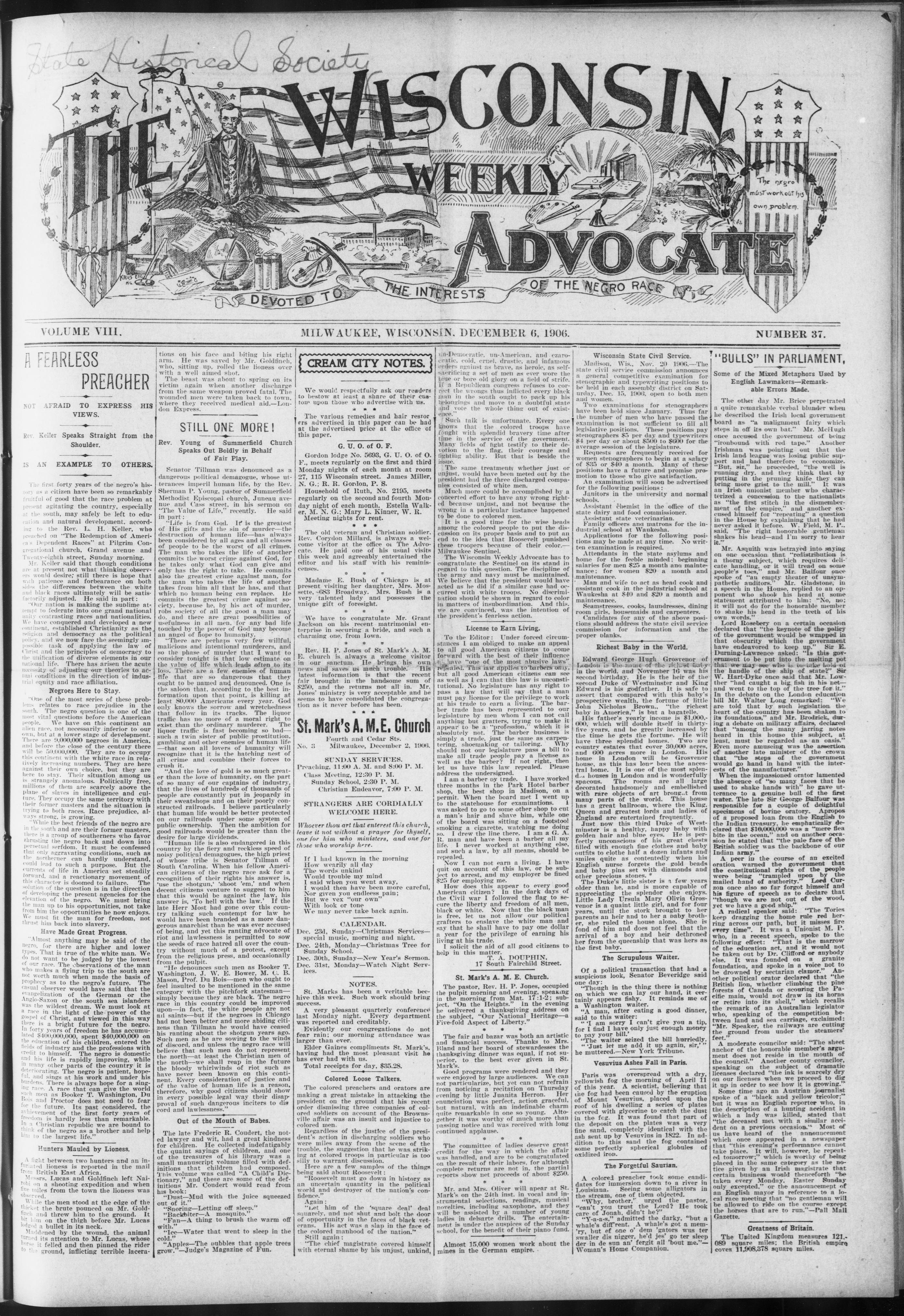
WISCONSIN
WEEKLY
ADVOCATE
DEVOTED TO THE INTERESTS OF THE NEGRO RACE
VOLUME VIII.
NOT AFRAID TO EXPRESS HIS VIEWS.
Rev. Keller Speaks Straight from the Shoulder.
The first forty years of the negro's history as a citizen have been so remarkably fruitful of good that the race problem at present agitating the country, especially at the south, may safely be left to education and natural development, according to the Rev. L. H. Keller, who preached on "The Redemption of America's Dependent Races" at Pilgrim Congregational church, Grand avenue and Twenty-eighth street, Sunday morning. Mr. Keller said that though conditions are at present not what thinking observers would desire; still there is hope that with patience and forbearance on both sides the differences between the white and black races ultimately will be satisfactorily adjusted. He said in part:
Our nation is making the sublime attempt to federate into one grand national unity contrasting races and nationalities. We have conquered and developed a new continent, established Christianity as the religion and democracy as the political policy, and we now face the seemingly impossible task of applying the law of Christ and the principles of democracy to the unification of diverse elements in our national life. There has arisen the acute necessity of adjusting our theories to actual conditions in the direction of industrial equity and race affiliation.
Negroes Here to Stay
One of the most series of these problems relates to race prejudice in the south. The negro question is one of the most vital questions before the American people. We have on this continent an alien race, not necessarily inferior to our own, but at a lower stage of development. There are 9,000,000 negroes in America, and before the close of the century there will be 50,000,000. They are to occupy this continent with the white race in relatively increasing numbers. They are here against their own choice, but they are here to stay. Their situation among us is strangely anomalous. Politically free, millions of them are scarcely above the plane of slaves in intelligence and culture. They occupy the same territory with their former masters and the situation is trying to both races. Race prejudice, always strong, is growing.
While the best friends of the negro are in the south and are their former masters, there is a group of southerners who favor thrusting the negro back and down into perpetual serfdom. It must be confessed that only aggravating conditions, such as the northerner can hardly understand, could lead to such a purpose. But the currents of life in America set steadily forward, and a reactionary movement of this character is doomed to failure. The solution of the question is in the direction of developing the present agencies for the elevation of the negro. We must bring the man up to his opportunities, not take from him the opportunities he now enjoys. We must fit the man for freedom, not thrust him back into slavery.
Have Made Great Progress.
"Almost anything may be said of the negro, for there are higher and lower types. That is true of the white man. We do not want to be judged by the lowest of our race. The observations of the man who makes a flying trip to the south are not worth much when made the basis of prophecy as to the negro's future. The casual observer would have said that the evangelization of the German or the Anglo-Saxon or the south sea islanders was the wildest dream. We must look at a race in the light of the power of the gospel of Christ, and viewed in this way there is a bright future for the negro. In forty years of freedom he has accumulated $400,000,000, spent $40,000,000 on the education of his children, entered the fields of industry and the professions with credit to himself. The negro is domestic and his life is rapidly improving, while in many other parts of the country it is deteriorating. The negro is patient, hopeful, and sings at his work and under his burdens. There is always hope for a singing race. A race that can give the world such men as Booker T. Washington, Du Bois and Proctor does not need to fear for the future. Its past considered, the achievement of the first forty years of freedom is hardly less than remarkable. In a Christian republic we are bound to think of the negro as a brother and help him to the largest life."
Hunters Mauled by Lioness.
A fight between two hunters and an infurated lioness is reported in the mail from British East Africa.
Messrs. Lucas and Goldfinch left Nairobi on a shooting expedition and when five miles from the town the lioness was observed.
While the men stood at the edge of the thicket the brute pounced on Mr. Goldfinch and threw him to the ground. It bit him on the thigh before Mr. Lucas lodged a bullet in its neck.
Maddened by the wound, the animal turned its attention to Mr. Lucas, whose horse it felled and then pinned the rider to the ground, inflicting terrible lacera-
tions on his face and biting his right arm. He was saved by Mr. Goldfinch, who, sitting up, rolled the lioness over with a well aimed shot. The beast was about to spring on its victim again when another discharge from the same weapon proved fatal. The wounded men were taken back to town, where they received medical aid.—London Express.
STILL ONE MORE!
Rev. Young of Summerfield Church Speaks Out Boldly in Behalf of Fair Play.
Senator Tillman was denounced as a dangerous political demagogue, whose utterances imperil human life, by the Rev. Sherman P. Young, pastor of Summerfield Methodist Episcopal church, Juneau avenue and Cass street, in his sermon on "The Value of Life," recently. He said in part:
"Life is from God. It is the greatest of His gifts and the sin of murder—the destruction of human life—has always been considered by all ages and all classes of people to be the worst of all crimes. The man who takes the life of another commits the worst crime against God, for he takes only what God can give and only has the right to take. He commits also the greatest crime against man, for the man who takes the life of another takes from him all that he has, and that which no human being can replace. He commits the greatest crime against society, because he, by his act of murder, robs society of all the good a man may do, and there are great possibilities of usefulness in all men, for any bad life touched by the power of God may become an angel of hope to humanity.
"There are perhaps very few willful, malicious and intentional murderers, and so the phase of murder that I want to consider tonight is that low estimate on the value of life which leads often to its loss. There are a few enemies of human life that are so dangerous that they ought to be named and denounced. One is the saloon that, according to the best information upon that point, is killing at least 80,000 Americans every year. God only knows the sorrow and wretchedness that follow in its tracks. The liquor traffic has no more of a moral right to exist than the ordinary murderer. The liquor traffic is fast becoming so bad—such a twin sister of public prostitution, gambling and other enemies of human life—that soon all lovers of humanity will recognize that it is the hatching nest of all crime and combine their forces to crush it.
"And the love of gold is so much greater than the love of humanity, on the part of so many of our captains of industry, that the lives of hundreds of thousands of people are constantly put in jeopardy in their sweatshops and on their poorly constructed railroads. I believe particularly that human life would be better protected on our railroads under some system of public ownership. Then the ambition for good railroads would be greater than the desire for large dividends.
"Human life is also endangered in this country by the fiery and reckless speed of noisy political demagogues, the high priest of whose tribe is Senator Tillman of South Carolina. When his fellow American citizens of the negro race ask for a recognition of their rights his answer is, 'use the shotgun,' 'shoot 'em,' and when decent citizens venture to suggest to him that this would be against the law, his answer is, 'To hell with the law.' If the late Herr Most had gone over this country talking such contempt for law he would have been branded as a more dangerous anarchist than he was ever accused of being, and yet this ranting advocate of riot and lawlessness is permitted to sow the seeds of race hatred all over the country without much of a protest, except from the religious press, and occasionally from the pulpit.
"He denounces such men as Booker T. Washington, J. W. E. Bower, M. C. B. Mason, Prof. Du Bois—men who ought to feel insulted to be mentioned in the same category with the pitchfork statesman—simply because they are black. The negro race in this country could be improved upon—in fact, the white people are not all saints—but if the negroes in Chicago had not been better and more abiding citizens than Tillman he would have ceased his ranting about the shotgun years ago. Such men as he are sowing to the winds of discord, and unless the negro race will believe that such men do not represent the north—at least the Christian men of the north—we shall reap in the future the bloody whirlwinds of riot such as have never been known on this continent. Every consideration of justice and of the value of human life is a reason, therefore, why good citizens should show in every possible legal way their disapproval of such dangerous inciters to discord and lawlessness."
Out of the Mouth of Babes.
The late Frederic R. Coudert, the noted lawyer and wit, had a great kindness for children. He collected indefatigably the quaint sayings of children, and one of the treasures of his library was a small manuscript volume filled with definitions that children had composed. This volume was called "A Child's Dictionary," and these are some of the definitions Mr. Coudert would read from his book:
"Dust—Mud with the juice squeezed out of it." "Snoring—Letting off sleep." "Backbiter—A mosquito." "Fan—A thing to brush the warm off with."
"Ice—Water that went to sleep in the cold." "Apples—The oubbles that apple trees grow."—Judge's Magazine of Fun.
CREAM CITY NOTES.
We would respectfully ask our readers to bestow at least a share of their custom upon those who advertise with us.
The various remedies and hair restorers advertised in this paper can be had at the advertised price at the office of this paper.
G. U. O. of O. F.
Gordon lodge No. 5693, G. U. O. of O. F., meets regularly on the first and third Monday nights of each month at room 27, 115 Wisconsin street. James Miller, N. G.; R. R. Gordon, P. S. Household of Ruth, No. 2195, meets regularly on the second and fourth Monday night of each month. Estella Walker, M. N. G.; Mary L. Kinner, W. R.
***
The old veteran and Christian soldier, Rev. Corydon Millard, is always a welcome visitor at the office of The Advocate. He paid one of his usual visits this week and agreeably entertained the editor and his staff with his reminiscences.
Madame E. Bush of Chicago is at present visiting her daughter, Mrs. Mossette, -683 Broadway. Mrs. Bush is a very talented lady and possesses the unique gift of foresight.
We have to congratulate Mr. Grant Jackson on his recent matrimonial enterprise in securing a bride, and such a charming one, from Iowa.
* * *
Rev. H. P. Jones of St. Mark's A. M. E. church is always a welcome visitor in our sanctum. He brings his own news and saves us much trouble. His latest information is that the recent fair brought in the handsome sum of $250, and the returns not all in. Mr. Jones' ministry is very acceptable and he seems to have consolidated the congregation as it never before has been.
St. Mark's A.M.E. Church
St. Mark's A.M.E. Church
Fourth and Cedar Sts.
No. 3 Milwaukee, December 2, 1906
SUNDAY SERVICES.
Preaching, 11:00 A. M. and 8:00 P. M.
Class Meeting, 12:30 P. M.
Sunday School, 2:30 P. M.
Christian Endeavor, 7:00 P. M.
STRANGERS ARE CORDIALLY WELCOME HERE.
Whoever thou art that interest this church,
leave it not without a prayer for thyself,
one for him who ministers, and one for
those who worship here.
If I had known in the morning
How wearily all day
The words unkind
Would trouble my mind
I said when you went away,
I would then have been more careful,
Nor given you endleess pain;
But we vex "our own"
With look or tone
We may never take back again.
CALENDAR
Dec. 23d, Sunday-Christmas Services special music, morning and night.
Dec. 30th, Sunday—New Year's Sermon. Dec. 31st, Monday—Watch Night Services.
NOTES.
St. Marks has been a veritable beehive this week. Such work should bring success.
A very pleasant quarterly conference last Monday night. Every department was reported and creditably.
Evidently our congregations do not fear rain; our morning attendance was larger than ever.
Elder Gaines compliments St. Mark's, having had the most pleasant visit he has ever had with us.
Total receipts for day. $35.28.
Colored Loose Talkers
The colored preachers and orators are making a great mistake in attacking the president on the ground that his recent order dismissing three companies of colored soldiers on account of the Brownsville affair was an insult and injustice to colored men.
Regardless of the justice of the president's action in discharging soldiers who were miles away from the scene of the trouble, the suggestion that he was striking at colored troops in particular is too silly to warrant discussion.
Here are a few samples of the things being said about Roosevelt:
"Roosevelt must go down in history as an uncertain quantity in the political world and destroyer of the nation's confidence."
"Let him of the 'square deal' deal squarely, and not shut and bolt the door of opportunity in the faces of black veterans. His act was a slap in the face of the colored manhood of the nation."
Still again:
"The chief magistrate covered himself with eternal shame by his unjust, unkind.
un-Democratic, un-American, and czarocratic, cold, cruel, drastic, and infamous orders against as brave, as heroic, as self-sacrificing a set of men as ever wore the blue or bore old glory on a field of strife. If a Republican congress refuses to correct the wrongs thus inflicted every black man in the south ought to pack up his belongings and move to a doubtful state and vote the whole thing out of existence."
Such talk is unfortunate. Every one knows that the colored troops have fought with splendid bravery time after time in the service of the government. Many fields of fight testify to their devotion to the flag, their courage and fighting ability. But that is beside the issue.
The same treatment, whether just or unjust, would have been meted out by the president had the three discharged companies consisted of white men.
Much more could be accomplished by a concerted effort to have any wrong righted because unjust, and not because the wrong in a particular instance happened to be done to colored men.
It is a good time for the wise heads among the colored people to put the discussion on its proper basis and to put an end to the idea that Roosevelt punished these troopers because of their color.—Milwaukee Sentinel.
The Wisconsin Weekly Advocate has to congratulate the Sentinel on its stand in regard to this question. The discipline of the army and navy must be maintained. We believe that the president would have acted as he did if a similar case had occurred with white troops. No discrimination should be shown in regard to color in matters of insubordination. And this, we are convinced, was the intention of the president's fearless action.
License to Earn Living
To the Editor: Under forced circumstances I am obliged to make an appeal to all good American citizens to come forward with the best of their influence have "one of the most abusive laws" repealed. This law applies to barbers only, but all good American citizens can see as well as I can that this law is unconstitutional. No legislature has any right to pass a law that will say that a man must pay license for the privilege to work at his trade to earn a living. The barber trade has been represented to our legislature by men whom I can not call anything but gratters, trying to make it appear to be a "profession," which it is absolutely not. The barber business is simply a trade, just the same as carpentering, shoemaking or tailoring. Why should not our legislature pass a bill to make all trade people pay a license as well as the barber? If not right, then let us have this law repealed. Please address the undersigned.
I am a barber by trade. I have worked three months in the Park Hotel barber shop, the best shop in Madison, on a permit. When the board met I went up to the statehouse for examinations. I was asked to go to some other shop to cut a man's hair and shave him, while one of the board was sitting on a footstool smoking a cigarette, watching me doing so. I drew the line there. I am a G. A. R. man and have been a barber all my life. I never worked at anything else, and such a law, by all means, should be repealed. Now I can not earn a living. I have quit on account of this law, or be subject to arrest, and my employer be fined $25 for employing me.
How does this appear to every good American citizen? In the dark days of the Civil war I followed the flag to secure the liberty and freedom of all men, black or white. Now that the black man is free, let us not allow our political grafters to enslave the white man and say that he shall have to pay one dollar a year for the privilege of earning his living at his trade.
I solicit the aid of all good citizens to help in this matter.
T. A. DOUPHIN
17 South Fairchild Street.
St. Mark's A. M. E. Church.
The pastor, Rev. H. P. Jones, occupied the pulpit morning and evening, speaking in the morning from Mat. 17:1-2; subject, "On the Heights." In the evening he delivered a thanksgiving address on the subject, "Our National Heritage—a Five-fold Aspect of Liberty."
* * *
The fair and bazar was both an artistic and financial success. Thanks to Mrs. Bland and her board of stewardesses the thanksgiving dinner was equal, if not superior, to the best ever given in St. Mark's.
Good programs were rendered and they were enjoyed by large audiences. We can not particularize, but yet can not refrain from noticing a recitation on Thursday evening by little Juanita Herron. Her enunciation was perfect, action graceful, but natural, with an indefinable charm quite remarkable in one so young. Altogether it was worthy of much more than passing notice and was received with long continued applause.
The committee of ladies deserve great credit for the way in which the affair was handled, and are to be congratulated on the result of their labors, for although complete returns are not in, the partial reports show net proceeds of about $250.
Mr. and Mrs. Oliver will appear at St. Mark's on the 24th inst. in vocal and instrumental selections, readings, musical novelties, including saxophone, and they will be assisted by a number of young ladies in delsarte drills. The entertainment is under the auspices of the Sunday school, for the benefit of their piano fund.
Almost 15,000 women work about the mines in the German empire.
Wisconsin State Civil Service. Madison, Wis., Nov. 20 1906.—The state civil service commission announces a general competitive examination for stenographic and typewriting positions to be held in each assembly district on Saturday, Dec. 15, 1906, open to both men and women. Two examinations for stenographers have been held since January. Thus far the number of men who have passed the examination is not sufficient to fill all legislative positions. These positions pay stenographers $5 per day and typewriters $4 per day or about $500 to $600 for the average session of the legislature. Requests are frequently received for women stenographers to begin at a salary of $35 or $40 a month. Many of these positions have a future and promise promotion to those who give satisfaction.
for the following positions:
Janitors in the university and normal schools.
Assistant chemist in the office of the state dairy and food commissioner.
Assistant state veterinarian.
Family officers and matrons for the industrial school at Waukesha.
Applications for the following positions may be made at any time. No written examination is required.
Attendants in the state asylums and home for the feeble minded; beginning salaries for men $25 a month and maintenance; for women $20 a month and maintenance.
Man and wife to act as head cook and assistant cook in the industrial school at Waukesha at $40 and $20 a month and maintenance.
Seamstresses, cooks, laundresses, dining room girls, housemaids and carpenters.
floor girls, housemaids and carpenters. Candidates for any of the above positions should address the state civil service commission for information and the proper blanks.
Richest Baby in the World.
Edward George Hugh Grosvenor of London is the name of the richest baby in the world, and November 16 was his second birthday. He is the heir of the second Duke of Westminster and King Edward is his godfather. It is safe to assert that compared with this baby's prospective wealth, the fortune of little John Nicholas Brown., "the richest baby in America," is but a bagatelle.
His father's yearly income is $1,000,000, which will double itself in thirty-five years, and be greatly increased by the time he gets the fortune. He will have three splendid homes. Two are country estates that cover 30,000 acres, and 600 acres more in London. His home in London will be Grosvenor house, as this has long been the ancestral home. It is one of the most splendid houses in London and is wonderfully spacious. The rooms are all large decorated handsomely and embellished with rare objects of art broug...t from many parts of the world. This house has a great ballroom, where the King, Queen and greatest lords and ladies of England are entertained frequently.
Just now this third Duke of Westminster is a healthy, happy baby with golden hair and blue eyes. He is perfectly unconscious of his great chests filled with enough fine clothes and baby outfits to clothe half a dozen infants and smiles quite as contentedly when his English nurse forgets the gold beads and baby pins set with diamonds and other precious stones.
The Duke's little sister is a few years older than he, and is more capable of appreciating the splendor she enjoys. Little Lady Ursula Mary Olivia Grosvenor is a quaint little girl, and for four years, until the stork brought to her parents an heir and to her a baby brother, she ruled the house alone. She is fond of him and does not feel that the arrival of a boy and heir dethroned her from the queenship that was hers as the first baby.
The Scrupulous Waiter.
Of a political transaction that had a suspicious look, Senator Beveridge said one day:
"Though in the thing there is nothing on which we can lay our hand, it certainly appears fishy. It reminds me of a Washington waiter.
"A man, after eating a good dinner, said to this waiter:
'I am sorry I can't give you a tip, for I find I have only just enough money to pay your bill.'
"The waiter seized the bill hurriedly.
'Just let me add it up again, sir,'" he muttered.—New York Tribune.
Vesuvius Ashes Fall in Paris
Paris was overspread with a dry, yellowish fog the morning of April 11 of this year. A scientist, believing that one fog had been caused by the eruption of Mount Vesuvius, placed upon the roof of his dwelling a series of plates covered with glycerine to catch the dust in the fog. It was found that part of the deposit on the plates was a very fine sand, completely identical with the ash sent up by Vesuvius in 1822. In addition to this sand the fog contained some perfectly spherical globules of oxidized iron.
The Forgetful Saurian.
A colored preacher took some candidates for immersion down to a river in Louisiana. Seeing some alligators in the stream, one of them objected.
"Why, brother," urged the pastor, "can't you trust the Lord? He took care of Jonah, didn't he?"
"Y-a-a-s," admitted the darky, "but a whale's different. A whale's got a memory, but ef one o' dem 'gators wus ter swaller dis nigger, he'djes' go ter sleep der in de sun an' fergit all 'bout me."—Woman's Home Companion.
NUMBER 37.
Some of the Mixed Metaphors Used by English Lawmakers—Remarkable Errors Made.
The other day Mr. Brice perpetrated a quite remarkable verbal blunder when he described the Irish local government board as "a malignment fairy which steps in off its own bat." Mr. McHugh once accused the government of being "ironbound with red tape." Another Irishman was pointing out that the Irish land league was losing public support and had therefore to economize. "But, sir," he proceeded, "the well is running dry, and they think that by putting in the pruning knife they can bring more grist to the mill." It was an Irish unionist member who characterized a concession to the nationalists as "the first stitch in the dismemberment of the empire," and another excused himself for "repeating" a question in the House by explaining that he had never asked it before. W. Field, M. P., said, "The right honorable gentleman shakes his head—and I'm sorry to hear it."
Mr. Asquith was betrayed into saying on one occasion that "redistribution is a thorny subject, which requires delicate handling, or it will tread on some people's toes," and Mr. Balfour once spoke of "an empty theater of unsympathetic auditors." Mr. Gladstone, in a speech in the House, replied to an opponent who shook his head at some statement attributed to him: "No, no; it will not do for the honorable member to shake his head in the teeth of his own words."
Lord Rosebery on a certain occasion declared that "the keynote of the policy of the government would be wrapped in that obscurity which the government have endeavored to keep up." Sir E. Durning-Lawrence asked: "Is this government to be put into the melting pot that we may see who is to take hold of the handle of the ship of state?" Sir W. Hart-Dyke once said that Mr. Lowther "had caught a big fish in his net—and went to the top of the tree for it." In the debate on the London education bill Mr. Walter Long remarked: "We are told that by such legislation the heart of the country has been shaken to its foundations," and Mr. Brodrick, during a debate on military affairs, declared that "among the many jarring notes heard in this house this subject, at least, must be regarded as an oasis." Even more amuseeing was the assertion of another late minister of the crown that "the steps of the government would go hand in hand with the interests of the manufacturer."
When the impassioned orator lamented the absence of "so many faces that he used to shake hands with" he gave utterance to a genuine bull of the first water. The late Sir George Balfour was responsible for a couple of delightful specimens of bovine oratory. Apropos of a proposed loan from the English to the Indian treasury, he emphatically declared that $10,000,000 was a "mere flea bite in the ocean," and on another occasion he stated that "the pale face of the British soldier was the backbone of our Indian army."
A peer in the course of an excited oration warned the government that the constitutional rights of the people were being "trampled upon by the mailed hand of authority." Lord Curzon once also so far forgot himself and his figure of speech as to declare that "though we are not out of the wood, not we have a good ship."
yet we have a good ship.
A radical speaker said: "The Tories keep dragging the home rule red herring across our path, but it misses fire every time". It was a Unionist M. P. who, in a recent speech, spoke to the following effect: "That is the marrow of the education act, and it would not be taken out by Dr. Clifford or anybody else. It was founded on a granite foundation, and spoke in a voice not to be drowned by sectarian clamor." Another political orator declared that "the British lion, whether climbing the pine forests of Canada or scouring the Pacific main, would not draw in its horns or retire into its shell," which recalls the remark of an Australian legislator who, speaking of the competition between land and sea carriage, exclaimed: "Mr. Speaker, the railways are cutting the ground from under the steamers' feet."
A moderate councilor said: "The sheet anchor of the honorable member's argument does not reside in the mouth of the council." Another county councilor, speaking on the subject of dramatic licenses declared "the ink is scarcely dry on our licenses when we proceed to dig it up in order to see how it is growing."
Some time ago an Austrian journalist spoke of a "black and yellow tricolor;" but it was an English reporter who, in the description of a hunting accident in which a lady was killed, stated that "the deceased met with a similar accident on a previous occasion." Most of us have heard of the announcement which once appeared in a newspaper that "this evening's performance cannot take place. It will, however, be repeated tomorrow;" which is worthy of being placed in the same category as the notice given by an Irish magistrate that certain business would thenceforth "be taken every Monday, Easter Sunday only excepted," or the announcement of an English mayor in reference to a local race meeting that "no gentleman will be allowed to ride on the course except the horses that are to run."—Pall Mall Gazette.
Greatness of Britain
The United Kingdom measures 121. 089 square miles; the British empire coves 11,908,378 square miles.
THE WISGONSIN WEEKLY ADVOCATE
MILWAUKEE, WIS.
R. B. MONTGOMERY, Editor and Proprietor.
Facts and Fancies. Scraggs—Have you read Brown's last book?
Cynic—I hope so.—Smart Set.
Stella—Bella says that you told her my complexion was artificial.
Ella—It's false!—Town Topics.
But You Lose.
The dentist is willing to call it a draw Philadelphia Bulletin.
Election Noise.
Knicker—Money talks.
Bocker—But the silent voter doesn't.—
New York Sun.
Yes, Indeed.
"What are soft drinks, papa?"
"The kind that are hard to take, Bobbie."—Smart Set.
"Has he been writing poetry long?" "Gad, yes! Why, he owes money to over forty landladies."—Smart Set.
The Only Way.
"He earned $10,000 last year with his pen." "Goodness! What did he expose?"
Weakness.
Mrs. Pat—They do be sayin' that at the weddin' the wine flowed like wather.
Pat—Glory be! Who the civil had wathered it?"—Harper's Weekly.
Do It Now.
Now is the time,
Without a doubt.
To get your winter
Flannels out.
—Detroit Free Press.
A Good Patient.
First Physician—Has he got an hereditary trouble?
Second Physician—Yes. I hope to hand his case down to my son.—Harper's Bazar.
Help! Help!
My Bonnie lies under the auto:
My Bonnie swears under the car.
Please send to the garage for some one
For 'tis lonesome up here where I are.
—Washington Star.
A Limit.
Chequely—Money, young man, money
can do anything.
A Limit
Kreakik—Excuse me, sir, it can't get a fellow into our college eleven.—Town and Country.
Nature's Finance.
The trees begin to show a touch
Beneath the autumn sun,
And so from Nature's lavish bank
Gold imports have begun.
—New York Sun.
Supererogation.
"I don't see." said Uncle Eph, "why Bryan wants to make a special stunt of stumping Kansas. It's my belief that he has the hull blame Demmycratic party stumped right now."
Unchatitable
"Is she a charitable woman? Willing to give relief?" No. She's the kind that never gives even a sigh of relief."
Romance and Reality.
The Poet—The girl in love dreams of castles in the air.
The Realist—And when she marries she wakes up to find herself living in a top flat.—Town Topics.
Gilt-Edged.
Ted—Do you think that's a good scheme of his?
Ned—It must be. He's putting his own money into it and not telling anybody about it.—Smart Set.
Theories.
Brooks—Where do people get the idea that two can live as cheaply as one?
Theories.
Newton—I guess it comes from the same source as the idea that two hearts beat as one.—Town Topics.
Longing.
Upon my mouth there is a kiss;
Won't someone come and take it?
Within my heart is boundless bliss,
A tender little heart is this;
Won't someone come and break it?
—Town Topics.
Longing.
A Bubble's Duration.
Look—He must have a very large library if he buys all the popular books. Ashley—On the contrary, it is very small; he never buys until a year after publication.—Brooklyn Life.
Always in Their Element
Fishes have been discovered in Guatemala with two pair of eyes. One pain does duty above water and the other below, the fish thus being able to see equally well in two elements.-Tit-Bits.
Diplomatic
Daisy—Granny, can you eat nuts?
Granny—No, darling, my teeth are not good enough.
Daisy—Then—will you mind these till I come back?—The Gentlewoman.
Work for the Pacificator
First Church Member-How is your choir getting along?
choir getting along;
Second Church Member—We are thinking of asking Taft to become Provisional Governor.—New York Sun.
Storkville Courier Please Copy
Mrs. Maloney: "Twins do be the great misfortune."
Mrs. Finnegan: "Sure an' they be! Wan o' them misfortunes that niver come single."—October Lippincott's.
What if He's a Corporation?
allowed to make contributions?
"Certainly not," answered Dustin Stax. "Nowadays a candidate should be rich enough to furnish his own money."—Washington Star.
The Foolish Burglar.
Durand (waking up in the middle of the night and seeing a burglar in his room)—Man alive, what are you doing? You don't expect to find money here in the dark, seeing that I can't possibly find any myself in broad daylight?—Bon Vivant
Visitor (to artist's young wife)—What-
ever were you two laughing over so just now?
Wife—Oh, it was such fun! My husband painted and I cooked, and then we both guessed what the things were meant for—Fliiegende Blaetter.
Oh, Boston!
A well known Washington architect who has just returned from Boston, says Harper's Weekly, is chortling over a good joke on that correct and literary city. He says that in the reading room of one of the most exclusive clubs in the Hub there is a sign that reads:
"Only low conversation permitted here."
Right.
Little Boy—Are not all the words used to be found in the dictionary, papa?
"No, my child, new words are coined every day."
"And what is the last word, papa?"
"I don't know, dear. Ask your mother, she always has the last word."—Translated for Transatlantic Tales from Le Rire.
John Drew on Drawing Power.
A fellow actor was the subject of discussion at The Players club not long ago. "He is perfectly devoted to that blonde"—so Mr. John Drew was informed. "His family think it is a case of hypnotism." "Seems more like chemical attraction," said the great actor thoughtfully.—Lippincott's.
Ten Best Books. and Why.
Edwin Markham, in Success, declares the ten best books of late years to be as follows:
(a). Maurice Hewlitt's "Richard Yea and Nay"—the adventure and passion of the England of the Crusades.
(b). Joseph Conrad's "Lord Jim"—a sense of the power and terror of the sea.
(c). Robert Hitchens' "The Garden of Allah"—two souls projected against the color and mystery of the desert.
(d). Mrs. Edith Wharton's "The House of Mirth"—the tragedy and the comedy of our hollow fashionable society.
(e). May Sinclair's "The Divine Fire"—the apotheosis of the poetic spirit.
(f). Upton Sinclair's "The Jungle"—the awakener of the conscience of the nation.
(g). Jack London's "The Sea Wolf"—adventure on the sea and conflict of the primitive passions.
(h). Stewart Edward White's "The Blazed Trail"—the flavor of the woods and lumber camps in the great northwest.
(i). Dexter's "The Breath of the God's"—the conflict in Japan between the old traditions and the new ideas.
(j). Frank Norris' "The Octopus"—a book somewhat older, but forever new; the struggle of plundered men with corporate opression.
Constituents of a Man
German scientists announce that the material for a man weighing 150 pounds can be found in the white and yolks of 1200 hens' eggs. Reduced to a fluid the average man would yield ninety-eight cubic meters of illuminating gas and hydrogen, enough to fill a balloon capable of lifting 155 pounds. The normal human body has in it the iron needed to make seven large nails, the fat for 14 pounds of candles, the carbon for sixty-four gross of crayons and phosphorous enough for $20,000 matches. Out of it can be obtained, besides, twenty coffee spoons of salt, fifty lumps of sugar and forty-two litres of water.—Kansas City Journal.
No Wonder He Found It
The papers relate it as a remarkable fact that Frank Bookwalter of Springfield, O., returned to his childhood's home after an absence of sixty-five years and found a dime that he had lost in a crack in the front steps when he was five years old.
There is nothing remarkable in this story. Mr. Bookwalter is described as a millionaire. After sixty-five years' experience in picking up money, it would have been a wonder if he had not found his boyhood's dime, especially as he knew where it was.
If the lost dime had been Mr. Rockefeller's he would have found a dollar. Mr. Rockefeller's money breeds.—Life.
Never Run Away
The old soldier had been telling his nephews terrible stories of battle, and they had listened spellbound for an hour. Then said the eldest:
"My boy, if you live long enough you'll find out that it's never well to run away from danger, no matter what; but you will probably meet with occasions when you'll see what a grand thing it is to right-about-face and charge in the opposite direction as fast as you can go."—London Tit-Bits.
Many Perish in Alps
The Swiss Alpine club has just issued statistics of accidents which took place in the Alps last year. One hundred and seventy-two climbers perished, but considering the tourists numbered 150,000 the death roll is regarded as low. Most of those killed were Swiss. The Germans come next, and after them the French, Austrians and Italians. Only five English tourists perished. Fatal accidents do not take place on the highest summits, but on mountains which are not regarded as difficult to climb.
No Model for Him.
Dr. Stephen H. Roblin, pastor of the Columbia Avenue Universalist church, Boston, was calling on an old lady, one of his parishioners, before going away on his summer vacation, when his church is always closed. The old lady evidently does not believe in ministrial vacations, for she said:
"Doctor, remember Satan never takes a vacation."
"My dead madam," answered the doctor. "I never did believe in imitating Satan."—Boston Herald.
How Weeds Multiply.
To give some idea of how weeds multiply it may be stated that a single plant of pepper grass will produce 18,000 seeds; dandelion, 12,000; shepherd's purse, 37,000; wheat thief, 7000; common thistles, 65,000; chamomile, 16,000; ragweed, 5000; purslaine, 375,000; plantain, 47,000, and burdock 43,000.
Another Superiority of Woman.
The average man can, and easily does, buy less with a five dollar bill than the average woman secures with a dollar and ninety-eight cents, and, unlike the woman, the man can rarely explain where that bill has gone.—Providence Tribune.
Oranges at Famine Price
Some giant Jamaica oranges are reported to have recently brought $1.50 a dozen on the London market.
Government Makes Quinine.
British India's government is successfully making quinine, of which immense quantities are sold by it through the postoffice.
Hats Off at Funeral
A man who fails to raise his hat when a funeral is passing in Chester, England, is liable to fine and imprisonment.
SONG IN WINTER TIME.
Buoyed by a hope eternal,
As old as the Eden-birth,
I can wait till the rupture vernal
Shall quicken the sleeping earth:
For mayhap when the sod is shaken,
When tingles the tip of the fir.
Love, like the Spring, will waken
In the slumbering heart of her!
—Clinton Scollard in The Bohemian
A DESIGNING WIDOW.
"If there were only some way," began the bachelor, gazing thoughtfully out of the window of the dining car, "in which a fellow could prove his love—"
"There are millions of them!" declared the widow, sipping her consomme daintily.
"Those mediaeval fellows had such an advantage over us," complained the bachelor. "When a chap loved a girl all he had to do to prove it was to get another chap to say he didn't, and then to break the other chap's head. That was a sure sign."
"And it was so easy," remarked the widow.
"Yes," agreed the bachelor, enthusiastically. "Is there anybody whose head you particularly want broken? I feel remarkably like fighting."
"Of course, you do," said the widow, sympathetically. "The fighting spirit is born in every man. But dueling isn't a sign of love; it's a sign of egotism, hurt pride, the spirit of competition, the dog-in-the-manger feeling. Besides, it's out of fashion."
"Well," sighed the bachelor, "then I suppose I shall have to save your life or die for you."
"You might," said the widow, nodding encouragingly, "but it wouldn't prove anything—except that you had a sense of the picturesque and dramatic. Suppose you did save my life; wouldn't you do as much for many man, woman or child, or even any little stray dog who might happen to fall out of a boat or be caught in a fire or get under the feet of a runaway?"
"I've got it!" cried the bachelor; "I'll write a book of poems and dedicate them to you."
The widow toyed with her spoon.
"You've done that to—several girls before," she remarked, ungratefully.
"That's it!" cried the bachelor. "How is a man going to tell when he's in love when he feels the same way—every time?" "Have you forgotten your soup?" asked the widow, glancing at the untouched plate in front of the bachelor. The bachelor picked up his spoon languidly. "No," he said, "but——" "Because if you had," said the widow, "it would have been a proof."
"A proof," repeated the widow. "Forgetting to eat your meals is the first sign of love. A man may write poetry and swear love by all the planets separately, but if he sits down opposite you an hour afterward and orders mutton chops and gravy and devours them to the last crumb either he doesn't mean what he says or doesn't know what he is talking about. When he lets his breakfast grow cold and forgets to go out to lunch and loses his interest in his dinner it's a sure sign of love."
"It might be a sign of dyspepsia," suggested the bachelor doubtfully.
"Oh, well," proceeded the widow, sipping her soup leisurely, "there are other signs besides a lost appetite."
The bachelor looked hopper.
"Is one of them smelling violets all day when there aren't any round; and feeling a funny jump in your throat every time you catch sight of a violet hat; and suddenly discovering you have written, 'Send me eight quarts of violets and a widow' instead of 'eight quarts of gasoline and a patent pump'?"
The widow leaned so far over her soup that her eyes were completely shaded by the brim of her violet hat.
"Yes," she said gently; "loss of reason is one of them—and loss of memory."
"And loss of sleep?"
"And loss of common sense."
"And loss of self-respect?"
"And of your powers of conversation."
"Nonsense!" said the bachelor; "a man in love can say more fool things——"
The widow put down her spoon emphatically.
"A man in love," she contradicted, "can't talk at all! It's not the things he says, but the things he isn't able to say, the things that choke right up in his throat——"
"I've had that!" interrupted the bachelor.
"Had—what?"
"The 'love jump' in the throat."
"And did you ever go upstairs to light the gas and turn on the water instead; or walk three blocks in the wrong direction without knowing it; or hunt ten minutes for your shoes and then discover it was your collar button or your hat that you had lost?"
"Or add a column of figures and get a poem for the answer; or break your neck running to the office and then have to sit down and think what you came down early for; or begin a business letter 'Dearest Smith' and drop it in the box without a stamp, or read your paper upside down, or—"
"You've got it!" cried the widow.
"I know it," sighed the bachelor, "dreadfully!"
"The idea, I mean," said the widow, blushing. "Those are the real proofs of love."
"But," protested the bachelor, "they aren't impressive. How are you going to let the girl know——"
"A girl always knows," declared the widow.
"Are you going to say, 'Araminto, darling, I put on odd socks this morning and salted my coffee and sugared my chop. Accept this as a proof?"
"No, no, no," said the widow, laughing, "of course not! But when you arrive at her house half an hour before the time and appear at odd and embarrassing moments without a rational excuse and get mixed on your dates and look at her as if she were the moon or a ghost, and might disappear at any moment, and sit for hours gazing into space and moistening your lips in the hope that you will think of something to say——"
"She knows that she's got you!" "Oh, she may not," declared the
widow, cheerfully. "She may not know anything. She may be in love herself."
anything. She may be so in love with "That's it!" protested the bachelor, "knowing you're in love is only half the trouble. How are you going to know when a girl has reached the love stage? How are you going to know that she is not just dangling you, or marrying you for your money? They're so clever and wise and coquettish and——"
"When a girl is in love," said the widow, "she ceases being clever and wise and coquettish. She becomes mooney and silent and begins to notice things about you that you never knew yourself, such as that your nose is like Napoleon's, or that you have a profile like E. H. Sothern and shoulders like Hackett's and hair like Kyrle Bellew's. She never kept you waiting, but is always dressed and sitting in the parlor an hour before you arrive, and is never in a hurry to get home, and will walk for blocks beside you in the rain with her best hat on without caring. She begins to 'mother' you—"
"To caution you about getting your feet wet and avoiding a draught and wearing your overcoat, and to look at you every time you leave her as if she was afraid you would die before morning, and Mr. Travers, do you know I believe this train has reached Jersey City?"
"Why—why—so it has! Waiter! Waiter! Where in thunder is that blockhead? Why hadn't he brought us the rest of the dinner?"
"You forgot to order it!" said the widow, looking maliciously up under her hat.
"Jersey City! Last stop!" called the conductor from the door.
The bachelor put down his napkin and rose.
"Check, sir?" asked the waiter, with accusing eyes. "Were you forgetting to pay?" inquired the widow, softly. The bachelor thrust a bill into the waiter's hands and started down the aisle, followed by the widow. "You forgot your change," remarked the widow, as she stepped into the depot. "Oh, never mind," said the bachelor. "Where are your wraps?"
"Where are your wraps?"
The widow clutched his sleeve.
"I—I—left them in the dining car!" she stammered.
The bachelor gazed down at the top of the violet hat with a triumphant smile.
"Oh, do go back and try to get them!" moaned the widow, glancing wildly at the train, which by this time was being switched onto a sidetrack.
"It will be at the risk of my life," declared the bachelor, "but if you want—any more—"
"More—what?" asked the widow, distractedly.
"Proof," said the bachelor.
"It isn't necessary," said the widow, as she spied an excited porter running toward them, clutching a pongee coat, a silver handbag and a violet parasol.
"These," said the bachelor, taking them tenderly from the porter and tipping him, "are the most substantial signs of——"
"A lost head," said the widow, quickly.
"Or a lost heart," added the bachelor, as they crossed the station and stepped fatuously onto—the wrong ferryboat. Helen Rowland in Pittsburg Dispatch.
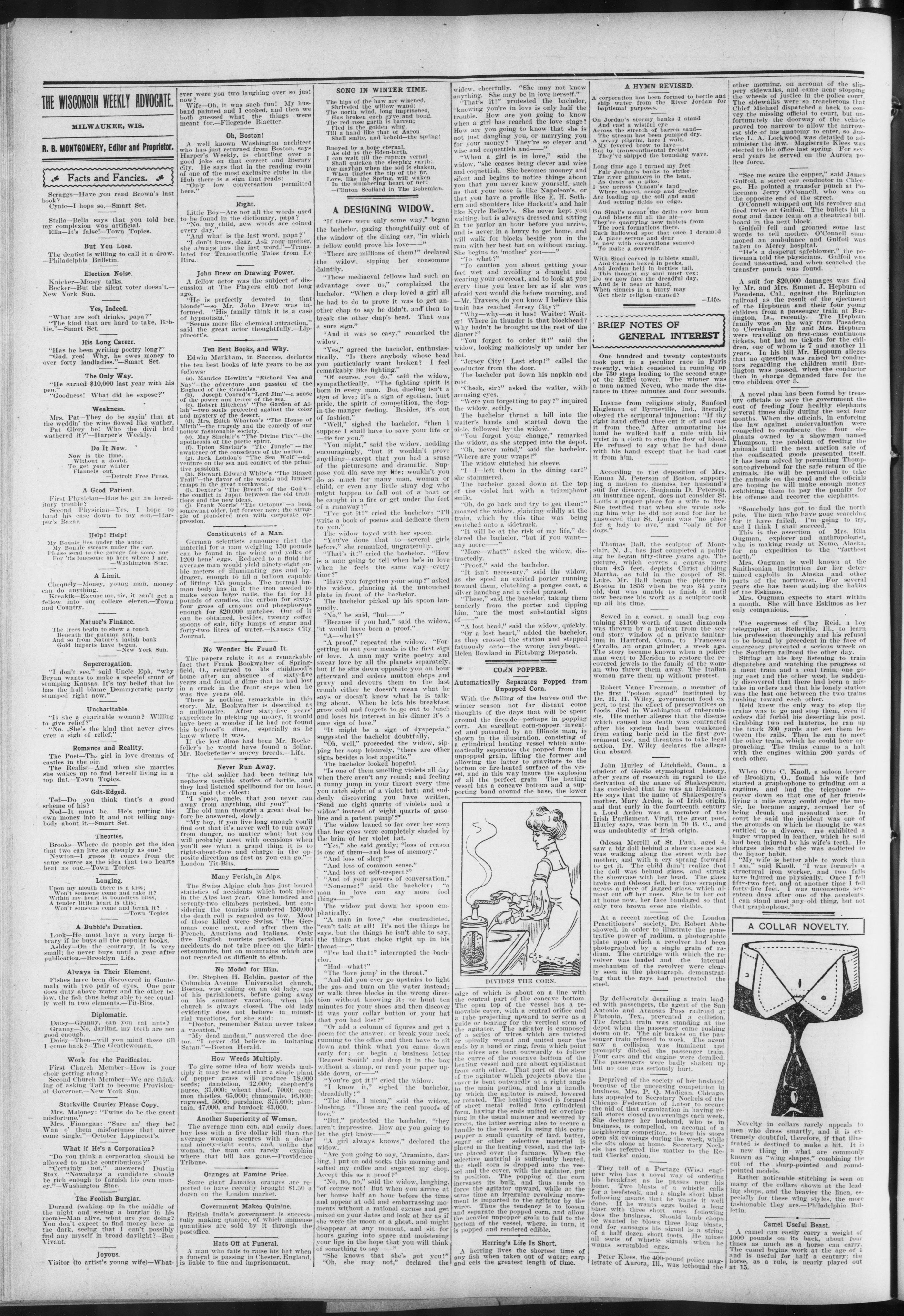
CORN POPPER
Automatically Separates Popped from Unpopped Corn.
With the falling of the leaves and the winter season not far distant come thoughts of the days that will be spent around the fireside—perhaps in popping corn. An excellent corn-popper, invented and patented by an Illinois man, is shown in the illustration, consisting of a cylindrical heating vessel which automatically separates the popped from the unpopped grain, lifting the former and allowing the latter to gravitate to the bottom or fire-heated surface of the vessel, and in this way insure the explosion of all the perfect grain. The heating vessel has a concave bottom and a supporting band around the base, the lower
3
DIVIDES THE CORN.
edge of which is about on a line with the central part of the concave bottom. The open top of the vessel has a removable cover, with a central orifice and a tube projecting upward to serve as a guide or bearing for the vertical stem of the agitator. The agitator is composed of a series of wires which are twisted or spirally wound and united near the ends by a band or ring, from which point the wires are bent outwardly to follow the curve of the concave bottom of the heating vessel and are about equidistant from eath other. That part of the stem of the agitator which projects above the cover is bent outwardly at a right angle to the main portion, and has a handle by which the agitator is raised, lowered or rotated. The heating vessel is formed of sheet metal rolled into cylindrical form, having the ends united by overlapping in the usual manner and secured by rivets, the latter serving also to secure a handle to the vessel. In using this cornopper a small quantity of lard, butter, sugar or other selective material is placed in the heating vessel, and the latter placed over the furnace. When the selective material is sufficiently heated, the shell corn is dropped into the vessel and the cover, with the agitator, put in position. The popping of the corn increases its bulk, and thus tends to force the agitator upward, while at the same time an irregular revolving movement is imparted to the agitator by the wires. Thus the tendency is to loosen and separate the popped corn, and allow the heavier unpopper grain to fall to the bottom of the vessel, where, in turn, it is popped and rendered edible.
Herring's Life Is Short
a herring lives the shortest time of any fish when taken out of water; carp and eels the greatest length of time.
A HYMN REVISED.
A corporation has been formed to bottle and ship water from the River Jordan for baptismal purposes.
On Jordan's stormy banks I stand
And cast a wistful eye
My revered brow to have
But by transcontinental freight
They've shipped the bounding wave.
Long time ago I turned my feet
Fair Jordan's banks to strike
The river glimmers in the heat,
As dusty as a pike.
I see across Canaan's land
Where shovel, scoop and dredge
Are loading up the soil and sand
And setting fields on edge.
On Sinai's mount the drills now hum
And blasts fill all the air—
They're quarrying new tablets from
The rock formations there.
Each hallowed spot that once I dreamed
A place serene and dear
Is now with excavations seamed
To make a souvenir.
With Sinal carved in tablets small,
And Canaan boxed in pecks,
And Jordan held in bottles tall,
This thought my soul must vex:
Do we now face the dreadful day,
And is it near at hand,
When sinners in a hurry may
Get their religion canned?
—Life.
BRIEF NOTES OF
GENERAL INTEREST
One hundred and twenty contestants took part in a peculiar race in Paris recently, which consisted in running up the 730 steps leading to the second stage of the Eiffel tower. The winner was a man named Neveu, who made the distance in three minutes and four seconds.
Insane from religious study, Sanford Engleman of Byrneville, Ind., literally obeyed the scriptural injunction: "If thy right hand offend thee cut it off and cast it from thee." After amputating his hand he walked half a mile with his wrist in a cloth to stop the flow of blood. He refused to say what he had done with his hand except that he had cast it from him.
According to the deposition of Mrs. Emma M. Peterson of Boston, supporting a motion to dismiss her husband's suit for divorce, Benjamin D. Peterson, an insurance agent, does not consider St. Louis a proper place for a wife to live. She testified that when she wrote asking him why he did not send for her he answered that St. Louis was "no place for a lady to live," and "only fit for dogs."
Thomas Ball, the sculptor of Montclair, N. J., has just completed a painting he began fifty-three years ago. The picture, which covers a canvas more than 4x5 feet, depicts Christ chiding Martha, as told in the gospel of St. Luke. Mr. Ball began the picture in Boston in 1853 when he was 34 years old, but was unable to finish it until now because his work as a sculptor took up all his time.
Sewed in a corset, a small bag containing $1100 worth of unset diamonds was thrown by a patient from the second story window of a private sanitarium in Hartford, Conn., to Francesca Cavallo, an organ grinder, a week ago. The story became known when a policeman went to Meriden to restore the recovered jewels to the family of the woman who threw them away. The Italian woman gave them up without protest.
Robert Vance Freeman, a member of the first "poison squad" instituted by Dr. H. H. Wiley, government food expert, to test the effect of preservatives on foods, died in Washington of tuberculosis. His mother alleges that the disease which caused his death was contracted after his system had been weakened from eating boric acid in the first government test, and threatens to take legal action. Dr. Wiley declares the allegation absurd.
一
John Hurley of Litchfield, Conn., a student of Gaelic etymological history, after years of research in regard to the derivation of the name of Shakespeare, has concluded that he was an Irishman. He says that the name of Shakespeare's mother, Mary Arden, is of Irish origin, and that early in the fourteenth century a Lord Arden was a member of the Irish Parliament. Virgil, the great poet, Hurley says, was born in 70 B. C., and was undoubtedly of Irish origin.
Odessa Merrill of St. Paul, aged 4, saw a big doll behind a show case as she was walking along the street with her mother, and with a cry sprang forward to get it. The child didn't realize that the doll was behind glass, and struck the showcase with her head. The glass broke and Odessa fell, her face scraping across a piece of jagged glass, which almost cut off her nose. She is in her cot at home now, her face bandaged so that only two brown eyes are visible.
At a recent meeting of the London Practitioners' society, Dr. Robert Abbe showed, in order to illustrate the penetrative power of radium, a photographic plate upon which a revolver had been photographed by a single grain of radium. The cartridge with which the revolver was loaded and the internal mechanism of the revolver were clearly seen in the photograph, demonstrating that the rays had penetrated the steel.
By deliberately derailing a train loaded with passengers, the agent of the San Antonio and Aransas Pass railroad at Flatonia, Tex., prevented a collision. The freight train was standing at the depot when the passenger came rushing down on it. The air brakes on the passenger train refused to work. The agent saw a collision was imminent and promptly ditched the passenger train. Four cars and the engine were derailed. The passengers were badly shaken up but no one was seriously hurt.
Deprived of the society of her husband because of the unceasing competition in business, Mrs. P. Q. Madigan, Chicago, has appealed to Secretary Nockels of the Chicago Federation of Labor to secure the aid of that organization in having retail stores closed two evenings each week. She declares her husband, who is in business, is compelled, on account of a neighboring competitor, to keep his store open six evenings during the week, while she sits alone at home. Secretary Nockels has referred the matter to the Retail Clerks' union.
They tell of a Portage (Wis.) engineer who has a novel way of ordering his breakfast as he passes near his home. Two blasts of a whistle calls for a beefsteak, and a single short blast following means that he wants it well done. If he wants eggs boiled a long blast with three short ones following does the business. Should lamb chops be wanted he blows three long blasts, and for sausages his signal is a string of a half dozen short toots. He mixes all sorts of whistle signals when he wants scrambled eggs.
Peter Klees, the 400-pound police magistrate of Aurora, Ill., was icebound the
____
other morning, on account of the slippery sidewalks, and came near stopping the wheels of justice in the police court. The sidewalks were so treacherous that Chief Michael dispatched a hack to convey the missing official to court, but unfortunately the doorway of the vehicle proved too narrow to allow the narrowest side of his anatomy to enter, so Justice L. A. Lockwood was detailed to administer the law. Magistrate Klees was elected to his office last spring. For several years he served on the Aurora police force.
"See me scare the copper," said James Gulfoil, a street car conductor in Chicago. He pointed a transfer punch at Policeman Jerry O'Connell, who was on the opposite end of the street.
O'Connell whipped out his revolver and fired twice at Gulfoil. The bullets hit a song and dance team on a theatrical billboard in the next block.
Gulfoil fell and groaned some last words to tell mother. O'Connell summoned an ambulance and Gulfoil was taken to Mercy hospital.
"He's a desperut safeblower," the policeman told the physicians. Gulfoil was found unscathed, and when searched the transfer punch was found.
A suit for $20,000 damages was filed by Mr. and Mrs. Emmet J. Hepburn of Pasadena, Cal., against the Burlington railroad as the result of the ejectment of the Hepburns and their four young children from a passenger train at Burlington, Ia., recently. The Hepburn family was on the way from Pasadena to Cleveland. Mr. and Mrs. Hepburn were traveling on first-class continuous tickets, but had no tickets for the children, one of whom is 7 and another 11 years. In his bill Mr. Hepburn alleges that no question was raised by conductors regarding the children until Burlington was passed, when the conductor then in charge demanded fare for the two children over 5.
A novel plan has been found by treasury officials to save the government the cost of feeding four healthy elephants several times daily during the next four months. When the officials, in enforcing the law against undervaluation were compelled to confiscate the four elephants owned by a showman named Thompson, the problem of feeding the animals until the next auction sale of the confiscated goods presented itself. It has been solved by permitting Thompson to give bond for the safe return of the animals. He will be permitted to take the animals on the road and the officials are hoping he will make enough money exhibiting them to pay the penalty for his offense and recover the elephants.
"Somebody has got to find the north pole. The men who have gone searching for it have failed. I'm going to try, and I think I shall succeed."
This is the assertion of Mrs. Ella Ougman, explorer and anthropologist, who is making ready at Nome, Alaska, for an expedition to the "farthest north."
Mrs. Ougman is well known at the Smithsonian institution for her determined exploits in Alaska and other parts of the northwest. For several years she has been studying the habits of the Eskimos.
Mrs. Ougman expects to start within a month. She will have Eskimos as her only companions.
The eagerness of Clay Reid, a boy telegrapher at Belleville, Ill., to learn his profession thoroughly and his refusal to be bound by precedent in the face of emergency prevented a serious wreck on the Southern railroad the other day.
Sitting at his key listening to train dispatches and watching the progress or a meat train and a coal train, one going east and the other west, he suddenly discovered that there had been a mistake in orders and that his lonely station was the last one between the two trains rushing toward each other.
Reid knew the only way to stop the trains was to go and stop them, even if orders did forbid his deserting his post. Grabbing two red lanterns, he ran up the track 300 yards and set them between the rails. Then he ran to meet the other train, which he could hear approaching. The trains came to a halt with the engines within 200 yards of each other.
When Otto C. Knoll, a saloon keeper of Brooklyn, O., found his wife had started a graphophone to grinding out a ragtime, and had the telephone receiver down so that one of her friends living a mile away could enjoy the music, he became angry, accused her of being drunk and assaulted her. In court he said the incident was one of the grounds on which he thought he was entitled to a divorce. he exhibited a finger wrapped in leather, which he said had been injured by his wife's teeth. He charges also that she was addicted to the lionor habit.
"My wife is better able to work than I am," said Knoll. "I was formerly a structural iron worker, and two falls have injured me physically. Once I fell fifty-two feet, and at another time I fell forty-five feet. I was unconscious seventeen days after one of the accidents. I can stand most any old thing, but not that graphophone."
A COLLAR NOVELTY.
Novelty in collars rarely appeals to men who dress smartly, and it is extremely doubtful, therefore, if that illustrated is destined to make a hit. It is a new thing in what are commonly known as "wing shapes," combining the cut of the sharp-pointed and round-pointed models.
Rather noticeable stitching is seen on many of the collars shown at the leading shops, and the heavier the linen, especially for these wing styles, the more fashionable they are.—Philadelphia Bulletin.
Camel Useful Beast
A camel can easily carry a weight of 1000 pounds on its back, about four times as much as a horse can carry. The camel begins work at the age of 1 and is useful for half a century; the horse, as a rule, is nearly played out at 15.
GOSSIP FOR THE LADIES.
```markdown
```
From Exile.
Call to me, call to me, fields of poppled wheat! Purple thistles by the road call me to return!
Now a thousand shriller throats echo down the street,
And I cannot hear the wind camping in the fern.
Little leaves beside the trail, dance your way to town,
Till you find your brother here who remembers yet:
For though a river runs between and the bridge is down.
I've a heart that's roaming and a soul that won't forget.
A sun squats on the house tops, but his face is hard and dry;
A rain walks up and down the streets, but her voice is harsh—
Sunlight is a different thing where the swallows fly,
And rain-tongues sing with sweeter voice when they're on the marsh.
Once a thousand bending blades stooped to let me pass,
When I sped barefooted through your crowding lines-
While I sat quietly in the language of
Whisper to me gently in the language of the grass,
How I watched the crows of night nest among the pines.
Still the golden pollen smokes, silver runs the rain.
Still the timid mists creep out when the sun lies down—
Oh, I am weary waiting to return to you again.
So take a pale, familiar face out beyond the town.
The Craftsman in Lloyd Roberts.
oman: Her Duties.
Never in the world's history was woman's position equal to what it is now in America.
Our advancing civilization has extended her rights, enlarged her sphere, sublimated her ideas, made her surroundings more congenial, her education more thorough and her spiritual development broader.
Thousands, it is true, are still bearing heavy burdens and are pricked with smarting needles.
Shallow-hearted men there are still, low-hearted men, who cannot appreciate the excellencies of her character, or overlook the faults of her inexperience.
Thousands of women are still under the power of selfish, bad men, under whom woman is placed in different relations of life—everything that goes wrong is imputed to her, and her silent but diligent exertion to make everything go right is unobserved.
Thousands there are still who are being dragged down to woe, misery and want, but notwithstanding all this, our age is one of sunshine to women, when compared with the dark ages and even compared with woman's condition in many parts of Europe today, where she is nothing more than a beast of burden, denied education and completely subordinated to her husband, she lives in fear of and subjection to her lord and master.
This is truly woman's age and America her opportunity.
By all the tears of the oppressed women of the past, this age has come with its homes, its achievements, its education and its advantages.
One hundred years ago there was not one great book in the world which had been written by a woman; today many of the most famous writers are women.
One hundred years ago there was not one college in the world exclusively for women, but today hundreds might be named, richly endowed, splendidly equipped and ably managed.
In the age past woman was considered at best a doil to be dressed, a thing to be admired, but by the majority a household drudge.
And as woman has been lifted, society has been elevated.
The world would not be what it is today but for such women as these, whose names might be multiplied indefinitely: Teachers as Mary Lyon and Maria Mitchell; speakers as Frances Willard and Susan B. Anthony; writers as Harriet Beecher Stowe and Elizabeth Barrett Browning; philanthropists as Clara Barton and Mrs. Ballington Booth.
In view of woman's opportunities, what are her duties? Briefly:
To thoroughly educate herself. Go to college if possible. Your lives are just as earnest, your duties as important and your opportunities for doing good as great as those of men.
Let your training be the kind that develops the mind, trains the hand, disciplines the nerves and strengthens the body for the practical duties of life.
Remember that the best diploma is the Book of Acts. The world makes way for the woman who can bring things to pass. Even if you are quite sure that you won't have to make your own way in the world, education will double your joys as it certainly will, if of the practical sort, double your efficiency as a worker. Acquire a thirst for knowledge.
Acquire a thirst for knowledge.
Be fond of the best kind of reading
and do read something besides love stories and female adventures.
Covet to enrich your minds with the treasures dug up and distributed in such abundance in this wonderful age. Cultivate your judgment. Be inquisitive, reflective, discriminating.
I am not all for Doric strength, but argue also for Ionic, grace and Corinthian elegance.
I am not such a rigid utilitarian. I would not have you lay down your pencil, leave your piano untouched and your grammar of foreign languages unlearned; but let it not be said of you that while you are quite learned in the literature of the day you know nothing of household affairs.
It is the perfection of womanly character to "look well to the ways of her household." Bookishness can never take the place of comfort at home.
How attractive to see a well-informed, accomplished woman, beloved by her husband as his intelligent companion and counsellor, esteemed by her guests and looked up to with confidence, reverence and affection by her children, over whose general education she presides with dignity and ability.
Do something.
Enter some business or prepare for some profession; anything is better than to become a fashionable woman of society.
No matter in how comfortable circumstances your parents may be, the rich of today are often tomorrow's poor; master some one thing, no matter what. Be prepared, if necessary, to make your services valuable somewhere. Know something of what Burns was pleased to call "the glorious privilege of being independent." How calmly then would you be able to face misfortune
You would not be compelled to marry for a living, or be a burden taken off the hands of parents.
If you married at all it would be because you couldn't help it; it would be a marriage of convenience; not a society affair, but very likely a union on equal terms, a free and glad surrender of the heart.
Knowledge in the sciences of bake-
ology, boil-ology, stitch-ology, and mend-ology are essential to household happiness.
Even should you never be required to do the work yourself, you ought to know whether the work is done in a proper manner or not.
One of the greatest defects in our social system is the aimless way in which our girls are brought up.
Few of them are prepared in either body or mind for the lofty duties and serious responsibilities which marriage implies, and marriage in consequence has been brought down to a low, sensual plane.
Mothers, bring up your girls to have their regular daily domestic duties, let idleness be forbidden them and let every woman be clothed with the dignity of a useful life.
On women bread winners I would urge efficient housekeeping as a profession. The average wages paid are better than the average wages of women clerks. The profession in which woman is perhaps pre-eminently successful is that of teaching. Woman has taken possession of the public schools. Her affectionate and refined influence is exerted in the schools of the land. While I believe that the home is woman's main sphere, and no public objects of any kind should be allowed to interfere with this chief place of her duty, yet a destitution of all public spirit is no credit to any woman.
The two extremes are then to be avoided, of allowing on the one hand the duties of home so entirely to engross the female heart as to feel no interest in the alleviation of the world's sorrows and the reformation of its vices, and to cherish no desire to promote the great objects of Christian zeal which women are founding and conducting with so much enthusiasm and such abounding success.
Benevolence requires leisure.
In no heart is benevolence more beautiful than in youthful woman's.
Am I not talking with young women whose life seems stupid, and whose existence is almost intolerable? You draw out of life all the warmth. You absorb the attention and dutiful love of parents and friends, and give out nothing in return but cold indifference.
Wherever you go the asmosphere always drops below zero.
Blessings are yours day by day and God's love and goodness are about you like the atmosphere.
You drink these things into your being and you never appear to acknowledge the blessings you receive of happiness and prosperity that come along and seem to give out nothing in like kind no sympathy, no charity, no kindness, no love.
What is life? Not a mere lapse of years.
We have need often to remind ourselves of the truth contained in the lines of Bailey's "Festus":
We live in deeds, not years, in thoughts, not breaths,
In feelings, not in figures on a dial;
We should count time by heart-throbs.
He most lives
Who thinks most, feels the noblest, acts the best.
—Dr. Madisen Peters, Inter Ocean.
Sandwiches.
Denises Roulees—Mince finely four ounces of cold chicken or game and two ounces of ham or tongue, one ounce of creamed butter, two good tablespoons of rich veloute or espagnole sauce, according to the meat used, and four to six tablespoons of freshly made bread crumbs. Dust a pastry board with crumbs and on it a small heap of the mince. With a palette knife dipped in hot water cut this out into fingers two and one-half inches long by one and one-half wide. Trim the edges carefully, slip the knife under and roll each carefully as you lift it. If too moist to roll well, and more bread crumbs. If too dry, add a little more sauce, or it will break in rolling. These little rolls may be served plain in a garnish of mustard and cress. They may be mashed first with white or brown chanfroid and then with stiff aspic or savory jelly.
Denises de Fromage au Caviarre—Butter sparingly some thin slices of brown or white bread, or, if preferred, use half brown and half white; place a slice of fresh cream cheese seasoned with coralline pepper on half the bread and spread the other half of the slices thickly with caviarre seasoned with lemon juice and coralline pepper; strew this generally with minced and deviled almonds, press the two kinds of bread and butter firmly together; trim and use.
Tartines Suedoise—Thinly butter some thin slices of bread, then spread half with a rich suedoise sauce, placing on the rest of the slices fresh cream cheese, sprinkling this with coralline pepper and chopped olives. Place them together, pressing them firmly and cutting them into rounds, triangles, etc. These sandwiches are often varied by the introduction of well-washed and boned anchovy fillets or tiny flakes of sax, as you please. For the suedoise sauce stir together two tablespoonfuls each of thick cream and of finely grated horseradish into half a pint of thick mayoinaise, leaving on ice until wanted.
Beef Sandwiches in Sardine Sauce. Butter some sliced bread thinly, brown or white, and spread this buttered side generously with sardine sauce, laying on half the piece of bread a slice of underdone roast beef, trimmed of sinew, skin, etc. Press the two slices of bread nicely together and leave on ice until wanted. For the sauce boil down a short half pint of fish stock with a strip of lemon peel, two or three parsley stalks, a bay leaf and six or seven white peppercorns until reduced one-half. Strain it and stir into one gill of aspic jelly six sardines previously boned, wiped and pounded till smooth, adding in at the last, when it is cold and all but setting, one gill of stiffly whipped cream. Put on ice until wanted.
Mutton Sandwiches and Tomatoes. Sieve or pound four large tomatoes to a smooth pulp, seasoning this with salt, coralline pepper and, if necessary, a few drops of carmine. Add to this half a gill of liquid aspic and then a gill of stiffly whipped cream, seasoning it with a dessert spoon of white tarragon vinegar, a teaspoonful of chili vinegar and a little finely minced green tarragon and chervil and set on ice until wanted. Cut up some cold roast mutton into small cubes, seasoning these with a little pepper and salt; spread some scantily buttered bread thinly sliced, with the tomato cream, and lay on half the number of slices a generous allowance of the minced mutton, pressing the bread together sandwich fashion and cutting it into fingers, triangles, as you please, and leave on ice until wanted.
Denises a l'Indienne.—Put into a pan half a pint of rich, well-flavored curry sauce, with the same amount of aspic jelly, and boil them together sharply till reduced to half, then, as it is cooling, stir in one gill of stiffly whipped cream and as much minced lobster, prawns, flaked salmon or crab meat as it will take up, and use this mixture either with thinly sliced and sparsely buttered bread or as a filling for little brioche rolls.
Train the Girl.
Now that women are crowding into the labor market, and every year trying—more or less successfully—to open up new channels of employment, it will
be not only interesting but of use to parents to devote some attention to the subject of women's work, and consider the prospects held out in the different branches. No girl or woman can ever hope to be successful without training or method. In every branch of work, however humble, training is essential. From the woman who wants to be a teacher, down to the one who only aspires to be a domestic worker, some sort of training should be demanded. Only in a very few cases does knowledge of domestic work ever—cr. rather, the capacity to do it successfully—come naturally, and the untrained worker is the despair of employer and philanthropist.
In business life, too, there is plenty of work for capable, practical women. It is no use undertaking the management of a boarding house, shop, agency, teardroom, or anything of the kind without a knowledge of the business to be taken up, keeping accounts, etc. You cannot learn these things as you go along, or, if you do, the knowledge will be dearly bought, as only in quite exceptional cases does such a course spell anything but disaster. Gradually the mother of the girl has been wakening to the necessity of having her daughter trained in some special course, just as the boy has been for years trained for life's work. No policy could be more short-sighted than that which assumes that because a girl is a girl she will have no need of knowledge of business matter and such systems as prevail in the world's work.
Cross-Saddle Riding.
"What do I think of the advanced style of feminine riding, and the habit with divided skirt?" repeated a widely known horsewoman the other day. "Well, I don't care for them on the score of appearance, but there is much to be said in favor. The side saddle is hard on a horse, is seldom safe and keeps the body in an unnatural position. Still there have been women who knew no other kind, and although they spent a goodly portion of each day on horseback, they were generally women of health, oftentimes women of beauty, in face and form.
"Some years ago the wife of a physician in a fashionable little Vermont resort startled natives and visitors alike by appearing with her husband on a saddle made exactly like the one on his horse. On each side of the animal was the regulation scant skirt, and when she dismounted there were curious eyes to note the deft manner in which she connected the buttons on one side with the holes on the other, thus making a conventional skirt. Day after day the daring instigator of a new fashion of riding in the town was watched with unusual interest, and finally it was learned that the doctor was responsible for his wife's act.
"That style of riding was the only kind he permitted after he thought he discovered that the cramped position on the side saddle was injuring her health. At all events she seemed to thrive on the new style, and that was enough for him. The fashion has come to stay, I think, because the comfort of the seat appeals most strongly to women.
There is really nothing shocking in the sight. Last summer I met a camping party riding through the mountains of New Hampshire, and all the women were astride the backs of their horses, and there were no skirts to preserve a semblance of propriety, but rather a frank display of shapely limbs clothed in bloomers. There was nothing shocking in that sight, either—the whole party bore the stamp of wealth and refinement combined with an unusual amount of sense, and the procession seemed in harmony with the place.
"Such unconventional dress would not do for the city, of course, and certainly would not be worn here, by the women I saw in that party. But the easy fashion in which they rode over those dangerous roads gave me the impression that the firm seat was the result of long practice, in divided skirts, presumably. Riding is the best of exercise, and some women have been content to cling to the fashion of their mother's day. But if there has been found in it a menace to health and symmetry, I can see reform looming up in the near future.
"Habit accustoms us to many things. We were shocked at first by the wheeling skirt, which came modestly to the ankles, but later when it was declared that safety demanded still more of an abbreviation we accepted it without a protest. Street dresses have been dreadfully short in the past two years, but who wants them lengthened? Nobody who has tasted the absolute comfort of them. We will even regard the new habit with similar complacency."
On Unexpected Guests
"The woman who does her own work is sometimes in danger of gliding into an attitude of shrinking from guests," says Mary Stewart Cutting in her "Talks to Wives," now appearing in Harper's Bazar. "Very mistakenly she feels that when she cannot offer the perfection of employed service to her friends she does not care to ask them to her table. Thus the man of the house too often has to renounce the privilege, dear to his heart, of bringing-home a chance guest. When young and inexperienced he cherishes the illusion that he can do this at any time without warning, and it takes a series of bitter lessons to convince him that he is not free in this regard, and even if he sends word to his wife that one of his old college friends has happened in and that he is bringing him out to dinner he may be making a terrible blunder.
"It is always a pity when this stage is reached. The man who comes to the point where he is afraid to invite a friend home with him when he pleases has lost something besides the privilege. A certain degree of confidence in his wife's ability to meet emergencies, in her eagerness to give him pleasure, is gone."
Sympathy in the Voice.
How few there are who realize the great importance of the "tone" of voice? We say words meant to be sympathetic and kind, but we say them with our lips only. Our heart is not in them, therefore their mission is lost. Everyone, at some time or other, has experienced the truth of the words of that well-known saying: "It's not the things he says, but the nasty way he says 'em."
That is exactly where eloquence can fail, and where simple, homely words can prevail. The humblest person can convey more sympathy by a few words spoken with the emphasis of deep feeling, uttered direct from the soul, than the greatest man whose speech, though replete with eloquence and power, lacks the real kind heartfelt sympathy.
Sensitive children particularly suffer from this tone of voice. The mother may not intend to convey such a harsh reproof, but her tone is so stern and forbidding that the little body trembles, the heart is well-nigh broken, and often seeds of cowardice and deceit are sown in the innocent mind. Grown-up folks also suffer much from this tone of voice, and experience it most perhaps in the lack of appreciation. It is not so much the few words of approval they crave, but the tone which implies that the speaker knows and understands just how much and how hard the worker has striven to please.
Are we all as careful as we should be how we speak to those around us? Are our reproofs uttered in such a stinging, contemptuous manner that we
cause the one reproved utter misery and pain?
Many women pride themselves on their kindness of heart, in the way in which they always stop to investigate any little trouble, but do their consoling remarks carry real comfort?
The poorest girl may make herself universally beloved by the heartfelt way she utters her congratulations and condolence. Her "Good-morning!" may put fresh heart and hope into the one greeted, because the "good" is meant.
If only we would all cultivate that "tone" of voice which speaks of tender interest and sympathy, hearty joy, and sorrow for wrong-doing, how much we could help those around us.
Teachers, ministers, employers, mothers and fathers all need to watch not so much their words as the tone in which they utter those words, so that they never have it on their conscience that by this tone of voice they put a stumbling block or an occasion to fail in anyone's way.
Breakfasting Alone.
If each grown-up person would have breakfast by herself, how much more agreeable she would be the rest of the day! suggests Kate Gannett Wells, in the Boston Cooking School Magazine. It is a severe strain on limited strength or ability to be amiable at breakfast, though it is the way to find out what kind of wives and husbands men and women will make. But, oh! the luxury of breakfast by one's self, in neglige, with coffee, toast and newspaper or book; to lounge or sit square at the table or to jump up and look out of the window; to sip a little, to read a few lines, to take large or small mouthfuls, and then sip a little more; to be slovenly, lazy, unguarded; to have neither maid nor man around; to be just by one's own cross, sleepy, tired, fussy, or energetic self for twenty minutes in a busy day, and then to push back chair and plate, refreshed and ready for work—oh, it is great! Give me just one such half-hour, and I'll delve all the rest of the day.
How to Lessen the Christmas Rush
Now is the time to practice this suggestion, which shows how to make Christmas giving much easier and happier. Being blessed with a large family, and many friends, the holidays have long been one grand rush to see that all were remembered. And then with so many friends on my list, Cousin Billy or Brother Jim would often have to be content with the regulation handkerchief. It occurred to me to remember the friends on their birthdays and send with my gift a note to this effect: "To help Santa at Xmas-tide, I deliver this gift to you on this your birthday." This has proven a great relief to me, and I know it would to you if you would adopt it.—Told by Mrs. Florence, K. Davis in the Pictorial Review's Helping Hand for December.
Love's Power.
Love is the weapon which Omnipotence reserved to conquer rebel man when all the rest had failed. Reason he parries; fear he answers blow for blow; future interest he meets with present pleasures; but love is that sun against whose melting beams the winter cannot stand. There is not one human being in a million, nor a thousand men in all earth's huge quintillion, whose clay heart is hardened against love.—Tupper.
The Simple Life for Women.
"To be tender, to be kind, to be able to bear our trials bravely, to decide without prejudice, and to rise above suspicion; to look for the beautiful and good in the precious common things about us; to let the song of inward trust and peace rise to our lips and permeate our lives—this is the simple life."
Customs Laws.
It has just been decided by the United States circuit court that dried lizards are not liable to duty. Imported from China by Wing Ou Wo, of New York, they are sold by him, in Chinatown, as medicine, and, coming under the head of drugs, are consequently free.
Not so edible birds' nests or esculent frogs' legs. Until a few months back these later dainties were imported from Canada free of duty—in such quantities, indeed, as to attract the attention of the authorities, who, scenting the opportunity for potential profit, resolved to impose a duty.
A duty upon what? Not upon frogs, for that might necessitate the trouble of fresh legislation. So they cast about to find with what already excisable articles the legs of Rana esculenta might class, and after much argument and discussion determined that the article in dispute fell under the head of poultry. So henceforward, under that definition, frogs' legs will bring an annual increase to the revenue.
On the travels of a monkey from Genoa to Heidelberg an amusing farce might be written. Two years back a German gentleman brought from southwest Africa a tiny monkey weighing barely a couple of pounds. From Tanga to Geona all went well with the Lilliputian animal. It was a favorite with everyone, and traveled free until Genoa was reached, when its fiscal troubles began.
Brought under the notice of the Genoese custom house authorities it was promptly deprived of its identity. It was no longer an animal; it became a bird, and as a bird, on which 28 cents was charged, it was conveyed to the Swiss frontier, where at a stroke of the custom house officer's wand it was transformed into a cat at the increased assessment of $1.50, and borne by train to Zurich.
On its arrival there it ceased, as a cat, to exist, and became a mere package—an item of luggage that was conveyed to Constance for the nominal sum of 16 cents. Still as luggage, though metamorphosed from a package into a handbag, it went on its way to Stuttgart, where a great honor awaited it. It was, on payment of $2, exalted into a dog, and it was as a dog that it ended its journey at the university town of Heidelberg.
Though catholic enough themselves in description and definition, the custom house officials do not countenance such philological latitude in others. When, some while back, an Austrian-Lloyd steamer arrived at Trieste there was discovered on board a valuable antique bronze shield which had been shipped from Cyprus as a kitchen utensil in order to evade the law, which forbids the export of antiquities from that island. Being the property of the Berlin museum, which had purchased it for $2500, the shield could not be seized: but for clandestine exportation and false declaration the authorities, in stern reprobation of all humor not emanating from themselves, imposed on the shipper the swinging fine of $500.
Peanut Trust Is the Latest.
The peanut growers of Virginia and North Carolina will demand $5 \frac{1}{2}$ cents a pound for prime graded peanuts in this year's crop. Failing to receive this price in the open market, the growers are pledged to hold the entire output. The growers are thoroughly organized.
Black Bess Dead.
Black Bess, an Australian mare which had appeared over 3000 times in the play of "Dick Turpin," died recently in London. Before she went on the stage she was a steeplechaser.
For the Young Folks.
They say that sleeping dogs may lie;
But little girls may not.
For when I tell the littlest nib
They scold an awful lot.
Sometimes I wish I was a dog
So's I could lie a lot;
For when I've taken mother's cake
I'd rather sleep than not.
Then when she'd say, "Now, Clementine,
Did you do so and so?"
VIDA'S GRAY MUFF.
It had begun way back in November—the Sunday after Thanksgiving, when Sallie Carter came in late to church with a gray astrakhan muff. The sermon was too "deep" for Vida, who had her hand at her face and was almost asleep, when a flash of gray in the next pew caused her to turn her head ever so slightly and peep through her chubby fingers. There it stood on the velvet cushion beside Sallie, trim, warm and lined with pearly gray satin, exactly like Mrs. Carter's own beautiful big one, but smaller by half. A great longing began to grow in Vida's heart, and she peeped again, this time at Sallie. Sallie's golden curls had fallen riotously over her shoulders, hiding much of her face, but Vida could see enough. And just then the sermon came to an end.
But from that day on till the 17th of December Vida thought of nothing but a gray muff—how she would look carrying it, how it would feel, and how every Sunday afternoon she would let poor Dorothy Haines carry it for a whole block, just as she had seen generous Sallie lend hers to the little lame girl in their Sunday school class.
On the 17th of December a great snow fell, and all the earth was white. At night the stars came out and the moon was full. It was the first snowstorm of the winter, and Vida, by the light of the blazing logs in the nursery fireplace, wrote her annual letter to Santa Claus, posting it in the windowsill. In the morning, sure enough, it was gone, and Vida's heart was light. She smiled at Sallie from her pew, feeling that still another bond was soon to be established between them, and, on the way home, found and praised new beauties in the gray astrakhan muff. And so amidst greater good fellowship and happy expectations, the anxiously awaited Christmas drew on apace.
The 25th fell on Sunday that year, and Saturday morning dawned bright and clear. The long, fat icicles hanging above the nursery window glistened in the sunlight, and the hemlock boughs swept the ground under their weight of snow. Vida and her mother were standing together at the nursery window, as, with a jingle of merry bells, the Carter's sleigh drove by. Vida sighed contentedly. "Tomorrow," she said, 'I shall be carrying a gray astrakhan muff."
Her mother looked at her questioningly.
"Santa Claus will bring it to me," Vida said in answer to her look.
Vida said in answer to her look. Her mother laughed merrily. "Why, Vida, dear," she said. "You asked Santa Claus for seven other things—you said so only this morning. You couldn't expect him to remember them all, and he's as likely to forget the muff as the French doll, or the tea set. It's foolish to count on any one thing when you made so long a list, I told you to be moderate." And her busy mother hurried off in answer to a call from Aunt Jane. Not count on it! Why, she had done nothing but count on it ever since Santa Claus had found her note. Not count on it! Why, Christmas would be nothing without it!
But her mother was right—he might forget it among so many things! Why hadn't she asked for only that one present? She didn't want those other things anyway, and this was the day before Christmas—no word could reach Santa now.
The day passed feverishly for Vida. Upstairs and down she wandered from window to window, from person to person—anxious, unhappy, impatient. Would the long hours never go!
At last twilight came, and the darkness fell. And in the corner of the great hall sofa, facing the clock on the stairs, Vida, a disconsolate little body, fell asleep.
Her mother wakened her when it was time to hang up her stocking, and then, in spite of her warning, and in spite of her long hours of worry, hope was born again, and when Vida kissed her mother good-night visions of gray astrakhan puffs danced in her head.
"Merry Christmas! Merry Christmas!"
It seemed to Vida she had but closed her eyes, and there stood mother and Aunt Jane beside her bed, one with her little worsted shoes and the other with her red eiderdown wrapper to hurry her over to the nursery, where her father stood waiting at the door.
"Merry Christmas! Merry Christmas! Oh, papa, I said it first!" she cried, laughingly, as her father caught her in his arms.
But what had Santa Claus done to the nursery? He had decorated the four walls and the chandelier with greens; and in the corner opposite the fireplace he had stood a giant Christmas tree, be decked with glittering kniekknacks of every description. It was wonderful!
Vida drew a quiet breath, and gave a little happy exclamation. Then she flew straight to the fireplace—the muff should be there.
Of the seven presents six were not forgotten, and there were others she had not asked for; a pearl-handled knife in the toe of her stocking (she had remembered how much she needed a knife only yesterday morning); an album for her postal cards—why hadn't she thought of that? She had over a hundred postals that Uncle Jack had sent her—of course she wanted an album. A cuckoo clock, that even as she looked, flung open its little carved doors, and shot out the cuckoo. It was 7 o'clock. Surely no little girl ever had a more beautiful Christmas!
But Vida's lips were quivering, and a great lump swelled in her throat. The muff—the beautiful gray astrakhan muff was not there. Santa Claus had forgotten it.
But Vida was brave. And she would not let those who loved her see her cry, or suspect her disappointment. She turned away from them and went to the north window, fighting with her tears.
The kitchen roof stretched out under this window, and for days now even the print of a bird's claw had not broken its mantle of white. But now Vida looked at it in wonderment, for the beautiful crust was sadly broken, and a long line of tracks ran from the edge of the roof, and back to——
"Oh, papa, papa," she cried, excitedly, "come here, come here right away. See, there is something out on the roof!"
Her father opened the window quickly, and climbed out. Vida's heart beat so wildly she could scarcely speak. Her father was picking up a box—it was about the size of Aunt Jane's cooky jar, and it was round.
"Well," her father said, as he climbed back laughing into the nursery. "Here is something old St. Nick dropped, and from its size I guess it's meant for you."
Vida's hands trembled so she could
scarcely tug off the round top of the box. Just as it was about to yield, a sudden fear fell upon her heart.
"Papa, perhaps—perhaps he didn't mean it for me. Perha! he dropped it and it belongs to some other little girl."
Her father's eyes twinkled.
Look at the bottom of the box, little one," he said.
Vida turned the box upside down. There was her name—Vida Sumner Lane, as plain as plain could be, and while she was staring at it open mouthed, out dropped—not a little gray astrakhan muff, but a beautiful soft chinchilla one and a little collar to match! And Sallie Carter peeped through her fingers that Christmas morning at the happiest little girl in all Christendom.—Kendrick Ferris in December St. Nicholas.
IDLE JOTTINGS
Woman's respect for old age extends to eggs.
No woman is so mannish as to dislike shopping.
Many a vaunted family tree is merely underbrush.
The way of the transgressor is hard on other people.
The greatest illusion of all is to think you haven't any.
An entertainment for charity covers a multitude of sins.
A lucky fisherman is one who finds someone to believe him.
A woman's idea of comfort is to wear shoes large enough for her.
Some people can't even do their duty without striking an attitude.
Power is what enables a man to transform his enemy into a doormat.
The devil is not so sure of the out-and-out sinner as he is of the hypocrite.
Hope is a magnifying glass, but disappointment needs only the naked eye.
The most changeable thing in the world is a woman. The next is luck.
A young man doesn't think seriously about marriage until after it happens.
A true artist is one who would love art for art's sake, if he could afford it.
Many a man gambles with his reputation, losing it in an effort to gain a bigger one.
Heaven is a place where the pedestrian will have just as many rights as the automobile.
Many a man's religion consists of reading the Bible while his wife carries up the coal.
Many a girl would go through fire and water for a man, or even through his bank account.
A jury is a body of twelve men selected to decide which of the contestants has the best lawyer.
The glutton is always thinking of what he is going to eat, the dyspeptic of what he has just eaten.—New York Times.
WORDS OF WISDOM
A woman who can read aloud well is a pleasant companion.
To a man there is a pleasure in being spoken of as charitably inclued.
Men are disposed to use many useless words in the writing of a letter.
When a woman reaches middle life she increases her demand for attention.
A woman first fiercely resents criticism and afterward considers the force of it.
Men are disposed to base an opinion on how it will affect their own interests.
Some men fall into the habit of praising themselves without being aware of it.
When a woman engages in church work she makes enthusiasm over-rule judgment.
The majority of men have no hesitation in assuming their ideas in politics to be absolutely correct.
The love correspondence of a woman is digested and remembered no matter how foolish it may seem to others.—Philadelphia Bulletin.
The "Femme De Luxe."
There are in these days the train de luxe, edition de luxe and hotel de luxe, but it seems to have entirely escaped attention that there is also the femme de luxe. The femme de luxe associates only with the rich and prominent, lives but for amusement, spends money recklessly and has no respect for either the ten commandments or the upper-ten commandments.
The ordinary woman who still obeys the laws and by-laws of good conduct sees the femme de luxe discard them all with impunity, and naturally considers that she has as much right to do this as has the former. "I would be as attractive as she is had I but her clothes and jewels," she says to herself. "It is only a matter of courage and opportunity. I too must rebel against restrictions, and I shall soon then be as much admired as she is."
This femme de luxe and homme de luxe difficulty is the disease which, spreading with enormous rapidity, threatens to remove good conduct from the civilized world. A handful of men break every law, divine or human, swindle with impunity, and behave like hooligans, and with them are a handful of women who have abandoned all restraint. These are held up to the rest of the community as of such social importance that their misconduct is to be admired.—London Truth.
Mexico's Fighting Force.
In the quarter of a century that Porfirio Diaz has been enforcing peace in Mexico he has been preparing for war. In the promotion of railroad construction, the encouragement of agriculture, mining and manufacturing; the establishment of schools and the improvement of harbors the question of national defense has not been forgotten. Starting with the disorganized troops that placed him in power in 1876 and those that opposed them he has built up an army of 27,000 men—an army well fed, well clothed, well equipped and well officered—and has perfected arrangements quickly to increase the fighting force to at least 60,000 in case of war. Crediting the country with a population of 14,000,000, Mexico now has a soldier to every 519 inhabitants, and within a short time following a declaration of war against a foreign foe the ratio could be changed to one for every 233.—Review of Reviews.
```markdown
```
R. B. MONTGOMERY, Editor and Proprietor.
The Wisconsin Weekly Advocate after three years' residence at 79 Fifth street, has moved its headquarters to 430 Cedar St., where we will receive our guests and trans- act our business in future.
A Representative Journal Devoted to the Interest of All the People.
ADVERTISING RATES.
One inch, one year.....$15.00
Two inches, one year.....25.00
Three inches, one year.....35.00
Four inches, one year.....42.00
For larger space, special rates.
Locals, 10 cents per line.
TERMS OF SUBSCRIPTION
One year ..... $2.00
Six months ..... 1.00
Three months ..... .50
Direct all communications to
R. B. MONTGOMERY.
430 Cedar Street.
HOW TO SEND MONEY.—Post Office
Burel, Express Order, Draft or Registered
Letter. R. B. Montgomery will not be
responsible for loss when sent in any other
way.
TO CONTRIBUTORS
All communications must be sent with the name and address of the sender as an evidence of good faith, but not necessarily for publication. No manuscript returned if not accepted, unless accompanied by stamps.
ALLIED PRINTING
TRADES UNION LABEL COUNCIL
MILWAUKEE, WIS.
This Label is a guarantee that the printing bearing it is the product of Union Labor.
"I know of the bravery and character of the Negro soldier. He saved my life at Santiago, and I have had occasion to say so in many articles and speeches. The Rough Riders were in a bad position when the Ninth and Tenth cavalry came rushing up the hill carrying everything before them. The Negro soldier has the faculty of coming to the front when he is needed most. In the Civil war he came 400,000 strong, and I believe he saved the Union."—President Roosevelt.
A NEW ERA FOR NILE TOURS.
Hainburg and Anglo-American Line's Two Steamers.
According to the Egyptian Gazette the launching of the two new steamers, Germania and Nubia, of the Hamburg and Anglo-American Nile company, which recently took place in Cairo in presence of numerous representatives of the German colony of that city, makes a new era for the touring of the Nile. These steamers are designed to furnish the Nile tourist with the high class comfort of modern traveling, and their construction is due to the initiative of the Hamburg-American line, which only recently entered this new field, and has shown thereby that the highest standard will be followed with the characteristic energy of the company on the Nile as well as on the highways of the ocean. The two ships have a length of 200 feet, a breadth of 28 feet, four spacious decks large and well ventilated cabins. The Nubia, which is constructed for express service between Assouan and Wady Halfa, will accommodate 45 passengers while the Germania has been fitted up for 100 passengers. Together with the other steamers of the company, the Victoria, the Mayflower and the Puritan the Germania will be placed in the regular service between Cairio and Assouan. The elegant and comfortable accommodations of the two steamers will be ready for the use of the Nile tourists at the beginning of this year's Egypt season. It is, as the Egyptian Gazette says, of such excellent and refined taste that especially the Germania is entitled to be called the finest ship on the Nile.
Animals Seek Their Own Graveyard
It seems, from the accounts given by Darwin and by W. H. Hudson, that all the guanacos of the southern part of Patagonia must resort, when the hour of death approaches, to a certain spot in a certain river bed which has become a perfect mausoleum of their bones, says the London Spectator.
Mr. Hudson notes that it is only the guanaco of the southern extremity of the South American continent that has this habit, a habit restricted to descendants of forefathers who lived in an extremely rigorous climate. Mr. Hudson conjectures that among these forefathers the instinct grew up, when the stress of hunger and cold was very dire, of resorting to this sheltered place in the river bed, where they might find warmth in their own closely collected numbers, and possibly food. By a continual survival of those which betook themselves to this place of refuge the race instinct would be formed of resorting thither when they felt the tides of life running low. This feeling, Mr. Hudson argues, their descendants are likely to experience now at the approach of the hour of death.
But now it is no longer just a passing spell of extreme cold that leads them thither. The death call has come, and they must lay their bones in the common mortuary. If is not "in order to die" that the guanaco seeks this place, it would be nearer the truth if we were to say it was "in order to live."
But the most true account of all is that it is in mere obedience to the inherited instinct that the guanaco resorts to this refuge.
Yet another instance of this mysterious guidance is afforded by the habit of the rattlesnakes in the colder countries to assemble together for hibernation in caves. These snakes, on emerging from the caves, cover long distances in their wanderings, their young are generally born far away, and yet these young succeed in finding their way to the caves with the greatest certainty.
Shreveport, La., wants the Chicago Nationals to spend a week of their training trip at Shreveport. The southerners praised their town as a training place and said the Chicagoans could stop a week there after leaving Marlin Springs. It is not considered likely a change will be made in the plans already decided on by President Murphy.
THE BATTLE-FIELDS.
THE BATTLE-FIELDS.
OLD SOLDIERS TALK OVER ARMY EXPERIENCES.
The Blue and the Gray Review Incidents of the Late War, and in a Graphic and Interesting Manner Tell of Camp, March and Battle.
"Now, when the war is so far away that it is only a memory to a large majority of the population, I am amazed as I think of the strength of character, the grandeur, heroism, patriotism, good citizenship of men in the ranks, good souls who felt that no honor could be higher than the privilege of carrying a musket in such a struggle," exclaimed ex-Congressman Gilbert M. Woodward, who, until he was given a commission, was a musket bearer and one of the very class of which he had just spoken.
"Woodward, single out two or three of the men of that class you have in mind."
"Do you remember Bushee of our company—Charles C. Bushee? He was a frail young fellow, a printer. He was at his case when the foreman told the boys in the office that Major Anderson had left Fort Sumter and Mr. Lincoln wanted 75,000 volunteers.
"Get a man to take my case, John. I'm going to be one of those 75,000 volunteers,' and Bushee put on his coat and left the office. Two or three others followed his example. No, it was not a strike. Yes it was, too—a strike for the country, for the perpetuation of the government of Washington and Jefferson. Bushee was as perfect a type of a patriot and hero as ever lived. At the first Bull Run he received a bad wound, but came back to us before he had fully recovered—came back with an open wound—and would allow no officer or man to favor him. Nothing but his whole duty would satisfy him, including picket duty away out beyond Munson Hill that raw, dreary winter of 1862. He was with us at all of the battles up to and including Gettysburg, and there a shot plowed through his side and we supposed he was dead. But he would not die. He wanted to be in at the last, and then he said: 'I'm ready to cross over.'
"Along in April, 1864, a short time before the spring campaign opened, imagine our surprise to see Bushee march into camp and hear him announce that he was ready for duty. The commander of the regiment told me to see that the surgeon examined Bushee at once and report him for discharge. I did so. There was a great hole in his side. The surgeon pronounced him totally disabled, and said he should be sent home. When I told Bushee to take his discharge and get back to Wisconsin before the army moved he laughed at me.
"Me quit now and go home—go back on the eve of the Confederacy's smash-up. I have come to the regiment a little earlier than I should, possibly, but now that I am here I'm going to stay and be with the boys in this closing campaign, and there is no use of your trying to drive me out of the army, for I just won't go."
"But you can't stand the marches; you can't carry a gun, knapsack, haversack and a cartridge-box with sixty rounds. You would fall out the first day."
"I tell you I can and will. Did I ever fall out of the ranks?"
"No, but you never tried to march in the shape you are now. You can't take a full breath. It is absurd. You must take your discharge.'
"You are unfair and unreasonable, adjutant,' said Bushee, as he got up and left the tent.
"He went from my quarters to the regimental commander and complained to him that I was trying to drive him out of the service.
"You can't stand the hardships of such a campaign as General Grant is cooking for this army, Bushee,' said Major Parsons.
"Let me try, anyway,' pleaded this patriot.
"I can't do it, Bushee. The adjutant is right; you must take your discharge, go home and let that wound heal. You can't live here."
"Then let me die here—die while with the boys of the company—die as a soldier prefers to die, on the field of battle."
"The commander did not answer for a moment. Then, looking up, he said: 'Bushee, the regiment hasn't anyone to look after the mail at present. That is an easy job. You can stay a spell longer if you want to look after the men's mail.'
"'Thanks, sir; I'll be postmaster until you are willing to let me go into the ranks.'
"The next morning Bushee came to my tent beaming with smiles of satisfaction.
"'I've got the start of you this time, Mr. Adjutant. I'm not to be driven out of the regiment just as good fighting is coming on.'
"Look here, Bushee, you must take yous discharge. To allow you to remain with the company is to allow you to kill yourself."
"Look at that and then let up on my discharge,' and he handed me a note from Major Parsons naming him for regimental postmaster. Bushee had gotten the start of me, sure enough.
"A week after that we crossed the Rapidan, and the two great armies began to hunt for each other. As you know, they didn't have to hunt long. Our brigade had not been fighting half an hour before Bushee showed up.
"What are you here for?" asked the commander. 'This is no time or place for letter writing. Go back.'
"Bushee went down the line a few files and stood watching the fighting. Seeing a man fall he took the dead man's gun and ammunition and went to firing. That night, when the firing ceased, Bushee, though unhit in the day's battle, was more dead than alive, and one of the boys helped him to the rear. All day the 6th of May he was unable to get about, but when night came he took the mail that had followed us and started for the regiment. In the darkness he lost his way, ran into a Confederate picket line, was again wounded and made a prisoner, going to Andersonville, where, on the 12th of September, 1864, the poor fellow 'passed over,' a few months before the day of national rejoicing. My God, what could not an army made up of men like Bushee accomplish?"
"Lieutenant William Noble had enlisted as a private and been advanced on merit. He was a large, fine-looking man—handsome, I may say, and a patriot. He was in the army to help save the nation and kill slavery. He was also a model Christian gentleman. No day passed when he did not read his Testament and pray. That first day in the Wilderness, the Second, ours, went in behind the Sixth. By some means the Sixth bore so much to the right that we were uncovered and were receiving a most withering fire at close range. The brush and smoke cut off our view. We did not dare to fire for fear of killing our own men of the Sixth. We had not seen them move to the right. We supposed them to be in our immediate front. Men were being shot down all about us. I stood close to Noble. Seeing danger of a break he waved his sword and said: 'Stand fast, men.' At that instant he was shot through the heart and fell dead across my feet."
Then the ex-Congressman changed the subject.—J. A. Watrous, in Chicago Times-Herald.
"Stonewall" Jackson's Conrier.
Major Lamar Fontaine was probably one of the most interesting veterans of the Confederacy. He was the only representative of Camp Sam Cammack of Koohoma county, Mississippi.
Major Fontaine has been a soldier nearly all his life, and the story of his adventures in all parts of the world sounds like fiction.
He served in the Russian army during the Crimean war, and at the siege of Sebastopol was decorated by Czar Nicholas with the iron cross of honor for daring bravery during the battle. At the time of the memorable charge of the Light Brigade at Balaklava Major Fontaine was sixteen miles away, but could hear the guns and see the smoke of that famous battle.
After leaving the Russian army he traveled about the world in company with an uncle, but was living in the South at the opening of the Civil War, and enlisted as a private in the Tenth Mississippi Rifles, but was later transferred to Company K, Eighteenth Mississippi regiment. While a member of this regiment, in August, 1861, he wrote the well-known poem, "All Quiet Along the Potomac," which has since been widely copied all over the world.
He began his war work with the Confederate army as scout and courier for Gen. Stonewall Jackson. He served in the same company with Gens. Stewart and Johnson and briefly with Gen. Lee. He took part in twenty-seven pitched battles, fifty-seven skirmishes and over a hundred individual skirmishes in which blood was shed. Although he was but a private in the ranks, he was at one time entrusted with a carte blanche order on the treasury of the Confederate States. He was known in all branches of the Confederate service as the best marksman with rifle or revolver in either army. He was wounded sixty-seven times, and thirteen times his lungs were plerced. Five times in the course of the war he was reported dead. On two occasions he was able with the aid of mirrors to look into apertures in his flesh and watch the beating of his own heart.
Major Fontaine kept a complete diary for nearly forty years, and this in itself is an unusually interesting work, comprising a number of volumes and containing much valuable information. He also has many documents signed by prominent officers of the Confederate army bearing testimony to his remarkable marksmanship.
Another from the War.
An ex-Confederate soldier of South Carolina tells this story: "I had a friend who was a chaplain in our army—a good man, as such men should be. Several of his own church members were in the same regiment. He kept a shorp eye on us, and tried to train us in the way we should go. When we were rather short for rations some of the boys brought in a fine young porker. 'Now, boys, that's wrong,' said he; 'it is simply stealing, and you ought not to do it.'
"Well, our consciences don't trouble us, and yours won't trouble you when we get this meat cooked; you will want some of it, too."
"No, I won't eat it. I'd as soon eat stolen meat."
"But we divided it up among the boys, and proceeded to cook a ham in the best possible style. The smell of it fairly made our teeth water, and when it was cooked we were more than ready for it.
"There's a fine piece; cut that off for the chaplain.' said one.
"‘No, I thank you,’ he said. 'I said I wouldn't eat it, and I won't, but'—passing up his plate—'I'll take a little of the gravy.'"
A WISH.
I do not want a coach and pair
While I roll on so proud
That I may cover those who walk
And leave a dusty cloud.
I do not for an auto wish
That I may streak the scene
And perfume those who trudge afoot
With fragrant gasoline.
I do not want a fat balloon
That I aloft may go
And drop my little sandbags down
On those who fare below.
But I do want one haughty job
With all that it infers.
And run the empty car that bears
The sign "No Passengers."
—McLandburg Wilson in New York Sun.
The island of Majoreca claims to have the biggest hog in the world, says a Madrid cablegram. It is a sow which weighs more than half a ton. It is now on exhibition at Palma.
Richard Posey, aged 12, was given over a hundred lashes in the police station at Evansville, Ind., by his mother. The punishment was ordered by the judge of the police court because the boy had assaulted another lad.
A bold attempt to rob the Bank of Medora, Ill., was foiled at 2:10 o'clock Sunday morning by the presence of mind of James P. Roodhouse, cashier of the institution, who arroused the town by sounding the village fire bell. The burglars, frightened by the alarm, made a hasty retreat.
After lying dormant for nearly twenty years, the anti-treating section of the Slocum liquor law was revived at the village for Dorchester, Neb. A representative of a Kansas City liquor house named Mitchell, who treated some of his customers and others, was arrested and fined $50 and costs. It was the first conviction under the statute.
For telling stories and keeping of marriageable females for four years Capt. Louis ijams of Bloomington, Ill., was awarded $5550 by Judge R. A. Russell. Ijams was engaged by the late Abram Brokaw, Bloomington's millionaire plowmaker, as a companion, but when Brokaw died recently Ijams was not remembered in his will. He sued for $10,000.
The chewing of tobacco must cease at the Nebraska state university. Dean Roscoe Pound of the law school has posted a letter addressed to him by Chancellor E. Benjamin Andrews ordering the expulsion from the university of all students who may be found guilty of chewing tobacco. More than a year ago smoking on the campus was prohibited by the chancellor.
Matthias Heller, aged 79, who has been living with Charles L. Rapp, his son-in-law, and taking care of a Jersey cow, at Shelbyville, Ind., became despondent when she was removed to the country and, going to the barn on November 23, tied the door shut inside, fastened a rope to the rafters and around his neck and jumped from the mow, his body being found at noon.
The fuel supply at Carlsbad, N. M., is exhausted and people have been forced to burn bacon to keep from freezing. Schools have been dismissed in consequence of the severe cold. The snow is a foot deep in town and two feet on the range. The snowfall in El Paso this winter is already eight and two-fifths inches, exceeding the former record nearly three inches.
Soldier of fortune, a participant in the fight at El Caney, and wounded three times by Spanish bullets in the charge up San Juan hill, Theodore E. Davis, a machinist of Beverly, Mass., has received $250,000 from the Standard Oil company in payment for land at Frankfort, Ind., which came into his possession through the holding of a $250 mortgage. Davis has been getting $3 a day.
"John Doe," a convict whose past is a mystery, was released from the Leavenworth, Kan., penitentiary recently. Doe never would tell his name. He said he was a German nobleman. While in prison he addressed a number of letters to Queen Wilhelmina and to Emperor William. None of them was forwarded. "Doe" was brought to the penitentiary from Atchison county to serve a seven-year term for larceny.
Miss May Rudland, a young dressmaker of Hampton, Middlesex, recovered $200 damages for breach of promise on the part of Arthur Robert Gass, a clerk in the English postoffice savings bank department. The defendant said he was justified owing to his then sweetheart getting into a serious state of nervous prostration from headache and toothache, so that, to use counsel's words, she became "a nuisance to herself and everybody else."
Postmaster Frank Wyman of St. Louis has just announced that mail addressed to persons who harbor snapping dogs will be held up. The order was issued as a result of the experience of Letter Carrier L. Wood, who had so often been attacked that he armed himself. The next time a dog made for him he drew the gun, but as he did so a woman raised a window and Wood refrained from shooting. The woman, however, entered a complaint against him.
The abnormal growth of H. H. Kleene's physique is said to have caused his mind to become deranged. He was committed to the Los Angeles insane asylum by Judge Gibbs. Kleene, who is but 17 years old, is 6 feet 3 inches in height. Until three years ago he was small for his age and then the rapid physical development began. With his rapid growth his mind began to fail him. When he was arraigned before the judge his conversation was unintelligible, as he changed rapidly from tears to laughter.
Because he has been deposed as leader of the Edinburg (Ill.) Methodist Episcopal church choir, George W. Price, a merchant of the village, advertises in the current issue of the Edinburg weekly paper that his business and home are for sale, and that he will write a book and quit the town. The title of his book will be "Thirty Years a Useful, Paying Member of the Edinburg M. E. Church, and Then Kicked Out." Price is 58 years of age and has a large family. He has been a resident of Edinburg for thirty-five years.
Edwin Tucker, editor of The Walnut Mail and Express and would-be reformer of Sterling, Ill., had ten citizens of the town taken into court for attempting to mob him. The court found that the persons composing the mob were not guilty, but that Tucker was guilty and that started the fight. Mayor J. E. Schwartz Entraub and five members of the village board declared that they would not believe the editor under oath. Editor Tucker says that the council is rotten and that he will drive gamblers
WANTED 500 FAMILIES TO COME WEST
To Illinois, Wisconsin, Minnesota, North and South Dakota, Montana, Idaho. Washington and Wyomg. By reading the Wisconsin Weekly Advocate you will find all the information needed.
Our paper has the largest circulation of any Negro Journal in the West. Address
WISCONSIN WEEKLY ADVOCATE
729 St. Paul Ave. Mi waukee, Wis.
and bad men and women out of the village.
Mrs. A. J. Karnes, who says her husband has three other wives, reached Linton, Ind., recently, a day too late to catch her much married spouse. She says she married Karnes two years ago at Casey, Ill., and that some months ago he took $600 from her and disappeared. She says that in her search she found he had wives at Fairplay and Glasgow, Ky., and Evansville, Ind., and perhaps two others. She also says she learned that two of these wives disappeared mysteriously. Karnes had a tip she was coming to Linton and got away. She left in pursuit.
Though for twenty years he cleaned up the basement of the city hall, John Joiner, who is at the Louisville city hospital dead, never received a cent of pay. Bent double by rheumatism, he never failed in his duties until a few weeks ago when his condition became such as to cripple him. Where "Old John" came from or how he came to take up his self-appointed duties, no one knows. The story goes that he just drifted in one night and in return for his lodging, began to care for the building. For two decades he kept it up. Officials tipped him and saloons gave him food.
"Going, going, gone" With upraised mallet the sheriff of Elizabethtown county, Kentucky, will auction off Dock Auberry, a white man, who refuses to work. The familiar words of the auctioneer probably will bring back to the older among the spectators the scenes in slavery time. Auberry's services will go to the highest bidder for nine months. The proceedings will be under the state vagrancy law. He was tried and convicted last week, being found by the verdict "strong, able-bodied, with no visible means of support and too lazy to work."
In order to strengthen her case against her stepfather, Lena Stewart disrobed in Justice Breese Grass' court, Edwardsville, Ill. Miss Stewart and her mother appeared to prosecute Fred Miller, the stepfather, for assault and battery. Miller's wife was not allowed to testify and the daughter suddenly began to remove her clothing.
"What are you doing?" gasped the astonished justice.
"I'm going to show you bruises that that brute inflicted' upon me." The justice finally was prevailed upon to view the wounds, but pronounced them not serious, and let Miller go.
Western Michigan has just been held up by a new system of swindling. Two strangers giving their names as Thomas Morris and B. Crosby and their residence as Chicago, applied at the home of Casper Schneider, near Manistee, and told Mrs. Schneider, who is in feeble health, that political friends of Mr. Schneider had sent them. They said they were from Vienna, and Morris posed as the famous Dr. Lorenz. A small X-ray battery was produced and Mrs. Schneider underwent fake treatment. The "doctors" allowed Schneider to place $40 in a grip that was alleged to already contain money for a hospital. Sheriff Field arrested the pair, but could find no law to hold them.
C. E. Brasier of Chippewa Falls, Wis., adopted a novel way to deliver a mortgaged horse to the man who held the mortgage. He hitched the animal early in the morning behind the barn of Charles Hennemann, the mortgagor, and attached this note to the halter: 'Hennemann: Care for this horse." About 9 o'clock at night, Hennemann found the horse and turned it over to the police. A warrant was then sworn out for Brasier charging him with cruelly treating a horse and he was taken to Chippewa Falls and fined. Brasier stated that he had no money and as Mr. Hennemann did not want the horse, the authorities will sell it to pay for the costs in the case.
"Hitch your baby to a dynamo," household motto of the future, will be elaborately illustrated in the electrical show to be given next January at the Chicago Coliseum. An electric cradle will be shown, which may be connected with the light fixture in such manner that when the infant yells continuously at 2 a. m. and will not be soothed father may reach up, press a button, turn a lever, and hear the crib begin a gentle unlabored swaying motion, which will continue until the noise ceases. By the same button an electric pad may be warmed, the milk bottle heated, and all maternal cares may be brought to the irreducible minimum.
The unusual spectacle of a man opposing his wife and upholding the authorities in a big hat controversy formed part of a show off the stage at a recent matinee performance at the Theater Royal, at Antwerp.
Seven women in orchestra stalls had failed to remove their big headwear in compliance with the police regulations. Just before the curtain rose a police officer appeared before the footlights and politely asked the women to remove their hats.
Six complied at once. But the seventh, who is the wife of a well known citizen, refused point blank, whereupon her husband requested the policeman to do his duty and report her to the commissary officers. As a result the woman was summoned before a magistrate.
Secretary Wilson was "handed a lemon" the other day in an unexpected manner.
For months the experts in his department have worked assiduously on the grafting of a Florida orange tree with a Japanese orange tree known as trifoliate. The fruit was adjudged ripe, and the experts gathered around it to taste it. After peeling off an unexpectedly thin skin Prof. B. T. Gallower, a fellow
When in
CHIPPEWA FALLS
Call and See the
Bargains at the
STAR
CLOTHING STORE
13 SPRING ST.
They have the best line of
Clothing and Gents' Furnishings in the state, and are strictly up to date as they handle nothing but the best.
ELK EXPRESS . CO.
G. J. CHARLESTON, Mgr.
63 E. Sixth Street,
ST. PAUL, MINN.
the bureau of plant industry, bit into the fruit. His mouth and nese drew together, his lips puckered, and his eyes blinked. "It's a lemon the blamed tree's handed us," was his first intelligible expression. He immediately rushed off to Secretary Wilson and made him an excellent lemonade from one of the new fruit. It is believed the accidental discovery may revolutionize the lemon industry in this country.
ROOSTER EATS MICE
Sheepshead Bay Man Has a Most Wonderful Fowl.
Ed McCarter, the well known agriculturist of Sheepshead Bay, stopped in our office recently to hand the editor a late feat of Henry D. Thoreau, his mouse eating rooster. Ed says his rooster is the only mouse eating fowl in captivity, and a hurried investigation of chicken coops in The Bronx, Ulmer Park, Manhattan, Flushing and other parts of our thriving town seems to bear testimony to the truth of Ed's statement.
"I call in the interest of science," announced Ed. "Just after luncheon today I was out in the yard raking up the strawberry bed when all of a sudden Henry D. Thoreau made a quick run across the yard in the direction of Canarise. Sprinting ahead of the rooster was a mouse
"He thinks it's a cockroach,' I said to myself.
"He sure does,' I replied, 'and when he catches up with it he'll see his mistake and turn his thoughts to other things.'
"But over along the fence under some dahlia stalks what do you think happened? Henry D. Thoreau made a fast slam with his beak at the mouse and the mouse took the count. Then Henry began to swallow his kill. First he dragged the mouse out from under the dahlias and, bracing his feet for a supreme effort, threw his head back, shut his eyes and tried to gulp the mouse down. Three times he tried and then dropped the little animal and sank down to rest. One big effort now followed, and this time the mouse disappeared in the rooster's throat—aii except three-eighths of an inch of the mouse's tail. But with one more swallow the last of the tail disappeared.
"If I had time this afternoon," continued Mr. McCarter, "I'd hustle to the Grand Central and take a train some place to find Ernest Thompson Seton and John Burroughs and give them the facts as I have told them here. But I stopped so long in a cafe over in Brooklyn on my way up here that it's too late now.
"Once you had a story in your paper about one of my cats taking a fondness to a newly hatched chick and raising it. That chick was Henry D. Thoreau. Maybe Henry learned the trick in his early boyhood from his foster mother, eh? We're going to keep the rooster in the house now and let him kill and eat mice to his heart's content."
Before Ed departed he paid his subscription for his paper and said the family couldn't begin the day without it. Call again, Ed, whenever you are in our midst.—New York Sun.
A Lucky Englishman.
Extremely excited Frenchman, after dispute with calm Englishman at the Jardin de Paris: "Let me tell you something, you! Sacred name of thunder! It is a most lucky thing for you that I can neither speak English nor box!"—Rire.
Largest Engine in World
A locomotive which is said to be one of the largest in the world is owned by the Baltimore & Ohio railway. It weighs over 213 tons, and carries thirteen tons of coal and 7000 gallons of water.
Only Hoe Is Used.
The only farming implement in use on the Island of Guam is a hoe used like our suffling hoe.
Joe =| ERE
| d oe) Ley
OS Hh) Vf)
Fa om Oe Be
ee
OPAPP OIA
| an. PHONE GRAND 6ss — ?
4 j
é MADAM S, PARKER 2
: L eae oe Sixth Street, ?
ae ae - - wis NSIN
; “olen
cers Skin Foods, Parker's Lotion |g
eRe ee ae a
It is quite an easy matter to pre
serve corn on the cob. Gather the
ears when the grains are full and be-
fore they begin to glaze. Souk them
half an hour in brine made stroug
enough to float an egg. Then rinse
them in cold water and put where
they will dry. When the grains are
shriveled and there is no more moist-
ure in the cob, pack in wooden boxes
and cover closely in a dark, dry closet.
When wanted for use soak in warm
water unti] the grains are filled out
fairly well, then cook as though freshly
gathered.
|
) 2 ®
The Wisconsin Weekly Advocate
is in a position to secure Desirable Situations
for trustworthy and competent Colored Help
of both sexes, in Wisconsin, Michigan, and
neighboring states—more especially in the smaller *
cities. Many such are constantly on its list.
Applications are solicited from the rural districts
and smaller cities of the southern states. Address
Management, 729 St. Paul Avenue, Milwaukee, Wis.
: ae |
Pickled Pig's Feet.
When cleaned and cracked, put them
in two quarts of water ; let them slowly
simmer for three hours or until very
tender; then pour them throngh the
colander.. Take out all the bones, cut
up the feet and put them into the
liquor in which they were boiled; let
it cool, then remove all fat; to the
liquor and chopped feet pour a_ halt
pint of vinegar, a teaspoonful of whole
allspice, a little salt and red pepper;
put all into a saucepan, let simmer for
five minutes, keeping it tightly cov-
ered; stir it well and pour it all into
a pan.
Waietias GQwaterva:
Cook together five minutes two ta-
blespoonfuls of butter, one tablespoon-
ful of chopped green pepper, half a
teaspoonful chopped onion. Add half
a cup well-strained oyster liquor, one
tablespoonful tomato catsup, one-third
teaspoonful salt, one-half teaspoonful
prepared mustard, a dash of cayenne
and a pint of chopped oysters. Sim-
mer for five minutes and fill the rice
cups. Serve piping hot.
’
f THETURFHOTEL BARBER SHOP
__BLIA LOGAN
Sponge Pudding.
Bake a common sponge cake in a
flat-bottomed pudding dish. When
ready for use cut in six or eight
pieces. Split and spread with butter
and return them to the dish, Make
a custard with four eggs to a quart
of milk, flavor and sweeten to taste.
Pour over the cake and bake one-half
hour. The cake will swell and fill tlie
custard. This is delicious.
Ape oef ee eledYZZ
: THE KEYSTONE HOTEL :
= 208 Fourth St., Milwaukee.
i ; ed
: [The Strangers Home| on 1g
= Come and See Me io =
a and =
= DOUGLASS MOORE, Prop. | Cigars =
= TEL. GRAND (434. ees =
s =
Z/AAAAARARARARARRRARARAAARARAAARARAAARARARAAARARLINS
Sausage.
Mix six pounds of lean, fresh pork
with half as much fat pork and grind
well. Stir into this mass of meat six
teaspoonfuls each of salt and black
pepper, twelve teaspoonfuls of powder-
ed sage, two teaspoonfuls each of
powdered cloves and mace and one
grated nutmeg. Pack in a stone crock.
Pour melted lard over the top of the
meat to preserve it.
Rules for Baking.
Beans, eight to ten hours.
Rolls, ten to fifteen minutes.
Graham gems, thirty minutes.
Cookies, ten to fifteen minutes.
Custards, fifteen to twenty minutes.
Duck, tame, forty to sixty minutes,
Biscuits, fifteen to twenty minutes.
Pie crust, thirty to forty minutes.
Cake, plain, twenty to forty minutes.
Lamb, rare, per pound, ten minutes.
Pudding, plum, two to three hours.
Fish, per pound, ten to fifteen min-
utes. P
Gingerbread, twenty to thirty min-
utes.
Potatoes, thirty to forty-five min-
utes,
Cake, sponge, forty-five to sixty min-
utes.
Bread, brick loaf, forty to sixty
minutes.
Halibut, per pound, fifteen to twenty
minutes.
Lamb, well done, per pound, fifteen
minutes.
Pork, well done, per pound, thirty
minutes.
Pudding, bread, rice and tapioca,
one hour.
Beef, long or short fillet, twenty to
thirty minutes.
Beef, sirloin, rare, per pound, elght
to ten minutes.
Beef, sirloin, well done, per pound,
twelve to fifteen minutes.
Beef, rolled, rib or rump, per pound,
twelve to fifteen minutes.
Chickens, three to four pounds
weight, one to one and a half hours.
One-Third Saving Sale
—__—_———— Qn ————_——_——————
diem, Warranted Watches, fewelry,
Silverware, Clocks, Opera Glasses,
CRE Cutlery, etc.
C. J. DEWEY, 234 WEST WATER sT.
‘ 9 . cal
oa
NELSON S:—. |
: :
ir DI in
Dy So =~
MAKES? {lit \—--—]._ PROMOTES
HARSH, [xe =f THE
+ Ts GROWTH
STUBBORN an Netsons il AR aE
HAIR ue poRsSKf||| | HAIR
SOFT ig PF eeerae| | ~PREVENTS
PLIANT e has " IT FROM
; Fai|| {Sort Hi
PLIANT Qf "seem || SPLITTING
Gat]:
REMOVES, “Qi: BREAKING
DANDRUEP OFF
Not New or Experimental, but an Old, Reliable
Preparation of Proven Merit.
Nelson's Hair Dressing isan idea! Hair Pomade. It contains no strong,
foun or stop it ony, a Le eat any t Bad effects it Aces sot sect the color ofthe
vest Peleeee Sine nie Deis ait casbies you to ‘doitapia eny Styleconsistent
with its length, at the ‘same time giving it that rich, eieer lock so much desired. ;
of caitees oer riba ahi uecel| Neleor’ to feeeecetaeeaieh een)
invigorates the scalp, tuereby Famovine oon and splicing. A oS fe early
always jue to lack of natural oll in the hair. i oe a
pubslegne Hale Dressing ito casi Sunied: ke
coisteom tat Rresring eat Area Seas
2 : iad it in ‘own,
agents at a5 cents a DOE, i glee box, postage paid. Address, x ce
8 Nelson Manufacturing Co., Richmond, Va. € |
- WE WANT GOOD AGENTS. WRITE FOR PRICES, TERMS, ETC. |
Short Suggestions.
| Put a few drops of ammonia on a
rag to rub finger-marks from looking-
glasses or windows.
| Ether is excellent for removing
grease, but an easy way 1s to soak the
article in cold water, to which has
‘been added a little borax.
When stewing fruit never use 4
metal spoon; a wooden spoon is best,
| and those with short handles are most
convenient for thick substances.
| When loaves are baked in too hot
| an oven and the ontslde crust gets toc
brown, do not attempt to cut it off,
but as soon as the bread is cold rub it
over with a coarse tin grater and re-
move all the dark-brown crust.
In cleaning the brass around the
keyhole it is almost impossible not
to soil the surrounding wood. Get a
piece of cardboard about four inches
square, cut a hole in it the shape of
the brass and put it over the keyhole
when cleaning, and the wood will not
be touched.
IN THE BUSINESS TO STAY!
PRR RRR,
| JOHN L. SLAUGHTER
| Desires to inform his friends and the pubiic generally that he sold out his interest in the
coal and wood business on the east side to his brother and has opened a vard for the sale of
===COAL AND WOOD ==
—===S= ————.
;—————} ——
in the rear of his premises, 217 WELLS STREET, where he has large and small teams to
deliver orders in any quantity promptly.
John L. Slaughter wishes to impress upon his friends that he can do all of their trade and
their friends’ trade also. So call up PHONE 1811 MAIN and order your coal and wood from
J. L. SLAUGHTER, 217 WELLS STREET.
THE “TURF” CAFE
==— DINNER BILL ——
Regular Dinner 25c
Dinner 11:80 to 2 p. m, and 5 to 8 p. m.
Sliced Tomatoes, 10c. Radishes, 10c.
Cucumbers, 10c. Green Onions, 10c.
Lettuce, 10c.
BEAN SOUP.
Boiled Trout and Mint Sauce, 25c.
Boiled Leg of Mutton, Egg Sauce, 25c.
Roast Pork an. Apple Sides, 25c.
Short Ribs of Beef with Brown Pota-
toes, 252.
Fricasseed. Otcken, 25¢e.
ENTREBS.
aoe Beans. Green Peas.
oiled and Mashed Potatoes.
Apple and Lemon and Custard Pie.
Rice ee
Coffee and Tea and Milk.
ane ordered not mentioned on this
will be charged for extra.
MONROE BROS., Prop’s.
194 THIRD ST.
CHURCH-WORKER|S’
FREE Boge |B,
OF aoe NOU |
bale BNI RON Ed
MONEY RAISING <2)
Ve: FAREED ie
ef
igcaam “HOW TO RAISE MONEY"
PL (Paws Cd 's thetitle of a yalu-
big 230i ab’e, instructive book
SES just’ published, ex-
bi ) Ae piaining many new
(it) LS) Siege avd successful plans
hi he vay for raising 0 ot
lPR ISS money from oO
(Gi oy is $200.00, quickly and
. UNS Ye easily without Investment,
ek <r ah for churches, schevis, aid
ss ‘societies, charity or any
Ss other purpose. 6
SEND This kook fe sent absolutely
free, postage prepaid, to In~
FOR IT lerated persons. Adarans
sconsin 5 . y
TODAY. “S20, uanitewes, Wie:
When writing to advertisers please men-tion the Wisconsin Weekly Advacata
ROOMS FOR RENT
While in Chicago Stop at
MRS. THOMAS TURPIN’S
92 THIRTY-THIRD STREET
Prices Reasonable. Tel. 8281 Douglas
ewe ITNOSTOTS
of different professions solic-
Gece meney in Wisconsin for
purposes unknown to any per-
pee in that. state and for use
elsewhere. Driven out of
other states they are overrun-
ning this. We think it an im-
perative duty on us as being
the only negro paper in the
state, to protect its generous
zhilanthropists. From now
on, we shall warn the mayor
and chief of police of every
zity in Wisconsin against such
adventurers.
PEOPLE’S TAILORING CO.
Suits to Order $15.00
_ NORTH OR SOUTH
Always ask for tickets
via the
MONON ROUTE
THE SHORT LINE BETWEEN
Chicago,
: .
| Indianapolis,
Cincinnati,
Louisville
Six trains daily between Ohicago and
the Ohio river.
Tor folders, rates, etc., call at any)
Monon ticket office or address
FRANK J. REED,
Gen’l Pass. Agent, Chicago )
§. B. JONES,
9. P. Agent, 232 Clark St., Chicagr
pare
CANAR BROS.
LAUNDRY % 3« .
aig State St. Hinge eee ie
W.T.GREEN
NOTARY PUBLIC
Rooms 216-217-218 Empire Building
TEL. GRAND 2235.
14 Grand Avenue, Milwaukee, Wis.
o E, PEMGOGK & SON
Funcral Directors
EMBALMERS
431 Broadway, WILWAUKFE WIS:
Full Line of Staple an? Fancy
GROCERIES
Confections and Fruits
GOOD GOODS LOW PRICES
JOS. ZAITOON & SONS
Phone Grand 1327 ___ 231 5th Street.
MILWAUKEE, WIS.
COAL! COAL! COAL!
TEL aS ES a
| WM. L. KINNER
210 FIFTH STREET (Near Wells)
Is prepared to supply the public with coal by basket or ton,
and wood by beakes or cord. Prompt delivery guaranteed.
Large Moving Vans Rapid Express
Telephone White 9341.
STAEDTLER & DICK
(Successors to Wm. O'Conner Mitk Depot)
MILK DEPOT
Dealers in PANCY AND CREAMERY BUTTER
STRICTLY FPES4 EGGS:
Marine Orders Ser ved on Short Notice
Tel. Main 1004
516 Grand Avenue, Milwaukee, Wis
WE CONTINUE TO WARN THE BENEVOLENT PUBLIC AGAINST
THE NUMEROUS BEGGARS FOR ALLEGED CHARITABLE INSTITU-
TIONS IN BEHALF OF THE NEGRO RACE. LOOK WELL TO THE CRE-
DENTIALS OF SUCH MENDICANTS AND INQUIRE OF SOME REPUTA-
BLE NEGRO CITIZEN REGARDING THE TRUTHFULNESS OF THEIR
STATEMENTS.
CO-OPERATIVE EXPRESS 60.
Piano and Furniture Moving
—__——— STORAGE ———
Ottis we Secemeress MILWAUKEE
THE FARMER IN WESTERN CANADA.
The Quality of No. 1 Hard Wheat
Cannot Be Beaten.
The Canadian West in the past five or ten years has given a set back to the theory that large cities are the backbone of a country and a nation's best asset. Here we have a country where no city exceeds 100,000, and where only one comes within easy distance of that figure, according to the census just taken and where no other city reaches a population exceeding 15,000. The places with a population over 5,000 can be counted upon the fingers of one hand, and yet the prosperity that prevails is something unprecedented in the history of all countries past or present.
The reason for this marvelous prosperity is not hard to seek. The large majority of the S10,000 people who inhabit Manitoba, Saskatchewan and Alberta have gone on to the farm, and have betaken themselves to the task of not only feeding and clothing themselves, but of raising food for others less happily circumstanced.
The crop of 1906, although not abnormal, is an eye-opener to many who previously had given little thought to the subject. Ninety million bushels of wheat at 70 cents per bushel—$63,000,000; 76,000,000 bushels of oats at 30 cents per bushel—$22,800,000; 17,000,000 bushels of barley at 40 cents per bushel—$6,800,000; makes a total of $92,600,000. This is altogether outside the root products; dairy produce, and the returns from the cattle trade; the beet sugar industry and the various other by-products of mixed farming.
When such returns are obtainable from the soil it is not to be wondered at that many are leaving the congested districts of the east, to take upon themselves the life of the prairie farm and the labor of the husbandman. With the construction of additional railroads, new avenues for agricultural enterprise are opening up, and improved opportunities are offered to the settler who understands prairie farming, and is willing to do his part in building up the new country.
This is the theme that Mr. J. J. Hill, the veteran railroad builder in the West, has laid before the people in a series of addresses which he has given at various points during the past few months, and, having been for so long identified with the development of the West, there are few men better qualified than he to express an opinion upon it. Take care of the country, says he, and the cities will take care of themselves.
The farmers of the Western States and the Canadian West are more prosperous than ever before, and when it comes to measuring up results, the Canadian appears to have somewhat the better of it. His land is cheaper, in fact, the government continues to give free homesteads to settlers, and the returns per acre are heavier when the crop is harvested. Farming land in the Western States runs from $60 to $150 an acre and up, whereas equally good soil may be purchased in Canada for $8 to $15 per acre, within easy reach of a shipping point, and much of this is available for free homesteading. The quality of the Canadian No. 1 hard wheat cannot be beaten, and the returns to the acre are several bushels better than on this side of the line. The soil and climate of that country being peculiarly adapted to wheat growing.
The fact is evidently appreciated by the large number of American farmers who have in the past two or three years settled in the Canadian West. The agents of the Canadian government, whose address may be found elsewhere, advise us that for the fiscal year 1904-5, the records show that 43,543 Americans settled in Canada, and in 1905-6 the number reached 57,796. From all of which it appears that at present there is a good thing in farming in Western Canada, and that the American farmer is not slow to avail himself of it.
A Great Canal.
A great canal which drains the two Italian provinces of Mantua and Reggio and discharges into the River Po has just been opened. For five years 6000 men have been employed in digging the big ditch.
The Original Porous Plaster.
It's Allcock's, first introduced to the people sixty years ago, and to-day undoubtedly has the largest sale of any external remedy—millions being sold annually throughout the whole civilized world. There have been imitations, to be sure, but never has there been one to even compare with Allcock's—the world's standard external remedy. For a weak back, cold on the chest or any local pain, the result of taking cold or over-strain, there's nothing we know of to compare with this famous plaster.
Belgium Increases Imports.
Belguim increased her imports during the first seven months of this year 13 per cent. and her exports 16 per cent.
Over 200,000 American farmers who have settled in Canada during the past few years testify to the fact that Canada is, beyond question, the greatest farming land in the world.
of wheat from the harvest of 1906, means good money to the farmers of Western Canada when the world has to be fed. Cattle raising, Dairying, Mixed Farming are also probable callings. Coal, wood, water in abundance; churches and schools convenient; markets easy of access. Taxes low. For advice and information address the Superintendent of Immigration, Ottawa, Canada, or the authorized Canadian Government Agent, W. D. Scott, Superintendent of Immigration, Ottawa, Canad, or T. O. Currie, Room 12, B, Callahan Block, Milwaukee, Wis., Authorized Government Agents. Please say where you saw this advertisement.
The MONEY SPENDERS
MOST NOTORIOUS SPEND.
THRIFTS OF ALL AGES INSIG-
NIFICANT IN COMPARISON
WITH COUNT BONI DE
CASTELLANE WHO IN
FOUR YEARS SQUANDERED
$8,000,000
---
...
The Cathedral of St. Isaac at the Russian capital, is not only one of the most imposing churches in St. Petersburg, but it is also a somewhat reduced replica of St. Peter's at Rome. It has all the dignity of the Roman model, and its proportions are rather more successful. The interior of the Russian temple in nowise resembles the great basilica of the Piazza di San Pietro. It is far more splendid in its ornamentation and abounds in color and gold. It was begun in 1819 and was under construction for thirty-six years. It is certainly one of the best examples of neo-classic architecture in Europe.
Count Boni de Castellane has squandered $8,000,000 in four years. Half of the millions were the Gould millions and the other half belonged to trusting tradesmen. Notwithstanding the ill-timed boasting of Pliny, Seneca and Juvenal, now principally read by college boys against their will, of the ability of the royal money spenders in their time, the Count de Castellane appears to deserve the palm as the king of spendthrifts. Starting out to vie with Apicius who, upon the statement of the ancient writers mentioned, squandered $4,000,000 on riotous living, he has surpassed Lucullus, who "at one meal devoured a whole estate."
Although the late Jay Gould is credited with having left an estate of $75,000,000 in rapidly increasing investments, the dowry Anna Gould brought to the French nobleman was only $3,000,000. This was regarded as ample, considering the fact that it was practically $3,000,000 more than the Count was accustomed to enjoy. Under the French law the husband has full control over the income of his wife, so that at a stroke of the pen the poor Count had millions to spend.
Wisdom does not appear to have guided any expenditure of which the Count has been guilty. He put his wife's whole dowry into a town house in Paris, modeled after the Little Trianon. Then there is a country house which cost another half million. A yacht cost $200,000 and a yacht cannot be kept in commission for nothing, nor a crew paid with "I. O. U.'s." His attempt to become a politician cost another $400,000.
But the enumeration of his follies is by no means concluded. Boni is fond of entertaining. Most of the entertaining was of a character responsible for leading him into court as a defendant in a suit for divorce. Yet it was not at all equal to the extravagant way in which he provided entertainment for royal guests. He gave a bear hunt for the Grand Duke Boris of Russia. This
The Cathedral of St. Isaac at the most imposing churches in St. Petersburg replica of St. Peter's at Rome. It has and its proportions are rather more sacred temple in nowise resembles the great is far more splendid in its ornamentation was begun in 1819 and was under certainly one of the best examples of
Marvelous,
Quaint and Curious.
THE LIGHTHOUSE
The Great Wall is certainly a wonderful monument of ancient times; but it is almost the only one that we read of in China, except a famous Temple, or Tower, partly in ruins, which stands on an eminence in the neighborhood of Hang-chow-foo. It is called the "Tower of the Thundering Winds" and is supposed to have been built about 2,000 years ago.
Black Walnut Goes to Germany.
Black walnut is produced in this country at an annual rate of about 33.
---
cost Boni $100,000. The Duke could have given a better one in Russia for one-twentieth the sum. A hunting party for the King of Portugal cost only $25,000, for his Majesty is very stout, and his activity as a hunter is limited to shooting at released trapped birds or freed deer. The luncheon which followed was responsible for so large an expenditure. No extravagance was too stupendous or too astonishing to be neglected by Count Boni once he had conceived the idea for an entertainment. His dinner to the King of Portugal made him famous. According to various reports it ran the Count about $50,000 in debt.
Another entertainment which was the talk of "all-Paris" was a "little dance, Louis XVI. style." This costume ball was very charming, and not too dear at $200,000. A more modest dance—Louis XIV. style—cost $130,000. Both of these fetes were appropriate in the palatial setting which the Castellane mansion afforded. One ceiling of the palace, that of the Countess's room, was decorated at an expense of $160,000, as an evidence of the Count's gratitude.
When the Countess' lawyer denounced Boni as a "monumental spendthrift," he evidently was well informed, for the rapidity with which the Count showered money—and obligations for more money—has perhaps never been equalled.
There is far more fiction than truth in the accounts of the royal spendthrifts of former ages. For instance, the statement that Caesar's supper bills for four months were more than five millions sterling—or almost $20,000,000
is probably exaggerated. Some explanatory notes are needed also with the anecdote of Antony giving his cook a town of 35,000 inhabitants. Next morning, very likely, Antony rebuked him for failing to take a joke. But the case of the Count de Castellane is one of those modern instances which, in a measure, is open to the inspection of the world.
Russian capital, is not only one of the burg, but it is also a somewhat reduced as all the dignity of the Roman model, successful. The interior of the Russian basilica of the Piazza di San Pietro. Itation and abounds in color and gold. It construction for thirty-six years. It is neo-classic architecture in Europe.
000,000 feet. The larger portion of it now comes from Southwestern Missouri, Arkansas, Oklahoma and Indian Territory, although there is some scattering growth still picked up in Indiana, Ohio, Tennessee and West Virginia. The most considerable stand of the wood remaining east of the Mississippi river is on the upper waters of the Guyandotte river in West Virginia. The home demand for black walnut lumber is only for comparatively small quantities. Its use is largely confined to gun stocks, novelties, electric work, etc. The chief demand for walnut comes from Germany, and Hamburg is the commercial center of the market.—Southwest Magazine.
Sure of Her Facts.
A small girl was fascinated by the tale of the "Three Bears," as told her by a visiting nurse. Every time the nurse came she was asked to repeat it. In "The Queen's Poor" the nurse tells of the child's opinion.
Noticing that during the almost daily recital the little girl kept her eyes on a picture of some boys playing football, I wondered what connection there was in her mind between the two, and finally I asked her, "What are bears?"
With the level tones of a person perfectly sure of her facts, she replied, "Bears is boys."
When a girl wants to see her Beloved to-night, and learns that she can't see him till to-morrow night, the day of judgment doesn't seem to be half as far off.
From the viewpoint of a sensible person imitation is the most disgusting form of flattery.
A Bold Step.
To overcome the well-grounded and reasonable objections of the more intelligent to the use of secret, medicinal compounds, Dr. R. V. Pierce, of Buffalo, N. Y., some time ago, decided to make a bold departure from the usual course pursued by the makers of put-up medicines for domestic use, and so has published broadcast and openly to the whole world, a full and complete list of all the ingredients entering into the composition of his widely celebrated medicines. Thus he has taken his numerous patrons and patients into his full confidence. Thus too he has removed his medicines from among secret nostrums of doubtful merits, and made them Remedies of Known Composition.
By this bold step Dr. Pierce has shown that his formulas are of such excellence that he is not afraid to subject them to the fullest scrutiny.
Not only does the wrapper of every bottle of Dr. Pierce's Golden Medical Discovery, the famous medicine for weak stomach, torpid liver or billiousness and all catarrhal diseases wherever located, have printed upon it, in plain English, a full and complete list of all the ingredients composing it, but a small book has been compiled from numerous standard medical works, of all the different schools of practice, containing very numerous extracts from the writings of leading practitioners of medicine, endorsing in the strongest possible terms, each and every ingredient contained in Dr. Pierce's medicines. One of these little books will be malled free to any one sending address on postal card or by letter, to Dr. R. V. Pierce, Buffalo, N. Y., and requesting the same. From this little book it will be learned that Dr. Pierce's medicines contain no alcohol, narcotics, mineral agents or other poisonous or injurious agents and that they are made from native, medicinal roots of great value; also that some of the most valuable ingredients contained in Dr. Pierce's Favorite Prescription for weak, nervous, over-worked, "run-down," nervous and debilitated women, were employed, long years ago, by the Indians for similar ailments affecting their squaws. In fact, one of the most valuable medicinal plants entering into the composition of Dr. Pierce's Favorite Prescription was known to the Indians as "Squaw-Weed." Our knowledge of the uses of not a few of our most valuable native, medicinal plants was gained from the Indians.
As made up by improved and exact processes, the "Favorite Prescription" is a most efficient remedy for regulating all the womanly functions, correcting displacements, as prolapse, anteversion and retorversion, overcoming painful periods, toning up the nerves and bringing about a perfect state of health. Sold by all dealers in medicines.
EFFECT OF WATER ON COAL.
How It Assists Combustion—Does Not Make the Coal Last.
It is often asserted that water on bituminous coal both aids combustion and "makes the coal last." Housewives, office men who live where this coal is used and who are compelled to maintain stove or furnace fires, are firm believers, as a rule, in this paradox. That water on coal cannot do both, these people would know if they but thoughtfully considered it a minute.
The facts are these (and anyone may easily verify them): In a light fire, that is to say, a stove or house furnace, water sprinkled on large lump coal really causes it to burn more rapidly. It soaks into the strata, into the porous surface, and being there converted into steam, the lump is split into parts, or the surface becomes corrugated and cavernous, thus offering a larger area of carbon to the active oxygen of the air. If the water is in excess of the amount which will do this, it then no longer aids combustion, but retards it. Again, if the coal is fine, a small dampness, nothing approaching wetness, however, may increase combustion by holding the particles apart, thus permitting the air to be admitted.
In short, says the Scientific American, water on coal favors combustion, when it does favor it, only by assisting the oxygen of the air to find more ready access to the surfaces of the carbon.
Nests That Weigh Five Tons.
The largest birds' nests are to be found in Australia. The Australian jungle fowl build for nests great mounds fifteen feet in height and 125 or 150 feet in circumference. Grass, leaves and other vegetable matter are used in the construction of the nests, which easily weigh a ton. The Australian brush turkeys, working in colonies, build pyramidal nests even larger. One of these nests, on being removed, filled seven carts, and its total weight was five tons.—St. Louis Globe-Democrat.
Kaiser a Match Maker.
A curious instance of the active part the Kaiser takes in arranging the marriages of relatives and friends is recorded. A personal aide-de-camp of his majesty was very much depressed by the lady of his choice giving him a refusal. The same afternoon the Kaiser drove to the house of the young lady, the daughter of a wealthy Berlin banker, and pleaded the cause of his aide-de-camp with such eloquence that the marriage took place a month later.
A DOCTOR'S TRIALS.
He Sometimes Gets Sick Like Other People. Even doing good to people is hard work if you have too much of it to do.
Even doing good to people is hard work if you have too much of it to do. No one knows this better than the hard-working, conscientious family doctor. He has troubles of his own—often gets caught in the rain or snow, or loses so much sleep he sometimes gets out of sorts. An overworked Ohio doctor tells his experience:
"About three years ago as the result of doing two men's work, attending a large practice and looking after the details of another business, my health broke down completely, and I was little better than a physical wreck.
"I suffered from indigestion and constipation, loss of weight and appetite, bloating and pain after meals, loss of memory and lack of nerve force for continued mental application.
"I became irritable, easily angered and despondent without cause. The heart's action became irregular and weak, with frequent attacks of palpitation during the first hour or two after retiring.
"Some Grape-Nuts and cut bananas came for my lunch one day and pleased me particularly with the result. I got more satisfaction from it than from anything I had eaten for months, and on further investigation and use, adopted Grape-Nuts for my morning and evening meals, served usually with cream and a sprinkle of salt or sugar.
"My improvement was rapid and permanent in weight as well as in physical and mental endurance. In a word, I am filled with the joy of living again, and continue the daily use of Grape-Nuts for breakfast and often for the evening meal.
"The little pamphlet, "The Road to Wellville,' found in pkgs., is invariably saved and handed to some needy patient along with the indicated remedy." Name given by Postum Co., Battle Creek, Mich. "There's a reason."
HOUSEHOLD TALKS
Some of the recent improvements in cooking utensils are a great help to the housewife, who is always on the lookout for anything that will lighten her duties. The latest is a colander for straining liquids, an illustration of which is shown below. In addition to being serviceable in straining preserves,
key
IMPROVED COLANDER jellies, etc., it also thoroughly beats and stirs them up, so that the seeds or other undesirable portion is thoroughly separated from that which is to be retained. To make the operation doubly easy, the colander portion is attached to a bracket, the latter being clamped to the table. The colander is in two sections, the lower portion containing the perforations and the upper portion serving as a cover to prevent the contents from splashing out on the table when the beater is operated.
Baked Oysters.
These have a different flavor from scalloped oysters, and are nice for a change. Butter a common granite pie plate and cover to the depth of a quarter of an inch with fine bread crumbs, moisten slightly with oyster liquor, then place large oysters upon the crumbs, dotting plentifully with bits of butter and adding salt and pepper to taste. Dip a few spoonfuls of cream over them and bake ten minutes. Serve them in the dish they were baked in, wrapping the edge in a folded napkins. A small plate of sliced emons should accompany this dish.
Caramel Custard.
Put one-half cupful of sugar in an omelet-pan and stir until it melts and is light brown. Stir this gradually into one quart of warm milk. Beat five eggs slightly and add one-half teaspoonful of salt and one teaspoonful of vanilla. Pour into a buttered mold. Set this in a pan of warm water and bake about thirty minutes or till firm. Serve cold, with caramel sauce made with a half a cupful of sugar in an omelet-pan stirred over the fire until light brown. Add half a cupful of boiling water and simmer ten minutes.
Baked Bananas.
Strip the skin from one side of the bananas and arrange in a pan. Loosen the skin about them, sprinkle over each a teaspoonful of sugar, and bake in a moderate oven twenty minutes, casting them frequently with an orange sauce poured over them, and made with one teaspoonful of cornstarch mixed with a quarter of a cupful of sugar. Press the juice from three large oranges, put it over the fire and when hot add sugar and cornstarch. Stir and cook a moment.
Hamburg Steak with Penners
When Hamburg steak is served for dinner it should be flattened out into a large oval cake about an inch and a half thick and broiled; so prepared it is sometimes spoken of as a broiled chopped steak. As an accompaniment to this or a steak or tenderer cut, quarter green or red sweet peppers, remove seeds and veins and fry quickly in dep fat or a little butter. Serve these on and around the meat.
Raised Cake.
Cream one cup of sugar and two-thirds cup of butter, then work them into one pint of raised dough taken from the bread dough. Add a few gratings of nutmeg and a saltspoon of cinnamon, one-half level teaspoon of soda dissolved in a half-tablespoon of water, two well-beaten eggs, and last one cup of seeded raisins rolled in flour. Let rise well in a baking pan and bake in a moderate oven.
Short Suggestions.
To make paper transparent saturate it with castor oil and then dry it.
A pinch of salt improves cakes, canes and almost everything that is cooked.
Remove smoke stains from ivory by immersing it in benzine and going over it with a brush.
In place of the old-time silver cake and fruit baskets one often sees at buffet luncheons baskets of brown willow and willow covered procelain.
Alum, or common salt, dissolved in boiling water and poured into cracks and crevices forms a sort of cement, rills vermin and preserves the wood.
Boil the corks of the pickle and catchup bottles and put them in the bottles while hot so that when they are cold the bottles will be tightly sealed.
The blemish may be removed from a rusted article by soaking it in kerosene oil for a while. The oil loosens the rust so that it may easily be scraped off.
The newest way to cook partridges comes from New England, where grapes are used for a filling—wild grapes, full of flavor. Partridges in New England are the grouse with white breast meat, not quail, which in the Middle States are called partridges.
Meat Supply of Paris.
The last year for which complete statistics concerning the meat supply of Paris have been published is 1903. From the reports of that year it appears that 267,027 cattle, 274,390 calves and 2,047,770 sheep were slaughtered at the city abattoirs and produced 156,007,850 kilograms (or 327,616,485 pounds) of meat, of wach 123,712,180 kilograms (259,795,678 pounds) were consumed in Paris, and 32,292,650 kilograms exported. Some of the choicest of French beef goes to England, where the fillets and other prime cuts are in demand for clubs, hotels and the best class of restaurants. During the same year there were killed 282,508 hogs, which yielded 27,657,350 kilograms (58,080,435 pounds) of pork, and 29,370 horses, which furnished 7,305,650 kilograms (or (15,341,865 pounds of meat, all of which was consumed in Paris.
"THE MARRYING SQUIRE."
Justice Geo. E. Law, of Brazil, Ind,
Her Married 1,400 Couples.
Has Married 1,400 Couples. Justice Geo. E. Law, of Brazil, Ind. has fairly earned the title "The Marrying Squire," by which he is known
far aud wide, having already married some 1,400 couples. Ten years ago he was Depnty County Treasurer. "At that time," said Justice Law, "I was suffering from an annoying kidney trouble. My back ached, my
far and wide, having already married some 1,400 couples. Ten years ago he was Depnty County Treasurer. "At that time," said Justice Law, "I was suffering from an annoying kidney trouble. My back ached, my rest was broken at night, and the passages of the kidney secretions were too frequent and contained sediment. Three boxes of Doan's Kidney Pills cured me in 1897, and for the past nine years I have been free from kidney complaint and backache."
Sold by all dealers. 50 cents a box. Foster-Milburn Co., Buffalo, N. Y.
Speed of Electricity
An electric current travels 463,500,000 meters a second in copper wire, while the fastest ocean steamer makes only 9.8 meters a second.
CRISIS OF GIRLHOOD
CRISIS OF GIRLHOOD
A TIME OF PAIN AND PERIL
Miss Emma Cole Says that Lydia E. Pinkham's Vegetable Compound has Saved Her Life and Made Her Well. How many lives of beautiful young girls have been sacrificed just as they were ripening into womanhood! How many irregularities or displacements have been developed at this important period, resulting in years of suffering!
Miss Emma Cole
A mother should come to her child's aid at this critical time and remember that Lydia E. Pinkham's Vegetable Compound will prepare the system for the coming change and start this trying period in a young girl's life without pain or irregularities.
Miss Emma Cole of Tullahoma, Tenn., writes:
Dear Mrs. Pinkham:
"I want to tell you that I am enjoying better health than I have for years, and I owe it all to Lydia E. Pinkham's Vegetable Compound.
"When fourteen years of age I suffered almost constant pain, and for two or three years I had soreness and pain in my side, headaches and was dizzy and nervous, and doctors all failed to help me.
"Lydia E. Pinkham's Vegetable Compound was recommended, and after taking it my health began to improve rapidly, and I think it saved my life. I sincerely hope my experience will be a help to other girls who are passing from girlhood to womanhood, for I know your Compound will do as much for them."
If you know of any young girl who is sick and needs motherly advice ask her to write Mrs. Pinkham, Lynn, Mass., and she will receive free advice which will put her on the right road to a strong, healthy and happy womanhood. Mrs. Pinkham is daughter-in-law of Lydia E. Pinkham and for twenty-five years has been advising sick women free of charge.
CURES CONSTIPATION
Relief that comes from the use of pills or other cathartics is better than suffering from the results of constipation, but relief and cure combined may be had at the same price and more promptly, for
is a cure for constipation, and the headache, backache, sideache and general debility that come from constipation stop when the bowels do their proper work.
When you buy
WET
WEATHER
CLOTHING
you want
complete
protection
and long
service.
These and many
other good points
are combined in
TOWER'S
FISH BRAND
OILED CLOTHING
You can't afford
to buy any other
TOWER'S
FISH BRAND
AJ TOWER CO BOSTON USA.
TOWER CANADIAN CO LTD.
TORONTO, CAN.
If afflicted with sore Eyes, use Thompson's EyeWater
NOVEMBER AILMENTS
November is the month of falling temperatures. Over all the temperate regions the hot weather has passed and the first rigors of winter have appeared. As the great bulk of civilized nations is located in the Temperate Zones, the
effect or changing seasons is a question of the highest importance. When the weather begins to change from
The Human System Must Adjust Itself to Changing Temperatures. ing seasons is a question of the highest importance. When the weather begins to change from warm to cold, when cool nights succeed hot nights, when clear, cold days follow hot, sultry days, the human body must adjust itself to this changed condition or perish. The perspiration incident to warm weather has been checked. This detains within the system poisonous materials which have heretofore found escape through the perspiration.
Most of the poisonous materials retained in the system by the checked perspiration find their way out of the body, if at all, through the kidneys. This throws upon the kidneys extra labor. They become charged and overloaded with the poisonous excretory materials. This has a ten-lency to inflame the kidneys, producing functional diseases of the kidneys and sometimes Bright's Disease. Peruna acts upon the skin by stimulating the emunctory glands and ducts, thus preventing the detention of poisonous materials which should pass out. Peruna invigorates the kidneys and encourages them to fulfill their function in spite of the chills and discouragements of cold weather.
Peruna is a combination of well tried harmless remedies that have stood the test of time. Many of these
Peruna is a combination of well tried harmless remedies that have stood the test of time. Many of these remedies have been used by doctors and by the people in Europe and America for a hundred years. Peruna has been used by Dr. Hartman in his private practice for many years with notable results. Its efficacy has been proven by decades, of use by thousands of people and has been substantiated over and over by many thousands of homes.
ABSOLUTE SECURITY.
Genuine Carter's Little Liver Pills.
Must Bear Signature of
Brett Good
Very small and as easy
to take as sugar.
CARTER'S
LITTLE
LIVER
PILLS.
FOR HEADACHE.
FOR DIZZINESS.
FOR BILIOUSNESS.
FOR TORPID LIVER.
FOR CONSTIPATION.
FOR SALLOW SKIN.
FOR THE COMPLEXION
Price
25 Cents
GENUINE MUST HAVE SIGNATURE.
Purely Vegetable.
CURE SICK HEADACHE.
W. L. DOUGLAS
'3.50 &'3.00 Shoes
BEST IN THE WORLD
W.L.Douglas $4 Gilt Edge line
cannot be equalled at any price
To Shoe Dealers:
W. L. Douglas' Job-
bing House is the most
complete in this country
Send for Catalog
SHOES
ESTABLISHED
1876
CAPITAL
$2,500,000
SHOES FOR EVERYBODY AT ALL PRICES.
Man's Shoes, $5 to $1.50. Boy's Shoes, $3
to $1.25. Woman's Shoes, $4.00 to $1.50.
TO $1.25. Women's shoes, Misses' & Children's shoes, $2.25 to $1.00. Try W. L. Douglas Women's, Misses and Children's shoes; for style, fit and wear they excel other makes. If I could take you into my large factories at Brockton, Mass., and show you how carefully W. L. Douglas shoes are made, you would then understand why they hold their shape, fit better, wear longer, and are of greater value than any other make. Wherever you live, you can obtain W. L. Douglas shoes. His name and price is stamped on the bottom, which protects you against high prices and inferior shoes. Take no substi tute. Ask your dealer for W. L. Douglas shoes and insist upon having them.
Fast Color Eyelets used; they will not wear brassy. Write for Illustrated Catalog of Fall Styles. W. L. DOUGLAS, Dept. 14, Brockton, Mass.
YOU CANNOT CURE
all inflamed, ulcerated and catarrhal conditions of the mucous membrane such as nasal catarrh, uterine catarrh caused by feminine ills, sore throat, sore mouth or inflamed eyes by simply dosing the stomach.
But you surely can cure these stubborn affections by local treatment with
Paxtine Toilet Antiseptic
which destroys the disease germs, checks discharges, stops pain, and heals the inflammation and soreness.
Paxtine represents the most successful local treatment for feminine ills ever produced. Thousands of women testify to this fact. 50 cents at druggists.
Send for Free Trial Box
THE R. PAXTON CO., Boston, Mass.
---
RAIN.
Rainin'? Well, I'm thinkin' mebbe,
Someone's suited, if you ain't;
An' the grass an' trees are freshenin'
So's they'd had a coat of paint.
Someone didn't want the sunshine,
Someone needed this same rain;
We can't all be suited always,
Things will come your way again.
Straighten out your puckered forehead,
'Taint becoming' worn in folds;
Folks can tell by merely lookin'
If a body frets an' scolds.
Turn your mouth a leetle upward
At the corners. Don't you know
If you keep your lips a-smilin',
Discontent hain't room to grow?
Hear that robin red-breast holler--
Fairly revellin' in song;
He don't care how hard it's pourin',
He don't care a mite how long.
Though he's gettin' wet an' soppin',
He says weather all depends
On the state of one's own feelin';
What is best the good Lord sends.
One long face is worse than storm clouds,
'Cause it's shut inside the door.
Just be cheerful an' be happy
Or pretend to, if no more.
Then you'll find there ain't no weather
Goin' to make you have the blues
An' you'll never be a-wishin'
For some other feller's shoes.
--Mrs. A. K. Carrel in National Magazine.
THE TRAVELING COMPANION.
There were many places considered by Mrs. Malton and her daughter for entertaining their intended English visitor, young Andrew Carten, who, it was understood, would be attended by his traveling servant or companion, Mr. Bearsley. Mrs. Malton was a widow, having married at an early age; her daughters were but 17 and 18.
What brought Carten to the quiet home of the Maltons the Maltons could not divine; the placidity of their life in the New England town of Harper, they thought, could present no attractions to their foreign cousin, whom they had known by report as a wealthy son who had lately come into his inheritance. "Mother," said Laura, the younger daughter, "I wish they were not coming; I'm afraid of Mr. Carten already. I don't think it right that he should come here to mar our peace."
"Yes," said her sister Annie, who had just returned from the gardens, "why should a man like that want to contemplate an American girl engaged at work as I have been? Then that companion—I suppose he has a wig and quotes Latin, has thin legs and is afraid of dogs. Indeed, mother, they will both be displeased with us."
"Daughters," said Mrs. Malton, "Mr. Carten's father, though only a distant cousin, was kind to me, and had I chosen to remain with my kin in England, I'd never have had to see myself so poor as we are now. I married poor and tried my fortunes with your father here alone."
In the train approaching Harper sat Carten and Bearsley; the latter was evidently nervous, as he remarked to his companion:
"Carten, my boy, it is good of you to take me to see Mary Creston, or Mrs. Malton, as she is now. If I find that I ought not to remind her of her former love for me by revealing my identity, I can go away again and she will never know."
Arriving at the Malton's place at night only Miss Malton received them. The Englishmen were pleased. The simplicity and natural beauty of the surroundings assured them of complete repose, while Bearsley was more delighted in finding Mrs. Malton attractive.
At breakfast on a morning soon after their arrival Carten suggested a fishing jaunt, which the young ladies were inclined to accept upon Mrs. Malton's being prevailed upon to accompany them. Bearsley was delighted and nearly betrayed his feelings by familiarly dropping the Mr. in addressing Carten and almost falling into a further familiarity of a compliment to Mrs. Malton. On their way to the river Mrs. Malton found herself committed to Bearsley's charge, whose greater experience, it was argued, would be of much advantage to her. Their conversation turned upon England, as they sat watching their lines, and Bearsley showed an acquaintance that surprised and pleased her.
Carelessly Bearsley remarked: "Did you know Thomas Welton of that section, a great friend of your cousin's family?" With a blush Mrs. Malton said "Yes," and a blush with her inquiry as to what had become of him betrayed her interest, if not her deeper feelings. Bearsley told her that Thomas was now Sir Tom; that after a life spent in travel he had returned to his home, where he lived alone. "They say, too, he loved once, years ago, a girl who was Mary Creston, that for her sake he will never marry!" Bearsley added. Mrs. Malton blushed still deeper, and said she had some knowledge of the girl. Bearsley, fearing he might appear too bold for one in his position, desisted.
On returning from their excursion Mrs. Malton sought out Carten alone and inquired as to Dearsley. Said she: "He seems not only intelligent in his service as your companion, but a gentleman in your own walk of life. Tell me what is he—who is he?" "I can only say, Mrs. Malton, that he is above his present condition, that he is a gentleman. Whatever he tells you may be relied upon, and you can take his word as you would your father's."
Time went by and the visitors were within a day of their leave taking; the girls were sorry. Bearsley, as much as his position allowed, was a watcher of Mrs. Malton, and she, whilst amazed at his presumption, could not actually complain of his attentions that were always so deferential and so much in keeping with his presumed station as attendant upon their guest.
At sundown of the evening of their departure Bearsley sought Mrs. Malton and suddenly addressed her: "Mrs. Malton," said he, "two weeks ago today I thrust upon your notice recollections of one who once loved you—and whom you loved—Tom Welton. I am Welton's messenger to ask if you love him still. Welton has loved you all these years; he knows your life, its hardships, its pain and its care. Shall I take to him a message that will bring him across the seas to you?"
"Mr. Bearsley, I do not understand you. But that Carten told me I could believe all that you say, I'd fear to talk. I did love Welton. I love him yet, but he has not seen me for a long while. I am older, now the idol of his youthful fancy is altered." "Can I tell him he may come?"
"Yes," said Mrs. Walton, with emotion. "Then," replied he, "the message is delivered. It changes Bearsley into Tom
Welton, who is before you. Do you know him? He begs you to forgive him his deceit, and to come to his lonely life forever. Will you, Mary? Will you?" Mrs. Walton as Lady Welton went with her husband to live near her native home and from a closer proximity there is nothing surprising at the more frequent visits of Carten to the Misses Malton.--Brooklyn Citizen.
CABINET GEOGRAPHY
New York Furnished Most Members, With Pennsylvania a Close Second.
The proposed readjustment of President Roosevelt's cabinet has called forth some talk about "geographical lines." An examination of the official record shows that cabinet positions have been distributed as fololws since the organization of the government: New York, 30 members; Pennsylvania, 28; Massachusetts, 23; Ohio, 20; Virginia, 16; Maryland, 14; Kentucky, 12; Indiana, 11; Connecticut, 8; Tennessee, 8; Georgia, 8; Iowa, 8; Maine, 6; Missouri, 6; Illinois, 6; Wisconsin, 6; New Jersey, 5; Michigan, 5; Delaware, 4; North Carolina, 4; Mississippi, 4; South Carolina, 3; Louisiana, 3; New Hampshire, 3; District of Columbia, 3; Minnesota, 3; West Virginia, 3; Vermont, 2; California, 2; Colorado, 1; Arkansas, 1; Alabama, 1; Nebraska, 1, and Oregon, 1. In this the office of postmaster general is not included until the administration of President Jackson, when it was first raised to that dignity. No cabinet officer has yet been taken from Florida, Idaho, Kansas, Montana, North Dakota, South Dakota, Texas, Utah, Washington or Wyoming. Virginia was not without a place in the cabinet from the organization of the government until the administration of Andrew Jackson, when it dropped from the cabinet roll and was not restored until Tyler became President. Since 1860 the state has not had a member of the cabinet except for one month during Grant's second term, when James W. Marshall served as postmaster general for that length of time. It was not until Cleveland's first term that Arkansas had a cabinet place, and not until his second that Alabama had that honor. Monroe was the first to call a South Carolinian into the cabinet, and his choice was John C. Calhoun, who served as secretary of war through both administrations. The state did not have another until Van Buren's time, when Joel R. Poinsett became secretary of war. When Tyler's cabinet broke to pieces he called Calhoun into the cabinet again, this time as secretary of state.
COMMUNION WINE
An Association That Insists It Shall Be Unfermented
Glasgow, Scotland, has an organization known as the Glasgow Unfermented Wine Communion Service association. Before this organization Dr. Neil Carmichael has just delivered an address upon "Changed Opinions as to the Value of Alcoholic Drinks." He began by showing that there was no such thing as natural alcohol—alcohol was produced by fermentation or distillation. Fermentation was known from the earliest times, but the process of distillation was discovered only about 1100, and whatever wine was used at the institution of the Lord's Supper it could not have been stronger than the weakest claret. He maintained, however, that if wine of any kind was used it must have been unfermented wine. There was no text which said the wine was used. There were seventeen words in the Bible and New Testament which the translators slumped together as meaning wine, whereas many of them referred to the fruit of the vine and other fruits. He then pointed out that the idea had been given up that alcohol was necessary as a stimulant to people in health, and contended that its use even in moderation was only injurious. In conclusion, he showed that the use of alcohol in disease was being largely given up by medical men, and maintained that where it was beneficial there was no case in which some other agent would not do as much good.
Writes Own Obituary. Commits Suicide.
After writing his own obituary and designating the epitaph that should mark his tombstone, Dr. W. C. Philips of Rocheport, Mo., former secretary of state of Texas, and brother of Federal Judge John F. Philips of Kansas City, committed suicide by drinking poison. He was found dead in bed at a boarding house at Rocheport. A loaded revolver lying on a table near the empty vial which had contained the poison, indicated that he had meant to make death certain had the poison failed. Dr. Philips was 83 years old. Before retiring and drinking the acid he had ransacked his wardrobe and selected what he afterwards marked as "My grave clothes." A carefully prepared statement arranged for the disposition of his financial affairs, every article he possessed being disposed of in detail.
The following sentence was selected by Dr. Philips for his epitaph:
: He was secretary of state in Texas :
: Under Gov. Pease.
: On the reverse side of the slip of paper containing the epitaph was written these words:
: Before you receive this I will be num-
: bered with the dead.
A sketch of his own life was enclosed in an envelope and addressed: "Memo for newspapers." Dr. Phillips was born in Boone county in 1823 and was the oldest citizen of the county. He was graduated at Transylvania university, Lexington, Ky., in 1847; lived in Texas thirty-four years and returned to Missouri in 1888.
Health of Armies Compared.
Comparison of the health of the different armies of the world for the year 1905 is made in a report by Surgeon General R. M. O'Reilly, U. S. A. Many countries have a low death rate because their sick are promptly discharged or retired, and die out of the service instead of on the sick reports. The British army ranks first in the death rate, with 7.13 deaths per 1000 men, the American army having the next highest, 6.28. The Prussian army has the lowest rate-2 per 1000 men. The American army exceeds all others in relative healthfulness except the Dutch and Bavarian. The American army exceeded all others in cases of alcoholism and dysentery. The death rate, however, shows a steady decrease. Tuberculosis led as a cause of death, with pneumonia second.
In speaking of the health of the troops in the Philippines the report says all the rates, except the death rate for disease, were lower than in 1904. Tuberculosis alone caused nearly 50 per cent. of the discharges and more than 20 per cent. of the deaths from disease.
Fels Hard to Kill.
Some eels are nard to kill. A fisherman of Port Isaac, Cornwall, England, recently cut up a large conger eel he had caught for bait for his lobster pots, and twenty minutes afterward picked up the head to throw it into the sea. The jaws of the eel's head opened and the fisherman's forefinger was seized between the sharp teeth. The finger was badly hurt.
Advertise in Your Home Paper.
TORTURED WITH ECZEMA.
Tremendous Itching Over Whole Body
—Scratched Until Bled—Wonderful Cure by Cuticura.
"Last year I suffered with a tremendous itching on my back, which grew worse and worse, until it spread over the whole body, and only my face and hands were free. For four months or so I suffered torments, and I had to scratch, scratch, scratch, until I bled. At night when I went to bed things got worse, and I had at times to get up and scratch my body all over, until I was as sore as could be, and until I suffered excruciating pains. They told me that I was suffering from eczema. Then I made up my mind that I would use the Cuticura Remedies. I used them according to instructions, and very soon indeed I was greatly relieved. I continued until well, and now I am ready to recommend the Cuticura Remedies to any one. Mrs. Mary Metzger, Sweetwater, Okla., June 28, 1905."
TALL CHIMNEYS
Two in Scotland More Than 400 Feet High, and a Leaning Stack.
The highest chimney in England is that at Barlow & Dobson's mill at Bolton. It is 368 feet in height and the material used in its construction was 800,-000 bricks and 122 tons of stone. This big smokestack is excelled by at least two in Scotland—the St. Rollox chimney in Glasgow is 455 feet and the Townsend chimney in the same city is 468 feet high. But the steeplejacks make no more of climbing such shafts than one a third of their height, though the vibration is much greater and more serious at times.
All chimneys vibrate says Harper's Weekly, especially in a gale; it is a condition of their safety, but the oscillation at the top is a serious matter for any one at work there during a high wind, and the job is postponed to a calmer day. Lancashire also boasts one of the crookedest chimneys in the world—a shaft at Brook Mill, Heywood—which is nearly 200 feet high and more than six feet out of plumb. It has been belted with iron bands and is considered safe.
RHEUMATISM STAYS CURED
Mrs. Cota, Confined to Bed and in Constant Pain, Cured by Dr. Williams' Pink Pills. Rheumatism can be inherited and that fact proves it to be a disease of the blood. It is necessary, therefore, to treat it through the blood if a permanent cure is expected. External applications may give temporary relief from pain but as long as the poisonous acid is in the blood the pain will return, perhaps in a new place, but it will surely return. Dr. Williams' Pink Pills cure rheumatism because they go directly to the seat of the disorder, purifying and enriching the blood.
Mrs. Henry Cota, of West Cheshire, Conn., is the wife of the village machinist. "Several years ago," she says, "I was laid up with rheumatism in my feet, ankles and knees. I was in constant pain and sometimes the affected parts would swell so badly that I could not get about at all to attend to my household duties. There was one period of three weeks during which I was confined to the bed. My sufferings were awful and the doctor's medicine did not help me.
"One day a neighbor told me about Dr. Williams' Pink Pills and I decided to try them. After I had taken them a short time I was decidedly better and a few more boxes cured me. What is better, the cure was permanent."
Remember Dr. Williams' Pink Pills do not act on the bowels. They make new blood and restore shattered nerves. They tone up the stomach and restore impaired digestion, bring healthful, refreshing sleep, give strength to the weak and make miserable, complaining people strong, hungry and energetic. They are sold by all druggists, or will be sent postpaid, on receipt of price, 50 cents per box, six boxes $2.50, by the Dr. Williams Medicine Co., Schenectady, N.Y.
Southern Exposure.
Little Charlie is the bright son of a poor downtown family. He goes to school every day and is a model in his studies and conduct, but he is much ashamed that his clothes are not as good as those of the other boys. His teacher was explaining the points of the compass the other day. She said: "You have in front of you the north, on your right the east, on your left the south. Charlie, tell me what have you behind you." Charlie turned crimson and, after a moment's hesitation, said: "I've got a patch on my pants; I knew you'd see it. I told mamma you would."—Philadelphia Record.
Deafness Cannot be Cured
by local applications, as they cannot reach the diseased portion of the ear. There is only one way to cure deafness, and that is by constitutional remedies. Deafness is caused by an inflamed condition of the mucous lining of the Eustachian Tube. When this tube is inflamed you have a rumbling sound or imperfect hearing, and when it is entirely closed. Deafness is the result, and unless the inflammation can be taken out and this tube restored to its normal condition, hearing will be destroyed forever; nine cases out of ten are caused by Catarrh, which is nothing but an inflamed condition of the mucous surfaces.
We will give One Hundred Dollars for any case of Deafness (caused by catarrh) that cannot be cured by Hall's Catarrh Cure. Send for circulars free. F. J. CHENEY & CO., Toledo, O. Sold by Druggists, 75c. Take Hall's Family Pills for constipation.
Uncut Orchids.
Even when orchid flowers are fully developed they may remain uncut upon the plants for two or three weeks without apparent deterioration. This gives a manifest advantage over most flowers that have to be cut immediately upon or even in advance of reaching full maturity.—Country Life in America.
MRS. WINSLOW'S SOOTHING SYRUP for Children teething; softens the gums, reduces inflammation, allays pain, cures wind colic. 23 cents a bottle.
No Woman Enters.
The convent of St. Catherine, on Mt. Sinai, has not been entered by a woman for 1400 years.
OSTRICHES $800 A PAIR.
Nevertheless, Raising Them Is Not a Get- Rich-Quick Scheme.
The ostrich business in the United States is fairly prosperous, especially in the Salt River Valley, Arizona, where 1500 of the 2200 ostriches in the country are owned.
This is a new line of animal industry for Americans and there is much to be learned. We have not thus far produced such fancy birds as have some of the more experienced breeders in South Africa, but the size seems to be increasing and the health of the birds is all that could be desired.
So far serious ostrich diseases have not troubled the American raiser; even the so-called barring of the feathers has not been observed. Ostriches need a hot, dry climate, such as is found in the southwest. The rainy portion of the south is far less desirable, although this is sometimes mentioned as suitable for ostrich raising.
Alfalfa pasture is also essential; an acre of alfalfa will carry four ostriches and, which is of far more importance, will keep them in good health. Our American ostriches are now worth $800 a pair at four years of age. No one should imagine that ostrich farming is a get rich quick scheme, for the birds are not ready for mating until they become four years old.—Country Life in America.
Where Kissing Is an Insult
Kissing a woman's lips is a gross insult in Finland.
DODD'S
KIDNEY
PILLS
FOR ALL KIDNEY DISEASES
CURES RHEUMATISM
BRIGHT'S DISEASE
DIABETES BACKACHE
Once discontinued the use of our product
package. The public may rely on one
source of imitations. Sold only in boxesters
H
A C
In mo
prope
of ch
heat c
inade
need
Have You A Cold Room?
PERFECTION Oil Heater
It will heat a room in no time and will keep it warm and ated as easily as a lamp and perfectly safe. Wick can too high or too low. Gives no smoke or smell with unique smokeless device. Can be carried about, which cannot be done with an ordinary stove. The Perfection Oil Heater is superior to all other oil heaters and is an ornament to any home. Made in two finishes—nickel and japan. Brass oil fount beautifully embossed. Holds four quarts of oil and burns nine hours. Every heater warranted. If not at your dealer's write nearest agency for descriptive circular.
THE Rayo Lamp is the safest and best all-round household lamp. Made of brass throughout and nickel-plated. Equipped with latest improved burner. Every lamp warranted. An ornament to any room whether library, dining-room, parlor or bedroom. Write to nearest agency if not at your dealer's.
STANDARD OIL COMPANY
Sloan Linime
Sloan's Liniment
For Cough, Cold, Croup,
Sore Throat, Stiff Neck.
Rheumatism and
Neuralgia
At all Dealers
Price 25c 50c & $1.00
Sent Free
"Sloan's Book on Horses
Cattle, Hogs & Poultry
Address Dr. Earl S. Sloan
615 Albany St. Boston, Mass.
Sale Ten Million Boxes a Year.
THE FAMILY'S FAVORITE MEDICINE
CANDY CATHARTIC
THEY WORK WHILE YOU SLEEP
10c,
25c, 50c.
All
Druggists
BEST FOR THE BOWELS
ELY'S
CREAM BALM
CATARRH
CURS COLD
IN
ROSE COLD
HEAD
NAY-FEVER
DEATHS
MERCURY
50 CTS.
THROUGH MASS
ELY BROS.
NEW YORK
is quickly absorbed.
Gives Relief at Once.
It cleanses, soothes,
heals and protects
the diseased membrane. It cures Catarrh and drives away a Cold in the Head quickly. Restores the Senses of Taste and smell. Full size 50 cts. at Druggists or by mail; Trial size 10 cts. by mail.
Ely Brothers, 56 Warren Street, New York.
Bunde & Upmeyer Co.
Jewelers
MILWAUKEE
Christmas Presents
No order will be so large that we cannot satisfactorily fill it; no order will be so little that we shall not thoroughly appreciate it. Our fine HOLIDAYSTOCK OF JEWELRY and Silverware, of Watches, Clocks, Glassware and Novelties, is the biggest; variety the widest; qualities the highest; prices the lowest. Will you call at the store, or write to us?
Bunde & Upmeyer Co.
69 TO 73 WISCONSIN STREET
MILWAUKEE, WISCONSIN
M. N. U. No. 48, 1906.
WHEN WRITING TO ADVERTISERS please say you saw the Advertisement
In most houses there is a room without proper heating facilities—to say nothing of chilly hallways. Even though the heat of your stoves or furnace should be inadequate to warm the whole house there need not be one cold spot if you have a
```markdown
```
The American Steam Laundry
173 SECOND STREET
HELLO, MAIN 1524.
Our wagons speed all over town,
All hours of every day,
Depositing and picking up
Big bundles on the way.
We've got the best machinery,
And expert help galore;
We make your linen gilsten and gleam
Like sea-foam on the shore!
We do not slight an article,
However coarse or fine;
Oh, everything's immaculate
On The American Laundry Line.
And so we bid for patronage,
At least a wholesome share
Of collars, cuffs and shirts and gowns,
And rumpled underwear.
We set the pace and from our point
Our banner shall not fall,
We filing it to the breeze and reach
Going higher than them all.
Laundry left before 8 a. m. can be
called for at 6:30 p. m. same
day, Saturdays excepted.
WANTED--AGENTS
We want 100 agents in every city, town and hamlet in the U. S. for the Wisconsin Weekly Advocate. It will be devoted to the interest of the Negro race and will contain the news of their sayings and doings throughout the world.
50 Per Cent. Commission
ADDRESS
WISCONSIN WEEKLY ADVOCATE
MILWAUKEE, WIS.
Before Starting on Your Travels
CALL ON
Geo. Burroughs & Sons
MANUFACTURERS OF
PREMIUM TRUNKS
VALISES, SAMPLE CASES, Etc.
424 7 426 East Water St., Milwaukee.
Don't Miss This
A grand opportunity is now open to one who wishes to go into the hotel business. First class hotel and bar fixtures, a model and up-to-date rooming house, steam heat, electric lights and bath in connection. Any one desiring any information will please communicate with MRS. PAULUS Fox House EAU CLAIRE, WIS.
COAL! COAL! COAL!
Get Your Coal from
B. M. GLASPY,
2609—13 State St.,
CHICAGO.
Best in the City.
FORD'S
HAIR POMADE
Formerly known as
"OZONIZED OX MARROW"
so
STRAIGHTENS
KINKY or CURLY HAIR that it can be put
up in any style desired consistent with its
The Ozonized Ox Marrow Co.
(None genuine without my signature)
Charles Ford Press
76 Wabash Ave., Chicago, Ill.
Agents wanted everywhere.
THE POPULAR PULPIT
THE POP
QUALITY VS. EQUALITY.
By Rev. D. F. Fox, D. D. Ours is pre-eminently an age of discontent. We are all protestants. Men note the glaring inequalities that obtain, then quote the Declaration of Independence to the effect that "All men are created equal, and are endowed by the Creator with certain inalienable rights, among which are, life, liberty and the pursuit of happiness." From this they proceed to argue that we are drifting away from the landmarks which the fathers have set up. They at least believed in the equality of man, we are told.
Now surely in the temple of justice all men stand on a level floor. Before the government all men are equal. Our fathers were taxed without representation. This they declared to be unjust, and "In order to form a more perfect union, establish justice, insure domestice tranquility, provide for the common defense, promote the general welfare, and secure, the blessings of liberty to themselves and their posterity," they ordained and established the Constitution of the United States, concerning which Mr. Gladstone said: "It is the greatest document that ever emanated from the brain of man." And he was right.
If, however, you lift the argument of the fathers out of its connection and
[Name]
try to prove thereby that all men are equal, you read into that great document a significance which they never intended should be given it, and you are trying to prove what never was true, is not true today, and never will be true. For men never were, are not now, and never will be equal; and it would not be a good thing if they were.
Traveling over this splendid land of ours, I note that mountains are not equal, lakes are not equal, rivers are not equal, and scientists are telling us that even microbes are not equal. Studying men, I note that they are not equal physically, mentally, morally, spiritually or financially. Here, for example, is a man who is a genius in the realm of poetry. He can take the twenty-six letters of the alphabet and the common human experiences of heartache and heartbreak, and weave them into a splendid song of hope. Would it be a good thing to take the torch of the poet, sliver it up and scatter it as glints of glittering mica, giving every man, woman and child just a little of it, so that all would be equal in the realm of poetry? What would be the result? No more Whittier's "Snow-Bound," no more Longfellow's "Swinging of the Crane," no more Shakespeare's "Hamlet."
Or here is a man who is a genius in the realm of color. He can walk down a country road, see two peasants wearing wooden shoes, hoeing potatoes, and returning to his studio he lifts the whole scene up into the realm of the immortal, as the Angelus bells peal across the evening sky, the hoe handle rests on the shoulder, the hands are folded, and the head bowed in reverent devotion. Would it be a good thing for the world of beauty to have a leveling process in the realm of art? It would mean no more "Descent from the Cross," no more "Last Supper," no more "Madonnas," no more "Holy Night."
Or here is a man who is a multi-millionaire in the realm of melody. He can take the seven notes of the musical scale, weave them into a symphony that sweeps the cobwebs out of your brain, drenches and rinses your soul with purity, and helps you to climb on ladders of melody up into realms where you make resolutions that an angel couldn't keep. Would it be a good thing to have an equitable division in the realm of music? It would mean no more "Overture to William Tell," no more "Pilgrims' Chorus," none of those splendid devotional hymns and anthems, whereby you have been blessed and comforted. Such a leveling-up process in the world of music would leave us all hopelessly floundering in the entanglements of "rag-time" melody.
Is it not a good thing that men are not equal in the realm of art. and mu-
sic, and poetry? These great hearts are our servants. They appear,
To what largeness we may grow.
If the money of our country were equally divided, every man, woman and child would receive about $1,200. And there are those who believe that such a leveling-up process in the realm of money would bring in the millenium. On the contrary, if such a distribution were made today, I am convinced, knowing human nature to be what it is, that in three months we would again have successful merchants, farmers, artisans, and leaders in all of the professions, and within this same three months we would have another crop of the class who sleep in barns, haystacks and police stations, pleading for another leveling-up process so that all men would have an equal chance. As there are great leaders in other realms, so there are stars of the first magnitude in the realm of business.
Now, I preach no gospel of mere acquiescence. To check ambition, or to restrain aspiration is not the supreme virtue of life. Certainly that is not what is meant by Christian contentment. We are placed here to seek in the worst the best and the highest that God has for us. The trouble with all of us is, we think there is a favoritism. We recall those whom we consider fortunate. They shine in their renown. But we forget that the shining comes only after much of the grindstone. One would like to be Moses after he is through, but to be Moses on the road is different. David is finally king. But it was a hard climb. He paid dearly for the crown he wore. He tells us it left a red rim around his forehead and made his head ache.
Joan of Arc did much for France. She is forever enshrined in the hearts of her countrymen. But a blaze of glory that goes out at the stake is not much to be desired. There are penalties for being conspicuous. Abraham Lincoln is perhaps our foremost American. Is there any favoritism in the five-year burden and the assassin's bullet? One would like the fame of Columbus, not the stretch of lonesome faith and chains. Many a boy would like to be Joseph, wearing the coat of many colors, and many a man would like to be Joseph, the prime minister; but the pit, slavery, slander, and the prison are the connecting links.
We know only half the story of those whom we consider fortunate. Discontent comes from seeing only the surface. When we climb up to where we have full vision we find no occasion for envy anywhere. Remember, nothing so sweetens our lot in life as the effort to sweeten the lot of some one else, and nothing so reconciles a man to his own burden as when he helps to carry the burden of another.
TRIUMPHS OF THE CHURCH.
By Rev. Austen K. De Blois. The problem of problems considers the ownership of this world. Shall God have it or the devil? Shall the lower man or the higher man win the struggle? Shall the flesh or the spirit be supreme? The old question takes on now a new meaning. Ideas of world empire and international leadership are on everyone's lips. Combination and co-operation are the keywords of the industrial, social and political life of our age, but these words are primarily God's words. Christ has forestalled the open doors and broken barriers of our modern life in His startling dictum: "The field is the world."
The field is the world for the tourist. The field is the world for the scientist. The field is the world for the financier. Is the field the world in the ideals and ambitions of the Christian church? Shall the church which has been the pioneer be the laggard now? For Christ, our leader, the field was the world, and for Paul, the first missionary, the field was the world. The Gospel is world-embracing or it is no Gospel.
In the stress and conflict of our life the twentieth century must be a missionary century for the church or the church will go to the wall. Unless the church is energized by a powerful missionary activity she can never take a place of leadership in the life of the future. It is all or nothing. The valley of dry bones must become an army of living men. The ark must be borne forward in the midst of the hopeful, conquering church. It is a day of unparalleled activity. The church is challenged to prove her own or perish by the way. Her influence, her very life, is at stake. This is not rhetoric. It is a tremendous certainty, an awful reality.
Short Meter Sermons
Little frets call for large virtues.
The best work of all is work for all.
No man keeps up his reputation by talking about it.
His strength is but weakness who forgets the weak.
Idle words are by no means idle after they are uttered.
Fear more the foes in your heart than those in the open.
No man is ordained of God until he is ready to serve men.
It is easy to sneer at the goodness you cannot acquire.
SHORT TEMPERANCE
SERMONS.
SHORT TEMPERANCE
SERMONS.
"I am not Mrs. Nation; I have no hatchet; I am not crazy."
These words came from the lips of a Lewis woman, as she met her husband face to face in a hotel barroom the other evening, says the Lewis Pilot. They were directed to the bartender and the loungers, as the former handed the woman's husband a glass of whisky.
She continued: "That man has not done a day's work this winter, and I am worn out trying to support him and the rest of the family. I want to know if something cannot be done to keep him from destroying his own life and starving his family?"
The woman was thin and pale. Her lips quivered as she spoke. Her frail body could hardly stand the strain of the unfamiliar environment. As she finished the little girl by her side burst into tears, the bartender took back the whisky, the abashed husband stood with bowed head, one by one the loungers left the room. Presently the bartender, gazing at the poor woman, solemnly vowed that the man should not drink at his bar again.
It was a pathetic scene; it was the last resort of a desperate woman. As she left the hotel with her husband and the little girl there was a lesson too painful for any pen to picture. Selected.
A Courtroom S
Did you ever hear of a scene in a courtroom like the following?
A young man is brought into court and charged with stealing a horse.
"Do you plead guilty or not guilty?"
He replies: "If I had not stolen the horse some other man would."
The court replies: "That has nothing to do with the question. It is a simple question of fact; are you guilty or not guilty?"
The prisoner replies: "People have always stolen horses, and always will, and it is not fair to pitch onto me."
The court indignantly puts the question the third time: "Are you guilty or not guilty?"
The prisoner answers: "Suppose I am, what are you going to do about it? All prohibitory laws have failed. Persons steal everywhere. You cannot stop it. Prohibition is a failure. Let me tell you what I will do. If you let me go and give me permission to steal I will give you half the money I received for the horse."—American Issue.
Drink and Physical Degeneration. As a trade-unionist, said D. J. Shackleton, M. P., at Birmingham, England, recently, he found that it was a teetotaler who rose to the highest positions in trade unions, for the workers now recognized that a man with a clear head was required to put their case effectively before the employers. The Physical Deterioration Committee had reported that 1,641 publicans died between the ages of twenty-five and sixty-five as compared with 560 Rechabites, and these figures so impressed them that they recommended that they be published broadcast for the information of the people. They also recommended that instruction on the effects of alcohol should be given in public elementary schools. He hoped the government would not rest till they had carried out the recommendations of the Physical Deterioration Committee.
Cigarettes and Beer.
Cigarettes do more harm than cigars for the same reason that beer does more harm than whisky. One cigarette will not do as much harm as one cigar and one glass of beer will not do as much harm to a person as one glass of whisky. But because cigarettes are milder than strong tobacco, a boy or man, instead of smoking one and stopping, continues to smoke until a whole box is gone and then gets another box and keeps on smoking.
Because beer is comparatively so much milder than whisky, the beer drinker does not stop at one glass, but often drinks many glasses in a single day, and so the best physicians say beer drinking is doing our country more harm than whisky drinking.
Alcohol and Suicides.
The following tables of suicides throws a sad light on drunkenness in France. The causes were absolutely proved to be alcoholism or habitual drunkenness, from 1879 to 1903:
Year. Total Suicides. Suicides Men. by Alcoholism. Women. Total.
1879 ..... 6,496 780 74 854
1881 ..... 6,741 809 75 884
1885 ..... 7,902 788 80 868
1890 ..... 8,410 830 74 904
1895 ..... 9,263 1,043 121 1,164
1899 ..... 8,952 1,030 128 1,158
1900 ..... 8,926 1,061 131 1,192
1901 ..... 8,818 1,066 126 1,192
1902 ..... 8,716 1,051 125 1,176
1903 ..... 8,885 1,019 101 1,120
Of the 26,672 convictions for various crimes in Massachusetts in 1895,94 per cent were addicted to the use of liquor; and of the 3,230 paupers in the state institutions, 75 per cent had been addicted to the use of liquor; and 40 per cent of the insanity was caused directly by the use of liquor, and indirectly, liquor was responsible for much more of the insanity.
The Engagement Broken.
"So your engagement with Jack is broken off?"
"Yes."
"Did he exhibit the cloven hoof?"
"No, the cloven breath."
E. J. THOMAS
Gem
LAUNDRY
254-256 FIFTH STREET
Telephone Grand 903
Do Not Look Around!
THE T
J. L.
194 THIRD ST
'PHO
R. E. AIKENS.
THE LITTLE
Imported
THE TURF CAFE
J. L. SLAUGHTER
194 THIRD ST. MILWAUKEE, WI
'PHONE GRAND 3024
E. AIKENS.
W.
THE LITTLE SAVOY BU
Imported Wines and Liquor
THE TURF CAFE
J. L. SLAUGHTER
194 THIRD ST. MILWAUKEE, WIS.
'PHONE GRAND 3024
THE LITTLE SAVOY BUFFET
Telephone South 855
GUS. C. SCHMIDT
When M
North Si
SCHMIDT
Succ
139-141 Washington
W. J.
New and
Second-Hand HOUS
Storage F
JANESVILLE,
PROF. G. W.
CHIROPO
US. C. SCHMIDT
JO
When Marketing Call at
North Side Meat Mark
SCHMIDT & WAAL, Prop's.
Successors to C. A. Waal.
Telephone 196
19-141 Washington St. Manist
W. J. CANNON
DEALER IN
New and
Second-Hand HOUSEHOLD GO
Storage For Household Goods
ANESVILLE, WISO
PROF, G. W. MURPHEY
CHIROPODIST
W. J. CANNON
DEALER IN
New and
Second-Hand HOUSEHOLD GOODS
Storage For Household Goods
JANESVILLE, WISCONSIN
Corns, Bunions and Ingrowing Toe Nails Extracted and All Ailments of the Feet Carefully Treated.
430 CEDAR ST. MILWAUKEE, WIS.
---
NOTICE
TO ALL actual settlers who during the next six months Lake, Chippewa county, Wis. Two head of blooded stock either in Chippewa or Gates of States. Terms of payment for long time at 6 per cent, interest.
J. L. GATES LAND
Dated March 1, 1905.
The largest land owners in blooded Polled Angus, Hereford
TO ALL actual settlers who buy a quarter section of land during the next six months: Come to our cattle ran Lake, Chippewa county, Wisconsin, and get a young cow and Two head of blooded stock given away with 160 acres of either in Chippewa or Gates counties, the best clover belt or states. Terms of payment for the land, one-quarter down, long time at 6 per cent. interest. Address,
L. L. GATES LAND CO., Milwaukee
Dated March 1, 1905.
The largest land owners in the state. We have about flooded Polled Angus, Herefords and Durhams.
TO ALL actual settlers who buy a quarter section of land from us during the next six months: Come to our cattle ranch at Long Lake, Chippewa county, Wisconsin, and get a young cow and calf free. Two head of blooded stock given away with 160 acres of choice land, either in Chippewa or Gates counties, the best clover belt of the United States. Terms of payment for the land, one-quarter down, balance on long time at 6 per cent, interest. Address,
J. L. GATES LAND CO., Milwaukee, Wis.
Dated March 1, 1905.
The largest land owners in the state. We have about 600 hect
The largest land owners in the state. We have about 600 head of blooded Polled Angus, Herefords and Durhays.
SAVOY BUFF
ines and Liquors
2634 STATE STREET
JOSEPH W
Marketing Call at
Meat Market
Mark WAAL, Prop's.
To C. A. Waal.
Phone 196
Manistee, M
CANNON
DEALER IN
EHOLD GOODS
Household Goods
WISCONS
MURPHEY
IST
OFFICE
HOURS:
9-12 A. M.
1-4 P. M.
---
buy a quarter section of land from
us: Come to our cattle ranch at L
in, and get a young cow and calf free
en away with 160 acres of choice
lities, the best clover belt of the U
the land, one-quarter down, balance
Address,
CO., Milwaukee, WI
the state. We have about 600 head
and Durhams.
W. B. FLOWERS. BUFFET quors
CHICAGO