Wisconsin Weekly Advocate
Thursday, December 27, 1906
Milwaukee, Wisconsin
Page text (machine-generated)
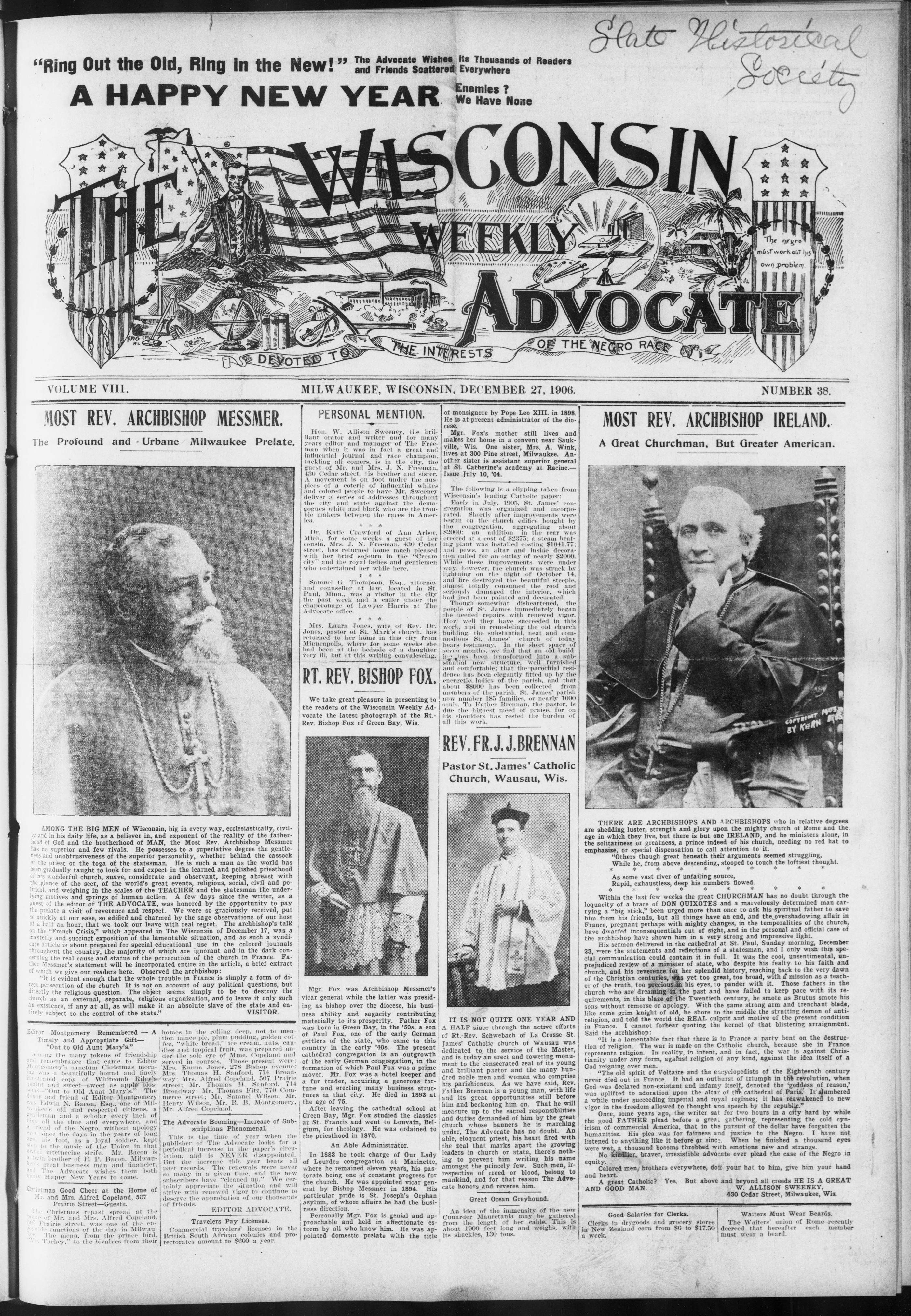
“Ring Out the Old, Ring in the New!” The Advocate Wishes Its Thousands of Readers and Friends Scattered Everywhere
A HAPPY NEW YEAR Enemles? We Have None
WISCONSIN
WEEKLY
ADVOCATE
DEVOTED TO THE INTERESTS OF THE NEGRO RACE
MOST REV. ARCHBISHOP MESSMER.
The Profound and Urbane Milwaukee Prelate.
AMONG THE BIG MEN of Wisconsin, big in every way, ecclesiastically, civilly and in his daily life, as a believer in, and exponent of the reality of the fatherhood of God and the brotherhood of MAN, the Most Rev. Archbishop Messmer has no superior and few rivals. He possesses to a superlative degree the gentleness and unobtrusiveness of the superior personality, whether behind the cassock of the priest or the toga of the statesman. He is such a man as the world has been gradually taught to look for and expect in the learned and polished priesthood of his wonderful church, suave, considerate and observant, keeping abreast with the glance of the seer, of the world's great events, religious, social, civil and political, and weighing in the scales of the TEACHER and the statesman the underlying motives and springs of human action. A few days since the writer, as a guest of the editor of THE ADVOCATE, was honored by the opportunity to pay the prelate a visit of reverence and respect. We were so graciously received, put so quickly at our ease, so edified and charmed by the sage observations of our host of a half an hour, that we took our leave with real regret. The archbishop's talk on the "French Crisis," which appeared in The Wisconsin of December 17, was a masterly and succinct exposition of the lamentable situation, and as such a syndicate article is about prepared for special educational use in the colored journals throughout the country, the majority of which are ignorant and in the dark concerning the real cause and status of the persecution of the church in France. Father Messmer's statement will be incorporated entire in the article, a brief extract of which we give our readers here. Observed the archbishop:
"It is evident enough that the whole trouble in France is simply a form of direct persecution of the church. It is not on account of any political questions, but directly the religious question. The object seems simply to be to destroy the church as an external, separate, religious organization, and to leave it only such an existence, if any at all, as will make it an absolute slave of the state and entirely subject to the control of the state." VISITOR.
VOLUME VIII.
AMONG THE BIG MEN of Wisconsin and in his daily life, as a believer in, and a friend of God and the brotherhood of MA, has no superior and few rivals. He possesses and unobtrusiveness of the superior of the priest or the toga of the statesmen been gradually taught to look for and express of his wonderful church, suave, considerate the glance of the seer, of the world's gratitud, and weighing in the scales of the lying motives and springs of human action, guest of the editor of THE ADVOCATE, the prelate a visit of reverence and respect so quickly at our ease, so edified and charmed of a half an hour, that we took our leave on the "French Crisis," which appeared in masterly and succinct exposition of the late cate article is about prepared for special enlightenment the real cause and status of the preacher Messmer's statement will be incorporated of which we give our readers here. Observe.
"It is evident enough that the whole direct persecution of the church It is not only directly the religious question. The object church as an external, separate, religion an existence, if any at all, as will make it entirely subject to the control of the state.
Editor Montgomery Remembered — A Timely and Appropriate Gift— "Out to Old Aunt Mary's."
Among the many tokens of friendship and remembrance that came to Editor Montgomery's sanctum Christmas morning was a beautifully bound and finely illustrated copy of Whitcomb Riley's quaint and sweet—sweet as apple blossoms—"Out to Old Aunt Mary's." The donor and friend of Editor Montgomery was Edwin N. Bacon, Esq., one of Milwaukee's old and respected citizens, a gentleman and a scholar every inch of him, all the time and everywhere, and a friend of the Negro, without apology ever since the days in the years of long ago, his foot, as a loyal soldier, kept step to the music of the Union in that awful internecine strife. Mr. Bacon is a twin brother of E. P. Bacon, Milwaukee's great business man and financier, and The Advocate wishes them both many Happy New Years to come.
Christmas Good Cheer at the Home of Mr. and Mrs. Alfred Copeland, 507 Prairie Street-Guests
The Christmas repast spread at the home of Mr. and Mrs. Alfred Copeland, 505 Prairie street, was one of the enjoyable functions of the day in Milwaukee. The menu, from the prince bird, "Mr. Turkey." to the bivalves from their
homes in the rolling deep, not mention mince pie, plum pudding, golden coffee, "white bread," ice cream, nuts, candies and tropical fruit, was prepared under the sole eye of Mme. Copeland and served in courses. Those present were: Mrs. Emma Jones, 278 Bishop avenue; Mrs. Thomas H. Sanford, 714 Broadway; Mrs. Alfred Copeland, 507 Prairie street; Mr. Thomas H. Sanford, 714 Broadway; Mr. Thomas Fitz, 770 Commerce street; Mr. Samuel Wilson, Mr. Henry Wilson, Mr. R. B. Montgomery, Mr. Alfred Copeland.
The Advocate Booming-Increase of Subscriptions Phenomenal.
This is the time of year when the publisher of The Advocate looks for a periodical increase in the paper's circulation, and is NEVER disappointed. But the increase this year beats all past records. The renewals were never so many in a given time, and the new subscribers have "cleaned up." We certainly appreciate the situation and will strive with renewed vigor to continue to deserve the approbation of our thousands of friends.
Travelers Pay Licenses.
Commercial travelers' licenses in the British South African colonies and protectorates amount to $600 a year.
PERSONAL MENTION.
Hon. W. Allison Sweeney, the brilliant orator and writer and for many years editor and manager of The Freeman when it was in fact a great and influential journal and race champion, tackling all comers, is in the city, the guest of Mr. and Mrs. J. N. Freeman, 430 Cedar street, his brother and sister. A movement is on foot under the auspices of a coterie of influential whites and colored people to have Mr. Sweeney deliver a series of addresses throughout the city and state against the demagogues white and black who are the trouble makers between the races in America.
Dr. Katie Crawford of Ann Arbor, Mich., for some weeks a guest of her cousin, Mrs. J. N. Freeman, 430 Cedar street, has returned home much pleased with her brief sojourn in the "Cream city" and the royal ladies and gentlemen who entertained her while here.
凉 内 肃
Samuel G. Thompson, Esq., attorney and counsellor at law, located in St. Paul, Minn., was a visitor in the city the past week and a caller under the chaperonage of Lawyer Harris at The Advocate office.
***
Mrs. Laura Jones, wife of Rev. Dr. Jones, pastor of St. Mark's church, has returned to her home in this city from Minneapolis, where for some weeks she had been at the bedside of a daughter very ill, but at this writing convalescing.
RT. REV. BISHOP FOX.
We take great pleasure in presenting to the readers of the Wisconsin Weekly Advocate the latest photograph of the Rt.Rev. Bishop Fox of Green Bay, Wis.
P.
Mgr. Fox was Archbishop Messmer's vicar general while the latter was presiding as bishop over the diocese, his business ability and sagacity contributing materially to its prosperity. Father Fox was born in Green Bay, in the '50s, a son of Paul Fox, one of the early German settlers of the state, who came to this country in the early '40s. The present cathedral congregation is an outgrowth of the early German congregation, in the formation of which Paul Fox was a prime mover. Mr. Fox was a hotel keeper and a fur trader, acquiring a generous fortune and erecting many business structures in that city. He died in 1893 at the age of 75.
After leaving the cathedral school at Green Bay, Mgr. Fox studied the classics at St. Francis and went to Louvain, Belgium, for theology. He was ordained to the priesthood in 1870.
An Able Administrator.
In 1883 he took charge of Our Lady of Lourdes congregation at Marinette, where he remained eleven years, his pastorate being one of constant progress for the church. He was appointed vicar general by Bishop Messmer in 1894. His particular pride is St. Joseph's Orphan asylum, of whose affairs he had the business direction.
Personally Mgr. Fox is genial and approachable and held in affectionate esteem by all who know him. He was appointed domestic prelate with the title
of monsignore by Pope Leo XIII. in 1898. He is at present administrator of the diocese. Mgr. Fox's mother still lives and makes her home in a convent near Saukville, Wis. One sister, Mrs. A. Wink, lives at 300 Pine street, Milwaukee. Another sister is assistant superior general at St. Catherine's academy at Racine. Issue July 10, '04.
The following is a clipping taken from Wisconsin's leading Catholic paper:
Early in July, 1905, St. James' congregation was organized and incorporated. Shortly after improvements were begun on the church edifice bought by the congregation, aggregating about $2000; an addition in the rear was erected at a cost of $2375; a steam heating plant was installed costing $1041.77; and pews, an altar and inside decoration called for an outlay of nearly $2000. While these improvements were under way, however, the church was struck by lightning on the night of October 14, and fire destroyed the beautiful steeple, almost totally consumed the roof and seriously damaged the interior, which had just been painted and decorated.
Though somewhat disheartened, the people of St. James immediately began the needed repairs with renewed vigor. How well they have succeeded in this work, and in remodeling the old church building, the substantial, neat and commodious St. James' church of today bears testimony. In the short space of seven months, we find that an old building has been transformed into a substantial new structure, well furnished and comfortable; that the parochial residence has been elegantly fitted up by the energetic ladies of the parish, and that about $8000 has been collected from members of the parish. St. James' parish now number 185 families, or nearly 1000 souls. To Father Brennan, the pastor, is due the highest meed of praise, for on his shoulders has rested the burden of all this work.
REV.FR.J.J.BRENNAN
Pastor St. James' Catholic Church, Wausau, Wis.
P.
IT IS NOT QUITE ONE YEAR AND A HALF since through the active efforts of Rt.-Rev. Schwebach of La Crosse St. James' Catholic church of Wausau was dedicated to the service of the Master, and is today an erect and towering monument to the consecrated zeal of its young and brilliant pastor and the many hundred noble men and women who comprise his parishioners. As we have said, Rev. Father Brennan is a young man, with life and its great opportunities still before him and beckoning him on. That he will measure up to the sacred responsibilities and duties demanded of him by the great church whose banners he is marching under, The Advocate has no doubt. An able, eloquent priest, his heart fired with the zeal that marks apart the growing leaders in church or state, there's nothing to prevent him writing his name amongst the princely few. Such men, irrespective of creed or blood, belong to mankind, and for that reason The Advocate honors and reveres him.
Great Ocean Grevhound.
An idea of the immensity of the new Cunarder Mauretania may be gathered from the length of her cable. This is about 1900 feet long and weighs, with its shackles, 130 tons.
A Great Churchman, But Greater American.
COPYRIGHT MOS
BY KERN
THERE ARE ARCHBISHOPS AND ARCHBISHOPS who in relative degrees are shedding luster, strength and glory upon the mighty church of Rome and the age in which they live, but there is but one IRELAND, and he ministers alone, in the solitariiness or greatness, a prince indeed of his church, needing no red hat to emphasize, or special dispensation to call attention to it.
"Others though great beneath their arguments seemed struggling,
Within the last few weeks the great CHURCHMAN has no doubt through the loquacity of a brace of DON QUIXOTES and a marvelously determined man carrying a "big stick," been urged more than once to ask his spiritual father to save him from his friends, but all things have an end, and the overshadowing affair in France, pregnant perhaps with mighty changes, in the temporalities of the church, have dwarfed inconsequentials out of sight, and in the personal and official case of the archbishop have shown him in a very strong and impressive light.
His sermon delivered in the cathedral at St. Paul, Sunday morning, December 23, were the statements and reflections of a statesman, and I only wish this special communication could contain it in full. It was the cool, unsentimental, unprejudiced review of a minister of state, who despite his fealty to his faith and church, and his reverence for her splendid history, reaching back to the very dawn of the Christian centuries, was yet too great, too broad, with a mission as a teacher of the truth, too precious in his eyes, to pander with it. Those fathers in the church who are dreaming in the past and have failed to keep pace with its requirements, in this blaze of the Twentieth century, he smote as Brutus smote his sons without remorse or apology. With the same strong arm and trenchant blade, like some grim knight of old, he shore to the middle the strutting demon of anti-religion, and told the world the REAL culprit and motive of the present condition in France. I cannot forbear quoting the kernel of that blistering arraignment. Said the archbishop:
"It is a lamentable fact that there is in France a party bent on the destruction of religion. The war is made on the Catholic church, because she in France represents religion. In reality, in intent, and in fact, the war is against Christianity under any form, against religion of any kind, against the idea itself of a God reigning over men.
"The old spirit of Voltaire and the encyclopedists of the Eighteenth century never died out in France. It had an outburst of triumph in the revolution, when God was declared non-existant and infamy itself, denoted the 'goddess of reason,' was uplifted to adoration upon the altar of the cathedral of Paris. It slumbered a while under succeeding imperial and royal regimes; it has reawakened to new vigor in the freedom allowed to thought and speech by the republic."
Once, some years ago, the writer sat for two hours in a city hard by while the good FATHER plead before a great gathering, representing the cold cynicism of commercial America, that in the pursuit of the dollar have forgotten the humanities. His plea was for fairness and justice to the Negro. I have not listened to anything like it before or since. When he finished a thousand eyes were wet, a thousand bosoms throbbed with emotions new and strange.
No kindlier, braver, irresistible advocate ever plead the case of the Negro in equity.
Colored men, brothers everywhere, doff your hat to him, give him your hand and heart. A great Catholic? Yes. But above and beyond all creeds HE IS A GREAT AND GOOD MAN. W. ALLISON SWEENEY,
As some vast river of unfailing source,
Within the last few weeks the great CHURCH loquacity of a brace of DON QUIXOTES and arrying a "big stick," been urged more than once, him from his friends, but all things have an end. France, pregnant perhaps with mighty changes, have dwarfed inconsequentials out of sight, and the archbishop have shown him in a very strong. His sermon delivered in the cathedral at St. 23, were the statements and reflections of a social communication could contain it in full. I prejudiced review of a minister of state, who do church, and his reverence for her splendid history of the Christian centuries, was yet too great, the er of the truth, too precious in his eyes, to pane church who are dreaming in the past and have requirements, in this blaze of the Twentieth century sons without remorse or apology. With the same like some grim knight of old, he shore to the new religion, and told the world the REAL culprit as in France. I cannot forbear quoting the kern Said the archbishop:
"It is a lamentable fact that there is in Friation of religion. The war is made on the Catholic represents religion. In reality, in intent, and tianity under any form, against religion of any God reigning over men.
"The old spirit of Voltaire and the encyclopedia never died out in France. It had an outburst of God was declared non-existant and infamy itself was uplifted to adoration upon the altar of the a while under succeeding imperial and royal revigor in the freedom allowed to thought and speech. Once, some years ago, the writer sat for the good FATHER plead before a great gaiticism of commercial America, that in the purity of humanities. His plea was for fairness and just listened to anything like it before or since. We were wet, a thousand bosoms throbbed with enmity. No kindlier, braver, irresistible advocate of equity.
Colored men, brothers everywhere, doff you and heart.
A great Catholic? Yes. But above and AND GOOD MAN."
Good Salaries for Clerks.
Clerks in drygoods and grocery stores in New Zealand earn from $6 to $17.50 a week.
NUMBER 38.
BISHOP IRELAND.
But Greater American.
ARCHBISHOPS who in relative degrees upon the mighty church of Rome and the IRELAND, and he ministers alone, in need of his church, needing no red hat to attention to it.
Their arguments seemed struggling, stooped to touch the loftiest thought.
Source, numbers flowed.
ARCHCHMAN has no doubt through the ages and a marvelously determined man carrion once to ask his spiritual father to save the end, and the overshadowing affair in ranges, in the temporalities of the church, light, and in the personal and official case of any strong and impressive light.
At St. Paul, Sunday morning, December of a statesman, and I only wish this speech. It was the cool, unsentimental, unwhose despite his fealty to his faith and history, reaching back to the very dawn great, too broad, with a mission as a teacher to pander with it. Those fathers in the old have failed to keep pace with its rebirth century, he smote as Brutus smote his the same strong arm and trenchant blade, to the middle the strutting demon of anti-spirit and motive of the present condition the kernel of that blistering arraignment.
In France a party bent on the destructive Catholic church, because she in France and in fact, the war is against Christ of any kind, against the idea itself of a encyclopedists of the Eighteenth century burst of triumph in the revolution, when by itself, denoted the 'goddess of reason,' of the cathedral of Paris. It slumbered royal regimes; it has reawakened to new and speech by the republic.
It for two hours in a city hard by while it gathering, representing the cold cynic pursuit of the dollar have forgotten the and justice to the Negro. I have not done. When he finished a thousand eyes with emotions new and strange, locate ever plead the case of the Negro in your hat to him, give him your hand and beyond all creeds HE IS A GREAT W. ALLISON SWEENEY,
430 Cedar Street, Milwaukee, Wis.
Waiters Must Wear Beards.
The Waiters' union of Rome recently decreed that hereafter each member must wear a beard.
MILWAUKEE, WIS.
R. B. MONTGOMERY, Editor and Proprietor.
Tea-Table Salad.
Gaspar—I've adopted his style of spelling.—Town Topics.
No Installments.
Creditor—Won't you pay me on the installment plan?
Debtor (haughtily)—No. I always owe cash.—New York Times.
Comparisons Dangerous.
"You can trust Smithers. He's as honest as the day is long."
"Do you notice how short the days are getting?"—Brooklyn Life.
Aristocratic.
Ella—She poses as an aristocrat.
Bella—Indeed?
Ella—Yes, she wear a princesse gown of duchesse lace!—Town Topics.
True.
Aristocratic
True.
Mother—My son, there is always more pleasure in giving than in receiving. Son—I know, mother, especially a spanking."—Meggendorfer Blaetter.
"Not very; our poker club disbands during the summer."—Houston Post.
Taking His Pleasure Sadly.
"If you shoot yourself and have not used —'s ammunition you have missed one of the pleasures of life."—London Paper.
Do Burglars Say "Gotten?"
Burglar—Have I gotten everything?
Dimpleton—Do you expect me to tell you that?
Burglar—I think you ought, as a matter of honor.—Judge.
Thermometer Going Up
Those balloonists who raced from Pittsfield, Mass., reported that they found hot weather up in the air. If your furnace doesn't work this winter, buy a balloon.—Buffalo Express.
A British "Jungle?"
Chicago must look to its laurels. The Strand Magazine publishes the following advertisement of a maker of pickles: "During the year of 1905, 126,000 visitors passed through our plant."—Punch
More Piety Than Pie.
"Julia, we cannot permit you to go to church three times on Sunday. It interferes with your duties too much."
"Thot's queer. Whin Oi come here you said you wanted a good cook."—Denver Post.
What It Teaches.
"What does the story of the Prodigal Son teach us?" asked the Sunday school teacher.
"It teaches us how to get rid of the fatted calf," said the bad boy.—Army and Navy Life.
Sounds Easter in French
Englishman—My automobile is a 54-horsepower. I did sixty-three English miles in the first hour. Viennes—I don't understand anything about English miles, so lie to me in kilometers.—Bombe.
A Good Example
Father—Why did you run away, Franz?
Franz—Because mamma was so unkind to me.
Father—That is no reason. Do I run away?—Wiener Caricaturen.
Argument for Woman's Suffrage
Mrs. True—Aren't you glad you don't have to vote?
Mrs. Peckem—Mercy no! I'm worried to death for fear John won't vote the way I want him to; I'd a great deal rather do it myself.-Detroit Free Press.
Magistrate Lends Him an Ear
Bridget—Sure, he'll be all right in the morin'.
Officer—You don't say so?
Bridget—Yes; he was arrested yester-
day and he gets his hearin' in the
mornin.'—Tit-Bits.
Should Try Poetry.
"That," said the reporter confidentially, handing in his copy, "is what I call fine writing."
Glancing at it with a scowl, the usual brutal type of city editor growled:
"Huh," he snorted, "I should say so. And the fine will be a day's pay."—Philadelphia Public Ledger.
In Trade.
Mr. Hans—Doc, I ain'd got much money. Will you dake my bill out in drade? Dr. Gans—Why, I might. What's your business? "I'm der leader off her liddle Cherman band. Ve'll play in front of your house effry efening."—Cleveland Leader.
Minnie's Sincere Praver.
There had been a dressmaker in the house and Minnie had listened to long discussions about the very latest fashions. That night when she said her prayers, she added a new petition, uttered with unwonted fervency:
An Incentive.
"Cheer up, old man," said the invalid's friend, "you're not going to die yet."
"You bet I'm not," replied the invalid with great determination.
"That's the way to talk."
"Yes, I heard the doctors quarreling about which one of them should perform the autopsy, so I've just decided to fool them."—Philadelphia Press.
A Thorough Man of Business
Punter-I tell you, doctor, old Casburn is business clear through. Rev. Howland Yale-On the contrary. I know him to be a most charitable man. Punter-May be; but he would examine the balance sheet if all the directors were bishops and Providence in the chair.-Town and Country.
Without Assistance from the Police.
Here is a story which our racers are at liberty to bandy across the festive luncheon table tomorrow. It is not our own, so we do not care what happens to it. "Waiter," said a Sabbath banqueter, "why are these oysters not open?" "Ah, sare," replied the menial, "eet ees Sunday, so they weel remain closed all day."—London Globe.
THE MORNING AFTER THE DANCE
At five o'clock the farmer's fist was rapping at our door;
"Wake up," says he, "your breakfast waits —we're most uncommon late;
The hogs are squealing 'Give us corn,' the cows are at the gate."
We chard his heavy tread retreat along the naked floor,
Six steps it may have been, or seven—and then we heard no more.
Sleep's touch that sealed our eyelids down was feather-soft and sweet;
Our dreams were all of sparkling eyes and little twinkling feet.
Again we waltzed Matilda Jane and Annabel and Sue,
And chassed down the middle of the parlor, two by two;
But just as we were bowing our partners to their chairs,
The farmer's cowhide boots again were heard upon the stairs.
With sighs and groans, we fumbled and grumbled in the bloom,
For shoes and such et ceteras that carpeted the room.
The frost was on the drowsy corn what time we drove that way;
The moon still lit the silent vault, as when we came from play;
The reedy ponds were garmented with gossamery lines;
The stars were blinking sleepily above the somber pines;
The sun was gilding Boston's domes a thousand miles down east,
And evening seemed a thousand years away from us, at least.
A thousand years from two of us—Bill's thoughts were lighter-toned;
He grinned and gaped and chuckled while we yawned and husked and groaned.
"Which one?" says Jim, "Matilda?" and Bill replied. "It's Sue;
And every ear I'm husking now, I'm husking it for two."
Quoth Jim: "Congratulations—but before this day is done.
I reckon I'll be mighty glad I'm husking
"em for one."
—Frank Putnam in National Magazine.
SEVEN AGES OF LOVE.
"Isn't it nice?" said the bachelor, indicating the oblivious young couple at the other end of the conservatory with a contemptuous nod, "to reflect that we've passed that age?"
The widow peeped at the delirious ones through the leaves of the protecting palms.
"What age?" she asked innocently.
"The love age," said the bachelor, disgustedly.
"Which?" inquired the widow, chewing a rose leaf. "There are seven of them, you know."
"No. I didn't know," said the bachelor.
"And you never got past all of them."
The bachelor looked disappointed.
"And the older you are when you take it, the harder you have it and the sillier——"
"Are you going to eat that rose?" interrupted the bachelor.
"Now, you, for instance," went on the widow, ignoring him, "are bald——"
"Because if you are, I'll go and get you an ice instead. It's not palatable."
The widow laughed softly.
"I know it's not palatable," she agreed, biting another leaf off the rose, "but it's true, at least, almost true. Of course, the bald spot is very little so far; but to judge from the silliness——"
"I'm not in my dotage," declared the bachelor.
"Oh, no," cried the widow. "If you were you would be trying to make love to some girl of 16, instead of—of to me; and you would be saying even sillier things. That's the seventh age of love."
"Why," complained the bachelor, plaintively, "do you always begin at the end?"
The widow pulled another petal off the rose and put it in her mouth.
"I have to begin at some end," she protested, "and besides there isn't any end to love. Love is always the beginning. Afterward it develops into tender regard, or platonic friendship, or indifference, or hate, or——"
"Matrimony," suggested the bachelor.
"Yes," said the widow, "and then you're inoculated."
The bachelor made a wry face
"The remedy," he remarked cynically, "is worse than the disease. Besides, it's never sure. If you have a relapse it's doubly dangerous, and all sorts of complications are likely to ensue, like breach of promise suits and divorces and scandals."
"But you aren't likely to have a relapse," declared the widow. "Matrimony keeps a man or woman too busy to think about love. You can't bother about sentiment when you are worrying over grocery bills and babies and expense accounts and cooks. It is the idle people who are always falling in love. Satan and Cupid are chums, and go about together looking for people with nothing to do. That is why there is such a harvest of engagements and broken hearts and flirtations at the end of the summer."
"Some people," said the bachelor, looking at the widow significantly, "seem to be immune—even in summer."
The widow looked impersonally thoughtful. "Oh, those!" she said. "Those are the millionaires and the successful men and women, who are so busy all their lives long that they are—almost immune. It is only when they have stopped trying to make money or fame or to carry out great schemes and have retired and set-teld down to old age that they begin to be—" "Silly?" suggested the bachelor. "Yes," said the widow, "and then they make up for lost time. After they have attained their goal they suddenly discover that they have been eating the bread of life without any jam on it and they begin to look around for the jam not."
"It strikes me." said the bachelor, thoughtfully, "that love at that rate is pretty expensive."
"It's a luxury, Mr. Travers," announced the widow, "and luxuries are always expensive."
"And we are always willing to pay the price for them—if we can only get them," sighed the bachelor, looking expressively at the widow.
"I think" said the widow, biting the stem of her rose, "that you had better get me that ice—now."
"I don't want to get it—now," said the bachelor, ungraciously, "I want to——"
"Don't you dare to propose to me!" exclaimed the widow warningly.
"I want to—" began the bachelor.
"You shan't!" declared the widow, starting to rise. The bachelor fixed her with his eyes. "I want to see what that couple over
there will do next," he remarked frigidly. "Oh!" The widow sat down with relief. "I can tell you what they will do," she added. They will discover that you are looking at them and will move to the darkest corner over there behind the palms. Indian summer has no right to intrude itself upon spring," and the widow laughed mockingly. At the sound the young people glanced up, caught sight of the bachelor and the widow and proceeded to move to the darkest corner—as she had predicted. The bachelor sighed. "And that," he said, "is the first age of love."
"Not at all," said the widow, "the first age begins when you meet the first interesting person of the opposite sex. Don't you remember the time when you gave your reddest apple to the little girl with curls who sat next you at school and spent your week's allowance on a valentine for the little girl with pigtails and played kissing games——"
"And got whipped for writing notes in school and beaten by another boy who said your sweetheart had freckles and a pug nose, and laughed at by your father, who found 'Nannie Jones' scribbled all over the family dictionary with your own name opposite and the corresponding letters crossed off? Yes, I remember," and the bachelor smiled dreamily out over the palms.
'And you haven't forgotten the golden age," said the widow, gazing tenderly at the rose lying in her lap, "when you fell in love with an actress and used to dream of her at night and keep her picture on your dressing table and go about fancying you were a blighted being with a broken heart and a life history?"
"What were you doing then?" asked the bachelor.
"Spending all my money for tickets to go to see a matinee idol with dreamy eyes standing with a lot of girls in hushed reverence about a dirty stage door, with a dirty stage doorkeeper glowering at us."
"And then they sent you off to boarding school," continued the bachelor, "and you thought you were going to die, until you met somebody from an adjoining school and used to steal off for long walks and rambles and moonlight meetings."
"Yes," said the widow; "and then you went back home and fell in love with somebody twice your age, and wanted to commit suicide when they laughed at you."
"And then," finished the bachelor, "you suddenly found yourself grown up—and at the marrying age."
"And your sentimental education was finished," concluded the widow. "It takes all those first loves to prepare a man or a woman for real love. They are just little rehearsals. The man or woman who dodges them and marries his or her first and only love always feels as though he or she has missed something, and wonders what it is, and is never so perfectly satisfied with matrimony as the one who has been in love dozens of times before——"
"And found out how little it really amounts to."
The widow sat up briskly and patted the back of her coiffure.
"I wonder what time it is," she asked, irrelevantly.
"It's too late for regrets," said the bachelor, without moving.
"They are still dancing," announced the widow, peeping out into the ballroom.
"Come. There's a little time——"
"Oh, yes," agreed the bachelor, purposely misunderstanding; "there are a few petals left on the rose."
"Where are those two silly people?" inquired the woman, trying to penetrate the palms.
"I don't know," said the bachelor, "and I don't care. What's the use of bothering about spring—in Indian summer? I was going to ask you a question."
The widow looked up suspiciously.
"If you are going to ask me to marry you——" she began.
"I wasn't," declared the bachelor; "I was merely going to ask——" he hesitated.
"Well?" The widow sat encouragingly back in her chair again.
"I guess I won't," said the bachelor.
The widow took a rose from her bouquet and leaned over to fasten it in his lapel.
"Please—Billy," she said, looking up over the flowers, "what were you going to ask?"
"If you would—No. I won't!"
The widow swayed a little nearer.
"If I would?" she inquired helpfully.
"No," said the bachelor, decidedly, "if you would have that ice—now?"
"At once, if you please, Mr. Travers!" said the widow; but you would not have thought, from the frigidity of the atmosphere that she really needed it. Helen Rowland in the London Mail.
WISE AND OTHERWISE
Take a man at his word and you are apt to make him question his shrewdness.
Woman dislike to do things in a half way manner—with them it is all or none.
A man thinks he knows what love means until he has had an acute attack of it.
A woman is supremely happy when she is permitted to hold the post of a critic.
Everything a woman does is supposed to be based on a sense of the highest honor.
Women's idea of happiness is based upon something intangible and beyond explanation.
The popularity of many a man rests upon what he does not do rather than what he does do.
To the mind of most men the ideal wife is the one who knows how little she really knows.
The man of middle life without a wife is sure he has the best ideas on how to be happy though married.
When a woman says she thoroughly understands her husband you can rest assured he understands her weakness.—Philadelphia Bulletin.
Sacred Concert by Graphophone
The oratorio of "The Messiah" was given entire by graphophone to an audience of over a thousand persons in Weymouth, England, the other night. It was considered a complete musical success.
"WHEN THE TRAINS COME IN ON TIME."
The dollar will be dancin'
In a hands-round with the dime,
When the train come in on time, boys
When the trains come in on time!
We'll forget our ancient troubles,
An' we'll all be feelin' prime
When the schedules are adjusted
An' the trains come in on time!
No wonder we would send 'em
To a horrid, torrid clime—
So weary seems the waltin'
Till the trains come in on time!
But you bet we'll ketch the 'possum—
For the highest tree we'll climb.
When we hear the whistles blowin'
When the trains come in on time!
BRIEF NOTES OF GENERAL INTEREST
During the past quarter of a century James McGuire, a Ford River, Mich., man, has traveled a distance of 120,000 miles, and all that by wagon road. This unique record has been made in the capacity of a stage driver, McGuire having covered the Ford River-Escanaba run.
"There ought to be a whipping post for you," said Judge C. L. Smith of Minneapolis to J. E. Thompson, in the police court. "You ought to be ashamed of yourself to go home and mistreat your wife and family. I will sentence you to thirty days in the work house but stay the sentence for one year pending good behaviour."
James Kippon, a Chicago electrician employed in the Pullman car shops, objected to a nightly explanation of his ante-midnight whereabouts and to spare his wife the lonesomeness she complained of when he left her alone evenings he hit upon the idea of taking her with him. She said the experience was humiliating. Mrs. Kippon alleges cruelty in her complaint for divorce.
Andrew John, who carries a commission as ex-president of the Seneca Indians tribe, is in Columbus, O., trying to establish a claim to two and a half square miles running into the heart of Marietta, O., that he claims was deeded to his ancestor, Chief Cornplanter of the Senecas, by President George Washington in 1793. A resident of Erie, Pa., Mr. John, has spent much time in Washington, where he has been digging into records over a century old.
---
The Legislature of the Canton of Vaud, Switzerland, accepted by a unanimous vote a bill introduced subjecting habitual drunkards to a confinement in an official institution to be established for the scientific treatment of drunkenness and retaining them there till definitely cured, classing such cases quite in the category as that of insane persons and subjecting them to obligatory treatment in the spirit of chastisement, but with a pathological end in view.
Representative Gaines of Tennessee, who introduced a bill proposing to take $13.70 from a congressman's pay for each day absent, has learned that there is a law to fit the case. Section 40 of the revised statutes provides that the secretary of the Senate and the sergeant-at-arms of the House shall deduct from the pay of each member his per diem for each day of his absence for any excuse other than sickness of himself or of a member of his family. This law was passed in 1856.
While shopping in a crowded store at Philadelphia the other day, Mrs. Ella Kober had her pocket picked of $6200. She had just received $5000 from the Pennsylvania railroad for the killing of her husband in the recent wreck at Atlantic City and $1200 for the sale of her husband's junk business. Fearing to trust banks, she placed the money in a specially made pocket in her skirt, but a clever thief got it by cutting her dress. She screamed and fainted upon discovering her loss.
Firemen hauled a fire engine into a burning building at Tampa, Ill., recently to thaw out its pipes, then pulled it out and put out the fire. The engineer was unable to get up steam and discovered that the pipes were clogged with ice. The only place around was the interior of the burning barn, which had a door wide enough to permit the entrance of the engine. Ten minutes after the steamer was drawn inside the pipes were free. The engine was pulled out and started in time to prevent the total loss of the building.
A strange animal was killed on the homestead of a settler named Hill on Sugar island, near the Soo. Nobody knows what the animal is, although every natural history has been searched. The animal had a body something like a deer, with a ferocious looking head and a short stubby horn, with eyes set deep under its base. The head looks like a wolf.
The animal has been living on the island for several years, according to Hill, who tried to kill it before. The head is to be mounted.
After a fierce battle with the nightmare Emmett Calley, a Morningside college student at Sioux City, Ia., awoke to find his arm broken.
Calley is fond of mince pie. His mother sent him a number from the farm, and after eating heartily at night Calley fell asleep in a window seat. Immediately the animal appeared, tramping Calley under his cruel hoofs and kicking him viciously.
The student awoke with a cry of pain and found his arm hanging helplessly at his side. It is supposed that he got his arm twisted under him in the awful effort to escape the nightmare.
The theory that T. Kirby Heinsohn, a wealthy man of Marion, Ind., inflicted a fatal wound while trying to shave himself in his sleep at Sylvester, Ga., Sunday was advanced by members of a committee of Elks who accompanied the body home. J. H. Westberry, cashier of a bank at Sylvester in which Heinsohn was interested, says Heinsohn was taken ill last Friday. He worried because he was unshaven and decided to shave himself Sunday morning. It is surmised that he arose and went to the bathroom, half asleep, returned to bed with the razor and, the determination to shave being on his mind, drew the razor across his throat, cutting the jugular vein. Too weak to speak, he wrote on a paper that he did not know what he was doing, as he was asleep when he cut himself.
Representative Gaines of Tennessee coined a new word the other day in the House while correcting the record, in which was printed a colloquy between himself and Mr. Underwood of Alabama regarding the increase in members' salaries. He spoke of some of the changes as "interpolated pencilaneous writing" on the stenographer's copy, and said they gave a' wholly different construction to the controversy, and he wished that Mr. Underwood's remarks be given as shown by the stenographer's notes and not as corrected by him. The members had a hearty laugh over the word "pencilaneous," but generally appeared to coincide with Mr. Gaines on
the broad proposition that copy must not be changed if it interferes with the remarks actually made.
By offering himself as hostage G. F. King, merchant of Rochester, N. Y., won a pardon from Gov. Mickey of Nebraska for his brother, Harry King, and the two are now on their way east to visit their mother.
King was sentenced from Omaha for stealing diamonds. Recently he wrote home that he was dying in the penitentiary from consumption and that he longed to see his mother. Appeals were made for a pardon, but they were unheeded by the governor. Then G. F. King, with his wife, accompanied by several friends from Rochester, came to Nebraska and personally pleaded with the governor. When Mr. King offered to occupy his brother's cell until his return the governor made personal inquiry, and finding the prisoner was seriously ill, granted the full pardon.
The sudden death of Warren F. McChesney, formerly a contractor, the other day, at St. Louis, resulted within an hour in an investigation by Circuit Attorney Sager into what purported to be an attempt to procure an elevated railroad franchise from the municipal assembly by the use of money. McChesney dropped dead of heart disease in a store. In his pockets were found receipts, signed by Dr. A. H. Ohmann Dumesnil, one of the best known physicians of the south end of St. Louis. The papers were dated in November, 1905, one acknowledging the receipt of $1000, and the other $500 from McChesney for "preliminary expenses incurred in connection with the bill authorizing the construction of the St. Louis Elevated Electric railway, to be introduced in the municipal assembly at the earliest possible moment." The doctor cleared himself.
Thomas Ryan, 28 years old, who said he lived in Brooklyn, was fined in the Tombs court, New York, because "he acted like a goat."
Ryan was initiated into a lodge. He remembered, he said, starting for his home in Brooklyn and was awakened early in a ferry house at the Battery by Thomas Haywood. Ryan threw himself on all fours in the ferry house and announced:
"I'm the goat."
"He made a noise like a goat, your honor," said Haywood, "and he ran on his hands and feet at me like a mad bull and butted me. Two ferry hands came to the rescue, but he bowled them over with his head, bleating all the time like a billy goat."
"I remember nothing except that I rode the goat in my lodge, had a few drinks, and started for home," said Ryan, as he paid his fine.
Mrs. Pauline Bonnano, a wealthy and pretty young Brooklyn matron, owes her life to psychic phenomena—a genuine case of thought transference. Her condition of mind, due to peril that menaced her in the shape of a desperate thief, communicated itself to the brain of her best friend, Mrs. Rosina di Baluski, six blocks away.
The intangible call for aid sent by Mrs. Bonnano was answered. Mrs. Di Blausi hurried at top speed to the Bonnano home and pushed the front door bell just as a man, who had felled Mrs. Bonnona with his fist, was about to strike her on the head with a heavy monkey wrench. At the sound of the door bell he dropped the wrench and fled through the back door.
The thief who committed the murderous assault was Charles S. Duke, coachman in the Bonnano family. He made his escape, and a general alarm has been sent out calling for his arrest. Mrs. Bonnano's nose is broken and one of her eyes is discolored. Before leaving Duke snatched her purse which contained $38.
PORT ARTHUR NO MORE A MENACE.
Japanese Will Use It as a Naval Station, Not a Citadel.
The Japanese have thus far shown themselves indifferent to the need of repairing the destruction caused by the war. The reason appears to me to be that for the Japanese Port Arthur has nothing approaching the importance that it had for the Russian. They have wished its possession simply to prevent some strong western power from seizing it, because in such hands it would be a menace to Japan.
The great line of forts which encircle the town and which made it two years ago the strongest citadel in the world remain in the damaged condition in which the surrender left them, because they are of not the least use to the Japanese. If it is thought later on desirable to provide land defenses for the Kwangtung peninsula, these will probably be constructed not at Port Arthur, but forty miles back at the point where the isthmus connects the peninsula with the mainland and where the land space between the seas has a width of only two miles.
It is not impossible that the Japanese may construct permanent fortifications at this place on the spot where the battle of Nanshan hill was fought. Their reason for this would be obvious. If they can maintain control of the seas the continued possession by them of Port Arthur would be a source of weakness and not of strength, and they are both too practical and too poor to waste their money on foolish prospects. With the Japanese Port Arthur will simply become one of several naval stations.
The two main conclusions that are enforced by a visit at the present time to Port Arthur are: First, that its capture by the Japanese was in no way due to a premature surrender of the place by Gen. Stoessel, for if he had not surrendered when he did, in a week's time and with relatively little loss to themselves the Japanese would have annihilated his army. Secondly, Port Arthur in the hands of the Japanese will never be a menace to the world; on the contrary, it has played its great role in international affairs, just as Sevastopol did half a century ago, and will now sink into all except historic obscurity. Historically obscure it can never become, for courage, patriotism and intense devotion to duty have been evoked and displayed here in a manner previously unparalleled in human experience, and these have given to Port Arthur a reputation that will live through all ages.—Port Arthur cor. Boston Herald.
A Rare Beast
Recent friction between Great Britain and Turkey over Egyptian affairs recalls an adventure of Consul General Sir John Kirk with the Sultan on an earlier date. The Sultan had become greatly vexed at the action of Sir John on insisting on certain measures desired by England. To vent his spite, he bethought him of a savage lion which was among his possessions. He had noticed, he told the Englishmen, that the British coat of arms was supported by a lion and a unicorn. He thought a live lion would be a great addition to the consulate, and desired to present the animals to Queen Victoria for that purpose.
in John, however, was ready witted. "It is true the arms are supported by a lion and a unicorn," he said. "I am certain your Highness would not care to make an incomplete present to her majesty. Therefore when you have captured a unicorn I shall have the happiness, on her behalf, of receiving both the animals."—Tatler.
Advertise in Your Home Paper.
LIVING IN VENICE.
A Comparison Between Prices Here and Abroad.
The general impression is that life in the United States costs more than elsewhere. Speaking generally, you could say that rent in the city for good apartments costs less in Europe. Service also costs less, while light and fuel cost much more. The cost of food in Venice and in other parts of Italy as compared with the cost of food with us may be summed up as follows: What with us are luxuries are cneaper in Italy, what with us are necessities are dearer. Fillets of beef, the best cuts or roasts, sweetbreads, game, etc., are all cheaper, the poorer cuts of meats are dearer. The best chops, for instance, are 15 cents a pound, and the cheapest stew meat of mutton 12 or 13 cents. Nor do these figures tell the whole story, for the meat is trimmed very much closer, to the advantage of the buyer of the finer cuts.
The price of fish vary more than with us, and are much more fluctuating than meat. The poorer Venetians, of course, are able to buy fish at a price much below that which the foreigners must pay. As far as our experience went, only the very best poultry is procurable in Venice; the tough and venerable rooster never appears in the market, and the fowls are all dry-picked, and never kept on ice. This poultry costs 3 or 4 cents less a pound than poultry of the corresponding grade at home. But there are no cheap meats, such as corned beef, or spare ribs, or pigs' heads—dear to the poor housekeeper of New York or New England. The consequence is that the poorer Venetian rarely eats meat at all. Neither does he buy refined salt; the tax of the government is so high that he contents himself with rock salt. Flour is dearer, so are cornmeal, coffee and tea, while sugar costs 16 cents a pound. The fruit supply in Italy is superb, but the making of preserves, either by housekeepers or factories, is rare on account of the absurdly high price of sugar. Butter is 30 cents a pound. On the other hand, fruit and vegetables are cheap. There are in the market a great variety of dried peas, beans and lentils, which are nutritious, and which, you may be sure, the Venetian knows how to use. In spite of the greater cost of so many foods in Venice, you can set as good a table there as you would at home for a smaller sum, and that you are able to do so is because of the economical hand-to-mouth way of marketing, the economical habits of your Italian cook, and also that the average cook in the north of Italy is a far better cook than the average cook at home.
As to the other items in our budget; Maria Immaccolata is well paid in Venice with $5 a month. You can get a man cook for $10, and an inside man for $6. Venetian families frequently pay their gondoliers only 50 cents a day without food; an excellent seamstress may be had for 30 cents a day and her meals.—The Pilgrim.
JEFFERSON'S CHINA DINNER SET.
J. Coolidge of Boston Adds Four Pieces to the White House Collection.
Through the generosity of Jefferson Coolidge of Boston a valued addition has been made to the White house collection of Presidential china, consisting of four pieces of Jefferson ware. These pieces belong to a blue and white dinner set which President Jefferson ordered in France. Owing to the tangled condition of Jefferson's financial affairs at the time of his death this set was sold and was purchased by Mr. Jones of Virginia, who, apart from the fact that it was owned by Jefferson, liked it, especially because the letter "J" appeared in the crest.
Some thirty years ago Mr. Coolidge, Sr., learned of the whereabouts of the china and purchased it from the Jones estate, and subsequently presented it to his son, who now loans four pieces of the set to the White house collection. They consist of a soup tureen, the top of a vegetable dish, the dish having been broken; a large platter and a plate. Each piece is decorated with deep blue mottled borders outlined in gold. In the center of the platter and plate and on the sides of the tureen and covers are the shield shaped Jefferson crest. The shield is outlined in deep blue, bearing thirteen gold stars, and in the center is an elaborate scroll letter "J" in gold. The Jefferson china bears the following label: "Pieces of Jefferson china loaned by Jefferson Coolidge, Jr., Boston, Mass., October, 1906."
BRIEF NOTES OF NOTABLES.
Alphonse Daudet is said to have received for "Sapho," published in 1884, the record price of over $200,000.
Sir Charles Wyndham was educated by his father for the ministry and was sent to a Moravian school in Germany for that purpose.
D. L. Bathurst, a clerk in the New York postoffice, expects soon to secure a goodly share of $3,000,000 and wear the title of Baron of Lachlade.
The Chinese on the Rand were allowed so much opium, the maximum a month being two pounds. This would suffice to stock an ordinary chemist's shop for a year. Two pounds of opium represent 27,968 average medicinal doses.
The London Christian World, the most widely circulated religious paper in England, reports the consecration of a chapel by the Archbishop of Canterbury, and gives token of its ecclesiastical and geographical knowledge by adding: "The sermon was preached by the Bishop of Rhode Island, New York."
A rich man in a village near Foggia, southern Italy, who has been searched for by the police for eight years, on a charge of murder, has at last been found in a garret, where he had only a space about 4 feet high, 3 feet long, and 2 feet broad available. He had lived in this place the whole of the time. The police had to take the tiles off the roof to get at him.
Thomas Chadwick, a Crimean veteran, who lives at Cromer, England, has just received $250 from the American government as arrears of pension for his services in a Maine regiment during the American Civil war, and has been informed that he will receive $2.50 a week for life. He served in the guards during the Crimean war, but has no pension for this service.—Philadelphia Telegraph.
Recklessness of Partridges
An extraordinary partridge story comes from Conington, Huntington. A lady was reading in her sitting room when, to her consternation, a brace of partridges dashed through the window. They broke two panes of glass but were secured before during further damage. It is supposed they were being pursued by a hawk, no guns being out at the time. Partridges look backward in flight and are frequently injured or killed by telegraph wires. Some time ago a parridge dashed into the thick lookout glass of an engine on the Great Eastern railway near Ely and actually smashed it, while it is no unusual thing in Cambridgeshire and Norfolk for them to fly into railway carriages.—London Daily Globe
Travelers Pay Licenses
Commercial travelers' licenses in the British South African colonies and protectorates amount to $600 a year.
GOSSIP FOR THE LADIES.
A Doubting Heart.
Where are the swallows fled?
Frozen and dead
Perchance upon some bleak and stormy shore.
O, doubting heart
Far over purple seas
They wait, in sunny ease,
The balmy southern breeze
To brig them to their northern homes once more.
Why must the nowers die?
Poisoned they lie
In the cold tomb, heedless of tears or rain.
O, doubting heart
They only sleep below
The soft white ermine snow
While winter winds shall blow,
To breathe and smile upon you soon again.
The sun has hid its rays
These many days;
Will dreary hours never leave the earth?
O, doubting heart!
The stormy clouds on high
Veil the same sunny sky
That soon, for spring is nigh,
Shall wake the summer into golden mirth.
Fair hope is dead, and light
Is quenched in night;
What sound can break the silence of despair?
O, doubting heart!
The sky is overcast,
Yet stars shall rise at last,
Brighter for darkness past.
And angel silver voices stir the air.
—Adelaide Anne Procter.
Mince Meat for the Winter.
The quantities given here are quite sufficient to last nearly all winter for a good-sized family. The suet in mince pies should be chopped as finely as possible. One-third butter and two-thirds suet give a better flavor than suet alone. The beef should be cooked all day until perfectly tender, and the stock in which it is cooked reduced to a jelly-like consistency. Cool over night and take off the fat before mincing. Fruit juices, even those that have begun to ferment, may be used in mince meat, as the alcohol evaporates in the cooking.
Allow to three pounds of chopped meat six pounds of coarsely chopped apples, two-thirds of a pound of butter, one and one-third pounds of suet, four pounds of sugar, four pounds of seeded raisins, three pounds of currants washed and dried, three pints of sweet cider, three pints of boiled cider, one quart of stock, six heaping teaspoonfuls of cinnamon, four tablespoonfuls of cloves, two tablespoonfuls of salt, one pint of molasses, one teaspoonful of pepper, half a pound of shredded citron, the same quantity of candied lemon and orange peel mixed and a quart and a half of jelly or juice of preserves. Boil about half an hour, and pack in stone jars or glass cans and pack in stone jars or blass cans Set away in a cool place. When ready to make the pies scatter a few fresh raisins over the top of each pie.—Pictorial Review.
The Heart of a Friend.
"A broken friendship," says a writer in an exchange, "like china, may be repaired, but the break will always show." And it is a bit of real truth and wisdom. Friendship is a precious thing—too precious a treasure to be carelessly broken or thrown away. The world handles the word "friend" lightly; its real, true, deeper meaning is forgotten, and the acquaintance of an hour or the chance comer is designated by the term which in itself bears a wealth of meaning. Your friend is the one who appreciates you—your faults as well as your virtues—who understands and sympathizes with your defeats and victories, your aims and ideals, your joys and temptations, your hopes and disappointments, as no one else does or can. It is to your friend to whom you turn for counsel, for comfort, for praise; he may not be as learned as some or as wise as others, but it suffices that he understands you, and even his quiet listening gives strength and renewed courage. Blessed is the man or woman into whose life has come the beauty and power of such a friendship. Prize it well. Do all in your power to keep such a friendship unbroken. Avoid the break, for when it comes it can not be easily mended, and the jarring note mars the harmony of the whole glorious symphony. It is not alone a question of forgiveness; that may be full and complete. It is the hurt in the heart that will not readily heal and the confidence that will not fully come back!
The Gentler Sex
We may come to think after awhile that a larger proportion of the women have sense enough to vote right than of the men. There are some reasons why they should have. Our women, as a rule, have more leisure than our men; they read more; as a rule they stay longer in school; their personal habits are better. Perhaps being less implicated in active business, they would be less influenced in their voting by pecuniary considerations.—Life. A woman always has a happy married life if she has tact enough to let her husband always have his own way without in any way interfering with her having hers.—Somerville Journal.
Her Grace's characteristic humanness inspires the Duchess of Bedford to write this sentence: "Many people shoot their birds too close, and though not obviously mangle, render them unfit for table use. * * * Women should remember they are not butchers, but sportswomen"—London Daily Mail.
Situated in the rarified stratum of women of wealth and social position, two traits give Mrs. Russell Sage distinction: her excellent mental endowment and her democracy. Her compelling sense of equality—that is the noblest element in her make-up. She will criticise a servant for a mistake or a coachman for a delinquency in precisely the way that a city editor "calls down" one of his staff. It is masterful, complete, and it leaves no resentment. She has done it in a big, strong way. She hasn't been patronizing him.—World's Work.
That Make for Happiness.
A man who before marriage used to write his initials twenty-four times on an evening dance card may, after attaining the dignity of husbandhood, claim he is too tired to go into society, too weared to go to entertainments or to make calls, while his wife still desires to see her old friends and to keep alive some of the wires connecting the home with the outside world. Here is an opportunity for compromise; for him to realize that the pleasures of both are to be considered, that a graceful surrender occasionally to her desire is but equity; if he does it under protest, he has killed the merit of his compromise.
At any critical moment if both express, at the same time, a desire to defer to the other's taste, the result is foreordained for happiness. This makes matrimony not merely union, but union and unity; it makes it a duet rather than two solos. Matrimony is not a game of chess where one must be victor; it in a way more resembles true conversation where the pleasure arises from the united contributions. In the choice of a home, in the matter of furnishing, in the question of servants, in the management of the household, occur daily little problems
that solve themselves in the spirit of compromise, of quietly talking matters over, of gentle conference of two, working to the attainment of a common aim and a single ideal. These are but questions of taste and of judgment; often more delicate are those relating to temperament. Sometimes a word of impatience may bring its echoing reply in the same spirit to the lips of the other, but a second's firmness, just a momentary self-control, an instant's translation of the thought into another key, of sweetness and sympathy, and the descerating discord has been passed in safety. Sometimes, too, a silence of gentle reproof may be oil of compromise on the troubled waters.
Most of the surrenders in married life are in trifles where it really makes no difference which surrenders; the great questions, the large problems, usually unfold all their phases under the sunshine of conference and the issue is the dual wisdom in a single verdict which is unanimous. If the matter be vital and the jury of two cannot agree on a verdict, then it seems part of the wisdom of compromise for the one who is the ablest judge of what is proper and fitting in the special instance to decide the momentous question with the force of a final vote.
There are occasionally topics of conversation upon which the two cannot agree, where the husband or the wife feels the rightness or wrongness of a certain subject with an intensity that seems to brook no opposition. It may be as far outside of the field of logic as the most distant star is beyond the solar system—then what is the use of trying to put new life into a dead issue by discussion. When the signs "Thin Ice" are conspicuous, it really might seem like prudence to confine the conversational skating nearer to the shore line. Argument in general is dangerous, and often a graceful dropping of the subject or a kindly admission that there may be two sides saves the day.—The Delineator.
"A Friend" Defined.
As a result of offering a prize for the best original definition of "A Friend," several years ago, London Tit-Bits came into possession of thousands from all parts of the world. From these the following were selected as the most striking. The first was awarded the prize: The first person who comes in when the whole world has gone out. A bank of credit on which we can draw supplies of confidence, counsel, sympathy, help and love. One who combines for you alike the pleasures and benefits of society and solitude.
The triple alliance of the three great powers, love, sympathy and help. A watch which beats true for all time and never "runs down." A permanent fortification when one's affairs are in a state of siege.
One who to himself is true, and,
therefore, must be so to you.
therefore, must be so to you. A balancing pole to him who walks across the tight rope of life
across the tight rope of life. The link in life's long chain that bears the greatest strain.
the greatest strain. A harbor of refuge from the stormy waves of adversity.
One who considers my need before my deservings.
The jewel that shines brightest in the darkness.
A stimulant to the nobler side of our nature.
A volume of sympathy bound in cloth.
A diamond in the ring of acquaintance
A star of hope in the cloud of adversity.
One truer to me than I am to myself.
Friendship, one soul in two bodies.
An insurance against misanthropy.
A link of gold in the chain of life.
One who understands our silence.
The essence of pure devotion.
The sunshine of calamity.
A second right hand.—Woman's National Daily.
Some Practical Plans.
There is not a single state in the union where better legislation for the protection of childhood is not needed, and where administrative difficulties which the factory inspector, the truant officer and the social worker encounter cannot be met with the aid of existing resources through discussion and cooperation. If every woman's organization would ask the local factory inspector, the school superintendent or teacher and the settlement worker or parish visitor, where any or all of these agencies exist, to give them some account of their work, a new flood of light would be thrown upon the child labor problem.
The missionary spirit is also needed. Sometimes we come to realize the problem at home somewhat better by reason of a trip abroad. Let us help in securing legislation for other communities and better enforcement of child labor laws by helping those who have harder difficulties to meet than we have. There are some cases—not so many, it is true, as is usually supposed by those who are timid about child labor legislation—where real poverty chains the child to some occupation when it ought to be in school. How many clubs, societies, churches and Sunday schools might establish a school scholarship in one of our larger cities, where the burdens of the cost of education and philanthropy are already heavy, and by the expenditure of $150 a year might have, as the club's contribution to future citizenship, one child maintained in school, relieved from the burdens of premature toil, and secure in the joys of preparation for efficiency as an adult worker.
We are all participants in the government of our national capital, whose residents are without self-government, except in so far as they speak through us and our representatives in Congress. Not a line is written on the statute books for the protection of the child worker in the city of Washington. President Roosevelt has twice called the attention of Congress to the matter, and in his celebrated Harrisburg speech on October 4, said: "The national government can do but little in the matter of child labor, though I earnestly hope that that little will be permitted to be done by Congress." An incomplete and unsatisfactory bill has passed the House of Representatives, and has been amended and made a reasonably model statute by a committee of the Senate. It is now pending on the calendar of the Senate and may be voted on any time after Congress assembles on December 3. It would have been voted on last June, but for the objection of several senators, one of whom wished the age limit placed at 70(!) Shall it become a law this year? If you wish it to be, is it not worth while to talk it over with your senator or representative in Congress?—Woman's Home Companion.
Remember Only the Pleasant Things.
Some of us treasure up the remembrance of bad turns that have been done us, and unkind speeches that have been made to such an extent that there
is really very little-room in our minds for anything else.
Of course there are speeches and bad turns that it is very, very difficult, and sometimes even impossible to forget. They have made such deep scars that the remembrance of them can never quite pass away, but on the other hand, there are many quite trivial things of a similar kind that we might with great advantage forget if only—and this is the most important point—we could once make up our minds that we wished to do so.
Little things, many of them, that were never really meant to hurt, and would not have done so but for the fact that we happened to be at the moment in an oversensitive mood.
But we have treasured them up, all the same, and even now and then take them out and glot over them, to stifle the kindly feelings that later deeds on the delinquent's part are brining to the surface.
Two women were overheard talking together. One of them, no matter what mutual friend happened to be mentioned, seemed to have some tale to tell of how badly she had been treated by that particular person. "Why, it seems to me you've got a grudge against everybody!" exclaimed the other at last.
To have a grudge against everybody, or even against nearly everybody, is a most suspicious frame of mind to be in. It certainly suggests that the fault is probably more on your side than on theirs; and that even if, as is quite possible, your friends are not all they ought to be, you yourself are not in a position to throw stones at them. Of course, if one is inclined to be touchy it isn't easy to teach one's self to make allowances, and, instead of treasuring up all the little kicks of life, try instead to remember, as far as possible, only it's kindnesses, but it is the only thing to do if we want to be even moderately happy in this world.
One bit in Robert Louis Stevenson's Vailima prayer's is good advice.
"Purge out of every heart the lurking grudge," he says; "give us strength to forbear and to persevere. Offenders ourselves, give us grace to forgive offenses. Forgetful, help us to bear with the forgetfulness of others."
It suggests such a broad-minded way of looking on other people's failures to act up to the standard that, in our minds, seems to be right; and in our dealings with one another it is broad-mindedness that we perhaps need to cultivate more than any other quality.
Therefore, if at any time we find ourselves beginning to get into a habit of remembering and treasuring up only the bitter things that life brings us, let us at once administer to ourselves a lecture on the wickedness and foolishness of so doing.
There is so much kindness in life that if we remembered and dwelt upon it, it would help to make us grow sweeter and more lovable as the years go on, that it is a thousand pities to allow one's self to remember nothing but its unpleasantness, and so grow hard and bitter. More tolerance, more willingness to make allowances; that is what most of us need. Many of us are in much the same case when we wound others; we do not know how deeply careless deeds or words will hurt. But we can all at least try to remember to think before we speak instead of after, which is what those of us who are continually transgressing in this way very seldom take the trouble to do.—Philadelphia Evening Bulletin.
When Gallants Retreat
It is laughable, though nevertheless true, that late fall finds lovers retreating from the summer haunts where they devoted most or all of their spare moments to some favorite girl friends. One of these girls will tell you, with the most innocent expression imaginable, that she cannot imagine why in this world this state of affairs has come about. She looks the picture of forelorn innocence. Her eider sister smiles knowingly and says: "Why, don't you know that in autumn lovers drop off like autumn leaves? They want to make a get-away before Christmas!" How injured the younger girl looks, even pathetic, for she recalls how often she asked her particular friend to remain for Sunday dinner, what labor she performed preparing baskets for the summer picnics, and now—now that it is almost Christmas time he has dropped her acquaintance.
Of course, Dolly likes presents, few girls there are who do not, and try as she will she cannot fathom this new mystery.
If you are a Dolly, too, and you are experiencing this same feeling, because it is a reality, indeed, first give it your careful consideration before you misjudge your friend. If he has been playing the part of a lover and neglects this little act of kindness, he is not much to worry about. If he neglects you as a sweetheart the chances are you will be almost forgotten as a wife. The world has as many selfish men as big, warm-hearted ones. Possibly the man is only a friendly caller; then do not expect presents. As sure as you accept a costly gift from a man, so sure are you of binding yourself to him at the price of the gift. A present is nothing but sentiment at the best, and it is such a little thing that it is really a wonder so much significance is attached to it. Many very worthy young men want to make presents; at the same time they may have a limited income—possibly their money is all there will be to make Christmas at home. A man in this position is agitating himself soul and body to do the proper thing at the right time, and when there is no alternative the girl friend must be left out. It hurts him far more than the girl. She received nothing to lose; but he loses what he held most dear, and so the little rupture comes about and good friends are separated.
There are some girls who will accept no gift from a man other than flowers, books, music, or an invitation to some entertainment. If a girl would bear in mind these are the only presents to be exchanged with friends, it would make the task of gift-giving a blessing indeed. If a couple are engaged, very naturally the girl expects a present, something the very best the man can afford. She has every right to expect it and it is only natural to want it. However, she should be very cautious in selecting her prospective husband a gift. No difference what the feeling of admiration is, all the gifts in this wide world will not make any man think more of a girl. The gift he wants he has already won, and anything else is superfluous in his estimation.
Many shop girls will save their scanty hoard for months to buy some man friend a watch or ring. It is pathetic to watch them plan to accomplish it, and before the year is out the chances are that very man is looking at the watch to see if it is time to leave—some other girl. If you have such a foolish notion in your head, and some of you have, then get rid of it at once. You can not buy a man's love; you can not win his admiration with gifts, and you can make this Christmas just what you want it to be if you eliminate selfishness from your heart, and in case the man can not afford to give you a costly present you can let him understand in your own dainty way that he is welcome at your home regardless of anything. You will get something, but don't feel grieved if it is not a rope of diamonds.—Womnn's National Daily.
"Noblesse oblige"—Ay, this is true. Chlefs should be watchful what they do: And when they write to "Dear Mariar," Take care aud post it in the fire.
YOUNG FOLKS' COLUMN.
---
The Giant of the Cornfield
Dame Woodchuck, old and decrepit, came to the entrance of her burrow and peered anxiously forth. She always poked the very tip of her nose out first, and then, if she found the coast was quite clear, she would venture to come entirely out.
Poor old thing! So old and covered with fat that she could hardly waddle; beside, one hind leg had been lamed in in a steel trap years ago, so she was doubly helpless. Her thick fur coat of dull, reddish brown was faded by the sun and badly worn in some places, and her black snout and stiff whiskers were quite gray with old age.
The home of Dame Woodchuck was very well chosen, for you might stroll past the great clump of rank nettles a hundred times without suspecting it concealed the door of a woodchuck burrow, for the vines of a wild woodbine trained over the nettles, and quite concealed the entrance from the casual observer. Only the little wild dwellers of the woods, who know all about such things, could have told you just where Dame Woodchuck lived.
It was a bright sunny day, and Dame Woodchuck enjoyed sitting in the door of her home, for the sunshine felt very grateful as it shone warmly down upon her aching old back. Beside it was pleasant to chat with the neighbors who occasionally passed that way. After ascertaining, beyond a doubt, that her most dreaded enemy, the farmer's yellow dog, whom she detested because he delighted to worry and torment her, was nowhere in sight, with much wheezing and chattering, Dame Woodchuck managed to flop out of her burrow and sitting bolt upright upon her haunches, just in front of the nettle patch she watched and waited for the return of her dilatory son, Ichabod. She was really beginning to feel a bit hungry and out of patience, and well she might, for she was very, very hungry, and she was too old and lame to forage much for herself, she had to depend almost entirely upon Ichabod for food. She had been anticipating his return for a long time, with the juicy yellow turnips which he had been sent for. She had clearly directed him where to find them, in the farmer's garden, where they always grew, year after year. What could have become of Ichabod?
As Dame Woodchuck sat waiting for the turnips, pleasant recollections of bygone days came into her mind, days when the Woodchuck family had been a large and happy one, and when she and her mate had dug their burrow close to the beautiful red clover field, where every morning all the little ones used to spend hours rolling and romping in the fragrant dew laden blossoms.
What happiness had been theirs! But alas, to her sorrow the farmer had sought them out and broken up the family. One by one all the children had been caught in traps, until now only Ichabod remained of her nive little ones. And then, her mate, evidently faithless, had gone off and left them. Shortly after that the clover field had been ploughed up, and now it lay in ugly brown furrows, bare, unlovely, and as Dame Woodchuck looked back into the pleasant past, a tear of grief stole into her bleary eyes and trickled down her gray, furry cheeks.
But suddenly she heard a shuffling, scuttling sound among the ferns, and then she speedily forgot all her sad thoughts, and was instantly on the alert, and listening with her small round ears. It was Ichabod. With a grunt of satisfaction, which was intended for a welcome, she eagerly fell to munching the hard, unripe apple, which he had brought her. She felt far from satisfied with the apple, for she had anticipated a turnip, and the apple was sour and she did not relish it very much. Still it was better than nothing at all. She listened with dismay when Ichabod told her that the farmer had placed no turnips in his garden that season. Evidently he had brought his mother the very best he could find. But Ichabod brought other
MEN OF PROMINENCE
BEERBOHN TREE, the renowned romantic and tragic actor, was born in London, December 17, 1853. His real name is Beerbohm, which has been Anglicized into Tree for stage purposes. Mr. Tree was educated in Germany and made his first appearance on the stage in 1878. He made his reputation in "The Private Secretary," in the role of Rev. Robert Spalding. He had played, it is said, at least 100 parts before he studied the "ways and tricks and manners" of a meek young curate, whom he chanced to meet at a dinner party and set all the theater-going world crazy with his revelation of the character in the role of Mr. Spalding. In 1887 Mr. Tree became the manager of the Haymarket theater, London, holding the position until 1896, when he became the proprietor and manager of Her Majesty's theater. Mr. Tree and his wife, whose stage name is Maud Holt, have made several successful tours of America.
---
DR. LYMAN ABBOTT, the famous clergyman and author, was born in Roxbury, Mass., December 18, 1835. He graduated from the College of the City of New York in 1853 and shortly after entered upon the practice of law in Boston. But the pulpit possessed greater attraction for him than the bar and after engaging in law practice for a few years he gave up that profession for the ministry. In 1860 he was ordained a Congregational minister. His first charge was at Terre Haute, ind., where he remained five years, leaving the Indiana city to become pastor of the New England church in New York city. In 1869 he resigned his pastorate to devote himself to literature. For some years he was one of the editors of Harper's Magazine and was also editor of The Christian Union with Henry Ward Beecher, whom he succeeded as pastor of Plymouth church, Brooklyn, in 1888. During the past six years Dr. Abbott has devoted himself almost entirely to literary work. He is renowned as a scholar and critic as well, and is undoubtedly the most noted theologian of the present day.
HENRY CLAY FRICK, who is one of the conspicuous figures in the industrial and financial history of the United States, was born at West Overton, Pa., December 19, 1849. After completing his school, which included a year at an Ohio university, he began his career as a clerk in the general store of his uncle at Mt. Pleasant, Pa.
The coke business was then in its infancy, but Mr. Frick, even with his limited business experience, saw that it possessed vast possibilities. He borrowed some money from his grandfather and embarked in the business in a small way. The business prospered from the start and before many years grew to be larger than all others of its kind in the United States combined. Before he was 30 years of age Mr. Frick was the largest individual coke operator in the field.
In 1889 Mr. Frick became connected
news. A friendly Raccoon, whom he had met in his travels had told him quite a wonderful tale, that across the cranberry bogs, far over on the other side of the great hill, covered with the pointed balsam firs, which lay in plain sight of the burrow, lay a pleasant valley, and best of all in the valley a great field of corn. Already the plumy blades were bending heavy with ears of milky sweet corn, upon whose juicy kernels one might live in luxury until frost came, for not until then would the corn be harvested.
Moreover, between the sentinel-like corn-stalks great golden pumpkins were fast ripening. Oh, what a land of plenty! Dame Woodchuck gazed discontentedly forth at the dreary prospect spread before her nettle draped door and pondered over the situation, and as she looked at the barren furrows of unfruitful earth, which stretched as far as her old eyes could see, she knew that a time for action had arrived in the Woodchuck family and that she and Ichabod must find a new home.
So that very night, when the great yellow moon rose slowly over the dark mountains, the Dame left her old burrow and waddled forth, with Ichabod following closely behind, to seek a new home. Across the perilous deep morasses of the cranberry bog she dragged her unwieldly old body. Necessarily they traveled quite slowly, for the way was long and difficult, and the poor old thing was weak from lack of proper food. Often they paused to rest and enjoy their new surroundings. Down in the cranberry bog the whip-poor-wills sang plaintively, and they listened approvingly to the occasional sleepy call of a hermit thrush in the deep thickets down in the meadows. Occasionally a hoot owl called after them jeeringly. On the edge of the marshes they found a great bed of dewy clover, in which they stopped to feed and rest
At last they reached the open country, and in the distance, in the moonlight, they could distinguish the tall waving shadows of the wonderful corn field of which the kind Raccoon had told them. They had reached their promised land. Very fortunately for the Dame and Ichabod, they came across a deserted rabbit hole, which by a little judicious digging they soon converted into quite a comfortable home; so that before any of the other little wild creatures of the woods were astir the next morning the Dame and Ichabod were fast asleep in an upper chamber of their new home.
As Dame Woodchuck was very weary the next day, after her long journey she could not go far from her burrow, but had to be content with simply dragging herself to the door of her new home, where she gazed long and hopefully at the pleasant prospect spread out before her tired eyes. There, sure enough, not many fields away, lay the beautiful corn field, where choice ears were already ripening and to be had for the taking.
It was with great alarm and dismay that the Dame listened to the fearsome tale which Ichabod, upon his return from the first visit to the corn field, told his mother. It was all quite true about the juicy corn, just as the kind Raccoon had stated. But, unfortunately, the whole field was ruled and watched over by a frightful monster, who occupied a position in the very center of the cornfield, and guarded the corn both night and day, with angry, menacing mien, from all intruders. Moreover, Solomon Crow and his family, who sat upon a rail fence near the cornfield, had told a terrible tale of certain unseen snares, placed for the unwary, which the terrible monster had spread all over the field. Many of the Crow family had been caught in the innocent appearing threads, had given a few futile flops and strident caws, and that had been the last of them.
Oh, the Giant who guarded the corn was indeed a fearful monster. Built upon lines similar to the farmer, whom they had often seen, but far, far more terrible in appearance was this creature, who towered far above the tallest corn stalks and held threateningly leveled at intruders an unknown weapon, from which fluttered yards and yards of fearsome objects.—Brooklyn Eagle.
with the Carnegie Steel company and he was the central figure in the great strike at Homestead in 1892. During the strike occurred one of the most exciting episodes in Mr. Frick's career, when he was several times shot and stabbed by an Anarchist named Berkman, who subsequently served fifteen years in prison for his crime.
MISS MARIA L. SANFORD, professor of rhetoric and elocution at the University of Minnesota, was honored Dec. 19 on the occasion of her seventieth birthday. The tribute to Miss Sanford took the form of a reception in her honor in Alice Shevlin hall, which was attended by members of the faculty, the student body, alumni and others. Miss Sanford, who is probably the foremost woman educator in the northwest, was born in Old Saybrook, Conn., December 19, 1836. After graduating from the state normal school at New Britain, Conn., she began her career of teaching in 1857. For nine years she was professor of history at Swarthmore college, which institution she left in 1880 to come to the University of Minnesota.
VICTORIA MARJORIE MANNERS, who is soon to wed Prince Arthur of Connaught, a nephew of King Edward, was born in America, Dec. 20, 1883. Her father was Capt. Manners in those days, but he has since succeeded the Earl, John James Robert, deceased, and become the Duke of Rutland.
In the days when the Manners family was in America on a vacation, it was as Capt. Manners that people knew the head of the family. He had been in the Indian service and was on a protracted furlough when he sought out the Hot Springs, near Los Vegas, N. M., and made his home there. With their servants they pitched their tents on the hillside and here, on a winter night in 1883, Baby Marjorie was born. There was a great deal of trouble about getting all the details of the certification of birth, because in England the laws governing the entailment of property require absolute proof of parentage.
When Marjorie was a few weeks old, the Manners family started for the old country, armed with all manner of proof that little Marjorie was their own. Now Lady Marjorie, born in a far-off corner of the United States, is spoken of as one of the most beautiful girls in the English nobility.
It is said that King Edward desired that his nephew should wed among royalty and it was a long time before he would give his assent to the proposed marriage. But the evident devotion of the young couple finally won his Majesty over and soon Lady Majorie is to become the bride of Prince Arthur, who is one of the most popular members of the English royal family.
SIR SAMUEL MONTAGU, whose reputation as a financier is equalled only by his fame as a philanthropist, was born in Liverpool, December 21, 1832. His parents were Hebrews. His family name was Samuel, which he had changed to Montagu by royal license. After completing his education at the Liverpool institute he engaged in busi-
ness as a banker and broken. In 1853 he founded the great banking firm of Samuel Montagu & Co., of London. For fifteen years he was a member of Parliament, and for many years he served on the gold and silver commission. He is regarded as a high authority on finance, decimal currency, weights and measures, and kindred subjects, on which he has written a number of books and pamphlets. Sir Samuel's fame as a philanthropist has spread throughout the English-speaking world. He is known also as a great patron of the fine arts and is the owner of a great private collection of rare paintings and sculpture.
MYSTERIES OF DEATH VALLEY
Fascination for Those Who Brave Its Dangers—Legends of Finds.
While the gold seems to be the underlying cause of the great interest taken in Death Valley, yet a mysterious fascination takes possession of all who once brave its dangers. Numberless legends have been handed down from generation to generation of strange happenings almost beyond human explanation, yet at the bottom of all runs the streak of gold, for which men daily sell their lives and oftentimes their very souls.
Old Indian trails and signs still point the way from spring to spring telling whether the water is good or bad, the distance from one to the other, the passable and impassable canons, the location of old Indian villages, etc. In order to read the signs correctly, one must be familiar with their ways and customs, and even then it has become difficult on account of changes that are constantly taking place through natural and human agencies.
The trails are of different periods, some being much later than others. At intervals beside the trails are monuments of stone, with a pointed rock showing the direction to take. Two rocks pointing in opposite directions indicate that it is impassable. The location of metat stones are also significant. A metat stone is a flat stone, hollowed in the center, used for grinding acorns for flour and will be found not more than a half day's travel from water. Many springs known to the Indians are not down on the maps.
Endeavoring to find a pass through the mountains on a recent trip, a party followed the Indian trail and signs and were led a course which passed three springs and some old breastworks which Indians had used to hide behind when lying in wait for mountain sheep. One of the first gold excitements was back in the '50s, when Breyfogle found fine free gold, but was unable to return to the exact spot. He was afterward hit with a stone hurled by an Indian which is supposed to have injured his brain
Beatty has expressed the opinion that the Breyfogle find was between Willow Springs and the Original Bullfrog. Charlie Nyman thinks it is between Keane Springs, Willow Springs and Death Valley, while one of Breyfogle's party described Hole-in-Rock. The wind breaks supposed to have been used by Breyfogle are located about eighteen miles south of Rhyolite. Another legend is of an Indian who went into Cerro Gordo with a rock full of free gold, which he sold for $8. The white men tried to get him to tell where he found it, but the Indian was wise and kept its location to himself. He was accidentally killed a short time after while hunting sheep, and the secret died with him. Some think this find was the same as Breyfogle's.
The valley itself is about all that it has been painted. At times a man or beast would mire out of sight, and at other times the shifting sands would almost bury him alive. Yet men live there year after year without feeling that they are incurring any unusual amount of danger. They know where they may and may not go, and how to prepare for emergencies.—Phyolite Herald
Controls Diamond Output.
When Alfred Mosely, the Englishman who so admires American ways that he brings commissions over to study them, was asked the reason for his admiration, he said:
"Gardner F. Williams, the American mining engineer, who directs the diamond output of the world."
Mr. Mosely made his fortune in South Africa. He watched Cecil Rhodes' dream of empire develop and knew the man who made it real. The one who took his imagination was Gardner Williams. "The country that can produce such a man," he said to himself, is a country from which mine can learn."
Few men have earned such a tribute. Here was a man who had left Michigan at the age of 15 to go with a pioneering father to California in the flush days of the early mining camps, had had a taste of California mining, had gone, when still a young man to explore in South Africa, and had become general manager of the great monopoly of the diamond mines. A fighter of financial battles and a manager of men, a writer, a scientist, and one of the world's greatest engineers, he so stamped his personality on the people among whom he lived that he was feted and cheered by all South Africa when he retired last spring and came back to the United States to build a home for his leisure years in the land of his birth. Here was a man who played a man's part in perhaps the most inspiring and romantic undertaking of his time, for he made the South African diamond monopoly a huge success. He was Cecil Rhodes' most trusted co-worker.—World's Work.
Is Only Plain Congressman.
Senator Beveridge was taking one afternoon in Washington to a group of newly elected congressmen.
"You boys," he said, "must on no account appear green. Keep cool, go slow, think before you speak; then you won't give yourselves away."
The unripe congressmen laughed, and Senator Beveridge continued: "I should hate to hear that one of you had acted as a new southern congressman once did.
"He, as soon as he reached Washington, went off to a photographer's to be photographed. 'I want my likeness taken,' he said. 'Cabinet?' the photographer asked. The southerner reddened and looked pleased. 'No,' he answered. 'just a plain, everyday congressman.'"—Buffalo News.
Tea Is Getting Scarce.
Tea drinkers are finding scant encouragement in a report recently made by a large tea exporting house in Yokohama to its American customers. Incidentally it indicates that the United States is not alone facing increased cost of living. The report says: "Owing to the rapidly increasing cost of living in Japan labor costs more, and in consequence cultivation of the tea gardens is less generous and extensive than formerly, and less care and skill are expended in picking and curing the leaf. Hence the average quality of the teas now offered for sale is below that of seasons prior to the war, and for the same reasons we are not likely in the future to see any reversion to the excellence of former years.
English Get Greek Marble.
The spotlessly pure marbles of the Island of Paros, Greece, are mined by an English company. Many of the celebrated statues left by the ancient world were sculptured from the marbles of the Parian mines. The green marbles of Tinos and the red of Mani are likewise controlled by foreign capital.
R. B. MONTGOMERY, Editor and Proprietor.
The Wisconsin Weekly Advocate after three years' residence at 79 Fifth street, has moved its headquarters to 430 Cedar St., where we will receive our guests and trans- act our business in future.
A Representative Journal Devoted to the Interest of All the People.
ADVERTISING RATES
One inch, one year.....$15.00
Two inches, one year.....25.00
Three inches, one year.....35.00
Four inches, one year.....42.00
For larger space, special rates.
Locals, 10 cents per line.
One year ..... $2.00
Six months ..... 1.00
Three months ..... .50
Direct all communications to
R. B. MONTGOMERY
430 Cedar Street.
HOW TO SEND MONEY.—Post Office
Dreker, Express Order, Draft or Registered
Letter. R. B. Montgomery will not be
responsible for loss when sent in any other
way.
All communications must be sent with the name and address of the sender as an evidence of good faith, but not necessarily for publication. No manuscript returned if not accepted, unless accompanied by stamps.
ALLIED PRINTING
TRADES UNION LABEL COUNCIL
MILWAUKEE, WIS.
This Label is a guarantee that the
printing bearing it is the product of
Union Labor.
EDITORIAL PARAGRAPHS.
"I know of the bravery and character of the Negro soldier. He saved my life at Santiago, and I have had occasion to say so in many articles and speeches. The Rough Riders were in a bad position when the Ninth and Tenth cavalry came rushing up the hill carrying everything before them. The Negro soldier has the faculty of coming to the front when he is needed most. In the Civil war he came 400,000 strong, and I believe he saved the Union."—President Roosevelt.
Let Us Give the President a Square Deal
Let Us Give the President a Square Deal. The action of President Roosevelt in dismissing from the army three companies of Negro soldiers from the Twenty-fifth regiment without court martial is without precedent in the annals of our army's history. We believe the President has acted hastily and hope he will reconsider his decision upon the presentation of the facts soon to be laid before him which may throw a new light upon the case. The President is a firm believer in a "square deal," and is no doubt manly enough to acknowledge a wrong when shown him. We therefore advise patience on the part of members of our race before they hold indignation meetings. pass resolutions of condemnation, or give utterance to caustic speech. President Roosevelt is one of the few men who would rather be right than President.
His Tongue No Slander
Mr. Tillman is not a scholar, a thinker or a philosopher or if so he is wonderfully and fearfully made. In debate he is illogical, vulgar and brutal, possessing the attributes of the bully, the pessimist, alarmist and egotist, without creed or religion.
However much we may disagree with Tillman and his ism, we are inclined, nevertheless, to discuss both dispassionately and accord him the virtue of honesty of purpose though damnably unfair.
Two wrongs cannot make one right and the Negro should not despite his righteous indignation endeavor to deny to Tillman the very and great American privilege which we believe he would deprive us were it in his power, viz: free speech. Let Tillman sputter and rave. His tongue is no slander.
Bunde & Upmeyer Co.
Jewelers
MILWAUKEE
Christmas Presents
No order will be so large that we cannot satisfactorily fill it; no order will be so little that we shall not thoroughly appreciate it. Our fine HOLIDAYSTOCK OF JEWELRY and Silverware, of Watches, Clocks, Glassware and Novelties, is the biggest; variety the widest; qualities the highest; prices the lowest. Will you call at the store, or write to us?
Bunde & Upmeyer Co.
69 TO 73 WISCONSIN STREET
MILWAUKEE, WISCONSIN
It Pays to Advertise
Brilliant Journalist and Orator Who Is Preparing to Deliver a Series of Addresses in Milwaukee and Throughout the State.
THERE ARE FEW race champions with both pen and tongue better known, or more highly respected throughout the country, than W. ALLISON SWEE NEY, the "Rupert of the editorial chair and rostrum," as men, big men, who had felt the temper of his steel, were wont to speak of him. Should arrangements finally be effected, and Mr. Sweeney deliver a series of addresses throughout Wisconsin, he will make his bow to the "Badgers" with following pronunciamento as a text
DECLARATION!!
The demagogues, white and black, are the REAL makers of trouble between the races in America
"ROUSE MIT 'EM!"
The Dairyman's Milk Can and the Ranchman's Wagon Box.
"This thing of having a government rain gauge to tell you exactly how much it rains spoils the fun of a shower," said the man who was reared in the country.
"When I was a boy after a rain everybody gathered down at the postoffice to talk it over.
"There must have been somewhere about two inches and a half of moisture dropped, 'cause my wife left a washpan out and it was rained full. Of course, it was flaring some at the edges, which might make it look like it rained more 'en it really did,' began one.
'Then there was the farmer whose way of judging rainfall was by a two-gallon jar that sat just a few feet from the corner of the house. He always prefaced his figures. 'Of course you can't exactly always tell about that jar, for it was settin' purty close to the eaves and some might have got blowed into it from the roof.'
"There was a dairyman who always tried to tell how much water fell by milk cans that were narrower at the mouth than any place else. His estimates were always smaller than his neighbors, and only way he could explain the discrepancy was by the fact that the cloud seemed to break when right over his farm. But if his figures were conservative there was an old ranchman who lived up on Sandy Creek, about three miles away, that made up for them. He never got down to the post office until about 11 o'clock.
"It was the dadbobdest rain I ever saw," he always began. 'Gully washer, goslin' drownder, toad killer of a rain.'
goslin' drownder, toad killer of a rain." "It always rained more up on his ranch than anywhere else in the whole country. His rain gauge was a tight bottomed wagon box three feet wide and twelve feet long. After a thunderstorm that lasted about two hours, one morning, he came in and said that wagon box was rained clean full. Fourteen inches in two hours. That established a record that hasn't been beat yet to my knowledge. As a further verification of the accurateness of his rain gauge he said that the prairie dog holes in the low places were spouting water from a foot to a foot and a half high when he came along."—Kansas, City Times.
All She Wanted
A Massachusetts man, prominent in philanthropic circles, tells of a poor little waif who, together with some fresh air fund children, was one summer taken down to East Gloucester. The man had wandered down on the rocks, and found in a quiet place the waif sitting by herself, surveying the ocean with great interest. "Why, little girl," said the philanthropist, "you are entirely alone! Don't you want to play with the other children?" "No sir," was the reply. "I'd rather look at the ocean." "And what do you find to interest you in the water?"
"There's such a lot of it," responded the waif, with quiet enthusiasm, "an' it' s the only time in me life I've ever seed enough of anything."—Sunday Magazine.
HON. W. ALLISON SWEENEY.
DOUG. MOORE J. B. CLAYTON
INTERNATIONAL
Union Cigar Store and Billiard Hall
325 Wells St.
Resort for Gentlemen and Stranger's Rest
All Race Journals and Magazines and the Great Dailies for sale.
You Are Invited to Visit Us and Make Yourself at Home
Best in Milwaukee
“EVERYBODY HAPPY?”
IDLE JOTTINGS.
Many men do everything with a force that savors of brutality.
To differ with a woman means you are old-fashioned in ideas.
When a man has a fad he forgets how little interest others takes in it.
Some women can be exceedingly gracious without meaning it in the slightest.
A man who has a nasty task to per-
form shows the distatste he has in doing it.
When a man feels inclined to be ugly there is no way of judging how far he may go.
Women carry a false impression so long that it eventually becomes a settled conviction.
The man who knows how to use his voice effectively has a powerful weapon of defence.
No matter what a woman's station she
WANTED 500 FAMILIES TO COME WEST
To Illinois, Wisconsin, Minnesota, North and South Dakota, Montana, Idaho. Washington and Wyoming. By reading the Wisconsin Weekly Advocate you will find all the information needed.
has the utmost confidence in her ability to dress tastefully.
Women dearly like to criticise the peculiarities of the women with whom they associate in business.
A Tale from Japan.
W. H. Avery and Henry J. Crocker have recently returned from a trip to Japan, and they vie with each other telling stories on the other man.
Avery has a good one on Crocker. They were going along one of the streets in Yokohama and noticed straw in the streets. Crocker, who is a student of the customs of the country in which he traveled, had ascertained that straw is scattered on the street in case of sickness to diminish the noise.
"Mister," said a small tourist, who had wandered away from mother, "what's this hay doin' out here?"
"My son," said Crocker with a smile, "the stork has just brought a baby to the woman who lives here." The small one surveyed Crocker with wide eye and said: "Gee, it must have come well packed."—San Francisco Chronicle.
America's Bad Example.
The revising barrister at Ilkley, on opening the proceedings yesterday, lit a cigar and said he hoped those present would excuse him for smoking. C. H. Cottrell (Unionist agent) was pleased to see such an innovation. Mr. Joel said smoking was allowed in the courts of America. He saw no reason why it should not be allowed in England.—London Globe.
Advertise in Your Home Paper.
GEMS OF THOUGHT
If you think a man's children are intelligent, you ought to get him to tell you about his bird dog.
A large degree of mother's patience is due less to her goodness than to her blind belief that her child's badness is not really badness.
When a boy is very young, he will gladly own a dog of any kind, but after he reaches 8 years old he insists on owning a mister dog.
Of course the dear children are enthusiastic about Christmas, they have things given to them, and are not expected to give anything in return.
We have "marrying on trial" already. If you don't believe it look at the number of divorce cases on the docket of every court with jurisdiction.
If any of the children get up in time to start the fire, or even before the house is thoroughly warm, it means that Mother does not Rule the Home.
When the women hear that a woman in the neighborhood is having a hard time weaning her baby, they wink and blink, and get mighty wise all of a sudden.
The only way a woman can get her husband to read the letters she receives from her kin is to hide them carefully away after she has read them, giving him the impression that she is Keeping Something From His.
A picture in a Kansas City paper this morning, advertising union suits, shows a woman in a union suit, sitting in front of a mirror trying on a hat. Is that the way the women dress, first the union suit, and then the hat? Well, well, well.
—Atchison (Kan.) Globe.
Beyond the Pale.
A friend of James Whitecomb Riley tells of an occasion when the humorist, who is, as a rule, extremely averse to social functions, was induced to attend a "literary" dinner in Indianapolis given in honor of a novelist of that city.
Riley had been told off to take in to dinner the sister of his host, an excellent woman, though anything but literary."
The conversation touching upon the beauties of Chaucer, about whom a certain set of the city was then cultivating a fad, a spirited discussion ensued during which the bewildered sister caught from time to time only the name "Chaucer."
At last she whispered to Riley: "Who is this Mr. Chaucer they're talking about so much? Is he very popular in society?"
"Madam," solemnly responded Riley, "that man did something that forever shuts him out of society!"
"Heavens!" exclaimed the worthy dame; "and what was that?"
"He died several hundred years ago." said Riley.—Harper's Weekly.
Fish Story from Canada
I had the following story from a Montreal gentleman, and I believe it to be absolutely authentic. He was fishing for a salmon in one of the streams that run into the Gulf of St. Lawrence. His friend, who knew the river well, pointed to a spot on the opposite bank where "a salmon ought to lie," and then crossed the stream a little higher up, with a desire to have a peep over the edge of the bank to verify his belief.
As he made his way through some bushes on the other side it would seem that a cast wound around his hat got loosened. He approached the spot and, lying prone, cautiously peered over the bank. In so doing, a fly on the loose cast of the hat gently touched the water, when immediately a salmon seized it with a rush up stream, carrying hook and hat.—Country Gentleman.
It Pays to Advertise.
OO FAMILIES
ME WEST
Minnesota, North and South
Washington and Wyoming.
Weekly Advocate you will
needed.
and Employment to
Subscribers
circulation of any Negro
ress
EKLY ADVOCATE
Mi waukee, Wis.
Spider Chased a Man.
A story is told by an explorer of a large and fierce South American spider which chases men if they come too near its lurking places. On one occasion he was pursued by one.
"Riding at an easy trot over the dry grass," he writes, "I observed a spider pursuing me, leaping swiftly along and keeping up with my beast. I aimed a blow with my whip and the point of the lash struck the ground close to it, when it instantly leaped upon and ran up the lash, and was actually within three or four inches of my hand when I flung the whip from me."—London Standard.
German Discipline Less Strict
French military observers of the recent German army maneuvers say the old rigid, mechanical, rigorously passive discipline once characteristic of the Germany army is disappearing, though mention of acts of insubordination are carefully repressed, or, if flagrant, minimized.
Must Keep Bread Clean
From a communication read to the Association of Belgian Chemists it seems that continental bakers are in the habit of mixing soap with their dough to make their bread and pastry nice and light. The quantity of soap used varies greatly. In fancy articles, like waffles and fritters, it is much larger than in bread.
What London Drinks:
London consumes only 90,000,000 gallons of water daily, while New York uses 500,000,000 gallons.
The American Steam Laundry
173 SECOND STREET
HELLO, MAIN 1524.
Our wagons speed all over town,
All hours of every day,
Depositing and picking up
Big bundles on the way.
We've got the best machinery,
And expert help galore;
We make your linen glisten and gleam
Like sea-foam on the shore!
We do not slight an article,
However coarse or fine;
Oh, everything's immaculate
On The American Laundry Line.
And so we bid for patronage,
At least a wholesome share
Of collars, cuffs and shirts and gowns,
And rumpled underwear.
We set the pace and from our point Our banner shall not fall. We filing it to the breeze and reach Going higher than them all.
Laundry left before 8 a.m. can be called for at 6:30 p.m. same day, Saturdays excepted.
WANTED--AGENTS
We want 100 agents in every city, town and hamlet in the U. S. for the Wisconsin Weekly Advocate. It will be devoted to the interest of the Negro race and will contain the news of their sayings and doings throughout the world.
60 Per Cent. Commission
ADDRESS
WISCONSIN WEEKLY ADVOCATE
MILWAUKEE, WIS.
Before Starting on Your Travels
CALL ON
Ceo. Burroughs & Sons MANUFACTURERS OF
PREMIUM TRUNKS
YALISES, SAMPLE CASES, Etc.
424 7 426 East Water St.. Milwaukee.
Don't Miss This
A grand opportunity is now open to one who wishes to go into the hotel business. First class hotel and bar fixtures, a model and up-to-date rooming house, steam heat, electric lights and bath in connection. Any one desiring any information will please communicate with
MRS. PAULUS
Fox House EAU CLAIRE, WIS.
COAL! COAL! COAL!
Get Your Coal from
B. M. GLASPY,
?609—13 State St.,
CHICAGO.
Best in the City.
FORD'S
HAIR POMADE
Formerly known as
"OZONIZED OX MARROW"
so
The Ozonized Ox Marrow Co.
(None genuine without my signature)
Charles Ford Prest
76 Wabash Ave., Chicago, Ill.
Agents wanted everywhere.
THE Popular Pulpit PHARISEE OF MODERN TIME.
By Rev. Cyrus Townsend Brady. Then Jesus said unto them, take heed and beware of the leaven of the Pharisees and of the Sadducees.—Matthew 26:6.
One of the most striking features about the words of Christ is that they so far transcend circumstances and environment that the application of them reacheth to the end of the world and the end of time. Not less pertinent to-day is that warning which was uttered 2,000 years ago. America is not Jerusalem, but the Sadducees and the Pharisees, little changed in all that long period, are still with us and the caution is as necessary now as then.
The Sadducee was a man who substituted circumstances for principles, who was governed by conditions rather than convictions, whose watchword was "expediency," whose policy was a time-serving truckle to the "powers that be," and the determination to fit in with environment at whatever cost. The Sadducee was made by the things about him and as a determinate force he amounted to little. It was not until the Savior interfered with vested right and attacked material privilege that the Sadducee conspired with the Pharisee, whom he hated, to crucify Him.
The Pharisee was a man who put law in the place of morals, who disregarded the inward and spiritual to acclaim the outward and material, who cared nothing for cause but everything for effect, whose watchword was "legality" and not "righteousness," who substituted for the living voice of conscience a minute description for all sorts and conditions of men and circumstances, whose whole idea was not "is a thing right or wrong?" but "what is the law that governs?" When the Savior, with a sublime disregard for petty regulation, insisted upon moral principles and transcended any attempt to crib, cabin and confine them in obsolete and infinitesimal edict, he united with his hereditary foe, the Sadducee, to crucify Him.
Who is the Pharisee to-day? Not so much the man who covers his wickedness with a specious cloak of morality and a scrupulous attention to little things, as the bank president who would not have a man in his employ who smoked a cigar, but who did not scruple to rob the bank of millions—he was a Pharisee in the minor sense—but the man who makes the law the measure of his actions and whose opinion is that so long as he does not render himself legally liable he is a moral, upright man, has deceived himself into thinking that law and morals are synonymous terms. He is the real Pharisee to-day.
And who are the Sadducees? Those who have no settled or abiding convictions as to right or wrong, but are made by the prevalent opinion of the hour, blown about by every wind of doctrine, attracted one moment by liberalism and another moment by asceticism. The crying need for the hour is conviction —conviction of sin, conviction of truth, conviction of righteousness.
There has been so much said about broad and beautiful liberality, and the requirements for Christian manhood and citizenship and church membership have been so minimized that people have come to think that these are not of much importance, and that a certain vague, general endeavor to do good will answer all purposes.
They have forgotten that the way of salvation is a straight and narrow way. Faith before works, belief before action, right thinking before right doing—these are the great principles, and so the old warning comes with a new force. Are you a Pharisee or a Sadducee? Beware of this leaven if thou wouldst finally have fellowship with Jesus, the greatest figure that has ever exemplified manhood and divinity.
THE POOR IN SPIRIT ARE RICH
By Rev. Russell H. Conwell, D. D. Text—"Blessed are the poor in spirit, for theirs is the kingdom of heaven."—Matt. 5:3.
Never does the Savior say it is blessed to be poor, although He did say that the poor are sometimes blessed. He does not say it is blessed for a person to have a little when he could just as well have much, or that two wings are not better than one. Two dollars are better than one. How inconsistent is the teaching that would interpret the Savior as saying that poverty is invariably a blessing. It is not a blessing to have little of the goods of this world while others may have much. The blessing is not contained in the fact that the quantity is small, but in the way we make use of the quantity we have.
Every man and woman is a capitalist. If he has not money to give he has smiles to give. If he cannot give money he can give words, he can give
advice, he can give influence. Every one of us is a capitalist. And we are not to thank God that we have so little, but we are to pray to Him for more, and at the same time to retain that humble spirit that makes us feel unworthy of having more, but that will cause us to strive our best to prove worthy of it if it comes.
By Rev. Roderick Terry, D. D.
Text.—"But ye, beloved, building up yourselves on your most holy faith, praying in the Holy Ghost, keep yourselves in the love of God, looking for the mercy of our Lord Jesus Christ unto eternal life."—Jude 20. 21.
Were it not for the supreme and infinite love of God we should have no hope either for this world or for the world to come, and the more deeply we appreciate that love, and the more strongly we cling to it, the more confident may we be of our own future, and the more will we be led to give unto Him in return that love which He seeks from us. And not less certain is it that only through the expectation of the mercy of our Lord Jesus Christ can we have hope unto eternal life, as it is the only hope which can sustain us in the time of our weakness, of our sin, of our despair.
Faith is in danger of being undermined by the human characteristics universally found among men which make them unwilling to accept of and to live up to its moral and ethical teachings. The standard of morality in the world being much lower than that taught in the Scriptures, all men are apt to suffer their ideas to drift lower and lower in sympathy with the ideas of the world.
Men will judge us, not by our living as they see it, but by the life, life of character, personality in life, as they learn to know it. God judges us, not by the material living, but by the immaterial life as He sees it. This clay will again turn to clay. But the character we build, the life we live, the influence we exert, the life we impart, the hope we strengthen, the faith we encourage, these things will never die.
SIN AND RELIGION.
By Rev. Orrin R. Jenks. Is there any power that can remove the bloodstains of sin? Is there any remedy that can cure the malady of sin? Modern skepticism distinctly says no. Professor Clifford says that no God can forgive sins committed against men any more than the Sultan by pardon can clean the bloody hand of a Pasha. But Christianity joins issue and says yes.
The greatest of the prophets declared: "Let the wicked forsake his way and the unrighteous man his thoughts and let him return unto the Lord and he will have mercy upon him, and to our God, for he will abundantly pardon." Paul, the apostle of righteousness, says: "We have redemption through His blood, even the forgiveness of our sins."
It is the purpose of the gospel to undo our wrongdoing, to repair the irreparable past, to open a door of escape from the dreadful harvest of sowing to the flesh. History is on the side of this doctrine, Augustine, the profligate, was transformed into the father of modern theology. John Bunyan, the drunken tinker, was changed into the prophet whose vision of "Pilgrim's Progress" has regenerated millions of lives. John B. Gough, the inebriate seeking relief in suicide, was converted into a preacher of temperance who shook two continents into a new era in reform.
Short Meter Sermons.
Only veneer virtues fear bad weather.
Things are without what they are within.
There is little love in long distance charity.
Orthodoxy is apt to be conformity to my habits.
Losing the temper takes the edge off the ability.
No favoring wind comes to him who will not pull on his oars.
The more of a truth a man knows the larger liberty he finds in it.
The easiest way to fall out of the Christian path is to sit down in it.
Religion may have many forms, but they all have one face of love.
The man who brags of being speedy doesn't figure on the grade he is on.
The only man whom poverty can crush is he who lacks the riches of character.
To make a child profess a man's religion is to put him to school to hypocrisy.
He who has many thoughts to hide never has any that men are glad to circulate.
Many a man thinks that the important thing is the size of the aim instead of its height.
When your character is gold you will not need any coinage stamp to make it current.
No flower strikes root more readily or blooms with greater blessing than kindness.
Lots of people never lock the door on a temptation until they get it safely inside the house.
When a man is determined to go blindfolded the accuracy of his eyes will not help him much.
Undue consciousness of the intellect usually rises from an unrecognized sense of an aching void.
No matter how hungry a man may be he is sure to choke on the bread of charity without the butter of kindness
IN THE BUSINESS TO STAY! JOHN L. SLAUGHTER
Desires to inform his friends and the public generally that he sold out his interest in the coal and wood business on the east side to his brother and has opened a yard for the sale of
in the rear of his premises, 217 WELLS STREET, where he has large and small teams to deliver orders in any quantity promptly. John L. Slaughter wishes to impress upon his friends that he can do all of their trade and their friends' trade also. So call up PHONE 1811 MAIN and order your coal and wood from J. L. SLAUGHTER, 217 WELLS STREET.
THE "TURF" CAFE
DINNER BILL
Regular Dinner 25c
Dinner 11:30 to 2 p. m. and 5 to 8 p. m.
Sliced Tomatoes, 10c. Radishes, 10c.
Cucumbers, 10c. Green Onions, 10c.
Lettuce, 10c.
BEAN SOUP.
Boiled Trout and Mint Sauce, 25c.
Boiled Leg of Mutton, Egg Sauce, 25c.
Roast Pork and Apple Sauce, 25c.
Short Ribs of Beef with Brown Potatoes, 25c.
Fricasseed Chicken, 25c.
ENTREES.
String Beans. Green Peas.
Boiled and Mashed Potatoes.
Apple and Lemon and Custard Pie.
Rice Pudding.
Coffee and Tea and Milk.
Anything ordered not mentioned on this bill will be charged for extra.
MONROE BROS., Prop's.
194 THIRD ST.
Beware of Impostors
of different professions soliciting money in Wisconsin for purposes unknown to any person in that state and for use elsewhere. Driven out of other states they are overrunning this. We think it an imperative duty on us as being the only negro paper in the state, to protect its generous philanthropists. From now on, we shall warn the mayor and chief of police of every city in Wisconsin against such adventurers.
MONON ROUTE NORTH OR SOUTH Always ask for tickets via the
MONON ROUTE
THE SHORT LINE BETWEEN Chicago,
Indianapolis,
Cincinnati,
Louisville
Six trains daily between Chicago and
the Ohio river.
For folders, rates, etc., call at any
Monon ticket office or address
FRANK J. REED,
Gen'l Pass. Agent, Chicago.
S. B. JONES,
C. P. Agent, 232 Clark St., Chicago.
S. F. PEACOCK & SON
Funeral Directors
AND
EMBALMERS
131 Broadway. MILWAUKEE, WIS.
Full Line of Staple and Fancy
GROCERIES
Confections and Fruits
GOOD GOODS LOW PRICES
JOS. ZAITOON & SONS
Phone Grand 1327 231 5th Street.
MILWAUKEE, WIS.
STAEDTLER & DICK
Dealers in FANCY AND CREAMERY BUTTER
STRICTLY FRESH EGGS
Marine Orders Served on Short Notice
Tel. Main 1094
516 Grand Avenue, Milwaukee, Wis.
GO-OPERATIVE EXPRESS GO.
STORAGE
Office 115 Sycamore St.
Office Phone Main 526
MILWAUKEE
After G P. M. Ring Up Residence Phone.
FREE BOOK
OF
MONEY RAISEING
PLANS
"HOW TO RAISE MONEY" is the title of a valuable, instructive book just published, explaining many new and successful plans for raising sums of money from $8.00 to $200.00, quickly and easily without investment, for churches, schools, aid societies, charity or any other purpose.
This book is sent absolutely free, postage prepaid, to interested persons. Address Wisconsin Mtg. Co., Dep't 280, Manitowoc, Wis.
SEND
FOR IT
TODAY.
advertisers please mention the Wisconsin Week
THOMS FOR RE
While in Chicago Stop at
S. THOMAS TURP
92 THIRTY-THIRD STREET
reasonable. Tel. 8281
LE'S TAILORING
When writing to advertisers please mention the Wisconsin Weekly Advocate
ROOMS FOR RENT
While in Chicago Stop at MRS. THOMAS TURPIN'S 92 THIRTY-THIRD STREET Prices Reasonable. Tel. 8281 Douglas
PEOPLE'S TAILORING CO.
JOS. POLACHECK, Prop. to Order $15 s for This Week LED FOR SUITS AT HALF
Suits to Order $15.00 Leaders for This Week UNCALLED FOR SUITS AT HALF PRICE.
P. CANAR. G. CANAR.
CANAR BROS.
LAUNDRY
522 State St. Telephone Main 357 Milwaukee.
210 FIFTH STREET (Near Wells)
Is prepared to supply the public with coal by basket or ton,
and wood by basket or cord. Prompt delivery guaranteed.
Large Moving Vans Rapid Express
Telephone White 9341.
WE CONTINUE TO WARN THE BENEVOLENT PUBLIC AGAINST THE NUMEROUS BEGGARS FOR ALLEGED CHARITABLE INSTITUTIONS IN BEHALF OF THE NEGRO RACE. LOOK WELL TO THE CREDENTIALS OF SUCH MENDICANTS AND INQUIRE OF SOME REPUTABLE NEGRO CITIZEN REGARDING THE TRUTHFULNESS OF THEIR STATEMENTS.
What Will Become of the Little Red School House?
THE SCHOOL
1
Is the little red schoolhouse doomed? Will the district school, in which so many of our leading men received their early education, cease to exist in Illinois? Yes, if the plans of Dean Davenport, Superintendent Bayliss, and other leading educators of the State are carried out as expected. These men declare that the district school, with one teacher, poorly paid and frequently inefficient, often with less than five pupils, cannot meet the educational requirements of to-day. They say that the farmer's child has the same right to an education as the city boy or girl. What is more to the point, they declare it is possible, at no increase of expense, or at the most of a very slight increase, to give to every rural community as good educational advantages as possessed by any city in the State.
The remedy proposed is simple, yet decidedly efficient, as demonstrated in other States. It lies in consolidating several weak districts in one strong, vigorous school, hiring competent teachers at living wages, and transporting the children to and from the centrally located school in wagons. A very simple procedure, certainly, but one which, declare the friends of the system, will revolutionize the educational affairs of the State.
Need of a Remedy Admitted.
The need of a remedy for existing conditions has long been known to educators. Years ago it was realized by those who studied conditions that the district school had failed to live up to its standard of years ago, but a remedy was slow to develop. Consolidation, as practiced in twenty States of the Union, is believed by all who have a knowledge of the facts to be the one solution of the problem.
The district school has been on the wane since 1870. Despite the enormous growth in population in the past thirty-six years the district school has shown a constant decrease in attendance. Schools which formerly had several score enrolled, of ages ranging from 6 to 25 years, can now barely muster a scant half dozen, none of them over 12 years of age.
Dean Eugene Davenport of the Illinois College of Agriculture, who has studied the situation carefully, gives the following facts concerning the schools of the State, as proving conclusively that the district school is entirely inadequate to the needs of the country child:
In 1880 the enrollment of the ungraded or common country school was 437,220; in 1890, 378,160; in 1900, 346,037; in 1904, 318,218, a decrease in twenty-four years of 119,002. In the same time the attendance of the graded school advanced from 266,821 to 660,336. The number of country schools in 1880 was 10,933 and in 1904 10,677, while the number of teachers decreased from 17,347 to 12,297. The decrease in the number of schools is but 256, while the decrease in teachers is 5,050. This is accounted for, says Dean Davenport, in the fact that in 1880 it was customary for the summer session of the rural school to be presided over by a young, inexperienced teacher, usually a girl, and the winter session was taught by an older and more seasoned pedagogue. Now the entire session is taught by one teacher, and unfortunately it is the more able one who has disappeared in some other occupation.
In the same period the number of graded school teachers has advanced from 4,908 to 15,174, and the high
school teachers from 140 to 1,811. The number of graded schools has increased from 1,031 to 2,218 and the high schools from 110 to 406.
Cost Per Pupil $7.14 in 1880.
In 1880 the cost per pupil enrolled in the ungraded school was $7.14. In 1904 it had grown to $9.52, and the quality of the teaching had in the meantime seriously deteriorated. In the graded and high school the cost per pupil advanced from $11.26 to $14.81, but one third more than the cost of the mere elementary training received in the ungraded school.
The wages paid for the male in the ungraded schools in 1890 averaged $19 per year and $257 in 1904. For the female the average wage in 1890 was $176 and $240 in 1904. In the same period the average for the graded school female teacher was $487 in 1890 and $600 in 1904. For the male it was $751 in 1890 and $882 in 1904. In 1860 women teachers in ungraded schools worked for as little wages as $4 per month. In 1904 the lowest wage paid was $15.
"So you see," said Dean Davenport, "the country school is in a serious predicament. Un-ess something is done shortly, many of them must go to the wall. Indeed, in a number of districts there has been no school for years because of lack of attendance. Superintendent Bayliss' last report shows that 1,150 schools had less than fifteen pupils, that 525 schools had less than ten pupils, and 229 less than five. Taking $40 a month as the cost of a teacher, $60 per year as cost of fuel and other expenses, and you have for an eight months' school $380, which means in a school of five that each pupil is costing the district $76 per year. It is impossible for anybody to successfully teach five pupils, especially if they are young and unambitious, as is usually the case."
Conditions in Other States.
The conditions in Illinois are no worse than they were in Michigan, Indiana, Ohio, and Iowa a few years ago, before these States adopted consolidation. In Michigan in 1902, fifty-one schools of the 6,452 districts had two pupils or fewer and held no schools, and eighty-three had five pupils or fewer. The cost per pupil in these eighty-three schools was $99.50 per pupil per year. In the graded schools the cost per year of ten months for each pupil was only $19.40. The same conditions existed in Missouri and Iowa, but in the latter State conditions have since been materially improved.
"By consolidation of schools," says Dean Davenport, "is meant the uniting of two, three, or more small and weak schools into one that shall be strong enough in point of numbers to be interesting and strong enough in the way of money to afford a comfortable building, two or more good teachers, and reasonable facilities for work. It also means that outlying districts with but few pupils shall be combined with a near by school that is strong, rather than be organized into an independent but weak district. In its fullest sense it means the uniting of all the schools of a township into one or two so located as to be most accessible.
"Consolidation either in full or in part means the transportation of a portion of the pupils, and this is one of the problems. It is generally accomplished in covered wagons, artificially warmed, holding 15 or 20 children and driven by reliable men under contract and bonds as to regularity and good behavior. At first thought this would seem expensive, but experience has shown that it is cheaper to transport a few children than to build a school for them. This is because a wagon is cheaper than a schoolhouse, horses cheaper than fuel, and because drivers cost less than teachers.
"Where small districts already exist consolidation means some changes in buildings. These changes are sometimes effected by moving together two or more of the little old buildings, or by adding a portion to one, making a two or three room house. In other instances, new buildings are erected. All ways are open. A makeshift seems often best at first, until the plan is in full operation, when a permanent building seems sure to follow in good time. Consolidation was first adopted in Massachusetts in 1869. Now more than 65 per cent of the townships of the State have adopted the system, with a
saving annually to each township of $600. Twenty States now have consolidation, and all of them report it in successful operation at a big reduction in cost. Iowa reports that consolidation has been adopted in fifty-three districts of twenty-eight counties. Indiana reports that 181 wagons transport 2,599 children in fifty-one counties, the largest number being in Whitely County, where seventy-three wagons carry 1,114 children. In La Grange County, Indiana, thirty-eight schools were closed and 428 pupils transported at a saving of $6,734 yearly.
From the reports of the twenty States using the system the average cost per month for transporting a child to and from school daily is $1.50.
Transportation a Stumbling Block. This matter of transportation has been the stumbling block in the way of the general adoption of the system. Farmers say that the cost is too much and that the roads and weather frequently are in unfit condition for travel. Dean Davenport declares that it is better to expose horses to the elements than children. Children are frequently made sick by exposure to storms and from sitting all day with wet feet and damp clothing after wading snowdrifts, slush, and mud on the way to school.
Regarding the cost of transportation, he says that the farmers are already maintaining the most expensive system possible. He says that through the sending of children to graded schools and high schools, the farmers are paying a double toll, not only maintaining their own inefficient schools, but assisting through tuition charges in maintaining city schools. He has secured figures which largely prove his assertion.
Advantages of Consolidation.
The advantages arising from consolidation, according to Dean Davenport, are as follows:
"It is much cheaper for the same grade of school.
"At the same expense much better schools can be provided, because fewer teachers being needed, a better grade can be secured, a division of labor established, and some sort of supervision established.
"It makes possible a country school equal in every sense to the best city schools, yet within the reach of farm homes.
"The health of the children is better when conveyed in wagons and landed dry and warm than when sitting all day with wet feet and draggled clothing after tramping through all kinds of roads in all kinds of weather.
"The number who will attend school is found to be larger when children are conveyed; the attendance is more regular, and tardiness is unknown.
"The inspiration that comes with numbers puts life into the school, that is impossible in classes of one or two each.
"It makes possible the employment of at least one experienced, well educated teacher, under whose supervision young and inexperienced teachers will do better than when working alone trying to teach everything.
"It makes unnecessary the sending of young boys and girls away from home for high school privileges on the one hand, or the breaking up of homes on the other, in going to town to educate the children." — Chicago Inter Ocean.
The Perfect Host.
The Duke of Connaught once paid a visit to the late Sir Edwin Arnold at Tokyo, and just before he was leaving—according to Black and White—his royal highness told the poet that he had been a most untiring host.
"But," he added laughingly, "there is one thing you have not shown me which this country is noted for."
"What is that?" inquired Sir Edwin.
"An earthquake," the duke replied.
At that moment there was a violent shock which shook the building and brought some of it tumbling down. The duchess came running in, greatly frightened.
"Oh, what is it?" she gasped. "An earthquake?"
"Only a little magic," said the duke, soothingly. He turned to Sir Edwin with twinkling eyes. "I thought I was not asking too much of you," he said.
Another Chonte Story.
It is related of Joseph Choate, that when he was a very young man, just starting out to practice law, he was once retained by a shopkeeper to defend him in a suit for damages brought by an employee. Unfortunately for Mr. Choate, his client lost his head completely under cross-examination, furnishing evidence so favorable to the prosecution as to result in a $5,000 verdict. The merchant was, nevertheless, highly indignant with his lawyer for having lost the case and when they encountered each other at the courtroom door, he blustered:
"If I had a son born an idiot I'd make him a lawyer."
"Your father seems to have been of another opinion," replied young Choate, coolly.—Harper's Weekly.
There are as many different varieties of dangerous women as there are styles of doing the hair.
FARM AND GARDEN
Utilizing Corn Fodder.
It is desirable to utilize all the food value there is in the corn fodder, though the usual way of feeding it to the stock is a very wasteful method. Where the daily supply of fodder is thrown in the barnyard at feeding time, what the cattle do not eat is trampled down and destroyed, so far as the feeding value is concerned. The leaves and the tops are all stock will eat. From one-third to one-half the length of the fodder is readily eaten in racks without cutting. When the stalks are heavy, coarse and hard, the upper half may be cut for feed with a sharp broadax and heavy block if but few cattle are fed. For a larger herd we have adopted a large shearing knife, homemade, which soon shears enough for a day's feeding.
The cutting knife or shears is best made from an old blade of a crosscut saw. After the handles have been removed, get a stout piece of iron (a) about eight inches long and one and one-quarter inches thick. Have about five inches of this slit up to receive the back of the saw.
Punch holes through both and rivet together. Near the end of this iron have a hole drilled or turn an eye on
BLADE
BLOCK
HOMEMADE CORNSTALK CUTTER.
it to receive a strong bolt. Rivet a strong handle on the other end, as shown at c, long enough to give a good leverage, say two and one-half to three feet. Grind the blade down to a good, sharp cutting edge, attach the cutter at d to a strong post or upright so it will have plenty of swing. Put a heavy block underneath, and it is ready to cut or shear the bundles as they are fed by a boy or man.—Farm and Home.
Silos Scarce in Oklahoma.
Most of my 200 acres under cultivation is farmed by renters. Cotton is my main crop. In addition to this, I grow oats and Kaffir corn, says an Oklahoma farmer. This year I have on my farm seventy acres of cotton, twenty-five acres of oats, sixty acres of Kaffir corn, five acres of cowpeas and thirty acres of weeds caused by continual overflowing during the planting season. I do not practice any systematic rotation of crops. I have no silo, and do not believe there is one in the county. Most of the grain raised is feed, but some is sold. From my forty head of grade Hereford stock cattle I realize some profit.
Bran and Oil Meal for Horses.
Bran and Oil Meal for Horses. An Illinois stockman who has had much experience in feeding horses and cattle says: "I consider oats and corn, with bran and oil meal, the bast farm feeds for horses and whole and ground corn, with bran and oil meal, the best for beef cattle. I use silage and mixed feed twice a day, and do not shred corn fodder. I grow Reids' yellow Dent corn, which averages about forty bushels per acre. I cut thirty-five acres each year and use the corn harvester. I have twenty-five Shire horses and 100 Hereford cattle."
Value of Line Breeding.
To the man who knows what he wants in colts, the study of pedigree is a very important matter. The power to perpetuate characteristics in horses is established by being kept up for a long time. A sire is usually prepotent in proportion as he is line-bred or otherwise. Line-bred means bred within the limits of one family for at least several generations. The closer the relationship at the outset of the line breeding, and the longer the duration of such breeding, the more prepotent the sire is likely to be.
Feeding Animals.
The common mode of feeding animals is to give them grain in a separate trough from hay or fodder, and at different times. Such method is preferred because it saves labor, but the best results are obtained by mixing the ground grain with coarse food that has been passed through the feed cutter. Less food will then be required to obtain results, because the mixed food will be better digested and assimilated than when the substances are given separately.
Many Kinds of Bees.
There are about 5,000 species of the wild bees, all with interesting ways of their own. Among them is a species whose females are veritable Amazons and carry more and better weapons than which deposit their eggs in the nest of others, the progeny of both living peaceably together until maturity, when they separate. Then there is the tailoring bee, which cuts leaves with his scissor-like jaws and fits a snug lining of the leaf material into his cave-shaped nest.
Use the Feed Cutter.
All animals on the farm prefer foods that may not be relished by some others. The farmer should take advan-
tage of this fact and utilize all the materials that might be wasted if there were some animals that would accept them. A judicious use of the feed cutter, mixing a little bran or meal with the food, and tempting the animal with a variety, will render serviceable even such foods as wheat straw and corn fodder. There are several modes of serving corn fodder that will make it acceptable to dainty animals.
How to Pack Eggs.
A chocolate, or broken candy pail, that can be had for 10 cents at any grocery store, makes an excellent egg carrier when treated in the following manner: Take a sheet of the corru-
SAFETY EGG CARRIER.
gated brown paper board used as wrapping for breakable articles and line the sides and bottom of the pail, as shown in the cut. Then cut circles from other pieces of the same material to use between each layer of eggs, smaller circles for the bottom, increasing in size as the top is approached. Eggs can be gathered from the nests in such a pail and carried to market with reasonable assurance that few, if any, breakages will occur. The corrugated paper can be obtained in large sheets from grocers, to whom it has come packed about breakable goods.
Barley as a Feed for Hogs
The advisability of feeding barley to pigs, and the methods to pursue in so doing, is well worthy of agitation. That pigs are desirable on the farm is an established fact. Food must be provided for them, and so far the one most generally used has been corn, either alone or with shorts and milk. But in much of the northwest corn cannot be matured, or is a crop too uncertain and expensive to be practicable. In such regions, barley is a reliable crop; and if it can be utilized generally for pigs a great advantage to the industry will have been secured.
Food Value of Corp in Silage
One acre of corn put in a silo will furnish three cows all the silage they will eat for a period of 200 days, forty pounds a day each. Thus ten acres of corn so used will supply thirty cows for the same length of time. In addition to the silage ration, the cows will need a little good hay and a protein ration of bran and gluten feed. This sort of ration will secure profitable results from any dairy of cows.
Simple Extension Ladder.
I made a ladder extension by sawing off seven feet from an old ladder and removing three of the rungs, as
HANDY EXTENSION LADDER.
shown in the cut. Then place it on the outside of the ladder to be lengthened, bore two holes through each side piece, put a bolt in each hole, and the ladder is four feet longer. After using it can be changed to original size much quicker than if tied with ropes, and it's safer. The top ends of the ladder should be cut out to receive the lower rung of the extension.—John Upton, in Farm Progress.
Curing Wire Cuts.
Here is some useful information from a Dakota man. He says: "There are a great many remedies used but I have found the following to be one of the best: Common machine oil and alum. Take alum and burn on stove till white and dry; pulverize fine. Saturate wound with oil, then cover the wound with alum, dusted on with a dust spray. This may be applied once or twice daily."
Feeding Carrots.
Experiments in the feeding of carrots, beets and small potatoes to cows show that milk fever is less liable to occur when cows are fed liberally on root crops than when they are confined to hay and grain. No corn should be given six weeks before calving. Linseed meal may be allowed with the hay, which should be cut fine and the linseed meal sprinkled over it.
Testing Cream.
Much dissatisfaction is often experienced by cream producers because of differences reported in the test of their cream, and though they have made no change in the cream screw. Bulletin No. 237 treats of a number of causes of these differences. The bulletin may be obtained by addressing the experiment station, Manhattan, Kan.
Proper Way to Do
In dressing capons they should all ways be dry-picked and the feathers left on the neck, wings, legs and rump and the tail and wing feathers should be left in. Do not dress out any capons that weigh less than seven pounds each. Keep the small ones until they grow a little heavier.
THE
HOUSEHOLD
When eating pie or cake, it may taste better when held in the fingers, but modern etiquette says that such
practices belong to savages only, and that the proper method is to employ a fork. The ordinary fork generally fulfills its mission when used in connection with home-made cakes and pies, but when the hungry man has to contend with the average restaurant
CUTTING EDGE.
CUTTING EDGE.
CUTS CRUSTS EASILY.
variety, a sharper implement is needed to penetrate the so-called crusts. This fork is provided with two miniature knives, placed on the outer prongs. The user thus has at his command a knife for severing any tough crusts he should encounter, and also the usual prongs for raising the severed piece.
Steamed Corn Bread.
Sift into a large bowl two cups of corn meal and one of flour, with two easpoonfuls of white sugar and a teapoonful of baking soda, also a teapoonful of salt. Mix all together with the hand, and hollow the heap in the middle. Melt a tablespoonful of butter and stir it into three large cups of buttermilk, or of loppered milk. Beat this into the flour and meal slowly, at first, then hard for three minutes, to insure thorough mixing. Pour into a greased mold with a closely fitting top, set in a pot of boiling water and keep it at a steady boil for two hours.
Turn out on a plate and set in the oven for five minutes to dry off. A soft crust will form upon it, rendering cutting easier than if it had been sent directly to table. In cutting corn bread hold the knife perpendicularly and cut toward you, slowly and carefully not to crush theender loaf.
Cream Puffs
Bring a pint of water to the scalding point and stir in a half-pound of butter. Bring to the boil and add gradually three-quarters of a pound of flour. Stir until the flour does not stick to the sides of the saucepan, take from the fire and, when the mixture is cool, whip in, one at a time, eight beaten eggs. Set the mixture on ice for an hour. Line a baking pan with buttered paper and drop the mixture by the spoonful on this, having the "puffs" so far apart that in baking, they will not run together. Bake in a hot oven to a golden brown. When cold cut a slit in the side of each puff and fill with a cream filling.
Lobster Salad.
Pick out carefully the meat from a fresh, boiled lobster. Cut, not chop, the meat into dice of uniform size, crushing as little as possible. Measure and allow one-third as much crisp celery, cut into bits, as you have lobster. Mix the lobster and celery together, moisten with a good mayonnaise, put into a chilled bowl lined with crisp lettuce and cover with a rich mayonnaise. Garnish with lobster claws.
Plain Plum Pudding.
Cream a half cup of butter with a cup of granulated sugar; add a half pound of chopped and powdered suet, five beaten eggs, a cup of milk and a cupful each of seeded raisins and cleaned currants, well dredged with flour. Put this into the batter with spices to taste. Stir in a quart of flour and turn into a large mold. Steam for six hours.
Waterproof Glue:
A waterproof glue may be made from three parts of gum shellac and one part of india rubber, these being dissolved separately in ether under the influence of heat, and the two solutions mixed and kept for a time in a sealed bottle. According to The Iron Age, water, either hot or cold, and most acids and alkalles, will have no effect on the glue.
Chicken Pie.
Disjoint chicken and stew slowly until tender. For crust take two and one-quarter cups flour, two teaspoons baking powder, one teaspoon salt, two tablespoons butter rubbed in the flour, one egg beaten in a cup and filled up with milk. Mix to a stiff batter and spread over the chicken. Bake a light brown.
For the Kitchen Window:
Have a bunch of chives and parsley growing in pots in the kitchen window during the winter. Chives are more delicate than onions and are a delicious addition to the potato or lettuce salad and fine for flavoring soup or hash. It must be chopped fine. A teaspoonful is enough for a salad.
Maple Caramels.
Break two pounds of maple sugar into a quart of milk—part cream makes it richer—and boll without stirring until a little dropped into ice water hardens. Pour into greased pans and, as it hardens, mark off into squares.
Fish Sandwiches.
Any cooked fresh fish picked into bits, well seasoned with salt and pepper and moistened with mayonnaise makes an excellent filling for a sandwich. A little chopped pickle is also an addition.
PURSUIT OF THE "FAKE."
Collectors Turn Attention to Spurious Works of Art.
The ingenuity of collectors in the discovery of new fields having been exhausted, there is still open to them that of collecting the finest specimen of forged or spurious works of art and this is capable of becoming a hobby scarcely less interesting or admirable than the pursuit of the genuine article.—Art Journal.
PILES CURED IN 6 TO 14 DAYS.
PAZO OINTMENT is guaranteed to cure any case of Itching, Blind, Bleeding or Protruding Piles in 6 to 14 days or money refunded. 50c.
Servant Set the Fashion
In 1570 Queen Elizabeth was presented with a pair of silk stockings by her tire-woman and afterward never wore any other kind.
The Story of a Medicine
Its name—"Golden Medical Discovery" was suggested by one of its most important and valuable ingredients — Golden Seal root. Nearly forty years ago, Dr. Pierce discovered that he could, by the use of pure, triple-refined glycerine, aided by a certain degree of constantly maintained heat and with the aid of apparatus and appliances designed for that purpose, extract from our most valuable native medicinal roots their curative properties much better than by the use of alcohol, so generally employed. So the now world-famed "Golden Medical Discovery," for the cure of weak stomach, indigestion, or dyspepsia, torpid liver, or biliousness and kindred derangements was first made, as it ever since has been, without a particle of alcohol in its make-up.
A glance at the full list of its ingredients, printed on every bottle-wrapper, will show that it is made from the most valuable medicinal roots found growing in our American forests. All these ingredients have received the strongest endorsement from the leading medical experts, teachers and writers on Materia Medica who recommend them as the very best remedies for the diseases for which "Golden Medical Discovery" is advised
A little book of these endorsements has been compiled by Dr. R. V. Pierce, of Buffalo, N. Y., and will be mailed free to any one asking same by postal card, or letter addressed to the Doctor as above. From these endorsements, copied from standard medical books of all the different schools of practice, it will be found that the ingredients composing the "Golden Medical Discovery" are advised not only for the cure of the above mentioned diseases, but also for the cure of all catarrhal, bronchial and throat affections, accompanied with catarrhal discharges, hoarseness, sore throat, lingering, or hang-on-coughs, and all those wasting affections which, if not promptly and properly treated are liable to terminate in consumption. Take Dr. Pierce's Discovery in time and persevere in its use until you give it a fair trial and it is not likely to disappoint. Too much must not be expected of it. It will not perform miracles. It will not cure consumption in its advanced stages. No medicine will. It will cure the affections that lead up to consumption, if taken in time.
CURES SICK-HEADACHE
Tablets and powders advertised as cures for sick-headache are generally harmful and they do not cure but only deaden the pain by putting the nerves to sleep for a short time through the use of morphine or cocaine.
Lane's Family Medicine
the tonic-laxative, cures sick-headache, not merely stops it for an hour or two. It removes the cause of headache and keeps it away. Sold by all dealers at 25c. and 50c.
ABSOLUTE SECURITY.
Genuine Carter's Little Liver Pills.
Must Bear Signature of
Great Wood
See Fac-Simile Wrapper Below.
Very small and as easy to take as sugar.
CARTER'S
ITTLE
IVER
PILLS.
FOR HEADACHE.
FOR DIZZINESS.
FOR BILIOUSNESS.
FOR TORPID LIVER.
FOR CONSTIPATION.
FOR SALLOW SKIN.
FOR THE COMPLEXION
Price
25 Cents
GENUINE
MUST HAVE SIGNATURE.
Purely Vegetable.
CURE SICK HEADACHE.
160 ACRE IN
FARMS
WESTERN
CANADA
FREE
Canadian
Government
FREE FARMS
Over 200,000 American farmers who have settled in Canada during the past few years testify to the fact that Canada is, beyond question, the greatest farming land in the world.
of wheat from the harvest of 1906, means good money to the farmers of Western Canada when the world has to be fed. Cattle raising, Dairying, Mixed Farming are also probable callings. Coal, wood, water in abundance; churches and schools convenient; markets easy of access. Taxes low. For advice and information address the Superintendent of Immigration, Ottawa, Canada, or the authorized Canadian Government Agent, W. D. Scott, Superintendent of Immigration, Ottawa, Canada, or T. O. Currie, Room 12, B Callahan Block, Milwaukee, Wis., Authorized Government Agents.
If afflicted with Thompson's Eye Water sore Eyes, use
DAWSON AFTERTEN YEARS
PRICES IN THIS TOWN ARE STILL HIGH, BUT THE CITY HAS TONED DOWN.
OUARTER IS LOWEST COIN.
It is exactly ten years ago that the first strike of gold was made on the Klondike river. In 1896 Dawson City did not exist either as a name or as a settlement. Since then a new territory with a new population, new towns, a political organization of its own, has sprung up on the shores of the Yukon river—a civilization within 300 miles of the Arctic circle.
Dawson City in its business part is indeed a mixture of the New York bowery and the English seaport, says Othon Guerlac in The New York Evening Post. The surprise of the newcomed is to find such large mercantile establishments with such a complete stock and elegant window displays. Several immense clothing stores, well-kept and appetizing groceries, with the little fountain running over the vegetabies, modern and clean meat markets, three or four big book-sellers, with all the American and many of the English novels and magazines, photographers, kodak supplies, dressmakers and milliners, who go to Paris for their supplies—so they say. Indeed, Dawson is no longer a provisional mining camp, but a permanent and substantial town. The sidewalks are of wood and in many streets need repair; the streets are swept and watered every morning. They, too, have been neglected of late, the roads to the creeks monopolizing all the attention of the administration. Around this part, the general aspect of the town is typically American, neither beautiful nor artistic, but practical.
Cost of Living
Living continues to be expensive, without being as extravagant as in the early days. Small change is still unknown, the lowest legal tender being "two bits," or a quarter. To buy a cigar, box of matches, the daily paper, you have to put up a quarter. A little American girl of my acquaintance went into a drug store to buy some chewing gum--chewing gum is widely used by women on the Pacific coast. When it came to pay she had only 20 cents in her purse, which she found to her dismay "unsufficient to meet the bill." The Dawsonites are proud of this feature. "When nickels and dimes come in, then I'll quit," said a miner to me. The freight charges of the White Pass & Yukon railway are so high that a special commission from Ottawa was appointed last summer to investigate them and the excuse for some prices which are exacted by the local tradesmen.
Food is no longer out of reach. At the best hotels meals are reasonable—75 cents for breakfast and lunch, $1 for dinner. A room is only $2, eggs are 50 cents a dozen, clothes are less expensive than in the States, but no board is to be had at less than $60 a month. Luxuries are more expensive. The patron of the telephone pays $5 a month, when there are others on the line; from $10 to $20 for a business house. A thirteenthword telegram to New York state amounted to $5.75. A 10-cent magazine costs 25 cents and so does a San Francisco Sunday paper. A dollar novel goes for $3. A roll of kodak film, sold in Juneau for 90 cents, costs $2 in Dawson. A bottle of beer costs $1. A pint of champagne is $5 in Grand Forks.
Salaries and Wages.
Salaries and wages keep pace fairly well with the prices. The unskilled laborer, whether he works on the placer or on the roads, gets $4 and $5, and board. A carpenter gets $1 an hour, so that he can send his wife and family outside in the winter. "My father saves $100 a month," so a little carpenter's son told me on the boat. A typesetter gets $250 a month, a clerk in a dry goods store $200, a jeweler $300, a female school teacher in a school on the creeks with only seven pupils gets $175. The superintendent of the Dawson-Yukon Territory school receives $3,600, the principal and the other teachers $3000.
Money flows freely. The inhabitants are accustomed and resigned to the standard of living. They support the local trades—jewelers and milliners and wine merchants. The tourists, on the contrary, are very bad purchasers, so a jeweler told me. But the miner who has made a good strike, a workman who gets in a week as much as he would in a month "outside," is generous with his money. The jewelers live on the miners, who all buy gold chains, or supply their friends with jewelry. Hundreds of stories are told of the acts of extravagance of ignorant workmen intoxicated with their suddenly acquired wealth. The story of many a big fortune made is the story of a fortune lost in gambling, drinking and the rest.
Dawson and the Klondike are passing through a crisis. Dawson, where streets in the early days were thronged with crowds, is now a relatively quiet place under 3000 inhabitants. Many houses are for rent, many vacant. A miner on the creeks need not build a cabin; there are plenty to choose from that nobody occupies. Many Dawsonites have gone down the river to try their luck at Fairbanks, the big American town founded on the Tanana three years ago. A Dawson business man who has just returned tells me that the streets there are thick with Dawson people, both merchants and miners.
Small Fellows Quitting
The trouble is not that the Klondike has not more gold. Up to June 30, $2,067,914.45 worth was extracted in this very year. I myself have seen gold panned in large quantities, but the creeks are no longer paying propositions for the individual miners. Companies with big plants, gigantic dredges, water powers, and pumping stations are coming in. This summer everybody was talking about Messrs. Guggenheim from New York, who are spending on works of different kinds from three to seven millions, according to the reports. So the gold hunters are going elsewhere. Every week some stampede is started on some creek up or down the river, and off they go, two or three hundred at a time, to look for the yellow nuggets.
Age of the Earth.
"The discovery of radium has gone a long way toward solving an important controversy between mathematicians and geologists," said Sir Robert Ball. The controversy referred to concerned the time required for peopling the earth, and it appears that radium has come to the relief of the geologists and given them the victory. Sir Robert, explaining the controversy, dealt with figures of bewildering magnitude. Lord Kelvin had calculated that not more than 20,000,000 years ago the earth's surface was so hot that water could not rest upon it, and the oceans were vapors. He based his calculations on what was then known concerning the internal heat of the earth and concern-
ing the conditions of the cooled rocks of the earth's crust. "The geologists," said Sir Robert Ball, "complained that they could not make their discoveries and deductions accord with that miserable allowance of time; but the mathematicians, going over their calculations again, would not give them a week longer." It seems that geologists wanted a modest 800,000,000 years, and the discrean-ency of 780,000,000 years was disconcerting, for it looked as if science was contradicting herself. The geologists knew they must be about right, and the mathematicians knew that figures could not lie."
"The Hon. Mr. Strutt, son of Lord Rayleigh," said Sir Robert, "has shown that in the rocks in the crust of the earth there is a considerable quantity of radium, which is forever pouring out heat at a great rate. This being the case, the date at which the earth first became cool enough for life must have been far more remote than 20,000,000 years ago. It must have been sufficiently remote to give the geologists all the 800,000,000 years they demanded to account for the phenomena they had found."—London Daily Mail.
IN THE LABOR WORLD.
Laundry workers in Fargo, N. D., are organizing a union.
The International Lathers' union has 201 locals in the United States and Canada.
The Chicago Hod Carriers' union has its own labor temple, which cost $75,-000.
The dairy farmers in the vicinity of Middleton, N. Y., have organized a union.
Next year's convention of the United Textile workers will be held in Providence.
Swedish Methodists are to erect a new $50,000 theological seminary at Evanston, Ill.
The Colorado State Federation of Labor is agitating for a direct vote system for public questions.
Six hundred families of weavers of Bejar, Spain, are reported to be seeking aid to emigrate to America.
Millinery trimmers in Chicago are agitating a union movement. The plan contemplates the union label in women's hats.
The Coopers' International Union of North America is striving to reach the 6000 mark in its membership and has nearly reached the goal.
The Wood, Wire and Metal Lathers' International union has gone on record as opposed to the custom of local labor bodies of holding their meetings in saloons.
The Rio Grande woolen mills of Albuquerque, N. M., a co-operative concern that has recently been established, is to be conducted on lines approved by trades unionists.
The convention of the Carriage and Wagon Workers' union of North America, held in Buffalo, decided against a proposal to establish a sick and death benefit fund.
The annual convention of the National Trades association, composed of manufacturers of the principal cities of the United States, is to be held in Boston, beginning March 20.
The International Printing Pressmen and Assistants' Union of North America is to establish general headquarters soon in Indianapolis. The Hoosier capital, by the way, is the headquarters for more national and international labor unions than any other city in America.
EVERY DAY PHILOSOPHY.
When a man is afraid of a woman he is the most pitiful coward on earth.
Make the stories you tell on a rainy day as short as possible, especially if you tell them under an umbrella.
You couldn't convince the men (they are so conceited), but it is probably true that a great many wives wish their husbands were traveling men.
A wife may be smooth enough to control her husband so that he does not realize that he is subdued, but she never fools the neighbors. They pity her husband all right.
A woman's magazine, in some advice to its readers, says: "Learn the art of telling a story well." Would it not be better advice to say: "Do not bore your friends by attempting to tell a story?"
Some showmen put out expensive lithographs that make fun of the show. The advertising is damaging instead of helpful. Do you do advertising that does you harm instead of good?
A lawyer died and went above. The Good Man was about to sentence him. "Your honor," said the lawyer, "I am not ready for trial. I ask a continuance." But the continuance wasn't granted, and the lawyer got both barrels.—Atchison (Kan.) Globe.
Care of the Windows
a week.
Do not wash them while the sun is shining on them.
The first thing to do is to wipe the dust off with a dry cloth.
With a small whisk broom flick the dust from the blinds.
Wipe the sills free from dust, also, before starting to wash.
Do not use soap on the windows. Take borax, pearline or ammonia, in warm water.
Little water is needed. To flood the windows makes twice as much work.
As soon as washed, rinse and wring chamois and rub swiftly over the glass, or use a clean dry cloth. A soft cloth moistened in alcohol adds lustre to the glass. Tissue paper is also good to polish with.
A Few Southern Recipes
Old Dominion Rolls.
To one quart of flour add two large Irish potatoes, boiled and mashed smooth with a tablespoonful of lard and butter mixed, and one teaspoonful of salt. Stir in one well beaten egg and two tablespoonfuls of yeast. Mix with cold water to the consistency of French rolls. Let them rise and make out in sliced rolls and bake in a quick oven.
Virginia Rice Waffles.
Mix a cupful of boiled rice with a quart of flour, two teaspoonfuls of baking powder, three well beaten eggs, a teaspoonful each of salt and sugar, one tablespoonful (mixed) of melted lard and butter; add enough sweet milk to make a thing batter. Bake quickly in well greased waffle irons.—Philadelphia Bulletin.
Advertise in Your Home Paper.
PUTNAM FADELESS DYES Color more goods brighter and faster colors than any other dye. One 10c package colors all fibers. They dye in cold water better than any other dye. You can dye your garment without rinsing apart. Write for free booklet--How to Dye, Bleach and Mix Colors. MONROE DRUG CO., Unionville, Missouri
A PATENT POCKET WARMER.
English Firm Designs "Muff" for Cold Winter Days.
An English novelty designated as a muff and pocket warmer consists of an hermetically sealed tube which is declared to contain a special chemical preparation which will maintain its heat for an unusually long time. To use it the case is immersed in boiling water for five to ten minutes and when taken out is incased in a red flannel felt cover. It is asserted that the warmer will retain its heat for from three to four hours.
$100 Reward, $100.
The readers of this paper will be pleased to learn that there is at least one dreaded disease that science has ben able to cure in all its stages, and that is Catarrh. Hall's Catarrh Cure is the only positive cure now known to the medical fraternity. Catarrh being a constitutional disease, requires a constitutional treatment. Hall's Catarrh Cure is taken internally, acting directly upon the blood and mucous surfaces of the system, thereby destroying the foundation of the disease, and giving the patient strength by building up the constitution and assisting nature in doing its work. The proprietors have so much faith in its curative powers that they offer One Hundred Dollars for any case that it fails to cure. Send for list of testimonials.
Address F. J. CHENEY & CO., Toledo, O.
Sold by Druggists, 750.
Take Hall's Family Pilis for constipation.
A Bad Lot—Other Birds Are Driven to Desperate Measures by Them.
With all its vagabond ways the cowbird is scarcely as bad as the English cuckoo. It has all the sins of the cowbird, to which is added the worse one of turning the legitimate birdlings out of their nest.
It begins as soon as it is out of its shell, and never gives up till all have been thrown over the edge of the nest. The strange thing about it all is that the parent birds care so faithfully for the selfish intruder, be it cuckoo or cowbird.
The presence of a young cowbird in a nest usually means that the smaller birds are either smothered or starved to death on account of its bulky body in the lay nest and its voracious appetite.
Some little birds, notably the yellow warblers, are wise enough to recognize the strange egg, and to build a second story to their nest, thus shutting it away from warmth enough to hatch it. Sometimes, says a writer in Good Health, they even build a third story to cover up an egg that has been deposited in the second story. But enough birds are duped and imposed upon annually so that the cowbirds hold their own in numbers with other birds.
TERRIBLE ITCHING SCALP.
Eczema Broke OutAlso on Hands and Limbs—An Old Soldier Declares:
"At all times and to all people I am willing to testify to the merits of Cutlcura. It saved me from worse than the torture of hades, about the year 1900, with itching on my scalp and temples, and afterwards it commenced to break out on my hands. Then it broke out on my limbs. I then went to a Surgeon, whose treatment did me no good, but rather aggravated the disease. I then told him I would go and see a physician in Erie. The reply was that I could go anywhere, but a case of eczema like mine could not be cured; that I was too old (80). I went to an eminent doctor in the city of Erie and treated with him for six months, with like results. I had read of the Cuticura Remedies, and so I sent for the Cuticura Soap, Ointment, and Resolvent, and continued taking the Resolvent until I had taken six bottles, stopping it to take the Pills. I was now getting better. I took two baths a day, and at night I let the lather of the Soap dry on.. I used the Ointment with great effect after washing in warm water, to stop the itching at once. I am now cured. The Cuticura treatment is a blessing, and should be used by every one who has itching of the skin. I can't say any more, and thank God that He has given the world such a curative. Wm. H. Gray, 3303 Mt. Vernon St., Philadelphia, Pa., August 2, 1905."
RAISE SPONGES ON FARMS.
Are Cultivated Like Oysters in the Mediterranean.
Several sponge farms, all of which are paying concerns, are to be found in the Mediterranean. Until recently sponges have been simply collected from the sea floor, where they have flourished in a wild state, but of late years they have, like oysters, been cultivated.
Reid Careful of Diet.
Whitelaw Reid, the American minister to Great Britain, is extremely careful in his diet, which is of a very simple character. He drinks copiously of milk and oatmeal, but he eschews both tea and coffee. Nevertheless, when he holds a reception, as he did at Dorchester house on the 4th of July, his guests have no reason to complain of the fare. "It was magnificent," declared a New Englander who was there.
A Great Outside Remedy.
Most pains are of local origin—a "crick" in the back, a twinge of rheumatism, a soreness all over arising from a cold—are all cured by outside applications. The quickest, safest and most certain method is Allcock's Plaster, known the world over as a universal remedy for pain. They never fail, they aet promptly, they are clean and cheap. You can go right ahead with your work while the healing process goes on. Sixty years' use has given them a great reputation.
Replaced Thumb with Toe.
In order to replace a lost thumb, a young man in Berlin has had a great toe amputated and grafted on the stump. The operation has proved successful.
TO CURE A COLD IN ONE DAY.
Take LAXATIVE BROMO Quinine Tablets.
Druggists refund money if it fails to cure.
E. W.GROVE'S signature is on each box. 25c.
Women as Gondoliers.
Many women are acting as gondoliers in Venice. The men object and are organizing unions against them.
MRS. WINSLOW'S SOOTHING SYRUP for Children teething; softens the gums, reduces inflammation, allays pain, cures wind colic. 25 cents a bottle.
Suez Canal Makes Money.
The annual revenue of the Suez canal in shipping due was at first $1,850,000. It is now $20,000,000.
DISTANCE PAST UNDERSTANDING
One Star Is Fifty-three Millions of Millions of Miles Away.
There are very few stars whose distance is even approximately known to astronomers. Moreover, the different estimates of the distances of these few vary by large amounts. The nearest known star is Alpha in the constellation Centaur, not visible from the northern lands of the earth, and one of the next nearest is the little star in the northern constellation, Cygnus, called "61 Cygni." The latest determination of this star makes its distance fifty-three millions of millions of miles. This is about eighteen millions of millions of miles less than the distance derived from Prof. Hall's measurement of some fifteen years ago.
MAKES EIGHT MOVES A SECOND.
Marvelous Control Shown by World's Champion Typewriter.
Leave out the punctuation marks, capitals and the shifting of the carriage, and Miss Fritz, who has just defended her title as typewriter champion, made with her fingers, in half an hour, at least 14,808 direct motions. She struck the keys and the space bar 474 times a minute, or eight times a second, and out of the whole 14,808 direct strokes—each stroke composed of several minor movements—only five times did her fingers disobey her brain or fail in their skill and training.—Chicago Post.
Girls Wear Men's Clothes.
In French Switzerland the shepherd girls wear men's clothes.
DODD'S
KIDNEY
PILLS
FOR ALL KIDNEY DISEASES
CURES RHEUMATISM
BRIGHT'S DISEASE
DIABETES BACKACHE
discontinued the use of our new
package. The public may rely on
care of imitations. Sold only in boxes.
Co
To Heat Cold Rooms Quickly
Every house has its cold room. Abnormal weather conditions, inadequate stove or furnace heat often result in some particular part of the house being cold and cheerless. You can make home warm and cheerful with the PERFECTION Oil Heater (Equipped with Smokeless Dev Carry it about from room to room. Turn wick high or low danger. Smokeless device prevents smoke and smell. Eas as a lamp. All parts easily cleaned. Brass oil fount be bossed. Holds 4 quarts of oil and burns 9 hours. Gives in heat. Two finishes—pickel and japan. Handsome, useful, re-
Carry it about from room to room. Turn wick high or low—there's no danger. Smokeless device prevents smoke and smell. Easy to operate as a lamp. All parts easily cleaned. Brass oil fount beautifully embossed. Holds 4 quarts of oil and burns 9 hours. Gives intense heat. Two finishes—nickel and japan. Handsome, useful, reliable. Every heater warranted. If not at your dealer's write our nearest agency for descriptive circular.
A bottle of wine
Sale Ten Million Boxes a Year.
THE FAMILY'S FAVORITE MEDICINE
CANDY CATHARTIC
10c.
25c, 50c.
THEY WORK WHILE YOU SLEEP
590
All
Druggists
BEST FOR THE BOWELS
ELY'S
CREAM BALM
CURES COOLD
CATARRH
ROSE COLD
HEAD
HAY-FEVER
DINNES
HEADACHE
90 CTS.
TRADE MARK
ELY BROS.
NEW YORK
Gives Relief at Once.
It cleanses, soothes,
heals and protects
the diseased membrane. It cures Catarrh and drives away a Cold in the Head quickly. Restores the Senses of Taste and Smell. Full size 50 cts. at Druggists or by mail. Trial size 10 cts. by mail.
Ely Brothers, 56 Warren Street, New York.
all inflamed, ulcerated and catarrhal conditions of the mucous membrane such as nasal catarrh, uterine catarrh caused by feminine ills, sore throat, sore mouth or inflamed eyes by simply dosing the stomach.
But you surely can cure these stubborn affections by local treatment with
which destroys the disease germs, checks discharges, stops pain, and heals the inflammation and soreness. Paxtine represents the most successful local treatment for feminine ills ever produced. Thousands of women testify to this fact. 50 cents at druggists. Send for Free Trial Box THE R. PAXTON CO., Boston, Mass.
We Want Every Woman
to send us her name and address today. If you are a sufferer from irregular or painful menstruation we can help you. Favorite prescription by one of Milwaukee's leading hospital physicians. No patent medicine. Write today and let us tell you about it.
The Germania Remedies Co.
Suite 522 Germania Bldg. Milwaukee, Wis.
M. N. U.....No. 52, 1908
WHEN WRITING TO ADVERTISERS please say you saw the Advertisement in this paper.
It pays to advertise.
PHONE GRAND 685
MADAM S. PARKER
156 Sixth Street,
MILWAUKEE - WISCONSIN
Manicuring, Shampooing, Facial Massage,
Parker's Skin Foods, Parker's Lotion
The Wisconsin Weekly Advocate
is in a position to secure Desirable Situations for trustworthy and competent Colored Help of both sexes, in Wisconsin, Michigan, and neighboring states—more especially in the smaller cities. Many such are constantly on its list. Applications are solicited from the rural districts and smaller cities of the southern states. Address Management, 729 St. Paul Avenue, Milwaukee, Wis.
THE TURF HOTEL BARBER SHOP
317 WELLS STREET
Is Again Open for Business Under the Management of
ELIA LOGAN
Hot and Cold Water Baths Best of Work Guaranteed
The Strangers' Home
Home Choice Wines, Liquors Me and
DOUGLASS MOORE, Prop.
TEL. GRAND 1434.
One-Third Saving
ON
Warranted Watches
Silverware, Clocks, Op
Cutlery, etc.
C. J. DEWEY, 234 WEST
NELSON'S
HAIR
DRESSING
Saving Sale
Watches, Jewelry,
Clocks, Opera Glass
234 WEST WATER S
made
OPLE.
seen in
considered a necessary toilet article in
free from all injurious drugs or chemicals.
makes harsh, stubborn, klinky, curly
yes you to comb it with ease and to do it
length. It is perfectly safe and harmless.
y to the roots of the hair, NELSON'S
ates and nourishes the scalp, stops the
growth, and prevents the hair from
and gives the hair new life and vigor.
moves Dandruff, cures Tetter, Itching
Nelson's Hair Dressing; it has been
usands of satisfied users. Try a box and
what we claim for it.
NOW HAVE TO SAY:
---
One-Third Saving Sale
Warranted Watches, Jewelry, Silverware, Clocks, Opera Glasses, Cutlery, etc.
This old, reliable preparation has been in constant use for over ten years, and is considered a necessary thousands of homes. It is guaranteed free from all injurious d
NELSON'S HAIR DRESSING makes harsh, stubborn hair soft, pliant and glossy, enables you to comb it with up in any style consistent with its length. It is perfectly do
By supplying the needed oils directly to the roots of the HAIR DRESSING tones up, invigorates and nourishes the hair from falling out, increases its growth, and prevents splitting and breaking off at the ends, and gives the hair no
NELSON'S HAIR DRESSING removes Dandruff, cure and Scaling of the Scalp, etc.
There is nothing experimental about Nelson's Hair Dress thoroughly tested and is endorsed by thousands of satisfied users be convinced that it does all and more than what we claim for
WHAT THOSE WHO KNOW HAVE T
constant use for over ten years, and is considered a necessary toilet article in thousands of homes. It is guaranteed free from all injurious drugs or chemicals. NELSON'S HAIR DRESSING makes harsh, stubborn, kinky, curly hair soft, pliant and glossy, enables you to comb it with ease and to do it up in any style consistent with its length. It is perfectly safe and harmless. By supplying the needed oils directly to the roots of the hair, NELSON'S HAIR DRESSING tones up, invigorates and nourishes the scalp, stops the hair from falling out, increases its growth, and prevents the hair from splitting and breaking off at the ends, and gives the hair new life and vigor. NELSON'S HAIR DRESSING removes Dandruff, cures Tetter, Itching and Scalling of the Scalp, etc. There is nothing experimental about Nelson's Hair Dressing; it has been thoroughly tested and is endorsed by thousands of satisfied users. Try a box and be convinced that it does all and more than what we claim for it.
WHAT THOSE WHO KNOW HAVE TO SAY:
Mrs. C. Covenia, Fernandina, Florida, writes: "I have been an agent for your Nelson's Hair Dressing for nearly four months. It is the best selling article I ever sold." Cora Resnoves, Indianapolis, Ind., writes: "It is the only Hair Dressing that the colored people ought to use. It is the only one that does my hair any good."
t up in 4-ounce square tin boxes and sold drug stores for 25c. a box. If you 10c. in stamps and we will mail you a box. male). Write for prices, terms, etc. RING CO., Richmond, Virginia.
NELSON'S HAIR DRESSING is put up in 4-ounce square at all drug stores for 25c. cannot get it at your drug store, send us 30c. in stamps and we w We want good agents (male or female). Write for price Address NELSON MANUFACTURING CO., Richm
NELSON'S HAIR DRESSING is put up in 4-ounce square tin boxes and sold at all drug stores for 25c. a box. If you 30c. in store and we will mail you a box.
Come and See Me
A Delightfully Perfumed Hair Pomade
Miss Isabelle Byrd, Battle Creek, Michigan, writes: "I recommend it wherever I go. It has done wonders for me."
Miss Willie L. Griffey, McMinnville, Tenn., writes: "I have used my Nelson's Hair Dressing for nearly four years and would not be without it. It is the most wonderful beautifier on the market for colored people. There are others, but none like Nelson's."
Choice Wines, Liquors and Cigars
BOOKER WASHINGTON.
The World's Most Useful Negro.
WITH A SLIGHT TRANSPOSITION and Negro, age will not wither him nor the truly great of all ages and national the masses, his place is assured "a name THE ADVOCATE wishes him a hap
WITH A SLIGHT TRANSPOSITION it may be said of this eminent American and Negro, age will not wither him nor custom stale his infinite variety. Among the truly great of all ages and nationalities, a mere handful when counted against the masses, his place is assured "a name amongst the glorious few."
BRIDGE OF MAHOGANY.
Valuable Wood Used in Mexican Structure for Pedestrians and Teams. As mahogany is among the most costly woods in the world, it may well be inferred that this tropical material is not very extensively employed in the construction of buildings, etc. A bridge constructed of solid mahogany is certainly a rarity, a curiosity. There is one, claimed to be the only one in the world, built of that material. This structure is located in the department of Palenque, state of Chiapas, Republic of Mexico. This district lies in the extreme southwestern part of Mexico, near the boundary line of Guatemala.
This mahogany bridge is constructed entirely of that valuable wood except some iron supports, braces and nails that are necessary. The bridge spans the Rio Michol and its total length, including approaches, exceeds 150 feet, while the width is 15 feet. It is used by both teams and pedestrians and, though somewhat rude and primitive in construction, it is very substantial.
None of the timbers of the flooring were sawed, for in that region there are no sawmills, but were hewn and split.
In that section of old Mexico there are several very large rubber plantations and mahogany trees are quite common. In clearing away the tropical forests for setting out the young rubber trees the mahogany growths are also cut down and removed. As this wood is quite abundant, some of it was used in building the bridge.—American Inventor.
Scheme Worked Too Well.
John Inglis, the crop expert of Minneapolis, had been describing to a reporter some of his forecasting methods. "You see," he ended, laughing, "these forecasts don't seem so remarkable when you once know how to set about making them. The result, no doubt, is wonderful enough; yet the method of obtaining it is simple.
"Simple methods give always the best results. You know the story of the parlor maid and the two young men?
"Well, a certain clever parlor maid hurried to her young mistress one evening and said breathlessly:
"Oh, Miss Fanny, both of them young gents you are engaged to has called, and they're in the parlor together, and somehow they've found out you've been false
FORD'S HAIR
FORMERLY
"OZONIZED O
Makes the Hair Long,
READ WHAT TH
Key West, Fla., Aug. 28, 1004.
I used only one bottle of your pomade and my
hair has stopped breaking off and has greatly
improved. When I started using this wonderful
preparation my hair was seven inches long and
now it is ten inches or more. Yours truly.
314 Southard St.
MINNIE FOASTER.
```markdown
```
Atlanta, Ga., June 6, 1900.
Gentlemen: I have used your pomade and have found it to do more than it is recommended to do. It stops the hair from falling out and breaking off, and cleans the scalp and makes the hair soft, pliable and glossy. MAGGIE REND.
I have seen the original letters and testify to
R. B. MONTGOMERY, Editor
FORD'S HAIR POMADE. formerly
straightens Kinky or Curly Hair that it
with its length, and is the only safe preparat
Hair straight, as shown above. Its use m
curly hair soft, pliable and easy to com
treatment; 2 to 4 bottles are usually suffi cient
POMADE ("OZONIZED OX MARROW")
itching, invigorates the scalp, stops the hair
and by nourishing the roots, gives it new life
karmeless, it is a toilet necessity for ladies,
POMADE ("OZONIZED OX MARROW")
about 1888, and the label, "OZONIZED OX MAR
Patent Office in 1874. In all that long period o
from the hundreds of thousands we have sold,
and effective, no matter how long you keep it,
hair STRAIGHT, SOFT and PLIABLE. Reu
HAIR POMADE ("OZONIZED OX MARR
only in Chicago and by us. The genuine ha
package. Refuse all others. Full directions
druggists and dealers. If your druggist or de
his jobber or wholesale dealer, or send us $0
bottles, or $2.50 for six bottles, express paid,
points in U. S. A. When ordering send posta
of paper you saw this advertisement in. Write
THE OZONIZED OX MARR
Dept. N, 76 Wabash Ave., Ch
I have seen the original letters and testify to the genuineness of the statements. R. B. MONTGOMERY, Editor Wisconsin Weekly Advocate.
FORD'S HAIR POMADE, formerly known as "OZONIZED OX MARROW," so straightens Kinky or Curly Hair that it can be put up in any style consistent with its length, and is the only safe preparation known to us that makes Kinky or Curly Hair straight, as shown above. Its use makes the most stubborn, harsh, kinky or curly hair soft, pliable and easy to comb. These results may be obtained from one treatment; 2 to 4 bottles are usually sufficient for a year. The use of FORD'S HAIR POMADE ("OZONIZED OX MARROW") removes and prevents dandruff, relieves itching, invigorates the scalp, stops the hair from falling out or breaking off, makes it grow, and by nourishing the roots, gives it new life and vigor. Being elegantly perfumed and harmless, it is a toilet necessity for ladies, gentlemen and children. FORD'S HAIR POMADE ("OZONIZED OX MARROW") has been made and sold continuously since about 1888, and the label, "OZONIZED OX MARROW," was registered in the United States Patent Office in 1874. In all that long period of time there has never been a bottle returned from the hundreds of thousands we have sold. FORD'S HAIR POMADE remains sweet and effective, no matter how long you keep it. Be sure to get Ford's, as it uses makes the hair STRAIGHT, SOFT and PLIABLE. Beware of imitations. Remember that FORD'S HAIR POMADE ("OZONIZED OX MARROW") is put up only in 50c. size, and is made only in Chicago and by us. The genuine has the signature, Charles Ford, Prest, on each package. Refuse all others. Full directions with every bottle. Price only 50c. Sold by druggists and dealers. If your druggist or dealer cannot supply you, he can procure it from his jobber or wholesale dealer, or send us 50c. for one bottle, postpaid, or $1.40 for three bottles, or $2.50 for six bottles, express paid. We pay postage and express charges to all points in U.S. A. When ordering send postal or express money order, and mention name of paper you saw this advertisement in. Write your name and address plainly to
THE OZONIZED OX MARROW CO.
Dept. N, 76 Wabash Ave., Chicago, Ill.
(None gagged with hout my signature. Agents Wanted everywhere.)
Brookhaven, Miss..Aug. 13.
Gentlemen: I must confess I never tried any preparation so excellent for the hair. My hair was turning gray and was rather deadly but since I have been using your hair pomade my hair has turned black like it was when I was a girl and it has a lively, glossy color.
N it may be said of this eminent American custom stale his infinite variety. Among cities, a mere handful when counted against one amongst the glorious few."
Happy New Year and many returns of the day.
to each, and it looks to me as if there's going to be some terrible trouble.’
“‘What shall I do? What shall I do?” Miss Fanny moaned, as her powder puff dropped from her nerveless fingers.
“‘I'll fix it,’ said the clever maid, after a moment of deep thought. ‘I'll go and say you're crying your eyes out because your pa has lost all his money. Then you can keep the one what stays.’
“‘Good, good!’ Miss Fanny cried.
“The maid withdrew. Some minutes passed. Then she returned with an awed face.
“‘Both gents is gone,’ she said.”—New York Tribune.
TROLLEYS MAKE TOWNS CROW.
Iowa Loses in Her Total Population, but Trolley Townships Gain.
Officials of interurban trolley lines in Iowa have been doing some figuring, with the result that the interurban line appears in a flattering light as a population pusher. In those townships in the state where interurban lines have been operating the population has increased considerably in the last few years, whereas the population of the state in general has decreased. This was shown by the census of 1905 when the total figures indicated that the state had lost about 30,000 people since 1900. During the same period the population in the towns through which the interurban lines run has increased in almost every instance from 25 to 50 per cent
The interurban lines now operating in Iowa have been constructed but a few years, says the Clinton Herald, so that there has been but little opportunity for development. During the next five years the increase will be much more noticeable.
Hunter's Fight with Polar Bear.
The Dundee whalers who arrived from the Arctic regions yesterday report that an Esquiman hunter attached to the Dundee settlement was terribly mutilated by a polar bear, which caught him in a vise-like embrace and tore the flesh from his face and chest.
To save himself from the bear's teeth he thrust his hand down its throat and defied the animal till his companion came up and ended its career with a bullet.—London Chronicle.
HIR POMADE
KNOWN AS
"OX MARROW"
Soft and Easy to Comb
THE PEOPLE SAY
West Chester, Pa., Meh. 30, 1905.
I had typhoid fever and my hair all came out. I used three bottles of your pomade, and now my hair is nine inches long and very thick and nice and straight. Most every one seeing how good your pomade did my hair, they too are anxious for it. My hair is an example to every one. Yours respectfully, ELLA BYE.
Colvert, Tex., Meh. 31, 1905. I have used one bottle of your pomade and my hair is now perfectly straight, soft and black as silk. I will not be without it.
Gentlemen: When I began using your pomade my head was so bald I was ashamed of myself, but now my hair has grown three inches all over my head and I have been using it only two months.
IDA PRETER
for the genuineness of the statements.
for Wisconsin Weekly Advocate.
We known as "OZONIZED OX MARROW." so can be put up in any style desired consistent
known to us that makes Kinky or Curly
likes the most stubborn, harsh, kinky or
b. These results may be obtained from one
for a year. The use of FORD'S HAIR
) removes and prevents dandruff, relieves
from falling out or breaking off, makes it grow,
and vigor. Being elegantly perfumed and
gentlemen and children. FORD'S HAIR
has been made and sold continuously since
BROW," was registered in the United States
time there has never been a bottle returned
FORD'S HAIR POMADE remains sweet.
Be sure to get Ford's, as it's use makes the
are of imitations. Remember that FORD'S
OW") is put up only in 50c. size, and is made
is the signature, Charles Ford, Prest., on each
with every bottle. Price only 50c. Sold by
cler cannot supply you, he can procure it from
s. for one bottle, postpaid, or $1.40 for three
We pay postage and express charges to all
l or express money order, and mention name
your name and address plainly to
DOW CO.
Chicago, Ill.
Charles Ford Press
THE TURF CAFE
J. L. SLAUGHTER
194 THIRD ST. MILWAUKEE, WIS.
'PHONE GRAND 3024
SAVOY BUFFines and Liquors
THE LITTLE SAVOY BUFFET
Imported Wines and Liquors
2634 STATE STREET
CHI
JOSEPH V
---
When Marketing Call at North Side Meat Mark
Meat Market
North Side Meat Market
SCHMIDT & WAAL, Prop's.
Successors to C. A. Waal.
Telephone 196
CANNON
ALER IN
EHOLD GOODS
Household Goods
WISCONS
URPHEY
IST
OFFICE
HOURS:
9-12 A. M.
1-4 P. M.
W. J. CANNON
DEALER IN
New and
Second-Hand HOUSEHOLD GO
Storage For Household Goods
JANESVILLE, WIS
PROF, G. W. MURPHEY
CHIROPODIST
W. J. CANNON
DEALER IN
New and
Second-Hand HOUSEHOLD GOODS
Storage For Household Goods
JANESVILLE, WISCONSIN
Corns, Bunions and Ingrowing Toe Nails Extracted and All Ailments of the Feet Carefully Treated.
430 CEDAR ST. MILWAUKEE, WIS.
WAUKEE, WIS.
NOTICE
TO ALL actual settlers who buy a quarter section of land during the next six months: Come to our cattle ran Lake, Chippewa county, Wisconsin, and get a young cow and Two head of blooded stock given away with 160 acres of either in Chippewa or Gates counties, the best clover belt on States. Terms of payment for the land, one-quarter down, long time at 6 per cent, interest. Address,
J. L. GATES LAND CO., Milwaukee
Dated March 1, 1905.
The largest land owners in the state.
buy a quarter section of land from the
sales: Come to our cattle ranch at L.
in, and get a young cow and calf freen away with 160 acres of choice lo
ties, the best clover belt of the Un
the land, one-quarter down, balance
Address,
CO., Milwaukee, WI
the state. We have about 600 head
and Durhams.
TO ALL actual settlers who buy a quarter section of land from us during the next six months: Come to our cattle ranch at Long Lake, Chippewa county, Wisconsin and get a coworker at
The largest land owners in the state. We have about 600 head of blooded Polled Angus, Herefords and Durham
R. E. AIKENS.
Telephone South 855
GUS. C. SCHMIDT
139-141 Washington St.
W. B. FLOWERS. BUFFET quors
CHICAGO