Wisconsin Weekly Advocate
Thursday, January 3, 1907
Milwaukee, Wisconsin
Page text (machine-generated)
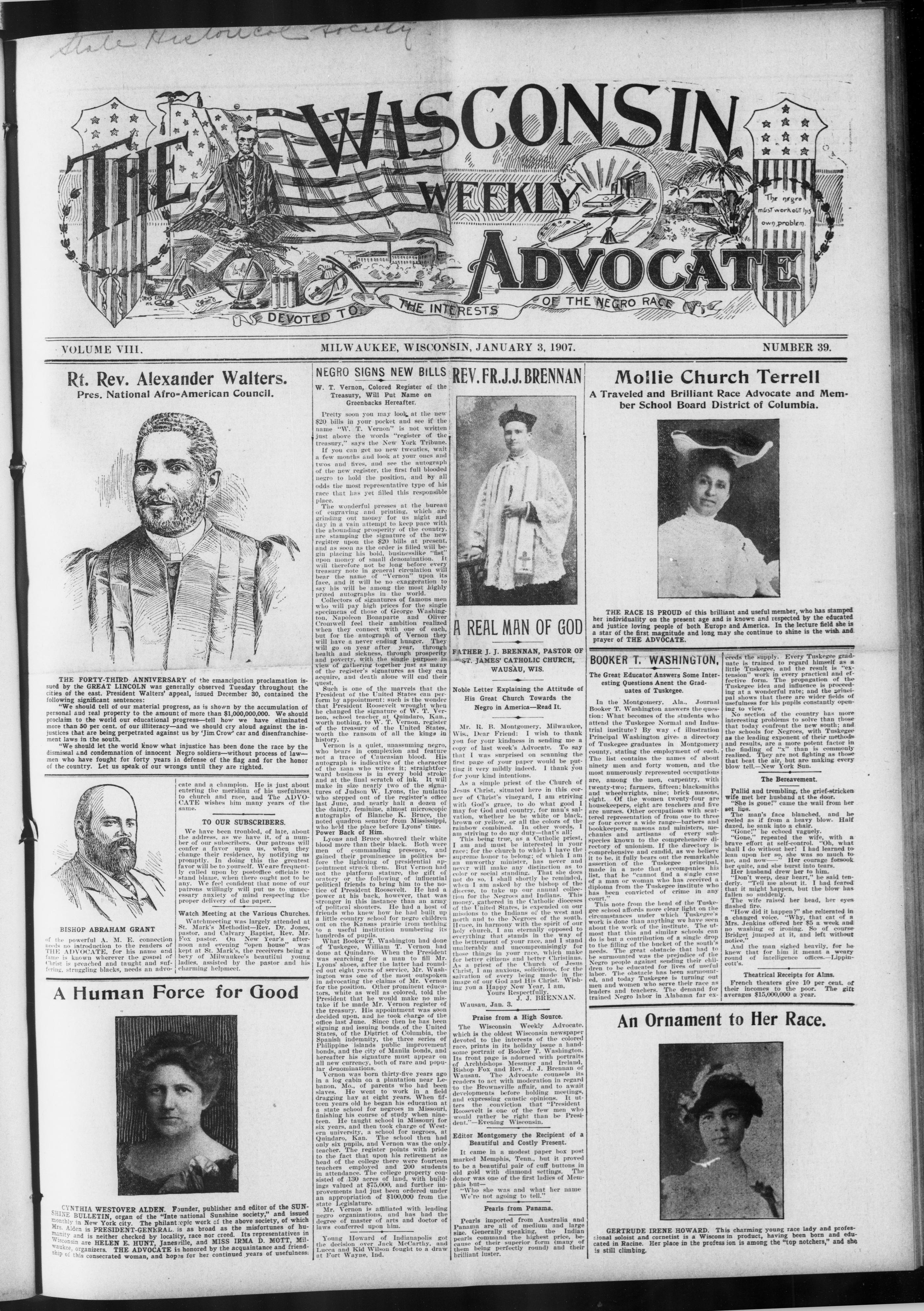
WISCONSIN
WEEKLY
ADVOCATE
DEVOTED TO THE INTERESTS OF THE NEGRO RACE
VOLUME VIII.
Rt. Rev. Alexa
Pres. National Afro
THE FORTY-THIRD ANNIVERSARY
sued by the GREAT LINCOLN was ge-
cities of the east. President Walters' a
following significant sentences:
"We should tell of our material pro-
personal and real property to the amou
proclaim to the world our educational
more than 50 per cent. of our illiteracy-
justices that are being perpetrated again
ment laws in the south.
"We should let the world know wha
dismissal and condemnation of innocent
men who have fought for forty years
of the country. Let us speak of our wr
P.
THE FORTY-THIRD ANNIVERSARY of the emancipation proclamation issued by the GREAT LINCOLN was generally observed Tuesday throughout the cities of the east. President Walters' appeal, issued December 30, contained the following significant sentences:
"We should tell of our material progress, as is shown by the accumulation of personal and real property to the amount of more than $1,000,000,000. We should proclaim to the world our educational progress—tell how we have eliminated more than 50 per cent. of our illiteracy—and we should cry aloud against the injustices that are being perpetrated against us by 'Jim Crow' car and disenfranchisement laws in the south.
"We should let the world know what injustice has been done the race by the dismissal and condemnation of innocent Negro soldiers—without process of law—men who have fought for forty years in defense of the flag and for the honor of the country. Let us speak of our wrongs until they are righted.
M.
BISHOP ABRAHAM GRANT of the powerful A. M. E. connection needs no introduction to the readers of THE ADVOCATE, for his name and fame is known wherever the gospel of Christ is preached and taught and suffering, struggling blacks, needs an advo-
A Human Force for Good
Mary C.
CYNTHIA WESTOVER ALDEN. SHINE BULLETIN, organ of the "Int
monthly in New York city. The philan
Mrs. Alden is PRESIDENT-GENERAL
manity and is neither checked by local
Wisconsin are HELEN E. HUNT, Jane
waukee, organizers. THE ADVOCATE
ship of this consecrated woman, and ho
CYNTHIA WESTOVER ALDEN. Founder, publisher and editor of the SUNSHINE BULLETIN, organ of the "International Sunshine society," and issued monthly in New York city. The philanthropic work of the above society, of which Mrs. Alden is PRESIDENT-GENERAL, is as broad as the misfortunes of humanity and is neither checked by locality, race nor creed. Its representatives in Wisconsin are HELEN E. HUNT, Janesville, and MISS IRMA D. MOTT, Milwaukee, organizers. THE ADVOCATE is honored by the acquaintance and friendship of this consecrated woman, and hopes for her continued years of usefulness.
cate and a champion. He is just about entering the meridian of his usefulness to church and race, and The ADVOCATE wishes him many years of the same.
TO OUR SUBSCRIBERS
We have been troubled, of late, about the address, as we have it, of a number of our subscribers. Our patrons will confer a favor upon us, when they change their residence, by notifying us promptly. In doing this the greatest favor will be to yourself. We are frequently called upon by postoffice officials to stand blame, when there ought not to be any. We feel confident that none of our patrons willingly will put us to unnecessary anxiety of mind respecting the proper delivery of the paper.
Watch Meeting at the Various Churches. Watchmeeting was largely attended at St. Mark's Methodist—Rev. Dr. Jones, pastor, and Calvary Baptist, Rev. Mr. Fox pastor. On New Year's afternoon and evening "open house" was kept at St. Mark's, the receivers being a bevy of Milwaukee's beautiful young ladies, assisted by the pastor and his charming helpmeet.
MILWAUKEE, WISCONSIN, JANUARY 3, 1907.
NEGRO SIGNS NEW BILLS REV.FR.J.J.BRENNAN
W. T. Vernon, Colored Register of the Treasury, Will Put Name on Greenbacks Hereafter.
Pretty soon you may look at the new $20 bills in your pocket and see if the name "W. T. Vernon" is not written just above the words "register of the treasury," says the New York Tribune.
If you can get no new twenties, wait a few months and look at your ones and twos and fives, and see the autograph of the new register, the first full blooded negro to hold the position, and by all odds the most representative type of his race that has yet filled this responsible place.
The wonderful presses at the bureau of engraving and printing, which are grinding out money for us night and day in a vain attempt to keep pace with the abounding prosperity of the country, are stamping the signature of the new register upon the $20 bills at present, and as soon as the order is filled will begin placing his bold, businesslike "fist" upon money of small denomination. It will therefore not be long before every treasury note in general circulation will bear the name of "Vernon" upon its face, and it will be no exaggeration to say his will be among the most highly prized autographs in the world.
Collectors of signatures of famous men who will pay high prices for the single specimens of those of George Washington, Napoleon Bonaparte and Oliver Cromwell feel their ambition realized when they connect with one of each, but for the autograph of Vernon they will have a never ending hunger. They will go on year after year, through health and sickness, through prosperity and poverty, with the single purpose in view of gathering together just as many of the register's signatures as they can acquire, and death alone will end their quest.
Such is one of the marvels that the President of the United States can perform by appointment: such is the wonder that President Roosevelt wrought when he changed the signature of W. T. Vernon, school teacher at Quindaro, Kan., worth nothing, to W. T. Vernon, register of the treasury of the United States, worth the ransom of all the kings in history.
Vernon is a quiet, unassuming negro, who bears in complexion and feature not a trace of Caucasian blood. His autograph is indicative of the character of the man who writes it; straightforward business is in every bold stroke and at the final scratch of ink. It will make in size nearly two of the signatures of Judson W. Lyons, the mulatto who stepped out of the register's office last June, and nearly half a dozen of the dainty, feminine, almost microscopic autographs of Blanche K. Bruce, the noted quadron senator from Mississippi, who held the place before Lyons' time. Power Back of Him.
Lyons and Bruce showed their white blood more than their black. Both were men of commanding presence, and gained their prominence in politics before the lightning of presidential appointment struck them. But Vernon had not the platform stature, the gift of oratory or the following of influential political friends to bring him to the notice of President Roosevelt. He had a power at his back, however, that was stronger in this instance than an army of political shouters. He had a host of friends who knew how he had built up a little country school for negro children out on the Kansas prairie from nothing to a useful institution numbering its hundreds of pupils.
What Booker T. Washington had done of Tuskegee, William T. Vernon had done at Quindaro. When the President was searching for a man to fill Mr. Lyons' shoes, after the latter had rounded out eight years of service, Mr. Washington was one of the most outspoken in advocating the claims of Mr. Vernon for the position. Other prominent educators, white as well as colored, told the President that he would make no mistake if he made Mr. Vernon register of the treasury. His appointment was soon decided upon, and he took charge of the office last June. Since then he has been signing and issuing bonds of the United States, of the District of Columbia, the Spanish indemnity, the three series of Philippine islands public improvement bonds, and the city of Manila bonds, and hereafter his signature must appear on all new currency, both of rare and popular denominations.
Vernon was born thirty-five years ago in a log cabin on a plantation near Lebanon, Mo., of parents who had been slaves. He went to work in a field dragging hay at eight years. When fifteen years old he began his education at a state school for negroes in Missouri, finishing his course of study when nineteen. He taught school in Missouri for six years, and then took charge of Western university, a school for negroes, at Quindaro, Kan. The school then had only six pupils, and Vernon was the only teacher. The register points with pride to the fact that upon his retirement as head of the college there were fourteen teachers employed and 200 students in attendance. The college property consisted of 130 acres of land, with buildings valued at $75,000, and further improvements had just been ordered under an appropriation of $100,000 from the state Legislature.
Mr. Vernon is affiliated with leading negro organizations, and has had the degree of master of arts and doctor of laws conferred upon him.
Young Howard of Indianapolis got the decision over Jack McCarthy, and Lucca and Kid Wilson fought to a draw at Fort Wayne, Ind.
PRIEST
REAL MAN OF GOD
REAL MAN OF GOD
FATHER J. J. BRENNAN, PASTOR OF ST. JAMES' CATHOLIC CHURCH,
Noble Letter Explaining the Attitude of His Great Church Towards the Negro in America—Read It.
Mr. R. B. Montgomery, Milwaukee, Wis. Dear Friend: I wish to thank you for your kindness in sending me a copy of last week's Advocate. To say that I was surprised on scanning the first page of your paper would be putting it very mildly indeed. I thank you for your kind intentions.
As a simple priest of the Church of Jesus Christ, situated here in this corner of Christ's vineyard, I am striving with God's grace, to do what good I may for God and country, for man's salvation, whether he be white or black, brown or yellow, or all the colors of the rainbow combined. In other words, I am striving to do my duty—that's all!
This being true, as a Catholic priest, I am and must be interested in your race; for the church to which I have the supreme honor to belong; of which I am an unworthy minister, has never and never will make any distinction as to color or social standing. That she does not do so, I shall shortly be reminded, when I am asked by the bishop of the diocese, to take up our annual collection for the Negroes and Indians. This money, gathered in the Catholic dioceses of the United States, is expended on our missions to the Indians of the west and north and to the Negroes of the south. Hence, in harmony with the spirit of our holy church, I am eternally opposed to everything that stands in the way of the betterment of your race, and I stand unalterably and uncompromisingly for those things in your race, which make for better citizens and better Christians. As a priest of the Church of Jesus Christ, I am anxious, solicitous, for the salvation of every being made in the image of our God and His Christ. Wishing you a Happy New Year, I am,
Yours Respectfully. J. J. BRENNAN. Wausau. Jan. 3.
Praise from a High Source.
The Wisconsin Weekly Advocate, which is the oldest Wisconsin newspaper devoted to the interests of the colored race, prints in its holiday issue a handsome portrait of Booker T. Washington. Its front page is adorned with portraits of Archbishops Messmer and Ireland, Bishop Fox and Rev. J. J. Brennan of Wausau. The Advocate counsels its readers to act with moderation in regard to the Brownsville affair, and to await developments before holding meetings, and expressing caustic opinions. It utters the conviction that "President Roosevelt is one of the few men who would rather be right than be President."—Evening Wisconsin.
Editor Montgomery the Recipient of a Beautiful and Costly Present.
It came in a modest paper box post marked Memphis, Tenn., but it proved to be a beautiful pair of cuff buttons in old gold with diamond settings. The donor was one of the first ladies of Memphis but— "Who she was and what her name We're not agoing to tell."
Pearls from Panama.
Pearls imported from Australia and Panama are all of medium and large size. Generally speaking, the Indian pearls command the highest price, because of their superior form (many of them being perfectly round) and their brilliant luster.
A Traveled and Brilliant Race Advocate and Member School Board District of Columbia.
Mary
THE RACE IS PROUD of this brilliant and useful member, who has stamped her individuality on the present age and is known and respected by the educated and justice loving people of both Europe and America. In the lecture field she is a star of the first magnitude and long may she continue to shine is the wish and prayer of THE ADVOCATE.
BOOKER T. WASHINGTON.
The Great Educator Answers Some Interesting Questions Anent the Graduates of Tuskegee.
In the Montgomery, Ala., Journal Booker T. Washington answers the question: What becomes of the students who attend the Tuskegee Normal and Industrial institute? By way of illustration Principal Washington gives a directory of Tuskegee graduates in Montgomery county, stating the employment of each. The list contains the names of about ninety men and forty women, and the most numerously represented occupations are, among the men, carpentry, with twenty-two; farmers, fifteen; blacksmiths and wheelwrights, nine; brick masons, eight. Of the women twenty-four are housekeepers, eight are teachers and five are nurses. Other occupations with scattered representation of from one to three or four cover a wide range—barbers and bookkeepers, masons and ministers, mechanics and artisans of every subspecies known to the comprehensive directory of unionism. If the directory is comprehensive and candid, as we believe it to be, it fully bears out the remarkable assertion of the Tuskegee principal, made in a note that accompanies his list, that he "cannot find a single case of a man or woman who has received a diploma from the Tuskegee institute who has been convicted of crime in any court."
This note from the head of the Tuskegee school affords more clear light on the circumstances under which Tuskegee's work is done than anything we have seen about the work of the institute. The utmost that this and similar schools can do is but a contribution of a single drop to the filling of the bucket of the south's needs. The great obstacle that had to be surmounted was the prejudice of the Negro people against sending their children to be educated for lives of useful labor. The obstacle has been surmounted, and today Tuskegee is turning out men and women who serve their race as leaders and teachers. The demand for trained Negro labor in Alabama far ex-
An Ornament to Her Race.
THE WOMEN'S HERITAGE
GERTRUDE IRENE HOWARD. This charming young race lady and professional soloist and cornetist is a Wisconsin in product, having been born and educated in Racine. Her place in the profession is among the "top notchers," and she is still climbing.
GERTRUDE IRENE HOWARD. This charming young race lady and professional soloist and cornetist is a Wisconsin in product, having been born and educated in Racine. Her place in the profession is among the "top notchers," and she is still climbing.
Arch Terrell Race Advocate and Mem- strict of Columbia.
cient and useful member, who has stamped it is known and respected by the educated be and America. In the lecture field she is may she continue to shine is the wish and ceeds the supply. Every Tuskegee graduate is trained to regard himself as a little Tuskegee, and the result is "extension" work in every practical and effective form. The propagation of the Tuskegee idea and influence is proceeding at a wonderful rate; and the principal shows that there are wider fields of usefulness for his pupils constantly opening to view.
No section of the country has more interesting problems to solve than those that today confront the new south; and the schools for Negroes, with Tuskegee as the leading exponent of their methods and results, are a more potent factor in the finding of "x" than is commonly realized. They are not fighting as those that beat the air, but are making every blow tell.—New York Sun.
Pallid and trembling, the grief-stricken wife met her husband at the door.
"She is gone!" came the wail from her set lips.
The man's face blanched, and he reeled as if from a heavy blow. Half dazed, he sank into a chair.
"Gone!" he echoed vaguely.
"Gone," repeated the wife, with a brave effort at self-control. "Oh, what shall I do without her! I had learned to lean upon her so, she was so much to me, and now——" Her courage forsook her quite, and she burst into tears.
Her husband drew her to him.
"Don't weep, dear heart," he said tenderly. "Tell me about it. I had feared that it might happen, but the blow has fallen so suddenly.
The wife raised her head, her eyes flashed fire.
"How did it happen?" she reiterated in a changed voice. "Why, that cat of a Mrs. Jenkins offered her $5 a week and no washing or ironing. So of course Bridget jumped at it, and left without notice."
And the man sighed heavily, for he knew that for him it meant a weary round of intelligence offices.—Lippincott's.
Theatrical Receipts for Alms.
French theaters give 10 per cent. of their incomes to the poor. The gift averages $15,000,000 a year.
to Her Race.
this charming young race lady and profes sions in product, having been born and edu sion is among the "top notchers," and she
NUMBER 39.
The Bereavement.
THE WISCONSIN WEEKLY ADVOCATE
MILWAUKEE, WIS.
R. B. MONTGOMERY, Editor and Proprietor.
Humorous Items. First Cannibal-That new missionary is a little fellow.
Second Cannibal—Yes! he won't be more than a quick lunch.—Town Topic.
Of all sad words
Of tongue or pen,
The saddest are these:
"I'll run again!"
—Cleveland Plain Dealer.
Boarder (to landlady)—"Did you hear me come home last night?"
me come home last night?"
Landlady—"Did I? I heard you coming for several hours!"—Translated for Transatlantic Tales from "Fliegende Blaetter."
Kathleen, go to the library and get me 'The Lost Soul.'"
"Yes, ma'am, and what will I do if I can't find it?"—Translated for Transatlantic Tales from "Meggendorfer Blaetter."
How Colors Change.
Oh, ye who nightly paint the town,
Take warning!
A taste for red begets dark brown
Next morning.
—Catholic Standard and Times.
Etta—"How I envy you! You get a couple of months at the seaside every year."
Grace—"So do you."
Grace—so do you.
Etta—"I know, but my husband always goes with me."—Translated for Transatlantic Tales from "Meggendorfer Blaetter."
Stoking.
How easy shoveling would be,
How harmless every storm,
If coal were only white and cool
And snow were nice and warm.
—New York Sun.
A Yellow Politician.
"Am I a slave?" bellowed the political orator. "You're under the yolk," remarked a small boy in the audience as he let fly an egg.—Princeton Tiger.
Just the Ordinary Ones.
Valet—Do you think master's illness will prove fatal? 'E throws everything in the place at me, sir.
Doctor—No, Jorkins. Those are not death throes.—Harper's Weekly.
As Cooks Go.
"Cooks are awfully expensive luxuries," said Mrs. Howe. "All-fired," said Mr. Howe, as he emerged from the kitchen after dismissing the twenty-third.—Harper's Weekly.
May Be So
Wife—Yes, it was I who brought all the money into this household. What did you have before I married you?
Husband—Peace.—Translated for Transatlantic Tales from "Fliegende Blaetter."
Her Shrewdness.
"She has postponed her marriage date until late in January."
"Why?"
"She wants to make sure of a Christ- has present from him."—Cleveland Plain Reader.
The Original Breakfast Food
Bacon—The shape of a thing has nothing to do with the taste.
Egbert—I think you are wrong.
"No, I'm not wrong. A pancake is flat, but, by ginger, it doesn't taste flat!"—Yonkers Statesman.
High Time.
Mother (to daughter whose father goes around the corner every time she opens the piano)—Emily, you must stop practicing. Your father's nose already shows signs of it.—Translated for Transatlantic Tales from "Fliegende Blaetter."
His Legacy
De Style—What did your rich uncle leave you when he died?
Gumbusta—Nothing.
De Style—Didn't he say anything to you before he passed away?
Gumbusta—Yes, he said nothing was too good for me.—Pittsburg Bulletin.
Better Than Enough
Mrs. McCall—So you like to go to dinner at your grandmother's, eh?
Willie—Yes'm.
Mrs. McCall—Because you're always sure to get enough to eat there, eh?
Willie—Oh, my! It's because I'm always sure to get too much.—Philadelphia Press.
In Brief.
T. Platt,
T.'s wife;
First love,
Then strife.
She says:
"I'm through."
He says:
"Me too."
—Philadelphia Ledger.
THE GENTLE CYNIC
Never wear out your welcome. It's hard to get another.
No man can make a mistake without learning something.
No man can serve two masters such as dyspepsia and optimism.
Some people believe everything they hear, and take the rest for granted.
The easiest way to flatter a girl is to talk about the hearts she has broken.
Some men never succeed because they are afraid of doing more than their share.
Some men seem to get a heap of melancholy satisfaction from being misunderstood.
It doesn't do much good to grasp an opportunity unless you known what to do with it.
Necessity is the mother of invention, but the children don't always turn out well.—New York Times.
Indian Railway President
An Indian chieftain as a railroad president is a rare thing, but that is what Pleasant Porter, chief of Creeks, is. His railroad is is the Indian Central. It filed its charter at Guthrie. It is capitalized at $15,000,000 and contemplates the construction of 400 miles of railroad in Indian territory and Oklahoma within the next two years. The road begins at Ponca City and runs southeast to Paris, Tex., with a branch line running from the Red river northwest to Oklahoma City.—Muskogee Cor. Kansas City Star.
A PRAYER
God of the lonely soul,
God of the comfortless,
God of the broken heart—for these,
Thy tenderness!
For prayers there be enough
Yea, prayers there be to spare,
For those of proud and high estate;
Each hath his share.
But the beggar at my door,
The thief behind the bars;
And those that be too blind to see
The shining stars;
The outcast in his hut,
The useless and the old;
Whoever walks the city's streets
Homeless and cold;
The sad and lone of soul
Whom no man understands;
And those of secret sin, with stains
Upon their hands,
And stains upon their souls;
Who shudder in their sleep,
And walk their ways with trembling
hearts,
Afraid to weep;
For the childless mother, Lord,
And ah, the little child
Weeping the mother in her grave,
Unreconciled—
God of the lonely soul,
God of the comfortless,
For these, and such as these, I ask
Thy tenderness!
Whose sin be greatest, Lord;
If each deserve his lot;
If each but reap as he hath sown—
I ask Thee not.
I only ask of Thee
The marvel of a space
When these forget and blind may look
Upon thy face.
—Ella Higginson in Scribner's
A PREDATORY SANTA CLAUS
As Billy Snee found that the day before Christmas opened a prospect of a dry and cold holiday season he felt that the circumstances warranted an abrogation of his specialty—an expert "second story" man—to the most immediate relief for his impecunious state. He joined the crowd that was in front of the acreage of plate glass windows of a big department store, though keeping judiciously on its outskirts. Almost every pair of adult arms in the throng upheld a squealing, bouncing, delighted child so that the revolving procession of wonderful dolls and toys in a hundred devices of fancy and reality might be fully in view.
Mr. Snee had purely a business interest in the laxily held purses and chate-laine bags, of which he intended to start a seasonable collection. He moved nearer to the wearer of a sealskin coat whose arms were so overtaxed with an excited little boy that a silver chain bag dangled precariously on a stifly crooked first finger. Just as Mr. Snee was about to make a dexterous "lift" of the bag he became aware of a hand in his own pocket, and a peculiarly painful stamping on his fifth toe, which always makes up in sensitiveness what it lacks in girth and strength. Mr. Snee turned with profane intent bubbling on his lips.
"Oh, won't you please lift me up. I can't see a bit. I want to see," cried a small boy to Mr. Snee, hanging as he spoke onto that honest man's pockets and keeping up an unremitting dance on his toes.
"Garvin," the lady in sealskin said, severely, "I am ashamed of you. You act like a baby. See how quiet Bobby is."
"He can see—I can't," wailed Garvin. "Oh, please let me see. I don't care if I am a baby."
Partly to relieve his feet from the tumultuous bombardment of Garvin's heels and partly from a generous pity for the childish anxiety, Mr. Snee put Garvin on his shoulder.
"Thank you," said the lady, gently. "Now sit quiet, Garvin, and don't kick the gentleman. The admonishment was as necessary as it proved ineffectual. Yet for some emotion of good fellowship Mr. Snee found the situation rather attractive. Within the windows the scenes of fairyland passed. On their heels came the Christ Child, the Wise Men, and the glittering star of Bethlehem above an exterior view of the holy birth place, and then to the coos of childish delight was shown a monster bisque Santa Claus perched on a ladder holding to a bibulous nose a fat gloved forefinger.
"O-O-O-OH! Look at Santa Claus on the fire escape, mamma," Garvin called excitedly. Then to Mr. Snee he added importantly, "You bet they won't dare to 'rest Santa Claus when he comes down the fire escape. There was—was—" he swallowed and wagged his little head with the ponderous import of his tale—"was a buglar on our fire escape, and they came and—came and 'rested him' cause he—he come down the ladder. But," with heel tattoo of jubilancy, "you bet they won't dare to 'rest Santa Claus tonight. He'll come down the ladder an' open the dining room window an' bring everything I writ him for, an' if they try to catch him—well, they better just look out."
"Come, Garvin, we must go now. Thank the gentleman for holding you so long."
"Ah, no! mamma; I don' wan' to go."
"You are very good. I hope he hasn't tired you," continued the lady, winding the chain handle of her bag twice about her wrist, and with a firm grasp on the reluctant hands led her children away.
Mr. Snee, after mechanically lifting his hat, turned abruptly out of the crowd and walked briskly in the opposite direction with the intent look of one who is thinking hard and fast. "You bet they won't arrest Santa Claus when he comes down the fire escape," he muttered and chuckled. At Broadway he hesitated at the curbstone. "Jacobs," he decided, "is the man. "He'll do the trick for me." His memory busied itself with recollections of a certain row of apartment houses on the upper west side in whose back yard he had strummed the banjo and feelingly sung, "I don't want to play in your yard," as his observant, if shy, eyes had approvingly noted how well the builders had complied with all the requirements of the law providing for fire escapes. The observation had taken place shortly previous to his becoming a guest of the state of New York at a sequestered spot up the Hudson.
It was about 1 o'clock on Christmas morning when there emerged from the roof door a corpulent figure which carried a sack, from whose depths came a faint silvery tinkle. Even in the starlight the voluminously white bearded face betrayed little satisfaction in the sound, as with careful hand he eased the sack on the pebbled roof and began a systematic adjustment of its contents. The faint white glow of the sky revealed fur-topped boots, a crimson and fur clad body, and topped the effect with venerable curling locks that hung from the well recognized hat of Santa Claus. The presentment of the jolly saint finished the arrangement
of the sack by leaving a doll, some trumpets, and a drum in tantalizing view, and swinging it on his back with a grunt went with feline step to the rear of the roof, crossed the dividing parapet to an adjoining house, and softly swung himself over the edge onto the ladder of the fire escape. The pause on the platform of the top flat showed that the rooms were empty. At the fourth floor the window was considerably raised two inches. The Santa Claus noiselessly lifted it to its full height, slid gingerly through, and stood on the floor of the kitchen, listening. There was absolute silence. The Santa Claus brought forth a small dark lantern and flashed the ray over the room until it showed the hallway door. After listening intently the lantern was darkened, and the Saint went cautiously through the hall, opened the door at the end, and swept aside the heavy curtain.
Under a green shaded drop light, around a round dining room table, coatless, immobile, and with piles of red, white and blue disks in front of them, sat five men.
"Raise— What! The dev—" began one man opposite the door, lifting his eyes just as the Santa Claus pulled back the curtain.
The others turned, stared and two rose from their seats.
"Merry Christmas!" said Santa Claus, in a curious, breathless fashion.
"Why!" said one man, recovering quickly, "it's Santa Claus. Hope you've got ten thousand a year for me in that bag, old man."
"Give him a drum. He needs it in his trade," suggested another.
"How did you get in?" asked one of the men standing up.
"By the fire escape window," answered Santa Claus. "I must have——"
"That's it," interrupted the questioner.
"You've struck the wrong flat. It's on the floor below on the other side that the children are. I suppose it rattled you climbing down the ladders."
"It's this way," began the apparition, in embarrassed voice; "I was to surprise the kids, and——"
"Of course," broke in a man, who put on his coat as he spoke, and, turning to the other men, added, apologetically, "You boys won't care if I quit. To tell the truth, I forgot it was Christmas, and well, I guess I ought to go home to my wife and the babies."
"So should I," said another, awkwardly,
"I promised to be home to fill the boys' stockings.
"I guess I've spoilt your game," said the Santa Claus, regretfully, as he backed out. "I'm sorry. It's a mistake. I was more surprised than you were."
He came back to the room, took the glass, and waited while four of the men struggled into their topcoats. Then, as all stood with filled glasses, the Spirit of Christmas glanced with twinkling eyes at the five faces, and said, heartily:
"Here's to Christmas, the kids and the missis. God bless 'em! Amen."
"Good night," they called after him as he slipped through the door. "Good luck and a happy New Year."
Santa Claus stopped long enough in the kitchen to pick up some spoons that lay on the stationary tubs. He heard their good-byes to their host, mingling with the latter's expostulations at being deserted. Then St. Nick slipped out of the window, closed it, and climbed down the ladder to the third floor with something of a sardonic smile making crow's feet about his shifty eyes.
To the expert touch, which obviously belongs to St. Nicholas and his clerks, there is not the least difficulty in making an entrance to a flat. Moreover, owing to the objections that apartment house owners sustain to pet dogs, the chances of detection are beautifully lessened. It was evident that the third floor west had amply repaid the investigations which the masque of Christmas had instituted with thoroughness and dispatch, for as he reappeared on the fire escape the sack was lifted with perceptible effort to his shoulder, and he hesitated as if undecided over carrying his researches to the floor below.
"What a lay!" he whispered in meditative admiration. "The best ever! And what a bit of luck from doing a turn for a kid! He'll get the happy thought from B. Snee every time, all right, all right!" By which it may be seen that the innocent words of a little child had lifted a thief's heart and raised him from the degradation of picking pockets to the proper if unlauded height of his ancient profession.
Many things had gone into the bag done up in scarlet and white tissue paper happily decorated with holly and ribbon, because time had been lacking to undo wrappings, and coyness on Mr. Snee's part forbade an exhibition of his receptive pleasure to prying curiosity. It was, perhaps, with the belief that some of the parcels would fall short in practical uses that decided him to "take a look" at least at the second floor underneath.
His method of procedure in the previous flats was untainted by any originality in this one. He flashed his lantern over the kitchen, darkened it in the hall, cautiously unveiled its gleams on the cut glass and silver settings of the breakfast table, and, like Capt. Cuttle, "when found made a note of it." Then he stole through into the parlor, where the gas burned in a blue bead for a night light. Under the mantel hung two short plethoric stockings—lumpy and expanded out of all kinship with their kind in the overweening generosity of the season. Along the mantel top were other gifts, some of which appealed favorably to his appreciative eye. He gathered them up gently, and, slipping them into his sack, which he had rested beside him on the floor, bent over to make a careful examination of the toes of the little stockings, where frequently the daintiest gifts lie. The enameled watch he had found at the bottom of a long silk stocking. It is in these painstaking and artistic touches of observation that successful hauls are made.
As he leaned over, hiding the stockings from view with his bulky form, he heard a little gasp, followed by a curious noise that spoke of delighted amazement. Mr. Snee stiffened in every muscle, stood tensely while one might count five, then whirled about, while his hand traveled in the flash of an eyelid to his hip pocket. He immediately removed it, and laid the finger against his nose, grinning widely. "Ss-sh!" admonished Mr. Snee. The two nightgowned little figures ostentatiously clapped both of their hands over their mouths, and advanced with an air of elaborate caution, their bright little eyes fixed on him in perfect circles of gleeful surprises. Mr. Snee went softly on one knee and held out his arms.
"Don't make any noise," he whispered, as they snuggled one on either side, while
he held them close to him. "If you wake mamma or papa I'll have to go away—and I won't come back for three years—and that's no joke."
"Ess," whispered the little girl, wonderingly.
"Maybe I won't ever come back," he threatened.
The boy's eyes looked over Mr. Snee's shoulder and he wriggled in his anxiety to get at his stocking.
"Now, see here," whispered Mr. Snee, sternly. "You kids can't look at those things, see? 'Cause if you do I'll take them away, see? and then what will you do?"
The little girl's face crimped into position for a wail.
"Shut up! If you cry I'll take everything and never come here again."
The little girl swallowed her cry, and contented herself with looking at her stocking from a distance.
"What did you bring mamma and papa?" asked the boy in so sibilant a tone that it sounded like a policeman's whistle to the perturbed Mr. Snee. "Didn't you bring them anything? Say, you never brought the patrol wagon that I wrote you for."
"That's funny," responded Mr. Snee. "You see, I don't like them myself. Maybe," he added, grimly, "it will get here before I leave."
"What 'oo dot for mamma?" asked the little girl. "Is all 'oo dot in dat?" She pointed to the bag. "Is dat for lots of 'ittle dirls an' 'ittle boys? Don't nobody div 'oo any sing?"
"Oh. yes. I got a year once—lately. Everybody is mighty glad to give me good times," whispered Mr. Snee, with a grin.
"Nice Santy Claus," cooed the little girl, "I love 'oo." She put her soft cheek to his, her arms about his neck in a tight, impulsive hug.
"Gee," said the man, almost inaudibly, "but you're a sweet little kid!"
"I love you, too," hoarsely whispered the boy, "and so does mamma. Didn't you bring her anything?"
Mr. Snee shifted his eyes anxiously about the room and meditated.
"Say," he began, "will you let me put you in bed and will you keep quiet if I let you take mamma's and papa's present out of that bag?"
Mr. Snee's balance was seriously incommoded as the two children jumped ecstatically in his arms.
"Straight goods and no bluff," he continued. "You'll go right to bed and you won't say a word. Honest?"
"Honest," said the boy.
"'Ess," lisped the girl.
Mr. Snee released them, then held the top of the bag open. Into it the eager little hands dived.
"That's right," he softly commented. "No, that belongs to the lady down the street, but this is mamma's and this papa's, and, say, let's put them up here. That's right. ain't it now—all along in a nice row. There we are. Hold on, here's a watch." He had run across the dainty bit of enamel and gold, and after dangling it a moment on his finger, held it to the girl's curl-covered ear. She put her head on one side and listened, patting her hands.
"Div Elsie dat. Elsie wants it," she said aloud, and clutched at the trinket of time with a firm grasp. The cold perspiration broke out over Mr. Snee's body, and he stood suddenly erect. The very manner of the man was so urgent and intent that the children were statues of mingled fear and listening. After a long pause, the boy whispered:
"Did you think they were running away?"
"What?" asked Mr. Snee, relaxing his attitude.
"Why, the reindeers on the roof. I thought I heard them running too."
"I want dat," repeated the girl, as he loosened her fingers from the watch. Mr. Snee looked wavering from the eager, pretty child, with her plump, tiny arms, upstretched, to the pretty, tiny toy. He hesitated, half inclined to give the child her desire.
"Well," he started, then looked again at the watch, and used diplomacy. "You see, I gotter take this to some one else. It ain't really mine to give away careless like, and if the other girl saw it she might know it was hers, and take it away. See? Next Crismus I'll see that you get one, if you are good and go right to bed. Where do you sleep? In there?" He jerked his head toward the alcove that opened on the parlor.
The boy nodded. Mr. Snee lifted the two children easily. "Gee! this has been a funny hold-up all around," he said appreciatively as he carried them noiselessly into their room and placed them on the bed. With awkward but solicitous hands he drew the covers over them, tucking them in well. "Give Santa Claus a kiss," he whispered. They caught him on either side of the neck with the vigorous ardor of children. "Let up. I pass, you've got the strangler's grip on me, all right," he chuckled under his breath, and pressing their heads down on the pillow with a firm hand, added softly. "Go ter sleep, kiddies."
When he took up his sack in the front room he had the look of a man that had been made radiant with the spirit of peace on earth, good will to man. His eyes were bright, steady and direct. His plump, rosy figure shook in silent mirth. He was Santa Claus.
As he passed through the dining room the expression flickered, and then faded from his face in almost the same instant as he cast the thin rays of the lantern on the table silver. He stretched out a hand toward the cream pitcher, weighed it tentatively on his palm, then uttered an invocation to some finer thought in argot.
"Not on your life," he said, very solemnly, and putting down the pitcher,, passed out and through the window.
As he reached the platform above the flat on his way to the roof there floated up to him, "Good-bye, Santa Claus," and peering down he saw in the tenuous light the vague outlines of two small heads. From prudent and other reasons he had no answer ready. Later as he sat on the roof making a critical selection of the composite articles of his "haul," and stowing them within the excelsior padding of his false stomach, he reflected. "Bully nice kids, every one. Gee, what a day for kids!"
***
At breakfast time and while the bells came muffled through the brick walls, the public halls of two connecting apartment houses were filled with the nose of hysterical voices, and slamming doors. The elevators whirred from floor to floor, charged with and emitting men from the central office of police headquarters, who took casual appearing interest in the
empty jewel boxes and the wails that arose over newly discovered losses. Meanwhile, on the second floor of one house a little boy was saying earnestly:
"Cross m' heart an' hope t' die, mamma, if it ain't true. He took me an' Elsie up in his arms, an' he put us in bed, an' he kissed us, an' he said: 'Gee, but you're nice little kids!' an' he let us take your presents out of his bag, an' I heard the reindeers on the roof. Didn't he, Elsie?"
"'Ess!' declared Elsie, warmly.
"Charley," said their mother, looking over at the man who was concealing his lips in a napkin, "did you ever hear of such wonderful I-m-a-g-i-n-a-t-i-o-n-s as those children have?"
"They're great!" replied the man admiringly.—New York Commercial Advertiser.
President Obeys Will of Suicide.
Moved to pity by the simple trust of the aged Mrs. Lulu B. Grover, who committed suicide several days ago in Harlem by taking chloroform and who aroused national interest by leaving all her property to him, President Roosevelt, it is learned, took personal interest in the case and saw to it that the last wishes of the aged woman were carried out. Acting under the President's orders, United States District Attorney Henry L. Stimson personally supervised the cremation of the body and forwarded the two pet Angora cats to the white-house. Secret service men also saw to it that all the property left by Mrs. Grover was taken in charge by the public administrator, and advertisements inserted in the newspapers notifying her relatives of her death.
Behind the pathetic story of the woman's death comes the news that she was a mysterious donor of gifts to Theodore Roosevelt, Jr., for many years and had at times caused his father no little concern because of her vagaries. In the opinion of United States District Attorney Stimson, Mrs. Grover was weak-minded and imagined she was on friendly terms with Präsident Roosevelt. The latter, through Mr. Stimson, denied ever knowing the aged woman, and had no knowledge of her except through the gifts sent to his son.
It was while the President was governor of New York in 1898 that a shotgun, a compass and watch arrived at the capitol addressed to young Roosevelt. Inside the package was a small slip of paper which bore the words, "From L. B. Grover, No. 2089 Lexington avenue, New York City." The governor's son showed the gifts to his father, who ordered him to write a note of thanks. Gov. Roosevelt, however, also sent a note to Mrs. Grover asking her not to repeat the donation. Mrs. R. C. Connor, a friend of Mrs. Grover, said that the woman had often spoken of her friendship for the President and said she had met him in Dakota when he was a young man. This was denied by Mr. Stimson.
Mrs Grover died on December 8 after taking a dose of chloroform with suicidal intent. She left a note mentioning the President and adding that nobody was to blame for the act but herself.
A MODERN MEDITATION.
Idle not; for idleness is the mother of all sins.
Glower not, nor grouch; for it is a fearful crime to make other people unhappy.
Neither dawdle nor dilly-dally; for the dawdler groweth weary and accomplisheth naught.
Delay not, nor postpone; for more crimes are due to postponement than to deliberate intention.
Hesitate not an hour in performing thy task; for the only way to get a thing done is to do it NOW.
Neither indulge in vain retrospection; for what is done is done forever, and the only wise thing is to forget it.
Never indulge thyself in despair; for there is no surer way to miss all the good things that are coming to you.
Blame not thyself nor any other person too much; for there are laws stronger than any of us that govern the universe.
Make hope and industry thy habits; for by these two practices shall a man reach the highest place—even contentment.—Philadelphia Bulletin.
The Original Fairbanks Man.
Bartley Harper of Lima, O., who is visiting the families of J. A. and J. D. Hoyt in this city, admits that he saved the life of Vice-President Fairbanks when he and Fairbanks were boys together in Union county, O.
"We lived near each other in Ohio, and one day we went swimming together," said Harper. "Fairbanks was in the water long before I was ready. I had not yet reached the bank when I heard him call for help. I threw off most of my clothes and rushed in. If I do say it myself, I was one of the best swimmers in the county, so I made straight for the drowning boy. I grabbed for his hair as he started to go under for the last time, but missed him and had to dive for him. I got hold of him and dragged him to the bank, where, as soon as we got the water out of him, he was all right. He was mighty thankful to be pulled out. 'I'd have made it all right if I'd got a good start, though,' he said.—Muncie Cor. Indianapolis News.
Plum Pudding
One pound of raisins, one pound of suet, chopped fine; three-fourths pound of stale bread crumbs, one-fourth pound of brown sugar, the grated rind of one lemon, one-fourth pound of flour, one pound of currants, one-half of a nutmeg, grated; five eggs, one-half pint of best brandy, one-half pound of minced candied orange peel. Wash and dry the currants and after seeding the raisins mix all the dry ingredients together, beat the eggs until very light, pour the brandy over them and stir into the dry mixture. Boil in two small molds or one large one for six hours. On the day it is to be served boil for three hours more.
Badger Is the Tallest Soldier
The distinction of being the tallest man in the United States army belongs to Ernest D. Peck, a first lieutenant in the engineer corps. He is 6 feet $4\frac{1}{2}$ inches in height.
Lieut. Peck is a native of Wisconsin and was graduated from the Oshkosh high school. Lieut. Peck is now on duty at Yellowstone Park, Wyo., and has supervised the building of a military road known as Peek's Pike.
He is called Pike's Peak by his comrades in the service.
Catch Fish in Beehives
The idea of catching fish by means of a beehive with a hole in the top of it is a strange enough one. Yet this, says the Country Gentleman, not inadequately describes the method employed by fishermen in the Philippine islands, who clap their apparatus down over the sluggish bottom-feeding fish and then, putting their hands through the hole in the top, extract their victims.
Advertise in Your Home Paper
PROMINENT PEOPLE
ADMIRAL GEORGE DEWEY, the "hero of the Battle of Manila," was born in Montpelier, Vt., Dec. 26, 1857, and appointed to the naval academy from that state in 1854. After his graduation from the academy in 1858 he served in the Mediterranean squadron until the outbreak of the civil war.
During the war he was a participant in many of the principal naval operations along the gulf coast and in the lower Mississippi. He was in Farragut's squadron which forced the passage of Fort St. Philip and Fort Jackson, in April, 1862, and participated in the subsequent fights with gunboats and ironclads which gave Farragut possession of New Orleans. In the smoke of the battle of Port Hudson, Lieut. Dewey was aboard the steam sloop Mississippi, which lost her bearings and ran ashore under the guns of the land batteries, obliging the officers and men to take to the boats.
After the war Lieut. Dewey served on various stations and rose successively through the grades of commander, captain and commodore, which last-named rank he reached in 1896. At the beginning of 1898 he assumed command of the Asiatic station. On May 1, 1898, in Manila bay, he commanded in the greatest naval battle that had taken place since Trafalgar, completely annihilating the Spanish Asiatic fleet under Admiral Montejo, destroying eleven and capturing five vessels and all the land batteries without the loss of a man on the American side. Immediately upon the receipt of the official news of the victory he was promoted to the rank of Rear Admiral, and thanked by resolution of Congress. Subsequently Congress revived the rank of admiral in his honor.
LORD LEICESTER, the "Father of the English House of Lords," entered upon his 85th year December 26 and was the recipient of many congratulations from his fellow peers. Lord Leicester is given his title of "Father of the House of Lords" because of the length of his continuous service. In point of age he is the junior of Lord Gwydyr, who is 96 years old, and Lord Field, who was 93 last August.
Lord Leicester acted as page at the coronation of Queen Victoria, nearly seventy years ago. He has principally distinguished himself by having married twice and begotten no less than nineteen children, there being a difference of exactly fifty years between the age of his eldest child, Lady Powerscourt, and that of his youngest child who was born in 1894.
HENRY FITZALAN HOWARD, Duke of Norfolk, was born December 27, 1847. His grace is the head and front of the peerage of Great Britain and in rank some next to the princes of the blood. His family is the oldest Saxon nobility in England and were anciently the Herewards. As earl marshal of England the Duke of Norfolk arranges the processions of state on occasions of royal coronation and the like ceremonies. Although immensely rich, the duke is one of the hardest worked men in England. He has served faithfully as county councillor of London, as mayor of Sheffield and as postmaster general of the kingdom. He is the head of every Roman Catholic movement in the three kingdoms, and has proudly preserved the faith of his fathers through all the vicissitudes of the centuries. Several ducal Howards have suffered death in the tower, but no one forsook the faith of the famous house.
PRESIDENT WOODROW WILSON of Princeton university, who is receiving some mention as a possible presidential nominee on the Democratic ticket, was born at Staunton, Va., December 28, 1856. He began his academic studies at Davidson college.
In 1875 he went to Princeton and graduated with high honors. From Princeton he went to the University of Virginia, where he studied law for several years. Afterward he practiced law in Atlanta, Ga. Leaving Atlanta he went to Johns Hopkins university to devote his whole time to his chosen studies. In 1886 he received his Ph. D. from Johns Hopkins and the next three years he spent as professor at Bryn Mawr. In 1887 Lake Forest college made him an LL. D. and in 1887 he was elected to the chair of history and political economy at Wesleyan university. In February, 1890, he was made professor of jurisprudence and political economy at Princeton and in 1902 he became president of the university.
President Wilson has been conspicuous as a lecturer and public speaker and has written a number of notable works on political economy. He has lately been mentioned for the Democratic nomination for President among anti-Bryanites.
How Ibsen Did Sewing
Some, amusing anecdotes of Ibsen have just been published by the Norwegian writer, John Paulsen, who was on intimate terms with him for many years. One of his stories he prefaces with the remark that, however much the dramatist upheld the rights of women, he by no means considered them superior to men in any line; in fact he considered them inferior in many spheres in which the world in general puts them ahead. One of his maxims was:
"No woman could write a cook book and no woman can sew a button on fast."
He lived up to the latter part of his dictum. When he detected a loose button on any of his garments he retreated to his own den, locked himself in, and with elaborate preparations sewed the button on.
He took as much pains with it as he would with the final, fair copy of one of his plays. Then he used to brag about the performance, saying that he wouldn't put trust in a button sewn on by any woman—not even by his wife.
His wife used to laugh with a quietly ironical expression on these occasions. She confided to Paulsen that she secretly resewed all the buttons that the poet had sewn, sewed them good and tight, as only a woman can, she said, explaining that he always forgot to fasten the thread, and the buttons would come off in a few days if she did not look after them.
"But don't undeceive him," the faithful wife added appealingly; "it makes him so happy to think that he did it."
Ibsen was extremely sensitive about any one's finding out the least hint regarding any incompleted work that he had in hand. He never revealed a plot, an incident or a scrap of dialogue until the work was completed.
Once his wife picked from the floor a scrap of paper with the words "the doctor says" upon it. She asked her husband jestingly what the doctor did say and who he was.
Ibsen went into a paroxysm of rage. He declared that he was not safe in his own house; he was surrounded with spies. All his ideas were ruined, his plans thrown awry.
Scotch Pork Not Inspected
It is said that from eighty to one hundred tons of bone-out pork, ready for curing, arrive in Glasgow daiy. The pigs are, as a rule, slaughtered on the premises of the small farmers, and at no time before arrival in Glasgow do those carcasses appear to have been examined in order to determine as to fitness for human food.
GOSSIP FOR THE LADIES.
```markdown
```
Motherhood
To feel the sudden thrill and start
Quiver the new strings of my heart;
To feel a life within by life
Grasp its beginning and grow rife,
While God's ineffable new grace
Proves its existence in my face;
To feel the red blush-roses glide
At every moment in my side;
To know a love without reply.
And know that it can never die;
To lie awake night after night
And wonder at the strange, new light;
To whisper to the listening earth:
"I am a mother; know my worth!"
To fear my power to mold the man
As only she who bears him can;
To number each departing sun
And count the mornings one by one,
Impatient for my Christmas morn,
When from my womb a child is born—
(What harm, if when he break the mold,
He leaves my body still and cold?
Shall I not live within his breath?
Can I be more apart from death?)
To wonder at the mighty love
Which could almost, like that above,
Make or unmake a universe,
And prove a blessing or a curse;
To tremble at my power for good
And evil—this is motherhood.
-Thomas T. Bouve in The Century.
The Woman Is Never Old
Who allows herself to think only of pleasant things.
Who twins her tongue to utter only
Who trains her tongue to utter only pleasant words.
Who remembers that frowns are unbecoming and that smiles are better.
Who keeps her nerves well under control and remembers that they are not an interesting subject to any one.
control and remembers that they are not an interesting subject to any one. Who enters into the plans, and, as far as possible, into the doings of the young people about her.
Who never allows herself to become slouchy and careless in appearance. Who treats others as she likes to be cared for herself and never demands too much from her friends.
Paste This in the New Home.
Here's good advice for the young married couple: Don't go in debt; never spend a dollar until you have it in hand.
Don't waste; it is the little leaks that count more than the big outlays.
count more than the big outlays.
Don't pattern your living after some one whose income is twice yours. They won't pay your bills.
Don't be afraid of what the neighbors will say. Be sure you are right, then go ahead.
Don't lose sight of the true proportion of things. Good food values there must be; ditto warm clothing, comfortable bedding, tools to work with; but never mind the silks and satins that oft put out the kitchen fire, nor indulge in ruffles when wanting a skirt.
Don't think if you are a young housekeeper that you must begin where your mother left off.
Don't shirk. When industry goes out of the door poverty comes in at the window.
Don't worry!
"A merry heart goes all the day,
Your sad tires in a mile-a."
Work for Women's Clubs.
Every women's club or other organization can do much to promote the pure food movement in these ways, among others: Appoint a committee to inspect the shops, bakeries, slaughter houses and other food places in the vicinity and submit reports in writing to the club. Invite health and food officials, food manufacturers, wholesale and retail grocers, to deliver addresses and answer questions, with special reference as to what the consumer should do. Some of the more broad-minded women will gladly submit to having an expert make a private inspection of the kitchen, pantry, refrigerator, cellar, etc., to see if any improvements can be suggested in the care or treatment of food in their own home; the report of course to mention no names. Appoint a committee of hustlers to circulate the petitions to Congress and the state Legislature published in Good Housekeeping for October, copies of which will be sent on request. Plenty of practical work to be done, mightily interesting to the doers of it and equally full of interest to the members of the club to which reports are made.—Good Housekeeping.
A Consideration of Virtue.
A virtue is an excellent topic to revolve in one's mind, not only because our thought power thereby is cultivated and along noble lines, but also because the virtue, with the reflex influence of the thought, impresses itself on our characters, and what we are contemplating we are unconsciously, involuntarily assimilating and resembling.
We remember the little lad in the "Great Stone Face." He watched it every day until he became like unto it and had all its beauties writ upon his own lineaments.
So, when our thought is pondering the delightful and most practical virtue of cheerfulness, the heart is acquiring some of the good cheer that the mind elaborates. It absorbs into its own tissue the blood of the thought.
We can think of a single virtue five minutes at a time every day for a week or a month, trying to reach its meaning, trying to apply it to our conduct, turning over in our minds ways in which we can express this virtue, dwelling upon its usefulness, thinking of it as residing in every human breast—largely latent, perhaps, yet there and educatable.
If we are given to irritability we can think of the virtues of peace and calmness and equilibrium. If we are prone to depression we can dwell on hope and courage; if we judge hastily, let us dwell awhile on magnanimity; if we exaggerate or misrepresent, it will be good to revolve in our minds the splendors of pure truth.
The virtues, taken in succession, month after month, will help greatly in building up the character, foritifying its weak places and enhancing its beauties and strengths.—Washington Star.
How to Make Fondant.
Fondant, which you will use largely as foundation for most candies, is made as follows, three things being borne in mind; that the syrup should not be stirred after boiling begins; that the cooking vessel be not moved nor jarred; that the crystals that form around the sides of the pan be carefully wiped off with a damp sponge and not allowed to fall back into the boiling syrup to granulate later on, and that repeated testing be made to avoid cooking too much or too little. Put one pound of granulated sugar, a teacup of water and one-third of a teaspoonful of cream-of-tartar in a thick saucepan and stir only until the sugar is dissolved, then set over a hot fire and let boil very rapidly, carefully removing the crystals. When it has boiled ten minutes begin to test by dipping a silver teaspoon in cold water, then in the syrup, and again in cold water. When the syrup that clings to the spoon can be worked into a soft ball it is cooked enough. Turn the syrup onto a lightly oiled platter or slab and let it stand until cold. If a crust forms on the surface, remove it (it shows the boiling was continue too long), or the mass may be returned to the saucepan with a very little more water and boiled again. Now work it with a wooden spoon until it becomes a soft, smooth,
creamy paste. Mould and knead as you would bread for a few moments and then pack the cream solid in a bowl or jar and cover closely with a damp cloth or paraffin paper and let it stand twenty-four hours before using; at the end of that time it will be ready to be moulded into shape for coating with chocolate, or it may be used for coating "centers" of nuts or candied fruits, etc. From "A Wilderness of Sweets," by Francis Peck, in Fictorial Review.
Overtaxing Study.
To a parent who complains that children are sent home from school on Friday evening laden with work that will take the whole of Saturday and perhaps the best part of Sunday to get through. the Daily Telegraph (London) replies that "it is no good complaining of hard work in a competitive world," to which the following comment, from the medical standpoint, is made editorially by The Hospital (London):
"This is cold comfort, but characteristic of the champions of the present system of elementary education. So far as the complaint has reference to schools maintained at the expense of the parents, there is an easy remedy. If they are given excessive home lessons, and it is pleaded that the rules of the school must be adhered to, the children can be removed. But the parents of children who are educated in schools maintained at the expense of the public can only withdraw their children from school, even temporarily, on a certificate of illness from a medical man. It does not follow that the imposition of home lessons upon children of tender years should be accepted without a murmur. The Saturday holiday is an excellent institution, if the children obtain the full benefit of it, but not when it merely means a period of leisure for the teachers. The stress and strain of hard work have to be borne by the vast majority of adults; in this world the race is generally to the swift and the battle to the strong. But compulsory home lessons inflicted on boys and girls of 8 or 9 do not tend to equip them for the obligations of life. They are much more likely to retard their progress. They overtax the mental faculties at a time when it is particularly essential that they should not be overtaxed; they interfere with the physical development of the children, which is of vital importance; and even the most thick-headed can recognize the folly of a system which enables a boy to come out first in a competitive examination at 14 years of age and qualifies him for a lunatic asylum at 40."—Exchange.
The Blessing of Housework
Much has been written and much will be written on the problem of domestic service, and though ways and means are continually being devised to untie the tangle, none as yet have proved generally effectual. It is one that touches the city and the suburban home, that presents itself in the country as well as in the town. It is called by various and high-sounding titles, such as sociology, household economics, the feudal system, and the like. The women most concerned are dealing with it in many different ways, and each hopes to reach a solution which shall at least mitigate the situation, if not for her personally prove of permanent value.
Someone of experience along these lines has said that the only rescue is by means of three rules, which will finally determine the matter: 1. Simplify your house keeping. 2. Send out all the work you can. 3. Do the remainder yourself. Objections and protests run rife at the suggestion. We ourselves should be content to simplify matters, but there are so many outside considerations, so many others to take into the proposition. We are all striving, be our income small or great, to live to its fullest extent. The $800 a year salary must cover $1000 expenses. How many times we divide that 800 by fifty-two and try to make it come out a little more! Economizing is the hardest of household problems, and yet we are all ready to admit that it is manifest nonsense to try to do all we are attempting with the means on hand.
Elimination therefore should be the order of the day. Encourage the rest of the household to be satisfied with a simpler standard of life than that which custom has managed to fasten upon us. Do away with everything that can possibly be discarded, from the twenty-seven sofa cushions that would mean that much less work in making and caring for them, to the elaborate details of an extensive menu. Keep beauty and comfort in the home at any cost, but in house furnishings, clothing, and food there are many extras possible to cut out and be all the healthier, happier, and freer. Let someone else do the work if you can, but the modern American woman would be all the better for less excitement, less amusement, and simpler and more wholesome work. Schools of physical culture are devising all forms of exercise, physicians are racking their brains for schemes whereby patients can be induced to take the exercise they need.—something that shall not be too hard, yet will bring every muscle into play, stimulate the circulation, and tone the whole system. Golf, basket ball, tennis, cycling, and calisthenics are splendid, but in the ordinary routine of everyday duties in the household may be found one of the best, most healthful, daily exercises. More than one woman has found a remedy for weak nerves, indigestion, rheumatism, and gout in the fact that because her servants have failed her she has been compelled to sweep, dust, cook, wash dishes, make beds, and look after the needs of the family. And there are others, wiser in their day and generation, who have not been compelled to do it, but have found it wisdom.
A correspondent writing to us says: "I just wonder sometimes why women have not found what a joy there was in housework; have not realized what fine exercise it is—when done properly. Two hours' vigorous work in the morning leaves the house in good order and myself in a fine glow and an exhilarating mood. Breathless? Hot? Well, what of it? No more so than I'd be in a gymnasium class after a good run! I can bathe my face, sit down, and rest and read for a wee bit. The whole trouble with us is that we do not do it with enthusiasm, with open windows, and in systematic order. We clean one day in the week, and give it a 'lick and a promise' the rest of the time. I hated housework when I was first married; I thought the eternal monotony of doing the same thing day after day, week in and week out, would be the death of me. But when I got into the spirit of it, when I found I could do it with the same vigor and enthusiasm with which I could play tennis and golf, when I got at it in a scientific and philosophical fashion, then I could say with all my heart, 'Blessed be drudgery.' And of course the man made a lot of difference!"—The Pilgrim.
How to Study the Art of Good Manners.
In manners, as in mathematics, it is nearly always details that count, and as in which, you can never go far off the track of true politeness if you pay strict attention to what others are doing, if
you keep your temper and if you follow the cut and dried printed regulations as close as possible to the letter. Don't ever attempt to taken any liberties with the good social law as your chosen authority on etiquette has set it down, and don't get impatient with its sometimes seemingly stupid restrictions. There is always a good reason for leaving two cards or one, and there rests a significance in where you sit, when you rise or how you bow that means as much to the language of good manners as accents or terminations mean in rendering your enunciation of the French tongue intelligible to the natives of that country.
As you get on a familiar footing with the written laws of good manners, put each newly acquired bit of information into practice in your daily life. Don't be satisfied with keeping what you have learned just in your head, and don't drag out your newly acquired knowledge only on particular and important occasions. You can never hope to cast the spell of personal charm in that fashion. It is daily and hourly utilization of the rules of etiquette that gives you the enviable and essential ease in the fulfillment of graceful civilities. This is an art like that of music. You are bound to practice in order to produce delightful effects.
The best way to practice the rules of etiquette is to exercise them daily and hourly in your family circle, in your office, in the school room and in the nursery. If you do this conscientiously, you soon acquire the quite irresistible habit of politeness, and I must here add that, after a great many years of effort and observation, I have discovered that personal magnetism, like neatness, or veracity, or study, or punctuality can be made a habit by any one who has the good will and the good ambition to try for its acquisition.
Now, when you have gone thus far along in the theory and practice of good and graceful manners, you will be sure to find that your investment of time and effort, in the study of how to be agreeable, is beginning to pay you really big dividends. If you are a man in business, occupied with the steady grind of getting your own living, you will pretty soon begin to appreciate the helpful effects of your improved bearing on your work, and in your life. Men will begin to like you better and more readily. They will approach you more freely, listen to you more attentively, and do you favors more gladly because you have learned how to set them at their ease, to draw them out, to understand their little preferences, and to humor their small and harmless prejudices. It needs, please remember, the eye of an expert to detect the value of a rough diamond, but the very newsboy in the street is able to appreciate the importance and the beauty of a polished one.
Therefore, in this world and day of progress and competition, the most highly lustrous diamond always commands the highest price, and it is the man with the best learning that receives the first hearing. Exactly the same truth holds good with regard to the woman who wishes to succeed in her sphere, whatever that may be. It is not beauty and it is not wealth alone that will win, for any healthy-minded woman the position she covets. If she longs to be the leader in her church work, her family life, in her club, or at a ball, she cannot lure the admiration, the confidence or the social power she wants merely by virtue of a fair face or a full pocket. We Americans are a very independent and critical people; fair faces and long bank accounts are not rarities among us, and we demand something else in our favorites.
Above all things, we demand to be won by charm and sweetness of manner, and we are just independent enough to give all our admiration at the shrine of the woman who, without beauty and without wealth and without fame for her intellectual attainments, is still loved for her lovely manners.
Social culture is soul culture. Twenty years ago I would never have dared make such a statement. So short a time ago there were no such opportunities open to the aspirant after instruction in good manners as are now offered. But nowadays we take our studies in social self-culture seriously, for we have learned how essential they are, and that social culture leads directly to soul culture.
As you study the art of being agreeable, you study the habit of showing yourself less self-centered, less aggressive, and in short less selfish every day. For this reason then, as well as for all the worldly reasons, I believe most heartily that the art of being agreeable is, to take it all in all, the highest and most important art of them all.-Adelaide Gordon.
George Bernard Shaw on Matrimony
In order to make Socialism work we must have a better sort of men and women than we have at the present time.
I believe that one of the things that prevents us having that sort of men and women now is that the limits within which people can get married and have children are far too restricted. I firmly believe that if men had full play in the matter of choice, the breed would be enormously improved.
But what happens? You are a workingman, a laborer. You are a bachelor and you go into the streets and meet a woman. That woman attracts you, and you say, "I should like to marry that woman." The very impulse that comes to a man is a good sign, perhaps the best that we have at present, that that man will have pretty good children. But you find there is an objection; the lady is a duchess, perhaps. You are compelled to admit that your station in life is against you. Even if the lady were also attracted by you, it would really be quite impossible for her to fly in the face of her family. You suddenly remember that you have not such a large choice, and that you have only got a little section to choose from in your own class.
If you could say, as a laborer, "I have got from 12,000,000 to 14,000,000 of people who are working for wages to choose from," you could then say there is some choice. But in the laboring class a man who gets $10 a week must not presume to look at the daughter of a man who gets $15 a week. The result is that the natural impulses of humanity are all twisted, and the laborer has to satisfy himself in his own little circle. The result is that we have the miserable specimens that we have at the present time.
My idea of Socialism is to bring about a state of things in which every man in the country will be a possible husband for every woman.
Do not let me be misunderstood—I do not mean a sort of free love—I mean a man should have a choice of his one wife out of 40,000,000 women, and not only that choice of his own little street.
That is one of the ideas I want to bring into the people's heads.
bring into the people's heads.
I want also to bring back the religious idea. I want people again to be able to read the Bible. In my early days the Bible was not even a book of literature, it was a sort of talisman.
We must always appear as iconoclasts; we must hope to put before the people bigger views and larger ideas of a higher religion than the idea that a Bible carried in your waistcoat pocket will save you from being shot, or that simply because any one says so a man will be struck dead.
We must sweep that away altogether.
The men who died in the Socialist cause died fighting for the solidarity of the human race. That represents the unlifting of humanity, and that is the biggest reform that we have to do. I be-
The war department has issued orders that in purchasing horses for the cavalry arm of the service those of white or gray color be excluded, because animals of those colors offset all the work of the department in trying by means of dress and equipment to make the man as inconspicuous as possible.
Julio Auza, a policeman of Havana, who was afraid to trust the banks, has lost his hoard of $1500. Auza has been accustomed to keep his money in an ash barrel, with no fear that it would ever be disturbed. The barrel was emptied yesterday, and the policeman's money was taken away with the ashes.
A seer, who is making York, Pa., his headquarters at present and who claims to have foretold Queen Victoria's death and the San Francisco earthquake, declares that within the next two years New York will meet a fate like that of the coast city. He also predicts a number of other calamities in a list of things he says will happen within that time.
Gov. Hoch has taken up the suggestion that Kansas ought to have a press agent, and a recommendation to this effect will be made in the governor's message. The plan is to make an increased appropriation for the board of agriculture so that the Kansas advertising agent could be placed under the direction of F. D. Coburn, secretary of the board.
Nearly every state in the Union has sent petitions to Congress this session praying for the establishment in Africa of an independent government for ex-pendent government for ex-slaves and slaves and their offspring under protection of the United States. These petitions have been referred to the committees of the two houses having charge of foreign affairs.
Because of the absorbing experiments he is making with bees A. I. Root, known as the "bee king," did not leave Florida to attend the wedding of his daughter, Miss Carrie Belle Root of Medina, O., and Llellwyn Boyden of New York. The wedding came at a time when Mr. Root was in the midst of an important experiment with queen bees and he could not leave.
Miner Hicks, whose sudden rise to notoriety through his entombment of fifteen days made him the object of many show offers, has been engaged by N. J. Schmidt of Berkeley, Cal., at a salary of $500 per week for one year. The first exhibition will be given in Bakersfield. Harry Linville, prominent in the rescue work, has been engaged to act as lecturer, and two of the miners also will be taken along.
Howard E. Nicholas, accused with Leonard Leopold of the murder of Miss Margaret Leslie in the Palace hotel, Chicago, October 18, has fallen heir to $2000 as the result of the death of an aunt in Salina, Kan. Nicholas told his attorney, Charles Erbstein, of his good fortune, and also assured the lawyer that he had been made the victim of Assistant Chief Schuettler's alleged hypnotic power. He reiterated the assertion that he is innocent.
Rev. A. A. Sonne has been separated from the pastorate of the First Presbyterian church of Greencastle, Ind., at a secret session of the Indianapolis Presbytery because of a row started by a pair of bloomers, which threatened to disrupt the church. The pastor and his wife, making a morning call, were received by the wife of Deacon Cammack in bloomers, which she wore while attending to her morning duties. The pastor reproved her for wearing what he considered unseemly garb, and thus started the quarrel.
By order of the court Johanna Glade of Cleveland, has been enjoined from pulling out the hair or whiskers of her husband. John Glade. The injunction also restrains the woman from "jawing" her husband in the street until his suit for divorce has been settled. In his petition for divorce Glade says that his wife has a particularly bad temper when she has been drinking, but that even when she has not been drinking at all she has a way of jumping on him, pulling out his hair and whiskers, and otherwise annoying him that he does not like.
---
For more than half an hour Tuesday at Racine, Wis., it was believed that an attempt was being made to assassinate the editors of the Slavie, a Bohemian publication. Several shots struck the building where the editors were at work. The police department was notified, and detectives finally found four boys on top of the National hotel roof, north of the Slavie building. They had a revolver and were firing at a tin can as a mark. Every time they missed the can the bullet sped on to the Slavie office building and came near winging an editor or employe.
An attempt to blackmail the Northern Pacific out of $25,000 recently fizzled out when the officials had prepared for battle at Helena, Mont. The railroad was notified that unless the amount was forthcoming the St. Louis Burlington express would be wrecked with dynamite between Livingston and Billings. Six detectives were placed on the train. A suspect was located in the baggage car, but as he made no move he was not molested. Apparently the men who made the threats had warning of the reception awaiting them, and abandoned their plan.
Overjoyed at seeing her mother, whom she visited in anticipation of Christmas, Miss Daisy English, buxom and pretty, crushed the mother to her breast in a fervid embrace and broke one of the master's ribs. The mother, Mrs. Emma English, who is a rather frail little woman, swung free of her daughter's embrace and complained of a pain in her side, which a physician diagnosed quickly as a fracture of the lower rib. Miss Daisy lives in Atlantic City with a sister and had not seen her mother, who lives at Northfield, for several weeks.
Sly glances by a juror and reciprocal smiles in return by a pretty maiden witness for the plaintiff are given by the defendant as grounds for a new trial of the case of Mollie McGuire against the C. H. & D. Railway company. The result of the trial in the superior court at Cincinnati was a verdict of $25,000. Attorneys Harmon, Colson, Goldsmith &
lieve the people will not die for Socialism, or, what is much more important, live for Socialism for money. They will do it in order to bring about a world in which anybody's child will have a chance to be brought up as it should be brought up.
Get that into your heads, and you will find that Socialism will march in a way that it never marched in the Nineteenth century.—Exchange.
Advertise in Your Home Paper.
Hoadly. for defendant, filed affidavits in support of their motion for a new trial, in which they aver that during the trial W. D. Corn and A. W Goldsmith, Jr., noticed Fanny McGuire, the sister of the plaintiff, looking at the fourth juror from the clerk's desk in the front row, exchanging glances and smiles for a considerable period of time. Fanny is a very pretty girl.
Although she is but 9 months old, Eugenie Barbara Jacques of St. Louis is able to talk, and talk plainly. Every word she says can be understood distinctly, and the child apparently exercises reason in using her words, as few of them are ever in the wrong place. Doctors who have examined the baby declare that her mental faculties are as well developed as a child of 3 years and that her talking is marvelous. Barbara's linguistic ability was first noticed when she was 6 months old. Being brought to the table one day last September, she startled her parents and brothers by saying distinctly. "All gone." Since then she has added constantly to her vocabulary. The child's mother says the little girl from the very first of her life has been unusual.
Horace H. Tower of Milburn, Ill., is a young man of ambitions and withal has a robust constitution and an aggressive appetite. For some time he has shown highly specialized gastronomic abilities, his bent turning to banana eating. A day or so ago he ate ten bananas without winking, and then to show what he could do when in the mood ate thirty on a wager in fourteen minutes. He had fifteen minutes to do it, but one minute went to waste. He then rested over night and after a refreshing breakfast dieted himself by placing one by one beneath his vest long and luscious bananas to the number of forty-one. His friends who witnessed the taking on of the cargo declared him champion of the world and will back him against all comers. He was given a belt, as it was thought that was just what he needed.
President Roosevelt has broken another precedent. He went shopping recently without a body guard. There was great consternation among the secret service men when they learned the President had given them the slip. Chief Wilkie was frantic. The entire secret service force was detailed to find the President. Sleuths went out upon his trail. They quickly ascertained that, with Mrs. Roosevelt, the President had reached the street from the white house through one of the side entrances. The detectives found the President in a book store several blocks from the white house. A genuine sigh of relief went up when they saw that the President had not created a great commotion by walking upon the streets, and that he had escaped all harm. The vigilant watch maintained during the remainder of the day assured the President that he would not again escape the guards.
Mrs. Elizabeth Miller, mother of Ida May Miller Kuehn, the "lost Philadelphia heiress," told at New York recently for the first time a story of seventeen years' incarceration in an insane asylum, of inhumanities she suffered at the hands of her husband, of estate juggling, missing property and of an alleged conspiracy which has deprived her of approximately $100,000.
She declares she was never out of her mind, although she spent seventeen years in an asylum in Norristown, Pa. Her husband sent her there, she says, because he wanted to get her out of the way, and other persons interested in keeping her silent tried to keep her in the asylum after the death of her husband.
Possessed of a fortune of $200,000 under the terms of her husband's will, she has received only $200, she says, since his death, and has had to work and save to get along, receiving no aid from relatives. On the contrary, she talks fluently and gives every evidence of a strong, alert mentality.
If Samuel Tlahhoff of Philadelphia had not made such a dream of a shirt waist it is morally certain that he wouldn't have met Miss Bertha Altman of Jersey City, and if he had never met Bertha it is just as certain that he wouldn't have been married to the pretty young woman.
Samuel has his own shirtwaistery at 345 East South Sixth street, in the city of the Quakers. When he began to create artistic shirt waists he did it just because he had a fondness for doing everything as well as he could. Samuel's creations began to be sought for, and among the seekers one day was Bertha. She lived with her parents at 260 Bower street, in the city of the skeeters.
When she bought one of the shirt waists it so happened that it was Samuel's masterpiece. It had his name neatly embroidered on it. Bertha admired it so much that she wrote to Samuel and told him so. He replied, and that started a correspondence which ripened into a courtship which found its climax in the aldermanic chamber of the city hall in Jersey City.
Mrs. Lucius T. Culver, daughter of an Idaho miner, who married the son of W. W. Culver, president of the Asbestos and Roofing Manufacturing company, after an elopement five years ago, now has secured a divorce at St. Louis after testifying to the indignities her millionaire father-in-law heaped upon her because she was poor. Her husband, she charged, allowed them and consented to sacrifice her that he might share in the fortune of his father.
"Once he told me," Mrs. Culver said, "that if he had a wife like me he would kick her out of the house. He abused me constantly, and when I wrote to him asking him not to curse me over the telephone he called at the house and told me I was a liar."
Mrs. Culver went west at her husband's advice and was hurt in the San Francisco earthquake. Her requests for aid brought letters indicating all was at an end. Young Culver told her she might make a living on the stage, she alleged, and stood by in silence when his father abused her. Judge Taylor, in granting the decree, said: "This young woman is unfortunate in that she married a poor thing not worthy of the name man."
David Kyler, a farmer, went foxhunting with a shotgun near Hollidaysburg. Pa. In the course of his search he encountered a bear, which, without waiting for the call of time, boxed Mr. Kyler on the ear, bit his arm, kicked him when he had him down, and otherwise gave evidence of an unfriendly disposition.
Mr. Kyler at the first opportunity fired two loads of shot into the bear's face, and then seizing a gnarled club smote his adversary with such violence that the bear curled up and died.
At this juncture Game Warden Finnegan appeared. "Don't you know that this is the close season for bears?" he asked of the victor.
"Yes, and it is the close season for men, too, by heck," averred Mr. Kyler, panting from his recent exertion. "That bear ought to be locked up."
"You killed him, didn't you?" inquired the doctor, chirringly.
the warden shrewdly. "Yes, but see here—" began Mr. Kyler, but it was no use. He was arrested and it was several days before he had a chance to tell his story in court. The
judge found him guilty of justifiable bear slaughter, and put the costs on the game warden.
Fifty young women students of Washington seminary at Washington, Pa., one of the most fashionable institutions of the kind in western Pennsylvania, left for their homes the other night on their Christmas vacation, all suffering more or less from hysteria, following the discovery of many petty thefts and the method of the principal to find the culprit.
The thefts were committed in one of the dormitories and teachers as well as students suffered. When it came time to dismiss the school, the boarders in the dormitory were summoned to chapel where the principal announced that not a student would be allowed to depart for home until they and their rooms had been searched. Teachers began their disagreeable duty and one of them was notified that a student who had reported a $5 bill stolen, had found the bill crumpled up and lying within the door of the room where it had apparently been thrown in a hurry. Other reports of the hasty return of stolen property were almost immediately made and soon all who had lost anything had found the missing property.
The search was immediately stopped and the keys to trunks returned to the students. The school faculty and some of the students are said to know the culprit but the identity is concealed.
St. Louis has a man who can eat twenty-five raw eggs in sixty seconds, and is a famous player of harmonicas. His name is Joseph Wigge. Until recently he has hidden his light under an egg case. Suddenly he recognized the fact that he was great.
So, in order to tell a sporting editor of his varied and vigorous virtues, he sent around a note. Here's the very note, and this is what he wrote:
Dear Sis: Mr. Joseph Wigge, who is known as the Missouri original egg-eating kid. Mr. Joseph Wigge holds the title at present as the champion raw egg eater of Missouri. Joe Wigge issues an open challenge to all comers for a purse of $25.00 to $100 a side bet, that he can put away more raw eggs than any man of his size in Missouri, and every egg that he puts away is retained and swallowed with great relish, and without exertion.
Joe is 24 years of age, and is 5 feet and 9 inches in height, and 170 pounds in weight, of athletic build and has a pair of lungs like a Belows. Joe Wigge's record in eating raw eggs is 25 raw eggs in 60 seconds.
Mr. Joseph Wigge is an active member of the Benton Athletic club of St. Louis, Mo. Joe is known among his friends as the champion strong boy, and he is also known as the North St. Louis most famous mouth harmonica player; he can perform many feats and brilliant effects on the mouth harp; he can play a few specimens of his ability on the mouth harp with his nose; he can also give various imitations on a Jews' harp. Joseph Wigge is well known in society circles and athletic clubs of St. Louis, Mo., where his extraordinary virtous are said to be highly appreciated.
Ah! Gypsy, in mischief again! cried grandpapa, for a big snowball had hit him at the back of his head and when he turned to see who the offender might be there stood Gracie, her arms full of snowballs, and a rougish twinkle in her dark eyes. I'm so sorry, grandpapa, I thought it was Charlie," she said.
Grandpapa always called Gracie "Gypsy," because her little cheeks were brown and rosy, and her hair and eyes were almost black. She was a pretty, merry little maiden, but just a trifle spoilt, and so apt to be a wee bit selfish.
Her big brother, Charlie, had a very interesting book which he wanted to finish, but Gracie wished to go out and play in the snow and had teased him until he had promised to come in a minute or two. But the minute or two turned out to be long ones, and so Gracie grew cross and went indoors and went up to the nursery in a very bad temper indeed. Charlie tried to be friends with her again, but she wouldn't forgive him; she was rude to her governess, and cross to her nurse, and even grandpapa shook his head at her and said: "Oh, what a naughty, naughty Gypsy!"
Gracie was alone in the nursery, and she said aloud: "I wish I were a gypsy, really!" Then suddenly she remembered that a gypsy caravan was encamped on the other side of the park. "I've a good mind to run away and be one," she added.
Charlie looked in at the door, but as she only pouted at him, he went away singing, "Cross patch, draw up the latch."
That decided Gracie, and a few minutes later she had raced across the park, and was breathlessly begging a smiling gypsy woman to "Let me come and be a gypsy?" "Come along, then, my dear," said the woman, and she opened the door of the caravan and lifted her in.
Now the gypsy had no intention of letting this girl come to live with them; for one thing, she had quite enough little gypsies of her own, without wanting Gracie, but she wanted the reward which she thought Gracie's parents would pay to get her back. She thought that very soon, when the girl's little temper had passed, she would be only too glad to be taken back.
She was quite right, for no sooner was the caravan door closed, and Gracie found herself in a little stuffy room, with swarms of ragged children, crowding around her, then she burst out crying and screamed: 'Let me go home, let me go home!'
So the gypsy woman took her home, and poor penitent Gracie was soon sobbing out appeals for forgiveness in her mother's arms.
Everyone was very kind to her, and Charlie hugged and kissed her, and said it was his fault, and Gracie said, "No, it was mine." Then Charlie asked would she come and play snowballs now? Gracie said "Yes," and out they went and had a famous battle. But since that day grandpapa has left off calling her "Gypsy," because the name always made her feel uncomfortable.—Brooklyn Eagle.
COAL TAR ON ROADS
French Find Product Is Better Than Petroleum.
The French have found coal tar better than crude petroleum (and cheaper) as a top dressing for country roads. "Unlike oil," says Consul General Mason, "it hardens when exposed in a thin layer to the action of the air, covering the surface of the road with a practically air and water-tight skin."
EDUCATION IN LONDON
Cost for One Year in That City Was £5,000,000.
The official report of the education committee of the London county council for the year ended March, 1906, points out that the cost of public education during the period was £5,000,000 gross, or £3,000,000 net-that is, after deducting the grants from the board of education.
THE WISCONSIN WEEKLY ADVOCATE
R. B. MONTGOMERY, Editor and Proprietor.
The Wisconsin Weekly Advocate after three years' residence at 79 Fifth street, has moved its headquarters to 430
A Representative Journal Devoted to the Interest of All the People.
ADVERTISING RATES.
One inch, one year.....$15.00
Two inches, one year.....25.00
Three inches, one year.....35.00
Four inches, one year.....42.00
For larger space, special rates.
Locals, 10 cents per line.
TERMS OF SUBSCRIPTION.
One year ..... $2.00
Six months ..... 1.00
Three months ..... .50
Direct all communications to
R. B. MONTGOMERY.
430 Cedar Street.
HOW TO SEND MONEY.—Post Office
Order, Express Order, Draft or Registered
Letter. R. B. Montgomery will not be
responsible for loss when sent in any other
way.
TO CONTRIBUTORS
All communications must be sent with the name and address of the sender as an evidence of good faith, but not necessarily for publication. No manuscript returned if not accepted, unless accompanied by stamps.
ALLIED PRINTING
TRADES UNION LABEL COUNCIL
MILWAUKEE, NIS.
This Label is a guarantee that the
printing bearing it is the product of
Union Labor.
EDITORIAL PARAGRAPHS.
"I know cf the bravery and character of the Negro soldier. He saved my life at Santiago, and I have had occasion to say so in many articles and speeches. The Rough Riders were in a bad position when the Ninth and Tenth cavalry came rushing up the hill carrying everything before them. The Negro soldier has the faculty of coming to the front when he is needed most. In the Civil war he came 400,000 strong, and I believe he saved the Union."—President Roosevelt.
Some Race Conditions in Milwaukee.
Nineteen hundred and six has passed the books are closed, and a new set for service during 1907 has been opened To the extent that the colored people of Milwaukee will contribute to the same what will the record be?
If during the year just passed the colored population of Milwaukee have not in different respects fared, or progressed as well as they should, must the sole blame be placed upon the shoulders of those who have opposed the colored man's welfare in this city for racial, political or commercial reasons, or HAVE WE OURSELVES been in many instances to blame, and if so, shall we continue to be? How about it, let us see. Let us for a few moments turn the search light upon OURSELVES and give our white neighbors and frinds a rest.
In the matter of WORK, just plain work, what is our record, individually during the year 1906?
Have we preferred and practised INDOLEENCE rather than industry?
During the long summer months were many of us content day after day, week after week to "eat of the bread of idleness" rather than engage in honest toil and the consequent building up of character and the putting by of an honest dollar for the cold and rainy days of life?
True, there are many instances when we have sought for employment and have been cruelly, meanly refused because of our race and color—to the shame of those who CLAIM TO BE WHITE—but have there not been many and man instances when work has SOUGHT us, PLEAD with us, COAXED us, and we have RAN from it, LIED to it, HID from it?
Have we not been content many times to hunt the shade in the heat of the day and just as long as some SWEETHEART (?) was foolish enough to toil for us, feed, dress, and smoke us, we've sung the song of the lazy good-for-nothing, "Soul take thy ease," the devil take the hindmost?
On the matter of INTEGRITY during the past year how stands our record?
Turn the light on, 'twill do you good.
In our deals with our neighbors and townspeople have we been SQUARE?
When able to do so, have we settled our indebtedness PROMPTLY?
The grocer, the baker, the meat and coal man, who to accommodate us have permitted bills to be run with them, how have me USED them?
At the end of the day, week or month, when our employees HAVE PAID US, have WE paid those WE OWE, or have we wasted our wages in "high balls" "excursions," patent leather shoes, silk shirts and turkish cigarette?
Sickness has come to us during the past year, more than once the faithful physician has responded to our calls, night and day, and in all kinds of weather, how about it, have we shown the
same hasty spirit to SETTLE WITH HIM as we did to have him prescribe for and VISIT OUR SICK-if not WHY NOT? What, during the past year, has been our attitude towards the poor and struggling churches of our people in the city. Have we by our weekly attendance, contributions and personal influences, striven to encourage, strengthen, and build them up, or have we SHAMEFULLY NEGLECTED THEM?
In our civic characters as voters, occasional tax payers and citizens we frequently boast of our rights, and deplore the "wrongs" we are treated to, but let us face the inquisitor and answer a question or so. Outside of voting on election days, or becoming an occasional vice president of a party mass meeting, what evidence did we adduce during the last year to entitle us to be considered THOUGHTFUL AND Intelligent Citizens of Milwaukee?
Did we keep ourselves abreast and posted on the daily growth, depth, breadth and effect of the remarkable civic and commercial renaissance that daily is transforming Milwaukee into a great and beautiful metropolis? If we did not, how can we discuss with intelligence the affairs of our home city, or be surprised if OUR VIEWS AND OPINIONS are neither sought after or valued by those forces and influences at the helm of our city government?
An individual, especially one of our race, must first practice industry, sobriety, integrity in his own daily life before he can expect to be valued and rewarded in the opinions and at the hands of those who believe in and practice these great virtues.
As never since his emancipation and citizenship, the Negro in Milwaukee, as in every northern city, is passing through a crucible of mistrust, suspicion and inspection that notes the slightest blemishment if his character and actions, and as never before he should strive towards the clean and decent in life.
He can no longer—and it is well he cannot—hide his faults and vices behind that cloak of charity and forbearance, that because of his nearness to slavery and the war, the whites of the north were wont to cover his shortcomings with. A man amongst men, a political and civic infant no longer, he must conduct himself as a MAN, or suffer the logical consequences in the estimation of the whites who, whether he likes it or not, are sitting in daily judgment upon him.
Generally speaking, Milwaukee's colored citizens are upright, industrious people, many are old residents of the city and there are many good Christian men and women among them, doing the best they can with what they have to do with, a credit and honor to the city at large. But this cannot be said of many of our people. There is too much of a disposition to "take life easy," to cultivate the habits of folly and vice, to substitute "CROOKEDNESS" for integrity, LAZINESS for thrift, FALSEHOOD for truth, and mere OUTSIDE SHOW, for the substantial and the real.
There is a rumor traceable to official sources, that a police crusade is soon to be made upon what is claimed as a large number of "nigger vags" in Milwaukee, who wear good clothes, are never known to work, and are taken care of by "ladies?" who spin not, neither do they weave. If the report is true let the "white vag" and his "lady" be gathered in at the same time for there is no difference between these animals.
DIRT AND DUST.
Two Great Enemies of Health-Go Into the Parks and Fields.
One of the most important causes of modern physical deterioration, says the Grand Magazine, is the lack of open air life, the common lot of all city dwellers. The great surgical discovery of the nineteenth century was dirt matter in the wrong place. The greatest medical discovery that will be made in this century will be dust. It takes at least two hours in fresh open air each day to counteract the effects of the dust we inhale, without estimating the wear and tear of the tissues due to nature's excretory effort to intercept this terrible enemy. If we would evade this death dealing dust, the cause alike of consumption, sore throat, cold in the head and pneumonia, it is essential to betake ourselves to parks and open air spaces, green fields and country lanes.
Many diseases of the alimentary canal are directly brought about by the contamination of food which has been exposed in a dust polluted atmosphere, and, in these days of motor cars, far more elaborate precautions ought to be taken to protect milk, meat, fruit and vegetables from dust and flies, which, after feeding on garbage of all kinds, bestow their attention on milk and other foods displayed at shop doors and in other unprotected places.
An important factor is the length of dresses. When skirts are allowed to trail in the dust they catch up innumerable colonies of microbes and transfer them alike to public meeting places and private dwelling houses.
But it is not enough to go out of doors if one goes no further than the city streets. One must get to the parks or the fields.
Ruskin's Opinion of Mrs. Carlyle
He spoke with scornful amusement of such mistaken enthusiasts as wished to enroll Jane Welsh Carlyle among the martyrs on account of her "man's" bad temper. He admitted that Carlyle was frequently grumpy, and habitually melancholy—"but so am I"—and he was easily irritated. "That clever shrew," his wife, well knew this, and by the very tones of her voice as she "rasped out his name" could set his nerves on edge in a paroxysm of febrile irritation.—Scribner's Magazine.
It Pays to Advertise.
BOOKER WASHINGTON.
WIGWAM DINNER IN COURSES
How an Indian Chief Returned Washington Hospitality.
Years ago Col. Crocker, a doughty Indian fighter—peacemaker as well among the soldiers and copper colored inhabitants of the hills of Nebraska—became the object of an old chief's sincere admiration. The chief has long since passed to the happy hunting ground. Col. Crocker was a gentleman to the manner born, and punctilious to the furthest degree, whether on the trail of a band of redskin marauders, in the camp on the plains, at the army post or at a social gathering in Washington. On one occasion while the colonel was in Washington the old chief who so admired him was among the Indian guests invited to the city of the White Father. The old chief soon found his old friend
—and former foe—and at once attached himself to the officer. The colonel was not averse to the attention; indeed, he enjoyed hobnobbing with his ancient enemy of the plains and valleys of Nebraska, and bethought himself how he might best entertain the old chief. Why not give a dinner to the old chief, do things a la mode, and give him food for thought to take back to his wigwam under the foothills?
The "spread" was most fastidious, the viands were all that could be desired, the dinner was served in seven courses, and was just as the colonel intended it should be.
The old chief ate in silence, and seemed to pay attention to nothing so much as the stiff backed waiter who came and went like an automaton during the meal.
After it was over the chief grunted as he rubbed his stomach. "Heap good eat! Big man make much fuss—t'ree, four, seben time." After the colonel returned to his post he was approached by the old chief, who invited him to his wigwam for "big eat." Col. Crocker often told about the episode.
Times had not treated the old chief well; the hunting season had failed to stock his harder with the good things of the chase. There was not an ounce of deer or bear or buffalo meat in the wigwam. The place was poorly lighted, smoke curled from the small fire in the back and slowly floated from the opening at the top. The colonel found the old chief already seated at his plain board table. He pointed to the block opposite, and the colonel seated himself. The old man's squaw came in and placed before each of them a dish of—mush and molasses. After eating, the chief uttered in a loud voice: "Here 'em, squaw, take 'em away, squaw."
The stoiclike creature took the dishes away.
"Here 'em, squaw, bring 'em back, squaw."
Again the squaw entered with the dishes—mush and molasses as before. Again they cleared the dishes, and again the old chief ordered:
"Here 'em, squaw, take 'em away, squaw."
This strange proceeding took place precisely seven times. Not another word was passed between the chief and the colonel. The tawdry old squaw waitress was as one graven from stone; the silence of it all was only broken by the command, "Here 'em, squaw, take 'em away, squaw; here 'em squaw, bring 'em back, squaw."—Youth's Companion.
A Jaina Story of Domestic Discipline.
The story in question might be called "The Woes of the Model Husband." A girl who vowed that she would do anything rather than be parted from the dear object of her affections has no sooner settled the matter once for all by marriage than she begins to scold and trample on the poor man's head. Her spouse is sent on a thousand errands, not one moment can he call his own. Countless are the lady's wants, and her commands keep pace with them:
"Do I look for the bodkins. Go and get some fruit. Bring wood to cook the vegetables. Why don't you come and rub my back instead of standing there doing nothing? Are my clothes all right? Where is the scent bottle? I want the hairdresser. Where is my basket to put my things in? And my trinkets? There. I want my shoes and my unbrella. Bring me my comb and the ribbon to tie up my hair. Get the looking glass and toothbrush. I must have a needle and thread. You really ought to look after the stores, the rainy season will be here in no time."
These and many more are the young wife's behests, the appalling list of which might well intimidate those about to marry, but there is worse to come. When "the joy of their lives, the crown of their wedded bliss" arrives in the shape of a baby, it is the unfortunate husband who is set to mind it; he has to get up in the night to sing lullabies to it "just as if he were a nursemaid," and ashamed though he is of such a humilia-
tion, he is actually put to wash the baby linen! "All this has been done by many men who for the sake of pleasure have stooped so law; they become the equals of slaves, animals, beasts of burden, mere nobodies." Would not most readers take this for a quotation from one of Ibsen's plays rather than from a sacred volume which was composed a considerable time before the beginning of our age.—Contemporary Review.
WOMAN'S MILLION-ACRE RANCH.
Great Land Holdings of Mrs. H. M. King of Texas.
Owning a ranch of 1,000,000 acres twice as big as the state of Rhode Island, and as large as the entire state of Delaware—Mrs. H. M. King is one of the richest women in the world. By the purchase of the Los Laurelos ranch, which is adjacent to her own ranch at Santa Gertrudes, Mrs. King becomes the largest ranch owner in the world, says an Austin dispatch to the Pittsburg Chronicle-Telegraph. The Los Laurelos consists of 170,000 acres. She has more than 100,000 head of beef cattle, and the St. Louis, Brownsville and Mexico railroad runs through her property for more than 100 miles.
During the last year she has given away 65,000 acres—35,000 for the building of the railroad and 30,000 acres for the town of Kingsville, named after her husband. At one time it was estimated that it was fifty odd miles from her doorway to her front gate.
Mrs. King's ranch, the Santa Gertrude, is an enormous revenue producer. While the most of her land is used for stock raising, practically every acre is susceptible of the highest cultivation. In the last twenty-five years the land has increased in value from 15 to 20 cents an acre to $15 to $20. It is all in the artesian water belt and can be irrigated. Such land under cultivation is selling in Texas for $150 an acre. It is Mrs. King's plan to reclaim all the grazing land she owns, and by boring artesian wells irrigate it and rent and lease it to progressive and practical farmers.
Mrs. King is a product of the southwest and practically all of her life has been spent on the Texas frontier. In the early days, when she went there with her husband, Capt. Richard King, Indians roamed at will on the land which she now owns, but far worse than the Indians as neighbors were the border desperadoes, Mexican outlaws, smugglers, cattle rustlers and the renegades of society who sought an asylum in the southwest.
Capt. King and his wife lived in Brownsville, the very center of the border ruffianage. He soon established a reputation for fearlessness and for his ability to take care of himself in a business transaction. Capt. King fought his way through the period of terrorism, and stories of his conflicts with the bands of desperate men who preyed on his roaming herds are now told about the campfires by the cowboys of his widow. He added to his land, section by section and tract by tract, until he had half a million acres and his herds had grown from a few hundred to thousands of head.
Although 73 years of age, Mrs. King is as actively engaged in the management of her vast property today as she was twenty years ago. The routine management is in the hands of her son-in-law, R. J. Kleberg, but he has no authority to close any important business transaction without the approval of Mrs. King. Mrs. King employs more than 500 persons on the ranch, a majority of whom are Mexicans.
Couldn't Help It.
A well-known Allegheny clergyman recently spoke at a religious service in the penitentiary in Woods Run. He noticed that one of the convicts seemed extraordinarily impressed. After the service he sought him out and continued the good work by remarking:
"My friend, I hope you will profit by my remarks just now and become a new man."
"Indeed I will," was the cheerful reply. "In fact, I promise you that I will never commit another crime, but will lead an exemplary life to my dying day."
"I am very glad to hear you say that," said the clergyman, "but are you certain you will be able to keep the promise."
"Oh, yes," said the convict. "I'm in jail for life."—Harper's Weekly.
Indigo Industry Dying.
Chemical indigo dye is killing the natural production. The indigo output of Java has fallen in the last two years from 1,500,000 to 500,000 pounds.
Alphonse Daudet is said to have received for "Sapho," published in 1884, the record price of over $200,000.
STATE SUES CITY FOR COURT FINES.
STATE SUES CITY FOR COURT FINES.
Attorney General Sturdevant Believes Milwaukee Owes Wisconsin $170,849.48.
MILWAUKEE, Wis., Jan. 4.—Suit against the city of Milwaukee has been started by the state of Wisconsin for $170,849.48, claimed to be due from court fines unpaid by this city since 1859. Attorney General Sturdevant sent the papers from Madison Thursday and they were served upon city officers this morning. The ground of action is as follows: The municipal court of Milwaukee county was created by chapter 199, private and local laws of 1859 and since its creation has been the principal court of Milwaukee city and county. From the organization of the court in 1859 to the present time, there have been imposed and paid therein fines in state cases amounting to $170,849.48.
City Treasurer Kent Money.
These fines have all been paid by the clerk of the municipal court to the city treasurer, whose duty it is said to be to pay them over to the county treasurer of Milwaukee county, but none of the money has been so paid over. There seems little reason for question that the appropriate remedy is mandamus. That is the course pursued in the State ex rel Gunther vs. Miles, treasurer of Rock county, in which the treasurer of Rock county was compelled to pay over to the state the amount of fines collected in Rock county for that year less the 2 per cent, fee under the statutes.
Was Used for Court Expenses.
Attorney General Sturdevant thinks that in contemplation of law these moneys are still in the city treasury of Milwaukee, notwithstanding the city has as a matter of bookkeeping placed them in the municipal court fund from which the expenses of that court are paid. Then follow citations in which he draws the conclusion that these funds have been sustained, also that the office of the city treasurer is a continuous office and the change of incumbents is immaterial.
WOMAN STARVES HERSELF
Although She Has $10,000 in Cash and Much Real Estate She Refuses to Spend Money.
MANITOWOC, Wis., Jan. 4.—[Special.]—A petition has been filed by the Aid society in the probate court for appointment of a guardian for Mrs. Catherine Pankratz, an aged woman who is said to neglect to provide for her care and comfort though the petition says she possesses $10,000 in cash and owns a homestead and other real estate valued at several thousand dollars. It is charged that the woman starves herself. She is 70 years of age.
Jacob Brey, who was ordered to pay $9 per month for support of his aged father, who had given his farm to his son, has again refused to settle the monthly bills and the city will start criminal prosecution. Brey is wealthy and recently fell heir to $7000 through his wife's relatives. The farm of 100 acres was given him by his father, who released a bond of maintenance for $1400 and was robbed of the money while in Chicago. The old man is 78. Aid societies of the city have petitioned probate court to take the four children of Ullrich Bloekli from the parents, charging that the little ones, aged 3 to 9, are not given proper care. The father earns $2 per day, but the family is forced to beg, says the complaint.
GOV. DAVIDSON IS ILL.
Thinks He Has the Influenza, but Attends to Business at the State Capitol.
MADISON, Wis., Jan. 4.-Gov. Davidson was at his office today, but is suffering from a cold, which has troubled him two weeks and which he cannot dislodge. "I believe it must be a form of influenza," he said. His illness recalls the poor heating facilities of the executive mansion.
STATE NEWS NOTES.
KENOSHA—John Page Lane, a wealthy pioneer and an original '49er, died suddenly here Thursday.
OSHKOSH—Rev. J. C. Hogeor of Kankakee, Ill., has refused a call from the Baptist church at Oshkosh.
APPLETON—C. W. Schultz, wealthy, has disappeared from Greenville. Relatives and friends fear he has been foully dealt with.
BARABOO—The 14-year-old son of H. T. Flsher of Ironton went hunting Saturday and nothing has been heard of him since.
MARINETTE—Frank Erickson and his mother are dangerously ill from gas which escaped from the coal stove in their home.
MARINETTE—While standing by the open grave of his lifelong friend, Samuel J. Johnston, John W. Walsworth, a pioneer resident, dropped dead of apoplexy.
APPLETON—The council will require that Rev. A. H. Zechiel of the Anti-Saloon league furnish a bond for $100 in each of the eight cases recently filed by him against saloon keepers here.
LA CROSSE—Lillian Losching, the 17-year-old girl who pleaded guilty to a charge of murdering her babe, was sentenced to the Wisconsin Industrial School for Girls at Milwaukee until she is 21 years of age.
MADISON—County superintendents' certificates have been granted Margaret V. Stafford of Edgerton and Jennie Dunn of Green Bay. Unlimited state teachers' certificates were issued to Ida F. Vetting of Rhinelander and Emma M. Ochsner of Pralle du Sac.
RIPON—Announcement is made of the marriage of Prof. Theodore F. Meier, director of the conservatory of music at Ripon college, to Miss Lena M. Field, at Providence, R. L., on December 31, 1906. Prof. and Mrs. Meier will make their home in Ripon after February 15.
RIPON—That Ripon college will have a second intercollegiate debate on its schedule is probable. Knox college of Galesburg, Ill., and Lake Forest university of Lake Forest, Ill., are being negotiated with Ripon already has a freshman debate scheduled with Lawrence university, this being an annual event.
Wisconsin Debaters Are Chosen
MADISON, Wis., Jan. 4.—Wisconsin debaters who will face Nebraska and Iowa in the spring are: Raymond Forest of Almonda, Eugene J. Marshall of Detroit, Mich., George C. Matthews of Burlington, C. C. Pease of Madison, Edgar E. Robinson of Oconomowoc, and Richard A. Schmidt of West Depere, Wis. They will defend private ownership of street railways against Iowa and municipal ownership against Nebraska.
Jefferson Woman Loses Suit
LA CROSSE, Wis., Jan. 4.-Judge Fruit has decided in favor of the State bank in the suit for $2259 against Henry Schallert and Barbara Beinfang. Schallert indorsed a note for the Market Grocery company, now defunct. The court held that in order to avoid payment Schallert transferred his farm property, valued at $7100, to Barbara Beinfang, a prominent Jefferson woman.
1908 Prom Contracts Let
MADISON, Wis., Jan. 4.-Contracts for the work for the 1908 junior prom at the university have been awarded. Gimbel Brothers of Milwaukee will do the decorating, Brochon of Chicago will furnish the programmes, and Benson of Chicago the music.
FOOD LAW IS NO PANACEA.
State Commission Differentiates National and State Legislation—Not Perfect, but Very Good.
MADISON, Wis., Jan. 4.—[Special.]
—Dairy and Food Commissioner Emery,
in reply to a request, has made a statement in relation to the relative operations of the national and Wisconsin pure food laws, giving these points:
The national law went into effect January 1 and has jurisdiction over the District of Columbia and in interstate commerce, and includes originally unbroken packages. There seems to be an erroneous impression that somehow the national law superseded the state law. Nothing could be further from the truth. Dealers are subject to operation of two laws, a national and a state law. When they comply with the national law they are immune from prosecution by national officers, but are not immune from prosecution by state officers unless they also comply with the state law.
The general law on food adulteration is substantially the same in the national as in the state statutes but the national is stronger and more effective as to mislabeling. The general law on adulteration of drugs is the same but the national law governing the manufacture and sale of proprietary medicines is very much stronger than the Wisconsin law.
Those who anticipate that the enactment of a national pure food law brings a national pure food millenium will be disappointed. The growth must be by slow stages. The enactment of a national law has already produced marked improvement in the manufacture and sale of food products. It cannot be doubted that with both the enforcement of the national and state laws that this improvement will continue, and that adulterated and mislabeled food products will be reduced to a minimum.
KEMPF TRIES A NEW WAY.
Buys Saloon in Madison, So as to Get Vacancy for His Restaurant— It Costs Him $5000.
MADISON, Wis., Jan. 4.—[Special.]
—In order that he may get a saloon license for the new Schiller restaurant, which, it is said, he will conduct on his retirement from office. State Treasurer Kempf has purchased a saloon property at the east end for $5000.
This purchase will nullify the present license for that saloon and Mr. Kempf will ask the Madison council tonight to transfer the license to the Schiller restaurant in his name. He was obliged to resort to this method as saloon licenses in Madison are limited to eighty-eight, and the quota was full.
Treasurer Kempf is checking up the state books. A number of state bankers called today to meet Mr. Dahl, who will succeed Mr. Kempf
Insurance Commisstoner-elect Beedle and his deputy, M. W. Waite were busy in the insurance office today in preparation.
HONORS REV. MORRISSEY.
Former President of Sacred Heart College at Watertown Is Given D. D. Degree by Pope.
WATERTOWN, Wis., Jan. 4.—Very Rev. Andrew Morrissey, provincial of the Order of Holy Cross, and former president of Notre Dame university, who has just been honored by Pope Pius with a degree of doctor of divinity, was for several years head of the Sacred Heart academy in this city. From here he was transferred to Fort Wayne, Ind. Father Morrissey has been the recipient of many honors for his work as an educator.
GETS THE WISCONSIN CUP.
Charles Rahr, Commodore of the Oshkosh Ice Boaters, Awarded Prize—Leigh Hollister Wins Pennant.
OSHKOSH, Wis., Jan. 4.—[Special.]
The championship of Lake Winnebago among ice yachts has been awarded to Leigh Hollister of Oshkosh, owner of Redbird, who gets a handsome flag.
The Evening Wisconsin cup for ice boats of second class has been awarded to Charles Rahr, owner of Annie B. Mr. Rahr is commodore of the Oshkosh Ice Boat club.
FIRE SCANDAL AT MANITOWOC.
Squabble About the Trial of Accused Fire Chief.
MANITOWOC. Wis., Jan. 4.—[Special.]—Because they failed to carry a motion to suspend Fire Chief J. H. Kratz, pending the inquiry, Anton Miller and A. Keobke, members of the fire and police commission, refused to vote on fixing a day for the hearing of the charges filed by Mayor Stolze. Messrs. Torrison and Dempsey, the other members, voted that the hearing should be taken up today in public. Miller and Koebke are said to be hostile to the chief and it is said that had the official been suspended they would never vote to reinstate him, even should the charges fail. This is given as the reason for non-suspension. It is now said that Mayor Stolze will refuse to appear for the hearing. Kratz is a Milwaukee man.
DARING PRISONER NEAR DEATH.
Peter Millsbaugh Twice Escaped from the Confederates
KENOSHA, Wis., Jan. 4.—[Special.]
—Peter Millsbaugh, an old soldier of Kenosha who saw distinguished service in the Civil war, was taken to the Alexian Brothers' hospital in Chicago this morning and it is feared that the old man will not live to return to Kenosha. Millsbaugh was one of the party of Union soldiers who built the famous tunnel out of Andersonville prison. He escaped and made his way north and reenlisted. He was captured and was on his way back to Andersonville when he leaped from a bridge and swam the Mississippi river and got away. After this escape he enlisted in a Wisconsin regiment and he remained with his regiment until the final muster out.
May Be Hidden by Her Lover
KENOSHA, Wis., Jan. 4.—[Special.]
—The police of Kenosha are making renewed efforts to find some trace of Felicia Cappallo, the comely Italian girl who disappeared on Christmas eve. It was thought that the girl committed suicide on account of being crossed in love and for two days members of the lifesaving crew dragged the lake for her body. Recent developments show that the girl has been seen since and it is now thought that she is being hidden by her lover or by relatives who objected to her marriage.
Alfred Hunt Is Pardoned
RACINE, Wis., Jan. 4.—[Special.]—Alfred Hunt, who was convicted of burglary on July 19, 1905, and sent for two years to Waupun, has been pardoned. Hunt, with William Moore, entered the City Drug store here and looted the place. Later he was discovered entering St. Luke's church.
JOS. POLACHECK, Prop.
Suits to Ord
Leaders for This We
UNCALLED FOR SU
P. CANAR.
CANAR
LAUND
522 State St. Telepho
CANAR BROS. LAUNDRY
Beware of Impostors
of different professions soliciting money in Wisconsin for purposes unknown to any person in that state and for use elsewhere. Driven out of other states they are overrunning this. We think it an imperative duty on us as being the only negro paper in the state, to protect its generous philanthropists. From now on, we shall warn the mayor and chief of police of every city in Wisconsin against such adventurers.
MONON ROUTE NORTH OR SOUTH Always ask for tickets via the
MONON ROUTE
THE SHORT LINE BETWEEN Chicago, Indianapolis, Cincinnati, Louisville Six trains daily between Chicago and the Ohio river. For folders, rates, etc., call at any Monon ticket office or address
FRANK J. REED,
Gen'l Pass. Agent, Chicago.
S. B. JONES,
C. P. Agent, 232 Clark St., Chicago.
COAL! COAL! COAL!
Get Your Coal from
B. M. GLASPY,
2609—13 State St.,
CHICAGO.
Best in the City.
S. F. PEACOCK & SON
Funeral Directors
AND
EMBALMERS
$31 Broadway. MILWAUKEE, WIS.
Before Starting on Your Travels
CALL ON
Geo. Burroughs & Sons
MANUFACTURERS OF
PREMIUM TRUNKS
VALISES, SAMPLE CASES, Etc.
424 7 426 East Water St., Milwaukee.
CO-OPERATIVE EXPRESS CO.
Piano and Furniture Moving
STORAGE
$15.00
ITS AT HALF PRICE.
BROS.
RY
e Main 357 Milwaukee.
Bunde & Upmeyer Co.
Jewelers
MILWAUKEE
Christmas Presents
No order will be so large that we cannot satisfactorily fill it; no order will be so little that we shall not thoroughly appreciate it. Our fine HOLIDAYSTOCK OF JEWELRY and Silverware, of Watches, Clocks, Glassware and Novelties, is the biggest; variety the widest; qualities the highest; prices the lowest. Will you call at the store, or write to us?
Bunde & Upmeyer Co.
69 TO 73 WISCONSIN STREET
MILWAUKEE, WISCONSIN
Full Line of Staple and Fancy
GROCERIES
Confections and Fruits
GOOD GOODS LOW PRICES
JOS. ZAITOON & SONS
Phone Grand 1327 231 5th Street.
MILWAUKEE, WIS.
LONG RIDE TO COLLECT TAX.
Corporal of Northwestern Mounted Police Crosses Arctic Wastes. In order that the government might not lose the few dollars it would receive from customs dues Corp. Seller of the Northwestern mounted police made a 995 mile trip through Arctic wastes and successfully accomplished a journey which many an explorer would be proud of. Seller was stationed at Fullerton, on the west coast of Hudson bay. He heard from natives that the Scotch ship Ernest William had put in further north and intended to trade with the natives. He decided at once that it was his duty to see that the ship and captain paid the dues required by the government regulations.
Accompanied by Interpreter Ford and an Esquimau guide Seller set out on his long trip, which occupied two months. Intensely cold weather was encountered and many blizzards, but the only casualty was the death of one dog of their team of ten. For two days both men and dogs were short of rations, and had they not opportunely fallen in with a party of natives would have been in desperate straits. For a part of the journey the food had to be eaten frozen and raw, as alcohol and wood gave out. The courageous policeman kept a diary from which these extracts are taken: "Very cold day. Had both feet frozen."
"Terrible snowstorm. Must find natives to get food, but cannot stir while storm lasts. Our dogs have had nothing for three days, and cannot possibly spare them anything from our scanty store."
"Another bad storm. Sent Ford and Esquimau out to look for natives. They found some who told them that the place where the ship was is called Melachuseetuck, 'the place where ghosts chase women.'"
At the end of two months the little party reached "the place where ghosts chase women," and received a hearty Scotch welcome from the captain of the ship, who paid his government dues and outfitted the corporal for his return journey.
Seller receives $1.50 a day.—Winnipeg Cor. St. Paul Pioneer Press.
Searches for Collar to Fit.
Among the prominent men of New England, there was none, perhaps, who wore a larger collar than Tom Reed. One hot day in the summer of 1901 Reed was in Portsmouth, and, having to wait over for a train, he decided to make an impromptu toilet, changing his collar, etc. So he hied himself to the nearest haberdasher's and began a general survey of the collar display in the store. "Waited on, sir?" queried one of the clerks.
"Not yet," responded Reed, and then added, "I would like a collar." "What size?" piped the clerk. "Size 20," answered Reed. "We don't keep collars so large, but I think you may be accommodated three stores above." Reed went and found the third store above. It was a harness shop.—San Francisco Chronicle.
A Hazelton (Pa.) school teacher rests her pupils by allowing a ten-minute sleep.
G. CANAR.
Sleep in School.
MEMORIES
OF THE
WAR
"Down at Springfield, Ohio," said the Captain, "I heard a new story of Lincoln. This was at the reunion of the One Hundred and Tenth Ohio, which went into the service with J. Warren Keifer as Colonel. Among those present was Samuel Frank, who was the long-armed man of the regiment. His arms were so much longer than those of other men that the blouses made in army sizes were all too short in the sleeve. Frank complained to his company officers and the quartermaster about the blouse sleeves that came only a little below his elbow, but was laughed at, and was advised by the boys to saw off his arms.
"Finally, Frank, in desperation, wrote to President Lincoln, stating his case, with a good deal of emphasis, and asking the President if he couldn't order proper blouses for long-armed men. He marked this confidential, and sent it on to Washington. In a few days a letter came from the President to the proper officers, directing them to provide Samuel Frank with a proper-fitting blouse. If this could not be done in the field, the officers were instructed to send Frank's measure to the quartermaster's department at Washington, where a blouse to fit the long arms would be made. The blouse was made, and was worn through months of hard service. Lincoln's order was given to Frank, and he has kept it as the most precious of his war relics. After that order Sam was never ashamed of his long arms, but was proud of them."
"I have no doubt," said the Major, "that Frank was a character. The character of our regiment, the Fifty-second Ohio, was Jack Jeffers. When the brigade came east to Richmond, Va., it went into camp on the south side of the James River in the outskirts of Manchester. I was then serving with the Twenty-fourth army corps, and I went over to see the boys of my old company in the Fifty-second. On reaching their camp I found Jack Jeffers, of company K, bucking and gagging a mulatto boy he had picked up at Frankfort, Ky., in 1862. The boy had followed Jack and his fortunes from the Ohio to the Potomac, but had his 'ornery' spells, and then Jack disciplined him under what he called the rules of war.
"In the midst of the ceremony there was a commotion in the Eighty-fifth Illinois, and it was the custom of the Fifty-second to join in when the Illinois boys were in trouble Jack went over. It appeared that a fellow who had been lounging about a convalescent camp, irritated because he had been ordered to join his regiment in front, said in the presence of the unsympathetic Eighty-fifth Illinois boy that he would like to dance a jig on Abe Lincoln's grave. The Illinois boy who resented this was of slight build, and was getting the worst of the scrap when Jack came up at a run, caught the copperhead by the shoulder and proceeded to tan his hide after the manner of a past master in a rough and tumble fight.
"When the job was finished Jack explained to the crowd that when any fellow jumped on one of his partners in the Eighty-fifth Illinois the fellow had to lick all of Dan McCook's fighting brigade, because the boys of the brigade were as one family, and the man who struck one might as well strike all. Jack was not peculiar in this respect. Men of regiments brigaded together for a long time became very loyal to one another, and strong men were always ready to go to the front in the interest of men not given to scrapping. In one case I remember a gentlemanly fellow was being abused by a hard swearer, when one of the boys went into action with a quick-firing profanity that silenced the other's guns. Then he saluted, smiled, and walked away with the air of a man who had performed a pleasant duty."
"By Jinks," said the High Private, "I wish I had thought of that scheme of Frank's when I was in the service. I was the highest private in the company, and as the man coming next to the orderly in line, I ought to have been the best-dressed man in the company. Instead of that, I was the worst, and at my best looked more like a scarecrow than any other man in the regiment.
"I had long legs, as well as long arms, and everything in the clothing line was too pesky short. The bottoms of my trousers were always two or three inches above my shoetops; my blouse wouldn't meet my trousers; my shirt was always working out between blouse and trousers; the ends of my sleeves were nearer my elbows than my wrists, and I had the appearance o.' an overgrown boy squeezed into clothes two sizes too small for him. Lordy, lordy, how I did cuss Uncle Sam about them clothes. But cussing did no good. If I had written to Old Abe I might have had some comfort. He was a tall man, and knew how it was himself.
"But things improved as the war went on. I went into the battle of
Stone River with a new suit on; new, but short and tight. The fight called for hard work, and I forgot all about my clothes. As we retreated I stopped to help some artillerymen lift a cannon out of a tight place. I was a good lifter, but when I lifted I split every dogonned garment I had on me except my overcoat. Then for a spell I did my best at running to keep ahead of the rebs, and when I got to the new line I was a sight to behold.
"Just as I had opened my overcoat to show the boys what a wreck I was, General Rosecrans rode among us, smiling, and I thought he was laughing at me. He wasn't. He was smiling to make the boys believe it wasn't much of a shower. He caught sight of me, however., and asked what was the matter. I drew my overcoat back, showed him what had happened, and cussed the quartermaster about the clothes. Old Rosy said it was too bad, and he would see about it. I don't know whether he did or not, but I do know that the higher privates in our regiment had longer clothes."—Chicago Inter Ocean.
While lying at Rome, Ga., in 1864, our rations needed a little replenishing, and one of our mess discovered a calf, too big for one to handle, which calf was honored by a guard of two soldiers. It was a rule of our mess that any one discovering such a "find" must report it at mess, and this was accordingly reported, and our mess determined, in spite of the guard, to raise that calf.
Old Pink led the party. It was in the eastern part of the village, and the enclosure in which the calf was confined was surrounded by a picket fence. A few pickets were taken off quietly, and then the fun began. Such a love of home as that calf manifested would have done honor to Barzillea of old. He would not see, nor find, nor pass out through that hole in the fence, notwithstanding we drove him back and forth like a weaver's shuttle time and time again. At last Old Kit (a brother of our leader) out of all patience, determined to try force; and, grabbing at the calf's neck, and missing by a couple of feet, grasped him around the body, whereupon the creature began to run with all his might, Old Kit clinging the tighter. The calf was about eight months old, in good condition, and the way he drew that seven-footer through the dog-fennel and cherry sprouts was too funny for a Sunday school class. Had the brute kept his mouth shut we should have been all right, but, unable to shake off Old Kit, he began to bellow around and around the enclosure, which aroused the guards, and bang! bang! went their muskets; whereupon all but Old Pink and myself lit out, and the guard, thinking all had gone, became quiet again, we lying close to the cherry sprouts meanwhile. After a while we tried the calf again, and had little difficulty in conducting him out through the fence and in the direction of the camp. At about half way our calf began to recover his attachment for home and show a decided inclination to contribute nothing more toward the transportation of his own corpus away from his native field of dog-fennel and cherry sprouts. If he wouldn't he wouldn't, and, as we were determined to own that calf, we had to accept the situation and abide by it. Catching the calf by the hind foot, Old Kit handed me the hatchet with the curt command, "Kill him." The first blow only started that siren bellow again, but a second blow laid him insensible at our feet. Old Kit now showed himself a good deal of a butcher, for in a few moments that calf's head was severed from his body and we were dragging the latter up the sidewalk to the hilltop, when Old Kit, out of mere bravado, returned to where we killed the calf, and, taking the head, pitched it through the window to the second pair of guards. We suppose they breakfasted upon it.
In due time we arrived in camp, and while dressing our beef in a clump of elder bushes at about the hour of midnight, the owner of the calf and the guards came prowling about hunting the calf, just then covered deep in elder bushes. Never was a quieter place than that camp at that hour. It was poetically quiet. Every soldier was asleep, save the two they were hunting for, and didn't find. They finally departed, and we were glad to see them go, and then we finished our butchering and stored our beef.
The camp guard each got a good slice, and we—why we had meat to sell at twelve and one-half cents per pound.
A "Live" Corpse.
During the "troubles" a young Confederate miss was passing through one of the hospitals, when it was remarked that a prisoner, a lieutenant, had died that morning. "Oh, where is he? Let me kiss him for his mother?" exclaimed the malden. The attendant led her into an adjoining ward, when discovering Lieutenant H—— of the Fifth Arkansas, lying fast asleep on his hospital couch, and thinking to have a little fun, he pointed him out to the girl. She sprang forward, and, bending over him, said: "Oh, you dear lieutenant, let me kiss you for your mother!" What was her surprise when the awakened "corpse" ardently clasped her in his arms, returned the salute, and then exclaimed: "Never mind the old lady miss; go it on your own account. I haven't the slightest objection; on the contrary, should like it repeated by every pretty girl in the Confederacy."—Oh, who wouldn't be a soldier."
The United States now takes half the world's crop of rubber.
PHONE GRAND 685
MADAM S. PARKER
156 Sixth Street,
MILWAUKEE - - WISCONSIN
Manicuring, Shampooing, Facial Massage,
Parker's Skin Foods, Parker's Lotion
Key West, Fla., Aug. 28, 1804.
I used only one bottle of your pomade and my hair has stopped breaking off and has greatly improved. When I started using this wonderful preparation my hair was seven inches long and now it is ten inches or more. Yours truly.
314 Southard St.
MINNIE FOASTER.
Brookhaven, Miss., Aug. 13.
Gentlemen: I must confess I never tried any preparation so excellent for the hair. My hair was turning gray and was rather deadly but since I have been using your hair pomade my hair has turned black like it was when I was a girl and it has a lively, glossy color.
C. L. ROBERTS.
Atlanta, Ga., June 6, 1800.
Gentlemen: I have used your pomade and have found it to do more than it is recommended to do. It stops the hair from falling out and breaking off, and cleans the scalp and makes the hair soft, pliable and glossy. MAGGIE REND.
I have seen the original letters and testify to
R. B. MONTGOMERY, Editor
FORD'S HAIR POMADE, former
straightens Kinky or Curly Hair that it
with its length, and is the only safe preparation
Hair straight, as shown above. Its use me
curly hair soft, pliable and easy to coat
treatment; 2 to 4 bottles are usually sufficient
POMADE ("OZONIZED OX MARROW"
itching, invigorates the scalp, stops the hair,
and by nourishing the roots, gives it new life
harmless, it is a toilet necessity for ladies
POMADE ("OZONIZED OX MARROW"
about 1858, and the label, "OZONIZED OX M
Patent Office in 1874. In all that long period
from the hundreds of thousands we have sold,
and effective, no matter how long you keep it
hair STRAIGHT, SOFT and PLIABLE. Be
HAIR POMADE("OZONIZED OX MARROW
only in Chicago and by us. The genuine
package. Refuse all others. Full direction
druggists and dealers. If your druggist or de-
his jobber or wholesale dealer, or send us 5
bottles, or $2.50 for six bottles, express paid
points in U. S. A. When ordering send post-
of paper you saw this advertisement in. Write
THE OZONIZED OX MARR
Dept. N, 76 Wabash Ave., Ch
(None genuine wilt hut signature. Agents Wanted
special letters and testify to the genuineness of the statements.
CONTGOMERY, Editor Wisconsin Weekly Advocate.
POMADE, formerly known as "OZONIZED OX MARROW," so far Curly Hair that it can be put up in any style desired consistent with the only safe preparation known to us that makes Kinky or Curly known above. Its use makes the most stubborn, harsh, kinky or stable and easy to comb. These results may be obtained from one less is usually sufficient for a year. The use of FORD'S HAIR OZONIZED OX MARROW") removes and prevents dandruff, relieves scalp, stops the hair from falling out or breaking off, makes it grow, roots, gives it new life and vigor. Being elegantly perfumed and not necessity for ladies, gentlemen and children. FORD'S HAIR OZONIZED OX MARROW") has been made and sold continuously since 1871, "OZONIZED OX MARROW," was registered in the United States in all that long period of time there has never been a bottle returned thousands we have sold. FORD'S HAIR POMADE remains sweet in how long you keep it. Be sure to get Ford's, as it's use makes the T and PLIABLE. Beware of imitations. Remember that FORD'S OZONIZED OX MARROW") is put up only in 50c. size, and is made by us. The genuine has the signature, Charles Ford, Prest., on each others. Full directions with every bottle. Price only 50c. Sold by if your druggist or dealer cannot supply you, he can procure it from the dealer, or send us 50c. for one bottle, postpaid, or $1.40 for three bottles, express paid. We pay postage and express charges to all when ordering send postal or express money order, and mention name advertisement in. Write your name and address plainly to FORD'S OX MARROW CO. Tabash Ave., Chicago, Ill. (Signature. Agents Wanted everywhere.)
I have seen the original letters and testify to the genuineness of the statements. R. B. MONTGOMERY, Editor Wisconsin Weekly Advocate
FORD'S HAIR POMADE, formerly known as "OZONIZED OX MARROW," so straightens Kinky or Curly Hair that it can be put up in any style desired consistent with its length, and is the only safe preparation known to us that makes Kinky or Curly Hair straight, as shown above. Its use makes the most stubborn, harsh, kinky or curly hair soft, pliable and easy to comb. These results may be obtained from one treatment; 2 to 4 bottles are usually sufficient for a year. The use of FORD'S HAIR POMADE ("OZONIZED OX MARROW") removes and prevents dandruff, relieves itching, invigorates the scalp, stops the hair from falling out or breaking off, makes it grow, and by nourishing the roots, gives it new life and vigor. Being elegantly perfumed and harmless, it is a toilet necessity for ladies, gentlemen and children. FORD'S HAIR POMADE ("OZONIZED OX MARROW") has been made and sold continuously since about 1858, and the label, "OZONIZED OX MARROW," was registered in the United States Patent Office in 1874. In all that long period of time there has never been a bottle returned from the hundreds of thousands we have sold. FORD'S HAIR POMADE remains sweet and effective, no matter how long you keep it. Be sure to get Ford's, as it's use makes the hair STRAIGHT, SOFT and PLIABLE. Beware of imitations. Remember that FORD'S HAIR POMADE ("OZONIZED OX MARROW") is put up only in 50c. size, and is made only in Chicago and by us. The genuine has the signature, Charles Ford, Prest, on each package. Refuse all others. Full directions with every bottle. Price only 50c. Sold by druggists and dealers. If your druggist or dealer cannot supply you, he can procure it from his jobber or wholesale dealer, or send us 50c. for one bottle, postpaid, or $1.40 for three bottles, or $2.50 for six bottles, express paid. We pay postage and express charges to all points in U. S. A. When ordering send postal or express money order, and mention name of paper you saw this advertisement in. Write your name and address plainly to
THE OZONIZED OX MARROW CO.
Dept. N, 76 Wabash Ave., Chicago, Ill.
(None genuine wilt hurt my signature. Agents Wanted everywhere.)
CHURCH-WORKER'S
FREE BOOK
OF
MONEY RAISEING
PLANS
HOW TO WISE
MONEY
"HOW TO RAISE MONEY" is the title of a valuable, instructive book just published, explaining many new and successful plans for raising sums of money from $8.00 to $200.00, quickly and easily without investment, for churches, schools, aid societies, charity or any other purpose.
This book is sent absolutely free, postage prepaid, to interested persons. Address Wisconsin Mfg. Co., Dep't 280, Manitowoc, Wis.
When writing to advertisers please men-
THE TURF HOTEL B
317 WELL
Is Again Open for Business
ELIA
Hot and Cold Water Baths
One-Third
Advertisers please mention the Wisconsin Weekly Advocate.
THE TURF HOTEL BARBER SHOP
317 WELLS STREET
Is Again Open for Business Under the Management of
ELIA LOGAN
Hot and Cold Water Bathe Beat of Work Guaranteed
One-Third Saving Sale
Warranted Watches, Jewelry, Silverware, Clocks, Opera Glasses, Cutlery, etc.
C. J. DEWEY
COAL! CO
WM. L.
COAL! COAL! COAL!
WM. L. KINNER
210 FIFTH STREET (Near Wells)
Is prepared to supply the public with coal by basket or ton,
and wood by basket or cord. Prompt delivery guaranteed.
Large Moving Vans Rapid Express
Telephone White 9341.
WE CONTINUE TO WARN THE BENEVOLENT PUBLIC AGAINST THE NUMEROUS BEGGARS FOR ALLEGED CHARITABLE INSTITUTIONS IN BEHALF OF THE NEGRO RACE. LOOK WELL TO THE CREDENTIALS OF SUCH MENDICANTS AND INQUIRE OF SOME REPUTABLE NEGRO CITIZEN REGARDING THE TRUTHFULNESS OF THEIR STATEMENTS.
Brookhaven, Miss., Aug. 13,
Gentlemen: I must confess
I never tried any preparation
so excellent for the hair. My
hair was turning gray and was
rather deadly but since I have
been using your hair pomade
my hair has turned black like
it was when I was a girl and
it has a livelier gloss.
```markdown
```
West Chester, Pa., Meh. 30, 1905.
I had typhoid fever and my hair all came out. I used three bottles of your pomade, and now my hair is nine inches long and very thick and nice and straight. Most every one seeing how good your pomade did my hair, they too are anxious for it. My hair is an example to every one. Yours respectfully, ELLA BYE.
Colvert, Tex., Meh. 31, 1905.
I have used one bottle of your pomade and my hair is now perfectly straight, soft and black as silk. I will not be without it.
RHODA EDWARDS.
Colvert, Tex., Meh. 31, 1905.
I have used one bottle of your pomade and my hair is now perfectly straight, soft and black as silk. I will not be without it.
RHODA EDWARDS.
Paris, Mo., July 15, 1899.
Gentlemen: When I began using your pomade my head was so bald I was ashamed of myself, but now my hair has grown three inches all over my head and I have been using it only two months.
IDA PRETER
FARMERS HAVE A UNION.
Only Moral White Males Over 15 May Join—No Infidels.
The United Brotherhood of Rural, Horticultural and Agricultural Wage Workers of America is the name of a new union launched this week at Dallas, Tex., says the Washington Star.
The declared object of the organization is to secure co agricultural, horticultural and all rural laborers better and more standard wages; more uniform hours of labor and the protection and elevation of such laborers and their families. The eligibility to membership is as follows:
"All white male persons of over 15 years of age and of good moral character shall be elibible to membership in this organization who believe in a Supreme Being, who acknowledge the jurisdiction of the organization and who are engaged as laborers for wages on farms, ranches, nurseries or in any other rural or agricultural pursuit."
TORTURED WITH GRAVEL.
Since Using Doan's Kidney Pills Not Shown after a Keg Formed
Since Using Doan's Kidney Pills Not a Single Stone Has Formed.
Capt. S. L. Crute, Adjt. Wm. Watts
Camp, U. C. V., Roanoke, Va., says:
"I suffered a long, long time with my back, and felt draggy and listless and tired all the time. I lost from my usual weight, 225, to 170. Urinary passages were too frequent and I have had to get up often at night. I had headaches and
I suffered a long, long time with my back, and felt draggy and listless and tired all the time. I lost from my usual weight, 225, to 170. Urinary passages were too frequent and I have had to get up often at night. I had headaches and
dizzy spells also, but my worst suffering was from renal colic. After I began using Doan's Kidney Pills I passed a gravel stone as big as a bean. Since then I have never had an attack of gravel, and have picked up to my former health and weight. I am a well man, and give Doan's Kidney Pills credit for it." Sold by all dealers. 50 cents a box. Foster-Milburn Co., Buffalo, N. Y.
IMPORTS OF CANADA
United States Is Furnishing Farm Implements.
While Canada is making large imports of agricultural implements, which aggregate over $3,000,000 a year, of which the United States furnishes nearly all, it is shown by the Canadian Manufacturer that their exports of precisely the same lines of implements were valued in 1904 at $2,556,834. There are no statistics to show what the domestic demand in Canada for such articles was, but they estimate it at nearly $6,000,000. The tariff schedules of both Canada and the United States are identical on agricultural implements, viz., 20 per cent. ad valorem.
PILES CURED IN 6 TO 14 DAYS.
PAZO OINTMENT is guaranteed to cure any case of Itching, Blind, Bleeding or Protruding Plies in 6 to 14 days or money refunded 50c.
MAKING ICE IN SYRIA
Snow Packed Into Pit and Covered with Straw.
Snow is gathered in the mountains near Alexandria, Syria, and is packed in a conical pit, stamped in tightly and covered with straw and leaves. At the bottom of the pit a well is dug to carry off the water formed from melted snow. As the cost of collecting and storing is very small the only labor is in delivering to the consumers, which is accomplished by pack horses. The selling price is 10 to 25 cents per hundred pounds and often cheaper.
BROTHERS GREAT SHOTS.
Kings Have Won Many Prizes in Eng lish Army.
Three brothers named King, living in Bromham, Wilts, England, have won prizes in the army shooting to the value of more than £1000. Thomas alone has won £400, while John and James have each represented England in international matches.
No Model for Him.
Dr. Stephen H. Roblin, pastor of the Columbus Avenue Universalist church, Boston, was calling on an old lady, one of his parishioners, before going away on his summer vacation, when his church is always closed. The old lady evidently does not believe in ministerial vacations, for she said:
"Doctor, remember Satan never takes a vacation."
"My dear madam," answered the doctor, "I never did believe in imitating Satan."—Boston Herald.
Extend Sphere of Wireless.
Experiments made by Father Joseph Murgas of Wilkes-Barre, Pa., indicate that wireless telegraphy can be carried on through the ground as well as through the air, if deep shafts or wells are sunk for the sending and receiving apparatus.
Frankness in Advertising
In another small general shop window is the legend: "New milk." Directly underneath this is another card bearing the words: "Our own make."—Judicious Advertising.
POSTUM CEREAL CO., LTD.
Guarantee on Their Products. We warrant and guarantee that all packages of Postum Cereal, Grape Nuts and Elijah's Manna hereafter sold by any jobber or retailer, comply with the provisions of the National Pure Food Law, and are not and shall not be adulterated or mis-branded within the meaning of said Act of Congress approved June 30, 1906, and entitled, "An act for preventing the manufacture, sale or transportation of adulterated or mis-branded or poisonous or deleterious foods, drugs, medicines, liquors, and for regulating traffic therein for other purposes."
POSTUM CEREAL CO., LTD.
Subscribed and sworn to before me this 15th day of December, 1906.
Our goods are pure, they always have been and always will be, they are not mis-branded. We have always since the beginning of our business, printed a truthful statement on the package of the ingredients contained therein and we stand back of every package.
MAN'S ADED EYE EXERTING ITS MIGHT IN SEARCH OF OTHER UNIVERSES
One of the most impressive indications of modern scientific progress comes from the field of astronomy, says the Washington Post. The limits of the universe are now being reached by the strong eye of the photographing telescope, in the view of some star specialists. Enough observational basis for the belief has already been added to philosophical grounds for the conclusion that the extension of matter in void space is not infinite but finite, to create a sharp difference of opinion which is receiving the serious attention of the highest and most judicially minded authorities.
This conclusion is counter to the conception more popular with the unknowable worshiping past. The view still held by the mass of people who
give thought to the subject at all is even a man poet, who wrote in the earlier century of a man "called into the vast stripped of his robe of flesh," and guild angel through long reaches of planets on and left and vast Saharas of darkness that "the light with lesser speed came. The dream poet voiced the conviction of rating that finally "the man sank down. I can go no further, for end there is no. "Some astronomers now state their see through the expanse of nebulae and vacancy," said Professor Aaron N. Skinner of the equatorial work at the United servatory, is making a catalogue of 9 stars. "But," he added, in the course. Post reporter, "the question arises, She we can in time penetrate even to the end of our universe, what is there beyond, light cannot traverse? Indeed, we mi-istence of a plurality of universes, by cognizance by us, just as there are a that we can see. For myself, however with the more tangible work I have o dulge much in these speculative discus-
Professor Skinner is now nearing 2 years' work occupied in definitely cat- zone of the 500,000 stars approximat- tween 1850 and 1860, comprising a list Durchmusterung. In later years, also itiative, the leading observatories of took the tremendous job of determining of these half-million suns, being those apparent magnitude. (Stars become aided eye at the sixth magnitude.) T
the subject at all is expressed by a Gentle wrote in the earlier decades of the past in "called into the vestibule of heaven, theobe of flesh," and guided by "a mighty long reaches of planets circling on the right of Saharas of darkness" at such velocity with lesser speed came on to meet them. Notice the conviction of his times by name: "the man sank down, crying: 'Angel, for end there is none!'" Others now state their belief that we can expanse of nebulae and stars to outside Professor Aaron N. Skinner, who, in charge of work at the United States Naval Observing a catalogue of 9,000 of the known added, in the course of his talk with a question arises, Should it be true that penetrate even to the limits of the ether, what is there beyond, across space which course? Indeed, we might assume the exaltation of universes, beyond any hope of just as there are a plurality of suns. For myself, however, I am too busy obligable work I have on hand here to in these speculative discussions."
Our is now nearing the end of twelve months in definitely cataloguing a strip of 9,000 stars approximately catalogued between 1860, comprising a list known as the Bonn. In later years, also under German in observatories of the world under a busy job of determining the exact position of suns, being those down to the ninth decade. (Stars become invisible to the unseen sixth magnitude.) The Bonn Durchmus
A man seated on a staircase observes the sky through a telescope mounted on a large dome.
give thought to the subject at all is expressed by a German poet, who wrote in the earlier decades of the past century of a man "called into the vestibule of heaven, stripped of his robe of flesh." and guided by "a mighty angel through long reaches of planets circling on the right and left and vast Saharas of darkness" at such velocity that "the light with lesser speed came on to meet them." The dream poet voiced the conviction of his times by narrating that finally "the man sank down, crying: 'Angel, I can go no further, for end there is none!'"
"Some astronomers now state their belief that we can see through the expanse of nebulae and stars to outside vacancy," said Professor Aaron N. Skinner, who, in charge of the equatorial work at the United States Naval Observatory, is making a catalogue of 9,000 of the known stars. "But," he added, in the course of his talk with a Post reporter, "the question arises, Should it be true that we can in time penetrate even to the limits of the ether of our universe, what is there beyond, across space which light cannot traverse? Indeed, we might assume the existence of a plurality of universes, beyond any hope of cognizance by us, just as there are a plurality of suns that we can see. For myself, however, I am too busy with the more tangible work I have on hand here to indulge much in these speculative discussions."
Professor Skinner is now nearing the end of twelve years' work occupied in definitely cataloguing a strip or zone of the 500,000 stars approximately catalogued between 1850 and 1860, comprising a list known as the Bonn Durchmusterung. In later years, also under German initiative, the leading observatories of the world undertook the tremendous job of determining the exact position of these half-million suns, being those down to the ninth apparent magnitude. (Stars become invisible to the unaided eye at the sixth magnitude.) The Bonn Durchmus-
MILITARY TACTICS IN CHINESE SCHOOLS
An Eastern correspondent writes: "While visiting the native city I entered the courtyard of the yamen, or magistrates' official quarters, and saw a number of youngsters being drilled by an instructor in uniform. They went at it most energetically and carried out the simple movements in an
A
THE MAKING OF A NEW ARMY.
excellent manner. My guide—who, like many Chinese, can not negotiate a word beginning with the letter y—proudly drew my attention to the fact that these boys were 'lung soldia.' It is notorious that this sort of thing is going on throughout the empire. Whether any significance can be attached to it remains to be seen. The boys were all dressed in jumpers and pants of rusty black. Their drill was watched by a mandarin, who was dressed in silk robes down to his heels. He wore also a silk tunic of dark cholocate color decorated with many trinkets and he had an embroidered pouch hanging from a girdle underneath his jacket. The drill instructor wore a white uniform." These and other signs indicate military awakening.
If a man can afford a motor boat he doesn't have to paddle his own canoe.
```markdown
```
Our Billions of Ancestors. Has anybody ever stopped to think how many male and female ancestors it took to bring us into the world? First, of course, it was necessary to have a father and mother, and our father and mother must have had a father and mother, and so on back through fifty-six generations to the time of Christ. A careful calculation of all these ancestors shows that there must have
been 139,235,017,489,534,976 births to bring one of us into the world. And this is only from the time of Christ, and not from the beginning of the world. According to one authority, if from a single couple for five thousand years each husband and wife had married at the age of 21, and there had been no deaths, the population of the earth would be 2,199,915, followed by 144 ciphers. To hold such a population it would take several worlds the size of ours.—Sunday Magazine.
A Lost Subscriber.
The Kedah postoffice authorities have a somewhat blunt way of putting things. Copies of a Penang paper posted to a subscriber were the other day returned marked "Addessee hanged for Murder."—Bangkok Times.
The task to which astronomers set themselves twelve years ago was so divided among the prominent observatories that to the Washington institution was assigned the zone lying between 14 and 18 degrees southward from the zenith, each observer slightly overlapping or duplicating the work of his neighbor to make the strips match positively. Another year of observation and computation will complete the part assigned to the Washington Naval Observatory. The work involved accurate observation at different times of every one catalogued, including 300 zero or base stars, from which the position of the others are reckoned, so that about 20,000 observations had to be made. Further, every hour spent in observation required at least three hours of mathematical computation.
In recent years the equipment of twelve-inch telescopes with photographing attachments has greatly extended the range of human view, for while the eye, tiring, sees less in protracted watching, the photographic plate, accumulating impression with time, sees more. Professor Skinner found it especially serviceable in distinguishing the minor asteroid planets from fixed stars, and remarked that its capacity for seeing what the eye could not see through the telescope was notable in the case of the discovery of a maze of nebulae in the field of the plelades where with the eye hardly any nebulous trace was discernible. The photographic method of cataloguing stars has been quite successfully used in Europe.
"These plates," said Professor Skinner, "give very accurate results, but the method is yet too new for us to depend entirely upon it."
The work upon which he is engaged has been done entirely by telescopic eye observation, and the Naval Observatory has not so far been equipped with an instrument for doing the same thing photographically. It would cost $50,000.
Speaking of the financial support given scientific work, Professor Skinner remarked:
"Many private and university observatories are handicapped because the donors do not understand the full requirements of the work. Such is true of the observatory in California to which Mr. Yerkes, the late street railway magnate, gave the big telescope. Wealthy men are inclined to give liberally enough for equipment that people can see and touch, but are apt to forget that it requires several times as much money to use an instrument than it costs, in order to bring the results for which it is supposed to be designed; results, of course, which only the learned can fully appreciate."
terung deals only with about half of the heavens visible from the earth, owing to the lack of enough observatories, so that the stars of first to ninth magnitude number about a million. Professor Skinner stated that the stars already seen with the aid of modern instruments number several million, of these only a small fraction being definitely located, catalogued, and counted.
The task to which astronomers set them years ago was so divided among the promi-
ories that to the Washington institution was zone lying between 14 and 18 degrees south-east zenith, each observer slightly overlapping the work of his neighbor to make the strips freely. Another year of observation and complete the part assigned to the Washing-
servatory. The work involved accurate obdi-
fifferent times of every one catalogued, in-
ero or base stars, from which the position of the reckoned, so that about 20,000 observations made. Further, every hour spent in observation last three hours of mathematical computation. Years the equipment of twelve-inch telescopes photograph attachments has greatly extended the can view, for while the eye, tiring, sees less than watching, the photographic plate, accumulation with time, sees more. Professor Skinner specially serviced in distinguishing the minor sets from fixed stars, and remarked that its seeing what the eye could not see through the notable in the case of the discovery of a lae in the field of the plelades where with any nebulous trace was discernible. The method of cataloguing stars has been quite used in Europe.
Yes," said Professor Skinner, "give very ac-
t, but the method is yet too new for us to rely upon it."
Upon which he is engaged has been done encopic eye observation, and the Naval Observat- so far been equipped with an instrument same thing photographically. It would cost the financial support given scientific work,uner remarked:
State and university observatories are handi-
se the donors do not understand the full of the work. Such is true of the observa-
pornia to which Mr. Yerkes, the late street mate, gave the big telescope. Wealthy men to give liberally enough for equipment that he and touch, but are apt to forget that it real times as much money to use an instruc-
costs, in order to bring the results for which he to be designed; results, of course, which need can fully appreciate."
FALL OF SOOT IN BIG CITIES.
Soft Coal Smoke Sends Down Eighteen Tons Daily in Cincinnati.
A scientific investigator in Cincinnati has been trying to arrive at a definite idea of the amount of soot deposited in the city in the course of a year. One of his tests was to place buckets, three-fourths filled with water on eleven roofs in different parts of the city. At the end of three months a careful analysis was made of the contents of the buckets to ascertain the amount of carbonaceous matter.
The final computation is that in the downtown area the falling soot amounts to 541 tons a month, or eighteen tons daily. On a square mile of the city the soot deposit is 171 tons a month, or 343,728 pounds, an average of several pounds to each inhabitant. In one of the suburbs the soot in the bucket was 464 grains to the square foot for a period of thirty days. For the same time the deposit at a central point in the city was 22,550 grams to the square foot.
Other cities that burn soft coal need not flatter themselves that they fare much better. A glance out at the window tells the story. In many parts of a sooty city the trees and flowers are coated with grime and often refuse to grow. The smoke cloud injures health in several ways, one of which is the shutting out of the sunlight that destroys disease germs. That soot is deposited in human lungs is a fact well known to surgeons.
These figures were laid before a smoke abatement league meeting in Cincinnati, and it was resolved to ask the next legislature for more stringent antismoke laws. The present methods of smoke abatement are visibly unsatisfactory and the opinion is widely held that relief must come through some means not yet attained.—Pittsburg Dispatch.
Finishes It.
"When you have written a story do you not go over it and give it a finishing touch?"
"No; the first editor I send it to usually does that."—Houston Post.
Chinese Mourning Custom.
During thirty days after a death in China the nearest relatives of the deceased do not shave nor change their clothes.
---
are strong shooters, strongly made and so inexpensive that you won't be afraid to use one in any kind of weather. They are made 10, 12 and 16 gauge. A FA'ORITE OF AMERICAN SPORTSMEN
THE PROGRESS OF THE CANADIAN WEST.
Nearly 200,000 of an Increase in Canadian Immigration in 1906. The progress of a new country cannot be better ascertained than by noting the increase of railroad mileage in its transportation system, and judged by this standard, the Canadian West leads all, the countries in the world during the current year. Thirty years ago there was not one hundred miles of railroad west of the Great Lakes, and very little prospect of a transcontinental route for many years to come, but by the end of 1885 the Canadian Pacific Railway was within measurable distance of completion, and last year, twenty years later, fully 6,000 miles of railroad traversed the provinces of Manitoba, Saskatchewan and Alberta.
In the past year the work of railroad construction has been vigorously prosecuted, and by the end of 1906, some 5,000 miles of completed railroad has been added, making a total of fully 11,000 miles in the three great grain producing provinces of Canada. Such an increase in the transportation facilities of the country is bound to make good times not only in the districts where the railroads are being built, but throughout the entire west. Allowing $20,000 a mile for construction, the sum of $100,000,000 will be put in circulation, and this in itself should cause good times to prevail in a land where work is plentiful, wages are high, and the cost of living is moderate.
But the building of new railroads through Western Canada means a greater benefit to the country than merely the money put in circulation by the cost of construction. Additional railway building means the opening of new agricultural districts and an additional area under crop, a largely increased output of grain to foreign markets with consequent financial returns; the erection of elevators and the growth of villages, towns and cities; and everything else that makes for the progress of national life and the opening up of additional thousands of free homesteads so extensively advertised by the Canadian government agent, whose address appears elsewhere.
It was stated on the floor of the Canadian Parliament recently by a prominent representative that ten years from now would see the bulk of the population of Canada residing west of the Great Lakes, and if the work of railway building during the present year is any criterion, the prophecy made by the Canadian statesman may be easily fulfilled inside of the time stated. During the present year no less than 189,064 persons have found homes in the Canadian West, of whom 57,796 were Americans who have seen the great possibilities of this new West, and have decided to cast in their lot with it. Certainly, our neighbor north of the 49th parallel is making a great record, and deserves the success that appears to be coming its way.
SOME "EXHIBITS" IN LAW.
Motor Cars, Cabs and Boilers Inspected by Judges.
What are known as "exhibits" in law cases range from sheets of paper to boilers and other large articles. At various times an omnibus, a motor car and a cab have been on view in the private roadway by the side of the London law courts, and as they could not be brought into the witness box the judge and jury have had to go out and inspect them in the open. One of the most ponderous "exhibits" of this kind was a large ship's boiler furnace which was conveyed from Swansea for inspection.
TOO MODEST TO USE AUTO.
Chicago Postmaster Thinks Machine Is "Too Grand" for Him.
Postmaster Busse has an automobile which he is too modest to use. He thought it would be a fine thing in which to ride to and from his office, but when the machine arrived, with its shining paint and brasses, he said it was "too grand" for him, and that he would continue using his horse and buggy until he could get used to the new magnificence. He is still riding in the buggy.—Chicago Post.
Industry of Flounder
The flounder is an industrious fish and lays 7,000,000 eggs in a year.
DODD'S
KIDNEY
PILLS
FOR ALL KIDNEY DISEASES
CURES RHEUMATISM
BRIGHT'S DISEASE
DIABETES BACKACHE
We have discontinued the use of our product
package. The public may rely on enquiries
of imitations, sold only in boxes.
WINCHES
REPEATING SHO
are strong shooters, strongly
so inexpensive that you wom
to use one in any kind o
They are made 10, 12 and
A FAVORITE OF AMERICAN S
Sold Everywhere.
Hands Cracked and Bleeding—Nail Came Off of Finger—Cuticura Remedies Brought Prompt Relief.
"I had eczema on my hands for about eleven years. The hands cracked open in many places and bled. One of my fingers was so bad that the nail came off. I had often heard of cures by the Cuticura Remedies, but had no confidence in them as I had tried so many remedies, and they all had failed to cure me. I had seen three doctors, but got no relief. Finally my husband said that we would try the Cuticura Remedies, so we got a cake of Cuticura Soap, a box of Cuticura Ointment, and two bottles of Cuticura Resolvent Pills. Of course I keep Cuticura Soap all the time for my hands, but the one cake of Soap and half a box of Cuticura Ointment cured them. It is surely a blessing for me to have my hands well, and I am very proud of having tried Cuticura Remedies, and recommend them to all suffering with eczema. Mrs. Eliza A. Wiley, R. F. D. No. 2, Liscomb, Iowa, Oct. 18, 1906."
SEVERE WINTER IN SAHARA.
Nearly Two Inches of Snow Fell in the Desert.
Last winter was very severe in Sahara. The courier service was interrupted for many days after February 8 on account of bad weather. Snow fell on February 10 to the south and southwest of Wargla, and on February 5 it snowed at El Golea from 6 a. m. to 3 p. m., and on the sixth all day with few interruptions. The depth of the snowfall was four to five centimeters (nearly two inches). The northern limit of this snowstorm was El Khoua, and it extended through the region occupied by Fort MacMahon to the Gurara group of oases, its southern limit being near Uskda.
LUMBAGO
AND
SCIATICA
TRADE
MARK.
ST.
JACOBS
OIL
Penetrates to the Spot
Right on the dot.
Price 25c and 50c
160 ACRE FARMS IN WESTERN CANADA FREE The Canadian West is the Best West The testimony of tens of thousands during the past year is that the Canadian West is the best West. Year by year the agricultural returns have increased in volume and in value, and still the Canadian Government offers 160 acres free to every bona fide settler.
Some of the Advantages
The phenomenal increase in railway mileage—main lines and branches—has put almost every portion of the country within easy reach of churches, schools, markets, cheap fuel and every modern convenience.
The NINETY MILLION BUSHEL WHEAT CROP of this year means $60,000,000 to the farmers of Western Canada, apart from the results of other grains and cattle.
For advice and information address the Superintendent of Immigration, Ottawa, Canada, or the authorized Canadian Government Agent, W. D. Scott, Superintendent of Immigration, Ottawa, Canada, or T. O. Currie, Room 12, B. Callahan Block, Milwaukee, Wis., Authorized Government Agents.
Please say where you saw this advertisement.
CURE all inflamed, ulcerated and catarrhal conditions of the mucous membrane such as nasal catarrh, uterine catarrh caused by feminine ills, sore throat, sore mouth or inflamed eyes by simply dosing the stomach.
But you surely can cure these stubborn affections by local treatment with
Paxtine Toilet Antiseptic
which destroys the disease germs, checks discharges, stops pain, and heals the inflammation and soreness.
Paxtine represents the most successful local treatment for feminine ills ever produced. Thousands of women testify to this fact. 50 cents at druggists.
Send for Free Trial Box
THE R. PAXTON CO., Boston, Mass.
Expert receipts free. No drugs needed. Send stamps for particulars. A. C. Liepa. 800 Green Bay Ave., Milwaukee. Wis.
M18
nneTORS MISTAKES
Are said often to be buried six feet under
ground. But many times women call on
{heir family physicians, suffering, as they
imagine, one from dyspepsia, another from
heart disease, another from liver or kid~
ney disease, another from nervous pros-
tration, another with pain here and there,
and in this way: they present alike to
themselves and their Seer Soe or over-
pusy doctor, sonar diseases, for which
he, assuming them to be such, prescribes
his pills and potions. In reality, they are
all only symptoms caused by some uterine
disease. The ician, orant of the
cause of suffering, ps up treatment
until large bills are myde. Ty fering
patient gets no bette! the
wrong treatment, but pro! bly wo . a
Tm
Prescription, directed to T
haye entire) e_ disease, there-
vy aispelling all those dis! ng sym,
toms, and soso ‘comfort instead bf
prolonged misery. It has been well said,
that "a disease known is half cured.” _
Dr. Pierce’s Favorite Prescription is a
scientific medicine, carefully devised by
an expels and skillful pone as.
and at sre to woman’s delicat ee
It is made of native American medicinal
roots and is perfectly harmless its
effects_in Why, Condit CY he Femare
Ssysten .
ans a Res iapisoentne tonic "Fa-
yorite iption” imparts strength to
the whole system and to the — dis-
tinctly feminine in particular. For over-
worked, “worn-out,” run-down,” debili-
tated teachers, milliners, dressmakers,
seamstresses, “shop-girls,” house-keepers,
nur eee and feeble women gen-
erally, Dr. Pierce’s Favorite Prescription
is the ee earthly boon, being un-
equaled as an appetizing cordial and re-
storative tonic,
AS a ee strengthening nerv-
ine *Favorite Prescription” is Se
and is invaluable in nee sub-
duing neryous excitability, ‘itability,
nervous exhaustion, nervous prostration,
neuralgia, hysteria, spasms, St. Vitus’s
dance, and other distressing, nervous
symptoms commonly attendant upon
functional and organic disease of the
uterus. It induces refreshing cep and
relieves mental anxiety and sepon jlency.
Dr. Pierce’s Pleasant Pellets Svea
the stomach, liver and bowels. One to
three a dose. Easy to take as candy.
REAL CHINESE RULER.
Viceroy of Tien Tsin Dictator of the
Empire.
The most powerful individual in China
today is Yuan Shi Kai, the viceroy of
‘Tien Tsin. He is virtually the dictator
of the empire, having as his ally the old
Empress Dowager. No decree is issued
from Peking without his approval. He
is credited with haying caused the Chi-
nese government to issue the recent anti-
opium decree. Yuan is a man of great
force of character and a believer in DrOe:
ress. He has taken many steps to mod-
ernize his country. Numerous attempts
have been made to assassinate him. It
is hoped that through his efforts China
will be transform'ed into a progressive
land.
———_____——_
TO RECLAIM BIG TRACT.
Settlers Sent Into Territory South of
Portugal.
A serious oer is being made to
bring back into cultivation a large tract
of land in the south of Portugal. Some
energetic men in the district of Serpa, in
combination with the municipal av-
thorities, have set to work on 100,000
acres, dividing it up into allotments of
15 acres each, and letting it at a nominal
rent, free of local rates and taxes for
ten years. A heterogeneous mixture of
settlers has already taken possession of
the tenements. Carpenters, masons,
doctors, chemists, barbers, seamstresses,
falaee and even beggars figure in the
ist.
oC ae Se
TO UTILIZE TIDE POWER.
Engineers Believe They Can Revolution-
ize Industries.
A group of several engineers and capi-
talists, headed by William O. Weber of
Boston, believe they have revolutionized
the industrial system by a new device
utilizing the power of the tides so as to
manufacture compressed air. A plant
is about to be.ereeted at South Thomas-
ton, Mo., to demonstrate the value of
this invention.
ee
COCKNEY CURRENT DICTION.
Dialect Fast Invading High English So-
ciety.
Cockney is rapidly becoming the cur-
rent diction of the best English society.
A well-brought-up young lady was re-
cently heard to call across the table at
a shooting lunch to a man with Welling-
tonian nose and domelike forehead,
“Now, then, bird-faice, pass the rabbit
food.”
ooo
CHINESE MORE OPPRESSED.
Government’s Hold Stronger Than Czar’s
on Russia.
The first_secretary of the Chinese le-
gation in St. Petersburg remarked the
other day that the Chinese government
has a stronger hold on its people than
the Russian has on its own, and that
the Chinese people are less cultivated
and more oppressed.
petecete ls See toe ES,
CRIED EASILY.
Nervous Woman Stopped Coffee and
Quit Other Things.
No better practical proof that coffee
is a drug can be required than to note
how the neryes become unstrung in
women who habitually drink it.
The stomach, too, rebels at being
continually drugged with coffee and tea
—they both contain the drug—caffeine.
Ask your doctor.
An Iowa woman tells the old story
thus:
“I had used coffee for six years and
was troubled with headaches, nervous-
ness and dizziness. In the morning,
upon rising I used to belch up a sour
fluid, regularly.
“Often I got so nervous and miser-
able I would ery without the least rea-
son, and I noticed my eyesight was
getting poor.
“After using Postum a while, I ob-
served the headaches left me and soon
the belehing of sour fluid stopped (wa-
ter brash from dyspepsia). I feel de-
cidedly different now, and I am con-
vinced that it is because I stopped cof-
fee and began to use Postum. I can
see better now, my eyes are stronger.
“A friend of mine did not like Post-
um, but when I told her to make it like
it said om the package, she liked it all
right.” Name given by Postum Co.
Battle Creek, Mich. Always boil Post-
um well and it will surprise you.
Read the little book, “The Road to
Wellville’ in pkgs. “There’s a rea-
600.”
MY GODCHILD. ~
Rosemary! could we give you
“Remembrance,” with your name,
Ere long you'd tell us something
Of Heaven whence you came,—
Of those enchanted meadows
‘Where. through the ceaseless day,
The children waitingyto be born
Wonder, and sing, and play,
And where you wandered carolling
Until the ‘angel's hand -
Closed down your eyes-then opened them
To light this earthly Land,—
This Land whereto they've sent you
To share its joy, its strife,
Its love, and learn through Womanhood
How rich, how deep, is Life.
—E. C. Stedman in the Atlantic.
- DARING TRICKS OF THIEVES.
Projects by Which Clever Burglars Have
Acquired Other Persons’ Property.
That the successful burglar is “born,
not made,” may be judged from the re-
port of a case which recently came be-
fore the Berlin courts. The assistants
at a large hairdresser’s shop on arriving
early one morning found a placard on
the shutters bearing the inscription
“Closed on account of sudden death.”
‘Thinking that the proprietor, Herr Jas-
kowaik, had died in the night, the as-
sistants returned home, but later in the
day some of them went back to. the.
shop. They then found, to their aston-
ishment, says London ‘Tit-Bits, their
master seated at his desk making a list
of goods stolen from his saloon, Know-
ing that the assistants arrived early, the
burglars, three in number, put up the
placard in order that they might not be
disturbed.
Somewhat similar, though even more
daring, was the ruse of a clever gang of
international thieves which, a few years
ago, robbed a firm of London goldsmiths
of goods worth £12,000. Aware that a
watchman was not eer on the premises
and that the principal and employes ot
the firm lived in outlying suburbs, the
burglars waited until 9 o'clock on an
evening which was both wet and dark.
'The shop had heen closed about an hour,
and the thieves, carefully made up to
resemble the men whose premises they
were about to ransack, deliberately
turned on a flood of light and affixed
notices to the windows: “Great stock
‘taking sale! Twenty per cent. off all
marked prices. Goods sacrificed to make
room for new season’s stock!”
- Policemen on the beat, thinking they
saw the proprietor and his assistants ap-
parently hard at work checking their
goods, suspected nothing, and the bur-
glars safely escaped with their booty to
the continent.
A clever purglar’s ruse, showing care-
ful study of the habits of the victim,
was recently reported to the police. It
is the custom of a busines sman who re-
‘sides at Brixton and has his offices in
Queen Victoria street to leave home ev-
ery morning and not return until dinner.
Recently his wife received an anony-
‘mous letter which informed her that her
husband instead of working in his office,
frequently went to a Charing Cross tea
‘shop accompanied by a young lady. By
the same post the husband received a
letter which gave the information that
while he was at his office his wife spent
her time at a tea shop in the neighbor-
hood af Charing Cross.
Husband and wife, bent on catching
each other redhanded, hastened to Char-
ing Cross ané@ proceeded to the tea shop
indicated in the tea shop indicated in
the anonymous letters. Judge of their
surprise when they came face to face!
There was a mutual explanation. Hus-
band and wife then came to the conclu-
sion that some one had been playing a
joke on them. They thought no more of
the matter and decided to end the day
by a cosy dinner before returning home.
When they did return to their house they
found the place ransacked and the most
valuable articles missing. The husband
rushed away to his office, only to find
the same confusion there. The burglars
had made good hauls, both at the house
and the office.
During a round of inspection the pro-
prietor of a hotel situated on the Grim-
sel Pass, Switzerland, was astonished to
see smoke issuing from one of the chim-
neys of the hotel, which he had carefully
locked up and left for the winter months.
He unlocked the door, entered and, at-
tracted by the sound of a piano, went
into one of the best bed sitting rooms.
There he found a young man, deckgi out
in borrowed clothes, playing and” sing-
ing. The stove was ligited, and on the
tables were bottles of his best cham-
pagnes and other delicacies. The piano
and a large bookcase had also been
dragged into the room,
“For the last month,” said the youth-
ful burglar, on seeing the proprietor, “I
have been thoroughly ace myself.
I never had such a good time in my life.
I do not mind going to prison now, and
I hope you will forgive me.” The jovial
burglar put on a coat and hat, took a
last glass of champagne, then followed
the propeietor to the hotel police station
in the valley.
EPIGRAMS.
‘The most credulous of all mortals is he
who is persuaded of his own greatness.
The virtue that is not automatic re-
quires more attention than it is worth.
When you are ill make haste to for-
give your enemies, for you may re-
cover.
At sunset our shadows reach the stars,
yet we are no greater at death than at
birth.
Experience is a revelation in the light
of which we renounce the errors of youth
for those of age.
The transition from childhood to youth
is eternity; from youth to manhood is ‘a
season. Age comes in a night and is in-
credible.
| Avoid the disputatious. When you
greet an acquaintance with “How are
you?” and he replies, “On the contrary.
how are you?” pass on.
That you cannot serve God and Mam-
mon is a poor excuse for not serving
God.—Cosmopolitan.
‘Man Is Made of Soap, Not Ashes, Says
Doctor.
| Man is made of soap and not of dust,
according to a statement delivered before
‘the Harvey society at the Academy of
Medicine in New York by Prof. J. G.
Adami.
| Man is not entirely made of soap, of
‘course, but there are scattered through
his body an unknown number of tiny
globules called “myelins,” which are
now believed to be a primitive form of
true soap. It is the only pure type of
soap on earth and scientists say it may
be that man was originally constructed
on a self-cleansing principle. All he had
‘to do was to exercise his will power—
‘think hard—and set his myriads of soap
globules in motion.
The soapy nature of human beings
has been discovered by means of the
polarizing microscope. Prof. Adami
gave a history of the curious researches
which led up to the great “find.” Fifty
years ago Virchow stumbled on the pres-
ence of eee globules in nearly every
tissue of the body. They were plentiful
in the brain. They dissolved in hot
alcohol. Strong alkalis caused them to
shrink. Virchow thought the myelins
were albumens. | = a
It was not until 1898 it was discovered
they possessed peculiar refractive power.
they ly Prof Loblein of Carlsruhe made
an elaborate study of the globules and
showed under the polarizing microscope
they had queer cross ee and were
in reality “liquid erystals,” showing pre-
cisely the same markings as soap glo-
bules. This was considered sutiicient to
demonstrate their identity with soap.
The myelins, or ne globules, seem
to contain a remarkable substance in-
termediate between fluids and crystals.
TWO BRICK COURT.
Temple Chambers in Which Oliver Gold-
, smith Amused Himself.
Few buildings link the London of the
present dey with so many of the liter-
ary characters of the London of the
past as does the house at 2 Brick Court,
Middle Temple. The dominant memory
which clings around it is that perpet-
uated by a handsome tablet which has
now -been placed on its front elevation,
bearing the words:
3 In these chambers died 3
“ OLIVER GOLDSMITH, :
> On the 4th of April, 1774. :
and a medallion of the poet.
Goldsmith’s, however, was seldom a
lonely figure, and he gathered around
him at Brick Court all the wit of the
metropolis of his day. In 1765, on the
strength of the success of “The, Good
Natured Man,” and the fact that he was
making some 500 pounds a year, “Gold-
ie” expended 400 pounds on chambers
“up two pair right,” and fitted them with
showy carpets, gilt mirrors and furni-
ture extravagantly upholstered in blue
velvet. Thus equipped he embarked on
a course of expenditure in which fine
clothes for himself, grand dinners to a
literary coterie and pretty trifies for
yenal beauties all bore costly parts.
Johnson, Dr. Arne, Percy Reynolds,
Francis and Bickerstaff were among the
frequent visitors at 2 Brick Court, but
their arrival was not the cause of so
much concern to Goldsmith's cotenants
as that of some other of the poet's
guests. It was the little supper parties
to Goldsmith’s young friends of both
sexes that drew from the studious
Blackstone, hard at work on his famous
‘Commentaries’ in the rooms below
“Goldie’s” the bitterest protests against
the racket of his ‘revelling neighbor.”
Both “The Trayeller” and “The Vicar
of Wakefield” were published soon after
| Goldsmith moved into Brick Court, but
the income they brought him was insuf-
ficient to withstand the drain made on
his resources by his extravagance, his
generosity and his taste for gambling.
Owing £2000, unable to obtain fur-
ther advances from his booksellers, and
seeing no way out of his embarrass-
ments, Goldsmith broke down in spirits
and in health. He had to leave those
windows from which he used to watch
the rooks in the grove, which once stood
where now is Elm Court, and, as he
wrote, “often amused myself with ob-
serving their plan of policy.” Goldsmith
returned thither, nevertheless, to die,
and though he was carried to his last
resting place through rows of weepiny
women, the benchers of the Temple ap-
pear to have valued him so little that
the very place of his burial has been al-
lowed to become forgotten. For that
neglect the new tablet comes as tardy
bat welcome reparation—London Tri-
ane.
EASILY PLAYED GAMES.
Shadows.
This is not a new game, but easily
played and lots of fun. A sheet is hung
up at the end of the room, behind which
the shadow-maker takes his stand. There
must be only one lamp in the room,
which is placed about 6 or 7 feet be-
hind the shadow-maker. The shadow-
seekers stand on the dark side of the
room and the shadow-makers perform
between the light and the sheet in order
to throw their dark shadows plainly on
the white surface. The shadow-makers
drape themselves with shawls, wear
cocked hats made of paper, or any dis-
guise that is convenient. They must, of
course, try to disguise themselves so
that the shadow-seekers may not be able
to guess their identity, By loosening the
hair and letting it fall over the face,
a girl may appear like a man with a
beard; bending the finger over the nose
gives one very queer-looking hooked
nose in the shadow and entirely alters
the appearance of the face. As soon as
a shadow-maker’s identity has been
guessed he must take his place as a
shadow-seeker and the one who guessed
him becomes one of the shadow-makers.
Finding the Ring.
A ring is slipped on a long piece of
twine, which is held_by the players.
standing in a circle. One person stands
in the center and tries to seize the hand
that holds the ring, which in the mean-
time is rapidly passed on from hand to
hand; or a feint of passing it is often
made in order to mislead the one on the
alert to detect its place. This bewilders
him, but, when successful, the person in
whose hands the ring is found must take
his place in the circle.
Cheat.
The game is played with two packs of
cards, and any number of persons may
take mee in it. The cards oe dealt,
the player on the left of the dealer lays
a card in the center of the table, face
down, but naming the suit and value of
the card: The next person then places
a card on top of it, saying that it is the
next in order, though truth is not insist-
ed upon. It may be and it may not be
what he represents it. If any one doubts
it. he may challenge it, saying “I doubt
it!’ The card is then shown, and if it
proves not to be the one declared, the
player is obliged to take all the cards
that are on the table. and the object is to
get rid of one’s cards. If, however, the
card proves to be the one that the player
| represented it, the doubter must take all
the cards on the table. Sometimes the
bad morals of the game so infect a play-
er that he tries to put down two cards at
once, when, if he is discovered, he is
obliged to take every card on the table
into his own hand. The one who first
i rid of all his cards beats the game.
‘he ecards should be played rapidly.
In the Chafing Dish.
Mock Crab Toast—Melt two table-
spoonfuls of butter in the blazer (over
hot water). Put in eight ounces of
cheese, a tablespoonful of anchovy paste,
half a teaspoonful of salt, and a tea-
spoonful of mustard, if desired. _ Stir
constantly until cheese is melted. Then
stir in the beaten yolks of two eggs.
diluted with half a cup of cream, and
continue stirring until the mixture be-
comes smooth and thick. Serve at once
on slices of toast or crackers.
Scotch Woodcock—Take two freshly
boiled eo turkey or duck livers and
pound and rub to a smooth paste with
two teaspoonfuls of anchovy paste, the
yolk of a raw egg and two level table-
spoonfuls of butter. Add pepper to sea-
son, and press the whole through a_sieve.
Prepare four squares of toast. Spread
the mixture over these, and set them
into the oven. Beat the yolks of two
eggs and one-fourth a teaspoonful of
salt, and stir into a cup of cream made
hot in a double boiler. Continue stirring
until the mixture thickens, then pour it
over the toast and serve at once.
es
Is Largest Sienal Box.
The London and Northwestern railway
engineers have just completed at Crewe,
North Junction, the largest signal box
in the world. There are 268 levers, all
operated by electricity.
a ee
NST
yd Poa
mt) aa oN
7 @w (HE LAXATIVE or
ae a
Bed, ; DP
<< BR, KNOWN QUALIT
SO ga is
Piet les ee ee
ek oat x % tJ 9 re) There are two classes of remedies; those of known qual-
eae - (ine 8 = Y ity and which are permanently beneficial in effect, acting
Lui g req a“, BP gently, in harmony with nature, when nature needs assist-
~~ i yak Be) 7 “4 ance; and another class, composed of preparations of
ot ‘-fha *% eA PS unknown, uncertain and inferior character, acting tempo-
i" 3 Aa ke i ‘Sy ~—rarily, but injuriously, as a result of forcing the natural
oe a Le functions unnecessarily. One of the most exceptional of
Lea Ki 5 ap m) the remedies of known quality and excellence is the ever
Be a ee ee) yp * pleasant Syrup of Figs, manufactured by the California
pea ty See ya — Fig Syrup Co., which represents the active principles of
aS So FF Pore ce plants, known to act most beneficially, in a pleasant syrup,
> ales gg fo? 3 5 in which the wholesome Californian blue figs are used to con-
Pf) Bes Pilg hg £25 23% — tribute their rich, yet delicate, fruity flavor. It is the remedy
ops : £3 Bes S55 $3 i of all remedies to sweeten and refresh and cleanse the system
ae Ses Bee oe B25 /23, gently and naturally, and to assist one in overcoming consti-
ofc ot Bs, lfick Pe i pation and the many ills resulting therefrom. Its active princi-
ae PIF oF 228 SS ples and quality are known to physicians generally, and the
ee ; Uhg Foe PTE remedy has therefore met with their approval, as well as with
cee #922 3228s — the favor of many millions of well informed persons who know
Bot 3 ie EES SOG ES of their own personal knowledge and from- actual experience
et heats? he se $f: A that it is a most excellent laxative remedy. We do not claim that
rf ‘in 7 FE ASE it will eure all manner of ills, but recommend it for what it really
Poa Se Be Pe Z, ¢#: represents, a laxative remedy of known quality and excellence,
on Pf Pf EF fs containing nothing of an objectionable or injurious character.
le ot ke Si: 4° fF GE There are two classes of purchasers; those who are informed
Fe a 2 Le 598° F as to the quality of what they buy and the reasons for the excellence
je Sexe eg f° of articles of exceptional merit, and who do not lack courage to go
fe penn gg Jai elsewhere when a dealer offers an imitation of any well known
Pg ln fi fh 3, article; but, unfortunately, there are some people who do not know,
Se £ Eye} and who allow themselves to be imposed upon. They cannot expect
re ee A 7 IF its beneficial effects if they do not get the genuine remedy.
Spee LP 5 To the credit of the druggists of the United States be it said
Ree ett nad PFs that nearly all of them value their reputation for professional
Pi pe 2S SEB integrity and the good will of their customers too highly to offer
a Nei Sie Se imitations of the
ae oer Gant Be ey e : &
Bec" aio & \\. Genuine—Syrup of Figs
tt Foe “Se manufactured by the California Fig Syrup Co., and in order to
Re we SE Bye <% buy the genuine article and to get its beneficial effects, one has
gh AOS EE BCG only to note, when purchasing, the full name of the Company—
> Ee oe aa oe ee BY California Fig Syrup Co.—plainly printed on the front of every
"peo “ages package. Price, 50c. per bottle. One size only.
ot gs eed
RA x 5 v
MINERALS OF ILLINOIS.
Value Aggregated at $57,989,000 in Year
of 1905.
An official feport of the state of Llli-
nois is to the effect that the production
of mineral wealth in that state last year
aggregated a total of $57,989,000, of
which $39,754,000 was coal. Clay mines
and limestone come next to coai in im-
portance. The production of Portland
cement, which has become one of the
most important factors in building, is in-
creasing. In the last twenty-five years
the production of coal in Illinois has in-
creased 519 per cent. If the same rete
of increase continues for another twenty-
five years the annual production then
will be 135,000,000 short tons. The pro-
duction in the last ten years has in-
creased 113 per cent.
econ aaieceenas
Keep Your Blood Pare.
No one can be happy, light-hearted and
healthy with a body full of blood that
| cannot do its dyty to every part because
z its impuritf therefore, the first and
most important work in hand is to purify
the blood so that every organ will get the
| full benefit of a healthy circulation. There
is no remedy we know of so good as that
old family remedy, Brandreth’s Pills.
| Each pill contains one grain of the solid
extract.of sarsaparilla blended with two
grains of a combination of pure and mild
vegetable products, making it a blood
| purifier unexcelled in character. One or
two taken every night for awhile will pro-
duce surprising results.
| Brandreth’s Pills have been in use for
over a century and are sold in every drug
and medicine store, plain or sugar-coated.
ee
EASY MONEY FOR DENTIST.
F of Famous Men Have Sold fo:
Fabulous Prices.
A tooth alleged to have been drawn
from Napoleon's head at St.-Helena was
sold for $37.50. For Kant’s wig only
$40 could be obtained, but Sterne’s =e
was valued at $1000. Two hundred dol-
Jars is said to have been given for Des-
cartes’ skull, whereas ‘$3400 Was given
for one of Sir Isaac Newton's teeth, and
$20,000 was offered for one of the
teeth of Heloise at the time when her
body was exhumed. The waistcoat worn
by Rousseau has been priced at $190,
his watch at $100.
State of Ohio, City of Toledo, Uncas Coun-
ty, s8.:
Frank J. Cheney makes oath that he is
senior partner of the firm of F, J. Cheney
& Co., doing business in the City of To-
ledo, County and State aforesaid, ‘and that
said firm will pay the sum of ONE HUN-
DRED DOLLARS for each and avery case
of Catarrh that cannot be cured by the use
of Hall's Catarrh Cure.
FRANK J. CHENEY.
Sworn to before me and subscribed in my
presence, this 6th day of December, A. D
1886. A. W. GLEASON,
(Seal.) Notary Pubile.
Hall’s Catarrh Cure is taken internally,
and acts directly on the blood and mucous
surfaces of the system. Send for testimo-
nials, free. F. J. CHENEY & CO.,
Toledo, 0.
Sold by all Druggists, 75c.
Take Hall's Family Pills for constipation.
eo
Not His Side.
Chicanelli, who had to leave on a
journey before the end of a case be-
gun against him by a neighbor, gave
orders to his lawyer to let him know the
result by telegraph. After several days
he got the following telegram: “Right
has triumphed.” He at once telegraphed
back: ‘Appeal immediately.” — Mundo
Umaristico.
_———— et
This Will Interest Mothers.
Mother Gray's Sweet Powders for Chil-
dren, used by Sother Gray, a nurse in Chil-
dren's Home, New York, cure Constipation,
Feverishness, Teething Disorders, Stomach
Troubles and Destroy Worms; 30,000 test!-
monials of cures. All druggists, 25c. Sam-
ple Free. Address Allen S. Olmsted, Le
Roy, N. Y¥.
Millions in Ribbons.
St. Etienne, France, turned out $16,-
884,318 worth of ribbons and kindred
articles in 1905, an increase of $743,544
over 1904.
te
“Wears Petrified Eye.
A Liverpool man wears as a scarf pin
a petrified humen eye. He says he
found it in Peru while on an exploring
trip.
F For Infants and Children,
-—- oa" j . e
‘AS tea The Kind You Have
eee Always Bought
| ingaeStmasendorcse’ | Bears the :
| re ecient tone Si |
Promotes Digestion Cheerful- ignature
cman of
Hor ksacors. : \
ano
= + on
ire E
Aperfect Remedy for Constipa- " U s 8
Hon, Sour Stomach, Diarrhoea |
en cinasor ean For Over
Fac Simile Signature of =
_ gee if Thirty Years
+e) Se | ie)
td
EXACT COPY OF WRAPPER. ; CASTO iA
Sale Ten Million Boxes a Year.
THE FAMILY'S FAVORITE MEDICINE,
CANDY. CATHARTIC
10c, r ER EP
Prime THEY WORK Tea ee
BEST FOR THE BOWELS
NS
Teach Plumbing in Ireland. | A Positive CATARR
The city of Dublin Municipal Techni- | CURE
Slater tn -peluting? aces) ciate wine alata iia ays
ses i , me vork,
classeg. in pulmbing, ‘metal plate work Ely’s Cream Balm
_—_—_———_—_—_ Is quickly absorbed. eS
TO CURE A COLD IN ONE DAY. | _ Sve Relist at Once.
Take LAXATIVE BROMO Quinine Tablets. It cleanses, soothes
Draggists refund monday it Tt Salle to cere] henle. end. protects "
Crown Prince Right Handed.
It is said that the Crown Pringe is
the only one of the Kaiser's children
who is not left-handed.
a
MBS. WINSLOW'S, SOOTHING | SYRUP. tee
Gammation, ‘allaja palo, cures’ wind ‘colle. ‘33
cents @ bottle.
————_.____—_
Third of Populace Foreign.
More than one-third of the inhabitants
of Zurich are resident foreigners, who
enjoy no political rights there.
A Positive CATARR
CURE .
—— Ey
Ely’s Gream Balm TEM,
Is quickly absorbed. Gry UES a
Gives Relief at Once. EVE, CAD
It cleanses, soothes J My,
heals and protects
the Jseneed mem-
— It =< Ca- SS
tarrh and drives
away a Cold in the FS oe
Head quickly. Re- H A A
stores the Senses of
Taste and Smell. Full size 50cts., at Drugs
gists or by mail; Trial Size 10 ct. by mai,
Ely Brothers, 56 Warren Street. New York,!
BEM, U.._-:..--..20s>---, Meds OO
ea es WRITING TO ADVERTISERS
please say you saw the Advertisement
Qa this paper.
It pays to advertise.
E. J. THOMAS
Gem
LAUNDRY
254-256 FIFTH STREET
Telephone Grand 903
Do Not Look Around!
GO TO Mrs. LAURA HAWKINS
426 WELLS STREET.
For Good, Clean, Southern Cooking
Strangers, Travelers and Home Folks
Equally Welcome.
MEALS 25c to 35c.
THE TURF CAFE
J. L. SLAUGHTER
194 THIRD ST. MILWAUKEE, WIS.
'PHONE GRAND 3024
SAVOY BUFFET nes and Liquors
THE LITTLE SAVOY BUFFET
2634 STATE STREET
GUS. C. SCHMIDT JOS
When Marketing Call at North Side Meat Mark
When Marketing Call at
h Side Meat Market
SCHMIDT & WAAL, Prop's.
Successors to C. A. Waal.
Telephone 196
CANNON
ALER IN
EHOLD GOODS
Household Goods
WISCONSIN
MURPHEY
DIST
OFFICE
HOURS:
9-12 A. M.
1-4 P. M.
W. J. CANNON
DEALER IN
New and
Second-Hand HOUSEHOLD GO
Storage For Household Goods
JANESVILLE, WISO
PROF. G. W. MURPHEY
CHIROPODIST
W. J. CANNON
DEALER IN
New and
Second-Hand HOUSEHOLD GOODS
Storage For Household Goods
JANESVILLE, WISCONSIN
Corns, Bunions and Ingrowing Toe Nails Extracted and All Ailments of the Feet Carefully Treated.
430 CEDAR ST. MILWAUKEE, WIS.
WAUKEE, WIS.
NOTICE
TO ALL actual settlers who buy a quarter section of land during the next six months: Come to our cattle ran Lake, Chippewa county, Wisconsin, and get a young cow and Two head of blooded stock given away with 160 acres of either in Chippewa or Gates counties, the best clover belt of States. Terms of payment for the land, one-quarter down, long time at 6 per cent. interest. Address,
J. L. GATES LAND CO., Milwaukee
Dated March 1, 1905.
buy a quarter section of land from us
mas: Come to our cattle ranch at Long
sin, and get a young cow and calf free.
even away with 160 acres of choice land,
cities, the best clover belt of the United
the land, one-quarter down, balance on
. Address,
O CO., Milwaukee, Wis.
the state. We have about 600 head of
and Durhams.
TO ALL actual settlers who buy a quarter section of land from us during the next six months: Come to our cattle ranch at Long Lake, Chippewa county, Wisconsin, and get a young cow and calf free.
Two head of blooded stock given away with 160 acres of choice land, either in Chippewa or Gates counties, the best clover belt of the United States. Terms of payment for the land, one-quarter down, balance on long time at 6 per cent. interest. Address,
J. L. GATES LAND CO., Milwaukee, Wis.
Dated March 1, 1905.
The largest land owners in the state. We have about 600 head of blooded Polled Angus, Herefords and Durhams.
R. E. AIKENS.
Telephone South 855
139-141 Washington St.
W. B. FLOWERS.
CHICAGO
JOSEPH WAAL
Manistee, Mich.
OFFICE
HOURS:
9-12 A. M.
1-4 P. M.
7-9 P. M.
TEL. 3785 GRAND
THE Popular Pulpit
By Henry F. Cope.
Unto you is born this day in the city of David a Saviour which is Christ the Lord.—Luke il., 11.
Underlying all the other significances of the Christmas season, there is the fact that it celebrates the beginning of a new era. It is no accident or mere mechanical contrivance that we date all our events from the birth of the Bible of Bethlehem. There is more than difference in reckoning between B. C. and A. D.; there is great difference in spirit, in the thoughts of men, and the trend of history.
The new day began with the dawning of the understanding that heaven turned to earth with love and longing. Angels bending over the shepherds were the messengers of the Most High, seeking out the lowliest and promising to all classes the time when, by the reign of peace and good will, the harmony and felicity of heaven should be the possession of the earth. The observance of this day helps to bring in that era of good will and to fulfill that promise by bringing to the surface at least once a year the best of kindness, generosity, and happiness that is in us.
If Christmas had been founded on a myth it would still be worth the cherishing. What could be better for us all than a time when we rejoiced in giving, in serving, in thinking and planning the good of others? Greatly as the spirit of the season has been abused, it still works for nobler things and thoughts in mankind. The essential spirit of the day is but a reflection of its origin. That was the day of heaven's great gift to humanity; these, our days of giving.
That gift of which the angels sang is the measure as well as the source of all our giving. It was the gift of a life, and vain are our deeds and empty our gifts to one another unless there is also this giving of life; they are but trade and barter. Every living, loving, lasting gift is the gift of some life; it is the blood we put into a thing that gives it value.
By that gift long ago the Most High sought to have men understand His love for them. In some way there then began a life that all the ages, without a dissenting voice, testify was different from all other lives, a life touched by a higher, nobler, diviner spirit; a life that was truly a gift to the world, and such that no other gift has ever approached it in value.
All other things together have not so enriched, inspired, and elevated the world as the spirit, the example, the words, and works of the man who began his life in the lowly manger. Whether stars appeared or angels sang then makes little difference; the life was worthy of both and more. It has been the star of inspiration and the song and glory of the ages ever since. So that it is more than a figure of speech that speaks of this as a gift from on high and as the outgoing of the heart of all to us all. The deeds of kindness, the words of supreme wisdom and the tenderest sympathy and comfort, the life of sacrifice, and the continued power of that life to this day, all come to this world as the Infinite One seeking to find, and bless, and restore us all.
His birth was the beginning of a new spirit in the world. Gone were the days of hate and born the power of the days of love. Men learned a new lesson; they began with clearer vision than ever before to give themselves to their fellows. They followed that divine light, and it led along paths of pain, and toil, and loss, but it led to peace, and joy, and good will amongst men.
Thus Christmas day stands out as typical and prophetic in its good feeling of what all the days shall be. Its spirit is the little leaven that shall leaven the whole lump until every day is Christ's day—a day of peace and harmony, of joy, and love amongst all the sons of men, a day that shall last a thousand years.
And the music that filled the air that first Christmas night was but the prelude to a song that grows ever sweeter, stronger. Continents long silent or sighing catch the strain, new ages take it up, and over the din and turmoil, over all the discords and jarring notes of our greed, and strife, and hatred rises more and more triumphant the angels' heaven born anthem of peace and good will—the glory of God in the good of many.
THE CHURCH
By Rev. John Wesley. Text.—"I beseech you that ye walk worthy of the vocation wherewith ye are called, with all lowliness and meekness, with long suffering, forbearing one another in love; endeavoring to keep the unity of the Spirit in the bond of peace."
How much do we almost continually hear about the church! And yet how few know what the term means! A more ambiguous word than this, "the church," is scarce to be found in the English language. It is sometimes taken for a building, set apart for public worship; sometimes for a congregation, or a body of people, united together in the service of God. Can anything be more absurd than for men to cry out, The church, The
church! And pretend to be very zealous for it and violent defenders of it, while they themselves have neither part nor lot therein; nor indeed know what the church is! And yet the hand of God is in this very thing! Imagining that they are members themselves, the men of the world frequently defend the church; otherwise the wolves that surround the little flock on every side would in a short time tear them to pieces. In the meantime let all those who are real members of the church see that they walk holy and unblamable in all things. "Ye are the light of the world!" Ye are "a city set upon a hill," and "cannot be hid." Oh, "let your light shine before men!" Show them your faith by your works. Let them see by the whole temper of your conversation that your hope is all laid up above! Let all your words and actions evidence the Spirit whereby you are animated! Above all things, let your love abound. By this let all men know whose disciples ye are, because you "love one another."
CURE FOR DIVORCE.
By Rev. Frank C. Bruner. There may be a true basis for divorce. It belongs to disloyal wedlock. The whole trend of Bible teaching is for its prohibition. The loyal purity of domestic ties will forever uproot such transactions as divorce cases.
Our courts are crowded with thousands of divorce cases. God has built all things in harmony. It is a mixing of discord into nature's wedlock condition that kills the flowers in the field of divine harmony. Courtship is a great school. Without being a good student of conditions for proper wedlock the suitor is sure to bring future wreckage and ruin to the household. God through His economy has a law of selection which is a harmony that never makes a mistake, hence human beings following this law will make no mistake and will discover the institution of wedlock is divine.
Another cure for divorce is a law to prohibit the marriage of unhealthy persons or those in any way having a tendency to insanity.
Antipathy against babyhood is another cause of divorce. People form matrimonial relations, furnish a house elegantly, have a large bank account, the husband and wife pet each other, fondle other people's children, nurse themselves into dissatisfaction, grow restless and wonder what is the matter with themselves, try to be literary and religious, seek to be widely accomplished and after awhile begin to pick at each other. The faults in the estimation of each other grow into huge proportions. Then they grow suspicious of each other and begin to think about divorce. Solve the child problem in the case and the wreckage of home society and character produced by divorce is greatly diminished.
BETHLEHEM.
Above thy deep and dreamless sleep.
The silent stars go by:
The hopes and fears of all the years
Are met in thee to-night.
For Christ is born of Mary,
And gathered all above
While mortals sleep the angels keep
Their watch of wondering love.
O morning stars, together
Proclaim the holy birth!
And praises sing to God the King,
And peace to men on earth.
How silently, how silently,
Where meek souls will receive him still,
The dear Christ enters in.
O holy child of Bethlehem!
Descend to us, we pray;
Cast out our sin, and enter in,
Be born in us to-day.
We hear the Christmas angels
The great glad tidings tell;
O, come to us, abide with us,
Our Lord Immanuel!
-Phillips Brooks.
Endurance is the fruit of endeavor.
Hatred always hurts the hater most of all.
Secret sins do not have secret consequences.
It takes a great man not to despise a little one.
A little helpfulness may cover a lot of heresy.
Liberty is opportunity for all who realize the best.
Love measures life by its chances to give itself away.
People who are in the swim are not going against the tide.
One never knows a man any better for tearing him to pieces.
Too many are willing to wash the disciple's feet with boiling lye.
The recording angel knows the back alley as well as the front yard.
All the great work in the world is simply doing the best that is in us.
The rooters are always content to let the other fellows do the digging.
There is no virtue in the one day sprint that requires the seven-day snooze.
He who cannot put his soul into a necktie seldom has any heart for the needy.
The man wha insists that business is only business is apt to prove that religion is only humbug.
It is a good thing to stick to what you say, but remember that what you say is very likely to stick to you for a long time.
INTERNATIONAL Union Ci and Bill 325 W
INTERNATIONAL Union Cigar Store and Billiard Hall
Resort for Gentlemen and Stranger's Rest
All Race Journals
the Great Dailies for
You Are Invited to Visit Us
Best in M
EVERYBOD
THE KEYST
208 Fourth S
The Strangers
Come and See
DOUGLASS MOO
TEL. GRAND 14
W.T.C.
LAW
NOTARY
Rooms 216-217-2
TEL. GR
14 Grand Avenue
NELSON'S HAIR DRESSING
A Delightfully Perfumed Hair P
PREPARED ESPECIALLY FOR COLORED P
This old, reliable preparation has
constant use for over ten years, and is
thousands of homes. It is guaranteed to
NELSON'S HAIR DRESSING
hair soft, pliant and glossy, ena-
up in any style consistent with its len
By supplying the needed oils direct
HAIR DRESSING tones up, invigor
hair from falling out, increases it
splitting and breaking off at the ends
NELSON'S HAIR DRESSING r
and Scaling of the Scalp, etc.
There is nothing experimental abo
thoroughly tested and is endorsed by th
be convinced that it does all and more
WHAT THOSE WHO
ince Journals and Magazin
at Dailies for sale.
Invited to Visit Us and Make Yourse
Best in Milwaukee
VERYBODY HAPPY
KEYSTONE HOT
208 Fourth St., Milwaukee.
Strangers' Home
Home and See Me
GLASS MOORE, Prop.
TEL. GRAND 1434.
V.T.GREEN
LAWYER
NOTARY PUBLIC
ms 216-217-218 Empire Build
TEL. GRAND 2235.
Grand Avenue, Milwaukee, W
LSON'S
HAIR
DRESSING
By Perfumed Hair Pomade
SPECIALLY FOR COLORED PEOPLE.
Available preparation has been in
over ten years, and is considered a necessary
tones. It is guaranteed free from all injurious drug
HAIR DRESSING makes harsh, stubborn,
gent and glossy, enables you to comb it with ease
consistent with its length. It is perfectly safe
for the needed oils directly to the roots of the hair.
DRESSING tones up, invigorates and nourishes the so-
ing out, increases its growth, and prevents
making off at the ends, and gives the hair new
HAIR DRESSING removes Dandruff, cures Te
the Scalp, etc.
Nothing experimental about Nelson's Hair Dressing
and is endorsed by thousands of satisfied users.
But it does all and more than what we claim for it.
THOSE WHO KNOW HAVE TO
You Are Invited to Visit Us and Make Yourself at Home
"EVERYBODY HAPPY?"
THE KEYSTONE HOTEL
208 Fourth St., Milwaukee.
The Strangers' Home
Come and See Me
DOUGLASS MOORE, Prop.
TEL. GRAND 1434.
Choice
Wines,
Liquors
and
Cigars
NOTARY PUBLIC Rooms 216-217-218 Empire Building TEL. GRAND 2235. 14 Grand Avenue, Milwaukee, Wis.
NELSON'S
HAIR
DRESSING
A Delightfully Perfumed Hair Pomade
PREPARED ESPECIALLY FOR COLORED PEOPLE.
constant use for over ten years, and is considered a necessary toilet article in thousands of homes. It is guaranteed free from all injurious drugs or chemicals. NELSON'S HAIR DRESSING makes harsh, stubborn, kinky, curly hair soft, pliant and glossy, enables you to comb it with ease and to do it up in any style consistent with its length. It is perfectly safe and harmless. By supplying the needed oils directly to the roots of the hair, NELSON'S HAIR DRESSING tones up, invigorates and nourishes the scalp, stops the hair from falling out, increases its growth, and prevents the hair from splitting and breaking off at the ends, and gives the hair new life and vigor. NELSON'S HAIR DRESSING removes Dandruff, cures Tetter, Itching and Scaling of the Scalp, etc. There is nothing experimental about Nelson's Hair Dressing; it has been thoroughly tested and is endorsed by thousands of satisfied users. Try a box and be convinced that it does all and more than what we claim for it.
WHAT THOSE WHO KNOW HAVE TO SAY:
Miss Isabelle Byrd, Battle Creek, Michigan, writes: "I recommend it wherever I go. It has done wonders for me."
Miss Willie L. Griffey, McMinnville, Tenn., writes: "I have used Nelson's Hair Dressing for nearly four years and would not be without it. It is the most wonderful beautifier on the market for colored people. There are others, but none like Nelson's."
NELSON'S HAIR DRESSING is po
cannot get it at your drug store, send us
We want good agents (male or f
Address NELSON MANUFACT
AIR DRESSING is put up in 4-ounce square tin at all drug stores for 25c. at your drug store, send us 30c. in stamps and we will in food agents (male or female). Write for prices, LSON MANUFACTURING CO., Richmond
DOUG. MOORE
J. B. CLAYTON
ATIONAL
gar Store
ard Hall
ells St.
and Magazines and
for sale.
and Make Yourself at Home
Milwaukee
Y HAPPY?"
ONE HOTEL
, Milwaukee.
Home
Me
E, Prop.
4.
Choice
Wines,
Liquors
and
Cigars
GREEN
WYER
PUBLIC
8 Empire Building
AND 2235.
Milwaukee, Wis.
made
AMPLE.
seen in
considered a necessary toilet article in
case from all injurious drugs or chemicals.
kisses harsh, stubborn, kinky, curly
you to comb it with ease and to do it
with. It is perfectly safe and harmless.
try to the roots of the hair, NELSON'S
tastes and nourishes the scalp, stops the
growth, and prevents the hair from
and gives the hair new life and vigor.
inoves Dandruff, cures Tetter, Itching
at Nelson's Hair Dressing; it has been
thousands of satisfied users. Try a box and
what we claim for it.
NOW HAVE TO SAY:
Mts. C. Covenza, Fernandina, Florida, writes: "I have been an agent for your Nelson's Hair Dressing for nearly four months. It is the best selling article I ever sold."
Cora Resnoves, Indianapolis, Ind., writes: "It is the only Hair Dressing that the colored people ought to use. It is the only one that does my hair any good."
up in 4-ounce square tin boxes and sold drug stores for 25c. a box. If you 10c. in stamps and we will mail you a box. male). Write for prices, terms, etc. RING CO., Richmond, Virginia.