Wisconsin Weekly Advocate
Thursday, January 10, 1907
Milwaukee, Wisconsin
Page text (machine-generated)
State Historical Society
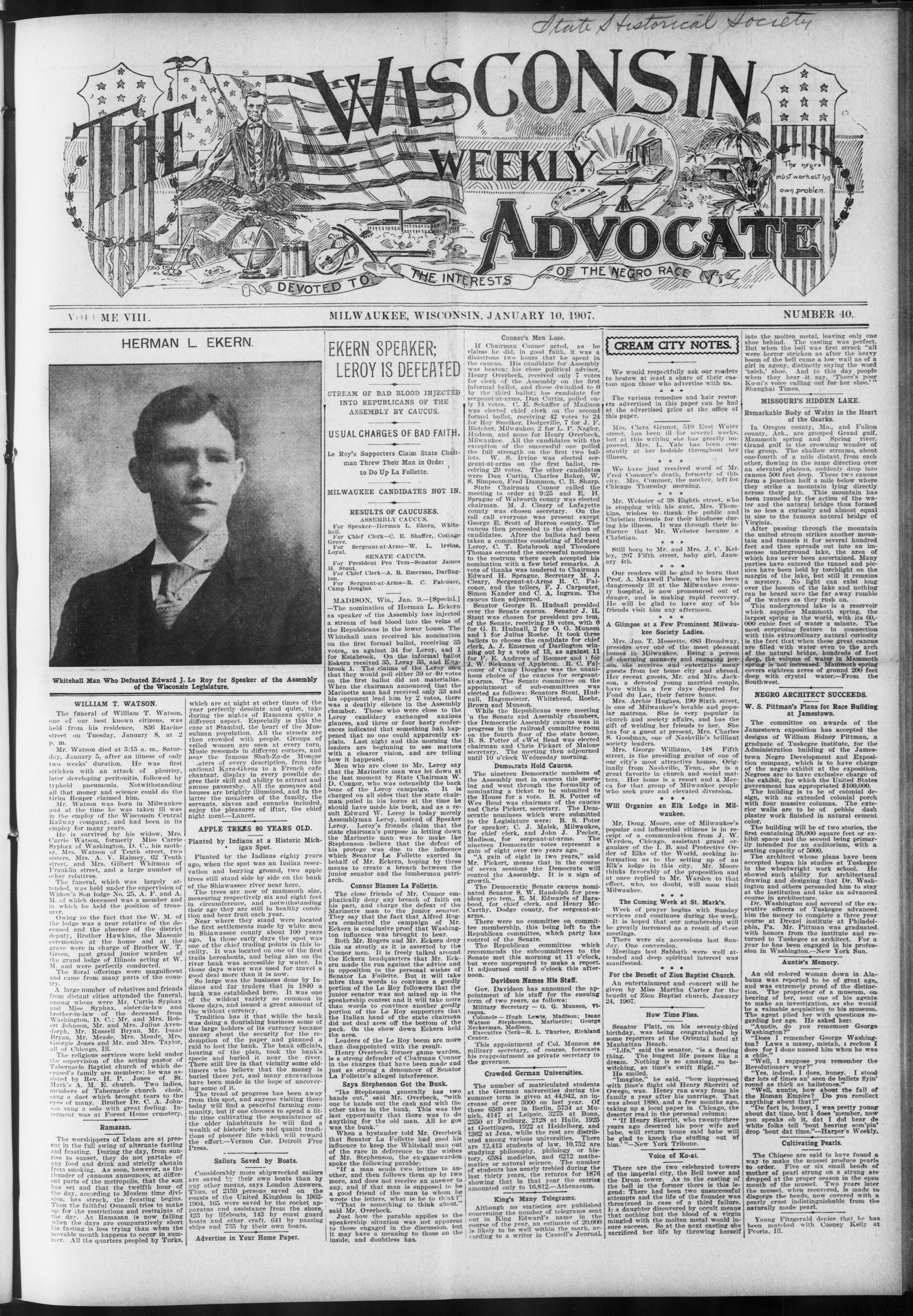
WISCONSIN
WEEKLY
ADVOCATE
DEVOTED TO THE INTERESTS OF THE NEGRO RACE
[Name]
Whitehall Man Who Defeated Edward J. Le Roy for Speaker of the Assembly of the Wisconsin Legislature.
VIII. ME VIII.
Whitehall Man Who Defeated Edward J. of the Wisconsin
WILLIAM T. WATSON
The funeral of William T. Watson, one of our best known citizens, was held from his residence, 836 Racine street on Tuesday, January 8, at 2 p. m.
Mr. Watson died at 3:15 a. m., Saturday, January 5, after an illness of only two weeks' duration. He was first stricken with an attack of pleurisy, later developing peritonitis, followed by typhoid pneumonia. Notwithstanding all that money and science could do the Grim Reaper claimed him.
Mr. Watson was born in Milwaukee and at the time he was taken ill was in the employ of the Wisconsin Central Railway company, and had been in its employ for many years.
He is survived by his widow, Mrs. Carrie Watson, formerly Miss Carrie Syphax of Washington, D. C., his mother, Mrs. Watson of Tenth street, two sisters, Mrs. A. V. Raimey, 62 Tenth street, and Mrs. Gilbert Whitman of Franklin street, and a large number of other relatives. The funeral, which was largely attended, was held under the supervision of Widow's Son lodge No. 25, A. F. and A. M. of which deceased was a member and in which he held the position of treasurer.
Owing to the fact that the W. M. of the lodge was a near relative of the deceased and the absence of the district deputy, Brother Hawkins, the Masonic ceremonies at the house and at the grave were in charge of Brother W. T. Green, past grand junior warden of the grand lodge of Illinois acting at W. M. and were perfectly conducted. The floral offerings were magnificent and came from many parts of the country.
A large number of relatives and friends from distant cities attended the funeral, among whom were Mr. Curtis Syphax and Miss Syphax, sister-in-law and brother-in-law of the deceased from Washington, D. C.; Mr. and Mrs. Robert Johnson, Mr. and Mrs. Julius Avendorph, Mr. Russell Bryan, Mr. Isaac Bryan, Mr. Meade, Mrs. Meade, Mrs. George Jones and Mr. and Mrs. Taylor, all of Chicago, Ill.
The religious services were held under the supervision of the acting pastor of Tabernacle Baptist church of which deceased's family are members; he was assisted by Rev. H. P. Jones of St. Mark's A. M. E. church. Two ladies, members of Tabernacle church choir, sang a duet which brought tears to the eyes of many. Brother Dr. C. A. Johnson sang a solo with great feeling. Interment was at Forest Home cemetery.
Ramazan.
The worshippers of Islam are at present in the full swing of alternate fasting and feasting. During the day, from sunrise to sunset, they do not partake of any food and drink and strictly abstain from smoking. As soon, however, as the thunder of cannons announces, at different parts of the metropolis, that the sun has set and that the twelfth hour of the day, according to Moslem time division, has struck, the feasting begins. Then the faithful Osmanli tries to make up for the restrictions and restraints of the day. As Ramazan is now falling when the days are comparatively short his fasting is less trying than when the movable month happens to occur in summer. All the quarters peopled by Turks,
---
which are at night at other times of the year perfectly desolate and quiet, take during the nights of Ramazan quite a different aspect. Especially is this the case at Stambul, the heart of the Mussulman population. All the streets are then crowded with people. Groups of veiled women are seen at every turn. Music resounds in different corners, and near the famous Shah-Za-de Mosque laters of every description, from the national Kara-Gheuz to a French cafe chantant, display in every possible degree their skill and ability to attract and amuse passersby. All the mosques and houses are brightly illumined, and in the latter the members of the family, the servants, slaves and eunuchs included, enjoy the pleasures of iftar, the chief night meal.—Lancet.
APPLE TREES 80 YEARS OLD.
Planted by Indians at a Historic Michigan Spot.
Planted by the Indians eighty years ago, when the spot was an Indian reservation and burying ground, two apple trees still stand side by side on the bank of the Shiawassee river near here. The trees are now of mammoth size, measuring respectively six and eight feet in circumference, and notwithstanding their age they are still in healthy condition and bear fruit each year. Near where they stand were located the first settlements made by white men in Shiawassee county about 100 years ago. In those early days the spot was one of the chief trading points in this locality. It was located on one of the first trails hereabouts, and being also on the river bank was accessible by water. In those days water was used for travel a good deal more than it is now.
So large was the business done by Indians and fur traders that in 1840 a bank was established here. It was one of the wildcat variety so common in those days, and issued a great amount of the wildcat currency. Tradition has it that while the bank was doing a flourishing business some of the large holders of its currency became uneasy about the security for the redemption of the paper and planned a raid to loot the bank. The bank officials, hearing of the plan, took the bank's specie and buried it near the river. There still live in that vicinity some old-timers who believe that the money is buried there yet, and many excavations have been made in the hope of uncovering some of it.
The trend of progress has been away from this spot, and anyone visiting there today will find a peaceful farming community, but if one chooses to spend a little time cultivating the acquaintance of the older inhabitants he will find a wealth of historic lore and quaint traditions of pioneer life which will reward the effort.—Vernon Cor. Detroit Free Press.
Sailors Saved by Boats.
Considerably more shipwrecked sailors are saved by their own boats than by any other means, says London Answers. Thus, of 2159 persons saved on the coasts of the United Kingdom in 1903. 1904, 165 were saved by the rocket apparatus and assistance from the shore, 423 by lifeboats, 143 by coast guard boats and other craft, 641 by passing ships and 735 by their own boats. Advertise in Your Home Paper.
EKERN SPEAKER; LEROY IS DEFEATED
STREAM OF BAD BLOOD INJECTED INTO REPUBLICANS OF THE ASSEMBLY BY CAUCUS.
USUAL CHARGES OF BAD FAITH.
Le Roy's Supporters Claim State Chairman Threw Their Man in Order to Do Up La Follette.
MILWAUKEE CANDIDATES NOT IN.
RESULTS OF CAUCUSES.
ASSEMBLY CAUCUS.
For Speaker—Herman L. Ekern, Whitehall.
For Chief Clerk—C. E. Shaffer, Cottage Grove.
For Sergeant-at-Arms—W. L. Irvine, Loyal.
SENATE CAUCUS.
For President Pro Tem—Senator James H. Stout.
For Chief Clerk—A. R. Emerson, Darlington.
For Sergeant-at-Arms—R. C. Falconer, Camp Douglas.
MADISON, Wis., Jan. 9.—[Special.]
The nomination of Herman L. Eckern as speaker of the Assembly has injected a stream of bad blood into the veins of the Republicans in the lower house. The Whitehall man received his nomination on the first formal ballot, receiving 35 votes,, as against 34 for Leroy, and 1 for Estabrook. On the informal ballot Eskern received 35, Leray 33, and Etabrook 1. The claims of the Leroy men that they would poll either 39 or 40 votes on the first ballot did not materialize. When the chairman announced that the Marinette man had received only 33 and his opponent lead him by 2 votes, there was a deathly silence in the Assembly chamber. Those who were close to the Leroy candidacy exchanged anxious glances, and three or four hasty conferences indicated that something hah happened that no one could apparently explain. Last night and this morning the leaders are beginning to see matters with a clearer vision, and are telling how it happened.
Men who are close to Mr. Leroy say that the Marinette man was let down at the last moment by State Chairman W. D. Connor, who was ostensibly the back bone of the Leroy campaign. It is charged on all sides that the state chairman puled in his horns at the time he should have made his buck, and as a result Edward W. Leroy is today merely Assemblyman Leroy, instead of Speaker Leroy. Leroy's friends claim that the state chairman's purpose in letting down the Marinette man was to make Ike Stephenson believe that the defeat of his protege was due to the influence which Senator La Follette exerted in behalf of Mr. Eckern, hoping by these means to create a breach between the junior senator and the lumberman patriarch.
Connor Blames La Follette.
The close friends of Mr. Connor emphatically deny any breach of faith on his part, and charge the defeat of the Marinette man to the junior senator. They say that the fact that Alfred Rogers conducted the campaign of Mr. Eckern is conclusive proof that Washington influence was brought to hear.
Both Mr. Rogers and Mr. Eckern deny this as stoutly as it is asserted by the Connor men. It is freely talked around the Eckern headquarters that Mr. Eckern made the run against the advice and in opposition to the personal wishes of Senator La Follette. But it will take mbre than words to convince a goodly portion of the Le Roy followers that the junior senator was not mixed up in the speakership contest and it will take more than words to convince another goodly portion of the Le Roy supporters that the Italian hand of the state chairman did not deal aces off the bottom of the pack. On the show down Eckern held the aces. Leaders of the Le Roy boom are more than disappointed with the result.
Henry Overbeck former game warden, is a strong defender of Chairman Connor in the charges that have been made and just as strong a denouncer of Senator La Follette's alleged interference.
Says Stephenson Got the Bunk.
"Ike Stephenson generally has two hands out," said Mr. Overbeck, "with one he hands out the cash and with the other takes in the bunk. This was the last opportunity that there was to do anything for the old man. All he gos was the bunk."
When a bystander told Mr. Overbeck that Senator La Follette had used his influence to keep the Whitehall man out of the race in deference to the wishes of Mr. Stephenson, the ex-gamewarden spoke the following parable:
"If a man sends two letters to another, and then follows them up by two more, and does not receive an answer to any, and if that man is supposed to be a good friend of the man to whom he wrote the letters, what is he to think?"
"That is something to think about," said Mr. Overbeck.
Just how the parable applies to the speakership situation was not apparent to those engaged in the discussion, but it may have a meaning to those on the inside, and doubtless has.
Connor's Men Lose.
If Chairman Connor acted, as he claims he did, in good faith, it was a disastrous two hours that he spent in the caucus. His candidate for Assembly was beaten; his close political adviser, Henry Overbeck, received only 7 votes for clerk of the Assembly on the first informal ballot, and these dwindled to 0 by the third ballot; his candidate for sergeant-at-arms, Dan Curtin, polled only 14 votes. C. E. Schaffer of Madison was elected chief clerk on the second formal ballot, receiving 42 votes to 24 for Roy Smelker, Dodgeville, 7 for J. F. Bletcher, Milwaukee, 2 for L. P. Nagler, Hudson, and none for Henry Overbeck, Milwaukee. All the candidates with the exception of the successful one polled the full strength on the first two ballots. W. S. Irvine was elected sergeant-at-arms on the first ballot, receiving 29 votes. The other candidates were Dan Curtin, Charles Baker, W. S. Simpson, Fred Dammon, C. B. Sharp.
State Chairman Connor called the meeting to order at 9:25 and E. H. Sprague of Walworth county was elected chairman. M. J. Cleary of Lafayette county was chosen secretary. On the roll call everyone was present except George E. Scott of Barron county. The caucus then proceeded to the election of candidates. After the ballots had been taken a committee consisting of Edward Leroy, C. T. Estabrook and Theodore Thomas escorted the successful nominees to the rostrum where each accepted his nomination with a few brief remarks. A vote of thanks was tendered to Chairman Edward H. Sprague, Secretary M. J. Cleary, Sergeant-at-Arms R. C. Falconer, and the tellers, F. J. Carpenter, Simon Kander and C. A. Ingram. The caucus then adjourned.
Senator George B. Hudnall presided over the Senate caucus. Senator J. H. Stout was chosen for president pro tem. of the Senate, receiving 18 votes, with 6 for G. B. Hudnall, 2 for O. G. Munson and 1 for Julius Roehr. It took three ballots to choose the candidate for chief clerk, A. J. Emerson of Darlington winning out by a vote of 13, as against 11 for F, E. Andrews of Boomer and ) for J. W. Siekman of Appleton. R. C. Falconer of Camp Douglas was the unanimous choice of the caucus for sergeant-at-arms. The Senate committee on the appointment of sub-subcommittees was elected as follows: Senators Stout, Hudnall, Hagemeister, Whitehead, Roehr, Brown and Munson.
While the Republicans were meeting in the Senate and Assembly chambers, the Democratic Assembly caucus was in progress in the railroad committee room on the fourth floor of the state house. B. S. Potter of eWst Bend was elected chairman and Chris Pickart of Malone secretary. The meeting then adjourned until 10 o'clock Wednesday morning.
Democrats Hold Caucus.
The nineteen Democratic members of the Assembly met in caucus this morning and went through the formality of nominating a ticket to be submited to the House for a vote. B. S. Potter of Wes Bend was chairman of the caucus and Chris Pickert, secretary. The Democratic nominees which were submitted to the Legislature were: B. S. Potter for speaker; C. J. Malek, Milwaukee, for chief clerk, and John J. Pecher, Madison, for sergeant-at-arms. The nineteen Democratic votes represent a gain of eight over two years ago. "A gain of eight in two years," said Mr. Pickert, means that in the course of seven sessions the Democrats will control the Assembly. It is a sign of growth."
The Democratic Senate caucus nominated Senator S. W. Randolph for president pro tem., E. M. Edwards of Barabood, for chief clerk, and Henry McCarthy, Dodge county, for sergeant-at-arms.
There were no committee on committee membership, this being left to the Republican committee, which party has control of the Senate.
The Republican committee which recommends the subcommittees to the Senate met this morning at 11 o'clock, but were unprepared to make a report. It adjourned until 5 o'clock this afternoon.
Davidson Names His Staff.
Gov. Davidson has announced the appointment of his staff for the ensuing term of two years, as follows:
Military Secretary - O. G. Munson, VIroqua.
roqu.
Colonels — Hugh Lewls, Madison; Isaac Watson Stephenson, Marinette; George Neckerman Madison.
Executive Clerk-R. L. Thurber, Richland Center. This appointment of Col. Munson as military secretary, of course, forecasts his reappointment as private secretary to the governor.
Crowded German Universities.
The number of matriculated students at the German universities during the summer term is given at 44,942, an increase of over 3000 on last year. Of these 6569 are in Berlin, 5734 at Munich, 4147 at Leipsic, 3275 at Bonn, 2350 at Freiburg, 2128 at Halle, 1925 at Goettingen, 1922 at Heidelberg, and 1362 at Jena, while the rest are distributed among various universities. There are 12,413 students of law, 10,752 are studying philosophy, philology or history, 6584 medicine, and 6212 mathematics or natural science. The number of students has nearly trebled during the last thirty years, the returns for 1876 showing that in that year the entries amounted only to 16.812.-Athenaeum.
King's Many Telegrams.
Although no statistics are published concerning the number of telegrams sent out in King Edward's name in the course of the year, an estimate of 20,000 is likely to be well within the mark, according to a writer in Cassell's Journal.
CREAM CITY NOTES.
We would respectfully ask our readers to bestow at least a share of their custom upon those who advertise with us.
The various remedies and hair restorers advertised in this paper can be had at the advertised price at the office of this paper.
Mrs. Clara Grunot, 519 East Water street, has been ill for several weeks, but at this writing she has greatly improved. Mrs. L. Yale has been constantly at her bedside throughout her illness.
* * *
We have just received word of Mr. Fred Commer's death, formerly of this city. Mrs. Commer, the mother, left for Chicago Thursday morning.
* * *
Mr. Webster of 38 Eighth street, who is stopping with his aunt, Mrs. Thomkins, wishes to thank the public and Christian friends for their kindness during his illness. It was through their influence that Mr. Webster became a Christian.
```markdown
```
Still born to Mr. and Mrs. J. C. Kelley, 207 Fifth street, baby girl, January 4th.
* * *
Our readers will be glad to learn that Prof. A. Maxwell Palmer, who has been dangerously ill at the Milwaukee county hospital, is now pronounced out of danger, and is making rapid recovery. He will be glad to have any of his friends visit him any afternoon.
\* \* \*
A Glimpse at a Few Prominent Milwaukee Society Ladies.
Mrs. Jno. T. Mossette, 683 Broadway, presides over one of the most pleasant homes in Milwaukee. Being a person of charming manners and engaging person she receives and entertains many guests from her home city and abroad. Her recent guests, Mr. and Mrs. Jackson, a devoted young married couple, have within a few days departed for Fond du Lac, their future home. Mrs. Archie Hughes, 190 Sixth street, is one of Milwaukee's lovable and popular matrons. She is very popular in church and society affairs, and has the gift of welding her friends to her. She has for a guest at present, Mrs. Charles S. Goodman, one of Nashville's brilliant society leaders.
Mrs. George Williams, 148 Fifth street, is the presiding genius of one of our city's most attractive homes. Originally from Nashville, Tenn., she is a great favorite in church and social matters. Her home is a resort and a Mecca for that group of Milwaukee people who seek pure and elevated diversion.
Will Organize an Elk Lodge in Milwaukee.
Mr. Doug. Moore, one of Milwaukee's popular and influential citizens is in receipt of a communication from J. W. Warden, Chicago, assistant grand organizer of the I. B. and Protective Order of Elks of the World, seeking information as to the setting up of an Elk's lodge in this city. Mr. Moore thinks favorably of the proposition and at once replied to Mr. Warden to that effect, who, no doubt, will soon visit Milwaukee.
The Coming Week at St. Mark's
Week of prayer begins with Sunday services and continues during the week. It is hoped that our membership will be greatly increased as a result of these meetings. There were six accessions last Sunday. One conversion. Meetings last Sabbath were well attended and deep spiritual interest was manifested.
For the Benefit of Zion Baptist Church.
An entertainment and concert will be given by Miss Martha Carter for the benefit of Zion Baptist church, January 24, 1907
How Time Flies.
Senator Platt, on his seventy-third birthday, was being congratulated by some reporters at the Oriental hotel at Manhattan Beach.
"Life," said the senator, "is a fleeting thing. The longest life passes like a dream. Nothing is so amazing, so bewitching, as time's swift flight."
He smiled.
"I imagine," he said, "how impressed with time's flight old Henry Skerritt of Owego, was. Henry ran away from his family a year after his marriage. That was about 1880, and a few months ago, taking up a local paper in Chicago, the deserter read in the personal column:
"If Henry Skerritt, who twenty-three years ago deserted his poor wife and babe, will return home said babe will be glad to knock the stuffing out of him,"—New York Tribune.
Voice of Ko-ai.
There are the two celebrated towers of the imperial city, the Bell tower and the Drum tower. As to the casting of the bell in the former there is this legend: There had been two unsuccessful attempts and the life of the founder was threatened in case of a third failure. B.s daughter discovered by occult means that nothing but the blood of a virgin mingled with the molten metal would insure success. So at the next casting she sacrificed her life by throwing herself
into the molten metal, leaving only one shoe behind. The casting was perfect. But when the bell was first struck "all were horror stricken as after the heavy boom of the bell came a low wail as of a girl in agony, distinctly saying the word 'hsieh,' shoe. And to this day people when they hear-it say, 'There's poor Ko-ai's voice calling out for her shoe.'" Shanghai Times.
MISSOURI'S HIDDEN LAKE
Remarkable Body of Water in the Heart of the Ozarks
In Oregon county, Mo., and Fulton county, Ark., are grouped Grand gulf, Mammoth spring and Spring river. Grand gulf is the crowning wonder of the group. The shallow streams, about one-fourth of a mile distant from each other, flowing in the same direction over an elevated plateau, suddenly drop into canons 500 feet deep. These two canons form a junction half a mile below where they strike a mountain lying directly across their path. This mountain has been tunneled by the action of the water and the natural bridge thus formed is no less a curiosity and almost equal in size to the famous natural bridge of Virginia.
After passing through the mountain the united stream strikes another mountain and tunnels it for several hundred feet and then spreads out into an immense underground lake, the area of which has never been ascertained. Many parties have entered the tunnel and picnics have been held by torchlight on the margin of the lake, but still it remains a mystery. No light can exist long over the bosom of the lake and nothing can be heard save the far away rumble of the waters as they rush on.
This underground lake is a reservoir which supplies Mammoth spring, the largest spring in the world, with its 60,-000 cubic feet of water a minute. The most surprising feature in connection with this extraordinary natural curiosity is the fact that when these great canons are filled with water even to the arch of the natural bridge, hundreds of feet deep, the volume of water in Mammoth spring is not increased. Mammoth spring covers eighteen acres of ground 200 feet deep with crystal water.—From the Southwest.
NEGRO ARCHITECT SUCCEEDS.
W. S. Pittman's Plans for Race Building at Jamestown.
The committee on awards of the Jamestown exposition has accepted the designs of William Sidney Pittman, a graduate of Tuskegee institute, for the Administration building of the Jamestown Negro Development and Exposition company, which is to have charge of the negro exhibit at the exposition. Negroes are to have exclusive charge of the exhibit, for which the United States government has appropriated $100,000. The building is to be of colonial design, with an extended colonial porch with four massive columns. The exterior walls are to be of pebble dash plaster work finished in natural cement color.
The building will be of two stories, the first containing 38,000 square feet or exhibit space and the second being primarily intended for an auditorium, with a seating capacity of 5000.
The architect whose plans have been accepted began his studies at Tuskegee in the wheelwright work school. He showed such ability for architectural drawing and designing that Dr. Washington and others persuaded him to stay at the institution and take an advanced course in architecture.
Dr. Washington and several of the executive officers of Tuskegee advanced him the money to complete a three year course at Drexel institute at Philadelphia, Pa. Mr. Pittman was graduated with honors from the institute and returned to Tuskegee as architect. For a year he has been engaged in his profession in Washington.—New York Sun.
Auntie's Memory
An old colored woman down in Alabama was reported to be of great age, and was extremely proud of the distinction. The proprietor of a museum, on hearing of her, sent one of his agents to make an investigation, as she would be a valuable acquisition to his museum. The agent plied her with questions regarding her age. He asked her:
"Auntie, do you remember George Washington?"
"Does I remember George Washington? Laws a massy, mistah, 1 reckon I does for I done nussed him when he was a chile."
"Well, I suppose you remember the Revolutionary war?"
"Yes, indeed, I does, honey. I stood dar lots of times an' seen de bullets flyin' round as thick as hailstones."
"Well, auntie, how about the fall of the Roman Empire? Do you recollect anything about that?" "De fact is, honey. I was pretty young about dat time, but I does 'member, now you speaks ob it, dat I did hear de white folks tell 'bout hearing som'pin drop 'bout dat time.'—Harper's Weekly,
Cultivating Pearls.
The Chinese are said to have found a way to make the mussel produce pearls to order. Five or six small beads of mother of pearl strung on a strung are dropped at the proper season in the open mouth of the mussel. Two years later the mussel, when recovered, is made to disgorge the beads, now covered with a pearly crust indistinguishable from the naturally made pearl.
Young Fitzgerald denies that he has been matched with Cooney Kelly at Peoria, Ill.
THE WISCONSIN WEEKLY ADVOCATE
MILWAUKEE, WIS.
R. B. MONTGOMERY, Editor and Proprietor.
Tea-Table Salad.
"Pop!"
"Yes, my son."
"How much 'dough' does it take to make a bank roll?"—Yonkers Statesman.
Brooks—That fellow owes everybody he knows.
Johnson—Yes, and he is rapidly extending his acquaintance; I met him yesterday.—Town Topics.
"I can't understand how a man can commit suicide for love."
"It happens frequently.
"Well, perhaps so, but if I did it, I should regret it all my life."—Translated for Transatlantic Tales from La Saeta.
Butler (who was engaged by a newly married pair)—Humph! He's just dropped to the fact that I've been smoking his cigars and drinking his liquors. Evidently the honeymoon is over.—Translated for Transatlantic Tales from Fliegende Blaetter.
First Small Boy—Do fishes grow quickly?
Second Small Boy—Yes, indeed. Papa caught one two years ago and it grows six inches every time he speaks of it.—Translated for Transatlantic Tales from Le Rire.
"There's no doubt about it," said he, oracularly, "a man is known by the company he keeps."
"Nonsense!" replied the wise girl, "if the average man were really known by his company she'd shake him right away."—Catholic Standard and Times.
Teacher—What is the meaning of "aperture"?
Class (in chorus)—An opening.
Teacher—Tommy Smith, give a sentence containing the word "aperture."
Tommy—All the big stores have had their fall apertures.—Baltimore American.
She Had No Use for It.
Nervous Pupil (to bridge teacher)— Shall I pass this hand to my Maker?"— Harner's Weekly.
The Other Side.
over at last coming into his money. Merritt—On the contrary, he thinks it rather hard to have to sow a second crop of wild oats at his age.—Town Topics.
What's the Difference
"You were pretty prominent at the party last evening."
"Yes; I was feeling my oats."
"Some people were unkind enough to say it was rye."—Louisville Courier-Journal.
From Poetry to Music.
Mother—What's the matter, Olga?
Olga—I've christened my new black cat Dante, and now cook says it's a lady cat.
Mother—Never mind, call her "An-Dante,"—Slovo.
An Impediment in His Speech.
W. T. Turner started to Misenheimer's station in Stanly county Thursday to make a speech. He got left in Salisbury. The train had been gone one hour before he arrived in the city.—Iredell County (N. C.) Mascot.
And Every Dealer Has a Corner.
Bacon—The peanut crop in the United States now amounts to 11,000,000 bushels annually. The total sales amount to between $8,000,000 and $10,000,000. Egbert—And yet the peanut business seems to be at a stand still.—Yonkers Statesman.
The Celebration
"I'm 5 years old today and I'm going to have a birfday party, aren't I, mamma?"
"Yes, Jackie, dear. I've asked all your aunts and your two grandmothers to come in and play bridge this afternoon."
—Town Topics.
No Amateur
"Yes, sare. I was a practical Anarchist for two years, until ze cheap German competition lose me ze job. I have blown up much of ze nobility of Europe."—Sydney Bulletin.
No Hurry
"All the little boys and girls who want to go to heaven," said the Sunday school superintendent, "please rise." All rose but Tommy Twaddles. "And doesn't this little boy want to go to heaven?"
"N-not yet"—London Tribune
The Thing to Do
"Well," said Shem, as soon as the ark touched dry land, "what shall we do now?"
"Start a paper, of course," replied Noah. "What's the use of having this marvelous mastodonic menagerie if we can't advertise it?"—Philadelphia Press.
Modernized
Boni was a smooth one,
Boni was a peach;
Boni came to our house
An heiress for to reach.
She went to Boni's house
(Built at her expense).
Then she threw poor Boni out
With less than thirty cents.
—Philadelphia Ledger.
Put Him Where He Belonged.
Cholly Nowitt—D'ye know, Miss Smart, though I've only just met you, there seems to be a sort of intellectual sympathy between us? You know just how to appeal to my tastes, you see. Are you a literary woman
Dolly Smart-No; I'm a kindergarten teacher.—Tit-Bits.
One Good Turn Deserves Another
Lazy Larry—Say, lady, I'm dat hungry I don't know w'at ter do. I ain't had nothin'—"
Mrs. Goodart—Walk around to the kitchen, poor man, and you shall be fed.
Lazy Larry—Aw, say, dat's a purty long walk, lady; couldn't yer hand it out here just as well?—Catholic Standard and Times.
Happier Nevertheless.
"Yes," replied the shade. "I am far, far happier than when I was on earth with you."
The widow was silent for a moment. Then she said:
"Tell me, James, what is it like in heaven?"
"Heaven?" said James, "I am not in heaven!"—Young's Magazine for December.
PRETTY PEGGY.
His gold beams a-spinning, I asked of the sun
If he ever had any to spare;
"Only once," he replied, "too many I spun,
And I gave them to Peggy for hair."
I asked of the sky if his stars were all right.
I asked of some fays who were cutting out flowers
But we gave them to Peggy for lips."
He said, "If there are any left when it stops,
I'll give them to Peggy for tears."
I artfully coaxed him to spill them all out,
And scatter them over the miles.
THE CHANCE THAT CAME.
The man collapsed into a chair before his desk. In a corner of the room the ticker was clicking out its message, but he paid no heed to it. From the streets outside came men's voices uplifted in mingled despair and rage. Throgmorton street was like pandemonium. Men seemed to have lost their reason. Many were shouting invectives against this man who sat alone in his empty offices. People did not know that he was here. Some declared he had bolted from the country; others were equally positive he would stay and face the music. These last had judged his character accurately.
The schemes which that wonderful financial genius had built up, and in which the public had placed confidence and their money, had fallen to the ground in one fatal hour. Perhaps there was hardly a soul in London who would have believed it, yet the fact remained that Reuben Stern was himself beggared. He left his office, passed from the place which had seen his triumphs, and finally reached the West End. Entering one of the fashionable streets in Mayfair, he paused before a house. Then, setting his mouth a little more grimly, he walked up the steps, and, ringing the bell, asked to see Lady Gertrude Kingsley. She detected at once the anxiety in his eyes and came hurriedly forward.
"Reuben!" she exclaimed. "What is wrong?"
"What is it?" she questioned again. "Tell me at once, please!"
"I am ruined!"
He spoke the words in a dull, lifeless tone, and watched her face. The color died away from it. The sweet mouth suddenly hardened. The eyes lost their softness. Every feature stiffened. She glanced at him in amazement.
"Ruined!" she murmured. "What do you mean?"
"My plans have all miscarried. All that yesterday was mine I have lost, except the most precious thing of all, and that is your love!"
"Did you think me a sentimental schoolgirl? Was it likely that I should love a man who sprang from obscurity, from nothing? Let me be frank with you in this hour. My sisters have, most of them, married well. I mean to marry a rich man. I would have preferred a man of good family; but when you proposed you were too good a match for me to refuse. As for love; am I the woman, do you suppose, who would let love influence her? I would have made you an excellent wife, I have no doubt. I should have liked to be the mistress of a great London house. I wanted to entertain, to be a woman of real importance in my world. And you led me to imagine that every ambitious social dream of mine should be realized." She paused for a moment, and then went on in a low, choking voice, "And now you have the audacity to ask me to share your poverty!"
Her gaze was pitiless in its coldness. A quiver of rage shook her. Her restless hands were tearing at the flowers in her bosom. She was suffering an agony of disappointment. She had felt so secure; had gloried in the anticipated social triumph which this man's money was to purchase for her; had even boasted of the future among her own set, and of the rich gifts it would hold for her. And now to see every promise it had contained melted away.
"Will you please go now?" she said. The Atlantic liner was plowing its swift passage through the sea on its homeward way to England. The day was brilliantly fine, and the smoke that rose in a floating column from the steamer's funnels was the only dark patch against the cloudless summer sky. Two people were slowly pacing the upper deck—a man and a woman. The former was Reuben Stern. He had altered a great deal since that time, four years ago, when his failure had caused a sensation in the financial world.
During the official investigation of his bankruptcy he had remained in England; but this concluded, he sailed at once for the United States. And in these four years, commencing at the bottom again, he had regained a certain standing among the minor financiers of that country. But the longing to return to England had come over him, and, badly in need of a rest, he had decided to go there on a brief holiday. His companion was a woman whose acquaintance he had formed some weeks back at a mutual friend's house. It was with a certain degree of pleasure that he had learned she was also going to England by the same boat.
"Tomorrow, I suppose, we shall say good-bye, Mrs. Poole," he remarked to her now. "I trust, if you are staying in London, you will let me call on you, or do you any service that is possible?"
"You can do me a service," she responded, quietly, "if you will. And that is, help me find some one—some one who I am convinced is hidden in that great wilderness of a city, and whom I have come here to seek!"
"If it is possible," he said, "you may rely upon my doing my best. But you had better give me your confidence."
"There is little to tell." she answered. "I am that despised thing—a deserted wife! My husband left me. We had shared three bitter years together, and then, without a word, he went away!"
"And you want to find him; you care for him still?"
"Oh, no—but, yes, I do want to find him. He treated me as badly as a man
can treat a woman. And yet I must find him!"
"And what is your idea as to the cause of his disappearance?"
She paused some moments.
"It seems a strange fancy," she said at last. "But what I believe is this: He left England under a cloud. In America he continued the same reckless folly. He married me for love, as I thought; but it was merely that I might act as decoy to a gambling den which he secretly ran. Our final quarrel arose from my objections to this infamy."
"But what shall you do, even though you find him? You would surely never live with him again, if he treated you so shamefully?"
"Not for the world!" she said, with a faint shudder. And yet I must find him. It has become the fixed purpose of my life. Some money was left me a few months ago, and this enabled me to start upon my humiliating quest. Until then I was poor. I had to work hard for a scanty living." He looked at her keenly.
He looked a her friend.
"I believe," he said, "that you must care for him still."
She shook her head once more.
"It would cost me hardly a pang to hear that he was dead," she replied, "And yet. I must find him. Perhaps people's pity has galled my pride, and made me determine that my husband should acknowledge me as his wife under his right name, although we should never be more to each other than mutual bearers of that name."
"You are a woman whom most men would be proud to call their wife," he answered, seriously.
When they reached London Mrs. Poole gave him all the knowledge she possessed of her missing husband. The details were meager enough, and she hadn't even a photograph to aid them. Stern found that he possessed aptitude for detective work; but profitless weeks passed by. One afternoon, however, he received a telegram from Mrs. Poole: "My search is at an end!" He went at once to her rooms.
"We met face to face in London yesterday!" she said. "For a moment he tried to deny me; but seeing it was useless, he hurriedly promised, upon my giving him my address, to let me hear from him today! He would not let me detain him, but broke away from me in a few moments. I was helpless."
"What shall you do if he does not write?"
But she did not answer him. Her eyes were staring strangely at an evening paper which he held in his hands.
Some words at the top of the page had caught her gaze. She snatched the paper from his hands with a cry, and read the few lines beneath the heading.
"Is—is that his answer?" she asked, in a trembling voice.
Stern read where she indicated. "We regret to announce that Sir Stephen Jesson met with a fatal accident in the hunting field this morning. It will be remembered that the unfortunate baronet came into the title, quite unexpectedly, a couple of years ago, three strong young lives having dropped out. Every one will sympathize with Lady Gertrude Jesson, who, as Lady Gertrude Kingsley, was the loveliest debutante of her year."
"He was a villain all through, you see," said Edith Pooie. "He married this woman while I still lived. He has ruined her life as well as mine. What shall I do? Shall I put forth my right to this man's name, and take it away from her? Or shall I forever keep back the truth that would strip her of everything?"
He did not answer. His features were fixed. He saw clearly, like a picture before him, a certain scene in a Mayfair drawing room—he heard a woman's hard, merciless voice, her insulting words. He remembered the utter desolation which this woman had created in his darkest hour. Time's whirligig had turned, indeed, and brought with it this miraculous chance of crying quits with the one whose cruelty it had taken him four years to forget. The temptation gripped him. Why should she not be dragged down into the dust—her pride humbled, as nothing else except this one unlooked for thing could have power to humble it? Then he crushed down the ignoble desire.
As suddenly as it had come up before him the black past vanished in a cloud of sunshine, out from which Edith's pale serious face, with that strange, altered look that he had noted in it of late shone forth.
"What shall I do?" she asked again. "Guide me."
He took her hand in a gentle grasp.
"Let this woman keep her empty honors. And for yourself—forget that you are this man's widow. Become my wife."
His tone was unmistakable. She looked at him with glowing, wondering eyes. He was struck by her sudden bewildering beauty.
"Do you mean it?" she whispered.
There was no need for any spoken answer, and she crept into the shelter of a strong man's arms held out to receive her.—Modern Society.
See Sea Serpent in Winter.
Midwinter is not the time which the sea serpent usually selects to disport himself in view of incredulous humanity, but this time the interesting creature has seen fit to make an exception. Everyone who has visited Stockholm, Sweden, knows Saltsjobaden, the charming little pleasure resort situated where the Malar lake joins the Baltic. It was there that the fearsome denizen of the deep was seen; not by uneducated fishermen or unreliable mariners, but by Herr Victor Ankarkrona, equerry to King Oscar. This gentleman and some aristocratic companions state that they saw the monster about 200 yards from the shore, moving through the water with the velocity of a motor boat, and making a tremendous wash.
The creature is described as being grayish brown in color, and with a head like a giant tortoise. Its length is variously estimated as between 45 feet and 60 feet. The serpent was visible for only about half a minute, and then disappeared below the surface. Profs. Schneiver and Leonberg, both eminent biologists, hazard the opinion that the beast may have been a large gray sea lion, but those who saw it stoutly maintain that it was a sea serpent, and nothing else.
Range Horses Are Scarce.
Charles Clancy, a well known horseman and government contractor, returned from a trip to Union county, Ore., where he shipped four carloads of horses for the use of the United States army in the Philippines. Mr. Clancy declares that the day of the range horse in Washington and Oregon has passed, and that animals suitable for cavalry purposes are becoming fewer in the northwest every year.
good horses," said Mr. Claney, "and it is now difficult to pick up a large band of animals having sufficient size and weight for the uses of the government. The rules of inspection by the government officers are very rigid. There are very few bands of well bred horses to be found either in eastern Oregon or Washington. Indian ponies, or cayuses, are not so scarce, but they are not suited to the needs of the government. The time has come when the coast buyers are forced to go further east for their stocks, and this will continue as long as the present demand for sound and good-sized animals exists."—Seattle Post-Intelligencer.
PROMINENT PEOPLE.
JAMES A. TAWNEY of Minnesota, whose name is being mentioned in connection with the speakership of the Sixtieth Congress in the event of the retirement of Mr. Cannon, was born in Adams county, Pennsylvania, January 3, 1855. He lived in Pennsylvania for twenty-two years, a considerable part of the time in the town of Punxsutawney. He was a blacksmith by trade, but his fame in those early days rested chiefly upon the fact that he was the leader of the Punxsutawney band. In 1887 Mr. Tawney found his way to Winona, Minn. where he took up his trade as blacksmith and determined to become a master mechanic. He had studied in common schools and in night schools and developed a decided liking for the law. He pursued the study of law and was admitted to the bar in 1882. Mr. Tawney was elected a member of the Fifty-third Congress. The late Thomas B. Reed was attracted to the somewhat raw western statesman, and encouraged him in his congressional work. Mr. Tawney's devotion to his duties in the House, his aggressive nature and his popularity among his colleagues earned him consideration and prominence very early in his congressional life and aided in his successive re-election as the representative of the First Minnesota district.
BLANCHE WALSH, the well known American actress, was born in New York city, January 4, 1873. Her birthplace was at 36 Mott street, now the heart of Chinatown. Her father was one of the old-time political leaders and when he was made the warden of the Tombs Miss Walsh with the rest of the family went to live in the famous prison. Here she continued to reside until she made her professional debut in 1888. Her first appearance was in a small part in the popular old melodrama "Siberia" at the Windsor theater. But at the age of 16 Miss Walsh was playing Olivia to Marie Wainwright's Viola in "Twelfth Night." In Miss Wainwright's support, three years later, she also enacted the role of Queen Elizabeth in "Amy Robsart." Her portrayal of this character attracted the attention of Charles Frohman and he engaged the young actress for a prominent part in Bronson Howard's "Aristocracy." In this play she won her first notable success. Since that time she has made several decided successes on the stage. For several seasons she added to her fame by starring in the Sardou plays first presented in America by Fanny Davenport. But it was in Tolstoi's "Resurrection," presented three years ago, that Miss Walsh achieved her greatest success.
RT. REV. JOHN SHANLEY. Roman Catholic bishop of Fargo, N. D., was 55 years old Jan. 4 and numerous messages of congratulation were received at the bishop's house. Bishop Shanley is a native of New York state, but lived the greater part of his life in St. Paul. He was ordained to the priesthood in 1874 and has been bishop of Fargo since 1889.
JOHN COIT SPOONER, United States senator from Wisconsin, was born at Lawrenceburg, Ind., January 6, 1843. When he was a lad of 16 his father removed to Madison, Wis., and young Spooner entered the state university, whence he was graduated in 1864. He took up arms for his country and fought as a private in the ranks of the Fiftieth Wisconsin Volunteers. At the close of the service he was brevetted a major, but has never used the title. At the close of the war he became the military and private secretary of Gov. Lucius Fairchild of Wisconsin. He was admitted to the bar in 1867, and served as assistant attorney general until 1870, when he removed to Hudson. Wis., where he practiced law for fourteen years. He was a member of the Legislature in 1872.
In 1885 he was elected to the United States Senate, to succeed Senator Angus Cameron. In 1889 the Wisconsin Legislature was Democratic and Senator Spooner was retired by William F. Vilas, Democrat. In 1892 he received the Republican nomination for governor, but was defeated at the polls. In 1897 he was again elected to the Senate, to succeed Senator Vilas, and in 1903 he was re-elected.
DAVID S. BISPHAM, the famous baritone, was born in Philadelphia, January 5, 1857. He was educated at Haverford college, and for a number of years was an amateur singer before taking to the operatic stage. He studied music under Vannuccini and Lamperti in Italy, and the popular teacher, Shakespeare, in London. For many years he was engaged in business and it was not until chance or good fortune enabled him (rather later in life than most singers) to give his entire attention to art, that he became a professional. London, a city to which Bispham is largely indebted for his success, first heard him on the concert platform, in oratorio and as a ballad singer. Later he secured an opening as an operatic singer in "La Basoche" at the Royal English Opera house. Since 1891 he has been the principal baritone at the Royal Opera, Covent Garden. During several seasons in America he established himself as a favorite by his impersonations of Frederick von Tebramsend, Alberich, Iago, Beckmesser and Wotan.
She Is with Us
The thoughtless lady who sublimely trails her skirts behind her down a crowded stairway.
The panicky lady who excitably clutches strangers by the arm when crossing the street.
The selfish lady who superbly blocks up doorways with social chitterchatter.
The indecisive lady who stops and starts, and stops and starts again, and makes everybody behind her swear, when choosing her seat.
The indolent lady who walks leisurely around in the revolving door, and lets some one else do her share of the pushing.
The mentally muddled lady who is displeased with everything she bought, and is now making life miserable to the exchange clerks.
The Masculine Glove
This is true of both the walking and evening glove.
For evening it is white, stitched in white or light pearl. White gloves with black stitching are not in vogue. The walking glove is tan or gray suede. Heavy dogskin gloves come in tan or black. These are called driving gloves, but are fine for all sorts of winter wear.
A TRIBUTE TO DRY CODFISH.
She wrote to her daddy in Portland, Me., from out in Denver, Col.
And she wrote, alas, despondent, that life had begun to pall.
And this was a woful, woful case, for she was a six months' bride
Who was won and wed in the state of Maine, by the side of the bounding tide.
And ah, alack, she was writing back that she longed for Portland, Maine.
Till, oh' her feelings had been that wrenched she could hardly stand the strain;
Though her hubby dear was still sincere, she sighed the livelong day
For a good old sniff of the sewers and salt from the breast of Casco bay.
And she wrote she sighed, and she said she cried, and her appetite fell off.
And she'd grown as thin as a belaying pin, with a terrible hacking cough;
And she sort of hinted that pretty soon she'd start on a reckless scoot.
And hook for her home in Portland, Maine, by the very shortest route.
But her daddy dear was a man of sense, and he handles fish wholesale.
And he sat and fanned himself awhile with a big broad codfish tail;
And he recollected the way he felt when he dwelt in the world's fair whirl;
He slapped his head, "By hake!" he said, "I know what ails the girl."
And he went to a ten-cord pile of cod and he pulled the biggest out.
A jib-shaped critter 's broad 's a sail—three feet from tail to snout—
And he pasted a sheet of postage stamps from snout clear down to tail.
Put on a quick delivery stamp and sent the cod by mail.
She smelt it a-coming, two blocks off, on the top of the postman's pack;
She rushed to meet him and scared him blind by climbing the postman's back.
But she got the fish, bit out a hunk, ate postage stamps and all.
And a happy wife in a happy home lives out in Denver, Col.
—From a Charlottetown (P. E. I.) Exchange.
BRIEF NOTES OF GENERAL INTEREST
Chris Kenblekamp of Bellevills, Ill., has received $1 from Fred Brandmeier, a former employee who is now living in Waukesha, Wis., says Kenblekamp. Eight years ago, so Brandmeier writes, he went into Kenblekamp's cellar and took some wine. The sin has weighed on his conscience and he sent the $1 bill to square the old account.
There was trouble on the Hudson River Telephone company's line between Goshen and South Centreville, New York, and linemen were sent out to investigate. Just beyond Centreville in the town of Greenville the men found a big-horned owl on the wires. Its wings were spread out and it was entangled in the wires, cutting off the circuit. In its talons was a rat, also dead, both having met death by electricity.
Jewels, principally diamonds valued at $50,000, have been recovered by the Atlantic Coast line and were sent to Dionysius Miranda, a Cuban, who awaited their arrival at Jacksonville, Fla. Senor Miranda and his wife left New York December 31. At Jacksonville they complained of the loss of the jewels. The gems were found by a negro porter in the closet of a combination car where, it is suggested, they may have been left by the thief.
"Of late I never started on a railroad journey without wondering how it will end—whether it will not be my last. The enormous increase in the volume of traffic has caused it to become a common practice on many roads to allow three trains on a block at the same time. Practically they run on sight."
This startling statement was made by President James J. Hill of the Great Northern road to a high official of the government, who talked with him in New York on the present aspects of the transportation problem.
The police reporter in his native state is a highly intelligent being, and can give the best police department sleuths cards and spades and then beat them at their own game, in the opinion of Chief Kohler, who bosses the Cleveland (O.) bluecoats.
In his annual report to Mayor Johnson, Kohler makes the recommendation that the police reporters employed by the various Cleveland dailies be given police powers, and that they be made members of a secret detective department connected with the force.
President Roosevelt's idea of having James B. Connelly, the writer of sea stories, do for the American navy what Rudyard Kipling has done for the British army in his "Soldiers Three" tales, has been frustrated by publicity. Connelly enlisted, but naval officers say that his mission has been entirely annulled by its purpose having become known. They insist that the average blue jacket will decline to take him into his confidence, and the result of his investigation will be only hot-air yarns from sailors who delight in loading the stranger.
The boarders at the Exchange hotel in Marinette, Wis., were unexpectedly turned out of their beds the other morning by the employes of a Menominee department store, who had been sent to recover furniture on which default in payments had been made by the proprietor of the hotel, Joseph La Chance, who suddenly left for the west. It was about 3 o'clock when the boarders were made to hurriedly dress and vacate rooms so that possession could be obtained of the beds and bedding, and as angry a lot of men and women as is often seen was the result.
L. B. Hicks announces that he has quit the stage forever. Hicks is the man who for fifteen days was buried alive in a tunnel of the Edison Electric company on Kern river, and whose rescue attracted the world's attention. He made his debut at Los Angeles, Cal., recently, as an actor, and a sorry spectacle he was. Hicks had been coached thoroughly and had committed to memory the story of his amazing escape from death. At the last minute Hicks balked. He refused to go on the stage at all. He finally consented to take a seat in the first row and answer questions. When the first question was asked he demanded a chew of tobacco before answering.
A letter written in Arabic has been received by President Roosevelt from the Sultan of Morocco expressing his gratitude for the appointment of Samuel R. Gummere as American minister to Morocco.
The Sultan addressed the President as "The beloved, the most cherished, the exalted, the most gracious friend, most honored and excellent President of the republic of the United States of America, who is the pillar of its great influence and the director of its most important affairs, the most celebrated preserver of the ties of true friendship, the faithful friend, Theodore Roosevelt."
Minister Gummere, the letter says, will be shown every courtesy and attention by the government of Morocco.
1. Stephenson of Marinette, Wis., was presented with a gift on New Year's day which he prizes highly. At the same time a gift, which is a duplicate, was started on its way to King Oscar of Sweden.
It is a full rigged ship, a man of war,
as built fifty years ago. It is about thirty inches long and eight inches beam, and was made by John Sundin, a boat builder and veteran sailor of this city. The vessel is complete in detail, even to the ornaments, the officers' landing stairway, cannon, life boats, masts and rigging. Mr. Sundin named the boat "Queen Victoria, of London, England." It is enclosed in a large glass case. The two ships have taken months to complete. Mr. Stephenson sailed in his younger days and the gift on that account has special significance.
Hans Kohlen, an eccentric character in Stevens county, Washington, has sold his fine ranch, four miles west of Fruitland, and will re-enter civilization, after being almost a recluse for twenty-three years. All this time he has been a bachelor, and almost a hermit. He cleared his farm, built a house, and fenced the land absolutely without assistance. Kohlen never owned a team, carrying logs and rails on his back for long distances, while at work on his place. During twenty-three years Kohlen never cut or combed his hair. For many years Kohlen's bed has been a big dry goods box, half filled with hay. Daily at sundown, he drew on a gunny-sack, buried himself in the hay, and slept comfortably. S. Davis purchased the ranch for $2500. With the proceeds of the sale Kohlen proposes to return to his native home in Germany.
Married in opposition to the wishes of the bride's parents, divorced in two years after the ceremony, and remarried after a separation of eighteen years are the three chief events in the lives of Mr. and Mrs. John Archibald of Chippewa Falls, Wis. The bride, whose maiden name was Miss Maude Anderson, met John Archibald twenty years ago and both fell in love at sight. She was then 12 years of age and he 24. Two years later they were married despite the strenuous objection of the bride's parents. Mr. and Mrs. Archibald lived together five weeks, when gradually misunderstandings arose and a separation followed. They never quarreled, but simply drifted apart. Two years later Mrs. Archibald secured a divorce.
Since then their relations have always been most cordial and a regular correspondence has always been kept up. Both have felt that they were making a mistake and their second marriage followed. Mr. Archibald has been a resident of Stevens Point for the last twenty years.
John Darrough, a 64-year-old veteran of the Civil war who resides in Omaha, is not drawing a pension to which he is entitled because he is too modest to strip for the necessary medical examination. Darrough is an invalid, and friends who have insisted that he apply for relief have just learned the old soldier's reason for not making application.
In order to get women's underwear, of which he is passionately fond, George Steffan of Manayunk turned firebug and set fire to fifty houses near Philadelphia. Steffan is in Moyamensing prison. His motive for starting the fires puzzled the police until a patrol sergeant and a special officer located his room. Then the mystery was solved. In a valise big enough to be a trunk, the policemen found all kinds of women's things.
"I love women's things," he said. "I'd do almost anything to get them."
Steffan admitted that he set fire to many houses; that while the houses were burning he would manage to slip inside and procure some women's finery and then escape.
Senator Beveridge of Indiana, an exponent of the strenuous life, hurried into the white house recently to talk with the President. Rain was failing heavily, but the Hoosier statesman carried no umbrella.
"Where's your umbrella?" asked a friend who encountered him.
"Umbrella?" snorted Beveridge. "I never carry an umbrella. An umbrella is a sign of an effete and decadent civilization. I like to walk in the rain, and a man that does not ought to wear petticoats."
Maybelle Florence Howe De Perez was legally wedded to a house and lot at Chicago, recently. If she ever wishes to marry a man she must divorce herself from the plot of land and pile of brick. She cheerfully accepted the property for better or worse. Having already entered into the holy bonds of matrimony only to find it was a joyless path leading to the divorce court, she announced that she could dispense with romance and proposals as long as the tenants paid the rent with regularity. Mrs. De Perez became the owner of 436 Elm street, Chicago, by means of quitclaim deeds filed by relatives, who wished to provide her with an income, but did not wish to support any husband whom she might annex. The papers read:
"This property shall remain an estate for life, providing the said Maybelle Florence Howe De Perez continues unmarried during said term, but in event of her marriage said estate for life shall cease, and become of no force and effect."
---
A case of mistaken identity has proved embarrassing to Dr. W. F. Biederwolf, an eminent evangelist, who recently conducted a series of revival meetings in La Crosse. Dr. Biederwolf stopped at the Hotel Stoddard. During his stay a convivial traveling man who resembled him occupied apartments on the same floor. Midnight suppers in which wine flowed freely were features of the stay of the traveling man. The impression went abroad that the man with the thirst was the evangelist who nightly was holding forth against the evils of intemperance.
Patrick Kaddon, of Hammond, Ind., one of the oldest fishermen on the south shore of Lake Michigan, has a new fish story and the fish itself as proof and affidavit of one of the most wonderful catches ever made in Lake Michigan. With a party of friends in a small boat two miles out in the lake, ten miles east of Hammond, Kaddon struck a school of large sturgeon and netted a monster of the deep that amazed the fishermen. It was the largest ever seen by them. They got it in the boat with great difficulty, the cockleshell of a vessel being nearly swamped.
When they got it ashore the sturgeon scaled more than 500 pounds. In the fish's side, protruding from its gill, was a pair of large tongs, the prongs being imbedded in its body. The news of the wonderful catch traveled up and down the lake shore and attracted many visitors to the Kaddon resort. Among them was Richard Much, a saloon keeper of Clarke Station, who two years ago was noted as a lake fisherman. He identified the tongs as his own.
On June 14, 1904, Much and his sons were fishing off the Hammond shore, three miles out, when they hooked an enormous sturgeon. When they drew it to the boat's side Much seized the huge fish through the gills with a pair of tongs. Enraged with pain, the sturgeon lashed the water so that the boat was swamped, and the four men thrown into the lake.
The men hung on the gunwale of the overturned boat for four hours, when they were seen by the South Chicago life saving crew and rescued. Much never fished again.
GOSSIP FOR THE LADIES.
```markdown
```
I Shall Find Rest.
There will be time—I shall find rest anon.
Thus do we say, while eager youth invites
Young hope to try her wings in wanton
flights.
And nimble fancy builds the soul a nest
On some far crag; but soon youth's flame
is gone—
Burned lightly out—while we repeat the jest
With smiling confidence—I shall find rest
little further on
A little further on—
I shall find rest; half-fiercely we avow
When noon beats on the dusty field, and
care
Threats to unjoint our armor, and the glare
Throbs with the pulse of battle, while life's
best
Flies with the flitting stars; the frenzied
brow
Pains for the laurel more than for the breast
Where Love soft-nestling waits. Not now,
not now.
With feverish breath we cry. I shall find rest
I shall find rest; half-sad, at last, we say,
When sorrow's settling cloud blurs out the
gleam
Of glory's torch, and to a vanished dream
Love's palace hath been turned, then-all
depressed.
Despairing, sick at heart—we may not stay
Our weary feet, so lonely then doth seem
This shadow-haunted world We, so unblest,
Weep not to see the grave which waits its guest:
And feeling round our feet the cool, sweet clay.
We speak the fading world farewell and say:
Aunt Rebekah's Letter to a Husband.
My Dear Nephew Thomas: Your letter made me feel very sad. How many of your husbands would walk right out of harness today and leave the remainder of the team in the rut if you weren't bound to feel mean about it? Then, too, you know you would be hissed out of the country by your fellow sufferers. Well, if you have heaps of misery you have plenty of company.
But see here—you might avert the greater part of your misery by simply employing some of your business tact at home.
If you refuse a man an order for goods do you thunder at him? You don't tell him, in tones that can be heard for a square, that he "ought to know better than to ask you to buy goods with business in such a bad condition. With coal so high and the rent to pay and various other expenses to meet, the idea of expecting you to lay out more money is too ridiculous to be considered for a moment." No! You at least give him a hearing, and if you must refuse him you do it like a gentleman.
At the end of the week you expect to hand out the pay envelopes to your employees; they have worked for their money and you give it to them and don't dare growl about it. How is it at home? Your wife has worked, saved, managed, that your home may be what it is—what does she get for her labor? You pay the bills, you say? Why shouldn't you? Isn't she your wife? Hasn't she worked for you? If she worked half as hard for any one else she would receive at least 84 per week and her board and lodging. Four whole dollars a week in actual money—think of it! Two hundred and eight dollars a year given her without a growl. How many hard working, true, conscientious, devoted wives receive that amount?
You give your wife all the money, you say. Yes, she may hold the money for the butcher, the baker, the grocer, the ice and milk men from Friday night until Monday morning and after paying their bills keeps the change. There may be as much as fifty cents over. Well—"Johnnie needs stockings," you hint, and "perhaps she couldn't do better tiam buy him a pair, the poor little fellow!" This has gone on week in and week out, "the change" always going for something for house or family. At last your wife needed something for herself and you were amazed. Hadn't you given her every cent you could spare? If she hadn't managed to get out enough for her own personal requirements, was that your fault? you asked her.
A year, two years of this, and what happens? This particular woman, this wife of yours, is a high stepper and won't stand such treatment—what does she do? What does any woman do under such circumstances? One of two things, either remain true to her husband or not. You are fortunate in that your wife has chosen the former course. She has cried and prayed and reasoned it all out with herself and decided that since the man of her choice has no money for clothes or necessities for his wife, she must earn it herself.
So she takes in sewing, or lets out rooms—and many a penny that she earns goes toward making your home more comfortable. Now things go more smoothly—there are fewer, if any, wrangles over money. Your wife actually begins to "dress up" again. There are times when she looks "real sweet," and you tell her so, pleasantly, but she treats your remarks with indifference, you turned from her with a sigh and a heavy heart. Why does she treat you so indifferently when you do everything to make her happy? Everything but support her, yes—you never noticed how she looked nor apparently cared, until she earned her own clothes. She might have gone in rags while the money for them was to come from your own pocket.
She was willing to work, to save, to manage, so long as she was an equal partner, but when you shoved her into the position of an upper servant without the upper servant's wages, to her reasoning, you shut her out of your heart. And so you must take the consequences. She is going her own way, you may go yours, the breach growing wider daily. I am sorry for you; even yet you may turn back. Let me know how things go.—Aunt Rebekah in Philadelphia Evening Bulletin.
Henry James on Women's Speech
Mr. Henry James' remarkable series of papers on "The Speech of American Women," now appearing serially in Harper's Bazar, is creating great interest in feminine American circles. Mr. James handles his subject without gloves. For example, in the January Bazar he says:
"I am still piously aware of the continued existence of two eminent ladies (to confine the number to those it's convenient to mention) who recently were to strike me afresh as supremely perpetuating, for an all but thankless age, the interesting tradition; one of them, in the New England capital itself, rarely beautiful of voice, full of years and honors, and devoted, with every enhancement of wit and ardor, to great causes; the other, of illustrious name, guarding the good idiom, and the good use and the pleasant sound of it, in the particular elm-shaded air in which it was perhaps most at home, and with a fidelity that fairly makes of her admirable continued presence a lesson and a reward for the pilgrim curious of history, of poetry, of linguistics.
"One's stupefaction then was in one's watching the modern process with a
mind full of such facts as those—the modern process of the apparently bland acceptance of the rising tide of barbarism by those who had so many reasons to 'know,' and who would have had so many rights to protest. There it was, while a whole group of Boston maidens slobbered unchecked, that the restless critic, lonely outlaw, could yet supremely feel that, in spite of the dire discredit attaching to criticism, something still might, as the phrase is, be 'done.' What this effective thing may hope to be he doesn't just now pretend to say: all he does is to see a possible first dawn of it in some indication, however limited, of the presence and intention of criticism. What will come after it will certainly be of profit to see; but without that beginning, still more certainly, nothing whatever will come. Everything, on the contrary, will go; so far, that is, as there is anything left to go in an order from which—and among 'such pleasant people,' such animated, bright-eyed young women, all articulating as from sore mouths, all mumbling and whining and vocally limping and shuffling, as it were, together—a small significant occurrence comes back to me. I had happened, had perhaps even sought to mention, occasion favoring, that it was of a fortunate effect, as in the enunciation of such a word as 'due,' to keep it quite distinct from such a thoroughly other word as 'do:' and I had ventured to follow this up by the hint that, in like manner, we get a value in the articulation of 'suit' that we quite lose when we make its two vowels operate like those in 'boot;' whereupon I was promptly to find that I had challenged a deep-seated skepticism, not to say an appreciable resentment."
What Women Are Doing.
In the United States there are at least one million more men than women. Immigration has caused this increase of numbers with the male portion of humanity. While statistics are mostly correct in this respect, yet one can not help but think there was a mistake some place when it was stated that only one-tenth of the females of the United States are engaged in work outside their natural spheres, their homes. To view the business districts of any metropolis, one will wonder if there are any women left to attend to household duties. There are comparatively few large business houses or factories where women are not employed. From time to time some manufacturing concern resolves to pay higher wages and have men only in their employ, and for a time there is a painful absence of typewriters, bookkeepers and other office girls. A short reign of this kind and we see the girls in their old positions.
Fortunately everything has "American" stamped upon it in our country, and the American women are as much the promoters of improvements as the men. They never have gained the authority they so earnestly have striven for in political realms, yet there are thousands and thousands of women who never wish that honor (?), and all credit is due their superior judgment in that respect. A woman is a queen of her own household until she tries to take away men's privileges to protect our country and families in their own strength of mind and muscle if needs be. Take all you can get from the man, but give him the right to vote for both.
Women are not moving out of their realms of womanhood to better humanity in their philanthropic work; she is needed there, and her mission is a glorious one. Women are at the heads of civic creeds, and here is where every man should take off his hat to the women who are earnestly trying to improve beautiful America.
In past ages but few women could take time from their duties to read and study to get broader views of life and its needs for the people. They were a humble class of women, content with the home and home duties, but the time has come in this progressive age, when it is well women know when and how to take up their own interests. If women were not great readers the patronage of the world of journalism would go begging, for the majority of readers are the women folks of the household. Men read the newspapers, yet the magazines and journals are read by the women
Women have succeeded as doctors, yet, strange to say, when a woman gets very sick she is going to place her life in the hands of a man physician. There are a great many women who make remarkably good lawyers, yet the majority of them are backed by the head member of "her firm." Sometimes we hear of some who go ahead rough-shod and make a swath ten miles wide in their rush to the goal. They get there, and a stampede follows them.
A woman is a woman as long as she keeps within the bounds of what is womanly. When she leaps this boundary she may be on an equality with men, yet we doubt whether the satisfaction of being mayor of some city, justice of the peace for some district, and country doctor for some province is just exactly what she mapped out when she was a young girl, in the heyday of her youth, and got into the rush and had to sink or swim, live or die, or go out stump-speaking for an existence. Women may go where they please, get entangled in all sorts of business intrigues, but nine out of ten prefer to sit down in a cozy chair at home and make baby clothes rather than the laws of the whole nation. — Margaret Humphreyville, in Woman's National Daily.
Pity the Small Boy.
He was a little fellow—and apparently ly was angry beyond his weight.
ly was angry beyond his weight. He wasn't saying a word, but there was a thunder-and-lightning atmosphere all over his small countenance.
In this savage possession of his dimpled and rosy face was the revelation of a yearning to get even with somebody or something.
Probably not a child in Egypt, in the time of Pharoah, looked more oppressed than did this small male person sitting on the front steps, his elbows on his knees, and his chin resting on the palms of his hands—a woeful little clasp, intoxicated with a thirst for rengeance.
It is often the better part of valor to go shy of approaching the belligerent-looking man. But a little lad with a cyclonic appearance—well—the supposition is natural that he is easily knocked out.
So the boy on the front steps with the tempest-tossed soul was asked for an explanation.
"What's the matter?" he repeated, glaring a sense of outraged justice in his brown eyes. "Oh, it's all right—but I'll show 'em some day!—just you wait!—I've been running their durned errands all day!—and now when I want to go play a spell with Joe, as they promised I might, I have to sit here and wait—and wait—and wait—while Sarah writes a letter a mile long to her beau!—oh, he'll get that letter all right—I have to take it to him—you bet he'll get that letter—nit!" and he glowered ominous significance.
The conciliatory dodge was tried with the small insurgent. It didn't work. He shrilled out in negation—
"Oh, say!—you haven't chased over all creation for their bread and shoe-buttons and butter and a postage stamp and sugar and stove blacking—oh say!—I just wish you had to do a hundred er-
rands in a minute and get scolded 'cause you didn't do 'em quicker—of course, you think it's a snap!" At this juncture the boy was called into the maternal presence.
into the maternal presence. It is safe to surmise that the lad delivered the letter to "Sarah's beau" just as he was told to do—and it may be hoped that thereafter he got his chance to play with Joe.
As a matter of fact, there was a good deal of righteous reason in the little chap's rebellion. On that particular day, as on many other days, he had been the rough-and-ready convenience of his mother and sisters. He had been the carry-all for the family until he felt there was imposition in the service.
The little fellow's feelings were pretty close to the truth.
Certainly, the boy should be of some use in the domestic realm. He should be willing to wait upon members of the family. But it isn't right to keep him vibrating between the house and the shop because grown-up folks think of but one needed article at a time when they require several in immediate succession. Should not their older heads save his younger heels?-Exechange
"Color Sense."
For more than a year and a half I have been studying women, says Elizabeth Anstruther in The Complete Beauty Book (D. Appleton & Co.), on the streets, in the cars, in public and private assemblies, and in their homes, with a view to classifying in some helpful way the most common sins that women commit against good taste in dressing, and I have come to the conclusion that a lack of "color sense" is at the basis of so many of them that I may fairly begin my category with that. Nearly every woman permits herself too many colors, either worn at one time or belonging in her general wardrobe. One of the best-dressed women I know never buys anything but white for dressy gowns and summer wear, and navy blue for all other wear. She has always a blue tailor suit and a blue silk calling costume, and they are the same shade of blue; the hats that bo with them are interchangeable, if need arise, and the pretty toque of cornflowers—let us say—which goes with either one of them at will, also sets off admirably any of her white costumes. This woman pays from $100 to $175 a piece for her gowns, but she buys only two or three a year, and each of them is available for "smart" wear for three years. Then, by saving on accessories, of which she needs fewer than most women because her color scheme is so simple, she probably spends no more than many women who never by any chance look well.
I know another woman who spends a small fortune each year on her clothes, but she roams the whole gamut of colors, from crushed raspberry to hunter's green, from primrose yellow to peacock blue, and somehow she always has the wrong things together; the jacket of her raspberry boardcloth is too warm or the lining is being cleaned, and the skirt of her tan suit is having a new braid put on it, so she manages to evolve a toilet of raspberry skirt and tan jacket with, not improbably, her peacock turban. The other woman has a peacock turban, too, and a beautiful belt pin of old silver with a peacock eye jewel in it, and a set of those same jewels for shirtwaist buttons to wear in her smart white linen tailored waists, and a quaint old-silver pendant, with one of the same jewels in it, to wear round her neck when she wears her soft lingerie or messaline waists. "You always look so complete!" sighed a harlequin-looking woman to my well-dressed friend one day. Yet the woman in motley spends just as much money on her clothes. The thing to do is to find a few colors which you know become you, and to stick to them. Remember, the most elegant women in the world have the briefest range of dress colors; the shoddiest are those who buy anything and everything, merely because it happens to attract their fancy.—"The Complete Beauty Book.
Jack London's Favorite Recipe.
Jack London, the novelist, is a great lover of game, particularly of wild duck, which he has dubbed the "sovereign food." If he is to eat duck, however, Mr. London insists that the bird shall be cooked after his own particular recipe. Thus, if the wild duck is to be roasted, it must first be stuffed with celery and then cooked in a very hot oven for just fourteen minutes. This leaves it blood rare, but when it is dusted with salt and paprika, garnished with lemon, and served with fried hominy or Italian spaghetti, there are few dishes that could be more delicious. There are so many methods of cooking spaghetti that Mr. London's favorite recipe for this dish will be read with interest: "Boil one pound of Italian spaghetti for about half an hour," he says, "and be sure that the boiling water is first poured upon the spaghetti, as otherwise it will be disagreeably sticky. Peel and boil three good-sized tomatoes. When they are smooth, add the juice from one can of French mushrooms, and one table-spoonful of cornstarch, already mixed with a little water, a close of garlic, a pinch of cayenne pepper, a little salt, and sage as seasoning. Take the mushrooms, from which the juice has already been used, cut each of them once or twice and spread the pieces cold over the spaghetti after it has been placed upon a hot platter. Then pour the tomato sauce over spaghetti and mushrooms; add a little Parmesan cheese and garnish with parsley."—Delineator.
Be Cheerful and Encouraging.
No matter how willing we might be to sacrifice ourselves for the sake of others, the opportunities to do the great, the heroic, things do not come often. But we always can try to be cheerful and encouraging, and to keep ourselves from useless complaints of others' faults, and when we see our opportunity, perhaps can give a word of praise.
Who can say just how much that little word of praise may mean to some one who has been striving hard over a difficult task that has worried him and that he is glad to have finished, how it will add to his satisfaction in the work he has completed, and what a long way it will go to repay him for having put the best that was in him into his labor?
Of just and helpful criticisms we are glad. Without them there would be little chance of improvement. Instinctively we feel their value. It is not these that wear one out and take away one's joy in work. But it is the feeling that no matter how well we may do there possibly may be something we have overlooked for which we shall be brought sharply to account.
All of us have enough of the serious troubles in life. And where we can even in the smallest degree make those around us more hopeful and contented by our presence it is more than worth while to make the effort.
Household Discoveries.
When in search of paper to use in the bottom of bureau drawers, try a roll of ceiling paper. The pure white moire is the daintiest, and can be had at ten cents a roll. There is no waste, as the paper is the width of the average bureau drawer. The roll takes up little room and an elastic band placed around it will insure the smoothness of the paper, when again needed. A dainty ironing board in keeping with the toy iron which the woman traveler carries in her trunk for emergency pressing was one of my Christmas gifts last year. The board is a piece of asbes-
tos nine by nineteen inches. It is slipped into a cretonne cover of envelope pattern with the flap located at the end instead of at one side. A pocket at one end holds a diminutive iron holder. The cover and holder are bound with white tape.
I recently saw a device entirely new to me. It consisted of a piece of cretonne, five feet long and eight inches wide, whose edges had been stitched together and the whole turned right side out, so that a double piece of cretonne four inches wide was the result. On one end was sewed a brass ring, an inch in diameter, which was to be hung over a tack at the top of the door, allowing the strip to hang over the crack. The owner said that she had found it of great use in illness when she had wished to have the door slightly ajar and yet avoid a draft. A few days later, I heard a Smith college girl say that one of the students always had one of these strips for hanging over her door, as she liked to have it open a little but wished to prevent passers by from looking into the room.
My dressmaker taught me to tack a strip of wide, strong tape to the hook strip in my closet; place the tacks at intervals of a foot and a half. Fold skirts in the exact middle of the front, and pin to the tape at the front, side and back of the band and the skirt will always hang evenly. The waists can be pinned at either the armholes or at the waist line. Several skirts can be pinned one above the other, providing one is not heavy enough to crush its neighbor.—Good Housekeeping.
For the Young Folks.
When I took Hector for a walk it used to be great fun;
He was a little puppy then, and close to me he'd run.
But when we go out walking now it's different as can be—
I don't know whether I take him, or whether he takes me!
Good for Dandy
Whether it is from long association with fish and fishing I cannot say, but Santa Catalina is famous for its fishing dogs. During various seasons spent on this island I have made the acquaintance of several of these dogs, all more or less remarkable.
One evening I was sitting on the beach, watching the flying fish, when I noticed one of these little dogs, a black spaniel-like fellow, who answered to the name of Dandy on weekdays, but on Sunday is known as Dude by his fisherman owner. He was standing at the edge of the water, where the waves gently washed his feet, gazing earnestly out to sea. In a moment a big flying fish came soaring in, striking the water several feet from the shore. Dandy, for it was a week day, dashed at it and seemed very much disappointed at its disappearance. Soon another fish came in, chased by an albicore, and struck the pebbles, and before it could flutter back into the water Dandy had seized and carried it proudly up the beach to his master.
Dandy with his companion, Prince, an old long-haired poodle, shaved on a portion of his body, invariably went out with the boatman and apparently understood everything he said. When fishing one day, a huge black sea bass took a line and made so desperate an effort to escape that the anchor had to be taken up and the fish allowed to tow the boat about and tire itself out. The moment the fish was hooked the dogs displayed the greatest excitement, barking and rushing from one end of the boat to the other, gazing anxiously down into the water, then at the fisherman who was toiling with the 'big fish, until finally, after half an hour of pulling and being pulled, the fish, which was over six feet in length and weighed over four hundred pounds, was brought to the surface, where it lashed the water into foam, deluging the occupants of the boat with spray. As soon as the glistening brown back of the big fish appeared, flashing in the sunlight, Dandy steadied himself for a second, then boldly leaped upon its back, snapping at its fins and endeavoring to seize it. Never before, I venture to say, was a dog seen upon a fish's back, and this was only for a moment, as the big fish resented the presence of the rider and with a desperate plunge threw him off. But the little dog swam bravely at it and despite the blows from its tail and the waves of foam that were thrown about, attempted to seize the fish until it was forcibly taken into the boat. Dandy, I was told, attacked a shark once in the same way.—From Charles F. Holder's "The Fishing Dogs of Catalina," in St. Nicholas.
Coaxing Bird Guests.
It is well to begin to make preparations for bird guests at least as early as the middle of November. In the first place it takes some time for the news of one's hospitality to spread among the feathered folk, and the sooner it starts the better. Then, most people prefer to work out doors in November rather than in December. But January is not too late. It is very desirable that some of the birds should be induced to feed where they may be observed by their hosts.
Generally speaking, there are two kinds of birds to prepare for - those which eat seed or grain and those which prefer animal food of some kind. There is another class, well represented by the bluejays, which will eat almost anything, and no special preparations need be made for the birds belonging to it, since they will fare riotously on the food set out for the others. First of all we will consider the insectivorous birds. Their natural fare is rarely attainable in winter, but beef suet will be found a very good and convenient substitute for it. All things considered, suet is the best thing I have tried for this purpose. If there happens to be trees near the house, the problem of the bird-feeder is simple; all he has to do is to tie the suet securely to the trunks and prominent branches and await the arrival of his guests. If there are no trees, he should go out into the woods and cut down as large a dead one as he can handle, and set it in the ground exactly where he wants it. A sapling will answer, but a larger tree is more interesting.
For the seed-eating birds it is well to have a variety of food. Mixed bird seed is excellent for the smaller birds, but to it should be added such things as oats, wheat, buckwheat, corn and sunflower seeds. If there are no oats in the neighborhood, the best place to scatter the seed is on the ground, where seed-eating birds usually get their food. First of all, however, the snow should be cleared away; otherwise the food is liable to sink in out of sight; and besides, it is very difficult for small birds to get about on foot in soft, deep snow. If there are cats about, the food may be placed on shallow trays or tin pans, which may be set on posts or fastened to the trunks and branches of trees. From Ernest Harold Baynes's "Keeping 'Open House' for the Birds" in St. Nicholas.
Beehives in Europe.
There are 1,690,000 beehives, producing 19,000 tons of honey, in Spain, which is the second greatest produced of honey in the world. Germany, with 2,000,000 beehives, produces 20,000.
TURKEY TALE.
De parson say "Dat turkey
De bes' I ever see;
I wonder what dey kotched it,
An' whar de roost kin be.
"I foun' him on de do'step
Des shiv'rin in de storm;
I fotched him ter de fire
An' put him on ter warm.
"An' den I get so drowsy
I noddin' up an' down,
An' we'n I wake, de fire
Had cook dat turkey brown!"
Dat way he tell de story,
When, sudden on de do'
Dar come a mighty knockin'
Dat almost shook de flo'!
De parson stomped de fire—
His foot wuz fire proof!
An' den clumb up de chimbly
An' crawl out on de roof!
De sheriff says: "Dat turkey
De bes' I ever see!
I knows des war he kotched him—
He gwine home wid me!"
—Atlanta Constitution.
IN THE LABOR WORLD
Efforts are being made to have a bill passed in Nevada making the first Monday in September Labor day.
After a strike of two months the workers in the shipyards at Terni, Italy, have won their demands, including a shorter workday.
Twelve hours in winter and fourteen in summer was a fair average day's work in the Sixteenth century.
The International Cigarmakers' union reports $700,000 in its treasury. The members pay the highest dues of any union in the country.
A labor party has been formed in Tokio, Japan, and a strong manifesto has been issued declaring that the existing labor conditions are deplorable.
It is estimated that 15,000 men will be employed in a car-building plant which is to cost $4,000,000, with a capital of $15,000,000, to be located at Hammond, Ind.
Carpenters in New York city in 1886 were paid $3.50 a day and worked fifty-three hours a week. They now receive $4.80 a day and work forty-four hours a week.
Three Baltimore firms against whom papers of injunction were filed for the illegal use of the United Garment Workers of America label are unionizing their factories.
The International Brewery Workers are going to strive to prevent the employment of children in the bottling works of breweries in Milwaukee and St. Louis.
Probably the first protest ever made in the United States against convict labor was in the form of a resolution adopted at a convention of mechanics held in Utica, N. Y., in 1834.
The Woman's Trade Union league of Great Britain is now upon a solid foundation and is steadily growing in numbers and influence. The increase in membership during the year just closed was more than 11,000.
The long standing trouble between the New York, New Haven & Hartford railroad and its engineers over the question of wages is at an end, the engineers having agreed to accept a scale of wages submitted by the company.
The recent action of the postoffice department in fining two railway mail clerks in Spokane for public criticism of a railway is resulting in an organized effort among the clerks to secure the right of freedom of speech.
Members of the Independent Labor party in the Transvaal are pledged to oppose every candidate at the coming elections who does not promise to endeavor or to secure for the people a fair share of the total profits of the mines.
A statute prohibiting the employment of a child under 16 years of age longer than ten hours in any one day has been declared by the Oregon supreme court to be an entirely valid and proper exercise of the police powers of the state.
Officials of the trades' unions of San Francisco, the labor papers of California and public officials are all authority for the statement that there are more than enough workers of all classes in San Francisco to supply the demand. Japanese papers are urging their countrymen to give up going to San Francisco and the Pacific coast and turn to South America. Brazil gives greater facilities to Japanese than to other races, while Chili holds out special inducements. In Austria the factory law has been twenty years in existence. It has been amended only in some minor points. During 1905 Parliament enacted a law providing for the establishment of Sunday rest of shop assistants. Old age and invalidity insurance for workmen is being agitated.
The Hindoo coolies problem has now become of great import in western Canada. The government has sent an agent from the immigration department to Vancouver and Victoria to investigate. Hundreds are arriving, and it is said that 50,000 are now camped at Hong Kong, awaiting transportation to British Columbia.
The Amalgamated Society of Railway Servants, representative of all the railway trades unions in the United Kingdom, has formulated a national programme consisting of demands to be made from all the companies simultaneously early next year. The chief demands are for an eight-hour day, an improvement in wages and recognition of the society.
Books for a Girl of 15.
Tudor Jenks, the well known author of books for young people has given the following lists of books for a girl of 15 to read. The first list is made up of such books as the girl will like and the second is a list of the books she should own.
1. "Six to Sixteen," J. H. Ewing.
2. "Old Fashioned Girl," L. M. Alcott.
3. "A Summer in Leslie Goldthwaite's Life," Mrs. A. D. T. Whitney.
4. "Rehecca of Sunnybrook Farm," Mrs. K. D. Wiggin.
5. "What Katy Did at School," Susan Coolidge.
6. "Hans Brinker," Mary Mapes Dodge.
7. "Alice in Wonderland," Lewis Carroll.
8. "The Colonel's Opera Cloak," Mrs. C. C. Brush.
9. "The Wonder Book," Nathaniel Hawthorne.
10. "Joan of Arc," Boutet de Monvel.
II.
1. The Bible.
2. Shakespeare.
3. Tennyson's Poems.
4. Thackeray's "Virginians."
5. Dickens's "Tale of Two Cities."
6. Milton's "Paradise Lost."
7. Ruskin's "Story of Ida."
8. Scott's "Lady of the Lake."
9. Homer's "Odyssey" (Pope or Chapman).
10. Virgil's "Aeneid" (Dryden).
A Huge Doctor's Fee.
M. Pesmzolgos, a well known and extremely wealthy banker of Athens, recently became seriously ill with what is known to the medical profession as leucocytemia, a disease in which the white corpuscles of the blood are greatly increased in number, while the red cells are much diminished.
The local physicians failed to cure him, and ultimately gave no hope of recovery. The patient's relatives therenupon telegraphed full particulars of the case to the world famous Dr. Noorden of Vienna, asking him to come at once to Ath-
ens, and offering him the sum of $30,000 as his fee. Dr. Noorden replied that from the details given he judged that the patient's life could not be saved, and that therefore he could not conscientiously accept the brilliant offer. The banker's family then telegraphed to a celebrated Paris specialist, but he also declined, for the same reason.
As a last resort, a telegraphic appeal was made to another eminent French savant of Lyons, and the latter consented to go to Athens, and do his utmost to save the sick man's life. The delightful relatives chartered a special steamer to await the doctor's arrival at Brindisi; whence he was conveyed to the Piraeus.
SOME USEFUL HINTS.
For Tired Feet.—Tired feet are often rested by bathing them in hot salt water every night and then rubbing them vigorously with a coarse towel. In the morning bathe quickly with cool water and rub briskly.
Furniture Polish.—Melt one-half ounce of beeswax with one-quarter ounce of alkanet root until the wax is well colored, then add one-half gill each of raw linseed oil and spirits of turpentine. Strain through muslin.
To Make the Hair Grow.—Rub yellow vaselin into the scalp several times a week on retiring and the treatment will almost surely increase the growth of hair. Kerosene will have the same effect but is not pleasant to use.
For Falling Hair.—Mix one ounce of the best castor oil, two ounces of bay rum, two ounces of French brandy and a little of any scent preferred. Rub this into the hair every night for two weeks and brush the scalp well but carefully.
To Clean Rhinestones.—If set in silver clean with prepared chalk and a stiff brush. If in raised settings clean with a soft brush after each wearing so that dirt will not dull the foil or aluminum in which they are set and to which they owe their brilliancy.
Lip Salve.—Heat together in a porcelain pan, or a new enameled pan will answer, three drachms of old of sweet almonds and two drachms of cocoa butter. Let the mixture almost boil, then cool and stir in a few drops of essence of bergamot and a few drops also of tincture of benzoin. Stir continually until cold.
Washing China Silk.—The best way to wash china silk is to take out the soiled spots and places, then drop the silk into a lukewarm suds made with the best white soap. Rub well, then rinse three times, wring dry and roll up in a cloth. In about one hour iron with a rather cool iron on the wrong side. Do not dry and sprinkle like cotton material.
Cold Cream.—Shave one ounce each of spermaceti and white wax and melt at a moderate heat. Add nine ounces of expressed oil of almond and pour into an earthen dish. Add slowly without stirring thirty-three grains of sodium borate that has been dissolved in three ounces of rose water, then stir rapidly until the mixture becomes soft and creamy.
---
Stains on the Hands.—When vegetables and fruit are pared the hands are generally left stained. To take this out, rub over with a cut lemon or wash the places with a little vinegar. Deep stains can be taken off with pumice stone. Wash in weak suds and rinse and wipe dry with an emphasis on the necessity of drying the skin well, for this will keep away roughness and chaps.
Washing Chamois Skin.—Make a weak warm suds of good soap and water, then rub soap all over the skin until it is well lathered. Drop it into the suds and let it lie for two or three hours, then rub in the hands until clean. Rinse well in lukewarm water, to which soda is added in the proportion of a level teaspoon of soda to four quarts of water, and press out all the water that is possible. Rub between the hands often while drying, which should be done quickly. The soda rinsing water, quick drying and repeated pulling into shape will make the skin soft and flexible.
Ink on Carpet or Rug.—Even if a whole bottle of ink be spilled the accident is not beyond repair. Do not touch the place until you have supplied yourself with plenty of sweet milk. Set a bowl of milk on one side and an empty dish on the other end. Dip a rag in the milk and rub the spot; when the rag is full of milk, squeeze it into the empty dish, and dip again in the milk and rub as before. Continue until all trace of the ink is gone and the milk comes from the place clean and white. Now wash the spot in weak lukewarm soap and water to take out the milk, which is slightly oily and would attract dust.
LILLIAN MASON.
God in Forty-eight Languages.
Hebrew, "Elohim" or "Eloah."
Chaldiac, "Elah."
Assyrian, "Elliah."
Syriac and Turkish, "Alah."
Malay, "Alla."
Arabic, "Allah."
The Magi, "Orsi."
Old Egyptian, "Teut."
Armorian, "Teutl."
Modern Egyptian, "Tenn."
Greek, "Theos."
Cretan, "Thios."
Aeolian and Doric, "Ilos."
Latin, "Deus."
Low Latin, "Diex."
Celtic and Gallic, "Diu."
French, "Dieu."
Spanish, "Dios."
Portuguese, "Deos."
Old German, "Diet."
Provencal, "Diou."
Low Breton, "Doue."
Italian, "Dio."
Irish, "Die."
Olala tongue, "Deu."
German and Swiss, "Gott."
Flemish, "Goed."
Dutch, "Godt."
English and Old Saxon, "God."
Teutonic, "Goth."
Danish and Swedish, "Gut."
Norwegian, "Gud."
Slavic, "Buch."
Polish, "Bog."
Pollacca, "Bung."
Lapp, "Jubinal."
Finnish, "Jumala."
Runic, "As."
Pannonian, "Istu."
Zemolian, "Felizo."
Hindostanee, "Rain."
Coromandel, "Brama."
Tartar, "Magatal."
Persin, "Sire."
Chinese, "Pussa."
Japanese, "Goezur."
Madagascar, "Zannar."
Peruvian, "Puchocamae."
Kaiser Takes Many Papers.
The Kaiser has two secretaries employed in little else than supplying the royal table with magazines, newspapers and books. Those passages to which his majesty's special attention is to be called are marked with green pencil. He is a wonderful newspaper reader and especially does he pay attention to the articles in the foreign press on foreign politics.
Price of Platinum Increased
Most of the world's supply of platinum comes from the southern part of the Ural mountains in Russia. According to the report of the Russian ministry of finance the increased demand for the metal of late years has raised its price to nearly $500 a pound.
THE WISCONSIN WEEKLY ADVOCATE
R. B. MONTGOMERY, Editor and Proprietor.
The Wisconsin Weekly Advocate after three years' residence at 79 Fifth street, has moved its headquarters to 430 Cedar St., where we will receive our guests and transact our business in future.
A Representative Journal Devoted to the Interest of All the People.
ADVERTISING RATES.
One inch, one year.....$15.00
Two inches, one year.....25.00
Three inches, one year.....35.00
Four inches, one year.....42.00
For larger space, special rates.
Locals, 10 cents per line.
TERMS OF SUBSCRIPTION.
One year .....$2.00
Six months .....1.00
Three months .....50
Direct all communications to
R. B. MONTGOMERY.
430 Cedar Street.
HOW TO SEND MONEY.—Post Office
Order, Express Order, Draft or Registered
Letter. R. B. Montgomery will not be re-
sponsible for loss when sent in any other
way.
TO CONTRIBUTORS:
All communications must be sent with the name and address of the sender as an evidence of good faith, but not necessarily for publication. No manuscript returned if not accepted, unless accompanied by stamps.
ALLIED PRINTING
TRADES UNION LABEL COUNCIL
MILWAUKEE, WIS.
This Label is a guarantee that the printing bearing it is the product of Union Labor.
EDITORIAL PARAGRAPHS.
"I know of the bravery and character of the Negro soldier. He saved my life at Santiago, and I have had occasion to say so in many articles and speeches. The Rough Riders were in a bad position when the Ninth and Tenth cavalry came rushing up the hill carrying everything before them. The Negro soldier has the faculty of coming to the front when he is needed most. In the Civil war he came 400,000 strong, and I believe he saved the Union."—President Roosevelt.
"There is so much good in the worst of us, and so much bad in the best of us, that it ill becomes any of us to talk about the rest of us."
An Opinion of The Sentinel
Senator Lodge's proposed amendment to the Foraker resolution directing an inquiry into the Brownsville case will appear to many of the President's friends ill-advised.
The amendment was offered presumably to prevent a senatorial investigation. But the President is understood to court such investigation in the full confidence that it would justify his action and take the case out of controversy. The adoption of the amendment would savor of a smothering up of a dubious matter that would not bear investigating.
If the administration has made a mistake and acted too sweepingly and summarily in discharging that entire battalion, the mistake ought to be discovered and rectified; if not, the general misgiving that a mistake may have been made should be removed.
Mr. Lodge's amendment declaring that in dismissing the companies the President acted "in the exercise of his legal and constitutional authority as commander-in-chief" raises a point that it will be impossible to persuade the public is in issue. It was not a question of punishment, but of the power of discipline over the army; and if that power is not in the commander-in-chief, where in the name of common sense is it?—Milwaukee Sentinel.
Since the above was given out by our distinguished contemporary there has been a "getting together" of the belligerent forces in the Senate over this unfortunate Brownsville affair and there is a well defined hope the country may be spared a long infliction of rant and "wind" from third rate "stumpers" and others troubled with the "bee" or smouldering grudges to feed.
The Sentinel's reflections, as far as they go, are all right—can't be gainsayed, and the truth be spoken, but as it seems to THE ADVOCATE there is in the lamentable incident to the extent Mr. Roosevelt is concerned a question of far greater importance than how far his "power of discipline" is guaranteed by the constitution.
It is not always the man who wields a club because he has it to wield that is the greater and the better man, not always.
It is a difficult matter to cause a man to love you by knocking him down and it is agoing to be an uphill job to convince the fair-minded people of the land, the "square deaiers," that it was RIGHT to punish and disgrace some two or three hundred INNOCENT soldiers for the crimes and misdemeanors of some HALF DOZEN guilty ones. There's where the shoe pinches, and if the President is not very lucky it is the one incident that will forever cloud his otherwise great and remarkable career.
Discipline has its hour and place, but JUSTICE, even-handed justice, is ETERNAL AND FOR EVERYWHERE
Gov. Davidson.
The people of WISCONSIN need no assurance that the coming administration of GOV. DAVIDSON will be one that all clean, law abiding citizens, regard-
less of party or section, will in the end speak well of.
His patriotism, high idea of public duty, stern sense of rectitude are his credentials to the confidence and respect of the people of the Badger commonwealth.
Great public matters affecting for the future the citizens of the state and which are still in transitu towards a wise and equitable settlement, will, we are confident, receive no check-for mere party, or far fetched expediency sake, at the behest of the Governor but will be hastened whenever and however his suggestions and prerogatives can be brought into play.
Believing these things THE ADVOCATE does not hesitate to congratulate the people of Wisconsin for the clean and able administration of public affairs that awaits them at the hand of our newly inaugurated Governor. May his shadow never grow less.
PIGEON AS DECOY FOR HAWKS.
The Secret of an Old Hunter's Many Killings.
Pennsylvania once had a bounty of 50 cents per head for hawks. The most successful hawk killer was an old hunter named Jerry Clark, and for quite a time the boys failed to get on to his methods of capturing them; but by lying in wait they finally discovered it: On an open range of hills commanding a wide extent of country, where the hawks were pretty thick, he set a post in the ground, and across it, working on a pivot, fixed a sweeping pole about 10 feet long.
On one end of this pole was a traedle, to which a blue pigeon was tied; at the other end a string was attached, run through a spool set in a short post fixed in the ground immediately beneath it and then carried to a bough house about 10 yards away. A person in this bough house, by pulling the string, could raise the treadle several feet in the air, and by lowering it slowly could cause the pigeon to flutter, thus attracting the attention of the hawk.
The way old Jerry did it was this: Sitting in his house of boughs he would catch sight of a big chicken hawk, soaring in circles on a lookout for his dinner, and, waiting until his head was pointed toward him, would cause the pigeon to flutter. At once the hawk would see it and would come straight for it until but several hundred feet away, when it would settle to the ground, approach under cover of a small tree a few yards from the pigeon, skin over its top and dart like lightning on its quarry.
Old Jerry would be ready with his gun cocked, yell like a Comanche, thus attracting the attention of the hawk for a minute, and as the latter rose to make off would give him the contents of one barrel, rarely failing to bring him down. It is a fact that one afternoon he in two hours killed thirteen hawks at his post, and taking their heads to the nearest justice made affidavit and got his $6.50. "Yes. I sometimes lost a pigeon," said the veteran. "Now and then, while I was watching one varmint, another would sneak up and strike my decoy, but I never lost one in fair fight."
"That air bounty would be on now," continued the old man, "if it hadn't been for the greed of the justices. Ye see, they got 20 cents for every affidavit, and when we hunters brought in a bunch of a dozen or twenty, as we often did, instead of syearing us to the whole, as they might have done, they made out an affidavit for each one, and took their fee for each, making such a drain on the treasury that the Legislature up to Harrisburg got alarmed and repealed the law."—Forest and Stream.
CLOCK ALL OF GLASS.
Bohemian Workman Produces a Working Model After Six Years of Labor.
A somewhat futile feat of painstaking ingenuity has been accomplished after six years continuous work in the construction of a working clock every part of which except the springs is made of glass. The constructor is a Bohemian glass polisher named Joseph Bayer, who lives in Theresienthal and who is now 71 years old. The plates and pillars which form the framework are of glass and are bolted together with glass screws. The dial plate, hands, shafts and cogwheels are of glass, and glass wedges and pins are used for fastening the various parts of the running gear together.
All these parts are ground to the average proportions of the metal parts of other clocks of the same size. The teeth of the cogwheels are cut with minute exactness. Only the balance wheel is heavier and thicker than it would be in an ordinary clock, but it is fashioned so as to properly control the movement of the machine.
Like the clock itself, the key with which it is wound is of glass. The completion of the work was a matter of infinite pains. Some of the parts had to be made over and over again as often as forty times before a clock that would go and keep time was produced. The builder sets a price on the finished model of 2500 marks, or about $625. Labor is cheap in Bohemia.
Shaw in the Pie Belt
Secretary Shaw paid a visit to the pie belt region of New England the past summer.
He stopped one night at a small country hotel, where the youthful daughter of the proprietor officiated as waitress.
Seating himself at the breakfast table the next morning, Mr. Shaw asked:
"Have you any breakfast food, young lady?"
The ingenuous little Vermonter stared perplexedly at the secretary, cast her eyes with significance over the well laden table, upon which was spread the usual assortment of preserves, jellies, pickles, Worchestershire sauce, ham, eggs, and bread, and stammered out: "Excuse me, sir, but what did you want?"
The girl frowned, and then, with sudden illumination of the distinguished guest's meaning, replied glibly:
"Oh, yes, sir; we have apple, pumpkin, gooseberry, and—I believe—squash pie!" And she hurried from the room to execute Secretary Shaw's order.—Washington Herald.
Wire Hard Yet Flexible
The tantalum wire used in commerce, largely for electric lighting, is drawn through diamond points to an extreme state of fineness. This is, perhaps, one of the most remarkable characteristics of the metal, more especially when its hardness is considered.
Hugo Kelly of Chicago has been offered a match with Jim Flynn at Los Angeles, February 8 by Manager Tom McCarey. Manager Ferretti said that Kelly would meet Flynn providing the latter makes 158 at 6 o'clock or ringside.
THE GOVERNOR'S MESSAGE
DAVIDSON MAKES RECOMMENDA TIONS TO THE LEGISLATURE
CONTROL CORPORATIONS.
Wants Commission to Fix Prices of Public Utilities—Advocates Municipal Ownership.
MADISON, Wis., Jan. 10.—[Special.]
—Gov. James O. Davidson today sent his first message to the Legislature. He points out that the state was never so prosperous as it is at the present time. He says money is plenty and interest low, and evidences of luxury and comfort are on every hand, yet there is much unrest among the people all over the country. This has taken form in a demand for government control of public service corporations.
The governor points out that never before have the state's finances been in such splendid condition, the receipts having far exceeded the heavy appropriations. Ther is in the treasury $1,612,201.65.
Taxation.
The governor advocates an amendment to the constitution providing for an income tax and he says that the taxing of personal property often leads to injustice, and thinks it fairer to raise revenue by corporate, inheritance and income taxes. He advocates the repeal of Chapter 378, laws of 1903, which provides that the mortgagee's interest shall be an interest in the land and shall, unless the mortgagor otherwise directs, be assessed separately to the mortgage. He wants a law providing for a state attorney to attend county courts where estates are being probated to see that the state is not defrauded in the collection of inheritance tax.
The governor asks the Legislature to more clearly define the powers and duties of the state railway commission. He recommends that the commission be given power to regulate all transportation companies, including street railways.
The governor says:
The work accomplished by the state railway commission during the brief period of one and one-half years since its creation pursuant to chapter 362 of the laws of 1905, more than justifies the long struggle for its establishment. The dispatch with which this commission has proceeded to unravel the many problems growing out of our intricate transportation system, the painstaking thoroughness which has characterized its labors, and the spiedy relief which has been granted to all interests in answer to complaints as varied as they were numerous, must challenge the admiration of the entire state. The work of this commission being highly technical in character, it is a source of much gratification that its present membership is so strongly equipped for its task, not only with practical experience and knowledge, but also with such expert technical skill for each special line of investigation and decision as to be completely in sympathy with the important interests which it was created to protect and to harmonize.
Up to December 1, 1906, 92 formal complaints were made and filed with the commission, of which number 62 were disposed of without a ruling of the commission. In addition to the formal complaints, 557 informal complaints were considered. Transportation rates on grain, cattle, coal, lumber and cheese have been reduced, resulting in material savings to the public. Extensive original investigations have been conducted in the field of passenger charges, maximum freight rates, classifications, weights and accommodations furnished to the traveling public, which will be the basis of important rulings in the future.
While their operation under the law has revealed no serious weakness in its structure, but on the other hand has demonstrated the excellence and conscientiousness of the work done in its preparation, yet the commissioners desire legislative action to meet certain conditions not existing at the time the law was passed on not then anticipated, to harmonize it with other statutes relating to corporations and which have been upon the statute books for many years.
Issue of Stocks and Bonds by Railway Companies.
It has long been the settled policy of this state that capitalization of corporations should be measured by actual investment. A statute passed in 1874, and which has since been in force, prohibits the issue of any stock by a corporation, except in consideration of money or labor or property, estimated at its true money value actually received by it at the par value thereof, or the issue of bonds at less than 75 per cent. of the par value, except when such stocks or bonds have been listed on the stock exchange, sales may be made at current prices. The purpose of the statute is plain and is highly commendable, but it is defective in that it contains no provision for administrative control over the subject. In a purely private corporation, the only parties directly concerned in the issue of stock are the stockholders and the creditors, if there are any. To the former the consideration for which the stock is issued is a matter of little consequence, if all pay at the same rate and receive the same amount in annual dividends.
With respect to public service corporations the situation is different, as dividends on the stock and interest on the bonds must be paid out of the earnings arising from the business, which is of a public character. The management of such corporations feels justified in fixing rates which will yield a sufficient sum to pay the cost of maintenance and operation and other fixed charges, and also interest on bonded indebtedness and reasonable dividends upon the stock. This basis for establishment of rates has received the qualified approval of the federal courts. The laws now in force are not adequate to protect the public against the increased capitalization of such corporations, which are, in most instances, already capitalized to an extent far in excess of actual investment. Additional securities are issued and loaded on the property for which no actual benefit is received, and for which interest and dividends must be earned by increased charges upon the public.
The additional issue of stock may
be prompted where the earnings are excessive, to reduce the rate of dividends without diminishing returns to the stockholders in order that the liabilities may apparently keep pace with the constantly increasing earnings. Not infrequently such issue is made for the purpose of manipulating the market and to keep or to gain control of the corporation. Another inducement for such additional issue is the practice recognized by law of giving to existing stockholders the prior right to subscribe for a proportionate share thereof at par, regardless of market value. In such case the corporation will receive but a proportion of the amount that might have been realized, and the commerce of the country is taxed to pay dividends upon the excessive issue.
The recent action of the two great railway corporations operating in this state in authorizing an additional issue of stock is significant in this connection. Section 1826 of the revised statutes, as amended by chapter 461, laws of 1961, provides that the capital stock of any railway corporation organized under the laws of this state, may be increased to such an amount as deemed necessary by the stockholders for the purchase or construction of any railroad which it may be legally authorized to purchase or construct, for additions or improvements to its property, for additional equipment which may be necessary in the operation of its railroad, and for real estate that may be needed for railway purposes. The corporation so increasing its capital stock is required to file with the secretary of state, whenever such issue is made, a report of the amount issued and the purpose for which it has been or is to be devoted. There is no provision for the supervision or control of such issue by state authority, and no restriction as to methods of sale of such stock.
In 1903 the Chicago & North-Western Railway company increased its capital stock from $75,000,000 to $100,000,000, and in October, 1906, filed with the secretary of state an amendment to its articles of association making a further increase of $100,000,000, creating a total capitalization of $200,000,000. The Chicago, Milwaukee & St. Paul Railway company, in October and November, 1906, filed amendments to its articles of incorporation increasing its capital stock $175,000,000, from $75,000,000 to $250,000,000. Each of these companies is at the present time, and has for many years, been operating thousands of miles of road, fully equipped, considerable of the trackage having been doubled. It is hardly probable that either of these companies, within the near future, contemplates the duplication of its extensive properties. The necessity for this large increase of its capitalization by each of these great companies is not apparent and may justly challenge the attention of the Legislature. Moreover, I am advised that the additional stock, when issued by either of these corporations, is subject to the pre-emptive right of existing stockholders to purchase the same at par, although its market value is largely in excess of that amount. Issue and sale of additional stock under such circumstances, places an unjust and unreasonable burden upon the commerce of the state and country, and proper legislation should be enacted to prevent the continuance of such methods of railway management. This is but one form of the evil of over-capitalization of public service corporations, and demonstrates the importance of placing the whole subject under the control of competent state authority.
I therefore recommend the enactment of a law providing that the issue of stocks and bonds, or other evidences of debt to be secured by a lien or mortgage upon the property or franchise of any transportation corporation organized under the laws of this state, shall be subject to the supervision and control of the state railway commission, and that any additional stocks or bonds so issued shall not be sold for less than the market value when the market value exceeds the par value.
The state board of assessment ascertained the value of the railway properties of the state for the purpose of taxation, but such valuation may not be adequate to serve as a guide to the railway commission when considering the reasonableness of the rates prescribed for the transportation of passengers and freight. The cost of railroad properties must be considered as an element in determining rates as the earnings of the corporation must provide for the expense of maintenance and repairs and reasonable returns upon the capital actually invested. I therefore recommend that the state railway commission be clothed with adequate power to determine the value of the railway properties of the state and to employ such experts as may be required to aid in this work.
The governor wants the railway commission given power to supervise all issues of stocks and bonds by railroads and to see that they are not sold at less than the market value. He also wants the commission empowered to determine the value of railroad property.
The governor wants all the laws relating to public utility corporations revised. He wants all franchises limited and suggests that all should terminate by January 1, 1930, at the latest. He recommends a state commission to regulate the price of gas, electricity, telephones, street car fare and all other charges by public corporations.
The governor favors municipal ownership and advocates laws to enable cities or villages to establish public utilities or by eminent domain to acquire existing property by payment of a fair price.
Necessity for State Control.
The governor says:
A question of the utmost importance to large classes of our people, commanding immediate consideration and judicious action by the Legislature, relates to the control and regulation by the state of local public service corporations. The services rendered by this class of corporations greatly contribute to the life and comfort of the inhabitants of the larger cities of the state, and in many instances to those residing in continuous territory. A congested population makes necessary artificial lighting, an adequate water supply and the means of rapid transportation, and if these cannot be furnished by the municipality the services of public utility corporations become indispensable. It has been common practice in this as well as in other states for the city to grant the privilege of furnishing these facilities to corporations and franchises have been granted exclusive in express terms or in practical application and monopolistic in their character which contain no adequate safeguards for the protection of the public. The result has been that these corporations with the absence of governmental restraint have grown in wealth and power and have become the masters instead of the servants of the people. The standard of service has not kept pace with the needs of the public, or with the rapid improvement in methods and appliances, while the rate of profit has steadily increased. It requires but a superficial knowledge of the subject to reveal the fact that there is no uniform relationship between the rates charged and the cost and character of the services rendered.
The eagerness of the municipalities for local improvements and the apparent indifference of the state, has furnished the opportunity for organized wealth to obtain valuable franchises extending over a long period of years for the control of public utilities and to furnish such service and to fix such rates as would yield the largest possible returns without regard to actual investment or the needs of the people. Complaints against service and rates have received little attention or escaped correction, either because the municipality did not have the power to properly protect the public, or having the power, has failed to exercise it by reason of official indifference or subserviency to improper influences. With uncertain powers, with frequently changing administration, with no fixed responsibility upon officers chosen for the task, the cities of the state are not in position to successfully deal with this important problem and undertake the regulation of public service corporations.
The evils growing out of the local service problem are attributable to three well-defined causes—namely, long term and exclusive franchises, excessive rates and overcapitalization, or the practice of watering stock.
Municipal Franchises.
Public utilities can only be established by the municipalities or by persons or corporations to whom the right is granted. A franchise for such purpose is a public grant and it should be exercised under public supervision in order to secure adequate protection to the public interests. The people of the municipality are at the outset eager for public improvements, and franchises are readily obtained for a long term of years and exclusive in character, for gas or electric lighting, for water works, and for street railways, without regard to future developments and to the needs of a growing community. As a consequence, the public interests are not properly safe-
guarded but are subject to the rapacity of a monopoly entrenched behind legal barriers. The franchise, which is usually the free gift of the municipality, is capitalized and re-capitalized as it increases in value by growth of population, and charges for services are fixed by the management with a view to realize interest and dividends on the additional issues of bonds and stocks. The people are thus taxed at a constantly increasing rate, to pay tribute on their own bounty. A franchise granted without consideration should not enter into the capitalization of a public service corporation as a part of the investment and as a basis for the establishment of rates.
Excessive Rates.
Public utility corporations in this state have usually prescribed their own charges for service without restraint from public authority and with little regard for the public welfare, maintaining rates at the most profitable point consistent with the least general complaint. Excessive rates have a most depressing influence upon the growth and opportunity of the municipality, and affect the people more vitally than do the charges fixed by the railway companies. Every person residing in any of our larger cities, regardless of his wealth or station, is compelled to contribute to the corporations furnishing water, light and local transportation. The benefits and conveniences of the use of gas and electricity are denied to thousands of people because of the excessiveness of rates charged. Workingman who are compelled to travel long distances in going to and from factories, shops and stores find the street railway fare a heavy burden. Even with 5 cent fares for single rides, this is a heavy tax, but when 10 cents is charged, for which rate there appears to be no justification, the collection of such an amount of money out of the fruits of the day's toll is little short of extortion. Thousands of our working people present the pitiful spectacle of being compelled to toil at their occupations over an hour each day in order to be able to pay the transportation charges incurred in going to and from their places of employment. The rates for gas and electric service vary as much as 20 per cent in cities of the same class and similarly situated. The industrial and commercial prosperity of every city and the comfort of every urban home is vitally affected by these agencies which are now independent of public control.
Over-Capitalization of Local Service Corporations
The custom has long prevailed in the organization of public service corporations, to issue bonds to an amount sufficient to pay the cost of the entire plant, the stock being issued without consideration, as a stimulus to the sale of the bonds or to reward the promoters. When the corporation, through the earnings exacted from the public, is enabled to pay attractive dividends, the stock is listed on the exchange and ostensible value is given to that which has none, and the shares are bought at substantial prices by innocent purchasers. Excessive rates must thereafter be maintained to pay dividends upon the fictitious capitalization, thus imposing an unjust burden upon the community.
In nearly all cities, profits dependent upon gratuitous franchise grants have in a very short time become so large as to require concealment. Further, the progress of the public service industry has necessitated revolutionary changes in plant and equipment. These, in turn, have invited financial manipulation at every turn-over and replacement, and finally the rapid growth of cities has necessitated a great extension of lines and mains, always at increased capital, and often leading to consolidation with all their attendant opportunities for inflation. Efficiency of service has seldom been a factor in determining the amount of capitalization. In order to pay interest and dividends on this large capital, rates have been fixed at a point entirely unreasonable in comparison with the cost of service. Largely increased earnings are also disposed of by resorting to the issue of stock dividends, all of which become an increased burden loaded upon the property from which no benefit is received. Another inducement for such additional issue is the practice of giving to existing stockholders the prior right to subscribe for a proportionate share thereof at par, regardless of market value. In such cases the corporations will receive but a portion of the amount they might have realized, and the people of the cities are taxed to pay rates on the excessive issues.
Remedial Legislation.
The remedy for conditions now so oppressive in the municipalities of the state lies in a complete revision of the statutes relating to the organization of public utility corporations and the granting of municipal franchises, and providing for the supervision by public authority of the issue of stocks and bonds and the control of the rates that shall be charged and the service that shall be rendered. Such legislation should strike at the root of the matter. Franchises improvidently granted are generally recognized in this and other states as the source of the evil which is aggravated by overcapitalization and oppressive management. The remedy lies in placing an absolute limit by the Legislature upon the time for which a franchise may be granted, and prescribing a period upon which all franchises heretofore granted shall terminate. Already twenty states and two territories have adopted legislation fixing such limit, ranging in a great majority of cases from 20 to 35 years, and containing a provision permitting the city to purchase the plant at the expiration of the term or at a time prior thereto. The constitution of this state has wisely reserved to the Legislature the power to alter, amend or repeal all general or special laws granting corporate powers and privileges. The exercise of this power by the Legislature for the control of public service corporations has been upheld for more than a generation by the supreme court of this state and of the United States, and there can be no just cause for complaint against the adoption of proper amendments to charters and franchises which have since been granted and accepted. Such grants have been made subject to the exercise of this power for the protection of the public.
Since there are franchises in this state which have been granted to public service corporations in perpetuity, or claimed to be such, and also many which have been granted for a very long period of years, the terms of which will operate harshly and oppressively, I recommend the enactment of a law declaring that all franchises heretofore granted to any individual, partnership or corporation, to engage in a public service business in any city in this state, shall terminate on January 1, 1930, unless they shall sooner expire by their own terms, and also declaring that no franchise of such a nature hereafter granted shall be for a longer term than twenty years.
State Commission
The only adequate remedy for excessive charges by public service corporations is the regulation of the rates by public authority. The Legislature may exercise this power directly or it may delegate the authority to any appropriate public agency. This doctrine, long recognized by the supreme court of this state, has been reaffirmed in the recent case of the city of Madison vs. Madison Gas & Electric company. I recommend that the control and regulation of local public service corporations be granted to a state commission
Massachusetts and New York have clothed the state commission with ample power of supervision and control of the organization and operation of public utility corporations, and the statutes of those states will indicate the nature of the legislation needed in Wisconsin. It will be noted that it was found expedient by the Legislatures of those states to vest the supervision of gas and electric lighting companies in a commission separate and distinct from the railway commission to which the regulation of street railways is entrusted. The difference in the character of the services rendered by these corporations may suggest the propriety of placing the control and regulation thereof in different bodies. The distribution of these powers concerning the several classes of public service corporations, however, is a matter for legislative determination. Should it be deemed advisable to place the control of these corporations, or any of them under a separate commission, the expense thereof should be met by a moderate license fee to be imposed upon the corporations subject to such supervision. The propriety of such provision is apparent when it is considered that the administrative control affects a part only of the whole people of the state, and the cost thereof should not be paid out of the general fund.
Public service corporations are entitled to secure a fair profit upon the actual cost of their properties, and no more. The valuation of the property, therefore, becomes an important factor in the problem of rate making. Specific authority should be granted to the state commission to ascertain and determine the true cost of such properties, and to use this determine
tion to aid in fixing a fair and just rate of compensation for services rendered.
A limit should be placed upon the capitalization of local service corporations, and the issue of stocks and bonds by them should be under the supervision of the state commission charged with regulation of such corporations. Massachusetts and New York have provided that no stocks or bonds shall be issued by this class of corporations without application having first been made to the state commission and its approval obtained after an examination as to the necessity of such issue, and the methods and purposes of the investment of the proceeds. With capitalization measured by actual investment, just rates can readily be ascertained and the accumulation of large surplus funds through excessive charges may thus be prevented.
Municipal Ownership.
There is a growing sentiment in favor of municipal ownership and encouragement should be extended in this direction, especially with respect to water works and gas and lighting plants. I recommend the necessary legislation to enable any city or village to establish public utilities, or to acquire such as may already exist under the power of eminent domain, and to pay for the same out or the proceeds of certificates of indebtedness, which may be made a lien on the property so acquired. In the purchase of such utilities by the municipality, it should not be required to pay an exorbitant sum for the franchises where the same have been granted without consideration. The legislation already recommended to limit the duration of existing franchises would be a material aid to municipalities contemplating the purchase of public utilities.
I have treated this subject at some length because I am thoroughly convinced of its great importance, and that the regulation of these corporations by a state commission is a necessity. The sentiment of the people of the state, as expressed in the several party platforms, is pronounced and emphatic for legislation giving the public effective control over all public utilities. The members of the Legislature, as well as the executive, stand pledged to the enactment of a law providing for the regulation of the rates which shall be charged and the services which shall be rendered by such corporations, for the determination of the valuations of property of all corporations engaged in a public service, for the regulation of the issue of stocks and bonds of such corporations and for the restriction of such issue to actual value. There is no desire on the part of the people of the state to needlessly interfere with the ownership and operation of public service corporations or to impair the value of legitimate investments; neither is there a disposition, if I correctly understand the public mind, longer to postpone legislation for the supervision and control of such corporations for the protection of the public.
I carnestly hope that the legislative arm of this state which has seen fit to protect the people of the commonwealth from discriminations and extortion by railroads, will also grant appropriate relief to the people of our cities against the exactions of local public service corporations.
The Legislature is urged to carry out the reforms urged by the committee which investigated the life insurance companies.
The govenor then told the Legislature of the needs of the state, penal and charitable institutions which are for the most part in good condition.
The state's school system is also in fine condition. The dairy and food laws should be amended so as to strengthen the commission.
Condemns Branch Banks.
The governor condemns branch banks as he says that they not only supplant independent banks or preclude their formation, but enables the parent bank to solicit business at unwarranted and unprofitable rates outside of districts naturally tributary to it and to indefinitely increase its liabilities without a corresponding increase in banking capital. The governor recommends either the prohibiting of branch banks or a requirement of increased capital. He also urges more stringent laws safeguarding savings banks.
A law permitting railway employees to recover damages for injuries if it is found that their negligence is less than that of the railroad or that of a co-employee contributing to the injury. "It seems no more than just," says the governor, "that where the negligence of the railroad contributed to the injury, the company should bear a proportionate share of the loss."
Mr. Davidson recommends that a reorganization of the state service be made to the end that duties be more specifically defined, unimportant offices for which there is not sufficient work be combined wherever feasible, or abolished and their duties assigned to other employees, and the salaries be paid in proportion to the value of the service demanded.
Regarding the primary election law the governor says:
In general the law has been a success and gives every indication of accomplishing the results promised for it. It can be said that no grave defects have been revealed in the law, and while some complaint was occasioned in regard to the workings of certain provisions, it must be borne in mind that the law was an exceedingly radical one in the number of innovations over the old caucus and convention system. I am confident that in time the difficulties complained of will disappear as the public familiarizes itself with the methods followed. I am inclined to regard present complaints as only temporary.
The Student and the Professor
The scholarly William E. Byerly, professor of mathematics at Harvard, was once asked by a student how to develop a retentive memory. The professor answered that ordinary mental exercise was sufficient to secure a good memory, whereat the student asked if he might test the mental capacity of his instructor. Prof. Byerly agreed, and the student asked him to listen to and remember several varied items for a test. He began: "One quart of whisky."
"Um!" said the professor.
"Six pounds of sugar, a pint of sour milk, three onions, half a gallon of molasses, and two raw eggs."
"Um!" said the professor.
"Two green apples, twenty-six peanuts, one and a half cucumbers and four mince pies."
"Um!" said the professor.
Oh, said the professor.
"A package of starch, sixty-seven cakes of yeast, and the skins of seven bananas. Got that down?"
"Yes," answered Dr. Byerly.
"How does it taste?" asked the student.—Boston Herald.
A Big Contract
Winston Churchill, the noted novelist, described at a dinner in New York the difference between realism and romanticism in fiction.
"To make my meaning clearer," Mr. Churchill ended, "I will take the case of a young man and a girl—sweet-hearts.
"The young man, a romanticist, said passionately to his girl:
"Darling, it shall be my life's one purpose to surround you with every comfort, and to anticipate and gratify your every wish."
"The girl, a realist, smiled faintly as she answered:
"'Oh, Jack, how good of you, and all on $9 a week, too.'"
Milliners' Union for Chicago.
Chicago may soon have a milliners' union. A movement has been begun in that direction and is meeting with fair support among the trimmers. The plan contemplates the union label in women's hats.
Too Bad.
There was a young lady of (Crewe)
Who wanted to make the two two;
Said the porter. "Don't hurry,
Or flurry, or scurry,
It's a minute or two to two two."
—New York Commerce Caravel.
J. B. CLANTON, Prop.
BUSINESS LUNCH AT ALL HOURS
325 Wells Street, Milwa
---
Telephone 3814 Grand.
THE KEYSTONE HO
208 Fourth St., Milwaukee.
The Strangers' Home
ONE HOTEL
, Milwaukee.
Home
Me
Choice
Wines,
Liquors
and
DOUGLASS MOORE, Prop.
TEL. GRAND 1434.
W.T.GREE
LAWYER
NOTARY PUBLIC
Rooms 216-217-218 Empire Buil
TEL. GRAND 2235.
14 Grand Avenue, Milwaukee, V
NELSON'S
HAIR
DRESSING
GREEN
WYER
PUBLIC
38 Empire Building
IND 2235.
Milwaukee, Wis.
made
PLE.
seen in
considered a necessary toilet article in
fee from all injurious drugs or chemicals.
makes harsh, stubborn, kinky, curly
uses you to comb it with ease and to do it
with. It is perfectly safe and harmless.
try to the roots of the hair, NELSON'S
tates and nourishes the scalp, stops the
growth, and prevents the hair from
and gives the hair new life and vigor.
inoves Dandruff, cures Tetter, Itching
it Nelson's Hair Dressing; it has been
thousands of satisfied users. Try a box and
can what we claim for it.
NOW HAVE TO SAY:
```markdown
```
NOTARY PUBLIC Rooms 216=217=218 Empire Building TEL. GRAND 2235. 14 Grand Avenue, Milwaukee, Wis.
This old, reliable preparation has been in constant use for over ten years, and is considered a necessary thousands of homes. It is guaranteed free from all injurious drugs. NELSON'S HAIR DRESSING makes harsh, stubborn hair soft, plant and glossy, enables you to comb it with up in any style consistent with its length. It is perfectly safe. By supplying the needed oils directly to the roots of the hair HAIR DRESSING tones up, invigorates and nourishes the hair from falling out, increases its growth, and prevents splitting and breaking off at the ends, and gives the hair new NELSON'S HAIR DRESSING removes Dandruff, cures it and Scaling of the Scalp, etc. There is nothing experimental about Nelson's Hair Dressi thoroughly tested and is endorsed by thousands of satisfied users. be convinced that it does all and more than what we claim for it. WHAT THOSE WHO KNOW HAVE TO
NELSON'S HAIR DRESSING makes harsh, stubborn, kinky, curly hair soft, pliant and glossy, enables you to comb it with ease and to do it up in any style consistent with its length. It is perfectly safe and harmless. By supplying the needed oils directly to the roots of the hair, NELSON'S HAIR DRESSING tones up, invigorates and nourishes the scalp, stops the hair from falling out, increases its growth, and prevents the hair from splitting and breaking off at the ends, and gives the hair new life and vigor. NELSON'S HAIR DRESSING removes Dandruff, cures Tetter, Itching and Scalling of the Scalp, etc. There is nothing experimental about Nelson's Hair Dressing; it has been thoroughly tested and is endorsed by thousands of satisfied users. Try a box and be convinced that it does all and more than what we claim for it.
WHAT THOSE WHO KNOW HAVE TO SAY:
Mrs. C. Covenia, Fernandina, Florida, writes: "I have been an agent for your Nelson Hair Dressing for nearly four months. It is the best selling article I ever sold." Corn Resnoves, Indianapolis, Ind., writes: "It is the only Hair Dressing that the colored people ought to use. It is the only one that does my hair any good."
up in 4-ounce square tin boxes and sold drug stores for 25c. a box. If you 0c. in stamps and we will mail you a box. male). Write for prices, terms, etc. RING CO., Richmond, Virginia.
NELSON'S HAIR DRESSING is put up in 4-ounce square th at all drug stores for 25c cannot get it at your drug store, send us 30c. in stamps and we will We want good agents (male or female). Write for prices Address NELSON MANUFACTURING CO., Richmo
NELSON'S HAIR DRESSING is put up in 4-ounce square tin boxes and sold at all drug stores for 25c. a box. If you cannot get it at your drug store, send us 30c. in stamps and we will mail you a box. We want good agents (male or female). Write for prices, terms, etc. Address NELSON MANUFACTURING CO., Richmond, Virginia.
Come and See Me
A Delightfully Perfumed Hair Pomade PREPARED ESPECIALLY FOR COLORED PEOPLE.
Miss Isabelle Byrd, Battle Creek, Michigan, writes: "I recommend it wherever I go. It has done wonders for me."
Miss Willie L. Griffey, McMinnville, Tenn., writes: "I have used your Nelson's Hair Dressing for nearly four years and would not be without it. It is the most wonderful beautifier on the market for colored people. There are others, but none like Nelson's."
Milwaukee
Choice Wines, Liquors and Cigars
SOLDIERS' STORIES.
ENTERTAINING REMINISCENCES OF THE WAR.
Graphic Account of Stirring Scenes Witnessed on the Battlefield and in Camp-Veterans of the Rebellion Recite Experiences of Thrilling Nature.
Of the Confederate Cabinet no member survives, says the Boston Transcript. The first rank of the Confederate statesmen is no more. Indeed, it is difficult to recall a survivor of even the more prominent of the Confederate lawmakers and administrators of the lesser grade. Senator Vest, of Missouri, who was long the last survivor of the Senate of the Confederacy, has passed away. Reagan, of Texas, long represented the Cabinet of the Confederacy, but he has gone, too.
Of the Confederate Generals, Lieutenant General Stephen D. Lee, of Mississippi, is the most conspicuous survivor, and even he is better known to students of military history in the North than to the majority of Northern wearers of the blue hereabouts. Though he served in Virginia in the earlier period of the war, he does not appear to have been closely related, if at all, to the famous Lee of the Old Dominion. The greater part of his campaigning was passed either in the trans-Mississippi department or as a lieutenant of Hood in the disastrous Nashville campaign. He was regarded by the Confederates as a trustworthy officer, but as he laid down his sword at 32, it is impossible to form an opinion of his capability for higher commands. Here and there are found in the South men who as officers were not identified with the great achievements, but were at least of local distinction, like Senator Morgan and Pettees, of Alabama, who held general rank. The list of surviving colonels and subordinate officers of the Confederate army is long, for in the South as in the North, it was a young man's war, judged by the masses in arms, but the great lights of the lost cause have all gone out.
What is true of the Confederacy is measurably true of the Union. All of the foremost of Lincoln's councilors and commanders have passed away. Of those who commanded "armies" only Generals O. O. Howard and Grenville M. Dodge are still with us. Of the corps commanders General Sickles is a conspicuous survivor. Many general officers of lesser celebrity are still borne on the rolls of the veterans, and there are colonels, majors and captains who are still active in business, professional and official life. On the retired list of the army are still more veterans whose names carry memory back to the brave days of old as associated with a striking incident or policy. Among these is General Rufus Saxton, who was identified with the experiment of employing negroes as soldiers. Now an octogenarian, he knew the household of Jefferson Davis well "before the war." He had many good-natured controversies with its members as to the trend of events, believing the slavery question could only be settled by war. After one of these discussions, the story goes that Mrs. Davis assured him that if he ever came South as an invader she would see that his grave was well cared for, charging herself with that as a friendly duty.
The years have soothed temper on both sides, and the North and South can judge to-day as historical characters many whom their fathers viewed through the passions and prejudices of contemporary politics. Even Jefferson Davis is studied to-day rather than hated by the historians of the North. His widow passed many years in the North, an object of curiosity not unkindly, and treated respectfully as the relict of a historical character. Possibly her apparent capacity for home life at the North may have been acquired from her husband, for he, strange and contradictory as it may seem, had expressed a strong liking for New England. Nor was it an illustration of opposites attracting a strong nature. To a Bostonian who visited him at his Mississippi home, long after the war, Davis expressed a preference for Boston, and sounded him on the advisability of making his residence in our city. The reply being evasive, Davis expressed regret. It may be added that, differing with him as they did on the great issue, his New England colleagues in the Senate still liked him much better than any other of the Southern leaders. Henry Wilson felt a personal regard for Jefferson Davis which the latter reciprocated.
A Joke on the Captain.
The following narrative sounds a little too much as if made up for this case. It seems a little singular, to say the least, that this same incident, practically, should have happened to General Grant and several other generals and favorite colonels of the war. We give place to it simply to express the belief in a general way that it should be about the last of this particular brand:
Among the funny things happening in the neighborhood of Atlanta the following should not be forgotten: Captain was a practical wag, always "coming it over the boys" in some way. If they got to napping on guard he was sure to get their gun. He caught the writer once in this way, and threatened to report him if it occurred again. Things had gone on in this way until the boys longed for an opportunity to catch the captain. In due time the opportunity occurred. Joe Barker was on guard. Each owed the other "one." The order to
admit no one to camp without the countersign had been promulgated. This the captain knew, and yet he attempted to pass Joe and get into camp It didn't work. Joe halted him in regular form, "Who goes there?"
"A friend; you know who I am."
"Not a bit of it; advance and give the countersign!"
"But I am Captain ——."
"No difference if you are."
"You know who I am."
"I know you have been fooling too much of late; now you mark time."
Not pleased with the ring of Joe's voice and the looks of his gun, the captain began "marking time," at the same time asking:
"Don't you know me, Joe?"
"Of course I know you. Mark time!"
And there that captain marked time, offering Joe a ten-dollar greenback not to tell the boys. It is needless to add that the money was not accepted.
The Saddest War Story.
"The saddest war story that ever occurred has never been fully told so far as I know," said a man who followed Lee to the surrender at Appomattox.
"I believe that Mrs. Chestnut in her 'Diary from Dixie' made a brief mention of the incident.
"I had forgotten it until I read the book. Then it came back to me as I heard it from one who was at the funeral. The man who told it died twenty years ago.
"The soldier had enlisted in Georgia from his home where his father remained undisturbed during the struggle. The young man had fought through the war without a scratch, save a slight wound which had left him slightly deaf. This affliction he had never referred to in any of his letters.
"After the surrender he communicated with his father, saying he would reach home on or about a certain date. Travel then was uncertain and he was not positive as to when he would arrive.
"His father prepared to receive him. Believing that his son would come as promised, he arranged a spread such as the condition of his surroundings at that time would permit. He had brought out his best plate that had been secreted for a long time, and with gold which had been exhumed he bought such delicacies and substantials as the southern market at that time afforded.
"As many of the old time neighbors as were living in the vicinity were invited to the home-coming of the returning soldier. The ex-Confederate arrived on the old plantation the night before the earliest date he had mentioned in his last letter. It was late and his father and the family had retired.
"The only creature on the old place that seemed to be awake was a dog. As the soldier entered the gate of the grounds the dog began barking.
"The sound aroused the owner of the manor. The country was overrun at the time with stragglers, some of whom had not hesitated to commit burglary.
"The father of the returning boy arose. He stood in his doorway with his shotgun and challenged the approaching stranger, as he supposed.
"The young man being deaf, made no reply, but continued on his way. The man in the doorway raised his gun and fired. The stranger fell dead.
"The father summoned his family and the few remaining servants of the plantation. An investigation was held and the tragic truth was revealed.
"The father, of course, was inconsolable. He returned to his house while the servants carried the lifeless form of his boy to the home that had been awaiting his coming.
"The next day the invited guests began to arrive. The father had given orders that the tragedy should not be mentioned until he himself told it.
"I do not recall what explanation was made to the guests as to the absence of him whom they were to honor. But after the repast they were told, and then they filed past the dead.
"The body was wrapped in the flag for which the brave young man had fought. The community was used to funerals. Every private burial ground had a grave made by the unhappy war. But no funeral like this had ever taken place in the vicinity, and I doubt if it ever had a counterpart in any stae, north or south. I hope not."—New York Sun.
Sudden Panic in the Camp.
A North Carolinian tells a very amusing story in connection with the rosin beds which are found in the turpentine districts. During General Sherman's famous march to the sea, a part of the Twentieth Army Corps was halted in a section of this forest, and prepared to camp for the night. The soldiers were somewhat mystified at finding so large a stretch of smooth solid rock, but congratulated themselves that they would not have to divouche in the mud.
Knapsacks were unslung, guards were mounted, and fires were kindled at different points, and the tired and weary veterans were preparing to set tle down for a comfortable rest. The heat of the fires softened the rosin First it began to sputter, then great black clouds of smoke began to ascend, and suddenly huge columns of fire shot up, seemingly from the very bowels of the earth.
The whole camp was in commotion, the men beat a precipitate retreat, and soon the whole space was a seething roaring mass of flame. One of the soldiers, as he grabbed his gun and started, shouted a warning to his comrades. "Run, boys! We've struck h—l."
P. CANAR. G. CANAR.
CANAR BROS.
LAUNDRY
522 State St. Telephone Main 357 Milwaukee.
Bunde & Upmeyer Co.
Jewelers
MILWAUKEE
Christmas Presents
No order will be so large that we cannot satisfactorily fill it; no order will be so little that we shall not thoroughly appreciate it. Our fine HOLIDAY STOCK OF JEWELRY and Silverware, of Watches, Clocks, Glassware and Novelties, is the biggest; variety the widest; qualities the highest; prices the lowest. Will you call at the store, or write to us?
Bunde & Upmeyer Co.
69 TO 73 WISCONSIN STREET
MILWAUKEE, WISCONSIN
Full Line of Staple and Fancy
GROCERIES
Confections and Fruits
GOOD GOODS LOW PRICES
JOS. ZAITOON & SONS
Phone Grand 1327 231 5th Street.
MILWAUKEE, WIS.
SPIDER LIFTS A SNAKE.
Explanation of the Power in the Insect's Strong Elastic Silk Threads.
Doctor Phin describes, among other strange things, how a spider contrived to lift from the ground a snake that was of course, many times heavier than its self. The story is of interest chiefly for the scientific explanation which is given of the way in which the thing was done.
Some years ago in a small village in New York state a spider entangled a milk snake in her threads and actually raised it some distance from the ground, in spite of the struggles of the reptile, which was alive.
By what process of engineering did the comparatively small and feeble insect succeed in lifting the snake by mechanical means? The solution is easy enough if one only gives the question a little thought.
The spider is furnished with one of the most efficient mechanical implements known to engineers, namely, a strong elastic thread. There are few substances that will support a greater strain than the silk of the spider. Careful experiment has shown that for equal sizes the strength of these fibers exceeds that of common iron; but nowwithstanding its strength the spider's thread would be useless as a mechanical power if it were not for its elasticity.
The spider has no blocks or pulleys and therefore cannot cause the thread to divide up and run in different directions, but the elasticity of the thread more than makes up for this and renders possible the lifting of an animal much heavier than a snake. Let us suppose that a child can lift a six pound weight one foot high and can do it twenty times a minute. Furnish him with 350 rubber bands, each capable of pulling six pounds through one foot when stretched. Let these bands be attached to a wooden platform on which stand a pair of horses weighing 2100 pounds, or rather more than a ton. If, now, the child will go to work and stretch these rubber bands singly, hooking each one up as it is stretched, in less than twenty minutes he will have raised the pair of horses one foot.
The elasticity of the rubber bands enables the child to divide the weight of the horses into 350 pieces of six pounds each, and at the rate of a little less than one every three seconds, he lifts all these several pieces one foot, so that the child easily lifts this enormous weight. Each spider's thread acts like one of the elastic rubber bands. The spider would have to connect the snake with the point from which it was to be suspended by a sufficient number of threads. By pulling successively on each thread and shortening it a little, the snake might be raised to any height within the capacity of the building in which the work was done.—Youth's Companion.
Milk Famine in England.
By impoverishing pastures the remarkably dry summer has so diminished the flow of milk as to cause almost a famine in England. The problem of supply is a very serious one in the large cities. Prices have been advanced, at the least, to winter rates—about 15 per cent. above the ordinary—and only regular customers can get sufficient milk, and they not always. In some localities prices have nearly doubled. Cheap adulterants are often used to increase the quantity dispersed by milkmen.
Beware of Impostors
of different professions soliciting money in Wisconsin for purposes unknown to any person in that state and for use elsewhere. Driven out of other states they are overrunning this. We think it an imperative duty on us as being the only negro paper in the state, to protect its generous philanthropists. From now on, we shall warn the mayor and chief of police of every city in Wisconsin against such adventurers.
MONON ROUTE
NORTH OR SOUTH
Always ask for tickets
via the
MONON ROUTE
THE SHORT LINE BETWEEN
Chicago.
Indianapolis,
Cincinnati,
Louisville
Six trains daily between Chicago and
the Ohio river.
For folders, rates, etc., call at any
Monon ticket office or address
FRANK J. REED,
Gen'l Pass. Agent, Chicago.
S. B. JONES,
P. Agent. 232 Clark St., Chicago.
COAL! COAL! COAL!
Get Your Coal from
B. M. GLASPY,
?609-13 State St.,
CHICAGO.
Best in the City.
S. F. PEACOCK & SON
Funeral Directors
AND
EMBALMERS
431 Broadway. MILWAUKEE WIS
Before Starting on Your Travels CALL ON
Geo. Burroughs & Sons
MANUFACTURERS OF
PREMIUM TRUNKS
VALISES, SAMPLE CASES, Etc.
424 426 East Water St.. Milwaukee
CO-OPERATIVE EXPRESS CO.
Plano and Furniture Moving
STORAGE
Office 115 Sycamore St.
Office Phone Main 526
MILWAUKEE
After 6 P. M. Ring Up Residence Phone.
ELK EXPRESS CO.
G. J. CHARLESTON, Mgr.
63 E. Sixth Street,
ST. PAUL, MINN.
PAPERS BY THE PEOPLE
The time for a man to retire from active business depends on conditions. Some men are young at 70, others are old at 50. The method of living, the occupation, habits, successes or failures all have their influences. There is one thing that young men feel is a burden and hardship, and I want to tell them they are wrong.
The spur of necessity of which many complain is a rich heritage and one that most young men miss who fail in the race. The spur of necessity of doing what you have to do and doing it well, because you feel you must do it well or fail and be written down a failure, is really of more value to a man who has to meet the conditions that present themselves in all varied business affairs than anything else I know of. A man must make up his mind, if he is going to succeed, that if he takes the other man's dollar he must give back to him an honest return.
There is no better field for young men than in railroading. Begin at the bottom, show that you are familiar with your work, and keep pounding away at your special line of work, and the reward will come. Railroading is not like politics; the competent man wins. It is necessary that he should, for railroad men are dropping out of harness every day. Those who stick to their work and show capability are necessarily elevated. The office boy of to-day may become president in a decade if he be made of the right stuff and makes his services indispensable.
The spur of necessity of which many complain is a rich heritage and one that most young men miss who fail in the race. The spur of necessity of doing what you have to do and doing it well, because you feel you must do it well or fail and be written down a failure, is really of more value to a man who has to meet the conditions that present themselves in all varied business affairs than anything else I know of. A man must make up his mind, if he is going to succeed, that if he takes the other man's dollar he must give back to him an honest return.
There is no better field for young men than in railroading. Begin at the bottom, show that you are familiar with your work, and keep pounding away at your special line of work, and the reward will come. Railroading is not like politics; the competent man wins. It is necessary that he should, for railroad men are dropping out of harness every day. Those who stick to their work and show capability are necessarily elevated. The office boy of to-day may become president in a decade if he be made of the right stuff and makes his services indispensable.
By William Sulzer, M. C.
The total population of the United States is about 80,000,000. The total aggregate wealth is about $65,000,000,000, and it appears that out of that population less than 25,000 persons own more than one-half the aggregate wealth of the land. And this has all been brought about in the last twenty-five years by combinations and conspiracies called trusts fostered by special legislation and nurtured by political favoritism. If these conditions obtain in the next century, I predict that less than 5,000 persons will control more than three-quarters of the wealth of this country.
To-day about 200 trusts control wholly or in part every conceivable product and industry of the country. These gigantic corporations control the supply, monopolize the product and dictate the price of nearly every necessary of life. They force out of employment every year thousands and thousands of honest toilers and limit produc-
TREMENDOUS GUN POWER OF NEW BATT
by political favoritism. If these conditions obtain in the next century, I predict that less than 5,000 persons will control more than three-quarters of the wealth of this country. To-day about 200 trusts control wholly or in part every conceivable product and industry of the country. These gigantic corporations control the supply, monopolize the product and dictate the price of nearly every necessary of life. They force out of employment every year thousands and thousands of honest toilers and limit produc-
```markdown
```
The gun power of the new battleships and cruisers of the Dreadnought size now building is shown vividly in the diagram. These ships will have broadside of eight twelve inch guns. If one could imagine chains attached to the projectiles, the force developed by a broadside of eight guns would be sufficient to raise a ship of 17,000 tons twenty feet in the air. From this the blow which they are capable of dealing to a hostile ship can be understood, and also the shock and concussion caused in the ship which fires them. Only the stoutest construction will stand such a shock. On board a fine ship when a heavy gun is fired the sensation is like that of a train suddenly shunted, provided the observer is well away from the line of the blast of the guns. Anywhere near the blast or in the line of it there may be great danger. There are instances on record in war of men having been killed by the mere rush of the air accompanying the discharge of a heavy gun and the passage of a weighty projectile near them. At the battle of the Yalu several officers on board one of and bruised and injured by the unex-
the Chinese ships were thrown down and bruised and injured by the unexpected discharge of a heavy gun near at hand. Over and above the shock, there is the terrible noise, which is deafening and overpowering. Eardrums are apt to be split, and bleeding from the mouth and nose caused when the guns are firing rapidly.
the Chinese ships were thrown down and bruised andpected discharge of a heavy gun near at hand. Over there is the terrible noise, which is deafening and over are apt to be split, and bleeding from the mouth and n guns are firing rapidly.
In the Dreadnought a broadside of eight big twelve during the ship's trials. The shock was great, resemb to the ship, but the concussion did not do the gun crew Continued heavy firing, however, such as will take place a far severer strain upon the human nerves and physical
In the Dreadnought a broadside of eight big twelve inch guns was fired during the ship's trials. The shock was great, resembling a vigorous push to the ship, but the concussion did not do the gun crews any serious injury. Continued heavy firing, however, such as will take place in battle, will impose a far severer strain upon the human nerves and physical organization.
try rang with the news of the firing upon Fort Sumter and the heroism of Peter Hart. There were thousands in the conflict that followed who risked their lives just as he had done. But who shall say that it was not in many cases the result of his example? The first man who ventures to do a deed of notable bravery in a struggle lacks the incentive of precedent. His headlong, reckless daring may be counted as naught by the developments of the succeeding day. But there were many who realized the symbolism of Hart's act.
The knowledge that men were ready to risk their lives in order that they might raise their flag from the dust inspired them to follow the example of the man who nailed up the flag at Fort Sumter.
Accommodating to the End.
A London furniture dealer who committed suicide the other day left a note explaining that he had done so because a friend of his asked him.
Get busy occasionally and dust off your conscience.
---
NECESSITY AN ELEMENT OF SUCCESS.
```markdown
```
CONCENTRATION OF GREAT WEALTH.
I
It was in the midst of the attack upon Fort Sumter that the flag fell to the ground, its staff shattered, its folds
blazing with fire. As it fell, Sergeant Peter Hart sprang forward to catch it. Seizing the burning bunting, he succeeded in extinguishing the blaze.
A.
While shot and shell burst around him he snatched a hammer and rushed up the flagstaff to
SERGEANT HART. the center of the attack. With the speed and agility of a wildcat, he ran up the pole waving the flag of the Union defiantly. With the guns of the enemy directed upon him, he nailed the flag to the top. It was the first deed of heroism in the Civil War. The next day the coun-
tion, enhance prices, reduce wages and arbitrarily write the terms of their own contracts.
Twenty years ago John D. Rockefeller was worth only a few hundred thousands of dollars. To-day his wealth cannot be estimated under a billion. I have searched the congressional library for statistics bearing upon the wealth of the great Croesus, whose name has been handed down through the ages, and find that he possessed a paltry $10,000,000.
DON'T CULTIVATE YOUR NERVES.
Most nervous people are so because they cultivate nerves. It is quite likely an unwise mother began the undoing of her child's nervous system by saying, "Floyd is so nervous that he just can't control himself; if he gets to crying, he can't stop," and Floyd believes this himself; and after he is so old he is ashamed to cry, he takes it out in growling. Every little annoyance or disappointment ex-
wrath. Small obstacles look great to him. Each child is a load of woe. The man is wretched, and his family unhappy also. Arous woman is bad enough, but a nervous man is bad enough, but a nervous man. One may cultivate tranquility quite as success as he cultivates nerves, and the result is well be effort. Nominative effects of efforts in self-control go developing strength of character; self-discipline is one; get in and bulldoze yourself out of some petty meannesses. Teach the growing child self- and self-reliance. If you are too old (you only have to work any reforms in yourself, at least be the children, and do not start them out in the World handicapped by fractious nerves. Length-to-door play spell, and shorten the indoor time
cites his wrath. Small obstacles look great to him. Each little care is a load of woe. The man is wretched, and he makes his family unhappy also. A nervous woman is bad enough, but a nervous man is worse. One may cultivate tranquility quite as successfully as he cultivates nerves, and the result is well worth the effort.
The culminative effects of efforts in self-control go far in developing strength of character; self-discipline is good for one; get in and buldoze yourself out of some of your petty meannesses. Teach the growing child self-restraint and self-reliance. If you are too old (you only think so) to work any reforms in yourself, at least be fair to the children, and do not start them out in the business World handicapped by fractious nerves. Lengthen the outdoor play spell, and shorten the indoor time for study.
QUALITIES OF THE JAPANESE.
What shall we say of the yellow race? All we want to know about a race is, Can we live with it? A minister who had long lived in China replied that that nation had produced a high civilization when the ancestors of every man in the room were living in fur clothing in the wilderness. We have had an excellent opportunity to see what the Japanese are like, and I wonder if there is any one who will venture to assert that they are inferior to us mentally, ill.
C. W. ELLIOTT. that they are inferior to us mentally, physically or morally.
MANY USES FOR SAWDUST.
No Longer a Waste Product that Is Given or Thrown Away. Many are the uses of sawdust. In the days when the sawdust wagon made its lumbering rounds through the streets of most large cities two commercial uses of sawdust were to sprinkle floors and to shelter lead pipes from cold and glass bottles from breakage. Near every sawmill was a vat for the sawdust, and it was carried away free by anyone who had any use for it. In this era of the use of byproducts sawdust has a commercial value. It is no longer given away, but is sold.
One of the recent uses of sawdust is its distillation, resulting in acetic acid, wood naphtha, wood alcohol and tar. Sawdust may also be burned in special furnaces or mixed with other material for fuel. Sawdust when saturated with chemicals can be effectively used in the manufacture of explosives, but it is more particularly in demand in papermaking than for any other purpose. Such a thing as sawdust on the floor of a room as a substitute for a rug or carpet is now practically unknown. Sawdust has joined sand in this respect.
Cotton felt has been substituted for sawdust as a non-conductor of cold in winter. Gas can be made from sawdust. It is also used for briquettes, i. e., blocks of compressed sawdust and wood chips burned for fuel. Even in the protection of glassware against breakage sawdust has been superseded by excelsior, sawdust being regarded as too valuable for such use.
Swiss and Irish Goats.
It shows what can be accomplished by organized and well directed investigation that the British Goat Society has made discovery of a particular species yielding over a full gallon of milk per diem for many months in succession, says the London Globe. This remarkable animal—it is of Swiss lineage—has been personally and exhaustively tested by the honorary secretary at a farm in Essex, who had previously disbelieved in such a yield from any species at home or abroad. That controversy being ended by his experiments, the society will, no doubt, add to the value of its previous efforts on behalf of the rural laborer's children by promoting importations of this profitable breed.
Among its supporters there are some men of large wealth and many acres who have afforded repeated evidence of their desire to give the goat a higher position in English estimation as an economical food producer. But the English farm hand requires a deal of talk before he is convinced that in many details of human life new ways are better than old. This perversity of conservatism has broken down, odd to say, in the sister isle; the Irish goat, well tended and carefully bred as it usually is, ranks far higher than the English as a milk producer, and the society find little difficulty in securing the co-operation of the peasantry in further improvements.
dust off Style is one of the principal ingrdients in a dressmaker's bill.
I
A. B.
WILL MINNEHAHA GO?
WILL MINNEHAHA GO?
SAD FATE THREATENS FALLS OF LAUGHING WATER.
Erosion of the Underlying Rock May Destroy the Beauty of the Spot Made Famous by the Poem of Longfellow.
Blessed though this country is with spots where nature has exerted an influence soothing to the wearied soul, and passing of even one of these must arouse regret in all save the most iconoclastic. This is especially true if the vanishing spot has a peculiar individuality and is associated with some feature of our history or literature around which there cluster sentiments patriotic or poetic.
It matters little what be the cause of the decay, though where the greed of man is responsible our anger as well as our sorrow is stirred. When we see the power grabbers rob Niagara of its charm or invade the solitudes of the Adirondacks to enrich themselves by utilizing that which God gave as a boon to man and as a revelation of His omnipotence, resentment is strong and the natural impulse is to cry "Stop, thief!" When nature herself becomes weak, when her charms fall like the withering rose or the bloom of a maiden's cheek, we must accept our loss with resignation, but we cannot stifle the pain.
Who that knows the best there is in American literature has not felt himself, as he followed Longfellow over the trails of Hiawatha into the land of the Dacotahs, stand beside that purling stream,
Where the falls of Minnehaha Flash and gleam among the oak trees, Laugh and leap into the valley?
The poet's picture is so realistic that the Indian hunter and his malden have become the companions of our idle moments when we seek refreshment at the fountain of thought. The Indian legend has taken form and substance and Hiawatha and Minnehaha have become as real to us as actual characters in American history. And when we know the truth we marvel that the genius of
```markdown
```
```markdown
```
THE FALLS OF MINNEHAHA.
man could have evolved from a mere study of a photograph of Minnehaha Falls, and from a reflection upon the legend of the Dacotas, the beautiful epic which adorns the works of Longfellow. It was a picture of the falls which inspired the poet; he never saw them. And he has made thousands of Americans quite as familiar with the scene as though they had beheld it.
As one sees the Minnehaha, Gleaning, glancing through the branches, As one hears the Laughing Waters From behind the screen of branches.
Therefore the fate which threatens Minnehaha Falls is a source of sorrow to multitudes who have never beheld their delicate beauty. Word comes from Minneapolis that unless something is done at once the ledge of limestone over which the waters of Minnehaha River tumble will crash down into the rapids and the falls will become a whirlpool.
The Minnehaha is not a pretentious river. It flows through the flower-spangled meadows of Hennepin County, Minn., a purling, gamboling thread of silver. Here the linnet slakes its thirst and the feet of the dove are bathed. Weary of the sunshine it finally spreads itself over a ledge and like a veil of gossamer drops into the cool shades of a ravine. The fall is 60 feet. It is not the volume, but the fairy-like beauty of Minnehaha which gives it its charm. It is like a sheet of gauze, so thin that the wall behind loses little of its distinctness and the rocks upon which the water breaks are merely refreshed. A lace curtain is not more delicate, nor thistledown more dainty. The rock behind the fall is soft and it has become so eroded that you can walk beneath the ledge which hangs above and over which the water flows before making the leap. The recess is about four feet deep, but in some places it is fifteen feet deep. Into this you can walk and look outward through the transparent sheet.
It is this erosion which threatens the falls. The overhanging ledge has been growing thinner and thinner, year after year, until now engineers say it cannot stand up much longer under its own weight and the weight of the tumbling waters. It is proposed to erect a retaining wall, but at best this will be a botched job and the artificiality will show. Unless it is done, however, the upper ledge will crash shortly and the
As one sees the Minnehaha.
water, instead of making a sheer leap of sixty feet, will tumble in a series of cascades and rapids, with all the picturesqueness and poetic glamour of the place gone.
CREWS ON LAKE STEAMERS.
Compared with Those on the At- Located and Pacific Coast.
Speaking of the recent storm on the great lakes, the Columbia Dispatch complains of carelessness in the making up of crews for lake vessels and thinks that the men who must be depended upon in such crises as are frequently caused by storms "lack the necessary experience and discipline," that they are landsmen rather than sailors and become "ineffective" as soon as a storm threatens a steamer. The paper says, further, that "the nearer the conditions of navigation on the lakes are brought to the sterner conditions in vogue on the ocean the less will be the risk and the fewer the disasters."
It is perfectly true that the old-time sailors largely disappeared from the lakes, simply because the old-time sailing vessel has vanished, says the Cleveland Plain Dealer. The same is true, perhaps to a slightly less extent, on the ocean, where sailing ships are still encountered. On both lakes and ocean the crews that man the steamers are no longer sailors in the old sense of the word, but are, rather, mechanics and deck hands; and this is true of the navy. In fact the old-time sailor is not needed on the modern steamer. Nor is this a source either of regret or of danger. As between the present crews on lakes and ocean, there is a general agreement that the former are the better, if only for the reason that their conditions of service, as respects pay, food and general treatment, are better. If the lake crews are not as good as inland critics could desire, it remains the fact that there are none better in the land.
As to the sterner conditions of navigation on the ocean, it may be remarked not only that the great lakes are the stormiest bodies of water in America, but also that they are more dangerous than the ocean by reason of their narrow and shallow connecting channels; while the advantage of many ports of refuge is frequently offset by their difficult approaches. There remains, too, the ever-present and unavoidable danger, in a storm on the lakes, arising
```markdown
```
from lack of sea room; for no craft can run before a storm without speedily going ashore. These and other conditions serve to breed generations of lake sailors surpassed in skill, courage and resourcefulness by none, and the men of to-day in the steamships, if not sailors in the same sense, have lived up to the old traditions and proved their possession of the same qualities. To recall a case on the great lakes where a ship has been sacrificed by the cowardice of her crew requires either a prodigious memory or a riotous imagination.
If by conditions of navigation is meant the enforcement of the navigation laws relating to life-saving devices and the like, it is pertinent to say that investigation along the lakes following the Slocum horror in New York harbor showed that the lake steamers, if not complying in all respects with the letter of the law, were at least better equipped than those in and around New York.
A peculiar looking fly, with a long, thin body and black dotted wings, buzzed on one of the windows of a Northwestern elevated car the other day. Nobody noticed it until a man, who got on at Chicago avenue, suddenly left his seat, went across to the window, and scooped up the fly in his hand. He examined it closely for a minute, then he explained to a man sitting near that the insect was a species of deer fly rarely found outside of the Wisconsin woods. A deer fly on an elevated train in Chicago was a novelty, said the naturalist, who explained his knowledge by saying that he was once in the department of natural history at Cornell.—Chicago Inter Ocean.
Shifting the Burden.
"Doesn't your conscience sometimes trouble you about things you have to do in financial deals?"
"A little," answered Mr. Dustin Stax.
"What do you do in such a case?"
"I send for a lawyer."—Washington Star.
Obsolete Warships Bring Little
Some thirty obsolete British warships have been sold at Portsmouth for just over $400,000—less than the cost of the smallest of them. The prices were regarded as good.
Sow good deeds to-day if you would reap happiness to-morrow.
The Deer Fly.
ALMOST A SOLID SORE.
Skin Disease from Birth—Fortune Spent on Her Without Benefit—Doctor Cured Her with Cuticura
"I have a cousin in Rockingham County, who once had a skin disease from her birth until she was six years of age. Her father had spent a fortune on her to get her cured and none of the treatments did her any good. Old Dr. G—— suggested that he try the Cuticura Remedies, which he did. When he commenced to use it the child was almost a solid scab. He had used it about two months and the child was well. I was there when they commenced to use your Cuticura Remedies. I stayed that week and then returned home and stayed two weeks and then went back and stayed with them two weeks longer, and when I went home I could hardly believe she was the same child. Her skin was as soft as a baby's without a scar on it. I have not seen her in seventeen years, but I have heard from her and the last time I heard from her she was well. Mrs. W. P. Ingle, Burlington, N. C., June 16, 1905."
MAKES BALLOON ROPE
Firm Manufactures Kind Which Before Had to Be Imported.
A New York company has begun the manufacture of a specially made rope for balloon purposes. One prominent aeronaut has given an order for 60,000 feet. Heretofore these explorers of the upper regions have been compelled to import the rope needed for their excursions. The kind now being made in America is handspun from the finest Italian fiber and laid up with the utmost care, so as to produce the greatest possible tensile strength with a minimum weight.
SMALLEST BOOK IN WORLD.
What is said to be the smallest book ever printed has just been published at Padua, Italy, by Salmin Brothers. It is 10 by 6 millimeters in size, and consists of 80 pages, each page containing 9 lines of 95 to 100 characters that, despite their diminutive size, are perfectly visible. This book reproduces a hitherto unpublished letter—Galileo's to Christina of Lorena (1615.)
Safe. Sure and Speedy.
No external remedy ever yet devised has so fully and unquestionably met these three prime conditions as successfully as Allcock's Plasters. They are safe because they contain no deleterious drugs and are manufactured upon scientific principles of medicine. They are sure because nothing goes into them except ingredients which are exactly adapted to the purposes for which a plaster is required. They are speedy in their action because their medicinal qualities go right to their work of relieving pain and restoring the natural and healthy performance of the functions of muscles, nerves and skin. Allcock's Plasters are the original and genuine porous plasters and like most meritorious articles have been extensively imitated, therefore always make sure and get the genuine Allcock's.
Japs Deal in Medicines.
The Japanese, having discovered the possibilities of profit in patent medicines, are extending their markets for them in China, Korea and the South Sea islands.
Hawaiian Race Suicide.
When Hawaii was discovered by Capt. Cook in 1778 it had a population of 200,000. There are now only 31,000 natives of the islands.
TO CURE A COLD IN ONE DAY.
Take LAXATIVE BROMO Quinine Tablets.
Druggists refund money if it falls to cure.
E.W.GROVE'S signature is on each box. 25c.
Autumn. Days of Crime.
Taking all crimes, more are committed in the autumn than during any other of the seasons of the year.
The Knock-out Blow.
The blow which knocked out Corbett was a revelation to the prize fighters. From the earliest days of the ring the knock-out blow was aimed for the jaw, the temple or the jugular vein. Stomach punches were thrown in to worry and weary the fighter, but if a scientific man had told one of the old fighters that the most vulnerable spot was the region of the stomach, he'd have laughed at him for an ignoramus. Dr. Pierce is bringing home to the public a parallel fact; that the stomach is the most vulnerable organ out of the prize ring as well as in it. We protect our heads, throats, feet and lungs, but the stomach we are utterly indifferent to, until disease finds the solar plexus and knocks us out. Make your stomach sound and strong by the use of Doctor Pierce's Golden Medical Discovery, and you protect yourself in your most vulnerable spot. "Golden Medical Discovery" cures "weak stomach," indigestion, or dyspepsia, torpid liver, bad, thin and impure blood and other diseases of the organs of digestion and nutrition.
The "Golden Medical Discovery" has a specific curative effect upon all mucous surfaces and hence cures catarrh, no matter where located or what stage it may have reached. In Nasal Catarrh it is well to cleanse the passages with Dr. Sage's Catarrh Remedy fluid while using the "Discovery" as a constitutional remedy. Why the "Golden Medical Discovery" cures catarrhal diseases, as of the stomach, bowels, bladder and other pelvic organs will be plain to you if you will read a booklet of extracts from the writings of eminent medical authorities, endorsing its ingredients and explaining their curative properties. It is mailed free on request. Address Dr. R.V. Pierce, Buffalo, N.Y. This booklet gives all the ingredients entering into Dr. Pierce's medicines from which it will be seen that they contain not a drop of alcohol, pure, triple-refined glycerine being used instead.
Dr. Pierce's great thousand-page illustrated Common Sense Medical Adviser will be sent free, paper-bound, for 21 one-cent stamps, or cloth-bound for 31 stamps. Address Dr. Pierce as above.
MUST BE SOLD AT ONCE.
$2250—Downtown Hotel and Restaurant in Milwaukee; receipts $900 to $1000; expenses $450 per month; best proposition in the city. All kinds of business chances—buy or sell.
Sae WARNES, 1342-3 Wells Bldg., Milwaukee, Wis.
M. N. U.....No. 2, 1907.
WHEN WRITING TO ADVERTISERS please say you saw the Advertisement in this paper.
If afflicted with Thompson's Eye Water
sore Eyes, use
"CAULIFLOWER" A CORRUPTION.
Etymologist Says Word Should Be Spelled "Coleflorye."
Of the word 'cauliflower' a writer in the London Chronicle says: 'The modern spelling is artificial and if we were to write is as we pronounce it, 'collyflower,' we should be taking a step back in the natural direction. 'Coleflorye,' as they spelt it in the sixteenth century, brings out the true meaning of the vegetable's name—'flowered cabbage'—'cole' being an old word for cabbage and 'floyce' representing the French 'florl' or 'fleurl,' flowered. But because in Latin it was called 'cauliflora' it began to be written 'colleflorie,' or 'collyflorie' in English, probably by deliberate assimilation to the Latin, and eventually to be written 'cauli,' though still pronounced 'colly.' Meanwhile the second part of the word got popularly corrupted to 'flower.'
DODD'S
KIDNEY
PILLS
FOR ALL KIDNEY DISEASES
CURES RHEUMATISM
BRIGHT'S DISEASE
DIABETES BACKACHE
Having discontinued the use of our product
package. The public may rely on our
more of limitations. Sold only in boxes.
French Republic President Was Thought Not to Have Double.
M. Fallieres was, until recently, believed to be the only President of the French republic who had no double, but his counterpart has been found. The man who most resembles him physically is a respectable merchant of the Rue Saint Honore, who plays his part with decorum and dignity. *He wears exactly the same kind of blue butterfly necktie with white dots as the President, the same kind of hat and exactly so oddily cut a beard. And on his promenades he is always accompanied by a friend who could easily be taken for the President's private secretary. Dignified and with measured steps the enviable double walks through the Fauborg Saint Honore and feels overjoyed at being saluted on all sides.
MUST NOT TOUCH WATER.
Runyard and Others Must Leave Lake Alone Till January 7.
The suit of the Oetting Brothers' Ice company against Robert Runyard and others, which was to have been taken up today by Judge Sanborn in the United States court, has been continued until January 7. The temporary injunction restraining the defendants from interfering with the water in the lake from which the company secures its ice will continue in force.
UNIFORMS OF RAILROAD MEN
London Road Has 130 Different Kinds of Caps
To the uninitiated the various grades of railway uniform are bewildering. The London & Northwestern Railway company alone has no fewer than 130 different forms of caps in issue at the present time, the various trimmings, bands or lettering of which indicate the position of the weaver.
A Tribute to Temperance.
The gravedigger of a little town in Scotland was induced to give up his habit of hard drinking and sign the pledge. At a public meeting he gave his "experience." "I never tocht to tell ye," he said. "that for a whole month I havena' touched a drap of anything. I've saved enough to buy me a braw oak coffin wi' brass handles and brass nails—and if I'm a teetotaller for another month I shall be wantin' it!"—London Chronicle.
Paving with Straw.
The experiment of paving the roads with straw has been tried with success by the farmers in western America. Every autumn the roads are covered with dust, which, after the heavy rains, becomes thick mud, making travel hard for man and beast. After straw had been laid on the main thoroughfares to a depth of a foot or more traveling became easy.
Seven-Pound Topaz at Rome
In the Vatican at Rome is the largest topaz in the world. It weighs seven pounds and has carvings upon it that occupied three Neapolitan lapidaries 61 years.
NEVER TIRES
Of the Food that Restored Her to Health
"My food was killing me and I didn't know the cause," writes a Colo. young lady: "For two years I was thin and sickly, suffering from indigestion and inflammatory rheumatism.
"I had tried different kinds of diet, plain living, and many of the remedies recommended, but got no better.
"Finally, about five years ago, mother suggested that I try Grape-Nuts, and I began at once, eating it with a little cream or milk. A change for the better began at once.
"To-day I am well and am gaining weight and strength all the time. I've gained 10 pounds in the last five weeks and do not suffer any more from indigestion and the rheumatism is all gone. "I know it is to Grape-Nuts alone that I owe my restored health. I still eat the food twice a day and never tire of it." Name given by Postum Co., Battle Creek, Mich. The flavor of Grape-Nuts is peculiar to itself. It is neutral, not too sweet and has an agreeable, healthful quality that never grows tiresome.
One of the sources of rheumatism is from overloading the system with acid material, the result of imperfect digestion and assimilation.
As soon as improper food is abandoned and Grape-Nuts is taken regularly, digestion is made strong, the organs do their work of building up good red blood cells and of carrying away the excess of disease-making material from the system.
The result is a certain and steady return to normal health and mental activity. "There's a reason." Read the little book, "The Road to Wellville," in pkgs.
THE WRECK OF THE HESPERUS FAMILY.
It was old Farmer Hesperus
And his daughter, Milly May,
And they stood together hand in hand
In the middle of Broadway.
"O Father, I hear a raucous shout—
O Father, what can it be?"
"'Tis only a tall policeman, child,
Who waves his hand at thee."
"O Father, I hear the sound of wheels
And hoofs that loudly ring."
"It's one o' them there hansom cabs—
Gash-bish the durned old thing!"
"O Father, I see a cloud of dust
Sift o'er me, head to feet."
"It's one o' them dum fool White Wings
A-sweepin' off the street."
"But, Father, I smell an odd perfume—
O Father, what can it mean?"
"Don't fly into hy-stericks, child—
It's only gasoline."
"Nay, Father, I hear the cry, 'Look out! And fear is on my nerve.'"
"Gee-whiz! here comes an auto-car A-puffin' round the curve!"
"O Father I feel a dreadful bump— What means that sickly thud?"
But the Father answered never a word, For his mouth was full of mud.
NEGRO SIGNS NEW BILLS
W. T. Vernon, Colored Register of the Treasury, Will Put Name on Greenbacks Hereafter.
Pretty soon you may look at the new $20 bills in your pocket and see if the name "W. T. Vernon" is not written just above the words "register of the treasury," says the New York Tribune. If you can get no new twenties, wait a few months and look at your ones and twos and fives, and see the autograph of the new register, the first full blooded negro to hold the position, and by all odds the most representative type of his race that has yet filled this responsible place.
The wonderful presses at the bureau of engraving and printing, which are grinding out money for us night and day in a vain attempt to keep pace with the abounding prosperity of the country, are stamping the signature of the new register upon the $20 bills at present, and as soon as the order is filled will begin placing his bold, businesslike "fist" upon money of small denomination. It will therefore not be long before every treasury note in general circulation will bear the name of "Vernon" upon its face, and it will be no exaggeration to say his will be among the most highly prized autographs in the world.
Collectors of signatures of famous men who will pay high prices for the single specimens of those of George Washington, Napoleon Bonaparte and Oliver Cromwell feel their ambition realized when they connect with one of each, but for the autograph of Vernon they will have a never ending hunger. They will go on year after year, through health and sickness, through prosperity and poverty, with the single purpose in view of gathering together just as many of the register's signatures as they can acquire, and death alone will end their quest.
Such is one of the marvels that the President of the United States can perform by appointment; such is the wonder that President Roosevelt wrought when he changed the signature of W. T. Vernon, school teacher at Quindaro, Kan., worth nothing, to W. T. Vernon, register of the treasury of the United States, worth the ransom of all the kings in history.
Vernon is a quiet, unassuming negro, who bears in complexion and feature not a trace of Caucasian blood. His autograph is indicative of the character of the man who writes it; straightforward business is in every bold stroke and at the final scratch of ink. It will make in size nearly two of the signatures of Judson W. Lyons, the mulatto who stepped out of the register's office last June, and nearly half a dozen of the dainty, feminine, almost microscopic autographs of Blanche K. Bruce, the noted quadron senator from Mississippi, who held the place before Lyons' time. Power Back of Him.
Lyons and Bruce showed their white blood more than their black. Both were men of commanding presence, and gained their prominence in politics before the lightning of presidential appointment struck them. But Vernon had not the platform stature, the gift of oratory or the following of influential political friends to bring him to the notice of President Roosevelt. He had a power at his back, however, that was stronger in this instance than an army of political shouters. He had a host of friends who knew how he had built up a little country school for negro children out on the Kansas prairie from nothing to a useful institution numbering its hundreds of pupils.
What Booker T. Washington had done of Tuskegee, William T. Vernon had done at Quindaro. When the President was searching for a man to fill Mr. Lyons' shoes, after the latter had rounded out eight years of service, Mr. Washington was one of the most outspoken in advocating the claims of Mr. Vernon for the position. Other prominent educators, white as well as colored, told the President that he would make no mistake if he made Mr. Vernon register of the treasury. His appointment was soon decided upon, and he took charge of the office last June. Since then he has been signing and issuing bonds of the United States, of the District of Columbia, the Spanish indemnity, the three series of Philippine islands public improvement bonds, and the city of Manila bonds, and hereafter his signature must appear on all new currency, both of rare and popular denominations.
Vernon was born thirty-five years ago in a log cabin on a plantation near Lebanon, Mo., of parents who had been slaves. He went to work in a field dragging hay at eight years. When fifteen years old he began his education at a state school for negroes in Missouri, finishing his course of study when nineteen. He taught school in Missouri for six years, and then took charge of Western university, a school for negroes, at Quindaro, Kan. The school then had only six pupils, and Vernon was the only teacher. The register points with pride to the fact that upon his retirement as head of the college there were fourteen teachers employed and 200 students in attendance. The college property consisted of 130 acres of land, with buildings valued at $75,000, and further improvements had just been ordered under an appropriation of $100,000 from the state Legislature.
Mr. Vernon is affiliated with leading negro organizations, and has had the degree of master of arts and doctor of laws conferred upon him.
New Army Rules Honor "Star Epangled Banner."
The army regulations bearing on the subject have been amended so as to provide that whenever "The Star Spangled Banner" is played by the band on a formal occasion at a military station, or any place where persons belonging to the military service are present in their official capacity, all officers and enlisted men present shall stand at attention. Even if not in the ranks they shall render the prescribed salute, the position of the salute being retained until the last note of the national air.
It is also provided that the same re-
spect shall be observed toward the national air of any other country when it is played as a compliment to official representatives of such country. Whenever the "Star Spangled Banner" is played as contemplated by the army regulations, the air will be played through once without the repetition of any part, except such repetition as is called for by the musical score.
LIVE ISSUES BEFORE
WESTERN LEGISLATURES
Car Shortage.—North Dakota, Colorado, Michigan, Missouri, Nevada, Oregon, Nebraska, Washington, Idaho, Wyoming, Minnesota. Reciprocal demurrage the main hope.
Railroad Regulation.—North Dakota, Colorado, Texas, Michigan, Missouri, Nevada, Indiana, South Dakota, Oregon, Nebraska, Idaho, Kansas, Washington, Utah, Minnesota, Illinois. Create new railroad commissions or strengthen existing ones
Two-Cent Fares.—North Dakota, Texas, Missouri, Michigan, Indiana, South Dakota, Nebraska, Minnesota. Fights will be bitter.
Anti-Pass Measures.—North Dakota, Missouri, Illinois, South Dakota, Nebraska, Kansas, Minnesota. Several assemblies virtually pledged.
Direct Primary Elections.—North Dakota, Colorado, South Dakota, Nebraska, Washington, Kansas. Four states pledged. Governors in others favor. Bosses will oppose strongly.
Liquor Traffic.—Colorado, Missouri, Indiana, Washington, Illinois. Local option or more drastic state regulation.
Insurance.—North Dakota, Texas, Indiana, Nebraska, Kansas, Missouri, California, Minnesota, Illinois. Wisconsin. Avalanche of oills expected, some radical and sweeping.
Taxation.—Wisconsin, Texas, Nebraska, Oregon, Washington, Minnesota, Kansas, Illinois. Aimed chiefly against public service corporations. Entire revision of several codes.
Income Tax.—Wisconsin to consider bill for graduated tax. Other states expected to have hot fights.
State and Private Banks.—Illinois and Kansas particularly propose drastic new laws to protect despositors. Other state to fall in line.
Miscellaneous.—California and Nevada to entertain bills against prize fights; Wisconsin to sterilize feeble-minded and insane and establish pension system for the aged; Texas to wipe out cotton bucket-shops; Illinois to rehabilitate charitable institutions and to pass new charter for Chicago.
New Brooches and Pendants.
A peculiar brooch displaying a combination of blue and green has the groundwork of blue enriched by a fine green stone.
An elegant diamond bar pin simulated the open links of a heavy chain.
An extremely novel pendant is an odd shape in finest green enamei ornamented with inset, scattered, blue leaves, with an emerald as a central stone.
Under the cunning guise of a little gold memorandum book the vanity case still serves its useful purpose.
Some of the shirred top gold mesh bags are now fitted with convenient coin holders, card case or tablet, and a separate inside pocket.
A charming little watch, that would be a delightful possession, has the case of the softest shade of pink rimmed in gold.
In a strikingly picturesque style is a chain with pendant, of curiously wrought gold set with different colored stones in a brilliant arrangement effecting a novel and attractive color scheme. The chain is formed of elliptical shapes of ornamental gold, adorned with gems. These are linked together and richly supplemented by the elaborate pendant closely attached. The extent to which silver jewelry will again become popular remains to be seen. Silver and pearls accord well with the fine silver embroidery, which is considered very chic. A little brooch of this character is a new design.
A silver center piece that takes on an unusual form is designed to be very decorative, with a large flaring vase for flowers in the center, from which spring four curving supports, each of which serves to suspend a very pretty basket of pierced silver suggestive of its use. Years ago there was a fashion for flexible snake bracelets, and an indication of the revival of this motif in fine jewelry was recently seen in a new necklet, with bracelet to match, of the most delicate workmanship, in yellow gold wire, an admirable example of the goldsmith's art. The eyes of the snakes were of fine rubies.—Jeweler's Weekly.
Wealth of Western States.
There has been a wonderful growth in property values in the west since the census of 1900, according to a comprehensive and useful bulletin just issued by the bureau of census. The new figures were ascertained during 1904 and cover all kinds of property, including real property and improvements, live stock farm implements and machinery, gold and silver coin and bullion, manufacturing machinery, tools and implements, railroads and their equipment, street railways, shipping, water works, etc. Here is the story of development in figures:
State. 1904. Increase Since 1900.
Iowa $4,048,000,000 $680,000,000
California 4,115,000,000 807,000,000
Minnesota 3,343,000,000 830,000,000
Kansas 2,253,000,000 315,000,000
Nebraska 2,009,000,000 383,000,000
Colorado 1,207,000,000 200,000,000
Washington 1,051,000,000 200,000,000
Oregon 852,000,000 219,000,000
Montana 746,000,000 133,000,000
South Dakota 680,000,000 128,000,000
North Dakota 736,000,000 194,000,000
Utah 488,000,000 76,000,000
Wyoming 329,000,000 48,000,000
Idaho 343,000,000 67,000,000
New Mexico 332,000,000 64,000,000
Arizona 306,000,000 43,000,000
Nevada 221,000,000 31,000,000
Total $23,059,000,000 $4,647,000,000
Increase
Since 1900.
$880,000,000
807,000,000
830,000,000
315,000,000
383,000,000
200,000,000
200,000,000
219,000,000
133,000,000
128,000,000
194,000,000
76,000,000
48,000,000
67,000,000
64,000,000
43,000,000
31,000,000
It will be noted that California leads the procession, both in present wealth and proportion of increase, though the "Golden State" in 1900 was $150,000,-000 behind Iowa. Minnesota has the next largest increase $830,000,000. This state's large and thrifty Scandinavian population has been a prime factor increasing the increase. North Dakota has passed South Dakota both in increase and total values. Iowa has the third largest increase, $680,000,000.
Peril of 1907
The reintroduction of the hour glass figure for women is threatened in 1907 says a London dispatch. Those professing to know say that dressmakers have for a long time been making zealous efforts to reintroduce the wasp waisted pattern of feminine humanity. Now the sight of full round skirts and hour glass corsets will, it is said, be the features of the coming season. Women who would be fashionable will have to reduce the increasing inches of the waist ascribed to the continued popularity of shirtwaists, straight front corsets and the vogue of athleticism.—Cable Dispatch to The Sun.
```markdown
```
PUTNAM FADELESS DYES
Color more goods brighter and faster colors than any other dye. One 10c package colors all fibers. They dye in cold water better than any other dye. You can dye any garment without rinsing apart. Write for free booklet--How to Dye, Meach and Mix Colors. MONROE DRVG CO., Unionville, Missouri
AMOUNTS PAID TO ROYALTY.
France Pays Least and Belgium Most of Nations.
In the Figaro a statistician undertakes to answer the question as to how much a citizen has to pay for the head of his state. The Frenchman pays for his President annually the low sum of 9 centimes (not quite 2 cents). Considerably higher is the amount which every German has to pay for his Emperor, namely, 34 centimes annually. In Russia each subject's annual contribution is 35, in Italy 44 and in Austria-Hungary 45 centimes. The dearest rulers are, however, those of Greece and Belgium, for every Belgian or Greek contributes 50 centimes annually to the maintenance of the royal house in his country.
BOTTLE PLANT SAVES MANY.
Stores Up Water in Desert for Thirsty Travelers.
In the southwestern part of the United States and in Australia there grows in desert places the "bottle plant," which has saved the lives of many men who, smitten by the sun, footsore and wellnigh spent, have almost died for lack of water. The "bottle plant" on being cut, gives out a small flow of the precious fluid. The plant not only holds water, but is shaped like a bottle.
BOGUS COUNTESS UNMASKED
Discovered After Swindling Acquaintances Out of $40,000.
A counterfeit countess was unmasked in Paris recently, after swindling acquaintances out of $40,000, by a man who noticed that the alleged countess sat on the edge of her chair, and, therefore, could not be a real lady. He proceeded to make inquiries and his suspicions proved well founded.
AN IMPORTANT CASE
Mrs. S. C. Wellock, of 114 Cleveland Avenue, Everett, Mass., the wife of an employee in the government works at Chelsea, says:
"I had been troubled with nervousness for ten years and the disease kept growing on me. Then I learned that I was suffering from locomotor ataxia. I had terrible tremblings in my right leg which would get rigid and when this happened in the street I had to stand still until it passed away to keep from falling. My right arm felt as if a thousand needles were pricking it. The sheet touching my knee in bed would nearly cause me to scream out with pain and both knees were so weak I could hardly stand.
"I had to use a cane and be helped about by my son. Then the pain began to settle in the calves of my legs and the muscles became numb and quivered constantly. The cords under my knees seemed to be drawn up tight and the terrible shooting pains in my legs would nearly drive me insane. My toes became numb and at times would prickle as if needles were being thrust into them. My eyes became dull and black spots floated before them. My heart was very weak.
"My attention was called to Dr. Williams' Pink Pills and I bought several boxes right away and soon felt relief. I was so pleased that I kept on taking them until they cured me entirely, and I have had no symptoms of the trouble for over a year."
Dr. Williams' Pink Pills are sold by all druggists or sent, postpaid, on receipt of price, 50 cents per box, six boxes $2.50, by the Dr. Williams Medicine Company, Schenectady, N. Y.
A booklet, entitled "Nervous Disorders" sent free on request.
TO ABSTAIN FOR LIFE.
Fifty Young Women of England Make This Vow.
An English paper states that fifty young unmarried women, belonging to a Roman Catholic church in Bermondsey, have vowed to be total abstainers for life, as an act of self-denial and reparation for the prevalence of the drinking habit among their sex at the present time.
GOLD IN AUSTRALIA.
First Discovery of Yellow Metal Made in 1891.
Practically the first discovery of gold in Western Australia was made in 1891. By the end of the century $44,000,000 of gold had been mined. The value of the mining machinery in use today is about $20,000,000, and there are fully 18,000 miners, who received good wages.
TELEPHONES IN ENGLAND.
Directory of New Subscribers Published Every Week.
The English postoffice telephone system now publishes every Monday in the daily papers a list of the new subscribers added during the previous week. This adds to supplemental directories, which are published much more frequently than is the case here.
PAPER FAN MAKING.
Industry in Nanking, China, Employs Over 60.000 Persons,
An industry in Nanking, China, which is said to employ 60,000 to 70,000 of the inhabitants is that of paper fan making. The paper for the fans is imported and is cut, pasted and folded in Nanking, the result appearing in the export table as "fan papers."
Beware of Ointments for Catarr that Contain Mercury.
as mercury will surely destroy the sense of smell and completely derange the whole system when entering it through the mucous surfaces. Such articles should never be used except on prescriptions from reputable physicians, as the damage they will do is tenfold to the good you can possibly derive from them. Hall's Catarrh Cure, manufactured by F. J. Cheney & Co., Toledo, O., contains no mercury, and is taken internally, acting directly upon the blood and mucous surfaces of the system. In buying Hall's Catarrh Cure be sure you get the genuine. It is taken internally and made in Toledo, Ohio, by F. J. Cheney & Co. Testimonials free.
Sold by Druggists. Price, 75c per bottle. Take Hall's Family Pills for constipation.
Wheel to Stop Listing
Otto Schlick, the noted marine engineer of Hamburg, now proposes that a heavy wheel be mounted on a vertical axis, so as to prevent the rolling of the ship—acting on the principle of the gyroscope.
What is Pe=ru=na? Is it a Catarrh Remedy, or a Tonic, or is it Both?
Some people call Peruna a great tonic. Others refer to Peruna as a great catarrh remedy.
Which of these people are right? Is it more proper to call Peruna a catarrh remedy than to call it a tonic?
Our reply is, that Peruna is both a tonic and a catarrh remedy. Indeed, there can be no effectual catarrh remedy that is not also a tonic.
In order to thoroughly relieve any case of catarrh, a remedy must not only have a specific action on the mucous membranes affected by the catarrh, but it must have a general tonic action on the nervous system. Catarrh, even in persons who are otherwise strong, is a weakened condition of some mucous membrane. There must be something to strengthen the circulation, to give tone to the arteries, and raise the vital forces. Perhaps no vegetable remedy in the world has attracted so much attention, from medical writers as HYDRASTIS CANADENSIS. The wonderful efficacy of this herb has been recognized many years, and is growing in its hold upon the medical profession. When joined with CUBEBS and COPAIBA a trio of medical agents is formed in Peruna which constitutes a specific remedy for catarrh that in the present state of medical progress cannot be improved upon. This action reinforced by such renowned tonics as COLLINSONIA CANADENSIS, CORYDALIS FORMOSA and CEDRON SEED, ought to make this compound an ideal remedy for catarrh in all its stages and locations in the body.
From a theoretical standpoint, therefore, Peruna is beyond criticism. The use of Peruna, confirms this opinion. Numberless testimonials from every quarter of the earth furnish ample evidence that this judgment is not over enthusiastic. When practical experience confirms a well-grounded theory the result is a truth that cannot be shaken.
RHEUMATISM
CURED
The Circulation Stimulated
and the Muscles and Joints
lubricated by using
Sloan's
Liniment
Price 25c 50c & $1.00
Sold by all Dealers
"Sloan's Treatise On The Horse" Sent Free
Address Dr. Earl S. Sloan, Boston, Mass.
FEATHERS IN GOLF BALLS.
Football Was Used in Same Manner by London People.
Golf balls are now being stuffed with gelatin. In the early days of the game the golf ball was stuffed with feathers. This was also the ball used in playing "shinty," which is defined by an eighteenth century commentator as "an inferior species of golf, generally played by young people, and called in London hockey." The football used about the same time was more modern, being "a leather ball about as big as one's head filled with wind." Most deadly of all were the balls originally used in playing bowls, which were made of marbles, and whence was derived the game of marbles.
BLOATED WITH DROPSY.
The Heart Was Badly Affected When the Patient Began Using Doan's Kidney Pills.
Mrs. Elizabeth Maxwell, of 415 West Fourth St., Olympia, Wash., says: "For over three years I suffered with a dropsical condition without being aware that it was due to kidney trouble. The early stages were principally backache and bearing down pain, but I went
M.
along without worrying much until dropsy set in. My feet and ankles swelled up, my hands puffed and became so tense I could hardly close them. I had great difficulty in breathing, and my heart would flutter with the least exertion. I could not walk far without stopping again and again to rest. Since using four boxes of Doan's Kidney Pills the bloating has gone down and the feelings of distress have disappeared." Sold by all dealers. 50 cents a box. Foster-Milburn Co., Buffalo, N. Y.
STONE FORECASTS WEATHER
It Is Watched with Great Interest by Scientists.
There exists a stone which, it is said, unfailingly foretells changes in the weather. This stone was found in Finland many years ago by an explorer and has since been watched by scientists with great interest. It presents a white, mottled appearance in sunshine, gradually turning from gray to black as a rain-storm approaches. The stone is composed of clay, niter and rock salt. In dry weather the salt in the stone is prominent, but when the air is filled with moisture the salt absorbs the moisture and turns black, thus forming the barometer.
PILES CURED IN 6 TO 14 DAYS.
PAZO OINTMENT is guaranteed to cure any case of Itching, Blind, Bleeding or Protruding Piles in 6 to 14 days or money refunded. 50c.
Coal High in India.
Since last year the coal companies of India have advanced prices nearly 100 per cent.
MRS. WINSLOW'S SOOTHING SYRUP for Children teething; softens the gums, reduces inflammation, allays pain, cures wind colic. 25 cents a bottle.
Two and one-quarter male immigrants land in New York to one female.
Very small and as easy to take as sugar.
CARTER'S LITTLE LIVER PILLS.
FOR HEADACHE.
FOR DIZZINESS.
FOR BILIOUSNESS.
FOR TORPID LIVER.
FOR CONSTIPATION.
FOR SALLOW SKIN.
FOR THE COMPLEXION
PRICE
25 Cents
GENUINE MUST MAY BE BLAIGNATURE.
Purely Vegetable.
New Wheat Lands IN THE Canadian West
160 ACRE IN
FARMS
WESTERN
CANADA
FREE
New Wheat
Lands
IN THE
Canadian West
5000 additional miles of railway this year
have opened up a largely increased ter-
ritory to the progressive farmers of Western
Canada, and the Government of the Dominion
continues to give 160 Acres Free to Every Settler.
The Country Has No Superior
Coal, wood and water in abundance; churches and schools convenient; markets easy of access; taxes low; climate the best in the northern temperate zone. Law and order prevails everywhere. For advice and information address the Superintendent of Immigration, Ottawa, Canada, or the authorized Canadian Government Agent, W. D. Scott, Superintendent of Immigration, Ottawa, Canada, or T. O. Currie, Room 12, B. Callahan Block, Milwaukee, Wis., Authorized Government Agents.
ELY'S
CREAM BALM
CATARRH
ROSE COLD
HAY-FEVER
BEAUTY
HEADACHE
50 CTS.
TRADE BAR
ELY BROS.
NEW YORK
is quickly absorbed.
Gives Relief at Once.
It cleanses, soothes,
heals and protects
the diseased membrane. It cures Catarrk and drives away a Cold in the Head quickly. Restores the Senses of Taste and Smell. Full size 50 cts. at Druggists or by mail; Trial size 10 cts. by mail. Elv Brothers, 56 Warren Street, New York.
PHONE GRAND 685
MADAM S. PARKER
156 Sixth Street,
MILWAUKEE - - WISCONSIN
Manicuring, Shampooing, Facial Massage,
Parker's Skin Foods, Parker's Lotion
FORD'S HAIR POMADE FORMERLY KNOWN AS "OZONIZED OX MARROW" Makes the Hair Long, Soft and Easy to Comb READ WHAT THE PEOPLE SAY
Key West, Fla., Aug. 28, 1904.
I used only one bottle of your pomade and my hair has stopped breaking off and has greatly improved. When I starred using this wonderful preparation my hair was seven inches long and now it is ten inches or more. Yours truly, 314 Southard St.
MINNIE FOASTER.
Brookhaven, Miss., Aug. 13.
Gentlemen: I must confess I never tried any preparation so excellent for the hair. My hair was turning gray and was rather deadly but since I have been using your hair pomade my hair has turned black like it was when I was a girl and it has a lively, glossy color.
C. L. ROBERTS.
Atlanta, Ga., June 6, 1900.
Gentlemen: I have used your pomade and have found it to do more than it is recommended to do. It stops the hair from falling out and breaking off, and cleans the scalp and makes the hair soft, pliable and glossy. MAGGIE REND.
I have seen the original letters and testify to
R. B. MONTGOMERY, Editi
FORD'S HAIR POMADE, former
straightens Kinky or Curly Hair that
with its length, and is the only safe preparat
Hair straight, as shown above. Its use me
curly hair soft, pliable and easy to co
treatment; 2 to 4 bottles are usually sufficient
POMADE ("OZONIZED OX MARROW"
itching, invigorates the scalp, stops the hair
and by nourishing the roots, gives it new life
harmless, it is a toilet necessity for ladies
POMADE ("OZONIZED OX MARROW"
about 1858, and the label, "OZONIZED OX M
Patent Office in 1874. In all that long period
from the hundreds of thousands we have sold,
and effective, no matter how long you keep it
hair STRAIGHT, SOFT and PLIABLE. Best
HAIR POMADE ("OZONIZED OX MARR
only in Chicago and by us. The genuine h
package. Refuse all others. Full direction
druggists and dealers. If your druggist or de
his jobber or wholesale dealer, or send us 5
bottles, or $2.50 for six bottles, express paid
points in U. S. A. When ordering send post
of paper you saw this advertisement in. Write
THE OZONIZED OX MARR
Dept. N, 76 Wabash Ave., Ch
(None genuine wilt hout my signature. Agents Wante
special letters and testify to the genuineness of the statements.
CONTGOMERY, Editor Wisconsin Weekly Advocate.
POMADE, formerly known as "OZONIZED OX MARROW," so curly Hair that it can be put up in any style desired consistent with the only preparation known to us that makes Kinky or Curly hair above. Its use makes the most stubborn, harsh, kinky or flexible and easy to comb. These results may be obtained from one of our are usually sufficient for a year. The use of FORD'S HAIR (OZONIZED OX MARROW") removes and prevents dandruff, relieves scalp, stops the hair from falling out or breaking off, makes it grow, roots, gives it new life and vigor. Being elegantly perfumed and not necessity for ladies, gentlemen and children. FORD'S HAIR (OZONIZED OX MARROW") has been made and sold continuously since it was registered in the United States in all that long period of time there has never been a bottle returned thousands we have sold. FORD'S HAIR POMADE remains sweet when long you keep it. Be sure to get Ford's, as it's use makes the T and PLIABLE. Beware of imitations. Remember that FORD'S (OZONIZED OX MARROW") is put up only in 50c. size, and is made by us. The genuine has the signature, Charles Ford, Prest., on each seller. Full directions with every bottle. Price only 50c. Sold by if your druggist or dealer cannot supply you, he can procure it from the dealer, or send us 50c. for one bottle, postpaid, or $1.40 for three bottles, express paid. We pay postage and express charges to all en ordering send postal or express money order, and mention name advertisement in. Write your name and address plainly to
OZONIZED OX MARROW CO.
Bash Ave., Chicago, Ill.
(Any signature. Agents Wanted everywhere.)
I have seen the original letters and testify to the genuineness of the statements.
R B MONTGOMERY, Editor Wisconsin Weekly Advocate
FORD'S HAIR POMADE, formerly known as "OZONIZED OX MARROW," so straightens Kinky or Curly Hair that it can be put up in any style desired consistent with its length, and is the only safe preparation known to us that makes Kinky or Curly Hair straight, as shown above. Its use makes the most stubborn, harsh, kinky or curly hair soft, pliable and easy to comb. These results may be obtained from one treatment; 2 to 4 bottles are usually sufficient for a year. The use of FORD'S HAIR POMADE ("OZONIZED OX MARROW") removes and prevents dandruff, relieves itching, invigorates the scalp, stops the hair from falling out or breaking off, makes it grow, and by nourishing the roots, gives it new life and vigor. Being elegantly perfumed and harmless, it is a toilet necessity for ladies, gentlemen and children. FORD'S HAIR POMADE ("OZONIZED OX MARROW") has been made and sold continuously since about 1838, and the label, "OZONIZED OX MARROW," was registered in the United States Patent Office in 1874. In all that long period of time there has never been a bottle returned from the hundreds of thousands we have sold. FORD'S HAIR POMADE remains sweet and effective, no matter how long you keep it. Be sure to get Ford's, as it's use makes the hair STRAIGHT SOFT and PLIABLE. Beware of imitations. Remember that FORD'S HAIR POMADE ("OZONIZED OX MARROW") is put up only in 50c. size, and is made only in Chicago and by us. The genuine has the signature, Charles Ford, Prest., on each package. Refuse all others. Full directions with every bottle. Price only 50c. Sold by druggists and dealers. If your druggist or dealer cannot supply you, he can procure it from his jobber or wholesale dealer, or send us 50c. for one bottle, postpaid, or $1.40 for three bottles, or $2.50 for six bottles, express paid. We pay postage and express charges to all points in U. S. A. When ordering send postal or express money order, and mention name of paper you saw this advertisement in. Write your name and address plainly to
THE OZONIZED OX MARROW CO.
Dept. N, 76 Wabash Ave., Chicago, Ill.
(None genuine with my signature. Agents Wanted everywhere.)
CHURCH-WORKER'S
FREE BOOK
OF
MONEY RAISED
PLANS
"HOW TO RAISE MONEY" is the title of a valuable, instructive book just published, explaining many new and successful plans for raising sums of money from $8.00 to $200.00, quickly and easily without investment, for churches, schools, and societies, charity or any other purpose.
This book is sent absolutely free, postage prepaid, to interested persons. Address Wisconsin Mfg. Co., Dep't 280, Manitowoc, Wis.
When writing to advertisers please menu
THE TURF HOTEL B
317 WELL
Is Again Open for Business
ELIA
Hot and Gold Water Baths
One-Third
pertisers please mention the Wisconsin Weekly Advocate.
When writing to advertisers please mention the Wisconsin Weekly Advocate.
THE TURF HOTEL BARBER SHOP
317 WELLS STREET
Is Again Open for Business Under the Management of
ELIA LOGAN
Hot and Cold Water Baths Best of Work Guaranteed
One-Third Saving Sale
Warranted Watches, Jewelry, Silverware, Clocks, Opera Glasses, Cutlery, etc.
C. J. DEWEY COAL! WM. L.
C. J. DEWEY, 234 WEST WATER ST.
COAL! COAL! COAL!
WM. L. KINNER
210 FIFTH STREET (Near Wells)
Is prepared to supply the public with coal by basket or ton,
and wood by basket or cord. Prompt delivery guaranteed.
Large Moving Vans Rapid Express
Telephone White 9341.
WE CONTINUE TO WARN THE BENEVOLENT PUBLIC AGAINST THE NUMEROUS BEGGARS FOR ALLEGED CHARITABLE INSTITUTIONS IN BEHALF OF THE NEGRO RACE. LOOK WELL TO THE CREDENTIALS OF SUCH MENDICANTS AND INQUIRE OF SOME REPUTABLE NEGRO CITIZEN REGARDING THE TRUTHFULNESS OF THEIR STATEMENTS.
Brookhaven, Miss., Aug. 13.
Gentlemen: I must confess
I never tried any preparation
so excellent for the hair. My
hair was turning gray and was
rather dendly but since I have
been using your hair pomade
my hair has turned black like
it was when I was a girl and
it has a lively, glossy color.
C. L. ROBERTS.
West Chester, Pa., Mch. 30, 1905.
I had typhoid fever and my hair all came out. I used three bottles of your pomade, and now my hair is nine inches long and very thick and nice and straight. Most every one seeing how good your pomade did my hair, they too are anxious for it. My hair is an example to every one. Yours respectfully. ELLA BYE.
Colvert, Tex., Mch. 31, 1905.
I have used one bottle of your pomade and my hair is now perfectly straight, soft and black as silk. I will not be without it.
RHODA EDWARDS.
Colvert, Tex., Mch. 31, 1905. I have used one bottle of your pomade and my hair is now perfectly straight, soft and black as silk. I will not be without it.
Paris, Mo., July 15, 1899.
Gentlemen: When I began using your pomade my head was so bald I was ashamed of myself, but now my hair has grown three inches all over my head and I have been using it only two months.
IDA PRETER
THE Popular Pulpit
---
By Rev. Pleasant Hunter. All things were created by Him.—Col. 1:16. By IJim all things consist.—Col. 1:17. The teaching of these words is that the world in which we are is Godmade and God-cared-for. It is a thought that should give a very bright look to life. Granted there are harsh things here—the drought, the cyclone, the earthquake. For a full understanding of these things we will have to wait until we pass into a higher room and have more light.
Meanwhile we should see that there is another side to life and that it is much the larger side. There are more sparkling springs in the earth than malarial swamps; more flowers in the fields than nettles; more song birds in the trees than croaking ravens. The world is full of good we could have gotten along without. There need not have been anything like the variety of taste there is in fruits, nuts and foods. There need not have been such profuse beauty as there is in flowers, woods and precious stones. There need not have been such sweet sounds as come from musical instrument, human voice or bird's song. It isn't simply life, but happy life that has been provided for. The great thought of nature is not how little will do, but how much can be used.
Even things which sometimes do harm often do more good. Electricity does much mischief. It strikes the innocent inmate and prostrates in death. But what is all this compared with the good it does in purifying the atmosphere, lighting our streets, driving our cars and bringing every part of the earth into close touch with every other? Fire is dangerous and sometimes does much evil. It destroys valuable property and causes great loss of life. But from this same thing we get almost infinite good. Think of what it does for us in foundry and factory, on railroad train and steamboat line, in place of business and place of living. Water also is dangerous and causes not a little suffering. It comes down in torrents and injures the growing crop. It swells the stream and breaks the dam, wrecking houses by the score and smiting in death by the hundred. At the same time water is one of the greatest blessings we have. What is true of these things is true of others. Under certain circumstances they do great harm. But the good which they are capable of doing, and which every day finds them doing, is far in excess of the harm.
Many ills of the material world have already disappeared, and others are sure to go. Manual labor is a much easier thing than it was before labor-saving machinery was invented. A severe winter is nothing like what it was before the coming of the furnace or steam heater. To be called to live far away from those we love is not so bad as it once was, now that we have the fast mail and the long-distance telephone. The sick room has been made into a different place from what it used to be, comforts have already multiplied, and the physician is able to restore to health in many instances where he was once helpless. Such facts ought to make it easy to believe that we are in a world Christ-made and Christ-cared-for. The belief should do great good. It should lead to the feeling that every spot of ground upon which we tread is in the divine domain, that during every moment of life we are in good hands.
WORLD'S MOST HEROIC FIGURE. By Rev. Dr. Newell Dwight Hillis. Some biographies of heroes are long, and yet they leave the central figure a vague and shadowy form. The memo-
rabilia of Jesus are short, and yet we know him as we know a familiar friend of yesterday. From his features not one line is lacking. His flower like childhood, the purity of his youth, the
REV. DR. HILLIS.
majesty and beauty of his increasing manhood, the atmosphere of character that he carried—all, all are fully known. Standing on the hilltop, we look down upon a populus valley holding in its lap shining towns and cities, and from the mount we look down across the career of Jesus, bright with parables, sparkling with deeds of mercy, glorious with wonder words and works. Once none so little but that Jesus was less in honor; now, none so exalted as singer, scientist, reformer, artist, poet, but that he seeks to borrow new fame by linking his name with one whose star his climbed zenithward into a solitary pre-eminence.
In the republic every citizen is one eighty-millionth of a king. In the civilization of to-day every leader who has conquered the love of the generation he has served is one fraction of the Christ life, and has borrowed his inspiration and ideal from the Carpenter's Son. More wonderful than all else is his unfolding perfection. In general perfection means the purgation of imperfections. Slowly some Thorwaldsen rubs off a speck of marble dust here and
(This gifted woman wrote many beautiful hymns. She intended them for the use of little children, but some of them have become popular with adults. Mrs. Cecil Frances Alexander was born in County Wicklow, Ireland, in 1818; she married Dr. William Alexander, Bishop of Derry; she died Oct. 12, 1895, at Londonderry. Besides her hymns she wrote a number of poems, the best known of them all being "The Burial of Moses.")
There is a green hill far away,
Without a city wall,
Where the dear Lord was crucified,
Who died to save us all.
We may not know, we cannot tell
What pains he had to bear;
We believe it was for us
He hung and suffered there.
He died that we might be forgiven,
He died to make us good.
That we might go at last to heaven,
Saved by his precious blood,
There was no other good enough
To pay the price of sin;
He only could unlock the gate
Of heaven, and let us in.
O, dearly, dearly has he loved,
And we must love him, too.
And trust in his redeeming blood,
And try his works to do.
For there's a green hill far away,
Without a city wall.
Where the dear Lord was crucified, Who died to save us all.
sandpapers the minute roughness there. Slowly, with here a stroke and there a stroke, the artist carries his canvas toward his ideal beauty. With infinite erasures and interlineations the poet polishes his perfect verse. Success is the residuum left after a thousand artistic failures.
With God it is otherwise. All his sweetbriar has to do is to unroll. So it was with Jesus. He unfolded each faculty as a rose its petals. Lo, there was nothing to be added, and nothing to be taken away. And yet he grew in wisdom. By experience, by work, by travel, and conversation he gathered knowledge about the fields, the woods, the sea, the sky, about men, tools, and events. Also, what we never would have dared to say the word of God says. His memorabilia declare—he "grew in favor with God." God's confidence and love were increasing events, marching steadily toward the day when the voice was heard whispering, "Thou art my Beloved Son, in whom I am his solitude and the reward of his well pleased." And this message falling on the inner ear was the bliss of work.
If we can trust our analysis of the Magnificat of Mary, his mother was the most gifted intellect of her time. No spring rises higher than its source, and Mary the singer explains the sweetness of the song. In that far off era the Sabbath with its hours whitened by prayer and perfumed with aspiration, lent richness to his mind and heart.
Often it is said that his handicraft was against Jesus. Not so. His needs were few. His work was in the open air. Bending over the plow, Cincinnatus meditated his laws. Tending his flocks, David wrought out his songs. Moving slowly along the furrow Burns found his music. In all ages the crook and the plow have united work and health to reflection and genius.
Nor must we forget the influence upon Jesus of the semi-annual processions to Jerusalem. Never was there such a college of mortals as the two weeks in Jerusalem, where the greatest teachers and singers and dreamers out of all the world were assembled. It is easy for the flower to bloom and the fruit to ripen when the air of the hothouse is made fervent. And ripeness for the intellect and growth for the heart were natural and spontaneous in that hour, when the air was quick with spiritual life. Sitting in the open window, when the first star came out, while holding his mother Monica's hand, Augustine had his first vision of the City of God, and entered upon his career as a world teacher. When Christ first was quickened, when the vision became a hope, and the hope a faith, and the faith a purpose, and the purpose a plan to achieve the Messiahship, we do not know. That sacred hour is like the throne of God, girt about with silence, clouds, and mystery.
Significance is not a matter of bulk.
Good will on earth is God's will for man.
There are no saints without their service.
A week end religion is weak at both ends.
He who cheers another encourages himself.
There are no single admission tickets to glory.
No man can be free who holds another in bonds.
Many have found life's crown bending over a cradle.
The dew of heaven is not in the mildew on the sermon.
The path of happiness always leads by some sad one's side.
It often takes a vacant place to blind the family fast together.
Giving is always a poor investment when it is an investment only.
The true servants of heaven are known by an atmosphere of happiness.
It's no use calling others to the delights of the religion you are taking as a dose yourself.
```markdown
```
Do Not Look Around!
GO TO Mrs. LAURA HAWKINS
426 WELLS STREET.
For Good, Clean, Southern Cooking
Strangers, Travelers and Home Folks
Equally Welcome.
MEALS 25c to 35c.
THE TURF CAFE
J. L. SLAUGHTER
194 THIRD ST. MILWAUKEE, WIS.
'PHONE GRAND 3024
R. E. AIKENS.
THE LITTLE
Imported
THE LITTLE SAVOY BUFFET
Imported Wines and Liquors
Telephone South 855
GUS. C. SCHMIDT When M North Side
When Marketing Call at North Side Meat Mark
SCHMIDT & WAAL, Prop's.
Successors to C. A. Waal.
Telephone 196
W. J.
New and
Second-Hand HOUS
Storage F
JANESVILLE,
PROF. G. W.
CHIROPO
W. J. CANNON
DEALER IN
New and
Second-Hand HOUSEHOLD GO
Storage For Household Goods
LANESVILLE, WISCO
PROF. G. W. MURPHEY
CHIROPODIST
W. J. CANNON
DEALER IN
New and
Second-Hand HOUSEHOLD GOODS
Storage For Household Goods
JANESVILLE, WISCONSIN
Corns, Bunions and Ingrowing Toe Nails Extracted and All Ailments of the Feet Carefully Treated.
430 CEDAR ST. MILWAUKEE, WIS.
430 CEDAR ST. MILWAUKEE, WIS.
NOTICE
TO ALL actual settlers who
during the next six mo
Lake, Chippewa county, Wis.
Two head of blooded stock
either in Chippewa or Gates or
States. Terms of payment for
long time at 6 per cent. inter-
J. L. GATES LAND
Dated March 1, 1905.
The largest land owners in
blooded Polled Angus, Herefo
TO ALL actual settlers who buy a quarter section of land during the next six months: Come to our cattle ran Lake, Chippewa county, Wisconsin, and get a young cow and Two head of blooded stock given away with 160 acres of either in Chippewa or Gates counties, the best clover belt or States. Terms of payment for the land, one-quarter down long time at 6 per cent. interest. Address,
I. L. GATES LAND CO., Milwaukee
Dated March 1, 1905.
Two head of blooded stock given away with 160 acres of choice land, either in Chippewa or Gates counties, the best clover belt of the United States. Terms of payment for the land, one-quarter down, balance on long time at 6 per cent, interest. Address.
The largest land owners in the state. We have about 600 head of blooded Polled Angus, Herefords and Durhams.
SAVOY BUFFET
ines and Liquors
2634 STATE STREET
CHIC
Meat Market
Manistee, M.
CANNON
SALER IN
EHOLD GOODS
Household Goods
WISCONS
MURPHEY
IST
OFFICE
HOURS:
9-12 A. M.
1-4 P. M.
WAUKEE, WIS.
buy a quarter section of land from us: Come to our cattle ranch at J. Kin, and get a young cow and calf free en away with 160 acres of choice land, the best clover belt of the U. the land, one-quarter down, balance Address,
CO., Milwaukee, W.
e state. We have about 600 head and Durhams.
W. B. FLOWERS. BUFFET quors
JOSEPH WAAL
CHICAGO