Wisconsin Weekly Advocate
Thursday, January 24, 1907
Milwaukee, Wisconsin
Page text (machine-generated)
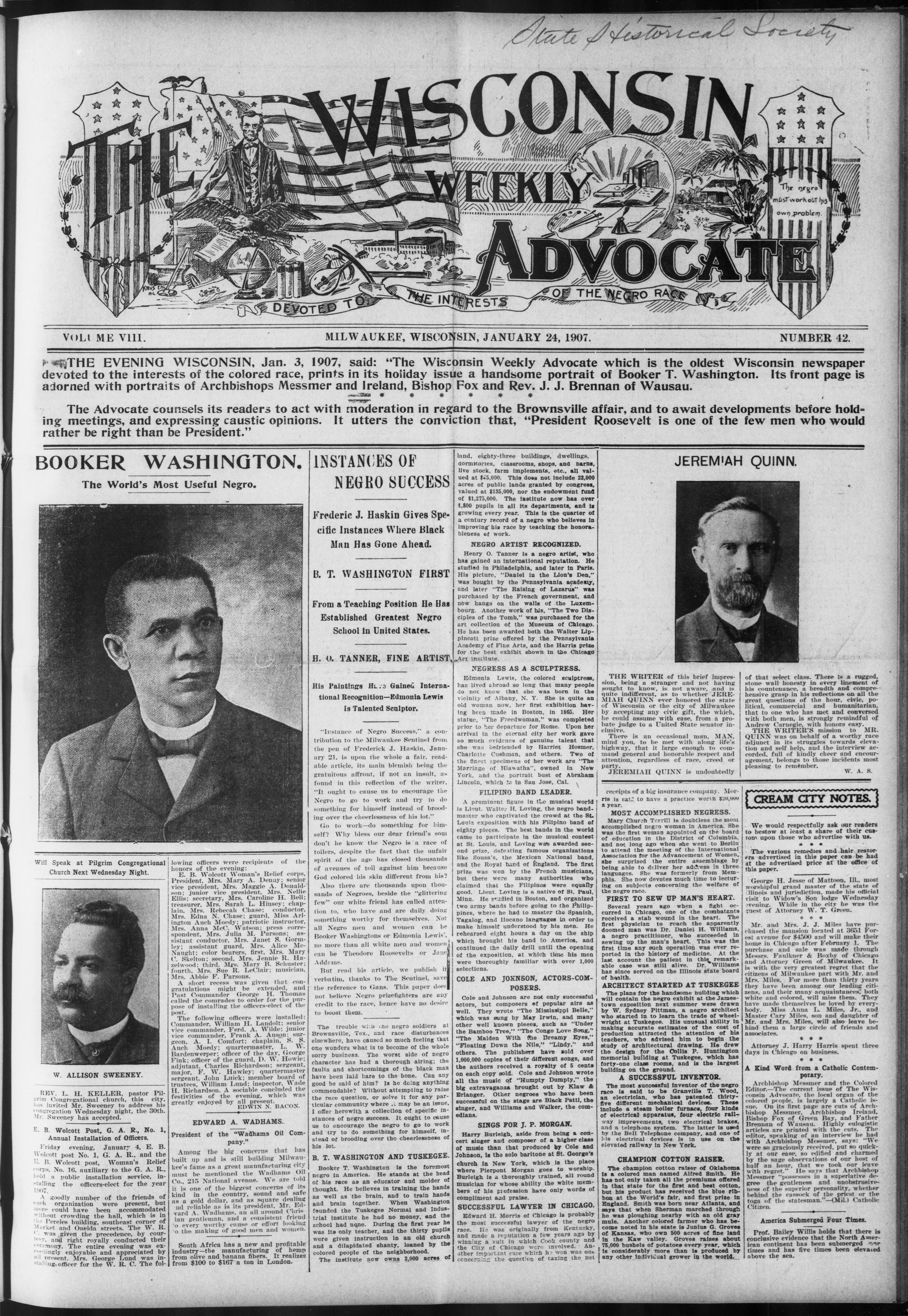
WISCONSIN
WEEKLY
ADVOCATE
DEVOTED TO THE INTERESTS OF THE NEGRO RACE
THE EVENING WISCONSIN, Jan. 3, 1907, said: "The Wisconsin Weekly Advocate which is the oldest Wisconsin newspaper devoted to the interests of the colored race, prints in its holiday issue a handsome portrait of Booker T. Washington. Its front page is adorned with portraits of Archbishops Messmer and Ireland, Bishop Fox and Rev. J. J. Brennan of Wausau.
The Advocate counsels its readers to act with moderation in regard to the Brownsville affair, and to await developments before holding meetings, and expressing caustic opinions. It utters the conviction that, "President Roosevelt is one of the few men who would rather be right than be President."
BOOKER WASHINGTON.
VOLUME VIII.
THE EVENING is devoted to the interest adorned with portrait
The Advocate coing meetings, and ex rather be right than
BOOKER W
The World's Mo
Will Speak at Pilgrim Congregational Church Next Wednesday Night.
W. ALLISON SWEENEY.
REV. L. H. KELLER, pastor Pilgrim Congregational church, this city, has invited Mr. Sweeney to address his congregation Wednesday night, the 30th. Mr. Sweeney has accepted.
E. B. Wolcott Post, G. A. R., No. 1, Annual Installation of Officers.
Friday evening, January 4, E. B. Wolcott post No. 1, G. A. R., and the E. B. Wolcott post, Woman's Relief corps, No. 16, auxiliary to the G. A. R., held a public installation service, installing the officers-elect for the year 1907. A goodly number of the friends of each organization were present, but more could have been accommodated without crowding the hall, which is in the Pereles building, southeast corner of Market and Oneida streets. The W. R. C. was given the precedence, by courtesy, and right royally conducted their ceremony. The entire evening was exceedingly enjoyable and appreciated by all present. Mrs. George Lund was installing-officer for the W. R. C. The fol-
The quick brown fox jumps over the lazy dog.
lowing officers were recipients of the honors of the evening:
E. B. Wolcott Woman's Relief corps,
President, Mrs. Mary A. Denay; senior vice president, Mrs. Maggie A. Donaldson; junior vice president, Mrs. Nellie Ellis; secretary, Mrs. Caroline H. Bell; treasurer, Mrs. Sarah L. Hinsey; chaplain, Mrs. Rebecah Chase; conductor, Mrs. Edna N. Chase; guard, Miss Arlington Auch Moedy; patriotic instructor, Mrs. Anna McC. Watson; press correspondent, Mrs. Julia M. Parsons; assistant conductor, Mrs. Janet S. Gormley; assistant guard, Mrs. Alice McNaught; color bearers, first, Mrs. Mary C. Skelton; second, Mrs. Jennie R. Hazelwood; third, Mrs. Mary B. Schuster; fourth, Mrs. Sue R. LeClair; musician, Mrs. Abbie F. Parsons.
A short recess was given that congratulations might be extended, and Past Commander George H. Thomas called the comrades to order for the purpose of installing the officers-elect of the post.
The following officers were installed: Commander, William H. Landolt; senior vice commander, Ferd. A. Wilde; junior vice commander, Frank A. Anson; surgeon, A. I. Comfort; chaplain, S. S. Auch Moedy; quartermaster, L. W. Bardenwerper; officer of the day, George Fink; officer of the guard, D. W. Howie; adjutant, Charles Richardson; sergeant, major, F. W. Hawley; quartermaster sergeant, John Luick; member board of trustees, William Lund; inspector, Wade H. Richardson. A sociable concluded the festivities of the evening, which was greatly enjoyed by all present.
EDWARD A. WADHAMS.
President of the "Wadhams Oil Company."
Among the big concerns that has built up and is still building Milwaukee's fame as a great manufacturing city must be mentioned the Wadhams Oil Co., 215 National avenue. We are told it is one of the biggest concerns of its kind in the country, sound and safe as a gold dollar, and as square dealing and reliable as is its president, Mr. Edward A. Wadhams, an all around Christian gentleman, and a consistent friend to every worthy cause or effort looking to the making of good men and women.
South Africa has a new and profitable industry—the manufacturing of hemp from olive and banana fibers. It realizes from $100 to $167 a ton in London.
Frederic J. Haskin Gives Specific Instances Where Black Man Has Gone Ahead.
B. T. WASHINGTON FIRST
From a Teaching Position He Has Established Greatest Negro School in United States.
H. O. TANNER, FINE ARTIST
His Paintings Have Gained International Recognition—Edmonia Lewis Is Talented Sculptor.
"Instance of Negro Success," a contribution to the Milwaukee Sentinel from the pen of Frederick J. Haskin, January 21, is upon the whole a fair, readable article, its main blemish being the gratuitous affront, if not an insult, as found in this reflection of the writer, "It ought to cause us to encourage the Negro to go to work and try to do something for himself instead of brooding over the cheerlessness of his lot."
Go to work—do something for himself? Why bless our dear friend's soul don't he know the Negro is a race of toilers, despite the fact that the unfair spirit of the age has closed thousands of avenues of toil against him because God colored his skin different from his?
Also there are thousands upon thousands of Negroes, beside the "glittering few" our white friend has called attention to, who have and are daily doing something worthy for themselves. Not all Negro men and women can be Booker Washingtons or Edmonia Lewis', no more than all white men and women can be Theodore Roosevelts or Jane Addams.
But read his article, we publish it verbatim, thanks to The Sentinel, save the reference to Gans. This paper does not believe Negro prizefighters are any credit to the race, hence have no desire to boost them.
The trouble with the negro soldiers at Brownsville, Tex., and race disturbances elsewhere, have caused so much feeling that one wonders what is to become of the whole sorry business. The worst side of negro character has had a thorough airing; the faults and shortcomings of the black man have been laid bare to the bone. Can any good be said of him? Is he doing anything commendable? Without attempting to raise the race question, or solve it for any particular community where it may be an issue, I offer herewith a collection of specific instances of negro success. It ought to cause us to encourage the negro to go to work and try to do something for himself, instead of brooding over the cheerlessness of his lot.
B. T. WASHINGTON AND TUSKEGEE.
Booker T. Washington is the foremost negro in America. He stands at the head of his race as an educator and molder of thought. He believes in training the hands as well as the brain, and to train hands and brain together. When Washington founded the Tuskegee Normal and Industrial institute he had no money, and the school had none. During the first year he was its only teacher, and the thirty pupils were given instruction in an old church and a dilapidated shanty, loaned by the colored people of the neighborhood.
The institute now owns 2,000 acres of
land, eighty-three buildings, dwellings, dormitories, classrooms, shops, and barns, live stock, farm implements, etc., all valued at $65,000. This does not include 22,000 acres of public lands granted by congress, valued at $135,000, nor the endowment fund of $1,275,000. The institute now has over 1,800 pupils in all its departments, and is growing every year. This is the quarter of a century record of a negro who believes in improving his race by teaching the honorableness of work.
NEGRO ARTIST RECOGNIZED.
Henry O. Tanner is a negro artist, who has gained an international reputation. He studied in Philadelphia, and later in Paris. His picture, "Daniel in the Lion's Den," was bought by the Pennsylvania academy, and later "The Raising of Lazarus" was purchased by the French government, and now hangs on the walls of the Luxembourg. Another work of his, "The Two Disciples of the Tomb," was purchased for the art collection of the Museum of Chicago. He has been awarded both the Walter Lippincott prize offered by the Pennsylvania Academy of Fine Arts, and the Harris prize for the best exhibit shown in the Chicago Art institute.
NEGRESS AS A SCULPTRESS.
Edmonia Lewis, the colored sculptress, has lived abroad so long that many people do not know that she was born in the vicinity of Albany, N. Y. She is quite an old woman now, her first exhibition having been made in Boston, in 1865. Her statue, "The Freedwoman," was completed prior to her departure for Rome. Upon her arrival in the eternal city her work gave so much evidence of genuine talent that she was befriended by Harriet Hosmer, Charlotte Cushman, and others. Two of the finest specimens of her work are "The Marriage of Hiawatha", owned in New York, and the portrait bust of Abraham Lincoln, which is in San Jose, Cal.
FILIPINO BAND LEADER.
A prominent figure in the musical world is Lieut. Walter H. Loving, the negro bandmaster who captivated the crowd at the St. Louis exposition with his Filipino band of eighty pieces. The best bands in the world came to participate in the musical contest at St. Louis, and Loving was awarded second prize, defeating famous organizations like Sousa's, the Mexican National band, and the Royal band of England. The first prize was won by the French musicians, but there were many authorities who claimed that the Filipinos were equally good. Lieut. Loving is a native of St. Paul, Minn. He studied in Boston, and organized two army bands before going to the Philippines, where he had to master the Spanish, Tagalog, and Ilocano languages in order to make himself understood by his men. He rehearsed eight hours a day on the ship which brought his band to America, and continued the daily drill until the opening of the exposition, at which time his men were thoroughly familiar with over 1,000 selections.
COLE AND JOHNSON, ACTORS-COMPOSERS
Cole and Johnson are not only successful actors, but composers of popular airs as well. They wrote "The Mississippi Belle," which was sung by May Irwin, and many other well known pieces, such as "Under the Bamboo Tree," "The Congo Love Song," "The Maiden With the Dreamy Eyes," "Floating Down the Nile," "Lindy," and others. The publishers have sold over 1,000,000 copies of their different songs, and the authors received a royalty of 5 cents on each copy sold. Cole and Johnson wrote all the music of "Humpty Dumpty," the big extravaganza brought out by Klaw & Erlanger. Other negroes who have been successful on the stage are Black Patti, the singer, and Williams and Walker, the comedians.
SINGS FOR I. P. MORGAN.
Harry Burleigh, aside from being a concert singer and composer of a higher class of music than that produced by Cole and Johnson, is the solo baritone at St. George's church in New York, which is the place where Pierpont Morgan goes to worship. Burleigh is a thoroughly trained, all round musician for whose ability the white members of his profession have only words of compliment and praise.
SUCCESSEUL LAWYER IN CHICAGO.
Edward H. Morris of Chicago is probably the most successful lawyer of the negro race. He was originally from Kentucky, and made a reputation a few years ago by winning a suit in which Cook county and the City of Chicago were involved. Another important case which he won was one concerning the question of taxing the net
JEREMIAH QUINN.
[Picture of a man with a beard and a suit. The background is plain black. The man's face is centered, and he looks directly at the viewer. The image is in black and white. There are no other discernible details or text.]]
THE WRITER of this brief impression, being a stranger and not having sought to know, is not aware, and is quite indifferent, as to whether JEREMIAH QUINN ever honored the state of Wisconsin or the city of Milwaukee by accepting any civic gift, the which, he could assume with ease, from a probate judge to a United State senator inclusive. There is an occasional man, MAN, mind you, to be met with along life's highway, that it large enough to command general and honorable respect and attention, regardless of race, creed or party. JEREMIAH QUINN is undoubtedly
receipts of a big insurance company. Morris is said to have a practice worth $20,000 a year.
MOST ACCOMPLISHED NEGRESS.
Mary Church Terrill is doubtless the most accomplished negro woman in America. She was the first woman appointed on the board of education in the District of Columbia, and not long ago when she went to Berlin to attend the meeting of the International Association for the Advancement of Women, she surprised the entire assemblage by being able to deliver her address in three languages. She was formerly from Memphis. She now devotes much time to lecturing on subjects concerning the welfare of the negro race.
FIRST TO SEW UP MAN'S HEART.
Several years ago when a fight occurred in Chicago, one of the combatants received a stab wound in the heart. The first physician to reach the apparently doomed man was Dr. Daniel H. Williams, a negro practitioner, who succeeded in sewing up the man's heart. This was the first time any such operation was ever reported in the history of medicine. At the last account the patient in this remarkable case was still alive. Dr. Williams has since served on the Illinois state board of health.
ARCHITECT STARTED AT TUSKEGEE
The plans for the handsome building which will contain the negro exhibit at the Jamestown exposition next summer were drawn by W. Sydney Pittman, a negro architect who started in to learn the trade of wheelwright at Tuskegee. His unusual ability in making accurate estimates of the cost of production attracted the attention of his teachers, who advised him to begin the study of architectural drawing. He drew the design for the Collis P. Huntington memorial building at Tuskegee, which has forty-one class rooms, and is the largest building on the ground.
A SUCCESSFUL INVENTOR.
The most successful inventor of the negro race is said to be Granville T. Wood, an electrician, who has patented thirty-five different mechanical devices. These include a steam boiler furnace, four kinds of electrical apparatus, four electric railway improvements, two electrical brakes, and a telephone system. The latter is used by the Bell Telephone company, and one of its electrical devices is in use on the elevated railway in New York.
CHAMPION COTTON RAISER
The champion cotton raiser of Oklahoma is a colored man named Alfred Smith. He has not only taken all the premiums offered in that state for the first and best cotton, but his product has received the blue ribbon at the World's fair, and first prize in England. Smith was born near Atlanta, and says that when Sherman marched through he was ploughing nearby with an old gray mule. Another colored farmer who has become noted in his state is Junius G. Groves of Kansas, who own 500 acres of fine land in the Kaw valley. Groves raises about 75,000 bushels of potatoes every year, which is considerably more than is produced by any other individual grower in the world.
Wisconsin newspaper on. Its front page is opments before hold- few men who would
of that select class. There is a rugged, stone wall honesty in every linement of his countenance, a breadth and comprehensive grasp in his reflections on all the great questions of the hour, civic, political, commercial and humanitarian, that to one who has met and conversed with both men, is strongly remindful of Andrew Carnegie, with honors easy.
THE WRITER'S mission to MR. QUINN was on behalf of a worthy race adjunct in its struggles towards elevation and self help, and the interview accorded, full of kindly cheer and encouragement, belongs to those incidents most pleasing to remember.
CREAM CITY NOTES.
We would respectfully ask our readers to bestow at least a share of their custom upon those who advertise with us.
The various remedies and hair restorers advertised in this paper can be had at the advertised price at the office of this paper.
George H. Jesse of Mattoon, Ill., most worshipful grand master of the state of Illinois and jurisdiction, made his official visit to Widow's Son lodge Wednesday evening. While in the city he was the guest of Attorney W. T. Green.
Mr. and Mrs. J. J. Miles have purchased the mansion located at 3651 Forest avenue for $4500 and will make their home in Chicago after February 1. The purchase and sale was made through Messrs. Faulkner & Boxby of Chicago and Attorney Green of Milwaukee. It is with the very greatest regret that the citizens of Milwaukee part with Mr. and Mrs. Miles. For more than thirty years they have been among our leading citizens, and their many acquaintances, both white and colored, will miss them. They have made themselves be loved by everybody. Miss Anna L. Miles, Jr., and Master Cary Miles, son and daughter of Mr. and Mrs. Miles, will also leave behind them a large circle of friends and associates.
Attorney J. Harry Harris spent three days in Chicago on business.
A Kind Word from a Catholic Contemporary.
Archbishop Messmer and the Colored Editor.—The current issue of The Wisconsin Advocate, the local organ of the colored people, is largely a Catholic issue. On its first page are cuts of Archbishop Messmer. Archbishop Ireland, Bishop Fox of Green Bay, and Father Brennan of Wausau. Highly eulogistic articles are printed with the cuts. The editor, speaking of an interview he had with Archbishop Messmer, says: "We were so graciously received, put so quickly at our ease, so edified and charmed by the sage observations of our host of half an hour, that we took our leave with regret." He says that Archbishop Messmer "possesses in a superlative degree the gentleness and unobstrusiveness of the superior personality, whether behind the cassock of the priest or the toga of the statesman."—(Mil.) Catholic Citizen.
America Submerged Four Times.
Prof. Bailey Willis holds that there is conclusive evidence that the North American continent has been submerged our times and has five times been elevated above the sea.
NUMBER 42.
W. A. S.
THE WISGONSIN WEEKLY ADVOCATE
MILWAUKEE, WIS.
B. B. MONTGOMERY, Editor and Proprietor.
Tea-Table Salad.
They had been married just a month.
"Do you know what day this is?" she asked sweetly at the breakfast table.
"Yes," he answered nervously; "this is the day I have to pay the second installment on that wedding ring."—Yonkers Statesman.
Officer—Is your brother, who was so deaf, any better?
Bridget—Sure, he'll be all right in the mornin'.
Officer—You don't say so?
Bridget—Yes; he was arrested yesterday and he gets his hearin' in the mornin'—Tit-Bits.
No Cause for Worry
"Suppose, doctor, this operation doesn't succeed?"
"My dear fellow, if it doesn't you'll never know it."—Smart Set.
Expert Opinion
Dolly—What makes you think she is such an awful gossip?
Madge—She told me all the things I asked her about.—Smart Set.
Red Turning Pale.
In Nevada Tom Bigfoot, an Indian, ran away with the election returns of his precinct. At last the Indians are becoming civilized.-Baltimore Sun.
Timely.
When the streets are wet and muddy And the paving stones are hid, Then the chauffeur learns this motto: "Always look before you skid." Cleveland Plain Dealer
Slightly Awrv.
Visitor in the Art Gallery (pointing to the wolf suckling Romulus and Remus)—What is that?
Attendant—That is Romeo and Juliet
—Linincott's.
- Imitation Better than Levitation
"Imitation is de sincerest flattery," said Uncle Eben, "but dat ain' no satisfaction when somebody likes you clothes so well dat he insists on carryin' 'em off."—Washington Star.
The Electric's Charge.
Chauffeur-I have run you another ten miles, sir, and I would like my pay. Passenger-What? Why, this automobile is advertised to run forty miles on one charge.-Automobile Magazine.
Good Things.
Smere—The majority of the rich people who patronize us artists don't know anything about art. Merritt—My boy, it's a lucky thing for you that they don't.—Smart Set.
A True Helpmeet.
Wife—I am getting so stout that all my dresses are too tight. Will it be cheaper to order new ones or to go to Marienbad and take the cure?—Translated for Tales from Meggendorfer Blaetter.
Getting Serious Now.
Jack—You say you feel perfectly sure that she is only flirting with me? Tom—Perfectly. Jack—Hang the luck! Why, when I began I was only flirting with her!— Somerville Journal.
A Relative.
During our last election I listened to a colored man who was trying to swear in his vote. He had a friend along as witness.
"Is this man related to you?" asked the judge.
"Yes, sah."
"In what way is he related to you?" continued the judge.
"His wife do ma washin', sah."—Automobile, Magazine.
Where Plants Originated.
Name. Country of Origin.
Apple Europe
Celery Northern Europe
Chestnut Italy
Citron Greece
Cucumber East Indies
Garden Cress Egypt
Horse Chestnut Thibet
Horseradish Southern Europe
Madder The East
Mulberry Tree Persia
Nettle Europe
Oats North Africa
Onion Egypt
Parsley Sardinia
Peach Persia
Pear Europe
Peas Egypt
Pine America
Poppy The East
Potato America
Quince Island of Crete
Radish China and Japan
Rye Siberia
Spinach Arabia
Sunflower Peru
Tobacco America
Walnut Persia
Zealand Wax Zealand
Slide Hotel Across Bay.
If the plans of William S. Freeman of Chicago are successful, the Hawarden Inn at Gladstone, Mich., one of the most pretentious hotel buildings in upper Michigan, will be moved from that city to Escanaba.
The task would be one of the most novel undertakings ever attempted in the peninsula, but Contractor John W. Lawson has rendered a decision that the feat can be accomplished and is ready to undertake the work. If the proposed contract is awarded, the building will be cut into four parts and will be brought to Escanaba over the ice on the bay just as soon as the ice has attained sufficient thickness. It is estimated that the total cost will be $12,500.
The Hawarden Inn, at its present location, has, it is said, not proved the satisfactory investment contemplated.
Had Seen It Once
"I saw a funny thing last night," said Tom Johnson of Kansas City. "I went to see 'Arizona' and sat next to a party from East Orange, led by an elderly gentleman with multifarious whiskers. Underneath the setting forth of the cast in the programme was the usual synopsis of the scenes, and the last line read, "Act IV same at Act I." When the curtain fell on the third act, Mr. Whiskers picked up his hat and umbrella and said to Mrs. Whiskers, 'Come along Maria, we can ketch that 10:30 train if we hurry. The programme says, last act is same as the first, and I don't see no use waiting to look at it over again.' And they, maryelling at his cleverness, hustled off with him Jerseyward."
"THE PAPER SHOP."
For $1.00 I will send you assortment of five kinds of correspondence and note stationery in latest styles and tints, stamped to order with your initial. Express prepaid. 602 Goldsmith Bldg., Milwaukee, Wis. LILIAN M. SISSON.
• TO SLEEP.
O, gentle lover of a world day-worn,
Taking the weary light to thy dusk arms,
Stealing where pale forms lie, sun-hurt and
torn,
Waiting the balm of thy oblivious charms,
Make me thy captive ere I guess pursuit,
And cast me deep within some dreamless
close.
Where hopes stir not, and white, wronged
lips are mute,
And Pain's hot wings fold down o'er hushed woes;
And if ere morn thou choos'st to set me free,
Let it not be, sweet jaller, through the door.
That timeward opes, but to eternity
Set thou the soul that needs thee ever-
more;
So I from Sleep to Death may softly wend
As one would pass from gentle friend to
friend.
—Olive Tilford Dargan in Scribner.
CVNTHIA'S PERVERSITY.
"Some serious step must really be taken," said Mrs. Hardcastle, in tones that were both firm and severe. "Cynthia is becoming far too intimate with young Evershed, and it is about as much use admonishing her as it is to—to—to try to make a duck eat treacle."
"I have never hazarded either experiment," murmured Mr. Hardcastle mildly, gazing at his wife as she sat determinedly stirring her breakfast coffee.
"She grows more willful every day," Mrs. Hardcastle continued. "It is past 9 already; you and I have almost finished breakfast and Cynthia has not yet appeared."
"She was up late last night, my dear," remarked her husband, "so she is deserving of a little license."
"So were we; but we can get down to breakfast at a reasonable hour. Cynthia is perverse, she does just the opposite to what she is wanted to do. She knows how set we are on her marrying Sir Arthur."
"I don't know that I am so particularly set on such a course," Mr. Hardcastle corrected. "After all, she will make a much happier match if allowed to choose for herself. Remember our case, my dear—I was by no means your parents' choice. They wished you to marry someone much better off than I was."
"But I loved you, Dick, and I knew you'd get on," murmured Mrs. Hardcastle in softer tones.
"No doubt Cynthia can see more in Guy Evershed than you can," Mr. Hardcastle replied. "If she cares for him, ought we not to let her choose for herself?"
"But it is annoying," cried his wife. "Here is Sir Arthur Rixon, with goodness only knows how many thousands a year, ready to let Cynthia walk on him if she chooses, and yet she encourages Guy Evershed right and left; and what has he got to offer her? A few unpublished novels and plays."
"Give him the credit that is due to him, my dear," returned Mr. Hardcastle. "He has had one play accepted, and it was very well received; the critics all refer to him as a coming man." "But he can only make hundreds, where Sir Arthur has thousands." grumbled Mrs. Hardcastle, "and it does not alter the fact that Cynthia is very perverse." Mr. Hardcastle did not reply, but began to study the morning paper; his wife stared thoughtfully through the window across the tennis lawn at the fragrant rose garden. Suddenly a smile crossed her face, and she glanced quickly at Mr. Hardcastle.
"Dick," she said, "I have an idea. I'll tell it you later, when we are alone again. I can hear Cynthia coming now. Just note our conversation.
The door opened and Cynthia entered. Her presence brought a sunny breeziness into the room. Her bright blue eyes had caught the sheen of the morning sky, her curly brown hair hung in seeming careless masses, and the gladness of youth rang in her fresh young voice.
When she had dutifully saluted her parents she sat herself at the table, and asked her mother what there was for breakfast.
"There is bacon and kidneys, Cynthia, and lemon sole," was the reply.
"I am sure you would like the sole," said Mrs. Hardcastle.
said Mrs. Hardcastle.
Cynthia deliberated for a moment,
"I think I'll have bacon and kidneys," she remarked eventually.
As she assisted her daughter to the edibles in question, Mrs. Hardecastle shot a glance of triumph at her husband.
"I knew she would have one thing if I recommended the other," Mrs. Hardecastle said later, as she stood in the rose garden with her husband.
"She is certainly perverse," Mr. Hardecastle remarked, slaying sundry greenfly as he spoke.
"That is just what originated my idea," cried Mrs. Hardecastle triumphantly.
"All we need is a little diplomacy, and I am going to use it."
Mrs. Hardcastle smiled as he bent over a Gloire de Dijon—luckily his wife did not observe his expression.
"I'm going to pretend that I prefer Mr. Evershed to Sir Arthur," Mrs. Hardcastle continued, "and the result will be that Cynthia will prefer Sir Arthur. Don't you think it is diplomatic of me, Dick?"
"Rather," replied Mr. Hardcastle, once more averting his face to conceal another smile.
Mrs. Hardcastle was full of her scheme. She was sufficiently wise not to display her apparently altered ideas too much at first, and over a week passed before the first fruits of her diplomacy were reaped.
"You haven't said anything nasty about Mr. Evershed for several days," remarked Cynthia with a cheerful can dor.
"Well, to tell the truth, my dear," replied Mrs. Hardcastle, "I am beginning to think I was mistaken in my impression of Mr. Evershed. I have come to the conclusion that he is a very nice young man."
"Oh," murmured Cynthia, gazing doubtfully at her mother. "Do you think he is nicer than Sir Arthur Rixon?"
"Well, he has several qualities that Sir Arthur has not, and he seems to be exceedingly clever."
Cynthia did not reply, but continued to gaze doubtfully at her mother. She plucked petal after petal from the rose she was wearing, her pretty face puckered into an unbecoming frown.
"I think Sir Arthur is clever, too." she said at length.
Mrs. Hardcastle was tactful; she did not pursue her advantage, but adroitly changed the subject. Later she triumph-
untly repeated the conversation to her husband. "It acted like a charm," she said. "As soon as I backed up Mr. Evershed, Cynthia veered round in favor of Sir Arthur. Don't you think I'm diplomatic, Dick?"
For several days no mention was made of the rivals, then Cynthia again brought up the subject.
"Sir Arthur talks of standing for Parliament," she said. "Wouldn't it be splendid if he was elected?"
"I doubt if he would be," replied Mrs. Hardcastle. "Do you think he is clever enough? It wants a man with great talent, like Mr. Evershed, to become an M. P?"
"Oh, I think Sir Arthur would be just the man," cried Cynthia. "Mr. Evershed would not do at all. Of course, he is clever, but he has not Sir Arthur's wealth and influence."
Once more Mrs. Hardcastle was greatly elated. Her diplomacy was being crowned with much success.
"You mark my words," she said later on to her husband. "Cynthia will be Lady Rixon before a year is out."
"Well, I hope she will choose as her heart decrees," replied Mr. Hardcastle.
About a week later, husband and wife were seated in the garden when they heard Cynthia calling from the drawing room window; Mr. and Mrs. Hardcastle strolled through the garden to the open glass doors to find Cynthia gazing at a photo of Sir Arthur, lately presented by that gentleman, which reposed on the drawing room mantel piece. Mrs. Hardcastle slyly nudged her husband, an elated smile on her face.
"I wanted to ask you about Sir Arthur," Cynthia murmured hesitatingly. "Do you like Mr. Evershed better of the two?" "Oh, decidedly," replied Mrs. Hardcastle.
Cynthia did not reply, but continued to care. Six Arthur's portrait
"But look at Mr. Evershed's talents," replied Mrs. Hardecastle. "I think brain power always outweighs mere money."
"If you care for him, say yes by all means," cried her mother quickly glancing in triumph at her husband.
"Do you mean that?" asked Cynthia in doubtful tones.
"Oh, certainly," answered Mrs. Hardcastle, as she again secretly nudged her husband.
"Well, I have said yes," was Cynthia's unexpected reply; "but Guy would not believe that you preferred him to Sir Arthur, so I brought him here to hear you say so yourself. Come out, Guy."
With a cheerful grin on his face Guy Evershed emerged from behind a cluster of tall palms and came forward with cutstretched hands.
"I am awfully glad to have heard what I have," he said, "for I thought you preferred Sir Arthur Rixon to me. I must apologize for playing eavesdropper. I hope you will forgive me."—Pearson's Weekly.
PRUNES FOR THE MILLION.
Great Consumption of the Stewed Stand by of Boarding Houses.
When one thinks of all the boarding house breakfasts in the country it is not surprising that more than 100,000,000 pounds of prunes are eaten yearly in the United States. Prior to 1886 the supply came almost wholly from France and the Danubian provinces and sold under the designation of French or Turkish prunes. In that year prunes of American growth appeared on the market and with each succeeding year the supply has increased, until the importation of foreign fruit has been reduced to extremely small proportions.
According to What-to-Eat most of our prune supply is from the southern part of California. In Santa Clara county alone there are 3,700,000 trees growing on 37,000 acres, 100 to the acre. The quantity of prunes raised there exceeds 110,000,000 pounds—more than enough for the requirements of the whole country, but the excess is needed to supply the export demand.
In September the fruit ripens, and is gathered by spreading sheets under the trees and shaking the branches. The green fruit is taken to the warehouse, where it is graded in size and passed through a boiling hot liquid, in which process it is cleaned and the outer skin softened. It is then spread out in trays 8 feet by 3 feet in size and exposed to the heat of the sun for three to eight days, depending upon weather conditions. Ten thousand trays of fruit spread out in one unbroken tract may be seen in Santa Clara in the drying season. When sufficiently cured the prunes are stored in separate bins and there allowed to sweat, this process taking from ten to twenty days, when they are ready for marketing.
Forgets He Is Cross-Eved.
Townsend Burden was talking in Newport about his recent autumnal experiment of oiling the Newport roads—an experiment that, though it promised well, failed because it ruined so many delicate toilets, according to the Minneapolis Journal.
"Oiling the roads of Newport," said Mr. Burden, "was a more complicated matter than we thought. There were so many things to take into consideration—white silk stockings, lace petticoats, suede shoes—yes, decidedly it was a complicated matter.
"It reminds me, in its wealth of complications, of the man with the crosseyed dog.
This man said to a friend:
"'A wonderful dog that of mine.'
"'Is he? He doesn't look up to much,' the friend replied.
"Well, now, for a test,' said the owner, 'just you grab me by the throat and say, 'Whoo!'"
"The other did so, and the dog at once sprang up and bit a piece out of his master's hand.
"How do you account for that?' asked the friend, with a hearty laugh.
asked the friend, with a hearty laugh.
"'Why, hang it,' said the owner, as he grabbed his hat and hurried off to be cauterized. 'I forgot that he was cross-eyed. I ought to have put my hand on your shoulder and yelled.'"
Effects of the Bishops' Law on Savings.
It has been stated by those opposed to Sunday closing that thousands of dollars have gone out of Newark every Sunday into New York for liquor. If the assertion were true, that in their eagerness for Sunday drink the workingmen of Newark were taking all their wages out of town on Sundays, it is a logical conclusion that they would have less money on Mondays to put in the savings banks. But six of the savings banks of Newark reveal the fact that the Monday deposits since the Sunday closing law has been enforced are one-third larger than on corresponding Mondays last year, when
the Sunday law was not enforced. For the first eight Mondays under the Bishop's law the increased savings deposits for this year in four banks over corresponding Mondays of last year amounted to nearly $150,000. If this average increase applies to all the banks of the city it means that in eight weeks the workingmen of Newark have been able to put away for future emergencies more than $300,000 over the amount of last year. It means that they are putting in the bank $40,000 a week, a large part of which they had spent in the saloons before the Sunday closing law went into effect. — Christian Intelligencer.
FOR THE FAMILY TABLE
Liver and Bacon.—Fry some bacon cut in thin slices until crisp, cut a calf's liver into slices half an inch thick and dip them in the bacon fat. Broil and season with salt and pepper. Serve on a hot platter with the bacon as a garnish.
Popcorn Pudding.—Roll some freshly popped corn as fine as possible on the bread board, add two cups of the corn to four cups of milk and two tablespoons of melted butter, a level teaspoon of salt, two beaten eggs and two rounding tablespoons of sugar. Bake twenty minutes.
Breakfast Muffins.—Cream one-quarter cup of butter, add one beaten egg and one-quarter cup of sugar. Beat and add one and one-half cups of flour, a salt-spoon of salt and two and one-half level teaspoons of baking powder sifted together and one-half cup of milk. Heat iron gem pans, grease them and fill half full of batter.
Apple Fritters.—Sift one and one-third cups of flour with one and one-half teaspoons of baking powder and a salt-spoon of salt. Add two-thirds cup of milk and one beaten egg. Stir in two large apples, pared, cored and sliced very thin. Drop in spoonfuls into deep hot fat, fry, drain on paper, roll in powdered sugar and serve hot.
Cooked Salad Dressing.—Beat the yolks of two raw eggs, add two tablespoons of melted butter and one level teaspoon each of salt, mustard and sugar with a salt-spoon of paprika. Set the dish over boiling water and cook until thick, stirring all the time. Add while cooking a little at a time four tablespoons of hot vinegar. Take from the fire and beat. When cold add one cup of beaten cream.
Baked Hominy.—This way of preparing hominy makes it suitable to serve with meat. Mix well two cups of cold boiled hominy with two tablespoons of melted butter, three well beaten eggs, one cup of milk and one-half level teaspoon of salt. Turn into a buttered pan or baking dish and set in the oven for about half an hour. The heat should be moderate on account of the eggs and milk used.
Lemon Pie.—Dissolve two level tablespoons of corn starch in a little cold water and stir into one cup of boiling water, add one cup of sugar and two level tablespoons of butter. Stir well until cooked smooth, then cool and add one egg well beaten, the juice of one lemon and the grated yellow rind. Line a plate with one crust and fill with the cooked lemon mixture. Sprinkle the top with granulated sugar and bake.
Cinnamon Buns.—Cream one-half cup of butter and one-half cup of sugar together and add one beaten egg. When well mixed work into one cup of light bread dough, add half a level teaspoon of cinnamon and one-half level teaspoon of soda dissolved in a teaspoon of hot water and one-half cup of currants rolled in flour. Work and knead until smooth. Form into little balls and let it rise over night. When taken from the oven brush over with sugar and milk.
Mexican Salad.—Chip fine the meats of a dozen English walnuts. Spread weil washed and drained lettuce leaves around a salad bowl and over these in the bottom of the bowl arrange two peeled bananas cut in thin slices. Mix the chopped walnuts with mayonnaise dressing and spread over the banana with a few bits of the heart leaves of lettuce. Make another layer of bananas and dressing. Serve a spoonful of the salad on two nice leaves of lettuce, putting a dash of paprika over the whole.
Black Bean Soup.—Soak over night one pint of black beans, drain and cook in two quarts of water which should be cold when poured over the beans; cook slowly for five hours, adding a little water from time to time as it cooks away to keep the whole amount as it was in the beginning. Rub through a strainer, add one-half level tablespoon of salt, a pinch of cayenne and a salt spoon each of pepper and mustard. Heat and thicken with one rounding tablespoon each of flour and butter rubbed together. When the soup has boiled five minutes after thickening pour it over half a lemon sliced very thin and one sliced hard boiled egg.
Chicken Pie with Sweet Potatoes. Disjoint the chicken and cook in boiling water until nearly tender. Pare and slice half a dozen potatoes and cook until tender in boiling salted water. Line a baking dish with a rich biscuit dough and fill with the chicken and potato. Pour in the broth from the chicken, thicken with a rounding tablespoon of flour and season with salt and pepper and a rounding tablespoon of butter. Roll a top crust out to fit, take out a round piece from the center and bake in a quick oven. Do not gash the crust with a knife but take out a piece so large that the opening will not close in baking or by the rising of the crust in baking.
Sponge Layer Cake.—Beat the yolks of five eggs until thick and light colored, add one-half cup of powdered sugar, then the whites of five eggs beaten very stiff, and last one cup of sifted flour and one-half cup more of the sugar sifted through a little wire strainer. Add also a teaspoon of lemon juice and a saltspoon of the yellow rind grated fine. Beat with a wooden spoon and bake in two layer cake tins. Cool and split the cakes and spread with a custard filling made as follows: Beat light the white of one egg and one whole egg with one cup of fine granulated sugar and one-half cup of flour. Scald two cups of milk and add a little to the beaten egg, sugar and flour. Then turn all into a double boiler and cook ten minutes or more, stirring all the time to keep the mixture smooth. Add one-half teaspoon of vanilla flavoring and cool. Make a frosting of the white of one egg, one-half teaspoon of vanilla and a cup of powdered sugar beaten until smooth enough to spread.
MARJORIE WEBSTER
East and West.
The chief distinction between the genius of the eastern civilization and that of the west lies in this: With you the individual is the hub of the universe—even charity begins at home with you; while with us of the east, it is the whole, the state, not the individual, that we emphasize. An individual is nothing; the state, the whole, is everything. We sacrifice thousands of individuals, we sacrifice our children and our wives upon the altar of national honor, without hesitation, without regret.—Forum.
Send Teachers to Manchuria.
The Japanese war department has made arrangements to send teachers and students of the middle and higher schools and college to Manchuria and Korea free of charge during their vacation. More than 50,000 persons expect to make the trip.
Saving dimes for twelve years, Mrs. Emma S. Shirley, a widow of St. Louis, accumulated $1000, and has donated it to the Methodist board of foreign missions to endow a woman missionary to Japan.
While testifying as a witness for the state against her brother in the Elkhart (Ind.) circuit court Ertle Drunkamiller was suddenly attacked with paralysis of the tongue and could not finish. Not realizing her condition the judge sentenced her to jail for contempt of court. Later when the truth became known the young woman was released.
"Men are all alike—they are all bad." This remark by Judge Gibbons of Chicago in the hearing of a divorce case pained his hearers who had hoped to keep the fact secret a while longer. The case on trial was that of Elizabeth Dumich against Arthur Dumich, who deserted her for the stage. Clarence H. Clarke sought a divorce because his wife went back to the footlights. Decrees were given in both cases.
Judge Bregy in the court of quarter sessions at Philadelphia, has declared against women wearing short sleeves in his courtroom. Mrs. Wilson Jackson appeared to contest a case Thursday. She was dressed in a black skirt and a light white waist with sleeves that exhibited her arms bare nearly to the elbows. Judge Bregy ordered her to put on a coat, and while she was getting it another case was called and her hearing deferred.
His Highness, Sultan Mahommed Shah, Aga Khan, K. C. I. E., Brilliant Star of the Zanzibar, and a number of other titles, arrived in Chicago recently from San Francisco. "Ah, your railway trains are abominable," said he, "and your weather is the most terrible I have ever seen. Why, in Bombay the sun always shines and one feels warm forever. But in America—oh, I cannot express myself. It is too much snow, too much rain, too much ice—too much everything."
Dr. Oliver W. Gordon of Wheaton, Ill., nearly 80 years old, has taken as his bride Mrs. Sarah Beach of Minneapolis, the sweetheart of his youth, and they will make their home in Wheaton. Dr. Gordon was medical inspector during the Civil war, after which he found that his sweetheart had been wooed and won by another. When he came to the G. A. R. encampment last summer he became converted in a Salvation Army meeting, and it was only a few days later that he met his long-lost love, and together they decided to begin life anew.
F. A. Richardson and his wife of Jersey City have found thus far an estate, real and personal, of about $8000 left by their eccentric old aunt, Ann H. P. Richardson of Worcester, Mass., who died there November 22.
When her will was filed for probate it was found that the last injunction to her nephew was: "Search my old trunk carefully and alone for important papers." Richardson will receive nearly all the estate, as the few minor bequests were of personal property, such as photographs.
Three fat luscious tom cats were served at a banquet at Ottoville (Ohio) in the form of a hasenpfeffer, the principal ingredient of which usually is hare meat. A few nights ago some jokers stole three rabbits from the butcher shop of Harry Sleuter, and, after entertaining him at a luncheon, told him that his meal consisted of the missing stock. To get revenge, he invited them to eat hasenpfeffer with him, as he said he owed them a "treat" on account of the "joke." He showed them the skins of the cats served in the concoction after they had eaten it.
When Miss Alice G. Cushing, a pretty cashier in a Denver grocery store, woke up one morning she took a good long stretch, throwing out her arms and sighing deeply. There was a pop in her neck when relaxed, excruciating pains seized her and she fell back upon her bed deathly sick. A doctor pronounced the first and second vertebrae subluxated, or thrown out of place. A scientific manipulation of the neck put the vertebrae back in their sockets, in fact reset the broken neck. She will recover. Her case is said to be by the physicians a rare one and might have resulted seriously if surgical aid had not been called at once.
The strange compact with a dying man that on his death his wife should wed his dearest friend and companion of years has been fulfilled, and Mrs. Grace A. Allen of Dorchester, Mass., widow of Calvin B. Allen, is the wife of Dr. C. E. P. Thompson of Boston. Dr. Thompson, who received and executed this most unique trust, is a well known physician there. Mrs. Allen's former husband was a leading jeweler. The first intimation that friends of the couple received of the marriage was in the cards sent out the other day stating that, in compliance with the last wishes of Mrs. Allen's late husband that she should wed his best friend, the couple had been united at Fair Haven.
A discourse dictated during his last illness formed the funeral address over the body of James B. Kitchen, a hotel man, at Omaha, recently. It was read by George E. Pritchett, a lifelong friend of Kitchen.
"Where life is, there death is king," was his text. The address read in part: When this paper is read the golden sunlight that makes human existence possible on this globe will have become eternal night to me. I shall be sleeping the sleep of the dead. But what kind of sleep that is, I do not know. It is a serious matter, if not a real misfortune, to be born into the world. Death may be a passport to eternal life, but no one knows it. Life has its charms. Death is life's antithesis. It has no charms. It hears no prayers, pities no griefs, spares no living soul. Its triumphant march is never finished.
"On Washington avenue there resides one of the most astonished fathers to be found in sixteen states," says the Racine Journal. "Recently there was born a baby boy. It was the first additional installment to the family. Of course the father was delighted. He wanted to weigh the youngster, but there were no scales in the house. The iceman came along and he was made aware of a baby by the happy father. Would the iceman bring in his scales and weigh the boy? Sure he would. Attired in his best togs the baby was placed on the scales of the ice man. Great Scott! the weight was 51 pounds! The father is astonished and wondering whether the boy weighed as the scales indicated. After that he weighed every piece of ice left at his home and will do the same thing next summer."
Twenty-one elephants and sixteen camels, all of them under the influence of liquor, were driven through the streets of Peru. Ind., the other day. The trumpetings of the elephants and the bawling of the camels could be heard for squares
as the animals staggered through the slush, throwing the snow in every direction, and shivering with the cold. The Hagenback and Wallace shows were recently merged, and the Hagenback menageries arrived from Mexico to go into winter quarters. Coming from such a warm climate, the managers feared that the animals would take cold, and at feeding time a barrel and a half of whisky was mixed with bran into a mash for their breakfast. The animals all ate heartily of the mash, and when they reached this city were considerably under the influence of the liquor.
Richard Mansfield, at a dinner in Chicago, talked about artists as husbands. "Daudet," said Mr. Mansfield, "in his charming book called 'Artists' Wives' shows us how the author, the painter, and the poet are tormented by their better halves. But it had never occurred to you that there is another side to the question? Don't the actor, the painter and the poet sometimes do a deal of tormenting themselves?
"I have a friend, a playwright. His wife is good and beautiful. Last New Year's eve he said to her at dinner:
"'Darling, I cannot begin the new year better than by confessing my turpitude to you. Know, then, that ours was a bigamous and illegal marriage. My real wife, with her three children, is living in Denver.'
"Oh! oh!" cried the lady. She ran distractedly from the room.
"Calm yourself,' the playwright shouted, as he put down his knife and fork and hurried after her. 'That isn't really true. It is only a speech that the villain makes to the heroine in my new play, and I wanted to get some idea as to how the heroine would take it.'"
Sompting, a little village near Worthing, in Sussex, England, has a school with what is probably the most original curriculum in the world.
The mistress, Miss Johnston, has conceived the idea of teaching children by the constant use of the drama, the dance, the song and the pageant.
Tableaux are arranged, and the children reproduce historic scenes of centuries ago. In this way they learn dates, the names of characters who occupied the world's stage in bygone ages, and become familiar with all they are required to learn in a manner which impresses their lessons indelibly upon their memories.
Miss Johnston said: "The scheme has worked admirably. The children learn much more quickly than they would by means of books.
"Both boys and girls leave school intelligent and cultured beings, and I have evidence that their training keeps them intelligent.
"I am convinced that the innovation is better than the old plan."
A Parable Not Found in New Testament.
his way And saw two bulldogs straining in a fierce and gory froe:
But when the doggies felt the touch of that must salutty man.
most saintly man,
Who played the role of victim but the Good Samaritan?
With wounds new-healed he sauntered out,
in brand-new clothes and hat,
And saw a drunken husband beat his helpmeet with a slat;
But when the brute was collared, who but the woman ran
And used that self-same bedslat on the Good Samaritan?
He saw two nations warring, and he said:
"I'll part no more."
He built a cannon factry and supplied the means of war;
And gathered in his millions on a scientific plan,
And declared: "I've found it pays to be an ex-Samaritan."
A FEW RECIPES
Snowball Jelly.—Make a compact snowball around a stone and throw it, with a hostile shout, at a policeman. Then stand rooted to the spot. The policeman will beat you to a jelly and serve you right.
Raspberry Shrub.—Run into the garden, Maud, and choose a likely-looking shrub. Then take a raspberry firmly between the forefinger of your left hand and the index finger of your right, and place it daintily upon the apex of the shrub. Draw back a step and shriek: "Tis did!" Then dash headlong into the house and spend the rest of the day trying to explain the matter to the noted alienist.
Terrapin Pie.—Enter a down town quick lunch in a lordlv manner and order squash pie. See that the slice brought you is ne plus ultra in all respects. If the crust is obdurate, send it back—with an execration. And if the squash tastes citified have the proprietor of the place discharged. In starting to go, say witheringly: "You should serve terrapin." Throwing back your coat as you speak, to give your scarf pin a square deal. The terrapin is as good as eaten.
Club Sandwich.—Go to the club. Drink six toasts. Eat a slice of meat. Drink six more toasts.—New York Times.
New Hampshire Voters
It was during the recent election in New Hampshire. Two woodchoppers got on at Wentworth station, and when Conductor Melvin Mann came for the tickets one of the men handed out a new 500-mile book. "Take out for two to Manchester," he said, "and you will please write on a slip of paper the name of the station we got on at. We are woodchoppers and are going to Manchester to vote."
"You are going to vote," was the astonished reply of Conductor Mann, "and you can't remember the station you got on at?"
"No," replied the spokesman, without any signs of embarrassment, "and we can't write, either." The conductor wrote the name of the station on the paper and received the thanks of the two men.—Boston Herald.
Miserable Maid.
Mrs. Jobson had gone away from home, leaving Mr. Jobson lamenting. On arriving at her destination she missed her gold lace-pin and sent a postcard to her servant asking the girl to let her know if she found anything on the dining room floor when sweeping it next morning.
The servant duly replied: "Dear Madam—You asked me to let you know if I found anything when sweeping the dining room floor this morning. I beg to report that I found thirty matches, three corks, and a pack of cards."
Mrs. Jobson returned by the next train.—London Tit-Bits.
Women as County Treasurers
Five women were chosen as county treasurers in Idaho at the recent election and seventeen women as county superintendents of schools.
Advertise in Your Home Paper.
GOSSIP FOR THE LADIES.
```markdown
```
A Question.
[Reprinted by Request.]
Would you forget me, should I go
And live where only thoughts could reach,
Beyond your touch, your sight, your
speech—
Nor write you for a year or so?
You might feel pity—vague regret
Just for a time—and then, forget?
Would you remember, all the years
We were together! June and spring
The opening bud, the blossoming—
Smiles, quarrels, laughter, love and tears,
All the dear scenes since first we met—
You would not, could not quite forget?
Should I forget * * * ? My love, the lane
Seems only fair when you are by:
Though winter's storms have blurred the
sky
It seems that June be born again—
I think—I know you love me. Yet.
If I were gone, should you forget?
And should I come again, and find Your soul had scarcely missed me! Sweet As strangers should we chance to meet, With all of love and youth behind!
Life's fires would die—Life's sun would set,
Were we so faithless—to forget?
And, should I grow so mean, so base
That, from my empty soul, had passed
The memory of our vows at last,
Your soft, warm touch, your little face—
I would be silent, love, nor let
You guess that I could thus forget!
Could you then, though the years dawn
gray
The doubt that makes my eyes so wet-
For neither of us could believe.
Robert Chichester.
—Robert Chichester.
for the New Year.
Resolved, during the coming year: That I will try to think less of myself, and more of others. That I will try to remember that I am not the whole show, and that there are several other individuals in the world besides myself.
That I will endeavor to recall, now and then, that they have rights that I ought to respect even if I don't.
That because I am a girl, and everybody is good enough to want to give me a good time, does not make it right of me to impose upon them, and I herein record a solemn vow that after this I am going to show some appreciation and gratitude for the sacrifices that unselfish people make for me, and that I have been in the habit of taking as no more than my just deserts.
That I am going to get on the bread wagon today, and go on no more chocolate cream debauches.
That I am going to cut out chewing gum, also writing sentimental notes to actors.
That I will write no letters to a man that I would not be willing to see published in the newspapers.
That I will spend less time marcel waving my hair, and more time trying to put a few crimps in my ignorance of what is really going on in the world.
That I will read more good books, and fewer novels of sizzling passion.
That I will cultivate an ambition to be something higher than a mere animated fashion plate.
That I will try to praise other girls without giving them a cat scratch in my last word.
That I will waste no time yearning for a career. If I feel it in me to do things outside of the home circle. I will get out and make an honest try at them. If I don't, I will stay contentedly in the lot wherein I was placed by Providence, and not make it a howling wilderness with my groans and lamentations over being an unappreciated genius.
That I will devote a certain portion of every evening to trying to get acquainted with my father.
That I will make as much effort to please and entertain him as I do to make myself agreeable to the young men who come to the house.
That I will endeavor to make him feel that the money he spent on rearing and educating me was not the worst investment he ever made in his life.
That I will try to be merciful as I am strong, and not bankrupt him with my millinery bills.
That I will try not to snub my mother any more than I can help, and to remember that she, poor thing, did not have the advantage of belonging to the '07 class.
That I will not have seven hats to her one, nor silk when she has to wear cotton.
That I will try to be a companion to her, and let her find again her lost girlhood in mine by telling her about my beaux and the places I go, and the pleasures I enjoy.
That I will not lie on the sofa and read novels while she washes the dishes.
Neither will I be afflicted with sudden headaches when dull old relatives and stuffy friends come to dinner.
That I will ever bear in mind that a girl's mission is to her mother, and not to reform drunkards or meddle with the domestic relations of the Sulus.
That I will devote some of the smiles for which I am admired in society to my little brothers and sisters.
That I will deal fairly and squarely by the young men who come to see me.
That I will adopt our national motto, "Friendship with all, entangling alliances with none"—until the right man comes along to escort me to the altar.
That I will keep my first kiss for the man I marry.
That I will not be accessory to the crime of any man's robbing the cash drawer of his employer in order to supply my demands on him.
That I will not hint, nor graft, nor hold up any young man for any sort of present or a treat.
That I will not flirt except with the flirtatious.
That I will not play with an honest love.
That I will devote less time trying to catch a husband, and more to fitting myself to be a good wife to the man I do get.—Dorothy Dix in Philadelphia Evening Bulletin.
Managing a Mother-in-Law.
"But, then, there is the problem of the mother-in-law," began my confidante. "Suppose she does not like you?"
"Oh, but she will if you go about her in the right way," I insisted, "and don't forget that she is your husband's mother, and therefore the rightful claimant to special civilities on your part. Learn beforehand the title by which she likes best to be addressed, and employ that always in speaking to her. Don't resent it because she weeps at your wedding, and looks more like the chief mourner at a funeral than one of the important figures on a festal occasion.
"If you have not charity for the feelings of others you have not really good manners, and some day you may be a mother-in-law yourself and know how it feels to see your son pledge all his love and devotion and life to another woman. Do not make another mistake, so common with young wives, of misinterpreting the natural reticence and somewhat chilly diffidence of your mother-in-law's manner, when she first meets you, into a deliberately given indication that she does not like you.
"Do not, in short, be either sensitive or suspicious. I attended a wedding
only the other day where the bride made this common and unhappy mistake. Not until the day before the wedding did she meet her mother-in-law, a little old lady who had lived-long in widowed seclusion in a small country town, and, as was natural, she felt quite dazzled and disturbed by the grand home of the tall, splendidly gowned girl her son intended to marry.
"The fright made her stiff and silent, and the bride-to-be thoughtlessly interpreted this into evident dislike and a wish on the old lady's part to keep her at arm's length, and, worse still, into disapproval of her son's choice of a wife. In eager retaliation she treated the venerable lady with a manner that only thinly veiled her antagonism, and then the misunderstanding between them was quickly, deeply, and everlastingly rooted. Criticism has flown freely from either side, and wrought wounds that can never be healed, and that is a pity, because they are both of them admirable ladies, and their connection might easily have been made a most conspicuous success.
"The trouble arose from the fact that the bride knew nothing at all of the art of managing a mother-in-law. There is a way to manage her, and my one daughter-in-law knows how to do it. She was a stranger to me, and not a native of my part of the country, and I cannot say that I was charmed at the idea of my son's marriage. Like the major portion of mothers who have fine, tall sons, I thought no woman quite equal to the dazzling position of his wife.
"Frankly I admit that I felt sad and shy and nervous at the idea of meeting this Miss from California, who had won his heart, and when I saw that she was not beautiful nor well dressed, I felt as though cold water had been dashed in my face. But not so one moment afterward. She came forward to meet me with a beaming smile, saying, without any formal introduction:
"I would have known you anywhere in the world as his mother, you are so like, and is he not the handsomest, finest, and best of men?" and with that she lifted one of my hands and kissed it with a little air of grateful deference that would have won the heart of the proudest queen.
"I have never considered since whether my daughter-in-law is beautiful or well dressed, nor regretted her lack of fine features or taste in clothes, because I am so filled with pride over her cleverness in knowing exactly how to manage her mother-in-law."—Adelaide Gordon.
The Test of a Cook
In a recent discussion of matters culinary the question was asked, "What is the test of a good cook?" One declared it was the ability to make good bread; another, the successful cooking of meats, especially game; but a third averred it was to serve vegetables at once well cooked and amputizing.
Those of us who have dwelt in boarding houses, who have traveled from city to city and sampled the cooking both in private houses and hotels, must recall how often it was found that though both meats and bread were good and properly cooked, the vegetables were flat, tasteless and altogether uninteresting. How rarely, in a public dining room, does one get a properly roasted potato, the very simplest method of cooking known to man—indeed, the most primitive, for even the aborigines knew how to roast food before they had any conception of boiling, stewing or broiling. As for beans, stringbeans, lima beans, baked beans—are not all these too frequently utterly tasteless, if not positively disgusting? Even when the plea is made that canned vegetables were used, and it is utterly impossible to make them taste like fresh ones, their unpalatable quality is not wholly explained. How few people cook beets so that they even slightly resemble food for human beings and how very few serve sweet corn, either canned or fresh, at the best of its delicate, delicios flavor.
It should be strongly recommended to every young woman who yearns for a chafing dish wherein she may stir up unholy masses of cheese and lobster, that instead she should light the fire in the kitchen stove and devote her time to learning how to cook the vegetable of every day use. Let her learn to fry potatoes so that they come to table properly browned, hot, and not reeking with rancid grease. Let her learn to boil a potato so that it is not a sodden lump which thumps ominously upon the plate. Let her master the loud-smelling cabbage and turn it into a delicious creamy concoction with the consistency of jelly, and the taste, as one man said, of "stewed angel." Let her learn beans and peas as no one ever knew them before.
There are not today, outside of the ranks of the professional cook, a hundred women in the United States who can cook every vegetable they use in three acceptable ways. Most of them literally do not even "know beans," and as for knowing potatoes and tomatoes and celery and cauliflower and cabbage and carrots—why, they have not so much as a bowing acquaintance with them.—Sophie Kerr Underwood in Woman's Home Companion.
A Moral for Women.
This is from the Paris Figaro. It embodies, however, not a French sentiment, but a universal fact:
"Two chubby French children were playing at dolls in the Champs-Elysees. 'Let's marry the dolls,' they said.
"The dolls were duly married.
"Now let them quarrel,' said the pinker of the babies.
"The dolls quarreled.
"Now let him kill her,' said the other child.
"Monsieur, accordingly, after a tragic conflict, struck down madame!
"Now let's have the police in and try him.' said the owner of madame.
"It's no use,' said monsieur's owner; 'the husbands always get off.'"
No woman will deny the fact of this matter; men will not dispute it because it involves a woman question which it is no sane man's purpose to discuss. Still, the woman, admitting that it is so—that the man "always gets off"—pauses sometimes pensively to demand, why is it so?
For these reasons, clearly;
For these reasons, clearly.
The laws of the world are men's laws, enacted by men legislators put in office by men voters; men executives promulgate the laws which men judges pronounce upon, and the right and wrong of actions under the law are determined by men juries. The wealth of the world is administered by beards of men directors, corporating with the men legislators for the enactment of men's laws. In a word, it is a world of men's making—a men's world.
The pensive woman, reflecting on the hopelessness of her position with respect to men's justice, must despair, but for knowing that she it is who directs an influence in the world transcending justice; she is the mistress of love. If she has no hope of changing the world, has she not of changing men? And even after a man has escaped from the bar of justice, is there not always the woman for whom he must work out the sentence which her will imposes?
To be sure, this is scant consolation to the woman who, like the chubby child's doll, has lost her head. But a preven-
tive for this appears, and the moral is incontestable:
"Before a woman gives her heart to a man let her make sure of her head."—Harper's Bazar.
Earning Pin Money.
To live in a small place and earn a little money is not an easy problem for most girls, from the very fact that there is not much work to be given out. Often, however, there is more than one might imagine if a person will look for it. It may interest some girls to know how I made my own living in a small town where the population was not quite 1000.
I began as a copyist for an attorney, writing, as he dictated, all kinds of documents, copying legal proceedings in the docket, and keeping his work in good shape so he could find necessary papers when needed. I was not needed every day at his office, so I went to the business men of the town, asking for the opportunity to make out their monthly statements. I secured this work and a great deal of personal correspondence, both social and business letters, from persons, who had no ability to write letters. Through a little act of courtesy I was presented with a typewriter by a young lawyer who was a friend of our family, and this helped me a great deal in my work.
It was well known that I had some ability in house decorating, and very often I earned money by going to private homes, where I made suggestions for the work, often doing a great deal of it myself. Frequently I contributed to the county papers. Being in a splendid position to get the news from five or six towns, including our own, I often secured valuable news items for which I received a good salary.
I painted place cards for all kinds of entertainments, and very often made fancy articles which I sold to my friends. I understand the art of sewing, but was ever fearful of branching out in this line of work. I did considerable work for children, making little dresses and pretty undergarments, so I was never without some kind of employment. Fortunately, there was little I could not turn my hand to, and, knowing I had a little ability to do some kinds of work, I went to work with all enthusiasm. I still make my living, though I have it somewhat simplified, and took up the easiest task I found, and endeavored to improve all the time.—Winifred Graham, Woman's National Daily.
The Working Plan of a Busy Woman.
On Monday morning I rise about an hour earlier than the usual time. Immediately after rising all the bedrooms are given a thorough airing, the windows being raised and the beds stripped of the bed clothing. As soon as breakfast is over the downstairs section of the house is swept lightly and dusted, as it gets more or less disarranged on Sunday. By this time I am ready to begin my washing, which I always do on Monday. This I generally complete by 11 o'clock. Then I go to the bedrooms and make the beds, dust the furniture, etc. This takes me about twenty minutes, and by then it is time to prepare dinner, which is served at 12:30. On Monday afternoon I always take a good rest, as a person is apt to be tired after doing a washing. I always follow this method of doing my work on all other days of the week, and by so planning have the afternoon to go shopping, calling, sewing or reading, or whatever I may choose to do.
On Tuesday morning I iron, and after this is completed I go over all the clothes and see if any need mending, after which they are folded and put away carefully.
On Wednesday morning I bake and sweep and dust the upstairs part of the house.
On Thursday morning I do all sorts of odd jobs, both inside the house and around the yard.
On Friday morning I sweep downstairs, wiping up the oiled floors and dusting everything very carefully; the porches and walks are given a thorough sweeping and then they are scrubbed.
Saturday is cooking day; I bake pies, bread and cake, cook meats, salad-dressing, etc., and always so plan that everything is cooked ready for Sunday, and I do not have to think about baking a pie for dinner or anything of that kind.
By following this simple method I have no cares whatever to worry me on Sunday, and the day is spent in some peaceful and restful manner. By so doing one is better able to begin another week's work on the next day.—Home Companion.
Teaching Girls to Write Letters.
Letter writing has ever held a fascination for many people, and when one has a particular gift of writing with interest, a letter is really something valuable to the recipient. The custom of writing long, poetical effusions, and the kind which some of the old poets wrote to friends and sweethearts, has given place to other attractions and easier methods of communication. But children love letter-writing, and there are few who do not take the keenest delight in both writing and receiving epistles. Yet it is surprising what some letters will contain from young girls who really are good scholars, yet lack all expression when it comes to writing down ideas. Real chatty little girls will compose the most uninteresting letters, while they can write good compositions at school. Of course, the fault is due to the lack of training. Every mother should read what is written by her daughters. No girl should hesitate for a moment to read to the mother anything she may have written or received. This holds good until the girl is her own mistress.
Letter-writing is an art and must be taught. See that the expressions are grammatically correct, that there is something of interest in the letter, that the penmanship is good, and silliness eliminated. Slang expressions in a letter sound harsh and unrefined as an oath from a woman's lips, yet many girls use slang expressions when writing, and all beauty is destroyed. Be a good letter-writer if you can; it may be a lost art, nevertheless it is one well worth learning.—Exchange.
She Doesn't Like Women.
Beware of three women—the one who does not love children, the one who does not love flowers, and she who openly declares she does not like other women. There is something wanting in such, and in all probability its place is supplied by some unlovely trait.
Men may smile and jest a little over the tenderness lavished on a baby, but, after all, the prattle every womanly woman breaks into at the sight of the tiny beings is very sweet to masculine ears.
It was the first language the ever knew, and, in spite of the jest or smile, the sweetest on wife's or sweetheart's lips.
They may laugh, too, at the little garden tools which seem like playthings to their strength, but in their hearts they associate, and rightly, purity of character and life with the pursuit of gardening. As for the woman who does not care for her own sex, and boldly avows it, she is a coquette pure and simple, a craven of masculine admiration and a stranger to some of the finest feelings that bind women together.
Managing a Husband.
Make him comfortable. Don't be critical at any time.
Above all, don't criticise him in public.
Cultivate a sense of humor.
Make light of worries
If you must tell him the mischances of the day, show them to him as a joke. Encourage him to feel that home is a refuge, not a clearing house for your perplexities. Let him bring his men friends home with him. And don't look distressed if he once in awhile expresses a desire to go out with them.
GOOD HEALTH AND GOOD LOOKS.
The Best Hair Brush is made of Siberian bristles set upon a pneumatic cushion. The reason why this brush is desirable is that it is the only one that can be kept hygienically clean. The oldtime brush could never be thoroughly washed.
Puffs Under the Eyes can sometimes be helped by the following massage treatment. Use both hands, place the finger tips directly beneath the eyes, press gently around the outer corners and upward, following the contour of the eyes. Try this movement fifty times a day.
A Simple Remedy for blackheads will be found in a powder made of equal parts of borax and soda. Rub into the skin every night, first, bathing the face well with a correct complexion brush, warm water and pure soap. Next morning bathe the face with cold water and then rub in a good cold cream.
The Amount of Sleep needed to keep in good condition, however, should be determined by each individual, for some require eight and a half or even nine and a half hours, while six and sometimes less seem sufficient for others. Just how much is needed must be determined by each woman, and once she knows the number of hours she requires she should count on them and actually build the rest of her day for work and pleasure, with the sleep or rest hours for a basis.
No Bath Accomplishes its full possibilities if some softening or freshening tonic is not added to it. Water and soap will cleanse, but at the most trifling expense and no trouble, delicious additions may be made. Among these are bags filled with different ingredients which take the place of soap, imparting a fragrance to the water and making the skin finer.
Certain toilet waters have a decidedly tonic effect, and a person who, exhausted, gets into a perfumed bath will issue forth refreshed not only in nerves but muscles as well.
Until a Woman is 100 years old she is justified in doing everything possible to make herself prettier, sweeter and daintier.
There is a great difference in complexion treatments. The successful scientific student of this work must give weeks of study to it before attempting to give treatments at all. The woman who can afford two complexion treatments a week, and who keeps a little human "sunnylight" in her heart, will stay young forever. As for treatment—it all depends upon the operator, her method and her conscience.
WISE AND OTHERWISE.
Fault finding is responsible for many broken friendships.
The giving of undue credit may do more harm than good.
A self-estimate always is subject to the rule of subtraction.
Tact is worth more as a stock in trade than most people comprehend.
Public correction of errors is a poor way to get satisfactory results.
Some people know it all in a way that shows how little they do know.
It is when a money loan is required that real estimate of worth is revealed.
Love's quarrels usually are regarded with more seriousness than they deserve.
An impressive tone of voice often passes for superior knowledge in an argument.
The worst of a bad memory is that it is always springing things on us that we fondly hoped we had forgotten.
Repining for the pleasures enjoyed by others has a saddening and demoralizing influence.—Philadelphia Bulletin.
EVERY DAY PHILOSOPHY.
Talk happiness. People get tired of hearing of your woes.
A successful politician works as steadily as interest on a note.
Most men are optimistic as long as things are coming their way.
The well preserved woman is not usually what would be called a "peach."
If a woman spends more than ten minutes in arranging her hair the result is a coiffure.
Ever think how foolish it is to bear a grudge? Unkind feelings have no market value.
If a man tells you he plays poker as a pastime, it is safe to assume he quit the last game loser.
No woman's picture looks any better because she was trying to look through the skylight when it was taken.
The only time a woman can see any excuse for a man to travel the booze route is after she has turned him down. —Atchison (Kan.) Globe.
REFLECTIONS OF A BACHELOR.
People know a lot about raising children unless they have any.
When a girl is pretty she doesn't have to learn housekeeping to get married.
One of the easiest things is not to fool people when you are lying to them to do it.
Every man who gets into an argument seems to think he is a brass band hired not to stop.
You can tell two people who are in love not by the way they look at each other, but by the way they don't look at anybody else.—New York Press.
Fail to Hear Invitation.
The late Barney Owens of Point Breeze was a David Harum type of character. This noted and successful horseman had a way of saying wise things with a seasoning of homely humor. To a conceited man who had failed egregiously in life Owens said one day at Point Breeze:
"Well, Bill, you and I know how it is with some men. They're so busy blowing their own horns that they can never hear the factory whistle coaxing them to come to work."—Philadelphia Bulletin.
PROMINENT PEOPLE.
THE MARQUIS OF LANSDOWNE, who occupied the important position of foreign secretary under the late Unionist government in England, was born January 14, 1845. He was educated at Eton and at Balliol college, Oxford, and succeeded his father in the marquisate and other titles in 1866. He entered public life as a lord of the treasury in 1868 and occupied that position until 1872, when he became undersecretary for war. During the past twenty-five or thirty years few public
M.
men in Great Britain have occupied more or higher positions than has the Marquis of Lansdowne. After leaving the war office in 1874 he filled in succession the important posts of under-secretary for India, governor general of Canada, governor general of India, and secretary for war. In 1900 he became foreign secretary and continued in that office until the Liberal party came into power late in 1905.
REV. WILLIAM HERBERT PERRY FAUNCE, D. D., president of Brown university, was born in Worcester, Mass., January 15, 1859. The son of a minister, Rev. Daniel W. Faunce, he is direct descendant of Thomas Faunce, who was ruling elder in Old Plymouth church for 40 years and whose tombstone on Burying hill, Plymouth, is one of the oldest in that ancient cemetery.
He was fitted for college at the public schools of Concord, N. H., and Lynn, Mass., and was graduated from Brown in 1880. Later he took a course at Newton Theological seminary, and was ordained in 1884. For a number of years after he had entered the ministry he occupied the pulpit of the fashionable Fifth Avenue Baptist church, New York.
Prior to becoming president of Brown university Dr. Faunce was an instructor at Harvard and at the summer school of the University of Chicago. He is an intimate friend of John D. Rockefeller and has been prominently mentioned as a possible successor to Dr. William R. Harper as president of the University of Chicago.
JOHNSTON FORBES-ROBERTSON, the celebrated English actor now touring America, was born in London, January 16, 1853. He was educated in France and after devoting several years to travel he took up painting and was admitted as a student at the Royal academy in London. Deciding to abandon painting for the drama he made his first stage appearance at the Princess theater in 1874. His first noteworthy personal hit was in Robert Buchanan's "Corinne." In 1883 he was a leading member of the famous company under the Bancrofts at the Haymarket theater in London. He also accompanied Mary Anderson on her last tour of America. But it was not until he acted Scarpia in Sardou's "La Tosea," that his real footing in London was established. Since that time he has added to his fame by appearing in many notable successes in both England and America. Mr. Robertson is married to Gertrude Elliott, sister of Maxine Elliott.
BISHOP CYRUS DAVID FOSS, of the Methodist Episcopal church, was born at Kingston, N. Y., January 17, 1834, the son of an itinerant Methodist minister. After graduating from Wesleyan university in 1854 he spent three years as an instructor and later as principal of Amenia seminary. He entered the ministry in 1857, his first charge being at Chester, N. Y. Then he put in sixteen years as pastor of several leading churches of Brooklyn and New York city. In 1875 he temporarily retired from the pulpit to become president of Wesleyan university. He continued his work as an educator for five years, and in 1880 was elected a bishop of his church. As a bishop he has become known to Methodist Episcopal followers throughout America. He has also traveled extensively in other parts of the world. In 1886 he was a delegate to the British Wesleyan conference and he has paid official visits to the M. E. missions in Europe, in Mexico, in India and various other countries.
OLGA NETHERSOLE, the famous emotional actress who has played on this side of the Atlantic so much as to have almost become an American, was born in Kensington, January 18, 1870, the daughter of a London solicitor. Some years of her childhood were spent in Germany. She made her first appearance on the stage at the age of 18 in the Theater Royal, Brighton, as a member of one of Charles Hawtrey's companies. Her next engagement was in a provincial company. Her first "hit" in London was made in a commonplace melodrama at the Adelphi theater. Then she accepted the second woman's part in Mr. Pinero's first "problem" play, "The Profigate."
A short time afterward she went to Australia at the head of her own company, and returned to London in time to take a leading part in a revival of "Diplomacy" at the Garrick theater. In 1894 Miss Nethersole was lessee and manager of the Court theater, London. In the fall of the same year she paid her first professional visit to America. Since that time she has made several starring tours of the United States, also acting as manager of her own company. The chief characteristic of Miss Nethersole's acting is its thrilling intensity which has won for her marked success in emotional roles.
JAMES M. GUFFEY, the Democratic national committeeman for Pennsylvania, was born in Westmoreland county that state, January 19, 1839. His prominence as a politician is better known to the public at large than is his prominence as a business man and capitalist. He is probably the largest individual
oil producer in the United States, and is extensively engaged in silver and gold mining. He also has large bituminous coal holdings. Among his friends and business associates Mr. Guffey is familiarly known as "Lucky Jim." beginning life as a poor boy, with only a common school education, he has struck oil, in both senses of the phrase, oftener than any other man in the business, living or dead.
The foundation of his fortune was laid in the Pennsylvania oil region in the early '70s. He was one of the first to develop natural gas and appreciate its commercial possibilities. Then he went in for mining and acquired valuable properties from Nova Scotia to California. Of late years he has been prominent in the development of the oil fields in Kansas, Texas and California, and has realized millions of dollars thereby.
RICHARD LE GALLIENNE, the English poet and critic and by far the boldest eccentric in London literary circles, was born in Liverpool, January 20, 1866. He was educated at Liverpool college and apprenticed to a firm of chartered accountants for seven years, at the end of which period he abandoned business for literature.
For a few months he was private secretary to Wilson Barrett, the actor, and then he settled in London and took up literary work seriously. He soon became the leader of a cult in literary London. His first wife died at the age of 18. His second wife, a brilliant young Danish woman, he married in 1897. Le Gallienne has written considerable matter, prose and verse, though more for his cult, it is said, than for the world at large. People who read him usually start with his "Religion of a Literary Man," said to be the best thing he has done. In 1898 he paid a visit to America and was well received in New York and other cities.
MUCK RAKE IN FRANCE.
Pure Food Crusade Discovers Wholesale Adulteration.
It appears that the pot has been calling the kettle black in several languages (Europe denounced us without stopping to take breath-after our pure fooders began telling the tale of their discoveries). Then some of the pious countries across the water discovered that the pure food crusading was a catching disease. Folks began poking into dark corners over there. And the result-well, in the cause of international amity we might draw a veil, but the foreign papers themselves have turned on the light. The latest chastened nation is the French. According to What to Eat, the French people have been victims of outrageous practices by the adulterators of food products.
The Matin publishes a map showing the chief centers for the supply of food adulteration in France and declares that the alimentary products furnished by a majority of them have been death dealing in character.
To be sure the Matin points out that this condition will be remedied by a law, the passage of which will be secured by M. Ruan, minister of agriculture, but the paper does not hesitate to say the people who have furnished these products have been divided into two classes whom it frankly describes as thieves and assassins.
That there may be no mistake as to its meaning, the Matin characterizes as thieves those who have been selling oleomargarine as butter, shop sweepings as pepper, horse meat as lark pie, and as assassins those who have been selling skimmed milk as an antiseptized article and thus robbing mothers and murdering infants, the latter to the number of 50,000 a year.
The paper says that of the 38,000,000 French people 33,000,000 have known no protection against the food adulterators, who have enjoyed a liberty which has been nothing less than charming. The Matin names fifteen cities which have municipal laboratories for testing food and calls attention to the fact that these large cities are without them: Marseilles, Bordeaux, Rouen, Nantes, Caen and Amiens.
Women Get Right to Dine Without Es
Woman has conquered. The Waldorf-Astoria hotel at New York has posted the following notice:
"Ladies without escort will be served in the restaurants hereafter at any hour."
So the triumph of the modern, independent woman is written in black and white at the Waldorf-Astoria. No longer is mere man essential to her midnight supper.
"Yes, we will serve women," said the only Oscar. "What else can you do in a hotel? For that matter, we have always served our guests. It must be done in a hotel. You cannot have a rigid rule that women unattended cannot be served in the dining rooms after 6 o'clock. Of course, we shall continue to be careful. We must use some discretion. But any woman or women who come here at any time and have the appearance of being respectable will be welcome to dine in any of the restaurants."
"When did you make the new rule and whry?" Oscar was asked.
why Oscar was asked.
"Ah," said the wise Oscar, "the women are being heard from nowadays. They are found in every business, and in some they lead the men. It is enough to say they have conquered; that they have shown that they do not need the attendance of men. It was not so a few years ago, or even a few months ago. Not long ago the doors were closed to women at Sherry's and Delmonico's. But the bars are down now. There is only one restaurant in New York where women cannot dine without an escort after 6 o'clock. That is the Cafe Martin."
A Beggar with $50,000.
Some strange details have come to light in regard to Dr. Gerlach, a beggar character of Budapest, who, upon his death recently, was found to have left a fortune of $50,000.
The man, it appears, was a university graduate, and for many years held a responsible position in the house of Baron Balkaczy, a Hungarian nobleman. The latter died, and his large fortune went to distant relatives. It was discovered that $50,000 in money and valuables were missing, but no one suspected the faithful Gerlach. The latter pretended to be wholly destitute, and frequently applied for assistance from the heirs he had robbed.
It was some years before the mystery was cleared up by a bank employee, who accidentally discovered that the owner of a large deposit account and Dr. Gerlach were one and the same person.
Shortly before he died in a hospital, Gerlach confessed that he had originally intended to enjoy the fruits of his robbery quietly after the period of limitation had expired, but since then he had taken a liking to the life of a mendicant and tramp that he had been leading, and resolved to leave the money to charity.
Artificial Silk in Sweden.
Artificial sik is made from wood pulp in Sweden. The imitation is excellent, but it is found that many dresses made from it have been discarded because the creases made when the wearers sit down do not come out. It is scarcely possible to distinguish the real from the artificial silk, but this defect has proved fatal for use as dress pieces.
THE WISCONSIN WEEKLY ADVOCATE.
R. B. MONTGOMERY, Editor and Proprietor.
The Wisconsin Weekly Advocate after three years' residence at 79 Fifth street, has moved its headquarters to 430 Cedar St., where we will receive our guests and transact our business in future.
A Representative Journal Devoted to the Interest of All the People.
One inch, one year.....$15.00
Two inches, one year.....25.00
Three inches, one year.....35.00
Four inches, one year.....42.00
For larger space, special rates.
Locals, 10 cents per line.
TERMS OF SUBSCRIPTION.
TERMS OF SUBSCRIPTION.
One year ..... $2.00
Six months ..... 1.00
Three months ..... .50
Direct all communications to
R. B. MONTGOMERY.
430 Cedar Street.
HOW TO SEND MONEY.—Post Office
Order, Express Order, Draft or Registered
Letter. R. B. Montgomery will not be re-
sponsible for loss when sent in any other
way.
TO CONTRIBUTORS:
All communications must be sent with the name and address of the sender as an evidence of good faith, but not necessarily for publication. No manuscript returned if not accepted, unless accompanied by stamps.
ALLIED PRINTING
TRADES UNION LABEL COUNCIL
MILWAUKEE, WIS.
This Label is a guarantee that the printing bearing it is the product of Union Labor.
EDITORIAL PARAGRAPHS.
"I know of the bravery and character of the Negro soldier. He saved my life at Santiago, and I have had occasion to say so in many articles and speeches. The Rough Riders were in a bad position when the Ninth and Tenth cavalry came rushing up the hill carrying everything before them. The Negro soldier has the faculty of coming to the front when he is needed most. In the Civil war he came 400,000 strong, and I believe he saved the Union."—President Roosevelt.
"There is so much good in the worst of us, and so much bad in the best of us, that it ill becomes any of us to talk about the rest of us."
Joan of Arc Adored
A new wave of love, of adoration, for the memory of Joan of Arc, is sweeping over France, says the editor of Transatlantic tales. It may be truthfully said that she has become a patron saint, nay more, a goddess of this country, one whom believers and unbelievers alike delight to honor. Statues and monuments are being erected to her in public places, and nearly every household throughout the land has a picture or effigy of the woman who led the armies of France to victory.
Members of the French academy were recently invited to write something concerning her, and the following by Francois Coppée is very striking:
"The essential thing to me is, that the memory of Joan, now more than five centuries old, is more living than ever in our hearts, and it is a great consolation to think that in a period like the present, which shows every sign of decerepitude and dissolution, a greater part of our people remains faithful to the most beautiful and the purest of our national beliefs.
"Memory of Jeanne, watch over France! Remind us that we must never forget an injury, bend our necks to the yoke, bow to the conqueror. Inspire us with confidence and hope for the future. Promise us that a storm will arise which will purify the air and sweep away the dark clouds of crime, corruption and evil phantasies which now hide from us the vault of the heavens. Preserve within us the primitive, instinctive love of country, and remind us every day, every hour, that should we fall to the lowest grade of slavery, it will be sufficient to free us and to deliver us, that a child may come with faith in her heart and a sword in her hand."
Pinched the Wrong Knee.
The late Archbishop of Canterbury was for many years fearful of a stroke or paralysis.
Seated at the right of Countess T—at a brilliant banquet, he startled the guests by arising and remarking:
"Brethren, it has come at last—that which I have feared for forty years, a stroke of paralysis. I have been pinching my knee for the last twenty minutes and can't find the least sensation there."
"Pardon me," said the Countess, "but it was my knee that you were pinching."
—Boston Transcript.
Advertise in Your Home Paper.
Savings Make Capita
You have heard of opportunities to "get into something" for yourself, have you not? Probably unable to avail yourself of them for want of capital. Start saving now and before long you will be happily surprised at the growth of your bank account. $1.00 is enough to start—3 per cent. interest. A pocket or home savings bank free to each depositor.
Merchants' and Manufacturers' Bank
Southeast Corner Grand Ave.
and Second Street.
It Pays to Advertise.
---
THE JAMESTOWN EXPOSITION
---
The object of the Jamestown exposition is, primarily, to celebrate the three hundredth anniversary of the first English settlement on American soil, which, as history records, occurred on the thirteenth day of May, 1607, on a peninsula that juts into the James River about thirty-five miles from its mouth. The little band of hardy pioneers named the place Fort James, later James City and finally Jamestown. That it may be understood why the Jamestown exposition will be held at Sewells Point on Hampton Roads instead of at or on the original site of Jamestown some forty miles away, and why the exposition will be opened on the 26th of April instead of on the 13th day of May, a paragraph in explanation may not be out of order.
As Hampton Roads and the immediate vicinity was the scene of the trials and triumphs of the first settlers, so it has been the scene of the trials, triumphs and defeats of many generations since that sturdy band of Englishmen first landed at Old Point Comfort. At intervals too frequent during the past 300 years, the booming of cannon and the hissing of shot and
WHERE THE JAMESTOWN S
THE LIGHTHOUSES
shell have echoed and re-echoed along the shores of Hampton Roads, and as if echo answered echo, the sound came back from Petersburg, Cold Harbor, Gaines Mill and Appomattox, and faintly from the long ago comes the sound of strife and the shout of American victory from Yorktown.
It was on Hampton Roads that the most famous naval battle of the world was fought on the eighth day of March, 1862—the most famous because it was the first battle ever fought between ironclad vessels.
rambler rose and trumpet vined great military drill plain on the sition grounds contains thirty surrounded by trees, shrubs and walks. A canoe trail two miles and twelve miles wide runs Boush Creek, which flows into Hampton Roads, through the most ling and romantic part of the city. More than a million flowers, shrubs trees are now growing on the
It was at Jamestown that the white man first met the red man for settlement and civilization, and where trust and treachery alternated till the white man triumphed and the red man vanished from the scene; here for the first time in America an English marriage was solemnized; here the first English child in America was born; here the first trial by jury in this country was held. Here, too, the first legislative body in America convened, and here was laid the very foundation of a nation which has stretched its dominion and its millions of freemen across the continent to the shores of the Pacific and to the fair islands of the seas beyond.
It is to commemorate all this and the phenomenal progress in education,
KING STREET LOOKING NORTH FROM WATER FRONT
KING STREET LOOKING
THE MUSEUM
art, science, manufacture and commerce, during the last 300 years that the Jamestown exposition will be held. The site for the Jamestown exposition is an ideal one. Nature and man have combined to make this spot ex-
tremely attractive. The climate is pleasant winter and summer. The humidity is not excessive and extremes in temperature never occur, as an equitable temperature is maintained by the constant but gentle zephyrs from the Atlantic and from Chesapeake Bay. Around the exposition grounds are clustered many points of historical interest and commercial importance.
The exposition grounds, after several extensions compelled by demand for space, now consist of about 500 acres, the landscape treatment of which promises the most delightful and picturesque effect ever attained at any exposition in America or possibly elsewhere, and a 40-acre water space between the grand plers which the Government is building, and outside of which is all Hampton Roads deep and broad enough to safely harbor all the fleets of every nation on earth. The grounds have three miles of water front, two-and-a-half miles on Hampton Roads, and half-a-mile on Boush Creek. The two sides not guarded by water are inclosed by a barb wire fence completely covered and hidden from view by a dense growth of honeysuckle, crimson,
SETTLERS FIRST LANDED.
rambler rose and trumpet vines. The great military drill plain on the exposition grounds contains thirty acres surrounded by trees, shrubs and pretty walks. A canoe trail two miles long and twelve miles wide runs from Boush Creek, which flows into Hampton Roads, through the most interesting and romantic part of the grounds. More than a million flowers, shrubs and trees are now growing on the exposi-
VIEWS IN K
THE CHINESE CITY
KINGSTON BEFORE THE EARTHQUAKE
VIEWS IN KJNGSTON. QUAKE-WRECKED JAMAICAN CITY.
RUINS OF ROBERTSON'S SUGAR MILL - KINGSTON JAMHICH.
THE TOWER OF LONDON
THE JAMESTOWN EXHIBITION AS IT WILL APPEAR.
tion grounds and others are being planted.
Of course the exposition will have its midway, in this instance called the "War Path," where all kinds of concessionalires will interest and amuse the curious and mystify the unititiated. All the usual attractions will be found here, augmented by such as time and demand usually produce.
The prevailing style of architecture is colonial and the various state buildings are all near the water front, from which may be seen the broad expanse of Hampton Roads and the naval and in fact all the nautical maneuvers that will take place there next year. Many of the exhibit buildings and all of the State buildings will be permanent structures and after the exposition will be converted into hotels, club houses, residences and the like, so that the exposition grounds will in reality remain as a beautiful and historic point of interest for all time to come.
Ample provision is being made for the entertainment of all who may visit the exposition at the Inside Inn on the grounds, which has accommodations for about 3,000 people, and at the various hotels, summer resorts, private boarding houses and private houses in the following places which are all connected with the exposition grounds by steam and trolley lines and by numerous lines of steamboats:
Norfolk, five miles; Fortress Monroe, four miles; Old Point Comfort, three miles; Newport News, five miles; Portsmouth, eight miles; Ocean View, three miles, and many other places of less importance about the same distance. The transportation rates here and from a distance and the hotel rates will be low and always commensurate with the
accommodations. The best of order will be maintained on the grounds by the Powhattan Guards, who will look well to the safety of persons and property. Most of the States have already made appropriations or other arrangements for extensive participation and most foreign countries have accepted the invitation of President Roosevelt, to participate with their finest warships and best troops, while almost every available foot of space for exhibition purposes has already been taken by man-
HISTORIC SPOT NEAR JAMESTOWN.
ufacturing and commercial interests, all of which speak volumes for the success of the Jamestown exposition which will be opened April 26, 1907, by the President of the United States and closed Nov. 30, 1907, at midnight. Williamsport (Pa.) Grit.
Out of Proportion.
"You don't mean to say," protested the cat, "that you're going to kill me just because I ate your canary bird?" "I am, indeed," replied the housekeeper. "I believe in 'a life for a life.'" 'But you're taking nine lives for a life.'—Philadelphia Press.
CAN CITY.
MGSTON JAMAICA.
THE CAPITOL BUILDING.
Progressing Finely.
Lovett—I suppose a fellow ought to have a great deal of money saved up before he thinks of marrying.
Marryat—Nonsense! I didn't have a cent when I married, and I'm getting along fine now.
Lovett—That so? Installment plan?
Marryat—Yes, and we've only been married and keeping house for a year now, and I've got the engagement ring all paid for now.—Philadelphia Press.
He Might Succeed.
Professional Humorist—Wit should never seem forced. Now, I never try to be funny."
His Vis-a-Vis—Oh, but you should, Mr. Woodshine! One never knows what one can do till one tries.—Puck.
An ounce contributed to the happiness of another is a pound added to your own.
TEMPERANCE TOPICS
HOMES ARE RUINED BY STRONG DRINK.
Thousands of Lives, Characters and Fortunes Are Annually Wrecked Along the Gilded Pathway, Having Its Beginning in Wine Room.
"Oh, come, Alice!" Roger Day leaned across the small table in the restaurant. "One little glass! Just to please me!"
The sensitive girl flushed, tempted not by the wine, but the words.
"Roger," she protested, "only this morning I heard about a young man—a brilliant fellow—who had given up drinking because it was getting the better of him. For three months he stood firm, and all that time, whenever they went to any place where wine was served, his wife would take it, while he refused. Now he's drinking again harder than ever, and she's very unhappy about it—but what do you think of her influence?"
"It's no parallel case."
"The principle's the same."
"Far from it! You know I never was intoxicated in my life, and never will be. Here you are with an old friend, in a roomful of strangers—"
"And we don't know how the very sight of this glass of wine may be tempting some stranger at the next table."
"That's straining a point. Alice, I ordered this wine just because you looked pale. I thought it would brace you for your afternoon's work. Come."
He moved the glass nearer as he coaxed, but Alice shook her head.
"Oh, well, you're too strict!" he said, then. "Look at the Elliott girls, now. They aren't afraid to take a little wine or beer, and you know they're nice."
"If they were strangers to me, and I should see them drinking liquor in a public place, I shouldn't know they were nice," she answered; but the words sounded priggish in her own ears, and throughout luncheon the untasted glass beside her plate made her uncomfortable.
As Roger Day turned away, after leaving her at the office where she was employed, some one spoke his name.
"The same," she answered, briskly, following him into the street car and sitting down beside him. "You've been taking Alice Blount to luncheon. What did you do to make her cry? She was mopping tears when I met her on the seventh floor."
"She was? Maybe 'twas what I said about the Elliott girls. Alice is such a Puritan, you know. She'll never take a glass of wine, even with me, and——"
"So you invited her to luncheon, and then made her miserable because you couldn't get her to drink what she didn't wish to! You let her think you admire those boisterous, beer-drinking Elliott girls, who can't hold a candle to her. And to-night—thanks to you—she'll go home unhappy and wonder if she's too old-fashioned, and if nice men do prefer girls like the Elliotts, and if her dead mother was all wrong when she taught her to be so careful. That's your day's work, young man!"
"No nonsense about it. Tell me honestly, would you think more of Alice if you could see her drinking beer with the Elliotts and acting as they do?"
"W-well," Roger admitted, grudgingly, after a pause, "I suppose a man does keep a girl on a little higher pedestal as long as she refuses to touch a drop for fear of the influence she might have on some one else, but then——"
"That's enough!" Aunt Sally interrupted. "Stop there. Oh, if Alice could have heard you say it!"—Youth's Companion.
Intemperance Treated as a Disease. An Alcohol Consultation Bureau has been established in Dortmund, Prussia, by Herr Rath, a member of the Town Council. It is his opinion that, in the public interest, the authorities should pay closer and more personal attention to persons addicted to the liquor habit, and accordingly every Wednesday and Saturday he receives such persons or their relatives and assists them with his advice. Drinkers are not reproached, but are regarded as suffering from a disease, and counseled accordingly, and the practical results of the experiment are said to be excellent.
Temperance Notes.
Maine, under prohibition, is a prosperous State. It has what no other State has, and that is more savings bank depositors than voters. It has 100,000 more depositors and $22,000,000 more money deposited in them than Ohio with six times as many people. Alcoholic liquors are of damage to consumptives because they tend to impair nutrition, disturb the action of the stomach and give a false strength to the invalid on which he is sure to presume. Besides, we know that in countries where drinking prevails most the ravages of tuberculosis are most marked.
Recent reports from Kansas still indicate that prohibition tends to increase, rather than retard, prosperous conditions. More than one million dollars was invested last year in banks, established for the most part in the smaller towns, and the estimated per capita wealth of the State is $88.69 in cash (not including stocks, bonds, securities and money in safe deposit). Only a few other States in the Union can equal this record.
BROS.
RY
e Main 357 Milwaukee.
CANAR BROS. LAUNDRY
MONON ROUTE NORTH OR SOUTH
DARST
B
MEDICAL SUPP
Indianapolis, Cincinnati,
S. F. PEACOCK & SON
Funeral Directors
AND
EMBALMERS
Even a Schoolmaster Punished for Calling a Pupil Names.
Ehrenbeleidigung, or slander cases are increasing to a ridiculous extent in Austria. If a man calls another a stupid fool or something of a similar nature the offended party immediately prefers charge of slander. Scarcely a day passes without such cases being reported in the newspapers.
One of the most extraordinary of these has just occurred near Eger. A country school teacher called a boy pupil a ragamuffin, for which offence he was arrested, tried and sentenced to forty-eight hours imprisonment.
Geo. Burroughs & Sons MANUFACTURERS OF PREMIUM TRUNKS
New Branch of Training in British Schools.
Rifle shooting will hereafter be included in the curriculum of the elementary schools of Great Britain. Mr Birrell, the president of the board of education, who made the announcement in the House of Commons, said that the educational authorities had been given permission, under certain restrictions, to allow children of certain ages to be taught to shoot at miniature ranges, the instruction to be paid out of the public funds.
Illumination Electricity Can Be Used in Operating Doorbell.
The electric doorbell has been improved recently by dispensing with the batteries usually resorted to for this purpose. These batteries are a source of constant annoyance and expense and their elimination will be a great convenience. The new system is made use of where there is a regular supply of electricity for illumination, but the amount consumed by the operation of the bell is very slight.
To Put High School in Each of Five Sections.
The board of education of Philadelphia has decided to divide the city into five sections, and to establish a high school in each. Although Philadelphia is the third largest city in the United States in point of population, it is the twenty-third in number of high school students.
ELK EXPRESS CO.
G. J. CHARLESTON, Mgr.
63 E. Sixth Street,
During the days of indignation and anger caused by the recent Honolulu revelations the Kaiser had recourse more than usual to his favorite beverage Mexican coffee, which, he claims, calms as well as refreshes. He has a supply sent to him periodically from a German colony of planters on the Pacific coast of Mexico.
---
Beware of Impostors
of different professions soliciting money in Wisconsin for purposes unknown to any person in that state and for use elsewhere. Driven out of other states they are overrunning this. We think it an imperative duty on us as being the only negro paper in the state, to protect its generous philanthropists. From now on, we shall warn the mayor and chief of police of every city in Wisconsin against such adventurers.
Always ask for tickets via the
MONON ROUTE
THE SHORT LINE BETWEEN Chicago,
Louisville
Six trains daily between Chicago and the Ohio river.
For folders, rates, etc., call at any Monon ticket office or address
FRANK J. REED,
Gen'l Pass. Agent, Chicago.
S. B. JONES,
O. P. Agent. 282 Clark St., Chicago
COAL! COAL! COAL!
Get Your Coal from
B. M. GLASPY,
2609—13 State St..
CHICAGO.
Best in the City.
431 Broadway. MILW4UKEF. WIS. Before Starting on Your Travels CALL ON
VALISES, SAMPLE CASES, Etc.
424 7 426 East Water St., Milwaukee.
Full Line of Staple and Fancy
GROCERIES
Confections and Fruits
GOOD GOODS LOW PRICES
JOS. ZAITOON & SONS
Phone Grand 1327 231 5th Street.
MILWAUKEE, WIS.
CO-OPERATIVE EXPRESS CO.
Piano and Furniture Moving
STORAGE
Office I15 Sycamore St.
Office Phone Main 526
MILWAUKEE
After S P. M. Ring Up Residence Phone.
ST. PAUL. MINN.
A Doubtful Compliment. Sir Boyle Roche once made the doubtful submissions to an eminent judge: "Your lordship is right and I am wrong, as your lordship always is."
G. CANAR.
MARSE
B
MILWAUKEE
Drink Pabst Beer With Your Meals
It is rich in the food elements of Pabst exclusive eight-day malt and the tonic properties of choicest hops. It nourishes the whole body. Pabst eight-day malt gets all the good out of the barley into the beer.
Pabst BlueRibbon
has highest food value because made from Pabst eight-day malt. This, together with many exclusive features of the Pabst brewing process, gives it that rich, mellow flavor found in no other beer.
Pabst Blue Ribbon Beer is always pure and clean, the most healthful beer and the best to drink. It is the beer for your family to drink the beer to keep on hand in your home.
PARSE
B
MACHAINE
SUIT OVER LONE ORCHID.
Rich Purchaser Finds Flower Not as Described to Him.
The court of appeals of Brussels has at present for decision a suit over a single orchid. Mr. Linden, son of one of the best known Belgian florists, sold the flower to Mr. Leman, an Englishman, for 30,000 francs. At the time of the sale the blossom had not yet opened, but Mr. Leman received a description of the wonderful blossom that cost a fortune. When in the possession of the Englishman the plant produced its first flower, and it proved different in color as well as in form from the description. The Englishman brought suit. The court of trade condemned the florist to the restriction of the price paid and the payment of 5000 francs damages to the Englishman.
PREVENTS BOAT ROCKING
German Engineer Claims to Have Efficient Method.
A Geran engineer claims to have discovered an efficient method of preventing the violent motion of a ship at sea. The invention consists of a kind of turbine fitted vertically to the ship's keel. When set in motion the turbine counteracts the ship's tendency to roll from side to side. An old torpedo boat was fitted with the apparatus for a trip trip in rough weather off the mouth of the Elbe. The ship rolled to the extent of nine degrees, but after the turbine was set in motion she only rolled one degree. The result was attained with out any reduction of seaworthiness and the ship's bouyancy was unaffected.
AUSTRIA'S SENSITIVE HONOR.
TEACH RIFLE SHOOTING.
BELLS WITHOUT BATTERIES.
PHILADELPHIA TO BE DIVIDED.
Coffee Calms Kaiser.
THE FIELD OF BATTLE
INCIDENTS AND ANECDOTES OF THE WAR.
The Veterans of the Rebellion Tell of Whistling Bullets, Bright Bayonets, Bursting Bombs, Bloody Battles, Camp Fire, Festive Bugs, Etc., Etc. John H. Caleff, Captain Second Artillery, Horse Battery A, writes of Gettysburg in the New York Herald:
The morning of the eventful 1st of July came bright and hot. After breakfast I had ordered my horse, and was preparing to make a hasty inspection of Gettysburg, there to make some purchases for our mess, when an orderly from General Buford galloped up with the information that the enemy were advancing and orders to prepare for action at once. I have yet to make my contemplated visit to Gettysburg. In an incredibly short time our bivouac was broken, and the baggage and caissons sent to the rear. Colonel Gamble, commanding the brigade, instructed me to select my own position, which I did, on a crest in advance of the one we had occupied during the night. Leveling the intervening fences, the battery moved forward to the position selected. It was a good one for artillery, with the exception that a railway cut existed near the right flank, which feature exercised quite an influence during the progress of the battle.
After posting my battery, seeing General Buford and staff on the Cashtown plike, near my position, I reported to him for further instructions. With him at the time was General Reynolds and staff, who, having been notified by Buford early in the morning of the movements of the enemy, had hastened forward in advance of the corps, and was now conferring with Buford as to the lay of the land and other military points of pressing interest.
It was a part of General Buford's plan to cover as large a front as possible with my battery (his only artillery), for the purpose of deceiving the enemy as to his strength. He therefore instructed me to post two guns on the right of the pike, two on the left, and the remaining two still further to the left, where the Eighth New York cavalry was covering the left flank. It was just to the right of the guns last mentioned, in a corner of the woods, that General Reynolds was killed a few minutes later.
I had scarcely completed the posting of this left section when Roder opened on the right of the pike, his left place being the opening gun, directed against a column of the enemy beyond Willoughby's Run, where our cavalry, dismounted, were stoutly resisting the advance of Hill's infantry. The other guns now opened. This called up the artillery of the enemy, and my four guns on the right were soon hotly engaged with Pegram's and McIntosh's battalions of artillery, numbering from twenty-seven to thirty guns. Seeing the battery so greatly outnumbered, I directed the firing to be made slowly and deliberately, and reported to Buford, who was in my front. The battle was now developing, and the demoniac whir-r-r of the rifled shot, the "ping" of the bursting shell, and the wicked "zip" of the bullet, as it hurried by, filled the air.
While riding to the guns on the left, I met General Buford, accompanied by a bugler only, and calmly smoking his pipe. He had just made an inspection of the field, and remarked: "Our men are in a pretty hot pocket, but, my boy, we must hold this position until the infantry comes up. Then you withdraw our guns in each section by piece, fill up your limber chests from the caissons, and await my orders."
Just as he finished speaking a shell burst so near to us that both of our horses reared with fright, but all escaped injury. By this time the wounded were being brought to the rear, and temporary field hospitals were established in the vicinity of the seminary. Here also were my caissons.
As I joined the left guns again there came out of the McPherson woods in our front a double line of battle in gray, and not over one thousand yards distant. It was Archer's brigade, and their battle flags looked redder and bloodier in the strong July sun than I had ever seen them before. At those flags the firing was directed, and my gunners succeeded in making excellent shots, throwing the lines into some confusion. In a short time Meredith's brigade of Wadsworth's division swept by on the run, and we knew our relief had arrived. Overlapping Archer's front, they rushed on, and, making a partial wheel to the right, caught Archer as he was moving by a flank to gain a tongue of woods (the tactical object of that part of the field), and a part of the brigade, with its commander, were taken prisoners. Giving orders to the left section to retire by piece and join the caissons, I rode over to the other guns to superintend their withdrawal, as the troops of the First Corps had relieved the cavalry line of battle, and Hall's First Maine battery had come up to take the place of mine. As I was giving the order to Sergeant Newman, commanding the center section, a shell burst under the horses of one of the pieces, killing or disabling four out of six; but by strenuous exertions the brave old soldier managed to get the piece off with the remaining team.
In the meantime General Buford had discovered that the enemy's infantry (Davis' Mississippi brigade) were utilizing the unfinished railway cut as a rifle pit, and sent for one of
Roder's guns to enfilade it and drive them out. As the piece was being unlimbered its chief, Corporal Robert Watrous, appreciating the necessity for instant action, secured a double round of canister, but as he was running with it to the gun he was shot down. Private Slattery, the No.2, with commendable presence of mind, snatched the ammunition from the hands of his fallen comrade and got into the gun just as the enemy were rushing to capture it. Some of them were so close that when the piece was fired they were literally blown away from the muzzle.
It was at this time the Sixth Wisconsin, changing front and assisted by the Fourteenth (Brooklyn) and Ninety-fifth New York, charged the railway cut and captured a part of Davis' Mississippi brigade, with the colors of the Second Mississippi.
We had had a hot, exhausting day of it, fighting first with the cavalry and then with the infantry; and after it was all over most of my men dropped from shere weariness, and some of them were soon asleep. As they lay around the guns, resting and waiting instructions about camping, General Buford rode up and reined in long enough to say, addressing himself to the rank and file: "Men, you have done splendidly! I never saw a battery served so well in my life." This recognition of their services by their General was ample compensation to these brave men for the hardships of the day, and nerved them for the trials which the morrow's sun would surely bring.
But we were to have a respite. Early on the morning of the 2d the battery was in position just to the east of the Emmettsburg road. Before opening, however, it was withdrawn to accompany the division to Westminster, whither it was sent to guard our communications, as well as to supply itself with forage, rations and ammunition, from which it had been separated many days.
In view of subsequent events, is it too much to claim for General John Buford that he saved for us the strong position of Cemetery Ridge by his bulldog tenacity in clinging to the line of Willoughby's Run until the arrival of the infantry? Is it too much to say that the presence of Horse Battery A, Second Artillery, with its guns strung out over one-third of a mile, suggested to A. P. Hill the existence of an unknown quantity in his front, causing him to halt, deploy and advance with caution? All this gained time, precious time, for the arrival of the First Corps, who accomplished all that brave men could to stem the advance of overwhelming numbers.
Of the many monuments gracing the historic field of Gettysburg, none will commemorate a more deserving character than General John Buford, and no more fitting position can be chosen for it than the spot from which the first gun was fired in this his most masterly achievement.
Ministering Angels.
During the Civil War, and many years after its close, feeling ran deep and high on both sides. It could hardly have been otherwise. Yet even while the spirit of rancor was at its hight numberless were the acts of grace and generosity preformed by the wearers of the Blue and the Gray, and it is pleasant to record a few of the many recalled by Mrs. Myrta Lockett Avery in her recent book, "Dixie After the War."
In the last days of the war the women of Richmond collected with difficulty a few loaves of wheat bread and sent them to Miss Emily V. Mason, their Florence Nightingale, for their own boys. "Boys," Miss Emily announced,—sick soldiers, if graybeards were "boys" to "cap'n," as they all called Miss Emily,—"I have some flour bread which the ladies of Richmond have sent you." Cheers and other expressions of thankfulness.
"The poor, sick Yankees," Miss Emily went on falteringly,—uneasy countenances in the ward,—"can't eat corn bread."
"Give the flour bread to the poor, sick Yankees, cap'n!" came in cheerful if quavering chorus from the cots. "We can eat corn bread. Gruel is good for us. We like mush. Oughn't to have flour bread, nohow."
"Poor fellows!" cap'n said, proudly, of their self-denial. "They were tired to death of corn bread in all forms, and it was not good for them, for nearly all had intestinal disorders."
Object Matter o' Money.
"You seem to be interested in her." "Yes, she's got a million in her own name——" "Ah, I see. You'd like to get her to change her name, eh?" "Well, yes, if I could be assured that any of the change would be in my name."—Phialdelphia Press.
Reciprocity.
The man stood contemplating the wreck of his automobile.
"What do you mean by that?" queried the passing stranger.
"It broke me first," explained the other.
Hold-Up.
Eva—Miss Wallflower says she is determined to bag a husband before the end of the year.
Katharine—Determined? Why, she will bag one if she has to sand-bag him.
The government mint report puts the gold production of the world since the discovery of America at $9,811,000,000.
Manicuring, Shampooing, Facial Mass
Parker's Skin Foods, Parker's Lotion
FORD'S HAIR POMA
FORMERLY KNOWN AS
"OZONIZED OX MARROW
Makes the Hair Long, Soft and Easy
READ WHAT THE PEOPLE SAY
Key West, Fla., Aug. 28, 1904.
I used only one bottle of your pomade and my hair has stopped breaking off and has greatly improved. When I started using this wonderful preparation my hair was seven inches long and now it is ten inches or more. Yours truly, 314 Southard St.
MINNIE FOASTER.
Brookhaven, Miss., Aug. 13.
Gentlemen: I must confess I never tried any preparation so excellent for the hair. My hair was turning gray and was rather deadly but since I have been using your hair pomade my hair has turned black like it was when I was a girl and it has a lively, glossy color.
C. L. ROBERTS.
Atlanta, Ga., June 6, 1900.
Gentlemen: I have used your pomade and have found it to do more than it is recommended to do. It stops the hair from falling out and breaking off, and cleans the scalp and makes the hair soft, pliable and glossy.
MAGGIE REND.
I have seen the original letters and testify to
R. B. MONTGOMERY, Editor
FORD'S HAIR POMADE, formerly straightens Kinky or Curly Hair that is with its length, and is the only safe preparation Hair straight, as shown above. Its use must curly hair soft, pliable and easy to coat treatment; 2 to 4 bottles are usually sufficient POMADE ("OZONIZED OX MARROW) itching, invigorates the scalp, stops the hair, and by nourishing the roots, gives it new life harmless, it is a toilet necessity for ladies POMADE ("OZONIZED OX MARROW") about 1858, and the label, "OZONIZED OX M Patent Office in 1874. In all that long period from the hundreds of thousands we have sold, and effective, no matter how long you keep it hair STRAIGHT, SOFT and PLIABLE. Be HAIR POMADE("OZONIZED OX MARROW) only in Chicago and by us. The genuine H package. Refuse all others. Full direction druggists and dealers. If your drugist or de his jobber or wholesale dealer, or send us 5 bottles, or $2.50 for six bottles, express paid points in U. S. A. When ordering send post of paper you saw this advertisement in. Write
THE OZONIZED OX MARROW
Dept. N, 76 Wabash Ave., Ch
(None genuine w hont my signature. Agents Wanted
the original letters and testify to the genuineness of the statements.
A. B. MONTGOMERY, Editor Wisconsin Weekly Advocate.
"HAIR POMADE," formerly known as "OZONIZED OX MARROW," so Kinky or Curly Hair that it can be put up in any style desired consistent and is the only safe preparation known to us that makes Kinky or Curly Hair, as shown above. Its use makes the most stubborn, harsh, kinky or soft, pliable and easy to comb. These results may be obtained from one of 4 bottles are usually sufficient for a year. The use of FORD'S HAIR ("OZONIZED OX MARROW") removes and prevents dandruff, relieves the scalp, stops the hair from falling out or breaking off, makes it grow,ing the roots, gives it new life and vigor. Being elegantly perfumed and is a toilet necessity for ladies, gentlemen and children. FORD'S HAIR ("OZONIZED OX MARROW") has been made and sold continuously since the label, "OZONIZED OX MARROW," was registered in the United States in 1874. In all that long period of time there has never been a bottle returned eds of thousands we have sold. FORD'S HAIR POMADE remains sweet to matter how long you keep it. Be sure to get Ford's, as it's use makes the FIT, SOFT and PLIABLE. Beware of imitations. Remember that FORD'S MADE ("OZONIZED OX MARROW") is put up only in 50c. size, and is made and by us. The genuine has the signature, Charles Ford, Prest., on each use all others. Full directions with every bottle. Price only 50c. Sold by dealers. If your druggist or dealer cannot supply you, he can procure it from wholesale dealer, or send us 50c. for one bottle, postpaid, or $1.40 for three 50c for six bottles, express paid. We pay postage and express charges to all A. When ordering send postal or express money order, and mention name of this advertisement in. Write your name and address plainly to
ZONIZED OX MARROW CO.
76 Wabash Ave., Chicago, Ill.
Charles Ford Prest.
wit hout my signature. Agents Wanted everywhere.)
I have seen the original letters and testify to the genuineness of the statements. R. B. MONTGOMERY, Editor Wisconsin Weekly Advocate
FORD'S HAIR POMADE, formerly known as "OZONIZED OX MARROW," so straightens Kinky or Curly Hair that it can be put up in any style desired consistent with its length, and is the only safe preparation known to us that makes Kinky or Curly Hair straight, as shown above. Its use makes the most stubborn, harsh, kinky or curly hair soft, pliable and easy to comb. These results may be obtained from one treatment; 2 to 4 bottles are usually sufficient for a year. The use of FORD'S HAIR POMADE ("OZONIZED OX MARROW") removes and prevents dandruff, relieves itching, invigorates the scalp, stops the hair from falling out or breaking off, makes it grow, and by nourishing the roots, gives it new life and vigor. Being elegantly perfumed and harmless, it is a toilet necessity for ladies, gentlemen and children. FORD'S HAIR POMADE ("OZONIZED OX MARROW") has been made and sold continuously since about 1858, and the label, "OZONIZED OX MARROW," was registered in the United States Patent Office in 1874. In all that long period of time there has never been a bottle returned from the hundreds of thousands we have sold. FORD'S HAIR POMADE remains sweet and effective, no matter how long you keep it. Be sure to get Ford's, as it's use makes the hair STRAIGHT, SOFT and PLIABLE. Beware of imitations. Remember that FORD'S HAIR POMADE ("OZONIZED OX MARROW") is put up only in 50c. size, and is made only in Chicago and by us. The genuine has the signature, Charles Ford, Prest., on each package. Refuse all others. Full directions with every bottle. Price only 50c. Sold by druggists and dealers. If your druggist or dealer cannot supply you, he can procure it from his jobber or wholesale dealer, or send us 50c. for one bottle, postpaid, or $1.40 for three bottles, or $2.50 for six bottles, express paid. We pay postage and express charges to all points in U. S. A. When ordering send postal or express money order, and mention name of paper you saw this advertisement in. Write your name and address plainly to
THE OZONIZED OX MARROW CO.
Dept. N, 76 Wabash Ave., Chicago, Ill.
(No concludes with host my signature. Agents Wanted everywhere.)
CHURCH-WORKER'S
FREE BOOK
OF
MONEY RAISEING
PLANS
"HOW TO RAISE MONEY!" is the title of a valuable, instructive book just published, explaining many new and successful plans for raising sums of money from $8.00 to $200.00, quickly and easily without investment, for churches, schools, aid societies, charity or any other purpose.
This book is sent absolutely free, postage prepaid, to interested persons. Address Wisconsin Mfg. Co., Dep't 280, Manitowoc, Ws.
THE TURF HOTEL B
317 WELI
Is Again Open for Business
ELIA
Hot and Cold Water Bathe
One-Third
to advertisers please mention the Wisconsin Weekly Advocate.
THE TURF HOTEL BARBER SHOP
317 WELLS STREET
Again Open for Business Under the Management of
ELIA LOGAN
and Cold Water Baths Best of Work Guaranteed
Third Saving Sale
ON
Warranted Watches, Jewelry
Silverware, Clocks, Opera Glasses
Cutlery, etc.
DEWEY, 234 WEST WATER ST
AL! COAL! COAL!
THE TURF HOTEL BARBER SHOP
317 WELLS STREET
Is Again Open for Business Under the Management of
ELIA LOGAN
Hot and Gold Water Baths Best of Work Guaranteed
One-Third Saving Sale
Warranted Watches, Jewelry, Silverware, Clocks, Opera Glasses, Cutlery, etc.
C. J. DEWEY, 234 WEST WA COAL! COAL! CO WM. L. KINNER
210 FIFTH STREET
Is prepared to supply the pubi
and wood by basket or cord.
Large Moving Vans
Telephone
WE CONTINUE TO WARN THE
THE NUMEROUS BEGGARS FOR
TIONS IN BEHALF OF THE NEGRO
DENTIALS OF SUCH MENDICANT
BLE NEGRO CITIZEN REGARDING
STATEMENTS.
210 FIFTH STREET (Near Wells)
Needed to supply the public with coal by basket or ton,
food by basket or cord. Prompt delivery guaranteed.
Moving Vans Rapid Express
Telephone White 9341.
CONTINUE TO WARN THE BENEVOLENT PUBLIC AGAINST
HEROUS BEGGARS FOR ALLEGED CHARITABLE INSTITUTE
BEHALF OF THE NEGRO RACE. LOOK WELL TO THE CRE-
OF SUCH MENDICANTS AND INQUIRE OF SOME REPUTA-
CITIZEN REGARDING THE TRUTHFULNESS OF THEIR
210 FIFTH STREET (Near Wells)
Is prepared to supply the public with coal by basket or ton,
and wood by basket or cord. Prompt delivery guaranteed.
Large Moving Vans Rapid Express
Telephone White 9341
WE CONTINUE TO WARN THE BENEVOLENT PUBLIC AGAINST THE NUMEROUS BEGGARS FOR ALLEGED CHARITABLE INSTITUTIONS IN BEHALF OF THE NEGRO RACE. LOOK WELL TO THE CREDENTIALS OF SUCH MENDICANTS AND INQUIRE OF SOME REPUTABLE NEGRO CITIZEN REGARDING THE TRUTHFULNESS OF THEIR STATEMENTS.
A
Brookhaven, Miss., Aug. 13.
Gentlemen: I must confess
I never tried any preparation
so excellent for the hair. My
hair was turning gray and was
rather deadly but since I have
been using your hair pomade
my hair has turned black like
it was when I was a girl and
it has a lively, glossy color.
C. L. BORETH
喜
West Chester, Pa., Meh. 30, 1905.
I had typhoid fever and my hair all came out. I used three bottles of your pomade, and now my hair is nine inches long and very thick and nice and straight. Most every one seeing how good your pomade did my hair, they too are anxious for it. My hair is an example to every one. Yours respectfully, ELLA BYE.
Colvert, Tex., Meh. 31, 1905.
I have used one bottle of your pomade and my hair is now perfectly straight, soft and black as silk. I will not be without it.
RHODA EDWARDS.
Colvert. Tex., Meh. 31, 1905. I have used one bottle of your pomade and my hair is now perfectly straight, soft and black as silk. I will not be without it.
Paris, Mo. July 15, 1899.
Gentlemen: When I began using your pomade my head was so bald I was ashamed of myself, but now my hair has grown three inches all over my head and I have been using it only two months.
IDA PRETER
BRING GOOD HEALTH
Dr. William' Pink Pills, Used After the Grip, Arrest Fatal Decline and Rebuild the System.
Any bodily weakness caused by a deficiency in the blood can be cured by the use of Dr. Williams' Pink Pills because these pills actually make new blood. After attacks of the grip the blood is generally run down and the patient continues to decline.
"About three years ago," says Mrs. Jennie Cowan, of 718 N. Henry Street, West Bay City, Mich., "I caught a severe cold, which ran into the grip. I was confined to my bed for two weeks. At the end of that time I was able to be about, but was completely run down. I was so weak I could hardly stand, my cheeks had no color and I felt faint. My heart would flutter and it was difficult for me to breathe at times. Neuralgia settled in the back of my head and stomach and I suffered from rheumatism in my shoulders.
"I had the care of the best doctor in town but became no better until a friend told me one day how she had been cured by Dr. Williams' Pink Pills and I decided to try them. I soon felt better and continued using them until I was entirely cured. They built me up again to perfect health and I use them now whenever I feel at all sick and they always help me." Dr. Williams' Pink Pills are invaluable in such cases, as well as in other blood diseases, because they not only drive off the germs of the disease but build up the system. The pills have cured anaemia, rheumatism, after-effects of fevers, neuralgia and many other severe disorders.
Dr. Williams' Pink Pills are sold by all druggists, or sent, postpaid, on receipt of price, 50 cents per box, six boxes $2.50, by the Dr. Williams Medicine Company, Schenectady, N. Y.
AERE'S A BRAVE MAN.
Dares Call Mrs. Browning Greater Than Her Husband in Pure Poetry. This year is the hundredth anniversary of the birth of Elizabeth Barrett Browning, who first saw the light March 6, 1806. One reason why the anniversary hunters overlooked this fact, says The Bookman, may be found in the fact that Robert Browning's hundredth anniversary does not come until 1912, and possibly few persons are aware that Mrs. Browning was six years older than her husband.
If we were going to make a point of centenaries we should certainly make more of a to-do over Mrs. Browning than over her husband, continues the writer, for she was undoubtedly in pure poetry a greater genius than he. His intellect was the more powerful; but for sheer beauty of diction and for perfect music her finest work rose above the level of anything that he achieved.
Had she done nothing more than her "Sonnets from the Portuguese" she would have deserved this praise, since there is no doubt that they remain quite unsurpassed in English.
It is a pity that there exists no veracious, unmodified portrait of Mrs. Browning. She was extraordinarily fascinating, yet to feel her fascination one had to be near her, to hear her voice and to watch the play of expression upon her wonderfully mobile features. Regarded critically, she was not only far from beautiful, but was almost uncanny in the strangeness of her appearance.
Julian Hawthorne, who as a boy saw her often at Casa Guidi in Florence, describes her with uncompromising frankness as "a miniature monstrosity." He says:
"There was no body to her; only a mass of dark curls and queer dark eyes, and an enormous mouth, with thick lips. No portrait of her has dared to show the half of it. Her hand was like a bird's claw."
Students of comparative physiognomy will find a curious resemblance in the mouths of Mrs. Browning, George Eliot and George Sand, and from this resemblance they are at liberty to draw deductions as to a general likeness of temperament in the three women.
The Spelling Bee at Billiville
"We regret to report," says The Billville Banner, "that the Spelling Bee, as an organization, is no more. It died game, but it died all over. And it was all on account of the new advanced spellers coming in contact with the old. When they tackled the word "Through," one of the school members spelt it like Mr. Carnegie does, and gave him and President Roosevelt as his authorities, whereupon he was accused of being a Republican agitator who has had no place in a Democratic spelling bee. He went 'through'—but it was by way of the window. Then another chap created a disturbance with the word 'probably,' which he tried to shorten to 'probly.' He will probably recover, although he has three doctors and a trained nurse. There were many other instances of a lack of harmony in the meeting; but it was remarkable that, though they left the 'e' out of whisky, it went down peaceable."—Atlanta Constitution.
Diet for the Stout.
The writer has succeeded in reducing excessive weight in most satisfactory manner by prescribing a diet consisting almost exclusively of grapes and apples, allowing only a small bit of thoroughly dry bread or zwieback in connection with the fruit. In some cases the fruit may be allowed as often as three or four times a day, if necessary, to relieve an uncomfortable sensation of emptiness.—From the Vegetarian.
Risk of the Early Customer.
At a Bath inquest it was stated that there were signs of lead poisoning in the system of a man who had been a heavy drinker. The doctor explained that it was probably due to his having been an early morning customer at public houses, as a consequence of which he would be served with the beer which had stood in lead pipes all night.—London Chronicle.
DODD'S
KIDNEY
PILLS
FOR ALL KIDNEY DISEASES
CURES RHEUMATISM
BRIGHT'S DISEASE
DIABETES BACKACHE
We have discontinued the use of our pharmaceutical package. The public may rely on our sources of limitations, spid only in boxed sets.
FARMERS
CORNER
Seven years ago I devised a trap nest which is simple and works well. I can find no fault with it that does not apply to any other kind. The constant attention they require is more than I care to give, so I do not use them now. They are simple of construction and anybody with eyes and hands can make them. The first thing is a box 13 or 14 inches wide and deep 2 feet long. Nail a 3 or 4-inch board across center on bottom to retain nesting material. Cut an opening in one end 8 inches square and make the door 7x8 inches. Nail some small hinges on inside to hang the door. Get some small spring wire and turn some springs, a, on a half-inch spindle $ 2 \frac{1}{2} $ or 3 inches long. Fasten one end to door, the other to side, so that when the door is pushed in the spring will be strong enough to pull it back shut.
Fasten with two short nails or screws a piece of flat spring, b, like those used in corsets at the opposite side of door on the floor of nest box. Raise this spring and have it just long enough to prop the door two-thirds open. Have a little notch cut in door to hold it up. When the hen pushes
DETAILS OF TRAP NEST.
her way into the nest the door will relieve this spring, and when the hen steps into nest compartment the door closes. Put on a check so the door will not swing out. Hinge a cover on top of other end of box to gather the eggs and take the hen out. Don't make these boxes tight, but leave plenty of change of air. Look at them every hour when the hens are busy.—W. T. Wallis, in Farm and Home.
Washing Eggs Injures Them. Several dealers have spoken to me lately of unusual trouble with washed eggs mixed in with current packings.. These washed eggs do not keep at all when the weather is even moderately warm, and it is a serious mistake to put them in when shipped for any distance to be held, says the New York Produce Review. When shippers have local consumptive outlets which use the eggs up at once it is all right to wash dirtles, for such trade, but they are absolutely no good for distant shipment, and a packer will soon ruin the reputation of his brand by packing them with clean unwashed eggs.
It ought to be well known that washing eggs removes the mucus which closes up the pores of the shells, and the air then has ready access to the contents, hastening decay.
Consumption of Turkeys.
It is estimated that 20,000,000 turkeys or 200,000,000 pounds are consumed in this country during Thanksgiving week every year. Many millions of these pass through the Chicago market on their way to the towns of the Middle West and to the Eastern commission houses. About 700,000 are sold in Chicago itself during the week. These turkeys come from all parts of the country, especially Pennsylvania and the South and West. Formerly some of the New England States had great reputations as turkey producers, but the supply has fallen off continually, while at the same time the demand has greatly increased.
Drained Bottom Lands in Illinois. During the last twenty-five years the cultivation of large tracts of the richest prairie lands in Illinois has been made possible by the construction of large open ditches and by tile drainage. For example, in one county in the Illinois Valley bottoms 75,000 to 100,000 acres of rich alluvial lands have been reclaimed by this method and rendered fertile by the subsequent application of potassium in which the soil was deficient. The same is true of a large area in the northwestern part of the State, where a party soil has been rendered more fertile by the application of potassium.
Testing Soils.
All soils are formed from disintegrated rocks and organic matter. Of the latter soils contain from one to more than 70 per cent. It is only in bogs or beds of peat that the amount last named is ever present. The best wheat lands contain only from 4 to 6 per cent of organic matter. Oats and rye will grow in soils containing only 1 or 2 per cent. The intelligent farmer should endeavor to ascertain what is wanting in the soil and supply it, remembering that he can make no possible mistake with barnyard manure.
Irrigation of Potatoes.
Potatoes and other root crops are irrigated by furrows made midway between the rows, says a Department of Agriculture bulletin. These furrows should not be over 600 feet long, and in light, sandy soils, with little fall this distance should be reduced. The length of the furrows may be readily shortened by putting in more head
ditches. Short furrows insure a more even distribution of water, and frequently prevent injury to the crop by the water-logging of a part of the soil
Dairy Products of One County.
This is a good illustration of what intelligent dairy industry will do for a county when well pursued. Of this county Hoard's Dairyman says: A large portion of this country was a lumber wilderness thirty years ago. It is a fair sample of much of Northern Wisconsin when taken hold of by the hand of the dairyman.
The Cows in Winter.
Cows need sun and light and air. Don't shut them up in the dark. A greenhouse is a better place for a cow than a basement. Take the chill off the water you give the cows. Ice cold water takes just so much vitality out of them. If you have time to do the extra work, give the cow hot feed. There is the same difference for a cow between a hot breakfast and a cold one that there is for a workingman. Hay cut short, steamed or cooked in hot water, with a little meal added, makes a good meal for the cows.
Keep a big lump of rock salt where the cows can get at it all the time. More than half of the blood is made up of salt in one or another of its forms.
The Farmers' Outlook.
The farmer's standard of living is rising higher and higher. He sends the common things of his farm to the cities to become luxuries. He is becoming a traveler; and he has his telephone and his daily mail and his newspaper. His life is healthful to body and sane to mind, and the noise and the fever of the city have not become the craving of his nerves, nor his ideal of the everyday pleasures of life. A new dignity has come to agriculture, along with its economic strength; and the farmer has a new horizon far back of that of his prairie and his mountains, which is more promising than the sky-line of the city.—Secretary James Wison.
Corn and Cob Meal.
A combination of corn and cob meal is almost equal to cornmeal for cattle. It is not so satisfactory for sheep or hogs. Where corn can be had on the ear it is more profitable to grind the cob with the grain than to shell and grind the grain alone. The prices quoted by some dealers for cornmeal and for corn and cobmeal would indicate that some mills are adding extra cobs before grinding the corn and cob meal. Properly speaking, corn and cob meal should be the whole ears ground without the addition of any other material.
It may be made with four poles or pieces three inches square, with ends beveled and notched. Put each two
HANDY FARM ANVIL.
pieces together in the form of an old-style A harrow, with bolt at point where shown, and a brace across the middle. Then insert a piece of railroad rail as long as the frame into mortices cut in the apex of each of these A frames. It will be found very substantial and handy to do many jobs on that require much hammering.
Clover to Feed Land and Stock.
Clover to Feed Land and Stock. Clover is good for feeding to live stock and also splendid for renovating or feeding the soil. There is no farm that is not capable of being helped by the growing and feeding on it of clover. This is to be kept in mind and put in practice. Clover roots deeply, and so gets a large part of its support from the subsoll; and if the ground is well filled with clover roots when the clover dies the enriching of the soil by those roots must be immense. The roots produce a nitrogenous enriching with the hay added.
Best Fertilizers for Fruit.
In very many cases potash fertilizers have decidedly improved the qualities of fruits. In nearly all cases whenever the percentage of this element has been raised, the change has been accompanied by an increase of sugar and a decrease of acid. Other things being equal, the fruit with the largest percentage of sugar will bring the highest price. In addition, less desirable varieties may be brought up to a higher standard, thus giving value to some good quality, as hardiness and prolific bearing.
Pointers on Feeds.
In experiments made in feeding straw it was found that linseed meal and cut straw fattened steers more rapidly than linseed meal and hay, as the straw proved the better substance for separating the linseed meal and preventing and clogging in the stomach. Corn meal and cut hay proved to be a better ration than corn meal and cut straw.
LARGE INCREASE IN DEPOSITS.
British People Doubled in Number to About 10.000.000.
In the last fifteen years British depositors have doubled in number, from less than 5,000,000 to 10,000,000, and the ratio of depositors to population has increased from 1 in 7 to 1 in 4.35. Deposits have increased from $269,140,861 to $740,248,181.50, and the number of postoffice banks from 10,000 to 15,000. The average of each account is now $74.30. The scope of the bank has been enlarged, so that now $243.33 can be deposited in any one year, and the total deposit of any one individual may aggregate $973.30.
PIPE VALUED AT $40,000
The Landing of Columbus Carved on One Solid Piece of Meerschaum.
What is described as the largest pipe in the world is valued at $40,000, and is counted at one of the most remarkable pieces of carving in existence. The pipe is made of one solid piece of meerschaum and represents the landing of Columbus. There are twenty-four figures in the scene, each one 4 inches high. The carver who executed this masterpiece is dead, and, as the demand for this sort of work has nearly died out, it is practically impossible to find a man to duplicate it.
TERRIBLE TO RECALL.
Five Weeks in Bed With Intensely Painful Kidney Trouble.
Mrs. Mary Wagner, of 1367 Kossuth Ave., Bridgeport, Conn., says: "I was so weakened and genererally run down with kidney disease that for a long time I could not do my work and was five weeks in bed. There was continual bearing down pain, terrible backaches, headaches and at times digg spells when everything
A. B.
times dizzy spells when everything was a blur before me. The passages of the kidney secretions were irregular and painful, and there was considerable sediment and odor. I don't know what I would have done but for Doan's Kidney Pills. I could see an improvement from the first box, and five boxes brought a final cure." Sold by all dealers. 50 cents a box.
Sold by all dealers. 50 cents a box. Foster-Milburn Co., Buffalo, N. Y.
IT COST HIM $280.
Sum Paid by Ameer for a Piece of Coal Which He Got in His Eye.
Two English women—a physician and her sister—were attending the women of the palace of the Ameer or Afghanistan. One day when Miss Brown was sitting with the Queen the Ameer came in. He chanced to have got a bit of coal in his eye and was suffering considerably. Miss Brown offered to remove the irritant and did so deftly, her sister holding a lamp to enable her to see. His highness at once called for his purse and forthwith presented Miss Brown with 50 gold tillas (about $175) and her sister with 30 tillas.
BOOK RESTORING IS AN ART.
One Person in Particular Is Said to Have Doctored 1000 in Two Years. Book restorers, as a rule, are most ingenious artists, and they can produce an imitation of a page of a rare book which will deceive hundreds of collectors. One particular restorer is known to have "doctored" over a thousand old books during the last two years, producing pages in facsimile and supplying colophons or decorated capitals. There is not a thing wanting to make a book complete that this man cannot skillfully "fake," and the market is now being fairly flooded with his productions.
AWFUL EFFECT OF ECZEMA.
Covered with Yellow Sores—Grew Worse—Parents Discouraged—In a
"Our little girl, one year and a half old, was taken with eczema or that was what the doctor called it. We called in the family doctor, and he gave some tablets and said she would be all right in a few days. The eczema grew worse and we called in doctor No. 2. He said she was teething, as soon as the teeth were through she would be all right. But she still grew worse. Doctor No. 3 said it was eczema. By this time she was nothing but a yellow, greenish sore. Well, he said he could help her, so we let him try it about a week. One morning we discovered a little yellow pimple on one of her eyes. Of course we 'phoned for doctor No. 3. He came over and looked ner over, and said that he could not do anything more for her, that we had better take her to some eye specialist, since it was an ulcer. So we went to Oswego to doctor No. 4, and he said the eyesight was gone, but that he could help it. We thought we would try doctor No. 5. Well, that proved the same, only he charged $10 more than doctor No. 4. We were nearly discouraged. I saw one of the Cuticura advertisements in the paper and thought we would try the Cuticura Treatment, so I went and purchased a set of Cuticura Remedies, which cost me $1, and in three days our daughter, who had been sick about eight months, showed great improvement, and in one week all sores had disappeared. Of course it could not restore the eyesight, but if we had used Cuticura in time I am confident that it would have saved the eye. We think there is no remedy so good for any skin trouble or impurity of the blood as Cuticura. Mr. and Mrs. Frank Abbott, R. F. D. No. 9, Fulton, Oswego Co., N.Y., Aug. 17, '06."
Prepared for Her Funeral
An old woman, who has just died at Wisbech, Germany, at the age of 84, wrote her own obituary notice on the day before her death and also made a list of all the friends to whom she wished memorial cards to be sent.
PILES CURED IN 6 TO 14 DAYS.
PAZO OINTMENT is guaranteed to cure any case of Itching, Blind, Bleeding or Protruding Piles in 6 to 14 days or money refunded. 50c.
English Invest Money Outside.
Residents of England have $550,000,000 invested in mortgages in foreign countries. These investments annually bring about $27,500,000 in gold.
HOUSEHOLD TALKS
To design a cake cutter which will cut out cakes without wasting considerable dough would seem almost impossible. A New Jersey man seems to have accomplished this successfully in a very simple manner. The illustration shows his cake cutter which will simultaneously cut out numerous figures of various shapes from a
CAKE CUTTER.
sheet of dough in such manner as to leave no intervening or waste portions, thus reducing wastage to a minimum. On a large roller he secures a series of blades, which are shaped to form the figures desired. The designs are arranged on the roller so that after running the roller over a sheet of dough the designs will be continuous, like a sheet of wall paper. The adjacent edges of the figures meet, leaving no waste dough between them. The necessity of removing intervening portions is avoided, the amount of dough not cut into cakes being reduced to a minimum.
Apple Doway.
Line a baking dish with thin slices of buttered brown bread. Fill in the space in the center of the dish with chopped apples. Mix one teaspoonful of cinnamon and one-half cup of brown sugar and sprinkle over the apples. Add a half-cup of water. Cover with slices of brown bread—the buttered side up. Bake until very soft all through, and serve with a sour sauce.
Clam Fritters.
Sift a pint of flour twice with an even tablespoonful of salt. Beat two eggs light, add a cup of milk, a gill of clam juice and the sifted flour. Stir in two dozen clams which have been chopped coarsely, season the batter with salt and pepper and drop by the great-spoonful into deep, boiling fat. Fry to a golden brown, then drain in a heated colander before serving.
Ham Muffins.
Cream one-fourth cupful of butter, add gradually nearly three-fourths of a cupful of cold boiled ham, chopped fine, also a well-beaten egg; then alternately one cupful of Graham flour and one cupful of white flour, sifted, with three teaspoonfuls of baking powder and a cupful of milk. Bake in a hot, well-buttered muffin pan about twenty-five minutes.
Salad Dressing
Beat one egg well, add to it a teaspoonful of dry mustard, three teaspoonfuls of sugar, one teaspoonful of flour, one-half teaspoonful of salt. Mix all to a smooth paste add a half cup of vinegar, one cup of milk, a dash of cayenne and a bit of outter the size of an egg. Boil, stirring steadily, until the butter melts.
Curried Eggs
Melt one-fourth cup butter, add four tablespoons flour sifted, with one-half teaspoon salt, one teaspoon Royal India curry, one-fourth teaspoon paprika, stir to a smooth paste, cook one minute, and add gradually two cups milk or one each of chicken stock and milk. Pour over six sliced nard-boiled eggs.
Frozen Apricots.
Remove the skins from the apricots in a two-quart can and cut the pulp in small pieces; add the juice, two quarts of water and four cups of sugar, and stir until the sugar is dissolved. Freeze and allow the mixture to stand an hour or two before it is served.—Practical Cooking and Serving.
Ginger Bread.
Cream one cup of butter with one half cup of brown sugar, add one cup of boiling water in which a teaspoonful of baking soda has been dissolved. Stir in one teaspoonful each of cinnamon and cloves and beat in two eggs. Flour for good batter. Bake in a loaf tin.
Turkey Salad.
Cut the cold turkey meat into dice and mix it with twice the quantity of diced celery and one cupful of broken walnut meats. Mix all well together and moisten with a good boiled dressing. Serve in a nest of bleached lettuce.
Short Suggestions.
If suet which is to be chopped is first sprinkled with ground rice it will chop more easily.
If a teaspoonful of vinegar is added to the water in which fish is to be washed a most delicious flavor will be imparted to it.
If cup custards are placed in a pan of water and cooked on top of the stove there will be less liability of their over-cooking, as they can be carefully watched. Just before they are done place in the oven to brown them on top
Gauze sieves made of brass or copper wire take the place of a colander when fine screening is required. This utensil is well made of block tin and will stand quite a little pressure, despite the flimsy appearance of the mesh.
Americans Do Like Peanuts
The annual consumption of peanuts in this country amounts to some 7,000,000 bushels, the production of which forms a not unimportant industry in the southern states.
The Badge of Honesty
Is on every wrapper of Doctor Pierce's Golden Medical Discovery because a full list of the ingredients composing it is printed there in plain English. Forty years of experience has proven its superior worth as a blood purifier and invigorating tonic for the cure of stomach disorders and all liver ills. It builds up the rundown system as no other tonic can in which alcohol is used. The active medicinal principles of native roots such as Golden Seal and Queen's root, Stone and Mandrake root, Bloodroot and Black Cherrybark are extracted and preserved by the use of chemically pure, triple-refined glycerine. Send to Dr. R. V. Pierce at Buffalo, N. Y., for free booklet which quotes extracts from well-recognized medical authorities such as Drs. Bartholow, King, Scudder, Coe, Ellingwood and a host of others, showing that these roots can be depended upon for their curative action in all weak states of the stomach, accompanied by indigestion or dyspepsia as well as in all billous or liver complaints and in all "wasting diseases" where there is loss of flesh and gradual running down of the strength and system.
The "Golden Medical Discovery" makes rich, pure blood and so invigorates and regulates the stomach, liver and bowels, and, through them, the whole system. Thus all skin affections, blotches, pimples and eruptions as well as scrofulous swellings and old open running sores or ulcers are cured and healed. In treating old running sores, or ulcers, it is well to insure their healing to apply to them Dr. Pierce's All-Healing Salve. If your druggist don't happen to have this Salve in stock, send fifty-four cents in postage stamps to Dr. R. V. Pierce, Invalids' Hotel and Surgical Institute, Buffalo, N. Y., and a large box of the "All-Healing Salve" will reach you by return post.
You can't afford to accept a secret nostrum as a substitute for this non-alcoholic, medicine OF KNOWN COMPOSITION, not even though the urgent dealer may thereby make a little bigger profit. Dr. Pierce's Pleasant Pellets regulate and invigorate stomach, liver and bowels. Sugar-coated, tiny granules, easy to take as candy.
ABSOLUTE SECURITY.
Genuine Carter's
Little Liver Pills.
Must Bear Signature of
Brantwood
See Fac-Simile Wrapper Below.
Very small and as easy
to take as sugar.
CARTER'S
LITTLE
LIVER
PILLS.
FOR HEADACHE.
FOR DIZZINESS.
FOR BILIOUSNESS.
FOR TORPID LIVER.
FOR CONSTIPATION.
FOR SALLOW SKIN.
FOR THE COMPLEXION
GENUINE MUST HAVE SIGNATURE.
Price
25 Cents
Puraly Vegetable.
CURE SICK HEADACHE.
160 ACRE FARMS IN WESTERN CANADA FREE Canadian Government FREE FARMS Over 200,000 American farmers who have settled in Canada during the past few years testify to the fact that Canada is, beyond question, the greatest farming land in the world.
of wheat from the harvest of 1906, means good money to the farmers of Western Canada when the world has to be fed. Cattle raising, Dairying, Mixed farming are also probable callings. Coal, wood, water in abundance; churches and schools convenient; markets easy of access. Taxes low. For advice and information address the Superintendent of Immigration, Ottawa, Canada, or the authorized Canadian Government Agent, W. D. Scott, Superintendent of Immigration, Ottawa, Canada, or T. O. Currie, Room 12, B, Callahan Block, Milwaukee, Wis., Authorized Government Agents.
Please say where you saw this advertisement.
Paxtine
TOILET ANTISEPTIC cleanses and heals mucous membrane affections such as nasal and pelvic catarrh, sore throat, canker sores, inflamed eyes, and is a perfect dentifrice and mouth wash.
Paxtine makes an economical medicinal wash of extraordinary cleansing and germicidal power, warm direct applications of which are soothing, healing and remarkably curative.' At druggists or by mail, 50c. Sample free. The R. Paxton Company, Boston, Mass.
ELY'S CREAM BALM CURRY GOLD IN CATARBH ROSE COLD HEAD MAY-FEVER BEAUTY WEARACME 80 CTS. TRADE MARK ELY BROS. NEW YORK
A Positive CURE FOR CATARRH Ely's Cream Balm
the diseased membrane. It cures Catarrh and drives away a Cold in the Head quickly. Restores the Senses of Taste and Smell. Full size 50 cts, at Druggists or by mail; Trial size 10 cts, by mail. Elv Brothers, 56 Warren Street, New York. If afflicted with sore Eyes, use Thompson's Eye Water
HOUSEHOLD FRIEND.
Pe-ru-na for Catarrh, Coughs, Colds, Grip.
PE-RU-NA
FOR
CATARRH
OF THE
HEAD.
THROAT.
LUNGS,
STOMACH
KIDNEYS
BLADDER
AND
FEMALE ORGANS.
Peruna is a household friend in more than a million homes. This number is increasing every day. Peruna has become a household word all over the English speaking world. It is an old tried remedy for all catarrhal diseases of the head, throat, lungs, stomach, kidneys, bladder and female organs.
Ask Your Druggist for Free Peruna Almanac for 1907.
GIVES EVERYTHING FOR CHILDREN.
Frenchman Sacrifices Wealth to Obtain Good Position.
The Frenchman of the middle class sacrifices everything in order to obtain for his children some official position or other, a mean one, perhaps, but a sure one, leading one, leading after thirty years of penury to a pension verging on destitution. This is one aspect of the decay of the French race. It is easy to understand that two races are not evenly armed for the struggle for life if one be made up of aspirants to official positions and the other of individuals possessing initiative, daring and energy. For this reason do Latin races decline, while Anglo-Saxon races grow and multiply.
ENGLISH SCIENTIFIC EXPLORATION
Many Valuable Forests Extending to the Abyssinian Frontier.
There is talk in England of the proposed development of the naturel resources of the Sudan through scientific exploration. Immense forests line the banks of the Blue Nile along its upper reaches, extending to the Abyssinian frontier. The ebony tree is met with along that river and also near the Sobat. Along the White Nile the India rubber creeper, a valuable source of rubber abounds. There are large forests in the Bahr-el-Ghazal province and gold has been mined in some of the mountains. Search will be made for fuel.
Elephants Glad to Get Home.
The thirty big and little elephants with the Barnum & Bailey circus were apparently so delighted to get back to the Bridgeport winter quarters yesterday that they broke away from the keepers and made a dash for their house. The stampede was led by Columbia, who butted her way through a heavy plank door and opened the way for the rest of the herd. When the shouting keepers reached the elephant house the animals were standing in their old places, waiting to be chained, and exhibiting every evidence of pleasure at having reached home.New York Tribune.
WHITE BREAD
Makes Trouble for People with Weak Intestinal Digestion. A lady in a Wis. town employed a physician who instructed her not to eat white bread for two years. She tells the details of her sickness and she certainly was a sick woman.
"In the year 1887 I gave out from over work, and until 1901 I remained an invalid in bed a great part of the time. Had different doctors, but nothing seemed to help. I suffered from cerebro-spinal congestion, female trouble and serious stomach and bowel trouble. My husband called a new doctor and after having gone without any food for 10 days the doctor ordered Grape-Nuts for me. I could eat the new food from the very first mouthful. The doctor kept me on Grape-Nuts and the only medicine was a little glycerine to heal the alimentary canal.
"When I was up again doctor told me to eat Grape-Nuts twice a day and no white bread for two years. I got well in good time and have gained in strength so I can do my own work again.
"My brain has been helped so much, and I know that the Grape-Nuts food did this, too. I found I had been made ill because I was not fed right, that is I did not properly digest white bread and some other food I tried to live on.
"I have never been without Grape-Nuts food since and eat it every day. You may publish this letter if you like so it will help some one else." Name given by Postum Co., Battle Creek, Mich. Get the little book, "The Road to Wellville." in pkgs.
IN LOVE WITH HIS OWN APPETITE
Some men stay single all their years
Because no perfect she appears;
Not finical like these am I,
Any to whom these lines apply
Will do for me.
She may not chant a simple lay
Except in amateurish way,
Yet if she knows when not to sing—
Alack a more unusual thing—
She'll do for me.
She may not speak with fluent ease
Latin or French or—what you please—
If her own tongue she's learnt to hold
Let her be dumpy, wrinkled, old,
She'll do for me.
I care not if her general hue
Be quite another one than blue;
She mayn't have read one learned book
Yet, Oh, ye gods, an she can cook!
She'll do for me.
Entertainments for Little Folks.
In planning parties for the very little people simple searches, clipping contests and easy guessing games bouts will be found more successful than complicated games with rules which must be mastered by the children before the fun can begin.
By discovering a new idea to serve as connecting link between them, a programme composed of such well known and popular favorites will take on an air of originality entirely satisfying to the wee guests.
Such a programme was that of an envelope party which recently scored a huge success with the juveniles entertained thereat.
Invitations, written on little cards, before being placed in the mailing envelopes were inclosed in smaller ones of light blue or other pale tint.
A Fortune Hunt.—Fortunes in envelopes led off the sports of the evening. A special fortune for each child had been written by a knowing old witch and inclosed in an envelope.
On the envelope appeared the name of the child whose fortune it was, the envelope being tied with ribbon. The smaller envelopes were then inclosed in a mammoth envelope made of tissue paper.
When all had arrived on the scene the fortune witch appeared carrying the tissue paper envelope which she attached with colored ribbon to the chandelier.
The witch gave each child a wee piece of bebe ribbon, instructing him that the color contained in it was to be his during the evening.
She then struck the tissue paper case with a walking stick. Down showered a rain of envelopes.
The children scrambled for the envelopes, eagerly matching the ribbons and comparing them with their own.
The witch assisted in reading the fortunes of those who were unable to read for themselves.
Envelope Search.—This was followed by a fascinating envelope search, the envelopes containing wee gifts.
Inexpensive articles which cost but 5 cents apiece, but which, obtained in this way, never fail of an enthusiastic audience, should be selected for this feature.
The search is conducted in every way like the nut gathering game except for the fact that the children stop searching when first trophies are discovered. No prize is, of course, needed.
Envelope Clip.—A novel guessing contest was preceded by a clipping game. A ribbon was stretched across the room from door knob to door knob and to this a number of envelopes were tied with ribbon.
A prize in the form of a sachet shaped like an envelope was drawn for by all the children who succeeded in clipping.
It was then discovered that these envelopes, like the preceding ones, each contained something.
A gilt number distinguished each one. The witch then invited each child to guess by the scent attached to each envelope just what it contained.
The latter were passed from hand to hand, the witch writing down each player's guess as to the nature of the contents.
The list of enclosures might include a morsel of common yellow soap, a piece of candy flavored with wintergreen, some cloves, a leaf of rose geranium, some balsam pine needles, etcetera.
The child guessing most correctly won a bottle of delicate cologne.
Cutting Envelopes. Again, all the children being seated in a circle as for the preceding game the hostess distributed squares of paper and several pairs of scissors.
Each child then fashioned from the paper in hand a small envelope, using mucilage to paste down the flap. The envelopes so formed were compared and a prize awarded for the best. A cut-out paper set in an envelope rewarded the clever boy or girl.
A Rainbow Party.—Another attractive plan in which the popular searches, clips and blindfold games can be utilized in a new guise is a Rainbow party.
This is not the well-known cobweb game which sometimes goes by the same title, but is something entirely new and different.
Invitations are written on note sheets which shade prettily from one tint into another, suggesting a rainbow or prism. Each boy or girl entering the room on the evening appointed is asked to close his or her eyes and to select from a basket any one of a quantity of colored ribbons collected from it. When the choice has been made the ribbon selected by the small guest is tied after the fashion of a necklace and hung around his or her neck. When the number of the expected company is completed a gift search is inaugurated, the children being told to search for gifts bound with the colors they are wearing. The search lasts until each little person has found a present and gifts are retained by their discoverers.
Color Base, which might come next on the programme, is an even more stirring frolic. If some of the various colors and shades worn by the players do not figure in the carpets, curtains and other upholsteries or furnishings, these must be added in the form of bits of bright calico, ribbon or colored paper, tacked up here and there around the room. The game is a modified edition of tag played as follows:
Any player can tag another and make a prisoner of him if he is not at the moment touching a spot of his own color with his forefinger.
Any child having his forefinger on a spot of his own color cannot be tagged until he leaves it. Of course, all must keep in motion, progressing as cautiously as possible from spot to spot.
Any prisoner when taken is at once released, but all who have once been made prisoners must forfeit something, to be redeemed at the end of the game. The more absured the sentences imposed the better.—Exchange.
Switzerland Fights Green Dev
Switzerland Fights Green Bottle Switzerland is making a campaign against the use of absinthe, the intention being to drive all liquor of that charac-
ter from Swiss territory. The secretary of the campaign committee said a short time ago that 80,202 signatures had already been obtained for the petition asking for a stringent federal law to the above effect, and now there are probably more than 100,000 signers.
BRIEF NOTES OF NOTABLES.
Admiral Sigsbee Retires.
The first of the thirteen commissioned officers of the navy to be retired this year for age is Rear Admiral Charles D. Sigsbee, who commanded the armored cruiser Maine when she was sunk in Havana harbor on the night of February 1898. Admiral Sigsbee was removed from the active list on January 16, on which day he reached the age of 62 years, the limit for active service in the navy. Admiral Sigsbee has seen forty-five years of active service since he graduated from the Annapolis naval academy. He left the academy in time to participate in some of the memorable naval conflicts that marked the closing years of the Civil war, including the battle of Mobile bay and the attacks on Fort Fisher.
After the war he served on various duties and stations. He was with the coast survey for several years, during which time he sounded and explored the Gulf of Mexico and introduced numerous inventions and new methods in deep sea exploration. In recognition of his work along this line he received from Emperor William I the decoration of the Red In 1897 he had advanced to the rank of captain. In the spring of the following year the Maine disaster made him for the time being the most talked about officer in the navy. After the Spanish war Admiral Sigsbee commanded the battleship Texas. In 1900 he was made chief officer of the naval intelligence bureau. Admiral Sigsbee is a native of New York state, having been born at Albany, January 16, 1845.
Col. Livermore Retires
The corps of engineers of the United States army lost one of its best known and most efficient officers Jan. 12 when Col. William R. Livermore was placed on the retired list by operation of the age limit. Col. Livermore is a native of Massachusetts and graduated from West Point in 1865. Soon after leaving West Point he joined with a party of English engineers in laying the cable from the United States to Cuba. During his long career in the army he has important connection with fortification work at Key West, Tortugas, Baltimore, Newport, New Bedford and other points. Col. Livermore is responsible for many improvements in the fog signal system and is the author of a system of army tactics and of a method of practicing the art of war on a map. For several years he acted as military attache at various American legations in Europe.
KITCHEN HINTS.
Aluminum ware is slowly gaining in popularity. Many housewives are buying it a piece at a time in spite of its cost, with the intention of gradually replacing the entire outfit with this attractive metal.
Glass and porcelain rolling pins are getting much more common than they used to be. A good rolling pin of heavy glass costs only half a dollar.
Every particle of dough and grease can be removed from the surface in an instant and the pin is rinsed under warm water and dried with a tea towel.
For fine pastry doughs the rolling pin of glass may be filled with cold water or cracked ice; crusts are said to be more crisp and dry when handled so.
A patented handle for kettles to replace old ones that have broken off through ware is readily attached by a woman. Two metal rings fitting into grooves are slipped on after the handle is adjusted, holding it firmly together. Knobs for the lids of kettles are put on in a twinkling by simply inserting the metal piece in the hole, laying a washer over it, and giving it half a dozen smart taps with a small hammer. These knobs may be purchased at any hardware store for the small amount of a cent. It is a shortsighted policy to use old rags for dish or cleaning cloths. The lint and thread shed clog up waste pipes in short order.
They cling and twist about the joints in their passage through the pipes, and then a plumber's bill is in prospect. For the dishcloth there is nothing better than two or three thicknesses of cheesecloth or old muslin sewed together, then quilted diagonally from corner to corner. These are soft and shed no "frazzles." Old sheets are fine for this purpose when properly quilted and they should be rinsed and scalded daily. It has been said that a dishcloth left overnight unscalded is able to collect sufficient germs to kill an entire family.
MADE WITH ORANGES
A Rich Layer Cake.
Take six eggs, the weight of the eggs in sugar, half their weight in flour, the grated rind of a lemon and two tablespoonfuls of lemon juice. Beat the yolks until light in color and thick. Add the sugar gradually, then the grated rind and juice of the lemon. Have ready the whites of the eggs, beaten dry. Cut and fold half of them into the cake mixture, then cut and fold in half of the flour the other half of the whites, and the rest of the flour. Bake the mixture in two shallow pans. Use a cream filling flavored with grated orange rind and sweetened before whipping.
Orange Parfait.
Wipe the outside of two choice oranges, then grate off the yellow rind, cut in halves, and extract the juice. Add also the juice of half a lemon. Put the juice and half a cup of sugar over the fire. Beat the yolks of eight eggs. Add half a cup of sugar, and cook these in the hot juice and sugar until the mixture becomes quite thick. Then remove from the fire, and beat, occasionally, while cooling. When perfectly cold, fold in one pint of cream, beaten solid. Turn into a mould, filling it to overflow, cover securely, and let stand packed in equal measures of ice and salt about two hours. Candied orange peel, cut fine, may be mixed in with the cream if desired.
Regards Diess Suit a Joke
Prof. Frederick Starr of the University of Chicago regards the dress suit as a joke on modern society and a relic of barbarism in the bargain. The evening coat is the direct descendant of the ordinary riding coat worn in England centuries ago by the rich and their servants, he told his class in anthropology. According to the professor, the "cutaway" effect at the waist of the dress coat once served the utilitarian purpose of preventing the coat skirts from getting in the way in riding, while the buttons on the back were used to fasten up the skirts. The notches in the collar formerly were for the purpose of permitting the wearer to turn the collar up, while the silk facings are reminders of the ordinary lining which was once used.
"When the riding coats became old the master handed they down to the servants," said Prof. Starr. "We do not give our cast-off suits to the servants today, but the fact that servants wear them shows to what extent the imitation has been followed."
PUTNAM FADELESS DYES Color more goods brighter and faster colors than any other dye. One 10c package colors all fibers. They dye in cold water better than any other dye. You can dye any garment without ripping apart. Write for free booklet--How to Dye, Bleach and Mix Colors. MONROE DRUG CO., Unionville, Missouri
THE GEARLESS CLOCK
One-Wheel Timepiece Invented by a Man in Los Angeles.
C. H. Brigden, a Los Angeles watchmaker, has invented the first timepiece ever made to run and to keep time with a single wheel, and the wheel is not a gear wheel but only a perforated disk, so that the clock might be called a gearless clock.
A quarter inch steel ball rolling on two inclined plates takes the place of pendulum and gearing. This steel ball rolls over the two inclined plates in just a minute and rolls off the lower plate into the lower hole of the disk, at the same time releasing the disk, which is always under tension imparted to it by two ball weights suspended in towers.
The disk carries thirty balls on one side, and when released by the rolling of the ball from the lower plates against a locking device, the disk turns the space of one hole, or one minute, and brings the uppermost ball into position to roll on the top plate and begin its zigzag course down the two inclined plates as did the preceding ball. Each ball rolls over the plates once every thirty minutes.—Pacific Outlook.
135.000 CANARIES PER YEAR
Germany Carries Largest Trade in Export of Birds.
Germany carries on a large trade in the export of canaries. Every year she sends no fewer than 130,000 of these birds to America, 3000 to England and about 2000 to Russia. The great nursery for the breeding of canaries to the Hartz mountains. Many of the peasants are engaged in the work of rearing the birds and receive wages of from $50 to $125 a year for their trouble—an important addition to their earnings. Many canaries come also from the Black Forest, but they do not fetch such high prices as the Hartz birds, not being considered such good songsters.
A Big Bargain for 12 Cents Postpaid.
The year of 1906 was one of prodigial plenty on our seed farms. Never before did vegetable and farm seeds return such enormous yields.
Now we wish to gain 200,000 new customers this year and hence offer for 12c postpaid
1 pkg. Garden City Beet..... 10c
1 " Earliest Ripe Cabbage..... 10c
1 " Earliest Emerald Cucumber 15c
1 " La Crosse Market Lettuce. 15c
1 " 13 Day Radish..... 10c
1 " Blue Blood Tomato..... 15c
1 " Juicy Turnip ..... 10c
1000 kernels gloriously beautiful
Total ..... $1 00
All for 12c postpaid in order to introduce our warranted seeds, and if you will send 16c we will add one package of Berliner Earliest Cauliflower, together with our mammoth plant, nursery stock, vegetable and farm seed and tool catalog.
This catalog is mailed free to all intending purchasers. Write to-day.
John A. Salzer Seed Co., Box C, La Crosse, Wis.
Chief of the Delawares.
A very interesting man, who is as well known in Washington as in his home in the southwest, is Richard C. Adams, hereditary chief of the Delaware Indians.
"There are 1100 of the Delawares left," said Mr. Adams, "and we have a beautiful and fertile tract of country included in the limits of the present Cherrokee nation, but soon to become a part of the new state of Oklahoma. They acknowledge me as their chief by virtue of my inheriting the office from my father, although he did not exercise the rights of leadership. After me the title descends to my oldest son, and as long as any of the tribe remains the chieftainship will go down in direct line of descent.—Washington Herald.
Bearness Cannot be Cured
by local applications, as they cannot reach the diseased portion of the ear. There is only one way to cure deafness, and that is by constitutional remedies. Deafness is caused by an inflamed condition of the mucous lining of the Eustachian Tube. When this tube is inflamed you have a rumbling sound or imperfect hearing, and when it is entirely closed, Deafness is the result, and unless the inflammation can be taken out and this tube restored to its normal condition, hearing will be destroyed forever; nine cases out of ten are caused by Catarrh, which is nothing but an inflamed condition of the mucous surfaces.
We will give One Hundred Dollars for any case of Deafness (caused by catarrh) that cannot be cured by Hall's Catarrh Cure. Send for circulars, free.
F. J. CHENEY & CO., Toledo, O.
Sold by Druggists, 75c.
Take Hall's Family Pills for constipation.
Ducks Far Out at Sea.
On the afternoon of November 9 Capt. Lawless was surprised to see twelve black and white ducks flying overhead. They came from the eastward. After circling around the Mariposa a number of times, as if they were wondering what kind of an island the liner was, the ducks wheeled into line and resumed their flight, heading due west.
The ducks were 1800 miles from San Francisco and 1200 miles from Hawaii, the nearest land.-San Francisco Call.
Thoroughly Reliable.
If ever there was a reliable and safe remedy it is that old and famous porous plaster—Allcock's. It has been in use for sixty years, and is as popular to-day as ever, and we doubt if there is a civilized community on the face of the globe where this wonderful pain reliever cannot be found. In the selection of the ingredients and in their manufacture the greatest care is taken to keep each plaster up to the highest standard of excellence, and so pure and simple are the ingredients that even a child can use them. Allcock's are the original and genuine porous plasters and are sold by druggists in every part of the civilized world.
A Living Danger Signal.
C. W. Anderson and H. P. C. Melville, two officers of the British department of lands and mines, reported discovering a species of centipede, two or three inches long, which has a red light in its head and a series of 11 or 12 white phosphorescent spots along its body, one to each segment.
TO CURE A COLD IN ONE DAY.
Take LAXATIVE BROMO Quinine Tablets.
Druggists refund money if it fails to cure.
E. W. GROVE'S signature is on each box. 25c
Exports of United States
Exports from the United States in the nine months ending September 30, increased as, compared with the like period of last year by $135,774,902.
MRS. WINSLOW'S SOOTHING SYRUP for Children teething; softens the gums, reduces inflammation, allays pain, cures wind colic. 25 cents a bottle.
Flour Expensive in 1856.
Fifty years ago, December 11, 1856, flour was $10 a barrel; pork $80 a barrel, and butter, 50 cents a pound in Minnesota.
ham's Vegetable Compound
herbs. No other medicine in the country has
and unqualified endorsement. No other medi-
ares of female ills.
W. 36th St., New York City, writes:—"Lydia
Compound has been of inestimable value in
suffered from female illness which caused
ness, and dull pains in my back, but your
about a change in my general condition, built
ly well."
Vegetable Compound cures Female Complaints,
and Displacements, Inflammation and Ulcera-
It is invaluable in preparing for child-birth
Life. It cures Nervous Prostration, Headache,
gorates the whole system.
Standing Invitation to Women
any form of female weakness are invited to
wynn, Mass. Her advice is free.
HOMESTEADS
IN
WESTERN
CANADA
MAINS LEAVE CHICAGO
ARCH 19, 1907
Saskatchewan and Alberta
Canadian Government repre-
accompany this train through
For certificate entitling
tature and all particulars
Intendent of Immigration, Ottawa, Canada
OR
B. Callahan Block, Milwaukee, Wisconsin
IZED GOVERNMENT AGENTS
vertisement.
Men's
ment
Gold, Group,
Stiff Neck.
and
a
ers
& $1.00
horses
ultry
Sloan
on, Mass.
Lydia E. Pinkham's Vegetable Compound
made from native roots and herbs. No other medicine in the country has received such widespread and unqualified endorsement. No other medicine has such a record of cures of female ills.
Miss J. F. Walsh, of 328 W. 36th St., New York City, writes:—"Lydia E. Pinkham's Vegetable Compound has been of inestimable value in restoring my health. I suffered from female illness which caused dreadful headaches, dizziness, and dull pains in my back, but your medicine soon brought about a change in my general condition, built me up and made me perfectly well."
Lydia E. Pinkham's Vegetable Compound cures Female Complaints, such as Backache, Falling and Displacements, Inflammation and Ulceration, and organic diseases. It is invaluable in preparing for child-birth and during the Change of Life. It cures Nervous Prostration, Headache, General Debility, and invigorates the whole system.
Mrs. Pinkham's Standing Invitation to Women
Women suffering from any form of female weakness are invited to write Mrs. Pinkham, at Lynn, Mass. Her advice is free.
For Manitoba, Saskatchewan and Alberta Homesteads. Canadian Government representatives will accompany this train through to destination. For certificate entitling cheap rates, literature and all particulars apply to
W. D. SCOTT, Superintendent of Immigration, Ottawa, Canada
T. O. Currie, Room 12, B. Callahan Block, Milwaukee, Wisconsin
Sloan's Liniment
For Cough, Cold, Croup,
Sore Throat, Stiff Neck.
Rheumatism and
Neuralgia
At all Dealers
Price 25c 50c & $1.00
Sent Free
"Sloan's Book on Horses
Cattle, Hogs & Poultry
Address Dr. Earl S. Sloan
615 Albany St. Boston, Mass.
There's more in paint than the mixing of colors, lead and oil. Best results can be had only from best ingredients, accurate balance of their proportions, and the best method of mixing or assimilation. But most important process. Upon the fineness depend in large and covering capacity of a paint.
of all is the grinding process. Upon the fineness depend in large degree the smoothness and covering capacity of a paint.
A.L.C. Paints
(AGED LINSEED OIL)
powerful mills of special construction; they con-
tlast lasting pigments ground in Aged Linseed Oil
they are honestly made; cost no more than
possess
less of a Perfect Paint
O. Ready-Mixed Paints. If he cannot supply you send direct to
ers containing valuable information and chart of 50 up-to-date shades
nt & Varnish Co. BUFFALO, N.Y.
CHICAGO, ILL.
are ground through powerful mills of special construction; they contain the purest and most lasting pigments ground in Aged Linseed Oil in correct proportion; they are honestly made; cost no more than inferior paints, and possess all the essential qualities of a Perfect Paint Ask your dealer for Buffalo A. L. O. Ready-Mixed Paints. If he cannot supply you send direct to Manufacturers for prices and folders containing valuable information and chart of up to date shades
Buffalo Oil Paint & Varnish Co. BUFFALO, N.Y. CHICAGO, ILL.
LESS DYES They dye in cold water better than any other dye. You can dye MONROE DRUG CO., Unionville, Missouri
MISS JULIE FLORENCE WALSH
Lydia E. Pinkham's W
made from native roots and herbs. M
received such widespread and unqua
cine has such a record of cures of fec
Miss J. F. Walsh, of 328 W. 36th S
E. Pinkham's Vegetable Compound
restoring my health. I suffered f
dreadful headaches, dizziness, and
medicine soon brought about a ch
me up and made me perfectly well."
Lydia E. Pinkham's Vegetable C
such as Backache, Falling and Displa
tion, and organic diseases. It is inv
and during the Change of Life. It cu
General Debility, and invigorates th
Mrs. Pinkham's Standin
Women suffering from any form
write Mrs. Pinkham, at Lynn, Mass
FREE HOM
160ACRE FARMS IN WESTERN CANADA FREE
SPECIAL TRAINS
MARCH
For Manitoba, Saskatchewan, Homesteads. Canadian sentatives will accompany to destination. For cheap rates, literature apply to
W. D. SCOTT, Superintendent
T. O. Currie, Room 12, B. Callah
AUTHORIZED GOVERNMENT
Please say where you saw this advertisement.
Sloan's Linime
For Cough, Cold, C
Sore Throat, Stiff N
Rheumatism and
Neuralgia
At all Dealers
Price 25c 50c & $1.00
Sent Free
"Sloan's Book on Horses
Cattle, Hogs & Poultry
Address Dr. Earl S. Sloan
615 Albany St. Boston, Mass
PAINT
There
colors,
only fro
of their
mixing
of all is the grinding process.
degree the smoothness and cove
Buffalo A.
(AGED
are ground through powerful mil
tain the purest and most lasting
in correct proportion; they are
inferior paints, and possess
all the essential qualities of a
Ask your dealer for Buffalo A. L. O. Ready-Mi
Manufacturers for prices and folders containing
Buffalo Oil Paint &
Foreigners Parred by German Students. German students have started a movement to exclude foreigners from the empire's universities.
FADELE
der dye. One 10c package colors all fibers. They dye in best--How to Dye, Bleach and Mix Colors. MONR
WOMEN SUFFER
Many women suffer in silence and drift along from bad to worse, knowing well that they ought to have immediate assistance.
How many women do you know who are perfectly well and strong?
The cause may be easily traced to some feminine derangement which manifests itself in depression of spirits, reluctance to go anywhere or do anything, backache, dragging sensations, flatulency, nervousness, and sleeplessness.
These symptoms are but warnings that there is danger ahead, and unless heeded, a life of suffering or a serious operation is the inevitable result. The best remedy for all these symptoms is
M. N. U.....No. 4, 1907.
WHEN WRITING TO ADVERT.SERS please say you saw the Advertisement in this paper.
THE INTERNATIONAL UNION CIGAR STORE
BILLIARD AND POOL HALL
J. B. CLANTON, Prop.
BUSINESS LUNCH AT ALL HOURS
325 Wells Street, Milwa
Telephone 3814 Grand.
THE KEYSTO
208 Fourth St.
The Strangers'
Come and See
DOUGLASS MOOR
TEL. GRAND (43
W.T.G.
LAW
NOTARY
Rooms 216-217-218
TEL. GRA
14 Grand Avenue,
NELSON'S HAIR DRESSING
A Delightfully Perfumed Hair Por
PREPARED ESPECIALLY FOR COLORED PEOPLE
This old, reliable preparation has be
constant use for over ten years, and is
thousands of homes. It is guaranteed fro
NELSON'S HAIR DRESSING m
hair soft, pliant and glossy, enable
up in any style consistent with its leng
By supplying the needed oils directly
HAIR DRESSING tones up, invigor
hair from falling out, increases its
splitting and breaking off at the ends,
NELSON'S HAIR DRESSING rem
and Scaling of the Scalp, etc.
There is nothing experimental about
thoroughly tested and is endorsed by thou
be convinced that it does all and more th
KEYSTONE HOUSE
208 Fourth St., Milwaukee.
Strangers' Home
Come and See Me
GLASS MOORE, Prop.
TEL. GRAND 1434.
V.T.GREEN
LAWYER
NOTARY PUBLIC
rooms 216-217-218 Empire Building
TEL. GRAND 2235.
Grand Avenue, Milwaukee, V
ELSON'S
HAIR
DRESSING
Only Perfumed Hair Pomade
SPECIALLY FOR COLORED PEOPLE.
A reliable preparation has been in
use over ten years, and is considered a necessary
home. It is guaranteed free from all injurious dri
HS HAIR DRESSING makes harsh, stubborn
plant and glossy, enables you to comb it with
the consistent with its length. It is perfectly sa
ing the needed oils directly to the roots of the ha
HS DRESSING tones up, invigorates and nourishes the
ling out, increases its growth, and prevent
breaking off at the ends, and gives the hair new
HS HAIR DRESSING removes Dandruff, cures
of the Scalp, etc.
Nothing experimental about Nelson's Hair Dress
ed and is endorsed by thousands of satisfied users
that it does all and more than what we claim for it.
THOSE WHO KNOW HAVE TO
THE KEYSTONE HOTEL
208 Fourth St., Milwaukee.
The Strangers' Home
Come and See Me
DOUGLASS MOORE, Prop.
TEL. GRAND 1434.
Choice
Wines,
Liquors
and
Cigars
W.T.GREEN LAWYER NOTARY PUBLIC Rooms 216-217-218 Empire Building TEL. GRAND 2235. 14 Grand Avenue, Milwaukee, Wis.
NELSON'S
HAIR
DRESSING
A Delightfully Perfumed Hair Pomade
PREPARED ESPECIALLY FOR COLORED PEOPLE.
This old, reliable preparation has been in constant use for over ten years, and is considered a necessary toilet article in thousands of homes. It is guaranteed free from all injurious drugs or chemicals.
NELSON'S HAIR DRESSING makes harsh, stubborn, kinky, curly hair soft, pliant and glossy, enables you to comb it with ease and to do it up in any style consistent with its length. It is perfectly safe and harmless.
By supplying the needed oils directly to the roots of the hair, NELSON'S HAIR DRESSING tones up, invigorates and nourishes the scalp, stops the hair from falling out, increases its growth, and prevents the hair from splitting and breaking off at the ends, and gives the hair new life and vigor.
NELSON'S HAIR DRESSING removes Dandruff, cures Tetter, Itching and Scalling of the Scalp, etc.
There is nothing experimental about Nelson's Hair Dressing; it has been thoroughly tested and is endorsed by thousands of satisfied users. Try a box and be convinced that it does all and more than what we claim for it.
WHAT THOSE WHO KNOW HAVE TO SAY:
Miss Isabelle Byrd. Battle Creek, Michigan, writes: "I recommend it wherever I go. It has done wonders for me." Miss Willie L. Griffey, McMinnville, Tenn., writes: "I have used your Nelson's Hair Dressing for nearly four years and would not be without it. It is the most wonderful beautifier on the market for colored people. There are others, but none like Nelson."
NELSON'S HAIR DRESSING is put at all cannot get it at your drug store, send us 30 We want good agents (male or female Address NELSON MANUFACTURE
HAIR DRESSING is put up in 4-ounce square tapes at all drug stores for 25c. In your drug store, send us 30c. in stamps and we will food agents (male or female). Write for prices. ELSON MANUFACTURING CO., Richmond
NELSON'S HAIR DRESSING is put up in 4-ounce square tin boxes and sold at all drug stores for 25c. a box. If you cannot get it at your drug store, send us 30c. in stamps and we will mail you a box. We want good agents (male or female). Write for prices, terms, etc. Address NELSON MANUFACTURING CO., Richmond, Virginia.
Milwaukee
ONE HOTEL
, Milwaukee.
Home
Me
E, Prop.
4.
Choice Wines,
Liquors
and
Cigars
REEN
WYER
PUBLIC
38 Empire Building
ND 2235.
Milwaukee, Wis.
made
AMPLE.
seen in
considered a necessary toilet article in
e from all injurious drugs or chemicals.
kakes harsh, stubborn, kinky, curly
es you to comb it with ease and to do it
th. It is perfectly safe and harmless.
by to the roots of the hair, NELSON'S
ates and nourishes the scalp, stops the
growth, and prevents the hair from
and gives the hair new life and vigor.
inoves Dandruff, cures Tetter, Itching
it Nelson's Hair Dressing; it has been
thousands of satisfied users. Try a box and
can what we claim for it.
NOW HAVE TO SAY:
Mrs. C. Covenia, Fernandina, Florida, writes: "I have been an agent for your Nelson's Hair Dressing for nearly four months. It is the best selling article I ever sold." Cora Resnoves, Indianapolis, Ind., writes: "It is the only Hair Dressing that the colored people ought to use. It is the only one that does my hair any good."
up in 4-ounce square tin boxes and sold drug stores for 25c. a box. If you 0c. in stamps and we will mail you a box. male). Write for prices, terms, etc. RING CO., Richmond, Virginia.
THE Popular Pulpit CHRIST THE TRUE EXAMPLE.
When we count up the forces or great world powers, let us not forget the force of example. The forces of heredity are something and so also are the forces of nature, but there is no force comparable in its far-reaching effects with the always silent and often unobserved force of personal example. We are by nature imitative creatures and we pick up instinctively the traits and ways of the people with whom we live. The little child is so sensitive and impressionable that he repeats without knowing it the intonations of the mother's voice and the characteristic features of the father's manner.
As soon as the boy or girl starts to school the parent knows that another epoch in the child's life has opened, for another force is now to become a factor in the development of the soul. Thus far it has been parental example, henceforth it will be parental example plus the example of schoolmate and teacher. If the home example and the school example clash there is confusion and sometimes ruin in the unfolding life.
A man's character is in large measure determined by the examples of those persons who have been most constantly before the mind's eye through the longest number of years. Upon this principle of imitation the Christian religion seizes, making it central in its scheme for developing character. Follow me! was the exhortation constantly on the lips of Jesus; and the apostles, catching the meaning of his words, have embedded it in the substance of their teaching. Paul in his letters has always before him the image of the perfect man and the writer of the letter to the Hebrews exhorts his readers to keep their eyes on the captain who leads the way.
The power of example depends, other things being equal, on its distance from the eye. If Christ is kept close to the eye He is mighty to save, but if He is allowed to fall into the background He ceases to sway the mind and mold the heart.
In all the art galleries of Europe, artists from various countries are busily engaged copying the works of the masters. The eyes are turned constantly from their own canvases to the canvas of the master, and then back again. They never allow themselves to paint even a minute without a movement of the eye toward the picture they would reproduce. Sometimes when the picture on the wall hangs a little too high a temporary platform is erected on which the artist stands in order that his eyes may be level with the face which he would paint.
In the great gallery in Dresden there is to-day an artist who stands on a temporary stage in front of Hoffman's "Christ in the Temple." He wishes to reproduce the face of Jesus, and he cannot do it unless his eyes are level with Jesus' eyes. It matters not how perfect a picture is, it cannot be successfully copied if it is placed so far from the eye that the outlines are blurred and the colors become an indistinguishable mass of gold or gray. In order to reproduce a model it must be clearly set forth before the eyes.
What have you done with the face of Jesus? I know what some of us have done; we have placed His face high up in the dome of our religious thinking and between us and that face have come the forces and the laws of nature, the forces and the laws of society, the forces and the laws of commerce and art and politics, like so many clouds of mist blown in from a chilling sea, until the face of Jesus has lost its power over our minds and no longer kindles and guides the heart.
THE ALL-SEEING EYE
"Thou God seest me."—Gen. 16:13. There are few who cannot call to mind many times in childhood when this text was quoted to them in awe-inspiring tones. It may be you remember these words printed or worked in worsted hanging in your room at home. The interpretation supplied by parent or teacher served, for a time, as an effective, invisible, and omnipresent police force. The Almighty became an officer to be feared.
Once nervous natures could hardly find a moment of quiet comfort so filled were they with vague alarms at the thought of the eye unceasingly searching their secret being. To tell such a child that death would thrust him into the full presence of the one whose eye thus unremittingly watched him had at least the wholesome effect of making him determined to live as long as possible.
The mottoes have gone and the child hears less of the supreme spy, though there remain parents so morally twisted or so mentally indolent as to attempt to coerce their children into goodness by cowardice, by dread of their God. But the type of mind whose religion consists either in the fear of that all seeing eye or in dodging its inspection is by no means extinct. Gone is the God who with jealous eye watched the jam in the pantry, or the apples in the cellar, who seemed delighted to record against us the petty misdeeds of childhood. Yet there
HYMNS YOU OUGHT TO KNOW
(Francis Xavier—Navarre, Spain, April 7, 1506; Island of Sanclan, Dec. 2, 1552—the famous Spanish missionary, the apostle to the Indians, and one of the founders of the Society of Jesus. He labored incessantly in carrying the gospel to many lands, and died on his way to China. It is thought that he translated this hymn from the Spanish into the Latin. From the latter it was translated into English by Edward Caswall.)
My God! I love thee, not because I hope for heaven thereby:
Thou, O my Jesus, thou didst me
Upon the cross embrace;
For me didst bear the nails and spear,
And manifold disgrace.
Then why, O blessed Jesus Christ,
Should I not love thee well?
Not for the sake of winning heaven,
Nor of escaping hell.
Not with the hope of gaining aught;
Not seeking a reward;
But as thyself hast loved me,
O ever loving Lord.
E'en so I love thee, and will love,
And in thy praise will sing;
Solely because thou art my God,
And my eternal king.
remains to perhaps nearly all an impression that the Almighty oversight is principally exercised in detecting our wrong doing and shortcomings.
One of the most singular things in the history of religion is the assiduity with which men have twisted its simple truths into elaborate errors and the devotion with which they have been prepared to defend with the last drop of their blood the errors which worked damage to their whole lives and to denounce as traitors any who assumed to recall to men the simple beauty of the truth which they had buried with their traditions.
Here, says this old world story, was a woman, cast out, illy treated, alone in the desert. Man had betrayed her and God seemed to have forgotten her. Well might she despair. Then, when things seemed darkest about her, in the soul's night, came the vision from above, the messenger of the Eternal, with a picture of the goodly future awaiting her child. When all seemed wrong there came this reminder of the power working for the right.
With heart refreshed the woman turned back, naming the place by a word meaning "Thou God seest me." Think you that place to her was to be dreaded because of the all seeing eye? What a triumph of joy and peace was in her tones, as she cried, "After all, I know that Jehovah does not forget us at any time; his eye is upon me for good."
Long ago, in simplicity of heart, men thought of one who was ever near, coming and dwelling among them as a friend, entering the tent door, sitting at the evening meal, knowing all the cares, fears, needs, joys, hopes and desires that were theirs. Of the best of them it was said that they walked with God, so clear was their sense of the immanence of the Father of spirits.
As Hagar cried aloud with joy at the thought of one who could always see her, so did they; it was the strength and consolation of their lives that neither enemies nor adversities, nor even their own follies and wandering could hide them from him, that desert places and lands remote were not far from him.
It is the eye of a friend that looks down, an eye of sympathy, of tender kindness, of loving wisdom; behind it the all pervading controlling might that binds the universe into a unit and brings all its motions under the sway of law. Every resource of infinitude is for our aid; the Omnipotent is man's ally.
This is the faith that makes men strong, that sends them forth to endure, to persist in the right, to fight the wrong; this makes heroes in the silences as well as in the blare of publicity, the knowledge that we are ever in the light of infinite love and might, that the eternal goodness knows, deeply feels with us.
Holiness without honesty is hypocrisy.
Ability is the measure of answerability.
The time server never serves his times.
He who faces duty always finds divine aid.
The crowns are not for the camp followers.
He who knows how to live knows when to die.
It is a poor kind of sympathy that exhausts itself in a sigh.
When a man brags of his past you can discount his future.
He cannot reach heaven who gets out of touch with earth.
If men fall to find love in you they will fail to find your Lord through you.
The true man will find the bread of life even in the strife for bread.
It's folly to look for joy in heaven if you're giving no joy to your home.
The lighting of the world depends on many being willing to work in darkness.
If the world does not know Christians from hypocrites it is because the world does not know how to test them.
E. J. THOMAS
Gem
LAUNDRY
254-256 FIFTH STREET
Telephone Grand 903
THE TURF CAFE
J. L. SLAUGHTER
194 THIRD ST. MILWAUKEE, WIS.
'PHONE GRAND 3024
Imported
THE LITTLE SAVOY BUFFET
Imported Wines and Liquors
GUS. C. SCHMIDT JO
When Marketing Call at
North Side Meat Mark
orth Side Meat Mark
North Side Meat Market
SCHMIDT & WAAL, Prop's. Successors to C. A. Waal. Telephone 196
W. J.
New and Second-Hand HOUS
Storage F
JANESVILLE,
PROF. G. W.
CHIROPO
Corns, Bunions and Ingrowing
and All Ailments of the Feet
430 CEDAR ST.
W. J. CANNON
DEALER IN
and HOUSEHOLD GOODS
Storage For Household Goods
VILLE, WISO
E. G. W. MURPHEY
CHIROPODIST
Nations and Ingrowing Toe Nails Extracted
Alliments of the Feet Carefully Treated.
AR ST. MILWAUKEE, WIS.
W. J. CANNON
DEALER IN
New and
Second-Hand HOUSEHOLD GOODS
Storage For Household Goods
JANESVILLE, WISCONSIN
PROF. G. W. MURPHEY
CHIROPODIST
Corns, Bunions and Ingrowing Toe Nails Extracted
and All Ailments of the Feet Carefully Treated.
430 CEDAR ST. MILWAUKEE, WIS.
OFFICE
HOURS:
9-12 A. M.
1-4 P. M.
7-9 P. M.
TEL. 3785 GRAND
NOTICE
TO ALL actual settlers who
during the next six mo
Lake, Chippewa county, Wise.
Two head of blooded stock
either in Chippewa or Gates or
States. Terms of payment for
long time at 6 per cent. inter.
J. L. GATES LAND
Dated March 1, 1905.
The largest land owners in
blooded Polled Angus, Herefor
actual settlers who buy a quarter section of land lag the next six months: Come to our cattle ran. sipewa county, Wisconsin, and get a young cow and aid of blooded stock given away with 160 acres of sipewa or Gates counties, the best clover belt or arms of payment for the land, one-quarter down. at 6 per cent. interest. Address, ATES LAND CO., Milwaukee March 1, 1905.
TO ALL actual settlers who buy a quarter section of land from us during the next six months: Come to our cattle ranch at Long Lake, Chippewa county, Wisconsin, and get a young cow and calf free. Two head of blooded stock given away with 160 acres of choice land. either in Chippewa or Gates counties, the best clover belt of the United States. Terms of payment for the land, one-quarter down, balance on long time at 6 per cent. interest. Address,
The largest land owners in the state. We have about 600 head of blooded Polled Angus, Herefords and Durhams.
R. E. AIKENS.
GUS. C. SCHMIDT
SAVOY BUFFET
ines and Liquors
2634 STATE STREET
CHIC
Meat Market
CANNON
DEALER IN
EHOLD GOODS
Household Goods
WISCONS
URPHEY
IST
The Nails Extracted
carefully Treated.
WAUKEE, WIS.
OFFICE
HOURS:
9-12 A. M.
1-4 P. M.
7-9 P. M.
TEL. 3785 GRAND
buy a quarter section of land from us: Come to our cattle ranch at L. in, and get a young cow and calf free en away with 160 acres of choice land, the best clover belt of the Un the land, one-quarter down, balance Address,
CO., Milwaukee, WI
the state. We have about 600 head and Durhams.
W. B. FLOWERS. BUFFET quors
JOSEPH WAAL
CHICAGO