Wisconsin Weekly Advocate
Thursday, January 31, 1907
Milwaukee, Wisconsin
Page text (machine-generated)
State Historical Society
WISCONSIN
WEEKLY
ADVOCATE
DEVOTED TO THE INTERESTS OF THE NEGRO RACE
VOLUME VIII. BOOKER W
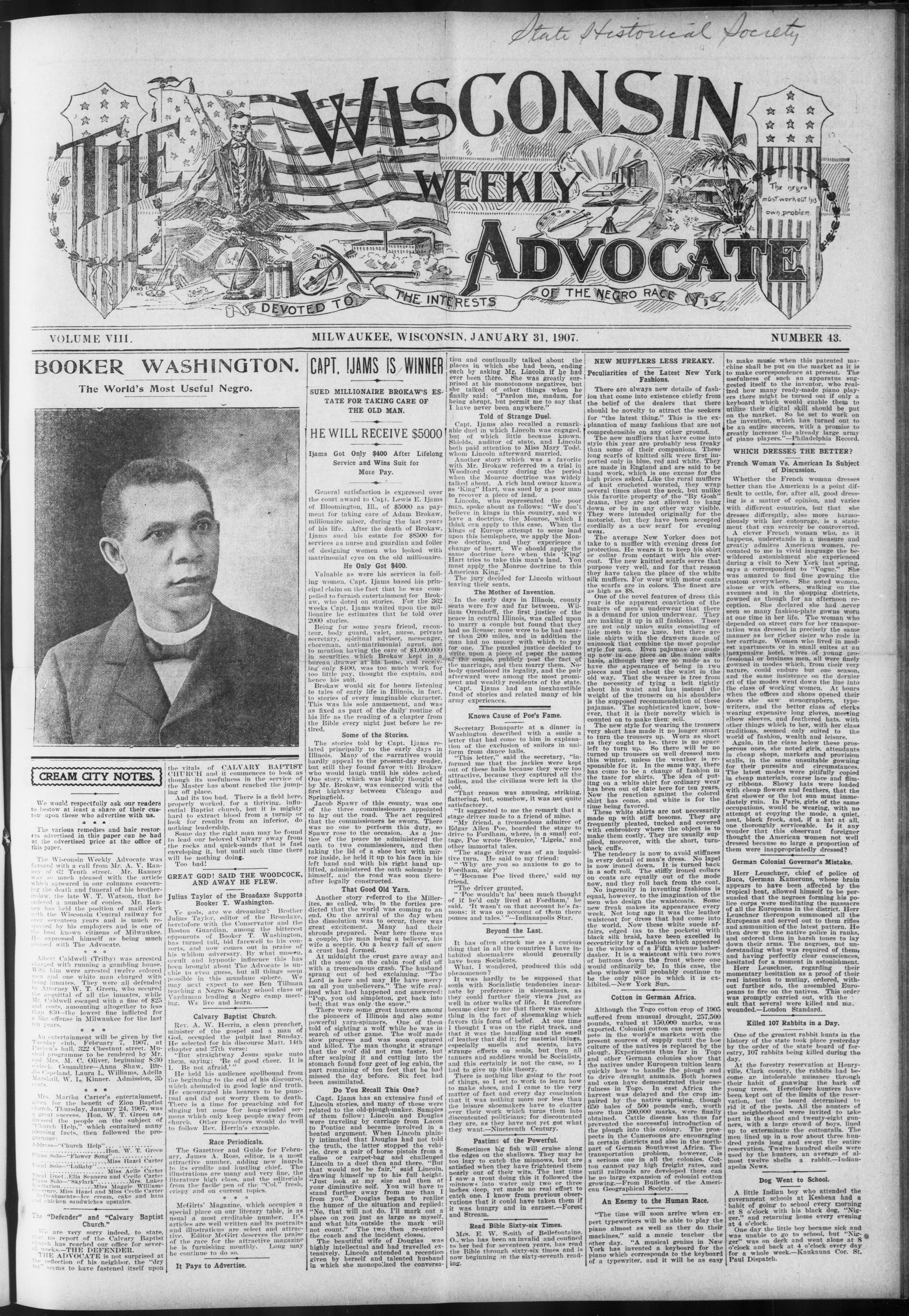
BOOKER WASHINGTON.
The World's Most Useful Negro.
CREAM CITY NOTES.
P.
We would respectfully ask our readers to bestow at least a share of their custom upon those who advertise with us.
The various remedies and hair restorers advertised in this paper can be had at the advertised price at the office of this paper.
The Wisconsin Weekly Advocate was favored with a call from Mr. A. V. Ranney of G2 Tenth street. Mr. Ranney was so much pleased with the article which appeared in our columns concerning the death and funeral of his brother-in-law, the late W. T. Watson, that he ordered a number of copies. Mr. Ranney has held the position of mail clerk with the Wisconsin Central railway for over seventeen years and is much respected by his employers and is one of the best known citizens of Milwaukee. He expressed himself as being much pleased with The Advocate.
Albert Caldwell (Trilby) was arrested charged with running a gambling house. With him were arrested twelve colored men and one white man charged with being inmates. They were all defended by Attorney W. T. Green, who secured the acquittal of all the inmates, while Mr. Caldwell escaped with a fine of $25 and costs, amounting altogether to less than $30—the lowest fine inflicted for a like offense in Milwaukee for the last ten years.
An entertainment will be given by the Tuesday club, February 7, 1907, at Pachen's hall, 322 Chestnut street. Musical programme to be rendered by Mr. and Mrs. M. C. Oliver, beginning 8:30 o'clock. Committee—Anna Shaw, Briadie Copeland, Laura L. Williams, Adella Marshall, W. L. Kinner. Admission, 35 cents.
* * *
Mrs. Martha Carter's entertainment, given for the benefit of Zion Baptist church, Thursday, January 24, 1907, was a great success. Hon. W. T. Green addressed the people on the subject of "Church Help," which contained many pleasing facts, then followed the programme:
Vocal Solo—"Lullaby".....Miss Acile Carter
Vocal Duet. Ella Sennero and Cecile Carter
Diano Solo—"Skylark".....Mrs. Luker
Restation.....Miss Maggie Williams
Overture Miss Hazel and Miss Cecile Carter
Refreshments—Ice cream, cake and ham
and chicken sandwiches upstairs.
The "Defender" and "Calvary Baptist Church."
We are very sorry indeed, to state, that no report of the Calvary Baptist church has reached our office for several weeks.—THE DEFENDER. THE ADVOCATE is not surprised at the reflection of his neighbor, the "dry rot" seems to have fastened itself upon
* * *
* * *
* * *
PRESIDENT
the vitals of CALVARY BAPTIST CHURCH and it commences to look as though its usefulness in the service of the Master has about reached the jumping off place. And its too bad. There is a field here, properly worked, for a thriving, influential Baptist church, but it is mighty hard to extract blood from a turnip or look for results from an inferior, do nothing leadership. Some day the right man may be found to lead our beloved Calvary away from the rocks and quick-sands that is fast enveloping it, but until such time there will be nothing doing.
GREAT GOD! SAID THE WOODCOCK AND AWAY HE FLEW.
Julius Taylor of the Broadaxe Supports Booker T. Washington.
Ye gods, are we dreaming? Brother Julius Taylor, editor of the Broadaxe, heretofore with the Conservator and the Boston Guardian, among the bitterest opponents of Booker T. Washington, has turned tail, bid farewell to his consorts, and now comes out in praise of his whilom adversary. By what unseen occult and hypnotic influence this has been brought about The Advocate is unable to even guess, but all things seem possible in this mundane sphere. We may next expect to see Ben Tillman teaching a Negro Sunday school class or Vardaman leading a Negro camp meeting. We live and learn.
Calvary Baptist Church.
Rev. A. W. Herrin, a clean preacher, minister of the gospel and a man of God, occupied the pulpit last Sunday. He selected for his discourse Matt. 14th chapter and 27th verse: "But straightway Jesus spake unto them, saying: 'Be of good cheer. It is I. Be not afraid.'" He held his audience spellbound from the beginning to the end of his discourse, which abounded in good logic and truth. He encouraged his hearers to be punctual and did not worry them to death. There is a time for preaching and for singing but none for long-winded sermons which only keep people away from church. Other preachers would do well to follow Rev. Herrin's example.
Race Periodicals.
The Gazetteer and Guide for February. James A. Ross, editor, is a most attractive number, adding new laurels to its crudite and hustling chief. The illustrations are many and very fine, the literature high class, and the editorials from the facile pen of the "Col." fresh, crispy and on current topics.
McGirts' Magazine, which occupies a special place on our literary table, is as usual a most creditable number. It's articles are well written and its portraits and illustrations are select and attractive. Editor McGirt deserves the praise of the race for the attractive magazine he is furnishing monthly. Long may he continue to do so.
It Pays to Advertise.
☆ ☆ ☆
CAPT. IJAMS IS WINNER
CAPT. IJAMS IS WINNER
SUED MILLIONAIRE BROKAW'S ESTATE FOR TAKING CARE OF THE OLD MAN.
Ijams Got Only $400 After Lifelong Service and Wins Suit for More Pay.
General satisfaction is expressed over the court award to Capt. Lewis E. Ijams of Bloomington, Ill., of $5000 as payment for taking care of Adam Brokaw, millionaire miser, during the last years of his life. After the death of Brokaw, Ijams sued his estate for $8500 for services as nurse and guardian and foiler of designing women who looked with matrimonial eyes on the old millionaire.
He Only Got $400.
Valuable as were his services in foiling women. Capt. Ijams based his principal claim on the fact that he was compelled to furnish entertainment for Brokaw, who doted on stories. For the 362 weeks Capt. Ijams waited upon the millionaire he estimates that he told over 2000 stories.
Being for some years friend, raconteur, body guard, valet, nurse, private secretary, spiritual adviser, messenger, choreman, anti-matrimonial agent, not to mention having the care of $1,000,000 in securities which Brokaw kept in a bureau drawer at his home, and receiving only $400, was too much work for too little pay, thought the captain, and hence his suit.
Brokaw would sit for hours listening to tales of early life in Illinois, in fact, to stories of every imaginable character. This was his sole amusement, and was as fixed as part of the daily routine of his life as the reading of a chapter from the Bible every night just before he re-
Some of the Stories.
The stories told by Capt. Ijams related principally to the early days in Illinois. Many of the narratives would hardly appeal to the present-day reader, but still they found favor with Brokaw who would laugh until his sides ached. One story, which was highly thought of by Mr. Brokaw, was connected with the first highway between Chicago and Springfield.
Jacob Spawr of this county, was one of the three commissioners appointed to lay out the road. The act required that the commissioners be sworn. There was no one to perform this duty, so Spawr rose to the occasion. As a justice of the peace he administered the oath to two commissioners, and then taking the lid of a shoe box with mirror inside, he held it up to his face in his left hand and with his right hand uplifted, administered the oath solemnly to himself, and the road was soon thereafter legally constructed.
That Good Old Yarn.
Another story referred to the Millerites, so called, who in the forties predicted that the world was coming to an end. On the arrival of the day when the dissolution was to occur, there was great excitement. Many had their shrouds prepared. Near here there was a couple, the man being a believer, his wife a sceptic. On a heavy fall of snow a crust had formed.
At midnight the crust gave away and all the snow on the cabin roof slid off with a tremenduous crash. The husband sprang out of bed exclaiming. "The Lord is here and may He have mercy on all you unbelievers." The wife realized what had happened and answered: "Pop, you old simpleton, get back into bed; that was only the snow."
There were some great hunters among the pioneers of Illinois and also some powerful yarn-spinners. One of them told of sighting a wolf while he was in search of other game. The wolf made slow progress and was soon captured and killed. The man thought it strange that the wolf did not run faster, but after scalping it and cutting into the stomach found four geet of log cabin, the part remaining of ten feet that he had missed the day before. Six feet had been assimilated.
Do You Recall This One?
Capt. Ijams has an extensive fund of Lincoln stories, and many of these were related to the old-plough-maker. Samples of them follow: Lincoln and Douglas were traveling by carriage from Lacon to Pontiac and became involved in a heated argument. When Lincoln plainly intimated that Douglas had not told the truth, the latter stopped the vehicle, drew a pair of horse pistols from a valise or carpet-bag and challenged Lincoln to a duel then and there. "But that would not be fair," said Lincoln, drawing himself up to his full height. "Just look at my size and then at your diminutive self. You will have to stand further away from me than I from you." Douglas began to realize the humor of the situation and replied: "No, that will not do. I'll mark out a place on you just as large as myself, and what hits outside the mark will not count." The two then re-entered the coach and the incident closeu.
The beautiful wife of Douglas was highly intellectual and had travelled extensively. Lincoln attended a reception given by herself and talented husband in which she monopolized the conversa-
tion and continually talked about the places in which she had been, ending each by asking Mr. Lincoln if he had ever been there. She was greatly surprised at his monotonous negatives, but she talked of other things when he finally said: "Pardon me, madam, for being abrupt, but permit me to say that I have never been anywhere."
Told of Strange Duel.
Capt. Ijams also recalled a remarkable duel in which Lincoln was engaged, but of which little became known. Shields, auditor of state, and Lincoln both paid attention to Miss Mary Todd, whom Lincoln afterward married. Another story which was a favorite with Mr. Brokaw referred to a trial in Woodord county during the period when the Monroe doctrine was widely talked about. A rich land owner known as 'King' Hart, was sued by a poor man to recover a piece of land.
Lincoln, who represented the poor man, spoke about as follows: "We don't believe in kings in this country, and we have a doctrine, the Monroe, which I think can apply to this case. When the kings of Europe attempt to seize land upon this hemisphere, we apply the Monroe doctrine, and they experience a change of heart. We should apply the same doctrine here when this 'King' Hart tries to take this man's land. You must apply the Monroe doctrine to this American King." The jury decided for Lincoln without leaving their seats.
The Mother of Invention
In the early days in Illinois, county seats were few and far between. William Orendorff, the first justice of the peace in central Illinois, was called upon to marry a couple but found that they had no license; none were to be had nearer than 200 miles, and in addition the man had no money with which to pay for one. The puzzled justice decided to write upon a piece of paper the names of the couple, publicly post the fact of the marriage, and then marry them. Nobody questioned its legality, and the pair afterward were among the most prominent and wealthy residents of the state. Capt. Ijams had an inexhaustible fund of stories and related many of his army experiences.
Knows Cause of Poe's Fame.
Secretary Bonaparte at a dinner in Washington described with a smile a letter that had come to him in explanation of the exclusion of sailors in uniform from dance halls.
"This letter," said the secretary, "informed me that the jackies were kept out of these halls because they were too attractive, because they captured all the ladies, and the civilians were left in the cold.
"That reason was amusing, striking, flattering, but, somehow, it was not quite satisfactory.
"It suggested to me the remark that a stage driver made to a friend of mine.
stage driver made to a friend or mine.
"My friend, a tremendous admirer of Edgar Allen Poe, boarded the stage to drive to Fordham, where, in a small cottage, Poe wrote 'Berenice,' 'Ligeia,' and other immortal tales.
"The stage driver was of an inquisitive turn. He said to my friend:
"Why are you so anxious to go to
"Why are you so anxious to go to Fordham, sir?"
"Because Poe lived there," said my friend.
"The driver grunted.
"‘Poe wouldn't ha' been much thought of if he'd only lived at Fordham,' he said. 'It wasn't on that account he's famous; it was on account of them there pomes and tales.'"—Indianapolis Star.
Beyond the Last.
It has often struck me as a curious thing that in all the countries I have inhabited shoemakers should generally have been Socialists. What. I wondered, produced this odd phenomenon?
It was hardly to be supposed that souls with Socialistic tendencies incarnate by preference in shoemakers, as they could further their views just as well in other walks of life. It therefore became clear to me that there was something in the fact of shoemaking which favors this form of belief. At one time I thought I was on the right track, and that it was the handling and the smell of leather that did it; for material things, especially smells and scents, have strange effects on souls, but then all tanners and saddlers would be Socialists, and this certainly is not the case, so I had to give up this theory.
There is nothing like going to the root of things, so I set to work to learn how to make shoes, and I came to the very matter of fact and every day conclusion that it was nothing more nor less than the leisure shoemakers have to chatter over their work which turns them into discontented politicians; for discontented they are, as they have not yet got what they want.—Nineteenth Century.
Pastime of the Powerful.
Sometimes big fish will cruise along the edges on the shallows. They may be too lazy to catch the minnows, but are satisfied when they have frightened them nearly out of their wits. The last time I saw a trout doing this it followed the minnows into water only two or three inches deep, yet made no real effort to catch one. I know from previous observations that it could have taken them if it was hungry and in earnest.—Forest and Stream.
Read Bible Sixty-six Times.
Mrs. E. W. Smith of Bellefontaine. O., who has been an invalid and confined to her bed for seventeen years, has read the Bible through sixty-six times and is now beginning on the sixty-seventh reading.
NEW MUFFLERS LESS FREAKY.
Peculiarities of the Latest New York Fashions
There are always new details of fashion that come into existence chiefly from the belief of the dealers that there should be novelty to attract the seekers for "the latest thing." This is the explanation of many fashions that are not comprehensible on any other ground.
The new mufflers that have come into style this year are probably less freaky than some of their companions. These long scarfs of knitted silk were first imported only in blue, red and white. They are made in England and are said to be hand work, which is one excuse for the high prices asked. Like the rural mufflers of knit crocheted worsted, they wrap several times about the neck, but unlike this favorite property of the "By Gosh" drama, they are not allowed to hang down or be in any other way visible. They were intended originally for the motorist, but they have been accepted cordially as a new scarf for evening wear.
The average New Yorker does not take to a muffler with evening dress for protection. He wears it to keep his shirt or collar from contact with his overcoat. The new knitted scarfs serve that purpose very well, and for that reason they have taken the place of the white silk mufflers. For wear with motor coats the scarfs are in colors. The finest are as high as $8.
One of the novel features of dress this year is the apparent conviction of the makers of men's underwear that there is a demand for union underwear. They are making it up in all fashions. There are not only union suits consisting of lisle mesh to the knee, but there are lisle shirts with the drawers made of nainsook that combine the most popular style for men. Even pajamas are made up now in one piece on the union suits basis, although they are so made as to have the appearance of being in two pieces and tied about the waist in the old way. That the wearer is free from the necessity of tying a belt tightly about his waist and has instead the weight of the trousers on his shoulders is the supposed recommendation of these pajamas. The sophisticated know, however, that it is their novelty which is counted on to make their sell.
The new style for wearing the trousers very short has made it no longer smart to turn the trousers up. Worn as short as they ought to be, there is no space left to turn up. So there will be no turned up trousers on well dressed men this winter, unless the weather is responsible for it. In the same way, there has come to be a change of fashion in the taste for shirts. The idea of putting on a white shirt for ordinary wear has been out of date here for ten years. Now the reaction against the colored shirt has come, and white is for the time being favored.
These white shirts are not necessarily made up with stiff bosoms. They are frequently pleated, tucked and covered with embroidery where the object is to make them costly. They are usually supplied, moreover, with the short, turnback cuffs.
The tendency is now to avoid stiffness in every detail of man's dress. No lapel is now ironed down. It is turned back in a soft roll. The stiffy ironed collars on coats are equally out of the mode now, and they roll back from the coat. No ingenuity in inventing fashions is equal, however, to the imagination of the men who design the waistcoats. Some new freak makes its appearance every week. Not long ago it was the leather waistcoat for dress that had come into the world. Now these white suede affairs, edged (as to the pockets) with black silk braid, have been excelled in eccentricity by a fashion which appeared in the window of a Fifth avenue haberdasher. It is a waistcoat with two rows of buttons down the front where one would ordinarily be. In this case, the shop window will probably continue to be the only place in which it is exhibited.—New York Sun.
Cotton in German Africa.
Although the Togo cotton crop of 1905 suffered from unusual drought, 257,500 pounds, valued at 150,000 marks, was exported. Colonial cotton can never compete in the world's markets with the present sources of supply until the hoe culture of the natives is replaced by the plough. Experiments thus far in Togo and other German colonies show that the natives under European tuition learn quickly how to handle the plough and to drive draught animals. Both horses and oxen have demonstrated their usefulness in Togo. In east Africa the harvest was delayed and the crop impaired by the native uprising, though 650 bales of 500 pounds each, worth more than 200,000 marks, were finally obtained. Cattle disease has thus far prevented the successful introduction of the plough into this colony. The prospects in the Cameroons are encouraging in certain districts and also in the northpart of German Southwest Africa. The transportation problem, however, is a serious one in all the colonies. Cotton cannot pay high freight rates, and until railroads are developed there can be no large expansion of colonial cotton growing.—From Bulletin of the American Geographical Society.
An Enemy to the Human Race.
"The time will soon arrive when expert typewriters will be able to play the piano almost as well as they do their machines," said a music teacher the other day. "A musical genius in New York has invented a keyboard for the piano which corresponds to the keyboard of a typewriter, and it will be as easy
to make music when this patented machine shall be put on the market as it is to make correspondence at present. The usefulness of such an apparatus suggested itself to the inventor, who realized how many ready-made piano players there might be turned out if only a keyboard which would enable them to utilize their digital skill should be put on the market. So he set to work on the invention, which has turned out to be an entire success, with a promise to greatly increase the already large army of piano players."—Philadelphia Record.
WHICH DRESSES THE BETTER?
French Woman Vs. American Is Subject of Discussion.
Whether the French woman dresses better than the American is a point difficult to settle, for, after all, good dressing is a matter of opinion, and varies with different countries, but that she dresses differently, also more harmoniously with her entourage, is a statement that can scarcely be controverted. A clever French woman who, as it happens, understands in a measure and greatly admires American women, recounted to me in vivid language the bewildered astonishment she experienced during a visit to New York last spring, says a correspondent to "Vogue." She was amazed to find fine gowning the custom everywhere. She noted women, alone or with others, walking on the avenues and in the shopping districts, gowned as though for an afternoon reception. She declared she had never seen so many fashion-plate gowns worn at one time in her life. The woman who depended on street cars for her transportation was dressed in precisely the same manner as her richer sister who rode in her carriage. Women who lived in modest apartments or in small suites at an inexpensive hotel, wives of young professional or business men, all were finely gowned in modes which, from their very nature, could endure but one season, and the same insistence on the dernier cri of the modes went down the line into the class of working women. At hours when the offices and shops opened their doors she saw stenographers, typewriters, and the better class of clerks wearing expensive long gloves, meeting elbow sleeves, and feathered hats, with other things which to her, with her class traditions, seemed only suited to the world of fashion, wealth and leisure.
Again, in the class below these prosperous ones, she noted girls, attendants in cheap shops, markets and provision stalls, in the same unsuitable gowning for their pursuits and circumstances. The latest modes were pitifully copied in cheap materials, coarse lace and flimsy ribbons. Showy hats were loaded with cheap flowers and feathers, that the first shower or the hot sun must immediately ruin. In Paris, girls of the same occupations, would be wearing, with no attempt at copying the mode, a quiet, neat, black frock, and, if a hat at all, one thoroughly serviceable. Is it any wonder that this observant foreigner thought the American women not well dressed because so large a proportion of them were inappropriately dressed?
German Colonial Governor's Mistake.
Herr Leuschner, chief of police of Buca, German Kameruns, whose brain appears to have been affected by the tropical heat, allowed himself to be persuaded that the negroes forming his police corps were meditating the massacre of all the Europeans in the district. Herr Leuschner thereupon summoned all the Europeans and served out to them rifles and ammunition of the latest pattern. He then drew up the native police in ranks, and ordered them in harsh tones to lay down their arms. The negroes, not understanding what was required of them, and having perfectly clear consciences, hesitated for a moment in astonishment.
Herr Leuschner, regarding their momentary hesitation as a proof of their real intention to mutiny, ordered, without further ado, the assembled Europeans to fire on the natives. This order was promptly carried out, with the result that several were killed and mawounded—London Standard.
Killed 107 Rabbits in a Day
One of the greatest rabbit hunts in the history of the state took place yesterday by the order of the state board of forestry, 107 rabbits being killed during the day.
At the forestry reservation at Henryville, Clark county, the rabbits had become an intolerable nuisance through their habit of gnawing the bark off young trees. Heretofore hunters have been kept out of the limits of the reservation, but the board determined to rid it of the pests. All the hunters of the neighborhood were invited to take part in the shoot and twenty-eight gunners, with a large crowd of boys, lined up to exterminate the cottontails. The men lined up in a row about three hundred yards long and swept the entire reservation. Twelve hundred shells were used by the hunters, an average of almost twelve shells a rabbit.—Indiananolis News.
Dog Went to School.
A little Indian boy who attended the government schools at Keshena had a habit of going to school every morning at 8 o'clock with his black dog, "Nigger." and returning home every evening at 4 o'clock. One day the little boy became sick and was unable to go to school, but "Niger" was on deck and went alone at 8 o'clock and back at 4 o'clock every day for a whole week.—Kaukauna Cor. St. Paul Dispatch.
THE WISCONSIN WEEKLY ADVOCATE
MILWAUKEE, WIS.
B. B. MONTGOMERY, Editor and Proprietor.
The Spice of Life.
Nurse (singing lullaby to infant)—Once there was a crown of gold—
Rosenstein, Anxious Father — He'll never go to sleep if you sing to him anything about money!—Meggendorfer Blaetter.
"Sir," said the young man, "will you permit me to pay my addresses to your charming daughter and try if I can make her love me?"
"Certainly, my dear boy, and there is no reason why you should not succeed. Lots of others have."—La Saeta.
Another.
We've had our fill of end seat hogs
And borne them like a lamb;
Now comes a new variety,
To wit, the Swettenham.
—New York Sun.
Another.
In the Sanctum.
Poet—What do you think of this little poem of mine. "She Would Not Smile." Editor—I think if you had read the poem to her she would have smiled.—Le Rire.
Heard in Sunday School
"What happened when Sampson's hair had been cut?"
"I suppose the barber asked him if he would have a shampoo, too."—Town Topics.
No Ioke.
Friend—Who was that funny old party you were speaking to just now?
Not in Good Form
"Well, I must be off, Kathi, the beer is so warm today it's impossible to drink it. How much have I to pay?" Waitress—Trodo, topkick: Herr
Little, but Oh My!
"She bosses him. I hear."
"I should say she did boss him, and she's a little bit of a mite, too."
Ah! Just another case where the mitte makes right!"—Philadelphia Press.
A Freak Dialogue
The Tattooed Man—Say Shorty, I wouldn't want to be you. Dwarfs never live long!
The Dwarf—Don't worry about me. Every one knows that you're a marked man!
A Suggestion
Taylor—No money again, and just for a beggarly pair of trousers. Must I come here nine times?
Student—Well, then, make me a whole suit and it will be worth the trouble.—Kikeriki.
Worse and Worse
Father (sighing)—These ten years have I been waiting in the hope that my wife would give up playing the piano. Friend—Well, and now—? Father—Now my three daughters play.—Figaro.
What We All Want to Know
"Oh, Mr. Paintslinger, I think your latest picture is just lovely."
"Thank you, miss."
"But I wanted to ask you, is that thing looking over the fence the moon or the sun?"—Denver Post.
Warmly.
Bacon—The police are very considerate of a poor homeless tramp in New York. Egbert—How so? Bacon—Why, when one goes to sleep on a park bench the park policeman raps him up.—Yonkers Statesman.
in Keeping.
"And shall you carry out your plan of visiting the blue grotto at Capri this year, Frau Lammer?"
"Alas, no, Frau Spits; we are in mourning this summer, so we are going to the Black Forest."—Figaro.
In a Studio.
"I ordered you to paint me some cows in a stable. I see the stable, but where are the cows?"
"They are in the stable."
"So is your pay for this picture. You had better bring both out."—La Saeta.
First Aid
Johnnie—Papa, papa, come quick! Mamma has fainted.
Papa—Here, put this $10 bill in her hand.
Johnnie (a moment later).—She says she wants $10 more.—Fliegende Blaetter.
Cocktails and Evening Dress.
The London Lancet says evening dress is a good substitute for the cocktail as an appetizer, but as long as evening clothes retail at $75 and cocktails at 15 cents the suggestion will not be universally adopted.—Louisville Courier-Journal.
Handy.
Young Poet (to creditor who presents a bill)—Oh, how good of you! I was looking everywhere for a piece of paper upon which to write a wonderful thought which has just come to me, and you drop down like an angel from heaven!- Meggendorfer Blaetter.
Employes in salt works never get cholera, scarlet fever, influenza or colds.
DODD'S
KIDNEY
PILLS
FOR ALL KIDNEY DISEASES
CURES RHEUMATISM
BRIGHT'S DISEASE
DIABETES BACKAGME
discontinued the use of our product
package. The public may rely on our
care of imitations. Sold only in durestion.
INDIAN RELICS WANTED, of copper and stone. Write and tell me what you have. H. P. HAMILTON, Two Rivers, Wis.
THE GOLDEN ROPE.
He has forgotten the olden joy
That made life sweet when he, a boy,
Roved in the fields of the far away
Bygone hours of yesterday.
The rhythmic swell of the Christmas bell,
The carols sweet from the lower street,
They bring him no gladness nor aught of
hope,
As he weaves the strands of the golden
rope.
The miser sits in his broken chair.
Like a spider spinning within his lair
The web of fate for the victim fly—
Chill is his heart and cold his eye.
The child of woe that lurks below
In the dingy hall in vain may call
To the miser with his single hope—
More strands to weave in his golden rope.
The wires droop 'neath the falling snow,
The street grows quiet far below;
The Christmas chimes, they die away
Like the bygone songs of yesterday.
Far on high like an eerie eye
A light gleams out from the grim redoubt
Where the miser sits and feeds on hope—
More strands to weave in the golden rope.
Ch'ill is the air, the fire's dead.
Ashes lie like a pall that's spread
Over the hearth where the fingers reach,
Cold as stone in a mute beseech.
The child of woe that lurks below
In the chilly hall snugs to the wall
Out of sight of friend or hope—
While the miser weaves at his golden rope.
"A merry Christmas one and all!" Blithe is the cheer of the gladsome call That swells the hearts of the passing through Borne on winged feet along. Far above in the grim alcove Under the eaves a canary grieves For the miser dead in his sordid nest. With his mother's picture on his breast. —Horace Seymour Keller.
A MYSTERIOUS SCOUT.
One of the strangest characters that I met during the five years I fought under the Confederate flag was a person known throughout the south as "Tucker, the Scout." My acquaintance with this singular being began with a terrible incident. Soon after the fall of Vicksburg I was in Canton awaiting orders from Richmond.
One day I was strolling through the military prison when I noticed a young man talking with a Yankee. Their conversation became so animated as to attract our attention, and mine was especially drawn to this youth. He was clad in a neat and beautiful suit of gray cloth; he wore a fine black felt hat, in which a single long black feather was fastened in front by a bright steel buckle.
He was small but compactly built, and in every pose and movement as graceful and as bright as Apollo. Altogether he was one of the most strikingly handsome young men I ever saw. These were the first words I heard the boy speak, and they were spoken clearly, incisively, in a peculiar, ringing, silvery, bantering tone:
"Oh, yes. Of course the Yanks and all other men are brave enough when there is a crowd of them together, but when it comes to personal courage we southerners defy God's earth to match us. Now, I don't doubt that you're a pretty good soldier for a Yankee, but you haven't got true 'grit.' You can't sight down the barrel of my revolver without flinching, but southern gentlemen can meet death, single handed, with a smile. You can't face it even as a test. Try it, if you dare!"
And with a light, mocking laugh he extended his arm. The Yankee looked startled for a moment, but he shut one eye and calmly looked down the barrel of the pistol with the other.
"You had better dodge!" said the young man, with a tantalizing laugh. "I am going to fire at the word 'three.' Dodge! Dodge! 'One!' 'Two!'"
"'Three!'"
At the word, the long, delicate finger pressed down upon the trigger, a loud report rang through the rooms, and the poor Yankee dropped dead in his tracks, a bullet having crashed through the right eye into his brain.
A thrill of horror ran through every one at the sight of this cowardly, cold-blooded, inhuman murder, while the young man stood looking down upon his victim, his beautiful face still wreathed with that mocking, wicked smile. It was only for an instant. I sprang forward and seized his delicate throat with one hand, and with the other clutched the pistol, saying: "Give it up, you murderer!"
He gave up the weapon at once, standing passively. He gulped, as I had choked him pretty hard, and then said, with a beaming smile: "Major, it is rather tough to choke a man so for a mere accident like that."
"Certainly," he said, with his wicked smile. "Every one saw that I was only joking the Yank. I hope no one doubts that the pistol was discharged by accident."
I was dumbfounded by his calm assurance. I called the sergeant of the guard and said:
"Take this man into custody. I charge him with the willful murder of a prisoner and will appear to testify to the same whenever desired to do so."
Before long I received a request from Gen. "Red" Jackson to come round to his headquarters. The general said:
"I understand you were present when Tucker shot a prisoner this evening. I am informed, also, that you are a law-
I said that his information was correct.
"It was murder," said the general, decisively. "I know it. But the fact puts me in an awkward position. Tucker's services as a scout have been almost invaluable to me, but he is not a soldier. He has steadily refused to enlist, and being a refugee from Missouri it is contrary to Confederate law to conscript him. They say he has killed twenty-three Yankees with his own hand, three of whom were prisoners, whom he murdered in cold blood.
"He is not a soldier and cannot be courtmartialed. The soldiers condemn his conduct but sympathize strongly with the man, especially because they understand that his family were terribly wronged by the Yankees in Missouri, and also because they do not think he is entirely sane. And now Gen. McPherson has sent in a demand by a flag of truce for Tucker, and I shall deliver him to the Federals for punishment."
In about forty hours a squad came in from the Yankee outpost at Big Black with a requisition for Tucker, and he was at once delivered up to the Yankees and carried away by them. I think this was on Friday morning, and on the following Sunday night, while I sat smoking my pipe, the lithe form and handsome face of "Tucker, the Scout" pre-
sented itself in the doorway. I was, of course, a good deal surprised.
"Well, what is the matter?"
"I have had a pretty narrow escape, and this thing of being handed over to the Yankees is more than I can stand. I want your advice."
"Tell me first how you got back to this place again."
"Gen. McPherson ordered me to be executed. They put me under close guard in a tent. One Yankee stood outside with a gun, and a big, fat Dutchman stayed in the tent with me. When he got sleepy he made me lie down beside him and put one bracelet of a pair of handcuffs on his own left wrist and on my right one. He then took a big butcher knife and stuck the point of it in the ground beside him, the handle sticking up. He assured me that the knife was for my special benefit, and that if I moved hand or foot during the night he would rip me all to pieces with the knife.
"He went to sleep at last, and as soon as he snored regularly I laid my thumb down straight in the palm of my hand, drew my fingers close together that way," said Tucker, stretching out his long, slender hand, "and slipped my hand through the iron ring without the slightest difficulty.
"I then put one hand over the Dutchman's mouth at the same instant that I seized his butcher knife and with one strong, quick blow plunged the full length of the blade into his stupid carcass, right above the collarbone. I then cut a slit in the side of the tent with the Dutchman's knife and slipped through. I crept along until I got to the edge of the brush and then 'lit out' for Captain and tonight I am here."
He gave this grim recital in a strange, quiet, matter-of-fact way that rendered it atrociously realistic.
"And what do you propose to do here?"
"That is just the question. Do you think Jackson will surrender me to the Yankees again?"
"Yes. Or hang you himself."
"And you, I suppose, would approve?"
"You are regarded by some persons as a monomaniac, and, therefore, irresponsible for your crimes."
"Iresponsible for my crimes?" he echoed, musingly. "I am sure I don't know. I can shut my eyes and see again the burning of my quiet home in Missouri, fired by the Yankees. I can see a frenzied old mother bending over the murdered body of a gray-haired father. I can see a man seize a bayonet and with one fiendish stroke plunge it through the breasts of a well loved daughter. I can see a fond brother clutch the brute by the throat, only to be stretched senseless by a blow from a musket.
"Oh, sir, if that had been your home you would have dropped upon your knees in the snow, under the midnight skies, as I did, and you would have registered a burning vow never to forgive, never to spare, always to follow, and always to murder—if you call it so—those devilish miscreants while you lived."
I saw at once that it would be folly to try to reason with such fervid, impassioned, conscientious hatred.
"But the question now is," said the scout, "what am I going to do?"
"I think that you had better start for Tennessee tonight to join Wheeler's cavalry, go into the service regularly, do your whole duty to your country like a brave, capable man as you are, and try to get over this insane hatred which makes you a devil, not a man."
The scout pondered this scheme for some time. Then, with a dreary, broken-hearted sigh, he answered: "Perhaps you may be right. I have a horse at a farm two miles out in the country. I will go and sleep until after midnight and then start for Tennessee."
"You can lie on my bed there and sleep. I will wake you up at 2 o'clock." "No, I always go off by myself to sleep. I cannot rest at all unless out of sight and out of hearing of every one else."
A short time afterward Tucker left to join Wheeler's cavalry in Tennessee, and I never saw him afterward.
One day, while we were at Atlanta, I got a note from a lady saying there was a girl at her house mortally hurt by a piece of shell, who wanted to see me before she died. I went to the house.
"You do not recognize me?" said the girl.
"No."
"Turn back the sheet and look at my breasts," she said. "I am dying and there can be no impropriety in your doing so."
I did as she requested. There was a livid, triangular scar in the white flesh, beyond doubt a bayonet wound.
"Do you know me now?" she said, with a mocking smile.
"Yes," said I, "you are the sister of 'Tucker, the Scout,' of whom he told me long ago."
"No—you are wrong again," she said.
"I am 'Tucker, the Scout,' myself. I cured a girl at Canton of her love for me by telling her I was a woman, too."
Then again she feebly laughed—a mocking wicked tantalizing laugh.
I called the next day, and found that she was dead. The hard, brilliant, impenetrable, impenitent soul had fled. Often I ask myself the question: "Was this girl insane?"—Maj. N. C. Kouns in The Argonaut.
In the Wife's Name.
Putting the home in one's wife's name is common enough, but the newer thing is to put the telephone in her name. There are lots of public officials and men prominent in other walks of life who would be called from bed or the dinner table continuously if their telephone number could be found in the book. To obviate this Mr. John Brown, for instance, whose wife is named Sarah Ann, has the name S. A. Brown put down opposite his number. The friends who are interested know of the dodge while the general public never suspects it.—New York Letter.
Judged by His Whiskers.
An Indianapolis woman who has inspected the portrait of Hughes, the Republican nominee for governor of New York, expresses the opinion that if he is defeated it will be because of his whiskers, and not because of Hearst. She avers that this is not an unreasonable feminine view based on an arbitrary standard of manly beauty, but is founded on the conviction that a man who will permit himself to wear such whiskers betrays a fatal weakness.—Indianapolis Star.
Praver Meetings on Trains.
Two enterprising and up-to-date evangelists in London have hit upon the idea of a train prayer meeting. Suburban
travelers are the ones approached by these two self-appointed missionaries, whose first "attack" has been made upon the North London railway trains, morning and evening. One plays hymns on a concertina, and joins in singing and praying. These services on wheels, though occasionally resented, are not generally disapproved. Indeed, many business men who crowd the cars at the times these services are held, seem to enjoy them. So enthusiastic are the originators over their success that-provided sufficient funds are forthcoming—they purpose extending their sphere of activity to other English railway lines. They have received the consent of several railway companies already, who favorably view the new departure.
AWFUL THINGS COMING.
Mme. De Thebes Issues Almanac for 1907.
The woman known in Paris as Mme. de Thebes, who hakes a practice of casting the horoscope of every year, has issued her almanac for 1907. Her predictions concerning some European countries are quite alarming. First, as to Great Britain, Mme. de Thebes predicts a bitter class war and a struggle between the House of Lords and the people. But the King will bring it to an end. That is the worst she has to say about England.
There is a bad time in store for Germany if the clairvoyant's predictions are realized. The Fatherland is becoming more and more disturbed, she says. Rings are hinted at; the Kaiser, we are told, has seen his best days, and will leave to his less skillful successors an inextricable situation. The year will reveal German weakness. There will be mourning in several princely families, and court affairs will be fruitful in astonishing surprises. The Emperor is to give more coups de theater.
In Austria there will be great commotion; the old Emperor is not sure whether he will leave the crown to the archduke, whom he has designed to succeed to it.
The greatest dangers of his reign confront King Alfonso, but he will escape them, and if he pulls through 1907 and 1908 he is assured of living a royal, original, exciting, and prosperous life. Italy is in a state of renascence. For the rest, Mme. de Thebes believes that the Latin races are destined more than ever to lead the world. There is nothing reassuring for America. Disasters by fire and water are predicted and the same prediction holds good for South America. In almost every state politics will bring about ravages in 1907 and grave conflicts. France, in the matter of doleful disasters, is let off lightly. No scourge will visit the country: no commotion will exist for any length of time; nothing will absorb Frenchmen exclusively.
Mme. de Thebes does not believe that there will be a foreign war. However, the danger that the country has run will confront it again. There will be more parliamentary and financial dramas than usual, and some sensational disappearances, especially two.
The year will yield numerous scandals and private sorrows. As regards Belgium, the time is ripe for social transformations. Mme. de Thebes is not quite clear about Russia. Everything is in a stage of contradiction there. Still, there are indications that there will be fewer catastrophes during the year. The hands of soldiers have led the prophetess to believe that at no distant date the Russian army has a role to play abroad.
Winding up her prophecies, the prophetess believes that the power of the Vatican will increase, that its moral power will be fortified by the fears of threatened governments and by the unchained appetites of people exasperated with materialism. England, she says, will be favorable to the Vatican, and her influence will not be without weight in France.
GOLDEN NUGGETS
It is "in" some men to succeed as naturally as it is "in" others to fail.
A man who is always trying something new never does very well, but he has a great deal to say about his steady neighbor being in a rut.
State your views on any subject, and if your listener says he hasn't made up his mind, it means he disagrees with you and hates to say so.
When a man remains throughout an entertainment with his overcoat on, it is one sign he doesn't attend such entertainments very often.
After a woman with an angel disposition has kept boarders a few weeks, she is as changed as if she had been put over to boil, and has been molded all over again.
Nine out of ten misfortunes are due to lack of common sense. Considering the many opportunities to learn, it is really surprising how little the majority of people know.
The average man is at least ten miles behind his daughters in keeping up with fads and fashions, but this doesn't make him unhappy if his wife is back there with him.
You will hear a lot of nonsense about the pure food law. But you must not make fun of it; you must look grateful to the Good Men who are anxious to benefit you.
---
There are so many things to the credit of the hard-working woman that it is impossible to enumerate all of them. Here is one: A real hard-working woman never likes to visit over a telephone.— Atchison (Kan.) Globe.
Mortgages Her Body to Help a Friend
Almost her life has Dottie Morgan of Des Moines, Ia., given for love of a friend. She has mortgaged her body.
To get money for the aid of one she loves and who is dying of consumption she has voluntarily assumed the risk of having her body cut up in a medical college laboratory after death.
Hard pressed and almost distracted lest she could not answer a pitiful cry for help in time, she went to Mose Levich, a pawnbroker, for aid Tuesday.
"Why, here, take the money and not another word about paying it back," explained the pawnbroker, touched by the story of devotion.
"No, never, unless I can give you security. But my body is all I have. Couldn't you sell it after I'm dead?"
The bargin will be made. The money was needed by her to send to the sick girl friend who had applied to her for assistance.
The friend, ill in Council Bluffs and anxious to return to her home in Des Moines before she died, applied to Miss Morgan for help. The sacrifice made, the money was sent immediately to the girl friend.
The mortgage reads as follows:
I. Dottie Morgan, of my own free will and without coercion of any kind, hereby do sell to Mose Levich my body after death to do with as he sees fit for a consideration of $10.
The said Mose Levich shall not take possession of my body until after I am dead, and if any time during my life I wish to cause this bill of sale to become null and void and shall pay to Mose Levich or his assignees $10 in good and lawful money of the United States his interest in my body shall cease. DOTTIE MORGAN.
The court of appeals at Frankfort, Ky., has upheld the constitutionality of the legislative act of 1904 making chicken stealing a felony. The act makes it a felony, punishable by imprisonment in the state penitentiary for from one to five years, for stealing chickens to the value of $2 or more.
Alvin Shaw, 37 years old, is dead in the City hospital at Newark, N. J., of a disease known as mitral stenosis, or "musical heart." Shaw was an ironworker. In explaining his peculiar illness to friends he said his heart twanged like a banjo when it beat. He had been under medical treatment for some months.
As the result of her anchor getting afoul of something at the bottom of Hampton Roads, a fishing schooner was the innocent cause of discovery and recovery of the lost anchor and chain at the Confederate armor clad Merrimac or Virginia. The last name was given her by the Confederate government and under it she fought the famous battle with the monitor that revolutionized naval warfare.
Chickens pecking at dynamite caused an explosion which wrecked a part of the house of George Kallenbach, a farmer near Henryville, Ind. Three members of the family were injured, one little girl having one of her eyes torn out by flying pieces of broken stove. Kallenbach had taken the dynamite home from a quarry where he had been at work and placed it at the rear of his kitchen, where the chickens got at it.
The most unusual package ever received through the mails of Kenosha came recently, when a well known man of that city received two pounds of well cooked sausages from a girl way up in Canada. The wrappings had been broken and the sausages gave a strong odor of garlic to the entire sack of mail. The postmaster called in the health officer and when the latter pronounced the sausages "O. K.," they were delivered.
A dispatch from Los Angeles, Cal., says that the Southwestern deserts and the forest reserves of the region are to be restocked with antelope, to be brought from Africa. Private capital already has been secured for the purpose and the project, it is stated, is already under way. It is intended to secure a species of antelope that thrives in the hot desert regions and are able to live a long way from water. In former days antelope were numerous in southern California.
A decision holding a newspaper responsible for wrongly advising a reader who asked for financial advice was given by Lord Chief Justice Alverstone in London the other day. The defendant was C. A. Pearson one of whose publications invites its readers to apply to the editor for financial guidance. The plaintiff accepted the invitation and was sent to a certain stock broker to whom he intrusted $7000 for investment. The money was never invested, and the lord chief justice in his decision ordered Mr. Pearson to repay the full amount to the plaintiff.
James Woster Brown, accused of feeding his children on shark meat, and with keeping them out in the cold half clothed on the plea that such treatment was good for their health, was convicted at Cape May Court House, N. J., recently. The verdict was rendered by a jury of only eleven men, the twelfth juror, Frederick Boener, having been ordered from the jury box by the court after an attempt to pass a note to the defendant's counsel. The jury acquitted Brown of the two charges of assault, confining his guilt only to the six counts against him for cruelty.
The Omaha courts have decided that works of art by famous painters, including Van Dyke, Rubens and Van der Werff, are indecent and that reproductions of them cannot be sold in Omaha stores. For persisting in their sale John Greenberg was fined and warned that on the next occurrence he would be sent to jail. Greenberg had on sale copies of Rubens' "Judgment of Paris," the original of which is in the Dresden Art gallery; Van Dyke's "Diana and the Golden Reign of Jupiter;" Van der Werff's "Magdalena" and others of that class.
In Justice Charles W. Reeder's court at Janesville, Wis., the garnishee action of Mrs. R. Zibbel vs. William Bigelow was settled. The plaintiff is the landlady of a boarding house, while the defendant is her star boarder. It is claimed that as the result of the defendant's ill-smelling feet that bed clothes to the value of $5 were ruined. Constable Dulin served the papers on the surprised boarder, who stated that he could not remedy the trouble with his feet, and that prominent physicians had advised him not to try for fear that the trouble would result fatally in a blood disease. Mr. Bigelow settled and paid the costs.
The aid of the phonograph has been invoked to solve the mystery surrounding Peter Uzelac, an aged immigrant from Croatia, now at Waterloo, Ia., who has been unable to make any one understand his language since he arrived two months ago. He was induced to talk into a phonograph and explain all about himself. The record has been mailed to the American consul at Vienna, with a request to have the message translated into English and returned. Greeks, Italians, Russians, Germans, Prussians, Poles, and persons speaking different dialects have attempted to converse with the stranger, but have failed to gather more than an occasional word or phrase.
Mrs. Elizabeth Mohe of Beloit, who is serving a long term in the county jail at Janesville, became suspicious that all was not as it should be with her household goods and the district attorney gave her permission to go down to the Line City under escort of Undersheriff George Appleby, and move her possessions to Janesville for storage in the basement of the bastile. Her suspicions appeared to be confirmed as many things turned up missing. However, a large drayload of goods in addition to what the undersheriff and she could carry were brought back. The officers, however, declined to allow her husband to remain in Janesville at the prisoner's expense.
The famous prison of St. Lazare, one of the great historic landmarks of Paris, is about to be pulled down, and what for some years has been a moral and physical plague spot will give way to fine open squares and commodious dwellings. St. Lazare was at first a lepers' hospital, built at the end of the eleventh century on the site of a basilica dedicated to St. Laurent. Later it was handed over to St. Vincent de Paul, who established there a number of priests of his mission known as the congregation of St. Lazare. St. Vincent himself died at St. Lazare, and his cell is still shown to visitors with two stones worn hollow by the knees of the saint. During the terror many "ci-devants" were confined there before being tried by the revolutionary tribunal. It was
from St. Lazare that Andre Chenier was led to the guillotine. Of recent years the prison has been used solely for the confinement of the pitiful outcasts of society, who are gathered in from the streets and boulevards of Paris.
Justice Brewer of the United States supreme court comes from Kansas. After he married the present charming Mrs. Brewer they went for a visit out to his old home. In Washington a justice of the supreme court is always spoken of as "Mr. Justice" and that was the title Mrs. Brewer had always heard. When they reached this city on their way home the "Mr." was dropped and the jurist was referred to as Justice Brewer. At Omaha some old friends called him "David J." and when they crossed the Kansas line some former neighbors referred to him as "Dave." "Let's go home," suggested Mrs. Brewer. "Why?" asked the justice. "Because, dear." Mrs. Brewer replied, "I am afraid if we go any farther they will be calling you Davie."
John Bryan, formerly of New York, a millionaire and author, now living on a great farm at Yellow Springs, O., has been sued for $50,000 for breach of promise by Mary Stentor. Miss Stentor alleges that October 10, 1903, she and Mr. Bryan entered into an agreement to marry each other. Miss Stentor at one time made her home at Mr. Bryan's rural mansion, though she left his house about a year and a half ago. About a year ago she caused a sensaton by filing damage suit for $25,000 against Bryan, alleging that he had struck her with a riding whip, and that the shock was so great she had been in poor health ever since. Mr. Bryan was just starting on a trip around the world and his departure was delayed by the service of summons.
After having sued the city for damages of $728,000 during eight years and after having once been awarded $555, 560, the Weir-McKeehney company, contractors, were declared to be liable for $1 in a verdict returned in Judge Tuthill's court at Chicago recently. A setoff claim by the city for $200,000 alleged to have been paid to the plaintiff was the basis for this unique decision. The cause of the suit was the annulment by the city of a contract to construct section 3 of the north land tunnel in 1898. The contractors then held that the city owed it $618,000 under a supplemental contract, and that the work could not be continued until the money was paid, whereupon the city took over the material of the company and completed the work.
Dr. Otto Negele of Hammond, Ind. obtained a limited divorce recently from Mrs. Sophia Negele, whom he married in Chicago eight years ago. He charged that she was addicted to the use of opiates, and that she had stolen nearly $3000 from his drug store. Mrs. Negele filed a cross complaint in which she accused her husband of using drugs and cocaine. The decree, which was granted under the Lindsey statute, provides that neither party may marry any person save each other for thirty years. Mrs. Negele was ordered to pay back to her husband $1000 of what she had taken, but as her money is deposited in Chicago banks it is out of the jurisdiction of the Indiana courts. The limited divorce act is an old English law recently revived by the Indiana Legislature.
Here's a railroad after the interstate commerce commission's own heart. It was built through a sparsely settled country, was the Duluth, South Shore & Atlantic, and while the national rate board is investigating wrecks in the east this line of the north Wisconsin and Michigan country, the original of the "two streaks of rust" parallel, has never had a passenger killed. This, at least, was the argument made to the Wisconsin rate commission, which was asked to make the South Shore stop its trains at Marengo, saying it would have to run the trains so fast to make up lost time that the speed would be dangerous.
Seldom does it occur that two members of the same family have their birthday anniversaries come so closely together as is the case with Emperor William and his son, Prince Augustus William. The Emperor was 48 years old January 27, while Prince Augustus entered upon his 21st year January 26. The double anniversary was made an occasion for a happy family party and an exchange of greetings and presents at Potsdam. No date has yet been fixed for the wedding of Prince Augustus to Princess Alexandra Victoria of Schleswig-Holstein, though it is understood that the event will not long be postponed.
A prominent Marquette, (Mich.) county lumberman, who makes frequent trips to the woods along the Duluth, South Shore & Atlantic line, knows more about the provisions of the Hepburn law than he did the first of the year. Whenever he has had occasion to go to the timber district he has arranged with the management of the South Shore to have a train stop at a flag station to pick him up on his return trip. Recently he went out fifteen miles from a station where the train stops regularly, as he had done many times before
He left word as usually, to have the train stopped, but when the agent asked the superintendent to grant the accommodation the latter replied that, under the law, the passenger train, which was an interstate train, could not be stopped under any circumstances.
The Ishpeming man was at the track and gave his usual signal, but, much to his surprise and disappointment, the engineer simply waved his hand as the train passed by. A fifteen mile walk through the snow was the result. At least this lumberman is not as friendly to the new rate law as he had been.
Another new regulation enforced, and one which is causing lumbermen in particular much inconvenience, is the rule rescinding the privilege formerly granted of riding on freight trains on special permits.
Precious Metal Can Now Be Tempered.
Alfred D. P. Weaver of Montgomery, Ala., has, in collaboration with John Edward Carney, while engaged in laboratory experiments at that place in search of a new coherer material for wireless telegraphy, discovered the art of hardening and tempering the precious and semiprecious metals, such as platinum, gold, and the like, without alloying them with other metals, in some instances surpassing that of the best tool steel when hardened. Platinum, one of the most refractory of metals, heretofore requiring for its fusion the oxy-hydrogen flame, or the voltaic art, is, after being subjected to the new process, easily melted before an ordinary gasoline blowpipe and may be cast, again melted and recoat indefinitely.
So great a hardness is imparted to these metals by Mr. Weaver's process that a piece of gold, or platinum, for instance, can with the greatest difficulty be abraded by the best steel file. A sphere of either of these metals of, say two millimeters diameter, when placed on a bradening steel anvil and struck a sharp blow with an eight-ounce steel hammer, will resist such a blow and suffer only the slightest alteration in shape.
Toe in Place of Thumb
A young man in Berlin is reported to have had a lost thumb replaced by a great toe, amputated for the purpose. The operation was successful.
GOSSIP FOR THE LADIES.
The Departure.
And on her lover's arm she leant,
And round her waist she felt it fold;
And far across the hills they went
In that new world which is the old.
Across the hills and far away
Beyond their utmost purple rim,
And deep into the dying day,
The happy princess followed him.
"O eyes long laid in happy sleep"
"O happy sleep that lightly fled!"
"O happy kiss that woke the sleep!"
"O love, thy kiss would wake the dead!"
And o'er them many a flowing range
Of vapor buoyed the crescent bark;
And, rapt thre' many a rosy change,
The twilight dled into dark.
"A hundred summers can it be?
And whither goest thou, tell me where?"
"O seek my father's court with me,
For there are greater wonders there."
And o'er the hills, and far away
Beyond their utmost purple rim,
Beyond the night, across the day,
Thro' all the world she followed him.
—Alfred Tennyson.
A Double Life.
"I am leading a double life," a lady said to her friend, and she said it so cheerfully that her friend saw at once that it was not a confession. The expression, "A double life," is usually understood to mean a life of apparent propriety covering another life of hidden evil. But there is another way of doing it, namely the way the lady intended.
What did she mean? She meant that she lived one life of plain fact and another of gilded fancy. Her circumstances were those of the large middle class, and her time was occupied chiefly with the ordinary routine of household cares. But her tastes and longings were far removed from her surroundings and occupations, and she had formed a habit of imagining herself in conditions of wealth and leisure, so that as often as her domestic duties relaxed their grip she gave herself up to the pleasing fancies with which she had saturated her mind, and dwelt in her little private elysium until the clock or the doorbell called her back to the workaday realities.
It may be that such double living is more common than we think. Indeed, we all indulge it to some extent, as when we are absorbed in a descriptive narrative or a touching picture, the story or the scene causing us to forget our surroundings for a time. Old folks' memories and young folks' hopes transport them to other times and places and conditions. But to do it to the extent practiced by the lady referred to, is not a refreshing diversion but a weakening indulgence. The mind is like the body in this, that the inordinate development of any one faculty diminishes the others. Dream life is very enticing, but we can not afford to lose our practical grip. The Pilgrim.
A "Chummy" Mother.
"She and her mother are ever so chummy," was a girl's comment on the close friendship existing between a girl friend and her mother.
"Chummy" mothers! They are rarer than they should be, but oh, the good they do!
Here is the way one "chummy" mother puts it:
"My own life barque was almost stranded by a good mother, who has long since passed into the unknown land, but all the lessons I have learned have been gleaned from a close contact with the world. My mother was a good woman, but she failed to understand me, and did not seek my confidence.
"I married young, and when my little girl was given to me I made up my mind to study her, to keep her so close to me that she could not make serious mistakes. Another girlie came—both are women now—but they are still my babies. I made doll clothes for them. I read to them and told them stories. I listened to their little confessions as they cried their troubles out on my lap, and later, as they sobbed on my shoulder, and today, after twelve years of widowhood. I can assure you there is not a happier or more contented trio in this world.
"I have kept myself young for my girls. I enjoy everything they enjoy, and I not only have their trust and love, but that of dozens of other girls, who will not 'dare tell their mother.' I have also helped by our life of love, to establish confidence between girls and mothers. If there was more companionship between mothers and their daughters, I am convinced there would be less sorrow for both."—Selected.
The Surface-
Mortalities of courtesies and kindness are perhaps nine-tenths of the law for happily regulating our social fellowship, but deeper things are needed in friendship.
"I don't know what is the matter with people nowadays. You scarcely find anybody able to stand up for a friend."
It was a distinctly young lady who thus spoke, and it was perhaps because of her tender experiences that she uttered her pessimism. But be that as it will she had touched a true test of true friends. The real friend is faithful, even in his wounds.
But let him wound face to face, not with stiletto stabs at the back. All friendship in all its phases is desecrated by the gossiping tongue. It is bad enough and sad enough to speak ill of an enemy, but of a friend, never.
Yet it happens—happens, alas, how often! Sometimes we so get in the habit of much talking about people and their peculiarities that we scarce can say a good thing about any one without blotting it with an ill; scarce can give compliments without complaints. Conversation is loveliest when it is free from personalities; but if this be beyond and above us, we can school ourselves to the more modest virtues of passing only good and happy gossip; of being silent when we cannot speak well.
A remarkable aid to this, if it prove a rigid drill, is to imagine the absent member whose fortunes and character are under discussion to be within hearing distance. Sometimes they are, by proxy, when we little think it. And if we assure ourselves of this we may astonish our own "unruly member" by our power of control.
The Value of Rest.
The inability to rest, either at night or by means of short respites from activity during the day, is the beginning, with many women, of a nervous breakdown, and should be heeded as nature's warning that all is not well, and that the routine of life, whether of work or pleasure, must be closely scanned and so changed as to lessen the strain. Hurry and excitement, with constant overstrain, which is working on the nerves, are subtle nerve-wasters, for they consume double the energy required for the mere performance of the given act if it were done reposefully. Moods are to blame for much of this mischief injected into lives; but we should master our moods, not be mastered by them. The amount of regular sleep required varies with the constitution, age and
habits of life; the brain worker, whose drafts on vitality are the largest, needing the most. At least seven to nine hours sleep are needed by all who lead active lives and would keep themselves physically and mentally at the summit of their powers. Physicians agree that woman commonly requires at least an hour's more sleep than man; but also that she bears deprivation of rest better. This is due, however, to the fact that in crises which demand wakefulness her sympathies and emotions are commonly involved, and the intensity of her interests keep her alert. Not till the excitement—which in her is an exaltation of spirit holding her to her duty, is passed will she feel the loss of rest, but then she should shield herself to an increased amount of sleep, as should the brain worker after every unusual and prolonged effort.—Ella Adelia Fletcher in The Delineator.
What Women Really Want.
Resenting the claim that women have been tyrannized over In the past and need to be emancipated, Bishop Stang declared at a meeting of the Catholic Union in Boston, recently, that the question now being put by various phases of Socialism as to what shall be the position of woman is based on the false assumption that up to now she has been deprived of the chance of developing and utilizing her faculties of soul and body. Insisting that good women wish only to love and obey, the bishop considers spasmodic declarations of woman's independence as a moral epidemic bordering on insanity. He fears that it is only the female of the modern culture, as she is called, with her head crammed full of undigested knowledge and her heart blinded by man who cannot understand woman's lofty aspirations—she who cannot find the right sort of man to appreciate her. Confidence marks the prelate's belief that the true Christian women of the land—the anxious mothers, the affectionate daughters and the sweet sisters—those guardian angels of our homes and cheerful companions of our life—prefer to remain as God made them—women. Knowing God's order in society, they cheerfully and willingly submit to the firm and wise direction of man. The great churchman finds the cause of woman's dissatisfaction in the unworthy conduct of so many men—in the rapidly increasing number of male loafers and volunteer bachelors. The good bishop is not far wrong when he says that what the world needs most is strong Christians, who are willing to use their brains and muscles to provide for women, and when this is done, the woman's question and the great social question are solved, for the women will leave public life and return to the happy home.—Brockton (Mass.) Times.
Incompatibility
I suppose that with all the reasons that contribute to married unhappiness—intemperance, meanness, cruelty, extravagence, infidelity, difference in religion, difference in nationality, difference in age—incompatibility leads the list, writes Mary Stewart Cutting in "Harper's Bazar." It seems to me to be one of those words like Humpty Dumpty's in "Alice" that can be made to mean anything one pleases.
Incompatibility may cover a persistent and irritating divergence of habit or preference in regard to almost anything between two people. It has to be between two—one alone cannot be incompatible, any more than one alone can make a quarrel. What one does that is irritating the other must outwardly or inwardly resent. An incompatible wife. * * * There are many couples who never separate publicly who grow more and more separate every year. Yet it is so possible not to mind little habits, little peculiarities, it one can only think it possible. Here is where perspective comes in—if one can only see the things to be little. The trouble is that all little things have their root in something that is big, when one traces them back. * * *
Perhaps all incompatibility has its root in the thought. "If he loved me very much he would wish to please me." That is what makes the denial hurt. But people who insist on differing have an insane desire to be continually justified by the verdict of others, although that verdict can only separate them the more. Married people may differ on almost every known subject, and yet not be in the least incompatible—they may simply agree to differ. But incompatibility must be justified aloud, must talk of itself, although the hearers writhe under such remarks as "That's so like you, Frank, to contradict me. Of course, dear, any one would know it was your wife you were talking to."
"Oh, my dear woman, I hope you don't think I expect politeness from my husband any more. That would be too much." * * *
Sometimes women learn whom no one ever thought would learn. Sometimes true religion speaks to the heart that has seemed only vain and shallow, whose only strong feeling has been selfish. Sometimes a man's whole nature changes; he becomes thoughtful, gentle, no longer combative, a little wisely sad. Even the most trivial, the most shrewish, the most brutally selfish person has moments when it seems as if he might change, if the other one, the partner in his compatibility, would only see at the some moment—would help by saying the kind thing or not saying the cruel one—could forget his or her own side just at that moment. * * *
It all comes around to one of two things. With all married couples who differ in habit, in taste, in opinion, in mode of life, if there is to be any happiness somebody has to learn to give up, or give up minding that there is a difference. Either way is as good as the other. It is surprising how many things are not of any importance if one can only think they are not.
"Soft Persuasion"
Works with Children.
There are other ways of teaching children cleanliness and order than by driving them into it, as this little letter shows. Although an unmarried woman, I have been for long periods in the homes where children were of all sorts and conditions, says M. W., in Mothers' Magazine, and I have also had, at my home and in my charge, little folks of all ages for several months.
It was my pleasure as well as privilege to spend the month of November at the home of my cousin in one of the large cities. There are four children—two boys and two girls—aged 2, 5, 8 and 10 years. The mother is decidedly nervous and unaffectionate, and considers that her duty is finished when her children are warmly dressed and well fed. After three days of my visit had passed the dirty faces and untidy shoe laces wore on my nerves. The fourth morning I said to the baby. "Come, Jennie, I'll wash you this morning." Jennie rebelled. The children call me auntie, so I said, "You hold auntie's nice soap while she washes, and then you can play." The soap—which was scented—worked like a charm. I had only finished washing when she said, "Auntie, wash Jennie with her nice soap." Then
I took a little cloth and wet it and put some tooth powder on it and cleansed her little teeth. The other children became interested, and asked for the use of my soap and tooth powder. "Mother always uses common soap, but this smells so nice," they remarked. Before I left, the children were not the untidy children in appearance that they were when I came. The price of the scented soap is very small, but the result is worth while. A little sweetness in life makes a wonderful difference.
The boys seemed possessed to have their shoe laces untied—it was too much trouble to tie them. For their birthdays, which occurred while I was there, I promised each a new pair of shoes. My cousin and I, with the two boys, arrived at the shoe store, and I asked the clerk for a pair of girl's buttoned shoes to fit each of the boys. The boys immediately rose in terror. Girls' button shoes! No, they would go barefooted first! So I said, "Well, you won't lace your shoes, so you will have to wear buttoned ones." They promised to lace the shoes if I would only get them boys' shoes, and I must say they have kept their word.
One more suggestion; I had subscribed to the Boys' World and the Girls' Companion, and on Sunday afternoon, after they returned from Sunday school, I read aloud these papers to them. They could not be read on weekdays, and the children looked forward to some new stories each Sunday, and, with baby on my knee and the three children around me, we all had a pleasant afternoon.—Boston Traveler.
In the Boudoir.
"I have just had a long and instructive talk with a hair specialist," said a woman. "He is accumulating a fortune by giving health to sick hair, doing, he says, what men and women ought to do for themselves—treating the hair in an intelligent fashion.
"As a first step, he objects to long hair, that is, longer than is necessary to arrange prettily. Every extra inch of length means a sacrifice in thickness and strength, is his argument. The second objection is to the prevailing method of brushing, the proverbial hundred strokes being under a special ban. This specialist advocates the brush of long, pliable bristles as a dust remover and polisher, nothing more, and places a horn comb of coarse, smooth teeth, above rubber and celluloid, both of which are bad for hair surcharged with electricity.
"The monthly water shampoo is all the advices of that kind. Where it is necessary to remove dirt accumulation oftener than that he recommends a preparation to be applied to the scalp by a sponge after the hair has been ventilated and shaken free of dust. It is made of extract of witch hazel, one pint; eau de cologne, eight ounces, and chloroform, three drachms. It is the scalp that needs cleansing, you know, and the part of the hair near it. The rest can be shaken clean. I asked his opinion on the use of peroxide of hydrogen, and he suggested a lemon juice treatment in its place. He positively states that lemon juice can be used on all scalps without injury to color or texture—it does not even affect dyed hair—but it must not be used to excess, not oftener than once in six or eight weeks.
"The lemon juice treatment is warranted to produce the light, golden tints usually obtained from the use of peroxide, and will kill the germs of microbes that cause itching and burning of the scalp and consequent falling of the hair. A ripe, juicy lemon furnishes sufficient acid to make the preparation which is to be used. A teacupful of boiling water is added and the mixture applied blood warm to the scalp. The scalp must be thoroughly wet and manipulated with the finger tips till it glows. There is no rinsing and the drying is done with warm towels. This treatment is for falling hair.
"As a beautifier the undiluted juice of the lemon is poured over the head after a shampoo and before the hair dries, allowed to remain ten minutes, and then rinsed away with warm water. The drying is done in the usual way, with sunlight, when possible, frequent shaking and the application of warm towels. Cold water rinsing is forbidden, as cold applications send the blood away from the hair roots and the object of all beneficial treatment is to supply blood in greater quantities to a part of the body which is somewhat neglected in this matter.
"The night toilet for the hair consists of a thorough ventilation of the scalp by lifting the strands of hair with the fingers and manipulating the skin with gentle movements. All tangles should be combed, not brushed out, and the hair loosely braided and allowed to hang. Where the hair is short and thin it is wise to leave it unconfined during sleep. The practice of sleeping with the hair in papers, kids or rags is condemned, because of the unavoidable strain on the roots."
Cautioning Brainy Women
Not to Become Bores.
Women's clubs have done much toward enlarging the world's ideas regarding the ability of woman to be both feminine and intellectual. And woman's own delightful variety has come to the rescue and enabled her to keep her femininity while she used her intellect. The one important thing for her to do now is to keep her good common sense uppermost in all phases of her public career, and—if she lacks this quality—to cultivate it. Not long ago I dropped into a woman's club for a few moments at an hour which, I have been told, would be devoted to social intercourse—after all the exercises of the meeting were over.
I was a little late and expected to hear that amiable buzz of indistinguishable words blended into a harmony of discords, if one may use so paradoxical a phrase, which distinguishes an afternoon tea in America.
Instead I saw a room filled with bored-looking faces, while one high-keyed voice on the platform read monotonously from a manuscript which seemed interminable. One by one the ladies rose and tiptoed out, and when the paper was finally completed those who did linger for the social part of the occasion were evidently nervous and out of harmony with the occasion.
One tactless and inconsiderate woman had ruined a whole afternoon for a hundred people by ner lack of good sense. Being given the opportunity to air her theories, she lost all ideas of the fitness of things and became a bore.
On another occasion I called to see a woman artist and asked her to show me some of her recent work. I had previously remarked that my call must of necessity me a brief one, but for one awful hour did that artist compel me to sit and view pictures in various lights, and then I was almost forced to walk over her opposing body before I could gain the exit, which she was determined I should not do until I had seen "just one more—her best."
Precisely as woman has learned that it is not necessary or wise to be a down-at-the-heel "blue stocking" or a masculine crank because she has brains, so she ought to learn that she need not be a bore because she has intellectual freedom.
She has learned that talent, beauty and fashion may all dwell together in one feminine form, but she frequently seems to ignore the eternal obligation of being charming.
No woman can be charming who permits herself to be a bore.
To every woman pursuing a public career I would offer this friendly advice:
reer I would offer this friendly advice:
If you are called upon to make a speech or to read a paper, epitomize your ideas and leave your audience wishing you had said more.
If you are asked to show your paintings or your works of art in any line, show only a few, and make it easy for your callers to leave you gracefully. Never let your love of your own creations render you forgetful of other people's time, pleasure or convenience.
If you are requested to recite some of your own compositions or to sing your own songs, or to play your own music—give only homeopathic portions.
Better leave them hungry for more than to bore them for one single instant. This is a busy age. There is so much to see, hear and do that few of us have time to read long books or to listen to long sermons or addresses, however brilliant or able they may be.—Ella Wheeler Wilcox in Exchange.
The Mystery
When I was six my father said:
"Nell, you are twice as old as Ned.
Now think awhile and then tell me
How old your brother Ned must be."
That was an easy sum to do!
"Six is exactly three times two;
So, if I'm twice as old as he,
Why, little Ned must then be three."
The other day my father said:
"Nell, do you know how old is Ned?"
"Yes, sir, he's four, because, you see,
I am just twice as old as he!"
Then father laughed, "Nell, that's not so
He's five if you are eight, you know.
When you were six, why, he was three,
And three and two are five, you see!"
But how these things can both be true
I don't quite understand, do you?
Some time I shall, because I know
That what my father says is so!
Most Dangerous of All Animals.
"Of all wild animals," writes A. W. Rolker in Appleton's Magazine, "including the rhinoceros with his frightful charge and his dreadful horn, including the rogue elephant with his unbounded strength, his marvelous cunning, and his villainous trunk, and including that gray shaggy rogue the American "grizzly," with his rib-crushing hug, his ponderous paw, and his hot, reeking maw, no beast is as dangerous to man as any one of the big cats. For besides the mouth provided with teeth that can crunch through the leg bone of a man as if it were a pipestem, each foot is provided with five poniard-like claws, pointed like needles and from three to four and a half inches long. As the beast strikes with these he draws the claws in, keeping hold of muscles and tendons and ligaments, and tearing them out of the flesh until they snap like rubber bands, so that unless the victim succumbs it will be months and months and sometimes years and years before he can regain use of an injured member.
"But not only do these talons tear. Curious to say, considering that although the claws are needle-pointed the edges are dull as the tip of a little finger, a cut with one of these hooks is like the cut of a dagger. Last year, in Bostock's trained wild animal show, a Bengal tigress made a sweep at a European black bear, cut through the six-inch thick fur of the bear, and cut three parallel strips two feet long and six inches deep and clean as razor slashes to the very backbone of the beast. As a matter of fact, the dexterity of one of these big cat's claws is astounding. Here is a curious accident which happened to Bostock himself when he undertook personally to break in a 'rogue' tiger that had 'gone bad.' Provided with sole-leather guards worn next the skin and covering the fleshy part of the leg from the groin to the knee, he entered the arena with the bad one and was attacked and wounded. His trousers were slashed in one spot just big enough to admit a single claw, an undergarment showed two similar and the sole-leather guard three similar cuts, while the flesh was torn an inch deep in four places three inches long. Still another instance showing the marvelous quickness of claw, happened in the same show when the trainer in charge of a leopard group was saved in the nick of time from a rogue which had tried to pull him down by climbing up on him. The arm of this man showed, between wrist and elbow alone, twenty-six wounds varying from a quarter of an inch deep and an inch long to one inch deep and four inches long.
"Of all the big cats, including that magnificent jungle-maned monarch of night, the lion, and including those beautifully spotted orange-and-black villains, the jaguar and the leopard, and their cousin, that noiseless, lightning-swift traitor, the panther, trainers prefer to handle the tiger. This is contrary to the popular belief which credits the tiger as the most bloodthirsty of all wild beasts. The tiger is, however, the quickest to learn and the easiest to handle. Whereas the tiger always remains a nervous, high-strung brute, after a time the lion becomes phlegmatic and lazy and requires urging, which is apt to cause trouble. Whereas, the tiger is a demon incarnate and merciless, once aroused, he is at least an honest fighter who gives ample warning when about to attack and only as a rare exception attacks a man from behind, unlike the jaguar, the leopard, and panther, which are treacherous and almost invariably attack when a back is turned. Again, of all this dangerous family the nature of the tiger comes nearest that of an ordinary house cat, and, always comparatively, the tiger it is that is most appreciative once the master has succeeded in establishing his truce. Then, like the domestic cat, he likes to brush up against the person of his trainer, loves to have his back rubbed and groomed and the top of his head scratched to soothe the everlasting itch between the ears, while he emits purrs of satisfaction, forgetting that the least unforeseen accident may arouse murderous instincts that would in a twinkling convert the friendly meeting into a shambles."
Turkish Table Maxims
A Constantinople paper prints extracts from an ancient Turkish volume, recently discovered, which deals with the table manners of bygone centuries. Many of the directions still serve for modern western nations. Here are some of the precepts:
To sit down to dinner alone is to be avoided, the Prophet always dined in company.
Food should be conveyed to the mouth with the right hand.
Before and after a meal swallow a little salt.
Eat not thy bread with the knife, but break it with the hand.
Thou shalt not place a dish on a piece of bread or wipe thy fingers on bread.
When a piece of bread falls to the
ground pick it up carefully.
At table thou shalt comport thyself decently with dignity, not lean lazily on the cloth, for so saith the prophet.
When the meal is over collect the crumbs, wash thy hands and mouth, clean thy teeth and render thanks unto Allah.
Machine to Clear Fogs.
An Austrian engineer named Pola has invented an apparatus which by means of sudden suction and pressure dispels the fog in front of ships. Advertise in Your Home Paper.
THE PEACE OF SWETTENHAM.
If Russian Bear or Persian Lamb
Should apprehend blood wettin' 'em—
Or e'en the elephant of Slam—
Let all of them think of the dam-
Foolishness of Swettenham.
Foolishness of Swettenham.
If cruiser, battleship and ram.
Despite the cost of gettin' 'em.
Should say: "I wcnder why I am—
Why seek The Hague, near Amsterdam?"
All that was long before the dam-
Foolishness of Swettenham,
PROMINENT PEOPLE.
KING OSCAR II. of Sweden, who has been critically ill for some time past, was born in Stockholm, January 21, 1829, and succeeded his brother, Charles XV. in 1872.
Destined for the navy, he took an active part in several expeditions, commanding the squadron. He also took the course in the university of Upsala, where he was graduated a doctor of philosophy. The people of Sweden claim that not only is he the most learned king today, but is the best-traveled man among the royal heads of Europe.
King Oscar is a Bernadotte, son of Oscar I. and of Josephine of Leuchtenberg, who was the daughter of Beauharnais, the stepson of Napoleon. His wife, whom he married in 1857, was the sister of the Grand Duke of Luxembourg.
REV. FRANCIS L. PATTON, D. D., LL. D., president of Princeton Theological seminary, was born in Bermuda, January 22, 1843. He was educated first at Warwick academy, Bermuda, and then at University college, Toronto. He studied theology at Knox college, Toronto, and then at Princeton, and was graduated from Princeton seminary in 1865.
After his ordination in the same year he was pastor of several churches in New York and Brooklyn until 1872, when he became a professor in the Theological Seminary of the Northwest, in Chicago. From 1873 to 1876 Dr. Patton edited The Interior, the Presbyterian denominational paper in Chicago. Out of the relation grew the famous "Swing case," the controversy between Dr. Patton and Prof. David Swing, resulting in Prof. Swing's trial for heresy, and, after active prosecution by Dr. Patton, his leaving the church. In 1881 Dr. Patton took a chair at Princeton Theological seminary.
In 1888 he became president of Princeton university, which position he relinquished in 1902 to become president of Princeton Theological seminary. Dr. Patton was the representative from America to the Pan-Presbyterian council at Edinburgh in 1878, and in the same year he was moderator of the Presbyterian General assembly.
ELISHA W. KEYES, for many years a Republican leader in Wisconsin, was born in Northfield. Vt., January 23, 1828. He is one of the first of living pioneers to settle in Wisconsin, having resided in the state continuously since 1837
Mr. Keyes has never held any public office above that of the postmastership of the city of Madison. In 1861 he was appointed postmaster at Madison by President Lincoln, and he has held the position most of the time since. He is perhaps the only postmaster in the country who has been appointed by six different presidents, having received commissions from Lincoln, Johnson, Grant, Hayes, McKinley and Roosevelt. For ten years Mr. Keyes was the chairman of the Republican state central committee in Wisconsin, during which time his admirable political generalship won the friendship and admiration of such noted Republicans as Grant, Garfield and Blaine.
MISS BEATRICE HARRADEN, author of "Ships That Pass in the Night," was born at Hampstead, England, January 24, 1864. Miss Harraden is a B. A. of London university, where she took her degree in mathematics as well as classics. She was scarcely known in the literary set of London when her book, "Ships That Pass in the Night," appeared. Like Lord Byron, she awoke one morning to find herself famous. Her fame soon spread to the United States, where her book had an enormous sale. About the time that she won fame Miss Harraden's health broke down and she came to America, and for some time resided in California with beneficial results.
Miss Harraden is an enthusiastic advocate of woman's suffrage and a devoted believer in the higher education of women. Since the publication of her first famous work she has written five or six other books, all of which have met with much success.
JOSEPH H. CHOATE, late American ambassador to Great Britain, was 75 years old Jan. 24 and during the greater part of the day he was kept busy acknowledging the congratulations that poured in upon him in countless number.
New York is justly proud of Mr. Choate and claims him among her distinguished sons, though, as a matter of fact, the "foremost lawyer of the day" is a son of Massachusetts. It was in Salem, the "city of witches," that Mr. Choate first saw the light of day on January 24, 1832. He came of a most distinguished New England family. His cousin was Rufus Choate, the famous statesman and lawyer, and the professional rival of Daniel Webster. Joseph H. Choate graduated from Harvard and was admitted to the bar of Massachusetts. But the following year he removed to New York city to engage in the practice of law.
Mr. Choate's political career practically began in 1866, when he took the stump for Fremont. Since then he has been known as an ardent Republican, though he has never sought nor held any high public office with the exception of the post at the court of St. James.
CHARLES CURTIS, the new United States senator from Kansas, was born near Topeka, January 25, 1860. The blood of the American Indian flows through his veins, and he will be the first member of that race who ever graced the halls of the United States Senate. He is one of the few remaining members of the Kaw tribe of Indians, which is fast fading away. Mr. Curtis is strictly a self-made man. In his youth he was in turn a newsboy on the streets of Topeka, a horse jockey and a cab
driver. He gained a smattering of law by hard study while driving a hack, and was admitted to the bar in 1881. He was soon afterward elected county attorney. His elevation to the Senate follows fourteen years of consecutive service in the lower house of Congress. He will begin a full six year term on March 4, which marks the expiration of the brief service of Senator Benson, who was appointed by the governor of Kansas to fill out Senator Burton's unexpired term.
RT. REV. DANIEL S. TUTTLE, dean of the Protestant Episcopal bishops of the United States, celebrated his seventieth birthday Jan. 26, in New York and was the recipient of a flood of congratulations from all parts of the country. Considering his years, the venerable bishop is enjoying good health and has almost completely recovered from the serious illness of a year ago. Bishop Tuttle is a native of New York state and a graduate of the General Theological seminary. It is just forty years since he was consecrated missionary bishop of Montana, Utah and Idaho. In 1886 he was transferred to the Missouri diocese.
CORNELIUS N. BLISS, who was secretary of the interior under President McKinley and for many years treasurer of the national Republican committee, was born in Fall River, Mass., January 26, 1833.
His father died when he was an infant and his mother remarried and moved to New Orleans. His boyhood was spent in that city. After graduating from the high school in New Orleans, he then went to Boston and obtained a clerkship. In 1866 he became a member of a firm of commission merchants and moved to New York to take charge of the office in that city. Since that time Mr. Bliss has been prominently identified with the business life of the metropolis.
In 1885 he was selected as the Republican candidate for governor of New York, but declined the nomination. Though he has taken an active interest in politics for many years, he has never held any public office with the exception of the portfolio in President McKinley's cabinet.
SAMUEL GOMPERS, president of the American Federation of Labor and one of the pioneers of the labor movement in America, was born near London, January 27, 1850. At the age of about 10 years he was put to work in a cigar factory. In 1863, when 13 years of age, he came to America with his parents.
He had been in America a little more than a year when the Cigarmakers' International union was formed, and no age limit appearing, he became a member. A call was issued in 1881 by trade unionists for a meeting in Terre Haute in September. Mr. Gompers was among the sixty delegates who attended. Later in the same year a second meeting was held in Pittsburg for the organization of a national labor body. This meeting elected Mr. Gompers first vice president.
MENU RECIPES
Baked Quinces.
These make a delicious dessert served with whipped cream. Remove the cores, fill with sugar, thrust cloves into them, and put in a baking pan half filled with boiling water, laying the cores and more sugar in the pan. Cover with inverted pan and steam for half an hour in the oven; then remove cover and bake till tender an hour or more in a moderate even oven. When done, remove quinces, and boil the syrup briskly, adding more sugar if necessary. Strain this syrup over the fruit and it will form a jelly-like sauce. Serve cold with a whipped cream.
Codfish Fritters.
Mix a cupful of shredded codfish with a cupful of hot mashed potatoes, beat the mixture to a cream and cool. Just before serving stir in two eggs, a table-spoonful or two of flour, a teaspoonful of baking powder and enough milk to make a moderately stiff batter. Take up in small spoonfuls, drop into hot lard and fry. Garnish with parsley and lemon slices.
An Uncommon Rice Pudding.
Wash half a cup of rice, drain, salt and turn into a pudding dish; pour over it a pint of milk and let it stand over night, and if the rice has absorbed all the milk by morning add a little more. Add also a cup of raisins that have been seeded and allowed to soak for several hours in brandy or whisky. Stir into the rice, pour over all half a teacup of melted butter and bake the pudding for an hour. Serve with whipped cream or a brandy sauce. The sauce should be very sweet, as no sugar is used in the pudding.—Philadelphia Bulletin.
Snowflake Toast.
In double boiler heat two cups rich milk, thicken with a scant tablespoonful flour rubbed smooth in a little cold milk. When well cooked add salt to taste and serve upon slices of nicely moistered zwieback. An added zest may be given to this by placing in the center of the toast a spoonful of fruit mashed through a colander, and then pouring the hot milk over the whole.
Creamed Eggs.
Melt some butter in a saucepan and when melted add half a teaspoonful of tabasco sauce and the same quantity of salt, pepper and nutmeg. Two points of cream are then poured into the pan, and the whole is carefully and slowly stirred until it has come to a boil, then the eggs are poached in the boiling cream; it must be cream and not milk, remember, and served on toast.
Why the Latin Races Fail.
The Frenchman of the middle class sacrifices everything in order to obtain for his children some official position or other, a mean one, perhaps, but a sure one, leading after thirty years of penury to a position verging on destitution. This is one aspect of the decay of the French race. It is easy to understand that two races are not evenly armed for the struggle for life if one be made up of aspirants to official positions and the other of individuals possessing initiative, daring and energy. For this reason do Latin races decline, while Anglo-Saxon races grow and multiply.—Paris Siecle.
Reculiar Item in China Post
As a piece of local news the Hong Kong South China Post announces: "As the body of the mother of Railway Director Chen To Chai (who died at the beginning of this year) has not yet been buried, the director insists upon resigning in order that he may engage a geomancer to look for a piece of lucky ground for the interment of the remains."
THE WISCONSIN WEEKLY ADVOCATE.
R. B. MONTGOMERY, Editor and Proprietor.
The Wisconsin Weekly Advocate after three years' residence at 79 Fifth street, has moved its headquarters to 430 Cedar St., where we will receive our guests and trans- act our business in future.
A Representative Journal Devoted to the Interest of All the People.
ADVERTISING RATES
One inch, one year.....$15.00
Two inches, one year.....25.00
Three inches, one year.....35.00
Four inches, one year.....42.00
For larger space, special rates.
Locals, 10 cents per line.
TERMS OF SUBSCRIPTION
One year ..... $2.00
Six months ..... 1.00
Three months ..... .50
Direct all communications to
R. B. MONTGOMERY.
430 Cedar Street.
HOW TO SEND MONEY.—Post Office
Order, Express Order, Draft or Registered
Letter. R. B. Montgomery will not be
responsible for loss when sent in any other
way.
TO CONTRIBUTORS
All communications must be sent with the name and address of the sender as an evidence of good faith, but not necessarily for publication. No manuscript returned if not accepted, unless accompanied by stamps.
ALLIED PRINTING
TRADES UNION LABEL COUNCIL
MILWAUKEE, WIS.
This Label is a guarantee that the
printing bearing it is the product of
Union Labor.
EDITORIAL PARAGRAPHS.
"I know of the bravery and character of the Negro soldier. He saved my life at Santiago, and I have had occasion to say so in many articles and speeches. The Rough Riders were in a bad position when the Ninth and Tenth cavalry came cushing up the hill carrying everything before them. The Negro soldier has the faculty of coming to the front when he is needed most. In the Civil war he came 400,000 strong, and I believe he saved the Union."—President Roosevelt.
"There is so much good in the worst of us, and so much bad in the best of us, that it ill becomes any of us to talk about the rest of us."
Teach your children by your example the beauty and benefits of decent lives.
Honesty is the best policy—teach your boy that—and also that a dollar earned through honest toil will produce more genuine happiness than fifty won at the crap table or card parlor.
Let Ben Tillman keep up his yawp; his audiences are growing disgusted and his name is now written MUD.
The Milwaukee dailies indulge in all kinds of ridicule when describing the "parties" given by certain of our gentry, and the sad and disgusting thing about it is the poor silly creatures don't seem to know it. God help our people to get right, either that or send the fool killer.
The revival at present under full headway at one of our churches is an encouraging sign, and THE ADVOCATE hopes much permanent good will ensue from it. The good Lord knows a general spiritual awakening has long been due in Milwaukee and as the picnic and excursion season will soon be upon us the labors with the sinner and backslider cannot be too thorough and effective.
Prof. E. H. Forbush for the Massachusetts state board of agriculture is to bring before the Legislature the need of further protection of game birds. The board will also ask for $1000 to be spent in distributing information about useful birds.
Competition is now open for the place of oldest train baggage master in the country, William Merrick of New Jersey having died at the age of 80. He fought in the Mexican and Civil wars and worked nearly forty years on the Lehigh Valley railroad.
Michigan's game warden is to make a test of the wolf hound as a means of reducing the number of wolves which prey upon the deer. If he can induce certain residents of the "north woods" to substitute wolf hounds for deer hounds, the hunting may be preserved for an indefinite period.
The London directory weighs thirteen pounds, this year, and contains the names of William Shakespeare, John Bunyan, John Milton and William Blake. Mr. Shakespeare teaches singing; Mr. Bunyan is a green grocer; one Mr. Milton is a ship chandler and one is a chiropodist; and Mr. William Blake sells beer.
---
Quartermaster General Humphrey is credited with having the army better and more comfortably clothed at this time than ever before. The army shoe remains the most difficult problem to solve and an effort is still being made to please a majority of the wearers. The pigskin leggin is to be replaced by the lighter and more comfortable canvas article.
PAPERS BY THE PEOPLE
TEACH PUBLIC TO FIGHT DISEASE.
By President Eliot of Harvard. Recent events have brought into strong light a new function of the medical profession which is sure to be amplified and made more effective in the near future. I mean the function of teaching the whole population how diseases are caused and communicated, and what are the corresponding means of prevention. The recent campaign against tuberculosis is a good illustration of this new function of the profession. To discharge it well requires, in medical
men, the power of interesting exposition, illustration and moving exhortation. function calls for disinterestedness and for the part of the profession; but to this tain that the profession will respond, for some new adjustments and new functi schools, which should hereafter be care means of popular exposition concerning foods, drinks, drugs, the parasitic causes of disease in men, plants and animals, and communication of all communicable diseases. Many of the great discoveries of the f through the co-operation of sympathetic scientists representing different mod the same problem. There will be a like co-operation between the clinician, the phatomist, the physiological chemist, and the The world has observed and will not fo of the greatest contributors to the progr and surgery during the past thirty years physicians but naturalists and chemists.
men, the power of interesting exposition, with telling illustration and moving exhortation. Obviously, the function calls for disinterestedness and public spirit on the part of the profession; but to this call it is certain that the profession will respond. It also calls for some new adjustments and new functions in medical schools, which should hereafter be careful to provide means of popular exposition concerning water supplies, foods, drinks, drugs, the parasitic causes or consequences of disease in men, plants and animals, and the modes of communication of all communicable diseases.
Many of the great discoveries of the future will come through the co-operation of sympathetic groups of medical scientists representing different modes of attacking the same problem. There will be a like necessity for co-operation between the clinician, the pathological anatomist, the physiological chemist, and the bacteriologist. The world has observed and will not forget that some of the greatest contributors to the progress of medicine and surgery during the past thirty years have been not physicians but naturalists and chemists.
THE SINS OF MEN.
By Mrs. Coulson Kernahan
Perhaps there never was a time when woman, the true woman, was so little understood. Men have a growing contempt for women in these days, for their littleness, their petty deceits, their unreliability, overlooking the fact that they themselves are, in the main, responsible for these defects in women of which they so loudly complain.
The great, the natural aim be pleasing to man; what man demands attributes he admires she cultivates, women—respond readily to the best. The respect a man whose ideal is above the expense of truth. That is why I hold a great measure, responsible for the shall reliability of women.
Marriage means more than a housewife the rearing of children. It is, or ought riage of souls. If the ideals of the husbands surely will his wife climb. There are no married lovers and no heaven upon earth like.
If I were a man I think that, however might find myself in intelligence and education.
FOREVER AND A DAY.
Little know or care
If the blackbird on the bough
Is filling all the air
With his soft crescendo now;
For she is gone away,
And when she went she took
The springtime in her look,
The peachblow on her cheek,
The laughter from the brook,
The blue from out the May—
And what she calls a week
Is forever and a day!
The great, the natural aim of woman is to be pleasing to man; what man demands she gives. The attributes he admires she cultivates. Women—most women—respond readily to the best. They admire and respect a man whose ideal is above pleasing them at the expense of truth. That is why I hold men to be, in a great measure, responsible for the shallowness and unreliability of women.
Marriage means more than a housewife's thrift and the rearing of children. It is, or ought to be, a marriage of souls. If the ideals of the husband be high, so surely will his wife climb. There are no lovers like married lovers and no heaven upon earth like theirs.
If I were a man I think that, however ill equipped I might find myself in intelligence and education, I should
It's little that I mind
How the blossoms, pink or white,
At every touch of wind
Fall a-trembling with delight;
For in the leafy lane.
Beneath the garden boughs.
And through the silent house
One thing alone I seek.
Until she come again.
The May is not the May.
And what she calls a week
Is forever and a day!
T. B. Aldrich, in Atlantic.
GERSON'S VICTORY
S the two slowly climbed the hill Gerson drew nearer to Miss Graham's side. Their shoulders touched, the man's breath warmed the girl's cheek and again he asked her the question.
"No," was the reply—the one he expected.
Gerson stopped, turned about and looked down upon the ocean and seated himself on the grass. The girl remained standing, her white sunshade poised above her head, dividing her glances between the emerald isle in the azure sea and the forlorn-looking boy at her feet.
"Paul," she said finally, "I'm taxing your patience heartlessly, am I not?" "No, Edith, you've been a most gracious, benevolent angel to me," Gerson replied, gushingly. "Is mine not a great liberty to be ever near you? You have shared your joys with me--you have allowed me to serve you—the best I can. What more could a fellow want?" They were both silent again. Then the man, his lips trembling, turned to the girl.
"Edith," he began, "let's put everything else aside for the time and have a complete understanding. Let's know ourselves and each other. You care a little for me, don't you?" "I can't say that there are any secrets," the girl answered. "I believe your danger is past." "I know the habit you mean," Gerson answered. His eyes shone with a great light—they were filled with fires of love, with fearlessness, with manhood. "I have suspected that it was this that has kept us from each other."
---
PROF. ELIOT.
I
Gerson went on. "But, Edith dear, the old serpent is quite dead. I have taken him by the throat and strangled him. It has been a mighty fight for me, but I am on top and the serpent is dead. Edith, will you have me now?" The girl's eyes were bright and shining and her lips were quivering, but she shook her head—but ever so gently. "I know," Gerson breathed softly. "I know what you mean. I'll be patient, but something seems to tell me that it will all be revealed to you and you will know the truth."
Miss Graham's eyes suddenly became filled with abject terror. Her little body trembled and her cheeks turned ashen.
"Paul! Paul!" she gasped faintly. "I feel—I feel that something terrible is about to happen. It's—it's you!"
Swaying back and forth, his eyes glittering and an odd, silly smile on his lips, the man gazed steadfastly at something in the grass, just at his feet. The girl, too, watched in fascinating horror the thing in the grass.
Suddenly the man, with a tremendous effort, shook his shoulders and in a paroxysm of rage flung himself upon the glittering, writhing serpent. Like a flash he had the thing wriggling and squirming around his right arm and his hand locked like steel beneath the reptile's fangs. With one mighty fling
A
AND SHE ANSWERED—"YES."
the wriggling ceased and Gerson let fall the inanimate body and pressed his heel upon its head.
A moment later the girl, sobbing passionately, lay limp in the man's arms, her head on his breast.
"Is it proven, dear?" he asked.
And she answered—"Yes."—Indianapolis Sun.
As long as Father retains any rights at all, he is pretty sure to remove his shoes out by the sitting room fire.
not rest till I had found what was my own individual bit of work for my country. I ask myself sometimes, is love of country dying out? Certainly it looks like it. One hears young men sneering openly at the land that gave them birth; finding actual amusement out of this or that muddle that this or that government has made. I would ask those scoffers what they personally have done for our brave country. If I were a man, and a man in a position to make laws, every man should be a soldier, and be trained in case of need to fight. Every boys' school should have a rifle range. If this were done we should have fewer men playing the fool in ladies' drawing rooms.
INNOCENT MEN FORCED TO ADMIT GUILT.
The application of the term "sweat box" is not limited to any peculiar prison, apartment, or cell, but that term, together with that of "sweating," when applied to police practices, indicates methods used illegally to obtain confessions from prisoners.
I
The judicial experience of ages has demonstrated that each person accused of crime should be presumed innocent until proven guilty beyond all reasonable doubt; and that under pressure either of threats of punishment or suggestions of favor, the human mind often is prone to falsely admit guilt, as a supposed means of obtaining leniency. Yet the ordinary sheriff, constable, police officer, or detective ever is ready to ignore the wisdom of master minds, or to regard each case as an exception to the general rule; and to accept slight suspicions as convincing proof. The less color to the suspicion the greater the official activity to develop it into irrefutable proof of gullt. This blind and unwarranted zeal prompts judicial suspicion on all confessions not affirmatively shown to be free and voluntary.
The methods used to obtain confessions vary with the circumstances of each case, the means at hand, the ingenuity of the officers, and the mental and moral character of the prisoners. Although physical violence has often been used as a persuading influence, that feature will not be considered at this time.
THE NOVEL AND THE PLAY.
A novelist ought, first and foremost, to be a man who can tell a story. But this is perhaps the easiest qualification. If there is not some ethical value to his works I fear his force and power are not likely to become very great. I am not now speaking of plays. In a play a writer's work is so much what others make it. Its charms lie so much in the representation of it that it is not wholly his own.
A novelist ought, first and foremost, to be a man who can tell a story. But this is perhaps the easiest qualification. If there is not some ethical value to his works I fear his force and power are not likely to become very great. I am not now speaking of plays. In a play a writer's work is so much what others make it. Its charms lie so much in the representation of it that it is not wholly his own.
He ought not to be given credit for all the excellencies which may accompany its presentation, and he ought not to suffer all of the humilities of its failure, for he is apt not to be fully responsible for either. But in a book a man is responsible for what he puts into it and for that which he leaves out.
CORN BREAD OF OLD TIMES.
True Article Can Be Made Only of Meal Ground in Old Way. The best corn meal in the world is made in Tennessee—though the output is limited and not much of it reaches the market where urbanites dwell. The steam buhrstone has driven the water mill almost into desuetude only to be in turn crowded out by the modern roller mill. The ancient water mill still lingers in remote sections and mountain fastnesses where clear waters flow through pebbly channels in sylvan shades.
More than one of the ideal mills may be found on Fighting creek, in Sevier county, under the shadows of the Big Smoky and near unto Sugarland region, where the untaxed juice of the corn flows from modest and retiring stills. There are many such mills in the Unaka region and in various sections of middle Tennessee, where the withering blight of modern civilization, with its canned goods and packing-house meats, has not yet penetrated and where one may
Listen to the watermill
Through the livelong day,
While the clicking of its wheel
Wears the weary hours away.
But they don't bring the meal to town. The town-raised person's taste is too vitiated to appreciate it. When he eats cornbread at all with his oleomargarine or canned soup he wants the roller mill product, which suggested the idea of sawdust breakfast food to a Battle Creek Yankee. The right sort of cornbread is made from meal ground on a slow running water mill from corn that has been well dried, the little end of the ear shelled off for the chickens or pigs, the rotten grains carefully eliminated and the corn run through a fan mill.
Before being made into bread the meal is sifted through a wire sieve or sifter, the meshes of which are not too fine. Then if good bread is not produced it is the fault of the cook. The use of sugar in making any form of cornbread should be made a felony. There is as much difference between bread form properly ground meal and the common meal of commerce as there is between a Smithfield ham and a packing-house ham.—Nashville American.
Rules for Turkish Girls
Up to the age of 12 Turkish girls are as free and untrammeled as European children, but with her twelfth birthday the girl becomes a woman. She adopts the "tcharchaff" and joins that silent sisterhood who are condemned to see the world darkly through a veil without having lost any of their natural desires to participate in its gayeties.
"I can get along with any woman I am not married to," a divorced man said to-day.
THE MUSEUM
PALACE SACRIFICED TO A GAMBLING MANIA
RUINED BY BRIDGE.
HAS COST THE "DOUBLE DUCH ESS" HER FORTUNE.
England's Greatest Hostess, the Duchess of Devonshire, Has Lost $2,000,000 in Cash and a Palace Within a Decade.
Brought to the verge of ruin by bridge whist, the Duke and Duchess of Devonshire would be obliged to forfeit their estates were it not for the money lenders of England. Her mania for this form of gambling has involved the venerable "Double Duchess" in no end of trouble and scandal and has cost her within the last decade no less than $2,000,000 in cash and a palace, besides. Unless some lucky circumstance prevents (not improbable, since her granddaughter, Lady Mary Hamilton, is one of the richest girls in the world), Chatsworth House, the magnificent country home of the Devonshires, will become the prey of creditors and Devonshire House, the palace of Picadilly, London, has already been sold to pay gambling debts, though possession will not be given until the death of the duke. For the sake of reputation some of the scandalous gambling transactions will be kept from publicity by generous relatives.
Foremost Woman of Peerage.
The Duchess of Devonshire, called the "Double Duchess," because she has been the wife of a Duke of Manchester as well as of the Duke of Devonshire, is the foremost woman of the British
peerage and ranks almost with royalty itself. She is a brilliant woman and has had a life of strenuous action, daring and passion. At 71 she is still a young woman, though she has upheld her place in the highest rank of nobility for half a century. She
DUCHESS OF DEVON
has been the foremost hostess of her time and her entertainments have been historical. She is mother-in-law or grandmother to a dozen of Britain's noblest families, and for years was the intimate friend and adviser of Queen Alexandra. The "Double Duchess" is a German, one of the few foreign ladies who have attained the high and enviable rank of leader of English society. Here is her
furl name and titles: Her Grace the Right Honorable Lonise Frederica Auguste D'Alton Cavendish, Duchess of Devonshire, Marchioness of Hartington, Countess of Devonshire, Countess of Burlington, Countess d'Anhalt of Hanover, Lady Cavendish of Hardwicke, Lady Cavendish of Keighley, Lady of Grace of St. John of Jerusalem and seventh Duchess of Manchester. The latter title has lapsed. It was in the days of the Prince Consort that the Countess Louise d'Anhalt went to London. Her father, the Comte d'Alton of Hanover, was in the train of the German princeling who married Victoria the Good. When she reached the age of 17 she was presented at court and launched into society. She had been brought up in the strict German regime which also ruled the court of the period, and the giddy whirl of society opened her eyes. Within a year she wed Lord Mandeville, who three years later became His Grace of Manchester. He was an inveterate gambler, and wasted practically all his patromony at the card table. A son born of this union married Consuelo Yzanga, an American, and their son, the present Duke of Manchester, also married an American, Miss Helena Zimmerman, of Cincinnati. The other children of the Double Duchess have all married well.
Her Romance.
Early in her married life the "Double Duchess" found herself deserted by her husband. Manchester preferred the gambling table to his wife. She found consolation and companionship in society, where she met the Marquis of Hartington, who stood high in politics as a right-hand man of Gladstone and a member of the cabinet. He was not an orator but was a clever and fascinating man and had the right of succession to the dukedom of Devonshire. An amazing friendship grew up between the busy politician and the German beauty. As the years went on and he never married, but kept close to the hem of the duchess' gown, society pointed it out as the ideal platonic affection. In 1890 the Duke of Manchester died. The next year, by the death of the then duke, the Marquis of Hartington became Duke of Devonshire, and the next year the widowed Duchess of
Manchester became Duchess of Dvonshire. She was 57 then. This was the climax of a romance watched by the whole world.
A Mania for Bridge.
When bridge whist was introduced in London the Double Duchess became a strong supporter of the game. It became a mania with her and the stakes were heavy wherever she played. When it was discovered that at her parties a regular system of signaling to partners was practiced it caused a temporary scandal, but did not break up the game. The duchess finally went to the continent, her health broken by scandals and worries over her losses, but she played abroad and when she returned to London it was the signal for some of the highest bridge play known in the history of the game. Many ladies were reported to have lost their jewels and their fortunes. Again were there stories of the duchess' prodigious losses. Not long ago William Waldorf Astor bought Devonshire House for $5,000,000. For some time there have been no social functions under the Devonshire auspices and if there are any in the near future they will be paid for by Lady Hamilton.
Ancient Indian Writings
A local newspaper man at Otanga, O. T., made a very lucky find the other day by accidentally learning about an old Indian history, says the Kansas City Journal. The details are written out on old parchment paper and proved to be an accurate history of the Cheyenne and Arapahoe Indians. It gave an account of their religious rites and beliefs along with the traditions of the tribes. It deals freely with the tribal government for over 100 years and is very extensive in covering the relation with the United States government.
Many important fights with troops and a description of the burying ground where some officers were interred are among the things. It was originally written in Indian language and was translated by George Bent, an old-time Indian scout and plainsman.
The affairs of several other Indian tribes who have been affiliated with the Cheyennes and Arapahoes are dealt with in the history.
Among other things dealt with is the history of the sacred arrows that were stolen by the Pawnee Indians and secured only recently by the Cheyennes by exchanging several hundred ponies.
Emerald Dating Back to Solemona In an ancient cathedral of Genoa a vase of immense value has been preserved for 600 years. It is cut from a single emerald. Its principal diameter is $12\frac{1}{2}$ inches and its height is $5\frac{3}{4}$ inches. It is kept under several locks.
A GAMBLING MANIA.
the keys of which are in different hands; it is rarely exhibited in public, and then only by an order of the Senate. When exhibited it is suspended around the neck of a priest by a cord, and no one else is allowed to touch it. It is asserted that this vase is one of the gifts which were made to Solomon by the Queen of Sheba.
AMERICAN OFFICER INSULTED BY KINGSTON GOVERNOR.
Rear Admiral Charles Henry Davis, who was practically ordered away from Kingston, Jamaica, by the British governor, won fame in the Spanish war as the man to whom the town of Ponce, Porto Rico, surrendered. He was then in command of the gunboat
Dixie. He is a native of Massachusetts, and was graduated from the naval academy in 1864. He was connected with several expeditions to determine differences in longitude, was superintendent of the naval observatory for a short time and served on the Anglo-Russian North Sea commission at Paris.
---
CANAR BROS. LAUNDRY
Telephone Main 357
---
Beware of Impostors
Beware of Impostors
of different professions soliciting money in Wisconsin for purposes unknown to any person in that state and for use elsewhere. Driven out of other states they are overrunning this. We think it an imperative duty on us as being the only negro paper in the state, to protect its generous philanthropists. From now on, we shall warn the mayor and chief of police of every city in Wisconsin against such adventurers.
MONON ROUTE NORTH OR SOUTH Always ask for tickets via the
MONON ROUTE
THE SHORT LINE BETWEEN
Chicago,
Indianapolis,
Cincinnati,
Louisville
Six trains daily between Chicago and
the Ohio river.
For folders, rates, etc., call at any
Monon ticket office or address
FRANK J. REED,
Gen'l Pass. Agent, Chicago.
S. B. JONES,
C. P. Agent. 232 Clark St., Chicago
COAL! COAL! COAL!
Get Your Coal from
B. M. GLASPY,
2609—13 State St.,
CHICAGO.
S. F. PEACOCK & SON
Funeral Directors
AND
EMBALMERS
431 Broadway. MILWAUKEE, WIS
Before Starting on Your Travels CALL ON Ceo. Burroughs & Sons MANUFACTURERS OF
PREMIUM TRUNKS
VALISES, SAMPLE CASES, Etc.
424 Y 426 East Water St., Milwaukee.
Full Line of Staple and Fancy
GROCERIES
Confections and Fruits
GOOD GOODS LOW PRICES
JOS. ZAITOON & SONS
Phone Grand 1327 231 5th Street.
MILWAUKEE, WIS.
CO-OPERATIVE EXPRESS CO.
Piano and Furniture Moving
STORAGE
Office I15 Sycamore St.
Office Phone Main 526
MILWAUKEE
After 6 P. M. Ring Up Residence Phone.
ELK EXPRESS CO.
G. J. CHARLESTON, Mgr.
63 E. Sixth Street,
ST. PAUL. MINN.
According to 1905 figures the total number of industrial workers in Belgium was 1,265,000, of which 295,000 were women.
522 State St.
Best in the City.
BROS. RY
PARSST
B
MILWAUKEE
B
BANK OF
NEW YORK
BARSTE
B
MIDYEAR
DARST
B
BROOKLYN
When Pay Day Comes
Suppose you start a Savings Account with a deposit of $5.00, make it a rule to deposit a like amount every month, and with the 3 per cent. interest we allow, computed semi-annually, you will have $ 60.87 at the end of 1 year. 123.55 at the end of 2 years. 188.31 at the end of 3 years. 323.23 at the end of 5 years. 698.32 at the end of 10 years. Begin now and be ready for "opportunity's knock" when it comes. A Pocket or Home Savings Bank free to each depositor.
MERCHANTS AND MANUFACTURERS BANK GRAND AVE. AND SECOND STREET. Southeast, Corner.
EASIER TO GET MILITIA.
War Department Rules to Avoid Delay in Mobilizing.
That the new regulations for the mobilization of the national guard, just perfected by Assistant Secretary of War Oliver, will result in making impossible any repetition of the difficulties of reorganization of the militia forces in the face of war, as experienced in the early days of 1898, is expected by the war department.
These regulations are drawn under the terms of the constitution and Dick military law. They provide for the minimum strength of the organizations of the militia in time of peace and equipment by the state authorities so that this force will be instantly available in time of need.
In the first place it is expected that the state authorities will take advantage of the generous appropriations made by the national government annually for the support of the national guard to keep all their organizations at a certain fixed minimum strength. These men are to be completely equipped and drilled. And in addition, the state must provide ample equipment, arms, clothing, quartermasters' stores, tenting, every thing necessary for the militia men who may be called into service under the terms of the law.
The experience of the Spanish war recruitment demonstrates that it was an impossible task for the national government to equip recruits in twos and threes and half dozens in little country hamlets, and feed and convey them to central recruiting depots. Therefore the regulations provide that the task shall be assumed by the state authorities. They will secure these recruits themselves and provide for their maintenance and deliver them at the proper headquarters. All that will be necessary for the national government to do to secure a thoroughly mobile, well equipped and well armed force of men at short notice, will be to call upon the governor of a state for the necessary levy of troops and gather these up at large central stations.
What Makes the Heart Weak.
Two important causes of heart trouble are underwork and overwork, but chiefly underwork. Where due to overwork it has been physical, not mental. The hearts of long distance runners and bicyclists sometimes become hypertrophied while children sometimes succumb to too arduous play. With children, however it is usually due to a predisposition in that direction from their parents, whose hearts have been weakened by prolonged underexercise, rather than to overexercise on their part.
As the result of a recent examination of nearly ten thousand school children in the primary grades by the board of health, it was found that 50 per cent were suffering from physical defects among which predominated defective vision, insufficient nutrition, pulmonary and heart ailments—a startling condition of our boasted civilization.—Outing Magazine.
Jerusalem is becoming again a Jewish city. More than one hundred Jewish families are said to arrive in Jerusalem every week. Most of them are very poor but manage to make a scant living.
Advertise in Your Home Paper.
G. CANAR.
Milwaukee.
PAESTH
B
MUSICAL MARK
Drink Pabst Beer With Your Meals
It is rich in the food elements of Pabst exclusive eight-day malt and the tonic properties of choicest hops. It nourishes the whole body. Pabst eight-day malt gets all the good out of the barley into the beer.
Pabst BlueRibbon
has highest food value because made from Pabst eight-day malt. This, together with many exclusive features of the Pabst brewing process, gives it that rich, mellow flavor found in no other beer. Pabst Blue Ribbon Beer is always pure and clean, the most healthful beer and the best to drink. It is the beer for your family to drink—the beer to keep on hand in your home.
Jews Flock to Jerusalem.
SOLDIERS AT HOME.
THEY TELL SOME INTERESTING ANECDOTES OF THE WAR.
How the Boys of Both Armies Whiled Away Life in Camp-Foraging Experiences, Tiresome Marches-Thrilling Scenes on the Battlefield.
"During our advance on Atlanta," said a veteran Colonel of the Federals who now lives in Bensonhurst, "the cavalry operating on the right wing of Sherman's army had early one morning a brisk little fight with Armstrong's brigade of Confederate cavalry in the scrub oak bushes near Dallas. Seven or eight Union soldiers were killed and as many wounded. After the enemy had retired the wounded were collected in a log shop beside the road, where the surgeon attended to their injuries. Among those hurt was a boy belonging to the Fourth Michigan. He was not more than 16 years old, and rather small for his years. His wound was serious, being a body wound which bled internally. The brigade surgeon in charge was the surgeon of the Fourth and knew the boy well. When he came to him, as he lay on a bed of shavings, the boy asked:
"Doctor, am I going to die?"
"My poor boy,' replied the surgeon, 'you are badly, very badly wounded, and I am afraid we can't save you.' The tears stood in the doctor's eyes as he spoke.
"Well, if I must go I must, and there's no use fretting about it,' said the little fellow.
"Just then he looked toward the open doorway and there stood his soldier friend, a boy like himself, who had heard of the critical condition of his comrade, and stood near him weeping his heart out in sorrow.
"‘Hello, Billy,’ feebly called the wounded lad. 'Don't cry. Come and bid me good-bye; I'm dying like a soldier.' Then, holding his comrade's hand and looking up into the faces around him, he exclaimed: 'Hurrah for the Old Flag!' A smile was on his face when the light went out of his blue eyes.
"Previous to the skirmish mentioned, and while the Union cavalry were in position guarding Sherman's right, sentinels were placed at various points to prevent a surprise. The country was almost an unbroken forest, with dense undergrowth. After the fight the position of the cavalry was changed, and the sentinels, it was thought, were all called in. But one, whose post was somewhat remote, in the thick woods, was overlooked. He had been posted in the early morning, and all that day and the following night he remained in the wilderness without water or food. He heard the noise of the combat; he noticed the silence that followed it, and rightly imagined that his comrades were gone. On the following morning at roll call he was missed, and then it was remembered where and when he had been placed on duty, and a detachment was sent in search of him. He was found, weary and almost hopeless of relief, but in all the long hours of solitude, darkness, thirst and hunger, he had not even thought of deserting his post. His duty held him there, and life was not to be weighed against duty.
"Sometimes this fearlessness was shown by other than regular soldiers. In the early summer of 1862, Morgan and his band made their appearance in middle Tennessee, and Gen. Dumont with his cavalry, left Nashville in pursuit of him. He came up with him at Lebanon, and at dawn dashed into the town where Morgan had passed the night. The fight that followed didn't amount to much, for Morgan, although a great raider, was a poor fighter, and, as usual, when confronted by Union troops who meant business, he skedaddled. Some of his men were so hard pressed that they could not go with him, and these did some firing from windows of houses in which they had taken refuge. One rebel ensconced himself in the second story of a little cottage, and from a window facing the street fired several shots, two of which seriously wounded two of our soldiers. This one man commanded the street. To appear in front of his fortress was to receive his fire which he delivered quickly and then retired. How to dislodge him or get a shot at him was a puzzling question, and it is quite probable that the solution would soon have been found by burning the house had not a young negro servant of the Adjutant remarked:
"If you'll gib me a carbine I'll wing dat rebel."
"All right, Jim,' replied the Adjutant. "Here's a gun. Let's see you do it."
"Jim took the carbine examined the loading, and deliberately walked up the street, took his stand opposite the dangerous window. There he remained watching for perhaps ten minutes or more. Then he suddenly blazed away. The rebel had appeared, looking out, doubtless for chance at some Union soldier never suspecting a mortal enemy in the young negro standing opposite. Jim had shot him dead."
Act of Sublime Courage.
Several senators were recently discussing deeds of bravery. "Most men," said Senator Alger, who served with marked distinction in the civil war of the '60's, "are brave in battle. They have little chance to be otherwise; the excitement keeps them up and then the fear of ridicule by their comrades makes them toe the mark. In other words, if there is a coward in the reg-
fiment he is apt to be too big a coward to show it.
"I think that the bravest act I ever witnessed was that of a common soldier before Petersburg. A mine had been placed at the end of a long tunnel to which a fuse had been attached. The fuse was lighted and all hands withdrew to a safe distance, drawn up ready for a charge on the Confederate works the moment the explosion took place. Five, ten, fifteen minutes passed and no explosion occurred. Then it became apparent that something was wrong with the fuse, but whether it had gone out or was simply burning slow no one could tell.
"A man stepped out of the ranks and volunteered to go into the tunnel and investigate. He had to crawl on his hands and knees several hundred feet, not knowing but that the blast might go off at any moment and blow him to pieces. He made the trip successfully, the blast was fired at last and we made the assault and were repulsed, but I have always regarded that man's act as one of sublime courage."—Washington Post.
A New Year in Libby.
Great is the contrast between tq-day and the dawning of the New Year just forty-three years ago for Major L. P. Williams, one of the assistant clerks of the District Supreme Court. Major Williams was a member of the 73d Indiana Regiment, and January 1, 1864, he was a prisoner in Libby prison. Speaking of his experience, Major Williams said to a Star reporter:
"The long-drawn-out cry of '12 o'clock! Post No. 1—all's well!" by a prison guard aroused hundreds of the prisoners, who were uneasily slumbering on the floors of Libby on the night of December 31, 1863, and notified them that the new year was in.
"Quickly a general shout of 'Happy New Year!" went up from that restless throng of more than a thousand unhappy men. Immediately some one started singing 'The Star Spangled Banner,' and voice after voice joined in the strain, until the soul-stirring song was rising from every room of that immense building, and floated out upon the midnight air in one grand chorus of enthusiastic and patriotic voices in a way that had not been heard in the city of Richmond for many months and years.
"Then 'Auld Lang Syne' was sung, in a way that transported many a home-sick fellow back to the days when he was a happy and contented person, in a time of peace and plenty—and awoke in him that tender sentiment always inspired by that sweetest of all Burns' lays. After the singing had died away a few boisterous fellows awoke the echoes by cheers, yells and such a mixture of unearthly sounds as would have made one believe that pandemonium had arrived instead of a new year. A caution from the guards below soon ended this babel and quiet once more reigned throughout the prison.
"Daylight, however, brought to their feet this vast crowd, who, as soon as roll call was over, began their meager preparations for New Year dinner. Much scheming and planning had been going on for several days toward this important event. The few prison rations furnished were but a poor hope for a feast, and there was scarcely money enough in the prison to make extensive purchases, with potatoes at $50 per bushel, wheat bread $1 per loaf, sugar $6 per pound, eggs $6 per dozen, and tea and coffee to be had at no price. A poor prospect for a square meal. But in some way quite a number of fairly good dinners were gotten up, and those that had plenty invited their neighbors to dine with them, so that very few, if any, went hungry.
"The afternoon was spent in visiting from room to room and corner to corner, and congratulations passed as freely as anywhere else in the land, for each one was thankful that he was alive. Early in the evening a grand ball was given in the kitchen. The orchestra, consisting of a violin, banjo, bones and tambourine, made fairly good music for the occasion. Two young lieutenants had dressed themselves in Ethiopian style, one as a female, with ribbons and flowers, the other as a swell colored beau, and they were the attraction of the ball, and opened it in fine style. The lights for the room were poor tallow dips, that only served to make it a little less gloomy than utter darkness. It was an occasion never to be forgotten by any one who saw it. To see several hundred men dancing together as though they really enjoyed it, although a majority of them were young men, who had on many occasions graced fashionable ball rooms and sported swallow-tailed coats and the rest of the full dress paraphernalia. Yet here they were jigging away with stalwart men as partners. Oh! what base uses we may even come to! It was the only real stag dance I ever took part in, and I never had a disposition for another.
"When the ball was over, and the cry of 'lights out' was sounded, the noise and confusion of the previous night once more reigned. Every conceivable noise was made. Stamping, halloing and shouting, amid a deafening clatter of tinware, and good imitations of all the domestic animals, as well as the denizens of the forest, through the halls of Libby. The more quiet and sedate among the prisoners soon controlled this turbulent element, and in a few minutes the usual quiet of the place had been resumed, and the new year fairly began in that dreary abode."
PHONE GRAND 685
MADAM S. PARKER
156 Sixth Street,
MILWAUKEE - - WISCONSIN
Manicuring, Shampooing, Facial Massage,
Parker's Skin Foods, Parker's Lotion
Key West, Fla., Aug. 28, 1904. I used only one bottle of your pomade and my hair has stopped breaking off and has greatly improved. When I started using this wonderful preparation my hair was seven inches long and now it is ten inches or more. Yours truly. 314 Southard St. MINNIE FOASTER.
```markdown
```
Atlanta, Ga., June 6, 1900.
Gentlemen: I have used your pomade and have found it to do more than it is recommended to do. It stops the hair from falling out and breaking off, and cleans the scalp and makes the hair soft, pliable and glossy. MAGGIE REND.
I have seen the original letters and testify to
R. B. MONTGOMERY, Editor
FORD'S HAIR POMADE, formerly straightens Kinky or Curly Hair that is with its length, and is the only safe preparative Hair straight, as shown above. Its use must curly hair soft, pliable and easy to coat treatment; 2 to 4 bottles are usually sufficient POMADE ("OZONIZED OX MARROW) itching, invigorates the scalp, stores the hair and by nourishing the roots, gives it new life harmless, it is a toilet necessity for ladies POMADE ("OZONIZED OX MARROW") about 1858, and the label, "OZONIZED OX M" Office in 1874. In all that long period from the hundreds of thousands we have sold, and effective, no matter how long you keep it hair STRAIGHT, SOFT and PLIABLE. Best HAIR POMADE ("OZONIZED OX MARROW) only in Chicago and by us. The genuine hair package. Refuse all others. Full direction druggists and dealers. If your druggist or do his jobber or wholesale dealer, or send us 5 bottles, or $2.50 for six bottles, express paid points in U. S. A. When ordering send post of paper you saw this advertisement in. Writen
THE OZONIZED OX MARROW
Dept. N, 76 Wabash Ave., Ch.
(None genuine wit hout my signature. Agents Want
final letters and testify to the genuineness of the state CONTGOMERY, Editor Wisconsin Weekly AUCTION. POMADE, formerly known as "OZONIZED OX MARROW," for Curly Hair that it can be put up in any style, the only safe preparation known to us that makes it known above. Its use makes the most stubborn, durable and easy to comb. These results may be used are usually sufficient for a year. The use of OZONIZED OX MARROW") removes and prevents scald, stops the hair from falling out or breaking roots, gives it new life and vigor. Being elegant, it necessity for ladies, gentlemen and children. OZONIZED OX MARROW") has been made and sold, "OZONIZED OX MARROW," was registered in all that long period of time there has never been thousands we have sold. FORD'S HAIR POMADE, has how long you keep it. Be sure to get Ford's, as well and PLIABLE. Beware of imitations. Remember, OZONIZED OX MARROW") is put up only in 50 cents us. The genuine has the signature, Charles F. Full directions with every bottle. Price. If your druggist or dealer cannot supply you, he be dealer, or send us 50c. for one bottle, postpaid in bottles, express paid. We pay postage and ex- ordering send postal or express money order, advertisement in. Write your name and address place. OZONIZED OX MARROW CO. Jacobash Ave., Chicago, Ill. (Any signature. Agents Wanted everywhere.)
I have seen the original letters and testify to the genuineness of the statements. R. B. MONTGOMERY. Editor Wisconsin Weekly Advocate
FORD'S HAIR POMADE, formerly known as "OZONIZED OX MARROW," so straightens Kinky or Curly Hair that it can be put up in any style desired consistent with its length, and is the only safe preparation known to us that makes Kinky or Curly Hair straight, as shown above. Its use makes the most stubborn, harsh, kinky or curly hair soft, pliable and easy to comb. These results may be obtained from one treatment; 2 to 4 bottles are usually sufficient for a year. The use of FORD'S HAIR POMADE ("OZONIZED OX MARROW") removes and prevents dandruff, relieves itching, invigorates the scalp, stops the hair from falling out or breaking off, makes it grow, and by nourishing the roots, gives it new life and vigor. Being elegantly perfumed and harmless, it is a toilet necessite for ladies, gentlemen and children. FORD'S HAIR POMADE ("OZONIZED OX MARROW") has been made and sold continuously since about 1888, and the label, "OZONIZED OX MARROW," was registered in the United States Patent Office in 1874. In all that long period of time there has never been a bottle returned from the hundreds of thousands we have sold. FORD'S HAIR POMADE remains sweet and effective, no matter how long you keep it. Be sure to get Ford's, as it's use makes the hair STRAIGHT, SOFT and PLIABLE. Beware of imitations. Remember that FORD'S HAIR POMADE ("OZONIZED OX MARROW") is put up only in 50c. size, and is made only in Chicago and by us. The genuine has the signature, Charles Ford, Prest., on each package. Refuse all others. Full directions with every bottle. Price only 50c. Sold by druggists and dealers. If your druggist or dealer cannot supply you, he can procure it from his jobber or wholesale dealer, or send us 50c. for one bottle, postpaid, or $1.40 for three bottles, or $2.50 for six bottles, express paid. We pay postage and express charges to all points in U.S. A. When ordering send postal or express money order, and mention name of paper you saw this advertisement in. Write your name and address plainly to
THE OZONIZED OX MARROW CO.
Dept. N, 76 Wabash Ave., Chicago, Ill.
(None genuine wit hout my signature. Agents Wanted everywhere.)
CHURCH-WORKER'S
FREE BOOK
OF
MONEY RAISING
PLANS.
How to raise money
DO NOT RESPOND.
"HOW TO RAISE MONEY" is the title of a valuable, instructive book just published, explaining many new and successful plans for raising sums of money from $8.00 to $200.00, quickly and easily without investment, for churches, schools, aid societies, charity or any other purpose.
This book is sent absolutely free, postage prepaid, to interested persons. Address Wisconsin Mfg. Co., Dep't 280, Manitowoc, Wis.
THE TURF HOTEL B
317 WELL
Is Again Open for Business
ELIA I
Hot and Cold Water Baths
One-Third
vertisers please mention the Wisconsin Week
THE TURF HOTEL BARBER SHOP
317 WELLS STREET
Is Again Open for Business Under the Management of
ELIA LOGAN
Hot and Cold Water Baths Best of Work Guaranteed
One-Third Saving Sale
Warranted Watches, Jewelry, Silverware, Clocks, Opera Glasses, Cutlery, etc.
C. J. DEWEY
COAL! CO
WM. L.
COAL! COAL! COAL!
WM. L. KINNER
210 FIFTH STREET (Near Wells)
Is prepared to supply the public with coal by basket or ton,
and wood by basket or cord. Prompt delivery guaranteed.
Large Moving Vans Rapid Express
Telephone White 9341.
WE CONTINUE TO WARN THE BENEVOLENT PUBLIC AGAINST THE NUMEROUS BEGGARS FOR ALLEGED CHARITABLE INSTITUTIONS IN BEHALF OF THE NEGRO RACE. LOOK WELL TO THE CREDENTIALS OF SUCH MENDICANTS AND INQUIRE OF SOME REPUTABLE NEGRO CITIZEN REGARDING THE TRUTHFULNESS OF THEIR STATEMENTS.
Brookhaven, Miss., Aug. 13.
Gentlemen: I must confess I never tried any preparation so excellent for the hair. My hair was turning gray and was rather deadly but since I have been using your hair pomade my hair has turned black like it was when I was a girl and it has a lively, glossy color.
C. L. ROBERTS.
West Chester, Pa. Meh. 30, 1965.
I had typhoid fever and my hair all came out. I used three bottles of your pomade, and now my hair is nine inches long and very thick and nice and straight. Most every one seeing how good your pomade did my hair, they too are anxious for it. My hair is an example to every one. Yours respectfully. ELLA BYE.
Gentlemen: When I began using your pomade my head was so bald I was ashamed of myself, but now my hair has grown three inches all over my head and I have been using it only two months. IDA PRETER
the genuineness of the statements.
for Wisconsin Weekly Advocate.
known as "OZONIZED OX MARROW," so can be put up in any style desired consistent
a known to us that makes Kinky or Curly
makes the most stubborn, harsh, kinky or
ub. These results may be obtained from one
for a year. The use of FORD'S HAIR
) removes and prevents dandruff, relieves
from falling out or breaking off, makes it grow,
and vigor. Being elegantly perfumed and
gentlemen and children. FORD'S HAIR
has been made and sold continuously since
MARROW," was registered in the United States
time there has never been a bottle returned
FORD'S HAIR POMADE remains sweet
Be sure to get Ford's, as it's use makes the
are of imitations. Remember that FORD'S
OW") is put up only in 50c. size, and is made
is the signature, Charles Ford, Prest., on each
with every bottle. Price only 50c. Sold by
order cannot supply you, he can procure it from
t. for one bcc., postpaid, or $1.40 for three
We pay postage and express charges to all
or express money order, and mention name
your name and address plainly to
DOW CO.
Chicago, Ill.
(everywhere.)
the Wisconsin Weekly Advocate.
Colvert, Tex., Meh. 31, 1905. I have used one bottle of your pomade and my hair is now perfectly straight, soft and black as silk. I will not be without it. RHODA EDWARDS.
HEALTH AND SPIRITS
Are Restored by Dr. Williams' Pink Pills in Cases of Debility and Despondency. General debility is caused by mental or physical overwork with imperfect assimilation of nourishment, or by some acute disease from which the vital forces have been prostrated and the entire organism weakened so as not to easily rally. To restore health it is necessary that the blood should be purified and made new.
The case of Mrs. E. M. Spears, of 92 Mt. Pleasant street, Athol, Mass., is a common one and is given here in order that others may be benefited by her experience. She says: "I had been sick for a year from indigestion and general debility brought on by overwork and worry. I had tried many remedies, but found no relief. I suffered from swelling of the limbs, loss of appetite and dizzy spells, which became so severe towards night, that I sometimes fainted away. I was bilious and my hands and arms would go to sleep for an hour or two at a time. I was so sleepy all the time that I could hardly keep awake. I had frequent cramps in my limbs and severe pains at the base of my head and in my back. My blood was impoverished. I was afraid to give up and go to bed fearing that I would never get well.
"About this time Dr. Williams' Pink Pills were recommended to me by a friend in South Vernon, Vt. I felt better soon after beginning the treatment and continued until I was entirely cured. I consider Dr. Williams' Pink Pills a grand medicine for weak women." Dr. Williams' Pink Pills are sold by all druggists, or sent, postpaid, on receipt of price 50 cents per box, six boxes $2.50, by the Dr. Williams Medicine Company, Schenectady, N. Y.
A LAND OF PROMISE.
The Valley of the Uncompahgre River to Be Irrigated.
The next large tract of land to be opened for settlement, under the national irrigation act, will be the Uncompahgre valley, in Colorado. Here the government has been driving a tunnel six miles long, to connect the Gunnison and the Uncompahgre rivers, and its completion is promised by the fall of 1908. One hundred and fifty thousand acres of land, now arid, lying in the valley of the Uncompahgre river, will be made into productive farms and orchards. In the cover design of a folder, issued to give information to home-seekers about this new land of promise, Uncle Sam appears in a new role, that of the Goddess of Plenty, with his cornucopia pouring out riches, in the form of a stream of water which flows down through and makes fertile a vista of farms and orchards. The folder, which is fully illustrated, describes at length the government works, the character and value of the land to be watered and contains valuable information for intending settlers under the government canals. It is issued for gratuitous distribution by the Denver & Rio Grande railroad, whose lines traverse the valley.
Gundelach Lecture on Enlarging.
Life size photographs of bust and full length human figures and photographs of Rome and other interesting places up to nine feet in length will be shown at the Wisconsin Camera club, 623 Grand avenue, Tuesday evening, November 13, by August Gundelach in his lecture on enlarging. The process of making pictures of extraordinary size by the photographic enlarging method from negatives only five by seven inches in size will be described for the benefit of amateur photographers.
Workers Paid Better.
According to many labor leaders and economists workers today are better paid by from about 10 to 40 per cent, and in some cases almost as high as 70 per cent, than two decades ago. Their hours are shorter, and it is asserted they are better fed, better clothed and better housed; that their children are better educated; that their environment is happier, and that they have more leisure to enjoy the benefits of all refining influences.
Six Against an Army
In the neighborhood of Lake Tchad, Africa, the other day, six negro troopers, commanded by a corporal and armed with carbines only, successfully defended a little mud fort against 500 warlike Tauregs, and when the Tauregs gave up the attempt and retired the troopers sallied out and "punished" them.
Of Interest To Women.
To such women as are not seriously out of health, but who have exacting duties to perform, either in the way of household cares or in social duties and functions which seriously tax their strength, as well as to nursing mothers, Dr. Pierce's Favorite Prescription has proved a most valuable supporting tonic and invigorating nervine. By its timely use, much serious sickness and suffering may be avoided. The operating table and the surgeons' knife, would, it is believed, seldom have to be employed if this most valuable woman's remedy were resorted to in good time. The "Favorite Prescription" has proven a great boon to expectant mothers by preparing the system for the coming of baby, thereby rendering childbirth safe, easy, and almost painless.
Bear in mind, please that Dr. Pierce's Favorite Prescription is not a secret or patent medicine, against which the most intelligent people are quite naturally averse, because of the uncertainty as to their composition and harmless character, but is a MEDICINE OF KNOWN COMPOSITION, a full list of all its ingredients being printed, in plain English, on every bottlewrapper. An examination of this list of ingredients will disclose the fact that it is non-alcoholic in its composition, chemically pure, triple-refined glycerine taking the place of the commonly used alcohol, in its make-up. In this connection it may not be out of place to state that the "Favorite Prescription" of Dr. Pierce is the only medicine put up for the cure of woman's peculiar weaknesses and ailments, and sold through druggists, all the ingredients of which have the unanimous endorsement of all the leading medical writers and teachers of all the several schools of practice, and that too as remedies for the ailments for which "Favorite Prescription" is recommended.
A little book of these endorsements will be sent to any address, post-paid, and absolutely free if you request same by postal card, or letter, of Dr. R. V. Pierce, Buffalo, N. Y. Dr. Pierce's Pleasant Pellets cure constipation. Constipation is the cause of many diseases. Cure the cause and you cure the disease. Easy to take as candy.
HOW THE RAILROADS FIGHT THE SNOW
per minute, according to the weight and character of the snow and ice encountered. Close and continual watchfulness is necessary on the part of the pilot, for the character of the snow mass encountered may change with scarcely a moment's warning from loosely drifted flakes to densely packed snow incrusted with ice, and may hap with ice formations four or five inches.
Probably the most picturesque phase of American railroad operations is found in the manner in which the steam roads of the West battle with the giant snowdrifts of the mountain regions. This novel activity is seen in its most spectacular form on the higher levels of the Rocky mountains. The largest rotary snow plow in the world is in service on that engineering marvel, the Moffat railroad in Colorado, and the manner in which it bores through the great white banks that block the steel-tracked highway has solved one of the most perplexing problems of operating a railroad more than 11,000 feet above the level of the sea.
In the early days of railroading in the region beyond the Mississippi river the familiar hand shovel was the main dependence for clearing the tracks, and after every heavy fall of "the beautiful" an army of men that included every available employee of the road was hurried to points where blockades might be expected. Locomotives, in strings of two, three or four were also hurled against the drifts in an effort to dislodge the troublesome masses of ice crystals.
As a solution for this last-mentioned makeshift some genius invented the push plow, a huge wedge-shaped structure on wheels, which "bucks" the drifts, impelled by the force of several powerful locomotives behind it, and if the snow barriers be not too heavy, can force a pathway through the mass. However, the fact that even the heaviest snow plows are offtimes baffled by the drifts in the mountains indicated the necessity for a yet more powerful type of snow fighter, and thus in time there was evolved the snow plow known as the rotary, which has revolutionized the methods of fighting snow and is represented in the rolling stock of every railroad that is liable to feel the grip of the western blizzard.
In the principle of its operation the rotary is radically different from all other designs of snow plows, for instead of being anything in the nature of a scoop or shovel that shoves the snow aside, its chief working mechanism consists of a monster wheel which burrows through the snow, tossing the more or less fleecy material in every direction. The wheel or snow screw
The golden days of the lecture platform are past, and the lecture bureau is no longer the active feature of the intellectual life that it was fifty or even twenty-five years ago. At one time almost every town, East and West, had its lecture course each winter. Many were the adventures experienced by the lecturers as they penetrated the provincial parts of the country to deliver their messages of wisdom or amusement. Sometimes a concert by the Mendelssohn Quintet Club, or some other musical organization, was sandwiched in between two lectures. Thomas Ryan—a member of the famous quintet club—in "The Recollections of an Old Museum," tells of the reception of a young woman lecturer in a small Wisconsin town:
It was a young men's society which had summoned her, made up of very youthful members. When she reached the station the entire association was lined up to meet her, and she was ceremoniously introduced, then and there, to each one. As the weather was extremely cold, the process was an ordeal.
This over, the leader wiped his brow and looked about as if asking what to do next. Miss Andrews suggested the hotel. A one-horse sleigh was produced; the leader handed the lecturer in, got in himself and offered her the reins. She declined, saying he knew the horse and way better than she. The young man seemed relieved, and quite satisfied that he had shown the guest of the society every courtesy possible. That evening the whole association again met and escorted the lecturer to the hall. The room was packed.
On the stage was an old-fashioned settee with legs in the middle and at each end. When Miss Andrews sat down the affair tilted with her. A large, heavily built clergyman came in and seated himself on the other end. Up went the settee, and up went Miss Andrews until her feet no longer touched the floor. The audience giggled and Miss Andrews laughed; there was nothing else to do.
The lecturer scanned the house. Foremost, leaning with folded arms on the edge of the stage, sat a young man in a red flannel shirt who never took his eyes off the lady on the platform.
Finally the reverend giant rose to introduce the lecturer. This suddenly let Miss Andrews' end of the settee down with a thud.
The clergyman was long-winded, and the red-shirted young man became rest-
HARRY K. THAW. MILLIONAIRE TRIED FOR MURDER.
Types of pretty faces that flitted through the brain of the man whom jealousy finally drove to murder.
The question of Harry Kendall Thaw's mental condition and his consequent legal responsibility for some of his acts is one that has agitated the minds of many persons since the news first flashed over the world that the headstrong young millionaire had shot down Stanford White, the New York architect. Was it anger or insanity that governed Thaw's act on that fatal night when the gay throng of patrons at a New York roof garden were startled by the murder committed in their midst? This question was for court and jury to decide.
at the forward end of a rotary resembles the propeller of a steamship or a giant electric fan, although, of course, it has many more blades than either of these.
The wheel of the average rotary snow fighter is from 8 to 12 feet in diameter and consists of a series of hollow, cone-shaped steel scoops, each equipped with a knife-like piece of metal. As the wheel revolves at high speed, these blades strike the snow and ice loosening it and throwing it into the scoops. The wheel proper is inclosed in a metal hood, at the top of which is a square opening or funnel. By the revolution of the wheel, the snow caught up by the scoops is thrown through this opening with great force, and the funnel is so shaped that the snow is hurled in an oblique direction and caused to fall at a distance of from 50 to 100 feet from the side of the track, according to the speed at which the wheel is being operated. Moreover, the hood is inclined inward, so that the falling snow does not descend upon the top of the rotary and bury the machine in a drift of its own making.
The rotary plow, like the old-fashioned type of push plow, is propelled by a couple of powerful locomotives, but the power for operating the great propeller is contained within the plow itself. This is supplied by an engine somewhat resembling a marine engine, but capable of developing almost as much power as a locomotive. The rotary must withstand the force of pushing engines behind, as well as counteract the side motion of the great whirring wheel, and consequently the roof and sides, as well as the framework, are of metal, and the machinery is set as near the ground as possible, in order to help "steady" this energetic mechanical toiler. The weight of the average rotary, complete with tender for fuel and water, is more than 100 tons. At the forward part of the plow is the pilot house, wherein is stationed the pilot who directs the operation of the rotary and communicates the necessary instructions to the engineers of the locomotives in the rear.
A giant rotary can force its way through almost any snow barriers at a speed of from four to six miles per hour, as a minimum. The ponderous, knife-armed wheel spins around at a speed of from 150 to 300 revolutions
Types of pretty faces that flitted jealousy finally drove to murder.
The question of Harry Kendall Thequent legal responsibility for some of minds of many persons since the new headstrong young millionaire had shot architect. Was it anger or insanity the night when the gay throng of patrol startled by the murder committed in court and jury to decide.
less. At last he called out in impatient tones:
"Dry-up, old man! Give the young gal a chance!"
The only reason some men care to succeed is to be able to show their superiority to their enemies.
per minute, according to the weight and character of the snow and ice encountered. Close and continual watchfulness is necessary on the part of the pilot, for the character of the snow mass encountered may change with scarcely a moment's warning from loosely drifted flakes to densely packed snow incrusted with ice, and mayhap with ice formations four or five inches thick scattered through it. Into some portions of the vast snow coverlet the rotary may plunge with impunity at a speed of only 400 or at most 600 feet per minute, while banks of soft snow permit a speed of say twelve miles per hour. However, an indicator in the pilot house records every fluctuation in the resistance offered by the snow barriers and a pneumatic whistle enables the pilot to quickly signal for any desired change of speed.
The snow depths at some of the higher altitudes of the American Alps are almost incredible, but a big rotary, working like a herculean augur and tossing aside its snow borings like chips driven out of a fan blower in a planing mill, could actually burrow to any depth if there were any way to get rid of the snow thus excavated. The whole principle of the armored car with the big wheel churning the snow before it is so simple that once it had been devised railroad men wondered that they had not hit upon the scheme long ago.
There are places where the work of the rotary plows in keeping open the trail for the iron horses is ably augmented, on the principle of prevention, by great snowsheds—stout fences or wooden tunnels designed to keep the snow from drifting over the tracks but it is probable that had the efficiency of the modern rotary marvels been anticipated, many railroads would not have expended as much money as they did some years ago in constructing snowsheds. Thirty-two miles of snowsheds, costing $64 a foot, or nearly $11,000,000 in the aggregate, represents the price one transcontinental railroad had to pay before it could successfully operate its trains over the Rocky mountain division.
Nowadays the rotaries cost something like $10,000 each, but even at that price they represent a great saving over snowsheds which, aside from their first cost, eat up thousands of dollars in repairs every year. Moreover, the rotaries have been instrumental in saving countless lives—not merely by carrying aid and food to snow-bound trains and snow-bound villages, but also by reducing the number of casualties among railroad men engaged in fighting the snow.—Waldon Fawcett in St. Louis Globe-Democrat.
AIRE TRIED FOR MURDER.
Thaw's mental condition and his conse-
ence his acts is one that has agitated the
its first flashed over the world that the
down Stanford White, the New York
that governed Thaw's act on that fatal
ns at a New York roof garden were
their midst? This question was for
"My daughter bought that latest popular piece o' music to-day," said Mrs. Nexdore, "and she tried it on our piano."
"Yes," replied Mrs. Knox, "and it was a wretched fit, wasn't it?"—Philadelphia Ledger.
THE HOUSEHOLD
A simple bread-cutter is equally as useful to the housewife as the eggbeater. When the bread is unevenly cut, growling at the thinness of this piece or the thickness of that is usually the result. To assure evenness in the cutting a Michigan man has invented a bread-cutter that is the acme of simplicity. As shown
A
FOR CUTTING BREAD. In the illustration, it consists of a bread board for holding the bread, guideways being placed at one end for the knife. The guideways are uprights of parallel pieces of wire. A short distance in front of the board is a spring arm, one end of which connects with a small roller. This spring arm regulates the thickness of the slice of bread to be cut. As the knife descends through the bread the roller forces the spring arm down, the slice thus falling onto the table. When the knife is withdrawn the spring arm ascends and is ready to measure off the next slice.
Pot Roast of Beef.
Select four pounds of solid beef from the round. Put into a pot about a half pound of minced fat salt pork and fry until brown, then lay in the beef, sprinkle with chopped onions and lay on it a sliced carrot and turnip. Pour in enough water to come a quarter of the way up to the side of the beef, cover closely and simmer for one hour, turn the beef and simmer for another hour. Transfer the beef to a hot platter and keep it warm while you add to the strained gravy from the pan a cupful of tomato liquor and thicken with browned flour. Season to taste and pour over and around the beef.
Nut and Potato Salad.
Boil four good-sized potatoes and slice while they are hot. Cook one cup of English walnut meats with a blade of mace, a slice of onion, a bit or ouy leaf and a saltspoon of salt for ten minutes in water to cover. Drain and rub off the skins. Mix with the potatoes and pour on a dressing made after the usual rule for French dressing, adding half a teaspoon of onion juice. Serve on water cress or lettuce hearts. The salad should be well chilled before serving.
Salad Dressing
The beaten yolks of three eggs, a pinch of salt, one-half cup of vinegar, a lump of butter the size of an egg, one teaspoonful of mustard. Pour the vinegar slowly over the light egg yolks, beating steadily; have the butter melted and hot; pour the vinegar and egg mixture over the hot butter and stir until cooked through. When cool, thin with cream. Add dry mustard, if this is liked, before stirring in the vinegar.
Peanut Candy.
For every cup shelled and blanched peanuts allow one cupful each molasses and sugar. Boil these together until the mixture is brittle when dropped in cold water. Add a cup of prepared peanuts and take from the fire. Pour into buttered pans and mark into squares before it cools. Hickory nuts. English walnuts or almonds may be used in place of the peanuts.
Caramel.
One-half cup of granulated sugar. Put into a saucepan and stir over the fire until the sugar softens, melts and finally becomes liquid. Cook until it burns. Have ready a half cup of boiling water, remove the pan from the fire, throw in the water and boil until you have a sirup. Bottle and put away for future use. This amount is sufficient for three cakes.
Steamed Pudding.
One cup cold water, one-half cup molasses, one cup chopped raisins, two cups flour, one teaspoonful soda, one tablespoonful of butter. little salt, spices of all kinds. Steam three hours; eat with sauce.
Short Suggestions.
To make glaziers' putty mix whiting and linseed oil together and work them into the consistency of dough.
Keep a wet sponge in the cabinet with ivory curios or carvings. It will provide moisture that prevents cracking from dry heat.
One woman who does her own ironing has a high chair made for the purpose, in which she sits before the board while she is working.
A thorough rubbing with a piece of flannel dipped in benzine or motor spirit will remove dirt and grease from felt hats and hanging them in the open air will soon take away the smell. Mustard and horseradish mixed make an excellent relish for cold meats. Mix yellow mustard and add to it an equal quantity of grated horseradish, which has been boiled ten minutes in water. Thin the mixture with a little of this water.
Before storing knives oil them carefully and wrap them in paper. This is to keep them from rusting, but it will be well to inspect them occasionally. for they may need oiling again, and with rust prevention is certainly better than cure.
RHEUMATISM
AND
NEURALGIA
ST.
JACOBS
OIL
The Proved Remedy
For Over 50 Years.
Price 25c and 50c
AN INGENIOUS DRUMMER
How the Agent for an Engine Worked Up a Big Business.
His names is Barnes. Until recently he was a mechanic. Now he is a traveling salesman of distinctly novel variety.
He lives in the prairie section of the middle west and when gasoline engines began to approach their present practicability decided that they were bound to replace windmills for farm purposes. In this belief he secured an agency for the one he considered best, procured a sample and set it up on an ordinary farm wagon, from which he removed the pole. By a few simple connections he arranged his wagon to steer from inside the body according to Spare Moments. One shaft with some sprocket wheels and chain made all the mechanism necessary in order for the engine to drive his combination at the rate of six miles an hour.
He carries a pump jack and a small assortment of small pulleys, so arranged as to be capable of attachment to churns, washing machines and the like. His outfit attracts attention and makes talk, all of which has advertising value; while when he pulls into a farmer's yard he can show his prospective customer just what the machine will do.
As a result he sells more engines than all other agencies in his territory; and as he carries his office in his pocket his territory is limited only by his speed.
EXTRAVAGANT WITH TEA LEAVES.
Might Be Dried and Sold Again to the Patient Poor.
"We are a most wasteful and extravagant nation," said the Barnard college girl as she sprinkled damp tea leaves over a rug, preparing to sweep it. "This is what we do with our tea leaves. Then we throw them away. In England many of the well-to-do families dry the leaves and sell them to the grocers, who sell them to the poor people in the neighborhood."
TWO SISTERS HAD ECZEMA.
Cuticura Cured Scalp Troubles of Two Illinois Girls—Another Sister Took Cuticura Pills as a Tonic.
"I must give much praise to all the Cuticura Remedies. I used but one cake of Cuticura Soap and one box of Cuticura Ointment, as that was all that was required to cure my disease. I was very much troubled with eczema of the head, and a friend of mine told me to use the Cuticura Remedies, which I did, and am glad to say that they cured my eczema entirely. Since then we have always kept the soap on hand at all times. My sister was also cured of eczema of the head by using the Cuticura Remedies. Another sister has used Cuticura Resolvent and Pills and thinks they are a splendid tonic. I cannot say exactly how long I suffered, but I think about six months. Miss Edith Hammer, R. F. D. No. 6, Morrison, Ill., Oct. 3, 1906."
WRAPPED CHEESE IN BOOKS
Wonderful Library of Lord Crawford Depleted in This Wav.
Lord Crawford of England, president of the Royal Astronomical society, has a fine general library, which would have been much larger and grander but for the fact that one of his ancestors, the Premier Earl of Scotland, disposed of thousands of valuable volumes to cheesemen, who used their leaves as wrapping paper.
KILL 91.000 RATS AND MICE.
This Is Result of Year's Crusade in New South Wales.
The efforts to exterminate the plague in New South Wales led to the killing, last year, of over 91,000 mice and rats. Plague germs were found in 123 rats and 18 mice.
Gold Dug from Earth.
In the last 500 years over $12,000,000,000 worth of gold is estimated to have been dug from the earth. Not much more than one-half of this is definitely known to be in existence in the monetary stocks of the globe. Of this, however, the United States is believed to hold from a billion and a quarter to a billion and a half.
How to Tran Wild Animals.
How to Trap Wild Animals.
40-page trap book illustrated, picture 45 wild animals in natural colors, also barometer & calendar, aiso gun & trap catalog, also prices on raw furs. All sent post paid for 10c stamps or silver. FREE to those who ship to, or buy of us. Address Fur Dept., N. W. Hide & Fur Co., Minneapolis, Minn.
Street Named for a Clown.
Joey Grimaldi, the famous clown, has yet his admirers. I learn that Henry street, Pentonville, is about to change its name to Grimaldi street, in honor of the prince of modern jesters, who was born there.—London News.
TO CURE A COLD IN ONE DAY.
Take LAXATIVE BROMO Quinine Tablets.
Druggists refund money if it falls to cure.
E.W.GROVE'S signature is on each box. 25c.
Fraudulent Reports Criase.
California rejoices in a law making the circulation of fraudulent reports regarding the value of the stock of a corporation formed in the state a felony punishable by two years' imprisonment of 85000 fine, or both.
MAYOR OF SUNBURY
Hon. C. C. Brooks, Mayor of Sunbury, Ohio, also Attorney for Farmers' Bank and Sunbury Building and Loan Co., writes:
"I have the utmost confidence in the virtue of Peruna. It is a great medicine. I have used it and I have known many of my friends who have obtained beneficial results from its use. I cannot praise Peruna too highly."
HON. C. C. BROOKS.
THERE are a host of getty ailments which are the direct result of the weather. This is more true of the excessive heat of summer and the intense cold of winter, but is partly true of all seasons of the year. Whether it be a cold or a cough, catarrh of the head or bowel complaint, whether the liver be affected or the kidneys, the cause is very liable to be the same. The weather slightly deranges the mucous membranes of the organs and the result is some functional disease. Peruna has become a standby in thousands of homes for minor ailments of this sort.
Ask Your Druggist for Free Peruna Almanac for 1907.
MOTOR BOAT FOR MISSION.
Utilized by Seamen's Protective Society in North Sea.
A motor-boat is to be utilized for mission service in the North sea by the Missions to Seamen Society. It will be named the Frances Roget, and will be stationed at Harwick.
Religion and Trousers
Many of the chiefs in the protectorate of Gambia wish to have their sons educated in the new Mahometan school of that region; but there was a bar to their full enjoyment of the education they were likely to receive. The pious Mahometan papas were afraid tl.at the wearing of modern trousers was part of the school curriculum, and therefore they viewed the school with peculiar suspicion. The governor of Gambia now reports that the parents have been assured that their children will not be converted into "trouser men," and the prospects of the school are now very bright.
It would be interesting to learn how this suspicion of the modern nether covering arose, and whether the dry goods merchants denied the natives their ordinary material. But it may be interesting to recall the fact that the British government forbade Highlanders to wear the kilt for some years after the battle of Culloden. However, the government was in a tight corner during their continental wars, and they were glad to raise several regiments of Highlanders, who resumed the kilt, and the trouser wearing edict died a natural death.—Tailor and Cutter.
Clover & Grass Seeds.
Everybody loves lots and lots of Clover Grasses for hogs, cows, sheep and swine.
We are known as the largest growers of Grasses, Clovers, Oats, Barley, Corn, Potatoes and Farm Seeds in America. Operate over 5,000 acres.
FREE
Our mammoth 148-page catalog is mailed free to all intending buyers; or send
8 CENTS IN STAMPS
and receive sample of "perfect balance ration grass seed," together with Fodder Plants, Clover, etc., etc., and big Plant and Seed Catalog free
John A. Salzer Seed Co., Box C, La Crosse. Wis.
And Napoleon. Too.
The Peoria Transcript thinks it looks absurd to send Funston to back up Taft, doubtless referring to the avoirdupois of the pair. Well, why not? Did not diminutive "Joe" Wheeler have to rescue Shafter in Cuba, and was not the little Alabama general smaller than Funston, and is not Shafter more obese than the fat Taft? Go to.—Kansas City Star.
Brothers Win Shooting Prizes
Prizes to the value of £1000 have been won in English army shooting by three brothers named King. Thomas alone has won £400, while his two brothers have each represented England in international matches.
America Smallest of All.
The cost of the army appropriations for 1906-07 is about the same in Germany as in France, $156,600,000; in Great Britain it is $144,987,000; in the United States, $71,817,165.
Postoffices in China.
Postal facilities in China are reported to be improving through the service on fast trains between Pekin and Hankow. These are expected to make the run in thirty-six hours.
Spaniards Would Come Over
Six hundred families of weavers of Bejar, Spain, are reported to be seeking aid to emigrate to American countries.
China now has a railway mileage of about 9000 miles. Of this 1330 miles is in operation and the rest under construction, except 930 miles "in abeyance." Last year the Chinese Imperial railways, 526 miles, paid 20 per cent. on the capital outlay.
SUMMER IN THE SHOPS.
The blizzard howls about the town
With ice and snow along its wake;
In furry coat I wander down,
Of winter bargains to partake.
Before the dry goods mart I stand
With mud fast freezing to my spats,
And gaze on an assortment grand,
Of filmy laces and straw hats.
My breath is frescoing the pane;
And how the wind howls in its glee!
Yet as my eager glance I strain
I see but gauzy lingerie.
Shirt waists, designed for August heat,
And silken hose for balmy air,
On every hand my vision greet
As I remain half frozen there.
"What garb is this?" amazed I cry,
"To doon as winter's tempests roll?"
And then across the street I hie
And buy another ton of coat.
L. 8. Waterhouse in New York Sun
FATE OF A HISTORIC FONT
Substitution That Was Made in Church at Home of Pilgrim Fathers.
It is reported that the font in the old parish church of Austerfield, North Lincolnshire, the home of the Pilgrim Fathers, at which the leader of the little band. William Bradford, was baptized, is nothing more than a farmer's stone cattle trough.
Every summer dozens of Americans visit the parish of Austerfield, and one of the chief objects is, naturally, the parish church wherein the Pilgrim Fathers worshiped, while the font has always been pointed out as the one from which the water was taken for Bradford's baptism. With a view to obtaining the facts a press representative has paid a visit to the district and gathered many interesting details. He learned that about fifty years ago the then sexton, a man named Milher, was ordered to remove a quantity of rubbish and to sell what he could. This he duly carried into effect and among the "rubbish" removed was the historic Norman font, which he sold to a local farmer named John Jackson.
After a time the font passed from Jackson to his son William, who was the tenant of the New Park Farm, Austerfield, and he had it placed in his garden as an ornament. In 1895 the younger Jackson ceased to be the occupier of the farm mentioned and the font, along with other fixtures, passed to the new tenant, W. E. Fielding. In the auctioneer's inventory award, dated April 15, 1895, it is described thus: "Garden—Stone baptismal font, formerly in Austerfield parish church."
Mr. Fielding presented the relic to his mother, who was born in Austerfield, and she in turn handed the font over to the trustees of the Primitive Methodist chapel at Lound, a small village near Retford, where it now remains. It is alleged that when the then incumbent of Austerfield became aware that the font had been removed he sent for the sexton and explained the gravity of the situation. Milner, in order to avoid further trouble, consented to present the church with a stone trough which he had at his farmstead. This he did, and it is the substituted trough, so it is stated, that has been pointed out to the American visitors as the identical font at which Bradford was baptized.
During the past few weeks Austerfield churchmen have endeavored to persuade the Lound Primitive Methodist chapel trustees to give up possession of the font, which they consider rightly belongs to Austerfield, but without success.—London Guardian.
Billions for Pensions
The pension roll lost 12,470 names last year. This was the largest decrease in its history, but the Commissioner of Pensions predicts even a larger falling off for this fiscal year.
According to Commissioner Warner's annual report, there were added to the roll last year 33,569 new pensioners and 1405 restorations and renewals, making the total addition of 34,974, and increasing the total pensioners to 1,033,415. The number of pensioners dropped was 47,444, leaving a total on June 30 of 985,971.
The maximum number of pensioners in the history of the bureau was reached January 31, 1905, when it was 1,004,196 since which date there has been a steady decrease, aggregating to June 30, 1906, 18,225.
Death was the principal cause of the decrease last year, the number dropped on that account being 43,300. Of these 29,208 were survivors of the civil war, leaving 666,453 survivors of that war on the roll.
There are still four pensioners on account of the Revolutionary war, one a widow and the other three daughters; 660, all widows, on account of the war with Spain, and 11,472 on account of the Mexican war, 3984 being survivors.
While there has been a material decrease in the number of pensioners, the amount paid is nearly as large as last year, because the ratings of many invalid pensioners are constantly increasing, the average increase last year being $1.22.
Pennsylvania has the largest number of pensioners—98,829. Ohio follows with 96,564. New York has 89,240.
The report shows that in the entire history of the country the total expenditure on account of pensions has been $3,459,860,311, of which only $96,445,444 had been paid out prior to the civil war. Of the total, $3,259,195,306 was on account of the Civil war. The total payment of pensions on account of the Spanish war reaches $15,438,355 up to date. The disbursements for navy pensions during the year were $4,204,004, and the income from the navy fund available for pensions was $363,618, or less than 9 per cent. of the amount required.
"Mystery" of Washington's Death
Clement K. Shorter, an English writer of more or less distinction, surprised everybody recently by printing in a London newspaper an article in which he asserted there was a mystery surrounding the death of Gen. George Washington about which Americans hesitated to talk. If there be a mystery we should like to know what it is.
George Washington caught cold when riding over his plantation at Mount Vernon on the afternoon of December 12, 1799. Forty-eight hours later he died.
He was attended by three of the best physicians in that part of the country. He was bled no less than three times to relieve a sore throat, and he was dosed with calomel enough to deprive a healthy man of his life. But what is the mystery?
Enlightened physicians frequently assert that Gen. Washington was killed, that he was bled to death and poisoned with calomel. Tobias Lear, his secretary, says that after the doctor had bled him to the extent of half a pint Washinton interrupted with the remark: "The gash is not big enough; make it wider." And the highly trained professional idiot proceeded to do so. "Does your throat feel any better?" asked the learned leech. "It's very sore," murmured Washington. When the second physician arrived Mrs. Washington tried to stay his murderous hand by protesting that "the general was too old a man to stand much bleeding." "Yes, yes," said the mighty doctor No. 2, "I'll be cautious in blood-letting."
And then he proceeded straight to rob his country's Father of a full pint of
life's most precious fluid. When the third physician had come he rolled his eyes solemnly and said: "I will bleed him." "We both tried that." said the other doctors. "Yes, I know," announced the consulting sage, "but if blood-letting does not relieve him I must increase the dose of calomel." After the third bleeding—in which we are not surprised to learn that Washington's arm yielded its life-fluid more slowly than it had before—the sore throat continued, in spite of the last consulting doctor, and when his wearied body failed to respond to a heroic overdose of calomel the two consulting physicians retired and left Washington to die. Is there any mystery in his death?—Utica Observer.
SAYINGS OF THE SAGES
Our longing prayer is fully heard,
Then would we claim Thine answer now,
And stay our fainting hearts on God;
To do Thy will is our desire.
In matters of conscience, first thoughts are best; in matters of prudence last thoughts are best.—Rev. Robert Hall.
Aim high, even though your point you miss. Some higher mark you gain by this, Than if, lest failure should befall. You took no lofty aim at all. —Herbert
Often do the spirits of great events stride in before the events, and in today already walks tomorrow.—Coleridge.
A man's nature runs either to herbs or weeds; therefore, let him seasonably water the one and destroy the other.—Bacon.
Let each endeavor everywhere to be of use to himself and others. This is not a precept or a counsel but the utterance of life itself.—Goethe.
Idleness and pride tax with a heavier hand than kings and parliaments. If we can get rid of the former we can easily bear the latter.—Franklin.
We must not only cultivate our friends, but our own power of friendship; we must preserve it with care, tend it and water it, so to speak.—Joubert.
Observe what direction your thoughts and feelings most readily take when you are alone, and you will then form a tolerably correct opinion of yourself.—Bengel.
Be not uneasy, discouraged, or out of humor because practice falls short of precept in some particulars. If you happen to be beaten, return to the charge.—Marcus Aurelius.
A man without decision belongs to whatever can make capture of him; and one thing after another vindicates its rights to him, by arresting him while he is trying to go on.—John Foster.
We must not care for length of life, but for a life sufficient for our duties. Life is long if it is full; but it is full when the soul hath completed its development and hath shown all its latent powers.—Seneca.
No man or woman of the humblest sort can really be strong, pure and good without the word being the better for it, without somebody being helped and comforted by the very existence of this goodness.—Phillips Brooks.
When Oliver Johnson Made a Hit.
It was Oliver Johnson of Indianapolis who made the speech at the time that he was vice consul general in London. He made it at a commercial banquet, at which there were present some of the most important and stupid members of Parliament and representatives of high finance in all merry England.
To illustrate a point he was endeavoring to impress upon his auditors, Mr. Johnson related an anecdote. It concerned a Yankee sewing machine agent, who was looking over some horses at a sales stable with a view to making a purchase. He was shown a beast of uncertain age that, in its prime, according to the vendor, had been able to trot in 2:30. Then a half-grown colt was brought out, and the dealer assured the prospective purchaser that in another year the animal would be able to do a mile in 2:10. "Gosh darn it," said the sewing machine agent, at this juncture, "I don't want a has-been or a goin'-to-be. What I want is an iser."
Here Mr. Johnson paused for the laugh that this story generally created, but the others at the table, with one exception, gazed stolidly at him and wondered why he should stop speaking and not sit down. The exception was a somewhat boisterous gentleman of middle age whose seat was next to that of Mr. Johnson.
The boisterous gentleman roared with delight; and ever and anon, throughout the remainder of the speech, broke out into wild guffaws, to the scandal and amazement of his compatriots, but to the gratification of Mr. Johnson, who was pleased that even one of his hearers had been able to perceive the point of the anecdote.
When Mr. Johnson concluded his address and resumed his seat, his enthusiastic neighbor threw an arm over his shoulder and whispered into his ear:
"I say, old chap," he inquired eagerly, "what is an is-er?"—Harper's Weekly.
The Last Straw.
It was 7 in the evening, after a long day, and the relay ticket seller of the Knickerbocker theater, New York, was tired. Since noon he had been handing out tickets for "The Red Mill," making change and answering questions. He had just refrained from selling two behind-the-post seats to a fond mother of a 5-year-old son, because he couldn't conscientiously assure the mother that her boy would understand the show. And then a woman loomed up in front of the box with an order for two seats "on the aisle."
The ticket seller handed the woman a brace of tickets.
"On the aisle?" she questioned.
"On the aisle, madam," the treasurer answered.
Then the woman asked another question:
And then the relay ticket seller fainted.
Arizona's Copper Production.
Almost daily we hear great things about the copper product of Arizona, which impress us as we hear them, but hardly to the extent that the following federal official record of production, year by year, from 1893 to 1905, will bring the value of the industry to Arizona and to the United States homes to our minds:
| Pounds. | Pounds. |
| :--- | :--- |
| 1893 ... | 43,902,824 1900 ... | 118,317,764 |
| 1894 ... | 44,514,894 1901 ... | 130,778,611 |
| 1895 ... | 47,953,553 1902 ... | 119,944,944 |
| 1896 ... | 72,934,927 1903 ... | 147,648,271 |
| 1897 ... | 81,530,735 1904 ... | 191,602,958 |
| 1898 ... | 111,158,246 1905 ... | 235,908,150 |
| 1899 ... | 133,054,860 |
Almost a six-fold increase in only twelve years, and the 1906 figures will exceed those of 1905.
What Prima Donnas Earn.
Baroness Cederstrom, as plain Mme. Patti, has made as much as $300,000 in a single year, though at present, it is said, she does not trouble to make more than $50,000. Melba earns $150,000 when in full work, and Sarah Bernhardt makes an average of $70,000.
BOGUS ELK TEETH.
An Industry That Proves Profitable to the Northwest Indians.
Tourists in the Black Hills this fall say that the Sioux Indians are doing a good business in working off artificial elk teeth upon unsuspecting visitors. The Indians take small pieces of bone, polish them and fashion them into the shape of the real elk tooth. A squaw or a buck will dangle one of these at the end of a string necklace and mingling with a crowd of tourists will easily find a purchaser. They usually get $5 for one of the imitations, which cannot easily be told from the genuine. They carry the fraud to the point even of browning the end of the tooth to indicate that it is of considerable age.
Elk teeth have been the principal ornaments of the Sioux, Crows, Crees, Bannocks and other northwestern tribes for centuries. They are supposed to also have value in warding off back luck, and it has always been a part of the Indian creed that it is necessary to bury them with the dead owner.
The principal demand for the teeth comes from members of the Elks and has caused a big increase in prices in the last few years. Two years ago a well marked tooth could be bought for $10 and the best for $15. Nowadays a good one brings $25.
Most of the real elk teeth now in the market came from the graves of dead Indians. From the grave of a Sioux chief at Pine Ridge, S. D., 626 teeth were taken. This chief, according to legend, was one of the greatest hunters of his time. Many of the teeth were beautifully colored from the gay shades of the Indian blanket in which the chief had been buried.
E. R. Pelz, a wealthy manufacturer of San Francisco, is reputed to have the largest collection of teeth. He is said to have more than 12.000 pairs, the result of nine years of work. He says that all of them were obtained in the northwest from Indians who dug them from graves for him. Only the two eye teeth of the animal are available as ornaments. These are usually perfect and well grown, while the others are deformed and ugly. An Indian, even in these days, will seldom sell the tooth of any elk he has himself killed. They have no compunctions, however, about opening the graves of the dead for them.
AWFUL ATTACKS OF PAIN.
Most Dreadful Case of Kidney
Trouble and How It Was Cured.
Thomas N. McCullough, 321 South
Weber street, Colorado Springs, Colo...
says: "For twelve
or fifteen years I
was suffering frequent attacks of
pain in the back
and kidneys that
lasted for three
weeks at a time.
I would be un-
able to turn in
bed. The prine
says: "For twelve or fifteen years I was suffering frequent attacks of pain in the back and kidneys that lasted for three weeks at a time. I would be unable to turn in bed. The urine
was in a terrible condition, at times a complete stoppage occurring. I began with Doan's Kidney Pills, and soon felt better. Keeping on, I found complete freedom from kidney trouble. The cure has been permanent. I owe my good health to Doan's Kidney Pills." Sold by all dealers. 50 cents a box. Foster-Milburn Co., Buffalo, N. Y.
Let Children Cry.
Children in Italy are not allowed to rub their eyes. When an infant bursts into tears no effort is made to repress the emotion, but the youngster is allowed to have it cry out. It is asserted that this beautifies the eyes and makes them clear, while rubbing the eyes injures them in many ways.
Invigorate the Digestion.
To invigorate the digestion and stimulate the torpid liver and bowels there's nothing so good as that old family remedy, Brandreth's Pills, which has been in use for over a century. They cleanse the blood and impart new vigor to the body. One or two every night for a week will usually be all that is required. For Constipation or Dyspepsia, one or two taken every night will in a short time afford great relief. Brandreth's Pills are the same fine laxative tonic pill your grandparents used and being purely vegetable are adapted to every system. Sold in every drug and medicine store, either plain or sugar-coated.
Train with Hammocks.
In Nova Scotia the experiment has been tried of running a train with hammocks instead of the usual bunks in the sleeping car. It was a great success.
Lydia E. Pinkham's Vegetable Compound
is a remedy of unquestionable therapeutic value. More than thirty years, its long list of actual peculiar to women, entitles Lydia E. Pinkham's respect and confidence of every fair minded woman.
Enabled with irregular or painful functions, ulceration or inflammation, backache, indigestion or nervous prostration, they have tried and true remedy, Lydia E. Pinkham.
The country has such a record of cures of women residing in every part of the United Kingdom to the wonderful virtue of Lydia E. Pinkham and what it has done for them.
Sick women to write her for advice. She has 1. For twenty-five years she has been advising
She is the daughter-in-law of Lydia E. Pinkham years before her decease advised under her press, Lynn, Mass.
Lydia E. Pinkham's Vegetable Compound
is an honest, tried and true remedy of unquestionable therapeutic value.
During its record of more than thirty years, its long list of actual cures of those serious ills peculiar to women, entitles Lydia E. Pinkham's Vegetable Compound to the respect and confidence of every fair minded person and every thinking woman.
When women are troubled with irregular or painful functions, weakness, displacements, ulceration or inflammation, backache, flatulency, general debility, indigestion or nervous prostration, they should remember there is one tried and true remedy, Lydia E. Pinkham's Vegetable Compound.
No other remedy in the country has such a record of cures of female ills, and thousands of women residing in every part of the United States bear willing testimony to the wonderful virtue of Lydia E. Pinkham's Vegetable compound and what it has done for them.
Mrs. Pinkham invites all sick women to write her for advice. She has guided thousands to health. For twenty-five years she has been advising sick women free of charge. She is the daughter-in-law of Lydia E. Pinkham and as her assistant for years before her decease advised under her immediate direction. Address, Lynn, Mass.
There's more in paint than the mixing of colors, lead and oil. Best results can be had only from best ingredients, accurate balance of their proportions, and the best method of mixing or assimilation. But most important
process. Upon the fineness depend in large and covering capacity of a paint.
A.L.O. Paints
(AGED LINSEED OIL)
perful mills of special construction; they con- lasting pigments ground in Aged Linseed Oil they are honestly made; cost no more than possesses of a Perfect Paint
D. Ready-Mixed Paints. If he cannot supply you send direct to containing valuable information and chart of 50 up-to-date shades
nt & Varnish Co. BUFFALO, N.Y.
CHICAGO, ILL.
of all is the grinding process. Upon the fineness depend in large degree the smoothness and covering capacity of a paint.
Buffalo A.L.O. Paints
(AGED LINSEED OIL)
are ground through powerful mills of special construction; they contain the purest and most lasting pigments ground in Aged Linseed Oil in correct proportion; they are honestly made; cost no more than inferior paints, and possess all the essential qualities of a Perfect Paint
Ask your dealer for Buffalo A. L. O. Ready-Mixed Paints. If he cannot supply you send direct to Manufacturers for prices and folders containing valuable information and chart of 50 up-to-date shades
Buffalo Oil Paint & Varnish Co. BUFFALO, N.Y. CHICAGO, ILL.
Pleasant, Palatable, Potent, Taste Good, Do Good, Never Sicken, Weaken or Gripe, 10c, 25c, 58c. Never sold in bulk. The genuine tablet stamped C.O.C. Guaranteed to cure or your money back. Sterling Remedy Co., Chicago or N.Y. 592 ANNUAL SALE, TEN MILLION BOXES
M. N. H No. 5. 1907
---
NATURE PROVIDES FOR SICK WOMEN
a more potent remedy in the roots and herbs of the field than was ever produced from drugs. In the good old-fashioned days of our grandmothers few drugs were used in medicines and Lydia E. Pinkham, of Lynn, Mass., in her study of roots and herbs and their power over disease discovered and gave to the women of the world a remedy for their peculiar ills more potent and efficacious than any combination of drugs.
Lydia E. Pinkham's W
is an honest, tried and true remedy o
During its record of more than t
cures of those serious ills peculiar to w
Vegetable Compound to the respect
person and every thinking woman.
When women are troubled wi
weakness, displacements, ulcerati
flatulency, general debility, indiges
should remember there is one tried
ham's Vegetable Compound.
No other remedy in the countr
female ills, and thousands of women
States bear willing testimony to the
ham's Vegetable compound and what
Mrs. Pinkham invites all sick w
guided thousands to health. For twe
sick women free of charge. She is th
ham and as her assistant for years b
immediate direction. Address, Lyn
PAINT
of all is the grinding process. degree the smoothness and cover
Buffalo A. (AGED)
are ground through powerful mil-
tain the purest and most lasting pro-
in correct proportion; they are inferior paints, and possess all the essential qualities of a
Ask your dealer for Buffalo A. L. O. Ready-Mix Manufacturers for prices and folders containing
Buffalo Oil Paint &
Fight "Sweatshop System."
Labor men and settlement workers of Chicago are preparing to wage a vigorous and relentless war on the "sweatshop" system in that city this fall and winter. An exhibition following similar ones given in Berlin and London will contain booths modeled in exact reproduction of the typical "sweat shop." with men, women and children at work in them.
This Will Interest Mothers
Mother Gray's Sweet Powders for Children, used by Mother Gray, a nurse in Children's Home, New York, cure Constipation, Feverishness, Teething Disorders, Stomach Troubles and Destroy Worms; 30,000 testimonials of cures. All druggists, 25c. Sample FREE. Address Allen S. Olmsted, Le Roy, N. Y.
Most Crimes in Fall
Taking all crimes more are committed in the autumn than during any other of the four seasons of the year.
PILES CURED IN 6 TO 14 DAYS.
PAZO OINTMENT is guaranteed to cure any case of Itching, Blind, Bleeding or Protruding Piles in 6 to 14 days or money refunded. 50c
Seven Acres to Each Inhabitant.
Westmoreland, with seven acres to each inhabitant, is the most sparsely populated county in England.
MRS. WINSLOW'S SOOTHING SYRUP for Children teething; softens the gums, reduces inflammation, allays pain, cures wind colic. 25 cents a bottle.
Baths for Dogs.
Dresden has opened a bathing establishment for dogs. It is owned and governed by the municipality.
CASTORIA
For Infants and Children.
The Kind You Have
Always Bought
Bears the
Signature
of
Char. H. Flitchus
In
Use
For Over
Thirty Years
CASTORIA
THE CENTAUR COMPANY. NEW YORK CITY.
---
LYNIA E. PINKHAM
LYDIA E. PINKHAM
CATARRH
ELY'S
CREAM BALM
CAYARRH
ROSE COLD
HAY FEVER
CURES COLD
HEAD
DEMESS
BEADING
ELY BROS.
NEW YORK
HAY FEVER
It cleanses, soothes heals and protects the diseased membrane. It cures Catarrh and drives away a Cold in the Head quickly. Restores the Senses of Taste and Smell. F
Taste and Smell. Full size 50 cts., at Druggists or by mail; Trial Size 10 cts. by mail. Ely Brothers, 56 Warren Street, New York.
60 ACRE IN FARMS IN WESTERN CANADA FREE
The Canadian West is the Best West
The testimony of tens of thousands during the past year is that the Canadian West is the best West. Year by year the agricultural returns have increased in volume and in value, and still the Canadian Government offers 160 acres free to every bona fide settler.
Some of the Advantages
The phenomenal increase in railway mileage—main lines and branches—has put almost every portion of the country within easy reach of churches, schools, markets, cheap fuel and every modern convenience.
The NINETY MILLION BUSHEL WHEAT CROP of this year means $60,000,000 to the farmers of Western Canada, apart from the results of other grains and cattle.
For advice and information address the Superintendent of Immigration, Ottawa, Canada, or the authorized Canadian Government Agent, W. D. Scott, Superintendent of Immigration, Ottawa, Canada, or T. O. Currie, Room 12, B. Callahan Block, Milwaukee, Wis., Authorized Government Agents.
Please say where you saw this advertisement.
DYSPEPSIA
"Having taken your wonderful 'Cascarets' for three months and being entirely cured of stomach catarrh and dyspepsin, I think a word of praise is due to 'Cascarets' for their wonderful composition. I have taken numerous other so-called remedies but without avail and I find that Cascarets relieve more in a day than all the others I have taken would in a year."
James McGune, 108 Mercer St., Jersey City, N. J.
Best For
The Bowels
Cascarets
CANDY CATHARTIC
THEY WORK WHILE YOU SLEEP
Paxtine TOILET ANTISEPTIC cleanses and heals mucous membrane affections such as nasal and pelvic catarrh, sore throat, canker sores, inflamed eyes, and is a perfect dentifrice and mouth wash.
Paxtine makes an economical medicinal wash of extraordinary cleansing and germicidal power, warm direct applications of which are soothing, healing and remarkably curative. At druggists or by mail, 50c. Sample free. The R. Paxton Company, Boston, Mass.
WHEN WRITING TO ADVERTISERS please say you saw the Advertisement in this paper.
E. J. THOMAS
Gem
LAUNDRY
254-256 FIFTH STREET
Telephone Grand 903
THE TURF CAFE
J. L. SLAUGHTER
194 THIRD ST. MILWAUKEE, WIS.
'PHONE GRAND 3024
PEOPLE'S TAILORING CO.
JOS. POLACHECK, Prop. Suits to Order $15.00 Leaders for This Week UNCALLED FOR SUITS AT HALF PRICE.
SAVOY BUFFET
THE LITTLE SAVOY BUFFET
Imported Wines and Liquors
Telephone South 855
GUS. C. SCHMIDT JOSEPH
When Marketing Call at
North Side Meat Market
When Marketing Call at
High Side Meat Market
SCHMIDT & WAAL, Prop's.
Successors to C. A. Waal.
Telephone 196
CANNON
ALER IN
EHOLD GOODS
Household Goods
WISCONSIN
MURPHEY
DIST
OFFICE
HOURS:
9-12 A. M.
1-4 P. M.
7-9 P. M.
W. J. CANNON
DEALER IN
New and
Second-Hand HOUSEHOLD GO
Storage For Household Goods
JANESVILLE, WISO
PROF. G. W. MURPHEY
CHIROPODIST
W. J. CANNON
DEALER IN
New and
Second-Hand HOUSEHOLD GOODS
Storage For Household Goods
JANESVILLE, WISCONSIN
Corns, Bunions and Ingrowing Toe Nails Extracted and All Ailments of the Feet Carefully Treated.
430 CEDAR ST. MILWAUKEE, WIS.
WAUKEE, WIS.
NOTICE
TO ALL actual settlers who buy a quarter section of land during the next six months: Come to our cattle ran Lake, Chippewa county, Wisconsin, and get a young cow and Two head of blooded stock given away with 160 acres of either in Chippewa or Gates counties, the best clover belt or States. Terms of payment for the land, one-quarter down, long time at 6 per cent. interest. Address,
J. L. GATES LAND CO., Milwaukee
Dated March 1, 1905.
buy a quarter section of land from us
hams: Come to our cattle ranch at Long
sin, and get a young cow and calf free.
even away with 160 acres of choice land,
unties, the best clover belt of the United
the land, one-quarter down, balance on
t. Address,
O CO., Milwaukee, Wis.
the state. We have about 600 head of
and Durhams.
TO ALL actual settlers who buy a quarter section of land from us during the next six months: Come to our cattle ranch at Long Lake, Chippewa county, Wisconsin, and get a young cow and calf free. Two head of blooded stock given away with 160 acres of choice land, either in Chippewa or Gates counties, the best clover belt of the United States. Terms of payment for the land, one-quarter down, balance on long time at 6 per cent interest. Address,
The largest land owners in the state. We have about 600 head of blooded Polled Angus, Herefords and Durhams.
R. E. AIKENS.
139-141 Washington St.
W. B. FLOWERS.
CHICAGO
JOSEPH WAAL
Manistee, Mich.
THE Popular Pulpit
These words are an appeal to the best in human nature. In every man there is an angel and a demon; tendencies toward right, inclinations toward the wrong. There is no man so thoroughly bad that some good may not be found in him. There is no man so truly good that he is without imperfections. Every once in a while we say of a man that there is no good in him whatsoever. But that judgment is rather an expression of our attitude toward him than a real estimate of his character.
A Christmas card was in circulation last year which read: "There is so much good in the worst of us and so much bad in the best of us that it does not behoove any of us to talk about the rest of us." We frequently speak of the fixity of character, but almost every passing hour our consciousness is undergoing change. The mechanism of thought, feeling, purpose, is one of stupendous variability. One hour we are under the influence of one set of emotions, the next hour these emotions are succeeded by an entirely different group of sensations.
In a sense we are all victims of the clock and the man of the morning and the man of the evening, while one and the same man, yet are two different men. On the purely spiritual side there is even a deeper mystery. Over the lives of the majority of men living within the confines of Christendom the Sabbath day casts something of its spiritual influence. There is some elevation of soul, some thought Godward, however slight, on the Sabbath.
Our liability to change under some influence from without is enormous, incalculable. A single glance at the face of Beatrice revolutionized the life of Dante. His case is typical. To-day throughout all Christendom men are being strangely and wondrously affected by the sanctity of the home, the worship of God, the anthem, the voice of the preacher.
There is an unrealized self in every man. Now and then we catch gleams of our better life. They come to us in stray, sacred moments as prospects caught a few times from some lofty mountain altitude—the vision of that other being, that self buried down deep within us, that cries out now and then for freedom, for a larger, truer, nobler, divine life.
William Watson tells us what it is in these lines:
As some most pure and lovely face,
Seen in the thronged and hurrying street.
Sheds o'er the world a sudden grace, A flying odor sweet
A flying color sweet. Then passing leaves the cheated sense, Balked with a phantom excellence. So in our souls the visions rise.
We start and they are fed. They pass and leave us with blank gaze, Resigned to our ignoble days. These words are heart-thrilling. They are a mockery and a judgment. Yea, but they are also an inspiration and a prophecy. Every man may live this better life. Not in any ascetic, monastic scheme, which ties up our days and our souls as in a straight waistcoat, but in an alliance, a working compact between our souls and God.
Two young men came to this city from a western town. One of them had felt the narrow limitations of his boyhood. He thought, well as a man passes through this world but once, and he will be a long time dead, he might as well have his fling and see what there is in life, so he shunned the good people. He had seen enough of them at home. He visited the haunts of sin. Well, he has had his fling, his face and his eyes tell the tale.
The other young man came with the determination not only to make the best of his opportunities, but also, as Jean Paul Richter said: "To make as much out of himself as it is possible to make out of the stuff." He put himself in touch with the best associations, yes, he went to the church and was encouraged in his purpose. The passing years have witnessed not only his material success, but also his growth in manhood. He paid attention to what was best.
The difference between these two young men consisted simply in the different voices to which they responded. One responded to the highest, the other to the lowest. One endeavored to bring out the best, the other stifled and smothered the best.
My appeal to every young man who reads these words is: Overcome the lethargy and tyranny which holds you down to your lower self. Bring out the angel that is within you.
THE BOY PROBLEM
By Bishop Samuel Fallows. Between the ages of 12 and 18 years the average boy is a very uncertain quantity. He does not know what to do with his hands, his feet, his head
(The sisters Alice and Phoebe Cary were well known to an earlier generation for their literary work, chiefly of a poetical character. Phoebe was born near Cincinnati, Sept. 24, 1826; afterward she removed to New York. She died at Newport, R. L., July 31, 1871. This is the only example of her work found in the hymn books, and even this was not written for a hymn. It appeared as a poem in a different form in 1852 and the present meter was not adopted until 1869. Since then the song has been generally used and counted as a favorite both for church services and for home and individual use.)
One sweetly solemn thought
Comes to me o'er and o'er—
Nearer my home, to-day, am I
Than e'er I've been before.
Nearer my Father's house,
Where many mansions be;
Nearer to-day the great white throne,
Nearer the crystal sea.
Nearer the bound of life,
Where burdens are laid down;
Nearer to leave the heavy cross;
Nearer to gain the crown.
But, lying dark between,
Winding down through the night,
There rolls the deep and unknown stream
That leads at last to light.
Ev'n now, perchance, my feet Are slipping on the brink, And I, to-day, am nearer home— Nearer than now I think. Father, perfect my trust! Strengthen my power of faith! Nor let me stand, at last, alone Upon the shore of death.
or his heart. It is a perilous period. The physician, the clergyman, the teacher, the sociologist as well as the parent find abundant material at this time in his life to engage their most thoughtful attention.
The home is pre-eminently the place where not only the beginning but the shapings of life are to be determined. This will be seen from a moment's glance at the facts in the case in relation to the home and the school. For every hour the average American boy is under school influence he is eleven hours under home influence. That is, while he spends 3,600 hours with the teacher in his entire school life the parent is directly responsible for 39,600 hours.
It is a tremendous responsibility. One-tenth of the boy for good or bad may be charged to heredity and nineteenths to environment. John Locks stated this truth from the viewpoint of philosophy. Our ablest phrenologists state it from the viewpoint of experimental observation.
Clearly, then, the home should afford the best possible surroundings for the boy. Father and mother should be united in the boy's training and never should be at cross purposes. Home for him should be an earthly paradise, the most attractive spot on earth. Infinite patience, unwavering love, unfailing sympathy conjoined with firmness should enter into the development of his character.
DIVINE VOICE HEARD TO-DAY.
When the unseen voice reached the ears of Samuel, this child of the temple, he answered immediately, though he was mistaken as to its source. Again and again the voice spake, each time receiving the same prompt reply with the same ignorance of its source. When, at last, the soul of the coming prophet was aware that the voice was no less than the voice unseen God was enabled to make him the medium of his great and holy purpose. From that time forth Samuel was recognized as the prophet and spokesman of Jehovah in Israel.
We mistake when we think that the voice of God does not make itself heard in these later days. It does speak to and is heard by each soul, but alas, it is not heeded often. Illustrations of this double fact in human experience are ever present.
That great captain of industry whose name is now coupled with one who has sold her soul and honor for flattery and sumptuous living, who became false to the most sacred and solemn of human vows made at the altar to the woman who shared his poverty and struggles, but is now cast off in favor of youth and beauty, that sell its heartless and dishonored favors for gold, listened to the voice of shame. Here we have instance where God's voice has been unheeded. But God is not mocked. They and all who refuse to heed his voice will reap the bitter harvest of their own sowing. Let us thank God that the world has many noble souls listening to and obeying the unseen voice of wisdom and truth.
The heartless are spiritually homeless.
Love of the law finds liberty in the law.
The heaviest chains are made from liberties abused.
The sleeping church always awakes to shame.
Scratch a chronic critic and you find a hypocrite.
He cannot move hearts whose heart cannot be moved.
A man does not have to look sheepish to prove that he is not one of the goats.
The minister oppressed by a sense of his modernity will paralyze his ministry.
Many a man tries to make up for a lack of a definite goal by an excess of speed.
THE INTERNATIONAL UNION CIGAR STORE
BILLIARD AND POOL HALL
J. B. CLANTON, Prop.
BUSINESS LUNCH AT ALL HOURS
325 Wells Street, Milwa
Wells Street, Milwa Telephone 3814 Grand.
THE KEYST
208 Fourth
The Strangers
Come and Se
DOUGLASS MOO
TEL. GRAND 14
W.T.C.
LAW
NOTARY
Rooms 216-217-217
TEL. GRAND 14 Grand Avenue
NELSON'S HAIR DRESSING
A Delightfully Perfumed Hair Prepared Especially for Colored Preparation
This old, reliable preparation has a constant use for over ten years, and is thousands of homes. It is guaranteed to NELSON'S HAIR DRESSING hair soft, pliant and glossy, enabling up in any style consistent with its length.
By supplying the needed oils direct HAIR DRESSING tones up, invigorating hair from falling out, increases its splitting and breaking off at the ends.
NELSON'S HAIR DRESSING rests and Scaling of the Scalp, etc.
There is nothing experimental about thoroughly tested and is endorsed by the be convinced that it does all and more
KEYSTONE HOUSE
208 Fourth St., Milwaukee.
Strangers' Home
Come and See Me
GLASS MOORE, Prop.
TEL. GRAND 1434.
V.T. GREEN
LAWYER
NOTARY PUBLIC
Emps 216-217-218 Empire Build
TEL. GRAND 2235.
Grand Avenue, Milwaukee, W.
ELSON'S
HAIR
DRESSING
By Perfumed Hair Pomade
SPECIALLY FOR COLORED PEOPLE.
Available preparation has been in
use over ten years, and is considered a necessary
drug. It is guaranteed free from all injurious drug
HAIR DRESSING makes harsh, stubborn,
oint and glossy, enables you to comb it with e-
consistent with its length. It is perfectly safe
at the needed oils directly to the roots of the hair
DRESSING tones up, invigorates and nourishes the s-
ing out, increases its growth, and prevents
breaking off at the ends, and gives the hair new
HAIR DRESSING removes Dandruff, cures T
the Scalp, etc.
Nothing experimental about Nelson's Hair Dressin-
d and is endorsed by thousands of satisfied users.
But it does all and more than what we claim for it.
THOSE WHO KNOW HAVE TO
THE KEYSTONE HOTEL
208 Fourth St., Milwaukee.
The Strangers' Home
Come and See Me
DOUGLASS MOORE, Prop.
TEL. GRAND 1434.
Choice
Wines,
Liquors
and
Cigars
NELSON'S HAIR DRESSING removes Dandruff, cures Tetter, Itching and Scaling of the Scalp, etc. There is nothing experimental about Nelson's Hair Dressing; it has been thoroughly tested and is endorsed by thousands of satisfied users. Try a box and be convinced that it does all and more than what we claim for it.
WHAT THOSE WHO KNOW HAVE TO SAY:
Miss Isabelle Byrd, Battle Creek, Michigan, writes: "I recommend it wherever I go. It has done wonders for me."
Miss Willie L. Griffey, McMinnville, Tenn., writes: "I have used your Nelson's Hair Dressing for nearly four years and would not be without it. It is the most wonderful beautifier on the market for colored people. There are others, but none like Nelson's."
NELSON'S HAIR DRESSING is po
cannot get it at your drug store, send us
We want good agents (male or f
Address NELSON MANUFACT
AIR DRESSING is put up in 4-ounce square tin at all drug stores for 25c. your drug store, send us 30c. in stamps and we will food agents (male or female). Write for prices, LSON MANUFACTURING CO., Richmond
Milwaukee
ONE HOTEL
st., Milwaukee.
Home
Me
RE, Prop.
34.
Choice
Wines,
Liquors
and
Cigars
GREEN
WYER
PUBLIC
8 Empire Building
AND 2235.
Milwaukee, Wis.
made
AMPLE.
seen in
considered a necessary toilet article in
fee from all injurious drugs or chemicals.
makes harsh, stubborn, kinky, curly
ness you to comb it with ease and to do it
th. It is perfectly safe and harmless.
y to the roots of the hair, NELSON'S
tates and nourishes the scalp, stops the
growth, and prevents the hair from
and gives the hair new life and vigor.
moves Dandruff, cures Tetter, Itching
Nelson's Hair Dressing; it has been
thousands of satisfied users. Try a box and
what we claim for it.
NOW HAVE TO SAY:
Mrs. C. Covenia, Fernandina, Florida, writes: "I have been an agent for your Nelson's Hair Dressing for nearly four months. It is the best selling article I ever sold."
Cora Resnoves, Indianapolis, Ind., writes: "It is the only Hair Dressing that the colored people ought to use. It is the only one that does my hair any good."
up in 4-ounce square tin boxes and sold drug stores for 25c. a box. If you 10c. in stamps and we will mail you a box. male). Write for prices, terms, etc. RING CO., Richmond, Virginia.