Wisconsin Weekly Advocate
Thursday, February 7, 1907
Milwaukee, Wisconsin
Page text (machine-generated)
WISCONSIN
WEEKLY
ADVOCATE
DEVOTED TO THE INTERESTS OF THE NEGRO RACE
VOLUME VIII.
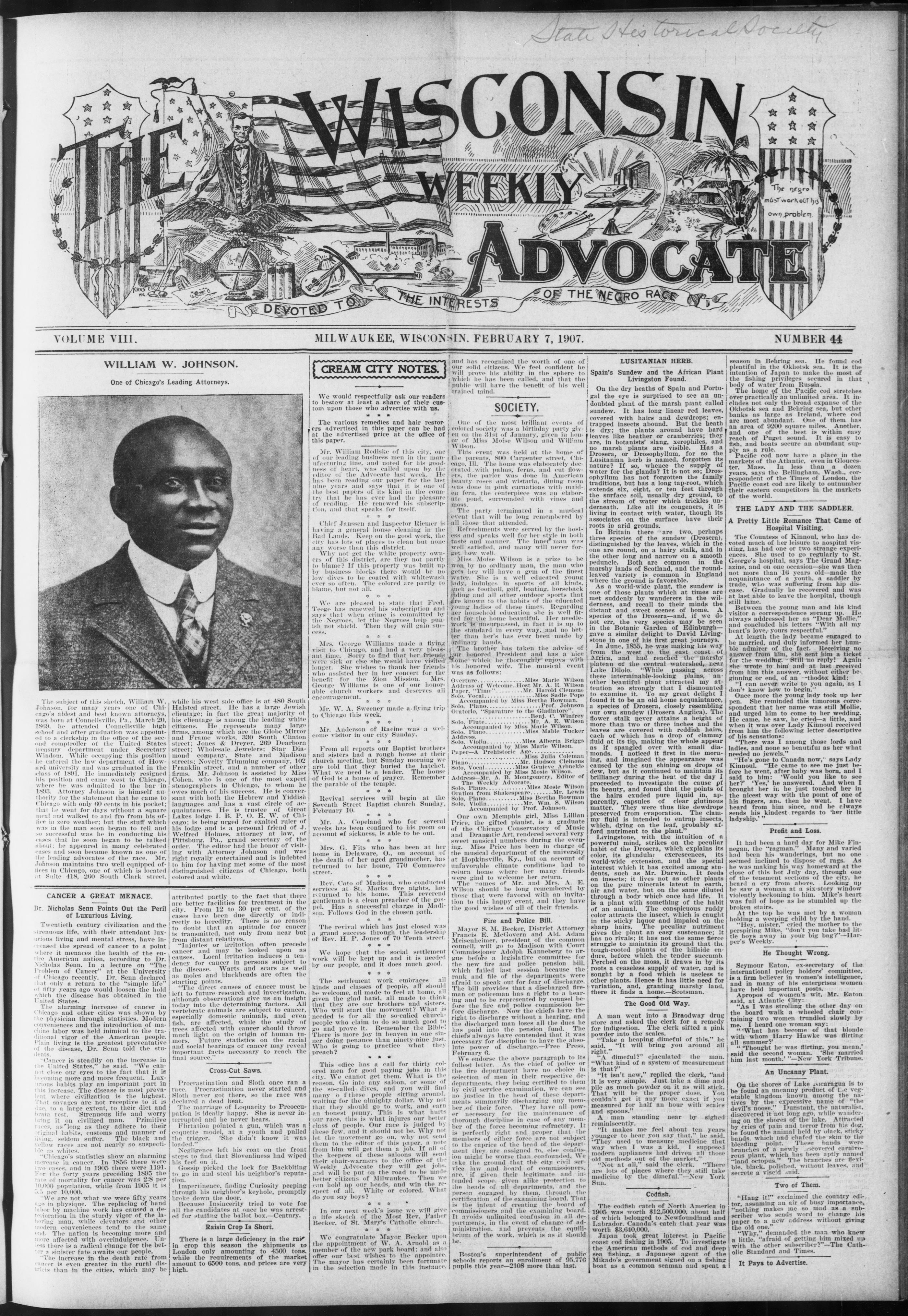
WILLIAM V
One of Chicago's Leading Attorneys.
[Name]
[Name]
The subject of this sketch, William W. Johnson, for many years one of Chicago's ablest and best known attorneys, was born at Connellsville, Pa., March 20, 1869, he attended Connellsville high school and after graduation was appointed to a clerkship in the office of the second comptroller of the United States treasury department under Secretary Windom. While occupying this position he entered the law department of Howard university and was graduated in the class of 1891. He immediately resigned his position and came west to Chicago, where he was admitted to the bar in 1893. Attorney Johnson is himself authority for the statement that he came to Chicago with only 60 cents in his pocket; that he went for days without a square meal and walked to and fro from his office in zero weather; but the stuff which was in the man soon began to tell and so successful was he in conducting his cases that he soon began to be talked about; he appeared in many celebrated cases and soon became known as one of the leading advocates of the race. Mr. Johnson maintains two well equipped offices in Chicago, one of which is located at Suite 418, 260 South Clark street,
CANCER A GREAT MENACE
Dr. Nicholas Senn Points Out the Peril of Luxurious Living.
Twentieth century civilization and the strenuous life, with their attendant luxurious living and mental stress, have increased the spread of cancer to a point where it menaces the health of the entire American nation, according to Dr. Nicholas Senn. In a lecture on "The Problem of Cancer" at the University of Chicago recently. Dr. Senn declared that only a return to the "simple life" of fifty years ago would loosen the hold which the disease has obtained in the United States.
The alarming increase of cancer in Chicago and other cities was shown by the physician through statistics. Modern conveniences and the introduction of machine labor was held inimical to the traditional vigor of the American people. Plain living is the greatest preventative of the disease, Dr. Senn told the students.
"Cancer is steadily on the increase in the United States," he said. "We cannot close our eyes to the fact that it is becoming more and more frequent. Luxurious habits play an important part in this increase. The disease is most prevalent where civilization is the highest. That savages are not receptive to it is due, to a large extent, to their diet and brain rest. Strenuous life and worry bring it on civilized man. Primitive races, as long as they adhere to their original habits, customs and manner of living, seldom suffer. The black and yellow races are not nearly so suspectible as whites.
"Chicago's statistics show an alarming increase in cancer. In 1856 there were two cases, and in 1905 there were 1191. For the forty years preceding 1895 the rate of mortality for cancer was 2.8 per 10,000 population, while from 1905 it is 5.5 per 10,000.
"We are not what we were fifty years ago in physique. The replacing of hand labor by machine work has caused a deterioration in the sturdy vigor of the laboring man, while elevators and other modern conveniences tend to the same end. The nation is becoming more and more affected with overindulgence. Unless there is a radical change for the better a sinister fate awaits our people.
"The increase in the death rate from cancer is even greater in the rural districts than in the cities, which may be
to than in the cities, which lie
THE BEST MAN IN THE WORLD
while his west side office is at 480 South Halsted street. He has a large Jewish clientage; in fact the great majority of his clientage is among the leading white citizens. He represents many large firms, among which are the Globe Mirror and Frame works, 330 South Clinton street; Jones & Dreyer, 269 Dearborn street; Wholesale Jewelers; Star Diamond company, State and Madison streets; Novelty Trimming company, 102 Franklin street, and a number of other firms. Mr. Johnson is assisted by Miss Cohen, who is one of the most expert stenographers in Chicago, to whom he owes much of his success. He is conversant with both the Hebrew and Yiddish languages and has a vast circle of acquaintances. He is trustee of Great Lakes lodge I. B. P. O. E. W. of Chicago; is being urged for exalted ruler of his lodge and is a personal friend of J. Welfred Holmes, attorney at law, of Pittsburg, Pa., grand secretary of the order. The editor had the honor of visiting with Attorney Johnson and was right royally entertained and is indebted to him for having met some of the most distinguished citizens of Chicago, both colored and white.
attributed partly to the fact that there are better facilities for treatment in the city. From 12 to 30 per cent. of the cases have been due directly or indirectly to heredity. There is no reason to doubt that an aptitude for cancer is transmitted, not only from near but from distant relatives. "Injuries or irritation often precede cancer and may be looked upon as causes. Local irritation induces a tendency for cancer in persons subject to the disease. Warts and scars as well as moles and blackheads are often the starting points.
"The direct causes of cancer must be left to future research and investigation, although observations give us an insight today into the determining factors. All vertebrate animals are subject to cancer, especially domestic animals, and even fish, are affected, while the study of trees affected with cancer should throw much light on the origin of human tumors. Future statistics on the racial and social bearings of cancer may reveal important facts necessary to reach the final source."
Procrastination and Sloth once ran a race. Procrastination never started and Sloth never got there, so the race was declared a dead heat.
The marriage of Loquacity to Preoccupation is ideally happy. She is never interrupted and he never hears.
Flirtation pointed a gun, which was a coquette model, at a youth and pulled the trigger. 'She didn't know it was loaded."
Negligence left his coat on the front steps to find that Slovenliness had wiped his feet on it.
Gossip picked the lock for Backbiting to go in and steal his neighbor's reputation.
Impertinence, finding Curiosity peeping through his neighbor's keyhole, promptly broke down the door.
Because Insincerity tried to vote for all the candidates at once he was arrested for stuffing the ballot box.—Century.
Raisin Crop Is Short
There is a large deficiency in the rail in crop this season the shipments to London only amounting to 4500 tons, while the requirements of the market amount to 6500 tons, and prices are very high.
Cross-Cut Saws
CREAM CITY NOTES.
We would respectfully ask our readers to bestow at least a share of their custom upon those who advertise with us.
The various remedies and hair restorers advertised in this paper can be had at the advertised price at the office of this paper.
Mr. William Rediske of this city, one of our leading business men in the manufacturing line, and noted for his goodness of heart, was called upon by the editor of the Advocate last week. He has been reading our paper for the last nine years and says that it is one of the best papers of its kind in the country that he has ever had the pleasure of reading. He renewed his subscription, and that speaks for itself.
☆ ☆ ☆
Chief Janssen and Inspector Riemer is having a general house cleaning in the Bad Lands. Keep on the good work, the city has lots of places to clean but none any worse than this district. Why not get the white property owners of this district, are they not partly to blame? If this property was built up by business blocks there would be no low dives to be coated with whitewash ever so often. The colored are partly to blame, but not all.
* * *
We are pleased to state that Fred, Teege has renewed his subscription and says that when crime is committed by the Negroes, let the Negroes help punish not shield. Then they will gain success.
---
Mrs. George Williams made a flying visit to Chicago, and had a very pleasant time. Sorry to find that her friends were sick or else she would have visited longer. She wishes to thank her friends who assisted her in her concert for the benefit for the Zion Mission. Mrs. George Williams is one of our honorable church workers and deserves all encouragement.
Mr. W. A. Sweeney made a flying trip to Chicago this week.
Mr. Anderson of Racine was a welcome visitor in our city Sunday.
* * *
From all reports our Baptist brothers and sisters had a rough house at their church meeting, but Sunday morning we are told that they buried the hatchet. What we need is a leader. The house of God is a house of prayer. Remember the parable of the temple.
* * *
Revival services will begin at the Seventh Street Baptist church Sunday, February 10.
Mr. A. Copeland who for several weeks has been confined to his room on account of sickness, is able to be out.
***
Mrs. G. Fits who has been at her home in Delaware, O., on account of the death of her aged grandmother, has returned to her home, 770 Commerce street.
Rev. Cato of Madison, who conducted services at St. Marks five nights, has returned to his home. This reverend gentleman is a clean preacher of the gospel. Has a successful charge in Madison. Follows God in the chosen path.
* * *
The revival which has just closed was a grand success through the leadership of Rev. H. P. Jones of 70 Tenth street.
* * *
We hope that the social settlement work will be kept up and it is needed by our people, and it does much good.
* * *
The settlement work embraces all kinds and classes of people, all should be welcome, all made to feel at home, all given the glad hand, all made to think that they are our brothers and sisters. Who will start the movement? What is needed is for all the so-calied churchpeople who claim to do so much good to go and prove it. Remember the Bible? There is more joy in heaven in one sinner doing penance than ninety-nine just. Who is going to practice what they preach?
☆ ☆ ☆
This office has a call for thirty colored men for good paying jobs in this city. We cannot get them. What is the reason. Go into any saloon, or some of the so-called dives, and you will find many o f these people sitting around, waiting for the almighty dollar. Why not that they should go to work, and earn an honest penny. This is what hurts our race, this is what injures our better class of people. Our race is judged by these few, and it should not be. Why not let the movement go on, why not send them to the editor of this paper, a note from him will get them a job. If all of the keepers of these saloons will send their chair-warmers to the office of the Weekly Advocate they will get jobs, and will be put on the road to be made better citizens of Milwaukee. Then we can hold up our heads, and win the respect of all. White or colored. What do you say boys?
---
In our next week's issue we will give a life sketch of the Most Rev. Father Becker, of St. Mary's Catholic church.
* * *
We congratulate Mayor Becker upon the appointment of W. A. Arnold as a member of the new park board; and also offer our best wishes to the appointee. The mayor has certainly been fortunate in the selection made in this instance.
and has recognized the worth of one of our solid citizens. We feel confident he will prove his ability in the sphere to which he has been called, and that the public will have the benefit of his well trained mind.
SOCIETY.
One of the most brilliant events of colored society was a birthday party given on the 31st of January, given in honor of Miss Moise Wilson and William Wilson. This event was held at the home of the parents, 800 Carpenter street, Chicago, Ill. The home was elaborately decorated with palms, ferns, and cut flowers, the parler was done in American beauty roses and wistaria, dining room was done in pink carnations with maiden fern, the centerpiece was an elaborate pond, surrounded with vines and moss. The party terminated in a musical event that will be long remembered by all those that attended
Refreshments were served by the hostess and speaks well for her style in both taste and manner. The inner man was well satisfied, and many will never forget how well.
Miss Moise Wilson is a prize to be won by no ordinary man, the man who gets her will have a gem of the finest water. She is a well educated young lady, indulges in sports of all kinds, such as football, golf, boating, horseback riding and all other outdoor sports that are known to the habits of the educated young ladies of these times. Regarding her household education she is well fitted for the home beautiful. Her needlework is mispassed, in fact it is up to the standard in every way, and no better than her's has ever been made by ordinary hands.
The brother has taken the advice of our honored President and has a nice home which he thoroughly enjoys with his honored wife. The musical event was as follows:
Overture.....Miss Marie Wilson
Address of Welcome.Host Mr. A. E. Wilson
Paper, "Time".....Mr. Harold Clemone
Solo, Vocal.....Miss Sadie Pope
Accompanied by Miss Bertha Bowman.
Solo, Piano.....Prof. Johnson
Oratorio, "Sparature to the Gladiator"
.....Benj. C. Winfrey
Solo, Flute.....Mr. A. E. Wilson
Accompanied by Miss Marle Wilson.
Solo, Piano.....Miss Mable Tucker
Address.....Miss Allorte Briggs
Address.
Solo. Violin.....Miss Alberta Briggs
Accompanied by Miss Marie Wilson.
Paper—A Prehistoric Age.
Miss Julia Coleman
Piano.....Mr. Hudson Cleinous
Solo. Vocal.....Miss Genieve Arbuckle
Accompanied by Miss Mosie Wilson.
Address—Mr. A. B. Montgomery, Editor of
The Weekly Advocate.
The Weekly Advocate.
Solo, Piano.....Miss Mosie Wilson
Oration from Shakespeare.....Mr. Lewis
Solo, Piano.....Miss Bertha Bowman
Solo, Violin.....Mr. Wm. S. Wilson
Accompanied by Prof. Johnson.
Our own Memphis girl, Miss Lillian Price, the gifted pianist, is a graduate of the Chicago Conservatory of Music and Dramatic Art, rendered several very sweet musical numbers during the evening. Miss Price has been in charge of the musical department of the university at Hopkinsville, Ky., but on account of unfavorable climate conditions had to return home where her many friends were glad to welcome her return.
The names of Mr. and Mrs. A. E. Wilson should be long remembered by those that were favored with an invitation to this happy event, and they have the good wishes of all of their friends.
Fire and Police Bill.
Mayor S. M. Becker, District Attorney Francis E. McGovern and Ald. Adam Meisenheimer, president of the common council, will go to Madison with Court Commissioner Adolph Kanneberg to argue before a legislative committee for the new fire and police pension bill, which failed last session because the rank and file of the departments were afraid to speak out for fear of discharge. The bill provides that a discharged fireman or policeman has a right to a hearing and to be represented by counsel before the fire and police commission before discharge. Now the chiefs have the right to discharge without a hearing, and the discharged man loses all the dues he has paid into the pension fund. The chiefs always have contended that it was necessary for discipline to have the absolute power of discharge.-Free Press, February 6.
We endorse the above paragraph to its fullest letter. As the chief of police or the fire department have no choice in selection of men in their respective departments, they being certified to them by civil service examination, we can see no justice in the head of these departments summarily discharging any member of their force. They have all power necessary for the maintenance of thorough discipline in case of any member of the force becoming refractory. It is perfectly right and proper that the members of either force are not subject to the caprice of the head of the department they are assigned to, else confusion might be worse than confounded. We take the ground that the city civil service law and board of commissioners, are, if given their legitimate and intended scope, given alike protection to the heads of all departments, and the person engaged by them, through the certification of the examining board. That is the intent of creating the board of commissioners and the examining board. It avoids unlimited confusion in all departments, in the event of change of administration, and prevents the equilibrium of the work, which is as it should be.
Boston's superintendent of public schools reports an enrollment of 95.776 pupils this year-2108 more than last.
LUSITANIAN HERB.
Spain's Sundew and the African Plant Livingston Found.
On the dry heaths of Spain and Portugal the eye is surprised to see an undoubted plant of the marsh plant called sundew. It has long linear red leaves, covered with hairs and dewdrops; entrapped insects abound. But the heath is dry; the plants around have hard leaves like heather or cranberries; they are, in botanists' slang, xerophiles, and no marsh plants are visible. Has a Drosera, or Drosophyllum, for so the Lusitanian herb is named, forgotten its nature? If so, whence the supply of water for the glands? It is not so; Drosophyllum has not forgotten the family traditions, but has a long tap-root, which extends six, eight, or ten feet through the surface soil, usually dry ground, to the stream of water which trickles underneath. Like all its congeners, it is living in contact with water, though its associates on the surface have their roots in arid grounds.
In Britain there are two, perhaps three species of the sundew (Drosera), distinguished by the leaves, which in the one are round, on a hairy stalk, and in the other long and narrow on a smooth peduncle. Both are common in the marshy lands of Scotland, and the round-leaved variety is common in England where the ground is favorable. As a world-wide plant, the sundew is one of those plants which at times are met suddenly by wanderers in the wilderness, and recall to their minds the distant and sweet scenes of home. A species of the Drosera—and, if we do not err, the very species may be seen in the Botanic Garden of Edinburgh—gave a similar delight to David Livingstone in one of his first great journeys.
In June, 1855, he was making his way from the west to the east coast of Africa, and had reached the marshy plateau of the central watershed, near Lake Dilolo. "While passing across these interminable-looking plains, another beautiful plant attracted my attention so strongly that I dismounted to examine it. To my great delight I found it to be an old home acquaintance, a species of Drosera, closely resembling our own sundew (Drosera Anglica). The flower stalk never attains a height of more than two or three inches and the leaves are covered with reddish hairs, each of which has a drop of clammy fluid at its tip, making the whole appear as if spangled over with small diamonds. I noticed it first in the morning, and imagined the appearance was caused by the sun shining on drops of dew, but as it continued to maintain its brilliancy during the heat of the day I proceeded to investigate the cause of its beauty, and found that the points of the hairs exuded pure liquid in, apparently, capsules of clear glutinous matter. They were thus like dewdrops preserved from evaporation. The clammy fluid is intended to entrap insects, which, dying on the leaf, probably afford nutriment to the plant."
Livingstone, with the intuition of a powerful mind, strikes on the peculiar habit of the Drosera, which explains its color, its glandular excrescences, its world-wide extension, and the special interest which it has excited among students, such as Mr. Darwin. It feeds on insects; it lives not as other plants on the pure minerals latent in earth, air and water, but on the same diluted through a body which once had life. It is a plant with something of the habit of an animal. The conspicuous ruddy color attracts the insect, which is caught in the sticky liquor and impaled on the sharp hairs. The peculiar nutriment gives the plant an easy sustenance; it has no rivals; it has not the same fierce struggle to maintain its ground that the tough-rooted plants of the hillside endure, before which the tender succumb. Perched on the moss, it draws in by its roots a ceaseless supply of water, and is sought by a food which is useless to other plants. Hence it has little need for variation, and, granting marshy land, there it finds a home.-Scotsman.
The Good Old Way
A man went into a Braodway drug store and asked the clerk for a remedy for indigestion. The clerk sifted a pink powder into the scales.
"Take a heaping dimeful of this," he said. "It will bring you around all right."
"A dimeful?" ejaculated the man. "What kind of a system of measurement is that?
"It isn't new," replied the clerk, "and it is very simple. Just take a dime and pile as much powder on it as will stick. That will be the proper dose. You couldn't get it any more exact if you measured for half an hour with scales and spoons."
A man standing near by sighed reminiscently.
"It makes me feel about ten years younger to hear you say that," he said. "They used to measure medicine that way when I was a kid. I supposed modern appliances had driven all those old methods out of the market." "Not at all," said the clerk. "There are lots of places where they still take medicine by the dimeful."—New York Sun.
Codfish.
The codfish catch of North America in 1905 was worth $12,500,000, about half of which belonged to Newfoundland and Labrador. Canada's catch that year was worth $3,640,000. Japan took great interest in Pacific coast cod fishing in 1905. To investigate the American methods of cod and deep sea fishing, a Japanese agent of the Mikado's government signed on a fishing boat as a common seaman and spent a
season in Behring sea. He found cod plentiful in the Okhotsk sea. It is the intention of Japan to make the most of the fishing privileges secured in that body of water from Russia. The home of the Pacific cod stretches over practically an unlimited area. It includes not only the broad expanse of the Okhotsk sea and Behring sea, but other banks as large as Ireland, where cod are most abundant. One of them has an area of 9200 square miles. Another, and one of the best is within easy reach of Puget sound. It is easy to fish, and boats secure an abundant supply as a rule.
Pacific cod now have a place in the markets of the Atlantic, even in Gloucester, Mass. In less than a dozen years, says the Bellingham, Wash., correspondent of the Times of London, the Pacific coast cod are likely to outnumber their eastern competitors in the markets of the world.
THE LADY AND THE SADDLER
A Pretty Little Romance That Came of Hospital Visiting
The Countess of Kinnoul, who has devoted much of her leisure to hospital visiting, has had one or two strange experiences. She used to go regularly to St. George's hospital, says The Grand Magazine, and on one occasion—she was then not more than 16 years old—made the acquaintance of a youth, a saddler by trade, who was suffering from hip disease. Gradually he recovered and was at last able to leave the hospital, though still lame.
Between the young man and his kind visitor a correspondence sprang up. He always addressed her as "Dear Mollie," and concluded his letters "With all my heart's love, yours respectful."
At length the lady became engaged to be married, and duly informed her humble admirer of the fact. Receiving no answer from him, she sent him a ticket for the wedding. Still no reply! Again she wrote to him and at last received from him this answer, without either beginning or end, of an -thodox kind:
"I can never write to you again, as I don't know how to begin."
Once more the young lady took up her pen. She reminded this timorous correspondent that her name was still Mollie, and urged him to come to her wedding. He came, he saw, he cried—a little, and when it was over Lady Kinnoul received from him the following letter descriptive of his sensations:
"There was I among those lords and ladies, and none so beautiful as her what needed no jewels."
"He's gone to Canada now," says Lady Kinnoul. "He came to see me just before he went, after baby was born, and I said to him: 'Would you like to see her?' 'Yes,' he answered. And when I brought her in: he just touched her in the nicest way with the point of one of his fingers, and then he went. I have heard from him since, and he always sends his kindest regards to 'her little ladyship.'"
Profit and Loss.
It had been a hard day for Mike Finnegan, the "ragman." Many and varied had been his wanderings, but no one seemed inclined to dispose of rags. As he was making his way homeward at the close of this hot July day, through one of the tenement sections of the city, he heard a cry from above. Looking up he saw a woman at a six-story window violently beckoning to him. Mike's heart was full of hope as he stumbled up the broken stairs.
At the top he was met by a woman holding a weeping child by the hand. "Hey, mister," cried the mother to the perspiring Mike, "don't you take bad little boys away in your big bag?"—Harper's Weekly.
He Thought Wrong
Seymour Eaton, ex-secretary of the international policy holders' committee, is a firm believer in women's intelligence, and in many of his enterprises women have held important posts.
Apropos of women's wit, Mr. Eaton said, at Atlantic City:
"As I was strolling the other day on the board walk a wheeled chair containing two women trundled slowly by me. I heard one woman say:
'What has become of that blonde with whom Harry Hawke was flirting all summer?'
'Thought he was flirting, you mean,' said the second woman. 'She married him last month.'"—New York Tribune.
An Uncanny Plant.
On the shores of Lake Nicaragua is to be found an uncanny product of the vegetable kingdom known among the natives by the expressive name of "the devil's noose." Dunstant, the naturalist, discovered it not long ago, while wandering on the shores of the lake. Attracted by cries of pain and terror from his dog, he found the animal held by black, sticky bands, which had chafed the skin to the bleeding point. These bands were branches of a newly discovered carnivorous plant, which has been aptly named "land octopus." The branches are flexible, black, polished, without leaves, and secrete a viscid aid.
Two of Them.
"Hang it!" exclaimed the country editor, assuming an air of busy importance, "nothing makes me so mad as a subscriber who sends word to change his paper to a new address without giving the old one."
"Why," demanded the man who knew a little, "afraid of getting him mixed up with the other subscriber?"—The Catholic Standard and Times.
It Pays to Advertise.
THE WISGONSIN WEEKLY ADVOCATE
MILWAUKEE, WIS.
R. B. MONTGOMERY, Editor and Proprietor.
Humorous Items.
On a Liner.
Boro—Does not the motion of the ship make you sick, Miss Bonds?
"No, but the conversation I hear on board does."—Simplicissimus.
Strange.
"This morning we received an extremely curious postcard, which excited interest."
"Oh. what was it?"
"It hadn't any pictures on it."—Bon
On Time.
At the Registrar's—I have come to declare the death of my mother-in-law. Official—At what hour did she die? She isn't dead yet, but the doctor says it will all be over in two hours.—Nos Loisirs.
She Knew.
An architect remarked to a lady that he had been to see the great nave in the new church.
The lady replied: "Don't mention names; I know the man to whom you refer."—Pittsburg Bulletin.
Ready.
Baron Rapineau (ill with influenza)—If I were to die, you will have to buy a grave and a tomb, although these things are expensive.
Nephew—Do not let that trouble you, dear uncle. I will pay for them.—Nos Loisirs.
Bad Luck.
Club Porter—Any luck tonight, M. le Baron?
The Baron—Don't talk to me of luck. I've lost 100 franes which I'd borrowed, then 1000 franes as a debt of honor, and $ \frac{1}{2} $ franes which I had owing me."—Sourire.
The Reason.
In a Fifth avenue Sunday school. Teacher—Why must we always be kind to the poor, Ethel? Ethel (slightly mixed)—Because among the sundry and manifold changes of this wicked world we don't know how soon they may become rich.—Lippincott's.
One He'd Missed.
Borrowby—Let's see—do I owe you anything?
Morrowby—Not a cent, my boy. Going round paying your little debts? Borrowby—No, I was going round seeing if I had overlooked anybody. Lend me five till Saturday, will you?—Lippincott's.
Limit of Scorn.
"Senator, I suppose you would spurn a large bribe with hauteur?"
"My boy, are you looking for a study in hauteur?"
"Yes, sir."
"Then you should see me in the act of spurning a small bribe."—Washington Herald.
A Theorv.
"Do you believe there is any chance of war with Japan?" asked the diplomat. "No," answered the Californian; "the Japanese will hardly want to fight us until we have educated them a little more fully in modern methods that will enhance their hopes of success."—Washington Star.
Aspiration.
Give to me machine that flies
Through the ambient ozone,
Up to the cerulean skies
Let me percolate alone.
There, perchance, may life become
Free from sordid want and care;
I, maybe, shall strike 'gainst some
Of my castles in the air.
An Important Question.
While little Christabel and her yet smaller sister were playing, her mother was announcing to grandma: "Our neighbor, Mrs. P., has a new baby." Instantly Christabel turned in eager excitement. "Oh, mamma," she said, "what is she going to do with her old one?"—Lippincott's.
About Women.
No game suits the serious woman so perfectly as playing Priest.
Women prefer ruffians to cads, just as men prefer shrews to gossips.
It takes a Bachelor a deal longer to "see double" than it does a Spinster.
Women are always looking toward the sunset of Love. Men, toward a rosier Dawn.
Woman hates skeletons; but tell her one's in the closet, and she'll go quaking to listen to its rattlings.—Lippincott's.
A Measure That Should Be Defeated.
From every part of the United States there arises protest against the recommendations of the joint commission authorized by Congress to make an inquiry concerning second-class mail matter. The Evening Wisconsin has intimated its opinion that the bill whose enactment the commission recommends is a measure that should not pass. It returns to the subject for the purpose of clearly impressing the objections to the bill upon the minds of members of the Wisconsin delegation in Congress.
Reputable newspaper publishers do not desire to have their publications carried in the mails at a loss to the government; but they very strenuously object to legislation which would authorize officials to interfere with details of the publication business which in free countries from their very nature always have been and always should be settled in the office of publication, by the persons concerned in the enterprise of publishing. They object to being restricted as to the paper they shall use in printing; they object to being debarred from placing a portion of their advertising in the supplement if they deem that arrangement best. They object to unreasonable dictation the authorization of which would be peculiarly liable to open the door for discrimination and oppression.
While opposition to the proposed law is general on the part of the press of the country, some of the strongest objections have appeared in Wisconsin newspapers. Not only the seven hundred newspapers in Wisconsin would be injuriously affected by the law, but a heavy blow would be struck at the vast paper industry of the state. Every member of the Wisconsin delegation in Congress should vote against the Postal Commission's preposterous bill.—Evening Wisconsin.
Alexander Was the First
Previous to the death of Alexander the Great all images impressed on coins were of deities.
THE PARADE.
(February Twenty-second)
Soldiers, soldiers and soldiers.
Crowds on the sidewalk and flags overhead;
A flaming and flaunting of yellow and red,
The cloaks folded back, and strong blue,
Sober, true.
Lower down
A blurring of brown;
Brown gaiters, brown horses, brown guns,
Brown caissons.
The strong battle music of brave, unforgotten old years—
"Marching Through Georgia" and "Dixie,"
And, dim through quick tears,
Old men on the sidewalk descyr
The troops passing by.
A pause in near music, and over the sound of the drums
Palpitant in the thin winter sunshine there comes
From other bands, still far away,
The gay, gallant march that was made yesterday.
Soldiers, soldiers and soldiers! -S. H. Kemper in The Reader.
THE VICAR'S VALENTINE.
"Really, Muriel, I wonder you can stand it."
"Well, I don't like it, I admit. But what am I to do?"
"Do? Why, put your foot down, of course, and let your wretch of a husband see plainly that you'll have no more of it. I know that's what I should do if my Frank were to attempt to treat me in the same way."
"Ah, that's different. You have had complete control over Frank from the first; but I have none over Silas and never have had."
"Entirely your own fault, Muriel. You shouldn't have begun by letting him have his head. If you'd ridden him on the curb from the outset, he would now be as amenable to your control as Frank is to mine."
"But, you see. I knew how devoted Silas was to me in those early days, and I believed that his love was the surest guarantee of his constancy."
"Goodness me, Muriel! What a simpleton you must have been! Now, did you really believe that?"
"I did. And so would you have done if you had been in my place—had seen Silas hanging on your every word and look—had heard his passionate protestations of undying devotion."
"Indeed, I should have done nothing of the sort, Muriel. I myself, you must know, went through exactly the same experience with Frank. He, too, hung on my every word and look. He, too, made the same extravagant protestations of undying devotion. But do you think I was deceived by them? Not I. I knew men too well. They are all like that in the days of courtship and early marriage. I just said to myself: 'Now, my dear, is your opportunity. Accustom him to give way to you now, while he is in love and can refuse you nothing, and then, when he is out of love, he will still continue to give way to you from sheer force of habit.'"
"You mean to say that Frank is a devoted husband, not because he loves you, but simply because devotion has become a habit with him?"
"Precisely."
"And you are content with that?"
"Quite."
"However, we are getting away from our original topic—your husband's abominable treatment of you. Something must be done, Muriel. This state of things can't go on; otherwise we shall be having a parochial scandal."
"Oh! It's not so bad as that. Silas does flirt, in a very silly way, with the lady members of his congregation. I know. But I have nothing worse than foolish flirtation to accuse him of——"
"And no neglect of yourself."
"Well, yes; he does neglect me more than he should. I don't deny it. But still, his flirtations are of such a very wholesale character, and—after all, there's safety in numbers. isn't there?"
"I'm not so sure."
"What do you mean, Mollie?" demanded the other, sharply. "Have you any reason to suppose that my husband has—has—some particular favorite, whom he has singled out for his personal attentions?"
It was evident that her friend's words had suddenly awakened Muriel's dormant jealousy.
"Well, I can't say more at the moment than that I have my suspicions," was the guarded rejoinder.
"Come, Mollie, you do know something. Tell me, at once. I have the right to know."
"Certainly, I will tell you all that I do know. I happened to see your husband last evening—though I do not think he recognized me—walking along with a lady, with whom he appeared to be on very affectionate terms—"
"Where was this?"
"In the path through the fields to the church, while I was on my way home from the Jevonses."
"And who was the—the—lady, as you call her?"
"It was too dark for me to see."
"But have you no—no idea—no suspicion?"
"No. It was, as I say, too dark, and she was thickly veiled. But I did catch a scrap of their conversation as I passed them—"
"What were they saying?"
"Something about not forgetting that Wednesday next was St. Valentine's day; and it struck me, to say the least of it, as significant. If I were you, I'd keep my eyes open, Muriel, and watch your husband carefully, as he opens his correspondence on that morning. For it's more than likely that it may include some token of affection from this unknown damsel."
"So I will." replied Muriel, pursing up her pretty lips, grimly. "I have never hitherto had anything tangible against Silas—but if I do find him out in this sort of thing, I'll—"
The two "dramatis personae" in the above dialogue were Muriel Webb and Mollie Gibbings, young married women and bosom friends, while the subject of their conversation was Rev. Silas Webb, husband of the former.
The information had thoroughly roused little Mrs. Webb, and, like all meek people when they are aroused, she was in a very dangerous mood indeed.
Of course, she said nothing to her husband of what she had been told. She wasn't going to put him on his guard and thus give away her chance of catching him. On the contrary, she meant to bide her time, to wait for Valentine's day, and then see what happened.
This resolve she carried out. Valentine's day arrived, and with it, while she and Rev. Silas sat at breakfast, the morning's letters. Mrs. Webb, while pre-
tending to be engrossed with the newspaper, watched her husband keenly while he opened his correspondence. Letter after letter he opened, glanced at, and tossed carelessly aside. Nothing suspicious so far. At length he came to a more bulky envelope; he opened it; just looked at the contents; then, with an air of embarrassed confusion, thrust it hastily into his pocket.
But he was too late. His wife's sharp eyes had caught sight of the contents of that envelope—a padded and scented card with a fancy border—and she was down on it like a thousand bricks.
Before he was aware, or could prevent her, she had sprung forward, with flushing cheeks and blazing eyes, and snatched it by a protruding corner from his pocket.
* * * A valentine—yes! And what a valentine! The picture of a nymph, highly colored in warm flesh tints and attired in the merest apology for raiment, at whom a cupid, with extended bow, was in the act of aiming an enormous arrow.
Beneath that significant picture was this still more significant doggerel couplet:
O be mine, as I am thine,
This is longer your Valentine.
"Silas!!" demanded Mrs. Webb, transformed by wrath, jealousy and disgust from her usually meek little self into a veritable Medusa. "Silas! Who has sent you this—this disgraceful and indecent thing? And you a clergyman, too. Answer me, sir!"
"My dear—really, my dear—"
"Don't call me your dear. Reserve such tender phrases for the—the creature who has sent you this. Who is she, Silas? I demand to know."
"Really, my—my dear, I—I can't—can't tell you; for I—I don't know myself," he stammered.
"That's a falsehood, Silas. You do know."
"I—I d—don't, I repeat."
"Very well. Since you won't tell me, I shall take steps to find out for myself. In the meanwhile, I shall keep this disgraceful thing in safe custody, until I have the opportunity of flinging it back in the sender's face."
With that she sailed majestically from the room, her husband being too much taken aback to attempt to stop her.
In the course of the morning she went over, with the valentine in her possession, to show it to her friend Mollie Gibbings, and to consult her as to the best way of finding out the sender of the mussive.
"You were right, Mollie," she said. "That creature whom you saw walking with Silas the other night did send him a valentine, as you suspected she would—and a most disgraceful and indecent one, too. Here it is. Did you ever see anything so flagrantly shameless?" Mollie took the precious thing and looked at it. She was in the habit of using masculine slang in moments of excitement, and she did so now. "Well. I must say this is a trifle indelicate," she said. "But he must know who the creature is with whom you saw him walking the other night."
Mollie Gibbings smiled.
"Oh! that was all a myth," she replied. "I just told you the tale to arouse your jealousy and make you look out for this valentine, the discovery of which was to force you assert yourself and give you, for the future, the whip hand of your husband. No doubt he really believes that one of his numerous flames did send it to him. And so long as he cherishes that belief, and so long as you keep the valentine to hold over his head like a sword of Damocles, I'll be bound you'll see an astonishing change for the better in his behavior."
"Mollie, what do you mean? Then, who sent him that disgraceful valentine?" demanded little Mrs. Webb.
"Why, you goose, I sent it myself, of course," chuckled Mollie Gibbings.— Truth.
To Abandon Two Forts
The artillery corps will soon abandon two forts—Fremont, in North Carolina, and historic McHenry, in Baltimore harbor. The former post is in the vicinity of Port Royal, where the navy department once had a station and dockyard, now going to decay. A neighborhood station, Hilton Head, was given up four or five years ago, and at that time a dynamite gun, in which no one had much faith and which was destined to be discarded as an experimental type, was left on its carriage, with all its mechanism intact. It still stands in the abandoned fort, a relic of mistaken energy and misapplied appropriations. Now the artillery defenses at Fremont are to be put out of commission, and the non-movable ordnance will be left in the care of one of the old ordnance sergeants. Should the battery be needed elsewhere it can be moved in time of emergency, but with the removal of the naval station from Port Royal the Taff board, which was engaged in revising the scheme of coast defense, recommended that Fort Fremont be given up. There is no modern ordnance at Fort McHenry, and its abandonment does not mean much to the artillery system, as the protection of Baltimore has been developed along other lines, and takes the shape of high power rifles.
What a Duchess Cost France
The energy of the now Duchess Dowager Fitz-James cost France as much as the last war, and had the indirect effect of making a sober nation one of dram drinkers. The Duchess, in her passion for self-aggrandizement, imported vines from America to plant on her estate in Nugard. They brought phylloxera there. It spread all over France, and ruined for years the vintage departments. Her American vines could resist this disease; French vines could not. The loss to the Gironde alone came to 500,000,000 franes. M. Fallieres' whole family and connections were nearly ruined by phylloxera. She could not have foreseen the disaster her restless energy brought about. But the story of what came of it ought to be a warning. There is nothing the French dread, and justly, more than un homme remuant, except une femme remuante.-London Truth.
Believe in Fortune Telling
In Lapland fortune tellers are fortune makers, for in the Polar regions magic is firmly believed in. The air of mystery which these medicine men affect, as well as their knowledge of formulas, sleight of hand and hieroglyphics on the rune drum, give them a position of peculiar pre-eminence among the people.
Vendetta in Algeria.
A determined Arab vendetta has just run its murderous course at Fermana, in Algeria. A man named Fared-ben-Alssa had determined to kill a fellow resident of one of the mountain villages, named Hussein-aliba-Ahmed, and never went abroad without his gun. The other day the two men, both carrying loaded guns, met face to face in a quiet spot in the mountains. Instantly Fared drew
his weapon to his shoulder and fired. Hussein fell, but rising, rapidly got his own shot in. Fared in turn falling with a shattered thigh. He managed, however, to nerve himself for a second shot, and Hussein fell dead with his chest shattered. Fared will have to undergo amputation of the leg.—London Globe.
AN OLD-TIME VALENTINE
I found it in a drawer today,
With half forgotten, old time things,
Holding within a ring of gold
A Cupid with close folded wings,
And greeting traced in faded ink,
Signed with a name that once could stir
Each languid pulse to swiftest beat—
Ah, me, how sweet those old days were!
We little dreamed the time would come
When seas and continents would be
The least of all the mighty bars
Between the path you tread and me.
What cruel wind of circumstance
Was it that blew across our way,
Till all Hope's cloud capped palaces
In shattered ruins, round us lay?
What matter—since a memory
Alone unites our lives today;
Since I am sitting here alone,
And you are wandering far away?
I would not turn Time's charlot back,
E'en if the power was given to me;
I know the dream was sweet—who knows
If the fulfillment sweet would be?
If I could know that you today
Remembered once this faded scroll,
And wondered if, in time to come,
When soul goes seeking kindred soul,
Our souls might meet across the space
With understanding, death bestowed—
The lagging years would seem to me
But milestones on a pleasant road.
—Ninette M. Lowater in N. Y. Sun.
WITH THE POLITICIANS.
Missouri Republicans, it is said, will present Senator Warner's name as a candidate for the Republican nomination for the presidency.
Col. Robert E. Lee, Jr., is said to be an aspirant for Congress in the Eighth district of Virginia, now represented by Congressman Rixey.
Gov. Vardaman of Mississippi has declared himself in favor of W. J. Bryan for President in 1908, and the adoption of a government ownership platform.
Samuel M. Ralston, for years one of the big men in Democratic councils in Indiana, has announced that he is out for the Democratic nomination for governor of that state.
Samuel L. Bestrow, lieutenant governor under Horace Boies and the only Democrat ever elected lieutenant governor in Iowa, died recently at his home in Chariton, aged 84.
William Alden Smith, the new United States senator from Michigan, is a comparatively young man, though he has served six terms in Congress. He was born in 1859 and was admitted to the bar when 24 years old.
Within the past year Georgia S. Nixon of Nevada has become one of the richest members of the Senate. He was one of the original boomers of the Tonopah district, and picked up there numerous prospects that have developed into properties of vast value.
Arthur F. Statter, the new assistant secretary of the United States treasury, was formerly a newspaper man in Walla Walla, Wash. He went to the national capital as private secretary of Senator Ankeny and later occupied a similar position under Secretary Shaw.
Edward Borah, who is to succeed Fred T. Dubois in the United States Senate, was born in Illinois, and spent a number of years in Kansas before removing to Idaho in 1891. He was educated at the University of Kansas and began the practice of law in that state. He is a tireless student.
William P. Frye, who has just been re-elected Senator from Maine, has served that state as a senator for nearly twenty-six years. He was elected to succeed the late James G. Blaine, when the latter became secretary of state in 1881. He has been re-elected without opposition whenever his term has expired.
Joseph M. Dixon, the new United States senator from Montana, has been the only representative in Congress from that state for the last four years. Previous to his election to Congress he was successively assistant prosecuting attorney of Missoula county, prosecuting attorney and a member of the Legislature.
President Roosevelt has decided to appoint a negro to federal office in Ohio. The man selected is Ralph Tyler of Columbus, and he probably will be given the place of surveyor of customs at Cincinnati, the home of Senator Foraker, who has been fighting the administration in the Brownsville matter, taking the side of the discharged colored soldiers.
Establishment of free ports, with adjacent areas of several thousand acres in which the manufacture of goods for export may be carried on, was suggested by Secretary Shaw in a speech before the New Hampshire board of trade at Concord. Speaking on "A Foreign Market for American Labor," the secretary said that by admitting imports free to be utilized for the manufacture of export goods, the foreign trade might be stimulated. One other thing he said was needed—a merchant marine—and America would be in a position to build up its trade with other lands.
Heavy Damages.
A claim for damages against a railroad company is so often a license for exorbitant charges that a simple bit, such as was received by an American railroad company may years ago, even apart from its humorous aspect, is refreshing. It ran as follows:
The —— and —— Railroad Company,
To John Smith, Dr.
July 19, 1837—To running your locomotive into my wife; as per Doctor's bill for curing her.....$10.00
To smashing ban box and spilling her hat .....3.87
To upsetting my deer born (wagon) and breaking it .....35.00
To hurting me .....5.00
$53.87
There is authority for stating that the claim was paid immediately.—Scrap Book.
Seal and Carp of Los Angeles
Los Angeles owns one poor little seal, which is kept in a small enclosure at Eastlake park. The food that is fed this seal consists of fish, which costs the city $600 a year. The lake in Eastlake and Westlake parks and one of the city reservoirs are filled with carp in such number that they are a nuisance. It is proposed to turn the seal loose in the different park lakes and reservoir and allow him to feed on the carp until the fish are exterminated. It is claimed it will take years for the seal to eat up all the fish. In the meantime the city saves $600 a year.—Los Angeles Cor. San Francisco Chronicle.
Lock as Contribution Box.
Because the lock of a Methodist church in Hazelmere, England, wouldn't work it was taken off. The locksmith found 12s 71/2d in it, some pious people having mistaken it for a contribution box.
WHEN FATHER HAS THE GRIP.
Poor mother wears a worried look,
And sister wears a frown;
And if I venture up the stairs
They send me straightway down.
I'm going to the drug store now,
Upon a hurried trip.
To get some other kind of dope,
For father has the grip.
I heard his groaning in the night,
He said his head would split;
And then he thought his back would break:
In just a little bit,
He told us that his legs were sore,
And soon it was his hip;
It seems that everything is sick
When father has the grip.
The doctor came today and left
Some capsules, and he said,
To take one each three hours until
The pain has really fled.
Says pa, "That means twelve hours before
I give this pain the slip;
I'll bet he'd find a faster dope
If he had got the grip."
And then he told ma that he thought
That he was going to die;
An' ma says no, that isn't so,
An' gave the reason why.
Then pa got mad and told her that
He didn't want her lip;
Oh! there's no comfort in our flat
When father has the grip.
—Detroit Free Press.
Rochester (Minn.) business men have organized a crusade against cigarettes. One hundred business firms have signed an agreement not to employ any person that smoke cigarettes.
Mrs. Polly Baker of Newburg, Ind., eight times married, is seeking a divorce from her present husband, William Baker, an electrician, so that she may remarry her seventh husband, R. E. Edwards, from whom she was only recently divorced. Mrs. Baker is 65 years old and is said to have $20,000 in property.
Rural Mail Carrier Buckley of New Hartford, Conn., was unable to leave or collect any mail at a box near Bakersville, Conn., for two days because a large hen hawk which was roosting there would not let him go near the box. The hawk would circle over his head each time and savagely attack with its talons. Finally Buckley took a gun and killed the bird, which was one of the largest ever seen in that locality.
One hundred dynamite caps were removed from the safe of the burned Butler hotel recently. George N. Wales, a traveling salesman now at Bluffton, Ind., handed them to the landlord some time ago, asking him to take care of them. On the day of the fire he wrote to the proprietor of the hotel, stating that the package contained dynamite and that he was much worried over the matter. The cartridges, however, went safely through the fire.
Henry Wright, a hod-carrier, employed in the construction of a new brewery at Bentleyville, Pa., lost his footing and plunged eighty-three feet from the roof of the structure. In falling he encountered two 2-inch pianks, which were broken in two. Two physicians were summoned and, as they entered the building they were met by Wright, who asked one for a cigarette. An examination showed that not a bone was broken and only a few minor bruises sustained. Wright resumed his work.
Some one relieved Attorney General Hadley of Missouri, while he was on his way to Topeka, Kan., the other night to address the State Bar association, of his suit case containing the manuscript of his speech and an evening suit. The speech was on "Larceny."
About an hour before the time for the meeting of the bar association the suit case, evening clothes, speech and all, were returned to Mr. Hadley. "I guess the man who took the grip must have read the speech," said Mr. Hadley.
Loyal C. Kellogg, once the wealthiest man in southern Michigan, died in poverty the other day at Battle Creek, Mich., aged 84 years. Kellogg ran two big flour mills here and paid farmers of this county a total of $2,000,000 for wheat. He was the first buyer in Michigan to pay $1 a bushel for wheat. In 1866 he cornered flour in the west and expected to make a fortune, but a combination of unfortunate events made the venture a losing one, and he found himself out $352,000. He was a native of Syracuse, N. Y.
Not all of the American girl's accomplishments are useless, as is proven by the example of a young woman who formerly resided near Eau Claire, Wis., but lately moved to the southern limits of Eau Claire county. In December Miss Maler purchased forty-four pigs for $10. She kept them just thirty-six days, feeding and tending to them all herself and last week sold them for $126. She has since received several proposals of marriage, but to these she has turned a deaf ear, saying that she has no time at present to think of such things.
---
Because one end of his farm was not inclosed by a fence Charles Miller, an Outagamie county farmer, lost his suit against the Chicago & North-Western railroad at Oshkosh for $21,020. Miller sued under a statute which directs that a railroad company shall be mulleted $10 every time one of its locomotives passes through inclosed property which has not been protected by a railroad's putting in a railroad crossing properly guarded. Judge Burnell dismissed the case when it was shown that one end of Miller's farm was not inclosed.
An agreement has been concluded between the Lutine company, representing the insurers and Fred B. Whitney of Washington, D. C., whereby further attempts will be made to salve the bullion which was part of the cargo of the British ship Lutine, which foundered off the coast of Holland in 1799. The British Parliament granted the insurers, Lloyds, the right to $1,680,000 of sunken gold, half of which under the present agreement will if recovered go to the salvers. Simon Lake, the American submarine boat builder, will be consulting engineer for the Lutine company.
People residing in a certain section of Lexington, Ky., are not certain that an earthquake has not had something to do with the sinking of the street so that it is impassable and shut off from travel. There are great holes filled with water at various places, and attempts to fill them have failed. The substance thrown in disappears and no progress has been made in finding bottom. The crust of the street is cracked in places where there is no water. An ice wagon attempted to go through and before it had gone any distance had sank to the axles and had to be abandoned. The roadbed of the Mt. Horeb pike, five miles out of Lexington is broken and sunken for a distance of seventy yards.
Will H. Thompson, the poet-lawyer, brother of Maurice Thompson, the novelist, recently at Tacoma, Wash., recited from his own poem, "The High Tide at Gettysburg," when he made his plea to the jury in behalf of his son Chester.
on trial charged with the murder of Judge Emery at Seattle. The address was an oratorical effort of great strength, and brought tears to the eyes of the judge and jury, and even the attorneys for the state were affected. He commented on the fact that he had been a Confederate soldier. He declared that he loved his boy and the law alike, and that he would not make an appeal for the son that was not within the law.
Because its employees were frequently late a large London house recently ordered that the tardy ones should write excuses in a book provided for that purpose. But the clerks proved lazy and original. At the top of a page a late one would write, "Train delayed," or "Omnibus horse died," as the case might be, and the rest fell into the habit of making ditto marks, and letting it go at that. But not lon- ago one man had a new excuse. He wrote with pride, "Wife had twins." The second late person that morning was it: a great hurry and did not notice the innovation, but made his customary ditto marks, and the rest of the men on that page followed suit. The excuse book was abolished.
The oldest enlisted man on the rolls of the United States army is Sergt. David Robertson of the hospital corps, stationed on Governor's island. Sergt. Robertson, who is a native Scotchman, first enlisted May 27, 1854, and he has been in continuous service, having the extraordinary record of never having lost a day. He is 74 years of age, but is as straight as a pine tree and carries himself with the agile step of a youth. He knew Gen. Phil Sheridan as a lieutenant and has equally vivid recollection of Gen. W. S. Hancock when the latter was a young officer.
Forced out of his pulpit by the opposition of millionaire members of his flock, Rev. H. C. Rosenberger, pastor of the fashionable Greenwood Congregational church at Des Moines, Ia., has tendered his resignation. It was accepted only after a hot fight in the board of trustees.
The resignation was caused by his sermons against capital and because of his attitude toward the poorer members of the congregation.
When Rev. Mr. Rosenberger began paying more attention to the lesser lights and refused to toady to the aristocracy influential trustees objected and asked him to be more careful. He said he would do as he pleased.
Charged with bigamy and credited with having thirteen wives by the court officers, Rev. Albert Holden, reported to have two sons also under indictment for bigamy, pleaded guilty at Toledo, O., and was sentenced to serve six years in the penitentiary.
Holden married every time the spirit moved him. His courtships always took place during one of his revivals, and his victims were always one of those whom he had taken into the church.
Just before sentence was passed, Holden said to the judge that he had been the victim of brain trouble and blamed his many marriages on this affliction. He said that he had struggled against the sin of bigamy, but that all his prayers had availed him nothing.
The following petition from the unmarried women of the town of Wakefield, Mass., was received by the Legislature of that state the other day.
"We, the unmarried women of the town of Wakefield, petition your honorable bodies for a law levying a tax on bachelors, said tax to be graduated as follows: From 20 to 25 years, $5; from 25 to 30 years, $10; from 30 to 35 years, $15; from 35 to 40 years, $20; over 40 years, chloroform in large doses.
"And your petitioners further represent that bachelors are a barnacle growth on the ship of society, impeding its progress and of no earthly use except as pall bearers.
"We are not advocating this law because we are single; that concerns us the least. If you don't believe it, ask us and see."
It has not been decided to what committee to refer the petition.
Some curious drinks that men call for in saloons, says the Philadelphia Record, were observed by a man who stood at the end of the bar and took in everything that happened. The usual whiskies and beers were frequent, but he also noticed that a number of men asked for egg in milk and egg in sherry. "You sell a lot of eggs here," he observed to the bartender. "You bet we do," answered the man behind. "Hundreds of men drink egg drinks only. Taere are several men who come in here that order egg in beer. How they get away with that awful mess I cannot understand, but they drink it down as though they liked it. One man that comes here every day has them all skinned. He always takes the most outlandish mixture of stout and milk. He's the limit for a crazy drinker, and heads my list of curious booze artists. We call his drink the 'graveyard cocktail.'"
An exciting wolf hunt took place recently on one of the business thoroughfares of Eau Claire. The animal was a large one and was discovered leisurely wending its way down Water street about 1 o'clock. Women and children screamingly ran into the nearest houses. No sooner had the alarm been passed than 100 men gave chase to the animal with clubs, axes, Winchesters and shotguns. Onward the hunters pressed after the big wolf through streets, alleys, snowdrifts and underbrush. For nearly three hours the chase was kept up till the animal was finally sighted, telephones in the vicinity in the meantime having been kept humming. Volley after volley was sent after the beast till enough powder had been burned to stock an army. Finally, by a well directed shot John Lee put an end to the beast. Business was practically at a standstill in the vicinity of the shooting for over three hours.
Assessor R. D. Bruce of Danville, Ky., has set on foot a plan to replace the hemp industry by the use of giant African spiders. He is now in the south completing arrangements for a spider hatchery. According to Mr. Bruce, the dark continent produces a spider which, at maturity, is the size of a Maltese cat, and weaves a web of strands as large as broom twine. These spiders, he declares, are easily domesticated, and are fairly intelligent. The natives have utilized the webs for fishing seines. A letter from an African scientist says that the spiders can be raised in incubators.
As a by-product the eggs of the elephantine insects will be sold for marbles. The females lay from 100 to 225 eggs a week, and they are as hard as flint and perfect spheres. The shells are beautifully colored, resembling the best 30-cent "shooters" used by boys in "taws."
Unshaven Calcutta
Ever since Babu, or I should say Srijut Bepin Chandra Pal, convened a meeting and harangued the local barbers to increase their charges the revised charges are just double what they were before, and rather than agree to the increased rates the majority of customers are going without a shave, as is evidenced by their faces.—Calcutta Empire.
Advertise in Your Home Paper.
GOSSIP FOR THE LADIES.
---
A. Memory System
Before you meet it.
Forget each slight, each spite, each sneer,
Wherever you may meet it.
Remember every kindness done
To you, whate'er its measure;
Remember praise by others won
And pass it on with pleasure;
Remember every promise made
And keep it to the letter;
Remember those who lend you aid
And be a grateful debtor.
Remember all the happiness
That comes your way in living;
Forget each worry and distress,
Be hopeful and forgiving;
Remember good, remember truth.
Remember heaven's above you,
And you will find, through age and youth,
True joys, and hearts to love you.
Priscilla Leonard in Youth's Companion.
Learn How to Rest
Learn how to rest, you women who would take the best care of yourself at the least time and trouble. A thorough rest of even half an hour will do more than the average woman has any idea of toward warding off doctor's bills and illnesses, not to mention that it will keep her looking young long after years are against her.
But rest is not simply dropping down in a chair or even throwing one's self down on a lounge, booted and frocked. Not at all. There is not even muscular relaxation in this, and practically no nervous relief. To be refreshed one must live up to it, body and mind, make a business of it, figuratively speaking. It may seem a nuisance, but when did one ever have anything worth while without working for it!
There is nothing in the world to equal taking off one's things and getting into bed, doing it quite as though it were bedtime. And vet, I should say there is nothing to equal that; there is one just a little better, and that is taking a hot bath first. Try it, ye skeptics! One of the best known society women in New York, who looks scarcely older than her daughter, who has been out for two seasons, attributes her youth almost solely to the fact that every afternoon or early evening of her life, before dinner, she takes a hot bath and goes to bed, sometimes for not more than ten minutes.
To take a hot bath and go out immediately afterward will seem to many persons to be the height of imprudence, but it is not really. A quick rub with alcohol will close the pores and unless one is very careless in dressing there will be no exposure-to cold. Of course, when you come down to it it is like anything else; it may be abused and be injurious; properly managed it is a panacea.
The theory of the treatment is very simple; that fatigue reduces the strength and vitality, making one susceptible to cold and illness that under ordinary conditions would be harmless. As to the effect upon the complexion, resting the nerves relaxes the muscles of the face and the result is smoothness and freshness when otherwise there is a drawn look.
If ever there is a time of the year when demand is made upon a woman's physical strength it is when business occupies the working woman by day, and in the evening she has her social diversions. A woman who belongs to the "leisure" class is working hard all day, too, with shopping, engagements and the like, and at night she keeps up the engagements just the same or more so. Therefore half an hour at least should be given over to rest to avoid illness and looking like a wormout old woman. Late in the afternoon is the best time for relaxation, anywhere from 4:30 to 6 o'clock, and do not grudge the time. If a woman is going to rebel at being still all the time she is resting she had better save herself, for there will be no rest in that at all.
If she decides to take a hot bath and go to bed she should have the latter ready to get into immediately on leaving the tub. Do not let the water be so hot as to cause perspiration; it should be warm enough merely to relax. If the tub is long enough lie at full length most of the time while in the water, but in any event do not stay in more than five minutes. Longer than that might be weakening.
The bed room should be quite dark, and the strictest orders should be given that one is not to be disturbed. If there are children in the house they may play in a room where their noise will not be heard by the one resting. Telephone calls should be unheeded; indeed, it is a fact that nothing should interrupt the few minutes or more given up to refreshment. If for any reason a woman will not take the rest cure to this extent she may still get some benefit from lying down. But boots or shoes must be taken off, and tight clothes loosened, if she really is to get from it what she should. Important is it that the room should be darkened. It is impossible for facial muscles to relax if a bright light is constantly before them.
Few women seem to know the rest that results from changing the shoes as soon as one goes indoors. There are two reasons for this; one is that in the street are worn heavier leather than is required for the house, and the other that a slight difference in shapes permits of pedal cords and muscles relaxing. Shoes for the street should never be worn indoors any longer than it takes to change them.
One of the fundamental principles of rest is that the person shall not be disturbed. One expecting to be called, or even called unexpectedly, does not give up thoroughly. And it must not be forgotten that rest, real, refreshing, youthgiving, health-restoring rest is of the nerves as well as the body.
Precautionary
Measures Against Colds.
Every woman should study the matter of taking cold and assure herself that not to her contented ignorance and amicable blunderings are owing the discomforts and the dangers which the winter colds entail upon herself and those committed to her keeping. Clothing does not in itself create warmth. It only retains in a body the warmth already there. A silver paper weight lies on the table, and, it being a cool day, the silver is cool to the touch. Wrap the silver in a blanket and leave it an hour. At the end of that time the paper weight feels as cold as ever. Whereat the philosopher once again begins to reason, her conclusions being that it is more important to have a good supply of natural heat within than simply to pile on coverings without.
This gives opportunity for another experiment. Opening the window, she breathes the fresh air deeply and profoundly into her lungs a dozen times. She finds that the sense of warmth in her whole body has greatly increased, although she opened the window to the colder outdoor air and added no garments to those already worn. She sees for herself that when she takes plenty of oxygen into her lungs it passes into her blood, runs all through her, and warms her more than if she had put on a heavy cloak. Here are two truths she has learned,
the swift flow of blood full of oxygen creates natural warmth in her, and a skin that keeps its pores closed to the outer air and quickly gets rid of its own moisture keeps that natural warmth in her body instead of evaporating it.
A cold is what the name implies, a chilling of the blood's natural temperature, which should be about 70 degrees Fahrenheit. The moment the temperature falls below that the whole body is affected. Morbid secretions take place in all the organs of the head, and then it means cold in the head, or it may be the lungs, and then there is a cough. The digestion is affected and inflammation of various membranes is set up, with consequent soreness or fever. There are many good remedies for colds, but the best remedy is not to take cold at all. The best way to do this is to have so good a supply of natural warmth within that outside temperature cannot easily lower it.
This is achieved by keeping the blood always full of the oxygen in fresh air and flowing swiftly by reason of plenty of exercise. Next, by letting the skin do its natural work of being a warm, elastic, water-tight covering for the flesh, keeping it so by the free use of cold water instead of the warm water, which opens the pores and relaxes the skin's elasticity, and by clothing in such a way that its exudations are soaked up and carried off quickly.
This is only a signboard pointing the way to the road along which a real philosopher will travel. She will go much farther, learning that the lungs of a woman who sleeps warmly covered to the chin, with cold air pouring into her chamber from a wide open window, are storing up extra oxygen all night so that she has a reserve force of heat and vigor to call upon next day to help ward off colds and chills.—Hannah M. Hanna in Cooking Club Magazine.
From a Feminine Notebook.
Yes, there are books worth reading; but they are not written in these days. It is a rainy Sunday, say. One is tired and does not wish to go out. Oh, how one longs for a good book to lounge over the wood-fire with. In the bookcase is a row of the most recent "best sellers. A member of the household is addicted to the purchase of "best sellers." They are all there—"The Fighting Chance," "A Rock in the Baltic," "The Spoilers," "The Call of the Blood," and the dozen more about which tongues have lately been wagging.
Languidly you take one from the shelf, settle down before the fire, and try hard to work up an interest in the story. No use! It is too painfully thin. It offers no resistance to your teeth. There is nothing in it to chew on. It was written by a man more concerned with the way he says things than with what he has to say—which can't be helped, no doubt, because he seems really to have nothing to say.
Another is tried. This author does indeed say a great deal, but most of it not worth saying. Page after page is wearily skimmed, with little idea what the story is about, and no desire to find out. This "best seller" is a bore, distinctly
You try another. Same result. There it a bit more spark in this, but it is as pallably a bait as are the jokes of the "end man." The machinery creaks too painfully.
The main charge against all these books is that they don't hold your attention. They don't even catch it. You don't care twopence what becomes of any of the people. Either they bore you painfully, or they disgust and irritate you, or you are just indifferent.
They are no books for a rainy day and a hungry imagination. But the fire still burns, and the day is still long. On the lower shelf is a red volume. It is Hawthorne's "House of the Seven Gables." Somebody gave you that for a Christmas present ten years ago. You have never yet read it. Dubiously you take it out. You will see if this amuses you.
In ten minutes the crackle of the wood fire is unheard, its flames unseen. You are walking down Pyncheon street, under the ancient elms. You are exploring the queer old gabled house, with its over-hanging second story, like deep brows beetling the street. You are bowing in turn to each of its occupants, descending down the line from the evil old Pyncheon who built it and was gripped by a ghostly hand on the night of his triumph. You watch with breathless interest the matutinal preparations of the ancient but maiden Miss Hepzibah on the morning of the opening of her shop in the old house. With her you tremble violently when the shop bell tinkles. The dispensing of the first gingerbread elephant has as intense an interest for you as if you were going to munch it yourself. What freshened hope and joy you feel at the coming of the lovely Phoebe!
And so on through the fortunes of these people, until the day wanes, and the fire, replenished many times by other hands, glows in the dusky room, reproducing in its embers many pictures of the old New England town.
Ah, that is a book! And there are others. Books that take us out of ourselves; that open up a new world in the imagination; whose characters are to us great men and women; whose style is clear, pure, classic English, of a rare joy to read.
But such books are not written now.
Practical House Furnishing
In the way for receptacles for flowers—where expense has to be a prime consideration—there is nothing prettier than the glass bowls intended for gold fish. These cost only a few cents each and show off most flowers to the best advantage possible. Roses, tulips, mignonette, nasturtium and numberless others look better when arranged in something that shows their pretty stems, and they look lovely in these bowls of clear and undecorated glass.
The center pieces, doilies and other linens ornamented with lifelike flowers worked in silks have retired to the background, owing to their inability to withstand the attacks of even the least strenuous laundress, and women have realized the wisdom of spending their time on work that will last, hence the revival of the old cross stitch embroidery.
This work is done in fast colored cotton, on heavy linen, huck, canvas or homespun.
The deeper blues and reds are the most satisfactory colors for this work, as they are more quaint and attractive.
To give the work individuality every woman should do her own designing as far as possible, and a little practice is all that is needed.
Rule a sheet of paper off in tiny squares the same size as those in the book of bought patterns, then outline the flower, monogram or figure desired, and fill in with cross stitch-one cross to each square. In working on the material careful counting is needed, using the pattern as a guide.
A simple pattern for a novice is that known as the Greek key, and when done in dull blue on red or ecru homespun it is lovely and will last a lifetime.
Either denim or filling may be used under a vuv, in a room, where the floor
is not good enough to show the matting is not desired. Denim comes in practically all colors and shades and wears well, possessing also the virtue of being inexpensive. Many people sew the widths together before putting down, while others put it on as they do matting.
The fillings are innumerable in grade and color and vary greatly in cost, but if of pure wool they wear splendidly, and when they harmonize with the color scheme of the room, they enhance its beauty to a wonderful degree.
Many of the shops show colored bedspreads of India cotton that are much more beautiful used as curtains than many far more expensive materials.
A charming room with the walls done in a soft tan and the woodwork stained a dark brown has curtains of this sort that suit it exactly. The design is of Indian palm leaves in the reds seen in old Persian shawls.
These spreads come in many combinations of color, and the tones and patterns are all good, while the folds in which they hang are a joy to the appreciative eye.
Furniture on mission lines, but unstained, may be bought in many places now, and the girl "doing up" her very own room buys these and stains them herself. Two or three cans of green stain will do all that is needed.
When used in conjunction with a green fiber rug and silk curtains—made of remnants—of the same shade and in casement length, the result leaves nothing to be desired.—Exchange.
Queer Sympathies.
That there is a certain amount of sympathy in the most hardened creature we doubt not, but the mere fact that there is peculiar sympathy in the world naturally brings up the query, "Well, what is it?"
We have always been led to believe that women were afraid of mice, and it is probable some timid creatures are frightened at the fleet-footed garret prowler. We know of one woman who had a perfect terror of mice, yet one day she caught a little one which was not much larger than her thumb and was too timid to kill it in the reel cage or take it out and drown it. All afternoon the little captive was fed on dainties, given fresh water at intervals, and right royally entertained. The woman's husband forgot to kill the mouse that night, therefore it was given another feast the next day, and the next. The woman finally took the cage to the alley and freed the death-sentenced prisoner, giving as her excuse it made her feel sad to see it living so contentedly with only a death of violence awaiting it.
Women are not always the silliest in this regard, for a certain man was aroused to sympathy a few days ago because he had an idea a turkey which he had recently purchased for his New Year's dinner would be lonely in the chicken coop where it was penned in solitary confinement for more than a week. It was all his wife could do to keep him from sallying forth to buy a companion for the lonely Mr. Turkey. However, the man compromised by feeding his birdship as best he could, and then gave the honorary guest at the table the pleasure of cutting off the legs and wings when it was finally served on New Year's day.
A miserable, dirty-looking dog, which looked more like an animated floor rag than anything else in the world, had a way of going to meet a girl every time he saw her on the street. The dog was ugly and repulsive, with nothing in the world but a pair of intelligent eyes as a redeeming feature. The dog insisted on being friendly with the girl, while she left his canineship alone. One day the dog saw her, and with a yelp of delight fairly flew to meet her. She patted him on the head. Now, rain or shine, good weather or bad, that dog meets her. The girl has lavished no more affectionate pats on the dog, yet he seems to be contented with just a mere show of affection for all his pains to win just a pat on the head. If sympathy played no part in the human family, what would become of homeless cats, birds which fall out of their nests, and the countless motherless babes in the animal world deserted in infancy by the unnatural mother, only to find a protector in some one who has a sympathetic nature.—Woman's National Magazine.
Important Decision Affecting Women
Married women will read with decided interest a decision, or ruling, of the district court of appeals at Washington, D. C., that a married woman may make a binding legal contract with her husband under the district code, and if he fails to live up to its terms she can maintain a suit against him in the courts. That's the substance of the decision just handed down by Justice Robb in the case of Edmund Brady, who sued Simon D. Bronson on a $3000 note the latter had given Mrs. Bronson, who assigned it to Brady. Justice Robb, in construing the so-called married woman's enabling statute, made an elaborate review of similar laws in various states, declaring finally:
"Without multiplying authorities, we may add that we have been unable to discover any case where a similar statute has been held not to authorize contracts between husband and wife." He added that "an examination of the statutes applicable to married women in the District of Columbia irresistibly leads to the conclusion that section 1151 of the code was intended to authorize, and does in fact authorize, contracts between, or gifts from, husband to wife, excepting only property acquired by the wife from her husband in prejudice of the rights of his creditors." "Indeed," he said, "the language of the code is broader and more comprehensive than the language of the statutes in the various states." The justice continued:
"A gradual but nevertheless decided, change has taken place in the status of women, until today their sphere of activity embraces almost every avenue of business, almost every profession, and almost every calling. With this change has come a demand for a corresponding recognition of their rights in the statutes of the states and nation. A careful examination of the statutes discloses that the tendency of the times is to emancipate married women from the harshness and disabilities of the common law, and to place them on an equal footing with men."
It is proper to add that Brady was given judgment in the district supreme court, and Justice Robb, of the court of appeals, sustains that decision. Both of these high courts of last resort are therefore, in perfect accord on this important matter.
The Timid Child and the Use of Praise.
We have seen too many discouraged people and have known too many timid children to feel very much sympathy with the fear of making them vain, spoiling them, by commendations. It is true that vanity is a monster that grows by what it feeds on, and after becoming dependent on flattery, starves and withers without it. But that is only one aspect of the situation. The other is that there are hosts of men and women and hosts of children who do not get by any means as much encouragement as would be good for them.
While praise that is indiscriminate, promiscuous, comes after a time to mean nothing, and to be useless, yet
appropriate, just and proportioned commendations are fitting, are invaluable and most helpful. We heard an experienced physician say that "thousands of people are dying for want of sympathy;" he has seen much of life, was familiar with the mental as well as physical ailments of men and women, and this was his serious conclusion.
The same principle applies generally to children. They flourish better with a goodly allowance of sensible praise than under constant carping and criticism. Good words of warm compliment, within due measure, act as a tonic on the spirits and encourage and stimulate ambition. Children are depressed, lose self-confidence, through censure that has not mixed in with it commendation. Necessary as it is to point out and correct faults, it is safe, with normal children, to mingle a modicum of praise.
Learn About Pictures.
It is expected of you, my modern girl, that you shall know something about pictures. You must have some knowledge of pictures and artists as you would of your favorite books and authors. Many persons choose a picture for the blending of beautiful colors, possibly without any subject significance in connection with what is merely an ornament. If you have no taste for pictures, then cultivate it. You may have to discuss the subject some time, and you want to do so in an intelligent manner, to show some knowledge of the masterpieces, at least. There is no reason why every girl should not have some education in this direction. A cheap picture in a house has about the same effect upon persons of great refinement that a yellow back novel has in these days when the best literature is so cheap. Learn, then, of the painters who surpassed others, and secure reproductions of those pictures which are considered best.
For the Young Folks.
So she turned her back on him and went and ate. —St. Nicholas.
Bob's Burglar.
Papa, have you got a gun?" Bob was getting ready for school as he asked the question. His father was busy reading the morning paper and did not answer at once, so Bob went over to him and repeated his query.
"Got a gun? Bless my soul, what do I want of a gun?" exclaimed Mr. Marshall, putting down his paper and looking quizzically at Bob. "Any bears been seen about these parts lately?"
"Not bears, papa, but burglarls. They got in Baker's house Monday night. Eddie Baker told me all about it yesterday at school. They took ever so many things and nobody heard them at all. Ed said he wished he had waked up; he would have taken his father's gun and s'prised those burglarls some."
"I've no doubt but what Eddie and a gun would have done some surprising things," said Mr. Marshall, smiling, "So you think you'd like to have a gun and go burglar hunting, too, do you? Well, my advice to you is, keep away from guns; they are very apt to hurt the wrong people and to do all sorts of things you don't expect them to. If you think we are in any danger from burglar just keep on practicing with those new Indian clubs of yours and have them handy for use. I should say that there would not be much left of any burglar if you clubbed him as unmercifully as you did that jar you smashed by mistake the other day."
Bob said no more about burglars, but for some time his mind was busied with the thought of them and with what he would do if he were to wake up some night and catch a burglar at work. He kept his new Indian clubs near his bed where he might easily reach them. He was not a little proud of his skill in using them and they were pretty heavy ones, too, for a boy of his age to swing. No burglars came, however, to give Bob a chance to show his courage and he was beginning to forget Eddie Baker's burglar story when, as is often the case when one least expects it, something happened to test his mettle.
One night Bob awoke suddenly and sat up in bed peering into the darkness and wondering what had wakened him. The room was still and dark as the proverbial pocket. Bob could not shake off the feeling though that something or somebody in the room had aroused him from his sleep. Nobody likes to wake up suddenly in the night with that sort of a feeling, and when you are a little boy only nine years old, it is apt to make your heart beat very fast. That was what Bob's heart did anyway, and it nearly jumped into his throat when he heard something go bang! on the floor. The object whatever it was, struck the bare floor where there was no rug, so that while it might have been small, it made considerable noise.
"Burglars!" was Bob's first thought as he doubled up in bed and pulled the clothes over his head. As he listened quakingly he heard a second bang! and the sound as of something moving along the floor. Where was the courage he had boasted of when Eddie Baker had talked of burglars? He would like nothing better than to have a chance at them; he had said proudly, he wouldn't be one bit afraid. Bob felt ashamed as he thought of it; then he remembered his Indian clubs. Should he grab them and strike out? What was the use when he could not even see his hand before his face?
No, plainly the only thing to do was to make a light first; that might scare the burglar away, but Bob trembled as he thought what a target he might become for the burglar's wrath in doing it. It took him some moments to screw his courage to the point of carrying out his plan, the more so as he continued to hear sounds in the room. When at last he jumped out of bed and struck a light, he was not a little surprised to find nobody in the room and nothing apparently out of order.
Casting his eyes about to see what could possibly have made the noise. Bob discovered a square lump of sugar on the floor in front of the table. Near the wall were four similar lumps arranged in a row, the first one close to a hole in the floor, just behind the bookcase. Bob could not help smiling at the sight, and as he did so he saw a mouse creep across the room and up the long table cover, to where stood a saucer filled with cubes of sugar. Bob was very fond of sugar, and had helped himself the day before from his mother's sugar bowl.
The mouse shoved one of the lumps to the edge of the table, and then tumbled it over, afterwards pushing it up to the hole where he had arranged the other lumps in a neat little row. It was such a clever performance that Bob did not have the heart to interfere with it, and he finally went to bed, leaving the busy little burglar to help himself as much as he pleased.
When he told the story in the morning his father laughed heartily as he said:
"Well. Bob, your burglar wasn't a very big one, but after all, my boy showed his courage just as much in getting up to look for him as if there had been a real burglar in the room."—Brooklyn Eagle.
MEN OF PROMINENCE.
SABINE BARING-GOULD, the well known clergyman and author of England, was born at Exeter, January 28, 1834. His home is at Lew-Trenchard, in Devonshire, where his family has been seated for nearly 300 years. He was educated at Clare college, Cambridge, where he took the degree of M. A. in 1856. On the death of his father in 1872 he succeeded to the family property, and in 1881 to the rectory of Lew-Trenchard.
He has been a prolific writer, having issued several score of works since his first book, entitled "Paths of the Just," appeared in 1854. The most of his earlier works were books of a religious nature, together with several volumes of travel. Of late years he has won celebrity as a novelist. He has traveled over a great part of the world and has written interestingly of Iceland and other remote countries. A year ago Mr. Baring-Gould was erroneously reported dead in South Africa. An investigation revealed the fact that the dead man was his brother, who was also a great traveler.
PRINCE LUIGI AMEDEO of Savoy, Duke of Abruzz., who has announced his intention to take another voyage of exploration to the Arctic regions the coming summer, was born in Madrid, January 29, 1873. He is the third son of the Duke of Aosta and first cousin to the present King of Italy. Possessed of enormous wealth the Duke of Abruzzi has gratified his taste for foreign travel to the utmost and during the past eight or ten years he has fitted up numerous expeditions at his own expense and penetrated into the remotest parts of the world. Thus, in 1900, he succeeded in getting nearer the north pole than had ever been done before, his party beating Nansen's previous record. Last year the duke directed an exploring expedition which penetrated central Africa and accomplished the ascent of Mount Ruwenzori, between Albert Nyanzi and Albert Edward Nyanza, the estimated height of which is about 18,000 feet. In 1897 the Duke of Abruzzi came to America and made the ascent of Mt. St. Elias and also of Logan's Peak, near the boundary between Utah and Wyoming. The duke is an officer of the Italian navy and a proficient engineer. He is also familiar with many branches of science and is the author of several books.
HENRI ROCHEFORT, one of the best known editors and public men of France, was born in Paris, January 30, 1831. His career has been a tumultuous once. In 1865 he established the Lanterre, which soon had an enormous circulation. The paper was, however, soon suppressed, on account of its violent attacks upon the imperial family. M. Rochefort was condemned to a year's imprisonment, which he escaped by fleeing to Belgium, where he continued to publish the paper. In 1869 he was permitted to return to Paris, and the same year he founded the Marseillaise, in which Victor Noir was a collaborator. The attacks in this journal on Prince Pierre Bonaparte led to the assassination of Victor Noir by the prince. The paper was suppressed, and M. Rochefort committed to prison. On the proclamation of the republic the following year he was released by the mob. He was president of the commission of Barricades during the siege of Paris, and was elected to the National Assembly. But he was still an editor first of all and in his paper he violently assailed the government of Versailles and M. Thiers personally. In May, 1871, he was tried by courtmartial and sentenced to imprisonment for life. Subsequently he was transported to New Caledonia, but effected his escape in 1874. The general amnesty of 1880 permitted him to return to Paris, where he has since spent his time chiefly in attacking all governments in turn.
DR. W. SEWARD WEBB, born in New York, January 31, 1851, is one of the comparatively few men who, educated for a professional career, have in later life won marked success as business men and financiers. Dr. Webb was educated by private tutors and later spent two years at Columbia college. He studied medicine in London, Paris, Vienna and Berlin and after graduating from the College of Physicians and Surgeons in New York he practiced his profession for a short while. But he soon found his energies turned unavoidably into another field. In 1881 he married Lila Osgood Vanderbilt, daughter of the railroad magnate, William H. Vanderbilt, and soon after this marriage an abundant channel for his energies was opened up in connection with the Vanderbilt railroad systems. Dr. Webb directed the construction of the Adirondack & St. Lawrence railroad and later he became identified with many other railroads and big corporations. Dr. Webb gives much time and attention to horse breeding, and his Shelburne Hills farm stud in Vermont is famed as a model institution of its kind.
GEORGE W. PERKINS, one of the most talked about financiers of today, was 45 years old January 31, but he did not permit the anniversary to interfere with his regular routine of work. It takes something more than a birthday to divert the attention of Mr. Perkins from business. Not even his indictment for alleged false statements in his most brilliant coup, the Russian bond transaction, by which he secured the reinstatement of the New York Life Insurance company in Germany, caused more than a ripple on the great sea of his business activities. Perhaps that is why he has risen by his own efforts from the humble position of office boy to managing partner in one of the world's greatest banking houses—J. P. Morgan & Co.
Mr. Perkins is not a clubman. His tastes are domestic and he spends most of his time out of office hours with his family in his beautiful-Riverside home. His advice to young men wanting to get ahead in the world is: "Keep pegging away. Too many young men in this country don't want to work hard. They prefer to take things easy, stay up late at night and lie abed too long in the morning. They never can get ahead that way. Time and conditions may change, but the old rule remains the same, that there is no success without keeping everlastingly at it."
VICTOR HERBERT, the famous bandmaster, was born in Dublin, Ireland, February 1, 1859, and as the grandson of the distinguished painter, dramatist, musician and novelist, Samuel Lover, he comes by his musical talents naturally.
When a child he was taken to Germany and at the age of seven became a student of music. His first prominent position was as first 'cellist of the court orchestra at Stuttgart, at the age of 27. His exceptional ability was not long spent in the provincial German capital, however, and he was soon winning laurels in a wider field. For several years he was heard in concerts throughout Europe before coming to America as solo violoncellist of the Metropolitan orchestra in New York. This was in 1886.
Afterward he was connected with Theodore Thomas' orchestra, the Pittsburg orchestra and other noted orchestral organizations, and was also band-
master of the famous Twenty-second Regiment band of New York. Mr. Herbert is the composer of a number of well known comic operas, among them "The Ameer," "The Idol's Eye," "The Serenade," "The Wizard of the Nile," "The Singing Girl," "The Fortune Teller," and "Babes in Toyland."
HENRY LOUIS BISCHOFFSHEIM of London, who recently commemorated his golden wedding by dividing $500,000 among various charities, was born February 2, 1829. Mr. Bischoffsheim is a wealthy Jewish banker and a cousin of the late Baroness de Hirsch.
His many charitable gifts have made him well known in England. He presented a consumptive sanitarium to the Jews of London, and also a convalescent home. He is also the founder and sole owner of the Metropolitan hospital ambulances, and one of the founders of the Twentieth Century club. Last year he made an offer to the London county council to provide, free of cost, an electric motor ambulance, and similar vehicles later on, if the first proved successful. The ambulance service he first founded, including about seventy ambulances distributed over the metropolis, he presented free to the city of London.
SIR WILLIAM VAN HORNE, famous as the guiding spirit of the Canadian Pacific railway, was born near Joliet, Ill., February 3, 1843. He started at the foot of the ladder, his first position being that of ticket agent on the Chicago & Alton railway at the age of 21.
In 1874 he went to the Southern Minnesota railway, and, after extricating it from a bad position, was rewarded with the presidency of the road. He went to the Canadian Pacific in 1881 to be general manager. Since then he has arisen to the highest offices of that great corporation.
Sir William, besides his railway qualifications, enjoys wide celebrity as an art connoisseur, particularly with respect to Japanese and Chinese fine art work. He is also a collector of valuable paintings and does something in that line himself in leisure moments. Sir William was knighted by Queen Victoria in 1894.
THE POPCORN BELT.
One County in Iowa Produces Half the Country's Supply.
Nearly half of the pop corn consumed in the United States is raised in the small county of Sac, in the northwestern portion of Iowa. There it has been found that the soil is particularly adapted to its cultivation.
Before the shows and the street corner merchants tok it up, the hot buttered popcorn wasn't very much in demand. Its cultivation was restricted to a few stalks on the farm that met the home demand. A small quantity might be bought at the store, but it was high in price and the sales were few.
The breakfast food manufacturers are now the largest consumers of popcorn in the market. Nearly half of the ready to serve foods have a considerable percentage of popcorn. One brand is practically all popcorn.
The popcorn belt is invaded each spring by the agents of Chicago and New York firms which contract with the raiser to take over his entire crop. This method of handling the harvest makes the grower an assured market at a remunerative price, and for several years the average price paid has been 80 cents a hundred pounds. The average yield is about 3,000 pounds to the acre, the corn requires less care and watchfulness than the Indian variety, and even on hundred dollar land there is good profit in it—more than in wheat, corn or oats. An Iowa authority says that the total yield of Sac and Ida counties, which compose the popcorn belt, will reach 15,000,000 pounds, and if it were all popped before being shipped it would require 2,000 train loads of twenty cars each.
Popcorn has the advantage of other members of the corn family in that it always ripens before the early frost can get a chance at it, and the drought doesn't hurt it much. The job of picking and husking is not a pleasant one, owing to the sharpness of the grain ends, but expert pickers can make $5 a day, at the usual rate of 15 cents a hundred pounds.
The discovery of the Iowa popcorn belt came about by accident. About twenty-five years ago an eccentric Yankee who had located in Sac county, near Odebolt, decided to break away from the old traditions, and instead of diversifying his crops to plant them to one thing only. He tried wheat one year and failed to make any money. For two years thereafter he planted all of his 200 acres to potatoes, and everybody laughed. When a few years later he planted it all to popcorn a big shout of merriment went up, but when in the fall the Yankee marketed his entire crop at a big profit nobody even smiled. The next year a neighbor followed his example. Colton, the first popcorn man, bought his crop in the ground and that year had more popcorn than any ten men in the United States. He had the market cornered, and he got the price he named. Then he tried to beat the Chicago board of trade and dropped out of sight. His neighbors gradually took up the idea, and today they get rich returns for their trouble.—New York Sun.
Work and Old Age.
The labors of Sir George Murray Humphrey proved that there is about one centenarian to every 127,000 people, and that of seventy authenticated cases no one reached 110 years; three only are said to have been 108 and one 106.
The full exercise of the various powers, mental and bodily, is conducive to great age, so that there need be no fear of entering heartily, actively and with full interest and energy into the assigned work of life, physical or mental. The inhabitants of any countryside, as in Delabole in North Cornwall, point with pride to the number of hale and hearty octogenarians, nonagenarians and centenarians living among them as an evidence of their healthy environment and hygienic lives. So in Paris, with its 10,509 octogenarians and 620 nonagenarians, 80 of whom are approaching their hundredth year, six inhabitants are more than 102 years of age.—London Hospital.
No Coat for Nineteen Years.
During the journey from Victoria Falls to Kimberley a big, sun-browned man boarded the Zambesi express minus his coat, with his shirtsleeves rolled up. He took a seat at dinner and the chief steward remarked to him that as there were ladies present perhaps he would have no objection to putting on his coat. "Great Scott!" the man replied, "I haven't worn a coat for nineteen years. You will have to wait, my friends, until I can buy one at Kimberley."—South African Railway Magazine.
Refuse to Work with Americans.
The agent of a Canadian railway arrived in St. Petersburg a few days ago seeking laborers who were wanted to construct a new transcontinental line. He did not get them, the authorities being of the opinion that it was not desirable that Russian workmen should be brought into close contact with American workmen.
THE WISCONSIN WEEKLY ADVOCATE.
R. B. MONTGOMERY, Editor and Proprietor.
The Wisconsin Weekly Advocate after three years' residence at 79 Fifth street, has moved its headquarters to 430 Cedar St., where we will receive our guests and trans-act our business in future.
A Representative Journal Devoted to the Interest of All the People.
ADVERTISING RATES.
One inch, one year.....$15.00
Two inches, one year.....25.00
Three inches, one year.....35.00
Four inches, one year.....42.00
For larger space, special rates.
Locals, 10 cents per line.
TERMS OF SUBSCRIPTION
One year ..... $2.00
Six months ..... 1.00
Three months ..... .50
Direct all communications to
R. B. MONTGOMERY.
430 Cedar Street.
HOW TO SEND MONEY.—Post Office
Order. Express Order, Draft or Registered
Letter. R. B. Montgomery will not be re-
sponsible for loss when sent in any other
way.
TO CONTRIBUTORS:
All communications must be sent with the name and address of the sender as an evidence of good faith, but not necessarily for publication. No manuscript returned if not accepted, unless accompanied by stamps.
ALLIED PRINTING
TRADES UNION LABEL COUNCIL
MILWAUKEE, WIS.
This Label is a guarantee that the printing bearing it is the product of Union Labor.
EDITORIAL PARAGRAPHS.
"I know of the bravery and character of the Negro soldier. He saved my life at Santiago, and I have had occasion to say so in many articles and speeches. The Rough Riders were in a bad position when the Ninth and Tenth cavalry came rushing up the hill carrying everything before them. The Negro soldier has the faculty of coming to the front when he is needed most. In the Civil war he came 400,000 strong, and I believe he saved the Union."—President Roosevelt.
A portrait bust of Robert Browning by his son, R. Barrett Browning, was unveiled recently in Browning hall, London. The sculptor is a pupil of Rodin. His first work in the art field was as a painter.
George Bruce Cortelyou is the musician of the cabinet. He seeks relief and refreshment from the worries and cares of politics and office at the piano. At the close of a busy and harassing day he will go home and seek peace playing rondos, sonatas and rhapsodies.
The football rules committees of the Intercollegiate Athletic Association and the old University Athletic Club met in New York and amalgamated for future control. This is progress toward reforms in football that will insure a general observance of whatever the combination dictates.
The memory of Mrs. Jacob A. Riis is very appropriately and tenderly recalled in the New York settlement house by a tablet bearing an open book containing a favorite quotation of hers: "We will strive together for all that is good and noble," and signifying that Mrs. Riis life was like an open book.
All the justices of the United States supreme court, except William H. Moody, the youngest member, are gray-haired. Mr. Moody is a blonde and his hair is of that pale straw color which turns gray only very late in life. His ruddy complexion gives an additional touch of youthfulness, so that the contrast between Mr. Moody and other members of the court is striking.
---
The sad accident to the young woman who fell from a fire escape on one of the "frat" buildings of the University of Wisconsin draws attention to the fact that the average fire escape is not a safe means of ingress or egress, and that it merely gives an imperiled person a choice between dangers-between the risk of a fall and the risk of death by fire.
---
Joseph M. Dixon, who month after next will succeed Clark of Butte and the copper mines as senator from Montana, is a lawyer of about 40 winters. Like Uncle Joe Cannon he's a North Carolinian by nativity and Guilford college (Uncle Joe was born in Guilford) is his alma mater. He began the practice of law in Montana fifteen years ago, and is now serving his second term in the house.
Hunters will be interested in a scheme which involves the stocking of the hot deserts of the Southwest with antelope from South Africa which thrive under such climatic conditions. Hunting on a desert is not as attractive as hunting in the forests, but there are sportsmen in every line, and if antelope can be secured in the middle of a barren country there will always be hunters willing to undergo any privation in order to get a shot at them.
The suggested necessity of propagating fresh water clams to supply raw material for the button industry recalls the recent pearl craze, which caused eager fortune-hunters to dig out everything that looked like a clam and throw it upon the river bank. This recklessness as to the future of the clam increased the supply of shells for the button makers and stimulated
their business, but it has had its natural result in relation to the future supply.
The announcement has been made in Paris that a wealthy man, impressed by reading "Paul and Virginia," has bequeathed $10,000 to the state for the erection of a statue of Bernardin de Saint-Pierre. The commission has been given to the sculptor Holworth, and the pedestal will contain high reliefs of Paul and Virginia, with Bernardin seated on a hillock apparently listening to the songs of nature.
Yachtsmen will be pleased to note that the differences concerning the dates for the next races between German and American boats of the sonder class have been adjudicated, and that the boats will race in German waters in August. These races between small boats are strengthening the ties between foreign and American yachtsmen and thus making the outlook for international yachting far more promising than it has been for some years.
By order of the President, one of the very few medals struck by Congress in commemoration of the 200th anniversary of Franklin's birth was sent by Secretary Root to the Boston Latin school, and Mr. Fiske, the headmaster, received it last week. Franklin entered the Latin school in 1713. The efforts of Senator Lodge secured this gift. The headmaster intends to place it in the school's library, already a depository of many rare treasures.
The discovery in the reconstruction of several San Francisco steel buildings that many steel columns buckled under the weight imposed upon them after the heat had raised the metal to the fusing point has increased the importance of fire-proof covering for the frames of skyscrapers. As buildings of this kind are reaching upward farther with each passing year, lessons in safe construction such as were given by the San Francisco fire are of the utmost importance.
A Poughkeepsie man is cheering the coal men and the ice men by reporting that the remainder of the winter is evidently to be very cold, as the woodchucks, muskrats and hogs in that vicinity have been hurrying preparations to keep warm. But wild animals have ever heretofore predicted the weather with any marked degree of accuracy, and the general opinion will be that they are as likely to err as the average weather observer.
---
When Fred Marriott, the automobile racer who was badly injured on the beach at Ormond, Florida, met with his accident his machine was going at the rate of 125 miles and hour and promising to lower the mile record to 25 seconds flat. The beach roadway seemed to be perfect, and whatever it was that lifted the machine must have been only a slight projection above the level. The incident should warn automobilists that the higher the rate of speed the more nearly perfect must be every condition of the road. A pebble under certain conditions can do as much damage as a large stone.
Col. Robert E. Lee, Jr., of Fairfax, Va., who has served as a member of the Virginia legislature for several terms, has resigned and the resignation has been accepted by the governor. It is understood among the friends of Col. Lee that he will stand for Congress in the Eighth district at the next election, hoping to succeed Congressman Rixey, who may retire because of ill health. Col. Lee is a son of Gen. W. H. F. (Rooney). Lee and a grandson of Gen. Robert E. Lee.
The town of East Clarion, O., boasts a unique record. The Shaw hotel is run by Mrs. Phoebe Shaw on a strictly temperance basis. The postoffice is in charge of Miss Nellie Cleator. The church choir is composed of female voices, led by Mrs. Eva Armstrong. The superintendent of the Sunday school is Mrs. Nellie Hale. The teaching force of the public school is composed of women. The superintendent is Mrs. Anne Mawson. There has not been a man doctor in the town for several years and nearly all the husbands in town wipe the dishes.
Thomas A. Edison has remembered his native town of Milan, Conn., by making it a New Year's present of a set of apparatus for the physical laboratory of the village high school. For some time the village school board discussed the idea of enlarging the laboratory at the high school, but the expense was too great. Mr. Edison was appealed to and he notified the school directors that he would give apparatus worth $500. This will include a complete set. As the inventor will make the apparatus himself, he can provide a set that would cost double that amount.
Cardinal Merry del Val, the Pope's secretary of state, who has been credited with dictating the Pope's policy in the French difficulties, is known as a hard worker and a hot-tempered man with frugal habits, but it is not generally known that he is an indefatigable golf player. He spends a large amount of time on a private course in the grounds of the Villa Doria-Pamphili. He is the first Cardinal who has ever indulged in this sport. Cardinal Merry del Val is also a great advocate of all modern improvements, and it was he who first introduced a typewriter into the Vatican.
Crocodile at: Entrance of Church
Near one entrance of the Cathedral of Seville hangs a patched and painted crocodile, which once served as a princely love token that failed of its mission. In 1260 it was sent by the Sultan of Egypt to a beautiful princess of Spain, who declined a suitor whose first present could scarcely be said to speak of affection.
New Style Communion Cups
The latest design of individual communion cup sets includes a chalice provided at its bottom with a multiplicity of spouts by which it is possible to fill several dozen cups in one operation by simply placing them in a tray which contains a separate ring or holder for each cup.
THE AUTOGRAFTER.
Know'st thou the fearsome Autografer?
He's not a beast for ribald laughter,
This product of the Gasolinic Age!
His claws are sharp, stop-watcher'd, greedy
His eyes are keen to spy the Speedy,
He roareth mighty Swearings in his rage.
He scents afar the Autopurses;
His hide is tough, nor tears nor curses
Can stay him as he leaps upon his prey;
He pounceth on the Autobiler,
He makes him dance like any Spleler,
A hold-up merry, in the good old way!
He drags him to the smiling Justice
(Who knows full well just where the dust is,
Who's loaded with the Legislative Text);
He writes him in the Legal Docket,
And empties out the Autopocket,
And then he hies him forth to seize the
Next!
—Charles I. Junkin in Lippincott's.
HORSE HAS ONLY ONE IDEA.
Brain Can Concentrate Itself on Only One Thing at a Time.
The horse is an animal of one idea—his brain can concentrate itself upon but one thing at a time. Look where you may you will find ample demonstration of the fact that the one-idea always sways the animal. Why should a handful of earth placed in the mouth, or a twist of the ear, or a string sawed back and forth gently round a leg, or any one of dozens of other expedients, start a balky horse? Why does a horse led from his burning stable rush back through the flames to die in his own stall? Why does the animal work for us at all? Why does he run headlong upon frightful injury in his stampedes? The one-idea excludes all others—the novelty of dirt, etc., puts the obstinacy out of his head; the one-idea of the protection always afforded in the stall dominates any fear of injury from fire; the one-idea that resistance is hopeless makes him do his work; the one-idea of terror blinds him as thoroughly mentally as optically.
You may act as chambermaid, valet and pedicure to a horse for twenty years, and, if you do not speak to him, he will not know you from a total stranger. You may fancy that your cherished "Madcap" or "Mischief" knows your touch, and the special pet words you employ, but neither of them will do anything for you they will not also as willingly do for another, provided he has your tone of voice and your assertive powers. It is very rarely that the voice is recognized, and even then it receives little attention unless used in command, provided always that the equine stomach has been recently and thoroughly replenished.
We talk to horses altogether too much, and it is a silly and dangerous custom. "Whoa," should mean but one thing, and slip, slide or fall, should meet with instant obedience. Not another word should ever be used, beyond possibly the order to "stand over" in the stall (although even that is best unsaid), except the click of the tongue for increased speed. The animal's attention is kept if you are silent—he does not know what you will do next, and as he distrusts and merely tolerates you, even as he fears you, his anxiety is always to find out what you wish done, or what move you will next make. Given the nerve needful, a perfect stranger can approach even the most vicious stallion in safety, provided he does not speak, and moves with' assurance from the time he opens the door.
Sight, as already recorded, plays little part in the distinction between friend and foe. Blind horses are as demonstrative as any, and not more than others. Your horse may neigh at your approach, if he is hungry, but he will not leave a meal to welcome you and it is not the sight of you that causes his apparent recognition, but the sound of your footsteps, or of those of any other person who walks with your cadence of stride and your impact of foot with ground. Stuff your favorite's ears with cotton wool, and try it when his internal economy is thoroughly replenished, making no gestures meanwhile; for to gestures, curiously enough, the horse is peculiarly susceptible, as witness all the trick and circus horses which work wholly by signs, yet always in a definite sequence of performance, departure from which brings confusion and failure. Gestures may be made with the feet, legs, hands, arms and head of the master, and will be obeyed as readily when given by a stranger, provided there is no hesitancy upon that individual's part and that he is a person of that decision and individuality of character to which some occult sense in all animals always responds.-Outing Magazine.
Humiliation of the Sultan.
The Sultan of Turkey, who never leaves Yildiz Kiosk except to go to prayers on Friday at noon, proposed to send various high dignitaries to receive the Kaiser as he stepped on the shores of the Bosphorus at the official landing place (on his visit to Constotinople). The Kaiser required that the Sultan must receive him in person, and the Sultan had to yield, for he keenly desired the glory in Mohammedon eyes of having a European sovereign come to pay his respects to the Commander of the Faithful.
The Sultan was waiting, then, to receive the Emperor as he stepped from his boat, and two carriages were in readiness, one to convey the two sovereigns and one for the Empress. The Kaiser overturned the arrangements by putting the Empress into the first carriage with the Sultan, while he himself occupied the second. So the Sultan endured the indescribable humiliation of driving through the streets of his own capital, before the eyes of his Mohammedan subjects, sitting side by side with a Giaour woman. Nothing could be more humiliating to the Sultan than that situation and the most effective counterblast to his Pan-Islamic propaganda would be to circulate through all Islam the description of that drive, if any Mohammedan could be induced to believe it.—Contemporary Review.
Japanese Hot Weather.
Mr. Sato of the Japanese peace commission, praised the cool and stimulating weather at Portsmouth, and was told that in St. Louis the summer weather was quite unbearable.
"We have hot summers in Japan," said Mr. Sato. We have hot weather stories there, too. For instance:
"A philanthropic Japanese rode through the streets one scorching day, when a beggar-woman accosted him, holding a baby in her arms.
"Kind sir,' she said, 'will you not give a copper coin to your servant, who is in sore need?"
"Yes, gladly,' said the gentleman, and he took out a handful of small change.
"But just as he was about to give this to the woman, he chanced to look closely at her baby, and behold, it was only a great doll.
"‘Why,’ he cried, ‘that baby is a fraud, a sham.’
"‘Yes, your honor,’ said the woman humbly. ‘It was so hot I left the real one home today.’”—Sabbath Recorder.
"Take Hold of the Roots!"
In an old-fashioned Methodist love-feast one of the brethren concluded his testimony by saying:
"I feel that the Lord calls me, but the devil is up early, and after me every day.
It's about all I can do to keep out of scorchin' distance of him."
"Why don't you climb the tree of Salvation, brother?" came from the "Amen" corner.
"I've climbed that tree," was the answer, "but the old sinner sot fire to it, an' smoked me out!"
"Take hold o' the roots then, brother!" the "Amen" corner answered. "Take hold o' the roots! An' ef the devil pulls the roots up, jump into the hole and holler 'Hallelujah!'"—Atlanta Constitution.
QUEER CURES IN GERMANY
Superstitions Prevailing Today—The Dead Man's Healing Touch.
Some one has been making an investigation as to the survival of medical superstitions in Germany and his discoveries have been reported in the Norddeutsche Allgemeine Zeitung. All sorts of outlandish ideas and practices were found in active prevalence in the marshlands of the Weser, north of Bremerhaven, and in the Luneburg Heath, a barren region between the Elbe and Aller.
In both of these districts the touch of a corpse's hand is still regarded as curative of many ills. In the Wesermarsch the practice is to steal secretly into the room where the dead person is laid out and with the dead hand stroke the afflicted part. In the Luneburg Heath the application is especially used as a cure for warts and for cramps in the stomach.
Less gruesome is the remedy for hernia still applied in the marsh country On the night of St. John the Baptist's day, June 24, the patient must be dragged through the split of a cleft ash tree. Three men bearing the first name of John must perform the operation, and it must be conducted in dead silence.
Some of the cures depend, on the contrary, upon verbal formulas. For hic cough the sufferer must cross a little wooden footbridge over a stream—an easy matter in the marshlands with their many drainage ditches. As he crosses he must repeat the nursery rhyme:
Snik-op un ik gungen ober dat steg
Snik-op fult herin un ik gung weg.
This bit of dialectic German may be translated:
Hic cough and I went over the bridge.
I went on. Hic cough fell in the ditch.
For erysipelas a fire is lighted and a pinch of ashes from it is rubbed on the skin to the accompaniment of a saying to the effect that the ashes and the sore went over the Red sea together; the ash cam eback, but the sore never again. Numerous other sayings supposed to have the force of charms, usually when uttered simultaneously with some action, are quoted. The Luneburger, for instance, who has warts makes the sign of the cross on the warts while gazing at the crescent moon, saying, "What I see, that I win; what I wash, that disappears," It rhymes in the German dialect.
Sometimes the formula is not spoken. The Wesermarsch folk have a saying which they write on a slip of paper when any one has fever; then they burn the paper. The Luneburgers have no formula, but they write the name, year of birth and birthplace of the sick person in a lonely place three nights running. Other remedies for fever consist in swallowing spiders or dust filed from a church bell.
When a tooth comes out the loser must throw it backward over his head. Hair combings must not be thrown out of the window, because the birds might get them and fly away with them. In that case the person who was separated from them would speedily become bald.
RAILWAY ON MONT BLANC.
Plans Perfected for Suspension Line, Chamounix to the Aiguille du Midi.
A serious project to build a suspension railway almost to the summit of Mont Blanc is reported from Geneva. A Swiss company has worked out the details of the plan and has secured the approval of the French government. The same company is at present building a similar line to the summit of the Wetterhorn. The new line is to run from the vale of Chamounix to the summit of the Aiguille du Midi, a pinnacle 12,000 feet high in the center of the Mont Blanc group and adjoining the principal summit. According to the contract, an ordinary cable road is to continue the existing road from Chamounix as far as the first station, which is to be near Bossons glacier at a height of about 8000 feet. From that point on a double aerial cable system is to be used.
Estimates of the cost are in the neighborhood of $800,000 and four years will be required to complete it. The first and easier half, however, can be carried out in one year, so that by the end of next summer, it is expected, tourists can make the entire journey to the glacier. The route of the new line passes over a series of glaciers and deep crevasses, so that those who patronize it will be able to realize the thrills of Alpine climbing without the slightest danger. In sections where avalanches are frequent tunnels will be constructed so as to obviate this peril. Four-fifths of the way, however will be in the open air.
In several places the road will follow the waving contour of the glaciers and the sensation of riding on it will be not unlike that experienced in a ship in a rolling sea, and illusion which the tints of the ice may well enhance.
The motive power will, of course, be electricity. This will be produced at low cost by utilizing the waters of the River Arve. A return ticket to the summit will cost $15 at first, but it is hoped to reduce the tariff soon to $10 and ultimately to $5.—New York Sun.
Useful Knowledge.
They had been talking about the Marquis Townshend.
"I didn't know a marquis ranked so high," said a girl in white.
"Dear me," said an Englishman, "didn't you? Why, a marquis ranks next to a duke."
He paused to sip his tea and take a foie gras sandwich.
"Marquess, not marquis," he went on, "is the more accurate use of the word. It is so spelled and pronounced in Burke. Shall I tell you the degrees of the English aristocracy? The knowledge may be useful to you when you come to contract an international alliance, eh?
"After royalty come dukes. The premier duke is Norfolk, the fifteenth of his line. After dukes come marquises. After marquises come earls. After earls come viscounts. After viscounts come barons. After barons come baronets. After baronets come knights."
"This, then, is the order: Duke, marquis, earl, viscount, baron, baronet, knight. I don't mention lords. A lord is an earl—the Earl of Craven, for instance, is often called Lord Craven—or else the title is only the courtesy one accorded to the younger sons of dukes—as Lord Randolph Churchill, second son of the Duke of Marlborough."—Philadelphia Bulletin.
Cheap London Labor
A woman who has applied to the Lambeth guardians for relief says she is a buttonhole maker, is paid twopence a dozen and that it takes an hour and a half to make them. Evidently there are still people who sing the song of the shirt.
THE SPICE OF LIFE.
"To drink one glass of beer is not in itself a sin."—John D. Rockefeller, Jr., to his Sunday school class.
Oh, Johnny dear,
What's this we hear,
This news that's going round?
That you have told
Your little fold
No sin in one glass can abound.
Oh, Johnny, dear,
One glass of beer.
When that one is the first,
Must truly be,
As you may see,
The very, very, very worst.
One glass, one glass;
Alas, alas!
The microbe is in that,
Which quickly grows,
As practice shows.
Into a simply dreadful bat.
Oh, Johnny, dear,
Take back your beer.
And teach your class to shun
That glass which is
Of beer or fizz.
The really truly evil one.
Oh, John, my son,
Cut out that one,
Than which none other can be fouler,
And for that glass
You grant your class,
Just hand it to them in a growler.
Employs Stenographer.
Frederic Irland at the last convention of the National Asosciation of Stenographers at Atlantic City said of a somewhat harsh rebuke that one stenographer had administered to another:
"That rebuke was a little too cruel, was it not? It reminds me of the cruelty of a Washington man—a piece of cruelty wherein stenography played an unwilling part. As this man came to bed one night his wife said to him:
"Has the stranger gone? I didn't hear him."
"Oh, no, dear, he hasn't gone," the husband replied. "I have instructed the maid to let him out in three or four hours."
"The wife looked amazed and stupefied.
"What—why—who on earth is he, answer?" she stammered
anyway, she stammered. "My dear,' said the husband quietly, he is a shorthand reporter. You see, I nearly always forget what you say to me."—Exchange.
The Time Just Slipped Away.
When the British association were at Victoria Falls last year the experiment was tried of testing the height of the bridge over the gorge—the highest in the world—by timing the fall of a stone with a stop watch. It would no doubt have succeeded, only unfortunately the learned professor who conducted the experiment flung his watch into the water, and gazed earnestly on the stone!—South African Catholic Magazine.
BUSINESS IS BUSINESS.
Mr. Kicker—Your bill actually makes my blood boil. Doctor Slick—Then, sir, I must charge you $20 more for sterilizing your system.
Sore Puzzled
"It is a little confusing," said the Czar.
"What's the trouble?" asked the court official.
"When I have been away I never can tell on my return home whether I am getting into a fireworks exhibition in my honor or a terrorist demonstration."—Washington Star.
No Clothes but for the Apple.
Oscar Hammerstein said at a dinner, apropos of a certain joke:
"That joke is far-fetched, very far-fetched indeed. It is as far-fetched as the sign that a tailor once put up in his boyhood home.
"The tailor's sign was an apple—simply an apple. The people were amazed at it. They came in crowds to the tailor, asking him what on earth the meaning of the sign was.
"The tailor, with a complacent smile, replied:
"If it hadn't been for an apple, where would the clothing business be today?" —New York Tribune.
Trouble Enough
"I saw the doctor stop at your house this morning," said Rubring; "any trouble?" "Yes," replied Hardpan, "I had a great deal of trouble." "What was the matter?" "He wouldn't go away until I gave him $5 on account of his last year's bill." —The Catholic Standard and Times.
When the Frenchman Travels
Frenchmen are very weak in leather goods. It is curious to note that a man who can afford to travel first class, to wear good clothes and a gent's gold Albert, should carry a portmanteau made, apparently, of brown paper. Many affluent Frenchwomen travel with hatsboxes constructed of cardboard, tied up with a string. If, however, a Frenchman buys a portmanteau actually of leather, it is generally an astonishing article. It is fortified with brass, and looks like an armored train. There are, at least, eight locks to it. The thing requires about fourteen straps; also the owner's name, and perhaps coronet, must be painted on it two or three times.—Pall Mall Gazette.
A Front Fencer
"When are you going to fix that front fence, Hiram?" said the farmer's wife. "Oh. next week, when Silas comes home from college." "But what will the boy know about fixing a fence, Hiram?"
"He ought to know a heap. He wrote me that he'd been taking fencing lessons for a month!"—Yonkers Statesman
She Wanted to Know
There is an old story of a simple Highland lass who had walked to Glasgow to join her sister in service. On reaching a tollbar on the skirt of the city, she began to rap smartly with her knuckles on
the gate. The tollkeeper came out to see what she wanted.
"Please, sir, is this Glasgow?" she inquired.
"Yes this is Glasgow."
"Please," said the girl, "is Peggy in?"—Argonaut.
Shakespeare and the Lemon.
A curious minded contributor to Harper's Weekly has unearthed in Shakespeare's Love's Labor Lost an amusing anticipation of a favorite location of our own times—which proves again the intense modernity of the Bard. The passage is as follows, and may be found in Act V, Scene II., of the play:
"Armado—The armipotent Mars, of lances the almighty, Gave Hector a gift.—
"Dumain—A gilt nutmeg.
"Biron—A lemon."
Iniguitous Harvard.
An iron founder of Pennsylvania, having risen from penury to opulence, sent his son to Harvard university. The boy was bright, diligent, and graduated with honors. Three weeks after the boy's return to his home in Pittsburg, the iron founder sought his pastor.
"I'm greatly worried about William John since his return from Harvard," began the father.
"Ah, I warned you against Harvard. He has become a drunkard," interrupted the good man.
"No, no; I asked him to take a drink with me several times and he wouldn't."
"He has become entangled with some creature of the chorus?"
"No; he knows no such woman."
"Ah, it is worse, he gambles!"
"No, he don't know one card from another."
The good man interrupted again:
"I see—I see—it is far, far worse. Harvard is a Unitarian university. He has come back a heathen?"
The unhappy father groaned. "Worse than all that. My God! doctor, he believes in tariff reform."
A Short Cut.
"Mamma, what's the use of putting all those things for the baby in that sterilizing machine?"
"Why, Willie, so that no bad germs will enter her system."
"That's what I thought. But I know an easier way."
"What's that?"
"Why while you were out I sterilized the baby!"—Life.
Sharpened His Memory.
James C. Dahlman, the mayor of Omaha, was talking about bores. "I used to be pestered to death with a bore," he said. "My doorkeeper was a good natured, obliging chap and he could never find it in his heart to turn the bore away. Just as sure as I was in the bore was certain to be admitted. One day after an hour's martyrdom at the man's hand I determined to end that persecution. So I called my doorkeeper and said to him mysteriously: 'Jim, do you know what keeps Smith coming here so regular?' 'No, sir,' said Jim; 'I can't say as I do.' 'Well, Jim,' said I. 'I don't mind telling you in confidence that he's after your job.' From that day." Mayor Dahlman continued, "I saw no more of the bore."
The Veiled Lady
The girls all worship you, they say,
And husbands just adore you;
You're all the rage with foreign counts
And dukes kneel down before you.
Even your hats are stuck on you,
Go with you every place,
And now I see your very veil
Is dotty o'er your face.
A Sad Case.
A Chicago physician was one day called to attend a sick child in a "shabby genteel" quarter of the Windy City.
"Madam," said the doctor to the mother, "you should send the child into the country for several weeks each summer."
"I am sorry to say, doctor," responded the woman, "that we are not rich enough to do that."
"Then," suggested the physician.
"have her sent by the Fresh-Air Fund."
"Oh, doctor," exclaimed the woman.
"We are not poor enough."—Harper's Weekly.
Reassured.
"Did you hear that noise? What can it be?" demanded the janitor of the fashionable apartment house.
His wife went out into the hall and returned. "It was nothing but a rat." she said.
"Ah," sighed the janitor, greatly relieved. "I thought it was a child."—December Bohemian
IRISH
WHISKY
O'Brien—Oi've had th' noight mare for three noights. Phwat would you ricomind for th' throuble?
O'Toole—Yez moight trade th' mare for wan ay thim automobiles, b'gorry.
O'Hare's Status.
An Englishman, traveling in Ireland, stopped to inquire of an Irishman who lived in a certain house they were just passing.
The Irishman replied: "That is Mr. O'Hare's house, and if he had lived until tomorrow he would be one week dead."
—Boston Record.
Caution Necessary.
"Really, Mr. Merchant." said the charity worker. "you should contribute to this worthy object." "Yes," replied Mr. Merchant. "perhaps some day I will."
"Exactly; if I don't take time to think it over I'll give twice as much as I should."—Philadelphia Press.
English Spelling.
I prefer the English spelling.
Now for instance let us take
The word "parlour." With "u" in it
What a difference that does make:
—Town Topics.
CANAR BROS. LAUNDRY
522 State St. Telephone
Beware of Impostors
of different professions soliciting money in Wisconsin for purposes unknown to any person in that state and for use elsewhere. Driven out of other states they are overrunning this. We think it an imperative duty on us as being the only negro paper in the state, to protect its generous philanthropists. From now on, we shall warn the mayor and chief of police of every city in Wisconsin against such adventurers.
MONON ROUTE NORTH OR SOUTH Always ask for tickets via the
MONON ROUTE
THE SHORT LINE BETWEEN
Chicago,
Indianapolis,
Cincinnati,
Louisville
Six trains daily between Chicago and
the Ohio river.
For folders, rates, etc., call at any
Monon ticket office or address
FRANK J. REED,
Gen'l Pass. Agent, Chicago.
S. B. JONES,
C. P. Agent, 232 Clark St., Chicago
COAL! COAL! COAL!
Get Your Coal from
B. M. GLASPY,
2609—13 State St..
CHICAGO.
Best in the City.
S. F. PEACOCK & SON
Funeral Directors
AND
EMBALMERS
431 Broadway. MILWAUKEE, WIS
Before Starting on Your Travels CALL ON Geo. Burroughs & Sons MANUFACTURERS OF
PREMIUM TRUNKS
VALISES, SAMPLE CASES, Etc.
424 7 426 East Water St.. Milwaukee
Full Line of Staple and Fancy
GROCERIES
Confections and Fruits
GOOD GOODS LOW PRICES
JOS. ZAITOON & SONS
Phone Grand 1327 231 5th Street.
MILWAUKEE, WIS.
CO-OPERATIVE EXPRESS CO.
Piano and Furniture Moving
STORAGE
Office 115 Sycamore St.
Office Phone Main 526
MILWAUKEE
After 6 P. M. Ring Up Residence Phone.
ELK EXPRESS CO.
G. J. CHARLESTON, Mgr.
63 E. Sixth Street,
ST. PAUL. MINN.
Al Burch, the Altoona outfielder, has signed a contract with the St. Louis National league team for the season of 1907.
Can You SaveMoney?
If you can you may become rich just as well as your neighbor. Put $1.00 a week in our bank regularly, we pay 3 per cent. interest on your deposits. In five years you will have $280.14 and in ten years $605.23. A Pocket or Home Savings Bank free to each depositor.
MERCHANTS AND MANUFACTURERS BANK
S. E. Corner Grand Ave. and Second St.
BARST
MILWAUKEE
Drink Pabst Beer With Your Meals
It is rich in the food elements of Pabst exclusive eight-day malt and the tonic properties of choicest hops. It nourishes the whole body. Pabst eight-day malt gets all the good out of the barley into the-beer.
Pabst BlueRibbon
has highest food value because made from Pabst eight-day malt. This, together with many exclusive features of the Pabst brewing process, gives it that rich, mellow flavor found in no other beer. Pabst Blue Ribbon Beer is always pure and clean, the most healthful beer and the best to drink. It is the beer for your family to drink—the beer to keep on hand in your home.
BARSTI
BARSTI
BARSTI
KAISER LIKES AMERICANISM
Anonymous Writer in Germany Show's Emperor's Characteristics. A new book in Berlin, entitled "Our Kaiser and His People," by an anonymous author, who evidently is intimate in court circles, professes to give piquant details of the Emperor's way when dealing with his ministers. He especially criticises his fondness for so-called Americanism.
The Kaiser, according to the writer, is quickly bored by the state dignitaries like Count Posadowsky, who try to go deeply into the subject of their official audiences. In such cases the Kaiser pays little attention to them, but plays round the room with his favorite dogs. He is hugely delighted when the animals dash between the minister's legs, nearly upsetting him. His majesty refers to such dignitaries as wearisome fellows and dried up bureaucrats. The secret of Chancellor von Buelow's power is that, knowing this, he rarely touches upon any particular subject, devoting himself to general conversation. The Kaiser, on these occasions, is full of the wildest suggestions regarding his foreign and domestic policy, which the chancellor does his best to keep within bounds.
The author calls the Emperor's Americanisms a dangerous pest which is destroying the good old fashioned Prussian bureaucracy. Since the court people have seen the Kaiser has tolerated and seemed even to be pleased with the democratic familiarity of the Vanderbilts and Armours, they are imitating, by an assumed frankness and the joviality which is foreign to the Prussian nature and character, and brings a theatrical element into the court life.
Pecan Orchards in the South.
"Just as the people of the north eat peanuts in great quantities, so do the people of the south eat pecans," remarked Allan Dupre, a merchant of New Orleans. "On the streets of New Orleans are many vendors who sell them in all sorts of ways—shelled, unshelled and in candy form. Peanuts are sold, too, but pecans have a far greater sale.
"To meet the demand for them, which is growing, pecan orchards are now being laid out in the bottom lands of the far south. When old timber is cut down pecan trees are planted. Many pecan orchards are gradually growing up. They are of slow growth, requiring about fifteen or twenty years to reach maturity, but they are profitable. The main supply comes from Mexico, some sixty carloads of shelled pecans being shipped from there every year, for the most part to be consumed in the south, but in a decade the main supply will come from the southern states, which will thus gain a new industry."—Washington Post.
White Bear in Pennsylvania.
White deer are quite common in the West Branch valley, but the latest albino freak in that section is a white bear. At least this is what the residents of the Dougherty's Run district, Lycoming county, say, the aforesaid white bear having been seen twice within three weeks, those who have encountered it being Frank Weaver and a Miss Hetler, both residents of Dougherty's Run. Philadelphia Record.
Advertise in Your Home Paper.
PASSING OF THE CHANTEY.
Picturesque Feature of Sea Life Is Supplanted by Groaning of the Donkey Engine.
The chantey is another of the passing conditions of the picturesque and romantic side of the sea life. The snoring of the donkey engine and the champing of the steam capstan have almost entirely taken its place.
It is the music of the sailing ship; the measures to which the windlass is hove around, sheets and halliards bowsed taut, the pump wheels kept clanking and by which a hundred and one toilsome jobs are lightened.
Curiously enough, although the British shellback has made these songs peculiarly his own, most of them are American in their origin. Their titles and choruses bear evidence of this.
In the '40s when the famous Baltimore clippers were seriously menacing our own commercial supremacy of the sea, the stars and stripes waved over as splendid a race of sailors as the world has ever seen.
Those were the days of skyscrapers and moonrakers, when the dog funneled paddle packet was still viewed with derision and the mariner whose "every finger was a fishhook and every hair a rope yarn" had not yet dreamed that steam would present render his tattooed muscles impotent.
So the chantery was devised in order that pulling and hauling might be done in unison and with that gusto which is bred of a rousing chorus.
Very plaintive are many of these tunes, whose echoes have been flung back from every league along the trackless highways of the seven seas.
The hear a chantey in its full effectiveness you must needs be sufficiently distant not to catch the jarring faesetto into which mercantile jack inevitably breaks, nor to hear his impromptu anathemas upon the skipper and the mates. As the work of seamanship varies from the rapid "swigging down" of jib sheets or royal halliards to the leisurely surging of the windlass handspikes in picking up an anchor, so is there a range of melodies to suit the cadence of every job.
There is a picturesque appropriateness about many of these chanteys. Thus when a ship is weighing to start upon her voyage her crew will heave in the ponderous cable to the slow, almost pathetic refrain of "good-bye, fare ye well."
Many a moist eye and many a lump in the throat has been raised to this sailor chant of farewell to "a fair little maiden," who is told that "the wind does blow, so the ship must go."
On the other hand, when a vessel is heaving-up to start for home the favorite chanter is "hurrah, my lads, we're homeward bound" The chorus encourages the "bully boys" to fresh exertions by the assurance that "when we come to the West Inde focks, oh won't the gels be there in stocks!" For Jack never forgets that the nymphs have hold of the tow rope.
The halliard chanteys offer the largest variety. Probably the most familiar of these is "Blow the Man Down," which is a swinging, hand over fist air. "Haul the Bowline" is another melody which I have heard hummed ashore. With these two exceptions, I have never heard a chantey save on shipboard.
It is in the unmistakably Yankee chanteys that we find the prettiest music. The long, lingering refrain of "Shenandoah, I Love Your Daughter," has a wild, yearning beauty about it which is reminiscent of Irish melody at its best.
"Way Down Rio," "Blow, Boys, Blow," "Roll the Cotton Down," "Whisky, Johnnie," "Across the Plains of Mexico," and "Ranzo," are indigenous to the American fo'e'sle, although for three generations past they have been very familiar in our town.
There is an indiscribable, haunting charm about the very simplicity of all these Yankee chanteys. Doubtless the romantic quality of their associations counts for much.
Among the purely English chanteys we may count "Storm Along, Boys, Stormy." "Boney Was a Warrior," "Cheerily, Men," and "Dandy Ship and a Dandy Crew."
These working sea songs may still be heard, but with growing rareness. Yet so long as the sailing ship and the British shellback continue to exist they will not utterly die—London Express.
QUESTION FORM OF ADDRESS.
Los Angeles Much Disturbed as to Teaching of Children.
A question has arisen in Los Angeles concerning the proper form of address inculcated in the public schools. It seems that the children there are taught to say "sir" and "ma'am." Some of the parents consider this "provincial" and think that they should be taught to add the name of the person addressed. But the Los Angeles school teachers say that children cannot remember the names of many people, and it would be impossible so to burden their memories.
Is the contention correct of those parents who think that "sir" and "ma'am" thus used is a provincial usage? There can be no doubt that this usage is found much more frequently in rural districts than in cities. It is certainly a very old usage. It is etiquette thus to address the King and Queen of England. It is not etiquette to address him as "Your Majesty," but simply "sir." Among well-bred American men the habit of using "sir" is not common, except in addressing strangers, or possibly men of advanced age, or men for whom great veneration is entertained. Among equals the custom, in ordinary conversation, does not exist. We speak more particularly of city dwellers. There can be no question that the use of "yes" and "no" without any supplementary title is somewhat curt, but there can be no question also that among the educated city dwellers of the United States the custom of using "sir" and "ma'am" has fallen into desuetude.—San Francisco Argonaut.
Only an Honest Man
A lawyer at a circuit town in Ireland dropped a £10 note under the table while playing cards at an inn. He did not discover his loss until he was going to bed, but then returned immediately. On reaching the room he was met by the waiter, who said:
"I know what you want; you have lost something?"
"Yes. I have lost a £10 note."
Yes, I have lost a 216 note.
"Well, sir, I have found it, and here it is."
"Thanks, my good lad; here's a sovereign for you."
"No, sir. I want no reward for being honest; but," looking at him with a knowing grin. "wasn't it a good job that none of the gentlemen found it?"—Tithe Bits.
Signs in the Sky.
"Yes, sir," said old Uncle Billy, who comes in occasionally with country produce, via the East Point road. "I shore do see wonders in the sky these cool November nights. Only last night I seen sixteen stars fall—all at one time, an' one of 'em come so closet to me my hat wuz knocked one-sided, an' a hole burnt in the brim. Night before that, whiist I wuz a-surveyin' of the heavens—so to
speak—I seen a perfect pictur' of a sword, 'bout where the moon would 'a' ben at that time ef she hadn't been late; then there wuz a big crack in the sky, like a winder shutter suddenly thrown wide open, an' I hearn sweet singin', an' harpplayin', most distinct. Oh, there's wonderful things goin' on above you that you don't know nuthin' about—I tell you! An' there's trouble in store fer this ol' country, shore's you're born. You'd better hold yer cotton fer 10 cents an' better. An' do you want any fresh eggs this morning,' at 30 cents?"—Atlanta Constitution.
TRADE MARK MORE POPULAR
Registration Increases Greatly Because of the Reduced Cost.
That the registration of trade marks in the United States has increased over 500 per cent. during the past year, due to the cheapness and liberality of the new trade mark law which was passed by Congress, February 20, 1905, and took effect April 1, 1905, is a feature of the report of the commissioner of patients just made public by Oliphant & Young, patent solicitors at Milwaukee. The new law not only reduces the government fee for trade marks from $25 to $10 but does away with the necessity of first doing business with either foreign nations or Indian tribes before an application is accepted. These were bad features of the old law, as manufacturers of large machinery and expensive articles found the cost of complying almost prohibitive.
Another feature of the new law is a clause allowing individuals and manufacturers the privilege of entering opposition to the grant of trade marks which they believe are opposed to their interest or for which they claim prior use. To permit this action being taken all trade marks after being allowed are published in the Official Gazette of the patent office. If no opposition is entered, the trade mark is passed to issue. The total number of applications for patents, trade marks, labels and prints. for the year ending, June 30, 1906, were 72,236, of which 21,958 are still awaiting action on the part of the office.
The expenditures for the past year in the patent department were over $1,500,-000, a gain of $500,000 over last year. The receipts were over $1,800,000, also a gain of $500,000 over last year. As usual the commissioner's report shows a surplus over the expenditures, this year the amount being over $270,000. On account of the increase in business, increased appropriations are being asked for and in addition it is suggested that the surplus, instead of being turned over to the treasury as usual, be applied for special purposes in the patent office. While the increase in various branches in the patent office varies from 10 to 500 per cent., the increase in the number of employees has been less than 12 per cent.
Preparations are being made to substitute the zinc etching process for the expensive dummy-card process which has been in use for many years in the reproduction of drawings in the Official Gazette. All of the work is now being done at the government printing office instead of contracting for the photo-lithographic production of illustrations.
An average of over 500 patents are granted each week, while th total patents issued to date number over 830, 000,000.—Evening Wisconsin.
Food and Nests of the Gull.
Although termed a "common" gull, this species is not more common than the herring and blackheaded gulls, and may have been by many associated with those birds in the common appellation "gull." Their flight is heavy, yet capable of very considerable extension, as these birds fly many miles while in pursuit of their food. This they take in an ingenious manner, almost settling upon the water in order to secure it. When nesting after a long flight, or under any other circumstances, they will sleep upon the water.
The nest is built chiefly of sticks, seaweed and grass, and is a somewhat large one in comparison with the size of the bird. The eggs are but two or three in number, of a dark olive brown, blotchec and spotted with black and darker brown. The young differ materially from the aged birds, the plumage altering with age. They generally feed together, their call note (which sounds like "squeel") being the signal for them to gather, and generally to fight over the possession of any food that attracts them.
Their food is principally fish and offal, or any garbage that may be found floating upon the sea. When they fly inland their food is generally worms, grubs and slugs, and they will even feed upon grain, some that were kept with clipped wings having been induced to feed mainly on it. When upon the marshy inland districts, however, worms and slugs are their most general food.—Pantadawn News.
Finds Modern Utopia
A correspondent has discovered the modern Utopia where fortunate natives are so rich they sometimes do not know what to do with their wealth. Yet many of them live sumptuously on about $40 a year. A happy place is the little village of Marchessi, at the foot of the Jura mountains, in Switzerland. The villagers number about 100. A majority of them own their own houses and farms. They do not pay any local rates or taxes. In addition to what their farms produce the villagers receive free wood, cheese, milk and butter, and sometimes meat and wine, which practically is forced upon them.
The explanation of this condition of affairs is that the village community, by wise investment and shrewd business methods has acquired the ownership of large tracts of tilled land, forests, herds of cattle, hogs, flocks, poultry, etc. The produce, after being carefully weighed, checked and apportioned by the elected authorities of the village, is conveyed to the doors of the villagers, who thereafter have disposed of their respective shares. Most of the hard work of the farms and fields is done by paid outsiders who, although they get fair terms, do not share the Utopian condition of their employers.
How Geese Are Shod.
"Goose is better than turkey," said a grocer, "and I know where they shoe geese.
"It is in the country round about Warsaw in the Vilna district. They do this because the geese have a long annual journey to make—a journey to the goose market.
"You see, in the late fall and early winter a goose market is held at Warsaw, and geese to the number of 5,000,-000 congregate in the town. The geese march to market on foot. Some come from 100 to 150 miles away. The average distance they come from is sixty miles, and to protect their feet on this long journey they are shod.
"To shoe the geese, the gooseherd first makes them walk back and forth in melted tar. With a coat of tar on their feet they then walk through fine sand. The result is that they are shod with a good strong shoe of mixed tar and sand, and it protects them well on their way to the Warsaw goose market."—Providence Journal.
Advertise in Your Home Paper.
E. J. THOMAS
Gem
LAUNDRY
254-256 FIFTH STREET
Telephone Grand 903
THE TURF CAFE
J. L. SLAUGHTER
194 THIRD ST. MILWAUKEE, WIS.
'PHONE GRAND 3024
PEOPLE'S TAILORING CO.
JOS. POLACHECK, Prop. Suits to Order $15.00 Leaders for This Week UNCALLED FOR SUITS AT HALF PRICE.
THE LITTLE
Imported
THE LITTLE SAVOY BUFFET
Imported Wines and Liquors
GUS. C. SCHMIDT
When M
North Side
SCHMIDT JOSH
When Marketing Call at
North Side Meat Mark
SCHMIDT & WAAL, Prop's.
Successors to C. A. Waal.
Telephone 196
W. J.
New and Second-Hand HOUSE
Storage F
JANESVILLE,
PROF. G. W.
CHIROPO
Corns, Bunions and Ingrowing
and All Ailments of the Fe
430 CEDAR ST.
W. J. CANNON
DEALER IN
HOUSEHOLD GOODS
Storage For Household Goods
ILLE, WISO
G. W. MURPHEY
CHIROPODIST
ions and Ingrowing Toe Nails Extracted
Ailments of tha Feet Carefully Treated.
AR ST. MILWAUKEE, WIS.
W. J. CANNON
DEALER IN
New and
Second-Hand HOUSEHOLD GOODS
Storage For Household Goods
JANESVILLE, WISCONSIN
PROF. G. W. MURPHEY
CHIROPODIST
Corns, Bunions and Ingrowing Toe Nails Extracted
and All Ailments of the Feet Carefully Treated.
430 CEDAR ST. MILWAUKEE, WIS.
OFFICE
HOURS:
9-12 A. M.
1-4 P. M.
7-9 P. M.
TEL. 3785 GRAND
NOTICE
TO ALL actual settlers w
during the next six m
Lake, Chippewa county, Wi.
Two head of blooded stock
either in Chippewa or Gates
States. Terms of payment
long time at 6 per cent. int
J. L. GATES LA
Dated March 1, 1905.
The largest land owners
blooded Polled Angus, Heref
in actual settlers who buy a quarter section of land for the next six months: Come to our cattle ran- owewa county, Wisconsin, and get a young cow and aid of blooded stock given away with 160 acres of ipppewa or Gates counties, the best clover belt of arms of payment for the land, one-quarter down at 6 per cent. interest. Address, ATES LAND CO., Milwaukee March 1, 1905.
TO ALL actual settlers who buy a quarter section of land from us during the next six months: Come to our cattle ranch at Long Lake, Chippewa county, Wisconsin, and get a young cow and calf free. Two head of blooded stock given away with 160 acres of choice land, either in Chippewa or Gates counties, the best clover belt of the United States. Terms of payment for the land, one-quarter down, balance on long time at 6 per cent. interest. Address,
The largest land owners in the state. We have about 600 head of blooded Polled Angus, Herefords and Durhams.
R. E. AIKENS.
SAVOY BUFF
ines and Liquors
2634 STATE STREET
JOSEPH V
Marketing Call at
Meat Market
CANNON
DEALER IN
EHOLD GOODS
Household Goods
WISCONSIN
MURPHEY
DIST
Toe Nails Extracted
Carefully Treated.
OFFICE
HOURS:
9-12 A. M.
1-4 P. M.
7-9 P. M.
TEL. 3785 GRAN
WAUKEE, WIS.
to buy a quarter section of land from
thems: Come to our cattle ranch at
Bristin, and get a young cow and calf f
even away with 160 acres of choice
anties, the best clover belt of the U
the land, one-quarter down, balan
t. Address,
CO., Milwaukee, W
the state. We have about 600 he
and Durhams.
BUFFET
JOSEPH WAAL
at
market
unistee, Mich.
ON
GOODS
goods
WISCONSIN
OFFICE
HOURS:
9-12 A. M.
1-4 P. M.
7-9 P. M.
TEL. 3785 GRAND
on of land from us
battle ranch at Long
cow and calf free.
acres of choice land,
belt of the United
down, balance on
aukee, Wis.
about 600 head of
CHICAGO
NERVOUS HEADACHES
Dr. Williams’ Pink Pills Will Cure
Most Cases and Should Interest
Every Sufferer.
Every Sufferer.
Nobody who has not endured the
Buffering caused by nervous head-
che can realize the awful agony of
its victims. Worst of all, tae ordin-
ary treatment cannot be relied upon
to cure nor even to give relief. Some
doctors will say that if a person is
subject to these headaches there is
nothing that can be done to prevent
their recurrence.
Nervous ieadaches, as well as neu-
ralgia, are caused by lack of nutrition
-—the nerves are starved. The only
way to feed the nerves is through the
Dlood and it is in this way that Dr.
Williams’ Pink Pills have accom-
plished so many remarkable cures.
Mrs. Addie Merrill, of 39 Union
Street, Auburn, Me., says: “For
years I suffered from nervous nead-
aches, which would come on me every
five or six weeks and continue for
several days. The pain was so severe
that I would be obliged to go to bed
for three or four days each time. It
was particularly intense over my right
eye. I tried medicines but got no re-
lief. I had no appetite and when
the headache passed away I felt as if
I had been sick for a month. My
blood was thin and I was pale, weak
and reduced in weight.
“I read about Dr. Williams’ Pink
Pills in a paper and decided to try
them. I first noticed that they be-
gan to give me an appetite and I
commenced to gain in weight and
eolor. My headaches stopped and
have not returned and I have never
felt so well as I do now.”
Dr. Williams’ Pink Pills are sold
by all druggists or sent, postpaid, on
receipt of price, 50 cents per box, six
boxes $2.50, by the Dr. Williams Medi-
eine Company. Schenectady. N. Y¥.
MEMORIES PLAY TRICKS.
How the Oriental Priests Drill Thei
Students.
Most persons have retentive memories
for faces and far less for the names that
designate the faces. Probably this is
due to the artificiality of names; their
total lack of relation to the face; their
mere unrelated arbitrariness. No two
Smiths look alike, and there are millions
of Smiths. We readily remember and
identify Smith’s features, but his name
has slipped off the memory. Anyhow,
whatever the psychologic cause, the fact
remains, often to the annoyance, some-
times to the mortification, of the forget-
ful one and the chagrin of the forgotten
one. It is very embarrassing to have
forgotten a name at a moment when an
introduction is essential to good man-
ners, and there is a sense of humiliatior
in being obliged to ask the name and
apologize for forgetting it.
While some fortunate persons are en-
dowed with a memory that retains faces
and names and the relation of one to
the other, any memory can be trained by
a ape process into retentiveness and
identification. It involves nothing more
than an application of the method by
which Oriental priests drill their pupils
in memorizing those parts of their ritu-
als which are not committed to writing.
: The first word of a. sentence is re
peated four times by the class; then the
second in connection with the first four
times, the third with the first and second
four times, and so on through the sen-
tence. One with that defect of memory,
thrust suddenly into political work, mor-
tified by his inability to recall names,
sensible of the detriment in his work
eaused by it, bethought himself of the
Buddhistie method, and, when intro-
duced, mentally repeated several times
during the talk the visitor's name, asso-
eiating it with his face and residence.
His experience justified the method. The
| ahead fastened the name, face and resi-
lence so firmly in memory that after an
interval of years he found no difficulty
in saluting his chance caller by name, a
recognition that carried with it, as the
secretary says, a mild but effective flat-
tery. ‘e pass this along to other young
men who are troubled with memories. to
which names do not stick readily.—Pitts-
ona Sata
URUGUAY REDUCES DEBT.
United States Sends Much Merchandise
to Cattle Country.
Uruguay reduced her national debt by
$1,570,450 Suring 100s. The total debt
on January 1, 1906, was $121,455,747, of
which about 80 per cent. was external.
Uruguay is a prosperous country, and in
her perenery: is a good customer of the
United States. Exports of merchandise
from this coy to Uruguay for the
nine months en ne March 31, 1905,
amounted to $2,172,276, against $1,200,-
542 in the same period of the previous
year. :
_—_—_—_———__
' MAY BE COFFEE
: That Causes All the Trouble.
When the house fs afire, it's like a
body when disease begins to show, it’s
no time to talk but time to act—delay
is dangerous—remove the cause of the
trouble at once.
“For a number of years,” says a Kan-
sas lady, “I felt sure that coffee was
hurting me, and yet, I was so fond of
it, I could not give ft up. I paltered
with my appetite and of course yielded
to the temptation to drink more. At
last I got so bad that I made up my
mind I must either quit the use of cof-
fee or die.
“Everything I ate distressed me, and
I suffered severely almost all the time
with palpitation of the heart. I fre-
quently woke up in the night with the
feeling that I was almcst gone,—my
heart seemed so smothered and weak In
its action that I feared “it would stop
beating. My breath grew short and the
least exertion set me to panting. I
slept but little and suffered from rheu-
matism.
“Two years ago I stopped using the
old kind of coffee and began to use
}Postum Food Coffee, and from the very
‘first I began to improve. It worked a
imiracle! Now I can eat anything and
idigest it without trouble. I sleep like a
baby, and my heart beats full, strong
and easily. My breathing has become
steady and normal, and my rheumatism
‘has left me. I feel like another per-
ison, and it is all due to quitting cof-
fee and using Postum Food Coffee, for
| haven’t used any medicine and fone
would have done any good as long as I
{kept drugging with coffee.” Name giv-
en by Postum Co., Battle Creek, Mich.
“There’s a Reason.” Read the little
‘nook, “The Road to Wellville,” in pkss
, All grocers. :
Pee eae eae RS,
Oty pat +o peat s
WBA 4 1 PAE ie wt
ZS EF. #9)
LR S|
Seer t
—=
eee
Driving Four Horses Abreast.
To drive four horses abreast, two
full sets of lines are not absolutely ne-
cessary a8 an arrangement such as that
shown in the accompanying Sllustra-
tion can be used.
BB BB are the bits. A A are ordl-
nary driving lines on the middle hors-
es. C C are straps from the inside
ring of the outside horses’ bits fasten-
ed to the hame ring of the inside
horses. D D are straps or extra lines
reaching across from the ordinary lines
to the outside ring of the bits of the
. i | \)
kee ®
| | ~ re 8”
Pet
FOR DRIVING FOUR HORSES.
outside horses. As a matter of con-
venience, one may attach these to the
lines at the buckle, but that plan has
this objection, if the outside horses are
hard-mouthed it has a tendency to pull
the lines out too far and worry the
inside horses’ mouths. This can be
entirely overcome by making D D long-
er and attaching it further toward the
hand of the driver. If one is driving
unbroken or vicious horses it is a good
plan to run DD out far enough that
the driver can slip his hands through
the loops thus made and use them as
a pair of holders are used on a hard-
mouthed driving horse.
In the second illustration the inside
horses are shown with a tie strap fas-
tening them together. In driving, tie
the hand pieces of each off rein togeth-
er, also those of the near horses, which,
if of equal length, enables the driver
to handle four horses with as much
ease as two.
Timothy and Clover Hay.
Timothy hay is the one most com-
monly grown on the farm and found
in the market, according to a Pennsyl-
yania bulletin. Timothy sells for a
higher price in the market than other
hay, and is regarded as being particu-
larly adapted to horses. It is deficient
in protein, and for that reason should
be fed with a grain ration of a nitro-
genous nature. For horses no better
basis for a ration can be found than
timothy hay and oats. It is less valu-
able for cattle and sheep. Clover hay
is next to timothy in common use, and
the two are more often found mixed
than either is found alone. The nitro-
genous nature of the clover aids in
supplying the deficiency of protein in
the timothy. Clover is more valuable
than timothy for cattle and sheep, but
is not considered so satisfactory for
horses.
Halter Tie.
The necessity of making a knot in
the end of the halter every time the
horse is tied in the stall is done away
with by the inven-
gation of a North
Ged; Dakota ranchman.
a YG Where a hundred
Ane | emplosed the time
| Involved in tying
them in the stalls
Z2 | each day is consid-
ZZ \ersble. The halter
2 ee tie, as shown in
the illustration, is
CANNOT SLIP. made of one piece
5
LZ.
of metal, through which extend two
slots. These slots are wider at one
end than at the other. By placing a
rope through one of the slots and pull-
ing on the same the rope fs sure to
become wedged in the slot tighter and
tighter. The halter tie is nailed at the
head of the stall in advance of the
horse, so that the latter in pulling on
the rope will force it more tightly into
the slot. Only a few seconds are re-
quired to slip the rope into the slot
and over a small hook at the inner end.
While in this position there is no dan-
ger of the horse working the halter
loose and roaming in the stable.
weteality of Alfalfa Seed.
Tests made at the Colorado station
seem to indicate that “good, plump,
mature, clean alfalfa seed does not lose
its vitality rapidly when kept with or-
dinary precaution to prevent injury
from moisture.” The attest sample had
a germinating power of 93 per cent
when 6 years old, of 72 when 10 years
old, and of @8 when 16 years old. Prof.
W. P. Heafiden believes that the limit
for the vitality ef good, mature alfalfa
seed exceeds sixteen years.
Cultivating Young Trées.
The soil will dry very rapidly and to
a great depth if allowed to get hard
and compact, There is but a small
space lefts for air in solid soils, and
from this fact they become hot and dry
to a great depth in summer, while if
air is present, as it ts in loose soils (be-
ing such a poor conductor of heat), It
will allow only a small portion of soil
to become hot, which soon cools at
night and is filled with a copious dew,
aot only retaining the moisture al-
ready in the soil, but also adding to it
at a season when moisture is especially
desirable. Newly set trees are always
benefited by cultivation, because a!)
their roots are surface roots and can-
not thrive in a hot, dry, compact soil,
hence the necessity of summer surfacé
cultivation of newly set trees.
Apple Seedlings.
We are asked the question if th«
seedling used in grafting apple exerts
any influence on the tree as to hardi-
ness and if so what are the best to
use. The appleseedling is the foundation
for the tree, as the scion depends on
this at least the first two years fo:
establishing itself and forming the nv-
cleus of the future tree. In the past
there has not been given the attention
as there should have been to hardiness
and adaptability of the stocks of our
different fruit trees, and it has just
commenced to be agitated by horticu!-
turists the last few years. It has been
the custom of many nurseries to im-
port from France seedlings of French
crab and domestic apples for grafting
on. Many of these are known to be ten-
der and hence many of the losses from
trees dying out could be ‘traced if we
knew directly to the stocks on which
the tree had been grafted. If we were
‘to sav@ seed from such varieties 2s
Duchess of Oldenburg, wealthy, nort!i-
western greening, etc., we would soon
see a marked difference in the hardi-
ness of our trees. Some of our pains
taking nurserymen are very careful on
this account and buy their apple seeds
in Vermont or northern New York,
where {t is washed out of the pumice of
the cider mills in sections where they
have had for years large seedling or-
chards, While the frult was inferior,
yet the trees were hardy, and this is
the only requirement in a stock, as the
quality of the tree will always be in-
fluenced by the scion.—Twentieth Gen-
tury Farmer.
An Anti-Kicking Device.
An arrangement which will cure the
worst kicking cow that I have ever
seen is shown in the sketch. Take a
strong strap such
as a heavy harness /
line and buckle itl
around the cow's
bedy just in front ) HA nak
of the udder. One ff i)
must be very care- Hy
ful in placing it \ \
first on the kicking a
ng 5 ee
as a heavy harness
line and buckle itl
around the cow's
bedy just in front ) J i,
or the udder. One ff e, s
must be very care- H\
ful in placing it \ \
first on the kicking hon =
cow and not buckle sTRAP IN PLACE.
it too tight. She will probably object
and jump around a little at first, but
will soon become used to the arrange-
ment and will not raise any more dis-
turbance. A rope may be used instead
of a leather strap if It is not tied too
tight. Be gentle with the cow and treat
her right and in a few weeks you can
take off the strap and she will remain
quiet. In case she begins to kick again,
replace the strap and leave it on her
for a while—C, H. Parker, in Farm
and Home.
Wursery Trees in Winter. :
Careful measuring of young trees in
the nursery in December, and again in
‘March, shows that they increase in di-
‘ameter from 1-16 to % of an inch if
left standing in the nursery rows, but
not if dug in the fall and stored in cel-
lars. Young trees shrink and shrivel
when frozen, but return to normal di-
ameter as soon as thawed. The action
of the celis of a tree is of Interest both
in summer and winter.—Country Gen-
tleman.
Birds the Farmers’ Friends. |
Professor Cook of the national agri-
cultural department declares that of
the 300 different kinds of birds, but
three are the farmers’ foes, the En-
glish sparrow leading. He held that,
while the robii is looked upon as 4
destroyer of early fruit, his diet is bu
1 pound of fruit to 9 pounds of inj
sects.
Breed Good Colts.
Let the farmer who wants good colt:
select the best grade mares and breed
them annually to one good type of!
horse. Of course, the quality of the
dam always has more or less Influence
upon the progeny, but no matter how
good or how poor the mother, the best
sire obtainable is none too good.
Curing Sheep-Seab.
A Western report says that a Wyo-
ming man has invented a machine to
eradicate scab without the procass of
dipping. The dip is forced through
hollow wires made in the form of
brushes which fit over the sheep.
a ee ee
Never pasture the aifalfa the first
year.
A healthy flock of sheep !s a profit-
able floak.
Mui#en eaters are increasing faster
than mutton.
Weeds and poor seed cause many of
the alfalfa failures.
You can’t afford to have a clock
watcher for a hired man.
There is such a thing as compelling
success to come your way.
Alfalfa can be raised In Maine. How
about its winter killing in Iowa?
Soll that has been well cultivated
and fertilized seldom needs inoculat-
ing.
For permanent pasture, sow every
kind of grass that is known to do well
in your section —Field and Farm.
‘AGE OF HORSE UNCERTAIN.
French Encyclopedist Says It Can Live
About Forty Years,
The statement has been made that
horses average from twenty to thirty
years of life and dogs from twelve to
fourteen years. A French encyclopedist
credits the horse with thirty to forty
years, the dog with twenty to twenty-
four. There is a sufficient range of un-
certainty in these figures to cause doubt
whether detailed study has been made
of the subject.
—$—$—$—-
METAL POSTS IN SAHARA.
Telegrapr Line in the Desert Will Be Ex-
pensive.
Qe
For the projected: telegraph line from
Algeria to the Niger river the telegraph
posts in the Sahara will be metallic and
placed at distances of sixty yards, the
wires being high enough to allow the
passage of a man on camelback. At in-
tervals along the 600 miles of the Al-
gerian section six small garrisoned sta-
tions will be established. At a central re-
doubt, surrounded by outer fences, pro-
visions will be stored for three months
round a cistern.
————_-—__—-
FIND TREASURES IN GRAVES.
Wolf's Head of Gold and Other Articles
Were Found by Workmen.
Jerusalem papers report that on the
opening of the graves at Pergamos a
number of rare relics were brought to
light. In one grave lay a golden rosary.
In two other tombs two wreaths were
found, representing artistically made
gold imitations of oak leaves. A wolf’s
head of gold was discovered, as well as
various farming utensils, swords and
other weapons. The antiquities have
been sent to the Museum of Constanti-
nople.
ee ee
AILING WOMEN.
Keep the Kidneys Well and the Kta-
meys Will Keep You Well.
Sick, suffering, languid women are
learning the true cause of bad backs
and how to cure
them. Mrs. W. G.
Davis, of Groesbeck,
sect Texas, says: “Back-
a 4 aches hurt me s I
42) Ss could hardly stand.
Oame © BD Spells of dizziness
i b and sick headaches
So Ff were frequent and
the action of the kid-
‘2 Nn neys vas trregular.
m iia!) panies OO ec
RUT pik eee, en ee
them. Mrs. W. G.
Davis, of Groesbeck,
sree Texas, says: “Back-
i Y aches burt me sw I
342? e iA, could hardly = stand.
Oat “JERE Spells of — dizziness
| b and sick headaches
<> F were frequent = and
~e wy the action of the kld-
BN a FF neys was irregular.
. ® Soon sfter I began
taking Doan’s Kidney Pills I passed
several gravel stones. 1 got well and
the trouble has not returned. My back
is good and strong and my genera)
health better.”
Sold by all dealers. 50 cents a box.
Foster-Milburn Co.. Buffalo. N. Y.
eeepc
Captured Chinese Flag.
The recruiting office in this city has
hung on its walls a Chinese flag which
was captured from the Chinese forces
by the Ninth infantry of the United
States in command of Col. Liscum.
The flag is twelve féet long and is
shaped as an uneven triangle. The base,
which was festened to the pole, is six
feet wide. A many colored dragon, four
feet long, with fiery tongue, is striving to
reach a bioody moon just out of his
reach. The dragon is in this position on
the flag to show the Chinese belief that
the empire would puil down that moon
could it but reach it. Several bullet
holes decorate the yellow portion which
surrounds the moon and the dragon.
The finest of workmanship is ‘dis-
played on the flag. The toes, eyes and
the fiery moon are carefully inlaid
against the sombre background. The
Chinese flagmakers consider a well made
flag an estimate of their love for the
Emperor.
The crimson moon and the fiery
tongue do not attract the attention of
the observer as does the blood which
is spattered in many places on the flag.
The blood is sure to remind that war
is not of the gentlest occupations.—
Wichita Eagle.
oo,
Rate.Mesta 2 Feet Lone.
The John A. Salzer Seed Co. La
Crosse, Wis., are bringing out a new oats
this year with heads 2 feet long! That's
a wonder. Their catalog tells!
Spetz—the greatest cereal hay food
America ever saw! Catalog tells!
FEE Se
(QAP EL EF FEES
(aaa aN
SSS
FREE
Our mammoth 148-page Seed and Tool
Catalog is mailed free to all intending
| buyers, or send Gc in stamps and receive
free samples of new Two Foot Long Oats
and other cereals and big catalog free.
John A. Salzer Seed Co., Box C, La
Crosse, Wis.
epee a cancer
Tempering the Wind.
In Switzerland they respect scruples,
but they have a way of doing it that is
calculated to test convictions. The
school teachers of the Canton Vaud pro-
tested against being compelled to give
religious instruction of any kind not ac-
cording with their own beliefs. The
state government at once granted a re-
quest so closely associated with religious
liberty, but docked the pay for the num-
ber of hours so deducted from work.
This stifled resistance, but not discon-
tent. Teachers found it easier to give
a perfunctory instruction than to Tine
their pay, but at length it came to be
recognized that the arrangement was un-
satisfactory and so the teachers were
allowed to work off the hour at other
times. Religious instruction is also to be
given outside the hours of obligatory at-
tendance.—London Globe.
Sees
i
Imitations have been placed upon the
market so closely resembling Allcock’s
Plasters in general appearance as to be
well calculated to deceive. It is, how-
ever, in general appearance only that they
compare with Allcock’s, for they are not
only lacking in the best elements which
have made Allcock’s so efficient, but are
often harmful in their effects. Remember
that Allcock’s are the original and only
genuine porous plasters—the best exter-
nal remedy known—and when purchasing
plasters the only safe way is to always
insist upon having Allcock’s.
Diamond Reporter Born in Michigan.
Gardner F. Williams, the American
mining = who directs the dia-
mond ou a of the world for the De
Beers syndicate, was born in Michigan.
——
Assistant Astronomer at 23.
Robert H. Baker, formerly of the Am-
herst faculty, is assistant astronomer of
the Allegheny observatory at the age
of 23.
+
TO CURE A COLD IN ONE DAY.
Take LAXATIVE BROMO Quinine Tabiets.
Druggists refund money If {t fails to cure.
E. W.GROVFE’S signature Is on each box. 25c.
Riviera the Flower Mart.
The Riviera exports flowers to the
value of $2,000,000 each year, and two-
thirds of these go to Great Britain.
oe
- It pays to advertise.
ete ances
e ae At od
—~~
Clethes Line on Pulley.
| A clothes line on pulleys, from kitch-
en porch to a post or another building,
saves going out in wind and snow to
hang up clothes, and trouble of shovel-
ing a path under the line on wash
days. It is also very convenient to
have a line of this kind up between
item Go ae Re
SS > Y
eee
oa
id= | A
Hh =
eRe
Sv dala eels E
PULLEY CLOTHES LINE.
buildings where there is no dooryard
space. To put it up, run the line over
the pulleys, draw tight and splice the
ends together so they will run over the
pulleys easily.
Wincemensr.
Two pounds of lean beef boiled and
chopped fine, one pound of suet chopped
to a powder and freed from strings,
five pounds of peeled and chopped
apples, two pounds of raisins halved
and seeded, two pounds of cleaned cur-
rants, one pound of sultana raisins
stemmed, three-quarters of a pound of
citron minced, two tablespoonfuls each
of cinnamon and mace, a tablespoonful
each of cloves, allspice and salt, one
teaspoonful of ground nutmeg, two and
a half pounds of brown sugar. Mix all
well together and stir In a quart of
sherry and a pint of brandy. Pack in
a stone crock until] wanted.
Sour Milk Waffles.
This recipe is adapted from my great-
grandmother’s cookbook, and the waf-
fles are famous for their lightness:
Two cups of flour, one teaspoon of
soda, one and one-third cups of sour
milk or buttermilk, one tablespoon of
melted butter or drippings. one scant
teaspoon of salt and three eggs. Mix
the flour and salt, dissolve the soda in
the sour milk, add to the flour and
partly stir together; now add melted
butter and one egg, beat up; add an-
other egg, beat again; then add last
egg and beat well.
Su@s) Ganntiun @tawa:
A Texas man has devised a gasoline
stove which he claims is absolutely
non-explosive. ‘The reservoir may be
covered with oil and set afire with im-
punity. The stove is constructed with
two tanks, one to hold water, the other
gasoline. The piping is so arranged
that the gasoline reservoir is always
full, the pressure beneath the water
forcing the oil to the top and thence
into the burner. So long as the air is
thus excluded from the gasoline reser-
voir the tank can not explode.
GQleaaen Neotea_
Boll in a porcelain-lined saucepan a
pound of granulated sugar and a gill
of water. Do not stir, but test by dip-
ping a fork prong carefully into the
liquid. When a drop put into cold
water is brittle add a tablespoonful of
lemon juice and remove from the fire.
Have the nuts shelled and take each
in a pair of sugar tongs or run a long
pin through each and dip in the sirup
until thoroughly coated, then lay on
waxed paper to dry.
Larded Halibut. :
Have the hallbut steak cut an inch
thick 7 larded by drawing matchlike
strips of firm salt pork through, so that
they will stick out on both sides of the
fish. Heat a frying pan, put in the
fish, and as the pork fries the fish will
cook. Turn once and serve on a hot
platter. Sprinkle with lemon juice and
spread with a little butter which has
been creamed and mixed with a tea-
spoon of finely chopped parsley.
Celery and Apple Salad.
Select tart, rich-flavored apples and
eut them into thin small slices; add an
equal amount of crisp white celery, cut
in thin slices, and moisten with a may-
onnaise dressing. Serve in handsome
red pepper cups on crisp blanched let-
tuce leaves.
Short Suecestians.
To open 4 fruit jar place a warm
flatiron on the cover for a few mo-
ments.
Toast should always be cut thin and
be baked until it is crisp without being
burnt.
Always dry table salt on a piece of
paper in the oven and crush it finely
before filling up the salt cellars.
When ironing have some kitchen salt
on a board close at hand; it is most
useful for smoothing the irons upon.
For seasoning soups try one ounce of
long pepper and always scald it in
beiling water and drain before adding
to the soup.
For coring apples there is really
nothing better than a mutton shank
bone. This should be boiled gently till
quite free from grease and then scrub-
bed before using like an ordinary corer.
_ The annoyance of a Tough griddle
‘may be overcame very easily. Rub the
griddle with a slice of raw turnip.
‘This treatment, say those who hare
tried it, makes the griddle as smooth
as glass, and the cake-baking, there.
tore, a very easy matter,
FEARFUL BURNING SORES.
Boy in Misery 12 Years—Ecrema in
Rough Scales, Itehimg and in-
flamed—Cured by Cuticara.
“I wish to inform you that your
wonderful Cuticura has put a stop wo
twelve years of misery 1 passed with
‘my son. As an infant 1 noticed on
‘his body a red spot and treated same
with different remedies for about five
years, but when the spot began to get
larger I put bim under the care of
doctors. Under their treatment the
disease spread to four different parts
of bis body. The longer the doctors
treated him the worse it became. Dur.
ing the day it would get rough and
form like scales. At night it would
be cracked, inflamed, and badly swoi-
len, with terrible burning and itching.
When I think of his suffering, it nearly
breaks my beart. His screams could
be heard downstairs. The suffering
of my son made me full of misery, [
had no ambition to work, to eat, nor
could I sleep. One doctor told me that
my son’s eczema was incurable, and
gave it up for a bad job. One evening
I saw an article in the paper about
the wonderful Cuticura and decided to
give it a trial. I tell you that Cuticura
Ointment is worth its welght in gold,
and when I had used the first box of
Ointment there was a great impror-
ment, and by the time I had used th«
second set of Cuticura Soap, Cuticura
Ointment, and Cuticura Resolvent, my
child was cured. He is now 12 years
old, and his skin ts as fine and smooth
as silk. Micbael Steinman, 7 Sumoer
Ave. Broklyn, N. Y.. Apr. 16, 05."
WIZARD SURPRISED HIMSELF.
When He Produced Strings of Plums as
Big as Apples.
Wizard Burbank occasionally achieves
results which astonish even himself. He
says that. most surprising of his experi-
ments in fruit culture is one of those
which he has been making with plums.
“Several years ago,” he writes to
Green’s Fruit Grower, “I commenced
raising seedlings from the little Beach
plum. After a while I tried-crossing the
best of these seedlings with some of the
large Japanese plums.
“Year before last from a_seed of tle
little plums the blossom of which had
heen pollinated with the Japanese plum
a plum was produced quite as large as
a goose egg, having all the characteris-
ties of the smaller plums in foliage and
growth of the tree, but with enormous
fruits as large as medium sized apples
growing on it and a pit not much larger
than a cherry pit. -
“The tree is again bearing this year,
the same fruit, only larger, and it hangs
in big strings on the drooping limbs.
Such a sight I never saw before in the
fruit line. These plums are of a most
excellent quality, and of a handsome,
deep crimson color.
“A pedigree of this plum has been kept
with the utmost care, so that I know
that these facts are correct, even did not
the fruit seed, flowers and growth prove
i?
PEACOCKS AS FOOD.
A Choice -.arity and Honored Before
Turkeys Came Out of the West.
The peacock caunot well be recom.
mended as a market bird—it is too tend-
er in early youth, too slow in reaching
maturity. But as a choice rarity, the
‘crown and cap sheaf of a country gentle-
‘man’s feast, it is unapproached and un-
approachable.
‘This was well understood throughout
the age of chivalry—hence the knightly
oath: “By the peacock, the heronshaw,
and the ladies!’ Whoever swore thus
was trebly bound to keep his vow.
Turkeys had not yet come out of the
western world to conquer a place among
‘the noble birds which alone were held
worthy of being served to royalty. The
‘swan and the peacock were the chiefest
of them, and bore rule even beyond the
days of Queen Elizabeth. At the Christ-
massings the peacock came in in state,
the same as the boar’s head and the
brawn.—Country Life in America.
ee
MUCH LUMBER EXPORTED.
Portland Recently Sent Abroad 20,000,-
000 Feet.
Portland, Ore., ig said to be the ars
est lumber port in the world. A: one
time recently vessels for foreign por's
were loading there, or under charter to
an aggregate capacity of 20,000,000 feet,
rand for home ports of 5,000,000 feet
more.
Leen EE
A Most Valuable Agent.
‘The glycerine employed in Dr. Pierce's
medicines greatly enhances the medicinal
properties which it extracts from native
medicinal roots and holds in solution
much better than alcohol would. It also
possesses medicinal properties of its own,
being a valuable demulcent, nutritive,
antiseptic and antiferment. It adds
greatly to the efficacy of the Black Cherry-
bark, Bloodroot, Golden Seal root, Stone
root and Queen’s root, contained in
“Golden Medical Discovery” in subduing
chronic, or lingering coughs, bronchial,
throat and lung affections, for all of which
these agents are recommended by stand-
ard medical authorities.
In all cases where there is a wasting
away of flesh, loss of appetite, with weak
stomgfh, as in the early stages of con-
sumtipn, there can be no doubt that ¢ly-
cerine/acts as a valuable nutritive and
aids Yhe Golden Seal root, Stone root,
Queefys ropt and Black Cherrybark io
eee g fligestion and building up the
lesh anv¥js th, controlling the cough
and brin; fz aboot a healthy condition
of the whole system. Of course, it must
not be exif: ted to work miracles. It will
not cure Yonsumption except in its earlier
stages. will re_wery severe, obsil
nate. hang-0M, chronic coughs, bronchi s
and Tafyfigeal troubles, and chronic sore
tIORE With hoarseness n acute coughs
it isnot so effective. is in the lingering,
hang-on coughs, or thos of long standinz,
even when accompanied by bleeding from
lungs, that it has performed its most
soa care as
Prof. Finle: ‘ood, M. D. F
ae Med. Chic Geto says of if
cerine:
“In Atserves an excellent ar pOSS,
Holding & Raed ‘auantity « of the peroxi le of
pti in solution, it is one of the best
manufactured products of the present time i2
its action upon enfeebled, disordered stom-
achs, especially if there is ulceration or ©S)
ene gees (catarrhal inflammation of
stomi it is a most efficient preparation
Glycerine will relieve many cases of pyT0s!>
ba and excessive gastric (stomacl!
ac! .
“Golden Medteat Discovery coricnee oat
uri blood lotches, imple
eruptions scuutukcors sveliings and ‘dd sores
or_ulcers, Z
Send to Dr. R. V. Pierce, of Buffalo, N.Y.
See ee mane seater
medicine. ‘There is no alcobol in It. Rr
aiflicted ithT E fet
é eWa
= Fes, use
CETS AUTOGRAPHS BY KICKING.
Complains to Managers of Concerns in Order to Get Signatures.
"One of the most interesting collections of autographs is owned by a man who cultivated the art of kicking in order to secure them," said an autograph expert. "Every signature in the collection was appended to a letter written by some prominent person in reply to a complaint made by the indefattible kicker. He complained about everything under the sun, to railroad presidents about delays on the road, to public officials about abuses in their system of managing public interests, to literary men and artists about shortcomings in their work, to actors and singers about some defect in a favorable role, and always his complaints were couched in such virile language as to win consideration and a reply, not from some secretary but from the celebrity whose autograph he coveted."
COBBLERS HAVE GREAT BRAINS.
Attitude While at Work Tends to Develop Intellect.
Germany's now famous captain of Koepenick comes of a calling which has given the world some very great men. One authority asserts that the majority of cobblers have exceptional brains—that their attitude when stooping over their work tends to a cranial development in the part where the intellectual faculties are seated. Some one has written a book on illustrious shoemakers. In it are Sir Cloudesley Shovel, Gifford the Terrible, Bloomfield, author of the well known "Farmer's Boy;" Carey the Orientalist, Admiral Myngs, George Fox, founder of the Society of Friends; John Kitto, the Biblical scholar; Sturgeon, the electrician. The list of illustrious shoemakers runs into scores.
Quill Toothpicks from France.
Quill toothpicks come from France. The largest factory in the world is near Paris, where there is an annual product of 20,000,000 quills. The factory was started to make quill pens, but when these went out of general use it was converted into a toothpick mill. French is the language that carries best over the telephone.
DODD'S
KIDNEY
PILLS
FOR ALL KIDNEY DISEASES
CURES RHEUMATISM
BRIGHT'S DISEASE
DIABETES BACKACHE
This package discontinued the use of our product
package. The public may rely on our
care of imitations. Sold only in DoveStreet
160 ACRE
FARMS IN
WESTERN
CANADA
FREE
New Wheat
Lands
IN THE
Canadian West
5000 additional miles of railway this year
have opened up a largely increased ter-
ritory to the progressive farmers of Western
Canada, and the Government of the Dominion
continues to give 160 Acres Free to Every Settler.
The Country Has No Superior
Coal, wood and water in abundance; churches and schools convenient; markets easy of access; taxes low; climate the best in the northern temperate zone. Law and order prevails everywhere. For advice and information address the Superintendent of Immigration, Ottawa, Canada, or the authorized Canadian Government Agent, W. D. Scott, Superintendent of Immigration, Ottawa, Canada, or T. O. Currie, Room 12, B. Callahan Block, Milwaukee, Wis., Authorized Government Agents.
Please say where you saw this advertisement.
FROST
Cuticura
SOAP
ORICINAL
ILET
SCENTS
EMOLLIENT SANITATIVE, ANTISKYPTIC
BROADCAST & BUSESATION
CONSUMED BY NEW YORKERS
BITES
For winter irritations of the skin, eczemas, rashes, frost bites, chappings, chafings, itchings, redness and roughness, especially of face and hands, for lameness and soreness incidental to winter sports, for sanative, antiseptic cleansing, for baby rashes, itchings, and chafings, and for all the purposes of the toilet,bath,and nursery,Cuticura Soap, assisted by Cuticura Ointment, is priceless. Guaranteed absolutely pure, and may be used from the hour of birth.
Sold throughout the world. Depots: London, 27 Charterhouse Sq.; Paris, 5 Rue de la Paix; Australia, R. Touma & Co.; Sydney; India, B. K. Paul; Calcutta; China, Hong Kong Drug Co.; Japan, Maruya, Ltd. Tokio; Russia, Ferrein, Moscow; South Africa, Lennon, Ltd., Cape Town, etc.; U. S. A., Potter Drug & Chem, Corp., Sole Props. Boston. Posterite, Cutticure Booklet, 48 pages.
THE MODERN MAN'S CHOICE.
A Marcel-wave young girl.
A Turkish-bath young girl,
A slave-to-her-beauty
Because-it's-her-duty.
Massaged-to-the-teeth young girl.
A bridge-whist sort of girl,
A play-the-races girl,
A little-bit-naughty
And thoroughly-sporty
And up-to-the-times young girl.
Says he: I've no remorse,
I quite approve my course;
For though she be hasty,
She's tapery-waisty,
And mine till the next divorce.
—Helen Hicks Bates in Town Topics.
THREE DIAMOND KINGS.
Comparison of Alfred Beit, Cecil Rhodes and Barney Barnato.
The death of Alfred Beit in London recently recalls his association with Cecil Rhodes and Barney Barnato in exploring the Kimberly diamond mines. Barnato, in ill health, and suffering from despondency, committed suicide by jumping overboard from a Cape liner in 1897, at the age of 45. Cecil Rhodes was less than 50 when he died, and Alfred Beit was 53. It is probable that all of these great promoters succumbed to the strain of managing their business affairs, which in the case of Rhodes and Beit were colossal, and in that of Barnato intricately speculative and hazardous.
Barnato was merely a daring and reckless gambler without education or refinement, but it was no small thing for a man who began life in South Africa as a clown in a circus to become in a few years a power on the London and Cape Town exchanges and sit in the Legislature of Cape Colony as the member from Kimberley. One of Barnato's transactions was the sale of a diamond mine, of which he was chief owner, for $27,500,000. It was not until he matched his wits against the wiles of the specialists on the London Stock exchange that he suffered eclipse.
But for a time he carried all before him, and the rush to subscribe for shares offered by the ex-clown, whose original slum name was Isaacs, exceeded in enthusiasm anything of the kind known before in England. At one time he was rated at $85,000,000, and he had the doubtful distinction of being mentioned as one of the underwriters of the Jameson raid. It was charged against him in the old days that he got his first start in "finance" as an illict diamond buyer. Their association with Barnato was only an incident in the lives of Rhodes ad Beit. They were made of finer clay, and each in his way was an idealist. Beit as a genius of business, Rhodes as an empire builder.
They had to work with Barnato, as a gambler born under a lucky star, until he could be eliminated as a factor in South African affairs; but Rhodes and Beit continued to be partners in things financial and political after Barnato's star had paled in the speculative sky and he had found his level. Alfred Beit was probably the greatest business man in the world at the time of his death, his interests including copper mines in the United States, gold mines in South America, Siberia and Korea, and shares in steam and electric railways in all parts of the world, besides his enormous investments in South African mines, lands and industrial and traction companies.
Both Beit and Rhodes went to South Africa originally in search of health as very young men, Rhodes without any resources at all and Beit as the son of a prosperous Hamburg merchant. Born in the same year, 1853, they became interested in the Kimberley diamond mines at about the same time, made great fortunes at an early age, and succeeded in forming what is justly called the diamond trust, since it controls the price of diamonds the world over. The stream of imperial expansion was Rhodes', but he was always able to enlist his friend Beit in the promotion of his railroad and charter company enterprises. If Beit was involved in the high-handed Jameson outrage, he had Rhodes to thank for it. The firm name and business might have read: "Rhodes & Beit, Exploiters of Africa from Cape Town to Cairo."
The two men had many tastes in common as lovers of the arts and as collectors. Rhodes was an Oxford man and read the classics in editions specially brought out for him. They were both generous givers for educational and charitable purposes. Beit was a man who shunned notoriety, and his methods were subtle and soundless. Rhodes was proud of his fame, and did things on a lavish scale and in a royal way, as one who should have been born in the purple and could not but make a noise in the world. Had Rhodes lived to old age there is no knowing what part he might have still played as a British stateman, had Beit long survived he would have become a billionaire. Barnato would never have been anything but a happy-go-lucky gambler.—New York Sun.
Winter in Kabul.
The cold is intense, the snow lies deep in the streets, and the winds are freezing. Winter, beginning early in October and continuing until March, renders life in Kabul difficult and uncomfortable. Charcoal is the chief fuel, and as the houses, owing to numerous doors and windows, are very draughty, the supply of wood very limited, and coal unobtainable, it is necessary to wear, even in the house, treble thicknesses of clothing, and the longest, warmest and thickest of fur coats outside the doors.
Meal times under such rigorous conditions are a distinct misfortune. All foodstuffs freeze solid, bread has to be chopped with an axe, and drinking water broken with a hammer. Pickles, sauces, jams and ink are better put away until the spring.
Joints must be served piping hot from the fire and lying over a pan of glowing charcoal—even then the center will probably be unthawed, while the matutinal cup of tea and the nocturnal cup of cocoa must be gulped rapidly if it is not to freeze before it is swallowed. There are but few compensations, even in Kabul, for the severity of the climate. If one ventures out it is most necessary to keep out of the ccold wind.—Angus Hamilton in the Lady's Realm.
Acquired Traits in Plants.
Mr. Burbank has so far not formulated any new or additional law of species change, nor do his observations and results justify any such formulation, and we may rest in the belief that he has no new fundamental laws to reveal. He has indeed the right to formulate, if he cares to, some valuable and significant special conclusions touching certain already recognized evolution factors, in particular, the influence on variability of the two long known variation producing factors of hybridization and modification of environment. His reliance on the marked increase in variabil-
ity to be got after a crossing in the second and third generations over that obvious in the first will come as a surprise to most men first getting acquainted with his work. He has got more stars for his new things from these generations than in any other way. He is wholly clear and convinced in his own mind as to the inheritance of acquired characters; "acquired characters are inherited or I know nothing of plant life," he says; and also convinced that the only unit in organic nature is the individual, not the species.—Prof. Vernon L. Kellogg, in The Popular Science Monthly.
TWO-STEP IN ENGLAND
Galop Revived to American Music—Castanets in Ballroom.
Dancers who loved the old English galop are rejoicing, for it is appearing on the ball programme once more. It is disguised, however, said Mr. Hildesley, secretary of the Imperial Society of Dance Teachers, to a representative of the London Daily Mail. The form we see it in now is the two-step.
To jolly American music and with an American name the two-step has bounded into popularity. Bounded is just the word, for Hildesley regrets that the reappearance of the golap in its new form has been accompanied, even in the best ballrooms, by an idea that the way to dance it is for each couple to make violent rushes up and down the room.
As a matter of fact the two-step and galop (the difference between them besides the alteration in the partners positions is very slight) can be a most graceful movement, and the fact that its newest and jolliest music comes from America has done for the galop what the King's consistent love of it did for the quadrille—revived it, despite much opposition, to a prominent place in every programme.
"But the state of dancing in general." continued Mr. Hildesley, "is a woeful one. Of the people who go to dances—even the most select of West End private dances—I have no hesitation in saying that 95 per cent. do not know the simple quadrille movements; that is, they cannot pass gracefully from one side of a set to another; 75 per cent. cannot reverse, and 50 per cent. cannot waltz—that is, they can go 'round with the music, but they absolutely cannot waltz. In the highest circles dancing is accompanied by a terrible amount of romping. In fact I would rather conduct a real East End dance than some in the West End.
"One defect in modern dancing is particularly noticeable; that is, the way in which the men hold their partners. Two ungainly postures are favored at present. One is the extremely vulgar method of a man holding his partner by the elbow or the shoulder, so that their shoulders are touching, their feet mixed, and the lady's conversation addressed to her partner's waistcoat. The other comes from the idea that the partners must make themselves as much like a pegtop as possible, with their feet in and their shoulders out, as they perhaps used to swing round in school days. The proper upright position, of course, is totally different from either of these.
"A tendency has arisen," continued Mr. Hildesley, "to break the continuity of the waltz. The velita was an example of this."
And the dance of this season. Mr. Hildesley prophesies, is to be a similar dance made much more lively, set to a swinging Spanish tune and accompanied by the castanet.
WALLOP TO BE CITIZEN.
America to Gain Notable Man Now Engl
lish Subject.
The King of England is about to lose a distinguished subject and the United States to gain a notable citizen. The person who figures in the change is Hon. John Fellowes Wallop, brother and heir presumptive of the sixth Earl of Portsmouth. Recently Hon. Mr. Wallop went before the judge of the district court at Sheridan. Wyo., and declared his intention of becoming a citizen of the United States. At the same time he renounced the right of succession to the title and estate of his brother in favor of his American son, John Walker Wallop. Mr. Wallop was born in 1859, and was educated at the University of Cambridge. He became private secretary to the governor of Tasmania, but fourteen years ago he came to Sheridan county. Wyo., worked for a while as a cowboy, and later acquired a large ranch on Little Goose creek, twenty miles east of Sheridan. He went to England last summer, called there by the death of his mother, the Countess of Portsmouth. Ten years ago Hon. Mr. Wallop married in Chicago a daughter of Judge Walker and granddaughter of Admiral Walker of Kentucky. He brought his bride to his Wyoming ranch, which since has become famous as the scene of entertainments. Some time ago he erected a big sawmill at Cody, and this summer he put in a bid to furnish lumber for the Shoshone Project dam. To his surprise he was awarded the contract, but to hold it he has to become an American citizen. Hence the filing of the papers.
As to Mr. Rilev's Wife
A friend of James Whitecomb Riley tells a story of an encounter the bachelor poet once had with a woman reporter, says an exchange. The energetic young woman, after strenuous effort, had finally caught Mr. Riley on the telephone. This is the conversation that followed: "Is this Mr. Riley?"
"Yes. That is Miss—"
"Miss Jones. I've been trying all day to get an interview with you, Mr. Riley."
"Ah, would it were now a view instead of an interview," said the poet, gallantly.
"Oh, thanks. How long will you remain in Louisville, Mr. Riley?"
"Only a short time."
"Is your wife with you?"
"Is your wife with you?"
"N-no, ma'am, she is not."
"Where is she, may I ask?"
"You may ask, my dear Miss Jones, but I find it very difficult to answer. I am in absolute ignorance as to her whereabouts. For aught I know to the contrary, she may be right here now at the other end of this telephone."
There was much laughter, and afterward an effort to resume the interview. But in vain. Mr. Riley had escaped.
Sends Back Answer.
Miss Anna Held speaks excellent English, but with the merest trace of a French accent.
A dramatic editor complimented her on this head the other day and she replied:
"Oh, yes, I would rather not speak at all than not speak correctly. They are so ludicrous, don't you think, the incorrect speakers?
"I remember once in Nice an Englishman and a Frenchman were about to separate on the Promenade des Anglais.
"The Englishman as he started toward the Cercle Mediterranee called back:
"'Au reservoir!"
"And the Frenchman waved his hand and answered:
"Tanks!"—Exchange.
Cost $7200 to Discover America.
"Columbus," said a Chicago antiquary, "got a salary of $320 a year—less than $1 a day. His captains got $180 a year cach. His crew got $2.25 a month. To equip the expedition that discovered America cost $2800. The total cost of discovering America was $7200."
PUTNAM FADELESS DYES Color more goods brighter and faster colors than any other dye. One 10c package colors all fibers. They dye in cold water better than any other dye. You can dye any garment without ripping apart. Write for free booklet--How to Dye, Bleach and Mix Colors. MONROE DRUG CO., Unionville, Missouri
MONKS ADOPT MOTOR CARS
Perhaps Famous Dogs of St. Bernard will Be Replaced, Too.
Motor cars have been adopted by the monks of St. Bernard, which innovation has caused some people to wonder if the dogs of that famous hospice will be replaced in the life-saving business by automobiles. St. Bernard dogs, whose ancestors are believed to be a Danish bulldog and the shepherd's dog of the Alps, were threatened with extinction in 1812, when, contrary to the rules, the mother dogs were sent to the dreaded pass.
NEW MELTING APPARATUS.
Has 7000 Degrees Fahrenheit—Iron
Melted in One Minute.
There is an apparatus which concentrates the rays of the sun from more than 6000 small mirrors on a spot about seven inches in diameter. The heat generated is about 7000 degrees Fahrenheit, Iron can be melted in less than a minute and fire clay fused in about three minutes by this machine. Magnesia, one of the hardest things to melt, requiring a heat of about 6400 degrees Fahrenheit, can be melted in 20 minutes.
Spring Excursions to Milwaukee
The Jobbers and Manufacturers' Association has arranged for three Merchants' Excursions to Milwaukee during February and March.
Any merchant in the Northwest is entitled to a rate of one and one-fifth fare for the round trip, not alone for himself and wife, but for anyone actively interested in his business.
You can buy tickets to Milwaukee as follows:
First Excursion, February 16th to 24th, and return home February 18th to March 6th.
Second Excursion, March 2d to 10th, and return home March 4th to 20th.
and return home March 18th to April 3d. Purchase a ticket to Milwaukee only, at full fare and at the same time ask for a certificate (not a receipt) for fare paid. This certificate will entitle you to one-fifth fare to return home if validated at the Secretary's office, 45 University Building, at any time within the dates fixed.
Overshoes Made to Order
"One peculiar feature of the shoe trade this season is the demand for overshoes made to order," said the manager of a shoe store. "Many women are wearing shoes with rather narrow, pointed toes and the broad rubbers now on the market are certainly not a very good fit. What our customers want is an overshoe that doesn't look like a gunboat, hence the frequent orders for overshoes with graceful lines."
How to Trap Wild Animals
40-page trap book illustrated, picture 48 wild animals in natural colors, also barometer& calendar, also gun & trap catalog, also prices on raw furs. All sent post paid for 10c stamps or silver. FREE to those who ship to, or buy of us. Address Fur Dept., N. W. Hide & Fur Co., Minneapolis, Minn.
Snake Has Double-Hinged Law.
The jaw of the snake is supplied with what might be termed a double hinge, which permits the reptile when occasion demands, to greatly increase its capacity, and permits of its swallowing astonishingly large bodies.
PILES CURED IN 6 TO 14 DAYS.
PAZO OINTMENT is guaranteed to cure any case of Itching, Blind, Bleeding or Protruding Piles in 6 to 14 days or money refunded. 50c.
Shoes in Japan.
Japan has but one factory making leather shoes. Most of the shoes worn there are made of straw or wood.
MRS. WINSLOW'S SOOTHING SYRUP for Children teething; softens the gums, reduces inflammation, allays pain, cures wind colic. 25 cents a bottle.
$180,000,000 Monthly Dividends.
In New York city there will be $18,000,000 paid in interest and dividends this month.
SICK HEADACHE
Positively cured by these Little Pills. They also relieve Distress from Dyspepsia, Indigestion and Too Hearty Eating. A perfect remedy for Dizziness, Nausea, Drowsiness, Bad Taste in the Mouth, Coated Tongue, Pain in the Side, TORPID LIVER. They Burly Vegetable
CARTER'S LITTLE LIVER PILLS.
TOILET ANTISEPTIC cleanses and heals mucous membrane affections such as nasal and pelvic catarrh, sore throat, canker sores, inflamed eyes, and is a perfect dentifrice and mouth wash.
Paxtine makes an economical medicinal wash of extraordinary cleansing and germicidal power, warm direct applications of which are soothing, healing and remarkably curative. At druggists or by mail, 50c. Sample free.
The R. Paxton Company, Boston, Mass.
ELY'S CREAM BALM
CATARRH CURES COLD
ROSE COLD HEAD
WAY-FEVER
REARNESS
HEADACHE
50 CTS.
TRADE MARK
ELY BROS.
NEW YORK
A Positive CURE FOR CATARRH Ely's Cream Balm
A Positive CURE FOR CATARRH Ely's Cream Balm
is quickly absorbed. Gives Relief at Once. It cleanses, soothes, heals and protects
the diseased membrane. It cures Catarrh and drives away a Cold in the Head quickly. Restores the Senses of Taste and Smell. Full size 50 cts. at Druggists or by mail; Trial size 10 cts. by mail.
Ely Brothers, 56 Warren Street, New York.
INDIAN RELICS WANTED, of copper and stone. Write and tell me what you have.
H. P. HAMILTON, Two Rivers, Win.
Lydia E. Pinkham'sVegetable Compound
has been the standby of American mothers in preparing for childbirth. Notewhat Mrs. James Chester, of427 W. 35th St., New York says in this letter:—Dear Mrs. Pinkham: "I wish every expectant mother knew about Lydia E. Pinkham's Vegetable Compound. A neighbor who had learned of its great value at this trying period of a woman's life urged me to try it and I did so, and I cannot say enough in regard to the good it did me. I recovered quickly and am in the best of health now."
It has cured almost every form of Female Complaints, Dragging Sensations, Weak Back, Falling and Displacements, Inflammation, Ulcerations and Organic Diseases of Women and is invaluable in preparing for Childbirth and during the Change of Life. Mrs. Pinkham's Standing Invitation to Women Women suffering from any form of female weakness are invited to write Mrs. Pinkham, at Lynn, Mass. Her advice is free.
For Emergencies at Home
For the Stock on the Farm
Sloan's Liniment
Is a whole medicine chest
Price 25c 50c & $1.00
Send For Free Booklet on Horses, Cattle, Hogs & Poultry.
Address Dr. Earl S. Sloan, Boston, Mass.
They act like Exercise.
Cascarets
-for the Bowels
Ten Cents 650
All Druggists
Paint Your Floors
Paint Your Floors
Nothing will lend more elegance and refinement to your home than nicely painted floors. For your parlor, dining-room and bed-rooms a painted border surrounding a rug gives you floor perfection, sanitary conditions and all around satisfaction. The painted border sets off the rug and gives the room that finished appearance. The rug can be easily taken up for airing and cleaning.
Buffalo Floor Paint
is specially made for painting floors; is made of the kind of materials that stand scrubbing with soap and water; is made to walk on, and holds its finish long after other so-called floor paints have been worn off. Buffalo Floor Paints are made in different shades, and are easily and quickly applied.
Ladies: To every lady who has a floor to finish and who sends us the name of her dealer, we will send our booklet of valuable information on floor finishing, which will surely interest you, and our beautiful silvered Souvenir Buffalo-Head Hat Pin Free.
Buffalo Oil Paint & Varnish Co. Buffalo, New York Chicago, Illinois
Mayer
HONORBILT
SHOES FOR MEN
The highest degree of style, fit and workmanship are embodied in these splendid shoes. There are none that equal them in appearance and wearing quality at the price. They are
BUILT ON HONOR
That’s what the name means. That’s what a trial will prove. By all means wear “Honorbilt” shoes. Demand them of your dealer—INSIST. Sold everywhere. If you cannot get them write to us.
We also make the “Western Lady,” and the “Martha Washington” comfort shoes and a full line of men’s, women’s and children’s shoes. Our trademark is stamped on every sole.
F. Mayer Boot & Shoe Co.,
Milwaukee, Wis.
MOTHERHOOD
MOTHERHOOD
The first requisite of a good mother is good health, and the experience of maternity should not be approached without careful physical preparation, as a woman who is in good physical condition transmits to her children the blessings of a good constitution.
Preparation for healthy maternity is accomplished by Lydia E. Pinkham's Vegetable Compound, which is made from native roots and herbs, more successfully than by any other medicine because it gives tone and strength to the entire feminine organism, curing displacements, ulceration and inflammation, and the result is less suffering and more ch than thirty years.
Lydia E. Pinkham's Wear has been the standby of American ranchers. Notewhat Mrs. James Chester, of 42 letter:—Dear Mrs. Pinkham:—"I wish Lydia E. Pinkham's Vegetable Company of its great value at this trying period it and I did so, and I cannot say enough. I recovered quickly and am in the best Lydia E. Pinkham's Vegetable remedy for the peculiar weaknesses. It has cured almost every form of tions, Weak Back, Falling and Disc tions and Organic Diseases of Women, Childbirth and during the Change of Mrs. Pinkham's Standing Women suffering from any form to write Mrs. Pinkham, at Lynn, Mass.
For Emergency For the Stock
Sloan's L
Is a whole me
Price 25c 50
Send For Free Booklet on
Address Dr Earl S. Sl
They act
Cascade - for the
Ten Cents 650
Paint Your
Nothing will lend more elegance and painted floors. For your parlor, dinin surrounding a rug gives you floor perfect satisfaction. The painted border sets of appearance. The rug can be easily taken.
Buffalo Fl
is specially made for painting floors; is m scrubbing with soap and water; is made other so-called floor paints have been w in different shades, and are easily and o
Ladies:
To every lady who has name of her dealer, weation on floor finishing, which will surely Souvenir Buffalo-Head Hat Pin
Buffalo Oil Paint & Va
The highest ship are there are and wear BUILT
That's what the name means. all means wear "Honorbilt" sho —INSIST. Sold everywhere. write to us.
We also make the "Martha Washington" comfort of men's, women's and children's mark is stamped on every s
F. Mayer Boot
Milwaukee,
Make Whiskey Cheap Yourself
Expert receipts free. No drugs needed.
Send stamps for particulars. A. C. Liepe,
809 Green Bay Ave., Milwaukee, Wis.
FADELE
her dye. One 10c package colors all fibers. They dye in
set--How to Dye, Bleach and Mix Colors. MONR
MOTHER AND CHILD
MRS. JAMES CHESTER