Wisconsin Weekly Advocate
Thursday, February 14, 1907
Milwaukee, Wisconsin
Page text (machine-generated)
State Historical Society
WISCONSIN
WEEKLY
The negro must work out his own problem.
ADVOCATE
DEVOTED TO THE INTERESTS OF THE NEGRO RACE
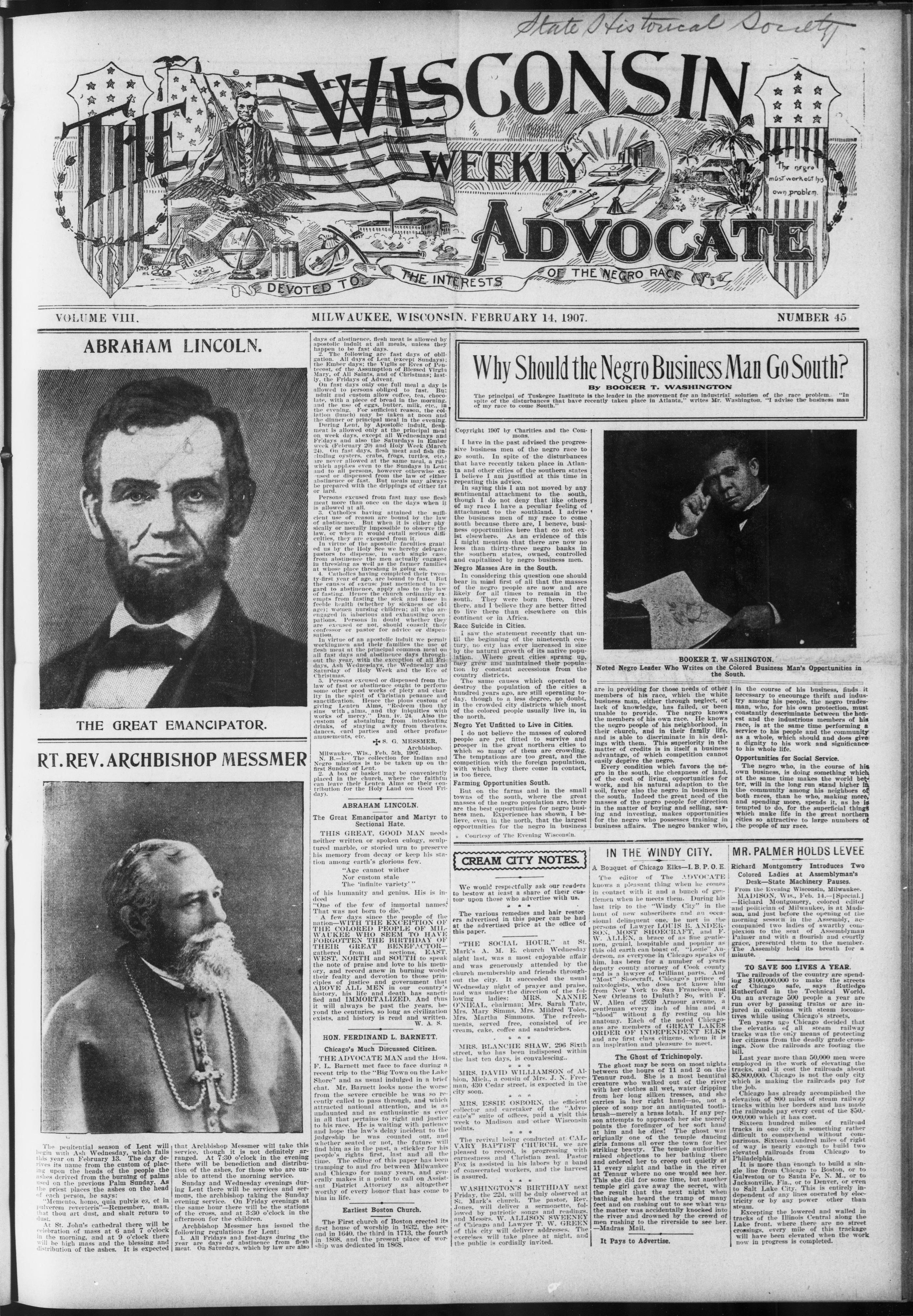
ABRAHAM LINCOLN.
A. B.
THE GREAT EMANCIPATOR.
RT. REV. ARCHBISHOP MESSMER
VOLUME VIII.
ABRAHAM
THE GREAT E
RT. REV. ARCHBI
The penitential season of Lent will begin with Ash Wednesday, which falls this year on February 13. The day derives its name from the custom of placing upon the heads of the people the ashes derived from the burning of palms used on the previous Palm Sunday. As the priest places the ashes on the head of each person, he says:
"Memento, homo, quia pulvis es, et in pulverem reverteris"—Remember, man, that thou art dust, and shalt return to dust.
At St. John's cathedral there will be celebration of mass at 6 and 7 o'clock in the morning, and at 9 o'clock there will be high mass and the blessing and distribution of the ashes. It is expected
```markdown
```
that Archbishop Messmer will take this service, though it is not definitely arranged. At 7:30 o'clock in the evening there will be benediction and distribution of the ashes, for those who are unable to attend the morning service.
Sunday and Wednesday evenings during Lent there will be services and sermons, the archbishop taking the Sunday evening service. On Friday evenings at the same hour there will be the stations of the cross, and at 3:30 o'clock in the afternoon for the children.
Archbishop Messmer has issued the following regulations for Lent:
1. All Fridays and fast-days during the year are days of abstinence from flesh meat. On Saturdays, which by law are also
MILWAUKEE, WISCONSIN, FEBRUARY 14, 1907.
days of abstinence, flesh meat is allowed by apostolic indulat at all meals, unless they happen to be fast days.
2. The following are fast days of obligation. All days of Lent (except Sundays); the Ember days; the Vigils or Eves of Pentecost, of the Assumption of Blessed Virgin Mary, of All Saints, and of Christmas; lastly, the Fridays of Advent.
On fast days only one full meal a day is allowed to persons obliged to fast. But indult and custom allow coffee, tea, chocolate, with a piece of bread in the morning, and the use of eggs, butter, milk, etc., in the evening. For sufficient reason, the collation (lunch) may be taken at noon and the dinner or principal meal in the evening.
During Lent, by Apostolic indul, flesh-meat is allowed only at the principal meal on week days, except all Wednesdays and Fridays and also the Saturdays in Ember week (February 20) and Holy Week (March 24). On fast days, flesh meat and fish (including oysters, crabs, frogs, turtles, etc.) are never allowed at the same meal, a rule which applies even to the Sundays in Lent and to all persons, however otherwise excused or dispensed from the law of either abstinence or fast. But meals may always be prepared with the drippings of either fat or lard.
Persons excused from fast may use flesh meat more than once on the days when it is allowed at all.
Catholics having attained the sufficient use of reason are bound by the law of abstinence. But when it is either physically or morally impossible to observe the law, or when it would entail serious difficulties, they are excused from it.
In virtue of the apostolic faculties granted us by the Holy See we hereby delegate pastors to dispense, in each single case, from abstinence the men actually engaged in threshing as well as the farmer families at whose place threshing is going on. 4. Catholics having completed their twenty-first year of age, are bound to fast. But the causes of excuse just mentioned in regard to abstinence, apply also to the law of fasting. Hence the church ordinarily exempts from fasting the sick and those in feeble health (whether by sickness or old age); women nursing children; all who are engaged in laborious and exhausting occupations. Persons in doubt whether they are excused or not, should consult their confessor or pastor for advice or dispensation.
In virtue of an apostolic indult we permit workingmen and their families the use of flesh meat at the principal common meal on all fast days and abstinence days throughout the year, with the exception of all Fridays, Ash Wednesdays, the Wednesday and Saturday of Holy Week and the Eve of Christmas.
5. Persons excused or dispensed from the law of fast or abstinence ought to perform some other good works of piety and charity in the spirit of Christian penance and sanctification. Hence the pious custom of giving Lenten Alms, "Redeem thou thy sins with alms, and thy iniquities with works of mercy." Dan. iv. 24. Also the custom of abstaining from intoxicating drinks, of staying away from theaters, dances, card parties and other profane amusements, etc.
Milwaukee, Wis., Feb. 5th, 1907.
N. B.-1. The collection for Indian and Negro missions is to be taken up on the first Sunday of Lent.
2. A box or basket may be conveniently placed in the church, where the faithful can leave their Lenten Alms or their contribution for the Holy Land (on Good Friday).
ABRAHAM LINCOLN
The Great Emancipator and Martyr to Sectional Hate.
THIS GREAT, GOOD MAN needs neither written or spoken eulogy, sculptured marble, or storied urn to preserve his memory from decay or keep his station among earth's glorious few.
of his humanity and genius. His is indeed
"One of the few of immortal names?
That was not born to die."
That was not born to die. A few days since the people of the nation—WITH THE EXCEPTION OF THE COLORED PEOPLE OF MILWAUKEE WHO SEEM TO HAVE FORGOTTEN THE BIRTHDAY OF THEIR GREAT BENEFACTOR—gathered from all sections, EAST, WEST, NORTH and SOUTH to speak the note of praise and love to his memory, and record anew in burning words their fealty and devotion to those principles of justice and government that ABOVE ALL MEN in our country's history, his life and death has sanctified and IMMORTALIZED. And thus it will always be past the years, beyond the centuries, so long as civilization exists, and history is read and written.
HON. FERDINAND L. BARNETT.
Chicago's Much Discussed Citizen.
THE ADVOCATE MAN and the Hon. F. L. Barnett met face to face during a recent trip to the "Big Town on the Lake Shore" and as usual indulged in a brief chat. Mr. Barnett looks none the worse from the severe crucible he was so recently called to pass through, and which attracted national attention, and is as undaunted and as enthusiastic as ever in all that pertains to right and justice to his race. He is waiting with patience and hope the law's delay incident to the judgeship he was counted out, and whether seated or not, the future will find him as in the past, a stickler for his people's rights first, last and all the time. The editor of this paper has been tramping to and fro between Milwaukee and Chicago for many years, and generally makes it a point to call on Assistant District Attorney as altogether worthy of every honor that has come to him in life.
Earliest Boston Church.
The First church of Boston erected its first house of worship in 1632, the second in 1640, the third in 1713, the fourth in 1808, and the present place of worship was dedicated in 1868.
Why Should the Negro Business Man Go South?
The principal of Tuskegee Institute is the leader in the movement for an industrial solution of the race problem. "In spite of the disturbances that have recently taken place in Atlanta," writes Mr. Washington. "I advise the business man of my race to come South."
Copyright 1907 by Charities and the Commons.
I have in the past advised the progressive business men of the negro race to go south. In spite of the disturbances that have recently taken place in Atlanta and other cities of the southern states I believe I am justified at this time in repeating this advice.
In saying this I am not moved by any sentimental attachment to the south, though I do not deny that like others of my race I have a peculiar feeling of attachment to the southand. I advise the business men of my race to come south because there are, I believe, business opportunities here that do not exist elsewhere. As an evidence of this I might mention that there are now no less than thirty-three negro banks in the southern states, owned, controlled and capitalized by negro business men. Negro Masses Are in the South.
In considering this question one should bear in mind first of all that the masses of the negro people are now and are likely for all times to remain in the south. They were born there, bred there, and I believe they are better fitted to live there than elsewhere on this continent or in Africa.
Race Suicide in Cities.
I saw the statement recently that until the beginning of the nineteenth century, no city has ever increased in size by the natural growth of its native population. Where great cities sprang up, they grew and maintained their population by constant accessions from the country districts.
The same causes which operated to destroy the population of the cities a hundred years ago, are still operating today, though to a less degree, no doubt, in the crowded city districts which most of the colored people usually live in, in the north.
Negro Yet Unfitted to Live in Cities.
I do not believe the masses of colored people are yet fitted to survive and prosper in the great northern cities to which so many of them are crowding. The temptations are too great, and the competition with the foreign population, with which they there come in contact, is too fierce.
Farming Opportunities South.
But on the farms and in the small towns of the south, where the great masses of the negro population are, there are the best opportunities for negro business men. Experience has shown, I believe, even in the north, that the largest opportunities for the negro in business Courtesy of The Evening Wisconsin.
We would respectfully ask our readers to bestow at least a share of their custour upon those who advertise with us.
The various remedies and hair restorers advertised in this paper can be had at the advertised price at the office of this paper.
"THE SOCIAL HOUR." at St. Mark's A. M. E. church Wednesday night last, was a most enjoyable affair and was generously attended by the church membership and friends throughout the city. It succeeded the usual Wednesday night of prayer and praise, and was under-the direction of the following ladies: MRS. NANNIE O'NIEAL, chairman; Mrs. Sarah Tate, Mrs. Mary Simms, Mrs. Mildred Toles, Mrs. Martha Simmons. The refreshments, served free, consisted of ice cream, cake, coffee and sandwiches.
. . . . .
MRS. BLANCHE SHAW, 296 Sixth street, who has been indisposed within the last ten days, is convalescing...
MRS. DAVID WILLIAMSON of Albion, Mich., a cousin of Mrs. J. N. Freeman, 430 Cedar street, is expected in the city soon.
MRS. ESSIE OSBORN, the efficient collector and caretaker of the "Advocate's" suite of offices, paid a visit this week to Madison and other Wisconsin points.
The revival being conducted at CALVARY BAPTIST CHURCH, we are pleased to record, is progressing with earnestness and Christian zeal. Pastor Fox is assisted in his labors by a band of consecrated workers, and the harvest is assured.
WASHINGTON'S BIRTHDAY next Friday, the 22d, will be duly observed at St. Mark's church. The pastor, Rev. Jones, will deliver a sermonette, followed by patriotic songs and readings, and Messrs. W. ALLISON SWEENEY of Chicago and Lawyer T. W. GREEN of this city will deliver addresses. The exercises will take place at night, and the public is cordially invited.
D
Noted Negro Leader Who Writes on the Colored Business Man's Opportunities in the South.
By BOOKER T. WASHINGTON
is the leader in the movement for an industrial
recently taken place in Atlanta," writes Mr. Wash
BOOKER T. WA
Noted Negro Leader Who Writes on the Co
the Sov
are in providing for those needs of other members of his race, which the white business man, either through neglect, or lack of knowledge, has failed, or been unable to provide. The negro knows the members of his own race. He knows the negro people of his neighborhood, in their church, and in their family life, and is able to discriminate in his dealings with them. This superiority in the matter of credits is in itself a business advantage, of which competition cannot easily deprive the negro.
Every condition which favors the negro in the south, the cheapness of land, of the cost of living, opportunities for work, and his natural adaption to the soil, favor also the negro in business in the south. Indeed the great need of the masses of the negro people for direction in the matter of buying and selling, saving and investing, makes opportunities for the negro who possesses training in business affairs. The negro banker who,
IN THE WINDY CITY.
IN THE WINDY CITY.
A Bouquet of Chicago Elks—I. B. P. O. E
The editor of The ADVOCATE knows a pleasant thing when he comes in contact with it and a bunch of gentlemen when he meets them. During his last trip to the "Windy City" in the hunt of new subscribers and an occasional delinquent one, he met in the persons of Lawyer LOUIS B. ANDERSON, MOST SHOECRAFT, and F. W. ALLEN, a brace of as fine gentlemen, genial, hospitable and popular as this old earth can boast of. "Louie" Anderson, as everyone in Chicago speaks of him, has been for a number of years deputy county attorney of Cook county and is a lawyer of brilliant parts. And "Most" Shoecraft, Chicago's prince of mixologists, who does not know him from New York to San Francisco and New Orleans to Duluth? So, with F. W. Allen of 2939 Armour avenue, a gentleman every inch of him and a "blood" without a fly resting on his anatomy. Each of the noted Chicoagoans are members of GREAT LAKES ORDER OF INDEPENDENT ELKS and are first class citizens, whom it is an inspiration and pleasure to meet.
The Ghost of Trichinopoly.
The ghost may be seen on most nights between the hours of 11 and 2 on the Tennur road. She is a most beautiful creature who walked out of the river with her clothes all wet, water dripping from her long silken tresses, and she carries in her right hand—no, not a piece of soap nor an antiquated toothbrush—merely a brass lotah. If any person attempts to approach her she merely points the forefinger of her soft hand at him and he dies! The ghost was originally one of the temple dancing girls famous all over the town for her striking beauty. The temple authorities raised objections to her bathing there and ordered her to creep out quietly at 11 every night and bathe in the river at Tennur where no one would see her. This she did for some time, but another temple girl gave away the secret, with the result that the next night when bathing she heard the tramp of many feet and on rushing out to see what was the matter was accidentally knocked into the river and drowned by the crowd of men rushing to the riverside to see her.—Madras, Mail.
It Pays to Advertise.
NUMBER 45
Man Go South?
I solution of the race problem. "In Washington. "I advise the business man
ASHINGTON.
Colored Business Man's Opportunities in South.
in the course of his business, finds it necessary to encourage thrift and industry among his people, the negro tradesman, who, for his own protection, must constantly discriminate between the honest and the industrious members of his race, is at the same time performing a service to his people and the community as a whole, which should and does give a dignity to his work and significance to his whole life.
Opportunities for Social Service.
The negro who, in the course of his own business, is doing something which at the same time makes the world better, will in the long run stand higher in the community among his neighbors of both races, than he who, making more, and spending more, spends it, as he is tempted to do, for the superficial things which make life in the great northern cities so attractive to large numbers of the people of my race.
MR. PALMER HOLDS LEVEE
Richard Montgomery Introduces Two Colored Ladies at Assemblyman's Desk—State Machinery Pauses. From the Evening Wisconsin, Milwaukee. MADISON, Wis., Feb. 14.—[Special.]—Richard Montgomery, colored editor and politician of Milwaukee, is at Madison, and just before the opening of the morning session in the Assembly, accompanied two ladies of swarthy complexion to the seat of Assemblyman Palmer and with a flourish and courty grace, presented them to the member. The Assembly held its breath for a minute.
TO SAVE 500 LIVES A YEAR
The railroads of the country are spending $100,000,000 to make the streets of Chicago safe, says Rutledge Rutherford in the Technical World. On an average 500 people a year are run over by passing trains or are injured in collisions with steam locomotives while using Chicago's streets.
Ten years ago Chicago decided that the elevation of all steam railway tracks was the only means of protecting her citizens from the deadly grade crossings. Now the railroads are footing the bill.
Last year more than 50,000 men were employed in the work of elevating the tracks, and it cost the railroads about $5,800,000. Chicago is not the only city which is making the railroads pay for the job.
Chicago has already accomplished the elevation of 800 miles of steam railway tracks within her borders and has made the railroads pay every cent of the $50,-000,000 which it has cost. Sixteen hundred miles of railroad tracks in one city is something rather difficult to comprehend without comparisons. Sixteen hundred miles of right of way is nearly enough to build two elevated railroads from Chicago to Philadelphia. It is more than enough to build a single line from Chicago to Boston, or to Galveston or to Santa Fe, N. M., or to Jacksonville, Fla., or to Denver, or even to Salt Lake City. This is entirely independent of any lines operated by electricity or by any power other than steam.
Excepting the lowered and walled in tracks of the Illinois Central along the Lake front, where there are no street crossings, every mile of this trackage will have been elevated when the work now in progress is completed.
THE WISGONSIN WEEKLY ADVOCATE
MILWAUKEE, WIS.
B. B. MONTGOMERY, Editor and Proprietor.
Kick at Kickers.
We all have seen the citizen,
And know him well, of old.
Who rises in the winter time
And kicks because it's cold.
He always is dissatisfied,
Whate'er may be his lot.
Next summer you will see him rise
And kick because it's hot.
Some men seem born for finding fault,
And oh, it makes us sick
To hear them kick, and kick, and kick,
And kick, and kick, and kick!
If we could only have our way—
We really wish we could!—
We'd kick a little bit ourselves.
And kick them out, for good.
—Somerville Journal.
Humorous Items.
The Benighted Traveler.
"Where do you expect to get of at?" "Lord knows! This train don't make connections anywhere."—Atlanta Constitution.
Can't He Get Dis-charged?
Hicks—Has Hardup any credit :
Wicks—Credit! Why, Hardup couldn't
get a siphon bottle charged.—Boston
Transcript.
Man's Handicap.
Woman has tears and unreason, often beauty, on her side, and if man has nevertheless got the whip hand, it shows he is a smart fellow.—Exchange.
Spotting Them.
A gasolinish odor and
A hue akin to pitch
Proclaim to poor and lesser folk
Presence of the rich.
—Birmingham Age-Herald.
His Logic
"You're surely not going to take a bath immediately after a meal. Don't you know that it's highly dangerous?" "Not in my case. I've only eaten fish."
The Social Light.
The greatest Social Light in town,
The woman of the hour,
Is Mrs. Montmorency Brown,
Four-hundred scandal-power!
-Town Topics
A Rebuke.
The Butler—The house is on fire madam. Here are all the hand grenades Mrs. Pacekill-You should have brought them on a tray, Williams.-Life.
Pleased Him
A malden whose years were not tender.
Eloped with a fellow named Bender.
Her mother was mad.
But it tickled her dad.
And he laughed till he broke a suspender.
—Denver Post.
Appropriate
Mrs. Shopper-I wish to buy a present for a servant girl. Can you suggest something appropriate?
Shopman-Certainly. Give her a traveling bag.-Pele Mele.
The Only Wav.
"How do you like your hair cut?" asked the barber, who was anxious to please. "Off," replied the customer, who was a man of few words.—Cleveland Press.
The Princely Way
"Bridget Finn says her husband treats her like a prince."
"He does that. He hands her a biff on the jaw when she fails to come up wid the coin."—Louisville Courier-Journal.
At the Dairy Counter
Nagg—The proprietor of this establishment reminds me of Pharaoh's daughter. Jagg—Why? "Didn't she draw a prophet out of the water?"—Life.
More Faith Than Cure.
"What is your opinion of the faith cure?"
"I am beginnig to fear," answered the skeptical person, "that it requires hope and charity more than it does faith."—Washington Star.
His Relationship.
I. M. P. Cunious—Well, he's an uncle now.
Harduppe—Didn't know he had any married brothers or sisters.
I. M. P. Cunious—He hasn't. He's opened a pawnshop.
Whitewashing Jimmy
"Jimmy's got a great scheme to get out o' school on these nice days."
"How does he work it?"
"He goes out an' washes his face, an' the teacher thinks he's ill an' sends him home!"—Philadelphia Inquirer.
So He Prefers to Leave It Pure
Schoolmaster (at end of object lesson)—Now can any of you tell me what is water?
Small and Grubby Urchin—Please, teacher, whater's what turns black when you puts your 'ands in it!—Punch.
Loyalty.
The western senator had purchased a home in the east.
"Do you intend to abandon your state?" he was asked.
"Not at all," he replied. "I need it for purposes of mileage."—Philadelphia Ledger.
Willing to Help.
Mr. Richley-Dubb—But do you think you could love me if I lost all my money?
Miss Skeemer—Well—er—yes, if I helped you to lose it. I could at least love you during the process.—Philadelphia Press.
Chip Sticks to Old Block.
Tommy Twaddles—Oh, I don't want to go to school.
Pa Twaddles—But don't you want a good education?
Tommy Twaddles (ingratiatingly)—No.
pa: I'd rather grow up to be just like you—Tit-Bits.
His One Request.
"Have you any request to make?" asked the sheriff of the erstwhile society man who was to be hanged on the morrow.
"Yes, one," replied the condemned man. "Let me tie the noose myself. I never yet wore a ready-made tie."—Philadelphia Press.
NEVER AGAIN.
I wish the kettle would sing again,
Just as it used to do—
I wish it would sing of a lion slain—
Of a pirate crew on the Spanish main—
Of a clipper ship on the sea-way, high,
With a cabin boy and the Boy was 1—
Just as it used to do.
I wish the kettle would sing again,
Just as it used to do.
Of a little girl in a bonnet red,
Saved by a prince from a hydra-head
That lurked in the corn that towered high,
And the girl was She and the Prince was
Just as it used to do.
I wish the kettle would sing again.
Just as it used to do—
I wish it would sing of war's alarms.
The booming of cannon and clash of arms—
Of a blue-clad boy where the strife rau
high.
With face to the steel and willing to die—
Just as it used to do.
I wish the kettle would sing again.
Just as it used to do.
The lyrics it crooned and the tales it told—
But the hearth is chill and the years are
old.
The fancies it whispered have all taken wing.
-John D. Wells in the Buffalo News.
LOVE—FOR A DAY.
Miss Dallas, searching for shells, for which the little sandy cove was famous, rounded a corner sharply and came into collision with a man who was apparently engaged in the same search.
It is almost impossible to be dignified when you have nearly knocked a man's cap off his head, and Miss Dallas did the only sensible thing she could do under the circumstances—she laughed.
"I am so sorry," she gasped; "but, you see—"
"We're in the same boat," he said, with a humorous glance "I assure you it doesn't matter in the least. As a matter of fact, I ought to have looked where I was going."
"So ought I."
"If you are going on," he said, "let me warn you not to go too far past the next point. That is a dangerous cove, and people have been cut off by the tide, which races round that corner, before now."
"I'll be careful," she said; "thank you for warning me."
She bowed, he raised his cap, and after watching her light form disappear round a bend in the rocks he went back to his shell-searching.
He got up presently and looked round the cove. The girl had vanished, and, with a sudden thrill of anxiety for her safety, he saw that the white-crested waves were already dashing their spray to the foot of the point round which she had apparently gone. In ten minutes the place would be deep in foaming water. He set off at a run, shouting as he went, and at last she heard his voice and wheeled round. "You were mad to go so far!" he gasped. "Do you know we shall only just be able to get round that point? Hurry * * * run as you've never run before."
He seized her hand without more ado, and they raced back over the golden sand; but on reaching the point they stopped short and looked at each other. A mass of green water was heaving round the rock, too deep to wade through, and growing each moment more turbulent as the great waves, driven before the coming storm came rolling into the little cove.
"It's no go," he said; "we can't do it. The only thing to be done is to find some place beyond high water mark—and wait for the tide to fall or for the passing of a stray boat. If—there is such a place as a spot above high water mark. I fancy—yes, there's a cave half way along. Do you see the cave. It's fairly high up, and with any luck we shall be safe there, unless—" He did not finish his sentence, but helped her up the steep, rocky ascent to the cave, which, though small, was fairly dry. He looked with some concern at the signs of the visiting tide, however, in the fresh seeweed and a pool or two in the recesses of the cavern.
And then they began to wait, while outside the waves raced each other up the sandy cove, and every moment the water became more turbulent and deeper against the rocks.
"I—I can't ask you to forgive me for having brought you into this by my folly," said Miss Dallas presently. The man was sitting on a boulder looking anxiously at the rising water on the cove. But he turned and looked at her with a smile, which faded as his eyes met the trouble in hers.
"Then don't try," he said, bluntly; "I'd rather you didn't. If I'd had any sense at all, I'd told you not to venture into the cove, but I didn't realize the tide was running so fast. Are you cold?"
"No. * * * Do you think the tide comes as high as this?"
"I'm afraid it does."
"Oh!" The cry was one of pain, rather faint, and, looking at the girl, he saw she had grown rather white. He got up and sat nearer to her, and put his hand on hers.
She told him how she had run down to the west country seaside village just for a week's change and rest, and how fond she was of the tiny place, and as she talked he watched her, noting her lovely eyes, her sweet mouth, and the curling hair that grew so prettily round her little head. She was so young, too—too young to die like a rat in a trap. He set his teeth hard at the thought. He wondered suddenly whether she belonged to anyone. * * * He glanced at her slender hands; they were both bare of rings, and instinctively he drew her closer, feeling a shiver run through her as a draught of air swept into the cave. The afternoon was waning, and with the oncoming tide the air was perceptibly colder.
"Are you afraid?" she asked presently, like a child. "Are you sorry about leaving anyone you love—behind?"
"I leave nobody I love," he said a little sadly—"only an uncle. There is no one else. And you?"
"I leave only an aunt," she said; "no one else in particular. But—well, this solves the difficulty. I was going to be married, I believe."
Something chilled him—Perhaps the wind.
"And you—loved him?" he asked gently.
gently.
Miss Dallas actually laughed.
"I hated the idea," she confessed. "I don't think other folk ought to settle those sort of things for one, do you?"
"No," he said fervently, with, as it were, a load lifted from his heart. "One
should follow one's heart—if it shows one the way."
"It doesn't always."
"Not always—but sometimes it does in a queer sort of fashion. Just when one loatts expects it. * * * Ah!"
There was eestasy in his voice, and in the eyes she raised to his in wonder. Their acquaintance was one of hours only—no more—and yet to each other they were all the world. Then a great wave rolled in, swirled about them with a horrible sucking force that nearly drew her from his grasp, and receded with a muffled roar. He set his teeth as he gathered her closer to him; the end was upon them—the end. He prayed it might be short and merciful, and—a sound smote his ears. * * * A steady splash of oars. With fast beating heart he listened. * * * Yes, there it was—nearer. He shouted loudly * * * the cavern gave back a mocking echo. * * * He shouted again, and—a voice answered. The spash of oars came nearer, and a boat came into the wide mouth of the cavern. He bent over the girl.
"Dear * * * we are saved!" he
cried hoarsely; but she heard him not—
a merciful unconsciousness had descended
upon her.
Miss Dallas came to, to find herself in a boat supported by her companion's arm; they were swiftly nearing the shore, and she learned that a coast guard, who had remarked them walking in the sandy cove, and fearing disaster, such as had fallen on others, had come in search of them—just in the nick of time. She begged to be taken to the hotel in which she was staying, and there he left her—with chivalrous kindness, and promised to come and see her tomorrow. Tomorrow. The word struck a cold chill to her heart, for had she not promised her people before they died that she would, at any rate, favorably consider the offer which James Gaunt was to make to her within the next few months? And her promise to the dead was sacred; if Jim Gaunt chose to ask her to be his wife, she supposed she would say "Yes."
The thought gave her courage the next day when she was told that a gentleman wished to see her. He came into the room where she was standing looking out on the angry sea, for a storm had sprung up in the night, and the bay was a mass of furious breakers; he put his hands on her shoulders. She liked the masterfulness of his manner, and his smile thrilled her. But she steadily put the thought of her promise and Jim Gaunt before her, and wrenched herself free.
"I—I—am not free," she said at last, very low, and did not see the tender smile in his eyes, "and—oh, how can you be so cruel! Can't you leave me and forget—forget even my name—which you don't know? I forgot that we—we—"
"Were never introduced? Then let us remedy that at once * * * and talk matters over afterward. I found out your name when I called to ask how you were early this morning. And mine is—Jim Gaunt. Will you send me away now, sweetheart?"
Well, she didn't want to resist him any longer, and it was so easy to give way and to let him take her in his arms and whisper all sorts of ridiculous things to her, and as for loving him always—why, that was the easiest thing of all to do—so she did it!—E. Burrowes in M. A. P.
THE POPULAR POMELO
Grapefruit Not Native to This Country, but Came to Favor Here. There are not many fruits which have been actually discovered and put to use by American fruit growers and consumers. But the pomelo (grape fruit) is one. It is not a native American fruit, but it was discovered here just the same. Its introduction dates back to the early Spanish occupation of Florida. The fruit produced was allowed to drop from the trees and rot. By some it was appreciated, says the American Fruit and Nut Journal, but its commercial value was unknown. In the early '80s the first shipments were made. The fruit was packed in barrels and some of it, shipped to Philadelphia, brought 50 cents a barrel (about two boxes).
Not a very encouraging beginning. However, it gradually increased in favor; it became fashionable to use it, it was recommended by physicians, and in a comparatively short time its place in the market was firmly established. When the severe cold of 1894-95 cut the Florida crop short, the demand had so increased that the few boxes marketed during the remainder of that season brought from $15 to $20 a box (roughly forty-six to ninety-six fruit per box). With the return of normal conditions, the crop increased, and the price dropped to the more normal basis of $3 to $6 a box.
Instead of the few hundred trees which yielded the first fruit marketed, pomelo trees may now be counted by the hundred thousand in Florida. Cuba and other of the West Indies and in California, as well as other parts of the world. But the industry had its beginning in Florida, and to Florida fruit growers must be given the credit of establishing a new fruit industry with a fruit which, in twenty-six years, has risen from an unknown, obscure place, to be regarded as the standard breakfast fruit in thousands of households.
How Tom Fooled the Old Boy.
'There was a feller in the town where my mother come from whose name was Tom Cook. Tom was a pretty rough sort of a customer and it was commonly believed that he was in league with the devil, and he was, too. Well, by and by the devil concluded he'd like Tom's company down below. So he called on Tom early one morning and found Tom had just got up and was dressing.
"'Tom,' said he, 'you've lived in this town long enough. I want you to come down to the pit and stay with me. So make haste. I've got to keep the fires goin' down there, you know.'
'Then the devil took Tom by the arm to hurry him and make sure of him. Tom didn't like the looks of the devil, and the devil's fingers were awful hot. Tom tried to pull along, and at the same time he said, 'Wait, wait, can't you, until I get my galluses on?'
"He no sooner said that than Tom threw the galluses into the fire. The devil saw he'd lost his man and went off in great anger, and Tom never wore galluses again."—New England Magazine.
Killed Town's Goldfish.
The use of sulphate of copper to rid the Scranton reservoirs of deadly germs has resulted in the death of about two-thirds of the goldfish in Scranton aquariums. One dealer has lost about 600 goldfish in the last few days.—Scranton Times
THE FLOWER OF YOUTH.
I plucked a leaf from sorrow,
I broke a thorn from pain,
And where I pulled the leaf and thorn
They straightway grew again.
But where I picked the blossom
Of youth, the branch shows bare,
Nor can I find a second flower
Though I search everywhere.
—Mildred Howells, in The Atlantic
BRIEF NOTES OF GENERAL INTEREST
James Bull and Miss Annie Lamb were yoked in matrimony at the home of the bride, west of Ashkum, Ill., the other day. They will live on a farm.
Elmer Pierce and John Bloemers captured a fine specimen of the bald headed eagle in a steel trap on the farm of John Bloemer, near Bingham, Wis., recently. The bird measured 7½ feet from tip to tip of its wings and was not harmed in the least.
Because he hit Oral Hammer, a boy of 10, in the face with a live rattlesnake, loosening two of the lad's teeth, Frank Jones, known to showmen as "Uno, the snake eater," is in jail at Los Angeles. Jones became angered because the boy got too close during an exhibition he gives.
---
Leaving a fortune of $30,000, every cent accumulated from a pension of $50 a month, judiciously invested by his guardian, Henry Wensler died at Wabash, Ind. Injuries in the Civil war left him simple minded, but he supported himself until recently. Government officials say that this is the only fortune in the United States developed from a pension alone.
An Irish member of Parliament of New South Wales, P. H. Sullivan, recently resigned his seat, saying of his brother legislators: "They are all getting too good for me. I am a sinner. I drink, I smoke, I swear and I bet, and if I were to remain in the House any longer they would probably convert me." The New South Wales Parliament has been busily engaged of late passing drastic measures to reform the morals and manners of the community.
Mrs. Flora E. Miller of Kokomo, Ind., has filed suit for divorce against her husband, because he is "an inveterate but unsuccessful gambler." Her petition alleges that her husband "is not possessed of sufficient judgment to estimate the commercial value of a pair of deuces, and he has been known to hazard heavily and persistently on an ace full when he had been notified that his adversary was in open, notorious, and undisputed possession of two pairs of queens."
Frank Pasche, aged 24, was sentenced to jail at Manitowoc, Wis., as a vagrant, when officers found him in possession of a storage house of the Landreth Pea Packing company. Pasche has occupied the house all winter and had set up a bed which was stored there. He had disturbed nothing else but was without a home. He effected an entrance by fashioning a key of a wire. Pasche has a police record, having been implicated in the robbery of a house at Rapids a year ago.
---
While a 5-year-old boy was playing on the ice at a school six miles from Welcome, near Kaukauna, Wis., he fell in such a way that the palm of his hand came in contact with the hard surface. Being moist, the hand instantly became fast and neither the teacher or any of the pupils could release it, so he was obliged to remain impaled upon the spot until a doctor arrived an hour later. Although wrapped in warm clothing the hand was so badly frozen that it may have to be amputated.
Philo G. Wilcox is a blacksmith in the village of College View, near Lincoln, Neb., and he has an efficient helper in the person of his wife, while his two young daughters also contribute their aid. Mrs. Wiscox is adept in all departments of the trade, shoeing horses and working at the anvil as successfully as any smithy in the land. Previous to her marriage she was a school teacher, and each of her daughters has completed a high school course. The Wilcox home is well stocked with good books.
Baring the story of their lives Feliz Leshiac and Paulina Oloo went on the stand at Kenosha, Wis., and testified that they had been living together as husband and wife for more than four years in violation of the law. Both were plaintiffs in actions for divorce. The husband of the woman and the wife of the man were living in Austria. The couple admitted that they had thought they were properly married and had several children, but that recently they had found that they had never been divorced from former marriage bonds. They will be forced to wait a year before they can be legally married.
That a husband should have his pork chops and hot biscuit on time is of greater importance than lingering debate in women's clubs. This point was decided at the meeting of the Hull House Woman's club, Chicago, when discussion was raised as to the desirability of changing the hour of meeting. Another suggestion was made that the Wednesday meeting be held at 1:30 p. m., but this was combated on the ground that many of the members were mothers, who had to get their children away to school for the afternoon session. It was finally decided that the hour for the Wednesday meeting should be 2:30 p. m.
While wintry winds whistled through broken window panes in the big council chamber of the city of Cincinnati, vice Mayor Frank L. Pfaff, the presiding officer, kept on his overcoat and walked back and forth on the platform in order to keep from being chilled to the bone. Councilman W. J. Ryrtle promptly met the seeming emergency by offering a resolution authorizing the board of public service to buy the vice mayor a fur overcoat, fur cap and earmuffs to wear while on duty or until such time as the window panes of the council chamber were in condition to withstand the wintry blasts. The resolution was passed unanimously.
Fred Strey, of Appleton, buried by friends a few days ago and living the life of a pauper for some years, died possessed of about $3000 in gold, but the discovery was not made until Mrs. Klitzke, at whose home he had lived for some time, was about to destroy his clothing. Observing that the clothes weighed more than wearing apparel usually does, she began a search and in the legs of the trousers was found $1300 in gold. Further search revealed the fact that the estate of Strey is valued at $3000. Twenty-seven years ago Strey's only son left him and went to Milwaukee. If he can be found he will be the only heir to his father's estate.
Koepenick, the bogus army officer who caused such a commotion in Germany recently, comes of a calling—that of cobbler—which has given the world some very great men. One authority asserts that the majority of cobblers have exceptional brains—that their attitude when stooping over their work tends to
a cranial development in the part where the intellectual faculties are seated. Someone has writtn a book on illustrious shoemakers. In it are Sir Cloudlesley Shovel; Gifford the Terrible; Bloomfield, author of the well known "Farmer's Boy;" Carey, the orientalist; Admiral Myngs; George Fox, founder of the Society of Friends; John Kitto, the biblical scholar; Sturgeon, the electrician
The late Capt. S. S. Brown, noted horse owner and coal operator, who was reported to have left $15,000,000, only left $3,000,000, according to the account filed by his executors at Pittsburg. Libraries at the city and country homes of the deceased which were valued by him at $50,000 have been appraised at only $133. These libraries, together with trophies won on the turf, and thirty bonds of the Pittsburg Brewing company, valued at $33,900, were bequeathed to Miss Martha Lewis, who has since married William Porter, who was Capt. Brown's betting commissioner. For accepting the brewing company bonds Miss Lewis was forced to resign as Sunday school teacher in the Mary Brown memorial chapel.
The prayer cure for insanity was urged in the lower house of the Illinois Legislature recently in a communication from a resident of New Boston, Ill., who believes that if a "knee squad" from the Salvation army were to put up supplications three times a day in each state asylum there would be no need of hydrotherapeutic baths, psychopathic hospitals and the rest of the modern scientific appliances which the state board of charities wishes to install. The New Bostonian picked out the Salvaton army workers because of their fervency in prayer, and his suggestion that the state pay a salary to a picked brigade of lassies and soldiers was hailed by Speaker Shurtleff as affording opportunity for an ironical dig at the administration's idea of giving the charitable institutions the most improved equipment.
Eighteen inches of as beautiful whiskers as ever grew on mortal man went up in smoke when Jacob Crites upset a lamp at his home at Findlay, O.
The whiskers were the pride of Findlay. Like the courthouse, the mayor's residence, and the cemetery, Crites' luxurious hirsute adornment was pointed out to visitors as one of the interesting sights. Now Findlay mourns.
Crites was pouring camphor into a bottle on a table. A lamp stood near by. Little did Crites think of the danger that threatened his beard. A sudden nudge with his elbow tipped over the lamp. The eighteen inches of whiskers caught fire.
Now there is nothing left of the "Pride of Findlay" except a faint odor in the room where the tragedy occurred. Crites was not seriously burned otherwise.
The police of Pittsburg raided a spiritualist meeting in the Oakland residence district. The medium, the "spirit" and twenty-three other persons were hauled to the police station and locked up for a time, charged with violating a city ordinance. Soon all were out on bail. The "spirit," who was six feet high and weighed 180 pounds, put up a fearful battle when the light was turned on and it gave the detectives all they could do for several minutes. The police got into the meeting in the dark, and at a signal turned their electric lights on the medium, who was caught talking through a horn, impersonating the voice of a wealthy man some time dead.
The man's son was almost delirious with joy at hearing "papa's" voice, but when he saw the deception he started for the medium with a chair leg.
Carl Buchta, clerk at G. R. Evans' drug store at Kendall. Wis., went to the store at 3 o'clock one morning to fill a prescription. Mr. Evans, who lives above the store, heard him as he left, and under the impression that the store was being robbed, began firing his revolver from a back window. This awoke Postmaster Heding, who lives upstairs next door, and he also went to a window and began firing into the air. Hiram Koehler, who sleeps in the back part of the drug store, was awakened by the shooting and went outside to see what was going on, and the two upstairs, mistaking him for a burglar, began shooting at him. Dr. Peter Moe, who lives upstairs next to the postmaster, was also awakened and fired a few shots from a window. Meanwhile Koehler, finding himself the target for the others, took refuge in the doorway of George Weise's saloon. Night car tappers and others hastened across from the railroad shop in response to calls for help only to find Koehler crouching in the saloon doorway and shivering with cold and fright. Fully twenty shots had been fired at him without one taking effect.
Curious Condensations.
-In the various treaty ports of China there are 105 American firms and 3380 American citizens; 197 firms and 1850 citizens of Germany; 434 firms and 8493 citizens of Great Britain, and 729 firms and 16,910 citizens of Japan, says Daily Consular and Trade Reports, quoting from the last imperial Chinese customs report.
-A member of the staff of the Blue Hill observatory, near Boston, has reported that observations made there show that the average speed with which clouds, between 8000 and 9000 feet high, move is 60 miles an hour in midsummer and 110 miles an hour in midwinter. The swiftest flight of a cloud yet measured was 230 miles an hour.
The rapid construction of a trestle was recently carried on at Galveston Tex. Fire destroyed 400 feet of the long railroad trestle which extended from the mainland to the city and stopped traffic. The construction forces and materials were started to the work, and by midnight of the same day the trestle was sufficiently repaired to allow traffic to be resumed.
Japan's national debt now amounts to $1,011,472,367, of which $72,000,000 is for public works and railways. The total debt is $86,000,000 more than the interest-bearing debt ($925,000,000, including $30,000,000 for the American Panama canal) of the United States. As the population of Japan is about one-half that of the United States, the debt burden on Japan's people is about twice as heavy.
Stamps in Book Form
One cent postage stamps are to be issued in book form like the 2-cent stamps are now issued. Announcement was made to this effect by the third assistant postmaster general, who states that the first issue will be made about March 1. The books will be of one size, containing 24 1-cent stamps in four sheets of six stamps each, interleaved with paraffine paper and bound as are the books of 2-cent stamps. They will sell for 25 cents each.
Auto Discoverer It Put Into the Workhouse.
The theory of the automobile was known to Solomon de Coste of Normandy, in 1641. He wrote a book on the proposition of carriage by steam power, and was cast into a Paris madhouse for it by Cardinal Richelieu.
GREAT STATUE OF DIVINE INFANT
Carved from Wood of Olive Tree and
Bears $1,000,000 in Jewels.
The most celebrated statue of the Divine Infant was carved in Jerusalem from the wood of the olive tree of Gethesemane in the fifteenth century by a member of the Franciscan order who brought it to the Capitoline Hill, Rome, and placed it for veneration in the Church of the Friars Minor in Ara Coeli, where it is now known, visited and honored by the whole Catholic world owing to the innumerable favors the Infant is to bestow upon those who venerate it. It was solemnly crowned by the Vatican Chapter on the 3d of May, 1897. It is adorned with $1,000,000 worth of jewels as votive offerings.
WOMAN'S SHAWL A RELIC.
No Longer Plays Part in Styles or as Necessary Article.
The Philadelphia Record called attention to the disappearance of the shawl as an article of woman's attire, quoting a physician as follows: "I take keen interest in looking for this old-fashioned garment. Yet there are few places in which I see it. Even in the poorest sections the women wear some sort of jacket, however old and worn it may be. I suppose that the manufacture of tailormade clothes has become so cheap that anybody can afford to buy them as readily as a shawl."
WORKS IN THE GARDEN.
Eighty-seven Years Old, but Has a Sound Back. Robert Scollan, 87 years old, of 55 Garden street, Seneca Falls, N. Y., a
fine, sturdy old gentleman, who works in his own garden, gives thanks to Doan's Kidney Pills for his sound back and kidneyC. Mrs. Joetchious his daughter, says: "Father had a severe attack of
fine, sturdy old gentleman, who works in his own garden, gives thanks to Doan's Kidney Pills for his sound back and kidneyC. Mrs. Joetchlous his daughter, says: "Father had a severe attack of kidney trouble and lumbago, which caused him much suffering. He began taking Doan's Kidney Pills and was soon cured. We always keep them on hand. My husband was cured of bad pains in the back by taking only part of a box."
Sold by all dealers. 50 cents a box. Foster-Milburn Co., Buffalo, N. Y.
MANY GO TO CANADA.
Americans Lead in Settling of the Canadian Northwest.
According to the Canadian department of the interior the total number of new "homesteaders" in the Canadian northwest in the last fiscal year was 41,689; made up of 12,485 Americans, 12,370 Canadians, 5897 English, 2193 Austrians, 1657 Scotch, 1024 Germans and 543 Irish. The total number of immigrants from the United States during the four months of 1906 was 19,907, as compared with 12,664 in the same period of 1906 fiscal year.
Mix This at Home.
The following simple home-made mixture is said to readily relieve and overcome any form or Rheumatism by forcing the Kidneys to filter from the blood and system all the uric acid and poisonous waste matter, relieving at once such symptoms as backache, weak kidneys and bladder and blood diseases. Try it, as it doesn't cost much to make, and is said to be absolutely harmless to the stomach.
Get the following harmless ingredients from any good pharmacy: Fluid Extract Dandelion, one-half ounce; Compound Kargon, one ounce; Compound Syrup Sarsaparilla, three ounces. Mix by shaking well in a bottle, and take a teaspoonful after each meal and again at bedtime.
This simple mixture is said to give prompt relief, and there are very few cases of Rheumatism and Kidney troubles it will fail to cure permanently.
These are all harmless, every-day drugs, and your druggist should keep them in the prescription department; if not, have him order for you, rather than fail to use this, if you are afflicted.
Where He Drew the Line
George Hembert Wesley, the well known Boston writer, whose novel "The Maid and The Miscreant," is one of the most popular of the recent books, was a few years ago clerk in a Boston hotel. Owing to his irrepressible humor, however, he did not hold the position long, for one day a well dressed woman entered in a bustling manner and exclaimed, "I want you to give me a room and a bath." The temptation was too strong for Mr. Westley. "I'll give you the room, madam," he said, "but you'll have to bathe yourself."
Butter
Mattie Sheridan, editor of a New York periodical, is one of the brightest wits in that big town. One night when the Hungry club, of which she is the presiding genius, was dining at the Billy Goat, a member showed signs of annoyance.
"What's the matter?" she inquired.
"There's no butter?"
"What," she exclaimed, throwing up her hands, "no butter—at the Billy Goat?"
And the void was filled.—Bohemian.
How Did She Know?
The local Woman's club had offered a prize for the best essay, by any member, on "How to Make a Husband Happy." It was a cash prize, and summer expenses were in the near distance, and the competition was large and warm. The winning paper was just three words long, and, stranger even than that, it was submitted by a spinster of fifty-seven. Her dictum was merely this: "Food the brute!" Lennie's
"Feed the brute!"—Lippincott's.
DODD'S
KIDNEY
PILLS
FOR ALL KIDNEY DISEASES
CURES RHEUMATISM
BRIGHT'S DISEASE
DIABETES BACKACHE
discontinued the use of our
package. The public may re-
quire one of limitations, sold only in Queens
GOSSIP FOR THE LADIES.
The Dreamers.
High and hidden on the hill-tops, in the sunshine and the moonshine.
In the cloudy ocean floating, lie the Islands of Delight.
Oh! the wonder of the silence, when the Rose of Dawn is budding
On the garden-bank of shadows, silence perfect and serene.
As if God had laid his finger on his lips, as in a token.
Lest the people of his islands should be
wakened from their dream.
When the House of Night, with windows
shuttered fast by bars of darkness.
Holds the ocean and its islands in the
fastnesses of gloom.
Comes the moon's bright, silver sickle, har-
vesting the fields of heaven.
Reaping sheaves of stars for weaving in
the pattern of her loom.
By the favor of the highest, in the faith
that is the truest.
Through the gold-souled lotus's symbol and the blood-red poppy's sign. You may know the island people, you may learn to greet and speed them. To the company of dreamers, in communion divine.
—Scribner's Magazine.
A Welcome Guest
Every one knows that to be a successful hostess, making one's visitors have a good time and be at ease, is a talent, but I am quite sure that to be a successful guest requires more tact and art. There are painfully few persons whose departure is regretted from the houses in which they have been visiting, and it is all because the stranger within the gate has taxed either the nerves, resources, pocketbook or patience, and, alas, sometimes all of these. The visitor has not done it purposely, of course, but simply through stupidity, selfishness or thoughtlessness. Whichever the cause, if she wishes to be popular among her friends at a distance she will do well to remedy this fault, else they will ask her only at such times as they must not to have ill feeling.
To be a perfect guest I should say consists in putting one's self thoroughly in touch with the habits of the household, conforming to the hours and ways, adding to the pleasure of the household by being agreeable and appreciative and at the same time not making one's self too much a "member of the family." This is the error that guests who don't wish "to be a bit of trouble" are likely to fall into, and it is quite as bad as upsetting the machinery in another way by not doing one's share. There is decidedly such a thing as being too informal for a guest, going into rooms where the hostess would prefer one did not, and by being constantly in evidence, knowing too much of the ways and means of managing. Every housekeeper has at least a few reservations she would like to keep as to the way she runs her house, and if a guest in a most friendly desire "to help" insists upon always following around during the morning hours or asking questions, her hostess must either tell more than she wishes or else be rude in refusing. A guest who puts a hostess in such a position fails utterly in the part of visiting.
If one is staying in a house where the servants are few and the mistress does some small tasks herself, it does not at all follow that a guest is a success as such and helpful in insisting upon dusting her own room or making the bed, for example. That a guest does any work at all may outrage all the ideas of hospitality of some hostesses, and, if this is so, it is obviously silly for the visitor to offend her friend by "making herself useful."
Under such circumstances the visitor would better retire to the sitting room with a book or to write letters and leave her friend to her own way of doing until things are started for the day. On the other hand, some hostesses are quite willing that a guest, especially if the visit is to be a long one, shall get quite into the family life by taking up certain small tasks, and in that case the visitor should do what she is permitted, offering her services simply and frankly. If the stranger is tactful and observing she may find without asking certain small things to be done, and then ask if she may do them.
It is because hostesses differ radically in their ideas of entertaining that it is impossible to lay down fixed rules of what to do when one is visiting. One can only generalize by saying, watch to see what is wanted of you and then try to do it. You are apt to know whether or not you are successful by the frequency with which invitations to stay in other people's houses come in.
Punctuality at meals is one of the requisites of being a successful guest. In houses where the servants are limited to two, or even one, tardiness in serving meals will upset the whole domestic machinery and make all hard for mistress and maids. If a visitor doesn't like to have an early breakfast, for instance, and her hostess has the first meal served at 7:30, the guest must be willing to be ready for it or she should give up visiting in that house. In other words, if one is not willing to do as the hostess she should cut that house from her list in which to stay. It is grossly unfair and a tacit criticism not to do as the others in it.
There is decidedly such a thing as over entertaining as well as doing too little of it, and it is a fault to which both guest and hostess are prone. Each, in the desire to give the other pleasure, too often leaves no time for privacy that each person always needs at times, and at the end of a visit both guest and hostess are worn out by it. A guest should never forget that a hostess will have many small matters pertaining to housekeeping and the like to look after and should see that she relieves the housekeeper of responsibility of her presence for a time that they may be looked after. On the other hand the hostess is to recollect that the guest will have letters to write, trifling mending to do, or will have found a book she would like to run through, and in her desire to give her friend a good time the housekeeper should not absorb her time so that the other has no chance for any of these. Flatly each should have a little while to themselves every day.
Making one's guest a financial extravagance is a fault of American hostesses. For fear that the visitor will not be sufficiently entertained more money is spent in the theaters, luncheons and dinners than the family purse can afford without economizing in another direction, and on the departure of the friend the family subsist upon plain fare and simple living until they have made up the previous expenditure. This, in my opinion, is contrary to the ethics of hospitality, which should be to make friends welcome within the home, giving and receiving such pleasure that departure is a cause of regret on both sides.
Cultivating a Sense of Fitness.
A woman must have an artistic soul to really dress well. Not that every artist could pose as a model of the perfectly gowned woman. Too often her very sense of color and admiration of classic fines lead to a bizarre and unconvention-
al form of dress that may be according to the canons of the academic, but is hopelessly at odds with prevailing styles. For disclaim her power as she may, no woman can afford to totally disregard that she aspires to being well dressed. Slavish observance of the prevailing modes is bad, but it is a question if too great originality in clothes is not worse. There is such a thing as excessive individual. Outer dressing is always to be avoided. Better, far better, be a human fashion plate than an eccentric extremist who achieves startling novelty at the expense of becomingness and good taste.
The present season has a certain danger from the very liberty of selection. That liberty must never be permitted to degenerate into license; as one woman remarked, "you can wear anything you like this winter and still be in the style." So you can, if you are sure you like suitable things. Right here does the truly artistic temperament get its innings. The happy possessor of it has a well-developed sense of fitness. She realizes her physical shortcomings and appreciates what manner of dress is or is not becoming. Wild extremes and undue originality are barred out as rigidly as would be loud and garish colors or cheap finery.
The artistic woman knows that well-gowned means becomingly gowned. Never, were she a dummy, rotund, florid daughter of Eve, would she be guilty of donning a huge picture hat overloaded with immense plumes, a costume just one degree more buoyant than her neighbor's (often with trimming horizontally arranged), of a vivid hue warranted to accentuate every ugly purple tint in her complexion, and then complacently deem herself well dressed. She realizes that not even if labeled conspicuously with that cabalistic sentence, "Made in Paris," could she hope to make the ordinary observer deem her anything but a guy.
The artistic sense forbids plumes floating at impossible angies on the shoulder, over the ears or obscuring the nose—one seen this season on a woman old enough to know better fell far below the hips—or that even more hideous fashion of standing rearingly erect like a drum major's insignia. It also teaches that feathers, which look as if they had been caught in a cloudburst with never a chance to dry off, form a trying frame for the most youthful beauty.
The art-feeling gives its possessor the intuitive sense that period costumes, in the by-day of popularity though they be, should be eschewed by the woman who cannot afford the best designers; doubly so, must her clothes do duty a second season.
It teaches her that trying color tones, accentuated sloping shoulders, overindulgence in trimmings, eccentricities of cut and bizarre materials should be religiously avoided. These things stamp the date of one's clothes for the woman with a small allowance, and lays even her wealthy sister open to criticism as lacking in the innate refinement which ever forbids conspicuousness. The best modiste can but point the way: the final selection remains with her patron. Dressmakers are too often condemned when one's own sense of fitness is at fault.
Remember, you who lack the art-feeling that largely prevents mistakes, that conventionality, rather than originality, pays best in the selection of clothes. Exaggeration is unattractive and bad form. To aim at striking effects, too, often means to attain absurdity of appearance and the ruin of beautiful and costly materials.
Politeness at Home.
When an exhortation is given after the wedding ceremony, it would be well if the clergyman were sometimes to take for his text, "Be courageous," for more estrangements, if not absolute quarrels and separations, grow out of a disregard of the common rites of politeness in married life than from almost any other cause.
"Politeness," says Joubert, "is one development of 'virtue;'" and in reply to those who contended that it is necessary for society only, not for home, he remarked that we should wear our velvet indoors—that is, give those nearest to us the chief benefit of gentleness.
The wife gets up and goes off to give a direction to her servants while her husband is in the middle of a sentence; if he were any other gentleman she would at least say, "Excuse me for a moment."
The wife comes into the room and the husband sits still in his chair; if any other lady enters he rises and offers her one.
If a guest is coming to the house the lady of the house is dressed and at the door ready to receive him; if it is only her husband she has no welcome.
If a lady is at table as a guest, the gentleman brings some topic of conversation to entertain her; if the wife is the only lady he sits silent, or may even take a letter or a newspaper out of his pocket and read it to himself.
Friendship receives its crown in marriage when love is mingled with admiration and respect. Alas! this admiration and respect, in the case of too many couples, in time disappear, and then they behave toward each other as they would not do toward strangers and mere acquaintances, not to speak of friends.
A really good manner is like our skin, put on from within and never taken off while we are aiive. Nature's gentlemen and ladies are always gentlemen and ladies. Unless married people are so very sympathetic that they grow together "like to a double cherry, seeming parted," the never-ceasing round of intercourse between them may become so exigent as to cause abrupt, unpolite behavior. At breakfast, at lunchneon, at dinner, more or less in the evening, at night, in the morning—all "marriage." This is the time for studied politeness if we have not the gift of natural politeness. We should force ourselves to keep back rude remarks and to say polite things. Let us do what the photographer tells us to do—"Smile and look pleasant."
It does not "pay" to be indifferent to the feelings of a life partner. When people are tied for life it is to their mutual interest not to grow weary of one another, and the best possible safeguards they can adopt are kindness and civility. How the whole day is rendered dismal and disagreeable when there has been a "storm" in the breakfast "tea cup" between husband and wife! As far as happiness goes, each must confess in the evening. "I have lost a day."
Courtesy from a child is expected; but in too many cases no thought is given to the duty of returning the compliment. It is a fact, however, that the youngest child in a home has a right to be treated with politeness. When brothers and sisters are civil to each other it is generally because they have been respectfully thought of and spoken to by their parents. Especially is it important that the father, as the head of the house, should give a lead in this respect. When you find children loving and helpful to their mothers you generally find the father at the bottom of it. If the husband respects his wife the children will respect their mother. Matrimonial word battles may amuse
outsiders as the skill of gladiators used to amuse, but the combatants made themselves very miserable. Far better to be incapable of making a repartee if we only use the power to wound the feelings of the one whom we have voted to love. There is an art of putting things that should be studied by married people. There is a story of a separation which took place simply because a gracious announcement had been couched by a husband in ungrateful terms. "My dear, here is a little present I have bought to make you good-tempered." "Sir!" was the indignant reply, "do you dare to say that it is necessary to bribe me into being good-tempered? Why, I am always good-tempered; it is you who possess a violent temper, sir." And so the quarrel went on to the bitter end.—Philadelphia Evening Bulletin.
How to Find Happiness.
Make up your mind to bury all the petty, mean feelings, to forget all the injuries done you, to forgive all the unkind words written or spoken to you. Make up your mind that you are going to try to speak only golden words, for then you may be sure the echo will be golden deeds. Make up your mind to learn that if one closes her ears to evil speaking one is very apt to forget to say the evil word one's self.
Make up your mind to be as cheerful and hopeful as possible and not to allow yourself to get in the habit of thinking the worst rather than the best of people. Make up your mind to think of what you have in life that is good, think out what the future may hold for you, and then you will forget those petty worries and your heart will grow light and the world will seem full of sunshine. Make up your mind to be courageous, force yourself to be pleasant and say the bright things that come to your lips.
Make up your mind when grief comes to you—when the world seems like a great sob—that you have no right to sit down and nurse your heavy, aching heart. No one has a right to make her grief a burden to the rest of the world. To think this may give you no consolation while the sorrow is fresh, but when the intense grief has quieted a little try and remember how many other sorrows there are and compare your own with them.
Make up your mind when you find your heart is heavy and that you are a sorrow not only to yourself but everyone else around you that the only antidote is work—good, hard, all-absorbing work. To try and busy yourself in making others happy, relieving some other burden-bearer.
You will find your heart growing lighter, the smiles coming oftener than the tears and you yourself will be glad because you are of use in this busy old world.
That's the way to look at it. Whether it is a heavy load to carry or a crown of glory, be sure that it is wisdom to lift it up gladly, bear it with a brave heart and lay it down, if you will, triumphantly.
That is the only way to find happiness. —Selected.
Talks About Women
Samplers are treasured as heirlooms in many families nowadays and the problem of their preservation is sometimes a difficult one to solve. The wool cross stitch makes a dainty morsel for moths, but if laid away in camphor balls the sampler's beauty is wasted on the desert air. One woman recently had a sampler framed exactly as one would a picture. For it she selected a convex mahogany molding about three and a half inches in width which harmonized most happily with the needlework and canvas. It now ornaments the wall of her library and is an inspiration to many other women with similar relics.
It is not always easy to secure material for portieres that is at once pretty and inexpensive. One woman who has been searching over the town for a fabric combining the two qualities was almost in despair when a friend, a decorator, suggested that she get mocha canvas for her sleeping room doors and velveteen in a soft reseda shade for her library doorway. As the walls were green the colors harmonized charmingly and all told did not cost more than $12 for the two pairs.
The canvas is loosely woven and resembles burlap in appearance, though much softer, and hangs much more gracefully. It costs 50 cents a yard and is very wide. The velveteen, which is also double width, can be obtained in a number of soft colorings and, while handsome, is not so rich looking that it kills everything else in the room. It is especially effective with mahogany or dark oak and with Circassian walnut.
A woman who has had the good fortune to retain two servants in her family, one for twenty six and the other for nineteen years, was asked recently, in the presence of her husband, what was the secret of her success. While she was ruminating on the question, her husband answered for her:
"That's easy," remarked the mere man. "All that is necessary is to let the servants run you as they have done my wife and you will have no difficulty in keeping them forever. There's no trick about that." A Japanese woman in this city has discovered a way of hiding from sight the ugly steam radiators inevitable in flats. A cabinet, the face of which is grill work, is built about the radiator, the top being utilized as a shelf for pieces of china or bronze, or it may take the place of a stand for newspapers and magazines.
In one room a radiator, which was very low and extended across an entire side of the room, was covered by a low settee of matting. The front has sliding doors of Japanese wickerwork in summer, while in winter the doors are pushed back, allowing the heat to escape through a delicate partition of grill work. The idea can be adapted in a dozen different ways and with different materials, but is always effective in that it transforms an ugly necessity into a practical bit of home furnishing.
Artificial grapes played an important part in an effective scheme of table decoration recently seen. The entire chandelier was prettily festooned with the vines, from which depended big bunches of green, and purple grapes, in the midst of which shone out the incandescent lights covered with pale yellow paper shades. For a centerpiece a basket of wistaria vine in Japanese design held grapes, the real article, the two blending and making a decoration that was not only effective, but also unhackneyed.
Cultivate Love.
By daily cultivating an attitude of love, the love emotions will become a part of our nature just as light is the nature of the sun. To whatever the sun turns it turns with a ray of light. So we shall turn with love to all whom we meet. Love in all its myriad phases will be so intrinsic a part of us that we cannot but speak, think, act in its terms.
As this love assumes an active, positive aspect we shall find ourselves fortified against many griefs. The great remedy for sorrow is occupation. The mother bereft of her child, the widowed wife, have long been counseled to seek solace in some work, to get an orphan child to love, to espouse some benevolence, to forget their own distresses by occupying themselves with some one else. The heart that is at leisure from itself to soothe and sympathize with others is far less likely to be subject to
moods than is the heart that tries to live to itself alone, that turns its attention constantly inward upon itself.
Be absorbed in a work of moment to others, to the world, and our own small, petty pygmy concerns lose their overweening importance.
A young newspaper man home from a night with a metropolitan daily found his mother upset over some domestic catastrophe. He sympathized with her distress, but could not take her tragedy to heart. "Why, down at the office," said he, "if we made mistakes, 300,000 people would be without their morning paper. There are only half a dozen of us at home here to suffer by this. Come you make too much of trifles." So, when we take the larger viewpoint, our own tiny private personal pains will pale away by contrast.—Washington Star.
Separation a Good Thing
The happiest marriages are undoubtedly those where a certain amount of daily separation takes place between husband and wife. They both mix with outsiders; their ideas are enlarged and freshened; they have a chance of missing each other, which is one of the truest secrets of preserving affection, and when they meet again it is with renewed pleasure, and a certain restored sense of novelty, which lasts them till it is time to part again.
And when there are little absences, what a renewal of charm succeeds! We never value a thing till we lose it; and even the temporary loss of another's society makes us think it more attractive than if it were always with us. So let the married resolve to spend at least a little portion of each day apart. Do not understand by this that I mean to advise such an amount of separation as shall produce in them a difference of tastes, pursuits or friends. But it is wise to lead just so much of the daily life apart as shall lend a new zest to the time spent together. One grave drawback to seeing too much of each other is the tendency in human nature to treat with slight respect the thing with which we are too familiar. A husband and a wife are apt to lose that courtesy in their mutual intercourse which is the very salt of happy family life.—Woman's Life.
For the Children.
When little Arabella Krupp first started in to school.
But the next thing that she said to her was "Little girl sit up!"
Which greatly disconcerted little Arabella Krupp. —St. Nicholas.
BETSY BRANDON'S GUEST.
A True Tale of How a Little Maid Entertained Gen. Washington.
It was a bright spring morning in 1791, and the sun shone as bright over the Brandon plantation as it did in the county town of Salisbury. Yet little Miss Betsy Brandon, sitting lonely and disconsolate on the piazza of the great plantation house, did not think of the sunshine, did not notice the gay tulips nodding good morning, did not listen to the merry songs of the birds, for her thoughts were in Salisbury, and she longed to be there.
For not more than an hour ago all the family had driven to the town to see Gen. Washington, who was to be received there with great honor, and with as handsome a demonstration as the brave, patriotic folk of the town and county could make for him.
It was a wonderful thing, this Southern tour of the general—now President of the United States. He had traveled in his family carriage all the way down from Virginia, through the Carolinas and was now returning through the "up-country," stopping at Augusta, Camden, Charlotte and other towns. All along the route people united to do him honor, and war-worn veterans who had followed his standard pressed near to grasp his hand.
And now that he was coming to Salisbury such grand things were to be done! Capt. John Baird, in command of the "Rowan Light Horse Company," had gone to meet him at Charlotte and escort him to Salisbury. A company of boys—one of whom was Betsy's brother—were to meet him half a mile from town and march as his escort with the men. And the boys were to be in uniform and were to wear buck tails in their nats. And Betsy's sister was to be one of the little girls, all dressed in white, to scatter flowers before the general when he entered the town. Oh, it would all be beautiful. Yet Betsy must stay at home.
Was it not a little hard? And was it altogether strange that 12-year-old Betsy, in spite of the self-control taught by the strict old-time discipline, must, from time to time, wipe away the gathering tears?
Yet not every one had gone to Salisbury, for, after a while, Betsy was surprised to see two gentleman riding up the avenue. On reaching the house they dismounted, and one—a gentleman of very grand and handsome appearance—bowed low to the little maid and asked if she would be kind enough to give breakfast to two tired wayfarers.
Betsy curtsied, in a pretty, old fashion, and said that as all the grown people had gone to town to see Gen. Washington, she was afraid the breakfast might not be very nice, but she would have something ready in a little while, and would they please be seated on the piazza.
"I am a plain old man," said the gentleman who had spoken, "and only want a cup of milk and piece of cornbread." The "plain old man" was very dignified and courteous, and there was something in his bearing so noble that somehow his little hostess felt that there was a man fit to stand with the greatest. "I promise you," he continued, "that you shall see Gen. Washington before any of your people do."
How that might be Betsy did not know, nor did she question. For there was something about this unexpected guest that won her trust from the beginning. So she hurried away to the kitchen to interview old Dinah. Then, while Dinah was making ready the hoe cake, and Cindy was setting the table, Betsy herself ran down the hill to the spring house for the milk and butter. In a little while the simple repast was ready, and the guests were bidden to partake of it.
Betsy was pleased, as any hostess would have been, to see how the breakfast was enjoyed. Encouraged by the kindness of the gentleman who had promised that she should see Gen. Washington, she talked freely of the great doings in town that day. There was to be a grand reception in the afternoon and a ball at night. Her mother had the most beautiful gown for the ball, and no doubt all the other ladies had beautiful gowns. But her father would wear his old uniform. And then she told of how her father honored and loved Gen. Washington, and of how he said that he was the greatest man and the best in all the world. But now the guests rose and he who had asked for the breakfast thanked Betsy for it. "The milk you gave me,"
PROMINENT PEOPLE.
JOHN MITCHELL, president of the United Mine Workers of America, was born in Braidwood, Ill., February 4, 1869. He is essentially a self-made man. He was left an orphan at an early age, his mother having died when he was 2 years old, and his father being accidentally killed when he was 6 years. At 13 the boy was compelled to enter the mines at Braidwood and work for his living. He stayed there three years and then went to Colorado. He worked in the mines of Colorado until 1888, when he returned to his native state. But he did not remain long, in a short time returning to the west, this time to New Mexico.
In 1891 he returned to Illinois, which state he has made his home ever since. He studied law by night, read on economic questions, and gathered information on questions of organization by connection with organized labor from 16 years of age. He was secretary-treasurer of a sub-district of the United Mine Workers of America in 1895, and rose steadily to the position of president, which he attained in 1899 and has held since that year. Since 1898 Mr. Mitchell has been one of the vice presidents of the American Federation of Labor.
BISHOP A. W. WILSON, one of the ablest ministers of the Methodist denomination, was born in Baltimore, February 5. 1834. His education was received in the public schools of his native city and at Columbian college, Washington. He was received in the Baltimore conference in 1853 and joined the Baltimore conference of the M. E. church, South, when it was organized. In 1878 he became secretary of the board of missions of his church. Bishop Wilson has made five trips to China and two to Brazil, and he and Dr. Lambuth have been elected to attend the centennial celebration of the landing of the first Protestant missionary in China at Shanghai during the coming summer. Bishop and Mrs. Wilson will next month celebrate their golden wedding.
JONATHAN P. DOLLIVER, whom Iowa has just re-elected to the United States Senate, was born near Kingwood, W. Va. February 6, 1858. He was graduated in 1875 from the West Virginia university and was admitted to the bar in 1878, after his removal to the west. The first few years of his residence in Iowa were spent in building up a big law practice and in gaining a reputation as a finished and able orator. Beginning with the Fifty-first Congress he was regularly re-elected until appointed United States senator in 1900 to succeed the late J. H. Gear. In 1902 he was elected for the six-year term.
Mr. Dolliver has a national reputation for his original campaign methods. When campaigning for Congress he held his meetings in a large tent and made liberal use of an advance agent and posters in circus-like fashion. He is a member of the Methodist Episcopal church, and it is said he caught the idea of his original campaign methods from the camp meetings which he attended in his early days.
MRS. BRITANNIA W. KENNON, great-grand daughter of Martha Washington and a descendant of the last Lord Baltimore, celebrated her ninety-second birthday at her home in Georgetown, D. C. She was born there and has lived in the same place all her life. In January, 1843, she was married to Commodore Beverly Kennon, who in the following year was killed by a gun explosion on the warship Princeton. Mrs. Kennon, who is still active, has always taken great interest in charitable work and is an officer in several organizations.
ROBERT B. MANTEILL, the well known actor, was born in Ayrshire, Scotland, February 7, 1854, but was brought up in Ireland, where he won a medal at school for his proficiency in declamation. This turned his attention to the amateur stage, where his first appearance was made in "Richelieu."
Under the name of Hudson he made his professional debut in 1874 at Rochdale, Lancashire. The same year he came to America, and procured an engagement with the Museum stock company in Boston. But he soon returned to England, where he remained for four years, acting in the provinces. In 1878 he returned to America to appear in the support of Mme. Modjeska. His first real lift into popularity arrived when Fanny Davenport engaged him for the part of Loris Ipanoff in "Fedora." His success in this character established a vogue for himself that paved the way for his stellar career of several years in the one play "Monbars."
In late years Mr. Mantell has added to his professional reputation by his appearance in numerous Shakespearean characters.
RICHARD WATSON GILDER, the well known author and editor, was born at Bordentown, N. J., February 8, 1844. He was educated at a seminary at Flushing, L. L., which was conducted by his father, Rev. W. H. Gilder, a Methodist minister. He has received degrees from Dickinson college and from Harvard and Princeton universities. He began his editorial career as managing editor of the Newark Advertiser and as the founder of the Newark Register. He became managing editor of Scribner's Monthly in 1870. In 1881 he became editor-in-chief, retaining this position after Scribner's Monthly became The Century.
Mr. Gilder has been very active in reform movements in New York city. He has been president of the Public Art league of the United States and of the New York Kindergarten association. He has been an active member also of the Civil Reform association. Mr. Gilder is well known as the author of a number of books of verse. His sister is Miss Jeanette L. Gilder, one of the pioneer woman journalists of Ameri-
GEORGE ADE, the popular young author and playwright, was born at Kentland, Ind., February 9, 1866. He
he said, "is the best I have drunk for many a day, and the hoe-cake is delicious. I thank you for your kindness. I must now bid you farewell and go on my journey."
"Farewell, sir," said Betsy, curtsying. "But when—" for now the question would come—"when do I see Gen. Washington?"
She raised her eager eyes to meet those of the stranger who had given her the promise. With a kind smile he answered simply: "I am Gen. Washington."
Like other wonderful things it had all come about very naturally. The general was fatigued by his journey, and knowing that he would have little opportunity of rest during the day, left his party for awhile, and, with one attendant, rode on horseback to the Brandon house for some refreshment before going on to Salisbury, six miles further. And so it came to pass that the little girl in the North Carolina farmhouse not only saw the great man but entertained him at breakfast.
Advertise in Your Home Paper.
was graduated from Purdue university in 1887. His first work after leaving college was to exploit a patent cure for the tobacco habit. This he did with the aid of a black-face singing comedian. In this way he traveled about the country, accumulating information that afterward stood him in good stead. It was three years later that his career really began, when he secured a position as reporter on a Chicago newspaper. He became the writer of a daily column entitled "Stories of the Streets and of the Town," which gained him considerable of a reputation. It was about this time that he first brought out his famous "Fables in Slang." Later he graduated into a writer of plays and instantly met with great success.
His plays include "The Sultan of Sulu," "Peggy From Paris," "The County Chairman," "The Sho-gun," and "The College Widow." It is estimated that during the past few years these plays have brought to Mr. Ade royalties averaging at least $5000 a week.
ADMIRAL LORD CHARLES BERESFORD, who has just arrived in America to settle up the estate of his brother who was killed in a railroad wreck in Dakota last December, was born in Ireland, February 10, 1846.
He is the second son of the fourth Marquis of Waterford. After receiving his education at private schools he entered the British navy as a cadet in 1859. Since that time he has had an exceedingly active career and has been rewarded with the highest honors. One of his most notable exploits occurred in 1882 when he commanded the little warship Condor in the bombardment of Alexandria. In 1884 he served on Lord Wolseley's staff in the Nile expedition and subsequently he was in command of the naval brigade at the battles in Upper Egypt. For the allantry he displayed in several of the engagements in the Soudan he received a vote of thanks from the British Parliament.
Lord Beresford has had the command of the Channels squadron and of the Mediterranean fleet, in fact, he has held the highest commands in the British navy. On no less than three different occasions has he been awarded medals for saving life.
Beer in France
The consumption of beer in France has increased by more than 40 per cent, during the past five years, and reached, during the past year, the imposing total of 12,000,000 hectoliters, or 317,040,000 gallons.
This result can hardly surprise any one who has noted in Paris and other large cities of France the rapid development of the "brasserie," or cafe restaurant, where beer is sold. Much of this beer is imported (or purports to be so) from Pilsen and Munich, though most of the leading breweries in other German cities have Paris agencies and distribute their beer to retailers. This entails high prices to consumers, as there is an import duty of from $1.73 to $2.31 per 100 kilograms (220 pounds), weight of cask included, on all foreign brewed beer brought into the country, and under the stimulus of this protection the brewing industry of France has devoted rapidly both in respect to quantity and quality of its product.
It does not appear that the increased use of beer has dimmished in the slightest degree the consumption of wine and cider, and the one encouraging feature of the situation is found in the fact that the consumption or alcohol, especially in the perilous form of absinthe, is slowly but steadily decreasing. The statistics of 1904 show that during that year 177,439 rectroliters (4,687,938 gallons) of absinthe were sold for drinking purposes in France, whereas 1905 showed a falling of to 172,503 hectoliters (4,557,529 gallons), or 2.8 per cent. This is not a sweeping or conclusive reform, as the absinthe habit is still one of the gravest perils that threaten the manhood of France; but the statistics show that the maximum danger point has been passed, and the decline of even so small a percentage in absinthe consumption is accepted as ground for encouragement and hope.—Daily Consular and Trade Reports.
Pastor Says Pulpit Ignores Real Evils.
"It is the habit among ministers throughout the country at the present time to attack continually matters of slight consequence," said Rev. Cyrus Townsend Brady, celebrated playwright, author, and pastor of Trinity Episcopal church in Toledo, O., in speaking of the recent crusade inaugurated against dancing.
"Among the school children the dance, theaters, and the like are the object of attacks while the real evils of society, such as murder and robbery, are allowed to go unnoticed and unseated.
"It is the abuse rather than the use of almost anything that points to real evil and exhibits the real danger. Even church going can be made a dissipation, but few over indulge that way. I do not urge dancing and I do not object to anyone's opinion against it or against card playing.
"A man gambles as surely at church fair raffles as he does at cards. I like to see young people dance, but if it has a pernicious influence for anyone they should avoid it."
At this juncture Dr. Brady voiced a statement similar to that made by Bishop Potter in a recent address to Episcopal clergymen.
"Nor should any man ascribe to young people in general what might be his own personal consequences. Such an insinuation is a deliberate insult to mankind and womanhood.
"Such statements were made by the reformed dancing masters of Los Angeles and held up as statistics showing dancing the cause of the social evil, are slanders and deliberately untrue. I am surprised that they were quoted from the pulpit. I would have expected to hear them come from a lunatic asylum."
Man Gives $31.000 for Toys
In the will of George B. Nutt, who died at Pittsburg recently, a bequest is made that his entire estate, estimated at $31,000, is to be spent for toys and gifts for the poor children of Allegheny county at the death of his wife. By the will of Mr. Nutt, he provided for the wife's interest during life and stated that at her death the estate is to be held in trust for the purchase of playthings for poor children especially for those in institutions.
By plans for the disposal of the $1,500,000 fund left by Henry Seybert in 1883. a model village for children covering 300 acres and the first of its kind in the world, is to be built at Meadow Brook farm, thirteen miles north of Philadelphia. There will be cottages for 1000 poor children and school training facilities. The children's bureau, created as a clearing house for a model village, will begin business on February 15. Self-government will be practiced and various special departments will be run by boys. Engineers and architects are at work on plans now to create the model child city. Seybert was a chemist and the son of a distinguished chemist. He led an eccentric life. studied and traveled abroad, left a bequest for the investigation of spiritualism, and gave the city the bell and clock which mark the hours in the belfry of Independence hall
Native Wood for Ties.
Every effort possible is being made to use native woods for ties in building the railways in the Philippines.
THE WISCONSIN WEEKLY ADVOCATE.
R. B. MONTGOMERY, Editor and Proprietor.
The Wisconsin Weekly Advocate after three years' residence at 79 Fifth street, has moved its headquarters to 430 Cedar St., where we will re-
1 Representative Journal Devoted to the Interest of All the People.
ADVERTISING RATES
One inch, one year..... $15.00
Two inches, one year..... 25.00
Three inches, one year..... 35.00
Four inches, one year..... 42.00
For larger space, special rates.
Limits 47 cents per line.
TERMS OF SUBSCRIPTION.
TERMS OF SUBSCRIPTION.
One year ..... $2.00
Six months ..... 1.00
Three months ..... 50
Direct all communications to
R. B. MONTGOMERY
430 Cedar Street.
HOW TO SEND MONEY.—Post Office
Order, Express Order, Draft or Registered
Letter. R. B. Montgomery will not be re-
sponsible for loss when sent in any other
way.
TO CONTRIBUTORS:
All communications must be sent with the name and address of the sender as an evidence of good faith, but not necessarily for publication. No manuscript returned if not accepted, unless accompanied by stamps.
ALLIED PRINTING
TRADES UNION LABEL COUNCIL
MILWAUKEE, WIS.
This Label is a guarantee that the printing bearing it is the product of Union Labor.
EDITORIAL PARAGRAPHS.
"I know of the bravery and character of the Negro soldier. He saved my life at Santiago, and I have had occasion to say so in many articles and speeches. The Rough Riders were in a bad position when the Ninth and Tenth cavalry came rushing up the hill carrying everything before them. The Negro soldier has the faculty of coming to the front when he is needed most. In the Civil war he came 400,000 strong, and I believe he saved the Union."—President Roosevelt.
Arthur Pue Gorman, state senator and a Democratic leader in Maryland, will be a candidate for the seat in the United States so long held by his father.
Rev. David B. Sewall of South Berwick. Me., the oldest graduate of Bowdoin college, has just died at the age of 90. He was in the class of 1830.
---
Rev. Dr. Rainsford, who broke down in the midst of his devoted work in New York, is now in Florence, Italy, and is reported gaining, though far from able to work.
---
San Juan hill is not to be without its memorial of the war. Mrs. Katherine Tingley of Point Loma, Cal., fame owns 100 acres of land there and will put up a monument.
Commander Peary, in a talk at Princeton, let out the fact that one of the flags which he unfurled at his "farthest north" point was a Princeton flag. He will soon give it to the New Jersey university.
---
Austin Quimby of Salem, Mass., has sent to Congressman Gardner of the Sixth district two penholders, one made from wood from the Kearsarg on which Mr. Quimby served during the Civil war, and the other from wood from the old frigate Constitution.
The destruction at Cripple Creek, in a fire, of documentary evidence against the murderers of Gov. Steuenberg of Idaho, is a repetition of an old trick for the covering up of wickedness. Public records have fed the flames in many instances to save men from prison.
---
Thomas Wrightman, pioneer glass manufacturer of Pittsburg, has been in active business for three-quarters of a century and now, at the age of 90, is to be found in his office every day. Mr. Wightman is interested in two banks and in other business enterprises, taking a active part in the affairs of all.
Judge C. C. Cole of Des Moines, Ia., for many years dean of the Drake university law school there, who is 82 years old and has been for forty-two years a teacher of law, has received a Carnegie pension of $1280 a year. Judge Cole was graduated from the Harvard Law school in 1848.
William H. Goodyear, curator of fine arts in the Brooklyn museum, has been elected an honorary member of the Royal Academy of Fine Arts in Milan, in recognition of the contributions to the mediaeval architectural research in Italy which have been made by the Brooklyn museum.
A Minnesota legislator has introduced a bill to prohibit secret fraternities in the high schools of that state. He is in accord with popular sentiment, but there may be a simpler way to extirpate the "frat" evil than the enactment of a state law. Local school authorities can put an end to high school fraternities if they so choose.
The mural paintings by John W. Alexander for the new Carnegie institute building at Pittsburg are almost completed. There are no less than fifteen long panels representing the sources of wealth of Pittsburg, and these show grimy workmen engaged in the iron, steel, electric and other industries of the Smoky city.
TRYING THE THAW CASE
CHEW SWEET PLUG
THE DOWNSIDE JOURNAL
IS THAW INSANE?
A PARENT'S PLEA
My little boy is eight years old,
He goes to school each day:
He doesn't mind the tasks they set
They seem to him but play.
He heads his class at raffia work,
And also takes the lead
At making dinky paper boats
But I wish that he could read.
They teach him things botanical,
They teach him how to draw,
He babbles of mythology
And gravitation's law;
And the discoveries of science
With him are quite a fad.
They tell me he's a clever boy,
But I wish that he could add.
—Life.
Romance of a Fan
---
Outside, the leaves rustled beneath the starlit, frosty sky, and the wind moaned fitfully around the solitary old gray house. I knew that the sky was cold and star-gemmed, because I could peep up at it through the unshuttered window from my resting place on the little table. Inside, the firelight danced on the oak-paneled wall of the low-ceiled room, and Joyce, from the cozy depths of her chair, watched the play of the flickering shadows among the gleaming old silver on the tea table before her.
Her lovely face, framed in its halo of dead-gold hair, was very sad and wistful. I could read her thoughts, for I possessed certain occult powers, owing to my eastern origin. She was living over again the sad events of the last two weeks.
She seemed still half dazed from the suddenness of it all. Perhaps she could scarcely realize even yet that her dear mother, her loving lifelong companion, had been taken from her forever.
"I cannot go on like this any longer," her thoughts ran; "the loneliness would drive me mad! Was any girl ever in such a sorry plight, I wonder? Of course, I always knew that mother's income was only for her lifetime; but then I never thought of her dying, nor did she, except in the dim future.
"And now here I am, after the funeral expenses and the doctor's bill have been settled and the servants paid off, with exactly a ten-pound note between myself and starvation—literally starvation! The house is my own, truly, and I have clothes to last me a twelvemonth or more," glancing down ruefully at her plain but dainty mourning.
"There's all of granny's lovely old silver, too. That is mine now, of course; but even if I sold it I should only be staving off the evil day. And it would be almost a crime. I must bestir myself and think of something tangible. If only Jack! If only——" And she broke off with a sigh.
At this point in her musings my eyes caught hers in a flash of sympathy, and, stretching out her little white hand, she took me up caressingly.
I was the first love offering he had made her, and in my way was considered a rare curio of intrinsic worth and great beauty.
Well! I have said that Joyce took me up caressingly. She did, and pressed me a moment against her pretty lips. She was thinking more of Jack than of me, I knew. But where was the use of looking back? It was all nearly two years ago now, and the mystery was still unsolved. She had never been to another dance since that fateful night; consequently neither had I.
That fatal night of the Hunt ball was our last glimpse of galery. And he was
there, and he had never come near us; he had carefully avoided meeting her eyes whenever the mazes of the dance had brought him into her vicinity. Her pride had forbidden her to make the slightest sign, and she had borne up bravely until we were back in her pretty bedroom, quite alone. And well I knew then how much she had really cared!
A few weeks later she heard he had gone abroad—gone without a word or a sign.
A few days later Joyce journeyed off to the smart little country town some three miles distant, and the next morning the following advertisement appeared in the county paper, for I heard her read it out to our one faithful maid-of-all-work:
"Lady desiring residence in beautifully situated country home can be received on moderate terms. Apply The Cottage, Mereton."
And a week later, after the usual formalities had been exchanged, the lady arrived, and was duly installed—an exceedingly prim old lady of quaint and dignified demeanor, with gray curls down each side of her face and her eyes partially obscured behind smoke-colored glasses. I detested her on the spot.
One evening, a few days after her arrival, Joyce and her paying guest were chatting amicably over their teacups when the latter suddenly exclaimed, in the gruff voice I disliked so much:
"What a very pretty fan that is, and how those two emeralds gleam in the lamplight!" Joyce rose from her chair and handed me over for inspection.
"Remarkably well cut stones! I do
A
LIVING OVER AGAIN THE SAD EVENTS.
not think I ever saw such perfect imitations!"
"Oh, but they are not imitations! They are genuine, I assure you!" corrected Joyce.
"My dear child, are you not rather unwise to have anything so valuable lying about? Real stones of this size must be worth quite a sum of money!"
"I have never thought about its monetary value. It was a present from some one for whom I had a very deep regard, and is associated with many very dear memories. I think it is quite safe. You see this is my own private sanctum, and very few people beside myself ever come here."
In that same night, just as the clock in the corner had ceased chiming 3, I heard a stealthy step outside in the hall, and the door of the room I was in was cautiously opened.
I could just discern the figure of a man groping his way toward the tea table, where the beautiful silver service rested on its tray. He commenced quickly to transfer the silver pieces into a large canvas bag. Then clutching me roughly, he thrust me into the darkness of an outside pocket, where everything became blank.
My next recollection was of being jerked violently out of the man's pocket and landing in the mud of a silent gaslit street. He hurried on—he was running—leaving me behind, a prey to many fears, splashed and begrimed, and wondering what my fate would be.
Later on the sleeping street began to arouse. At last a postman saw me, stooped and picked me up, muttering
something about a "queer piece of mum bo jumbo." And, wiping the mud care fully from me with his red handker chief, he put me into his pocket, and once more everything became blank.
One evening a few days later there was a knock at the door of the little parlor, and a pleasant manly voice explained:
"I have called in reference to your advertisement respecting a fan."
Where had I heard that voice before?
"Well, sir, if you can describe it satisfactorily, as I stated, you can have it!"
"You said a curious fan, entwined initials, J. J. It was the coincidence of the initials which struck me, as I had them carved on the fan myself when I presented it to the lady to whom I fancy it belongs."
That voice! Of course, it was Jack's! My green eyes glowed with suppressed excitement.
"If it is the fan I suppose, it is carved out of ivory, with two large emeralds set obliquely in the first stem."
"That is your fan, sir! Half a minute, sir!"
And in less than that time I was in Jack's firm clasp.
There was a little chinking sound. a surprised and grateful "Thank you, sir," on the part of the postman, a brisk "Good night" from Jack, then off once more.
Where was I bound for now? And what would be the sequel to it all. I wondered! But I could almost guess.
I was back in my dainty little sanctum; was clasped between Joyce's dear soft hands; and they were crushed against her throbbing heart. I could feel how fast it was beating!
I was very interested, and kept an eye on each of them. She had only just come into the room. He stood on the hearthrug facing her, and she was staring with lovely wide, startied eyes up into his own. She had taken me mechanically from him; scarcely, as I could see, grasping his explanation.
"I—er—saw the little beggar advertized, you know, with our joint initials, and—and—all the rest of it!"
No answer.
"I heard of your loss, Joyce," glancing tenderly at the little black-robed figure; "and that you had not married Marsden after all!" he went on, hurriedly. He was very white and agitated, I could see.
"Married Marsden!" she echoed, faintly, trying to calm herself. "Marsden never proposed to me!"
"Never proposed to you! Do you mean to say that she lied? That it has all been some hideous mistake?"
"Who lied? What has been a mistake?"
"Hilda Marsden! She told me you had accepted her brother that night of the Hunt ball. You remember? Joyce, darling, can you ever forgive me?" And so the mystery was explained at last! Hilda Marsden had been Joyce's most intimate friend those days! The old, old story of love and jealousy, I suppose. Of the thief who stole me nothing more was ever heard, or of the beautiful old silver tea service, or of the paying guest, for she disappeared the same night, leaving her black silk gown, with her cap and ringlets and spectacles behind her.—Modern Society.
One Thing or the Other:
"Yes, Dubley's wife died while you were abroad."
"Ah! then he's either going to extremes in his mourning or he's looking for a new wife."
"How do you mean?"
"I notice that he's dyed his hair and mustache a deep black."—Philadelphia Press.
Valuable Just the Same.
"Miss Dustin Rox writes the most childish kind of a scrawl!"
"Surprising, though, how much she can get on it at the bank, isn't it?"—Detroit Free Press.
Too many men speak twice before they think.
THE
HOUSEHOLD
Orange Marmalade.
Do not peel the oranges, but slice two dozen of them and take out the seeds. Slice and seed two large unpeeled lemons. Do this work with a sharp knife, as the slices must be very thin. Save all the juice and measure it, adding enough water to make three quarts of liquid. Put fruit and liquid into a stone crock, cover and set in the cellar all night. In the morning turn into a preserving kettle and bring slowly to a gentle boil. Simmer until the fruit-rind is very tender. Now allow a pound of sugar for each pint of liquid and add this to the fruit. Boil again until the rind looks clear and is very tender. Take from the fire and when cool turn into jelly glasses.
Corn Puree.
Drain the liquor from a can of corn, chop the corn very fine, add to it a quart of salted water and simmer at the side of the range for an hour. Rub through a colander, return to the fire, add a teaspoonful of sugar and when this melts stir in a tablespoonful of butter rubbed to a paste with a tablespoonful of flour. Stir until smooth, then add slowly to a pint of scalding milk into which a pinch of baking soda has been stirred. When near the boiling point remove from the fire and pour gradually, beating all the time, upon two well-whipped eggs. Season and serve immediately.
Sonffle Potatoes.
The cook who will not take great care in her preparation of souffle potatoes should not undertake to make them. Pare and slice raw potatoes very thin over a bowl of ice-cold water, so that the slices will drop into the water before they have time to discolor. After all are cut, drain and dry in a towel. Fry in deep hot lard, skim out, lay in a colander for half a minute, drop again into hot fat, when the slices will swell or puff up; skim out and serve hot.
Chocolate Eclairs.
Melt a half pound of butter in a pint of boiling water and stir in gradually three-quarters of a pound of flour. Stir until the flour ceases to stick to the sides of the pan. Take from the fire and when cool whip in one at a time eight eggs, well beaten. Set on the ice for an hour, then pour into greased eclair tins and bake to a golden brown. When cold cut a slit in the side of each puff and fill with a cream filling. Ice the top of the eclairs with chocolate icing.
Baked Spaghetti.
Boil a half package of spaghetti for half an hour in salted water. When tender and well done, drain; put in a buttered baking dish a layer of spaghetti, sprinkle with dried bread crumbs, cheese, grated, and bits of butter, put in more spaghetti, and proceed like this until the dish is full, having the top layer of crumbs. Pour in enough milk to fill all interstices, and bake to a good brown.
Celery and Nut Salad.
Shell and blanch a cupful of English walnut meats and set in a cold place until dry and crisp. Cut into bits of uniform size enough crisp celery to make a cupful. Mix the celery and nut meats together and stir into them enough mayonnaise to moisten well. Put into a chilled bowl lined with lettuce leaves, pour mayonnaise dressing over it and set in the icebox until wanted.
Corn Sponge Cake.
Slift together two cups of corn meal, one cup of flour and one level teaspoon each of salt and soda. Beat three eggs with one level tablespoon of sugar; add the egg mixture to the flour; pour in two cups of sour milk and mix well. Bake in one loaf.
Tbln Sugar Cookies.
Mix four slightly rounding tablespoons of sugar with three tablespoons of melted butter, two tablespoons of milk, one egg, two level teaspoons of baking powder and flour enough to roll out very thin. Cut in shape and bake.
Plymouth Cranberry Ple.
Chop one cup of cranberries fine, add one cup of sugar and one beaten egg. Beat all together and bake with two crusts.
Short Suggestions:
Try swallowing saliva when troubled with sour stomach.
Clean paint smoked by kerosene lamps with kerosene and rub it off with a fresh cloth.
A few drops of alcohol rubbed on the inside of lamp chimneys will remove all trace of greasy smoke.
In cleaning papier mache articles, use a sponge moistened with cold water. They may be polished with flour and a flannel cloth.
Lime-water will sweeten jars and jugs, which soap and water fail to cleanse. It is admirable for cleansing milk vessels and nursing bottles.
Half a lemon dipped in salt and rubbed on discolored ivory knife handles will restore them to their original whiteness. After doing this wash the knives once in hot water. The fishy taste in wild game, if objected to, can be removed by putting a small onion, cut finely, into the carcass directly it is cleaned. Remove this before cooking and burn it at once. for it will smell very offensively.
THE LIQUOR TRAFFIC
SHORT, IMPRESSIVE TEMPERANCE SERMONS.
Many Dangers Lurk in the Flowing Bowl—Bright and Influential Men Have Been Dragged Down by the Demon Drink.
A recent writer in the London Spectator, says: "It is now becoming generally recognized that the alcohol habit is one of the main factors in determining the length of life. No life office will knowingly accept the proposal of any one known as a hard drinker. Evidence of a very striking kind is rapidly accumulating which shows that even the moderate use of alcohol is prejudicial to health and longevity. In England about a dozen life offices recognize this fact in one of two ways: (1) By giving a reduction of premium to abstainers, or (2) awarding them a larger share in the profits. Last year one of the oldest life offices, established in 1810, opened a special section for abstainers, giving them a reduction of 5 per cent on their premiums. When the company announced a reduction in premiums for abstainers, the Financial Times, commenting on the fact, said: 'A battle has long raged round the figures of those offices which keep their men in separate sections and always show a higher bonus to the longer-lived abstinent. Strenuous efforts have been made to minimize these important statistics, and it is quite likely that they do not mean all that has been claimed for them, but when we see a first-rate company offering a direct and immediate cash bonus to abstainers, it looks very much as if the case had been proved.'"
Stop the Best Saloons.
Probably you would say, "Break up all these filthy and low haunts, all these places where the habitually intemperate, the degraded, the wretchedly poor congregate, and let these beverages be sold only in respectable places and to respectable people!" But is this really the best plan? On the contrary, it seems quite reasonable to maintain that it better to sell to the intemperate than the sober, to the degraded than to the respectable, for the same reason than it is better to burn up the old bulk than to set fire to a new and splendid ship. I think it worse to put the first glass to a young man's lips than to crown with madness an old drunkard's life-long alienation—worse to wake the fierce appetite in the depths of a generous and promising nature than to take the carrion of a man, a mere shell of imbecility, and to soak it in a fresh debauch. Therefore, if I were going to say where the license should be granted in order to show its efficacy, I would say—Take the worst sinks of intemperance in the city, give them the sanction of the law, and let them run to overflowing. But shut up the gilded apartment where youth takes its first draught, and respectability just begins to falter from its level.—Dr. E. H. Chapin.
Street Railways Against Drink. The Central Railway Company, London, England, has issued a circular to its employees insisting on strict abstinence while in duty. The circular says: "Employes are reminded that it is strictly against the company's rules to obtain or take intoxicating drinks or enter any public house while on duty; neither should they, when off duty and in uniform, loiter about the station or frequent places where intoxicants are sold."
The employes of the "tube" railway in London are strictly forbidden to indulge in alcoholic drinks, or to enter a public house, while on duty. The effects of intoxicants are said to be greatly increased by the atmosphere of the "tube."
Temperance Notes.
The Russian General Congress of Medical Men, assembled at St. Petersburg, adopted resolutions that a campaign against the evils of alcoholism was not possible because the government owned the spirit monopoly. For this very mild statement many of those involved have been arrested and banished to Siberia.
Mayor Badger successfully closes the saloons of Columbus on Sunday, and compels them to close promptly every night at midnight. And what greatly augments the importance of this good news is the fact that when Gov. Harris was asked for his views on the subject, he promptly and positively declared himself in favor of both Sunday and midnight closing.
There seems to be no doubt that for some reason whether moral or economic, the consumption of spirituous liquors by Englishmen is steadily decreasing. The chancellor of the exchequer recently stated in Parliament that the annual imports of wine from the principal sources of supply had decreased 4,000,000 gallons since 1900. The amount now drunk in the British Isles is but three pints per capita.
Bishop Warren tells of a father of a large family who was a drunkard. All his children except one died of the inherited curse. This one, though an abstainer, had an obstinate form of dyspepsia, attributed by physicians to hereditary influences. His children suffered from the sins of their grandfather. A daughter died of consumption, a son of delirium tremens, another son shot himself on the verge of delirium tremens.
Good roads advocates want New York State to spend $6,000,000 on highways.
Bad Symptoms.
The woman who has periodical headaches, backache, sees imaginary dark spots or specks floating or dancing before her eyes, has enawing distress or heavy full feeling in stomach, faint spells, dragging-down feeling in lower abdominal or pelvic region, easily startled or excited, irregular or painful periods, with or without pelvic catarrh, is suffering from weaknesses and derangements that should have early attention. Not all of above symptoms are likely to be present in any case at one time. Neglected or badly treated and such cases often run into maladies which demand the surgeon's knife if they do not result fatally.
No medicine extant has such a long and numerous record of cures in such cases as Dr. Pierce's Favorite Prescription. No medicine has such a strong professional indorsement of each of its several ingredients—worth more than any number of ordinary non-professional testimonials. The very best ingredients known to medical science for the cure of woman's peculiar ailments enter into its composition. No alcohol, harmful, or habit-forming drug is to be found in the list of its ingredients printed on each bottle-wraper and attested under oath.
In any condition of the female system, Dr. Pierce's Favorite Prescription can do only good—never harm. Its whole effect is to strengthen, invigorate and regulate the whole female system and especially the pelvic organs. When these are deranged in function or affected by disease, the stomach and other organs of digestion become sympathetically deranged, the nerves are weakened, and a long list of bad, unpleasant symptoms follow. Too much must not be expected of this "Favorite Prescription." It will not perform miracles; will not cure tumors—no medicine will. It will often prevent them, if taken in time, and thus the operating table and the surgeon's knife may be avoided.
Women suffering from diseases of long standing, are invited to consult Doctor Pierce by letter, free. All correspondence is held as strictly private and sacredly confidential. Address Dr. R. V. Pierce, Buffalo, N. Y. Dr. Pierce's Medical Adviser (1000 pages) is sent free on receipt of 21 one-cent stamps for paper-covered, or 31 stamps for cloth-bound copy. Address as above.
KANSAS RAT AMBITIOUS
Keeps Busy Piling Wood with a Haste That Is a Mania.
The Kansas wood rat is small, no larger than a common rat, but his ambition and acquisitiveness are insatiable. His one insane desire seems to be to increase the size of his pile of sticks. The neighboring field is placed under tribute. First of all the nearby sticks are gathered in the pile. Then, as these are cleaned up, he gets farther and farther away from home for more sticks. And in this huge pile of sticks he stores his winter supply of nuts. Many times, when we were enjoying farm life by living mostly on sorghum and cornbread, buttermilk and Missouri dried apples, have we gone to the woods with the other boys and taken nicely hulled walnuts from the nests of a wood rat.
REFUTES THE OSLER THEORY
Levi P. Morton Is Busy Every Week, Despite His 83 Years.
Ex-Vice President Levi P. Morton, of all the old men in the financial district, is believed to furnish the most emphatic rebuttal of the Osler theory of termination of usefulness at the age of 60. Mr. Morton's span of life is more than double that limit—he is now in his 83d year—yet he has never apparently as much as contemplated retirement and is to be seen at work as president of the Morton Trust company three or four days a week. To all outward appearances his physical condition is as strong as when, for instance, he ended his term as governor ten years ago.
RISE OF M. MUELLER RAPID
Newly Elected President of Switzerland Has Historic Career.
M. Mueller, the newly elected president of the Helvetic Confederation, was one of Switzerland's young men. Although belonging to a good Bernese family, he was born in Dresden and spent his youth in German universities as a law student. Returning to his own country his rise was rapid. At 26 he was president of the Berne Tribunal, and for twenty years he had represented that city in the Diet. In 1895 he entered the federal ministry and for three years had had the direction of the military department.
Considerate Highwayman
Lancia, the noted Italian automobolist, was asked the other day if he did not think motor racing too dangerous.
"Dangerous—yes," M. Lancia replied.
"Too dangerous—no. For nothing that benefits mankind—and automobiles benefit mankind inexpressibly—is too dangerous for a man to undertake.
"I have a good deal of contempt for mea who are not brave to the point of rashness. I am like a highwayman who held up a gasolene runabout on the outskirts of Rome.
"This highwayman stopped the runabout with a shot in the air. Then he ran forth from the tomb that had concealed him—the hold-up happened on the Appian Way—and found, to his surprise, only a woman in the little car.
"Where, madam, is your husband?" he demanded, sternly and suspiciously. "He's under the seat,' she answered, flushing. "Then,' said the highwayman, I won't take nothing. It's bad enough to have a husband like that without being robbed into the bargain.'"—Baltimore News.
GUIDES CHILDREN
Experience and a Mother's Love Make Advice Valuable.
An Ill. mother writes about feeding children:
"If mothers would use Grape-Nuts more for their little ones, there would be less need for medicines and fewer doctor bills.
"If those suffering from indigestion and stomach troubles would live on Grape-Nuts, toast and good milk for a short period they would experience more than they otherwise would believe.
"Our children have all learned to know the benefit of Grape-Nuts as an appetizing, strengthening food. It is every evening, with few variations, like this: 'Mamma, let's have toast and Grape-Nuts for breakfast; or, let's have eggs and Grape-Nuts'—never forgetting the latter.
"One of our boys in school and 15 years of age repeatedly tells me his mind is so much brighter and in every way he feels so much better after having Grape-Nuts as a part if not all his breakfast." Name given by Postum Co., Battle Creek, Mich. Read the little book, "The Road to Wellville," in pkgs. "There's a Reason."
THE RIVER
MOUNT OF THE HOLY CROSS.
Justice has only recently been done
contains of Colorado. For some years a
the famous Mount of the Holy Cross has
a rock slide which had destroyed one or
filled up one of the transverse canons as
obliterating a portion of the cross. It
actually been made, but a short time a
road sent its photographers, W. H. J.
Detroit, and George L. Beam of Den-
Cross region, for the purpose of prov-
the partial destruction of the cross.
Leaving the town of Red Cliff, af-
eling through an almost unbroken wild
a long and jagged eminence directly ove
was reached, and from the first point
did appear to be missing. However, on
a fine thread of snow became visible on
continuing in this direction for some
and it was found that the cross was as
A comparison of the new photograph
Mr. Jackson took thirty-three years a
in the spots of snow on the mountain
the masses of rock of which it is co-
demolition was started by persons who
or at the proper point to obtain the
magnificent mountain will retain its
of America for many generations to co-
Justice has only recently been done to one of the most majestic mountains of Colorado. For some years a persistent rumor has been afloat that the famous Mount of the Holy Cross had suffered an accident in the shape of a rock slide which had destroyed one of the arms of the cross, or rather had filled up one of the transverse canons and excluded the snow therefrom, thus obliterating a portion of the cross. Photographs showing this defect have actually been made, but a short time ago the Denver and Rio Grande Railroad sent its photographers, W. H. Jackson, the noted landscape artist of Detroit, and George L. Beam of Denver, on a trip to the wonderful Holy Cross region, for the purpose of proving or disproving the statement as to the partial destruction of the cross.
Leaving the town of Red Cliff, after an immense amount of hard traveling through an almost unbroken wilderness, the summit of Notch Mountain, a long and jagged eminence directly opposite the Mount of the Holy Cross, was reached, and from the first point of view one of the arms of the cross did appear to be missing. However, on bearing to the right and rising higher a fine thread of snow became visible on that portion of the summit, and after continuing in this direction for some distance the entire left arm appeared and it was found that the cross was as complete and beautiful as ever.
A comparison of the new photographs with the first one ever made, which Mr. Jackson took thirty-three years ago, shows practically no change even in the spots of snow on the mountain, to say nothing of any alterations in the masses of rock of which it is composed. Evidently the story of the demolition was started by persons who had not ascended to the proper height or at the proper point to obtain the full view of the cross. Doubtless this magnificent mountain will retain its shape and remain one of the wonders of America for many generations to come.—Toledo Blade.
MEMORIES OF THE FARM.
When I was a boy we had one unfailing job—husking corn. We husked all winter. We husked from crop to crop. It was like a curse on my life. It was the unfailing remedy for the least appearance of laziness. "Go down to the north field and husk a few bushels of corn." That was the order and it had to be obeyed. And with a corn crop running into the billions of bushels they still husk it by hand. Why doesn't somebody who is sorry for farmer boys, invent something?—Bushnell, in Cincinnati Post.
SILENCE CLUB OF PARIS
Members Do Not Talk Unless They Have Something to Say. "It is not surprising that the first year of the Silence Club of Paris has closed with such gratifying results that the club may be said to have achieved success in its decidedly unique sphere of usefulness," remarked a psychologist to a Washington Star man.
"I look for similar clubs to be established in this country among the cult, as their foundation and purpose is anything but a joke or of a freakish nature. The idea is new in this country, however, though the success of the Paris institution will give it an impetus among the advanced thinkers among us and those who have made the interesting problem of mental philosophy-a critical or a pastime study.
"The rules of the society do not call for absolute silence, but the members are supposed not to talk unless they have something to say. Chatter is absolutely tabooed. Each member pledges himself to avoid noisy places and participation in public demonstrations. At a recent meeting the members declared that since they had joined the club their nervous systems were in much better condition than before they became members.
"Of course such a club could not be composed of the fair sex, even though they were all devout believers in and followers of psychological teachings. A congregation composed of silent women would be impossible of conception, and while our fair sisters may experience chagrin that they are to be shut out of participating in any form of club life among themselves that is also indulged in by their brothers, this is one form
---
one to one of the most majestic mounts persistent rumor has been afloat that had suffered an accident in the shape of the arms of the cross, or rather had and excluded the snow therefrom, thus Photographs showing this defect haveago the Denver and Rio Grande Rail-Jackson, the noted landscape artist ofver, on a trip to the wonderful Holy being or disproving the statement as toafter an immense amount of hard travellerness, the summit of Notch Mountain, opposite the Mount of the Holy Cross, of view one of the arms of the cross bearing to the right and rising higher than portion of the summit, and after distance the entire left arm appeared as complete and beautiful as ever. Graphs with the first one ever made, which ago, shows practically no change even, to say nothing of any alterations in composed. Evidently the story of the had not ascended to the proper height full view of the cross. Doubtless this shape and remain one of the wonders home.—Toledo Blade.
of assembly that bars them out. Neither would politicians be eligible for membership, unless as a disciplinary measure.
"The club is based upon the sound psychological principle of not doing unnecessary things or calling the brain cells into play by unnecessary thought. In practical everyday life this principle is exemplified in the establishment of retreats among certain of the religious creeds to which members may repair for meditation and rest, and in medical circles it is shown in another form in the so-called rest cure. If one wishes to enter into a study of a mild form of this particular principle let him consider the amount of wasted energy, physical and mental, that the average person each day expends in needless talk and needless action; it will be found to be prodigious.
All rules of mechanics converge to the concentration of force and the elimination of waste energy. In human affairs generally every individual endeavors to expend as much energy as he can in the simplest as in the greatest of his endeavors, seeming to think that the more force he puts into an act, a thought or a speech the better it is."
The Ears of Insects.
Simply because a bee has no ears on the sides of its head it is no sign whatever that it is wholly without some sort of an auditory nerve. This is proved by the fact that grasshoppers, crickets, locusts and flies all have their ears situated in queer places—under the wings, on the middle of the body and even on the sides of their legs. The common house fly does its hearing by means of some little rows of corpuscles which are situated on the knobbed threads which occupy the place which are taken up by the hind wings of other species of insects. The garden slug or shellless snail has its organs of hearing situated on each side of its neck, and the common grasshopper has them on each of its broad, flat thighs. In some of the smaller insects they are at the bases of the wings and in others on the bottom of the feet.—Scranton Truth.
Queer Things in Kansas.
A Kansas City man has just succeeded in getting a patent on an electric motor fastened on a cow's back, the electricity being generated by a dynamo attached to her tail. It strains the milk and hangs up the pail and the strainer. A small phonograph accompanies the outfit and yells "So!" when the cow moves. If she kicks a hinged arm catches the milk stool and lams her over the back.—Osawatomie Globe.
First Nurse—The doctor says you must observe old Mr. Skinflint's mean temperature. Second Nurse—He hasn't any other kind.—Baltimore American.
'Don't criticise folk foh not bein' satisfied," said Uncle Eben. "When a man is real satisfied, he's li'ble to git de big head an' be disagreeable."—Washington Star.
His Normal One.
Uncle Eben
HURT, BRUISE OR SPRAIN
ST. JACOBS OIL
THE OLD-MONK-CURE RELIEVES FROM PAIN
Price 25c and 50c
SHAVES TWENTY SQUARE MILES.
That Is Amount of Space Covered by Hand at One Sitting
"Having determined how many freight cars would be required to transport the Iowa corn crop, how many miles it is to Mars, how much it costs the average family to live, and all the thousand and one problems that have arisen since the days when theologians argued over the number of angels who could stand on the point of a cambric needle, some enterprising statistician has gone to work to figure out how many square miles of space the hand of the average man travels over in shaving. He announces that the man of average length of life shaves over twenty square miles."
TO CONSTRUCT SEINE TUNNEL
Charles M. Jacobs of Pennsylvania to Undertake Work.
Charles M. Jacobs, consulting engineer of the Pennsylvania, New York & Long Island Railroad company, has been retained for the construction of a tunnel under the River Seine from Rouen to Havre. Mr. Jacobs, who has already prepared plans and submitted them to the French officials, has had charge of the entire work of the big Pennsylvania railroad tunnel under the North and East rivers and Manhattan.
AN EXPENSIVE FOOTBALL TEAM.
England Pays $9815 for Sending Aggregation Across the Water.
In the latest list of supplementary estimates presented to the Parliament of New Zealand there is an item of a kind that has probably never before been submitted to a legislative body. It runs thus: "Expenses of the New Zealand football team in England, £1963' ($9813). Thus the sending of the highly successful team across the waters was a sort of socialistic enterprise.
JOIN GREENLAND EXPEDITION
Duke of Orleans to Penetrate Along North Coast.
The Duke of Orleans has announced to his friends at Copenhagen that he intends to start a new expedition next spring in the ship Belgia to penetrate as far as possible along the northeast coast of Greenland. The purpose is to join the Danish expedition, under Mylius Erichsen, which left last June to explore the same coast.
GO TO JAPAN TO TRAIN.
Four Officers of German Army Leave for a Two Years' Course.
Four officers of the general staff of the German army have started for Japan for two years' service in the Japanese army in order to study methods of training, strategy and other matters. These officers have been making especial preparations for this service, and among other things they have taken a course in Japanese.
NO RELIEF FROM ECZEMA
For Over Two Years—Patent Medicines, Quack Cures, and Even Doctors Fail—Cuticura Succeeds.
"I was very badly afflicted with eczema for more than two years. The parts affected were my limbs below the knees. I tried all the physicians in the town and some in the surrounding towns, and I also tried all the patent remedies that I heard of, besides all the cures advised by old women and quacks, and found no relief whatever until I commenced using the Cuticura Soap, Cuticura Ointment, and Cuticura Resolvent. In the Cuticura Remedies I found immediate relief, and was soon sound and well. C. V. Beltz, Tippecanoe. Ind., Nov. 15, 1905."
Churches Build Roads.
No part of the Perkiomen valley having thus far received a share of the state's good roads appropriation, an energetic campaign for improved highways has been opened in this vicinity and the two strongest and oldest churches of the region are lending hearty co-operation.
The members of the New Goshenhappen Reformed church, who want the road from this borough to the church improved, have decided not to wait for state aid. They have effected an agreement with the supervisors of Upper Hanover township and will contribute $300 toward a fund for rebuilding the road, the township providing the remainder of the money.
The members of St. Paul's Lutheran church, which is also situated about a mile outside of town, on the opposite side of the borough, are engaged in a somewhat similar enterprise. — Pennsburg cor. Philadelphia Record.
A Big Bargain for 12 Cents Postpaid.
The year of 1906 was one of prodigal plenty on our seed farms. Never before did vegetable and farm seeds return such enormous yields. Now we wish to gain 200,000 new customers this year and hence offer for 12c postmaid
10c
10c
15c
15c
10c
15c
10c
1 pkg. Garden City Beet.....1
1 " Earliest Ripe Cabbage.....1
1 " Earliest Emerald Cucumber
1 " La Crosse Market Lettuce.
1 " 13 Day Radish.....1
1 " Blue Blood Tomato.....1
1 " Juicy Turnip.....1
1000 kernels gloriously beautiful
Total $1 00
All for 12c postpaid in order to introduce our warranted seeds, and if you will send 16c we will add one package of Berliner Earliest Cauliflower, together with our mammoth plant, nursery stock, vegetable and farm seed and tool catalog.
This catalog is mailed free to all intending purchasers. Write to-day.
John A. Salzer Seed Co., Box C, La Crosse, Wis.
Boy Is Famous Singer
The Illustirte Zeitung speaks of Moses Mirsky, the Russian lad, 12 years old, whose voice has attracted much attention, as the Wundersaenger. He is the son of Russian Jewish parents and was reared in London, where he was heard in public for the first time three years ago. He began as a singer of synagogue music.
CAUGHT BY THE GRIP--
RELEASED BY PE-RU-NA.
Mrs Chee & Welle
Mr. T. Barnerott
Mrs. Jennie M. Gillmore
Victor Patneaude
MRS. JANE GIFT
Robert L. Madison
The Medical Profession Recognizes The Grip as Epidemic Catarrh.
Robt. L. Madison, A. M., Principal of Cullowhee High School, Painter, N. C., writes: "Peruna is the most effective medicine that I have ever tried for la gripe. It also cured my wife of nasal catarrh. Her condition at one time was such that she could not at night breathe through her nostrils."
La Gripoe and Systemic Catarrh.
Mrs. Jennie W. Gilmore, Box 44, White Oak, Ind. Ter., writes:
"Six years ago I had la gripe, followed by systemic catarrh. The only thing I used was Peruna and Manalin, and I have been in better health the last three years than for years before."
Mrs. Jane Gift, Athens, Ohio, writes: "Six years ago I had la grippе very bad. My husband bought me a bottle of Peruna. I was soon able to do my work."
Mrs. Chas. E. Wel Ohio, writes: "After a la grippе. I took Peru very good tonic."
34 YEARS SELLING DIRECT
Our vehicles and harness have been sold direct from our factory to user for a third of a century. We ship for examination and approval and guarantee safe delivery. You are out nothing if not satisfied as to style, quality and price.
We Are The Largest Manufacturers In The World selling to the consumer exclusively. We make 200 styles of Vehicles, 65 styles of Harness. Send for large, free catalogue.
Elkhart Carriage & Harness Mfg. Co.
Elkhart, Indiana.
TRADERS MUST BE SOUND.
No Financial Bubbles Are Allowed in South Africa. The Cape Parliament in South Africa passed a bill which compels each trader to keep proper books and refuses him a license unless he can show that he has some capital and is not a man of straw.
Of Interest to Women:
Every woman naturally should be healthy and strong, but a great many women, unfortunately, are not, owing to the unnatural condition of the lives we lead. Headache, backache and a general tired condition are prevalent amongst the women of to-day, and to relieve these conditions women rush to the druggists for a bottle of some preparation supposed to be particularly for them, and containing—nobody knows what. If they would just get a box of Brandreth's Pills, and take them regularly every night for a time, all their trouble would disappear, as these pills regulate the organs of the feminine system. The same dose has the same effect, no matter how long they are used. Brandreth's Pills have been in use for
Brandreth's Pills have been in use for over a century and are sold in every drug and medicine store, plain or sugar-coated.
Betting on British Football Games
With his notification of the race meetings at which he is transacting business in the following week a "turf accountant" named William Roberts of Brockley now sends out his "football card, which is," he says, "the latest form of speculation." It is common knowledge that there is nowadays, unfortunately, a great amount of betting on football matches, but it will be news to most people to hear that the evil has gone so far as this. The card gives a list of sixteen matches and quotes the odds which the bookmaker will lay against the backer naming three "home team winners," three "away winners," and so on to the number of about thirty different predictions.—London Truth.
Important to Dealers in Millinery
The time is at hand when dealers must come to the market to buy their stocks for spring and summer business. Blumenfeld, Locher & Brown Co., 368 to 374 Broadway, known to the trade as "The Progressive Millinery House of Milwaukee," are ready to show their immense stocks and invite inspection. Their assortments of ready trimmed hats, and medium priced tailored and pattern hats are even larger than in previous seasons, and the decided favorable distinction that this firm has attained owing to the superiority of their productions, should make it of interest to dealers to become acquainted with them. Take advantage of the Buyer's excursions and come to Milwaukee.
New York is seldom thought of as a manufacturing city, but it has 60,842 manufacturing establishments.
The juice from thoroughly decayed bananas is a bright, clear carmine, and is said to make a first-class indelible ink
No.758. Spindle Seat,
Bike Gear, Driving
Wagon with Kin. Guaranteed Rubber Tires.
Price complete, $56.50.
Ink from Bananas.
Suffered Twelve Years From After Effects of La Grippe.
Mr. Victor Patneaude, 328 Madison St., Topeka, Kan., writes:
"Twelve years ago I had a severe attack of la gripe and I never really recovered my health until two years ago. I began using Peruna and it built up my strength so that in a couple of months I was able to go to work again."
Pneumonia Followed La Grippe.
Mr. T. Barnecott, West Aylmer, Ontario, Can., writes:
"Last winter I was ill with pneumonia after having la grippe. I took Peruna for two months, when I became quite well."
Pe-ru-na—A Tonic After La Grippe.
Mrs. Chas. E. Wells, Sr., Delaware, Ohio, writes: "After a severe attack of la grippe. I took Peruna and found it a very good tonic."
No. 4. Single Strap
Braces with Curved
Breast Collar. Price
complete, $11.25.
The Nerva of Him.
"Mr. Slopay, I understood you have said that nothing could be more unsatisfactory, than a meal at my table?" said the landlady.
"I said that, but I have changed my mind."
"Oh, then you think there are more unsatisfactory things than a meal at my table?"
"Yes, ma'am; two meals."—Houston Post.
PILES CURED IN 6 TO 14 DAYS.
PAZO OINTMENT is guaranteed to cure any case of Itching, Blind, Bleeding or Protruding Piles in 6 to 14 days or money refunded. 50c.
To Manufacture Folding Skates
The latest idea in skates has the quality of folding into compact shape, so that it is possible to put them in a wallet, and thus a pair of them may be carried in the pocket of a coat or tucked away in the interior of a lady's muff.
$521,000 Annually for Libraries
New York City spends $521,000 a year for library purposes.
60 ACRE IN FARMS IN WESTERN CANADA FREE
Farms That Grow
Are situated in the Canadian West where Homesteads of too acres can be obtained free by every settler willing and able to comply with the Homestead Regulations. During the present year a large portion of
New Wheat Growing Territory
has been made accessible to markets by the railway construction that has been pushed forward so vigorously by the three great railway companies.
For literature and particulars address the Superintendent of Immigration, Ottawa, Canada, or the authorized Canadian Government Agent, W. D. Scott, Superintendent of Immigration, Ottawa, Canada, or T. O. Currie, Room 12, B. Callahan Block, Milwaukee, Wis., Authorized Government Agents.
Please say where you saw this advertisement.
CATARRH
ELY'S
CREAM BALM
CATARRH
ROSE COLD
HAY FEVER
CREAM BALM
CURES COLD
IN READ
DEATHERS
HEADACHE
ELY BROS.
NEW YORK
LEASE MARK
It cleanses, soothes heals and protects the diseased membrane. It cures Catarrh and drives away a Cold in the Head quickly. Restores the Senses of Taste and Smell. Fugists or by mail; Tri Fly Brothers 56 W
Taste and Smell. Full size 50 cts., at Drug-
gists or by mail; Trial Size 10 cts. by mail
Ely Brothers, 56 Warren Street. New York.
MOTHER GRAY'S
SWEET POWDERS
FOR CHILDREN,
A Certain Cure for Feverishness,
Constipation, Headache,
Stomach Troubles, Teething
Disorders, and Destroy
Worms. They Break up Colds
in 24 hours. At all Druggists, 58 cts.
Sample mailed FREE Address.
A. S. OLMSTED, Le Roy, N. Y.
A Certain Ours for Feverishness,
Constipation, Headache,
Stomach Troubles, Teething
Disorders, and Destroy
Worms. They Break up Colds
in 24 hours. At all Druggists, 26 ct.
Sample mailed FREE Address.
A. S. OLMSTED, Le Roy, N Y.
SEED THAT'S PURE
All our seed is tested and warranted to be
reliable. Write for
new Catalogue
FREE.
J. J. H. GREGORY & SCH, MARBLENEAD, MASS.
Persia a Cotton Exporter.
Persia now grows 13,000 tons of cotton
yearly and sends it all to Russia.
900 DROPS
CASTORIA
A Vegetable Preparation for Assimilating the Food and Regulating the Stomachs and Bowels of
INFANTS CHILDREN
Promotes Digestion, Cheerfulness and Rest. Contains neither Opium, Morphine nor Mineral.
NOT NARCOTIC.
Recipe of Old Dr. SAMUEL PITCHER
Pumpkin Seed -
Alx. Sanna +
Rochelle Salts -
Anise Seed +
Peppermint -
Bitter Orange Soda +
Worm Seed -
Clarified Sugar
Wintergreen Flavor.
A perfect Remedy for Constipation, Sour Stomach, Diarrhoea, Worms, Convulsions, Feverishness and Loss of SLEEP.
Fecal Simile Signature of
Charles H. Pitcher.
NEW YORK.
At 6 months old
35 Doses - 35 CENTS
EXACT COPY OF WRAPPER.
CASTORIA
For Infants and Children.
The Kind You Have Always Bought
Bears the Signature of
Charles H. Pitcher
In Use For Over Thirty Years
CASTORIA
THE CENTAUR COMPANY. NEW YORK CITY.
CANADA'S GOOD TIMES.
The Immigration During 1906 Was 216,000.
While it is well to heed every word of caution from the leaders in commerce and finance, and to avoid all speculative ventures that lack a solid business foundation, it is clearly evident that there is no conspicuous weak spot in Canada's present era of prosperity. The Toronto Globe says: "The Dominion has in a commercial sense plenty of money, and our leading financial institutions are in a position to lend freely in the United States. The chief productive enterprises of Canada are not buoyed up by an era of dangerous speculation, but are following substantial business methods and finding safe and continuous markets for their goods. We are not bolstering up any industries by extensive export bonuses that must impoverish the people as a whole and ultimately lead to collapse through the failure of the artificial aid. There is no extreme protection in Canada such as would create great fortunes for a few at the expense of the general public and lead to disruption and catastrophe.
"The prosperity of Canada has no such artificial foundation, being based on a healthy and substantial expansion of trade and industry, with a proportionate extension of productive settlement to new areas.
"It is true that we are borrowing extensively for railway construction, but every line will bring new territory within the limits of profitable occupation, and will create prosperous settlements to bear the burdens and repay the outlays. We are not exhausting mineral resources, for it is quite reasonable to assume that, although mineral wealth is never permanent, ours will during the measurable future develop a far greater productive capacity than at present. Our timber wealth can be made continuous by a judicious policy. And agriculture, the real foundation of our prosperity, is expanding with every new expenditure on railway construction. We are not in the flush of a railway mania that could bring its punishment through the useless duplication of lines. The gigantic railway enterprises that now stimulate every line of business in Canada will create a new Dominion, and thus render easy the heavy burdens of debt now freely assumed. Canada's era of prosperity has been unprecedented, but there is no sign of weakness and no cause for lack of confidence. While our growth is normal and healthy, we need have no alarm at its rapidity." This article might have told of the growth that is taking place in Central Canada, where thousands of Americans have made their homes during the past few years. The past calendar year has given to Canada by immigration an addition to its population of 216,000. Of this the United States contributed 63,781. The agents of the Canadian government, whose advertisement appears elsewhere, say that this number will be largely increased during 1907.
Poor Color for Grass
An Englishman who has been visiting in the suburbs recently is hypercritical, to say the least. Ever since he has been visiting this gentleman he has been finding fault with everything. The other evening they were on the host's beautiful lawn. "This would be charming, Mr. Blank, if it were not for the color of the grass." "Why, what is the matter with the grass?" inquired the surprised host. "Too green, too green," sighed the Englishman; "it spoils the color effect."—Boston Record.
Germany's Coal Production
Germany's production of coal in July amounted to 11,518,000 tons, which compares with 10,727,000 tons for July, 1905. Coke production amounted to 1,707,000 tons, as compared with 1,421,000 tons. For seven months the production of coal was 11,417,000 tons; brown coal (lignite), 2,800,000 tons, and coke, 3,510,000 tons ahead of the parallel months of 1905.
STILL MORE PROOF
That Dr. Williams' Pink Pills Have Cured Even the Most Stubborn Cases of Rheumatism. "When I was a boy of sixteen," says Mr. Otto H. Rose, a retired grocer, of 1226 Lexington Avenue, Indianapolis, Ind., "I met with a serious accident which injured the bone of my head over the right eye. I recovered from the accident to all appearances, but not many years after I began to have intense pains in the injured bone, which came on every year and would last from a few days to several weeks.
"I consulted the doctors who told me that I was suffering from neuralgia. The sight of my right eye was affected, so that at times I could scarcely see out of it, while both eyes watered constantly. During these attacks I was often dizzy from the terrible pains. The pains came on every morning and passed away in the afternoon. I never suffered from the pain at night.
"I tried without success to get relief until a friend told me to try Dr. Williams' Pink Pills. When I had taken a few boxes I felt the pain growing less intense and in a much shorter time than I had hoped for I was entirely cured. I have recommended the pills to several persons, who have used them with good results. "My wife uses Dr. Williams' Pink Pills for nervous headaches and finds them the best medicine she has ever used as they give relief where all others fall." Dr. Williams' Pink Pills are sold by all druggists or sent, postpaid on receipt of price, 50 cents per box, six boxes $2.50, by the Dr. Williams Medicine Company Schenectady N. Y.
An instructive booklet, entitled "Nervous Disorders," will be sent free on request to anyone interested.
An Old Woman's Diary.
Mrs. Roffey, a widow of Newdigate, near Dorking, who, on her 92nd birthday, was entertained to dinner and sang "A Hunting We Will Go" and "My Old Gray Mare," has kept a diary which is full of interesting figures.
She gives the cost of her maintenance in the world to the date or her last birthday as £1913 12s.—an average expenditure of 8s per week. She has walked 221,480 miles. She walked to London and back—fifty-four miles—when she was 17, to get married. The songs mentioned she has sung 1106 times. She has in her long life consumed, among other things, 134,320 cups of tea, 67,160 glasses of milk, 11,960 loaves, 50,730 potatoes, and has worn 165 bonnets and hats, 80 shoes and boots, 41 dresses, 53 aprons and 34 shawls and wraps.—London Evening Standard.
Irving and the Lawver.
Sir Henry Irving was at one time a witness in a case of street robbery. He had seen a sneak thief make off with a girl's pocketbook and he consented to appear as a witness for the girl.
The thief's lawyer was of the type that roars and rants at witnesses and attempts to break them down. He tried this method on the distinguished actor.
"And at what hour, sir, did this happen?" asked the lawyer.
"I think——" began Sir Henry, when the lawyer interrupted with:
"It isn't what you think, sir; it's what
"It isn't what you think, sir; it's what you know that we want!" "Don't you want to know what I think?" mildly asked the actor. "I do not," the lawyer snapped out. "Well, then," said Sir Henry. "I might as well leave the witness box. I can't talk without thinking. I'm not a lawyer."—From the Caledonian.
Too Good to Let Up.
One day a party of merry boys started from Perth on a trip down the Tay. When they reached the firth the waves made the little craft toss and roll. One of the company kept holding his hand on his mouth.
One of the cronies exclaimed, "Let it up Georgie and you'll feel better."
"Na, na," was the reply. "A canna dae that, it's Dewar's whisky."—Automobile Magazine.
Bookkeeping.
Modern business methods favor double-entry bookkeeping. In the business colleges when the instructor asks what this sort of bookkeeping is the pupil will reply, winking and smiling: "Double-entry bookkeeping is the keeping of two sets of books, one of which may be produced in court if required."—Argonaut.
MEN'S HATS IN CHURCH
Their Care a Troublesome Question Awaiting Solution.
It is a matter of historical record that our forefathers in the Seventeenth century wore their headgear at divine service and also at dinner, but it has remained for an English newspaper to testify that in its opinion gentlemen sometimes refrain from going to church because of their hats.
A daily paper has recently suggested that the very irregular attendance of upper class males at church may be due to the respect with which they regard their headgear and the inadequate accommodation provided in sacred edifices for the safe bestowal of the cherished "topper."
They quote a Piccadilly hatter as saying. "I receive more hats to block on Monday morning than on any other day of the week, and judging from the observations I hear, I should say that the owners benefit very little by going to church. If they place their hats under the seats they are kicked by the occupants of the pews behind, ladies being almost as careless as mischievous boys in this respect. Then if they deposit the hats on the seats, some one—probably the owner himself—is sure to sit upon them. Why can't every West End church have a cloakroom where gentlemen can leave their hats? This suggestion has often been made. A small sum could be charged and devoted, let us say, to the clothing of the heathen in West Africa."
A West End vicar who was asked if this difficulty explained why men did not go to church gave an unsympathetic answer. "I cannot conceive," he said, "even in these artificial and finnicking days, of a man who would avoid going to church out of consideration for his hat. At regular intervals male members of my congregation complain to me about this matter, and I invariably tell them to wear caps."
A verger at a neighboring church who offered as a remedy the suggestion that men should wear opera hats told the amusing story of an experiment. "One gentleman always used to put his hat outside the door of his pew," he said; "others followed, until the whole aisle showed a row of silk hats. This was all right till one night an old gentleman who shortsighted and infirm came late. He helped himself forward by resting his hand on each pew. In this way he kicked every hat into the aisle and 'dribbled' his way, so to speak, up to his seat."—London Hatters' Gazette.
THE WAGE WORKERS' SHARE
Some People Jump at Figures Which Will Not Stand Analysis.
"Reckless statements regarding the share received by the wage worker of the wealth he helps to produce are familiar enough," says the Master Printer. "For instance, we are told that the census of 1900 shows that the average annual wage paid is $437.50 and the wealth produced is $2451 per capita per annum.
"Now, the census does not show that the average wage per annum is as stated and the per capita value of the wealth produced is grossly exaggerated, at least as regards manufactured products.
"The total selling value of the manufactures produced in the United States in the census year was $13,014,287,498. The cost of raw material, of which many million dollars worth was imported and therefore not produced by American workingmen, was $7,348,144,755.
"The miscellaneous expenses, rent, fuel, etc., amounted to $1,028,035,611; the wages paid to workers were $2,328,691,254, but adding the salaries of clerks, foremen, etc., of whom the Socialistic statisticians take no account, the wage account summed up $2,732,921,528. The gross outlay of the manufacturers thus came to $11,109,101,894 and their apparent gross profits were $1,905,185,604.
"But from this various deductions must be made. Exclusive of stockholders in incorporated manufacturing companies there were 708,623 proprietors, the vast majority of them, as the census expressly states, depending upon the profits of their business for the reward of their labor. Probably 95 per cent. of them worked in their shops, contributing to the production of the wealth of which their wage earning fellow laborers are wrongly described as the sole producers.
"If only 650,000 of these proprietors were actual workers and if an average of $1500 a year be allowed as a fair wage for their labor the result would be that $975,000,000 should be deducted from the apparent gross profit, leaving about $830,000,000 to the credit over actual cost. But the manufacturing plants represented an investment of $9,874,664,087, and if 5 per cent. be allowed for interest on the investment the net profit would be a little over 4 per cent., out of which the deterioration of the plant would have to be made good."
A Long Hunt.
After more logs had been thrown on the fire and pipes lighted the talk drifted around to the Middle Fork of the American river and country roundabout. "The strongest remembrance I have of that country is of the big grizzly that chased me out," said Bill Bailey.
"I was a-pickin' wild strawberries up on the side of the mountain when some pebbles, dirt an' one thing and another come a-clatterin' down; you all know how it is on a side hill when something heavy is movin' above you. I looked up and s'elp me if there wasn't a whooipin' big grizzly a-stalkin' me, yes, sir, doin' the sneak act right up on me. You ought to seen me go down that mountain; I'll bet my tracks was a rod apart and in some places I didn't leave no tracks I jest nacherally went through the air. But the bear was hittin' only the high places, too, and the faster I went the faster he come. I could hear his 'whoof' right behind me an' sometimes I believed I felt his hot breath on the back of my neck. But I fooled him good and plenty."
"I'd crossed the river on my way up an' while the ice would bear me I knowed it wouldn't hold up no 1500 pound grizzly, so I headed for the river and out on the ice. So did the bear but not far out. He went through an' I kep' on; I didn't even stop to see if he got out. I was afeared he would."
"Oh—; you said you was pickin' strawberries."
"So I was, so I was; but I didn't tell all the story, for it would be too long. That bear chased me from August to January."—San Francisco Chronicle.
Too Precipitate.
An old Scotch woman once said to her pastor:
"Dear me! Ministers mak' muckle ado aboot their hard work, but what's two bits of sermons in the week tae mak up? I could don't myself."
"Weel, Janet," replied the minister, good humoredly, "let's hear you try it." "Come awa' wi' a text, then," quoth she.
He repeated with emphasis: "It is better to dwell in the corner of the housetop than with a brawling woman and in a wide house." Janet fired up instantly. "What's that ye say, sir? Dae ye intend anything personal?"
"Stop! Stop!" broke in her pastor: "you would never do for a minister. Janet; you come ower soon to the application."
THE VALUE OF PERSONAL KNOWLEDGE
Personal knowledge is the winning factor in the culminating contests of this competitive age and when of ample character it places its fortunate possessor in the front ranks of
The Well Informed of the World.
A vast fund of personal knowledge is really essential to the achievement of the highest excellence in any field of human effort.
A Knowledge of Forms, Knowledge of Functions and Knowledge of Products are all of the utmost value and in questions of life and health when a true and wholesome remedy is desired it should be remembered that Syrup of Figs and Elixir of Senna, manufactured by the California Fig Syrup Co., is an ethical product which has met with the approval of the most eminent physicians and gives universal satisfaction, because it is a remedy of
Known Quality, Known Excellence and Known Component Parts and has won the valuable patronage of millions of the Well Informed of the world, who know of their own personal knowledge and from actual use that it is the first and best of family laxatives, for which no extravagant or unreasonable claims are made.
This valuable remedy has been long and favorably known under the name of—Syrup of Figs—and has attained to world-wide acceptance as the most excellent family laxative. As its pure laxative principles, obtained from Senna, are well known to physicians and the Well Informed of the world to be the best we have adopted the more elaborate name of—Syrup of Figs and Elixir of Senna—as more fully descriptive of the remedy, but doubtless it will always be called for by the shorter name of—Syrup of Figs—and to get its beneficial effects, always note, when purchasing the full name of the Company—California Fig Syrup Co.—printed on the front of every package, whether you call for—Syrup of Figs—or by the full name—Syrup of Figs and Elixir of Senna.
CALIFORNIA FIG SYRUP
SAN FRANCISCO, CAL.,
LOUISVILLE, KY.
U.S.A.
LONDON, ENGLAND.
NEW YORK, N.Y.
ZANZIBAR ON A DECLINE
British Island Not So Important as It Was.
The Island of Zanzibar has been under British protection since November 4. 1890. It is the first storehouse and distributing center for trade of the whole east African coast, although with the development of the resources of the mainland and increased shipping facilities of the several mainland ports its relative commercial importance is not so great as in former years.
ROBBED OF JEWELS.
Society Women at Newport and Other Places Are Victims
It is calculated that society women at Newport and other fashionable summer resorts in the east were robbed of over $300,000 worth of jewels in the season just coming to an end. Very few of them have been, like Mrs. Stuyvesant Fish, fortunate enough to recover their property. NEW PHOTOGRAPHING APPARATUS.
Auto Machinery Can Be Seen Without Removing Cover.
An ingenious if not novel use has been found for the kind of radiance discovered by Roentgen. With its aid a photograph has been taken showing the machinery of an automobile without removing the hood which covered it.
Merchants' Excursions to Milwaukee.
The Milwaukee Association of Jobbers and Manufacturers has been more than gratified over the success of its buyers' excursions this spring. It goes to show that the Merchants of the Northwest are becoming more interested in Milwaukee and appreciative of the fact that the local jobbers and manufacturers are up to the times and that orders placed with them receive as close attention as in any market of the country.
Any merchant in the Northwest is entitled to the low fare, not for himself alone, but also for his wife or any one actively interested in his business. Tickets will be on sale as follows:
First Meeting—You can buy tickets to Milwaukee February 16-24, and return home February 18 to March 6.
Second Meeting—You can buy tickets to Milwaukee March 2d to 10th, and return home March 4th to 20th.
Third Meeting—You can buy tickets to Milwaukee March 16 to 24, and return home March 18 to April 3.
Ask for a ticket to Milwaukee at full fare and for a certificate (not a receipt) for fare paid. This certificate will entitle you to one-fifth fare to return home if validated at the Secretary's office, 45 University Building, at any time within the dates fix.1
Get the low rate and visit Milwaukee.
Japs Form Express Company.
A new Japanese shipping company has been formed, with a capital of $1,000,-000. It already possesses a fleet of 150.000 tons, and intends to establish services to eastern Asia points and America.
How to Trap Wild Animals.
40-page trap book illustrated, picture 48 wild animals in natural colors, also barometer & calendar, also gun & trap catalog, also prices on raw furs. All sent post paid for 10c stamps or silver. FREE to those who ship to, or buy of us. Address Fur Dept., N. W. Hide & Fur Co., Minneapolis, Minn.
Many Subway Passengers.
New York City elevated and subway car lines are now carrying the most passengers in their history, the number recently reaching the high water mark of 1,486,777 in one day.
TO CURE A COLD IN ONE DAY.
Take LAXATIVE BROMO Quinline Tablets.
Druggists refund money if it falls to cure.
E. W. GROVE'S signature is on each box. 25c.
London's Gas Consumption.
London's gas consumption is over 6000 feet per year per head.
MRS. WINSLOW'S SOOTHING SYRUP for Children teething; softens the gums, reduces inflammation, allays pain, cures wind colic. 25 cents a bottle.
--India has 25,000,000 acres of irrigated lands.
THREE EPOCHS IN A WOMAN'S LIFE
D
During its long record of more than thirty years its long list of actual cures, entitles Lydia E. Pinkham's Vegetable Compound to the respect and confidence of every fair minded person. Lydia E. Pinkham's Vegetable Compound Makes Sick Women Well.
Paint Your Floors
Nothing will lend more elegance and refinement to your home than nicely painted floors. For your parlor, dining-room and bed-rooms a painted border surrounding a rug gives you floor perfection, sanitary conditions and all around satisfaction. The painted border sets off the rug and gives the room that finished appearance. The rug can be easily taken up for airing and cleaning.
Buffalo Floor Paint
is specially made for painting floors; is made of the kind of materials that stand scrubbing with soap and water; is made to walk on, and holds its finish long after other so-called floor paints have been worn off. Buffalo Floor Paints are made in different shades, and are easily and quickly applied. Ladies: To every lady who has a floor to finish and who sends us the name of her dealer, we will send our booklet of valuable information on floor finishing, which will surely interest you, and our beautiful silvered Souvenir Buffalo-Head Hat Pin Free.
MRS. ELVA BARBER EDWARDS There are three critical stages in a woman's life which leave their mark in her career. The first of these stages is womanhood, or the change from a care free girl to budding womanhood. The second is motherhood, and the third is Change of Life.
Perils surround each of these stages, and most of the misery that comes to women through ill health dates from one or another of these important crises.
Women should remember that Lydia E. Pinkham's Vegetable Compound made from native roots and herbs has carried thousands of young girls over the critical period of puberty, has prepared mothers for childbirth, and in later years carried them safely through the change of life more successfully than any other remedy in the world. Thousands of testimonials from grateful persons, two of which are here published, substantiate this fact beyond contradiction. Mrs. George Walters of Woodlawn, Ill. writes:
Bear lars. Pinkham.
"I feel it my duty to tell you of the good Lydia E. Pinkham's Vegetable Compound has done me in preparing for childbirth. After suffering and losing my children a friend advised me to try your valuable medicine, and the result was that I had very little inconvenience, a quick recovery and
During its long record of more actual cures, entitles Lydia E. Pin the respect and confidence of even Lydia E. Pinkham's Vegetable Co.
Paint You
Nothing will lend more elegance and painted floors. For your parlor, dinning surrounding a rug gives you floor perfect satisfaction. The painted border sets on appearance. The rug can be easily take
Buffalo F
is specially made for painting floors; is scrubbing with soap and water; is made other so-called floor paints have been worn in different shades, and are easily and
Ladies: To every lady who has name of her dealer, wation on floor finishing, which will surely Souvenir Buffalo-Head Hat Pin F
Buffalo Oil Paint & V
INDIAN RELICS WANTED, of copper and stone. Write and tell me what you have. H. P. HAMILTON, Two Rivers, Wis.
Seedless Apple Trees each $2. Fruit coreless. Agents wanted. Write Western Nurseries, Greenwood, Mo.
THE VALUE OF
MRS. GEORGE WALTERS as healthy a child as can be found anywhere. Lydia E. Pinkham's Vegetable Compound is a blessing to all expectant mothers." Mrs. Elva Barber Edwards of Cathlamet, Wash., writes: Dear Mrs. Pinkham:— "I want to tell you how Lydia E. Pinkham's Vegetable Compound carried me through the critical period of the Change of Life without any trouble whatever, also cured me of a very severe female weakness, I cannot say enough in praise of what your medicine has done for me."
What Lydia E. Pinkham's Vegetable Compound did for Mrs. Walters and Mrs. Edwards it will do for other women in their condition. Every suffering woman in the United States is asked to accept the following invitation. It is free, will bring you health and may save your life.
Mrs. Pinkham's Invitation to Women.
Women suffering from any form of female weakness are invited to promptly communicate with Mrs. Pinkham, at Lynn, Mass. From the symptoms given, the trouble may be located and the quickest and surest way of recovery advised. Out of her vast volume of experience in treating female ills Mrs. Pinkham probably has the very knowledge that will help your case. Her advice is free and helpful.
more than thirty years its long list of Bukham's Vegetable Compound to any fair minded person.
Compound Makes Sick Women Well.
Our Floors
and refinement to your home than nicely rug-room and bed-rooms a painted border tion, sanitary conditions and all around of the rug and gives the room that finished up for airing and cleaning.
Floor Paint
made of the kind of materials that stand to walk on, and holds its finish long after worn off. Buffalo Floor Paints are made quickly applied.
a floor to finish and who sends us the will send our booklet of valuable inform- interest you, and our beautiful silvered tree.
Barnish Co. Buffalo, New York Chicago, Illinois
M. N. U. No. 7, 1907.
WHEN WRITING TO ADVERTISERS please say you saw the Advertisement in this paper.
THE INTERNATIONAL UNION CIGAR STORE
J. B. CLANTON, Prop.
BUSINESS LUNCH AT ALL HOURS
325 Wells Street, Milwa
Wells Street, Milwa
325 Wells Street, Milwaukee
Telephone 3814 Grand.
P. CANAR.
CANAR LAUNDRY
522 State St. Telepho
W.T.G.
LAW
NOTARY
Rooms 216-217-211
TEL. GR
14 Grand Avenue,
NELSON'S HAIR DRESSING
A Delightfully Perfumed Hair Po
PREPARED ESPECIALLY FOR COLORED PE
This old, reliable preparation has constant use for over ten years, and is thousands of homes. It is guaranteed for hair soft, pliant and glossy, enabling up in any style consistent with its length.
By supplying the needed oils direct HAIR DRESSING tones up, invigorating hair from falling out, increases its splitting and breaking off at the ends.
NELSON'S HAIR DRESSING rests and Scaling of the Scalp, etc.
There is nothing experimental about thoroughly tested and is endorsed by the be convinced that it does all and more t
CANAR BROOK LAUNDRY
State St. Telephone Main 357 Milwaukee
V.T.GREEN
LAWYER
NOTARY PUBLIC
Emps 216-217-218 Empire Build
TEL. GRAND 2235.
Grand Avenue, Milwaukee, W
ELSON'S
HAIR
DRESSING
Only Perfumed Hair Pomade
SPECIALLY FOR COLORED PEOPLE.
Available preparation has been in
over ten years, and is considered a necessary
drug. It is guaranteed free from all injurious drugs.
HAIR DRESSING makes harsh, stubborn,
dent and glossy, enables you to comb it with e-
consistent with its length. It is perfectly safe
for the needed oils directly to the roots of the hair.
DRESSING tones up, invigorates and nourishes the s-
ing out, increases its growth, and prevents
breaking off at the ends, and gives the hair new
HAIR DRESSING removes Dandruff, cures T
the Scalp, etc.
Nothing experimental about Nelson's Hair Dressin-
d and is endorsed by thousands of satisfied users.
That it does all and more than what we claim for it.
THOSE WHO KNOW HAVE TO
W.T.GREEN LAWYER NOTARY PUBLIC Rooms 216-217-218 Empire Building TEL. GRAND 2235. 14 Grand Avenue, Milwaukee, Wis.
NELSON'S
HAIR
DRESSING
A Delightfully Perfumed Hair Pomade
PREPARED ESPECIALLY FOR COLORED PEOPLE.
NELSON'S HAIR DRESSING makes harsh, stubborn, kinky, curly hair soft, pliant and glossy, enables you to comb it with ease and to do it up in any style consistent with its length. It is perfectly safe and harmless. By supplying the needed oils directly to the roots of the hair, NELSON'S HAIR DRESSING tones up, invigorates and nourishes the scalp, stops the hair from falling out, increases its growth, and prevents the hair from splitting and breaking off at the ends, and gives the hair new life and vigor. NELSON'S HAIR DRESSING removes Dandruff, cures Tetter, Itching and Scaling of the Scalp, etc. There is nothing experimental about Nelson's Hair Dressing; it has been thoroughly tested and is endorsed by thousands of satisfied users. Try a box and be convinced that it does all and more than what we claim for it.
Miss Isabelle Byrd, Battle Creek, Michigan, writes: "I recommend it wherever I go. It has done wonders for me."
Miss Willie L. Griffey, McMinnville, Tenn., writes: "I have used your Nelson's Hair Dressing for nearly four years and would not be without it. It is the most wonderful beautifier on the market for colored people. There are others, but none like Nelson's."
NELSON'S HAIR DRESSING is put at a cannot get it at your drug store, send us.
We want good agents (male or female)
Address NELSON MANUFACTURE
Girl Ticket Sellers.
AIR DRESSING is put up in 4-ounce square tie at all drug stores for 25c. your drug store, send us 30c. in stamps and we will food agents (male or female). Write for prices, LSON MANUFACTURING CO., Richmond
NELSON'S HAIR DRESSING is put up in 4-ounce square tin boxes and sold at all drug stores for 25c. a box. If you cannot get it at your drug store, send us 30c. in stamps and we will mail you a box. We want good agents (male or female). Write for prices, terms, etc. Address NELSON MANUFACTURING CO., Richmond, Virginia.
Girls will sell tickets to patrons of the Market street elevated road. The girls will be in absolute charge of the ticket offices along the elevated road and subway line, the tickets being lifted by an automatic turnstile. All plans for having the young women assume their duties have been made, and the corps of ticket sellers has been chosen. The decision of the Rapid Transit management was not made public until
---
---
Milwaukee
G. CANAR.
R BROS.
DRY
ne Main 357 Milwaukee.
GREEN
WYER
PUBLIC
B Empire Building
AND 2235.
Milwaukee, Wis.
made
OPLE.
seen in
considered a necessary toilet article in
free from all injurious drugs or chemicals.
makes harsh, stubborn, kinky, curly
you to comb it with ease and to do it
with. It is perfectly safe and harmless.
try to the roots of the hair, NELSON'S
ates and nourishes the scalp, stops the
growth, and prevents the hair from
and gives the hair new life and vigor.
moves Dandruff, cures Tetter, Itching
at Nelson's Hair Dressing; it has been
thousands of satisfied users. Try a box and
what we claim for it.
NOW HAVE TO SAY:
Mrs. C. Covenia, Fernandina, Florida, writes: "I have been an agent for your Nelson's Hair Dressing for nearly four months. It is the best selling article I ever sold."
Cora Resnoves, Indianapolis, Ind., writes: "It is the only Hair Dressing that the colored people ought to use. It is the only one that does my hair any good."
It up in 4-ounce square tin boxes and sold drug stores for 25c. a box. If you 20c. in stamps and we will mail you a box. male). Write for prices, terms, etc.
RING CO., Richmond, Virginia.
the necessary number had been obtained. There is only one other large city in which girls are employed as ticket sellers, and that is Brooklyn. Before deciding to employ this class of help representatives of the company went to Brooklyn and held conferences with officials of the Brooklyn Rapid Transit company. The strongest argument in support of their employment is the dexterity with which they can handle large numbers of tickets.—Philadelphia public Ledger.
---
SOLDIERS' STORIES.
ENTERTAINING REMINISCENCES OF THE WAR.
Graphic Account of Stirring Scenes Witnessed on the Battlefield and in Camp-Veterans of the Rebellion Recite Experiences of Thrilling Nature.
In the year 1864, by sentence of court martial for desertion, some three or four soldiers were to be shot at Fort McHenry, Baltimore, and the day of execution was fixed and almost at hand.
Among the soldiers sentenced to death was one with a wife and three small children, in whose behalf strong pressure had bene brought to bear for mitigation of sentence, but without avail. The night before the morning on which the execution was to take place at sunrise, the wife of the soldier, and her children, came to Washington to intercede in person with the President if she could in any way gain his presence, for the life of her husband and the father of her little ones.
Not familiar with even the ordinary methods of reaching the President, a stranger to every one, and guided only by a hope born of despair, and the faithfulness of a true wife and mother this woman had come to make a last effort and appeal.
By good fortune she was guided in some manner to the very person, and perhaps the only unofficial person who could have secured her at that hour of the night an audience with the President. This person was Mr. C., who was on terms of intimacy with Mr. Lincoln, frequently accompanying him on visits to the army at the front, and had access to him at any hour of the day or night.
The case of itself was an ordinary one, and it was only the great anguish of the wife that induced Mr. C. to take any interest in it; but his strong and sympathetic nature once aroused, he undertook to conduct her to Lincoln's presence, even at so late an hour, and let her make such an appeal as the nature of her woes would prompt, and trust to its effect on the President.
So taking a carriage, and in it the wife and children, he was driven rapidly to the residence of Mr. Lincoln, at the Soldiers' Home, where he was temporarily residing, and being permitted to pass the guard, was soon within the cottage.
Mr. Lincoln's sleeping room was on the first floor, the entrance to which communicated with the hall. Mr. C. rapped on the door, in response to which he was asked what was wanted. He announced himself and requested Lincoln to step to the door, as he had a matter of life or death to present.
Lincoln dressed only in a long night wrapper and slippers, went to the door as requested, and Mr. C. made known the object of his visit.
The President remonstrated with him him for such an unseemly hour and place, and refused to interfere in the matter at all. Mr. C. pressed the case, and appealed to the President's sympathy, but to no purpose, as the President became more and more determined in his manner, and at last flatly refused to take any action whatever.
At this moment the wife, whom Lincoln had not before known, was so close at hand, came forward with her babe in her arms, and with her other children at her side, and there in the midnight hour, kneeling at the feet of that tall and wrapped form, they together poured out their piteous appeal for the life of the husband and the father.
And not in vain, for this was more than his great nature could stand. Brushing away a tear and raising the woman to her feet, he hurriedly turned aside, passed to a table and wrote this telegram:
"The commanding officer at Fort McHenry will suspend the execution of all prisoners sentenced to be shot. A. LINCOLN." And so the lives of all four were saved.
With Bayonets Fixed.
On the same day the Second Michigan left their State, June 6, 1861, the Nineteenth New York (of which I was a member and which was raised in Auburn, the home of W. S. Seward, Lincoln's Secretary of War, left Elmira for Washington by way of Baltimore. We reached the city on the 7th, early in the afternoon. From a passing train which we met on the way we had made up our minds that the regiment's baptismal fire was probably at hand, and the idea was received by the boys with a spirit of great eagerness for the fray. In efficiency and drill we were above the average of new regiments. Two companies were made up mostly from the State Militia, whose officers, commissioned and non-commissioned, were drilled soldiers; three more companies were commanded by ex-captains of independent companies, and all had been drilling hard for weeks.
Our colonel, John S. Clark, had arready done service for the government which entitled him to the ranks of the heroic. When the Southern sympathizers of Maryland cut the telegraph wires, stopped the trains, burned or guarded the bridges so that all communication with the North was cut off, the government sent out eleven private messengers, all of whom were captured or sent back. Colonel Clark was in Washington at this time. He had served in Cassius M. Clay's famous battalion in the defense of the Capital City, and hearing of the predicament of the
government, offered his services as messenger. He got through to Annapolis, and delivered to General Butler, who was there with the Eighth Massachusetts, President Lincoln's orders to come through by any route as quickly as possible. Soon after this Colonel Clark returned to his home in Auburn, N. Y., and was unanimously elected colonel of the first regiment raised there. It is but the truth to say right here that in our regiment every man, from Colonel Clark down to the private in the ranks, felt perfectly able to take care of himself.
A few miles outside Baltimore the train was stopped and three rounds of ammunition given each man. We were ordered to load, which we did, and then resumed our places in the cars. At the head of Eutaw street the train stopped and we debarked, forming columns by platoons. While this was being done a crowd gathered, and some rather disagreeable remarks were made, mixed with cheers for Jeff Davis. We had been drilled according to Scott's Manual, the butt of the gun resting in the left hand when at shoulder. We were standing in this position when the command was given to "Order arms!" With a noise like the falling of some heavy solid body the butts of 730 muskets struck the ground as one gun, and with a loud clash 730 bayonets sprang to their places, while firmness and resolution were expressed on every countenance. This seemed to affect the Baltimorean nerve, and silence reigned for a time. With colors flung to the breeze we took up the line of march to the Washington Depot. Soon the roughs in the crowd grew bold and renewed their insolence, but the coolness and determination of the men with their capped muskets was sufficient to prevent serious trouble. At the sight of the National Flag floating over the Eutaw House the regiment halted and gave three rousing cheers, and after this the crowd was perfectly quiet. The police of the city said afterward that undoubtedly the appearance and steadiness of the men saved them from an attack by the rough element, who were all ready to pitch into anything from Yankeeland. We reached the depot before noon, and were soon aboard the cars and off to Washington, no harm having been done to any one. David Thompson, Pittsford, N. Y., in National Tribune.
The Ludicrous and the Heroic. An incident that combines the ludicrous with the heroic is related as having taken place at Charlotte the next day after the treaty of surrender between General Johnston and General Sherman. General Breckinridge, then Secretary of War, assisted in the negotiations. In fact, the celebrated armistice between Sherman and Johnston was largely the work of Secretary Breckinridge.
After Breckinridge returned to Charlotte he held a council with some of the officers, and then rode out to camp and made a speech, in which the terms of surrender was explained by him. He was given a cordial welcome and closed his remarks in his characteristic manner, felicitously alluding to the close of the struggle for Southern independence, though it was plain his feelings were of a contrary nature. After his speech a soldier who had not heard the General's remarks, but had been informed that a surrender had been agreed upon, rode up, saluted General Breckinridge and begged the privilege of asking him a few questions. "General Breckinridge," said he, "is it true that arrangements have been agreed upon for a surrender which includes all Confederate troops on this side of the Mississippi?"
"It is true," said General Breckinridge, "and the terms are such as should be accepted."
"Well, General, I shall not accept or be bound by them," said the plucky Southerner. Drawing himself up to his full height, the fire flashing from his dark eyes, he repeated: "I shall not accept them; the rest of the army can do as they please, but for me, the sun shines as brightly on the other side of the Rio Grande as here." And, waving his hand to the boys, he put spurs to his mule, who also bade defiance to the surrender in a loud sawfile note. The last seen of the unrepentant Confederate he was belaboring his mule with his slouch hat, which, with tail aloft, was making reasonably good time for a mule toward the Rio Grande, where, no doubt, the soldier thought he would land some time that evening.
Antietam.
But for the most terrific battle in the annals of American wars a pretty little stream that flows through the heart of Maryland would be unknown beyond its immediate locality. Winding sluggishly down from the Pennsylvania hills, it bends romantically in its course, now past the ancient mill, under its quaint bridges, stone-arched, singing on its way through sun and shadow and, like Tennyson's brook, going on forever.
There is no more picturesque part of our country than that through which the Antietam flows. It skirts the most beautiful farms of Maryland, laves the rounded limbs of the kine while they drink, in the shadows of the trees that line its banks, and finally loses itself in the broad Potomac.
Time was, and not very long ago, when the farmers of the Antietam, fording its shallows, dreamed not of the great drama to be enacted there. No tourists from afar sought this entrancing region and the bare-footed fisher-boy, also oblivious of its beauties, angled for eel with the patience of the renowned Izaak Walton.
THE TURF CAFE
J. L. SLAUGHTER
194 THIRD ST. MILWAUKEE, WIS.
'PHONE GRAND 3024
R. E. AIKENS.
THE LITTLE
Imported
THE LITTLE SAVOY BUFFET
GUS. C. SCHMIDT
When M
North Side
US. C. SCHMIDT JO
When Marketing Call at
North Side Meat Mark
SCHMIDT & WAAL, Prop's.
Successors to C. A. Waal.
Telephone 196
W. J.
New and Second-Hand HOUS
Storage F
JANESVILLE,
39-141 Washington St. Manistee
W. J. CANNON
DEALER IN
New and
Second-Hand HOUSEHOLD GOODS
Storage For Household Goods
LANESVILLE, WISCO
PROF. G. W. MURPHEY
CHIROPODIST
Corns, Bunions and Ingrowing Toe Nails Extracted
and All Ailments of the Feet Carefully Treated.
430 CEDAR ST. MILWAUKEE, WIS.
430 CEDAR ST. MILWAUKEE, WIS.
NOTICE
TO ALL actual settlers who
during the next six mo
Lake, Chippewa county, Wisco
Two head of blooded stock
either in Chippewa or Gates c
States. Terms of payment for
long time at 6 per cent, inter
J. L. GATES LAND
Dated March 1, 1905.
The largest land owners in
blooded Polled Angus, Herefor
TO ALL actual settlers who buy a quarter section of land during the next six months: Come to our cattle ran Lake, Chippewa county, Wisconsin, and get a young cow and Two head of blooded stock given away with 160 acres of either in Chippewa or Gates counties, the best clover belt of States. Terms of payment for the land, one-quarter down, long time at 6 per cent. interest. Address, J. L. GATES LAND CO., Milwaukee Dated March 1, 1905. The largest land owners in the
TO ALL actual settlers who buy a quarter section of land from us during the next six months: Come to our cattle ranch at Long Lake, Chippewa county, Wisconsin, and get a young cow and calf free. Two head of blooded stock given away with 160 acres of choice land. either in Chippewa or Gates counties, the best clover belt of the United States. Terms of payment for the land, one-quarter down, balance on long time at 6 per cent interest. Address,
SAVOY BUFF
ines and Liquors
2634 STATE STREET
JOSEPH W
marketing Call at
Meat Market
Manistee, M
CANNON
ALER IN
EHOLD GOODS
Household Goods
WISCONS
WAUKEE, WIS.
buy a quarter section of land from
us: Come to our cattle ranch at L.
in, and get a young cow and calf freen
away with 160 acres of choice la
ties, the best clover belt of the Un
ne land, one-quarter down, balance
Address,
CO., Milwaukee, WI
the state. We have about 600 head
and Durhams.
W. B. FLOWERS. BUFFET quors
CHICAGO