Wisconsin Weekly Advocate
Thursday, February 21, 1907
Milwaukee, Wisconsin
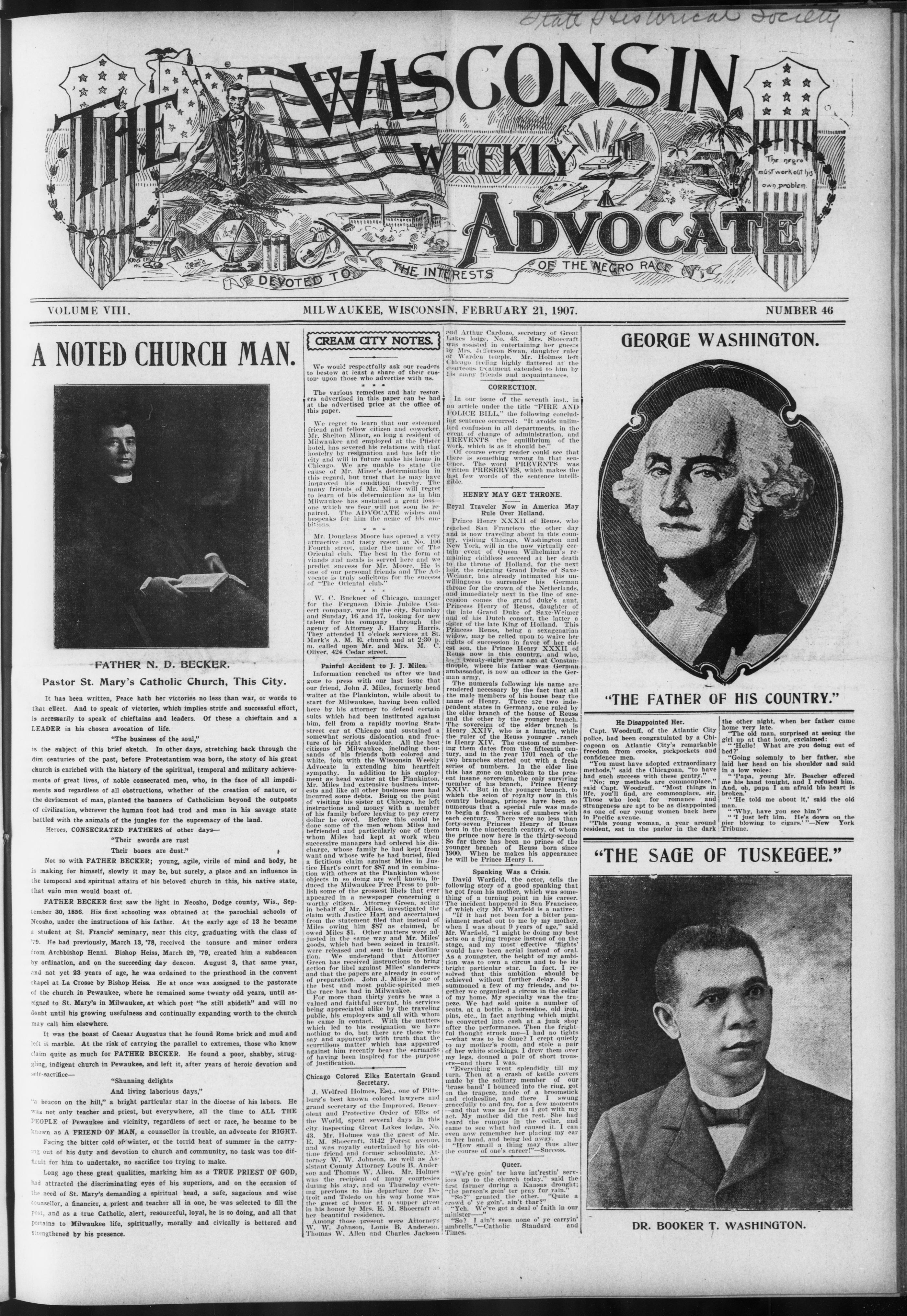
Page text (machine-generated)
WISCONSIN
WEEKLY
Advocate
DEVOTED TO THE INTERESTS OF THE NEGRO RACE
VOLUME VIII.
A NOTED CHURCH MAN.
P.
It has been written, Peace hath her victories no less than war, or words to that effect. And to speak of victories, which implies strife and successful effort, is necessarily to speak of chieftains and leaders. Of these a chieftain and a LEADER in his chosen avocation of life.
"The business of the soul."
brief sketch. In other days, last, before Protestantism was the history of the spiritual, ten noble consecrated men, who all obstructions, whether or planted the banners of Catholics the human foot had trod and of the jungles for the supreme TED FATHERS of other d
is the subject of this brief sketch. In other days, stretching back through the dim centuries of the past, before Protestantism was born, the story of his great church is enriched with the history of the spiritual, temporal and military achievements of great lives, of noble consecrated men, who, in the face of all impediments and regardless of all obstructions, whether of the creation of nature, or the devisement of man, planted the banners of Catholicism beyond the outposts of civilization, wherever the human foot had trod and man in his savage state battled with the animals of the jungles for the supremacy of the land.
Heroes, CONSECRATED FATHERS of other days—
"Their swords are rust
Their bones are dust."
ER BECKER; young, agile, so slowly it may be, but surely real affairs of his beloved church past of.
He first saw the light in Neosho first schooling was obtained in productions of his father. At the his' seminary, near this city, on March 13, '78, received the Bishop Heiss, March 29, "for the succeeding day deacon. Of age, he was ordained to the Bishop Heiss. He at once woke, where he remained some Milwaukee, at which post "he usefulness and continually en
Of Caesar Augustus that he for risk of carrying the parallel to FATHER BECKER. He for Pewaukee, and left it, after
Not so with FATHER BECKER; young, agile, virile of mind and body, he is making for himself, slowly it may be, but surely, a place and an influence in the temporal and spiritual affairs of his beloved church in this, his native state, that vain men would boast of.
FATHER BECKER first saw the light in Neosho, Dodge county, Wis., September 30, 1856. His first schooling was obtained at the parochial schools of Neosho, under the instructions of his father. At the early age of 13 he became a student at St. Francis' seminary, near this city, graduating with the class of '79. He had previously, March 13, '78, received the tonsure and minor orders from Archbishop Henni. Bishop Heiss, March 29, '79, created him a subdeacon by ordination, and on the succeeding day deacon. August 3, that same year, and not yet 23 years of age, he was ordained to the priesthood in the convent chapel at La Crosse by Bishop Heiss. He at once was assigned to the pastorate of the church in Pewaukee, where he remained some twenty odd years, until assigned to St. Mary's in Milwaukee, at which post "he still abideth" and will no doubt until his growing usefulness and continually expanding worth to the church may call him elsewhere.
It was the boast of Caesar Augustus that he found Rome brick and mud and left it marble. At the risk of carrying the parallel to extremes, those who know claim quite as much for FATHER BECKER. He found a poor, shabby, struggling, indigent church in Pewaukee, and left it, after years of heroic devotion and self-sacrifice—
"Shunning delights
And living laborious days."
a bright particular star in the and priest, but everywhere, a and vicinity, regardless of so OF MAN, a counsellor in trovold of winter, or the torrid h
"a beacon on the hill," a bright particular star in the diocese of his labors. He was not only teacher and priest, but everywhere, all the time to ALL THE PEOPLE of Pewaukee and vicinity, regardless of sect or race, he became to be known as A FRIEND OF MAN, a counsellor in trouble, an advocate for RIGHT. Facing the bitter cold of winter, or the torrid heat of summer in the carrying out of his duty and devotion to church and community, no task was too difficult for him to undertake, no sacrifice too trying to make.
Long ago these great qualities, marking him as a TRUE PRIEST OF GOD, had attracted the discriminating eyes of his superiors, and on the occasion of the need of St. Mary's demanding a spiritual head, a safe, sagacious and wise counsellor, a financier, a priest and teacher all in one, he was selected to fill the post, and as a true Catholic, alert, resourceful, loyal, he is so doing, and all that pertains to Milwaukee life, spiritually, morally and civically is bettered and strengthened by his presence.
CREAM CITY NOTES.
We would respectfully ask our readers to bestow at least a share of their custom upon those who advertise with us.
The various remedies and hair restorers advertised in this paper can be had at the advertised price at the office of this paper.
We regret to learn that our esteemed friend and fellow citizen and coworker, Mr. Shelton Minor, so long a resident of Milwaukee and employed at the Pfister hotel, has severed his relations with that hostelry by resignation and has left the city and will in future make his home in Chicago. We are unable to state the cause of Mr. Minor's determination in this regard, but trust that he may have improved his condition thereby. The many friends of Mr. Minor will regret to learn of his determination as in him Milwaukee has sustained a great loss—one which we fear will not soon be repaired. The ADVOCATE wishes and bespeaks for him the acme of his ambitions.
Mr. Douglass Moore has opened a very attractive and tasty resort at No. 196 Fourth street, under the name of The Oriental club. The best in the form of viands and meals is served here and we predict success for Mr. Moore. He is one of our personal friends and The Advocate is truly solicitous for the success of "The Oriental club."
---
W. C. Buckner of Chicago, manager for the Ferguson Dixie Jubilee Concert company, was in the city, Saturday and Sunday, 16 and 17, looking for new talent for his company through the agency of Attorney J. Harry Harris. They attended 11 o'clock services at St. Mark's A. M. E. church and at 2:30 p.m. called upon Mr. and Mrs. M. C. Oliver, 424 Cedar street.
Painful Accident to I. I. Miles.
Information reached us after we had gone to press with our last issue that our friend, John J. Miles, formerly head waiter at the Plankinton, while about to start for Milwaukee, having been called here by his attorney to defend certain suits which had been instituted against him, fell from a rapidly moving State street car at Chicago and sustained a somewhat serious dislocation and fracture of his right shoulder. All the best citizens of Milwaukee, including thousands of his friends both colored and white, join with the Wisconsin Weekly Advocate in extending him heartfelt sympathy. In addition to his employment as head waiter at the Plankinton, Mr. Miles had extensive business interests and like all other business men had incurred some debts. Being on the point of visiting his sister at Chicago, he left instructions and money with a member of his family before leaving to pay every dollar he owed. Before this could be done some of the men whom Miles had befriended and particularly one of them whom Miles had kept at work when successive managers had ordered his discharge, whose family he had kept from want and whose wife he had buried, filed a fictitious claim against Miles in Justice Hart's court for $87 and in combination with others at the Plankinton whose objects in so doing are well known, induced the Milwaukee Free Press to publish some of the grossest libels that ever appeared in a newspaper concerning a worthy citizen. Attorney Green, acting in behalf of Mr. Miles, investigated the claim with Justice Hart and ascertained from the statement filed that instead of Miles owing him $87 as claimed, he owed Miles $1. Other matters were adjusted in the same way and Mr. Miles' goods, which had been seized in transit, were released and sent to their destination. We understand that Attorney Green has received instructions to bring action for libel against Miles' slanderers and that the papers are already in course of preparation. John J. Miles is one of the best and most public-spirited men the race has had in Milwaukee.
For more than thirty years he was a valued and faithful servant, his services being appreciated alike by the traveling public, his employers and all with whom he came in contact. With the matters which led to his resignation we have nothing to do, but there are those who say and apparently with truth that the scurrillous matter which has appeared against him recently bear the earmarks of having been inspired for the purpose of justification.
Chicago Colored Elks Entertain Grand Secretary.
J. Welfred Holmes, Esq., one of Pittsburg's best known colored lawyers and grand secretary of the Improved, Benevolent and Protective Order of Elks of the World, spent several days in this city inspecting Great Lakes lodge, No. 43. Mr. Holmes was the guest of Mr. E. M. Shoecraft, 3142 Forest avenue, and was royally entertained by his old-time friend and former schoolmate, Attorney W. W. Johnson, as well as Assistant County Attorney Louis B. Anderson and Thomas W. Allen. Mr. Holmes was the recipient of many courtesies during his stay, and on Thursday evening previous to his departure for Detroit and Toledo on his way home was the guest of honor at a supper given in his honor by Mrs. E. M. Shoecraft at her beautiful residence.
Among those present were Attorneys W. W. Johnson, Louis B. Anderson, Thomas W. Allen and Charles Jackson
and Arthur Cardozo, secretary of Great Lakes lodge, No. 43. Mrs. Shoecraft was assisted in entertaining her guests by Mrs. Jefferson Swan, daughter ruler of Warden temple. Mr. Holmes left Chicago feeling highly flattered at the courteous treatment extended to him by his many friends and acquaintances.
CORRECTION.
In our issue of the seventh inst., in an article under the title "FIRE AND POLICE BILL," the following concluding sentence occurred: "It avoids unlimited confusion in all departments, in the event of change of administration, and PREVENTS the equilibrium of the work, which is as it should be."
Of course every reader could see that there is something wrong in that sentence. The word PREVENTS was written PRESERVES, which makes the last few words of the sentence intelligible.
HENRY MAY GET THRONE
Royal Traveler Now in America May Rule Over Holland.
Prince Henry XXXII of Reuss, who reached San Francisco the other day and is now traveling about in this country, visiting Chicago, Washington and New York, will in the now virtually certain event of Queen Wilhelmina's remaining childless succeed at her death to the throne of Holland, for the next heir, the reigning Grand Duke of Saxe-Weimar, has already intimated his unwillingness to surrender his German throne for the crown of the Netherlands, and immediately next in the line of succession comes the grand duke's aunt, Princess Henry of Reuss, daughter of the late Grand Duke of Saxe-Weimer and of his Dutch consort, the latter a sister of the late King of Holland. This Princess Reuss, being a sexagenarian widow, may be relied upon to waive her rights of succession in favor of her eldest son, the Prince Henry XXXII of Reuss now in this country, and who, twenty-eight years ago at Constantinople, where his father was German ambassador, is now an officer in the German army.
The numerals following his name are rendered necessary by the fact that all the male members of his house bear the name of Henry. There are two independent states in Germany, one ruled by the elder branch of the house of Reuss and the other by the younger branch. The sovereign of the elder branch is Henry XXIV, who is a lunatic, while the ruler of the Reuss younger branch is Henry XIV. The custom of numbering them dates from the fifteenth century, and in the year 1701 each of the two branches started out with a fresh series of numbers. In the elder line this has gone on unbroken to the present insane sovereign, the only surviving member of his branch, Prince Henry XXIV. But in the younger branch, to which the scion of royalty now in this country belongs, princes have been so numerous that a special rule was made to begin a fresh series of numbers with each century. There were no less than forty-seven Princes Henry of Reuss born in the nineteenth century, of whom the prince now here is the thirty-second. So far there has been no prince of the younger branch of Reuss born since 1900. When he makes his appearance he will be Prince Henry I.
Spanking Was a Crisis.
David Warfield, the actor, tells the following story of a good spanking that he got from his mother, which was something of a turning point in his career. The incident happened in San Francisco, of which city Mr. Warfield is a native: "If it had not been for a bitter punishment meted out to me by my mother, when I was about 9 years of age," said Mr. Warfield, "I might be doing my best acts on a flying trapeze instead of on the stage, and my most effective 'flights' would have been aerial instead of oral. As a youngster, the height of my ambition was to own a circus and to be its bright particular star. In fact, I resolved that this ambition should be achieved without further delay. So I summoned a few of my friends, and together we organized a circus in the cellar of my home. My specialty was the trapeze. We had sold quite a number of seats, at a bottle, a horseshoe, old iron, pins, etc., in fact anything which might be converted into cash at a junk shop after the performance. Then the frightful thought struck me—I had no tights
—what was to be done? I crept quietly to my mother's room, and stole a pair of her white stockings. I drew them over my legs, donned a pair of short trousers—and there I was.
"Everything went splendidly till my turn. Then at a crash of kettle covers made by the solitary member of our 'brass band' I bounced into the ring, got on the trapeze, made of a broomstick and clothesline, and there I swung gracefully to and fro, for a few moments—and that was as far as I got with my act. My mother did the rest. She had heard the rumpus in the cellar, and came to see what had caused it. I can even now remember her placing my ear in her hand, and being led away.
"How small a thing may thus alter the course of one's career!"—Success.
Oueer.
"We're goin' ter have int'restin' services up to the church today," said the first farmer during a Kansas drought; "the parson's goin' ter pray fur rain."
"So?" grunted the other. "Quite a crowd o' ye goin', ain't thar?"
"Yeh. We've got a deal o' faith in our minister—"
"So? I ain't seen none o' ye carryin' numbrells."—Catholic Standard and Times.
GEORGE WASHINGTON.
"THE FATHER OF HIS COUNTRY."
He Disappointed Her.
Capt. Woodruff, of the Atlantic City police, had been congratulated by a Chicagoan on Atlantic City's remarkable freedom from crooks, pickpockets and confidence men.
"You must have adopted extraordinary methods," said the Chicagoan, "to have had such success with these gentry."
"No; my methods are commonplace," said Capt. Woodruff. "Most things in life, you'll find, are commonplace, sir. Those who look for romance and strangeness are apt to be as disappointed as one of our young women back here in Pacific avenue.
"This young woman, a year around resident, sat in the parlor in the dark
"THE SAGE O
E SAGE OF TUSKEG
"THE SAGE OF TUSKEGEE."
DR. BOOKER T. WASHINGTON.
---
NUMBER 46
ASHINGTON.
F HIS COUNTRY."
the other night, when her father came home very late.
"The old man, surprised at seeing the girl up at that hour, exclaimed:
" 'Hello! What are you doing out of bed?'
"Going solemnly to her father, she laid her head on his shoulder and said in a low voice:
" 'Papa, young Mr. Beacher offered me his hand tonight, and I refused him. And, oh, papa I am afraid his heart is broken.'
" 'He told me about it,' said the old man.
" 'Why, have you see him?'
" 'I just left him. He's down on the pier blowing to cigars.'"—New York Tribune.
F TUSKEGEE."
---
THE WISCONSIN WEEKLY ADVOCATE.
MILWAUKEE, WIS.
B. B. MONTGOMERY, Editor and Proprietor.
How One Got In.
St. Peter settin' at de gate;
Nigger passin' by—
St. Peter up an' sez ter him;
"How did you come ter die?"
"Go ax de man whut helt de gun
'A'pintin' at dat roos'";
Go ax de dog whut helt my foot
An' wouldn't turn hit loose!"
"An' so." St. Peter sez ter him,
"You wuz kotch in de ac'?"
Dat nigger turnt and looked at him
An' spon's: "Hit is a fae'"
"Down in de pit den you mus' go
Fer stealin' uv dat hen'!"
The nigger scratch his haid right hard—
St. Peter had him den'"
But 'dreckly, liftin' up his arms,
He flop 'em on his side.
An' 'zackly like a rooster crow
Three times out loud he cried!
St. Peter hung his haid wid shame—
He 'membered uv his sin—
An' grabbin' up a great big key,
He let dat nigger in!
—New Orleans Picayune.
Facts and Fancies.
Prefer Quiet Opening
A powder manufacturing plant is being built near Denver. Needless to say, it will not be opened with a blowout. Denver Post.
Force of Habit
New Arrival—Is my wife in there?
St. Peter—Yes. What are you doing?
New Arrival—Merely removing my shoes before going upstairs.—Harper's Bazar.
Philadelphia Once More
"Why do you think Philadelphia would be such a cheap place to live?" "Because we'd have no running expenses."—Henry Miller in Woman's Companion.
Nowadays
Teacher—"Wilfred, name some of the great reformers."
Wilfred—"Spelling or religious, ma'am?"—F. P. Pitzer in Woman's Home Companion.
Should Be a Benevolent Despot
It is all right for the new elevator boy to be calm and self-possessed, but he ought not to sass everybody in the building the very first day he runs the car. Somerville Journal.
In Clover.
"Yes, I married a drummer, Grace."
"And are you happy, Mag?"
"You bet. My husband treats me like I was a prospective customer."—Louisville Courier-Journal.
Opening for the Write Man.
Waggsby—There's one sort of business that pretty nearly has to be learned by mail.
Naggsby—What business is that?
Waggsby—The postoffice business.—Chicago News.
Historic Davs.
Mrs. Auchterbody — Weel, Sandie, you was a fine dry day we had last month. Sandie—Deed aye, it just put me in mind o' one we had when I was a bit laddie, but it was, if onything, fully drier.—Punch.
The Fading Widow
"The Browns have a cook—a widow—who's a perfect dandy. They're worried to death about her."
"Is she giving notice?"
"No taking it."—M. L. Wildman in Woman's Home Companion.
The Widow's Way.
Newitt—They say that after a man and his wife have lived together for a time they grow to resemble each other. Widdows—I guess there's something in that. At any rate my wife reminds me of her first husband—every chance she gets.—Philadelphia Press.
A Job's Comforter.
"A horse is a man's best friend," said the man who likes animals. "Yes," answered young Mrs. Torkins with a sigh, "but when he gets on the racetrack he is liable to prove one of those fool friends who make so much trouble."—Washington Star.
Very Well!
"John's done right well up in the city, arter all."
"Do tell!"
"Yes, I've jes hearn that he's recovered from one appendicitis, two ortermobiles, one heart failure an three business ones."-Atlanta Constitution.
Explaining It.
Mrs. Ascum—The paper says: "Mrs. Newgold's method of receiving her guests was quiet unconventional." I wonder what that means?
Mr. Ascum—It simply means that she is boorish, but has plenty of money.—Catholic Standard and Times.
Hitting Home.
Boorisch—No? Well, what is your idea of a cad? Goodley—Well, usually it is a fellow who is forever calling somebody else one."—Catholic Standard and Times.
Crowded Courtroom
Lawyer—So your wife has sued for a divorce, eh? Will she have any standing in court?
Client—I'm afraid so. From the nature of the evidence she threatens to bring in there won't be half enough seats to accommodate the crowd.—Brooklyn Eagle.
The Chilling Reply.
According to a Washington legal light, there are times when a lawyer regrets the use of an illustration which a moment before has appeared especially felicitous.
"The argument of my learned and brilliant colleague," said counsel for the plaintiff in a recent suit for damages from a railway company, "is like the snow now falling outside—it is scattered here, there, and everywhere."
Whereupon opposing counsel improved his opportunity. "All I can say," he hastily interposed, "is that the gentleman who has likened my argument to the snow now falling outside has neglected to observe one little point to which, I flatter myself, the similarity extends—it has covered all the ground in a very short time."—Harper's Weekly.
The clearances from Japanese ports to foreign countries are about 12,000 vessels a year.
WHEN PHYLLIS STRIKES
O Strephon dear, I've read your rhymes,
I cannot say how many times;
And, truly, I cannot deny
And made my maiden pulses start.
"When Phyllis Skates"—that was the first
In which my beauty you rehearsed.
"When Phyllis Wears My Violets,"
And "Phyllis Smoking Cigarettes"
Came next. I thought it very fine
To be your Muse's heroine.
Then next you wrote "When Phyllis Shops,"
"When Phyllis Dances at the Hops,"
"When Phyllis Winks Her Pretty Eye,"
"When Phyllis Flies A-Moting By,"
"To Phyllis in a Hansom Cab,"
"To Phyllis Eating Oyster-Crab,"
"To Phyllis at the Soda Fount,"
"When Phyllis on Her Steed Doth Mount,"
"The Freckle on My Phyllis' Nose,"
"To Phyllis with Ten Thousand Beaux,"
And several more I may have skipt—
I liked to be your manuscript.
But lately, Strephon, I have heard
Fair Muse, that blithsome, happy bird,
Is not content to sing of me
For simple love of poesie,
But works with only this design:
To bring you fifty cents a line!
The sordid jade! To work for hire
Each time she strikes her tuneful lyre!
To think that I—my charms, my eyes,
Are but a business enterprise!
And all I say, or do, or think
She turns to lucre, tainted chink!
FLORENCE'S PHILANTHROPY.
"I call it simply the most horrible thing I ever heard of in my life!" said Florence. The worst of my cousin Florence is that you can never be absolutely certain that she isn't speaking the truth. If her statements were invariably as mendacious as they most frequently are, one would be on firmer ground; as it is, however, they demand investigation, often at the cost of much wasted labor and patience.
"Well," said Florence, "it's that poor woman in Jubilee terrace—Mrs. Noakes her name is; I dare say you've heard Uncle Henry speak of her?"
"Noakes?" I said, "Noakes? The name is vaguely suggestive. Hasn't Mr.—er—Noakes some connection with signals? I seem to remember being told so."
"Yes," said Florence. "How they can choose a man with a character like that to entrust the lives of innocent passengers to I can't understand. Don't you agree with me."
"Quite," I said promptly; "it's simply the most horrible thing I ever—"
"How could he bring himself to do it, either," interrupted Florence, "with such a pretty quiet little woman as she is, passes my comprehension"
"Amazing," I said. "By the way, what exactly is it that he did bring himself to do?"
"Didn't I tell you?" said Florence. "Why, he's deserted her—that's what he's done. Simply left the house more than a month ago, and never a word has she heard from him since. What do you think of that?"
Privately I thought that this might after all be one of the rare occasions on which Cousin Florence's emotions proved to have some genuine cause. But, of course, I couldn't say so. Instead, I expressed indignation in such suitable terms that I was promised a visit to Jubilee terrace on the following morning as a reward for my sympathy.
So next day I went. I confess that the result of the visit was to puzzle me. On the one hand there was Mrs. Noakes, a soft-voiced and effusive little person, whom I should have hesitated to trust with a pocket handkerchief; on the other was the obvious fact of the deserting husband, and a bill announcing the sale by auction of the contents of the cottage.
"Being the only thing I could do, mem." said Mrs. Noakes, applying a large handkerchief to her perfectly dry and very intelligent eyes, "so as to get a little money to carry me on till I look round a bit; though hard it is, too, to part with the memories of happier years."
"How long have you had the things?" I asked thoughtlessly.
"Six months come October," said Mrs. Noakes, "but I take affections rapid. Noakes was the same,—or seemed to be," and his forsaken bride wept afresh at this mention of the faithless one.
Florence, however, was far too much engrossed with herself in the role of Lady Bountiful to note anything suspicious.
"It's a splendid idea," she said; "and I shall certainly get all my friends to help. We must make a record sale for you. Mrs. Noakes; you sha'n't be lc. destitute!"
Mrs. Noakes, still keeping a watchful eye on my own, sniffed pathetically, and said: "Thank you, mem!" Ten minutes later we were back at the rectory, and Florence was sending urgent postcards to half the neighborhood, begging them, in the name of justice, and as a personal favor, to attend as competitors for the Noakeses' effects.
They all came. Florence enjoys a fluctuating popularity amongst the male population of Uncle Henry's parish, which happened just then to be at its height: so they not only came, but bought things. The new curate in particular was a host in himself, and accounted single-handed for an ironing board, two window boxes, and a mangle, the last secured after a spirited competition with the doctor's assistant. Florence, who was delirious with enthusiasm, rewarded him with a look that I feel he had fully earned.
The net result of the saie was a sum representing about sixteen times the value of the goods disposed of. "And I hope," said Florence, gently triumphant, "that you are satisfied now that I really can do some good when I give my mind to it."
I apologized in the abject manner that was expected of me. "Mrs. Noakes should be satisfied, anyhow," I said.
"She is," said Florence; "you never saw a poor woman so overcome. She's going away tomorrow to live with a friend. She said she should never forget my kindness till she was carried to the silent grave. After all," continued Florence, "it's splendid and noble work to have made one fellow creature really happy."
"Not to mention the curate," said I. On the day following I had to leave
for Oxford. Waiting on the platform at Bletchley, that depressing ante-chamber to the universities of England. I fancied that I saw in the distance a figure vaguely familiar to me. Later, when the Oxford train stopped at a small wayside station and the same figure alighted, there could no longer be any doubt on the subject. It was Mrs. Noakes. She did not look so heart-broken as might have been expected. Instead of the varied impedimenta of travel customary with her class, the worthy woman carried only a small handbag as neat as herself. I surmised that it contained the results of the auction. On her face was the peaceful expression of one who can look back upon a good deed well done.
I was dismissing the matter from my thoughts, when, happening still to follow her progress with idle curiosity. I was startled to see her embraced with every symptom of affection by a man in railway uniform, who had clearly been waiting for that purpose. At the sight a sudden revelation flashed upon me. Hastily opening the door I leaped out onto the platform and confronted the couple, who were walking arm in arm towards the entrance. "Mr. and Mrs. Noakes, I believe?" said I.
It was a reward to catch the woman for once without her self-possession. The face that she turned towards me was a study in astonishment and alarm. Not so, however, that of the absconding Noakes, who, without releasing his wife's arm, merely beamed inquiringly.
"I remember seeing you in my uncle's parish," I explained, "and couldn't resist congratulating you—on your promotion."
I accompanied the words with what I intended for a glare of virtuous indignation towards Mrs. Noakes.
"Aye," said Mrs. Noakes, shaking hands affably; "I cleared out in rather a hurry like, consequent on getting this here so unexpected. So, as house and furniture was provided, I left the missus to get rid of the old stuff. Wonderful well she did it, too. I was fair astonished when I heard of the prices at that sale!"
My train, to the obvious relief of Mrs. Noakes, was already beginning to move. There was no time for explanations. "Yes," I said as I jumped in again. "It was one of the best sells—I mean sales—that I ever attended!"—Westminster Gazette.
A BUSINESS MAN'S IDEALS.
To be healthy, exercising as a duty.
To be just, remembering that all must live.
To be fair, refusing to injure a competitor.
To be honest, making money honestly or not at all.
To be sociable, having a side to friends not known to all.
To be charitable, giving liberally for the upraising of humanity.
To be iovable, being more to wife and family than a means of support.
To be kind, regarding employees as something more than an investment.
To be sympathetic, fearing littleness of soul more than littleness of fortune.
To be broad, accumulating resources higher than the material; above all, to be true to one's self, condoning nothing in self which is to be condemned in others.—David R. Forgan, president Chicago National Bank.
Carrie Nation No. 2 Finds Rum in Kansas Capitol.
The Kansas Legislature is in disgrace. Mrs. Myra McHenry, partner of Mrs. Carrie Nation, found a liquor joint in the state capitol.
"A big red-faced man who works in the house came close to me and I said, 'I smell whisky. You've been drinking,'" said Mrs. McHenry. "He said he had, and asked me to come and have a drink with him. I told him I would. So he took me to room 4, on the third floor of the capitol, and there I found a table with glasses and bottles on it. I schemed so as to get hold of the bottle. There were three men there besides the one who took me, and several of them were drunk
"I started to go down into the hall of the house to show them the fix I was in. I didn't intend to make any disturbance there. These men had reached there ahead of me and the doorkeeper wouldn't let me in. It was the first time I was ever refused admission to the house. "So I thought I would make a little speech outside and that man Wilcox, the doorkeeper, came rushing out and said: 'You get out of here. You can't make any speeches in this building.' Then I lit into him and told him a few things. Then I went back up there to that committee room and tried to get a stepladder to climb over the transom, which was open. I wanted to look around in there a little more and see what I could find. I couldn't find any way to get in."
The room on the third floor which Mrs. McHenry visited is used by the railroad committee, the educational committee and several other important committees of the house.
Prince's Fight with Wild Boar
The Prince of Schwartzburg-Sonderhausen has had a severe hunting adventure. While out in the forest of Sonderhausen he and his party shot at and brought down a fine wild boar.
Thinking it dead, the prince incautiously approached too near, when the beast suddenly sprang to its feet and made a lunge with its tusks, seriously wounding him in the leg and again in the body after he had fallen from the effect of the first lunge. There was a ten minutes, struggle before the beast was finally disposed of with shotguns and hunting knives.—London Globe.
Stout or Lean at Will.
Dr. Harvey W. Wiley, chief of the bureau of chemistry of the department of agriculture, is authority for the statement that if a man eats less than a certain amount of dry foods he will lose in weight and if he eats more he will gain. This will be good news for the fat who want to get thin, and the thin who want to get fat. Dr. Wiley says every individual should consume four and a half pounds of solids and liquids every day. "Nerve and brain foods are advertised, but they are all nonsense," said Dr. Wiley. "Nor do drugs have a fat-
tening effect, but, on the contrary, most of them have a degrading effect. Arsenic up to a certain point has a fattening effect. A man gains in weight for a time and then dies, but that is a poison.
"I think a man ought to choose his own ration. I think we eat too much meat for health."
What Did He Do with That Other $4.
A Philadelphia clergyman was talking about the late Sam Small.
"I once heard him speak," he said, "and his humor and eloquence impressed me deeply.
"He had a happy knack of illustration. He wanted. I remember, to illustrate the frailty that is a part of even the best characters, and he told a story about a brave young soldier.
"This soldier, he said, enlisted in the Spanish-American war, and he fought like a lion for his country. The firm he had worked for, pleased with the record he was making for himself, told his wife that all the time he was away they would pay half his wages to her.
"Accordingly, at the end of the first week the young woman called at the office, and the head of the firm handed her $9.
"She looked at the money, and her face clouded over.
'Nine dollars,' she said.
the dollar, she said.
"Yes," said the head, a little hurt; 'that is just half. I'm sorry you are not satisfied.'
"It isn't that I'm not satisfied,' said the young woman, 'but all along he's been telling me his pay was only $14 a week. Wait till he gets home! If them Spaniards don't kill him, I will.'"—Washington Star.
Wake Is a Legal Ceremony.
The expenses of a wake are declared to be legitimate charges on an estate in a decision of the appellate term of the supreme court of New York.
By a vote of 2 to 1, the court reversed a decision of Municipal Justice Hoyer in favor of the executors of the will of the late Peter McCullough, who were sued by the testator's nephew, Joseph J. McCullough, to recover $71.25 which he said he expended for his uncle's wake. The executors objected to paying the bill on the ground that it was an improper expense, and Justice Hoyer upheld them.
Justices MacLean and Amend say: "The expenditures were for certain articles, delicatessen in their nature, and for immediate consumption at a wake.
"The word 'funeral' embraces not only the solemnization of interment, but the attending ceremonies and accompaniments, prompted by affection—determined by the religious faith and sentiment of the friends of the deceased."
Here are some of the things furnished for the wake: Five bottles of rye whisky, 2 bottles of Scotch whisky, 400 cigars, 1 bottle of port wine, 1 bottle of sherry, 2 boxes of soda, 20 pounds of ham, 10 pounds of corned beef, steaks, 4 boxes of beer and other articles of drink and food.
When Dutton Came Back
It is said that fifty years ago a man named Dutton lived on the present Squire Smith place, near the bridge crossing Sugar Creek, on the road to Bean Lake. One morning Mrs. Dutton had bread to bake and sent Dutton out after it over there—heavy wood to produce a lasting fire. Dutton was something of a slow poke, and as he went out his wife, who was something of a shrew, said to him, "Now, don't be gone five years."
The husband did not return with the wood, and his disappearance caused a big sensation. Some said he had been foully dealt with, others said that he had eloped with a woman. But exactly five years later he walked into the house with an armful of oven wood, which he threw into the wood box of the kitchen stove. His wife displayed no astonishment, whatever her feelings might have been. "Now," she said, "carry the slop out to the pigs." Dutton carried the slop out to the pigs, as directed, and resumed his old place in the household without comment or explanation.—Atchison Globe.
Tin Soldier Now Deemed a Menace.
"The Little Tin Soldier, about which Eugene Field sang so sentimentally, will always be covered with rust and tucked away on a dark shelf if Mrs. Lucia Ames Mead, who addressed the Chicago section of the Jewish Council of Women has her way. She believes that this mimic warrior, this plaything of happy childhood, is a foe of international peace. Mrs. Mead, who hails from Boston, told her audience that the movement to end "international dueling" was the most important thing in the world today and asked them to use their influence in its behalf. At the conclusion of her speech she said:
"Above all things, let me urge you mothers not to allow your children to play at war with tin soldiers and toy cannon. They can be amused just as easily in other ways. Why should you permit the boy whom you hope will become a fine and gentle man to pretend that he is killing people and to cut whole platoons of infantry at one volley? Do not, I beg of you, let the children mimic this ghastly business of violent death."
The Beautiful Country.
A philanthropist recently sent a child from the New York slums to the country. To this child, raised among slum horrors, says the Boston Record, all the beauty and peatry of a pastoral life was offered. The philanthropist expected to give the youngster an esthetic education. The other day the man went to see his charge. She is a little girl. He took her on his knee, glanced with approbation about the quaint old farm kitchen and said:
"And do you find the country very beautiful, my dear?"
"Oh, beautiful," the youngster answered.
"And what have you seen during the week's sojourn here?"
"I've seen eighty-seven turkeys killed and a man's nose broken in a punkin' rage."
Burnt Cork Moustaches.
A late officer of the Household Cavalry tells a story about the days when the order to wear mustaches was first issued in the early '40s. "My father was a subaltern in the Ninth Lancers at the time and every officer and man in the regiment was clean shaven. To show his devotion to discipline the colonel ordered the regiment to assume artificial mustaches marked out with burnt cork to a set pattern."—London Chronicle.
Not to Speak of New York.
Though the time has gone by when a lace petticoat spelled immorality, yet garishly trimmed underskirts look ridiculous and out of place in a muddy London street.—Graphic.
Advertise in Your Home Paper.
For stealing three dozen doughnuts, valued at 30 cents, from a bakery Albert Dorsey of Janesville, Wis., was sentenced by Judge Fifield to one year in the state prison at Wausau.
Because the Nebraska law makes it the duty of the jury, and not of the judge, to assess the penalty in a murder case, John Hamlin, who recently entered a plea of guilty of killing his sweetheart, Rachel Engle, at Grand Island, must go through the form of a trial.
Edward Jenkins of La Crosse, Wis., a freight brakeman on the Dubuque division of the Milwaukee road, was run over by sixteen freight cars and is alive. Jenkins was knocked beneath the train, between the rails. He remained still and was uninjured.
A rabid dog, running loose, killed chickens belonging to Thomas Clerkin of New Britain, Conn., and bit one of his children so severely that it died. The city paid for the chickens, but the committee on claims held that the city is not responsible for the life of a child. Corporation Counsel Hungerford said the father's only recourse is to sue the owner of the dog if he can be found.
There are ten statues of public men in Michigan, six of which are in Muskegon, the gift of the late Charles H. Hackley. Detroit has a monument to the late Gov. Hazen S. Pingree and another is being erected to Alexander Macomb. Lansing has Austin Blair and there is a statue of Father Marquette in the "Queen City" of Lake Superior named for him.
---
The victim, apparently, of an unscrupulous or unfortunate brother, Miss Heien Dixon, a young woman prominent in church circles at Bloomington, Ill., was arrested and placed in jail on a charge of embezzling $1300 belonging to the Gleaners' society of the Second Christian church, of which she has been treasurer. The money had been raised to purchase a new $2200 pipe organ. It is said the brother got into trouble, borrowed the money from her and did not repay it.
Alleging that he tickled her under the chin, Miss Mabel Luterman of Spencer, Ia., has sued George A. Romey, a banker, for $4000. In her petition Miss Luterman declared that while Romey was on a visit to her home in the country he patted her on the back, pinched her arms, and petted and tickled her under the chin and tried to put his arms around her. She says the acts caused her to be ill and nervous and gave her much mental anguish. Romey is prominent in state banking circles and reputed to be a millionaire.
Bert Brand, a Chippewa Falls farmer, went to sleep in his cutter the other night after heading his horse homeward from this city. At three o'clock in the morning he awoke and found himself in Eau Claire, twelve miles from his home. Hardly had he learned this when his horse ran away and he was thrown out and badly bruised. The strangest part of the adventure was that the horse had traveled from Chippewa Falls to Eau Claire on the interurban tracks, had jumped culverts and executed some remarkable feats in the deep snow.
"All the game wardens and all the game laws cannot preserve the game birds to Wisconsin," said Halvor L. Skavlem of Janesville, who was candidate for the state Assembly in 1902. This remark was made in address before the Janesville Twilight club. The speaker added that the extermination of birds, which had been in progress for the past forty years, is the result of the onrush of civilization. The causes of developments are the disappearance of the forests and the decrease in wild shrubbery and weeds on which the birds fed.
As an object lesson to dilatory highway commissioners, the women of Venice. Cal., recently turned out with picks and shovels and smoothed the wrinkles out of Washington boulevard. In the army of roadmakers were the wives and daughters of millionaires.
Dirt began to fly early in the day, and holes which have been the bane of travelers along the thoroughfare were filled and given a high finish. At noon lunch was served under the trees at the roadside. Auto parties which passed along the road cheered the women shovelers.
Frank Shepard and Sam Minn, negro cooks, who attended a masquerade ball at Hyannis, Neb., and in their disguises danced with the belles of the town, have defied arrest with the assistance of their razors since the time they unmasked when the ball was over. Two of the favorite costumes of the evening represented George Washington and Uncle Sam. The men wearing them were good dancers and their programmes were filled. When they unmasked later at a saloon they nearly precipitated a race riot. They resisted arrest, but the citizens are determined, and expect to place them in custody on the charge of disturbing the peace.
---
Howard F. Stryker, a former baseball player on the La Crosse baseball team, vocalist in the First Congregational church of La Crosse, and traveling salesman for the Bergh Piano company, has entered the field of evangelism and at present is conducting a revival in Iowa. Less than two months ago, a year after his divorce from a prominent La Crosse young woman, he married Miss Jessie Workman, a clerk in the employ of the Berga Piano company. A part of the honeymoon was spent at Dakota, Minn., the home of Mrs. Stryker. While Stryker engaged in evangelical work, assisting the Rev. Lyn J. G. Kelley of La Crescent, Minn.
Frank Otto Walther of New York and Miss Ida Brokaw Jutte of Pittsburg were married Thursday evening at the home of the bride's mother.
A week ago the bride was supposed to be an heiress who would one day get a third of an estate valued at $2,000,-000. When Mr. Walther led her to the altar she was penniless.
"I have enough for both," declared the happy groom after the ceremony.
The bride was rendered penniless by a decision handed down in the case of Mrs. W. C. Jutte, widow of the late millionaire coal operator of Pittsburg, against his former business associates, James W. Friend and F. N. Hofstot
A queer coincidence is reported from Escanaba, Mich., Emil Hamlin has moved three times within the past year and on each occasion—without the fact being brought to his attention until after he was fully installed in his new home—the number of the house has been 1315. Mr. Hamlin first lived at 1315 Wells avenue. He became dissatisfied with that place of abode and leased a dwelling on Fifth street. After becoming installed he found to his surprise that the number of that house also was 1315. Again the spirit of dissatisfaction arose and he decided to move in nearer the heart of the city and accordingly he rented a house on Escanaba avenue. The household goods were transferred to the
now location and when the tenant looked for his street number he found that he was again occupying 1315. Mr. Hamlin seems eminently satisfied with his present location. He is determined, however, that when he secures another house the principal requirement will be that the number is not 1315. Despite that a ban has been placed on all slot machines and that these objects have been removed from all saloons, drug stores and other places in La Crosse, resourceful proprietors have found several ways to evade the law.
One of the most popular forms of gambling is almost a replica of the old card machine. While there is no machine, the clerk now takes a deck of cards and plays them in much the same way as the machine did. In lieu of the dice box, a whisky glass and coffee beans are used.
The novelty of the game and the knowledge that the law is being violated, with no danger of interference, has added zest to the sport and the games of chance go merrily on.
Three Petersens head the Racine, Wis., Social Democratic city ticket, the first placed in the field for the coming April municipal election. They have also adopted a platform of considerable length and expect to make a stubborn fight to elect some of their candidates, having a paid organizer in the field.
Nominations made are as follows: Mayor, Arne C. Petersen; city clerk, J. C. Petersen; assessor, John Petersen; justice, Herman Pahl.
Members of the Republican and Democratic parties charge that the Socialists have nominated three Scandinavians with the object of catching the big Danish vote here.
The platform favors municipal ownership, embracing the water company, the gaslight company, electric railway, and others; is against the granting of any franchises; favors the city providing dwelling houses for the working men; maintaining a coal and wood yard; abolishment of the board of public works; in favor of equitable assessment; free text books in the public and free schools; paying school teachers no less than $50 per month; free medical advice and service, and that all election days be public holidays.
Allen O. Myers, Columbus, O., dispenser of oratorical dynamite and a living conductor of iconoclastic utterances, at the age of 58 years has gone back to his books and his lessons.
Graduated from the School of Experience and the University of Adversity, this man, known throughout the state of Ohio as newspaper man, politician, legislator, and now farmer, feels that even at his age there is something yet to learn. So he has put his name down on the enrollment sheet in the agricultural college at Ohio State university and now is an "undergrad."
The fact that for four years he has been around the state telling farmers how to grow the best alfalfa or the finest corn makes little difference. He seeks more knowledge, and he will get it. It is his habit.
He is an active member of the Franklin County Farmers' union and takes great pride in his thirty-two acres near Worthington. He will study chemistry in its relation to agriculture.
"I know what to do on my farm," said Meyers, "but I don't know why." So he is starting out to learn, for the "why" with Meyers is important.
It required the attention of six law firms and Judge Windes of the circuit court at Chicago to construe a will drawn by a woman who had devoted the best part of her life to the accumulation of savings that she might leave a sum of money to charity, but who in her anxiety to increase the amount saved the expense of a lawyer and drew the document herself.
The testatrix, Miss Ada Louise Hatfield, was employed in a down town department store for fourteen years before her death in 1895, and in her will she directed that $9000 be given to the home for erring women and to the foundlings' home in whatever city or town she might die. To her only brother, Daniel P. Hatfield, the testatrix bequeathed but $1 and she left her sister, Mrs. Charlotte Jenkins of Rocksberry, Mass., $1000. Mrs. Jenkins and her brother contested the will on the ground that it was vague, because of the fact that there are several institutions in Chicago of the character described by their sister. They held that the entire estate should revert to them as next of kin.
The court held that, although the will had some appearance of vagueness, it was nevertheless unimpeachable, as Miss Hatfield had expressed a distinct desire to leave the bulk of her savings to charity. He decided in favor of the home for the friendless and the Chicago refuge for girls on the theory that those institutions came more clearly within the description than did others and because it was shown in the testimony that the testatrix had actual knowledge of the existence of these homes.
Boyville Dream to Be Realized
A boy city, with a population of 5000 persons, ranging in age from 11 to 17 years, organized as a complete municipality, with wards, city council, mayor and administrative departments, officered entirely by youths, will be created at Lake Winona, Ind., next August, in connection with the Winona Chautauqua assembly. The city will exist three weeks. The movement was started a short time ago at a meeting attended by thirty prominent business and professional men, connected with the Winona assembly and Winona Technical school.
The boys will live in tents, holding four and eight occupants. There will be five permanent buildings in the city—the assembly hall, general store and supply house, gymnasium, band stand and electrical and photographic shops.
One of the features will be a telephon system, by means of which the boys will be taught the rudiments of telephone engineering. It is arranged that the electrical class shall have a monopoly on the telephone, charging all others 1 cent for each call. Any abuse of this monopoly will be thrashed out before the city council to the development of boy oratory.
The Professor Felt Safe
Prof. Hugo Munsterberg, Harvard's well known psychologist, did not disparage the Anglo-Saxon "new woman" without incurring the inevitable penalties.
The other day he picked up a marked copy of a Western newspaper which somebody did not intend should escape his attention, and as he read his face assumed a most quizzical expression. Suddenly he began to pat the crown of his head, which, by the way, is completely bald. The further he read the more fervently he patted, until finally he threw down the paper and cried, with simulated chagrin:
"Ach, here is a woman in Minnesota who says if she could only get at me, how she would pull my hair! Think, if she could only see me now!"—Boston Herald.
It Pays to Advertise
GOSSIP FOR THE LADIES.
Experience.
And then you failed me—failed me in my
laid.
That you should still be kept from pain
and, grief.
That you should never know what I have known.
known.
How could you understand and bring relief?
God heard my prayer—and I endure alone!
But if at any time His will should be
That you must suffer some keen sorrow too.
Then may my dear-bought knowledge lighten me
The way to comfort and to strengthen you. —Harper's Bazar.
The American
Daughter Should Have a Dowry.
A Paris newspaper Les Annales Politiques—recently opened its columns to a discussion on the question, "Whether giving a dowry to a girl on her marriage is immoral.
More than 20,000 replies were sent in to this query, and almost all of them declared that the giving of a dowry was not only the parents' duty to their daughters, but an untold blessing to the new couple just starting out in life.
This is an opinion so eminently sane and practical that it seems to admit of no argument, and the one custom, it seems to me, that Americans could borrow with most profit from their French neighbors is the dot system.
Many people will take issue with me on this subject. They will say that if you give a girl a dowry you will encourage the mercenary rather than the sentimental in matrimony, and set fortune hunters, big and little, on every woman's trail. Moreover, they will add conclusively that American girls do not need a dowry. They are so attractive that men don't have to be hired to marry them.
All of which is a pretty theory and true enough, for the American man is not a fortune hunter, and it is a matter of record in every community that the poor girls usually marry better than the rich ones. Women become old maids because they happen to live in a place where there are no single men, because they are ugly, because they are stupid, because they giggle, because they don't want to marry, and for many other reasons; but no girl was ever left to wither in this country simply and solely because she was poor.
It is not, therefore, necessary to give dowries with our daughters, as one gives a chromo with a package of cheap tea to get rid of them, but it is necessary for the girl's own protection and well-being in married life.
To begin with, it eases the first tension of married life, for the girl not to come to her husband quite empty handed. Marriage is, after all, simply a partnership of a man and a woman where they pool their affections, their means and their abilities, and start out to do business on a joint account. Anybody can see that between the firm where both chip in with a little money, and the firm where only one of the partners put in the cash, the chances of success go with the firm where both partners are able to furnish their share of the capital. This is especially the case where people are poor.
It is a beautiful theory that love is enough for a young couple to marry upon, but we all know that this is very far from being the case. Even if they are willing to live upon bread and cheese and kisses the bread and cheese have to come before the kisses, or else there is mighty little osculation in the home, for sentiment does not thrive in an atmosphere of worry and anxiety over the baker's and the grocery account.
If a girl has a dowry, it enables her to contribute to the family support, and it safeguards her as far as possible against want. Certainly, if parents have any duty in the world, it is to protect their daughters, and every father ought to settle something, no matter how little, upon his daughter when she marries in such a way that it will be impossible for her husband ever to touch anything but the income from it, and that not unless the wife chooses to give it to him. It would also add enormously to domestic peace and harmony if every wife had a little income of her own, and were not obliged to go to her husband for every cent she needed for her support.
Men say they like the women they love to be dependent upon them. No doubt this is true to a degree, but it is also an undeniable fact that every man respects his wife more and treats her better if she is financially independent of him. Nor is this to be wondered at. Paupers and beggars do not hold an exalted place in society. We all look down on them, and a man cannot help a feeling of superiority as he hands out a quarter to the mendicant wife who is humbly holding out her hand to receive it.
Still another argument in favor of the dowry system is to be found in the mere fact that a man owes it in strict justice to the other man on whom he foists his daughter. The average husband ought to be recompensed financially for the no-account wife with expensive tastes, that only to often he marries in blind ignorance of what he is doing. If a father raises up a young woman who can neither cook nor sew, nor do any useful things, and who has silklined habits, when he marries her off he should give her a dowry commensurate with her needs. It is certainly outrageous for him to expect any poor young man to spend his days slaving trying to maintain such a luxury.
Of course, it will be said that to provide their daughters with dowries would necessitate many sacrifices on the parents' part. Undoubtedly this is true, but it would also work a great reformation in the criminal manner in which American girls are reared. We wouldn't see then, as we do every day, poor families who are straining every nerve to dress their daughters as if they were rich and to send them about to fashionable summer resorts and other places where they are likely to meet men in the hope that they may possibly catch a husband who will take up the burden of their expensive support.
For in plain English, that is the one object nowadays of poor fathers and mothers—to indulge their daughters far beyond their means, and cultivate in them every sort of luxurious taste, and then capture some unwary man, and force him to spend the balance of his life paying for their folly.
Practically these parents say to themselves: "Oh, well, we won't have to support our daughters more than twenty years anyway. Let's give them a good time until we are rid of them."
But if they had to come up with a dowry equal to the style in life in which they had taught their girls to live, they would sing another tune. It would then be the simple life for Sadie and Mamie, and eke for Maud and Geraldine, and the world would be better off for the change.—Dorothy Dix in Philadelphia Evening Bulletin.
From a Woman's Notebook
There is an idea current that Ruskin has written some books about painting and architecture, which would be likely
to interest only those versed in such things.
Young girls receive handsomely bound copies of "Sesame and Lilies" for gifts, because the giver has been told this is a nice book to give a girl. They keep them in conspicuous places and value them chiefly because of their bindings, and remain forever ignorant of what is inside.
I do not look for a finer book for a girl to read than this same "Sesame and Lilies," with its "Queen's Gardens" to teach grace and sweetness, and its "King's Treasuries" to teach strength and clearness of mind.
Ruskin never wrote anything, whether about sculpture, fresco, painting, or art of any kind, without touching also upon the great art of living and doing any kind of work well.
For instance, coming down town in the car this morning, I turned over the pages of his "Two Paths of Art." It is a book of lectures on architecture. Now, nobody knows much less about architecture than I do. Unless some one pointed it out to me I should hardly know the difference between Gothic and Greek architecture. Yet in the short time I browsed through that book I found things that lifted the day above the commonplace, lent new interest to the men and women in the car with me, and gave a vital spirit to the day's work. They were things that did not concern themselves solely with art, but with me, and with these other men and women, and our common lives—as you see by the following selections:
"I find this more and more every day an infinitude of tenderness is the chief gift and inheritance of all the truly great men."
"To cultivate sympathy you must be among living creatures and thinking about them; and to cultivate admiration you must be among beautiful things, and looking at them."
"See that your work is easily and happily done, else it will never make anybody else happy."
"Depth of feeling is the result of the general habit of striving to feel rightly and among thousands of various means of doing this, perhaps the one I ought to specially name to you, is the keeping yourselves clear of petty and mean cares. Whatever you do, don't be anxious, nor fill your heads with little chagrins and little desires."
"Do not think it wasted time to submit yourselves to any influence which may bring upon you any noble feeling. Rise early, watch the sunrise, and the way the clouds break from the dawn. * * * Live always in the springtime in the country. * * * Above all, accustom yourselves to look for, and to love, all nobleness of gesture and of feature in the human form."
"Be assured that endurance is nobler than strength, and patience than beauty."
"Supposing you to be clever—you will get swift reward; but the reward does not come fast when it is sought wisely; it is always held aloof for a little while; the right roads of early life are very quiet ones, hedged in from nearly all help or praise. But the wrong roads are noisy—vociferous everywhere."
"It is only kindness and tenderness which will ever enable you to see what beauty there is in the dark eyes that are sunk with weeping, and in the paleness of those fixed faces which the earth's adversity has compassed about, till they shine in their patience, like dying watchers through twilight."—Exchange.
About Firmness
Sometimes the comment of a man, who sees things from the outside, touches the heart of a matter that puzzles mothers accustomed to a closer view. Such a one was overheard recently, when a mother was emphasizing a refusal that seemed quite uncalled for in the first place.
"I suppose an erratic mother is a dreadful affliction, but deliver us from the mothers who never change their minds"
And that set us all to thinking. Was that oft-recommended firmness, that unchanging aye or nay, always the right thing? If we could reach the blessed state of being infallible creatures, it undoubtedly would be. But since we do make mistakes in our commands and limitations, should we solemnly pretend to hold them to our unwise decrees without a chance of reversal? On the other hand, will not the children lose their respect for us if we admit that we are not perfect? Then the remembrance of someone's experience came to my aid, and experience answers most questions.
Mrs. Reed, one of the wisest mothers that I have known, once told of her early attempts to train her eldest son, then a passionate, self-willed child. She had whipped him for some offense, and the child, in a choking rage, had turned on her, saying, "Whipping doesn't make me good, mamma; it just makes me feel 00-00-00!"
The mother instantly realized that she had made a mistake. Should she insist that the whipping was right, and leave the child with the sense of injustice and bitterness in his heart? or should she frankly acknowledge her mistake? Her love for the suffering little one prevailed. She gathered him up in her arms, and said: "Mamma is sorry she made you feel that way. I want to be a good mamma, and I want to teach my boy to be good, but we must try to find some other way."
Instantly the child was all love and gentleness. He was sorry for his wrongdoing, anxious to be good, and the ignominious punishment was forgotten. From that time she never pretended to be fallible. When she had to punish one of her boys for telling a lie, he asked: "Did you ever tell a lie?" She told him that she had done so, and went on to explain the consequences that had attended the fault. Of course she tried to be careful, and gave only such orders as had been duly weighed. But if she did make a mistake, she did not hesitate to announce her change of heart. And did this make her children slow in their obedience or inclined to dispute her authority? Quite the contrary. Her five boys are the wonder and despair of observers.
It is young mothers especially that are likely to think their word must be as the laws of the Medes and Persians. A loving mother, as she grows older, is learning a kindly philosophy of life that takes the place of much learning of the schools and blesses all within its influence. Now, let no easy-going creature imagine that I am urging anyone to give way to children's teasing. I am only asking for perfect honesty with them. They see more clearly than we think. They will understand that, in some cases, mother changes her mind for something better, and will not presume because of that to appeal from a just command. Zelia Margaret Walters, in Mothers' Magazine.
Vacillation a Detriment to Progress.
How numerous are the little foxes that spoil the vines! Of how many young men and women today it can be said that they have splendid abilities, fine minds, excellent training, ambition and integrity, and a pleasing personality. Yet one fatal defect mars the whole; they lack decision. It manifests itself in the little things of life as well as in the critical moments. Is it a question of merely a days outing-your decision-
cripple is never sure whether he can go or not, whether he wishes to go or stay, what place he would prefer, and he puzzles over details in a helpless way that is most exasperating. Is it a business opportunity of a lifetime—he must canvass the situation thoroughly, weigh the advantages and disadvantages, go minutely into the pros and cons of either decision until he has become hopelessly confused and—does nothing. His comrade of quick perception and ready decision realizes the advantage of the opportunity, grasps it at once, and succeeds.
It is largely a matter of training. A young woman said but recently: "I wish my mother had made me decide things for myself from the time I was able to exercise my powers of judgment. It would not have left me handicapped in the race as I am now." Parents are responsible in a large measure. Train the baby to choose, to decide for himself in the minor matters, and the boy will be able to do so later. But it is also a question of personal training. Be decisive; cultivate the habit of deciding readily, correctly if possible, and follow out your decisions with courage and determination.
Many a man and woman in the business world has made failure after failure only because they lacked the ability to make up their minds and keep them made up! The fatal effects of this weakness are impossible to estimate. It is an inevitable barrier in the road of progress, and will most effectually prevent one from rising to the extent of his real power and opportunity. Every character of power in history has been one of firm decision. Thoreau said: "You can not dream yourself into a character; you must hammer and forge yourself one," and one of the most important tools used in the process is the habit of decisive choice. Napoleon Bonaparte never hesitated in his mandates even in the thick of the onset; when Stonewall Jackson reached a decision he was irresistible; even the heathen Seneca taught that "the greatest man is he who chooses the right with invincible resolution."
Then there is the other side of it; the annoyance to others. Bunyan, in his "Holy War," introduces his reader to Mr. Anything, who fights first on one side, then on the other, and it is utterly impossible to say just where he can be found. He finally gets mixed up in one of the street battles and "has his leg broken, and he who did it wished it had been his neck." That is just the way people feel about the modern men or women of hesitation.—The Pilgrim.
Movement to Make
Women's Clubs International
Unjust spirit of criticism for women's clubs is only now melting away—melting so gradually that none but the very old veterans in the cause of woman's progress can detect the exit of this uncanny specter that brought upon a woman's club more harsh male censure than has ever been meted out to the Dorcas societies of our grandmother's days; the tea parties of generations back, or the "bridge" parties of times contemporary. When women organized to discuss Shakespeare or Emerson; when they gathered for the sake of "culture," there was many an ominous shaking of conservative heads; when they went several steps further and actually engaged in the warfare of municipal reform, gasps of horror could be heard from one end of the continent to the other. Fortunately, we have passed into better times. So while by no means meeting with unanimous approbation today, women's clubs have come, at last, to be tolerated.
There are numberless men and women today who still look upon a woman's club as a place where strange, weird rites are celebrated by strange, weird females of a type different from those of one's every day intercourse. A "club woman" is a new type of woman, who, in the accepted traditional sense, has eschewed both feminine vanities and feminine prerogatives and whose sole object in life is to shake the foundations of "domesticity." Those who have looked into the club question for themselves know better. In women's clubs there are quite as many "types" of women as one sees at an afternoon reception. There's the strong-minded woman, aggressive and dominant—not at all peculiar to a club—the sweet, tactful woman, the "home body," looking for a little "change," and dozens of that uncompromising, non-committal type, who, for lack of a better name, we still call the "average" woman.
While unmarked by the world at large the New Century club yesterday inaugurated still another phase of woman club life. At an informal meeting of the club members, an afternoon of discussion concerning the progress of the international spirit among club women took place. Club women who travel and club women do usually travel, are anxious to establish a link of sympathy between the women here and the women of London, Paris and the great capitals of Europe. In London now at the most magnificent club houses of women "American days" have been instituted, where American women are the guests of cultured English women; in Paris, through the instrumentality of Mrs. Whitelaw Reid, tea is served to all American women every afternoon in a cozy club house. Still further progress of the international idea was noted yesterday, when Mrs. Thackara, who led the programme at the New Century, spoke of a new club inaugurated in Berlin. Mrs. Charlmange Tower is president and the club is conducted for the sole purpose of bringing American women together for recreation and study.
The success of the international movement means more to women than the permanent establishment of the club idea; it means a better chance for American women to grow, to touch hands with the women of all other countries and to bring back to the home club a broader spirit of tolerance and culture.
of a Charming Woman.
Of course, the foundation of the greatest of all charms lies in that unselfishness which illumines the face as well as the heart. As politeness itself consists in little generosities, so no woman who sinks self in the giving of pleasure to others can escape its reward and not be herself intrinsically charming. But all women are not unselfish, and history shows us many who, though innately bad, yet, through mind rather than heart, have sent their names down to us as examples of charming women. But they were miscalled, and what seemed charm was only fascination in them, which is an inborn quality, though improved by brain and use.
We have all known very unselfish women, who were mentally dense as mud, and much of whose unselfishness went for naught thereby; but American women are seldom lacking in that mother wit that can assimilate what they see of good in others; and, given that self-education, there are many little things that can go far toward the making of charm. To aspire to be a charming woman of the world may not be a very high ambition, but it is better than to aim at nothing, and a little thought—mental generosity—can air much in the making of what will pass as a charming woman.—"An Old Beau" in the Delineator.
Middle Class Marriage
Among that class which in all modern and prosperous countries is the most numerous—the great middle class—mar-
riage undoubtedly finds its highest development. It is here that the tender and beautiful relation which it expresses reaches its most perfect growth; it is here that the vicissitudes of life offer it a not too severe test of purity, from which it never fails to emerge victorious; it is here, if anywhere, that marriage becomes not the mere union of one party to another, the one superior, the other inferior, but a meeting of souls, one with the other, so that their original and separate identity is lost, and there appears instead a new and dual creature, the married pair, divested of the faults and composed of the excellencies of the originals of both. This ideal condition of marriage is perhaps not fully attained even among the middle classes, but it certainly approaches it more nearly there than elsewhere. And, as society, throughout the distant ages gradually perfects its form by becoming homogeneous, so will the perfect marriage, now, also, too rare, become the universal heritage on our race.
A Life Worth Living.
To be happy, hopeful, buoyant, kind, loving from the very depths of my heart; considerate and thoughtful regarding the peculiarities and eccentricities of human nature, adjusting myself to each so as to produce harmony and not friction; to be pure in word, thought and deed, broad-minded and liberal, not given to petty denunciation of my fellows; moderate in methods of life; never adding a burden or sorrow where a little forethought would give pleasure; not hasty in speech or action; sincere, candid and truthful in every detail; conscientious in the execution of every duty; composed, unpretentious and simple, keeping close to nature's heart and always relying upon Him I most earnestly strive to serve; keeping ever before me that exemplary life as my rule of conduct toward men, thus creating an influence for good. This is my idea of making "life worth living."—Louise Waddell in The Nurse.
PROMINENT PEOPLE
BISHOP JOHN M. WALDEN of the Methodist Episcopal church, was born in Lebanon, O., February 11, 1831, and spent his early life on a farm. He entered Farmers' college, graduating with honors in 1852. Two years later he entered journalistic work. Going to Wyandotte, Kan., he started and published a paper during the troubles in that state. He soon returned to Ohio, however, and for two years was a reporter on a Cincinnati paper.
In 1860 he was licensed as pastor of a Cincinnati church, and for some time he was engaged in promoting the interests of the "contrabands." During the Civil war he was colonel of the famous Cincinnati regiment known as the "Squirrel Hunters." Later he became corresponding secretary of the Western Freedmen's Aid society. In 1880 he lacked but a few votes of being chosen as bishop. Four years later he was successful, and ever since has been prominently before the church in publishing interests, and in the legislation of several conferences. He has been a prolific writer on temperance and education. For more than forty years Cincinnati has been Bishop Walden's home city.
THOMAS A. EDISON did not pay much attention to the fact that Feb. 11 was the sixtieth anniversary of his entrance into the world. The birthday would probably have passed entirely unnoticed by him had he not been reminded of it by the receipt of a bushel or more of congratulatory messages from every part of the country. Mr. Edison is enjoying good health, notwithstanding the fact that recent reports have had him suffering from paralysis, nervous breakdown and other dire afflictions.
MRS. ALICE ROOSEVELT LONG-WORTH, the eldest daughter of President Roosevelt, was born in New York, February 12, 1884. She is the daughter of Mr. Roosevelt's first wife, who was Miss Alice Lee of Boston. On the death of her mother Miss Alice became the charge of her aunt, Mrs. William S. Cowles, who was then Miss Anna Roosevelt. She resided with her father and step-mother in later years, but continued to spend long periods elsewhere, either with her maternal grandmother in Boston or with numerous relatives in New York.
Miss Roosevelt made her social debut at a grand ball given in the white house early in January, 1902. She was one of the party accompanying the secretary of war to the Philippines, as was also Congressman Nicholas Longworth of Ohio. Soon after their return from the Philippines the marriage engagement of Miss Roosevelt and Mr. Longworth was announced. The wedding, the eighth to take place in the white house, was celebrated February 17 of last year.
C. E. BORCHGREVINK, the celebrated Norwegian explorer, was born in Christiania, February 13, 1864. He received his education in the leading schools of his native country and later was graduated from the Royal college of Saxony. He emigrated to Australia in 1888, worked for some years as a teacher in Queensland and New South Wales and also as a surveyor.
His first voyage to the Antarctic seas was made on a whaler in 1894. This experience gave him a taste for exploring that little known region and upon his return to Australia he organized a scientific and exploring expedition which succeeded in penetrating the frozen seas to a point nearer the South pole than had ever been done before. In 1902 Borechgrevink was sent by the National Geographic society of Washington to investigate the volcanic conditions in the West Indies. The United States warship Dixie was placed at the disposal of the explorer for the purposes of the expedition. M. Borechgrevink has lectured throughout America and Europe and has been awarded high honors by the scientific and geographical societies of several countries.
SIR MORTIMER DURAND, who has just retired from the post of British ambassador at Washington, was born February 14, 1850.
He entered the Indian civil service in 1873, and after a short experience of district work was attached to the foreign department. He went to Kabul in 1879 as political secretary to Sir Frederick, now Lord Roberts, and was in Sherpur during the siege of the British cantonment.
In 1893 the Amir Abdur Rahman, having expressed his willingness to receive an English mission at his capital, Sir Mortimer was selected by Lord Lausdowne as the British government's envoy. This mission successfully accomplished, Sir Mortimer was appointed British minister at Teheran after his return from Kabul.
In 1900 he was promoted to the embassy at Madrid, and three years later came his appointment as British ambassador at Washington.
ELIHU ROOT, who has been secretary of state since July, 1905, was born at Clinton. N. Y., February 15, 1845. He graduated at the age of 19 from Hamilton college, where his father was professor of mathematics. For a year or so he was a teacher at Rome academy, and in 1867 took his diploma from the
New York Law school. Then began his apprenticeship, and afterward his practice of law in New York city.
As a young lawyer Mr. Root took an active interest in politics. He became a leader in the Republican organization in his assembly district and ran once for the position of judge of common pleas, but was defeated. His law practice was extensive and lucrative, and he bore his part in many a strenuous legal battle.
In 1899 Mr. Root was appointed secretary of war by President McKinley, and held this position until 1904. Then for somewhat over a year he devoted himself to private business, but returned to the cabinet on the death of the late Secretary John Hay.
HENRY WATTERSON, one of the most eminent of American journalists, was born in Washington, February 16, 1840. In consequence of defective eyesight he was sent but little to the public schools, but received much careful edu
[Name]
cation at home. At the beginning of the Civil war he went to Tennessee, where the family had formerly lived. After a short editorial career in Nashville he enlisted in the Confederate army, was a staff officer 1861-63 and chief of scouts for Gen. J. E. Johnston the next year. At the end of the conflict he went to Louisville to seek fame and fortune. Within a year or two he had joined W. D. Haldeman, then of the Louisville Courier, which subsequently became the Courier-Journal. In due time Mr. Watterson became editor-in-chief and a great power in journalism and politics.
Mr. Watterson has been delegate-at-large from Kentucky to a number of Democratic national conventions, was president of the St. Louis convention in 1876, and chairman of the platform committee at the conventions of 1880 and 1888. He is the author of several books, among them a history of the Spanish-American war and a life of Abraham Lincoln.
WILLIAM FAVERSHAM, the actor, was born in England, February 17, 1868. He came to America at the age of 20 to play leading roles with Miss Helen Hastings. Her tour proved a failure and he joined the Lyceum Theater company, where he supported E. H. Sothern in "The Highest Bidder." The fol-
lowing season Daniel Frohman loaned him to Mrs. Fiske, with whom he appeared several seasons. When Mrs. Fiske temporarily retired from the stage Mr. Faversham returned to the Lyceum theater, where he appeared in "Sweet Lavender." His next engagement was with Elsie Leslie in "The Prince and the Pauper." The following year he played a leading role in "All the Comforts of Home." Then came his engagement with the famous Picton Stock company. In 1896 Mr. Faversham became leading man of the famous Empire Theater company. During the past few seasons he has been seen in "Lord and Lady Algy" and other notable successes.
Estimating the Damage.
That spirit of thrift popularly supposed o tpervade New England is amusingly illustrated by the observation of a Connecticut farmer.
The good man had been seriously ill in midsummer, but by reason of his strong constitution he quickly rallied. On being asked in the autumn how he was feeling he replied in a cheerful tone:
"Pretty fair, now, thanks. Anyway, it don't make much difference, seein that the farm's well fixed up. If I'd died in kayin' or harvestin' time, I calkilate it'd been $50 damage to me."
Then, after a pause, he added:
"Come to think of it, that's too low a figure—$65 would be nearer!"—Philadelphia Public Ledger.
A Reflecting Lighthouse
An ingenious beacon is located at Arnish rock. Stornoway bay, in the Hebrides, Scotland. It is a cone of cast iron plates, surmounted by an arrangement of prisms and a mirror which reflect the light from a lighthouse on Lewis Island, 500 feet distant across the channel.
The Story of the Winged Horse.
A long time ago, when the world was much younger than it is now, there lived a wonderful horse, with a pair of silvery wings that bore him about like a bird. His name was Pegasus. He was a beautiful snow-white steed, with glossy, satiny skin, and a mane and tail as soft and fine as silk. A dainty fellow he was, who scorned to have any master and flew all day through the air, or galloped at his ease along the flowering meads. In all the wide world there was no other horse like him.
When he was first seen, nobody just knows; but for a long time he haunted the sides of Mount Helicon, where the Muses lived. These Muses were nine very beautiful and learned women, and they made a great pet of Pegasus, feeding him on honey and clover blossoms, and combing his glossy hair with silver combs. But he would never allow them to bridle him. He was as wild as a zebra, and to give over his freedom and his pleasant wanderings to and fro the winged horse had no thought of doing if he could help it.
Another haunt that he dearly loved was the spring of Parene that gushed out of the hillside, near Corinth, and provided the city with water. It was a lovely, shady place, with a broad, enameled plain before it, where the lilies and violets grew and the golden butterflies flew all day long from flower to flower. Here Pegasus would often come to have his white limbs in the waters of the fountain or to feed on the sweet, tender grasses that grew upon the plain. Folding his silvery wings, he would gallop like a colt over the emerald sward, or stand and look with his beautiful, intelligent eyes at the maidens as they came with their jars at sunset for water. What a free and beautiful life he led!
There came to the fountain one day a very handsome youth, who had a golden bridle in his hand. He was a son of King Glaucus of Cornith, and his own name was Bellerophon. He had come to catch Pegasus with that golden bridle, which had a wonderful magic in it. Hiding in a thicket, he watched the winged steed at his play, frisking over the green, pawing the turf, and dashing through the water with the joyousness of a child. By and by Pegasus grew weary and stretched himself in the shade. As soon as he was asleep, Bellerphon stole softly up and, swinging the golden bridle over his head, slipped the bit into his mouth. No sooner was he bridled than the fiery creature became as docile as any old, sober, chariot horse. The prince mounted him and rode away through the air.
He went first to conquer the Chimera, a terrible fire-breathing monster that infested Lycia in Aisa Minor. It had the head of a lion, the body of a goat and the tail of a serpent—a fearful looking thing, you may be sure. It had destroyed many lives, and everybody was in mortal terror of its ravages. But, mounted on Pegasus, Bellerophon rode boldly up and attacked the monster and slew him. Then he went to fight the Amazons, a nation of warlike women that everybody seems to have stood in fear of in those days. He won a victory over these, also, and returned with the girdle of the Amazonian queen as a prize. After this he performed many wonderful exploits, and at last grew so valu-glorious that, mounted on the back of Pegasus, he attempted to soar up to heaven. With his golden hair floating behind him so long that it fell in-waves upon the white coat of the winged steed, the handsome prince went up higher and higher, but he never reached his destination. Dizzy and faint he fell from his seat and had his brains dashed out on the rough stones of the earth.
This was the last of Prince Bellerophon, but not of the flying horse. He kept right on, they tell us, till he got to heaven, that is to Olympus, where the strange old gods lived, and they took such a fancy to him that Aurora, the goddess of the morning, harnessed him to her chariot.
There were no more wild gallopings over the emerald meads, no more pleasant baths in the sunny water of Pirene. I wonder if he ever regretted that his free life was over. If he ever thought about it at all, I am sure he must have thought it much better to be useful; and his tasks were not difficult ones.
I suppose he is there now, and, if my young friends would look up into the sky some clear night in the fall of the year, they might get a glimpse of the winged horse almost directly overhead. At least they say that it is Pegasus—for, of course, he is not near enough for us to see his floating, silken mane, his snowy limbs and silvery wings. All you observe are a few stars shining brilliantly. It may be that as he has no need of wings they have turned to stars. They are silvery enough for that.—Brooklyn Eagle.
Babe Born in the Frozen North
Miss Ruth Rome Stewart is the only resident of Menominee, and possibly of the whole state of Michigan, who can claim as a birthplace the land of the midnight sun. Miss Stewart, who is the daughter of Mr. and Mrs. Alex Stewart No. 1209 Stephenson avenue, is not yet conscious of the distinction that marked her advent into this world, as she is not yet fourteen months old, yet she is nevertheless a baby among babies, as few of her contemporaries will be able to boast when they attain the age of reason and discretion that they were born 150 miles north of the Arctic circle where the days and nights are approximately six months long.
Mr. Stewart has been engaged in mining ventures in Alaska for a number of years. His wife was formerly Miss Edna Miller, a graduate of the Ferris school, Big Rapids, Mich. They were married at Green Bay, Wis., a little over two years ago, and left immediately for Nome, Alaska, where business interests demanded Mr. Stewart's attention. It was at Nome that their baby was born on December 20, 1905. Nome is many hundred miles north of Skagway. It marks the furtherest frontier of civilization, and it is there that the soldier of fortune is making his last stand. Mr. and Mrs. Stewart returned only a few weeks ago.
There is probably only one baby of pure Caucasian ancestry that can claim greater distinction than little Ruth Stewart in the matter of birthplace, and that is the child of Lieut. Peary. The famous northern explorer took his wife with him in his last dash for the pole, or rather Mrs. Peary insisted on accompanying her husband. Master Peary was born a few hundred miles nearer the pole than Miss Stewart.
Seventy-two Letters in Two Words.
A German newspaper of recent date contains a news item in which a linieninfanterieregimentstamburmajor and a hofschauspielhausgarderobeaufsherren are the conspicuous figures. These appellations look more formidable than "regimental drum major of infantry" and "wardrobe keeper of the royal theater."
Money in Pearl Fishery.
The pearl fishery of Ceylon, leased by the government, involved an expenditure of only $73,510 last year, with a net profit of $801,882.
THE WISCONSIN WEEKLY ADVOCATE.
R. B. MONTGOMERY, Editor and Proprietor.
The Wisconsin Weekly Advocate after three years' residence at 79 Fifth street, has moved its headquarters to 430 Cedar St., where we will receive our guests and transact our business in future.
A Representative Journal Devoted to the Interest of All the People.
ADVERTISING RATES.
One inch, one year.....$15.00
Two inches, one year.....25.00
Three inches, one year.....35.00
Four inches, one year.....42.00
For larger space, special rates.
Locals, 10 cents per line.
TERMS OF SUBSCRIPTION.
One year .....$2.00
Six months .....1.00
Three months .....50
Direct all communications to
R. B. MONTGOMERY.
430 Cedar Street.
HOW TO SEND MONEY.—Post Office Order, Express Order, Draft or Registered Letter, R. B. Montgomery will not be responsible for loss when sent in any other way.
TO CONTRIBUTORS:
All communications must be sent with the name and address of the sender as an evidence of good faith, but not necessarily for publication. No manuscript returned if not accepted, unless accompanied by stamps.
ALLIED PRINTING
TRADES UNION LABEL COUNCIL
MILWAUKEE, WI
This Label is a guarantee that the printing bearing it is the product of Union Labor.
EDITORIAL PARAGRAPHS.
"I know of the bravery and character of the Negro soldier. He saved my life at Santiago, and I have had occasion to say so in many articles and speeches. The Rough Riders were in a bad position when the Ninth and Tenth cavalry came rushing up the hill carrying everything before them. The Negro soldier has the faculty of coming to the front when he is needed most. In the Civil war he came 400,000 strong, and I believe he saved the Union."—President Roosevelt.
Attorney General Bonaparte's reported determination to "get after" the trusts which violate the laws insures him a busy spell. Homer R. Dill of Gardiner, the expert Maine state taxidermist and curator of the museum in the state house at Augusta, is to become chief taxidermist in the Iowa state college at Iowa City. Mr. Dill has made a reputation for skill in museum work.
The Illinois idea of providing automobiles with fenders, or cowcatchers, isn't far fetched. The high-power road vehicles are more dangerous than locomotives when they are under way, because they run on public highways, and are not confined to a fixed line of track.
It transpires that Mr. Jeffries, of prizering fame, retired for the purpose of giving the purses a chance to swell. When they get big enough to suit him, he will buckle on the championship belt, tie on his gloves, and spring over the ropes. This is the way of the pugilist.
---
The motor boat has captured the honor of opening the yachting season of 1907, by racing from Miami, Florida, to Nassau, in the Bahamas. This is a long winter run for little power boats, but the racers will be convoyed. In the course of time there will doubtless be motor boats of larger size racing across the Atlantic.
King Charles of Roumania has conferred the jubilee decoration upon Mrs. Montgomery Schuyler, the wife of Montgomery Schuyler, Jr., of New York, who is United States consul general to Roumania and Servia. Mr. Schuyler leaves his present post shortly to become secretary of the American embassy at St. Petersburg.
A letter addressed to Mrs. Theodore Roosevelt was held at the Upper Alton (Ill.) postoffice because the writer neglected to place a postage stamp on the envelope. Postmaster Seitz sent a formal notice to Mrs. Roosevelt that the letter will be forwarded when the necessary two cents are remitted.
Two plucky young sisters, Lettie C. and Pearl M. Dillon, carry rural free delivery mail on No. 4 route of Keokuk county, Ia. They began the discharge of their duties in 1904 and, though the two succeeding winters were marked by several fierce blizzards, they made their twenty-five-mile trip daily.
Kendall, Wisconsin, which was frightened into a wild fusillade by the movements of a prescription clerk who had made a late visit to a drug store to put up a prescription, has at least notified burglars that her inhabitants are provided with "guns." But this warning is offset to some extent by the fact that with all the shooting nobody was hit.
One of the Gardiners, of Gardiner, Maine, is reported to have discovered in an old document that an Indian maiden named Seboois should share honors with Pocahontas for saving the life of Captain John Smith. There were plenty of Smiths in those days, as now, to give any number of Indian maidens a chance to save somebody of that name.
France has discovered that oysters fattened on sewage flats are not fit to eat. This discovery was made in the United States several years ago, and
since that time the oyster has been more thoroughly understood; but there other dangers in connection with the oyster that are quite as bad as germ infection, and they will be cured by "the trade" in the course of time so that the demand for the bivalves may be maintained.
A year or two ago Henry Clews, the New York banker, named the five leading fortunes in the country as being John D. Rockefeller's, estimated at $500,000,000; Andrew Carnegie's, $250,000,000; W. W. Astor's, $200,000,000; Gould family's, $150,000,000, and Marshall Field's, $100,000,000. The fact that the Field estate is found to inventory very close to $100,000 is regarded at Chicago as tending to confirm the accuracy of the Clews estimates in the other cases.
There is increasing talk among southern Methodists of an extraordinary session of the general conference to elect new bishops. Two members of the episcopal college, Bishops Smith and Tigert, have died since the regular session. Bishops Granberry and Fitzgerald are superannuated, Bishops Duncan and Galloway are sick, Bishops Wilson. Morrison and Key are growing old. Of the five younger bishops one (Dr. Hendrix) has a weak heart, and all five are being dangerously overworked.
Robert M. Chapin, instructor in chemistry, has resigned from the faculty of Amherst college, to take a position as assistant chemist in the bureau of animal industry, a branch of the department of agriculture at Washington, D.C. His work will be the examination of meats and meat products for preservatives and adulterations. The appointment is made for February 1, but owing to work in Amherst in connection with the closing of the semester, his time has been extended and he will not begin his duties until February 15.
Lord. Woliverton's appearance among American yachtsmen does not foreshadow any racing for the America cup other than that which has been practically arranged between Sir Thomas Lipton and the New York Yacht Club. The titled yachtsman is promoting the new rules of measurement for which Sir Thomas has been contending, and he is also advocating the policy of licensing skippers for the purpose of giving yacht clubs control over them during races. The new measurement is now in vogue in the United States, and perhaps it would be wise to place the skippers under control after the manner of the control of athletes by governing bodies.
Prince Alexander of Battenberg, who comes of age this year, was a great favorite of his grandmother, Queen Victoria. She forgave him many a prank including one which all but lost Her Majesty's favor. While he was at school he wrote asking her for some money. Victoria, with characteristic thrift, answered saying that little boys should keep within their limits, and that he must wait for the payment of his allowance. Shortly afterward the undefeated prince resumed the correspondence as follows: "My dear grandmamma, I am sure you will be glad to know that I need not trouble you for any money just now, for I sold your last letter to another boy for 30 shillings."
Channing Memorial church of Newport, R. L., is made one of the wealthiest of Unitarian churches through the death in Brooklyn a few days ago of Mrs. Margaret Shaw, widow of Philander Shaw. These bequests were made in the will of Philander Shaw and now become operative through the death of Mrs Shaw, who had the use of the estate during her life. The most notable bequests are as follows: Twenty-five thousand dollars to Channing Memorial church for general uses, $2500 to Channing church for music, $2000 for the use of the poor of Channing church. Channing church also participates in the distribution of the residue of the estate with the Redwood library of Newport and the American Unitarian association
The entire estate of Miss Lucinda Bailey of Bath, Me., who died recently is to be distributed among charitable, religious and other public institutions. She was the daughter of the late Bernard Bailey, formerly mayor of Bath, and was the last of her family. The estate is estimated to be worth about $50,000. By the terms of the will, bequests of $10,000 each are made to the home for the aged couples, the old ladies' home and for the city poor; $5000 is given for the establishment of a city hospital; $3,000 each to the New church, and Grace Episcopal church; $2000 to the free library, and the residue is to be used for the establishment of an industrial school to be known as the "Bailey School of Industries."
The will of Miss Annie Lord of Stamford, Conn., daughter of the late Dr. John Lord, historian and lecturer and who died in New York January 9, has been presented for probate. The estimated value of the real and personal property is about $50,000. Among the bequests is one of $4000 to the trustees of Berwick academy to establish a fund to be known as the John Lord fund in memory of Miss Lord's father, the income to be used in aiding needy students, or in any way that the trustees may deem for the interests of the institution. Another bequest of $2000 is left in trust, the income to be used in securing annually in Stamford one public lecture, on some practical educational subject, or for the precuring of books for the library of the Stamford high school.
Seeks Family He Deserted.
The postmaster at Hagerstown, Ind., has just received from P. W. Street of Red Bluff, Cal., a letter making inquiry with regard to his wife and children, whom he deserted fifty-seven years ago, never communicating with them afterward. It appears that Street wishes to atone for his treatment and that he has accumulated a fortune. Despite the lapse of time the former wife and both daughters are still living, but the wife, who afterward married Jonathan Worl, since deceased, will have nothing to do with the former husband. However, the daughters will seek to participate in his estate.
THE Popular Pulpit
CONTROL OF THE TONGUE.
By Rev. Henry M. Barbour. If any man offend not in word, the same is a perfect man and able also to bridle the whole body.—St. James, III. 2.
St. James presents the duty of ruling our speech as one of the greatest moment. He says that a man who can govern his tongue can govern his whole body, even as the bits control the horse and as the rudder guides the ship. He says that if any man seems to be religious and bridleth not his tongue, that man's religion is vain. And, waxing fervid with his theme, he declares of the ungoverned tongeu that it defileth the whole body and setteth on fire the course of nature.
In considering some of the most common forms of the offense to which the apostle refers we must surely name extravagant speech as open to grave objection. The possibilities of language are pressed to the utmost for strong words. The simplest things are declared to be "horrible" and "awful," and people constantly assert that the most ordinary events are the greatest, or the best, or the worst that they ever knew in all their lives.
Aside from the utter absurdity of this habit, it begets carelessness in other things and leads to general levity and flippancy. So that it is not a superfluous thing to lay down these precepts: Be accurate in the use of language. Guide your words with discretion. Do not say a million when you mean five or six; be thoughtful; be exact and you will avoid trouble for yourself and for others. And when you do have occasion to use strong words people will know that you mean just what you say.
Irreverent speech is another very common sin. There are few who do not at times speak lightly of sacred things. Something connected with religion has struck them as comical. Or they have devised some brilliant pun on a passage from holy writ. Or a child has innocently made some blasphemous remark, or they know a story which, as they say, is very wicked, but which they still proceed to relate. And so for the sake of being, as they imagine it, witty or entertaining, they make a jest of their Maker or of the awful verities of worlds unseen.
And how much of slanderous speech there is among us. We bear no malice, we mean no harm, but we say things that wound and sting. Or, if we have no unpleasant comments of our own to make on others, we repeat something that has come to us. We did not originate it, we only echo what we "hear," but the story, like the rolling snowball, gathers as it goes. The little fire creeps and spreads and "kindleth a great matter." And some fair character, perhaps, is ruined.
Whenever we have an opportunity to spread an injurious report about another let us ask ourselves these two questions: Is the report true, and is it our duty to spread it? And if the answer to both or to either of these questions be a negative one let us drop the miserable business at once. There are many other classes of evil speaking that might be named. There are angry words and deliberately malicious words and profane words and false words. But if we are on our guard with reference to the three classes just considered we shall not be likely to speak amiss in other ways.
REFORM FOR MAN.
The moral regeneration of mankind will never ensue until we get a moral regeneration of the individual. The merchant, the manufacturer, the stock broker must come to feel a deep sense of their personal responsibility and leave off their dishonest, robbing ways. The man of wealth must not use his possessions as a power to crush, but as a lever to uplift.
The man of poverty must make an opportunity of his poverty and by his persistence and energy rise superior to the untoward circumstances that confront him. The men of knowledge, of rank and of station must not use their superior gifts to separate themselves from the rest of mankind and thus form a new caste system, but they must come to feel that these blessings have come to them to be used in the service of man and humanity and as an incentive to make them feel their kin and kinship with the whole world.
The lawyer and the physician should ask themselves as to the morality of their professions and do naught that would drag their name into the mire of unprofessionalism, of duplicity, of sleight of hand and sleight of mouth, of trickery and deceit. The minister should ask himself whether he in his private life seeks to realize the high thoughts and lofty ideals which he holds out as the redemptive forces of mankind.
SACRIFICE NEEDED IN GIFTS.
By Rev. Frank Newhall White. When do the wise men of the east—and of the west—lay their gifts at the Master's feet? When, and only when, they hold not only the treasure they can spare but the treasure they can't spare subject as a trust to his will. Whenever man in his work gives hon-
(Charles Wesley—Epworth, England, Dec. 18, 1708; London, March 29, 1788—was the younger brother of John Wesley, with whom he worked and preached. Charles is justly known as the poet of Methodism, for he is the author of over 6,000 hymns which were written for the use of their people. But he is more than this, his hymns are of such a spirit that they are sung freely by all denominations. "Jesus, Lover of My Soul," was originally entitled "Temptation," and is said to have been written immediately after a thrilling experience of narrow escape from death by shipwreck. Henry Ward Beecher said: "I would rather have written that hymn of Wesley's than to have the fame of all the kings that ever sat on earth." Certain it is that this hymn has been sung by many who have never heard of the great kings of earth. Its beautiful thought has become current in many tongues. It was one of the favorite songs of the Chinese Christians who perished in the boxer uprising, many dying with it on their lips.)
Jesus! lover of my soul,
Let me to thy blessing fly
Till the storm of life is past;
Safe into the haven guide;
O, receive my soul at last!
Other refuge have I none.
Hangs my helpless soul on thee;
Leave, ah! leave me not alone,
Still support and comfort me.
All my trust on thee is stayed;
All my help from thee I bring;
Cover my defenseless head
With the shadow of thy wing.
Thou, O Christ! are all I want;
More than all in thee I find;
Raise the fallen, cheer the faint,
Heal the sick, and lead the blind.
Just and holy is thy name,
I am all unrighteousness;
Vile and full of sin I am,
Thou art full of truth and grace.
Plenteous grace with thee is found,
Grace to pardon all my sin;
Let the healing streams abound,
Make and keep me pure within;
Thou of life the fountain art,
Freely let me take of thee;
est labor, full measure for value received; when the wage represents not merely the amount he has been able to extort from his employer but, at the very minimum, service actually rendered; when the railroad arranges its schedule in the spirit of honor and service to the public, whose servant it is, by whose permission it exists, rather than for revenue only, then you have a true modern parallel to the strangers who appeared one day in Bethlehem with their gifts of gold, of frankincense and myrrh.
It means much to put your excess at the disposal of Jesus, to accept his lordship over it.
It means vastly more to make one's labor, one's business, one's profession, one's total external life, a gift for his sovereign disposal.
CRITICS GIVEN ADVICE.
By Rev. A. Arnold Ross. The world is full of critics and criticism. It is the one great staple of conversation. Among women it is called "gossip;" among men it is called by various names, because it assumes so many differing phases. By some it is called politics, and by others it is called reform; still others refer to it as dissatisfaction with low ideals. You see, it has high-sounding titles when applied to men's gossip, but under whatever cloak it is criticism pure and simple.
Not all criticism is unworthy and some small measure is needful and leads to improvement. The one thing, however, we need to learn is that it is human to err and that mistakes and failures are the common heritage, the universal experience of our kind.
If Paul had to confess by a just view of his own mistakes and failures that he at the close of his brave and faithful fight against the foe within and the foe without had not yet attained to his ideals in Christian concept and Christian character we likewise ought to be humble and not too prone to criticise and condemn our fellows. Christian conviction is or may be a thing of instant action, but Christian character is a thing of cultivation and slow growth at the very best.
Short Meter Sermons.
Rusting is not resting.
The selfish never are serene.
New hearts make the new age.
No one ever regretted burying a slander.
A man does not pick up sand by licking the dust.
The fool always greases his track on the up grade.
There never is much good in "good enough."
The saddest morality is that which is satisfied with itself.
The ignorant may be foolhardy, but only the wise are brave.
They make but little mark on time who are only marking time.
You cannot cure a donkey by degrees by calling him "Doctor."
Deeds of golden hearts are better than dreams of golden harps.
The only stand some men will take on any question is a band stand.
Nothing worth seeing comes from the life that knows nothing of the unseen.
If this world is none the better for your living the next will have none of your life.
It is faith mixed with facts and not with fancies that holds the conviction in a sermon.
The Dinner at a Discount.
Judge Adolph Meyer of Louisiana, who represents New Orleans in Congress, is a calm and unemotional man except when people talk to him of Gen. Benjamin F. Butler and the union soldiers who occupied New Orleans during the Civil war.
"I suppose, judge," a friend said to him recently, "you were there when Butler's men stole the spoons?" "No," replied the judge, "I was away fighting in the army, but my family was there. What do you suppose they did to us? They came into my mother's house one day when the dinner was cooking on the stove—"
"And stole the dinner, I suppose, broke in the friend. "Stole the dinner, my eye!" roared the judge. "They threw the dinner on the floor and stole the stove."—Saturday Evening Post.
Fixing the Blame.
The Grand Duke—Here's another outrageous crime! A loaf of bread stolen in broad daylight from the shop of an honest baker. Have you no clue?"
honest baker. Have you no crime?
The Chief of the Secret Police—None,
your highness.
The Grand Duke—But you suspect
somebody?
The Chief—Yes, your highness. I
plainly see in this audacious crime a
fresh conspiracy of the cursed revolutionists, your highness!—Cleveland Plain
Dealer.
The Faith of the Boy.
The 4-year-old son of a certain western senator had a very high opinion of the importance of his father. The latter tells how, on one occasion in their western home, the lad came across a magazine in which, by some chance, there were engraved, side by side, portraits of the President and the senator mentioned.
When the lad caught sight of his father's features he broke into a broad smile. "That's a good picture of you, daddy," said he.
"Very good, my son."
"Who's the man next to you, daddy?" asked the youngster.
"Why, my son!" exclaimed the senator, "don't you know? That is one of the greatest men of the world, a man more admirable and more powerful than any king. That, my son, is President Roosevelt."
The lad again looked at the picture of the President. Then, after a thoughtful pause, he observed:
"Say, daddy, the people in the east will be awful proud when they see the President's picture next to yours, won't they?"
—American Spectator.
A Bargain.
Machut—Well Grobois, if your cow is still for sale, I will give you 300 frances for her.
Grobois—Impossible.
Mobius—Impossible?
Machut—Impossible? Why, two days ago you offered her to me at that price.
Yes, I know; but may wife is so attached to the cow that she says she would die if she were separated from it.
Machut—Well. I suppose I must pay 350 francs.—Pele Mele.
Is Severe on Senate.
Bart Kennedy, the noted English novelist, told in New York a story about the senate.
"I heard this story in Washington." said Mr. Kennedy, "and I have every reason to believe that it is true.
"A senator hurried into the senate chamber one morning early, and said to a page:
"'Young man, did you find a $10 bill on my desk last evening? I wrote a letter, intending to inclose the bill, but somehow I failed to do so, and left it behind on the blotter.'
"'Yes, Senator,' said the page, taking out his wallet. 'I did find that bill, and here it is. And it's a lucky thing for you, sir, that none of the other senators happened in before I saw it.'"
--Boston Herald.
Faint Praise.
Miss Koy—Of course he stays rather late, but then I'm sure he's in love with me.
Miss Chellus—Yes, but you won't have any reputation left if he doesn't stop talking about you so scandalously.
Miss Koy—The idea! What does he say, about me?
say about me:
Miss Chellus—He's telling everybody that you are "as good as you are pretty."—Philadelphia Press.
A Fool Question.
A witness from the country had been sworn and taken the witness stand, and the prosecuting attorney, settling down for the examination, asked as a starter: "What is your name, sir?" The old man instantly became angry. Leaning far forward he exclaimed:
"Now, see here, you can't run any of this monkey business in on me. I heard you tell the clerks to call my name, and so I know ye know it all right, blame ye, anyhow."—Florida Times-Union.
A Peculiar Safeguard
"You needn't be afraid, my friend, the hotel will not burn."
"Why, it isn't fireproof, is it?"
"No, it isn't fireproof."
"Then why do you say it will not burn?"
"Because there is no insurance on it."
—Cleveland Plain Dealer.
Porter Springs Surprise
Chevrolet, the automobilist, was talking at Ormond to a New York Press man about American railways.
"Your railways are superb," he said. "Abroad we have nothing like them. In speed, comfort, in luxury American railways lead the world.
"But the expense!
"On my way down to Florida I said to the porter as the time drew near for us to part:
"'Porter, you have been very attentive, and I want to give you something, but I have no change.'
"Then I took out a $20 bill from my wallet!
"'Certainly, sir,' the porter answered, pulling out a large roll of money. 'How will you have it, sir? In fives?'"—Cleveland Plain Dealer.
Wife—Why do you always sit at the piano, David? You know you can't play a note!
David—Neither can any one else, while I am here!—Punch.
Cooks
Knicker—I hear the Smiths had twins. Bocker—Not exactly; they merely had two new servants the same day.—Harper's Bazar.
China Coal Mining Increasing
Coal mining in the Province of Shantung, China, is steadily increasing. Last year one district produced 136,900 tons, or 1000,000 tons more than the year before.
S. F. PEACOCK & SON Funeral Directors AND EMBALMERS
431 Broadway. MILWAUKEE, WIS
Full Line of Staple and Fancy
GROCERIES
Confections and Fruits
GOOD GOODS LOW PRICES
JOS. ZAITOON & SONS
Phone Grand 1327 231 5th Street.
MILWAUKEE, WIS.
Office 115 Sycamore St.
Office Phone Main 526
After 6 P. M. Ring Up Residence Phone
ST. PAUL. MINN.
THINK WELL OF OTHERS
A Few Ways in Which We Can Give Helpful Services. In the list of helpful services which we may render others is, first, the thinking well of them: next, is the speaking well of them; third, and last, is doing well by them.
No one is so poor that he or she may not help another along by so much as a kind thought. It is a service which no one is debarred from rendering. The people who think well of us are the people who help us most; they help us to think well of ourselves and to be the good things they think us. Also, thought precedes speech and colors words and actions, and the color of speech and action is dependent upon the character of the preceding thought. We may load another with material benefits, yet, at the same time, let an ill thought express itself in word or deed which no material value can ever balance.
The good thoughts we bestow upon others have a most attractive way of coming back to the heart that sends them forth. Kind thoughts are veritable Noah's doves, bringing back to their senders olive branches which tell of a world sweet and faithful, loving and fruitful.
It is to our own profit that we should cultivate the eye for beholding good qualities in others. That which we think of and talk about has a way of ingrafting itself upon us, and it simply is the part of wisdom, if not of genuine altruism, of selfpreservation and of self-development to see and talk about those qualities in others which we wish to reproduce in our own characters, and to be as oblivious as possible to those we do not wish to reproduce.
The atmosphere mental, the atmosphere social, the atmosphere spiritual, tells upon each of us, insures our growth or our shrinkage, impresses us vitally, makes us strong and healthy, or detracts from us resources and renders us weak and effete. With some people we are stimulated, inspired thoughts and images troop upon us; we are at our best. The mental atmosphere is charged with intellectual oxygen. We are amazed to discover its effect upon our powers. A teacher in whom resides this strong magnetic force sets his class at work, fires them with enthusiasm, fills them with the joy of learning, and insensibly smooths the steepest pathways for their feet.
There are companies, households, neighborhoods, where a certain pitch of refinement has been reached, where certain standards obtain, where it is expected of people to be sincere, affable, generous, noble. The social atmosphere is at once bracing and restful. One cannot but acknowledge its influence as genuine as that of the mountain top or grand oratorio. How careful then should we be to dwell ever in the heights. We cannot afford to be indifferent to that which daily is making us better or worse, richer or poorer, for this and all times, in this world and others.—Washington Star.
We Are a Nation of Sweets.
"The average citizen of the United States seems to have consumed one-ninth his own weight in sugar in the year just ended," says a statement issued today by the department of commerce and labor. The average per capita consumption was 76 pounds. The amount of sugar consumed was 6,500,000,000 pounds, at a cost of over $300,000,000. Of this enormous consumption, one-fifth was produced in this country. another one-fifth was imported from our island possessions, and the remaining 3,864,665,661 pounds from foreign countries.
Of this production of sugar in the United States last year, a little less than one-half was from cane and a little more than one-half from beets. The quantity of beet sugar entering into American consumption was 672,000,000 pounds, showing a remarkable increase and for the first time exceeding the production of the product from cane. There was an increase of 260 per cent. in the production of beet over cane sugar from 1900 to 1906. Rapid as the increase in sugar production in the United States has been in recent years, it has not by any means kept pace with the increased consumption. In the last ten years there has been an increase in the consumption of this article of 2,024,816,480 pounds, it being more than three times as great as the increased home production.
A Coming Wood Famine
Consul Teichman of Elbenstock, reporting on the world's supply of wood, says that the demand, instead of diminishing as was expected when coal came in as a substitute for wood, has gone on increasing, until the question of a continued supply to meet the present rapidly increasing rate of consumption is a very serious problem. North America, once the possible wood storehouse for the world, has not enough wood to supply its own demand, notwithstanding its 506,555,000 acres of wooded area. Even now it is dependent upon Canada, which, with its 798,133,000 acres of forests, represents probably the largest single area of any country in the world.—London Evening Standard.
PHONE GRAND 685
MADAM S. PARKER
156 Sixth Street,
MILWAUKEE - - WISCONSIN
Manicuring, Shampooing, Facial Massage,
Parker's Skin Foods, Parker's Lotion
Key West, Fla., Aug. 28, 1904.
I used only one bottle of your pomade and my hair has stopped breaking off and has greatly improved. When I started using this wonderful preparation my hair was seven inches long and now it is ten inches or more. Yours truly.
314 Southard St. MINNIE FOASTER.
```markdown
```
Gentlemen: I have used your pomade and have found it to do more than it is recommended to do. It stops the hair from falling out and breaking off, and cleans the scalp and makes the hair soft, pliable and glossy. MAGGIE REND.
I have seen the original letters and testify to
R. B. MONTGOMERY, Editor
FORD'S HAIR POMADE, formerly straightens Kinky or Curly Hair that is with its length, and is the only safe preparation Hair straight, as shown above. Its use must curly hair soft, pliable and easy to coat treatment; 2 to 4 bottles are usually sufficient POMADE ("OZONIZED OX MARROW) itching, invigorates the scalp, stops the hair, and by nourishing the roots, gives it new life harmless, it is a toilet necessity for ladies POMADE ("OZONIZED OX MARROW") about 1858, and the label, "OZONIZED OX M. Patent Office in 1874. In all that long period from the hundreds of thousands we have sold, and effective, no matter how long you keep it hair STRAIGHT, SOFT and PLIABLE. Best HAIR POMADE ("OZONIZED OX MARROW) only in Chicago and by us. The genuine hair package. Refuse all others. Full direction drugrists and dealers. If your drugrist or dean his jobber or wholesale dealer, or send us 5 bottles, or $2.50 for six bottles, express paid points in U. S. A. When ordering send post of paper you saw this advertisement in. Write
THE OZONIZED OX MARROW
Dept. N, 76 Wabash Ave., Ch
(None genuine wit hout my signature. Agents Wanted
I have seen the original letters and testify to the genuineness of the statements.
R. R. MONTGOMERY, Editor Wisconsin Weekly Advocate
FORD'S HAIR POMADE, formerly known as "OZONIZED OX MARROW," so straightens Kinky or Curly Hair that it can be put up in any style desired consistent with its length, and is the only safe preparation known to us that makes Kinky or Curly Hair straight, as shown above. Its use makes the most stubborn, harsh, kinky or curly hair soft, pliable and easy to comb. These results may be obtained from one treatment; 2 to 4 bottles are usually sufficient for a year. The use of FORD'S HAIR POMADE ("OZONIZED OX MARROW") removes and prevents dandruff, relieves itching, invigorates the scalp, stops the hair from falling out or breaking off, makes it grow, and by nourishing the roots, gives it new life and vigor. Being elegantly perfumed and harmless, it is a toilet necessity for ladies, gentlemen and children. FORD'S HAIR POMADE ("OZONIZED OX MARROW") has been made and sold continuously since about 1888, and the label, "OZONIZED OX MARROW," was registered in the United States Patent Office in 1874. In all that long period of time there has never been a bottle returned from the hundreds of thousands we have sold. FORD'S HAIR POMADE remains sweet and effective, no matter how long you keep it. Be sure to get Ford's, as it's use makes the hair STRAIGHT, SOFT and PLIABLE. Beware of imitations. Remember that FORD'S HAIR POMADE ("OZONIZED OX MARROW") is put up only in 50c. size, and is made only in Chicago and by us. The genuine has the signature, Charles Ford, Prest., on each package. Refuse all others. Full directions with every bottle. Price only 50c. Sold by druggists and dealers. If your druggist or dealer cannot supply you, he can procure it from his jobber or wholesale dealer, or send us 50c. for one bottle, postpaid, or $1.40 for three bottles, or $2.50 for six bottles, express paid. We pay postage and express charges to all points in U.S.A. When ordering send postal or express money order, and mention name of paper you saw this advertisement in. Write your name and address plainly to
THE OZONIZED OX MARROW CO.
Dept. N, 76 Wabash Ave., Chicago, Ill.
(None genuine wht hout my signature. Agents Wanted everywhere.)
CHURCH-WORKER'S
FREE BOOK
OF
MONEY RAISEING
PLANS
"HOW TO RAISE MONEY" is the title of a valuable, instructive book just published, explaining many new and successful plans for raising sums of money from $8.00 to $200.00, quickly and easily without investment, for churches, schools, aid societies, charity or any other purpose.
This book is sent absolutely free, postage prepaid, to interested persons. Address Wisconsin Mfg. Co., Dep't 280, Manitowoc, Ws.
THE TURF HOTEL B
317 WELL
Is Again Open for Business
ELIA
Hot and Cold Water Baths
One-Third
vertisers please mention the Wisconsin Week F HOTEL BARBER S
When writing to advertisers please mention the Wisconsin Weekly Advocate.
THE TURF HOTEL BARBER SHOP
317 WELLS STREET
Is Again Open for Business Under the Management of
ELIA LOGAN
Hot and Cold Water Baths Best of Work Guaranteed
One-Third Saving Sale
Warranted Watches, Jewelry, Silverware, Clocks, Opera Glasses, Cutlery, etc.
COAL! CO
WM. L.
C. J. DEWEY, 234 WEST WATER ST.
COAL! COAL! COAL!
WM. L. KINNER
210 FIFTH STREET (Near Wells)
Is prepared to supply the public with coal by basket or ton,
and wood by basket or cord. Prompt delivery guaranteed.
Large Moving Vans Rapid Express
Telephone White 9341.
WE CONTINUE TO WARN THE BENEVOLENT PUBLIC AGAINST THE NUMEROUS BEGGARS FOR ALLEGED CHARITABLE INSTITUTIONS IN BEHALF OF THE NEGRO RACE. LOOK WELL TO THE CREDENTIALS OF SUCH MENDICANTS AND INQUIRE OF SOME REPUTABLE NEGRO CITIZEN REGARDING THE TRUTHFULNESS OF THEIR STATEMENTS.
Brookhaven, Miss., Aug. 13.
Gentlemen: I must confess I never tried any preparation so excellent for the hair. My hair was turning gray and was rather deadly but since I have been using your hair pomade my hair has turned black like it was when I was a girl and it has a lively, glossy color.
C. L. ROBERTS.
West Chester, Pa. Meh. 30, 1905. I had typhoid fever and my hair all came out. I used three bottles of your pomade, and now my hair is nine inches long and very thick and nice and straight. Most every one seeing how good your pomade did my hair, they too are anxious for it. My hair is an example to every one. Yours respectfully. ELLA BYE.
Gentlemen: When I began using your pomade my head was so bald I was ashamed of myself, but now my hair has grown three inches all over my head and I have been using it only two months. IDA PRETER
the genuineness of the statements.
For Wisconsin Weekly Advocate.
Known as "OZONIZED OX MARROW," so can be put up in any style desired consistent
known to us that makes Kinky or Curly
makes the most stubborn, harsh, kinky or
b. These results may be obtained from one
for a year. The use of FORD'S HAIR
) removes and prevents dandruff, relieves
from falling out or breaking off, makes it grow,
and vigor. Being elegantly perfumed and
gentlemen and children. FORD'S HAIR
has been made and sold continuously since
BROW," was registered in the United States
time there has never been a bottle returned
FORD'S HAIR POMADE remains sweet.
Be sure to get Ford's, as it's use makes the
are of imitations. Remember that FORD'S
"OW") is put up only in 50c. size, and is made
is the signature, Charles Ford, Prest., on each
with every bottle. Price only 50c. Sold by
order cannot supply you, he can procure it from
for one book, postpaid, or $1.40 for three.
We pay postage and express charges to all
or express money order, and mention name
your name and address plainly to
OW CO.
Chicago, Ill.
(everywhere.)
lon the Wisconsin Weekly Advocate.
Colvert, Tex., Mch, 31, 1905. I have used one bottle of your pomade and my hair is now perfectly straight, soft and black as silk. I will not be without it. RHODA EDWARDS.
GEN. BRYANT IS DEAD.
GEN. BRYANT IS DEAD.
STATE SUPERINTENDENT OF PUB LIC PROPERTY DIES AT HIS HOME IN BLOOMING GROVE.
BRILLIANT WAR RECORD.
For Two Terms Chairman of State Central Committee—Sketch of a Remarkable Career.
MADISON. Wis., Feb. 17.-Gen. George E. Bryant, six years superintendent of public property, veteran of the Civil war, patriarch in Wisconsin politics, died last night at his home in the town of Blooming Grove as the result of an illness which extended over a period of several months.
Suffered for Years.
For several years Gen. Bryant had suffered from an ailment akin to dropsy, but in the closing months of his life complications arose, which, owing to his advanced age and general weakened condition, resulting from years of ill
[Picture of a man with a long white beard and a dark shirt with buttons.]
health, were the direct cause of his death. He had been confined to his home since September, but as the general had never been in good health at any time during the last ten years, this fact did not greatly alarm his friends, though members of the family and relatives feared that he might never recover. A few weeks ago it was reported that he was getting better. He suffered a relapse, however, on Friday and sank rapidly. At no time after Friday morning did he rally. Death came at 9:35 Saturday night.
Was 75 Years Old.
Gen. Bryant was 75 years of age and died from a dropical affection and other ailments incident to advanced age. At his bedside when he passed away were the members of his immediate family, a daughter, and two sons. The daughter is Miss Hattie Bryant, who has been her father's housekeeper for years. The sons are Edward Bryant and Frank H. Bryant, a clerk in the state insurance department. Gen. Bryant's wife died some years ago. Gen. Bryant had not been well for ten years.
Life of Gen. Bryant.
Gen. Bryant was born in Templeton, Worcester county, Mass., February 11, 1832, son of George W. and Eunice Norcross Bryant. His ancestors for several generations resided in New England, the paternal branch being Irish and the maternal English. Representatives of both branches fought in the Revolutionary war. Gen. Bryant's father was a mechanic and farmer in moderate circumstances, but gave his son a good education and after preparing for college in the Black River academy, at Ludlow, Vt., young George took the full course at Norwich university, Vt., a military college, where Gens. Dodge and Ransom were classmates and Admiral George W. Dewey was a roommate. He then studied law in the office of Norcross & Snow of Fitchburg, Mass., and was admitted to the bar in 1856.
Located at Madison.
He at once came west and located at Madison, Wis., forming a partnership with Myron H. Orton, which lasted until the outbreak of the Civil war in 1861. He had become connected with local militia and on the outbreak of the war was made captain of the Madison guards, a volunteer organization which had been formed in the winter of 1857-58. Its services had been tendered to Gov. Randall as early as January 9, 1861, and this tender was accepted by April 16, 1861, it being the first company accepted in Wisconsin for active service. It was assigned as Co. E of the First Wisconsin volunteer infantry and participated in the battle of Falling Waters.
The company served five months and then Capt. Bryant was made colonel of the Twelfth Wisconsin. This command went to Indian territory, marching across the plains to Ft. Riley, then descending the Mississippi to Columbus to join Gen. Grant at Corinth. From July 21, 1864, until November 4, 1864, he commanded the First brigade, Third division, Seventeenth army corps, "a brigade that was never driven from a position and never failed to take one when ordered."
Was in March to the Sea.
While in the service, Gen. Bryant participated in Sherman's famous march to the sea. When he was mustered out at Louisville in November, 1864, he was so ill that in his own words he "hardly expected to reach Madison alive." He returned to his farm near Madison and engaged in the raising of fine-blooded stock. He is well known to breeders of horses and cattle, especially through his frequent articles in the agricultural press upon the origin and worth of the Morgan and Clay Pilot horses.
Gen. Bryant served twelve years as judge of Dane county, being first elected in 1866. He was state senator in 1875-76 and member of the Assembly, 1899-1900. In 1878 he became secretary of the state agricultural society and served for five years. For six years, during the terms of Govs. Ludington and Smith, he was quartermaster general of the state with the rank of brigadier general and it is from this that he derived his title of general. He was a delegate to many state and other political conventions and was a delegate to the national Republican convention in Chicago, being one of the "306" who remained steadfast to Gen. Grant to the end. At the state convention in 1890 he placed in nomination W. D. Hoard, who was nominated and he also presented the name of R. M. La Follette at another.
Postmaster Under Arthur.
In 1882 he was appointed postmaster of Madison by President Arthur and during his term he raised the office from
second to first class. He was appointed to the same position by President Harrison. Gen. Bryant was for many years a member of the Republican state central committee and from 1900 to 1904 was its chairman. Since 1900 he has been superintendent of public property. In religion Gen. Bryant is a Unitarian. Gen. Bryant was married to Susan A. Gibson, a native of Fitchburg, Mass., September 27, 1858. They had three children, Hattie E., George E. and Frank.
Carried Dinner Pail as Judge.
Gen. Bryant is a remarkable man in two respects at least. He has held public office practically all his life after attaining his majority. In addition to this he is a successful farmer, though giving scant attention to his farm. "I do my farming nights and Sundays," said he to a friend, yet he was a progressive, if not always methodical, farmer. Gen. Bryant always makes his home on his farm, and during the twelve years that he was county judge his habit invariably was to drive in from his farm to the courthouse in the morning, bringing his dinner in a pail, and drive home in the evening.
He "Discovered" La Follette.
Gen. Bryant is one of the most careful politicians the state has ever known. For a half century the inside workings of the Republican machine, state and local, have felt the influence of his fine hand. He was the first to recognize the political possibilities in Senator R. M. La Follette, picking him up as soon as the latter left the university and pressing him forward with unwavering loyalty and confidence since. He is known as the political godfather of La Follette, and a friendship deep and beautiful has existed between them from that early day.
MADL PLACED ON TRIAL.
Farmer's Son Faces Charge of Murder of Bartender After Calm Deliberation of Plan.
OSHKOSH, Wis., Feb. 18.—[Special.]—The trial of Michael Madl for the murder of Louis Conroy began here this afternoon. Judge Halsey of Milwaukee is presiding, being called in by Judge Burnell.
Louis Conroy was employed as bartender at the Main street saloon of Nick Stein. Conroy had been in business himself for a number of years and was prominent in a number of fraternal orders. Madl is the son of a farmer living near the city, who had become a hack driver.
On the afternoon of October 19 Madl became involved in an altercation with Conroy regarding Madl's wife, Madl intimating that Conroy was encouraging the woman's calls to the Stein saloon. Conroy avoided argument and told Madl to take care of his own family affairs and leave Conroy out of it; that he (Conroy) had nothing to do with Mrs. Madl's visits to the saloon further than to serve her with what drinks were ordered. Madl then left the saloon and, proceeding to a gun store, purchased a revolver. Returning to Stein's, Madl proceeded to load the weapon in full view of his victim and other men. He was ordered to put up the revolver and did so. Later he drew it and without warning leaned over the bar and discharged it. Conroy died the next day.
TOWNS CLING TO OMAHA.
SHELL LAKE, Wis., Feb. 18.—[Special.]—The Omaha road is running a preliminary survey of a proposed change of the road between Cumberland and Spooner, which, if adopted, will leave Shell Lake and Barronett off the map. It is proposed to leave the present line south of the trestle at Granite Lake, and bearing to the west and north, run by Shallow lake to Spooner, leaving both Shell Lake and Baronett two miles east of the line. The purpose is to avoid the heavy grades. The people of Shell Lake naturally are opposed to the change.
LA CROSSE, Wis., Feb. 18. Because the council of Onalaska ordered the approaches removed from the bridge leading to French Island, this cutting off dozens of families in the towns of Onalaska and Campbell, that city will be made defendant in a suit for damages. In the prosperous logging days of Onalaska, that city recognized the bridge as being within the city limits and kept it in repair. With the close of the lumber industry the city decided that the Black river marked its western boundary.
DODGE POTATO CAR SHORTAGE.
Waupaca Farmers Haul by Wagon to Green Bay Connection.
WAUPACA, Wis., Feb. 18.—[Special.]—Shipping potatoes in the sack, over the Green Bay & Western road, from Ogdensburg, twenty farmers, by resorting to the haul from here to Ogdensburg by wagon, have found relief from the car shortage on the Wisconsin Central. More will be shipped for the south this way, but shippers say they will retire from the potato business unless a new road is secured here.
MADISON MAN TRIES SUICIDE.
James A. Taylor, Love Rejected, Takes Laudanum in East.
MADISON, Wis., Feb. 18.—James A. Taylor, aged 25, who left here two years ago to travel for his health, having inherited $3000, attempted to commit suicide at Mount Holly, N. J., by swallowing laudanum. A love affair with Mrs. May Vannell, his landlady, is supposed to be the cause.
WISCONSIN PENSIONS.
WASHINGTON, D. C., Feb. 16.—[Special.]—The following pensions have been granted to Wisconsin people during the past week: Thomas Thompson, $12; Nancy B. Norton, $17; John Purnell, $17; Frederick Swartz, $10; Sophia Johnson, $8; B. Franklin Dibble, $12; Henry P. Wood, $12; Louis Frank, $12; Thomas A. Ross, $12; William Blackburn, $12; Julia A. Brown, $8; Christian Wessel, $10; C. H. Pauley, $12; F. A. Gysor, $10; Erick Knutson, $12; Joseph Scholl, $12; Henry Allen, $6; Joseph Pfeiffer, $12; J. A. Bidwell, $12; W. H. Miles, $24; M. A. Farr, $10; James Thompson, $17; Emily Thompson, $12; John Dougherty, $10; James Murphy, $12; Resilas W. Phillips, $12; Charles H. Shields, $24; William Stringer, $12; Luke Scanlon, $8; Albert G. Peabody, $30; Nathaniel Bliven, $12; T. W. Murray, $24; H. J. Wilcox, $6; C. B. Hollister, $12; Alice Bosworth, $8; minors of E. O. Monroe, $10; Mary Briggs, $8; C. C. Thomas, $12; Ellen Hepner, $8; J. W. Sanderson, $10; P. E. Osborne, $8; John Bradley, $7; minor of F. J. Blair, $10; A. N. Fudson, $12; A. G. Hart, $12; J. E. Rayburn, $12; Ellen Gordon, $8; W. H. Wenham, $10; Charles Mosher, $10; Jacob Fry, $14; C. O. Millard, $6; William O'Brien, $5; John Murdie, $12; W. J. Turner, $30; W. B. Kline, $10; Pierce Mischel, $12; Cordelia M. Goodel, $8; T. A. Washburn, $10; D. A. Emerson, $6; P. A. Doyle, $12; Charles Vollemer, $16; G. L. Smith, $12.
THE INTERNATIONAL UNION CIGAR STORE
BILLIARD AND POOL HALL
J. B. CLANTON, Prop.
BUSINESS LUNCH AT ALL HOURS
325 Wells Street, Millwa
Wells Street, Milwa
325 Wells Street, Milwaukee
Telephone 3814 Grand.
P. CANAR.
CANAR LAUNDRY
522 State St. Telephone Main
W.T.GR
LAWY
NOTARY PU
Rooms 216-217-218 En
TEL. GRAND 2
14 Grand Avenue, Mil
NELSON'S
HAIR
DRESSING
ANAR BROS
LAUNDRY
te St. Telephone Main 357 Milw
V.T.GREE
LAWYER
NOTARY PUBLIC
ms 216-217-218 Empire Buil
TEL. GRAND 2235.
Grand Avenue, Milwaukee, V
ELSON'S
HAIR
RESSING
NOTARY PUBLIC Rooms 216-217-218 Empire Building TEL. GRAND 2235. 14 Grand Avenue, Milwaukee, Wis.
A Delightfully Perfumed Hair Pomade PREPARED ESPECIALLY FOR COLORED PEOPLE.
This old, reliable preparation has been in constant use for over ten years, and is consider thousands of homes. It is guaranteed free from NELSON'S HAIR DRESSING makes hair hair soft, pliant and glossy, enables you up in any style consistent with its length. It By supplying the needed oils directly to the HAIR DRESSING tones up, invigorates and hair from falling out, increases its growth splitting and breaking off at the ends, and gives NELSON'S HAIR DRESSING removes I and Scaling of the Scalp, etc. There is nothing experimental about Nelson thoroughly tested and is endorsed by thousands be convinced that it does all and more than what
WHAT THOSE WHO KNOW
reliable preparation has been in
over ten years, and is considered a necessary
times. It is guaranteed free from all injurious drugs.
HAIR DRESSING makes harsh, stubborn,
plant and glossy, enables you to comb it with o
consistent with its length. It is perfectly safe
for the needed oils directly to the roots of the hair
DRESSING tones up, invigorates and nourishes the s
ing out, increases its growth, and prevents
breaking off at the ends, and gives the hair new
HAIR DRESSING removes Dandruff, cures T
the Scalp, etc.
Nothing experimental about Nelson's Hair Dressi
ed and is endorsed by thousands of satisfied users.
But it does all and more than what we claim for it.
THOSE WHO KNOW HAVE TO
constant use for over ten years, and is considered a necessary toilet article in thousands of homes. It is guaranteed free from all injurious drugs or chemicals.
NELSON'S HAIR DRESSING makes harsh, stubborn, kinky, curly hair soft, pliant and glossy, enables you to comb it with ease and to do it up in any style consistent with its length. It is perfectly safe and harmless.
By supplying the needed oils directly to the roots of the hair, NELSON'S HAIR DRESSING tones up, invigorates and nourishes the scalp, stops the hair from falling out, increases its growth, and prevents the hair from splitting and breaking off at the ends, and gives the hair new life and vigor.
NELSON'S HAIR DRESSING removes Dandruff, cures Tetter, Itching and Scalling of the Scalp, etc.
There is nothing experimental about Nelson's Hair Dressing; it has been thoroughly tested and is endorsed by thousands of satisfied users. Try a box and be convinced that it does all and more than what we claim for it.
WHAT THOSE WHO KNOW HAVE TO SAY:
Miss Isabelle Byrd, Battle Creek, Michigan, writes: "I recommend it wherever I go. It has done wonders for me."
Miss Willie L. Griffey, McMinnville, Tenn., writes: "I have used your Nelson's Hair Dressing for nearly four years and would not be without it. It is the most wonderful beautifier on the market for colored people. There are others, but none like Nelson's."
NELSON'S HAIR DRESSING is put up in all drug cannot get it at your drug store, send us 30c. in We want good agents (male or female).
Address NELSON MANUFACTURING
AIR DRESSING is put up in 4-ounce square tin at all drug stores for 25c. your drug store, send us 30c. in stamps and we will food agents (male or female). Write for prices. LSON MANUFACTURING CO., Richmond
NELSON'S HAIR DRESSING is put up in 4-ounce square tin boxes and sold at all drug stores for 25c. a box. If you cannot get it at your drug store, send us 30c. in stamps and we will mail you a box. We want good agents (male or female). Write for prices, terms, etc. Address NELSON MANUFACTURING CO., Richmond, Virginia.
The Universal Language of Clothes.
The top hat represents the universal language of attire. It wails and weeps against the walls of Jerusalem, and it turns up in the solitudes of the desert; even the loneliest mountain peaks are not safe from its democratic simplicity. Once I met a silk hat, probably rescued from some benevolent dust bin, milking a cow in a London park. The hat nearly caused
Two but nearly identical
P. CANAR.
Milwaukee
---
BROS.
RY
Main 357 Milwaukee.
GREEN
WYER
PUBLIC
38 Empire Building
AND 2235.
Milwaukee, Wis.
made
AMPLE.
seen in
considered a necessary toilet article in
tree from all injurious drugs or chemicals.
kines harsh, stubborn, kinky, curly
uses you to comb it with ease and to do it
with. It is perfectly safe and harmless.
try to the roots of the hair, NELSON'S
utes and nourishes the scalp, stops the
growth, and prevents the hair from
and gives the hair new life and vigor.
moves Dandruff, cures Tetter, Itching
Nelson's Hair Dressing; it has been
usands of satisfied users. Try a box and
can what we claim for it.
NOW HAVE TO SAY:
Mrs. C. Covenia, Fermandina, Florida, writes: "I have been an agent for your Nelson's Hair Dressing for nearly four months. It is the best selling article I ever sold."
Cora Resnoves, Indianapolis, Ind., writes: "It is the only Hair Dressing that the colored people ought to use. It is the only one that does my hair any good."
It up in 4-ounce square tin boxes and sold drug stores for 25c. a box. If you 0c. in stamps and we will mail you a box. male). Write for prices, terms, etc. (RING CO., Richmond, Virginia.
a riot; each and every passerby turned and stared indignantly. The eccentric cowboy in the top hat finished his allotted task, and in company of his cow and milk pail he ambled placidly out of sight. Still, one can't help asking, in the interest of personal liberty, why shouldn't a silk hat be permitted to milk a cow? The cow doesn't mind, so why should we? Fortnightly Review.
It Pays to Advertise.
G. CANAR.
PROVE EVERY CLAIM
Dr. Williams' Pink Pills a Specific for Anaemia and a Safe Family Medicine.
When the body becomes run down, either as a result of overwork, worry or a severe illness, an examination of the blood would show it to be weak and watery. This condition is called anaemic, which is the medical term for "bloodless." The common symptoms are paleness of the lips, gums and cheeks, shortness of breath and palpitation of the heart after the slightest exertion, dull eyes and loss of appetite.
Mr. Louis L. Clark, a painter, of 19 Lincoln Place, Plainfield, N. J., says: "Last May I was obliged to undergo an operation for appendicitis and while the operation in itself was successful, I did not recover my strength and health. I was confined to my bed for over a month and was under the doctor's care. When I was able to get up my legs were so weak and unsteady that I could only walk with a cane with difficulty.
"I was getting no better and could not think of going back to work. I was discouraged, when a neighbor told me that Dr. Williams' Pink Pills had cured her and advised me to try them. I began taking them about the middle of June and soon felt so much better that I kept on and was cured.
Dr. Williams' Pink Pills have cured rheumatism, chlorosis, after-effects of the grip and fevers, and, as the health of the nerves depends upon the purity of the blood, they are invaluable in neuralgia, nervous debility, sleeplessness, dizziness and even locomotor ataxia and paralysis. Dr. Williams' Pink Pills are sold by all druggists or sent, postpaid, on receipt of price, 50 cents per box, six boxes $2.50, by the Dr. Williams Medicine Co., Schenectady, N. Y.
WHAT FINGERS ARE WORTH
Thumb Held to Represent a Third of the Whole Hand's Value.
The different fingers are far from having the same value in the eyes of the law with reference to their functional utilization. Much the most important is the thumb, for without it prehension would be imperfect. The hand is no longer pinchers, but merely a claw when deprived of the thumb. It may be estimated that the thumb represents fully a third of the total value of the hand. The French court allows 15 to 35 per cent. value for the right hand and 10 to 15 for the left; the Austrian schedule gives from 15 per cent. for the left to 25 per cent. for the right; in Germany 20 to 28 per cent. and even as high as 33.3 per cent. has been awarded. The percentage is based on 100 as the total industrial value of the hand previous to the accident, a loss of 50 per cent. representing half of the value, etc.
The total loss of the index finger causes an incapacity estimated at 10 to 15 per cent. in Austria, 16 to 20 per cent. in Germany, 15 per cent. for the left and 20 per cent. for the right by the Italian courts; the French allow 15 per cent. The middle finger is of much more importance than the index, says Dr. Heiguan, whom we are citing, and who is no small authority for a great loss of force is observed in the hand when the finger is amputated. Yet almost all the authorities ascribe less importance to it than the index. The Italian law allows 5 per cent., the Austrian 5 to 10 per cent.
The ring finger is the least important. Its total loss often does no cause incapacity. The Austrian tariff assimilates this finger to the middle one. The Italian law is liberal with 8 per cent. The French and German tribunals often refuse indemnity, considering the incapacity resulting from the loss as very light. The little finger may be compared to the ring, except in the professions in which it serves as a point of support for the hand. It may be remarked here that the artist has not been taken into consideration in these cases.—Philadelphia Record.
Whiteley's Inspiration
The idea of combining various trades under one roof did not originate with Mr. Wh eley. In the year he started business all the world was asking of the wonderful store of A. T. Stewart in New York, a palace of white marble, where 2000 persons were employed, and where everything could be bought that was made by human hands. Mr. Whiteley was evidently fired by Stewart's example.—London Daily News.
An Uncomfortable Crown.
Describing the coronation of the Shah, a correspondent says that when he removed his astrakhan hatt, and the Vizier placed upon his head the tiara, the Vizier mistook the back of the crown for the front, and had to readjust it. The weight of the diadem was so great that the Shah had to support it with both hands, and judging from the expression of the royal countenance he did not find it comfortable.—Reynolds' Newspaper.
DREADED TO EAT
A Quaker Couple's Experience.
How many persons dread to eat their meals, although actually hungry nearly all the time!
Nature never intended this should be so, for we are given a thing called appetite that should guide us as to what the system needs at any time and can digest.
But we get in a hurry, swallow our food very much as we shovel coal into the furnace, and our sense of appetite becomes unnatural and perverted. Then we eat the wrong kind of food or eat too much, and there you are—indigestion and its accompanying miseries.
A Phil. lady said, the other day:
"My husband and I have been sick and nervous for fifteen or twenty years from drinking coffee—feverish, indigestion, totally unfit, a good part of the time, for work or pleasure. We actually dreaded to eat our meals.
"We tried doctors and patent medicines that counted up into hundreds of dollars, with little if any benefit.
"Accidentally, a small package of Postum came into my hands. I made some according to directions, with surprising results. We both liked it and have not used any coffee since.
"The dull feeling after meals has left us and we feel better every way. We are so well satisfied with Postum that we recommend it to our friends who have been made sick and nervous and miserable by coffee." Name given by Postum Co., Battle Creek, Mich. Read the little book, "The Road to Wellville," in pkgs. "There's a Rea-
FARMERS CORNER
---
Sugar from pumpkins will be the next source of wealth which will be developed in Iowa, for the authorities at the agricultural college declare high-grade sugar will be made from them by a process even more simple than that required to make it from beets. Experiments have resulted in the production of a species of pumpkin which contains 4 per cent of sugar, and it is the prediction that in three years the sugar element will be increased to 12 per cent. This is equal to the quantity of sugar found in the best variety of sugar beet. Because pumpkins are easily raised and a tonnage may be produced to the acre which will exceed that of sugar beets, the new sugar pumpkin will open up a valuable field for the Iowa farmers. The pumpkins may be planted in the cornfields, and the same soil which will produce corn may be made to produce a crop of pumpkins at the same time. American Cultivator.
A Tree Guard.
Very often young trees, maples especially, are entirely destroyed by cattle reaching up and pulling the tops
down, even when the tops would seem to be out of reach. Of course, cattle should not be where young trees are planted, especially fruit trees; but it sometimes happens that this is not practicable. When this is the case use a guard such as is shown in the illustration. It is made as follows:
TREE GUARD.
Take two pieces of board (such as have come off some old building), say about 7 feet long, breadth between 8 to 12 inches. Leave one of these boards intact. Cut the other into three equal lengths, and nail into the top of the uncut board, as shown in the illustration. Sometimes, if the fence is high enough, a short board, the one facing the fence, can be left out, and a cleat used instead. The tree, before putting up the guard should be posted, and the guard nailed to this post.
Best Sizes of Trees to Plant. We have always had the best success with planting out the medium-sized tree. In apples, cherries and plums we would rather have a two-year-old tree, 4 to 6 feet, that is thrifty than any other size. Oftentimes the larger trees, 6 to 7 feet, do well when the conditions are favorable, but if the conditions are not favorable, following the transplanting of the trees of this size, they often get the backset from which it takes several years to recuperate, and the objection of planting out very small trees is that they are much more liable to be injured by rabbits and broken down by cultivation than the larger size.—Twentieth Century Farmer.
Negotiations for U. S. Cattle.
The chief agrarian paper published in Berlin learns from a trustworthy source that the American tariff commissioners, who are now in Berlin conferring with the German tariff experts regarding German-American commercial relations, are discussing with them the importance of importing live American cattle into Germany, via Hamburg, where they will be slaughtered. The meat will then be conveyed to all parts of the country in railway refrigerator cars. The journal adds that negotiations are going on between various Hamburg shipping firms and the Hamburg authorities for the erection of the necessary buildings.
Poll Evil.
If possible scatter the enlargement so as to avoid opening it. A stimulating liniment applied to the poll will probably be beneficial, therefore secure the following: Four ounces of turpentine, two ounces of tincture of iodine, two ounces of tincture catharides, six ounces of tincture capsicum, one pint of compound soap liniment. Mix up and apply to the parts daily until sore, then withhold for a few days and begin again. A cheaper liniment would be four ounces of alcohol, four ounces of eucalyptolin and a pint of water in the same way.
Ground Flaxseed
Ground flaxseed is sometimes found on the market, but in very limited quantities. If the pure flaxseed meal is desired it is probably best for the farmer to grow the seed and grind it himself. It is often used to replace the fat in skim milk fed to calves. Both flaxseed and linseed or oil meal are laxative in their nature and for this reason should not be fed alone, but should be mixed with other grains.
Cheviot Sheep.
A Wisconsin man writes as follows of the Cheviot breed of sheep: The Cheviot breed of sheep is a comparatively small breed of a semi-mountainous character. They are sprightly and very active in their habits and are possessed of a fair mutton form, being low down and compact. The fleece is long and in fineness excels any of the down breeds. They are adapted to the
more rough and broken sections of Wisconsin where the range is ample and pasturage scant.
Instructions in Dairying.
Dairy schools are now in operation in many States, and short courses of instruction on butter and cheese making are given at some of the agricultural colleges. It was long ago demonstrated that inferior butter could not compete with oleomargarine, and that good butter of choice quality could always be sold at a fair price. The fact has also been demonstrated that there was much to learn in making good butter, and that cleanliness and the proper management of the milk were essential in producing the choice article. There has been a wonderful advance in methods of butter making, and oleomargarine is responsible for it. Consumers will not purchase the counterfelt article if they can get the genuine, and poor butter is as much a counterfelt as any other imitation.
Cleanliness in the Dairy.
The Kansas Experiment Station says very truly, in a bulletin: Cleanliness is the first law which should be observed by every man who in any way manufactures or handles dairy products. Any condition which will promote this end effectively should be established. The simpler these conditions can be made the better. Unclean dairy utensils are among the greatest sources of contamination of milk. This contamination is due to the presence of undesirable bacteria. The undesirable bacteria are those that produce taints in milk, and which exist principally in filth lodged on the surface and in the crevices of dairy utensils. They are minute organisms which have the power of multiplying very rapidly under favorable conditions.
Feeding the Young Calf Milk:
A dairy farmer of experience gives his plan of teaching young calves how to drink milk without trouble, and says in the Tribune Farmer that he lets the calf stay with the cow a few hours only, then he milks the cow in a few hours after removing the calf and puts the bucket of warm milk to the calf's nose so as to touch it, and in a minute or two it will drink, and the work is done. The calf has now learned to drink like other animals, and the trouble of feeding milk to calves is over. The mistake usually made is in allowing young calves to run with the cow several days, and so it has learned to suck, and it is hard to teach it any other way.
Scrubby Fullbloods Denounced. A cattle breeder tells some sound truth in the following: Breeders of pure-bred cattle would doubtless make more money if they would keep to sell for breeding only those individuals that are expert judges would pronounce eminently worthy of duplication and fit all others for the block. The first alone would sell for more money in the aggregate than all of them would, and it would be better for buyers to pay the higher price the good animals would command. The poor, or scrub, fullbloods have created all the prejudice that now exists against "registered and pedigreed" cattle.
Feeding Hogs
Do not feed the hogs intended for slaughter a day longer than is necessary. They should be slaughtered as soon as the temperature of the atmosphere is at the freezing point, which is better than when the weather is severely cold. It costs more to keep the hogs after the weather is cold, as a portion of the food consumed must be utilized by the animals for warmth There can never be an increase in the weight of an animal until its body is supplied with sufficient warmth to ward off the cold, for which reason warm quarters assist in saving food.
Farm Management.
The farmer reduces the value of his own labor by keeping inferior stock or failing to secure large yields of crops as the higher the prices and the greater the production the better the remuneration for the labor bestowed. There are periods when the farmer cannot perform work in the fields, for which reason he should aim to get his crops under shelter as soon as possible, in order to do some kinds of work which can be performed inside the barn.
Wheat and Alfalfa.
Should wheat remain at present prices its culture can be made profitable if the proper methods are observed. There comes a time in a rotation that one is almost compelled to grow wheat. It has been frequently demonstrated that one can grow as much grain on a field three years out of five where alfalfa is used in the rotation as one could grow the same grain in succession for five years. Why raise five crops to get three years' results?—Field and Farm.
Increased Yield from Beets.
According to estimates, the beet sugar production of the United States for the season of 1906-7 will exceed the yield of 1905-6 by nearly 22 per cent, the 1906-7 crop being figured, according to latest exhaustive compilations, at 345,000 tons of 2,240 pounds each. News emanating from sugar factories scattered throughout the entire country indicates considerably larger crops than those of the preceding season.
Remember to Salt the Cows
The carefully kept cows on the Detroit dairy farm receive four ounces of salt daily mixed with their feed. They eat their food better, and the owner thinks they do better when they have this amount than when the allowance is smaller. The cows are fed three times a day, and the salt is divided between the three feeds.
FOR SAFETY IN AUTOS.
Suggestion That Companion of Driver Know Something.
An automobilist of great experience suggests that it is a good idea for the driver of a car to show his companion on the front seat how to switch off the ignition current in case the driver suddenly becomes incapacitated. By this simple operation the car can quickly be stopped, and the damage it is liable to do if it runs wild will be reduced.
CAMEL MORE USEFUL THAN HORSE.
Can Work for Fifty Years, While Horse Is "All In" at Fifteen.
A camel can easily carry a weight of 1000 pounds on its back, about four times as much as a horse can carry. The camel begins work at the age of four and is useful for half a century. The horse, as a rule, is nearly played out at the age of 15.
DON'T DESPAIR
Read the Experience of a Minnesota Woman and Take Heart.
If your back aches, and you feel sick, languid, weak and miserable day after day—don't worry. Doan's Kidney Pillshave cured thousands of women in the same condition. Mrs. A. Heiman, of Stillwater, Minn., says: "But for Doan's Kidney Pills I would not be living now. They cured me in 1899 and I've been well
1
since. I used to have such pain in my back that once I fainted. The kidney secretions were much disordered, and I was so far gone that I was thought to be at death's door. Since Doan's Kidney Pills cured me I feel as if I had been pulled back from the tomb." Sold by all dealers. 50 cents a box. Foster-Milburn Co., Buffalo, N. Y.
Need of Horse Sense
Motor cars are said by a daily paper to be having a very detrimental effect upon the temperament of high-spirited and well-bred horses. It might also be added that they are having the same effect upon the temperaments of the misguided owners of the horses who believe that owning such an animal is synonymous in owning any road any animal ever traveled over.—Automobile Magazine.
1847-1907.
Sixty years ago Allcock's Plasters were were first introduced to the public. They are to-day the world's standard plasters. This invention has been one of the greatest blessings imaginable and affords the quickest, cheapest and best means of healing and relief for certain ailments, that has ever been discovered. Allcock's are the original and genuine porous plasters and are sold by druggists in every part of the civilized world.
Concrete Machine Valued at $250,000
Concrete Machine Valued at $250,000.
A company engaged in the manufacture of concrete machinery at South Bend, Ind., recently received a single order amounting to $250,000. The machinery was for export.
Warehouse Full of Bibles
The new warehouse of the British and Foreign Bible society, in London, contains 1,250,000 Bibles.
Bigger but Not So Big.
South America has about twice the area of the United States, but has only half the population.
COMMON SENSE
Leads most intelligent people to use only medicines of known composition. Therefore it is that Dr. Pierce's medicines, the makers of which print every ingredient entering into them upon the bottle wrappers and attest its correctness under oath, are daily growing in favor. The composition of Dr. Pierce's medicines is open to everybody, Dr. Pierce being desirous of having the search light of investigation turned fully upon his formulae, being confident that the better the composition of these medicines is known the more will their great curative merits be recognized. Being wholly made of the active medicinal principles extracted from native forest roots, by exact processes original with Dr. Pierce, and without the use of a drop of alcohol, triple-refined and chemically pure glycerine being used instead in extracting and preserving the curative virtues residing in the roots employed, these medicines are entirely free from the objection of doing harm by creating an appetite for either alcoholic beverages or habit-forming drugs. Examine the formula on their bottle wrappers—the same as sworn to by Dr. Pierce, and you will find that his "Golden Medical Discovery," the great, blood-purifier, stomach tonic and bowel regulator—the medicine which, while not recommended to cure consumption in its advanced stages (no medicine will do that) yet does cure all those catarrhal conditions of head and throat, weak stomach, torpid liver and bronchial troubles, weak lungs and hang-on-coughs, which, if neglected or badly treated lead up to and finally terminate in consumption.
Take the "Golden Medical Discovery in time and it is not likely to disappoint you if only you give it a thorough and fair trial. Don't expect miracles. It won't do supernatural things. You must exercise your patience and persevere in its use for a reasonable length of time to get its full benefits. The ingredients of which Dr. Pierce's medicines are composed have the unqualified endorsement of scores of medical leaders—better than any amount of lay, or non-professional, testimonials. They are not given away to be experimented with but are sold by all dealers in medicines at reasonable prices. SICK HEADACHE
Positively cured by these Little Pills. They also relieve Distress from Dyspepsia, Indigestion and Too Heavy Eating. A perfect remedy for Dizziness, Nausea, Drowsiness, Bad Taste in the Mouth, Coated Tongue, Pain in the Side, TORPID LIVER. They Smoke.
CARTERS
LITTLE
LIVER
PILLS.
Genuine Must Bear
Fac-Simile Signature
Grew Wood
REFUSE SUBSTITUTES.
If afflicted with Thompson's Eye Water
more Eyes, use
HOUSEHOLD TALKS
Boil a calf's head until the meat slips easily from the bones, then take from the fire and leave untouched until the next day. Now remove the bones, take off the fat and return the stock to the fire. Put into the stock the chopped ears, a grated carrot, a grated onion and a small bunch of soup greens, with spices, salt and pepper to taste. Return the bones to the stock and boil all gently for an hour. Strain, thicken with a brown roux, season with kitchen bouquet and, when thick, stir in dice of uniform size cut from the tongue and cheeks of the calf's head. Add a wineglassful of sherry and the juice of a half-lemon. Put in forcemeat balls if these are liked. Serve very hot with a slice of lemon in each plate.
White Bread.
Heat two cups of milk in a double boiler, put in a rounding teaspoon of butter, and when melted and the milk is lukewarm, stir in one-half yeast cake dissolved in one cup of lukewarm water.. Turn all into two quarts of flour, to which add a rounding teaspoon each of sugar and salt. Mix and turn on to a molding board and knead fifteen minutes. Cover and let rise over night. Knead well in the morning, making into four loaves, knead each loaf five minutes, put in pans and let rise, which will take nearly an hour. Have the oven hot enough to check rising at first, then reduce it and bake the bread slowly.
Cream Roll Potatoes.
Cut pared potatoes into tiny dice and drop into ice water to crisp. Prepare a cream sauce flavored with onion juice, celery salt or minced parsley, as preferred, allowing one pint of sauce for each scant pint of potatoes. Add the potatoes to the sauce, turn into a buttered saucepan and bake in a steady oven until the potatoes are perfectly tender and the sauce absorbed. Fold over like an omelet and turn out on a hot dish. Garnish with parsley.
Fruit Pudding.
Mix lightly through some flour two teaspoonfuls of baking powder and a teaspoonful of salt, work in a large tablespoonful of lard and two cups of water. Stir the dough, adding flour until it is as stiff as it can be stirred, then put into a greased two-quart pudding mold a layer of dough, then one of dried apricots or other fruit, then another of dough, until the tin is two-thirds full, having the top layer of the dough. Steam for two hours and serve with liquid sauce.
Steamed Golden Pudding.
Required: Four ounces of flour, two ounces of sugar, four ounces of finely shredded suet, two eggs, half a lemon, two ounces of breadcrumbs, two tablespoonfuls of golden syrup. Mix the dry ingredients together, then beat up the eggs and stir in the syrup, also the grated rind and juice of half a lemon. Pour into a buttered mold, tie down with paper, and steam one hour and a half. Serve with a little hot golden syrup poured round.
Grape Toast.
Stem only perfectly ripe grapes, wash thoroughly, place in a double boiler without water, and scald until broken, then remove the seeds by rubbing through a colander. Let them cool, then sweeten to taste. Toast rather thick slices of bread, first removing the crust; soften with hot cream, and place in a tureen or deep-covered serving dish. Heat the prepared grapes, and pour a tablespoonful over each slice of toast, and serve.
To Pickle Green Tomatoes.
Slice thin a peck of full grown green tomatoes. Pour over them enough vinegar to cover, and add to each quart of vinegar an ounce each of whole cloves, allspice, pepper, two ounces of yellow mustard seed and two white onions, chipped fine. Boil all together for a minute, then set aside to cool, and in a week they will be ready for use.
Short Suggestions.
A pinch of sugar dropped into the stove blacking greatly heightens the luster.
To prevent cheese from molding wrap in a cloth wrung out of vinegar, then roll in paper.
Fine table salt rubbed in marble will remove a stain unless the latter be of too long standing.
The best apples are the heaviest ones, and if good will yield to the pressure of the thumb with a faint cracking noise.
When a pot boils over throw salt immediately on the stove to prevent the disagreeable smell penetrating through the house.
A bowl of quicklime placed in a damp cupboard will tend to dry it. The lime should be renewed every day or two, as it loses its power.
When cutting a beefsteak pudding, if the gravy proves to be a little short, add some boiling water or stock and stir carefully into the meat.
Carrots should be cut in slices instead of cubes, because the outside darker part is richer and better, and if cut in slices it is more equally distributed.
TALL TELEPHONE POLE.
One in Washington 126 Feet High Is a Single Stick of Fir.
One of the tallest telephone poles in the world is where the wires of the Pacific States Telephone company cross the Chehalis river near Aberdeen, Wash. For some years past a pole 90 feet high was sufficient to keep the wires clear of river craft. But the increasing passage of ocean steamers made a higher pole necessary and a new one 126 feet high was set up. This pole is one single stick of Washington fir, 18 Inches at the butt and 8 inches at the top. The pole weighs 6000 pounds.
The stick was cut at a point twelve miles distant and towed down the river, where it was erected by six men using a twelve horse-power hoisting engine. The American Telephone Journal says that for making attachment to the pole and moving it a five-eighths inch steel cable was employed, run through ten inch steel blocks. The pole was set twelve feet in the ground and guyed with four steel stranded wires at the top, and also guyed about forty feet from the top with four five-sixteenths inch stranded wires. The guys are fastened to dead men set in the ground to a depth of eight feet. These dead men are of cedar 8x8 inches in section and 7 feet long.
DODD'S
KIDNEY
PILLS
FOR ALL KIDNEY DISEASES
CURES RHEUMATISM
BRIGHT'S DISEASE
DIABETES BACKACHE
The public may rely on our package. The public may rely on our package of imitations. Sold only in boxesize.
PRINCE OF MONACO A SCIENTIST
His Latest Scheme Is to Register Temperatures 18,000 Feet High.
The Prince of Monaco is again afloat on science bent. This time he has sailed for Spitzbergen to prosecute his investigations as to the currents of the upper air. These, as in his previous experiments, will be conducted by means of specially constructed test sounding balloons, fitted with automatically adjusting registering instruments. The tests will be conducted to secure records of the currents and temperature in the various strata through which the balloons pass up to an altitude of 18,000 feet. A Scottish scientist, W. G. Bruce, late of the Antarctic expedition, accompanies the prince.
How's This?
We offer One Hundred Dollars' Reward for any case of Catarrh that cannot be cured by Hall's Catarrh Cure.
F. J. CHENEY & CO., Toledo, O.
We, the undersigned, have known F. J. Cheney for the last 15 years, and believe him perfectly honorable in all business transactions and financially able to carry out any obligations made by his firm.
WALDING, KINNAN & MARVIN,
Wholesale Druggists. Toledo, O.
Hall's Catarrh Cure is taken internally, acting directly upon the blood and mucous surfaces of the system. Testimonials sent free. Price 75 cents per bottle. Sold by all Druggists.
Take Hall's Family Pills for constipation.
FRUIT TREES AT ROADSIDE
Despite Bad Boys They Still Are Popular in Germany.
In Germany it is still customary to plant fruit trees along highways. In the province of Hanover there are 1976 miles of such roads, along which there are 178,134 fruit trees.
Journal of the Deceased.
"A young man in Paris," said the man who knows everything worth while, "has conceived the idea of founding a daily newspaper there, to be called the Journal of the Deceased.
"This paper, as I understand it, will publish the names of all the people who die in Paris, with suitable remarks, but to these will be added—and that is the novel point—the names of the physicians who have treated them. The necrologues will be sent in proof form to the physicians in question, and if they pay an amount in proportion to their wealth as estimated by the honorable editor, the announcement concerning the doctor in the case will not be published.—Washington Star."
Home-Made Catarrh Cure
Any one can mix at home the best remedy of its kind known. This name "Cyclone" is given to the following prescription, it is supposed, because of its promptness in driving from the blood and system every vestige of catarrhal poison, relieving this foul and dread disease, no matter where located. To prepare the mixture: Get from any good pharmacy one-half ounce Fluid Extract Dandelion, one ounce Compound Kargon and three ounces Compound Syrup Sarsaparilla. Shake well and use in teaspoonful doses after each meal and at bedtime.
This is a harmless, inexpensive mixture, which has a peculiar action upon the eliminative tissues of the Kidneys, assisting them to filter and strain from the blood and system all catarrhal poisons, which, if not eradicated, are absorbed by the mucous membrane, and an open sore or catarrh is the result. Prepare some and try it, as it is the prescription of an eminent catarrh specialist of national reputation.
Tons of Eels from the Juniata
Many tons of eels have been taken from the Juniata river during the last few days. John Pennington, a cripple from this city, placed an up-to-date eel basket in the river 1000 yards east of the Lewistown dam and in one night he took 2500 eels, weighing from one-half to five pounds each, from this basket. This is only one of the many baskets in the river.
The eels are put in boxes alive and kept well into the winter and sold for 12 to 15 cents a pound and find a ready market.
At the Pennington camp there are fully two tons of eels in the boxes.— Lewistown Cor. Philadelphia Record.
Those Dear Girls
Miss Knick—"Ethel is to be married next month, and she says Walter wants to board this winter, as he thinks she needs a rest."
Miss Knock.—"She does need a rest, considering the way she ran after him, but I didn't know he knew it."—Nan Russell Dunnigan in Woman's Home Companion.
Paint Your Floors
Nothing will lend more elegance and refinement to your home than nicely painted floors. For your parlor, dining-room and bed-rooms a painted border surrounding a rug gives you floor perfection, sanitary conditions and all around satisfaction. The painted border sets off the rug and gives the room that finished appearance. The rug can be easily taken up for airing and cleaning.
Buffalo Floor Paint
Buffalo Floor Paint
is specially made for painting floors; is made of the kind of materials that stand scrubbing with soap and water; is made to walk on, and holds its finish long after other so-called floor paints have been worn off. Buffalo Floor Paints are made in different shades, and are easily and quickly applied.
Ladies: To every lady who has a floor to finish and who sends us the name of her dealer, we will send our booklet of valuable information on floor finishing, which will surely interest you, and our beautiful silvered Souvenir Buffalo-Head Hat Pin Free.
Buffalo Oil Paint & Varnish Co. Buffalo, New York Chicago, Illinois
M
460 ACRE FARMS IN WESTERN CANADA FREE Canadian Government FREE FARMS Over 200,000 American farmers who have settled in Canada during the past few years testify to the fact that Canada is, beyond question, the greatest growing land in the world.
Over Ninety Million Bushels
of wheat from the harvest of 1906, means good money to the farmers of Western Canada when the world has to be fed. Cattle raising, Dairying, Mixed Farming are also probable callings. Coal, wood, water in abundance; churches and schools convenient; markets easy of access. Taxes low. For advice and information address the Superintendent of Immigration, Ottawa, Canada or the authorized Canadian Government Agent, W. D. Scott, Superintendent of Immigration, Ottawa, Canada, or T. O. Currie, Room 12, B. Callahan Block, Milwaukee, Wis., Authorized Government Agents.
Please say where you saw this advertisement.
COMING
OF THE STORK
SUGGESTS
Cuticura
SOAP
For Baby's First Bath and Subsequent Baths.
Because of its delicate, emollient, sanative, antiseptic properties derived from Cuticura, united with the purest of saponaceous ingredients and most refreshing of flower odours, Cuticura Soap is all that the fondest of fond mothers desiresfor cleansing,preserving and purifying the skin,scalp, hair and hands of infantsand children. Guaranteed absolutely pure and may be used from the hour of birth.
Depots: London, 27 Charterhouse Sq.: Paris, 5
Rue de la Paix: Potter Drug & Chem. Corp., Boston,
U.S.A., Sole Propa. Post-free. Cutlura Book.
Our catalogue contains a choice
collection of seed,
with clear direc-
tions for cultivat-
ing each variety.
J. J. H. GREGORY & SON, Marblehead, Mass.
Seedless Apple Trees each $2. Fruit coreless. Agent
wanted. Write Western Nurseries, Greenwood, Mo.
M. N. U..... No. 8, 1907.
WHEN WRITING TO ADVERTISEERS
please say you saw the Advertisement
in this paper.
It pays to advertise.
MAKE ALCOHOL FROM PEAT
This Is the Latest Wrinkle in the Naphtha World.
A Swedish inventor thinks that the price of alcohol made from peat will be less than one-half of the present price of alcohol and lower than the lowest price of refined petroleum.
How to Trap Wild Animals.
40-page trap book illustrated, picture 48 wild animals in natural colors, also barometer& calendar, also gun & trap catalog, also prices on raw furs. All sent post paid for 10c stamps or silver. FREE to those who ship to, or buy of us. Address Fur Dept., N. W. Hide & Fur Co., Minneapolis, Minn.
Few Hindus Jailed.
The prison population of India is only 38 per 100,000 inhabitants. Sixty years ago there were 150,000 children at school in India. Now there are over 4,000,000.
Only One "BROMQ QUININE"
Only One "BROMO QUININE"
That is LAXATIVE BROMO Quinine. Similarly named remedies sometimes deceive. The first and original Cold Tablet is a WHITE PACKAGE, with black and red lettering, and bears the signature of E. W. GROVE. 25c.
Few Women Voted
Only 500 Chicago women voted at the recent election.
A man planting a tree.
When our grandparents were sick, it was their custom to go into the woods, gather the roots, flowers or buds of some well-known plants, bring them home and from them prepare a tea or bitters.
The timely use of these Roots and Herbs would assist nature to cure disease and restore strength and vitality to the whole system.
Gentian root was used to restore the appetite, Rhubarb and Aloes to move the bowels, Blackberry root and Ginger to check them, Bloodroot and Wildcherry bark for throat and lung troubles, others were used to cure and prevent fevers and so all along the line it was found that kind providence had provided in nature remedies for the sick.
Mr. Zaegel, a chemist at Sheboygan, Wis., prepares an extract made of nine different roots and herbs that has been found an excellent remedy for Rheumatism, Constipation, Backache and Piles.
If any of our readers will write Mr. Zaegel he will send my mail and absolutely free a sample of this extract.
If you will mention the nature of your complaint, he will also send you the names of these roots and herbs, showing which is best indicated in your case.
All that is necessary is to write to Mr. Zaegel, 107 Main street, Sheboygan, Wis., and a free trial bottle will be mailed at once, all charges prepaid.
Do not fail to write to-day, as so many suffering from Constipation, Backache, Rheumatism and Piles are taking advantage of this offer that Mr. Zaegel states he does not know how long he can give this extract of Roots and Herbs free.
NE PLUS ULTRA.
I have drunk everything I could drink;
I have thought every thought I could think;
I've tasted each edible,
Believed everything credible
Bevered everything creatable
And sunk everything I could sink.
I have chewed everything I could chew;
I have wooded everyone I could woo;
Squeezed every hand squeezable,
Tried everything feasible
And done everyone I could do!
I have toed every mark I could toe;
I have sowed all the oats I could sow;
Bet everything betable,
Got everything getable
And gone everywhere I could go.
I have worn everything I could wear;
I have torn everything I could tear;
Bought everything buyable,
Tried everything tryable
And borne everything I could bear.
I have sung every song I could sing;
I have sprung every joke I could spring;
I have turned every trick I could turn;
I have learned everything I could learn;
Sold everything sellable,
Told everything tellable
And yearned every yearn I could yearn.
WORDS OF WISDOM.
Women abuse men merely to appear original and independent.
A man is at his best when he has a purpose in being agreeable.
Men dearly love to be referred to as an authority on odd questions.
Men want to be regarded as capable of pointing out the errors of others.—Philadelphia Bulletin.
The man most austere in business is usually most genial in private life.
A man talks about dress as though he felt ashamed of the conversation.
Few women have the capacity for carrying dates and events in the mind.
Women like to talk of the days when they had beaux galore—even if they never had them.
When a woman reaches a commanding position she regards marriage as the next best thing.
Wife Aged 22 Has a Large Family
Although only 22 years old, Mrs. B. Kimbel of Des Moines, who until a few days ago was Miss Elizabeth Bischoff, has a family of twenty-seven children and forty-two grandchildren. She acquired this family by her marriage to Capt. R. Kimbel at Kieler near Lancaster Wis. The young bride, who has been famed for her beauty among upper Mississippi men, has turned away many young wooers who came from far and near, after hearing tales of her beauty, to tell her of their love and to offer heart and hand.
While the young river men could not win the belle of the fishing fleet. Capt. Kimbel, though handicapped by nearly seventy years, led her to the altar. He had three wives before he won Miss Bischoff, so it seems he knew how to woo and win. His family accumulated as he married widows with children.
In marrying Capt. Kimbel Miss Bischoff becomes the wife of one of the wealthiest and best known river men. In his three score years the captain has lived through many adventures, the telling of which would fill a young woman's heart with pride. As a fisherman's daughter, the bride has always been a child of the river. Hunting and fishing, which she did as well as many a man, delighted her. She spent most of her life out of doors, braving winds and storm.
Among other things, Capt. Kimbel owns the Eagle Point, one of the most noted boats plying the Mississippi; Kimbel's park and Kimbel's island. He resides on Kimbel's island and at the reception which took place after the wedding at the residence of the newly married couple hundreds of friends of both families were guests.
Science Ousts Milkmaid.
After deep study of the practical value of milking machines C. B. Lane, assistant chief of the dairy division of the national bureau of animal industry, has reached the conclusion that none of them quite approximate the skill of the common or farm milkmaid.
Mr. Lane gives this account of the actions of a herd of cows the first time a milking machine was used on one of their number.
Only one cow in the herd in question made any disturbance at all while the machine was being attached, and this was due principally to the fact that the machine was attached on the wrong side. This cow, however, soon became quiet. The majority of the cows appeared to like the machines, and stood quietly without manifesting any discomfort.
Nervous cows do not seem to resent the method, as long as the machines are properly adjusted. The machines are ideal for use with a kicking cow. Mr. Lane continues:
The scarcity of milkers and the unreliability of many of them, has had a tendency to keep many men from going into the dairy business.
It is believed also that the advent of the milking machine will encourage farmers who now have small dairies to enlarge their plants and to make dairying their chief business. The trouble has been in the past that too many farmers have made dairying secondary to other work.
Where the milking machines have been introduced they have influenced dairyman to clean up their barns and take more pride in their work. Any new apparatus which has a tendency to improve dairy conditions should be welcomed by the industry.
Largest Car Ever Built
The largest all steel railroad car ever built has arrived at South Bethlehem, Pa., from the Lehigh Valley shops at Sayre, to be fitted with a steel platform. The car is to be used exclusively for hauling the mammoth cannon from the steel plant there to points along the coast.
The car is 100 feet in length and when complete will weigh about 250,000 pounds. The bed rests on four separate trucks, or more specifically speaking, two pairs of trucks. Under each truck there are eight wheels, making a total of thirty-two wheels under the car. Each of the trucks is seventeen feet four inches in length. There are twenty-four equalizing bars, which distribute the weight equally among all the trucks no matter how uneven the roadbed or how sharp the curves in the track. A working crew spent forty days in doing nothing except driving the 10,000 rivets that were placed in the car.
Expert railroad men consider the building of the car one of the greatest undertakings of its kind ever accomplished. The entire cost is estimated at over $15,000. The car will remain the property of the builders, the Lehigh Valley Railroad company.
England's potato crop averages over six tons an acre. Russia grows barely two tons to the acre, and Italy little over one and three-fourths tons.
PUTNAM FADELESS DYES
Color more goods brighter and faster colors than any other dye. One 10c package colors all fibers. They dye in cold water better than any other dye. You can dye any garment without ripping apart. Write for free booklet--How to Dye, Bleach and Mix Colors. MONROE DRUG CO., Unionville, Missouri
SEND BOMB IN A LETTER.
Deadly Art Finds Means of Most Convenient Murder.
So expert are bombmakers nowadays that an apparently harmless letter may kill any person who tries to open it. A piece of cardboard is cut to a size which, when folded over, will fit into an ordinary envelope. The four corners of this are slit into narrow strips. Fulminate of mercury is spread over three of the slits and the sheet is folded and fastened together. Projecting from each side of the folded sheet is a little metal strip, or detonator glued to the cardboard in such a manner that the envelope cannot be opened without striking one of them. Upon meeting this slight resistance the hand moving the paper cutter instantly pushes harder, and the result is an explosion that either kills or maims.
JAPANESE CHARM "HOODOO"
Emblem Made Lady Greville Ill When She Wore It.
Lady Violet Greville has a story of a woman who had a little Japanese charm given her. Every time she wore it some mischance happened, and she generally fell ill. Her son at last took the jewel to the keeper of the Japanese curios in the Paris museum and requested to be informed what the charm represented. "This," said the expert at once, "is the emblem of sickness." The woman never wore it again.
BABY TORTURED BY ITCHING.
Rash Covered Face and Feet—Would Cry Until Tired Out—Had "Cradle Cap," Too—Speedy Cure by Cuticura.
"My baby was about nine months old when she had rash on her face and feet. Her feet seemed to irritate her most, especially nights. They would cause her to be broken in her rest, and sometimes she would cry until she was tired out. I had always used Cuticura Soap myself, and had heard of so many cures by the Cuticura Remedies that I thought I would give them a trial. The improvement was noticeable in a few hours, and before I had used one box of the Cuticura Ointment her feet were well and have never troubled her since. I also used it to remove what is known as "cradle cap" from her head, and it worked like a charm, as it cleansed and healed the scalp at the same time. Now I keep Cuticura Ointment on hand in case of any little rash or insect blites, as it takes out the inflammation at once. Perhaps this may be the means of helping other suffering babies. Mrs. Hattie Currier, Thomason, Me., June 9, 1906."
FIND JOHN BROWN'S SAFE.
Quaint Strong Box of Famous Personage Is Discovered.
The quaint old iron safe used by John Brown when he was in the wool business in Springfield, Mass., in the early 50's, before his Kansas exploits, has been discovered by Col. John L. Rice of that city and turned over to the Connecticut Valley Historical society. Brown had the plot to free the slaves foremost in his mind while in Springfield, and it is generally believed that the old safe now brought to light contained at that time many interesting documents dealing with the Harpers Ferry plan.
Spring Excursions to Milwaukee.
The Jobbers and Manufacturers' Association has arranged for three Merchants' Excursions to Milwaukee during February and March.
Any merchant in the Northwest is entitled to a rate of one and one-fifth fare for the round trip, not alone for himself and wife, but for anyone actively interested in his business.
You can buy tickets to Milwaukee as follows:
First Excursion, February 16th to 24th, and return home February 18th to March 6th.
Second Excursion, March 2d to 10th, and return home March 4th to 20th.
Third Excursion, March 16th to 24th,
and return home March 18th to April 3d. Purchase a ticket to Milwaukee only, at full fare and at the same time ask for a certificate (not a receipt) for fare paid. This certificate will entitle you to one-fifth fare to return home if validated at the Secretary's office. 45 University Building, at any time within the dates fixed.
Snails Too Lazy to Die.
Snails are slow even when it comes to dying. One well known naturalist who had mounted a shell upon a card was surprised to find four years later that the warm water employed in soaking the shell of the mount had revived the inmate, which he had long supposed dead.
Clover & Grass Seeds.
Everybody loves lots and lots of Clover Grasses for hogs, cows, sheep and swine.
We are known as the largest growers of Grasses, Clovers, Oats, Barley, Corn, Potatoes and Farm Seeds in America. Operate over 5,000 acres.
Our mammoth 148-page catalog is mailed free to all intending buyers; or send 8 CENTS IN STAMPS and receive sample of "perfect balance ration grass seed," together with Fodder Plants, Clover, etc., etc., and big Plant and Seed Catalog free. John A. Salzer Seed Co., Box C, La Crosse, Wis.
Ban Put on Whisky.
The use of whisky and other alcoholic beverages by government or municipal employees during hours of service is practically prohibited in Belgium, with the result that drunkenness is rarely met with in any branch of the public service and never among railway employees.
PILES CURED IN 6 TO 14 DAYS.
PAZO OINTMENT is guaranteed to cure any case of Itching, Blind, Bleeding or Protruding Piles in 6 to 14 days or money refunded. 50c.
Marry at Age of 10.
In Jerusalem a girl who is not married at 20, is regarded as an old maid. Some marry when only 10.
MRS. WINSLOW'S SOOTHING SYRUP for Children teething; softens the gums, reduces inflammation, allays pain, cures wind colic. 25 cents a bottle.
First Printing Press in 1639.
America's first printing press was erected at Harvard in the year 1639.
Lydia E. Pinkham's Vegetable Compound dissolves and expels Tumors at an early stage of development. Dragging Sensations causing pain, weight, and headache are relieved and permanently cured by its use.
It corrects Irregularities or Painful Functions, Weakness of the Stomach, Indigestion, Bloating, Nervous Prostration, Headache, General Debility; also, Dizziness, Faintness Extreme Lassitude. "Don't care and want to be left alone" feeling, Iruitability, Nervousness, Sleeplessness, Flatulency, Melancholia or the "Blues." These are sure indications of female weakness or some organic derangement.
For Kidney Complaints of either sex Lydia E. Pinkham's Vegetable Compound is a most excellent remedy.
Mrs. Pinkham's Standing Invitation to Women
Women suffering from any form of female weakness are invited to write Mrs Pinkham, Lynn, Mass. for advice. She is the Mrs. Pinkham who has been advising sick women free of charge for more than twenty years, and before that she assisted her mother-in-law Lydia E. Pinkham in advising. Thus she is well qualified to guide sick women back to health. Her advice is free and always helpful.
How to Exercise the Bowels
MY CASCARET POCKET The usual remedy for this delayed passage (called Constipation) is to MY WATCH POCKET Cascarets are as safe to use constantly as they are pleasant to take.
Mayer
Martha Washington
Comfort Shoes
are made for genuine comfort. It
is a pleasure and relief to wear them.
There are no buttons to button or laces
to lace. You just slip them on and
off at will.
The elastic at the sides expands and
contracts with the natural motion of the
foot, insuring perfect ease and comfort. Can
be worn all year round.
Three styles, low, medium and high. Your dealer will
supply you. If not, write to us. Look for the name and
trade-mark on the sole.
We also make the popular "Western Lady" shoes.
FREE Send the name of a dealer who does not handle
"Martha Washington" shoes and
we will send you free, postpaid, a beautiful
picture of "Martha Washington," size 15x20.
F. Mayer Boot & Shoe Co.,
Milwaukee, Wis.
LYDIA E. PINKHAM'S VEGETABLE COMPOUND
Is acknowledged to be the most successful remedy in the country for those painful ailments peculiar to women.
For more than 30 years it has been curing Female Complaints, such as Inflammation, and Ulceration, Falling and Displacements, and consequent Spinal Weakness, Backache, and is peculiarly adapted to the Change of Life.
Records show that it has cured more cases of Female Ills than any
Lydia E. Pinkham's Vegetable Tumors at an early stage of development, pain, weight, and headache are relieved.
It corrects Irregularities or Pain Stomach, Indigestion, Bloating, Neural Debility; also, Dizziness, Faintness and want to be left alone" feeling; Irritation, Flatulency, Melancholia or the "Blue female weakness or some organic deformity."
For Kidney Complaints of either Compound is a most excellent remedy.
Mrs. Pinkham's Standing
Women suffering from any form of write Mrs Pinkham, Lynn, Mass. for who has been advising sick women for years, and before that she assisted her in advising. Thus she is well qualified health. Her advice is free and always
Your Intestines are lined inside with millions of little suckers, that draw the Nutrition out of food as it passes them. But, if the food passes too slowly, it decays before it gets through. Then the little suckers draw Poison from it instead of Nutrition. This Poison makes a Gas that injures your system more than the food should have nourished it. You see, the food is Nourishment or Poison, just according to how long it stays
MY CASCARET POCKET
The usual remedy for this delayed passage (called Constipation) is to take a big dose of Castor Oil.
This merely makes slippery the passage for unloading the current cargo.
It does not help the Cause of delay a trifle.
It does slacken the Bowel-Muscles more than ever, and thus weakens them for their next task.
Another remedy is to take a strong Cathartic, like Salts, Calomel, Jalap, Phospate of Sodium, Aperient Water, or any of these mixed.
What does the Cathartic do?
It mere flushes-out the Bowels with a waste of Digestive Juice, set flowing into the Intestines through the tiny suckers.
But, the Digestive Juice we waste in doing this today is needed for tomorrow's natural Digestion. We cannot afford to lose it. That's why Cascarets are the only safe medicine for the bowels.
contracts
foot, insuring
be worn all year round.
Three styles, low, medium
supply you. If not, write t
trade-mark on the sole.
We also make the popular
FREE Send the name of
"Martha Washington
we will send you free, postpa
picture of "Martha Washington
F. Mayer Boot & S
Milwaukee, WI
TRADE PICK
ELY'S
CREAM BALM
CATARRH
ROSE COLD
HAY-FEVER
BEAFFNESS
HEADACHE
50 CTS.
TRADE MARK
ELY BROS.
NEW YORK
A Positive
CURE FOR
CATARRH
Elv's Cream Balm
It cleanses, soothes, heals and protects the diseased membrane. It cures Catarrh and drives away a Cold in the Head quickly. Restores the Senses of Taste and Smell. Full size 50 cts. at Druggists or by mail; Trial size 10 cts. by mail.
Ely Brothers, 56 Warren Street, New York.
FITS St. Vitus Dance and all Nervous Diseases
Permanently tured by Dr. Kline's Great
Nerve Restorer. Send for Free $2 trial bottle and treatise.
DR. R. H. KLINE, Ld., 981 Arch Street, Philadelphia, Pa.
INDIAN RELICS WANTED, of copper
and stone. Write and tell me what you have.
H. P. HAMILTON, Two Rivers, Wis.
FADELES
her dye. One 10c package colors all fibers. They dye in c
et--Now to Dye, Bleach and Mix Colors. MONRO
LYDIA E. FINKNAM
LYDIA E. PINKHAM
other one remedy known.
The Compound dissolves and expels
ment. Dragging Sensations causing
ed and permanently cured by its use.
mainful Functions. Weakness of the
Nervous Prostration. Headache. Gene-
ness Extreme Lassitude. "Don't care
ability, Nervousness, Sleeplessness,
ues." These are sure indications of
erangement.
for sex Lydia E. Pinkham's Vegetable
ly.
Invitation to Women
of female weakness are invited to
or advice. She is the Mrs. Pinkham
free of charge for more than twenty
her mother-in-law Lydia E. Pinkham
lified to guide sick women back to
days helpful.
exercise the
wels
They do not waste any precious fluid of the Bowels, as Cathartics do.
They do not relax the Intestines by greasing them inside like Castor Oil or Glycerine.
They simply stimulate the Bowel Muscles to do their work naturally, comfortably, and nutritiously.
And, the Exercise these Bowel Muscles are thus forced to take, makes them stronger for the future, just as Exercise makes your arm stronger.
MY WATCH POCKET Cascarets are as safe to use constantly as they are pleasant to take. They are purposely put up like candy, so you must eat them slowly and let them go down gradually with the saliva, which is in itself, a fine, natural Digestive.
They are put up purposely in thin, flat, round-cornered Enamel boxes, so they can be carried in a man's vest pocket, or in a woman's purse, all the time, without bulk or trouble.
Price 10c a box at all druggists.
Be very careful to get the genuine, made only by the Sterling Remedy Company and never sold in bulk. Every tablet stamped "CCC."
* * *
FREE TO OUR FRIENDS!
We want to send to our friends a beautiful French-designed GOLD-PLATED BONBON BOX hard-enameled in colors. It is a beauty for the dressing table. Ten cents in stamps is asked as a measure of good faith and to cover cost of Cascarets with which this dainty trinket is loaded.
Send to-day, mentioning this paper. Address Sterling Remedy Company, Chicago or New York.
Mayer
Martha Washington
Comfort Shoes
made for genuine comfort. It
a pleasure and relief to wear them.
We are no buttons to button or laces
lace. You just slip them on and
will.
the elastic at the sides expands and
with the natural motion of the
perfect ease and comfort. Can
um and high. Your dealer will
to us. Look for the name and
or "Western Lady" shoes.
If a dealer who does not handle
ington" shoes and
aid, a beautiful
on," size 15x20.
Shoe Co.,
is.
FREE
To convince any
woman that Paxtine Antiseptic will
improve her health
and do all we claim
for it. We will
send her absolutely free a large trial
box of Paxtine with book of instruc-
tions and genuine testimonials. Send
your name and address on a postal card.
PAXTINE
cleanses
and heals
mucous
m e mbrane af-
feections, such as nasal catarrh, pelvic catarrh and inflammation caused by feminine lills; sore eyes, sore throat and mouth, by direct local treatment. Its curative power over these troubles is extraordinary and gives immediate relief. Thousands of women are using and recommending it every day. 60 cents at druggists or by mail. Remember, however, IT COSTS YOU NOTHING TO TRY IT. THE K. PAXTON CO., Boston, Mass.
It pays to advertise.
SS DYES
cold water better than any other dye. You can dye
OE DRUG CO., Unionville, Missouri
is not necessary to start a savings account with, $1.00 will do and is welcomed by this bank. There is everything in making a start and then adding to it regularly, if you wish to gain a competence. We pay 3 per cent. per annum and compound the interest semi-annually. Why not start now?
MERCHANTS AND
MANUFACTURERS BANK
Southeast Corner Grand Ave.
and Second Street.
Drink Pabst Beer With Your Meals
It is rich in the food elements of Pabst exclusive eight-day malt and the tonic properties of choicest hops. It nourishes the whole body. Pabst eight-day malt gets all the good out of the barley into the beer.
Pabst BlueRibbon
has highest food value because made from Pabst eight-day malt. This, together with many exclusive features of the Pabst brewing process, gives it that rich, mellow flavor found in no other beer. Pabst Blue Ribbon Beer is always pure and clean, the most healthful beer and the best to drink. It is the beer for your family to drink—the beer to keep on hand in your home.
PARSE
MEDICAL
Beware of Impostors
ot different professions soliciting money in Wisconsin for purposes unknown to any person in that state and for use elsewhere. Driven out of other states they are overrunning this. We think it an imperative duty on us as being the only negro paper in the state, to protect its generous philanthropists. From now on, we shall warn the mayor and chief of police of every city in Wisconsin against such adventurers.
MONON ROUTE
NORTH OR SOUTH
Always ask for tickets
via the
MONON ROUTE
THE SHORT LINE BETWEEN
Chicago,
Indianapolis,
Cincinnati,
Louisville
Six trains daily between Chicago and
the Ohio river.
For folders, rates, etc., call at any
Monon ticket office or address
FRANK J. REED,
Gen'l Pass. Agent, Chicago.
S. B. JONES,
O. P. Agent, 232 Clark St., Chicago.
COAL! COAL! COAL!
Get Your Coal from
B. M. GLASPY,
?609—13 State St.,
CHICAGO.
Best in the City.
Before Starting on Your Travels
CALL ON
Geo. Burroughs & Sons
MANUFACTURERS OF
PREMIUM TRUNKS
YALISES, SAMPLE CASES, Etc.
424 7 426 East Water St., Milwaukee
```markdown
```
MEMORIES
OF THE
WAR
The recent celebration at Lexington, Va., of the 100th anniversary of the birth of Robert E. Lee recalls many incidents in the career of the great general of the Confederacy. Few men ever had a stronger and yet more tender and more loving personality than General Lee. Here are a few anecdotes relating to the character of a man who was the admiration of strong men and the idol of the children:
General Lee was devotedly fond of children. He found great delight in talking with them about their little affairs or in teasing them in the vein of gentle humor which was peculiar to himself, says the Ladles' Home Journal. To a little girl who was rubbing her eyes he said: "You must never rub your eyes, my dear, except with your elbows."
One day he came across a boy who was throwing stones from the road which passed through the college campus at Lexington, Va., and said pleasantly to the lad: "You throw well, Harry. Now see if you cannot hit the road with all those stones you have thrown on the grass."
General Sheridan destroyed so many supplies going forward from Richmond to Lee's men in the wilderness in 1864 that for awhile the latter were in danger of starvation. At a conference in Lee's quarters one of his generals became greatly excited over the matter and said hotly as General Lee turned toward him:
"I was just saying to these officers, general, that if I were in command of this army I would notify Grant that I had no rations for his prisoners and if he wanted to save them from starvation he would have to send some to them."
Lee's eyes flashed, and his rebuke was sharp.
"The prisoners that we have here, General ——, are my prisoners," he said. "They are not General Grant's prisoners, and as long as I have any rations at all I shall certainly share them with my prisoners."
During the progress of the battle at Spottsylvania Court House General Lee was watching the formation of his troops when bullets from the enemy's guns struck the ground close about him. One of his staff, perceiving the danger, exclaimed: "General, this is no place for you. Do go somewhere else!"
"I wish I knew where my place is on the battlefield," replied General Lee with a smile, but in a half complaining manner. "Wherever I go some one tells me it is not the place for me to be." But he remained where he was, entirely heedless of the flying bullets.
General Lee's care for his soldiers is proverbial, says the Washington Post. Every one remembers the story of the ragged private who stood with uncovered head in the road while General Lee rode by. General Lee at once took off his own hat and treated the man with all possible courtesy. The soldiers loved him so that they could not bear to see him place himself in any danger. An incident illustrating this occurred on May 6, 1864, in the Wilderness. The Texas brigade, under Gregg, was in the hottest of the fight, and presently there was Lee with them. "Go back, General Lee, go back!" shouted the men. "General Lee to the rear!" A ragged veteran stepped from the ranks and seized his reins, and at last the whole brigade halted, the men exclaiming that they would not go forward unless General Lee retired from danger, but pledging, if he no longer exposed himself to fire, to drive the enemy back, General Lee rode off with General Longstreet, and the men redeemed their pledge.
A few days later another incident of the same nature occurred. The Confederate lines had been broken near Spottsylvania Court House. The Federal troops poured into the opening, and a terrible disaster seemed imminent. General John B. Gordon's division was being rapidly formed to recapture the works. General Lee rode to the front and took his position just in advance of the colors of the Fortyninth Virginia regiment. He uttered not a word—he was not the man for theatrical display—but as he quietly took off his hat and sat on his war horse, the very personification of the genius of battle, it was evident to all that he meant to lead the charge. Just then the gallant Gordon spurred to his side, seized the reins of his horse and exclaimed with deep anxiety: "General Lee, this is no place for you! Do go to the rear. These are Virginians and Georgians, sir, men who have never failed, and they will not fail now. Will you, boys? Is it necessary for General Lee to lead the charge?" A loud cry of: "No! We will drive them back if Lee will go to the rear!" was the response.
Then two soldiers led General Lee's horse to the rear, Gordon put himself in front of his troops, and they were swept to victory. This is no fancy sketch. It is a well authenticated incident, and, though Lee could not be induced to repeat the story, he wrote a characteristic note, in which he brief-
ly stated that the occurrence thus related actually happened.
General Lee was as kind hearted as he was brave. One day he met, coming to the rear, a gallant Georgian whose right arm was badly shattered. "I grieve for you, my poor fellow," said the kind hearted chief. "Can I do anything for you?" "Yes, sir," replied the brave boy, with a proud smile; "you can shake hands with me, general, if you will consent to take my left hand." General Lee cordially grasped the boy's hand and spent some minutes with him, speaking all manner of kind words. The feeling of admiration for him was so sincere that one night when a company of soldiers was discussing atheism one of the men exclaimed, "Well, boys, the rest of us may have developed from monkeys, but I tell you none less than a God could have made such a man as Robert E. Lee."
Here is a notable case of General Lee's magnanimity as related in the Youth's Companion:
He was sitting on the veranda of his Lexington home one afternoon, engaged in conversation with some friends, when a man, ill clothed and covered with dust, appeared at the gate and timidly beckoned to the general. Apologizing to his friends, Lee rose at once and went to the gate. Very soon his purse appeared, and he was seen to give the man some money. His friends, knowing the extent of his charity in any case of suffering, real or apparent, looked on with some impatience, for they knew how slender his means were then and how many calls of the same kind came to him.
"General, who was that?" one of them ventured when he had returned to his place.
"One of our boys in trouble," was the half smiling answer, for the general knew the remonstrance which his friend was longing to make.
"What regiment and company did he belong to?" persisted his friend, anxious if possible to unearth the suspected fraud.
"Oh, he—he fought on the other side," was General Lee's calm answer.
How the "Alabama" Escaped.
How the "Alabama" Escaped. The keel of a mysterious vessel known as the 290 had been laid at the Laird's yards in Birkenhead and Mr. Adams, our minister to Great Britain, soon reported Capt. Bulloch's interest in her, following this with surprisingly accurate details of her construction and mission, but all the investigations of the English officials failed to unearth what Mr. Adams' agents had readily discovered, says F. T. Hill in Harper's Magazine. The 290, it was admitted, might possibly be adapted for a war vessel, but there were no guns upon her and her mysterious numerals merely indicated her dockyard name, she being the 200th vessel constructed by the Lairds. Her real name, according to the records, was the Enrica, by which she had been regularly christened at her launching, and there was, to the official mind, no cause for her detention.
All this was solemnly reported by the foreign office and it was almost impossible for the American minister to appear unconscious of the veiled insincerity of these official communications. But Mr. Adams shut his ears to all that ruffled the temper and, keeping his eyes wide open, began preparing a case against Great Britain, knowing that sooner or later there must be a day of reckoning. In order that there might be no mistake, however, as to the legal bearing of his proofs he submitted them to an English jurist of high authority, who expressed his opinion that the laws of England were being violated.
Fortified with this condition, he once more visited the foreign office and called the facts and the legal opinion directly to Lord Russell's attention. Representations of this nature, of course, could not well be disregarded by the government, but it was slow to act upon them, and Capt. Bulloch, receiving inside information that the authorities were contemplating the seizure of his vessel, took advantage of the delay to arrange a "trial trip" for the Enrica, which proved so eminently satisfactory that she never returned to her dock. After a short stay at another British port she sailed for the Azores, where an English steamer met her with her arms and equipment, and with an English crew she sped away as the Alabama to capture and destroy all the unarmed commercial marine of the United States that crossed her path.
A Veteran's Excuse.
Sherman relates a very funny anecdote that happened on the March to the Sea.
The army had halted for a day or so near the residence of a Methodist bishop, who was the owner of a magnificent library of 200 volumes. To head off the literary aspirations of the veterans under him, the General issued an order forbidding any one molesting the bishop's library. The very next day General Sherman encountered a soldier only a few feet from the residence, who in addition to his musket, haversack, knapsack and "forty rounds," was struggling to carry an immense Greek lexicon. The following dialogue ensued:
"Have you heard the general order about taking books from that house?"
"Yes, General, but it is awful dull in camp, and I wanted something to read."
Then noticing the ominous cloud that was settling on Sherman's brow, he held out the book and said:
"But you can have it, General; it's nothing but Dutch, anyhow."
TEMPERANCE TOPICS.
HOMES ARE RUINED BY STRONG DRINK.
Thousands of Lives, Characters and Fortunes Are Annually Wrecked Along the Gilded Pathway, Having Its Beginning in Wine Room. At Creston, Iowa, the Business Men's Association for self-protection has made a list of all the men who reside in that city. It has classified these on the basis of willingness and ability to pay their bills. The results are as follows:
Of 100 men who pay their bills promptly and regularly only three of them are drinking men. Out of 100 men who do not pay their bills either regularly or promptly, 97 of them drink and only three of them are considered total abstainers. All of those who are on the black list not to be trusted for any sum whatever 97 per cent are saloonkeepers, bartenders and regular patrons of the grog shop. Creston has twelve saloons. The railroad shops of the C. B. & Q. are located there, and about $65,000 in wages from the railroad is the sum of the monthly expenditures. The saloons do not have the patronage of the railroad men connected with the rolling stock, but get much of the earnings of the common laborers and the shop men. Creston would be commercially thousands of dollars better off each year were the saloons driven out.—Dial of Progress.
Nansen on Alcohol.
Dr. Fridtjof Nansen, Norway's first Minister Designate at the Court of St. James, and one of the world's greatest Arctic explorers, relating the experiences of his last great attempt to reach the North Pole, said: "My experience leads me to take a decided stand against the use of stimulants and narcotics of all kinds. It must be a sound principle at all times that one should live in as simple a way as possible; and especially must this be the case when the life is the life of severe exertion in an extremely cold climate. It is often supposed that even though spirits are not intended for daily use, they ought to be taken on an expedition for medical purposes. I would readily acknowledge this if anyone would show me a single case in which such a remedy was necessary; but till this is done I shall maintain that the pretext is not sufficient, and that the best course is to abolish alcoholic drinks from the list of necessaries of an Arctic expedition."
Rockefellers Don't Drink.
The young men's Bible class of the Fifth Avenue Baptist Church, New York, of which John D. Rockefeller, Jr., is the leader, held its tenth annual banquet at the Broadway Central Hotel. Ice water flowed freely, and Mr. Rockefeller told why he was a total abstainer. He said: "To drink a glass of beer is not in itself more harmful than to eat some kind of indigestible food. The single action is not a sin, but it is the abuse that the first glass leads to that is the sin. I believe not only in temperance, but in total abstinence, and this for two reasons. First, because both my father and his father as well as my mother's father were strictly temperate; second, my mature judgment is that while there may be no harm in one glass, that one glass may lead on to more. Therefore, I say that one glass is one too many."
Municipal Sermons.
Several more Borough Councils in England have authorized the issue of wall posters in regard to the dangers of alcohol, Blackburn, Bath, and Ilfracombe being the latest. The placard at the Lancashire town does not mince matters, the Health Committee declaring:
The children born of drunken parents are frequently feeble from birth, and inherit a direct tendency to many forms of physical and mental disease. Too frequently the home of the confirmed drunkard may be recognized by its dirt and squalor, his family are neglected, his children are ill fed and untaught, whilst his own life, drifting from bad to worse, not seldom ends in a premature grave. At a Devonshire seaside resort framed posters against drink and cigarette-smoking are hung in every day and Sunday school.
High License Increases Liquor Sales. Though there has been a decrease in the numbers of saloons in New Jersey, owing to the increased license fee, the new excise law has not lessened the consumption of beer in that territory. On the contrary, the fifth internal revenue district report shows that during the first twenty-eight days of July beer stamps to the extent of $9,.408 more than during the corresponding period of last year were sold. This means 9,408 more barrels of beer were sold. Many retail liquor dealers are doing a bottling trade in lieu of their former Sunday business, since the enactment of the New Jersey law.— Mida's Criterion (liquor paper).
The editor of a prominent monthly recently made an investigation with a view to ascertaining, if possible, the proportion of the leading business men of the nation who are addicted to the use of liquors. Twenty-eight of the most prominent business men of the country were taken for the purpose of the investigation and the results show that twenty-two out of the twenty-eight, or more than five-sevenths, have never used alcoholic liquors in any way, shape or form.
E. J. THOMAS
Gem
LAUNDRY
254-236 FIFTH STREET
Telephone Grand 903
THE TURF CAFE
J. L. SLAUGHTER
194 THIRD ST. MILWAUKEE, WIS.
'PHONE GRAND 3024
JOS. POLACHECK, Prop. Suits to Order $15.00 Leaders for This Week UNCALLED FOR SUITS AT HALF PRICE.
Imported
THE LITTLE SAVOY BUFFET
GUS. C. SCHMIDT
When M
North Side
SCHMIDT JOY
When Marketing Call at North Side Meat Market
SCHMIDT & WAAL, Prop's.
Successors to C. A. Waal.
Telephone 196
W. J.
New and
Second-Hand HOUS
Storage F
JANESVILLE,
PROF. G. W.
CHIROPO
Corns, Bunions and Ingrowing
and All Ailments of the Fee
430 CEDAR ST.
W. J. CANNON
DEALER IN
and HOUSEHOLD GOODS
Storage For Household Goods
VILLE, WISO
T. G. W. MURPHEY
CHIROPODIST
Nations and Ingrowing Toe Nails Extracted
Ailments of the Feet Carefully Treated.
AR ST. MILWAUKEE, WIS.
W. J. CANNON
DEALER IN
New and
Second-Hand HOUSEHOLD GOODS
Storage For Household Goods
JANESVILLE, WISCONSIN
PROF. G. W. MURPHEY
CHIROPODIST
Corns, Bunions and Ingrowing Toe Nails Extracted
and All Ailments of the Feet Carefully Treated.
430 CEDAR ST. MILWAUKEE, WIS.
OFFICE
HOURS:
9-12 A. M.
1-4 P. M.
7-9 P. M.
TEL 3785 GRAND
NOTICE
TO ALL actual settlers who during the next six months Lake, Chippewa county, Wis. Two head of blooded stock either in Chippewa or Gates O States. Terms of payment for long time at 6 per cent, interest J. L. GATES LAND Dated March 1, 1905. The largest land owners in blooded Polled Angus, Hereford
a actual settlers who buy a quarter section of land ing the next six months: Come to our cattle raipewa county, Wisconsin, and get a young cow and and of blooded stock given away with 160 acres of ipppewa or Gates counties, the best clover belt oorms of payment for the land, one-quarter down at 6 per cent. interest. Address, ATES LAND CO., Milwaukee March 1, 1905.
TO ALL actual settlers who buy a quarter section of land from us during the next six months: Come to our cattle ranch at Long Lake, Chippewa county, Wisconsin, and get a young cow and calf free. Two head of blooded stock given away with 160 acres of choice land, either in Chippewa or Gates counties, the best clover belt of the United States. Terms of payment for the land, one-quarter down, balance on long time at 6 per cent, interest. Address.
R. E. AIKENS.
SAVOY BUFF
ines and Liquors
2634 STATE STREET
JOSEPH W
keting Call at
Meat Market
CANNON
DEALER IN
EHOLD GOODS
Household Goods
WISCONS
HURPHEY
IST
Doe Nails Extracted
carefully Treated.
WAUKEE, WIS.
OFFICE
HOURS:
9-12 A. M.
1-4 P. M.
7-9 P. M.
TEL 3785 GRAND
buy a quarter section of land from us: Come to our cattle ranch at L in, and get a young cow and calf freen away with 160 acres of choice lie ties, the best clover belt of the Un the land, one-quarter down, balance Address,
CO., Milwaukee, WI
e state. We have about 600 head and Durhams.
BUFFET
CHICAGO