Wisconsin Weekly Advocate
Thursday, February 28, 1907
Milwaukee, Wisconsin
Page text (machine-generated)
State Historical Society
WISCONSIN
WEEKLY
Advocate
DEVOTED TO THE INTERESTS OF THE NEGRO RACE
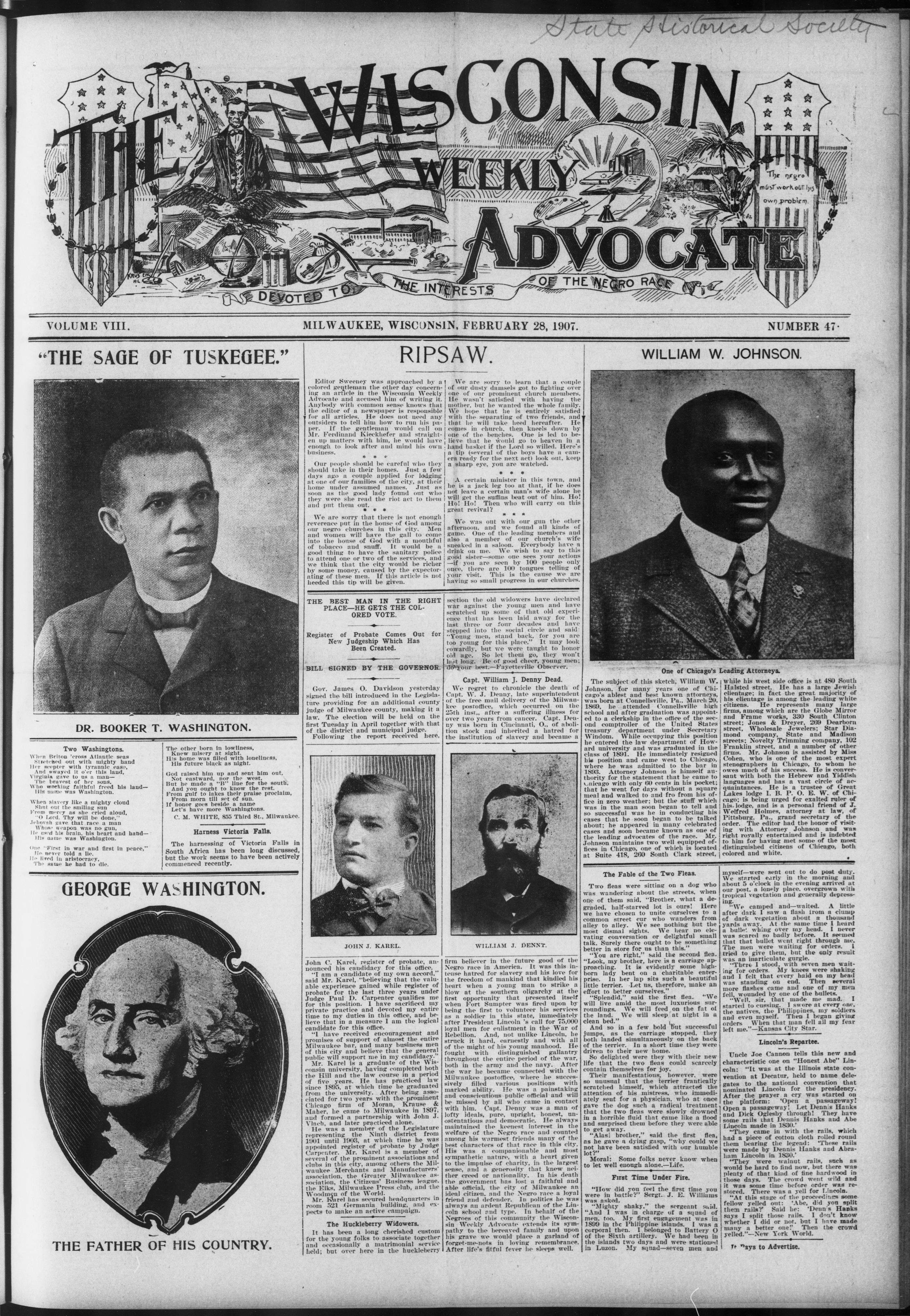
"THE SAGE OF TUSKEGEE."
DR. BOOKER T. WASHINGTON.
GEORGE WASHINGTON.
THE FATHER OF HIS COUNTRY.
VOLUME VIII.
"THE SAGE
DR. BOOKER
Two Washingtons.
When Briton 'cross Atlantic seas
Stretched out with mighty hand
Her seepter with tyrannic ease,
And swayed it o'er this land,
Virginia gave to us a man—
The bravest of her sons.
Who working faithful freed his land—
His name was Washington.
When slavery like a mighty cloud
Shut out the smiling sun
From mercy as she cried aloud,
"O Lord. Thy will be done,"
Jebovah gave that race a man
Whose weapon was no gun,
He used his brain, his heart and hand—
His name was Washington.
One "First in war and first in peace,"
He never told a lie.
He lived in aristocracy,
The same he had to die
GEORGE
The other born in lowliness,
Knew misery at sight.
His home was filled with loneliness,
His future black as night.
God raised him up and sent him out,
Not eastward, nor the west.
But he made a "B" line for the south,
And you ought to know the rest.
From gulf to lakes their praise proclaim,
From morn till set of sun.
If honor goes beside a name
Let's have more Washington.
C. M. WHITE, 855 Third St., Milwaukee
Harness Victoria Falls.
The harnessing of Victoria Falls in South Africa has been long discussed, but the work seems to have been actively commenced recently.
RIPSAW.
Editor Sweeney was approached by a colored gentleman the other day concerning an article in the Wisconsin Weekly Advocate and accused him of writing it. Anybody with common sense knows that the editor of a newspaper is responsible for all articles. He does not need any outsiders to tell him how to run his paper. If the gentleman would call on Mr. Ferdinand Kieckhefer and straighten up matters with him, he would have enough to look after and mind his own business.
Our people should be careful who they should take in their homes. Just a few days ago a couple applied for lodging at one of our families of the city, at their home under assumed names. Just as soon as the good lady found out who they were she read the riot act to them and put them out.
We are sorry that there is not enough reverence put in the house of God among our negro churches in this city. Men and women will have the gall to come into the house of God with a mouthful of tobacco and snuff. It would be a good thing to have the sanitary police to attend one or two of the services, and we think that the city would be richer by some money, caused by the expectorating of these men. If this article is not heeded this tip will be given.
THE BEST MAN IN THE RIGHT
PLACE—HE GETS THE COL-
ORED VOTE
Register of Probate Comes Out for New Judgeship Which Has Been Created.
Gov. James O. Davidson yesterday signed the bill introduced in the Legislature providing for an additional county judge of Milwaukee county, making it a law. The election will be held on the first Tuesday in April together with that of the district and municipal judge.
Following the report received here.
J.
John C. Karel, register of probate, announced his candidacy for this office. "I am a candidate of my own accord," said Mr. Karel, "believing that the valuable experience gained while register of probate for the last three years under Judge Paul D. Carpenter qualifies me for this position. I have sacrificed my private practice and devoted my entire time to my duties in this office, and believe that in a measure I am the logical candidate for this office. "I have received encouragement and promises of support of almost the entire Milwaukee bar, and many business men of this city and believe that the general public will support me in my candidacy."
Mr. Karel is a graduate of the Wisconsin university, having completed both the Hill and the law course in a period of five years. He has practiced law since 1895, at which time he graduated from the university. After being associated for two years with the prominent Chicago firm of Moran, Krause & Maher, he came to Milwaukee in 1897, and formed a partnership with John J. Vlach and later practiced alone.
He was a member of the Legislature representing the Ninth district from 1901 until 1903, at which time he was appointed register of probate by Judge Carpenter. Mr. Karel is a member of several of the prominent associations and clubs in this city, among others the Milwaukee Merchants and Manufacturers' association, the Greater Milwaukee association, the Citizens' Business league, the Elks, Milwaukee Press club, and the Woodmen of the World. Mr. Karel has secured headquarters in room 521 Germania building, and expects to make an active campaign.
The Huckleberry Widowers.
It has been a long cherished custom for the young folks to associate together and occasionally a matrimonial service held; but over here in the huckleberry
章 章 章
JOHN J. KAREL
We are sorry to learn that a couple of our dusty damsels got to fighting over one of our prominent church members. He wasn't satisfied with having the mother, but he wanted the whole family. We hope that he is entirely satisfied with the separating of two friends, and that he will take heed hereafter. He comes in church, then kneels down by one of the benches. One is led to believe that he would go to heaven in a hand basket if the Lord so willed. Here's a tip (several of the boys have a camera ready for the next act) look out, keep a sharp eye, you are watched.
A certain minister in this town, and he is a jack leg too at that, if he does not leave a certain man's wife alone he will get the suffins beat out of him. Ho! Ho! Ho! Then who will carry on this great revival?
We was out with our gun the other afternoon, and we found all kinds of game. One of the leading members and also a member of our church's wife sneaked in a saloon. Everybody have a drink on me. We wish to say to this good sister—some one sees your actions—if you are seen by 100 people only once, there are 100 tongues telling of your visit. This is the cause we are having so small progress in our churches.
section the old widowers have declared war against the young men and have scratched up some of that old experience that has been laid away for the last three or four decades and have stepped into the social circle and said: "Young men, stand back, for you are too young for this place." It may look cowardly, but we were taught to honor old age. So let them go, they won't last long. Be of good cheer, young men; do your best.—Fayetteville Observer.
Capt. William J. Denny Dead.
We regret to chronicle the death of Capt. W. J. Denny, late superintendent of the free mail delivery of the Milwaukee postoffice, which occurred on the 25th inst., after a suffering illness for over two years from cancer. Capt. Denny was born in Cincinnati, O., of abolition stock and inherited a hatred for the institution of slavery and became a
M. B.
firm believer in the future good of the Negro race in America. It was this intense hatred for slavery and his love for the freedom of mankind that kindled his heart when a young man to strike a blow at the southern oligarchy at the first opportunity that presented itself when Fort Sumpter was fired upon by being the first to volunteer his services as a soldier in this state, immediately after President Lincoln's call for 75,000 loyal men for enlistment in the War of Rebellion. And, not unlike Lincoln, he struck it hard, earnestly and with all of the might of his young manhood. He fought with distinguished gallantry throughout the entire period of the war, both in the army and the navy. After the war he became connected with the Milwaukee postoffice, where he successively filled various positions with marked ability. He was a painstaking and conscientious public official and will be missed by all who came in contact with him. Capt. Denny was a man of lofty ideals, pure, upright, honest, unostentious and democratic. He always maintained the keenest interest in the welfare of the Negro race and counted among his warmest friends many of the best characters of that race in this city. His was a companionable and most sympathetic nature, with a heart given to the impulse of charity, in the largest sense, and a generosity that knew neither creed or nationality. In his death the government has lost a faithful and able official, the city of Milwaukee an ideal citizen, and the Negro race a loyal friend and defender. In politics he was always an ardent Republican of the Lincoln school and type. In behalf of the Negroes of this community the Wisconsin Weekly Advocate extends its sympathy to the bereaved family and upon his grave we would place a garland of forget-me-nots in loving remembrance. After life's fitful fever he sleeps well.
***
☆ ☆ ☆
WILLIAM J. DENNIT.
WILLIAM W. JOHNSON.
One of Chicago's
[Name]
One of Chicago's Leading Attorneys.
The subject of this sketch, William W. Johnson, for many years one of Chicago's ablest and best known attorneys, was born at Connellsville, Pa., March 20, 1869, he attended Connellsville high school and after graduation was appointed to a clerkship in the office of the second comptroller of the United States treasury department under Secretary Windom. While occupying this position he entered the law department of Howard university and was graduated in the class of 1891. He immediately resigned his position and came west to Chicago, where he was admitted to the bar in 1893. Attorney Johnson is himself authority for the statement that he came to Chicago with only 60 cents in his pocket; that he went for days without a square meal and walked to and fro from his office in zero weather; but the stuff which was in the man soon began to tell and so successful was he in conducting his cases that he soon began to be talked about; he appeared in many celebrated cases and soon became known as one of the leading advocates of the race. Mr. Johnson maintains two well equipped offices in Chicago, one of which is located at Suite 418, 260 South Clark street,
The Fable of the Two Fleas.
Two fleas were sitting on a dog who was wandering about the streets, when one of them said, "Brother, what a degraded, half-starved lot is ours! Here we have chosen to unite ourselves to a common street cur who wanders from alley to alley. We see nothing but the most dismal sights. We hear no elevating conversation or delightful small talk. Surely there ought to be something better in store for us than this."
"You are right," said the second flea. "Look, my brother, here is a carriage approaching. It is evidently some highborn lady bent on a charitable enterprise. In her lap sits such a beautiful little terrier. Let us, therefore, make an effort to better ourselves." "Splendid," said the first flea. "We will live amid the most luxurious surroundings. We will feed on the fat of the land. We will sleep at night in a clean bed." And so in a few bold but successful jumps, as the carriage stopped, they both landed simultaneously on the back of the terrier. In a short time they were driven to their new home. So delighted were they with their new life that the two fleas could scarcely contain themselves for joy.
Their manifestations, however, were so unusual that the terrier frantically scratched himself, which attracted the attention of his mistress, who immediately sent for a physician, who at once gave the dog such a radical treatment that the two fleas were slowly drowned in a horrible fluid that came like a flood and surprised them before they were able to get away.
"Alas! brother," said the first flea, as he gave a dying gasp, "why could we not have been satisfied with our humble lot?"
Moral: Some folks never know when to let well enough alone.—Life.
First Time Under Fire.
"How did you feel the first time you were in battle?" Sergt.. J. E. Williams was asked.
"Mighty shaky," the sergeant said. "And I was in charge of a squad of men, too. My first engagement was in 1899 in the Philippine islands. I was a corporal then. I belonged to Battery O of the Sixth artillery. We had been in the islands two days and were stationed in Luzon. My squad—seven men and
Leading Attorneys.
while his west side office is at 480 South Halsted street. He has a large Jewish clientage; in fact the great majority of his clientage is among the leading white citizens. He represents many large firms, among which are the Globe Mirror and Frame works, 330 South Clinton street; Jones & Dreyer, 269 Dearborn street, Wholesale Jewelers; Star Diamond company, State and Madison streets; Novelty Trimming company, 102 Franklin street, and a number of other firms. Mr. Johnson is assisted by Miss Cohen, who is one of the most expert stenographers in Chicago, to whom he owes much of his success. He is conversant with both the Hebrew and Yiddish languages and has a vast circle of acquaintances. He is a trustee of Great Lakes lodge I. B. P. O. E. W. of Chicago; is being urged for exalted ruler of his lodge, and is a personal friend of J. Welfred Holmes, attorney at law, of Pittsburg, Pa., grand secretary of the order. The editor had the honor of visiting with Attorney Johnson and was right royally entertained and is indebted to him for having met some of the most distinguished citizens of Chicago, both colored and white.
myself—were sent out to do post duty. We started early in the morning and about 5 o'clock in the evening arrived at our post, a lonely place, overgrown with tropical vegetation and generally depressing.
"We camped and—waited. A little after dark I saw a flash from a clump of dark vegetation about a thousand yards away. At the same time I heard a bullet, whing over my head. I never was scared so badly before. It seemed that that bullet went right through me. The men were waiting for orders. I tried to give them, but the only result was an inarticulate gurgle.
"There I stood, with seven men waiting for orders. My knees were shaking and I felt that every haid on my head was standing on end. Then several more flashes came and one of my men fell wounded by one of the bullets.
"Well, sir, that made me mad. I started to cussing. I swore at every one, the natives, the Philippines, my soldiers and even myself. Then I began giving orders. When that man fell all my fear left me."—Kansas City Star.
Lincoln's Repartee.
Uncle Joe Cannon tells this new and characteristic one on "Honest Abe" Lincoln: "It was at the Illinois state convention at Decatur, held to name delegates to the national convention that nominated Lincoln for the presidency. After the prayer a cry was started on the platform: 'Open a passageway! Open a passageway! Let Dennis Hanks and Dick Oglesby through! They have some rails that Dennis Hanks and Abe Lincoln made in 1830.' "They came in with the rails, which had a piece of cotton cloth rolled round them bearing the legend: 'These rails were made by Dennis Hanks and Abraham Lincoln in 1830.'
"They were walnut rails, such as would be hard to find now, but there was plenty of that kind of fine hardwood in those days. The crowd went wild and it was some time before order was restored. There was a yell for Lincoln.
"At this stage of the proceedings some fellow yelled out: 'Abe, did you split them rails?' Said he: 'Denn's Hanks says I split those rails. I don't know whether I did or not, but I have made many a better one." Then the crowd yelled."—New York World.
---
2
THE WISGONSIN WEEKLY ADVOCATE.
MILWAUKEE, WIS.
R. B. MONTGOMERY, Editor and Proprietor.
Miscellaneous Items.
A missionary in the Hudson Bay territory travels in a box which is strapped to the back of a hardy native.
Less than 5 per cent. of the expenses of the thirty-four slaughtering and meat packing establishment of Chicago is for wages.
The Methodist Episcopal mission in Japan is erecting at Nagasaki a splendid brick structure for a college building, capable of accommodating 400 students.
In France land and grass are usually too valuable to be given over to sheep grazing, hence most of the sheep consumed are imported. Algiers supplies over a million a year.
The highest bridge in the world will be built across the Colorado river near Canon City. Colo., over a vertical-sided canyon 3000 feet above the river. The new electric railway line from Canon City to Florence will cross this bridge. Iceland's first theater was founded only in 1897 and there is only one in the island—at Reykjavik—but it has taken firm root. The dramatic season opens in October and closes at the end of April, when a large part of the inhabitants go fishing.
—Few people probably suspect the extent to which Switzerland figures among the silk producing countries of the world, which, so far as Europe is concerned, have always been supposed to be France and Italy. But Switzerland exports annually silk to the value of about $20,000,000, nearly all going to European countries.
—At Dresden a new bath for dogs has been opened for the convenience of busy people, who have not the time to look after the cleanliness of their own pets. Dogs are left at the bath by men on their way to business and during the day they are kept in kennels, cared for, given a wash and a good rub down, clipped if necessary, and returned to their masters when the day's work is done.
A novel hot water kettle which is guaranteed cannot boil over under any circumstances embodies a steam chamber into which the water when it rises in violent ebulition is made to pass through slots and then to fall back into the main body of the kettle. The spout comes from the steam chamber and is baffled and connected only indirectly. The steam chest of this kettle is utilized for cooking as well as providing pure boiling water for tea making.
The American tramp must look out for his laurels in the matter of stealing rides. A Roumanion recently succeeded in lodging himself on the pipes underneath a dining car of the Orient express at Costanza, on the Black sea, these pipes affording a sort of shelf about 20 inches wide. He left his bed in Paris fifty-three hours later. It is remarked that at the end of the journey he was very dusty, hungry and thirsty and possessed a capital amounting to 5 cents.
"Sculls" and "skuils" are really one word in origin, and both at various times have been spelled capriciously with a "c" or a "k." Pepys, the diarist, tells how he went on the Thames, at one time "in a scull," at another in a "skuller." The origin of the word is "skulle," or "sculle," a bowl or a goblet. While the cranium was obviously bowllike in shape, a distant resemblance to a bowl was also detected in the scooped-out blade of a "scull" as opposed to the flat blade of an ear proper.
—Nearly one-half of the shipping traffic to and from Antwerp is carried on under the British and American flags, and this has made Antwerp almost an English-speaking port. Free night schools for exclusive classes in English, organized by the city authorities, are attended by thousands of pupils, while special attention is paid to the study of English in all the grades of the day schools, public as well as private. This desire to popularize the English language is not confined to Belgium, but has extended to Germany as well, where schools of instruction have already been established at Munich and Nuremburg by the German government.
Use for Dogwood.
There is considerable demand in this and surrounding counties for dogwood at this time. The Torrence company of Athens, Ga., has a mill here, which has been running most of the time now for more than a year ago V. Fontaine of New Jersey has been here for a month or more looking into the dogwood and persimmon of this part of the state. He intends putting up a number of sawmills at different points where these woods are to be bead. Mr. Fontaine informs us that he will move his mill into any locality where he can secure as much as 100 cords of either dogwood or persimmon. The mills here cut the wood up into blocks about sixteen inches in length and three by 3. These are exported to France or England, where they are manufactured into shuttles for the cotton mills and silk mills of the world. A great many of the shuttles used in this country are brought from abroad, after having been made from American wood taken from here in the blocks. This country has only one firm that can make the shuttles to compete with the foreign product, and in this case nearly all the skilled workmen are from France.—Franklin Press.
Lorenzo Dow Fears Arrest.
Lorenzo Dow on one occasion took the liberty, while preaching, to denounce a rich man in the community, recently deceased. The result was an arrest, a trial for slander, and an imprisonment in the county jail.
After Dow got out of limbo he announced that he should preach, at a given time, a sermon about "another rich man." The populace was greatly excited, and a crowded house greeted his appearance.
With great solemnity he opened the Bible and read. "And there was a rich man who died and went to—" Then, stopping short, and seeming to be suddenly impressed, he continued: "Brethren, I shall not mention the place this rich man went to, for fear he has some relatives in this congregation who will sue me for defamation of character."
That effect was irresistible and he made the impression permanent by taking another text.—Boston Herald.
Changeable Electric Signs
Brilliant effects for electric signs are now to be readily obtained with little cost by the use of small colored transparent caps, which fit over the rounded ends of the incandescent bulbs. This permits the owner of a changeable electric sign to alter the legend at will and to indulge in the use of colors without the necessity of keeping on hand a large supply of colored lamps, some of which are very expensive.—Scientific American. Advertise in Your Home Paper.
IENNIFER'S LAD.
But louder was the share-gram, "we must march, march, march," And clearer called the bugle, "Will you follow?" Young Jennifer came seeking me With love upon her lips.
- The South has won the swallow,
But clearer beat the snare-drum, with its
"March, march, march."
And sweeter sang the bugle, "Will you follow?"
- Marjorie L. C. Pickthall in Metropolitan Magazine.
THE SUGARMAKER.
At the hacienda Dr. Pascal, a keen-looking French physician, employed by the estate on a good salary, was mixing a drug for one of the natives, white vigorously anathematizing the race. The head engineer, a stolid, fine looking young German, and the chemist, a small, shrewd American, were eating dinner preparatory to the change of watch at 6 o'clock. The whistle of the sugarhouse rang out on the warm spring air as the peon waiter, dressed in immaculate white, brought in coffee just as a young man, in working attire, who had crossed over from the sugarhouse, came up the veranda steps.
It was the head sugarmaker, an American from Louisiana, whose handsome, dark eyes, slender but athletic build and foreign look, showed he had Latin blood in his veins, as did his name, which was French. He belonged to that fine old element still strongly predominant in the state, and in his veins ran countless generations of blue blood, counting back to earlier centuries, while on his mother's side there was a cavalier strain equally remote. His blouse and toil-stained hands showed that fortune's favors had long been withdrawn from him and his.
The chemist, who was also superintendent, turned with nervous irritation and went out.
"Why don't you hit him?" the German asked, as he stood up and began to roll a cigarette with careful deliberation. Austin laughed. "What for? There are folks in the States who need my money. Sometimes I think he wants me to strike him, the little rat." "Wouldn't be surprised. The fellows all know who makes the sugar and who really runs the house." The German said.
"Carter's a cad and a bluffer. How he manages to throw sand in the eyes of the administrator and get all the credit for everything that's done, passes me," the doctor remarked, still rubbing up his drug. "He has it in for you, Renier, that's evident. He's jealous. He knows everybody says you've brought about better results than they ever got on this place. He doesn't want Tom Warrington to find it out, though. You had better watch him. He'll play you some trick yet with the company."
The doctor and engineer went out together, chatting as they walked toward the sugarhouse, and Austin Renier, his dinner soon over, drew a wicker chair on the veranda, and lighting a cigar, sat down to smoke.
Someone came out of the white villa, a young girl, and got in a trap evidently waiting for her. She drove rapidly toward the hacienda. Austin was so engaged in anxious thoughts, seeing mentally a very different picture from the one confronting him—a big city, streets crossing each other, electric cars, and faces which spoke to him of home and those strong affections which endure—that it was only when the crunch of the wheels on the gravel and a pleasant voice called to him that he sprang up and came forward, throwing away his cigar.
"You were a thousand leagues away. What were you seeing up in the mountain? You did not even hear me drive up." Cynthia Warrington, daughter of the president of the company, said, laughingly. Cynthia had come out with her father at her own willful entreaty to spend a few weeks in the tropics with him while he examined the condition and looked after the affairs of the company. "I want to drive across the fields and go up the mountains. Which road shall I take? I am not a bit afraid. I will drive half way up the mountain and back before supper. It's only a short distance."
"It's much farther away than you think. It would be the height of imprudence for you to go so far unprotected. Wait until Sunday, then I will drive you up to the top where the lava is, if you care to go so high."
"Jump in and we'll go now. If you won't, I'll go without you, so you had better come." Cynthia declared gaily.
It took a very short time for Austin to come out and spring into the trap.
"I know the road. I can drive faster," taking the reins, which she surrendered willingly.
The ponies sped swiftly along over the well kept plantation roads winding through the waving fields of cane to the foot of the mountain, then the ascent became abrupt and rugged, but they climbed up steadily. There was no sign of coming night, for the long tropical evenings preserve the illusion of day until very late hours, only the presence of a few stars showed how time was passing. And during their light-hearted chat, while the ponies toiled along and the groom clung on behind. Austin unconsciously revealed a great many things to the clever daughter of the company's president as to the management of the San Felicia estate and the refinery. Then they drifted into more personal matters.
"Hello! What's become of that boy, Ben?" Austin said suddenly, noticing for the first time the boy's absence. "We must have dropped him off when we made that last ascent," Cynthia said gaily.
Austin stood up in the trap and looked keenly around. Resuming his seat and gathering up the reins, "Get in the bottom of the trap," he said to Cynthia. "Crouch as low as you can and hold on with all your might. If I fall, take the reins and give the horses their heads. Let them run. Don't check them."
A shout broke out from behind the rocks above them. A shot rang out, followed by others, as Austin wheeled the horses and lashed them into a full run. Drawing his revolver, he turned in his seat and fired with slow deliberation. Cynthia heard the whizz of balls as they dashed along. The pistol dropped from
Austin's hands, but, holding the reins with his left hand, they went recklessly over the dangerous road, the horses terrified by the shots, which flew wildly. It lasted but a few minutes.
"You are not hurt?" Austin asked, bending anxiously down over Cynthia. "We are safe now. They won't dare come any farther."
"I'm not a bit hurt. But what an adventure!" Cynthia said, lifting her head and looking up at Austin. "Who do you suppose they are, and what made them shoot at us?" she asked.
"They are bandits. They infest these mountains. They wanted to capture you and take you off in the interior. They wouldn't have hurt you, but they would have demanded a heavy ransom and it would have been hard to trace you and force them to give you up. That boy Ben told them who you were. I had no idea they would dare to make so bold an attack. But we are safe out of it now."
There was a great commotion in and around the village and on the estate. As the horses came dashing furiously toward the hacienda, Cynthia's father and several men rode rapidly down the road toward them. The ponies, covered with lather and still trembling with fright, were brought to a standstill, and Cynthia gave a rapid sketch of the attack.
"If you'll excuse me, I'll go to the hacienda. Your father will drive you to the villa. My watch begins at 12, you know," Austin said in a rather queer voice, as he raised his hat with his left hand and got stiffly out of the trap. Then he stumbled and would have fallen if the doctor, who was one of the party, had not caught him.
Cynthia's father drove her back to the white villa, while they took Austin to the hacienda, where his wounds were dressed and he was ordered to stay in bed for a few days. Books, magazines and notes came daily from Cynthia, and the first evening, three weeks later, when Austin, pale and surprisingly weak, came out on the veranda and sat in his wicker chair, she drove down the avenue, ran up the steps and shook hands radiantly. "You are at my mercy and you can't escape my deep and grateful thanks. You saved me from an awful experience, an-
But Auston raised his hand imploringly. "I owe you more than I can ever repay. You brought joy with you, and now you leave in a few days' time. You will soon forget San Felicia and our rough, wild life out here, but I—I will think of you and remember you—always."
A brilliant flush swept over Cynthia's lovely face. She laughed a sweet and embarrassed laugh, as she held out her hand. "But you are coming with us. You are not to be left to the mercy of your French doctor," she said, as her father came up. Austin got up to greet him.
"Well, young man, I've cabled to your folks," the company's president said genially, holding out his hand. "I hear you come from fighting stock—crusaders, robber barons and all that. Old man, your ancestors captured pirates in Revolutionary days. I believe you got up this shindy just for a lark. But you are not to stay here to get swamp fever. The work is nearly over and they will have to get on the best way they can without you. I've heard all about the clarification. I understand perfectly. The company is going to appoint a thoroughly competent superintendent for next year."
"Would you mind telling me who he is?" Austin asked in surprise.
"Not at all. It's you. I appreciate nerve and grit and ability, young man," the president said smilingly, as he motioned to Austin to resume his chair.
"He is what we call in my country a great diplomat," the German engineer said to the chief employees of the San Felicia company, assembled at supper that last night to bid Austin Renier god-speed on his journey back to the States the next day.
"He is persuaded by the daughter of the president to drive her up the mountain where the bandits are. He saves her from death or capture. He gets himself shot up. Then he is laid up in bed for three weeks. It was well planned. The clarification it goes to the dogs. Everything is wrong. The house stops. Nobody can make sugar out of the horrid sour cane of the San Felicia estate. It was great diplomacy. And so now he will be our superintendent next year. And he will also, most assuredly—we drink to your good health, and to your still further success, Austin Renier, for you are a d——d fine fellow."—S. Rhett Roman in New Orleans Times-Democrat.
Ring Shows Kin: Wedding Is Stopped.
"That looks like my mother's ring," remarked Thomas Pengilly at Calumet, Mich., attracted by a worn gold band as he was placing an engagement ring upon the finger of Miss Nellie Howell. "That was my mother's ring." she replied. The ring prevented the marriage of brother and sister. After wandering thirty years in Africa and the Lake Superior country, Thomas Pengilly had met his sister in Butte, Mont., was attracted by her manner, loved her and won her hand. After a year's courtship they were to be married. The date had been set. Then the old ring he had seen on the hand of his mother lost him a bride, but gained him a sister. Two happier persons never lived.
As a machinist he has prospered and he has begun a search for other brothers and sisters, hoping to be able to aid them.
Pengilly heard of the death of his parents while in South Africa, but learned that his brothers and sisters were well cared for, and after waiting for several years, lost all trace of them. Nellie was adopted by a Welch family named Howell.
London's Transportation System
London now has six underground electric railways (tubes) in operation, and five more are under construction or projected. The railways of London, underground and surface, carry more than 600,000,000 persons each year, of which underground lines accommodate 258,000,000. There are nearly 600 railway stations in greater London, and into the trunk line stations alone there pour annually more than 300,000,000 passengers.
Materializing the Flying Dutchman
A strange sea phantom, which very probably has helped to create the legend of the Flying Dutchman, is stated to have been run to earth by the Argentine government. Many vessels have reported after rounding the Horn that they have sighted what seemed to be a derelict vessel, or one in need of assistance,
sailing in through the straits with decks awash. Vessels have run aground while trying to get near this mysterious apparition, under the belief that there must be a navigable passage for it to sail in. Now it has been nearly identified in Le Maire Strait, one of a number of jagged rocks, which at five miles distance has the appearance of a bark running under short sails. Probably the white sails of the visionary vessels are produced by the sea bird whitened upper parts of the crag; the same course has often led the lonely islet of Rockall, which lies out in the Atlantic to the west of the Hebrides and was the grave of a Norwegian emigrant ship a year or two ago, to be taken for a vessel under full sail.—Westminister Gazette.
FOR THE FAMILY TABLE.
Buttered Beets.—Rub the skins from hot buttered beets and chop coarsely. Season with salt, white pepper and butter. Do not scant the butter, but use one rounding tablespoon to each cup of chopped beets.
Frizzled Ham.—Shave raw ham as fine as possible and put into a hot frying pan. Stir rapidly and let the ham cook until the pieces curl but not until they burn. Pour in one or two tablespoons of boiling water and serve.
Cocoanut Pie.—Line a plate with good paste. Make a filling from two-thirds cup of cocoanut soaked two or three hours in milk to cover. Add one and one-quarter cups of milk, a pinch of salt and two beaten eggs; bake like a custard.
Broiled Smelts.—Split large smelts open and take out the back bone; wipe carefully and dip in melted butter. Dust with salt and pepper and lay in a greased wire broiler. Broil five minutes and nearly all of the time on the flesh side. Serve with sauce tartare.
Corn Cake.—Sift two cups of cornmeal, one cup of flour and one level teaspoon each of salt and soda. Beat the yolks of three eggs with one cup of sugar, add two cups of sour milk and stir into the dry ingredients. Add two tablespoons of melted butter. Beat the whites of the eggs stiff, add to the mixture and bake at once in small greased muffin tins or in one large loaf.
Lily Cake.—Cream one cup of butter, add one and one-half cups of sugar, one cup of milk, three cups of flour sifted with three level teaspoons of baking powder and a few drops of rose flavoring. Fold in last the stiffly beaten whites of five eggs. Bake in two shallow square pans of the same size. Spread plain boiled icing on both cakes, put together and sprinkle the top with cocoanut.
Plain Fruit Cake.—Cream one cup of butter, add two cups of sugar and beat again. Add the well-beaten yolks of four eggs, then one cup of milk, the whites of four eggs beaten stiff and last three and one-half cups of flour sifted with three level teaspoons of baking powder and ateaspoon of vanilla flavoring. Stir in one cup of floured currants and one cup of seeded raisins. Bake in one loaf in a moderate oven one hour.
Potato and Nut Salad.—Cut four cooked potatoes into dice. Put one cup of English walnut meats, a bit of bay leaf, a slice of onion and half a teaspoon of salt into boiling water and cook ten minutes. Drain the nut meats and dry them on a cloth and rub off the brown skins; break into small pieces and mix with the potato dice, which should be hot. Pour a French dressing over that is seasoned strongly with onion.
Buckwheat Cakes.—Mix four cups of buckwheat flour, one cup of cornmeal and a level teaspoon of salt. Add two cups of lukewarm water, two cups of milk and beat smooth, then stir in one yeast cake dissolved in one cup of lukewarm water. Cover and let rise. Add two tablespoons of molasses and one level teaspoon of soda. Fry brown on both sides. Reserve a cup of the batter to start the next mixing of cakes but do not repeat this method of starting more than twice, then begin new with a yeast cake.
Apple Pudding.—For two cups of stale cake crumbs allow two cups of mildly acid apples that have been pared, cored and cut in eighths. Buter a baking oish, sprinkle with crumbs half an inch deep; over these put a layer of the apples, then repeat and make a top layer of crumbs. Make a custard by mixing one beaten egg, two cups of milk, one-quarter cup of sugar, a saltspoon of salt and half a teaspoon of lemon or vanilla flavoring. Pour the custard over the crumbs and apple and bake about three-quarters of an hour. Serve with a liquid sauce.
Orange Marmalade.—Weigh Seville oranges and take an equal weight of cut sugar. Put the oranges without cutting into a kettle and cover with cold water. Bring to the boiling point and drain off the water. Put fresh cold water on the oranges and cook until the rinds are tender. Drain and cut in very thin slices, using both skin and pulp. Throw away the seeds and put the fruit into a saucepan with half the sugar and add one cup of water to every pound of fruit. Cook over a moderate fire for half an hour, then add the remainder of the sugar and cook twenty minutes longer—when the marmalade should become like a jelly. If it does not jelly, cook a little longer. Pour into small jars and seal.
Cape Cod Stew.—Fry five slices of salt pork that have been cut in strips, until crisp. Cut two pounds of beef into large cubes and brown in the fat after having taken out the scraps. Put all into a kettle and cover with boiling water. Cook gently two hours, then add parsnips scraped and cut in halves, turnips cut in round slices, and when nearly done white and sweet potatoes, whole or cut in halves if large. When the potatoes are almost done lay dumplings round on the top but not so that the water will touch them. Cover closely and cook fifteen minutes without lifting the cover.
Put the meat in the center of a platter, the vegetables in a border round it and the dumplings on the outside. Thicken the gravy, cook five minutes and pour over the meat. MARJORIE WEBSTER
Modeling in Bread.
A new phase of the art of modeling is practised by Mlle. Susan Meyer in Paris. The material employed by her is crumbs of bread colored with various liquids. She has discovered a process of making the mass elastic and almost unbreakable. A proof of her success is the purchase by the state of one of her works representing an apple tree in full bloom. It is on exhibition at the Luxembourg gallery.—Boston Transcript.
Electric Clock in 1840
The first electric clock was made by J. Smith of Leeds in 1840.
A 4-year-old oyster is the best for eating purposes.
The Georgia state supreme court holds that small boys have an inalienable right to climb trees.
A Cleveland (O.) grand jury recently gave George A. Bevans, who claimed that he had lost a spoonful of brains in an accident at the Central high school annex, a judgment for $1000.
So interested is Union Grove, near Racine, Wis., in revival services being held there the other night the saloons closed. That night there were thirty-five conversions. The services are being conducted by Rev. W. J. Perry of the First Methodist church there and Miss Caffrey, an evangelist.
Judge W. L. Kelly of St. Paul was approached in his court room by a man who refused to reveal his identity and who asked the jurist to issue a permit for the applicant to kill a man. The applicant, who is thought to be insane, claimed he was an inventor and that his wife and a man were conspiring to steal from him an invention and $175,000 which it had brought him.
Mrs. J. W. Cobb of Cleveland, O., was given a divorce from a "man with the telephone habit," after several years of vicissitudes in the way of collecting alimony and keeping away from him. Cobb is required to pay $500 alimony and $3 a week for their child's support. Cobb annoyed his wife by phoning her day and night. He was enjoined and sent to jail two or three times for contempt for telephoning.
For the rest of her life Mrs. Phoebe E. Sparkman of Fairfield, Fla., will receive $16 a month from the United States government. Mrs. Sparkman is probably the oldest pensioner on the rolls of Uncle Sam. She is the widow of a soldier who served in the Indian wars in Florida. She was unable to get relief through the regular channels. There was filed evidence that Mrs. Sparkman is now 110 years old.
In Appleton, Wis., started a romance three years ago. Last week it culminated at the Hotel Euclid in Cleveland, O., with a wedding. Victor E. Eller was 21. Edith Mae Whisner was 15 years old. They met and loved at school. Victor set out to make a home and a name. Eller came to Cleveland, and was employed by the Cleveland Construction company. The young lady received a telegram which read: "Come." Miss Whisner hurried to Cleveland.
Divorced thirty-two years ago, Alpheus P. Cowell of San Francisco and Mrs. Emeline A. Hunter of Cleveland were remarried at Mount Clemens, Mich. Cowell was 18 at their first marriage and his bride 16. The groom then lived at St. Johns and the young woman at Lansing. Both married again after their divorce, but their partners died. Recently when they came into correspondence again the love of their youth was rekindled and their second marriage was arranged.
King Edward is a skilled dramatic critic. Not long ago he practically killed a musical piece by demanding in his strongly accented voice, "Will some one tell me what the plot of this damned play is about?"
The remark was heard in all directions, and ended in a week or so the career of "the damned play." He likes to see a theater filled, and I have known a manager telephone in hot haste to a friend of mine in the city asking him to send down a dozen couples to occupy unbooked stalls when the King had suddenly announced his intention of visiting a house.-Manchester Chronicle.
Prof. Jonathan Rigdon of Danville, Ind., for many years head of the Indiana state normal university at Danville, is to be married to Miss Alberta Smith, 20-year-old daughter of Mr. and Mrs. Alfred Smith of Fairfield, Ill. Twenty-five years ago Miss Smith's mother, then a young woman of 18, was a student under Prof. Rigdon at Danville and friends reported that they were betrothed. Time separated them and each was afterward married. The professor's wife died several years ago. Last summer he met the daughter of his former sweetheart and their engagement soon followed. Prof. Rigdon is 55 years old, ten years older than his bride-elect's father.
The citizens of Sheridan (Wyo.) are wrought up over discoveries in the local postoffice in connection with the removal of Postmaster W. F. Brittain. It is announced that Brittain made a practice of burning all mail matter which did not meet with his approval. The janitor noticed the unusual quantity of waste paper sent to the furnace and discovered that it consisted of letters and newspapers duly stamped and directed, intrusted to the postoffice for delivery. He informed prominent citizens, who watched and sorted the waste paper, with the result that in three months nine bushels of letters and papers were found in it.
At the inter-synodical missionary conference of the Presbyterian church at Omaha last week Robert E. Speer, senior secretary of the board of foreign missions, asked for the contract of evangelizing the world during the lifetime of the present generation.
Detailed estimates, he said, assign to the Presbyterian church 100,000,000 people for evangelization.
To accomplish this gigantic undertaking Speer told the delegates from the hundred presbyteries it would require 4000 men and women missionaries and $6,000,000 annually.
"Give us the workers and the $6,000,-000 a year and we will contract to evangelize the 100,000,000 souls in so many years," he said.
The story of a "pink pig" which failed to remain "pinky" and has turned yellow, was told from the platform of the National Woman Suffrage association's convention at Chicago and kept the delegates in throes of merriment for several minutes. The pig is being raised on an Oklahoma farm by an enthusiastic woman suffragist, Mrs. Anna Laskey, who has announced her intention to present it at next year's convention to the national suffrage association to be auctioned off for the benefit of the suffrage propaganda.
Information that the "hoggie" was being raised for the association was brought by Miss Laura Gregg, special delegate from Oklahoma. But Miss Gregg balked at making the announcement of the unique "subscription." She intrusted the message to Mrs. Harriet Taylor Upton.
South Africans Drink Much Beer
Although there are fewer than 300,000 white people in the Transvaal it was possible for them in the year 1905 to consume 418,625 gallons of ale and beer, valued at $298,930.
APPLE CROP IS IMMENSE.
Over 36,120,000 Barrels Raised East of the Rockies.
The American Agriculturist gives the apple crop of 1906 as 36,120,000 barrels, as against 24,000,000 barrels in 1905, an increase of 12,100,000 barrels, but 3,880,000 barrels short of each of the crops of the three years prior to 1905. The figures arrived at are the crystallization of returns from correspondents in every apple producing section east of the Rocky mountains. A good many·1906 apples are available for winter storage.
"NAP CULT" ON THE INCREASE
Large Part of Population Takes a Snooze in Afternoon.
"The afternoon nap cult is growing." said a mother of six children, "and I'm glad of it. Just look at me. I'm over 50 years old and my complexion is as rosy as any schoolgirl's. I attribute it all to the afternoon nap. The cook can leave; the stocks in which we invest can pay panicky small dividends, the boys may 'flunk' in their 'exams,' and still I take my afternoon nap."—Philadelphia Record
HARDSHIPS OF ARMY LIFE
Left Thousands of Veterans with Kidney Troubles.
The experience of David W. Martin, a retired merchant of Bolivar, Mo., is just like thousands of others. Mr. Martin says: "I think I have had kidney disease ever since the war. During an engagement my horse fell on me, straining my back and injuring the
Mr. Martin says: "I think I have had kidney disease ever since the war. During an engagement my horse fell on me, straining my back and injuring the kidneys. I have been told I had a floating kidney. I had intense pain in the back, headaches and dizzy spells and the action of the bladder was very irregular. About thee years ago I tried Doan's Kidney Pills, and found such great relief that I continued, and inside a comparatively short time was entirely rid of kidney trouble."
Sold by all dealers. 50 cents a box. Foster-Milburn Co., Buffalo, N. Y.
Black Cat Football Team's Mascot.
The strange sight of a black cat as the traveling mascot of a football team was witnessed in connection with a league match at Park avenue, Bradford, on Saturday. Early in the season a fine, glossy black cat strayed into the premises of the Halifax Football club at Thrum hall. Some members of a superstitious turn of mind perceived in this visit an omen of good fortune and, in keeping with a local custom, buttered the animal's paws. Ever since the cat has received the kindliest treatment and fortune has smiled on the efforts of the club.
At practice the cat takes up a prominent position where it can view operations and seems to take deep interest in the players. The team has won twenty-one of its twenty-four league matches this season, their latest triumph on Saturday being over Bradford, which is attributed to some occult feline influence. London Daily Mail.
This is Worth Saying.
The following simple home-made mixture is said to relieve any form of Rheumatism or backache, also cleanse and strengthen the Kidneys and Bladder, overcoming all urinary disorders, if taken before the stage of Bright's disease: Fluid Extract Dandelion, one-half ounce; Compound Kargon, one ounce; Compound Syrup Sarsaparilla, three ounces. Mix by shaking well in a bottle and take in teaspoonful doses after meals and at bedtime.
A well-known authority states that these ingredients are mainly of vegetable extraction, and harmless to use, and can be obtained at small cost from any good prescription pharmacy. Those who think they have kidney trouble or suffer with lame back or weak bladder or Rheumatism, should give this prescription a trial, as no harm can possibly follow its use, and it is said to do wonders for some people.
Two Pies for Good Carriage
If you are walking along the street and wake up to the fact that you are carrying yourself poorly, take the mental attitude of standing straight, as well as the physical one. Look at the men you meet and imagine that each of them owes you a dollar. Put even a suggestion of arrogance into your position. Hold your head well back; look people squarely in the face. This will not only give the impression to others that you possess the power you want, but it will actually tend to bring that power. Keep the neck against the collar.—World's Work.
Cigarettes
The cigarette output of 4,368,729,015 in the calendar year of 1906 must have come as a surprise to the bulk of the trade, but more stunning yet its increase in one year of 842,240,452, an increase by nearly three hundred millions larger than the increase of our cigar industry during the same year. This jump is the more remarkable in the face of the pronounced and unrelenting hostility of a half a dozen state Legislatures which have ostracized not only the manufacture but also the handling and consumption of cigarettes within the confines of their respective territories.—United States Tobacco Journal.
Free to Sufferers
Mr. Zaegel, a chemist at 107 Main street, Sheboygan, Wisconsin, has, by years of study and application, succeeded in extracting and blending from many different herbs and roots a medicine which is a specific for the cure of rheumatism, constipation, backache, lumbago, etc., etc. This medical preparation is sent free to a limited number for a short time by addressing Mr. Zaegel as above, in order to establish its confidence among the people at large.
Proved Himself a Seer
Robney Banta, formerly of Ottawa, Kan., read a girl's palm and told her fortune while at the St. Louis exposition in 1904. He predicted that she would move to another state and marry. Banta did not see the girl again until recently, when he met her in Seattle. Today he married her, making good the prediction he made three years ago. Banta is well known here, being the president of the local Kansas society. Seattle Cor. Topeka Capital.
An investigation of the sources of supply of the materials entering into the manufacture of musical instruments in Germany has revealed the fact that nearly 70,000 pounds of sheep gut are used annually for strings.
GOSSIP FOR THE LADIES.
```markdown
```
I took it from its resting place,
My veil of fifty years ago;
I pressed it fondly 'gainst my face
To feel the old-time rapture glow.
When life was young and love was fair
And hearts knew not the touch of care.
I held it up against the light,
I shook it free from every fold;
Its silken mesh, once pearly white,
Had slowly changed to threads of gold.
Ah! thus I mused, each grief of time
In heaven will change to joy sublime.
I laid it gently on my head,
To fall in waves of softest gleam;
Beneath its folds the loved ones dead
Came round me as in pleasant dream,
And he who crowned me as his bride
Methought stood radiant at my side.
O. Memory what unfailing power
Is thine to vivify the past—
The perfume of a single flower
Can bring back visions crowding fast—
My veil's soft touch made me once more
A happy bride on Love's bright shore!
The day itself came back to me—
An April day, serene and calm.
The cloudless sky an azure sea,
And every breeze was bliss and balm;
No thought of change, of loss, of tears—
Ah! such are God's "eternal years."
One vision more: the church, the priest,
Two kneeling forms, a holy prayer,
Low vows that bind the greatest, least,
And death's dread name commingled
there.
But Christian hearts know naught of fear,
For God is love, and heaven is near.
When I am laid in coffin-bed,
With tired hands upon my breast,
Place this old veil upon my head
And shroud me in it for my rest.
It's bridal blessing, 'neath the sod,
May plead for me before my God!
And now I'll lay my veil again
Within its old familiar place;
A sigh, a tear, a throb of pain
For faded youth and vanished grace.
But God can all the past restore,
And give us both our bloom once more!
S. B. ELDER.
Getting Married as an Art.
Girls have an exasperating way of making unhappy marriages. A great many of them do not make such marriages, but that there are many who do is too patent to admit of contradiction. The evidence is prima facie, and if other evidence could be gathered it would be found that the number unhappily wedded is much larger than surface indications show. I speak only of the kind of cases in which men are to blame for the unhappiness, that is, of cases in which men are the immediate cause of the unhappiness, for if we were to go farther back it would have to be admitted that the girls are in very many cases themselves to blame for the primal mistake of marrying men of a kind to make them unhappy.
As a member of the universal brotherhood—as a brother, therefore, of all girls
hood—as a brother, therefore, of all girls—this proneness of girls to choose the wrong man has pained me not a little, and has caused me to cast about for a possible remedy. Of course, a universal remedy, an absolute preventive, is not to be had. Even if it were, girls would not "take" it. Some, at least, would argue: better marry unhappily than not to marry at all. Yet, for the benefit of those amenable to good advice, it seems to me there is something to be said, that, while not especially new, may be iterated with profit
And the result of my brotherly coigitation along this line runs somewhat as follows: Let every girl, as a part of her education, be encouraged to develop a "fad," an avocation such as may become, if need be, a vocation; not something frivolous and trivial, but something worthy of genuine affection on the part of the girl, and something that will appeal to the interest of a large number of her fellow beings. This fad—poorly so called—should be in line with the bent of the mind and heart, so that every bit of the effort of both mind and heart expended on it may be given with a thorough sense of joy. It should also be important enough and big enough to absorb a large amount of attention without becoming a burden.
The arts suggest themselves at once as fields for such fads, and they are fruitful fields for those who can enter them, but they are not open to all, and they usually demand more attention than one expects to give to a fad. A simpler suggestion, as an example, is the growing of flowers or vegetables—gardening. To one who has a bent in this direction the field is without limit. Let one become absorbed in such work, not with serious intent, but purely for the pleasure of it, and its possibilities are almost endless; and then if it becomes necessary to make a serious business of anything, the garden gate stands wide open.
To the sister who asks what such a fad has to do with saving one from an unwise marriage, the reply is: It gives diversion; it gives the mind something wholesome to employ itself upon, something that brings joy and serenity of mind, and fills the life, so that he who would displace even a portion of the interest so given must be of considerable genuine worth. But it does more than that; it gives the girl who cultivates it a sense of security, a feeling that she has provided against possible need in the future. No such fad lovingly followed can fail to offer, if the need comes, opportunities for self-support, and, what is more, self-support with joy in the winning of it. A girl so equipped is in no danger of marrying just in order to make sure of a living. The life offered by a suitor, in any event, must have substantial advantages over that she can make for herself.
Cupid, she may say, has been left out of these sage calculations. Not at all! But Cupid is prevented from acting too hastily if there is a well-loved fad as a factor for him to reckon with. Such a fad is a shield against the sly little god's darts and arts.
A family known to me—a family of four charming daughters—suggests itself as a case in point. All four of the girls have had unhappy experiences with men. Fortunately only one married before it was too late, before the real character of the man in the case was disclosed. The trouble was the girls had nothing to absorb their minds; though all were capable they were brought up like idle princesses to wait each for her Prince Charming. Expectancy naturally threw a glamor about the first impressive strangers who came along, and in the eyes of the girls they became the looked-for princes. Had the girls looked at affairs with minds used to wholesome tasks and sane devotion to ideals, the bogus princes would have had more difficulty in attracting their attention and would have been valued at their true worth a good deal sooner than they were, and the girls would have been saved needless pain and mortification.—The Home Magazine.
A Guest Book
That Is New and Useful
The ordinary guest book is now a matter of course in most country homes, but many hostesses with a love of novelty prefer to have their friends' visit recorded in a more distinctive way than by their signatures and the date of the visit. One clever young matron has a book
that is not only an unfailing source of interest to every one who sees it, but helps her out in many a tight place when at a loss to remember little idiosyncrasies of her friends. One evening, when a merry house party was playing that childish game where each player writes down her favorite pursuit, food, amusement and so forth, the tastes of her friends were found to be so varied that a bright idea came to this hostess.
"Why not utilize this information for my own benefit," she thought. "I'm constantly having guests in the country and am often at my wits' ends to remember their personal likes and dislikes. I'll just start a guest book on the principle of this game and make each of my friends write down the things she most cares for and dislikes."
Not being able to buy a suitable book, she took heavy white Irish linen paper of commercial size, 9x12 inches, and bound many sheets of it firmly together between heavy cardboard backs, covered with a gay flowered cretonne. At the top of one sheet she illuminated in quite large letters, "His Likes and Dislikes," using for alternate pages the same title, but with the feminine pronoun. Beneath this was left a small space for the name and date, while down the left side were run in smaller illuminated letters grouped subtitles, such as "His Favorite Game," "His Most Detested Game," "The Food He Likes Best," "His Most Despised Food."
These subtitles may be of such a nature as the inclination of the hostess dictates, and may be made to include all the tastes and distastes of her friends in as many different directions as the size of the page permits.
Just at first, when people were asked to write in this novel guest book, they were inclined to take it as a joke and put down nonsense, but a little persuasion usually resulted in the real tastes of the writer being inscribed.
The woman is now noted for being a most popular and successful hostess, and an invitation to her house parties is always eagerly sought. She herself ascribes this success entirely to the insight gained by her guest book into the fads and fancies and the personal peculiarities and idiosyncrasies of her friends.
French Traits
Our Women Might Adopt
It is said that American women are adaptable.
This is no doubt true of them so far as their ability to make themselves at home in all places and lands consists.
Nor is there a woman on earth who remains more essentially herself when away from her native land than the American.
In Europe I have met many of my compatriots who have lived for long periods of years abroad. Among them all I saw but one who had acquired the least semblance of mannerisms which were foreign.
And this chanced to be one who had been but a brief time, comparatively speaking, away from her native American home.
One young woman, who had lived twelve years in Germany and two in France, I would have recognized as an American in any part of the world. Voice, manner, walk, all declared her nativity. Still another, who has lived abroad fourteen years, and another twelve, and another ten, remain absolutely typical Americans. The French woman in America is equally distinguishable, I think. It is a matter of temperament and in
It is a matter of temperament and inheritance, and can never be changed.
heritage, and can never be changed. I have known German, Dutch and Norse women to lose their identity after many years in America and to become absolute Americans. I have yet to see the French or the American woman who has been so absorbed by her environment in strange lands. Especially impossible, it seems, for any one with Latin blood to be anything but Latin to the end. Admirable as I find my own countrymen always. I can see where they would be benefited by a blending of some of the qualities of the French women. Many cultured Frenchmen are aggressive and brusque, but I have never seen a French woman of the better classes to whom these adjectives could be applied.
There is a certain indefinite softness and repose about her which is charming. However vivacious she may be, yet one feels this peculiar quality of mental repose.
She is, too, surrounded by an amiable aura.
With most all American women one feels a certain alertness in their atmosphere, as if they were waiting for the moment when they were to go forth and do things.
You are conscious that they are busy women, even in their leisure hours.
The French woman, on the contrary, impresses you that she is simply expecting things to happen. She is not seeking events; they will seek her.
You do not feel that she is pressed for time, or that she is wearing herself out in the search for knowledge or pleasure.
The law applies to the French lady who calls upon you and to the little milliner, who brings your hat. She has time to aid you in adjusting it, and to say many polite things about its becomingness.
She may not be always sincere. One does not feel sincerity in the air of France. But one does feel the restfulness of the French mind, its polite tolerance of what it does not like and its absence of obtrusive curiosity.
All these qualities the American woman might emulate, while she maintained her native sincerity.
Our young country has much to learn from older worlds. It ought to select whatever is admirable, and adopt it as its own, while noticing the faults, to avoid them.
Just as an American when abroad selects the art treasures or the costumes which will embellish her home and person, and leave the things which would be unsuited for her purposes, so she should select the qualities and habits which might add to her attractions.
A little more repose, a little more appreciation of what is not American, a little more modesty about vaunting one's own in public, a little less criticism of other countries, a little more attention to the manner of expression and the timber of voice—these are some of the things which would improve the American woman traveler, and yet leave her, as she should be, distinctly American.
For to lose her native individuality would be the greatest of all calamities.—Ella Wheeler Wilcox in Philadelphia Evening Bulletin.
Lenten Recipes.
The following excellent recipes are useful for the Lenten season, when one will want to know how to make various fish and egg dishes. The recipes are tested and genuinely good for this purpose:
The housewife living in the country and the small town has her hands full when Lent begins. One generally considers the rural districts the land of plenty, but with the fish laws in force and the embargo on eggs there is often no resource but dried fish or canned
fish. It behooves her then to look about and discover as many ways of preparing the material obtainable in an appetizing manner. The following are tested recipes, and the use of them will add variety to many a day's fare which otherwise would be a replica of the day before. Boiled Salmon—Take two cans of some good brand of salmon; press together lightly in a salt bag, steam or boil one hour. Cut open the bag, roll the fish out on a platter, and serve with drawn butter or Hollandaise sauce.
Luncheon Salmon—Pour over canned salmon or any cooked or canned fish the following sauce: One-half cupful of vinegar, a tablespoonful of sugar, a salt-spoonful of salt, teaspoonful of whole cloves, allspice and cinnamon buds mixed and simmered for half an hour. Pour over the fish and let cool before serving. Fish Balls—Take a cupful each of flaked fish and boiled potatoes, put through a potato ricer. Mix well and season with a half teaspoonful of salt and a saltspoon of pepper. Form into balls and dip into egg and crumbs, and fry in hot fat.
Vegetable chops make an attractive and appetizing dish for any meal. They are made as follows: Take one cupful each of chopped boiled potatoes, carrots and turnips, and one-half cupful of cracker crumbs. Season with a dash of pepper, one-half teaspoonful of salt and two tablespoonfuls of melted butter. Bind with an egg and form into cakes as nearly as possible the shape of a chop; insert a skewer in each for the bone, dip in egg and crumbs and fry in boiling fat, and garnish with parsley and points of lemon. If by some streak of luck, eggs come down, they can add much to the variety of the Lenten table.
French Eggs—Hard boil fresh eggs and drop in water to cool. Shell and cut off a slice from the blunt end so they will stand upright. Roll in beaten eggs and seasoned crumbs. Serve plain or with a white sauce on a platter garnished with the points of egg previously cut off and parsley or celery tops.
Delicate Eggs—Separate the whites and yolks, being careful not to break the yolks. Whip the whites to a stiff froth and turn into individual ramekins that have been buttered. Place a yolk in the center of each portion of white, Salt, pepper and dot with bits of butter. Bake till the yolks are set. Serve in the ramekins.
Deviled Eggs—Hard boil eggs. Shell and cut in halves lengthwise; scrape out the yolk and rub smooth with vinegar; salt, pepper and mustard to taste. Heap in the halved whites, and serve on lettuce leaves or garnish with parsley or celery tops.—Woman's National Magazine.
The Wife's Influence.
Every married woman, no matter how limited her life may seem, no matter how shut up she may be in the nursery or the kitchen, has a means of contact with the great world in the man who goes out into it—has a means of influence on it through him. Seen or unseen, it is there. The man who is happy in his home carries the atmosphere of it with him—he is himself more in touch with others because of it. In this day and age so many women are seeking scope for their powers in arts and professious and business careers, there are some who realize that in their marriage there is the very widest scope—women who put the enthusiasm, the brain power, the artistic perception, the clear-sighted effort into their profession as wives and mothers, mistresses of households. These are the women who use their brains and their souls to love with, as well as their hearts, and who wield an extraordinary far-reaching power, all the greater because that power is the last thing they are thinking of, or seek to attain. That intangible thing that he call the Spirit of the Home walks abroad with every member of it. The "nice" children in school gravitate instantly toward the children of that household, gravitate toward the house itself because there is something there that they need. Mary Stewart Cutting, in Harper's Bazar.
"Mother's Cooking."
It is not always wise for young husbands to speak too often of or praise too highly the superior excellence of "mother's cooking," and to express regret that "things don't taste as mother's tasted," and yet there are times when most people have pleasant and tender memories of how good "mother's dinners" were. It is not admitting that the palate has keener and quicker sensations than the heart to say, that the memory of mother's dinners brings her very near to us, especially at home gatherings and holidays.
"My wife is one of the best cooks," writes a gentleman, "but no one living can make the apple and mince turnovers my mother used to make. I don't care much if they can't; for half the pleasure of my home-going would be taken away if such turnovers as mother's were to be found anywhere else. I am glad, too, that her doughnuts have a flavor that no one else can imitate. There are certain gravies and sauces and side dishes that I do not expect to taste, and do not want to taste, anywhere but at mother's table. They are a part of the things that endear me to the blessed memory of mother and home. I think it might grieve mother if she thought I had forgotten how good her cooking was; I know she often says, with a pleased thrill of motherly love and pride, 'George says that no one can make such pies as I make, and that in all his traveling he never found any one who could beat me cooking.' So I am loyal to the memory of mother's cooking, and loyal and faithful I hope to be to every sweet and sacred tie that binds me to my mother."—Cooking Club Magazine.
Talking Lessons
So many ugly things have been said about the American woman's voice that her pride has been aroused and she has now set herself the task of abolishing all grounds for criticism of her use of her vocal organs.
Classes in voice culture are the latest thing. The pupils are not learning to sing. They are learning to speak English beautifully and musically.
They are taught to breathe properly, to enunciate clearly, to speak in mellow, throaty tones, and otherwise to correct the "nasal, whining, shuffling" speech whereof they have been accused.
The exercises may be practiced at home. They include particular care to speak deliberately and with precision; reading aloud to one's self a good hour each day; and closing the eyes and focusing the thought upon the voice while practicing to make it so delightful that if one heard it coming from the next room one would desire to meet its owner.
With all these practicings a necessary thing is to keep mind and body in good condition; for the voice is quickly affected by a sluggish condition of either. An unpleasant, meandering, irritating manner of speech rarely emanates from a personality that is keen, direct and wholesome.
Three for the Fiancee.
If you want to help the man you are going to marry to be strong and true, show him that you believe he has every good quality. You will raise his own self-respect and bring him to the level you tell him he occupies. Don't make the mistake of thinking it
is all going to be paradise. You are going to marry a man who will come home tired, cross and faggea, and he won't find relief for all his trials in a caress and a few tender words, as he did before marriage, when they were more of a novelty. He would rather have his dinner, though he may not confess it. When he has been fed and comforted, however, he will be ready for this tenderness, and the fact that he did not feel demonstrative when his stomach was empty will be no sign that he is not still in love.
Believe in the man you take as your life's partner; be gentle with him; don't contradict him when he is tired; let him think he is having his own way in his own house; feed him with what he likes and laugh at his jokes. Herein lies the secret of a happy home.—Woman's Life.
Ignore the Annovances
Did you ever notice how a trouble on a discomfort grows when you talk of it? However little it may be in itself, just put it in words, and observe to what proportions it swells. You may want to impress people with the fact that you really have got something to worry over. But what is the use? It does not endear you to others. It is, on the contrary, much more likely to make your company less agreeable even to those who love you. And by much expatiating on it, you grow to believe your trouble a great deal more formidable than it actually is.
If things really do worry and annoy you, at least don't allow them to get a firmer hold by giving them voice. This is the time for your communication to be "yea" and "nay." Resolutely close your lips. Ignore the annoyances entirely, so far as speech goes. And you will presently be surprised to find them melted away.
Tea-Table Salad.
Doctor returning late at night and noting burglar disappearing out of the back window)—Hey, there! What you want here?
Burglar—Nothing, thanks. I feel much better now.—Fliegende Blaetter.
Frozen.
The parlor jet has got no light,
The gas stove has no flame,
But when the monthly bills come in
They'll get there just the same.
—New York Sun.
"Why did you feel so badly when you read of the suicide of those two young people?"
"Because they were so young!"
"Oh! they might have done worse!"
"How?"
"They might have married."—Le Rire.
The Substitute.
Susie's husband's name was Wister; When she went away he kissed her. Then, although he sadly missed her, Mr. Wister kissed her sister.
She Could Do It.
Friend—So your husband has given up smoking! Do you know that requires a good deal of will force?
Wife—Oh, I have lots of force of will.
—Le Rire.
He Did Not Think.
Judge (to prisoner, severely)—You laugh when I ask you how many times you have been arrested before! I would not laugh if anyone asked me that question.—Fliegende Blaetter.
Sure.
"What makes you so sure that man is not qualified to be a successful arctic explorer?" "He couldn't write a readable magazine article to save his life."—Washington Star
Henpecked.
Major (to captain of militia)—You must give your orders in a louder and firmer tone.
Captain—I don't dare! My wife is watching me out of the window.—Meggendorfer Blaetter.
Food for Thought.
"When you've waited about half an hour in a crowded restaurant for a seat," remarked the Observer of Events and Things, "did you ever think how much you've read about Americans being fast eaters?"—Yonkers Statesman.
Certainly.
Friend—Do you think that the widower will pay for the bill for attending his wife?
Doctor—At once!
Doctor—At once.
Friend—Oh, how they must have hated each other.—Meggendorfer Blaetter.
What Did He Mean?
Doctor—You must be very careful. With her throat trouble your wife will not be able to speak above a whisper for two or three weeks. Husband—Oh, doctor, is there any possibility of her disease becoming chronic?—H Motto per Ridere.
The Untold Jest.
"I say, D'Orsay, have you ever heard that joke about the guide in Rome who showed some travelers two skulls of St. Paul, one as a boy and the other as a man?"
"Aw, deah boy—no—aw, let me heah it"—Boston Transcript.
Horrible Doom
"What's the matter with Jones? He does not drink any more!"
"No, the parson told him that for every glass of whisky he drank on earth he would be compelled to drink a glass of water in the hereafter. So he quit."
—Meggendorfer Blaetter.
Manicuring in a Packing House
The Armour Packing company of Kansas City, Mo., has hired a woman manicurist to keep clean the hands of the seventy-five girls who pack chipped beef, ox tongue and other delicacies into tin boxes.
The manicurist has been given a neat room, with the best light possible. Her hours are from 8 a. m. until 5 p. m., with an hour for luncheon. The foreman of the room excuses one girl at a time, and she goes to have every part of her hands scrupulously cleaned. Each one of the seventy-five girls must have her hands manicured once a day.
A manager of the packing company said that the manicurist was employed so that no sanitary measure might be lacking in the packing of table delicacies and for the reassurance of the public.
Kansas Farmer Comes to Town.
As an evidence of the prosperity of our Gove county farmers we wish to call the attention of our readers to an occurrence witnessed by us. Wednesday a farmer drove into Grinnell with a load of hay and was attired as follows: Shoes, patent leather; coat, Prince Albert; trousers, broadcloth; hat, Stetson crush, white collar and tie, with white cloth gloves, and as we didn't examine his make-up further we don't know what brand of cigarettes he smoked nor the grade of perfume he sported.—Gove County News.
MEN OF PROMINENCE
AUGUST BELMONT, one of the most conspicuous examples of the American business man in politics, was born February 18, 1853. His father, August Belmont, the founder of the great banking firm of August Belmont & Co., was a power in Democratic circles in New York state. On his maternal side Mr. Belmont is descended from Oliver Hazard Perry, one of the American naval heroes of the War of 1812.
He was given a careful preparatory education in the best schools of the east, completing his education at Harvard, from which he graduated in 1875. Three months later he went into the Belmont banking establishment. Upon the death of his father Mr. Belmont became the head of the firm and the American representative of the great house of Rothschild. For years he pursued the careful way of the conservative banker and was known only as a financier of great ability. But six or seven years ago he came conspicuously before the public by organizing the $35,000,000 concern which built the underground transit system for New York. Then he organized the InterBorough Rapid Transit company, which secured a lease of the great subway system for 40 years.
Shortly afterward New York awoke to find that Mr. Belmont had come into virtual control of all the street railway lines, both above and below the ground, in the metropolis. Then he started to construct tunnels under the East river to connect Manhattan and Brooklyn, and this work is now rapidly nearing completion. Though never himself seeking public office, Mr. Belmont has for years taken an active interest in politics and he is generally credited with the choice of Judge Parker for the Democratic Presidential candidate. In 1881 Mr. Belmont was married to Miss Bessie H. Morgan, who died several years ago.
ADELINA PATTI, the celebrated operatic singer, whose final retirement from public performances was recently announced, was born in Madrid, February 19, 1843, her parents being Italians. After a course of professional training under her brother-in-law, Maurice Strakosch, the youthful singer made her debut in New York, November 24, 1859. Her first London appearance was made at the Italian Opera house. Covent garden, May 14, 1861, and so favorable was the impression created that she became at once the leading favorite of the day. For many years she was heard in various grand opera roles, each of which sustained her high reputation.
Mme. Patti has appeared in almost every civilized country and an idea of her enormous earnings may be had from the statement that she received a total of nearly $400,000 for twenty-four concerts in which she appeared in the Argentine republic in 1888.
Baron Rolf Cederstrom, to whom Mme. Patti was married in 1899, is her third husband. In 1868 she was married to the Marquis de Caux, from whom she was afterwards divorced. Her second husband was Signor Ernesto Nicolini, who died in 1898.
ARCHBISHOP RYAN—February 20 occurred the birthday of Archbishop Ryan, the venerable head of the Roman Catholic archdiocese of Philadelphia. At his special request the anniversary was allowed to pass without special celebration of any kind, the only observance being a low mass of thanksgiving celebrated in the cathedral. Archbishop Ryan was born in Ireland in 1831 and succeeded the late Archbishop Wood of Philadelphia in 1884. He is the oldest member of the American hierarchy with the single exception of Archbishop Williams of Boston, who will be 85 years old in April.
SIR ROBERT HART, director general of Chinese imperial customs, whom the cable dispatches state is likely soon to relinquish his post, was born in Ireland, February 20, 1835. He became director general of Chinese customs—inland as well as maritime—in 1901. The office was bestowed upon him as a reward for services rendered to the Chinese government in connection with the international settlement of the situation following the Boxer troubles.
He created the customs service and gave China her present tariff. He has been behind every commercial treaty that China has made. Sir Robert also established the light service on the dangerous Chinese coast, and the postal service, which is now being extended to all parts of China. He has received the greatest honors in the gift of the Chinese government.
In 1885 he was appointed minister of Queen Victoria at the court of Pekin, but in a short time he resigned to resume his former place as a Chinese official at the head of the customs department.
PRINCESS ROYAL.—The bells of the Curfew tower and of Windsor parish church in London pealed merrily in celebration of the fortieth birthday of the Princess Royal (the Duchess of Fife), who was born February 20, 1867. The anniversary was further observed by the firing of a salute in the Long-walk.
The Princess Royal has about recovered her health after a long and serious illness. Last September she underwent an operation as an outcome of severe complications following a chill. Her convalescence has been very slow, though of late her progress has been more satisfactory.
The Duke of Fife married Princess Louise, eldest daughter of the then Prince of Wales, in 1889. Two daughters have been born of the marriage—Alexandra Victoria Alberta, who is now 16 years old, and Maud Alexandrina Victoria, who is two years younger. No heir has been born, and in order to guard against the extinction of the title the duke had new letters patent for his nobility granted by the crown, under which in the event of there being no heir male, the title shall pass first to the eldest daughter and to her heirs male, and in the event of the succession falling in that branch of the family, then her sister would be Duchess of Fife, with right to her male heirs.
JOHN NICHOLAS BROWN, of Providence, R. I., who can no longer properly be called the "$10,000,000 baby" but who is still the richest boy in the world, was 7 years old Feb. 21. He was born on February 21, 1900, and by the death of his father, on May 1 of that year, and Harold Brown, his uncle, on May 11, of the same year, he became the heir and head of the family. His father's death left him $5,000,000 and by his uncle's death he became the possessor of another $5,000,000. By the time he is 21 years old these $10,000,000 will have grown into $30,000,000. When his grandmother, Mrs. John Carter Brown, dies, more millions will be piled on these, and when his mother, who was one of the rich Dresser sisters, dies, still more millions will be added.
Baby Brown came into the world puny and delicate, but he is now as sturdy a boy as any of his little playmates. His health, happiness and welfare is the especial care not only of his mother but of a whole retinue of servants. Besides a special physician, two nurses and a governess, he has a special cook, a maid whose sole duty is to look after the airing of his rooms, a maid to keep his
clothes mended and look after his toys, and a maid to wash and sterilize his dishes.
He has three palatial residences and a yacht. His other and more prized possessions include a $1000 pony and a pet cow that feeds in a $100,000 clover field.
But with all these luxuries and evidences of wealth John Nicholas Brown is a very democratic little chap, and no poor boy is too ragged to approach him. His mother does not limit him to playmates of the millionaire class and some of the poorer boys living in the neighborhood of the Brown palace are among his most cherished friends.
Little John Nicholas is the last representative of the Rhode Island Browns, a family that has been famous for more than a century. His father was the eldest son of John Carter Brown, who gave to this city a big public library. His great grandfather, Nicholas Brown, was one of the liberal benefactors of Brown university, and his father, Chad Brown, was one of the original settlers of Providence.
JAMES BRANDER MATTHEWS, the distinguished author and one of the pioneer advocates of the system of simplified spelling, was born in New Orleans, February 21, 1852. He was graduated from Columbia college in 1871 and was admitted to the bar the same year. He soon abandoned the legal profession for literature, in which he has made a name for himself that is familiar throughout the English-speaking world. For the past fifteen years Dr. Matthews has been professor of dramatic literature at Columbia college. During the same period his pen has produced a large number of essays and books on literature. In recognition of his services to literature in connection with the French drama France has recently conferred upon him the decoration of the Legion of Honor.
VISCOUNT TADASU HAYASHI, one of the foremost of the statesman of modern Japan, was born at Sakura, in the province of Shimosa, February 22. 1850. After receiving his education in the best schools and traveling extensively in America, Europe and other parts of the world, he was started on a diplomatic career by his government. He served several years as secretary to various of the Japanese embassies in Europe, but was recalled in 1889 to become governor of Kobe. Then came a term of four years as vice-minister of foreign affairs, after which he was made minister to China.
In 1900 he was appointed Japanese envoy to the court of St. James and it was largely due to his excellent services that the Anglo-Japanese alliance was brought about, which did the empire of the Mikado no end of good, directly and indirectly, in the great war with Russia. Viscount Hayashi has translated in Japanese the works of a number of the foremost American and English authors on politics and political economy.
BISHOP JOHN HEYL VINCENT, of the Methodist Episcopal church, was born in Tuscaloosa, Ala., February 23, 1832. He was educated in Pennsylvania academies and completed his training for the ministry at Wesleyan institute, Newark, N. J. He was ordained deacon in 1855 and elder in 1857, when he was transferred to the Rock River conference, serving as pastor in Galena, Chicago and elsewhere till 1865.
He was appointed general agent of the M. E. Sunday School union, and in 1868 was elected corresponding secretary both of the union and the tract society, in which posts he was continued till 1884. At the general conference of 1888 he was elected a bishop. He has taken great interest in Sunday school work and is the author of a number of well-known religious publications. His best known work, however, has been in connection with the Chautauqua literary and scientific circle. This movement, which has since spread to every part of the land, was projected by Dr. Vincent in 1873 in co-operation with Lewis Miller of Akron, O.
REAR-ADMIRAL JOSEPH EDGAR CRAIG, who retired February 23 from the United States navy on account of age, was born in New York, February 24, 1845. At the age of 16 he was appointed a midshipman at the naval academy and was graduated just at the close of the Civil war. He reached the grade of lieutenant in 1869 and the grade of lieutenant-commander in 1885.
In the interim he had served at sea in various capacities, had been an instructor at the naval academy and done duty with the North Pacific survey in 1874-5. In 1900 he looked after the construction of the U. S. S. Albany at the Elswick works in England. When the ship was completed and armed he accepted her for the U. S. government, commissioned her and remained in command for two years, during which time the Albany never visited a port of the United States, but served in the Philippines and on the European station. In the early part of 1902 Admiral Craig was in command of the European squadron. For two years following he was in command of the navy yard at Norfolk. During the past year he has been in charge of the League island navy yard at Philadelphia.
RARE TEAS KEPT IN ORIENT.
Finest Product Is Kept for Consumption in China.
"Many of the highest-grade Chinese teas never leave the country—that is, are never exported in commercial quantities," says a writer. "Tea specialists in Europe and America manage to obtain specimens through corresponding firms in Chinese export centers, but these samples are not for sale. These rare teas are preserved for occasional comparison and testing with the general commercial teas. They are known as 'unexported teas.' I have known of only one person outside of the tea-producing countries who supplies the trade or the general public with specimens of the rare teas. His prices range from $75 to $100 a pound."
Shaw Favors a Religious Trust.
A great religious trust, a combination of Christianity on the lines of the steel trust, or of John D. Rockefeller's Standard Oil monopoly, is advocated by Leslie M. Shaw, secretary of the treasury. The ideas of Secretary Shaw were expounded at the annual dinner of the Interdenominational Social union at Chicago the other night. Present were representatives of the Congregational club, the Baptist Social union and the Methodist Episcopal and Presbyterian Social unions and about 600 other guests drawn from various denominations in Chicago. The guests warmly applauded the suggestion.
Secretary Shaw dwelt on the lack of accommodations for the poor in city churches, the lack of welcome for them and the disinclination of the poor to expose themselves to possible rebuff in seeking to hear the word of God.
Here is what Secretary Shaw liad to say about the "tipping evil:"
There is no trend so regrettable to me as that toward caste. I do not like the tipping habit. I do not like it for several reasons. But primarily I do not like it because it is based on the assumption of social distinction.
Advertise in Your Home Paper.
THE WISCONSIN WEEKLY ADVOCATE
R. B. MONTGOMERY, Editor and Proprietor.
The Wisconsin Weekly Advocate after three years' residence at 79 Fifth street, has moved its headquarters to 430 Cedar St., where we will receive our guests and transact our business in future.
A Representative Journal Devoted to the Interest of All the People.
ADVERTISING RATES.
One inch, one year.....$15.00
Two inches, one year.....25.00
Three inches, one year.....35.00
Four inches, one year.....42.00
For larger space, special rates.
Locals, 10 cents per line.
TERMS OF SUBSCRIPTION
TERMS OF SUBSCRIPTION.
One year ..... $2.00
Six months ..... 1.00
Three months ..... .50
Direct all communications to
R. B. MONTGOMERY.
430 Cedar Street.
HOW TO SEND MONEY.—Post Office
Order, Express Order, Draft or Registered
Letter. R. B. Montgomery will not be
responsible for loss when sent in any other
way.
TO CONTRIBUTORS:
All communications must be sent with the name and address of the sender as an evidence of good faith, but not necessarily for publication. No manuscript returned if not accepted, unless accompanied by stamps.
ALLIED PRINTING
TRADES UNION LABEL COUNCIL
MILWAUKEE, WIS.
This Label is a guarantee that the printing bearing it is the product of Union Labor.
EDITORIAL PARAGRAPHS.
---
"I know of the bravery and character of the Negro soldier. He saved my life at Santiago, and I have had occasion to say so in many articles and speeches. The Rough Riders were in a bad position when the Ninth and Tenth cavalry came rushing up the hill carrying everything before them. The Negro soldier has the faculty of coming to the front when he is needed most. In the Civil war he came 400,000 strong, and I believe he saved the Union."—President Roosevelt.
The heralded advance of 12 per cent. in the price of fireworks is early notification of an increased cost for burned fingers.
Not counting drummer boys or musicians, the very young enlisted man in the Civil war is said to have been Frederick W. Smith of Wethersfield, Conn., who was born in 1848 and joined the Twenty-fourth Ohio regiment at the age of 13, serving until July, 1865.
Marie Saint Victor, a young French woman, has just applied to the British government for a patent of a new cigarette, which, instead of tobacco, contains coffee. There is already a craze among society people for these cigarettes, which are said to be extremely delicious.
The Italian Red Cross society has presented to the Duchess of Aosta a magnificent gold medal and an illuminated parchment describing her good work during the eruption of Mount Vesuvius last year. She saved thousands from starvation, personally visiting the afflicted districts.
---
Mrs. Cashel Hoey, the English novelist and newspaper writer, is probably the oldest woman in active journalistic work. Mrs. Hoey is still a busy writer for the press and bears lightly the burden of her seventy-six years. Her first newspaper article was written more than half a century ago, in 1853.
Lady Dorothy Stanley, widow of Sir Henry M. Stanley, the explorer, has written from her English home asking the navy department in Washington for information regarding her husband's service in the American navy during the Civil war. Lady Stanley has in preparation a biography of her husband.
The adoption by the Texas Legislature of a memorial to Congress favorable to the creation of a Salton sea is an interesting development of the recent struggle with the lower Colorado river near the Mexican border. The Texans believe that the accidental sea has increased the rainfall, and they are desirious that it shall remain.
The motor boat race from Miami, Florida to Nassau, in the Bahamas, was spoiled by a gale, which drove the little craft to shelter, and gave some of them a terrible battle. However, none was lost, and this fact demonstrates what long-distance racing essays to prove, that well-constructed motor boats can be trusted for long voyages if they are properly handled.
The ditching or canalization of Cranberry creek, in Wood county, and the miles of tributary drainage ditches, will illustrate the antithesis of irrigation and suggest to agriculturists in other wet sections a way in which they can add fertile acres to their holdings. There are thousands of acres of land in various parts of the United States which can be made productive by drainage operations.
---
For the third successive year the gold medal awarded annually by the Royal Astronomical Society of London to the one person who has done the most during the last year to further astronomical works has been awarded to an American. This year the medal has been bestowed upon Prof. Ernest W. Brown, who holds the chair of mathematics in Haverford. Pa., college. The winning of the Royal society's medal is a world-wide honor.
CREAM CITY NOTES.
We would respectfully ask our readers to bestow at least a share of their custom upon those who advertise with us.
The various remedies and hair restorers advertised in this paper can be had at the advertised price at the office of this paper.
A. V. Sillaway of the Rescue Mission, their new manager has helped at a revival at Calvary Baptist church, he has rendered us a great service. The colored people in the congregation appreciate what is being done by the christian gentleman; since he took charge of the mission he has put new life in the work and there has been fully new blood and new material worked in.
---
Mr. Wilson, known as the railroad engineer, has also helped the good work along, especially among the colored people.
庚 金 庚
Edwin J. Gross of Gross & Saltzstein, lawyers of this city, stated to the editor of this paper that Mr. Karel is the best man for the position to be had, with his ten years of experience he should be qualified to fill the position better than any man in this or any other city.
* * *
Mrs. Lizzie Holmes, who lives in Sheboygan, Wis., one of the most homelike of towns in this state, is on the road to find her usual health. Her Milwaukee friends will remember her as Miss Lizzie Bruce. She has had a severe attack of the fashionable la grippe.
Rev. Titsworth of Plymouth church has extended to the cooled people to visit his church and find a welcome. His discourses are always good, and his noble spirit will always predominate. He is a man that practices just what he preaches, no more, no less. We wish that we could find more men of his type.
```markdown
```
Rev. N. D. Becker of St. Mary's Catholic church wishes to have it understood that all the colored people of the city of Milwaukee are welcome to attend his church. He understands the colored question in this city and is working with all his strength to help save the colored souls, knowing that they are the same in the sight, of the All High. He has favored the editor of this paper with his personal endorsement, which speaks for itself.
* * *
The women of this city will be pleased to see the adv. placed there by the Paris Fashion company. The editor would deem it a personal favor for the colored women to call and see the well stocked store kept by these people. Their prices are right, and they will treat you square.
The poem entitled "Two Washington," was written and composed by Charles M. White, one of our leading and enterprising young men.
He came to Milwaukee four years ago from Berea college, where he obtained training as a writer; and from under the roof of one of these old "Kentucky Homes," which never fail to instill into youthful minds their duties first to God, and second to fellowmen and country.
Mr. White's patriotism for his country and duty to his maker was demonstrated very clearly in the grand attempt made by him and the Sunday school of St. Mark's church on the eye of February 22. Never in the history of the church has there been displayed a more striking demonstration of loyalty and patriotism. The selection of the speakers alone does credit to the management.
* * *
Mrs. Toles, 519 Wells street, entertained the Presiding Elder Gaines, Rev. H. P. Jones and family of St. Mark's A. M. E. church, and Mrs. Tom Jones and son, formerly of this city, at a dinner. February 24, 1907, which was a pleasant affair.
* * *
A place to buy Easter suits at the Paris Fashion Co., Women's Exclusive Outfitters, 318 Grand avenue. They are very courteous and accommodating to all visitors. Give them a call.
We are very sorry to hear that Joe Collins of 218 R. Fourth street is very sick with appendicitis; he would be pleased to see his many friends.
Mrs. Morris is very sick at her residence on Third street.
We received a very nice book entitled "Richard Epps" and "Other War Stories" from Lieut.-Col. J. A. Watrous. In our next issue we will have a full review of the book.
Mr. and Mrs. C. M. White, formerly of 256 Seventh street, have removed to 855 Third street, where they will be glad to meet their many friends at any time.
* * *
We regret very much to note the unfortunate incident, which has rendered Miss Mabel Earl, 558 East Water street, unable to be among her many friends. Yet if pleasant visitors and good, patient nursing stand for anything her speedy recovery is assured. The part taken by her in the entertainment of the 22nd was indeed commendable.
☆ ☆ ☆
Typewriting taught so that dictation can be taken to the machine can be learned for the sum of $10.00. Make application to the editor of this paper.
The Decline of St. Helena.
The island of St. Helena, the scene of Napoleon's captivity and death, has become through a change in the conditions of the world's trade a dwindling community. In 1651 the island was occupied by the British East India company, to whom it belonged till 1833, when it became a British Crown colony. The East India company placed in it a garrison, servants and settlers, East Indians and a number of negro slaves, the whole population numbering about 6000.
With the opening of the Suez canal and the substitution of steamers for sailing vessels the mission of St. Helena was gone. The route to the east has left the South Atlantic for the Mediterranean, and steamers bound for the Cape would have to go far out of their way to call at St. Helena. The population has considerably dwindled during the last forty years, and whatever trade used to go to the island has long since left it.-London Post.
A Great Event
The incumbent of a populous parish, who never failed to have publication of numerous banns, looked for the banns book as usual after the first lesson.
Feeling assured of finding it, he commenced:
"I publish the banns of marriage"—awkward pause, during which he looked beneath the service books, but it was not there. "I publish the banns," replied he, still fumbling, "between—between—"
"Between the cushion and the seat," shouted the clerk, looking up and pointing to the place where the book had been mislaid—London Tit-Bits.
THE NOISY FAMILY.
We once were quite a quiet lot,
Our voices soft and meek.
You sometimes had to strain your ears
Before you heard us speak.
I often used to say, "How free
We are from every jar!
We are a happy family.
We are! We are!! We are!!!"
But things have moved since then, and, oh,
The troubles we're among!
You have lost the Hooker Voice.
New York Every Day.
"When I went abroad in the fall," said a young woman who returned on an ocean greyhound the other day, "my father gave me a Masonic pin to wear and my brother an Elk one. They said if there were any Masons or Elks on board they would look after me. Every blessed man on board was either a Mason or an Elk, and not one of them would flirt with me on account of those pins. You can bet when I sailed for home I put those blooming pins in the trunk and kept them there."
Possibly Mrs. Evelyn Nesbit Thaw was the first woman to resurrect the high, stiff white collars which are again in the arch of New York fashiondom. The collars are a boon to thin society girls and a bugbear to those suffering from superflous adipose tissue. The collars have been taken up by many women who fancy that the high walls gives "smartness." Mrs. Thaw has worn a high starched collar for the past several weeks. New York women who daily have watched for the former Gibson girl's picture in the newspapers declared that she looked just too cute in the old-fashioned collar, and most of their necks are now raw from the saw-edge.
Results of heredity and environment as manifested in children was the theme of John D. Rockefeller Jr.'s discourse to his Bible class Sunday in New York, and it was Mr. Rockefeller's conclusion that a great responsibility rested upon the shoulders of parents.
Many strangers were present in the class. After the session one of them said that what struck him as peculiar was the big difference between the "steel trust millionaires" and the "Standard Oil millionaires." The steel men, he said, seemed to be all for the gay and festive life, while the oil men incline toward religion.
"I wonder what there is in the oil business," he said, "to make the men at the head of it so religious."
Leo Slatcho, known also as Slatcho Dimitro, who calls himself the only authorized gypsy chief in the United States, was a prisoner recently in Jersey City on complaint of two gypsies, who accused him of compelling them to pay him tribute money.
Nicholas Adams, the first complaining witness, testified that the "chief" demanded 50 pounds sterling under a threat to bind and shoot him if the cash was not forthcoming. Adams said he told the chief he had only 70 napleons, and Slatcho scared him into handing over the money. Ivan Janovitch swore that Slatcho ordered him to pay 120 pounds sterling, threatening to put him in a dark jail with water up to his waist, and that he surrendered $375.
Both witnesses said the chief took them to a saloon where he held court and "judged" them to pay the money as fines.
Just a tiny part of the first Hebrew graveyard in New York remains. The cemetery was purchased in 1681 and its mouldering stones may still be seen locked behind iron gates, just below Chatham square, on the line of the Third avenue "L." The graveyard was closed about 100 years ago when the Beth Haim was purchased near Greenwich village. When West Elizabeth street was opened in 1830 it swept away nearly the whole of this cemetery. A small corner of it containing only four or five stones still remains on the south side of Eleventh street. Just east of Sixth avenue, on Twenty-first street, in the interior of a block, is the third Hebrew cemetery, still kept with care and neatness, as may be seen from the rear windows of a great department store, which overlooks it. It was closed when the Beth Haim on Long Island was opened.
The drivers of department store delivery wagons gather up statistics now and then that might be highly valued by students of sociology. They learn, for example, how many families who live in small apartments shut up the house the livelong day because every member of the household goes out to work. "We found that out," said one driver, "through the requests to have goods delivered at office buildings. We wondered for a long while why so much stuff belonging to flat dwellers should be sent down town. Finally it came out that there would be nobody at home to receive the goods if sent to the flat. The woman member of the family took off a few minutes extra at lunch time to do her shopping, and instead of carrying her purchases herself she ordered them sent to her husband's office, so he could cart them home at night."
Everybody goes to New York to buy things, and there is nothing on earth that anybody wants for any use that can't be found there. A designer and builder of church furniture has now in course of construction in his shops two pulpits, one of these, costly in materials and workmanship, for a church in New Orleans, and the other, somewhat less expensive, for a church in North Carolina. Pulpits or reading desks of ecclesiastical design that may serve as such can be found in stock in some variety of styles, but commonly the pulpit is designed and built to order for the church in which it is to be set up. Most commonly the pulpit is designed by the architect of the church, though sometimes the designing as well as the construction of the pulpit falls to the builder of church furniture, which is also likely to be the case when a donor gives to an old church a new pulpit. Reading desks of appropriate designs that may serve as pulpits can be bought in some styles for less than $20. The most costly and elaborate pulpits are built of marble and metals, the metals used being brass and bronze, and such pulpits may range in cost up to $2500 and over.
If Washington Irving's old home, at Seventeenth street and Irving place, New York, is torn down to make room for the new court house, which will front on Union square and extend back to Irving place, about the last historic mansion in this neighborhood will disappear. The old William E. Evarts mansion, at Second avenue and Fourteenth street, was removed some time ago to make way for a large apartment house, which
bears the famous senator's name, and the gigantic maternity hospital presented to the city by J. P. Pierpont Morgan now occupies the site of the old Hamilton Fish homestead, at Seventeenth street and Second avenue. The disbandment of the club to preserve the Roosevelt house (the birthplace of the President) in East Twentieth street means the disappearance of another landmark in a short time, as the block is now practically filled with modern business buildings. The home of Tilden, in Gramercy park, is probably about the last historic house in this section of town, though it is modern, compared with the others. It is a house of considerable size and magnificence and is now occupied by the National Arts club.
"I suppose," said the New York woman whose clothes were scattered all about the room, "that I ought to put these things away, but it is hardly worth while. That French woman will be here in a little while to give me a lesson, and I'll only have to take them out again."
"A lesson in what?" asked the early caller.
"In packing trunks," was the reply. "I found out the other day that there are expert packers now who give instruction in their art, the same as other professionals teach cooking or physical culture. As I travel a good deal, and am always unfortunate enough to get things mussed and broken when packed in my unsystematic way, I thought it advisable to take a few lessons. My teacher guarantees in six lessons a sufficient degree of perfection to insure the transportation of a trunk through Europe without even wrinkling a shirt waist."
An ostrich plume, a disgruntled young man with a pair of sharp teeth, and an athletic and explosive young woman with a picture hat and pugnacious fist caused excitement which nearly ended in a general "rough house" in a New York subway train. As a result Miss Beatrice d'Orsay is nursing her wounded pride and D. T. Miller, a Columbia law student, is nursing his face.
The trouble began when Miller bit an ostrich plume from Miss d'Orsay's hat, and she, just to retaliate, slapped his face.
Subway patrons were packed in the train like sardines. Miss d'Orsay stood directly in front of Miller, with her back toward him. She had on a huge picture hat, from which large ostrich plumes protruded in all directions. Every time the car swayed the plumes tickled Miller's nose. With every tickle he plunged for his kerchief pocket to head off a sneeze.
"I didn't mind it at first," said Miller, "but it got annoying after awhile. I determined to teach her a lesson, so I bit one plume off after it had brushed over my nose a dozen times."
Miss d'Orsay turned on the Columbia man when he nibbled off her pet plume and deftly landed a "wallop" on his cheek.
The really up-to-date well dressed man will wear evening clothes of blue or Oxford gray during this coming season. This alarming announcement has come from the Hotel Astor, New York, where the Merchant Tailors' National exchange is holding a convention and a garment exhibition. But the man who likes to be up to date and at the same time doesn't care to be unduly conspicuous may take comfort in the assurance given by the tailors that under artificial light you really can't tell one of the blue or gray dress suits from a black one—unless you examine it very closely. That is the beauty of the new style—it accomplishes the seemingly impossible and reconciles the apparently irreconcilable.
"Oh, yes; they'll be worn." said James J.Meagher of Boston. "The style probably will last for a long time, and then we'll go back to the black evening dress."
But while the American well dressed man is expected to stand for the blue or gray dress suit, he will not tolerate the purple clothes now popular with the men in old England. "The American public is too conservative for purple, and American tailors won't think of offering garments of that color," said one of the delegates to the convention.
The rumors that the dinner coat has had its day are without foundation, the delegates say. The dinner coat has come to stay, and several new varieties will be shown at the exhibition.
Attired in a gorgeous purple dressing gown figured over with his initials, Nathaniel F. Moore, son of James H. Moore, of Diamond Match and Rock Island railroad fame, rose from his luxurious slumber in the Hotel Wyoming, New York, to tell the story of the $7000 "skidoo" dinner he gave the other night to ten chorus girls and ten men friends. The favors of the dinner were gold and pearl necklaces with "23" lockets for the girls and gold and diamond cuff buttons inscribed "23" for the men. The occasion was young Mr. Moore's 23rd birthday.
"It was just a jolly little affair that we went into in cold blood," said Mr. Moore. "We went in for a good time and then," here he pressed one hand emphatically on his brow—"we had it. I've just had $7000 worth of sleep—and that is just a trifle more than the racket cost me." Mr. Moore was accompanied by his wife, who was Miss Helen Fargo before an automobile collision threw the two together. They were married in the ruins of St. Thomas' church, November 8, 1905.
Young Mr. Moore's expensive dinner, which, according to some reports, cost $20,000, is said to have marked his coming into $750,000 from his father. Some years ago the Moore brothers—James H. and William—were supposedly ruined. Their manipulations in Diamond Match and Rock Island made them tremendously wealthy in a short time.
Officers of the American Bible society of New York are amused at a story started by some industrious octopus hunter to the effect that the society is a trust. The rumor had it that the American Bible society had a working agreement with the British Foreign Bible society and the National Bible Society of Scotland whereby neither of these organizations are to invade the territory of the others, the object evidently being to restrain trade and pile up unholy profits from the sale of holy literature.
Part of this indictment was admitted by Treasurer William Foulke. It is true, he says, that these three societies have an agreement by which neither sells Bibles in the home territory of the others. It is an ancient agreement and is entirely informal, there being no documents or any sort of formal pact that would bind anybody a moment if they did not desire to live up to it.
There is, however, one fact that will balk the octopus hunter in his latest quest for game. The American Bible society sells its output strictly at cost prices. As a rule, there are no profits whatever. The object is to spread the Bible as far as possible. If a man wants a Bible and can't afford to pay for it he can always get it for nothing from the American Bible society.
"Ours is a benevolent institution." said Mr. Foulke. "So is the British Foreign Bible society. If we went in for profits
P. CANAR. G. CANAR.
CANAR BROS.
LAUNDRY
522 State St. Telephone Main 357 Milwaukee.
W.T.GREEN
LAWYER
NOTARY PUBLIC
Rooms 216-217-218 Empire Building
TEL. GRAND 2235.
14 Grand Avenue, Milwaukee, Wis.
we couldn't keep going a year. All our contributors would stop contributing."
Czarina, the famous Russian brown bear at the Bronx zoo, New York, has adopted a "Teddy bear," and is so happy with it that she refuses to come out of her den. She stole the make-believe bear from Lillian, the 6-year-old daughter of Mrs. Robert Page, when the child accidentally dropped it in front of her cage.
Czarina had two little bear children, two weeks ago, but she ate them. The real cubs were pretty ones and gained the name of the "Cream Puff Twins" in the short half month they lived.
When Mrs. Page and her children stopped before the iron bars to see the bears they remarked the unhappy appearance of Czarina and wondered what was the matter with her, for they had not heard of her great crime. She did not notice them at first, but directly her gaze turned upon Lillian, in whose chubby hands was the "Teddy bear." This "Teddy bear" was about the size of one of the "Cream Puff Twins," and its color was likewise similar. Czarina espied it. Slowly the idea seemed to possess her but for some seconds she did not move. Her eyes were glued to little Lillian's toy and the old light was coming back into her face.
A growl fierce and deep rumbled through the zoo. The bear mother dashed to the bars, threw her heavy body against them and rebounded. Seeing that this would not work, she reached out with her paw, straining every muscle, until success crowned her effort and she held the "Teddy bear," which was to be her baby. Then she rushed into her den and wouldn't come out.
"See that woman walking with a slight limp?" said an observant actor on Broadway the other afternoon, as he pointed out a natty woman near Twenty-third street. "Judging from the expression on her face and the character of her limp she is evidently suffering from the pressure of a corn against the side of her shoe, yet a great deal of that suffering she could obviate by walking on the other side of the street. What has that got to do with a corn? Simply this: A person, and particularly a New Yorker, usually has a corn on only one foot. Now, the sidewalks of New York all slope toward the street, consequently the walk on one side of the street will incline toward the right, on the other toward the left, or vice versa, depending upon the direction in which one is moving. If the corn is on the right side of the foot and one is going north on on Broadway on the left hand side of the street the weight of the body inclines toward the right forcing the foot against the shoe on that side, and the corn is 'pinched' terribly. But if this person were to walk north on the opposite or right side of the street the weight of the body is thrown against the other side of the shoe and the corn is relieved from a great deal of pressure. I have also found that the cause of many corns is in walking habitually on one side of the street. Going over a regular beat in particular people are prone to walk on a certain side of the thoroughfare and the result of the pressure of the foot against one side of the shoe almost constantly is to cause a colloid place to form at the great toe joint or other protuberant parts of the foot."
Somewhat incumbered, but able to navigate with grace and enchanting tinklings, Mrs. George M. Cohan, Jr., known as Ethel Levey on the stage, appeared before Justice Truax and a jury to ask a divorce from her husband, well known as a playwright and actor. She was accompanied to the court by the following more or less conspicuous ornaments:
Ornament— Weight:
Nine yards gold braid 4.0 lbs.
Two gold purses 10.0 lbs.
Two dozen gold tassels 3.0 lbs.
Four gold bracelets 2.0 lbs.
Eight 1-inch gold buttons 1.9 lbs.
One 3-foot gold chain 1.5 lbs.
Sixteen jeweled rings 1.0 lb.
Twenty-five ornaments and toilet ar-
ticles suspended from arms ..... 8.4 lbs.
Sheet gold tinsel and gold woven
cloth ..... 5.0 lbs.
Total weight carried ..... 32.3 lbs.
She also wore a blue dress, to which
many of the tassels and streamers were
attached, and undoubtedly had the other
trousseau accessories.
She appeared quite demure as she took
the witness stand.
There have been parties in New York
courts who displayed considerable jewel-
ry, but for general showiness and for
the ounces of extras worn Mrs. Cohan
established a new record. She would
have made a magnificent leader of a
German military band.
She told the jury she wanted a divorce and depositions were read to show that Mr. Cohan had visited several resorts while he was in Chicago. George Silver of Chicago testified to alleged trips by Mr. Cohan to such places. Cohan did not appear. His attorneys filed no answer denying the charges.
After deliberating ten minutes the jury found Cohan guilty of the offenses charged. The findings will be returned to a justice sitting in special term for his approval. Mrs. Cohan left the court room accompanied by two athletic looking young men, said to be guardians of the dress attachments.
431 Broadway. MILWAUKEE, WIS.
Full Line of Staple and Fancy
GROCERIES
Confections and Fruits
GOOD GOODS LOW PRICES
JOS. ZAITOON & SONS
Phone Grand 1327 231 5th Street.
MILWAUKEE, WIS.
CO-OPERATIVE EXPRESS CO.
Piano and Furniture Moving
STORAGE
Office 115 Sycamore St.
Office Phone Main 526 MILWAUKEE
After 6 P. M. Ring Up Residence Phone.
ELK EXPRESS CO.
G. J. CHARLESTON, Mgr.
63 E. Sixth Street,
ST. PAUL, MINN.
Whose Dog.
Whose Dog.
A Colfax car stopped at Broadway recently and a man boarded it, followed by a little white dog.
"You'll have to put that dog off." said the conductor.
"He's not mine," said the man.
The conductor caught the dog and put him off the car. At Grant avenue the car stopped and the dog tried to get aboard again. Once more the conductor pushed him off. At two other stops in the next three blocks the dog tried to board the car and was pushed off. Finally at Emerson street the dog did get on and ran into the front end of the car. The conductor was provoked. Entering the enclosed part of the car, he said: "Whose dog is this, anyway?"
A little girl about 8 years old looked up at the man in the uniform with fear on her face. "He ith mine, Mither Conductor," she lisped. "Please don't hurt him."
The conductor's expression softened. "Hurt him," he said. "I'm not going to hurt him. I'm going to let him ride even if it is against the rules."—Denver Post.
Old Customs in English Army
There was considerable heartburning in the Royal Welch Fusiliers on the receipt of the order that the knot of black ribbon known as the "flash" worn at the back of the collar was to be removed, but this order only referred to the service dress, and with full dress the flash has to be worn as hitherto. This has now been officially made known, and has caused great satisfaction to this distinguished regiment. The flash was originally introduced at the period when all soldiers wore their hair in powder and pigtails, and its purpose was to keep the uniform at the back free from powder and grease.
All regiments prize especially any distinguishing mark in their uniform. In former days regiments had grenadiers and light companies on their flanks and these companies were distinguished by a grenade for the grenadiers and a bugle for the light company on their collars, and it would be a good thing if this old custom could be revived.—Court Journal.
Carries Seven Years' Supply.
James McNeil Whistler and a friend, strolling through a London suburb, met a small boy. Whistler asked him his age.
"Seven" the box replied
Seven, the boy replied.
"Oh, you must be more than 7." said
Whistler, doubtfully.
"Seven," insisted the boy, ratner
pleased at being taken for older.
Seven, insisted the boy, rather pleased at being taken for older.
Turning to his friend, Whistler said: "Do you think it possible that he really could have got as dirty as that in only seven years?"—Cleveland Plain Dealer.
CCCC.
"Here's Mrs. Cadleigh's name in the society column. It says 'Mrs. Charles C. C. Cadleigh will spend the winter——'"
"For goodness' sake! where did she get the two middle letters?"
"Oh! haven't you heard? She just stuck them in so that her monogram would represent the 'Four Hundred.'"—The Catholic Standard and Times.
$1.00 A WEEK SAVED WHAT IT MEANS TO YOU
Look back five or ten years and see how easy it would have been to have saved $1.00 each week. If you had begun ten years ago to save this small amount, with the 3 per cent. interest we pay, you would have $605.23, or if it had been $10.00 each month you would have $1499.50.
Save money — get rich —
Open an account here now.
MERCHANTS AND MANU-
FACTURERS BANK
Southeast Corner
GRAND AVE. AND SECOND ST.
DIBST
B
MILITARY
DAKSU
B
MIDDLEBURG
Drink Pabst Beer With Your Meals
It is rich in the food elements of Pabst exclusive eight-day malt and the tonic properties of choicest hops. It nourishes the whole body. Pabst eight-day malt gets all the good out of the barley into the beer.
Pabst BlueRibbon
has highest food value because made from Pabst eight-day malt. This, together with many exclusive features of the Pabst brewing process, gives it that rich, mellow flavor found in no other beer. Pabst Blue Ribbon Beer is always pure and clean, the most healthful beer and the best to drink. It is the beer for your family to drink—the beer to keep on hand in your home.
DARST
B
THE BEST
B
THE BEST
PUBLI
B
44444444
Beware of Impostors
Beware of Impostors
ot different professions soliciting money in Wisconsin for purposes unknown to any person in that state and for use elsewhere. Driven out of other states they are overrunning this. We think it an imperative duty on us as being the only negro paper in the state, to protect its generous philanthropists. From now on, we shall warn the mayor and chief of police of every city in Wisconsin against such adventurers.
MONON ROUTE NORTH OR SOUTH Always ask for tickets via the
MONON ROUTE
THE SHORT LINE BETWEEN Chicago, Indianapolis, Cincinnati,
Louisville
Six trains daily between Chicago and the Ohio river.
For folders, rates, etc., call at any Monon ticket office or address
FRANK J. REED,
Gen'l Pass. Agent, Chicago.
S. B. JONES,
C. P. Agent, 232 Clark St., Chicago.
COAL! COAL! COAL!
Get Your Coal from
B. M. GLASPY,
?609-13 State St.,
CHICAGO.
Best in the City.
Before Starting on Your Travels
CALL ON
Geo. Burroughs & Sons
MANUFACTURERS OF
PREMIUM TRUNKS
VALISES, SAMPLE CASES, Etc.
424 1 426 East Water St., Milwaukee
---
THE FIELD OF BATTLE
INCIDENTS AND ANECDOTES OF THE WAR.
The Veterans of the Rebellion Tell of Whistling Bullets, Bright Bayonets, Bursting Bombs, Bloody Battles, Camp Fire, Festive Bugs, Etc., Etc.
A romance of the war of the rebellion of unusual interest has been revealed to the public by the death in Battle Creek, Mich., of Mrs. Lizzie Wright.
The father of Mrs. Wright (nee Freleigh), a northern man, was running a grist mill at Hickman, Ky., on the Mississippi River when the war broke out. He delayed returning to the North until he found himself and family between the lines of the Union forces and the Confederation, and, there being no escape, remained in Hickman.
Being an outspoken man he soon brought down upon himself the wrath of his rebel neighbors, and one night a mob came over to his home with a rope, and was about to lynch him. His wife was very sick at the time and his children pleaded for him so earnestly that he was released. That very night he fled over the border into Tennessee to Gardner station, where he remained during the war.
The family of Freleigh continued to live alone at Hickman during the war, and suffered all of the persecutions incident to the life of a Northern family in a Southern community during the war, when feeling ran high.
When the news reached Hickman that Admiral Porter with his fleet of gunboats was coming down the river to bombard Island No. 10, Lizzie Freleigh determined that she would give them a welcome. Obtaining by stealth cambric and calico, in the desired colors, while her brother guarded the door, she made an American flag, 36x42 inches. This she secreted underneath the brick in the hearthstone of an old-fashioned Southern fire place.
Porter's fleet finally came. The news spread like wild-fire, and the excitement was great. Then Miss Freleigh took from its hiding place the stars and stripes and, running, down to the banks of the Mississippi, waved the flag as the boats approached. Admiral Porter, on his flagship, the Benton, observed the flag, the first that he had seen in rebel territory, and, thinking that some Northern family was in distress or trouble, ordered the second officer of the flagship, Capt. Charles A. Wright, to lower a boat and proceed to shore and ascertain what was wanted, at the same time covering the shore with the guns of his boat.
When the captain arrived on shore he was surprised to discover that the person who was so joyfully waving in triumph the stars and stripes was a handsome yqung woman about 20 years of age. It was a case of love at first sight. On account of the scarcity of provisions the family had become very short of supplies, as had the people generally in that section. Admiral Porter sent to this faithful Union family a good stock of provisions.
A correspondence was opened at once by Capt. Wright with the "loyal lady with a flag," and when the war was over he went to Hickman and on October 24, 1867, was married to Miss Lizzie Freleigh. They went immediately to Rodney, Miss., where Capt. Wright engaged in lumbering. It was so soon after the war and the feeling so intense against Northern men, that he found it extremely difficult to do business on account of the crimes committed against him. His sawmill was burned, his lumber stolen, stock poisoned and other acts of hatred and revenge perpetrated.
Capt. Wright was a brave man, as his naval record shows, and his bravery did not fail him in time of supposed peace. He remained at Rodney and continued to carry on his business until he had won the respect and esteem of the entire community, and when he died from penumonia March 30, 1877, his funeral was the largest attended of any ever held in that section of the State. Further, the people secured for Mrs. Wright the appointment of postmaster of the village, which position she held for thirteen years.
In 1890, James, the son of Mr. and Mrs. Wright, left Rodney, came to Louisville, Ky., and thence to Battle Creek. A month later his mother and sister came. A short time after their arrival their sister, now Mrs. Lewis H. Fay, attended an ice cream social given by the W. R. C., and was introduced as a daughter of the naval officer, Capt. Wright, of the Avenger. One of the women to whom she was introduced was Mrs. A. A. Beach, who exclaimed that her husband was on the Avenger. This chance meeting was a very fortunate one for Mrs. Wright, as she had been endeavoring for some time to obtain the address of her husband's shipmates so that she could secure a pension. Mr. Beach had the addresses, and of the officers of the gunboat, and this bit of good fortune resulted in the securing by Mrs. Wright of a back pension of nearly $7,000 and $30 a month. At the funeral of Mrs. Wright Mr. Beach acted as one of the pallbearers.
Battle Creek seems to have figured incidentally several times in the career of Mrs. Wright. When she was married to Capt. Wright the groom's best man was Moses Amberg, a prominent business man of Hickman, and a brother of Isaac Amberg, of Battle Creek. The two remained intimate friends throughout life. The flag made by Mrs. Wright was
presented by her to an aunt living in Ohio, and upon the death of the latter she willed the Stars and Stripes again to her niece, and it has been ever since in the possession of Mrs. Wright as a valuable heirloom. It was her request that the flag be burled with her, but after the birth of her grandson, little Ferris Fay, she expressed a desire that the flag be given to him; that it be kept in the family, and that it be placed upon her casket.
When the friends of the family gathered at the home on Lake avenue and saw a faded American flag pierced with two or three bullet holes, draped gracefully upon the casket, they did not know why it was there and what an interesting story of war, romance, love and strange experiences it symbolized. Detroit Free Pres.
And Jim was the wildest boy he had— And the Old man je$' wrapped up in him!
Never heard him speak but once Er twice in my life—and first time was When the army broke out, and Jim he went. The Old man backin' him, fer three months
And all 'at I heerd the Old man say
Was, jes' as we turned to start away:
"Well; good-by, Jim;
Take keer of yourse'f!"
'Peared like, he was more satisfied
Jes' lookin' at Jim
And likin' him all to hisse'f-like, see?—
'Cause he was jes' wrapped up in him!
And over and over I mind the day
The Old man come and stood round in the way,
While we was drillin', a-watchin' Jim—
And down at the deepot a-heerin' him say:
"Well, good-by, Jim;
Take keer yourse'f!"
Never nothin' about the farm
The Old man 'peared wrapped up in him:
And his fightin' good as his farmin' bad—
'At he had led, with a bullet clean
Bored through his thigh, and carried the
flag
Through the bloodiest battle you ever
seen—
The Old man wound up a letter to him
'At Cap. read to us, 'at said: "Tell Jim
Good-by;
And take keer of hisse'f."
Jim come backjes' long enough
To take the whim
'At he'd like to go back in calvery—
And the old manjes' wrapped up in
him!—
Jim 'lowed 'at he'd had sich luck afore,
Guessed he'd tackle her three years more.
And the old man give him a colt he'd
raised
And follored him over to Camp Ben
Wade,
And laid er round fer a week er so,
Watchin' Jim on dress-parade—
Tel finally he rid away,
And last he heerd was the old man say: "Well, good-by, Jim:
Tuk the papers, the Old man did,
A-watchin' fer Jim—
Fully believin' he'd made his mark,
Some way—jes' wrapped up in him!
And many a time the word 'u'd come
'At stirred him up like the tap of a
drum—
drum—
At Petersburg, fer instance, where
Jim rid right into their cannons there.
And tuk 'em, and p'Inted 'em t'other way
And socked it home to the boys in gray.
As they scooted fer timber, and on and
on—
Jim a lieutenant and one arm gone.
And the Old man's words in his mind all day—
"Well, good-by, Jim;
Take keer of yourse'f!"
Think of a private, now, perhaps,
We'll say like Jim,
'At's clumb clean up to the shoulder-straps—
And the Old man jes' wrapped up in him!
Think of him—with the war plum' through,
And the glorious old Red-White-and-Blue A-laughin' the news down over Jim
And the Old man, bendin' over him—
The surgeon turnin' away with tears
'At hadn't leaked fer years and years—
As the hand of the dyin' boy clung to
His father's, the old voice in his ears:
"Well, good-by, Jim;
Take keer of yourse'f!"
—James Whitcomb Riley.
John M. Gregan, who was hanged by guerillas during the civil war, but who was cut down by some of Sherman's cavalry in time to save his life, died in Paterson, N. J., January 22, aged 84 years.
McGrogan met with his trying experience during the march to the sea. He was one of a foraging party of eight, who were captured by the band of guerillas. The prisoners were strung up to the limbs of trees by the captors, who had hardly gotten away when a party of Union cavalrymen arrived and cut down the hanging bodies.
Of the eight men, McGrogan was the only one that could be revived. He had been terribly injured by the pressure of the rope, but recovered and served throughout the war.
All the Same.
Street Car Conductor—Where do you want to get off at?
Drowsy Passenger—Minute street.
Street Car Conductor—Why, there's no such street on this line.
Drowsy Passenger—All right; let me off at 62d street.
Long Drawn Out.
The Doctor—A friend of mine has been engaged to a girl for nine years.
The Lawyer—That's the longest term of court I ever heard of.
SHORT TEMPERANCE SERMONS.
No one supposes that law can make men temperate, but law can shut up these bars and dram shops, which facilitate and feed intemperance, which double our taxes, treble the peril to property and life, and make the masses tools in the hands of designing men to undermine and cripple law.—Wendell Phillips.
If anybody will take charge of all Boston's poverty and crime which results from drunkenness the South Congregational Church, of which I have the honor to be the minister, will alone take charge of all the rest of the poverty which needs relief in the city of Boston.—Edward Everett Hale, D. D. Drunkenness is not only the cause of crime, it is crime; and the encouragement to drunkenness, for the sake of profit on the sale of drink, is certainly one of the most criminal methods of assassination for money ever adopted by the bravoes of any age or country.—John Ruskin.
Gladstone in a speech in the House of Commons in May, 1881, referring to the liquor traffic, said: "This traffic has wrought more harm than the three great historic scourages—war, famine and pestilence, combined."
I impeach the liquor traffic of high crimes and misdemeanors. It is mere mockery to ask us to put down drunkenness by moral and religious means alone.—Cardinal Manning.
If we should sweep intemperance out of the country there would be hardly poverty enough left to give healthy exercise to our charitable impulses.—Phillips Brooks.
John Burns on Drink.
An important deputation appointed by the British National Conference on Infantile Mortality to impress upon the government the necessity for legislation in regard to the loss of infant life, waited upon the Prime Minister and John Burns, President of the Local Government Board, recently. Mr. Burns expressed sympathy with the deputation and spoke of the advantages of sterilized milk for infants. He said one of the chief contributing factors towards the high mortality was the tendency on the part of people to spend on beer what they should spend upon food for their infants. He could promise them their support on behalf of his department, but he would be false in the position he occupied in the government if he did not tell both the working men and the working women that if they wanted healthy children—children that would be a credit to them in after life—the less they spent, the wives on drink, and the husbands on betting and gambling, the better, and the more they would help the local authorities in their work.
Carnegie on Drink.
Andrew Carnegie, whose own experience fits him to speak with authority as to the elements that make for a successful business career, says in his book, "The Empire of Business:"
"The first and most seductive peril, and the destroyer of most young men, is the drinking of liquor. I am no temperance lecturer in disguise, but a man who knows and tells you what observation has proved to him; and I say to you that you are more likely to fail in your career from acquiring the habit of drinking liquor than from any or all the other temptations likely to assail you. You may yield to almost any other temptation, and reform—may brace up, and, if not recover lost ground, at least remain in the race, and secure and maintain a respectable position. But from the insane thirst for liquor escape is almost impossible. I have known but few exceptions to this rule."
A Bank's Temperance Rules. A leading bank of Cleveland, Ohio, has adopted a very stringent rule against the use of intoxicants by its employes. When a man or boy enters the service of this institution he is required to sign an agreement that he will not enter any place where intoxicating liquors are sold.
"It may seem a hardship," said an official of the bank in explanation of their action, "to prevent a young man from entering a hotel or restaurant to which he might go with the best of motives, but with this rule agreed to on the part of the employer and enforced on the part of the bank we feel sure that an employee is not going to steal the bank's money for the purpose of spending it in improper places, nor are the employees likely to form the acquaintance of short card gamblers or race track touts in the dairy lunch rooms."
Temperance Notes.
The safe kind of whisky, declares Dr. Wiley, of the Department of Agriculture, is that which is bottled. "The records show that whisky left in a bottle has never injured anyone seriously," states Harper's Weekly.
Bishop Fowler, in speaking of the liquor traffic, says: "It is cunning as a fox, wise as a serpent, strong as an ox, bold as a lion, merciless as a tiger, remorseless as a hyena, fierce as a pestilence and deadly as a plague."
All the British temperance organizations have endorsed, wherever opportunity has offered, President Roosevelt's great proposal to the British government, that Britain and America should unite to submit a treaty to other civilized governments to prohibit the sale of all intoxicants and opium to all uncivilized races.
The Paris Fashion Co
· THE HOUSE OF VALUES ·
318 Grand Ave
Begs to announce they are receiving Daily Novelties in
Ladies' and Misses'
Suits,
Waists,
STYLES UP
Values Nowh
A Call Will
THE INTER
UNION CIG
BILLIARD AND
J. B. CLAN
uits, Skirts
aists, Petticoats
GES UP TO MIN
ues Nowhere's Match
ll Will Be Appre
E INTERNATIONAL
ON CIGAR STO
LIARD AND POOL HA
B. CLANTON, Prop
STYLES UP TO MINUTE.
Values Nowhere's Matched.
A Call Will Be Appreciated.
THE INTERNATIONAL UNION CIGAR STORE
BILLIARD AND POOL HALL
J. B. CLANTON, Prop.
BUSINESS LUNCH AT ALL HOURS
325 Wells Street, Millwa
Wells Street, Milwa Telephone 3814 Grand.
NELSON'S HAIR DRESSING
A Delightfully Perfumed Hair Preparation
PREPARED ESPECIALLY FOR COLORED PE
This old, reliable preparation has constant use for over ten years, and is thousands of homes. It is guaranteed for NELSON'S HAIR DRESSING hair soft, pliant and glossy, enabling up in any style consistent with its length.
By supplying the needed oils direct HAIR DRESSING tones up, invigorating hair from falling out, increases its splitting and breaking off at the ends.
NELSON'S HAIR DRESSING rests and Scaling of the Scalp, etc.
There is nothing experimental about thoroughly tested and is endorsed by the be convinced that it does all and more t
ELSON'S
HAIR
DRESSING
Only Perfumed Hair Pomade
SPECIALLY FOR COLORED PEOPLE.
A reliable preparation has been in
use over ten years, and is considered a necessary
treatment. It is guaranteed free from all injurious drug
sides. HAIR DRESSING makes harsh, stubborn,
dilant and glossy, enables you to comb it with ease
consistent with its length. It is perfectly safe
using the needed oils directly to the roots of the hair.
DRESSING tones up, invigorates and nourishes the scalp,
making out, increases its growth, and prevents
breaking off at the ends, and gives the hair new
HAIR DRESSING removes Dandruff, cures T
the Scalp, etc.
Nothing experimental about Nelson's Hair Dressin
ed and is endorsed by thousands of satisfied users.
What it does all and more than what we claim for it.
THOSE WHO KNOW HAVE TO
NELSON'S
HAIR
DRESSING
A Delightfully Perfumed Hair Pomade
PREPARED ESPECIALLY FOR COLORED PEOPLE.
NELSON'S HAIR DRESSING makes harsh, stubborn, kinky, curly hair soft, pliant and glossy, enables you to comb it with ease and to do it up in any style consistent with its length. It is perfectly safe and harmless. By supplying the needed oils directly to the roots of the hair, NELSON'S HAIR DRESSING tones up, invigorates and nourishes the scalp, stops the hair from falling out, increases its growth, and prevents the hair from splitting and breaking off at the ends, and gives the hair new life and vigor. NELSON'S HAIR DRESSING removes Dandruff, cures Tetter, Itching and Scalling of the Scalp, etc. There is nothing experimental about Nelson's Hair Dressing; it has been thoroughly tested and is endorsed by thousands of satisfied users. Try a box and be convinced that it does all and more than what we claim for it.
Miss Isabelle Byrd, Battle Creek, Michigan, writes: "I recommend it wherever I go. It has done wonders for me."
Miss Willie L. Griffey, McMinnville, Tenn., writes: "I have used your Nelson's Hair Dressing for nearly four years and would not be without it. It is the most wonderful beautifier on the market for colored people. There are others, but none like Nelson."
NELSON'S HAIR DRESSING is p
cannot get it at your drug store, send us
We want good agents (male or f
Address NELSON MANUFACT
HAIR DRESSING is put up in 4-ounce square tin at all drug stores for 25c. Your drug store, send us 30c. in stamps and we will food agents (male or female). Write for prices, ELSON MANUFACTURING CO., Richmond
Address NELSON MANUFACTURING CO., Richmond, Virginia.
Skirts,
Petticoats
TO MINUTE
ere's Matched.
Be Appreciated
INTERNATIONAL
STORE
POOL HALL
TON, Prop.
Milwaukee
been in considered a necessary toilet article in use from all injurious drugs or chemicals. makes harsh, stubborn, klnky, curly, you to comb it with ease and to do it with. It is perfectly safe and harmless. to the roots of the hair, NELSON'S tates and nourishes the scalp, stops the growth, and prevents the hair from and gives the hair new life and vigor. moves Dandruff, cures Tetter, Itching Nelson's Hair Dressing; it has been thousands of satisfied users. Try a box and then what we claim for it.
NOW HAVE TO SAY:
Mrs. C. Covenia, Fernandina, Florida, writes: "I have been an agent for your Nelson's Hair Dressing for nearly four months. It is the best selling article I ever sold."
Cora Resnoves, Indianapolis, Ind., writes: "It is the only Hair Dressing that the colored people ought to me. It is the only one that does my hair any good."
up in 4-ounce square tin boxes and sold drug stores for 25c. a box. If you 10c. in stamps and we will mail you a box. male). Write for prices, terms, etc. RING CO., Richmond, Virginia.
U.S. DISPENSATORY
U.S. DISPENSATORY
Describes the Principal Ingredients Contained in Pe-ru-na.
Are we claiming too much for Peruna when we claim it to be an effective remedy for chronic catarrh? Have we abundant proof that Peruna is in reality such a catarrh remedy? Let us see what the United States Dispensatory says of the principal ingredients of Peruna.
Take, for instance, the ingredient hydrastis canadensis, or golden seal. The United States Dispensatory says of this herbal remedy, that it is largely employed in the treatment of depraved mucous membranes, chronic rhinitis (nasal catarrh), atonic dyspepsia (catarrh of the stomach), chronic intestinal catarrh, catarrhal jaundice (catarrh of the liver), and in diseased mucous membranes of the pelvic organs. It is also recommended for the treatment of various forms of disease peculiar to women.
Another ingredient of Peruna, corydalis formosa, is classed in the United States Dispensatory as a tonic. So also is cubebs classed as a stomachic and as a tonic for the mucous membranes.
Cedron seeds is another ingredient of Peruna, an excellent drug that has been very largely overlooked by the medical profession for the past fifty years. The seeds are to be found in very few drug stores. The United States Dispensatory says of the action of cedron that it is used as a bitter tonic and in the treatment of dysentery, and in intermittent diseases as a substitute for quinine.
Oil of copaiba, another ingredient of Peruna, is classed by the United States Dispensatory as a mild stimulant and diuretic. It acts on the stomach and intestinal tract. It acts as a stimulant on the genitourinary membranes. Useful in chronic cystitis, chronic dysentery and diarrhea, and some chronic diseases of the liver and kidneys.
Send to us for a free book of testimonials of what the people think of Peruna as a catarrh remedy. The best evidence is the testimony of those who have tried it.
PLAN NEW ADAMLESS EDEN.
Chicago Woman to Start a Colony on the Gulf Coast.
A large colony of women is to be established in Texas, under the direction of Mrs. Mary F. Haydon of Chicago. It is stated that she has closed a deal for the purchase of a tract of 5000 acres of rich land situated adjacent to the Gulf coast. This land will be divided into small tracts and apportioned among the women colonists who are to live there. The women are to control absolutely all of the industries of the colony. They will own the property jointly, and in many respects business will be conducted on the co-operative plan. The colonists will devote their energies principally to truck farming, fruit raising, bee keeping, dairying and poultry raising. The object in locating in this section is that outdoor work may be carried on during the whole year.
WHERE BRIAR WOOD IS FOUND
Italy Has Important Industry Furnishing Bowls for Pipes.
The largest part of the Italian briar wood is found along the Mediterranean coast, extending from Savona on the north to Calabria on the south; the Liguarian Riviera, Tuscany, Umbria, the Roman provinces, the three provinces of Calabria, as well as the islands of Corsica and Sardinia furnishing an abundant supply.
Excavating the root is carried on from October until the end of May. A kind of grubbing spade, with one sharp edge for cutting away the large billet or heart of the root (the valuable part) from the surrounding small roots is used.
This billet is known as the "ciocco." After being thoroughly cleaned and trimmed it is brought to the mill and by means of circular saws cut into small blocks corresponding roughly to the shape of a pipe bowl and stem.
WANTS $500 FOR LAYING HEN.
And Courts Probably Would Allow Sum at This Season.
A Baca county man threatens to sue a hunter for $500 damages because the hunter killed a laying hen. A hen that will lay at this season is worth money, you know.
Whistle Carries Two Miles.
A Birmingham firm which makes a specialty of hand whistles has a metallic design reputed to "carry" a distance of two miles, which has recently been adopted by the police force in many of the large towns.
A FRIEND'S TIP
70-Year-Old Man Not Too Old to Accept a Food Pointer.
"For the last twenty years," write a Maine man, "I've been troubled with Dyspepsia and liver complaint, and have tried about every known remedy without much in the way of results until I took up the food question.
"A friend recommended Grape-Nuts food, after I had taken all sorts of medicines with only occasional, temporary relief.
"This was about nine months ago, and I began the Grape-Nuts for breakfast with cream and a little sugar. Since then I have had the food for at least one meal a day, usually for breakfast.
"Words fail to express the benefit I received from the use of Grape-Nuts. My stomach is almost entirely free from pain and my liver complaint is about cured. I have gained flesh, sleep well, can eat nearly any kind of food except greasy, starchy things and am strong and healthy at the age of 70 years.
"If I can be the means of helping any poor mortal who has been troubled with dyspepsia as I have been, I am willing to answer any letter enclosing stamp." Name given by Postum Co., Battle Creek, Mich. Read the little book, "The Road to Wellville," in pkgs. "There's a Reason."
HER LITTLE SCHEME
```markdown
```
With the icy spray splashing over them and the night black around them, the passenger steamer Larchmont and the schooner Knowlton met in that tearing, crashing collision that meant death to scores.
All was well. The steamer Larchmont tumbled onward through the black, heaving billows off the Rhode Island coast. A blizzard was raging, but blizzards had raged before and the Larchmont had weathered them. The watch was on deck peering through the cutting storm of snowflakes into the night. The prow, hoary with a heavy mantle of ice, rose and fell rhythmically and the waves slapped the sides of the old ship stinging buffets that made her neither wince nor quicken her speed. The time-tried schedule made nothing of such things. In so and so many hours she would be at the pier. The paddle wheels churned away and in the cabin warm, cosy passengers slept. They felt safe.
Out of the gloom rises a specter. A snow and ice incrusted specter. A masted specter, with destiny guiding it and not the weak mortal at the wheel. "Ship ahoy!" A hoarse, startled blast of the steamship whistle. A scurry on the ice enameled deck. A sickening silence. Then the crash! Their Maker had come for over five score souls. From the whirlpool marking the ocean grave of the Larchmont limps the schooner Harry Knowlton, less severely smitten, but doomed.
This is how Fate made the orbit of more than 100 human souls meet at night in the storm in the wide expanse of ocean with plenty of room for everyone. This is how Death reaped a furtive harvest in the grim season of fruitlessness.
The lady of the house, who had been sitting with her cheeks in her palms, her elbows on the table and her eyes fixed intently on a newspaper, started when her husband spoke to her.
"I'm just thinking." she said.
"I was afraid it was something of that sort," said the man. "Don't you know it's making wrinkles on your forehead?" "I wonder whether it really is a $5,000 machine," said the lady reflectively. "If I thought it was I'd try for it."
"What?"
"An automobile. The Anti-Macula soap people will give a $5,000 automobile to whoever sends in the largest number of words made out of 'unconstitutionality.' Let's see, there's 'contention'—no, there's no 'e' in it, is there?"
"There's 'con,'" suggested the man.
"Don't be absurd, Spencer."
"You do me an injustice," said the man. " 'Con' is all right. You've been conning that advertisement for the last twenty minutes. It's a perfectly good word. I didn't say anything about what the advertisement was doing to you."
"There's 'constitution,'" said the lady, "and 'constitutional.'"
"Now, Mabel!"
"'Unction,' pursued the lady. "I'm sure that's a good one. Everybody wouldn't think of that. And there's 'salt.' Won't you lend me your pencil, dear?"
"If you'll promise not to put it in your mouth. But just think a moment. What would we do with an automobile?"
"What does anybody do with an automobile? We'll go out in it, of course. It would be just lovely, I think. We would go out on Saturday afternoon and Sundays, 'way out in the country, if we wanted to, and take the children."
"I'm afraid that they'll try to put some inferior make on you, Mabel," said the man, gravely. "I don't see
With the icy spray splashing over the passenger steamer Larchmont and tearing, crashing collision that meant all was well. The steamer Larchmont heaving billows off the Rhode Island lizards had raged before and the Larchmont watch was on deck peering through the night. The prow, hoary with a heavy and the waves slapped the sides of the neither wince nor quicken her speed. To such things. In so and so many hours wheels churned away and in the cab felt safe.
Out of the gloom rises a specter, masted specter, with destiny guiding it "Ship ahoy!" A hoarse, startled blast the ice enameled deck. A sickening sigh had come for over five score souls. Grave of the Larchmont limps the se smitten, but doomed.
This is how Fate made the orbit night in the storm in the wide expanse everyone. This is how Death reaped a fruitlessness.
Ecstasies of Mecca.
Mecca, at the season of the annual visitation of Mohammedan pilgrims, is thus described in Everybody's in "With the Pilgrims to Mecca," translated from the narrative of Ibu Jubayr Ali of Bandar Adas:
"Like a gigantic catafalque, somber, shrouded in mystery, the Kaaba rises out of the seething sea of white garbed humanity that crowds the great sacred square of Mecca. Its door is covered with plates of solid silver studded with silver nails. From the exterior of the roof, above a stone marking the sepulcher of Ishmael, which lies at the base of the northern wall, there projects a horizontal, semicircular rain spout five yards long, twenty-four inches wide, made of massive gold. Within the roof is supported by three columns of aloe wood; the walls are hung with red velvet alternating with white squares in which are written in Arabic the words, 'Allah-Jal-Jelalah' ('Praise to God, the Almighty'). The building is packed with pilgrims, pray-
---
how it can pay them to give you a $5,000 machine."
"Silly!" said the lady. "Don't you see it's a big advertisement for them and introduces the soap? Of course they won't do it all the time."
"I know you'll buy the soap, but the people who don't get the automobile will probably be so mad that they won't."
"But they'll have to buy ten bars for the wrappers they've got to send in with the names, won't they? They'll use them, and probably by the time they've used them up they'll like it so much they'll keep on using it. You always think I haven't any head for business, but I can see perfectly well how it will pay them. Oh, I've thought of another one—'tin'; and there's 'lint' and 'lit.' Don't you see how easy it is? Just think of us riding around in our own automobile!"
"Mabel," said the man, pleadingly, "I wish you wouldn't. I know it would be nice on some accounts, but consider. We shall have to build a garage out in the back yard somewhere and you couldn't have the chicken house you wanted. And then gasoline costs so much. It went up in price only the other day. You know how much it took to wash that skirt of yours you were telling me about. And not only that, we'll have to hire a chauffeur and pay him a higher salary than I'm getting myself and that will cramp us awfully."
"Can't you ruu it yourself?" asked his wife.
"I'm afraid I can't," said the man regretfully. "You get it if you want it, of course. You know I never oppose you, but I shall undoubtedly blow it up within a week and hurt you and the children seriously and that means doctor bills. And, of course, we shall run over people. You always do."
She dabbed her eye with her handkerchief, but smiled bravely in spite of her disappointment. "Then of course we won't have it," she said. "I wouldn't run over anybody for the world. But it seems a shame when we might just as well as not."—Chicago Daily News.
them and the night black around them,
and the schooner Knowlton met in that death to scores.
mont tumbled onward through the black, coast. A blizzard was raging, but blizzardmont had weathered them. The cutting storm of snowflakes into the mantle of ice, rose and fell rhythmically old ship stinging buffets that made her the time-tried schedule made nothing of she would be at the pier. The paddle in warm, cosy passengers slept. They
A snow and ice incrusted specter. A and not the weak mortal at the wheel. of the steamship whistle. A scurry on silence. Then the crash! Their Maker From the whirlpool marking the ocean schooner Harry Knowlton, less severely of more than 100 human souls meet at nause of ocean with plenty of room for a furtive harvest in the grim season of
ing, weeping, beside themselves in an ecstasy of passionate devotion. Mingled with their voices there rises from outside the chant of the Talbih, the song of the winding sheet, which every pilgrim must sing on entering Mecca, on donning the sacred Ihram, on entering the Haram, and on starting for Mina, the valley of desire, and Arafat, the mountain of compassion."
New Version of an Old Tale
In a recent number of a German magazine a writer offers a variant of the tale lately published in a book of children's true sayings which relates how two small girls tried to sit on one stool and one of them remarked: "If one of us was to get off this stool there would be more room for me." The Teutonic version tells how a German sat by the bedside of his dying wife and murmured piously: "If it pleases the good God to take one of us I shall go to Berlin."
Every man lies a little when he writes love letters.
---
RAISE CAMPHOR IN FLORIDA.
This Is Latest Industrial Possibility Favored by Government
The latest industrial possibility discovered in Florida is the commercial production of camphor. The camphor tree has been grown there as a foliage plant and curiosity. During the last year a number of trees in different parts of the state were placed at the disposal of department of agriculture experts. From these thirty pounds of camphor gum were produced. This, upon refining, proved to be in every way a perfectly satisfactory substitute for the Oriental article. It is declared by the department's plant experts that the camphor tree can be grown to advantage in many parts of Florida which have been abandoned for orange culture, owing to the danger incident to occasional visitations of frost.
$100 Reward. $100.
The readers of this paper will be pleased to learn that there is at least one dreaded disease that science has been able to cure is all its stages, and that is Catarrh. Hall's Catarrh Cure is the only positive cure now known to the medical fraternity. Catarrh being a constitutional disease, requires a constitutional treatment. Hall's Catarrh Cure is taken internally, acting directly upon the blood and mucous surfaces of the system, thereby destroying the foundation of the disease, and giving the patient strength by building up the constitution and assisting nature in doing its work. The proprietors have so much faith in its curative powers that they offer One Hundred Dollars for any case that it fails to cure. Send for list of testimonials. Address F. J. CHENEY & CO., Toledo, O. Sold by all Druggists, 75c. Take Hall's Family Pills for constipation.
JOHN WESLEY'S CLOCK RUNS.
Old Timepiece Still in Service in a New York Church.
A clock once owned by John Wesley and presented by him to the John Street Methodist church, in New York city, is still doing good service in the church at 44 John street.
Oats—Heads 2 Feet Long
The John A. Salzer Seed Co., La Crosse, Wis., are bringing out a new oats this year with heads 2 feet long! That's a wonder. Their catalog tells!
Spetz—the greatest cereal hay food America ever saw! Catalog tells!
FREE
Our mammoth 148-page Seed and Tool Catalog is mailed free to all intending buyers, or send 6c in stamps and receive free samples of new Two Foot Long Oats and other cereals and big catalog free.
John A. Salzer Seed Co., Box C, La Crosse, Wis.
Must Number Balloons
The "air hog," the balloonist who, with dragging anchor, or otherwise, does damage to windows, hothouses, fences, etc., and does not pay up, is causing trouble in England, and it is proposed to number balloons for their identification.
You Can Get Allen's Foot-Ease FREE
Write to-day to Allen S. Olmsted, Le Roy, N. Y., for a FREE sample of Allen's Foot-Ease, a powder to shake into your shoes. It cures tired, sweating, hot, swollen, aching feet. It makes new or tight shoes easy. A certain cure for Corns and Bunions. All Druggists and Shoe stores sell it. 25c.
Four Parks Worth $25,000,000.
New York city bought Union Square park in 1833 for $116,051, Madison Square in 1847 for $63,952, Tompkins Square in 1834 for $93,359 and Washington Square in 1827 for $77,970. These four downtown parks, costing $351,332, are now, at ruling real estate prices, worth $25,000,000.
Words of Praise
For the several ingredients of which Dr. Pierce's medicines are composed, as given by leaders in all the several schools of medicine, should have far more weight than any amount of non-professional testimonials. Dr. Pierce's Favorite Prescription has THE BADGE OF HONESTY on every bottle-wrapper, in a full list of all its ingredients printed in plain English.
If you are an invalid woman and suffer from frequent headache, backache, gnawing distress in stomach, periodical pains, disagreeable, catarrhal, pelvic drain, dragging, down distress in lower abdomen or pelvis, perhaps dark spots or specks dancing before the eyes, faint spells and kindred symptoms caused by female weakness, or other derangement of the feminine organs, you can not do better than take Dr. Piercer's Favorite Prescription.
The hospital, surgeon's knife and operating table may be avoided by the timely use of "Favorite Prescription" in such cases. Thereby the obnoxious examinations and local treatments of the family physician can be avoided and a thorough course of successful treatment carried out in the privacy of the home. "Favorite Prescription" is composed of the very best native medicinal roots known to medical science for the cure of woman's peculiar ailments, contains no alcohol and no harmful or habit-forming drugs.
Do not expect too much from "Favorite Prescription;" it will not perform miracles; it will not dissolve or cure tumors. No medicine will. It will do as much to establish vigorous health in most weaknesses and ailments peculiarly incident to women as any medicine can. It must be given a fair chance by perseverance in its use for a reasonable length of time. You can't afford to accept a secret nostrum as a substitute for this remedy of known composition. Sick women are invited to consult Dr. Pierce, by letter, free. All correspondence is guarded as sacredly secret and womanly confidences are protected by professional privacy. Address Dr. R. V. Pierce Buffalo, N. Y.
Dr. Pierce's Pleasant Pellets the best laxative and regulator of the bowels. They invigorate stomach, liver and bowels. One a laxative; two or three a cathartic. Easy to take as candy.
60 ACRE IN FARMS IN WESTERN CANADA FREE
The Canadian West is the Best West
The testimony of tens of thousands during the past year is that the Canadian West is the best West. Year by year the agricultural returns have increased in volume and in value, and still the Canadian Government offers 160 acres free to every bona fide settler.
Some of the Advantages
the phenomenal increase in railway mileage-main lines and branches—has put almost every portion of the country within easy reach of churches, schools, markets, cheap fuel and every modern convenience.
The NINETY MILLION BUSHEL WHEAT CROP of this year means $50,000,000 to the farmers of Western Canada, apart from the results of other grains and cattle.
For advice and information address the Superintendent of Immigration, Ottawa, Canada, or the authorized Canadian Government agent, W. D. Scott, Superintendent of Immigration, Ottawa, Canada, or T. O. Currie, Room 12, B. Callahan Block, Milwaukee, Wis., Authorized Government Agents.
Please say where you saw this advertisement.
THE HOUSEHOLD
Pour one pint of boiling water over a pound of salt pork chopped very fine, let it stand until nearly cold, then add the following ingredients: Two cups of sugar, one cup molasses, one pound of, seeded raisins, one pound of currants, one-quarter pound of shredded citron, two tablespoonfuls of cinnamon, one nutmeg grated, six cups of flour, two teaspoonfuls soda dissolved in a little hot water and one teaspoonful of baking powder sifted with the flour. Dredge the fruit well with flour before putting it into the cake. When the cake is baked and still warm pour a wineglassful of brandy or wine over it.
Whole Wheat Bread.
Mix four cupfuls of entire wheat flour with two cupfuls of white flour and two heaping tablespoonfuls of salt. Add a cup of warm water in which a yeast cake has been thoroughly dissolved, and beat hard. Add gradually a quart of warm water, or enough to make the dough like a thick paste. Stir until this paste leaves the spoon easily. Cover thickly and set to rise all night. Do not put it in loaf tins until it has risen to the top of the bread pan. Knead until smooth, divide into two loaves and bake in a slow oven for two hours.
Vermicelli Pudding.
Take two ounces of vermicelli, break up small and put into a pint of boiling water, sweetened to taste with lump sugar. Let it boil till quite done; add half an ounce of fresh butter, and pour the whole into a pudding dish; then stir in the yolks of two eggs beaten up with a little cold milk and strained. Strew some powdered cinnamon or some grated nutmeg on the top and bake for about twenty minutes.
Nut Wafers.
To make nut wafers, take a quarter of a cup of butter, beat in one egg and one cup of sugar, and keep beating all smooth. Add a scant teaspoonful of vanilla, or half a teaspoonful of almond extract, and a cupful of chopped nuts. Then stir in one cup of well-sifted flour in which has been mixed a small teaspoonful of baking powder. Drop in small spoonfuls on a buttered pan and bake in hot oven.
Devil's Food.
Half a cup of grated chocolate mixed with a half-cup of brown sugar and a gill of sweet milk. Boil all together until as thick as cream, then set aside until cool. Cream a half-cup of butter with a cup of brown sugar, add two-thirds of a cup of milk, two beaten eggs, and vanilla flavoring. When well mixed, beat in the boiled mixture and two cupfuls of prepared flour. Bake in layer-tins, and put together with a white boiled icing.
Sweet Potato Pie.
Parboil sweet potatoes, peel them, and, when cool, grate enough to make a pound. Rub to a cream a half-cup of butter and three-quarters of a cup of sugar, add the beaten yolks of four eggs, a teaspoonful each of powdered cinnamon and nutmeg, the grated potato, the juice and rind of a lemon, and, last of all, the whites of the eggs. Pour the mixture into an open pie-crust and bake.
Nut Cookies.
Cream one scant tablespoon of butter with one-half cup of sugar. Add two eggs, one scant cup of flour, one teaspoon of baking powder, one-half teaspoon of salt, four tablespoons of milk, a generous cup of chopped hickorynuts and vanilla to flavor.. Drop with a teaspoon on buttered pans about two inches apart. If too thick, add a little milk.
Pumpkin Pie.
One and one-half cups of stewed pumpkin, two beaten eggs, one-half cup of milk, one tablespoonful of flour, one half cup of sugar, one teaspoonful each of cinnamon and allspice, one-half teaspoonful of ginger, one pinch of salt and the same quantity of soda. Line a pie plate with pastry, pour in this mixture and bake in a medium oven for a half-hour.
Bread Cake.
One cup of bread sponge, one cup of sugar, one tablespoonful of lard, one teaspoonful of cinnamon and cloves, mixed; one teaspoonful of baking soda, one cup of sweet milk, one egg beaten, one cup of raisins (seeded) and currants mixed. Put together all the ingredients except the fruit. Stand for an hour, then work in the fruit and set to rise like bread.
Beet Salad.
Four medium-sized red beets, boiled in salt water, peeled and cut in half-inch cubes. Mix with these one pound of shelled pecans broken in pieces. Serve in nest of shredded red cabbage. Garnish with mayonnaise or boiled dressing. Beets should be marinated with French dressing before mixing with nuts.
Hickory-Nut Cske.
Cream a half cup of butter with a cup of sugar, add three-quarters of a cup of milk and the well-beaten whites of four eggs; stir in two cups of flour sifted with two teaspoonfuls of baking powder, and, last of all, stir in a cup of chopped hickory nut meats dredged with flour. Bake in a loaf tin in a steady oven.
AWEUL NEURALGIA
AWEUL NEURALGIA
Pain Turned This Woman's Hair White but She Was Cured by Dr. Williams' Pink Pills. Do not soek relief from suffering simply, but free your system from the disease which is the cause of your suffering. That is the message which a former victim of neuralgia sends to those who are still in its grasp. Hot applications, powders that deaden the senses and others that reduce the heart action may cause temporary relief but the pain is sure to return with greater intensity.
Mrs. Evelyn Creusere, who has a beautiful home at 811 Boulevard West, Detroit, Mich., suffered for years with neuralgia until she tried this tonic treatment. She says: "My trouble began about six years ago and I did not rest as I should have, but kept up about my many duties. After a time I became so weak I could not do any work at all. I had severe backaches and such dreadful headaches in the back part and top of my head. My eyes were easily tired and at times I saw black spots before them. I consulted several doctors but without the slightest benefit. The palms were so intense that my hair turned white.
"I lost continually in weight and strength and was almost in despair when a friend recommended Dr. Williams' Pink Pills. I tried them according to directions and soon began to feel relief. At the end of three months I had gained ten pounds in weight and had no more trouble with my nerves. I have been in perfect health ever since and can heartily commend Dr. Williams' Pink Pills." Dr. Williams' Pink Pills are sold by all druggists, or sent postpaid, on receipt of price, 50 cents per box, six boxes for $2.50, by the Dr. Williams Medicine Co., Schenectady, N. Y.
DUTCH HAVE STRANGE DISEASE.
A mysterious disease is troubling the Dutch medical profession. It has broken out in the district of Ouddorp, not far from Utrecht, and Prof. Spronck of Utrecht, after all the best efforts he can devise, has had to confess himself perplexed. The disease is a contagious affection of the heart, and the patients invariably develop high fever. There have been more than 100 cases. Prof. Spronck has made a careful analysis of blood taken from patients, but has utterly failed to find a cause or an origia for the epidemic.
VERY BAD FORM OF ECZEMA.
Suffered Three Years—Physicians Did No Good—Perfectly Well After Using Cicutura Remedies.
"I take great pleasure in informing you that I was a sufferer of eczema in a very bad form for the past three years. I consulted and treated with a number of physicians in Chicago, but to no avail. I commenced using the Cuticura Remedies, consisting of Cuticura Soap, Ointment and Pills, three months ago, and to-day I am perfectly well, the disease having left me entirely. I cannot recommend the Cuticura Remedies too highly to any one suffering with the disease that I have had. Mrs. Florence E. Atwood, 18 Crilly Place, Chicago, Ill., October 2, 1905. Witness: L. S. Berger."
Warfare Against Wood Pigeons
A campaign is being arranged in South Devon against the wood pigeons which abound there and which, it is calculated, are responsible for damage to crops running into thousands of pounds annually. The movement is being organized by the tenant farmers, but all the landowners and shooting tenants are being invited to co-operate. It is intended to line the borders of the great woods where the birds pass the night with guns, and when they return from their day's foraging to shoot them, this being the only way in which warfare can be successfully waged against them.—London Globe.
Stimulate the Blood.
Brandreth's Pills are the great blood purifier. They are a laxative and blood tonic, they act equally on the bowels, the kidneys and the skin, thus cleansing the system by the natural outlet of the body. They stimulate the blood so as to enable nature to throw off all morbid humors and cure all troubles arising from an impure state of the blood. One or two taken every night will prove invaluable. Each pill contains one grain of solid extract of sarsaparilla, which, with other valuable vegetable products, make it a blood purifier of excellent character. Brandreth's Pills have been in use for over a century and are sold in every drug and medicine store. plain or sugar-coated.
Germany Falling Off in Births.
The births in Germany last year were 40,000 fewer and the deaths 30,000 more than in 1904. The birth rate has been sinking steadily for some time. In 1901 it was 36.9 per 1000, but last year it was only 34.
—King Alfonso intends to introduce golf into Spain. A remarkable thing about his playing is that when he makes a bad stroke he smiles, says only "hi!"
MUSCULAR AILMENTS
The Old-Monk-Cure will straighten out a contracted muscle in a jiffy.
ST. JACOBS OIL
Don't play possum with pain, but 'tends strictly to business.
Price 25c and 50c
AILING WOMEN
```markdown
```
"I am not feeling very well," "I am so nervous it seems as though I should fly." "My back aches as though it would break."
How often do you hear these significant expressions from women friends. More than likely you speak the same words yourself, and there is a cause.
More than thirty years ago Lydia E. Pinkham of Lynn, Mass. discovered the source of nearly all the suffering endured by her sex. "Woman's Ills," these two words are full of more misery to women than any other two words that can be found in the English language. Sudden fainting, depression of spirits, reluctance to go anywhere, backaches, headaches, nervousness, sleeplessness, bearing-down sensations, displacements and irregularities are the bane of woman's existence.
The same woman who discovered the cause of all this misery also discovered a remedy. Lydia E. Pinkham's Vegetable Compound made from native roots and herbs holds the record for a greater number of absolute cures of female ills than any other one remedy the world has ever known and it is the greatest blessing which ever came into the lives of suffering women.
Don't try to endure, but cure the cause of all your suffering. Lydia E. Pinkham's Vegetable Compound at once removes such troubles. The following letters prove this:
Where Is
In the country where weather all the year
Where producing where health is assucheap—and whererapidly—
That's the place tohome.
Fruits—vegetables—are the wealth bring
The railroads have ful country within big markets of the
Where Life
Is Worth
Living
in the country where it is out-door
weather all the year 'round—
Where producing seasons are long,
where health is assured—where land
seep—and where values are rising
rapidly—
What's the place to go and make you
come.
Fruits—vegetables—grains—stock—the
wealth bringers.
The railroads have brought this wond-
country within a few hours of the
markets of the west and south.
Where Life Is Worth Living
Where producing seasons are long where health is assured—where land is cheap and where values are rising rapidly
That's the place to go and make your home.
Fruits—vegetables—grains—stock—those are the wealth bringers.
The railroads have brought this wonderful country within a few hours of the big markets of the west and south.
Full particulars about Oklahoma, Texas, Indian Territory, Arkansas and all the South-West, together with full particulars about low rates of fare, how to get lands cheap, etc., all sent free on request. Save this ad. and write me at once.
J. T. Thompson,
400 Marquette
PAINT E
It is poor economy to use inferior paints, it—especially when you consider that the lai paint this spring, use Buffalo A. L. O. Paints.
Buffalo Paints look best, protect and preserve and most lasting pigments OXIDE OF ZINC are correct proportion, making a Perfect Paint. Be ought to know about Buffalo Paints. Send for o BUFFALO OIL PAINT & YARN
TWO MILLION CARS IN USE.
More Added Before Paint Dries, but Still a Shortage.
T. Thompson, Immigration Agent
400 Marquette Bldg., Chicago
PAINT ECONOMY
Anomy to use inferior paints on your building, and you can when you consider that the labor is the most costly part of use Buffalo A. L. O. Paints, and feel satisfied that you look best, protect and preserve your property longest, because the segments OXIDE OF ZINC and WHITE LEAD, ground in A, making a Perfect Paint. Before you decide on the kind of Buffalo Paints. Send for our 1907 Color Charts and valuable OIL PAINT & VARNISH CO. BUFFALO
BUFFALO PAINT
J. T. Thompson, Immigration Agent 400 Marquette Bldg., Chicago
PAINT ECONOMY
It is poor economy to use inferior paints on your building, and you can't afford to do it—especially when you consider that the labor is the most costly part of painting. If you paint this spring, use Buffalo A. L. O. Paints, and feel satisfied that you have the Best.
Buffalo Paints look best, protect and preserve your property longest, because they contain the best and most lasting pigments OXIDE OF ZINC and WHITE LEAD, ground in Aged Linseed Oil in correct proportion, making a Perfect Paint. Before you decide on the kind of paint to use, you ought to know about Buffalo Paints. Send for our 1907 Color Charts and valuable Paint Information.
BUFFALO OIL PAINT & VARNISH CO. BUFFALO CHICAGO
BUFFALO PAINTS
With 2,000,000 freight cars in use in this country the daily cry, the hourly cry is "More cars, more cars." New cars are put in service almost before the point on them is dry.
GREGORY'S SEEDS are the kind you can depend on. Catalogue FREE.
J. J. N. GREGORY & SON, MARBLEHEAD, MASS.
INDIAN RELICS WANTED, of copper and stone. Write and tell me what you have.
H. P. HAMILTON, Two Rivers, Wis.
WHEN WRITING TO ADVERTISERS please say you saw the Advertisement in this paper.
---
MRS. W. S. FORD
Mrs. W. S. Ford of 1938 Lansdowne St., Baltimore, Md. writes:
Dear Mrs. Pinkham:—
"For four years my life was a misery to me. I suffered from irregularities, suppression, terrible dragging sensations, and extreme nervousness. I had given up all hope of ever being well again when' Lydia E. Pinkham's Vegetable Compound was recommended. It cured my weakness and made me well and strong."
Miss Grace E. Miller, of 1213 Michigan St., Buffalo, N. Y. writes:
Dear Mrs. Pinkham:—
"I was in a very bad condition of health generally; irritable, cross, backache and suffered from a feminine weakness. Lydia E. Pinkham's Vegetable Compound, cured me after all other medicines had failed."
What Lydia E. Pinkham's Vegetable Compound did for Mrs. Ford and Miss Miller it will do for other women in like condition. Every suffering woman in the United States is asked to accept the following invitation. It is free, will bring you health and may save your life.
Mrs. Pinkham's Invitation to Women.
Women suffering from any form of female weakness are invited to promptly communicate with Mrs. Pinkham, at Lynn, Mass. From the symptoms given, the trouble may be located and the quickest and surest way of recovery advised. Out of her vast volume of experience in treating female ills Mrs. Pinkham probably has the very knowledge that will help your case. Her advice is free and always helpful.
Life
Worth
Living
here it is out-door
ground—
seasons are long—
fired—where land is
values are rising
go and make your
grains—stock—those
ers.
brought this wonder-
a few hours of the
west and south.
immigration Agent
Bldg., Chicago
ECONOMY
on your building, and you can't afford to do
color is the most costly part of painting. If you
and feel satisfied that you have the Best.
is your property longest, because they contain the best
and WHITE LEAD, ground in Aged Linseed Oil in
before you decide on the kind of paint to use, you
for 1907 Color Charts and valuable Paint Information.
BISH CO. BUFFALO CHICAGO
O PAINTS
RABBITS SWIM WHEN NECESSARY.
Tail Is Kept High and Dry by Powerful Leg Action.
Mr. Millais tells how rabbits swim—when compelled to: "They swim with the head held as high as possible, while the hocks of the hind legs appear above the element on each stroke. The shoulders and front part of the body are buried beneath the water, while the rump and tail are high and dry."
Only One "BROMO QUININE"
That is LAXATIVE BROMO Quinine. Similarly named remedies sometimes deceive. The first and original Cold Tablet is a WHITE PACKAGE with black and red lettering, and bears the signature of E. W. GROVE. 25c.
The most expensive chair in the world belongs to the Pope. It is of solid silver and cost $90,000.
DIK-DIK
Stretched where the shade was thik-thik and imbibing cotton gin.
Cried he, with drunken hik-hik:
"You're in the very nik-nik
Of time to see the pik-nik and to pay my passage in."
Said I: "Well, little dik-dik,
I'd take you to the pik-nik.
But that I fear you're sik-sik and are gather-
ing D. T.'s."
Quoth he: "Oh, hang your 'sik-sik'!
Come, help me get up quik-quik—
But do not call me dik-dik; richard-richard,
if you please."
So, feeling like a mik-mik,
I helped my little dik-dik
And steered him to the pik-nik, where he
touched me for a plunk;
And then by some deft trik-trik
He hit me with a brik-brik.
And next rough-housed the pik-nik till they
grabbed him as a drunk.
Ah, well, the cops bore dik-dik
Away to jail as quik-quik
As any watch's tik-tik you could show me
in a day.
And always since that pik-nik,
When I perceive a dik-dik
I holler: "Nixie!—Nik-nik!" and I sprint the
other way.
—Richmond Times-Democrat.
FANCIES OF FASHION
Gold or silver ribbon gives a pretty touch to some attractive sealskin hats.
In the newest sleeves the pronounced drooping style is to be noticed.
The pink tourmaline is another favorite and chrysoprase, topaz and jade are very popular.
Some of the loveliest umbrella handles are of pink quartz trimmed in plain crystal or set with rhinestones.
A bunch of blue artificial hydrangeas pinned to a coat with blue velvet collar and cuffs, is a French touch.
An expensive fad is that for lining with light color of white silk, and consequently with white chiffon flounces.
Many women have brought out old amethyst jewelry long laid aside and have had it reset with excellent results.
Of all the stones which we have been accustomed to call semi-precious, the aqua-marine is at the moment the most chic.
Checks, stripes and plaids still rage. They go out morning with simple little hats and are in evidence afterward with smarter headgear.
To throw over transparent yokes and decollete necks in draughty quarters attractive little pelerines of velvet in new tints are being made.
A novelty among the fine silk umbrellas is one in heavy black silk with a three-inch hem of color, all of the most fashionable colors being represented.
THE GENTLE CYNIC.
A close mouth is seldom open to suspicion.
Experience makes the cynic, lack of it the fool.
Prejudices are merely other people's opinions.
Lots of us would rather be happy than be in love.
A woman drives a horse much as she does a tack.
An innocent lie never hurts as much as a malicious truth.
The road to pleasure is much shorter going than coming back.
Good deeds may never die, but lots of them seem to go into a trance.
The office holder always believes that one good term deserves another.
The fellow who is all wrapped up in himself is naturally a bundle of conceit.
You can't expect a mere man to be perfect when even the sun has spots on it.
There is only one thing a woman loves better than to be told a secret, and that is to find it out herself.
It's too bad a man can't get into heaven with his tombstone inscription as a passport.—New York Times.
Fashion Notes for Dogs.
Paris gives out the fashions for dogs as well as for the rest of the world. A mandate has just been issued as to what well dressed dogs shall wear during the coming spring.
Until the weather becomes mild a morning paletot of plain, rough material of indefinite color is the correct thing. It should match the color and style of the owner's horse blankets. It may for large dogs be cut from the same piece.
For afternoon wear much more elaborate outfit is prescribed. The coat is made of fine cloth. It may be plainly finished at the neck or it may have a stand up collar or a regular military one embroidered with gold or silver braid. If it is ornamented at all, it should be very richly braided. The coat is lined with white satin and it is indispensable that it should have a pocket from which projects the monogrammed corner of a hemsitched cambric handkerchief.
Fur coats have entirely gone out of fashion; they were heavy and clumsy and impeded the movements of their wearers without showing off their natural attractions. But a new and very fetching innovation is fur bordered shoes, to be worn in icy or snowy weather. The shoes are made of soft brown rubber and they are ornamented with black buttons. Any dark fur goes well with them.
For summer wear, when coats will be shortened up into collars, some styles are already anounced. One collar is of crimson leather with a single row of silver balls as large as peas. Another collar is of velvet, spotted over with pearls—real or counterfeit. A collar of cloth of gold with leather foundation is bordered with turquoises.
The automobile craze has created a new and urgent need for the canine pets of society. They as well as their owners must have goggles to protect their eyes at high speed. They have them. Some Parisian houses that cater to fashionable trade make them to measure for the dogs of their patrons.
Wedding Gifts in Sixteenth Century
In the list of presents received at the wedding of the daughter of Mr. Moor of Losely in 1567, from Mr. Balam, Esq., out of Marshland in Norfolk, appear the following: "Cranes, nine; hernshawes, five; curlews, one; ducks, mallards, forty-four; teeles, twenty-six; plovers, nine dozen; swannes, nine; larks, thirty-eight dozen; bytters, sixteen; knotts, four dozen and four; styntes, seven dozen; godwytts, twenty-two."
It is a formidable list, including some 850 birds, of which 456 are larks, and must, one would imagine, have been something of an embarrassment to Mr. Moor's daughter.—Country Life.
---
One of the Important Duties of Physicians and the Well-Informed of the World
is to learn as to the relative standing and reliability of the leading manufacturers of medicinal agents, as the most eminent physicians are the most careful as to the uniform quality and perfect purity of remedies prescribed by them, and it is well known to physicians and the Well-Informed generally that the California Fig Syrup Co., by reason of its correct methods and perfect equipment and the ethical character of its product has attained to the high standing in scientific and commercial circles which is accorded to successful and reliable houses only, and, therefore, that the name of the Company has become a guarantee of the excellence of its remedy.
appeal to the Well-Informed in every walk of life and are essential to permanent success and creditable standing, therefore we wish to call the attention of all who would enjoy good health, with its blessings, to the fact that it involves the question of right living with all the term implies. With proper knowledge of what is best each hour of recreation, of enjoyment, of contemplation and of effort may be made to contribute to that end and the use of medicines dispensed with generally to great advantage, but as in many instances a simple, wholesome remedy may be invaluable if taken at the proper time, the California Fig Syrup Co. feels that it is alike important to present truthfully the subject and to supply the one perfect laxative remedy which has won the appoval of physicians and the world-wide acceptance of the Well-Informed because of the excellence of the combination, known to all, and the original method of manufacture, which is known to the California Fig Syrup Co. only.
This valuable remedy has been long and favorably known under the name of Syrup of Figs—and has attained to world-wide acceptance as the most excellent of family laxatives, and as its pure laxative principles, obtained from Senna, are well known to physicians and the Well-Informed of the world to be the best of natural laxatives, we have adopted the more elaborate name of—Syrup of Figs and Elixir of Senna—as more fully descriptive of the remedy, but doubtless it will always be called for by the shorter name of Syrup of Figs—and to get its beneficial effects always note, when purchasing, the full name of the Company—California Fig Syrup Co. plainly printed on the front of every package, whether you simply call for—Syrup of Figs—or by the full name—Syrup of Figs and Elixir of Senna—as—Syrup of Figs and Elixir of Senna—is the one laxative remedy manufactured by the California Fig Syrup Co. and the same heretofore known by the name—Syrup of Figs—which has given satisfaction to millions. The genuine is for sale by all leading druggists throughout the United States in original packages of one size only, the regular price of which is fifty cents per bottle.
Every bottle is sold under the general guarantee of the Company, filed with the Secretary of Agriculture, at Washington, D. C., that the remedy is not adulterated or misbranded within the meaning of the Food and Drugs Act, June 30th, 1906.
CALIFORNIA FIG SYRUP CO.
A CASE OF BAD BOWELS
Are you happy? Not if your liver and bowels don't work. Happiness depends on the bowels. Every time you eat, you put into your body not only good material for repairs and fuel, but a mass of useless stuff that has to be removed promptly or it will clog your machinery, poison your blood.
throw your liver out of gear, and make you act mean to those you love. Your stomach is sour, your skin yellow, your breath offensive, and you hate yourself and all mankind. Winter or summer it's all the same, when you are unclean inside, you are unhappy and so is everybody near you. The cure is pleasant, quick, easy, cheap, never fails. Cascarets, the world's greatest bowel cleaner and liver tonic. Cascarets are guaranteed to cure constipation, lazy liver, bad blood, bad breath, sour stomach, biliousness, and all summer and winter bowel troubles. Don't be unhappy-buy a box today. All druggists, 10c, 25c, 50c. Write for health booklet and free sample. Address Sterling Remedy Company, Chicago or New York.
PIPES MADE OF POTATOES.
"Meerschaum" and "Ivory" Both Grown in French Truck Gardens.
Many persons will be surprised to learn that the potato is used in France in the manufacture of imitation meerschaum pipes and "marble" billiard balls. After the potatoes are peeled they are kept for thirty-six hours in an 8 per cent. solution of sulphuric acid. They are then dried and pressed hard enough for use in making pipes. Under strong pressure they become solid enough to be turned into billiard balls.
Harvest Crops Every Month.
Those of our readers whose farms are in the Northern section and where the growing season is short are sure to be interested in the most fertile section of the whole United States, where land is now offered in small lots on such terms that almost anyone can buy. We refer to lands in Oklahoma, Texas, Indian Territory, Arkansas and all the great Southwest, where 1,000,000 acre ranches are being divided up into farms and are offered for sale by J. T. Thompson, 400 Marquette Building, Chicago.
This land is deep and rich and the growing season covers almost twelve months in the year. Northern farmers have long had an envious eye on these great ranches, but only recently has it become possible for them to secure holdings in this land of opportunity and big profits.
If you are interested in a farm so fertile that it is a veritable gold mine, in a country where you can live outdoors all the time, and at a price which almost anyone can afford, you should address J. T. Thompson; 400 Marquette Building, Chicago, for booklets, easy terms and all information.
Danish Instructors for Chinese Army.
It is stated that in addition to the Norwegian military instructors which China has recently engaged for the artillery branch of its army, through the investigating commissioners she now proposes to engage some Danish officers as well, especially in view of the good work done by the latter in Siam.—Shanghai Mercury.
One of the Importance of the Well
is to learn as to the relations of medicinal agents, and the uniform quality and personal knowledge to physicians and the Co., by reason of its correctness its product has attained to that is accorded to successful and Company has become a guarantor.
The appeal to the Well-Informed process and creditable standing enjoy good health, with its living with all the terms of recreation, of enjoyment to that end and the use of it as in many instances a single proper time, the California truthfully the subject and the appoval of physicians and of the excellence of the composition, which is known to the public.
This valuable remedy Syrup of Figs—and has a family laxatives, and as it is known to physicians and laxatives, we have adopted Senna—as more fully described for by the shorter name note, when purchasing, the plainly printed on the front Figs—or by the full name—Elixir of Senna—is the one Co. and the same heretofore satisfaction to millions. To the United States in origin is fifty cents per bottle.
Every bottle is sold by Secretary of Agriculture, and misbranded within the meantime.
Louisville, Ky.
BEFORE
promptly throw your liver out of Your stomach is sour, you yourself and all mankind are unclean inside, you a cure is pleasant, quick, greatest bowel cleaner and constipation, lazy liver, and all summer and win happy—buy a box today Write for health booklet Remedy Company, Chic
CURED BY
LEAGUE OF PEACE EXISTS.
European Countries All Eager to Keep Conditions Harmonious.
A league of peace already exists in Europe by virtue of circumstances. Austria-Hungary is full of domestic dissensions; Russia is slowly grinding herself into pieces by the, attempt to maintain an absolute and tyrannical domestic system and is up to her eyes in debt to France; France has a good many millions invested in Russia and cannot do otherwise than shape her policy so as to make the investment good; Germany is building a great navy and the completion of this task is of far more importance to her than any military adventures, while all that Italy and Great Britain wish is to be let alone.—Hartford Courant.
EDUCATION $5,000,000 PER YEAR.
This Is the Amount London Pays— Teachers Number 20.000.
Five millions a year is the cost of London's education. Government grants meet two of those millions, the rates three. The average roll of the elementary schools is 750,000 children. The staff of teachers in the service of the council numbers about 20,000. Of these about 17,000 are engaged in public elementary schools, and receive salaries amounting to over £2,000,000 a year.
Finger Print System in Nigeria.
The finger-print system has reached Southern Nigeria. In October it was started for the identification of criminals, and 152 impressions and photographs were taken.
PILES CURED IN 6 TO 14 DAYS.
PAZO OINTMENT is guaranteed to cure any case of Itching, Blind, Bleeding or Protruding Piles in 6 to 14 days or money refunded. 50c.
Two Holidays in Month.
Factories in Japan do not stop work on Sundays, but usually the 1st and the 15th of the month are holidays.
MRS. WINSLOW'S SOOTHING SYRUP for Children teething; softens the gums, reduces inflammation, allays pain, cures wind colic. 25 cents a bottle.
Want Chinese Servants.
British Columbia women are agitating for lower duties on Chinese imported for domestic service.
Important Duties of P
Well-Informed of the W
relative standing and reliability of the
acts, as the most eminent physicians are
perfect purity of remedies prescribed
and the Well-Informed generally that the
correct methods and perfect equipment and
to the high standing in scientific and
and reliable houses only, and, therefore
guarantee of the excellence of its remedy
TRUTH AND QUALITY
formed in every walk of life and are essential, therefore we wish to call the attention to its blessings, to the fact that it invokes an implies. With proper knowledge of the moment, of contemplation and of effort mankind of medicines dispensed with generally is so simple, wholesome remedy may be in California Fig Syrup Co. feels that it is all and to supply the one perfect laxative has and the world-wide acceptance of the combination, known to all, and the origin of the California Fig Syrup Co. only.
Remedy has been long and favorably known has attained to world-wide acceptance as its pure laxative principles, obtained and the Well-Informed of the world to noted the more elaborate name of—Syrup descriptive of the remedy, but doubtful name of Syrup of Figs—and to get its full name of the Company—California front of every package, whether you sit alone—Syrup of Figs and Elixir of Senna—one laxative remedy manufactured by tofore known by the name—Syrup of Figs. The genuine is for sale by all leading original packages of one size only, the old under the general guarantee of the place, at Washington, D. C., that the remedy meaning of the Food and Drugs Act,
San Francisco, Cal.
U S. A.
London, England.
A CASE OF BALD
you happy? Not if your liver a
ness depends on the bowels. H
do your body not only good m
but a mass of useless stuff th
ily or it will clog your machine
of gear, and make you act m
your skin yellow, your breath
ind. Winter or summer it's a
you are unhappy and so is every
k, easy, cheap, never fails.
and liver tonic. Cascarets o
er, bad blood, bad breath, sou
winter bowel troubles. Don't
today. All druggists, 10c, 20
vet and free sample. Address
Chicago or New York.
Y Cancarets
CANDY CATHARTIC
BUTTONED UP I/IS DOG.
It is always a good plan to take some old blankets for the dogs on a winter camping trip, says a writer in the Travel Magazine. Most of them will allow you to cover them up, and it is much pleasanter to feel them sleeping comfortably by your feet than to know that they are shaking with the cold which cuts through their short hair like a knife.
Every night for a week once I buttoned one of the best dogs that I ever hunted with into my coat; and after wisely watching the operation, he would tuck his nose contentedly inside and hie away to the land of dreams, where rabbits are thicker and hunters better shots.
DODD'S
KIDNEY
PILLS
FOR ALL KIDNEY DISEASES
CURES RHEUMATISM
BRIGHT'S DISEASE
DIABETES BACKACHE
discontinued the use of our
package. The public may rely
on our imitations, sold only in besie
CATARRH
ELY'S
CREAM BALM
CATARRH
CURES COLD
HEAD
HAY FEVER
BEWARE
HEADACHE
ELY BROB.
NEW YORK
HAY FEVER
It cleanses, soothes heals and protects the diseased membrane. It cures Catarrh and drives away a Cold in the Head quickly. Restores the Senses of Taste and Smell. Full size 50 cts., at Druggists or by mail; Trial Size 10 cts. by mail. Ely Brothers, 56 Warren Street, New York.
Physicians and World
the leading manufacturer
the most careful as to
aid by them, and it is well
the California Fig Syrup
and the ethical character of
the commercial circles which
more, that the name of the
way.
essential to permanent succ-
tention of all who would
volves the question of right
what is best each hour
may be made to contribute
to great advantage, but
unvaluable if taken at the
like important to present
the remedy which has won
the Well-Informed because
original method of manufac-
own under the name of—
as the most excellent of
food from Senna, are well
to be the best of natural
up of Figs and Elixir of
abtless it will always be
has beneficial effects always
California Fig Syrup Co.—
simply call for—Syrup of
as—Syrup of Figs and
the California Fig Syrup
and Figs—which has given
druggists throughout
the regular price of which
The Company, filed with the
remedy is not adulterated or
June 30th, 1906.
UP CO.
New York, N. Y.
AD BOWELS and bowels don't work. Every time you eat, you material for repairs and that has to be removed mercy, poison your blood, mean to those you love. offensive, and you hate all the same, when you everybody near you. The Cascarets, the world's are guaranteed to cure stomach, biliousness,
_AFTER._
472
---
PHONE GRAND 685
MADAM S. PARKER
156 Sixth Street,
MILWAUKEE - WISCONSIN
Manicuring, Shampooing, Facial Massage,
Parker's Skin Foods, Parker's Lotion
I used only one bottle of your pomade and my hair has stopped breaking off and has greatly improved. When I started using this wonderful preparation my hair was seven inches long and now it is ten inches or more. Yours truly, 314 Southard St. MINNIE FOASTER.
Brookhaven, Miss., Aug. 13.
Gentlemen: I must confess I never tried any preparation so excellent for the hair. My hair was turning gray and was rather deadly but since I have been using your hair pomade my hair has turned black like it was when I was a girl and it has a lively, glossy color.
C. L. ROBERTS.
Atlanta, Ga., June 6, 1900.
Gentlemen: I have used your pomade and have found it to do more than it is recommended to do. It stops the hair from falling out and breaking off, and cleans the scalp and makes the hair soft, pliable and glossy. MAGGIE REND.
I have seen the original letters and testify to
R. B. MONTGOMERY, Edit
FORD'S HAIR POMADE, formerly straightens Kinky or Curly Hair that is with its length, and is the only safe preparative Hair straight, as shown above. Its use must curly hair soft, pliable and easy to treat; 2 to 4 bottles are usually sufficient POMADE ("OZONIZED OX MARROW" itching, invigorates the scalp, stops the hair and by nourishing the roots, gives it new life harmless, it is a toilet necessity for ladies, POMADE ("OZONIZED OX MARROW" about 1858, and the label, "OZONIZED OX M. Patent Office in 1874. In all that long period of from the hundreds of thousands we have sold, and effective, no matter how long you keep its hair STRAIGHT, SOFT and PLIABLE. Bew HAIR POMADE ("OZONIZED OX MARROW only in Chicago and by us. The genuine hair package. Refuse all others. Full direction druggists and dealers. If your druggist or de his jobber or wholesale dealer, or send us 50 bottles, or £2.50 for six bottles, express paid points in U. S. A. When ordering send posts of paper you saw this advertisement in. Write
'THE OZONIZED OX MARR Dept. N, 76 Wabash Ave., Chl (None genuine wit hout my signature, Agents Wanted
normal letters and testify to the genuineness of the statements.
CONTGOMERY, Editor Wisconsin Weekly Advocate.
POMADE, formerly known as "OZONIZED OX MARROW," so far Curly Hair that it can be put up in any style desired consistent with the only safe preparation known to us that makes Kinky or Curly hair known above. Its use makes the most stusborn, harsh, kinky or oblique and easy to comb. These results may be obtained from one of these are usually sufficient for a year. The use of FORD'S HAIR OZONIZED OX MARROW") removes and prevents dandruff, relieves scalp, stops the hair from falling out or breaking off, makes it grow, roots, gives it new life and vigor. Being elegantly perfumed and not necessity for ladies, gentlemen and children. FORD'S HAIR OZONIZED OX MARROW") has been made and sold continuously since 1911, "OZONIZED OX MARROW," was registered in the United States in all that long period of time there has never been a bottle returned thousands we have sold. FORD'S HAIR POMADE remains sweet and how long you keep it. Be sure to get Ford's, as it's use makes the T and PLIABLE. Beware of imitations. Remember that FORD'S OZONIZED OX MARROW") is put up only in 50c. size, and is made by us. The genuine has the signature, Charles Ford, Prest., on each others. Full directions with every bottle. Price only 50c. Sold by if your druggist or dealer cannot supply you, he can procure it from the dealer, or send us 50c. for one bottle, postpaid, or $1.40 for three bottles, express paid. We pay postage and express charges to all men ordering send postal or express money order, and mention name advertisement in. Write your name and address plainly to OZONIZED OX MARROW CO. Abash Ave., Chicago, Ill. (Any signature, Agents Wanted everywhere.)
I have seen the original letters and testify to the genuineness of the statements. R R MONTGOMERY, Editor Wisconsin Weekly Advocate
FORD'S HAIR POMADE, formerly known as "OZONIZED OX MARROW," so straightens Kinky or Curly Hair that it can be put up in any style desired consistent with its length, and is the only safe preparation known to us that makes Kinky or Curly Hair straight, as shown above. Its use makes the most stubborn, harsh, kinky or curly hair soft, pliable and easy to comb. These results may be obtained from one treatment; 2 to 4 bottles are usually sufficient for a year. The use of FORD'S HAIR POMADE ("OZONIZED OX MARROW") removes and prevents dandruff, relieves itching, invigorates the scalp, stops the hair from falling out or breaking off, makes it grow, and by nourishing the roots, gives it new life and vigor. Being elegantly perfumed and harmless, it is a toilet necessity for ladies, gentlemen and children. FORD'S HAIR POMADE ("OZONIZED OX MARROW") has been made and sold continuously since about 1858, and the label, "OZONIZED OX MARROW," was registered in the United States Patent Office in 1874. In all that long period of time there has never been a bottle returned from the hundreds of thousands we have sold. FORD'S HAIR POMADE remains sweet and effective, no matter how long you keep it. Be sure to get Ford's, as it's use makes the hair STRAIGHT, SOFT and PLIABLE. Beware of imitations. Remember that FORD'S HAIR POMADE ("OZONIZED OX MARROW") is put up only in 50c. size, and is made only in Chicago and by us. The genuine has the signature, Charles Ford, Prest., on each package. Refuse all others. Full directions with every bottle. Price only 50c. Sold by druggists and dealers. If your druggist or dealer cannot supply you, he can procure it from his jobber or wholesale dealer, or send us 50c. for one bottle, postpaid, or $1.40 for three bottles, or $2.50 for six bottles, express paid. We pay postage and express charges to all points in U. S. A. When ordering send postal or express money order, and mention name of paper you saw this advertisement in. Write your name and address plainly to
THE OZONIZED OX MARROW CO.
Dept. N, 76 Wabash Ave., Chicago, Ill.
(Some genuine wit hout my signature. Agents Wanted everywhere.)
CHURCH-WORKER'S'
FREE BOOK
OF
MONEY RAISEING
PLANS.
"HOW TO RAISE MONEY" is the title of a valuable, instructive book just published, explaining many new and successful plans for raising sums of money from $8.00 to $200.00, quickly and easily without investment, for churches, schools, aid societies, charity or any other purpose.
This book is seat absolutely free, postage prepaid, to interested persons. Address Wisconsin Mfg. Co., Dep't 280, Manitowoc, Wis.
When writing to advertisers please men-
THE TURF HOTEL B
317 WELL
Is Again Open for Business
ELIA
Hot and Cold Water Bathe
One-Third
pertfersers please mention the Wisconsin Weekly Advocate.
THE TURF HOTEL BARBER SHOP
317 WELLS STREET
Is Again Open for Business Under the Management of
ELIA LOGAN
Hot and Cold Water Bathe Best of Work Guaranteed
One-Third Saving Sale
Warranted Watches, Jewelry, Silverware, Clocks, Opera Glasses, Cutlery, etc.
C. J. DEWEY COAL! WM. L.
210 FIFTH STREET (Near Wells) Is prepared to supply the public with coal by basket or ton, and wood by basket or cord. Prompt delivery guaranteed. Large Moving Vans Rapid Express
WE CONTINUE TO WARN THE BENEVOLENT PUBLIC AGAINST THE NUMEROUS BEGGARS FOR ALLEGED CHARITABLE INSTITUTIONS IN BEHALF OF THE NEGRO RACE. LOOK WELL TO THE CREDENTIALS OF SUCH MENDICANTS AND INQUIRE OF SOME REPUTABLE NEGRO CITIZEN REGARDING THE TRUTHFULNESS OF THEIR STATEMENTS.
Brookhaven, Miss., Aug. 13.
Gentlemen: I must confess
I never tried any preparation
so excellent for the hair. My
hair was turning gray and was
rather deadly but since I have
been using your hair pomade
my hair has turned black like
it was when I was a girl and
it has a lively, glossy color.
C. L. ROBERTS
West Chester, Pa., Mch. 30, 1905. I had typhoid fever and my hair all came out. I used three bottles of your pomade, and now my hair is nine inches long and very thick and nice and straight. Most every one seeing how good your pomade did my hair, they too are anxious for it. My hair is an example to every one. Yours respectfully, ELLA BYE.
Colvert, Tex., Mch. 31, 1905. I have used one bottle of your pomade and my hair is now perfectly straight, soft and black as silk. I will not be without it.
RHODA EDWARDS.
Colvert, Tex., Meh. 31, 1905. I have used one bottle of your pomade and my hair is now perfectly straight, soft and black as silk. I will not be without it.
RHODA EDWARDS.
Paris, Mo., July 15, 1899.
Gentlemen: When I began using your pomade my head was so bald I was ashamed of myself, but now my hair has grown three inches all over my head and I have been using it only two months.
IDA PRETER
THE Popular Pulpit
SECRET OF BEAUTIFUL LIFE.
By Rev. Junius B. Remensnyder.
And let the beauty of the Lord our God be upon us.—Psalms 90:17.
How can this great end be attained?
How, as our text says, can the "Beauty of the Lord our God be upon us?" How can we make our persons attractive?
How clothe our lives with charm? How infuse our every look and act with this secret of loveliness?
We should cultivate the love of beauty in nature. He who nourishes this sense finds it a source of perpetual pleasure. It strengthens the soul, calms its fevered moods, instills a holy peace. Beauty is God's handwriting—a wayside sacrament. Welcome it in every opal sky, in every fair flower, in every beautiful face, and thank God for it.
We should think beautiful thoughts. "As a man thinketh in his heart, so is he." The man who, like Cassius, is ever brooding over dark suspicions and nursing bitter envies, will grow sharp and knolled in temper, repelling by his severe aspect. But beautiful thoughts, loving dispositions and cheery spirits will make the soul a garden blooming with faith, love and hope and sparkling with its fountains of joy.
Read beautiful books. This is an age of reading. And how many books are sources of evil! Bad in their pessimism, in their flippant impiety and in their thinly disguised immorality! They are purveyors to the ugly and vile.
But a good, a beautiful book, a book of noble thoughts, of true poetry, of religion—what a world of purity, power and blessing to the heart, mind and imagination of the reader!
By thus averting our eyes from the sinful, the deformed, the ugly, and taking pleasure in the pure, the lovely and the joyful, we can lead the beautiful life. We can make every day beautiful. If you rise at the dawn with a thankful heart to life's Giver; if you go through the hours, not with knotted brows and churlish temper, and meet little vexations with patience, gathering smiles from your neighbor's face and giving them back in return, then will your heart be as light as the sun in his meridian. If you bear in mind and practice the adage:
Then will the day's close bring you a retrospect of life's delight. You can make the face beautiful. The face is the mirror of the soul, and where there is a beautiful soul it cannot but shed its fair spiritual luster over the features.
Religion is the supreme beautifier. When Moses came down from the mount of communion with God his face shone. What a far higher type of beauty that face must express where, instead of the shallow thirst for selfish gain, or the fevered chase of sensual pleasure, the faith, the holy peace and the lofty uplift of religion write their ennobling lines on the countenance. Utterly lacking natural beauty, such a face, whether of saintly child, woman or man, will wear a fascination outvying the rarest physical charm.
You can make the whole life beautiful. Even trials can be made sweet and crosses halved with blessing. Sickness and old age, by gentleness and resignation, will sweeten the spirit and refine the nature until its very presence is a benediction. Thus, as the setting day robes the clouds with a diverse but not less lovely splendor than the glow of the outbreaking morning, can life's close be made one of its most brilliantly radiant passages. At the close of Wordsworth's beautiful life the aged poet wrote:
"I never had a higher relish for the beauties of nature than during this spring nor enjoyed myself more. I look abroad upon nature, I think of the best souls, I lean upon my friends and I meditate upon the Scriptures, especially the Gospel of St. John, and my creed rises up of itself with the ease of an exhalation, yet a fabric adamant."
Every life, then, and every stage of life can be made beautiful. Beautiful scenes, beautiful thoughts, kindly feelings, plious graces and high spiritual ideals will make the soul, the face, the life, beautiful, an imitation of Christ, who lived the most beautiful of all lives.
CHRISTIAN WORK OF WORLD.
By Bishop Samuel Fallows. The Young People's Society of Christian Endeavor has now belted the globe and is on all the continents. This is but an expression of the growing union of all the great bodies of evangelical Christendom. The Christian church is now becoming roused to consider the nations like the Chinese and Japanese. The Mlkado, it is said, is seriously contemplating the establishment of Christianity in a manner similar to that of the Emperor Constantine in the fourth century.
The new China is swinging into line with the movement of the great world forces of progress. The twentleth century will witness the coming forth of a mighty people unified and aggressive, with which every Western nation will have to reckon. The complete emancipation of women, socially, industrially and politically, is not only aimed at in England
and America, but on the continent, in India, China, Japan and Russia.
With the forbidding of the bandaging of the feet Chinese woman has come to the unfettering of her intellect and the enlarging of her sphere of duty and privilege.
Christianity must guide all these nations to the divinely predetermined brotherhood of man and the federation of the world.
VOICE AT THE MODERN JORDAN.
By Rev. Frank Newhall White.
It is not at all out of reason to imagine the people of our time and land flocking, let us say, to the shores of our great central river to catch the message of some prophetic voice, and no message can be more pertinent and timely than that uttered on the banks of the Jordan that ushered in the appearance of Christ: Repent! Repent not merely of sin, but of very specific, individual sins.
To young men He would say: "Away with the notion that good fellowship means good manhood or that gratifying the whim of a companion constitutes true friendship."
To the rich He would say: "Hold your fortune as a steward of God and as a trustee for your fellow man. Make your home not your castle, but a fountain of health." To the poor He would say the same, for the message to poor and to rich is one.
To the employer He would say: "Repent that you ever looked upon the man you use as a machine or a thing. Behold in him your brother man."
To the employee He would say the same: "There stands your brother. Together you labor for the common good."
To the student and scholar He would say: "Have done with your superciliousness and pride and remember that you are tracing the footsteps of God."
To the man of genius He would say: "Spurn the idea that you are a law to yourself and may have a code of morals of your own."
To the politician in office and the politician out of office there will come the mandatory word: "Hands off from the sacred ark of God's covenant with His people. To the victors belong no spoils except the trophies of a public trust lovally fulfilled."
To citizens crying, "What, then, shall we do?" will come the answer: "An end to the indifference and the negligence that gives the spoiler his chance to the dishonesty and corruption in private that furnish the soil and the seed for the prostitution of high office. Make honest returns, pay your share of the taxes, do your duty at the polls."
To teachers He would say: "For shame, that ever you look upon your occupation as a trade."
To preachers He would say: "Out with the time server and the adventurer and the wolf in sheep's clothing.' To priests and Levites He would point to the men lying by the roadside and men everywhere in need. To the church, supremely, He would ring out His one great word: "Repent! Down upon your knees pray to God to intermit the plague that needs must follow on age-long stagnation and ingratitude."
GOD REMAINS UNCHANGED.
By Rabbi Tobias Schanfarber. Religion is a growth, it is a development. Our conceptions of religion have changed. Our conceptions of God have changed, but God himself is unchangeable. The fact that men substituted the Copernican for the Ptolemaic system of astronomy did not put out one single star; they continued to shine with all their old-time luster. And so, though our religious conceptions change with the onward march of time, the eternal verities of religion, the underlying principles, remain fixed, as firmly established as the eternal pillars of the universe.
And yet there are many who are prophesying the downfall of religion and the death of a once living faith. "Reason," they say, "has dethroned faith."
Nothing is more remarkable about science than the ideal nature of its results.
SHORT METER SERMONS.
Greed prevents real gain.
There is no saving anger without love.
Airing our aches will never heal them.
If you want to be happy, make some one less sad.
A strong breath usually comes from a weak backbone.
Most men lay their sore heads on to their tender hearts.
A man's religion never dies so long as it is doing something.
Everything is possible to those who do not fear the impossible.
This world is enriched by the good more than by the clever.
If the yoke of conscience disturbs you, silence it by obeying it.
The light of love shows the true self as the light of learning cannot.
The man with a chip on his shoulder never gets it from hewing to line.
An umbrella in a crowd offers a splendid field for the exercise of vital religion.
The poorest way in the world to get a light heart is to throw your loads on others.
You go forward to no prize without leaving behind many things that seem desirable.
One of the best types of self-denial is denying ourselves the pleasure of saying harsh things of others.
THE TURF CAFE
J. L. SLAUGHTER
194 THIRD ST. MILWAUKEE, WIS.
'PHONE GRAND 3024
JOS. POLACHECK, Prop.
Suits to 0
Leaders for This
UNCALLED FOR
to Order $15
ers for This Week
CALLLED FOR SUITS AT HALF P
S. W. B
LITTLE SAVOY BU
imported Wines and Liquor
Imported
THE LITTLE SAVOY BUFFET
Imported Wines and Liquors
GUS. C. SCHMIDT JOS
When Marketing Call at
North Side Meat Mark
North Si
SCHMIDT & WAAL, Prop's.
Successors to C. A. Waal.
Telephone 196
W. J.
New and Second-Hand HOUSE
Storage F
JANESVILLE,
PROF. G. W.
CHIROP
Corns, Bunions and Ingrowing
and All Ailments of the Fe
430 CEDAR ST.
W. J. CANNON
DEALER IN
HOUSEHOLD GOODS
Storage For Household Goods
ILLE, WIS
G. W. MURPHEY
CHIROPODIST
ations and Ingrowing Toe Nails Extracted
Allments of the Feet Carefully Treated.
AR ST. MILWAUKEE, WIS.
W. J. CANNON
DEALER IN
New and
Second-Hand HOUSEHOLD GOODS
Storage For Household Goods
JANESVILLE, WISCONSIN
PROF. G. W. MURPHEY
CHIROPODIST
Corns, Bunions and Ingrowing Toe Nails Extracted
and All Ailments of the Feet Carefully Treated.
430 CEDAR ST. MILWAUKEE, WIS.
OFFICE
HOURS:
9-12 A. M.
1-4 P. M.
7-9 P. M.
TEL. 3785 GRAND
NOTICE
TO ALL actual settlers w
during the next six m
Lake, Chippewa county, Wis
Two head of blooded stock
either in Chippewa or Gates
States. Terms of payment
long time at 6 per cent. inte
J. L. GATES LAK
Dated March 1, 1905.
The largest land owners
blooded Polled Angus, Heref
actual settlers who buy a quarter section of land, for the next six months: Come to our cattle ranches in Sipewa county, Wisconsin, and get a young cow and a load of blooded stock given away with 160 acres of Sipewa or Gates counties, the best clover belt or arms of payment for the land, one-quarter down at 6 per cent interest. Address,
BATES LAND CO., Milwaukee
March 1, 1905.
Best land owners in the state. We have about 100 Angus, Herefords and Durhams.
TO ALL actual settlers who buy a quarter section of land from us during the next six months: Come to our cattle ranch at Long Lake, Chippewa county, Wisconsin, and get a young cow and calf free. Two head of blooded stock given away with 160 acres of choice land, either in Chippewa or Gates counties, the best clover belt of the United States. Terms of payment for the land, one-quarter down, balance on long time at 6 per cent. interest. Address,
J. L. GATES LAND CO., Milwaukee, Wis.
Dated March 1, 1905.
The largest land owners in the state. We have about 600 head of blooded Polled Angus, Herefords and Durhams.
R. E. AIKENS.
GUS. C. SCHMIDT
der $15.00 Week SUITS AT HALF PRICE
SAVOY BUFF
ines and Liquors
2634 STATE STREET
JOSEPH V
marketing Call at
Meat Market
CANNON
DEALER IN
EHOLD GOODS
Household Goods
WISCONS
MURPHEY
DIST
Toe Nails Extracted
carefully Treated.
WAUKEE, WIS.
OFFICE
HOURS:
9-12 A. M.
1-4 P. M.
7-9 P. M.
TEL. 3785 GRAM
buy a quarter section of land from us: Come to our cattle ranch at Co. sin, and get a young cow and calf from even away with 160 acres of choice cities, the best clover belt of the U. the land, one-quarter down, balance. Address, CO., Milwaukee, W. state. We have about 600 hea and Durhams.
W. B. FLOWERS. BUFFET quors
CHICAGO