Wisconsin Weekly Advocate
Thursday, March 7, 1907
Milwaukee, Wisconsin
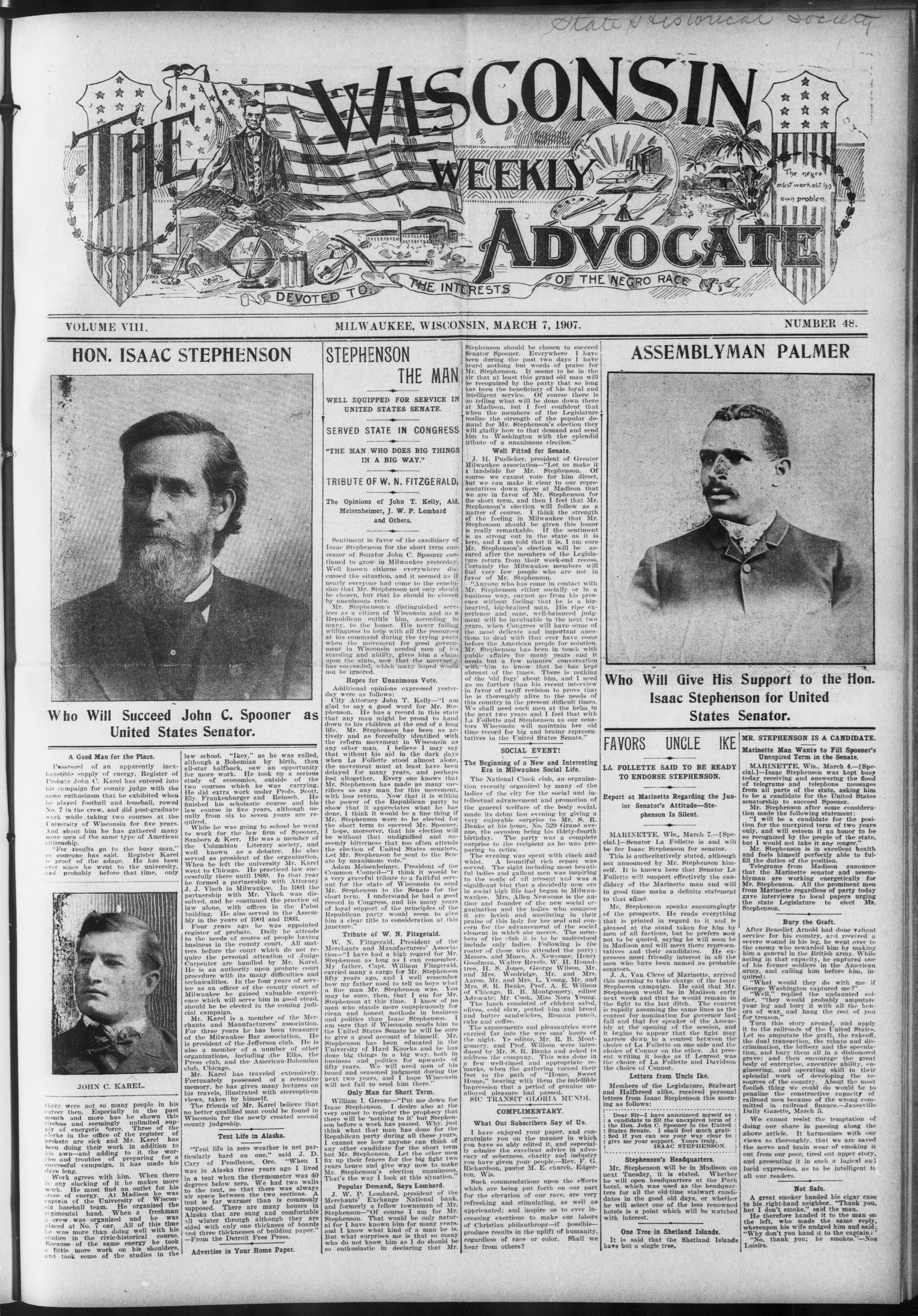
Page text (machine-generated)
WISCONSIN
WEEKLY
ADVOCATE
DEVOTED TO THE INTERESTS OF THE NEGRO RACE
HON. ISAAC STEPHENSON
[Name not provided in the image]
Who Will Succeed John C. Spooner as United States Senator.
VOLUME VIII.
HON. ISAAC
Who Will Succeed
United Sta
A Good Man for the Place.
Pessessed of an apparently inexhaustible supply of energy, Register of Probate John C. Karel has entered into his campaign for county judge with the same enthusiasm that he exhibited when he played football and baseball, rowed No. 7 in the crew, and did post-graduate work while taking two courses at the University of Wisconsin for five years. And about him he has gathered many more men of the same type of American citizenship. "For results go to the busy man," as someone has said. Register Karel is proof of the adage. He has been ever since he went to the university, and probably before that time, only
1910
JOHN C. KAREL
there were not so many people in his career then. Especially in the past month and more has he shown this tireless and seemingly unlimited supply of energetic force. Three of the clerks in the office of the register of probate are sick and Mr. Karel has been doing their work in addition to his own—and adding to it the worries and troubles of preparing for a successful campaign, it has made his days long.
Work agrees with him. When there is any slacking of it he makes more work. He must find an outlet for his store of energy. At Madison he was captain of the University of Wisconsin baseball team. He organized the regimental band. When a freshman a crew was organized and he was placed at No. 7 oar. All of this time he was more than doing well with his studies in the civic-historical course. Because of the same energy he took a little more work on his shoulders, and took some of the studies in the
---
law school. "Ikey," as he was called, although a Bohemian by birth, then all-star halfback, saw an opportunity for more work. He took up a serious study of economics, outside of the two courses which he was carrying. He did extra work under Profs. Scott, Ely. Frankenburger and Reinsch. He finished his scholastic course and his law course in five years, although usually from six to seven years are required.
While he was going to school he went to work for the law firm of Spooner, Sanborn & Kerr. He was a member of the Columbian Literary society, and well known as a debater. He also served as president of the organization. When he left the university Mr. Karel went to Chicago. He practiced law successfully there until 1899. In that year he formed a partnership with Attorney J. J. Vlach in Milwaukee. In 1901 the partnership with Mr. Vlach was dissolved, and he continued the practice of law alone, with offices in the Pabst building. He also served in the Assembly in the years of 1901 and 1903.
Four years ago he was appointed register of probate. Daily he attends to the needs of scores of people having business in the county court. All matters before the court which do not require the personal attention of Judge Carpenter are handled by Mr. Karel. He is an authority upon probate court procedure with its many difficulties and technicalities. In the four years of service as an officer of the county court of Milwaukee he gained valuable experience which will serve him in good stead, should he be elected in the coming judicial campaign.
Mr. Karel is a member of the Merchants and Manufacturers' association. For three years he has been treasurer of the Milwaukee Bar association. He is president of the Jefferson club. He is also a member of a number of other organizations, including the Elks, the Press club, and the American-Bohemian club, Chicago. Mr. Karel has traveled extensively. Fortunately possessed of a retentive memory, he has given many lectures on his travels, illustrated with stereopticon views, taken by himself. The friends of Mr. Karel believe that no better qualified man could be found in Wisconsin for the newly created second county judgeship.
Tent Life in Alaska.
"Tent life in zero weather is not particularly hard on one," said J. D. Cary of Pendleton, Ore. "When I was in Alaska three years ago I lived in a tent when the thermometer was 40 degrees below zero. We had two walls to the tent, so that there was always air space between the two sections. A tent is far warmer than is commonly supposed. There are many houses in Alaska that are snug and comfortable all winter through although they are sided with only one thickness of boards and three thicknesses of building paper." From the Detroit Free Press.
WELL EQUIPPED FOR SERVICE IN UNITED STATES SENATE.
The Opinions of John T. Kelly, Ald. Meisenheimer, J. W. P. Lombard and Others
Sentiment in favor of the candidacy of Isaac Stephenson for the short term successor of Senator John C. Spooner continued to grow in Milwaukee yesterday. Well known citizens everywhere discussed the situation, and it seemed as if nearly everyone had come to the conclusion that Mr. Stephenson not only should be chosen, but that he should be chosen by unanimous vote.
Mr. Stephenson's distinguished services as a citizen of Wisconsin and as a Republican entitle him, according to many, to the honor. His never failing willingness to help with all the resources at his command during the trying years when the movement for good government in Wisconsin needed men of his standing and ability, gives him a claim upon the state, now that the movement has succeeded, which many hoped would not be ignored.
Hopes for Unanimous Vote.
Additional opinions expressed yesterday were as follows:
City Attorney John T. Kelly—"I am glad to say a good word for Mr. Stephenson. He has a record in this state that any man might be proud to hand down to his children at the end of a long life. Mr. Stephenson has been as actively and as forcefully identified with the reform movement in Wisconsin as any other man. I believe I may say that without his aid in the dark days when La Follette stood almost alone, the movement must at least have been delayed for many years, and perhaps lost altogether. Every one knows that Mr. Stephenson has made as many sacrifices as any man for this movement, with less return. Now that it is within the power of the Republican party to show that it appreciates what he has done, I think it would be a fine thing if Mr. Stephenson were to be elected for the short term to succeed Mr. Spooner. I hope, moreover, that his election will be without that undignified and unseemly bitterness that too often attends the election of United States senators. Let Mr. Stephenson be sent to the Senate by unanimous vote."
Adam Meisenheimer, President of the Common Council"I think it would be a very graceful tribute to a faithful servant for the state of Wisconsin to send Mr. Stephenson to the Senate for the short term. I understand he had a good record in Congress, and his many years of loyal support of the principles of the Republican party would seem to give him a clear title to consideration at this juncture."
Tribute of W. N. Fitzgerald.
W. N. Fitzgerald, President of the Merchants and Manufacturers' Association—"I have had a high regard for Mr. Stephenson as long as I can remember. My father, Capt. William Fitzgerald, carried many a cargo for Mr. Stephenson fifty years ago, and I well remember how my father used to tell us boys what a fine man Mr. Stephenson was. You may be sure, then, that I am for Mr. Stephenson at this time. I know of no man who stands more conspicuous for clean and honest methods in business and politics than Isaac Stephenson. I am sure that if Wisconsin sends him to the United States Senate he will be sure to give a good account of himself. Mr. Stephenson has been educated in the University of Hard Knocks and he has done big things in a big way, both in business and politics for upwards of fifty years. We will need men of his broad and seasoned judgment during the next two years, and I hope Wisconsin will not fail to send him there."
Only Man for Short Term
William I. Greene—"Put me down for Isaac Stephenson. I desire also at the very outset to register the prophecy that there will be 'nothing to it' but Stephenson before a week has passed. Why, just think what that man has done for the Republican party during all these years. I cannot see how anyone can think of any other candidate for the short term but Mr. Stephenson. Let the other men fix up their fences for the big fight two years hence and give way now to make Mr. Stephenson's election unanimous. That's the way I look at this situation."
Popular Demand. Says Lombard.
J. W. P. Lombard, president of the Merchants' Exchange National bank, and formerly a fellow townsman of Mr. Stephenson—"Of course I am for Mr. Stephenson. That would be only natural for I have known him for many years, and I know what kind of a man he is. But what surprises me is that so many who do not know him as I do should be so enthusiastic in declaring that Mr.
Stephenson should be chosen to succeed Senator Spooner. Everywhere I have been during the past two days I have heard nothing but words of praise for Mr. Stephenson. It seems to be in the air that at least this grand old man will be recognized by the party that so long has been the beneficiary of his loyal and intelligent service. Of course there is no telling what will be done down there at Madison, but I feel confident that when the members of the Legislature realize the strength of the popular demand for Mr. Stephenson's election they will gladly bow to that demand and send him to Washington with the splendid tribute of a unanimous election."
Well Fitted for Senate.
J. H. Puelicher, president of Greater Milwaukee association—"Let us make it a landslide for Mr. Stephenson. Of course we cannot vote for him direct, but we can make it clear to our representatives down there at Madison that we are in favor of Mr. Stephenson for the short term, and then I feel that Mr. Stephenson's election will follow as a matter of course. I think the strength of the feeling in Milwaukee that Mr. Stephenson should be given this honor is really remarkable. If the sentiment is as strong out in the state as it is here, and I am told that it is, I am sure Mr. Stephenson's election will be assured after the members of the Legislature return from their week-end recess. Certainly the Milwaukee members will find very few people who are not in favor of Mr. Stephenson.
"Anyone who has come in contact with Mr. Stephenson either socially or in a business way, cannot go from his presence without feeling that he is a big-hearted, big-brained man. His ripe experience and sane, well-balanced judgment will be invaluable in the next two years, when Congress will have some of the most delicate and important questions to deal with that ever have come before the American people for solution. Mr. Stephenson has been in touch with public affairs for many years and it needs but a few minutes' conversation with him to know that he has kept abreast of the times. There is nothing of the 'old fogy' about him, and I need go no further than his recent interview in favor of tariff revision to prove that he is thoroughly alive to the needs of this country in the present difficult times. We shall need such men at the helm in the next two years and I feel that with La Follette and Stephenson as our senators Wisconsin will maintain her old time record for big and brainy representatives in the United States Senate."
SOCIAL EVENT!
The Beginning of a New and Interesting Era in Milwaukee Social Life.
The National Cinch club, an organization recently organized by many of the ladies of the city for the social and intellectual advancement and promotion of the general welfare of the body social, made its debut last evening by giving a very enjoyable surprise to Mr. S. R. Banks at his home, No. 529 Grand avenue, the occasion being his thirty-fourth birthday. The party was a complete surprise to the recipient as he was preparing to retire.
The evening was spent with cinch and whist. A bountiful rich repast was served. The sight including most beautiful ladies and gallant men was inspiring to the souls of all present and was a significant hint that a decidedly new era in social high life had begun in Milwaukee. Mrs. Allen Newsome is the author and founder of the new social organization and the ladies who compose it are lavish and unstinting in their praise of this lady for her zeal and concern for the advancement of the social element in which she moves. The members of the club it is to be understood include only ladies. Following is the roster of those who attended the party: Messrs. and Mmes. A. Newcome, Henry Goodman, Walter Revels, W. H. Roundtree, H. S. Jones, George Wilson, Mr. and Mrs. Woolridge, Mr. and Mrs. Aaron, Mr. and Mrs. L. Young, Mr. and Mrs. S. R. Banks, Prof. A. E. Willson of Chicago. R. B. Montgomery, editor Advocate; Mr. Cook, Miss Nora Young. The lunch consisted of chicken salad, olives, cold slaw, potted him and bread and butter sandwiches, Roman punch, cake and coffee.
The amusements and pleasantries were carried far into the wee sma' hours of the night. Ye editor, Mr. R. B. Montgomery, and Prof. Willson were introduced by Mr. S. R. Banks and asked to address the company. This was done in a few well-timed and appropriate remarks, when the gathering turned their feet to the path of "Home. Sweet Home," bearing with them the indelible impression that a period of genuine unallowed pleasure had passed.
SIC TRANSIT GLORIA MUNDI.
COMPLIMENTARY
What Our Subscribers Say of Us.
I have enjoyed your paper, and congratulate you on the manner in which you have so ably edited it, and especially admire the excellent advice in advocacy of soberness, charity and industry you have given your people.—Rev. F. G. Richardson, pastor M. E. church, Edgerton, Wis.
Such commendations upon the efforts which are being put forth on our part for the elevation of our race, are very refreshing and stimulating, as well as appricated; and inspire us to ever increasing exertions to make our labors of Christian philanthropy—if possible—produce results in the uplift of humanity, regardless of race or color. Shall we hear from others?
ASSEMBLYMAN PALMER
Who Will Give His Support to the Hon. Isaac Stephenson for United States Senator.
LA FOLLETTE SAID TO BE READY TO ENDORSE STEPHENSON.
Report at Marinette Regarding the Junior Senator's Attitude—Stephenson Is Silent.
MARINETTE, Wis., March 7.—[Special.]—Senator La Follette is and will be for Isaac Stephenson for senator. This is authoritatively stated, although not announced by Mr. Stephenson himself. It is known here that Senator La Follette will support effectively the candidacy of the Marinette man and will in good time make a definite statement to that effect.
Mr. Stephenson speaks encouragingly of the prospects. He reads everything that is printed in regard to it and is pleased at the stand taken for him by men of all factions, but he prefers now not to be quoted, saying he will soon be in Madison and will meet there representatives and their candidates. He expresses most friendly interest in all the men who have been named as probable senators.
J. A. Van Cleve of Marinette, arrived this morning to take charge of the Isaac Stephenson campaign. He said that Mr. Stephenson would be in Madison early next week and that he would remain in the fight to the last ditch. The contest is rapidly assuming the same lines as the contest for nomination for governor last fall and that for speaker of the Assembly at the opening of the session, and it begins to appear that the fight may narrow down to a contest between the choice of La Follette on one side and the choice of Connor on the other. At present writing it looks as if Lenroot was the choice of La Follette and Davidson the choice of Connor.
Letters from Uncle Ike.
Members of the Legislature, Stalwart and Halfbreed alike, received personal letters from Isaac Stephenson this morning as follows:
: Dear Sir—I have announced myself as :
: a candidate to fill the unexpired term of
: the Hon. John C. Spooner in the United
: States Senate. I shall feel much gratified if you can see your way clear to
: give me your support. Yours truly,
: ISAAC STEPHENSON.
Mr. Stephenson will be in Madison on next Tuesday, it is stated. Whether he will open headquarters at the Park hotel, which was used as the headquarters for all the old-time stalwart candidates in the good old days, or whether he will select one of the less renowned hotels is a point which will be watched with interest.
It is said that the Shetland Islands have but a single tree.
NUMBER 48.
AN PALMER
Support to the Hon.
son for United
Senator.
MR. STEPHENSON IS A CANDIDATE.
Marinette Man Wants to Fill Spooner's Unexpired Term in the Senate.
MARINETTE. Wis., March 4.—[Special.]—Isaac Stephenson was kept busy today receiving and answering the flood of telegrams and telephone messages from all parts of the state, asking him to be a candidate for the United States senatorship to succeed Spooner.
Mr. Stephenson after some consideration made the following statement:
tion made the following statement:
"I will be a candidate for the position for the unexpired term of two years only, and will esteem it an honor to be so recognized by the people of the state, but I would not take it any longer."
Mr. Stephenson is in excellent health and feels himself perfectly able to fulfill the duties of the position.
Telegrams from Madison announce that the Marinette senator and assemblyman are working energetically for Mr. Stephenson. All the prominent men from Marinette regardless of party today gave interviews to local papers urging the state Legislature to elect Mr. Stephenson.
Bury the Graft.
After Benedict Arnold had done valiant service for his country, and received a severe wound in his leg, he went over to the enemy who rewarded him by making him a general in the British army. While acting in that capacity, he captured one of his former soldiers in the American army, and calling him before him, inquired:
"What would they do with me if George Washington captured me?"
"Well," replied the undaunted soldier, "they would probably amputate your leg and bury it with all the honors of war, and hang the rest of you for treason."
Turn this story around, and apply it to the railroads of the United States. Let us amputate the graft, the rakeoff, the dual transaction, the rebate and discrimination, the bribery and the speculation, and bury them all in a dishonored grave; and then encourage the great body of enterprise, executive ability, engineering, and operating skill in their splendid work of developing the resources of the country. About the most foolish thing we could do would be to penalize the constructive capacity of railroad men because of the wrong committed in railroad finance.—Janesville Daily Gazette, March 5.
We cannot resist the temptation of doing our share in passing along the above article. It harmonizes with our views so thoroughly, that we are saved the nerve and brain wear of smoking it out from our poor, tired out upper story, and presenting it in such a logical and lucid expression, as to be intelligent to all our readers.
Not Safe.
A great smoker handed his cigar case to his right-hand neighbor. "Thank you, but I don't smoke," said the man.
He therefore handed it to the man on the left, who made the same reply, whereupon his wife nudged him and said: "Why don't you hand it to the captain:'
"No, thank you; he smokes."—Nos Loisirs.
THE WISCONSIN WEEKLY ADVOGATE.
R. B, MONTGOMERY, Editor and Proprietor.
Curious Condensations.
PEP PPP DPD PDD PPP PDEA IIS
—Samuel Bradbeer, who died at Pit-
minster, Englaud, the other day at S2,
pee sung 70 years in the parish church
choir
—The first coins were struck in brass
abont 1184 B. C., and in gold and_sil-
ver by Pheidon, Tyrant of Argos, about
862 B. C.
-All missionary societies at. work in
Africa have now in round numbers 1000
principal mission stations, with about
5000 substations.
—About 70 A. D. the first glass bot-
tle was made by the Romans, although
the manufacture was not taken up in
England until 1558.
~The population of the United States
is estimated to be 85,000,000, and only
29,000,000 are connected with any church
—Catholic or Protestant.
—Only two American vessels have en-
tered the harbor of Bordeaux in ten
years, and these were private yachts
which sought refuge during the Spanish-
American war.
—A “gang” in which will be included
some of the best known students of the
University of California, has gone to
Arizona to do ordinary laborers’ work as
railroad graders.
—Rey. Alexander Connell, who sueceeds
to Jan Maclaren’s pulpit at Sefton Park,
Liverpooi, has been pastor of Regent
Square Presbyterian church, London,
since 1893. He was born in the Scotch
Highlands just 40 years ago.
—William John Roberts was sent to
prison for fergery in London the other
day. Once he was rich, but his doctors
told him he had only a short time to live
and he squandered his money. He recov-
ered and poverty led him into crime.
—Knighthood was intended to serve as
n mark of distinction for deeds of re-
nown and merit. “Knight” properly sig-
nities a person who, for his virtue and
martial prowess, is raised from the rank
of gentleman into a higher class of dig-
nity and honor.
—At their recent joint meeting the for-
eign mission boards of the United States
and Canada appointed a committee to
investigate the religious conditions of the
130,000,000 people in Russia, with a
view to beginning Protestant mission
work anjoug them.
—It is officially announced in the Cor-
respoudencia de Espana that _tifteen
civilians were killed and seventy injured
by the bomb outrage in the Calle Mayor.
In the body of the horse which was
killed while drawing the royal coach
twenty-three bullets were found.
—Twenty years ago a German publish-
er began to issue a complete collection
of Goethe's letters. Thirty-four volumes
are now in type, and it is expected that
the rest of the letters, which will fill
fifteen more volumes, will appear within
four years, ef
—Dr. W. C. Farabee of the anthropo-
Jogical department at Harvard univer-
sity, with three students, will next year
conduct a research expedition about the
head waters of the Amazon. For a time
a base will be established at Arequipa,
Peru. The party will be gone three
years.
—New York city consumes nearly 1000
million units of electricity per annum,
while London, with nearly double the
population, Consumes not more than one-
fourth of that amount. The consumption
per head of population in New York is
stated to be 282 units, against only 42
per head in London.
—One of the most remarkable incidents
of the great fire in San Francisco was
the immunity from damage of an old |
wooden shack owned by a paint com
pany, at the corner of Main and Harri-
son streets. The ramshackle, half-cen-
tury old building stands unharmed, a
little island in a sea of desolation. It
reeks with oil and is filled with highly
inflammable materials. Near to it a
zreat pile of coal caught fire and burned
for nearly a week.
—For some time after the word “papa”
was taken into the English language, in
the seventeenth century, it was restrict-
ed to courtly and polite speech and was
common even among adults. Long after
it had become childish it was still ac-
counted genteel, Hood wrote of one who
was “genteelly taught by his mamma to
say, not father, but papa.” “Papa” may
he comparatively a newcomer into the
English language, but it is as old as
Homer. Nausicaa in the “Odyssey,”
calls her father “papa phile’’—dear papa.
—The cotron zone ot Argentina lies
chiefly north of the thirty-third parallel
of south latitude and comprises about
375,000 square miles, being greater in
extent than all the Gulf states of the
United States, including Georgia and
South Carolina, Although not more
than half of this territory is suitable
for growing cotton by reason of altitude
und climate yet there are at least 150,-
000,000 acres of cotton land, much of
which, under skillful management, is ca-
pable of producing excellent crops of
cotton.
—One of the baseball enthusiasts who
do their rooting in front of the Park
Row scoreboards is a Chinese, who is
here every day the scorers are working.
One man, whose curiosity was aroused
by the nationality of the enthusiast, fol-
lowed him home one day and found that
he was on the staff of a Bowery laun-
dry, a few blocks from the bridge. No-
hody ever saw this Chinese crank do any
voeal rooting, but he stands in front of
the boards for two hours at a time and
never goes home until the last run is in.
—New York Sun.
Harvest Crops Every Month.
Those of our readers whose farms
are In the Northern section and where
the growing season is short are sure to
be interested in the most fertile section
of the whole United States, where land
is now offered in small lots on such
terms that almost anyone can buy.
We refer to lands in Oklahoma, Tex-
as, Indian Territory, Arkansas and al!
the great Southwest, where 1,000,000
acre ranches are being divided up into
farms and are offered for sale by J. T.
Thorapson, 400 Marquette Building,
Chicago.
This land Is deep and rich and the
growing season covers almost twelve
months in the year. Northern farmers
have long had an envious eye on these
great ranches, but only recently has it
become possible for them to secure
holdings in this land of opportunity
and big profits.
If you are interested in a farm so
fertile that it is a veritable gold mine,
in a country where you can live out-
doors all the time, and at a price which
almost anyone can afford, you should
address J. T. Thompson, 400 Marquette
Building, Chicago, for booklets, easy
terms and all information.
A DREAM OF SUMMER.
Bland as the morning breath of June
The southwest breezes play;
And, through its haze, the winter neon
Seems warm as summer's day,
The snow-plumed angel of the North
Has dropped his icy ee;
Again the mossy earth looks forth,
Agzia the streams gush clear.
The fox his hillside cell forsakes,
‘The muskrat leaves his nook;
The binebird in the meadow brakes
Is singing with the brook.
“Bear up, O mother Nature!” cry
Bird, breeze and streamlet free;
“Our winter vo.ces prophesy
Of summer days to thee!”
So, in those winters of the soul,
By bitter blasts and drear
O'erswept from memory’s frozen pol»,
WIL sunny days appear,
Reviving hope and faith, they show
The soul its living powers.
And how beneath the winters’ snow
“Lie germs of summer flowers!
The Night is mother of the Day,
‘The Winter of the Spring;
And ever upon old Decay
The greenest mosses ¢ling.
Behind the cloud the starlight Jurks,
‘Through showers the sunbeams fall;
For God, who loveth all His Works,
Has left His hope with all!
—John Greenleaf Whiitie
THE PATH OF GLORY.
praised him: and when his landlady
came one evening to say George Parsons
had called, Mr. Tift said, “Show him in,”
thinking that the poor fellow, very
properly, wished to express his grati-
tude.
What puzzled Mr. Tift at first was
that the man was so altered he seareely
knew him; but then he had only seen
him once in the dark, when he was drip-
ping wet, and twice at the police court,
when he was in the dock.
“Well.” he cried genially, “you're out,
eh?—and feeling like yourself again, i
hope?”
“Do I look it?” demanded George un-
graciously. iS
“You—you've shaved your——
“They done that in quod, and a pretty
sight it’s made me. Took me a lifetime
to grow that beard. it did. and me old-
est friends can’t reckonize me without
we still,” Mr. Tift. spoke soothingly,
“you're alive; that’s one good thing,
isn’t it?” 5
“Not for me!” growled George, sig-
nificantly. oA
“Don't say that!” pleaded Mr. Tift.
“Life is sweet——”
“Oh. is it!” George interrupted tetch-
ily. “Then what do you suppose I
jumped in the river for?” : ;
Mr. Tift was a diffident, simple little
man, and George bewildered him.
“Falk aobut liberty,” George sneered
truculently; “a man can’t even drown
hisself in this blighted country!”
“But, my man, it was fer your ben-
efit.”
“['ve spoilt me clothes with the wet.
done ten days, had me whiskers wiped
orf an’ me hair cut to the bone,” George
became sareastic; “that’s the benefit
I've had. But the papers call you the
Heroic City Clerk, an’ some benevolent
old mug sends three five-pun notes to
the magistrate for you, and I hear that
there Royal Human society’s givin’ you
a medal.”
“I risked my life, though—”
“So did I. And you couldn’t have done
it if it hadn’t bin for me. Where do T
come in? l’ve had all the inconvenience
and you've got all the money.”
“Really!” Mr. Tift stammered, aghast.
“I never did——”
“L wasn’t drowndin’ myself just to
put money in your pockets, and make
you a hero. We might both have been
drownded. mightn’t we? Well, then, ’'m
as much entitled to that medal and that
money as you are.”
“It’s the most impudent——”
“Look here! If 1 go without a fiver,
T go to them newspapers that inter-
viewed you, an’ tell ‘em it was a put-
up job.”
“A—a what?”
“A little game between you and me to
see what we could make, and you've
collected the brass and stuck to the lot.”
“But that’s not true!” gasped Mr.
Tift.
“That’s why people’ll believe it, an’
yowll git no medal, and it'll do you
more’n five quids’ worth of harm.”
Mr. Tift made a moving appeal to his
better feelings, but George didn’t seem
to have any; he put on his hat with a
determined air, and Mr. Tift lost heart,
and before he found it again George and
a £5 note had gone together.
Mr. Tift said nothing about it. but it
rankled; somehow, it made the whole
event sordid and himseif ridiculous; and
when two evenings later his landlady
announced George Parsons again he
said indignantly, “Send the fellow
away,” then repented weakly, fearful of
consequences, and called her to show
the man in, ci
She did, and to Mr. Tift’s amazement
it wasn’t the same George he saw last
time. He recognized this one immediate-
ly, for he was still wearing all his whis-
kers.
“I come in, sir,” he said, meekly, “to
say I'm out, and thank you kindly, all
the same, becos, of course, sir, it’s no
fault of yours if I’ve lost by it———”
“Lost?” ejaculated Mr. Tift. “What
have you lost?”
“Everything, sir,” he said, with pa-
thetic resignation.
“Look here!!” eried Mr. Tift desper-
ately. “Didn’t I save your life?”
George smiled tolerantly.
“Bless yer, mister, I’m a champion
swimmer,” he said, “an’ used to have
two gold cups on the sideboard till I
went. broke an’ pawned ‘em. Swim-
min’s second nature to me. But you
meant well, sir, and I don’t complain.
Me bein’ charged with attempted sui-
cide, though, seems to have put the idea
into me head, and I sort of feel now
that I'd better do it.”
“Nonsense, my good man!”
“Well, guvner, I've lost my job. It’s
a jam factory, and after them Chicago
scandals they won't risk havin’ a at-
tempted suicide about who might take
a faney to a vat full of good jam an’
spoil it.’ He rose with a sigh.
~But—but, man, how can you——”
“1 think I could, sir, if I tied me legs
first, an’ filled me pockets with stones.”
Mr. Tift pointed out the madness and
wickedness of this, and in an excess of
irritability, went on to explain about the
visit of the other George Parsons, to
which explanation the real George lis-
tened with virtuous and explosive in-
dignation.
“Five pounds! He’s cheated us both,
guvner, and—. Still, you’ve kept ten,
and the medal: Don’t tell anyone I
called to say I was grateful, and what I
was goin’ to do to meself. If it got in
the papers it might look as if you hadn't
put up/yer hand to stop me, and that'd
be narsty. Well, good night, sir.” .
Mr, Tift was panic stricken.
“But you're not to do it, I tell yout”
he raged. “If a sovereign’s — any
gond——””
“No, sir. The medal and the money’s
yours. Besides, I owe my Jandlord one.
Sixteen, six, and——”
“Here! Then three—will three do?”
George faltered, struggling with his
nobler self. Life is sweet, and his nat-
ural love of it was evidently getting the
best of his pride, when Mr. Tift ended
the contest by thrusting three sovereigns
into his fist. and shutting him out be-
fore he could conquer his “emotion and
return them.
He was scarcely gone, however. when
an idea ocewred to Mr. Tift, and he
slipped into the street and gave chase.
When he turned the corner the second
George. a few yards ahead of ‘him, was
no longer alone. He and George the first
were sniggering there together in a way
‘that Mr. Tift. resented.
| But they did not stay to explain.—
“A. Saint John Adcock in the Manchester
Chronicle.
. Household Hints.
Furniture Polish—Mix equal parts of
alcohol, olive oil and cider — vinegar.
Shake ‘well, apply with a woolen cloth
and polish with a second piece.
To Remove Iron Rust.—When a spot
of iron rust appears on table or bed linen
wet it well with lemon juice and spread
with salt, then place in hot sunshine.
Hanging Small Pictures—When no
screw eyes are on hand a substitute can
be made by driving a donble — pointed
tack on each side and inserting the wire
or cord as usual. Hemp twine is better
for many pictures than glittering | gilt
wire, which distracts the eye, especially
if the picture is hung low. The twine is
less valuable and is strong enough for
small framed pictures.
Dents in Floors—When a heavy piece
of furniture is moved across a hard pine
floor it may Jeave a mark to show its
course. To remove this lay a wet cloth,
‘doubled several times, over the place,
‘and set a hot iron on. As soon as the
cloth is dry take up the iron and the
steam will have raised the fibers of the
wood. The treatment may have to be
repeated once or twice.
Paint Pots and Brurhes.—In_ every
house there are little da}. of paint left
from the minor repairs ‘uat are made.
Quite often these and the brushes are
lost. because they are allowed to dry.
Put brushes into a tin fruit can and fii:
it with water; also pour water an inch
deep on the paint, which will be pre-
served, Pour off the water at any Ome
and the paint is ready to use.
For White Spots on Wood.—tTliese
spots cannot be taken out all at once,
but a treatment to be followed several
days in succession is as follows: Make
several small balls of cotton batting and
tie each in a piece of clean soft linen.
Dip one in # mixture of seven-eighths
boiled linseed oil and one-eighth alcohol,
rub the wood for several minutes with
it and repeat with a fresh cotton ball
for several days.
Staining Old Floors—Sometimes a
good floor has been abused by driving
in large tacks to hold rngs in_ place.
Later when the floor is to be redressed,
these small holes disfigure the surface
and must be filled. For this purpose
get some putty and work into it enough
oil stain, or wood dye, to make it of
the same color as the floor: then fill
holes and scrape smooth with a putty
knife. The surface will look uniform
when treated with stain; otherwise the
uncolored putty will show through and
be as much of a disfiguration as the
holes. If spots of white or other paint
from the walls have been spattered and
allowed to harden on the floor they must
be scraped off and each spot, if it shows
light-colored, brushed with a little stain
before the whole coat is given.
LILLIAN MASON.
oor a genes
He Wonld_
Luther Burbank, the plant — wizard,
showed last month to the students of
Stanford university an apple that was
sweet on one side and sour on the other.
“This apple shows us,” Mr. Burbank
said, “how different treatments will have
different effects. It shows how environ-
ment causes the most radical changes.”
Tle smiled.
“As in apples, co in men,’ he said.
“There used to live in Santa Rosa a
good, kind man, but unfortunately he
married a shrewish wife, and the woman
changed his nature.
“One morning, after his wife had
called him a good-for-nothing loafer and
snatched his breakfast away, he started
off, hungry and sore, for work.
“A sour-looking woman entered the
car he was on. She got into a violent
dispute with the conduetor over her
change. Finally, red with rage, she
looked about her and said:
“Is there a gentleman in this car
who will stand by aud see a lady in-
sulted?
“The hungry man whose nature had
been spoiled rose eagerly.
“Yes, madam,’ he said, ‘I will.” "—
Minneapolis Journal.
——
Grudge Against Columbus.
The late Bishop MeCabe related the
following story about an incident in
which he participated:
“Once upon a time I was in a railroad
accident. It was one of the only two
I have ever experienced and I have
traveled more than 750,000 miles on
trains and steamers. A broken wheel
threw the train off the track. Behind
us as we left the car came a_noble-
looking English woman with her hus-
band by her side. She was scolding him
well for starting on -their journey on
Friday.
“IT told you, James,” she said, ‘that
something would happen if we should
start on Friday.’
“*Madam,’ said I, ‘do you know that
Columbus set sail to discover America
on Friday?
“She looked at me with indignation
and said:
“ ‘Sir, in my opinion it is a great pity
that America was ever discovered at
all.’”"—Northwestern Christian Advo-
cate.
—_————_____
To Restrain Massachusetts Hunters.
A number of sportsmen from western
‘Massachusetts attended the hearing at
the State House today given by the com-
‘mittee on fisheries and game.
_ The men appeared in favor of bills to
‘prohibit the shooting of the loon, the
eagle and the black back and heron gulls,
also for the licensing of hunters, under
penalty of $50 for hunting without li-
cense.
It was urged that the eagle was an
attraction in the Berkshire hills and
was useless when dead, while the cry of
the loon was pleasing to the tourist and
the gulls were the best scavengers along
the shore.
—————_-
Advertise in Your Home Paper.
;
MEN OF PROMINENCE.
ga eg Ok igen a at aed ae See oe
| an old Devonshire family, his father, the
late John Bond, a native of Torquay,
having conducted an extensive merean-
tile business in St. John’s for more than
half a century.
| Sir Robert was educated for, the. bar,
but entered polities and distinguished
himself moa very short time. He was
speaker .of the house of assembly in
1884 and executive councillor, with the
portfolio of colonial secretary, 1889-07.
| lie has been on all the important con:-
mittees for the consideration of the
French shore and the Newfoundland
fisheries questions, besides having neso-
tiated the famous Bond-Blaine conven-
tien with the United States.
He was knighted in 1901 on the ecca-
sion of the visit of the Duke and Duch-
ess of Cornwall and York to Newiound-
land.
| PRINCH FERDINAND, the present
panes of Bulgaria, was born February
26, 1861. He is the youngest son of
| Prince Augustus of Saxe-Coburg and
Gotha and Princess Clementine of Bour-
bon-Orleans, who died a week or so
ago.
Ferdinand was elected Prince of Bul-
garia by unanimous vote of the National
| assembly, July 7, 1887, and assumed the
| goverstacent August 14, 1887, in succes:
sion to Prince Alexander, who had ab-
j dicated September 7, 1886. His election
was confirmed by the Porte and the
|zreat powers in’ March, 1896. Since
| ouine to the throne Prince Ferdinand
has had a hard time of it trying te
jplease Russia and Austria, both of
j whieh powers desires its influence to
| be paramount in the affairs of the Da-
|nubian principalities.
By severing his connection with the
Roman Catholic church and having his
heir, Prince Boris, baptized in the so-
called Orthodox or Greek church, Fer-
dinand won the approval of the Czar,
but at the same time estranged the Em-
peror Francis Joseph of Austrian. ‘This
Was some seven or eight years ago and
it was only recently that be succeeded
in resuming friendly relations with Aus-
tria.
Ferdinand’s greatest wish is to have
Buigaria recognized as an independent
kingdom, but so far the powers have not
seen fit to gratify his longing.
THOMAS W. LAWSON, of Boston,
high priest of finance_and arch-enemy
of “the system.” was 50 year old Feb.
26. Mr. Lawson held no special observ-
ance of the anniversary, being kept pret-
ty busy lately explaining the future
thovements of his copper stocks, To a
}number of his friends who calied to con-
[gratulate him Mr. Lawson remarked
j that he was still a comparatively young
man and had every expectation of living
to see the day when the Standard Oil
a of finance shall have shut up shop.
| MISS ELLEN TERRY, the celebrat-
ed English actress now touring America,
was born at Coventry, February 27,
1855. and made her first appearance on
the stage under the management of Mrs.
Charles Kean. After leaving the man-
agement of the Keans Miss Terry filled
small engagements at several London
jtheaters. Then followed a short engage-
ment at the Queen's theater, playing in
~The Taming of the Shrew,” and acting
for the first time with Eienry Irving.
Leaving the stage for seven years she
returned to the Queen's theater, making
her reappearance in’ Charles Heade's
“Wandering Heir.” Then followed en-
gagements with Mr, Bancroft and Join
Hare. On Mr. Irving taking the man-
agement of the Lyceum theater in Lon-
don, he was enabled to secure the serv-
ices of Miss Terry, who made her first
appearance at that theater on Decem-
ber 30, 1878, playing Ophelia to the
Hamlet of Mr, Irving.
Miss Terry remained with Mr. Irving
until a year or two before the latter's
death and shared equally in the great
fame won by their appearance in the
plays of Shakespeare, In company with
Mr. Irving Miss Terry made her first
tour of the United States and Canada in
1883.
CONGRESSMAN JULIUS KAILN-
of California, who is probably the fore-
most advocate of a Japanese expulsion |
act, was born in the Grand Duchy of
Baden, February 28, 1861. Though still
a comparatively young man he has had _
a most interesting, career. Previous to |
entering public Jife Mr. Kahn had
earned a somewhat high reputation as
an actor. He was taken to California |
by his parents when he was but a few
years old and his education was received |
in the public schools of San Francisco. |
After leaving school he entered the_
theatrical profession. He remained on |
the stage several years. during which
time he played with Edwin Booth, Clara
Morris, Joseph Jefferson, ‘Tomasso Sal-
yini and other eminent actors and ac-
tresses. Deciding to abandon the stage
in 1890 Mr. Kahn returned to San Fran-
cisco and began the study of law. Two
years later he was elected to the state
Legislature, which marked the beginning
of his public eareer.
In 1899 he was nominated by the Re-
publicans and elected as_ the represen-
tative of the Fourth California district
in Congress. He was re-elected in 1903.
and again in 1905. a
WILLIAM DEAN HOWELLS, one
of the foremost of American authors of
today, was born. at Martinsville, O.,
March 1, 1837. In 1840 he removed to
Hamilton, O., with his father, who was
a printer and journalist.
He learned the printer's trade of his
father, and was afterwards editorially
connected with newspapers in Cincinnati
and Columbus. From 1861 to 1865 he
was United States consul at Venice.
Returning to America_he engaged in lit-
erary work, and in 1871 became editor of
the Atlantic Monthly, a position which
he retained antil 1880, when he re-
linguished it to devote himself exelusive-
ly_to writing. .
In addition to bis many successful.
j novels, Mr. Howells has written a num-
ber of biographies. criticisms and works
on literature. All his writings have been
extensively cireulated in England, where,
of late years, he has hecome as well
known as in his own country.
REV. SETH W. FORD of Oconto,
Wis., reached bis ninety-second _birth-
ilies” Fekete re Sg tet Tae) ii
1880 President Hayes sent him to Ttussizt
in the same capacity, and in 1885 he
was sent to Madrid by President Arthur.
He has served the Unitéd) States on
several special missions abroad. fn 1891
President Harrison selected him to_neso-
tiate treaties of reciprocity with Spam,
Germany and other countries. He suc-
cecded James G. Blaine as secretary of
state in the Harrison cabinet in 1su2.
Gen, Foster is a great iavorite with
the Chinese government and his services
as a diplomatist in one instance were
rewarded by a fee of $100,000 from
China. Hé is the author of a number of
authoritative works on international Jaw
aud the usages and customs of diplo-
macy.
ALEXANDER GRAIIAM BELI.
the inventor of the telephone, was born
in Edinburgh, Scotland, March 3. 1847.
and received his education at Edinburgh
and in London university. (In 1870 he
emigrated to Canada, and the following
year removed to Boston, where he be-
came professor of vocal pliysiology in
Boston university,
Prof. Bell displayed inventive genins
early m_ his career and when a mer:
boy in Edinburgh he succeeded in mak-
ing a machine that imitated the human
voice in a crude way. His first patent
for the telephone was granted February
14, IS76.
His other inventions include the photo-
phone, induction balance and telephone
probe for painless detection of bullets in
the human body. In recent years Prof.
Bell has devoted much time and atten-
tion to experiments with aeroplanes.
NO LONGER CHEAP.
“Twixt all supplies there seems a race
To reach the top-notch first;
‘The cost of living grows apace,
And now we have the worst!
It almost makes the nation weep,
‘This rise of one sad day,
For even talk’s no longer cheap—
The Senate's raised its pay!
-Karle Hooker Eaton, in Harper's Weekly
——————
Millionaire Quits; Has Enough Money.
Edward M. Higgms, vice-president of
the Chicago board of trade, and regarded
as the most expert judge of grain in the
world, announced his retirement at the
age of 45, on the unique ground that he
has enough money.
While compere rely young, in the fut
enjoyment of health and having reached
a commanding position in trade whieh
would enable him to amass millions, le
has withdrawn deliberately from the fas-
cinating game of money getting for the
simple reason that he has-enough.
Mr. Higgins has given an exact defini-
tion of “enough”—a word which seems to
have no pace in the golden lexicon of
modern fortune builders. With him
“enough” means $5,000,000.
When he became a member of the
board of trade, in 1880, he set a definite
limit to his financial ambitions. He de-
clared then at his entrance to business
life that if he ever made $5,000,000 he
would retire. Recent ventures in the
wheat pit brought his fortune up to the
limit he had set, and he quit.
a eerie aaieacigiaiecne eben
An Old Homestead Incident.
A wealthy New York banker says the
Philadelphia Record, while visiting his
parents in a small town, was stricken
with fever. For three months he was
confined to the old homestead, dutifully
attended by a fond mother and a very
zealous doctor.
The banker recovered slowly. One
morning he decided that fresh air would
do more for him than medical environ-
ment, and in a short time he was en-
abled to dismiss his physician.
When the doctor's bill arrived the
banker studied it very closely. A few
moments later the mother saw her son
go to the woodsiied, procure an axe and
begin hewing at the post, which had
stood in front of the house for fifty
years.
“Frank!” she shouted hysterically, be-
lieving her son in another delirium,
“what are you doing?”
_ “You'll have no further use for it,
chuckled the perspiring banker “Here-
after the doctor will come in an automo-
bile.”
Couldn’t Tell Which.
Smith had come home later than usual,
and had ready a good explanation, but
his wife gave him no chance, and im-
mediately began to tell him what she
thought of him. He endured it patiently
all evening, quietly read his paper, and
went to bed. His wife was still talking.
When he was almost asleep he could
hear her still scolding him unmercifully.
He finally dropped off to sleep, and
awoke, after a couple of hours, only to
hear his wife remark:
“I hope all the married women don't
have to put up with such conduet as
this.”
“Annie,” said Smith, “are you talking
again or yet?’—Harper’s Weekly.
—————————_§|__—
BRur Prices Will Go Tn.
The fur eatch in Alaska this year will
be one of the smallest in recent years,
owing to the exceedingly heavy fall of
show.
The trappers complain that snow has
fallen almost every night during the
present winter, making their traps as use-
less as though they had been sprung.
Upon visiting the traps in the morning
trappers often discover them buried sey-
eral inches deep in snow.
Reports from the northern wilds in
the early part of the season showed fur
bearing animals of all descriptions to be
very plentiful, and a good season wouid
have resulted with a normal fall of
snow. No doubt prices will go up.
———————
The Elm Incident.
Washington was taking formal com-
mand of the Continental army at Cam-
bridge. He crooked his arm, placed his
elbow against the historic elm and rest-
ed his head on his hand. Then he ad-
dressed the ill-assorted gathering of pa-
triots. In the midst of his remarks his
elbow suddenly glided from the tree and
Washington completely lost his equili-
brium.
“Why didn’t you inform me.” said the
great general with dignity, “that this
tree was a slippery elm?’—Perrine Lam-
bert in Woman's Home Company.
———___
A Sorry Prospect for the Future.
Dupre had been rather a naughty boy
on the street car, and after they reached
home his mother corrected him in the
good old-fashioned way, though not any-
thing like so severely as he imagined.
“Now, Dupre,”’ she said, “I hope you
will remember what happens when boys
do not obey their mothers, and next time
we are on the cars that you will sit
quietly, as mother tells you.”
“Yes, m-m-mother,” he sobbed. “I
w-will if I am ¢-e-ever able to s-s-sit
down anywhere a-a-again."—W. L. Ag-
new in Woman's Home Companion.
—_———_—_-_____
Heals Wounde hv West
Observing in the tropics now the in-
tense heat of the sun accelerated the
healing of wounds and burns a French
physician, Dr, Asbeck, used the heat of
orearaey fire in 500 cases of burns and
wounds, after pee on the usual
‘dressing. and with uniform success.
, ———
| Spend Fortune for Soap.
One railroad alone spends $160,000 a
‘year to supply soap to the washrooms in
‘its coaches.
CHILDREN TORTURED.
Girl Had Running Sores trom Ecze-
ma—Boy Tortured by Poison Oak
—Both Cured by Cuticura.
“Last year, after having my little
girl treated by @ very prominent phy-
sician for an obstinate case of ec-
zema, I resorted to the Cuticura Rem-
edies, and was so well pleased with
the almost instantaneous rellef afford-
ed that we discarded the physician's
prescription and relied entirely on the
Cuticura Soap, Cuticura Ointment and
Cuticura Pills. When we commenced
with the Cuticura Remedies her feet
and limbs were covered with running
sores. In about six weeks we had her
completely well, and there has been no
recurrence of the trouble.
“In July of this year a little boy
in our family polsoned his hands and
arms with poison oak, and in twenty-
four hours his hands and arms were
a mass of torturing sores. We used
only the Cuticura Remedies, washing
his hands and arms with the Out!cura
Soap, and anointing them with the
Cuticura Ofntment, and then gave him
the Cuticura Resolvent. In about three
weeks his hands and arms healed up.
So we have lots of cause for feeling
grateful for the Cuticura Remedies. We
find that the Cuticura Remedies are a
valuable household standby, living as
we do twelve miles from a doctor. Mrs.
Lizzie Vincent Thomas, Fairmont, Wal-
Asante RidAce Tenn. Oct. 13. 1905”
ANCIENT SKULL UNEARTHED.
Pre-Roman Burial Urn Dug Up at
Southwark.
A skull, considered by a member of
the British Archaeological association to
be ancient British, and a pre-Roman
burial urn have just been dug up in
Kent street, Southwark. It was buried
at a considerable ‘epth. Other finds at
the same pe during the p Srenent exca-
vations include coins of Nero, Tiberius
and Vespasian, and, nearer the surface,
“abbey money” and coins and tokens of
the Stuart and Commonwealth period.
——<—<—<—_—_$———_
IN LOVE WITH “CENTRAL.”
Bank Cashier at Boyd, Wis., Marries
Long Distance Telephone Girl.
A romantic Ore comes from Boyd,
Wis., concerning the marriage of Miss
Eleanore L. Khal, long distance operator
for an ee telephone company,
to C. L. Nelson, cashier of the state
bank at Boyd. The acquaintnance is
said to have begun when Mr. Boyd
wanted telephonic connection with Mil-
waukee, and became enamored of the
sweet voice of “Long Distance.”
Fisherman at 87.
On January 16 Capt. Theophilus W.
Brackett, one of Swampscott’s oldest
citizens and its oldest fisherman, will
be 87 years of age.
Capt. Brackett carries on his fishing
business just as he did when younger.
It matters not to him what the weather
{s. Hot or cold he can be seen every
morning pee off from the beach in
his dory, to pull his trawls. He always
pn alone, and the chances are good that
@ will bring back more fish than any-
body else.—Boston Globe.
ieee eer ee
Burglars Galore in New York.
There are between 10,000 and 11,000
professional thieves in New York city,
and several hundred thousand amateurs
who only steal when opportunities are
offered.
eeecacipliee tba
MORE BOXES OF GOLD
a eee eee
| 325 boxes of Gold and Greenbacks
will be sent to persons who write the
‘most interesting and truthful letters of
experience on the following topics:
1, How have you been affected by
coffee drinking and by changing from
coffee to Postum?
2. Give name and account of one or
more coffee drinkers who have been
hurt by it and have been induced to
quit and use Postum.
3. Do you know any one who has
been driven away from Postum be
cause it came to the table weak and
characterless at the first trial?
4. Did you set such a person right
regarding the easy way to make it
clear, black, and with a snappy, rich
taste?
5. Have you ever found a better way
to make it than to use four heaping
teaspoonfuls to the pint of water, let
stand on stove until real boiling begius.
and beginning at that time when actual
boiling starts, boil full 15 minutes more
to extract the flavor and food value.
(A piece of butter the size of a pea
will prevent boiling over.) This con-
test 1s confined to those who have used
Postum prior to the date of this adver-
tisement.
Be honest and truthful, don’t write
Poetry or fanciful letters, just plain,
truthful statements.
Contest will close June ist, 1907, and
no letters received after that date wil!
be admitted. Examinations of letters
will be made by three judges, not mem-
bers of the Postum Cereal Co., Ltd.
Their decisions will be fair and final.
and a neat little box containing = $10
gold piece sent to each of the five writ-
ers of the most interesting letters,
box containing a $5 gold piece to each
of the 20 next best, a $2 greenback to
each of the 100 next best, and a $1
greenback to each of the 200 next best.
making cash prizes distributed to 325
persons.
Every friend of Postum is urged to
write and each letter will be held in
high esteem by the company, as an ev!-
dence of such friendship, while the
little boxes of gold and envelopes of
uoney will reach many modest writers
whose plain and sensible letters contain
the facts desired, although the sender
may have but small faith in winning
at the time of writing.
Talk this subject over with your
friends and see how many among you
ean win prizes. It is a good, honest
competition and in the best kind of 2
cause, and costs the competitors abso-
lutely nothing.
Address your letter to the Postum
Cereal Co., Ltd, Battle Creek, Mich.,
writing your own name and address
clearly.
GOSSIP FOR THE LADIES.
Love's Penalty.
Loves Penalty
If Love should count you worthy and should deign
One day to seek your door and be your guest
guest.
Pause! ere you draw the bolt and bid him rest.
If in your old content you would remain.
For not alone he enters; in his train
Are angels of the mists, the lonely guest.
Dreams of the unfulfilled and unpossessed.
And sorrow, and Life's immemorial pain.
He wakes desires you never may forget.
He shows you stars you never saw before.
He makes you share with him forever more.
The burdens of the world's divine regret.
How wise were you to open not—and yet.
How poor if you should turn him from the door.
—Sydney Lysaght in Exchange.
Woman's Reasoning.
I<sub>0</sub> is a singular fact, affording occasion for interesting speculation, that in the extraordinary intellectual development of woman which has taken place in the past century casuistry seems to have been and still is to be ignored by tacit assent. We use the term, not in its corrupted or secondary sense as indicating a mere method of sophistical and unduly subtie reasoning, but in its original meaning as signifying the science which guides the human conscience in the performance of its duties. For this task the feminine mind, as generally understood by the judgment of man, seems to possess peculiar adaptation—a fact clearly recognized by the ancients, who added "casuistess" to their vocabulary simultaneously with "casuist;" but there is no record of a woman having justified the theory; even while the science held widest vogue, and the word has now become so nearly obsolete as to be hardly found in any of our modern dictionaries.
The natural deduction would seem to be that some peculiar quality of the feminine mind constitutes a practically insurmountable obstacle to really efficient training in the art: and, frankly, while we hesitate to accept so distasteful a conclusion not fully enforced by evidence, we must admit that personal observation tends to confirm that view. We know many women whose faculties easily permit of primary reasoning, but almost invariably when hard pressed they reach a point where the logical faculty gives place to impatience at what is regarded as captious contradiction, and instinct prompts a quick leap over intervening obstacles to a congenial conclusion. The goal often is the same as that reached by the slower and more guarded processes of close mental application, but demonstration that it is indeed the true one necessarily rests solely upon the hypothesis of intuitive accuracy.
To this seeming deficiency, we suspect, must be attributed the common—by which we mean vulgar—remark that a woman's argument is restricted to the word "because." Such an assertion is, of course, a gross exaggeration, cynical to a degree and unworthy, from its very lack of qualitative discrimination, of one making the slightest pretense of sincerity. It is true, undoubtedly, that woman's inferences are drawn more frequently from inner consciousness than from the careful consideration of commonplace facts, such, for example, as have been established by wearisome statistics, but this is due less to her dearth of knowledge than to her abundance of information, which has so wide a range that specific application of any portion of it to the solution of a definite question irritates the mind much as a plaster of mustard inflames a constricted section of the body. After all, in such cases, results alone deserve serious consideration and we have no hesitation in asserting the supremacy of the feminine deduction, in so far, at least, as any problem of morals or conscience is concerned.—George Harvey in The North American Review.
What One Woman Did.
Mrs. Adele French has won a place for herself in the nation's archives, and, being a woman, she won it by doing something out of the ordinary—something different from anything a man would do. Mrs. French's home is in South McAleron, I. T., but just now she is in Lawton, Ok., perfecting her title to the quarter section of land awarded her by the government in the "Big Pasture," just opened to settlement. The outward and visible proof of Mrs. French's right to a place in history takes the shape of the largest and most comprehensive bid for public land ever received by the government, and it must be accepted as a monument to the natural thoroughness that has come to be a characteristic of the women of today. Mrs. French saw, as hundreds of other people saw, in the opening of the Big Pasture to settlement, an opportunity to become a land owner, and she proceeded to take advantage thereof. She knew she wanted a piece of that particular section of the earth, and she didn't propose to let any little slip or oversight prevent her from securing it. She made a thorough inquiry into the situation and conditions, and then she went to work according to a plan uniquely her own. She formulated a bid for a farm in the "Big Pasture" so extensive and so comprehensive as to actually cover every tract of land in the entire reservation. Now, of course, she had no idea of securing all this land; she is no monopolist; but she wanted to be sure of getting at least one quarter section, and she saw sure success in laying her plans as the old darkey set his coon trap—"to catch him a-goin' an a-comin'"—so that there should be no chance of her missing out. It must have been a work of great patience as well as an exhibition of industry and determination. That bid was almost a "paralyzer" for the officials who had to examine it, as one of them expressed it, but it was found to be in due form and strictly in accordance with the requirements of the prescribed rules and regulations, and was duly received and recorded. If it took weeks for expert officials to properly examine the bid, what a lot of time and careful thought must have been expended by Mrs. French in preparing it so that there should be no flaw or fatal weakness. Uncle Sam has shown his appreciation of the historic value of the remarkable document by ordering that the immense bid shall be cut up into strips six feet long, and shall be framed and preserved in the office of the secretary of the interior at Washington. Meantime. Mrs. Adele French is going on quietly about her business, perfecting her title to the little piece of the earth this big bid brought her, with no thought of preening herself over the fact that she went about this particular bit of business with a woman's thoroughness and thoughtfulness.—Woman's National Magazine.
When Our Ideals Go to Pieces.
The pathway of life is strewn with the wreckage of our ideals.
It is the most natural thing in the world for the human heart, conscious of its own weakness and deficiencies, to build upon the foundation of another person's supposed perfections. Yet there
is no more foolish and short-sighted tendency in our nature. The humiliating sense of our own failure should certainly convince us of the impossibility of perfection on the part of another. We have no right to expect from another human heart, made of as frail stuff as our own, a degree of infallibility we have never attained ourselves. Yet this is what we constantly do, and through this inclination come to us many of the severest griefs of life. For when our idols fall there is dealt us a hurt which no mere material blow could inflict.
Our conception of goodness and purity and honor is bruised and wounded almost beyond repair. This man or woman whom we have exalted so high, has fallen from the pedestal. And in the confused pain of the disappointment it seems at first as if the very ideals of truth and honor themselves have gone to smash. It takes time and philosophy to teach us that the standards of all high things are in no wise altered by this catastrophe; that the ideals of nobility and honor and goodness still remain, like a rock on which to rest our wavering footsteps, and from whence to look with divine sympathy and understanding upon the broken fragments of our fallen idol.
This knowledge of humanity comes only to the mature nature. It is characteristic of the childlike mind to idolize, to blindly worship, to wholly lean upon. How, then, consequently, can it avoid being swept away by catastrophe after catastrophe?
The only cure is to recognize our common humanity—the lower elements from which we are all alike struggling toward a higher nature. Some have struggled harder and further than others; it is true. But no one of us has gotten so far that we can afford to be exalted above the heads of the rest, and made a criterion of infallible wisdom for the guidance of others.
We have no right to ask it, no right to expect it.
Each of us must stand or fall alone. We must sight our goal with our own eyes, and press toward it by our own strength. We must learn to be sufficient to our own needs.
It is a hard lesson, and life teaches it to us with many sharp knocks. But she has not done with us until she has taught it.
She is a tender, patient teacher, and if we are wise we will learn the sooner to idolize none, to be disappointed without being embittered, and to keep our own standard unaffectedly lofty.—Exchange.
Housemothers' Exchange.
The second letter in our symposium of practical butter making is so admirable throughout that our readers cannot fail to enjoy it with me:
"As this is the cold season, I shall write accordingly; by the time summer comes our Illinois friend will have learned a great deal, and if she has any trouble she thinks I can lighten then I await her call.
"The milk is to be strained into large shallow pans. If in a protected place no covering is necessary. If, however, the milk pans must be kept on a porch have a number of cloths made of thin white goods cut into squares and hemmed. These, when wet and wrung out, can be stretched tightly over the pan, keeping out the dust. Milk must not be tightly covered while animal heat is present. Put a board upon the pans over the cloth. They can thus be set upon one another, economizing space. After twenty-four hours almost all the cream can be taken off, using a flat tin skimmer. Leave for several hours for cream to rise again. Have a stone jar holding, we will say, four gallons. Put all the skimmings into this, stirring to the bottom of the jar each time. Keep this where it will be cold, but not where it will freeze, of course. (This applies to the pans also.) If now you wish to churn on Thursday, for example, do not put in any cream after the Wednesday morning churning. If the weather be very cold, put into the jar (containing four gallons of cream) one-half teacup of buttermilk. This is for a 'starter,' which I often find necessary in very cold weather. Now take the jar into the kitchen and set it in some large vessel. I usually use a dishpan, as I have a very deep one. Drop a dairy thermometer into the cream, and, being armed with a long butter paddle, pour into the outer vessel as much hot water as it will hold, beginning at once to stir the cream gently, but thoroughly and constantly. Examine the thermometer frequently, and when it registers 65 degrees lift the jar out of its bath and, having covered closely, wrap it up warmly (an old clean quilt is good) and keep it in a warm place, but not too near the fire.
"I am going to try this winter an experiment of turning my cream in a hay stove after I have got it to the proper temperature. The main difficulty lies in keeping it at 65 degrees. By Thursday morning the cream should be ready. In summer I do not scald the churn just before churning, but I do in winter, letting it air before putting in the cream, but not letting it become cold again. Try the cream to see if it is still at 65 degrees, repeating the bath, if necessary, to raise the temperature. May I here recommend the barrel churn for those who churn five gallons or less? I prefer it greatly on account of its simplicity, and also because it is easier to take up and wash the butter. When the butter has come in even grains about the size of wheat and shows clear and yellow on the surface of the milk draw off all the buttermilk, using a wire strainer to catch any grains that may slip out. Now pour in about two gallons of cold water (60 degrees in very cold weather, colder in moderate weather). Put on the lid of the churn again and turn gently three or four times. Remove the top and stir very gently with paddle. Draw off this water and pour on another, repeating this till the water is clear. Leave the last water in and lift out the beautiful yellow grains with the paddle into a large bowl or porcelain-lined pan. Sift in fine salt, mixing gently throughout the grains, using two teaspoon to the pound of butter. (Pan and all can be weighed, allowing for the pan).
"If proper attention has been paid to temper-ture the butter can now be worked into a homogenous mass, being most careful never to slide the paddle over the butter, as that breaks the grain, but only pressing firmly all the time. Butter must be worked as little as possible to get the water out. Print at once before it gets too hard. If, however, it is impossible to print at once and the butter becomes as hard as the proverbal brick, as it will do in winter, let me give a word of advice: Partly fill a bucket with weak salt water, tempering it to 60 degrees. Break off lumps of the butter about the size of your fist and drop them into the water, putting a plate in to hold them down. In a short time the butter will print beautifully.—Mrs. J. M. C., Nashville, Tenn., in Record-Herald.
The Marriage Ring.
That is a peculiar sort of question that has been sprung in England, and in which King Edward himself has been drawn—the question of the marriage ring and its actual significance. It is pre-eminently a question of today. In brief it is this: If it is incumbent upon a woman to wear an engagement or a
wedding ring, why should not the same be incumbent upon the man in the case. The marriage ring, and even the circlet of betrothal, is thus put in the position of a badge or a label proclaiming marriage and betrothal, and to just that extent the women who have taken up the matter argue, is a limitation upon the liberties of the wearer. The minute a young girl is betrothed she puts on this mark as a warning that she belongs to another; why should not the young man be required to do the same. When a woman weds, the ring is put on that marks her for all time as a wife and not free to enjoy the society or the association of any man save the one whose ring she wears; why not require the same of husbands? To further their plans, women of prominence sought to enlist the King in their cause, and actually induced him to place upon the third finger of his left hand a plain gold ring, thus proclaiming to all the world that he is a married man. It is interesting to note that these good women did not seek to free women of the duty of wearing engagement and wedding rings. Such a proposition would hardly be popular. What's the use of a young girl getting engaged if she can't show her engagement ring? The promoters of the new movement simply sought to make man put a ring on himself at the same time that he put one on the woman of his choice. It is interesting to note also that while a woman's engagement ring may not be a diamond or any other costly man's engagement ring must be "a tiny gold circlet of the plainest sort." Is this altogether fair?—Woman's National Magazine.
Christening the Baby
On the way to church in olden times the nurse gave a slice of bread and cheese to the first person she met, the recipient being expected to present the baby with three gifts and wish it health and beauty. The sponsors presented their godchildren with spoons, with the figures of the twelve apostles inscribed on the handles.
Sometimes a cup was given as well as the apostle spoons, and one writer complains that whereas at one time "gossips," as god-parents were formerly called, gave a gilt bowl and "two spoons at least," at this time they used to "eat more at christenings than bestow."
Corals and bells are still popular gifts to infants, but formerly we read that the godmother used to bring "a gilt coral, a silver spoon and porringer, and a brave new tankard of the same metal."
Coral was not only given to help the child to cut its teeth but because this substance was considered a great protection against witchcraft and the evil eye. For this reason a piece of coral was hung around the child's neck or fastened to its robes, and in Italy powdered coral was mixed with the milk and given to children to preserve them from epilepsy. A christening cake is the survival of the "comfits and caraways, marmalet and marchpane," which were given to olden time guests at a christening. When tiny babies are christened it is usually at the home and afterward tea and cake are served. The cake is iced white and in the center a tiny candle burns from the center of a paper rose. The godmother cuts the cake and offers it to the other guests.—Cooking Club Magazine.
How Modern
Woman Risks Her Life
"The modern woman is a walking bonfire, only waiting for a naked light to come anywhere in her immediate neighborhood to burst into flame."
The above sentence is from a letter from a leading physician, who asks for reasons of professional etiquette that his name may be quoted.
"In spite of the various warnings which have been issued from time to time," he continues, "women still persist in decking themselves with celluloid ornaments, and this in spite of the knowledge that the heat thrown out from a fireplace may result in the horrible fate of death by burning."
The woman who goes out calling fastens her hair with celluloid hairpins, which are made in a variety of colors to match each gown. She adds a couple of jeweled celluloid side combs and a celluloid slide set with paste.
The straw or felt hat is trimmed with bunches of celluloid grapes, currants or cherries and stabbed by a pair of celluloid headed hatpins.
She wears a pair of celluloid rings for her ears in a delicate shade of turquoise blue, with a necklet of celluloid beads to match.
A celluloid buckle set with jewels or or hand painted clasps her waistband. Celluloid buttons fasten her gloves. A celluloid holder raises her dress in muddy weather.
The dancing girl is in the same predicament.
Celluloid sequins cover her gown with glittering embroideries. Wreathes of celluloid fruits deck her hair, or a pink celluloid camelia is fastened beside a "Marguerite" plait.—Chicago Chronicle.
Bishop Potter to Women.
Bishop Potter of New York, has taken his able pen in hand and is writing a remarkably interesting series of "Talks to Women" in Harper's Bazar. In the March number of the Bazar, he has this to say, among other things, on the topic of "The Modern Home:"
"The modern home is just what the heads of it make it; and the question which, most of all, concerns the republic today is the question, 'What are the fathers and mothers in American homes teaching their children?' It may indeed be said that the great differences in our American homes—differences of condition, differences of privilege, differences of opportunity—will make that question very hard to answer. Hard, perhaps, but not impossible; for the one thing that determines the influence of the home is its spirit, and the spirit is determined by quite other things than material resources, or intellectual or social privileges and opportunities. A young man and woman may begin married life with a tolerably clear ideal of such a life, however hazy may be their notions as to particular features of it. And the tragedy of the modern home consists in this, that the primary aim seems to be to make it a place for having a 'good time.'"
Dishonesty of Women.
Women sometimes get so angry they stutter when their husbands or some man with equal brutal frankness declares that there is an element of native dishonesty in even the best of women, but I do not, says Lilian Bell. I am a fair specimen of the garden variety of woman which grows wild or tame according to the gardener's planting, and when I look within I find that I really don't know right from wrong when it is question of some one I love.
The difference between men and women is that most women are born mothers. That is to say, that whether they ever have any children of their own or not they are born with the motherly instinct which drives them to love something or somebody maternally, which also includes foraging for and protecting it by word and deed. That is why women's testimony, even under oath, sometimes has purple streaks in it, which no one seems to understand. It is also why women do things with other people's property which judges and juries hold divergent opinions upon and if set
free would do it again under the same circumstances.—The Delineator.
Famous
Beauties nearly all unite in giving testimony that a thorough steaming of the face at night is wonderfully effective in producing a clear complexion. This is done by holding the face over a bowl of hot water. A certain amount of exercise is indispensible. Brisk morning walks, regularly taken and persistently adhered to, produce a healthy glow that defies artificial imitation. Avoid rich, greasy foods. Though it is practically useless to tell a woman to abjure sweets, it may be suggested that they are complexion destroyers, and that the fewer one eats the fairer one's skin is likely to be.
Massage is recommended by many who have made a special study of the fine are of complexion preserving. A gentle kneading of the face at night and in the morning makes the skin soft and healthy. Over frequent washing of the face should be avoided. Some physicians insist that the face should be washed but once a day and then in tepid water. It is understood that only the purest soap should be used.
As He Sees Her.
Women divine that they are loved long before it is told them. Women like brave men exceedingly, but audacious men still more. Women's happiness is in obeying. She objects to men who abdicate too much. It is a misfortune for a woman never to be loved, but it is a humiliation to be loved no more. There are twenty-four hours in a day and not a moment in the twenty-four in which a woman may not change her mind. Women give in entirely to their affections, set their whole fortunes on the die, lose themselves eagerly in the glory of their husbands and children. A man can keep another person's secret better than his own; a woman, on the contrary, keeps her secret, though she tells all others.
"I like women," said a clear-headed man of the world: "they are so finished." They finish society, manners, language. Form and ceremony are their realm. They embellish trifles.—By Various Men.
LITTLE AIDS TO BEAUTY
Dotted veils will have a bad effect on even the strongest eyes.
If you want your feet to look small, you must buy your shoes very carefully. Shoes ill bought will look big and ugly, no matter how small they may be.
It is better to get along without purchased hair if you can. Thick, heavy "rats" worn under the pompadour are particularly harmful and not at all necessary to the present fashionable style of hairdressing.
For treatment for hair that has been destroyed by the present practice of "ratting," there is nothing better than scalp massage, the application of a good hair grower and electric brushing. This sort of coaxing will create a new growth and will cause the old one to take new courage and to brace up and behave.
The cold bath is not cleansing at all. An excellent bathing rule is a warm, soapy bath every other night and a salt rub every morning. During the warm bath use a firm bath brush, scrubbing the surface of the skin vigorously. The salt glow is unusually fine for the nervous girl who awakens tired and fagged. Rub the body with moistened salt, plunge into tepid water, rinsing the salt away with the brush and then turn on the cold spray.
White hair is fascinatingly becoming to some faces. That is why some quite old women look more beautiful than their grand-children. It is a regrettable fact that a real restorer of color, as distinguished from a restorer of growth, and from a dye, is not known. Dyeing does injure the hair, and it injures the hair just as much when called a "stain." It is nearly always possible to obtain an abundant growth of glossy, silky hair.
Here is an excellent formula for rough skin of the face and hands that I have found good: Mix 20 grams of glycerin and 50 centigrams of tannin in $ 3 \frac{1}{2} $ ounces of rose water. Use only a few drops at a time night and morning on face and hands. The amount of tannin in this formula is not large enough to stain or discolor the skin.—Pittsburg Leader.
Egg a Concealed Weapon.
Prof. William Kleger, instructor for a colony of physical culturists at Spotswood, N. J., whose rational dress vagaries have caused much comment, was held for the grand jury by Justice Bowne for malicious mischief at Newark, N. J.
At a minstrel show given in Odd Fellows' hall the physical culturists were ridiculed and some of them thereupon threw lemons and eggs at the performers, breaking up the show.
Justice Bowne was standing at the door of the hall when an egg which had seen better days changed the color of his brand new hat. Prof. Kleger was arrested as being the leader of the disturbers.
At the hearing a Mr. Schenck produced an egg which he swore he took from Prof. Kleger's hand. It was made exhibit A. The quality of the egg was not ascertained.
Arthur Clark, counsel for Prof. Kleger, argued that his client could not be held for the grand jury. "It isn't malicious mischief to carry an egg," he said, "and it isn't concealed weapons, either."
Justice Bowne, however, considered that Kleger's egg was calculated to stir up mischief and was responsible for the disturbance which broke up the spirit of peace which had always hovered over the village of Spotswood until the physical culturists appeared.
Mellons Celebrate Joint Birthday
Thomas Mellon, founder of one of the largest fortunes in the United States, and his wife, Mrs. Sarah J. Mellon recently celebrated their joint birthday at the Mellon home in Pittsburg.
Judge Mellon was 94 years old and Mrs. Mellon is 90. On account of the serious illness of Mrs. Mellon, an elaborate celebration, such as is usually held, was not observed.
Judge Mellon is the father of the Mellon brothers, Andrew W., Richard B. and James R. Mellon. Their wealth, with that of Judge Mellon, will probably exceed $200,000,000. They are the owners of the Mellon National bank of Pittsburg, which was founded by Judge Mellon in 1870, and is one of the wealthiest three banks in the United States. The Mellons are also extensively interested in oil, real estate and steel.
Judge Mellon was born in County Tyrone, Ireland, and came to this country in 1818 with his parents. They were poor, and even the advantages of the country school were denied young Mellon. He educated himself, however, and is one of the best exemplifications of Pittsburg's self-made men.
Battleship Machinery Heavy.
The machinery of a 10,000-ton battle ship weighs about 1,400 tons.
Advertise in Your Home Paper.
JAKE TALBOT'S TROUBLESOME MONEY
If there was one thing in the world that Jake Talbot heartily detested it was "speaking pieces," so when the school exhibition was first talked of he decided to tell Mr. Hunter, before the programme appointments, that he must not count on him.
Mrs. Talbot liked to see her boy prominent in school affairs and so his touching appeal fell on stony grounds, and the sight of his name on the programme followed by the fell word "oration," fairly made him writhe.
As Jake stepped toward the platform on the night of the exhibition he looked as though he were facing a battery and expected instant annihilation. One of the smaller boys snickered audibly, then, realizing his rashness, tried to disguise the snicker under a deep cough.
The next day Jake's young uncle, Tom, gave a vivid "take off" of the boy as he appeared at the exhibition, martyred air, wooden gestures and jerky sentences, in a truly life-like manner, and—was promptly "sassed" in return. Whereupon the culprit—the younger one—was ordered into solitary confinement.
Jake marched to his room with colors flying. He didn't care—not much at least! But here it was Saturday, and probably the very last Saturday for the ice, and he a prisoner. In his mind's eye he saw the puck skimming over the glassy pond, with the players skating eagerly in pursuit. He glanced lovingly toward his hockey stick and the dandy pair of skates which Mr. Stanley had brought him for Christmas. Suppose the ice should thaw that night! It was too much; the boy's head went down on his arms and there were tears on his lashes. As he gazed disconsolately out the window he espied "Rags," Bob Barker's dog, trotting cheerfully by. He, too, was bound for "Long Pond."
As Jake turned despondingly away, suddenly Sam himself came in sight. Sam, who had dared to giggle over his miseries on the platform the night before. Forgetting that he was a prisoner, Jake dashed rapidly down the stairs and through the gate in pursuit of his tormentor.
Sam was waving his arms, shrieking something or other. Jake finally made out the word "smoke," and another word, "the cottage."
There were many frame houses in Centerville, but "the cottage" always meant Mr. Stanley's summer home.
As the boys approached they saw a dense volume of smoke issuing from its lower windows—more smoke than should, of right, appertain to even a well-conducted chimney. Receiving no response to their vigorous peals at the front door they hurried to the back and entered unceremoniously.
The maid had dumped some hot ashes into a barrel in the cellar, already partly full of paper, and triped gayly down to the store in search of delicacies for tea, at the same time carelessly leaving a mop and pail just inside the door of the living rooms. Mr. Stanley hastening into the living room to ascertain the cause of* the penetrating odor of smoke fell heavily over the pail, striking the sharp edge of a table in his fall. Here the boys found him stretched out unconscious, the smoke from the cellar rapidly filling the room.
The lads gazed at the still figure in despair. They realized that something must be done, and done at once. Jake flew to the telephone and jerked the receiver down violently. Without waiting for any formality in the way of "Hello, Central," he screamed wildly into the transmitter as though it were necessary for his voice itself to carry to the station.
"Say, Sadie—fire at the cottage—send help quick! D'you hear?" and Miss Sarah, overlooking the affront to her newly acquired dignity as "Central," complied with utmost promptitude.
"We must get him out. We must!" and sturdy Jake's voice was almost a wail of despair. "Open those glass doors quick!" and he tugged manfully at the inert form while Sam quickly threw wide the long French windows. But Mr. Stanley was a large man and Jake's efforts seemed puny and without result. Then both boys tugged together, straining every muscle, and finally managed to drag the good man slowly across the floor and out onto the piazza, just as tongues of flame shot swiftly along the baseboard and licked eagerly at the portieres.
In a short time the volunteer firemen arrived on the scene, and the fire, a small matter, comparatively, was quickly extinguished. Meanwhile willing hands had taken charge of Mr. Stanley, and he soon revived under Dr. Evans' ministrations. The cut on his head proved to be slight though painful.
"Close shave, that, sir!" said one of the firemen. "That room would soon have been a mass of flame. Lucky for you, sir, that those boys got at you!" Mr. Stanley evidently appreciated this fact to the full, as his subsequent act proved, for not only were "Central" and the firemen rewarded in a substantial manner, but also Sam and Jake were each notified that a sum of money had been deposited to their credit in the Centerville bank. The families and even the lads themselves, protested, but the good man insisted on the deposits remaining.
"Toward college expenses, or a start in business, boys. Not to be touched until you are 18!"
The damage to the cottage was, fortunately, very slight, chiefly the flooring and wood work of the living room, but the damage to Jake Talbot; ah! that was truly serious! Not that he bragged of his quick wit in managing the affair—no, indeed! Jake wasn't that kind of a boy, for with all his pugnacity, he was a manly, honorable fellow—but that money went straight to his head, as it sometimes does to many an older and wiser head!
After that fire Jake's friends, especially Bob Barker, Jack Sampson and Sandy Anderson, found life scarcely worth living. Morning, noon and night, the same refrain was sung by Jake—"my money." At first the boys had been filed with admiration, then envy took its place, and then Jake's constant harpings showed no sign of abating, it grew unbearable. Like youths of older growth, they found it difficult to take a really vivid and lasting interest in some one else's everlasting old money, especially as there seemed not the slightest chance of Master Talbot's ever turning public benefactor. "Say, let's scare him" suggested Jack Sampson. "Let's—" and the rest of the communication was whispered cautiously while three heads were bunched close together.
That afternoon Jake whistled enticingly at three different houses, but in vain. "Wonder where the fellows are?" he muttered.
Jake sauntered in for his father's mail just before bed time and was thunderstruck at receiving a letter for himself, marked "important," too. He tore it open hastily, and as he read, his face turned white, even through his freckles, and Jake's freckles were stern realities, a beautiful crop limited to no season, but, like the poor, always present.
Mr. John Talbot:
Dear Sir: Understanding that you are a
depositor to a large amount in the Centerville bank, may I suggest that you institute immediate inquiries in regard to its standing? You would not care to lose the amount of your deposit, should there be a run on the bank. Yours.
A FRIEND AND ADVISER.
Jake was not experienced enough to know that an anonymous letter deserves only contempt. He did not stop to reason that a "friend" would have come to him openly.
After much deliberation he went to bed without showing his letter at home. He tossed and turned for ages, it seemed, before he slept, and then his sleep was troubled. Finally he awoke suddenly from a terrible dream—a run on some bank and he not there! The perspiration stood thick upon his forehead, while his hands were cold and clammy. He started up trembling all over. That dream was a warning—he know it was—so he threw on his clothes and crept stealthily down the stairs, starting nervously at every creak. Suppose his father awoke and stopped him; every moment was priceless. Once outside the door, he tore madly up the street toward the bank. Had Centerville been anything but a quiet country town Master Jake would surely have been forced to make embarrassing explanations to some unsympathizing bluecoat.
At last he reached the bank. All quiet, no noise, no confusion, no line of anxious depositors waiting their chance to "run." Oh, of course they wouldn't be there out of banking hours. He hadn't thought of that. They'd go straight to Mr. Harper himself. Another wild rush found him on the banker's stoop. No one here even. Perhaps—and his heart stood still—perhaps they had already "run!" He pulled peal after peal on the door bell. Mr. Harper's window shot up, and his voice was heard in anxious inquiry: "What's the matter? Is the house on fire?"
"No, sir. I must speak to you at once, sir. It's about the bank!" came the firm reply.
Fearing dire calamity Mr. Harper descended hurriedly, shivering from dread and cold, while Mrs. Harper and a group of little Harpers waited tremblingly upon the landing. When the banker grasped the full import of his midnight visitor's business, he also grasped that visitor himself, and shook him with much vigor. Then the ludicrousness of the situation appealed to him, and he subsided upon the lowest stair, helpless from mirth.
The good man had boys of his own, however, and some little inkling of Jake's vain boastings had reached his ears. The letter which the boy had shown to him completed the solution of the riddle, so he laid his hand on Jake's shoulder in a kind, fatherly way, saying: "Look here, my boy, I think this is a joke on you. Possibly you may have spoken about this money" (Jake flushed guiltly) "and the boys are getting even with you. The bank is as firm as in ever was, sonny, and its been here in Centerville for over fifty years. Let's make a deal, you and I—you keep still about your money and I'll keep still about this. Is it a bargain?"
By this time several little things had dawned on Jake's mind, and he eagerly assented to Mr. Harper's proposition, departing after a hearty handshaking, which entirely swallowed up the ignominy of that other shaking. He retired again, with a light heart, to sleep the sleep of the just
The next day Jake's friends hovered about him devotedly. Never once did he go so far as one block without one or the other in attendance. They even went to their dinner in sections (Sandy, being in the last section, got left altogether), rather than lose sight of their friend for an instant. But not once did Jake's feet turn toward the bank and not once did he mention "my money." The boys gave all sorts of openings, too—the most inviting allusions—but though they dangled the bait temptingly, their victim refused to bite." Had their joke missed fire—fallen flat? They could not understand it. At last Sandy said, with breathless interest: "Goin' to college on your money Jake?"
"Dunno—tell you later."
Then Bob even went so far as to say: "D'you think that bank is safe?"
"Aw, of course it is. Don't bother about it! Let's have a game of cat. One!" whereat the others promptly shouted "Two!" "Three!" for Jake, the leader, had returned into his own, and "my money" was buried in oblivion.—Brooklyn Eagle.
Rockefeller Wealth Is Lost
The Boston News bureau says: "The apparently official statement for John D. Rockefeller that he owns only 20 percent, of Standard Oil, that he is worth less than $300,000,000 and that his income could not exceed $20,000,000 in his most properous year raises the natural inquiry as to what has become of Mr. Rockefeller's money. It is well known that he has been at times a heavy speculator, and it is generally known that this plan does not pay. "We know that Mr. Rockefeller ought to be worth more than $1,000,000,000 at the present time if the statements made by his own family a few years ago as to the amount of his wealth had any basis of truth.
"Mr. Rockefeller has not given away enough money to reduce his fortune to $300,000,000, and the question naturally arises as to where he lost his money. He publicly announced that he did not originally invest in Amalgamated." "Then where did he lose it?"
Cuba Pines for Cock Fights
It is expected that Gov. Magoon will refer to Secretary Taft the question that has been raised by the Cuban people of the propriety of rescinding the order made by Gen. Leonard Wood when he was military governor of Cuba, prohibiting cock fighting.
Secretary Taft had such an experience as Gov. Magoon is now undergoing when the former was governor of the Philippines, and although he was able to prevent cock fighting in Manila, so deeply seated was the love for this sport that he was obliged to refrain from interfering with this ancient institution outside of the capital. Hence every holiday saw a pilgrimage of the citizens into the suburban towns to enjoy the sport.
It is said that Gov. Magoon may decide to follow Secretary Taft's example in this matter.
How to Live with Microbes
Drink water and get typhoid. Drink milk and get tuberculosis. Drink whisky and get d. t. Eat meat and meet apoplexy. Eat oysters and get toxaemia. Eat vegetables and weaken the strength. Eat dessert and get paresis. Smoke cigarettes and die early. Smoke cigars and get catarrh. Drink coffee-nervous prostration. Drink wine-gout. So the true system of proper living is to eat and drink nothing and thus become, early in life, an angel-Exchange.
Mineral Output of British Columbia
bia last year is officially given as:
Copper ..... $8,690,000
Gold ..... 6,070,000
Coal ..... 4,590,000
Lead ..... 2,690,000
Silver ..... 2,200,000
Coke ..... 1,050,000
Miscellaneous ..... 1,100,000
Total for 1906 ..... $26,390,000
This is a net increase of $3,928,675
over 1905, to which copper contributed
$2,813,778.
THE WISCONSIN
WEEKLY ADYOCATE.
K. B. MONTGOMERY, Editor and Pro-
prietor.
The Wisconsin Weekly Advocate after three
years’ residence at 79 Fifth street, has
moved its headquarters to 430
Uedar St., where we will re-
ceive our guests and trans-
act our busiaess in
future.
A Representative Journal Devoted to the
Interest of All the Pecple.
ADVERTISING RATES.
One tmch, one year...... 2.220000 +++ $15.00
Two inches, one year........-++--+++ 25.00
Three inches, one year............-.- 35.00
oar inches, one year.........-...-+- 42.00
Fer larger space, special rates.
Locals, 10 cents per line.
TERMS OF SUBSCRIPTION.
Oie momthie <2. 55... ic dete cnds-0sessee DOD
Whree months 2... 22... ce eeereeeeeeee
Direct all communications to
Rk. B. MONTGOMERY.
430 Cedar Street.
HOW TO SEND MONEY.—Post Office
vrder, Express Order, Draft or Registered
Letter. BR. B. Montgomery will not be re-
apensible for loss when sent in any other
way.
TO CONTRIBUTORS:
All communications must be sent with the
bame and address of the sender as an eyi-
fence of good faith, but not necessarily for
publication. No manuscript returned if not
accepted, unless accompanied by stamps.
————
ER
ea
EC TRADES |: Agee COUNCIL
Mr
This Label is a guarantee that the
printing bearing it is the product of
Cnion Labor.
EDITORIAL PARAGRAPHS,
“I know of the bravery and character
et the Negro soldier. He saved my life
at Santiago, and I have had occasion to
say so in many articles and speeches.
The Rough Riders were in a bad position
when the Ninth and Tenth cavalry came
tushing up the hill carrying everything
before them. The Negro soldier has the
faculty of coming to the front when .e
1s needed most. In the Civil war he came
409,00c strong, and I believe he saved
the Unicn.”—President Roosevelt.
———————
The travel off the rail is becoming
nearly as common as travel on the rail,
and it is far more exciting.
——
‘The dirt must be flying on the Isthmus
ef Panama. ‘The canal constructors are
@sing dynamite as the rate of 75,000
pounds a month.
The Kaiser probably wouldn't enjoy
elections as much as he is said to have
relished the recent voting if he was in
any danger of losing his job through the
balloting.
Caruso’s contract guaranteeing him
$2800 and $2500 for each appearance,
with a minimum of fifty appearances
each season, is proof that the monkey
house incident had an advertising value,
after all.
The Kansas “scientist” who has lo-
cated the site of the Garden of Eden in
Yazoo county, Mississippi, is disloyal to
his own state. It would haye been just
as easy to locate the garden in one of
the Kansas “corn bottoms.”
_—_——
The Montreal school which burned
with sixteen innocent children must have
been a veritable fire-trap. The authori-
ties of cities are criminally negligent
when they permit buildings of that char-
acter to be used for schools.
The rapidity with which marvelous
conveniences become common in the
eyes of those who enjoy them is shown
in the growling of the passengers of the
Scandinavian-American liner Helig Olay
because several wireless messages were
not received and delivered.
Harvard will play footbali next fall.
‘The President’s recent speech in favor
of the rough sport seems to have decided
the matter. This will please the gridiron
Yperoes of the East, for football wouldn't
be football with Harvard out of the con-
test for the championship.
If there is any truth in the report from
Rochester that Joe Gans, the champion
lightweight pugilist, has lost all of his
recent big winnings on the gaming table,
the sporting public may soon expect the
dusky athlete to express a willingness to
fight anybody for “any old purse.”
In applauding a suggestion that the
-earnings of husbands be divided equally
with their wives the National Woman's
Suffrage Association, in convention at
Chicago, gave the woman movement a
slant toward the “almighty dollar’ that
is inconsistent with the idea of a pure
enjoyment of woman's rights.
Consul-General Michael writes from
Calcutta that both in British India and
in somé of the native states Sir Lauder
Brunton’s “snake-bite lancet” is giving a
good account of itself. “A report by one
person is to the effect that within the
last year by the use of one lancet he
has saved the lives of twenty persons
bitten by cobras and karaits.””
The nearest surviving relative of Abra-
ham Lincoln in Indiana is Elijah Lin-
eoln of Fort Branch, a cousir, who
strongly resembles the martyred Presi-
dent. He is six feet two inches tall, of
the lank and muscular Lincoln build
and though past the age of seventy-four
he is still vigorous and takes active in-
terest in general affairs. Like his fa-
mous cousin, he is unpretentious to a
degree.
PPP PPP PPP PP EE NEE NE
We would respectfully ask our readers
to bestow at ieast a share of their cus-
tou’ upon those who advertise with us.
aoe
The various remedies and hair restor-
ers advertised in this paper can be had
at the advertised price at the office of
this paper.
Onur esteemed friend and former co-
laborer and business associace in the
journalistic work, Prof. A. E. Willson, is
again in the Cream City. We are always
gind to give him the glad shake.
The Tabernacle Baptist church. corner
Seventeeath and Wells, was the scene
of a very enthusiastic gathering on Tues-
day evening. The occasion was that of
an entertainment given in the. lecture
toom by the B. Y. P. U.. which con-
sisted of music, dialoznes, recitations
and refresiments. — Among those who
recited was Miss Gertie Thornton, the
promising, popular and beautiful young
elocutionist, Her recitations were Long-
fellow's “Evangeline,” and Paul Law;
renee Dunbar's “When Malinda Sings,”
both of which were rendered in such a
tiauner as to preveke continued and
rapturous applause. “When Malinda
Sings” was recited in response to a
determined encore.
Miss Thornton was accompanied by
the charming Miss Gertrude Simmons
and Prof. A. E. Willson of Chicago,
the only colored anditors in attendance.
Miss Thornton has demonstrated her re-
warkably rich qualities as an elocutionist
aud in the not very distant future will
thrill thousands with her sweet rich voice
and beautiful form—more anon.
New Books.
A few days ago, it was our good for-
time io be made the recipient, from the
anthor, of a book bearing the tithe. *Rich-
ard Epps and Other Stories.” by Lt. Col.
J. A. Watrous, U.S. Army. Some of
the stories are amusing, even to creating
great laughter, while others are very
pathetic. We have not had time to read
them page by page, following them in
their order, but we can assure our read-
ers that they will miss a rare treat, if
they fail to purchase the book and read
it through without skipping one page.
The same of the author, an old and
highly respected citizen of our city, a
member of the G. A. Re and _ Loyal
Legion, is sutticient: guarantee without
any word from us, that the purchaser
and render of the book will spend most
enjoyable evenings in perusal of the
stories, till they vead the last sentence of
“The Colonel's little Doctor.” “Papa tum
home tell baby tory.”
Ceegaee eeagea eS
CHICAGO NEWS
ES SRNR NINE NAAR RD CARL CREUIV OFS
rejoicing prevails in Quinn chapel parish
and in fact throughout the city over the
recovery of Rey. Dr. J. A. Cary, who
has been quite ill with pneumonia.
a & &
Mrs. Anderson, 2961 State street, is
to he congratulated on having one of the
brightest and most interesting classes in
Bethel, but the fact that this worthy and
estimable lady is the instructor, is suf-
ficient guarantee of the class’ fitness,
e 8 @ :
Mrs. L.A, Brown, importer of fine
millinery, is one of Chicago's progressive
merchants and for that reason is de-
servedly popular. Call and examine her
display of spring goods.
se *
Mrs. Jessie C. Hockley, 2963 Armour
‘avenue, one of Milwaukee's former resi-
dents, is looking—prim and spring. She
will visit relatives and friends in. her
former home soon.
so *
The members and friends of Olivet
Baptist chureh are congratulating them-
selves upon the fact that Rev. Dr. Fish-
er, the pastor, has reconsidered — his
resignation and will remain with — that
people. i
- «oe
Dr. Fisher won the contest, the prize
of which is a ticket to Palestine and the
holy land given by the American Exam-
iner. Another cause for congratulations.
s * om
Mrs. M. Morris and little daughter,
Margueritte, No. 3202 Armour avenue.
were visited by ye editor this week. They
are in the best of health an doing well.
sa 8
Mrs, Addie Davis, No. 2963 Armour
avenue, is one of Chicago's most agree-
able. charming and accomplished ladies.
We had the pleasure of spending a brief
season in her company this week.
s 4% 6
Mr. J. A. Dawsey, prescriptionist at
the People’s Pharmacy, corner Twenty-
seventh and Dearborn streets, is one of
the leaders in his profession. We would
take this method of saying to our people
who need each other's aid in every con-
ceivable way, that it would be a good
thing to go a little out of the way to
give your trade to enterprising young
men like this one. These are means by
which we must rise. More anon.
ee
Remember the popular and square-
dealing firms of Sandy W. Trice & Co..
dealers in men’s and women's furnish-
ings. dry goods, miliInery, shoes and no-
tions, when in need of anything in their
line,
2 9 *
Mr. Mort. Shoecraft of 3142 Forest
avenue, one of Chicago's most. popular
and withal best-looking men, has gone to
Hot Springs, Ark., to spend a brief sea-
son. Mr. and Mrs. Shoecraft enjoy the
distinction of having one of the most
charming homes in Hyde Park.
oe @
Mr. S. Laing Williams, attorney, 184
Dearborn street, is one of Chicago's
most prominent Jawyers. Mr. Williams
will yet represent the race in some in-
portant position.
ees
Mme. Randolph, teacher of _ artistic
millinery, 91 East Thirty-second street,
is a lady well worthy of mention in that
line.
aS
Mrs. A. Stephens, restaurant, and
lunch room, No. 2913 State street, the
ever popular cateress to the palate of all,
is still pressing toward the zenith of
snecess in her line. Suecess all the more
she deserves end will achieve.
ete
Mr. Jobn A. Malone, notions and generai
merchandise, 338 Thirteenth street, is
very aggressive in his effort to get the
patronage of those in his bailiwick. Go
and see him.
se
Mr. M. T. Bailey, state deputy of ilinois
and chief of Chieago division G. U. O. of
T. R., No. 3638 State street, is marching
onward with the good work of temper-
ance reform. industrial and mereantile
progress. Mr. Bailey knows no such
word 2s fail.
oa
W. H. Bawns & Co., real estate. loans,
renting and insurance and mortgage
bankers. with offices at 320 Thirtyv-first
‘street and 3457 Indiana avenue, ‘phones
‘Doug. 986 and 1549 respectively, are
gentlemen who are alive to the needs. of
our people in the renting and selling real
estate. Those of our people who need
service in this line we advise to eall on
them,
2 3
| Mr. Richard Porter, son of Prof. and
Mrs. A. E. Willson, has entirely re
‘covered from his recent attack of by
grippe and looks almost his former seif
again,
* 3 ¢
Prof. and Mrs. A. E. Willson spent
the day on Wednesday last with their old
and intimate friends, Mr. and Mrs, Eno-
Bond of Norwood park.
—_—_—_——-—_—_——_.
Chooses Flogging to Jail.
To be publiciy tlogged.on the public
street or serve 2 month in. the county
jail was the alternative given Reuben
Kresge by Burgess Hartman at Freeland,
Pa. Kresge chose the former and was
flogged by the athletic chief burgess out
ot che court and down the street more
than a hundred yards to his home in the
presence of 300 people, the greater num-
ber of whom applanded the actior of the
cout. Kresge had raised a fight in a
barroom. He is an old offender with a
sick wife in poverty. It was this phase
of the case that appealed to the sym-
pathy of the big-hearted burgess. In
addressing the prisoner, he said:
“Kresge. you were hefore me before
and I imposed a nominal fine and_re-
leased you on your word of honor that
you would pay the fine and reform, You
have done neither. I do not like to send
you to jail, for your wife aud family
are the ones who will suffer, but I am
determined to preserve law and order in
this town. You have the alternative of
serving a month in the county jail or
take a sound pee at the bands of
the burgess. Which do you prefer?’
Kresge chose the paddle.
See ees
Crocodile Captured Slave Trader.
‘The trade in slaves has entirely ceased
in Sokoto, but in Banchi there was a
recrudescence of it, due to famine, the
people preferring to sell themselves as
slaves rather than starve as freemen.
Ten years ago, it is recalled, the entire
Angass tribe sold themselves into slav-
ery, but when the famine is over they
take the first opportunity to desert. In
the province of Muri famine guve a
great impetus to the trade in children,
who were sold for food. One grim inci-
dent is recorded: “The canoes,” says the
report, “travel by night and are con-
cealed by day. One, which was discoy-
ered in a backwater, with twenty-two
children on board, was pushed out into
midstream by the traders and apparently
purposely capsized. The slave traders
swam for the bank, but one was held by
the leg by a crocodile and captured;
twelve children were drowned.”—London
Tribune.
hea S a Sige Rel
Bug to Kill Gypsy Moth.
| A discovery has been made by the de
partment of agriculture at Washington
hat is expected to destroy the gypsy
‘troth, which bas made serious ravages
among the trees and shrubs.
~The discovery is a parasite of the
gypsy moth, which ranges in size from
‘a microscopical insect to one as large as
‘a mosquito. Scientists of the depart-
‘ment say they are eight or ten varieties
of the parasite, all of them being dead-
ly to the moth.
The parasites were discovered — in
southeastern Europe and it is the inten-
tion of L. O. Howard, chief of the br-
reau of entomology of the agricultural
department, to make a trip to Europe in
‘the near future for the express purpose
of collecting gypsy moths infected with
os parasites.
a
Build Unsinkable Ships.
Five steamboats are being built for a
Kiel shipping company which are said
to be wholly unsinkable. A recent trial
of one of the boats was carried out in
the presence of representatives of the
imperial navy and many shipping firms.
The vessel was fully laden to represent
200 passengers and it was assumed that,
in consequence of a leak caused by a
collision, the entire engine-room division,
into which water was pumped, had filled,
while a hole was made to the exterior
to admit water freely. The ship accord-
ingly sank, but when it was full of
water it had still about a foot of free
‘board above the surface, thus satisfying
‘the conditions imposed —Consular —Re-
ports.
el marie teeta
| The Unauiet Stairs.
In a recent suit in a Cincinnati court
a lawyer was cross-examining a Ger-
man, the point under inquiry being the
relative position of the doors, windows,
andsso forth, in a house in which a cer-
tain transaction was alleged to have oc-
curred.
“And now, my good man.” the lawyer
said, “will you be good enough to tel)
the court how the stairs run in your
house 7”
The German looked dazed for a mo-
ment. “How do they run?” he repeated.
“Yes: how do the stairs ran?”
“Vell.” continued the witness, “ven I
am oopstairs dey run down, and ven I
am downstairs dey run oop.”—Harper’s
Weekly.
ee
Bic Sea Bird in Ohio.
J. E. Peterson, a farmer, living three
miles north of town, yesterday shot and
slightly wounded a full grown kittiwake
tridactyla (genus rissa), a species of com-
mon gull, that measured four feet from
tip to tip.
Its color was white, with black tips to
the wings, and it had but three toes.
The bird seemed to be in a starving con-
dition. The bird is usually found along
the European and American coasts, and
the specimen captured is supposed to
have been blown inland during one of
the many eastern gales that have pre-
vailed of late——Newport Cor. Cincinnati
Enquirer,
————-++—__—_.
Unearth Jaws of Two Tapics.
Walter E. Koch, a fel'ow ef the Geo-
logical Society of Lerwor, and G. B,
Richardson of the United States geo-
logical survey have unearthed the jaw-
bones of two tapirs, supposed to have ex-
isted 25,000 year ago, and the tooth of
an elephant like animal which lived
probably about 12,000 years ago, in
Texas. The discovery proves, the ge-
ologists say, that the great Texas desert
region was once a jungle.
Full Line of Staple an? Fancy
GROCERIES
Confections and Fruits
GOOD GOODS LOW PRICES
JOS. ZAITOON & i
Phone Grand 1327 _ 231 Sth Street.
MILWAUKEE, WIS.
CO-OPERATIVE EXPRESS 60.
Piano and Furniture Moving
== STORAGE ———
Siice phone Mainsse MILWAUKEE
SPOONER RESIGNS OFFICE,
ile GIVE UP HIS SEAT IN SEN-
| MBOYEARS SERVICE.
ACT SURPRISES FRIENDS
ms He Is Not Going to Supreme
Bench and Will Resume Practice
of His Profession.
WASHINGTON, D. ©., March 4.—
Senator John ©. Spooner of Wisconsin
has sent to Goy. Davidson his resigna-
tion as senator to take effect May 1.
His term will expire March 4, 1909. He
has served sixteen years.
The resignation, announced by Mr.
Spooner on the closing day of the Fifty-
ninth Congress, came as a complete sur-
prise.
Mr. Spooner said he had no plans ex-
cept that he would return to the prac:
tice of law. He denied the story that
he was going to the supreme bench, say-
ing if he held any public office he would
prefer to be in the Senate. He said he
would retain his citizenship in Wiscon-
ST
a
i Fes ;
) x |
a
sin but could not say whether he would
have his business headquarters there.
Spooner’s Letter to Governor.
| epooners Letter tO WOovernor.
In his letter to Goy. Davidson, Mr.
Spooner writes:
WASHINGTON, D. C., March 3.—To the
Hon, James O. Davidson, governor of Wis-
consin—Sir: I hereby resign the office of
‘senator of the United States from the state
of Wisconsin, this resignation to take effect
on the ist day of May, 1907.
| Both by law and custom the foregoing
formula suffices, but I cannot bring myselt
eo. surrender the trust with which Wiscon-
sin has so long and so highly honored me
ny a curt sentence, which includes no word
either of explanation or of gratitude.
On the fourth day of March, inst., I sball
have served in all sixteen years as a sen-
ator, This is a long time for one, neither
willing nor financially able permanently to
abandon it, to take trom bis profession. 1t
bas been taken from mine, for I have not
thought it compatible with the full and un-
interrupted discharge of public duty to pur-
sue it, und I have, therefore, during my
service, with two or three trifiing excep:
tions, ‘purely local, absolutely abstained
therefrom.
For years private duties have plainly de-
manded of me an early return to the prac-
tice of my profession, and I bave never
since I last took tk> oath of office wavered
in the determination to retire from public
life on the expiration of my present term,
March 3, 1909. I might well content myself
with a public declaration of my purpose so
to retire if it were not for a like declara-
tion made on a former and similar occa-
sion, and what followed it.
In the year 1900 I announced through the
press over my signature to the Republicans
of Wisconsin that I had “unalterably deter-
mined” to retire from public life at the ex-
piration of the term ending March 3, 1903,
unless I should deem it my duty to resign
at an earlier date. I justified the announce-
ment so long in adyance upon the ground
that the people, and those who might
aspire to the office, were entitled season-
ably to know from me that I would not ac-
cept a re-election. Despite that declara-
tion, circumstances with which the people
of the state are fumiliar, and which there-
fore need uot be here recounted, seemed to
make it my duty to accept a re-election,
proffered as it was in a manner which ren-
dered it at once a command and a finer
honor than any which I had ever dreamed
would come to me. one indeed which ought
to satisfy the pride and ambition of any
man.
A similar declaration by me at’ this time,
however, sirunely phrased (and it could not
be more strongly parased) would, 1 am per-
suaded, prove unavalling to withdraw my
name from consideration during the next
two years than did that which I so pub-
licly and unreservedly made in 1900,
As my purpose to retire from publie life
is and has been frrevocable, I am unwillin
to be further considered in connection with
an office which I could not in the circum-
stances accept.
A senator will be chosen for the term
beginning on the 4th of March, 1909, and
there will be, and should be, during the
next two years grave and wide considera-
tion among the people as to the person
upon whom the honor shall be bestowed.
After much thought I deem it to be my
duty, all things considered, to the people
of ‘the state and to the party to whose
eee I am indebted for the highest.
honors Within its gift to take myself now,
beyond recall, from the field of possible
thoice. I am, therefore, papeled, not onl
for the reasons suggested, but also that ‘
may be free to devote to the discharge of,
private duty, too long neglected, the re-
mainder of iy term, to resign the office
at this time, while the Legislature is in
session to choose a senator for the unex-
pired portion thereof. !
I avail myself of this opportunity to say,
albelt 4 am sure it is not needful, that i
am inéxpressibly grateful to the Repub-
Means of Wisconsin for the generous and,
abiding confidence which has led them three
times to elect me to the high office of sen-
ator of the United States. ;
I have the honor to be Sours respectfully;
JOHN C. SPOONER. +
CAREER OF SENATOR SPOONER.
Twice Declined to Enter President Mc
; Kinley’s Cabinet. :
Senator John C. Spooner of Wiscon-
sin. who bas tendered his resignation, to
take effect May 1, was born in Law4
renceburg, Ind., January 6, 1843, and
removed with his father’s family to Mad
ison, Wis., in 1859. He was graduated
from the University of Wisconsin in
1864. He volunteered as a private in
the Civil war, and at the close of his
service was a brevet major. He was
admitted to the bar in 1867, and served
as assistant er general of Wis-
eonsin until 1870. e was elected to
the state Assembly in 1872 and United
States senator m 1885, was again
elected to the Senate in 1897 and re-
elected in 1903. In 1898 he declined the
position of secretary of the interior in
President McKinley's cabinet, and in
1901 declined a second invitation of
President McKinley to enter the cabinet
as attorney general. His term would
have expired in 1909.
TEMPERANCE TALKS.
THE RUM TRAFFIC SHOULD BE
SUPPRESSED.
Dangers that Always Lurk in the
Flowing Bowl—Many Bright and
Influential Men Have Been Drag-
ged Down by the Demon Drink.
The Christian Index is published in
Atlanta, where that fearful riot held
sway a short time ago. Hear the In-
dex on the race riot matter:
“Let it be written in capital letters:
THE CLOSING OF ALL LIQUOR-
SELLING ESTABLISHMENTS IN
OUR STATE WILL DO MORE
THAN ANY OTHER ONE THING
TO DIMINISH CRIME IN THE
STATE. So long as the white people
allow liquor to be sold to negroes, for
the sake of the revenue it brings, they
will be responsible, in part at least, for
the crimes that liquor-besotted negroes
commit. We can not escape this respon-
sibility. And, let it be borne in mind
that the Atlanta mob was formed and
got beyond control on Decatur street—
the worst Hquor cursed section of the
city.”
There you have it in plain English.
It tells the whole story in a few words.
The greed for revenue from the liquor
business leads men to place in the way
of the negro that which bestiallzes nim
and that which turns otherwise peace-
able men into howling mobs. It is
liquor. North Carolina needs it no
more than Georgia does. It should go,
and go at one time forever from the
entire people of the State. No kind
of argument can change the rightness
‘of this. The liquor business is bad
for white and black and ought to GO.
'—North Carolina Baptist, Oct. 3, 1906.
| - Who Wants the Liquor Saloon?
. Who wants the saloon legalized in
our communities? Who wants the liq-
‘uor traffic to become a factor in ail
‘our State, county and municipal af-
fairs? Who wants the rumsellers to
‘set themselves up as bosses in ward,
town, city and State management? Who
wants the degrading influence of saloon
to offset the influence of our churches
and schools? It Is easier to tell who
does not want it. No good citizen
wants it. No man with a family of
growing boys wants it. No one with
the good of the community at heart
wants it. No man with a business
which the profits of the saloon would
interfere with wants it. No man who
loves his fellowmen wants it. No one
who hopes for the welfare and happi-
ness of the rising generation wants It.
Even the man who has an appetite
for strong drink and who realizes the
harm it is doing him and his family
would be pleased to have no tempta-
tion put in his way. I! is simply a
question of greed rather than of appe-
tite. The rumseller is the rea] party
who wants the saloon, and he wants it
solely for the money !t will bring him.
Shall he have it? —Christian Work
and Evangelist.
Startling Facts from New Hampshire
“The license law in this State {s not
working as its friends claim. On April
1, 1902, the last year under State pro-
hibition, there were at the Hillsboro
County Farm, 19 prisoners for drunken-
ness. On April 1, 1906, under the pres-
ent license system, there were 105,
The license law in New Hampshire
went into effect in June, 1903. During
the last year of prohibition, 1902-03,
there were committed to the County
House of Correction in Merrimac Coun-
ty 169 prisoners. During the last year
under license there bave been com-
mitted 659 prisoners, an increase of
290 per cent. Following out this com-
parison, the percentage of prisoners
has increased in Hillsboro County 350
per cent, in Coos County 116 per cent,
in Grafton County 548 per cent, in
Stafford County 244 per cent, in Che-
shire County 300 per cent. (Hillsboro
is the largest county in New Hamp
shire; Coos !s one of the smaller coun-
ties).—Ex-Governor Goodell.
Wermoat Tires of License.
Vermont repealed her prohibition law
in 1902, and the liquor press joyfully
theralded it as one more step toward
their long wished era of national “per-
sonal liberty.” Here is the record of
‘Vermont for the four years since local
option was adopted. The number of
license towns from 1902 to 1906 was as
follows:
1903, 92 “wet” towns.
1904, 40 “wet” towns.
, 1905, 34 “wet” towns.
* 1906, 20 “wet” towns,
The total local option votes of the
State have shown majorities as fol
lows:
1903 gave 5,222 “yes” majority.
1904 gave 7,008 “no” majority.
1905 gave 6,020 “no” majority.
1906 gave 8,697 “no” majority.
‘ideaeeanniets Saiki:
Illinois’ Unenviable Eminence.
Illmois preduces more whisky than
any other State. In 1900 the value of
Illinois distilled liquor was $38,208,-
076; Ohio, $12,447,268; Kentucky, $9,
786,527 ; Pennsylvania, $5,857,615: Wis
coasin, $2,698,984; Maryland, $1,616,
362.
The editor of the Ladies’ Home Jour-
nal, Mr. Bok, recently made an inves
tigation with a view to ascertaining, if
possible, the proportion of the leading
business men of the nation who are
addicted to the use of liquors. Twenty.
eight of the largest business men of
the country were taken for the pur-
pose of investigation and the results
show that twenty-two out of the twen-
ty-eight, or more than five-sevenths
have never used alcoholic lMquors in
any way, shape or form.
EDWARD COLLIER IS HELO.
COURT, IN BINDING AUTO DRIVER
OVER FOR TRIAL, DENOUNCES
HIS ACTIONS.
CALLSTHEM INEXCUSABLE
Defendant Gives $1000 Bail and Is Al-
lowed Liberty—Attorneys Won't
Discuss Case.
KENOSHA, Wis., March 7.—[Spe
cial.J—Edward Collier, charged with
manslaughter in connection with the
killing of William Dreyez on a road be
tween Racine and Kenosha July 23, was
held to the circuit court for trial by
Court Commissioner John C. Slater this
morning. .There was no one in court but
the defendant and his friends.
In holding Collier, the court read a
lengthy decision going into all the points
of the case and declaring that from the
evidence there was probable cause to be-
lieve Dreyer had been killed by an auto-
mobile and that there was cause to hold
Collier for trial.
Holds Defendant Reckless.
In his decision the court heid that
there was no contention of the fact that
Collier had driven his machine along
the road and had struck the man and
that it was reasonable to believe that
the man had been so injured by the im-
pact with the Collier machine thar he
could not get out of the way of any oth-
er machines. He held that the defen-
dant was inexcusably reckless. He did
not discuss the fact that it was alleged
that other cars Had passed the same
point more than to say that the court
had taken cognizance of the evidence in
regard to five other cars passing the
same point,
State Witness Signs Bond.
Collier at once gave bond in the sum of
$1000 and ‘was released. Frank L.
Jackson, who had been one of the lead-
ing witnesses for the state, signed the
bond and deposited a check as surety.
The attorneys for the defense refused
to discuss the case, No attempt was
made to refer to any new testimony that
had been found.
TRY KILBOURN SLAYER.
gr arden aay
Roman Remmell Claims He Shot Harry
Gorney in Self-Defense—On
Trial at Portage.
PORTAGE, Wis., March 7.—[Spe-
cial.]—The trial of Roman Remmell for
the killing of Harry Gorney at Kil-
bourn October 4 was begun in the cir-
cuit court here Wednesday.
Mrs. Harry Gorney, wife of the dead
man, was put on the stand for the prose-
cution,
' ‘Phere were no eyewitnesses to tie
shooting, and Remmell claims le shot
in self-defense. They were strangers
‘and met at the Inter-county fair at Kil-
‘bourn. They had been about town to-
‘gether during the day and evening pre-
ceding the killing.
| The body of Gorney was exhumed at
Watertown a few days ago, and a post-
mortem examination made. The bullet
entered Gorney’s back.’ Remmell ex-
plains this by claiming he fired the shot
during a scuffle, oe
| Marshal Patrick Conway of Kilbourn
told the story of the arrest of Remmell
at the home of his mother.
aie optic te
STEEL MEN SEEK SITE.
Officials Are at Superior to Consider the
: Erection of Proposed Plant
at Head of Lakes.
SUPERIOR, Wis., March 7.—[Spe
cial.]—A committee of six officials of the
United States Steel corporation and kin-
dred companies arrived in a private car
over the North-Western line today.
It was stated by the committee that
the trip is for the purpose of getting
data for a report on the proposed erec
tion of a steel plant at the head of the
lakes and to recommend a site.
In the party are: T. W. Robinson of
the Illinois Steel company: John Remis.
M. A. Neeland, W. B. Dickson of the
United Steel corporation; S. A. Benner
and E. E. Elick of the Carnegie Stee!
company.
See
CITY EMPLOYES STRIKE.
eee
Engineering Force at Fond du Lac Clam-
ors for Pay—Department Head
Accuses Alderman.
FOND DU LAC, Wis., March 7.
[Special.]—Because the council failed t
allow their salaries Wednesday ight
Henry Sweet, George Marshal!, William
Sullivan and James McCoy, ussistsi'~
in the office of the city engineer, struck
at noon today. City Engineer L. A.
Pettibone says the trouble is due to the
committee of claims, and charges that
its chairman held up the bills repeatedly
because he was at outs with the engi
neering department. The department i
now helpless, as it is impossible to hire
men offhand to fill the places of thes
who have walked out.
' a os
ns pe Stiga
Waupaca Veterans’ Home Inmate Ac-
quitted—Wa. Teased and Used
Shotgun in Reply.
WAUPACA, Wis. March 7.—{Spe
eial.]—John H. Twaddel, an inmate of
the veterans’ home, accused of wound
ing a fellow inmate with a shotgun, bu:
been acquitted by a jury. His plea o!
self-defense was accepted. He was av
noyed, he claimed, byt the others be
cause he snored.
WAUPACA, Wis., March 7.—i Sp
cial.J—Joseph Monteith is on trial her
on the charge of publishing statement-
involving officials of the veterans’ home
Capt. A. C. Smith will be tried later
on a similar charge.
———
TOO POOR TO BURY BABE.
Remarkable Case of Destitution Found in
Manitowoc.
MANITOWOC, Wis., Mareh 7.—[ Spe
cial]—Secreted in a pasteboard shoe box
covered by an old garment, the body of
an infant was found in the home of U!I-
rich Bloeckli Wweteaen by officers who
investigated on complaint of Josepli
Bierley, father of Mrs. Bloeckli.
The child, say the police, was borv
January 23. Because the family wa~
in poverty, it was not buried, Bioeckli
saying that he intended to prepare a
grave after the frost was out of the
ground. ¥
Five other children of the couple. aged
from 2 to 9, were taken from the couple
and committed to St. Joseph Orphanage
home at Green Bay, by the probate
eourt.
The Paris Fashion Co
THE HOUSE OF VALUES
3/8 Grand Ave
Begs to announce they are receiving Daily Novelties in Ladies' and Misses'
Suits, Sh
Waists, Pe
STYLES UP TO
Values Nowhere
A Call Will Be
THE INTERN
UNION CIGAR
BILLIARD AND P
J. B. CLANTO
uits, Skirts
aists, Petticoats
LES UP TO MIN
ues Nowhere's Match
ll Will Be Appre
THE INTERNATIONAL
NATION CIGAR STO
MILLIARD AND POOL HA
B. CLANTON, Pro
Values Nowhere's Matched.
BILLIARD AND POOL HALL
BUSINESS LUNCH AT ALL HOURS
325 Wells Street, Milwa
Wells Street, Milwa Telephone 3814 Grand.
NELSON'S HAIR DRESSING
ELSON'S
HAIR
RESSING
A Delightfully Perfumed Hair Pomade
PREPARED ESPECIALLY FOR COLORED PEOPLE.
This old, reliable preparation has been in constant use for over ten years, and is consider thousands of homes. It is guaranteed free from NELSON'S HAIR DRESSING makes hair soft, pliant and glossy, enables you up in any style consistent with its length. It
By supplying the needed oils directly to the HAIR DRESSING tones up, invigorates and hair from falling out, increases its growth splitting and breaking off at the ends, and gives NELSON'S HAIR DRESSING removes D and Scaling of the Scalp, etc.
There is nothing experimental about Nelson thoroughly tested and is endorsed by thousands to be convinced that it does all and more than what
WHAT THOSE WHO KNOW
SPECIALLY FOR COLORED PEOPLE.
reliable preparation has been in
for over ten years, and is considered a necessary
domes. It is guaranteed free from all injurious drug
S HAIR DRESSING makes harsh, stubborn,
stiff and glossy, enables you to comb it with ea
e consistent with its length. It is perfectly safe
ing the needed oils directly to the roots of the hair
DRESSING tones up, invigorates and nourishes the s
elling out, increases its growth, and prevents
breaking off at the ends, and gives the hair new
S HAIR DRESSING removes Dandruff, cures T
of the Scalp, etc.
Nothing experimental about Nelson's Hair Dressin
ed and is endorsed by thousands of satisfied users.
What it does all and more than what we claim for it.
T THOSE WHO KNOW HAVE TO
This old, reliable preparation has been in constant use for over ten years, and is considered a necessary toilet article in thousands of homes. It is guaranteed free from all injurious drugs or chemicals. NELSON'S HAIR DRESSING makes harsh, stubborn, kinky, curly hair soft, pliant and glossy, enables you to comb it with ease and to do it up in any style consistent with its length. It is perfectly safe and harmless. By supplying the needed oils directly to the roots of the hair, NELSON'S HAIR DRESSING tones up, invigorates and nourishes the scalp, stops the hair from falling out, increases its growth, and prevents the hair from splitting and breaking off at the ends, and gives the hair new life and vigor. NELSON'S HAIR DRESSING removes Dandruff, cures Tetter, Itching and Scaling of the Scalp, etc.
There is nothing experimental about Nelson's Hair Dressing; it has been thoroughly tested and is endorsed by thousands of satisfied users. Try a box and be convinced that it does all and more than what we claim for it.
WHAT THOSE WHO KNOW HAVE TO SAY:
Miss Isabelle Byrd, Battle Creek, Michigan, writes: "I recommend it wherever I go. It has done wonders for me."
Miss Willie L. Griffey, McMinville, Tenn., writes: "I have used your Nelson's Hair Dressing for nearly four years and would not be without it. It is the most wonderful beautifier on the market for colored people. There are others, but none like Nelson."
NELSON'S HAIR DRESSING is put up in at all drug cannot get it at your drug store, send us 30c. in s We want good agents (male or female).
Address NELSON MANUFACTURING
HAIR DRESSING is put up in 4-ounce square tin at all drug stores for 25c. For your drug store, send us 30c. in stamps and we will good agents (male or female). Write for prices, ELSON MANUFACTURING CO., Richmond
NELSON'S HAIR DRESSING is put up in 4-ounce square tin boxes and sold at all drug stores for 25c. a box. If you send us 30c. in stamps and we will mail you a box.
Skirts,
Petticoats
TO MINUTE
ere's Matched.
Be Appreciated
INTERNATIONAL
CAR STORE
POOL HALL
TON, Prop.
Milwaukee
made
AMPLE.
seen in
considered a necessary toilet article in
free from all injurious drugs or chemicals.
makes harsh, stubborn, kinky, curly
les you to comb it with ease and to do it
with. It is perfectly safe and harmless.
try to the roots of the hair, NELSON'S
ates and nourishes the scalp, stops the
growth, and prevents the hair from
and gives the hair new life and vigor.
moves Dandruff, cures Tetter, Itching
at Nelson's Hair Dressing; it has been
moussands of satisfied users. Try a box and
can what we claim for it.
NOW HAVE TO SAY:
Mrs. C. Covenia, Fernandina, Florida, writes: "I have been an agent for your Nelson's Hair Dressing for nearly four months. It is the best selling article I ever sold."
Cora Resnoves, Indianapolis, Ind., writes: "It is the only Hair Dressing that the colored people ought to use. It is the only one that does my hair any good."
up in 4-ounce square tin boxes and sold drug stores for 25c. a box. If you 10c. in stamps and we will mail you a box. male). Write for prices, terms, etc. RING CO., Richmond, Virginia.
THE Popular Pulpit WORDS OF CHRIST.
By Rev. Andrew F. Underhill. Heaven and earth shall pass away, but my words shall not pass away.— St. Luke 21:33.
The creative word of the Infinite fashions the marvels of the universe, establishes its order and ordains the end for which it was spoken into being. It echoes in every nook and cranny of creation; it enters into every relation of matter and into every adjustment of circumstances; and, in the end, it must rule the whole development of life and all life's spiritual accompaniments. Thus, when Christ says: "Heaven and earth shall pass away, not by words shall not pass away." He means that the principles of God's justice, truth and right, and His, the Son's interpretation of them, are the fundamental facts which must endure; that, though all we see and touch and handle pass away, these things remain and persist forever.
And, furthermore, He means that the words and deeds antagonistic to these have no permanence and abiding quality; that they run counter to the great active purpose of creation, the upward trend toward the great ideal and ensue in suffering, unhappiness, retribution and the final sweeping away of the men, the races and institutions that have given them voice and expression.
"Heaven and earth shall pass away, but my words shall not pass away." What a wealth of meaning is in the fervent utterance of those syllables if we give ear to and ponder and heed them. What we need in this age of ours is not so much a knowledge that there is a law of sequence in life as that there is some character whose words and deeds illustrate that law in its highest manifestation; whose personality and whose speech embody all there is of moral permanence and benefit to mankind. Goodness is a mere sound of syllables unless there be some character in which it can be embodied. But when some splendid personality stands forth clothed in it, then it lives and thrills us with its compelling power. "Heaven and earth shall pass away," but the idea which goodness voices and expresses shall never pass away.
The life of Christ is just as real today as it ever was. The words He uttered are just as potent and wise and true and enduring as they were the day they were spoken. They strike the very keynote of the whole problem of life. And yet, in the marvel of our material revelation, we seem to be losing that close personal touch with it which is the great moral prop to sustain us through our many allurements and temptations.
Some of us pretend to understand what goodness is, but we say the average individual of the age does not live it, and we will frame our lives as others do. We see some men dwelling amid a worldly environment who are brave enough to refuse such standards, and we say in pessimistic comment: "What is their reward?" They are not making progress with the world; they are missing the opportunities which they might seize."
We forget that the word which is true, the character which is noble, the soul which is imbued with faith and ideals, though crushed to earth, shall rise again. We forget the splendid example of the Master, and that, though rejected of man, His character and personality have survived the scathing hand of time and risen above all others that mark the page of history. The life the Redeemer lived is a reality. The words of Christ are living, not dead words. They intercept every circumstance of life and were true at creation's dawn, and their verity shall stand the test of eternity. And Christ's words were the character of Christ—the interpretation of His divine personality, not soundless, meaningless phrases.
As we study the words of Jesus and comprehend the word of God let us strive to learn how priceless and enduring they are—how their value to live by is above all commodities, all worldly success and honor. And so let us strive to make our lives and characters speak, and bear fruition, in these blessed words, the sweetness and the beauty and the health of which shall bring peace and contentment and abiding strength unto our souls.
FRANCE NEEDS A WASHINGTON.
We have not outgrown Washington in his expressed desire that "we should ever promote as an object of primary importance institutions for the general diffusion of knowledge, for it is essential that public opinion should be enlightened." Religious intolerance did not in any particular belong to Washington's character.
What a blessing to France if such a man were to be revered as the father of the republic!
We have outgrown Washington's ideas regarding the insular character of the republic. We are now a world power by no mere will of our own.
Our national guard must take the place of a vast standing army. Not for "fuss and feathers" do our best young men enroll themselves in its
ranks but for the military knowledge and discipline which are the nation's imperative need.
THE PATHWAY TO TRUTH.
By Henry F. Cope. If any man will do his will he shall know of the doctrine.—John 8:17. Practice always comes before philosophy. A boy arrives at an understanding of the laws of mathematics by working out many examples. The wise teacher gives the rule only as the summing up of the experiences already acquired by the pupil. Faith is not the acceptance of dogmatic statements concerning unknown things; it is confidence acquired concerning some things by reason of experience in them or in other things.
The great mistake of most of the preaching of religion is that it urges men to accept a philosophy of religion instead of inviting them to an experience; it places the symbol, the rule, or the doctrine before the fact. But men do not accept other things in that way. We learn by doing it; it is the practice, not the philosophy, that makes perfect.
The only religion any man has is that which he uses. Faith is not to be measured by formulas. Many a man who is capable of platting out the theological heaven in a manner satisfactory to the theorists is utterly unfit to live in even an earthly city because he has allowed his philosophy of the city of God to become a substitute for the practice of the duties of the citizen of God.
The theory of eternal life will save none from the grave; the acknowledgment of the historicity of the life of the Saviour of the world will not save your life from sin and death. The only thing that can give you life and make your life right is the learning of his way of living; te experiencing the possibility, the beauty, the glory of such a life as his; no one can believe on him except by following him.
Once in a while the world is shocked by the uncovering of a life of hypocrisy in high places, the man who is a leader in the church, a guide, and teacher of others, and who at the same time is robbing the fatherless and the widow, or stealing from the state. That man is in a measure typical of all who look on their bibles as tickets to heaven, their professions as passports to glory, and forget that both these are empty and barren until translated into living.
Emphasis on creed tends to neglect of deed. It is easy to be holy when orthodoxy is the thing demanded. Right opinions more easily are adopted than right practices. Yet many hope to arrive at right practices by the blind acceptance of opinions properly labeled and indorsed as right. As well might one hope to acquire muscular vigor by memorizing the rules of calisthenics.
The truth is that deed is a door to doctrine. If you would learn the rules of the road you must travel in it. If you are anxious to know the truth of religion you must begin to live its life. Here you know nothing except that which you know experimentally. The life of the least child gives a larger vision of truth than the largest theological libraries in the world.
Many of us will have to give an account of time wasted in foolish speculations on the philosophy of religion. Men are judged not by their views but by their records. Do not think that ability to unravel the mysteries of the infinite as one might take a toy puzzle to pieces will satisfy the law that demands that every life shall give itself at its best to the world, nor dare we hope to present our petty solutions and so satisfy infinite justice.
Do you desire truth? Then live the best truth you know to-day and larger light and greater truth shall be yours tomorrow. Do not wait to know all the words or comprehend all the syntax in the great language of life before you begin to speak it in living. There is only one way to the paradise of the Most High, and that is to tread each day in so much of its pathway as we may see, doing daily the deeds that seem to us likest the divine, finding new truth by the full living of the best of old truth.
Success is a fine disregard for difficulties.
No man ever was convicted by scolding.
There is nothing resistless in the restless life.
Daily bread is not sweet without daily duty.
He only always is wise who ever is gaining wisdom.
An honest smile is worth ten million sunless sermons.
The good we do is the best antidote to the ill we rue.
You cannot lift the world by pulling down your face.
Days are sacred in proportion as they serve high ends.
If your faith possesses your heart it will propel your feet.
The heart is dead when the smile of a child cannot stir its depths.
A hard and fast theology often leaves many hazy lines in morality.
You do not have much faith in your Father unless you have some in his family.
Is it strange that the heart is starved when we give it neither food nor mealtimes?
No man can have a place in the kingdom of heaven who is complacent to the illis of earth.
E. J. THOMAS
Gem
LAUNDRY
254-256 FIFTH STREET
Telephone Grand 903
THE TURF CAFE
J. L. SLAUGHTER
194 THIRD ST. MILWAUKEE, WIS.
'PHONE GRAND 3024
THE LITTLE
Imported Win
THE LITTLE SAVOY BUFFET
GUS. C. SCHMIDT
When Mark
North Side
GUS. C. SCHMIDT JOY
When Marketing Call at
North Side Meat Mark
SCHMIDT & WAAL, Prop's.
Successors to C. A. Waal.
Telephone 196
139-141 Washington St. Manist
W. J. C.
DEA
New and
Second-Hand HOUSI
Storage For I
JANESVILLE,
PROF, G. W. M.
CHIROPODI
Corns, Bunions and Ingrowing To
and All Ailments of the Feet Ca
430 CEDAR ST. MILV
=W. J. CANNON=
DEALER IN
and HOUSEHOLD GOODS
Storage For Household Goods
VILLE, - - - WIS
, G. W. MURPHEY
CHIROPODIST
ions and Ingrowing Toe Nails Extracted
Ailments of the Feet Carefully Treated.
AR ST. MILWAUKEE, WIS.
W. J. CANNON
DEALER IN
New and
Second-Hand HOUSEHOLD GOODS
Storage For Household Goods
JANESVILLE, WISCONSIN
PROF. G. W. MURPHEY
CHIROPODIST
Corns, Bunions and Ingrowing Toe Nails Extracted
and All Ailments of the Feet Carefully Treated.
430 CEDAR ST. MILWAUKEE, WIS.
OFFICE
HOURS:
9-12 A. M.
1-4 P. M.
7-9 P. M.
TEL. 3785 GRAND
NOTICE
TO ALL actual settlers who bui during the next six months Lake, Chippewa county, Wisconsin Two head of blooded stock give either in Chippewa or Gates county States. Terms of payment for the long time at 6 per cent. interest. J. L. GATES LAND Dated March 1, 1905. The largest land owners in the blooded Polled Angus, Herefords a
actual settlers who buy a quarter section of land, lag the next six months: Come to our cattle ran. Sipewa county, Wisconsin, and get a young cow and of blooded stock given away with 160 acres of Sipewa or Gates counties, the best clover belt or forms of payment for the land, one-quarter down, at 6 per cent. interest. Address,
ATES LAND CO., Milwaukee
March 1, 1905.
TO ALL actual settlers who buy a quarter section of land from us during the next six months: Come to our cattle ranch at Long Lake, Chippewa county, Wisconsin, and get a young cow and calf free. Two head of blooded stock given away with 160 acres of choice land, either in Chippewa or Gates counties, the best clover belt of the United States. Terms of payment for the land, one-quarter down, balance on long time at 6 per cent, interest. Address,
The largest land owners in the state. We have about 600 head of blooded Polled Angus, Herefords and Durhams.
R. E. AIKENS.
SAVOY BUFF
ines and Liquors
2634 STATE STREET
JOSEPH W
marketing Call at
Meat Market
CANNON
DEALER IN
EHOLD GOODS
Household Goods
WISCONS
MURPHEY
DIST
Toe Nails Extracted
carefully Treated.
WAUKEE, WIS.
OFFICE
HOURS:
9-12 A. M.
1-4 P. M.
7-9 P. M.
TEL. 3785 GRAN
buy a quarter section of land from
them: Come to our cattle ranch at L.
Brown, and get a young cow and calf fry
enew away with 160 acres of choice
cities, the best clover belt of the U.
the land, one-quarter down, balance
. Address,
CO., Milwaukee, W.
the state. We have about 600 hect
and Durhams.
W. B. FLOWERS. BUFFET quors
CHICAGO
WEAK, PALE, THIN
Dr. Williams' Pink Pills Restored Mrs. Robbins To Health and Also Cured Her Daughter of Anaemia.
Mrs. Jocie Robbins, of 1121 Clar St., Decatur, Ill., says: "I was weak, thin and troubled with headaches. My appetite failed so that I did not relish my food. I was unable to do my work because my limbs pained me so and my feet were swollen. I got numb and dizzy, my tongue seemed at times to be paralyzed so that I couldn't speak distinctly. My extremities, when in this numb state, felt as if some one was sticking needles into me all over their surface. Through my shoulders at times I had such pain that I couldn't sleep. Many times I swoke with a smothering sensation.
"When the physician's remedies failed to benefit me I began to look for something that would. My sister, Mrs. McDaniel, of Decatur, recommended Dr. Williams' Pink Pills to me and I at once purchased some. I was greatly encouraged when I saw how they acted on my nervous condition and continued using them until cured. I am now able to attend to my duties and have not consulted a physician since.
"I also gave them to my daughter who had always been weak and who at this time seemed to lack vitality. Her cheeks were colorless and she was thin and spiritless. She had anaemia and we feared consumption, because every time she went out doors if it was at all cold or damp she would take cold and cough. But Dr. Williams' Pink Pills brought color back to her cheeks and strength to her body."
Dr. Williams' Pink Pills are sold by all druggists, or sent postpaid, on receipt of price, 50 cents per box, six boxes for $2.50, by the Dr. Williams Medicine Co., Schenectady, N. Y.
CURIOUS TREE IN AFRICA.
Furnishes Sole Supply of Water for Whole Island.
A species of tree is found growing on an island off the coast of Africa, the condensing power of the leaves of which furnishes the sole water supply of the island. In the forests of Washington state and British Columbia trees have also been observed which drip copiously through the night, and until 10 or 11 o'clock the following morning, when the flow gradually ceases, only to begin at or near sunset.
Proof of Merit
The proof of the merits of a plaster is the cures it effects, and the voluntary testimonials of those who have used Allcock's Plasters during the past sixty years is unimpeachable evidence of their superiority and should convince the most skeptical. Self-praise is no recommendation, but certificates from those who have used them are. Allcock's are the original and genuine porous plaster and have never been equaled by those who have sought to trade upon their reputation by making plasters with holes in them. Avoid substitutes as you would counterfeit money.
THE QUEEN OF THE SPIDERS
Title Belongs to Orange Argiope, Hand-
somest of Tribe.
The queen of spiders—the largest, handsomest and most capable workman of her tribe—is the orange-yellow and black creature known as orange Argiope. Hers are the most beautiful cobwebs made, hung low to catch the innumerable insects required for a rather large appetite, and you find them among the bushes and vines and in the fields. Dr. Henry C. McCook, president of the American Entomological society, describes her habits and haunts. Argiope, as the author relates, captures and ties up her victims as ably as a cowboy might do with a lasso, and she excels the cowboy by manufacturing her own rope as she goes.
LAND FOR SALVATION ARMY
British South Africa Company Has Colonization Scheme.
The British South Africa company is said to have offered the Salvation Army 1,000,000 acres of land in Rhodesia free of charge, for colonization purposes, all the land to revert to the company in case the colony should not succeed.
Has Longest Beard in Europe.
A Tunbridge Wells (England) man named Latter claims to have the longest beard in Europe. It is 16 feet long, and is wound round his body like a thick rope. He is 77 years old.
Population Double in Century
At the present rate of increase the population of Europe will double itself in a century.
A shark, measuring nearly ten feet long, has been captured by a Calais fishing boat in the English channel.
COFFEE THRESHED HER
15 Long Years.
"For over fifteen years," writes a patient, hopeful little Ills. woman, "while a coffee drinker, I suffered from Spinal Irritation and Nervous trouble. I was treated by good physicians, but did not get much relief.
"I never suspected that coffee might be aggravating my condition. I was downhearted and discouraged, but prayed daily that I might find something to help me.
"Several years ago, while at a friend's house, I drank a cup of Postum and thought I had never tasted anything more delicious.
"From that time on I used Postum instead of Coffee and soon began to improve in health, so that now I can walk half a dozen blocks or more with ease, and do many other things that I never thought I would be able to do again in this world.
"My appetite is good, I sleep well and find life is worth living, indeed. A lady of my acquaintance said she did not like Postum, it was so weak and tasteless.
"I explained to her the difference when it is made right—boiled according to directions. She was glad to know this because coffee did not agree with her. Now her folks say they expect to use Postum the rest of their lives." Name given by Postum Co., Battle Creek, Mich. Read the little book, "The Road to Wellville," in pkgs. "There's a reason."
FARMS AND FARMERS
Following extensive experiments in the effects of hand separator and gravity systems of creaming, the author of an Indiana bulletin draws these conclusions: 1. The use of the hand separator in the place of the gravity systems of creaming will effect a saving of $3.50 to $7 worth of butter fat from one cow in one year. With the hand separator a richer cream and a better quality of cream and skim milk can be produced than with the gravity systems.
2. Of the gravity methods the deep-setting system is the least objectionable. It produces a more complete separation and a better quality of cream than either the shallow pan or the water-dilution systems.
3. Any neglect to thoroughly clean the separator after each separation reduces the skimming efficiency of the machine and lowers the quality of the cream and butter produced. Wash the separator after each separation.
4. A trembling machine, insufficient speed, sour, curdled, slimy or cold milk, and over-feeding the separator caused a loss of butter fat in the skim milk amounting to from eight to twelve pounds of butter per cow in one year.
5. Other things being equal, high speed and a small rate of inflow tend to produce a thick cream. Insufficient speed, a trembling machine and a large rate of inflow result in a thinner cream.
Iowa's Pop Corn Belt
Nearly half the pop corn consumed in the United States is raised in the small county of Sac, in the northwestern portion of Iowa. There it has been found that the soil is particularly adapted to its cultivation. Before the shows and the street corner merchants took it up the hot buttered pop corn wasn't very much in demand. Its cultivation was restricted to a few stalks on the farm that met the home demand. A small quantity might be bought at the store, but it was high in price and the sales were few.
The breakfast food manufacturers are now the largest consumers of pop corn in the market. Nearly half of the ready-to-serve foods have a considerable percentage of pop corn. One brand is practically all pop corn.
Hayfork Returns.
The illustrations show two devices for carrying back the hay fork when putting hay in the barn. In the first illustration the rope marked 1 is fastened to the end of the track and to the stake B. Rope 2 is about ten feet longer than the track and is attached to the pulley E and a weight below. When the fork is set free inside the barn the weight below E carries it out to the end of the track. The other device shown is for performing the same operation by means of the horse. An extra rope is attached to the fork and runs through the pulley at outer end of the track. From there it extends to a stake fixed in the ground and continues so as to connect with the
THE HANDBOK RETURN
THE HAYFORK RETURN. hitching point. The stakes shown at the right and left should of course be fitted with pulleys.—Montreal Star.
Grazing Hogs.
Cowpeas without grain have so far given better results, it is stated, than any of the other crops tested at the Mississippi station. In 1903 the cowpeas were grown on thin hill land and an acre produced 350 pounds of pork. In 1904 the crop was grown on good valley land and produced 483 pounds of pork per acre. The pigs were turned on the pasturage when the cowpeas were ripe and were fed no grain in addition to the pasturage.
Alfalfa without grain has been found "to be little more than a maintenance ration for hogs." The pigs used in the test, which covered two years, ranged from three to twenty-four months in age.
Continuous Corn Culture.
In the spring of 1894 the Rhode Island Experiment Station decided to devote an acre of land to the continuous culture of corn.
The soil was partly a silt loam and partly a light sandy loam. The first two years only chemical fertilizers were used, the maintenance of soil humus being placed upon the corn stubble remaining upon the field. The following two years half of the area was sown with crimson clover at the time of the last cultivation of corn and half to rye, in order to compare the merits of a leguminous and nonlegu
minous crop as a means of maintaining soil humus. Beginning with 1898, after the experiment had been in progress four years, the first quarter of the acre plat was sown to crimson clover and the third quarter to winter rye at the time of the last cultivation of the corn, while the second and fourth quarters received no cover crop. In 1899 the land was limed to insure the success of clover. The history of the land is given and the fertilizer treatment and the results secured in each year are recorded.
A summary of the results during the twelve years the experiment has been conducted shows that the gain from using clover as a cover crop, after deducting the cost of the seed, was $50.24, or an average of $4.19 per acre annually, as compared with $4.28, or an average of 36 cents an acre annually from using rye.
Curing a Kicker
An arrangement such as shown in the cut has been suggested as effective to cure a horse which kicks in harness. A heavy strap (P) is attached to the collar and extends back under the surcingle, where it is attached to a heavy ring. Through this ring is passed a rope or strap (M), which is attached to
m
straps on the hind hocks at S. This is made loose enough so that the animal may walk comfortably, but too tight to allow the animal to kick. After wearing this harness a while the horse will cease to try to kick in harness and may be driven without difficulty. Farm and Home.
Black Teeth In Pigs.
This condition is frequently brought to our attention, but as yet we have no satisfactory explanation to offer for their presence. They are also found in health, as we have observed in heads at the slaughter houses. Undoubtedly too much stress has been laid upon this condition. In young pigs, where this condition is most frequently seen, long sharp teeth may be present which it would be better to cut off. Dentition may also be taking place and the black tooth may be a shell, and there may be irritation of the gums, causing the pig to hold the mouth open, to salivate and to refuse to eat.—St. Louis Globe Democrat.
The Mother Sow.
The principal test of whether the sow is a good milker or not is the condition of her pigs, and her condition while suckling them. If they do well and she eats liberally, keeps up good health and digestion, and at the same time gets a little thin while nursing them, it is pretty good evidence that she is a good milker, and will do to keep as long as her usefulness lasts. But look out for the sow that fattens between farrowing and weaning time. Her pigs either die or become runts, for she is not making good use of her feed that a good sow should.
Booming the Egg Output.
That chickens have a great deal of intelligence is being demonstrated every day on the farm of Levi Van Etten and other farms near the place, where there is considerable blasting being done for the Erie's third track up the mountain. near Port Jervis, N. Y. So accustomed have the fowls become to the blasting and the warnings that precede them, that now, whenever they hear the men yell, they hurry to cover. It is good exercise for the hens, and the egg product is on the increase.
Condition Powders.
It frequently happens that an occasional steer or heifer gets all out of condition and needs something in the nature of a tonic to tone up the system. The following has been found useful in such instances: Mix thoroughly four pounds of sulphate of iron, four pounds of sulphur, two pounds of phosphate of lime and two pounds of pulverized anise. The dose is one tablespoonful in a small bran mash twice daily.
Increased Value of German Farms. A conservative estimate places the increased value of farming lands in Germany during the past five years at 20 per cent; in many instances greater. Some of the sales recorded were one estate purchased three years ago for $51,657 and sold this year for $107,100: another, bought two years ago for $39,270, was sold again for $62,362, and one costing $15,232 which sold for $17,754 a short time ago, and besides many others.
Barb-Wire Wounds.
An excellent remedy for a cut is white lotion made by dissolving one ounce of sugar of lead and six drams of sulphate of zinc in a quart of water. Shake before using.
WHAT WESTERN CANADA DOES
"Old Indiana" Holds the Ribbon.
Dundurn, Sask., Sept. 30, 1906. Mr. W. H. Rogers, Canadian Government Agent, Indianapolis, Ind.
My Dear Sir—When you were at our place in July I promised to write you what my North quarter made per acre. You will remember it was all sown to wheat. Well, I finished threshing yesterday, and received from it an average of $43\frac{1}{4}$ bushels per acre—testing $64\frac{1}{2}$ pounds per stroked bushel. The wheat is the best sample I have ever raised—so uniform and even in size. You may know it was a good sample when I tell you that I have already sold 2,000 bushels of it for seed to my neighbors. This year has been my best effort in farming during my life. My wheat totalled 9,280 bushels and my oats nearly 5,000.
If you remember I pointed out to you a half-section lying just west of our house and joining my upper quarter on the south, which I said I should have in order to make one of the best farms in Western Canada. I am very glad to be able to tell you that I now own that half-section. My ambition now is to be able to market 20,000 bushels of wheat next year. If some of those good honest Hoosiers could have been with me during the last two weeks and could have seen the golden grain rushing down the spout into my wagon and then could have seen it in great piles in my granaries, I feel sure they would have been forced to acknowledge there is no better farming country in the world than this. I may just say that I have done all my farming with eight head of horses and one hired man except during harvest and threshing. This year I proved to my neighbor that the Hoosiers when once "woke up" can raise grain equal to the best Minnesota farmers. His best yield was $42\frac{1}{2}$ bushels per acre, so you see "Old Indiana" is holding the ribbon this year.
Yours very truly.
FIRST TILE IN GOTHAM.
That Was Thirty Years Ago and Now It Is Used Everywhere.
Hollow tile was first used in this country in the Vancolears flats, New York city, erected about thirty years ago. It was the first tile of that style made in the United States. The experiment was successful and in 1877 there were 100,000 tons of hollow tile fireproofing material sold in the United States. Today the output exceeds 2,500,000 tons a year, a plant at Perth Amboy alone having a capacity of 20,000 tons a month.
Prepare This Yourself.
For those who have any form of blood disorders; who want new, rich blood and plenty of it, try this:
Fluid Extract Dandelion, one-half ounce; Compound Kargon, one ounce; Compound Syrup Sarsaparilla, three ounces.
Shake well in a bottle and take in teaspoonful doses after each meal and at bedtime. Any good pharmacy can supply the ingredients at small cost.
This is the prescription which, when made up, is called "The Vegetable Treatment;" by others, the "Cyclone Blood Purifier." It acts gently and certainly does wonders for some people who are sickly, weak and out of sorts, and is known to relieve serious, long-standing cases of rheumatism and chronic backache quickly.
Pencil Wood Comes from Texas.
In the counties of Matagorda, Wharton and Brazoria, Texas, are 40,000 acres of red cedar from which is cut and shipped the wood of which pencils are made. Much of the wood is exported to Germany after being cut into strips. It is a very profitable Texas industry.
Horses to Pull Cannons.
The French cuirassiers regiments were abolished because it was a choice between retaining them or having 120 new batteries of heavy field artillery. The ministry of war chose the latter, and the 9000 horses which have carried men in armor will now drag big guns.
Harvard's Oldest Graduate Celebrates.
Israel Munson Spelman, Harvard's oldest living graduate, celebrated his 90th birthday on December 30. He is a graduate of the class of '36. He was at one time president of the Boston & Maine railroad.
DODD'S
KIDNEY
PILLS
FOR ALL KIDNEY DISEASES
CURES RHEUMATISM
BRIGHT'S DISEASE
DIABETES BACKACHE
The use of our product discontinued the use of our product
package. The public may rely on our
services of imitations. Sold only in boxed sets.
60 ACRES IN FARMS IN WESTERN CANADA FREE New Wheat Lands IN THE Canadian West 5000 additional miles of railway this year have opened up a largely increased territory to the progressive farmers of Western Canada, and the Government of the Dominion continues to give 160 Acres Free to Every Settler.
The Country Has No Superior
Coal, wood and water in abundance; churches and schools convenient; markets easy of access; taxes low; climate the best in the northern temperate zone. Law and order prevails everywhere. For advice and information address the Superintendent of Immigration, Ottawa, Canada, or the authorized Canadian Government Agent, W. D. Scott, Superintendent of Immigration, Ottawa, Canad., or T. O. Currie, Room 12, B, Callahan Block, Milwaukee, Wis., Authorized Government Agents.
Please say where you saw this advertisement.
HOUSEHOLD TALKS
A pint and a half each of white bread crumbs or dice and stoned Malaga raisins, one cup of moist brown sugar, one-half cup of New Orleans molasses, one cup of suet chopped fine or butter, a generous pint and a half of rich milk, five eggs beaten, a teaspoon of salt, a teaspoon of fresh grated nutmeg, a scant half teaspoon of ground cloves and a teaspoon of ground allspice. If preferred, one teaspoon of double extract of vanilla may be substituted for the cloves and allspice. The raisins should be well dusted with flour so they will not sink to the bottom, and should be stirred in last of all. Bake from four to five hours in a deep pudding dish (earthenware preferred), generously buttered.
Whole Corn Hominy.
To make whole corn hominy put one gallon of shelled corn into one-half gallon of weak lye. Boil in a pot or any kind of boiler, adding enough water to keep the corn covered until the bran comes off the grain. Usually one hour will be sufficient. Then empty into some large vessel and wash clean. It is best to let it soak in clear water over night to take away the strong lye taste. Then put in a clean vessel and boil with clear water until the corn is soft, which requires about one-half day. Not much water is required for the grains and should be about dry when finished and two or three times natural size. If the corn is boiled too long in lye, or, if the lye is too strong, it will not swell in boiling.
Plain Mincemeat.
Put two heaping cups of finely chopped meat into a large granite kettle, add eight cups of molasses, one cup of sugar, one and one-half cups of molasses, one cup of butter, or a half cup of butter and a half cup of melted suet, two cups of boiling water and one cup of the vinegar from sweet pickled peaches, one cup of whole but seeded raisins, one-half nutmeg grated, two level tablespoons of cloves, one-half teaspoon of allspice and three level teaspoons of salt; add also the grated yellow rind and juice of one lemon. Mix all together and simmer one hour. More salt and water may be needed.
Corn-Meal Puffs.
Take one cup of hot milk, one tablespoonful of melted butter and a pinch of salt; mix well together and add half a cup of corn meal. Let the mixture cool while beating two eggs; add a fourth of a cup of sugar to the eggs and a fourth of a cup of flour in which two teaspoonfuls of baking powder are mixed. Stir this all together thoroughly and then put it with the milk and corn meal. When beaten smooth, pour into hot muffin tins and bake about twenty minutes. When making puffs or muffins it pays to give careful attention so that they may be perfect when sent to the table for breakfast.
Maple Creams.
Shred the maple sugar finely and dissolve in a saucepan over the fire with a gill and a half of water. Remove the scum as it rises, and then boil up. If the maple sirup is quite clear and free from scum continue boiling, but if still thick add another gill of water, continuing to remove the scum. Bring the sirup to a temperature of 240 degrees, then remove, place on a wet marble slab and smooth it out with a confectionery spatula. While cooling add a teaspoonful of cream, two ounces of finely chopped walnuts, knead well, roll out to half an inch in thickness, and cut into squares.
Suet Pudding
One cup each of suet and raisins, chopped; one cup of molasses, one cup of sweet milk, three cups of flour, one teaspoonful of cinnamon and cloves, mixed, a half-grated nutmeg, pinch of salt, one-quarter pound of chopped citron, the grated rind of one lemon and one orange, two teaspoonfuls of baking powder sifted with the flour. Steam for three hours and serve with custard sauce or with a hard sauce.
Waffles
Sift one and three-quarter cups pastry flour with three level teaspoons of baking powder and a saltspoon of salt; then add one cup of milk, one teaspoon of melted butter and the beaten yolks of two eggs. Beat and fold in the stiffly beaten whites of two eggs. Cook on a hot waffle iron, thoroughly greased.
Short Suggestive
Save sour milk for making various cakes and suet puddings; it makes them very light, and thus a constant source of waste is avoided.
An onion for soup should be stuck with six cloves and added after the stock has been skimmed.
When selecting soup meat choose meat which has a little fat surrounding it and a cut from the round.
To fill glass jars stand jar on a steel knife blade and it may be filled with safety and ease. Set on cloth wet in hot water.
Metal teapots, if disused for some time, give a musty flavor to the tea when next used. This may be prevented by placing a lump of sugar in the teapot before putting away.
A Square Deal
Is assured you when you buy Dr. Pierce's family medicines—for all the ingredients entering into them are printed on the bottle-wrappers and their formulas are attested under oath as being complete and correct. You know just what you are paying for and that the ingredients are gathered from Nature's laboratory, being selected from the most valuable native medicinal roots found growing in our American forests and while potent to cure are perfectly harmless even to the most delicate women and children. Not a drop of alcohol enters into their composition. A much better agent is used both for extracting and preserving the medicinal principles used in them, yiz. pure triple-refined glycerine. This agent possesses intrinsic medicinal properties of its own, being a most valuable antiseptic and antiferment, nutritive and soothing demulcent.
Glycerine plays an important part in Dr. Pierce's Golden Medical Discovery in the cure of indigestion, dyspepsia and weak stomach, attended by sour risings, heart-burn, foul breath, coated tongue, poor appetite, gnawing feeling in stomach, billiousness and kindred derangements of the stomach, liver and bowels.
Besides curing all the above distressing ailments, the "Golden Medical Discovery" is a specific for all diseases of the mucous membranes, as catarrh, whether of the nasal passages or of the stomach, bowels or pelvic organs. Even in its ulcerative stages it will yield to this sovereign remedy if its use be persevered in. In Chronic Catarrh of the Nasal passages, it is well, while taking the "Golden Medical Discovery" for the necessary constitutional treatment, to cleanse the passages freely two or three times a day with Dr. Sage's Catarrh Remedy. This thorough course of treatment generally cures the worst cases.
In coughs and hoarseness caused by bronchial, throat and lung affections, except consumption in its advanced stages, the "Golden Medical Discovery" is a most efficient remedy, especially in those obstinate, hang-on coughs caused by irritation and congestion of the bronchial mucous membranes. The "Discovery" is not so good for acute coughs arising from sudden colds, nor must it be expected to cure consumption in its advanced stages—no medicine will do that—but for all the obstinate, chronic coughs, which, if neglected, or badly treated, lead up to consumption, it is the best medicine that can be taken.
MILLIONS USE
Cuticura
SOAP
MEDICINAL
AND
TOILET
PRICE 25 CENTS
EMOLLIENT, SANATIVE, ANTISEPTIC
FRAGRANT & REFRESHING
FROM SKIN PURIFICATION
THE TOILET, BATH, NURSERY
FOR SHAVING AND SHAMPOOING
THE WORLD'S FAVOURITE
For Preserving, Purifying and Beautifying the Skin, Scalp, Hair, and Hands. Cuticura Soap combines delicate medicinal and emolient properties derived from Cuticura, the great Skin Cure, with the purest of saponaceous ingredients, and the most refreshing of flower odors. Sold throughout the world. Depots: London, 27 Charterhouse Sq.; Paris, 5 Rue de la Paix; Australia, R. Towns & Co., Sydney; Boston, U.S.A., 137 Columbus Ave., Potter Drug & Chem. Corp., Soils Props.
Don't Push
The horse can draw the load without help, if you reduce friction to almost nothing by applying
Mica Axle Grease
to the wheels. No other lubricant ever made wears so long and savesso much horse power. Next time try Mica Axle Grease.
Standard Oil Co.
Incorporated
ELY'S CREAM BALM
CURE COLD
CATARRH
ROSE COLD
MAY-FEVER
DEAFNESS
HEADACHE
90 CTS.
TRADE MARK
ELY BROS.
NEW YORK
is quickly absorbed. Gives Relief at Once. It cleanses, soothes, heals and protects
the diseased membrane. It cures Catarrh and drives away a Cold in the Head quickly. Restores the Senses of Taste and Smell. Full size 50 cts. at Druggists or by mail; Trial size 10 cts. by mail.
Ely Brothers, 56 Warren Street, New York
M. N. U..... No. 10, 1907
WHEN WRITING TO ADVERTISERS please say you saw the Advertisement in this paper.
s RR Ta OER
£ (SSA FD
TIRED AND SICK (eaeeN)
fe eee = EEN
YET MUST WORK “// a7" \\
“Man may work from sun to sun Seeley
but woman’s wore is never done,” ey SS naan)
In order to keep the home neat gee Be | eeseaste
and pretty, the children well dressed ee oe pase ata
and .tidy, women overdo and often ae - 44 ‘See
suffer 1n silence, drifting along from aoe x ii |
bad to worse, knowing well that aa Le fi Le ae
they ought to have help to overcome if as ie Ny
the pains and aches which daily (\\W | ta ae 4) ’)
make life a ae inc Aa aes ae, By AS
~-.It is to these women ia i Ea) 9/1
E. Pinkham’s Vegetable Compound, CON oR wy L~)
made from pe peice se nee TDS ae B, Oy
comes as a blessing. en the spir- ‘ me "
its are depressed, the head and back MRS. AUG. LYON
aches, there*are dragging-down pains, nervousness, sleeplessness, and
reluctance to go anywhere, these are only symptoms which unless
heeded, are soon followed by the worst forms of emnsle Complaints.
° ° ?
Lydia E. Pinkham’s Vegetable Compound
keeps the feminine organism ina strong and healthy condition. Itcures
Inflammation, Ulceration, displacements, and organic .troubles. In
preparing for child-birth and to carry women safely through the Change
of Life it is most efficient.
Mrs. Augustus Lyon, of East Earl, Pa., writes:— Dear Mrs. Pink-
ham:—‘‘For a long time I suffered from female troubles and had all kinds
of aches and pains in the lower part of back and sides, I could not
sleep and had no appetite. Since taking Lydia E. Pinkham's Vegetable
Compound and following the advice which you gave meI feel like a
new woman and I cannot praise your medicine too highly.”
Mrs. Pinkham’s Invitation to Women
‘Women suffering from any form of female weakness are invited to @.
write Mrs. Pinkham, at Lynn, Mass. Out of her vast volume of ‘ex-
perience she probably has the very knowledge that will help your
case. Her advice is free and always helpful.
oe
CURED
BY ss: Z
Aa. “s The Circulation Stimulated :
meget ~ and the Muscles and Joints
Lak p lubricated by using
gy), Sloan's
e e
wee Liniment
(SMS \ Price 25¢ 50c & $100
ee oats }! Sold by all Dealers.
} } Sloaris Treatise On The Horse” Sent Free
ay) y . 2 il Address Dr. Earl S.Sloan,Boston,Mass.
An average of 342 Hebrew Immigrants
arrive in New York city each day.
SOT
Improve the interior appearance of
your house by applying to the wood-
‘work — doors, wainscoting, window-
frames, baseboards, etc..—a good
coat of Decorao Interior Enamel,
the new up-to-date,sanitary interior fin-
ish, made in sixteen beautiful shades.
Decorao Interior Enamels are
specially made for interior work, and
can be washed with soap and water.
They wear like glazed tile, retain their
handsome lustre, prevent disease by
resistance to dirt, dust and grease.
Interior Enamels
give you a hard, glossy, tile-like finish,
and are used in place of wall-paper
and other absorbent wall finishes in
halls, bedrooms, bathrooms and kit-
chens in the best dwellings, hotels
and other public buildings. The sani-
tary feature alone can hardly be over-
estimated.
Decorao Interior Enamels are
prepared ready for the brush, are
oy applied, and cost no more than
good oil paint.
Rn@y-To every person who con-
templates interior refinishing or dec-
orating, and sends us name and ad-
dress, we will send a handsome oxi-
dized silver Buffalo-head stick-
pin or hat-pin, Also our Color
* Chart of Decorao Interior Enamels
with information of great value to you.
Buffalo Oil Paint 2 Varnish Co.
Buffalo Chicago
| ca] ReeeLSs ean?
BERS Secoeee
IVER [necator
PILLS, |Drovsiness, Bad Taste
in the Mouth, Coated
‘Tongue, Pain in the Side,
'TORPID LIVER. They
regulate the Bowels. Purely Vegetable.
SMALL PILL, SMALL DOSE. SMALL PRICE.
CARTERS) Semin Must Bear
TTL Fao-Simile Signature
[Mt| Ao
= REFUSE SUBSTITUTES.
ONE GALLON WHISKY FREE
gy Sage tow aye gm ee
ae ere
ted wid Thompson's EyaWalel
MISTAKE SHEEP FOR FISH.
English Fishermen Thought They Were a
New Species of Fish.
When sheep vere introduced into
Cornwall, England, a flock of them ran
into the. sea and were floated by their
wool. Some fishermen saw them, and,
thinking them to be a new species of
fish, made haste to try to catch them
with hooks and nets. Next morning
they brought home a catch whose value
was greater than any load their boats
had ever carried.
Ss eee
WELSH RETAIN THEIR “FLASH.”
Regiment Marked by Knot of Black Rib-
bon—Sign of Honor.
The Welsh Fusilliers, British army,
were worried the other day by a false
report that their “flash” was to be taken
from them. The flash is a knot of black
ribbon, worn at the back of the collar
by that regiment only, and is the last
survival of the old pigtail, the soldier
tying the end of it in black silk in order
to keep the hair powder and grease off
his tunic.
A Big Bargain for 12 Cents Postpaid.
‘The year of 1906 was one of prodigal
plenty on our seed farms. Never before
did vegetable and farm seeds return such
enormous yields.
Now we wish to gain 200,000 new cus-
tomers this year and hence offer for 12¢
neatnaid
Roe
1 pkg. Garden City Beet...-.-.-- 10¢
1“ Warliest Ripe Cabbage...-- 10¢
1 “ Earliest Bmerald Cucumber 15¢
1 “ La Crosse Market Lettuce. 15¢
1 “ 18 Day Radish......--++ 10c
1 “ Blue Blood Tomato.....- 15¢
1 “ Juicy Turnip .....---.-. 10¢
1000 kernels gloriously beautiful
flower seeds ....esseccreeeeees 15C
dena ee en tek 2 eae OO
All for 12c postpaid in order to im’
duce our warranted seeds, and if you
will send 16c we will add one package of
Berliner Earliest Cauliflower, together
with our mammoth plant, nursery stock,
vegetable and farm seed and tool catalog.
This catalog is mailed free to all in-
tending purchasers. Write to-day.
John A. Salzer Seed Co, Box ©, La
Crosse, Wis.
ste EELS ante Ee
A Critical Solomon.
Here is an effective piece of dramatic
criticism, said to have been printed in a
rural -paper in Indiana. A raw com-
pany on the “kerosene circuit” played
“Hamlet,” and the next day tho editor
wrote: “Mr. Soandso and his company
eed ‘Hamlet’ in the town hall last
night. It was a great social event, and
all the elite of our fair village attended.
There has been a long discussion as to
whether Bacon or Shakespeare wrote
the play commonly attributed to Shakes-
peare. It can easily be settled now.
Let the aes of the two writers be
opened. he one who turned over last
night is author.”—Exchange.
—_——__-__—<_—
Quix One “RROMO QUININE”
That is LAXATIVE BROMO Quinine. Sim!-
larly named remedies sometimes deceive. The
first and original Cold Tablet is a WHITE
PACKAGE with black and red lettering, and
bears the signature of B. W. GROVE. 25c.
>
“I Listen,” Says “Central.”
Telephone girls in France must no
longer say “allo” but “j’econte” (I lis-
ten). This is one of the new postmaster
general’s “reforms.”
Sed
Garfield Tea is made of herbs—a great
point in its favor! Take it for constipa-
tion, indigestion and liver disturbances.
Guaranteed under the Pure Food and
Drugs Act.
—————_—_—_—_—_——_-
Baths Provided for School Children.
In many of the cities of Holland and
Germany baths are now provided once
‘a week or oftener for all school children.
Village and Pillage.
Jason Jasper tilled the soil
And arse upon the farm;
His city. brother seiled the till
And came to dreadful harm.
Jason lived with simple ease
*Midst chickens, pigs and _ cows,
‘Midst homespun eggs and fresh-laid cheese
And hoes, and rakes, and plows.
Jason’s brother put his thought
On lambs, and bulls, and bears;
On “puts” and “calls,” things sold and
bought
And stocks and bonds and shares.
Jason worked his farm eontent.
His hepes on neayen clinched;
The brother worked the men he met
Until they had him pinched.
Jason Jasper and his lot
Make one long happy tale. *
And all the city brother. got—
Was sixteen years in jail.
—Town Topics.
Fs & Humorous Items. # }
Rane eee
He—I am a confirmed bachelor.
She—Indeed? May I ask how many
girls assisted in the confirmation ?—Lip-
pincott’s.
“Papa, how many stars are there?”
“You will know when you are older.
my son, and then—suddenly_ interested—
and then you ean tell me,—Le Figaro.
Caller—Those children out in the street
make a fearful noise.
Mrs. Newly wed—I know, but you would
‘never notice it if this were net such a
per street!—Le Rire.
-— He—What does your mother say in her
letter? -
- She—She sends you lots of kisses.
- He—You see, she never loses a chance
to be disagreeable to me.—Le Rire.
Guest at Hotel—I thought you said
you had good water here! In the first
glass I find a lot of animalcule.
Host—Exactly, madame! In bad wa-
ter they could not live.—Meggeudorfer
Blatter.
Shoemaker’s Boy (to college student,
angrily)\—Father told me I should not
leave here till I colleeted the bill for
your shoes!
Student—What is the matter, kid?
Have you got a vacation?—Pliegende
Blaeiter.
Response Courteous.
Tomboliri (to his — publisher)—Why
does your new catalogue enter my novel
under medical works?
“Because it has been considered an ex-
cellent remedy for insomnia.’"—Il Motto
per Ridere.
The Principal Thing.
Mrs. Rosenstein—Did you hear that.
Meses? Our little son says he wishes
to become a soldier when he grows up.
Rosenstein—Well, why not? Napoleon
left considerable money when he died.—
Meggendorfer Blaetter.
At a College Dinner.
“How did our old “lassmate Jorkins
turn out?”
“Oh, he’s the kind of man that's for-
ever tied to his wife's ane strings.”
“I remember See at he had mar-
ried a leading lady.”—Lippincott’s.
Well! Well!
“Pid you read about that foxy Umphs-
ville candidate?” *s
“No. What'd he do?”
“Catered to the hitherto neglected
American vote and won out hand-
somely.”-—Louisville Courier-Journal.
Now, What Is a Lady?
| There were four of a kind on a corner,
Said one of them to the other three:
| “Say! yous fellows’ll slip up on that
some day. Some day yous'll be talkin’
like that, and a Jady'll’ come along and
she'll knock the face off you.”—Lippin-
-cott’s. ;
. jog
Beyong Criticism.
| “Why do you always insist on playing
difficult and unusual music?”
| “Because,” answered Miss Cayenne.
“it is very improbable that any of my
‘auditors will know whether I am_per-
forming it correctly or not.”—Washing-
ton Star.
| Those Girls.
Miss X. Acting—Yes, indeed, 1 shall
insist that the man who marries me shall
be as unselfish after marriage as before.
Miss Cutting—Are you sure, dear,
that his unselfishness will not be ex-
hausted in marrying you?—Vacific
Monthly.
Rooseveltian Spelling.
A small citizen of Springfield, Mass..
made out a list of the things he hoped
to receive for his approaching birthday.
and this is what his fond mamma found
recorded as the first item of all:
“Anew testimunt, reversed virgin.”—
Lippincott’s.
Under No Obligation.
Gas O. Line—What's the big sheet of
tin that you are carrying?
Ben Zine—1 am going to have a sign
painted on it saying “The owner of this
automobile will positively not be re-
sponsible for funeral expenses contract-
ed by moping pedestrians,” and hang it
on the rear of my machine. I've paid
my license, haven't I[?°—The Pacitic
AE ig
Comforts of a Deaf and Dumb Inventor.
W. E. Shaw, a deaf and dumb elec-
trical worker and inventor, has a most
interesting home. His wife is also a
deaf mute and they really have every
convenience that people enjoy who ave
all ther senses.
Anyone who calls at the Dorchesrer
Lome presses an electric button, but 1-
steat of ringing a bell, it simply drops
a weight, which attracts the atentit”
of Ure inmates by the vibration it causes.
Then Shaw has a sort of alarm clock
that controls wires which move the p!
low under his head, and another which
at an appointed time flushes a light ir
nis exes.
The burglar alarm of the house is par-
ticulrly ingenious. By pressing a ovt-
ten wader his bed, Shaw could give an
intruder who approached him as he lay
in bed an electric shock which would.
to say the least, surprise him.—Boston
| Record.
aces eared
Burro Drivers Carry Candles.
In Mexico all vehicles, be they hand-
cart, automobile, or anything between,
must carry a light at night. This rule
or law is rigidly enforced. Even the
drivers of the poor little burro or mule
earts, on their two wheels, must carry
a light.
So, rather than buy lanterns, which
cost money, they take a dip candle, and
wrapping it in a bit of newspaper to
shield it from the wind. carry it in their
left hand,as they drive along home-
ward from work after evening has fallen.
The effect is striking, as the light, fall-
ing strongly on the Indian driver, throws
the face of the man into strong relief
against the darkness.—Modern Mexico.
os
Advertise ‘n Your Home Paper.
A NEW METAL.
Momel a Substitute for Nickel and Not
So Costiv.
le: mm D_ ) For Infants and Children.
PaStieia i the Kind You Have
eee Always Bought
similating the Food and Beg ula-
ling the Stomachs and Bowels of Bears the
INFANIS<CHILDREN Si ie
| Promotes Digestion Cheerful- &
ness and Rest.Contains neither of
— nor Mineral.
OT NARCOTIC.
Hl) Jawype af Ole! Dr SAMUEL POTCHER
some se
| seme, - ou
ingen Fare) : fe |]
Aes are ict -
ness and LOSS OF SLEEP For Over
Fac Simile Signature of ss
Se, Thirty Years
oh nae age
er ahs theeneaaigeaeieeeentneaaaaietel
EXACT COPY OF WRAPPER. C
ext new metal called momel, which is
expected to cause something of a. stil
‘in the industrial world, is"being produced
at the works of the Canadian Copper
company at .Sudbury, Ont., says the
American Metal Worker.»
_it consists of a compound of copper,
nickel, iron and one or two other min-
/erals which are found in the district,
and its importance lies in the fact that
it is much less costly than nickel, is less
liable to rust, and will serve all the pur-
poses that are served by that metal in
the industrial world.
The new metal is said to be of equa!
ductile strength with nickel and to pos-
sess all its other essential qualities, but
it is not claimed that it would serve the
purpose of nickel steel which is used as
armor plate,
a
TWICE-TOLD TESTIMONY.
A Woman Who Has Suffered Tells
| How to Find Relief.
The thousands of women who suffer
backache, languor, urinary disorders
and Other AlMncy 18S
will find comfort in
the words of Mrs.
Jane Farrell, of 60¢
Ocean Aye., Jersey
City, N. J., who says:
“I reiterate all I
have al toe in
praise of Doan's Kid.
ney Pills. I had been
having heavy back.
aches. and my gen-
» 8nd clue: ames fie
| .will find comfort in
the words of Mrs.
| Jane Farrell, of 606
| Ocean Ave. Jersey
City, N. J., who says:
“I reiterate all I
| have a Before in
= praise of Doan's Kid-
ney Pills. I had been
¥ having heavy back-
# aches, and my gen-
eral health was affected when I began
using them. My feet were swollen, my
eyes puffed, and dizzy spells were fre
quent. Kidney action was irregular
and the secretions highly colored. To-
day, however, [ am a well woman, and
I am confident that Doan's Kidney Pills
have made me so, and are keeping me
well.”
_ Sold by all dealers. 50 cents a box.
Foster-Milburn Co., Buffalo, N. Y.
—
IN SAME COLLEGE 62 YEARS.
Z. Hopper of Philadelphia Taught More
Than 25.000 Students in This Time.
_ , Zepheniah Hopper of the central high
school in Philadelphia has begun his
sixty-third year as a_ pedagogue. He
graduated with the first class of that
school in 1842 and two years later be-
gan to teach mathematics there. He has
been there ever since, more than 25,000
pupils having studied under him.
Where Life
e e
oe Living
In the country where it is out-door
weather all the year ’round—
Where producing seasons are long—
where health is assured—where land is
cheap —and where values are rising
rapidly—
That’s the placé to go and make your
home.
Fruits—vegetables—grains—stock—those
are the wealth bringers.
The railroads have brought this wonder-
ful country within a few hours of the
big markets of the west and south.
Full particulars about Oklahoma, Texas, Indian
Territory, Arkansas and all the South-West,
together with full particulars about low rates of
fare, how to get lands cheap, etc., all sent free
on request. Save this ad. and write me at once.
J. T. Thompson, Immigration Agent
400 Marquette Bidg., Chicago
Spring Excursions to Milwaukee.
The Jobbers and Manufacturers’ Asso-
ciation has arranged for three Mer-
chants’ Excursions to Milwaukee during
February and March.
Any merchant in the Northwest is en-
titled to a rate of offe and one-fifth fare
for the round trip, not alone for himself
and wife, but for anyone actively inter-
ested in his business.
you can buy tickets to Milwaukee as
follows: 3
First Excursion, February 16th to
24th, and return home February 18th to
March 6th.
Second Excursion, March 2d to 10th,
and return home March 4th to 20th.
Third Excursion, March 16th to 24th,
and return home March 18th to April 3d.
Purchase a ticket to Milwaukee only,
at full fare and at the same time ask
for a certificate (not a receipt) for fare
paid. This certificate will entitle you te
one-fifth fare to returm home if validated
at the Secretary’s office, 45 University
Building, at any time within the date:
fixed.
aceon memereedatre
Lo. the New Indian.
An Iowa man tells of an amusing in-
cident in connection with an exposition
held in that state, whereat one of the at-
tractions was the Indian department,
where the red men dwelt in their tepees
and mimicked their own history in
dances and mock fights.
After one of these exhibitions by the
Indians, a Boston girl undertook to talk
to a young Indian brave. “Heap much
fight,” she said.
The red man smiled grimly, drew his
blanket closer about his stalwart form,
and replied:
“Yes; this is indeed a great exposi-
tion. We flatter ourselves that our por-
tion of the entertainment is by no means
the least attractive here. may I presume
to ask who it is that I have the honor
to address?”
The Boston girt had been talking to a
Carlisle graduate.—Harper's Weekly.
pnienaac a ec NRE
State of Ohio, City of Toledo, Lucas Coun
ee eee
Frank J. Cheney makes oath that he Is
senior partner of the firm of F. J. Cheney
& Co., doing business in the City of To-
ledo, County and State aforesaid, and that
said frm will pay the sum of ONE HUN.
DRED DOLLARS for each and every case
of Catarrh that cannot be cured by the use
of Hall's Catarrh Cure.
FRANK J. CHENEY.
Sworn to before me and subscribed in my
Gece. this 6th day of December, A. D.
. A. W. GLEASON,
(Beal.) Notary Public.
Hall’s Catarrh Cure is taken internally
and acts directly on the blood and mucous
surfaces of the system. Send for testimo
nials, free. F. J. CHENEY & CO.,
Toledo, 0.
Sold by all Druggists. 75e.
Take Hall's Family Pills for constipation.
(a, am, 5 About the first thing the doctor
Cs oe == = says—How are your bowels? |
+e H ny H Then, “Let’s see your tongue.”
oy yy ~ Because bad tongue and bad
j KO 9 h bowels go together. Regulate the
HY uN A ‘> bowels, clean up the tongue. We
Hy LN all know that this is the way to
Ny ALP keep well.
f You can’t keep the bowels
DY. yh) , snake and regular with purges
? Se or bird-shot pills. They move you
~~. Ass i} P with awful gripes, on you're
= NK ’ worse than ever.
Eo \\ Thy. Now what you want is Cascarets.
: i, i Pe Go and get them today—Casca-
rets—in metal box—cost roc. Eat
them like candy, and they will work gently— while you sleep.
They cure, that means they strengthen the muscular walls of the
bowels, give them new life. Then they act regularly and natur-
ally. “That's what you want. Cure guaranteed. Be sure you
get Cascarets. Sample and booklet free. Address f
Sterling Remedy Company, Chicago or New York. os
Germany Appreciates Peat.
Peat is used in Germany for bedding,
fodder filter, fuel and packing purposes,
‘and the consumption of it is constantly
increasing.
——_—————_—_—_
PILES CURED IN 6 TO 14 DAYS.
PAZO OINTMENT Is guaranteed to cure any
case of Itching, Blind, Bleeding or Protrud-
ing Piles in 6 to 14 days or money refunded.
50c. 4
—_———
Much Timber Used for Ties.
More than 90,000,000 ties were bought
by rairoads in the United States last
year, involving 3,000,000,000 to 4,000,-
000,000 feet of sound timber. .
W. L. DOUCLAS;,
$3.00 AND $3.50 SHOES af Gat F..— Ra
W. L. DOUGLAS $4.00 GILT EDGE SHOES CANNOT BE EQUALLED AT ANY PRICE. oS > p:
SHOES FOR EVERYBODY AT ALL PRICES: gz
Men's Shoes, 85 to $1.50. Boys’ Shoes, $3 to $1.25. Women's [gan qd
Shoes, $4 to $1.50. Misses’ & Children's Shoes, $2.25 to $1.00. a
W. L. Douglas shoes are recognized by expert judges of footwear Samad
tobe the best in style, fit and wear produced in this country. Each apt cee
part of the shoe and every detail of the making is looked after Le]
and watched over by skilled shoemakers, without regard to eg
time or cost. If I could take you into my large factories at dy He.
Brockton, Mass., and show you how carefully W. L. Donglas G20 Ea 1”)
shoes are made, you would then understand why they hold their shape, fit better,
wear Jonger, and are of greater value than = other makes.
Dries ae terior pow, “Rickie Re aatadteatn eala ne pecneee ite qeazer against ch
Past Color Eyelets used exclusively. Catalog mailed Joes, W. he WOU SE AS Meee ien, Mace.
MRS, WINSLOW'S SOOTHING SYRUP for
Children teething; softens the gums, reduces in-
flammation, allays pain, cures wind colic. 25
cents a bottle.
British Nobility Numbers 750. ~
The nobility of the United Kingdom
numbers 750.
—
Garfield Tea, the herb laxative, is mild
and potent; take it to regulate a sluggish
liver and to overcome constipation.
—
Dollar Bill Short Lived.
A dollar bill has an average life of fif-
teen months.
34 YEARS SELLING DIRECT =
y >, Sikintetccenney "We ssighter conisutcs cndaptecedy tea'ges XM
(ee BL» sete was aivty. Wo te cut tithing 1 act tiled ‘to © d i; D
Pom NH ‘quality sy oy
PASI We are the Largest Manatacturers ta the World. aS me 8
HesWharen Groae Vata set tancn Sa ergs sncetaant NY EAN
; Elkhart & Harncss co FF Boner
SERGI Fe | tae Garage a narmcee bie Ce BOOB et
FAT S Berceataciy Carediy Se Eines Greet | KBB Sirs ots conery.” We ship foe examination and spprcal sod guar LES
Rerve Restores) Send for Pree $2 wat, botle ané weatio. | (CRON —IEEMC.) sates cule, delivery. You ate out nothing if mot satisted as to 2 ==
DE. R. H. KLINE, 14,, 981 Arch Street, Philadelphia, Ps | YARN Ay Kas >
cuit Fe the Largest Manufacturers in the World. CRI Ky
a a Pisekwell, of St. Antson Fis. Whe pen, former Ventcles: 0b siyice of Harness’ "Sead ae neon GAY RAY
‘olf club of Great Britain is said to a Gua — Elichart Carriage & E: m Gets Beer
o driven a ball 366 yards, a few years set katte tee: La! “ae nae ee ne
Coler more goods brighter and faster colors than any other One 10c package colors all fibers. dve in cold water better thas other ¢ye. You cas
Sears een orn set ainte tor free Doolet Row to Dre, Bleach dM Cater” MONROE DRUG COn Unionciile, oissoar!
P. CANAR. G. CANAR.
CANAR BROS.
LAUNDRY
522 State St. Telephone Main 357 Milwaukee.
Drink Pabst Beer With Your Meals
It is rich in the food elements of Pabst exclusive eight-day malt and the tonic properties of choicest hops. It nourishes the whole body. Pabst eight-day malt gets all the good out of the barley into the-beer.
Pabst BlueRibbon
has highest food value because made from Pabst eight-day malt. This, together with many exclusive features of the Pabst brewing process, gives it that rich, mellow flavor found in no other beer. Pabst Blue Ribbon Beer is always pure and clean, the most healthful beer and the best to drink. It is the beer for your family to drink—the beer to keep on hand in your home.
Beware of Impostors
ot different professions soliciting money in Wisconsin for purposes unknown to any person in that state and for use elsewhere. Driven out of other states they are overrunning this. We think it an imperative duty on us as being the only negro paper in the state, to protect its generous philanthropists. From now on, we shall warn the mayor and chief of police of every city in Wisconsin against such adventurers.
95%
95% of men over 65 years old are either dependent upon their daily earnings or upon their children for support.
These are actual statistics.
You are not going to be a burden to your children.
Almost every man can save a few cents each day. 45 years of working days ought to accumulate a fortune. And every man would if he only stopped to think. Do not keep putting off the start to save. Open an account with us now, do not wait. $1.00 is enough to start.
3 Per Cent. Interest
MERCHANTS AND
MANUFACTURERS
BANK Southeast Cor. Grand
Ave. and Second St.
The Colored Men's Karel Club
The Colored Men's Karel Club
This club having as its object the support and election of Mr. Jno. C. Karel for county judge, has opened its headquarters at 19612 Fourth street, with S. R. Banks in charge. Colored voters who would become acquainted with Mr. Karel, are invited to call at these headquarters. Open all day.
GO TO
SANDY W. TRICE
& CO.'S DEPART-
MENT STORE
When in Chicago
LOCATED AT 2918 STATE ST.
There you will find everything you are looking for at lowest prices. When visiting Chicago don't fail to call at Sandy W. Trice & Co.'s Department Store, 2918 State Street. The only store of its kind in Chicago controlled by negroes.
COAL! COAL! COAL!
Get Your Coal from
B. M. GLASPY,
2609-13 State St.,
CHICAGO.
Best in the City.
S. F. PEACOCK & SON Funeral Directors AND EMBALMERS
THE BATTLE-FIELDS.
OLD SOLDIERS TALK OVER ARMY EXPERIENCES.
The Blue and the Gray Review Incidents of the Late War, and in a Graphic and Interesting Manner Tell of Camp, March and Battle.
At the outbreak of the rebellion Baltimore was a turbulent and dangerous city. There probably never was a time when the secessionists outnumbered the Union people there, but the former class were noisy, fierce, and full of eagerness to commit the State of Maryland to the cause of the Southern Confederacy. The mobbing of the Sixth Massachusetts Regiment in the streets of that city as it was attempting to pass through, on its way to Washington, showed the temper and desperation of this dangerous element, and there cannot be the slightest doubt now, that had Abraham Lincoln not heeded the warning sent him by Dean Richmond (who had learned of the conspiracy through his great railroad connections) and passed secretly through Baltimore, the great martyrdom would have occurred four years before it did.
After General McClellan had arrested the Maryland Legislature, putting it out of their power to do any mischief, and General Butler had laid the heavy hand of military government on the city, there was quiet there, and no more talk was heard about taking Maryland out of the Union. Hundreds, probably thousands, of uneasy spirits made their way to Richmond, and joined the Confederate army. There were plenty remaining in Baltimore whose hearts and sympathies were all enlisted in the cause of revolt; but they found it prudent to keep their tongues still, and not make any open manifestations of their desires.
Some there were, even so late as July, 1861, who lingered about that city, watching keenly for a chance to strike a blow in aid of the Confederacy. One of these men was the author of an exploit about this time, that deserves, by its boldness and cleverness, to be preserved in the minor literature of the war. The story has been often told, but usually without those full details that show the cunning and audacity of the man who planned and executed the successful scheme.
Captain Thomas, widely known as the "French Lady," from a certain feature of his exploit, claimed to hold a commission from the Confederate government. If this were true, it is difficult to see why, upon his capture, in the manner that will be related, he should not have been tried and executed as a spy; for he was certainly lurking in and about Baltimore, carrying on war by stealth far inside the Union lines. But military justice was not summary and thorough at that early day of the war, as in its later years, and sending such a man as Thomas to confinement in Fort Lafayette, in New York harbor, was thought to be the correct thing.
The Baltimore American of July 2, 1861, gave a long account of Thomas' exploit, from which, and from the recollection of the writer of the reports of this daring man's doings that summer, as they were published at the time, this account is made up.
Among the many passenger steamers plying on Chesapeake Bay was one named the Saint Nicholas. She was a fast boat, and the secret Confederate agents in Baltimore had their eyes on her as a desirable acquisition to the slender navy of the rebellion.
A day or two before the account was published in the American this steamer left Baltimore on one of her usual trips down the bay. She had aboard about fifty passengers for various points along the shores, and a party of twenty-five men in workmen's blouses and overalls. These men carried carpenters' and other tools, and talked freely of the job they had been hired to do at some place on the eastern shore. Their appearance was that of Baltimore mechanics, and there was nothing about them to excite the least suspicion. In fact, nobody dreamed of the slightest danger from public enemies to a steamboat running out of Baltimore on a regular route.
Shortly before the boat left the wharf, a lady was helped aboard. She was velled so that her face could not be seen; but her attendant told the captain of the steamer that his mistress was a French lady, whose health was very delicate, and that she would like to retire to her state-room at once. Captain Kirwan, full of politeness and sympathy for his fair and suffering passenger, bestirred himself to make her comfortable. The stewardess and the chambermaid were enlisted in this labor of love, and they were profuse in their attentions. They did think it rather strange that the lady kept her veil on as she lay in her berth; but being women themselves, they knew that a woman will sometimes do unaccountable things without any reason for them, and this incident did not make them uneasy. Besides, this was a "French lady," and for aught they knew, it might be the style for that kind of travelling women to keep velled.
The morning hours wore away, the Saint Nicholas steamed prosperously over the blue waters of the bay, and Point Lookout was in sight. The French lady observed the progress of the boat, and her indisposition suddenly disappeared. She rose from her berth, unveiled herself, kicked off her crinoline (for those were the days of hoops), stripped off her dress-waist.
and was transformed into a man with two revolvers in his pockets. Captain Thomas, who had been thus cleverly disguised, had no sooner appeared on deck than there was another "transformation scene." The twenty-five mechanics divested themselves of their soiled garments and appeared as a body of well-armed men, who immediately surrounded their leader. The later told Captain Kirwan that the boat was now the property of the Southern Confederacy, but that if he and his passengers peaceably submitted they would be put ashore without molestation. Before all this force there was nothing to do but submit. Captain Thomas took possession of the steamboat, an engineer and fireman were furnished from his party, and the Saint Nicholas was run to the Virginia shore. A landing was made at a place called "The Cove," where the boat captain and his passengers were put off, and allowed to make their way to Baltimore, Washington or Annapolis as best they could. And here's a large detachment of Confederate troops came aboard and took possession of the steamboat; which proved that the plan for its capture had been carefully and systematically laid.
The incident caused great excitement about Chesapeake Bay, and a sharp lookout was kept for the daring "French lady." It shows the desperate character of the man, that after such an exploit as this he should attempt to return to Baltimore by a public conveyance, to plot and execute more mischief. He was one of those restless natures that the war brought to the surface, who love the atmosphere of danger for its own sake. It was but a few weeks later that Captain Kirwan and two of his officers were passengers on the steamboat Mary Washington, from Fair Haven, on the shore, to Baltimore. There were also aboard two police officers who had been down the bay trying to catch a criminal, and several Union officers and soldiers, some of whom were armed. Some of the faces of the passengers looked very familiar to Captain Kirwan, and he was not long in satisfying himself that at least eight of the party who had taken the Saint Nicholas from him were aboard. A closer scrutiny discovered that Thomas himself was one of the number.
A plan was quietly agreed upon between the two boat captains and the police officers for the capture of these desperadoes. They took possession of all the exits from the boat, with the aid of the few soldiers aboard, and stopped the boat at Fort McHenry. Thomas at once saw that he was detected. He drew his pistol, called on his men to draw theirs, and demanded of the captain of the Mary Washington that he go on to Baltimore. But the positions were firmly held, and the commanding officer of McHenry having been informed of the situation, a strong guard now appeared on the boat. Thomas' men were taken; but he had disappeared. It was known that he must be somewhere on the boat, and a thorough search was made. It took an hour to find him. He had actually shut himself up in a bureau drawer in the ladies' cabin, his small size enabling him to do it.
He was long confined at Fort Lafayette, whence he continually tried to escape. The Confederacy was deprived of a willing "dare-devil" by his imprisonment.
O'Graft's Mistake
A member of the Irish Sixty-ninth New York was taken prisoner one day, but by a strategic movement managed to shoot his captor. Taking a circuitous route and skulking about for a day, he finally came on a group of officers. Rushing in their midst, he kicked up his heels in true Irish polka style and exclaimed:
"Be ——, but I'm safe at last! Hurrah for the shtars and stroips of our own blessed Amereky, and the divil fly away wid the rebels!"
"Hello, Paddy! What's the matter with you?"
"Matter is it? Begorry, there be matter enough out in the field yander where Oi killed the dirty spalpane who was after staling me body. Divel a one of them is able to take the lolkes of a Sixty-ninth boy. But me name is not Paddy; it is Michael O'Graff, at yer service, sir."
"You were taken prisoner by the rebels, were you, Mike?" said one of the officers.
"Oi was, sir, and it's no disgrace to get away."
"And you escaped?" said the officer.
"That's thrue, sir."
"And you killed your captor"
"Oi did, yer honor; his thaving carcass lies out in the field beyant, an imblim of my courage.
"You seem to be a loyal Union man," said the officer.
The officer then turned to a subordinate and said:
"Lieutenant, secure this prisoner."
Mike had made a mistake and had been talking to Confederate General Wilcox and his staff.
Time to Leave.
Landlady—Yes, Mr. Highball, we have so many boarders they are timed. Each is allowed fifteen minutes at the table.
Mr. Highball—Then, madam, I guess it is time for me to leave. I am not used to eating at time-tables.
He Wasn't All There.
Chapleigh—I was all bwoke up ovah a girl once, doncher know.
Miss Knox—Ah, I see! And some of "the pieces were lost."
The more a man denies himself the more will he receive from heaven.—Horace.
PHONE GRAND 685
MADAM S. PARKER
156 Sixth Street,
MILWAUKEE - WISCONSIN
Manicuring, Shampooing, Facial Massage,
Parker's Skin Foods, Parker's Lotion
FORD'S HAIR POMADE FORMERLY KNOWN AS "OZONIZED OX MARROW" Makes the Hair Long, Soft and Easy to Comb READ WHAT THE PEOPLE SAY
Key West, Fla., Aug. 28, 1904.
I used only one bottle of your pomade and my hair has stopped breaking off and has greatly improved the appearance of my hair which was seven inches long and now it is ten inches or more. Yours truly.
314 Southard St. MINNIE FOASTER.
```markdown
```
Atlanta, Ga., June 6, 1900.
Gentlemen: I have used your pomade and have found it to do more than it is recommended to do. It stops the hair from falling out and breaking off, and cleans the scalp and makes the hair soft, pliable and glossy. MAGGIE REND.
I have seen the original letters and testify to
R. B. MONTGOMERY, Edit
FORD'S HAIR POMADE, former straightens Kinky or Curly Hair that is with its length, and is the only safe preparat Hair straight, as shown above. Its use me curly hair soft, pliable and easy to coat treatment; 2 to 4 bottles are usually sufficient POMADE ("OZONIZED OX MARROW) itching, invigorates the scalp, stops the hair, and by nourishing the roots, gives it new life harmless, it is a toilet necessity for ladies POMADE ("OZONIZED OX MARROW") about 1858, and the label, "OZONIZED OX M Patent Office in 1874. In all that long period from the hundreds of thousands we have sold, and effective, no matter how long you keep it hair STRAIGHT, SOFT and PLIABLE. Best HAIR POMADE ("OZONIZED OX MARROW) only in Chicago and by us. The genuine h package. Refuse all others. Full direction druggists and dealers. If your druggist or de his jobber or wholesale dealer, or send us 5 bottles, or $2.50 for six bottles, express paid points in U. S. A. When ordering send post of paper you saw this advertisement in. Write
THE OZONIZED OX MARROW Dept. N, 76 Wabash Ave., Ch
(None genuine wilt hout my signature. Agents Wanted)
original letters and testify to the genuineness of the B. MONTGOMERY, Editor Wisconsin Weekly. A HAIR POMADE, formerly known as "OZONIZED Easy or Curly Hair" that it can be put up in any and is the only safe preparation known to us that man is shown above. Its use makes the most stubby, pliable and easy to comb. These results make bottles are usually sufficient for a year. The use of OZONIZED OX MARROW") removes and prepares the scalp, stops the hair from falling out or brow the roots, gives it new life and vigor. Being able to toilet necessity for ladies, gentlemen and children, OZONIZED OX MARROW") has been made and is the label, "OZONIZED OX MARROW," was registered in 1744. In all that long period of time there has never been so many we have sold. FORD'S HAIR POMADE how long you keep it. Be sure to get Ford SOFT and PLIABLE. Beware of imitations. Reade ("OZONIZED OX MARROW") is put up only by us. The genuine has the signature, Charity all others. Full directions with every bottle. Matters. If your druggist or dealer cannot supply your wholesale dealer, or send us 50c. for one bottle, post or six bottles, express paid. We pay postage and When ordering send postal or express money on this advertisement in. Write your name and address.
OZONIZED OX MARROW CO.
5 Wabash Ave., Chicago, Ill.
(without my signature. Agents Wanted everywhere.)
I have seen the original letters and testify to the genuineness of the statements. P. R. MONTGOMERY, Editor Wisconsin Weekly, Advocate
FORD'S HAIR POMADE, formerly known as "OZONIZED OX MARROW," so straightens Kinky or Curly Hair that it can be put up in any style desired consistent with its length, and is the only safe preparation known to us that makes Kinky or Curly Hair straight, as shown above. Its use makes the most stubborn, harsh, kinky or curly hair soft, pliable and easy to comb. These results may be obtained from one treatment; 2 to 4 bottles are usually sufficient for a year. The use of FORD'S HAIR POMADE ("OZONIZED OX MARROW") removes and prevents dandruff, relieves itching, invigorates the scalp, stops the hair from falling out or breaking off, makes it grow, and by nourishing the roots, gives it new life and vigor. Being elegantly perfumed and harmless, it is a toilet necessity for ladies, gentlemen and children. FORD'S HAIR POMADE ("OZONIZED OX MARROW") has been made and sold continuously since about 1858, and the label, "OZONIZED OX MARROW," was registered in the United States Patent Office in 1874. In all that long period of time there has never been a bottle returned from the hundreds of thousands we have sold. FORD'S HAIR POMADE remains sweet and effective, no matter how long you keep it. Be sure to get Ford's, as it's use makes the hair STRAIGHT, SOFT and PLIABLE. Beware of imitations. Remember that FORD'S HAIR POMADE ("OZONIZED OX MARROW") is put up only in 50c. size, and is made only in Chicago and by us. The genuine has the signature, Charles Ford, Prest., on each package. Refuse all others. Full directions with every bottle. Price only 50c. Sold by druggists and dealers. If your druggist or dealer cannot supply you, he can procure it from his jobber or wholesale dealer, or send us 50c. for one bottle, postpaid, or $1.40 for three bottles, or $2.50 for six bottles, express paid. We pay postage and express charges to all points in U. S. A. When ordering send postal or express money order, and mention name of paper you saw this advertisement in. Write your name and address plainly to
THE OZONIZED OX MARROW CO.
Dept. N, 76 Wabash Ave., Chicago, Ill.
(For enquiries with hont my signature. Agents Wanted everywhere.)
CHURCH-WORKER'S
FREE BOOK
OF
MONEY RAISED
PLANS.
"HOW TO RAISE MONEY" is the title of a valuable, instructive book just published, explaining many new and successful plans for raising sums of money from $8.00 to $200.00, quickly and easily without investment, for churches, schools, aid societies, charity or any other purpose.
This book is sent absolutely free, postage prepaid, to interested persons. Address Wisconsin Mfg. Co., Dep't 290, Manitowoc, WI.
SEND
FOR IT
TODAY.
THE TURF HOTEL B
317 WELI
Is Again Open for Business
ELIA
Hot and Cold Water Bathe
One-Third
to advertisers please mention the Wisconsin TURF HOTEL RARRER
THE TURF HOTEL BARBER SHOP
317 WELLS STREET
Is Again Open for Business Under the Management of
ELIA LOGAN
Hot and Cold Water Baths Best of Work Guaranteed
One-Third Saving Sale
Warranted Watches, Jewelry, Silverware, Clocks, Opera Glasses, Cutlery, etc.
C. J. DEWEY COAL! CO WM. L.
C. J. DEWEY, 234 WEST WATER ST.
COAL! COAL! COAL!
WM. L. KINNER
210 FIFTH STREET (Near Wells)
Is prepared to supply the public with coal by basket or ton,
and wood by basket or cord. Prompt delivery guaranteed.
Large Moving Vans Rapid Express
Telephone White 9341.
WE CONTINUE TO WARN THE BENEVOLENT PUBLIC AGAINST THE NUMEROUS BEGGARS FOR ALLEGED CHARITABLE INSTITUTIONS IN BEHALF OF THE NEGRO RACE. LOOK WELL TO THE CREDENTIALS OF SUCH MENDICANTS AND INQUIRE OF SOME REPUTABLE NEGRO CITIZEN REGARDING THE TRUTHFULNESS OF THEIR STATEMENTS.
Brookhaven, Miss.. Aug. 13.
Gentlemen: I must confess
I never tried any preparation
so excellent for the hair. My
hair was turning gray and was
rather deadly but since I have
been using your hair pomade
my hair has turned black like
it was when I was a girl and
it has a lively, glossy color.
C. L. ROBERTS.
West Chester, Pa., Meh. 30, 1905.
I had typhoid fever and my hair all came out. I used three bottles of your pomade, and now my hair is nine inches long and very thick and nice and straight. Most every one seeing how good your pomade did my hair, they too are anxious for it. My hair is an example to every one. Yours respectfully. ELLA BYE.
Gentlemen: When I began using your pomade my head was so bald I was ashamed of myself, but now my hair has grown three inches all over my head and I have been using it only two months. IDA PRETER
known as "OZONIZED OX MARROW," so can be put up in any style desired consistent known to us that makes Kinky or Curly makes the most stubborn, harsh, kinky or bob. These results may be obtained from one for a year. The use of FORD'S HAIR removes and prevents dandruff, relieves from falling out or breaking off, makes it grow, and vigor. Being elegantly perfumed and gentlemen and children. FORD'S HAIR has been made and sold continuously since BROW," was registered in the United States time there has never been a bottle returned FORD'S HAIR POMADE remains sweet. Be sure to get Ford's, as it's use makes theire of imitations. Remember that FORD'S "OW") is put up only in 50c. size, and is made as the signature, Charles Ford, Prest., on each with every bottle. Price only 50c. Sold by dealer cannot supply you, he can procure it from for one bottle, postpaid, or $1.40 for three. We pay postage and express charges to all or express money order, and mention name your name and address plainly to
OW CO.
Chicago, Ill.
Charlie Ford Prest
everywhere.
ion the Wisconsin Weekly Advocate
Colvert, Tex., Mch. 31, 1905. I have used one bottle of your pomade and my hair is now perfectly straight, soft and black as silk. I will not be without it.
RHODA EDWARDS.