Wisconsin Weekly Advocate
Thursday, March 14, 1907
Milwaukee, Wisconsin
Page text (machine-generated)
State Historical Society
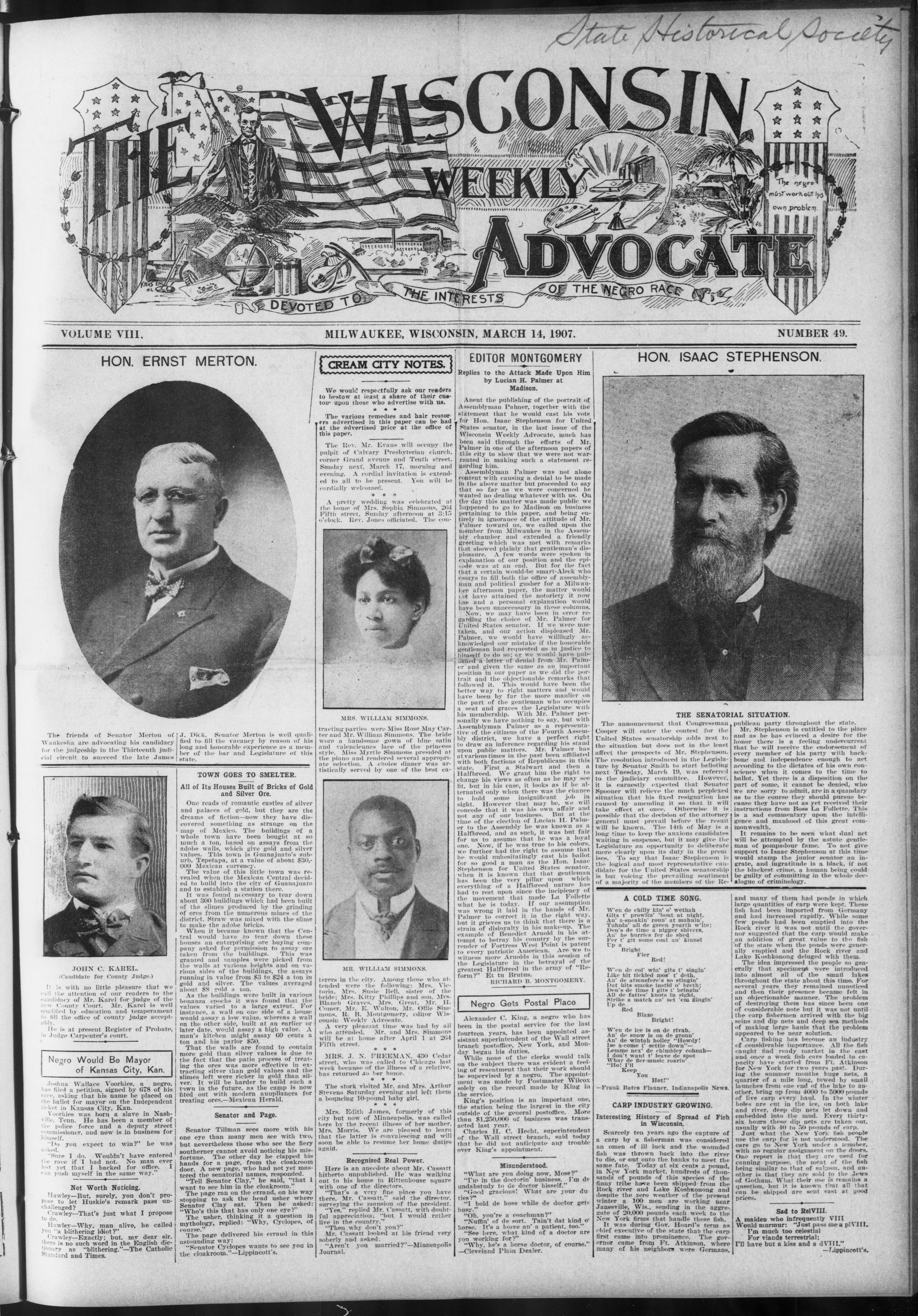
WISCONSIN
WEEKLY
Advocate
DEVOTED TO THE INTERESTS OF THE NEGRO RACE
[Name]
VOLUME VIII.
HON. ERNS
The friends of Senator Merton of Waukesha are advocating his candidacy for the judgeship in the Thirteenth judicial circuit to succeed the late James
J.
JOHN C. KAREL.
(Candidate for County Judge.)
It is with no little pleasure that we call the attention of our readers to the candidacy of Mr. Karel for judge of the new County Court. Mr. Karel is well qualified by education and temperament to fill the office of county judge acceptably.
He is at present Register of Probate, in Judge Carpenter's court.
Negro Would Be Mayor
of Kansas City, Kan.
Joshua Wallace Voorhies, a negro, has filed a petition, signed by 678 of his race, asking that his name be placed on the ballot for mayor on the Independent ticket in Kansas City, Kan.
Voorhies was born a slave in Nashville. Tenn. He has been a member of the police force and a deputy street commissioner, and now is in business for himself.
"Do you expect to win?" he was asked.
"Sure I do. Wouldn't have entered the race if I had not. No man ever lost yet that I backed for office. I can push myself in the same way."
Not Worth Noticing
Hawley—But, surely, you don't propose to let Huskie's remark pass unchallenged?
Crawley—That's just what I propose to do.
Hawley—Why, man alive, he called you "a blithering idiot?"
Crawley—Exactly; but, my dear sir, there is no such word in the English dictionary as "blithering."—The Catholic Standard and Times.
J. Dick. Senator Merton is well qualified to fill the vacancy by reason of his long and honorable experience as a member of the bar and Legislature of this state.
TOWN GOES TO SMELTER.
All of Its Houses Built of Bricks of Gold and Silver Ore.
One reads of romantic castles of silver and palaces of gold, but they are the dreams of fiction—now they have discovered something as strange on the map of Mexico. The buildings of a whole town have been bought at so much a ton, based on assays from the adobe walls, which give gold and silver values. This town is Guanajuato's suburb, Tepetapa, at a value of about $30,-000 Mexican currency. The value of this little town was revealed when the Mexican Central decided to build into the city of Guanajuato and to establish a station there. It was found necessary to tear down about 300 buildings which had been built of the slimes produced by the grinding of ores from the numerous mines of the district. Straw was mixed with the slime to make the adobe bricks.
When it became known that the Central would have to tear down these houses an enterprising ore buying company asked for permission to assay ore taken from the buildings. This was granted and samples were picked from the walls at various heights and on various sides of the buildings, the assays running in value from $3 to $24 a ton in gold and silver. The values averaged about $8 gold a ton.
As the buildings were built in various bonanza epochs it was found that the values varied to a large extent. For instance, a wall on one side of a house would assay a low value, whereas a wall on the other side, built at an earlier or later date, would assay a high value. A man's kitchen might assay 60 cents a ton and his parlor $50.
That the walls are found to contain more gold than silver values is due to the fact that the patio process of treating the ores was more effective in extracting silver than gold values and the slimes left were richer in gold than silver. It will be harder to build such a town in the future, as the camp is now fited out with modern auupliances for treating ores.—Mexican Herald.
Senator and Page.
Senator Tillman sees more with his one eye than many men see with two, but nevertheless those who see the fiery southerner cannot avoid noticing his misfortune. The other day he clapped his hands for a page, from the cloakroom door. A new page, who had not yet mastered the senatorial names, responded. "Tell Senator Clay" he said, "that I
"Tell Senator Clay," he said, "that I want to see him in the cloakroom."
The page ran on the errand, on his way stopping to ask the head usher where Senator Clay sat. Then he asked: "Who's this that has only one eye?"
The usher, thinking it a question in mythology, replied: "Why, Cyclopes, of course."
The page delivered his errand in this astounding way:
"Senator Cyclopes wants to see you in the cloakroom."—Lippincott's.
CREAM CITY NOTES.
We would respectfully ask our readers to bestow at least a share of their custom upon those who advertise with us.
The various remedies and hair restorers advertised in this paper can be had at the advertised price at the office of this paper.
The Rev. Mr. Evans will occupy the pulpit of Calvary Presbyterian church, corner Grand avenue and Tenth street, Sunday next. March 17, morning and evening. A cordial invitation is extended to all to be present. You will be cordially welcomed.
A pretty wedding was celebrated at the home of Mrs. Sophia Simmons, 264 Fifth street, Sunday afternoon at 3:15 o'clock. Rev. Jones officiated. The con
W. E. H.
MRS. WILLIAM SIMMONS. tracting parties were Miss Rose May Carter and Mr. William Simmons. The bride wore a handsome gown of blue satin and valenciennes lace of the princess style. Miss Myrtle Simmons presided at the piano and rendered several appropriate selection. A choice dinner was artistically served by one of the best ca-
[Name]
MR. WILLIAM SIMMONS.
terers in the city. Among those who attended were the following: Mrs. Victoria, Mrs. Susie Bell, sister of the bride; Mrs. Kitty Phillips and son, Mrs. Blanch Graves, Mrs. Great, Mr. H. Comer, Mr. E. Walton, Mr. Ollie Simmons, R. B. Montgomery, editor Wisconsin Weekly Advocate.
A very pleasant time was had by all who attended. Mr. and Mrs. Simmons will be at home after April 1 at 264 Fifth street.
* * *
MRS. J. N. FREEMAN, 430 Cedar street, who was called to Chicago last week because of the illness of a relative, has returned to her home.
The stork visited Mr. and Mrs. Arthur Stevens Saturday evening and left them a bouncing 10-pound baby girl.
Mrs. Edith James, formerly of this city but now of Minneapolis, was called here by the recent illness of her mother, Mrs. Morris. We are pleased to learn that the latter is convalescing and will soon be able to resume her home duties again.
Recognized Real Power.
Here is an anecdote about Mr. Cassatt hitherto unpublished. He was walking out to his home in Rittenhouse square with one of the directors.
"That's a very fine place you have there, Mr. Cassatt." said the director, surveying the mansion of the president.
"Yes," replied Mr. Cassatt, with doubtful appreciation; "but I would rather live in the country."
"Then why don't you?"
Mr. Cassatt looked at his friend very soberly and asked:
"Aren't you married?"—Minneapolis Journal.
EDITOR MONTGOMERY
Replies to the Attack Made Upon Him by Lucian H. Palmer at Madison.
Anent the publishing of the portrait of Assemblyman Palmer, together with the statement that he would cast his vote for Hon. Isaac Stephenson for United States senator, in the last issue of the Wisconsin Weekly Advocate, much has been said through the efforts of Mr. Palmer in one of the afternoon papers of this city to show that we were not warranted in making such a statement regarding him.
Assemblyman Palmer was not alone content with causing a denial to be made in the above matter but proceeded to say that so far as we were concerned he wanted no dealing whatever with us. On the day this matter was made public we happened to go to Madison on business pertaining to this paper, and being entirely in ignorance of the attitude of Mr. Palmer toward us, we called upon the member from Milwaukee in the Assembly chamber and extended a friendly greeting which was met with remarks that showed plainly that gentleman's displeasure. A few words were spoken in explanation of our position and the episode was at an end. But for the fact that a certain would-be smart-Aleck who essays to fill both the office of assemblyman and political gusher for a Milwaukee afternoon paper, the matter would not have attained the notoriety it now has and a personal explanation would have been unnecessary in these columns.
Now, we may have been in error regarding the choice of Mr. Palmer for United States senator. If we were mistaken, and our action displeased Mr. Palmer, we would have willingly acknowledged our mistake if the honorable gentleman had requested us in justice to himself to do so; or we would have published a letter of denial from Mr. Palmer and given the same as an important position in our paper as we did the portrait and the objectionable remarks that followed it. This would have been the better way to right matters and would have been by far the more manlier on the part of the gentleman who occupies a seat and graces the Legislature with his membership. With Mr. Palmer personally we have nothing to say, but with Assemblyman Palmer as a representative of the citizens of the Fourth Assembly district, we have a perfect right to draw an inference regarding his stand upon public matters. Mr. Palmer has at various times in the past been affiliated with both factions of Republicans in this state. First a Stalwart and then a Halfbreed. We grant him the right to change his views as often as he may see fit, but in his case, it looks as if he alternated only when there was the chance to hold some insignificant job in sight. However that may be, we will concede that it was his own affair and not any of our business. But at the time of the election of Lucian H. Palmer to the Assembly he was known as a Halfbreed, and as such, it was but fair for us to assume that he was a loyal one. Now, if he was true to his colors, we further had the right to assume that he would unhesitatingly cast his ballot for so good a man as the Hon. Isaac Stephenson for United States senator, when it is known that that gentleman has been the very pillar upon which everything of a Halfbreed nature has had to rest upon since the incipiency of the movement that made La Follette what he is today. If our assumption was wrong it laid in the hands of Mr. Palmer to correct it in the right way, but it grieves us to think that there is a strain of disloyalty in his make-up. The example of Benedict Arnold in his attempt to betray his country by the surrender of Fortress West Point is patent to every patriotic American. Are we to witness more Arnolds in this session of the Legislature in the betrayal of the greatest Halfbreed in the army of "Reform?" Et tn Brutus.
RICHARD B. MONTGOMERY.
Negro Gets Postal Place
Alexander C. King, a negro who has been in the postal service for the last fourteen years, has been appointed assistant superintendent of the Wall street branch postoffice, New York, and Monday began his duties.
While none of the clerks would talk on the subject there was evident a feeling of resentment that their work should be supervised by a negro. The appointment was made by Postmaster Wilcox solely on the record made by King in the service.
King's position is an important one, the station being the largest in the city outside of the general postoffice. More than $1,250,000 of business was transacted last year.
Charles H. C. Hecht, superintendent of the Wall street branch, said today that he did not anticipate any trouble over King's appointment.
Misunderstood.
"What are you doing now, Mose?" "I'm in the doctorin' business. I'm de undahstudy to de doctor hisself." "Good gracious! What are your du
"Good gracious! What are your du ties?"
"I hold de boss while de doctor gets busr."
"Oh, you're a coachman?"
"Nuffin' of de sort. Tain't dat kind of horse. It's a horse an' a patient, too." "See here, what kind of a doctor are you working for?" "Why, he's a horse doctor, of course." —Cleveland Plain Dealer.
HON. ISAAC STEPHENSON.
[Name not visible in the image]
THE SENATORIAL SITUATION.
The announcement that Congressman Cooper will enter the contest for the United States senatorship adds zest to the situation but does not in the least affect the prospects of Mr. Stephenson. The resolution introduced in the Legislature by Senator Smith to start balloting next Tuesday, March 19, was referred to the judiciary committee. However, it is earnestly expected that Senator Spooner will relieve the much perplexed situation that his fixed resignation has caused by amending it so that it will take effect at once. Otherwise it is possible that the decision of the attorney general must prevail before the result will be known. The 14th of May is a long time to keep the anxious candidates waiting in suspense, but it may give the Legislature an opportunity to deliberate more clearly upon its duty in the premises. To say that Isaac Stephenson is the logical and most representative candidate for the United States senatorship is but voicing the prevailing sentiment of a majority of the members of the Re-
A COLD TIME SONG.
W'en de chilly kin' o' wethah
Gits t' prowlin' 'bout at night,
An' a-sneakin' roun' at mahnin'
Tuhnin' all de green yearth w'ite;
Den's de time a nigger shivers,
An' he hurries fer de shed
Fer t' git some coal an' kinnel
Up a
W'en de col' win' gits t' singin'
Like hit tickled mos' t' deth.
An' de atmusfere's so stingin'
Dat hits smoke instld o' breth;
Den's de time I gits t' bringin'
All de fattes' knots in sight.
Strike a match an' set 'em flingin'
Up de
W'en de ice is on de rivah.
An' de snow is on de groun'
An' de wintah holler "Howdy!
Ise a-come t' settle down"—
Lemme nex' de chimbley cohnah—
I don't want t' leave de spot
Whar de fier-music roarin'
"Ho! I'll
Keep
You
Hot!"
—Frank Bates Flanner, Indianapolis News.
CARP INDUSTRY GROWING
Interesting History of Spread of Fish in Wisconsin.
Scarcely ten years ago the capture of a carp by a fisherman was considered an omen of ill luck and the wounded fish was thrown back into the river to die, or out onto the banks to meet the same fate. Today at six cents a pound, in New York market, hundreds of thousands of pounds of this species of the finny tribe have been shipped from the Rock river and Lake Koshkonong and despite the zero weather of the present winter a 100 men are working near Janesville. Wis., sending in the aggregate of 20,000 pounds each week to the New York firms that handle these fish. It was during Gov. Hoard's term as chief executive of the state that the carp first came into prominence. The governor came from Ft. Atkinson, where many of his neighbors were Germans.
---
publican party throughout the state. Mr. Stephenson is entitled to the place and as he has evinced a desire for the honor there is a feeling undercurrent that he will receive the endorsement of every member of his party with backbone and independence enough to act according to the dictates of his own conscience when it comes to the time to ballot. Yet there is a disposition on the part of some, it cannot be denied, who we are sorry to admit, are in a quandary as to the course they should pursue because they have not as yet received their instructions from Boss La Follette. This is a sad commentary upon the intelligence and manhood of this great commonwealth.
It remains to be seen what dual act will be attempted by the astute gentleman of pompadour fame. To not give support to Isaac Stephenson at this time would stamp the junior senator an ingrate, and ingratitude is a black, if not the blackest crime, a human being could be guilty of committing in the whole decalogue of criminology.
and many of them had ponds in which large quantities of carp were kept. These fish had been imported from Germany and had increased rapidly. While some few ponds had been emptied into the Rock river it was not until the governor suggested that the carp would make an addition of great value to the fish of the state when the ponds were generally emptied and the Rock river and Lake Koshkonong deluged with them.
The idea impressed the people so generally that specimens were introduced into almost all of the small lakes throughout the state about this time. For several years they remained unnoticed and then their presence became felt in an objectionable manner. The problem of destroying them has since been one of considerable note but it was not until the carp fishermen arrived with the big seins and dip nets and deep sea methods of making large hauls that the problem appeared to be near solution.
Carp fishing has become an industry of considerable importance. All the fish caught find ready market in the east and once a week fish cars loaded to capacity have started from Ft. Atkinson for New York for two years past. During the summer months huge nets, a quarter of a mile long, towed by small launches from one end of the lake to another, bring up from 4000 to 5000 pounds of live carp every haul. In the winter holes are cut in the ice, on both lake and river, deep dip nets let down and embedded into the mud. Every thirty-six hours these dip nets are taken out, usually with 40 to 50 pounds of carp.
Just what the New York fish people use the carp for is not understood. The cars go to New York under a number, with no regular assignment on the doors. One report is that they are used for canning purpose, the meat of the fish being similar to that of salmon, and another is that they are sold to the Jews of Gotham. What their use is remains a question, but it is known that all that can be shipped are sent east at good prices.
I'm much too celestial
For viands terrestrial;
I'll have but a kiss and a dVIII."
—Lippincott's.
THE WISCONSIN WEEKLY ADVOCATE
MILWAUKEE, WIS.
R. B. MONTGOMERY, Editor and Proprietor.
Facts and Fancies. The reason for embracing We need not seek afar; Men love to hug delusions. Women delusions are.
Madame (to the new cook)—When I ring once, it's for you; when I ring twice, it's for the maid.
Cook—How many times do I have to ring when I want to talk to you?—Fliegende Blaetter.
The Parvenu's Bad Grammar.
Yes, "money talks," but most or it Is made in such a hurry. It hasn't time to care a whit For poor old Lindley Murray. —The Catholic Standard and Times.
Not Without Hitching—to a Strap. Church—How are the New Yorkers on the transportation question? Gotham—Oh, they stand pretty well.—Yonkers Statesman.
No Change of Occupation.
"Same people—a wife and five children."—Philadelphia Inquirer.
Gentle Spring Thoughts.
The voice will shortly blow,
The crocus lift its cup;
And in the fields the hemp will grow
To string the umpire up.
—New York Sun.
Prefers Perpetual Motion
Kindly Old Lady—Don't cry, my little man. You like going to school, don't you? Small Boy—Y-es; but I do—n't like stoppin' there when I g—ets there.—The Tatler.
Not Telling.
Mother (to her future son-in-law)—My daughter is a perfect angel.
"Is she a good housekeeper?"
"I don't know that; that is for you to find out."—Nos Louisirs.
Houses?
Model—Pardon me, sir, but isn't there another, artist, in this building?
Un-soph-isticated
"Seen yer!" cried the smart aleck when he caught them kissing at the college ball.
"No, sir, Freshman!" retorted the woman.—Buffalo Express.
How Colors Change.
O! ye who nightly paint the town.
Take warning!
A taste for red begets dark brown
Next morning.
—The Catholic Standard and Times.
Storm Specialist
From a new novel—"A dark cloud gathered on her brow. In freezing silence she left him." He knows enough now to apply for a job with the weather bureau.—Atlanta Constitution.
A. Lesser Evil.
Messenger—Your wife has eloped with your chauffeur.
your chauffeur.
Husband—Thank fortune! Now I won't have to break it to her that the cook has left.—Harper's Weekly.
Inconsiderate Brute
"But don't you see? That deprives her of the pleasure of loading it onto him." —Washington Herald.
Her Price.
Belle——Yes, Gertrude has decided to marry that dissipated young Van Rochs she thinks she can succeed in making something out of him!
Ethel—About how much? — Town Topics.
A Low View of Aeronautics
Instead of getting up individual airships, why doesn't Santos Dumont content himself with inventing some sort of a parachute that will rob a slippery spot in the pavement of its terrors?—Denver Republican.
Couldn't Stand the Racket.
"There's a country buyer out there," said the senior member of the firm, "that I want you to take care of."
"Not me, please," protested the salesman. "I promised my wife I'd stop drinking."—Philadelphia Press.
Poker Stirs Up Fire.
"You ought to see my wife," said Jackson Trays, "She's going around today with a chip on her shoulder." "Why so?" asked his clubmate. "She found one in my pocket this morning."—Philadelphia Press.
Tarry Not.
Tarry Not.
The road to yesterday—
Why travel it?
A tangled skein, so why
Unravel it?
The future calls you on.
The past is dead.
And all you hope to do
Lies just ahead.
—Birmingham Age-Herald.
Bess—I really think May is in love with you.
Jack—Really? Why?
Bess—I heard her remark yesterday that homeliness in a man is not really a drawback, but a sign of character.—Catholic Standard and Times.
The Balance of Power.
"Why is it that Blank, the shirtmaker, and Irons, the laundryman, do not speak when they meet?"
"Well, you know Blank advertised a new, indestructible shirt?"
"Yes."
"And Irons immediately installed more powerful machinery in his laundry."—Woman's Home Companion.
The Plankinton Packing company is supplying the market with hams and bacon, known as the Globe brand, which are pronounced the best obtainable. So general has become the demand for this particular variety that the company has put them on sale practically everywhere in the country. If prospective purchasers are unable to obtain them at their own butcher or dealer, Globe Hams and Bacon can be had by writing direct to the Plankinton Packing Co., Milwaukee, Wis.
Advertise in Your Home Paper.
---
SNOWFLAKES.
The snowflakes fall.
And, on the ground, lie thickly deep,
While, underneath, are little flow'rs
Asleep.
From soft gray sky
The feather flakes come clinging down,
And kiss each tree, and clothe it with
A gown.
White coverlid
About the old brown earth is spread.
And, warm beneath, dream little flow'rs
In bed.
THE CABMEN AND THE COLONEL
There was something to be said for the colonel. Fate had certainly treated him badly, and had done her best to sour his temper. His wife, the one softening influence of his life, was dead. That confoundedly idiotic war office had most unjustifiably placed him on half pay. There was nothing left for him to do but play country 'squire, bully the village schoolmistress and marry his only son to the daughter of the owner of the adjoining estate—to the great advantage of all concerned.
And now even that scheme had gone agley. His mutinous son had spoiled that plan for ever by running away and marrying the orphan governess of his aunt's children. And, worse still, the impertinent young wretch had disregarded all his father's angry letters, and with the calmest, coolest cheek in the world had written that morning to say that the honeymoon being over, he intended to bring his bride to be introduced to her father-in-law. As a postscript he added that he forgave the colonel all the unkind things he had written—a piece of Christian charity that nearly caused his choleric parent to burst.
The truth was that Frank Leadforth was one of those good-natured, "casual" beggars who laugh their way into everybody's heart, and usually find all their sins are forgiven them when they smile. It was tous that he had forced Miriam to marry him, riding roughshod over her scruples; and it was thus he fully expected to meet his father's wrath.
"Wait till I've seen him and he sees you," he told his bride, as they were approaching the house. "He's got a terrible bark, but precious little bite. I'll soon laugh him into a good temper." And he kissed herfurtively behind the village flyman's back, and chaffed her for being so nervous and afraid.
But he had rather a shock when the butler told him his orders were to shut the door in his face. However, Master Frank had always been a favorite with that worthy, and he was in no hurry to carry out the colonel's command. His resistance was only half-hearted when Frank pushed past his portly form. And he made no effort at all to stop Miriam, who followed, blushing and trembling. The colonel was in his study.
"Hallo!" he exclaimed, when Frank burst in upon him unannounced. "What the dickens do you want here?" He turned to the butler, ignoring his son's hand and his son's wife. "Porson," he said, sternly. "You leave my service at once."
Then Miriam spoke.
"Col. Leadforth," she said spiritedly, "tnat's not fair. Frank forced his way in!" The butler threw her a glance of gratitude.
"Pray, madam, be so good as to leave me to manage my own servants," said the colonel coldly.
Miriam bit her lip beneath the snub, and Frank made a desperate effort to right matters.
"Come, father," he said, pleasantly, "jump off your high horse! Shake hands with me and kiss your daughter-in-law. What do you think of her? Don't you envy me?"
For answer the colonel picked up his newspaper and pretended to read. Frank went very white, and his eyes gleamed dangerously. Miriam went very red, and placed a hand on her husband's arm.
"Let us go, Frank," she whispered. "You were wrong not to make sure your father would receive me before you made me come."
"Yes," he answered out loud. "I didn't know my father was such a pig! It is only the fact that he is my father that saves his skin. If any other man insulted you like this, I'd kill him!"
The colonel heard, and his conscience pricked him. True, Frank had not approached him properly. Had he begged forgiveness instead of taking this high hand he might have consented to accept the marriage as an evil that, being accomplished, must be endured. And yet, hadn't he been rather too rude to a lady—ruder than the circumstances warranted? The thought made him uncomfortable and angrier. He grew purple with rage.
"Such infernal impudence as yours I've never heard of!" he cried to his son.
"The idea of calmly bringing your—your wife home like this. Why—good gracious, you must be mad!"
Frank looked at him, unmoved by this outburst.
"You owe my wife an apology," he said.
"Apology?" spluttered the colonel.
"Apology! Get out of my house—the pair of you. I'm done with you, sir, forever. I never wish to see or hear of you again!"
Miriam burst into tears, and her husband seized her arm.
"Come darling," he said, "we can do without him."
"Pleased to hear it," sneerd his father.
"Not a farthing will you ever have from me!"
And with that Frank and the colonel parted.
On the way back to London in the train Frank and Miriam discussed the problem of what they were to do now. They counted their money and found that between them they had only eighteen pounds. Frank, of course, had not been brought up to any trade or profession. He had wished to enter the army, but his father had demurred, thinking that the hash he had made of things might prevent his son's advancement. So Frank had spent his time hunting and loafing about the paternal estate, with the result that he knew a little of farming and a great deal
about horses, but nothing at all about earning his bread and butter.
All that seemed open to him was a clerkship. But his soul revolted at the thought of a desk and a stool in a stuffy office. His life had always been spent in the open air.
Something had to be found which required no previous experience. His first suggestion was that he should join the police force. They had plenty of fresh air, a decent wage, and a fairly interesting time, he explained. But Miriam objected—not on the grounds of pride, for she realized that one so valueless in the commercial world as her husband must be humble in his ambitions—but because of the danger. Some drunken brute, some desperate thief, might injure him, she pointed out, and the fear of it so preyed on her loving heart that he gave way.
The brilliant suggestion which was ultimately adopted she made herself. Why should he not drive a cab? He knew lots about horses; he knew London pretty well, and could soon learn enough about it to pass his examination. It was a healthy life, and a paying one for a smart man. He would have lots of time at home with her, especially in wet weather. "But that's the time to make money," he objected. "Your not going out in the wet—so there!" she announced. And he found her air of proprietorship and decision so delightful, that they passed the rest of the journey as most fond and foolish lovers pass long railway journeys when they have the carriage to themselves.
But the problem was solved. A cabman he would be, and the cross, rude colonel might keep his silly old money to himself.
He had driven a cab three years, and it had made a man of him. Living in furnished lodgings at first, they had saved enough to gather a home together and to migrate to a tiny six-roomed villa, with quite twenty feet of garden to grow roses and cabbages in. Resolutely they had cut themselves off from the old world, and lived in wonderful happiness together. They had a little boy—an imp of mischief 2 years old—and they loved each other as dearly as ever. All the economies, the makeshifts of this life, they looked upon as jokes. They played together a never ending game of pretense. Mutton was venison; cheap cigarettes were priceless Havanas, and the cab was their own private carriage. They discovered what is, perhaps, life's most precious secret—that very little matters or hurts if only you laugh at it.
They spoke often of the colonel, and Miriam several times tried to persuade Frank to write. But he was too proud to run the risk of being thought to be hankering after "the old man's money." One day, however, his father jumped into his cab outside Liverpool street station and bade him drive to the United Service club. Frank was amused. The possibility of such a thing had occurred to him before, so he was not so surprised as might have been expected.
"Wonder how much the old boy will give me over my legal fare?" he chuckled to himself. He had not the slightest intention of making himself known, and no fear of being recognized. Even if his face should remind his father of his son, it would never occur to him that Frank was really earning his own living as a London cabman. The cab turned into Piccadilly and suddenly a stick was thrust through the trapdoor and he was commanded to stop. Col. Leadforth leaned out and called to a man on the pavement. "Hallo!" he cried. "Why, it must be five years since I saw you!"
They chatted of old times, and the cabman listened interestedly. His father had a military manner and a military voice; all he said rose up clearly and distinctly to his son on the box. Familiar names of people and of places fell upon his ears. Just the faintest tinge of homesickness crept into his heart. Suddenly he pricked up his ears and thrilled. The stranger was asking after Frank.
"Don't know where he is," said the colonel, grimly. "He married beneath him—and I—I turned him out."
There was an embarrassing pause. The stranger obviously didn't know what to say.
"Confound it all!" the colonel exclaimed, with sudden startling vehementence, "I was an ass, man! And so was he—confound him! We're stiffnecked beggars, we Leadforths."
He broke off, and the cabman knew, though he could not see, that there must be tears in the tired old eyes. His heart melted. Yes—they were stiffnecked beggars—each waiting for the other to make the first advance.
He whipped up his horse. The man on the pavement looked astonished. The colonel shouted angrily: "Hi, what the deuce are you doing?" But the cabman was deaf.
Boldly he threaded the traffic, heedless alike of the comments of obstructed bus drivers and the furious remarks of his fare. A policeman held out his hand. He dashed by, and the constable made a note of his number. But he only laughed. The excitement of the colonel grew almost apoplectic. But the ca bdidn't stop. On and on it went, mile after mile, and Col. Leadforth began to fear he was being taken to a lonely place, there to be robbed and maltreated.
At last, in a quiet suburban street, between a row of neat, tiny houses, that reckless gallop came to an end. The jangle of the stopping horse brought a woman to the door—a young, pretty woman, with a little boy clinging to her skirts. But the colonel had no eyes for her. He sprang out of the cab and turned to the driver.
"What on earth do you mean—" he began, but the driver interrupted him.
"Father," he said, "I am Frank. "This is my cab. That is my house, my wife and my child."
The colonel stared. First he stared at his son, and then at the cab, and then at the house, and then at the woman and the child. He gasped, and solemnly stared at everything all over again. Then he took off his hat.
"Madam," he said to Miriam, "I owe you an apology for my rudeness three years ago."—Answers.
Actors Judged by Audience.
The audience at the theater at Namur decides the fate of debutantes on the stage by vote. The candidates usually appear in three different plays before it is decided whether they may continue or must retire. Advertise in Your Home Paper.
AFTER THE FEAST.
I've et pie till I'm sick of it,
And puddin', sweets and cake,
But I don't think they've give to me
This offul, offul ache;
I et my woolly doggie's ears
And thought it was a lark,
But nothin' seemed to taste so good
As the paint on Noar's ark.
I et the varnish off a cow
Before I was half dressed,
But a nice, green-colored elefunt
Was what I liked the best;
But ma sez, worried-like jest now:
"Bub don't seem up to mark,"
So I've put off ticking up the rest
Of that there Noar's Ark.
BRIEF NOTES OF GENERAL INTEREST
Worry over the pure food agitation is given by the relatives of Mrs. Leona Long, Louisville, Ky., as the cause of her mental derangement. For four days she refused to taste any food for fear she would be poisoned.
Mrs. Hannah A. Currier of Manchester. N. H., is to give her entire fortune of $1,000,000 for the establishment of an art gallery at her death. The estate will be left to trustees named in a list which she already has prepared. Mrs. Currier is nearly 80 years old.
J. W. Leeper of Metz, Ia., after fasting a month while the guest of a hotel at Council Bluffs, to secure relief from stomach trouble, died. It was supposed that weakness due to lack of nourishment, caused his death, but an autopsy revealed the fact that he died from a disease of the liver and that he had been fasting without reason.
Infant Swisher, son of Mr. and Mrs. A. S. Swisher of Toronto, Can., bears the unique distinction of having been born aboard a Pullman car rapidly moving over the Big Four railroad between Delaware and Columbus, O. Mrs. Swisher was on her way to the home of her parents in Newport, Ky. A doctor and a trained nurse happened to be on the train.
---
The anger of the negro population of Peoria, Ill., has been aroused to a high pitch against a livery company because one of its employees stopped a funeral procession, removed the body of a negro from the funeral car, and put it on the street curb until a cheaper hearse could be secured. A suit for damages is to be instituted by the widow of George Scott, whose body was thus treated.
Preston Legislature Reeves, the first white child born in Omaha, Neb., was buried recently in a charity grave. His father, J. C. Reeves, was the first sheriff of Douglas county, Nebraska, and his uncle, A. D. Jones, was the first postmaster of Omaha. He was born January 16, 1855, the day the first state Legislature convened in Omaha, and was named Legislature in commemoration of the event.
South Norwalk, Conn., noasts of having the only man in the world without a stomach. This freak has silver tubes in lieu of that organ, and is perfectly healthy.
He cannot, however, bend over to lace his shoes for fear of dislocating his stomach and causing instant death.
The person is Rabbi Schevmal Volski-vitz of Mukumbo, Egypt. He was born in Arabia, and is black.
After paying back all the insurance he received on buildings to which he had hired a man to set fire, James A. Phillips of Williams Center, O., pleaded guilty to a charge of arson and got eighteen months in the penitentiary. The insurance paid back with interest is $1550. Phillips is wealthy. John Vanimmons, who, according to his confession, was the accomplice of Phillips, is now serving a term at Columbus.
Miss Mab Claire Ervin, formerly employed as a reporter by several Chicago newspapers, has been awarded $10,000 damages against the Los Angeles Record. She alleged that while she was working for the Record she was sent to interview Ah Wing, a Chinese prize fighter, after which the Record published a story to the effect that she was Wing's sweetheart. The plaintiff was recently married at Yuma, Ariz., to Edmund Riviere Herrick, a New York man.
Ald. Tovey, chairman of the finance committee, submitted to the city council of Peterboro, Ontario, a proposition to tax bachelors, owing to the alarming increase in the city debenture debt. He suggested the following schedule: Between 20 and 30 years of age the proposed tax will be $5 a month. From 30 to 35 the tax will be $10 a month, decreasing to $5 again when the man has reached 40. At 50 the tax is set at $20 a year, and after he has passed 60 years the bachelor will be exempt.
Long Beach, Los Angeles, will have women patrolmen next summer. The suggestion was made by the Women's Christian Temperance union, and met with favor among city officials of Los Angeles. The police in petticoats soon will be appointed. They will patrol the beach, pier and auditorium. Members of the Women's Christian Temperance union doubtless will be selected, and they will wear ordinary police stars and have full police powers. The question of arming them has not been settled.
M. Polowski, director of the Polish mission at Paris, notified Prefect of Police Lepine he had received a badly soldered tin which he believed to be a bomb. A special wagon from the municipal laboratory hurried to M. Polowski's office and the suspicious object was taken with infinite precautions to the government testing building, where a hydraulic press squeezed out its contents, which proved to be caviare. M. Polowski, who adores caviare, is inconsolable over his loss.
One of the most remarkable revival meetings in the memory of the oldest inhabitant in southern Wisconsin has just closed at the village of Union Grove. During the ten days' session over 200 souls were saved: men and boys who have used tobacco have abandoned the weel; residents who played cards have thrown the pasteboards into the fire dancing feet have been turned into righteousness; mouths that were full of curses are shouting God's praise—in fact, the whole town is turned into a soul saving settlement.
When Julius Greutzner, an aged resident of Greenock, Pa., began taking medicine for cancer he expected a cure of that disease. This was a week ago and his head contained no more hair than a billiard ball. Now his head is covered with a growth of hair which
followed a pain in the head. The hair is short but it is growing. Mr. Greutzner has ordered more of the cancer cure, believing that to this he owes a second crop of hair at the age of 74 years.
He had been bald for fifteen years. Many residents of the town have called on Mr. Greutzner to verify the phenomenon.
Mrs. Dolly Deussler of New York, aged 22 years, who swallowed a packet of needles several months ago, is at present under treatment in Bellevue hospital, where the surgeon states she still has scores of needles in her body. At the Fordham hospital, where the woman was first treated, five operations were performed and fifty needles extracted. Some of the needles are located as far apart as back, chest, and arms, and it is feared that two of them, which have traveled to the vicinity of the heart, may puncture that organ. A charge of attempted suicide may be made against the woman. It is not known how she came to swallow the needles.
One of the questions that probably will confront Secretary Taft upon his arrival in Cuba in a few weeks, will be abrogating Gov. Woods' decree forbidding cock fighting in Cuba. An overwhelming majority of the Cubans demand the right to fight their chickens. When the sport flourished, the Cuban laborer worked four days a week to support his family. Another day's wage he set apart for the lottery and the last of the secular days he worked in order that he might secure funds to back his favorite cock in the pit. Now the laborers and farm hands simply stop work for the last two days of the week. This practice is said to be really injurious.
Probably Secretary Taft will adopt the expedient of permitting cock fighting outside of Havana and the larger Cuban cities, just as he did in the Philippines to the satisfaction of natives and their employers.
After having been killed by an ulcerated tooth which caused blood poisoning Frank G. Brown, a prominent resident of St. Paul was buried at midnight under the "Kadosh" rites of the Masonic order, it being the fifth time such rites have been celebrated in the United States. The "Kadosh" may be given to every thirtieth degree Mason who makes a request for it while living. The rite was celebrated by De Molai council, No. 1. Knights of Kadosh.
One of the features is the march of the celebrants to the bier. The room is darkened and during the progress of the ceremonies at the midnight hour the only illumination of the hall is thrown by lamps carried by the Knights of Kadosh as they march to the bier. The rite has been performed but twice in St. Paul.
"My wife has left me and I am alone! Why she has gone I do not know. But she is gone, gone from my heart and home."
This is the short explanation sent to friends in Eau Claire, Wis., by James B. Duggins of Eklalaka, Mont., a wealthy ranchman who on October 17, 1906, was married to Miss Margaret Harley of Spring Brook, Dunn county, Wis.
Mr. Duggins and Miss Harley first learned of each other's existence by correspondence. Photographs were exchanged and then the lonely Westerner started east to claim his mate. They met in Eau Claire on Monday; he proposed and was accepted on Tuesday, Wednesday they started on their treacle trip via Chicago and Sunday found them in their home in the western highlands.
After weary hours of waiting and two frantic appeals to the Minneapolis police department, Cupid won out at last, and she who was Evelyn Marbin of Superior. Wis., is now Mrs. Thomas Gilkins of Mankato, Minn.
Miss Marbin, after applying to the police for aid in locating her lover, the other night, went to a hotel, where she spent the night in an agony of apprehension.
Meanwhile the young man was having anything but a pleasant time of it. He came to Minneapolis Friday afternoon, according to appointment, and went to the Milwaukee depot, where he expected to be greeted with open arms by his fiancee. She was not there, and though he waited and waited she did not come.
At last the young man reported the case to the police. They at once began a search for the young woman, who had forgotten to give them her address, and at last located her.
The state of Illinois contains an honest man. H. G. Cowling, Eau Claire, Wis., agent for the Omaha railway received a letter from Mendota, Ill., containing a five dollar bill, which the sender requested to be turned into the company's conscience fund. This honest man suffered for more than two years with an ill gotten bill on his person. A most unfortunate circumstance in connection with the letter is that the conscience smitten individual did not give his name. The letter reads as follows:
"Dear Sir:—I stole a ride on your road in 1904 from your station. The fare was $4.29. I enclose $5 to cover interest and principal. This will free my conscience and my soul from guilt. Yours truly—"
Mr. Cowling has forwarded the money to the general passenger agent at St. Paul. He will either purchase a ticket with it, thus turning the amount into the company's treasury, or place it to the credit of the conscience fund to be used for charitable purposes.
French romance has often become repellantly bizarre in describing how wealth managed by an eccentric has been used to produce a home furnished with wonderful enchantments. There is a villa at Troyes, however, which has been designed for himself by M. Georgia Knapp, a well known electrician, that not even the imagination of the brothers Goncourt, fantastic as that was, was able to anticipate.
In ordinary appearance M. Knapp's "hotel" is just a bourgeois house. Its decoration, its wonders, and all about it are revealed by electricity. You are welcomed at the door by a voice electrically conveyed from no visible author. The door is opened and closed by an electric current. By simply walking along the passage the visitor turns on the light, which makes his way clear. When M. Knapp wakes in the morning he touches a button which boils a kettle for his dejeuner, and a second button brings to him the cup and saucer, bread and butter, which form the familiar and butter, which form the familiar French breakfast. Another table appears with all his favorite journals to his hand.
When the dining room table is lighted up it reveals stars twinkling amid rare flowers. There are neither footmen nor parlor maid. The diner finds everything in front of him at the wish of his host. The plates circulate and disappear when the course is finished...
The Rue Pierre Gauthier is supposed to present the latest devices in the domestic application of electricity.
Chile Wants Immigrants
The Chilean government has placed $165,000 at the disposal of the President, to be expended in securing immigrants for that republic.
It Pays to Advertise
PE-RU-NA
FOR
CATARRH
OF THE
HEAD.
THROAT,
LUNGS,
STOMACH
KIDNEYS
BLADDER
AND
FEMALE ORGANS.
W. A. Mitchell, dealer in general merchandise, Martin, Ga., writes: "My wife lost in weight from 130 to 68 pounds. We saw she could not live long. She was a skeleton, so we consulted an old physician. He told her to try Peruna. "She gradually commenced improving and getting a little strength. She now weighs 106 pounds. She is gaining every day, and does her own housework and cooking."
UNPOLISHED RICE.
Declared to Be More Nourishing Than the Pearly Kind.
Learning that the method of polishing rice to give it a pearly appearance deprived it of a large percentage of its albuminous and fattening qualities and that the Japanese use it unpolished, says the Vegetarian Magazine, was what opened our eyes to the advantages of unpolished rice.
The trade refusing to supply rice in this form, the Vegetarian Society supplied it to the public and this year already about forty times more unpolished rice has been sold than was sold the first year of its introduction. The increase during 1904 and 1905 was about fourfold each year.
WOMEN PLAN CAMPAIGN.
Eighteenth Ward Members of Social Economics Club Will Be Active.
The members of the Social Economics club, most of whom live in the Eighteenth ward, are much interested in the election of the school director from that ward to take the place of Alexander Wall, who has declined re-election. It is probable that a committee to work on this question before the spring elections, may be appointed. This is the first time that the women of Milwaukee have had opportunity to vote for school directors, and the members of this club feel that inasmuch as it will in future devote itself to municipal questions, the members must take advantage of this opportunity to shape the personnel of the next school board.
Death for a Kiss.
The rules and regulations which environ unmarried girls in France are exceptionally strict when compared with those of England or America.
On the other hand, compared with the social laws of Spain, I think those of France are favorable to the jeune fille. I have personal knowledge of a case in which a young Spanish girl shot herself because she had been kissed by a young man and because—in consequence of this small indiscretion—her life had been made unbearable by her relatives. Paris cor, in The Magame.
THE WHOLE FAMILY.
Mother Finds a Food for Grown-ups and Children as Well.
Food that can be eaten with relish and benefit by the children as well as the older members of the family, makes a pleasant household commodity.
Such a food is Grape-Nuts. It not only agrees with and builds up children, but older persons who, from bad habits of eating, have become dyspeptics.
A Phila. lady, after being benefited herself, persuaded her husband to try Grape-Nuts for stomach trouble. She writes:
"About eight years ago I had a severe attack of congestion of stomach and bowels. From that time on, I had to be very careful about eating, as nearly every kind of food then known to me, seemed to cause palm.
"Four years ago I commenced to use Grape-Nuts. I grew stronger and better and from that time I seldom have been without it; have gained in health and strength and am now heavier than I ever was.
"My husband was also in a bad condition—his stomach became so weak that he could eat hardly anything with comfort. I got him to try Grape-Nuts and he soon found his stomach trouble had disappeared.
"My girl and boy, 3 and 9 years old, do not want anything else for breakfast but Grape-Nuts and more healthy children cannot be found.' Name given by Postum Co., Battle Creek, Mich. Read the little booklet, "The Road to Wellville," in pkgs. "There's a reason."
GOSSIP FOR THE LADIES.
The Burning Heart.
I, whom the fires of life each day
Do heat in pallor—I, who sway
Forever in the bread of strife.
Not master, but the slave of life.
A burning heart I bear!
Yet death w... full extinction give,
Or kindly age a bound will set;
So, if I live, I shall outlive;
And if I die I shall forget—
I shall not always care!
The reports of the disagreement of the opposing lawyers in the Thaw case—what an endless source of subjects for moralizers and philosophers the Thaw case offers!—has given rise to the question: Would such a thing as a disagreement on such a vital occasion like this have occurred between women? or would the bitter contest between two women lawyers, suppose women lawyers had reached such a degree of assurance as to take charge of such criminal cases, have aroused so very little public comment? Two men, acknowledged to be of high standing in their profession, who are the legal advisers in as complicated a contest in the courts as the modern generation has known, quarrel and indulge in personalities, and no comment is made upon the fact, beyond a few expressions of discomfort at the inconvenience and delay occasioned. Think of the outpourings of criticism and the ridicule of the weakness of women had these two lawyers been of the gentler half of humanity.
"Just like women." the onlookers would have said; "they never can get together without quarreling." "Imagine professional jealousy and ambition intruding itself in such a tremendously important issue as this!" Etc., etc.
It all revolves itself into the question: Are women more quarrelsome than men? Is a quarrel or a "professional" difference of opinion between men then so uncommon as to occasion no sweeping generalities of sex, and are quarrels among women so very usual as to give the scoffers an opportunity to indulge in the imaginary comments about the pugnacity of the women as quoted above? Nothing receives such credence among men as the well-circulated fact that women quarrel all the time among themselves. This is especially applicable to women in their clubs and in other organizations. One can scarcely mention any assemblage of women, from a mild sewing circle to an assembly of suffragists, without evoking the masculine: "You women have some pretty lively tussles among yourselves, I guess," or, "I imagine there's a great deal of jealousy in your organization, isn't there?"
Pretty nearly every man imagines that once a woman falls in the clutches of an organization she immediately drops womanliness, and tact, and unselfishness from her with the rapidity and ease with the vaulting Charmion of dance hall fame drops her hainty slippers among her audience, whether women meet to play "bridge," or whether they assemble in solemn committee rooms to discuss the welfare of delinquent children or the disposition of helpless old ladies, there must always, always be the quarrel and the dispute. No matter what be the issue the mere fact that women are part of an assembly is enough to sanction this very common masculine criticism.
No one denies that in a large assemblage of women there are differences of opinion, prejudices or whatever one chosses to call them. Could one fancy a high-spirited body of women all agreeing on every phase of a question? Could anything be more monotonous than a meeting were all of the women were of one mind? Think of any gathering devoid of the stimulating clashing of wits, and the heated arguments! Of course, all of these things exist in a woman's body of men who get together to discuss any question, religious, educational or political?
Some scenes have occurred in the board of education of this city of brotherly love within the recollection of numberless club women of Philadelphia which might have given rise to sweeping generalizations on the part of women onlookers, upon the quarrelsomeness of men, had it been the fashion for women to make this time-honored comment upon the opposite sex. We occasionally catch echoes of some factional disturbances and internal wars at even such august assemblies as the Union league and the Manufacturers' club. Examples of these are endless. Every type of man has a duplicate in manner among women. There are quarrelsome, unreasonable women, and there are numberless specimens of this kind of men; there are mild, complacent men and women, aggressive men and women, sympathetic men and sympathetic women, and so on through the whole list of varieties of men and women.
However, not even the very recent assertiveness of the woman as a distinct individual and a factor in modern life has quite overcome the old ideas of personal conduct. A woman cannot talk so freely to her opposing club member as a man, because Nature suggests more silent methods of expression—the old idea of "having a good cry"—is still in vogue, even among certain kinds of club women; so she resorts to the weapons at hand, sometimes she gently whispers to her neighbor that she thinks a certain policy adopted by her opposing club officer is wrong, and the whisper augmented and heard perhaps by the club, but do they not exist also in any male members of her family, assumes the proportion of a very bitter quarrel. In several generations from now when it will be considered "ladylike" for a woman to say exactly what she thinks—not several degrees north or south of it as is done now, women will conduct their disputes as men do. No one hopes for the time when women shall use "strong language" so freely as men, but we can indulge in its feminine equivalent perhaps without causing comment. They shake hands without any personal animosity, and walk laughingly into the "tea-room" to forget all about it. A woman's organization actually contains no more factions than does a man's assembly, but the methods of conducting disputes differ just slightly, because of modern ideas of conventional behavior for "ladies."—Exchange.
Contentment.
Paul, in his epistle to the Philippians, says, "For I have learned, in whatsoever state I am, therewith to be content." This is one of the hardest lessons of life, and happy is the one who can say he has mastered it. Yet there are various degrees of contentment. In some people it is a negative virtue, for they simply accept their lot without grumbling or railing at fate if it is adverse. Others reach to a higher plane where contentment merges into satisfaction, and becomes a joy. At a social gathering of literary
people recently, I fell into conversation with a lady, a stranger, whom I had particularly noticed for her bright, intelligent, happy face. She was no longer young, but when she talked in her quick, breezy manner, you forgot the gray hairs and the marks of age and saw only the vivacity and bouyancy of a spirit which "age cannot wither nor custom stale." "Isn't it beautiful," she said after we had listened to some very interesting reminiscences and some delightful singing from the elder members of the club, "to see people growing old gracefully? Look at all these men and women. They are so enthusiastic, so cheerful, so ready to take part in all that is going on. It does me good to look at them."
"You seem to be happy, yourself," I ventured.
"I am, I am glad to live and so thankful everyday that I have just what I have. I can truly say that I am perfectly content with my life and would not change it for anything I know of. Yes, I am perfectly contented, and enjoy every minute."
"You are certainly to be envied," I replied. "You are truly a philosopher. May I ask where is your home?"
"Oh," she said smiling, "I am a 'high private' in an Old Lady's Home, through the evil deeds of others, but I am just as happy there as I can be. I look over my past life and feel that I have done my duty in every condition in which I have been placed. I have lived for the good of others and have ever had their welfare in view, and now that I am oid I am reaping the reward in being cared for by the kindness of others. There is nothing in the world so desirable as to be contented 'in whatsoever state' our lot is cast."
Later, I learned that this lady in her younger days had been a teacher. She had money and position and had traveled extensively in the old world. She had keen observation and had noted all the wonders and beauties of the great cities of Italy, England and other countries, and could converse charmingly on all these, as well as topics of current interest. She had known reverses, trials and sorrows, yet in spite of all, the inborn courage and sweetness of her soul bore her triumphantly to the highest pinnacle reached by man, contentment with her lot and true happiness therewith.
Why it is that this kind of character is not oftener met with? Why is it that so many people are chronic grumblers and fault-finders? For them the weather is always too cold or too hot, the sun too bright or the day too cloudy, the home too small, or too large, and so on through the category of conditions. Old age finds them thus and implants its wrinkles and other insignia with lavish hand because they have never tried to keep their eyes bright and their lips smiling. Contentment makes a happy heart, a pleasant countenance and an agreeable companionship. Who does not desire these things?—Exchange.
Menus for Card Parties.
A party of friends banded together not long ago with the purpose of weekly card parties for pleasure.
All went well until the various hostesses vied with each other in trying to serve quite elaborate menus. A reaction soon occurred, and it was decided that at these gatherings the refreshments should be of simple character and limited to four articles.
This proposition has worked so well that other women may wish to follow the same plan, and three menus actually used are here given. They would prove equally suitable for any informal afternoon or evening gathering of a small club or circle of friends.
1. Bouillon
Oyster Loaves.
Brown Bread Sandwiches
Coffee Jelly.
2.
Sweetbread Croquettes.
Sweetbread Croquettes.
Buttered Finger Rolls.
Stuffed Figs.
Frothed Coffee.
3.
Creamed Eggs in Cases.
Nut Sandwiches.
Frothed Chocolate.
Orange Baskets.
In the first recipe the bouillon was a first-class grade of canned goods, two-quart cans being ordered for a party of twelve. This could be replaced by any clear soup or by a tomato bisque.
Oyster Loaves—For the oyster loaves pick over and rinse sixty oysters. Drain and set aside. Cut the tops from one dozen large pointed rolls, scrape out the crumbs, brush inside and out with melted butter and crisp slightly in a hot oven; keep the covers so they can be properly replaced. Make a thick sauce with three tablespoonfuls of butter, four tablespoonfuls of flour, one teaspoonful of salt, one-third of a teaspoonful of white pepper, a dash of cayenne, a pinch each of nutmeg and mace, one cupful and a half of rich milk and one-half cupful of the strained oyster liquor stirred in last. Strain this into a double boiler, taste to see that it is highly seasoned and keep hot.
Coffee Jelly — Cover one package of granulated gelatine with one cupful of cold water and soak. Add to one quart of clear coffee one cupful and a quarter of sugar and stir until dissolved. To the soaked gelatine add one pint of boiling water, stir until clear, mix with the sweetened coffee, strain, add one teaspoonful of vanilia and pour into large or small molds. Serve with whipped and slightly sweetened cream. Stuffed Figs — Bag figs — those which are not flattened by pressing—are readily stuffed. Stand in a steamer if very dry, until they are soft and moist. cool quickly; then cut a slit in the side of each and press in several pieces of salted pecans or almonds. This may be varied by using pieces of marshmallow candy rolled in chopped nuts.
Frothed Cream—The cream for frothed coffee and chocolate should be as heavy as possible. To each pint add three tablespoonfuls of sifted powdered sugar and ten drops of vanilla and whip until a solid froth. When the cups are filled drop a large spoonful of the whipped cream on top of the liquid. Creamed Egg Sauce—The sauce given for oyster loaves, but with all milk in place of milk and oyster liquor, can be used for creamed eggs. Cook one dozen eggs in simmering water for forty-five minutes transfer to cold water until chilled, then shell and chop coarsely with a silver knife. Cook ten minutes in the sauce, fill fancy paper cases and sprinkle a little egg yolk rubbed through a sieve over the top of each.
Orange Baskets — Take a dozen oranges, scrub well, cut a hole in the blossom end of each and scoop out the pulp. Scallop the cut edges of the rind and keep them in cold water until needed. Press the pulp and with the juice, the juice also of two lemons, one pint of sugar and one package of granulated gelatine, make a clear jelly, adding sufficient water to make a total quantity of two quarts. When this is cold and beginning to thicken pour it into the orange rinds and set aside until firm. Serve on lace paper dollies.—Cornelia Bradford.
The Spirituality of Woman
Why no woman is gifted with that indescribable and invaluable quality vaguely defined as a sense of humor we have never been able to understand, but
surely adequate compensation is to be found in the greater keenness of her wit. Indeed, speaking antithetically, man has ever been so generally recognized as the example, par excellence, of sheer stupidity that even the contemptuous Elizabeth scholars did not take the trouble to give a feminine termination to the word "dolt." Certain writers have maintained that no woman could divine, without making direct inquiry, whether one is serious or whimsical, so he keeps his face free from signifying expression; but is not this very fact, if such it be, evidence of her greater straightforwardness? Moreover, while it is undoubtedly true that most women lie about one thing or another from the time they enter upon what is termed their social existence, is not their comparative clumsiness in the practice of that are creditable rather than the reverse, affording, as it does, a clear indication of their natural inclination towards truthfulness?
We are constrained to admit that in philosophy and correlative matters the more sensitized intellect of woman has made little progress; hence the obsoleteness of "casuistess." Why, we cannot tell. The defect—for as such we must regard it, in view of the severe demands of citizenship—may be inherent and incurable or, as we prefer to believe, attributable to a condition of mind which has given rise to rejection of any trait which might be displeasing in the eyes of men. It is in the hope that the latter diagnosis of cause is correct that we venture suggestions designed to induce rigid mental discipline while the mind is still in plastic form.
We have the greater freedom in making such suggestions because of our feeling of certainty that, however deficient comparatively in reflective intellectuality, woman today is immeasurably superior to man in a spiritual sense. This means that she is stronger in resistance to pain or evil in any experience so crucial as to require the support of the highest-minded fortitude. Despite the effects of hateful modern influences, there still exists no authority in the world so powerful as the simple purity of a good woman, before which no erring man can fail to feel abashed.—George Harvey in The North American Review.
The Causes of Worry
Wise in his day and generation was the olden time philosopher who laid down the law unto himself that there were but two things that people worried about—the things that they cannot help, and the things they can help. Those things that people cannot help it is useless to worry about, because they cannot be helped. Those things people can help it is unless to worry about, because they can be helped.
Lately it has been shown that anger and worry are near of kin, another reason for not worrying. Indeed there is a deadly horde of kindred miseries that follow close in the train of worry, and are known to be related to it. They are fear, anger, melancholy and the "blues," and like worry itself, they are not of more use when it is something that can be helped than when it is something that cannot be helped. They are worse than useless.
There are other reasons why we cannot afford to indulge in worry. Some fine morning we are enjoying an extra quality of serenity of soul. A small cloud darkens the air, and lo! all serenity is swept away. No one can afford to be at the mercy of every ill wind that blows.
Serenity does many things. And among the many it preserves beauty. The mills of the gods grind slowly, but they grind exceeding fine in the matter of outlining the thoughts and feelings on the face—anger and worry and the blues. The blues are the little demons that make the heart grow old. To keep the face young there is nothing like the young heart. At heart we are all alike, every one of us, with the same aspirations and the same worries. For many of us still indulge in the mysterious luxury of worries. When we realize this oneness of heart, appreciate our sameness, our identity with one another, it is easy to clear away the exterior leather and prunella, and pass through to the real soul of each one that we meet.
It becomes easy to realize that many of the "unpleasant" people we meet are people with souls that are inadequately expressed, sometimes unpleasant because of their struggles for expression.
The tactless woman would like to be suave and graceful, the quick tempered girl wishes she were calm and collected, the shy youth longs to be vivacious and the life of the party.
When we disgard the tactlessness, the shyness, the quick temper and have our communion with the real man, the real woman, not with their shirt fronts or gloves, we can find within a sweet heart.
It is to this secret heart that our hearts must speak. If it be hard to find, it none the less is there.
Strawberries and blackberries and raspberries, and above all, the cherries, look as delightful as they taste, but watermelons, as every good American knows, must have their green rind penetrated before they reveal the luscious flesh. Some people are watermelons. Indeed, one is inclined to think that the human watermelon crop is large.—Washington Star.
Concerning Women.
There are four women who ought to be brought to public notice while they are still in active life, says The Delineator. One is the mother of the Dr. Osler who, already a celebrated physician, became famous by reason of being credited with the statement that man does not grow in power after forty and that his usefulness ceases at sixty. Mrs. Osler has just celebrated her one-hundredth birthday. She has reared four very distinguished sons and one daughter, has twenty-six grandchildren and one great-grandchild and is still leading a useful and comparatively active life. Another is Mrs. Mary E. Farrell, who has just ended her one-hundred-and-third years. She has reared eleven children, has fifteen grandchildren and twelve great-grandchildren. She has never been ill a day in her life, is still a daily worker about the house, active in body and witty in mind. A third is Mrs. Susan Askey, who on her one-hundred-and-first birthday went to church in an automobile made an address to the audience, and held a reception in the evening. She also has borne eleven children. The fourth is Mrs. Franklin Cottle, who at ninety-eight years of age went through thrilling experiences at the late San Francisco disaster, arrived fresh and strong in New York a week or two later, and now, as erect as at twenty and as alert as sixty, she is about to start on a 200-mile automobile ride from New York to Boston.
Intellectual Race Suicide.
This masculine myth about a woman's not being able to master the higher subjects in the curriculum has disappeared along with that about the college woman's disinclination toward matrimony. It must be admitted, it is true, that a smaller number of college women than of others marry, but whether that reflects on matrimony or the college I don't know. This much is true, however: Psychological experts do not feel that women's minds possess the same degree of originality and invention as those of men. I don't believe that the American woman needs to be worried about that. She's getting all she wants as fast as she
THE HOYDEN MARCH.
The heedless, hoyden, March, is here!
Old Winter kept her, while he could,
Shut in the schoolroom of the wood
Throughout the session of the year.
But mark her scatter as she goes
Her lesson-pages, left and right;
What old December, gave so white.
The rogue hath stained with green and
rose.
The banter of her saucy tongue,
Like hail against the window pane,
Is scarcely gone, when through the rain
The echo of a sob is rung.
do so, softly. Pray you, leave them there;
Hint softly. Pray you, leave them there;
Child-woman March seems best to me!
—Garnet Wiley in Putnam's Monthly.
PROMINENT PEOPLE.
ADMIRAL SIR ARTHUR WILSON who was recently put on the retired list of the British navy, was born March 4, 1842. Admiral Wilson is known in the British navy as the man who never takes a holiday.
He went through the Crimean and China wars, and the Egyptian and Sudan campaign. It was in the latter he showed himself a fighter of the first order, and won the coveted Victoria Cross. With his sword blade broken off at the hilt and his revolver empty, he pushed himself through the square at El Teb and went for the enemy with his bare fists.
Admiral Wilson was made a lord commissioner of the admiralty and controller of the navy in 1897 and served until 1901, when he was made commander-in-chief of the channel squadron. Last year, in the great British naval maneuvers, which approached more nearly the conditions of actual warfare than any previously undertaken, Admiral Wilson was in supreme command of the great fleet which was supposed to be defending the coasts of England against the attack of the enemy.
REV. DR. SILAS C. SWALLOW, one of the most prominent Prohibitionists in the United States and the candidate of his party for president in 1904, was born in Pennsylvania, March 5, 1889.
He received his education at Wyoming seminary, and soon after his graduation entered the Methodist ministry. Through the nominations of the political enemies he was once accused of irregularities as a minister of the gospel, but was tried and triumphantly acquitted by a Methodist church conference. He achieved a national prominence by his bold onslaught on a corrupt political machine in Pennsylvania in 1897, and as candidate for state treasurer on the Prohibition ticket that year polled 118,000 votes.
In the following year he was candidate for governor on the same ticket, and owing to a factional fight in the Republican party, it was thought for a time that he might win the prize. He actually polled 132,000 votes. He was the unsuccessful candidate for governor again in 1902.
JOHN COLIN FORBES, the Canadian artist whose recent portrait of Sir Henry Campbell-Bannerman has caused much favorable comment, was born in Toronto, March 6, 1846, and educated at Upper Canada college.
While still a lad he evinced a liking for sketching, and one of his first efforts took first prize at the Toronto exhibition in 1866. Soon after this young Forbes went to England, where he studied at the Royal academy. On his return to Canada he was commissioned to paint portraits of a number of public men, among them the Earl of Dufferin, Sir John A. Macdonald and Sir Charles Tupper.
In 1891 Mr. Forbes was sent to England by a number of prominent members of the Canadian Liberal party, and there executed a full-length portrait of Mr. Gladstone, which was afterwards presented to the National Liberal club of London.
CONGRESSMAN CHAMP CLARK of Missouri, who is prominently mentioned for minority leader of the House of Representatives to succeed John Sharp Williams, was born in Anderson county, Ky., March 7, 1850. Mr. Clark is a man of many parts. In his youth he worked on a farm and later
wants it, as far as she knows what she wants. And, anyway, all this excitement about the "new woman" is premature, for statistics show that 90 per cent. of American women are occupied—or unoccupied, as the case may be—about the home, and that only 10 per cent. are left to get excited over. Our greatest educational problem is to make the utilitarian an integral part of our school work. Strangely enough, in this country, where we all respect labor and efficiency, the matter of trade schools which are highly developed in Germany, England and Switzerland, is almost neglected. For the average American boy or girl it has been absolutely necessary to commit some crime and get into a reform school to get training in a trade. There is nothing that we owe the children more than this. Psychological race suicide is an innocuous thing compared with the intellectual race suicide which we are allowing in permitting our children to grow up with no kind of soul life. We must have the utilitarian training, and we must have the spiritualizing element in it.—Prof. James R. Angell, University of Chicago, in Home Magazine.
Ideal Women
"Tell me," said the girl who was always asking questions, "what is the ideal woman? Is she the pretty woman, the witty one, or the little insignificant creature who follows every beck and call?"
"I suppose in every case it is a case of individual feeling," replied the man as he flecked the white end of the cigar into the ash tray. "I presume all men idealize woman—he puts her upon a throne and worships her."
"Certainly. I know that. And all women like to be an ideal to good men. I suppose to remain upon the throne she must be agitating herself soul and body to live up to his ideals?"
"Indeed she must!" heartily replied the man, "and, what is more, a real good woman can make a man—well, pretty good, too; in fact, she can do almost anything with him. A man likes to be encouraged, made to feel he is just a little above the common herd, and if his ideal girl makes him think so—"
"He gets so conceited that he thinks he can win every girl he wants. Here is a girl who will never make any man think he is a paragon of goodness, because you can't hold a man like that more than twenty-four hours."
Many Tomatoes Canned Here
The total pack of the United States of canned tomatoes in 1903 is given as 9,- 074.905 cases.
clerked in a country store. He attended Kentucky university and Bethany college and later took a course at the Cincinnati law school. Soon after completing his education he became president of Marshall college in West Virginia, being at the time the youngest college president in the United States. He moved to Missouri in 1875, edited a paper and held various offices. He has represented the Ninth Missouri district in the House since 1883, with the exception of one term. In 1904 he presided as chairman over the Democratic national convention at St. Louis. Besides his prominence in public affairs Mr. Clark is well known as a writer and lecturer.
HOMER C. DAVENPORT, whose political cartoons have made his name familiar to many newspaper readers, was born in Silverton, Ore., March 8, 1867. His boyhood was spent on an Oregon farm and the only education he received was that afforded by the humble district school of the neighborhood. Tiring of life on the farm he left it to seek a wider field for his ambitions and activities. For several years he engaged in various pursuits, being in turn a horse jockey, a fireman on a railroad and a clown in a circus. But no matter what work he was engaged in he devoted many of his leisure moments to drawing "funny" pictures. His first work as a cartoon artist was given him by a San Francisco paper in 1892.
His work attracted attention from the start, and three years later Mr. Davenport located in New York and began drawing political cartoons.
JUSTICE OLIVER WENDELL HOLMES of the United States supreme court was 66 years old March 8 and was the recipient of many congratulations from his colleagues on the bench and his friends in Washington, Boston and elsewhere. Though he will be eligible to retirement on full pay four years hence, Justice Holmes is one of the youngest appearing members of the supreme tribunal.
WILLIAM ALFORD RICHARDS, commissioner of the general land office, was born at Hazel Green, Wis., March 9, 1849. He received his schooling in his native town and at Galena, Ill. He went to California in the early 70s and has lived many years in the public land states of the west. In Wyoming he filled the position of surveyor general from 1889 to 1893, and was later elected governor of the state, serving four years from January 1, 1895. In 1902 he was appointed to succeed Binger Hermann of Oregon as commissioner of the general land office. During his tenure of office the position has become one of extreme importance because of the revelations of gigantic land frauds.
JOHN HAZEN WHITE. Protestant Episcopal bishop of Michigan City, Ind. was born in Cincinnati, March 10, 1849.
was born in Cincinnati, March 10, 1849. After leaving school he spent three years in mercantile life in Cincinnati. He then entered Kenyon college, from which institution he was graduated in 1872. He studied theology at Berkeley divinity school, and was ordained deacon in 1875, and priest the following year by Bishop Williams of Connecticut. He occupied pulpits successively at Meriden, Waterbury and Old Saybrook, Conn., and then for eight years held the rectorship of Christ church, Joliet, Ill. He declined in 1886 the rectorship of Christ church, St. Paul, Minn., in succession to Bishop Gilbert, but in 1889 became rector of the Church of St. John the Evangelist, St. Paul, which position he retained till 1891, when he became warden of Seabury divinity school, Fari-bault.
At the special convention of the diocese of Indiana, held February 6, 1895, he was chosen bishop of Indiana on the first ballot.
Hurrying the Blossoms.
Make an early springtime in the house.
Cut twigs of flowering trees and shrubs this month.
Put them in vases and jars of water, on sunny window sills.
Change the water every few days.
Keep a piece of charcoal in each receptacle.
Pussy-willow, cherry, pear and apple are good blossoms to force in this way.
So are red maple, peach, plum, forsythia, lilac, rhododendron, currant and dogwood.
In a few weeks they will open their buds and make a pretty flowering indoors.
A FEW RECIPES
Chicken and Pepper.
The chicken should be prepared for this as for salad, boiling until tender and allowing the fowl to cool in its own liquor. The sandwiches are daintier when only the breast is used, though the dark meat can be added if desired. Strip the chicken, rejecting all skin and grissle, and chop the meat fine. Season with salt and cayenne pepper. Mix generously with mayonnaise dressing and spread upon bread; sprinkle with finely minced sweet green peppers. This makes a most appetizing sandwich.
Egg and Sardine.
Rub the yellows of six hard-boiled eggs to a smooth paste, add enough highly seasoned mayonnaise to make a thick, easily spread mixture. Drain the oil from three or four good French sardines; cut off the heads and tails and with a sharp knife lay them open, remove the bones and scrape the skin. Rub to a paste and add to the egg and mayonnaise, mixing thoroughly. Spread on thin slices of bread.
Up to Nature
"Thanks," said the tragedian. "many thanks for your good opinion. I always study from nature, sir. In my acting you see reflected nature herself."
"Try this cigar," said an admirer of nature reverently. "Now, where did you study that expression of intense surprise that you assume in the second act?
"From nature, sir, from nature. To secure that expression I asked an intimate friend to lend me £5. He refused. This caused me no surprise. I tried several more. Finally I asked one who was willing to oblige me, and as he handed me the note I studied in a glass the expression of my own face. I saw there surprise, but it was not what I wanted. It was alloyed with suspicion that the note might be a bad one. I was in despair."
"Well?" said the other breathlessly. "Then an idea struck me. I resolved upon a desperate course. I returned the £5 note to my friend the next day, and on his astonished countenance I saw there the expression of which I was in search."—Tit-Bits.
Like Coins with "Female" Heads.
The Burmese have a curious idea regarding coins. They prefer those which have female heads on them, believing that coins with male heads on them are not so lucky and do not make money.
India Cotton on Increase.
India's cotton acreage this year is nearly a million larger than last year. The output is a record. 5,105,000 bales.
Blowing Bubbles.
Crimson and green and gold—
Look how the last one slips
From out the common pipe you hold
Between your laughing lips.
Mid-air, it sways and swings,
Drawn earthward from its place,
Yet stayed, as though on unseen wings,
It drifts a little space.
See how your face is caught
There in the shining ball,
And like a vivid rainbow wrought
Are window, floor and wall.
Strange: with a moment's breath,
You made a crystal world.
All color-spanned—above, beneath,
Flame-painted, shadow-pearled.
Strange: in a moment's breath,
Light-pinioned, downward set,
It breaks to spray; and underneath
Your watching face is wet.
Nay, little drooping lip.
Your bubbles burst in vain—
Look up and laugh; take pipe and dip.
And launch a world again!
—Nancy Byrd Turner in St. Nicholas
Tiny Hare
"I want to do just as I like," said Tiny Hare to his Mamma one day, as he ran to the door of his home.
"What do you want to do, my dear?" said she.
"I do not know, but I want to do just as I like," said Tiny Hare.
"You may run out a wee bit of a way, and run and jump and play in the sun," said his Mamma.
"I do not want to run and jump and play. I want to do just as I like," said Tiny Hare.
"You may eat the good food that you can find near your home," said his Mamma, "but if you go far Man may get you, or Dog may eat you, or Hawk may fly away with you."
"I do not want to eat the good food that I can see here. I want to do just as I like." Papa Hare then said very low and deep. "What do you want to do, my son?"
"I do not know," said Tiny Hare, "but I want to do just as I like."
Then said Papa Hare: "Do not wake me from my nap any more now, and when the big moon is high in the sky and it is just like day, I will take you far out in the wood, and you may run and jump and play and eat, and be very safe, for Man will be in his home, and Dog in his, and Hawk in hers."
"I do not want to go out in the wood, and run and jump and play when the moon is high in the sky. I want to do just as I like."
"Do not wake, me," said Papa Hare, and he shut his eyes, and put his ears down.
"Come here," said Mamma Hare, "and I will tell you a tale of the cold time of the year when saow is over bush and tree and our good food, and what came to the hare who did just as his Mamma told him to do. Step, step, step in the snow he went till he came to the Red Fire, and—"
"I do not want to hear the tale," said Tiny Hare. "I want to do just as I like."
"Do not wake me from my nap, then," said his Mamma, and she shut her eyes and put her ears down.
Just then Tiny Hare saw a Wind Ball roll by. A Wind Ball is the part of one kind of a weed that is left when the weed does not grow any more, and it is dry and like wool, and it can roll like a ball, and fly as fast as a bird.
"I can run as fast as you can," said Tiny Hare. "I can do just as I like, and I want to get you."
On went the Wind Ball, roll, roll, roll, and on went Tiny Hare, leap, leap, leap. Just as he was near it, the Wind Ball rose into the air, and flew like a bird, and on went Tiny Hare, jump, jump, jump. Roll and fly, roll and fly went the Wind Ball, and lap and jump, leap and jump went Tiny Hare till he was not able to run any more, and his feet were sore. He lay down to rest, but soon Man came by, and Tiny Hare ran into a hole in a tree, and now how he did wish that he was at home!
By and by he came out to try to hunt for his home, and Dog came by, and Tiny Hare ran into a hole in a wall, and how he did wish he was at home! By and by he came out to try to hunt for his home, and he ran, and he ran, and he ran! And, by and by, he saw Hawk far up in the sky, and Tiny Hare ran into bush, and how he did wish he was at home.
By and by he came out to try to hunt for his home, and Wind Ball went by once more.
"I can't get you, and I don't want to," said Tiny Hare, but the wind was low, and Wind Ball went roll, roll, roll, slow, slow, slow, and Tiny Hare went with it, limp, limp, limp, and by and by he saw his home. Tiny Hare ran as fast as a hare with lame feet can run, and soon he went in and lay down in the home by his Mamma.
"I have not been good, Mamma," he said very low in her ear in a way that a tiny here has.
"Be good now, then," she said.
"Be good now, then, she said.
"I want to," said Tiny Hare, and then he said, "Do not wake me," and he shut his eyes, and put his ears down, and they all took a nap.—A. L. Sykes in St. Nicholas.
Distillery on a Mountain Top
For some time the revenue officers have been aware that there was an illicit distillery situated in what is known as the Cold Springs mountain, near the line of Greene and Unicoi counties, and they were recently informed in some way of the exact location of this distillery in a way that they of course will not reveal. They quickly laid their plans to capture the distillery.
According to the description of the location as given by one who was a member of the party, it appeared that on one side the mountain was nearly perpendicular and looked as if it was a mile high, and in the head of the little cove where the distillerw was situated there was only room for the distillery building, which was about 20x30 feet, built of logs and covered with spruce pine shingles. All around it the scenery was as wild as could be imagined, with barely a pathway through the laurel and over rough mountain boulders to reach it.
In the distillery was found one of the largest stills ever captured in this section, having a capacity of from 125 to 150 gallons, and the capacity of the outfit was equal to 4500 gallons of malt. About 1500 gallons of beer was found in tubs, which was destroyed, together with the still and outfit. The location was on what is known as Squibbs creek, far from any settlement and at a point but seldom visited. — Greenville cor. Nashville Banner.
No Better Than Other Flying Machines.
Mercury was falling.
"That left wing has worked out of the sprocket again," he muttered, and started for the repair shop.—Philadelphia Ledger.
Utah Best Hay Country.
Last year's hay crop for the entire country averaged 1.35 tons per acre. Utah is the best hay country, with four tons per acre. Advertise in Your Home Paper.
THE WISCONSIN WEEKLY ADVOCATE
R. E. MONTGOMERY, Editor and Proprietor.
The Wisconsin Weekly Advocate after three years' residence at 79 Fifth street, has moved its headquarters to 430 Cedar St., where we will receive our guests and trans-act our business in future.
Representative Journal Devoted to the Interest of All the People.
ADVERTISING RATES.
One inch, one year..... $15.00
Two inches, one year..... 25.00
Three inches, one year..... 35.00
Four inches, one year..... 42.00
For larger space, special rates. Locals, 10 cents per line.
TERMS OF SUBSCRIPTION.
One year ..... $2.00
Six months ..... 1.00
Three months ..... .50
Direct all communications to
R. B. MONTGOMERY.
430 Cedar Street.
HOW TO SEND MONEY.—Post Office
Order. Express Order, Draft or Registered
Letter. R. B. Montgomery will not be re-
sponsible for loss when sent in any other
way.
TO CONTRIBUTORS:
All communications must be sent with the name and address of the sender as an evidence of good faith, but not necessarily for publication. No manuscript returned if not accepted, unless accompanied by stamps.
ALLIED PRINTING
TRADES UNION LABEL COUNCIL
MILWAUKEE, WIS.
This Label is a guarantee that the printing bearing it is the product of Union Labor.
EDITORIAL PARAGRAPHS.
---
"I know of the bravery and character of the Negro soldier. He saved my life at Santiago, and I have had occasion to say so in many articles and speeches. The Rough Riders were in a bad position when the Ninth and Tenth cavalry came rushing up the hill carrying everything before them. The Negro soldier has the faculty of coming to the front when he is needed most. In the Civil war he came 400,000 strong, and I believe he saved the Union."—President Roosevelt.
OUR LEGISLATURE
Which is supposed to be in session for the purpose of the best interests of our entire state, and the body politic is exhibiting a spectacle which no person within our borders, who has arrived at the time in their existence when it can be truthfully said that they have reached the period of mature judgment, and independence of action and thought can look upon with complacency, or speak of the present idleness and inertia with the least degree of satisfaction or approval. It is very unpleasant to contemplate a body of 133 men in the two branches of the Legislature, awaiting the pleasure, and possibly, the dictation of one person, whose prerogative is PURELY personal, and whose right to such action should be of no more value in our legislative halls than that of any one of those members, whose duty, by virtue of their election to the high and honorable position which they occupy was delegated to them by the voice of the people, through their votes, to faithfully, honestly and conscientiously perform the duty which they are impotently halting over, with no reasonable excuse for their conduct. Is it possible that we, the body politic, are living under a government "by the people, and for the people?" Or have the electorate of this notable commonwealth been cajoled into sending to the Legislature a body of men who are unmindful of the nature of their obligation and responsibility, couched in the official oath to which they have subscribed and pledged themselves to be faithful? Surely the electorate have not been so sadly misled and misguided. We cannot bring ourselves to harbor such a belief. Yet the failure to act upon and use sound judgment arouses such suspicious interpretation of what has transpired at Madison during the past eight or ten days, and its continuance will only serve to strengthen such unpleasant thoughts toward such a body of men.
Gen. Miles' Thoroughness
Some years ago Gen. Miles started to drive from Red Lodge, Mont., to Cody, Wyo., to see his friend Buffalo Bill. The road was rough, and the reckless drive without complaint. When near Cody, the general suddenly prodded the driver in the back with his walking-stick and said curtly: "Driver turn around."
"What?" exclaimed the astonished driver. "Do as I tell you," commanded Miles. So the man turned the horses about and started back to Red Lodge. "Now turn here," ordered Miles, after they had driven a few yards. Convinced that his distinguished passenger had suddenly lost his mind, the driver turned about once more and started for Cody. "There!" exclaimed Miles, in a tone of satisfaction, as the side wheels struck a stone and he bounded into the air. "You hit it! Now, driver, you can go back to Red Lodge and tell them that you drove seventy-five miles and never missed a rock. You've hit them, every one."—Lippincott's.
Moments of History
Cornwallis hesitated to surrender until he had made the proper terms. Calling the father of this country aside, he put the case plainly.
"If," he said, "no arrangement is made so that in the future English lords can have any American girls they want for the mere asking, the country will go to the dogs."
And when the papers had been signed he said:
"Old man, I can't thank you enough! Newport and London are now one!"—Life.
APPENDICITIS NEW AILMENT.
Word Was Coined in 1886—Trouble's Cause Mystery.
Appendicitis, the word, was coined in 1886 by Dr. Reginald H. Fitz, a Boston physician. He says he invented it to suit his purpose of calling attention to inflammation of the appendix as an object of direct treatment. Before that time the names used had not given the appendix itself the discredit belonging to it as the actual cause of the trouble. Even yet, physicians say they don't know what is the function of the appendix. The causes of the disease are better understood. For a time everybody was blaming grape seeds. That theory has been exploded. Foreign bodies, such as pins, seeds, stones, bullets and bones, are not found in the great majority of cases.
In 1000 cases at Johns Hopkins hospital foreign bodies were found in only four. In many cases the contents of the appendix resemble fruit stones, but they are really organic matter and salts. Violent exertion and blows are causes of the disease far more often than is generally supposed. A long bicycle ride, a leap from a street car, an hour of swimming, exposure to cold, a blow of the fist, a kick, a fall, a bruise or any one of a hundred other applications of force may bring about the disease.
Of 4028 autopsies performed at the Boston City, Johns Hopkins and Rhode Island hospitals there were 86 cases in which acute inflammatory disease of the vermiform appendix caused death, directly or indirectly. About 66 per cent. were males. About 48 per cent. of the deaths occurred in the second and third decades of life.
In some of the cases the symptoms of appendicitis were not discovered until after death. The larger percentage of cases among men and boys is explained plausibly as being due to the greater liability to exposure to injury and the greater tendency to errors in diet, and in part, perhaps, to the excessive use of tobacco and the consequent digestive disturbances.
"The explanation given for the relative exemption of negroes is that their diet is simple, they take a great deal of outdoor exercise, and they are free from digestive disturbances," says Kelly. In the Johns Hopkins hospital, where one negro is admitted for every four white men, only one negro is operated on for appendicitis to twelve white men. The size of the appendix varies according to age and to persons. Its length averages from three to three and a half inches. The appendix of the man is slightly larger than that of the woman. Of seventy surgeons who were canvassed by Kelly on the question: "When the abdomen is opened for other causes and the perfectly normal appendix is easily accessible is it your rule to remove it?" forty-four replied against, and the rest in favor of doing so.
The result of a canvass among many physicians as to whether the appendix, while still in a normal condition, should be removed as a preventive measure was the almost unanimous conclusion that such a step is "absurd," "unjustifiable" or "without excuse."—New York Sun.
COWARDICE CAUSES WASTE.
Fear of Seeming Stingy Makes Many Dangerously Extravagant.
The main sources of household waste are discussed in an article in "The Outlook," under the following heads:
"Waste arises in buying, from lack of thought and good judgment. It is always wasteful to buy articles of inferior quality, as sleazy towels and table-cloths that have no wear in them, or loosely woven matting that soon pulls apart, or poor food that cannot be eaten. But it is equally wrong to pay extra prices for fancy stock.
"Waste arises from a failure to watch the market and buy at a favorable time.
"It is wasteful to buy things because they are cheap on a slender chance that they may sometime be used.
"A source of waste to be strongly condemned is the growing custom of paying high prices for cooked food at bakeries and delicatessen stores in order to save one's self the trouble of home cooking.
"To be condemned strongly is the growing custom of buying articles of food out of season when they are luxuries and the price is the highest—strawberries at Christmas, 'spring lamb' in January and asparagus in February.
"One of the most serious sources of waste in buying is the practice of running bills.
"Waste arises from misuse and neglect of materials after purchase.
"Neglect as a source of waste is shown in a failure to care for each utensil and article of furniture so as to prolong its period of use.
A considerable part of daily loss comes from waste of fuel.
"Waste of lights occurs chiefly in not turning down gas when leaving bed rooms or bath room.
"Meals cannot be economically served whose special dishes must be prepared for notional people.
"A source of waste not always recognized is the common practice of ordering groceries and meat by telephone or from the man who calls for orders.
"Waste arises from a lack of thorough knowledge on the part of the housewife of the whole round of housekeeping. If the mistress herself does not know how to buy, how to cook, how to use, how to save, the case is hopeless.
"A large part of household waste arises from moral cowardice—a fear of seeming stingy keeps people from saving."
His Practical Idea.
A benevolent old man who lived on his farm in Iowa never refused shelter to any who might ask it of him. His many friends remonstrated with him about this characteristic, knowing that many unscrupulous hoboes would avail themselves of the opportunity, and that there was great danger of the old man being robbed. To these remonstrances the old man replied that he believed in "practical Christianity."
"But," said one of his friends, "this seems very impractical. Suppose one of these men took it into his head to rob you one night?"
"My dear young friend," was the reply, "I bid all enter in the name of God, but I prove my belief in practical Christianity by locking up their pants during the night."—Tacoma Ledger.
Fails on Sponge Cake
Mrs. Tom L. Johnson, discussing the other day the school of household science that she is helping to found in Cleveland, said:
"No Cleveland girl, after a course in our school, would ever make the mistake that a young bride made last Thanksgiving.
"This young bride, after serving to her husband a Thanksgiving dinner that was so-so, said, as the dessert of mince pie was brought on:
"I intended, dear, to have some sponge cake, too, but it has been a total failure."
"How was that?' the husband asked in a disappointed tone, for he was fond of sponge cake.
"The druggist,' she explained, 'sent me the wrong kind of sponges.'"—Indianapolis Star.
—The Prince and Princess of Wales' tour through India cost more than $500.000.
HERMAN CLOTHING CO. 224 WEST WATER ST.
We Want are daily drawing hundreds to this modes indicate the recognition of the present showings are more conspi weeks earlier than last year gives an
are daily drawing hundreds to this store. The distinctive interest which greets our early displays of the season's modes indicate the recognition of this store as an authority on style. On every hand the remark is heard that our present showings are more conspicuously beautiful than heretofore. The fact that this year Easter comes two weeks earlier than last year gives an added impetus to your immediate buying.
Hats and
Spring Coats
for Little Tots
Delightful styles in little Coats and H
ers, in all new designs and colors.
illustration shows a beautiful little
that comes in white and plaid all-w
exceptional values, from
Hats and Shoes
Delightful styles in little Coats and Reefers, in all new designs and colors. The illustration shows a beautiful little coat that comes in white and plaid all-wool, exceptional values, from $1.25 to $20
stopped his flight. The wildcat kept on falling and was mangled. Seven times did the rifle crack and seven times was Six's flight arrested until finally he dropped lightly into a low bush absolutely uninjured.
Possessed of Samson-like strength, Albert Fischer saved his life by a remarkable exhibition of his power on Friday. Fischer was employed at a stone crusher and his duties consisted of feeding rocks into the huge machine. To do this he stood on a platform just above the crusher. He had just dropped a 50-pound bowler into the machine when his foot slipped and he fell headlong between the steel jaws. No person was near to stop the engine. Bracing his shoulders against the steel crushers, which were slowly closing together, the sturdy workman exerted all his great strength in one powerful effort. For a moment the machine stopped: then the massive sides drew apart and finally there was a rending of steel joints and the crusher fell to pieces.
As the quarryman passed the balloon sand was thrown out until the swiftly ascending airship was traveling at about the same rate as Robinson. Then at the critical moment and when both men were opposite each other the aeronaut threw a life line far into the air. DRAGON
Entitled to Have Five Claws on Each of Its Four Feet.
In the records of the Chou dynasty in China, dating 3000 years back, are to be found reference to the I Chan or government courier service. This, probably the earliest system of posting, is still in existence in China today, and it is partly on account of the I Chan, and partly on account of the number of native postal agencies managed by mercantile firms, that China has only recently—in 1896—established an Imperial Postal service, modeled on smilar lines to the postal departments of other countries.
The Chinese Imperial post, now well established, is the outcome, says F. J. Melville in The Connoisseur, of an experiment on the part of Sir Robert Hart, inspector general of customs. The first stamps were issued in 1878. They were printed in Shanghai, and bore a design of the "lung," or dragon.
The Chinese dragon is declared to have the head of a camel, the horns of a deer, eyes of a rabbit, ears of a cow, neck of a snake, belly of a frog, scales of a carp, claws of a hawk, and palms of a tiger. The dragon on the stamps has five claws to each of its four feet.
This shows that the stamps had imperial sanction, as it is not permitted to any one to depict the creature with more than four claws to each foot, unless for the imperial court or with its authority.
The ingenuity of the Chinese in surmounting difficulties is well illustrated by the following dialogue, which recently took place on the Imperial Chinese railway:
The boy hunter was standing on the edge of the cliff. Hundreds of feet below lay jagged rocks and the sharp tops of dead pine trees. He did not know that there was another outlet to the core took place way: Traveler dogs to Pel Railway
Traveler—I wish to ship these two dogs to Pekin. What is the rate?
Railway Official—No got any rate for dog; one dog all same one sheep; one sheep all same two pig; can book four pig.
Traveler—But one dog is only a puppy; he ought to go for half fare.
Railway Official—Can do, all right? Then, turning to his clerk, "Write three pig," he said.—Lippincott's.
---
Opposite Daily News Building
This fashionable Double-Breasted Suit for Men is only one of the smart styles included in Herman's colossal exhibit of Spring Suits— $7.50 to $25
Herman's patrons enjoy the privilege of paying as you can. Hand-Tailored Spring Topcoats, made by the best tailors in America in fine black thibets, unfinished worsteds and coverts $15 to $25
Cravenettes, absolutely waterproof, at $7.50 to $25
ELUDES DEATH UP IN AIR.
Workman Sent Skyward by Explosion Is Caught by Balloonist.
Quicker than he could say his name, Jack Robinson, employed at the marble quarries near here, was sent skyward when he tried to set off a charge of dynamite, says the Birmingham correspondent of the Philadelphia North American.
It was a terrific blast and sent Robinson higher and higher until spectators estimated the man to be 600 feet in the air.
About the time of the accident a balloonist who had made an ascent from a county fair floated by and the daring aeronaut determined to save Robinson.
It was admirably timed. Robinson caught the end, and in a moment deftly made a slip noose, which he passed around his body. He was then drawn into the balloon and an easy descent was made amid the enthusiastic cheers of hundreds on the ground. Bob Veil, one day last week, fell into a white-hot coke oven. The only thing that saved him from being instantly cremated was the fact that when the oven caved in several tons of earth went along with him so that neither flames nor coals touched him. Even at that his position was most dangerous. So intense was the heat that Veil was compelled to burrow in the earth and make a blanket covering.
It was impossible to drag him out; it was impossible for any one to go to his aid, and apparently only a few seconds must elapse until he should roast to death.
Mike Lane saved him. Directing a stream of water from a hose at the victim he made a mud coating, which soon dried. Then more dirt was thrown in and the water treatment continued. Finally a shell sufficient to protect Veil was built up, and when the coke fire was extinguished Veil was taken out, the shell cracked, and, save for a few blisters, he was unhurt.
It was cool, calculating judgment that saved Phil Six, the famous boy rifle shot, from a terrible death at Steeple Rocks the other day.
Six had followed a wild cat to the dizzy heights and when he reached the top he found to his chagrin that the animal had escaped into a cave. In the hopes of smoking it out he lighted a fire.
Out of the exit came the wild cat. It leaped upon the lad, who, with a horrible shriek toppled over the cliff, the wild cat with him. Then the master mind showed itself in the emergency. Pointing his rifle toward he ground Six fired. It is the worst kicker in all this section and the recoil
H
DRAGON ON CHINESE STAMPS
In Terms of Pig.
early displays of the season's the remark is heard that our this year Easter comes two
A
Millinery
& Shoes
New Spring Skirts at a bargain price, a special value as you seldom see, at $8.98 New Designs in Spring Jackets
Excellent values in New Spring Waists, new Colored Petticoats, in silk brilliantine, moreen, heather bloom, sateen, together with a very large assortment of Washable Suits, Petticoats and Muslin Underwear.
Remember, pay as you can your hard-earned
you can and save earned cash.
Remember, pay as you can and save your hard-earned cash.
CO-OPERATIVE EXPRESS CO.
Piano and Furniture Moving
STORAGE
ELK EXPRESS CO.
G. J. CHARLESTON, Mgr.
63 E. Sixth Street,
---
---
Juvenile Boys' Suits, 3 to 16 years, all shades, at $2 to $10 Confirmation Suits, in black and blues, from $3.50 to $15
Remember, buy now and pay later.
All-Wool Chiffon Panama Suits, made of all wool artistically trimmed, from
$7.50 to $50
FOOD WON'T KEEP FOREVER.
Limit to Time It May Be Kept in Cold Storage.
There is a limit to the time food may be kept in cold storage, and with some articles deterioration begins at once, according to Dr. Harvey W. Wiley, chief of the chemistry bureau and the government's pure food expert, who addressed the House committee on agriculture during the hearings on the agricultural appropriation bill.
Two cold storage warehouses are at Dr. Wiley's disposal in Washington, and he gave the results he has attained by experiments with all sorts of foodstuffs.
"Milk begins to deteriorate right away, and so does cream," said Dr. Wiley. "Eggs also begin to deteriorate immediately. Fruit is improved and sometimes continues to improve for three months. Meat improves up to about six or eight weeks. But after three months for meat you can see that it has reached the maximum, and then it begins to go down. I do not care how hard it is frozen.
"We find that meats do not taste as well and they do not smell as well, and every time the jury can pick that which has been kept over three months. Take our quail. We have quail a year old and we have a fresh quail cooked at the same time. We cook them just alike, and you can distinguish between them, first by their looks, and then by smell and taste. Every time the jury can pick them out blindfolded."
Dr. Wiley stated that he is a thorough believer in cold storage, but he said the object of his experiments is to tell the public, and particularly the cold storage people, how long they may safely keep articles of food in storage.
Dr. Wiley said that the oysters opened and shipped in buckets should be prevented from entering interstate commerce, as they are dead.
"An oyster is dead an hour after it is opened," said Dr. Wiley, "and it is not good. It loses its flavor. They ought not to be frozen. That ruins them, and as soon as they thaw they are dangerous."
He then urged that oysters should be shipped alive and in the shell, and said that the greatest outrage of the oyster trade is to soak oysters with fresh water and swell them up, making them look fat. Dr. Wiley said the oysters sent out in tin cans are all right, but in further denunciation of bulk oysters shipped in tubs and buckets, he added:
"They are either preserved with some preservative or are dangerously near the potomaine line, one of the two."
Gelatin was denounced by Dr. Wiley, who said of it: "It is made out of hides, of the scrapings from hides. These hides go into the tanners' vats, and these hides that smell to heaven are treated and trimmed, and these trimmings are used to make gelatin. The marine hospital service found tetanus germs in gelatin."
Dr. Wiley said the gelatin factories are the dirtiest in the world; that the hides used are treated with alkali, which is rubbed into them for shipment. The hides are scraped and trimmed, and are then put into the tanners' vats and the residue used for gelatin. He said that this gelatin is sometimes made in glue
Opposite the Germania Building
Our charming display of new spring styles in wearing apparel, for man, woman and child
```markdown
```
S. F. PEACOCK & SON Funeral Directors AND EMBALMERS
131 Broadway. MILWAUKEE, WIS.
Office I15 Sycamore St.
Office Phone Main 526
After 6 P. M. Ring Up Residence Phone.
ST. PAUL. MINN.
factories and that what is not fit for glue is made into gelatin.
In reply to a question from Representative Haugen as to the uses of this gelatin, Dr. Wiley said: "It is used for putting into ice cream and putting into candies and for making capsules that you take your medicine in."
He added that there is no objection to gelatin if properly made, and that there is plenty of wholesome raw material to make it of. As to the proportion of gelatin made from material containing live germs, Dr. Wiley said: "No one wants to run the risk of getting locaw by taking a powder or a pill or eating ice cream."
Uses Substitutes for Cash
Mark Twain, at a dinner in New York, related some reminiscences of his early days of journalism in Nevada City. "We paid for outside contributions," he said, "but not always in cash. As a rule, our letters of acceptance would run like this:
"Dear Jones: We send you per bearer one pound of bacon for your fine poem on the county fair. Please receipt for same."
"Dear Col. Crabbie: For your valued article on "The Country's Needs" we beg to send you herewith two gallons of corn whisky. It is the same brand you have been using ever since the war. Kindly acknowledge receipt."
"Dear Tompkins: We inclose a corset in payment for your fashion article."
"Dear Senator: Understanding that you are about to enter the state campaign, we send you a snot gun and nine rounds of ammunition for your admirable article on the political situation."—Exchange.
P. CANAR. G. CANAR.
CANAR BROS.
LAUNDRY
522 State St. Telephone Main 357 Milwaukee.
Drink Pabst Beer With Your Meals
It is rich in the food elements of Pabst exclusive eight-day malt and the tonic properties of choicest hops. It nourishes the whole body. Pabst eight-day malt gets all the good out of the barley into the beer.
Pabst BlueRibbon
has highest food value because made from Pabst eight-day malt. This, together with many exclusive features of the Pabst brewing process, gives it that rich, mellow flavor found in no other beer. Pabst Blue Ribbon Beer is always pure and clean, the most healthful beer and the best to drink. It is the beer for your family to drink—the beer to keep on hand in your home.
BARST
BARST
Beware of Impostors
ot different professions soliciting money in Wisconsin for purposes unknown to any person in that state and for use elsewhere. Driven out of other states they are overrunning this. We think it an imperative duty on us as being the only negro paper in the state, to protect its generous philanthropists. From now on, we shall warn the mayor and chief of police of every city in Wisconsin against such adventurers.
MONON ROUTE
NORTH OR SOUTH
Always ask for tickets
via the
MONON ROUTE
THE SHORT LINE BETWEEN
Chicago,
Indianapolis,
Cincinnati,
Louisville
Six trains daily between Chicago and
the Ohio river.
For folders, rates, etc., call at any
Monon ticket office or address
FRANK J. REED,
Gen'l Pass. Agent, Chicago.
S. B. JONES,
O. P. Agent, 232 Clark St., Chicago.
Before Starling on Your Travels
CALL ON
Ceo. Burroughs & Sons
MANUFACTURERS OF
PREMIUM TRUNKS
VALISES, SAMPLE CASES, Etc.
424 7 426 East Water St., Milwaukee.
for the average man is through small savings. Many of the wealthy men of this country started a few years ago with a small savings account.
Deposit $1.00 a week with us and with the 3 per cent interest we pay, compounded semi-annually, you will have
$279.87 in 5 years
$604.76 in 10 years
$1,420.43 in 20 years
Begin now and be in a position to take advantage of opportunities in the future.
Merchants & Manufacturers Bank
S.E.Cor.Grand Ave.& Second St.
SANDY W. TRICE & CO.'S DEPARTMENT STORE
LOCATED AT 2918 STATE ST.
There you will find everything you are looking for at lowest prices. When visiting Chicago don't fail to call at Sandy W. Trice & Co.'s Department Store, 2918 State Street. The only store of its kind in Chicago controlled by negroes.
The Colored Men's Karel Club
This club having as its object the support and election of Mr. Jno. C. Karel for county judge, has opened its headquarters at $196\frac{1}{2}$ Fourth street, with S. R. Banks in charge. Colored voters who become acquainted with Mr. Karel, are invited to call at these headquarters. Open all day.
COAL! COAL! COAL!
Get Your Coal from
B. M. GLASPY,
?609—13 State St.,
CHICAGO.
Best in the City.
Full Line of Staple and Fancy
GROCERIES
Confections and Fruits
GOOD GOODS LOW PRICES
JOS. ZAITOON & SONS
Phone Grand 1327 231 5th Street.
MILWAUKEE, WIS.
—Ground shells are being used for paths in some of the London parks with very satisfactory results, as they do not make dust.
THE LIQUOR TRAFFIC
SHORT, IMPRESSIVE TEMPERANCE SERMONS.
Many Dangers Lurk in the Flowing Bowl—Bright and Influential Men Have Been Dragged Down by the Uemon Drink.
Striking evidence of the progress of the temperance cause in England is furnished by the important movement which has been made by various municipal authorities advising the public by means of strongly worded posters against the evils and dangers of alcoholism, especially in relation to physical deterioration. Some two years ago, on the initiative of the National Temperance League, some of the most weighty evidence concerning the question of alcohol was prepared and presented to the Inter-Departmental Committee appointed by H. M. Government to consider the question of physical deterioration. In their report, which was duly presented to both Houses of Parliament, the committee stated that as the result of the evidence laid before them they were "convinced that the abuse of alcoholic stimulants is a most potent and deadly agent of physical deterioration." On the basis of this, and following the lead which was set by Paris in 1902, no less than 127 municipal authorities throughout England have issued posters calling the attention of the public to this important fact. An exhibition in connection with this movement was held recently in Marylebone, when sixty-eight striking posters issued by various municipalities were shown on the walls of the hall and an interesting lecture on the progress of the work was given by McAdam Eccles, the organizer of the exhibition.
Drink and Insanity.
Temperance statistics have often been ridiculed, but it is quite easy to get as accurate statistics on some of the bad effects of the liquor traffic as upon any other subject. Nobody will dispute figures prepared by Dr. Daniel Clarke, late superintendent of the lunatic asylum in Toronto. Dr. Clarke testified before the commission that out of 6,000 cases of instanity he had examined, $9\frac{1}{2}$ per cent were produced by drink. In round numbers, one lunatic in every ten was made a lunatic by liquor. That means that there are seventy human beings in the Toronto asylum who lost their reason by drink, and a proportionate number in the Kingston, Hamilton and London asylums. But that is not all. As Dr. Clarke testified, insanity is often produced by combined causes. The drink habit may combine with domestic trouble, business trouble, worry, overwork, or any other of the exciting causes that make lunatics. It is the sole or main cause of insanity in one case out of every ten, and a contributing cause in many others. There, then, we have one awful fact made clear, and that, too, by one of the most distinguished specialists on the continent. The next time you pass the Toronto asylum, just remember that one in every ten of the creatures behind those walls, bereft of God's highest gift, was put there by drink.—Canadian White Ribbon Tidings.
Temperance Teaching in France. Scientific temperance instruction is getting a strong foothold in France. In the schools, there are now text books covering the question, and the government offers prizes for the best essays on the question, not only by school children, but by mature scholars as well.
Temperance restaurants are being promoted in France. La Croix Bleue, the gospel temperance propaganda, now has about 4,000 reclaimed drunkards in its ranks. Recently, 68 leading physicians, including officers of the army and navy, in the department of Finistere, signed a manifesto to impress on the people the dangers of drink, saying that the ravages of alcohol threaten the very existence of the French nation.
The Abstainer vs. the Drinker. One who drinks does not always, perhaps not generally, become what we call a failure, but he does surely dull the fine edge of his utmost possibilities. If we imagine two young men of precisely equal age, development, mentality, ambition and opportunity, in competition it is absolutely certain that the one who drinks, albeit very temperately, is quite outclassed by the abstainer in fitness for the climaxes of endeavor, where the winnings turn on small margins and the highest prizes hang. The personal drink problem of young men in these days is not so much a matter as between success and failure as between success and success.
Earlier Closing of Public Houses. A new licensing act recently went into force in Ireland in accordance with which public houses were closed at 10 o'clock instead of 11, as hitherto. The Sunday closing part of the act was also observed and licensed premises were opened from 2 to 5 instead of from 2 to 7. Reports from Limerick and Cork state that no difficulty was experienced in putting the act into operation.
Temperance Work in French Schools. The government of France has introduced into the schools temperance text-books and regular instruction is given to the children on the danger of spirit drinking. Prizes are offered for the best essays on the question, from both teachers and scholars.
THE
HOUSEHOLD
Put two cupfuls of white sugar and one-third as much water on the fire in a saucepan. Boil to the "thread," that is, until the candy will form threads when dropped from the spoon. Put the candy in a warm place where it will not boil, and then drop in two or three pieces of the fruit. Carefully lift out with a fork, and put it on a greased plate. Be careful not to stir the candy, as that would make it go to sugar. Put in more fruit, and lift out carefully in the same way, and if the candy should begin to sugar add water and boil until it reaches the same point again. Continue the dipping until all the pieces of fruit are covered with a perfectly transparent and dry coat of candy. Nothing could be prettier than a small cut-glass dish heaped up with these fruits.
For Ten Mince Pies.
For Ten Mince Pies.
To two cups of finely chopped meat add five cups of chopped apple, one cup of molasses, three cups of brown sugar, one cup of boiled cider, two teaspoons of cinnamon, one teaspoon each of cloves, allspice and mace and the grated yellow rind and juice of one lemon. Add one cup of the meat broth, which should be reduced by boiling after the meat is taken out; one cup of vinegar, one cup of water, three level tablespoons of salt, two cups of seeded and chopped raisins, one cup of chopped citron, one-half cup of chopped candied orange peel, two cups of currants, one-half cup of chopped suet. Mix well and simmer two hours.
Pastry Without Lard.
Pastry Without Lard.
Buy from the butcher four pounds of fat off the flank of the beef—costing 5 cents a pound—cut it into small pieces and render in a hot oven or over the fire. This will yield about three pounds of white, delicious fat. Set this aside to cool. To a quart of flour add a teaspoonful of salt, two teaspoonfuls of baking powder, warming the flour, and work into it 9 half pound of the fat. If it grows too stiff, soften it by warming it, but do not melt the fat. Add enough lukewarm water to make of the right consistency to roll out, and roll in the usual way and make into pies. This will make about three pies.
Flummery.
Two ounces of almond paste, rubbed smooth with a little rosewater. One cup of milk, heated to boiling; one ounce of gelatin, soaked for two hours in a teacupful of cold water; one-half cup of sugar, one pint of cream. When the milk reaches the boiling point stir into it the soaked gelatin, the sugar and the almond paste. Stir over the fire until the ingredients are well dissolved, then train through thin muslin. Set aside until cold, then add gradually the cream, a spoonful at a time. Beat long and hard. When thick and stiff turn into a wet mold and set in the ice to form.
Orange Fritters.
Divide some oranges, leaving three or four sections together, sprinkle them with powdered sugar and leave them for about half an hour before they are required. Then dip the pieces into a thick batter and fry them in a bath of boiling fat. Place the fritters on paper in front of a brisk fire, as they are taken from the pan, and when all are ready pile them up on a hot dish covered with a doily and scatter a little white sugar over them.
Corned-Beef Hash
When fat corned beef and boiled potatoes are left over, try hash for breakfast. Put two pints of beef, one pint of potatoes and one large onion in the chopping tray and mince fine. Turn all into a saucepan, add two tablespoonfuls of butter, salt and pepper to taste; add boiling water to soften and set on a slow fire. Stlr often. Stew well and serve hot.
Sandwiches.
When preparing sandwiches for a large company, it is sometimes necessary to make them several hours in advance of the serving. If a napkin is wrung out of hot water and wrapped around the sandwiches, which should then be put in a cool place, they will keep as fresh and moist as though just spread.
Cranberry Sauce.
To a pint of cranberries add a half-teaspoonful of baking soda and enough water to cover them. Bring to a boil, then pour off the water, add sugar to taste and cook as long as you wish, or until the berries are as soft as desired. If one wishes a thinner sauce more water may be added while cooking.
Double Toast.
Cut slices of bread about a quarter of an inch thick. Butter and press two slices together. Then cut the slices into inch-wide strips. Toast over a very hot fire, so the bread will brown before butter melts and saturates the bread. Slices cut into disks also make a pretty dish.
Filling for Orange Cake.
Beat the whites of two eggs stiff with a generous cup of powdered sugar, add the juice and grated rind of a large orange. Whip until very soft and smooth, adding more sugar if too thin, and spread on the cake layers and on top of the cake.
E. J. THOMAS
Gem
LAUNDRY
254-256 FIFTH STREET
Telephone Grand 903
THE TURF CAFE
J. L. SLAUGHTER
194 THIRD ST. MILWAUKEE, WIS.
'PHONE GRAND 3024
Imported
THE LITTLE SAVOY BUFFET
GUS. C. SCHMIDT
When M
North Si
SCHMIDT JOS
When Marketing Call at
North Side Meat Mark
SCHMIDT & WAAL, Prop's.
Successors to C. A. Waal.
Telephone 196
W. J.
New and Second-Hand HOUSE
Storage F
JANESVILLE,
PROF. G. W.
CHIROPO
Corns, Bunions and Ingrowing
and All Ailments of the Fe
430 CEDAR ST.
W. J. CANNON
DEALER IN
and HOUSEHOLD GOODS
Storage For Household Goods
VILLE, WIS
G. W. MURPHEY
CHIROPODIST
ions and Ingrowing Toe Nails Extracted
Allments of the Feet Carefully Treated.
AR ST. MILWAUKEE, WIS.
W. J. CANNON
DEALER IN
New and
Second-Hand HOUSEHOLD GOODS
Storage For Household Goods
JANESVILLE, WISCONSIN
PROF. G. W. MURPHEY
CHIROPODIST
Corns, Bunions and Ingrowing Toe Nails Extracted
and All Ailments of the Feet Carefully Treated.
430 CEDAR ST. MILWAUKEE, WIS.
OFFICE
HOURS:
9-12 A. M.
1-4 P. M.
7-9 P. M.
TEL 3785 GRAND
NOTICE
TO ALL actual settlers we
during the next six m
Lake, Chippewa county, Wis.
Two head of blooded stock
either in Chippewa or Gates
States. Terms of payment is
long time at 6 per cent. inte
J. L. GATES LAN
Dated March 1, 1905.
The largest land owners is
blooded Polled Angus, Herefo
actual settlers who buy a quarter section of land ing the next six months: Come to our cattle ran opewa county, Wisconsin, and get a young cow and of blooded stock given away with 160 acres of ipppewa or Gates counties, the best clover belt of arms of payment for the land, one-quarter down, at 6 per cent. interest. Address,
ATES LAND CO., Milwaukee
March 1, 1905.
TO ALL actual settlers who buy a quarter section of land from us during the next six months: Come to our cattle ranch at Long Lake, Chippewa county, Wisconsin, and get a young cow and calf free. Two head of blooded stock given away with 160 acres of choice land, either in Chippewa or Gates counties, the best clover belt of the United States. Terms of payment for the land, one-quarter down, balance on long time at 6 per cent. interest. Address,
R. E. AIKENS.
SAVOY BUFFET
ines and Liquors
2634 STATE STREET
CHIC
Meat Market
CANNON
REALER IN
EHOLD GOODS
Household Goods
WISCONS
MURPHEY
IST
oe Nails Extracted
carefully Treated.
WAUKEE, WIS.
OFFICE
HOURS:
9-12 A. M.
1-4 P. M.
7-9 P. M.
TEL. 3785 GRAND
buy a quarter section of land from us: Come to our cattle ranch at Rosin, and get a young cow and calf from even away with 160 acres of choice cities, the best clover belt of the U. the land, one-quarter down, balanced. Address,
CO., Milwaukee, W.
the state. We have about 600 hectares and Durhams.
W. B. FLOWERS. BUFFET quors
JOSEPH WAAL
CHICAGO
PIGEONS AID A PHYSICIAN.
Birds Carry Prescriptions to Scotchman’s
Surgery.
Carrie> pigeons as aids to 2 physician
are reported from the north of Scotland.
‘The doctor has a scattered practice, and
when on long rounds he takes several
pigeons with him. If one of his patients
needs medicine immediately he writes
out a’prescription, and by means of the
bird forwards it to his surgery. Here
an assistant gets the message, prevaree
the prescription and dispatches the medi-
cine. If after visiting a patient the doc-
ter thinks he will be required later in
the day he simply leaves a pigeon, with
which he can be called, if necessary.
ae eee eens
ALCOHOLISM PERIL IN ARMY.
United States Leads World in Deaths
from This Cause.
The annual report of the surgeon gen-
eral of the United States army contains
a table showing the death rate in the
various armies, with a view of compari-
son.
Under the head of “acute alcoholism”
the United States army has first place
with 28.89 in every thousand admitted
to medical treatment. In the German
army the rate is only .09, or more than
300 times less than in our army.”
In the French army the cases of acute
alcoholism to the thousand are given as
.18, in the Dutch .24 and in the Brit-
ish .21.
————
DOES YOUR BACK ACHE?
Cure the Kidneys and the Pain Will
Never Return.
Only one sure way to cure an aching
back. Cure the cause, the kidneys.
Thousands teil of
cures made by Doan’s
Kidney Pills. John C.
Coleman, a prominent
merchant of Swains-
boro, Ga., says: “For
several years my kid-
neys were affected,
and my back ached
day and night. I was
languid, nervous and
Thousands tell of
cures made by Doan’s
Kidney Pills. John C.
Coleman, a prominent
merchant of Swains-
boro, Ga., says: “For
several years my kid-
neys were affected,
and my back ached
day and night. I was
l, languid, nervous and
late in the morning. Doan’s Kidney
Pills helped me right away, and the
great relief that followed has been
permanent.”
Sold by all dealers. 50 cents a box.
Foster-Miiburn Co., Buffalo, N. Y.
———
CARE IN STAMPING ENVELOPES.
In England Mail Not Properly Prepared
Is Delayed.
“The only way to stop powls from
plastering a stamp at any ol pice upon
the envelope, except the right one, is
to do ag is done in England.
“There a letter which does not have
the stamp in the right position is cast
aside and handled only when all other
mail is sorted and sce
This idea was advanced by a postal
clerk. “We often lose considerable time
because of these letters,” continued the
clerk, “for often we have to stop and
turn over an envelope to find the stamp.
“The worse offenders in this respect
are not foreigners, but those who have
lived here for years.”
ee
: Clover & Grass Seeds.
Everybody loves lots and lots of Clover
Grasses for bogs, cows, sheep and swine.
gC BY ea
ee AN
NV if, SS CEN ee SUL EY
RMON Oe
We are known as the largest growers of
Grasses, Clovers, Oats, Barley, Corn, Po-
tatoes and Farm Seeds in America. Oper-
ate over 5,000 acres.
FREE
Our mammoth 148-page catalog is mail-
ed free to all intending buyers; or send
8 CENTS IN STAMPS
and receive sample of “perfect balance ra-
tion grass seed,” together with Fodder
Plants, Clover, ete., etc., and big Plant
and Seed Catalog free.
John A, Salzer Seed Co., Box C, La
Crosse, Wis.
oo,
‘Was Coming Down, Anyway.
Pat, while on the top of a ten-story
building, lost his balance and fell to the
bottom. The foreman rushed to his as-
sistance, expecting to find him either
killed or horribly mangled.
“Man, man!” he cried, “are you hurt?”
Pat looked up slowly and said, “Oh,
niver moind; Oi was comin’ down for
nails, anyway.”—Judge’s Library.
Soar genes ers
Tnet Like ’Em.
Askum—Who was that fellow who
just stopped to talk to you?
Dubley—That's my old barber.
Askum—Does he usually stop you in
the street?
Dubley—No; but he knows I’m shav-
ing myself now, and he just wanted to
look at my face and gloat over my scars.
—London Tit-Bits.
—_—[_—[—$_—$_$_$_—¥=_=_=_—$—=_=_—¥“_—[==>=
: 2
Verdict for Dr. Pierce
AGAINST THE
Ladies’ Home Journal.
Sending truth after a lie. It is an old
maxim that “a lie will travel seven
leagues while truth is getting its boots
on,” and no doubt hundreds of thousands
of good people read the unwarranted and
malicious attack upon Dr. R. V. Pierce
and his"Favorite Prescription” published
in the May (1904) number of the Ladies’
Home Journal, with its great black dis-
play headings, who never saw the hum-
ble, groveling retraction, with its incon-
spicuous heading, published two months
later. It was boldly charged in the sland-
erous and libelous article that Dr. Pierce's
Favorite Prescription, for the cure of
woman’s weaknesses and ailments, con-
tained alcohol and other harmful ingred!-
ents. Dr. Pierce promptly brought suit
against the publishers of the Ladies’
Home Ji cuiaak for $200,000,00 damages.
Dr. Pierce alleged that Mr. Bok, the
editor, maliciously published the article
containing such false and defamatory
matter wit} the intent of injuring his
business¢furthermore, that no alcohol, or
other urious, or habit-forming, drugs
_are, or Wer pvere, contained in his "Fa-
vorite Ryesgtiption”; that said medicine
is mad” {ym native medicinal roots and
con! s/no harmful ingredients what-
sev fy fd that Mr. Bok’s malicious state-
imei were wholly and absolutely false.
ifthe retraction printed by said Journ
hey were forced to acknowledge that th
gcriptio ron Inent chemists. all of
Whom certihed that jtdid not contain al-
Qholor any of the alleged harmful drugs’
hese facts were also proven in the trial o!
the action in the Supreme Court. But the
business of Dr. Pierce was greatly injured oe
the publication of the libelous article wit!
its gTeat, malay: headings, while hundreds of
thousands who read the wickedly defamatory
article never saw the humble groveling re-
traction, set in small type and made as incon-
spicuous as possible. The matter was. how-
ever brought before a jury in the Supreme
os of New aoe un which omy
ren in the Doctor's 3
Thus his ¢raliucers came to grief and thelr
base slanders were refuted.
nR DOWIE HIS WIFE. HIS ENEMY. AND TABERNACLE OF ZION.
ff Yi Vi 7 eS
x 4 : gow Nes fe
Wi, ton Ay Wee *7d Be
Re) YS , Ub.. sas Lamy, wn“ —Y EF Ny ean 4
Py soRTN. Mao Pee LF 5 ¥ .
yee AN. Bae. re ei, N Ze. SS e 1. 3
ig Ne i EE: 7a Bs amc Z eS S ot. &
= oN ioe eo eae = a ,
3 CRF wy ee. y % és ) e ;
. 2S, x See F ad <=
ig ° ; “a
Be Pas ee |
fe ke |
AS ; rd
xs \ ame ov
WILBUR. G. VOLIVA
DEATH OF DOWIE.
End of the Most Spectacular Career
of Recent Years,
| When Join Alexander Dowie passed
away death ended the most spectacu-
lar and remarkable career that modern
times have known. Gigantic successes
and tragic failures punctuated his life.
Here are some of the renarkabie
works and reversals that marked
Dowle’s career:
He built a creed; he was excommu-
nicated.
He built a city; he was exiled from
4:
He amassed a fortune of millions; he
was reduced to virtual poverty.
He elevated Voliva to great power;
Voliva deposed him.
He drew about him thousands who
worshiped him; he died deserted by all
save a handful of the faithful.
Chicago witnessed in the course of
a few years the founding of a cult, its
extraordinary growth and the suc-
ceeding dissensions which divided its
followers, then the death of its founder
and first apostle. The work of John
Alexander Dowie in Chicago began fif-
teen years ago on a foundation of so-
called divine healing. He was hooted
and pelted with missiles by mobs and
arrested by the police. Dowie, perse-
cuted and militant. won the enthusl-
astic devotion of many. Dowie, trium-
phant, established like a prince or a
patriarch in a city of his own building,
lost the confidence of the great major-
ity of his followers. He died with only
races” a. re
fot ae pe ROP
SREP OR Pea
ees oe os
ES as oe
ee oe Pre Ne
toda
Seer aetna
ING ee
on oh ee So)
Se ag ay dy
Coa 1S ee eT ae ave
% mick ge oe ahs
e em ioe Soy Gi ON ak Oe
Ric Aen pee #2 R Z ate:
Fe hic ee a aE de iS
LATE PORTRAIT OF DOWIE.
a few faithful friends, who condoned
all his vagaries and extravagances.
Now that he is dead, it is not improb-
able that the church will remember
those qualities of his which were ad-
mired by its membership and will for-
get all the others.
John Alexander Dowie was a Scotch-
man. He had been secretive about his
origin in an obvious effort to prepare
his followers for some announcement
of immaculate birth.
His father, an aged Scotchman, ap-
peared here after Dowie reached his
zenith, and proclaimed his relation-
ship. The “apostle” denied the old
man’s claims upon him, and, it is
charged, refused to provide for his ma-
terial welfare.
Fron Scotland Dowie went to Aus-
tralia. He lived there as an itinerant
(Sia zy J a
bE, as Y sa ieee &
if "> oO
eee HO ee se cS c
Ee eS ee a & Rae
oe oa =f a4 . a
ee P, i i
es Ses es pa to me h |
y 3 Aa oe i
ie Estee s Soe aaa < }
a F ES Be 2 Se fff
Yo Se — 6
r 2 wy Piney ma 3 e. i. y
eee es ay
‘ee | oe Se —
cS : . }
\ oe — | ee
ge 7 |
cee, oer ) arses AD CYKAMASE Torre...
. -_
evangelist. Reports are that he was
fined $100 and served a term of impris-
onment in that country for the results
of “divine healing” methods.
In 1888 he landed in San Francisco
with a capital of $100 in his pocket. In
1890 he came to Chicago and preached
on the streets. His followers multiplied
rapidly. Two years later he opened a
larger mission.
Small donations grew to large gifts.
Those who fell entirely under his
power transferred real estate to him
so liberally that within four years he
was rich. He established a bank and
started a “divine healing” newspaper,
“The Leaves of Healing.” In 1900 he
purchased the site of Zion City, 6,600
acres of the finest land on the lake
front of Lake County. Ten thousand
enthusiasts who accepted Dowieism
joined his colony. The numbers have
since dwindled to 5,300. Factories,
stores, administration buildings and
residences sprang up.
He declared himself to be Elijah
Ill., or Elijah the Restorer. He sug-
gested the idea of immaculate concep-
tion, but withdrew it when he found
his followers were not prepared to ac-
cept it. During the past six years
Dowie had received millions in contri-
butions, maintained a private yacht,
toured the world and used more money
than King Leopold. He obtained an
option on a tract of 700,000 acres of
land in Mexico for a colonization
scheme.
- Before he could carry out his plans
he was stricken with paralysis. In a
moment in which he was guided to his
undoing by a credulity similar to that
of his countless followers, Dowie
signed a full power of attorney, au-
thorizing Wilbur Glenn Voliva, his
deputy general overseer, to make dis-
posal of his real and personal prop-
erty. The act was to empower Voliva
to lease lots in Zion City to new con-
verts during Dowie'’s absence in Mex-
ico.
Voliva availed himself of the oppor-
tunity to expropriate Dowie, and, he
claims, to place Zion properties where
the members of the church, to whom
they rightfully belong, may obtain
their rights.
Mrs. Jeannia Dowie, or, as she is
known to outsiders, Jane Dowie,
joined Voliva, who is also aided by
Dowie’s son, J. Gladstone Dowie.
The closing hours of Dowie'’s life
were marked by the bitterness of de-
feat and humiliation. His sole com-
fort in his sick room was the negro
guard he brought with him from the
tropics. Shunned by his former al-
THE EVOLUTION OF THE GRAFTEBR.
most idolatrous followers, the old map
clung weakly to the friendship of his
small band of believers.
- The name of Dowie will remain in
‘history as that of a leader who was
clever and powerful and almost great
The most significant thing In the whole
episode is its illustration of the cray-
ing among the people for some one who
will lead them out of themselves. The
world is not entirely material, but there
remain thousands who are willing te
sacrifice themselves for an idea. The
weak spot in Dowie'’s character was his
promise of wealth and power to his
followers. If he had promised them
poverty and toil with spiritual bless-
ings, and set the example of humility
and self-denial, he might have made
ten converts where he made one.
The world will watch with interest
the further course of the church estab-
lished by Dowie. Dowle dead may
prove a greater attraction to believers
than Dowle living. But there have been
other such prophets in abundance. Few
established a permanent following.
MILESTONES IN DOWIE’S CAREER.
1888—Lands at San Francisco with
$100.
1890—Arrives in Chicago and begins
preaching in the streets.
1892—Establishes a divine healing mis-
sion.
1894—Opens headquarters and estab-
lishes a bank and newspaper.
1899—Inaugurates metropolitan cru-
sade. Mobbed by hoodlums,
1900—Purchases site of Zion City and
conducts crusade in England,
1901—Starts factories at Zion City.
Declares himself to be Elijah, the Re-
storer.
1902—Negotiates for Mexican planta-
tion and Texas land. Refused credit by
Chicago merchants.
1903—Recives large tithes from his
people in the famous collection barrel.
Leads the Zion restoration host of 8,000
workers in New York. Creditors press
claims and Zion placed in hands of a
federal receiver.
1904—Departs on mission around the
world. Returns six months later and
takes title of first apostle of his church.
1905—Gets an option on 700,000 acres
of Mexican land and makes trip to com-
plete colonization plans. Stricken with
peralysis on his return. After a second
stroke leaves for West Indies.
1906—Makes Wilbur Glenn Voliva dep.
uty general overseer. Repudiated by
Voliva and his people.
A Normal Disadvantage.
“Why do reformers so often come to
grief?”
“I have often asked the question,”
answered Senator Sorghum. “I ‘think
it must be because they take up poli-
tics as an incidental diversion instead
of a regular business. It’s the differ-
ence between the amateur and the pro-
fessional.”—-Washington Star.
Imaginary Powers.
“What is the extent of his mental
powers?”
“Great. He thinks he’s a wonder in
many ways. In fact, all of his ability
is in his head.”—Kansas City Times.
IF YOU WANT WHAT YOU WANT WHEN
YOU WANT IT
ALWAYS KEEP A BOTTLE OF
) IN THE HOUSE AND YOU WILL HAVZ A
; QUICK, SAFE AND SURE REMEDY FOR PAIN
WHERE YOU GAN GET AT IT WHEN NEEDED.
s PRICE 23c AND S0e
i atk ees nt MT ha ae, ‘Lae
GUINEA HEN NOW POPULAR.
Young Broiled Birds Take Place of Game
During Closed Season.
Now that game is so scarce and fresh
game impossible under the law, the in-
vention of the poultry dealers has not
failed them.
Young broiling turkeys are not now in
the market and the poussin or squab
chicken has ceased to be a novelty. The
young broiling guinea fowl! has, there-
fore, come is as the delicacy of the win-
ter.
The fowls are not as large as a grouse,
and when split and broiled the white
meat of the breasts is as delicate as any
eS that was ever put on the market.
t is just now the most popular alter-
native to the inevitable duck or squab
of this season.
ners eines
DISASTER FOR WHOLE EARTH.
Never Safe, Even When Earthquakes
Cease. Savs Scientist.
Lord Keivin, the well known British
scientist, foresees that as the world
grows older earthquakes will grow big-
ger, until it is to be supposed that Ja-
maica and Sumatra—latest of earth-
quake victims—will sink into the sea.
In the distant time, when the central
fires of the earth are burning themselves
out, Lord Kelvin believes that earth-
geakes will occur only at intervals of a
‘ew millions of years.
But even when the earth bas been
cooled down to a uniform temperature
throughout and all further disruption by
shrinking his ceased, a new terror looms
on the Kelvin horizon—a shattering and
remelting of the earth by collision with
some other large body.
oe
A MID-WINTER VERDICT.
“Bright Sunshine All Winter’ It
What a Western Canada Lady
Maidstone, Sask., Canada,
Feb. 4, 1907.
Cc. J. Broughton, Esq., Canadian Gov-
ernment Agent, Chicago, Ill:
Dear Sir—Being so well pleased with
Canada we wish my father and brother
to come here. Will you please send
them reading matter on Canada?
We have been here nearly a year and
are delighted with this country. We
have lived in Illinois, Iowa, and Michi-
gan and we find Canada away ahead of
any of them. We have had bright sun-
shine all winter so far, only two nice
easy snow storms. If it was not all
right you know I would not want my
father and brother to come here, but
we think it is grand.
Yours truly,
(Signed) MRS. ED. TROUPE.
eae eaaearetcace ees
HANDWRITING SHOWS SMOKER.
Enlargement to Be Used to Keep Boys
Away from Cigarettes.
In order to deter boys from smoking
Cr er it was suggested at ae
of the education committee of the Lon-
don county council that the diagrams of
cigarette smokers’ handwriting which oF
pee in the medical officer’s report should
enlarged and displayed in schools.
peer sn
Horses’ Snowshoes in Dakota.
Horses wear snowshoes in Dakota in
winter. Thus equipped, they trot light-
ly over drifts wherein they would other-
wise sink out of sight.
In some parts of Dakota the snow lies
all winter-long eight or ten feet deep.
But a crust forms on it, and with snow-
shoes men skim over it easily. Lately
their snowshod horses have also
skimmed oyer it.
The equine snowshoes are made of
boards 20 inches long and 14 inches
wide. An indentation to fit the foot is
branded on each board with a hot horse-
shoe. and the contrivance is fastened
ae the hoof with an iron clamp and a
olt.
After a day or two of practice a Dako-
ta horse becomes an expert snowshoer.—
Minneapolis Journal.
a
ide. Tracked
Wizg—The last I saw of you Sonne:
pop was talking you to death about his
baby. How did you get rid of him?
Wagg—Oh some fellow came along
who had just bought an automobile, so
I introduced them and made my escape.
—Philadelphia Record.
a
Drop It.
The food inspector's wife was looking
over her husband’s notebook. Bhi, id
she said, “how do you pronounce the last
syllable of this word “‘butterine’!” ‘The
last syllable,” the inspector answered, “is
always silent.”—St. Louis Globe-Demo-
crat.
a
SAVE US FROM OUR FRIENDS.
Mary, I have sold the farm for
$50,000, an@ we will now move to the
city and enjoy the balance of our life
in comfort.
Five Years Later.
It {s all over, Mary, I must pay
John Brown’s bond, which will take
every dollar I own and you and I will
have to go to the poor house.
MORAL.
Do not sign a friend’s bond, and
when you require a bond, buy it.
Write for particulars or see our agent
at the County Seat.
WE ISSUE SURETY BONDS.
The Title Guaranty & Surety Com
pany, Home Office, Scranton, Pa., Cap
ital and Surplus over $1,000,000.
———_-___.
If you don’t believe that locality
counts, you have never talked with a
man born in Boston or in Philadelphia.—
Somerville Journal.
——__ +
“And is your castle in Spain a sky-
scraper?”
“Yes; fourteen fairy-stories high.’”—
Harper’s Weekly.
—The German Emperor is fond “of
Mexican coffee and now is said to drink
no other.
GENERAL BREAKDOWN
A Condition Which Dr. Williams’ Pink
Pilis, the Great Blood Tonic, Have
Been Curing for Years.
There is no more perplexing troubio
for a physician to treat than debility
cases, especially in women, in which
there is no acute disease but in which
the patient every day sinks lower and
lower despite changes of medicine and
similar experiments.
That Dr. Williams’ Pink Pills win
restore health under these conditions
is no speculation but the fact has been
proved in hundreds of cases similar
to that of Mrs. Sarah Ramsey, of 1008
St. John St., Litchfield, Ml. She says
“I never felt well after my first
child was born. I had a gnawing pain
in my stomach and could not hold any
food down. My head ached a great
deal and sometimes the pain went al)
through my body. I had dizzy spelis
so that I could not stand and seemed
to be half blinded with pain. These
spells would often last for over an
hour. My blood seemed to be in a
very poor condition and my hands and
feet were like ice. I seemed to be
growing weaker and weaker and coula
not get around to do my work in
the house. I was extremely nervous
and the least excitement would bring
on a dizzy spell.
“For a number of years I was under
a doctor’s care but seemed to get no
better. I had heard about Dr. Wil-
liams’ Pink Pills and I began to take
them. I soon felt better and gained
in weight and strength. My nerves
are strong now and I am a well woman
in every way.”
Dr. Williams’ Pink Pills are sold
by all druggists or will be sent, post-
paid, on receipt of price, 50 cents per
box, six boxes for $2.50, by the Dr.
Williams Medicine Company, Schenec-
tady, N. Y. A booklet of valuable in-
formation, entitled “Plain Talks to
Women,” sent free on request.
“BARK CLOTH” INDUSTRY EBBS.
Introduction of Cotton Goods in Africa
Supplants Old Custom.
Among interesting native industries
which tend to disappear with the ad-
vance of civilization is’ the med of
“bark cloth” in Africa from the bark of
the brachystegia tree, which grows in
Uganda, and in parts of British, German
and Portuguese Bast Africa.
The natives strip the bark from trees
about two feet in diameter and pound it
with stones, at the same time pulling
it in the direction of the fiber. It is
made in sheets averaging six by ten feet
in size.
The cloth does not possess much
strength, and the manufacture of it is
rapidly ceasing with the increased use
of cotton cloth.
+.
CELERY OIL FOR FLAVORING.
Strong Product Is Being Manufactured
in Germa>-.
A strong aromatic oil, used - flavor-
ing purposes, is being distilled from the
green leaves of the celery plant in Ger-
many. One pound of oil is produced
from 100 pounds of leaves.
ooo
They Achieved Noise. .
Mrs. Baker gave a Christmas party
for babies under two years old.”
| “Was it a success?”
| “Eowling.”—Life.
eS 7 ‘
fag Vi ee
A YZ
Z KIDNEY 2
a PI LLS =
NTE Ws
NaS Sd ae oe
ie
ee og
Ras id oS
pen | Farms
Besape That
“Sati «6s Grow
No. 1 Hard Wheat
(63 Pounds to the Bushel)) *
Are situated in the Canadian West where
Homesteads of 160 acres can be obtained
free by every settler willing and able to
comply with the Homestead Regulations.
During the present year a large portion of
New Wheat Growing Territory
has been made accessible to markets by
the railway construction that has been
pushed forward so vigorously by the three
Great railway conipanies.
For literature and particulars address the
Superintendent of Immigration, Ottawa, Canada,
or the authorized Canadian Government Agent,
W. D. Scott, Superintendent of Immigration,
Ottawa, Canada, or T. O. Currie, Room 12, B.
Callahan Block, Milwaukee, Wis., Authorized
Government Agents.
Please say where you saw this advertisement.
CATARRH
yr, Els
sen
HAY FEVER
ull size 50 cts., at Drug-
Size 10 cts. by ail
n Street. New York.
A Positive
CURE
Ely’s Cream Balm
is quickly absorbed.
Gives Roliet at Once.
Co on ts
an ts
the ahead? eee
brane. It cures Ca-
tarrh and drives
Sak pact ae
sions Cea maasceal
gists or by mail; Tr
oe roe aoe
ulates, strengthens and restores women's health and is invaluable in preparing women for child-birth and during the period of Change of Life. Third, the great volume of unsolicited and grateful testimonials on file at the Pinkham Laboratory at Lynn, Mass., many of which are from time to time being published by special permission, give absolute evidence of the value of Lydia E. Pinkham's Vegetable Compound and Mrs. Pinkham's advice.
Lydia E. Pinkham's Vegetable Compound
For more than 30 years has been curing Female Complaints, such as Dragging Sensations, Weak Back, Falling and Displacements, Inflammation and Ulceration, and Organic Diseases, and it dissolves and expels Tumors at an early stage.
Mrs. Pinkham's Standing Invitation to Women
Women suffering from any form of female weakness are invited to write Mrs. Pinkham, Lynn, Mass, for advice. She is the Mrs. Pinkham who has been advising sick women free of charge for more than twenty years, and before that she assisted her mother-in-law, Lydia E. Pinkham in advising. Thus she is especially well qualified to guide sick women back to health. Write today, don't wait until too late.
Your shoe money will go twice as far if you buy the strong, well-made and hard-to-wear-out
Mayer
SCHOOL SHOES
for boys and girls. They are made of the best seasoned upper leather and tough solid soles and have fewer seams than other shoes.
Mayer School shoes are shaped to prevent injury to growing children's feet. They WEAR LIKE IRON
Your dealer has them or will get them for you—take no other. The Mayer trade-mark is stamped on every sole.
We also make the "Honorbilt" shoes for men and "Western Lady" shoes for women.
F. Mayer Boot & Shoe Co.
Milwaukee, Wis.
STOP WOMAN AND CONSIDER
First, that almost every operation in our hospitals, performed upon women, becomes necessary because of neglect of such symptoms as Backache, Irregularities, Displacements, Pain in the Side, Dragging Sensations, Dizziness and Sleeplessness. Second, that Lydia E. Pinkham's Vegetable Compound, made from native roots and herbs, has cured more cases of female ills than any other one medicine known. It reg-
ulates, strengthens and restores w
preparing women for child-birth a
of Life.
Third, the great volume of unsolic
file at the Pinkham Laboratory at L
time to time being published by sp
dence of the value of Lydia E. Pinkh
Pinkham's advice.
Lydia E. Pinkham's W
For more than 30 years has been
Dragging Sensations, Weak Back,
flammation and Ulceration, and O
and expels Tumors at an early stag
Mrs. Pinkham's Standing
Women suffering from any form
write Mrs. Pinkham, Lynn, Mass. for
has been advising sick' women free
years, and before that she assisted
ham in advising. Thus she is espe
women back to health. Write today
Your shoe money will go twice
as far if you buy the strong,
well-made and hard-to-wear-out
Mayer
SCHOOL SHOP
for boys and girls. They are ma
best seasoned upper leather and
soles and have fewer seams than
Mayer School shoes are shaped
injury to growing children
WEAR LIKE
Your dealer has them or
take no other. The May
on every sole.
We also make the " "
men and "Western
for women.
F. Mayer Bo
Milwau
Grandfather's Cure for Constipation
Grandfather's Cure for Constipation
GREAT medicine,—the Sawbuck.
Two hours a day sawing wood will keep anyone's Bowels regular.
No need of pills, Cathartics, Castor Oil, nor "Physic," if you'll only work the Sawbuck regularly.
Exercise is Nature's Cure for Constipation and,—a Ten-Mile walk will do, if you haven't got a wood-pile.
But, if you will take your Exercise in an Easy Chair, there's only one way to do that, because,—there's only one kind of Artificial Exercise for the Bowels and its name is "CASCARETS."
Cascarets are the only means to exercise the Bowel Muscles without work.
They don't Purge, Gripe, nor "upset your Stomach," because they don't act like "Physics."
They don't flush out your Bowels and Intestines with a costly waste of Digestive Juice, as Salts, Castor Oil, Calomel, Jalap, or Aperient Waters always do.
No—Cascarets strengthen and stimulate the Bowel Muscles, that line the Food passages and that tighten up when food touches them, thus driving the food to its finish.
A Cascaret acts on your Bowel Muscles as if you had just sawed a cord of wood, or walked ten miles.
Cascarets move the Food Naturally, digesting it without waste of tomorrow's Gastric Juice.
* * *
The thin, flat, Ten-Cent Box is made to fit your Vest pocket, or "My Lady's" Purse. Druggists—10 Cents a Box.
Carry it constantly with you and take a Cascaret whenever you suspect you need one.
Be very careful to get the genuine made only by the Sterling Remedy Company, and never sold in bulk. Every tablet stamped "CCC."
PLANKINTON'S
GLOBE BRAND
HAMS AND BACON
THE FLAVOR WINS FAVOR
MILWAUKEE,WIS. ASK YOUR BUTCHER
MOTHER GRAY'S
SWEET POWDERS
FOR CHILDREN.
Mother Gray. Nurse in Child-
A Certain Cure for Feverjigness,
Constipation,
Stomach Troubles,
Teething
Worries,
and Destroy
Worms. They Break up Colds
in 24 hours. At all Druggists, 26 cts.
Sample mailed FREE. Address.
A. S. OLMSTED, Le Roy, N. Y.
M. N. U.....No. 11, 1907.
WHEN WRITING TO ADVERTISERS
please say you saw the Advertisement
in this paper.
INDIAN RELIOS WANTED, of copper
and stone. Write and tell me what you have.
H. P. HAMILTON, Two Rivers, Win.
Advertising pays. Try it.
---
tion
pon
ause
as
ace-
ring
ess-
m's
rom
red
less women's health and is invaluable in health and during the period of Change
absolicited and grateful testimonials on at Lynn, Mass., many of which are from by special permission, give absolute evi- nkham's Vegetable Compound and Mrs.
Vegetable Compound
been curing Female Complaints, such as back, Falling and Displacements, In- d Organic Diseases, and it dissolves stage.
Bidding Invitation to Women
form of female weakness are invited to for advice. She is the Mrs. Pinkham who free of charge for more than twenty need her mother-in-law, Lydia E. Pink- especially well qualified to guide sick today, don't wait until too late.
JOES
made of the hard and tough solid than other shoes.
oped to prevent children's feet. They
KE IRON
or will get them for you— Mayer trade-mark is stamped
"Honorbilt" shoes for Western Lady" shoes
Boot & Shoe Co.
Milwaukee, Wis.
MEANING OF "EXPLODE" CHANGED
Formerly Meant to Send Out From— Actors Exploded.
"Explosive" was first used in its modern sense in the first quarter of the nineteenth century. "Explode" in the sense of "blow up" or "go off" is scarcely a century older. Before that people talked of a ball being "exploded" from a gun, the clouds "exploding" lightning, or a volcano "exploding" lava. But that was very much near the word's original sense of driving away with scorn.
"Explode," in fact, is literally to clap away, and was a technical word for driving an actor off the stage by contemptuous handclapping. That is the real meaning of an "exploded idea."
CASE OF ECZEMA IN SOUTH.
Suffered Three Years—Hand and Eye Most Affected—Now Well and Is Grateful to Cuticura.
"My wife was taken badly with eczema for three years, and she employed a doctor with no effect at all until she employed Cuticura Soap and Ointment. One of her hands and her left eye were badly affected, and when she would stop using Cuticura Soap and Ointment the eczema came back, but very slightly; but it did her a sight of good. Then we complied with the instructions in using the entire set of Cuticura Remedies and my wife is entirely recovered. She thanks Cuticura very much and will recommend it highly in our locality and in every nook and corner of our parish. God bless you for the sake of suffering humanity. I. M. Robert, Hydropolis, La., Jan. 5 and Sept. 1, 1906."
Admiral Wouldn't Be Bluffed.
The Kaiser is a quick eater and the instant he lays down his knife and fork the waiters make a descent upon the plates of all at table, whether they have finished or not, and clear for the next course. One day the Emperor had on his right an old admiral whose racy bluntness of speech he much relished. The old salt is also a bit of a gourmet, and it so happened that one of the dishes was his own particular favorite. But the Emperor plied him so with questions and talk—perhaps of malice prepense—that the old fellow could scarcely get a chance for a mouthful before the sovereign's knife and fork were laid down and there was the regulation clearance rush. A grasp had already been laid on the admiral's plate, but, red with anger, he dug his fork into the intruding hand with a gruff "Get out!" and went on with relish amid a general roar of laughter.—London Globe.
Only One "BROMO QUININE"
That is LAXATIVE BROMO Quinine. Similarly named remedies sometimes deceive. The first and original Cold Tablet is a WHITE PACKAGE with black and red lettering, and bears the signature of E. W. GROVE. 25c.
After a struggle lasting several years the respectable portion of the English community in Burmah has succeeded in securing the passage of a law forbidding the employment of women as barmaids. The Lancet hopes that this example will be followed in England.
To recover quickly from bilious attacks, sick headache, indigestion or colds, take Garfield Tea, the mild laxative. Guaranteed under the Pure Food and Drug Law.
The world's production of gold is still growing. In 1905 it was $375,000,000; in 1906, about $400,000,000.
THE MAD MOTORIST
He dreamed of carburetors, cranks, And tanks and steering wheels. And tires and wires and other things They use in automobiles.
He slept in goggles, I am told,
Stiff leather sheets between,
His favorite tipple, too, they say,
Was dashed with gasoline.
But every time he took a spin,
Behold! his madness grew,
His sole ambition soon became
To make a record new.
And so one morning when he left
His pleasant villa's door,
He pulled the lever back so far
That it could move no more.
With speed terrific soon he left
The town and state behind.
And ceased to journey on the ground,
But traveled on the wind.
He skimmed the surface of the sea,
The mountains proved no bar.
And when he passed the people said:
"There goes a shooting star."
When he had circled twice the globe,
Upon the final lap,
He found the edges of the world.
He found the edges of the world Unmarked on any map;
And did he stop? Not he, indeed,
But fearless of a spill,
He shot away in space, and there No doubt is going still.
—New York Times.
RELIABLE RECIPES.
Chicken Pot Pie.—Cut the chicken into pieces as for a fricassee; put it in a kettle with nearly enough water to cover and cook slowly until tender, but not falling from the bones. Take off the cover during the last half hour and allow the gravy to be reduced to three cups. Cool, skim off all the fact and reheat. Make the dumplings of two cups of pastry flour sifted with four level teaspoons of baking powder, half a teaspoon of salt and a rounding tablespoon of butter rubbed in. Mix with milk to make a soft dough that can be rolled out, adding the last carefully, because no more flour should be taken. Roll out an inch thick and cut in rounds. Put a perforated tin pie plate over the chicken, lay the dumplings on it and cover closely. The chicken should be boiling when the dumplings are added and kept at the boiling point for half an hour. Lay the dumplings on a hot platter in a border; fill with the chicken and thicken the gravy with a rounding tablespoon of flour made smooth in a little cold water. Cook five minutes and pour round the chicken.
Apple Meringue.—Line a plate with a good paste. Stew mildly sour apples and press through a strainer and to two cups of the apple add the yellow rind of one lemon grated and also the juice. Rub a level tablespoon of flour smooth in a little cold water, add to the apple, with sugar to sweeten. Season with a few gratings of nutmeg and beat all very light with a fork. Make a meringue with the whites of three eggs beaten to a stiff froth with two rounding tablespoons of powdered sugar, add a teaspoon of lemon juice. Spread over the pie, dust with a little powdered sugar and set in a cool oven to brown.
Little Gingerbreads.—Put one cup of molasses and one-quarter cup of butter into a small sausepan and when it reaches the scalding point add at once one and one-half level teaspoons of soda, one-half cup of sour milk mixed with one beaten egg and two cups of flour sifted with one-half level teaspoon of salt and one teaspoon of ginger. Turn into small buttered pans and bake in a rather quick oven.
Sour Cream Cake.—Break two eggs in a cup and fill the cup with sour cream. Turn out into a bowl and beat very light, then add one cup of sugar and beat again. Sift one-half level teaspoon of soda and a pinch of salt in one and one-half cups of flour and beat with spice to the taste. It sweet cream is used take three level teaspoons of baking powder instead of the soda.
Fried Smelts.—Dry the smelts on a cloth, dust with salt and pepper, roll in flour then in egg beaten with one tablespoon of cold water and last in fine bread crumbs. Fry in deep hot fat for five minutes, drain and serve with sauce tartare. The smelts selected for frying should be large. They may be skewered with wooden tooth picks into a circle.
Sauce Tartare.—Measure one-half level teaspoon of dry mustard, the same of sugar, a saltspoon of salt and a few grains of cayenne. Add the unbeaten yolks of two eggs, one-half cup of olive oil, one and one-half tablespoons of vinegar, tarragon preferred, a rounding teaspoon each of chopped pickles, capers and olives and a level teaspoon of minced parsley.
Gold Leaf Cake.—Measure one-half cup of butter solidly, then take out a level tablespoon to make it a scant measure. Cream this with one cup of sugar; beat the yolks of eight eggs until they grow light colored and add to the butter and sugar. Add one-half cup of milk and one and one-half cups of flour, sifted with three level teaspoons of baking powder. Put in half a teaspoon of orange flavoring and bake three-quarters of an hour in one loaf. The cake will be light but more of the texture of pound cake than if made with the whites of eggs.
Air Balls.—Sift two cups of flour with four level teaspoons of baking powder and add a saltspoon of salt. Rub in a level tablespoon of butter and mix with seven-eighths cup of milk or enough to make a soft dough to roll out. Roll one-third of an inch thick and fry in deep hot fat. Drain and dip in hot molasses. These may be served as a desert or for a luncheon dish.
French Rolls.—Sift two quarts of flour which would be eight measuring cups full, with a level teaspoon of salt and one-half cup of sugar. Heat two cups of milk to the scalding point, add one-quarter cup of lard and when lukewarm turn in one-half yeast cake dissolved in a little cool water. Make a hole in the center of the flour, pour in the mixture but do not stir; cover and set away to rise light. When risen mix and knead and let rise again. Repeat the rising and cut down, then roll out, cut in rounds, brush half of each with melted butter, fold over and let rise in a pan set closely together. Bake in a hot oven.
Salad Dressing.—Put one rounding tablespoon of butter and a level teaspoon each of mustard, salt and sugar into a bowl and beat until creamy. Add slowly three tablespoons of olive oil and two and one-half tablespoons of vinegar; beat well and add one beaten egg, beat again, and the dressing is ready to serve. All the ingredients should be very cold before beginning to mix them.
Lemon Ice.—Put two cups of boiling water and one cup of sugar into a saucepan and simmer twenty minutes. Add one-half cup of lemon juice, cool and freeze.
Glazed Carrots.—Scrape carrots free from their skin and cut with a grooved cutter in lattice fashion, or cut in thin slices. Boil five minutes, drain, lay in a buttered pan and set in the oven to bake until tender. Baste with a syrup made from one-quarter cup of sugar, one rounding tablespoon of butter and three tablespoon of water.
MARJORIE WEBSTER.
—Fire broke out in a shop in Paris owing to the sun's rays passing through a burning glass hung in the window and falling on some celluloid combs.
---
The General Condemnation of So-Called Patent or Secret Medicines
of an injurious character, which indulge in extravagant and unfounded pretensions to cure all manner of ills, and the
The Value and Importance of Ethical Remedies.
Remedies which physicians sanction for family use, as they act most beneficially and are gentle yet prompt in effect, and called ethical, because they are of
Known Excellence and Quality and of Known Component Parts.
To gain the full confidence of the Well-Informed of the world and the approval of the most eminent physicians, it is essential that the component parts be known to and approved by them, and, therefore, the California Fig Syrup Company has published for many years past in its advertisements and upon every package a full statement thereof. The perfect purity and uniformity of product which they demand in a laxative remedy of an ethical character are assured by the California Fig Syrup Company's original method of manufacture, known to the Company only.
There are other ethical remedies approved by physicians, but the product of the California Fig Syrup Company possesses the advantage over all other family laxatives that it cleanses, sweetens and relieves the internal organs on which it acts, without disturbing the natural functions or any debilitating after effects and without having to increase the quantity from time to time.
This valuable remedy has been long and favorably known under the name of Syrup of Figs, and has attained to world-wide acceptance as the most excellent of family laxatives, and as its pure laxative principles, obtained from Senna, are well known to physicians and the Well-Informed of the world to be the best of natural laxatives, we have adopted the more elaborate name of Syrup of Figs and Elixir of Senna, as more fully descriptive of the remedy, but doubtlessly it will always be called for by the shorter name of Syrup of Figs; and to get its beneficial effects, always note, when purchasing, the full name of the Company—California Fig Syrup Co. plainly printed on the front of every package, whether you simply call for Syrup of Figs, or by the full name, Syrup of Figs and Elixir of Senna, as Syrup of Figs and Elixir of Senna is the one laxative remedy manufactured by the California Fig Syrup Company, and the same heretofore known by the name, Syrup of Figs, which has given satisfaction to millions. The genuine is for sale by all leading druggists throughout the United States in original packages of one size only, the regular price of which is fifty cents per bottle.
Every bottle is sold under the general guarantee of the Company, filed with the Secretary of Agriculture, at Washington, D. C., the remedy is not adulterated or misbranded within the meaning of the Food and Drugs Act, June 30th, 1906.
CALIFORNIA FIG SYRUP CO.
IT COSTS TO RUN A BIG CITY.
The Expenditure $31 a Head in New York, Chicago $13, and Nashville $6. It costs New Yorkers $31 a head to be governed. In Philadelphia and in Chicago it costs only $13 a head and citizens are provided with police, fire, sanitary and other protections common to large cities. In Buffalo, according to Broadway, the figure is $12; in Washington, Bridgeport, Schenectady and cities of that sort, $11 per capita pays the tax; in Houston, Tex., the charge is under $10; in lively Los Angeles, $7.50; Scranton and Seattle each collect $6.50. and Nashville, Tenn., is at the bottom of the list of progressive cities with a taxation of about $6 per capita, less than one-fifth of New York's rate.
The average city tax throughout the country is probably between $10 and $11 per capita, or almost exactly the amount by which New York has raised its per capita figure in only nine years.
Beware of Ointments for Catarrh that Contain Mercury.
as mercury will surely destroy the sense of smell and completely derange the whole system when entering it through the mucous surfaces. Such articles should never be used except on prescriptions from reputable physicians, as the damage they will do is tenfold to the good you can possibly derive from them. Hall's Catarrh Cure, manufactured by F. J. Cheney & Co., Toledo, O., contains no mercury, and is taken internally, acting directly upon the blood and mucous surfaces of the system. In buying Hall's Catarrh Cure be sure you get the genuine. It is taken internally and made in Toledo, Ohio, by F. J. Cheney & Co. Testimonials free. Sold by Druggists. Price, 75c per bottle. Take Hall's Family Pills for constipation.
VIKING HEAD DRESS FAMILIAR
Always Is Shown on the National Figure of Norway.
Thevikings' daughters used to let their hair flow freely on their shoulders, held only by a wide, flat band of gold or silver, ending with two massive ornaments upon the brow. This ancient style of headdress always appears upon the national figure of Norway.
Worth Knowing About.
If you need a first-class laxative, there is nothing better nor safer than that old family remedy, Brandreth's Pills. Each pill contains one grain of solid extract of sarsaparilla, which, with other valuable vegetable products, make it a blood purifier of excellent character. If you are troubled with constipation, one pill at night will afford great relief. Brandreth's Pills are the same fine laxative tonic pill your grandparents used. They have been in use for over a century and are sold in every drug and medicine store, either plain or sugar-coated.
Don't Wake the Baby
Belgian railway engines are fitted with two whistles, one producing a much softer tone than the other. In order to spare residents' nerves the soft whistle is used when the train is passing through towns and railway stations.—Tit-Bits.
PILES CURED IN 6 TO 14 DAYS.
PAZO OINTMENT is guaranteed to cure any case of Itching, Blind, Bleeding or Protruding Piles in 6 to 14 days or money refunded. 50c
Famous Religious Dates
Religious liberty was granted to the Huguenots of France in 1562, and was followed by the massacre of St. Bartholomew in 1572.
Garfield Tea, Nature's remedy for a torpid, inactive or disordered liver; for constipation, sick headache, indigestion.
"He's a steady drinker, isn't me."
"He's a drinker, all right, but he's never steady."—Cleveland Plain Dealer.
MRS: WINSLOW'S SOOTHING SYRUP for Children teething; softens the gums, reduces inflammation, allays pain, cures wind colic. 25 cents a bottle.
—Thomas A. Edison, the noted electrician and inventor, is extremely fond of music.
900 DROPS
CASTORIA
ALCOHOL 3 PER CENT.
A Vegetable Preparation for Assimilating the Food and Regulating the Stomachs and Bowels of
INFANTS CHILDREN
Promotes Digestion, Cheerfulness and Rest. Contains neither Opium, Morphine nor Mineral. NOT NARCOTIC.
Recipe of Old Dr. SAMUEL PITCHER
Pumpkin Seed -
Alc. Sanna +
Rochelle Salts -
Anise Seed +
Poppermint -
DI Carbonate Soda +
Worm Seed -
Clotted Sugar -
Windweed Flavor.
Aperfect Remedy for Constipation, Sour Stomach, Diarrhoea, Worms, Convulsions, Feverishness and LOSS OF SLEEP.
Fac Simile Signature of
Char. H. Flutcher.
NEW YORK.
At 6 months old
35 DOSES - 35 CENTS
Guaranteed under the Food and Wrapper.
CASTORIA
For Infants and Children.
The Kind You Have Always Bought
Bears the Signature of
Char. H. Flutcher.
In Use For Over Thirty Years
CASTORIA
THE GENTAUR COMPANY, NEW YORK CITY.
Shoddy or weather-beaten carriages, buggies, sleighs or other vehicles detract a great deal from the pleasure they should afford. You can make such vehicles look like new at a trifling cost with one coat of
mixed ready for use. No rubbing or varnishing necessary. Specially made for painting buggies and carriages, and can be easily applied by anyone who can handle a brush. Dries quickly and hard and gives you a bright, glossy, piano finish, unequaled by any other paint on the market. The kind of paint that wears and resists the ravages of the weather and muddy roads, Made in eight colors and black. Made from the finest pigments ground in the best and most durable coach varnish. Insist on getting Buffalo Carriage and Buggy Paint. If your dealer does not keep it, send us his name and we will send you our color chart and our beautiful Buffalo-head Stick-pin Free.
Buffalo Oil Paint & Varnish Co., Sole Makers
Buffalo Boston Chicago San Francisco
W. L. DOUGLAS
$3.00 AND $3.50 SHOES BEST IN THE WORLD
W. L. DOUGLAS $4.00 GILT EDGE SHOES CANNOT BE EQUALLED AT ANY PRICE.
SHOES FOR EVERYBODY AT ALL PRIOES:
Men's Shoes, $5 to $1.50. Boys' Shoes, $3 to $1.25. Women's Shoes, $4 to $1.50. Missen'& Children's Shoes, $2.25 to $1.00.
W. L. Douglas shoes are recognized by expert judges of footwear to be the best in style, fit and wear produced in this country. Each part of the shoe and every detail of the making is looked after and watched over by skilled shoemakers, without regard to time or cost. If I could take you into my large factories at Brockton, Mass., and show you how carefully W. L. Douglas shoes are made, you would then understand why they hold their shape, fit better, wear longer, and are of greater value than any other makes.
W. L. Doug as name and price is stamped on the bottom, which protects the wearer against high prices and inferior shoes. Take No Substitute. Sold by the best shoe dealers everywhere.
Fast Color Eyewear used exclusively. Catalog mailed free. W. L. DOUGLAS, Brockton, Mass.
San Francisco, Cal.
U. S. A.
London, England.
S
LD
S:
ar
ch
eir shape. fit better.
ed Patent
ended pretensions
Sale
in any other way
es.
best beneficially and
ent Parts.
and the approval of
be known to and
published for many
thereof. The per-
nedy of an ethical
good of manufacture,
at the product of
her family laxatives
in it acts, without
without having to
under the name of
most excellent of
in Senna, are well
the best of natural
igs and Elixir of
will always be
beneficial effects,
Fig Syrup Co.—
call for Syrup
as Syrup of Figs
the California Fig
of Figs, which
leading druggists
the regular price
any, filed with the
dulterated or mis-
06.
CO.
New York, N. Y.
PHONE GRAND 685
MADAM S. PARKER
156 Sixth Street,
MILWAUKEE - WISCONSIN
Manicuring, Shampooing, Facial Massage,
Parker's Skin Foods, Parker's Lotion
Key West, Fla., Aug. 28, 1904.
I used only one bottle of your pomade and my hair has stopped breaking off and has greatly improved. When I started using this wonderful preparation my hair was seven inches long and now it is ten inches or more. Yours truly.
324 Southern St. MINNIE FOASTER.
Atlanta, Ga., June 6, 1900.
Gentlemen: I have used your pomade and have feud it to do more than it is recommended to do. It stops the hair from falling out and breaking off, and cleans the scalp and makes the hair soft, pliable and glossy. MAGGIE REND.
I have seen the original letters and testify to
R. B. MONTGOMERY, Editor
FORD'S HAIR POMADE, former straightens Kinky or Curly Hair that is with its length, and is the only safe preparation Hair straight, as shown above. Its use must curly hair soft, pliable and easy to treat; 2 to 4 bottles are usually sufficient POMADE ("OZONIZED OX MARROW itching, invigorates the scalp, stops the hair and by nourishing the roots, gives it new life harmless, it is a toilet necessity for ladies POMADE ("OZONIZED OX MARROW" about 1858, and the label, "OZONIZED OX M Patent Office in 1874. In all that long period I from the hundreds of thousands we have sold, and effective, no matter how long you keep its hair STRAIGHT, SOFT and PLIABLE. Best MAIN POMADE ("OZONIZED OX MARR only in Chicago and by us. The genuine h package. Refuse all others. Full direction druggists and dealers. If your druggist or de his jobber or wholesale dealer, or send us 5 bottles, or £5.50 for six bottles, express paid points in U. S. A. When ordering send post of paper you saw this advertisement in. Writ
THE OZONIZED OX MARR Dept. N, 76 Wabash Ave., Ch
(None genuine wit hout my signature. Agents Waute
original letters and testify to the genuineness of the statements.
HAIR POMADE, formerly known as "OZONIZED OX MARROW," so easy or Curly Hair that it can be put up in any style desired consistent and is the only safe preparation known to us that makes Kinky or Curly hair shown above. Its use makes the most stubborn, harsh, kinky or pliable and easy to comb. These results may be obtained from one bottle are usually sufficient for a year. The use of FORD'S HAIR (OZONIZED OX MARROW") removes and prevents dandruff, relieves the scalp, stops the hair from falling out or breaking off, makes it grow, the roots, gives it new life and vigor. Being elegantly perfumed and toilet necessity for ladies, gentlemen and children. FORD'S HAIR (OZONIZED OX MARROW") has been made and sold continuously since label, "OZONIZED OX MARROW," was registered in the United States. In all that long period of time there has never been a bottle returned of thousands we have sold. FORD'S HAIR POMADE remains sweet better how long you keep it. Be sure to get Ford's, as it's use makes the SOFT and PLIABLE. Beware of imitations. Remember that FORD'S BEE (OZONIZED OX MARROW") is put up only in 50c. size, and is made by us. The genuine has the signature, Charles Ford, Prest., on each all others. Full directions with every bottle. Price only 50c. Sold byurs. If your druggist or dealer cannot supply you, he can procure it from resale dealer, or send us 50c. for one bottle, postpaid, or $1.40 for three or six bottles, express paid. We pay postage and express charges to all When ordering send postal or express money order, and mention name this advertisement in. Write your name and address plainly to
OZONIZED OX MARROW CO.
Wabash Ave., Chicago, Ill.
(Out my signature. Agents Wanted everywhere.)
I have seen the original letters and testify to the genuineness of the statements. R. R. MONTGOMERY. Editor Wisconsin Weekly Advocate.
FORD'S HAIR POMADE, formerly known as "OZONIZED OX MARROW," so straightens Kinky or Curly Hair that it can be put up in any style desired consistent with its length, and is the only safe preparation known to us that makes Kinky or Curly Hair straight, as shown above. Its use makes the most stubborn, harsh, kinky or curly hair soft, pliable and easy to comb. These results may be obtained from one treatment; 2 to 4 bottles are usually sufficient for a year. The use of FORD'S HAIR POMADE ("OZONIZED OX MARROW") removes and prevents dandruff, relieves itching, invigorates the scalp, stops the hair from falling out or breaking off, makes it grow, and by nourishing the roots, gives it new life and vigor. Being elegantly perfumed and harmless, it is a toilet necessity for ladies, gentlemen and children. FORD'S HAIR POMADE ("OZONIZED OX MARROW") has been made and sold continuously since about 1888, and the label, "OZONIZED OX MARROW," was registered in the United States Patent Office in 1874. In all that long period of time there has never been a bottle returned from the hundreds of thousands we have sold. FORD'S HAIR POMADE remains sweet and effective, no matter how long you keep it. Be sure to get Ford's, as it uses make the hair STRAIGHT SOFT and PLIABLE. Beware of imitations. Remember that FORD'S HAIR POMADE ("OZONIZED OX MARROW") is put up only in 50c. size, and is made only in Chicago and by us. The genuine has the signature, Charles Ford, Prest., on each package. Refuse all others. Full directions with every bottle. Price only 50c. Sold by druggists and dealers. If your druggist or dealer cannot supply you, he can procure it from his jobber or wholesale dealer, or send us 50c. for one bottle, postpaid, or $1.40 for three bottles, or $2.50 for six bottles, express paid. We pay postage and express charges to all points in U. S. A. When ordering send postal or express money order, and mention name of paper you saw this advertisement in. Write your name and address plainly to
THE OZONIZED OX MARROW CO.
Dept. N, 7G Wabash Ave., Chicago, Ill.
(None genuine wit hout my signature. Agents Wanted everywhere.)
CHURCH-WORKER'S
FREE BOOK OF MONEY RAISEING PLANS
"HOW TO RAISE MONEY" is the title of a valuable, instructive book just published, explaining many new and successful plans for raising sums of money from $8.00 to $200.00, quickly and easily without investment, for churches, schools, old societies, charity or any other purpose.
This book is seat absolutely free, postage prepaid, to interested persons. Address Wisconsin Mfg. Co., Bop't 280, Manitowoc, WI.
THE TURF HOTEL
317 WEL
Is Again Open for Business
ELIA
Hot and Cold Water Baths
One-Third
to advertisers please mention the Wisconsin Weekly Advocate.
TURF HOTEL BARBER SHOP
THE TURF HOTEL BARBER SHOP
317 WELLS STREET
Is Again Open for Business Under the Management of
ELIA LOGAN
Hot and Cold Water Baths Best of Work Guaranteed
Warranted Watches, Jewelry, Silverware, Clocks, Opera Glasses, Cutlery, etc.
COAL! CO
WM. L.
210 FIFTH STREET (Near Wells) Is prepared to supply the public with coal by basket or ton, and wood by basket or cord. Prompt delivery guaranteed. Large Moving Vans Rapid Express
WE CONTINUE TO WARN THE BENEVOLENT PUBLIC AGAINST THE NUMEROUS BEGGARS FOR ALLEGED CHARITABLE INSTITUTIONS IN BEHALF OF THE NEGRO RACE. LOOK WELL TO THE CREDENTIALS OF SUCH MENDICANTS AND INQUIRE OF SOME REPUTABLE NEGRO CITIZEN REGARDING THE TRUTHFULNESS OF THEIR STATEMENTS.
Brookhaven, Miss., Aug. 13.
Gentlemen: I must confess
I never tried any preparation
so excellent for the hair. My
hair was turning gray and was
rather deadly but since I have
been using your hair pomade
my hair has turned black like
it was when I was a girl and
it has a lively, glossy color.
C. L. ROBERTS.
```markdown
```
West Chester, Pa., Meh. 30, 1905. I had typhoid fever and my hair all came out. I used three bottles of your pomade, and now my hair is nine inches long and very thick and nice and straight. Most every one seeing how good your pomade did my hair, they too are anxious for it. My hair is an example to every one. Yours respectfully, ELLA BYE.
Colvert, Tex., Meh. 31, 1905. I have used one bottle of your pomade and my hair is now perfectly straight, soft and black as silk. I will not be without it.
RHODA EDWARDS.
Colvert. Tex., Meh. 31, 1905.
I have used one bottle of your pomade and my hair is now perfectly straight, soft and black as silk. I will not be without it.
RHODA EDWARDS.
Paris, Mo., July 15, 1899.
Gentlemen: When I began using your pomade my head was so bald I was ashamed of myself, but now my hair has grown three inches all over my head and I have been using it only two months.
IDA PRETER
THE BOOMING CANNON
RECITALS OF CAMP AND BATTLE INCIDENTS.
Survivors of the Rebellion Relate Many Amusing and Startling Incidents of Marches, Camp Life, Foraging Experiences and Battle Scenes.
When Bragg had Rosecrans shut up in Chattanooga there were four of us scouts from headquarters who penetrated the Federal lines almost daily, writes "Ex-Rebel" to the Detroit Free Press. Every move made was discovered and reported and most of them checkmated.
About a month before Grant's arrival, when things were at their worst with Rosecrans, a scout named Will Rossmore, who was rather new in the business, having been detailed only a few weeks, was sent in to try and ascertain certain things. The Federals were keeping a sharper lookout than formerly, and the young man was instructed to exercise all possible caution and take no extra risks. He rode boldly into the city on an old horse, claiming to have been commissioned by certain refugees to look after their property. He was, of course, placed under arrest and taken before the officer of the day. He was ready for the ordeal. He had the names of three citizens who had fled the place; he pretended a lameness which incapacitated him for military service; he had the talk and actions of a country lout. He was questioned in the closest manner, and when nothing could be made of him he was allowed to go his way. It is likely that he would have secured his information and passed out in safety, but before he had been in the town three hours an unfortunate thing occurred. He was seen and recognized by a deserter from our lines—a man who had formerly messed with him, and, of course, knew him well.
The deserter saw Rossmore without being seen himself, and at once went to headquarters and gave him away. When brought face to face at headquarters the scout must have realized that his doom was sealed, but he did not yield his life without an effort. He denied his identity. He offered to send for people to prove he was what he claimed to be, and he challenged the officer (I think it was Rosecrans himself) to send for a surgeon to inspect his lameness and pronounce on it. While his bold speech staggered the deserter, the man could not doubt his own eyes, and he persisted that Rossmore was a spy from Bragg's headquarters.
"Was Rossmore lame?" asked the officer.
"No, sir."
"But this man is a cripple for life."
"Well, I don't know how that comes. I am certain, however, that he is the man."
"If the surgeon says I have been lame for years will you admit that you are mistaken?" coolly asked the scout.
"Why, I'll have to. Will Rossmore was as sound as I am."
"Very well. General, send for the surgeon." quietly remarked the scout.
He must have realized that the fraud would be detected, but it seemed to be his only hope of bluffing the deserter down. If he had thought the surgeon would not be sent for it was quickly dispelled. The General felt that it was a serious case, and he wanted bottom facts. A surgeon came, Rossmore stripped off, and after a brief examination the medical man announced his opinion that the scout was shamming. The little toe on his right foot had been cut off at the joint in boyhood. The deserter had seen the foot several times, and now he suddenly remembered the stump.
When Rossmore saw that he was doomed he owned up to his identity, and, pointing his finger at the man who had betrayed him, he said:
"Lew Warner, listen to me! Through you I shall hang, but sooner or later my death shall be avenged upon you! General, I am ready."
He was led away to be hanged at sunrise next morning.
Warner was from Tennessee, in the neighborhood of Knoxville. In August, 1864, he returned there to settle down, and one evening, before he had been home two weeks, some one killed him.
The Cost of War.
Questions are constantly being asked, and statements are numerously made, as to the comparative forces engaged in the civil war of 1861-65, and as to losses of property in the South, the cost of the war and other matters of interest, says the New Orleans Picayune.
It is not difficult to get information as to matters on the Northern side, since all records and reports of the war are preserved, but on the Southern side the desired particulars are not so easily obtained. Some of our records were destroyed, and many were captured and carried to Washington, and in the course of time interesting information is brought to light.
Cazenove G. Lee of Richmond, but now residing in Washington, has been searching in the archives of both sides, and he has got hold of a variety of important particulars from the official records. From some figures of his recently printed statement in the Richmond Dispatch, the following are extracted: ENLISTMENTS IN NORTHERN ARMY.
Grand total .....2,859,132
It is asserted that some of these
were ninety-day emergency men and that if the entire force be reduced to a three-year basis the aggregate will be 2,320,272.
The total Confederate enlistments were 605,000.
From this it is seen that the Southern army had to fight nearly, if not quite, four to one.
The following figures are interesting:
Federal prisoners in Confederate hands ..... 270,000
Confederate prisoners in Federal hands ..... 220,000
Confederates died in Federal prisons ..... 26,480
Federals died in Confederate prisons ..... 22,570
Percentage Confederate deaths in Federal prisons ..... 11
Percentage Federal deaths in Confederate prisons ..... 9
When we come to figures of costs and losses we have the following:
Cost of the war to the United States ..... $ 3,086,438,635
Pensions paid by United States since 1865 ..... 8,127,804,280
Interest paid by United States since 1865 on United States debt ..... 2,794,318,623
Total to United States.$ 9,008,561,538
Confederate bonds lost by the war ..... $ 2,000,000,000
Confederate notes lost by the war ..... 500,000,000
Census valuation in the South, 1860, in excess of valuation, 1870 ..... 2,372,830,179
Bank capital and circulation lost ..... 112,986,429
Specle spent in Europe during the war by the South ..... 18,075,000
Increase of State debt of South during reconstruction ..... 293,020,641
Total Confederate loss... $ 5,296,012,249
Grand total of losses... 14,305,473,787
Grand total of losses.....14,305,473,787 When it is considered that the South fought for four years against such odds of men and against enormous superiority in material supplies, all the southern ports being closed by blockade against the world, and after suffering vast losses of men and property, has recovered to the remarkable degree now enjoyed, one of the most astonishing facts in human history is presented to the world.
"I ran through the rebel lines on a hand-car once," said a youngish-looking business man. "I did not mean to do it, but I did it, and gained considerable reputation through what may be regarded as an accident. It was on the march of Buell's army northward from the line of the Tennessee to Louisville. I reported to the lieutenant colonel that I could not march, and asked to be put in an ambulance. My feet were in a terrible condition, and the Colonel sympathized with me, but informed me that all the ambulances were full and that I must pull through in some way. I conferred with five or six of the fellows, and we decided to steal a handcar and go by rail. Our theory was that the railway ran alongside of the turnpike, and that in case of trouble we could join our brigade when wanted. But we assumed too much on this point and on others. The turnpike goes straight over Mulrough's Hill. The railroad makes a long curve or bend, and this carried us off toward the rebel lines. While General Buell kept control of the turnpikes the rebels had captured several points on the railroad. We did not know this, and did not know that the railway was for so great a distance so far from the pike; but we got started and made our way up the incline of the hill and began the descent when we discovered that our car had no brake. This did not give us much uneasiness, as we went along at a tearing rate without any work. But we soon discovered that we were on territory held by Bragg's army or by his advance. We came upon the straggling guards so suddenly that they could put no obstruction in our way, and we flew by like the wind. We were ordered to stop a hundred times, but we could not have stopped had we wanted to. Without moving a hand, this squad of bluecoats went charging along on the flank of the rebel army, creating as much astonishment as though we had rode through the lines on horseback. We went into the rebel lines as though we had been shot out of a cannon, and we went out of them at the same speed. As the car slowed down a little we came to a small river or stream. Discovering that troops belonging to one army or the other were engaged in burning the bridge, we threw our hand-car from the track, hid it in the woods, and went forward to reconnoiter. The bridge burners wore gray coats instead of blue, and we hid in the woods until night, took off our clothes, and waded the river, stole a hand-car on the other side, and struck out for Louisville. We made a triumphal entry four or five days before the main body of our army did, and we met with a warm reception. We had gone through the rebel lines without getting into trouble."
Worth Reading.
A sheep eats seven hundredweight of grass in a year, a cow sixty hundredweight.
At Port Louis, Mauritius, there is a turtle which is believed to be more than 240 years old.
For wearing a crest upon a finger ring without a license, a man was fined $5.75 in a London court the other day.
A Norwegian chemist predicts that the time will come when more alcohol will be made from sawdust than from potatoes.
Japan has only half as many miles of railroad as New York State, although it is three times as large and has six times its population.
By Cape Horn the distance between New York and San Francisco is about 14,840 miles. The Panama canal will reduce this to something less than 5,000.
The
Paris Fashion Co
THE HOUSE OF VALUES
318 Grona Ave
Begs to announce they are receiving Daily Novelties in
Ladies' and Misses'
Suits, Waists, STYLES UP Values Nowh A Call Will
THE INTER UNION CIG
BILLIARD AN
J. B. CLAN
uits, Skirts
aists, Petticoats
GES UP TO MIN
ues Nowhere's Match
ll Will Be Appre
THE INTERNATIONAL
CIGAR STORE
BILLIARD AND POOL HA
B. CLANTON, Pro
STYLES UP TO MINUTE.
Values Nowhere's Matched.
A Call Will Be Appreciated.
BILLIARD AND POOL HALL
J. B. CLANTON, Prop.
BUSINESS LUNCH AT ALL HOURS
325 Wells Street, Milwa
Wells Street, Milwa Telephone 3814 Grand.
NELSON'S HAIR DRESSING
A Delightfully Perfumed Hair Prep
PREPARED ESPECIALLY FOR COLORED HAIR
This old, reliable preparation has constant use for over ten years, and is thousands of homes. It is guaranteed for hair soft, plant and glossy, enabling in any style consistent with its length.
By supplying the needed oils direct HAIR DRESSING tones up, invigorate hair from falling out, increases splitting and breaking off at the ends.
NELSON'S HAIR DRESSING rests and Scaling of the Scalp, etc.
There is nothing experimental about thoroughly tested and is endorsed by the be convinced that it does all and more.
WHAT THOSE WHO
ELSON'S
HAIR
DRESSING
Only Perfumed Hair Pomade
SPECIALLY FOR COLORED PEOPLE.
A reliable preparation has been in
use over ten years, and is considered a necessary
tomes. It is guaranteed free from all injurious drug
USES HAIR DRESSING makes harsh, stubborn,
plant and glossy, enables you to comb it with e
e consistent with its length. It is perfectly safe
ing the needed oils directly to the roots of the hair.
DRESSING tones up, invigorates and nourishes the s
ling out, increases its growth, and prevents
breaking off at the ends, and gives the hair new
USES HAIR DRESSING removes Dandruff, cures T
the Scalp, etc.
Nothing experimental about Nelson's Hair Dressin
ed and is endorsed by thousands of satisfied users.
What it does all and more than what we claim for it.
IT THOSE WHO KNOW HAVE TO
NELSON'S HAIR DRESSING
This old, reliable preparation has been in constant use for over ten years, and is considered a necessary toilet article in thousands of homes. It is guaranteed free from all injurious drugs or chemicals.
By supplying the needed oils directly to the roots of the hair, NELSON'S HAIR DRESSING tones up, invigorates and nourishes the scalp, stops the hair from falling out, increases its growth, and prevents the hair from splitting and breaking off at the ends, and gives the hair new life and vigor. NELSON'S HAIR DRESSING removes Dandruff, cures Tetter, Itching and Scaling of the Scalp, etc. There is nothing experimental about Nelson's Hair Dressing; it has been thoroughly tested and is endorsed by thousands of satisfied users. Try a box and be convinced that it does all and more than what we claim for it.
WHAT THOSE WHO KNOW HAVE TO SAY:
Miss Isabelle Byrd, Battle Creek, Michigan, writes: "I recommend it wherever I go. It has done wonders for me."
Miss Willie L. Griffey, McMinnville, Tenn., writes: "I have used your Nelson's Hair Dressing for nearly four years and would not be without it. It is the most wonderful beautifier on the market for colored people. There are others, but none like Nelson's."
NELSON'S HAIR DRESSING is p
cannot get it at your drug store, send us
We want good agents (male or f
Address NELSON MANUFACT
HAIR DRESSING is put up in 4-ounce square tin at all drug stores for 25c. Your drug store, send us 30c. in stamps and we will good agents (male or female). Write for prices, ELSON MANUFACTURING CO., Richmond
NELSON'S HAIR DRESSING is put up in 4-ounce square tin boxes and sold at all drug stores for 25c. a box. If you cannot get it at your drug store, send us 30c. in stamps and we will mail you a box. We want good agents (male or female). Write for prices, terms, etc. Address NELSON MANUFACTURING CO., Richmond, Virginia.
Skirts,
Petticoats
TO MINUTE
ere's Matched.
Be Appreciated
INTERNATIONAL
CAR STORE
POOL HALL
TON, Prop.
Milwaukee
made
AMPLE.
been in
considered a necessary toilet article in
ce from all injurious drugs or chemicals.
makes harsh, stubborn, kinky, curly
les you to comb it with ease and to do it
with. It is perfectly safe and harmless.
try to the roots of the hair, NELSON'S
tates and nourishes the scalp, stops the
growth, and prevents the hair from
and gives the hair new life and vigor.
moves Dandruff, cures Tetter, Itching
It Nelson's Hair Dressing; it has been
thousands of satisfied users. Try a box and
can what we claim for it.
NOW HAVE TO SAY:
Mrs. C. Covenia, Fernandina, Florida, writes: "I have been an agent for your Nelson's Hair Dressing for nearly four months. It is the best selling article I ever sold."
Cora Resnoves, Indianapolis, Ind., writes: "It is the only Hair Dressing that the colored people ought to use. It is the only one that does my hair any good."
up in 4-ounce square tin boxes and sold
drug stores for 25c. a box. If you
10c. in stamps and we will mail you a box.
male). Write for prices, terms, etc.
RING CO., Richmond, Virginia.