Wisconsin Weekly Advocate
Thursday, March 21, 1907
Milwaukee, Wisconsin
Page text (machine-generated)
State Historical Society
WISCONSIN
WEEKLY
ADVOCATE
DEVOTED TO THE INTERESTS OF THE NEGRO RACE
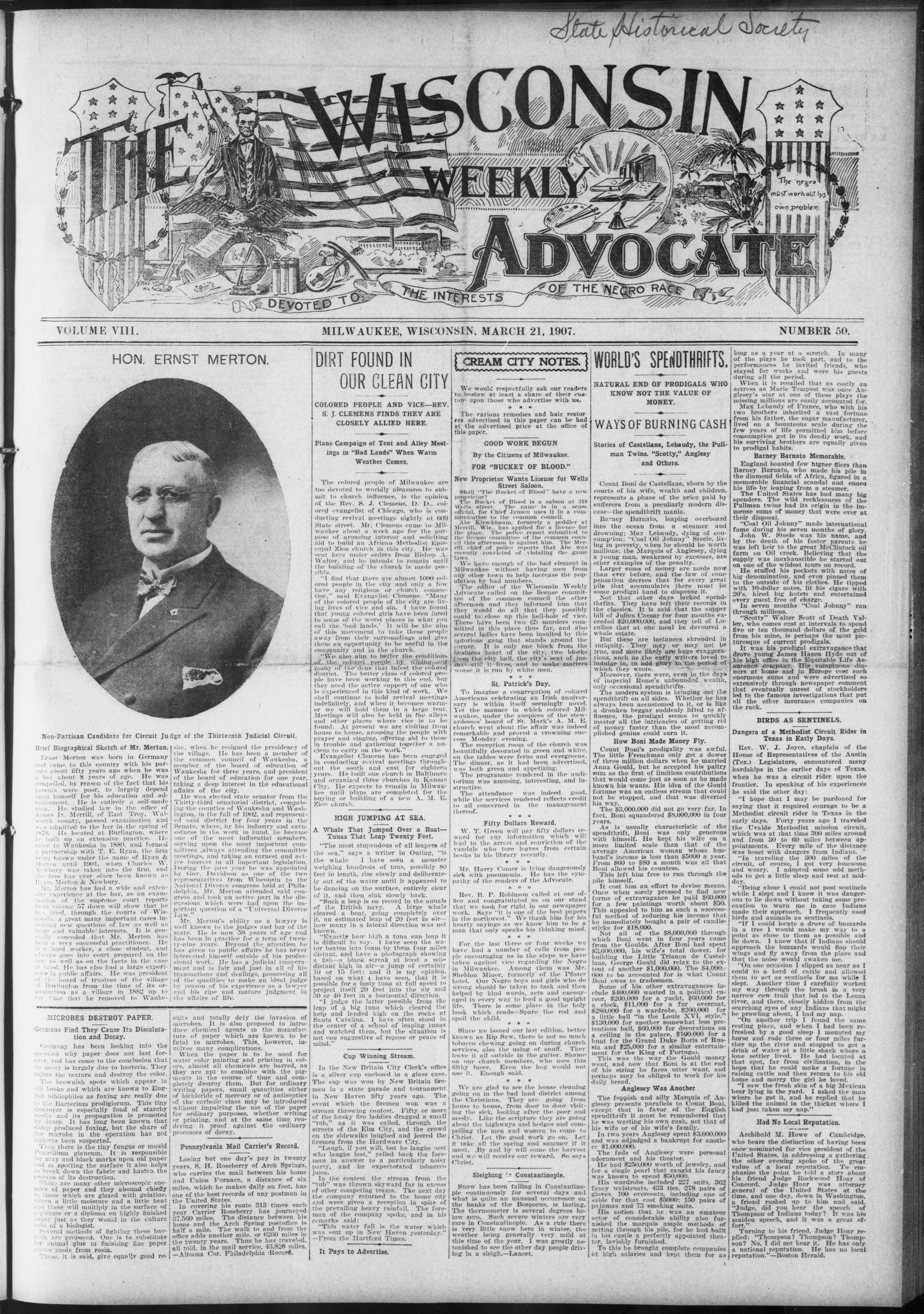
[Name]
Non-Partisan Candidate for Circuit Judge of the Thirteenth Judicial Circuit
VOLUME VIII.
Non-Partisan Candidate for Circuit Ju
Brief Biographical Sketch of Mr. Merton.
Ernst Merton was born in Germany and came to this country with his parents about fifty years ago when he was a boy about 8 years of age. He was compelled, by reason of the fact that his parents were poor, to largely depend upon himself for his education and advancement. He is entirely a self-made man. He studied law in the office of James D. Merrill, of East Troy, Walworth county, passed examination and was admitted to the bar in the spring of 1878. He located at Burlington, where he built up an extensive practice. He came to Waukesha in 1889, and formed a partnership with T. E. Ryan, the firm being known under the name of Ryan & Merton until 1901, when Charles W. Newbury was taken into the firm, and the firm has ever since been known as Ryan Merton & Newbury.
Mr. Merton has had a wide and extensive experience at the bar, as an examination of the supreme court reports from volume 57 down will show that he has tried, through the courts of Wisconsin, a great many important cases involving new questions of law as well as large and valuable interests. It is generally conceded that Mr. Merton has been a very successful practitioner. He is a hard worker, a close student, and always goes into court prepared on the law as well as on the facts in the case at hand. He has also had a large experience in public affairs. He was president of the board of trustees of the village of Burlington from the time of its organization as a village in 1882 up to the time that he removed to Wauke-
MICROBES DESTROY PAPER
Germans Find They Cause Its Discoloration and Decay.
Germany has been looking into the question why paper does not last forever, and has come to the conclusion that its decay is largely due to bacteria. They injure the texture and destroy the color. The brownish spots which appear in old books and which are known to English bibliophiles as foxing are really due to the Bacterium prodigiorum. This tiny destroyer is especially fond of starchy media and its propagation is promoted by damp. It has long been known that damp produced foxing, but the share of the microbe in the operation has not hitherto been suspected.
Then there is the tiny fungus or mould Penicillium glaucum. It is responsible for gray and black marks upon old paper and in spotting the surface it also helps to break down the fabric and hasten the process of its destruction.
There are many other microscopic enemies of paper and they abound chiefly in those which are glazed with gelatine. Given a little moisture and a little heat and these will multiply in the surface of a picture or a diploma on highly finished paper just as they would in the culture tube of a biologist.
Several methods of fighting these bacteria are proposed. One is to substitute for animal glue in finishing fine paper glazes made from rosin.
These, it is said, give equally good re-
---
sha, when he resigned the presidency of the village. He has been a member of the common council of Waukesha, a member of the board of education of Waukesha for three years, and president of the board of education for one year, taking a deep interest in the educational affairs of the city.
He was elected state senator from the Thirty-third senatorial district, comprising the counties of Waukesha and Washington, in the fall of 1902, and represented said district for four years in the Senate, where, by his industry and earnestness in the work in hand, he became one of the most influential members, serving upon the most important committees, always attending the committee meetings, and taking an earnest and active interest in all important legislation. During the past year he was appointed by Gov. Davidson as one of the two representatives from Wisconsin to the National Divorce congress held at Philadelphia. Mr. Merton attended said congress and took an active part in the discussions which were had upon the important question of a "Universal Divorce Law."
Mr. Merton's ability as a lawyer is well known to the judges and bar of the state. He is now 58 years of age and has been in practice for a term of twenty-nine years. Beyond the attention he has given to public affairs he has never interested himself outside of his professional work. He has a judicial temperament and is fair and just in all of his transactions and dealings, possessing all of the qualities to make an ideal judge by reason of his experience as a lawyer and his ripe and mature judgment in the affairs of life.
sults and totally defy the invasion of microbes. It is also proposed to introduce chemical agents in the manufacture of paper which are known to be fatal to microbes. This, however, involves many complications. When the paper is to be used for water color painting and printing in colors, almost all chemicals are barred, as they are apt to combine with the pigments in the course of time and completely destroy them. But for ordinary writing papers, small quantities either of bichloride of mercury or of antiseptics of the carbolic class may be introduced without impairing the use of the paper for ordinary purposes, whether writing or printing, and at the same time rendering it proof against the ordinary processes of decay.
Pennsylvania Mail Carrier's Record.
Losing but one day's pay in twenty years, S. H. Roseberry of Arch Springs, who carries the mail between his home and Union Furnace, a distance of six miles, which he makes daily on foot, has one of the best records of any postman in the United States. In covering his route 313 times each year Carrier Roseberry has journeyed 37,560 miles. The distance between his home and the Arch Spring postoffice is half a mile. The walk to and from the office adds another mile, or 6260 miles in the twenty years. Thus he has traveled, all told, in the mail service, 43,820 miles. Altoona Cor. Philadelphia Record.
MILWAUKEE, WISCONSIN, MARCH 21, 1907.
DIRT FOUND IN OUR CLEAN CITY
COLORED PEOPLE AND VICE—REV S. J. CLEMENS FINDS THEY ARE CLOSELY ALLIED HERE.
Plans Campaign of Tent and Alley Meetings in "Bad Lands" When Warm Weather Comes.
The colored people of Milwaukee are too devoted to worldly pleasures to submit to church influence, is the opinion of the Rev. S. J. Clemens, D. D., colored evangelist of Chicago, who is conducting revival meetings nightly at 609 State street. Mr. Clemens came to Milwaukee about a week ago for the purpose of arousing interest and soliciting aid to build an African Methodist Episcopal Zion church in this city. He was sent here under orders from Bishop A. Walter, and he intends to remain until the building of the church is made possible.
"I find that there are almost 1600 colored people in the city and only a few have any religious or church connection," said Evangelist Clemens. "Many of the colored people of the city are living lives of vice and sin. I have found that young colored girls have been lured to some of the worst places in what you call the 'bad lands.' It will be the aim of this movement to take these people away from their surroundings and give them an opportunity to be useful in the community and in the church.
"We also aim to better the conditions of the colored people by wiping out many of the dens that infest the colored district. The better class of colored people have been working to this end, but they need the active support of one who is experienced in this kind of work. We shall continue to hold revival meetings indefinitely, and when it becomes warmer we will hold them in a large tent. Meetings will also be held in the alleys and other places where vice is to be found. At present we are visiting from house to house, arousing the people with prayer and singing, offering aid to those in trouble and gathering together a nucleus to carry on the work."
Evangelist Clemens has been engaged in conducting revival meetings throughout the south and east for eighteen years. He built one church in Baltimore and organized three churches in Kansas City. He expects to remain in Milwaukee until plans are completed for the buying or building of a new A. M. E. Zion church.
HIGH JUMPING AT SEA
A Whale That Jumped Over a Boat—
Tunas That Leap Twenty Feet.
"The most stupendous of all leapers of the sea," says a writer in Outing, "is the whale. I have seen a monster weighing hundreds of tons, possibly 80 feet in length, rise slowly and deliberately out of the water until it appeared to be dancing on the surface, entirely clear of it, and then sink slowly back.
"Such a leap is on record in the annuals of the British navy. A large whale cleared a boat, going completely over it, an estimated leap of 20 feet in air—how many in a lateral direction was not known.
"Exactly how high a tuna can leap it is difficult to say. I have seen the water beaten into foam by them four miles distant, and have a photograph showing a fish—a black streak at least a mile distant high in air—a jump of certainly 10 or 15 feet; and it is my opinion, based on what I have seen, that it is possible for a lusty tuna at full speed to project itself 20 feet into the air and 30 or 40 feet in a horizontal direction.
"I judge the latter possible from the leap of a big tuna which cleared the kelp and landed high on the rocks at Santa Catalina. I have often stood in the center of a school of leaping tunas and watched them, but the situation is not one suggestive of repose or peace of mind."
Cup Winning Stream
In the New Britain City Clerk's office is a silver cup enclosed in a glass case. The cup was won by New Britain firemen in a state parade and tournament in New Haven fifty years ago. The event which the firemen won was a stream throwing contest. Fifty or more of the husky fire laddies dragged a small "tub," as it was called, through the streets of the Elm City, and the crowd on the sidewalks laughed and jeered the firemen from the Hardware City. "Laugh, if you will, but he laughs best who laughs last," yelled back the foreman in answer to a particularly noisy party, and he expectorated tobacco juice.
In the contest the stream from the "tub" was thrown skyward far in excess of other competing teams. The next day the company returned to the home city and were given a reception in spite of the prevailing heavy rainfall. The foreman of the company spoke, and in his remarks said: "This water fall is the water which was sent up in New Haven yesterday." —From the Hartford Times.
CREAM CITY NOTES.
We would respectfully ask our readers to bestow at least a share of their custom upon those who advertise with us.
The various remedies and hair restorers advertised in this paper can be had at the advertised price at the office of this paper.
New Proprietor Wants License for Wells Street Saloon. Shall "The Bucket of Blood" have a new proprietor?
proprietor?
The Bucket of Blood is a saloon at 318 Wells street. The name is in a sense official, for Chief Jansen uses it in a communication to the common council.
Abe Kirschbaum, formerly a peddler at Merrill, Wis., has applied for a licence for the place. The police report submitted to the license committee of the common council this afternoon is against him. The Merrill chief of police reports that Abe was recently convicted of violating the game laws.
We have enough of the bad element in Milwaukee without having men from any other town to help increase the population by bad numbers.
The editor of the Wisconsin Weekly Advocate called on the license committee of the common council the other afternoon and they informed him that they would do all that they possibly could to close up this hell-hole of vice. There have been two (2) murders committed in this place thus far, and also several ladies have been insulted by this notorious gang that stands around the corner. It is only one block from the business heart of the city, two blocks from the city hall, the city's seat of justice-still it lives, and to make matters worse it is run by white men.
St. Patrick's Dav.
To imagine a congregation of colored Americans celebrating an Irish anniversary is within itself seemingly novel. Yet the manner in which colored Milwaukee, under the auspices of the stewardesses' board of St. Mark's A. M. E. church went about the affair was indeed remarkable and proved a crowning success Monday evening.
The reception room of the church was beautifully decorated in green and white, on the tables were ferns and evergreens. The dinner, as it had been advertised, was both green and appetizing.
The programme rendered in the auditorium was amusing, interesting, and instructive.
The attendance was indeed good, while the services rendered reflects credit to all concerned in the management thereof.
Fifty Dollars Reward.
W. T. Green will pay fifty dollars reward for any information which will lead to the arrest and conviction of the vandals who tore leaves from certain books in his library recently.
Mr. Harry Comer is lying dangerously sick with pneumonia. He has the sympathy of the readers of the Advocate.
Rev. B. P. Robinson called at our office and congratulated us on our stand that we took for right in our newspaper work. Says "it is one of the best papers in the northwest." We thank him for his hearty sayings as we know him to be a man that only speaks his thinking mind.
For the last three or four weeks we have had a number of calls from people encouraging us in the steps we have taken against vice regarding the Negro in Milwaukee. Among them was Mr. Sheldon Minor, formerly of the Pfister hotel. Our Negro boys and girls who do wrong should be taken to task and then helped by kind words, acts and encouraged in every way to lead a good upright life. There is some place in the holy book which reads—Spare the rod and spoil the child.
Since we issued our last edition, better known as Rip Saw, there is not so much tobacco chewing going on during church services, also the using of snuff. They leave it all outside in the gutter. Shame on our church members, who uses this filthy lucer. Even the hog would not use it. Enough said.
* * *
We are glad to see the house cleaning going on in the bad land district among the Christians. They are going from house to house, from door to door visiting the sick, looking after the poor and needy. Like the scripture they are going about the highways and hedges and compelling the men and women to come to Christ. Let the good work go on. Let it take all the spring and summer if it must. By and by will come the harvest and we will receive our reward. So says Christ.
Sleighing in Constantinople.
Snow has been falling in Constantinople continuously for several days and what is quite an unusual occurrence on the banks of the Bosporus, is lasting. The thermometer is several degrees below zero. Such severe winters are very rare in Constantinople. As a rule there is very little snow here in winter, the weather being generally very mild at this time of the year. I was greatly astonished to see the other day people driving in a sleigh.—Lancet.
WORLD'S SPENDTHRIFTS.
NATURAL END OF PRODIGALS WHO KNOW NOT THE VALUE OF MONEY.
WAYS OF BURNING CASH
Stories of Castellane, Lebaudy, the Pullman Twins. "Scotty," Anglesy and Others.
Count Boni de Castellane, shorn by the courts of his wife, wealth and children, represents a phase of the price paid by sufferers from a peculiarly modern disease—the spendthrift mania.
Barney Barnato, leaping overboard into the ocean from a steamer and drowning; Max Lebaudy, dying of consumption; "Coal Oil Johnny" Steele, living in poverty, when he should be worth millions; the Marquis of Anglesey, dying a young man, weakened by excesses, are other examples of the penalty.
Larger sums of money are made now than ever before, and the law of compensation decrees that for every great pile that accumulates there must be some prodigal hand to disnense it.
Not that other days lacked spendthrifts. They have left their records in the classics. It is said that the supper bill of Julius Caesar for four months exceeded $20,000,000, and they tell of Lucullus that at one meal he devoured a whole estate.
But these are instances shrouded in antiquity. They may or may not be true, and more likely are huge exaggerations, such as the early writers loved to indulge in, to add glory to the period of which they wrote.
Moreover, there were, even in the days of imperial Rome's unbounded wealth, only occasional spendthrifts.
The modern system is bringing out the spendthrift on all sides. Whether he has always been accustomed to it, or is like a drunken beggar suddenly lifted to affluence, the prodigal seems to quickly master all the intricacies of getting rid of money faster than the most accomplished genius could earn it.
How Boni Made Money Fly.
Count Boni's prodigality was awful. The little Frenchman only got a dower of three million dollars when he married Anna Gould, but he accepted his paltry sum as the first of limitless contributions that would come just as soon as he made known his wants. His idea of the Gould fortune was an endless stream that could not be stopped, and that was diverted his way.
The $3,000,000 did not go very far. In fact, Boni squandered $8,000,000 in four years.
As is usually characteristic of the spendthrift, Boni was only generous with himself. He kept his wife on a more limited scale than that of the average American woman whose husband's income is less than $5000 a year. From $60 to $80 a month was all that Boni allowed his countess.
This left him free to run through the pile himself.
It cost him an effort to devise means. Once when sorely pressed to find new forms of extravagance he paid $60,000 for a few paintings worth about $50. This appealed to him as such a successful method of reducing his income that he immediately bought a pair of candle-sticks for $18,000.
Not all of the $8,000,000 through which Boni went in four years came from the Goulds. After Boni had spent $3,000,000, his wife's total dower, for building the Little Trianon de Castellane, George Gould did relax to the extent of another $1,000,000. The $4,000,000 to be accounted for is what Count Boni owes to tradesmen.
Some of his other extravagances include $400,000 wasted in a political career, $200,000 for a yacht, $60,000 for a clock, $11,000 for a fur overcoat, $280,000 for a wardrobe, $200,000 for a little ball "in the Louis XVI. style," $130,000 for another somewhat less pretentious ball, $60,000 for decorations on a ceiling in the palace, $190,000 for a hunt for the Grand Duke Boris of Russia and $25,000 for a similar entertainment for the King of Portugal.
This was the way the Gould money went, and now that Boni is at the end of his string he faces utter want, and perhaps may be obliged to work for his daily bread.
Anglesev Was Another
The foppish and silly Marquis of Anglesey presents parallels to Count Boni, except that in favor of the English spendthrift it must be remembered that he was wasting his own cash, not that of his wife or of his wife's family.
In two years Anglesey spent $3,000,000 and was adjudged a bankrupt for another $1,000,000.
The fads of Anglesey were personal adornment and his theater.
adornment and his theater.
He had $250,000 worth of jewelry, and for a single pearl that caught his fancy was known to spend $50,000.
His wardrobe included 227 suits, 362 fancy waistcoats, 433 ties, 278 pairs of gloves, 100 overcoats, including one of sable fur that cost $5000; 150 pairs of pajamas and 73 smoking suits.
His notion that he was an amateur actor of considerable ability also furnished the marquis ample methods of getting through his pile, for he had built in his castle a perfectly appointed theater, lavishly furnished.
To this he brought complete companies at high salaries and kept them for as
long as a year at a stretch. In many of the plays he took part, and to the performances he invited friends, who stayed for weeks and were his guests during all the period. When it is recalled that as costly an actress as Marie Tempest was once Anglesey's star at one of these plays the missing millions are easily accounted for. Max Lebaudy of France, who with his two brothers inherited a vast fortune from his father, the sugar manufacturer, lived on a bounteous scale during the few years of life permitted him before consumption got in its deadly work, and his surviving brothers are equally given to prodigal habits.
Barney Barnato Memorable
England boasted few higher fliers than Barney Barnato, who made his pile in the diamond fields of Africa, figured in a memorable financial scandal and ended his life by leaping from a steamer.
The United States has had many big spenders. The wild recklessness of the Pullman twins had its origin in the immense sums of money that were ever at their disposal.
"Coal Oil Johnny" made international fame during his seven months of glory.
John W. Steele was his name, and by the death of his foster parents he was left heir to the great McClintock oil farm on Oil creek. Believing that the supply was inexhaustible he started out on one of the wildest tours on record.
He stuffed his pockets with notes of big denomination, and even pinned them to the outside of his clothes. He tipped with 10-dollar notes, lit his cigars with 20's, hired big hotels and entertained every guest free of charge. In seven months "Coal Johnny" ran through millions.
"Scotty" Walter Scott of Death Valley, who comes east at intervals to spend five or ten thousand dollars of the gold from his mine, is perhaps the most picturesque of current prodigals. It was his prodigal extravagance that drove young James Hazen Hyde out of his high office in the Equitable Life Assurance company. His sumptuous dinners at home and in Europe cost such enormous sums and were advertised so extensively through newspaper comment that eventually unrest of stockholders led to the famous investigations that put all the other insurance companies on the rack.
BIRDS AS SENTINELS.
Dangers of a Methodist Circuit Rider in Texas in Early Davs.
Rev. W. J. Joyce, chaplain of the House of Representatives of the Austin (Tex.) Legislature, encountered many hardships in the earlier days of Texas, when he was a circuit rider upon the frontier. In speaking of his experiences he said the other day:
"I hope that I may be pardoned for saying that it required courage to be a Methodist circuit rider in Texas in the early days. Forty years ago I traveled the Uvalde Methodist mission circuit, which was at that time 300 miles around and from 30 to 60 miles between appointments. Every mile of the distance was beset with dangers from Indians."
"In traveling the 300 miles of the circuit, of course, I got very lonesome and weary. I adopted some odd methods to get a little sleep and rest at midday.
"Being alone I could not post sentinels while I slept and I knew it was dangerous to lie down without taking some precaution to warn me in case Indians made their approach. I frequently used birds and animals as sentinels.
"If I could locate a drove of buzzards in a tree I would make my way to a point as close to them as possible and lie down. I knew that if Indians should approach the buzzards would flop their wings and fly away from the place and that the noise would awaken me.
"On one occasion I slipped as near as I could to a herd of cattle and allowed them to act as sentinels for me while I slept. Another time I carefully worked my way through the brush in a very narrow cow trail that led to the Leona river, and there, closely hidden from the searching eyes of any Indians that might be prowling about, I had my nap.
"On another trip I found the same resting place, and when I had been refreshed by a good sleep I mounted my horse and rode three or four miles further up the river and stopped to get a drink of water at a little shack where a lone settler lived. He had located at that spot, far from civilization, in the hope that he could make a fortune in raising cattle and then return to his old home and marry the girl he loved."
"I saw the fresh skin of a big Mexican bear lying in the yard. I asked the man where he got it, and he replied that he killed the animal in the thicket where I had just taken my nap."
Had No Local Reputation.
Archibald M. Howe of Cambridge, who bears the distinction of having been once nominated for vice president of the United States, in addressing a gathering the other evening spoke of the great value of a local reputation. To emphasize the point he told a story about his friend Judge Rockwood Hoar of Concord. Judge Hoar was attorney general of the United States at the time, and one day, down in Washington, a friend rushed up to him and said, "Judge, did you hear the speech of Thompson of Indiana today? It was his maiden speech, and it was a great effort."
Turning to his friend, Judge Hoar replied: "Thompson? Thompson? Thompson? No, I did not hear it. He has only a national reputation. He has no local reputation."—Boston Herald.
THE WISCONSIN WEEKLY ADVOCATE
MILWAUKEE, WIS.
R. B. MONTGOMERY, Editor and Proprietor.
YOUTH IRRETRIEVABLE.
I plucked a leaf from sorrow,
I broke a thorn from pain.
And where I pulled the leaf and thorn
They straightway grew again.
But where I picked the blossom
Of youth, the branch shows bare,
Nor can I find a second flower,
Though I search everywhere.
—Atlantic Monthly
Miscellaneous Items.
Gramophones are used in English theaters to give "stage shouts," thus saving expense and insuring volume of sound.
A rope that had been used by the public executioner in the hanging of several murderers was sold at auction in London the other day and brought $1.25.
The foundations of the Bourse building at Amsterdam have given way, and the building is threatened with ruin and has been closed. It cost $4,000,000 and was completed only recently.
As the British war department is about to move from its old quarters in Pall Mall to the new quarters in Whitehall, the suggestion is made that it sell its furniture in the old place and buy it back, at an advance, for the new place, South African style. A pulpit that has been consecrated by the British Bishop of Carlisle for use in St. Cuthbert's, Carlisle, runs on wheels. It is brought in and taken out of the church by means of a trolley and endless rope. Made of mahogany and over nine feet in height, the pulpit cost $1000.
Of Robert Louis Stevenson a recent writer says: "With his dark eyes looking as if they had drunk in the sunshine in some southern land, his uncut hair, his odd, shabby clothes clinging to his attenuated frame, his elaborate manners and habit of gesticulating as he spoke, he was often mistaken for a starving musician or foreign mountebank. Continental officials doubted his passport's statement that he was a Briton. In France he was imprisoned, and Stevenson complained that he could not pass a frontier or visit a bank without suspicion."
HOUSEHOLD HINTS.
When blowing out a candle hold it above you and blow. If this is done the wick will not smolder.
Never fill a lamp quite full, or when it is brought into a warm room the expansion of the oil will cause it to overflow, and the result will be decidedly unpleasant.
Soda used in the laundry should be dissolved before the garments to be washed are placed in the tub. Yellow stains, which soon form holes, are caused by soda touching wet linen.
Saucepans should be kept clean on the outside as well as inside. To prevent the smoke from sticking rub the outside of a new saucepan with fat before placing on the stove. Wash with hot water and soda.
If grease be spilled on the hearth do not wash it. Take up as much as you can by rubbing it with oid newspaper, and then rub the mark over well with a piece of dry hearthstone. Brush off the hearthstone, and, if necessary, repeat the process. In the meantime the grease will soon utterly disappear.
Soot on the carpet need not cause a hideous stain. Do not attempt to remove it till you have covered it over with an equal amount of salt—ordinary kitchen salt, but in powder, not lumps. The soot and salt together may be easily swept up without the least damage to the carpet.
For a good furniture cream, finely shred an ounce of beeswax, half an ounce of white wax, and half an ounce of Castile soap. Cover with half pint of turpentine, and stand on the stove in a gallipot to dissolve. Next day add a quarter pint of boiling water, stir thoroughly together, and then put in wide-mouthed bottles for use. Keep this cream well corked.
Perhaps the best dish clothes are made of knitted cotton, but excellent ones may be made by neatly hemming pieces of crash of convenient size. After using always wash a dishcloth with soap and soda, then rinse it thoroughly and hang in the air to dry. A dirty dishcloth is a disgrace to a housekeeper and there is no excuse for it, for it is easily kept clean if attention is paid to it.
No Excuse.
The judge had his patience sorely tried by lawyers who wished to talk and by men who tried to evade jury service. So when the puzzled little German, who had been accepted by both sides, jumped up the judge was exasperated.
"Shudge!" cried the German.
"What is it?" demanded the judge.
"I tink I like to go home to my wife," said the German.
"You can't," retorted the judge. "Sit down."
"But, shudge," persisted the German, "I don't tink I make a good shurer."
"You're the best in the box," said the judge. "Sit down."
"But, shudge," persisted the little German, "I don't speak good English."
"You don't have to speak any at all," said the judge. "Sit down."
It was the judge's chance to get even for many annoyances.
"Neither can any one else," he said "Sit down." With a sigh the little German sat down.—Tit-Bits.
Surprises for Royalty
There is always a trifle of risk attaching to private movements of royalty, for public bodies are apt to spring surprises. At the eleventh hour an address of welcome was presented by a corporation to the Prince of Wales upon his return from his Ophir tour. The Prince, who does not make public speeches without advice, had no reply ready, and had to intimate that the answer to the address would be forwarded.
When the Empress of Austria arrived for one of her hunting expeditions some well meaning admirers placed in her sabon a large sweet smelling bouquet. The Empress' attendant had it removed immediately he saw it. While appreciating the good intentions which had animated the givers, he intimated that the august traveler could not endure the scent of bouquets.—London Evening Standard.
THE TYRANT
I made a covenant with Time. He spakes:
"O braggard brain, presumptuous heart of dust.
Brief energy, dost fret at moth and rust?
Think'st thou to mend the laggard pace I take?"
Behold, the hills—the baubles that I make—
How down before me: verily thou thou!
Then grudge not, stint not, brave the
world's distrust.
Wait and stand steadfast while I make and
break:
Then see how generous old Time can be!
Then rest, and be his darling! Ho, the
sheaves
These hasty folk snatch from my granary. Then, startled at my shadow, drop like thieves!
theaves.
I chuckle as I lay them by for thee.
Mellow as sunlight in autumnal eves!.
Charlotte Wilson in Atlantic.
THE KIDNAPING OF GEORGE.
The young man's face was clouded by a shadow. And the face of the young woman whose clear gray eyes intently regarded him was clouded, too. "No, Martin," she presently broke the silence, "I cannot be persuaded."
He looked at her tenderly.
"I am selfish enough to think you are wrong," he said. "but that's a lover's unfairness. Anyway, there is no question about the beauty of the sacrifice you are making."
"I am only doing what I believe to be my duty, Martin."
"And you would marry me if it were not for George?"
She hesitated a moment. "I—I think I would, Martin."
He moistened his lips. "George looms very large and very formidable," he said. "What can be done with him?"
The girl sighed. "Nothing."
There was a little silence. "It isn't right." murmured the man beneath his breath, and there was bitterness in his tone.
"It is the only thing I can do," said the girl.
"You know he isn't worth the sacrifice."
"He is my brother."
The man drew a long breath. "Such a brother!"
The girl's face flushed. "I cannot discuss this even with you. Martin. I must do my duty as I see it. George needs my care. My mother with her last words asked me to watch over him when all others deserted him. I will carry out my promise."
The young man locked up eagerly.
"No. Martin. He shall be my disgrace alone." Her head drooped, her gaze was turned from him.
"And can nothing be done?"
"Nothing. I have had the best medical advice. It was of no avail. He will do nothing, to help himself. He is utterly indifferent to his condition. If he cannot get brandy he resorts to morphine. He has had the so-called 'cures.' If he could be taken away from this perilous atmosphere, far away from these wicked friends who are sapping his life and his money, if he could be made to fight out the battle with himself alone and unaided—why, it would either cure or kill him. And that, they tell me, is the only hope."
Martin stared hard at the floor. "I would be glad to help George if I could," he said. "but he repels me. He appears to regard me as an enemy." He paused and then looked up. "I have told you, Margery, that on your decision an important move in my career depends. If you will marry me I will remain here in Somerton. If not, I will accept an offer I have to go to Egypt, where a contracting engineer is needed." He looked at her anxiously, "Is there any hope?"
"No. Martin."
"I will be gone at least two years."
"Yes."
"Will you wait, Margery?"
"Do not ask me to make any promises. Martin. I cannot tell what may happen. He hesitated an instant.
"You have sufficient income?"
"Yes."
He arose. "I must wire my acceptance of the offer tonight and start tomorrow."
Before she could answer this the outside door was noisily slammed, and a young man staggered through the doorway.
"George!" said the girl, in a pitiful cry.
"What's that?" he muttered thickly. "S that you, Martin Henley? What you doing here? Makin' love to my s-sister? She don't want nothin' to do with you. She got her dear brother to look after. Good night, Martin Henley, goo' night." He lurched toward the sofa and fell upon it. heavily.
Martin Henley, his eyes avoiding those of the girl, passed into the hall. The girl followed him. He turned quickly as they neared the outer door.
"You say the only hope for George is a new scene and new surroundings?"
"Yes," she whispered.
"Come back here, sister," the profligate called. "I need you. Don't you hear me? I need you." And the maudlin voice trailed off in a discordant song.
Martin Heiney put out his hand.
"Good-bye, and God guard you, Margery."
"Good-bye, Martin."
And he was gone.
If he could have looked back into the hallway he would have seen the girl leaning against the wall and sobbing as if her heart would break.
Quite unconscious of this, however, he strode along, a new and strange idea dulling the pain of the departure. The idea still held possession of his mind when he entered the telegraph office and penned his dispatch accepting the Egyptian offer.
When tea time came the next day and George did not return, Margery Selby felt little anxiety.
At 11 o'clock a telegram was brought: "Have kidnaped George. Am trying the only hope. Don't worry. Martin Henley." The telegram fluttered from her hands. Then she stooped and picked it up. It came from New York. At 4 o'clock the next day Margery received another message. "Just boarding a Mediterranean steamer. Everything hopeful." Margery drew a long breath of relief. The days wore away and it was almost a month later before Margery received the first letter. It was dated Gibraltar.
"We have been buffeted by storms," Martin wrote. "It is too early yet to talk about results, but I have not lost hope in the success of the experiment.
No doubt you are wondering how I contrived to kidnap George, but it wasn't very difficult. It was a harder matter to get him aboard the steamer, but I finally succeeded. I am sorry to say that he does not appreciate the efforts I have made in his behalf. In fact, he regards me as his bitterest enemy. Perhaps this feeling will wear away. You may rest assured that it will make no difference in my feeling toward him." Margery cried over this letter. She could omy faintly imagine the events of that long voyage. But she knew that Martin would persevere to the very utmost. The letter from Alexandria was a long time coming. She opened it with a feeling of dread.
"George has been ill." Martin wrote; "so ill that I did not have the heart to write you until he was better. But he is so much improved that in a few days I hope we can start up the Nile. There was one very gratifying feature of his illness—all his old animosity disappeared. He has just called to me, 'Tell sister,' he says, 'that I am in good hands.' I will write to you again before we enter the desert."
Then Margery waited for the letter from the desert. At last it came.
"More delays," Martin wrote, "but now our equipment is ready and we enter the desert tomorrow. I do not know when you will hear from us again. We are going to be cut off from the usual means of communication.
"I am writing this in a troop shed, the only quarters we could get. George is lying on a blanket-covered board. I do not dare let him leave my sight. He is very melancholy, and his antipathy to me has returned. I am writing to you frankly, dear girl, just as I am sure you would have me write. We had a hard battle and the outcome is not at all certain. Good-bye, and heaven keep you." That was the last that Mangory heard
That was the last that Margery heard from Martin for many months. A year wore away and still no message came. And then Margery almost ceased to hope. She knew there had been an uprising of the savage tribes of the Soudan. The fanatic followers of a leader long supposed to be dead had swept away the outposts of the British advance and destroyed much of the work upon the new railroad. Later came tidings of a battle in which the British force had routed the fanatics with great loss. But their own loss was heavy and the advance was slow. There were rumors of white prisoners somewhere in the interior. Six weeks later Margery received a cablegram.
Another long period of waiting followed, but now Margery's anxiety was tempered by hope.
Then came a clear and beautiful morning in June, when two men, one strong, robust, clear of eye and rosy of cheek, the other gaunt, pale, hollow eyed, confronted her.
Margery gave a little scream. This fine young fellow, whose hand firmly clasped hers, was George, and the figure holding fast to his arm, a shadow of his former self, was Martin Henley.
The tears sprang to Margery's eyes at this pitiful sight, and she caught hold of Martin's wasted hand and drew him into the little sitting room.
"There he is," cried George. "He took me away from home, and I've brought him back. Margery, if I talked for a month of Sundays I couldn't begin to tell you what that man has done for me."
Don't, George, murmured Martin.
"Look at me, Margery," cried George.
"See what I have become! This is a man. Oh, you needn't be afraid. My craving for the stuff has gone. It was burned out of me and starved out of me and beaten out of me! A thousand temptations couldn't harm me now. And this man stood by me and nursed me back to life and saved me from the Arab swords, and dug me out of the Arab prison." He paused, his eyes were suddenly suffused. He caught up Martin's hand. "What horrors we have been through, brother!" he half sobbed.
"A fine fellow, Margery," murmured Martin with a smiling nod at George.
"He brought me through the desert fever."
"That was the only chance he gave me," cried George. "He broke down at last and then it was my turn, I twice thought I'd lost him, but when I whispered 'Margery' in his ear he rallied and fought on. Oh, but he's going to be all right now, sister. The one tonic in all the world that will make a man of him again is here, and its name is Margery."
He turned abruptly and went out of the room.
Then Margery went to Martin and stooped over him and put her rounded arm about his neck and pressed her rosy cheek to his wasted one.
"Dear, dear Martin," she sobbed, "you will never leave me again."—W. R. Rose in Cleveland Plain Dealer.
THE JEWEL LANGUAGE
Agate—Long life and health.
Amber—Disdain.
Amethyst—Peace of mind.
Aquamarine—Misfortune and hope.
Bloodstone—I mourn your absence.
Beryl—Thou wilt not forget me.
Cat's eye—Platonic love.
Chrysolite—Disappointed love.
Diamond—Pride.
Emerald—Success in love.
Garnet—Fidelity in every engagement.
Jade—Unloved but remembered.
Jasper—Pride of strength.
Jet—Sad remembrance.
Lapis Lazull—Nature's nobility.
Moonstone—Pensiveness.
Opal—Pure thoughts.
Pearls—Modest loveliness.
Ruby—Courage and success in dangerous
and hazardous enterprise.
Turquoise-The most brilliant success and happiness in life.-Philadelphia Bulletin.
Panning Out Gold in City Street.
"The days of old, the days of gold, the days of '49" were recalled in a vivid manner in the heart of the business section of town the other day. Considerable sand had been washed down the gutter and street from the hill above,
and some thinking mortal tried a shovelful in a miner's pan. He quickly found colors, and in a short time any number of business men and others were hard at work with all kinds of pans and utensils, washing the dirt in a tiny stream in the gutter near by. Some made as much as $2 in a short time, while even the veriest novice found colors. It is argued that a rich ledge lies in the hills at the end of the street and prospecting may be started in an endeavor to locate the home of the fine gold.—Nevada City Cor. Sacramento Bee.
FOR THE FAMILY TABLE.
Tender Cabbage.—Cut a head of cabbage into quarters, remove coarse leaves and most of the stalk. Drop into boiling water and cook ten minutes, drain and drop into cold water. When entirely cold drain the blanched cabbage and chop fine. Rub one rounding tablespoon of flour with one of butter, stir in the cabbage, season with a level teaspoon of salt and a little pepper, then stir in one cup of milk, cover, simmer slowly for an hour, or until very tender and the milk is absorbed.
Raised Muffins.—Mix one cup each of boiling water and scalded milk, one rounding tablespoon each of butter and sugar and one-half level teaspoon of salt. Cool until lukewarm, add one-quarter yeast cake, four cups of sifted bread flour and one beaten egg. Cover and let rise over night, when the dough should have doubled in bulk. Butter some muffin pans, fill half full with the risen dough and let stand until even full, then bake.
Lemon Jelly.—Soak one-half box of gelatine in one-half cup of cold water for half an hour. Put the thinly shaved rind of a lemon, one cup of water and two cups of sugar into a saucepan, and when boiling hot add the gelatine and stir until dissolved. Take rfrom the fire and add the strained juice of three lemons. Stir and strain into a large mold or small ones rinsed with cold water. Set in a cold place for several hours.
Filling for Cake.—Beat one pint of cream until thick, adding one rounding teaspoon of gelatine soaked in one tablespoon of cold water for an hour and dissolved in another tablespoon of boiling water. The gelatine is added to the cream after it has been beaten stiff and it is best to strain it in. Add powdered sugar to sweeten and enough vanilla to flavor. Spread between cakes when cold.
Ice Cream Cake.—Cream three-quarters cup of butter with two cups of fine granulated sugar. Add one cup of milk and beat. Sift seven-eighths cup of cornstarch and two cups of pastry flour with five level teaspoons of baking powder, add to the first mixture and beat well. Fold in the white of seven eggs, beaten stiff and dry, and bake in layers. Fill and cover with a boiled icing.
Breakfast Potatoes.—Slice cold boiled potatoes evenly. Melt a rounding tablespoon of butter, add a level tablespoon of minced onion, and when it is yellow put in one or two tablespoons of cold gravy and add potatoes. Scatter on a little salt and pepper. Cover and let stand where they will heat slowly. Turn on to dish and sprinkle on a little minced parsley.
Small Baked Apple Pudding.—Chop enough slightly sour apples to fill two cups, add one cup of fine bread crumbs, one-half cup of sugar, three tablespoons of melted butter and one-half level teaspoon of cinnamon. Turn into a buttered pudding dish and bake covered one-half an hour, uncover for ten minutes. Serve with hard or liquid sauce.
Lemon Pudding Sauce.—Pare the thin yellow rind from a lemon and cook in water twenty minutes. Change the water twice. Drain and snip the thin rind into fine shreds with scissors. Put one cup of sugar, one cup of water and the rind into a saucepan and cook ten minutes. Serve hot with cold puddings or with a hot apple pudding.
Tripe Fritters.—Cook tripe in boiling water until tender, drain and wipe dry. Make a batter of one cup of milk, one beaten egg, a pinch of salt and two level teaspoons of baking powder sifted in one cup of flour. Cut the tripe in uniform small squares, dip in the batter and fry in deep hot fat. Serve with baked potatoes.
Ham Souffle.—Chop enough cold boiled ham to make one and one-half cups. Beat the yolks of four eggs well, stir in three cups of milk, add the ham and a pinch of pepper, then stir in lightly the stiffly beaten whites of four eggs and pour all into a buttered baking dish. Bake in a slow oven until the eggs are set.
Coffee Custards.—Heat three cups of milk in a double boiler and add two tablespoons of clear black coffee. Beat the yolks of five eggs with one-quarter cup of powdered sugar; add to the milk and cook until thick. Serve in glasses with a spoonful of whipped cream on each.
Feather Cake.—Cream one cup of sugar and one-half cup of butter, add one cup of milk, four cups of flour sifted with four level teaspoons of baking powder, and the whites of two eggs beaten stiff. Flavor with vanilla.
MARJORIE WEBSTER.
DYE SHAH'S HORSES' TAILS
Ruler Alone May Have Steeds of Brilliant Crimson.
The long tails of the Shah of Persia's horses are dyed crimson for six inches at their tips—a jealously guarded privilege of the ruler and his sons.
All Men Are Cowards
Upon the statement that modern American business men, although they possess virility, brains, and force, are in general cowardly and uncultured, and are lacking in character, Prof. Charles Zueblin, professor of sociology of the University of Chicago, based an address on "The Over-Specialized Business Man and Public Morals," in Chicago. Some of his statements follow:
Business men possess virility, but not courage; brains, but not culture; force, but not character.
"Stand pat" is the most immoral of all declarations; it means that there is something rotten that must be hidden.
The lack of courage is the chief defect of all people today.
The building of the La Salle street station was a bit of cowardice; the proposed North-Western station will be a monument of senility.
Marshall Field had the greatest brain the business world has seen; but the provisions of his will show a lack of culture.
Instead of using their brains to evade the constitution, business men, if cultured, would revise it; they would abolish the United States Senate, instead of trying to get into it; they would legalize combinations and railway pools.
Lack of character is shown in the attitude of the business men of Chicago in the traction question.
Harriman is the most forceful man in the public eye, but he has admitted unblushingly acts which everyone regards as dishonest.
THE GABBLER
Money talks!
At the conversation game it never balks.
You can hear it at the show,
Not particularly low,
At the opera it talks, talks, talks.
Money talks!
It's a chinner throughout all our earthly walks.
At a fashionable affair
You can hear a million air
Its opinion as it talks, talks, talks.
Money talks!
With a megaphone around the town it stalks.
It continually resounds,
Overwhelming other sounds,
As unceasingly it talks, talks, talks.
—Philadelphia Bulletin.
The county board at Chippewa Falls, Wis., wants to know what a wolf looks like and has appointed S. Moskewitz to make an exhaustive study of the subject and reduce his findings to print, and copies will then be distributed among all the town chairmen of the county. It appears that a number of the chairmen, from year to year, have been hoo lwinked in issuing orders for wolf bounties, fox hides and hides of other non-bounty animals being often substituted for wolf.
A "hallelujah wedding," with workers of the Salvation Army as the principals, took place at Marion, Ind., recently. The contracting parties were Miss Bernice Watson of Cadillac, Mich., and William Lawson of Richmond, Ind. The couple became acquainted one year ago, when Lawson was converted and became a member of the Salvation Army, in which Miss Watson already was a worker. The wedding was public, but an admission fee was charged and the proceeds placed in the fund of the Salvation Army.
Wilfred Johnson, Hans Opsahl, Bert Benson and Fred Topel reached Marianette, Wis., exhausted after being lost on Green bay in a snowstorm for thirty-six hours. The men had been fishing off the whaleback and lost their bearings in a blizzard and wandered around half frozen all night, having no means of making a fire. At daylight they found they were in sight of land and managed to get home. The bay ice is badly rotted and two fishermen ran a sleigh into a fissure, losing all their fish and getting a wetting.
James B. Connolly, the American author who enlisted as a sailor of the United States navy, at the suggestion of President Roosevelt, for the purpose of doing for the United States navy what Rudyard Kipling did for the British navy, has left the service in disgust. The publicity given the matter caused the sailors to fight shy of him. Connolly enlisted for two years as a second-class yeoman. He shipped on the battleship Alabama at Hampton Roads early in January and made a cruise to the naval station in Guantanamo on the Alabama.
A monkey swallowed a diamond stud valued at $400 belonging to William L. Dockstader, proprietor and manager of the Garrick theater, the leading vaudeville house of Wilmington, Del.
While he was petting a simian member of Wormwood's troupe that appeared at the Garrick this week, the animal suddenly seized the stone from his tie and gulped it down. Mr. Dockstader has suggested to Wormwood that it be left in the care of Manager Joseph I. Gainer of the Nixon & Zimmerman opera house here and himself until the stone is recovered.
Averring that her husband, to whom she was married before the war, treated her most uncivilly on many occasions, and even at times resorted to his ear trumpet as an instrument of torture, and lavished many painful whacks upon her person, Mrs. Julia Dawson, 65 years old, filed a bill for divorce in Chicago. She asks for a share of her husband's estate, amounting to $70,000, "accumulated by our joint effort, by my frugality, and my assistance, even as a hand in the field," says the petition. The ear trumpet was broken during the last onslaught. The document, covering a period of forty-seven years, mostly on the farm, relates in detail many of the domestic troubles between the aged couple. For forty-three years they were happy. Then they came to Chicago.
Nothing serious happened, however, until Dawson read in a farming magazine a display "ad" relating the many advantages and usages to which an ear trumpet could be put. He invested a portion of his hard-earned money in the article advertised.
The police department of Kenosha, Wis., had a new proposition when Joseph Pink, an Italian, asked that an officer be sent to force Josephine Caira, a comely Italian girl of 16 years to accept his proposal of marriage. Pink had already secured a license and had purchased furniture for a house and a wedding dress for the bride. He informed the police that he had given her the wedding rings some time ago, but that when he had announced that she was expected to appear for the ceremony she had balked.
Police officers accompanied Pink to the home of Miss Caira, but when they urged the marriage she refused to see Pink and declared that she would not marry him under any circumstances. She declared, "He is entirely too strenuous a lover." The wedding ring was turned over to the officer to carry back to Pink and the girl told the officers that he had attempted to enforce his proposal of marriage at the point of a revolver and Pink was arrested. When searched he had a revolver in his pocket.
Instead of going to his own wedding he was taken to a justice court where he paid a fine for carrying concealed weapons and gave a bond to keep the peace.
After three months of hiding in a house declared to be haunted, Kenosha (Wis.) detectives solved another spook mystery and captured the ghost. The cause of the terror turned out to be the granddaughter of Mrs. Katherine Oneil, a wealthy resident of the town of Salem, whose residence and farm have been the scene of the "ghost's" exploits.
Windows in Mrs. Oneil's house were broken by some unknown agency. They would be replaced, only to be broken again. Through the broken panes a face would be seen peering. Popular superstition soon began to assert that six or eight faces had sometimes been seen for an instant, staring wildly through the empty window frames.
Not content with breaking windows, the "ghost" proceeded to turn out cattle from the fields and drive them far from home. Then multilation of animals began. Cows' tails were cut off and nails were driven into the hoofs of horses. In the hoof of one horse a cartridge was inserted. Mrs. Oneil was almost prostrated. About twelve weeks ago detectives were sent to the Oneil residence.
At first the county officials were inclined to the belief that the ice com
panies, which are at sword's point, were trying to force a sale of the Oneil farm. One of the detectives, who had suspected the young woman, announced he was going home. He hid in the barn. In the early hours of the morning he saw the girl steal out of the house. She went to a nearby field and began to turn loose the cattle. Then the detective captured her. Mrs. Oneil declines to prosecute:
BRITISH LEGISLATION COSTLY.
Railway Paid $2,000,000 to Pass Bill for Common Weal.
It costs much money to get a piece of legislation through the British Parliament. A certain railway once proposed a scheme for a part of the country where their undertaking would be a godsend to every enterprise and contribute to the wealth of a whole nation. The bill ought to have gone through with almost no outlay of money. But to get that bill through Parliament cost the sum of $2,000,000 before ever a sod was turned or a brick laid.
HORSES INCREASE IN NUMBER.
Great Britain Figures Indicate Useful
ness Is Not on Wane.
The agricultural returns for 1905, just issued, show the total number of horses in the United Kingdom in June last year was 2,116,800, an increase of 16,000 over 1904, and the number of cattle 1,167,400, an increase of 100,000. On the other hand, the number of sheep shows a falling off of nearly 30,000 compared with 1904, there being a striking reduction in the number of pigs, the number of which fell off to the extent of 590,000.
COPPER PLATE ALUMINUM
New Process, by Welding, Is Discovered in Germany.
A process of plating aluminum with copper by welding methods has been invented in Germany by Herr Wachnitz. This is regarded as important because one of the obstacles to a wider use of aluminum has been its comparative lack of resistance to the action of many fluids and its failure to hold paint. These objections are removed when it is covered with a thin plating of copper, while its weight is not materially increased.
Boy Hero Gets a Medal.
A Carnegie medal and $1500 in cash has been awarded Fred Hiser, 16 years old, who lives on a farm with his parents among the Les Cheneaux islands, Mich. Young Hiser, during the latter part of December, rescued from a burning building his aunt, who had returned to the home, possibly to rescue a cherished keepsake.
Fearing that she would burn to death the lad rushed into the flames, fought his way through the blinding smoke and stifling heat until he found his aunt unconscious on the floor.
By the time he had carried her outside he was terribly injured. His hair was burned from his head, his clothes charred, exposing the raw flesh of his limbs where the skin had burned away. His eyes were almost glued together by the heat, and the fingers of his hands were almost webbed together.
Young Hiser has recovered after weeks of suffering.
Why
A young lady who taught a Sunday school class of young boys was often non-pulsed by th ingenious questions sometimes propounded by her young hopefuls.
One Sunday the lesson touched on the story of Jacob's dream in which he had a vision of angels descending and ascending a ladder extending from heaven to earth. One inquiring youngster wanted to know why the angels used a ladder, since they all had wings. At a loss for a reply, the teacher sought to escape the difficulty by leaving the question to the class.
"Can any of you tell us why the angels used a ladder?" she asked.
One little fellow raised his hand.
"Please, ma'am," he said, "p'r'aps they was moulting!"—Harper's Weekly.
No Money Can Carry Taint.
"There is no such thing as tainted money," declared Dr. Charles W. Needham, president of George Washington university, in an address before the students of that institution in Washington. "Human conduct in acquiring money does not attach to or mix in the coin, nor lessen nor weaken the promise to pay upon the bank note. There is no such thing as 'tainted money.' Good moral money—that is, coin of full weight and live promises to pay—good coin, is good anywhere, in any man's land. Truth takes no passing shadow to itself, and money cannot become impregnated by the deeds of passing users. Having this view of good money, I will accept it from any man who owns it."
Dog Saves a Rabbit
A sportsman on the Huntsham estate, North Devon, had a rabbit brought to him by his spaniel, which had caught it under a hedge.
The rabbit could walk only very feebly, though all its limbs were found to be sound. In its mouth, however, was a thick twig about three inches long, which had become wedged in behind the teeth in the rabbit's rush from some threatened danger. The animal was unable to extract the twig with its paws and was being gradually starved to death when it was found by the dog.—London Evening Standard.
Rabbit Discharges a Gun.
An extraordinary incident occurred close to the village of Milton, near Newport Pagnell, on Friday. A commercial traveler while driving along the road stopped to speak to two gentlemen who were shooting rabbits alongside the hedge.
One of the gentlemen laid his gun on the ground while he placed a ferret in a hole. A rabbit bolting at this moment ran over the triggers of the loaded gun, which it released with its feet, the traveler having a very narrow escape.—London Daily Mail.
Twin Is Father of Twelve Twins.
E. R. Brown of Ravenna, O., father of eight sets of twins, has just heard from his eldest son in St. Louis that the latter's wife several days ago presented him with the sixth set of twins. In each case they are a boy and a girl. Mrs. Brown, who died seventeen years ago, was a full-blooded Cherokee Indian. At the world's fair in Chicago the twins were weighed and aggregated over two tons, the biggest being 320 pounds.
Giving the Mail a Send-off
Over in the little town of Wildeat a negro postmaster each day carries the mail from the postoffice to the train. Slowly he places the mail pouch on a crane. As the fast train is approaching and the arm on the mail car extends to sweep the bag from midair, the old man shouts: "Hear ye! Hear ye! Hear ye! The honorable mail of these United States is about to go"—Eufaula Journal.
Alaska has 13 newspapers. Arizona 03. New York the largest number-1937.
GOSSIP FOR THE LADIES.
```markdown
```
The Thought Readers.
If we were schooled to read the mind
Of each and all who came our way,
Should we, do you imagine, find
The love we bore to human kind
More fervent than it is today?
If you and I were forced to know
The thoughts, now unrestrained and free,
Which each had rather die than show
My view of you must fall as low
As that which you conceive of me.
We see ourselves as in a glass—
The mirror of our own conceit—
But let the wireless message pass,
And all our self-esteem, alas!
Is trodden under ruthless feet.
Has it been yours to under tip
Some monument of human pride?
You filinched before that scornful lip,
But had your egos been agrip,
Why, both of you had surely died.
Let clever folk their prowess show
Our praise and wonderment to earn,
But let us smile and leave it so.
Since he who most deserves to know
Has probably least good to learn.
An Autocrat
Said Bobby, "I've been crawling all awound,
I'm vewy nearly wearing out my knees;
O somebody do come and help me hunt
And find my little shubble for me,
please."
So Nora left her sweeping right away
And Katie said, "I'll come, you darling boy;"
And mother left her sewing on the porch
And went a-hunting for her baby's toy.
It wasn't in the cupboard by the door,
Nor in the closet underneath the stair,
Nor yet behind the sofa in the hall—
They almost thought it wasn't anywhere.
But mother found it safe in Bobby's bed
(For Bobby put it there to rest awhile).
"Oh, here's your shovel, baby boy," she cried.
And Bobby grasped it with a happy smile.
But then he put his finger in his mouth
And thought a little while, and gravely
said,
"I don't believe I want my shubble now,
I tink I'd wather have my dwum instead."
—Doris Webb.
A Protest Against Fear.
It seems to me that fear has got hold of all this land. Each one has a great fear of himself, a fear to believe, to think, to do, to be, to act.
Who dares to do anything without fear of what some other will think or say? How can a country have a living, growing art when it is so bound down by fear, the most dreadful of all evils?
This marvelous, great country, big in all its feeling and full of energy, and yet producing almost no freedom of thought or work!
You, younger students, who are entering this garden of toil, where flowers are grown by love and patience, why do you not try to be true to your better selves, who do you not try to see the finer, bigger things that are all about you, and to kill in your garden those mawkish weeds of sugar-sweet sentimentality and shallow feeling. Try to feel truly one thought, one scene, and make others feel it as keenly as you do—thus is art born.—Pamela Colman Smith in The Craftsman.
Home Quarrels.
The home should never be the scene of a quarrel. A man cannot afford to quarrel with his wife; it is undignified. A woman cannot afford to quarrel with her husband; it is unladylike. Parents cannot afford to quarrel in the presence of their children; it gives them wrong views of life, and weakens their respect for home.
Every quarrel leaves an ugly scar, no mater how well it may be patched up. Small differences must occur in every household, but they can hardly be called quarrels.
To quarrel with the person who stands nearest and dearest to you is to put a stain on love that in the long run snaps it.
There is no sadder sight than to see two people who have grown so used to bickering that they do it almost mechanically.
When a man and woman make up their minds to tread life's path together they should make up their minds to make it as sunny a path as possible, and to avoid all the stumbling blocks to happiness that they possibly can.
Marriage is the best thing in the world, but it cannot be improved by quarrels.
A quarrel brings out the ugliest, meanest side of a person's nature, and surely no one can find virtue in anything that does that.
Contentment
There is a spirit of contentment that is neither slothfully sleepy nor stoically resigned. It is a contentment that knows the difference between a June apple and an October apple. It is contented with a June apple in June but it is not contented with a June apple in October. In June it is contented with the pale, tiny green fruit, but by October it expects large, mellow, ruddy fruit. It is not contented with Juneness in October. In October it wants Octoberness, three months of progress.
So today our contentment is satisfied with todayness, but tomorrow it expects tomorrowness, twenty-four hours of progress. We are contented with today as today, but we expect to make tomorrow better by the experience of today.
We are contented with our mistakes of today, for we know that they have taught us on points which needed elucidating, else we should not have made the mistakes.
We are contented with the sorrow of today. It sometimes brings real truths to our minds which nothing else could bring. But the pain we take only as a teacher. We do not lend ourselves to the luxury of woe; we do not dwell upon it. For just as soon as the lesson has been appreciated and mastered the use of sorrow and its pain has been spent.
We need not set aside one class of experiences and label them pleasures, and another class and label them pains. Let all be pleasures, all equal. Every happening has its happiness, every cloud has its beautiful silver lining.—Washington Star.
Domestic Science Practical.
There is a prevalent impression that domestic science means only the teaching ing of the rudiments of home-making, the fundamentals of cookery, the first stages in the art of needlework, and the general management of the house which practical housekeepers have learned through experience. The fact is that domestic science and domestic arts are, practically speaking, the formulation of the experiences of the home-maker and the results of scientific investigation. None of us wants to expose the privacy of the home life to the public gaze, but no man does this when he meets his fellow worker in his profession to discuss professional subjects, and there are many questions in home life which an open and free discussion among the women managing these homes would clear and assist. Until we break down this feeling of reserve, until we learn to become impersonal, which is the secret of maintaining the spirit of privacy, and
at the same time discuss all questions faced in common, we can not hope- to meet the great need of the day in domestic science and domestic arts, which is the creation of the point of contact between the scientific worker in domestic questions in the university and schools and the practical home-maker. The present day housekeeper, the woman of our own generation, seems to be the hardest one to arouse. No set of women can in the present chaotic condition set up standards. The needs of the family are so various and so pressing that no one of us, no group of us, can work out for others these delicate problems, but we can come together to learn the new discoveries and to adjust them to every day life, and in doing that we can learn the things upon which we already agree. We can work out no laws in domestic questions upon any other ground, and we must beware of cure-all theories, of sweeping revolutions, and trust to the common sense of the American homemaker to evolve, under the laws of God, something which will lift this great work onto a professional basis.—Mrs. Lynder Evans of Chicago, active in general federation of Woman's clubs, in Home Magazine.
The Darker Side of a Craze for Cards
"Delightful a pastime as 'bridge' is," remarked a clever woman who plays cards as well as she does everything else. "its most devoted adherent must admit that the present excessive craze for it has drawbacks.
"For one thing, few women get all the fresh air they need. Instead of playing cards for hours in a hot room many of us would be benefited if we indulged in some amusement that took us more frequent outdoors, if nothing more than walking. I have heard a woman say she 'never had time' to take a walk when I knew her to be in the habit of giving hours every week to cards.
"Like everything else, we run to extremes in this. What we need is to take our 'bridge' with moderation.
"I do not think an observer of card parties will question that card games arouse in many women a lust of gain which is, to say the least, unpleasant. The other day a $25 bonbon dish was the prize. What feminine mind could resist such a temptation to covetousness? Prizes so costly naturally instill an intense desire to win, and while I think the woman who wouda stoop to trickery under such incentive is happily too rare to be mentioned, I am certain that the strain produces irritability and lamentable lack of self-control.
"Say a woma is getting on famously in the play for a coveted prize. A turn of the wheel gives her a stupid partner. Points are lost, and so, alas is the woman's patience. Words may be said and a manner revealed, under the provocation of the disappointment, which the speaker later bitterly regrets.
"Card games are an admirable test of self-control. Taken the right way they may train the player to maintain an imperturable serenity which no aggravation nor disappointment can shake. Then they are a benefit.
"But taken the wrong way they can engender some mighty unpleasant characteristics and bring out a good deal of innate ugliness. We never really know some women until we see them over a game of cards, where the prize to be played for is something worth while.
"'Something for nothing,' is a bait that strikes deep into human nature. I do not think the prizes ought ever to be of such consequence as to affect the playing. The more trifling they are the happier for all concerned, and no loss, either, to the science of the game, which, if worth playing at all is worth playing for its own sake."
In the Household Realm.
Soap or hot water will spoil oilcloth. It should be washed with cold water. Bread slices, buttered and put into a hot oven, will be crisp and toothsome in a few minutes. An article to be cleaned with gasoline will clean better if soap is rubbed first on the soiled places. Grease the upper inside edge of the pan in which chocolate is being made and it will not boil over. If the juice of a fruit pie runs out try putting a small funnel of white paper in the center of the upper crust. When you have put your cake into the oven and you know the temperature is right, do not open the door for fifteen minutes.
It is said that a pinch of saltpeter added to water in which cut flowers stand will make them keep fresh much longer than otherwise.
A bad egg will stand on the small end when put in a pan of water. A good one will lie flat. Always try them in this way before boiling.
When hard water is used, if a common marble, not glass, is put in the kettle, it will prevent the flakes of lime from forming on the sides.
When linoleum begins to show wear paint the surface with a good quality of floor varnish and allow it a longer time to dry than would be necessary for wooden boards.
A pair of extra sleeves drawn up on the lower portion of your sleeves, and a big bib apron as long as your gown, makes it possible to get into the kitchen with a pretty gown on and emerge therefrom spotless and dainty as before.
A useful piece of kitchen furniture is a table covered with heavy tin or zinc. It costs but little and lasts so long. You can always have a nice, clean table with little care. No unsightly, greasy oilcloth after preparing meat, etc.
To prevent rust, heat the articles well and rub in thoroughly common beeswax. Then rub well with a cloth until the wax is well rubbed in. Knives, tin or iron kettles or any article which will rust have been kept for years in this manner.
When baking bread, if you wish to bake five loaves, and your oven will hold but four, steam one loaf, and set in the oven to dry, after the other bread is baked. You will find it much tenderer and better in every way than the loaves which are baked. A simple method of extracting juice from a lemon without the seeds is to roll the lemon until quite soft, then puncture one end with a silver fork, making the holes quite good size. When the lemon is squeezed the juice will come out, but not a single seed.—Cooking Club Magazine.
Live in an Atmosphere of Love.
Love much. Earth has enough of bitter in
Cast sweets into its cup whence'er you can.
No heart so hard but love at last may win it.
Love is the grand primeval quest of man:
All hate is foreign to the first great plan.
Love much. Your heart will be led out to
slaughter
On altars built by envy and deceit.
Love on, love on; 'tis bread upon the water:
It shall be cast in loaves yet at your feet,
Unleavened manna most divinely sweet.
Love much. Men's souls contract with cold
suspicion:
Shine on them with warm love and they around
Tis love, not creeds, that from a low condition
Leads mankind up to heights supreme and grand.
Oh, that the world could see and understand!
The query is put to me: "How can we love our neighbor as ourselves, if our neighbor is all that is unlovable, aggressive, disagreeable, immoral, offensive?"
This is a conundrum which has vexed my own soul many a time.
To encounter people whom it is impossible to love in any degree is a positive pain, since in loving and admiring God's handiwork lies the greatest of life's joys.
Fortunately, most people possess some lovable quality, or at least some admirable trait.
Early in life I began to look for that quality in each individual. It was a selfish motive, possibly, which actuated me, since to admire and love was an agreeable sensation; to dislike, a painful one.
The habit of seeking for the lovable has afforded me much interest in humanity and much pleasure in association with my kind. Yet the problem propounded in the initial query of this article has remained a difficult one to solve.
It seems to me the most we can do in our efforts to live up to the divine injunction is to feel pity, or compassion and sympathy for the utterly disagreeable and unlovable beings whom we encounter along life's pathway, instead of allowing dislike and hatred to dominate our minds.
If we pause to consider the subject dispassionately we will realize that no sane human being wishes to be disagreeable and unlovable.
It is a misfortune, brought on by perverted conditions or wrong bringing up, and accentuated by habit.
Once we realize this truth we will be sorry for the person we have been inclined to abhor.
And pity, we know, is akin to love. The next step in our own self-development is to make an effort to illustrate the benefit and happiness of being agreeable toward our disagreeable neighbor. This is more easily recommended in print than achieved in conduct. When your "neighbor" entertains you by telling you all the unpleasant gossip or malicious remarks she has heard about you, it is difficult to bring yourself into a state of mind to heap coals of fire upon her head by paying her compliments. Yet, if you can conscientiously tell her a pleasant thing about herself, it is liable to work more of a reformation than any angry sarcasm on your part would do.
Just so the "soft answer turneth away wrath," and brings shame to the uncontrolled mind. To show generosity toward the miserly, gentleness toward the violent, charity toward the uncharitable and unselfishness toward the selfish, is an active method of trying to "love our neighbor as ourselves."
It is not an easy task. It is much easier to adopt a religion or creeds and forms, to make long prayers in church, to give large sums to charity, to say "I believe," to be solemn on Sunday, and from Monday to Saturday to indulge every impulse toward criticism, backbiting, personal grudges and dislikes, than to repeat, "I believe my sins are redeemed" on the deathbed, and die anticipating a life of glory. This is a popular and pleasant religion.
But it is not the religion of the Golden Rule, nor of the command to "love God with all your heart and your neighbor as yourself."
The former is the religion of our present forms of civilization; the religion of "competition" and "hustling" business methods. The latter is the religion of brotherhood, socialism and altruism.
One requires a few hours in the week—the other the continuous effort of a lifetime and a constant watchfulness of self.
No great height, geographical, mental or spiritual, is attained by one sustained attempt. We must climb, stumble, fall and try again and again.
The highest possible spiritual altitude is that reached by the soul who can truly say, "I love my neighbor, all my neighbors, as myself."
Though we cannot yet say it (and who can?), we may at least strive to treat our neighbors as we would be treated, and to search for the admirable qualities in each, forgetting as much as possible the disagreeable traits, even as we would have our own forgotten.—Ella Wheeler Wilcox in Philadelphia Evening Bulletin.
Typical American Women
Every once in a while Miss Helen Gould does something that makes the American people proud of her, and yet it can be truthfully said that she does less for the purpose of drawing the lime-light of publicity to her acts than any woman in any way before the public. No woman of wealth in this country better deserves to be called a philanthropist in the very best sense of the term than she does, and yet it can almost be said that the things she does not do, as much as, or even more than, what she does, command the respect of the people. Her charities are boundless, and yet, she knows how and when to say "no." In the annals of true philanthropy her name stands second to none in America, and yet it is almost impossible to secure a photograph of her for publication, so little does she like the parade that has come to be so much a part of doing good. The large sums she has given the Young Men's Christian association alone mark her as one of the leading public benefactors in the country, but it is said that she always knows just where every dollar she gives is spent, and she takes precaution to see that only worthy objects profit by her beneficence. Illustrative of this is a story just brought by cable from Paris. While in the French capital a few days ago she was free handed, and soon the idea seemed to get abroad that she would give to almost anybody who came begging. She subscribed liberally to an organ fund for one American church; in another she bought a pew outright and made it perpetually free to visitors; she gave handsomely to the Young Women's Christian union, to a hotel especially for girl students and to the American hospital fund. Then it seems that what might almost be called a "put up job" was sprung upon her. With apparently deliberate purpose a great deal of so-called information was thrown in her way about life in what is commonly called the Latin quarter, and when it was thought that conditions were about right she was induced to visit that particular section of the city, and the wires laid to secure from her a liberal donation for American art and for the students and the dwellers in that ancient and more or less honorable or dishonorable "Bohemia." Right there is where the schemers overshot their mark. At almost the first glance at conditions that prevailed in "the quarter" she tightened her purse strings, and she drew them tighter at every step of her progress. It was apparent that there was nothing in the life or surroundings of the "Bohemians" that in the least appealed to her. In fact, she may almost be said to have shuddered with disgust. She bought not a single picture, subscribed to no fund, and in short looked with such coldness on what she saw that her guides were in haste to get her away. It was simply the good common sense of the healthy-minded American woman asserting itself. She saw, through the sham and the tinsel, things that shocked her. She saw the reality in spite of the glamor of the false romance with which it is veiled. In fact she saw just what she went to see—the truth—and her
course was governed thereby. She wasn't fooled a bit by the "artistic atmosphere," and her genuine womanhood was what protected her, as it has done in previous instances, when unworthy objects have been presented to her. Some such scheme-at least a scheme to connect her with an unworthy movement—was attempted in St. Louis at the time of the world's fair, and her good sense and her true womanhood stood her in good stead and exposed the fraud. Of course we may expect that such women as Miss Helen Gould will always be subject to such attempts, and proud we are that she is so amply capable of thwarting them-of sifting the wheat from the tares.-Woman's National Daily.
DEATH FOR "GAS PIPE MEN."
"Sandbag" Hold-up Men to Get Limit of Punishment.
There is a movement in California to make robbery accompanied by maiming punishable with death. This is to put a stop to the operations of what are called the "gas pipe men."
MAN'S BEST FRIEND
The Nutmeg state has a rare breed of canines that show nearly human intelligence. They begin to exhibit their intelligence soon after birth. William Martinez, a cigar manufacturer of Winsted, Conn., went out sleigh riding the other night with his wife and collie. Some distance from home the sleigh careened and Mr. and Mrs. Martinez were tossed out. The horse bolted. The collie ran along and jumped into the sleigh.
Fifteen minutes later the horse and sleigh hove in sight with the collie sitting on the seat, the reins in his mouth. The dog had turned the horse around. The horse and collie are inseparable, both sleeping in the same stall.
The crying of some setter puppies at the home of David Eggleton, at Waterbury, last night, awakened six persons just in time to save the house from burning to the ground and themselves from probable death by fire.
A remarkable instance of canine intelligence has recently been reported from Frankford, says the Philadelphia Record. John Megonigal has been the proud possessor of a little oull terrier, with a pedigree long enough to extend from his native town in North Carolina to Philadelphia. Recently the dog had a slight cold, which settled in his eyes, so that the animal was confined to the house. Through an inadvertence he escaped from the house the other day and took his usual stroll from Frankford avenue. Midway up the block a neighbor's child was playing with her doll carriage, and a little toy poodle, attached to a string and running on wheels. The dog thought he recognized an old acquaintance and made a frantic dash. His chagrin on discovering the composition of his "old friend" can only be imagined. Mortified by the jeers of a crowd of urchins who witnessed his blunder, the dog turned and, seeing a trolley car rapidly approaching, he deliberately threw himself in front of the car and was crushed into an unrecognizable mass. Those who saw the act say that it was an unmistakable suicide, due to the highly nervous condition of the petted animal.
Funeral services for Peno, a 16-year-old St. Bernard, owned by John Swenson, proprietor of the dry docks in Jersey City, were held Saturday at the plant, the employes being allowed a half-day off with pay to attend the ceremonies. Mr. Swenson decided that Peno's faithfulness in life entitled her to all possible respect in death. He directed his ship carpenters to make a coffin and they turned one out of hard wood. Mr. Swenson laid out Peno's body in it and embedded his old friend in Portland cement. Interment was in a little plot bock of Mr. Swenson's office.
IN THE ELECTRICAL WORLD
Frozen water pipes are now thawed by electricity.
The new electrical refrigerators manufacture fresh ice daily.
Telephotography has been perfected in France and pictures can now be sent by wire.
A large number of improvements have been made in wireless telegraphy during the past few months.
The smallest electrical motor in the world can be carried in the vest pocket or worn as a watch charm.
Many thousands of dollars worth of diamonds and sapphires are used every year for bearings in electrical house meters.
About seventy different kinds of electrical heating and cooking devices are manufactured today for ordinary household use.
Another late invention is the vertical same force. An electrical apparatus for winding large town clocks has also been placed on the market.
The very latest electric heating utensils are the baby milk warmer, the combination shaving mug and hot water heater and the corn popper.
The latest and most important step in electrical manufacture is the electrification of steam roads. This promises to be one of the largest branches of the industry.
The new tantalum and tungsten lamps, placed on the market within the past few months, have reduced the cost of incandescent lighting one-third for the same amount of light.
The largest electrical motor in the world was recently installed by the General Electric company for the Indiana Steel corporation. It is a 6000 horsepower induction motor.
The new luminous are greatly improves the quality and efficiency of arc lamps. Lamps are made giving as much as 4000 candle power or nearly five times as much light as the ordinary are lamp.
Nikola Tesla, the well-known inventor, makes the astonishing statement that wireless telephoning will soon be possible and that electric lights be made to burn at any distance by special current passed through the air.
Thomas A. Edison, the Wizard of Menlo Park, announces that he will cease all hard work for a time and devote his spare hours to "playing" with electricity. The public can look forward to something new nevertheless.
The largest transformers in the world were recently made for the Great Northern Power company of Duluth by the General Electric company. Three units of 10,000-horsepower each have been installed and five others are to be constructed.
The new type of electrical automobile does not depend upon a storage battery for power. A small gasoline engine drives a generator which in turn supplies the electricity for the motors. The new device simplifies the control and improves the service.
'1WILL SOON BE HERE
Let's sing
Of spring,
All together now!
May days,
Play days,
Bird upon the bough.
Fish hooks,
Clear brooks,
Sitting by a stream.
Sky's blue,
Say, you,
Loaf a while and dream
What fun!
Hot sun,
Freckles on your face.
Buzz fan,
Ice man,
Hunt a shady place.
Soon will
Days fill
Up with summer heat.
Then we
Shall see
Weather hard to beat.
—Birmingham Age-Herald.
MEN OF PROMINENCE
JOHN HENNIKER HEATON, M. P., to whose untiring effort England and her colonies owe much of the efficiency of the British postal and telegraph service, was born March 11, 1848. He spent all his early days in the colonies. For a number of years he engaged in newspaper work in Australia. It was his experience in the Australian mining camps, where he saw how the miners suffered through the heavy charge for letters to England, that led him to begin his postal reforms. In 1885 he represented the Tasmanian government at the Berlin Telegraph conference. After years of agitation he succeeded in carrying the imperial penny postal scheme in 1898.
Subsequently he introduced telegraph money orders in England and parcels post with various foreign countries. For his work in bringing about reforms and improvements in the postal service the freedom of the city of London was conferred upon him in 1899.
ADOLPH S. OCHS who, while still under fifty years of age has attained rank among America's foremost newspaper publishers, was born in Cincinnati, March 12, 1858. His parents had emigrated to the United States from Germany.
While a young boy Adolph removed with his parents to Knoxville, Tenn., and it was in that city that he received his public school education and began his career. From the time he left school until he reached manhood he was in turn a newsboy, a clerk in a grocery store, a druggist apprentice and a printer. During the most of this time he attended night school in order that he might become better educated.
At an age when most young men are just beginning to figure on their future calling young Ochs became publisher of the Chattanooga Times, which was his first newspaper venture, and of which he is still the proprietor. A year later he established a trade publication, which was a financial success from the start and out of which he made enough money to acquire a controlling interest in one of the great metropolitan dailies in New York. Not yet satisfied with the extent of his field of operations Mr. Ochs a few years later bought two of Philadelphia's leading newspapers, and is today, at the beginning of his fiftieth year, the proprietor of four great newspapers and has in addition many other business interests.
RT. REV. CAMILLUS PAUL MAES, Roman Catholic bishop of the diocese of Covington, Ky., was born March 13, 1846. He is a native of Belgium and his education was received at the college of Courtrai in that country. He was graduated from the college in 1862 and spent the next six years preparing for the priesthood. He was ordained in 1868 and came to the United States the following year. For sixteen years he was located in Detroit and he did not leave that city until he was named as bishop of Covington. He was consecrated bishop January 25, 1885.
Bishop Maes has the reputation of being one of the most learned churchmen in America and is the author of several works well known among Catholic clergy. He is the permanent president of the Eucharistic congress and a member of the board of directors of the Catholic University of America.
MAXIM GORKY, the well known Russian author and leader of the reform party, was born at Nijni Novgorod, March 14, 1868. When he was a lad of 5 years he was left an orphan. At the age of 9 he was apprenticed to a cobbler. Soon tiring of his work he ran away and became a cook's boy on a Volga steamer. The cook on this boat encouraged him in learning to read, and finally, with a bare smattering of his own language, he tried to enter the University of Kazan. The learned men laughed at him and turned him away. Bare-footed, he wandered through the streets of Kazan, and after many privations secured a position in a bakery. Later he peddled apples and was a railroad porter. During the latter part of his vicissitudes he attempted to commit suicide.
tues he attempted to commit suicide. Throughout all his troubles Gorky wrote constantly, and when he gained a name for himself these earlier stories were eagerly seized upon. In 1904-5 Gorky took a leading part in the popular uprising in Russia, was imprisoned by the Czar and finally freed through the influence of the Grand Duke Constantin Constantinovitch. Afterwards he fled to Germany and has ever since remained outside of Russia. A year ago he spent several months in the United States.
PAUL JOHANN LUDWIG HEYSO, one of the most famous of German novelists, was born in Berlin, March 15, 1830. He was educated at the Friedrich gymnasium and the universities of Berlin and Bonn.
He made a special study of philology and the romance languages, and at the age of 23 made his first trip to Italy—a pilgrimage which he has repeated at frequent intervals ever since. At the age of 20 he made his literary debut with "The Fountain of Youth," and a year later saw the production of his first drama, "Francesca da Rimini." In 1854, on invitation of the King of Bavaria, he took up his residence in Munich.
Since that time he has lived the typical life of the man of letters—a life of prodigious literary activity, as is evidenced by the long list of his works. His achievements as a dramatist won him the Schiller prize in 1884. It is, however, as a novelist and short story writer that Heyso has earned his most enduring fame.
LILLIAN EVANS BLAUVELT, the prima donna soprano, was born in Brooklyn, March 16, 1873. She began her musical education at the age of 5 and when but 7 years old played the violin in public.
She began her vocal education in New York and later studied under several of the great teachers in Europe. She made her operatic debut at Theater de la Monnaie in Brussels, in the part of Mirello.
Later she toured the United States, singing in concerts, oratorios and recitals under Seidl, Theodore Thomas and Dam-
---
rosch. Since 1898 she has made annual tours in Europe and America, and in 1903 had a leading part in the season of grand opera at the Royal Covent Garden, London.
In 1901 Mme. Blauvelt received the decoration of the Order of St. Cecilia from Italy, being the first American woman ever so honored.
GEN. ALEXEI KOUROPATKIN, who, despite his ill success in the conflict with Japan, is still regarded as Russia's greatest soldier, was born March 17, 1848. He entered upon his career at an early age, studying in several of the leading military schools and later seeing service in barracks and camp. He rose to the command of the Russian army and became minister of war.
For years prior to the clash with Japan he was the unchallenged head of the war party in Russia. He believed in pushing Russian troops to the uttermost ends of Asia. In the movements toward the Indian frontiers, in the absorption of Manchuria, and in the attacks on Korea his hand was plainly seen by a familiar with Russian politics.
He is not a cabinet warrior, however, for few generals have seen more active service in the field. He served in the Russo-Turkish war, the Khivan expedition and the Khokandese and Merve campaigns, besides directing the Russian campaign in the late war in Manchuria.
Indian. Aged 114. Dies.
Nahsean (Cecilia) Keneboy, the oldest woman and one of the first to move on the Menominee reservation when that was given to the Indians by the government, is dead near Shawano, Wis.
Mrs. Keneboy had drawn a pension up to the time of her death, for services rendered during the war of 1812.
She was said to be 114 years old and was making her home in the Keneboy settlement, with Joe Shakituck, where she died. She is survived by a large number of friends and kin, of which there are four generations.
KITCHEN HINTS.
Cream and acids do not curdle where milk and acids will.
In roasting meats, turn with a spoon instead of a fork, as the latter pierces the meat and lets the juice out.
If sponge cake is mixed with cold water it will be yellow, but if it is mixed with boiling water it will be white.
If doughnuts are cut an hour before they are fried to allow a little time for raising they will be much lighter. Try cutting them out at night and frying in the morning.
A good cement for mending broken china; Dissolve a little gum arabic into a little warm water so that it is rather thick, put enough plaster of paris into this to make a thick paste. Cement broken pieces of china together, and in half an hour they cannot be broken in the same place. Hot water seems to make it more firm.
Gravy will generally be lumpy if the thickening is poured in while the pan is over the fire. Set the pan off until the thickening is well stirred in, then set it on the fire and cook it thoroughly.
When making white cake use one-half a teaspoonful more of cream of tartar than soda, as this extra amount of the cream of tartar makes the egg whites stiffer.
Scald the bowl in which butter and sugar are to be creamed for cake. The hot dish will help to blend the butter and the sugar.
Sponge carpets occasionally with hot water in which either common salt or powdered alum has been dissolved. This not only brightens the carpets but prevents moths.
A Canton flannel bag made up with the downy side out is a great convenience on sweeping days. Slip it over the broom and dust the walls and woodwork with it.
To keep the bread jars and cake boxes sweet, rinse after washing, with boiling water in which washing soda has been dissolved. Then set out of doors in the sun for a few moments.
WORDS OF WISDOM
Idleness "breaks" more men than overwork breaks down.
At least it can never be said that they call them grass widows because they are green.
The fact that some people believe in themselves doesn't prove much but their credulity.
The things you don't say cause you less grief in this life than almost anything else.
What has become of the old-fashioned girl who wore her hair banged to hide her cowlick?
Every woman wants the world to give to her the consideration she thinks belongs to her sex.
Japanese women don't look so bad when one considers that they wear kimonas most of the time.
A man can always boost his stock with a girl by casually letting her know of another girl who wants him.
What has become of the old-fashioned man who could play "The Spanish Fandango" on a guitar, and nothing else?
There is nothing we admire more than a good boy. And there are plenty of good boys. Boys are discovering that it isn't necessary to be a bandit and a loafer in order to have a good time.—Atchison (Kan.) Globe.
About the only procession "Father" ever heads is when the members of his family think they hear a burglar, in the dead of night, and push the poor little old man at the head of the procession that looks for the burglar.—Atchison (Kan.) Globe.
THE GENTLE CYNIC.
You couldn't take the conceit out of some men with a stomach pump.
Few men want to die. In fact, it's about the last thing a man wants to do.
It is well to be sure you are right, but don't be too sure everybody else is wrong.
If the photographer took people for what they are worth he would take some people for nothing.
"The woman who marries me." remarked a bachelor friend of mine the other day. "will have to be as big a fool as I am."
When a man is known as a confirmed bachelor it means that a great many girls have assisted at his confirmation. New York Times.
THE WISCONSIN
WEEKLY ADVOCATE.
R. BE. MONTGOMERY, Editor and Pro-
E prietor.
The Wisconsin Weekly Advocate after three
years’ residence at 79 Pifth street, has
moved its headquarters to 430
Cedar St., where we will re-
ceive our guests and trans-
aet our business in
future.
& Representative Journal Devoted to the
Interest of All the Peeple.
ADVERTISING RATES.
One inch, one year............-..+--$15.0
Two inches, one year.........--++-++ 25.00
Three inches, one year..............- 35.00
#our inches, one year........-.....-- 42.09
For larger space, special rates.
Locals, 10 cents per line.
TERMS OF SUBSCRIPTION.
NE FEAT 62.2.2 ecee sce secee censor eee FRO0
Gix miostlie. 2 o5s 2 sienesoe sts 2
Three months ........-.----sceeee----+
Direct all communications to
Rk. B. MONTGOMERY-
430 Cedar Street.
HOW TO SEND MINEY.—Post Office
vrder, Express Order, Draft or Registered
Letter. ER. B. Montgomery will not be re-
sponsible for loss when sent in auy other
way.
TO CONTRIBUTORS:
All communications must be sent with the
came and address of the sender as an evi-
dence of good faith, but not necessarily for
publication. No manuseript returned if not
accepted, unless accompanied by stamps.
———
TRADES [hi |COUNCIL >
ao
Lar AUIKEL
This Label is a guarantee that the
printing bearing it is the product of
Union Labor.
) EDITORIAL PARAGRAPHS,
“I know of the bravery and character
of the Negro soldier. He saved my life
at Santiago, and I have had occasion to
say so in many articles and speeches.
The Rough Riders were in a bad position
when the Ninth and Tenth cavalry came
rushing up the hill carrying everything
before them. The Negro soldier has the
faculty of coming to the front when .e
ts needed most. In che Civil war he came
400,00¢ strong, and I believe he saved
the Unicn.”—President Roosevelt.
John C. Karel
Candidate on the non-partisan judicial
ticket for the honorable position of judge
of the second division, is well qualified
by education in law atéd experience in
court procedure to discharge the duties
of the office to which he aspires. Mr.
Karel possesses the judicial tempera-
e
la
MR. KAREL
A Member of the Association.
ment. He is a teacher of law im the
Milwaukee University law department.
and has always been a consistent search-
er after knowledge in his profession. He
was active in athletics at Madison and
prominent in fraternity work. He was
known in his college days as a hard
worker and since he was given his degree
he has gone at the game of life with a
vigor that even the great advocate of the
strenuous life has not exceeded. Mr. Ka-
rel is an accomplished linguist and a man
ef engaging personality who has many
friends among all classes of people. He
has been register of probate the past four
years and was a member of the lower
branch of the Legislature in 1901 and
1903. Mr. Karel is a member of the
Greater Milwaukee Association and of
several clubs. He is making an active
canvass in a manner which comports
with the dignity of the nigh office to
which he bas been nominated. and if
elected he will discharge the duties of
the place with eredit to himself and to
the city even his non-supporters concede.
Turbine Propellers Popular.
‘Turbine propellers are steadily growing
in faver both in the British navy aud
the merchant marine.
ec ean gicie leas:
it Pays to Advertise. \
Opposite Opposite the
Daily News Germania
sans Building
Building 224 WEST
CLOTHING CO. WATER ST.
Sc Ne at ARE RON TN
° Our charming display
We Want Your BulsiNeS «cer spring sizes in
wearing apparel, for
EEE ice ecawand child
are daily drawing hundreds to this store. The distinctive interest which greets our early displays of the season’s
modes indicate the recognition of this store as an authority on style. On every hand the remark is heard that our
present showings are more conspicuously beautiful than heretofore. The fact that this year Easter comes two
weeks earlier than last year gives an added impetus to your immediate buying.
of uvenile Boys’ Suits, 3 to
This fashionable Double- Breast- eo ju years, iiabadox at s
ed Suit for Men is only one of af DG 2 e
the smart styles included in re %) to fj ed
Herman’s colossal exhibit of eo) a ‘S
Spring Suits— Loren: i 3 VAY, PP
ee Wis a Confirmation Suits, in black F FY or a
50 i ey 4) WF 3 and blues, from é SS
2 to PM) / ae oe 50 NSS - we
fe vie ya <= ° to fo ph Ee
————_— é ed i 4 ee C > i iain a es 3 eS
Herman's patrons enjoy the Wea@ig/|_ Me Remember, buy now an Paes
ivi yi Ok O/ {see ’ H
privilege of paying as vou can. eo ee and pay later? eae f i
Hand-Tailored Spring Top- ee — eee i 4 i, ls
coats, made by the best tailors 2} cee ak All-Wool Chiffon Panama 4 | if leh
in America in fine black thibets, i Ee 8 ae Suits, made of all wool { if!
unfinished worsteds and coverts a artistically trimmed, from ss ra oe
eos ge Be eae A a.
t ag ES = i $750 to $50 4B ie i ee Per ee ‘?
.. a Vi Pb ore ao
ao s . erent te
Cravenettes, absolutely water- e | 1 inery oes
pes ; 3 A New Spring Skirts at a bargain
aan ‘es price, a special value
7: to ay as you seldom see, & 08
— YW’ BELG. Srwiaio Bleigin's wiatela e
Spe a ey ee eee
Hats and Shoes ; New Designs in
a ne Spring Jackets
Spring Coats SE 4 ) 3 Excellent values in New Spring
for Little Tots Pa | Waists, new Colored Petticoats, in
Delightful styles in little Coats and Reef- G7 FS) :3 silk brilliantine, moreen, heather
ers, in all new designs and colors. The i bloom, sateen, together with a vesy
illustration shows a beautiful little coat SY 4S large assortment of Washable Suits,
that comes in white and plaid all-wool, \ os '$ Petticoats aad Muslin Underwear. ;
exceptional values, from dH ih }
1.29 to 20 ral f\ i; Remember, pay as you can and save
= Jaasy | your hard-earned cash.
ee Cttitttitt##é#é#é#é#w#w#w#w#wtwdeee eee
CLASH OVER ASSEMBLY.
Women Suffragists and Negro Lawmak+
er Fight for Use of Capitol
Hall.
MADISON, Wis., March 21.—[Spe-
cial.J—Rev. Mrs. Olympia Brown of
Racine and Mrs. Claq: Bewick Colby of
Portland, Ore:, advocates of women’s
suffrage. and Lucian H. Palmer, the
colored member of the Assembly from
Milwaukee, have clashed over the right
to the use of the Assembly chamber this
evening.
The joint committee on elections late
last week, in arranging the schedule of
committee meetings for this week set
‘aside this eveuing for a session of the
‘women suffragists in the Assembly cham-
ber ‘and Rev. Olympia Brown, who has
been championing that reform for years,
‘has her hosts here to carry out their end
of the programme. On Wednesday morn-
jing in the Assembly, however, Mr. Pal-
mer introduced a resolution granting the
nse of the Assembly chamber to W. Alli-
son Sweeney of Indianapolis, a negro
orator, who desired the opportunity to
address the legislators on the euphonious
and inspiring subject of “The White
Man's Burden.”
Mr. Palmer ant Chairman Roycroft
of the Assembly committee on elections
and the ladies held a heated conference
following the session of the Assembly
this morning. It was finally agreed
that the women can start their argu-
ments at 7:30 o'clock and at 8 o'clock
they are to give way to the colored ora-
tor. The women will desist until he de-
livered himself of the white man’s bur-
den and then will resume their argu-
ments as to why and how and when
women should vote. os
This was not entirely to the liking of
the women and they breathed threats
that if they ever got started on their
arguments, no colored man or 100 white
men could stop them, but Mr. Palmer
said that he would take his chances at
getting what is coming to him. And so
the vexing problem rests until this even-
ing.
DOVES KILLED BY A TRAIN.
Tragedy of Birds Dazed by Battling with
a Storm.
Almost an entire flock of doves was
killed by a train near Manchester, NX.
Y., recently.
The birds had migrated from a clump
of woods in which the snowstorms had
buried every vestage of food. On reach-
ing the Lehigh Valley railroad tracks
they alighted, seeming to regain strength.
for they had been fying against a par-
alyzing cold storm that was_ blowing
almost with the violence of a blizzard at
the time.
A locomotive driven by Stuart S. Ben-
nett passed b yabout half an hour after
and killed the two lines of birds, each
line being almost a quarter of a mile in
length. When the engineer was able to
pull up he discovered that only a few
birds had escaped, and they were so be-
wildered and benumbed they did not
even try to fly away at his approach.
The trackmen say that this winter
they have been picking up wild wood
pigeons in dazed condition almost every
day. Those that are warmed and recov-
er have hung around the men’s shanties
and not flown to any distance, having
evidently realizod that the cold weather
has deprived them of subsistence.
MENU RECIPES.
An Easy Dessert.
An attractive looking dessert, and a
tasty one as well consists of lady fin-
gers sprinkled thickly with very finely
chopped nuts aud topped with whipped
cream dotted with candied cherries.
Stuffed Sweet Potatoes.
For stuffed sweet potatoes, bake the
potatoes, cut a slit down one side of
each and scoop out the pulp. Put the
pulp throngh a potato ricer, season it
with butter, salt, pepper and a little
lemon juice, and fill it into the shells.
Brown the tops in the oven just before
s a
One-Third Saving Sale
i O—FON
Cm, Warranted Watches, Fewelry,
Silverware, Clocks, Opera Glasses,
See Cutlery, etc.
Cc. J. DEWEY, 234 WEST WATER sT.
FORD’S HAIR’ POMADE
€ FORMERLY KNOWN 4S c
“OZONIZED OX MARROW”
Makes the Hair Pliable, Soft and Easy to Comb
READ WHAT THE PEOPLE SAY
Key West, Fla., Aug. 28, 1904. _, West Chester, Pa., Meh. 39, 1905.
I used only one bottle of your pomade and my _ 1 had typhoid fever and my hair ail cam= 0
hair has stopved breaking off and has greatly I used three bottles of your pomade and now ©y
improved. When I started using this wonderful hair is mine inches long and very thick un! ni
preparation my hair was seven inches long and snd straight. Most every one seeing how go!
now it is ten inches or more. Yours truly. your pomade did my hair, they too are anxious
314 Southard St. Miysiz Poaster. for it. My hair is an example to every one. _
Yours respectfully, Euy Bre.
Brookhaven, Miss., Aug. 13, 1808. 49 Colvert, Tex., Meh. 31. 15
Gentlemen: I must confess I never & eee eee
tried any preparation so excellent for ¥BSg atk aaa Ula ae ate FT ot be
thehair. Myhairwasturninggrayand foo=§ without it. aon: pawanns.
was rather deadly but since I have been / == SEASONS oS Sa
using your hair pomade my hair has eg your pomade my head was 59 bald |
tuned black like it was when Iwasa ‘EEE © «was ashamed of myself. but now my
girl and it has a lively, glossy color. SS a irenty two
eT Romeers, Sess tre toca tee oa
Atlanta, Ga., June 6, 1909.
do, Yestope the hair from ialling out and Dreablng off aud ciease Whe noah nad eaten tin kas
lo. It stops the ir from falling out ani of, an u a makes the hair
soft, pliable and glossy. . Magers Ren.
I have seen the original letters and testify to the genuineness of the statements. ‘
R. B. MONTGOMERY, Edtr., Wisconsin Weekly Advocate.
FORD'S HAIR POMADE, formerly known as “OZONIZED OX MARROW.” <0
straightens eet, or Curly Hair that it can be put up in any style desired consistent
ity ie jengeh is the only safe preparation known to us that makes Kinky or Curly
Hair Sti ht, as shown above. Its use makes the most Stubborn, harsh, kinky or
eurly hair ee and easy to comb. These results may be obtained from on¢
BSS 2to4 tles are usually sufficient for a year. The use of FORD'S HAIR
PO DE removes and prevents dandruff. relieves itching, invigorates the scalp, stops th¢
hair from falling out or breaking off, makes it grow, and by nourishing the roots. gives it new
life and vigor. Being ee and harmiess, itis a toilet necessity for ladies
gentiemen and children. FO) "Ss HAIR POMADE, formerly known a3 “Ozonize!
Ox Marrow” has been made and sold continously since about 1858. and the label. "OZONIZED
&, pony tlle tone nt oa States re. in 1874. Be sure to get
rds. as makes the hair . and PLIABLE. Beware of imitation:
Remember that FORD'S HAIR POMADE is pot up oot ie SO. aoe ean ee
only in Chicago and by us.. The genuine has the signature. Charles Ford, Prest. on eact
package. Refuse all others: Full directions with every bottle. Price only 50c. Sold by
Gruggists and dealers. If your druggist or dealer cannot supply you, he can get it for you
from his jobber or wholesale dealer, or send us Qe. for one bottle, postpaid. or $1.40 for
tures a oe ae soreee Wea —— = We pay postage and express charves
all poi in J. S. A, en ordering sel or express and mention
name of this paper. Write your ag and address plainly to See
e
THE OZONIZES OX MARROW CO.
153 E. Kinzic St., Chicago, 111. ChL, Ford Last
(Nome genuine without my sigmatere. Agents Wanted everywhere.)
His Scheme Faiis.
“The late Sam Small had his faults,”
said an Atlantan, “but he did not dodge
the penalty of them. When he went
wrong he owned up like man, and if
punishment was due he took it.
“That was the doctrine Sam Small
preached. He hated dodgers. He used to
Jaugh bitterly at the plea of ‘hypnotic
eee that used to be put up by near-
ly every murderer.
“I once heard him ridiculing hypnot-
ism. He said that he’ bought pretty
heavily one year for Christmas, and
when the bill came in for turkey and
mince meat, candy, ducks, chickens,
plum pudding, fruit cake, and se on, he
thonght to himself that uere was a case
for hypnotism to be tried.
“He went first to hypnotize the grocer.
Approaching the man, he loooked him
squarely in the eye, at the same time
repeating, slowly and impressively:
"My bill is paid.’
“A change came over the grocer’s face.
His color faded, his eyes grew dull, his
expression blank. And in a strange, me-
chanieal voice he muttered:
““Yon're a liar.’ "—Exchange.
NOTICH |
T° ALL actual settlers who buy a quarter section of land from us
during the next six months: Come to our cattle ranch at Long
Lake, Chippewa county, Wisconsin, and get a young cow and calf free.
Two head of blooded stock given away with 160 acres of choice land,
either in Chippewa or Gates counties, the best clover belt of the United
States. Terms of payment for the land, one-quarter down, balance on
long time at 6 per cent. interest. Address,
J. L. GATES LAND CO., Milwaukee, Wis.
Dated March 1, 1905.
The janet land owners in the state. We have about 600 head of
blooded Polled Angus, Herefords and Durhams.
Gounod’s Old Guitar.
St. Cloud is about to do honor to the
memory of Gounod. The itlestrious com-
poser at one time lived there, and for
years inhabited a pretty villa at Montre-
tout, where he composed the greater
number of his masterpieces. During the
Franco-Prassian war the German sol-
diers sacked the property and burned
down the house. Everything was de-
stroyed with the exception of a guitar,
which teday is to be seen in the Opera
museum. This guitar is precious to ad-
mirers of “Faust” and “Mireille” for
‘more than one reason, for it is said that
its chords resounded to the composer's
first musical conceptions. It bears in the
center, written by the master’s hand, the
words: “Nemi aprile, 1862." It is now
proposed to erect a monument to (Gou-
ned, which will be surmounted by a
bronze reproduction of J. B. Carpenun’s
bust of the great musician. The inaugu-
ration of the monument is expected to
take place in the coming spring.—London
Globe.
COAL! COAL! COAL!
eae a ED {ee
WM. L. KINNER
| 210 FIFTH STREET (Near Wells)
| Is prepared to supply the public with coal by basket or ton,
| and wood by basket or cord. Prompt delivery gzaranteed.
Large Moving Vans Rapid Express
| Telephone White 9341.
When Lorenzo Dow Feared Arrest.
Lorenzo Dow on one oceasion took the
liberty, while precchi.g, te denounce a
rich man in the community, recently ue-
ceased. The result was an arrest, a trial
for slander and a2 imprisonment in the
county jail.
After Dow got out of limbo he an-
nounced that he should preach at a given
time a sermon about “another rich man.”
The populace was greatly excited and a
croweed house greeted his appearance.
With great solemnity he opened the
Bible and read, “And tnere was a_ rich
man who died and went to—" Then.
stopping short, and -eemmg to he snd-
denly_impressed, he continued: “Breth-
ren, I shall not mention the place this
rich man went to. for fear he has some
relatives in this congregation who will
sue me for defamation of character.”
The effect was irresistible and he made
the impression permanent by taking an-
other text.—Boston Herald.
Pema
CANAR BROS. |
LAUNDRY % %¢
ee a es |
=v. J. CANNON——
sense HOUSEHOLD GOODS
Storage For Household Goods
JANESVILLE, - - - WISCONSIN
THEY TELL SOME INTERESTING ANECDOTES OF THE WAR.
How the Boys of Both Armies Whiled Away Life in Camp-Foraging Experiences, Tiresome Marches-Thrilling Scenes on the Battlefield.
Our regiment was drilling at Camp Randall the morning of July 22, 1861, when news came of the fight at Bull Run and foot race to Washington. The Second Wisconsin, our predecessors at Camp Randall, was reported to have been badly cut to pieces. How familiar that sounds—"cut to pieces!" May I diverge? Yes? What soldier did not hear it many times during his service? Armies, corps, divisions, brigades, regiments, companies, batteries, were reported "cut to pieces; only a few are left." Often it was true, but oftener it was not, heaven be thanked! Soil in the army was great for a story to grow in. The killing of a dozen men and the capture of a company in Butler's army, across the James, was likely to be a thousand killed, several thousand wounded and five thousand captured, when it was filtered down to the left of Petersburg, with the sensational announcement that Butler's army had been attacked by Longstreet's and Ewell's corps and "all cut to pieces." Before the soldier-statesman of the rank and file had figured out why Grant and Meade had allowed Longstreet and Ewell to transfer from the Petersburg front to Butler's front and "cut his army to pieces," why the Union army had not swept over the Petersburg works and taken the old Virginia city while the bulk of its defenders were "cutting Butler to pieces." Truth came straggling along the line to undo the work of the more rapid marcher, Falsehood. It was glorious to hear so dreadful a-report contradicted. It was inspiring to hear the soldier-statesman of the rear rank explain why it would have been impossible for Lee to withdraw twenty or thirty thousand from Meade's front and cut Butler's army to pieces—why it was "a fool story." Funny fellows, those soldier-statesmen.
At Gettysburg Pickett's division was cut to pieces, but it made a record that will be quoted as long as the world stands. That was an instance when the report was true; but it was not so true that the union army had no more trouble from General Pickett and his dauntless Virginians. They were on hand in many another contest—the survivors of the memorable Gettysburg charge—and their "yell" and shooting had lost none of their force. They were among the very last troops to stop fighting at Appomattox.
Longstreet was wounded the 6th of May, 1864, in "the Wilderness," and the report came to our battered, bleeding line that Longstreet's corps had lost its great leader and had been "cut to pieces;" but in all the fighting, from "the Wilderness" to the wind-up, Longstreet's old corps, part of the time under Anderson and for some time before the curtain "rang down" under Longstreet, that "cut to pieces" command did right smart of mischief—struck powerful blows at Spottsylvania, Cold Harbor, Petersburg, etc.
Hancock's Second Corps—and what a Jimdandy corps it was—was said to have been cut to pieces at the time it charged Lee's lines near Spottsylvania—"the bloody angle"—capturing Johnston's division of confederates. Those who have heard General Gordon's lecture on "The Closing Days of the Confederacy" will never forget a thrilling story he tells about a hurried formation of troops to charge and check Hancock's men at "the bloody angle." When everything was in readiness to make the charge, General Gordon says, General Lee placed himself at the head of the charging column and gave the command to advance. Not a man moved, but for rods on either side of him his men, who loved him as no other general was loved in either army, began to shout, "General Lee to the rear! General Lee to the rear! We will not go a step until General Lee goes to the rear." Men gathered about his horse and pleaded with their commander not to lead the charge. They told him that they would gladly charge, but he must not lead them; they could not spare him. When General Lee saw that his power to command had been wrenched from him by the brave fellows who did not fear to go where they would not allow him to go, he wheeled about and started back, the men cheering his action; and then, under another leader, and I believe it was Gordon, the line advanced and was frightfully cut to pieces. But that line and others that followed it and joined Hancock in keeping up that dreadful musketry fire all of that foggy, rainy May night, did cutting to pieces that makes cold chills dance up and down our backs of those who saw the field the next morning. The wounded, or hundreds of them, were killed by that ceaseless night firing; the dead, in numerous instances, were so riddled by the contending forces that little more than a pool of blood was left to tell where a brave man had fallen. Trees were chopped down by flying bullets. A cut from an oak more than a foot in diameter, so chopped, is at the Smithsonian Institution, Washington. What a picture of war presented itself on that field; what suffering, horrors, sacrifices, slaughter! Yet Hancock's and the force that opposed him there quickly mustered for Cold Harbor, less than three weeks later.
The thousand men who composed our regiment looked sober the morning
after first Bull Run. One of the regiments in the battle had left the camp we occupied only a few weeks before, but now they were "cut to pieces." We were no less sober when, a few hours later, word came that we, too, must move on Washington. How much that meant! It meant battles for us before we were ready for such work, we thought. We didn't stop to think that the folks on the other side were no better prepared. It took two passenger trains to run us to Milwaukee, then a city of 55,000 people. Good women of Milwaukee feasted the thousand as they were not again fed until they reenlisted three years later, and came back to be banqueted by the Chamber of Commerce, after tours of Gainesville, Bull Run, South Moutain, Antletam, Fredericksburg, Fitzhugh Crossing, Chancellorsville, Gettysburg, Mine Run.
After the feast in Milwaukee, July, 1861, we started for Chicago over the Northwestern, the only road then connecting the two cities. A stop was made at Racine. The whole city was out to se us. Two young women in tears attracted my attention. One was the sister of a soldier killed at Bull Run and the other was his sweetheart. The sister was Mrs. A. J. Peavey, later state superintendent of schools for Colorado. The sweetheart became the wife of a Governor of Wisconsin, the sister and brother having been elected to a State office, though in different States, the same day. The dead lover and brother of 1861 was not dead. He had a bullet imbedded in his body and went to Richmond. Splendid women are those two weeping Racine girls—one an honored State officer and the other a Governor's wife.—J. A. Watrous, in Chicago Herald.
The Underground Bureau.
Is there a single officer giving instructions at West Point who is aware that in all our armies in the Civil War there was among the enlisted men, the volunteers, a system of gathering and distributing the news that beat the information we received from division and corps headquarters, both in time and accuracy?
It is the fact. And the system was paralleled by that of the slaves who walked the plantations lying within the Confederacy o' nights.
These army news reporters who walked through the camps at night to meet other soldiers and discuss the campaign and make merciless fun and keenest criticism of their generals, were almost invariably Americans. frequently Irishmen. I cannot recall ever having met on these night ranges men of other nationality. There was a burning desire among these men to know how other commands fared, and to gather accurate information, so as to correctly judge of the battle's tide, the progress of the campaign and the morale of the army.
The enlisted men knew of defeats and successes long before they were published in general orders. The truth is, that the privates of the army—the volunteers without bounty I mean—never believed a report that was published from headquarters unless it corresponded with the information the "camp walkers," had gathered. We expected our generals to lie to us and we were never disappointed.
It was surprising how quick important news relative to the battle or a campaign spread throughout the army. The news was carried from camp fire to camp fire o' nights, and it was generally reliable and wonderfully full and accurate.
Often as I sat by the camp fire, talking with my comrades, I have seen shadowy forms hurrying rapidly through the woods and along the road, and I knew that men who were hungry for authentic news were beating the camps and battle line to obtain it.
Frequently these figures would halt, and then seeing our fire with men near it, they would issue forth from the woods and join us. They would sit down, fill their pipes, light them with glowing coals, and then, with their rifles lying across their knees, ask for the Second Corps news, inquire as to our losses and whether we had gained or lost ground, and what Confederate command was opposed to us. They would inquire as to the truth of rumors of disaster which they might have heard during the day. They would listen attentively to what we said, and it was a point of honor not to give false information to these men.
Then they would briefly tell the Fifth or Sixth or Ninth Corps news, and quickly disappear in the darkness. American Tribune.
The Navy.
The navy last year used 672,867 tons of coal, which cost $2,829,032, or an average of $4.20 a ton. The libraries on naval vessels last year were augmented by the addition of 31,500 books at an approximate cost of $50,000. War vessels during the last fiscal year purchased 6,418,754 gallons of fresh water at a cost of $18,124, or an average of $2.82 per thousand gallons.
The cost of food issued to sailors and others entitled to rations in the navy during the fiscal year was $3,145,-250.32. The cost of clothing and small stores issued during the same period was $4,036,035.43, on which the government suffered a loss of $122,750.77.
The total pay of officers and sailors actually aboard ships during the last fiscal year was $24,725,193, of which $2,989,754.33 was for apprentices and others aboard receiving ships. Food to the value of $1,427,965.50 was issued to sailors on board ships, of which amount $324,959.70 went to those on training ships.
E. J. THOMAS
254-256 FIFTH STREET
Telephone Grand 903
GUS, C. SCHMIDT
JOSEPH WAAL
When Marketing Call at
North Side Meat Market
SCHMIDT & WAAL, Prop's.
Successors to C. A. Waal.
Telephone 196
139-141 Washington St. Manistee, Mich.
THE TURF CAFE
J. L. SLAUGHTER
194 THIRD ST. MILWAUKEE, WIS.
'PHONE GRAND 3024
PROF. G. W. MURPHEY
CHIROPODIST
Corns, Bunions and Ingrowing Toe Nails Extracted
and All Ailments of the Feet Carefully Treated.
430 CEDAR ST. MILWAUKEE, WIS.
W.T. GREEN
LAWYER
NOTARY PUBLIC
Rooms 216-217-218 Empire Building
TEL. GRAND 2235.
14 Grand Avenue, Milwaukee, Wis.
PEOPLE'S TAILORING CO.
JOS. POLACHECK, Prop.
Suits to Order $15.00
Leaders for This Week
UNCALLED FOR SUITS AT HALF PRICE.
R. E. AIKENS.
W. B. FLOWERS.
THE LITTLE SAVOY BUFFET
Imported Wines and Liquors
2634 STATE STREET
Telephone South 855 CHICAGO
CHURCH-WORKER'S'
FREE BOOKS OF MONEY RAISING PLANS
"HOW TO RAISE MONEY" is the title of a valuable, instructive book just published, explaining many new and successful plans for raising sums of money from $8.00 to $200.00, quickly and easily without investment, for churches, schools, aid societies, charity or any other purpose.
This book is sent absolutely free, postage prepaid, to interested persons. Address Wisconsin Mfg. Co., Dep't 230, Manitowoc, Wis.
When writing to advertisers please mention the Wisconsin Weekly Advocate.
The Time
Don't waste any time, but come at once, and see the wonderful bargains we are offering. You can't afford to let this chance go by. Now Is the Time.
The Place
This Is the Place where you can get a good piano to suit your pocketbook be it large or small, come in and see for yourself.
A Special Discount of 10% During Greater Milwaukee Week
A Special Discount of 10% During Greater Milwakee Week
The Pianos
The following pianos are only slightly used. Every One a Bargain.
SCIATIC TORTURE
A Locomotive Engineer Tells How He Was Cured by Dr. Williams' Pink Pills.
Pain that seems almost unbearable is a characteristic of sciatic rheumatism. In some cases the pain is knife-like, sharp or shooting; in others it is dull and aching. Sciatica is stubborn in resisting treatment and the patient frequently suffers for years. This was the case with Mr. Herbert E. Spaulding, a locomotive engineer on the Cincinnati, New Orleans & Texas Pacific Railway, whose home is at Longview, Texas.
"While running an engine some years ago," he says, "I fell off and hurt my knee and spine and I have always considered this to be the cause of my illness. The sciatica took hold of me from my heel to the back of my head. The pain was the worst I ever suffered in my life and my leg and back were twisted out of shape. I was under a physician's care for several months and for six months could not get out of bed. I also went to Hot Springs but came back in a worse condition than when I went.
"It was when I was down in bed that I heard of the case of a Mr. Allison, a much older man than myself, who had been cured of sclatica by Dr. Williams' Pink Pills. I began taking the pills and soon was able to get out of bed. When I had taken six boxes I was able to work about the house and yard. I kept right on with the pills until I was cured and I have never had any return of the trouble. I have been running an engine ever since." Dr. Williams' Pink Pills are sold by all druggists, or sent postpaid, on receipt of price, 50 cents per box, six boxes for $2.50, by the Dr. Williams Medicine Co., Schenectady, N. Y.
"GOLAH" BUILT FOR GRANARY
Bankipur (India) Structure Would Contain 137.000 Tons.
The "golah," at Bankipur, India, was built for a granary in 1783, but has never been used for that purpose. It is 426 feet around at the base, with walls 12 feet 2 inches in thickness, the interior diameter being 109 feet. It is about ninety feet high and might contain 137,000 tons. Inside is a most wonderful echo, best heard from the center of the building. As a whispering gallery there is, perhaps, no such building in the world, not even the famous Mormon temple.
BECOME WOMEN AT 12
After This Turkish Girls Cannot Enjoy Gaieties of Life.
Up to the age of 12 Turkish girls are as free and untrammeled as European children, but with her twelfth birthday the girl becomes a woman. She adopts the "tenarchaff" and joins that silent sisterhood who are condemned to see the world darkly through a veil, without having lost any of their natural desire to participate in its gaieties.
JAMAICA REFUSED INSURANCE
Company Offered Protection Against Quakes Shortly Before Disaster. A member of Lloyd's, London, states that he cabled to Jamaica about two months ago, when they had a small shock, offering to insure buildings against damage by earthquakes. "Our representative there replied that they never had any serious shocks and, therefore, that no one would insure."
MANHATTAN'S MANY NAMES.
Dutch and English Rule Caused Several Changes.
Manhattan Island was once named New Orange for fifteen months. When the English took it from the Dutch the name New Amsterdam was changed to New York, and then when the Dutch recaptured it in July, 1673, they called it New Orange. It held that name until the English retook it in November, 1674, when the name New York was restored and has been retained ever since.
BEET SUGAR CROP SMALLER.
Ten Per Cent. Decline in Product Is Noticed in Germany.
The production of beet sugar in the German empire in 1906 is estimated by the International Sugar Statistical association to be 2,157,200 metric tons (2,204.6 pounds each), against 2,394,445 metric tons in 1905 a loss of nearly 10 per cent. Austria-Hungary's beet sugar crop is 11 per cent. short.
A. SUBMARINE "DISABLER"
Latest Model of War Craft Is Not Designed to Destroy.
The newest design for a submarine by John P. Holland will not be a destroyer, but its object will be to put out of commission any boat it may attack rather than to destroy it. He believes that disarmament and not annihilation will be the object of future warfares.
FOOLED THE PREACHER
A doctor's Brother Thought Postum Was Coffee.
A wise doctor found out coffee was hurting him so he quit drinking it.
He was so busy with his practice, however, that his wife had to write how he fooled his brother, a clergyman, one day at dinner. She says:
"Doctor found coffee was injuring him and decided to give Postum a trial, and we have used it now for four years with continued benefit. In fact, he is now free from the long train of ills that follow coffee drinking.
"To show how successful we are in making Postum properly, I will relate an incident. At a dinner we gave, Doctor suggested that we serve Postum instead of ordinary coffee.
"Doctor's brother, a Clergyman, supposed it was old fashioned coffee and remarked, as he called for his second cup, 'If you do preach against coffee I see you haven't forgotten how to make it'"
This goes to show that well-made fully boiled—Postum has much the flavor and richness of good coffee, although it has an individuality all its own. A ten days' trial will prove that it has none of the poisonous effect of ordinary coffee, but will correct the troubles caused by coffee. "There's a reason." Name furnished by Postum Co., Ltd., Battle Creek, Mich.
MICHIGAN'S LOST LAND.
Curious Boundary Dispute Between
The project to appoint a joint commission of the States of Michigan and Wisconsin to examine into and correct what is declared to be an engineer's error in marking the boundaries of the two States sixty-six years ago is up again. Peter White is interested in the matter and wants the Legislature to vest him with authority to try and secure the consent of the Wisconsin Legislature for a commission.
George H. Cannon, a retired surveyor, now in his eighty-first year, living on a farm near the village of Washington, in Macomb County, who spent the ten years from 1850 to 1860 on government surveys in the upper peninsula, has given the subject a good deal of consideration, and he is convinced that because of the error in the original government boundary survey there are now in Wisconsin about 600 square miles, including some prosperous towns and villages, that rightfully belong to Michigan. He wrote an exhaustive paper to show that the surveyor took a wrong terminal in running the boundary between the two States and the mistake has never been corrected. This paper is printed in volume 30 of the State Pioneer Society's records, from which the following facts are gleaned:
Congress In 1838 authorized the boundary survey. Michigan had been admitted as a State; Wisconsin was still a Territory. In 1840 Captain Cram, of the topographical engineers, was assigned by the War Department to the work. Little was known of the region, so his instructions were necessarily somewhat vague. In general terms they were to mark as the boundary the channel of the Montreal river from its mouth to Lake Superior to the
LAKE SUPERIOR
GOGEBIC COUNTY
MICHIG
EAST
IRONWOOD
MUNLAY
MONTREAL RIVER
BOUNDARY AS
BOUNDARY AS DEFINED BY ACT OF C
HEA9
WATERS
(REGION OF M
WISCO
LAKE SUPERIOR
GOGBEIC COUNTY
MICHIGAN
EAST IRONWOOD
MURRAY
MONTREAL RIVER
BOUNDARY AS NOW MARKED
HON. PETER WHITE
BOUNDARY AS DEFINED BY ACT OF CONGRESS JAN. 26, 1837
HEAD WATERS
(REGION OF MANY LAKES)
WISCONSIN
LAC VIEUSE DESERT...
head waters, thence in a direct line through the wilderness to Lac Vieux desert (Lake of the Desert). Captain Cram came into the region by way of the Menominee and Brule rivers to Lake Brule, where he commenced his operations. of a correspondence o to the injured. My o since it was impossible tain whether the pois an acid or an alkali, to administer all the we had learned."
Captain Cram worked on the survey two seasons. From a synopsis of his report to the department it appears that his conclusion was that there was not to be found in nature any conditions of a natural boundary between the head waters of the Montreal and Menominee rivers, and, therefore, it became necessary to make a delineation of the country between those head waters and along the intended route of the boundary.
Accordingly, the survey was commenced from the Lake of the Desert and continued westward. When within a distance of some twenty miles he came to a river two rods in width, which he thought might be the Montreal, and, carrying the survey to its mouth, found that the Ontonagon had been reached, and that the Montreal must be many miles to the westward. Continuing the survey westward for thirty miles or more, a good-sized stream was intersected which Mr. Cannon says was the east branch of the Montreal river, but which he deemed to be the real Montreal river, the object of his quest.
Making some examinations of the region in the vicinity he selected the confluence of two streams for the terminal point of the boundary survey at a place on the east branch, where a small stream which he named the Balsam river came in from the east, while the main river to its source, six miles further south, was called Pine river, and the lake from which it issues Pine lake. From this point the distance in a direct line to Lake Superior, at its mouth, is eighteen miles or more, and by the meanders of the river upwards of thirty-four miles. In fine, Captain Cram marked the boundary mistakenly along the east branch, so called, of the Montreal river, instead of the main river.
Mr. Cannon says: "Some twenty years later the linear surveys were extended over the region when it became apparent for the first time that the point selected by Captain Cram was on the east branch of the Montreal and not on the headwaters of that river. Captain Cram evidently never saw the Montreal river, or, at least, only that portion from where the east branch formed a junction near to Lake Superior. It is now known that the headwaters of the Montreal river is a lake of more than 2,000 acres, and that the east branch had its source in a much smaller lake. In 1846 Wisconsin came into the Union, its boundary designated as follows: From Lake of the Desert, thence in a direct line to the headwaters of the Montreal river as
---
marked on the survey made by Captain Cram." The accompanying map shows the boundary line as marked by Captain Cram and what is claimed as the correct boundary. The portion between the two rivers is much more valuable. Representative James S. Monroe, who represents the city of Ironwood district, on the boundary line, says that what is marked on the map as the "Montreal river" is now known as the "east branch," and the "east branch" as marked is called the "Montreal river."
Inasmuch as Wisconsin has held the disputed territory for sixty-six years, there are doubts as to whether she will now consent even to a discussion of the proposition to rearrange the boundary.
Equal to the Emergency.
"So you break our engagement, Gwendolen!" he exclaimed, bitterly. "Then in your presence let me end the life which you have blighted."
Drawing forth a vial marked "poison," he put it to his lips, and drained it to the last drop. As he sank back unconscious, did the beautiful girl fling herself upon his breast in an agony of remorse and burst forth into frenzled sobs? Scarcely!
Hastily quitting the room, she returned presently, her lovely face tragic, yet composed. Kneeling beside the young man, she forced between his lips the following: (1) One cup of turpentine; (2) one pint of milk; (3) a bowl of warm soapsuds; (4) a small bottle of aromatic ammonia; (5) a cup of black coffee; (6) a glass of mustard water; (7) a gill of vinegar; (8) juice of a lemon; (9) the beaten whites of six eggs; (10) one cup of flour and water.
"Algernon," she observed, coldly, as he began to revive, "it is evident you did not know that I am a graduate
AN
JEREMY C.
HON. PETER WHITE
NOW MARKED
CONGRESS JAN. 26, 1887
TANY LAKES)
NSIN
LAC VIEUX
DESERT...
of a correspondence course in first aid to the injured. My one regret is that, since it was impossible for me to ascertain whether the poison you took was an acid or an alkali, I was compelled to administer all the antidotes of which we had learned."—Woman's Home Companion.
Curious Story of a Dog
"I have a young retriever, gentle, well bred, handsome," says a writer. "Her kindly disposition has won her much popularity and she is loved by the family cat, the green Amazon parrot and the village children. A few days ago some poor little superfluous Aberdeen puppies had to be drowned. But when the man went to get the little bodies to give them a decent burial, two had mysteriously vanished from the pail in which they had found a watery grave.
"For a long time we searched in vain, puzzled at the unaccountable disappearance, until a servant volunteered the information that 'Maggie had two little dogs in her bed.' And here we found them, two little corpses, licked clean and dry and gently laid side by side on the straw. She had fished them out of the pail, carried them there, and, apparently done all she could to revive them. She has never had any puppies of her own, so this seems a curious instance of maternal instinct."
Couldn't Figure It Out.
The story is told of a lank, disconsolate looking farmer who one day during the progress of a political meeting in Cooper Institute stood on the steps with the air of one who has been surfeited with a feast of some sort.
"Do you know who's talking in there, now?" demanded a stranger briskly, pausing for a moment beside the disconsolate farmer, "or are you just going in?"
"No, sir, I've just come out," said the farmer decidedly. "Mr. Evarts is talking in there."
"What about?" asked the stranger.
"Well, he didn't say," the farmer answered, passing a knotted hand across his forehead.
The First Thought.
"What would be your first thought if you were to strike oil or in some other way become suddenly wealthy?" "Well, I suppose, like all the rest of 'em, my, first thought would be concernin' the shortest and quickest way to New York.'—Chicago Record-Herald.
Lepers in Colombia.
There are about 4,000 lepers in Colombia, or one to every 1,000 inhabitants. Most of them are now isolated. Cases are rarely found among the classes living with hygienic care.
A boy would as soon slide on his shoe soles as to use a pair of the new-fangled four-runner skates.
OVERALLS BEAT SKIRTS.
Man's Attire Better Adapted to Gardening Than Woman's.
Mrs. Ida M. Cook, a Lynn woman wears overalls, tills the soil, guides the plough, does carpentry work and shoots small game with the proficiency of an old marksman.
A few years ago, says the Boston Herald, Mrs. Cook was obliged to give up life indoors on account of poor health. The physician told her that plenty of air and outdoor work would restore her to her former vigor, so she started to cultivate a garden.
She lost no time in putting them on, found them a great improvement on the clumsy skirt, and has worn overalls ever since when pursuing outdoor tasks around her estate.
FADED TO A SHADOW
Worn Down by Five Years of Suffering from Kidney Complaint.
Mrs. Remethe Myers, of 180 South Tenth St., Ironton, O., says: "I have
worked hard in my time and have been exposed again and again to changes of weather. It is no wonder my kidneys gave out and I went all to pieces at last. For five years I was fading
A. B.
away and finally so weak that for six months I could not get out of the house. I was nervous, restless and sleepless at night, and lame and sore in the morning. Sometimes everything would whirl and blur before me. I bloated so badly I could not wear tight clothing, and had to put on shoes two sizes larger than usual. The urine was disordered and passages were dreadfully frequent. I got help from the first box of Doan's Kidney Pills, however, and by the time I had taken four boxes the pain and bloating was gone. I have been in good health ever since." Sold by all dealers. 50 cents a box. Foster-Milburn Co., Buffalo, N. Y.
QUARTER OF LAND ARABLE.
Great Britain's Vast Acres Run Mostly to Grass.
In Great Britain out of 32,266,755 acres classified in 1906 as cultivated land 17,244,734 acres were under "permanent grass," leaving a total of only 15,022,021 acres of "arable land," only 26.7 per cent. of the total land surface. That is the reason Great Britain is compelled to import so much foodstuffs of the farm and keep them on her "free of duty" list. No less than 30.7 per cent. of the land is under "permanent grass;" the grass area is steadily increasing, while the "arable land" is decreasing.
Easter Millinery.
In Fashion Land it has been Spring these many weeks, especially so in the realm of Millinery where Flowers are blooming in abundance. Dainty Ribbons and Silks of Spring like colors combined with Flowers make the beautiful trimmings seen on the Ladies' Hats now being sent out by the large Wholesale Dealers. One of the recognized and Foremost Houses of the United States is the firm of Blumenfeid, Locher & Brown Co. known to the trade as "The Progressive Millinery House of Milwaukee." The wonderful growth and success of this firm is the talk of the Millinery World. Their Trimmed Hats are sent to ev-
Flower Girls as Guard of Honor
A guard of honor composed of London flower girls, basket on arm, formed the most striking feature at the marriage on Saturday of Miss Louie Pennington, daughter of the Rev. J J. H. Septimus Pennington, rector of St. Clement Danes, to the Rev. William Bickford, one of the curates of the church.
St. Clement Danes was gayly decorated, and on either side the west entrance the flower girls were drawn up, looking very smart in new crimson shawls, the gift of the bride, and with their baskets overflowing with violets and lilies of the valley. Still even at a wedding business is business, and it was amusing to see the girls offering their wares to the wedding guests as they arrived, not a few of whom took advantage of such a convenient opportunity to provide themselves with buttonholes.—London Chronicle.
Few Know This.
A well-known specialist is authority that Kidney and Bladder Troubles of all kinds are in nearly every instance readily relieved by taking a few doses of the following simple home-made mixture:
Fluid Extract Dandelion, one-half ounce; Compound Kargon, one ounce; Compound Syrup Sarsaparilla, three ounces.
The dose is a teaspoonful after meals and at bedtime. These ingredients can be obtained at any good pharmacy, and are mixed by shaking well in a bottle. Victims of Kidney, Bladder and Urinary diseases of any kind should not hesitate to make this prescription up and try it. It comes highly recommended and doesn't cost much to prepare.
Her Pillowcase Teeth
Many different reasons are assigned by people of their unwillingness to submit to the extraction of teeth. But it was no fear of pain which was uppermost in the mind of Miss Mehitable Lamson of Willowby, when told by the dentist that she would be much benefited by the loss of two of her prominent teeth.
"You say they can't be filled," she said, in evident distress, "and you couldn't get any others in for me for more'n a fortnight?"
The dentist admitted, reluctantly, that it was so.
"Well, then, I suppose I'll have to get on as best I can," and Miss Mehitable seated herself in the torture chair. "But I don't see how I shall make out. Here I am, chambermaid in the Willowby inn, and those are my pillow-case teeth!"—Exchange.
How Hedgehog Spends Winter
The hedgehog, guarded by spikes, rolls itself up for the winter in a hole lined with grass and moss.
HOUSEHOLD TALKS
Peel four large potatoes, cut them up and put them with a double handful of hops (tied up in a coarse muslin bag) into a saucepan with two quarts of water; cover and cook until the potatoes break to bits. Take out the potatoes with a swimmer, leaving the water boiling, mash the potatoes smooth and add to them four tablespoonfuls of flour and two tablespoonfuls of granulated sugar. Moisten this with the boiling hop water and stir to a smooth paste. When all the liquid has been added set aside until lukewarm, then add four tablespoonfuls of good yeast, and turn into a deep bowl or crock to "work." Keep in a warm place until the bubbles cease to appear. When light, put in earthen jars with small necks, cork tightly and keep in a cool place.
Home-Made Cough Candy
A simple home-made cough candy, which an old-fashioned house-mother offers, is as follows: Soak a gill of whole flaxseed in half a pint of boiling water. In another dish put a cupful of broken bits of slippery elm, and cover this also with boiling water. Let them stand for two hours, then strain them both through a muslin bag into a saucepan containing a pound and a half of granualted sugar. Extract all the liquor you can, stir the sugar until it is melted, then allow it to boll until it turns to candy. After the syrup has cooked ten minutes, before it candles, add the juice of two lemons. When it candies pour it immediately on greased papers.
Oyster Shortcake.
Sift two cups of pastry flour with four level teaspoonfuls of baking powder and one-quarter teaspoonful of salt. Rub in one-quarter cup of butter and mix with nearly one cup of milk. Add the last cautiously in order not to have the dough too soft to handle. Divide in halves and put each half on the floured molding board. Pat one to fit a round pan. Spread one part with soft butter, lay the other half on and bake until well browned. Tear the two portions apart, lay on a platter and pour one quart of creamed oysters over.
Hungarian Goulash.
Trim the fat from two pounds of round stake and cut the meat into strips or squares of uniform size. In a tablespoonful of oil in a saucepan fry a sliced onion brown, then stir in a tablespoonful of flour and when this is brown stir in a pint of clear stock and season to taste with salt and paprika. Stir until smooth and thick, put in the meat, cover closely and simmer gently for at least two hours. Serve with potatoes cut into rounds with a potato gouge and boiled.
Lepp Kuchen.
The yolks of six eggs and the whites of three, one pound of brown sugar, two cups of molasses, a dessert spoonful of cinnamon and allspice, mixed, a little citron and some blanched almonds, chopped fine; two even teaspoonfuls of baking powder sifted with enough flour to make a batter stiff enough to roll out. Cut into oblong shapes. Bake and when done cover with icing made of the three remaining whites of the eggs and powdered sugar.
Creamed Sweetbreads.
Blanch the sweetbreads and cut into small dice. Cook together in a saucepan two tablespoonfuls each of butter and flour and add a pint of cream to which has been added a pinch of baking soda. Stir to a smooth sauce, season with salt and pepper, add the sweetbreads, and, when these are thoroughly heated, serve, adding a tablespoonful of minced parsley just before dishing. This recipe is for two pairs of sweetbreads.
Currant Bread.
Into a pint of scalding milk stir a teaspoonful of melted butter and one of salt. Set the mixture aside until lukewarm, add a half cake of yeast dissolved in a gill of warm water and enough flour to make a good batter. Set in a warm place to rise for eight hours or until light. Beat again, add a cup of flour and one and a half cups of cleaned currants plentifully dredged with flour. Set to rise again and when light bake.
New England Indian Pudding
Scald a quart of milk, mix together one cup of molasses, five tablespoonfuls of Indian meal, one tablespoonful of flour, one teaspoonful of salt, one teaspoonful of cinnamon, and stir all into the scalded milk. Boll for ten minutes, turn into a baking dish and bake in a slow oven for three hours. When half done, pour in a pint of cold milk.
Scalloped Oysters.
Use cracker crumbs for scalloped oysters. For a small dish drain one pint of oysters and mix one cup of fine cracker crumbs with one-third cup of melted butter. Butter a small baking dish and fill with three layers of cracker crumbs and two of oysters. Season each layer of oysters with salt and pepper and bake twenty minutes.
THREE BOYS HAD ECZEMA.
Were Treated at Dispensary—Did Not Improve—Suffered 5 Months —Perfect Cure by Cutlura.
"My three children had eczema for five months. A little sore would appear on the head and seemed very itchy, increasing day after day. The baby had had it about a week when the second boy took the disease and a few sores developed, then the third boy took it. For the first three months I took them to the N—Dispensary, and they told me that the children had ringworm, but they did not seem to improve. Then I heard of the Cuticura Remedies, and I thought I would write you about my case, and when I got the Cuticura Soap and Cuticura Ointment I bathed the children's heads with warm water and Cuticura Soap and then applied the Cuticura Ointment. In a few weeks they had improved, and when their heads were well you could see nothing of the sores. I should be glad to let others know about the great Cuticura Remedies. Mrs. Kate Keim, 513 West 29th St., New York, N Y., Nov. 1, 5 and 7, 1906."
MUCH TIN USED IN COUNTRY
Total Consumption Last Year 42,800
Tons—2132 Tons Left.
The total consumption of tin in the United States for 1906 was 42,800 tons, with 2132 tons in stock at the close of the year. The shipments from Bolivia show an increase of 3000 tons, from Cornwall an increase of from 700 to 1000 tons and from Australia an increase of 1000 tons, making the total European and American supply for the year about 93,550 tons.
COPPER OUTPUT INCREASES
United States Furnishes 57 Per Cent. of World's Supply.
The production of copper in the United States has increased from 27,000 long tons in 1880 to 436,000 in 1906, and the United States now furnishes over 57 per cent. of the world's supply.
Outs—Heads 2 Feet Long.
The John A. Salzer Seed Co., La Crosse. Wis., are bringing out a new oats this year with heads 2 feet long! That's a wonder. Their catalog tells!
Spetz—the greatest cereal hay food America ever saw! Catalog tells!
Our mammoth 148-page Seed and Tool Catalog is mailed free to all intending buyers, or send Gc in stamps and receive free samples of new Two Foot Long Oats and other cereals and big catalog free.
John A. Salzer Seed Co., Box C, La Crosse, Wis.
Bicycle Bandits Raid Shop.
Mounted on bicycles twenty Chinese bandits raided a tobacco shop near Pekin recently and made off with the contents of the safe.
Garfield Tea—just simple, health-giving herbs! The best medicine you can take. It regulates the liver and kidneys, overcomes constipation and purifies the blood.
Queen Had Many Wigs.
Queen Elizabeth is said to have possessed no fewer than eighty outfits of false hair.
What Ails You?
Do you feel weak, tired, despondent, have frequent headaches, coated tongue, bitter or bad taste in morning, "heartburn," belching of gas, acid risings in throat after eating, stomach gnaw or burn, foul breath, dizzy spells, poor or variable appetite, nausea at times and kindred symptoms?
If you have any considerable number of the above symptoms you are suffering from billiousness, torpid liver with indigestion, orrispepsia. Dr. Pierce's Golden Medical Discovery is made up of the most valuable medicinal principles known to medical science for the permanent cure of such abnormal conditions. It is a most efficient liver invigorator, stomach tonic, bowel regulator and nerve strengthener.
The "Golden Medical Discovery" is not a patent medicine or secret nostrum, a full list of its ingredients being printed on its bottle-wrapper and attested under oath. A glance at its formula will show that it contains no alcohol, or harmful habit-forming drugs. It is a fluid extract made with pure, triple-refined glycerine, of proper strength, from the roots of the following native American forest plants, viz., Golden Seal root, Stone root, Black Cherrybark, Queen's root, Bloodroot, and Mandrake root.
The following leading medical authorities, among a host of others, extol the foregoing roots for the cure of just such ailments as the above symptoms indicate: Prof. R. Bartholow, M. D., of Jefferson Med. College, Phila.; Prof. H. C Wood, M. D., of Univ.of Pa.; Prof. Edwin M. Hale, M. D., of Hahnemann Med. College, Chicago; Prof. John King, M. D., Author of American Dispensatory; Prof. Jno. M. Scudder, M. D., Author of Specific Medicines; Prof. Laurence Johnson, M. D., Med. Dept. Univ. of N. Y.; Prof. Finley Ellingwood, M. D., Author of Materia Medica and Prof. in Bennett Medical College, Chicago. Send name and address on Postal Card to Dr. R. V. Pierce, Buffalo, N. Y., and receive free booklet giving extracts from writings of all the above medical authors and many others endorsing, in the strongest possible terms, each and every ingredient of which "Golden Medical Discovery" is composed.
Dr. "Pierce's Pleasant Pellets regulate and invigorate stomach. Liver and bowels. They may be used in conjunction with "Golden Medical Discovery" if bowels are much constipated. They're tiny and sugar-coated.
SICK HEADACHE
CARTER'S LITTLE LIVER PILLS.
Positively cured by these Little Pills. They also relieve Distress from Dyspepsia, Indigestion and Too Hearty Eating. A perfect remedy for Dizziness, Nausea, Drowsiness, Bad Taste in the Mouth, Coated Tongue, Pain in the Side, TORPID LIVER. They
CARTERS
LITTLE
IVER
PILLS.
Genuine Must Bear
Fac-Simile Signature
Brew. Wood
REFUSE SUBSTITUTES.
Sloan's Liniment
For Cough, Cold, Croup,
Sore Throat, Stiff Neck.
Rheumatism and
Neuralgia
At all Dealers
Price 25c 50c & $1.00
Sent Free
Sloan's Book on Horses
Cattle, Hogs & Poultry
Address Dr. Earl S. Sloan
615 Albany St. Boston, Mass.
Mayer
Work Shoes
You can always depend on the wearing quality of Mayer work shoes for all uses and in all kinds of weather.
Built solid, of selected and seasoned leather, they are by far the best work shoes for Farmers, Miners, Prospectors, Lumbermen, Mechanics, and Working Men to wear.
Mayer "Work Shoes" like all Mayer shoes are built on honor and wear like iron. Get them from your dealer, but be sure the Mayer trade-mark appears on the sole.
For a "dress-up" shoe wear the "Honorbilt" for men.
F. Mayer Boot & Shoe Co.,
Milwaukee, Wis.
In a six weeks' run at Drury Lane theater 250.153 men, women and children saw the pantomime "Sinbad the Sailor."
MOTHERS Of Skin Tortured Disfigured Babies
SHOULD
KNOW
THAT
Warm Baths With Cuticura SOAP
And gentle anointings with Cuticura, the great SkinCure, afford instant relief, permit rest and sleep, and point to a speedy cure of torturing, disfiguring eczemas, rashes, itchings, and irritations of infants and children when all else fails. Guaranteed absolutely pure, and may be used from the hour of birth.
Sold throughout the world. Depots: London. 27 Charterhouse Sq.; Paris, 5 Rue de la Paix; Australia. R. Towns & Co. Sydney; India, B. K. Paul, Calcutta; China. Hong Kong Drug Co.; Japan, Maruysa, Ltd; Tokio; Russia. Ferrein (Apteka), Moscow, South Africa, Lennon, Ltd., Cape Town, ete. U.S.A., Potter Drug & Chem, Corp., Sole Props. Boston, Postfreeze, Citicutea Book on Care of the Skin.
FREE To convince any woman that Paxtine Antiseptic will improve her health and do all we claim for it. We will send her absolutely free a large trial box of Paxtine with book of instructions and genuine testimonials. Send your name and address on a postal card.
feections, such as nasal catarrh, pelvic catarrh and inflammation caused by feminine ills; sore eyes, sore throat and mouth, by direct local treatment. Its curative power over these troubles is extraordinary and gives immediate relief. Thousands of women are using and recommending it every day. 50 cents at druggists or by mail. Remember, however, IT COSTS YOU NOTHING TO TRY IT. THE R. PAXTON CO., Boston, Mass.
WE WANT YOU to send 10 cents for 16 funniest Post Cards ever printed and begin receiving cards from all over the country. Address TRUDE SUPPLY CO., Waterville, Conn.
Sloan'
Linime
For Cough Cold
BEST GRAPE FROM BELGIUM.
Is Grown Under Glass in Suburb Near Brussels.
"The grape of grapes for the table is grown in Belgium, and under glass," says the London Globe.
"It is in no Arcadian rustic spot that this ideal culture flourishes, but in the wideawake metropolitan suburb of Hoezlaert, near Brussels. Here there is a whole region of glass—nothing but glass over a wide vista. The spectacle is one of the shows of the country, for amateurs and sightseers alike.
"A good many lovers of table fruit, whose interest in the subject extends no further than the dessert stand, will probably be surprised to learn that it is from no native hothouse, but from Hoezlaert, that the great fruiterers in London, Paris, the Riviera, Vienna, Berlin, St. Petersburg, and, mirabile dictu! even New York, receive the bulk of their winter supplies."
DODD'S
KIDNEY
PILLS
FOR ALL KIDNEY DISEASES
CURES RHEUMATISM
BRIGHT'S DISEASE
DIABETES BACKACHES
This continued use is not permitted
in message. The public may only use
for mirrations, sold only in stores.
Mica Axle Grease
Best lubricant for axles in the world-long wearing and very adhesive.
Makes a heavy load draw like a light one. Saves half the wear on wagon and team, and increases the earning capacity of your outfit.
Ask your dealer for Mica Axle Grease.
STANDARD
OIL CO.
Incorporated
MICA
LE GRE
FARMS IN WESTERN CANADA FREE Canadian Government FREE FARMS Over 200,000 American farmers who have settled in Canada during the past few years testify to the fact that Canada is, beyond question, the greatest farming land in the world.
of wheat from the harvest of 1906, means good money to the farmers of Western Canada when the world has to be fed. Cattle raising, Dairying, Mixed Farming are also probable callings. Coal, wood, water in abundance; churches and schools convenient; markets easy of access. Taxes low. For advice and information address the Superintendent of Immigration, Ottawa, Canada, or the authorized Canadian Government Agent, W. D. Scott, Superintendent of Immigration, Ottawa, Canada, or T. O. Currie, Room 12, B. Callahan Block, Milwaukee, Wis., Authorized Government Agents. Please say where you saw this advertisement.
ent
Who Said Bridge Breaks Up the Home?
My brother Johnny needs some clothes,
He wants some right away;
But father says the boy is wrong,
"Your suit's all right," he'll say.
But Johnny won't need clothing long,
He'll have a new suit soon.
For mother is to play some bridge
Tomorrow afternoon.
And little Mary wants a slate,
She's started in at school.
But pa says: "Make the old one do"—
He's stubborn as a mule.
But 'twon't be long till Mary has
Her slate—you wait and see—
For mother is to play some bridge
Tomorrow, about 3.
There's lots of things we need at home,
But father laughs at us:
He's says we're too extravagant—
It does no good to fuss.
But we 'most always get such things,
You bet your life we do.
For mother plays bridge now and then;
She understands it, too.
—Denver Post.
Humorous Items.
The Door Diplomatist.
New Maid—I hope you don't doubt her word, sir.—Smiles.
Mathematical
"Well, my little man, how many fish have you caught?" inquired a kindly old gentleman.
"When I've got another I shall have one," said the boy, who had learned arithmetic.—Punch.
These Funny Girls.
Grace wants to pay the fares,
Insists on that;
And then because Maude dares
To let her pay the fares
Grace Maude to pieces tears
And dubs her "Cat!"
-Louisville Courier-Journal.
Bachelor's Logic.
"You are past 40, inspector; why do you not marry?"
"Why, you see, I do not want to marry an old woman, a young girl would be a fool to marry me, and I do not like tools!"—Flilegende Blaetter.
All Alike.
"Have you been allowing games of chance in your house?" said the magistrate to a delinquent publican.
"No, your worship—no," was the defense; "there was no chance about it. Everybody cheated!"—Sketch.
Disfigured.
"Since Kadley came in for all that money I don't suppose he'd know me." "Well. Fate evens things up. Since he started to learn how to run an automobile you wouldn't know him."—Catholic Standard and Times.
Proved.
"Are you sure the people are more prosperous than they used to be?"
prosperous that they used to be. "Of course I am," answered Mr. Dustin Stax. "If they weren't how could they afford to pay the prices we charge 'em for foodstuffs?"—Washington Star.
Heart to Heart.
Fair Divorcee—My dear, I am going to be married next week to Mr. Richman. Small Daughter—Oh, mamma, are you going to get married again? And after all the trouble we had with papa!—Brooklyn Life.
Enfant Terrible.
Lisetta (in a toy shop)—I want a doll. (The salesman brings several, Lisetta looks them all over, touches them, and begins to cry.) "There is not one I like. I want one with hair that comes off like mamma's?" Il Motto per Ridere.
A Gentle Hint.
"Yes," sighed the heavy tragedian. "we had a rough time in Bacon Ridge." "Really?" replied the sweet singer. "Did the audience hand you a lemon?" "No, they handed us an egg." "What did that mean?" "They wanted us to beat it."—Detroit Free Press.
Poor Fellow.
"My husband," said Mrs. Gadabout, "is so careless about his clothes. His buttons are forever coming off." "Perhaps," suggested Mrs. Knox, "they're not sewed on very well in the first place." "That's just it. He's dreadfully slip-shod about his sewing."—The Catholic Standard and Times.
What He Made.
Well, he's a tailor, you know. He's not used to polite society. It's only natural to expect a break.
Browne—Yes, but he made another breach of good manners shortly after that—"
Towne—Ah! a pair of breaches? That's still more natural for a tailor.—Catholic Standard and Times.
The Retort Courteous.
"Are cheeks fashionable now?" asked a highly-dressed young man of his tailor, as he looked over his goods.
"I don't believe they are, sir," was the reply, "for I haven't seen any about lately."
He looked so hard at the young man when he said it that it caused an absence in the shop very rapidly.—Tatler.
Fact.
Bystander—Who's that man who's waving his arms around and yelling for reform and saying that the trusts must be curbed.
Native—That's the candidate for deputy coroner.
Bystander—And who's that man that says that everything is all right and that nobody should complain?
Native—Oh, that's our United States senator.—Judge.
Why He Didn't Wish to Go.
The children in the Sunday school class were getting restless, and the vicar, to divert them, asked all who wished to go to heaven to stand up. The whole school rose, except one little boy. "Don't you want to go to heaven, my little lad?" asked the vicar. "Yes, sir." was the response, "but I know mother doesn't want me to go just yet."—From the London Evening Standard.
Well Known Fact.
The chief editor had sent the reporter out to have an interview with a very aged woman they had discovered, and the reporter had come back.
"Well," inquired the chief editor, "did you see her?"
"Course, I did; that's what I went for."
"How old is she?"
"She said she was 110 years old."
"Very well. When you write your article put her down at 125. The woman isn't living who will tell her real age."
—Sketching Bits.
Advertise in Your Home Paper.
TEN MILLION BOXES A YEAR
TEN MILLION BOXES A YEAR
The most wonderful record in all history—merit made it. The great sums of money spent in advertising have only served to make CASCARETS known, but the greatest advertisement ever printed could do no more than induce a person to try CASCARETS once—a free sample, or at most, a 10 cent box. Then comes the test, and if CASCARETS had not proved their merit beyond the highest expectations there would not today, after five years on the market, be a sale of nearly a million boxes a month. This great success has been made by the kind words of our friends. No one who has ever tried CASCARETS fails to be pleased and talk nicely about them. CASCARETS are not only easiest to buy, to carry, to take, to give, but are also the best medicine for the bowels ever discovered. Files full of voluntary testimonials
CANDY CATHARTIC
THEY WORK WHILE YOU SLEEP
prove that CASCARETS are a perfect cure for Constipation, Appendicitis, Biliousness, Sour Stomach, Sick Headache, Insomnia, Palpitation of the Heart, Bad Breath, Bad Blood, Pimples, Piles, Worms and all bowel diseases of childhood and old age. They make mother’s milk mildly purgative. Mama takes a CASCARET, baby gets the benefit. Children like to take them. They are the one perfect, unequaled family remedy. Nothing more can be said. Everybody should carry a box in the pocket and have another in the house. Don’t forget “they work while you sleep,” and “a CASCARET at night makes you feel all right—in the morning.” The genuine tablet octagonal, stamped CCC, put up in light blue enameled metal boxes, and never sold in bulk. Sold by all druggists, 10c, 25c, 50c.
GREATEST SALE IN THE WORLD
PUTNAM FADELESS DYES Color more goods brighter and faster colors than any other dye. One 10c package colors all fibers. They dye in cold water better than any other dye. You can dye any garment without rhinning apart. Write for free booklet.-How to Dye, Bigach and Mix Colors. MONROE DRVG CO., Vnionville, Missouri
JOURNAL FOR CHINESE WOMEN.
Leading Article in New Publication "Proof World Is Round."
The Peking Women's Journal is the latest publication to signalize the advance of China. It is the first publication ever designed for the benefit and instruction of women in the Flowery Kingdom, and is issued, according to its editorial announcement, mainly with a view to teaching the women of China how to read. "Proof that the World is Round" is the title of the leading article in one of the early issues.
OLD WAR MINE FATAL.
Thought to Have Been Cause of Explosion Taking 200 Lives.
Two hundred lives were lost in the destruction of the Russian steamship Varyagen, which was blown up by a floating mine recently off Cape Manchuria. The mine is thought to have been adrift since the Russo-Japanese war. The catastrophe was so sudden that no boats could be got out or steps taken to save passengers. Of the 250 passengers but 47 were saved.
How's This?
We offer One Hundred Dollars Reward for any case of Catarrh that cannot be cured by Hall's Catarrh Cure.
F. J. CHENEY & CO., Toledo, O.
We, the undersigned, have known F. J. Cheney for the last 15 years, and believe him perfectly honorable in all business transactions, and financially able to carry out any obligations made by his firm.
WALDING, KINNAN & MARVIN,
Wholesale Druggists, Toledo, O.
Hall's Catarrh Cure is taken internally, acting directly upon the blood and mucous surfaces of the system. Testimonials sent free. Price, 75c per bottle. Sold by all Druggists.
Take Hall's Family Pills for constipation.
Suez Canal Earnings in 1906.
In 1906 the transit revenue of the Suez canal was $21,621,750 as compared with $22,772,360 in 1905, and $23,-146,670 in 1904, says the Nautical Gazette. A reduction of 15 cents a ton was made in January, 1906, in transit tolls. The number of ships which passed through the canal declined, however, to 3975 in 1906, as compared with 4116 in 1905, and 4237 in 1904.
Stood the Test.
Allcock's Plasters have successfully stood the test of sixty years' use by the public; their virtues have never been equalled by the unscrupulous imitators who have sought to trade upon the reputation of Allcock's by making plasters with holes in them, and claiming them to be "just as good as Allcock's." Allcock's plasters stand to-day indorsed by not only the highest medical authorities, but by millions of grateful patients who have proved their efficacy as a household remedy.
Couldn't Beat Him.
Small Boy—Spare a sou for a poor orphan, sir?
Charitable Soul—But you aren't an orphan at all. I saw you with your father just now.
Small Boy—Yes, sir, but my father is an orphan, and it is for him that I am begging.—Bon Vivant.
You Can Get Allen's Foot-Ease FREE
Write to-day to Allen S. Olmsted, Le Roy, N. Y., for a FREE sample of Allen's Foot-Ease, a powder to shake into your shoes. It cures tired, sweating, hot, swollen, aching feet. It makes new or tight shoes easy. A certain cure for Corns and Bunlons. All Druggists and Shoe stores sell it. 25c.
New York Customs Large.
It is said the United States government receives $668,000 each working day from customs collected in New York city.
Garfield Tea, the mild laxative, benefits the entire system. Best for liver, kidneys and bowels; for constipation and sick headache.
The natives of Kisiba carry coffee beans in bags of dried banana leaves.
MRS. WINSLOW'S SOOTHING SYRUP for Children teething; softens the gums, reduces inflammation, allays pain, cures wind colic. 25 cents a bottle.
Chipmunk Sleeps During Winter.
The chipmunk lays by stores and sleeps from mid-November till spring.
FITS St. Vitus' Dance and all Nervous Diseases Permanently Cured by Dr. Kline's Great Nerve Restorer. Sand for Free $2 trial bottle and treatise.
DR. R. H. KLINE, Ld., 921 Arb Street, Philadelphia, Pa
New York Port Busy
An average of fifty-two ships clear the port of New York each day.
WOMEN IN HOSPITALS Experiences of Mrs. Rockwood and Miss Tierney
M. H.
MRS.CHAS.A.ROCKWOOD
MISS MARGARET TIERNEY
are constantly being received by Mrs. Pinkham to prove our claims. Mrs. C. A. Rockwood, teacher of Parliamentary Law, of 58 Free St., Fredonia, N. Y., writes:
A large proportion of the operations performed in our hospitals are upon women and girls for some organic trouble.
Why should this be the case?
"For years I suffered with female trouble. It was decided that an operation was necessary, and although I submitted to a serious operation my sufferings continued, until Lydia E. Pinkham's Vegetable Compound was recommended and it proved a marvelous remedy, so quickly did it restore my health. I cannot thank you sufficiently for the good it has done me."
Because they have neglected themselves, as every one of these patients in the hospital beds had plenty of warning in those dragging sensations, pains at left or right of abdomen, backaches, nervous exhaustion, inflammation, ulceration, displacements, and other organic weaknesses.
Miss Margaret Tierney, of No. 328 W. 25th Street, New York, writes:
All of these symptoms are indications of an unhealthy condition of the female system and if not heeded the penalty has to be paid by a dangerous operation. When these symptoms manifest themselves, do not drag along until you are obliged to go to the hospital and submit to an operation—but remember that Lydia E. Pinkham's Vegetable Compound, made from native roots and herbs, has saved hundreds of women from surgical operations.
Dear Mrs. Pinkham:— "When only eighteen years of age our physician decided that an operation was necessary to permit of my womanly organs performing their natural functions. My mother objected and being urged by a relative to try Lydia E. Pinkham's Vegetable Compound did so. I soon improved in health, the proper conditions were established and I am well and strong, thanks to Lydia E. Pinkham's Vegetable Compound." No other remedy has such unqualified endorsement as Lydia E. Pinkham's Vegetable Compound. No other remedy in the world has such a record of cures of female ills.
Lydia E. Pinkham's Vegetable Compound; has cured more cases of feminine ills than any other one remedy. Such letters as thefollowing
Mrs. Pinkham's Standing Invitation to Women
Women suffering from any form of female weakness are invited to promptly communicate with Mrs. Pinkham, at Lynn, Mass. From the symptoms given, the trouble may be located and the quickest and surest way of recovery advised. Out of her vast volume of experience in treating female ills Mrs. Pinkham probably has the very knowledge that may help your case. Her advice is free and always helpful.
Ask Mrs. Pinkham's Advice—A Woman Best Understands a Woman's Ills.
S
OLD
S:
ar
ch
$3.00 AND $1.50 THE WORLD
W. L. DOUGLAS $4.00 GILT EDGE SHOES CANNOT BE EQUALLED AT ANY PRICE.
SHOES FOR EVERYBODY AT ALL PRICES:
Men's Shoes, $5 to $1.50. Boys' Shoes, $3 to $1.25. Women's
Shoes, $4 to $1.50. Misses' & Children's Shoes, $2.25 to $1.00.
W. L. Douglas shoes are recognized by expert judges of footwear to be the best in style, fit and wear produced in this country. Each part of the shoe and every detail of the making is looked after and watched over by skilled shoemakers, without regard to time or cost. If I could take you into my large factories at Brockton, Mass., and show you how carefully W. L. Douglas shoes are made, you would then understand why they hold their shape, fit better, wear longer, and are of greater value than any other makes.
W. L. Douglas name and price is stamped on the bottom, which protects the wearer against high prices and inferior shoes. Take No Substitute. Sold by the best shoe dealers everywhere. Fast Color Eyelets used exclusively. Catalog mailed free. W. L. DOUGLAS, Brockton, Mass.
34 YEARS SELLING DIRECT
Our vehicles and harness have been sold direct from our factory to users for a third of a century. We ship for examination and approval and guarantee safe delivery. You are out nothing if not satisfied as to style, quality and price.
We are the Largest Manufacturers in the World selling to the consumer exclusively. We make 200 styles of Vehicles, 65 styles of Harness. Send for large, free catalogue.
No. 654. Top Buggy with Elkhart Carriage & Harness Mfg. Co.
Late Automobile Style Sonic Dubs Gear and Yak. Guaranteed Rubber Tires. Price, $68. Elkhart, Indiana
No. 316. Light, One Horse, Uncoppy Top Barrow. Price complete, $68.50.
No. 654. Top Buggy with Late Automobile Style Seat, Bt
Gear and Xin. Guaranteed Rubb
34 YEARS SELLING DIRECT
Our vehicles and harness have been sold direct from our factory to users for a third of a century. We ship for examination and approval and guarantee safe delivery. You are out nothing if not satisfied as to style, quality and price.
We are the Largest Manufacturers in the World selling to the consumer exclusively. We make 200 styles of Vehicles, 65 styles of Harness. Send for large, free catalogue with Elkhart Carriage & Harness Mfg. Co. Bike Thru. Price, $68. Elkhart, Indiana
ELY'S
CREAM BALM
CATARRH
ROSE COLD
HAY-FEVER
BLEMISH
HEADACHE
30 CTS.
TRADE READ
ELY BROS.
NEW YORK
PLANKINTON'S GLOBE BRAND HAMS AND BACON
THE FLAVOR WINS FAVOR ILWAUKEE,WIS. ASK YOUR BUTCHER
is quickly absorbed. Gives Relief at Once. It cleanses, soothes, heals and protects
the diseased membrane. It cures Catarrh and drives away a Cold in the Head quickly. Restores the Senses of Taste and Smell. Full size 50 cts. at Druggists or by mail; Trial size 10 cts. by mail.
WHEN WRITING TO ADVERTISERS please say you saw the Advertisement in this paper.
Ely Brothers, 56 Warren Street, New York.
The
Paris Fashion Co
THE HOUSE OF VALUES
318 Grand Ave
Begs to announce they are receiving Daily Novelties in
Waists, Petticoats
Values Nowhere's Matched.
A Call Will Be Appreciated.
J. B. CLANTON, Prop.
This old, reliable preparation has been in constant use for over ten years, and is considered a necessary toilet article in thousands of homes. It is guaranteed free from all injurious drugs or chemicals.
NELSON'S HAIR DRESSING makes harsh, stubborn, kinky, curly hair soft, pliant and glossy, enables you to comb it with ease and to do it up in any style consistent with its length. It is perfectly safe and harmless.
By supplying the needed oils directly to the roots of the hair, NELSON'S HAIR DRESSING tones up, invigorates and nourishes the scalp, stops the hair from falling out, increases its growth, and prevents the hair from splitting and breaking off at the ends, and gives the hair new life and vigor. NELSON'S HAIR DRESSING removes Dandruff, cures Tetter, Itching and Scaling of the Scalp, etc. There is nothing experimental about Nelson's Hair Dressing; it has been thoroughly tested and is endorsed by thousands of satisfied users. Try a box and be convinced that it does all and more than what we claim for it. WHAT THOSE WHO KNOW HAVE TO SAY:
NELSON'S HAIR DRESSING is put up in 4-ounce square tin boxes and sold at all drug stores for 25c. a box. If you cannot get it at your drug store, send us 30c. in stamps and we will mail you a box. We want good agents (male or female). Write for prices, terms, etc. Address NELSON MANUFACTURING CO., Richmond, Virginia.
A Delightfully Perfumed Hair Pomade PREPARED ESPECIALLY FOR COLORED PEOPLE.
This old, reliable preparation has been in constant use for over ten years, and is consider thousands of homes. It is guaranteed free from NELSON'S HAIR DRESSING makes hair soft, plant and glossy, enables you up in any style consistent with its length. It By supplying the needed oils directly to the HAIR DRESSING tones up, invigorates and hair from falling out, increases its growth, splitting and breaking off at the ends, and gives NELSON'S HAIR DRESSING removes D and Scaling of the Scalp, etc. There is nothing experimental about Nelson thoroughly tested and is endorsed by thousands be convinced that it does all and more than what WHAT THOSE WHO KNOW
Miss Isabelle Byrd, Battle Creek, Michigan, writes: "I recommend it wherever I go. It has done wonders for me."
Miss Willie L. Griffey, McMinnville, Tenn., writes: "I have used your Nelson's Hair Dressing for nearly four years and would not be without it. It is the most wonderful beautifier on the market for colored people. There are others, but none like Nelson's."
NELSON'S HAIR DRESSING is put up in at all drug store, send us 30c. in cannot get it at your drug store, send us 30c. in
Milwaukee
S
R
G
made
PELE.
been in
considered a necessary toilet article in
free from all injurious drugs or chemicals.
kakes harsh, stubborn, kinky, curly
les you to comb it with ease and to do it
with. It is perfectly safe and harmless.
try to the roots of the hair, NELSON'S
ates and nourishes the scalp, stops the
growth, and prevents the hair from
and gives the hair new life and vigor.
inoves Dandruff, cures Tetter, Itching
it Nelson's Hair Dressing; it has been
husands of satisfied users. Try a box and
can what we claim for it.
NOW HAVE TO SAY:
Mrs. C. Covenia, Fernandina, Florida, writes: "I have been an agent for your Neison's Hair Dressing for nearly four months. It is the best selling article I ever sold."
Cora Reenoves, Indianapolis, Ind., writes: "It is the only Hair Dressing that the colored people ought to use. It is the only one that does my hair any good."
It up in 4-ounce square tin boxes and sold drug stores for 25c. a box. If you 20c. in stamps and we will mail you a box. male). Write for prices, terms, etc.
RING CO., Richmond, Virginia.
DEATH OF JAMES CONROY.
Pioneer Citizen Succumbs After Long Illness—A Kindly, Generous Man.
MILWAUKEE, Wis., March 20. James Conroy, a pioneer citizen and business man of the city, died at 1:30 o'clock this morning at his residence, 493 Milwaukee street, following a long illness with Bright's disease. He was 68 years of age. Mr. Conroy's condition suddenly became worse on Tuesday afternoon. His family and son-in-law, Dr. J. H. Hackett, were with him when he passed away.
Mr. Conroy, who was the founder and for years the head of the Conroy Confectionery company on Milwaukee street, was a native of County Derry, Ireland, where he was born January 6, 1839. He came to this country at an early age, and in 1864 was united in marriage at Cincinnati, O., to Miss Margaret Mock-
1910
JAMES CONROY
ler of that city. They came to Milwaukee in 1866, and Mr. Conroy engaged in the confectionery business on Grand avenue. In 1873 he secured the property at 415 Milwaukee street, where he built up a large and profitable business and finally organized the present company, from which he retired as president a year ago on account of declining health. Several of his sons were interested with him in the business. He is survived by his wife and nine children; three daughters, Anna Marie, (Mrs. J. H. Hackett), Charlotte and Agnes, and six sons, Dr. Frank Conroy of Chicago, Dr. John M. Conroy of Neillsville, Wis.; Dr. Robert Conroy and Dr. Charles Conroy of Milwaukee; Alphonsus Conroy of Montgomery, Ala., and George Conroy, who continues the business of his father.
For more than a quarter of a century Mr. Conroy had been active in the work of brightening the lives of the poor. He was a generous friend of the House of the Good Shepherd, the Little Sisters of the Poor, St. Vincents' and the orphan asylums. It was his custom to serve several times a year feasts of dainty things' for the inmates of these institutions, giving not only the eatables for these occasions, but also his own personal service to make them a success. His kindly nature rejoiced in the task of gladdeeing the hearts of the aged and the young, and hundreds of the unfortunate of the city will keenly feel that by his death they have lost one who was their true friend.
Mr. Conroy was a member of the Milwaukee Old Settlers' club, and was identified with other societies in the city. He was prominent in the Catholic church, and was interested in various charitable movements. Always deeply interested in public matters, he served the city in various capacities and at the time of his death was a member of the civil service commission.
Experience.
A certain members of the Pittsburg Stock exchange has set his nephew up in business three times, but the young man lacks something essential to success in the line selected, for him, and has failed with each effort.
When he recently appeared before the uncle with his fourth request, the latter said:
"You must learn to lean on yourself. I can't carry you all my life. I'll tell you what I'll do. You owe me a great deal as the result of your last failure. Pitch in on your own hook and go it alone till you pay off those debts. When you've done that, I'll give you a check for what they amount to. Such an experience will do you more good than all the money I could give you now."
Two months later the nephew walked in with every claim receipted in full, and the uncle was so delighted that he gave the promised check.
"How did you manage it. Howard?" he asked, after an expression of congratulation.
"I borrowed the money," replied Howard.—Harper's Weekly.
How the Sexton Foretold the Weather.
When anybody asks Abe Hicks, sexton of the Bushby orthodox meeting house, what he thinks about the probabilities for fair weather, Mr. Hicks gives his opinion with the air of one having authority.
"When I took my old bell rope in hand last night to ring her for the Christian Endeavorers," Mr. Hicks will say on occasion, "she's squnched up dry as an old bone. You no need to carry your umbrellas today, unless you want 'em for looks."
But there are other times when Mr. Hicks shakes his head at the hopeful leaders of a picnic party.
"Better plan to stay nigh shelter today so's you can get under cover." he says firmly. "There wa'n't a mite o' give to my old bell rope till yesterday, but last night she's most as m'ist as a sponge, all kind o' stringy an' spodgy. I tell ye. I should put off that entertain- prise o' yours till next week. The roads 'll be prime after the two days' rain that's coming to us."—Youth's Companion.
Patriotism.
Billy—Why don't you let the Frangoloni kid walk on the pavement. Sam? Sammy—What! let a bloomin' furrier trample on our flags. Not much. I don't think!—Ally Sloper's Half-Holiday.
Pan in Wall Street.
Did Howard's rich uncle's death make much difference in his style of living?" "Decidedly yes. He changed from hardpan to Panhard."—Judge.
TEMPERANCE TOPICS.
HOMES ARE RUINED BY STRONG DRINK.
Thousands of Lives, Characters and Fortunes Are Annually Wrecked Along the Gilded Pathway, Having Its Beginning in Wine Room.
A presiding judge in one of the Chicago courts is reported recently to have made the following remarkable statements, which deserve publicity, and should be read by every thinking Christian throughout the world. He said:
"You may ransack the pigeonholes all over the city and country, and look over such annual reports as are made up, but they will not half tell the truth. Not only are the saloons of Chicago responsible for the cost of the police force, the fifteen justice courts, the bridewell, but also the criminal courts, the county jail, a great portion of Joliet State prison, the long murder trials, the coroner's office and the mad-house. Go anywhere you please, and you will find almost invariably that whisky is at the root of the evil. The gambling houses of the city and the bad houses of the city are the direct outgrowth of the boon companions of drink. Of all the prostffutes of Chicago, the downfall of almost every one can be tracked to drunkenness on the part of their parents or husbands, or drunkenness on their own part. Of all the boys in the reform school at Pontiac, and the various reformatories about the city, 95 per cent are the children of parents who died through drink or became criminals through the same cause. Of the insane and demented disposed of here in the court every Thursday, a moderate estimate is that 90 per cent are alcoholic and its effects."
Crux of the Temperance Question. At the annual "At Home" of the members and friends of the Scottish Temperance League, resident in Edinburgh, some strong testimony as to the advantages of total abstinence from a medical point of view was given by Dr. T. B. Darling, treasurer of the Edinburgh branch of the British Medical Temperance Association. Dr. Darling said he believed that the use of alcohol as a drug was the crux of the temperance question, and if they shook people's faith in its use as a drug it would not last long. Why had doctors changed their minds? Simply because they had found, through experience, that patients got better quicker without it, and mortality was less. Take pneumonia. When he was a student they were taught to give a tablespoonful of brandy every half hour. It was no wonder that patients died; if they recovered, it was in spite of brandy. He did not say that alcohol should never be used—it was useful in rare cases; but he believed it did far more harm than good. He had neard it said that lawyers saw the worst side of men, ministers the best side, and doctors the real side. What a picture every medical man could draw, if his lips were not sealed, of broken-hearted husbands and wives and fathers and mothers, and children in every rank of life, all through this same alcohol. Would that they could banish it from their homes. He could not understand any medical man not being an abstainer.
Nansen on Intoxicants.
Dr. Nansen, the great Arctic explorer and scientist, has said: "My experience leads me to take a decided stand against the use of alcoholic drinks. It is often supposed that, even though spirits are not intended for daily use, they ought to be taken upon an expedition for medicinal purposes. I would readily acknowledge this if any one could show me a single case in which such a remedy is necessary, but till this is done I shall maintain that this pretext is not sufficient, and that the best course is to banish alcoholic drinks from the list of necessaries for an Arctic expedition."
Bonding Companies Against Drink. Men desiring to occupy certain positions of trust in the United States must be bonded by regular "bonding companies," one of whose main questions is, "Do you drink intoxicating liquors?" If this question is answered in the affirmative, the company will refuse to bond the applicant. It is said that over two millions of the best business positions in the country are closed to all but total abstainers.
Temperance Notes.
A marriage recently celebrated in Scotland had a curious story attached to it. The bride's father and mother, who have been abstainers for over twenty years, gave as a marriage dowry to their daughter the sum of £120. Every week since they became total abstainers the amount formerly spent in alcoholic liquor had been banked for the little one who caused her parents to take the pledge. The little girl had seen her father slightly inebriated and reproved him for it the next day. The parents have eschewed drink ever since.
Drunkenness has a strong hold upon the great French industrial centers. Against this vice, what can the salaries of women and children do? The woman's labors help the drunken husband on the road to ruin. The child is born with disease in his bones, and with evil example before him. There are manufacturing towns where the women have added drunkenness to their vices. It is estimated that at Lille, twenty-five out of every one hundred men, and twelve out of every one hundred women are confirmed drunkards.
WE CONTINUE TO WARN THE BENEVOLENT PUBLIC AGAINST THE NUMEROUS BEGGARS FOR ALLEGED CHARITABLE INSTITUTIONS IN BEHALF OF THE NEGRO RACE. LOOK WELL TO THE CREDENTIALS OF SUCH MENDICANTS AND INQUIRE OF SOME REPUTABLE NEGRO CITIZEN REGARDING THE TRUTHFULNESS OF THEIR STATEMENTS.
THE TURF HOTEL BARBER SHOP
317 WELLS STREET
Is Again Open for Business Under the Management of
ELIA LOGAN
Hot and Cold Water Baths Best of Work Guaranteed
PAESK
B
BALKAN INDIA
Drink Pabst Beer With Your Meals
It is rich in the food elements of Pabst exclusive eight-day malt and the tonic properties of choicest hops. It nourishes the whole body. Pabst eight-day malt gets all the good out of the barley into the-beer.
Pabst
BlueRibbon
has highest food value because made from Pabst eight-day malt. This, together with many exclusive features of the Pabst brewing process, gives it that rich, mellow flavor found in no other beer. Pabst Blue Ribbon Beer is always pure and clean, the most healthful beer and the best to drink. It is the beer for your family to drink—the beer to keep on hand in your home.
PAREST
B
MAGAZINE
One Dollar
Deposited in our Savings Department with the 3% interest we pay,compounded semi-annually,will amount to
$279.87 in 5 years
$604.76 in 10 years
$1420.43 in 20 years
Many of the wealthy men of this country started a few years ago with a small savings account. They invested their savings to good advantage and became prosperous. Some time in every one's life comes an opportunity to make money. Only those with ready cash are in a position to take advantage of such opportunities.
Open an Account NOW
Merchants and Manufacturers Bank Beware of Impostors
of different professions soliciting money in Wisconsin for purposes unknown to any person in that state and for use elsewhere. Driven out of other states they are overrunning this. We think it an imperative duty on us as being the only negro paper in the state, to protect its generous philanthropists. From now on, we shall warn the mayor and chief of police of every city in Wisconsin against such adventurers.
S. F. PEACOCK & SON
Funeral Directors
AND
EMBALMERS
131 Broadway. MILWAUKEE WI
CO-OPERATIVE EXPRESS CO.
Piano and Furniture Moving
STORAGE
Office 115 Sycamore St.
Office Phone Main 526
MILWAUKEE
After 6 P. M. Ring Up Residence Phone.
There you will find everything you are looking for at lowest prices. When visiting Chicago don't fail to call at Sandy W. Trice & Co.'s Department Store, 2918 State Street. The only store of its kind in Chicago controlled by negroes.
The Colored Men's Karel Club
This club having as its object the support and election of Mr. Jno. C. Karel for county judge, has opened its headquarters at $196\frac{1}{2}$ Fourth street, with S. R. Banks in charge. Colored voters who would become acquainted with Mr. Karel, are invited to call at these headquarters. Open all day.
COAL! COAL! COAL!
Get Your Coal from
B. M. GLASPY,
2609-13 State St.,
CHICAGO.
Best in the City.
Before Starting on Your Travels
CALL ON
COO. Burroughs & Sons
MANUFACTURERS OF
PREMIUM TRUNKS
VALISES, SAMPLE CASES, Etc.
124 7 426 East Water St., Milwaukee.
Full Line of Staple and Fancy
GROCERIES
Confections and Fruits
GOOD GOODS LOW PRICES
JOS. ZAITOON & SONS
Phone Grand 1327 231 5th Street.
MILWAUKEE, WIS.
MONON ROUTE NORTH OR SOUTH Always ask for tickets via the
MONON ROUTE
THE SHORT LINE BETWEEN Chicago,
Indianapolis,
Cincinnati,
Louisville
Six trains daily between Chicago and
the Ohio river.
For folders, rates, etc., call at any
Monon ticket office or address
FRANK J. REED,
Gen'l Pass. Agent, Chicago.
S. B. JONES,
O. P. Agent, 232 Clark St., Chicago.