Wisconsin Weekly Advocate
Thursday, March 28, 1907
Milwaukee, Wisconsin
Page text (machine-generated)
State Historical Society
WISCONSIN
WEEKLY
ADVOCATE
DEVOTED TO THE INTERESTS OF THE NEGRO RACE
VOLUME VIII.
OUGHT TO BE
RE-ELECTED
MISS ROCKAFELLOW, SUPERINTENDENT OF SCHOOLS.
HAS MADE SPLENDID RECORD.
Work Has Inspired Teachers, Stimulated Interest in Parents and Children—Donated Liberally for Education of Colored Girls.
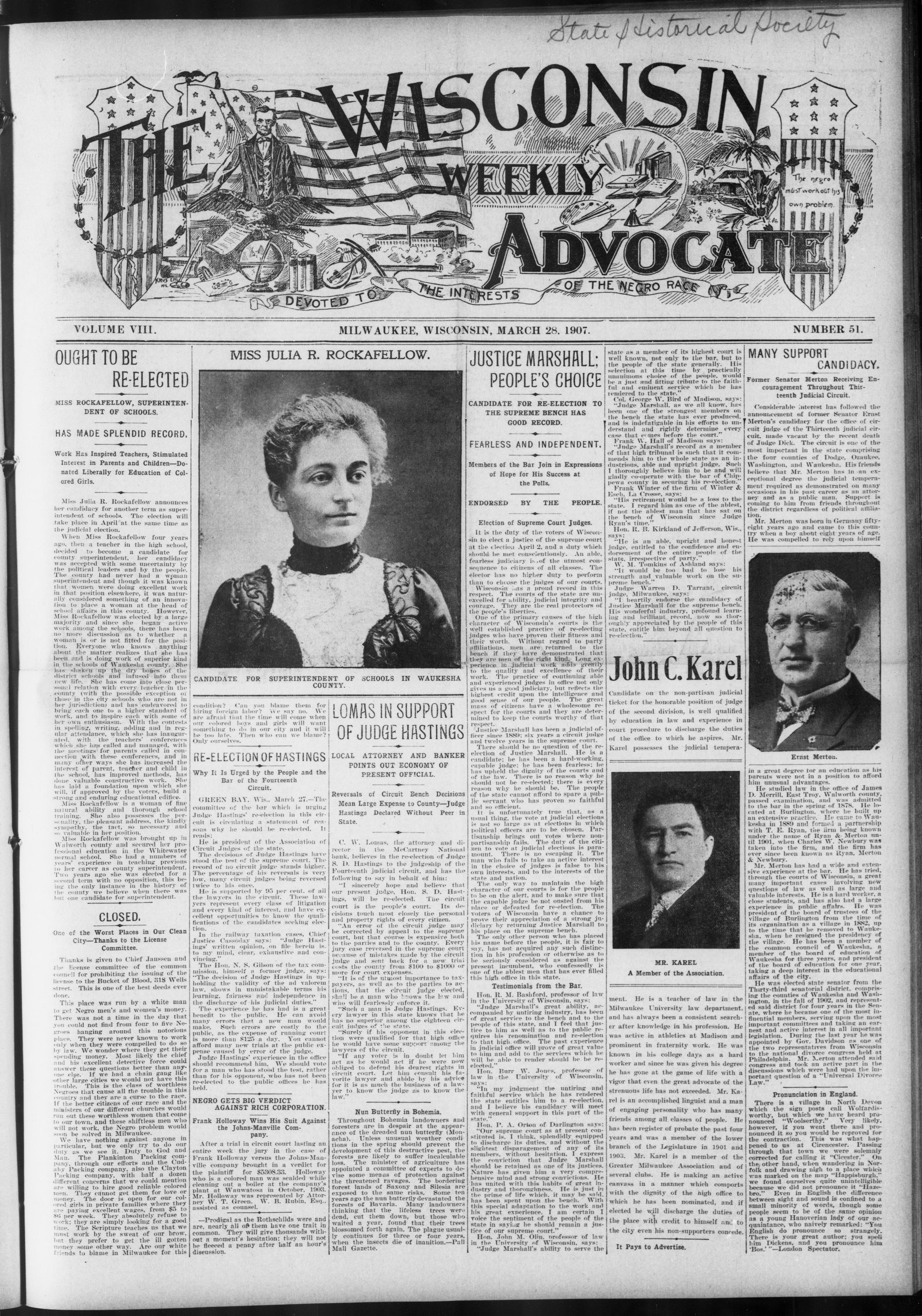
Miss Julia R. Rockafellow announces her candidacy for another term as superintendent of schools. The election will take place in April at the same time as the judicial election.
When Miss Rockafellow four years ago, then a teacher in the high school, decided to become a candidate for county superintendent, her candidacy was accepted with some uncertainty by the political leaders and by the people. The county had never had a woman superintendent and though it was known that women were doing excellent work in that position elsewhere, it was naturally considered something of an innovation to place a woman at the head of school affairs in this county. However, Miss Rockafellow was elected by a large majority and since she began active work among the schools, there has been no more discussion as to whether a woman is or is not fitted for the position. Everyone who knows anything about the matter realizes that she has been and is doing work of superior kind in the schools of Waukesha county. She has shaken up the dry bones of the district schools and infused into them new life. She has come into close personal relation with every teacher in the county (with the possible exception of those in the city schools who are not in her jurisdiction) and has endeavored to bring each one to a higher standard of work, and to inspire each with some of her own enthusiasm. With the contests in spelling, writing, adding and in regular attendance, which she has inaugurated, with the teachers' conferences which she has called and managed, with the meetings for parents called in connection with these conferences, and in many other ways she has increased the interest of parent, teacher and child in the school, has improved methods, has done valuable constructive work. She has laid a foundation upon which she will, if approved by the voters, build a strong and enduring educational edifice.
Miss Rockafellow is a woman of fine natural ability and thorough school training. She also possesses the personality, the pleasant address, the kindly sympathy, the tact, so necessary and so valuable in her position. Miss Rockafellow was brought up in Walworth county and secured her professional education in the Whitewater normal school. She had a numbers of years' experience in teaching previous to her career as county superintendent. Two years ago she was elected for a second term with no opposition, this being the only instance in the history of the county we believe when there was but one candidate for superintendent.
CLOSED.
One of the Worst Places in Our Clean City-Thanks to the License Committee.
Thanks is given to Chief Janssen and the license committee of the common council for prohibiting the issuing of the license to the Bucket of Blood, 318 Wells street. This is one of the best deeds ever done.
This place was run by a white man to get Negro men's and women's money. There was not a time in the day that you could not find from four to five Negroes hanging around this notorious place. They were never known to work only when they were compelled to do so by law. We wonder where they get their spending money. Most likely the chief and his excellent detective force could answer these questions better than anyone else. If we had a chain gang like other large cities we would not have this trouble. This is the class of worthless Negroes that cause all the trouble in this country and they are a curse to the race. If the better citizens of our race and the ministers of our different churches would run out these worthless women that come to our town, and these shiftless men who will not work, the Negro problem would soon be solved in Milwaukee.
We have nothing against anyone in particular, but we only try to do our duty as we see it. Duty to God and Man. The Plankinton Packing company, through our efforts and the Cudaby Packing company, also the Clayton Packing company, with half a dozen different concerns that we could mention are willing to hire good reliable colored men. They cannot get them for love or money. The door is open for our colored girls in private families where they are paying excellent wages, from $5 to $6 per week. They absolutely refuse to work; they are simply looking for a good time. The Scripture teaches us that we must work by the sweat of our brow, but they prefer to get the ill gotten money some other way. Are our white friends to blame in Milwaukee for this
---
MISS JULIA R. ROCKAFELLOW.
Mary Ann
CANDIDATE FOR SUPERINTENDENT OF SCHOOLS IN WAUKESHA COUNTY
condition? Can you blame them for hiring foreign labor? We say no. We are afraid that the time will come when our colored boys and girls will want something to do in our city and it will be too late. Then who can we blame? Only ourselves.
RE-ELECTION OF HASTINGS
Why It Is Urged by the People and the Bar of the Fourteenth Circuit.
GREEN BAY, Wis., March 27.—The committee of the bar which is urging Judge Hastings' re-election in this circuit is circulating a statement of reasons why he should be re-elected. It reads:
He is president of the Association of Circuit Judges of the state.
The decisions of Judge Hastings have stood the test of the supreme court. The record of no circuit judge stands higher. The percentage of his reversals is very low, many circuit judges being reversed twice to his once.
He is supported by 95 per cent. of all the lawyers in the circuit. These lawyers represent every class of litigation and every kind of interest, and have excellent opportunities to know the qualifications of the candidates seeking election.
In the railway taxation cases, Chief Justice Cassoday says: "Judge Hastings' written opinion, on file herein is, to my mind, clear, exhaustive and convincing."
The Hon. N. S. Gilson of the tax commission, himself a former judge, says: "The decision of Judge Hastings in upholding the validity of the ad valorem law, shows in unmistakable terms his learning, fairness and independence in the discharge of his judicial duties."
The experience he has had is a great benefit to the public. He can avoid many errors that a new man would make. Such errors are costly to the public, as the expense of running court is more than $125 a day. You cannot afford many new trials at the public expense caused by error of the judge. Judge Hastings' experience in the office should recommend him. We should vote for a man who has stood the test, rather than for his opponent, who has not been re-elected to the public offices he has held.
Frank Holloway Wins His Suit Against the Johns-Manville Company
After a trial in circuit court lasting an entire week the jury in the case of Frank Holloway versus the Johns-Manville company brought in a verdict for the plaintiff for $5308.33. Holloway who is a colored man was scalded while cleaning out a boiler at the company's plant at Wauwatosa in October, 1903. Mr. Holloway was represented by Attorney W. T. Green. W. B. Rubin, Esq., assisted as counsel.
—Prodigal as the Rothschilds were and are, nearly all of them have one trait in common. They will give thousands without a moment's hesitation; they will not be fleeced a penny after half an hour's discussion.
MILWAUKEE, WISCONSIN, MARCH 28, 1907.
LOMAS IN SUPPORT OF JUDGE HASTINGS
LOCAL ATTORNEY AND BANKER POINTS OUT ECONOMY OF PRESENT OFFICIAL.
Reversals of Circuit Bench Decisions Mean Large Expense to County-Judge Hastings Declared Without Peer in State.
C. W. Lomas, the attorney and director in the McCartney National bank, believes in the re-election of Judge S. D. Hastings to the judgeship of the Fourteenth judicial circuit, and has the following to say in behalf of him: "I sincerely hope and believe that our present judge, Hon. S. D. Hastings, will be re-elected. The circuit court is the people's court. Its decisions touch most closely the personal and property rights of every citizen.
"An error of the circuit judge may be corrected by appeal to the supreme court, but that course is expensive both to the parties and to the county. Every jury case reversed in the supreme court because of mistakes made by the circuit judge and sent back for a new trial costs the county from $100 to $1000 or more for court expenses.
"It is of the utmost importance to taxpayers, as well as to the parties to actions, that the circuit judge elected, shall be a man who knows the law and who will fearlessly enforce it.
"Such a man is Judge Hastings. Every lawyer in this state knows that he has no superior among the eighteen circuit judges of the state.
"Surely if his opponent in this election were qualified for that high office he would have some support among the lawyers of the circuit."
"If any voter is in doubt let him act as he would act if he were now obliged to defend his dearest rights in circuit court. Let him consult his favorite lawyer and abide by his advice for it is as much the business of a lawyer to know the judge as to know the law."
Nun Butterfly in Bohemia
Throughout Bohemia landowners and foresters are in despair at the appearance of the dreaded nun butterfly (Monacha). Unless unusual weather conditions in the spring should prevent the development of this destructive pest, the forests are likely to suffer incalculable loss. The minister of agriculture has appointed a committee of experts to devise some means of protection against the threatened ravages. The bordering forest lands of Saxony and Silesia are exposed to the same risks. Some ten years ago the nun butterfly devastated the forests of Bavaria. Many landowners thinking that the lifeless trees were dead, cut them down, but those who waited a year, found that their trees blossomed forth again. The plague usually continues for three or four years, when the insects die of inanition.—Pall Mall Gazette.
JUSTICE MARSHALL; PEOPLE'S CHOICE
CANDIDATE FOR RE-ELECTION TO THE SUPREME BENCH HAS GOOD RECORD.
Election of Supreme Court Judges.
It is the duty of the voters of Wisconsin to elect a justice of the supreme court at the election April 2, and a duty which should be met conscientiously. An able, fearless judiciary is, of the utmost consequence to citizens of all classes. The elector has no higher duty to perform than to choose the judges of our courts.
Wisconsin has a proud record in this respect. The courts of the state are unexcelled for ability, judicial integrity and courage. They are the real protectors of the people's liberties.
One of the primary causes of the high character of Wisconsin's courts is the well established practice of re-electing judges who have proven their fitness and their worth. Without regard to party affiliations, men are returned to the bench if they have demonstrated that they are men of the right kind. Long experience in judicial work adds greatly to the quality and excellence of their work. The practice of continuing able and experienced judges in office not only gives us a good judiciary, but reflects the highest credit upon the intelligence and good sense of our people. The great mass of citizens have a wholesome respect for the courts and they are determined to keep the courts worthy of that respect.
Justice Marshall has been a judicial officer since 1889; six years a circuit judge and twelve years in the supreme court.
There should be no question of the re-election of Justice Marshall. He is a candidate; he has been a hard-working, capable judge; he has been fearless; he has upheld the dignity of the courts and of the law. There is no reason why he should not be re-elected; there is every reason why he should be. The people of the state cannot afford to spare a public servant who has proven so faithful and so efficient.
It is unfortunately true that, as a usual thing, the vote at judicial elections is not so large as at elections in which political officers are to be chosen. Partisanship brings out votes where nonpartisanship fails. The duty of the citizen to vote at judicial elections is paramount. There is no escaping it. The man who fails to take an active interest in the choice of judges is false to his own interests, and to the interests of the state and nation.
The only way to maintain the high character of our courts is for the people to be on the alert, and to make sure that the capable judge be not ousted from his place or defeated for re-election. The voters of Wisconsin have a chance to prove their appreciation of a strong judiciary by returning Justice Marshall to his place on the supreme bench.
The only other person who has placed his name before the people, it is fair to say, has not acquired any such distinction in his profession or otherwise as to be seriously considered as against the present incumbent, who confessedly is one of the ablest men that has ever filled this high office in this state.
Testimonials from the Bar.
Hon. R. M. Bashford, professor of law in the University of Wisconsin, says:
in the University of Wisconsin, says.
"Judge Marshall's great ability, accompanied by untiring industry, has been of great service to the bench and to the people of this state, and I feel that justice to him as well as to the public requires his renomination and re-election to that high office. The past experience in judicial office will prove of great value to him and add to the services which he will be able to render should he be re-elected."
Hon. Burr W. Jones, professor of law in the University of Wisconsin, says:
"In my judgment the untiring and faithful service which he has rendered the state entitles him to a re-election, and I believe his candidacy will meet with general support in this part of the state."
Hon. P. A. Orton of Darlington says: "Our supreme court as at present constituted is, I think, splendidly equipped to discharge its duties, and without the slightest disparagement of any of its members, without hesitation. I express the conviction that Judge Marshall should be retained as one of its justices. Nature has given him a very comprehensive mind and strong convictions. He has united with this habits of great industry and thoroughness. He is just in the prime of life which, it may be said, has been spent upon the bench. With this special adaptation to the work and his great experience. I am certain I voice the sentiment of the people of the state in saying he should remain a justice of our supreme court."
Hon. John M. Olin, professor of law in the University of Wisconsin, says: "Judge Marshall's ability to serve the
state as a member of its highest court is well known, not only to the bar, but to the people of the state generally. His selection at this time by practically unanimous choice of the people, would be a just and fitting tribute to the faithful and eminent service which he has rendered to the state."
Col. George W. Bird of Madison, says: "Judge Marshall, as we all know, has been one of the strongest members on the bench the state has ever produced, and is indefatigable in his efforts to understand and rightly determine every case that comes before the court."
Frank W. Hall of Madison says: "Judge Marshall's record as a member of that high tribunal is such that it commends him to the whole state as an industrious, able and upright judge. Such I thoroughly believe him to be and will gladly co-operate with the bar of Chippewa county in securing his re-election."
Frank Winter of the firm of Winter & Esch, La Crosse, says: "His retirement would be a loss to the state. I regard him as one of the ablest, if not the ablest man that has sat on the bench of Wisconsin since Judge Ryan's time."
Hon. R. B. Kirkland of Jefferson, Wis. says:
"He is an able, upright and honest judge, entitled to the confidence and endorsement of the entire people of the state, irrespective of party."
W. M. Tomkins of Ashland says:
"It would be too bad to lose his strength and valuable work on the supreme bench."
Judge Warren D. Tarrant, circuit judge, Milwaukee, says:
"I heartily endorse the candidacy of Justice Marshall for the supreme bench. His wonderful industry, profound learning and brilliant record, now so thoroughly appreciated by the people of this state, entitle him beyond all question to re-election."
John C.Karel
Candidate on the non-partisan judicial ticket for the honorable position of judge of the second division, is well qualified by education in law and experience in court procedure to discharge the duties of the office to which he aspires. Mr. Karel possesses the judicial tempera-
PETER H. HARRIS
ment. He is a teacher of law in the Milwaukee University law department, and has always been a consistent searcher after knowledge in his profession. He was active in athletics at Madison and prominent in fraternity work. He was known in his college days as a hard worker and since he was given his degree he has gone at the game of life with a vigor that even the great advocate of the strenuous life has not exceeded. Mr. Karel is an accomplished linguist and a man of engaging personality who has many friends among all classes of people. He has been register of probate the past four years and was a member of the lower branch of the Legislature in 1901 and 1903. Mr. Karel is a member of the Greater Milwaukee Association and of several clubs. He is making an active canvass in a manner which comports with the dignity of the high office to which he has been nominated, and if elected he will discharge the duties of the place with credit to himself and to the city even his non-supporters concede.
It Pays to Advertise.
NUMBER 51.
MANY SUPPORT CANDIDACY.
Former Senator Merton Receiving Encouragement Throughout Thirteenth Judicial Circuit.
Considerable interest has followed the announcement of former Senator Erust Merton's candidacy for the office of circuit judge of the Thirteenth judicial circuit, made vacant by the recent death of Judge Dick. The circuit is one of the most important in the state comprising the four counties of Dodge, Ozaukee, Washington, and Waukesha. His friends believe that Mr. Merton has in an exceptional degree the judicial temperament required as demonstrated on many occasions in his past career as an attorney and as a public man. Support is coming to him from friends throughout the district regardless of political affiliation.
Mr. Merton was born in Germany fifty-eight years ago and came to this country when a boy about eight years of age. He was compelled to rely upon himself
[Name]
in a great degree for an education as his parents were not in a position to afford him unusual advantages. He studied law in the office of James D. Merrill, East Troy, Walworth county, passed examination, and was admitted to the bar in the spring of 1878. He located at Burlington, where he built up an extensive practice. He came to Waukesha in 1889 and formed a partnership with T. E. Ryan, the firm being known under the name of Ryan & Merton until 1901, when Charles W. Newbury was taken into the firm, and the firm has ever since been known as Ryan, Merton & Newbury.
Mr. Merton has had a wide and extensive experience at the bar. He has tried, through the courts of Wisconsin, a great many important cases involving new questions of law as well as large and valuable interests. He is a hard worker, a close students, and has also had a large experience in public affairs. He was president of the board of trustees of the village of Burlington from the time of its organization as a village in 1882, up to the time that he removed to Waukesha, when he resigned the presidency of the village. He has been a member of the common council of Waukesha, a member of the board of education of Waukesha for three years, and president of the board of education for one year, taking a deep interest in the educational affairs of the city.
He was elected state senator from the Thirty-third senatorial district, comprising the counties of Waukesha and Washington, in the fall of 1902, and represented said district for four years in the Senate, where he became one of the most influential members, serving upon the most important committees and taking an earnest and active interest in all important legislation. During the last year he was appointed by Gov. Davidson as one of the two representatives from Wisconsin to the national divorce congress held at Philadelphia. Mr. Merton attended said congress and took an active part in the discussions which were had upon the important question of a "Universal Divorce Law."
Pronunciation in England
There is a village in North Devon which the sign posts call Wolfardisworthy, but which we have heard pronounced "Woolserthy." Very likely, however, if you went there and pronounced it so you would be reproved for the contraction. This was what happened to us at Cirencester. Passing through that town we were solemnly corrected for calling it "Cicester." On the other hand, when wandering in Norfolk and drawing nigh to a place which was marked on the map "Happisburgh," we found ourselves quite unintelligible because we did not pronounce it "Hazebro." Even in English the difference between sight and sound is confined to a small minority of words, though some people seem to be of the same opinion as a young Hanoverian lady of our acquaintance, who naively remarked: "You English do pronounce so strangely. There is your great author; you spell him Dickens, and you pronounce him 'Bos.'"—London Spectator.
THE WISCONSIN WEEKLY ADVOCATE
R. B. MONTGOMERY, Editor and Proprietor.
Curious Condensations.
—Robert Jones, a surgeon of Liverpool, advocates that in cases where the patient cannot take other anaesthetics the spinal cord be treated with cocaine.
—When Eisowath, King of Cambodia, now on a visit to France, takes his walks about one attendant carries a gold cigarette case set with diamonds, another a gold match box set with rubies and a third a gold cuspidor.
—The Canadian Pacific Railway company is boasting that it has accomplished the feat of landing British mails in Hong Kong in twenty-nine days from the dispatch from London, or nearly a week less than the previous record.
—Chrysanthemum smoking is the latest thing in England. Cigarettes made of chrysanthemum leaves and cascarilla bark have been found to give relief in cases of epilepsy, and one doctor recommends them as a substitute for tobacco.
—In the six months ending June 30, 2297.20 miles of new railway track were laid in this country, a greater amount of new construction than in any corresponding six months in the last fifteen years, except in 1902, when new construction aggregated 2314 miles.
—The greatest monument of the mound builders, not only in Ohio, but in the entire country, is the Serpent mound, in Adams county. This immense mass of earth, probably piled up for purposes of worship, has had a curious history in respect to changes of ownership in recent times.
According to the Pioneer a post is now running weekly to Gartok, the new trade mart in western Thibet, so that the British trade agent at Gartok is kept in close touch with India. The route is by way of Almora and the Lipu Lekh Pass, and to reach Gartok from Almora takes about ten days.
Ferreira, the leader of the Boers who raided the Cape Colony for a few days recently till the colonial forces rounded them up, is, as his name would indicate, a Portuguese. His lieutenant is named Max Jensen. He fought bravely for the British against the Boers during the war, but is reputed to be a desperado.
The capital invested in American manufacturing establishments in 1904 amounted to $12,696,265,673, according to recent figures of the census bureau. This shows an increase in five years of 41 per cent. The gain in the products of manufacture was 30 per cent., the 1904 aggregate being $14,802,147,057.
The tax collector of Adelaide, South Australia, officially reports the conscientiousness of a taxpayer who, in getting up a statement of the real estate he owned, for taxation purposes, put down a piece of land of his measuring, 9 feet by 6 feet in "—— cemetery," and under the column, "Name of occupier," gave that of his departed wife.
Dr. Nansen is fond of sailors. He says that there is a brotherhood of the sea which stamps sailors and singles them out from all other callings. He has found more thoughtful earnestness among sailors and a better spirit than among members of any other profession. Sailors, he believes, bear all their hardships and sufferings with calmness and fortitude.
The natives of certain parts of India are in the habit every year, in the summer, of digging the dry river banks for fish, which they dig out by hundreds, just as they would potatoes. The mud lumps are broken open, and the fish, perhaps 8 or 10 inches long, will be found alive, and often frisky, as if just removed from its supposedly native element the water.
According to a celebrated composer, the popular song, though sneered at by the superior, is in reality the ambition of most composers. Thousands of them, he says, "would give their ears to write a tune that reached the barrel organs." And when it has been on the organs some little time a good many other people would wish to dispose of their ears. London Globe.
Sir West Ridgeway, until lately governor of Ceylon, returned to England from that country in a German steamship. The question was raised in the House of Commons why he had not traveled on a British vessel. The colonial secretary explained that Sir West was allowed to take his pet dog with him on the German ship, a privilege the English ships had denied him.
It is not generally known, says the London Express, that a generous country supplies members of the House of Commons with gratuitous snuff. "Formerly," the Express says, "snuff was described in the estimates as such, but to ward off the objection aroused by improving habits the charge of £200 a year was mixed up or covered in the estimates as 'lamp oil.'"
In Scotland it was long customary to place on a man's tombstone the symbol of his trade; and in burial grounds tombstones so ornamented are to be found. Thus, at the Abbey of Dunblane a sugar cone may be seen as showing the grave of a grocer; an ax and a saw, with hammer and nails, occur on the grave of a carpenter; and an awl and a hammer on that of a shoemaker.
—Originally the word "impertinent" signified merely "not belonging to." When Wycliffe said that there were many men in this world who were "impertinent to earthly lords," he did not mean that they were "cheeky," but merely that they had no masters. Then, as used by Shakespeare, "impertinent" came to mean "irrelevant." Just 200 years ago it was defined as signifying "absurd, silly, idle."
The French government has just pensioned off Francois Germonini, the guardian of the Bastile column. Geromini was a character. He left Corsica sixty years ago to serve in the Grenadiers of the Imperial guard. He fought in the campaigns of Algiers and of Rome, and also in 1870 with Bourbaki. He was made a prisoner and taken to Darmstadt, and at the fall of the empire became concierge of the Bastile.
The Empress Eugenie has just given to the Swiss canton of Thurgau the castle of Arenenberg, where Napoleon III. passed several years of his youth. Queen Hortense, on the fall of the first empire, fled to Switzerland, and in 1817 purchased the castle, which is delightfully situated on the shore of Lake Constance. In the castle are the Empress Josephine's harp, Queen Hortense's harpsichord and a camp bedstead of Napoleon III.
James B. Reynolds of Boston has been assistant secretary of the United States treasury for fifteen months, and in that time has signed his name somewhere close to 100,000 times. His signature is of a rather fanciful character and consequently he uses ink by the gallon. As a rule he uses up three pens in a day. During a hot spell of weather at one time 12,000 Indian warrants came in. They had to be signed. The other assistant secretaries were on their vacations, and "Jimmie" signed them, the whole 12,000.
TO ONE SERENE.
Dear, steadfast heart, and cool, unclouded eyes. In thy simplicity I rest, and lean My tired life against thee. Calm, serene. Thou shut'st me in like God's great, placid skies:
From out my blurred complexities I rise,
And once again my wind-torn feathers
preen
For joyous flight. From petty things and
mean
I slip away to where great quiet lies.
The gusts of temperament that o'er me
sweep,
The troubled seas of impulse and of mood,
Obey thy restful presence, and a deep
Still peace above my tumult seems to
brood.
In thine unbroken calm my soul I steep.
And stretch my hands to thee in gratitude.
-Edith Brownell, Lippincott's.
THE COWARD.
In society they used to speak of him as "that handsome Signolles." His title was Viscount Gontran, Joseph de Signolles.
Orphan and master of a large fortune, he made a conspicuous figure in the fashionable world. He had a fine appearance, a good deportment, a facility of speech sufficient to gain him the reputation of a wit, some natural grace, an air of noble reserve, a brave moustache and soft eyes—just what women admire.
He lived happily, quietly, in the most absolute good moral standing. It was known that he was a good swordsman and a better shot.
"When I have to fight," he would say, "I choose pistols. With that weapon I am sure of killing my man."
Now, one evening, after having accompanied to the opera two young married ladies of his acquaintance, with their husbands, he invited the whole party after the performance to take supper at Tortoni's. They had been there only a few moments when he observed that a gentleman at a neighboring table was staring steadily at one of the ladies in the party. She seemed annoyed. At last she said to her husband:
"It is very annoying. That man spoils my supper."
The husband shrugged his shoulders. "Nonsense; pay no attention to him. If we had to worry ourselves about all the insolent people we meet there would never be an end of it."
But the viscount had suddenly risen. He could not permit that individual to destroy the enjoyment which he had offered. The insult was to him, as it was through his invitation the party had entered the cafe.
He approached the man, and said to him: "Sir, you are staring at those ladies in a manner which I cannot tolerate. Will you be good enough to cease this staring at once?"
The other replied: "You keep your youth shut will you?"
The viscount, setting his teeth, exclaimed: "Take care, sir! You may compel me to violate politeness." The stranger uttered only one word—one filthy word, that resounded from one end of the cafe to the other, and made every one in the house start. There was a great silence. Then a sudden dry sound clacked in the air. The viscount had slapped his adversary's face. Everybody jumped up to interfere. Cards were exchanged.
After the viscount returned home that night he began to walk up and down his room with great, quick strides. He was too much excited to think about anything. One solitary idea kept hovering in his mind—a fuel—although the idea itself had not yet awakened any special emotion. He had just done what he ought to have done. He repeated aloud:
"What a vulgar brute the fellow is!"
Then he sat down and began to think. He would have to procure seconds in the morning. Whom would he choose? Finally he selected the Marquis de la Tour Noire and Col. Bourdin; a great nobleman and a great soldier—that would be just the thing.
He suddenly discovered that he was thirsty, and he drank three glasses of water, one after another; then he began to walk up and down again. He felt full of energy. He showed himself to be plucky, ready for anything, and by insisting upon rigorous and dangerous conditions—by demanding a serious, very serious, terrible duel—his adversary would be probably scared and make apologies.
He took up the man's card, which he had drawn out of his pocket as he entered and had flung on the table, and he read it over again: "George Lamil, 51 Rue Moncey." Nothing more.
He remained standing motionless, thinking, keeping his eyes still fixed upon the card. A rage rose within him against that bit of paper—a fury of hate mingled with a strange sense of uneasiness. It was a stupid mess, all this affair! So he would have to fight! With pistols his life would be seriously endangered; but, again, he might be able to extricate himself from the difficulty with honor, and yet without an actual meeting. He exclaimed: "I must be firm. He will show the white feather." The sound of his own voice made him start, and he looked around him. He drank another glass of water, and began to undress.
He felt very warm between the sheets; and still he could not sleep. He got up for a drink. Then a new anxiety came over him.
"Is it possible that I could be afraid?"
Why did his heart start to beating so wildly at the least little familiar noise in his room? When the clock was about to strike, the click of the little spring caused him a violent start. He began to reason with himself:
"Am I really afraid?"
No, certainly; how could he be afraid since he was firmly resolved to carry out the affair to the very end—since he was fully decided to fight, and not to tremble?
"Can a man become afraid in spite of himself?"
A strange desire seized him to look at himself in the glass. He relit his candle. When her saw his visage reflected in the mirror he could hardly recognize himself. His eyes looked enormous, and he was pale. He stood there in front of the mirror. He put out his tongue, as if to certify the state of his health, and all at once this thought shot through him like a bullet:
"The day after tomorrow, at this very hour, perhaps, I shall be dead!"
His whole body shuddered with spasmodic quiverings. He rose, and, going to the window, drew aside the curtains.
The dawn was breaking—a summer dawn. What a fool he was to have al-
lowed himself to be worried by fear before anything at all had been decided; before his seconds had seen those of George Lamil; before he so much as knew whether he would have to fight at all. He made his toilet, dressed, and walked out with a firm step.
His witnesses, the marquis and colonel, put themselves at his disposal. The colonel asked: "Do you insist upon a serious duel?"
The viscount replied: Very serious."
The marquis asked: "You wish pistols?"
"Yes."
"Well, we leave you free to regulate the rest."
The viscount articulated in a dry, jerky voice:
"Twenty paces—to fire at the word—to fire on the rise instead of the fall; balls to be exchanged until one or the other be seriously wounded."
The colonel exclaimed, in a tone of satisfaction: "These are excellent conditions. You shoot well, and all the chances are in your favor."
And they departed on their errand. The viscount returned home to wait for their return. His excitement, temporarily appeased, now began to increase every minute. He felt all along his legs and arms, in his chest, a sort of sinking
—a continual quivering; he found himself unable to remain quiet, whether sitting or standing. His mouth felt dry. He could not eat. He ordered a decanter of brandy brought in, from which he helped himself to six small glasses, one after the other. A heat, as of a burn, passed through him, followed by a sort of mental numbness. He thought: "Here's the remedy. Now I am all right."
But at the end of an hour he had emptied the decanter, and his excitement became intolerable. Evening came. A sudden pull at the door bell gave him such a sense of suffocation that he could ont find strength to rise and receive his seconds. He did not even dare to say "Good evening," through fear that they might discover everything from his voice.
The colonel said:
"Everything has been arranged according to the conditions you stipulated. His seconds are two military men."
The viscount said: "Thanks."
The colonel asked: "Weii, you feel all right; you are cool?"
When he found himself alone again he felt as if he were going mad. When his servant had lighted the lamps he sat down at a table to write some letters. After having traced, at the head of a blank sheet of note paper, the words: "This is my last will and testament," he rose with a sudden start, feeling incapable of putting two ideas together. As he walked up and down, he stopped before the little round table on which lay a pistol case. He took out one of the pistols, placed himself in the position of a man about to fire, and raised his arm. But he trembled so that the barrel of the pistol quivered and pointed in all directions.
Then he said to himself: "It is simply impossible. I shall never be able to fight as I am now."
He looked down the muzzle of the barrel, into the little, deep, black hole which spits out death. He thought of the dishonor, of whisperings in the salons, of laughter at the clubs, of the contempt that women can show, of allusions in the newspapers, of the open insults he would receive.
Still he stared at the weapon, and, pulling back the hammer, he suddenly observed a cap shining under it, like a tiny red flame. The pistol had remained loaded by some chance, some forgetfulness. And the discovery filled him with a confused and inexplicable joy.
If he could not maintain before the other man the cool and dignified deportment which behooved him, then he would be ruined forever. He would be stained, branded with the stamp of infamy—driven out of society! And that calm, fearless attitude he would not be able to have; he knew it. Yet he was brave enough, since he wanted to fight! He was brave, since—. Suddenly opening his mouth wide, he thrust the muzzle of the pistol in and pulled the trigger.
When the valet de chambre ran in, he found his master lying on his back dead. A gush of blood had spattered over the white paper on the table and formed a great red blot immediately underneath the words:
"This is my last will and testament." —Translated from the French of Guy de Maupassant.
BRICK TEA USED AS MONEY
Still Is in Circulation in Chinese Towns and Central Asia.
Brick tea even serves as money. It is still in circulation as a medium of exchange in the far inland Chinese towns and Central Asia marts and bazars. Between the Mongolian town of Urgas and the Siberian town of Kiatka there is usually as much as 500,000 taels ($350,000) of this money in circulation.
As brick tea it is largely used in the Russian army, by surveying engineers, tourists and hunters.
REFLECTIONS OF A BACHELOR
When a girl will admit a fellow kissed her he didn't.
The trouble with reform is it never begins where charity should—at home.
Probably there would be no fun in feeling lazy if we didn't have to work.
A girl can pretend she doesn't want you to kiss her till just the minute you do it.
A woman would rather be right in an argument with her husband than have him President.
A man is so proud of his strong will that he brags about never eating a thing he doesn't like.
You can never make a woman believe that she isn't saving money by buying more to get a discount.
Most people's ideas of a good cook is one that can fix up a thing that you can eat without guessing what it is.
A man stops bragging about his children after they learn how to spend so much money that he can't spend any.
A man has an angelic disposition when he doesn't say the coffee is cold because his suspender button came off.—New York Press.
Advertise in Your Home Paper.
When We Forget.
There are days when life wears peek-a-boos,
And her stockings are thin "Alice blues,"
And her feet are in low-quarter shoes,
And she's saucy and sweet as you choose—
You choose—
Oh! she's saucy and sweet as you choose.
And she's wearing the latest style spats,
And she's crowned with the dearest of hats,
And her look penetrates through our slats
To where our poor heart pit-a-pats—
A-pats—
To where our poor heart pit-a-pats!
And we love her, no wonder we do,
And her teasy, thin hose Alice blue,
And each ankle o'ertopping each shoe,
And each foot in each shoe, yes, we do—
We do—
Each foot in each shoe, yes, we do.
But it's her embroidery peek- A-boo, where the swift hide and seek Of dimples appear, that do tweak Our heartstrings till language grows weak- Grows weak—
Our heartstrings till language grows weak -Houston Post.
BRIEF NOTES OF GENERAL INTEREST
One of the smallest inhabited houses in the world is at Llandyssul, South Wales. It has a frontage of five and a half feet, is six feet from front to back, six feet from ground to eaves and about four feet to the ridges.
Rev. S. H. Gibson, late pastor of the First Baptist church of Mount Vernon, Ill., a colored congregation, has attached the church property and fixtures for back salary amounting to $271. The church is in charge of the sheriff and all meetings are suspended.
Charles Fairweather of Sheboygan, Wis., is in receipt of a large cocoanut from Frank Folly of Palm Beach, Fla. The cocoanut is about a foot long and was sent by mail. The postage on it was 18 cents. It is in the husk just as it was taken from the tree.
For violently shoving a white girl off a sidewalk and disturbing the peace in general, which nearly resulted in a race riot and lynching of Horace Gray, a negro of Harrisburg, Ill., was fined $1000 and costs. George Roach, a negro, was fined $85 and costs on a similar charge.
There is a warning for the girl who tosses her head in the fate of Miss Mame Phillips of Bellwood, Pa. As Miss Phillips, who is 17, was combing her hair before her glass she gave her head a toss to get the comb at her back tresses. She dislocated her neck. The girl will be removed to a hospital for treatment.
A pig chase on roller skits is the cherished form of amusement at Manistee, Mich. The other day a humane officer stopped the sport. It was agreed that if a pig weighing 150 pounds were used and only one skater allowed on the rink at a time there would be no inhumanity, so the event was postponed while a committee sought out a pig of proper physical proportions.
The first bathtub to find its way to Fairfax, S. D., Rosebud's county seat, was formally installed last week in the barber shop of Ralph Christiance, and there is rejoicing throughout the whole Rosebud reservation. Fairfax was one of the centers of the Rosebud rush, and has long been equipped with a jail, but until now those who chose to bathe had to do it on the installment plan.
Henry Doerr, a prominent butcher of Altoona, Pa., lost a $400 diamond ring recently under peculiar circumstances. He laid the ring on a chopping block while he did some work. Forgetting about it, he later placed a quarter of beef on the block and proceeded to cut out a roast
Finding the use of the cleaver necessary, he brought it down with usual force, shattering the diamond into a hundred pieces.
James Wall, 72 years old, has started suit for divorce at Ottumwa, Ia., against his wife, aged 65. He names William Wagner, 75 years old, as co-respondent. Wall declares he was forced to dispose of his property and then excluded from the home and compelled to go to the poor farm. The woman declared she married Wall eleven years ago and that for the last six years he had never spoken a kind word to her and took her property.
A belated Christmas shopper put in an appearance at several of the stores in Grand Rapids, Wis., a few days ago and purchased a large assortment of toys and presents for his wife and children. He lives several miles from a railroad station, and found it impossible at Christmas time to get to the city, owing to the impassability of the roads leading to his home. Determined, however, to enjoy the blessings of a Christmas day, he came to the city in March, and purchased a supply of presents, and started home happy.
While making some excavations in New Rochelle, New York, workmen unearthed a skeleton of a man believed to be Bartholomew Lispenard, one of the Huguenot founders of New Rochelle, who fled from La Rochelle, in France, after the revocation of the edict of Nantes. The bones, which had been buried 150 years, were found incased in solid stone. The only member of the Lispenard family now living is said to be Lispenard Stuart, a real estate broker of New York.
Upon complaint of Mayor Miller of Lancaster, Wis., five boys, Dick McCormick, Clint Budworth, Ora Stitzer, Clyde Suttle and Alba Edwards, were placed under arrest, charged with disorderly conduct. They are each held in $100 bail. The alleged facts are that the five young men, acting together, separated a high school girl, Miss Bessie Quinn, from her escort, Earl Finney, as they were on their way home after an entertainment. It is alleged that four of the boys kept the young man from going on with the girl, and that the fifth took the young lady home.
Because Principal A. S. Fulton and two teachers whipped Clyde, his 14-year-old son, Marshall W. F. Hale of Eldon, Ia., had them arrested. In the trial that followed Hale became incensed at Fulton and after calling him a liar, struck him and knocked him down. The Eldon school board took the matter up with the mayor and after a heated argument, during which Hale struck Principal Fulton, it developed that the threshers of young Hale were placed under arrest without the proper warrant being served. Mayor Bardley took the marshal's star from him and placed it on his own coat. The town of Eldon is divided over the matter.
Anton Jusfue of Cleveland, O., bet his life on which way a tug would go and lost. He vowed he would yet pay the bet.
He sat in Lakeside park brooding over the thirty-seven years of his life that had been a failure. Presently a tug steamed in sight.
"I wonder where it is going?" he was heard to mutter. "If it goes up the
river I'll try life again; if it stops at the dock, my life will stop too."
When the vessel turned to tie up at the dock he groaned and, pulling a razor, started to commit suicide. A park policeman arrested him.
Prof. Irving Fisher of Yale has just completed endurance tests which he claims vindicate a diet without flesh foods. The tests were simple but effective, being: First, holding out the arms as long as possible; second, deep knee bending; third, leg raising with the subject lying on his back.
Forty-nine persons were examined, including Yale students, physicians, nurses and college instructors. Prof. Fisher says of the result:
"The experiment furnished a severe test to the claims of the flesh abstainer. The result would indicate that non-flesh eaters have far greater endurance than those accustomed to the ordinary American diet."
The excavations at Metapontum, on the gulf of Taranto, southern Italy, have resulted in the discovery of many Greek tombs, some covered with enormous tiles, others with cylinders, and still others with stones. One tomb, evidently that of a distinguished personage, was made of large, heavy blocks of stone covered with Greek lettering, and had inside a sketeton, intact, with vases and other objects. The tombs belong to the Fourth century before Christ. Interest in the discovery has been heightened because the great Greek philosopher, Pythagoras, was buried at Metapontum about 500 B. C., and as his tomb still existed at the time of Cicero, who died in 43 B. C., it is hoped that it may be found.
Ex-Congressman Gillette, who represented the Seventh Iowa district at Washington a number of years ago, was secretly married February 28 to Miss Lucy Appel, a nurse who has been making her home in Des Moines, Ia., since last September. He is a brother of the well-known actor, William Gillette, and special interest attaches to his marriage because of the fact that she was president of a society here known as the "Single Filers." This had for its membership unmarried people, some who had tried both ways of living and maintained there was more happiness in the single life than in the wedded state. But a few months ago the secretary of the society, Mrs. Elizabeth Jones, was married for the second time, and the "Single Filers" is now threatened with dissolution.
Mrs. George Livingston Baker of New Brighton, Staten Island, is authority for the statement that the star spangled banner which flew over Fort McHenry during its bombardment in the war of 1812 and inspired Francis Scott Key to compose the national ode is now in New York. Mrs. Baker is a granddaughter of Col. George Armistead. The flag, she says, is the property of Eben Appleton of New York, her brother, and has been deposited by him in the safe deposit vaults of a Broadway trust company. Mrs. Baker refused to give any more definite address for her brother or the name of the trust company. Her brother has been annoyed so much on account of his ownership of the flag, she said, he wished his address and the place of the deposit of the flag kept secret.
James Bryce, the new British ambassador to the United States, has a horror of telephones. The diplomat has frequently been called on the wire since his arrival in Washington and it is said that on numerous occasions he has refused to talk by means of the speaking piece. When he does talk, however, he insists on knowing immediately who the person is at the other end of the line and his business. Mr. Bryce doesn't like this modern method of carrying on a conversation and as a result gets out of it whenever he can. Long distance calls are said to be particularly distasteful to the ambassador. While at times he has consented to talk to people over the phone in Washington, he hates to converse on the long distance lines. Consequently out-of-town calls for England's new representative are not cordially received, if at all.
Enticed to the outskirts of Kewanee, Ill., after dark, George Stone, a 16-year-old high school boy of Bradford, Ill., was seized and bound by a gang of youths and then taken to the cemetery and tied to a tombstone. Masked and garbed in sheets, his tormentors then hazed him and frightened him to such an extent that his mind almost gave way. Leaving him bound to the stone after telling him he would have to remain there tied and gagged all night, the crowd did not return for over an hour, when the lads trailed through the graveyard in an effort to find new ways to frighten young Stone. They found him worked up to a high pitch of excitement as a result of his already ghastly experience. As they came close, Stone in a panic of fright made a sudden lunge and pulled the large monument over upon himself, crushing his legs and injuring him internally.
Twice incarcerated in the state insane asylum after losing his fortune as well as the first mile track ever known in the northwest. William Neumeister of La Crosse, Wis., has proved his sanity in open court and frustrated an attempt on the part of relatives to have him taken back to the asylum.
Before the crowded court room Neumeister took the stand in his own behalf. He recited the story of his life and his fortunes, explained peculiar transactions that led to the doubts as to his sanity, and explained that his first incarceration was at his own request because he feared for the balance of his mind.
He told of the incidents connected with his release and subsequent committal and then of his release on parole.
Neumeister claimed that the ill health of his wife wore on him and made him irritable, while newspaper reports of his misfortunes only tended to aggravate him. He recited business transactions he had conducted at a profit to himself to show his soundness of mind and readily answered perplexing questions to the satisfaction of the lunacy commission appointed by the court.
Since Neumeister was paroled from the asylum, he said, relatives had tried to have him recommitted.
Peter Mills, a negro barber of Knoxville, Tenn., was sentenced to a year's imprisonment for presenting a check for $4 to a country lad who had figured only on a 25-cent haircut.
Grover Hickey, aged 17 years, came to Knoxville, Tenn., per Coal Creek. It was his first visit to a city and Mills' barber shop attracted him. All he wanted was a haircut, and he got Peter's word in advance that 25 cents would cover the bill. Hickey's hair was a brilliant rec, and when it had been cut the barber suggested a single would improve it. Hickey was willing, believing the quarter would cover it. Then came shampoo and tonic suggestions, and Hickey took everything offered.
Then the barber suggested that red hair didn't become Hickey and he might just as well have it dyed a subdued color. Hickey thought the idea fine, and he took the dye.
This was all right until Mills charged him $4 for his work and compelled him to pay it. Hickey went before a magistrate and complained and Mills was arrested for robbery. The grand jury reported a true bill and the case was tried.
Hickey was without witnesses, but his hair was the best evidence. The dye was coming off and the hair was all shades from pea green to vermilion and black. The court thought a year in the workhouse was coming to Mills and so ruled.
MEXICAN NOTES.
Regular automobile service will soon be established between the city of Tuxtla Gutierrez and the station Jalisco on the Pan-American railroad.
Silver continues to be the premier metal of Mexico in point of value of product, thus upholding the ancient records of the republic. The value of the copper product is growing so rapidly, however, that it may be but a few years before it supplants silver. Lead is falling off somewhat as copper increases, and copper smelters are growing in number and in favor as means of gathering the precious metals.
Everything is now in readiness in Tampico for commencing the work of raising the entire low section of the city from five to seven feet above the present level. Tracks running all over that section have been laid and a powerful steam shovel will move enormous quantities of earth. After the filling in has been completed the whole city will be well above sea level and the source of much sickness will have been removed. It is estimated that it will be about two years before the work is completed.
All indications go to show that the west coast of Mexico is at last to have its day. Through the centuries the richness of this vast region has been barred from communication from interior Mexico, except by pack mules over the heights of the Sierra Madre. Four railroads are now extending their lines toward the western coast and the opening of Tehuantepec railroad route will combine with these to make available to Mexico and the markets of the world a wealth of timber and mineral products, while agricultural and fishing interests will awaken to undreamed of proportions in the course of a few years of contact with the outer world. Heretofore a trip from Mexico City to the Pacific coast, some 300 miles in an air line, necessitated a journey of more than 3000 miles by rail and water, or longer than from any point in the central part of the United States. All the west coast has lacked has been facility to market its resources and this now seems to be in sight.
One of the difficulties in selling Mexican mining properties in the past, and to a very great extent at present, is that mines here have been worked on what is known among the Indians as the rat system. That is the veins and lodes are followed and all the metal is taken out without any attempt at development work. Thus $1,000,000 worth of ore might be taken out of a mine under this system without leaving any security that the property was still worth $50,000. But mine owners, especially those who wish to dispose of their properties, have begun to realize that it is not what has been taken out of a mine that makes it valuable, but the amount of ore in sight. It is the realization of this prime necessity that has led to the investment of large sums of money in prospect work within the last two years, and especially during 1906.
A well known mining engineer and owner of mining property in the state of Durango, who recently sold one of his mines for $200,000, says he realizes now that had he spent $50,000 on this property he would in all probability have gotten for it twice what he actually did. As a result of this conviction he is employing the money he obtained from the sale of this mine in the development of two other properties, with a view of leaving as much ore in sight as possible and really finding out the value of the property.—Modern Mexico.
Secrets We Are Losing
"We are losing all our secrets in this shoddy age," an architect said. "If we keep on, the time will come when we'll be able to do nothing well.
"Take, for instance, steel. We claim to make good steel, yet the blades the Saracens turned out hundreds of years ago would cut one of our own blades in two like butter.
"Take ink. Our modern ink fades in five or ten years to rust color, yet the ink of mediaeval manuscripts is as black and bright today as it was 700 years ago.
"Take dyes. The beautiful blues and reds and greens of antique oriental rugs have all been lost, while in Egyptian tombs we find fabrics dyed thousands of years ago that remain today brighter and purer in hue than any of our modern fabrics.
"Take my specialty, buildings. We can't build as the ancients did. The secret of their mortar and cement is lost to us. Their mortar and cement were actually harder and more durable than the stones they bound together, whereas ours—horrors!
"We can't even make artificial diamonds now. Old brilliants of French paste were so beautiful that they could hardly be told from real brilliants by experts. But the secret of this French paste, like 100 other secrets of the days of conscientious work, is irretrievably lost."—New Orleans Times-Democrat.
Arab Stoicism.
Arab fatalism, which is at the root of his stoic impassiveness, though much talked of, is but little understood in its almost superhuman invincibility. This is brought into strong relief by the history attaching to a recent addition to the treasures of the Louvre museum. It is a human skeleton—a skeleton with a history. It is the disembodied framework of a man, an Arab and an assassin. In the flesh he was Suleiman el Eleby, and his hand it was that murdered Kleber, the commander of the French Revolutionary army in Egypt. For this crime he was condemned by a French courtmartial to have his right hand burned off, to be impaled and exposed to birds of prey, and to have his body reduced to a skeleton. The burning off of his hand Suleiman bore without a groan or even a wince, but toward the end of the dire ordeal the executioner happened to touch another part of his arm with the redhot iron. "This punishment." he shouted with anger, "is not in the sentence." Then he underwent the rest of the execution without giving any expression or even sign of feeling.—London Globe.
Was the First He Beat
A Scottish lawyer, with a liking for billiards, had occasion recently to visit a small town in the west of Scotland. While there, seeking to pass the time, he found a new and excellent billiard table, says the Boston Post.
Upon inquiring if there was anybody about who could play, the landlord referred him to one of the natives. They played several games, but the result was against the lawyer. Try as he might, the countryman won every time.
"Mr. ——," the lawyer remarked. "I've quite a reputation at home. They consider me a good billiard player, but I'm not in your class. May I inquire how long you have played?"
"Oh, for a while back," replied the native. "But, I say, I dinna want to hurt yer feelin's, but you're the first fellow I ever beat."
GOSSIP FOR THE LADIES.
```markdown
```
Propinquity
Hearing his step upon the stair
Without a deep, impassioned throb,
Without a full heart's breath of joy,
With just a sweet, accustomed happiness
Because he comes again and you
Are used to wait his coming.
Hearing his voice but with no thrill
In answer to his utterance,
Only security as in a thing
That has been and will be.
Finding contentment in companionship
Until within the breast there sirs
A temperate desire to hold it close.
Not risking that to find what might be
more.
This is the love born of propinquity.
—Grace White, in Harper's Bazar.
Of Woman's Right
to Enhance Nature's Charms.
We have never been able to understand why anyone should wish to be younger or older than he or she really is. Vanity, of course, must be reckoned with as a potent force among human frailties, and is responsible, doubtless, for much of woman's resentment at the ravages of passing years. But it is not the flight of time, nor even the contemplation of a steady approach to the limit of human existence, that offends her instinct; neither of these considerations really enters her mind. It is the change in physical appearance inseparable from growing old that sinks into her heart with every glance at a mirror and makes her sad; angry, too, with God, for not imposing the same penalties upon aging men. She would not express the feeling in those words; if so bluntly put, she might affrightedly deny its existence; but pressed for an answer, if truthful, as most women are in such matters, while dodging the fixing of responsibility for this seeming discrimination against her sex, she will insist invariably upon the unfairness of the arrangement whereby a process that adds to man's physical distinction detracts from woman's charm.
For ourselves, we make it a point seldom to criticise publicly the methods of the creator in shaping the destinies of the human race; but in this instance we frankly concede the apparent justice of woman's instinctive attitude. Happily, however, we seem to perceive in the wearing away of men's prejudices signs of mitigation of the inequity. Time was, not so long ago, when, holding the fixed opinions of youth, we sternly reprehended such innocent practices as changing the color of one's hair, or brightening the complexion on occasion, or even dieting seriously for the figure's sake. Not so, now! The most casual consideration growing out of philosophical observation has not merely modified our views, but has virtually changed them altogether. It may still be, as once we confidently asserted and now often hear from others like foolish, that there is nothing so beautiful as a young face in a frame of silvery gray; but when the possessor of those incongruous features happens to be the wife of a man most often taken to be her son, we declare her resort to henna to be not only a right, but a duty to both. The custom of facing we judge to be far less prevalent than it was a dozen years ago; the wiser method of dieting seems to have superseded it; but, even so, no fair-minded person can behold a woman without realizing that God meant her to be attractive; and He knows it, as well as we, that there is nothing more hideous than a plashy feminine appearance. In passing judgment upon this point, therefore, even on religious grounds, we could go no further conscientiously than St. Paul went in enjoining moderation in all things.
Moreover, we believe in woman's right as well as in women's rights, just as we hang tenaciously to the doctrine of individual liberty for man. As a people, we will not go far astray if we sustain the time-honored principle that they are best governed who are least governed, and further insist that each and every thinking person may do whatever in the world best pleases himself or herself, so long as such conduct does not affect deleteriously the welfare of the community. That is the distinctively American idea and the basis of all true freedom; wherefore, we set our face fixedly against every opposing tendency, political or otherwise, and earnestly maintain that woman's enhancement, by harmless artifices, of Nature's endowment of charm is as clearly her inalienable prerogative as immunity from interference with thought and speech is that of man.—George Harvey in Harper's Bazar.
The Extermination of Household Pests.
The experts in the department of agriculture are eternally at work testing, experimenting, and developing in various directions, and the results of their intelligent and well-directed efforts have proved of practical value in almost every industry from farming down, that is pursued by skilled and other workmen throughout the United States and its territories. One of their latest undertakings has been successfully directed to the extermination of household pests. After experimenting largely with all kinds of gases and fluids for the extinction of these pests, which are an intolerable and continual annoyance to every housewife in the country, the department has decided that the most effective substance for a thorough housecleaning of this sort is hydrocyanic acid gas. This is not a particularly cheap disinfectant, as the cyanide costs about 40 cents a pound and the sulphuric acid used with it about 4 cents. But, though it is a deadly poison, the department has found it to be very effective, and there have been no reports of fatalities attending its use. The gas has been used against roaches, bedbugs, rats and mice, and house flies, being equally efficacious in all cases. In the case of rats and mice, especially, it causes them to come out from the walls to die, so that there is no trouble with dead animals in the walls after the fumigation is over.
The department has issued a bulletin on the subject of these domestic fumigations, and the plan, according to the bulletin, is to use the combination of acid and cyanide in slop jars or other deep earthen vessels, seeing that they are sound and free from cracks, as the acid will burn like fire anything it touches. The cubic contents of the house to be fumigated should be taken and allowance made of a fluid ounce of sulphuric acid, a dry ounce of cyanide and two ounces of water to each 100 cubic feet of air space. Thus, in one recent case handled by the department, about 22 pounds of cyanide were used in a 14-room house. The cyanide is set off in a separate receptacle in each room, and if the room is large, requiring two pounds or more of cyanide, it is best to halve the charge and put it in two separate jars. The calculation having been made as to the air space, the house should be tightly sealed from top to bottom. The jar for the mixture is placed in the center of each room, set on a thick layer of newspapers in case of breakage, as the combination of acid and water generates a great deal of heat.
The water is put in the jars first and the acid added slowly, never in the reverse order. The cyanide is placed in very thin paper bags, preferably with a
couple of slits in the bottom to aid the entrance of the acid, and then two persons start at the top of the house, gently depositing the bags in the jars and quickly leaving the rooms, working their way down stairs and out through the basement. The house should remain closed for at least four to six hours, preferably over night, and the next day should be aired by opening the windows from the outside. After the house has been aired for an hour or more it will be safe to enter it. The smell of the gas resembles peach kernels, and till this odor entirely disappears the place should not be inhabited. The most serious point to be remembered in handling this fumigant is that the cyanide is one of the most deadly poisons known, and even a small particle swallowed will be fatal.
When the jars are through with they should be emptied into a sewer trap, and any of the cyanide that is left over should be sent after the contents. The whole should be then thoroughly flushed with water and the jars thoroughly washed before being used for domestic purposes. The cyanide 'gas' is very penetrating, and if used in a house in a row, arrangements should be made with the families on either side to move out while it is being used. Detached houses can be fumigated without this precaution. One room in a house can never be fumigated alone, as the gas will work through the cracks in the floor and walls. The one virtue of the gas, however, is that it will rid the house of any sort of animal life, even if it does require careful handling. It will not injure anything in the way of household effects except that it will tarnish nickel and brass, which should be removed. It will also spoil milk, butter and any soft foods with which it comes in contact.
Charm of Gesture in Conversation.
It is frequently observed by foreigners that, while the conversation of American women is full of vivacity, they make hardly any use of their hands when talking. Rather along with their animation they retain a strict English repose of manner. In doing so, it is thought by many, they completely lose the charm of gesture making. Indeed, in America there are no national gestures except the hard and mechanical ones of nodding and shaking the head and the use of the fingers for beckoning. To reprove another or to affirm the conversation by shaking the index finger of the right hand is regarded as extremely bad form. These few are gestures, moreover, lacking in either charm or beauty.
On the contrary, the French woman's shrug of her shoulders, her palms held upward and her face alive in piquancy, is at once a picture and a volume of oratory. The slight backward movement she at times gives her head, the more than slight elevation of her body, lends command to her pose and expresses a negative as inflexible as the laws of the Medes and Persians. The acts of her life, in fact, are expressed by a French woman with her hands, and in such a way that he who looks on her gestures may read their meaning. By one slight movement she can reanimate or keep from fagging a conversation. As a rule, however, the French woman's hands are not as beautiful as those of American women. They are more thick set, less flexible. It is in the grace of their use that she creates charm.
But in the use of gestures the French woman is outdone by the ladies of Spain, who from infancy are taught to regard their gestures as the practice of a fine art. The grace a Spanish woman wields with her fan is proverbial. Without a word she conveys her hatred, her love or her indifference. Generally her hands are beautiful, often remaining so long after her face has faded. She seldom mars, as she thinks, the outline of her fingers by the wearing of rings.
It is in Cicily, perhaps, that gestures have attained their height in acknowledged meaning. Certain ones there have become national, while being so fanciful as to baffle foreigners in the island. The gesture for "Go away," "Get out of my sight," is the same as the one used in America for "Come toward me," while the outward turning of the palm and a wave of the fingers means "Come. I wish you." Strangers in Sicily complain bitterly that they cannot get rid of the beggars and cab drivers who pursue them along the streets. This is because they use the Sicilian gesture for come, while thinking they are expressing "Go away." Many a young man in Sicily begs a girl to marry him without ever having spoken a word to her.
First he makes the gesture of "Come," the one meaning to other nations "Go." and immediately afterwards places the points of the five fingers of his right hand on the palm of his left hand. This indicates the skirt or petticoat of the girl's mother, for no Sicilian girl can be properly married unless her mother is in the arrangement. The last gesture of the appeal is one of placing the two palms together as though for prayer, but which in this case means the church. So by three swift movements the young man has said, "Come with me by your mother's consent to the church." The girl wishing to do so drops her chin on her chest, thus making the gesture for "Yes." When refusing the plea, however, she elevates her chin, throwing her head back. This gesture means "No." In Sicily the gesture of shaking the head from side to side, as indicative of "No." is not known.
The gesture for "You are very pretty; you please me." is in Sicily a rapid outlining of the face with the thumb and middle finger of the left hand. Impertinent young men are quite free in making this gesture in the cheeks while doing so. This changes the meaning to "You are too thin." And on the streets, when rebuffed they at once go through the same motion, only pinching thinness is not at all admired.
Recipes for Housewives.
Devil's Food Cake—Cream one-half cupful of butter and gradually add one cupful of sugar, three ounces (about six tablespoonfuls) of melted chocolate and the well-beaten yolks of two eggs. Add alternately one-half cupful of milk and one and one-half cupfuls of flour with which has been sifted two and one-half teaspoonfuls of baking powder, one-half teaspoonful of cinnamon and one-quarter teaspoonful of cloves. Flavor with one teaspoonful of vanilla while adding the stiffly-whipped whites of two eggs. Bake about forty minutes if in loaf, twenty minutes in layers.
Cocoanut Layer Cake—Cream one-half cupful of butter with two cupfuls sugar, then add alternately one cupful milk and two and one-half cupfuls sifted flour with which has been sifted again two heaping teaspoonfuls baking powder and one-third teaspoonful salt. Beat hard for three minutes, then stir in stiffly-whipped whites of five eggs. Bake in layers and when cold put together with boiled icing, to which freshly grated cocoanut is added.
Ice Cream Cake—Cream one-half cupful of butter and gradually add one cupful of fine granulated sugar. Then stir in alternately one-half cupful of milk and one cupful of flour with which has been sifted one-half cupful of corn starch and four level teaspoonfuls of baking powder. Add the stiffly whipped
whites of four eggs and bake in sheets in a moderate oven.
Sour Cream Cookies—To half cupful of creamed butter add one cupful sugar, one egg well beaten, one-half cupful sour cream into which is stirred one-quarter teaspoonful sifted soda. Sift two and one-half cupfuls flour with three and one-half teaspoonfuls baking powder, add to batter and drop from spoon onto buttered tins.
Gingerbread—Sift one-half teaspoonful of salt, one teaspoonful each of cinnamon and soda, and one tablespoonful of ginger with one pint of sifted flour. Cream three tablespoonfuls of butter, beating into it one-half cupful each of sugar and molasses. Add the flour and one-half cupful of boiling water. Bake at once in two shallow, well-greased pans.
Nut Icing—Cook one cupful of sugar to a dark caramel over a moderate fire, pour over it quickly one-half cupful boiling water. After the spattering has ceased stir till evenly melted then boil to thick syrup. Lift from the fire and stir in one-third cupful of almonds or pecans chopped very fine, one teaspoonful vanilla essence and sufficient confectioners' sugar to make paste thick enough to spread on cake without running.—Home Magazine.
Courteousness and Hospitality.
Courteousness and consideration are the beginning of good manners; one should do nothing that may offend, inconvenience or disappoint others. If a friend or acquaintance has taken the trouble to inform one that the pleasure of her company is desired at an entertainment, the least one can do is to acknowledge the courtesy promptly. No one can afford to economize in politeness. To make the mistake of waiting until the last moment to send an answer to an invitation argues that one is neglectful, or lacking in courtesy, or ignorant of the laws of good form. The person who sends an invitation is supposed to be offering pleasure to guests. Shall they seem lacking in appreciation of the compliment? A good rule to follow is to put the question to one's self: "How should I feel if a friend neglected to reply to my invitation? Would I not have reason to feel offended or grieved?"
If one receives an invitation to a home wedding or a wedding reception, a dinner, luncheon, card party, theater party, or dance, it is polite to reply without delay.
Hospitality is not in giving elaborate feasts or displaying fine furnishings, costly gowns and jewels, but is the "sweet and noble practice" of receiving and entertaining guests in genuine "liberality," and this liberality not merely in material things but in the heartfelt and inspiring kindness which gives to hospitality its true meaning and value.
Social bargaining is not hospitality. Under this head I would include the false spirit which aims at inviting friends and acquaintances in order to receive gifts on anniversaries or at weddings. It is necessary to remember that genuine hospitality is to entertain gratuitously "without reward," and we must apply this text to our own actions. Every good hostess should ask herself: "Am I offering my guests that which is my own idea of enjoyment, or am I providing that which I believe is theirs?" We should provide our best, but our best may be simple. We should not be so foolish as to strain at imitating those whose means are far beyond our own, but we should not hesitate to bring our friends together because we cannot give expensive entertainments.
Encouragement
Without encouragement and faith from without, the stoutest heart will in time grow faint and doubt itself. It hears the yelping of the pack, and there creeps in the question, "What if they are right?" Then comes the longing and the necessity for the word of praise, the clasp of a kindly hand, and the look that reassures. Some one must believe in you. And through touching finger tips with this some one we may get in the circuit, and thus reach out to all. Self-reliance is very excellent out as for independence there is no such thing. We are a part of the great universal life, and as one must win approval from himself, so he must receive corroboration from others. Having this approval from the elect few, the opinions of the many matter little.
How little we know of the aspirations that wither unexpressed, and of the hopes that perish for the want of the right word spoken at the right time! Out in my orchard, as I write, I see thousands and thousands of beautiful blossome that will never become fruit for lack of vitalization—they die because they are alone. Thoughts materialize into deeds only when some one vitalizes by approval—every good thing is loved into life.—Elbert Haupard in The Philistine.
What Caused It.
It does not take much to raise or lower the mercurial temperament of a girl, and she is a queer mixture of moods, but to keep her spirits in the ascendency is to arrive at the best results. It was Saturday and the pay envelope was full, and she smiled. The girl was happy. They noticed it as she chatted to other girls on the street car, some one mentioned it to her that night as she ate her dinner. She wrote a letter and it was filled with sunshine. Her mother replied that it was the loveliest letter she had ever read. All mothers do those kind of things. Everything seemed to make her happy, just as if there were no cares in the world. No, it was not the thought of the Sunday rest, the money she earned, or what she might buy with it, but just a few little words, not many, a very few indeed, which praised her work. The little seeds of kindness flourished like a green bay tree, for it meant everything to her. As I said before girls are a mixture of moods. They are at their best when happy.
Vary the Monotony.
Very few people are either at their happiest or their best when they are living in a rut, writes Mary Stewart Cutting, in the New York Herald.
I don't believe there is anything not a vice which is so death dealing to the spirit as monotony.
It is so clogging, so weighting, that one hardly realizes what a little thing may break it. It is the unexpected pleasure, however small, that counts, and there's no neighborhood, however limited, where it can't be had. Children are soon old enough to experience the real, vivifying influence of the "surprise." Even a "company" dessert in time of death, an unforeseen and too expensive form of ice cream instead of the penitential bread pudding, has been known to raise the whole tone of living for some homes.
I knew one household where everyone "dressed up" on rainy days, because it was so necessary then to look particularly cheerful.
Champion Typewriter Wins
Miss Rose L. Fritz, twice winner of the national championship typewriting contest, at the Chicago Coliseum last week won the championship for the third time, winning permanently the silveh cup offered and breaking the world's record for copying dictation from short-hand notes. The record she established was 2445 words in thirty minutes. This is 200 words better than her last record, which was made a year ago at the contest held at Madison Square garden, New York.
"ALL NIGHT THE LONE CICADA."
All night the lone cleada
Kept shrilling through the rain—
A voice of joy undaunted
By unforgotten pain.
Down from the wind-blown branches
Rang out the high refrain,
By tumult undisheartened,
By storm assailed in vain.
To looming vasts of mountain
And shadowy deeps of plain.
The ephemeral, brave defiance
Adventured not in vain.
Till to the faltering spirit
And to the weary brain.
From loss and fear and failure,
My joy returned again.
—Charles G. D. Roberts in Century.
PROMINENT PEOPLE
ANNA HELD, the popular comedienne, was born in Paris, March 18, 1877. Though a French woman by birth she has now been identified with the American stage so long as to be entitled to be regarded as an American actress. Miss Held received her education at a young ladies' academy at Rouen, but before she had reached her fifteenth year she had made her stage debut in Paris. Shortly afterwards she was seen by Florence Ziegfield, Jr., son of a well known Chicago musical director and himself an enterprising young theatrical manager. Mr. Ziegfield fell in love with Miss Held, married her and brought her across the Atlantic to engage in a starring tour.
Since then she has played in several popular musical comedies, making several tours of the United States in addition to playing engagements in London and on the continent.
WILLIAM J. BRYAN, twice Democratic candidate for President of the United States, was born in Salem, Ill.. March 19, 1860. He was taught at home by his mother until he was 10 years old, and he then attended the public schools until he was 15.
He studied for two years at Whipple academy, Jacksonville, and then entered Illinois college, from which he was graduated in 1881. He studied law for two years, and upon admission to the bar began the practice in Jacksonville. In 1887 Mr. Bryan removed to Nebraska, and soon afterward his potilical activities were begun. In 1890 he was nominated for Congress on a platform written by himself. In the House of Representatives he attained his first general distinction by a speech in the course of the debate on the Wilson bill. He was returned to Congress in 1892, and declined a third nomination two years later. In 1896 and again in 1900 Mr. Bryan, heading the Democratic ticket, failed of election as President.
When not engaged in active politics he has devoted most of his time to lecturing and to his editorial duties. A year ago, with his family, he made a trip around the world and was everywhere cordially welcomed.
CHARLES W. ELIOT, president of Harvard university who is generally recognized as the foremost educator in America, was 73 years old March 20. Numerous messages of congratulation were received during the day from other colleges, from diplomats, from public men, educational associations and from Harvard clubs scattered from New York to the Rocky mountains. A number of these messages, including one from the faculty and students of Harvard, were forwarded to President and Mrs. Elio; who are enjoying a brief vacation in Bermuda.
President Eliot has achieved the remarkable distinction of being the Harvard president for more than half his life, for he was only 35 when he assumed the duties of his high office. Fifty-four years he has devoted to the cause of education, for during the two or three years of his early life when he was not teaching he was studying university administration abroad and gathering information which has been so successfully applied for the development of Harvard.
No other man was ever president of Harvard for so long a period as that which distinguishes Mr. Eliot's life. When he entered Harvard in 1849 he was one of 584 students; now there are about 4500. His salary as tutor for the first year after his graduation was $666.66. Now he receives $10,000 a year.
REV. DR. DAVID HUMMELL GREER, bishop-coadjutor of the Episcopal diocese of New York city, was born in Wheeling, W. Va., March 20, 1844. He received his education at Washington college, Philadelphia, and the Protestant Episcopal seminary in Gambier, O. In 1863 he was ordained.
His first pastorate was at Clarksburg, W. V., where, although it was only a small country place at the time, Dr. Greer achieved such prominence that he received a call to a charge in Covington, Ky. Then he went to Grace church, Providence, R. I. There he established his reputation as a preacher and organizer, and when, in 1888, the pulpit of the Church of St. Bartholomew in New York city became vacant he was asked to accept the rectorate. In 1897 Dr. Greer was elected bishop-coadjutor of Rhode Island, but declined to accept the office
In 1901 he was also elected bishop of the diocese of Western Massachusetts, but again declined to accept. Two years later he became bishop-coadjutor of the diocese of New York. Dr. Greer's crowning work was the erection of what is probably the largest parish building in the United States. This structure covers almost an entire block in East Forty-second street, New York, and is nine stories high. Besides the various schools, clubs and guilds quartered in the building there is a large employment bureau.
JOHN D. ROCKEFELLER III., totally unconscious of the fact that he may some day be the richest man in the world, so far as money goes, had his first birthday anniversary March 21. The little fellow is the son of John D. Rockefeller, Jr., of New York, and grandson of the Standard Oil magnate, whose millions he will eventually inherit.
The Rockefeller fortune to which the baby will succeed is estimated at $1,000,000,000. At simple interest of 3 percent., in fifty years the fortune will have grown to $2,500,000,000. Should the baby inherit the money making traits of his grandfather, and merely go on compounding the fortune that will be his in fifty years, when he is much younger than his grandfather is now, it will amount to nearly $5,000,000,000.
This is twice the amount of the national debt of the United States, so that if the 1-year-old baby desires at the age of 50, he may be in a position to wipe out his country's national debt and still have a couple of billion dollars to keep the wolf from the door.
LOUIS PHILIPPE, the Portuguese crown prince and Duke of Braganza, celebrated his twentieth birthday March 21. Flags and decorations were displayed everywhere and the day was observed as a holiday in all cities and towns.
Prince Luiz Philippe, whom rumor says will soon wed Princess Augusta Victoria, the eldest daughter of Prince William of Hohenzollern, is a manly
young fellow, well educated and apparently possessed of more sound sense than many of the other royal offsprings of Europe. With the general public, however, he is not so popular as his younger brother, Don Manuel, Duke of Belia, who is in his eighteenth year, and who is called by the people of Portugal "Our Own Sailor Prince." It is said to be the dearest wish of the young prince that he may in time be allowed to go to the United States in command of a Portuguese man-of-war. This wish may be gratified this summer when Portugal will send a warship to the exposition at Jamestown.
ALBERT CHEVALIER, the popular English player who toured America last season, was born in London, March 21, 1861. His first public appearance as an entertainer was in 1869, at the age of 8, in Cornwall hall, Notting Hill, London. In black velvet knickerbockers and white stockings he delivered Marc Antony's oration over the body of Julius Caesar. At 14 he joined an amateur theatrical club, and he appeared in most of the plays then prominent on the English stage. After a number of years in the dramatic field he became acquainted with Willie Edouin, and it was with him that he first appeared in burlesque, playing Abanazar in "Aladdin."
It was while performing in this piece that Chevalier wrote and sang his first coster song. The song struck the popular fancy, and other managers, noting its novelty, arranged for coster songs to be written by him for numerous fares and comedies. The music hall managers also appeared upon the scene and deluged him with offers.
His initial appearance on the music hall stage was at the London Pavilion in 1884. This was the beginning of his popularity. A year or so later he made his first appearance in New York under the direction of Koster & Bial. Since then he has made several tours of America.
MRS. VAN MATER STILWELL, better known by her pen name of "Laura Jean Libbey," was born in New York March 22, 1862. She began writing for weekly story papers before she was 20 years old.
A few years later the demand for her stories was so great that, at one time, the author kept several stenographers busy and many of her stories were written without she, herself, once taking up a pen. She turned out her stories at the rate of three or four a year and it is calculated that no less than 15,000 copies of her novels have been printed during the past twenty years.
Mrs. Stilwell gave up her story-writing several years ago. She owns a magnificent home in Brooklyn and is prominent in society circles of that city.
SYDNEY GRUNDY, the noted British dramatic author, was born in Manchester, March 23, 1848. His father was a former mayor of Manchester.
Mr. Grundy's success as a dramatic author began when he was only 24 years old. He wrote a comedietta, sent it to J. B. Buckstone of the Haymarket theater, London, and it was produced with Mr. and Mrs. Kendal in the principal parts.
His earliest play of any note was called "A Little Change," and was produced in 1872. He soon developed into one of the most productive writers of plays in the whole world. In 1894 alone he brought out five dramas.
Among his most notable successes were "A Pair of Spectacles," "Sowing the Wind," "A Marriage of Convenience," "The Degenerates," "Business is Business," "Frocks and Frills," "The Greatest of These," and "The New Woman."
MISS FANNY CROSBY, the blind hymn writer, was born at Southeast, N.Y., March 24, 1820. When 6 months old she became blind from the application of hot poultices to her eyes during an illness, the poultices destroying the optic nerve.
At the age of 15 she entered the Institute for the Blind in New York, and after her graduation she was a teacher there for ten years, teaching English grammar and rhetoric, and Greek, Roman and American history.
Miss Crosoy has written about 4000 hymns, among the best known being "Safe in the Arms of Jesus," "Jesus, Keep Me Near the Cross," and "Jesus the Water of Life Will Give." Besides her hymns she has composed many ballads and lyrics and written the words for several cantatas.
WOMEN ELIGIBLE AS WARRIORS.
This Is Custom in China and They Take Advantage of It.
Women in China have the privilege of fighting in the wars. In the rebellion of 1850 women did as much fighting as men. At Nankin, in 1853, 500,000 women from various parts of the country were formed into brigades of 13,000 each, under female officers. Of these soldiers 10,000 were picked women, drilled and garrisoned in the city.
WORDS OF WISDOM
Women never acknowledge an inability to accomplish a set purpose.
Every woman has pronounced ideas on the best way to manage a husband.
Men go into queer projects just to keep themselves in sight among other men.
It is hard to distinguish between the brute force and the brave in a man.
Few men feel entirely satisfied with themselves or the result of their labors.
When men become money mad they believe they are only demanding their own.
Women argue a question without regard to the accuracy of their statements.
A woman considers it a small offense to appropriate the ideas of another individual.
Women have peculiar ideas as to how far they should go in showing affection for a man.
Woman rarely tell what they really think, it is only what they think they should think.
A man's idea of a rest is to do absolutely nothing; a woman takes up fancy work for her rest.
After a woman has had her little outburst of temper she becomes as pleasant as a May morning.
Some men demand all that is coming to them and part of that which should go to the other fellow.
Truth cannot be knocked out, but often it stays down long enough for a lie to get away with the spoils.
When a woman really is ill there is something pathetic in the patience with which she bears her trial.
The man who takes a gloomy view of married life always declares there is nothing selfish in his position.
Women talk of ambition as if it were something to pick up and put aside to suit the convenience.—Philadelphia Bulletin.
Eight Thousand Miles to Recover a Big Ship
One of the most remarkable undertakings in marine history to salve a wrecked steamship is now under way. The $300,000 steamboat Olympian, built in 1884 by John Roach, at Chester on the Delaware, is now high and dry on a sandy shore in the straits of Magellan, near the extreme southern point of South America. The steamship Amethyst, after being fitted out with all the latest wrecking appliances, has recently started on a long journey to help float the Olympian and tow her to New York. After necessary repairs have been made the boat will be placed in commission under command of Capt. Jacob Wise.
Capt. Wise, Capt. Charles P. Crocker and two men are "camping out" near the stranded vessel, keeping guard over her and protecting her from the elements as best they can. They have built a little shanty, stocked it abundantly with provisions, and, although ten miles from the nearest village, manage to pass the time pleasantly, for letters from the little crew convey no symptoms of loneliness beyond the natural wish to get back to the United States at the earliest possible day. That will not be until next June, however, as the huge wrecking task and subsequent long tow are expected to take at least nine months.
The Olympian was built by John Roach twenty-two years ago for the Oregon Railway & Navigation Co. and designed for service on the Columbia river and Puget Sound. For seven years she reigned queen of the Puget Sound fleet in point of size, speed and general excellence. But the Olympian was an expensive boat to maintain and traffic was not heavy. For fifteen years she lay in the Columbia river unused but not forgotten. A vessel costing upward of $300,000 is not to be lightly be cast aside. So a force of men was kept regularly at work to see that she did not suffer from the elements or from wanton abuses.
In January last the Olympian was purchased for a mere fraction of her original cost by C. L. Dimon, president of a steamship line in New York. The huge vessel in tow of a little tug was taken to San Francisco, where the Zealandia, an iron steamship purchased at the same time by Mr. Dimon, was waiting to tow her to New York.
The two vessels left San Francisco January 3 and entered the straits March 10. Several storms had been encountered, but both vessels were unharmed. While resting quietly at anchor on the night of March 13 a furious wind from the Antarctic region arose. The Olympian, which had passed unscathed through so many storms, parted her anchor chains and was blown ashore. It was just at the height of the monthly tide, which at that point rises forty-two feet, that the mishap occurred. All efforts to get her off being useless, it was decided to wait until the next high rise. For forty-three days the Zealandia remained by her charge, but was finally obliged to abandon her task. The limited wrecking facilities in that section, too, were of no avail, and the Zealandia resumed her trip to New York alone, leaving Capts. Wise, Crocker and two sailors in charge of the stranded vessel.
It was a simple problem in mathematics which induced the new owner of the Olympian to send a wrecking crew from New York to the far away straits to float the big steamboat. He found it would be cheaper in the end to have the work done under supervision of his own men than to intrust it to possibly inefficient wreckers along the wide stretch of coast between here and the South American waterway. The steamship Amethyst has been fitting out for several months, and will carry a full outfit of wrecking paraphernalia, including 1400 feet of track and a dozen dump cars. The Olympian lies with her port side toward the water, and the winds and tides have combined to pile up about 2000 tons of sand and gravel between the vessel's side and the water.
This will have to be removed before final preparations can be made for the new launching. After this sand and gravel have been taken away ten sets of ways will be laid from the boats into the water and anchors laid at a considerable distance off shore. To these anchors ropes will be attached, connected with donkey engines on the deck of the boat. When all is in readiness the donkey engines will be started and the Olympian will virtually pull herself out into the sea, it is expected.—Philadelphia Press.
IDLE JOTTINGS.
The technicality is mightier than the statute.
A financier is a speculator who has guessed right.
The children who are seen and not heard must be deaf-mutes.
Men receive respect only when they do that which deserves it.
A woman scorned turns her attention elsewhere as quickly as possible.
When a woman talks a blue streak it isn't always safe to touch a match to it.
The woman who is really tactful is the one who can be jealous without showing it.
A dog's tail may be longer than a woman's tongue, but it can't wag as fast.
There is a grain of conceit in all men, but it flourishes more readily in some than in others.
A good lawyer, backed by a client with plenty of money, can do nearly anything except cheat Death.
A boiler shop is about the only place where the man who makes the most noise does the most work.
Oil and water will not mix, but oil will float on water, which is just as well in the promotion of a company.
Her Ready Reply.
A few evenings ago a train made up of two ordinary passenger coaches and a baggage car pulled into the union station from the yard, prepared to go out over one of the branch roads. The hands at the station clock pointed to within a few minutes of the scheduled time of departure and the shivering passengers who had been standing on the station platform laden with bundles quickly filled the coaches.
Men and women alike sought seats in both of the coaches, when a brakeman entered the car and after answering a score of questions in the affirmative that the head coach was the smoking car a fat woman loaded down with bundles approached him and asked:
"Say, mister, is this the smoking car?"
"Of course it is the smoking car," said the brakeman. "Does it look like a parlor car?"
The fat woman pulled her cloak closer around her shoulders before she replied. "It looks like a cattle car and it feels like an icebox." she said. "Evidently you folks think the people who ride on this line are paying for cold storage and impudence."—Providence Journal.
THE WISCONSIN WEEKLY ADVOCATE
R. B. MONTGOMERY, Editor and Proprietor.
The Wisconsin Weekly Advocate after three years' residence at 79 Fifth street, has moved its headquarters to 430 Cedar St., where we will receive our guests and transact our business in future.
Representative Journal Devoted to the Interest of All the People.
ADVERTISING RATES.
One inch, one year.....$15.00
Two inches, one year.....25.00
Three inches, one year.....35.00
Four inches, one year.....42.00
For larger space, special rates.
Locals, 10 cents per line.
TERMS OF SUBSCRIPTION.
One year ..... $2.00
Six months ..... 1.00
Three months ..... 50
Direct all communications to
R. B. MONTGOMERY.
430 Cedar Street.
HOW TO SEND MONEY.—Post Office
Order. Express Order, Draft or Registered
Letter. R. B. Montgomery will not be re-
sponsible for loss when sent in any other
way.
TO CONTRIBUTORS:
All communications must be sent with the name and address of the sender as an evidence of good faith, but not necessarily for publication. No manuscript returned if not accepted, unless accompanied by stamps.
ALLIED PRINTING
TRADES UNION LABEL COUNCIL
MILWAUKEE, WIS.
This Label is a guarantee that the
printing bearing it is the product of
Union Labor.
EDITORIAL PARAGRAPHS.
"I know of the bravery and character of the Negro soldier. He saved my life at Santiago, and I have had occasion to say so in many articles and speeches. The Rough Riders were in a bad position when the Ninth and Tenth cavalry came cushing up the hill carrying everything before them. The Negro soldier has the faculty of coming to the front when he is needed most. In the Civil war he came 400,000 strong, and I believe he saved the Union."—President Roosevelt.
THE DUTY OF JURORS.
"Gentlemen, wish to ask you one question: What would you have done, AS MEN, had you been in Harry K. Thaw's place? Think it over! What would any man do in the same situation?"
The above quotation is reported in the Chicago American, evening issue, of March 15, as having been put to the jurors by Delphin M. Delmas, the lawyer for the defense in one of the most noted, as well as most sensational, criminal trials on record. That Mr. Delmas was well within his right as advocate and pleader for his client, according to common law proceedings, back in the Blackstonian period of jurisprudence, the query arises in the mind of all thinking persons, without reference to this or any other trial by jury what was the apparent object in the mind of Mr. Delmas in putting this question to the jury? Was it not that he expected to influence the jurors in their verdict favorable to his client, and possibly cloud their minds respecting the evidence to which they are sworn to give their closest attention during the entire trial? If this thought is not borne out by the words in the query—"THINK IT OVER"—we cannot conceive why they are used.
Jurors are sworn to construct their verdict according to the law and testimony in the case. Statute law does not approve of or permit anyone of the lawyers in a criminal case, or any other case for that matter, firing a bomb like the above, to the jury, regardless of the intent in the mind of the advocate who projected it. According to the oath administered to a jury, to which each one must assent personally, they must weigh both the law and testimony in arriving at the verdict. He must not allow any subversion or misconstruction of the law or testimony to have any weight with him, nor must he permit himself to be cajoled or influenced by any specious plea or startling oratorical effect of any lawyer, or lawyers, be his client plaintiff or defendant, or be he or she a client, as the case may be—to all appearances—innocent, or guilty, to be governed in the least by the plea of either of the lawyers. EXCEPT where the law and testimony are properly and legitimately elucidated and commented upon. This is our view of the attitude of a juror in any case where a jury is convened to listen to the law and testimony as well as the charge given by the judge to them in the case brought before them. If this is not the proper and equitable attitude of a juror in any case, before any court, we fail to see the need of a jury in any litigation.
How to Decide Between Candidates.
The office of judge differs some from most other positions. It cannot be fifted by one man as well as another. It requires particular talents and qualities which some men have and others do not. One should not vote for a candidate because he wants the office, or because he asks support as a PERSONAL favor. Nor should it be a question of hand shaking for CAMPAIGN purposes a few weeks before election. The test should be: Who can perform the duties of the office MOST ABLY? Who is best qualified to serve the public?
The office should not be handed around for the benefit of a candidate. It should be given solely for public interest and welfare. No person should have support for the office, unless he is best fitted to perform the duties of the office. One cannot tell how soon his rights
or property may depend upon a court's decision. Then you want a judge of unquestioned ability, knowledge and independence to decide. The above clipping, from one of our recent exchanges, comports so well with views held by us, and upon a subject on which we had contemplated writing, that we take pleasure in our privilege to reproduce it for the purpose of adding to its brevity.
"That the office of judge differs some from most other positions, hardly needs elaboration," yet it is well to present one or two plain statements as to what constitutes a proper frame of mind in a person to be a GOOD judge. He must have a mind accustomed to looking at more than ONE side of a question, leaving out for this present purpose, litigation. Should such an one be possessed of fine legal attainments, then, by that qualification he is so much the better prepared to render a just and equitable decision. Again the possession of a fine and analytical mind, added to the above, eminently fits him for judicatory proceedings, be it judge on the court bench or in arbitration committee. These are necessary adjuncts to any man, as we see it, to qualify him to judge rightly of the merits of any case between his fellows setting aside, for the nonce, courts of law. That most of the candidates, springing up about this time, looking for the high and honorable position of judge of any of our courts, not leaving out justice of the peace, can be weighed by EVERY voter upon so fine and sensitive an instrument as the one indicated by the above thoughts, is impossible, is freely granted; but that they should take time to become somewhat acquainted with those who seek the suffrances of the electorate, and have some knowledge of those to whom they give their support, is a duty to themselves, to those who seek the office, and to the commonwealth at large. Each citizen is VITALLY interested in the outcome of the successful candidate; for, on the decision of a judge may rest the happiness and usefulness of one or more, and may blight the career of some whose future life would be embittered by an unjust conclusion, who might otherwise have been an ornament to the community, and a solace to many dear friends. Reader, ponder over these few thoughts, and do not allow any personal pique or grievance to enter into the choice you may make at the coming election, which will occur next Tuesday, April 2, which will give you cause for regret, mayhap, for the rest of your life. If voters could be persuaded to take this view of the duty and responsibility resting upon them, at ALL elections, in depositing their ballot for any public official, be it high or low, there would be no occasion for the so frequent remark that such an one makes a very poor official.
SAID ABOUT THE FAIR SEX
The more idle a woman's hand the more occupied her heart.—Dubay.
Let woman stand upon her female character as upon a foundation.—Lamb.
Women cannot see so far as men can, but what they do see they see quicker.—Buckley.
A woman's hopes are woven as sunbeams; a shadow annihilates them.—George Eliot.
If men knew all that women thing they would be twenty times more audacious.—Karr.
Neither wail, nor gods, nor anything is more difficult to be guarded than woman.—Alexis.
It is more possible to do without a wife than it is to dispense with eating and drinking.—Luther.
When joyous a woman's license is not to be endured; when in terror she is a plague.—Aeschylus.
Modesty in a woman is a virtue most deserving, since we do all we can to cure her of it.—Lingree.
Women are never stronger than when they arm themselves with their own weakness.—Mme. du Deffand.
If woman did turn man out of Paradise, she has done her best ever since to make it up to him.—Sheldon.
A heart which has been domesticated by matrimony and maternity is as tranquil as a tame bullfinch.—Holmes.
Men always say more evil of a woman than there really is; and there is always more than is known.—Mezeray.
A man cannot possess anything that is better than a good woman, nor anything that is worse than a bad one.—Simonides.
A beautiful woman pleases the eye, a good woman pleases the heart; the one is a jewel, the other a treasure.—Napoleon I.
It is generally a feminine eye that first detects the moral deficiencies hidden under the "dear conceit" of beauty.—George Eliot.
How wisely it is constituted that tender and gentle women shall be our earliest guides, instilling their own spirits.—Channing.
To educate a man is to form an individual who leaves nothing behind him; to educate a woman is to form future generations.—Laboulaye.
Punishing English Schoolboys.
In English schools for boys the punishment is inflicted for the most part by the students. By way of example, the cricket captain or the football captain can give so many cuts with the cane to a player who has not done his duty. A well known English authority on educational matters called attention to the strange fact that "an heir to a duke-dom, or actually a duke himself, may be well thrashed at Eton by an annoyed monitor, who is only a schoolfellow after all, and nobody make the slightest remonstrance."
On the other hand, "the son of a village cobbler cannot be given even one stroke by the head master of the village school for outrageous conduct without also seeing enough stir made in the village to incline one to think that the constitution had come to an end."—American Boy.
It Pays to Advertise.
We would respectfully ask our readers to bestow at least a share of their custom upon those who advertise with us.
The various remedies and hair restorers advertised in this paper can be had at the advertised price at the office of this paper.
Miss Gertie Thourton of 427 Cedar street is lying dangerously ill. She is having the best of attention by her mother and friends, and with this good attention we hope that she will recover.
Mr. Charles Jackson has left here for Chicago, he will make that city his future home. His wife and son will join him in the near future. We wish him success in his new field.
Miss Theodore Pitts will spend Easter in Chicago, Ill., visiting friends. We wish her a joyful Easter.
The Rev. Clement, who has been holding revival services for the last week, has closed down for a period. He has left for Chicago.
The Calvary Baptist church, and St. Mark's A. M. E. church have a very elaborate programme for Easter, and should have a crowded house all day.
W. Allison Sweeney, formerly editor and proprietor of the Indianapolis Freeman, has left here for Chicago, where he will meet his sister from California. He will return shortly.
Mrs. Smith, one of our leading young ladies and church workers made a flying trip to Chicago on business, but she is back again at her post we only wish that we had more young ladies of her type.
* * *
Mrs. Sophia Simmonds and Miss Blanche Graves of 264 Fifth street have gone to Wausau. Wis.. to spend the summer. We wish them success in their new field of work.
* * *
We have constantly calls for general house work and private family work paying good wages, and cannot find sufficient help to place in these positions. There is no cause to be idle.
To all my friends and neighbors who assisted me during my daughter Mabel's severe, accident, I wish to express my deepest thanks.
MRS. O. BANNON.
ST. MARK'S A. M. E. CHURCH
Milwaukee, March 24, 1907.
H. P. JONES, Pastor.
Residence, 70 Tenth St., Phone 1005 Grand
SUNDAY SERVICES:
Preaching, 11:00 a. m. and 8:00 p. m.
Class Meeting, 12:30 p. m.
Sunday School, 2:30 p. m.
Christian Endeavor, 7:00 p. m
Official Board—Monday evening.
Trustees Board—Upon call.
Class and Prayer Meeting—Wednes
day evening.
Choir Rehearsal—Thursday evening.
You Are Cordially Invited to Worship at
NOTES
The committee on Easter decorations needs your aid. Have your decorations at the church before 10 a.m. Easter morning. Make your Easter offering worthy the occasion and of St. Mark's. Wanted-More gentlemen to contribute to ward the Thank Offering Fund-See the Pastor. Get ready for the Anniversary and May Festival beginning May 3. An eight day celebration. Every department of the church will participate. St. Mark's is the pioneer organization among us in Milwaukee, and is the only one that owns its home. It is therefore a race enterprise over the success of which every race lover should exult. April 10-The Ladies' Aid Concert. Programme by the Western Stars' club. May 3-The Sunday School Musical and Literary entertainment. The Wilson family (6) musicians.
Sheep Killing Mule
"Going to sell that mule—he and his mate cost me $400—'cause he's a sheep killer," remarked a well known Atlanta physician, who owns a fine plantation and peach orchard some twenty miles from Atlanta, as he pointed out a fine large, long ear, shave tail wagon and plough puller. "That mule has killed during the winter fully $40 or $50 worth of lambs for me. Many mules have that trait.
"Let a mule of that kind get in a lot where there are sheep—why. I've seen that buzzard there jump a fence to get to sheep, and in a second he is off after 'em. The instant the sheep sees the mule he'll run for cover as fast as he can go, and the mule will take up the chase. Maybe you think a mule can't run. Well, he shows his speed when he goes after a lamb if he never shows it at any other time. And unless that lamb is rescued in some way the mule quickly overtakes it, and, as a deer kills a snake, the mule kills the sheep. He jumps on the lamb, and the instant it is down that mule will go up into the air, and bunching all four feet will come down on the quivering, bleating, harmless thing. This he will continue until life is extinct. You'll have to ask some wise guy, for I don't know why they do it. I only know they do it."—Atlanta Constitution.
Youthful Detective
Bobby's mother had taken him to church to hear the evening sermon, and they occupied seats in the gallery, where there was more room than on the main floor. Bobby tried not to allow his attention to wander from the preacher, but it did. He seemed to be particularly interested in a family who sat in front of him, and when the sermon was about half over he whispered to his mother: "Mamma, I never saw these people before, but I know their name."
"Mamma, I never saw these people before, but I know their name."
"Hush dear."
"But I do," persisted Bobby. "Their name's Hill."
'How do you know?'
"Every time the preacher says his text, 'I will life up mine eyes unto the hills,' those two big girls look at each other and smile."
Subsequent inquiry proved that Bobby was right in his guess.
Clock Not Cleaned for 125 Years.
Thomas Burrows of Hamilton, Ont., has in his auction rooms an old clock that stood more than 200 years on the old flag kitchen belonging to the Duke of Bedford.
The owner of this clock lived in the Duke of Bedford's grounds, which were used as hunting grounds by the monks. The clock has not been cleaned for 125 years.
It has hammered brass works and face, and keeps perfect time. It gives the high tide at Plymouth, days of the month, and phases of the moon. It is worth seeing. It was brought out from England by one of the family a year ago. —Jewelers' Circular.
Articles of incorporation have been filed in Minnesota by the Minneapolis Bar Tenders' Benevolent and Protective association. The articles announce that the organization among other things will "esponse the cause of true temperance and instruct its members along moral and educational lines."
The new rural delivery route through the Winnebago settlement at Black River Fall, Wis., shows that the Indians do a large amount of correspondence. The carrier recently brought from their settlement forty-eight letters on one trip. This is more than the "white" routes furnish. Twenty-five Indians have erected the government boxes at their wigwams.
Charles H. Gough, a Fort Scott railroad man, filed suit in the circuit court at Nevada, Mo., against a lodge of Brotherhood of Railway Trainmen for $75,000 damages. Gough says members of the order have conspired to injure his credit and to expel him from the lodge, on account of which he was shunned by the ladies and lost all chance to marry. He asks $50,000 actual and $25,000 punitive damages.
An unusual arrangement in the interest of economy in funeral expenses was made at Columbus, O., when the body of Cora C. O'Neill, who died at Houston, Tex., was brought 1000 miles to her old home to have funeral services Leld over it and was then shipped back to Houston for burial. It was explained that it was much cheaper to bring the body to Columbus than have all the Columbus relatives and friends go to Houston.
As the body of Frank Van Arsdale, a recluse, aged 67, lay in his lonely hut near Williams Station, Mich., an auction of his personal effects was held in the yard to raise money to provide for his burial. Van Arsdale was once wealthy and influential. There was a family lot in the Alamo cemetery, but no money with which to bury Van Arsdale. Neighbors and friends paid high prices for the articles offered for sale.
The strike of Howard Clark, principal of schools at Bloomington, Ill., and eight high school teachers, in which they all resigned without notice, came to a sudden end when the board of trustees accepted the resignations and dismissed the schools for two weeks. All the corps of instructors but Miss Linnie Ellis resigned and it is announced that new teachers will be engaged at once. The trouble grew out of a disagreement between Professor Clark and the board because Clark was not sustained in his policy of conducting the schools.
Several boys who disapproved of some of the acts given by vaudeville performers at the Warrington Opera house, Oak Park, Chicago, recently, disconcerted an acrobat and caused half of those on the first floor to leave the playhouse. One of the boys in the gallery is said to have opened a package of snuff and to have thrown it to the first floor. Immediately several persons in the audience began to sneeze. The sneezing became general and so disconcerted one of the acrobats that he fell from the top of a table and but for his partner would have been seriously injured.
Mr. and Mrs. Charles Leichty, a newly married couple, at Bryan, O., entered into a suicide pact last week which would have been carried out but for a quarrel.
Leichty bought strychnine at a drug store Friday, claiming he wanted to use it to kill rats. He purchased capsules at another pharmacy. The couple quarreled Sunday, and while Leichty went to the barn his wife took one of the capsules. A doctor was summoned and while he was working over her the husband also swallowed a capsule. They will recover.
James Bartle, who was killed in the Calumet & Hecla mine at Calumet, Mich., had a premonition that he was about to die. He had passed two or three sleepless nights previous to the fatal night, and had actually selected the pallbearers for his funeral. He told his wife, it is reported, that he wanted her to wear black at the funeral, and asked her to inform the young men he named to act as pallbearers. Three of these are members of the Tamarack band, of which he was a member. Barle had been married only three months. He met death underground by blasting.
The will of Capt. James H. Hooker of Irondequoit, a town adjoining Rochester, N. Y., who died February 28, shows that he left his entire estate of $150,000 to the United States government.
President Roosevelt is named as executor, and the cabinet members as trustees of other funds for the benefit of various branches of the army and navy. The will is dated 1902. Fred H. Benjamin and Mrs. C. A. Loveridge of Batavia, N. Y., nephew and niece of Hooker, have engaged a lawyer to contest the will. They claim Hooker's head was affected by a shell that exploded near him during the Civil war. Hooker was 70 years old.
When Principal Sogard of the Howell school, Racine Wis., commenced to receive many excuses from parents of pupils asking that their offspring be excused for the afternoon, so that they might attend the concert he wondered. The number ran up to perhaps more than a dozen. Then he noticed that there was a great similarity in the writing of all the excuses, in fact they were written by the same person. Many of the children were called in and after being questioned they admitted that the excuses were written for them by a woman who conducted a candy store near by. The woman, when confronted with the charge, admitted she wrote the excuses, claiming to have done so at the request of the boys and girls.
Clad in a discarded pair of engineer's overalls, white stockings, one slipper, an old coat, and an apology for a hat, and minus a shirt and wedding ring, C. Percy Underhill of New York continued on his way to be wedded at Montreal. C. Percy met an old college chum—Phillip W. Wagner of New York—on the way through Worcester, Mass., and consented to drop off at that place with him while he transacted some business. After taking a bath at the Bay State house he found all his clothes, with the exception of a pair of pink pajamas, were missing. James Dalton, the hotel clerk, remembered that Wagner had left, smiling broadly, with his grips packed to their capacity, while Underhill was in the bath. The wedding ring went with the clothes.
The question as to the rightful person to whom to pay the life insurance left by John Peterson of Chippewa Falls. Wis., is puzzling the officers of the Sons of Norway. John Peterson, who was unmarried, named Mary Peterson, his daughter, as his beneficiary. As soon as he died, Mrs. Mary Olson of this city came forward and demanded the money. While she denied that she was the daughter of Mr. Peterson, she stated that she had been called "his girl," and had been promised that something would
DOUGLAS MOORE.
Proprietor.
FRED KINNER
Manager.
THE ORIENTAL CLUB
OPEN DAY AND NIGHT
196 FOURTH STREET
MILWAUKEE, WIS.
TELEPHONE 1434 GRAND.
be left when he should die. Her maiden name was Mary Fredrickson. The court decided that the money should go to her. Now a letter has been received from Norway stating that John Peterson had a sister by the name of Mary Peterson in that country, and a demand is made by her attorney for a proper settlement.
The tears and pleadings of his little daughter resulted in the conversion of J. E. Teany, proprietor of a Litchfield, ill., saloon, at a revival meeting conducted by Evangelist E. E. Violett and Teany dumped nearly $1000 worth of whisky, wines, and beer into the street in front of his place of business while more than a thousand residents of Litchfield looked on.
Ax in hand, he superintended the smashing of kegs and barrels and bottles, while the crowd cheered him on, although Tean's course has made enemies for him, and both he and Evangelist Violette have received anonymous letters threatening their lives. Mrs. Teany and her daughter stood at Teany's side while he battered in keg after keg or sent his ax crashing through bottle after bottle of liquor.
When the last drop had been spilled Teany uttered a fervent "Amen."
A remarkable society has just been organized at Walton, Delaware county, N. Y., by thirty-six young men of that village. The purposes of the organization are declared to be as follows:
To treat all women with respect and to endeavor to protect them from wrong and degradation.
To maintain the law of purity as equally binding upon men as upon women.
To endeavor to put down all vulgar language and coarse jests.
To endeavor to spread these principles among their companions and to try to help their younger brothers.
Dancing, pool, billiards, cards, and bowling are tabooed as being detrimental to a Christian life.
A "pond" was formed, into which were thrown pipes, tobacco, cards, and articles representing some bad habit given up by the members. These articles will be kept as souvenirs of the "evil days" of the club members.
The story of how fortune smiled on a Portuguese peddler boy was related Friday in a Chicago court when Pedro J. Teixeira, 38 years of age, was adopted by Mrs. Jennie L. Hutchens, 3901 Indiana avenue, 61 years old.
Mrs. Hutchens said Pedro has lived at her home nearly twenty years, and since the death of her husband, three years ago, has conducted the wholesale and retail cigar business left by Mr. Hutchens.
"You understand that your legal adoption of Mr. Teixeira will make him your heir in case you die?" asked Judge Pond.
heir in case you die: asked Judge Pond.
"Certainly," replied the woman, who appeared feeble. "I want him to have all my property. I haven't a near relative in the world. He has been a good son to me, and he should have my property."
"It would amount to more than $100,000," she said.
Judge Pond recommended that with so large an estate it would be wise for her to make out a will, designating Pedro as sole heir. Mrs. Hutchens said she would do this.
SNOWSLIDE IN iDAHO MOUNTAINS.
How a Miner Buried Beneath It Burrowed Out to Daylight.
"That was the grandest sight I ever saw." said Fred W. Smith, in speaking of the snowslide at the Independence group of mines a few days ago to a Hailey Times reporter. "The slide must have been fuliy a quarter of a mile wide and as long. Bare ground succeeded a broad sheet of white. The snow piled up 30, 60, 100 feet high at every obstruction, and the whole mountain seemed to be coming down. When the body of snow got to the bottom of the gulch it kept right on up the mountain on the opposite side for 150 feet, and it piled in the gulch fully 100 feet high. That snow will not go until the end of June.
"There was no noise, no tremor of the earth, and the slide came down so gently that an inexperienced person would have been tempted to stand in the open and look on while the snow slid past."
Seeing the slide coming down the mountain above him Mr. Smith jumped into the blacksmith shop at the 330 foot level, ran into the tunnel there, thence down to a winze to the 400 foot level, and out to the blacksmith shop at that level.
There were thirty feet of snow on the roof of this shop, but Mr. Smith did not know this, and he had to get out before the snow became crusted, anyway. So he began shoveling a way out with a scoop shovel, throwing the snow behind him. In a couple of hours he had burrowed a tunnel about sixty feet long to daylight, and when John Sears, the only other man within a mile or two and his sole companion, came from the cabin to look for him he was just in time to see Mr. Smith break through the top of a pile of snow fifty or sixty feet high.
Off Came the Hats
It isn't hard to persuade women to remove their hats "in meetin'," when you know how to go about it. Harry K. Shields, the singer who assists the Rev. R. H. Crossfield, the evangelist, in his revival meetings, knows how. This is the way he did it recently at the First Christian church, Eleventh and Locust streets.
"We want a good song service this afternoon," he said, "but before beginning I want to ask the women in the audience to join with me in a breathing exercise. You know to sing well you must breathe well. First I'll ask you to raise your right arm and take a full breath. Then put your hand on the back of your hat and—remove one hat pin, then the second.
"Ah. I see you're taking them off. Now let's sing the first verse of No. ____." And the women didn't mind it a bit
Little Mary's Opinion
Mother—You're very fond of your dolly, aren't you, dear?
Little Mary—Yes, she's nicer than anybody else I know.
Mother—Oh, no! She's not nicer than your mamma, surely?
Little Mary—Yes, she is, 'cause she don't never disturb me when I'm talking!
MONON ROUTE NORTH OR SOUTH
MONON ROUTE
THE SHORT LINE BETWEEN Chicago, Indianapolis, Cincinnati,
Louisville
Six trains daily between Chicago and the Ohio river.
For folders, rates, etc., call at any Monon ticket office or address
FRANK J. REED,
Gen'l Pass. Agent, Chicago.
S. B. JONES,
C. P. Agent, 232 Clark St., Chicago.
Before Starting on Your Travels
CALL ON
Geo. Burroughs & Sons
MANUFACTURERS OF
PREMIUM TRUNKS
VALISES, SAMPLE CASES, Etc.
124 1 426 East Water St., Milwaukee.
Full Line of Staple and Fancy
GROCERIES
Confections and Fruits
GOOD GOODS LOW PRICES
JOS. ZAITOON & SONS
Phone Grand 1327 231 5th Street.
MILWAUKEE, WIS.
ELK EXPRESS CO.
G. J. CHARLESTON, Mgr.
63 E. Sixth Street,
ST. PAUL, MINN.
"THE LAZIEST MAN ALIVE."
After Twenty-nine Years in Bed Is Obliged to Get Up.
What may well be a world's record has been established by a man named James Thompson, who went to bed in 1877 and did not leave it until a fortnight ago, says The London Telegraph. "The laziest man alive" was a term applied to him by the Lurgan guardians.
Thompson, who lives with his mother at Clare, Lurgan, was still a youth when he began his long rest. He was looked after by his mother and his presence in the house was hardly known to the villagers. He would have remained in bed for the rest of his life in all probability had not a crisis occurred in his domestic affairs.
Mrs. Thompson, who is now 80 years of age, was at that time taken ill, and had to be removed to the Union Infirmary. Left helplessly alone, Thompson was compelled to get up. A search was commenced for the suit which he discarded twenty-nine years ago, but he was unable to dress without assistance. Two neighbors were called in, and the work of squeezing him into the clothes occupied the three men a whole evening. When dressed, he was too tired to walk, and an ambulance had to be brought to convey him to the Union. He reposed there until his mother was well enough to leave the infirmary, when he followed her home. This time he was compelled to walk, as the guardians refused an ambulance.
The facts of the case came out when the relieving officer applied to the Lurgan guardians for relief for Mrs. Thompson, who has only occasional help from some more energetic sons who have emigrated to Australia. She was allowed eighteen pence a week. The recital of the story convulsed the guardians.
Inquiries show that numerous medical men have tried their hands at stimulat-pile. The general offered him a package. And on and on the packages went, till every one of us was chewing gum. In half an hour the air was clear of smoke. And that was the first time in my whole life I had ever tried chewing gum. But when the conference was over every man of us had a lame jaw, and not from talking, either."—San Francisco Chronicle.
Father Was Astonished
Frederick Burton, the original Bub Hicks in "The College Widow," hails from Gossport, Ind., a village that George Ade has drawn on for some of his Hoosier characters. Burton got his start on the stage after making a hit in a Knights of Pythias benefit in Gossport. After three years' absence from home his company played in Terre Haute, and Burton invited his father to come over and see him act. The old man took in the show and after the last curtain went back on the stage to see his son. Presently the treasurer appeared at the dressing room door and handed Burton his weekly pay envelope. Burton, Sr., saw the figures on the outside and his eyes sparkled.
"You don't tell me you get that much every week, do you?" exclaimed the old gentleman.
"That's right," Burton replied, modestly.
"Well, what other chores do you have to do besides actin'?" the old man asked.
Drink Pabst Beer With Your Meals
It is rich in the food elements of Pabst exclusive eight-day malt and the tonic properties of choicest hops. It nourishes the whole body.
Pabst eight-day malt gets all the good out of the barley into the-beer.
Pabst BlueRibbon
has highest food value because made from Pabst eight-day malt. This, together with many exclusive features of the Pabst brewing process, gives it that rich, mellow flavor found in no other beer. Pabst Blue Ribbon Beer is always pure and clean, the most healthful beer and the best to drink. It is the beer for your family to drink—the beer to keep on hand in your home.
PAPIST
B
BREWERY
SANDY W. TRICE & CO.'S DEPARTMENT STORE
When in Chicago LOCATED AT 2918 STATE ST. There you will find every thing you are looking for at lowest prices.
When visiting Chicago don't fail to call at Sandy W. Trice & Co.'s Department Store, 2918 State Street. The only store of its kind in Chicago controlled by negroes.
Beware of Impostors
of different professions soliciting money in Wisconsin for purposes unknown to any person in that state and for use elsewhere. Driven out of other states they are overrunning this. We think it an imperative duty on us as being the only negro paper in the state, to protect its generous philanthropists. From now on, we shall warn the mayor and chief of police of every city in Wisconsin against such adventurers.
The Colored Men's Karel Club
This club having as its object the support and election of Mr. Jno. C. Karel for county judge, has opened its headquarters at $196\frac{1}{2}$ Fourth street, with S. R. Banks in charge. Colored voters who would become acquainted with Mr. Karel, are invited to call at these headquarters. Open all day.
COAL! COAL! COAL!
Get Your Coal from
B. M. GLASPY,
?609-13 State St.,
CHICAGO.
Best in the City.
S. F. PEACOCK & SON
Funeral Directors
AND
EMBALMERS
831 Broadway. MILWAUKEE, WIS
CO-OPERATIVE EXPRESS CO.
Piano and Furniture Moving
STORAGE
Office 115 Sycamore St.
Office Phone Main 526
MILWAUKEE
After 6 P. M. Ring Up Residence Phone.
TEMPERANCE TALKS.
THE RUM TRAFFIC SHOULD BE SUPPRESSED.
Dangers that Always Lurk in the Flowing Bowl—Many Bright and Influential Men Have Been Dragged Down by the Demon Drink.
British newspapers have recently been directing public attention to the rum ration in the navy. By long established custom every man in the service was supplied with his tot of rum and was supposed to be unable to do his work properly without it. Through the earnest effort of reformers the ration was at length stopped for lads under 18, and option given those above this age to decline the spirit ration and accept as equivalent a small sum, the Government price of "duty free" rum.
Now the duty is much more than the value of the article, and it is found more profitable to draw the rum ration, and sell it at current value. This is contrary to regulations, but it is difficult to prevent. Many doubtless draw the ration because they are entitled to it, and then because they can not or dare not sell it, drink it themselves.
To remedy existing evils it is suggested that each man be allowed 2d per day in lieu of the rum ration. Advocates of the proposed change claim that this would be a substantial increase in the pay and would be highly popular, it would result in greater economy, more efficiency, and better discipline than under present conditions. They also point out other nations that formerly had this custom have abolished it with entirely beneficial results to the service and to the nation. The question is being considered by the committee appointed to deal with canteen and victualling arrangements for the services generally.
Kentucky a "Dry" State.
Kentucky, which has long been famous for the bravery of its colonels, the beauty of its women and the excellence of its horses, has also been associated in the mind of the public with the product of other beverages besides spring water. There are 253 distilleries in the State, and whisky is one of the staple products. Most persons have supposed that a large part of this was made for home consumption, but the fact is otherwise. Local option prevails in Kentucky. A map of the State, with the "dry" portions in white and the "wet" portions in black, is an astonishing revelation of the progress of temperance sentiment in the State. Eighy-two counties appear wholly white, and only five are all, or nearly all, black. The sentiment of the State is overwhelmingly in favor of prohibition. The grand convocation of Kentucky Masons lately passed a vote that no one who is engaged in the manufacture or sale of liquor shall hereafter be admitted to the order, and that liquor dealers who are already members shall not be advanced beyond the degree which they now hold. This is good, but somehow the attitude of the State recalls the story of the pious old woman who decided that the gay flowers in her bonnet were dragging her down to perdition, and so took them out and gave them to her sister.—Youth's Companion.
Alcohol and Longevity.
In the course of an address on "Alcohol and Health," delivered recently at Long Eaton, England, C. L. Rothera, B. A., coroner for the city of Nottingham, dwelt on the great evils arising from the use of alcohol, and adduced medical testimony to show that many fatal accidents were due to drink. He went on to show that alcohol could not be looked upon as food, and said returns clearly showed that people who did not use alcohol lived longer than those who did use it. Illness was not so great amongst teetotalers, and it was generally admitted that the vitality of temperance people was greater than people addicted to intoxicating drink.
Tea Instead of Beer.
Figures inform us that there has been a decline of nearly 2,500,000 barrels in the annual consumption of beer in the United Kingdom during the last six years, against an increase in population during that time of 2,000,000. "Figures" has it—speaking in personation—that our English friends are putting tea in the place of beer, a large increase in the consumption of this cheering beverage being noted.
Temperance Note7.
The National Liquor Dealers' Association declared that temperance sentiment was rapidly dying out. The people were getting tired of the puritanical theories of the past and that from now on there would be a decline in temperance legislation. Query: How do they know?
Mr. Sunday, the famous evangelist, who was once catcher on a noted baseball club, says that more than half of his famous club are dead, and that they did not live out half their days because they drank and were dissipated. This is not the only baseball club that has had such a history.
Archbishop Ireland estimates that the amount paid into each saloon in the United States for drink would average $15 a day; multiply this by 250,000 the number of saloons, and we have a total of $2,750,000 a day. Again multiply by 365 days in the year, and we have $1,268,750,000 as the United States drink bill for one year.
HERMAN CLOTHING CO. 224 WEST WATER ST.
We Want are daily drawing hundreds to this store modes indicate the recognition of this st present showings are more conspicuou weeks earlier than last year gives an ad
are daily drawing hundreds to this store. The distinctive interest which greets our early displays of the season's modes indicate the recognition of this store as an authority on style. On every hand the remark is heard that our present showings are more conspicuously beautiful than heretofore. The fact that this year Easter comes two weeks earlier than last year gives an added impetus to your immediate buying.
nd Shoes
Hats and SH
Spring Coats
for Little Tots
Delightful styles in little Coats and Reefers, in all new designs and colors. The illustration shows a beautiful little coat that comes in white and plaid all-wool, exceptional values, from
Hats and Shoes
Delightful styles in little Coats and Reefers, in all new designs and colors. The illustration shows a beautiful little coat that comes in white and plaid all-wool, exceptional values, from $1.25 to $20
ARBER SHOP
S STREET
Under the Management of
LOGAN
Best of Work Guaranteed
THE TURF HOTEL BARBER
317 WELLS STREET
Is Again Open for Business Under the Mar
ELIA LOGA
Hot and Cold Water Baths Best of Wor
THE TURF HOTEL BARBER SHOP
317 WELLS STREET
Is Again Open for Business Under the Management of
ELIA LOGAN
Hot and Cold Water Baths Best of Work Guaranteed
Meat Market
When Marketing Call a North Side Meat Ma
SCHMIDT & WAAL, Prop's.
Successors to C. A. Waal.
Telephone 196
BENEVOLENT PUBLIC AGAINST
ALLEGED CHARITABLE INSTITU-
RACE. LOOK WELL TO THE CRE-
S AND INQUIRE OF SOME REPUTA-
THE TRUTHFULNESS OF THEIR
WE CONTINUE TO WARN THE BENEVOLENT OF THE NUMEROUS BEGGARS FOR ALLEGED CHARGES IN BEHALF OF THE NEGRO RACE. LOOK VIDENTIALS OF SUCH MENDICANTS AND INQUIREABLE NEGRO CITIZEN REGARDING THE TRUTHFUL STATEMENTS.
WE CONTINUE TO WARN THE BENEVOLENT PUBLIC AGAINST THE NUMEROUS BEGGARS FOR ALLEGED CHARITABLE INSTITUTIONS IN BEHALF OF THE NEGRO RACE. LOOK WELL TO THE CREDENTIALS OF SUCH MENDICANTS AND INQUIRE OF SOME REPUTABLE NEGRO CITIZEN REGARDING THE TRUTHFULNESS OF THEIR STATEMENTS.
cut jade, but the difficulty would be in drawing the purchaser at a distance and the seller together in price.
Unless the prospective purchaser has his own representative on the ground, or possibly some jeweler in Chicago who has the buyer's confidence, it might be well, says the Jewelers' Circular, to discuss the matter with a New York firm with Chinese connections. They could buy on commission, making use of an expert in China.
Jade is the favorite gem among the Chinese, and is largely used by European residents, though in England it is not yet in much demand. Nearly every Chinese woman, even the female laborer, has earrings of green jade.
She—(after a vivacious discussion)—Ah, you dare to look me in the face! He—(philosophically)—Good heavens! In this world one becomes accustomed to everything!—"Il Motto per Ridere."
---
Opposite Daily News Building
This fashionable Double-Breasted Suit for Men is only one of the smart styles included in Herman's colossal exhibit of Spring Suits— $7.50 to $25
Herman's patrons enjoy the privilege of paying as you can. Hand-Tailored Spring Topcoats, made by the best tailors in America in fine black thibets, unfinished worsteds and coverts $15 to $25
Cravenettes, absolutely waterproof, at $7.50 to $25
GUS. C. SCHMIDT
139-141 Washington St.
LIGHT GREEN JADE.
In Its Uncut Form to Be Obtained Only from the Chinese.
The light green jade which is now in great demand is very rare. According to Consul-General Wilder of Hong Kong it can be secured in its uncut form from the Chinese only.
Canton is the center of the trade in southern China, and buyers must work through the Chinese to secure it. Even the two leading jewelers of Hong Kong buy it in cut form.
Jade is sometimes secured in masses of one or two pounds of varying quality. A rich Chinaman's estate will often consist in part of a lump of jade.
One New York firm sent a representative to China some time ago, who reported that he bought jade to the extent of $45,000 gold. He reported it cheaper in Pekin than in the south. Of the coveted light green there are two shades. One Chinese merchant in Hong Kong reports that he is ready to furnish un-
```markdown
```
JOSEPH WAAL
Manistee, Mich.
Marital Philosophy.
early displays of the season's the remark is heard that our this year Easter comes two
A
$3.50 to $15 Remember, buy now
$7.50 to $50 Millinery
y & Shoes
New Spring Skirts at a bargain price, a special value as you seldom see, $8.98 at .....
Excellent values in New Spring Waists, new Colored Petticoats, in silk brilliantine, moreen, heather bloom, sateen, together with a very large assortment of Washable Suits, Petticoats and Muslin Underwear.
Remember, pay as you your hard-earned One-Third Sav ON
Saving Sale
ON
ed Watches, Jewelry
re, Clocks, Opera Glass
etc.
Y, 234 WEST WATER S
N'S
HIR
NG
Pomade
PEOPLE.
has been in
is considered a necessary toilet article in
free from all injurious drugs or chemicals.
It makes harsh, stubborn, kinky, curly
ables you to comb it with ease and to do it
length. It is perfectly safe and harmless.
directly to the roots of the hair, NELSON'S
gorates and nourishes the scalp, stops the
its growth, and prevents the hair from
ands, and gives the hair new life and vigor.
It removes Dandruff, cures Tetter, Itching
about Nelson's Hair Dressing; it has been
thousands of satisfied users. Try a box and
be than what we claim for it.
KNOW HAVE TO SAY:
Remember, pay as you can and save your hard-earned cash.
One-Third Saving Sale
Warranted Watches, Jewelry, Silverware, Clocks, Opera Glasses, Cutlery, etc.
NELSON'S
HAIR
DRESSING
A Delightfully Perfumed Hair Pomade
PREPARED ESPECIALLY FOR COLORED PEOPLE.
This old, reliable preparation has been in constant use for over ten years, and is considered thousands of homes. It is guaranteed free from a NELSON'S HAIR DRESSING makes hair soft, pliant and glossy, enables you to up in any style consistent with its length. It is by supplying the needed oils directly to the HAIR DRESSING tones up, invigorates and hair from falling out, increases its growth, splitting and breaking off at the ends, and gives NELSON'S HAIR DRESSING removes Dandruff and Scalling of the Scalp, etc.
There is nothing experimental about Nelson's thoroughly tested and is endorsed by thousands of be convinced that it does all and more than what we
WHAT THOSE WHO KNOW
C. J. DEWEY, 234 WEST WATER ST.
NELSON'S
HAIR
DRESSING
A Delightfully Perfumed Hair Pomade
PREPARED ESPECIALLY FOR COLORED PEOPLE.
This old, reliable preparation has been in constant use for over ten years, and is considered a necessary toilet article in thousands of homes. It is guaranteed free from all injurious drugs or chemicals.
NELSON'S HAIR DRESSING makes harsh, stubborn, kinky, curly hair soft, pliant and glossy, enables you to comb it with ease and to do it up in any style consistent with its length. It is perfectly safe and harmless.
By supplying the needed oils directly to the roots of the hair, NELSON'S HAIR DRESSING tones up, invigorates and nourishes the scalp, stops the hair from falling out, increases its growth, and prevents the hair from splitting and breaking off at the ends, and gives the hair new life and vigor.
NELSON'S HAIR DRESSING removes Dandruff, cures Tetter, Itching and Scaling of the Scalp, etc.
There is nothing experimental about Nelson's Hair Dressing; it has been thoroughly tested and is endorsed by thousands of satisfied users. Try a box and be convinced that it does all and more than what we claim for it.
WHAT THOSE WHO KNOW HAVE TO SAY:
put up in 4-ounce square tin boxes and sold all drug stores for 25c. a box. If you is 30c. in stamps and we will mail you a box. female). Write for prices, terms, etc. TURING CO., Richmond, Virginia.
NELSON'S HAIR DRESSING is put up in all drug store cannot get it at your drug store, send us 30c. in store We want good agents (male or female). W
Address NELSON MANUFACTURING C
Address NELSON MANUFACTURING CO., Richmond, Virginia.
Juvenile Boys' Suits, 3 to 16 years, all shades, at $2 to $10 Confirmation Suits, in black and blues, from
All-Wool Chiffon Panama Suits, made of all wool artistically trimmed, from
New Designs in Spring Jackets
Miss Isabelle Byrd, Battle Creek, Michigan, writes: "I recommend it wherever I go. It has done wonders for me."
Miss Willie L. Griffey, McMinnville, Tenn., writes: "I have used your Nelson's Hair Dressing for nearly four years and would not be without it. It is the most wonderful beautifier on the market for colored people. There are others, but none like Nelson's."
Opposite the Germania Building
Our charming display of new spring styles in wearing apparel, for man, woman and child
```markdown
```
Mrs. C. Covenia, Fernandina, Florida, writes: "I have been an agent for your Nelson Hair Dressing for nearly four months. It is the best selling article I ever sold." Cora Reanoves, Indianapolis, Ind., writes: "It is the only Hair Dressing that the colored people ought to use. It is the only one that does my hair any good."
TWO YEARS IN BED
‘Or. Williams’ Pink Pills Cured Stub-
born Rheumatism When Other
Treatment Gave No Relief.
SPCAUIMNCHS WAVE PNY Ferwis
Dr. Williams’ Pink Pills have been
euring the most stubborn cases o:
rheumatism for nearly a generatior
end thousands of grateful patients
have given testimony that cannot be
ignored.
Mr. Robert Odbert, a machinist, liv-
ing at 201 Cameron Street, Detroit,
Mich., nad a very distressing experi-
ence with rheumatism for about two
years. He makes the following state-
ment: “About the year 1887 I felt the
effects of rheumatism which graduaily
grew worse until I was compelled to
give up work for a time. The years
of ‘97 and ’98 I was confined to my bed
most of the time. I was under doctors’
treatment but found no relief’ My
legs were swollen from the hips down-
ward and red blotches appeared all
over them. Frequently they pained
me so that I had to bind them tigatly
with strips of linen. This sometimes
relieved the pain but at other times
failed to do so. At times I had to
crawl to my work, using two crutches.
During these spells I suffered greatly
from pain around my heart which I at-
tributed to the rheumatism.
“At last my mother wrote me and
asked me to try Dr. Williams’ Pink
Pills. I did and in a short time I
found myself getting better and have
fad no trouble since. I may here add
that I consider myself perfectly cured.
I have not had the least sign of the
disease since and feel better now taan
I ever did. For these reasons I
recommend Dr. Williams’ Pink Pills
to any one affected the same as I was.”
Dr. Williams’ Pink Pills are sold by
all druggists, or sent by mail, postpaid
on receipt of price, 50 cents per box,
six boxes for $2.50, by the Dr. Wil-
liams Medicine Co., Schenectady, N. Y.
J. ADAM BEDE WAS REPORTER.
Wit of House at Washington Was News-
paper Man for Years.
Congressman J. Adam Bede of Du-
luth, one of the wits of the House, was
a ee reporter in Washington for
years. r. Bede was first a Democrat,
and, desiring appointment as marshal,
made application to President Cleveland
on a piece of birch bark, which he sent
through the mails. Mr. Cleveland was
so struck with the originality of the ap-
plicant that after investigating his char-
acter he appointed him. Mr. Bede re-
signed the marshalship in 1896, when
he left the Democratic party to support
McKinley.
eee
Sunken Logs from the Mississippi.
Some 30,857 “deadheads” aggregating
1,300,000 feet of lumber, have been
pulled out of the bay in the Mississippi
river a short distance, above this city.
The method employed in raising the
“deadheads,”” which are waterlogged
with but one end floating, is as follows:
Part of the crew approaches the ‘dead-
head” in a bateau, and reach down with
their peer and catch the sunken
end with the spur on the pole, and bring
this end to the surface. An iron spike
is then driven into the sunken ‘end of
the log and a stout rope attached. When
several logs have been harnessed in
this fashion the ropes are brought to
the shore and horses hitched to them.
‘The tension on the ropes is sufficient to
raise the sunken end of the log and the
“deadheads” are floated to shore, where
they are skidded up to the bank and left
to dry. .
A large log jam formed in this bay a
few years ago and backed up the river
two or three miles and as a consequence
there are thousands of the “deadheads.”
The whole river for four or five miles
north of the city is a veritable. mine and
the number of logs taken out last sum-
mer is only a_small portion of those
there.—Little Falls Cor. Minneapolis
Journal.
A 200-Year-Old Cradle.
‘The slumber place of seven genera-
tions is being rocked daily in a Stone
apolis home. Mrs. Charles Sowle of
3805 Park avenue, is the possessor of a
valuable family heirloom in the shape of
ee which is more than 200 years
old.
The cradle originally came from Hol-
land, but has been in this country since
1668. Solidly built of mahogany, it has
defied the ravages of time, and has suc-
cessfully withstood the treatment of sev-
en generations of children who have
slept in it, played with it and buffeted
it after the manner of children of every
century. Now it stands in a corner of
the nursery at the Sowle home and little
John Sowle rocks his dolls in it-——Min-
neapolis Journal.
oe
WNo Strived Trousers for Him.
Sir Arthur Conan Doyle, who has re-
cently given such an effective proof of his
detective skill, has seldom been tempted
to exercise his talent outside the covers
of his books. .
“If,” he once modestly stated, “I un-
dertook to unravel the sneppaents of
other people I believe I should fail. On
one occasion, however, I solved what
might have been a puzzle to some. I
was in a tailor’s shop while a rather un-
attractive man was bene | a pair of
trousers. He flatly objected to striped
material, and I got the idea that he was
an ex-convict. To satisfy ape I vis.
ited a number of prisons, and, sure
enough, I found the man’s picture in the
rogues’ gallery. Doubtless he had had
enough of striped wearing apparel.”—
Reynolds’ Newspaper.
LUMBAGO ©
| SCIATICA
St.
JACOBS
| OIL
| PeRisnt on the dot.
ENGLAND'S NEW $20,000,000 HOSPITAL FOR DAMAGED WARSHIPS.
ee Sh ge Fe
oe SS CE
= ea | 2 Pee 2 oF es -
ae ae A ee a Tee
ee kine Se fe ON cr
PCS SS Stab A Re 8 pe a
OE PO callin amid tece ee
Site sigan eet Ese Pee eee ee ee
Bei : : 5 ee
ae “Ee Se
cee i ea ee Ca aie
ee OR a
. aA ZF as i is ae eae
sie Mee encime S er i i oerene
a. ef
a - oe < os
ae att es ee ee
ee : Oi ame eal, ge TO, ee
i ge a. (te
= nants. Se of, ; ao ee
*: ee pena RR Sy ee
és Se Se
: ‘ee SG eet
i ote ee Se aenees Caen rete Ae SE
i se a So
eee ae Pe op yt to Pe eae he So
a ee
el r—“—“
eee ee
ae Oe ON Sr ane OER CR Oe aes
ENTRANCE LOCK TO NEW NAVAL DOCKS AT DEVONPORT.
England's new naval works here shown have made Devonport the best
equipped and largest war port in the world. They include a fine tidal basin,
with an entrance direct from the Hamoaze, and a closed basin, which
has been provided with an entrance from the Hamoaze, which can be
used for dry docking men of war. Devonport has now three new docks, which
can take even the biggest men of war, apart from the entrance lock. It need
hardly be pointed out that the final issue of naval warfare depends to a con-
siderable extent on the rapidity with which the opposing nations can refit
and replace on the active list battle ships and other war vessels damaged by
the enemy. Thus the north extension of the dockyard at Devonport, which
was opened by the Prince of Wales recently, must be reckoned among Eng-
land’s most valuable naval assets. The closed basin has an area of thirty-five
acres; the extension covers nearly 120 acres. ‘The total cost of the new work
was about £4,500,000.
Conquest «= Great
American Desert
‘The great Roosevelt dam in Arizona
is nearing completion. Within a few
months this colossal bar of masonry
will choke the gap between the moun-
tains, and the city bearing the Presi-
dent’s name, 284 feet below its crest,
will gradually be engulfed by the in-
rush of waters which will, when the
huge reservoir is filled, form the larg-
est artificial lake In the world. More
than 200,000 acres of fertile farm land
| will spread out below the lake to re-
place what is now a desoiate desert ;
‘thousands of families will prosper in
the midst of plenty, on soil which hith-
erto supported no living thing but sage-
brush and lizards, and generations of
happy Americans will bless the recla-
‘mation act which enabled the engineers
to work such wonders in the “land
‘that God forgot.”
While the government is doing the
‘work the homesteader will, in time,
pay back to the government every cent
that has been expended for him, but
the payments will be extended over a
period of years and he will be charged
no interest. As soon as the irrigation
works are completed and the precious
| water is available for the use of the
farmers the land benefited must begin
| to make returns, and it is expected that
ten annual installments from each wa-
ter user will settle the bill.
The irrigation funds given into the
hands of the reclamation service by
Congress come first from the sale of
public lands in the arid States, but
after the various projects become oper-
ative the annual repayment install-
ments will continue the maintenance
and the construction of new water
plants.
‘There are twenty-five great Irrigation
projects now under construction, and
when these are developed to their full
extent it is estimated that no less than
3,198,000 acres of desert will be re-
claimed. Add to these thirteen other
projects which are now being held in
abeyance pending the completion of
some of the first twenty-five, which will
reclaim 3,270,000 acres more, and we
have a grand total of 6,468,000 acres of
waste changed as if by magic to a gar-
den for gods and men.
The twenty-five engineering projects
now under construction will cost $60,-
| 000,000 when completed, and will re-
| claim an area of land equal to the crop
‘ acreage of Connecticut, Massachusetts,
| New Hampshire and Florida, but in.
| comparably more fertile than those
| States. All told, it is estimated, the
| newly created farm area will add $232,.
| 900,000 to the taxable value of the
| States, and will furnish homes for
| $0,000 families on farms and in vil.
‘lages and towns. The work of the re-
| clamation service has been in progress
only five years, and early in 1908 the
| greatest project of the list, the Roose-
yelt dam, will be completed.
| About all that is known of the Roose-
| velt dam in the east is that it is a bar-
| rier thrown across the Salt River Can
yon in Arizona, Some have heard that
the town of Roosevelt, in the valley
that Is to become the bed of the great
| artificial lake, was built there only te
| be destroyed when its usefulness ended,
| and that where now are schools and
| stores and homes in a few months wil
be found nothing but the element in
which fishes dwelt and which the desert
needs so much. This is literally true
| As soon as the dam is finished the res!
| dents of the town will move their be
j
longings, even to the houses in which
they live, to other parts and the pow-
erful gates of steel will let the waters
in. Within a few weeks there will be
more than 200 feet depth of water
above the dam and the newest form of
blue upon the map ef the United
States, the iatest lake, will stretch its
iength of twenty-five miles up-stream
and its breadth of two miles between
the giant notch that separates the hills.
Upper Half Only Is Read.
“Did you ever think,” said an old
printer, “that we really notice only the
upper halves of the letters. The lower
halves are in many cases only the
stems, the remainders of ornamental
flourishes which have been gradually
reduced in size and length and are now
meaningless.
“Take, for instance, the heading of
a paper. Cover up with a blank sheet
the lower half of the letters and even
if you did not know what they were
you would have no difficulty in reading
the words. Now reverse the process
and cover the upper half and if you
did not know the words it would be
impossible to make out the letters.
This fact is even more plainly seen in
the case of the Roman letters used for
headlines. An L might be mistaken
for an I, but nearly all the other let-
‘ters are so plainly indicated by the
ee of the upper half that the lines
may be read without difficulty.
“In their zeal for reform and econo-
my the advocates of the new spelling
might make this idea useful and in-
stead of abolishing a few letters in a
few words they might cut off the low-
er quarter or half of every letter and
s0 save 25 per cent.”—St. Louis Globe-
Democrat.
Agricultural Axioms,
There's such a thing as planting too
deep—'specially when you're planting
the seeds of dissension among your
neighbors.
God may temper the wind to the
shorn lamb all right, but that ain’t
a-going to put the feller what lost the
fleece in any better temper.
The country looks mighty pretty in
the spring to city folks, but It looks
pretty tough sometimes to the man who
is just starting to put in a crop on
‘eredit on rented land with a colicky
mule.
Some farmers get up so early in the
morning that they burn out more oil
than the extra flme’s worth.
It’s all right to soak your seed some-
times, but it doesn’t pay to soak your
plow animal for supplies at the store.
—Florida Times-Union.
The Childish Voice Toa Wu.
A good story is told of Signor Poli,
the famous basso. Once upon a time
he was singing “The Raft,” when a
childish voice from somewhere in the
stalls suddenly piped in and attempted
to organize an impromptu duet. Un-
fortunately the next line of the song
was: “Hark! What sound is that which
breaks upon mine ear?” This so tickled
the fancy of the great vocalist that he
burst into a hearty fit of laughter and
left the platform, followed by the pian.
ist. Twice they came back and at.
tempted the song, and finally they had
to give it up in despair, much to the
amusement of the audience.
The Camel's Foot.
The camel's foot is a soft cushion pe-
cuilarly well adapted to the stones and
gravel over which it is constantly walk-
ing. During a single journey through
the Sahara horses have worn out three
sets of shoes, while the camel’s feet are
not even sore.
The yoke of parental authority never
rests very heavy on the child which is
“reasoned with” a great deal.
Do You Open Your Mouth
Like a young bird and gulp down what-
ever food or medicine may be offered you?
Or, do you want to know something of the
composition and character of that which
you take into your stomach whether as
food or medicine ?
Most intelligent and sensible people
now-a-days insist on knowing what they
employ whether as food or as medicine.
Dr. Pierce believes they have a perfect
right toinsist upon such knowledge. Sohe
publishes; 4 dcast and on each bottle-
wrapper, what his medicines are made of
and verifies ity eter eae fee]
ecan wellafferd to do
he ingredients of which his medicines
are made are studied and understood the
nore will thelr suj ae curative virtues
‘or the cure of woman’s peculiar weak-
nesses, irregularities and derangements,
giving rise to frequent headaches, back-
ache, dragging-down pain or distress in
lower abdominal or pelvic region, accom-
panied, ofttimes, with a debilitating,
pelvic, catarrhal drain and kindred symp-
toms of weakness, Dr. Pierce’s Favorite
Prescription is a most efficient remedy.
It is equally effective in curing painful
periods, in eine strength to nursing
mothers and in preparing the system of
the expectant mother for nabs coming,
thus rendering childbirth safe and com-
paratively painless. The “Favorite Pre-
scription” is a most potent, strengthening
tonic to the general bere and to the
organs distinctly feminine in particular.
It is also a soothing and invigorating
nervine and cures nervous exhaustion,
nervous prostration, neuralgia, hysteria,
spasms, chorea or St. Vitus's dance, and
other distressing nervous symptoms at-
tendant upon functional and organic dis-
eases of the distinctly feminine Oh ee
A host of medical authorities of all the
‘several schools of practice, recommend
each of the several Mgredients of which
«Favorite Prescription” is made for the
cure of the diseases for which it isclaimed
# beacure. You vay read what they
say for yourself by sending a postal card
request for a free booklet of extracts
from the leading authorities, to Dr. R. V.
Pierce, Invalids’ Hotel and Corieal In-
stitute, Buffalo, N. Y., and it will come to
you by return post.
| DELIGHT IN TUNIS BAZAARS.
‘One Merchant Has Filmy Carpet Which
Cost Him $5000.
Real storehouses of delight for the
visitor are the bazaars of Tunis. One
merchant has a $5000 carpet which he
likes to display.
This huge, filmy creation he will fling
Into the air for the benefit of a possible
customer and allow it to settle itself
gradually. on the ground. This it does
unlike an ordinary carpet.
So exquisitely fine is the weaving that
lt imprisons air bubbles large enough to
hold a man.
perce
WON BATTLES; LOST AT CARDS.
Serman Count Irritated by Trifle—Poor
Loser.
Count Von Moltke, Germany's great
field marshal, never lost a battle, and
it annoyed him to lose a game of cards.
A recent biographer says of. his old
age: “The family were trained to let
him win if they could without his notic-
ing their mareuver, and they wouid
reckon up the sums to the smallest
amount.
“It is really wonderful that I have
won in spite of my bad play.’ he re-
marked to me once, rather suspiciously,
but he abided by the result.”
Seige igenidlaeple eee
BAKER INVENTED CHARTREUSE.
Recipe Bought for $1,750,000, but Ven-
ture Failed.
Chartreuse, the liqueur of the Carthu-
sian monks, was the invention of an
aged baker. On the expulsion of the
Carthusian fathers from France the
Chartreuse receipt was bought at auction
for $1,750,000. The French buyers un-
dertook, however, a losing business, for
the monks are now making their liqueur
in Spain, and epicures prefer it to that
of the French firm.
a
WOMAN’S TONGUE GIVES OUT.
It Is in Her Shoe, However, and Cobblers
Repair It.
“One part of women's shoes that many
cobblers keep in stock is the tongue,”
said one shoemaker. “In the average
shoe the tongue is made of mighty poor
stuff. It soon cracks and gets hopelessly
dingy and gives the shoe a shoddy ap-
pearance, no matter how well kept it
may be otherwise.”
EGYPTIAN FARMS ARE SMALL.
Five Million Acres Are Cultivated by
One Million Land Owners.
There is an enormous number of small
landholders in Egypt, 5,000,000 acres
being culvitated by over 1,000,000 land-
owners, of whom 6000 are Europeans,
owning on an average a little over 100
acres.
+.
GOOD NATURED AGAIN.
Good Humor Returns with Change
to Proper Food.
“For many years I was a constant
sufferer from indigestion, and nervous-
ness amounting almost to prostration,”
writes a Montana man.
“My blood was impoverished, the
vision was blurred and weak, with
‘moving spots before my eyes. ‘This was
a steady daily condition. I grew ill-
tempered, and eventually got so ner-
‘yous I could not keep my books posted,
‘nor handle accounts satisfactorily. I
‘ean't describe my sufferings.
“Nothing I ate agreed with me, till
‘one day, I happened to notice Grape-
‘Nuts in a grocery store, and bought a
| package, out of curiosity to know what
it was.
| “[ Iked the food from the very first,
eating it with cream, and now I buy
it by the case and use !t daily. I soon
found that Grape-Nuts food was sup-
plying brain and nerve force as noth-
ing in the drug line ever had done or
could do.
“It wasn’t long before I was re-
stored to health, comfort and happi-
ness. Through the use of Grape-Nuts
food my digestion has been restored,
my nerves are steady once more, my
eye-sight Is good again, my mental fac-
ulties are clear and acute, and I have
become so good-natured that my
friends are truly astonished at the
change. I feel younger and better than
I have for twenty years. No amount
of money would induce me to surren-
der what I have gained through the
use of Grape-Nuts food.” Name given
by Postum Co., Battle Creek, Mich.
“There’s a reason.” Read the little
book, “The Road to Wellvilie,” in pkgs.
= Sea ' cs ey \} s
OB SESH
Mt eat
ee.
Two pounds of sugar, two pounds of
almonds, one pound of seeded raisins,
one-half pound of figs, one-fourth pound
of citron, one teacupful of water, butter
the size of an egg, one tablespoonful of
extract of vanilla. Cut or chop the fruit
and nuts very fine. Cook sugar and
water until it threads, take from the
fire, add the butter, vanilla, fruit and
nuts. Stir until the mass is formed,
knead well on a sugared board and
wrap in a damp napkin. Do not dis-
turb for twenty-four hours, then slice
thin as one would a fruit loaf. This
makes five pounds of sweetmeat.
\ Ssitealpccoiae
Devm’s Food Cake.
Boil together a half cup each of
grated chocolate, milk and brown su-
gar. When as thick as cream take
from the fire and set aside to cool.
Cream together a half cup of butter
and a cup of brown sugar, add two
beaten eggs, two-thirds of a cup of
milk and vanilla flavoring. Beat hard
and whip in the boiled mixture and
two cups of flour sifted twice with
two teaspoonfuls of baking powder.
Bake and, if baked in layers, put to-
gether with boiled icing.
Pressed Chicken.
The chicken should be nicely jointed
and put into a kettle with just enough
water to cover. Cook until the meat
will slip from the bone. When done
take out all the bones. Spread a nap-
kin over a cake tin, and lay In the
pleces of meat, alternating the dark
and white meat. Fold the cloth over
the top and place upon It another pan
which will fit In to press upon the
chicken. Place a heavy weight on the
pan and let it stand until cold.
Apple Custard.
_ Stew the rind of one lemon with a
jozen juicy apples, and when thorough-
y cooked pass through a sieve, mix suf-
icient sugar with them to sweeten and
set away to cool. Beat three eggs light
and put into a quart of rich milk, stir-
ting In at the same time the prepared
apples. Be sure it is sweet enough,
hen pour in a deep dish and bake
slowly until done. This should be
served cold with or without nutmeg
grated over the top.
Indian Pudding. Baked. ¥
One quart of milk, one-half cup of
meal made into a mush the consist-
aney of buckwheat batter. When cold
add two eggs, one cup light brown sug-
ar, two tablespoonfuls of New Orleans
molasses, butter size of an egg, salt-
spoon salt and cinnamon to flavor one
pint of milk. Bake slowly three hours.
This can be made the same day as the
stew, as both need a slow oven. A
choice family recipe and worth remem-
bering.
Buttered Puffed Rice.
Take the puffed rice from the box,
put in a pan and heat in the oven un-
til entirely crisp. In another pan put
to each cup of rice a piece of butter
the size of a thimble. Heat the butter
till it is smoking, add a pinch of salt,
and turn in the hot, crisp rice, stirring
briskly so all of it may absorb a tiny
bit of the butter. Serve while still
hot. This cereal is delicious in this
way, elther with or without milk.
Roast Goose.
A goose should be roasted longer and
basted oftener than other poultry.
Twenty-five minutes to the pound ts
none too long. For the stuffing mix
breadcrumbs and pulverized chestnuts,
seasoning with salt and pepper. A
green goose is one under four months
old, and these are decidedly preferable
to the older fowls. Gooseberry sauce
is an appropriate accompaniment.
Apple sauce is also orthodox.
Cream of Barley Soup.
Cover a cup of barley with cold
water and soak for three hours. Drain,
and stir the barley into a quart of
veal or mutton stock and boil until
the barley is very soft. Season with
onion juice, salt and pepper, and thick-
en with a white roux. Last of all,
add a pint of scalding milk, and stir
in a tablespoonful of minced parsley,
Qhocolate Fundce_
Put together in a saucepan a cup each
of grated chocolate and granulated
sugar, one-half cup of milk and a quar-
ter-cup of molasses. Boil, stirring oft-
an, until a little dropped into cold wa-
ter Is brittle. Remove from the fire,
beat in a teaspoonful of vanilla and
stir hard for several minutes before
pouring into a buttered tin.
Bread Griddle Cakes.
Grate enough stale bread to fill one
cup; soak in one cup of milk for twen-
ty minutes; beat, add a saltspoon of
salt, two tablespoons of melted butter
and one egg well beaten. Add a cup
of flour and beat again. Stir in quickly
one and one-half level teaspoons of
baking powder; bake on a griddle and
serve with sirup.
Sie Bist
This is suitable for large pieces of
fish—such as salmon steaks. Make a
small quantity of fat very hot in a
skillet, have the fish ready dipped in
seasoned flour, brown first one side,
then the other, to retain the juice and
flavor. When done dish carefully to
avoid breaking.
FIFTEEN YEARS OF =CZEMA.
Terrible Itching Prevented Sleep—
Hands, Arms and Legs Affected—
Cuticura Cured in Six Days.
“I had eczema nearly fifteen years.
The affected parts were my Lands,
arms and legs) They were the worst
in the winter time, and were always
itchy, and I could not keep from
scratching them. I had to keep both
hands bandaged all the time ana at
night I would have to scratch through
the bandages as the itching was so se-
vere, and at times 1 would havs to
tear everything off my hands to scratch
the skin. I could not rest or sleep. |
had several physicians .reat me. but
they could not give me a permanent
cure nor even could they stop the Itch-
ing. After using the Cuticura Soap,
one box of Cuticura Ointment and two
bottles of Cuticura Resolvent for about
six days the itching had ceased. and
now the sores have disappeared. and |
never felt better in my life than 1 do
now. Edward Worell, Band 30tb U. s_
Infantry, Fort Crook, Nebraska.”
SECRET COFFER IS UNOPENED.
France Exhibits Wonderful Lack of Cu-
tiosity.
In the national archives of France is
an ancient secret coffer, which, for some
reason or other, has never ben opened
since it was confiscated from its origi-
nal owner, although the key is with it.
a
Tack This Up.
At the first sign of Backache or pain
in the region of the Kidneys, or weak-
ness and Urinary trouble, the follow-
ing simple prescription should be used :
Fluid Extract Dandelion, one-half
ounce; Compound Kargon, one ounce;
Compound Syrup Sarsaparilla, three
ounces. Take a teaspoonful after each
meal and at bedtime.
Any good prescription pharmacy will
supply these three ingredients at small
cost, which can easily be mixed by
shaking well in a bottle. This is said
to force the Kidneys to filter the sour
acids and poisons from the blood, over-
coming the worst cases of Rheumatism.
State Boundaries in Tunnel.
Delimitation in a tunnel is probably
one of the novelties of international law.
It has just. been carried out between
Italy and Switzerland in the Simplon.
There have been several incipient dis-
putes as to the precise point at which
one jurisdiction ended and the other be-
gan, and to place such incidents out of
the range of possibility for the future,
a mixed commission was appointed tp
draw a boundary line in the bowels of
the mountain. Their work has just been
successfully completed. It is noted as a
curious detail that the temperature in
the tunnel during the work was about
52 degrees Fahrenheit—London Globe.
Seen ets
Belgian Women Workers Many.
According to late figures the total num-
ber of industrial workers in Belgium was
1,265,000, of which 295,000 were women.
>
—Formerly milk producers in England
were at the merey of wholesale dealers
or middlemen. By judicious combination
in yarious places they have been able
to secure uniform and equitable prices,
securing to individual members extra
»orofits up to $200 a year.
Pee SO y
AAU
ga Ig
Z KIDNEY 2
iy PILLS 5
RL Seg
S Oe h4
oA by
NN tio 1 pee
es ahs SEY PSs
es eon a4 pie eg
Ras ld oS
The Handy Doctorin Your
Vest Pocket
T'S a thin, round-cornered little
Enamel Box—
When carried in your vest pocket
it means Health-Insurance.
It contains Six Candy Tablets of pleasant
taste, almost as pleasant as Chocolate.
Each tablet is a working dose of Cas-
carets, which acts like Exercise on the
Bowels and Liver.
It will not purge, sicken, nor upset the
stomach.
Because it is not a “Bfle-driver,”* like
Salts, Sodium, Calomel, Jalap, Senna, nor
Aperient Waters.
Neither is it like Castor Oil, Glycerine,
orother Oily Laxatives that simply lubricate
the Intestines for transit of the food stopped
up in them at'thet particular time.
The chief cause of Constipation and
Indigestion is a weakness of the Muscles
that contract the Intestines and Bowels.
Cascarets are practically to the Bowel
Muscles what a Massage and Cold Bath
are to the Athletic Muscles.
They stimulate the Bowel Muscles to
contract, expand, and squeeze the Diges-
tive Juices out of food eaten.
They don’t help the Bowels and Liver tn
such a way as to make them lean upon
similar assistance for the future.
This is why, with Cascarets, the dose
may be lessened each succeeding time
instead of Increased, as it must be with all
other Cathartics and Laxatives.
Cascarets act like exercise.
If carried in your vest pocket, (or:carried
in My Lady’s Purse,) and eaten just when
you suspect you need one, you will never
knowasick day from the ordinary Ills of life.
Because these Ills begin in the Bowels,
and pave the way for all other diseases.
“Vest Pocket™ box 10 cents. ‘ied
Be sure you get the genuine, made only
by the Sterling Remedy Company, and never
sold in bulk, Every tablet stamped “ccc.”
PE-RU-NA A MEDICAL COMPOUND
In any medical compound as much depends upon the manner in which it is compounded as upon the ingredients used. First, there must be a due proportion of the ingredients. Each drug in the pharmacopeia has its special action. To combine any drug with other drugs that have slightly different action, the combination must be made with strict reference to the use for which the compound is intended. The drugs may be well selected as to their efficacy, but the compound ENTIRELY SPOILED BY THE PROPORTION in which they are combined. It takes years and years of experience to discover this proportion. There is no law of chemistry, of pharmacy, by which the exact balance of proportion can be determined. EXPERIENCE IS THE ONLY GUIDE.
In compounding a catarrh remedy Dr. Hartman has had many years' experience. In the use of the various ingredients which compose the catarrh remedy, Peruna, he has learned, little by little, how to harmonize the action of each ingredient, how to combine them into a stable compound, how to arrange them into such nice proportions as to blend the taste, the operation and the chemical peculiarities of each several ingredient in order to produce a pharmaceutical product beyond the criticism of doctors, pharmacists or chemists.
WE REPEAT, THAT AS MUCH DEPENDS ON THE WAY IN WHICH THE DRUGS ARE COMBINED AS DEPENDS UPON THE DRUGS THEMSELVES.
The compound must present a stability which is not affected by changes of temperature, not affected by exposure to the air, not affected by age. It must be so combined that it will remain just the same whether used in the logging or mining camps of the northwest or the coffee plantations of the tropics.
A complete list of the ingredients of Peruna would not enable any druggist or physician to reproduce Peruna. It is the skill and sagacity by which these ingredients are brought together that give Peruna much of its peculiar claims as an efficacious catarrh remedy. However much virtue each ingredient of Peruna may possess, the value of the compound depends largely upon the manner and proportion in which they are combined. The right ingredients, put together rightly, is the only way a medical compound can be made of real value.
OVER $1,000 A YEAR AND "LIVING."
That Is the Story of a Michigan Farmer Who Lives in Western Canada.
Spruce Coulee Ranch, Olds, Alberta,
Dec. 10th, 1906.
Mr. M. V. McInnes, Canadian Government Agent, Detroit, Mich.:
Dear Sir and Friend:
It will be four years next May since I came to Olds, and I have lived here ever since.
Since I came here wheat has run from 25 to 45 bushels per acre, oats from 65 to 115, that I know of. I raised that last year; 115 bushels to the acre of the finest oats I ever seen, and oats that I sowed the 31st day of May this year went $72\frac{1}{2}$ to the acre and weighed 41 pounds to the bushel. My barley went 40 bushels last year and 50 this year, and was not sown until the latter part of May. I had three acres of potatoes this year and sold 700 bushels and put 275 bushels in the cellar and no bugs to pick.
We have a fine Government creamery at Olds. Our cows made $41 per head and didn't feed any grain—only prairie hay—so you see we are doing well. We have the patent for our homestead now and am very thankful that we came to Alberta. We have made a little over $1,000 each year besides making our living. I would not go back to Michigan to live for anything. If I had my choice of a ticket to Olds or a 40-acre farm in Michigan, I would take the ticket, and in two years I could buy any of their 40-acre farms. This is the country for a poor man as well as a man with money.
I will close, thanking you for our prosperity. I remain, yours truly, (Signed) OTTO YETTING, Olds, Alberta, Canada, Box 159. Information as to how to secure low rates to the free grant lands of Western Canada can be secured of any Canadian Government agent.
Burrow Deep for Cold Winter and Shallow for Mild One.
Many bears that hibernate dig into a hillside to find a nest, but for a mild winter they are likely to roll up in some shallow excavation or a hollow tree.
600 ACRE IN
FARMS IN
WESTERN
CANADA
FREE
The Canadian
West is the
Best West
The testimony of tens of thousands during the past year is that the Canadian West is the best West. Year by year the agricultural returns have increased in volume and in value, and still the Canadian Government offers 160 acres free to every bona fide settler.
Some of the Advantages
The phenomenal increase in railway mileage-main lines and branches—has put almost every portion of the country within easy reach of churches, schools, markets, cheap fuel and every modern convenience.
The NINETY MILLION BUSHEL WHEAT CROP of this year means $60,000,000 to the farmers of Western Canada, apart from the results of other grains and cattle.
For advice and information address the Superintendent of Immigration, Ottawa, Canada, or the authorized Canadian Government Agent, W. D. Scott, Superintendent of Immigration, Ottawa, Canada, or T. O. Currie, Room 12, B. Callahan Block, Milwaukee, Wis., Authorized Government Agents.
Please say where you saw this advertisement.
FREE
To convince any woman that Paxtine Antiseptic will improve her health and do all we claim for it. We will send her absolutely free a large trial box of Paxtine with book of instructions and genuine testimonials. Send your name and address on a postal card.
PAXTINE
cleanses and heals mucous membrane affections, such as nasal catarrh, pelvic catarrh and inflammation caused by feminine ills; sore eyes, sore throat and mouth, by direct local treatment. Its curative power over these troubles is extraordinary and gives immediate relief. Thousands of women are using and recommending it every day. 50 cents at druggists or by mail. Remember, however, IT COSTS YOU NOTHING TO TRY IT. THE R. PAXTON CO., Boston, Mass.
INDIAN RELICS WANTED, of copper and stone. Write and tell me what you have H. P. HAMILTON, Two Rivers, Win
WOODEN PLOWS IN MANCHURIA.
Large and Fertile Fields Tilled with Crude Implements.
The large and fertile fields of Manchuria are tilled with wooden plows. The vast number of well-made carts that are turned out are constructed with crude tools, laboriously fashioned in the local blacksmith shop, and a day is taken to put in shape iron fittings that an expert machinist with good cold chisels and emery wheel, would finish in half an hour. The borings are made with hand-fashioned augers, operated with a bow and cord. Labor is cheap, but foreign inventions are creeping in.
FELT ANTEDATES WEAVING.
Cloth Was Made Before Process Now Used. Was Known to World.
According to Prof. Beekman felt was invented before weaving. The middle and northern regions of Asia are occupied by Tartars and other populous nations, whose manners and customs appear to have continued unchanged from the most remote antiquity, and to whose simple and unformed existence this article seems to be as necessary as food. Felt is the principal substance both of their clothing and of their habitations.
GIRLS SING WHILE AT WORK
Custom Prevails in English Factory to Relieve Monotony.
At the works of a Warrington (England) firm of soap makers the girl employees are encouraged to sing part-songs while at work. The object is to relieve the monotony. In the departments that number more than thirty girls and have not noisy machinery they are encouraged to sing during the last hour of work in the morning and in the afternoon.
TYPHOID VANQUISHES ARMY
Half a Battalion a Year Wiped Out by Disease
In India alone the losses to the British army from typhoid fever amount to half a battalion a year. The latest reports furnish proof that the practice of antityphoid inoculations in the army has resulted in a substantial reduction in the incidence and death rate of enteric fever among the inoculated.
Deed of a Gallant Nobody
it is not always the information carried by the recognized aides-de-camp to and from the commanding officer in battle which is of highest value. There was a supreme moment during the battle of Waterloo when the Duke of Wellington was left absolutely alone—and that not when ne was running the risk of capture by sailing through the enemy's lines. It simply meant that every galloper had gone his way, each with his message.
At this moment a stranger rode up to the duke and quietly asked: "Can I be of any use, sir?" The duke took one glance at him, and unhesitatingly answered: "Yes, take this pencil note to the commanding officer," pointing to a regiment in the heat of the battle. The stranger took the note and galloped away with it, through the thick of the fight. He delivered it, but what happened to him no man knows. The duke always declared that to be one of the most gallant deeds that had ever come under his notice. It was done without prospect of acknowledgment or reward, and neither attended its successful accomplishment.—London Evening Standard.
Take Garfield Tea, the herb remedy that has for its object Good Health! It purifies the blood, cleanses the system, makes people well. Guaranteed under the Pure Food Law.
Preach That Earth Is Square.
Members of the First Church of God (or Christ) are causing a revolution in religious matters in the Goose creek neighborhood, south of this city. They preach that the earth is square, quoting from the Bible that the people are to be gathered from the four corners of the earth and that they are to carry the gospel to all who inhabit the four corners of the earth. They speak in strange tongues and an interpreter is required for those who talk in the meetings. They require converts to believe that Christ was not born in a manger, but under an apple tree, and they banish sickness by laying on of hands and other ceremonies. Fifty-nine converts are reported, some of whom are men well known in this city.—Martinsville Cor. Indianapolis News.
The 2000 Osages in Oklahoma are the richest community on the face of the globe, and they are getting richer.
CASTORIA
For Infants and Children.
The Kind You Have Always Bought
Bears the
Signature of
Char. H. Fitchere
For Which?
She—Do you think my voice will ever be suited for opera?
He—Stage or boxes?—Yonkers Statesman.
Obliging.
Prisoner—I'll reform, judge, if you'll give me time.
Judge—All right. I'll give you thirty days.—Cleveland Plain Dealer.
Obliging
The Chorus Lady.
"I really must kill someone," she Declared in accents grim.
He never stayed; he was afraid It might as well be him.
Tough
The most agitating moment in a man's life is that in which he introduces to his second wife, aged nineteen, his eldest son, aged twenty.—Nos Loisirs.
Trying to Get Rich.
A man named Rich is a fugitive from justice with a reward on his head in California. All the officers out that way are trying to get Rich.—Denver Post.
Modern Youth
Young Girl—Is it not true, mammal that I cannot read that book of which everyone is talking until after I have been divorced?—Meggendorfer Blaetter.
Glad He Got Over It.
Dick Shunary—I'm glad Roosevelt got over it so easily.
Al Phabet—Got over what?
Dick Shunary—That bad spell.—Judge.
In Transit
Men spoke of her as "passing fair;" But Time files by so fast, Now some of these same men declare She's actually "past." Catholic Standard and Times
Evidently Not
"Oh, it's easy; easy as taking candy from a baby."
"Easy, eh? Ever try to take candy from a baby?"—Louisville Courier-Journal.
Little Evidence.
"Poor chap! everything he earns goes on his wife's back."
"Well, if you'd seen her at the opera you wouldn't think he earned much."—Bohemian
Naturally.
Judge—You say the defendant turned and whistled to the dog. What followed?
Intelligent Witness — The dog.—New York Mail.
Discretion.
"Curfew shall not ring tonight,"
And more would have been said,
But there was not a soul in sight
The audience had fled.
—Philadelphia Ledger.
Changeable.
Patience—Don't you thing his conversation is monotonous?
Patrice—Don't see how it can be; he's always talking about the weather!—Yonkers Statesman.
Himself.
Mrs. Griggs—So you managed to get to the bargain counter for me. Did you see anything real cheap there?
Griggs—Yes; I caught a glimpse of myself in a mirror.—Boston Transcript.
Sincere
One Man (to another)—You seem remarkably glad that your mother-in-law is coming to you for a four weeks' visit. Other Man—Yes, indeed! Then I can send my wife to her for a six weeks' visit!—Meggendorfer Blaetter.
When the Mind Wanders
"My first duty," he said, "will be to find the owner, or perchance his heirs, if so be he has been called to his reward." When he awoke he wondered that he could have had so foolish a dream.—Philadelphia, Ledger
At His Trade
Judge—What is your trade?
Judge—What is your trade?
Prisoner (who was caught in a gambling house raid)—I'm a locksmith.
Judge—What were you doing in there when the police entered?
Prisoner—I was making a bolt for the door—New York Mail.
The Polite Man.
"How were those eggs I left for you last week, ma'am?" asked the honest agriculturist.
"Every one of them was rotten!" she replies vigorously.
"I am sorry," he said: then bows low and inquires deferentially: "But were they perfectly satisfactory otherwise?" Judge.
The Innocent Joys of Youth.
"Gracious, Fanny!" exclaimed a mother to her little daughter, "why are you shouting like that? Why can't you be quiet like your brother?"
"He's got to be quiet," replied Fanny. "He's playing papa coming home late."
"And who are you playing?"
"Oh, I'm playing you."—Harper's Weekly.
A Long Way Off.
"Well, good-bye," said the hostess, "you must come and see us some time when we get into our new home in the suburbs."
"I hadn't heard of that," replied Mr. Borem. "When are you going to move there?"
"Some time next winter."—Philadelphia Press.
A Pair of Them.
"Had quite 'n argument t'day, m' dear, with college professor." said Luschman, arriving home. "Now, w'at'sh proper zhing to shay: 'I have drank, or 'I have hrunk?'"
"The proper thing for you to say," replied his wife, "is 'I am drunk.'"
"Are you. Well, to tell truth, m' dear, sho 'm I.'"—Philadelphia Press.
His Defense.
Judge—Have you anything to say before sentence is passed?
Prisoner—Nuthin', only I wouldn't be here if it wasn't for ignorance of the law. Judge—Your ignorance of the law is no excuse. Prisoner—'Tain't my ignorance I'm talkin' about. It's yours.—New York Mail.
Proper for Him.
"You announced the text of your sermon," said the cranky old deacon, "as 'Let not your right hand know what your left hand doeth.'"
"Well?" replied the new minister.
"Well, it should have been, 'Let not your left hand know what your right hand doeth.'"
"But I'm left-handed,"—The Catholic Standard and Times.
THE VALUE OF PERSONAL KNOWLEDGE
Personal knowledge is the winning factor in the culminating contests of this competitive age and when of ample character it places its fortunate possessor in the front ranks of
The Well Informed of the World.
A vast fund of personal knowledge is really essential to the achievement of the highest excellence in any field of human effort.
A Knowledge of Forms, Knowledge of Functions and Knowledge of Products are all of the utmost value and in questions of life and health when a true and wholesome remedy is desired it should be remembered that Syrup of Figs and Elixir of Senna, manufactured by the California Fig Syrup Co., is an ethical product which has met with the approval of the most eminent physicians and gives universal satisfaction, because it is a remedy of
Known Quality, Known Excellence and Known Component Parts and has won the valuable patronage of millions of the Well Informed of the world, who know of their own personal knowledge and from actual use that it is the first and best of family laxatives, for which no extravagant or unreasonable claims are made.
This valuable remedy has been long and favorably known under the name of—Syrup of Figs—and has attained to worldwide acceptance as the most excellent family laxative. As its pure laxative principles, obtained from Senna, are well known to physicians and the Well Informed of the world to be the best we have adopted the more elaborate name of—Syrup of Figs and Elixir of Senna—as more fully descriptive of the remedy, but doubtless it will always be called for by the shorter name of—Syrup of Figs—and to get its beneficial effects, always note, when purchasing the full name of the Company—California Fig Syrup Co.—printed on the front of every package, whether you call for—Syrup of Figs—or by the full name—Syrup of Figs and Elixir of Senna.
CALIFORNIA FIG SYRUP CO.
SAN FRANCISCO, CAL.,
LOUISVILLE, KY.
U.S.A.
LONDON, ENGLAND.
NEW YORK, N.Y.
INDIA GROWS INDUSTRIALLY.
Rapidly Coming to Front with Coal and Iron Mines.
India, the land of mystery, is rapidly coming to the front in various fields of industry. The Indian empire possesses no fewer than fifteen coal fields, while iron is worked on an extensive scale in three districts, two of which are situated in the immediate vicinity of Calcutta. Nor are oil fields wanting; seventeen more or less important centers are engaged in the industry in the provinces of Bengal and Assam, which tobacco cultivation is another valuable asset to Assam, as well as to Madras.
RULELRITANIA STEAMER'S NAME.
Suggested to Match Lusitania and Mauretania, of Cupards
It is suggested by the London Globe that should the Cunard company be hard up for a name, the following on the lines of the Lusitania and Mauretania, it might call its next steamship Rulebritania.
Deafness Cannot be Cured
by local applications, as they cannot reach the diseased portion of the ear. There is only one way to cure deafness, and that is by constitutional remedies. Deafness is caused by an inflamed condition of the mucous lining of the Eustachian Tube. When this tube is inflamed you have a rumbling sound or imperfect hearing, and when it is entirely closed, Deafness is the result, and unless the inflammation can be taken out and this tube restored to its normal condition, hearing will be destroyed forever; nine cases out of ten are caused by Catarrh, which is nothing but an inflamed condition of the mucous surfaces.
We will give One Hundred Dollars for any case of Deafness (caused by catarrh) that cannot be cured by Hall's Catarrh Cure. Send for circulars, free.
F. J. CHENEY & CO., Toledo, O.
Sold by Druggists, 75c.
Take Hall's Family Pills for constipation.
Use for Bad Roads.
A farmer's wife wanted to send a lot of butter to market the other day, but she did not have the churning done, nor did she have time to wait until it was done, but she was equal to the occasion.
She poured the ripened cream into a milk can with a close fitting top and set it in her buggy, and drove in; the rough and rigid roads did the rest. Upon arriving, she took the lid off the can and with the ladle and butter tray she had provided, she dipped up the butter and had it ready for delivery in a jiffy. Even the rough roads can be turned into utility by the gumption of a Kansas woman.—Douglas Tribune.
A Big Bargain for 12 Cents Postpaid.
The year of 1906 was one of prodigal plenty on our seed farms. Never before did vegetable and farm seeds return such enormous yields.
Now we wish to gain 200,000 new customers this year and hence offer for 12c postpaid
1 pkg. Garden City Beet..... 10c
1 " Earliest Ripe Cabbage..... 10c
1 " Earliest Emerald Cucumber 15c
1 " La Crosse Market Lettuce. 15c
1 " 13 Day Radish..... 10c
1 " Blue Blood Tomato..... 15c
1 " Juicy Turnip..... 10c
1 pkg. Garden City Beet......
1 " Earliest Ripe Cabbage......
1 " Earliest Emerald Cucumber
1 " La Crosse Market Lettuce.
1 " 13 Day Radish......
1 " Blue Blood Tomato......
1 " Juicy Turnip.....
Total
All for 12c postpaid in order to introduce our warranted seeds, and if you will send 16c we will add one package of Berliner Earliest Cauliflower, together with our mammoth plant, nursery stock, vegetable and farm seed and tool catalog.
This catalog is mailed free to all intending purchasers. Write to-day.
John A. Salzer Seed Co., Box C, La Crosse, Wis.
Think Radium a Compound.
Some of the greatest authorities on radium are now inclined to believe that it is a compound rather than a chemical element.
MRS. WINSLOW'S SOOTHING SYRUP for Children teething; softens the gums, reduces inflammation, allays pain, cures wind colic. 25 cents a bottle.
Manila is issuing building permits at the rate of from ten to twenty-five a day, large and small.
Lydia E. Pinkham's Vegetable Compound
made from simple native roots and herbs. For more than thirty years it has been helping women to be strong, regulating the functions perfectly and overcoming pain. It has also proved itself invaluable in preparing for child-birth and the Change of Life.
Mrs. A. M. Hagermann, of Bay Shore, L. I., writes:—Dear Mrs. Pinkham:—'I suffered from a displacement, excessive and painful functions so that I had to lie down or sit still most of the time. Lydia E. Pinkham's Vegetable Compound has made me a well woman so that I am able to attend to my duties. I wish every suffering woman would try Lydia E. Pinkham's Vegetable Compound and see what relief it will give them.'
Mrs. Pinkham's Standing Invitation to Women
Women suffering from any form of female illness are invited to write Mrs. Pinkham, at Lynn, Mass. for advice. She is the Mrs. Pinkham who has been advising sick women free of charge for more than twenty years, and before that she assisted her mother-in-law Lydia E. Pinkham in advising. Therefore she is especially well qualified to guide sick women back to health.
Shoes, $4 to $1.50. Misses & Children's Shoes, $2.25 to $1.60.
W. L. Douglas shoes are recognized by expert judges of footwear to be the best in style, fit and wear produced in this country. Each part of the shoe and every detail of the making is looked after and watched over by skilled shoemakers, without regard to time or cost. If I could take you into my large factories at Brockton, Mass., and show you how carefully W. L. Douglas shoes are made, you would then understand why they hold their shape, fit better, wear longer, and are of greater value than any other makes.
W. L. Douglas name and price is stamped on the bottom, which protects the wearer against high prices and interior shoes. Take No Substitute. Sold by the best shoe dealers everywhere.
Fast Color Eyelashes used exclusively. Catalog mailed free. W. L. DOUGLAS, Brockton, Mass.
Q
MRS. A. M. HAGERMANN
Lydia E. Pinkham's W
made from simple native roots and L
it has been helping women to be s
fectly and overcoming pain. It has
paring for child-birth and the Chan
Mrs. A. M. Hagermann, of Bay
Pinkham:—"I suffered from a dis
functions so that I had to lie do
Lydia E. Pinkham's Vegetable Comp
that I am able to attend to my du
would try Lydia E. Pinkham's Veget
it will give them."
Mrs. Pinkham's Standing
Women suffering from any form
Mrs. Pinkham, at Lynn, Mass. for a
has been advising sick women free
years, and before that she assisted
ham in advising. Therefore she is
sick women back to health.
W. L. DOU
$3.00 AND $3.50 SH
W. L. DOUGLAS $4.00 GILT EDGE SHOES CANNOT BE
SHOES FOR EVERYBODY A
Men's Shoes, $5 to $1.50. Boys' Shoes,
Shoes, $4 to $1.50. Misses' & Children's
W. L. Douglas shoes are recognized by ex
to be the best in style, fit and wear produce
part of the shoe and every detail of the ma
and watched over by skilled shoemakers
time or cost. If I could take you into my
Brockton, Mass., and show you how caref
shoes are made, you would then understand
wear longer, and are of greater value than
W. L. Douglas name and price is stamped on the
prices and interior shoe. Take No Substitute
Fast Color Eyelets used exclusively. Catalog mailed.
ANIMALS ESCAPE FROM FIRES.
Only Nesting Birds Are Caught in Forest Coniferations.
With the exception of nesting birds, few wild animals perish in a forest fire. They have instinctive knowledge of it before it reaches them and fly to swamps and large rivers. They can generally outrun the flames. Human lives have been saved by horses instinctively taking to water.
A Good Record.
Out of all the external remedies on the market we doubt if there is one that has the record of that world-renowned porous plaster—Allcock's. It has now been in use for sixty years, and still continues to be as popular as ever in doing its great work of relieving our pains and aches. It is the remedy we all need when suffering from any form of ache or pain resulting from taking cold or over-strain. Allcock's Plasters are sold by Druggists in every part of the civilized world.
Royal Blood Relatives Wed.
The Sultan of Morocco must choose his four real wives from among his cousins, and the King of Siam is forced to marry his sisters.
One trial will convince you of the peculiar fitness of Nature's remedy, Garfield Tea. For liver, kidneys, stomach and bowels, for impure blood, rheumatism and chronic ailments.
Oil Wells at Mexico City.
Shallow wells giving out a good quantity of oil have been discovered around Mexico City.
THE VALUE OF
ONAL KNOW
ALL WOMEN SUFFER
from the same physical disturbances, and the nature of their duties, in many cases, quickly drift them into the horrors of all kinds of female complaints, organic troubles, ulceration, falling and displacements, or perhaps irregularity or suppression causing backache, nervousness, irritability, and sleeplessness. Women everywhere should remember that the medicine that holds the record for the largest number of actual cures of female illis is
Vegetable Compound
her herbs. For more than thirty years
is strong, regulating the functions per-
s also proved itself invaluable in pre-
nge of Life.
Day Shore, L. I., writes:—Dear Mrs.
displacement, excessive and painful
down or sit still most of the time.
Compound has made me a well woman so
tuties. I wish every suffering woman
Vegetable Compound and see what relief
Invitation to Women
of female illness are invited to write
advice. She is the Mrs. Pinkham who
sees of charge for more than twenty
her mother-in-law Lydia E. Pink-
is especially well qualified to guide
DUGLAS
HOES BEST IN
THE WORLD
THE EQUALLED AT ANY PRICE.
AT ALL PRIOES:
$3 to $1.25. Women's
iss Shoes, $2.25 to $1.00.
expert judges of footwear
used in this country. Each
making is looked after
ers, without regard to
my large factories at
fefully W. L. Douglas
and why they hold their shape, fit better,
in any other makes.
The bottom, which protects the wearer against high
stature. Sold by the best shoe dealers everywhere.
Free. W. L. DOUGLAS, Brockton, Mass.
CATARRH
ELY'S
CREAM BALM
CATARRH
ROSE COLD
HAY FEVER
CURES COLD
IN
HEAD
BENEFITS
RELAXATION
ELY BROS.
NEW YORK
HAY FEVER
It cleanses, soothes heals and protects the diseased membrane. It cures Catarrh and drives away a Cold in the Head quickly. Restores the Senses of Taste and Smell.
Taste and Smell. Full size 50 cts., at Drug-
gists or by mail; Trial Size 10 cts. by mail.
Ely Brothers, 56 Warren Street. New York.
PLANKINTON'S
GLOBE BRAND
HAMS AND BACON
THE FLAVOR WINS FAVOR
MILWAUKEE, WIS. ASK YOUR BUTCHER
MOTHER GRAY'S
SWEET POWDERS
FOR CHILDREN.
Mother Gray,
Nurse in Child-
ren's Home,
New York City.
A Certain Cure for Feverliness,
Constipation, Headache,
Stomach Troubles, Teething
Disorders, and Destroy
Worms. They Break up Colds
in 24 hours. Drugs 20 cts.
Sample mailed FREE
Address.
A. S. OLMSTED, Le Roy, N. Y.
Advertising pays. Try it.
LEDGE
THE INTERNATIONAL
UNION CIGAR STORE
BILLIARD AND POOL HALL
J. B. CLANTON, Prop.
| BUSINESS LUNCH |
AT ALL HOURS
325 Wells Street, Milwaukee
W.T.GREEN
NOTARY PUBLIC
Rooms 216-217-218 Empire Building
TEL. GRAND 2235.
14 Grand Avenue, Milwaukee, Wis.
COAL! COAL! COAL!
SE ARES Pe sie Sh 8 SR rai) D6 as ak)
|
| WM. L. KINNER
| 210 FIFTH STREET (Near Wells)
| Is prepared to supply the public with coal by basket or ton,
and wood by basket or cord. Prompt delivery guaranteed.
Large Moving Vans Rapid Express
Telephone White 9341.
NO’TICH
cE ALL actual settlers who buy a quarter section of land from us
during the next six months: Come to our cattle ranch at Long
Lake, Chippewa county, Wisconsin, and get a young cow and calf free.
Two head of blooded stock given away with 160 acres of choice land.
either in Chippewa or Gates counties, the best clover belt of the United
States. Terms of payment for the land, one-quarter down, balance oa
long time at 6 per cent. interest. Address,
J. L. GATES LAND CO., Milwaukee, Wis
Dated March 1, 1905.
The ai land owners in the state. We have about 600 head of
blooded Polled Angus, Herefords and Durhams.
== Ww. J. CANNON
sen ind HOUSEHOLD GOODS
Storage For Heusehold Goods
JANESVILLE, - - - WISCONSIN
Pics me
CANAR BROS.
LAUNDRY x %
} 522 State St. ere cena f
SOLDIERS’ STORIES.
ENTERTAINING REMINISCENCES
. OF THE WAR.
Ee Se Sg ee ee eee ee |
Camp—Veterans of the Rebellion Re-
cite Experiences of Thrilling Nature.
It is an interesting story that is told
of the conversion of Gen, Braxton
Bragg, the famous Confederate soldier,
by Rev. Dr. Charles Todd Quintard,
Episcopal bishop of Tennessee. It was
just before the battle of Murfreesborc,
or Stone’s River, and the Confederate
army in and about Murfreesboro,
Tenn., was gradually thawing out of
winter quarters. The bishop was ex-
erting himself to the utmost for the
spiritual welfare of the army, and his
united Bible and confirmation class
was growing into the hundreds.
Confirmation Sunday was also the
Sunday before the great battle, and
the bishop, ppndering the possibili-
ties of bringing yet others into the
class before that day, suddenly real-
ized that he had never spoken a word
to Gen, Bragg about his soul. And
yet to ask such a question of this man,
of whom all ranks stood in awe, was
no easy matter. In the solitude of his
own quarters Bishop Quintard nerved
himself for the toughest task of his
clerical experience, and when he be-
lieved that his courage was screwed to
the sticking place he hastened to head-
quarters.
Never before had headquarters
seemed in such a bustle of hurrying
aids, hastening couriers and officers
importing information, receiving orders
or awaiting consultation with the chief.
Certainly it seemed that no hour could
have been more {ll-chosen for a priest-
ly mission, but the bishop stubbornly
refused his legs permission to bear him
away, no matter how ardently they so
desired.
“And I sever felt so like running
away in my life as when I stood be-
fore the general,” said Bishop Quin-
tard, on the one or two occasions when
he told the stoyy. “I have knelt by
the dying when bullets sung and shells
shrieked, and felt no fear, for my every
thought was with the poor fellows and
their last pitiful messages to loved
ones; but that grim countenance, with
stern, cold eyes, held me under a spell.
I was speechless.
“‘Well, sir!’ the general flung at me,
eurtly, ‘what can I do for you? Kindly
be quick. My time is very valuable,
sir!’
| “He was standing, and made no mo-
tion toward seating himself or me.
Secretaries were busily transcribing
his dictations, and their pens seemed
as though ploughing across my brain.
Two aids stood near, one travel
splashed, as though just arrived; the
other evidently awaiting orders to de
part. I could not open my subject
amid such surroundings of haste and
battle and bloodshed, and with each
member of the little gathering frown-
ing at me as though anything but
blessing me for my inopportune inter-
ference.
“Well, sir! Well, sir!’ exclaimed
the general, impatiently. ‘I have much
to do, and you will oblige me by stat- |
ing your errand at once!’
| “It was too late to retreat, and so I
managed to blurt out a request for a
private interview. The general stared
as though dumfounded by my audac-
ity, and the others as though they |
could scarce credit their own ears. I
anticipated no less than a curt dis-
missal, but, as much to the surprise
of the officers as myself, he hesitated. :
“*s private interview? he asked, |
with decided astonishment in his voice. |
‘Would you mind indicating its object, |
sir?
“I very much prefer not to do that, !
general,’ I replied. ‘And yet it is, to.
me, so urgent that I beg you not to
refuse. When I have named the sub-
ject, you may cut me as short as you |
like.’
“Again he hesitated; then, turning to |
the others, requested them to await
his summons in the ante-room. Invit-
ing me to a chair and seating himself,
he again asked me to name my mis- |
sion. I had mapped out a tactful plan |
for my delicate task, but this was now |
gone from my head, and I blurted out:
with—I know not to this day what
exhortation, save that I called to his.
mind how all his men looked to him
as the head and front, whether in vic-
tory or defeat, and how he seemed not 7
to look at all to the One who holds
us all in the hollow of His hand, and
I begged him, finally, to be present and
receive the communion with his eb
diers next Sunday. I don’t know what
the thought was I was going to say, but
certainly it was not what I did say.
“He sat as though petrified, and at.
first I feared my preciptancy had of-
fended him. Then my heart leaped.
Re LO eal ieee A ae eo iee a To ;
of war and carnage. His baptism took
place at once, and privately, but on
the great Sunday the general stood out
in public with the soldier class, and
in the midst of his army, and with
privates on each side he was confirm-
ed, and publicly received the bread and
wine of the holy communion.”
A Short War Story.
Captain J. G. Morrison, in the
Weekly Times, gives an interesting ac-
count of the surrender of the Federal
garrison of Harper's Ferry in Sep-
tember, 1862. He makes no mention,
however, of an incident of the surren-
der, which, as illustrating the cour-
tesy of General Jackson toward pris-
‘oners of war, I think should find a
place in the “Annals of the War.”
After the capitulation, the Federal
troops, numbering upward of twelve
thousand men, were separated into sev-
eral large bodies about the size of an
ordinary brigade each, and {t is quite
possible that In the division their reg-
ular brigade organization may have
been preserved. These several bodies
of prisoners were placed for greater
security and ease of guarding and to
facilitate the paroling of them alter-
nately between the different Confeder-
ate brigades. In thisformationthe whole
captors and captives were lying on the
side of a road leading into the village
of Harper's Ferry on the afternoon of
the day of surrender. Suddenly tre-
mendous cheering and yelling was
heard coming from the right, which
was taken up rapidly and repeated
down the line.
“What is the meaning of that?” rath-
er nervously asked a Federal soldier
of an officer of Branch’ North Caroll-
na Brigade.
“Oh, nothing,” replied the other,
laughing; “it must be Stonewall Jack-
son or a rabbit,” quoting a well-
known expression of the Confederates
when accounting for an unusual com-
motion. Sure enough, upon looking
up the road, Generai Jackson was
seen approaching, riding very rapidly
alone, some distance in advance of
his staff officers. As he passed the
Confederate commands they cheered
him vociferously, to which he replied
merely by a stiff military salute, with-
out checking his speed. When he ap-
proached the Federal] prisoners, to our
surprise, they greeted him with cheers
as enthusastic as those of the Confed-
erates. Instantly there was a change.
Pulling his horse down to a walk Gen-
eral Jackson passed slowly down the
line of prisoners, acknowleding their
cheers with low bows and head uncov-
ered. It was a gallant sight, this spon-
taneous outburst of admiration by gal-
lant foemen, and its chivalric acknowl-
edgment. Possibly some of the Fed-
eral soldiers then present may recall
the scene.
Of a very different character was
the reception of a Confederate officer
by General Jubal Early a short time
after. General Early had been left in
command to complete the paroling of
prisoners, removal of supplies, ete.,
and had issued orders strictly forbid-
ding any one to go into Harper's Fer-
ry. The place was filled with sup-
plies of all kinds, and many anxious
and longing looks were cast in that di-
‘rection by hungry Confederates. At
last a number of officers determined to
try to get permission to go into the
town and selected by lot one of their
number to “bell the cat.” The officer
approached General Early and sa-
luted.
“What do you want?’ asked the
General, not very graciously.
“I came,” replied the officer, “to ask.
permission for myself and my brother
officers to go into Harper’s Ferry.”
“H-m-m,” growled the General; “you
know the orders, sir, do you not?”
“Yes, General, but——”
“What is your rank and branch of
the service?” Interrupted the General,
turned the officer. |
“Captain and Quartermaster,” re-
turned the officer. |
The General eyed him for a mo-|
ment with a look that made the officer
feel that charging a battery single-
handed would have been a relief, and
said as he turned away:
“My God! I thought so. Oh, yes,
of course! Go ‘long, sir; go ’long, go
*long.”
Heroic Record of Second Wisconsin.
The heroic record of the Second Wis-
consin shows that, in proportion to the
number enrolled, it sustained during
its term of service the heaviest loss in
battle of any regiment in the Union
army. As this regiment was never
routed, and as its officers never blun-
dered, it may fairly be inferred that
it encountered the hardest fighting tn
the war, and its services should be rec-
ognized accordingly. As the record of
this regiment stands for the full meas-
ure of heroism among the two thou-
sand or more regiments in the Union
army, the figures given by Colonel Fox
in connection with it sre interesting.
The Second Wisconsin, Colonel Lucius
Fairchild, had a total enrollment of one
thousand two hundred and three offi-
cers and men (including non-combat-
ants), of which number two hundred
and thirty-eight, or 19.7 per cent, were
killed in battle. In addition there were
five hundred and fifteen who were
wounded and one hundred and thirty-
two missing or captured. In other
words, if the non-combatants be de-
ducted, over three-fourths of that regi-
ment were killed or wounded, to say
nothing of those who died of disease.
Major Gordon W. Lillie, otherwise
known as “Pawnee Bill,” refused to
fulfill a contract to deliver seven bull
bison to a Mexican senor when he
learned that they were to be used in
the arena. He proposes to contest the
lawsult.
¥- Ee. J. THOMAS ’
M To eee &
il LAUNDRY 254-256 FIFTH STREET ¥
iN. : ‘ Telephone Grand 903 W
>
>
>
3 | THE TURF CAFE
4
> {
»
2
; J. L. SLAUGHTER
>
>
>
: {94 THIRD ST. MILWAUKEE, WIS.
; "PHONE GRAND 3024
>
>
PEOPLE’S TAILORING CO.
suits t0 order $15.00
R. B. AIKENS. W. B. FLOWERS.
THE LITTLE SAVOY BUFFET
Imported Wines and Liquors
2634 STATE STREET
Telephone South 855 CHICAGO
GHURLAWURRER)O
FREE Boge | Ay
OF LB RA a
AGS ewer .
MONEY RAISIN Us
PL RS “now To RAISE WOREY"’
(Paatexeed is the title of a valu. B
AS. able, instructive book
oe Deeeeeg just’ published, ex-
/, Ae piaining many new
li Naso ad susvesatul plans
Ye
GOA A ae TOD. m $8.
Ue PRES $200.00, quickly and
WPS A easily without Investment,
BNR cieedeed for churches, schasis, aid
St aN societies, charity or any
AED other purpose.
SEND %& This book 's seat absolutely
free, postage prepald, to in-
FOR IT furetng persons, adress
i
TODAY. “Sf 220, tasitowe:, Wis:
fo advertisers please mention the Wisconsin Weekly Advocate
FORD’S HAIR’ POMADE
‘ FORMERLY KNOWN AS €
“OZONIZED OX MARROW”
Makes the Hair Pliable, Soft and Easy to Comb
READ WHAT THE PEOPLE SAY
Key West, Fla., Aug. 28, 1904. ‘West Chester, Pa., Mch. 39, 1905.
| Tused only one bottle of your pomade and my _ 1 had typhoid fover. and my half all came out.
hair has pogped em off and has greatly I used three vottles of your pomade and now my
improved. mI started using this wonderful hair is nine inches long and very thick and nice
preparation my hair was seven inches long and and straight. Most every one seeing how good
Row it is ten inches or more. ., Yours truly, your pomade did my hair, they too are anxious
314 Southard St. Munsie Foasten. for it. My hajris an example to every one.»
Yours respectfully, LLY Bye.
Brookhaven, Miss., Aug. 13, 1898. ag Thave wood vert, Tex. Meh, 31. 1005.
Gentlemen: I must confess I never ae eee one ciation sernight.
tried any preparation so excellent for QQ soft and Diack ae alike Pewill not bs
thehair. My hairwasturninggrayand [a= without it. RHODA Epwanns. | a
was rather deadly but since Ihavebeen )=5 Seanad’ a ean ei
using your hair pomade my hair has SE your pomade my head was so bald i
ees it waswhen Iwasa “Ee Bid febamed of myself. __bat now =
girl and it has a lively, glossy color. —S ‘glad eee in
OnE Ropears. a ects a
Atlanta, Ga., June 6, 1990.
Gentlemen: T have used your pomade and have found it to do more than it is recommended to
do, Tt stops the hair from falling out and breaking off, and cleans the seaip and makes the hair
soft, pliable and glossy. Magarz Rew.
I have seen the original letters and testify to the genuineness of the statements. t
R. B. MONTGOMERY, Edtr., Wisconsin Weekly Advocate.
FORD'S HAIR POMADE, formerly known as “OZONIZED OX MARROW.” 5°
straightens at or Curly Hair that it can be put up in any Style Geaired consistent
with its. straight is the only safe preparation known to us that makes ky or Curly
Hair Si 't, a8 shown above. Its use makes the most Stubborn, harsh, kinky or
curly bair soft, pliable and easy to comb. These results may be obtained from one
treatment: 2 to 4 bottles are usually sufficient for a year. ‘The useot FORD'S MAIR
POMADE removes and prevents dandruff, relieves itching, invigorates the scalp, stops the
= ee Eee, a btm oe cenke ie eae. an by meee | the roots, gives it new
fe and vigor. ing elegant a armless, it is a toilet necessity for ladies.
gentlemen and children. “FORD'S MALE POMADE. formeny kneee ne foamiscl
Ox Marrow” has been made and sold continuously since about 1858, and the label, "OZONIZED
Worelaran ang ae ee vane Sater PLO Wee ry
mir ar 5 fare tations.
Remember that FORD'S HAIR POMADE is put up only in SOc cos, and is made
only in Chicago and by us. The genuine has the signawre, Charles Ford, Prest. on each
package. Refuse all others. Full directions with every bottle. Price only 50c. Sold by
Gruggists and dealers. If your druggist or dealer cannot supply you, he can get it for you
from his jobber or wholesale dealer, or send us 5Qe. for one bottle, postpaid, or $1.40 for
three bottles, or $2.50 for six bottles, express paid. We pay postage and express charges
toall points in U.S. A. When ordering send postal or express money order, and mention
name of this paper. Write your ae address plainly to
e
THE OZONIZEZD OX MARROW CO. “i+
153 E. Kinzie St., Chicago, 111. 10 Tard Lash
(None genuine without my signature. Acents Wanted everywhere.) BY