Wisconsin Weekly Advocate
Thursday, April 4, 1907
Milwaukee, Wisconsin
Page text (machine-generated)
State Historical Society
WISCONSIN
WEEKLY
ADVOCATE
DEVOTED TO THE INTERESTS OF THE NEGRO RACE
OTHER CHURCHES IN LINE WITH ARCHBISHOP VIEWS
ENDORSE ARCHBISHOP'S FIGHT AGAINST DANCES.
Denominational Lines Merge When City's Morals Are at Stake—Concerted Action by All Churches Suggested by President of Ministerial Association—Rabbi Hirschberg Chairman of Committee.
The plan contemplated by Archbishop Messmer of issuing a general law forbidding all Catholics from attending Saturday night dances in the Milwaukee archdiocese is warmly upheld by the Protestant clergy, many of whom express their willingness to do all in their power to further the movement against this menace to the morals of society.
The Rev. Everett Cutler of Westminster Presbyterian church, president of the Milwaukee Ministerial association, said: "Personally, I heartily endorse the proposed action of the archbishop and I believe that I speak for the Ministerial association at large. I think our duty lies in creating public sentiment and in urging a strict enforcement of the present ordinance.
"This might be done through active committees who would work in conjunction with the police department. I believe the law is much better enforced now than it has been in the past. I remember that the last time our committee waited upon a mayor it got a very cold reception. This was a few years ago."
Churches to Unite.
Rev. L. H. Keller, who has made a special study of existing conditions, is sanguine over the final outcome.
"I am much pleased with the archbishop's idea. It is in line with his usual progression. I believe that there soon will be a concerted move in that direction by all of the churches. Milwaukee is rather backward on the restriction of Sabbath breaking evils, but judging from the general trend, the time for a vigorous protest against Sunday desecration is very near.
"We are more free from Sabbath desecration than are the Catholics, who, however, are experiencing a notable and growing sentiment in the interest of Sabbath observance. It is possible for them through the very strength of their denomination to accomplish much."
Would Protect Girls.
Rev. James C. Hodgins, an active member of the newly organized Society for Moral and Sanitary Education, said: "I am delighted to hear of the stand the archbishop has taken. It is along this particular line that much of the effort of the new society will be directed. Rabbi Hirschberg has been appointed chairman of the special committee which will investigate conditions. The results of this investigation will be published and scattered broadcast with the end in view of focusing public opinion upon the evil, that the dances may either be abolished or placed under some sort of adequate restriction.
"Our great aim will be to protect the young, innocent girls from the country who are whisked off to these dances to meet their ruin. Of course we will have to work along legitimate and legal lines. It is not improbable that we will go before the Legislature urging the passage of several laws deemed necessary and beneficial to public health and morals. One of these proposed laws will require physicians to report certain contagious diseases."
THANKS.
Again we have the pleasure, to say nothing of pride, to record the appreciation of our efforts to publish a paper which draws exclamations of praise, and good wishes for unbounded success. Charles Crump of Waupun writes: "The Advocate ranks second to none of newspapers." It is encouraging to feel that we are awakening in anyone a spirit of interest, and it commands us to call into use untiring efforts not only to please, but to be strenuous in the uplift of mankind. Our paper is not specifically published in the interest of religion, but we do labor, incidentally, along that line, in our endeavor to have it of so high a moral tone as to be supplementary to, as well as the handmaid of all that is best and purest in the soul, which was created in the image of God. This is the goal to which we aspire, and the aim which we constantly hold before us. A beautiful picture is constantly hanging in our mind whenever we write.
Still Another Georgia Letter.
Macon, Ga., March 28, 1901. Editor R. B. Montgomery, Milwaukee, Wis.: Dear Sir: This will inform you that your paper, better known as the Wisconsin Advocate, has been coming to my school regular each week for the past six years. I must say after carefully comparing your paper with the large number of other interesting weeklies published by the colored press, that I find none of them to excel The Advocate. Your editorials are as timely and are backed by facts. The students of my school are much interested in your paper. They think it is one of the best period-
M. W.
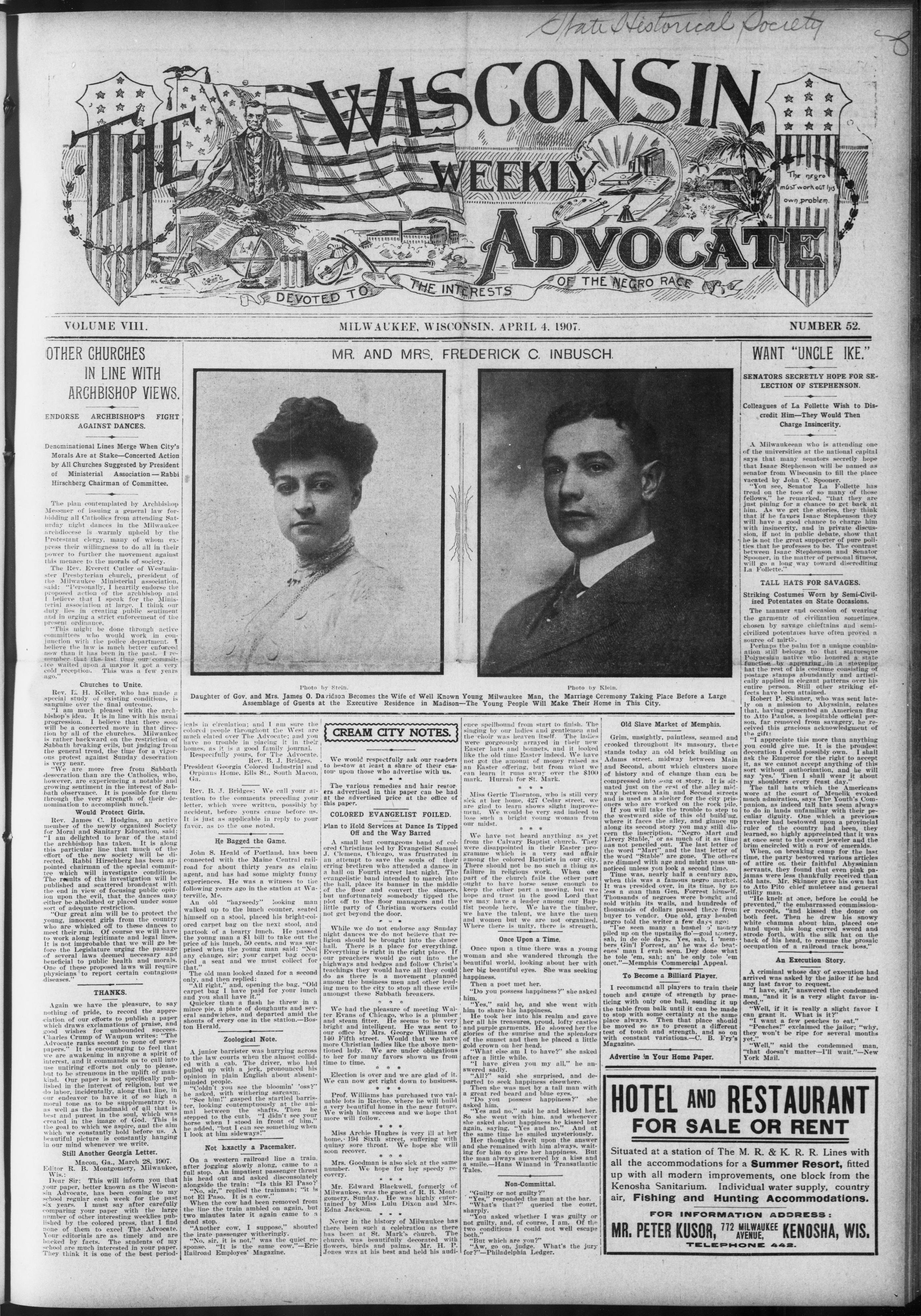
Daughter of Gov. and Mrs. James O. Davidson Becomes the Wife of Well Known Young Milwaukee Man, the Marriage Ceremony Taking Place Before a Large Assemblage of Guests at the Executive Residence in Madison-The Young People Will Make Their Home in This City.
icals in circulation; and I am sure the colored people throughout the West are much elated over The Advocate; and you have no trouble in placing it in their homes, as it is a good family journal. Respecifically yours, for The Advocate, Rev. B. J. Bridges. President Georgia Colored Industrial and Orphans Home, Ells St., South Macon, Ga. Rev. B. J. Bridges: We call your attention to the comments preceding your letter, which were written, possibly by accident, before yours came before us. It is just as applicable in reply to your favor, as to the one noted.
He Bagged the Game.
John S. Heald of Portland, has been connected with the Maine Central railroad for about thirty years as claim agent, and has had some mighty funny experiences. He was a witness to the following years ago in the station at Waterville, Me.
An old "hayseedy" looking man walked up to the lunch counter, seated himself on a stool, placed his bright-colored carpet bag on the next stool, and partook of a hearty lunch. He passed the young man a $1 bill to take out the price of his lunch, 50 cents, and was surprised when the young man said: "Not any change, sir; your carpet bag occupied a seat and we must collect for that."
The old man looked dazed for a second only, and then replied:
"All right," and, opening the bag, "Old carpet bag I have paid for your lunch and you shall have it."
Quicker than a flash he threw in a mince pie, a plate of doughnuts and several sandwiches, and departed amid the shouts of every one in the station.—Boston Herald.
Zoological Note.
A junior barrister was hurrying across to the law courts when the almost collided with a cab. The driver, who had pulled up with a jerk, pronounced his opinion in plain English about absent-minded people.
minded people
"Coldn't you see the bloomin' oss?"
he asked, with withering sarcasm.
"See him!" gasped the startled barrister, looking contemptuously at the animal between the shafts. Then he stepped to the curb. "I didn't see your horse when I stood in front of him," he added, "but I can see something when I look at him sideways!"
Not Exactly a Pacemaker
On a western railroad line a train, after jogging slowly along, came to a full stop. An impatient passenger thrust his head out and asked disconsolately alongside the train: "Is this El Paso? "No, sir," replied the trainman; "it is not El Paso. It is a cow." When the cow had been removed from the line the train ambled on again, but two minutes later it again came to a dead stop. "Another cow, I suppose," shouted the irate passenger witheringly. "No, sir, it is not," was the quiet response. "It is the same cow."—Erie Railroad Employs' Magazine.
MR. AND MRS. FREDERICK C. INBUSCH.
CREAM CITY NOTES.
We would respectfully ask our readers to bestow at least a share of their custor upon those who advertise with us.
---
The various remedies and hair restorers advertised in this paper can be had at the advertised price at the office of this paper.
COLORED EVANGELIST FOILED.
Plan to Hold Services at Dance Is Tipped Off and the Way Barred
A small but courageous band of colored Christians led by Evangelist Samuel J. Clemens, Chicago, was frustrated in an attempt to save the souls of their erring brethren who attended a dance in a hall on Fourth street last night. The evangelistic band intended to march into the hall, place its banner in the middle of the floor and convert the sinners, but unfortunately somebody tipped the plot off to the floor managers and the little party of Christian workers could not get beyond the door.
While we do not endorse any Sunday night dances we do not believe that religion should be brought into the dance hall. There is a place for everything. Everything is right in the right place. If our preachers would go out into the highways and hedges and follow Christ's teachings they would have all they could do as there is a movement planned among the business men and other leading men to the city to stop all these evils amongst these Sabbath breakers.
```markdown
```
We had the pleasure of meeting Walter Evans of Chicago, who is a plumber and steam fitter. He seems to be very bright and intelligent. He was sent to our office by Mrs. George Williams of 140 Fifth street. Would that we have more Christian ladies like the above mentioned lady. We are under obligations to her for many favors shown us from time to time.
* * *
Election is over and we are glad of it. We can now get right down to business.
* * *
Prof. Williams has purchased two valuable lots in Racine, where he will build a very beautiful home in the near future. We wish him success and we hope that more will follow.
Miss Archie Hughes is very ill at her home, 194 Sixth street, suffering with quinsy sore throat. We hope she will soon recover.
* * *
Mrs. Goodman is also sick at the same number. We hope for her speedy recovery.
* * *
Mr. Edward Blackwell, formerly of Milwaukee, was the guest of R. B. Montgomery, Sunday. He was highly entertained by Miss Lulu Dixon and Mrs. Edna Jackson.
* * *
Never in the history of Milwaukee has there been such a celebration as there has been at St. Mark's church. The church was beautifully decorated with flowers, birds and palms. Mr. H. P. Jones was at his best and held his audi-
ence spellbound from start to finish. The singing by our ladies and gentlemen and the choir was heaven itself. The ladies were gorgeously arrayed in their new Easter hats and bonnets, and it looked like the old time Easter indeed. We have not got the amount of money raised as an Easter offering, but from what we can learn it runs away over the $100 mark. Hurrah for St. Mark.
***
Miss Gertie Thornton, who is still very sick at her home, 427 Cedar street, we are glad to learn shows slight improvement. We would be very sad indeed to lose such a bright young woman from our midst.
* * *
We have not heard anything as yet from the Calvary Baptist church. They were disappointed in their Easter programme which is a very sad affair among the colored Baptists in our city. There should not be no such a thing as failure in religious work. When one part of the church fails the other part ought to have horse sense enough to keep the other part a moving, but we hope and trust in the good Lord that we may have a leader among our Baptist people here. We have the timber, we have the talent, we have the men and women but we are not organized. Where there is unity, there is strength.
Once Upon a Time
Once upon a time there was a young woman and she wandered through the beautiful world, looking about her with her big beautiful eyes. She was seeking happiness. Then a poet met her.
"Do you possess happiness?" she asked him.
"Yes," said he, and she went with him to share his happiness.
He took her into his realm and gave her all his treasures, proud, lofty castles and purple garments. He showed her the glories of the sunrise and the splendors of the sunset and then he placed a little gold crown on her head.
"What else am I to have?" she asked after a little while.
"I have given you my all," he answered sadly.
a great red beard and blue eyes.
"Do you possess happiness?" she asked him.
"Yes and no," said he and kissed her. So she went with him, and whenever she asked about happiness he kissed her again, saying, "Yes and no." And at the same time he smiled mysteriously.
Her thoughts dwelt upon the answer and she remained with him always, waiting for him to give her happiness. But the man always answered by a kiss and a smile.—Hans Winand in Transatlantic Tales.
Non-Committal
"Guilty or not guilty?"
"Yes," responded the man at the bar.
"What's that?" queried the court, sharply.
"You asked whether I was guilty or not guilty, and, of course, I am. Of the two conditions I could not well escape both."
"But which are you?"
"Aw, go on, judge. What's the jury for?"—Philadelphia Ledger.
HOTEL AND RESTAURANT FOR SALE OR RENT
Old Slave Market of Memphis.
Grim, unsightly, paintless, seamed and crooked throughout its masonry, there stands today an old brick building on Adams street, midway between Main and Second, about which clusters more of history and of change than can be compressed into song or story. It is situated just on the east of the alley midway between Main and Second streets and is used as a shelter for the city prisoners who are worked on the rock pile. If you will take the trouble to step to the westward side of this old building, where it faces the alley, and glance up along its second story you may still discern the inscription, "Negro Mart and Livery Stable," or as much of it as time has not penciled out. The last letter of the word "Mart" and the last letter of the word "Stable" are gone. The others are dimmed with age and might pass unnoticed unless you look a second time.
Time was, nearly half a century ago, when this was a famous negro market. It was presided over, in its time, by no less a man than Gen. Forrest himself. Thousands of negroes were bought and sold within its walls, and hundreds of thousands of dollars passed there from buyer to vendor. One old, gray headed negro told the writer a few days ago: "Ise seen many a bushel o' money piled up on the upstaihs flo'—gold money, sah, in de ole days. Yes, sah, I 'members Gin' Forrest, an' he was de beatenes' man I evah seen. Dey done what he tole 'em, sah; an' he only tole 'em onct."—Memphis Commercial Appeal.
To Become a Billiard Player
I recommend all players to train their touch and gauge of strength by practicing with only one ball, sending it up the table from balk until it can be made to stop with some certainty at the same place always. Then that place should be moved so as to present a different test of touch and strength, and so on with constant variations.—C. B. Fry's Magazine.
Advertise in Your Home Paper.
NUMBER 52.
SENATORS SECRETLY HOPE FOR SELECTION OF STEPHENSON.
Colleagues of La Follette Wish to Discredit Him—They Would Then Charge Insincerity.
A Milwaukeean who is attending one of the universities at the national capital says that many senators secretly hope that Isaac Stephenson will be named as senator from Wisconsin to fill the place vacated by John C. Spooner.
"You see, Senator La Follette has tread on the toes of so many of those fellows," he remarked, "that they are just pining for a chance to get back at him. As we get the stories, they think that if he favors Isaac Stephenson they will have a good chance to charge him with insincerity, and in private discussion, if not in public debate, show that he is not the great supporter of pure politics that he professes to be. The contrast between Isaac Stephenson and Senator Spooner, in the matter of personal fitness, will go a long way toward discrediting La Follette."
TALL HATS FOR SAVAGES.
Striking Costumes Worn by Semi-Civilized Potentates on State Occasions.
The manner and occasion of wearing the garments of civilization sometimes chosen by savage chieftains and semicivilized potentates have often proved a source of mirth.
Perhaps the palm for a unique combination still belongs to that statuesque Polynesian native who honored a state function by appearing in a stovepipe hat the rest of his costume consisting of postage stamps abundantly and artistically applied in elegant patterns over his entire person. Still other striking effects have been attained.
Robert P. Skinner, who was sent lately on a mission to Abyssinia, relates that, having presented an American flag to Atto Paulos, a hospitable official person, far removed from savagery, he received this gracious acknowledgment of the gift:
"I appreciate this more than anything you could give me. It is the proudest decoration I could possibly own. I shall ask the Emperor for the right to accept it, as we cannot accept anything of this sort without authorization, and he will say 'yes.' Then I shall wear it about my shoulders every feast day."
The tall hats which the Americans wore at the court of Menelik evoked much admiration, says The Youth's Companion, as indeed tall hats seem always to do in lands unfamiliar with their peculiar dignity. One which a previous traveler had bestowed upon a provincial ruler of the country had been, they learned, so highly appreciated that it was at once sent to the court jeweler and the brim encircled with a row of emeralds. When, on breaking camp for the last time, the party bestowed various articles of attire or their faithful Abyssinian servants, they found that even pink pajamas were less thankfully received than old hats. Mr. Skinner gave his own hat to Atto Pito chief muleteer and general utility man.
"He knelt at once, before he could be prevented," the embarrassed commissioner records, "and kissed the donor on both feet. Then he drew his snowy white chamma about him, placed one hand upon his long curved sword and strode forth, with the silk hat on the back of his head, to resume the prosaic occupation of a railroad track boss."
An Execution Story.
A criminal whose day of execution had arrived was asked by the jailor if he had any last favor to request.
"I have, sir," answered the condemned man, "and it is a very slight favor indeed."
"Well, if it is really a slight favor I can grant it. What is it?"
"I want a few peaches to eat."
"Peaches!" exclaimed the jailor; "why, they won't be ripe for several months yet."
"Well," said the condemned man, "that doesn't matter—I'll wait."—New York Mail.
THE WISCONSIN WEEKLY ADVOCATE
R. B. MONTGOMERY, Editor and Proprietor.
The country in which the large towns are most nearly equi-distant is Holland. They are at an average distance of twenty miles from one another.
The Chilian nitrate fields escaped earthquake damage in the recent shocks. The increased American demand for nitrate of soda has been so great that a number of additional outside vessels have been chartered to get the product from Chili to the United States. The American imports of nitrates from Chili in 1905 amounted to 272,525 tons, valued at $9,306,577.
In the grounds adjacent to Wentworth castle, in England, is to be seen a unique sun dial, which is composed of a fine yew tree for the pin and closely cropped box bushes for the Roman figures and borderings. It was planted over 200 years ago and is still in a good state of preservation. Its timekeeping compares favorably with sun dials of more modern construction.
The Raymond-Phillips system of automatic signaling between the signal box and the cab of a locomotive has been tried with success on the lines of the North Staffordshire Railway company, England. The system is arranged to give a visual and audible signal in the cab of the engine or any other portion of the train and simultaneously to repeat such signals in the signal box.
—It is said of William B. Norman, the auctioneer who died recently, that he was responsible more than any other man for stripping the south of its old furniture. His auction room was a clearing house for ancestral mahogany from below the Mason and Dixon line, and to look about while a sale was in progress was to bring to mind all the glamour of before-the-war hospitality.
—A German marine disaster of an extraordinary character is reported. The good ship Agathe, from Hamburg, laden with barley, reached Elbing, where the shipyards are, and was beating up the Elbing river. An ox watched the vessel from the bank. A sudden squall carried the ship a little off her course, with the result that she collided with the ox, impaling it on the jibboom, "from which it was removed with difficulty."
Ambulance dogs of the St. Bernard type are being trained by European armies for use in war. Those employed by the Russians in Manchuria proved useful in finding the wounded, many of whom probably are never found. In the Franco-Prussian war, out of 129,000 casualties, there were as many as 13,000 returned as missing, a very great number of whom, it is believed, would, with the aid of trained dogs, have been recovered.
-It is proposed to construct a reservoir seven miles from Suere, Bolivia, at an altitude of about 1000 feet above the level of the city. Into this reservoir there will converge tunnels from eleven springs of pure water, making up an available total of 1050 gallons a minute. The water will be brought down to Suere through iron tubes with a force equivalent to 150 horsepower, which it is proposed to utilize for an electric power installation.
Broken-down horses are shipped from English ports to the continent of Europe, where they are bought and slaughtered for butchers' meat. Boats continually arrive at Amsterdam laden with miserable, sorebacked, blind and, in many cases, dying horses. Some of them have been certified as unfit for further work underground in the mines and, because they are unused to the upper air and light, they suffer great torture from the exposure. Their miseries when in a rough sea are indescribable.
The salary of the President is $50,000, President's traveling expenses $25,000, secretary to the President $5000, other employees in executive office $61,000, contingent expenses $20,000, care and refurnishing white house $30,000, fuel for white house $6000, care of greenhouses $9000, repairs to greenhouses $3000, maintenance of white house grounds $4000, policemen at white house $40,000, secret service men $4000, naval yacht Mayflower $150,000, naval yacht Sylph $25,000, Total $472,000.
—Says a naturalist: "The herrings move on the sea in uncountable numbers in banks that are miles in length and width, in windrows so vast that they perhaps keep passing one given point in unbroken succession for months at a time. Just so with the menhaden. A catch in a purse net of 500,000 is not infrequent. Such numbers are sufficient to stand all the ravages of the natural enemy. The bass, the haddock and the pollock may kill to their heart's content and still the menhaden will hold their own."
The census bureau has issued a statement concerning manufacturers of New York state for the last five years. During this period the number of manufacturing establishments has increased from 35,957 to 37,194, capitalized at $2,031,459,515, an increase of 33 per cent. The employees number 954,992 and the factory products had an annual value of $2,488,345,579. The principal industries are men and women's clothing, flour and gristmill products, foundry and machine shop products, malt liquors and printing and publishing.
The average number of passengers in each railroad train in the United States in 1904 was 50.25. This represents a growth from about 39 a train, in 1898, but is still far below the development attained abroad. In 1898 Germany carried an average of 71 persons in each train and India had the large figure of 189. The development of the electric railway in this country and the frequent train service help to keep down the average. On each 212,000 miles of railway, in 1904, there were carried an average of 104.198 passengers.
German scientists announce that the material for a man weighing 150 pounds can be found in the white and yolks of 1200 hen eggs. Reduced to a fluid the average man would yield 98 cubic meters of illuminating gas and hydrogen enough to fill a balloon capable of lifting 155 pounds. The normal human body has in it the iron needed to make seven large nails, the fat for fourteen pounds of candles, the carbon for sixty-four gross of crayons and phosphorous enough for $20,000 matches. Out of it can be obtained, besides, twenty coffee spoons of salt, fifty lumps of sugar and forty-two liters of water.
An apparatus for measuring the seventy millionth part of an inch has been made by Dr. P. Shaw of Nottingham university, England. It works upon the principles of electric touch, and consists of a fine micrometer screw and six levers. The apparatus is so sensitive and delicate that it is impossible to manipulate it before an audience. It is hung by rubber bands, covered with thick felt, and must be worked at dead of night, when there is no traffic or factory working. The smallest distance that this mechanism measures is about the distance between a solid and liquid molecule. Dr. Shaw's invention was first made in 1900, but its great improvement of late has made it the wonder of physicists throughout the world.
FOILS.
Give me drifted winter-ways,
Whence, returned, the ingle-blaze
Shall like altar-fire divine
Leap before these eyes of mine.
Give me hours of hungry dearth,
That I may possess the earth—
Find Olympian banquets spread
In the country wine and bread!
Give me Strife (who so love Peace!)
That, when furrowing wars shall cease,
Fruitful be the olives found,
Springing from that blackened ground.
I, who so love Love—ah—yes!
Give me Hate and Bitterness,
That, when these are past and done,
Love and I may more be one!
Give me sleep, that I may feel
Clotho's hand new start the wheel
Of another day's bright spinning * * *
And when the warp and woof are thinning,
And the daylight is half blind,
Give me Death, that I may find
Life, upon some morning height
Sheen and sheer above the Night!
A GIRL, A MAN, A STORM.
It was the last car through, and was nearly half an hour late. Standing about the streets on a snowy, windy night is not inducive to good nature, consequently it is not to be wondered that when at last the belated car crawled into sight the girl waiting alone in the deserted square wore a look of impatience—a look which changed to one of intense discomfiture and annoyance when, upon entering the car, she found every seat occupied.
"Pardon, miss. you may have my place," began a dapper little man, rising quickly at sight of a pretty face. She was about to accept the courtesy thankfully when her eyes fell upon the other occupant of the seat, then her figure heightened perceptibly and the haughty look on her face caused the polite little man to wonder inwardly as she replied: "Thank you, but do not trouble. I don't mind standing in the least."
"No trouble at all, I assure you; this is my stop," he answered, moving to the door as the car drew to a slow halt.
The girl's cheeks reddened and she tapped her foot with annoyance as the man withdrew, leaving her tired and cold, the only vacant seat in the car at her side, but one she would not accept under any circumstances, as she told herself spitefully. The idea of alighting and walking presented itself, but she knew that would be impossible, so she clung to the back of the seat in front, as the car lurched and creaked and started painfully on.
She glanced at him after a few moments, and could not prevent a little thrill of delight as she noticed a worn look about the eyes which had not been there before—before—well, anyway, he was to blame and she didn't care a bit.
A queer little smile stole into his eyes as he noted the surreptitious glances cast at him, and he settled back behind his paper as if no such thing as a Girl ever crossed his mind.
At last he could stand the look of utter weariness on her face no longer, and rising, he touched her politely on the arm, saying:
"I am better able to stand than you, if you really prefer the whole seat alone."
She glanced at him with no recognition in her eyes, only the look of well-bred surprise he had seen there when something had impressed her.
"Indeed; no—I could not think of permitting a stranger to so inconvenience himself for me."
With all the ceremony possible he presented his card, with the words: "Permit me to introduce myself. I should have done so at first. I merely made the suggestion as I observed the people about us were beginning to notice—and wonder."
Without a word she dropped into the seat, and shrank as far as possible into the corner as she made the slightest motion in the world for him to be seated also. Again he smiled. That was a lucky thought—remembering her abhorrence of being conspicuous.
The white world outside looked cold and dreary as the car moved slower and slower over the ice-covered rails, fighting its way almost ineffectively through the storm. Only another quarter of a mile and this strained, silent ride would be over, she thought, just as the lights in the car darkened and it came to an abrupt halt.
"Impossible to go any further tonight," shouted the conductor, as several false starts were made.
Slowly the crowd made its way from the car, vowing all sorts of vengeance against such a poorly managed line, and apostrophizing such abominable weather. With a brave little sigh, she rose and made her way to the street with the rest. Not a soul going in her direction—not a person on the car with whom she had even a bowing acquaintance, except . . . Another deep sigh, and she started off. Once she glanced back to see if he had by any chance followed, but no, there he was, talking and laughing with the conductor! In spite of all she could do, a tear rolled down her cheek. She had never felt so forlorn in her life before; never had longed so for him, that is, never had admitted it.
The wind blew the snow in her face, and she was nearly exhausted—every step grew more difficult. The tears fell faster now, and she dabbed at them piteously with a snow-laden little handkerchief. Suddenly a particularly strong gust of wind swept by, and she clutched at a fence while a mournful little sob broke from her lips just as a pair of strong arms folded her tightly to a rough snowy coat!
"O, Jack," she cried, without even glancing at the face above her.
He drew her arm through his and led her to her door. Nothing but those two words had been spoken, but there are times when a few moments of silence expresses more than whole hours of conversation.
"Come in, Jack," she whispered. "I want you to."
"Forgive me, dear," he answered, while they were waiting for the door to open, "I was wholly to blame—it was my fault."
"No, Jack," she quickly interrupted, "all mine. But, dear," a little roguish smile showing through the still undried tears, "you will always remember that you spoke first, won't you?"—Ethel May Shorey, in Boston Post.
Age of Massachusetts Judges
The law of Massachusetts is being expounded with wisdom and reasonable celerity by a bench of seven judges whose average age is 61 years. In fact it should be said that seldom, if ever, has a judge been appointed as young as 40, the age mentioned by Dr. Osler when man's best attainments in life are
achieved. At present two of the judges, Morton and Hammond, are on the threshold of 70; one, Chief Justice Knowlton, is 68; Judge Sheldon is 63. Judge Braley is 57, Judge Loring 56, while Judge Rugg, the latest appointee, is the youngest, being 46. Still, it should be said that the work is quite evenly distributed, the seniors doing their share with the juniors, and no high court in the country has a better reputation for having its work so well in hand or stands higher.-Boston Herald.
RELIABLE RECIPES
Fruit Jelly.—Make a plain lemon jelly and just before it begins to harden stir in a few chopped figs, stoned dates and one-half cup of seeded raisins. When firm serve with cream.
Baptist Cakes.—These cakes are served hot at breakfast and are made from small pieces cut from light bread dough and fried in deep fat like doughnuts. Serve with maple or some other syrup.
Egg Fondu—Beat four eggs well, add one-third cup of grated cheese and season with salt and pepper. Cook until smooth and spread over slices of hot buttered toast. Garnish with a sprig of parsley.
Broiled Mackerel.—Wash a mackerel, wipe dry and put into a greased wire broiler. Broil over a clear fire on the flesh side until nearly done. Then turn to cook on the skin side a few minutes. Serve on a heated platter; garnish with parsley and lemon points.
Delicate Sponge Cake.—Beat the yolks of three eggs, add one cup of sugar and one cup of flour in which two level teaspoons of baking powder have been sifted, then add one tablespoon of hot water and the stiffly beaten whites of the three eggs.
Coffee Jelly.—Soak one box of gelatine in two cups of cold water for half an hour. Add three cups of strong hot coffee and two cups of sugar. When well mixed strain and set in a cold place to become firm. Serve with whipped cream.
Tongue Salad.—Cut cold boiled tongue in thin slices and arrange on a platter. Make a dressing of a small onion, six anchovies and six sprigs of parsley all chopped fine. Add half a cup of French dressing and when mixed pour it over the tongue.
Corn Batter Cakes.—Sift two cups of cornmeal, one cup of flour and two level teaspoons of baking powder. Mix with two cups of milk, two well beaten eggs, one tablespoon of melted butter, one-half teaspoon of salt and one teaspoon of molasses. Drop in spoonfuls on a hot griddle and bake.
Apple Cake.—Sift two cups of flour with four level teaspoons of baking powder and a pinch of salt. Rub in a rounding tablespoon of butter and mix with one-half cup of milk to make a soft dough. Stir in an equal amount of chopped apple and bake in gem pans. Serve with a liquid sauce as a dessert.
Fruit Sauce.—Add a tablespoon of chopped citron to half a cup of seedless raisins and a cup of cold water. Set where it will heat slowly, simmer until the raisins are plump and add enough hot water to make one cup. One quarter of an hour before serving stir in a rounding teaspoon of cornstarch and the same of butter and cook ten minutes. Add one-half teaspoon of vanilla and a cup of beaten cream.
Parsley Omelet for One.—Beat two large or three small eggs separately until light. To the yolks add one tablespoon of milk, then the whites, which must be stiff. Season with pepper and salt. Heat a level tablespoon of butter in an omelet pan and pour in the egg. Cook slowly and just as the omelet has finished cooking sprinkle with finely chopped parsley. Fold over, garnish with a bit of parsley and serve at once.
Chocolate Dessert.—Heat three cups of milk to the scalding point with a small piece of stick cinnamon. Mix one-half cup of cornstarch with one cup of cold milk and a level half-teaspoon of salt. Stir this into hot milk and cook until it thickens and is smooth. Melt two squares of chocolate over hot water, add half a cup of sugar, then a little of the cooked mixture. When smooth add to the first mixture and cook until the color is even. Add one beaten egg, cook two or three minutes and then turn into a serving dish. Serve with a fruit sauce.
Rice Croquettes.—Cook one cup of rice in salted water for twenty minutes or until tender. Drain in a colander, cook and add the beaten yolk of one egg and shape into small cones. Roll each cone in beaten egg and then in sifted cracker crumbs. Fry in deep fat, put two or three croquettes in a frying basket at a time and have the fat smoking hot, as the croquettes have already been cooked and should be browned quickly. Drain and serve with a sweet sauce. For the sauce cook together equal parts of sugar and water and season with any flavoring liked.
Cheese Straws.—Mix three rounding tablespoons of Parmesan cheese with one-half cup of sifted flour, a pinch of cayenne and as much cold water as needed, to form a stiff dough. Knead until smooth, roll out as thin as possible. Cut a square measuring about five inches each way and cut this square into about thirty strips or straws. Place them evenly on a baking pan and bake in a hot oven. Roll up the pieces left from cutting and roll out thin; cut out small rings and bake. When the straws are cold slip several into each ring and serve a bundle to each person.
8.000.000 People Added Since 1900.
The census bureau at Washington has issued an estimate of the population of the United States proper for 1906. It shows a gain over 1900 of 8,000,000.
The five leading cities and their estimated population in 1906 are as follows: New York, 4,113,043; Chicago, 2,049,-185; Philadelphia, 1,441,735; St. Louis, 649,320; Boston, 602,278.
According to the estimate the population of continental United States in 1906 was 83,941,510, this being an increase over 1900 of 7,946,935.
The population of the United States, inclusive of Alaska and the insular possessions, in 1906 was 93,182,240. The growth in population in continental United States from 1905 to 1906 was 1,367,-315.
The total estimated population of incorporated places having 8000 or more inhabitants, exclusive of San Francisco and Los Angeles, Cal., is 28,466,624 for 1906, an increase over 1900 of 3,912,188, or 15.9 per cent, while the estimated population of the United States, exclusive of these cities, showed an increase of 4,480,008, or only 8.8 per cent.
The eighty-eight cities with an estimated population of 50,000 or more in 1906 had a total estimated population of 19,771,167, an increase of 2,766,863, or 16.3 per cent, over that reported in the twelfth census.
"SO KIND YOU ARE."
You have an eye more warmly brown
Than autumn days away from town,
But will not let me speak my mind,
So kind you are and so unkind.
You have a voice with all the moods
Of twilights and of solitudes,
But light te leave me as the wind,
So kind you are and so unkind.
You have, wherever I may be,
A trick of persecuting me,
Though out of sight, not out of mind,
So kind you are and so unkind.
The way would seem not half so soon
To reach your heart as reach the moon,
Yet it's a way I'll surely find.—
So kind you arc and so unkind.
—Witter Bynner in McClure's Magazine.
BRIEF NOTES OF GENERAL INTEREST
Patrick Mulligan, an Omaha pauper, who was left $100,000 by a brother's death in California, announces that he will give the money to establish an old man's home, and will spend the rest of his days in the poorhouse.
A peculiar coincidence in birthday dates is manifest in the family of former State Senator L. W. Thayer of Ripon. Three of the five children were born on April 1, and Mr. Thayer himself is one of four children whose birthdays fall on the thirtieth day of the month.
Herbert B. Walker recently was elected president and general manager of the Old Dominion Steamship company. Mr. Walker entered the service of the steamship company twenty-four years ago as an office boy. W. L. Woodruff, who has been general freight agent for the company, was promoted to the position of traffic manager.
John Burwell, 10 years of age, is under arrest at Ft. Worth, Tex., and is being held to await the action of the grand jury on a charge of arson. The boy was caught by County Judge Terrell in the act of firing his barn and confessed he had burned several barns in Ft. Worth during the last few days, "just to see the fire engines." There is much sympathy for the boy, but he will be prosecuted and, if convicted, will be sent to the state reformatory.
John Benson and sons, Benson and Eugene Benson, were convicted at Chippewa Falls, Wis., of carrying away a building belonging to W. V. Tilton, and were assessed $25 as a result. They claimed the building had been sold to them by Bert Johnson, who lived on Tilton's farm. It was shown that the building was not personal property and therefore could not be sold separate from the land, and the Bensons' taking of the building practically amounted to theft.
Mrs. C. H. Lewis of Richmond, Va., was taken to the Virginia hospital, the victim of an accident which carries a moral for other women. She was in her yard hanging the week's washing on a line and pinning the clothes up with ordinary pins. These she carried safely in her mouth until she sneezed suddenly and swallowed at least a dozen of them. Since then she has suffered intense agony, and at the hospital it was said her condition is critical. The X-ray will be used in an endeavor to locate the pins.
Two Highland (Wis.) boys about 15 years each, being tired of the quiet life of that peaceful village and possessing an ambition to conquer the world, left home without leave, going to Muscoda, Wis., walking twelve miles of the distance. The combined wealth of the two consisted of one 10 cent piece, half of which was spent for bologna. The lads, Eagle and Bowers by name, beat their way, but were ditched at Blue River and walked back to Muscoda. A telephone message from their parents caused their apprehension. One of the boys' parents came after them.
Samuel Greenman has filed suit against Rev. Max Lieberman, rabbi of Keneseth Israel temple, at Kansas City, Mo. In his petition Greenman, who is 60 years old, says the rabbi assaulted him September 25, 1905, and asks $6000 damages. The assault, he says, took place while he was attending the celebration of a Jewish holiday in the synagogue. Greenman says the rabbi approached him while he was praying in a loud voice and struck him, saying he was praying too loud and seeking to disturb the holiday celebration. Rev. Mr. Lieberman has been rabbi of Keneseth Israel temple for years.
---
Circuit Judge Matt G. Reynolds, in discussing John Green's suit at St. Louis, held that a wife's fondness for beer was no ground for divorce, and added that the defendant's consumption of a hundred bottles of beer a month, as charged, was insufficient ground for a decree. The plaintiff testified that his wife was in the habit of drinking a case of beer a day, and, to prove his charges, had his family grocer testify that during last October he delivered to the defendant's home over 400 bottles of beer. Judge Reynolds, in summing up, said the evidence showed the plaintiff knew of defendant's thirst before he made her his wife.
The details of a recent accident, which, while of a shocking nature, was not attended with fatal casualty, came from Chippewa county, Wis. Two sticks of dynamite put in the oven of the kitchen range to dry by J. C. Land, caretaker of the Munoskong Hunting and Fishing club, near Pickford, exploded with terrific force, while Mrs. Land, six feet distant, was engaged in culinary duties. The stove was shattered into countless fragments, yet Mrs. Land, hurled violently to the floor, escaped with a broken leg and a number of severe cuts about the body, while her little son, also in the kitchen at the time, sustained only a painful burn on the head. A sewing machine opposite the range, was blown to pieces.
Two baths in one year is the sum total of Ezra Langaman's ablutions, according to his statement made on the witness stand at Tiffin, O., to refute the testimony of his wife as to his habits of cleanliness.
Langaman has brought an action for divorce, alleging that for years his wife refused to make his bed and compelled him to sleep in an outhouse, finally driving him from the premises. He later filed a motion for alimony, pending litigation. It was at the hearing on this motion that he indignantly denied the assertion that he does not bathe.
Opposing counsel attempted, without success, to make the witness acknowledge that the baths were upon the two occasions he had fallen in the river. The court refused to grant the motion.
Hypnotism, tested last summer on two ungovernable inmates of the New Jersey State Home for Girls in Trenton, proved so successful as a corrective and improving influence that six girls were submitted to similar treatment by Dr. John D. Quackenbos in New York. Immediate improvement was shown by the girls, who had been selected from the 300 in
the reformatory because they were the most, ungovernable there. The doctor said:
"When I had the six girls here today I established a real sympathy with each of them while she was in the hypnotic state. I learned that wrong ideas were in possession of them and sought to banish them and substitute some worthy idea. For instance, I interested one girl in the idea of directing to piano music, in which she is skillful, the energies she had been wasting in violent temper. Another I induced to center her interest in the violin, which she plays well."
Humorous Items.
The Way It Often Goes.
"The old man was one in a thousand!" "Yes. His three sons are all ciphers." Broadway Magazine.
Good Rolls Here!
Cheyenne now has a restaurant on wheels. It ought to be easy to get good rolls there.—Denver Post.
What He Loved Her For.
She loved him for all she was worth,
She loved him for all she was worth, And also, it's safe to infer, Since she had much goods of this earth, That that was the way he loved her. —The Catholic Standard and Times.
Illustration.
Tommy—Pa, what is a come-down?
Pa—Hanging on a strap riding home from the auto show.—Broadway Magazine.
Lawson—Is he rich?
Dawson—Fabulously. Why, he stayed three days once at a Florida hotel.—Somerville Journal.
Hopeless
It wouldn't do, the gun well knew
To conjure up a hope
That he might even sometime with
An antelope clope.
Boston Evening Transcript
Taken In. Anyhow
"We want you in our confidence," The smooth promoter said, But people got—which made 'em hot— In his confidence game, instead. Philadelphia, Ledger
At the Astoria.
"What a haughty manner that elevator boy has!"
"Yes, he takes titled people down constantly."—Broadway Magazine.
With Mint Sauce
Mary had a little lamb—
You've heard this fact before;
But have you heard she passed her plate
And had a little more?
—Robert T. Hardy, Jr., in Lippincott's.
A Mere Mental Phase.
Bronson-What is a winter resort?
Woodson-A winter resort? Well any place you go where you don't let yourself think it is as cold as it is at home-Broadway Magazine.
How He Did It.
A man who collected car fares
Grew rich and put on many airs;
When folks out his way
Would wonder, he'd say:
"I work this position on shares."
—Denver Post.
Educational Note
Rownley—Oh, five or six.
Towner—Five or six what? Weeks?
Rownley—No; automobiles.—Tatler.
Danger
"My wife's not out of danger yet,"
Sald Jones, with anxious air.
"How's that?" sald Smith, and Jones re
plied:
"The doctors are still there!"
—Harold Melbourne in Lippincott's.
Nothing to Brag About.
First Chicago Little Girl—Edna is always blowing about her forefathers.
Second Chicago Little Girl—She'd better not do it to. I've had five and we're expecting a sixth.—Brooklyn Life.
A. Sure Turn
"I see be the sarmon this marnin' that Lot's wife looked back and turned into a pillar of salt."
"I may be, but wid me own eyes I see Dennis McGovern's wife look back and turn into a saloon."—Lippincott's
The Limit.
It was just a plain contest, but the prize was to go to the man who told his lie most briefly and casually. "I came in on a suburban train this morning," said the prize winner, "and as I hastily flung up a car window——"—Smart Set.
Somebody Bound to Suffer.
Mrs. Swellman—Oh! Clarence. I'm sure our dinner party tonight will be a horrible failure.
Mr. Swellman—What's the matter?
Mrs. Swellman—The cook quarreled with her beau this morning.—Philadelphia Press.
Handy
Young Poet (to creditor who presents a bill)—Oh, how good of you! I was looking everywhere for a piece of paper upon which to write a wonderful thought which has just come to me, and you drop down like an angel from heaven!—Trans-Atlantic Tales.
His Definitions
"Faith," said Brother Williams, "is de faculty what kin turn de song er a sawmill into de hallrluia er de angels."
"An' what is hope?"
"Hope is de faculty what keeps you lookin' for somethin' you never gits."—Atlanta Constitution.
Sensible Criticism
Superintendent (to head of firm)—A former hotel keeper has applied to us for a position as traveling salesman for our wines. He says that he has bought wine of us for years.
Head—I should prefer a clever man.—Translated for Transatlantic Tales from Meggendorfer Blaetter.
He Had None
Friend (to newly made widow)—I suppose you are going to erect a lasting monument to your husband's memory?
Widow—To his memory, no. Poor Isidor had none. It was only yesterday that in turning out one of his old coats I found the pockets full of letters I had given him to post.—Bon Vivant.
After Expert Advice
M. Z. (at the police station)—Can I see the man you arrested at my house last night?
Chief Constable—What do you want to see him for?
M. Z.—I want to ask him how he managed to get into the house and go up the stairs without waking my wife?—Le Rire.
Advertise in Your Home Paper.
```markdown
```
Poor People Rather Buy Sweets Than Proper Food.
There are no greater candy eaters in the world than the very poor people of New York city. Keepers of the almost innumerable little shops in their neighborhoods say that thousands of them will go without proper food to buy sweets, and that they spend 10 times as much for sugars and chocolates, in proportion to their means, as do those who can well afford such luxuries.
EMPEROR MENELIK A HEALER
While He Is Ill His People Must Suffer Uncomplainingly.
Emperor Menelik of Abyssinia is ill and his indisposition deprives his people of their great physician. For certain forms of illness they go to him, personally if possible, or send a proxy. He "touched" them for their ailments and straightway they recover it is said. At any rate, having thought themselves ill, they now believe themselves cured.
BEASTS FEROCIOUS IN INDIA
Statistics Show That in 1904 24,034 People Were Killed.
A statistical paper on India shows that in 1904 there were killed in that country by snakes and wild beasts 24,034 persons—21,880 by snake bites, 796 by tigers, 399 by leopards and the rest by other animals. The number of cattle killed was 98,582.
ENGLISH MOTOR INDUSTRY BIG
About $60,000,000 Is Invested in Plants
Paving $75,000,000 Wages.
About $60,000,000 is at present invested in England in the manufacture of motor wagons. About 250,000 men are employed in them, or as chauffeurs, etc., and their wages aggregate $75,000,000 a year.
Dr. Von Bergmann Is Surgeon for Rulers
Dr. Von Bergmann Is Surgeon for Rulers.
Prof. Ernst von Bergmann, who died after on operation at Weisbaden the other day, was one of the world's most famous surgeons.
He was born at Boyen, Livonia, December 16, 1836, and studied medicine at the universities of Dorpat, Vienna and Berlin. He became a noted army surgeon.
Prof. Von Bergmann was a hereditary member of the Prussian House of Lords and was the author of numerous works in surgery.
Last May Prof. Bergmann was summoned to Constantinople to attend the Sultan's daughter, Sultana Ayisheb, and in August of the same year attended the Sultan of Turkey. The professor also treated the late Shah of Persia early this year.
Only Reported Dead
A startling case of the sudden reappearance of a person supposed to be dead is reported from the village of Monte-Segall, near Pavia, where a soldier, supposed to have been killed in the fight between the Italians and Abyssinians at Abba-Garima and mourned and almost forgotten, frightened the wits out of his relations by quietly knocking at the family door the other day and observing it was opened: "Well, here I am." He afterwards explained that though left on the field for dead, he recovered from his wounds, and on being released went to London, where he obtained work as a waiter, and then getting a little shop of his own made money enough to make him think of seeing Italy once more.—London Globe.
Notes for Brides
Fashion favors delicate orchids. There's just one all-white orchid in season.
Orchids and lilies of the valley form a lovely bouquet.
The bride's favorite flower may be buried in the bouquet. Bridemaid roses still lead for the fair bridemaids.
Easter lilies are charming for banking around the altar at the church. The wreath or whatever arrangement is most becoming for holding the veil is made of orange blossoms.
New Dinner Cards
Hostesses who are clever with their pens have introduced a new idea in dinner cards. The guest is confronted with a pen and ink sketch of herself. If a familiar gathering, the sketch is likely to caricature some little characteristic of its subject. Hostesses who cannot do this themselves are sometimes fortunate enough to have friends who can. It is quite a novelty in dinner cards. Such cards are, of course, only for more or less informal gatherings. At formal dinners plain cards with a simple monogram or crest at the top are most used.
A Pious Reason.
Shure and you have turned very industrious lately, Mr. Finnigan," said Mr. Flaherty. "That I have," replied Mr. Finnigan. "I was up before the magistrate last week for assaulting Cassidy, and the magistrate said that if I came back on the same charge he would fine me $10." "Did he, though?" said Mr. Flah
"No. bedad, I'm not," said Finnigan. "I'm working hard to make up the $10 for the fine."—Tatler.
Man's Responsibility for Disease
Man's often ill-considered interference with nature has more than once aided in the dissemination of disease. Even in the vegetable world he brought over phylloxera to ravage European vineyards and took coffee to Ceylon where a mould was waiting to compass its speedy ruin. In Africa he has fostered nagana in cattle, and sleeping sickness in his own species. In fact, much of his rule of earth has resulted in the genesis of what Metschnikow aptly calls "dis-harmonies."—London Outlook.
Real Low Fare in Hungary
Hungarian railway traveling is the cheapest in Europe. On some lines one can travel third class six miles for 2 cents.
Too True.
Dreamer—Do you ever see pictures in the flames?
Too True
Realist—No, but I see coal bills. Broadway Magazine.
World's Longest Horse Railway.
Arrangements have been made to take a sunlight photograph at the bottom of the shaft of a mine 2,000 feet deep at Sombrerete, in Mexico. The town is on the tropic of Cancer and the sun's rays at the meridian on June 21 fall vertically and illuminate the shaft brightly to its lowest depths. The sunlight lasts about three minutes and then disappears for a year.
GOSSIP FOR THE LADIES.
Love's Story.
Love is not told in an hour
At the close of a summer's day;
Time hath nor bonds nor power.
Love taketh his way
Heedless of sunlight or shower,
Passion or play.
Love is not told in a day.
Brief though the words may be,
Lips that have clung fall away.
Night cometh to thee
Ere that thou strivest to say
Come, love, to me.
Love is not told in the years—
Words that are sought
Mean but a measure of fears
Unworthy brought;
When thou are kissed, love, to tears,
All words are naught.
Love in a life is not told
Yet thou dost give it to me;
Nothing thy lips withhold.
Yet I must tell it to thee.
Tell it, till God doth unfold
Eternity.
A Mental Malaria Which
Should Be Cured.
Talk faith. The world is better off without Your uttered ignorance and morbid doubt. If you have faith in God, or man, or self, Say so: if not, push back upon the shelf Of silence all your thoughts till faith shall come; No one will grieve because your lips are dumb.
Not long ago I read the following gloomy bit of pessimism from the pen of a man bright enough to know better than to add to the mental malaria of the world. He said:
"Life is a hopeless battle in which we are foredoomed to defeat. And the prize for which we strive 'to have and to hold'—what is it? A thing that is neither enjoyed while had nor missed when lost. So worthless it is, so unsatisfying, so inadequate to purpose, so false to hope, and at its best so brief, that for consolation and compensation we set up fantastic faiths of an aftertime in a better world from which no confirming whisper has ever reached us out of the void. Heaven is a prophecy uttered by the lips of despair, but hell is an inference from history."
This is morbid and unwholesome talk which can do no human being any good to utter or to listen to.
But it can depress and discourage the weak and struggling souls who are striving to make the best of circumstances, and it can nerve to suicide the hand of some half-crazed being who needed only a word of encouragement and cheer to brace up and win the race.
This is the unpardonable sin—to talk discouragingly to human souls hungering for hope.
When the man without brains does it, he can be pardoned for knowing no better.
When the man with brains does it, he should be ashamed to look his fellow mortals in the eyes.
It is a sin ten times deeper dyed than giving a stone to those who ask for bread.
It is giving poison to those who plead for a cup of cold water.
Fortunately the remarks above quoted contain not one atom of truth!
The writer may speak for himself, but he has no right to speak for others.
It is all very well for a man who is marked with smallpox to say his face has not one unscarred inch on the surface of it. But he has no premises to land upon when he says there is not a face in the world which is free from smallpox scars.
Life is not "a hopeless battle in which we are doomed to defeat."
Life is a glorious privilege, and we can make anything we choose of it if we begin early and are in deep earnest, and realize our own divine powers.
Nothing can hinder us or stay us. We can do and be whatsoever we will.
The prize of life is not "a thing which is neither enjoyed while had nor missed when lost.
It is enjoyed by millions of souls today—this great prize of life—I for one declare that for every day of misery in my existence I have had a week of joy and happiness. For every hour of pain I have had a day of pleasure. For every moment of worry, an hour of content.
I cannot be the only soul so endowed with the appreciation of life. I know scores of happy people who enjoy the many delights of earth, and there are thousands whom I do not know.
Of course, "life is not missed when lost!"—because it is never lost. It is indestructible.
Life ever was, and ever will be. It is a continuous performance. "It is not "worthless" to the wholesome, normal mind. It is full of interest, and rich with opportunities for usefulness. When any man says his life is worthless, it is because he has eyes and sees not, and ears and hears not.
It is his own fault, not the fault of God, fate or accident. If every life seems at times "unsatisfactory" and "inadequate" it is only due to the cry of the immortal soul longing for larger opportunities and fewer limitations. Neither is life "false to hope." He who trusts the divine Source of Life shall find his hopes more than realized here upon earth. I but voice the knowledge of thousands of souls when I make this assertion. I know whereof I speak. All that our dearest hopes desire will come to us if we believe in ourselves as rightful heirs to Divine Opulence, and work and think always on those lines.
If "no whisper has ever reached us out of the void" confirming our faith in immortality, then one-third of the seemingly intelligent and sane beings of our acquaintance must be fools or liars. For we have the assertion of fully this number that such whispers have come, besides the biblical statistics of numerous messages from the other realm.—Ella Wheeler Wilcox.
The High Office of Dress.
The witty author of "Isabel Carnaby" makes one of her characters say, "I can never administer a snub properly unless I am wearing either furs or diamonds." Certainly the subtle influence of dress is acknowledged by those who control our courts, when they decree, as many such bodies do, that gowns shall be worn on the bench.
"Never reprove a servant," counsels a clever housewife, "except when you are well dressed. In your worn and unbecoming everyday garments, you cannot begin to impress her and restrain her impertinence as you can when you are, as it were, in full panoply."
This sounds silly, but it will be found to work well in practice.
"Surely," you may say, "only the uncultivated and unrefined are affected in this way. You and I, and the people we go with, are not controlled by such sordid considerations—by 'the lust of the eyes and the pride of life.'"
Unfortunately, it is to be feared, that though there are degrees, and some of us may not be so impressionable as others to the outer glory, we are all of us more or less slaves to appearances.
One astute lady, who has a rich but
close-fisted husband (she does not live in Brooklyn—of course there are no such husbands here) says that when she wants anything of him, she never asks it when she is in negligee.
"No, indeed," says this clever person. "I put on my very best. Then I make myself as agreeable as possible at dinner. If I can, I have somebody there who, I know, admires me. Then, as soon as my husband and I are alone together, and while I am at the top wave of my good looks and my popularity—I launch my shaft—and I can get the trip to Europe, or the visit from mother, or the diamond sunburst, or whatever I happen to be wanting. It took me a year or two to learn this wisdom, but you will all find that it is sound. Another thing, never ask for anything before breakfast, or, indeed, in the morning at all. Sir Walter Elliott in "Persuasion," says that no woman over 50 should even be seen until after 10 in the morning, for the handsomest women are likely to look homely then, and they do not have to wait until they are 50, either! It is a sad truth that men will give you a great deal more when you look handsome than they will when you look homely."
The effect of dress upon our own selves is really astonishing. A humorous writer in a late issue of The Atlantic pictured a stately great-aunt reproving a young girl for depression or spirits, in words something like these: "And so, forsooth, you are blue! You, with your red cheeks and your health and life all before you! How foolish! Go put on your crimson velvet and your ruby pendant, and your chin will be jerked up as by a string."
There is so much truth in this view of the subject that the guess may be ventured that a continued course of wearing one's old clothes might result in a permanent breaking of the spirit of any well-regulated woman.-Kate Upton Clark in Brooklyn Eagles.
woman and the College.
Despite the many beautiful and prosperous colleges for women all over the country, it is still a question in many parental minds whether or not a college education is a woman's best preparation for life. There is a fairly prevalent idea that college women too often develop the intellect at the expense of the sympathies, that they set mental standards which are higher than their husbands have leisure to reach, or, worse, that, wanting better bread than can be made out of wheat, they refrain from marriage altogether. The higher education too often leads them to choose a life of self-exploitation, and to pursue callings which ultimately may, and very likely will, play them false, and leave them lonely and embittered in a world where the fullest happiness is to be found in beneficient human relations.
While all this is, on the face of it, possible, there is a great deal to be said on the other side. It is true that a thorough education disciplines the emotions. If it discipline them away altogether it does an irremediable injury. If, however, it merely controls the sentimentality of youth by training judgment, it is an effective force for good. Life will bring out the sympathies of those who have them sooner or later, and to be delivered from the sentimental ebullitions of girlhood is not so appalling a matter after all.
There seems to be no doubt that the chief weakness of the feminine mind, as differentiated from the masculine, is to see life personally. A woman, more than a man, is encumbered by herself and hedged by limitations. She cannot, by the inherent nature of things, take so many risks or lead so experimental a life as a man, and her education is, therefore, a matter not of less but of greater moment. She must have thoroughgoing knowledge, because, less than a man, can she afford a wrong reaction. Her interests must be widened, even more carefully than a man's, because she is less likely to be broadened by life.
College if it does nothing else should lay the foundation for more abstract interests and intelligent judgments. If it hardens the sympathies it cannot be because it is too high or too thorough, but because it is too slight and too superficial. Any education that puffs a person up about his own attainments is a poor education. Any education that allows a person to think he can really gain by another's loss, or aggrandize himself by another's fall, or in any way separate his interests from the general interests of the race, is a superficial and inadequate education, whether it be gotten at a finishing school or at a college. If colleges turn out women of defective sympathies and selfish instincts it is not their pursuit of learning that effects this. Intellectual training in and for itself cannot be other than beneficial. The freedom, the independence, the fact of being thrown upon her own resources at a critical age should all prepare a girl for wise government of her own household and intelligent civic helpfulness.
It is difficult to believe that higher education unfits a woman for household management or motherhood, since to these two functions the most highly trained faculties are necessary, especially in these days when social conditions are changing rapidly, and when the domestic problem is in a state of uncomfortable upheaval. It is not less intelligence and training, but more and wiser, that is needed to meet the new conditions. It is, therefore, a cause for rejoicing rather than doubt, that the women's colleges of this country are to be multiplied and more heavily endowed.-Harper's Weekly.
Some Husbands' Tributes to Their Wives
"This place is perfect," Charles Kingsley once wrote to his wife from the seaside, "but it seems a dream and imperfect without you. I never before felt the loneliness of being without the beloved being whose every look and word and motion are keynotes of my life. People talk of love ending at the altar—fools!" Within a few days of his death, having escaped from his sick room, he sat for a few blissful moments by the bedside of his wife, who was lying seriously ill. Taking her hand tenderly in his he said, in a hushed voice: "Don't speak, darling. This is heaven."
John Bright spoke of his wife as "the sunshine and solace of his days." When she died he said: "It seems to me as though the world was plunged in darkness and that no ray of light could ever reach me again this side of the tomb." It was Cobden who shook him at last from the lethargy and despair which were paralyzing his splendid energies. "There are thousands of homes in England at this moment," he said, "where wives, mothers and children are dying of hunger. Now, when the first paroxysm of your grief is past, I would advise you to come with me and we will never rest until the Corn law is repealed."
Dean Stanley said: "If I were to epitomize my wife's qualities I couldn't do it better than in the words of a cabman who drove us on our honeymoon. 'Your wife,' he said to me, 'is the best woman in England'—and I quite agree with him."
"Why should you pity me?" Mr. Fawcett, the blind postmaster general remarked to a friend who had expressed sympathy with him in his affliction.
"My wife is all the eyes I want, and no man ever looked out on the world through eyes more sweet or true."
No man ever relied more completely on his wife's guidance and counsel than John Keble, the poet of the "Christian Year." She was, as he often declared, his "conscience, memory and common sense."
Dr. Pusey declared that the very sight and smell of the verbena affected him to tears, for it was a sprig of verbena he offered to Miss Barber when he asked her to marry him—"the most sacred and blissful moment" of his life.
Dr. Wadsworth late Bishop of Lincoln, said that his wedded life had been "as near perfection as was possible this side of Eden."—Cooking Club Magazine.
Your Gawky Boy.
That gawky boy of yours—ungainly, gaunt, shy, unprepossessing, as he is—writes Henry A. Shute in the March Delineator. You nag him. You laugh at him and ridicule him. Did you ever realize how it hurts? You ought to realize it for it is not so long since you knew how it felt. You would have stood pain like a man and so does your boy. You would have borne privation like a stoic, and so does your boy, and there would have been a grim sort of enjoyment in it, for the joy of resistance is fully awake at 14.
But you could not bear ridicule and he cannot, and yet there is scarcely a day when you do not cause him sharp discomfort.
The boy's mother never does this. She loves every awkward movement of her boy. She loves his long legs and she loves to hear his raucous voice. She smiles at it, too, and at him, and it is a smile of genuine amusement, but there is love in the smile, and love in her eyes, and he knows it, and adores her for it.
If he becomes depressed and despondent, he confides his troubles in his dog, which sits in front of him gazing at him with an almost human expression of sympathy and puts his paw on his master's knee.
A bit unfortunate, isn't it, that your own boy is obliged to depend on his mother and his dog for sympathy and affection? He gets none from you and but little from his brothers and sisters. It is true isn't it?
My friend, if you paid as much personal attention to the proper development of your boy as you do in raising the two-minute trotter, or the blue-ribbon Guernsey, or the Black Strain Jubilee of Orpington, or in beating bogy, or in your game of whist, you would be astonished at the results.
Household Economics in Club Work.
Household economics as a department of club work has been accused of being vague and impractical. We admit that in a sense the name is a misnomer, and while intended to be broad enough to include all phases of home life and interests, one often gets the impression it has to do only with household economy and the servant problem. By giving to the housekeeper an intelligent study of her work, showing her that a knowledge of sanitation and hygiene, food values, decoration, these, the manifold interests of the home, become a science to be studied and loved rather than drudgery to be avoided. Women are becoming more and more willing to listen to the voice which says: That which elevates citizenship must find its source and abiding place in the home, and he whose fingers are on the pulse of the nation tells us our civil life, in the long run, will rise or sink as the average family is a success or a failure. Let us add a fourth R to our system of education—that of right living—and bring it about by club study and programmes, by personal effort and a course in the household economics, through the raising of dietetic standards and free kindergartens. By these means women would be fitted for the fullness of life. She would eliminate drudgery and much of the sickness and unhappiness caused by complex living, and would create the long-sought-for and yet unfound simplicity of living which would grant to every woman time for leisure and time for pleasure. The members of the General Federation of Women's clubs believe that home-making should be regarded as a profession, and that the most profitable and the most interesting study for woman is the home, wherein center all the issues of life, and whose problems may be made of no less cultural value than the study of literature or history. The interests which center round the home are, after all, the most vital, and however far afield club women may wander, they find themselves reverting to the commonplace questions of food, clothing and shelter.—Mrs. Mary Moody Pugh in Home Magazine.
Teas.
Are the most popular entertainments known to modern society. From the informal assembly of a few friends for a chat and a cup of tea, to the elaborate reception to introduce debutante, they are called teas.
For the former the drawing room or library is made attractive with a few flowers, and a fire where possible and from her afternoon tea table with its singing kettle and pretty appointments the hostess dispenses her simple hospitality. Nothing but some dainty sandwiches and cakes are offered with the tea or coffee, which last, in hot weather, should be iced and served out of doors if possible. The guests serve themselves and each other. At an afternoon tea, for which cards have been sent to all one's acquaintances naming a special day, there is an awning and a carpet at the entrance and a man to open the carriage doors. Another opens the house door without waiting for a summons. The ladies remove their wraps in a dressing room upstairs, where one or two maids are in attendance.
A man stationed at the drawing room door asks the name of each guest and repeats it aloud for the benefit of the hostess, who stands just within the room to greet her friends. If a daughter is to be introduced she stands at her mother's side, in which case the rooms are decked with flowers and bouquets galore, the latter being the gifts of friends. There sometimes is a small orchestra behind a screen of plants. In the dining room the table is made attractive with flowers and lights, and three or four waiters are in attendance to serve sandwiches, salads, ices, cakes and bonbons, tea, chocolate and bouillon. Small napkins are a convenience, but not a necessity.—Washington Star.
Cattish Women.
There are few more contemptible qualities in a woman than what is known as "cattishness." The cattish girl is always telling you things "for your good" at least, that is what she calls her remarks. That she hurts you in the telling does not seem to strike her, and she has a perfect knack of making other girls appear at their worst.
In talking to a man she will say, "Mary is such a nice girl; but isn't it a pity she does so-and-so?" and thus she never lets a chance slip of getting in a disagreeable little dig at other girls.
Let men once grasp the fact that a girl is the sort who says unkind things about her own sex, and they will have no use for her. It is owing to women of that kind that men call women "cattish." It is an exceptional man who says hasty things about another man. If men have anything to say, they come right out with it and stand by their colors.
A wise woman will ever defend her
own sex. She will contradict every bit of scandal she consistently can if it touches a woman's good name. If she can't contradict it she will keep silent on the subject and do her best to keep it from spreading. She will also try to win the good opinion and liking of her own sex. No girl can afford to dispense with the good opinion of her sisters. Above all things the clever woman will avoid the reputation of "cattish," and strive to live so that men may say of her: "Thou art the dwelling place of Love and Peace."
Child Slavery.
Women should find systematic factory inspection more interesting than study classes on Browning, and they can exterminate child slavery in the individual states before Senator Beveridge's bill passes the national Legislature at Washington. Federal law might be helpful; direction and enforcement of public opinion by women would be all powerful. There are 500,000 women in American cities belonging to clubs. They should be able to cope with the brutalization of 700,000 children who ought to be in school instead of at work in mines, mills, and factories. What that half million women can do if they set about it may be guessed, at least in a general way, from what they did to Senator Smoot and, with mistaken zeal, to the army canteen. Do they care less about child slavery than about monogamy and the most advisable place to drink? The child-worker is in law not the chattel of his employer, though in fact he may be owned body and soul. The laws are better than their enforcement. Publicity and public opinion should see that every child-labor is executed to the very end.
Possibilities of Olive Oil.
It is stated upon good authority that olive oil is being recognized as one of the most beneficial foods placed upon the market. It is stated that two teaspoonfuls mixed with three teaspoonfuls of orange or lemon juice and taken every night just before retiring will cure rheumatism. Olive oil taken in the same proportions with unfermented grape wine is more beneficial than any of the cod liver oils on the market and will produce fat. The oil heated and mixed with salt will be found good for the hair, and is unequaled in its usefulness for tired feet. There are several grades of olive oil, and the imitations are injurious. Only the very best should be used. It must be made palatable with some sweets for children, and is splendid as a flesh builder for delicate children or persons emaciated from long illness.
Oatmeal Soap.
If one has a very sensitive skin, there is no soap more beneficial than oatmeal. This can be purchased in cakes, or made at home. Possibly one could have it much purer. Melt a cake of castile soap, add one and three-fourth times as much boiling water, stirring the mixture continually with a wooden spoon. Into this sprinkle oatmeal and cook until it is as stiff as mush. Fill greased gem pans with the mixture. If one desires some good perfume may be added. This is good for the face and whitens hands stained by kitchen work.
SPLINTERS.
Wood work—The man who wants a job.
The man who is worth the most usually makes the least show.
The man who is always talking can never expect to learn a lot.
One may have a fancy shine on their shoes and holes in their stockings at the same time.
The man who is too weak to carry up coal at home never objects to the size of the load he gets in a saloon.
Bates—"What are pillow shams?"
Cates—"The blocks of wood they give you to sleep on in the country hotels."
Just because a man kicks about his grub in a hash house, it does not necessarily follow that he does the same thing at home.
Boyce—"Does your watch lose any time?"
Joyce—"No; it usually goes in the pawn shop on the fifth of the month and comes out on the fifteenth."
Mrs. Bills—"Dou you sit up and wait for your husband to come home at night?"
Mrs. Wills—"Do I look like a person who never gets any sleep?"
THE GENTLE CYNIC
It's a sure sign of rain when somebody swipes your umbrella.
Some men are so addicted to tautology as even to marry a second time.
Some old bachelors are too ugly to get married and others are too sensible.
Many a man who spurns tobacco in this world will need a smoking jacket in the next.
In trying to make a lion of a man we often merely succeed in making a monkey of him.
Many a great man who began his career as an office boy owes his success in life to the fact that his first boss fired him.
The worst thing about looking for trouble is that we sometimes stack up against some fellow who is willing to accommodate us.
Nature doesn't always distribute her gifts with discretion. There is the man with whiskers and a bald head, for instance.
Chemical Individuals.
The classification of human beings as bromides and sulphites, a product of the whimsical invention of Gelett Burgess, is explained in considerable detail in his suggestive little book, "Are You a Bromide?" For those not yet acquainted with this contribution to anthropology (or psychology), a few words of explanation may be offered. Bromides, who are the majority of mankind, "all think and talk alike," their "minds keep regular office hours," and they "may be depended upon to be trite, banal and arbitrary." They are known by their use of such "bromidioms" as these: "I don't know much about art, but I know what I like." "I want to see my own country before I go abroad." "It isn't so much the heat (or the cold) as the humidity in the air."
Sulphites, on the other hand, "are agreed upon most of the basic facts of life, and this common understanding makes it possible for them to eliminate the obvious from their conversation." A sulphite is a person who does his own thinking; he is a person who has surprises up his sleeve. He is explosive. One can never foresee what he will do, except that it will be "a direct and spontaneous manifestation of his own personality." Hamlet, Becky Sharp and G. Bernard Shaw are typical sulphites; examples of equally typical bromides may be found in Polonius, Amelia Sedley and Miss Marie Corelli.-The Dial.
IN THE SUNSHINE
O sunny ray! O sunny ray!
That deep within my heart doth stray,
In golden billows from above,
Flooding my soul with dreams of love!
The sunshine lures me from my home,
In budding woodlands far to roam;
And there I meet, in bowers green;
The fairest maidens ever seen.
O sunshine! do you then suppose,
That as you kiss each budding rose,
I am to woo each smiling maid
I meet beneath the leafy shade?
Full many a year has passed and gone
Since first on earth the sunshine shone;
Thou oughtst to know it cannot be—
O sun! why art thou tempting me?
—Robert Reinick in Transatlantic Tales.
PROMINENT PEOPLE.
MME. YVETTE GUILBERT, the celebrated Parisian singer and comedy artist, was born in Paris, March 25, 1869. Her career has been a most romantic and interesting one. When she was quite a young girl she and her mother were left penniless, and Yvette became a shop assistant and helped to keep the small home together. In her spare moments she used to recite to her fellow-workers, who strongly advised her to go on the stage. She made her debut at Les Bouffes de Nord, and in a very short time she became the idol of Paris. She visited England in 1894 and the following year made her first appearance in the United States. Mme. Guilbert speaks English perfectly.
She is a believer in the "simple life," and some time since became a convert to Christian Science.
SIR ALEXANDER RICHARD BIN-NIE, who is president of the British Institution of Civil Engineers, was born in London, March 26, 1839.
He entered the public works department of India thirty-five years ago. During his service there he designed and constructed many important public works and as a reward he was knighted by Queen Victoria on the occasion of her diamond jubilee celebration. On his return from India he held the post of engineer to the city of Bradford, where he gained great renown by constructing an elaborate system of waterworks.
It was the building of the Blackwall tunnel, however, that put the seal on his fame. This huge tunnel runs under the Thames at Blackwall, and is twenty-seven feet in diameter. The entire passage is over 6200 feet in length, or more than five times the width of the river.
GEN. ADOLPHUS WASHINGTON GREELY, at present in command of the northern division of the United States army, was born at Newburyport, Mass., March 27, 1844. He fought through the Civil war and was thrice wounded. At the close of the war he entered the regular service as a second lieutenant.
Gen. Greely attracted world-wide attention a quarter of a century ago by a polar expedition, of which he was the chief. This expedition sailed northward in 1881. It contained twenty-five members, of whom only seven came back. Two relief expeditions failed to find the Greely party, and when finally rescued by the third expedition, sent under command of Capt. Winfield S. Schley, the survivors of the party were nearly crazed with hunger. To the time he made this expedition to the polar seas Gen. Greely was a lieutenant in the Fifth cavalry. He had built thousands of miles of military telegraph lines in Texas and the southwest and was acting as an officer of the signal corps, of which he became chief in 1887.
He directed the construction of telegraph lines and cables in Cuba, the Philippines, Alaska and China. For several years he was in charge of the weather bureau, which was then controlled by the signal corps. Gen. Greely had the distinction of being the first man who entered the Civil war as a private soldier to be promoted to the rank of brigadier general.
FORMER GOV. SIDNEY PERHAM of Maine, who has spent his winters in Washington for some years, celebrated his eighty-eighth birthday anniversary on March 27, at his home in Westeminster street at the capital.
Though almost unknown to the present generation, Gov. Perham was a conspicuous figure in public life forty years or more ago. Born in 1819, he began on the basis of a common school education, supplemented by one term in a small academy. At 35 he was elected to the Maine Legislature and made speaker on the first day's session, the only instance in the history of the state when a person with no legislative experience was chosen to that post. Ewas made a presidential elector in 1856.
In 1862 he was elected to Congress, and was subsequently twice re-elected by increased majorities. During this term of service, and while chairman of the House committee on pensions, he superintended the complete reorganization of the pension bureau. His election as governor of Maine occurred in 1870 and was twice confirmed by re-elections. He was a Democrat until 1853, when he followed the lead of Anson P. Morrill, then candidate for governor of Maine.
While primarily of an executive disposition, Gov. Perham has always been widely celebrated as an orator. Several of his addresses in the House—particularly that on the impeachment of President Johnson and on "Relief from Taxation and the National Finances"—were regarded as exceptionally able and effective. Since his withdrawal from active politics Gov. Perham has served as director of many educational and other public institutions.
Among other things, Mr. Perham, while in Congress, was the author of the enactment providing for the granting of $2 per month additional pension to each one of the minor children of a soldier. Prior to July 25, 1866, a widow drew no pension on account of her minor children, and when the widow was dead only $8 was paid where there were several minor children of an enlisted man. This enactment stands on the statute books today in the same language as he presented it to the pension committee in 1866.
Gov. Perham also advocated reform in the Maine jail system, so as to provide for the employment of prisoners in some industrial pursuit; an industrial school for girls; the establishment of free high schools, and arranged for biennial elections and sessions of the Legislature. He was appointed appraiser for the port of Portland and held the office for eight years, when he resigned. In 1891 he served on a commission appointed by President Harrison to select a site for a dry dock in the waters of the gulf of Mexico.
DAVID HERRON MARTIN. for many years prominent as a Prohibition and reform leader, was born in Pittsburgh. March 28, 1849, and received a public school education in the neighboring city of Allegheny. Since 1880 he has been engaged in the publication of various temperance papers and has been active in all movements having for their object the prohibition of the liquor traffic. He was a candidate for Congress on the Prohibition ticket and has held several political offices in the town of
Bellevue, Pa., where he makes his home. At the national convention of the United Christian Party, held in Rockford, Ill., in July, 1900, Mr. Martin was nominated for Vice President of the United States.
CARDINAL GIRALOMO MARIA GOTTI, one of the great men of the Roman Catholic church and a great favorite of the late Pope Leo XIII, was born March 29, 1834, the son of a dock laborer.
He attended the Jesuit school at Genoa, but at the age of 16 was admitted as a novice to the Order of Barefoot Carmelites, the most austere of the carmelite orders. He was educated at the carmelite schools in Rome, and on reaching the priesthood was attached to the Church of St. Maria della Seala, and in 1881 was made superior general of the order. In this capacity he visited England and the United States and counselled even greater austerity in rules and wider service on the part of mendicants of the order.
When Emperor Dom Pedro was deposed from the throne of Brazil in 1892 Pope Leo commanded Gotti to take the mission to Brazil, and his success on his mission was so great that on his return to Rome a public reception was tendered him, the streets of Rome being decorated in his honor. He was created cardinal on March 29, 1895, taking title from the church with which his history had been so intimately associated—that of St. Maria della Scala.
On the death of Pope Leo Cardinal Gotti was among those members of the Sacred college whose names were most prominently mentioned for the chair of St. Peter. His tastes are scientific and he is accounted the best authority on canon law in the Sacred college.
PRINCE ERNEST DE LYNAR, the new third secretary of the German embassy at Washington, was born at Rome, March 30, 1875.
His mother is the dowager Princess May Amellia de Lynar, nee Parsons, and was married at Columbus, Ohio, May 16, 1871. The Lynars are Lutherans and are of the house of Lindenau near Ostrand, province of Silesia. This was originally an Italian house, of which Rochus Guerrini obtained from the Duke des Medicis confirmation of the title of Count de Linari, Pisa, in 1564.
Subsequently the family emigrated to Brandenburg. Prince Ernest de Lynar is a lieutenant of the Prussian regiment of the bodyguard and for several years before receiving his appointment to Washington he was attached to the foreign office in Berlin.
JOHN HAYS HAMMOND, one of the most widely known mining engineers of the present day, was born in San Francisco, March 31, 1855. He graduated at the Sheffield Scientific school, and subsequently studied at the Royal School of Mines in Saxony. He was connected for a time with the United States Geological Survey and was also employed as consulting engineer of the Union Pacific and Southern Pacific railroads. Later he went to South Africa, where he won fame as consulting engineer for Barnato Bros., and later for Cecil Rhodes. He was one of the four leaders of reform in the Transvaal in 1895-6, and after the Jameson raid was arrested and sentenced to death by the Boers.
The sentence was afterward commuted to fifteen years' imprisonment, and finally to a fine of $125,000. On obtaining his release Mr. Hammond returned to America, and has since made his abode in New York.
Rule Your Diet: Control Destiny
It's what you eat that makes you what you are.
That's what the food sharps of the agricultural department said when they read of the conclusions of Prof. Irving Fisher of Yale that the vegetarian is the strongest type physically. According to a table of recipes outlined today food not only decides a man's muscular character, but his mental caliber and particular fitness in business life as well.
Here are some of them:
To Make Money in the Stock Market—Eat meat fresh from the slaughter house, just as the eagle, the shrewdest of all types, kills a lamb and eats it on the spot.
To Become a Prize Fighter or a Great Warrior—Eat all raw meats.
To Be Mediocre—Eat beef and—
To Cultivate Brain Storms—Eat midnight lobster.
To Be a Mollycoddle-Eat nuts and breakfast foods.
Success in everything depends upon the regularity of your diet. The department authorities say that man reflects animal spirit. Pursuing this argument, they point to the fact that just as the carnivorous animals, as the tiger and lion, are predatory and ferocious, so can a human being become by devouring raw meat. And by the same process the granivorous animals, like the cow and horse, are tractable and strong, just as the man is who lives on vegetables.
Thus by the regular diet of beans three times a day, from generation to generation, the subject finally becomes a strong but easily persuaded individual. On the other hand, if the subject eats raw beef sandwiches he becomes belligerent, crafty, treacherous, and selfish.
Ellsworth, Wis. Has Blind Printer
M. B. Kimball, a blind printer of Ellsworth, Wis., regularly sets type at his printer's case. Mr. Kimball became practically blind eighteen years ago, while engaged in the printing business, and seven years later his blindness became total. Besides having been blind during the time indicated he has been an invalid, and last August decided to break the monotony of long years of inactivity by setting type, an occupation which had for him a great fascination when in his prime.
Procuring a supply of type he tried the experiment with unqualified success. While laying no claim to the distinction of being a "lightning" compositor he does a fair "stunt" at the "case," being able to distribute and set half a column of newspaper matter in a day, using 8-point (brevier) type. From a "clean case" he sets as "clean" proof as the average compositor who can see, this being recently shown by his proof-reader finding but four misplaced letters in three-fourths of a column of type, when no special effort had been made to avoid errors.
He puts in type entertaining matter in "articles" ranging from a three-line local to a three-column "thesis" upon current topics, without the use of a line of "copy," and is proving himself a clever manipulator of the printer's "type," "stick" and "rule," being endowed with a mental capacity which enables him to wield these implements of the "art preservative" in an intelligent manner.
"Orchestra" and Noise
In Shakespeare's time no musical dictionary could have distinguished between "orchestra" and "band," for the simple reason that neither word was then English in a musical sense. "Orchestra" did not arrive before the eighteenth century, and even "band" not until the latter half of the seventeenth, when Charles II. had a "band of violins," in imitation, probably, of Louis XIV.'s "bande." The old English word for a band of music was "noise." "See if thon canst find out Sneak's noise; Mistress Tearsheet would fain hear some music." says one drawer to the other at the Boar's Head Tavern; and just so Ben Jonson has "a noise of fiddlers." and "a noise of trumpets."—London Chronicle.
THE WISCONSIN WEEKLY ADVOCATE.
R. B. MONTGOMERY, Editor and Proprietor.
The Wisconsin Weekly Advocate after three years' residence at 79 Fifth street, has moved its headquarters to 430 Cedar St., where we will receive our guests and trans-act our business in future.
Representative Journal Devoted to the Interest of All the People.
ADVERTISING RATES.
One inch, one year.....$15.00
Two inches, one year.....25.00
Three inches, one year.....35.00
Four inches, one year.....42.00
For larger space, special rates.
Locals, 10 cents per line.
One year ..... $2.00
Six months ..... 1.00
Three months ..... .50
Direct all communications to
R. B. MONTGOMERY.
430 Cedar Street.
HOW TO SEND MONEY.—Post Office
Order. Express Order. Draft or Registered
Letter. R. B. Montgomery will not be
responsible for loss when sent in any other
way.
TO CONTRIBUTORS:
All communications must be sent with the name and address of the sender as an evidence of good faith, but not necessarily for publication. No manuscript returned if not accepted, unless accompanied by stamps.
ALLIED PRINTING
TRADES UNION LABEL COUNCIL
MILWAUKEE, WIS.
This Label is a guarantee that the printing bearing it is the product of Union Labor.
EDITORIAL PARAGRAPHS.
"I know of the bravery and character of the Negro soldier. He saved my life at Santiago, and I have had occasion to say so in many articles and speeches. The Rough Riders were in a bad position when the Ninth and Tenth cavalry came rushing up the hill carrying everything before them. The Negro soldier has the faculty of coming to the front when he is needed most. In the Civil war he came 400,000 strong, and I believe he saved the Union."—President Roosevelt.
Tuskegee Graduates and Crime
Booker Washington's declaration—it can not be regarded as a boast—that there is not one graduate of his famous Tuskegee school now "serving time" in any prison has been widely commented on, and by most commentators is spoken of as very striking in its meaning. It is certainly that in almost any view for black or white, even if it is little more than the circumstance or condition of a day. Without having seen the full declaration it is impossible to say whether he meant that there did not happen to be any graduate in prison at that time or that none had ever served in prison. If this last was his meaning it is a most striking statement indeed, one that probably could not truthfully be made of any other school of like age and magnitude.
The clearest meaning that may be drawn from it—and this is aside from any question of race—is that these graduates have been trained to the practical end of earning a living. What any youth, white or black, may learn from books, while it may improve his equipment for earning after he has been taught how to apply it, does not fully arm him for the task of life.
Book learning is not education. It is only a part of it; important, indeed, but not all. Only judiciously combined mental, moral and physical training is real education. The Tuskegee pupils have had all three in large degree, and this record, whether for only a year or for all its history, is strong testimony to its worth.
Still, the world ought not to need this proof of a fact that every man of common sense ought to know. Yet while this is true in theory the apparent result of moderate book learning combined with inculcation of the obligation and dignity of honest work and with industrial training amounts to the severest possible commentary on the baleful effects of the undisciplined idleness in which such an immense number of our people who are themselves hard workers permit their children to grow up.
There are educated men in most or all prisons, but the proportion is not large in any, and it would probably be found on careful inquiry that among whites, as among those Tuskegee blacks, the number of convicts is smaller among those who have had anything like similar training of mind, conscience and hand, than from any other class of men. There is no more certain road to criminality than that which lies through habits of loaferism. Habits of industry learned early never yet led anybody into the penitentiary.—Chicago Record-Herald, March 29.
The above clipping, coming from the source it does, calls forth unstinted hurrahs from our race, for two reasons: The paragraph commencing with this sentence—"Book learning is not education"—and the one following—"Still the world," etc. Read them carefully, thoughtfully. What a mine of plain philosophy. Then the advice they contain for the reader. One thing occurs to us, as we delve into the gems laid out there so resplendent. After having spent the time and labor, much of which has occasioned pain and loss of "nature's sweet restorer, balmy sleep," and become fully prepared to take up life's duties in various capacities, how are we going to exhibit our capabilities and proficiency in the arts in which we have been so carefully trained, when we are ruthlessly turned away from work where our attainments could be amply exemplified, and where it was plainly to be seen the services were needed, only because of the color of our skin? This is the way we are generally met by those who, having the means, and the need of employees, and who give no other reason for opening employment to our race. Our prayer is that the day may speedily arrive when
we can demonstrate to the white race that we are men who can be of equal use in trades as any one of lighter tint of skin.
Dusty Roads of Olden Times.
As to the antiquity of the dust problem, it is interesting to note that there are lines referring to the nuisance in Sheridan's "School for Scandal" (1777), which says: "As Lady Betty Curricle was taking the dust in Hyde Park," and again some forty or fifty years later, in 1820-40, the dust was so bad on the Bath road between Maidenhead and Windsor that landowners who had houses adjacent to the road in that district, including the Lord Montagu of that day, who owned Ditton Park, made constant references to it in their letters and diaries. They described the clouds of dust raised by the coaches galloping or cantering between the stages, and there were no motor cars then.
If more evidence of the dusty state of the roads in olden times is required, one need only look at the pumps which remain along many of the main roads out of London, such as the Bath road, the Great North road, the Portsmouth road, all showing evidences of the dusty nature of these highways in the "good old days." Some people have recently declared that these pumps were used for watering horses, but this is obviously incorrect, as it would not be necessary to erect pumps at distances of half a mile apart for this purpose. In addition, the coaches traveled regular stages, and the idea that they would stop at places between their halts to give their horses water is of course absurd. Every generation is apt to think that the evils with which it has to deal are peculiar to its own time, but a careful study of history shows that most of the so-called modern evils are only modern in form and are really old evils, and as regards dust this is especially true.—Kall Mall Gazette.
The Consolable Widow.
Widows in Paris appear to be about ten times more easily consolable than widowers. Out of 1907 derelict ladies on whom statisticians kept an eye after their husbands' demise only three were left still lone and mourning after eighteen months had passed away. Out of 2270 widowers thirty-seven remained unconsoled, or had had enough in one go at the lottery. One hundred and forty-eight had not the grace to wait until the year was out to remarry; 628 did wait a year, but took second wives immediately afterward. All those who married again had done it before three years had gone by. Apparently if a widower can wait three years he is safe and falls into the minority, which in this case was thirty-seven of those for whom once is enough.
After divorce, on the contrary, the ladies are much more shy than the men about entering the bonds again. Out of the 717 women whose marriages had dissolved seventy-nine still shrank from trying the experiment again after nine years had elapsed. Out of 659 men 109 married again as soon as they possibly could—immediately after the decree became absolute. All those who did make a fresh start in wedlock had done so within two years from their divorce.—London Telegraph.
Old Man Draws the Line
Arthur Herkimer, the Missouri historian, told at a dinner in St. Louis a story about the famous governor, Claiborne F. Jackson.
"Jackson," he said, "married one after another, five sisters. The thing is incredible, but it is a fact.
"When for the fifth time Claiborne Jackson broached a marital proposition to his father-in-law, the old man was 80 and quite deaf. This is the conversation that ensued:
"'I want Lizzie.'
"'Hey?"
"'I want you—to give me—Elizabeth.'
"'Oh, you want me to give you Elizabeth, do you? What for?"
"'For my wife.'
"'For your life?"
"'I—want—to—marry—Lizzie'"
"Oh, yes. I hear you. You needn't 'rouse the neighborhood.'
"Well, do you consent?"
"Yes, I consent," said the old man.
He shook his head and added slowly:
"Yes, you can have her. You've got 'em all now, my boy. But for goodness sake, if anything happens to that poor misguided girl, don't come back here and ask me for the old woman.'"—St. Louis Globe Democrat.
Not So Bad as She Thought
A very tall young man and his companion were standing at the curb on Van Ness avenue.
"Nothin' doin', Duncan, on those labeled Turk and Market. I don't want to figure on any more corners until we get home to Berkeley."
"All right, Doc; we'll lay for a through car."
Presently two belated Turk street cars came in sight over the curve some distance up the street, and at the same moment one of a pair of young women who had approached near the men slipped slightly on the muddy pavement.
"Ah, ha! Two Ferries! I choose the one that isn't loaded," triumphantly exclaimed the tall man.
"Sir! You forget yourself!" hissed the woman who had slipped, and her glance would have converted Strawberry Creek into an ice-skating rink for the rest of the winter.—San Francisco Chronicle.
Improved Farming in Mississippi
According to customs of just a few years ago farmers in this country quit work as soon as the cotton was picked and did nothing until about the first of March, but luckily these old customs have changed. No plowing for the next crop was done until spring opened and the birds were singing, but such is not so now. Farmers break their land in the winter, turning all weeds and trash under, thereby getting advantage of an extra amount of fertilizer and making the land much easier to work. Improved farming implements have been introduced, the old time single stocks having been discarded. No other industry has been advanced more within the last few years. Farming is now one of the best professions in this country and good judgment is exercised by the boy who sticks to the farm instead of going out as a one hoarse merchant or jack leg lawyer.—Union News.
An Employer.
Magistrate—What is your occupation?
Prisoner—I am an employer of labor,
your honor.
Magistrate—Well, what do you do?
Prisoner—I find employment for such
gentlemen as yourself and prison officials.
Sentence—Six months' hard.—New
York Mait.
DRAUGHTER OF THE GOVERNOR MARRIED
MISS MABEL ELSIE DAVIDSON BE COMES MRS. FREDERICK C. INBUSCH OF MILWAUKEE.
WED AT EXECUTIVE RESIDENCE
Many Beautiful Gifts from Friends All Over the State—Presents from the Legislature.
MADISON, Wis., April 2.—[Special.]
—At 2 o'clock this afternoon, at the executive residence, in the presence of about 250 invited guests, chiefly relatives and close personal friends of the contracting parties, Miss Mabel Elsie Davidson, eldest daughter of Gov. and Mrs. James O. Davidson, became the bride of Frederick C. Inbusch of Milwaukee.
The ceremony was performed in the drawing room on the west side of the residence, the same room in which Miss Caroline Upham became the bride or Phil H. Sawyer of Oshkosh some years ago. The bridal party descended the stairs with Miss Davidson leaning upon the arm of her father, preceeded by the ushers, Guido J. Hansen and William B. Uihlein of Milwaukee, Rufus Schrieber of Oshkosh and Harry Wheelock of South Rend, Ind.
The groom with his best man, Arthur Inbusch, a brother, was waiting with the officiating clergymen, Rev. George MacAdam of the First Methodist church of Madison, before an arch of smilax, interwoven with frosted electric lights, in the southeast corner of the drawing room. This arch was supported by white pillars, the room being decorated with white and pink carnations and smilax.
The Bride's Gown.
The bride was gowned in a beautiful creation of white radium silk trimmed with duchesse lace. She wore a full veil, caught back with lilies of the valley and carried a shower bouquet of lilies of the valley. Her only ornament was a beautiful diamond necklace, the gift of the groom.
Her maid of honor, Miss Alma Peterson of Soldiers' Grove, a dear friend from childhood, wore white mouseline de soie and carried, as did the bridesmaids, a shower bouquet of Madame de Chatney roses, the pink of the roses matching the pink ostrich plumes worn in the hair. Each also wore, as a favor from the bride, a daisy with slug pearls for petals.
The four bridesmaids were the Misses Zillah Bagley, Edna Swenson and Mildred Gapen of Madison and Elizabeth Schwaab of Milwaukee. All wore costumes of pink radium silk.
Mrs. Davidson, the mother of the bride, wore a gown of champagne colored Gloria silk while Mrs. George W. Strohmeyer of Milwaukee, mother of the groom, wore a black lace costume over white.
After the ceremony, the reception, to which 350 additional invitations had been extended, was held, the executive mansion being thrown open for the occasion. The library was decorated with daffodils and the dining room, where refreshments were served to all guests, was in Easter lilies, with festoons of smilax and frosted electric lights draped from the main chandelier down to the round table in the center. The caterers were Mmes. Swineford and Drown of Madison.
The porches had been curtained off with canvas and fitted with rugs and easy chairs as a smoking room for gentlemen and here a punch bowl occupied the post of honor.
The Wedding Presents.
In a room at the head of the stairs on the right many of the bridal presents were displayed. Cut glass, silver, decorated china, old fashioned mirrors, hammered brass, paintings, candelabra, miniatures, embroidered pieces and articles of vertu of every description made a dazzling display. No cards were on the gifts but among the noticeable pieces were the hammered silver fruit bowl or berry dish presented by the Senate and the magnificent cut glass punch bowl, with twelve cups, which was the gift of the Assembly to the governor's beautiful daughter. A beautiful silver coffee set was the gift of Charles Pfister, a relative of the groom; Col. Gustav Pabst gave a splendid silver wine pitcher; the Cho Psi fraternity, of which the groom is a member, presented a handsome mayonnaise silver dish and spoon, while the Delta Upsilon fraternity, a long-time friend of the bride, made a gift of elaborate cut glass candlesticks with cut glass pendants. The gifts came from far and wide, old University of Wisconsin students at Goldfields, Nevada, being represented. Among the gifts, it is understood, is a grand piano, the gift of the brother of the groom, and the furnishing of the new home in Milwaukee, the gift of Mrs. Strohmeyer, mother of the groom.
Nitschke's orchestra of Madison, furnished the music for the ceremony and throughout the afternoon. All the ladies among the guests received small boxes of wedding cake and there was the usual rush for the bride's bouquet when she retired to don her traveling dress to leave for Chicago at 5:25. Mr. and Mrs. Inbusch will take a trip to the coast, returning from California in about two weeks. The groomsman and ushers all wore beautiful scarf pins, a light blue stone set in diamonds, the gift of Mr. Inbusch.
An All Fools' Day Dinner.
Last evening the wedding party were entertained at dinner by Gov. and Mrs. Davidson at the executive residence. There were sixteen in the party, including Mr. and Mrs. Strohmeyer, the parents of the groom. The dinner was an All Fool's day affair and much fun was occasioned among the guests by some of the jokes perpetrated. The Milwaukee guests arrived shortly after noon, their train having a special diner attached so that the party could dine en route.
Son of G. G. Gilkey to Wed.
OSHKOSH. Wis., April 2.—[Special.]
—George L. Gilkey of Merrill, Wis., and Miss Madge Haskin of Wausau are to be married Wednesday morning at 8:30 o'clock in St. John's Episcopal church.
Mr. Gilkey was a former Oshkosh young man and son of George G. Gilkey, a wealthy lumberman of this city. He is a graduate from the Oshkosh high school and the Wisconsin university, completing the university course in 1905.
The bride to be is a kindergarten teacher at Wausau, where her home has been all her life. Miss Myrtle Haskin, sister of the bride will be bridesmaid and Albert B. Dean of Chicago will be the groomsman.
ALCOHOL LINIMENT IGNITES
Aged Woman Alone at Jefferson May Die from Burns Received.
JEFFERSON, Wis., April 2.—[Special.]—Mrs. Barbara Bienfang, a widow, aged 80 years, living alone in her house on Center street, is near death from burns. Suffering from rheumatism in her left arm and side, she was applying alcohol near a burning cook stove. The alcohol ignited. She is in a critical condition.
JUSTICE MARSHALL WINS. PLUCKY BOY SAVES LIFE
RE-ELECTED TO THE SUPREME BENCH BY AT LEAST 15,000 OVER SCUDDER.
LUECK SUCCEEDS JUDGE DICK.
Hastings Is Safely Elected in the Fourteenth Circuit—Horlick Is Mayor of Racine
STATE IUDGES ELECTED
Supreme Justice.....R. D. Marshall
First Circuit.....E. B. Belden
Sixth Circuit.....J. J. Fruit
Thirteenth Circuit.....M. J. Lueck
Fourteenth Circuit.....S. D. Hastings
Justice R. D. Marshaili was re-elected to the state supreme bench over Henry Scudder of Marinette by at least 15,000 majority. There was a light vote on judges everywhere. Judge Marshall's vote in the cities was large, but in the country districts, Scudder made a good run, considering that he was unknown in the southern part of the state. Until the back county districts are heard from the exact result will not be known, but enough returns have been received to show that Marshall is re-elected by a large majority. This was the first time a fight had been made on a supreme judge for many years. Judge Marshall received the support of attorneys generally throughout the state, while the Scudder campaign had little life to it. Yet in spite of this the feeling against Judge Marshall resulted in Scudder's getting a large vote.
Lueck to Succeed Dick.
From incomplete returns it is safe to say that Martin Lueck of Juneau has been named in the Thirteenth circuit to succeed the late Judge J. J. Dick. There was a spirited contest for the place. Former Senator Ernst Merton carried Waukesha county by about 1800 plurality in the contest, but the lead attained in Dodge county by Lueck was too great to be overcome and Mr. Merton has conceded Lueck's election.
Hastings Is Safe
In spite of the hot fight made on Judge Hastings of Green Bay he was elected by 2500 over C. H. Calkins, his only opponent. Judge Hastings ran over 300 ahead of his judicial race six years ago. In the First and Sixth circuits there was no opposition to E. B. Belden and J. J. Fruit and both will continue as circuit judges.
Judge Rogers Re-elected
Rogers, Democrat, who was appointed county judge of Jefferson by Gov. Davidson to fill a vacancy, was elected after a spirited contest. Judge Helms was reelected judge of the superior court of Lincoln county. Thomas H. Ryan was elected municipal judge of Appleton, defeating J. Elmer Lehr by nearly 1000.
Armin Carries Waukesha.
In Waukesha there was a lively fight for municipal judge for the eastern district of Waukesha county. E. E. Armin was elected. In the western district David Agnew of Oconomowoc was elect-
Woman Loses in Waukesha.
G. B. Rhoads of Hartland was elected superintendent of schools of Waukesha by a majority of about 600 over Miss Julia Rockafellow. The proposition for municipal waterworks for the city of Waukesha carried almost unanimously.
Horlick Carries Racine.
In Racine A. J. Horlick, a wealthy manufacturer, who never before has been in politics, entered the race on a platform of a business man's administration, and was elected mayor by 474 majority over M. M. Secor, Democrat, the former executive. The main contest was over municipal operation of the water works plant, and the M. O. men were victors.
Surprises for Republicans.
There were some surprising Democratic gains in various cities, notably Sheboygan, which gave the Democratic candidate the largest majority ever given in this Democratic stronghold. The Republican candidate was a former Socialist who returned to the Republican ranks, which he had left to affiliate with the Socialists. The following cities elected Democratic mayors: Trempeleau, Ashland, Berlin and Ripon. The following chose Republicans: Racine, Columbus and Fox Lake.
Burt Williams Wins Again.
ASHLAND, Wis., April 3.—Mayor Williams was re-elected mayor of Ashland by a majority of 200 over Dr. J. M. Dodd. Mr. Williams was re-elected on the strength of his position in favor of a municipal lighting plant, a special election having carried that proposition last January and Dr. Dodd entered the campaign late and made a strong run, but failed through lack of organization.
Against the "Lid" in La Crosse.
LA CROSSE, Wis., April 3.—[Special.]—By electing a Democratic ticket La Crosse went on record as opposed to the suppression of public gambling. The Republicans made this one of the principal planks in their platform but the Democrats refused to suppress gambling, deeming public gambling houses, with police supervision, preferable to any attempt to suppress the vice.
Complete returns give Anderson, Democrat, for mayor 283 majority over Bunge, Republican; city treasurer, Young, Democrat, 460 majority; city clerk, Sieger, Democrat, 33 majority; comptroller, Fries, Democrat, 1066 majority; tax commissioner, Frisch, Democrat, 760 majority; police justice, Pune, democrat, 650 majority; member of board of public works, Falk, Democrat, 109 majority. The Democrats also elected seven out of eleven aldermen and regained control of the council.
Break Even at Madison.
MADISON, Wis., April 3.—The Republicans and Democrats broke even in the municipal election here, each electing five aldermen and five supervisors. The new common council will stand seven Democrats and nine Republicans, with a Democratic mayor. There was no well defined issue in the election, though the liberal, or saloon, element was active, and the policy of the new common council toward saloons is expected to be liberal. The saloon element was beaten in the Fifth, or university, ward, where a graduate of the university, Peter H. Shram, defeated former Alderman William Mautz, a prominent business man. Shram ran on the Republican and Mautz on the Democratic ticket. In the Ninth ward the Republican candidate for alderman won over the Democratic candidate by only one majority. The vote of the city was light.
Superior Civic League Beaten.
SUPERIOR, Wis., April 3.—[Special.]—The Civic league met defeat at the polls here yesterday in its first attempt to curb the saloons. The vote was on $1000 license as against the $500 license in effect at present and the saloons won out by a handsome majority.
GOES TO RESCUE OF ALBERT TES LER. WHO FELL INTO RIVER.
MILWAUKEE, Wis., April 4.—[Special.]—Little 4-year-old Albert Teler, who lives with his parents on Jones island narrowly escaped death in the Kinnickinnic river near the harbor entrance Wednesday afternoon, through the quick work and rare presence of mind of his playmate. Eddie Budszis, aged 8.
Albert has been in the habit of taking short rides in a little skiff on the river and had always managed to reach shore in safety. Wednesday afternoon, however, he ventured too far and the boat was caught by the current and was being carried out to sea. The wash of the waves frightened the boy and he stood up in the boat. Suddenly, Eddie Budszis, who was playing on the shore, heard a scream and saw the boy fall into the water. He quickly jumped into a boat lying near by and paddled rapidly to the place where the boy had fallen in. Reaching the place just in time to see Tesler's head emerge from the water, he grasped the boy's collar and held on. His slight strength was not enough to enable him to drag the half-drowned boy into his boat, however, and he cried lustily for help.
A fisherman named Anderson observed the boys' plight and rowed to their aid. He dragged Tesler from the water and took them both to shore, where the little boy was received by his frightened parents, who had heard of the threatened tragedy.
LUECK NAMED JUDGE.
Dodge County Man, Just Elected to Bench, Will Also Fill Out Dick's Term.
MADISON, Wis., April 4.—[Special.]
—Gov. Davidson today appointed Martin L. Lueck of Juneau, who was recently elected circuit judge of his district, to succeed the late Judge Dick of Beaver Dam, to fill the immediate vacancy in the judgeship. There is a term of court on in the district and it was important that a judge be appointed at once, so as to not delay matters. While there are four years of Judge Dick's term left, a new judge could not take office until the first of June except by special appointment.
Mr. Lueck called on the governor this morning, being accompanied by Senator P. A. Husting of Mayfield, Attorney James Malone of Beaver Dam and Assemblyman J. F. Hughes of Reeseville.
FARMERS AGAINST DRIVE.
Referendum in Kenosha County on Sheridan Road Proposition Shows Unanimous Opposition.
KENOSHA, Wis., April 4.—Farmers in all of the towns of this county had a referendum Tuesday in regard to the proposition to complete the Sheridan drive and the result was almost unanimous against the project. Petitions were signed by more than 600 voters. The opposition to the plan was found to be exceedingly strong in the western towns of the county. These petitions will be sent to Madison to be presented to the Legislature before the final vote is taken on the Sheridan drive bill.
Similar petitions were presented at the different polling places in Racine county and the sentiment was the same.
GRAFT CHARGES IN BARRON
Town Chairman of Clinton Accused of Embezzlement.
BARRON, Wis., April 4.—A sensation was caused by the arrest of F. C. Hill, chairman of the town of Clinton, charged with embezzlement of $275 belonging to the town. Hill was bound over. The case is one growing out of a bridge contract made a year ago, and about which there has been constant rumors of graft. Hill presented a resolution at the meeting of the county board asking the district attorney to investigate the matter. Hill's arrest this week is the result of the investigation. The town paid $900 for the bridge and the bridge company claims it only received $625, which was in full payment for the structure.
MADISON GAS HEAD BUSY.
Agitation for Reduction and Strike of Emploves Brings Officer.
MADISON, Wis., April 4.—[Special.]
—H. L. Doherty of New York, president of the Madison Gas & Electric company, and also the head of other properties of the McMillan gas syndicate, is in Madison regarding a strike among the employees of the gas company and the agitation for cheaper gas. He had a conference with Prof. Lenher of the university. The university charges that an analysis of Madison gas shows that it contains 20 per cent. of nitrogen. Mr. Doherty said there would be no reduction in gas as the result of his visit, at least no reduction at once.
FOUND IN HAYSTACK: DIES
Oconomowoc Man Expires at Hartland of Pneumonia.
OCONOMOWOC. Wis., April 4.—[Special.]—Thomas McCabe died Wednesday afternoon at Hartland, of pneumonia. He had been an inmate of Waukesha county home for several months and Tuesday was found in a haystack on a farm south of Hartland. Dr. Overbaugh of Hartland was called and the man was removed to the village, dying there. He was 47 years old, unmarried. The body was brought here for burial.
MANY ACTUARIES IN MADISON
Insurance Men Confer on Wisconsin's Reforms.
MADISON, Wis., April 4.—[Special.] A number of actuaries of big insurance companies of the country are here to confer with Speaker Ekern and Insurance Commissioner Beedle today with a view to modifying some of the insurance bills before the Legislature. They particularly want a change in the bill placing a limitation on the expense charges of companies. The conference was held this afternoon.
TOBACCO MEN TO ORGANIZE.
Wisconsin Growers Form Society for Mutual Protection.
GAYS MILLS, Wis., April 4.—During the past few days John Saegroa of Utica, has been circulating among the tobacco growers a petition favoring an organization. Nearly every grower approached has attached his signature. As soon as a sufficient number of signers have been secured a meeting will be called.
WOMAN AND CHILD BURN TO DEATH.
LACK OF WATER PRESSURE SAID TO HAVE GIVEN FLAMES GOOD HEADWAY.
Frantic Husband Rushes Into Flames in Attempt to Save Family and Is Badly Burned.
MILWAUKEE, Wis.. April 3.—Fire in an Italian boarding house at Fifty-fourth avenue and Greenfield avenue at midnight Tuesday night caused the death of Ginna Fischeltto Coraggio, wife of Augusto Coraggio and her 6-year-old daughter Choncetta, and the entire destruction of the building which they occupied.
Neighbors Give Alarm.
The fire started from some unknown cause and in a few moments the wooden building was a mass of flames. Neighbors saw the blaze and turned in an alarm. Nine boarders who were in the building, and Augustio, the husband of the woman, escaped from the house, but the flames advanced so rapidly that all escape for Mrs. Coraggio and the child was cut off. Neighbors heard the frantic screams of the imprisoned ones and the husband became almost insane in his endeavor to save his loved ones.
Helpless to Save Victims.
He rushed into the burning house repeatedly only to be forced back by the blaze and smoke. Neighbors endeavored to prevent his suicidal acts and he was finally taken to the county hospital in an ambulance, where it was found that he was seriously burned.
Fire Department Responds.
The West Allis fire department responded promptly but the fire had gained such headway that it was not until there was little more left to burn that the flames were subdued. From the ruins, and not until the fire was entirely extinguished, the charred and blackened bodies of mother and child were taken from the ashes and placed upon the coroner's wagon to be taken to the morgue.
Boarders Leap from Windows.
The fire was first seen by neighbors who were coming home late from town after hearing the election returns and an alarm was at once turned in. The boarders nearly all jumped from the second story windows of the little building and thus saved themselves. Coragio was on the first floor with his family and tried to save himself. He was blinded by the smoke and ran looking about for his wife and child in another room. By this time he became so confused that he lost his way. Then he stumbled against a window, cutting himself badly, and in desperation threw himself out.
Husband May Die.
Corragio was taken in charge by Dr. S. C. McCorkle, whose office was only two blocks distant, and when his wounds were found to be serious, was taken to the hospital. He is expected to die. Coraglio had built the house himself and it was not entirely complete. The entire building was only about 16 feet square, and the upper story was not entirely complete. Instead of being plastered the walls were lined with paper.
Coraggio a Gang Boss.
Augusto Coraggio is a gang boss employed at the Allis-Chalmers plant and lived in the little building with his wife, baby and ten or twelve boarders, all members of his gang. He is not in a condition to give any account of the fire and none of the other Italians are able to state how the fire started.
Water Pressure Was Low.
A number of citizens who saw the fire declared that the water pressure was so low that it was impossible to get any amount of water on the building and that this was the reason that the building burned entirely to the ground. At other times the water pressure has been sufficient but it was stated that the pumps in the pumping station were not running.
Statement by Chief.
Chief Peter H. Burbach said: "We reached the fire within a few minutes after the alarm was turned in but the building, which is a flimsy frame structure, not even plastered, was a mass of flames and it was impossible for us to get within sixty feet of it because of the intense heat, the place burned like so much paper and it was only a few minutes before it was entirely consumed.
"The water pressure was rather low it seemed, but I laid it to the fact that we had to force the water through 800 feet of the hose, and were obliged to stay so far away on account of the heat that it was not possible to get as forcible a stream on the blaze as we ordinarily get."
One Child in Hospital.
The family comprised the husband, wife and two children. Beside the girl who was cremated, one child, Louise, aged 5, is at the Children's free hospital where she has been some weeks undergoing an operation for abscess due to pleuro-pneumonia. An investigation of the conditions at West Allis regarding the inability of the fire company to cope with the flames shows that when they reached the fire they found they were only provided with 400 feet of hose when they needed 600, and the pressure being low it was not possible to throw anything but a weak stream at the distance they were compelled to remain away from the burning building.
ANDERSONVILLE SHAFT ERECTED
Badger Monument Ready for Dedication
—Delaved Until Fall.
MADISON, Wis., April 3.—Wisconsin's monument at Andersonville, Ga., is completed and paid for, and ready for the dedication ceremonies, but these have been postponed until at least next fall on account of the excessive rates proposed to be charged on the dedication party between Chicago and the Ohio river. It had been determined to hold the dedication on Memorial day. It has been contemplated that if reasonable rates can be secured the dedication party may leave Madison about October 15. The monument cost $10,000. The commission is composed of Gen. C. H. Russell, Lansing Williams and David G. James.
DAVIDSON NONE THE WORSE.
Governor Suffers Not at All from Strain of Wedding in Family.
MADISON, Wis., April 3.—[Special.]
—Gov. Davidson was at his office early this morning, feeling little the worse for the strain of the wedding. Mrs. Davidson is somewhat tired out and will take a rest for a few days. Practically all of the wedding guests have left the city but Mrs. Strohmeyer, mother of the groom of Tuesday, who will be a guest for a time at the executive residence.
Drink Pabst Beer With Your Meals
It is rich in the food elements of Pabst exclusive eight-day malt and the tonic properties of choicest hops. It nourishes the whole body.
Pabst eight-day malt gets all the good out of the barley into the-beer.
Pabst BlueRibbon
has highest food value because made from Pabst eight-day malt. This, together with many exclusive features of the Pabst brewing process, gives it that rich, mellow flavor found in no other beer. Pabst Blue Ribbon Beer is always pure and clean, the most healthful beer and the best to drink. It is the beer for your family to drink—the beer to keep on hand in your home.
PARSE B
MEDICAL CARE
PARSE B
MEDICAL CARE
GO TO
SANDY W. TRICE & CO.'S DEPARTMENT STORE
When in Chicago LOCATED AT 2918 STATE ST. There you will find every thing you are looking for at lowest prices.
When visiting Chicago don't fail to call at Sandy W. Trice & Co.'s Department Store, 2918 State Street. The only store of its kind in Chicago controlled by negroes.
Beware of Impostors
ot different professions soliciting money in Wisconsin for purposes unknown to any person in that state and for use elsewhere. Driven out of other states they are overrunning this. We think it an imperative duty on us as being the only negro paper in the state, to protect its generous philanthropists. From now on, we shall warn the mayor and chief of police of every city in Wisconsin against such adventurers.
The Colored Men's Karel Club
This club having as its object the support and election of Mr. Jno. C. Karel for county judge, has opened its headquarters at $196\frac{1}{2}$ Fourth street, with S. R. Banks in charge. Colored voters who would become acquainted with Mr. Karel, are invited to call at these headquarters. Open all day.
COAL! COAL! COAL!
Get Your Coal from
B. M. GLASPY,
?609-13 State St.,
CHICAGO.
Best in the City.
S. F. PEACOCK & SON
Funeral Directors
AND
EMBALMERS
431 Broadway. MILWAUKEF, WIS
CO-OPERATIVE EXPRESS CO.
Piano and Furniture Moving
STORAGE
Office 115 Sycamore St.
Office Phone Main 526
MILWAUKEE
After 6 P. M. Ring Up Residence Phone,
BOY WAS SHOT BY FRIEND.
WALTER MUSCHA KILLED WHILE PLAYING WITH COMPANION ON LAKE SHORE.
Conflicting Stories of Tragedy Told by Roche Klainowski, Who Fired Shot, and Dead Boy's Brother.
MILWAUKEE, Wis., April 4.—It has been determined that carelessness in handling a 22-caliber boy's rifle in the hands of Roche Klainowski, aged 13 years, caused the death of Walter Mucha, aged 14 at 2:15 Wednesday afternoon near the North Point pumping station at the foot of North avenue.
The wounded boy was carried to St. Mary's hospital, only a few blocks distant, where he died in less than thirty minutes. Roche Klainowski was arrested within an hour by Patrolman Kelly in the vicinity of his father's home at 476 Oakland avenue.
Bovs Playing Truant.
A number of boys, including Klainowski and Mucha, the latter's brothers, Alfred and Gerhard Mucha, and Charles Lettow, were playing "hookey" from school and were shooting at targets and birds on the lake shore in front of the pumping station. According to the story told by Klainowski to an Evening Wisconsin reporter, shortly after his arrest, he was leaping from stone to stone on the lake shore while Mucha was sitting on a stone near by. Klainowski had the rifle in one hand. He lost his balance for a moment, he said, and in trying to regain it, pressed the trigger. The gun happened to be pointed directly at Mucha and the bullet entered his left breast near the heart. With a groan the Mucha boy fell over and Klainowski cried "I didn't mean to do it."
Klainowski remained near by until the Mucha boy was carried to the hospital when he ran away. Charles Lettow ran to tell his father of the tragedy and the latter notified Dr. Lemon and also the boy's parents, who were heart-broken.
Stories Are Conflicting.
Other boys tell conflicting stories of the shooting; Mucha's brother says that Klainowski pointed the gun directly at Walter Mucha and unintentionally pulled the trigger.
About 1 o'clock in the afternoon before the shooting Klainowski had called at the Mucha home, 407 Thomas street and invited the boys to go with him to the lake shore. While at the house he playfully pointed his gun at the 17-year-old daughter of Jacob Mucha, the father of Walter, and said "Shall I shoot?" Charles Lettow who was also there at the time turned around struck Klainowski a blow on the ear, scolding him for his foolish action.
Klainowski at Police Station.
Roche Klainowski is held at the police station, although no specific charge will be laid against him until after the decision of the coroner's jury at the inquest over the body of Mucha, which is being held this afternoon, has been given.
STATE DISPUTES KINSHIP.
Milwaukee Lawyer Asks Escheated Es-
tate for Far Removed Relatives.
LA CROSSE, Wis., April 4. — [Special.]—A hearing in the case of the estate of Florent Kral, who was killed by a Burlington train in this city two years ago, was held before Judge Brindley this morning. No relatives appeared to claim the property within the required time after Kral's death and the estate, valued at $5000, escheated to the state.
Later alleged relatives of the deceased who reside in Austria filed a claim to the property through F. Eschweiler of Milwaukee. The court decided, however, that Mr. Eschweiler would have to produce more proof that the persons he represented are the rightful heirs, they being the great-great-grandchildren of the brother of Kral's great-great-grandfather.
The case was adjourned pending further investigation
Joseph E. Messerschmidt, assistant attorney general at Madison, is representing the state.
M. O. OR MONOPOLY: WHICH?
La Crosse Council Will Decide Light Question Under Franchise Clause.
LA CROSSE. Wis., April 4.—[Special.]—Municipal ownership or no competition is the proposition which faces La Crosse. Following the announcement that the Wisconsin Light and Power company is ready to cease its fight and sell its plant to the La Crosse Gas and Electric company, the "old" company, it is announced that the plant first will be tendered officially to the city, under a cause in its franchise which provides that the city may buy if any sale is contemplated. There is an investment of $350.000 in the company's plant and it is not thought that the city will care to buy.
GET CELL WING CONTRACT.
Rundle-Spence of Milwaukee to Furnish
$6,000 Worth of Supplies.
MADISON, Wis., April 4.—The state board of control has awarded a contract to the Rundle-Spence Manufacturing company of Milwaukee for installing 200 lavatories in the new cell wing of the state prison at Waupun for $6000. It also awarded a contract to the Joannes Bros. company of Green Bay for furnishing groceries, the amount being about $7000. The board is looking for a woman to succeed Miss Mary Handschin as matron of the state insane asylum at Mendota. Miss Handschin has resigned. The salary of the position is $500.
"PROM" CHAIRMAN IS BACK.
Walter A. Rehm Reinstated at University After Discipline.
MADISON, Wis., April 4.—Walter A. Rehm, chairman of the junior promenade committee, who was suspended until next September for alleged violation of the faculty ruling that the maximum price should be $3, has been reinstated at the request of the discipline committee. The charge against Mr. Rehm was that he made an assessment of 25 cents on each purchaser of a ticket, designating it as a wardrobe contribution.
SOCIALISTS CHARGE FRAUD.
Not Satisfied with Election of M. O. Mayor or Manitowoc.
MANITOWOC, Wis., April 4.—[Special.]—Charges of fraud are made by the Socialists of the city in the election of Tuesday in which Mayor Henry Stolze, Jr., was defeated by a margin of 43 votes. The city polled 2869, its largest vote and figured on the basis of the vote, the population is over 14,000. Charles Groffman, Democrat, elected mayor, is pledged to municipal ownership of the water works. The council is Republican.
DILLON HELD AS SLAYER
MAN WHO SHOT JACOB C. BEST IS BOUND OVER.
State Has Three Witnesses Who Saw Shooting in Racine Saloon—Prisoner Shows Nervousness.
RACINE, Wis., April 5.—Court Commissioner John T. Wentworth heard the preliminary examination of William J. Dillon, charged with the murder of Jacob C. Best of Milwaukee.
Kearney, Thompson & Myers and Attorney M. E. Walker of Simmons, Nelson & Walker appeared for Dillon, and the state end of the case was taken care of by District Attorney Fulton Thompson. The prisoner, Dillon, sat behind his attorneys and appeared unusually nervous and when Paul Seres was testifying Dillon accidentally fell backward with his chair, the incident creating quite an excitement until Dillon resumed his seat. The star witness in the case was Hans Gibson, the porter, who fled from the city and was captured at Madison.
Gibson testified that he heard Best call Dillon a vile name; that Dillon went back of the bar, secured a gun, came back, aimed it at the head of Best and threatened to kill him if he did not take back the vile name; that Best started out of the door; again applied the bad name; that Dillon kicked him; that Best turned and kicked Dillon and at the same time Dillon bent back and grunted and then he raised his right hand and shot Best.
Paul Seres, 18 years old, admitted that he told three different stories about the shooting. He claimed that he was about to enter the saloon when he saw the gun in Dillon's right hand. Both of Dillon's hands were down when he first saw him and before the shot was fired Dillon raised up his right hand.
Robert Hoffman, a laundryman, testified that he was passing Dillon's saloon when the shooting took place. "Dillon was standing inside of the saloon, about five feet from the door," he said. "I saw a shot fired. I think it was shot by Dillon, at least I thought it was he. Dillon was standing erect, having the gun in his right hand, which was raised on a line about even with his hips." Dr. Robert Kitto testified as to having been called and attended the injured man. In answer to questions, he said that the two small perforations found at the autopsy were not bullet wounds, and undoubtedly caused by a softening of the tissues by reason of gangrene or ulceration.
Court Commissioner Wentworth said that there was reasonable proof to show that Dillon killed Best and held him to the next term of circuit court for trial on the charge of murder. The court convenes April 15.
ADMIT NEW INSURANCE
STATE DEPARTMENT PERMITS ENTRANCE OF COMPANIES.
Actuaries Ask Modification of Bill for Reserve Upon Retiring from Business in Wisconsin.
MADISON, Wis., April 5.—[Special.]
—After an examination of home offices in the east by Insurance Commissioner George E. Beedle and L. A. Anderson, actuary of the insurance department, who have returned, announcement is made that the following companies will be admitted in Wisconsin:
Old Colony Insurance company of Boston, The Travelers' Indemnity of Hartford. The United American Life of Newark, N. J., and the Cooper Fire Insurance company of Datyon, O.
Senator Roehr, Assemblyman Potter, Commissioner Beedle and Actuary Anderson attended the meeting of actuaries here. Disagreements will be cleared by amendments simplifying the language of the bills under discussion.
The bill to fix the standard of valuation of policies is objected to and the actuaries say the bill to permit any kind of loaning which is safe would permit of abuses. They also take exception to the provisions of the bill relative to the reserve department, which provides that upon withdrawing from the state a company must deposit a reserve sufficient to protect the policies in the state. Modification is asked.
MANY STATE JOBS OPEN.
Civil Service Commission Will Conduct Examinations Late in May or Early in June.
MADISON, Wis., April 5.—[Special.]
—The state civil service board has announced examinations to be held lute in May or early in June for the following positions: Teacher-guards at the Green Bay reformatory, custodian and matron at Waukesha industrial school for boys, women teachers at Sparta state school, teachers of blind at Janesville, and deaf at Delavan; clerks at various state institutions, assistant physicians in hospitals for the feeble minded and insane, police and night watch at Madison. Besides these there are the following positions to be filled which do not require a written examination: Firemen at state institutions, attendants in hospitals for insane and feeble minded, foreman in tailor shop at Waupun, foreman in tinshop at Green Bay, unskilled labor.
WAS IT A SNUB?
Politicians Wondering Why La Follettes Weren't Invited to Davidson-Inbusch Wedding.
MADISON, Wis., April 5.—[Special.]
—Some comment is occasioned in political circles by the report that the La Follette family received no invitation to the Davidson-Inbusch wedding. It is said that invitations were sent all over the United States and the fact that the La Follettes were left out is regarded as a significant snub, showing that there is quite a breach between the families of the governor and the senator.
ALMOND TRIPLETS ALL GIRLS.
Mr. and Mrs. F. Rice Parents of Bevy of Babies.
ALMOND, Wis., April 5.—[Special.]
—Triplets, all girls, were born to Mrs.
F. Rice April 2. All are healthy. Mr.
Rice is a rich farmer residing five miles from the village.
Green Bay Man May Hang
BEMIDJI. Minn., April 5.—Death penalty is expected to be the sentence passed upon James Wesley, a Green Bay Wis., man who Thursday was convicted of killing N. O. Dahl and his daughter. Today Paul Fournier is being tried as an accomplice of Wesley.
SAWYER COUNTY GRAND JURY RETURNS TRUE BILLS AGAINST HOLDER OF CAMERON DAM.
ADVISES MILITARYATTACK
Recommends That Governor Send Troops to Capture "Outlaw"—Land Illegally Held.
CHIPPEWA FALLS, Wis., April 5. [Special.]—The Sawyer county grand jury today returned three indictments against John F. Dietz of Cameron dam, one for resisting an officer and two for attempting murder. It also finds that that part of Sawyer county at Cameron dam is not subject to the laws of the state and has not been for three years and that Dietz has withheld property by force from the owners and officers.
Asks for Military Force.
The jury holds that Dietz has no right to the dam and is violating the law by not allowing the Chippewa Lumber and Boom company to use it. The jury believes Dietz is more or less insane or at lease desperate and recommends that the state furnish sufficient military force to arrest him and that the governor be asked to put an end to "anarchy" at Cameron dam.
To Get Dietz This Time.
It is now believed that a most determined effort will be made to take the "outlaw" of Cameron dam who for years has resisted all efforts to dislodge him from holding the dam which is claimed by the lumber company. Dietz has managed to hold up millions of feet of logs which have rotted and now are believed to be worthless. The lumber company has been charged with sending men to the dam to shoot the defender and in many encounters Dietz and his family, warned by neighbors, have been able to frighten away all comers.
Shooting of Milwaukeean
The indictment charging resistance to officers probably covers all the times that Dietz withstood the sheriff of Sawyer county. The two charging attempted murder are believed to cover the case in which John Rogich of Milwaukee, one of the hired deputies of Sheriff Gylland was shot last July when the Milwaukee posse descended on the dam. The other supposed to cover the case of May 1904, when a battle took place between Dietz, Valentine Weissenbach, his ally, and the officers. Weissenbach was sentenced to twelve years in prison for firing on deputies.
The grand jury's report will be sent to the governor at once.
State May Not Act.
MADISON, Wis., April 5.—[Special.]
—Gov. Davidson had not been officially informed of the indictment of John Dietz of Cameron Dam at noon today. The governor would not say what action the state would take, if any, in the matter. He preferred to receive the official report before indicating his course.
It is not believed here that the state will take any action. It is reported that the administration believes that it is up to the Sawyer county authorities to handle the matter. However, there is the possibility that when the county officials are not able to take Dietz to court to answer to the indictments, that it will be necessary for the governor to act.
DOUBLE STATE PAY O. K
Attorney General Rules Prof. Sparling Holds Only on Political Position— Allows Two Salaries.
MADISON, Wis., April 5.—[Special.]
—Atty.-Gen. Gilbert has rendered an opinion that Prof. S. E. Sparling, president of the civil service commission, is entitled to draw his salary as a professor in the university and also as a member of the civil service commission. He holds that Dr. Sparling's position at the university is not a political office, and that it is a position, a contract with the board of regents and consequently he holds but one political office and if the regents are satisfied he is entitled to draw the double salary.
Secretary of State Frear put the question up to Atty.-Gen. Gilbert when he submitted to him a voucher for $50 for Dr. Sparling for five days' service during the month of February, together with his voucher for pay for services at the university.
Defeated by Green Bay in Basket Ball Tourney—Fond du Lac Loses to Superior.
APPLETON, Wis., April 5.—[Special.]—Waukesha is the first team to be eliminated in the state basket ball tournament, having been defeated this morning by Green Bay, the score being 18 to 24. This is the second defeat for the Spring City five. Green Bay showed marked improvement over the work of yesterday afternoon when they were defeated by Fond du Lac.
The second game of the series this morning was won by Superior, who defeated Fond du Lac by a score of 22 to 23, Superior scoring the winning points during the last three seconds of play. The game was the most brilliant one seen on the floor since the beginning of the tournament.
COLLIER IS CONVICTED.
Kenosha Automobilist Is Found Guilty of Manslaughter in the Fourth
Degree.
KENOSHA, Wis., April 5.—[Special.]
—William Collier, the Kenosha automobile expert, was found guilty today of manslaughter, in the fourth degree in the Dryer case after the jury had been out since Wednesday afternoon. Dryer was run down by an automobile last July at night near Kenosha and the state declared that Collier's machine caused his death.
ASK PARDON FOR RUDOLPH
Milwaukee Man Sentenced for Soliciting Bribe Seeks Restoration of Citizenship—Term Over Monday.
MADISON, Wis., April 5.—[Special.]
—Senator Julius E. Roehr today appeared before Gov. Davidson to ask for the pardon of Robert L. Rudolph of Milwaukee, who was sentenced for a year last May for soliciting a bribe. His time will expire Monday. It is probable that Gov. Davidson will restore his citizenship.
E. J. THOMAS
Gem
LAUNDRY
254-256 FIFTH STREET
Telephone Grand 903
THE TURF CAFE
J. L. SLAUGHTER
194 THIRD ST. MILWAUKEE, WIS.
'PHONE GRAND 3024
PEOPLE'S TAILORING CO.
JOS. POLACHECK, Prop. Suits to Order $15.00 Leaders for This Week UNCALLED FOR SUITS AT HALF PRICE.
SAVOY BUFFET
THE LITTLE SAVOY Imported Wines and Liq
THE LITTLE SAVOY BUFFET
Imported Wines and Liquors
2634 STATE STREET
CHURCH-WORKER'S
FREE BOOK
OF
MONEY RAISEIN
PLANS
"HOW TO RAISE MONEY" is the title of a valuable, instructive book just published, explaining many new and successful plans for raising sums of money from $8.00 to $200.00, quickly and easily without investment, for churches, schools, aid societies, charity or any other purpose.
This book is sent absolutely free, postage prepaid, to interested persons. Address Wisconsin Mfg. Co., Dep't 280, Manitowoc, Wis.
SEND
FOR IT
TODAY.
FORD'S HAIR POINT
FORMERLY KNOWN AS
"OZONIZED OX MARROW
Makes the Hair Pliable, Soft and
READ WHAT THE PEOPLE
mention the Wisconsin Weekly Advocate.
AIR' POMADE
HARLY KNOWN AS
"RED OX MARROW"
able, Soft and Easy to Comb
THE PEOPLE SAY
When writing to advertisers please mention the Wisconsin Weekly Advocate.
West Chester, Pa.. Mch. 30, 1905.
I had typhoid fever and my hair all came out.
I used three bottles of your pomade and now my hair is nine inches long and very thick and nice and straight. Most every one seeing how good your pomade did my hair, they too are anxious for it. My hair is an example to every one.
```markdown
```
Gentlemen: I have used your pomade and have found it to do more do. It stops the hair from falling out and breaking off, and cleans the soft, pliable and glossy.
I have seen the original letters and testify to the gentleness of R. B. MONTGOMERY, Edtr., Wisconsin Week.
FORD'S HAIR POMADE, formerly known as "OZONIA straightens Kinky or Curly Hair that it can be put up in any with its length, and is the only safe preparation known to us that makes Hair Straight, as shown above. Its use makes the most stubbler curly hair soft, pliable and easy to comb. These results may treatment; 2 to 4 bottles are usually sufficient for a year. The u POMADE removes and prevents dandruff, relieves itching, invigor hair from falling out or breaking off, makes it grow, and by nourishing life and vigor. Being elegantly perfumed and harmless, it is a gentlemen and children. FORD'S HAIR POMADE, formerly Ox Marrow" has been made and sold continuously since about 1868, and OX MARROW," was registered in the United States Patent Office. Ford's, as its use makes the hair STRAIGHT, SOFT and PLIABLE. Remember that FORD'S HAIR POMADE is put up only in only in Chicago and by us. The genuine has the signature, Chan package. Refuse all others. Full directions with every bottle. Druggists and dealers. If your druggist or dealer cannot supply you from his jobber or wholesale dealer, or send us 50c, for one bottle, three bottles, or $2.50 for six bottles, express paid. We pay post to all points in U. S. A. When ordering send postal or express mail of this paper. Write your name and address plainly to
Atlanta, Ga., June 6, 1900.
and have given it to do more than it is recommended to
breaking off, and cleans the scalp and makes the hair
MAGGIE REND.
stify to the genuineness of the statements.
Edtr., Wisconsin Weekly Advocate.
Generally known as "OZONIZED OX MARROW," so
that it can be put up in any style desired consistent
operation known to us that makes Kinky or Curly
use makes the most stubborn, harsh, kinky or
comb. These results may be obtained from one
efficient for a year. The use of FORD'S HAIR
uff, relieves itching, invigorates the scalp, stops the
scalp it grow, and by nourishing the roots, gives it new
and harmless, it is a toilet necessity for ladies,
HAIR POMADE, formerly known as "Ozonized
unusually about 1868, and the label, "OZONIZED
United States Patent Office in 1874. Be sure to get
RIGHT, SOFT and PLIABLE. Beware of imitations.
MADE is put up only in 50¢. size, and is made
has the signature, Charles Ford, Prest, on each
ections with every bottle. Price only 50¢. Sold by
or dealer cannot supply you, he can get it for you
send us 50¢. for one bottle, postpaid, or $1.40
for express paid. We pay postage and express charges
or send postal or express money order, and mention
address plainly to
Gentlemen: I have used your pomade and have found it to do more than it is recommended to do. It stops the hair from falling out and breaking off, and cleans the scalp and makes the hair soft, pliable and glossy.
MAGGIE REND.
I have seen the original letters and testify to the genuineness of the statements.
R. B. MONTGOMERY, Edtr., Wisconsin Weekly Advocate
FORD'S HAIR POMADE, formerly known as "OZONIZED OX MARROW," so straightens Kinky or Curly Hair that it can be put up in any style desired consistent with its length, and is the only safe preparation known to us that makes Kinky or Curly Hair Straight, as shown above. Its use makes the most stubborn, harsh, kinky or curly hair soft, plimble and easy to comb. These results may be obtained from one treatment; 2 to 4 bottles are usually sufficient for a year. The use of FORD'S HAIR POMADE removes and prevents dandruff, relieves itching, invigorates the scalp, stops the hair from falling out or breaking off, makes it grow, and by nourishing the roots, gives it new life and vigor. Being elegantly perfumed and harmless, it is a toilet necessity for ladies, gentlemen and children. FORD'S HAIR POMADE, formerly known as "Ozonized Ox Marrow" has been made and sold continuously since about 1858, and the label, "OZONIZED OX MARROW," was registered in the United States Patent Office in 1874. Be sure to get Ford's, as its use makes the hair STRAIGHT, SOFT and PLIABLE. Beware of imitations. Remember that FORD'S HAIR POMADE is put up only in 50c. size, and is made only in Chicago and by us. The genuine has the signature, Charles Ford, Prest, on each package. Refuse all others. Full directions with every bottle. Price only 50c. Sold by druggists and dealers. If your druggist or dealer cannot supply you, he can get it for you from his jobber or wholesale dealer, or send us 50c. for one bottle, postpaid, or $1.40 for three bottles, or $2.50 for six bottles, express paid. We pay postage and express charges to all points in U. S. A. When ordering send postal or express money order, and mention name of this paper. Write your name and address plainly to
THE OZONIZED OX MARROW CO.
153 E. Kinzie St., Chicago, Ill.
(None genuine without my signature. Agents Wanted everywhere.)
---
R. E. AIKENS.
Telephone South 855
Key West, Fla., Aug. 28, 1904. I used only one bottle of your pomade and my hair has stopped breaking off and has greatly improved. When I started using this wonderful preparation my hair was seven inches long and now it is ten inches or more. Yours truly, 314 Southard St. MINNIE FOASTER.
Brookhaven, Miss., Aug. 13, 1898. Gentlemen: I must confess I never tried any preparation so excellent for the hair. My hair was turning gray and was rather deadly but since I have been using your hair pomade my hair has turned black like it was when I was a girl and it has a lively, glossy color.
C. L. ROBERTS.
W. B. FLOWERS.
CHICAGO
Colvert, Tex., Meh. 31, 1905.
I have used one bottle of your pomade and my hair is now perfectly straight, soft and black as silk. I will not be without it.
RHOPA EDWARDS.
Paris, Mo., July 15, 1899.
Gentlemen: When I began using your pomade my head was so bald I was ashamed of myself, but now my hair has grown three inches all over my head and I have been using it only two months.
IDA PRETER.
TONIC FOR MOTHERS
TONIC FOR MOTHERS
Dr. Williams' Pink Pills Are Safe and Reliable—A Favorite Household Remedy.
Motherhood may be the crowning blessing of a woman's life or it may bring grief and sorrow. Mrs. M. J. Wight, of 170 Seventh Street, Auburn, Maine, relates her experience after the birth of her daughter in 1901, as follows: "I was all run down at the time the baby came and did not improve in health rapidly after. I was pale, thin and bloodless. My stomach distressed me being full of gas all the time and my heart fluttered so that I could scarcely breathe.
"Finally I remembered that a friend had recommended Dr. Williams' Pink Pills to me so I commenced using them. I gained in strength rapidly while the baby throve also. When I expected my next child I started taking the pills again as a tonic and strengthener and had no such difficulty as before. I got up better and my strength came back much sooner.
"A year ago last winter I had an attack of rheumatism in the hands which went from one hand to the other. The joints swelled up and were so stiff I could not move them. The pain extended up through my arms and shoulders. I felt sick enough to go to bed but did not do so. This attack lasted for several months. I tried several remedies but finally came back to using the pills which had done me so much good before and found that they benefited me almost at once. I have not been troubled since."
All druggists sell Dr. Williams' Pink Pills, or they will be sent by mall post-paid, on receipt of price, 50 cents per box, six boxes for $2.50, by the Dr. Williams Medicine Company, Schenectady, N. Y. Send for book of cures.
"SHORT CHANGE" SWINDLE GROWS.
Dumbwaiter Helps "Lost in Transit" Defense.
One of the growing methods of cheating in New York is by "short change." The system has taken firm root in many ticket offices and shops, and has notably increased when small payments are being made through dumbwaiters, in which latter instance the person delivering goods says too little was sent down or that he returned more than the receiver can find, and that there must have been a loss in transit.
FURIOUS HUMOR ON CHILD.
Itching, Bleeding Sores Covered Body—Nothing Helped Her—Cuti-
gura Cures Her in Five Days.
"After my granddaughter of about seven years had been cured of the measles, she was attacked about a fortnight later by a furious itching and painful eruption all over her body, especially the upper part of it, forming watery and bleeding sores, especially under the arms, of considerable size. She suffered a great deal and for three weeks we nursed her every night, using all the remedies we could think of. Nothing would help. We tried the Cuticura Remedies and after twenty-four hours we noted considerable improvement, and after using only one complete set of the Cuticura Remedies, in five consecutive days the little one, much to our joy, had been entirely cured, and has been well for a long time. Mrs. F. Ruefenacht, R. F. D. No. 3, Bakersfield, Cal., June 25 and July 20, 1906."
FOU : DAYS' TRIP IN PALACE
Route of 120 Miles Laid Out in Spanish Royal Home.
The Escurial, the royal palace near Madrid, is so large that it would take four days to go through all the rooms and apartments, the distance being about 120 miles.
During This Month.
Now is the time to get the rheumatic poisons and foul acids from the blood and system, states an eminent authority, who says that Rheumatism and Kidney trouble are caused by the blood, which often becomes sour from excessive acids, and also tells what to do to make it pure and healthy. Get from any good prescription pharmacy one-half ounce Fluid Extract Dandelion, one ounce Compound Kargon, three ounces Compound Syrup Sarsaparilla. Mix by shaking in a bottle and take a teaspoonful after meals and at bedtime.
Just try this simple blood cleaner and tonic at the first sign of Rheumatism, or if your back aches or you feel that the Kidneys are not acting right. Any one can easily prepare this mixture at home.
Novels at Cut Rates
The reduction of the price of novels in London from 6s. to half a crown may prove a sad blow to the great circulating libraries. In England the circulating library is a very important institution.
Almost nobody buys the novels of the day; every one, from the humblest to noble earls and countesses, and even members of the royal family, subscribes to a library and draws from what he wants in the way of light reading.
The reduction in the price of novels may, quite possibly, put a stop to all this. Many folk who now begrudge the greater sum for a few hours' amusement will not mind spending half a crown.—From the Bellman.
The production of the gold mines in India in 1906 was 577,260 ounces, as compared with 628,415 ounces in 1905.
DODD'S
KIDNEY
PILLS
FOR ALL KIDNEY DISEASES
CURES RHEUMATISM
BRIGHT'S DISEASE
DIABETES BACKACHE
This package discontinued the use of our product
The public may rely on our
care of imitations, sold only in boxed
THE HOUSE RUN WITHOUT SERVANTS.
The house of mystery and silence, or, to give it its office, Feria Electra, is situated in Troyes, France, and is owned by All the work done by domestics, and much that is usually left formed by electric contrivances. The visitor to the villa finds rings, the door opens by itself, while a voice proceeding from aphone tells him to allow the door to close.
Once inside, the visitor is confronted by a mat that rubs boots. Press a button near the bed in your bedroom, and a is heated. In the morning, curtains fly apart and shutters open the pushing of a button. Breakfast, papers and letters arr in the same mysterious way. An electric lift brings electric through the center of the dining table. In the laundry electric the washing.
The house of mystery and silence, or, to give it its official title, LaVilla Feria Electra, is situated in Troyes, France, and is owned by Georgia Knap. All the work done by domestics, and much that is usually left undone, is performed by electric contrivances. The visitor to the villa finds that when he rings, the door opens by itself, while a voice proceeding from a hidden gramaphone tells him to allow the door to close.
Once inside, the visitor is confronted by a mat that rubs and dries his boots. Press a button near the bed in your bedroom, and a hot water bottle is heated. In the morning, curtains fly apart and shutters open in response to the pushing of a button. Breakfast, papers and letters arrive at the table in the same mysterious way. An electric lift brings electrically cooked food through the center of the dining table. In the laundry electric machines do the washing.
POPULAR IN POLITICS.
---
MRS. HERBERT GLADSTONE. Mrs. Herbert Gladstone, the wife of the Home Secretary in London, is very popular among politicians, and while she is the daughter of a tory she is herself an enthusiastic liberal. Mrs. Gladstone takes a most active interest in political questions and is of great assistance to her husband. She was Miss Dorothy Paget and her marriage to Mr. Gladstone, son of the famous statesman of England, which took place in 1901, was one of the most brilliant social events of a decade.
FINDS PLANT HAS NERVES.
Scientist Discovers Kinship in Sensitiveness to Animals. Most persons have heard of the "sensitive plant," which shrinks from rough handling and expands under gentle treatment, but the scientific truth that all plants are sensitive, that they have a nervous organization like that of the lower animals, will be news to many.
This truth was first proclaimed by Professor J. C. Bose. Previously physiologists had attributed apparent evidences of sensation in plants to a disturbance of the equilibrium of the water in their tissues. Now they know that plants have really a nervous organization and respond in that way to outside influences. Professor Bose regards the plants as a machine, complex, capable of delicate response to external stimulus-inducing movements and with the power of holding back part of the energy resulting from the stimulus shock. The external stimulus induces expansion.
The interaction of this contraction and expansion is found to account for the various phenomena characteristic of life. Not the least important part of this conclusion would seem to be that it brings into close relationship phenomena between which no connection could be previously detected. He finds no exception to the rule that response is always by concavity of the more excited side of an organ.
The rythmic activity of the plant tissue is measured by the rate of forward propulsion of water due to contractile response. The transmission of excitation is detected by various methods giving results in entire agreement. It is curious to find that the so-called sensitice plants are in some respects less sensitive than their fellows which were supposed to be insensitive. Among the most interesting of the experiments are those dealing with the action of drugs upon the mechanical response of the plant. It is not, of
---
or, to give it its official title, LaVilla France, and is owned by Georgia Knap. such that is usually left undone, is pervisitor to the villa finds that when he a voice proceeding from a hidden gram- close. fed by a mat that rubs and dries his your bedroom, and a hot water bottle apart and shutters open in response to papers and letters arrive at the table electric lift brings electrically cooked food. In the laundry electric machines do
course, a surprise to learn that the immediate effect of exposure to the influence of vapor of alcohol is, as a rule, one of exaltation. There are, however, individual cases in which a state of depression is induced from the moment of exposure.
SUNLIGHT AND THE HOUSE.
Rooms Most in Use Should Be Ar
ranged that They Receive Rays. Sunlight is nature's most health-giving scavenger. A house without sunlight is unhealthy and unsafe for human occupancy, and it is necessary not only to have some sunlight, but to have as much of it as possible. It is, of course, not feasible to admit the direct rays of the sun to every room of a house; the typical plan of all houses is square or rectangular, and at least one side of the house is entirely beyond the reach of the sun.
The other three sides, however, can receive more or less direct sunlight and the problem of the plan is thus reduced to arranging the various rooms so that the amount of sunlight is adjusted to their uses, and it must be sunlight, for mere light itself is not sufficient; the rays of the sun have curative and cleansing properties that nothing else has.
It is generally admitted that a southern exposure is the best for all houses and should be obtained whenever possible. It is immaterial whether the entrance be placed on this side or not, so long as the rooms most in use open onto that side.
In dwellings of average size the entrance front will also be the front on which any important room opens, but in large country houses the old distinction of a front and back to a house has disappeared and instead we have the entrance front and the garden front; the service and servants' quarters, so long regarded as characteristic of the "back" of a house, may be relegated to a side end or placed in a wing that abuts directly on the entrance front. In such cases it must be well screened and its purpose thoroughly subordinated.—American Homes and Gardens.
A Dog Habit.
Have you ever thought why it is that a dog turns around and around when he jumps up on his cushion or starts to settle himself anywhere for a nap? Now that you are reminded you can recall that you have seen a dog do it many times, can't you? This habit is about all that is left to our tame little doggies of the days long ago, when they were a race of wild animals and lived in the woods. Their beds then were matted grass and leaves, and it was to trample enough grass and properly arrange the leaves that the dog always trod around a narrow circle before he would lie down. The dog of to-day keeps up the same old habit, although there is no longer any need for it, and of course the animal has no notlon why he does it.
No Initiative.
Stuyvesant Fish, seated in his Broadway office, was describing to a well-known financial editor the character of a western financier.
"The man's success amazes me," said Mr. Fish, "for he is altogether lacking in courage and initiative. In short, he is like that husband who, after answering the letter carrier's ring, returned and said timidly to his wife:
"A letter for me, dear. May I open it?" ^
A workingman pushing a baby buggy along the streets at ten o'clock in the morning looks mighty shiftless.
---
Total Number of Passengers Landed at New York 1,159,551.
The total number of cabin and steerage passengers landed at the port of New York during the year 1906 by all the transatlantic steamship lines was 1,159,551. In 1905, 992,065 were landed, which gives the year just ended the record by a margin of 167,486.
SANGAY MOST ACTIVE VOLCANO.
Usually Four Explosions Occur Per Hour in Ecuador.
The most active volcano in existence is Sangay, in Ecuador. Explosions occur usually four times in the hour, 267 explosions have been counted in an hour.
CURED OF GRAVEL.
Not a Single Stone Has Formed Since Using Doan's Kidney Pills.
J. D. Daughtrey, music publisher, of Suffolk, Va., says: "During two or three years that I had kidney trouble I passed about 2½ pounds of gravel and sandy sediment in the urine. I haven't passed a stone since using Doan's Kidney Pills, however, and that was three years ago. I used to suffer the most acute agony during a gravei attack,
A. H.
and had the other usual symptoms of kidney trouble—lassitude, headache, pain in the back, urinary disorders, rheumatic pain, etc. I have a box containing 14 gravel stones that I passed, but that is not one-quarter of the whole number. I consider Doan's Kidney Pills a fine kidney tonic." Sold by all dealers. 50 cents a box. Foster-Milburn Co., Buffalo, N. Y.
DON'T BERATE TELEPHONE GIRL.
Subscriber Gets Two Days' Imprisonment for Calling One "Ferward Minx." For calling a telephone girl a "forward minx" over the wire a Viennese subscriber has been sentenced to forty-eight hours' imprisonment and one day's fast.
There is more Catarrh in this section of the country than all other diseases put together, and until the last few years was supposed to be incurable. For a great many years doctors pronounced it a local disease and prescribed local remedies, and by constantly failing to cure with local treatment, pronounced it incurable. Science has proven catarrh to be a constitutional disease and therefore requires constitutional treatment. Hall's Catarrh Cure, manufactured by F. J. Cheney & Co., Toledo, Ohio, is the only constitutional cure on the market. It is taken internally in doses from 10 drops to a teaspoonful. It acts directly on the blood and mucous surfaces of the system. They offer one hundred dollars for any case it falls to cure. Send for circulars and testimonials.
Address F. J. CHENEY & CO., Toledo, O. Sold by Druggists, 75c. Take Hall's Family Pills for constipation
WATER 6 CENTS PER PITCHER.
Canary Islands Suffer from Dearth—People Flee.
Much suffering has been occasioned in Lanzarote, one of the Canary Islands, by the lack of water. So great is the dearth of water that large numbers of the inhabitants have had to leave the island. A pitcher of water costs 6 cents and the very poor are going from door to door begging for the means wherewith to quench their thirst. The Mayor of Arrecife, the capital of Lanzarote, has asked the Mayor of Las Palmas to send fifty asks of water daily for distribution among the poor.
PEPPER CHANGES BIRDS' COLOR.
Canaries of Orange Hue Obtained by Simple Method.
G. Crabb, president of the National Cage Bird show, which has just closed at the Crystal Palace, London, says: "Orange-colored canaries are becoming more and more popular. The process to turn a canary's feathers orange is a simple one; with its food is mixed a small quantity of cayenne pepper, and in a few weeks or months the feathers change color. If the pepper is given to the bird when it is young a more vivid color will be obtained."
HISS OF DELIGHT IN JAPAN.
In That Country It Is a Welcome Sound to Actor
The hiss does not always mean disgust and reprobation. In Japan always it means delight. A Japanese in greeting one hisses. In West Africa the hiss denotes astonishment. In the New Hebrides they hiss before anything beautiful. The Basutos hiss in sign of cordial agreement. Among the Kabyles of Northern Africa the hiss denotes satisfaction.
A FRIENDLY GROCER
Dropped a Valuable Hint About Coffee.
"For about eight years," writes a Mich, woman, "I suffered from nervousness—part of the time down in bed with nervous prostration.
"Sometimes I would get numb and it would be almost impossible for me to speak for a spell. At others, I would have severe bilious attacks, and my heart would flutter painfully when I would walk fast or sweep.
"I have taken enough medicine to start a small drug store, without any benefit. One evening our grocer was asking Husband how I was and he urged that I quit coffee and use Postum, so he brought home a pkg. and I made it according to directions and we were both delighted with it.
"So we quit coffee altogether and used only Postum. I began to get better in a month's time and look like another person, the color came back to my cheeks, I began to sleep well, my appetite was good and I commenced to take on flesh and become interested in everything about the house.
"Finally I was able to do all by own work without the least sign of my old trouble. I am so thankful for the little book, 'The Road to Wellville.' It has done me so much good. I haven't taken medicine of any kind for six months and don't need any.
"A friend of ours who did not like Postum as she made it, liked mine, and when she learned to boil it long enough, hers was as good as mine. It's easy if you follow directions." Name given by Postum Company, Battle Creek, Mich. Read the little book, "The Road to Wellville," in pkgs. "There's a reason."
HOUSEHOLD TALKS
Do not wash fish too much, as by so doing you lose some of the flavor. Some fish are cut open before being emptied, others have the insides drawn out. Be careful not to disfigure the fish. Clean it thoroughly and see that no blood is left on the bone. If the fish feels slimy, rub it well with a little salt. Scales should be scraped off with a knife, scraping from the tail upward, and the fish well rinsed afterward. In cutting off the fins cut from the tail upward. In taking out the eyes, if the skin over them is tough, cut it first with a pair of scissors; and then the eye can easily be pulled out, or pushed out from the inside. Fish that have a strong, muddy flavor should be soaked in salt and water before being cooked. Thorough cleaning of fish is essential to its wholesomeness.
Braised Mutton
Slice in the bottom of a baking pan an onion, a carrot and a turnip; sprinkle them with bits of parsley, four cloves, a bay leaf and a stalk of celery cut in lengths and a teaspoonful of salt. Wipe the meat with a damp cloth, and lay on these; pour in a quart of stock or water. Cover with another pan or lid and cook fifteen minutes for every pound in a quick oven. Take out meat on a hot dish. Thicken the gravy with a tablespoonful each of flour and butter rubbed together. Stir till it boils; add a tablespoonful each of Worcestershire sauce and tomato catsup, salt and pepper to taste. Pour this around the meat.
English Meat Pie.
This is the way to make an English meat pie: Take finely chopped cold beef, put in a deep baking dish a layer of the meat, sprinkle with bread crumbs seasoned highly with salt, pepper and onion if liked; repeat the process until the dish is full, pour over it a cup of stock or gravy, or, lacking these, a cup of hot water in which a teaspoonful of butter has been melted: Place on top a good layer of bread crumbs seasoned and dusted with butter; cover and bake thirty minutes, remove the cover and brown.
Tomato Cream Soup.
To make a delicious tomato cream soup place a cupful of tomatoes over the fire to heat, adding a pinch of soda and a little water. When heated through strain carefully to remove every seed and add to one pint of boiling milk that has been thickened slightly with flour and butter rubbed together until smooth. Boil up once, season with salt and paprika and serve with croutons.
Hot Chocolate.
Rub six tablespoonfuls of cholocate smooth with a little cold water, then pour upon it gradually a generous cup of boiling water. Stir until smooth and free from lumps and bring to a boil Add two cups of milk and cook in a double boiler for five minutes. Sweeten to taste and serve with a spoonful of whipped cream on the surface of each cup of the beverage.
Wheat Cakes.
Sift two cups of flour with a teaspoonful of baking powder and a generous pinch of salt. Beat one egg light, add a pint of sweet milk and beat the prepared flour gradually into this liquid. Cook at once on a soapstone griddle, if you have one.
Delicate Pudding.
One cup of granulated sugar, one half cup of sweet milk, one egg beaten light, butter the size of an egg, one cup of seeded raisins, two teaspoonfuls of baking powder, flour to make of the consistency of cake batter. Steam for one hour.
Short Suggestions
Cream and acids do not curdle where milk and acids will.
When broiling steak try brushing it over with butter and flour to keep the juice in.
When blowing out a candle hold it above you and blow. If this be done the wick will not smoulder.
If sponge cake is mixed with cold water it will be yellow, but if it is mixed with boiling water it will be white.
When making white cake use one-half a teaspoonful more of cream of tartar than soda, as this extra amount of the cream of tartar makes the egg whites stiffer.
Brooms dipped for a few minutes in boiling suds once a week will last much longer than they otherwise would. They should immediately afterward be plunged into cold water to stiffen the straw.
Do not pile left-over cooked potatoes together, as they will sour quickly; spread them out on a large dish.
A stock pot on the back of the kitchen range into which bone, gristle and trimmings of any kind of meat may be put will serve well for making soup, or gravy for meat, which has been cooked the second time.
To remove rust from nickel-piating cover the rust spots with mutton tallow. Let this stand for a few days, then rub with finely powdered rottenstone. Wash off with strong ammonia and then clear water.
FIGURES OF A CROP IN WESTERN CANADA.
How a Swan River Settler Has Succeeded.
Benito, Manitoba, November 26, 1906.
J. Obed Smith, Esq., Commissioner of Immigration, Winnipeg:
Sir—At Swan River Valley in May, 1900, a settler took up a homestead on Section 30, in Township 34, Range 29, West of the 1st Meridian, at that time 50 miles from a railway, telegraph, school or church. There is now a railway within two miles of his farm, and all these other advantages close at hand.
His story is: "After making my homestead entry fee of ten dollars, I had $45 total (forty-five dollars) capital. Through doing homestead duties in slack times of the year, I managed to get a start. I am a married man 28 years of age.
"I built my first house or shack, and broke-up eight acres, putting five acres in crop the first year.
"This year, 1906, I had 80 acres in crop—65 acres in wheat, 20 acres of which yielded 850 bushels or $42 \frac{1}{2}$ bushels per acre; 15 acres-of oats, which yielded 355 bushels, and one stack of oats in sheaf for feed.
"Receipts for the year:
Sold 1,755 bushels of wheat
for ..... $1,037.10
In granary, 110 bushels..... 71.50
In granary, 355 bushels oats. 88.75
One stack of oats in sheaf... 50.00
Garden roots and vegetables.. 25.00
"Expenses of year:
Blue stone for seed.....$ 1.60
Paid for binder twine..... 30.00
Paid for hired help..... 120.00
Paid for threshing..... 107.00
Receipts ..... $1,272.35
Expediture ..... 258.60
160 acres of land valued at... $2,500.00
Frame house 20x26 valued at. 600.00
Farm implements 425.00
1 team horses and harness... 400.00
5 head young cattle... 75.00
2 hogs 15.00
Receipts of this year's crop... 1,015.75
Liabilities.
Loan on farm.....$ 500.00
Balance to my good.....$4,530.75
Particulars as to how to secure low railway rates to the free homestead lands of Western Canada may be secured from any Canadian Government agent.
HOW NEW YORK LOTS SOAR.
Trinity Building Valued at $5,000,000—
Bought for $200,000.
Trinity building, just north of the old churchyard, in Broadway, New York, pays returns on a valuation of $5,000,000. In 1857 the land with the building on it, which stood until a few years ago, was bought for $200,000. Farther up Broadway, for the site on which the Astor house stands with the original building on it, John Jacob Astor paid $60,000. The land alone is now worth $3,000,000.
You Can Get Allen's Foot-Ease FREE
Write to-day to Allen S. Olmsted, Le Roy, N. Y., for a FREE sample of Allen's Foot-Ease, a powder to shake into your shoes. It cures tired, sweating, hot, swollen, aching feet. It makes new or tight shoes easy. A certain cure for Corns and Bunions. All Druggists and Shoe stores sell it. 25c.
American Women Outdone
The average English woman is two inches taller than the American.
MRS. WINSLOW'S SOOTHING SYRUP for Children teething; softens the gums, reduces inflammation, allays pain, cures wind colic. 25 cents a bottle.
Nearly 21,000,000 Catholics live under the American flag.
MICA
Axle Grease
takes miles off the road,
and weight from the load.
Helps the team and
pays the teamster.
Practically destroys
friction. Saves half the
wear that comes from
jolting over rough roads,
and lengthens the life
of a heavy vehicle more
than any other thing.
Ask the dealer for Mica
Axle Grease.
STANDARD OIL COMPANY
Incorporated
160 Acres in FARMS IN WESTERN CANADA FREE New Wheat Lands IN THE Canadian West 5000 additional miles of railway this year have opened up a largely increased territory to the progressive farmers of Western Canada, and the Government of the Dominion continues to give 160 Acres Free to Every Settler.
The Country Has No Superior
Coal, wood and water in abundance; churches and schools convenient; markets easy of access; taxes low; climate the best in the northern temperate zone. Law and order prevails everywhere. For advice and information address the Superintendent of Immigration, Ottawa, Canada, or the authorized Canadian Government Agent, W. D. Scott, Superintendent of Immigration, Ottawa, Canada, or T. O. Currie, Room 12, B. Callahan Block, Milwaaukee, Wis., Authorized Government Agents. Please say where you saw this advertisement.
If afflicted with Thompson's Eye Water
sore Eyes, use
The mating season is a time of great excitement among the partridges, and generally extends over a fortnight or three weeks, according to the size of the stock and the proportion of the sexes. Should cocks preponderate to an excessive degree the business will not be settled till many a pitched battle has been fought to the bitter end, and the weaker males either driven away or actually killed. A cock partridge is so poorly armed for the fray that it is a matter for surprise he should be able to kill one of his own kind, but if a battle is watched there will no longer be cause for wonder; once a bird recognizes itself beaten it appears to make no further attempt at defense, and tamely submits to be scaled by its successful rival.
SAVE US FROM OUR FRIENDS.
Mary, I have sold the farm for $50,000, and we will now move to the city and enjoy the balance of our life in comfort.
Five Years Later.
It is all over, Mary, I must pay John Brown's bond, which will take every dollar I own and you and I will have to go to the poor house.
Do not sign a friend's bond, and when you require a bend, buy it. Write for particulars or see our agent at the County Seat.
WE ISSUE SURETY BONDS
The Title Guaranty & Surety Company, Home Office, Scranton, Pa., Capital and Surplus over $1,000,000.
A curious point in regard to the new Dogs act occupied the attention of the Carnarvon county bench recently. The superintendent reported that eight persons had applied for exemptions in respects of dogs which were used for churning. Issard Davids inquired whether it had not been decided that to use dogs for such a purpose was cruelty, but several of his colleagues replied in the negative. The bench decided that the owners of the churning dogs must take out licenses.—London Daily News.
People appreciate the delicate taste and natural action of Garfield Tea, the mild herb laxative. Best for liver, kidneys and bowels. Guaranteed under the Pure Food and Drugs Law.
Church Is Well Insured.
An insurance of nearly $500,000 is carried on St. Paul's cathedral in London.
Different from other oil stoves. Superior of its economy, cleanliness, and easy operation.
NEW PERFECTION
Wick Blue Flame Oil Cook-S
saves fuel expense and lessens the work. Pr a strong working flame instantly. Flame s under immediate control. Gives quick n without overheating the kitchen. Made in sizes. Every stove warranted. If not at dealer's, write our nearest agency for desc circular.
THE Rayo Lamp
The New Oil Stove
al stoves. Superior because less, and easy operation. The PERFECTION Oil Cook-Stove assens the work. Produces instantly. Flame always cool. Gives quick results in kitchen. Made in three warranted. If not at your best agency for descriptive
Different from other oil stoves. Superior because of its economy, cleanliness, and easy operation. The
saves fuel expense and lessens the wcrk. Produces a strong working flame instantly. Flame always under immediate control. Gives quick results without overheating the kitchen. Made in three sizes. Every stove warranted. If not at your dealer's, write our nearest agency for descriptive circular.
is the best lamp for all-round household use. Made of brass throughout and beautifully nickeled. Perfectly constructed; absolutely safe; unexcelled in light-giving power; an ornament to any room. Every lamp warranted. If not at your dealer's, write to our nearest agency.
STANDARD OIL COMPANY
(INCORPORATED)
Mayer
HONORBILT
SHOES FOR MEN
The highest degree of style, fit and ship are embodied in these splendent There are none that equal them in and wearing quality at the price.
BUILT ON HONOR
That's what the name means. That's what a trial will all means wear "Honorblit" shoes. Demand them of you—INSIST. Sold everywhere. If you cannot get the write to us.
We also make the "Western Lady," and the "Martha Washington" comfort shoes and a full line of men's, women's and children's shoes. Our trademark is stamped on every sole.
F. Mayer Boot & Shoe Co.,
Milwaukee, Wis.
Mayer
HONORBILT
SHOES FOR MEN
Most degree of style, fit and workman-
embodied in these splendid shoes.
None that equal them in appearance
suring quality at the price. They are
ON HONOR
That's what a trial will prove. By
es. Demand them of your dealer
If you cannot get them
Western Lady," and the
t shoes and a full line
en's shoes. Our trade-
sole.
& Shoe Co.,
Wis.
MILWAUKEE
EMAIR BASCH
CUSTOM WORK
Trade Mark
Mayer
HONORBILT
SHOES FOR MEN
The highest degree of style, fit and workmanship are embodied in these splendid shoes. There are none that equal them in appearance and wearing quality at the price. They are
BUILT ON HONOR
That's what the name means. That's what a trial will prove. By all means wear "Honorbilt" shoes. Demand them of your dealer—INSIST. Sold everywhere. If you cannot get them write to us.
We also make the "Western Lady," and the "Martha Washington" comfort shoes and a full line of men's, women's and children's shoes. Our trademark is stamped on every sole.
F. Mayer Boot & Shoe Co.,
Milwaukee, Wis.
34 YEARS SELLING DIRECT
Our vehicles and harness have been sold directly from our factory to user for a third of a century. We ship for examination and approval and guarantee safe delivery. You are out nothing if not satisfied as to style, quality and price.
We Are The Largest Manufacturers In The World selling to the consumer exclusively. We make 800 styles of Vehicles, 65 styles of Harness. Send for large, free catalogue.
Elkhart Carriage & Harness Mfg. Co.,
Elkhart, Indiana
No. 313. Canopy Top Survey with Automobile Style Seats. Price, $73.50.
```markdown
```
The Farmer's Wife
Is very careful about her churn. She scalds it thoroughly after using, and gives it a sun bath to sweeten it. She knows that if her churn is sour it will taint the butter that is made in it. The stomach is a churn. In the stomach and digestive and nutritive tracts are performed processes which are almost exactly like the churning of butter. Is it not apparent then that if this stomach-churn is foul it makes foul all which is put into it?
The evil of a foul stomach is not alone the bad taste in the mouth and the foul breath caused by it, but the corruption of the pure current of blood and the dissemination of disease throughout the body. Dr. Pierce's Golden Medical Discovery makes the sour and foul stomach sweet. It does for the stomach what the washing and sun bath do for the churn—absolutely removes every tainting or corrupting element. In this way it cures blotches, pimples, eruptions, scrofulous swellings, sores, or open eating ulcers and all humors or diseases arising from bad blood.
If you have bitter, nasty, foul taste in your mouth, coated tongue, foul breath, are weak and easily tired, feel depressed and despondent, have frequent headaches, dizzy attacks, gnawing or distress in stomach, constipated or irregular bowels, sour or bitter risings after eating and poor appetite, these symptoms, or any considerable number of them, indicate that you are suffering from biliousness, torpid or lazy liver with the usual accompanying indigestion, or dyspepsia and their attendant derangements.
The best agents known to medical science for the cure of the above symptoms and conditions, as attested by the writings of leading teachers and practitioners of all the several schools of medical practice, have been skillfully and harmoniously combined in Dr. Pierce's Golden Medical Discovery. That this is absolutely true will be readily proven to your satisfaction if you will but mail a postal card request to Dr. R. V. Pierce, Buffalo, N. Y., for a free copy of his booklet of extracts from the standard medical authorities, giving the names of all the ingredients entering into his world-famed medicines and showing what the most eminent medical men of the age say of them.
ELY'S
CREAM BALM
QUINES COLD
CATARPH
ROSE COLD
WEAD
HAY-FEVER
DEATHS
HEADACHE
SO CTS.
TRAIN MAS.
ELY BROS.
NEW YORK
It cleanses, soothes, heals and protects
the diseased membrane. It cures Catarrh and drives away a Cold in the Head quickly. Restores the Senses of Taste and Smell. Full size 50 cts. at Druggists or by mail; Trial size 10 cts. by mail.
It Pays to Advertise.
MORAL.
Churning Dogs.
```markdown
```
No. $80. Combination Buggy and Driving Wagon. Price complete, extra seat. $58. 50.
YOUR SOUL
Last night within a quiet dream,
You came and kissed me in the dark;
I floated down a silver stream,
And heard the trilling of a lark.
You held your strong arms down to me,
And smiled upon me in my sleep;
I sailed upon a golden sea
And gathered jewels from the deep.
You said, "I love you, dear," and came
And showered kisses on my hair;
I stood beneath the singing rain
And garnered roses everywhere.
And then you smiled again—and, lo,
Your soul had vanished in my sleep;
And life may come, and life may go,
The face, the smile, the kiss,—I keep.
—Lillia B. N. Weston.
A CRUEL MISTAKE.
An automobile was stopping in front of the inn as a second arrived which had evidently met with some accident. People came rushing out to help repair it. A lady, hidden to her ears in a heavy fur coat, was leaning out of the car window instructing her chauffeur. A gentleman in the first auto was asking the way to Chateau Cour-sur-Seules, the country seat of Countess Valois. "Straight ahead, sir," replied the landlord; "just follow the telegraph poles and you cannot miss it."
He was just about to order the chauffeur to go on when the lady stopped him. "Excuse me, sir, I hear you are going to court. Would you please do me a great favor?" "It will give me a great pleasure to be able to do anything for you, madam." "Will you please tell Countess Valois that I am delayed because of a puncture and that she need not worry about me—Oh, I forgot to give you my name—Baroness de Foucroix." Fernand descended from his auto. "If you have no objection I should be very pleased if you would take a seat in my car."
"It is rather against good form." But, Baroness, I should be exceedingly happy if I might be allowed to do a favor for a friend of the countess. You will be at the castle much sooner."
"Are you one of her friends, sir?"
"My name is Fernand Hertzmondt, your grace, and I would do anything for the countess."
"I think that I shall accept your invitation."
During the ride she had plenty of opportunity to look at her unexpected companion. She was somewhat surprised that she never had heard the countess mention the name of this friend. She was rather pleased with his fine profile, his blonde mustache and his dreamy eyes. From his name she judged that he was probably of German or Dutch descent. Germaine must have met him during her last trip throughout Holland.
"I have only known Countess Valois for a few months. She is a most charming lady."
"Oh, I love Germaine; you are also a friend of hers, I suppose."
"My family comes from Norway, but I have traveled very extensively and have met a number of most interesting persons of high rank. Only a few months ago, during my trip throughout England. King Edward sent for me—I had met him while he was still Prince of Wales."
"He is very pleasant, isn't he, and very elegant."
"He dresses in exceedingly good taste, but his shoes are poor, and I told him so."
"You did?"
"Yes, in his own interest. He was suffering from sore feet, as was also the Duke of Connaught."
"You know him, too?"
"Yes, just as I know the Crown Prince of Germany, Prince Ferdinand of Bulgaria, Abdul Bey, the nephew of the Sultan, and number of other crowned heads, from head to foot," he added, laughingly, "as is quite natural with a man of my profession."
She guessed that he must be a diplomat and thought it must be a very pleasant calling, and to carry on the conversation she asked: "I suppose you have also met many famous artists?"
"Oh, of course, I have met nearly all of these great people. It is surprising how closely are the voice and——"
He interrupted himself with the exclamation: "Tamagno, only ten days before he died, he sent for me. He could not get ailing without me, and Calve and Melba and Patti."
"Do you also know Miss Duncan?"
"Oh, no, people of her class I cannot count among my acquaintances; you must not forget——"
The baroness was very much impressed, and remained silent until the auto stopped in the courtyard of the castle.
"I must thank you very much for your kindness, M. Hertzmondt," murmured the baroness. "As there is a great dinner here tonight and I am very tired, I will go direct to my room and will not disturb the countess; but surely we will meet tomorrow."
"Your grace will see me at your feet tomorrow."
* * * * * * * *
When the Baroness Foucroix woke up the next morning she thought of her adventure of the night before. "I am sure that Germaine thought of me when she invited this gentleman. And why not? One must marry again; it would be foolish to remain a widow at my age. He is handsome, intelligent, has excellent connections and knows the whole world. Of course, his name is only plain Hertzmondt, but it would be very easy for him to get a title. I must thank Germaine for giving me the opportunity of meeting him."
Suddenly she cried out and arose from her chair. Fernand Hertzmondt had entered the room and greeted her with his most pleasing smile and knelt down in front of her. "Sir," cried the baroness, "I am shocked at your behavior. I have surely given you no right to treat me in this manner. Please leave this room immediately or I shall ring."
"But, baroness," replied Fernand, taking from his pocket an elegant case. "I have not the slightest intention of offending you. The countess assured me that you needed my service. That you had told her so yourself. It will only last a minute, and you will be rid of that painful corn. You must let me have your foot without fear. I have never yet failed to please a patient."
The baroness had need of all her will power to keep from bursting out laughing. "To think that he wants only my foot and I was ready to give him my hand"—Philadelphia Bulletin.
Advertise in Your Home Paper
MISS EMMA BUNTZLER
ntry has received such unqualifiedures of female ills as has vegetable Compound
toms. No other medicine in the country has received such unqualified indorsement or has such a record of cures of female ills as has
For Emergencies at H
For the Stock on the Fa
Loan's Linim
Is a whole medicine ch
Price 25c 50c & $1.00
For Free Booklet on Horses, Cattle, H
address Dr Earl S. Sloan, Boston
L. DOUGLAS
O AND $3.50 SHOES BEST IN THE WOR
DOUGLAS $4.00 GILT EDGE SHOES CANNOT BE EQUALLED AT ANY PRICE.
FOR EVERYBODY AT ALL 'PRICE
Shoes, $5 to $1.50. Boys' Shoes, $3 to $1.25. Women'
4 to $1.50. Misses' & Children's Shoes, $2.25 to $1.00
Douglas shoes are recognized by expert judges of footwear in style, fit and wear produced in this country. Each shoe and every detail of the making is looked after after over by skilled shoemakers, without regard to cost. If I could take you into my large factories at Mass., and show you how carefully W. L. Douglas made, you would then understand why they hold the ear, and are of greater value than any other makes. Douglas name and price is stamped on the bottom, which protects the inferior shoes. Take No Substitute. Sold by the best shoelets used exclusively. Catalog mailed free. W. L. DOUGLAS
Lydia E. Pinkham's Vegetable Compound
Miss Emma Runtzler, of 631 State St., Schenectady, N. Y., writes: "For a long time I was troubled with a weakness which seemed to drain all my strength away. I had dull headaches, was nervous, irritable, and all worn out. Chancing to read one of your advertisements of a case similar to mine cured by Lydia E. Pinkham's Vegetable Compound, I decided to try it and I cannot express my gratitude for the benefit received. I am entirely well and feel like a new person."
Lydia E. Pinkham's Vegetable Compound is the most successful remedy for all forms of Female Complaints, Weak Back, Falling and Displacements, Inflammation and Ulceration, and is invaluable in preparing for childbirth and the Change of Life.
Mrs. Pinkham's Standing Invitation to Women Women suffering from any form of female weakness are invited to promptly communicate with Mrs. Pinkham, at Lynn, Mass. Her advice is free and always helpful.
And Gentle Anointings Of CUTICURA
For Emergencies at Home
For the Stock on the Farm
Sloan's Liniment
Is a whole medicine chest
Price 25c 50c & $1.00
Send For Free Booklet on Horses, Cattle, Hogs & Poultry.
Address Dr Earl S. Sloan, Boston, Mass.
W. L. DOUGLAS
$3.00 AND $3.50 SHOES BEST IN THE WORLD
W. L. DOUGLAS $4.00 GILT EDGE SHOES CANNOT BE EQUALLED AT ANY PRICE.
SHOES FOR EVERYBODY AT ALL 'PRICES:
Men's Shoes, $5 to $1.50. Boys' Shoes, $3 to $1.25. Women's Shoes, $4 to $1.50. Misses' & Children's Shoes, $2.25 to $1.00.
W. L. Douglas shoes are recognized by expert judges of footwear to be the best in style, fit and wear produced in this country. Each part of the shoe and every detail of the making is looked after and watched over by skilled shoemakers, without regard to time or cost. If I could take you into my large factories at Brockton, Mass., and show you how carefully W. L. Douglas shoes are made, you would then understand why they hold their shape, fit better, wear longer, and are of greater value than any other makes.
W. L. Douglas name and price is stamped on the bottom, which protects the wearer against high
and why they hold their shape, it better, any other makes. Bottom, which protects the wearer against high rate. Sold by the best shoe dealers everywhere. Free. W. L. DOUGLAS, Brockton, Mass.
SICK HEADACHE
Positively cured by these Little Pills.
PLANKINTON'S
GLOBE BRAND
HAMS AND BACON
W. L. Douglas name and price is stamped on the bottom, which protects the wearer against high prices and inferior shoes. Take No Substitute. Sold by the best shoe dealers everywhere. Fast Color Eyelashes used exclusively. Catalog mailed free. W. L. DOUGLAS, Brockton, Mass.
regulate the Bowels. Purely Vegetable. SMALL PILL. SMALL DOSE. SMALL PRICE.
NATURE'S REMEDY
PURELY VEGETABLE
EASILY EFFECTIVE
ESCARETS
TRADE MARK
IN THE WORLD
THE ONLY CANDY CATHARTIC LIVER
STIMULANT
STRENGTHENTHE
BOWELS, MAKE PURE BLOOD
Cure Constipation
PRICE 10 CENTS
PREPARED BY
Stirling Remedy Co.
HAT thin, little, 10-cent
Box of Cascarets.
When carried constantly in your
Pocket, or in "my Lady's" Purse it will
give off ninety per cent of Life's ordinary Iills.
Eat one of the six candy tablets contained
that "Vest Pocket Box" whenever you
expect you need one.
It can't hurt you, and is sure Insurance
inst serious sickness.
When you have Heartburn, Colic, Coated
Lague, Suspected Breath, Acid-rising-in-
bat, Gas-belching, or an incipient Cold,
be a Cascaret.
Remember, all these are not merely Dis-
forts, but indications of a serious Cause.
Nip them in the bud—eat a Candy Cas-
tet. Cascarets don't purge, nor punish the
mach like "Bile-driving" Cathartics.
When carried constantly in your Vest Pocket, or in "my Lady's" Purse it will ward off ninety per cent of Life's ordinary Ills. Eat one of the six candy tablets contained in that "Vest Pocket Box" whenever you suspect you need one. It can't hurt you, and is sure Insurance against serious sickness. When you have Heartburn, Colic, Coated Tongue, Suspected Breath, Acid-rising-inthroat, Gas-belching, or an incipient Cold, take a Cascaret.
The Vest Pocket box carried constantly with you, like your Watch, or Lead Pencil, will insure you against sickness.
But, don't forget that "a Cascaret in time is worth nine."
At all Druggists. 10 Cents a box. 638
FADELESS DYES
Other dye. One 10c package colors all fibers. They dye in cold water better than any other dye. You can dye it--How to Dye, Bleach and Mix Colors.
MONROE DRUG CO., Unionville, Missouri
Remember, all these are not merely Discomforts, but indications of a serious Cause. Nip them in the bud-eat a Candy Cascaret. Cascarets don't purge, nor punish the stomach like "Bile-driving" Cathartics. They act like Exercise on the Bowel-
TNAM FAIR is brighter and faster colors than any other dye. One 10c package without ripping apart. Write for free booklet--How to Dye, Bleach a
Color more goods brighter and faster colors than any other dye. One 10c package colors all fibers. They dye in cold water better than any other dye. You can dye any garment without ripping apart. Write for free booklet- How to Dye, Bleach and Mix Colors. MONROE DRVG CO., Unionville, Missouri
MEN ADMIRE
MEN ADMIRE
a pretty face, a good figure, but sooner or later learn that the healthy, happy, contented woman is most of all to be admired.
Women troubled with fainting spells, irregularities, nervous irritability, backache, the "blues," and those dreadful dragging sensations, cannot hope to be happy or popular, and advancement in either home, business or social life is impossible.
The cause of these troubles, however, yields quickly to Lydia E. Pinkham's Vegetable Compound made from native roots and herbs. It acts at once upon the organ afflicted and the nerve centers, dispelling effectually all those distressing symp
Lydia E. Pinkham's Warehouse
Miss Emma Runtzler, of 631 State Street,
"For a long time I was troubled with
drain all my strength away. I had
irritable, and all worn out. Chancing
of a case similar to mine cured by
Compound, I decided to try it and I can
benefit received. I am entirely well
well.
Lydia E. Pinkham's Vegetable
remedy for all forms of Female Com-
displacements, Inflammation and U-
paring for childbirth and the Change-
Mrs. Pinkham's Standing
Women suffering from any form of
promptly communicate with Mrs. Pink
is free and always helpful.
For Emergency
For the Stock
Sloan's L
Is a whole men-
Price 25c 50
Send For Free Booklet on H
Address Dr Earl S. Sl
W. L. DOU
$3.00 AND $3.50 SH
SHOES FOR EVERYBODY A
Men's Shoes, $5 to $1.50. Boys' Shoes,
Shoes, $4 to $1.50. Misses' & Children's'
W. L. Douglas shoes are recognized by ex-
to be the best in style, fit and wear produc-
part of the shoe and every detail of the ma-
and watched over by skilled shoemakers
time or cost. If I could take you into my
Brockton, Mass., and show you how care-
shoes are made, you would then understand
wear longer, and are of greater value than
W. L. Douglas name and price is stamped on the
prices and inferior shoes. Take No Substi-
Fast Color Eyellets used exclusively. Catalog mailed
Glasgow Cures Much Pork.
It is said that from 80 to 100 tons of boneless pork, ready for curing, arrive in Glasgow daily.
A Natural Remedy—Garfield Tea! It is made of simple Herbs. Take it for constipation, indigestion, sick-headache; it regulates the liver, purifies the blood, brings Good Health.
Whistling has a very beneficial effect on the lungs.
FITS St. Vitus' Dance and all Nervous Diseases Permanently Cured by Dr. Kline's Great Nerve Restorer. Send for Free $2 trial bottles and treaties. DR. R. H. KLINE, Ld., 931 Arch Street, Philadelphia, Pa.
Queen Alexandra Favors Amethyst. The only colored stone that Queen Alexandra really likes is the amethyst.
---
A Friend in Need-
THAT thin, little, 10-cent
Box of Cascarets.
When carried co
Vest Pocket, or in "my Lady
ward off ninety per cent of Life
Eat one of the six candy t
in that "Vest Pocket Box"
suspect you need one.
It can't hurt you, and is
against serious sickness.
When you have Heartburn
Tongue, Suspected Breath,
throat, Gas-belching, or an
take a Cascaret.
Remember, all these are
comforts, but indications of a
Nip them in the bud—eat
caret. Cascarets don't purge
stomach like "Bile-driving"
PUTNAM
Color more goods brighter and faster colors than any of any garment without rippling apart. Write for free book
Speedily Cured by Warm Baths With Cuticura SOAP
The Great Skin Cure, when all other remedies and even physicians fail. Guaranteed absolutely pure, sweet, and wholesome, and may be used from the hour of birth. Sold throughout the world. Depots in all Cities. Potter Drug & Chem. Corp., Sole Props., Boston. Book on Torturing, Disfiguring Humours.
FREE
To convince any woman that Paxtine Antiseptic will improve her health and do all we claim for it. We will send her absolutely free a large trial box of Paxtine with book of instructions and genuine testimonials. Send your name and address on a postal card.
PAXTINE
cleanses and heals mucous membrane affections, such as nasal catarrh, pelvic catarrh and inflammation caused by feminine ills; sore eyes, sore throat and mouth, by direct local treatment. Its curative power over these troubles is extraordinary and gives immediate relief. Thousands of women are using and recommending it every day. 50 cents at druggists or by mail. Remember, however, IT COSTS YOU NOTHING TO TRY IT. THE R. PAXTON CO., Boston, Mass.
Positively cured by these Little Pills. They also relieve Distress from Dyspepsia, Indigestion and Too Hearty Eating. A perfect remedy for Dizziness, Nausea, Drowsiness, Bad Taste in the Mouth, Coated Tongue, Pain in the Side, TORPID LIVER. They Suck Vegetable.
THE FLAVOR WINS FAVOR
MILWAUKEE, WIS. ASK YOUR BUTCHER
AGENTS WANTED For sale 50,000 acres consisting of finest farms in Southeastern North Dakota and central Minnesota, known as the famous Red River Valley. The farm produces largest crops of wheat, oats, barley, timothy and clover ever raised anywhere in the U. S.; we are also raiding fine crops of corn. Little more than 200 miles from Minneapolis, St. Paul and Duluth, greatest grain markets in America. Liberal commission paid to agents. The John Wyman Land & Loan Co., Fargo, N.D.
INDIAN RELIOS WANTED, of copper and stone. Write and tell me what you have. H. P. HAMILTON, Two Rivers, Wis.
WHEN WRITING TO ADVERTISERS please say you saw the Advertisement in this paper.
Advertising pays. Try it.
Muscles that propel Food, and that squeeze the natural Digestive Juices of the body into Food. Cascarets ward off, or cure, the following diseases.
Constipation Catarrh Hives Worms
Biliousness Colic Jaundice Piles
Indigestion Bad Breath Nausea Ulcers
Dyspepsia Diabetes Vertigo Pimples
Torpid Liver Headache Scrotula Bloitches
Appendicitis Diarrhoea Womanly Eczema
Rheumatism Flatulence Troubles Dysentery
The Vest Pocket box carried constantly with you, like your Watch, or Lead Pencil, will insure you against sickness.
But, don't forget that "a Cascaret in time is worth nine."
At all Druggists. 10 Cents a box. 638
DOUGLAS MOORE,
Proprietor.
FRED KINNER
Manager.
THE ORIENTAL CLUB
OPEN DAY AND NIGHT
196 FOURTH STREET
MILWAUKEE, WIS.
TELEPHONE 1434 GRAND.
One-Third Saving Sale
Warranted Watches, Jewelry, Silverware, Clocks, Opera Glasses, Cutlery, etc.
C. J. DEWEY
THE TURF HOTEL B
317 WEL
Is Again Open for Business
ELIA
Hot and Cold Water Baths
GUS. C. SCHMIDT
When Mark
North Side
THE TURF HOTEL BARBER SHOP
317 WELLS STREET
Is Again Open for Business Under the Management of
ELIA LOGAN
Hot and Cold Water Baths Best of Work Guaranteed
SCHMIDT & WAAL, Prop's.
Successors to C. A. Waal.
Telephone 196
139-141 Washington St.
NELSON'S HAIR DRESSING
A Delightfully Perfumed Hair Preparation
PREPARED ESPECIALLY FOR COLORED PE
This old, reliable preparation has a constant use for over ten years, and is thousands of homes. It is guaranteed for NELSON'S HAIR DRESSING hair soft, plant and glossy, enabling up in any style consistent with its length.
By supplying the needed oils direct HAIR DRESSING tones up, invigorating hair from falling out, increases its splitting and breaking off at the ends.
NELSON'S HAIR DRESSING rests and Scalling of the Scalp, etc.
There is nothing experimental about thoroughly tested and is endorsed by the be convinced that it does all and more.
WHAT THOSE WHO
NELSON'S
HAIR
PRESSING
Perfumed Hair Pomade
SOLLY FOR COLORED PEOPLE.
The preparation has been in
for ten years, and is considered a neces-
tion. It is guaranteed free from all injurious
HAIR DRESSING makes harsh, stubby
and glossy, enables you to comb it w
easily with its length. It is perfectl
ly needed oils directly to the roots of the
hair tones up, invigorates and nourishes
out, increases its growth, and pro-
gings off at the ends, and gives the hair
HAIR DRESSING removes Dandruff, cu
calp, etc.
For experimental about Nelson's Hair D
ress is endorsed by thousands of satisfied
does all and more than what we claim f
HOSE WHO KNOW HAVE
NELSON'S
HAIR
DRESSING
A Delightfully Perfumed Hair Pomade
PREPARED ESPECIALLY FOR COLORED PEOPLE.
This old, reliable preparation has been constant use for over ten years, and is considered a necessary toilet article in thousands of homes. It is guaranteed free from all injurious drugs or chemicals.
NELSON'S HAIR DRESSING makes harsh, stubborn, kinky, curly hair soft, pliant and glossy, enables you to comb it with ease and to do it up in any style consistent with its length. It is perfectly safe and harmless.
By supplying the needed oils directly to the roots of the hair, NELSON'S HAIR DRESSING tones up, invigorates and nourishes the scalp, stops the hair from falling out, increases its growth, and prevents the hair from splitting and breaking off at the ends, and gives the hair new life and vigor.
NELSON'S HAIR DRESSING removes Dandruff, cures Tetter, Itching and Scalling of the Scalp, etc.
There is nothing experimental about Nelson's Hair Dressing; it has been thoroughly tested and is endorsed by thousands of satisfied users. Try a box and be convinced that it does all and more than what we claim for it.
WHAT THOSE WHO KNOW HAVE TO SAY:
Miss Isabelle Byrd, Battle Creek, Michigan, writes: "I recommend it wherever I go. It has done wonders for me."
Miss Willie L. Griffey, McMinnville, Tenn., writes: "I have used your Nelson's Hair Dressing for nearly four years and would not be without it. It is the most wonderful beautifier on the market for colored people. There are others, but none like Nelson's."
NELSON'S HAIR DRESSING is p
cannot get it at your drug store, send us
We want good agents (male or f
Address NELSON MANUFACT
WE CONTINUE TO WARN TH
THE NUMEROUS BEGGARS FOR
TIONS IN BEHALF OF THE NEGR
DRESSING is put up in 4-ounce squirt at all drug stores for drug store, send us 30c. in stamps and w tags (male or female). Write for p MANUFACTURING CO., Rich
BE TO WARN THE BENEVOLENT MAN BEGGARS FOR ALLEGED CHARGE OF THE NEGRO RACE. LOOK WITH MENDICANTS AND INQUIRE WITH ZEN REGARDING THE TRUTHFUL
NELSON'S HAIR DRESSING is put up in 4-ounce square tin boxes and sold at all drug stores for 25c. a box. If you cannot get it at your drug store, send us 30c. in stamps and we will mail you a box. We want good agents (male or female). Write for prices, terms, etc. Address NELSON MANUFACTURING CO., Richmond, Virginia.
WE CONTINUE TO WARN THE BENEVOLENT PUBLIC AGAINST THE NUMEROUS BEGGARS FOR ALLEGED CHARITABLE INSTITUTIONS IN BEHALF OF THE NEGRO RACE. LOOK WELL TO THE CREDENTIALS OF SUCH MENDICANTS AND INQUIRE OF SOME REPUTABLE NEGRO CITIZEN REGARDING THE TRUTHFULNESS OF THEIR STATEMENTS.
---
eting Call at Meat Market
been in considered a necessary toilet article in case from all injurious drugs or chemicals. makes harsh, stubborn, kinky, curly you to comb it with ease and to do it with. It is perfectly safe and harmless. try to the roots of the hair, NELSON'S tates and nourishes the scalp, stops the growth, and prevents the hair from and gives the hair new life and vigor. moves Dandruff, cures Tetter, Itching
At Nelson's Hair Dressing; it has been thousands of satisfied users. Try a box and then what we claim for it.
NOW HAVE TO SAY:
Mrs. C. Covenia, Fernandina, Florida, writes: "I have been an agent for your Nelson's Hair Dressing for nearly four months. It is the best selling article I ever sold."
Cora Resnoves, Indianapolis, Ind., writes: "It is the only Hair Dressing that the colored people ought to use. It is the only one that does my hair any good."
BENEVOLENT PUBLIC AGAINST ALLEGED CHARITABLE INSTITU RACE. LOOK WELL TO THE CRE S AND INQUIRE OF SOME REPUTA- THE TRUTHFULNESS OF THEIR
Before Starting on Your Travels
CALL ON
Geo. Burroughs & Sons
MANUFACTURERS OF
PREMIUM TRUNKS
VALISES, SAMPLE CASES, Etc.
424 7 426 East Water St.. Milwaukee
Full Line of Staple and Fancy
GROCERIES
Confections and Fruits
GOOD GOODS LOW PRICES
JOS. ZAITOON & SONS
Phone Grand 1327 231 5th Street.
MILWAUKEE, WIS.
---
JOSEPH WAAL
Manistee, Mich.
MEMORIES
OF THE
WAR
"Do you know," said the Sergeant, "that the famous pontoon flotilla that carried the advance of Sherman's army across the Tennessee at the battle of Chattanooga was managed by an old Illinois river man? The pontoons were collected in the North Chickamauga, and the scheme was to put thirty men in each boat and make a rush across the Tennessee in the face of Bragg's army. Three divisions of General Sherman's army were massed behind the hills at Caldwell's Ford by the 23d of November, 1863. On that day a detail from our third brigade, in charge of Captain John Kennedy of Company F of the Eighty-fifth Illinois, launched 116 pontoons in the North Chicakamauga.
"Captain Kennedy had been a boatman on the Illinois River previous to the war, and so much of an expert was he in his work that boats were launched at the rate of three a minute. On the night of Nov. 23 a detail was made from the brigade of men to row the boats out of the creek into the river and down to the place where the bridge was to be thrown across. This detail was made from men used to boating, and was under the command of Captain H. S. La Tourrette, of Company G of the Eighty-fifth Illinois. The boats were manned at midnight, went quietly out of the creek, dropped silently down the river, hugging the north bank until they reached the point for the intended bridge, when all pulled for the other shore. This was reached, the men in the boats jumped ashore, captured the picket post, and two divisions of Sherman's troops were quickly carried over in the boats, and the work of laying the pontoon bridge was commenced, and by 11 o'clock on the 24th the other troops of Sherman's army were crossing.
"This, to my mind, was a wonderful exploit. That the enterprise was carried out so secretly and expeditiously as to avoid loss on our side was to the credit of those who managed the expedition. But as I look back over the record of army experience, many events only incidentally connected with our military operations stand out clearly because of their romantic or dramatic character. I never see the name of Spring Hill, Tenn., but that there comes to mind a tragedy there that history takes small account of. In the spring of 1863, General Earl Van Dorn was in command of the left wing of Bragg's army, with headquarters at Spring Hill. While there the General enjoyed the hospitality of a well-known physician, whose daughter had married Dr. Peters, a surgeon in the Confederate army.
"Dr. Peters, visiting his home, learned that Van Dorn had dishonored his wife. He mounted his horse, rode over to Van Dorn's camp, handed the reins to an orderly at headquarters, entered the General's tent, and shot and instantly killed Van Dorn. Then, before those at headquarters recovered from their surprise, Dr. Peters mounted his horse, rode into the Union lines, told what he had done, and claimed the protection of the flag. I do not know what became of Dr. Peters, but no incident of our campaign in Tennessee was more talked about at the camp fire than that quick vengeance and wild ride of the Confederate surgeon.
"In June, 1863, two men rode into the Union camp at Franklin, Tenn., went to the headquarters of Colonel J. P. Baird, of the Eighty-fifth Indiana, then commanding the post, introduced themselves as Colonel Orton and Major Dunlap, inspector generals of the United States army. They presented an order from the War Department at Washington directing Colon Orton, in company with Major Dunlap, to make a careful inspection of the outposts and advances of the Union army in Tennessee. They presented an order also from General Rosecrans to all officers commanding outposts and detachments to afford every facility possible to enable these officers to promptly perform their duties.
"Accepting the papers and orders as genuine, Colonel Baird showed Orton and Dunlap about the defenses, and was complimented by them upon the splendid condition of his camp. On returning to headquarters, he gave them supper and loaned them $50. In the dusk of the evening the two men started as if going to Nashville. Colonel Watkins, of the Sixth Kentucky Cavalry, was at headquarters when they rode away, and, suspecting that the men were not what they pretended to be, he called his orderly and rode in pursuit. The officers were overtaken, were informed that Colonel Baird desired that they return to headquarters, and after some remonstrance they rode back with Colonel Watkins.
"Instead of taking the suspected officers to headquarters, Colonel Watkins led them to his own tent, where he placed them under guard and relieved them of their side arms. When Major Dunlap's sword was drawn from the scabbard, on the blade was found 'Lieutenant W. G. Peter, C. S. A.' Further search discovered on their per-
sonspapers which showed they were rebel spies, and they confessed the whole matter. The facts were telegraphed to General Rosecrans, who ordered that the prisoners be tried by drumhead court martial, and if found guilty that they be hanged immediately. The court was called, the men were found guilty, and were hanged at 9 o'clock the next morning and buried near the scene of execution. One of these men was Colonel William O. Williams, in command of a brigade of Confederate cavalry. The other, as has been said, was Lieutenant Walter G. Peter.
"Williams at the outbreak of the rebellion was a lieutenant in the Second regular cavalry. He was for a time inspector general on the staff of General Bragg, and was familiar with the forms as to orders used on both sides. His exploit was one of the most remarkable in the history of the war. Had it not been for the suspicion that found place in Colonel Watkins' mind, Williams would have returned to his command well informed as to the defenses at Franklin, and would undoubtedly have led his brigade against that outpost within a week.
"The boys of the Eighty-fifth remember the story from the several versions that came to us in the next few days, and they will probably remember that on April 27 the entire command was called out at 3 o'clock in the morning and stood in line of battle until after daylight, while Colonel Watkins descended upon a rebel camp in the Tank hills, within a mile of Van Dorn's main force, and captured 128 prisoners, 200 horses and mules, and the complete outfit of the Texas legion."—Chicago Inter Ocean.
Had Been There Before.
I would like to relate a little incident connected with my army experiences which may possibly be rather interesting to the comrades. In the fall of 1863 some of the boys who had enjoyed the hospitality of Libby, where, among other delicacies, they were served bean soup (much water and few beans), were paroled, and after spending some time at Annapolis were sent on to an exchange camp near Washington. There were quite a party of us, and on our way out from Washington to camp we met a sutler going in who had cakes, ice cream and other good things which had only been tantalizing memories to us for a long time. Of course, we had no money, but that trifling lack concerned us not at all. When we were opposite the sutler some of the boys started for the wagon, but the sutler, understanding what the boys meant, put the whip to his horses, endeavoring to leave so lively a vicinity. He would have succeeded, but fortunately for the boys, the stump of a tree was in his way, which stopped the wagon, one horse going one side of the stump and the other horse the other. There was an officer with the boys who felt it was up to him to attempt to drive them away, so he drew his sword, and while he was charging on one side the boys would run around to the other. He kept this up, the boys running from side to side until the wagon was empty. He was only bluffing, and the boys knew it. The sight of a sword didn't "skeer" them worth a cent; it was too common a sight to them. It was funny to see the boys after the raid; one with his mouth crammed and his hands full of cakes; another with both hands filled with ice cream; others with bologna sausage, tobacco, etc. I tell you it was great fun for the boys, and though it was quite a different proposition to the sutler, he took it very coolly. I guess he had been there before.—J. B. Stalb, Co. G. 11th Pa. Cav., Hastings, Pa., in National Tribune.
An Incident at Kenesaw.
"There was one incident at Kenesaw," said Samuel Grimshaw of the Fifty-second Ohio, "which I believe is without a parallel. The day after the assault some of our men obtained a supply of small square mirrors. These we rigged up, attaching them by wire to the butts of our guns; then, placing the guns in position on our breastworks, and lying flat on our backs, out of sight, we sighted by the reflection in the glass until we got range of a rebel as he appeared over or under their head logs, and fired. This was very effective. We soon learned by shooting at the lower level of the head logs the balls were deflected, and the rebels were compelled to get as far back as they could, which, of course, was all to our benefit.
"We remained on that line for five days. As I remember the experience now, the discipline in re-forming our lines after the charge and the resourcefulness in construction of breastworks seem wonderful to me. All our alignments were quickly made, and there was good order from that minute. We knew that our losses had been heavy. We felt that success was almost impossible, but, by common consent, officers and men determined to stay there until support could come. Our brigade did what Burnside failed to do at Fredericksburg, what Pickett failed to do at Gettysburg, and what Longstreet failed to do at Knoxville; we made a lodgment, and maintained our position without re-enforcements."—Chicago Inter Ocean.
Rudyard Kipling's lungs are too weak to stand an English winter. He has not been strong since an attack of pneumonia caused apprehension years ago.
In France a cheese seller is as familiar a sight on city streets as a banana man is in Chicago.
BUSINESS LUNCH AT ALL HOURS
Wells Street, Milwa
Telephone 3814 Grand.
W.T.GREEN
LAWYER
NOTARY PUBLIC
Rooms 216-217-218 Empire Build
TEL. GRAND 2235.
4 Grand Avenue, Milwaukee, W
AL! COAL! CO
WM. L. KINNER
10 FIFTH STREET (Near Well
d to supply the public with coal by basket
d by basket or cord. Prompt delivery gua
ving Vans Rapid
Telephone White 9341.
210 FIFTH STREET (Near Wells)
Is prepared to supply the public with coal by basket or ton,
and wood by basket or cord. Prompt delivery guaranteed.
Large Moving Vans Rapid Express
NOTICE
actual settlers who buy a quarter section of land, lag the next six months: Come to our cattle ran. Iowa county, Wisconsin, and get a young cow and of blooded stock given away with 160 acres of ipppewa or Gates counties, the best clover belt of arms of payment for the land, one-quarter down, at 6 per cent, interest. Address,
ATES LAND CO., Milwaukee
March 1, 1905.
best land owners in the state. We have about
ed Angus, Herefords and Durhams.
TO ALL actual settlers who buy a quarter section of land from us during the next six months: Come to our cattle ranch at Long Lake, Chippewa county, Wisconsin, and get a young cow and calf free. Two head of blooded stock given away with 160 acres of choice land, either in Chippewa or Gates counties, the best clover belt of the United States. Terms of payment for the land, one-quarter down, balance on long time at 6 per cent. interest. Address,
W. J. CANNON
DEALER IN
New and
Second-Hand HOUSEHOLD GOODS
Storage For Household Goods
JANESVILLE, WISCONSIN
P. CANAR. G. CANAR.
CANAR BROS.
LAUNDRY
522 State St. Telephone Main 357 Milwaukee.