Wisconsin Weekly Advocate
Thursday, June 6, 1907
Milwaukee, Wisconsin

Page text (machine-generated)
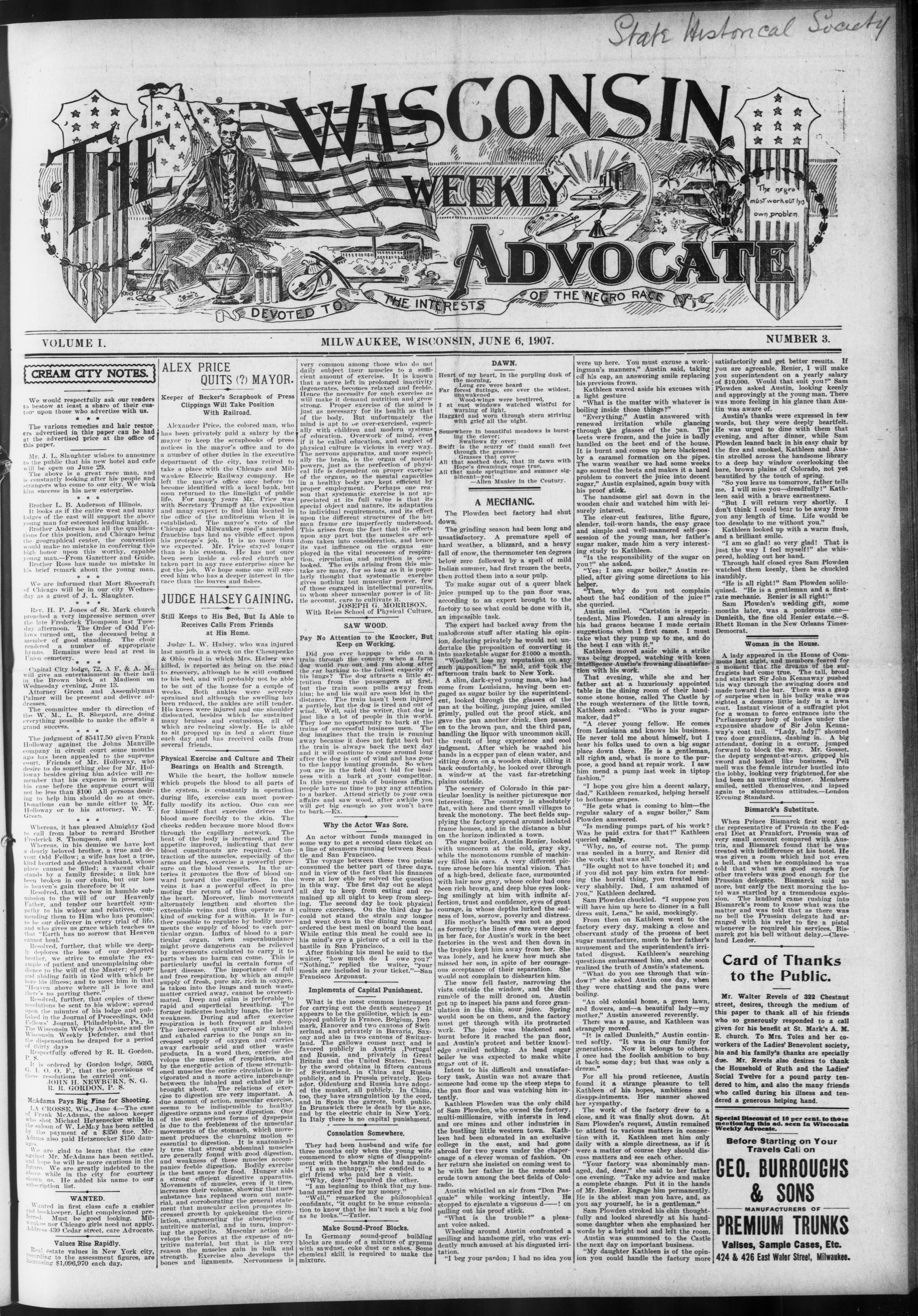
WISCONSIN
WEEKLY
ADVOCATE
DEVOTED TO THE INTERESTS OF THE NEGRO RACE
VOLUME I.
CREAM CITY NOTES.
We would respectfully ask our readers to bestow at least a share of their custom upon those who advertise with us.
The various remedies and hair restorers advertised in this paper can be had at the advertised price at the office of this paper.
Mr. J. L. Slaughter wishes to announce to the public that his new hotel and cafe will be open on June 29.
The above is a great race man, and is constantly looking after his people and strangers who come to our city. We wish him success in his new enterprise.
***
Brother L. B. Anderson of Illinois.
It looks as if the entire west and many lodges of the east will support the above young man for esteemed leading knight.
Brother Anderson has all the qualifications for this position, and Chicago being the geographical center, the convention would make no mistake in conferring this high honor upon this worthy, capable young man.—From Gazetteer and Guide.
Brother Ross has made no mistake in his brief remark about the young man.
* * *
We are informed that Mort Shoecraft of Chicago will be in our city Wednesday as a guest of J. L. Slaughter.
Rev. H. P. Jones of St. Mark church preached a very impressive sermon over the late Frederick Thompson last Tuesday afternoon. The Order of Odd Fellows turned out, the deceased being a member of good standing. The choir rendered a number of appropriate hymns. Remains were lead at rest in Union cemetery. * * *
Capital City lodge, 72, A F. & A. M., will give an entertainment in their hall in the Brown block at Madison on Wednesday evening, June 13.
Attorney Green and Assemblyman Palmer will be present and deliver addresses.
The committee under th direction of the W. M., L. B. Shepard, are doing everything possible to make the affair a grand success.
The judgment of $5417.50 given Frank Holloway against the Johns Manville company in circuit court some months ago has been appealed to the supreme court. Friends of Mr. Holloway, who desire to do something else for Mr. Holloway besides giving him advice will remember that his expense in presenting his case before the supreme court will not be less than $100. All persons desiring to help him should do so at once. Donations can be made either to Mr. Holloway or to his attorney, W. T. Green.
***
Whereas, it has pleased Almighty God to call from labor to reward Brother Frederick S. Thompson, and Whereas, in his demise we have lost a dearly beloved brother, a true and devout Odd Fellow; a wife has lost a true, kind hearted and devoted husband, whose place cannot be filled; a vacant chair stands by a family fireside; a link has been broken in our chain, but our loss is heaven's gain therefore be it Resolved, that we bow in humble submission to the will of our Heavenly Father, and tender our heartfelt sympathy to his widow and relatives, commending them to Him who has promised to be our deliverer in every trial of life, and who gives us grace which teaches us that "Earth has no sorrow that Heaven cannot heal."
Resolved, further, that while we deeply deplores the loss of our departed brother, we strive to emulate the example of patient and uncomplaining obedience to the will of the Master; of pure and abiding faith in God with which he bore his illness; and to meet him in that "Heaven above where all is love and there's no parting there."
Resolved, further, that copies of these resolutions be sent to his widow; spread upon the minutes of his lodge and published in the Journal of Proceedings, Odd Fellows' Journal, Philadelphia, Pa., in The Wisconsin Weekly Advocate and the Wisconsin Weekly Defender, and that the dispensation be draped for a period of thirty days
Respectfully offered by R. R. Gordon, P. S.
It is ordered by Gordon lodge, 5693. G. I. O. O. F., that the provisions of these resolutions be carried out.
McAdams Pays Big Fine for Shooting.
LA CROSSE. Wis., June 4.—The case of Frank McAdams, the saloon keeper who shot Michael Hetzenecker while in the saloon of W. LeMay has been settled by the payment of a $350 fine. McAdams also paid Hetzenecker $150 damages.
We are glad to learn that, the case against Mr. McAdams has been settled, and hope he will be more cautious in the future. We are greatly indebted to the above while in the city for courtesy shown us. He added his name to our subscription list.
WANTED
Wanted in first class cafe a cashier and bookkeeper. Light complexioned preferred. Must be good looking. Milwaukee nor Chicago girls need not apply. Address 430 Cedar street, care Advocate.
Values Rise Rapidly
Real estate values in New York city, according to the assessment figures, are increasing $1,096,970 each day.
ALEX PRICE QUITS (?) MAYOR.
Keeper of Becker's Scrapbook of Press Clippings Will Take Position With Railroad.
Alexander Price, the colored man, who has been privately paid a salary by the mayor to keep the scrapbooks of press notices in the mayor's office and to do a number of other duties in the executive department of the city, has retired to take a place with the Chicago and Milwaukee Electric Railway company. He left the mayor's office once before to become identified with a local bank, but soon returned to the limelight of public life. For many years Mr. Price was with Secretary Trumpff at the exposition and many expect to find him located in the office of the auditorium when it is established. The mayor's veto of the Chicago and Milwaukee road's amended franchise has had no visible effect upon his protege's job. It is no more than we expected. Mr. Price stayed longer than is his custom. He has not once been seen inside a colored church nor taken part in any race enterprise since he got the job. We hope some one will succeed him who has a deeper interest in the race than the loaves and fishes.
JUDGE HALSEY GAINING.
Still Keeps to His Bed, But Is Able to Receives Calls From Friends at His Home
Judge L. W. Halsey, who was injured last month in a wreck on the Chesapeake & Ohio road in which Mrs. Halsey was killed, is reported as being on the road to recovery, although he is still confined to his bed, and will probably not be able to be out of the house for a couple of weeks. Both ankles were severely sprained and although the swelling has been reduced, the ankles are still tender. His knees were injured and one shoulder dislocated, besides which he sustained many bruises and contusions, all of which are reducing slowly. He is able to sit propped up in bed a short time each day and has received calls from several friends.
Physical Exercise and Culture and Their Bearings on Health and Strength
While the heart, the hollow muscle which propels the blood to all parts of the system, is constantly in operation during life, exercise can most powerfully modify its action. One can see for himself that exercise drives the blood more forcibly to the skin. The cheeks redden because more blood flows through the capillary network. The heat of the body is increased, and the appetite improved, indicating that new blood constituents are required. Contraction of the muscles, especially of the arms and legs, exercise a powerful pressure on the blood vessels. In the arteries it promotes the flow of blood onward toward the capillaries. In the veins it has a powerful effect in promoting the return of the blood toward the heart. Moreover, limb movements alternately lengthen and shorten the extensible veins and thus operate as a kind of sucking for a within. It is further possible to regulate by bodily movements the supply of blood to each particular organ. Influx of blood to a particular organ, when superabundance might prove dangerous can be relieved by movements calculated to carry it to parts when no harm can come. This is particularly useful in certain forms of heart disease. The importance of full and free respiration, by which an ample supply of fresh, pure air, rich in oxygen, is taken into the lungs and much waste matter carried away, cannot be overestimated. Deep and calm is preferable to rapid and superficial breathing. The former indicates healthy lungs, the latter weakness. During and after exercise respiration is both frequent and deep; The increased quantity of air inhaled and exhaled carries to the lungs an increased supply of oxygen and carries away carbonic acid and other waste products. In a word then, exercise develops the muscles of respiration, and by the energetic action of these strengthened muscles the entire circulation is invigorated and a more active interchange between the inhaled and exhaled air is brought about. The relations of exercise to digestion are very important. A due amount of action, muscular exercise, seems to be indispensable to healthy digestive organs and easy digestion. One of the most serious forms of dyspepsia is due to the feebleness of the muscular movements of the stomach, which movement produces the churning motion so essential to digestion. It is anatomically true that strong abdominal muscles are generally found with good digestion, and weakness of these muscles accompanies feeble digestion. Bodily exercise is the best sauce for food. Hunger aids a strong efficient digestive apparatus. Movements of muscles, even if it tires, increases their volume, showing that new substance has replaced worn out material, and corroborating the general statement that muscular action promotes increased growth by quickening the circulation, augmenting the absorption of nutritive material, and in turn, improving the appetite. Muscular action develops the forces at the expense of nutritive material, but that is the very reason the muscles gain in bulk and strength. Exercise also develops the bones and ligaments. Nervousness is
very common among those who do not daily subject their muscles to a sufficient amount of exercise. It is known that a nerve left in prolonged inactivity degenerates, becomes relaxed and feeble. Hence the necessity for such exercise as will make it demand nutrition and grow strong. Proper exercise of the mind is just as necessary for its health as that of the body. But unfortunately the mind is apt to be over-exercised, especially with children and modern systems of education. Overwork of mind, even if it be called education, and neglect of physical culture is vicious in every way. The nervous apparatus, and more especially the brain, is the organ of mental powers, just as the perfection of physical life is dependent on proper exercise of the organs, so the mental capacities in a healthy body are kept efficient by proper employment. Perhaps one reason that systematic exercise is not appreciated at its full value is that its special object and nature, its adaptation to individual requirements, and its effect upon the different structures of the human frame are imperfectly understood. This arises from the fact that its effects upon any part but the muscles are seldom taken into consideration, and hence its vast influence on the organs employed in the vital processes of respiration, circulation and nutrition is overlooked. The evils arising from this mistake are many, for so long as it is popularly thought that systematic exercise gives nothing but muscular power, few of those engaged in intellectual pursuits, to whom sheer muscular power is of little account, care to cultivate it.
JOSEPH G. MORRISON.
With Reiss School of Physical Culture.
SAW WOOD.
Pay No Attention to the Knocker, But Keep on Working.
Did you ever happen to ride on a train through the country when a farm dog would run out and run along after the car barking to the fullest capacity of his lungs? The dog attracts a little attention from the passengers at first, but the train soon pulls away from him; he and his wail are soon lost in the distance. The train hasn't been injured a particle, but the dog is tired and out of wind. Well, said the writer, that dog is just like a lot of people in this world. They lose no opportunity to bark at the trains of successful business men. The dog imagines that the train is running away because it does not fight back but the train is always back the next day and it will continue to come around long after the dog is out of wind and has gone to the happy hunting grounds. So when you are in the field don't bid for business with a bark at your competitor. In this present rush of business affairs, people have no time to pay any attention to a barker. Attend strictly to your own affairs and saw wood, after awhile you will get big enough so you won't have to bark—Ex.
Why the Actor Was Sore.
An actor without funds managed in some way to get a second class ticket on a line of steamers running between Seattle and San Francisco. The voyage between these two points consumed the better part of three days, and in view of the fact that his finances were at low ebb he solved the question in this way. The first day out he slept all day to keep from eating and remained up all night to keep from sleeping. The second day he took physical culture exercises. On the third day he could not stand the strain any longer and went down in the dining room and ordered the best meal on board the boat. While eating this meal he could see in his mind's eye a picture of a cell in the bastile in San Francisco.
After finishing his meal he said to the waiter, "how much do I owe you?" "Nothing," replied the waiter, "your meals are included in your ticket."—San Francisco Argonaut.
Implements of Capital Punishment
What is the most common instrument for carrying out the death sentence? It appears to be the guillotine, which is employed publicly in France, Belgium, Denmark, Hanover and two cantons of Switzerland, and privately in Bavaria, Saxony and also in two cantons of Switzerland. The gallows comes next and is favored publicly in Austria, Portugal and Russia, and privately in Great Britain and the United States. Death by the sword obtains in fifteen cantons of Switzerland, in China and Russia publicly, and in Prussia privately. Ecuador, Oldenburg and Russia have adopted the musket, all publicly. In China, too, they have strangulation by the cord, and in Spain the garrote, both public. In Brunswick there is death by the axe, and by the electric chair in New York. In Italy there is no capital punishment.
Consolation Somewhere
They had been husband and wife for three months only when the young wife commenced to show signs of disappointment with the bargain she had made. "I am so unhappy," she confided to a girl friend who paid her a visit
"I am so unhappy," she confided to a girl friend who paid her a visit.
"Why, dear?" inquired the other.
"I am beginning to think that my husband married me for my money."
"Well," remarked the philosophical confidante, "it ought to be some consolation to know that he isn't such a big fool as he looks."—Tatler.
Make Sound-Proof Blocks.
In Germany sound-proof building blocks are made of a mixture of gypsum with sawdust, coke dust or ashes. Some chemical skill is required to make the mixture.
Heart of my heart, in the purpling dusk of the morning.
Long ere were heard
Far forest flutings, ere ever the wildest,
unawakened
Wood-wings were bestirred,
I at east windows watched wistful for
warning of light.
Haggard and worn through stern striving
with grief all the night.
Somewhere in bountiful meadows is burst-
ing the clover;
Swallows fly over;
Swift is the scurry of timid small feet
through the grasses—
Grasses that cover
All that soothed dark, that lit dawn with
Hope's dreamings come true.
All that made springtime and summer sig-
nificant—you!
—Allen Munier in the Century.
A MECHANIC.
The Plowden beet factory had shut down.
The grinding season had been long and unsatisfactory. A premature spell of hard weather, a blizzard, and a heavy fall of snow, the thermometer ten degrees below zero followed by a spell of mild Indian summer, had first frozen the beets, then rotted them into a sour pulp.
To make sugar out of a queer black juice pumped up to the pan floor was, according to an expert brought to the factory to see what could be done with it, an impossible task.
The expert had backed away from the malodorous stuff after stating his opinion, declaring privately he would not undertake the proposition of converting it into marketable sugar for $1000 a month. "Wouldn't lose my reputation on any such proposition," he said, and took the afternoon train back to New York.
A slim, dark-eyed young man, who had come from Louisiana, having been engaged as sugar boiler by the superintendent, looked through the glasses of the pan at the boiling, jumping juice, smiled grimly, pulled out the proof stick, and gave the pan another drink, then passed on to the brown pan, and the third pan, handling the liquor with uncommon skill, the result of long experience and cool judgment. After which he washed his hands in a copper pan of clean water, and sitting down on a wooden chair, tilting it back comfortably, he looked over through a window at the vast far-stretching plains outside.
The scenery of Colorado in this particular locality is neither picturesque nor interesting. The country is absolutely flat, with here and there small villages to break the monotony. The beet fields supplying the factory spread around isolated frame houses, and in the distance a blur on the horizon indicated a town.
The sugar boiler, Austin Renier, looked with unconcern at the cold, gray sky, while the monotonous rumble of machinery filled his ears. A very different picture arose before his mental vision. That of a high-bred, delicate face, surmounted with hair now gray, whose color had once been rich brown, and deep blue eyes looking smilingly at him with infinite affection, trust and confidence, eyes of great courage, in whose depths lurked the sadness of loss, sorrow, poverty and distress.
His mother's health was not as good as formerly; the lines of care were deeper in her face, for Austin's work in the beet factories in the west and then down in the tropics kept him away from her. She was lonely, and he knew how much she missed her son, in spite of her courageous acceptance of their separation. She would not complain to dishearten him.
The snow fell faster, narrowing the vista outside the window, and the dull rumble of the mill droned on. Austin got up to inspect his pans and force granulation in the thin, sour juice. Spring would soon be on them, and the factory must get through with its protracted work. The juice was blackened and burnt before it reached the pan floor, and Austin's protest and better knowledge availed nothing. As head sugar boiler he was expected to make white sugar out of it.
Intent to his difficult and unsatisfactory task, Austin was not aware that someone had come up the steep steps to the pan floor and was watching him intently.
Kathleen Plowden was the only child of Sam Plowden, who owned the factory, multi-millionaire, with intersts in lead and ore mines and other industries in the bustling little western town. Kathleen had been educated in an exclusive college in the east, and had gone abroad for two years under the chaperonage of a clever woman of fashion. On her return she insisted on coming west to be with her father in the remote and crude town among the beet fields of Colorado.
Austin whistled an air from "Don Pasquale" while working intently. He stopped to ejaculate a vigorous d——! on pulling out his proof stick.
"What is the trouble?" a pleasant voice asked.
Wheeling around Austin confronted a smiling and handsome girl, who was evidently much amused at his disgusted irritation.
"I beg your pardon; I had no idea you
were up here. You must excuse a workingman's manners," Austin said, taking off his cap, an answering smile replacing his previous frown.
Kathleen waved aside his excuses with a light gesture
"What is the matter with whatever is boiling inside those things?"
"Everything," Austin answered with renewed irritation while glancing through the glasses of the pan. The beets were frozen, and the juice is badly handled on the beet end of the house. It is burnt and comes up here blackened by a caramel formation on the pipes. The warm weather we had some weeks ago soured the beets and makes it a hard problem to convert the juice into decent sugar," Austin explained, again busy with his proof stick.
The handsome girl sat down in the wooden chair and watched him with leisurely interest.
The clear-cut features, lithe figure, slender, toil-worn hands, the easy grace and simple and well-mannered self-possession of the young man, her father's sugar maker, made him a very interesting study to Kathleen.
"Is the responsibility of the sugar on you?" she asked.
"Yes; I am sugar boiler," Austin replied, after giving some directions to his helper.
"Then, why do you not complain about the bad condition of the juice?" she queried.
Austin smiled. "Cartston is superintendent, Miss Plowden. I am already in his bad graces because I made certain suggestions when I first came. I must take what they pump up to me, and do the best I can with it."
Kathleen moved aside while a strike was being dropped, watching with keen intelligence Austin's frowning dissatisfaction with his work.
That evening, while she and her father sat at a luxuriously appointed table in the dining room of their handsome stone house, called The Castle by the rough westerners of the little town, Kathleen asked: "Who is your sugarmaker, dad?"
"A clever young fellow. He comes from Louisiana and knows his business. He never told me about himself, but I hear his folks used to own a big sugar place down there. He is a gentleman, all rights, and, what is more to the purpose, a good hand at repair work. I saw him mend a pump last week in tiptop fashion."
"I hope you give him a decent salary, dad," Kathleen remarked, helping herself to hothouse grapes.
"He gets what is coming to him—the regular salary of a sugar boiler," Sam Plowden answered.
"Is mending pumps part of his work? Was he paid extra for that?" Kathleen queried calmly.
"Why, no, of course not. The pump was needed in a hurry, and Renier did the work; that was all."
"He ought not to have touched it; and if you did not pay him extra for mending the horrid thing, you treated him very shabbily. Dad, I am ashamed of you," Kathleen declared.
Sam Plowden chuckled. "I suppose you will have him up here to dinner in a full dress suit. Lena," he said, mockingly.
From then on Kathleen went to the factory every day, making a close and observant study of the process of beet sugar manufacture, much to her father's amusement and the superintendent's irritated disgust. Kathleen's searching questions embarrassed him, and she soon realized the truth of Austin's statement.
"What do you see through that window?" she asked Austin one day, when they were chatting and the pans were boiling.
"An old colonial home, a green lawn, and flowers, and—a beautiful lady—my mother," Austin answered reverently.
There was a pause, and Kathleen was strangely moved.
"It is called Dunleith," Austin continued softly. "It was in our family for generations. Now it belongs to others. I once had the foolish ambition to buy it back some day; but that was only a dream."
For all his proud reticence, Austin found it a strange pleasure to tell Kathleen of his hopes, ambitions and disappointments. Her manner showed her sympathy.
The work of the factory drew to a close, and it was finally shut down. At Sam Plowden's request, Austin remained to attend to various matters in connection with it. Kathleen met him only daily with a simple directness, as if it were a matter of course they should discuss matters and see each other.
"Your factory was abominably managed, dad, dear," she said to her father one evening. "Take my advice and make a complete change. Put it in the hands of Mr. Renier. Engage him permanently. He is the ablest man you have, and, as you say yourself, he is a gentleman."
Sam Plowden stroked his chin thoughtfully and looked shrewdly at his handsome daughter when she emphasized her words by a bright nod and left the room. Austin was summoned to the Castle the next day on important business.
"My daughter Kathleen is of the opinion you could handle the factory more
NUMBER 3.
satisfactorily and get better results. If you are agreeable, Renier, I will make you superintendent on a yearly salary of $10,000. Would that suit you?" Sam Plowden asked Austin, looking keenly and approvingly at the young man. There was more feeling in his glance than Austin was aware of.
Austin's thanks were expressed in few words, but they were deeply heartfelt. He was urged to dine with them that evening, and after dinner, while Sam Plowden leaned back in his easy chair by the fire and smoked, Kathleen and Austin strolled across the handsome library to a deep bay window overlooking the bare, brown plains of Colorado, not yet beautified by the touch of spring.
"So you leave us tomorrow, father tells me. I will miss you—dreadfully!" Kathleen said with a brave earnestness. "But I will return very shortly. I don't think I could bear to be away from you any length of time. Life would be too desolate to me without you." Kathleen looked up with a warm flush, and a brilliant smile.
"I am so glad! so very glad! That is just the way I feel myself!" she whispered, holding out her hand. Through half closed eyes Sam Plowden watched them keenly, then he chuckled inaudibly. "He is all right!" Sam Plowden soliloquized. "He is a gentleman and a first-rate mechanic. Renier is all right!" Sam Plowden's wedding gift, some months later, was a ponderous one—Dunleith, the fine old Renier estate.—S. Rhett Roman in the New Orleans Times-Democrat.
Woman in the House
A lady appeared in the House of Commons last night, and members feared for a moment that the dreams of the suffragists had come true. The tall, broad and stalwart Sir John Kennaway pushed his way through the swinging doors and made toward the bar. There was a gasp of surprise when in his bulky wake was sighted a demure little lady in a lawn coat. Instant visions of a suffragist plot for a woman to force entrance into the Parliamentary holy of holies under the expansive shadow of Sir John Kennaway's coat tail. "Lady, lady!" shouted two door guardians, dashing in. A big attendant, dozing in a corner, jumped forward to block the way. Mr. Gosset, the deputy sergeant-at-arms, gripped his sword and looked like business. Pell mell was the female intruder hustled into the lobby, looking very frightened, for she had been an unwitting sinner. Members smiled, settled themselves, and lapsed again to slumbrous attitudes.—London Evening Standard.
Bismarck's Substitute
When Prince Bismarck first went as the representative of Prussia to the Federal Diet at Frankfort, Prussia was of very small account compared with Austria, and Bismarck found that he was treated with indifference at his hotel. He was given a room which had not even a bell, and when he complained he was told that what was good enough for other travelers was good enough for the Prussian delegate. Bismarck said no more, but early the next morning the hotel was startled by a tremendous explosion. The landlord came rushing into Bismarck's room to know what was the matter and was told that as there was no bell the Prussian delegate had arranged with his valet to fire a pistol whenever he required his services. Bismarck got his bell without delay.—Cleveland Leader.
Card of Thanks to the Public.
Card of Thanks to the Public.
Mr. Walter Revels of 322 Chestnut street, desires, through the medium of this paper to thank all of his friends who so generously responded to a call given for his benefit at St. Mark's A. M. E. church. To Mrs. Toles and her coworkers of the Ladies' Benevolent society, his and his family's thanks are specially due. Mr. Revels also desires to thank the Household of Ruth and the Ladies' Social Twelve for a pound party tendered to him, and also the many friends who called during his illness and tendered a generous helping hand.
Special Discount of 10 per cent. to those mentioning this ad. seen in Wisconsin Weekly Advocate.
Before Starting on Your Travels Call on
Valises, Sample Cases, Etc. 424 & 426 East Water Street, Milwaukee.
THE WISCONSIN WEEKLY ADVOCATE
MILWAUKEE, WIS.
B. B. MONTGOMERY, Editor and Proprietor.
Humorous Items. Marriage is the result of falling in love at first sight. Divorce comes when you get your second sight.-Smart Set.
At the Show
She—Is that the villain?
He—Oh no—he didn't write the play!—
Town Topics.
Unkind.
"So she's about to be married again. Do you know who is the lucky man?" "Yes: the dead one!"—Exchange.
Or His Own.
"Never," says the Buena Vista Republican, "judge a man by the company he keeps; it may be his wife's folks."—Denver Post.
The Intelligent Child
Little girl (after a domestic scene with her mother)—The best thing for us to do, mamma, is to agree to a separation.—Meggendorfer Blaetter.
Hard Luck.
Mrs. Dash—Mother says that she wants to be cremated. Dash—Just my luck! I haven't a match with me.—Smart Set.
With Editing
Dyer—I don't object to my wife having the last word.
Enpec—I wouldn't if mine would cut out some of those before it.—Smart Set.
The Three.
The Three.
The baseball has the golden wings,
The masked ball has the flame,
The highball has no wings at all,
But it gets there just the same.
The Careless Watch
Watch—Eight bells, and all's well. Mrs. Pohunk (feebly)—I guess, Josiah he hasn't looked on this side of the boat lately or he'd know better.—Brooklyn Life.
Cheaper.
Wife—Karl, when I go to the Riviera I will dream of you every night." Husband.—"I would rather you stayed here and dreamed of the Riviera."—Meggendorfer Blaetter.
Bettv's Discovery.
"The robins are Italian birds. I'm sure, because." said little Betty "I see them eating worms out there Just as Italians eat spaghetti." —Harner's Weekly
A Difficult Art.
Instructor in Public Speaking II.—What is the matter with you, Mr. Jones; can't you speak any louder? Be more euthusiastic. Open your mouth and throw yourself into it—Harvard Lampoon.
At Court.
"In London did you go to court?"
She asked. He was quick-witted,
And answered—'t was a comic thought—
"I did—but was acquitted!'"
—Harold Susman in Lippincott's.
At Court
A Hopeless Race.
Wiggins—Yes; but from what I can ascertain. I don't believe he will ever catch up with them.—Chicago Daily News.
It Would Be Asking a Good Deal.
First Tramp—It's pretty cold today. I'd hate to live at the North pole.
I'd hate to live at the North pole.
Second Tramp—So would I; I wouldn't have the nerve to ask for a night's lodging, if the nights were six months long.—Smart Set:
The Strenuous Life
Teacher—How long had Washington been dead when Roosevelt was inaugurated?
Scholar—I dunno, but it hasn't been very dead since Teddy has been there!—Lippincott's.
Before the Ball
"Now, Jimmy!"
"Yes, dad?"
"Try to keep that Boston girl outen the conservatory. A sudden drop in temperature would kill them flowers."—Washington Herald.
His One Weakness.
"Three tons of cement fell on his chest." "Poor feller! He always was weak there."—Harper's Weekly.
So Common.
"Was no one injured in the railway collision, count?"
"No, but nevertheless it was a most painful situation. First, second, third and fourth class passengers all mingled together! Simply unheard of!"—Fliegende Blaetter.
A Magazine Contributor.
Patience—Will is a regular contributor that magazine.
Patrice—Indeed! I didn't know he wrote at all! "Who said anything about writing? He buys it every month."—Yonkers Statesman.
Compensatory
First Girl—Miss Scribbler is awfully pleased at that review of her novel. Second Girl—But the writer says that her novel is wretched stuff. First Girl—Yes; but she is about 45, you know, and the reviewer speaks of her as "this young writer."—Pick-Me-Up.
Of Course.
"From the grammatical standpoint," said the fair maid with the lofty forehead, "which do you consider correct. 'I had rather go home' or 'I would rather go home'?" "Neither," promptly responded the young man. "I'd much rather stay here."—Answers.
No Growing Pains
An eminent specialist claims that there is no such thing as "growing pains." We have been taught that when a child has stinging pains in the limbs, shoulders, or other parts of the body, it is an indication that the body is growing, and therefore most parents welcome the news of such suffering in children.
The physician referred to above claims that growing pains are muscular rheumatism, and should have immediately action. Something is wrong, and steps should be taken at once to learn why the child's blood is not in perfect condition.—Health.
---
LOMBARDY·POPLARS
Before the planters' houses old
They stand like statues, stern and cold,
Of foreign lineage to be,
The poplars tall of Lombardy.
Soft-clustering lilacs droop below
O'er banks of lustrous golden glow,
And purple foxgloves bend to greet
Green spangled mosses at their feet.
But they lock on with moveless face,
Nor yield to friendliness or grace
In blossoming vine or bush or tree,
The poplars tall of Lombardy.
Why passed New England's yeoman by
Their native woods indifferently,
Refused the oak and maple fair.
And gracious elm with breeding rare,
And these grim strangers from the Po,
All taciturn and hard to know,
Transplanted here, unloved to be,
The poplars tall of Lombardy?
The hearts of that undaunted band
Who left in wrath the motherland
Contemned the syren beauty's charm,
Or shunned her features in alarm;
They feared, perhaps, the landscape bare
Would false become if it grew fair,
Wide-branching elms might cloak in shade
Some graceless thing old earth had made,
But sin or schism could never shield
From sleepless watch, by dyke or field,
Of sentries strict as these would be,
The poplars tall of Lombardy.
So they were set in rows severe,
From sunny spring to autumn sere
Like mutes at funeral feasts to stand,
or should bourgeon in the land.
Arthur Wentworth Eaton in "The Lotos of the Nile and Other Poems."
SOMETHING LACKING.
There is one man, at least, in New York who is out of sympathy with the new movement for the suppression of noise. That's Hudgens. And Hudgens is just an average New Yorker, who has a prosperous little business, and sends his family to church regularly and to a theater now and then, and belongs to a bowling club and the A. O. U. W. and a first-rate luncheon club down town.
It was a prosperous little business that caused the trouble, for the Hudgens' ambition grew iwth the Hudgens' bank account. That is to say, the Mrs. Hudgens' ambition grew with the Mr. Hudgens' bank account.
"John," said Mrs. Hudgens one evening, "don't you think we could afford to live in a better locality than this?" Hudgens looked surprised. It had never occurred to him that there was anything to be desired in their apartments. They had six rooms on the fifth floor in Columbus avenue, and even Mr. Hudgens was wont to boast that it was a particularly well managed house, the landlord affable, and the tenants unobjectionable. The Hudgenses had lived here and in another place in Columbus avenue altogether ten years.
"Why?" asked Mr. Hudgens cautiously. Mrs. Hudgens thereupon explained. It was a long, involved and circumstantial explanation, which did Mrs. Hudgens great credit for her knowledge of her husband and her self-control in not having mentioned the subject until she was prepared for every species of resistance. It was, (in short, an admirable piece of feminine strategy, for at the psychological moment Mrs. Hudgens dropped the matter with an affectionate "Of course, John, I'm happy here, and would be happy anywhere with so good a husband as you are." And she had one of her delicious pies in the oven for dinner.
They moved into a nice new apartment house in One Hundred and Twenty-first street, near Riverside Drive. They moved back to Columbus avenue thirty-two days later, into their old apartments, cheerfully meeting the landlord's raise of $5 in the rent. Hudgens explained it to a coterie of friends at luncheon the next day.
"It certainly was a nice place," he said. "It had one of those paneled dining rooms in black, and steam heat in every room, and all the things a woman likes in the kitchen, and a telephone, and the newest thing of all was a dinky little safe in the wall with a combination lock, for jewels and such truck. We thought we'd struck something pretty fine and it looked it, too, when we'd moved in a lot of new furniture and got rid of some of the old stuff that had been accumulating for years.
There wasn't much to see from the windows. Only some new apartments going up across the street and a bare glimpse of the river and the Jersey shore by pressing your face against the window pane. Nothing doing in the street. No sidewalks crowded with children, no hucksters yelling their wares, no fire engines dashing past, no policeman talking to Hans, the grocery man over the way, no surface cars gonging their way through the crowds and running over somebody now and then, no L trains crashing along day and night.
"But something was wrong. We couldn't get used to the apartment. We'd sit around the breakfast table dumb as oysters, and every one of us with about half a grouch.
"You didn't sleep well, either, did you, John?' my wife would say to me.
"No. I didn't! I would growl in reply. Guess I need more exercise. The only trouble with this place is it's too far from the bowling alleys."
"There's something the matter with my room,' said Tom. 'It's too blamed light for one thing. I'm all the time thinkin' it's morning."
"Did you hear that conversation on the river last night?' asked Mabel. She's 15, and growing very precise in her speech.
"Conversation?' I asked.
"Yes, sir. It must have been a timid little tugboat began it. Then something big, that needed a lozenge for its sore throat, answered away up the river. Thed had quite a discussion about it, whatever the subject may have been. But it was not a bold, out-and-out debate. They chipped their words off close. Somebody must have scolded them for making noises at night. They tooted as if their hearts were in their mouths, and I just lay there waiting for one of them to burst forth with a real, brave whistle. But neither of them had that much courage, and I had to get up—didn't you hear me?—and prance around the house till the talk was ended.'
"I heard a car,' said my wife.
"No!" we cried in chorus.
"But she stuck to it that she heard a trolley car somewhere about 12:30 o'clock, and for a minute thought she was asleep. That gave me an idea, but I didn't say anything about it then.
knowing how my wife had been dead set on moving into what she called a nicer locality. I didn't really think much about it until a few nights later, when I was detailed by our lodge to take my turn sitting up with Bob Stivins, who's been ill a long time and hasn't enough money to pay nurses.
"Bob lives in Columbus avenue, near where we lived. I hadn't thought much about the proposition of staying up all night. Certainly I'd got used to being awake off and on all night since we moved, and was a light sleeper, anyway. But do you know I hadn't been in that chair in the sick room half an hour till I was sound asleep. Bob had to call several times, sick as he was, before I awakened to give him his medicine. I did some tall apologizing, and vowed I'd not be caught that way again.
"But waves of sleepiness swept over me. I was never so heavy and lifeless in my life. It seemed as if all the sleep I had ever missed was piling up on top of me and bearing me down. I tried to read, and the paper dropped in my lap. I got pencil and paper and tried to figure out a contract I'd been thinking of the last two or three days. I walked up and down the room tottering like a man with a jag. It was the hardest job I ever tackled. I couldn't understand it for a long time. Then it struck me. Do you know what it was? It was the L and the trolleys. Especially the L. I was like a baby under the lullabies of the trains. Then I knew what was the matter with our new flat."
"And Mrs. Hudgens?" asked Hegelman.
"She wept over the kitchen and the heat in the bedrooms and the combination safe for the jewelry. She declared she was getting used to the new place and would be sleeping beautifully soon. But she knew her duty, she said. She knew I should be nearer my bowling club, for I needed exercise after my days of confinement in the store, and Tom wasn't happy so far away from his friends, and Mabel hadn't seemed to get acquainted in the new neighborhood. So she was willing to sacrifice her wishes, she said, for the happiness of the family. I didn't say a word when the dear little woman dropped like a log into bed that first night in the old home and never even turned in her sleep while the L trains sang to us all night long under our windows. They can't make too much noise on Columbus avenue for the Hudgenses."—New York Press.
SOME HELPFUL HINTS
Polishing Silver.—Before polishing silverware wash it in soapsuds and then rub with a paste made by mixing whiting with ammonia. Rub dry with chamois cloth. This will remove the worst stains.
Stains on Varnish.—When a slight stain disfigures a varnished surface, rub it with a piece of woolen cloth, dipped in kerosene. Deep stains or discolorations must be rubbed with powdered rottenstone and oil.
Stains on Waxed Floors.—Sometimes a stain or a dark line where a rug has been laid will disfigure a waxed floor. To remedy this, rub the spot with a cloth dipped in turpentine. If the place shows by reason of some of the wax being removed, then rub with more wax.
Mutton Tallow Ointment.—Cut mutton suet into small pieces and put into a stone jar or earthen bowl. Set the bowl in a dish of hot water over the fire and stir often until the fat melts. Allow one teaspoon of carbolic acid into one cup of liquid fat, after it has cooled enough to thicken a little.
Care of Angora Cats.—Rub an Angora eat over daily with a sponge dipped in water, to which twenty drops of creoline have been added for every pint of water; then comb and brush the hair. Keep matted hair softened with vaseline. Feed the cats raw meat and cooked vegetables, such as carrots and sweet potatoes.
To Clean Hair Brushes.—Dissolve a rounding tablespoon of borax in one quart of boiling water. Cool and put enough of the water into a dish to just cover the bristles of the brushes, but not to come over the tops. Soak ten or fifteen minutes, draw a comb through the bristles. Rinse in plenty of cold water and set in the open air to dry.
Asbestos Plates.—It is not generally understood that asbestos plates or sheets are ruined by moisture. The cook wonders why a plate gives way in places, forgetting that she wet it with her dishcloth in trying to cleanse it. If she had merely set it on the range, the dirt would have burned out. A dozen sheets of asbestos paper come bound together and are valuable for using over or under bread and cake pans or pies.
Washing Silk Stockings.—Put tan or other colored silk stockings into water to which salt has been added, in the proportion of a tablespoon to three quarts; let soak over night, wring out and wash in a lukewarm suds. By no means rub soap on to the stockings. Rinse thoroughly, adding a little vinegar to the last water and hang to dry. When about half dry pull them into shape and press with a cool iron. Even a moderately hot iron quickly scorches either wool or silk. This treatment will prevent colors from running and will retain the new luster.
Beer Consuming Countries
So far as the average amount per head is concerned, the United Kingdom still appears at the top of the list of beer consuming countries, with the single exception of Belgium. The figures that appear below are taken from the official return for 1905 on alcoholic beverages:
From the returns we find that the quantity of beer produced in the various countries varies much less from year to year than does that of wine. The principal producing countries are given below, with the quantities in millions of gallons:
Germany 1601
United States 1419
United Kingdom 1213
Austria 420
In 1901 Germany came first with 1565 million gallons, the United Kingdom next with 1301 million gallons, and the United States third with 1150 million gallons.
Advertise in Your Home Paper.
USING UP OUR TIMBER SUPPLY.
Three Times as Much Timber Used Each Year as the Forest Grows.
Every person in the United States is using over six times as much wood as he would use if he were in Europe. The country, as a whole, consumes every year between three and four times more wood than all of the forests of the United States grow in the meantime. The average acre of forest lays up a store of only 10 cubic feet annually, whereas it ought to be laying up at least 30 cubic feet in order to furnish the products taken out of it. Since 1880 more than 700,000,000,000 feet of timber have been cut for lumber alone, including 80,000,000,000 feet of coniferous timber in excess of the total coniferous stumpage estimate of the census in 1880.
These are some of the remarkable statements made in circular No. 97 of the Forest service, which deals with the timber supply of the United States, and reviews the stumpage estimates made by all the important authorities. A study of the circular must lead directly to the conclusion that the rate at which forest products in the United States have been and are being consumed is far too lavish, and that only one result can follow unless steps are promptly taken to prevent waste in use and to increase the growth rate of every acre of forest in the United States. This result is a timber famine. The country is today in the same position with regard to forest resources as was Germany 150 years ago. During this period of 150 years such German states as Saxony and Prussia, particularly the latter, have applied a policy of government control and regulation which has immensely increased the productivity of their forests. The same policy will achieve even better results in the United States, because we have the advantage of all the lessons which Europe has learned and paid for in the course of a century of theory and practice.
Lest it might be assumed that the rapid and gaining depletion of American forest resources is sufficiently accounted for by the increase of population, it is pointed out in the circular that the increase in population since 1880 is barely more than half the increase in lumber cut in the same period. Two areas supplying timber have already reached and passed their maximum production—the northeastern states in 1870 and the lake states in 1890. Today the southern states, which cut yellow pine amounting to one third the total annual lumber cut of the country, are undoubtedly near their maximum. The Pacific states of Washington, within a few years, has come to the front, and now ranks first of all individual states in volume of cut.—New York Evening Post.
WISE AND OTHERWISE.
Honeyed words often have a string to their tail.
Most of the fun to a girl about being kissed is pretending she wasn't.
The minute you are nice to some people they want to borrow money from you.
The wise man is always more stingy with his wisdom than the fool is with his folly.
Many a fellow would gladly die for a girl if he felt that she could ever replace the loss.
How Chewing Gum Is Made.
Twenty million dollars' worth of chewing gum is sold over the retail counter every year. Few persons know what the substance is made of. Now and then someone speaks of the horses' hoofs and the cows' horns that are by some secret process transformed into a delicious lot of gum. But they are detractors of the popular product. There is no foundation in fact for such tales.
The chief ingredient of chewing gum is chicle, a substance procured from the sapodilla tree in Mexico and tropical countries of South America. Chicle is a resin-like sap which oozes from the sapodilla tree when it is tapped as are maples in this country. It is sent from these tropical lands to the cooler climate of Canada to be cleaned and refined. It leaves the factory looking very much like red clay. This is the body of chewing gum. Chicle is absolutely insoluble. No liquid has ever been found that will dissolve it. Alcohol will not affect it, nor will any acid. It might be chewed for 999 years and more and still lose none of its volume.
The manufacture of chewing gum is a very simple process. A quantity of chicle is put in a vat with about an equal quantity of glucose made from corn. This is heated by steam and churned or beaten until thoroughly mixed. Then peppermint, wintergreen, banana, orange and other flavorings are added to give it the desired taste.
The whole mass-500 pounds at a time is steamed and churned by machinery until it begins to harden. It is then placed on a working table where girls and women shape it into squares an inch or more thick and a foot square. It is then run through rollers which press it into thin sheets the thickness of cakes sold at retail. These sheets are about six feet long by two wide. Another machine cuts the sheets into cakes the size we buy. Wrapping, boxing and crating are done by hand. An ordinary sized factory will produce several tons of gum in a day. Nimble-fingered girls wrap it. And every one in the factory chews the product. From the mixer down to the smallest girl wrapping the gum in papers the jaws are working.
Veuve Bonaparte.
Memory of a very curious law case is revived by the claim which a Luynes farmer is bringing against the ex-Empress Eugenie for something like £200,-000, alleged to be due as the principal and interest of a loan said to have been made by the claimant's great-uncle to Napoleon III. as long ago as 1855; and it would not be wonderful if, upon the circumstances as stated, this action came to as ignominious an ending as the earlier.
When the town of Marseilles went to law against the ex-Empress Eugenie a quarter of a century ago to endeavor to reclaim a piece of land which in the flourishing days of the Second Empire it had presented to her late husband, the counsel for the municipality commenced his speech, amid profound silence, by justifying the designation of the illustrious defendant as "Veuve Buonaparte," on the ground that according to law all French citizens were equal, and that the title of majesty therefore belonged to her no more.
There was in this an echo of the "Veuve Capet" style of Fouquier Tinville's tribunal of the Terror by which the hapless Marie Antoinette was condemned, which revolted every French citizen of decent mind; and the action was dismissed with costs against the claimants, to the great joy of many sincere Republicans. But it is doubtful whether, if the present case goes to trial, there will be any talk of "Veuve Buonaparte" now.—Westminster Gazette.
Trousers Irreligious.
It will assuredly seem more than strange that within the past hundred years the wearing of trousers has been
regarded even as irreligious. The fact that in October, 1812, an order was made by St. John's and Trinity colleges that every young man who appeared in hall or chapel in pantaloons or trousers should be considered as absent is startling enough, but it would appear that eight years later the founders of a Bethel chapel at Sheffield inserted a clause in the trust deed ordaining that "under no circumstances whatever shall any preacher be allowed to occupy the pulpit who wears trousers." This is striking, but it is even more impressive to find that the Rev. Hugh Bourne, one of the two founders of the Primitive Methodist Connexion, said of his cofounder: "That trousers wearing, beer drinking Clowes will never get to heaven." And it would need a student of "the Breeches Bible" to say precisely when this assumed connection between theology and trousers began and where the departure from it will end.—Notes and Queries.
Expansion in China.
Reform is struggling for the light in every department of Chinese life, and, to the horror of the great officials, it has now violated even the sacredness of the ancient language. Through the medium of the Japanese, who have extended their vocabulary to meet the necessities resulting from intercourse with the ideas of the west, the reformers have dared to introduce new ideographs to bring the language up to date. Such a state of things was not to be tolerated. Chinese lends itself very readily to expansion for the reason that it consists of a vast collection of monosyllabic roots, each represented by an ideograph, which can be compounded into groups so as to form words conveying almost any meaning. But the government department in Pekin, which the officials call the education board, has its own notions of what is deleterious to the purity of the tongue. The order has accordingly gone forth that the new nomenclature is to be suppressed except as regards terms relating to science. Enlightened people are now wondering what they are to do when they want to write such words as "diplomatist," "protocol," and "convention."
About Greater London.
The six and one-half million people in Greater London live in 928,008 houses. The population 100 years ago was just one-fifth what it is now. Though the number of births was nearly double the number of deaths in 1904 the birth rate is steadily declining.
The postal figures show that in 1905 there were 1028 postoilices in London and 2435 public telephones working. The total imports of London in 1904 amounted to $849,086,000, and the total exports, $462,299,000.
Some idea of London's wealth is shown by the assessed income tax value in 1904 in the administrative county: Houses representing $219,264,000, trades and professions $364,045,000, profits of companies and other interests $698,511,000, salaries (corporate bodies) $115,044,000, salaries (army and navy) $103,674,000.
In 1905 there were 2993 motor cars and 1852 motor cycles in London. Licenses to drive were granted to 8070 people, the fees received amounting to $86,800.—Statistical Abstract.
Bismarck's Hatred of French
When replying the other day to the new French ambassador's credential address, the Kaiser spoke in German, while M. Cambon had also used his native tongue. Formerly French was the exclusive language of diplomacy, as Latin had been before it, but Bismarck rebelled against this tyranny of the French tongue, and once he related with great gusto how he had brought M. Thiers to his senses during the peace negotiations by suddenly addressing him in German. After the war Bismarck laid it down as a rule that a communication from any member of the diplomatic corps, other than the French ambassador, if couched in French, should be replied to in the same language, but that otherwise any communication in the native language of the writer should be answered in German. The Emperor applies the same rule, as far as possible, in his intercourse with the ambassadors.
Salton Sea to Dry Up Soon.
Frank H. Bigelow of Washington, a meteorologist connected with the United States weather bureau, and C. E. Grunsky, consulting engineer in the government reclamation service, arrived in Kausas City yesterday. They are on the way from Washington to Yuma, Ariz., to conduct evaporation test for the government in the Salton Sea.
"The government is trying to find out the rate of evaporation," said Mr. Bigelow, "and we will make extensive tests and conduct experiments in this great inland sea—the Salton sink—to determine how fast the water exaporates there. The United States weather bureau hopes by the tests to be able to tell just how soon a given body of water in the Arizona and California country dries up. It will be of great value in connection with the reclamation service. In my opinion the Salton Sea will completely dry up in about eight years."—Kansas City Star.
Esperanto for Dancing Masters.
Mr. Turveydrop in his twentieth century development is ambitious. An international congress of dancers is to be held at Barcelona in July next, and the occasion would be a notable one if only because it has been decided that Esperanto shall be the official language. This is probably the first practical experiment in the new language, and we trust that the movement will prove as gracefully facile as dancing ought to be.
But besides this there is quite an imposing programme of prizes for new dances of all kinds—for ballet, for drawing room, for ball, for couples, for children, and for detailed studies on grace, bearing and manners. All these matters are to be disposed of in five days.—London Globe.
Guarding Against Submarine Disasters
To guard against a repetition of the disaster in the Mediterranean, when the French submarine boat Lutin sank to the bottom and could not be raised before all of the crew had expired, the naval constructors are now fitting the Pike and Grampus, two submarines at Mare Islands with large hooks fastened to the sides, to which a diver easily can attach a cable, and enable the boat to be hoisted to the surface if her own machinery fails. Bilge keels also are being placed on the sides of these boats, so that the sailors will have more liberty of movement, it now being dangerous for any of the crew to move about while the boats are submerged and under way, lest they cause them to dive to the bottom.—New York Evening Post.
Finds Substitute
Guy Laking, the superintendent of King Edward's armorial collection, is visiting America to examine the armor gathered here. At a dinner in New York Mr. Laking told a story about a pretty American duchess.
"The pretty duchess," he said, "sat in her drawing room, and her little son, the marquis, stood beside her in lace and velvet.
"A peer, entering, bowed over the duchess' white hand and then said to the little marquis:
"Will you give me a kiss, my dear?
"The boy, shrinking behind his mother, said bashfully:
"Mamma will give you one."—Indianapolis Star.
CHEAP STOCKS BECAME USEFUL.
New York Broker Makes Good Sale on So-Called Wildcat.
"Wildcat mining stocks are not altogetehr useless or worthless, either," said a New York broker as he hung up the telephone receiver. "Here's a man who just offered me $50 for enough mining stocks to have a face value of $50,000. He wasn't particular what stocks he got if they only had a paper value of $50,-000. I closed the deal and shall make money on it, too. What did he want with such stocks? Well, I haven't the slightest doubt but that he is getting ready to go into the bankruptcy court and wants to show his creditors where his money has been dropped. We often get such requests and are usually able to fill them."
Shave and Haircut Cause Rebellion
A serious schism has arisen in the Greek church in Lynn, Mass., because the priest, who had been in this country some time, insisted upon following the American fashion of visiting the barber and buying a regular haircut about once in so often, and also refused to wear his clerical robes in the public streets. The Providence (R. I.) Journal says the latter action was because he claimed the wearing of the robes in public brought ridicule from many who failed to understand their significance, and his tonsorial innovation was due to the fact that he had become so Americanized as to opine that long hair on a masculine human being is an unsightly mess.
Among his parishioners were many immigrants, who, being accustomed to long hair and the ever-present priestly robes over in Greece, were indignant at these unorthodox reforms. Finally they openly rebelled, and now 500 of them have seceded and started a new church with a priest that is nice and hairy. So Lynn will hereafter have two Greek churches, long-haired and short-haired. Many times in the past has the splitting of hairs caused religious schisms and the establishment of new sects, so it is not remarkable that a difference of opinion in the matter of barbering should break up a church.
No Subject for Congratulation.
"Yes," said the lawyer, mopping his brow. "I got him off, but it was a narrow escape."
"A narrow escape. How?"
"Ah, the tightest squeeze you ever saw. You know I examined the witnesses and made the argument myself, the plea being self defense. The jury was out two whole days. Finally the judge called them before him and asked what the trouble was.
"Only one thing, my lord,' replied the foreman. 'Was the prisoner's counsel retained by him or appointed by the court?'
"No, gentlemen, the prisoner is a man of means,' said the judge, 'and engaged his own counsel."
"I could not see what bearing the question had on the evidence," continued the lawyer, "but ten minutes later in filed the jury, and what do you think the verdict was?"
"What?" asked his friend.
"Why, not guilty, on the ground of insanity."—Memphis Commercial Appeal.
To Plow Up the Missouri.
The only way to control the Missouri river is to plow it up. That is the opinion of C. Eacrett of Strahan, Ia., who has unburdened his mind on the subject of the improvement of that incorrigible stream, which has been bothering him for years.
Mr. Eacrett's plan is to plow up the bottom of the river, and the currents created thereby will do the rest, he says, toward scouring out a channel in which boats of the heaviest draught might navigate.
The Congressional committees had never thought of this before, and the new inland waterways commission, which just organized today, may take up the idea for consideration more or less seriously.
The Eacrett idea, to go more into detail, is to construct a boat of light draught, fitted out with implements something like a "lister" plow, which is the kind used on big farms of the west, to be fastened on long beams that could be raised and lowered from the stern of the boat. The boats are to ply up and down the river, stirring up the mud and sand, thus allowing the currents to clean it out and make a well defined channel.—St. Louis Globe-Democrat.
The Jolly Jesters
"Mr. Middleman, ah desires to propound a question."
"Very well, Mr. Tambo."
"Why do dey designate dat beautiful southern vegetable as ah watermelon?"
"That's easy. Because it makes your mouth water."
"Nowhar near de answer. It's called ah watermelon because yo' cut it in de spring."
"Speakin' ob de spring reminds me." broke in the other end-man. "Ma ole daddy went out to git some water one day an' he done fell in ah spring."
"Was he drowned?"
"He warnt zactly drowned, but it done killed him."
"That's strange. He fell in the spring and was killed?"
"Yessah."
"But he wasn't drowned?"
"No, sah."
"Well, did he die in the spring?"
"No, sah; he died in de fall."
"Our golden-voiced tenor, Mr. Vio. Lett will contribute that heart-touching ballad entitled. 'Warden, Brush Those Locks Away; I Yearn for Liberty.'"—Harper's Weekly.
Dog Imitates Master
Miss Agnes Slack, secretary of the World's W. C. T. U., praised at a dinner party in Boston the temperance of women.
"Who ever heard," she said, "a woman complain about her food? Who ever heard of women gourmets? Even the really fine cooks are all men; for women do not take sufficient interest in food to attain to such excellence in its preparation as Brillat-Savarian or Gavarni had.
"I am reminded of a little story about a man. This story would fit many men, but wher is the woman it could be applied to?
"An old gentleman, pointing to his favorite dog, said proudly:
"That dog certainly seems almost human at times."
" 'Yes,' said his wife, 'he growls over his food as much as you do.'"—Minneapolis Journal.
Presents Good Reason
Dr. Carmichael, the new bishop of Montreal, is an Irishman—a native of Tipperary. He tells a story about a clergyman who was examining a Sunday school class and who chanced to ask one of his small pupils why it was cruel to cut off dogs' tails.
One child replied that it was cruel because of the text in the Bible.
"What text, my dear?" asked the puzzled clergyman.
The child was thoughtful for a moment and then replied: "What God has joined let no man put asunder."—Pittsburg Dispatch.
GOSSIP FOR THE LADIES.
The Unfolding of the Leaf.
I have sloughed all my grief
With the gold-green unfolding of the leaf!
A grave have I digged deep, and buried there
Haunting Despair.
And by his side laid Care.
For no one now have I the least employ
Save only Joy.
Unless Love come, with the old rapturous air,
And dewy violets twined about his hair!
Again the rills call. Hearken, heart o' me!
What gladsomeness! what glee!
What brimming ecstasy!
Again the woods call. Listen, soul o' mine!
How vibrant and how fine
The vernal burst from bough and bole and vine!
Lo. Doubt is done!
Hope of the beckoning eyes
Is overtaken. I have won
Unto the realization of surmise—
The clean surcease of grief—
With the gold-green unfolding of the leaf!
-Clinton Scollar in the Reader Magazine.
Troubles of the Widow.
Let a widow whose income is problematical or speculative appear a little better groomed than usual and forthwith the inquisitive field looms up and wants to know "how she manages it," and let the aforesaid widow flash out in a new piece of jewelry and the same fiend will spend wildly sleepless nights tossed by a storm of guesses to evolve the whys and sources of the generous possessions and a dozen other questions.
A woman who makes a mystery of herself does herself a great injustice and is more or less an object of cruel suspicion, and yet if she is level headed she will not acquaint her women friends with matters that are purely personal. Discretion is a waste of forethought, however, when the inquisitive friend, despite reluctant and evasive replies, continues to question without the slightest sense of delicacy. A woman who guards sacredly her love affairs is always the woman to be admired, and yet her women friends often resent most pointedly this reserve and will ask questions that are ill bred, unfeeling and positively cruel, for which no excuse can be offered.
A man, unless it be a matter directly concerning him, will not question and cross-question as does a woman. Not that men have a jot less curiosity than women, because as a fact they have very much more, but a man has more delicacy and will refrain from questions that a woman feels no compunction in asking. It is a good rule when being turned and twisted and cross-examined and sifted to call a halt in the beginning by asserting very positively: "You need not ask, because I would not tell you the truth, and do not care to lie to you." The chances are that you will get a huffy, disagreeable reply, but charge that up to profit and loss and it will not matter.
People who continually interrupt a conversation by wanting to know the minutest details are exasperating to talk to. You cannot mention a name but what they want to know all about the owner, and the interruptions come: "Who is he?" "What does he do?" "How did you happen to meet him?" And, of course, a woman always asks: "Has she any money?" Cash seems to be the criterion of a man's eligibility for the most trifling courtesies, and the one and only standard of worth in the estimation of many.
Friendship does not want to be inclosed by a barbed-wire fence, yet it is often necessary to hedge oneself about by a haughty reserve and comparative isolation to enjoy even a medium of immunity from the impertinence of self-constituted friends.
When people are talking or telling you any pleasant incident listen and accept the story for what it is worth. It does not concern you who or what the persons may be who figures in the recital. One sensible question regarding any point not exactly understood is all right, but to keep up a rapid fire, as if you doubted the word of the narrator, takes all the vim and life out of a good story. If you let people alone they are apt to tell you all they know and what they do not know they will make up and tell it all the same; but to start out and cross-examine as if you were in a court of justice, is ill-bred and presuming.
There is nothing on earth as lovely and lovable as a cultivated, well-bred woman. Men seek her, women are attracted to her, and children love her, but the woman who has no thought of, nor consideration for the feeling of others is to be feared and avoided. She will not only wound you ruthlessly and wantonly, but the replies that are given reluctantly will often be misconstrued to your detriment and repeated accordingly, particularly if they should be regarded as one's own, to be treasured so sacredly that the prying of curiosity vendors may not desecrate memories that are the sweetest part of a woman's life.
Making Ourselves Agreeable
In one of our leading periodicals not long ago appeared a plain spoken article upon the "Aristocracy of Cleanliness," which found an echo in many hearts. The author remarked, as most of us often have occasion to do, that we are all of us critical of the little weaknesses and failings of others—but we possess many of our own which are quite as bad.
Who has not known of a person who despises another for eating his soup with a wheeze and gasp after every spoonful—yet who himself imbibes his tea, if not his soup also, with an equally noisy zest? How often have you not longed to instruct well meaning people in the ethics of the handkerchief, and to straighten out their ideas regarding those little ceremonies which should be performed only in the retirement of their own apartments, yet which have been confused with those which may properly take place under the white light of public observation! The Lady of Lyons, to say nothing of King Cophetua, must have had difficulties i this homely line. And such ignorance is so mortally sensitive, and so almost impossible to correct.
so almost impossible to correct.
It has seen said by some wise writer that it is not half so necessary that people who marry should have like minds as that they should have had a like social training. The sponge, the toothbrush and the manure scissors have become the symbols of a vast army—and only its comrades may happily intermarry. If, perchance, they lose their hearts in the other canp, even the most passionate love may soon turn into cold disgust and final hate.
There is nothing more shocking in this line than to find a man rich in learning who has somehow omitted these elementary virtues from his stock of manners. Every university used to have some have still—its one or two abstracted professors, whose appearance and habits suggested the most disorganized slums. In one of these institutions, it became a custom of the students to call out to a recently imported member of the faculty, as he passed by on dark nights, "Why don't you get your hair cut?"
Recognizing one of these saucy youths one evening, the irate professor sought his father's house and reported his insolence.
"He bawled out to me, 'Why don't you get your hair cut?'" he said angrily.
The boy's father looked coolly at the unsightly mass of flowing locks upon the professor's schoiarly head, and inquired, "Well—why don't you?" Upon which the professor swallowed his wrath and really did resort to the barber.
Hosts who have entertained strangers—distinguished and otherwise—have learned startling facts regarding the habits of the human animal, when bred outside the pale of good—that is, clean—society. One lord bishop, of honored memory, ecclesiastical, ruined the carpet of a certain immaculate bedroom where he was entertained during a great gathering—ruined it by projecting tobacco juice upon it.
One witty man used to say that a chief purpose of marriage was in order that every man and woman should be supplied with a friend who would dare to tell him or her of such faults as these. We all have them—and it is our duty to get rid of them. It is astonishing how much of the comfort of our friends, and how much of our own social popularity depend upon them. Let us examine ourselves, often and unsparingly upon our personal habits—especially our modes of eating, drinking, coughing and laughing. It may be said, without irreverence, to be a part of our religious duty.—By Kate Upson Clark.
The Art of Simplicity.
There is no idea more wantonly erroneous than the one that it requires a liberal expenditure of money to have a comfortable and artistic home. The essence of elegance lies in simplicity. It is not art to make a parlor the duplicate of an exhibition room in a furniture store. That simply calls for money and lack of taste. There is no tone to such a room—no air of repose, no comfort, no individuality. It speaks as what it is, an exhibition.
A room of that sort positively annoys, just as does an ill-bred woman, who cannot forget the gown she is wearing. Furniture has a voice, as have clothes. True art in furnishing is found by allowing a house slowly to develop under the tastes of those who live in it. The adoption of an idea here, another there. The development of taste takes time and cultivation. No house worth living in can be complete at one time. A home of comfort unfolds itself, so to speak, and unfolds slowly. True improvement comes in this way, and only in this way. Young married people cannot bear this fact in mind too strongly when furnishing their homes. Everything about a home depends upon the way its possessors start. A beginning made without due thought given to what we are buying means waste; it means buying things which before long we are to find are not what we wanted, and of which we are sure to become tired. Buying in haste means repenting at leisure.
When the income is limited, particularly, must be exercised deliberation in choice.
A young wife furnishing her first home must liberate herself from the idea that her home must be like that of some one else. She must let her home speak her own likes and dislikes. She and her husband must live in the house; therefore let it speak their tastes, their ideas, and not the tastes or ideas of their neighbors or friends. What suits one house rarely is in place in another. Thus, the starting point means everything. Let that be made on a definite basis—a basis of self, of one's own originality, and not a dependence upon the ideas of either furniture people or neighbors. Let time be a factor in the development of the home. Do not get the mad desire to complete every room. A home furnished for the mere idea of getting it furnished always shows the earmarks of the effort.
Girls Have Changed.
What has become of the "accomplished girl?" plaintively inquires the Baltimore News. Whither has she gone and why did she depart? She was very conspicuous a generation or two ago. All the Aramintas of our grandmothers' day could speak a little French—they invariably began their letters "Cher ami," if history is to be believed—they could thrum an accompaniment on the guitar while they warbled entertainingly of "Juniata," and usually they could play the harp and the piano as well.
Many of these young women could paint and draw, all could sew and not a few could embroider beautifully.
Unless they were equipped at least as well as this they were considered hopelessly uneducated and uncivilized.
They were not "up" in algebra and geometry, to be sure. They knew little of philosophy and political economy, those being deemed masculine studies, but they had the accomplishments.
Moreover, they had beautiful manners, and they spoke good and not hurried or slipshod English.
The average girl of the day seems proud to boast that she has no "parlor tricks." She can play on the piano a little, perhaps, but she is not particularly proud of that fact; her French is miserable, despite the four or five years she sat under a teacher of that language, scribbling notes to her friends in the next row. She cannot sing a bit. She would disdain to paint the trifling things in which her grandmother took such pleasure. She wishes to be a Murillo or a Velasquez or nothing.
Her equipment is more of the solid sort which has to do with the sciences. She can't even recite "The Maniac's Lament" to add to the gaiety of drawing rooms. She's nothing if not practical and prosaic. Occasionally she looks a trifle enviously upon the young woman who can sing a popular song to a mandolin accompaniment, thus gaining the plaudits of the multitude, but, generally speaking, the modern girl isn't accomplished, doesn't wish to be accomplished and scorns her accomplished fellows.
An Unfair Endowment.
To any woman who has been given to an extraordinary extent that extraordinary thing which is called beauty—which is a thing entirely set apart from mere good looks or prettiness. This thing is extraordinary because, if statistics were taken, the result would probably be the discovery that not three human beings in a million really possess it. That it should be bestowed at all—since it is so rare—seems as unfair a thing as appears to the mere mortal mind the bestowal of unbounded wealth, for it quite as inevitably places the life of its owner upon an abnormal plane. There are millions of pretty women and billions of personable men, but the man or woman of entire physical beauty may cross one's pathway only once in a lifetime—or not at all. In the latter case, it is natural to doubt the absolute truth of the rumors that the thing exists. The abnormal creature seems a mere freak of nature and may chance to be angel, criminal, total insipidity, virago, or enchanter, but let such an one enter a room or appear in the street, and heads must turn, eyes light and follow, souls yearn or envy, or sink under the discouragement of comparison. With the complete harmony and perfect balance of the singular thing it would be folly for the rest of the world to compete. A human being who had lived in poverty for half a lifetime, might, if suddenly endowed with limitless fortune, retain, to a cer-
tain extent, balance of mind; but the same creature having lived the same number of years a wholly unlovely thing, suddenly awakening to the possession of entire physical beauty, might find the strain upon pure sanity greater, and the balance less easy to preserve. The relief from the conscious or unconscious tension bred by the sense of imperfection, the calm surety of the fearlessness of meeting in any eye a look not lighted by pleasure, would be less normal than the knowledge that no wish need remain unfulfilled, no fancy ungratified.—Frances Hodgson Burnett in "The Shuttle."
ation as Shown by Women.
Two women glanced at the clock in a big railway station, records an exchange. Number one, fat, red-faced, breathless—evidently late for her train—with slipping, unmanageable bundles and a V-shaped wrinkle of worry between her eyebrows; number two, a placid, unhurried traveler, whose packages seemed to stay of themselves in the crook of her elbow.
The sight of the clock affected them differently. Panting and anxious, the red face made for the stairs; clutching up her skirt behind and tripping over it in front she clambered out of view.
Number two stopped at the news stand, chose a paper, deliberately took the elevator and passed through her train gate at a composed and steady pace. Half a minute before the starter called "All aboard" she got into her car, cool and unflurried, and politely asked, "Is this seat taken?"
The occupant could not answer at once. What, with heat and hurry, and ill-adjusted bundles, she had not much breath left for talking. She was the red face! Number one! The pair had been making the very same train.
Number two had three minutes to catch it and she used up those minutes doing so, quietly and in comfort.
Number one had the same three minutes, but she lost her head, grew fussy, half killed herself getting there in sixty seconds with two minutes to spare and a season ticket for heart failure.
Everybody has all the time there is. The whole difference lies in how we use it.
One Right Reason for Marriage
We often hear it said that marriages are made in heaven, but we have no proof of this; but-marriage should be approved in heaven and is never happy unless so blessed. The most pitiful marriages in the world are those which take place without cause or reason. There should be a reason in the heart of every girl for marrying a man and it should be the holiest and purest, the perfect love for some one person above all others in the world. The girls who marry for other than this cannot be happy or make another happy. Some girls marry so heedlessly, and yet it should be something sacred. It is something which every girl should share with God, for His care. His guidance and assurance that whatsoever she does will be with His approval. This is when heaven approves of it, and any girl who has not this spiritual feeling in the matter is only selfishly thinking of herself.
Don't marry for a home, money, to help relatives or for any convenience, but when you do, let it for a wiser purpose. A good woman has a great deal of influence with men, and just these little things are what are necessary for every girl to take into her heart and life before she marries a man. She can help him in his life or destroy every prospect he ever had in view, and selfish love will do all of this. True love may come to you early in life, it may come when your mind is more settled, but unselfish affection is recognized by an unselfish nature and the longing to have all that is good and true in your life.
Floral Notes.
Primrose Obconica Gigantea—This is the finest of all the Obconica types, being a late hybrid, a cross between grandiflora and megasaefolia. It is of strong, vigorous growth, the individual florets and umbels being extra large, and borne on extremely long and strong stems, on which account it is the best of this species for cut flowers. It is preferable as a pot-plant for the house or conservatory, and should be planted in flats in August, in fine pulverized soil. As soon as the plants are two inches high, pot them off and keep shifted as they need it until they come into six inch, when they should be in full bloom. Give them the best potting-soil.
Butterfly Runner Beans—This novel sport from the old-fashioned Scarlet- Runner-bean is a great beauty. It is a rapid climber, being covered the whole season with beautiful pink and white butterfly-like flowers, borne in sprays, and produced in the greatest profusion from early summer until killed by the frost. Like all beans it is very tender and should not be planted out until all danger of frost is past. Plant them where they are to climb, in a soil well filled with nitrogen and enriched by rotted horse manure. Soak the seeds several hours before planting. Keep them from forming seeds or they will stop blooming. Plenty of sunshine and water are required or the blooms will be few and weak.
Burbank's Shirley Poppies—This is one of the many things which that "Wizard of Horticulture," Burbank, has taken in hand and improved out of all resemblance to the original. Burbank calls it the best strain of Shirley poppies in existence. It is the result of years of rigid selection, and produces the largest known blossoms. The colors are remarkably clear, and several new ones are shown, notably salmon, and blush, and a number of striped ones. They are more vigorous than the old strains. Plant them where they are to bloom in rich sandy soil, with a little bone-meal added. They should have an open sunny location, and must be kept free from weeds by hand as they will not stand disturbing with the hoe. Sow them thickly and thin out to six inches apart when four inches high. Water without wetting the blooms.-Vogue.
Korean Financier.
A countryman named Yi Tuksu has come to the conclusion that something should be done to prevent the collection of money to pay the public debt becoming such a drain on the circulation medium as to cause embarrassment to the merchant class. He suggests that Koreans give up such luxuries as their gold rings and silver hairpins and other objects of intrinsic value, that these be conservatively appraised and stored carefully in some safe deposit and used as bullion to back a paper currency which will circulate among the people. Whether this is feasible or not it shows that the Koreans are willing to look the difficulties of the situation squarely in the face and desire to meet the valid objections half way.—Korea Daily Times.
Population of Seoul
A recent estimate of the population of Seoul gives the total at 199,305. In every ward but the north one the number of males exceeds that of females, but in that part of the city the number of males is given as 17,000, while the females are 90,000. This would be hard to explain on any ordinary theory of population. Seoul has no quarter set aside for the exclusive residence of females.—Korea Daily News.
WE ARE SEVEN.
I met a little village maid,
With eyes as blue as heaven.
I asked, "How many may you be?"
She answered, "We are seven.
"An anti-l-Roosevelt family we,
A state of things quite dire.
My pa is a Conspirator,
My mother is a Liar.
"Four lusty brothers have I got,
All honest, true and merry;
One is an Undesirable,
One a Reactionary.
PROMINENT PEOPLE.
THE PRINCE OF WALES, heir apparent to the British throne, was forty-two years old Monday, having been born June 3, 1865. Flags were displayed everywhere in London in token of the anniversary and the customary salutes were fired in the Long Walk and at the naval and military stations throughout the empire.
PAUL M. POTTER, the well known dramatist, was born at Brighton, England, June 3, 1853. Though an Englishman by birth his professional career has been identified almost wholly with the stage in America. He began his career as a London correspondent of the New York Herald in 1871, and retained his connection with that paper for thirteen years. He came to America in 1885 and for a time was on the editorial staff of a Chicago newspaper. He began writing plays in 1889, his first production being "The City Directory." The success of his initial effort prompted him to more ambitious work and in 1892 he wrote a comedy called "The American Minister," which was produced by W. H. Crane. "Sheridan, or the Maid of Bath," was written for E. H. Sothern in 1893, and in the same year another of Mr. Potter's plays, "Our Country Cousins," was produced by Daniel Frohman. In 1895 he dramatized Du Maurier's novel of "Trilby," which met with wonderful success in both the United States and England. Other well known pieces from Mr. Potter's pen have been "The Conquerors." "Under Two Flags," "Notre Dame" and "The School Girl."
GEN. LORD WOLSELEY, one of England's greatest soldiers, was born June 4, 1833. He is a veteran of many wars, and for his successful services in the field has had honors and emoluments heaped upon him by the English government. His first service in the field was during the second Burmese war, in 1853, when he was wounded. Through the greater part of the Crimean war and all of the Indian mutiny he served on the staff of Sir Hope Grant. At the siege of Sebastopol he was again severely wounded. In 1858 he was promoted major, in 1859 lieutenant colonel, and in 1861 he was sent to Canada in consequence of the difficulties arising with the United States over the Trent affair. In 1869 he commanded the forces that suppressed the Riel insurrection, and was knighted for his services. For his services in the Ashantee war of 1873-4 he was made major general, received the thanks of Parliament and a grant of $125,000. Later he served in Natal, Cyprus and other parts of the British dominions. After the decisive battle of Tel-el-Kebir, when he crushed the revolt of Araby Pasha, he was created Baron Wolseley. In 1884 he commanded the expedition to relieve Gordon at Khartoum, and on his return to England was elevated to the rank of viscount. In 1895 he was made commander-in-chief of the British army.
DR. JAMES CARROLL, curator of the Army Medical museum in Washington, was born in England, June 5, 1854, and received his early education at an academy at Woolwich. Emigrating to the United States he attended the medical school of the University of Maryland and later took a post-graduate course at Johns Hopkins. Dr. Carroll was a member of the commission to Cuba in 1900 to investigate the yellow fever situation, and he offered himself for experiment to determine the theory of mosquito transmission of the yellow fever germ. He voluntarily submitted to the bite of a contaminated mosquito that had previously been caused to bite three well-marked cases of yellow fever. Within four days he was taken ill and suffered a severe attack on the disease, this being the first case of experimental yellow fever on record. For his services in Cuba it was proposed to retire him with the rank of lieutenant colonel, but the war department considered him too valuable a man to be placed on the retired list and he was consequently promoted to be a major on the active list and assigned to the medical corps of the army.
ALEXANDRA FEODOROVNA, the present Empress of Russia, was born June 6, 1872, the daughter of Ludwig IV., Grand Duke of Hesse. Before her marriage she was known as Princess Alix, a name given by her royal grandmother, Queen Victoria of England, who called her Alix instead of Alice that the relatives of the child might avoid the difficulty which Germans often find in pronouncing the latter name. The Empress is a beautiful woman of the refined blonde type. She has a thorough education and is wholly English in taste, accomplishments and sentiment. The arrangements for her union with the present Czar, then czarovitz, were made under the direction of the late Czar. Alexander III. The marriage took place November 24, 1894, at the winter palace, St. Petersburg, a few weeks following the death of Alexander III. The imperial couple have been blessed with five children, four daughters and a son. The latter, who is heir apparent to the throne of Russia, is named the Grand Duke Alexis and was born August 12, 1904.
MALCOLM RICE PATTERSON, whom the Democrats of Tennessee honored with the governorship at the last election, is native of Alabama, in which state he was born June 7, 1861. With his parents he moved to Tennessee soon after the close of the Civil war and became a resident of Memphis. His education was received at the Christian Brothers' college in Memphis, and at Vanderbilt university. After his graduation he read law in his father's office and was admitted to the bar in 1883. In 1884 he was nominated for the Legislature by the Democrats, but was defeated. In 1894 he was elected attorney general of Shelby county, in which capacity he served for six years, resigning in 1900 to accept the Democratic nomination for Congress in the Tenth district. When he entered the contest he was almost unknown, but he pursued a vigorous campaign and won the nomination and election by an overwhelming majority. He was renominated in 1902 and 1904 without opposition. Last year he resigned his seat in Congress to make the race for governor and was elected over H. Clay Evans, the Republican candidate.
GEN. GEORGE M. STERNBURG who was at the head of the hospital and
medical service of the United States army for many years, was born in Otsego county, New York, June 8, 1838. In his army career he began at the bottom of the ladder as assistant surgeon in 1861. In 1866 he was promoted to be a captain, and in 1893 he reached the position of surgeon general with the rank of brigadier general. During the Civil war Gen. Sternburg was attached to the command of Gen. Sykes, served in Gen. Banks' expedition and was in charge of the general hospital at Cleveland when peace was declared in 1865. Subsequently he served in the campaigns against the Indians and in epidemics of yellow fever. He was a member of the Havana yellow fever commission in 1879, and was a delegate to the international sanitary conference at Rome in 1885. In 1887 and 1889 he was engaged in investigations in Cuba, Mexico and Brazil relating to the etiology and prevention of yellow fever. His knowledge of the conditions in Cuba with relation to yellow fever and other ills made his services very valuable during the Cuban campaign and the subsequent occupation of the island by American troops. Since his retirement in 1902 Gen. Sternburg has made his home in Washington, D. C.
EUGENE HALE, United States senator from Maine was born June 9, 1836, at Turner, Me. After receiving an academic education he entered a law office in Portland and was admitted to the bar in 1857. For nine successive years he was county attorney for Hancock county. Subsequently he became the law partner of Hannibal E. Hamlin, son of the great statesman. In 1871 Mr. Hale married the daughter of "Zach" Chandler, so long a United States senator from Michigan. Meantime—first in 1867—he had become a member of the Maine Legislature, and continued in that body for two years; and again in 1880. Mr. Hale's Congressional career began in 1868, as a member of the House. He was re-elected three times. His election to the Senate came in 1881, as the successor of Hannibal Hamlin, who had been vice president of the United States and a senator for many years. He was re-elected in 1887, 1893, 1899 and 1905. All his elections in the Senate were unanimous.
PINK AND PURPLE THOUGHTS.
Demonstrated by Certain Experiments of Prof. Gates.
Plunging his arm into a jar filled with water to the point of overflow and keeping his position without moving, Prof. Elmer Gates of the Laboratory of Psychology at Washington directed his thinking to the arm. The blood soon entered the arm in such quantities, declares a writer in Current Literature, as to enlarge it and cause the water in the jar to overflow.
By directing his thoughts to his arm for a certain length of time daily for many days he permanently increased both its size and strength. He even instructed others to produce the same effects on various bodily organs, thus demonstrating, it is contended, the accuracy of the statement that muscle can be developed by a proper course of thinking as well as by exercise.
Prof. Gates, moreover, has shown what is called the causative character of thinking in a long series of experiments. He has found that change of the mental state changed the chemical character of the perspiration. When treated with the same chemical reagent the perspiration of an angry man showed one color, that of a man in grief another, and so on through the long list of emotions. When the breath of Prof. Gate's subject was passed through a tube cooled with ice so as to condense its volatile constituents a colorless liquid resulted. He kept the man breathing through the tube, but made him angry.
Five minutes afterward a sediment appeared in the tube, indicating the presence there of a new substance, which had been produced by the changed physical action caused by a change of the mental condition. Anger gave a brownish substance, sorrow gray remorse pink, and so on. The results showed, as in the experiments with the perpiration, that each kind of thinking produced its own peculiar substance, which the system was trying to expel.
FIRE KILLED TIMBER
Value of Wood That Has Been Through Flames.
The traveler who has wondered why some use is not made of the timber that has been fire killed all over the country will be interested to learn that the United States Forest Service at the University of Washington, Seattle, has discovered a means of utilizing this timber, which in the past has largely gone to waste. In testing fire killed timber—that is, timber which had its bark destroyed by a fire not severe enough to entirely consume the tree, and which left it standing—it was found to be thoroughly sound and to all intents and purposes, thoroughly seasoned lumber.
It was determined that if such lumber is cut within the first year after it is injured it can be used for any purpose for which the original wood is satisfactory, but if allowed to stand the timber checked so badly that it cannot be worked up to advantage. It has also been disclosed by investigations undertaken that good railroad ties have been made from timber that in some instances was killed fifty years ago. Philadelphia Record.
Cures for Seasickness?
A woman who is going abroad is making a collection of cures for seasickness. Not for use, but just out of curiosity. It is really funny how well everybody seems to know the one sure preventive. Yet every remedy is different. And up to date not one has been found to cure anybody beside the person who recommended it. So far the woman has nineteen eight. Here are a few of them:
Adjust yourself to the motion, and rock with the ship.
Eat grapes and raw oysters plentifully.
Lie on your back and read the "Autobiography of Benjamin Franklin."
Sleep in a hammock, so you will swing with the ship.
Take a glass of hot milk as soon as you feel uneasy.
Swallow a few mouthsful of salt sea water. Repeat the Twenty-third Psalm backward. Eat a loaf of lump sugar perfumed with chloroform. Wear an ice belt. Attach a hot water bottle to your feet, and a mustard leaf to the stomach. Become a Christian Scientist and refuse to believe there is such a thing. Bind the forehead as soon as the vessel starts, with hot linen bandages, renewing them every minute for half an hour. Then lie down for half an hour. Result: Not a qualm, no matter how the ship rolls. All these are sworn to as certain preventives or remedies, and the woman's only regret is that fate will hardly grant her a long enough life or a fat enough purse to cross the ocean often enough to test them all.
IN THE LABOR WORLD.
Recent news from Germany points to the certainty that 1907 will be the year of great lockouts in that country.
The International Photo-Engravers' union has signed a five-year arbitration agreement with the National Publishers' association.
It is officially announced that the total cost of the American Federation of Labor's political campaign last fall in the congressional contest was $8147.19.
Preparations are being made for the seventeenth annual convention of the National Brotherhood of Operative Potters, to be held at East Liverpool, O., next month.
There is at present a great dearth of telegraph operators throughout the west. and a number of the railroads have established employment agencies in an effort to secure men.
The daily return fare for thirty-one miles paid by a workman in Belgium is 71/2 cents, and fares for shorter or longer distances are proportionately cheap. As a result, 100,000 industrial workers live in the country, although employed in the towns.
A plan which contemplates supplanting negro plantation laborers of Louisiana with state imported white immigrants has been announced by Charles Schuler, state commissioner of immigration and agriculture.
The National Farmers' Education and Co-operative Union has organized its first branch in Oregon, in the Hudson Bay country, with a membership of fourteen. It is expected to organize unions in various other parts of the state in the near future.
The governor-general of the Baltic provinces has received from Russian colonists in Brazil a letter complaining of the difficult position of the colonists and the unfair treatment of them by the Brazilians, and asking him to prohibit further emigration to the South American republic.
There is a feature of the British workmen's compensation act, which is to come into force July 1, that shows the thoroughness of the legislation secured through the efforts of the labor members of Parliament. Not only does the act provide for the payment of indemnity to mechanics and laborers in cases of damage by accident, but domestic servants also are included in the protected classes.
The engine drivers and firemen on the Great Western railroads, who for a long time past have been making futile demands for increased pay and better conditions of work, recently went out on strike, and the engineers and firemen of all the other railroads in the republic decided to go out in sympathy.
Mrs. Perry Starkweather of Minneapolis has been made special woman labor inspector for Minnesota. The position was provided for in a bill passed by the last Legislature. There are 80,000 women employed in shops and factories in Minnesota, and Mrs. Starkweather's task will be to look out for their welfare. She was largely responsible for the creation of the office, having drawn up the bill and worked for its passage.
A commission appointed by the federal government at the suggestion of the National Civic Federation to inquire into the extent and menace of child labor has organized with the following officers: Chairman, Ellison A. Smyth of Pelzer, S. C., president of the Southern Cotton Manufacturers' association; vice president, Mrs. Sarah S. Platt Decker of Denver, president of the General Federation of Woman's clubs; secretary, William B. Wilson, congressman-elect from Pennsylvania, and secretary of the United Mine Workers of America. A number of other men and women equally well known are included among the members of the executive committee of the commission.
"Tinselitis" the Latest Craze
If reports from "Lunnun" be true, woman is soon going to glitter like a Christmas tree. "Fashionable women here," says a correspondent, "have adopted a new dress craze diagnosed as 'tinselitis.' The symptoms differ from 'sequinitis,' the malady of last season, and the sequined gown will no longer be the chief favorite.
"Tinselitis' has affected dress, millinery, notepaper and picture postcards, and has opened a new profession for women.
"There is an extraordinary demand for tinsel,' the manager of a large picture postcard firm said the other day. It began with a picture postcard of actresses in which only the jewels were picked out with tinsel. The favorite picture postcard is now a blaze of this glittering powder.
"The new craze opens up splendid employment for women. The cards are embossed with a raised uncolored pattern of flowers or scenery. The artist must then tint the card and where the tinsel is to be applied a specially prepared gum is laid on. The glittering powder is then shaken all over the card and tilted off again, leaving the correct quantity clinging to the gum.
"A well known 'custumer' regards 'tinselitis' as one of the most artistic of complaints.
"'There is an innate desire in the feminine heart to glitter,' he said. 'The millionaires can indulge in diamonds. 'Tinselitis' will be the pet disease of the enormous number of women who cannot afford the real diamonds and who will not wear the paste.'
"The most delicate effects can be obtained on dresses by the tinsel powder. We are making a debutante's gown for the next drawing room of white chiffon, on which are scattered tiny silver rosebuds. Gold tinsel poppies on black tulle is also one of the latest designs.
"Many ladies are adding tinsel work to their knowledge of fancy embroidery.
to their knowledge of fancy embroidery. "Tinselsti'is' has also affected millinery and 'flower' toques are now made, the center of each blossom being filled with silver, gold or jet powder."
Indian Sign Language.
When an Indian paints his cheeks in scarlet lines and daubs a yellow square on his forehead the world knows that he is in love.
When he covers his face with zigzag black lines upon an ochre base it is his purpose to—ah, I'm almost ashamed to say it—to get just as skated as he possibly can.
When red circles are on each cheekbone and a rectangle of blue is on the forehead the young brave is going out to steal a paleface horse.
When he paints white rings around his eyes he is running for office, he is a candidate for medicine man or councillor, and the white rings signify that he ought to be elected because he has the wisdom of the owl.—New Orleans Times-Democrat.
Same Everywhere.
Gloomy clouds cover the sky, but what does it matter. Let's think of the golden autumn, when golden rods line the tortuous lanes, sumac flash flame on the hillsides and Rock river like a restless, silver thread pursues her majestic course to the Father of Waters, while we pull out fish by the ton. But, oh mercy, here it's raining again, which is no dream.—Mount Morris (Ill.) Index.
THE WISCONSIN WEEKLY ADVOCATE.
R. B. MONTGOMERY, Editor and Proprietor.
The Wisconsin Weekly Advocate after three years' residence at 79 Fifth street, has moved its headquarters to 430 Cedar St., where we will receive our guests and transact our business in future.
Representative Journal Devoted to the Interest of All the People.
ADVERTISING RATES.
One inch, one year.....$15.00
Two inches, one year.....25.00
Three inches, one year.....35.00
Four inches, one year.....42.00
For larger space, special rates.
Locals, 10 cents per line.
TERMS OF SUBSCRIPTION.
One year ..... $2.00
Six months ..... 1.00
Three months ..... .50
Direct all communications to
R. B. MONTGOMERY.
430 Cedar Street.
HOW TO SEND MONEY.—Post Office
Order, Express Order, Draft or Registered
Letter. R. B. Montgomery will not be re-
sponsible for loss when sent in any other
way.
TO CONTRIBUTORS:
All communications must be sent with the name and address of the sender as an evidence of good faith, but not necessarily for publication. No manuscript returned if not accepted, unless accompanied by stamps.
EDITORIAL PARAGRAPHS.
"I know of the bravery and character of the Negro soldier. He saved my life at Santiago, and I have had occasion to say so in many articles and speeches. The Rough Riders were in a bad position when the Ninth and Tenth cavalry came rushing up the hill carrying everything before them. The Negro soldier has the faculty of coming to the front when he is needed most. In the Civil war he came 400,000 strong, and I believe he saved the Union."—President Roosevelt.
The Orpheus club of Philadelphia, a noted men's singing society, has engaged Horatio W. Parker to be the leader for next season, taking the place left vacant by the death of Fritz Scheel.
A copy of his white house painting of President McKinley has been made for Cornelius N. Bliss by W. D. Murphy, and it has been given by Mr. Bliss to the Union League club of New York.
Maxwell Evarts, son of the former Senator William M. Evarts, is a lawyer who lives in Vermont, practices law in New York, and raises old English sheep dogs for fun. He has the best dogs of this breed in this country.
Dr. Maurice F. Egan, who has been appointed minister to Denmark, is an intimate friend of the President. It was Dr. Egan who excited the President's interest in the movement for the revival of the Irish language and folk literature.
Robert W. De Forest, secretary of the Metropolitan museum in New York, confirms the rumor that J. P. Morgan has bought the Hoentschel collection in Paris and given a part of it to the art museum, and he says there is no fear of interference by the French government.
The Khedive of Egypt has a curious hobby. He possesses a large aquarium of goldfish, which he endeavors to train into habits of obedience. It is declared that he has succeeded in inducing a large German carp to rise to the top of its tank on being called by its royal master.
---
Col. Stanhope E. Blunt, the new commandant at the Springfield armory, was born at the Boston navy yard in 1850, the son of Col. Charles E. Blunt of the engineer corps. His long New England ancestry includes the Faneuils. He was educated in the Boston public schools and graduated from the West Point in 1872.
Not many women would be able to make the record which Mrs. Frank Woodward, of St. Charles, Mich., has established. Within a few years she has earned from the state $2970 for shooting wolves. She and her husband live in a lumberman's shanty near Ontonagon, Mich., having moved there to benefit Dr. Woodward's health.
---
The introduction of motor lifeboats on the Great Lakes will be a welcome improvement in the equipment of the various stations. The lake life-saving service has many courageous rescues to its credit, and the possession of power lifeboats will enable the various crews to accomplish more under certain circumstances than would be possible with mere muscle at the oars.
In ordering six new steamers of large dimensions, the Nippon Yusen Kaisha, or Japanese Steamship Company is revealing the viger with which Japan is setting out to capture a large share of the commerce of the Pacific. With the steamers now in existence on the routes from America and Europe to Japan, the Japanese are now one of the leading factors in Oriental shipping.
Wireless telegraphy is to be serviceable to the lake marine. The steamer Western States thus reported the stranding of the steamer Northern King ten miles east of Bar point. Distances between lake points are small as measured against ocean distances, but there are times when ability to telegraph from the water will be of great value in saving life as well as property.
SOLDIERS AT HOME.
THEY TELL SOME INTERESTING ANECDOTES OF THE WAR.
How the Boys of Both Armies Whiled Away Life in Camp-Foraging Experiences, Tiresome Marches-Thrilling Scenes on the Battlefield.
The heroine of this true tale of war days was a little, red-haired, chubby girl of 7 years, and we will call her Eva, because that was the name of her best friend, and both of the girls are yet alive.
Eva was born in a clearing of the Wisconsin woods and she had never seen any sky that was not held up, all round, by the great arms of tall trees. Even the village, where there was a courthouse, three stores and a mill, had a rib of trees around it. War had come, and the men of the settlement and the village were mustering to march away. The county had furnished a whole company, and the women had made a flag for the departing soldiers.
Eva had been chosen, being the daughter of the major of the regiment, to present the colors to the company on the day of its march forth from the village. The speech, written by the combined aid of the major's wife, two school teachers, and a minister, was safely stored in the small brain of the heroine of the day. She could say that speech forward or backward, or begin in the middle and go both ways. She was "letter perfect."
But something happened on the momentous morning of the going away of the troops and the giving of the flag. Eva's aunt brought, from the nearest city, a pair of blue shoes for the garnishment of the small maiden. Already a white dress, and a red, white and blue sash had aroused the vanity and pride of the little girl, and when the blue shoes came her head was turned entirely. No one in the clearing or the town had ever heard of blue shoes up to this time.
It was hard to submit to the hair curling and the general primping up that was necessary for an appearance in public, but with fortitude the child stood the supreme test of being "dressed up," and came out with flying colors.
It was a stormy day in early May in the first year of the war, and the parting exercises were held in the great hall of the courthouse. Here the rustic company was drawn up, undrilled, almost, and as yet ununiformed. But a martial fire glowed in every eye, and every man looked at least a foot taller than he actually measured.
There was singing and praying and there were speeches by dignitaries, and at last came the presentation of colors. The silken banner, surely the most beautiful thing that had ever been seen by this small girl—was unfurled, and its staff was placed in her hand as she stood on a table to be seen by all in the hall.
Of all the things there present, though, the small girl had in mind only the lovely blue shoes. It was certain that the position on the table showed them on to the best advantage, and she wondered what her envious schoolmates were thinking as they looked upon her in all her glory. The major, in the first uniform ever seen in the county—it had come with him from Madison the day before—stood behind his daughter with the written speech in his hand ready to prompt in case the child's memory should fall. None of the women could see, for tears, that day.
The speech was to the effect that the wives and mothers of the soldiers had made the flag, and that every stitch stood for a prayer for the safety of the brave boys who were to carry that banner through the storms of war.
It was impressed upon the men that they were expected to bring home the flag with every star, and every stripe unsullied by dishonor and made glorious by victory. It must be brought back without fail, and in honor, this glorious flag of the nation.
The major murmured the opening line in the ear of his daughter. But she was silent, for the first time probably in her life when there was a chance for her to speak. Rigldly she stood, and from her face all expression had fled. Her mind was as blank as her face, and the major, in pity, was about to ask his accomplished and gentle wife to present the flag, when, with a supreme effort, the little maid spoke.
"Soldiers," she said, in a high, strained voice, "Soldiers, here is your flag. We have made it for you, and we have prayed and cried while we were making it. Take it and be careful of it. Don't tear it, don't get it soiled, and be sure and bring it back!" Then the small speechmaker covered her face, jumped down from the table and fled out of the hall.
The audience went wild. Salvoes of cheers greeted the flag, but Eva knew that all her school friends, and all of her cousins were laughing over her failure. She was inconsolable, and she refused to be comforted. From her feet she tore the blue shoes, realizing that they had been the cause of her undoing. Nothing could persuade her to wear them again.
Only when the time came for goodbys and the marching away of the company, its flag gloriously to the fore, the tears of the girl were dried. Then, awe at the grief and the stern repression of tears which she saw all around her entered her self-absorbed brain, and for the first time the small woman wept for others and felt the woes of
humanity pressing upon her hitherto untouched heart.
She walked along the road in her white stockings and forgot everything but the marching men, with the fife and drum playing "The Girl I Left Behind Me"—they, and the women and children who walked beside them to the bridge over the river.
Then the stay-at-homes stood still. And the hundred men marched away. —Chicago Journal.
How Billy Saved the Guns.
An incident of the Battle of Winchester, Sept. 9, 1864, under Sheridan.
Do you want to hear the story
Of the boy who bore Old Glory,
When the battle was a-raging fierce and hot?
Well, just draw your camp stools nigher
To this cozy little fire,
And I'll tell it to you, comrades, on the spot.
It was over in the valley,
Just before the final rally,
Which sent Early's forty thousand reeling back!
Oh, the fighting was tremendous!
While all around stupendous!
Was heard the trusty musket's deadly crack!
We'd withdrawn from our position
Just to get more ammunition,
And were listening to the music of the shell
As it rose in lofty chorus,
All around, behind, before us,
And on our ears in tones of thunder fell.
When, through the rush and rattle,
Of the deafening, deadly battle,
Rode the dashing, fighting, fearless Sheridan!
And, to our waiting colonel,
In language not supernal.
Gave his famous, forceful, resolute command:
"Move your regiment to the right, sir!
And again renew the fight, sir!
By retaking those two guns we lost this morn;
The loss is felt severely,
Their value held most dearly,
And God help you, while you face the leaden storm!"
"Right about!" the colonel shouted,
And not a man then doubted
That soon again he'd meet the blinding
That soon again he'd meet the blinding shell;
For, moving with precision,
To the right of the division,
We rushed into the very jaws of hell!
On and on we went a-whooping,
While the Johnnies kept a-shooting,
And the cannon simply shaking up the ground;
The muskets kept a-cracking,
As the boys kept up their whacking,
With the dead and dying scattered all around.
But just then their cannonading
Got in its enfilading,
And raked our thinning ranks from left
But Billy stood a-cheering all his might.
"Come back!" the colonel shouted,
"Don't you see the boys are routed?
Bring the colors back, or captured they will be!"
"Nary back!" cried Billy loudly,
And he waved Old Glory proudly,
"Bring the regiment back and form a line
Then again, through fire blinding, Rushed the regiment, only finding Dead and dying in its pathway as before
Dead and dying in its pathway as before:
But the guns, for which we'd battled.
From whose throats the shots had rattled.
Were retaken, and the fearful fight was o'er.
Of our color-bearer brave, who never runs—
The one who, never fearing,
Stood his ground and kept a-cheering—
The boy whose splendid courage saved
the guns!
—N. G. Sparks, in Western Christian
Advocate.
Jennie Chambers Dead.
Miss Jennie Chambers, daughter of the late Edmund Chambers, died at her home in Harpers Ferry, W. Va., May 11, of apoplexy, aged 63 years. She came of a prominent family of Harpers Ferry, and at the time of her death was the correspondent there for The Washington Post. She was interested in all public movements of her town, and filled several offices of trust up to her demise. She was a member of the M. P. Church of Camp Hill.
Miss Chambers was a frequent writer for the magazines, her contributions to the literature of the John Brown raid being particularly valuable in historical matter. She also was an artist of more than local reputation.
Miss Chambers, although a Southerner, was a stanch loyalist during the Civil War. At the risk of her life, on Oct. 16, 1861, she warned certain companies of the Twenty-eighth Pennsylvania, Third Wisconsin, and Thirteenth Massachusetts regiments of their danger of capture by a greatly superior force of Confederates under Colonel Ashby. For this heroic service she was given honorable mention in the dispatches.
The best cigars manufactured come from Cuba, the tobacco for which is cultivated in the famous Vuelta de Abajo district, west of Havana. This favored spot is located on the banks of a river, the nature of the soil being such that in no other part of the world can leaves of such excellence be produced.
A tigress in Burma that had a record of having killed more than 800 persons, was killed lately by two English engineers.
---
THE LIQUOR TRAFFIC
SHORT, IMPRESSIVE TEMPERANCE SERMONS.
Many Dangers Lurk in the Flowing Bowl—Bright and Influential Men Have Been Dragged Down by the Demon Drink.
The Samlag system in Norway gives power to municipalities to grant all the retail spirit licenses which it deems necessary to a company which would bind itself to carry on the traffic in the interests of the community with a fixed annual return of not more than 5 per cent on its paid-up capital. In establishing the system the question of compensation does not appear to have presented much difficulty. When the Samlag was introduced two kinds of licenses were in existence—those granted annually or for a term not exceeding five years and privileged licenses granted for the life of the licenser. In the case of the first no compensation whatever was paid to those dispossessed of their licenses. In regard to the latter, the compensation was granted in the form of an annuity equal to the average yearly profits for the three years preceding the suppression of the license. This provision is still in force.
With these provisions the aims and principles of the Samlag are summarized as follows: The elimination of private profit and securing the monopoly value for the public; insuring the highest quality of liquors sold; reduction of the number of licenses; the easy enforcement of the law; the destruction of the power of the spirit trade, and the furtherance of all progressive measures of reform. The allotment of the profits in Norway at present are as follows: To the state, 65 per cent; to the municipality in lieu of larger license duties now abolished, 15 per cent, and to objects of public utility not being chargeable on the rates but operating as counter attractions to the public houses in towns, 10 per cent, and in the surrounding districts, 10 per cent.
The combined capital of all the Samlags in Norway in 1904 amounted to $155,000, and it has never been more than $190,000. The profits of the trade even under these restrictions have contributed since the establishment of the system $7,000,000 for objects of public interest. During the past eight years the proportion accruing to the state has been increased and set apart till 1910 to form the nucleus of an old age pension fund, which now amounts to $2,500,000.
The most remarkable fact in the history of Norway sobriety is that while the population increased by about 60 per cent during the period 1851-1906 and the imports per inhabitant by about 300 per cent and the exports by about 200 per cent, the consumption of alcohol per inhabitant decreased by about 45 per cent. The decrease in the consumption of alcohol per inhabitant was most marked between the years 1871 and 1905, during the Samlag period.
Anti-Alcohol Measures in France. The rapidly increasing consumption of alcohol in France with the widespread evil resulting is attracting the serious attention of French statesmen. Following the example of Belgian and Swiss legislators, a bill has been introduced into the Legislature with a view to restrict the sale of strongly alcoholic drinks, and to prohibit the manufacture and sale of absinthe. The bill on its initial reading was endorsed by men of almost all parties in the Chamber of Deputies and is strongly supported by interests outside the trade.
Temperance agitation under existing conditions aims chiefly to discourage the use of strongly alcoholic drinks, to prevent the manufacture of chemically prepared wines, and to obtain the prohibition of absinthe. This liquid, which in some brands contains more than 70 per cent of alcohol, has been strongly denounced on all sides, and will be completely suppressed by the present drastic measures if successfully adjusted by the government in regard to revenue.
Consumption of Liquor in Belgium. The population of Belgium in 1905 was 7,074,910, and the consumption of beer reached the enormous quantity of 428,018,990 gallons, of which 422,618,-714 represented home manufacture, while 5,400,276 gallons came from abroad. The consumption of foreign alcohol was 325,477 gallons, while that of home manufacture was 12,963,986 gallons. The yearly consumption of beer per head was about 60 gallons, of wine about 5 quarts, alcohol about 8 quarts.
---
Railways and Temperance. The director general of the railways in Alsace-Lorraine, Germany, has forbidden employees to drink while on duty. The rule extends to all grades of employees and to all hours of the day. It includes the 2,000 employees of the shops at Montigny. The first offense is punishable by placing the offender in a more subordinate position; the second offense by dismissal.
Eighty-six and eight-tenths per cent of all the incorporated towns in Virginia are without saloons. Over two-thirds of the inhabitants of the State live in no saloon territory. Nearly one-half of the saloons or the State have been closed since the Anti-saloon League was organized.
Mrs. Alice H. Thomas, M.D. HAIR AND SCALP SPECIALIST
Mrs. Alice H. Thomas, M.D. HAIR AND SCALP SPECIALIST
Poor, thin, short hair cultivated into a luxuriant healthy growth or money refunded. Thomas' Magic Hair Grower, the finest preparation on the market for dandruff and falling hair. Price $1.00.
Send 4 cents for sample. Agents wanted.
Hair Culture taught for $25. More money in hair than any other business for women. Address to
HOTEL AND RESTAURANT FOR SALE OR RENT
Situated at a station of The M. R. & K. R. R. Lines with all the accommodations for a Summer Resort, fitted up with all modern improvements, one block from the Kenosha Sanitarium Individual water supply, country air, Fishing and Hunting Accommodations.
We spend money with those who spend money with us.
SAY! Are You Looking for Choice Groceries? If So, Go to
T. RIGAS & N. THANOS
—DEALERS IN—
CHOICE GROCERIES
Candies, Fruits, Cigars and Tobacco
Phone Grand 3898
428 WELLS STREET. MILWAUKEE, WIS.
```markdown
```
Send 4 cents for sample. A
Hair Culture taught for $25
other business for women. Add
MRS. ALICE
3617 Dearborn Street, Flat 2
Mention T
HOTEL AND R
FOR SALE
Situated at a station of The
all the accommodations for
up with all modern improv
Kenosha Sanitarium Indi
air, Fishing and Hunt
FOR INFORMATION
MR. PETER KUSOR, 772
TELEPH
We spend money with tho
Mr. FRED F.
He Has the Fine
and Chickens
He Will Use Y
SAY! Are You Looking for
T. RIGAS &
—DEALE
CHOICE G
Candies, Fruits, C
Phone G
428 WELLS STREET.
LASTOFTHE LONGHORNS
BULL HERMIT OF TEXAS IS KILLED BY HEREFORD.
Sole Survivor of the Famous Animals Which Roamed Over Texas Twenty Years Ago.
The last longhorn of the Texas range has been killed, says a dispatch from San Antonio to the New York Herald. It was thought several years ago that no more of the longhorn cattle common twenty years ago were left in America. The grading up of range stock first affected the length of the horns, and calves of the new generation, while they might retain all the attenuation of their dams, would not have the sweeping horns that oftentimes were longer than the animal from tip of nose to end of tail.
It was in Lubbock county, on the extreme headwaters of the Brazos river, that the last longhorn was brought low, and it happened last week. James Winters, of the Lazy S ranch, two hundred miles to the southwest of Lubbock, was traveling with a small herd of cattle along the deep arroyos of the Staked Plains, and made camp one night in a lonely canyon where the tiny stream that hundreds of miles further south became the great Brazos river was the only water for many miles.
His herd of cattle was restless and the constant attention of three cowboys was required to keep them quiet. Just at daylight from the upper portion of the canyon there came bellowing and pawing up the earth a giant longhorn, such as the younger of the cowboys had never seen. The animal was snow white and stood much taller than any of the white-faced Hereford grades in the herd.
He was thin in flesh and his horns curved in a magnificent circumflex line six feet each way from his head. The rings around them showed him to be about fifteen years old. The bravest young bull of the herd was a 3-year-old Hereford. He accepted the challenge of the white stranger while all of the others of the herd bellowed in apparent terror of the strange animal that seemed of their kind and yet different.
The battle was fierce, and for a time it seemed to the watching cowboys that they would have to interfere to save the life of the aristocrat of their herd, but the superior strength of the beef strain told in the end, and the warlike stranger of another generation of cattle was vanquished, but not beaten. The end of the battle was little less than slaughter, but it was due to the aggressive attitude of the longhorn, who forced the Hereford to fight to the end.
In their struggles the two bulls had approached a slight precipice and the weakened longhorn was pushed over in a sudden feeble rush of the Hereford. The fall was only about six feet, but the point of one of his long horns was caught in the earth as the longhorn fell and his weight falling on his head broke his neck. The animal was clearly a maverick, and his being alone in the wild and deserted section where found indicates to cowmen that he was a rogue—that is, a bull that has been repeatedly whipped
---
Chicago, Ill.
ESTAURANT
OR RENT
M. R. & K. R. R. Lines with
a Summer Resort, fitted
measures, one block from the
individual water supply, country
ing Accommodations.
ADDRESS:
MILWAUKEE
REVENUE,
KENOSHA, WIS.
ONE 442.
se who spend money with us.
TO——
BERG, 518
Wells St.
Best Meat, Game
in the Market.
You Courteously.
Choice Groceries? If So, Go to
N. THANOS
RS IN—
PROCERIES
cigars and Tobacco
rand 3898
MILWAUKEE, WIS.
and run out of herds until he becomes a sort of hermit, an animal Ishmaelite that is against all others of his kind.
Short-Term Railroad Notes.
There are distinct fashions in financing large corporations as there are fashions in clothing, varying from decade to decade in accordance with the condition of the times. The issuance of notes of railroads in quantities twenty-five years ago, for the purpose of raising money to carry out their operations, was a more or less common practice, but fell into disuse when conditions changed and it became possible to market long time bonds at a lower rate of interest than the railroads were forced to pay upon their note issues.
A long period of time then elapsed during which it would have very seriously affected the price of the stock and bonds of a well known railroad system to have offered a short time note issue for sale. Again, in 1903, the market for long time bonds became so narrow that it was almost impossible to secure large sums of money from the sale of bonds. In April, 1904, the Pennsylvania railroad decided to sell on the open market $50,000,000 of $1½ year $4½ per cent. notes. The success of this issue revived and popularized the note issue method. In 1904 upwards of 77 millions railroad notes were offered and sold; in 1905, 78 millions; in 1906, 118 millions, and in January, 1907, 117 millions, the largest issue of railroad notes that has ever been floated in any one month.
As most of the recent issues have been made to mature in three years, it is to be kept in mind that during the years 1909 and 1910 many millions of such notes will mature and have to be taken care of. These notes offer a more conservative investment to the individual buyer, yield a larger average return and are not subject to such violent fluctuations as are ordinary stocks and bonds. Besides they are a senior security to all railroad preferred and common stocks.—R. H. Swartwout in Moody's Magazine.
Said to Be Pre-Roman.
Information has been received in Paris from Rome of new archaeological discoveries on the Palatine hill which tend to confirm by new evidence the hypothesis advanced some years ago by Giacomo Boni, director of the Forum excavations, that a people much more ancient than the earliest Romans so far recognized once occupied the site of Rome. Signor Boni, who has successively uncovered vestiges of the empire, republic and kingdom, has found along the Via Sacra tombs in the form of wells, with pottery, jewelry, amulets and skeletons, which he believes are of a people who lived much anterior to th eRomans properly so called.
The discoveries have caused many controversies. The utmost admitted was that some people had occupied the territory prior to the time that Romulus and Remus are reputed to have founded the Eternal City. Recently excavations of the Palatine hill have brought to light sepulchres of great antiquity, apparently sustaining Signor Boni's contentions. There are tombs in the form of wells like those of the Forum, and seemingly they belonged to the most primitive inhabitants of the Palatine acropolis.
Advertise in Your Home Paper.
---
E. J. THOMAS
Gem
LAUNDRY
254-256 FIFTH STREET
Telephone Grand 903
210 FIFTH STREET (Near Wells)
Is prepared to supply the public with coal by basket or ton,
and wood by basket or cord. Prompt delivery guaranteed.
Large Moving Vans Rapid Express
Telephone White 9341.
NOTICE
TO ALL actual settlers who buy a quarter section of land during the next six months: Come to our cattle ran Lake, Chippewa county, Wisconsin, and get a young cow and two head of blooded stock given away with 160 acres of either in Chippewa or Gates counties, the best clover belt of States. Terms of payment for the land, one-quarter down, long time at 6 per cent, interest. Address,
J. L. GATES LAND CO., Milwaukee
Dated March 1, 1905.
The largest land owners in the state. We have about blooded Polled Angus, Herefords and Durhams.
W. J. CANNON
DEALER IN
New and Second-Hand HOUSEHOLD GO
Storage For Household Goods
JANESVILLE, WISO
P. CANAR.
G. CANAR BROS LAUNDRY
522 State St. Telephone Main 357 Milwa
FORD'S HAIR' POMA
FORMERLY KNOWN AS
"OZONIZED OX MARROW"
Makes the Hair Pliable, Soft and Easy
READ WHAT THE PEOPLE SAY
a quarter section of land from us. Come to our cattle ranch at Long and get a young cow and calf free. Away with 160 acres of choice land, the best clover belt of the United land, one-quarter down, balance on Address,
CO., Milwaukee, Wis.
state. We have about 600 head of Durhams.
CANNON
DER IN
HOLD GOODS
household Goods
WISCONSIN
G. CANAR.
BROS.
RY
Main 357 Milwaukee.
IR' POMADE
KNOWN AS
OX MARROW"
Soft and Easy to Comb
THE PEOPLE SAY
TO ALL actual settlers who buy a quarter section of land from us during the next six months: Come to our cattle ranch at Long Lake, Chippewa county, Wisconsin, and get a young cow and calf free. Two head of blooded stock given away with 160 acres of choice land, either in Chippewa or Gates counties, the best clover belt of the United States. Terms of payment for the land, one-quarter down, balance on long time at 6 per cent. interest. Address,
J. L. GATES LAND CO., Milwaukee, Wis.
Dated March 1, 1905.
The largest land owners in the state. We have about 600 head of blooded Polled Angus, Herefords and Durhams.
W. J. CANNON
DEALER IN
New and
Second-Hand HOUSEHOLD GOODS
Storage For Household Goods
JANESVILLE, WISCONSIN
P. CANAR. G. CANAR.
CANAR BROS.
LAUNDRY
522 State St. Telephone Main 357 Milwaukee.
West Chester, Pa., Meh. 30, 1905.
I had typhoid fever and my hair all came out.
I used three bottles of your pomade and now my hair is nine inches long and very thick and nice and straight. Most every one seeing how good your pomade did my hair, they too are anxious for it. My hair is an example to every one.
Yours respectfully, ELLY BYE.
Colvert, Tex., Meh. 31, 1905.
I have used one bottle of your pomade and my hair is now perfectly straight, soft and black as silk. I will not be without it.
RHODA EDWARDS.
Paris, Mo., July 15, 1888.
Gentlemen: When I began using your pomade my head was so bald we wore of me head as well as hair has grown three inches all over my head and I have been using it only two months.
IDA PRETER.
Gentlemen: I have used your pomade and have found it to do more than it is to do. It stops the hair from falling out and breaking off, and cleans the scalp and soft, pliable and glossy.
I have seen the original letters and testify to the genuineness of the state.
R. B. MONTGOMERY, Edtr., Wisconsin Weekly Ad
FORD'S HAIR POMADE, formerly known as "OZONIZED OX straightens Kinky or Curly Hair that it can be put up in any style with its length, and is the only safe preparation known to us that makes Kinky hair Straight, as shown above. Its use makes the most stubborn, hair curly hair soft, pliable and easy to comb. These results may be objectionable; 2 to 4 bottles are usually sufficient for a year. The use of FOMADE removes and prevents dandruff, relieves itching, invigorates the hair from falling out or breaking off, makes it grow, and by nourishing the rejuvenated life and vigor. Being elegantly perfumed and harmless, it is a toilet neat gentlemen and children. FORD'S HAIR POMADE, formerly known as Ox Marrow" has been made and sold continuously since about 1858, and the last OX MARROW," was registered in the United States Patent Office in 1874. Ford's, as its use makes the hair STRAIGHT, SOFT and PLIABLE. Beware Rememter that FORD'S HAIR POMADE is put up only in 50c. sold only in Chicago and by us. The genuine has the signature, Charles Ford package. Refuse all others. Full directions with every bottle. Price of druggists and dealers. If your druggist or dealer cannot supply you, he can from his jobber or wholesale dealer, or send us 50c. for one bottle, postpure three bottles, or $2.50 for six bottles, express paid. We pay postage and to all points in U. S. A. When ordering send postal or express money on name of this paper. Write your name and address plainly to
Atlanta, Ga., June 6, 1900. We have found it to do more than it is recommended to bring off, and cleans the scalp and makes the hair MAGGIE REND. Into the genuineness of the statements.
Wisconsin Weekly Advocate.
It is known as "OZONIZED OX MARROW," so it can be put up in any style desired consistent with known to us that makes Kinky or Curly makes the most stubborn, harsh, kinky or bob. These results may be obtained from one instant for a year. The use of FORD'S HAIR believes itching, invigorates the scalp, stops the brow, and by nourishing the roots, gives it new and harmless, it is a toilet necessity for ladies. POMADE, formerly known as "Ozonized States Patent Office in 1874. Be sure to get SOFT and PLIABLE. Beware of imitations. DE is put up only in 50c. size, and is made with the signature, Charles Ford, Prest, on each with every bottle. Price only 50c. Sold byaler cannot supply you, he can get it for you as 50c. for one bottle, postpaid, or $1.40 for its paid. We pay postage and express charges and postal or express money order, and mention press plainly to
Gentlemen: I have used your pomade and have found it to do more than it is recommended to do. It stops the hair from falling out and breaking off, and cleans the scalp and makes the hair soft, pliable and glossy.
MAGGIE REND.
I have seen the original letters and testify to the genuineness of the statements.
R. B. MONTGOMERY, Edtr., Wisconsin Weekly Advocate.
FORD'S HAIR POMADE, formerly known as "OZONIZED OX MARROW," so straightens Kinky or Curly Hair that it can be put up in any style desired consistent with its length, and is the only safe preparation known to us that makes Kinky or Curly Hair Straight, as shown above. Its use makes the most stubborn, harsh, kinky or curly hair soft, pliable and easy to comb. These results may be obtained from one treatment; 2 to 4 bottles are usually sufficient for a year. The use of FORD'S HAIR POMADE removes and prevents dandruff, relieves itching, invigorates the scalp, stops the hair from falling out or breaking off, makes it grow, and by nourishing the roots, gives it new life and vigor. Being elegantly perfumed and harmless, it is a toilet necessity for ladies, gentlemen and children. FORD'S HAIR POMADE, formerly known as "Ozonized Ox Marrow" has been made and sold continuously since about 1858, and the label, 'OZONIZED OX MARROW,' was registered in the United States Patent Office in 1874. Be sure to get Ford's as its use makes the hair STRAIGHT, SOFT and PLIABLE. Beware of imitations. Remember that FORD'S HAIR POMADE is put up only in 50c. size, and is made only in Chicago and by us. The genuine has the signature, Charles Ford, Prest, on each package. Refuse all others. Full directions with every bottle. Price only 50c. Sold by druggists and dealers. If your druggist or dealer cannot supply you, he can get it for you from his jobber or wholesale dealer, or send us 50c. for one bottle, postpaid, or $1.40 for three bottles, or $2.50 for six bottles, express paid. We pay postage and express charges to all points in U. S. A. When ordering send postal or express money order, and mention name of this paper. Write your name and address plainly to
THE OZONIZED MARROW CO.
153 E. Kinzie St., Chicago, Ill.
(None genuine without my signature. Agents Wanted everywhere.)
---
---
Key West, Fla.. Aug. 28, 1904.
I used only one bottle of your pomade and my hair has stopped breaking off and has greatly improved. When I started using this wonderful preparation my hair was seven inches long and now it is ten inches or more. Yours truly, 314 Southard St.
MINNIE FOASTER.
Brookhaven, Miss., Aug. 13, 1898.
Gentlemen: I must confess I never tried any preparation so excellent for the hair. My hair was turning gray and was rather deadly but since I have been using your hair pomade my hair has turned black like it was when I was a girl and it has a lively, glossy color.
C. L. ROBERTS.
```markdown
```
Charlie Ford Print
THE BOOMING CANNON
RECITALS OF CAMP AND BATTLE INCIDENTS.
Survivors of the Rebellion Relate Many Amusing and Startling Incidents of Marches, Camp Life, Foraging Experiences and Battle Scenes. "Hello, Watrous, I've a story for you."
It was Captain David G. James, of Richmond Center. We met in the rotunda of the state capitol several years ago. He told what to me was one of the most interesting and pathetic stories I have heard in a long time. James was one of those boy soldiers—16 when he enlisted. I have noticed that the boy soldier, particularly if since the war he has been active in the professions, in commercial life or elsewhere—if his mind has been used in keeping up with the procession—has very vivid recollections of his experiences in the service; that the plates of his memory were burned deep with incidents and facts. Certainly it was so with Captain James. He was made a prisoner just before Atlanta fell and remained one until the end of the war. Since then he has been one of the active business men of his county, active in politics, Grand Army and social circles. He was so good a soldier that Governor Fairchild, during his first term, included James in his long list of brevet captains from the rank and file of Wisconsin soldiers. There is where James' military title comes from, and it is just as proud a title as if it had been given him in the heat of battle; there is where James won it.
"The morning of the 21st of July, when we charged Bald Hill, now Leggett Hill, close to Atlanta, I was next to T. G. Boss, of our company, C, of the Sixteenth Wisconsin, when a bullet struck him in the head and killed him. After the charge was over one of the officers asked me if I knew where Boss was. I said he was killed, and I was one of the detail sent to bury the dead. I went to where Boss had fallen. He was not there. I supposed that another detail had buried him, and so reported. Soon after that I was made a prisoner. Boss was one of those splendid soldiers one could not but admire. I sincerely mourned him. Many a time at Andersonville and elsewhere, when hungry, ragged and discouraged, I thought of poor Boss and grieved over his sad fate.
"I was junior vice commander of the State department, Grand Army of the Republic, in 1885, and as such accompanied Governor Rusk and party to New York to attend the funeral of General Grant. The forenoon after reaching the city I was standing alone in front of the hotel when a withered, bent, sallow-faced man stopped in front of me, looked at my badge, and said: 'How are you, Wisconsin?' Then his eyes brightened and a little color came to his sunken cheeks, and he added: 'Why, Dave James; how are you?'
"I didn't know the man; had never seen him. He asked, 'Don't you know me?'
"I think I never saw you before,' was my answer. Then it suddenly occurred to me that I was dealing with one of those smart fellows who have gold bricks to sell and drafts upon which they desire to raise a little cash for a pressing emergency, so I looked at him sharply, and said: 'Look here, my friend, it is true that I live in a country town away out in Wisconsin; but I have read some and seen a trifle of the world, and I'm onto your game. I don't want to buy a gold brick or cash a bogus draft. Tell me, frankly, just how much money you need and I will try to supply you; but don't attempt to pull wool over my eyes.'
"The man looked hurt, and told me he felt hurt. I told him that was the way all of his kind felt when they came across a man they could not manage.
"After recovering from the shock he said: 'Your name is David G. James, Company C, Sixteenth Wisconsin.'
"Yes, sir, but I am a little curious to know how you found it out; yet it is not a matter of grave importance.'
"Well, I can tell you how I found out. I was in the same company and knew you well, and you knew me equally well.'
"No, there is where you are mistaken; you were not in my company; I didn't know you; you didn't know me."
"Do you tell me, after looking into my face, after hearing my voice, that you never knew T. G. Boss, of Company C, Sixteenth Wisconsin?"
"I tell you nothing of the kind; I tell you I did know T. G. Boss, of my company; knew him well, loved him well and have mourned him ever since he was killed in the charge on Bald Hill, near Atlanta, in July, 1864.
"Then I thought of something that Boss, Bowen, of our company, and myself were the only ones who knew anything about, and I decided to test the man who claimed to be my dead comrade. I said: 'If you are T. G. Boss, you can tell me something that only three of our company talked about the morning we charged on Bald Hill.' I was sure I had the confidence-man down fine, because Boss and Bowen were dead—Bowen having been on the ill-fated steamer that blew up on the Mississippi, when hundreds of slick and wounded men lost their lives. I was the only one of the three who knew anything about the matter still
living. Imagine my surprise when the man said:
"I thank you. You have given me something easy. I can prove to you that I am T. G. Boss.' He gave positive proof.
"You, Bowen and myself, the morning before we charged on Bald Hill, with all due secrecy, planned that when we entered Atlanta we would conjointly exert ourselves to fill our haversacks with something better than hard bread to eat, and that rather than see valuable jewelry lost by fire we would secure a supply of it. We were not to touch a thing unless it was certain to be destroyed."
"That was the exact agreement. Gad, how we hugged each other! We talked over old times, each other's present condition and future prospects. Boss said he came to long enough on the battlefield to realize that he was being carried off. Papers reported his death. His wife, who was at Beaver Dam, was prostrated, but soon after recovering returned to her parents at the East. He never knew just how he reached Beaver Dam. He partially recovered upon learning that his wife, believing him dead, had gone east. The mourning wife was informed of the mistake; a few days later her hero husband joined her."—J. A. Watrous, in Chicago Times-Herald.
McClellan and the Army.
George B. McClellan had every attribute of a great soldier but daring. His genius for organization was unrivaled and he exhibited a magnetism that made him the idol of the army. Neither his own, nor the present generation realizes the immense debt the union owes him, and General Grant shrewdly estimated his career when he said that McClellan came on the scene too early.
Fate opposed McClellan, the best defensive soldier the war produced, to Lee, the foremost aggressive soldier the war produced. If the two armies before Richmond in 1862 could have exchanged commanders, and they had been left alone by the war offices at Washington and Richmond, no doubt there would have been the finest exhibition of soldiership since Napoleon the Great.
The Army of the Potomac was fashioned into the splendid fighting machine it became under Grant by George B. McClellan. It was a mob, demoralized by the rout of first Bull Run, when he took command. It was veteranized under his eye in the titanic struggles of the seven days. Again it was a mob when he succeeded Pope after second Bull Run. In Maryland he fought a drawn battle that was a practical victory in that it brought Lee's splendid aggressive campaign to naught. In its consequences Antietam was all that Gettysburg was, and but for Antietam there would have been no Gettysburg—but for Antietam there would have been no Appomattox.
McClellan's letter from Harrisons Landing sealed his fate as commander of the Army of the Potomac. The day Mr. Lincoln read that he determined to be rid of McClellan as soon as he could do without him. When Pope was overwhelmed there was nothing to do but to recall McClellan to the command. The army demanded it, and brave as it was, it would not have fought under anybody else. Antietam followed, and Antietam saved the union. Had McClellan been as disastrously beaten there as Pope was at Bull Run, or Burnside at Fredericksburg, or Hooker at Chancellorsville, Washington, Baltimore, Philadelphia, and New York might have fallen and the war been ended.
But it is not yet time to fix McClellan's place as a commander. History will do that; yet all intelligent men know he was beaten by Lincoln and Stanton, not by Lee and Jackson. Not failure, but politics, retired McClellan—Washington Post.
Why Soldiers Get Wet.
The rain fell in torrents on the soldiers tramping sturdily down the muddy street.
"Why don't they put up their umbrellas?" said a spectator.
With a sneer, an elderly man replied:
"Don't you know, sir, that soldiers never carry umbrellas? History records just one instance of their having done so. It was in an engagement of the Civil War, and a group of officers were holding up umbrellas to shield themselves from a thunder storm when General Grant passed.
"The general frowned at the sight and sent an aide to the officers with this historic message:
"'I do not approve of the use of umbrellas in war, and will not allow any of my soldiers to make themselves ridiculous in the eyes of the enemy."—Philadelphia Bulletin.
The color of the ash is not an accurate guide, but if the ash displays a black "lip," a thin, dark line around the edge nearest the mouth, it is proof positive of an indifferent cigar. The ash of a good cigar should also stand well.
Fishes have been found in Guatemala with two pairs of eyes. One pair does duty above water and the other below, the fish thus being able to see equally well in each element.
A health magazine has this bit of advice: "Practice the art of deep breathing. After the morning bath take a deep breath, retain it as long as possible, then slowly expire."
Norway has more reindeer than horses, more sheep than cows.
DOUGLAS MOORE,
Proprietor.
FRED KINNER
Manager.
THE ORIENTAL CLUB
OPEN DAY AND NIGHT
196 FOURTH STREET
MILWAUKEE, WIS.
TELEPHONE 1434 GRAND.
One-Third Saving Sale
Warranted Watches, Jewelry, Silverware, Clocks, Opera Glasses, Cutlery, etc.
C. J. DEWEY
THE TURF HOTEL B
317 WELL
Is Again Open for Business
ELIA
Hot and Cold Water Baths
THE TURF HOTEL BARBER SHOP
317 WELLS STREET
Is Again Open for Business Under the Management of
ELIA LOGAN
Hot and Cold Water Baths Best of Work Guaranteed
North Side
SCHMIDT & WAAL, Prop's.
Successors to C. A. Waal.
Telephone 196
139-141 Washington St.
NELSON'S HAIR DRESSING
A Delightfully Perfumed Hair P
PREPARED ESPECIALLY FOR COLORED P
This old, reliable preparation has
constant use for over ten years, and in
thousands of homes. It is guaranteed by
NELSON'S HAIR DRESSING in
hair soft, plant and glossy, ena-
up in any style consistent with its len-
By supplying the needed oils direct
HAIR DRESSING tones up, invigor
hair from falling out, increases it
splitting and breaking off at the ends
NELSON'S HAIR DRESSING re-
and Scaling of the Scalp, etc.
There is nothing experimental abo-
thoroughly tested and is endorsed by th
be convinced that it does all and more
WHAT THOSE WHO
---
The preparation has been in
for ten years, and is considered a neces-
tion. It is guaranteed free from all injurious
HAIR DRESSING makes harsh, stubb-
and glossy, enables you to comb it wi-
distant with its length. It is perfectly
needed oils directly to the roots of the
hair tones up, invigorates and nourishes
out, increases its growth, and pre-
g off at the ends, and gives the hair
HAIR DRESSING removes Dandruff, cray-
calp, etc.
For experimental about Nelson's Hair D
ield is endorsed by thousands of satisfied u-
does all and more than what we claim f
HOSE WHO KNOW HAVE
There is nothing experimental about Nelson's Hair Dressing; it has been thoroughly tested and is endorsed by thousands of satisfied users. Try a box and be convinced that it does all and more than what we claim for it.
Miss Isabelle Byrd, Battle Creek, Michigan, writes: "I recommend it wherever I go. It has done wonders for me."
Miss Willie L. Griffey, McMinnville, Tenn., writes: "I have used your Nelson's Hair Dressing for nearly four years and would not be without it. It is the most wonderful beautifier on the market for colored people. There are others, but none like Nelson's."
NELSON'S HAIR DRESSING is p
cannot get it at your drug store, send us
We want good agents (male or f
Address NELSON MANUFACT
WE CONTINUE TO WARN THE
THE NUMEROUS BEGGARS FOR
TIONS IN BEHALF OF THE NEGRO
DRESSING is put up in 4-ounce squares at all drug stores for drug store, send us 30c. in stamps and wig agents (male or female). Write for p. MANUFACTURING CO., Rick.
BE TO WARN THE BENEVOLENT MAN BEGGARS FOR ALLEGED CHARGE OF THE NEGRO RACE. LOOK WITH CH MENDICANTS AND INQUIRE WHEN REGARDING THE TRUTHFUL
WE CONTINUE TO WARN THE BENEVOLENT PUBLIC AGAINST THE NUMEROUS BEGGARS FOR ALLEGED CHARITABLE INSTITUTIONS IN BEHALF OF THE NEGRO RACE. LOOK WELL TO THE CREDENTIALS OF SUCH MENDICANTS AND INQUIRE OF SOME REPUTABLE NEGRO CITIZEN REGARDING THE TRUTHFULNESS OF THEIR STATEMENTS.
---
GUS. C. SCHMIDT
---
النور
been in
considered a necessary toilet article in
tree from all injurious drugs or chemicals.
makes harsh, stubborn, kinky, curly
les you to comb it with ease and to do it
with. It is perfectly safe and harmless.
try to the roots of the hair, NELSON'S
utes and nourishes the scalp, stops the
growth, and prevents the hair from
and gives the hair new life and vigor.
moves Dandruff, cures Tetter, Itching
at Nelson's Hair Dressing; it has been
thousands of satisfied users. Try a box and
can what we claim for it.
NOW HAVE TO SAY:
Mrs. C. Covenia, Fernandina, Florida, writes: "I have been an agent for your Nelson's Hair Dressing for nearly four months. It is the best selling article I ever sold." Cora Resnoves, Indianapolis, Ind., writes: "It is the only Hair Dressing that the colored people ought to use. It is the only one that does my hair any good."
BENEVOLENT PUBLIC AGAINST
ALLEGED CHARITABLE INSTITU-
RACE. LOOK WELL TO THE CRE-
S AND INQUIRE OF SOME REPUTA-
THE TRUTHFULNESS OF THEIR
Before Starting on Your Travels
CALL ON
Geo. Burroughs & Sons
MANUFACTURERS OF
PREMIUM TRUNKS
VALISES, SAMPLE CASES, Etc.
424 426 East Water St.. Milwaukee.
Full Line of Staple and Fancy
GROCERIES
Confections and Fruits
GOOD GOODS LOW PRICES
JOS. ZAITOON & SONS
Phone Grand 1327 231 5th Street.
MILWAUKEE, WIS.
---
Manistee, Mich.
MEXICO'S GRAND OLD MAN.
Porfirio Diaz an Absolute Ruler Whiz
Avoiding a Dictator's Methods.
Not a chance traveler who visits this country but must write a piece about Mexico's Grand Old Man. He is lauded as the savior of a nation, as the soldier who brought order out of chaos and established a republic.
Intimacy mostly dims hero worship somewhat, and certainly we who have lived in Mexico for years, know that the republic is still something of a form. Yet when we begin to analyze the things that have brought her out of a chaos of riot and revolution that lasted for almost three-quarters of a century, this one figure stands out so prominently that we can only join the chorus of universal praise and concede that the soldier has grown into the statesman, that the iron hand has relaxed as circumstances warranted.
Porfirio Diaz is practically an absolute ruler in Mexico today, yet certainly one of the strongest evidences of his character has been the fact that, during all these years that his word has been law, he has promulgated that word through the channels of a regularly organized republican government. He has never sought the name and appearance of a dictator; on the other hand he has endeavored to accustom his people to the machinery of a democracy. If it appear at times that the machinery is working backward, the time will come when the machine will in reality be turned around and worked the other way.—Modern Mexico.
68, BUT PERFECTLY WELL.
The Happy Experience of a New Castle, Pa., Woman.
Mrs. John Mansell, 614 South Jefferson street, New Castle, Pa., says: "For years I was running down with kidney
trouble without knowing what it was, and finally got so bad I was given up. The urinary passages were painful, sometimes scanty and again very profuse. My limbs feet and an-
trouble without knowing what it was, and finally got so bad I was given up. The urinary passages were painful, sometimes scanty and again very profuse. My limbs, feet and ankles bloated dreadfully, and sometimes whole body. My heart palpitated and I had smothering spells. A week's treatment with Doan's Kidney Pills helped me and a few boxes cured me. At 68 I am strong and well."
Sold by all dealers. 50 cents a box. Foster-Milburn Co., Buffalo, N. Y.
MODERN BUSINESS POLITENESS.
Shown in the Custom of Writing "Thanks" or "Thank You" on Bills
"A custom of politeness that is modern in the extent of its practice, if not in its introduction," said a man old enough to be acquainted with ways comparatively speaking ancient, "is that of writing 'thanks' or 'thank you' after the signature on receipted bills sent in due course on payment of accounts; a form that costs little effort on the part of the signer and that is sure to be not unpleasing to the person to whom such politeness is offered.
"Widespread is this custom in its practice now, and so in its observance not likely to be surprising; but today there came to my attention an instance of courtesy in this form that did at first seem rather strained and excessive.
"On a receipted bill received with goods sent to me C. O. D. I found after the signature the polite 'thank you,' and here this seemed almost superfluous; for this was a bill presented in the course of a purely transient and impersonal transaction. But a moment's reflection showed that the 'thank you' here was really neither superfluous nor excessive, but quite correct; here it was simply the polite 'thank you' that we would have received from the salesman if we had paid him the cash for the goods at the time of their purchase."—New York Sun.
How Not to Do It.
Illustrative of the importance of an accurate knowledge of those "little things" which go to assure success in a foreign market is the experience of an American company which a few years ago sent a consignment of 100,000 pair of shoes to London to be dumped on the British public regardless of price. Now it happens that "shoes," to the British mind, mean only what in America are known as "low shoes," American "high shoes" being known as "boots." The British public wears "boots" in winter, and as this extremely enterprising American company advertised their stock as "shoes" in the winter, it is not to be wondered at that no one displayed any very great interest in the opportunity to buy something which was not wanted.
After expensive delays and fruitless expenditure for advertising, the truth was made manifest, and in due time the "boots" were disposed of.—Derrick's British Report.
"The Blood is The Life."
Science has never gone beyond the above simple statement of scripture. But it has illuminated that statement and given it a meaning ever broadening with the increasing breadth of knowledge. When the blood is "bad" or impure it is not alone the body which suffers through disease. The brain is also clouded, the mind and judgement are effected, and many an evil deed or impure thought may be directly traced to the impurity of the blood. Foul, impure blood can be made pure by the use of Dr. Pierce's Golden Medical Discovery. It enriches and purifies the blood thereby curing, pimples, blotches, eruptions and other cutaneous affections, as eczema, tetter, or salt-rheum, hives and other manifestations of impure blood.
```markdown
```
In the cure of scrofulous swellings, enlarged glands, open eating ulcers, or old sores, the "Golden Medical Discovery" has performed the most marvelous cures. In cases of old sores, or open eating ulcers, it is well to apply to the open sores Dr. Pierce's All-Healing Salve, which possesses wonderful healing potency when used as an application to the sores in conjunction with the use of "Golden Medical Discovery" as a blood cleansing constitutional treatment. If your druggist don't happen to have the "All-Healing Salve" in stock, you can easily procure it by inclosing fifty-four cents in postage stamps to Dr. R. V. Pierce, 663 Main St., Buffalo, N. Y., and it will come to you by return post. Most druggists keep it as well as the "Golden Medical Discovery."
You can't afford to accept any medicine of unknown composition as a substitute for "Golden Medical Discovery," which is a medicine of KNOWN COMPOSITION having a complete list of ingredients in plain English on its bottle-wrapper, the same being attested as correct under oath. Dr. Pierce's Pleasant Pellets regulate and invigorate stomach, liver and bowels.
PLAY TIME OF THE TORNADO IN THE MISSISSIPPI VALLEY
A POPULAR EVOLUTION.
The territory included in the States of Missouri, Kansas, Iowa and Nebraska, the center of maximum frequency being near the point of union of these four States, or about a hundred miles east of the geographical center of the United States is the tornado area. According to the reports of the United States weather bureau, tornadoes occur more frequently in May, April, June and July, in the order named, the most violent ones thus far recorded having happened in April and the greatest number in May. Already tornadoes have occurred this season in this territory, accompanied by much damage to property and loss of life.
A tornado is the concentration of storm energy. It is the most destructive and the most sudden in appearance of all forms of atmospheric disturbance, and is least easily recognized in its early stages, even by the expert. A tornado and an electric storm arise from the same general conditions, and in the beginning cannot be distinguished one from the other. They often are identical up to a certain point and are deflected into the one or the other by local conditions with which the general cyclonic storm comes in contact in its passage from one point to another.
Edward H. Bowle, chief of the St. Louis weather bureau, has made a special study of the subject of tornadoes and is in a position to speak with authority regarding them.
"I think," said he, "it would be well to bring out one point in the beginning of this subject, and that is the difference between tornadoes and cyclones. The sort of windstorm that is popularly called a cyclone is not a cyclone at all, but is a tornado. The tornado is the storm that makes its appearance in the form of a funnel-shaped cloud, while the cyclone is a general storm, or an area of low barometric pressure. The word cyclone means a revolving wind. It is true, and a cyclone is a revolving wind, only the revolution covers a much greater area than that of the so-called 'twisters,' or tornadoes. A cyclone may be a thousand miles in diameter, while a tornado may not be more than a hundred feet.
THE CYCLONE
The cyclone is the parent of the tornado. It is the general condition that produces the tornado. There is always a cyclone somewhere in the United States. Without it this country would dry up, for the cyclones bring us our rains. If you examine a weather map you will see certain sections marked 'low.' These are the areas of low pressure, the storm centers or cyclones, and if you will look further you will find that all the little arrows which show the direction of the wind in the different localities around this 'low' region point in a direction generally slanting toward the center of the area marked 'low,' circling from right to left, or opposite to the hands of a clock. That means that the equilibrium of the atmosphere is disturbed, but not violently, and that the motion is in a generally rotary direction, but horizontal rather than vertical. These storm centers move across the country from day to day, in a generally northeasterly direction, and the atmospheric conditions which they encounter en route are the immediate causes of violent storms of one kind or another. Sometimes it is a severe thunderstorm and sometimes it is a tornado. These storm centers, or cyclones, extend over large areas, varying from 300 or 400 miles to a thousand or more miles in diameter.
WHERE TORNADOES ORIGINATE
"Tornadoes always originate in the southeast quadrant of these areas of low pressure, usually due southeast of the center at a distance of from 200 to 225 miles, and they, like the parent cyclone, travel in a generally northeasterly direction.
"The tornado travels ten or a hundred miles, and is dissipated in a few hours, while a cyclone may travel for days and cover thousands of miles of territory in its progress. The Galveston hurricane is an instance of this. That storm was first observed southeast of the island of Porto Rico on September 1. It moved westwardly with the general drift of the air, was deflected from its normal course up the Atlantic coast by a bank of cold air over the eastern States, and on September 10 was in northern Texas. It then recurved toward the northeast, passed over the great lakes and the St. Lawrence valley as a storm of marked
A
intensity and was dissipated somewhere off the coast of Canada. A hurricane is an intensified cyclone.
"A tornado is caused by a very unstable local condition of the atmosphere. The warm, moist air rises and comes in contact with the descending cold stream of air above. Breaking through this cold stratum, it rushes into the opening, and the heavy, cold air rushes down to fill the space formerly occupied by the heated air, producing a whirling motion similar to that in a stationary washbowl of water when the stopper is removed and the water allowed to run out, only the air whirls upward to the center at the top of the cloud instead of downward, as in the case of the water. The gyratory motion begins in the upper strata and gradually descends, forming the funnel-shaped cloud that we know. The velocity of the air as it whirls upward to the center is from 200 to 300 miles an hour; that is, we estimate that it is as great as that by the effects it produces. We know what effects are produced by wind of any measurable velocity, and, using that as a basis, we estimate a tornado's velocity by the character of damage resulting from it."
HIGH JUMPS AT VASSAR.
Girl Atelete Makes New Record in Vaulting and Putting the Shot. Mildred Vilas, '07, of Cleveland, O., and Inez Milholland, '09, two of the most popular students, established new athletic records at Vassar Saturday, says the New York World. Miss Vilas made a fence vault of 4 feet $10 \frac{1}{4}$ inches. The previous record was 4 feet $10 \frac{1}{2}$ inches, made by D. E. Merrill, '02, in 1901.
Miss Milholland, a beautiful English girl, who is taking a course at Vassar in preparation for woman's suffrage work in England, and who is regarded as one of the strongest women ever at the college, put the eight-pound shot 31 feet $ 8 \frac{1}{4} $ inches, breaking the record of 29 feet $ 11 \frac{1}{2} $ inches, made by E. H. White in 1902.
The surprise of the day was the poor showing of the two present students who hold championships, Alice H. Belding, '07, holder of two records, 7 feet 6 inches in standing broad jump and 195 feet 3 inches in baseball throwing, and Martha Gardner, '07, holder of 100-yard hurdle record, 16 1-3 seconds, and running broad jump, 14 feet $6\frac{1}{2}$ inches. Neither champion was able to equal her record, while in the hurdle race and baseball throwing they were surpassed by sophomores and freshmen.
The sopnomores won the honors of the day, exceeding their own best expectations with 43 points. When it was announced that 1907 had won 23 points a mighty shout of "skidoo" went up from the side lines where the sopnomores were cheering their successful athletes; 1910, won 20 points and 1908 got 13.
GOOD MEDICINES
Vastly Important Drugs Should Be Trustworthy.
"No; because any man, however ignorant, with any motive, however ignoble, may manufacture and sell any of the 50,000 compounds known to organic chemistry, and may allege for them what curative powers he will, and because, too, of this unlimited opportunity for fraud among the older drugs, it becomes a matter of no surprise to learn that at the present time among the great number of firms manufacturing remedial agencies there is the greatest conceivable diversity in science, sincerity and wisdom.
"These drugs come from the uttermost parts of the earth—from the dark forests of Brazil, from the frozen Sibe-
rian steppes, from the banks of the 'gray-green, greasy Limepo river, all set about with fever trees,' or from 'silken Samarkand'—but almost everywhere they are gathered by barbarous peoples, the lowest of earth's denizens. It is small wonder, then, that with any one plant there should be a variation among its individual specimens in the proportion of the active medicinal agent it contains. But when we add to this the fact that, in general terms, the per cent of the active ingredient depends on the amount of sunshine it enjoys, on the time of the year it is gathered, even on the time of the day, on the amount of moisture, the elevation, the character of the soil, and a dozen other factors, it becomes almost a necessity of thought that the amount of 'medicine' in that plant must vary from a maximum to nothing at all.
"A man's wife goes bravely down to the gates of death to pass through, or, it mayhap, to come slowly back, bearing radiantly with her the flaming torch of another life. Ergot is required. Now, ergot is a fungus growing upon rye, where it destroys and displaces the ovary of the plant. It comes from Russia, Austria, Sweden, Spain and where not; its chemical analysis does not seem to yield reliable information, for its active constituents are not definitely understood. Finally, the physiological activity of the drug may be good, or little, or zero, just as it may chance, while after the lapse of a year it becomes unfit for use. Yet it is to this substance, so utterly variable, that the physicians must trust the life of the woman and the child."—Robert Kennedy Duncan in Harper's.
When Debtors Were Imprisoned.
In nearly every country, until comparatively recent times, debtors have been subject to imprisonment. After the panic of 1825, one hundred and one thousand writs for debt were issued in England. In 1830, seven thousand persons were sent to London prisons for debt, and on January 1, 1840, seventeen hundred persons were held for debt in England and Wales, one thousand in Ireland, and less than one hundred in Scotland. From time to time modifications in the laws governing the imprisonment of debtors have been made, so that fewer debtors are imprisoned for this crime each year.
In 1829 there were three thousand debtors in prison in Massachusetts, ten thousand in New York, seven thousand in Pennsylvania, three thousand in Maryland, and a like proportion in other States. Many of these persons were jailed for debts of one dollar. The law providing for the imprisonment of men who could not pay their debts was shown to be impracticable by statistics taken from Philadelphia, where in 1828 there were one thousand and eighty-five debtors imprisoned for debts amounting to twenty-five thousand dollars. The expense of keeping these persons in confinement was three hundred and sixty-two thousand dollars, which was paid by the city, and the amount recovered by this method was two hundred and ninety-five dollars.
Imprisonment for debt was abolished by Congress in the United States in 1833, though this measure was not fully enforced until 1839.
Rule Working Both Ways.
An English judge expresses the opinion that husbands should have the legal right to inspect and revise their wives' visiting lists. The women probably would be glad to acquiesce, provided they were granted the same privilege in respect to their husbands' visiting lists.—Washington Herald.
"It isn't right," a man said to-day, pathetically and indignantly. A great many things go on that are not right, and indignation will not stop them.
Lydia E. Pinkham's Vegetable Compound dissolves and expels Tumors at an early stage of development. Dragging Sensations causing pain, weight, and headache are relieved and permanently cured by its use.
It corrects Irregularities or Painful Functions, Weakness of the Stomach, Indigestion, Bloating, Nervous Prostration, Headache, General Debility; also, Dizziness, Faintness Extreme Lassitude, "Don't care and want to be left alone" feeling, Irritability, Nervousness, Sleeplessness, Flatulency, Melancholia or the "Blues." These are sure indications of female weakness or some organic derangement.
For Kidney Complaints of either sex Lydia E. Pinkham's Vegetable Compound is a most excellent remedy.
Mrs. Pinkham's Standing Invitation to Women
Women suffering from any form of female weakness are invited to write Mrs Pinkham, Lynn, Mass. for advice. She is the Mrs. Pinkham who has been advising sick women free of charge for more than twenty years, and before that she assisted her mother-in-law Lydia E. Pinkham in advising. Thus she is well qualified to guide sick women back to health. Her advice is free and always helpful.
LYDIA E. PINKHAM'S VEGETABLE COMPOUND
LYDIA E. PINKHAM'S VEGETABLE COMPOUND
Is acknowledged to be the most successful remedy in the country for those painful ailments peculiar to women. For more than 30 years it has been curing Female Complaints, such as Inflammation, and Ulceration, Falling and Displacements, and consequent Spinal Weakness, Backache, and is peculiarly adapted to the Change of Life. Records show that it has cured more cases of Female Ills than any
ROMANS ADULTERATED WINE.
Tricks of Trade Not Peculiar to the Present Generation.
The Greeks and Romans had their troubles no less than we of today. Pliny tells us that the bakers of Rome used to mix with their dough a white earth that was soft to the touch and sweet to the taste, and so made bread that had weight and good appearance, but no food value.
He also speaks of wine adulteration, and says that even the rich could not be sure that their beverages were pure. The famous wines of Falerno were adulterated in the cellars, and wines from Gaul were artificially colored by aloes and other drugs. In Athens wine adulteration was so common that special inspectors were appointed to detect and stop the practice.
One Canthare, a wine merchant, made his mark on the page of history because of his skill in giving the flavors of old age and maturity to new wines, and in his time the phrase "artificial as Canthare" was the common expression for clever deceit. Throughout Europe from the eleventh century onward, food adulteration was very generally practiced by bakers, brewers, spicemongers and vintners
So we see, says the Spatula, that the wine dealer who mixes alcohol, water, color, sugar and flavoring essences together and calls it genuine California wine is doing no new thing; that the modern baker who makes short weight loaves out of damaged grains is but walking in the footsteps his craft made on the streets of Rome 2000 years ago; that the druggist who sells impure chemicals, the spice grinder who mixes sawdust with his spices, the miller who grinds cornmeal with his flour, the brewer who makes bad beer, and the butcher who sells unwholesome meat are not modern pests at all. Every one of them is but putting into present day practice the tricks that have bothered trade and cheated the consumer for 1000 years or more.
YARN MADE OF PAPER
Paper wood fiber is now made into yarn and woven into cloth, the Saxon inventor, Emil Caviez, having perfected the process. United States Consul Hurst of Plauen tells of some of the uses of the cloth, which is called "xylolin." The thread is not brittle, does not have a hard finish and neither shrinks nor stretches to any appreciable extent. It is said to be a serviceable substitute for cotton, linen, jute and silk. Carpets, rugs and mats made, from it are elastic, do not retain dust readily and are easily cleaned by beating or washing without fear of injury. Moths will not eat the new cloth. "Canvas" shoes and slippers have been made of it at nominal cost and it is said that last year 7,000,000 pieces of toweling were made of it and sold, wholesaling at 24 cents a dozen, medium size. It is said to make warm and sanitary garments.
FARTHEST POINT NORTH IN U. S.
Point Barrow, Alaska, is Uncle Sam's farthest point north. A letter from Indianapolis to Point Barrow goes first by train to Seattle, 2500 miles; then by ocean steamer to Valdez, 1600 miles farther north and west; then by dog sleds over ice and snow 2700 miles more to the north and west. The letter travels in one direction 6800 miles, all the distance in American territory.
Contested Election the Solution
His honor, Judge Addison, had once to deal with the problem, "When does an egg become stale?" The plaintiff suggested that in summer eggs became stale "about a week after they came to market," but the judge declared that the real test of an egg's staleness was the moment it became fit for use at a contested election.
AN OLD EDITOR
Found $2,000 Worth of Food.
Found $2,000 Worth of Food.
The editor of a paper out in Okla. said: "Yes, it is true when I got hold of Grape-Nuts food, it was worth more than a $2000 doctor bill to me, for it made me a well man. I have gained 25 pounds in weight, my strength has returned tenfold, my brain power has been given back to me, and that is an absolute essential, for I am an editor and have been for 35 years.
"My pen shall always be ready to speak a good word for this powerful nutritive food. I had of course often read the advertisements regarding Grape-Nuts, but never thought to apply the food to my own use, until, in my extremity and sickness the thought came to me that it might fit my case. The statements in regard to the food are absolutely correct, as I have proven in my own case. One very fortunate thing about the food is that while it is the most scientifically made and highly nourishing, concentrated food I have ever known, it has so delicious a taste that it wins and holds friends." "There's a Reason." Read "The Road to Wellville," in pkgs.
LYDIA E. PINKHAM
other one remedy known.
Compound dissolves and expels
ment. Dragging Sensations causing
saved and permanently cured by its use.
minal Functions, Weakness of the
nervous Prostration, Headache, Genes-
ness Extreme Lassitude. "Don't care
suitability, Nervousness, Sleeplessness,
ques." These are sure indications of
erangement.
or sex Lydia E. Pinkham's Vegetable
body.
Invitation to Women
of female weakness are invited to
for advice. She is the Mrs. Pinkham
free of charge for more than twenty
mother-in-law Lydia E. Pinkham
qualified to guide sick women back to
ways helpful.
RELICS OF EARLY DAYS.
Gold Armlets of Time of Boadicea Found in England.
Relics of the days when Boadicea conducted her campaign in the neighborhood of what is now King's Cross, or, perhaps, of even an earlier day, were turned up recently by some workmen at Crayford, Kent, England. The men were digging in sand pits on the Wansunt estate, when they noticed some metal articles. On examination these proved to be nine gold armlets of uniform shape but varying sizes. The articles were taken to a police station, where the police took possession of them on behalf of the crown as treasure trove.
A. Great Success.
They say his new tragedy received an ovation on its first presentation." "Yes. Couldn't very well have been otherwise."
other wise. "How's that?"
"He gave free tickets to every undertaken in town, and they were all there. As they sat and saw men, women and children killed by the score in each act professional instinct caused their enthusiasm to become boundless, and the applause almost lifted the roof off. The author is all right, if his tragedy isn't." New York Mail.
A home for superannuated preachers and deaconesses of Nebraska, is the gift of Mr. and Mrs. C. C. Crowell of Blair. The building is their $80,000 residence and is 25 miles out of Omaha.
The Handy Doctor in Your Vest Pocket
The Handy Doctor in Your Vest Pocket
IT'S a thin, round-cornered little Enamel Box When carried in your vest pocket it means Health-Insurance. It contains Six Candy Tablets of pleasant taste, almost as pleasant as Chocolate. Each tablet is a working dose of Cascarets, which acts like Exercise on the Bowels and Liver. It will not purge, sicken, nor upset the stomach. Because it is not a "Bile-driver," like Salts, Sodium, Calomel, Jalap, Senna, nor Aperient Waters.
Neither is it like Castor Oil, Glycerine, or other Oily Laxatives that simply lubricate the Intestines for transit of the food stopped up in them at that particular time.
The chief cause of Constipation and Indigestion is a weakness of the Muscles that contract the Intestines and Bowels.
Cascarets are practically to the Bowel Muscles what a Massage and Cold Bath are to the Athletic Muscles.
They stimulate the Bowel Muscles to contract, expand, and squeeze the Digestive Juices out of food eaten.
They don't help the Bowels and Liver in such a way as to make them lean upon similar assistance for the future.
This is why, with Cascarets, the dose may be lessened each succeeding time instead of increased, as it must be with all other Cathartics and Laxatives.
***
Cascarets act like exercise
If carried in your vest pocket, (or carried in My Lady's Purse,) and eaten just when you suspect you need one, you will never know a sick day from the ordinary Ills of life.
Because these Ills begin in the Bowels, and pave the way for all other diseases.
"Vest Pocket" box 10 cents. 737 Be sure you get the genuine, made only by the Sterling Remedy Company, and never sold in bulk. Every tablet stamped "CCC."
Mica Axle Grease
Best lubricant for axles in the world—long wearing and very adhesive.
Makes a heavy load draw like a light one. Saves half the wear on wagon and team, and increases the earning capacity of your outfit.
Ask your dealer for Mica Axle Grease.
STANDARD
OIL CO.
Incorporated
MICA
AXLE GREASE
---
AFRAID OF PARALYSIS
A NERVOUS SUFFERER CURED BY DR. WILLIAMS' PINK PILLS.
The Medicine That Makes Rich, Red Blood and Performs Wonders as a Tonic for the Nerves.
Why are nervous people invariably pale people?
The answer to that question explains why a remedy that acts on the blood can cure nervous troubles.
It explains why Dr. Williams' Pink Pills for Pale People are also for nervous people.
It is because of the intimate relation between the red corpuscles in the blood and the health of the nerves. The nervous system receives its nourishment through the blood. Let the blood become thin, weak and colorless and the nerves are starved—the victim is started on the road that leads to nervous wreck. Nervous people are pale people—but the pallor comes first. Enrich the blood and the nerves are stimulated and toned up to do their part of the work of the body. Dr. Williams' Pink Pills make red blood and transform nervous, irritable, ailing people into strong, energetic, forceful men and women. Mrs. Harriet E. Porter, of 20 Liberty avenue, South Medford, Mass., says:
"I had never been well from childhood and a few years ago I began to have dizzy spells. At such times I could not walk straight. I was afraid of paralysis and was on the verge of nervous prostration. Then neuralgia set in and affected the side of my face. The pains in my forehead were excruciating and my heart pained me so that my doctor feared neuralgia of the heart. I tried several different kinds of treatment but they did me no good.
"One day my son brought me some of Dr. Williams' Pink Pills and I found that they strengthened my nerves. I took several boxes and felt better in every way. There were no more dizzy attacks, the neuralgia left me and I have been a well woman ever since."
Dr. Williams' Pink Pills are invaluable in anaemia, rheumatism, after-effects of the grip and fevers and in sick headaches, nervousness, neuralgia, and even partial paralysis and locomotor ataxia.
Our booklet "Nervous Disorders, a Method of Home Treatment" will be sent free on request to anyone interested. Write for it today.
Dr. Williams' Pink Pills are sold by all druggists, or will be sent, postpaid, on receipt of price, 50 cents per box, six boxes for $2.50, by the Dr. Williams Medicine Company, Schenectady, N. Y.
PRICE OF A ZULU BRIDE.
Weird Funeral Journeys—Worship of Snakes and the Sun.
"Every grown up native of Zululand who has the twelve oxen necessary to buy them has six wives," said Victor E. Nelson of San Francisco to a Washington Post reporter. Mr. Nelson fought with the Boers against the British twenty years ago, and afterward spent three years in trading with the Zulus.
"Yes," he continued, "everybody is much married in Zululand, which occupies an area about the size of California and sustains about 15,000 population. When the women are about twelve years of age they are purchased as wives at two oxen apiece. There is no ceremony and no minister; the man who is charmed by the beauty of the maiden pays the price and gets the wife. Of course, not every man has more than one wife; only the more prosperous men and the chiefs are able to maintain six. Race suicide is unknown and each wife has several children.
"In that country there are no laws and no judges. Primitive methods and customs prevail, and the highest authority is the local chief. The people live near to nature. The dress of the men is confined to a girdle about the waist, and that of the women is not noticeable. Physically they are fine specimens of manhood and womanhood, having much the same characteristics as the native Hawaiians.
"They worship the sun and snakes, and it is a peculiar fact that the snakes seem to reciprocate this kindly feeling on the part of the black people, for they have never been known to bite them. When I killed a boa constrictor once it cost me several bags of tobacco to square myself with the local chief. Whenever a native kills a lion or a leopard he has to cut off the head and tail and present them to the chief of the tribe. This enables every tribal potentate to have several lion heads as head dresses. The food is mostly confined to game and maize. Funerals are long drawn out journeys, numerously accompanied, over the land to a far away place. I once met one in the moonlight. The train of mourners were singing, in deep, musical tones, and the body was being borne in a blanket between two stricks.
"The Zulus like to kill white men by way of revenge for the way they were treated when they first met the English. I did not have very much trouble because they threw bottles in the air and found I usually hit them and because I wore a bracelet given me by a local chief. But I once saved the life of a young Englishman whom I found defending himself against nine Zulus armed with assagias. Rushing in on my horse, I felled the chief, though not before gaining a scar in the forehead which I carry to this day, and helped to kill or drive off the others. The Englishman was covered with blood, but we rode all that night until we reached the clearing where his parents resided."
Jewel for Golfers
The sapphire, judging from its history and reputed attributes, would appear to be deserving of the peculiar patronage of golfers. In the Calendar of the Saints it is the gem of St. Andrew, and is emblematic of faith and good hope, surely two notable golfing virtues. The stone also invests the wearer with truthfulness, which ought to recommend it to long drivers, record breakers and golfing journalists.—Golfing Illustrated.
DODDS
KIDNEY
PILLS
FOR ALL KIDNEY DISEASES
FOR RHEUMATISM
FOR BRIGHTS DISEASE
DIABETES.BACKALLE
LR 375 "Guaranteed
THE FORTHCOMING FOURTH.
Yes, Independence day, my boy,
Will surely come this year,
And you shall have your share of joy,
Of patriotic cheer.
I'll bring you home a brand new sleigh
And sharpen up your skates,
And on the millpond you shall play
With all your little mates.
And, as with boyish glee you run
And glide upon the glare,
Remember how George Washington
Once crossed the Delaware.
And over on the vacant ground
A fort of snow we'll plan.
And I will be the Hessian hound
And you the Minute Man.
We'll wallow deeply in the snow
And think of Valley Forge—
The wintry wallowings and woe
Of the Immortal George.
And we must not forget, my son,
A duty that we owe;
Before the glorious day is done
We'll to the village go,
And, gathered snugly round the red
Hot fire of oak and birch,
We'll hear the Declaration said
In the basement of the church.
—New York Sun.
BRIEF NOTES OF GENERAL INTEREST
Dr. Alfred Poor, secretary of the Poor family association of Salem, Mass., and one of the best known physicians in New England, died in the Bertram home for aged men after a long illness. He was a skilled physician, but never made a success in the profession. He always said that his sign, "A. Poor, M. D.," killed his success.
A mysterious blight which has been christened "the white house hoodoo" for want of a better name, which attacks all forms of plant life in a portion of the grounds surrounding the executive mansion at Washington, is causing no end of trouble to the official gardener, and he is out with a liberal reward for whoever will discover the cause and remedy the evil. Various kinds of plants have been set out and the earth has been frequently changed, but without avail.
The sensation in the convention of the Federation of Women's clubs at Norfolk, Va., is the declaration of Mrs. Mary Morten Kehew, in her annual report on legislation, that Speaker Cannon of the House of Representatives should be dynamited because he blocked certain legislation the women are interested in. "It was all Speaker Cannon's fault, as he retarded definite action persistently, and he ought to be dynamited," she said. "Somebody ought to get behind him with a good big charge and set it off. Nothing short of dynamite would wake him up."
"By George" is President Roosevelt's only swear word, according to Carrol D. Wright, president of Clark college in Massachusetts, and one of the closest men in the country to the President. Col. Wright made the statement in a talk before the college students. During the 1902 coal strike, Col. Wright said, President Roosevelt called on him to work with him in settling the difficulty. He said on that occasion:
"We'll go into this coal strike if it takes a leg."
Wright replied: "Yes, we'll go into it it it takes a life." "Yes, by George, we will." said Roosevelt, using what Col. Wright calls his only swear word.
Elder J. W. McGarvey, president of the Bible College of Kentucky university of Lexington, will be called on to give his deposition in court to prove that the Bible story of Jonah and the whale is true. He is to be summoned in the suit of the Bible College of Missouri to recover $5000 from Dr. Gustave A. Hoffman of St. Louis. Dr. Hoffman gave his note for $5000 to help the Missouri college, but refused to pay it because the college taught that the Jonah story was a myth. Other highlights of the Christian church besides President McGarvey will be called to give their depositions in support of the Jonah story, and it is expected that they will repudiate the Bible College of Missouri on account of its teachings.
A big, ugly-looking bulldog, with the head of a pugilist and legs crooked into all sorts of shapes, came to the white house at Washington recently by express. The beast arrived in a crate and with it a letter from S. W. Smith of Celina, O., who had said he had heard that Pete was getting licked and thought he'd send a substitute. The dog was addressed to the President. Secretary Loeb was at a loss to know what to do with him, and tried vainly to give him away. Failing in this he was chained up in Mr. Loeb's office. The white house employees are fearful that Pete will return unexpectedly from the hospital and that when this happens there will be a tragedy unless the Ohio dog is disposed of in the meantime.
"I have come to collect one million dollars," said August Franke, as he reached the door of the White House at Washington. The doorkeeper, who from long experience is able to size up demented visitors on sight, smiled and informed Franke he had been expecting him for some time.
He insisted that Franke should furnish him proof that he was not an impostor, and thus drew from the stranger his name and the information that he is 32 years old and that his father lives at Dubuque, Ia.
"I am a great man of God," Franke declared, "and I want to see the President, because he is going to give me one million dollars."
The doorkeeper told Franke that if he would accompany him for a short walk he would be taken to the place where the money was awaiting him. The walk led to the police station. Franke was committed to the government asylum. His relatives were notified.
When Miss Prudence Van Gilder, a school teacher at Perry, Ia., came out of the trance she has been in for a month and appeared on the streets she created a sensation. It developed she had lost the power to use the English language and is able to speak only in an unknown language.
Miss Van Gilder while attending a meeting a month ago in the mission conducted by Mrs. Scott M. Ladd, wife of the chief justice of the Iowa supreme court, in Des Moines, suddenly fell to the floor in a trance and since that time has been unable to speak except by signs. Her first act on coming out of the trance was to reach for a Bible, which lay on a stand near her bed. Then she opened it at the 116th psalm and motioned to her sister to read. The latter read at the tenth verse as indicated by the girl. The words of the verse are:
"I believed, therefore have I spoken. I was greatly afflicted." Locked as her jaws have been for a month, nourishment has been given to her through a tube.
The admitted attempt of Rev. George Barnwell, pastor of the Edgewood Baptist church of Atlanta, Ga., to get a kiss from pretty Mrs. Clara Loudon,
wife of the Sunday school superintendent, caused a riot at a meeting of the congregation called to consider the matter.
The preacher called at the Loudon home at night, according to Mrs. Loudon, and said to her: "My, how sweet you are! Give me a kiss," and then tried to take the kiss he asked for.
Mrs. Loudon dodged the parson. She told her husband when he returned and the trouble began. Soon the 800 members of the church were split into Loudon and Barnwell factions.
Then a great church meeting was held to consider the matter, at which the preacher's friends were in majority. When Loudon realized this he walked to where Rev. Mr. Barnwell sat, slapped the preacher's jaws, and denounced him as "a wolf in sheep's clothing." Several blows were struck and a free fight was narrowly averted.
The women of the congregation are all most a unit for Rev. Mr. Barnwell.
Kiss all you want to, but after each fifth kiss take a sanitary gargle. Germs and microbes like kisses just as well as human beings do. To be on the safe side, though, sterilize each kiss.
This was the message Dr. Franklin Gifford of New Jersey sent to the world at large between the ages of 16 and the divorce court. He had lectured upon the hygiene of the mouth before a dental convention at Cleveland, O.
"It is no pleasant thing to kiss," said the doctor, and then caught himself.
"Er, that is, from a purely ungentimental, scientific, and I might say hygienic standpoint. I have no wish as a man—and a married one, too—to pose as the enemy of the kiss.
"Kissing, though, is a form of disease which the constitution finds it very difficult to throw off. There are germs and microbes lurking in every kiss. The constitution can throw off these—in limited quantities.
"It cannot, though, if there are too many of them. The only safe way is to be sanitary about your kissing."
"Given thirty-one Wade park benches, one moonlight night, and none of Chief Goldsol's men about, how many kisses would it take to bowl over an ordinary constitution under this theory?" was asked the doctor. It was then he decided for the fifth kiss gargle theory.
Fat mer. attention!
Sealed proposals for her hand will be entertained by Mrs. Rosa Benlos of Chicago in accordance with the specifications contained in the following advertisement:
Wanted-A husband, by a middle-aged, lonely widow. He need not be handsome or wealthy, but he must weight 200 pounds. Address Mrs. Rosa Benlos, 4009 Lake avenue.
Mrs. Benlos is the cook in the home of George E. West, secretary of the Calumet Gas and Service company.
"You know 200-pound men always have nice dispositions," she said in explanation of the specifications. "They always are so affectionate and never flirt with other women. They are just big enough to be strong and still not so fat that they are lazy and you always can feel that you've got a husband who can thrash any one who insults you."
Mrs. Benlos, who has great hope of results from her "ad." although she has received no applications for her hand as yet, makes fatness the only condition on which she can be won.
"I wouldn't have a millionaire if he were thrown at me, and I couldn't feel sure of keeping a handsome man, so I don't care about the money or looks," is the philosophical explanation. "Of course I don't want a beggar or loafer or any member of that hobo club which held the banquet, but just a nice, big man, who can hold down a fair-paying job. I don't know anyone in Chicago, and so I thought I'd advertise for a man."
Mrs. Benlos is 40 years old and has no children who might voice dissatisfaction at the advent of a stepfather. She is a good cook, according to her employer, and he says he would be sorry to lose her. Applicants for her hand are requested to not call in person, as Mrs. Benlos modestly believes that would be productive of embarrassing complications. Her advertisement, which appeared in the Daily Calumet of South Chicago, probably will not be repeated, so that fat men are advised to respond as promptly as their avoirdupois will permit.
Oriental Politeness
The oriental delights in exaggerations of the virtues of others, and in a correspondingly exaggerated depreciation of himself, says Arthur Judson Brown in "The Yellow Man's Burden," in the Outlook. It is said that a Chinese gentleman, wearing his finest gown of silk, called at a house where he happened to disturb a rat which was regaling itself out of a jar of oil standing on a beam over the door. In its sudden flight the rat upset the oil over the luckless visitor, ruining his fine raiment. While he was still pale with rage his host appeared, and after the customary greetings, the visitor accounted for his appearance in this wise: "As I was entering your honorable dwelling I frightened your honorable rat. While it was trying to escape it upset your honorable jar of oil over my poor and insignificant clothing. This explains the contemptible condition in which I find myself in your honorable presence." Could courtesy go further in trying to prevent the mortification of a host?
To look at a high Chinese official through glasses is to be wanting in proper respect, and the man who is forced to wear glasses all the time should be careful to explain, or he may give offense. To make a social call in China in a sedan chair with short handles creates something of the sensation that would be created in America if one were to make a social call in a hearse, because a short-handled sedan chair is employed at funerals to carry the spirit of the deceased. To send presents wrapped up in the wrong way or by the wrong kind of a messenger is to deprive them of their value to the recipient. To hold one's hand behind the back while talking to an oriental is to be discourteous. To walk rapidly is to class one's self with coolies. To inquire of a Moslem about the health of his wife is to offer an unpardonable insult. To count the children of a household in Africa is to bring bad luck upon them. To jump quickly out of a gharry in India is, in the estimation of an East Indian lady or gentleman, as undignified as for a lady in New York to jump over a fence.
When Animals Weep
Animals are said to weep from various causes. Grief at the loss of young ones and mates makes the dog, horse, elephant, rat, bear, deer, monkey, donkey, mule, cattle, camel and giraffe shed tears. Sobbing has been proved in the parrot, though this may be mimicry. The stag at bay and the caged rat have been seen to weep, while monkeys have wept when pitied or from terror. The elephant has wept at the loss of its liberty, and in some cases from vexation. The dread of punishment has caused captive chimpanzees and other apes to weep. Joy, pain, fatigue, thirst, ill usage, sympathy, old age, approaching death and pettishness have all drawn tears from animals or at least driven them to a tearful state.—Little Folks.
900 DROPS
EASTORIA
ALCOHOL 3 PER CENT.
Vegetable Preparation for Assimilating the Food and Regulating the Stomachs and Bowels of
INFANTS - CHILDREN
Promotes Digestion, Cheerfulness and Rest. Contains neither Opium, Morphine nor Mineral. NOT NARCOTIC.
Recipe of Old De-SEMULPITCHER
Pumpkin Seed -
Alb Sesame +
Daucella Salts -
Antiseed +
Pumpkin Seed -
All Curcumin Seeds +
Worm Seed -
Citrulline Sugar -
Wintinggreen Flavor.
Aperfect Remedy for Constipation, Sour Stomach, Diarrhoea, Worms, Convulsions, Feverishness and LOSS OF SLEEP.
Fac-Simile Signature of
Charles W. Fletcher
NEW YORK.
46 months old
35 DOSES - 35 CENTS
Guaranteed under the Food and
Exact Copy of Wrapper.
MALAYSIA COMING TO FRONT.
Is a Large Buyer of Fruits and Vegetables from the United States.
Malaysia—that is, Java, Sumatra and the federated Malay states—is of much more commercial importance than is usually thought. It buys canned apricots, peaches and pears almost entirely from California. Until 1903 the United States supplied three-fourths of the flour, but Australian flour has cut into that trade heavily. It is a large buyer of condensed milk from Europe, the United States and Canada. Its agricultural implement requirements are large. Modern mining machinery is growing in use for tin mining.
ECZEMA COVERED BABY.
Worst Case Doctors Ever Saw—Suffered Untold Misery—Perfect Cure by Cuticura Remedies.
"My son, who is now twenty-two years of age, when four months old began to have eczema on his face, spreading quite rapidly until he was nearly covered. The eczema was something terrible, and the doctors said it was the worst case they ever saw. At times his whole body and face were covered, all but his feet. I used many kinds of patent medicines, to no avail. A friend teased me to try Cuticura. At last I decided to try Cuticura when my boy was three years and four months old, having had eczema all that time and suffering untold misery. I began to use all three of the Cuticura Remedies. He was better in two months; in six months he was well. Mrs. R. L. Risley, Piermont, N. H., Oct. 24, 1905."
A Feat of Arms.
A bluejacket, three sheets in the wind, was creating a big disturbance on shore, and it was only after the sixth policeman had arrived on the scene that he was overpowered and handcuffed—the six afterward escorting him on board his ship. Saluting the officer of the watch as best he could, he reported:
"Brought shix phlicemen 'board, shir."
"You mean they brought you on board."
"Beg to differ, shir. I brought them, shir—I shurrounded them, shir!"—Illustrated Bits.
An American Flag Free.
The Evening Wisconsin is offering to every boy and girl in the state of Wisconsin a beautiful American flag free. For particulars address the circulating department. The Evening Wisconsin company, Milwaukee, Wis.
Is Making Money.
Though the half-yearly net profits of the Industrial Bank of Japan amounted to $350,000 only $10,000 was paid out for "directors' fees and bonuses."
You Can Get Allen's Foot-Ease FREE
Write to-day to Allen S. Olmsted, Le Roy, N. Y., for a FREE sample of Allen's Foot-Ease, a powder to shake into your shoes. It cures tired, sweating, hot, swollen, aching feet. It makes new or tight shoes easy. A certain cure for Corns and Bunions. All Druggists and Shoe Stores sell it. 25c.
Government Buries Dead.
In some parts of Switzerland all the dead are buried by the government, without respect to wealth or position.
Improved farms within 50 miles of St. Paul. Cheap and desirable for homes. 50 per cent profit for investment. Write EVANS Real Est. Co., St. Paul, Minn.
India's Bamboo Sap Useful.
Bamboo sap is still much used in India as a medicine. It is believed to be cooling, tonic and strengthening.
MRS. WINSLOW'S SOOTHING SYRUP for Children teething; softens the gums, reduces inflammation, allays pain, cures wind colic. 25 cents a bottle.
Open Air Is Better.
A German hygienic expert maintains that lying in the open air is much more beneficial than walking.
FITS St. Vitus' Dance and all Nervous Diseases Permanently Cured by Dr. Kline's Great Nerve Restoror. Send for Free $9 trial bottle and treatise. DR. K. H. KLINE, Ld., 981 Arch Street, Philadelphia, Pa.
New York's Foreign Consuls.
There are forty-six offices of foreign consuls in New York city.
CASTORIA
The Kind You Have Always Bought, and which has been in use for over 30 years, has borne the signature of and has been made under his personal supervision since its infancy. Allow no one to deceive you in this. All Counterfeits, Imitations and "Just-as-good" are but Experiments that trifle with and endanger the health of Infants and Children—Experience against Experiment.
What is CASTORIA
Castoria is a harmless substitute for Castor Oil, Paregoric, Drops and Soothing Syrups. It is Pleasant. It contains neither Opium, Morphine nor other Narcotic substance. Its age is its guarantee. It destroys Worms and allays Feverishness. It cures Diarrhoea and Wind Colic. It relieves Teething Troubles, cures Constipation and Flatulency. It assimilates the Food, regulates the Stomach and Bowels, giving healthy and natural sleep. The Children's Panacea—The Mother's Friend.
Keep Cool; Save Money
—the ideal stove for summer. Does everything that any other kind of stove will do. Any degree of heat instantly. Made in three sizes and fully warranted. At your dealer's, or write our nearest agency for descriptive circular.
Oldest Sailing Ship
The schooner Polly, now a coaster, is the oldest ship in the world that makes regular trips afloat. It was built for William Spear in 1805, and seems as sound as ever.
60 ACRE IN
FARMS IN
WESTERN
CANADA
FREE
Canadian
Government
FREE FARMS
Over 200,000 American farmers who have settled in Canada during the past few years testify to the fact that Canada is, beyond question, the greatest farming land in the world.
of wheat from the harvest of 1906, means good money to the farmers of Western Canada when the world has to be fed. Cattle raising, Dairying, Mixed Farming are also probable callings. Coal, wood, water in abundance; churches and schools convenient; markets easy of access. Taxes low. For advice and information address the Superintendent of Immigration, Ottawa, Canada, or the authorized Canadian Government Agent, W. D. Scott, Superintendent of Immigration, Ottawa, Canada, or T. O. Currie, Room 12, B, Callahan Block, Milwaukee, Wis., Authorized Government Agents.
Please say where you saw this advertisement.
SICK HEADACHE
CARTER'S LITTLE LIVER PILLS.
Positively cured by these Little Pills.
They also relieve Dizziness from Dyspepsia, Indigestion and Too Hearty Eating. A perfect remedy for Dizziness, Nausea, Drowsiness, Bad Taste in the Mouth, Coated Tongue, Pain in the Side, TORPID LIVER. They regulate the Bowels. Purely Vegetable.
SMALL PILL. SMALL DOSE. SMALL PRICE.
CARTER'S
LITTLE IVER PILLS.
Genuine Must Bear
Fac-Simile Signature
Brew Good
REFUSE SUBSTITUTES.
BUY Denver Real Estate at bottom prices before the Boom. 40 acre tract 38th Ave., 384 lots, price $24,000. Write owners, MORE INVESTMENT CO., California Bldg., Denver, Colo.
PAXTINE
cleanses and heals mucous membrane affections, such as nasal catarrh, pelvic catarrh and inflammation caused by feminine ills; sore eyes, sore throat and mouth, by direct local treatment. Its curative power over these troubles is extraordinary and gives immediate relief. Thousands of women are using and recommending it every day. 60 cents at druggists or by mail. Remember, however, IT COSTS YOU NOTHING TO TRY IT. THE R. PAXTON CO., Boston, Mass.
WANTED—Salesman in every county in the state to sell CONFER'S Complete Line of Household and Stock Remedies, Flavoring Extracts, Spices and Toilet Preparations, direct to consumers. Write for terms: only men need apply. Address THE S. D. CONFER MEDICAL CO., Department A, Orangeville, Illinois
The Daisy FLY KILLER destroys all the flies and affords comfort to every home—in dining room, sleeping room and all places where flies are troublesome. Clean, neat, and will not soil or injure anything. Tray them once and you will never be wilted than it has kept the dealers, sent propaid, 20c. Harold Somers, 149 DeKalb Ave., Brooklyn, N. Y.
CHANCE to double on investments; great come into existence. Two transcontinental railroads. Plenty free land. Enclose stamp. VAUGHN TOWNSITE CO., Melrose, N. M.
M. N. U. No. 24, 1907.
WHEN WRITING TO ADVERTISERS please say you saw the Advertisement in this paper.
If afflicted with sore Eyes, use Thompson's Eye Water Advertising pays. Try it.
Drink Pabst Beer With Your Meals
It is rich in the food elements of Pabst exclusive eight-day malt and the tonic properties of choicest hops. It nourishes the whole body.
Pabst BlueRibbon
has highest food value because made from Pabst eight-day malt. This, together with many exclusive features of the Pabst brewing process, gives it that rich, mellow flavor found in no other beer.
Pabst Blue Ribbon Beer is always pure and clean, the most healthful beer and the best to drink. It is the beer for your family to drink—the beer to keep on hand in your home.
Not because your hair is curly.
Not because your eyes are blue.
But I have slowly learned to
Love You.
"JUST U."
Because You Get Your Hair Cut
and Shave at
H.L. HOKE
and You Do Use Apho Hair Tonic
209 N. Third St. LaCrosse, Wis.
We Ask Our Patrons in La Crosse to Place Their Orders With Arctic Ice & Fuel Company LOUIS C. JENKS, Proprietor OFFICE 401 HAGAR ST. Ice Houses & Yards Foot St.Cloud St. Old Phone 231 LA CROSSE, WIS. New Phone 231
GO TO
SANDY W. TRICE
& CO.'S DEPART-
MENT STORE
When in Chicago
LOCATED AT 2918 STATE ST.
There you will find everything you are looking for at lowest prices. When visiting Chicago don't fail to call at Sandy W. Trice & Co.'s Department Store, 2918 State Street. The only store of its kind in Chicago controlled by negroes.
Beware of Impostors
ot different professions soliciting money in Wisconsin for purposes unknown to any person in that state and for use elsewhere. Driven out of other states they are overrunning this. We think it an imperative duty on us as being the only negro paper in the state, to protect its generous philanthropists. From now on, we shall warn the mayor and chief of police of every city in Wisconsin against such adventurers.
COAL! COAL! COAL!
Get Your Coal from
B. M. GLASPY,
2609—13 State St.,
CHICAGO.
Best in the City.
S. F. PEACOCK & SON
Funeral Directors
AND
EMBALMERS
31 Broadway. MILWAUKEE, WIS.
THE
Popular
Pulpit
By Henry F. Cope.
"Pray for the peace of Jerusalem; they shall prosper that love thee."—Ps. cxxlii., 6.
The remainder of the days when men laid down their lives for their land thrills our hearts with a new appreciation of our privileges and a larger, deeper love of country. No land is worth much until it has cost much. Without the shedding of blood no patriotism is born, and by no other means can a soil be consecrated to a people.
The man in whom there awakens no response to the call of patriotism, who does not love one land above all others because it is his own land, cannot love any land at all, cannot enter into full living, for love for one's country and service for her welfare are part of the soul and substance of every true life.
Living or a city or a nation is religious service. It is moonshine for men to talk of loving heaven unless they can love this earth and labor to make it heavenly. Such sentimentalism usually stands for simple evasion of known duty to the present by deferring them to an indefinite future. The important thing is not that you should go up to the city of God but that it should come down to us.
Patriotism, after all, simply is living for and working for others, those who constitute the State or nation. It enlarges the love from the self center to the full social circumference. It teaches to love the neighbor as oneself. It is altogether imperfect and often perilous until it includes those high religious motives of altruism, service and reverence for noble ideals and inheritances.
It always has seemed so easy to pray, "Thy Kingdom come," and then to wait for it to drop full orbed from the skies that we have forgotten that every such prayer waits for the endorsement of our endeavor to bring all that that kingdom means to us within reach of all our fellows now, that no man really believes in that ideal kingdom who does not seek to make it immediately real.
The best memorial that can be offered for the sacrifice and service of days long past is sacrifice and service for some worthy purpose to-day. Religion and patriotism become one motive, compelling us to willingness to pay the full price of citizenship. There is no better way to honor the dead than honorably to live for the things for which they died.
We hear no thrilling call to arms; we feel no tidal wave of martial enthusiasm. There is no call for those who will live. It is all the same, dying on the field or fighting for the right in the ward or city; the patriot is giving his life to his land. The dying or the keeping a whole skin are incidental; the essential thing is that we give ourselves.
Vain are all our dreams of glory past unless we are making the present goodly and the future's promise yet more glorious. Too many evaporate their patriotism in pride of yesterday's mighty works or in to-day's full dress parade. The puppets of passing enthusiasms, they mistake emotional memories for enduring memorials.
When the captain of all the forces calls the troops before him the scars upon which he will look with greatest love may not be those that remain to remind us of sword wounds; they may be the scars of hearts bruised and faces tear stained, of backs bent and hands made horny in loving, lowly service of our fellows.
Whoever loves his neighbor glorifies the State; whoever helps his fellow citizen honors his city. The battlefield of to-day is the slum and the highway; the foes are greed and lust; the patriotic motives will be many, including love for men, high aspirations for our land, confidence in the coming of the glorious city of God. To fight against the things that keep us down, within and without; to lay down our lives in daily living for men is to become part of the glorious army that follows the King.
REAL PROSPERITY.
By Rev. Russell H. Conwell, D. D.
Text: "And the Lord blessed the house of Obed-edom, and all that he had."—I. Chronicles xiii. 14.
Some people think they are prosperous when they inherit a great amount of money—a terrible thing. You are sincere when you say you are glad you do not inherit millions of dollars. Think what you might have been if you had inherited all these great fortunes; you, too, might have been attending some beer garden every night; you, too, might have been carried home drunk by your valet; you, too, might have done murder; you, too, might have been moral idlots if you had been millionaires' sons. They thought it was prosperity to inherit money; thought it was prosperity to get millions; thought it was prosperity to become half insane through drink and vile things of earth; thought it was prosperity to follow the society of the degraded. Oh, the degraded rich of America! The degenerate men and women, made so by their money, are a shame to our civilization, a disgrace to our nation, a horrid blot upon the Christianity of our land. Let the time come when a man with money or a man without money shall have even justice, whether he be a million-
aire's son or the son of the poorest man in the world. Let him have justice with mercy. Christianity cries out for it. This indulgence of the rich, because they can buy juries or influence judges or because they can hire the false witnesses, or because they can win favors from the sheriffs and police; this indulgence of the inherited rich is the disgrace of our land.
Riches without righteousness are no mark of true prosperity. Learning and goodness are. Oh, the thought that sweeps into my mind as I think how God is letting His curses fall upon those who have power for good and refuse to use it for the good of humanity. They cannot prosper.
And so when the Ark of God came into the home of Obed-edom and he prospered in all that he did, it was simply the coming in of that revelation of himself. So that we must study Obed-edom to find out what was prosperity. God led him to search himself, and when he did he found that true prosperity was very far from the achievements of earth in which we often think there is prosperity. It was in the condition of the heart; it was in the soul; it was in the liberty of the mind, it was in the disposition to appreciate and worship God. There was his prosperity. The man who really loves God, who limits his desires to the law of God; the man that is full of the best things of earth and heaven, his only ambition is to prosper in those ways that are pure and right and holy in God's sight.
HEAVENLY CITIZENSHIP.
By Rev. M. M. Davis.
Text—"Our citizenship is in Heaven."
—Phill. fli: 20.
Our privileges are not always appreciated. Many are like the man with a palace for a home and yet he persists in living in some dark and dingy hut, devoid of every pleasure essential to a true home. And others claim that since their citizenship is in Heaven there are no obligations to earthly governments, and they refuse to vote, to hold office or have anything to do with political life. Such men are in conflict with both reason and revelation. No true man, enjoying the privileges and protection of a home, can be indifferent to its interests. The citizen who is truest to the Heavenly Government will be truest to the government of earth.
A devout Christian woman, anxious to interest a wealthy lover of society in Christian work, took her to see a poor old saint, ripe for the garner of God and patiently waiting for the call of her Lord. When they left the main street to enter an obscure one, her friend wildly protested, but was told that it was better farther on. And so, gathering up her skirts, she climbed the stairway to a garret, where she found a cozy little room, neat and clean, with a carpet on the floor and pictures on the wall and flowers in the window. And there she met the loveliest spirit she had ever met. Though bed-ridden for years and unable to walk a step, she was bright as a sunbeam and as happy as the lark when singing its morning carol. Though suffering at times the most excruciating pain, there was never a murmur on her lips. Her visitor had a tender heart and she was soon in thorough sympathy with the beautiful old Christian, and she said to her. "It must be hard for you to live here all alone and suffer so much."
"Yes," she replied, "It is sometimes a little hard, when my sufferings are almost more than I can bear. But I am not alone. Good friends, like this angel at your side, come to see me every day and bring me everything I need. And, then, Jesus is always with me." And then, lifting her eyes toward Heaven and pointing her thin white finger upward, she said: "It is better farther on."
And so it is for the Christian, for the path of the just is as the shining light that shineth more and more unto the perfect day.
SHORT METER SERMONS
The love without branches is without roots.
Living heartily is one secret of living happily.
The only evil that can harm us is the evil we love.
The man who is steadfast is not going to stick fast.
He who prays for himself alone prays only to himself.
The weapon of malice always goes off at the wrong end.
The critic is the last to discover his own crookedness.
The man who faces both ways never sees much any way.
The fairest flowers of joy spring from the soil of sacrifice.
It never hurts your grip on a doctrine to lay hold of a duty.
The man who lives with God does not have to advertise the fact.
There are too many people trying to clean up the world by scalding their neighbors.
It's always the short winded man who does the loudest shouting at a footrace.
A great many saints blow the gas out with their sighing and then complain that God has forsaken them.
There is a good deal of difference between believing what we are told about the Father in heaven and believing what he tells us.
TEMPERANCE TOPICS.
HOMES ARE RUINED BY STRONG DRINK.
Thousands of Lives, Characters and Fortunes Are Annually Wrecked Along the Gilded Pathway, Having Its Beginning in Wine Room.
A German gentleman of the painstaking kind writes a book on alcohol. Drunkenness shows men's real character, says he. He thinks it good that men should be drunk occasionally, in order to understand one another thoroughly.
The idea that drunkenness reveals the real man is false.
As well say that insanity reveals the real woman, as you go through the violent wards and study the unhappy creatures.
Drunkenness does for men what insanity does.
The best elements in human beings are the things most recently acquired.
For instance, men gradually replace brutality with kindness, and blind superstition with intelligent thought. They are slowly replacing moral baseness with aspiration toward truth and purity.
Those forces or characteristics of the brain acquired most recently in human history are destroyed most easily.
The longer any feeling has been in the human mentality, all the way back in history, the stronger it is.
For instance, the instinct of self-preservation, the desire to save our own lives, has been implanted in all animal life since the beginning of time. In case of accident, sudden fear or surprise, nine times out of ten that ancient instinct of self-preservation comes to the top and takes absolute command, wiping out the others.
To say that drunkenness shows the real man is stupid. Does a fire that burns off the roof of a house show the real house? It simply takes off the best part, the necessary part, the glory of the structure. The best woman in the world, the noblest, most clean-minded, may on becoming insane lose all moral character, descend to the most shameless depths of degradation.
It is not her fault; it by no means shows the "real woman." It simply shows that the disease causing insanity has deprived her of her real character, destroyed the moral beauty gradually built up during centuries. And alcohol, attacking men's minds, destroys first of all the best qualities that he has—decency, peaceableness. If alcohol makes a man a vicious fighter it doesn't show that his real character is that of a vicious fighter. It simply destroys the mental quality that had conquered his fighting instinct.
If drunkenness makes a man brag and boast and lie—as it usually does—that doesn't mean that the real character of the man is that of a liar and boaster. It means that alcohol has destroyed the self-respect, the sound judgment and the modesty acquired recently.
So it goes with all the characteristics of human beings. Alcohol showing its victims as despicable does not show the real man at all. It simply shows the man as he would be without the years of development of education and of relative sobriety that have lifted him from savagery into civilization and decency.
When you see a drunkard you do not see the whole man. You see what is left of that man after the alcohol has burned away and for the moment destroyed the best, the controlling part of him.—Chicago American.
Intoxicants in Infirmaries.
At the recent annual meeting of the official board of the Southport Infirmary, England, the Rev. Dr. Porter criticised an item of about £9 which had been spent on wine and spirits during the year, and said, in opposing such expenditure, that he was simply sitting at the feet of the modern Gamaliels of medicine. Years ago, he said, they used to spend £80 a year upon intoxicants, but now they had reduced this to about £9, and if it disappeared altogether he would be better pleased. He referred to the fact that out of 25,000 in-patients that passed through a metropolitan hospital, alcohol had only been given to 79, and out of the 79 cases 49 had died.
An Opinion on Sunday Closing. The following was the interesting result of a canvass made recently on the Isle of Wight by the rector of the parish of Brightstone, regarding the matter of Sunday closing of public houses:
The estimated number of voters is 125.
A New German Temperance Feature.
In Berlin, Germany, a system of hand-carts has recently been established in the streets in the interests of temperance. These carts supply, in scrupulously acceptable manner, milk, tea, coffee, mineral drinks, and light eatables at very low prices. An especially good business is done in the neighborhood of cab-stands, railway stations and factories, and as a means of combating alcohol the carts are found to be most successful.
Buy Your Fuel by
HANSET &
521 Wells St.
THEY'LL
When You B
WABASHA
N OR BASI
From the
SET & SON COA
ells St. 590 E. W
HEY'LL SERVE YOU RIG
When You Buy Your Flour A
BIG J
ASHA ROLLER MI
Wabasha, Minn.
I Grand
GIVE S. R. BANK
RELIABLE BA
A CALL
When You Buy Your Flour Ask for
WABASHA ROLLER MILL CO. Wabasha, Minn.
Phone 3521 Grand
GIVE S
THE RELI
196 1/2
196 $ _{1/2} $ Fourth Street
Courteous Treatment
HOME
in the desirable local
sh
O. D. MARCO
MARCO
Real Estate, Investr
Farm L
Office 303 McMilla
Our excursions leave LaCross
Join us and see for yourself. A
call, write or telephone.
PEOPLE'S
JOS. PO
Suits to 0
Leaders for This
UNCALLED FOR
TIME SEEK!
Susitable localities of the country before
should consult
CO Bell Telephone No. 261 P
ARCO & SATTE
State, Investments, Western and
Farm Lands a Specialty
803 McMillan Building, LA CROSS
rons leave LaCrosse every Tuesday. Cheap rate
for yourself. A trip will do you good. For
telephone.
PLE'S TAILORING
JOS. POLACHECK, Prop.
to Order $15
orders for This Week
CALLLED FOR SUITS AT HALL
HOME SEEKERS
in the desirable localities of the country before deciding should consult
Office 303 McMillan Building, LA CROSSE, WIS. Our excursions leave LaCrosse every Tuesday. Cheap rates to home-seekers. Join us and see for yourself. A trip will do you good. For further information call, write or telephone.
PEOPLE'S TAILORING CO.
JOS. POLACHECK, Prop. Suits to Order $15.00 Leaders for This Week UNCALLED FOR SUITS AT HALF PRICE.
CHURCH-WORKER'S
FREE BOOK
OF
MONEY RAISE
PLANS
"HOW TO RAISE MONEY" is the title of a valuable, instructive book just published, explaining many new and successful plans for raising sums of money from $8.00 to $200.00, quickly and easily without investment, for churches, schools, and societies, charity or any other purpose.
This book is sent absolutely free, postage prepaid, to interested persons. Address Wisconsin Mtg. Co., Dep't 280, Manitowoc, WI.
When writing to advertisers please
advertisers please mention the Wisconsin W. s. w. LITTLE SAVOY B Imported Wines and Liqu
When writing to advertisers please mention the Wisconsin Weekly Advocate.
Imported
THE LITTLE SAVOY BUFFET
Telephone South 855
CO-OPERATIVE EXPRESS
Piano and Furniture Moving
STORAGE
Office 115 Sycamore St.
Office Phone Main 526
MILWAU
After 6 P. M. Ring Up Residence
WE EXPRESS CO.
Furniture Moving
ORAGE
Five St.
n 526
MILWAUKEE
Up Residence Phone.
ELK EXPRESS
G. J. CHARL
63 E. Six
ST. PAUL,
R. E. AIKENS.
R BASKET
from the
SON COAL C
590 E. Water S
RVE YOU RIGHT
Your Flour Ask for
DOLLER MILL C
sha, Minn.
R. BANKS
BLE BARBE
CALL
SEEKER
of the country before deciding
build consult
Telephone No. 261 P. A. SATT
& SATTLER
Events, Western and South
lands a Specialty
Building, LA CROSSE, WI
Every Tuesday. Cheap rates to home-
will do you good. For further info
TAILORING CO
ACHECK, Prop.
der
Week
$15.00
SUITS AT HALF PRICE
mention the Wisconsin Weekly Adv
SAVOY BUFF
ines and Liquors
2634 STATE STREET
0. ELK EXPRESS
G. J. CHARLESTON,
63 E. Sixth Street,
ST. PAUL,
W. B. FLOWERS. BUFFET quors
CHICAGO