Wisconsin Weekly Advocate
Thursday, June 13, 1907
Milwaukee, Wisconsin
Page text (machine-generated)
State Historical Society
WISCONSIN
WEEKLY
ADVOCATE
DEVOTED TO THE INTERESTS OF THE NEGRO RACE
VOLUME I. BOOKER W
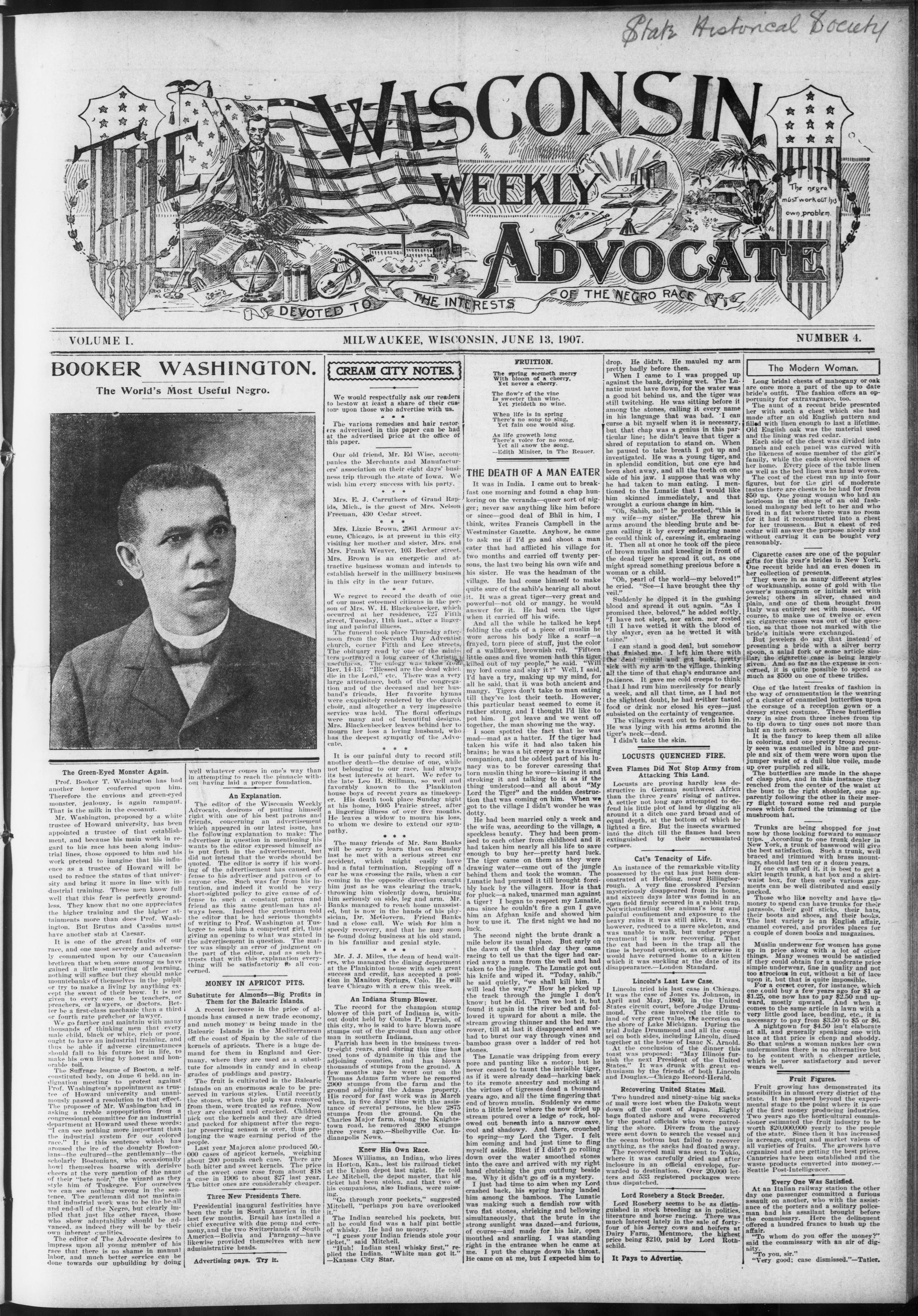
BOOKER WASHINGTON.
The World's Most Useful Negro.
1920
The Green-Eved Monster Again.
Prof. Booker T. Washington has had another honor conferred upon him. Therefore the envious and green-eyed monster, jealousy, is again rampant. That is the milk in the cocoanut.
Mr. Washington, proposed by a white trustee of Howard university, has been appointed a trustee of that establishment, and because his main work in regard to his race has been along industrial lines, those opposed to him and his work pretend to imagine that his influence as a trustee of Howard will be used to reduce the status of that university and bring it more in line with industrial training. These men know full well that this fear is perfectly groundless. They know that no one appreciates the higher training and the higher attainments more than does Prof. Washington. But Brutus and Cassius must have another stab at Caesar.
It is one of the great faults of our race, and one most severely and adversely commented upon by our Caucasian brethren that when some among us have gained a little smattering of learning, nothing will suffice but they should make mountebanks of themselves in the pulpit or try to make a living by anything except the sweat of their brow. It is not given to every one to be teachers, or preachers, or lawyers, or doctors. Better be a first-class mechanic than a third or fourth rate preacher or lawyer. We go farther and maintain with many thousands of thinking men that every male child, black or white, rich or poor, ought to have an industrial training, and thus be able if adverse circumstances should fall to his future lot in life, to make his own living by honest and honorable toil.
The Suffrage league of Boston, a self-constituted body, on June 6 held, an indignation meeting to protest against Prof. Washington's appointment as trustee of Howard university and unanimously passed a resolution to that effect. The proposer of Mr. Washington had in asking a treble appropriation from a congressional committee for an industrial department at Howard used these words: "I can see nothing more important than the industrial system for our colored race." It is this sentence which has aroused the ire of the doughy Bostonians—the cultured—the gentlemanly—the scholarly Bostonians, who occasionally howl themselves hoarse with derisive cheers, at the very mention of the name of their "bete noir," the wizard as they style him of Tuskegee. For ourselves we can see nothing wrong in the sentence. The gentleman did not maintain that industrial work was to be the be-all and end-all of the Negro, but clearly implied that just like other races, those who show adaptability should be advanced, as indeed they will be by their own inherent qualities.
The editor of The Advocate desires to impress upon all young member of his race that there is no shame in manual labor, and much better service can be done towards our upbuilding by doing
THE NEW YORK TIMES
well whatever comes in one's way than in attempting to reach the pinnacle without having laid a proper foundation.
An Explanation.
The editor of the Wisconsin Weekly Advocate, desirous of putting himself right with one of his best patrons and friends, concerning an advertisement which appeared in our latest issue, has the following explanation to make: The advertiser in question in mentioning his wants to the editor expressed himself as is put forth in the advertisement, but did not intend that the words should be quoted. The editor is sorry if his wording of the advertisement has caused offense to his advertiser and patron or to anyone else. Such was far from his intention, and indeed it would be very short-sighted policy to give cause of offense to such a constant patron and friend as this same gentleman has always been. Indeed the gentleman told the editor that he had serious thoughts of writing to Prof. Washington at Tuskegee to send him a competent girl, thus giving an opening to what was stated in the advertisement in question. The matter was simply an error of judgment on the part of the editor, and as such he trusts that with this explanation everything will be satisfactorily to all concerned.
MONEY IN APRICOT PITS.
Substitute for Almonds—Big Profits in Them for the Balearic Islands.
A recent increase in the price of almonds has caused a new trade economy, and much money is being made in the Balearic Islands in the Mediterranean off the coast of Spain by the sale of the kernels of apricots. There is a huge demand for them in England and Germany, where they are used as a substitute for almonds in candy and in cheap grades of puddings and pastry.
The fruit is cultivated in the Balearic Islands on an enormous scale to be preserved in various styles. Until recently the stones, when the pulp was removed from them, were treated as refuse. Now they are cleaned and cracked. Children pick out the kernels and they are dried and packed for shipment after the regular preserving season is over, thus prolonging the wage earning period of the people. Last year Majorca alone produced 50,000 cases of apricot kernels, weighing about 200 pounds each case. There are both bitter and sweet kernels. The price of the sweet ones rose from about $18 a case in 1906 to about $27 last year. The bitter ones are considerably cheaper.
Three New Presidents There.
Presidential inaugural festivities have been the rule in South America in the last few months. Brazil has installed a chief executive with due pomp and ceremony, and the two Switzerland of South America—Bolivia and Paraguay—have likewise provided themselves with new administrative heads.
Advertising pays. Try it.
MILWAUKEE, WISCONSIN, JUNE 13, 1907.
CREAM CITY NOTES.
We would respectfully ask our readers to bestow at least a share of their custom upon those who advertise with us.
The various remedies and hair restorers advertised in this paper can be had at the advertised price at the office of this paper.
Our old friend, Mr. Ed Wise, accompanies the Merchants and Manufacturers' association on their eight days' business trip through the state of Iowa. We wish him every success with his party.
Mrs. E. J. Carruthers of Grand Rapids, Mich., is the guest of Mrs. Nelson Freeman, 430 Cedar street.
***
Mrs. Lizzie Brown, 2961 Armour avenue, Chicago, is at present in this city visiting her mother and sister, Mrs. and Mrs. Frank Weaver, 103 Becher street. Mrs. Brown is an energetic and attractive business woman and intends to establish herself in the millinery business in this city in the near future.
* * *
We regret to record the death of one of our most esteemed citizens in the person of Mrs. W. H. Blackenbecker, which occurred at her residence, 727 Fifth street, Tuesday, 11th inst., after a lingering and painful illness.
The funeral took place Thursday afternoon from the Seventh Day Adventist church, corner Fifth and Lee streets. The obituary read by one of the ministers portrayed a long career of Christian usefulness. The enology was taken from Rev. 14-13: "Blessed are the dead which die in the Lord," etc. There was a very large attendance, both of the congregation and of the deceased and her husband's friends. Her favorite hymns were exquisitely rendered by the church choir, and altogether a very impressive service was held. The floral offerings were many and of beautiful designs. Mrs. Blackenbecker leaves behind her to mourn her loss a loving husband, who has the deepest sympathy of the Advocate.
* * *
It is our painful duty to record still another death—the demise of one, while not belonging to our race, had always its best interests at heart. We refer to the late Leo H. Stillman, so well and favorably known to the Plankinton house boys of recent years as timekeeper. His death took place Sunday night at his home, 1605 Prairie street, after a lingering illness of over five months. He leaves a widow to mourn his loss, to whom we desire to extend our sympathy.
* * *
The many friends of Mr. Sam Banks will be sorry to learn that on Sunday last he met with a serious street car accident, which might easily have had a fatal termination. Stepping off a car he was crossing the rails, when a car coming in the opposite direction caught him just as he was clearing the track, throwing him violently down, bruising him seriously on side, leg and arm. Mr. Banks managed to reach home unassisted, but is now in the hands of his physician, Dr. McGovern. Friend Banks had a close call. We wish for him a speedy recovery, and that he may soon be found doing business at his old stand, in his familiar and genial style.
***
Mr. J. J. Miles, the dean of head waiters, who managed the dining department at the Plankinton house with such great success and credit, has accepted a position in Manitou Springs, Colo. He will leave Chicago with a crew this week.
An Indiana Stump Blower
The record for the champion stump blower of this part of Indiana is, without doubt held by Combs P. Parrish, of this city, who is said to have blown more stumps out of the ground than any other man in southern Indiana.
Parrish has been in the business twenty-eight years, and during this time has used tons of dynamite in this and the adjoining counties, and has blown thousands of stumps from the ground. A few months ago he went out on the Thomas Adams farm where he removed 2900 stumps from the farm and the ground adjoining the Adams property. His record for fast work was in March when, in five days' time with the assistance of several persons, he blew 2875 stumps from the ground. On the Charles Major farm, along the Knights-town road, he removed 3900 stumps three years ago.—Shelbyville Cor. Indianapolis News.
Knew His Own Race
Moses Williams, an Indian, who lives in Horton, Kan., lost his railroad ticket at the Union depot last night. He told Lee Mitchell, the depot master, that his ticket had been stolen, and that two of his companions, also Indians, were missing.
"Go through your pockets," suggested Mitchell, "perhaps you have overlooked it."
The Indian searched his pockets, but all he could find was a half pint bottle of whisky. He had no money.
"I guess your Indian friends stole your ticket," said Mitchell. "Huh! Indian steal whisky first," replied the Indian. "White man got it."—Kansas City Star.
FRUITION.
The spring seemeth merry
With bloom of a cherry,
Yet never a cherry.
The flow'r of the vine
Is sweeter than wine.
Yet yieldeth no wine.
When life is in spring
There's no song to sing,
Yet fain one would sing.
As life groweth long
There's voice for no song,
Yet all know the song.
—Edith Miniter, in The Reaer.
THE DEATH OF A MAN EATER
It was in India. I came out to breakfast one morning and found a chap hunkering on the veranda—queer sort of nigger; never saw anything like him before or since—good deal of Bhil in him, I think, writes Francis Campbell in the Westminster Gazette. Anyhow, he came to ask me if I'd go and shoot a man eater that had afflicted his village for two months and carried off twenty persons, the last two being his own wife and his sister. He was the headman of the village. He had come himself to make quite sure of the sahib's hearing all about it. It was a great tiger—very great and powerful—not old or mangy, he would answer for it. He had seen the tiger when it carried off his wife.
And all the while he talked he kept folding the ends of a piece of muslin he wore across his body like a scarf—a frayed, torn piece of stuff, just the color of a wallflower, brownish red. "Fifteen little ones and five women hath this tiger killed out of my people," he said. "Will my lord come and slay it?" Well, I said, I'd have a try, making up my mind, for all he said, that it was both ancient and mangy. Tigers don't take to man eating till they've lost their teeth. However, this particular beast seemed to come it rather strong, and I thought I'd like to pot him. I got leave and we went off together, the man showing me the way.
I soon spotted the fact that he was mad—mad as a hatter. If the tiger had taken his wife it had also taken his brains; he was a bit creepy as a traveling companion, and the oddest part of his lunacy was to be forever caressing that torn muslin thing he wore—kissing it and stroking it and talking to it as if the thing understood—and all about "My Lord the Tiger" and the sudden destruction that was coming on him. When we got to the village I didn't wonder he was dotty.
He had been married only a week and the wife was, according to the village, a speckless beauty. They had been promised to each other from childhood and it had taken him nearly all his life to save enough to buy her—pretty hard luck. The tiger came on them as they were drawing water—came out of the jungle behind them and took the woman. The Lunatic had pursued it till brought forcibly back by the villagers. How is that for pluck—a naked, unarmed man against a tiger? I began to respect my Lunatic, and since he couldn't fire a gun I gave him an Afghan knife and showed him how to use it. The first night we had no luck.
The second night the brute drank a mile below its usual place. But early on the dawn of the third day they came racing to tell us that the tiger had carried away a man from the well and had taken to the jungle. The Lunatic got out his knife and wiped it. "Today, sahib," he said quietly, "we shall kill him. I will lead the way." How he picked up the track through the jungle I don't know; but he did. Then we lost it, but found it again in the river bed and followed it upward for about a mile. the stream growing thinner and the bed narrower, till at last it disappeared and we had to burst our way through vines and bamboo grass over a ladder of red hot stones.
The Lunatic was dripping from every pore and panting like a motor; but he never ceased to taunt the invisible tiger, as if it were already dead—harking back to its remote ancestry and mocking at the virtues of tigresses dead a thousand years ago, and all the time fingering that end of brown muslin. Suddenly we came into a little level where the now dried up stream poured over a ledge of rock, holowed out beneath into a narrow cave, cool and shadowy. And there, crouched to spring—my Lord the Tiger. I felt him coming and had just time to fling myself aside. Blest if I didn't go rolling down over the water smoothed stones into the cave and arrived with my right hand clutching the gun outflung beside me. Why it didn't go off is a mystery.
I just had time to aim when my Lord crashed back, his spring having landed him among the bamboos. The Lunatic was making such a fiendish row with two flat stones, shrieking and bellowing simultaneously, that the brute in the strong sunlight was dazed—and furious, of course—and made for his lair, open mouthed and snarling. I was standing right in the entrance when he came at me. I put the charge down his throat. He came on at me, but I expected him to
drop. He didn't. He mauled my arm pretty badly before then.
When I came to I was propped up against the bank, dripping wet. The Lunatic must have flown, for the water was a good bit behind us. and the tiger was still twitching. He was sitting before it among the stones, calling it every name in his language that was bad. I can curse a bit myself when it is necessary, but that chap was a genius in this particular line; he didn't leave that tiger a shred of reputation to stand on. When he paused to take breath I got up and investigated. He was a young tiger, and in splendid condition, but one eye had been shot away, and all the teeth on one side of his jaw. I suppose that was why he had taken to man eating. I mentioned to the Lunatic that I would like him skinned immediately, and that wrought a curious change in him.
"Oh, Sahib, no!" he protested, "this is my wife—my sister." He threw his arms around the bleeding brute and began calling it by every endearing name he could think of, caressing it, embracing it. Then all at once he took off the piece of brown muslin and kneeling in front of the dead tiger he spread it out, as one might spread something precious before a woman or a child.
"Oh, pearl of the world—my beloved!" he cried. "See—I have brought thee thy veil."
Suddenly he dipped it in the gushing blood and spread it out again. "As I promised thee, beloved," he added softly, "I have not slept, nor eaten, nor rested till I have wetted it with the blood of thy slayer, even as he wetted it with tine."
I can stand a good deal, but somehow that finished me. I left him there with the dead animal and got back, pretty sick with my arm to the village, thinking all the time of that chap's endurance and patience. It gave me cold creeps to think that I had run him mercilessly for nearly a week, and all that time, as I had not the slightest doubt, he had neither tasted food or drink nor closed his eyes—just subsisted on the certainty of vengeance.
The villagers went out to fetch him in. He was lying with his arms around the tiger's neck—dead.
LOCUSTS QUENCHED FIRE.
Even Flames Did Not Stop Army from Attacking This Land.
Locusts are proving hardly less destructive in German southwest Africa than the three years' rising of natives. A settler not long ago attempted to defend his little plot of land by digging all around it a ditch one yard broad and of equal depth, at the bottom of which he lighted a fire. But the insects swarmed into the ditch till the flames had been extinguished by their accumulated corpses.
Cat's Tenacity of Life
An instance of the remarkable vitality possessed by the cat has just been demonstrated at Herbling, near Billingborough. A very fine crossbred Persian mysteriously disappeared from its home, and sixteen days later was found in an open field firmly secured in a rabbit trap. Notwithstanding the animal's long and painful confinement and exposure to the heavy rains it was still alive. It was, however, reduced to a mere skeleton, and was unable to walk, but under proper treatment it is now recovering. That the cat had been in the trap all the time is beyond question, as otherwise it would have returned home to a kitten which it was suckling at the date of its disappearance.—London Standard.
Lincoln's Last Law Case.
Lincoln tried his last case in Chicago. It was the case of Jones vs. Johnson, in April and May, 1860, in the United States circuit court, before Judge Drummond. The case involved the title to land of very great value, the accretion on the shore of Lake Michigan. During the trial Judge Drummond and all the counsel on both sides, including Lincoln, dined together at the house of Isaac N. Arnold. At the conclusion of the dinner this toast was proposed: "May Illinois furnish the next President of the United States." It was drunk with great enthusiasm by the friends of both Lincoln and Douglas.—Chicago Record-Herald.
Recovering United States Mail.
Two hundred and ninety-nine big sacks of mail were lost when the Dakota went down off the coast of Japan. Eighty bags floated ashore and were recovered by the postal officials who were patrolling the shore. Divers from the navy were sent down to search the vessel and the ocean bottom but failed to recover anything, as the sacks had floated away. The recovered mail was sent to Tokio, where it was carefully dried and after inclosure in an official envelope, forwarded to destination. Over 20,000 letters and 533 registered packages were thus dispatched.
Lord Rosebery a Stock Breeder
Lord Rosebery seems to be as distinguished in stock breeding as in politics, literature and horse racing. There was much interest lately in the sale of forty-four of his Jersey cows and heifers at Dairy Farm, Mentmore, the highest price being $210, paid by Lord Rothschild.
It Pays to Advertise.
The Modern Woman.
Long bridal chests of mahogany or oak are once more a part of the up to date bride's outfit. The fashion offers an opportunity for extravagance, too.
The aunt of a recent bride presented her with such a chest which she had made after an old English pattern and filled with linen enough to last a lifetime. Old English oak was the material used and the lining was red cedar.
Each side of the chest was divided into panels and each panel was carved with the likeness of some member of the girl's family, while the ends showed scenes of her home. Every piece of the table linen as well as the bed linen was hand woven.
The cost of the chest ran up into four figures, but for the girl of moderate tastes there are chests to be had for from $50 up. One young woman who had an heirloom in the shape of an old fashioned mahogany bed left to her and who lived in a flat where there was no room for it had it reconstructed into a chest for her trousseau. But a chest of red cedar will answer the purpose nicely and without carving it can be bought very reasonably.
Cigarette cases are one of the popular gifts for this year's brides in New York. One recent bride had an even dozen in her collection of presents.
They were in as many different styles of workmanship, some of gold with the owner's monogram or initials set with jewels; others in silver, chased and plain, and one of them brought from Italy was entirely set with mosaic. Of course, to make use of twelve or even six cigarette cases was out of the question, so that those not marked with the bride's initials were exchanged.
But jewelers do say that instead of presenting a bride with a silver berry spoon, a salad fork or some article similar, the cigarette case is being largely given. And so far as the expense is concerned, it is quite possible to spend as much as $500 on one of these trifles.
One of the latest freaks of fashion in the way of ornamentation is the wearing of a cluster of enamelled butterflies upon the corsage of a reception gown or a dressy street costume. These butterflies vary in size from three inches from tip to tip down to tiny ones not more than half an inch across.
It is the fancy to keep them all alike in coloring, and one pretty troop recently seen was enamelled in blue and purple and six of them were worn upon the jumper waist of a dull blue voile, made up over purplish red silk.
The butterflies are made in the shape of clasp pins, and in this instance they reached from the center of the waist at the bust to the right shoulder, one apparently following the other in their merry flight toward some red and purple roses which formed the trimming of the mushroom hat.
---
Trunks are being shopped for just now by those looking forward to summer trips. According to one trunk dealer in New York, a trunk of basswood will give the best satisfaction. Such a trunk, well braced and trimmed with brass mountings, should last ten or a dozen years. If one can afford it, it is best to get a skirt length trunk, a hat box and a shirt-walst box, for then one's various garments can be well distributed and easily packed. Those who like novelty and have the money to spend can have trunks for their parasols, their golf sticks, their hats, their boots and shoes, and their books. The last variety is an English affair, enamel covered, and provides places for a couple of dozen books and magazines.
Muslin underwear for women has gone up in price along with a lot of other things. Many women would be satisfied if they could obtain for a moderate price simple underwear, fine in quality and not too atrocious in cut, without a bit of lace upon it, but that is quite impossible.
For a corset cover, for instance, which one could buy a few years ago for $1 or $1.25, one now has to pay $2.50 and upward, mostly upward. And when it comes to the same article in lawn with a very little good lace, beading, etc., it is necessary to pay from $3.50 to $5 or $6.
A nightgown for $4.50 isn't elaborate at all, and generally speaking one with lace at that price is cheap and shoddy. So that unless a woman makes her own undermuslins there is no alternative but to be content with a cheaper article, which is never satisfactory and never wears well.
Fruit Figures.
Fruit growing has demonstrated its possibilities in almost every district of the state. It has passed beyond the experimental stage to the point where it is one of the first money producing industries. Two years ago the horticultural commissioner estimated the fruit industry to be worth $20,000,000 yearly to the people of the state. Since then it has increased in acreage, output and market valeus of all varieties of fruits. The growers have organized and are getting the best prices. Canneries have been established and the waste products converted into money.—Seattle Post-Intelligencer.
Every One Was Satisfied.
At an Italian railway station the other day one passenger committed a furious assault on another, who with the assistance of the porters and a solitary policeman had his assailant brought before the commissary. Here the delinquent offered a hundred francs to hush up the affair.
"To whom do you offer the money?" said the commissary with an air of dignity.
"To you, sir."
"Very good; case dismissed."—Tatler.
B. B. MONTGOMERY, Editor and Proprietor.
Tea-Table Salad.
A widow and her insurance money are soon married.—Smart Set.
Employer—Which newspaper do you read. Miss Barker?
Stenographer—Whichever one the man next to me in the train has bought.—Smart Set.
Mr. Jolly—There's one thing I like about Miss Barker. She never talks about anybody.
Miss Sneerwell—No. indeed. She spends all her time talking about herself.—Smart Set.
Progress.
"Do you play bridge wisest:
"No," answered young Mrs. Torkins.
"I can manage the cards all right, but it
The Irony of Fate
He—So Smythe has been run over by an automobile, eh? How did it happen? She—The poor fellow was stooping over to pick up a horseshoe for luck. Smar: Set.
The Way of the Navy
become a sailor, my boy!
Navy Candidate (in perfect good faith)
—Because he's got a wife in every port,
sir!—Punch.
Future Dividends.
"I observe that you do a great many favors for that influential citizen." "Those aren't favors." answered Senator Sorghum; "those are investments." Washington Star.
Outlook Is Good
"What are you going to do on your vacation this summer?"
"Same old thing, I suppose. Sit in a tent and smoke and watch it rain."—Cleveland Leader.
And Then They Kissed.
"My face is my fortune, sir," said the pretty summer girl.
pretty summer girl.
"And mine is, too," said the handsome summer man. "Let us put our fortunes together."—Lippincott's.
Self-Evident
"Do you believe that people will follow the same avocations in the next world as in this?" "The coal man will, but the ice man won't."—Cleveland Leader.
The Home Remedy
Daughter—But he is so full of absurd ideals.
Mother—Never mind that, dear. Your father was just the same before I married him. Town and Country.
Not Comforting
en can't throw straight.
The Older Man—Yes-er-my wife tells me she threw herself at another fellow—missed and caught me!—Princeton Tiger.
Phew!
Mary had a little lamb.
Into a sheep it grew;
Sheepy died;
Mary cried;
They put it in the stew!
In America.
"Pa, why does a jury convict a man?"
"As a warning, my son. Then he has to go to the trouble of taking an appeal before he can get free. Murder must not go unrebuked."—Louisville Courier-Journal.
Several Kinds.
"I want a dozen eggs," requested the fair customer. "Yes, 'um," replied the grocer's boy. "Fresh, nearly fresh, strictly fresh, very fresh, absolutely fresh, or just eggs?"—Town Topics.
Gone
Nell—Yes, she said her husband married her for her beauty. What do you think of that?
Belle—Well, I think her husband must feel like a widower now.—Catholic Standard and Times.
The Peace Sentiment
"What is your opinion of disarmament?"
The diplomat paused to reflect.
"I favor it," he said, at last, "excepting, of course, for my own nation."—Philadelphia Ledger.
The Lady or the Tiger?
It is always embarrassing to a girl when she goes into a fashionable shoe store to buy a new pair of boots and cannot remember for the moment which stocking it is that has the hole in it. Somerville Journal.
Asking Her to Stand Pat.
Mr. McDooley—Faith, an' it do be a question Oi have fer yez, me darlin'.
Miss Clancey—Pfwat is it, Pat?
"Whin it comes toime fer me funeral, how would yez loike t' be th' Widder McDooley?—Chicago News.
Warning to adies Hailing a Car.
The Lady in a Hurry—Why didn't you stop at once, conductor, when you saw me waving my hand?
The Facetious Conductor—Lor', Miss; why, I thought you were a-throwing; kisses at me.—London Sketch.
Misunderstood
"Your sentence is to be suspended." began the merciful court.
"Great Scott, judge!" exclaimed the prisoner, "ef I'd knowed chicken stealing was a hanging offense I wouldn't have stole."—Philadelphia Ledger.
Other Reasons
"What was the cause of this rumpus?" asked the judge.
"Well, you see, judge," replied the policeman, "this man here and that woman there are married—"
"Yes, yes, I know. But what other cause?"—Pick-Me-Up.
A. Center Shot.
A good country mayor found himself at a table in a large restaurant between two young men who began to make fun of him.
"I see, young sirs," he said, "that you are making fun of me. But I assure you that I am neither stupid nor an ass."
"Ah," said one of them, "perhaps you are between the two."
"Exactly," was the prompt reply: "I'm between the two."—London Tit-Bits.
MAROONED FIFTY HOURS ON A NEW YORK SKYSCRAPER.
George L. Lammert, a clerk employed by a life insurance company in New York, was rescued from a perilous position, half starved, almost dead from exposure, at midday on Broadway, in New York city.
With tens of thousands of persons within hearing of his voice, and with men working within ten feet of where he stood or sat, Lammert was for fifty hours as isolated as if he stood on some ledge in the Himalayas. Nobody heard him or paid any attention to him. Thousands saw him and went their way without taking a second look. His cries for help brought only grins. And only by a chance he finally was saved from death by starvation or from a fall on the pavement, a hundred feet below him.
That such a thing could happen seems impossible—yet it did. Nor was it the heartlessness of New Yorkers that made the crowds pass unconcerned under a man who was facing a terrible death. The story is one that for strangeness excels anything ever dreamed by a writer of fiction. Lammert is employed in the auditing department of one of the immense skyscrapers near the city hall in New York. The busiest street in America runs along one side of the building, and on the other side the ceaseless ebb and flow of money crazed men goes on. Nearby the spire of Trinity church rises, and just around the corner is the maelstrom of money and madness that is called the stock exchange.
***
The auditing department is on the tenth floor of the building, and Lammert, from his desk, could look down upon the struggling, seething masses of men during the stock exchange hours, and perhaps dream that the figures he was adding were dollars and that he was gambling with them in the market below.
He was at work checking up an intricate table at 10 o'clock in the morning. The day had been unseasonably hot for the spring and the windows were thrown open for the first time. There were perhaps fifty men and girls at work in the department, but they practically were isolated from each other by partitions, desks, cabinets, and files. No one was paying any attention to Lammert. He was near the completion of his inspection of the table when a gust of wind suddenly swept the paper on which he had been verifying the results and testing them according to the office rules and blew it out of the window.
Lammert made a grab for the precious paper, which represented perhaps two hours' work, but it eluded him and fluttered over the sill. The wind caught it, lifted it as in a chimney, higher and higher, and then a current of air drove it downward and it fell easily on a ledge only a few feet from the window, where it remained.
* * *
No one else saw this. Being young and light, Lammert decided at once that he would crawl out and get the paper. The ledge ran for eight feet straight along the wall, then there was a projection, perhaps eighteen inches, around which Lammert supposed, was another window. The ledge was of stone and about ten inches wide, and, although over 100 feet from the ground, Lammert thought he could get the paper without trouble.
Instead of calling one of the other men to his assistance, he took the window pole used for opening and shutting the heavy windows, and reached for the paper, leaning out of the window and trying to draw it towards him. After several attempts he succeeded in poking it into the angle made by the projection eight feet away. In his anxiety to recover the paper he forgot caution and, hooking the window pole onto the ledge of the floor above, he tested it to see if it would bear weight, and then started to walk along the ledge, steadying himself with the window pole hooked onto the upper ledge.
It was a foolhardy attempt, but he got along well until he came to the corner and had to stoop down to get the paper. To do this he was forced to kneel on the ledge, letting go his hold on the pole, which swung back perhaps a foot when he released it and hung there.
```markdown
```
Triumphant over recovering the paper, Lammert started to stand up—and discovered, to his horror, that any movement towards straightening up would overbalance him and throw him down into the street. Also he realized that the pole which had insured his balance was behind him. If he could get hold of that he could straighten up in safety. He tried reaching upward with his left hand, but could not reach.
For ten minutes, he says, he knelt there on the ledge, dizzy with fright, and was forced to shut his eyes and hang on with both hands to the ledge to overcome his desire to throw himself into the street. Finally, made cooler by the desperate nature of his position, he began to think
He remembered that there was another window just beyond the ledge. He could crawl forwards, even if he did not dare go back along the ledge. He steadied himself across the angle of the ledges and felt around the projection. To his delight it was only about a foot wide, and on the other side he found a handhold—a small iron pine.
His hand clinched around the pipe gave him renewed courage, and, although dripping wet from the nervous horror of the situation, he clung to it while, with infinite effort and caution, he edged his way, inch by inch, out until he stood on the ledge a foot wide, sheer over the street. With a sudden movement he got both hands gripped onto the pipe and swung his body around to the other side of the projection, and sat down on the ledge, gripping the pipe tight with both hands and almost exhausted by his efforts.
The full horror of the situation did not dawn on him for perhaps a minute. He says he thought he was within a few feet of a window. Then, after recovering a bit from his exertions, he suddenly realized that, instead of rounding a projection and arriving at a window, he had rounded one projection and sat in a space three feet wide between two such projections. It was as if he were on a shelf in a chimney which had one side open.
Lammert says it was half an hour be-
fore he was conscious again. He sat as if dazed, his feet braced across on the opposite ledge, his hands clinched around the little pipe, paralyzed by horror.
His nerve had failed him completely. He fully expected to fall and be dashed to death. Later he commenced calling for help. Twice he made efforts to crawl around the projection, but his strength and nerve both had failed him, and he sat numb with terror and despair., except that at times he broke into frantic crying for help.
In the office nobody noticed that Lammert was not at his desk for perhaps an hour. Then they supposed he had been called into some other department, and no attention was paid to his absence. After hours the janitor found his locker unlocked and his desk piled with work, and straightened things up.
* * *
The next morning his absence was noticed, the fact of his disappearance the previous day was recalled, the janitor gave his testimony, some of his fellows were puzzled, and he was discharged for absence without reason or excuse.
Night came on and the chill crept up from the bay and numbed Lammert. He still clung to his giddy perch and at intervals shouted for help. Several patrolmen and night watchmen heard his cries, but faintly, and, as they could not locate the sounds, they gave up the search. Daybreak brought fresh hope to Lammert. Hunger, he says, revived him and spurred him on to fresh attempts to escape.
His first thought was to slide down the pipe, but he found that it ended four stories below, apparently in a hole in the wall its own size. He discovered, too, that it carried telephone wires to the upper stories. During the morning he decided to call for help every half hour, and took out his watch for that purpose. Also he found that he could see two windows of a building across the street, apparently windows to washrooms, from the irregularity. He could not see any office windows.
He was not afraid of the height that day, and lost his giddiness when looking down. About noon he managed to stand up, and decided to try to get around the angle again and return to the office window. He crawled out until he could look around to where the window pole hung; then he grew afraid to let loose of the pipe, and drew back into his safe harbor. He had come near falling in the effort and was weak from the experience.
Then a brilliant idea dawned upon him. He began pounding on the pipe with his penknife, but after an hour of this he desisted. During the morning, too, he had put out a signal of distress, flying his pocket handkerchief and waving it at the people below. He spent the greater part of the afternoon writing notes on envelopes and papers from his pocket and trying to drop them into the street. Some were wafted blocks out of the way and some fell unnoticed. He was so weak that he dared not attempt another climb around the ledge, even if he had possessed the courage.
Night found him disheartened and despairing. He was about ready to let loose and fall into the street. Apparently no one had seen his signal or found his notes. The night was raw and cold and a misty rain drenched him to the skin. He grew still, and his body was filled with pains. Many times he shifted from ledge to ledge, and once, by bracing his feet on one ledge, and sitting on the other with his hand around the pipe, he dozed off until a dream of falling awakened him.
☆ ☆ ☆
Daylight came again—and with it hope. Lammert says that during the morning he declared he would end his misery by jumping—but that he was afraid he would alight on someone and kill him—so postponed the jump until night. The grim jest kept recurring all day. He laughed at the idea of waiting until others were safe before killing himself. About 4 o'clock that afternoon Curtis Logan, an employee of a brokerage firm in the building across the street, went to the washroom and, while there, happened to glance out the window.
He saw Lammert and stopped to look. "That fellow is a long time fixing that pipe," he thought. For on the preceding day Logan had seen Lammert, noticed his perilous position, and watched him for a time, thinking he was a daring workman repairing the pipe.
He watched this time for several minutes. Then he noticed the attitude of exhaustion and despair, and the handkerchief tied to the pipe.
Suddenly the thought struck him that the man could not get out of the crevasse in the side of the building. He watched a while longer, and then, hurrying to the elevator, descended, crossed the street, and went up to the life insurance company office, where he raised the alarm.
***
The employes of the auditing department were skeptical, but Logan insisted that a man was on the ledge. Then someone remembered Lammert and his odd disappearance. The window was thrown open and someone shouted Lammert's name. The result was a feeble cry for help.
After that there were things doing. Telephone messages summoned men from the nearest fire station. A rope was swung from the window by Lammert's desk across to the window beyond the projection and one of the window washers, with his belt hooked over the rope, slipped hurriedly along the ledge, around the projection, and in an instant reappeared supporting Lammert. Eager hands stretched forth and drew Lammert into the window—and in a dazed way he walked over to his desk, put the paper he had saved upon it, and toppled over in a dead faint.—New York World.
He Made Good
Not long ago a city editor in Ottumwa, Ia., was told over the telephone that a prominent citizens had just died suddenly. He called a reporter and told him to rush out and get the "story." Twenty minutes later the reporter returned, sat down at his desk, and began to rattle off copy on his typewriter.
"Well, what about it?" asked the city editor.
"Oh, nothing much," replied the reporter, without looking up. "He was walking along the street when he suddenly clasped his hands to his heart and said, 'I'm going to die!' Then he leaned up against a fence and made good."—"The Chestnut Tree," in Everybody's.
Harry Posner, aged 19, a waif brought to Howard, Kan., from New York in 1899 and now studying at the Normal institute in Howard, has received a message from New York city stating that he had fallen heir to $500,000 left by his father, who died in Cape Town, Africa. The boy's mother died when he was a child and his father disappeared.
The Hinde & Dauch Paper company of Sandusky, O., has decided to conduct a social campaign in an endeavor to procure girls to work in its factory.
All sorts of advertisements and all kinds of inducements have failed to lure women and girls. Now the management announces it would give a series of receptions and pink teas in the factory to show women and girls what a nice place it is and how agreeable is the work.
Police Judge Batterre of Littie Rock, Ark., has dismissed a complaint filed by Charles P. Harnwell against Gus Gans and others, who were charged with keeping crowing chickens in their yards. Harnwell asked that the defendant be enjoined from keeping the chickens, as they disturbed his slumbers in the early morning. Judge Ratterre denied the injunction, stating that the good qualities possessed by the chickens outweighed Harnwell's need of sleep.
The state department at Washington, D. C., in a formal document from one of the consuls has been informed that a company has been organized in Europe with a large capital to make potato lead pencils, and that their product will soon be placed upon the market. By using the new composition the highest grade lead pencils can be manufactured at a cost of less than a cent each, while ordinary good grade pencils can be turned out at a cost of half a cent.
Because of an overplayful spring in the roller of a window curtain, James Daly of Jeffersonville, Ind., is now restricting his bill of fare to soup and other nourishing food which does not have to be masticated. Daly, who is unfortunate enough to be minus one arm, attempted to wind the curtain roller by holding the metal piece at the end between his teeth, when the spring got too tight and began to squirm. He tried to hold on, and then, when too late, tried to let go. He lost several teeth and some blood.
---
A delay of one minute cost the life of Marie Botkin, aged 18, of Lima, O., who committed suicide, according to evidence unearthed by the coroner. He says he believes Miss Botkin and Miss Flossie Swigert, agreed to die together at 8 a. m. At one minute after 8 o'clock Miss Swigert phoned Miss Botkin, but the girl was found lying unconscious in her room, having taken carbolic acid. The coroner says he believes Miss Swigert weakened at the last minute and called up her friend to release her from the suicide agreement.
---
Carl Schuster, a young German of Indianapolis, ate heartily and a few moments after he had risen from the table complained of intense pain in his stomach. Ten minutes later he died. The coroner held an autopsy under the supposition that Schuster might have eaten poisoned food, but instead he found that he had eaten so much that his stomach had burst. The organ was not diseased, but appeared in a perfectly healthy condition. There was a long rupture, which, the physician said, was the result of the hearty meal.
The other night at a street fair in Ladd, Ill., John Jordan, an engineer on the Chicago, Milwaukee & St. Paul railway, was passing by a fish fry tent when the proprietor came out to announce that the fish supper was ready and beat on a gas drum to attract attention. The drum exploded with a report heard five miles away. Jordan was blown ten feet. One leg was nearly torn off and will have to be amputated. The fronts of three store buildings were destroyed by the force of the explosion. The fish fry man escaped with slight injuries.
Howard F. Weisman, ticket and freight agent of the East Ohio Traction company at Chagrin Falls, O., shot himself at the Colonial hotel, Cleveland, and is dying at Huron Road hospital. Robert D. Beatty, general manager of the company, had called him by telephone and informed him that a shortage had been found in his accounts. In the middle of the conversation Weisman pulled out his revolver and shot himself in the head. The shot could be heard at the other end of the telephone line, as Weisman dropped the receiver and fired the bullet.
Pittsburg has drawn the line at "The Bath," Gaston La Touche's first prize winner in the Carnegie art competition. La Touche, who resides in St. Cloud, France, received $1500 and a gold medal and gave the purchasing committee of the Carnegie Art galleries a sixty-day option on the painting for $1600. This is the first time in the history of the Carnegie institute that the first prize winner has not been added to the permanent collection. The painting portraits a woman ready to plunge into a pool of water, with a Satyr peeking around a sedan chair in which the bather apparently has arrived.
The painting evoked a storm of criticism as soon as it was placed on public view. Hundreds of letters were written to the local newspapers, protesting against it being placed in the galleries. The pulpit also denounced it. Public opinion has won, the fine arts committee has bowed to the storm and the jury of awards receives a rebuke.
A plan by which over one hundred applicants for state certificates as physicians were certain of successfully passing the examination through the aid of a list of questions to be propounded by the Kansas state board of medical examiners, surreptitiously secured beforehand, was discovered at Kansas City while Dr. R. A. Light, a member of the board, was walking about the room where 117 applicants were engaged.
Dr. Light saw a man consulting something under the desk, and grabbed it from him. It was the complete set of questions on ten subjects which were to be given to the pupils, and answers were written to each in pencil.
When asked where he got it, the man said he bought it for $5. The offender was told to quit the examination, and before the day was over almost seventy-five lists, with the answers, had been secured, which had been obtained from an employee in the state printing office in Topeka.
Several young couples, "spooning" in the shelter of the big entrance to the First Presbyterian church at Alton. Ill., enjoyed a good joke on Rev. A. G. Lane, the pastor, and Mrs. Minerva Vaughn, the jignitress.
Several weeks ago an electric light was placed before the door and turned on at dusk every night to prevent "spooning." This night this was neglected and the "spooning" colony assembled. Rev. Mr. Lane crept into the church with the intention of startling the "spooners" by turning on the light. He had barely got inside when Mrs. Vaughn also stole in on the same errand and they collided.
Mrs. Vaughn screamed and the pastor dragged her, still shrieking toward the switchboard.
The girls outside added their screams to the uproar and several young men rushed into the church just as the minister turned on the light and then saw him holding Mrs. Vaughn. And the girls declared it served him right.
HER PROPHESY FULFILLED.
Woman's Words to Cecil Rhodes Have Proven to Have Been True.
The recent death of Capt. Ernest Rhodes, a brother of the late Cecil Rhodes, recalls a strange story told by Col. Frank Rhodes, says Tit-Bits. A few years ago Cecil Rhodes turned a Matabele witch off his estate in South Africa in consequence of some offense, and the old hag, with hatred burning in her eyes, shrieked out: "Thy days on earth shall be short, and two of these who follow thee." Curiously enough, five years have seen three members of the Rhodes family die shortly after taking possession of the Dahlam estate. Cecil Rhodes paid $500,000 for the property, and only visited the hall once.
MILLINERY MUSINGS
Have you seen the new sailor? If you haven't, do. It's a wonder. It generally occupies a whole window. That's because it's so big none of the other hats have a show. It's oblong in shape and reaches nearly two feet from tip to tip. It suggests a Japanese kite in shape and any woman who isn't very tall is going to look like a great bird with misplaced wings when she dons it. It generally occurs in mustard color, green or black, and is usually trimmed with great bows of taffeta ribbon that stretch across the front of the brim. These bows are of bottle green, sapphire blue and the darker shades of Bordeaux. Sometimes, however, breasts and even ostrich plumes are admitted as accessories.
Another of the new sailors is perfectly round. It is probably twenty inches in diameter. At any rate it is fully as large as a touring car wheel. A stunning black one, trimmed up in front by a huge chon of white and black ribbon, is shown at one large store. Milliners prophesy that they are going to be the dominant note in millinery this summer. If this is realized, feminine confidences will require ingenuity and poor man will have to break into teas with a pick-axe and jimmy.
Ever larger, larger, grow the mushroom hats of the season. It now seems that the proper diameter of each should be the distance from the top of the head to the waistline. For the rest, they are perfect ostrich farms. These picture hats should properly be worn far back on the head, a custom which throws the end of the trailing plume well down below the waist line. If this keeps up women will soon have to hold up their plumes to keep them out of the street.
Pink hydrangeas are a favorite floral millinery feature.
Some of the imported hats show flowers which have halves of different colors.
Many of the picture hats show the oblong tendency of the new sailor. A very beautiful one of this kind on view at a store in town is of light yellow straw edged around the brim with pink velvet and covored with lilac among which peeps a bow of brown velvet.
One of the millinery shops displays in its window a variant type of the turban. It is of reseda green trimmed with what looks to be a man's handkerchief of green and white silk. As it has a little visor in front, it naturally suggests an inverted coal scuttle.
What Our Smokers Did.
There were 7,998,897,785 cigars of all kinds smoked in the United States last year. They cost all prices from the stogie at three for a nickel to the two for a quarter. If all the cigars consumed during the year were laid from end to end they would circle the earth at the equator twenty-five times. If they were laid in a pile 100 feet square, they would reach a height of five and one-third miles and would weigh 2082 tons. If they were all made by hand it would require 3,199,359 cigarmakers to make them and all the smokers would have to smoke three cigars each day in the year to consume them. Every time the clock ticks during the twenty-four hours of each day there are 2041 cigars sold.
To light the cigars it requires 20,864,392 boxes of matches which are composed of 1987 tons of wood and 49 tons of sulphur and brimstone.
At fifty cigars to a box it required 159,977,876 boxes, which consisted of 185,574,452 square feet of lumber, that would take a train of 4640 cars to carry it and would extend a distance of fifty-three miles.
It would take sixty of the largest locomotives to haul the train.
At 5 cents each the cost would be $399,944,887.25, which is $15.45 for every man or $4.62 for every man, woman and child in the United States.
The money would support 118,690 families of five comfortably, and give them all the clothes that was needed.
Faked Coronation Scene
Probably the most notable faked living picture ever produced was that which purported to give a representation of the actual scene inside Westminster Abbey at the King's coronation.
The production was the work of an inventive Frenchman, who had special scenery of the abbey painted and reproductions of the historical costumes made. Then a number of French actors were "made up" to represent the King, the aged Primate and other central figures—and remarkably lifelike they were.
The mock coronation ceremony took place at a quiet little village in Brittany, and the films were sent to London for reproduction in one of the leading houses of entertainment. The managers, however, made no attempt to impose on the public and openly confessed that the scene was a "fake."—London Chronicle.
Brought Down a Bald Eagle
A bald eagle weighing twenty pounds was shot by Bert McKinley near Pleasant View. The bird was soaring when the shot was fired by the youth, but the pellets wounded one of the eagle's wings, and immediately the bird began falling. Mr. McKinley has set to work to repair the injuries done and in time expects to tame the eagle.—Centre Reporter.
Prison League Has 50,000
Eleven years ago Mrs. Maude Ballington Booth began her reform work in the prisons of the United States. Through her inspiration the Volunteer Prison league was organized for those prisoners desirous of leading better lives; the enrolled members number over 50,000, including many serving life sentences.
Big Saving in Coal
A German article describes a locomotive equipped with feed water heaters which has recently been put into service on the Egyptian state railways and effects a saving in coal consumed of 21.4 per cent. or over $1000 a year to each engine.
HIGH JUMPING SHARKS.
Doubts of a Sailor Who Says He Knows Something About the Big Fish.
You published in your paper on Saturday a very curious story about a shark jumping fifty feet high in the air, writes a correspondent of the South China Post. The writer or author of this story, a captain of a British sailing vessel, bound for London, says that he fired a rifle shot at a shark and wounded it. The shark in question jumped so high out of the water that he cleared the mainsail with the ease of a seagull. Now, dear sir, this is rather a trifle strong. The captain states that they threw some meat overboard to get the sharks closer to the ship. At the moment that the shark made a grab for the meat the captain fired his shot, which shot made the shark jump fifty feet out of the water.
We that have been at sea know that there is one kind of shark which has to lay on its side before it can grab anything between its jaws, and another kind which has to lay on its back to do so. The construction of their mouths compels them to take these attitudes. As a consequence, the shark in question was either lying on his back or on his side. A fish jumping out of the water makes the following movement: The fish stretches his back and bends himself in the form of a crescent by bringing his head and tail closer together. At the moment he wants to jump he straightens his back again and hits the water with the tail end of his body. This force produces the power which enables him to jump a certain height.
As above stated, the shark, when fired at, was grabbing for the meat, and lying either on his side or back. In this position he was not able to jump out of the sea. His movements in this position were limited to three; he could either move ahead, sideways or downward.
I will not deny that a shark is able to jump. I have seen sharks jumping five feet and six feet high, but that only when they were hunting some victim. The first movement of a shark when wounded is to dive downward into the element which is his natural abode, and not to go and make an airship performance around the mast of a sailing vessel. I know a little about sharks myself, but little as this is it qualifies me to write. I know what they can do, and I know also how sharks "taste" having eaten them, for want of something better. I heard once of an old sailor telling an acquaintance of a shark which, when caught and cut open, had another shark inside; this shark cut open, produced another shark; and the last shark had in his stomach a canvas bag with twenty-five sovereigns.
I think that both stories are about of the same value concerning truthfulness.
THE GENTLE CYNIC.
The chronic kicker at least varies the monotony of life.
You can take many a man's measure by pints and quarts.
He who fights and runs away may win in the long run.
There are people who could help more by giving less advice.
The trouble with truth is that most of us are too polite to tell it.
A girl likes an extravagant man, unless she is going to marry him.
He who would enjoy fame must not forget to pay the press agent.
Trouble will seldom get out of the way for any one who is looking for it.
It's a wise weather prophet that knows just when to borrow an umbrella.
It can't be much fun for a girl to marry a man who is already bald.
An old maid is merely a woman who has been engaged once too seldom.
Every woman has a subconscious wonder if a halo will be becoming to her.
Love is blind, which is perhaps why he depends so largely on the sense of touch.
Faith, after all, may merely be an ability to believe things we know are not true.
Diplomacy is the graceful art of making others think they know more than we do.—New York Times.
When a woman needs sympathy, cry with her; when a man needs it, swear with him.
The fellow who tries to drown his sorrows often merely succeeds in making his head swim.—New York Times.
Wytopitlock
Any one of the Indian names of Maine is a terror to the postal clerks, but there is one that the men of letters particularly abhor, because of the many and often absurd ways in which people spell it. This is Wytopitlock—seemingly simple enough, but in everyday affairs a name strangely twisted and tortured. Wytopitlock is a little postoffice in Reed Plantation, Aroostook county, and the postmaster up there has kept a record of some of the more remarkable attempts at spelling its name. Here are a few: Whitplock, Winter Pitlock, Widow Padlock, Witter Petlock, Witter Pelog, Whytlock, Wytlock, Witter Pistlock, Wylapitlock, Wypictlock, Witcopitelock, Wittipetlock, Psytolock, Pwytopetlock, Anytopetlock, Flytopetlock, Wytopills, Wyte Pedlock, White Oak Padlock, Wytoporetock, Witipidlock, Westapitlock, Whetlock, Wytopillock, Mitaplock, Westapitlock, Wadopitlocs, Peadlock and Weetopedlock. The place is commonly known among the woodsmen at Pitlock.—Bangor News.
Fine Sense of Touch
Dr. H. W. Wiley was reminded by the pure food law of a story.
"A country grocer," he said, "was talking to a throng of customers about the wonderful sense of touch that the blind have. 'Here comes old blind Henry Perkins now,' said the grocer. 'We'll test him.' And he took a scoopful of sugar and extended it to the old man. 'Feel this, Henry,' he said, 'and tell us what it is.'
"The blind man put his hand in the scoop, passed its contents through his fingers and said in a firm, confident tone: 'Sand.'"—Philadelphia, Bulletin
Etiquette
In condoling with a newly made widow it is not in good taste to tell her that the late departed is "better off."
Never use a knife in cutting an acquaintance. The law would not recognize it as emotional insanity.
Gentlemen should not recognize their chorus girl friends when out with their wives unless they are prepared to pay alimony.
Never tell a lady that her dog is a beauty but the baby looks like her.
No, Robert, you should not tell a girl the first time you meet her that you love her; and if you are wise you will not tell her so the last time—or any time.—Bobemian.
Advertise in Your Home Paper.
GOSSIP FOR THE LADIES.
A Wayfaring Song.
Oh, who will walk a mile with me
Along life's merry way?
A comrade blithe and full of glee,
Who dares to laugh out loud and free,
And let his frolic fancy play,
Like a happy child, through the flower
Alice is a happy child, through the flowers gay
gay
That fill the field and fringe the way
Where he walks a mile with me.
Along life's weary way?
A friend whose heart has eyes to see
The stars shine out o'er the darkening lea,
And the quiet rest at the end o' the day;
A friend who knows, and dares to say,
The brave, sweet words that cheer the way
Where he walks a mile with me.
And who will walk a mile with me
With such a comrade, such a friend,
I fain would walk till journeys end.
Through summer sunshine, winter rain,
And then? Farewell, we shall meet again!
—Henry Van Dyke.
The Beautiful.
Love of the beautiful should be created in child life. A little boy who had a few spears of grass and clover was asked what he had. "It is a bouquet for my mother." he said. "She loves beautiful things, and she will put them in water and she will show me these through the microscope when she gets done sewing." And this little fellow's mother never laughed at the tiny beauties he brought her, nor did she throw away any trifle. She admired and studied the flowers and praised him for gathering them and bringing them to her.
Love for the beautiful will come, if the eyes are but opened, and this is the mother's duty and should be her pleasure.
Call the child's attention to every-day beauties—the day or the scene before him, or if he goes to the store let him admire the luscious fruit or flowers or the pretty dresses.
Take him to the picture galleries and show him the difference between the cheap and artistic productions or keep him in the atmosphere of something higher. Lt the daffodils by the river's brim be something more to him than just flowers.
Study the child's mind and direct it in the ways of the beautiful.—Washington Star.
Self-Sacrifice.
It is a debatable question whether purposeless self-sacrifice is a virtue or a vice.
To scourge one's body without cause renders it useless and broken down. Then why would not crucify one's mind make a foolish, feeble spirit?
It is not usually the most sensible people who inflict upon themselves martyrdom that is without reason. Indeed, it is more often the narrow minded and bigoted.
The healthy mind rejects instantly and instinctively the proposition that such useless suffering is either right or necessary. "There is purpose in pain, otherwise it were devilish."
To be specific, people sometimes submit to petty self-denials which do no one, even themselves, any good. It is nothing to my credit if I sit upon a hard chair rather than a comfortable one, unless I do it that some one else may have the easy seat. In fact, it shows me to be a little lacking in common sense. There is no virtue in eating what we dislike or in associating with disagreeable people, or in doing any earthly thing we do not wish to, unless some one by the act is helped.
Martyrs of this kind do not amount to much in the world. It is the common sense soul, who is happy and makes others happy, who really counts.
The Chain of Life.
Life is a chain, says Katherine Moody Spalding, each link being woven of deeds, the chain as a whole no stronger than the weakest link. What is your weakest link, and can your manhood stand the test of taking it out?
The test of the chain is the degree of self control which it represents.
I a man thinks he is doing himself no harm to indulge in a thing that has brought disaster to another on the ground that he can break off at will, he must count on his power of self-control. Perhaps he can, but very able men have thought so and when the time came found the chain so forged that it was impossible. Perhaps they have linked their chain with others who must go down with him, and he has no courage to do this thing when he contemplates the wreck for which he would be responsible.
Romance and fiction have woven many a thrilling tale upon the temptations overcome by the tempted, but, while the moral tale makes good reading and stirs the tender conscience, it is very hard to do this thing in real life. It is better not to have forged the weak link in the beginning.
And it is not as if the world were not warned. There are lives on all sides that have been wrecked by a weak imitation link just as the dishonest workman supplies a false part where he thinks it will not be discovered by the owner though he knows it endangers his life.
The girl who listens to a vile story, who accepts attentions on the sly that she would not want her mother to know about, the boy who takes his first cigarette, the man who "borrows" his first loan from the till that belongs to another, are all forging weak links in this chain.
Pertinent "Don'ts" for the Woman Who Must Be Her Own Defender.
There are a few precautions that women can take to insure themselves against unwelcome instruction of tramps and "flat workers." Most women are careless about the manner in which they lock windows and doors and leave signs about which the evil-disposed may know that they are easy victims. McClure's Magazine prints the following "don'ts" which are worthy of attention:
Don't let mail accumulate in vestibule mail boxes. Have the janitor remove it when you are away, or it will serve as a notice to flat workers that you are out and the coast is clear.
Don't leave directions to your grocer on the back door. This is another tip to the burglar that you are out.
Don't open the door to any one after dark without knowing who it is. Call through the tube or ask any one behind the locked door.
Don't trust a stranger because he is well dressed. The ammulate thief is dangerous; the ragged one generally is harmless. Don't trust the locks. Most apartment locks are toys; a burglar can "jimmy" them in half a minute without noise. Get special bolts. Don't leave the house without making sure that all windows are fastened. Leave all curtains up, with possible exception of bedroom. This often fools a burglar. Don't be impolite to a burglar if you find one in the house. Invite him to take all, and the first chance you get run to a neighbor and call the police. Don't scream in the presence of a burglar or hold-up man. If he is an amateur he may lose his presence of mind and hurt you.
Don't walk close to a building after dark; give an alley a good margin.
hark, give all they know Above all things' don't forget that a
cool head and a steady nerve may defeat the full intention of this most hardened thug.
Finnish Women Lawmakers.
The success or failure of the nineteen women deputies who are serving their first terms as national lawmakers over in Finland, will be watched with the utmost interest in this country. It seems strange, indeed, that the women of a country in the Czar's realm should win such a victory when their sisters in lands that are supposed to be more progressive, have failed. But that doesn't detract any from the effect of the victory. It means that women are being recognized for their true worth in some parts of the world at least, and that sooner or later they will be placed on an equal footing with men in other nations. The principles of woman's suffrage are the same the world over, and the measures that the Finnish women legislators advocate are identical with those that women in this country are fighting for. Unlike conditions over here, however, the men lawmakers of Finland are said to be in favor of most of the proposed laws and the passage of all except a prohibition statute is practically certain.
In commenting on the appearance of the new women lawmakers, European newspapers remark that none of them beautiful, but that they make up in spirit what they lack in physical charms. No higher compliment could have been paid them than that. Good looks are not essential to success in law-making. Beauty may be the key to social victory in the ball room and parlor, but when a woman is forced to face the world on her true merits, other qualifications must be taken into consideration. That the people of Finland were among the first to recognize that fact, should raise them in the estimation of the equality-loving persons the world over.
In view of the battle being waged in this country for equal rights, the stand taken by the Finnish women in favor of equal wages for both sexes for the same kinds of work, is particularly interesting. Who knows but that the victory won by the women in far-off Finland will be the means of opening the eyes of the world to a proper recognition of the rights of women?—Woman's National Daily.
Art of Starching Muslins and Laces.
To launder your muslins and laces most successfully, says Mariqn Harris Niel, who is privileged to write "M. C. A." after her name, make some thin hot water starch; cream colored, or ecu starch is made in the same way, with the addition of a spoonful or two of coffee to give it the desired tint.
Squeeze your lace or muslin out of clean cole water, then dip it in the hot starch, and let it soak well; squeeze it again to get the starch out of it; never wring either muslin or lace, clap it well between your hands, and it is ready for ironing.
If you have a quantity they may all be starched at once, but after clapping wrap them in a cloth to keep them from drying, and to protect them from dust; cream colored things you will, of course, keep by themselves, both in starching and ironing.
To iron India muslin after it has been starched, first of all, draw it out evenly to get it straight, then pass the iron over the surface of it in circular movements, do not push straight on, and before it has time to dry catch it by the corners and draw it into proper shape, as muslin is very apt to become crooked in the ironing.
Then smooth it with the iron once more, and hang it before the fire to get thoroughly dry and crisp; should the muslin be edged with lace you will iron the lace first before touching the muslin.
If muslins or laces be starched and ironed in this way, they will be beautifully soft as when they were new, but they must be handled at all times very gently, and they must not be wrung.
There is no harm in passing them through the mangle, or wringer, as that only squeezes the water out of them, and does not strain or crack the delicate fiber.
By using thin hot water starch, clapping the things well between the hands, and with a well polished iron, clear starching becomes a simple process, and need present no difficulties to even a beginner.
Some people like to add a lump of sugar along with the coffee in making colored starch, but it is better without it, as it is not only cleaner, but also more likely to give a softer effect to the lace.
In washing and starching things that are embroidered in colors, if these colors are apt to run, add a little salt both to the rinsing water and to the starch.
Ironing should be dispensed with when possible, mangling being much more satisfactory. In the washing do not rub the articles, but squeeze them well in a lukewarm lather of soft water and white curd soap.
A Plea for Life in the Open.
Although generations of preachers have prescribed various remedies for improving the public morals, one curious omission of which they have all been guilty is that of calling attention to the relation between morality and physical exercise. On the contrary, the unfortunate flesh has been treated as a malefactor for which no torture or deprivation was too severe. Later day physicians and philanthropic laymen are wiser in their generation than the preacher, for they are prescribing in ever increasing numbers that there is the closest relation between athletics, properly managed, and not only health but morals as well. A realization of this fact is at the bottom of much of the agitation for parks and recreation grounds in the larger cities that is so conspicuous an element of modern municipal improvement. Indoor life is productive of all the ills induced by ozoneless and vitiated air—the most extreme manifestation being tuberculosis, that scourge of the sunless tenement—and the white-faced multitudes to be met with everywhere should be encouraged for the sake of their morals as well as their physical health to seek the green field and the seashore, and go in for athletics of some kind. No movement of modern times interests the far-sighted more than the village associations, just beginning to be operative, which have for their object the establishment of communities (with schools, churches, manufactories and opportunities for agriculture on extensive tracts of land) for the purpose of giving the poor classes a chance on the one hand to get away from the unhealthy and immoral conditions of life in a crowded city, and on the other to escape the barrenness and isolation of the usual type of country life. Such garden associations, as they are called, deserve the hearty support of all who are concerned with the spiritual and material well-being of their fellows.
the wealthier class in the community have for some time shunned the city for fully six months of the year, and the middle classes remain out of town later and later in the autumn. But these classes constitute only a very small minority compared to the aggregate populations of cities and towns, and it is to these millions of little leisure that must be preached the gospel of fresh air and
outdoor exercise as a way of physical and moral regeneration. In this propaganda the parson and the school teacher should help; in fact, they are the main medium through which such teaching can be presented, for more than any other classes they can thin out the overpopulation of cities, through the presentation of purer and simpler ideas than those of the complex "packed" life the majority lead. The school teachers have their opportunity in the nature study department, and the preachers theirs in tactful endorsement of the garden associations and similar enlightened movements. If they would but encourage Sunday outdoor recreations, such as country walks, or picnics after morning service, instead of frowning upon efforts at out of door pleasuring, they would surely accomplish much in weaning population pent up in shops, offices and factories for six days in the week, from the questionable attractions and less moral amusements of life in the poorer sections of cities.—Vogue.
Cultivate Tact.
Tact is useful and agreeable all along the line; but it is most needed when you meet an old friend after a separation of months or years. Time has been busy with her as well as with yourself. Her hair has probably grown whiter and thinner, her face more wrinkled, her expression sadder. Why not expect all these little changes, and take them for granted? They are universal and omnipresent. But your tactless friend approaches you with a beaming smile, after the five years of her absence, and says, "Well—it is the same dear Sarah! But how gray you have grown, dear! Haven't you been well?"
You observe that her hair has also changed, and if you have a feline strain in your disposition, you may retort, as one woman actually did in the face of such a greeting. "Oh, yes, dear! Only the natural result of the lapse of time—but how cruel that it should have stolen away that beautiful color that you used to have, and have made your temples so bald!"
In a small New England town, a devoted daughter of 50 or 60 took the sole care of her aged mother of 85, making her most comfortable and happy. One day the door bell rang. The daughter was delighted to receive an old lady in the parlor, who said that she had known the aged mother when they were both 16. They had taught school together. Then they had married, and separated; and they had not met in all the years since then.
"I have lived in California," said the caller. "This is my first visit to the east—and the thing I most wanted when I should come east was to see your mother—Dilly Thayer, as I always called her and always shall. I am so excited to think that I am really in her house at last. You tell her that Patty Sears is here. She will remember Patty Sears, I warrant you."
"Dilly Thayer" was quite as excited as her caller when the news reached her. She insisted upon waiting until she had donned her point lace "chemisette," Spanish mitts, diamond ear-drops and fancy cap. Then, feeling that she was quite presentable, she eagerly descended the stairs.
The two old friends flew together in a warm embrace. Then Patty Sears held Dilly Thayer off at arm's length and surveyed her critically.
"Well, Dilly," she said at last, "I always said you were the handsomest girl I ever saw in my life—and I can see it's you—but how you have changed!"
The daughter laughed. Sixty years might be supposed to make some alteration in a human face. But her good mother saw no humor in the situation. She was a proud and dignified person, and considered herself as handsome as ever. The rest of the interview was strained. Tea and cake were served to the visiting Californian. Then she departed, the daughter trying to make up in cordiality what her mother lacked—and the latter never alluded to "Patty Sears" after that day.
But no slight to ourselves or to any other relative compares with that which the tactless individual may offer to our children.
A proud mother was showing her year-old baby to an old friend, who had somewhat calmly pronounced him "a very nice child."
"Aunt Susan says he is the handsomest of all the four," cried the enthusiastic mother.
The visitor surveyed him critically, and then remarked with the air of one who makes a great concession. "Well—I don't know but he is as good looking as any of them." And to this day she cannot understand why a blank look came over that mother's face, and a flush mounted to her temples.
When you visit a friend's baby for the first time, guard well your looks and your speech. Find out beforehand, if possible, what are its strong points. Have some good satisfying phrases ready to hand. Without disingenuousness, there are usually pleasant things that may be said of almost any infant. It seems as though beauty in even one's own child might be missed or recognized—but it is not. Every child seems to look equally lovely to its fond parents—and they expect every beholder to exclaim with rapture at the matchless spectacle when their offspring is presented. Therefore, beware.
There is no need of going to the lengths of the "professional society woman," whose vaulting ambition to say the pleasant thing o'erleaps itself, until she fairly nauseates one. But there is a happy medium in the matter, which tact will find out. Tact is the lubricator of the social machinery—and it is just as much the duty of the conscientious woman to study it as it is to know her alphabet. In fact, there is a theory, which has a good deal to support it, that absence of tact is often only the presence of a hateful disposition. If you are full of love and kindness it will generally reveal itself in thoughtfulness and true anxiety to make everybody happy—and, lo! there is tact.—Kate Upson Clark, in Brooklyn Eagle.
Surprises of Travel.
There are no onions in Bermuda for the visitor. They are all exported. No tobacco is grown in Egypt. The Khedive has forbidden its cultivation.
There are no olive trees on the Mount of Olives. The Turks and tourists have destroyed them. The French do not eat frogs. The Parisian restaurants may be searched for days without finding a single frog.
Irish whisky is drunk in Scotland a Scotch whisky in Dublin.
The Holland cheese is seldom seen The Hague and Neufchatel cheese made in New York.
Kansas City is in Missouri.
Kansas City is in Missouri. The chief justice of the supreme court of Egypt is a citizen of the state of Florida, and the head of the anti-Armenian party in the Turkish empire is an Armenian.—Travel Magazine.
Monday Their Busy Day.
A number of housewives of our town were indignant at the water commissioner Monday morning, as he turned off the water in Main street for a while without giving them warning, which he should have done, as a great many of the ladies were putting out the family washing. Arlington (N. Y.) Record.
American tourists spent $1,110,000 in the Swiss city of Lucerne last year.
IN THE WAGON SHOPS.
Clank upon clank, the sledges' might,
The flutter of an oily flame,
A floor of earth as black as night—
A sorry place to cage and tame
This sullen 'prentice-lad, new-caught
From the fields, and sickened at the
thought
Of their clean charm, so foul he finds his
trade!
Yet some fair thing has made
His dogged hammer slip,
A whistle crimp his lip—
Mayhap the sky, through some blank frame
A blue no country-blue could shame;
Or, reared against the stone,
A thread of vine, new-grown.
That lifts three cool pink faces to his own.
—Jeannie Pendleton Ewing, in The Reader.
PROMINENT PEOPLE.
SENATOR CHARLES A. CULBERSON of Texas, who is prominently mentioned for minority leader in the upper branch of the next Congress, was born at Dadeville, Ala., June 10, 1855. His father represented the state of Texas in Congress for twenty-two years. The younger Culberson received his education at the Virginia Military Academy and later studied law at the University of Virginia. Returning to Texas after his graduation, he opened an office at Jefferson and engaged actively in the practice. While yet a very young man he appeared in the United States supreme court and argued the celebrated case of Le Grande vs. the United States, involving the constitutionality of the Ku Klux act. At the age of 35 he was elected attorney general of Texas, succeeding James Hogg, and two years later he was re-elected. In 1894 he was elected governor, defeating the veteran, John H. Reagan, for the nomination. Two years later he was re-elected. During his term of office one of his conspicuous acts was to banish the prize ring from Texas. In 1899 he was elected to the Senate to succeed Roger Q. Mills, and in 1905 he was re-elected.
MAJ.-GEN. SIR REGINALD CLARE HART, a distinguished British soldier who is shortly to terminate forty years' service in his majesty's forces, was born in County Clare, Ireland, June 11, 1848. His father was a lieutenant-general in the British army. Sir Reginald after receiving his preliminary training at Marlborough and Cheltenham colleges, was appointed a lieutenant in the Royal Engineers at the age of twenty-one. From the time he entered the service his promotions were rapid. He won his Victoria Cross in the Afghan war of 1879, when, in spite of a galling fire from a much superior force, he literally cut his way to the rescue of a wounded trooper of the Thirteenth Bengal Lancers. He was also conspicuous for his courage in the 1881 Ashanti Expedition, and he was twice mentioned in dispatches during the 1882 Egyptian campaign. Since 1902 he has held the important command of the Thames district. Besides countless other recognitions from headquarters, Sir Reginald possesses no fewer than five distinctions for bravery in saving human life.
SYDNEY A. FISHER, the Canadian minister of agriculture, was born in Montreal, June 12, 1850, and was educated at McGill university and later at Trinity college, Cambridge. Returning to Canada, he devoted himself to agriculture at Alva farm, near Knowlton, and to a thorough study of public affairs. He was one of the founders of the Quebec Fruit Growers' association, and has been an active promoter in numerous agricultural societies and associations throughout his native provinces. With the exception of one session he has been in the House of Commons continuously since 1882, and as was naturally expected was chosen minister of agriculture in 1896, when the liberal government came into power. During the ten years or more that he has been at its head he has worked the department of agriculture up to a condition of high efficiency.
ROBERT WILLIAM PERKS, a member of the British Parliament, who recently visited America to discuss the establishment of a worldwide Methodist Brotherhood, was born at Hammersmith, June 13, 1849. He was educated at Bath and at King's college, London. For twenty-five years he was a solicitor in partnership with Sir Henry Fowler, and has been prominently identified with a number of great industrial and engineering undertakings. Among other enterprises in which he has been interested was the plan of the late Mr. Yerkes for the electrification of London's underground railways. The son of a Wesleyan minister. Mr. Perks early became imbued with a strong religious zeal and in spite of his numerous duties he has always found time to champion the cause of Methodism. He is credited, too, with being one of the wealthiest members of the British House of Commons and has contributed liberally to many religious and missionary movements.
ROBERT MARION LA FOLLETTE, United States senator from Wisconsin, and who is receiving some mention as a possible candidate for the presidency on the Republican ticket next year, was born at Primrose, Wis., June 14, 1855. Senator La Follette's two most conspicuous qualities are his ability as an orator and his ability as a political organizer. He received his education at the University of Wisconsin and after his graduation in 1879 was admitted to the bar. From 1885 to 1891 he was a representative in Congress. As a member of the ways and means committee he had a prominent part in framing the McKinley tariff bill. In 1901 he was elected governor of Wisconsin and continued in that office until chosen senator. During his term as governor he gave especial attention to legislation affecting railroads and was most active in securing laws in Wisconsin to curb the alleged abuses of the railroads and others big corporations. He was one of the first to advocate the control of railroad rates within the state by a state commission and he brought about the adoption of a measure to tax railroad property by the same system and at the same rate as other taxable property. He also led a movement to nominate all candidates by direct vote, which was enacted into law by the Wisconsin Legislature in 1904.
MOST REV. J. J. GLENNON, archbishop of St. Louis, was 45 years old June 4 and many were the messages of congratulation received at the archiepiscopal residence from all over Missouri and Kansas, which states come under the jurisdiction of the St. Louis prelate.
Archbishop Glennon has the distinction of being the youngest member of the Roman Catholic hierarchy in America. Born in Ireland in 1862, he received his education in Dublin and was ordained a priest in 1884. Immediately after his ordination he came to the United States and became assistant pastor of St. Patrick's church in Kansas City. In 1896 he became coadjutor bishop of Kansas City with the right of succession. In 1903 he came to St. Louis as coadjutor to Archbishop Kain, whom he succeeded on the latter's death.
ADMIRAL SIR EDWARD FREMANTLE, a noted British naval officer and a recognized authority on naval architecture, was born in London, June 15, 1836. He entered the British navy
in 1849, when 12 years old, and was promoted through the successive grades to that of rear admiral, which he attained in 1901. During the past half century he has seen service under the British flag in every part of the world, has received the thanks of Parliament for distinguished service and been decorated by his sovereign. He took part in the Burmese war in 1852, in the New Zealand war in 1864'66, in the Ashanti war ten years later, in the blockade of the east African coast in 1888 and in the Vitu punitive expedition in 1890. He has served as commander-in-chief of the British naval forces in the East Indies and in China and as commander of the channel squadron. Recently he has been publishing some of his experiences and observations. He agrees emphatically with President Roosevelt that "the naval officer of the future must be a fighting engineer."
BRIG.-GEN. WESLEY MERRITT, U. S. A., retired, was born in New York, June 16, 1836. His West Point training was finished in 1861 in time to permit him to take part in the Civil war. Two years later he was commissioned brigadier general of volunteers, and in 1865 became a major general and chief of cavalry under Gen. Sheridan, and witnessed the surrender of Gen. Lee. After the war he served in various departments and participated in several Indian campaigns. From 1883 to 1887 he was commandant at West Point, and in the latter year was appointed brigadier general in the regular army. From the command of the department of the Atlantic he was assigned to command the United States forces in the Philippines, continuing there until summoned to act as one of the American commissioners at the Paris peace conference. Since his retirement from the regular service in 1900 Gen. Merritt has made his home in Washington, D. C.
SUNBURN AND FRECKLES
Women and little girls of olden times wore sunbonnets of great size to protect their complexions from sun and wind. But they were liberated from this torture years ago and for some time have seemed to go to the other extreme and to entirely forget that any precaution might be desirable. It is by no means foolish to protect one's complexion against sunburn; first, because a lobster colored face is not attractive to one's friends, and is painful to bear, and because severe sunburn will permanently injure the skin. This is especially true if the complexion be fine and delicate, for the texture of the skin is so changed by the burning and cracking that sometimes it never returns to its original fineness.
Women are learning that carelessness of their complexions in camping, soating or motor rides has its punishment. It is not being overfastidious to protect the face with a thin coat of cold cream and a dust of powder. When the outing is over the cream and powder can be removed by another application of cream, then the face washed carefully but not with strong soap, and there will be no disfiguring patches of sunburn. This cream and powder treatment will do much to prevent freckles, which are a more lasting blemish than sunburn but do not after all so seriously affect the skin. The old-fashioned lotions that were either simple lemon or cucumber juice are good if applied immediately after exposure.
Buttermilk is also good but not so agreeable. Several easily prepared lotions are given below.
Freckle Lotion.—Put a tablespoon of brandy and the juice of one lemon into one cup of milk; heat to the boiling point, skim, then add a dram of alum.
Freckle Lotion.—Mix one tablespoon of lemon juice with eight tablespoons of rose water, add two drams of powdered alum. Apply with a clean camel's hair brush.
Freckle Lotion.—Mix four ounces of lactic acid with two ounces of glycerine and one ounce of rose water. As a simple lotion for the face use one ounce each of rose water and lemon juice to two ounces of glycerine.
Curling Liquid.—Put one tablespoon of quince seeds into a pint of hot water and let stand six hours. Strain from the seeds and thin a little if needed. Add a few drops of extract of rose or violet. Moisten the hair with this before rolling up.
For Oily Hair.—It is better not to shampoo the hair oftener than once in four weeks. If very oily rub the scalp well with good bay rum, then dust the hair with orris powder and brush it out thoroughly. The hair will then be free from oil.
Freckle Lotion.—Rub one-half dram of powdered borax with one-half ounce of glycerine, add gradually six tablespoons of rose water and one dram of bitter almond water, then at the last add one dram of tincture of benzoin, stirring constantly. Apply this lotion three times a week.
Cucumber Cream.—Cut four large green cucumbers into thin slices and put into six ounces of sweet almond oil. Set this in a dish of hot water and let stand on the back of the range where the water will simmer for three hours. Strain and squeeze the cucumbers to get out all the juice. Heat one ounce each of lanolin, white wax and spermaceti until melted, add the cucumber juice and oil and when all is hot take from the fire and beat until cold, adding, a little at a time, nearly a tablespoon of benzoin.
The Baker's Dozen.
The term is much older than the seventeenth century. It took its origin, doubtless, in mediaeval London, when bakers sold their bread solely or largely through hucksters, or as we should say today, hawkers. It was the custom of the baker in dealing with the huckster to count thirteen loaves of bread to the dozen. The odd loaf was apparently the huckster's sole profit.
How ancient was this practice may be gathered from the "Liber Albus," or White Book of the City of London, that minute code for the regulation of commercial morality in mediaeval London. Here it is laid down: "That no baker of the town shall give unto regratresses the six-pence on Monday morning by way of hansel-money; but after the ancient manner, let him give thirteen articles of bread for twelve."
The practice of giving thirteen to the dozen has since invaded many other callings, such as the book and newspaper trade, but the ancient trade of the baker may justly claim to have coined a phrase which will live as long as the English language.
GOOD FAMILY COOKERY
Rice Croquettes.—Take warm boiled rice and season well with salt, pepper and onion juice. Shape into balls, roll in an egg beaten with one tablespoon of cold water, then in fine break crumbs and fry in deep fat. Serve hot with chicken.
Liver and Bacon.—Do not fry these together, but cut the liver in little slices and cut slices of bacon in halves. String them alternately on long steel skewers and set across a baking pan, then place in the oven to cook until the bacon is crisp and the liver cooked through.
Yellow Tomato Salad.—From the late yellow tomatoes an excellent salad can be made. Drop them into boiling water for a few seconds, then peel, and as they are so small do not cut them. Serve three, four or more lettuce leaver with a highly seasoned French dressing.
Rice Griddle Cakes.—Add one cup of milk to one cup of hot boiled rice, half a level teaspoon of salt, two tablespoons of cream and the yolks of two eggs beaten well. Add flour to make a batte, and the whites of the eggs beaten stiff. Bake on a griddle and serve with syrup.
Chocolate Turnovers.—Heat two cups of milk, add two cups of boiling water and stir in one-half cup of grated chocolate and one-third cup of sugar. Cook one minute after the chocolate is melted. Pour into the chocolate pot, add half a teaspoon of vanilla and beat well. Put a spoonful of whipped cream on each cup.
Steamed Brown Bread.—Mix one and one-quarter cups of corn meal, one cup of wheat meal or graham and three-quarters cup of rye flour, one level teaspoon of soda and one-half level teaspoon of salt. Sift twice, then stir in two-thirds cup of molasses and two cups of sour milk. Beat and pour into a buttered mold, and steam four hours.
Oyster Salad.—Select small oysters and parboil them in their own liquor. As soon as they begin to ruffle the least bit drain, chill and sprinkle with lemon juice, salt and pepper. Put a cover over the dish and set in the ice chest for an hour or so. To one pint of the oysters add one cup of celery cut in tiny crosswise slices. Mix with French dressing and serve.
Banana Fritters.—Beat the yolks of three eggs, add one-half cup of milk, a pinch of salt and enough flour to make a drop batter, dust on two level teaspoons of baking powder, beat and set in the refrigerator. Press three bananas through a ricer, add a teaspoon of sugar and a tablespoon of lemon juice. Beat the banana mixture and batter together and fry in spoonfuls in deep hot fat until brown. Serve with a lemon sauce.
Shredded Cabbage.—This recipe for an odd sort of a cabbage salad is unusual, but if all the materials are well chilled it will be appreciated. Shred half of a hard white cabbage very fine and let it lie in ice water for nearly an hour. Drain off the water, turn into a towel and shake about until dry. Turn into a salad bowl that is chilled, season with salt and pepper and about one-quarter teaspoon of made mustard. Spread one cup of beaten cream over the top and serve with crackers and cheese.
Stuffed Beefsteak.—Have a slice cut from the top of the round and about one and one-half inches thick. Make a stuffing with one cup of bread crumbs, one tablespoon of finely minced onion, and two small sausages, broken up fine. Spread on half of the steak, fold over and fasten along the edges with small skewers. Put into a thick baking dish and pour in enough boiling water to fill half an inch deep. Put on a close-fitting cover and set in a moderate oven for three hours. If the water cooks away replenish from the teakettle. Take up the meat, thicken the gravy and cook five minutes.
Rich Fruit Cake.—Fruit cakes must be baked in a moderate oven. The pans should be well buttered, then dredged with flour until no more will stick, and by rapping the pans all that is superfluous will drop out. Cream two cups of butter, which will be one pound if packed solidly, with one pound of powdered sugar, add the beaten yolks of twelve eggs and beat five minutes. Add one-half pound of flour sifted twice, then one level tablespoon of cinnamon and two level teaspoons each of cloves and nutmeg, then one pound of raisins seeded and chopped, one pound of currants and one-half pound of citron shaved very fine and all dredged well with flour. Add one tablespoon of lemon juice, three tablespoons of preserved fruit juice and one-half pound more of sifted flour. Beat and fold in the stiffly beaten whites of twelve eggs; do not stir more than necessary, then bake in two loaves. The cakes will keep a long time in a stone jar.
AN EARLY RISING JUDGE
Gets Up Between 5 and 6 and Has Early Appointments.
Lorn Alverstone, the lord chief justice of England, who has a salary of $40,000 a year, when at the bar used invariably to get up between 5 and 6 in the morning, except when he had been late in Parliament. On one occasion he wanted to talk over a certain point in a brief with one of his juniors. He asked the young man to call in the morning. "At what time, Sir Richard?" asked the young barrister. "At 6:30 at my house," was the reply. The young man arrived on the stroke of the moment. In order to do it, however, he sat up all night!
MAPLE SUGAR TO BE PLENTIFUL.
G. H. Grimm, an Expert, Predicts Large Crop for This Year.
Gustav H. Grimm of Rutland, Vt., a maple sugar expert, says that the yield of the famous Vermont product this year will be the best in fifteen years. He predicts that the figures will show an average of 4 pounds to a tree. Last season, which was better than the three of four preceding, the yield was a little more than 2 pounds to a tree. Reports gathered in 1906 showed that about 5,000,000 trees were tapped, and that the output was 11,000,000 pounds, so that this season's crop will be, approximately, 20,000,000 pounds.
Our Foreign Mission Donations
The average American church member gives 54 cents to foreign missions. The record is held by the United Presbyterians, who give $1.77 a member.
THE WISCONSIN WEEKLY ADVOCATE
R. B. MONTGOMERY, Editor and Proprietor.
The Wisconsin Weekly Advocate after three years' residence at 79 Fifth street, has moved its headquarters to 430 Cedar St., where we will receive our guests and transact our business in future.
A Representative Journal Devoted to the Interest of All the People.
ADVERTISING RATES.
One inch, one year.....$15.00
Two inches, one year.....25.00
Three inches, one year.....35.00
Four inches, one year.....42.00
For larger space, special rates.
Locals, 10 cents per line.
TERMS OF SUBSCRIPTION.
TERMS OF SUBSCRIPTION.
One year ..... $2.00
Six months ..... 1.00
Three months ..... .50
Direct all communications to
R. B. MONTGOMERY.
430 Cedar Street.
HOW TO SEND MONEY.—Post Office
Order, Express Order, Draft or Registered
Letter. R. B. Montgomery will not be
responsible for loss when sent in any other
way.
TO CONTRIBUTORS:
All communications must be sent with the name and address of the sender as an evidence of good faith, but not necessarily for publication. No manuscript returned if not accepted, unless accompanied by stamps.
"I know of the bravery and character of the Negro soldier. He saved my life at Santiago, and I have had occasion to say so in many articles and speeches. The Rough Riders were in a bad position when the Ninth and Tenth cavalry came rushing up the hill carrying everything before them. The Negro soldier has the faculty of coming to the front when he is needed most. In the Civil war he came 400,000 strong, and I believe he saved the Union."—President Roosevelt.
Marcus A. Hanna's name and fame are perpetuated in the chair of political science in Western Reserve university, to which Prof. A. R. Hatton of Chicago has been called.
The Buckingham family of Middlebury, Conn., is a good example of the old New England type. It consists of seven brothers and sisters, all more than 70 years of age.
The John Hay library building at Brown university, for which Carnegie gave half the money, is to be located on the corner of College and Prospect streets, the site of the President's old house.
The Rev. Franklin E. E. Hamilton, D. D., pastor of the Temple Street Methodist church, Boston, has been elected chancellor of the American University at Washington. Dr. Hamilton was born in Pleasant Valley, Ohio, forty-one years ago and is a graduate of Harvard and Boston universities.
---
John R. Brandon of Derby, Conn., 22 years old, who has been going through Yale by working as a motorman on the New Haven Derby trolley, got word recently that a distant relative in western Pennsylvania had left him $20,000. Brandon was graduated with honors from the academic department last year, and is now in the medical school.
The will of Albert Keep, filed for probate in Chicago, disposed of $4,500,000 is personal property and $700,000 in realty. Charitable institutions are given $156,000. The remainder goes to relatives. The chief heir eventually will be Albert Keep Isham, grandson of the decedent, who, when he is 23 years old, will get one-half of the residue of the estate.
It is a graceful compliment that the English University of Cambridge pays to Dr. William Everett in inviting him to deliver a course of lectures on English literature at Trinity college. It is nearly forty years since Dr. Everett took the degree of M. A. at Cambridge on the Cam after having been graduated from Cambridge on the Charles ten years earlier.
Queen Elizabeth of Roumania, is famous as a dramatist, a poet, painter and musician, as an architect, a worker in industry and embroidery and a scientist. She is devoted to philanthropy, in a practical and most poetic way. She gives all proceeds of her writing to the poor of her country and her greatest care is the development of its resources and the encouragement of its industries.
Gov. Claude A. Swanson of Virginia will have the busiest summer of any of the state executives. He will be expected to officiate at practically all of the ceremonies at the Jamestown exposition. Mrs. Swanson, like her husband, is also kept very busy, her duties as hostess at the governor's mansion in Richmond and the Virginia building at the fair, consuming practically the whole of her time.
As a memorial to her husband, James A. Bailey, known as the circus king, it is announced that his widow, Mrs. Ruth L. Bailey, has contributed $100,000 for a hospital at Mount Vernon, N. Y. Mr. Bailey built a large country estate called "The Knolls" at Mount Vernon and took a great interest in the welfare of that city. Several days ago Mrs. Bailey contributed $10,000 towards the maintenance of the Mount Vernon hospital. The memorial structure is to be the central administration building of the hospital corporation. Mrs. Bailey will endow the new hospital.
THE HOUSEHOLD
Apparently inventors are continually endeavoring to combine in one articles which were formerly made in several distinct units. This is particularly the case in regard to kitchen utensils. A novel combination of this kind is shown in the illustration. In this device a St. Louis man has succeeded in combining a fork, a spoon, knife and can opener. At
HAS MANY USES.
at the other end the spoon, knife and can opener. By thus combining these four articles in one the economical housewife can save expenses, obtaining the four articles for the cost of one. It also means less silverware to wash the one combined utensil requiring less cleaning than the four.
Cream Puff.
Put four tablespoonfuls of butter and a cup of water together in a saucepan and place over a slow fire. Have already measured one cup of flour and, as soon as the water and butter reach the boiling point, add the flour all at once and stir vigorously. When thoroughly mixed remove from the fire and add four unbeaten eggs, beating the mixture between the times that each egg is added. Drop by the spoonful on buttered pans, having a space of one and one-half inches between each puff. Bake in a slow oven for half an hour. When done and cool cut a slit in the side of each puff and fill with sweetened whipped cream. Use to a cup of cream four tablespoonfuls of powdered sugar and one-half teaspoonful of vanilla. This recipe makes eight puffs.
Giblet Pie.
This is a nice change occasionally. Two sets of giblets will be required, and half a pound of beefsteak. Prepare and thoroughly clean the giblets, and throw into a saucepan, cover with water and bring to the boil. Skin them well, add salt, and slimmer very slowly for an hour and a half. Cut the giblets into pieces of regular size, dip into seasoned flour, and mix with half a pound of beefsteak cut into thin slices, also thickly flavored. Pour in sufficient thoroughly seasoned stock to cover. Cover the pie with a nice, short crust, pierce a hole in it, decorate with pastry leaves, and bake slowly for one hour.
Neopolitans.
One cup of powdered sugar, one-half cup of butter; two tablespoonfuls of lemon juice, three eggs, yolks and whites, and three egg yolks, beaten separately; three cups of sifted flour. Mix all the above ingredients, add a half-teaspoonful of soda dissolved in a tablespoonful of milk. If too stiff to roll out, add a little more milk. Roll into a sheet a quarter of an inch thick and cut into small rounds. Place in a slightly greased baking pan, brush the tops with beaten egg and milk and sprinkle finely chopped almonds over all.
Corn Souffle
Heat one pint of milk; stir into it three-fourths of a cup of corn meal and cook until thick and smooth. Add salt and a little butter; beat into this the well-beaten yolks of four eggs and then the whites, which have been beaten separately. Pour into a baking dish and cook twenty-five minutes in a moderate oven. Serve at once.
Maple Sugar Candy.
Break into very small bits one pound maple sugar and stir into it one cup of cream and one cup of milk, mixed; turn into the blazer and boll, stirring all the time to prevent scorching, until a little hardens in cold water, then beat into it as many hickory nuts (kernels) as it will take; then turn out to cool.
Short Suggestions.
Green vegetables should be put into boiling water with a tiny pinch of soda.
Paint brushes can be cleaned by washing in hot soda water and soft soap.
In blowing out a candle hold it aloft and blow upward. This will prevent the scattering of the grease.
A most effective way to clean linoleum is to wash first with a little water, and then polish by applying milk.
A lemon should always be kept near the kitchen sink, as a slice of raw lemon will remove all stains from the hands.
The shank bones of mutton, so little valued in general, if well soaked add to the richness of gravies and soups for sick room broths.
To remove medicine stains from spoons rub with a rag dipped in sulphuric acid, wash with soapsuds and polish with soft chamols skin.
Heat a lemon thoroughly before squeezing it, and you will obtain nearly double the quantity of juice that would be obtained if it were not heated.
Potatoes will bake more quickly if boiled in salted water for ten minutes, then put in the oven. The boiling water will heat them through so they cook in a short time.
TEMPERANCE TALKS.
THE RUM TRAFFIC SHOULD BE SUPPRESSED.
Dangers that Always Lurk in the Flowing Bowl—Many Bright and Influential Men Have Been Dragged Down by the Demon Drink.
An editorial on "The Nation's Drink Bill," in the American Grocer, says the consumption of alcoholic beverages in the United States reached high-water mark last year, amounting to over 1,800,000,000 gallons, or about twenty-two gallons for each person, including the babies. The consumption of beer alone was nearly 1,700,000,000 gallons, or twenty gallons per capita.
"As all of the population are not users of beer," say the editorial, "it is probable that those who consume malt liquor each use every year from seventy-five to 100 gallons."
The cost to the people of the beverages used is said to have been $1,-667,083,610 last year. Commenting on the cost, the editorial says:
"The country was amazed when the fifty-eighth Congress appropriated nearly $1,000,000,000 for the various branches of the United States government, while the people do not wince at spending nearly $1,500,000,000 every year for alcoholic beverages.
"That sum is one-fifth of the total value of all the farm products of the nation, estimated by Secretary of Agriculture Wilson at $7,000,000,000.
"The nation's liquor bill is $1,450,-000,000; its corn crop of 3,000,000,000 bushels is valued at $1,167,000,000.
"The liquor bill is double the value of the wheat crop; more than twice the value of the yield of cotton, or more than the combined value of all the wheat and cotton grown in the United States.
"The liquor bill is two and one-half times greater than the value of the hay crop."
Regarding the steady increase in the consumption of alcoholic beverages in this country in recent years, the writer of the editorial asks:
"Is this gain in the use of alcoholic stimulants due to a stronger national appetite for strong drink, or does the absorption of 1,000,000 foreigners into the population every year tend to enhance the demand for spirituous liquors?
"And might we not ask if the increasing agitation on the lines of socialism, anarchy and labor disputes be not in a measure due to the character of the nation's beverages?"
Annie S. Swan and Temperance.
Annie S. Swan and Temperance. Annie S. Swan, the well known novelist, addressing a great audience, recently, under the auspices of the Glasgow District Union of the British Women's Temperance Association said she did not wish to expatiate upon the evils of strong drink. These were known unhappily too well, for she did not suppose in that great audience there was a single family represented that had not suffered either directly or indirectly through this great evil. But there was the comforting assurance to the speaker that there was always coming up a new generation who had to be guided in the right way. She thought it had been absolutely proven on the very highest possible authority that alcohol was perfectly useless as an anitdote to any physical pain. The great thing was to educate public opinion on this subject. In a long, strenuous working life of over twenty years, with a working day of fifteen and sixteen hours, she had never on any single occasion taken the slightest help from the stimulus of alcohol, and in her very large acquaintance with her brothers and sisters of the pen—some of them the most distinguished men living in Britain to-day
—she had never known a single instance in which a piece of genuine literary work was ever done under the influence of alcohol as a stimulus.
Alcohol and Heredity.
Dr. Mary Sturge, of Birmingham, England, widely known as an authority on child training, is preparing a book in collaboration with Sir Victor Hardey on the subject of imbecility and alcohol. Dr. Sturge holds that mental dullness amounting to incompetency exists to a startling extent among the children of parents who drink alcoholic liquors to excess.
In France 41 per cent of the imbecile infants were the offspring of drunken parents, and among 20,000 children of drunken parents examined in New York 53 per cent were dullards. The children of abstaining parents showed a similar percentage of only 10 per cent.
Yet more astonishing results were found upon tracing the family history of 3,711 children through three generations. Only 4 per cent of the children of abstaining parents and abstaining grandparents were dullards, while of the children of abstaining parents and drinking grandparents 78 per cent were dullards.—Boston Globe.
"A Little Child Shall Lead Them."
A marriage recently celebrated in Scotland has a curious story attached to it. The bride's father and mother, who have been abstainers for over twenty years, gave as a marriage dowry to their daughter the sum of £120. Every week since they became total abstainers the amount formerly spent in alcoholic liquor had been banked for the little one who caused her parents to take the pledge. The little girl had seen her father slightly inebriated and reproved him for it the next day. The parents have eschewed drink ever since.
MUELLER'S MOLASSES GRAINS.
THE WESTERN MILITARY CENTRE
"The First Three Teams in Line!" Some "Molasses Grains" Horses.
They eat no oats, they eat no corn, they never indulge in bran;
But they pull and haul with as hearty will, as any good draft horse can;
We work them hard and we work them long; they haven't much time for play,
But we feed them well, and we treat them well, and we find the treatment pay.
They're plump of muscle and sleek of coat; they're always clear of eye;
They never are troubled with heaves or worms, we never have physic to buy.
They're always willing and always well; they're free from aches and pains,
And that's the sort of a horse we raise on MUELLER'S MOLASSES GRAINS.
USEFUL`HINTS.
Furniture Polish.—Shake well together one and one-half gills of linseed oil, one gill of turpentine and one teaspoon of granulated sugar. Rub on to the furniture with a piece of flannel and polish with a soft cloth.
Old Time Corn Cure.—Take a little piece of brown soap, put it on a bit of clean cloth and bind on the corn. In a day great relief will be felt. After the soap dries away make new applications until the corn is removed.
Care of Oilcloths.—Wash with flannel and warm water and wipe dry. After it is thoroughly dried rub over with a cloth dampened with milk. Never use hot water, as it will take off the paint. Another way is to use no water but clean the floor covering with a cloth dampened with kerosene.
Salve for the Hands.—Allow three ounces of sweet almond oil, one ounce of spermaceti, one-half ounce of rice flour; melt all together over a slow fire. When well mixed take from the fire and stir until cool, adding a few drops of perfume. Put in small jars and use as an ointment to keep the hands in order.
Painted Floors.—Few kinds of floor paint are satisfactory and housekeepers report many aggravating experiences with what are supposed to be quick-drying, non-sticking paints. The best way is to get as good a paint as possible and after it is dry give it one coat of varnish, allowing the whole to dry and harden well. It will then be less likely to stick to chair legs or glue itself to rugs.
Brass Bedsteads.—A handsome brass bed is a constant care, because finger marks show readily on the polished metal. If an old silk handkerchief or a piece of chamois is kept handy a daily dusting and rubbing will keep it in good order. If by reason of neglect there are spots, then mix some whiting with sweet oil, spread it on, and after an hour or two rub off and polish with soft flannel or chamois.
Renovating Crape. The hot iron must never touch the crape. Put two thicknesses of old black woolen cloth smoothly over a board, lay the crape on this. Dip a cloth in cold water and wring nearly dry, then spread on the crape. Hold the iron firmly and pass it over the wet cloth lightly or just touching it. As the cloth dries the steam smooths out the crape underneath. Go over the whole piece in this way.
Copper Wire for Pictures.—The best wire for hanging pictures is the plain copper wire sold for various uses. It is almost invisible and is easily handled. It is the custom now to hang pictures from two hooks, thus avoiding the slanting lines of wire on the wall. Make a loop in the wire and slip over one hook, carry it to the screw eye on one side of the frame, across to the other, then up to the second hook and secure by a loop. The two lines of wire will be less noticeable in this way and the picture held more securely than by any other method. LILIAN MASON.
A Delicacy of the Season.
An amusing incident occurred in a cheap cafe in Philadelphia not long ago. A tall, cadaverous individual, accompanied by an exceedingly short and stout woman, entered the place and took a table near the door.
"Do you want oysters, Mary?" asked the man, as he glanced over the bill of fare.
"Yes, John," answered the woman, who was the white vainly endeavoring to touch her toes to the floor "and I want a bassock, too."
John nodded, and as he gave his written order to the waiter, said,
"One hassock?" asked the waiter, with what John took to be more than ordinary interest. As the guest nodded in assent, the waiter, with a dubious air, wrote down the additional order. Still he did not go, but brushed the table-cloth with a towel and rearranged the articles on the table several times, while his air of dubiousness deepened. Then he gave another glance at the written order.
Mfg.of Soda,Ginger Ale,etc. COR. FIFTH AND VLIET STREETS
Situated at a station of The M. R. & K. R. R. Lines with all the accommodations for a Summer Resort, fitted up with all modern improvements, one block from the Kenosha Sanitarium Individual water supply, country air, Fishing and Hunting Accommodations.
We spend money with those who spend money with us.
SAY! Are You Looking for Choice Groceries? If So, Go to
T. RIGAS & N. THANOS
—DEALERS IN—
CHOICE GROCERIES
Candies, Fruits, Cigars and Tobacco
Phone Grand 3898
428 WELLS STREET. MILWAUKEE, WIS.
E.L.HUSTING
TRADE MARK
HOTEL AND R
FOR SALE
Situated at a station of The
all the accommodations for
up with all modern improv
Kenosha Sanitarium Indi
air, Fishing and Hunt
FOR INFORMAT
MR. PETER KUSOR, 772
TELEPH
We spend money with th
Mr. FRED F.
He Has the Fin
and Chickens
He Will Use Y
SAY! Are You Looking for
T. RIGAS &
—DEALE
CHOICE C
Candies, Fruits,
Phone G
428 WELLS STREET.
who had given this unexpected order, and, speaking sotto voce, said in his ear: "Excuse me, sir, but I haven't been here long; so some things is a little unfamiliar to me. Will the lady have the hassock broiled or fried?"—Harper's Weekly.
Condition of His Health
A little of the philosophy of an old afflicted brother might help some of us out on the life road.
"And how is your good health this morning?" some one asked.
"Well, sir," he replied, "I can't complain. Outside o' the old war rheumatism, an' a crick or two in my wooden leg, caused from sympathy, an' the deafness that come on me in '76, an' the cataract over my left eye, an' a leetle twinge o' the springtime ague, an' the hard to understand change in the elements above us, I am proud to relate to you that my good health wuz never better.—Atlanta Constitution.
Special Discount of 10 per cent. to those mentioning this ad. seen in Wisconsin Weekly Advocate.
Before Starting on Your Travels Call on
GEO. BURROUGHS
& SONS
MANUFACTURERS OF
PREMIUM TRUNKS
Vallises, Sample Cases, Etc.
424 & 426 East Water Street, Milwaukee.
Drink Pabst Beer With Your Meals
It is rich in the food elements of Pabst exclusive eight-day malt and the tonic properties of choicest hops. It nourishes the whole body.
Pabst eight-day malt gets all the good out of the barley into the-beer.
Pabst BlueRibbon
has highest food value because made from Pabst eight-day malt. This, together with many exclusive features of the Pabst brewing process, gives it that rich, mellow flavor found in no other beer.
Pabst Blue Ribbon Beer is always pure and clean, the most healthful beer and the best to drink. It is the beer for your family to drink—the beer to keep on hand in your home.
Not because your hair is curly,
Not because your eyes are
blue.
But I have slowly learned to
Love You.
"JUST U."
Because You Get Your Hair Cut and Shave at
H.L.HOKE
H.L.HOKE
and You Do Use Apho Hair Tonic
209 N. Third St. LaCrosse, Wis.
We Ask Our Patrons in La Crosse
to Place Their Orders With
Arctic Ice & Fuel Company
LOUIS C. JENKS, Proprietor
OFFICE 401 HAGAR ST.
Ice Houses & Yards Foot St.Cloud St.
Old Phone 231 LA CROSSE, WIS. New Phone 231
GO TO
SANDY W. TRICE
& CO.'S DEPART-
MENT STORE
When in Chicago
LOCATED AT 2918 STATE ST.
There you will find everything you are looking for at lowest prices. When visiting Chicago don't fail to call at Sandy W. Trice & Co.'s Department Store, 2918 State Street. The only store of its kind in Chicago controlled by negroes.
Beware of Impostors
of different professions soliciting money in Wisconsin for purposes unknown to any person in that state and for use elsewhere. Driven out of other states they are overrunning this. We think it an imperative duty on us as being the only negro paper in the state, to protect its generous philanthropists. From now on, we shall warn the mayor and chief of police of every city in Wisconsin against such adventurers.
COAL! COAL! COAL!
Get Your Coal from
B. M. GLASPY,
2609-13 State St.,
CHICAGO.
Best in the City.
S. F. PEACOCK & SON
Funeral Directors
AND
EMBALMERS
431 Broadway, MILWAUKEE, WIS.
MEMORIES
OF THE
WAR
"I had a scrap with Nelson," said the Captain. "In all my service in West Virginia up to January, 1862, I had acted on the theory that a commissioned officer had privileges in the way of standing in line of battle early in the morning. I, in common with the other captains in the regiment, issued strict orders for my company to turn out in the morning and stand the required time in line, but I remained in bed. I continued this practice after we went to Kentucky and were assigned to Nelson's division, early in 1862, and all the other company commanders did the same.
"The scheme worked well for two mornings, and then Nelson issued an order that every commissioned officer from colonel down should appear fully accoutered with his men in line of battle. We laughed at this and agreed to stand together in ignoring the order. But the next morning just after the bugle at division headquarters sounded reveille, there was a commotion along the line of officers' tents. Nelson was storming through camp, slapping at tents with his sword and routing out colonels, majors, captains and lieutenants.
"Half awake, I was wondering what it was all about, when Nelson roared in at my tent: 'Get out of there, you son of a gun; get out or I will have you shot; get out, you son of a gun,' and then a slit was cut in my tent and Nelson glared in at me swearing. I sat up on my cot, and pretending to be only half awake, took up my heavy boots and hurled them one after the other at the opening through which the general was peering, shouting in the meantime, 'I don't know who you are and I don't care. I am no son of a gun—take that back or I won't budge.' Instantly the general replied: 'You gotohellsir—I take it back. You are a great big, fine-looking, lazy officer, disobeying my orders and setting a bad example to your men. You ought to be ashamed of yourself.'
"I told him I was, and if he would excuse haste I would be out with the men in five minutes. He sat by, superintended my dressing, made me button every button and buckle every buckle, and smiled good-naturedly as I took my place in the line formed by my shivering men. After that he seemed to watch me pretty closely, and I often wondered what the old stormer had in mind. At the crossing of Green river, I think it was. I came upon a score of wagons stuck in the mud, the mules refusing to pull under the badgering of incompetent drivers.
"Nelson was storming at train masters, drivers, and mules, and as I came up at the head of my company he asked in a general way: 'Aren't there in your whole command, captain, half a dozen men who know how to manage mules and pry wagons out of the mud.' I knew that there were in my company at least a dozen farmer boys who were expert drivers and who knew all that there was to be learned about lifting wagons out of the mud. I called for volunteers, put some of my men in the places of the wrathful drivers, put the others at the wheels of the wagons, and in ten minutes were were out of the scrape and the mules were pulling steadily under the management of drivers who knew how to drive."
"Nelson thanked us all and referred to us as gentlemen. The boys smiled grimly at that and joked about it a good deal that night in camp. The next morning I received an order from division headquarters to report with my company at the river. There I learned that I was to superintend the crossing of the wagon trains and artillery. It was a hard day's work for all of us, but we kept things going. Nelson rode down several times, and it was on that occasion he was reported to have said that a mule was worth more than a man. What he did say, as a team of mules was floundering in the water, was, 'Jump in, boys; jump in and save those mules. Don't you know that, as we are situated now, a mule is worth as much to us as a man?' Several of the men, laughing at the general's excitement, waded in and brought the mules out.
"After that General Nelson and myself became great friends. I was one of the commissioned officers who crossed the Tennessee river with him to the field of Shiloh. I was with him in Louisville when he was shot, and I heard almost the last words that the bluff old soldier ever spoke. In all my acquaintance with him he never once referred to the time he routed me out of my tent, and I inferred that he rather liked a man who stood by his guns and who gave him as good as he sent in the way of strong language."
"I had a very interesting experience," said the lieutenant, "with General Grant. I had been in the telegraph and signal corps service in the army, and I had seen him a good many times at his best. After the war I went into the newspaper business, and when Grant made his tour of the Northern States in 1865 I was assigned to several of the big meetings, and, do
you know, I could scarcely resist the temptation to shake him, he seemed so timid and embarrassed in the face of 50,000 people. He seemed so afraid of cheering men, women and children, when in the presence of 50,000 soldiers he would have been right the other way, that I was constantly on the point of speaking to him, but the truth is I was afraid of him. In all my life I never had seen a man so absolutely helpless as he was before a large crowd.
"One day I pressed through the crowd to get to a balcony where the general was to stand, and as I was then a pretty large man, I had a hard time of it. I got to the balcony out of breath and out of patience, with all the buttons off my coat. I found two boys lounging about the little balcony, and it struck me that they were very much out of place, and, without making any inquiries of the only other newspaper man on the balcony, I caught the boys by the arm and was hustling them out when General Grant said quietly: 'Those are my boys.'
"For an instant there was the old general that I had known on the field. Those four words said all there was to say, and I stood abashed as under a stinging rebuke. Then I turned to my newspaper friend and said: 'Captain, won't you kick me down stairs and kick me up again and report to the general in writing?' That struck General Grant very favorably. He held out his hand to me and said: 'Never mind, we all make mistakes.'"
"By the way," said Captain Munn, "General Grant coined a good many phrases that have come into very general use. In January, 1862, I and three others were with General Grant when he made a reconnoissance from Fort Holt to Columbus, Ky. Near the latter place the fly of a tent had been spread, and under this General Grant and myself were awaiting the return of a scout whom Grant had sent forward to discover whether there were any signs of the enemy.
"We had not waited long when the scout rode up in a state of great excitement, his horse fairly covered with foam. General Grant went out quietly to meet him, and after a few moments' conversation returned to the tent as quietly as he had gone and said to me and the others: 'We must get out of here or we will be gobbled up.' That was the first time I ever heard the expression used in that way, and I have always believed that Grant originated it. just as he originated the phrase 'bottled up,' which he applied to General Butler later in the war. We rode away quietly but rapidly, General Grant showing no excitement over his narrow escape from the clutches of the enemy."—Chicago Inter Ocean.
The Youngest Soldier.
The Youngest Soldier. Monroe Truesdell, of Big Hollow, N. Y., makes the claim that he was the youngest man in the Federal army in the Civil War—excluding drummers, of course. He was born in the town of Lexington, New York State, September 13, 1848. On September 11, 1862, two days before he was 14 years old, he enlisted in the Fourth New York Cavalry and entered service immediately, being assigned to the Army of the Potomac. He served under Custer, Kilpatrick, Merritt and Sheridan and was on the staff of Warren and Sheridan. He claims to have carried the first dispatch from Warren to Grant when the latter took command of the Army of the Potomac at Culpepper, Va. Gen. Cesnola once told him that he was the swiftest bearer of messages he had ever known.
When Sheridan went to the Shenandoah Valley to meet my Truesdell went with him. Up to this time he had only received a bayonet wound through the left leg and a buckshot wound in the right side. At the battle of Winchester he was shot through the right lung and shoulder. He was sent to a hospital. Returning to his regiment he was promoted to commissary sergeant for services at Winchester. Later the Fourth New York Cavalry was consolidated with the Ninth and Truesdell was rendered supernumerary. He was then offered a commission as lieutenant on scout duty on the frontier, but preferred to remain with his old comrades. When Lee surrendered he helped parole prisoners in the Valley. He was discharged April 30, 1865.
After leaving the army he went into business in several branches and is now located at East Jewett in the lumber business. He has recently returned from a trip through the south, during which he inspected several of the old battlefields.
"Jeems" Went.
Humor lightens everything, even grim war. Jefferson Davis, with all the weight of a losing cause on his shoulders, could yet spare time to appreciate and respond to an artless appeal. The incident is related by Captain Sutherland. Among the numerous papers received by the Confederate president, the following turned up one day:
"Dear Mr. President. I want you to let Jeems C. of Co. onth, 5th South Carolina Regiment, come home and get married. Jeems is willin', I is willin', his mammy say she is willin', but Jeems Capt'in he aln't willin'. Now when we all are willin' 'cept Jeems Capt'in, I think you might let up and let Jeems come. I'll make him go straight back when he's done got married and fight hard as ever.
"You affectionate friend," and so forth.
Mrs. Davis, telling the story, add that Mr. Davis wrote his directions in regard to the matter on the back of the letter. They were: "Let Jeems go."
SHORT TEMPERANCE SERMONS.
Judge William Jefferson Pollard, of the Second District Police Court, of St. Louis, Mo., believes in using his magisterial powers for reclaiming drunkards rather than for punishing them, and has evolved the novel idea of obtaining a total abstinence pledge from defenedants appearing before him on charges of drunkenness. His experiences on this phase of his official career are likely to prove valuable and interesting to temperance workers.
The pledge which Judge Pollard sets before dellinquents is drawn up in official form, bearing the heading, "Second District Police Court, City of St. Louis, Mo.," and reads as follows:
"As evidence of my appreciation of the opportunity given me by the Judge of the above-named court to become a sober and better citizen, in staying the fine imposed upon me this day, I hereby freely and voluntarily sign the following pledge: I will abstain from the use of intoxicating liquors of every kind and character for the period of
from day of . . . 190.... In an interview the other day, Judge Pollard said that he had three beliefs on which his reforms were based: "I believe," he said, "it is the duty of the court to save drunkards from themselves and for their families. "I would rather make my court a tribunal of reformation than of punishment. "I would rather send a man back to his family and keep him sober than send him to prison."
Not every man convicted before him does the judge allow to choose between a fine or imprisonment and a pledge of total abstinence. Some victims of the drink habit have so lost their moral and physical self-control that they have to be punished in the usual way. When a man comes before him, however, of a decent reputation who has given way to temptation, charged with intoxication, he imposes a sentence equivalent to a heavy fine or a period of imprisonment of considerable length, and then makes an offer to the man to suspend the sentence if he signs the foregoing pledge.
A World Glimpse of the Battle.
The growth of temperance sentiment the world round is remarkable. In the United Kingdom the victory at the polls at the last general election was so sweeping that Sir Henry Campbell-Bannerman has promised on behalf of the government to introduce a great measure of temperance reform during the session of 1907. Throughout Canada an increasing warfare against the drink traffic is continually in progress, and Prince Edwards Island is now under complete prohibition. This is the first British Colony, to come into line with Maine, Kansas, North Dakota, and the other prohibition areas in the United States. In each of the other provinces of Canada steady progress is continually reported, while in the United States it is stated that over 30,000,000 of people are now living in cities, towns and districts where there is no legal sale of alcoholic liquors. On the Continent of Europe the movement is always on the side of progress; this is most notable in Iceland, Norway, Sweden and Denmark, but in Germany, Switzerland and Finland the cause has obtained a strong hold, and in the near future cheering reports may be expected. In New Zealand the people have declared by a majority of 16,921 for the entire prohibition of the liquor traffic, the votes being: For prohibition, 199,354; against, 182,433. In every part of the great commonwealth of Australia progress of a substantial character is also reported.
A Consistent Temperance Reformer. The late Archbishop Temple was an ardent temperance reformer. He grasped the true significance of the temperance movement in a way that gave him an unbounded confidence in its ultimate triumph and an unflagging zeal in the prosecution of the work.
His thought and practice were so perfectly harmonious as to commend them to every right thinking man. His own views in this respect are clearly set forth in his own words: "I have been for years a teetotaler, because I have long ago learned the difference in dealing with my fellow men between 'Come along' and 'Go along.' I have long ago learned that if you want to lead men you must put yourself at their head, and that it is no use to point out the path and say, 'I am going a road that is good for me, but you go the road that is good for you.' If you really desire to lead them, you must lead them in person, and not simply in precept."
Steel Trust Against Saloons. Dolerain is the name of the new city being constructed in Northern Minnesota by the Steel Trust, eight miles west of Grand Rapids. The city will start business with a population of about 4,000 people. The land will not be sold, lots for building being leased for long terms of years and no saloons allowed. No one who knows anything of the Steel Trust suspects that the ethics have anything to do with the attitude of the trust—it is business. The corporation has sense enough to know that saloons will pull down the value of the men in their employ. Saloons will pull down everything that is of value to anyone, or to any legitimate business.
---
DOUGLAS MOORE,
Proprietor.
FRED KINNER
Manager.
THE ORIENTAL CLUB
OPEN DAY AND NIGHT
196 FOURTH STREET
MILWAUKEE, WIS.
TELEPHONE 1434 GRAND.
One-Third Saving Sale
Warranted Watches, Jewelry, Silverware, Clocks, Opera Glasses, Cutlery, etc.
C. J. DEWEY, 23
THE TURF HOTEL BAR
317 WELLS ST
Is Again Open for Business Under
ELIA LO
Hot and Cold Water Baths
THE TURF HOTEL BARBER SHOP
317 WELLS STREET
Is Again Open for Business Under the Management of
ELIA LOGAN
Hot and Cold Water Baths Best of Work Guaranteed
When Marketing Call a
North Side Meat Ma
SCHMIDT & WAAL, Prop's.
Successors to C. A. Waal.
Telephone 196
139-141 Washington St.
NELSON'S HAIR DRESSING
---
A Delightfully Perfumed Hair Pomade PREPARED ESPECIALLY FOR COLORED PEOPLE.
This old, reliable preparation has been in constant use for over ten years, and is considered thousands of homes. It is guaranteed free from NELSON'S HAIR DRESSING makes hair soft, pliant and glossy, enables you up in any style consistent with its length. It
By supplying the needed oils directly to the HAIR DRESSING tones up, invigorates and hair from falling out, increases its growth, splitting and breaking off at the ends, and gives NELSON'S HAIR DRESSING removes D and Scaling of the Scalp, etc.
There is nothing experimental about Nelson thoroughly tested and is endorsed by thousands be convinced that it does all and more than what
WHAT THOSE WHO KNOW
the preparation has been in
for ten years, and is considered a nec-
tive. It is guaranteed free from all injurious
HAIR DRESSING makes harsh, stub-
and glossy, enables you to comb it
resistant with its length. It is perfect
needed oils directly to the roots of the
tones up, invigorates and nourishes
out, increases its growth, and pre-
g off at the ends, and gives the hair
HAIR DRESSING removes Dandruff, co-
scalp, etc.
experimental about Nelson's Hair I
d is endorsed by thousands of satisfied
does all and more than what we claim
HOSE WHO KNOW HAVE
constant use for over ten years, and is considered a necessary toilet article in thousands of homes. It is guaranteed free from all injurious drugs or chemicals. NELSON'S HAIR DRESSING makes harsh, stubborn, kinky, curly hair soft, pliant and glossy, enables you to comb it with ease and to do it up in any style consistent with its length. It is perfectly safe and harmless. By supplying the needed oils directly to the roots of the hair, NELSON'S HAIR DRESSING tones up, invigorates and nourishes the scalp, stops the hair from falling out, increases its growth, and prevents the hair from splitting and breaking off at the ends, and gives the hair new life and vigor.
There is nothing experimental about Nelson's Hair Dressing; it has been thoroughly tested and is endorsed by thousands of satisfied users. Try a box and be convinced that it does all and more than what we claim for it.
WHAT THOSE WHO KNOW HAVE TO SAY:
Miss Isabelle Byrd, Battle Creek, Michigan, writes: "I recommend it wherever I go. It has done wonders for me."
Miss Willie L. Griffey, McMinnville, Tenn., writes: "I have used Nelson's Hair Dressing for nearly four years and would not be without it. It is the most wonderful beautifier on the market for colored people. There are others, but none like Nelson's."
NELSON'S HAIR DRESSING is put up in at all drug cannot get it at your drug store, send us 30c. in We want good agents (male or female).
Address NELSON MANUFACTURING
WE CONTINUE TO WARN THE BENEFIT THE NUMEROUS BEGGARS FOR ALLEGATIONS IN BEHALF OF THE NEGRO RACE DENTIALS OF SUCH MENDICANTS AND BLE NEGRO CITIZEN REGARDING THE STATEMENTS.
DRESSING is put up in 4-ounce squirt at all drug stores for drug store, send us 30c. in stamps and w agents (male or female). Write for BEN MANUFACTURING CO., Rich
BE TO WARN THE BENEVOLENT MAN BEGGARS FOR ALLEGED CHARGE OF THE NEGRO RACE. LOOK WITH CH MENDICANTS AND INQUIRE ZEN REGARDING THE TRUTHFUL
NELSON'S HAIR DRESSING is put up in 4-ounce square tin boxes and sold at all drug stores for 25c. a box. If you cannot get it at your drug store, send us 30c. in stamps and we will mail you a box. We want good agents (male or female). Write for prices, terms, etc. Address NELSON MANUFACTURING CO., Richmond, Virginia.
WE CONTINUE TO WARN THE BENEVOLENT PUBLIC AGAINST THE NUMEROUS BEGGARS FOR ALLEGED CHARITABLE INSTITUTIONS IN BEHALF OF THE NEGRO RACE. LOOK WELL TO THE CREDENTIALS OF SUCH MENDICANTS AND INQUIRE OF SOME REPUTABLE NEGRO CITIZEN REGARDING THE TRUTHFULNESS OF THEIR STATEMENTS.
IMPROVE THEIR SURROUNDINGS.
American Wives Responsible for Great Improvements in Rome.
American and English women married to great Romans have done much toward refining life in the Eternal City. They discouraged the rough horseplay and the practical joking, so common under the old regime even in the best houses. They have introduced such amenities of life as open fireplaces, bathrooms and improved sanitation, and, in short, they exercised the same softening and humanizing effect upon the Roman nobility of the last half of the Nineteenth century that the Greeks had upon the ancient Roman patricians.
Full Line of Staple and Fancy
GROCERIES
Confections and Fruits
GOOD GOODS LOW PRICES
JOS. ZAITOON & SONS
Phone Grand 1327 231 5th Street.
MILWAUKEE, WIS.
---
C. F. Agent
GUS. C. SCHMIDT
ting Call at Meat Market
---
الأمالي
been in
considered a necessary toilet article in
tee from all injurious drugs or chemicals.
kakes harsh, stubborn, kinky, curly
les you to comb it with ease and to do it
with. It is perfectly safe and harmless.
try to the roots of the hair, NELSON'S
ates and nourishes the scalp, stops the
growth, and prevents the hair from
and gives the hair new life and vigor.
moves Dandruff, cures Tetter, Itching
at Nelson's Hair Dressing; it has been
husands of satisfied users. Try a box and
can what we claim for it.
NOW HAVE TO SAY:
Mrs. C. Covenia, Fernandina, Florida, writes: "I have been an agent for your Nelson's Hair Dressing for nearly four months. It is the best selling article I ever sold."
Cora Resnoves, Indianapolis, Ind., writes: "It is the only Hair Dressing that the colored people ought to use. It is the only one that does my hair any good."
up in 4-ounce square tin boxes and sold drug stores for 25c. a box. If you 0c. in stamps and we will mail you a box. male). Write for prices, terms, etc.
RING CO., Richmond, Virginia.
JOSEPH WAAL
Manistee, Mich.
THE
Popular
Pulpit
THE UNSEEN HAND.
By Henry F. Cope.
"The sword of the Lord and of Gideon."—Judges vii. 20.
The mightiest and the eternal forces fight ever on the side of the right. True, things do not always look that way. Sometimes Napoleon's sneer about God always being on the side of the largest battalions seems to have truth in it. But ere long we see the large battalions swept away before the strange, unaccountable, and irresistible power of an insignificant body having truth and God on its side.
The man who takes up the struggle for truth, who puts his hand to the sword for the oppressed, for the right, finds himself holding a two-handled weapon, and if he grasps firmly the one hilt it is as though there were an omnipotent hand grasping the other. He who fights worthily, in fitting battle, never fights alone. Often he may seem to stand with none to aid, but one mightier than he is with him.
It is not that some omnipotent person steps down from a throne in the heavens and plunges into the battle; it is that every time a man steps out for right and truth he places himself in accord with eternal spiritual forces that give themselves to him and his work. It is not that God comes to fight for a man so much as that a man finds himself fighting beside God; entering this battle, he sees that where he thought none had been serving the heavens had long been waging the contest.
It is so easy, like old Elijah, to think that you alone are left to witness for truth, to feel the loneliness of standing for things noble and worthy, to become oppressed with the hopelessness of the minority in which you find yourself. When real and concrete things press upon us and their uproar is in our ears we become deaf and blind to the greater forces that from the beginning of time have been working for the best.
Every great reform has looked like a losing movement; it has begun with most insignificant minorities; it has met with violent and well organized opposition; its supporters have often been faint-hearted, and yet ultimately it has overcome always. As men have fought on they have found an unseen hand grasping the sword beside theirs.
We all need this sense of God with us, helping us in our lives. This gives courage and confidence. It does not mean weak reliance upon heaven to do things for us; it means entering on the things that look impossible because we know that, if they are right, every great force in the universe will co-operate with us.
This is the fine sense in which the human enters into partnership with the divine. This determines whether we may call our work divine or not. It is to be judged, not by whether it is pleasant or looks respectable, but by whether it is the work in which we know the Lord of all can lay his hand to the tool or weapon alongside of our hands.
With a consciousness like this, one can attempt anything; nothing is longer impossible. The practical question is not, "can this be done?" but "ought this to be done?" Is it such a task as will enlist the co-operation of the eternal spirit of truth and right? With the cry of Gideon on their lips, men have fared forth facing fearful odds; their hands have fallen from their swords, but the unseen hand has carried them on until the cause is won.
The Almighty, who would have love and peace and righteousness to prevail, needs your hand for his sword; the sword of the Lord is vain without Gideon. Ideals and spiritual forces may exist, but man must be their realizations, their visible hands. God's work waits for you to put your hand to the sword; you will find his already there.
This helping hand is always unseen; spiritual things are strange, indefinite, and often apparently unreal. God cannot be reduced to figures nor to material elements. This hand that works with ours may mean one thing to one and another to another. What we all need is to simply grasp the great fact of the spiritual forces that strengthen every good resolve, that give vigor in every good work, and give victory at last to the right.
WHAT IS HELL?
By Rev. Russell H. Conwell,D. D. Text.—"And in hell he lifted up his eyes."—Luke xvl., 23.
There is a vast difference of opinion concerning this awful state of fiery torment about which I read in this sixteenth chapter of Luke. But whatever the difference of mere opinion may be, the awful fact will ever remain the same. My opinion may be an error; your opinion may be an error; but one thing is sure, namely, that as we live, my friends, this is a very important matter, about which we need to be right. It is not unimportant; it is vastly important; it is an esesntial truth, and you and I should be right about it.
You may say, "I don't believe in hell." But, ah, your belief would not abolish it. Your disbelief would not quench its unquenchable flame: your desire will not make that hell disappear when, if unrepentant and in wick-
edness, you pass on into that beyond for judgment. Nay, the fact will be there. The illustration is often used of men going down the Nlagara River to the falls. They may think there is no danger there; they may not hear the roar of the falls; they may be engaged in absorbing sports; yet they are nearing the awful precipice, and their disbelief in a fall will not prevent their going over to destruction when they reach the brink of the precipice. Your belief will not save you from future punishment, if it be a fact; your disbelief will not save you from it if it be an eternal verity.
Our minds are limited, and if we think of God, the Mighty Spirit, who rules the universe, doing something so unjust as giving high Heaven to the wicked murderer, just the same as He gives it to the purest of earth, who has given His life for the good of His fellow men, how inconsistent that idea would be! You must know that it is not true; your hearts tell you that it is not true. God, the Almighty God, cannot do that. No. Justice demands that the good shall be loved and the evil hated. We recognize that if the good are to be rewarded, there must be a heaven; and if there is a heaven, there must necessarily be a hell. Because heaven is the opposite of hell, as good is the opposite of evil, as light is the opposite of darkness.
MORAL COURAGE NEEDED.
By Rev. William M. Grosvenor. And David said unto Saul, I cannot go with these, for I have not proved them. And he took his staff in his hand and chose him five smooth stones out of the brook and put them in a shepherd's bag which he had, even in a scrip; and his sling was in his hand; and he drew near to the Philistine.—I. Samuel xvii. 39-40.
Thus early in his career did David the shepherd boy assert the distinguishing quality of his life. He must be himself. He was gracious, tactful, ready to try means which other people wanted him to use. He was willing to put on Saul's armor. He was always humble; ready to acknowledge his faults, willing to receive advice, but the one clear note which he always struck, a note with the ring of a true coin, was sincerity. When it comes to the battle he must have his own oft-used weapons; he must fight his own way.
All of us are sinners; all of us have our faults, but we venture to say that for all of us to-day there is one clean-cut distinction that always remains in our moral and intellectual judgment of men—do they ring true? When we say, "That man is square; he means what he says; you can trust him," how that covers a multitude of sins.
He holds opinions with which we utterly disagree, but we say he is sincere and we respect him. He is stupid, uninteresting, narrow, but he is honest, and we gladly tolerate him. He has many faults; he is weak in will, perhaps intemperate, perhaps sensual, swept on by forces of evil that have overwhelmed him, but he fights against them and is honest and manly and brave, and his words and deeds are full of good meaning, and we forgive him and love to help him. He is irritable and cursed with an unfortunate manner; he is tactless and blundering, but he is as trustworthy as time and as straight as an arrow, and we believe in him.
And without it all the gifts of nature and of grace are marred and valueless. Though he speaks with the tongues of men and angels, the moment we find him out and know that it is all honeyed words and glittering unrealities the eloquence becomes as sounding brass or a tinkling cymbal. Though he has faith and goes to church and sings hymns and utters prayers, and all the while is doing it for social recognition or political influence or business success, the moment we find him out we call him hypocrite and dismiss him.
He may feed the poor and build hospitals and colleges and churches and libraries, and yet, when we know, or even imagine that we know, that he has oppressed the poor and been hard as flint and stingy and unmerciful to all those who worked for him or dealt with him, no amount of explanation will ever redeem his one irreparable fault.
There is something very remarkable about our Lord's discrimination between men. He has compassion on the multitudes; He is most sympathetic with physical suffering; He is most merciful and tender with sinners and outcasts. He is most tolerant with honest debtors. He takes into the wide embrace of His arms outstretched upon the cross, the whole tragic life of the sin-sick world, but He turns with almost savage fury on that mental and moral insincerity which made many of the leading classes of His own day children of the devil. He seems to say, be true to yourself; bring better ideals into your life.
It is that kind of manhood, simple, frank, open, true to itself, that alone will save our politics and our society from the demoralization of its unrealities.
What we need supremely to-day is moral courage. Thousands of young men and women would be saved from moral ruin if they are only brave enough to be true to themselves and the real conviction of their hearts. If we know that gambling, intemperance, sensuality are dragging us down, the first step to victory is to fling compromise and all excuses aside and speak out frankly to our friends. If we think a thing is wrong, let us boldy say so, and then there will come to us the larger courage to go on and win a greater victory.
FARM AND GARDEN
It is the part of wisdom to be able to administer first aid to the injured tree, as well as the more permanent aids. One of the most common of these is the splitting down of a limb, as suggested in accompanying illustration, Fig. 1. If the limb is not broken wholly off if there is still left a connecting link of sound wood and of sound bark—the limb can with care be saved. This will
BROKEN LIMB SAVED.
(Fig. 1, split limb; Fig. 2, in position.)
often save the beauty of the tree. With as little delay as possible shorten all the small branches of the limb to make their weight as little as possible, then carefully lift the broken limb back into position and lash it firmly with ropes or straps.
Now with a bit or auger bore a hole through the limb and tree trunk as suggested by the dotted line in Fig. 2. Through this insert a bolt of iron having a head on one end and a nut on the other. Turn the nut on the end, with a big washer beneath it, until the crack in the break has been made as small as possible, then cover the crack neatly over with grafting wax. Many a tree has such a gaping wound as that shown in A, Fig. 2. It is caused by sawing off a big limb and neglecting to protect the wound until nature could extend a new growth of bark over it. The new bark has begun to grow about the edges, but the wood has decayed within, and nature can carry growth of bark no further.
Cut out all the decayed wood and fill the cavity completely with portland cement mixed with water. Do not add
A B
GAPING WOUND REPAIRED.
sand. Fill the cavity and press the cement close to the new bark (B, Fig. 3) that there may be left no little opening for air and water to enter. The life of a tree can be prolonged for many years by such aid as this. Orange Judd Farmer.
Clover Hay.
It is claimed that clover hay may be baled in the field, but experiments made are not sufficient to show the benefits derived, compared with storing clover in the mow. The clover is cut in the morning, after it is free from dew or rain, and when well wilted the hay tedder is used, so as to give it every chance to cure. In the afternoon the hay is baled and hauled to the barn. If this method is practiced, care must be exercised in having the hay properly cured and in just the proper condition for baling, as baled clover is more liable to heat than timothy or other kinds.
Growing Strawberries.
When growing strawberries for market the solidity of the berry is an important desideratum, as a market berry should possess good shipping qualities. Then should follow size, brilliancy of color and flavor. For family use the keeping qualities are not important, the flavor deserving more notice. It is not difficult to find a superior berry, possessing size and flavor, for home use. The attention of growers is devoted mostly to securing varieties that are firm in texture and of large size so as to stand shipment well and show attractively in market.
Substitute for Paris Green.
As is well known, Paris green does not dissolve, but is held in suspension in water, hence the water must be constantly agitated to properly apply it. The Ohio experiment station recommends a much cheaper mixture, which is soluble in water. It is made by dissolving two pounds of commercial white arsenic and four pounds of carbonate (washing) of soda in two gallons of water. Use one and a half pints of this mixture to each barrel of Bordeaux mixture when spraying for blight, scab, etc.
Tomatoes.
The tomato produces fruit throughout the season until frost destroys the vine. It will have blossoms, green fruit and ripe fruit at the same time, and is consequently a continuous bearer. To do this profusely, however, it should have a liberal application of fertilizer applied broadcast over considerable
ground around the plant, and the soil should be kept clean, while the vines should be benefited by having supports.
Times Are Different.
Not long ago a farmer in Iowa went to a harness dealer to buy a team of harness. He found one that suited him and the price was $45. The farmer happened to remember that about a dozen years ago he had bought a harness just like it from the same dealer for $35, and he mentioned the fact. The dealer went to his book and found this to be true. "But," said the dealer, "my books show that you did not pay cash for it because you did not have the money. You hauled in 300 bushels of corn and gave it to me for the $35 harness. Now, I'll tell you what I'll do. If you will bring me 300 bushels of corn I will give you the $45 harness, also a double buggy harness worth $35, a single buggy harness worth $15, a $7 plush robe, a boy's riding saddle worth $5, one whip and riding bridle worth $1.50, two leather halters worth $2.50, brush and currycomb worth $1 and a rawhide buggy whip worth $1."—Mound City Enterprise.
Growing Radiomes.
No vegetable grows quicker than the radish, and a few rows only are necessary to supply quite a large family. Radishes are unfit, unless grown quickly and pulled at the proper time. As they are ordinarily grown the family is kept supplied from the same bed until the radishes are hard and woody. Instead of so doing sow only part of a row at a time. The way to have them as they should be, until late in the season, is to procure quite a number of packages, putting in the seed from a package every week until too late to sow them. By pursuing this method they may be had in a crisp, tender state long after the usual first crop is hard or gone to seed.
Growing Celery.
Transplant celery to permanent beds in May or June, placing a large quantity of manure in the trench. This crop is one that cannot be surfeited by too much manure, as it is one of the grossest feeders known. The plants should be frequently watered, soapsuds being better for such purpose than anything else; and the beds should be kept as clean and nice as possible. It requires care to have celery that is large, crisp and white, but it is a valuable crop when grown and pays well for the attention bestowed. If you neglect to sow the seed you can procure the plants from seedsmen and should not fail to have a supply.
Ways of the Green Bug.
Those who have been watching the green bugs say that they fly only on winds blowing from the south, and the minute the wind changes from the south and gets in the north the bugs alight. This was demonstrated one evening last week, according to a Lawrence (Kan.) paper. After eight hours of nagging, blustery south wind the air was filled with these bugs. At 7 o'clock in the same evening the wind switched to the north and the bugs disappeared. The bugs have been coming from Texas for two months, and on every south wind they move northward.—Platte City Landmark.
Weeds and Grass.
The earth is seemingly able to produce weeds or grass, whether fertile or poor, and they always appear at the same time, when the crops need the most care. Weeds are beneficial to a certain extent, although injurious, for the gardener is often compelled to eradicate them when he would otherwise give the garden his attention. By so doing he keeps the soil in a fine, friable condition for the desired crop. Weeds, however, should be removed as soon as they appear; by so doing the work can be more easily done, and the stirring of the soil will then be required only to a moderate depth.
Millet.
Millet is easily grown and thrives well on all kinds of soils, giving excellent results on sandy land if manure is used. It crowds weeds out and soon takes possession of the land. One point in connection with millet is not to cut it too late. The best time is when the seed-heads are forming. The seed should not be allowed to mature, as they are liable to injure horses. Cows will thrive well on millet hay, and horses prefer it to some kinds. There is no surer crop than millet if the land is in good condition.
Garden Seeds
Where several varieties of plants of the same kind are grown together, it will not be proper to save seed therefrom. The different kinds of melons, peas, sweet corn or other crops have their pollen distributed by the winds or by insects, and seed saved under such circumstances will prevent uniformity next year. The greatest care should be observed to avoid mixing when saving seed is the object.
They Live to Eat.
Agricultural laborers in Lucerne, Switzerland, eat eight meals a day—the first at 4 o'clock in the morning, re-enforced by further refreshment at 6,8,10,12,3,5 and 7. Some of these meals are but luncheons of cider and bread, but the daily bill of fare includes a substantial breakfast, dinner and supper.
Working Cabbages.
It is an old saying that cabbages can not be worked too frequently. They seem to take a fresh start every time they are cultivated and given a good hoeing between the plants. This is particularly the case with late cabbages, which have portions of the dry season to contend with.
YOUNG LADY IN MALE ATTIRE
Miss Katherine Elkins of West Virginia Rides in Masculine Garments.
Miss Katherine Elkins, daughter of the West Virginia senator and heiress to a goodly fortune, is one of the few athletic girls who refuse to acknowledge the passing of their type. Few persons outside her family circle have seen Miss Elkins when she was not astride a horse and clad in the most masculine-looking garments. She invariably wears a derby hat, a stiff linen collar, small black tie and cutaway coat. She has magnificent black hair, but she conceals it under her hat, and, it is said, in mischief, Miss Elkins takes a positive delight in being mistaken for her brother.
Do You Think
Or, do you open your mouth like a young bird and gulp down whatever food or medicine may be offered you?
In you are an intelligent thinking woman, in need of belief from weakness, nervousness, pain and suffering, then it means much to you that there is one tried and true honest medicine OF KNOWN COMPOSITION, sold by druggists for the cure of woman's ills.
The makers of Dr. Pierce's Favorite Prescription, for the cure of weak, nervous, run-down, over-worked, debilitated, pain-racked women, knowing this medicine to be made up of ingredients, every one of which has the strongest possible indorsement of the leading and standard authorities of the several schools of practice, are perfectly willing, and in fact, are only too glad to print, as they do, the formula, or list of ingredients, of which it is composed, in plain English, on every bottle-wrapper.
```markdown
```
The formula of Dr. Pierce's Favorite Prescription will bear the most critical examination of medical experts, for it contains no alcohol, narcotics, harmful, or habit-forming drugs, and no agent enters into it that is not highly recommended by the most advanced and leading medical teachers and authorities of their several schools of practice. These authorities recommend the ingredients of Dr. Pierce's Favorite Prescription for the cure of exactly the same ailments for which this world-famed medicine is advised.
```markdown
```
No other medicine for woman's ills has any such professional endorsement as Dr. Pierce's Favorite Prescription has received, in the unqualified recommendation of each of its several ingredients by scores of leading medical men of all the schools of practice. Is such an endorsement not worthy of your consideration?
A booklet of ingredients, with numerous authorative professional endorsements by the leading medical authorities of this country, will be mailed free to any one sending name and address with request for same. Address Dr. R. V. Pierce, Buffalo, N. Y.
FREE
To convince any woman that Paxtine Antiseptic will improve her health and do all we claim for it. We will send her absolutely free a large trial box of Paxtine with book of instructions and genuine testimonials. Send your name and address on a postal card.
PAXTINE
cleanses and heals mucous membrane affections, such as nasal catarrh, pelvic catarrh and inflammation caused by feminine ills; sore eyes, sore throat and mouth, by direct local treatment. Its curative power over these troubles is extraordinary and gives immediate relief. Thousands of women are using and recommending it every day. 50 cents at druggists or by mail. Remember, however, IT COSTS YOU NOTHING TO TRY IT. THE R. PAXTON CO., Boston, Mass.
WANTED—Salesman in every county in the state to sell CONFER'S Complete Line of Household and Stock Remedies, Flavoring Extracts, Spices and Toilet Preparations, direct to consumers. Write for terms: only men need apply. Address THE S. D. CONFER MEDICAL CO., Department A, Orangeville, Illinois
BUY Denver Real Estate at bottom prices before the Boom. 40 acre tract 38th Ave., 384 lots, price $24,000. Write owners, MORE INVESTMENT CO., California Bldg., Denver, Colo.
Colored Varnish Made
Makes ALL Things New—
FURNITURE
FLOORS
INSIDE WOOD WORK
LINOLEUM
PICTURE FRAMES
WALLS
CEILINGS
WOOD AND METAL
OF ALL KINDS
VEHICLES
AND A THOUSAND
OTHER THINGS
The Highest Grade Colored Varnish Made
16 COLORS That Will Not Fade
Natural (transparent)
Ivory
Milori Green
White Enamel
Light Oak
Black Enamel
Dark Oak
Flat Black
Flat White
Cherry
Ground
Mahogany
Imperial Blue
Royal Red
Walnut
Rosewood
ROYAL
SUPREME
SQUALITY
VIA EST. FISHERMAN
TRADE-MARK
VELVET FINISH
Makes ALL Things New—
FURNITURE
FLOORS
INSIDE WOOD WORK
LINOLEUM
PICTURE FRAMES
WALLS
CEILINGS
WOOD AND METAL
OF ALL KINDS
VEHICLES
AND A THOUSAND
OTHER THINGS
Perfect Satisfaction Guaranteed
NISH costs a little more than some in price is so little and the difference difference in price is not worthy of lose their luster, become sticky in satisfaction. ROYAL VELVET FINISH ver.
WHILE ROYAL VELVET FINISH costs a little more than some other finishes, the difference in price is so little and the difference in quality so great that the trifling difference in price is not worthy of consideration. The cheaper stains lose their luster, become sticky in warm weather and cause general dissatisfaction. ROYAL VELVET FINISH retains indefinitely its color and luster.
Royal Velvet Finish
ing arguments that can
assessly met: ROYAL
It flows easy, covering
the surface than inferior
ROYAL VELVET
paper in price. Further-
as much time and labor
finish as a good finish.
Badly pay the little dif-
satisfaction that ROYAL
VELVET FINISH makes old
and old floors lustrous.
It is tough, elastic, brilliant and dura-
ble. Dries very hard and smooth, and,
put on at night, is the only finish that can
be safely walked on next morning. There
is a permanence to the colors that is abso-
solutely guaranteed.
Walls and ceilings covered with ROYAL
VELVET FINISH—can be washed like
porcelain—and lessen the possibility of
disease. Wall paper, rugs and carpets
are breeding places for germs and
microbes.
SOLD EVERYWHERE BY
Furniture, Hardware and Paint Dealers
$0.50 ½ Gallon . $1.65
.90 1 " . 3.00
Wholesale Distributors
KEE, WIS.
Druggists, Grocers, Department Stores, Furniture, Hardware and Paint Dealers
1/4 Pint . $0.20 1 Pint . $0.50 1/2 Gallon . $1.65
1/2 " . .30 1 Quart . .90 1 " . 3.00
KOCH & LOEBER CO., Wholesale Distributers
MILWAUKEE, WIS.
RUSSIAN COTTAGE FACTORIES.
Russian cottage factories are passing. Politico-economic tumults have driven tailors, joiners, grocers, bakers and candle-stick makers to lumbering, stoneicking and other labors more remunerative. Pavlovo is a typical industrial village of the old style. The chief employment of the village, says the Chicago Tribune, is the production of articles of metal, the manufacture of locks alone giving employment to 1400 cottages, with 1500 male artificers. The pet object of manufacture is the padlock. With the exception of the bows and springs all the parts of the padlock are made by the artificer and the members of his family of 10 years old and upward. The employment of outsiders is the exception.
One family manufactures weekly from 10 to 150 locks, according to size and kind. Latterly an industrial school with model workshops has been opened in the village and box and door locks have been attempted. Barring the products of the larger factories, which find their way direct to Moscow and the larger cities, the entire trade of the district is in the hands of the local middlemen. Many steps already have been taken with a view of ameliorating the lot of the cottager and of giving him a larger share of the product of his industry.
SUFFERED TORTURES.
Racked with Palm, Day and Night, for Years.
Wm. H. Walter, engineer of Chatsworth, Ill., writes: "Kidney disease was lurking in my system for years. I had torturing pain in the side and back and the urine was dark and full of sediment. I was racked with pain day and night, could not sleep or eat well, and finally became crippled and bent over with rheu-
had torturing pain in the side and back and the urine was dark and full of sediment. I was racked with pain day and night, could not sleep or eat well, and finally became crippled and bent over with rheu matism. Doan's Kidney Pills brought quick relief, and in time cured me. Though I lost 40 pounds, I now weigh 200, more than ever before." Sold by all dealers. 50 cents a box. Foster-Milburn Co., Buffalo, N. Y.
Explaining Size of an Atom.
"Raise a drop of water to the size of the earth and raise an atom in the same proportion, and the atom will then be in some place between the size of a marble and a cricket ball." Thus said Lord Kelvin in trying to explain to the inerudite world how little are things atomic.
Prof. John Brashear of Lehigh university makes this comparison: "If you fill a tiny vessel of one centimeter cube with hydrogen corpuscles, or electrons, you can place therein, in round numbers, 525 octillions (525,000,000,000,000,000,000,000,000) of them. If these corpuscles are allowed to run out of the vessel at the rate of 1000 a second it will require seventeen quintillions (17,000,000,000,000,000) of years to empty it.—Chicago Tribune.
New Kind of Bread.
Italy has produced a new cereal for bread making purposes that is attracting a good deal of popular attention. A public test was made the other day at Mesbrino of baking bread from flour of the new grain, which is named Olco Cafro, and has been developed by a priest of the name of Candeo. The bread was pronounced to be palatable, light, and, mixed with one-third of wheaten flour, is declared to make a sustaining food at a very low price. Besides this the "inventor" says that its general use would do away with the pellagra in Italy.
DODD'S
KIDNEY
PILLS
FOR ALL KIDNEY DISEASES
FOR RHEUMATISM
FOR BRIGHT'S DISFASE
DIABETES.BACKACHE
H 375 "Guaranteed"
THESE are selling arguments that can not be successfully met: ROYAL VELVET FINISH flows easy, covering from 1/2 to 1/2 more surface than inferior grades, making ROYAL VELVET FINISH really cheaper in price. Furthermore it takes just as much time and labor to put on a poor finish as a good finish. Consumers will gladly pay the little difference to get the satisfaction that ROYAL VELVET FINISH insures.
ROYAL VELVET FINISH makes old furniture new, and old floors lustrous.
For Yourself?
HEALTH NOTES FOR JUNE.
PERU-NA
FOR
SPRING CATARRH.
LASSITUDE.
SLEEPLESSNESS.
IRRITABILITY.
SPRING FEVER.
FATIGUE.
SKIN ERUPTIONS.
NERVOUSNESS.
LOSS OF APPETITE
Spring Catarrh is a well defined Spring disease. The usual symptoms are given above. A bottle of Pe-ru-na taken in time will promptly arrest the course of the disease known as Spring Catarrh.
PARIS FOND OF HORSE.
Said to Have Eaten 40,000 Horses Last Year Because Beef Is Dear.
The consumption of horse meat for food has greatly increased in France since the present increase in the price of foodstuffs set in. A Parisian newspaper says that out of 28,937 horses sold at the market on the Boulevard de l'Hospital, Paris, in 1906, 22,792, or about 80 per cent., went direct to the Vaugirard abattoir, not to speak of hundreds of horses that were taken there directly. It is estimated that last year Paris ate altogether 40,000 horses or more than 22,000,000 pounds of horseflesh. In 1899 the consumption was less than 10,000,000 pounds.
Besides the low price there has been a demand for horse meat because it is supposed to be wholesome in cases of tuberculosis and tuberculous tendency. Many people regard it as in general more healthful than beef. Its alimentary value is regarded as much lower than that of beef, and it is said to be much more liable to produce toxic effects if the animal was not in prime condition when slaughtered or if the meat has been kept long.
SMOKE TO AVOID DISEASE
Is tobacco in the form of cigars and cigarettes an effective germ killer? Smallpox was prevented in Canton, China, during the recent visit of the Duke and Duchess of Connaught and the Princess Patricia, and the visitors say they were compelled to smoke cigarettes incessantly as a preventive of the disease. The duke never ventured out without a cigar.
Parry and Counter.
Brown and Jones hated each other cordially, and their lives were a constant struggle to get the better of each other in any little affair, no matter how trivial. At business during the daytime the wits of each were busily working toward this end, and in the evening when they chanced to meet there was never by any chance a truce between them.
At last Jones thought he had a chance. The occasion was a charity performance given by some local amateurs, and Jones, who had just arrived, saw Brown, programme in hand, close by him, looking for a seat.
A malicious smile illuminated Jones' features, and, stepping toward his enemy, he asked:
"Have you a programme?"
But Brown was equal to him. He saw that the other man's idea was to take him for a programme seller, and he quickly replied in loftily condescending tones:
"Yes, thank you, my good fellow; I got this one from the other man over there."—Life.
WENT TO TEA
And It Wound Her Bobbin
Tea drinking frequently affects people as badly as coffee. A lady in Salisbury, Md., says that she was compelled to abandon the use of coffee a good many years ago, because it threatened to ruin her health and that she went over to tea drinking, but finally, she had dyspepsia so bad that she had lost twenty-five pounds and no food seemed to agree with her.
She further says: "At this time I was induced to take up the famous food drink, Postum, and was so much pleased with the results that I have never been without it since. I commenced to improve at once, regained my twenty-five pounds of flesh and went some beyond my usual weight.
"I know Postum to be good, pure, and healthful, and there never was an article, and never will be, I believe, that does so surely take the place of coffee, as Postum Food Coffee. The beauty of it all is that it is satisfying and wonderfully nourishing. I feel as if I could not sing its praises too loud." Read "The Road to Wellville," in pkgs. "There's a Reason."
FRUITION.
The spring seemeth merry
With bloom of a cherry,
Yet never a cherry.
The flow'r of the vine
Is sweeter than wine.
Yet yieldeth no wine.
When life is in spring
There's no song to sing,
Yet fain one would sing.
As life groweth long
There's voice for no song,
Yet all know the song.
—Edith Miniter, in The Reaer.
THE DEATH OF A MAN EATER
It was in India. I came out to breakfast one morning and found a chap hunkering on the veranda—queer sort of nigger; never saw anything like him before or since—good deal of Bhil in him, I think, writes Francis Campbell in the Westminster Gazette. Anyhow, he came to ask me if I'd go and shoot a man eater that had afflicted his village for two months and carried off twenty persons, the last two being his own wife and his sister. He was the headman of the village. He had come himself to make quite sure of the sahib's hearing all about it. It was a great tiger—very great and powerful—not old or mangy, he would answer for it. He had seen the tiger when it carried off his wife.
And all the while he talked he kept folding the ends of a piece of muslin he wore across his body like a scarf—a frayed, torn piece of stuff, just the color of a wallflower, brownish red. "Fifteen little ones and five women hath this tiger killed out of my people," he said. "Will my lord come and slay it?" Well, I said, I'd have a try, making up my mind, for all he said, that it was both ancient and mangy. Tigers don't take to man eating till they've lost their teeth. However, this particular beast seemed to come it rather strong, and I thought I'd like to pot him. I got leave and we went off together, the man showing me the way.
I soon spotted the fact that he was mad—mad as a hatter. If the tiger had taken his wife it had also taken his brains; he was a bit creepy as a traveling companion, and the oddest part of his lunacy was to be forever caressing that torn muslin thing he wore—kissing it and stroking it and talking to it as if the thing understood—and all about "My Lord the Tiger" and the sudden destruction that was coming on him. When we got to the village I didn't wonder he was dotty.
He had been married only a week and the wife was, according to the village, a speckless beauty. They had been promised to each other from childhood and it had taken him nearly all his life to save enough to buy her—pretty hard luck. The tiger came on them as they were drawing water—came out of the jungle behind them and took the woman. The Lunatic had pursued it till brought forcibly back by the villagers. How is that for pluck—a naked, unarmed man against a tiger? I began to respect my Lunatic, and since he couldn't fire a gun I gave him an Afghan knife and showed him how to use it. The first night we had no luck.
The second night the brute drank a mile below its usual place. But early on the dawn of the third day they came racing to tell us that the tiger had carried away a man from the well and had taken to the jungle. The Lunatic got out his knife and wiped it. "Today, sahib," he said quietly, "we shall kill him. I will lead the way." How he picked up the track through the jungle I don't know; but he did. Then we lost it, but found it again in the river bed and followed it upward for about a mile. the stream growing thinner and the bed narrower, till at last it disappeared and we had to burst our way through vines and bamboo grass over a ladder of red hot stones.
The Lunatic was dripping from every pore and panting like a motor; but he never ceased to taunt the invisible tiger, as if it were already dead—harking back to its remote ancestry and mocking at the virtues of tigresses dead a thousand years ago, and all the time fingering that end of brown muslin. Suddenly we came into a little level where the now dried up stream poured over a ledge of rock, holowed out beneath into a narrow cave, cool and shadowy. And there, crouched to spring—my Lord the Tiger. I felt him coming and had just time to fling myself aside. Blest if I didn't go rolling down over the water smoothed stones into the cave and arrived with my right hand clutching the gun outflung beside me. Why it didn't go off is a mystery.
I just had time to aim when my Lord crashed back, his spring having landed him among the bamboos. The Lunatic was making such a fiendish row with two flat stones, shrieking and bellowing simultaneously, that the brute in the strong sunlight was dazed—and furious, of course—and made for his lair, open mouthed and snarling. I was standing right in the entrance when he came at me. I put the charge down his throat. He came on at me, but I expected him to drop. He didn't. He mauled my arm pretty badly before then.
When I came to I was propped up against the bank, dripping wet. The Lunatic must have flown, for the water was a good bit behind us, and the tiger was still twitching. He was sitting before it among the stones, calling it every name in his language that was bad. I can curse a bit myself when it is necessary, but that chap was a genius in this particular line; he didn't leave that tiger a shred of reputation to stand on. When he paused to take breath I got up and investigated. He was a young tiger, and in splendid condition, but one eye had been shot away, and all the teeth on one side of his jaw. I suppose that was why he had taken to man eating. I mentioned to the Lunatic that I would like him skinned immediately, and that wrought a curious change in him.
wrought a terrible wound.
"Oh, Sahib, no!" he protested, "this is my wife—my sister." He threw his arms around the bleeding brute and began calling it by every endearing name he could think of, caressing it, embracing it. Then all at once he took off the piece of brown muslin and kneeling in front of the dead tiger he spread it out, as one might spread something precious before a woman or a child.
"Oh, pearl of the world—my beloved!" he cried. "See—I have brought thee thy veil."
Suddenly he dipped it in the gushing blood and spread it out again. "As I promised thee, beloved," he added softly, "I have not slept, nor eaten, nor rested till I have wetted it with the blood of thy slayer, even as he wetted it with tnine." I can stand a good deal, but somehow
that finished me. I left him there with the dead animal and got back, pretty sick with my arm to the village, thinking all the time of that chap's endurance and patience. It gave me cold creeps to think that I had run him mercilessly for nearly a week, and all that time, as I had not the slightest doubt, he had neither tasted food or drink nor closed his eyes—just subsisted on the certainty of vengeance. The villagers went out to fetch him in. He was lying with his arms around the tiger's neck—dead. I didn't take the skin.
The Modern Woman.
Long bridal chests of mahogany or oak are once more a part of the up to date bride's outfit. The fashion offers an opportunity for extravagance, too.
The aunt of a recent bride presented her with such a chest which she had made after an old English pattern and filled with linen enough to last a lifetime. Old English oak was the material used and the lining was red cedar.
Each side of the chest was divided into panels and each panel was carved, with the likeness of some member of the girl's family, while the ends showed scenes of her home. Every piece of the table linen as well as the bed linen was hand woven.
The cost of the chest ran up into four figures, but for the girl of moderate tastes there are chests to be had for from $50 up. One young woman who had an heirloom in the shape of an old fashioned mahogany bed left to her and who lived in a flat where there was no room for it had it reconstructed into a chest for her trousseau. But a chest of red cedar will answer the purpose nicely and without carving it can be bought very reasonably.
Cigarette cases are one of the popular gifts for this year's brides in New York. One recent bride had an even dozen in her collection of presents.
They were in as many different styles of workmanship, some of gold with the owner's monogram or initials set with jewels; others in silver, chased and plain, and one of them brought from Italy was entirely set with mosaic. Of course, to make use of twelve or even six cigarette cases was out of the question, so that those not marked with the bride's initials were exchanged.
But jewelers do say that instead of presenting a bride with a silver berry spoon, a salad fork or some article similar, the cigarette case is being largely given. And so far as the expense is concerned, it is quite possible to spend as much as $500 on one of these trifles.
One of the latest freaks of fashion in the way of ornamentation is the wearing of a cluster of enamelled butterflies upon the corsage of a reception gown or a dressy street costume. These butterflies vary in size from three inches from tip to tip down to tiny ones not more than half an inch across.
It is the fancy to keep them all alike in coloring, and one pretty troop recently seen was enamelled in blue and purple and six of them were worn upon the jumper waist of a dull blue voile, made up over purplish red silk.
The butterflies are made in the shape of clasp pins, and in this instance they reached from the center of the waist at the bust to the right shoulder, one apparently following the other in their merry flight toward some red and purple roses which formed the trimming of the mushroom hat.
Trunks are being shopped for just now by those looking forward to summer trips. According to one trunk dealer in New York, a trunk of basswood will give the best satisfaction. Such a trunk, well braced and trimmed with brass mountings, should last ten or a dozen years.
If one can afford it, it is best to get a skirt length trunk, a hat box and a shirt-waist box, for then one's various garments can be well distributed and easily packed.
Those who like novelty and have the money to spend can have trunks for their parasols, their golf sticks, their hats, their boots and shoes, and their books. The last variety is an English affair, enamel covered, and provides places for a couple of dozen books and magazines.
Muslin underwear for women has gone up in price along with a lot of other things. Many women would be satisfied if they could obtain for a moderate price simple underwear, fine in quality and not too atrocious in cut, without a bit of lace upon it, but that is quite impossible.
For a corset cover, for instance, which one could buy a few years ago for $1 or $1.25, one now has to pay $2.50 and upward, mostly upward. And when it comes to the same article in lawn with a very little good lace, beading, etc., it is necessary to pay from $3.50 to $5 or $6.
A nightgown for $4.50 isn't elaborate at all, and generally speaking one with lace at that price is cheap and shoddy. So that unless a woman makes her own undermuslins there is no alternative but to be content with a cheaper article, which is never satisfactory and never wears well.
Wedding Innovations.
Bird of Paradise.
Many novelties are introduced into weddings this year. One bride of the week had her veil of old point lace—a family heirloom—caught by a bird of paradise, the long tail feathers sweeping down over the side of the coiffeur.
Decollete Bridal Gowns.
Another innovation is the appearance of decollete at day weddings. The gown of the aforementioned bride was cut into a Dutch neck, not very low, but still a far cry from the high-necked gowns that have been worn. The square-cut Dutch neck, by the way, is to be one of the most favored styles of the summer.
Garden Bouquets.
Old-fashioned round bouquets, edged with a frilling of lace paper, have returned to favor. Several brides of this spring have carried these stiff round bouquets instead of the customary "shower" variety. In one instance the bouquet was made up of varied old-fashioned flowers. At another wedding it was of white gardenias tightly massed, while those of the bridesmaids were of pink hydrangeas, tightly massed and edged with the paper lace frills.
A. Tulle Canopy.
One bride received under a canopy of white tulle, decorated with a tracery of maidenhair fern—an arrangement which proved charmingly effective.
Silver Embroideries.
The traditional sweet simplicity of bridal gown is a little in the background. Elaborate silver and even gold embroideries are used, and one wedding dress, in addition to embroidery in silver threads on the white satin texture had a court train of glittering cloth of silver.
Wasp Also Enemy of Fly.
Wasps prey on files—a fact which is well known in Italy. On an summer or early autumn day in the Tuscan country parts, when the luncheon table is blackened by flies, one may see a wasp sail in at the open window, select a fly, roll it over, curl it up and carry it out into the sunshine and soon return for another.
WORKING WOMEN, WHAT THEY SHOULD KNOW
S.
MRS. SADIE ABBOTT Women for the most part spend their lives at home, and it is these women who are willing and ambitious that their homes shall be kept neat and pretty, their children well dressed and tidy, who do their own cooking, sweeping, dusting and often washing, ironing and sewing for the entire family, who call for our sympathy.
Truly the work of such a woman is "never done" and is it any wonder that she breaks down at the end of a few years, the back begins to ache, there is a displacement, inflammation or ulceration of the abdominal organs, a female weakness is brought on, and the struggle of that wife and mother to continue her duties is pitiful.
Lydia E. Pinkham's Vegetable Compound, made from native roots and herbs, is the exact medicine a woman needs whose strength is overtaxed. It keeps the feminine organs in a strong and healthy condition. In preparing for childbirth and recuperating therefrom it is most efficient. It carries a woman safely through the change of life and in making her strong and well assists her to be a good wife and mother.
Mrs. Sadie Abbott, of Jeannette, Pa., writes:
Dear Mrs. Pinkham—
"I suffered severely with pain every month and also a pain in my left side. My doctor prescribed for me but did me no good; a friend advised Lydia E. Pinkham's Vegetable Compound and I wrote you in regard to my condition. I followed your advice and am a perfectly well woman. The pains have all disappeared and I cannot recommend your medicine too highly."
Lydia E. Pinkham's Vegetable Compound Succeeds Where Others Fail.
At a recent club dinner one of the guests in the course of his speech spoke of the value of repartee.
He told of a handsome, well-dressed woman who got in a crowded street car. She had the attention of every one and soon had a seat. Turning to the donor she said: "You're a jewel." "No," he replied, "I am a jeweler—I set the jewel."—London Tatler.
Ask Your Dealer for Allen's Foot-Ease
A powder to shake into your shoes. It rests the feet, Cures Corns, Bunlons, Swollen, Sore, Hot, Calleous, Aching, Sweating feet and Ingrowing Nails. Allen's Foot-Ease makes new or tight shoes easy. Sold by all Druggists and Shoe Stores, 25c. Sample mailed FREE. Address Allen S. Olmsted, Le Roy, N. Y.
A book is soon to appear in Dresden entitled "A Fight for a Royal Child." The author is Ida Kremer. She tells of her experiences as governess in the house of the Countess Montigneso until she was obliged to depart by order of the court marshal of the King of Saxony.
The Evening Wisconsin is offering to every boy and girl in the state of Wisconsin a beautiful American flag free. For particulars address the circulating department, The Evening Wisconsin company, Milwaukee, Wis.
Heart an Efficient Machine.
The efficiency of the 'human heart is greater than that of any piece of machinery, taking into consideration the size. It pumps nearly eight tons of blood daily.
MRS. WINSLOW'S SOOTHING SYRUP for Children teething; softens the gums, reduces inflammation, allays pain, cures wind colic. 25 cents a bottle.
Each New Yorker Has $26.
According to an estimate made by a banker who is fond of figures, each adult person in New York city is carrying an average of $26.
The fortress at Malta is regarded as second to Gibraltar.
NATURE'S REMEDY
PURELY VEGETABLE
DELIGHTFULLY EFFECTIVE
IN THE WORLD
THE ONLY CANDY CATHARTIC LIVER
STIMULANT
STRENGTHEN THE
BOWELS, MAKE FINE BLOOD
Cure Constipation
PRICE 10 CENTS
REMAKED BY
Starbucks Remedy Co.
When carried constantly in your Vest Pocket, or in "my Lady's" Purse it will ward off ninety per cent of Life's ordinary Ills. Eat one of the six candy tablets contained in that "Vest Pocket Box" whenever you suspect you need one. It can't hurt you, and is sure Insurance against serious sickness. When you have Heartburn, Colic, Coated Tongue, Suspected Breath, Acid-rising-inthreat, Gas-belching, or an incipient Cold, take a Casesret.
be not merely Dis- a serious Cause. eat a Candy Cas- ce, nor punish the Cathartics. The Vest I with you, like will insure you. But, don't is worth nine."
Remember, all these are not merely Discomforts, but indications of a serious Cause. Nip them in the bud—eat a Candy Cascaret. Cascarets don't purge, nor punish the stomach like "Bile-driving" Cathartics. They act like Exercise on the Bowel-
---
ULTIMATE FATE OF FISH.
They Never Die a Natural Death, Says an Observant Fisherman.
"Fish never die a natural death," said an old fisherman who has observed as he fished. "If they did bodies of dead fish would be floating on the surface of the water about all the while, because such bodies if unmolested would have to float.
"I mean, of course, fish in nature never die a natural death, not fish in captivity. And perhaps it should not be called natural death that fish in captivity die. Their environment induces mortality that fish in their native habitat would escape, and these causes might be properly classed as among the accidents that carry the captive fish off.
"If fish in their native element were never molested I believe they would never die. If they had sufficient food, which would be impossible if they no longer preyed on one another, there would be no reason for their dying. It was to prevent such uninterrupted tenure of life that all fish were made fiercely predatory, if not remorselessly cannibalistic, as many kinds are.
"A fish's life is a constantly strenuous one and one entirely selfish. A fish lives only to eat and to avoid being eaten."
BLACK, ITCHING SPOTS ON FACE.
Physician Called It Eczema in Worst Form—Patient Despaired of Cure
"About four years ago I was afflicted with black splotches all over my face and a few covering my body, which produced a severe itching irritation, and which caused me a great deal of suffering, to such an extent that I was forced to call in two of the leading physicians of . . . After a thorough examination of the dreaded complaint they announced it to be skin eczema in the worst form. Their treatment did me no good. Finally I became despondent and decided to discontinue their services. My husband purchased a single set of the Cuticura Remedies, which entirely stopped the breaking out. I continued the use of the Cuticura Remedies for six months, and after that every splotch was entirely gone. I have not felt a symptom of the eczema since, which was three years ago. Mrs. Lizzie E. Sledge, 540 Jones avenue, Selma, Ala., Oct. 28, 1906."
No Market for Cigar Boxes.
A pile of empty cigar boxes reached nearly to the ceiling in a Main street cigar store.
"We're giving them away for kindling wood," the dealer said. "There is no market for empty cigar boxes. Cigar factories pay two cents or more apiece for them and when once used they are worthless. The government places a revenue stamp upon them, and specifies that they shall not be used again for cigars. As a result thousands are burned every day. Some of them are pretty, too, and all are perfectly made.—Kansas City Star.
People Tell Each Other About Good Things
Twelve years ago few people in the world knew of such a preparation as a Powder for the Feet. To-day after the genuine merit of Allen's Foot-Ease has been told year after year by one gratified person to another, there are millions who would as soon go without a dentifrice as without Allen's Foot-Ease. It is a cleanly, wholesome, healing, antiseptic powder to be shaken into the shoes, which has given rest and comfort to tired and aching feet in all parts of the world. It cures while you walk. Over 30,000 testimonials of cures of smarting, swollen, perspiring feet. It prevents friction and wear of the stockings and will save in your stocking bill ten times its cost each year. Imitations pay the dealer a larger profit, otherwise you would never be offered a substitute when you ask for Allen's Foot-Ease, the original powder for the feet. Imitations are not advertised because they are not permanent. For every genuine article there are many imitations. The imitator has no reputation to sustain—the advertiser has. It stands to reason that the advertised article is the best, otherwise the public would not buy it and the advertising could not be continued. When you ask for an article advertised in this publication, see that you get it. Refuse imitations.
In the Cyclone Belt.
A Oelta county farmer found a feather bed in his yard Tuesday morning. Not knowing whence it came he began an investigation and found that the bed belonged to a man who lived in Hopkins county, whose home was destroyed the evening before by a cyclone.—Honey Grove Signal.
CASTORIA For Infants and Children. The Kind You Have Always Bought
Bears the
Signature of Cha H. Fitchere
A Friend in Need-
THAT thin, little, 10-cent
Box of Cascarets.
When carried on
Vest Pocket, or in "my Lady
ward off ninety per cent of Li
Eat one of the six candy
in that "Vest Pocket Box
suspect you need one.
It can't hurt you, and
against serious sickness.
When you have Heartbu
Tongue, Suspected Breathe
threat, Gas-belching, or an
take a Cascaret.
Remember, all these are
comforts, but indications of
Nip them in the bud—o
caret. Cascarets don't purge
stomach like "Bile-driving"
---
Muscles that propel Food, and that squeeze the natural Digestive Juices of the body into Food.
Cascarets ward off, or cure, the following diseases.
Constipation Catarrh Hives Worms
Biliousness Colic Jaundice Piles
Indigestion Bad Breath Nausea Ulcers
Dyspepsia Diabetes Vertigo Pimples
Torpid Liver Headache Scrofula Blotches
Appendicitis Diarrhoea Womanly Eczema
Rheumatism Flatulence Troubles Dysentery
The Vest Pocket box carried constantly with you, like your Watch, or Lead Pencil, will insure you against sickness. But, don't forget that "a Cascaret in time is worth nine."
Good Repartee.
New Book Coming.
An American Flag Free.
MRS. PREE McKITRICK
Mrs. Pree McKitrick, of La Farge, Wis., writes:
Dear Mrs. Pinkham:
"For six years I suffered from female weakness. I was so irregular that I would go from three weeks to six months, so I thought I would give Lydia E. Pinkham's Vegetable Compound a trial.
"Now I am once more well and can do my work without a pain. Any one who wishes, can write to me and I will answer all letters gladly."
Women should remember that Lydia E. Pinkham's Vegetable Compound holds the record for the greatest number of actual cures of female ills. Every suffering woman in the United States is asked to accept the following invitation. It is free, will bring you health and may save your life.
Mrs. Pinkham's Invitation to Women.
Women suffering from any form of female weakness are invited to promptly communicate with Mrs. Pinkham, at Lynn, Mass. From the symptoms given, the trouble may be located and the quickest and surest way of recovery advised. Out of her vast volume of experience in treating female ills Mrs. Pinkham probably has the very knowledge that will help your case. Her advice is free and always helpful.
Libby's
CORNED BEEF HASH
Libby McNeill & Libby, Chicago, USA
Libby's
Food
Products
is made with the exact satisfying flavor
you enjoy so much.
A Delicious Dish for Quick Service.—Libby's Corned Beef Hash, while in the tin placed in boiling hot water for a few minutes, or removed from the tin and browned in the oven for a few minutes, makes a most delightful entree for luncheon or dinner.
Ask your grocer for Libby's and insist upon getting Libby's.
Libby, McNeill & Libby Chicago
Mother Gray.
Nurse in Child-
ron's Home.
New York City.
MOTHER GRAY'S SWEET POWDERS FOR CHILDREN,
A Certain Cure for Feverishness,
Consipation, Headache,
Toenach Troubles, Nothing
Disorders, and Digestive
Worms. They Break up Colds
in 24 hours. At all Druggists, 26 ots.
Sample mailed FREE Address,
A. S. OLMSTED, Le Roy, N Y.
INDIAN RELIOS WANTED, of copper
and stone. Write and tell me what you have.
H. P. HAMILTON, Two Rivers, Wis.
M. N. U. No. 25, 1907.
WHEN WRITING TO ADVERTISERS
please say you saw the Advertisement
in this paper.
E. J. THOMAS
Gem
LAUNDRY
254-256 FIFTH STREET
Telephone Grand 903
210 FIFTH STREET (Near Wells) Is prepared to supply the public with coal by basket or ton, and wood by basket or cord. Prompt delivery guaranteed. Large Moving Vans Rapid Express Telephone White 9341
NOTICE
TO ALL actual settlers who buy a quarter section of land during the next six months: Come to our cattle ran Lake, Chippewa county, Wisconsin, and get a young cow and Two head of blooded stock given away with 160 acres of either in Chippewa or Gates counties, the best clover belt on States. Terms of payment for the land, one-quarter down, long time at 6 per cent. interest. Address,
J. L. GATES LAND CO., Milwaukee
Dated March 1, 1905.
The largest land owners in the state. We have about blooded Polled Angus, Herefords and Durhams.
W. J. CANNON
DEALER IN
New and Second-Hand HOUSEHOLD GOODS
Storage For Household Goods
JANESVILLE, WIS
P. CANAR.
CANAR BROS LAUNDRY
522 State St. Telephone Main 357 Milw
FORD'S HAIR POMA
FORMERLY KNOWN AS
"OZONIZED OX MARROW"
Makes the Hair Pliable, Soft and Easy
READ WHAT THE PEOPLE SAY
a quarter section of land from us
Come to our cattle ranch at Long
and get a young cow and calf free.
away with 160 acres of choice land.
the best clover belt of the United
land, one-quarter down, balance on
address,
O., Milwaukee, Wis.
state. We have about 600 head of
Durhams.
WANNON
ER IN
HOLD GOODS
household Goods
WISCONSIN
G. CANAR.
R BROS.
DRY
ne Main 357 Milwaukee.
IR' POMADE
KNOWN AS
OX MARROW"
Soft and Easy to Comb
THE PEOPLE SAY
TO ALL actual settlers who buy a quarter section of land from us during the next six months: Come to our cattle ranch at Long Lake, Chippewa county, Wisconsin, and get a young cow and calf free. Two head of blooded stock given away with 160 acres of choice land, either in Chippewa or Gates counties, the best clover belt of the United States. Terms of payment for the land, one-quarter down, balance on long time at 6 per cent, interest. Address,
The largest land owners in the state. We have about 600 head of blooded Polled Angus, Herefords and Durhams.
W. J. CANNON
DEALER IN
New and
Second-Hand HOUSEHOLD GOODS
Storage For Household Goods
JANESVILLE, WISCONSIN
P. CANAR. G. CANAR.
CANAR BROS.
LAUNDRY
522 State St. Telephone Main 357 Milwaukee.
FORD'S HAIR POMADE
West Chester, Pa., Mch. 30, 1905.
I had typhoid fever and my hair all came out.
I used three bottles of your pomade and now my hair is nine inches long and very thick and nice and straight. Most every one seeing how good your pomade did my hair, they too are anxious for it. My hair is an example to every one.
Yours respectfully. ELLY BYE.
Colvert, Tex., Mch. 31, 1905.
I have used one bottle of your pomade and my hair is now perfectly straight, soft and black as silk. I will not be without it.
Paris, Médica EDWARDS.
Gentlemen: When I began using your pomade my head was so bald I was ashamed of myself, but now my hair has grown three inches all over my head and I have been using it only two months. IDA PRETER.
Atlanta, Ga., June 6, 1900. We found it to do more than it is recommended to lift off, and cleans the scalp and makes the hair MAGGIE REND.
into the genuineness of the statements.
Wisconsin Weekly Advocate.
My known as "OZONIZED OX MARROW," so can be put up in any style desired consistent in known to us that makes Kinky or Curly makes the most stubborn, harsh, kinky or ab. These results may be obtained from one instant for a year. The use of FORD'S HAIR believes itching, invigorates the scalp, stops the arrow, and by nourishing the roots, gives it new and harmless, it is a toilet necessity for ladies. POMADE, formerly known as "Ozonized only since about 1858, and the label, 'OZONIZED States Patent Office in 1874. Be sure to get SOFT and PLIABLE. Beware of imitations. DE is put up only in 50c. size, and is made with the signature, Charles Ford, Prest on each with every bottle. Price only 50c. Sold byaler cannot supply you, he can get it for you as 50c. for one bottle, postpaid, or $1.40 for its paid. We pay postage and express charges and postal or express money order, and mention press plainly to
Gentlemen: I have used your pomade and have found it to do more than it do. It stops the hair from falling out and breaking off, and cleans the scalp or soft, pliable and glossy.
I have seen the original letters and testify to the genuineness of the stains.
R. B. MONTGOMERY, Edtr., Wisconsin Weekly A
FORD'S HAIR POMADE, formerly known as "OZONIZED OX straightens Kinky or Curly Hair that it can be put up in any style with its length, and is the only safe preparation known to us that makes Hair Straight, as shown above. Its use makes the most stubborn, hair curly hair soft, pliable and easy to comb. These results may be our treatment; 2 to 4 bottles are usually sufficient for a year. The use of POMADE removes and prevents dandruff, relieves itching, invigorates the hair from falling out or breaking off, makes it grow, and by nourishing the life and vigor. Being elegantly perfumed and harmless, it is a toilet no gentlemen and children. FORD'S HAIR POMADE, formerly known Ox Marrow" has been made and sold continuously since about 1888, and the LOUX MARROW." was registered in the United States Patent Office in 1874. Ford's, as its use makes the hair STRAIGHT, SOFT and PLIABLE. Bev Rememter that FORD'S HAIR POMADE is put up only in 50c. only in Chicago and by us. The genuine has the signature, Charles Ford package. Refuse all others. Full directions with every bottle. Price of drummers and dealers. If your druggist or dealer cannot supply you, he can from his jobber or wholesale dealer, or send us 50c. for one bottle, post three bottles, or $2.50 for six bottles, express paid. We pay postage and to all points in U. S. A. When ordering send postal or express money on name of this paper. Write your name and address plainly to
Gentlemen: I have used your pomade and have found it to do more than it is recommended to do. It stops the hair from falling out and breaking off, and cleans the scalp and makes the hair soft, pliable and glossy.
MAGGIE REND.
I have seen the original letters and testify to the genuineness of the statements.
R. B. MONTGOMERY, Edtr., Wisconsin Weekly Advocate.
FORD'S HAIR POMADE, formerly known as "OZONIZED OX MARROW," so straightens Kinky or Curly Hair that it can be put up in any style desired consistent with its length, and is the only safe preparation known to us that makes Kinky or Curly Hair Straight, as shown above. Its use makes the most stubborn, harsh, kinky or curly hair soft, pliable and easy to comb. These results may be obtained from one treatment; 2 to 4 bottles are usually sufficient for a year. The use of FORD'S HAIR POMADE removes and prevents dandruff, relieves itching, invigorates the scalp, stops the hair from falling out or breaking off, makes it grow, and by nourishing the roots, gives it new life and vigor. Being elegantly perfumed and harmless, it is a toilet necessity for ladies, gentlemen and children. FORD'S HAIR POMADE, formerly known as "Ozonized Ox Marrow" has been made and sold continuously since about 1858, and the label, "OZONIZED OX MARROW," was registered in the United States Patent Office in 1874. Be sure to get Ford's, as its use makes the hair STRAIGHT, SOFT and PLIABLE. Beware of imitations. Remember that FORD'S HAIR POMADE is put up only in 50c. size, and is made only in Chicago and by us. The genuine has the signature, Charles Ford, Prest on each package. Refuse all others. Full directions with every bottle. Price only 50c. Sold by drummets and dealers. If your druggist or dealer cannot supply you, he can get it for you from his jobber or wholesale dealer, or send us 50c. for one bottle, postpaid, or $1.40 for three bottles, or $2.50 for six bottles, express paid. We pay postage and express charges to all points in U. S. A. When ordering send postal or express money order, and mention name of this paper. Write your name and address plainly to
THE OZONIZED OX MARROW CO.
153 E. Kinzie St., Chicago, Ill.
(None genuine without my signature. Agents Wanted everywhere.)
1
Key West, Fla., Aug. 28, 1904. I used only one bottle of your pomade and my hair has stopped breaking off and has greatly improved. When I started using this wonderful preparation my hair was seven inches long and now it is ten inches or more. Yours truly, 314 Southard St. MINNIE FOASTER.
Brookhaven, Miss., Aug. 13, 1898. Gentlemen: I must confess I never tried any preparation so excellent for the hair. My hair was turning gray and was rather deadly but since I have been using your hair pomade my hair has turned black like it was when I was a girl and it has a lively, glossy color.
C. L. ROBERTS.
```markdown
```
Charlie Ford Print
SOLDIERS' STORIES.
ENTERTAINING REMINISCENCES OF THE WAR.
Graphic Account of Stirring Scenes Witnessed on the Battlefield and in Camp-Veterans of the Rebellion Recite Experiences of Thrilling Nature.
"An army," said the Doctor, "was like a trained pugillist. It could put up a good fight on short notice, but it could not pound away forever, and what the other fellow did counted for a good deal in the outcome. The Union army went into the battle of Stone River in prime condition. There had been no long, hard marches to get into position. The several divisions had advanced in three days from Nashville to within a few miles of Murfreesboro, pushing the Confederates back onto their intrenched lines. The General had explained to the boys what he expected them to do, and the boys believed they could do it.
"But the fellows on the other side interfered. They were in prime condition also, and they plunged into the fight to win. The result was a battle extending over three days, in which two strong armies strove against each other until exhausted or until one had scarcely strength to retreat and the other scarcely energy to pursue. One limped off the field like a man who had received a pounding and who had lost most of his clothing in a rough-and-tumble fight, and the other, in little better plight, limped after. Both knew that the battle had been fought and felt that it would be weeks or months before they would be ready for another.
"At Chickamauga, however, the Union troops went into battle after long marches and confusing maneuvers. They had been marching and countermarching for two weeks in what seemed to them a wilderness, and one morning they found the enemy in front and blazed away. Our battalion was off on a scouting expedition on the 18th of September, and returned in the midst of the battle of the 19th to find that our division had moved to the left. We started for the left, when we were ordered to the right, on what the boys declared to be a wild-goose chase. It was the night of battle, but there was, as it grew dark, little or no firing.
"We passed two or three divisions, bivouacked where they had fought. The camps seemed dense masses of men in blue, sitting or standing or lying on their blankets, all in order, but not in line. In the growing darkness the massed brigades and divisions looked like clouds that had settled down to the ground, and occasionally one of the clouds would take on motion and drift silently away to the north. But all the time we moved southward into the space where there were no clouds. Long after midnight we halted in as pretty a forest glade as ever comforted the eyes of tired men, and sitting down in line slept.
"We didn't know where we were or what was expected of us. We knew only that strong pickets were in front and that we were to have no fires and were not to talk. We slept for two hours in peace, with our rifles in our hands and with light blankets or overcoats thrown over our shoulders. Then we moved in two ranks along a narrow road in the woods, quietly, steadily, but without hurry or excitement. Suddenly we came upon a great cloud of sleeping men, and we skirted its edge. Then in the early dawn we came upon shivering vedettes, who halted us with low, sharp words, and parleyed with our officers in the dark.
"As we hurried past the outpost picket we noticed the men looked at us in amazement, and we noticed also that our colonel carried himself with an air of triumph and importance. But on we went without explanation, skirting in the faint, misty daylight of Sept. 20 another dark cloud of men. Here men in blue, massed in close battle order, were still sleeping, except a few on the outer edge, who sat up to look at us stupidly or inquiringly. A little farther on we passed another cloudlike mass of men wriggling into wakefulness. Some of the soldiers had the manner of farmers who had overslept themselves, and others the half-irritable, half-frolicsome look of boys pulled out of bed.
"But as we laughed at the ludicrousness of the scene, there came from somewhere a low, decisive order, and in an instant the men were on their feet and in straight lines. Another order, and they turned their backs upon us and moved off in measured step in the direction from which we had come, and, looking beyond them, we saw in the distance what had seemed to us, thirty minutes before, a mass of harmless men, a division of the Confederate army moving into line. We saw our own divisions leaving their bivouacks and moving forward to the firing line, and we realized then that we had been among the enemy and had brought news that set the battle going.
"We went hurrying along the disjointed line to our appointed position, and saw the Union army in its hour of waking from sleep. There was no excitement anywhere, even as the men took their places in line and examined their rifles. They all wanted to know where we had been out in front and were curious as to why we had not been peppered. But they showed no uneasiness as to what the Confederates might do. Later in the day some of these regiments were swept from the field and the men were in a state of wild excitement. But in the morning they were as unexcited as the men of
our battallon who had scouted around a division of the Confederate army and didn't know it.—Chicago Inter-Ocean.
The Reunion.
You ask me if I am going. Well, now, I'd like to go
Up to the big reunion, but really I don't know
Whether I'll feel just like it, when the day comes round.
I ain't so very spry now, but when I hear the sound
Of fife and drum come floating down from the hilltop grove,
I shouldn't be surprised if that would just make me move!
I ain't so great on music, but when I hear a fife
A squealin' I can't keep still, couldn't—to save my life.
And drums, well now I tell you, I do believe a drum
Would toll me on to marchin' right up to Kingdom Come!
You see my two boys, Abram and Jim, they both went out
And 'listed at the first gun. I didn't sit and pout
As many a woman did, but I turned to and worked,
Packed and filled their knapsacks, and never even shirked
When the day of parting came, and my boys marched away
Out of my sight and hearin', but oh! my hair turned gray
Before a year was over of that weary, worryin' time
That's never half been told of in story or in rhyme.
They never, either of them, came home to me again.
One died at Libby, thankful for death's relief from pain;
And one fell dead in battle—the field was stoutly fought.
I was never reconciled, I can't feel as I ought.
My daughter Ruth was readin' out loud the other day
About a Roman mother who lost her sons, but say,
I can't feel just as she did. Them Romans aln't like folks,
Never was—sometimes I think they're tough as old black oaks!
Oh, yes, the war is over, and young Fred Payne tells me
I ought to get some new ideas, and not forever be
A harpin' and a twangin' upon the same old string
About the war, and such things; but I can't learn to sing
New songs at my time of life. My days are almost done,
And I don't know as I care. I'm kind o'tired, for one.
No, you can count me out this time, but in a little while
I'm going to a reunion that'll make the angels smile!
—Chicago Journal.
His First Engagement.
Colonel Mosby, who commanded the Mosby Guerrillas during the Civil War, was so admired and beloved by his men, writes the author of "Reminiscences of a Mosby Guerilla," that his commands were never questioned. They would undertake the seemingly impossible at a word of suggestion from him.
In the busiest part of the Berryville affair, when teams were running wild in every direction and the confusion was at its worst, Colonel Mosby saw a splendid four-in-hand team of big bays attached to a heavy portable army forge which had become upset on the pike, and from which the horses were struggling in vain to free themselves.
Turning to me, he ordered me to take a man and extricate the team from the tangle they were in and bring them out safely. That sounded just as easy as if he had said, "Take a cigar," but I did not find it so. I took with me a young fellow who had joined the command only a few days.
When we galloped up to the struggling team and began to untangle them we were fired upon by a lot of infantrymen hidden behind a stone fence. When the rain of bullets flattened against the metal of the forge it sounded as if there were a thousand of them, and my young companion, this being his first engagement, toppled over in a dead faint.
It was no time just then to look after a sick man, for our horses were frantic with fear and excitement, and I had to hold both of them when the boy fell. I let him lie where he was and in time got my team untangled and tied securely. I was just ready to lead them out when my youngster revived. Getting up in a surprised way, he jumped on his horse and galloped off, leaving me to mount my half-mad charger and get my team out as best I could.
That boy developed into one of the best soldiers in the command, and until the end of the war was up near the front in every engagement. This was one of the ways of a beginner had to be initiated into our service.
The Human Shield.
The approach of Decoration Day caused Admiral Dewey, at a recent dinner, to praise the bravery of the American troops during the Civil War. "Both sides alike were brave," he said, "North and South, soldiers and sailors. And the bravery of the raw recruits was a thing to be seen to be believed. There used to be circulated. though, a good story about a Connecticut recruit. This young man, after he had gotten initiated, fought heroically; but in his first engagement he was very nervous.
"A chum of his was in the line ahead of him, and when the bullets began to fly the chum began to dodge.
"Thereupon the recruit shouted excitedly:
"'Hey, Jim, don't duck. I'm behind ye.'"
The wire is a laborer in Abyssinii Wood is sold there by the "woman load."
---
PROMPT DELIVERY TEL. GRAND 3841
Buy Your Fuel by
TON OR BASKET
From the
HANSET & SON COAL CO.
521 Wells St. 590 E. Water St.
THEY'LL SERVE YOU RIGHT
When You Buy Your Flour Ask for
WABASHA ROLLER MILL CO. Wabasha, Minn.
Phone 3521 Grand GIVE S. R THE RELIAB A C
GIVE S. R. BANKS
196 $ _{1/2} $ Fourth Street
Courteous Treatment
HOME S
in the desirable localities o
should
O. D. MARCO Bell Telep
MARCO &
Real Estate, Investment
Farm Land
Office 303 McMillan Bu
Our excursions leave LaCrosse every
Join us and see for yourself. A trip will
call, write or telephone.
PEOPLE'S TA
JOS. POLAC
Suits to Order
Leaders for This We
UNCALLED FOR SU
ME SEEK
sirable localities of the country be
should consult
CO Bell Telephone No. 261
ARCO & SATTER
state, Investments, Western a
Farm Lands a Specialty
803 McMillan Building, LA CR
ons leave LaCrosse every Tuesday. Cheap m
for yourself. A trip will do you good. For
telephone.
PLE'S TAILORING
JOS. POLACHECK, Prop
s to Order $1
ers for This Week
CALLLED FOR SUITS AT HALL
HOME SEEKERS
in the desirable localities of the country before deciding should consult
Office 303 McMillan Building, LA CROSSE, WIS. Our excursions leave LaCrosse every Tuesday. Cheap rates to home-seekers. Join us and see for yourself. A trip will do you good. For further information call, write or telephone.
PEOPLE'S TAILORING CO.
JOS. POLACHECK, Prop.
Suits to Order $15.00
Leaders for This Week
UNCALLED FOR SUITS AT HALF PRICE.
CHURCH-WORKER'S
FREE BOOK
OF
MONEY RAISE
PLANS
"HOW TO RAISE MONEY" is the title of a valuable, instructive book just published, explaining many new and successful plans for raising sums of money from $8.00 to $200.00. quickly and easily without investment, for churches, schools, aid societies, charity or any other purpose.
This book is sent absolutely free, postage prepaid, to interested persons. Address Wisconsin Mfg. Co., Dep't 230, Manitowoc, Wis.
When writing to advertisers please me
to advertisers please mention the Wisconsin
LITTLE SAVOY
imported Wines and Liqu
When writing to advertisers please mention the Wisconsin Weekly Advocate.
THE LITTLE S
Imported Wine
THE LITTLE SAVOY BUFFET
Imported Wines and Liquors
Telephone South 855
CO-OPERATIVE EXPRESS CO.
Piano and Furniture Moving
STORAGE
CO-OPERATIVE EXPRESS CO.
Piano and Furniture Moving
STORAGE
Office 115 Sycamore St.
Office Phone Main 526
MILWAUKEE
After 6 P. M. Ring Up Residence Phone.
---
R. E. AIKENS.
SEEKER
of the country before deciding
should consult
Telephone No. 261
P. A. SATT
& SATTLER
Points, Western and South
lands a Specialty
Building, LA CROSSE, WI
Every Tuesday. Cheap rates to home-
will do you good. For further info
TAILORING CO
ACHECK, Prop.
der
Week
$15.00
SUITS AT HALF PRICE
mention the Wisconsin Weekly Adv
SAVOY BUFF
ines and Liquors
2634 STATE STREET
ELK EXPRESS
G. J. CHARLESTON,
63 E. Sixth Street,
BUFFET
CHICAGO