Wisconsin Weekly Advocate
Thursday, June 20, 1907
Milwaukee, Wisconsin
Page text (machine-generated)
State Historical Society
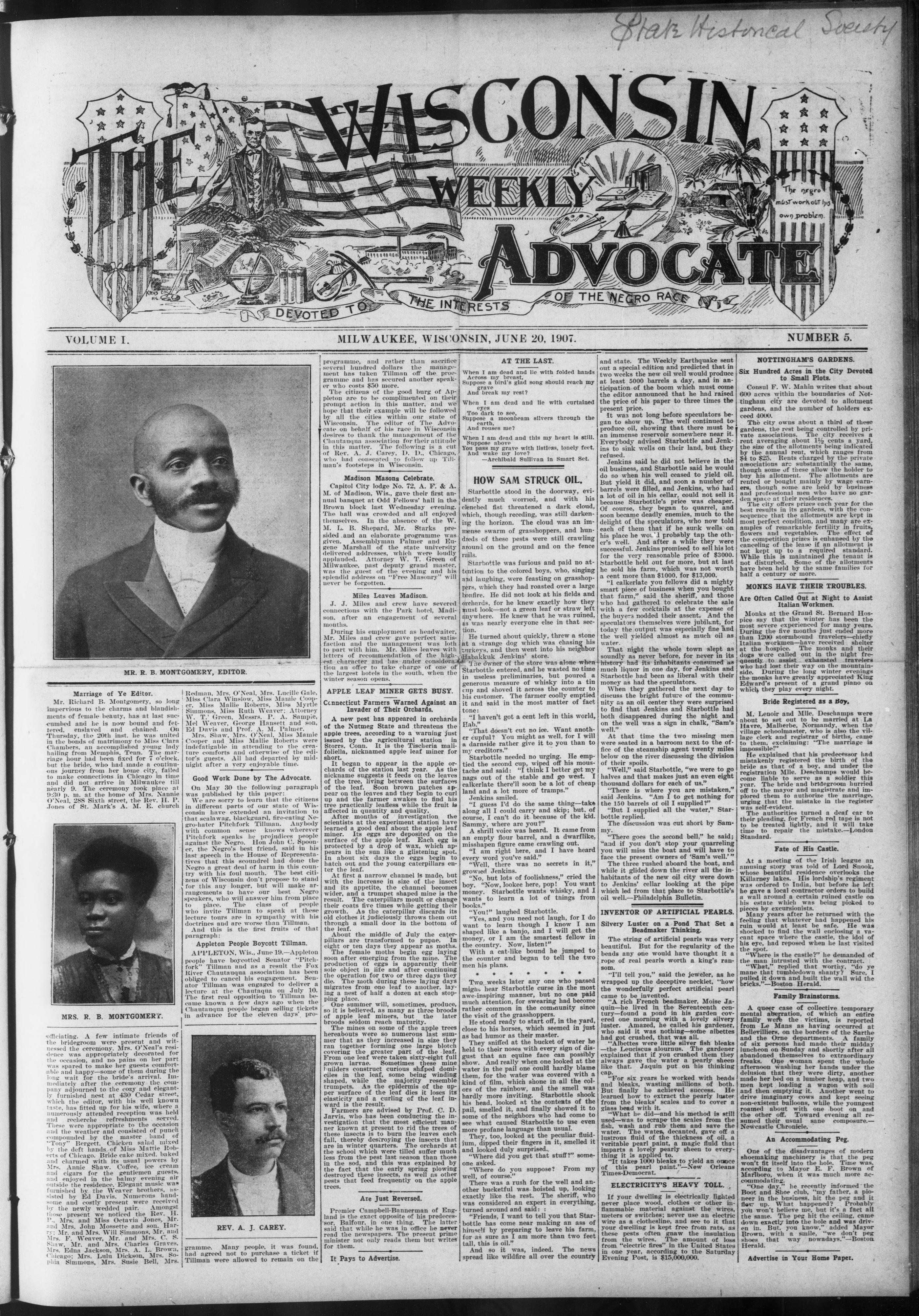
WISCONSIN
WEEKLY
ADVOCATE
DEVOTED TO THE INTERESTS OF THE NEGRO RACE
[Name not visible in the image]
MR. R. B. MONTGOMERY, EDITOR
Marriage of Ye Editor.
Mr. Richard B. Montgomery, so long impervious to the charms and blandishments of female beauty, has at last succumbed and he is now bound and fettered, enslaved and chained. On Thursday, the 20th inst. he was united in the bonds of matrimony to Miss Clara Chambers, an accomplished young lady hailing from Memphis, Tenn. The marriage hour had been fixed for 7 o'clock, but the bride, who had made a continuous journey from her home city, failed to make connections in Chicago in time and did not arrive in Milwaukee till nearly 9. The ceremony took place at 9:30 p. m. at the home of Mrs. Nannie O'Neal, 288 Sixth street, the Rev. H. P. Jones of St. Mark's A. M. E. church
[Picture of a woman with a large hairstyle, wearing a dark suit with a bow tie.]
MRS. R. B. MONTGOMERY.
officiating. A few intimate friends of the bridegroom were present and witnessed the ceremony. Mrs. O'Neal's residence was appropriately decorated for the occasion, and no pains on her part was spared to make her guests comfortable and happy—some of them during the long wait for the bride's arrival. Immediately after the ceremony the company adjourned to the cozy and elegantly furnished nest at 430 Cedar street, which the editor, with his well known taste, has fitted up for his wife, where a numerously attended reception was held and recherche refreshments served. These were appropriate to the occasion and the weather and consisted of punch compounded by the master hand of "Tony" Bergett. Chicken salad mixed by the deft hands of Miss Mattie Roberts of Chicago. Bride cake mixed, baked and charmed with its usual powers by Mrs. Annie Shaw. Coffee, ice cream and cigars for the gentlemen guests, and enjoyed in the balmy evening air outside the residence. Elegant music was furnished by the Weaver brothers, assisted by Ed Davis. Numerous handsome and costly present were received by the newly wedded pair. Amongst those present we noticed the Rev. H. P., Mrs. and Miss Octavia Jones, Mr. and Mrs. John Mossette and son, Harry; Mr. and Mrs. Will Simmons, Mr. and Mrs. F. Weaver, Mr. and Mrs. C. S. Shaw, Mr. and Mrs. Charles Graves, Mrs. Edna Jackson, Mrs. A. L. Brown, Chicago; Mrs. Lulu Dickson, Mrs. Sophia Simmons, Mrs. Susie Bell, Mrs.
---
VOLUME I.
Redman, Mrs. O'Neal, Mrs. Lucille Gale, Miss Clara Winslow, Miss Mamie Cooper, Miss Mallie Roberts, Miss Myrtle Simmons, Miss Ruth Weaver; Attorney W. T.' Green, Messrs. P. A. Sampie, Mel Weaver, George Hansett and son, Ed Davis and Prof. A. M. Palmer. Mrs. Shaw, Mrs. O'Neal, Miss Mamie Cooper and Miss Mallie Roberts were indefatigable in attending to the creature comforts and otherwise of the editor's guests. All had departed by midnight after a very enjoyable time.
Good Work Done by The Advocate.
On May 30 the following paragraph was published by this paper:
We are sorry to learn that the citizens in different parts of our state of Wisconsin have extended an invitation to that scalawag, blackguard, fire-eating Negro-hater Pitchfork Tillman. Anybody with common sense knows wherever Pitchfork speaks he prejudices people against the Negro. Hon John C. Spooner, the Negro's best friend, said in his last speech in the House of Representatives that this scoundrel had done the Negro a great deal of harm in this country with his foul mouth. The best citizens of Wisconsin don't propose to stand for this any longer, but will make arrangements to have our best Negro speakers, who will answer him from place to place. The class of people who invite Tillman to speak at these lecture tours are in sympathy with his doctrines and are worse than Tillman. And this is the first fruits of that
And this is the first fruits of that paragraph:
Appleton People Boycott Tillman
APPLETON, Wis., June 19.—Appleton people have boycotted Senator "Pitchfork" Tillman and as a result the Fox River Chautauqua association has been obliged to cancel his engagement. Senator Tillman was engaged to deliver a lecture at the Chautauqua on July 10. The first real opposition to Tillman became known a few days ago when the Chautauqua people began selling tickets in advance for the eleven days' pro-
J. B.
REV. A. J. CAREY.
gramme. Many people, it was found, had agreed not to purchase a ticket if Tillman were allowed to remain on the
MILWAUKEE, WISCONSIN, JUNE 20. 1907.
programme, and rather than sacrifice several hundred dollars the management has taken Tillman off the programme and has secured another speaker who costs $50 more. The citizens of the good burg of Appleton are to be complimented on their prompt action in this matter, and we hope that their example will be followed by all the cities within our state of Wisconsin. The editor of The Advocate on behalf of his race in Wisconsin desires to thank the management of the Chautauqua association for their attitude in this matter. The following is a cut of Rev. A. J. Carey, D. D., Chicago, who had consented to follow up Tillman's footsteps in Wisconsin.
Madison Masons Celebrate.
Capitol City lodge No. 72, A. F. & A. M. of Madison, Wis., gave their first annual banquet at Odd Fellows' hall in the Brown block last Wednesday evening. The hall was crowded and all enjoyed themselves. In the absence of the W. M. L. B. Shepard, Mr. Starks presided and an elaborate programme was given. Assemblyman Palmer and Eugene Marshall of the state university delivered addresses, which were loudly applauded. Attorney W. T. Green of Milwaukee, past deputy grand master, was the guest of the evening and his splendid address on "Free Masonry" will never be forgotten.
Miles Leaves Madison.
J. J. Miles and crew have severed connections with the Park hotel, Madison, after an engagement of several months. During his employment as headwaiter, Mr. Miles and crew gave perfect satisfaction and the management was loth to part with him. Mr. Miles leaves with letters of recommendation of the highest character and has under consideration an offer to take charge of one of the largest hotels in the south, when the winter season opens.
APPLE LEAF MINER GETS BUSY.
Connecticut Farmers Warned Against an Invader of Their Orchards.
A new pest has appeared in orchards of the Nutmeg State and threatens the apple trees, according to a warning just issued by the agricultural station in Storrs, Conn. It is the Tischeria malifoliella, nicknamed apple leaf miner for short. It began to appear in the apple orchards of the station last year. As the nickname suggests it feeds on the leaves of the tree, living between the surfaces of the leaf. Soon brown patches appear on the leaves and they begin to curl up and the farmer awakes to find his tree practically leafless while the fruit is affected in quantity and quality.
After months of investigation the scientists at the experiment station have learned a good deal about the apple leaf miner. Its eggs are deposited on the surface of the apple leaf. Each egg is protected by a drop of wax, which appears in the sun like a glistening spot. In about six days the eggs begin to hatch out and the young caterpillars enter the leaf. At first a narrow channel is made, but with the increase in size of the insect and its appetite, the channel becomes wider, and a trumpet shaped mine is the result. The caterpillars moult or change their coats five times while getting their growth. As the caterpillar discards its old clothes it judiciously throws them out through a small door in the bottom of the leaf.
About the middle of July the caterpillars are transformed to pupae. In eight or ten days they appear as moths. The female moths begin egg laying soon after emerging from the mine. The production of eggs is apparently their sole object in life and after continuing the operation for two or three days they die. The moth during these laying days migrates from one leaf to another, laying a nest of half a dozen at each stopping place. One summer will, sometimes, produce, so it is believed, as many as three broods of apple leaf miners, but the later broods seldom reach maturity.
The mines on some of the apple trees hereabouts were so numerous last summer that as they increased in size they ran together forming one large blotch covering the greater part of the leaf. From one leaf were taken sixty-eight full grown larvae. Sometimes these mine builders construct curious shaped domiciles in the leaf, some being winding shaped, while the majority resemble trumpets. As the epidermis of the upper surface of the leaf dies it loses its elasticity and a curling of the leaf inward is the result.
Farmers are advised by Prof. C. D. Jarvis, who has been conducting the investigation that the most efficient manner known at present to rid the trees of these insects is to burn the leaves each fall, thereby destroying the insects that are in winter quarters. The orchards at the school which were tilled suffer much less from the pest last season than those in the sod, and this was explained by the fact that the early spring plowing destroyed these insects, as well as other pests that feed frequently on the apple trees.
Are Just Reversed.
Premier Campbell-Bannerman of England is the exact opposite of his predecessor, Balfour, in one thing. The latter said that while he was in office he never read the newspapers. The present prime minister not only reads them but writes for them.
It Pays to Advertise.
AT THE LAST.
When I am dead and lie with folded hands
Across my breast,
Suppose a bird's glad song should reach my
grave
And break my rest?
When I am dead and lie with curtained
eyes
Too dark to see,
Suppose a moonbeam silvers through the
earth,
And rouses me?
When I am dead and this my heart is still.
Suppose above
You pass my grave with listless, lonely feet.
You pass my grave with listless, lonely feet And wake my love? —Archibald Sullivan in Smart Set.
HOW SAM STRUCK OIL.
Starbottle stood in the doorway, evidently much worried, and with his clenched fist threatened a dark cloud, which, though receding, was still darkening the horizon. The cloud was an immense swarm of grasshoppers, and hundreds of these pests were still crawling around on the ground and on the fence rails.
Starbottle was furious and paid no attention to the colored boys, who, singing and laughing, were feasting on grasshoppers, which they had roasted over a large bonfire. He did not look at his fields and orchards, for he knew exactly how they must look—not a green leaf or straw left anywhere. He knew that he was ruined, as was nearly everyone else in that section.
He turned about quickly, threw a stone at a strange dog which was chasing his turkeys, and then went into his neighbor Habakkuk Jenkins' store.
The owner of the store was alone when Starbottle entered, and he wasted no time in useless preliminaries, but poured a generous measure of whisky into a tin cup and shoved it across the counter to his customer. The farmer coolly emptied it and said in the most matter of fact tone:
"I haven't got a cent left in this world, Hab."
"That doesn't cut no ice. Want another cupful? You might as well, for I will a darnside rather give it to you than to my creditors."
Starbottle needed no urging. He emptied the second cup, wiped off his moustache and said: "I think I better get my nags out of the stable and go west. I calkerlate there'll soon be a lot of cheap land and a lot more of tramps."
Jenkins smiled.
"I guess I'd do the same thing—take along all I could carry and skip; but, of course, I can't do it because of the kid. Sammy, where are you?"
A shrill voice was heard. It came from an empty flour barrel, and a dwarflike, misshapen figure came crawling out.
"I am right here, and I have heard every word you've said."
"Well, there was no secrets in it," growied Jenkins.
"No, but lots of foolishness," cried the boy. "Now, lookee here, pop! You want money. Starbottle wants whisky, and I wants to learn a lot of things from books."
"You!" laughed Starbottle.
"You! laughed Starbottle.
"Yes, and you need not laugh, for I do want to learn though I know I am shaped like a banjo, and I will get the money, or I am the smartest fellow in the country. Now, listen!"
With a cat-like bound he jumped to the counter and began to tell the two men his plans.
* * * * * * * * *
Two weeks later any one who passed might hear Starbottle curse in the most awe-inspiring manner, but no one paid much attention, for swearing had become rather common in the community since the visit of the grasshoppers.
He stood ready to start off, in the yard, close to his horses, which seemed in just as bad humor as their master.
They sniffed at the bucket of water he held to their noses with every sign of disgust that an equine face can possibly show. And really when one looked at the water in the pail one could hardly blame them, for the water was covered with a kind of film, which shone in all the colors of the rainbow, and the smell was hardly more inviting. Starbottle shook his head, looked at the contents of the pail, smelled it, and finally showed it to some of the neighbors who had come to see what caused Starbottle to use even more profane language than usual.
They, too, looked at the peculiar fluidium, dipped their fingers in it, smelled it and looked duly surprised.
"Where did you get that stuff?" someone asked.
"Where do you suppose? From my well, of course."
There was a rush for the well and another bucketful was hoisted up, looking exactly like the rest. The sheriff, who was considered an expert in everything, turned around and said: :
"Friends, I want to tell you that Starbottle has come near making an ass of himself by preparing to leave his farm, for as sure as I am more than two feet tall, this is oil."
And so it was, indeed. The news spread like wildfire all over the country
and state. The Weekly Earthquake sent out a special edition and predicted that in two weeks the new oil well would produce at least 5000 barrels a day, and in anticipation of the boom which must come the editor announced that he had raised the price of his paper to three times the present price. It was not long before speculators began to show up. The well continued to produce oil, showing that there must be an immense reservoir somewhere near it. Everybody advised Starbottle and Jenkins to sink wells on their land, but they refused.
Jenkins said he did not believe in the oil business, and Starbottle said he would do so when his well ceased to yield oil. But yield it did, and soon a number of barrels were filled, and Jenkins, who had a lot of oil in his cellar, could not sell it because Starbottle's price was cheaper. Of course, they began to quarrel, and soon became deadly enemies, much to the delight of the speculators, who now told each of them that if he sunk wells on his place he would probably tap the other's well. And after a while they were successful. Jenkins promised to sell his lot for the very reasonable price of $3000. Starbottle held out for more, but at last he sold his farm, which was not worth a cent more than $1000, for $13,000.
"I calkerlate you fellows did a mighty smart piece of business when you bought that farm," said the sheriff, and those who had gathered to celebrate the sale with a few cocktails at the expense of the buyers nodded their assent. And the speculators themselves were jubilant, for today the output was especially fine and the well yielded almost as much oil as water. That night the whole town slept as soundly as never before, for never in its history had its inhabitants consumed as much liquor in one day, for Jenkins and Starbottle had been as liberal with their money as had the speculators.
When they gathered the next day to discuss the bright future of the community as an oil center they were surprised to find that Jenkins and Starbottle had both disappeared during the night and on the well was a sign in chalk, "Sam's well."
At that time the two missing men were seated in a barroom next to the office of the steamship agent twenty miles below on the river discussing the division of their spoils.
"Well," said Starbottle, "we were to go halves and that makes just an even eight thousand dollars for each of us."
"There is where you are mistaken," said Jenkins. "Am I to get nothing for the 150 barrels of oil I supplied?"
"But I supplied all the water," Starbottle replied.
The discussion was cut short by Sammy. "There goes the second bell," he said; "and if you don't stop your quarreling you will miss the boat and will have to face the present owners of 'Sam's well.'" The three rushed aboard the boat, and while it glided down the river all the inhabitants of the new oil city were down to Jenkins' cellar looking at the pipe which led from that place to Starbottle's oil well.—Philadelphia Bulletin.
INVENTOR OF ARTIFICIAL PEARLS
Silvery Luster on a Pond That Set a Beadmaker Thinking.
The string of artificial pearls was very beautiful. But for the regularity of the beads any one would have thought it a rope of real pearls worth a king's ransom.
"I'll tell you," said the jeweler, as he wrapped up the deceptive necklet, "how the wonderfully perfect artificial pearl came to be invented.
"A rich French beadmaker, Moise Jaquin—he lived in the Seventeenth century—found a pond in his garden covered one morning with a lovely silvery luster. Amazed, he called his gardener, who said it was nothing—some albettes had got crushed, that was all.
"Albettes were little silver fish bleaks—the Leuciscus alournus. The gardener explained that if you crushed them they always gave the water a pearly sheen like that. Jaquin put on his thinking cap.
"For six years he worked with beads and bleaks, wasting millions of both. But finally he achieved success. He learned how to extract the pearly luster from the bleaks' scales and to cover a glass bead with it.
"What he did—and his method is still used—was to scrape the scales from the fish, wash and rub them and save the water. The water, decanted, gave off a lustrous fluid of the thickness of oil, a veritable pearl paint, a magic fluid that imparts a lovely pearly sheen to everything it is applied to.
"It takes 1000 bleaks to yield an ounce of this pearl paint."—New Orleans Times-Democrat.
ELECTRICITY'S HEAVY TOLL.
If your dwelling is electrically lighted never place wood, clothes or other inflammable material against the wires, meters or switches; never use an electric wire as a clothesline, and see to it that your dwelling is kept free from rats, as these pests often gnaw the insulation from the wires. The amount of loss from "electric fires" in the United States in one year, according to the Saturday Evening Post, is $15,000,000.
NOTTINGHAM'S GARDENS.
Six Hundred Acres in the City Devoted to Small Plots.
Consul F. W. Mahin writes that about 600 acres within the boundaries of Nottingham city are devoted to allotment gardens, and the number of holders exceed 4000. The city owns about a third of these gardens, the rest being controlled by private associations. The city receives a rent averaging about $1½ cents a yard, the size of the allotments being indicated by the annual rent, which ranges from $4 to $25. Rents charged by the private associations are substantially the same, though some of these allow the holder to buy his allotment. The allotments are rented or bought mainly by wage earners, though some are held by business and professional men who have no garden space at their residences.
The city offers prizes each year for the best results in its gardens, with the consequence that the allotments are kept in most perfect condition, and many are examples of remarkable fertility in fruits, flowers and vegetables. The effect of the competition prizes is enhanced by the canceling of the lease if an allotment is not kept up to a required standard. While this is maintained the tenant is not disturbed. Some of the allotments have been held by the same families for half a century or more.
MONKS HAVE THEIR TROUBLES.
Are Often Called Out at Night to Assist Italian Workmen.
Monks at the Grand St. Bernard Hospice say that the winter has been the most severe experienced for many years. During the five months just ended more than 1200 stormbound travelers—chiefly Italian workmen—have received shelter at the hospice. The monks and their dogs were called out in the night frequently to assist exhansted travelers who had lost their way on the mountainside. During the long winter evenings the monks have greatly appreciated King Edward's present of a grand piano on which they play every night.
Bride Registered as a Boy.
M. Lenoir and Mlle. Deschamps were about to set out to be married at La Havre, Malherbe, Normandy, when the village schoolmaster, who is also the village clerk and registrar of births, came to them, exclaiming: "The marriage is impossible!"
He explained that his predecessor had mistakenly registered the birth of the bride as that of a boy, and under the registration Mlle. Deschamps would become liable to serve as a soldier this year. The bride and bridegroom hurried off to the mayor and magistrate and implored them to authorize the marriage, urging that the mistake in the register was self-evident.
The authorities turned a deaf ear to their pleading, for French red tape is not to be treated lightly, and it will take time to repair the mistake.—London Standard.
Fate of His Castle
At a meeting of the Irish league an amusing story was told of Lord Snook, whose beautiful residence overlooks the Killarney lakes. His lordship's regiment was ordered to India, but before he left he gave a local contractor orders to build a wall around a certain ruined castle on his estate which was being picked to pieces by excursionists.
Many years after he returned with the feeling that whatever had happened his ruin would at least be safe. He was shocked to find the wall enclosing a vacant space where the castle, the idol of his eye, had reposed when he last visited the spot.
"Where is the castle?" he demanded of the man intrusted with the contract.
"What," replied that worthy, "do ye mane that tumbledown shanty? Sure, I pulled it down and built the wall wid the bricks."—Boston Herald.
Family Brainstorms.
A queer case of collective temporary mental aberration, of which an entire family were the victims, is reported from Le Mans as having occurred at Bellevilliers, on the borders of the Sarthe and the Orne departments. A family of six persons had made their midday luncheon on Sunday and shortly after all abandoned themselves to extraordinary freaks. One woman spent the whole afternoon washing her hands under the delusion that they were dirty, another made her bed on a lumber heap, and two men kept loading a wagon with soil and then emptying it. Another went to drive imaginary cows and kept seeing non-existent balloons, while the youngest roamed about with one boot on and the other off. Toward evening all resumed their usual sane composure.—Newcastle Chronicle.
An Accommodating Peg.
One of the disadvantages of modern shoemaking machinery is that the peg won't fit itself into the hole. Time was, according to Mayor E. F. Brown of Marlboro, when it was much more accommodating.
"One day," he recently informed the Boot and Shoe club, "my father, a pioneer in the business, hit the peg and it flow up. What happened? Probably you won't believe me, but it's a fact all the same. The peg hit the ceiling, came down exactly into the hole and was driven in. But, you know," added Mayor Brown, with a smile, "we don't peg shoes that way nowadays."—Boston Herald.
Advertise in Your Home Paper.
THE WISGONSIN WEEKLY ADVOCATE
MILWAUKEE, WIS.
B. B. MONTGOMERY, Editor and Proprietor.
Facts and Fancies.
There are but two opinions upon any subject; ours, and the wrong one.—Fliegende Blaetter.
Only when one has children of his own to bring up does he realize how badly brought up he himself is.—Fliegende Blaetter.
Mistress of the House—Next week we are to give a ball.
Maid—Could you not postpone it for a little, ma'am? I should like to learn how to waltz.—Meggendorfer Blaetter.
A great man was complaining of all the charities to which he was forced to contribute.
"I give without counting," he groaned.
"Yes, but not without recounting," replied a friend.—Le Figaro.
Young Husband—When my wife first began to do her own cooking we were having company every day; tiresome relatives, colleagues, so-called friends. Gradually they all dropped off, and then we engaged a good cook.—Fliegende Blaetter.
How Cynical!
Of course it is possible for a man to be honest and yet be a multi-millionaire. His father may have made the money.— Somerville Journal.
A. Good Motive
"How is it that you go to the Prohibition meetings?"
"It gives me a wonderful thirst!"- Meggendorfer Blaetter.
The Intelligent Child
Little Girl (after a domestic scene with her mother)—The best thing for us to do, mamma, is to agree to a separation.—Meggendorfer Blaetter.
No Delay.
"So they were married in haste. Repented at leisure, I suppose."
"Gracious, no. They did that in a hurry too."—Philadelphia Ledger.
No Delay
A Lcng Shot.
Patient—What does it mean by being married at "high noon?" Do you know? Patrice—Oh, yes; it means taking a 12 to 1 chance. Yonkers Statesman.
Quite Necessary.
Don't blame the barber if he talks While razoring your skin Just think, how could he shave a man Without a little chin?
Striking Fame.
"Your last book, madame, had a colossal success."
"I should say so! Every one of my three divorced husbands wanted to remarry me!"—Fliegende Blaetter.
Astute Youth.
"May I kiss you, mademoiselle?
"No, the kiss is a propagator of microbes."
"Then give it to me, I am not afraid of microbes."—Il Motto per Ridere.
Cause of the Exodus
"Hello, George! What's everybody crowding out of the drawing room for? Have refreshments been announced?" George—No; but Aunt Matilda is getting ready to sing—London Tit-Bits.
Argument
"Mamma, am I to have a new doll?"
"Your old doll is still quite good, my child."
"But I, too, am quite good, and yet you have a new baby!"—Fliegende Blaetter.
She—But she lets him think he is having his own way.
He—Well, that is something. Some women won't even let a man pretend to think he is having his own way.—Brooklyn Life.
A Proper Feeling for Style.
Uncle—Here, my boy, are a couple of chocolate cigars. But where are you going with them?
Little Johnny—Why, I am going to eat them in the smoking room.—Meggendorfer Blaetter.
Too Late.
"Here are the thousand franes that you lent me last year."
"Oh, yes! I had almost forgotten them."
"Why did you not tell me that sooner?"—Il Motto per Ridere.
A Way Out of Trouble
"Are you not afraid to have such bad reports at school. Karl?"
reports at school, Karl?"
"Oh, no! I call papa up on the telephone first, and give him the figures, and then before I get home he is all over his anger."—Fliegende Blaetter.
A Modern Heart.
"Do you see that lady over there? She broke my cousin's heart!"
"Was she so cruel?"
"No, but the day before he broke off his engagement to her she inherited 200,-000 marks."—Fliegende Blaetter.
Tickled by the Poet.
"Indians, you know," said the widely read man, "are very stoical. They're never known to laugh." "O! I don't know," replied the flippant person. "The poet Longfellow made Minne-haha."—Philadelphia Press.
When the Gang Left
"Why couldn't our foreign friend hold his audience?"
"On account of his pronunciation." "His pronunciation?" "Yes; he began talking about our beer less leader."—Washington Herald.
Too Severe a Test.
"He says I am the only girl he ever loved." said the sentimental miss.
loved," said the sentimental miss.
"Well," answered Miss Cayenne, "perhaps he means it. Don't insist on knowing whether you are the only girl to whom he has made the same remark."—Washington Star.
Too Good to Be True.
Beneath this stone,
Oh, stranger, note;
Now lies the man
Who rocked the boat.
—Detroit Free Press.
Hurrah!—But no,
This cannot be,
That idot lives
Eternally.
Cleveland Leader.
THE GARDEN OF IREM
Ye know Sheddad, the son of Ad,
Who in the desert's dusty space,
A sudden wondrous vision had
Of Al Jannat—the holy place,
And how its beauty drove him mad.
So that the splendor, many walled,
He strove to copy in the plain;
And Irem's Garden there installed,
That made the waste to flower again,
Saffron and musk and emerald.
But Allah saw; his mighty frown
Upon its domes and walls he cast;
And sent the rains of heaven to drown,
And all the winds of heaven to blast,
So that its towers went toppling down.
THE MANAGER.
"Did you see the old tyrant look at me this morning!" snapped the little blonde girl at the ribbon counter. "I thought he'd take my head off."
"Well, you shouldn't talk about your steadies during business hours," laughed a lace counter girl. "You're expected to have your mind strictly on business and do your little best to promote the interests of the firm, don't you know?"
"Oh, bother the firm. The firm is nothing to me. I'm working for the best interests of Susie Gibbons, and don't let anybody forget it. Besides, that hateful Venner had no business to come snooping around just when I was talking confidential matters. Don't you think so, Ethel?"
"I think he's horrid," her counter mate responded. "He always looks like a meat ax."
"Who'd ever want to marry him?"
"Oh, I don't know. He might be tamed."
"Why don't you take the job, Kitty?"
Whereat they giggled and trooped down the aisle to the big front door.
A moment later a man emerged from behind the new partition. It was John Venner, the manager of the great store. A faint smile hovered about his lips.
What's the old proverb about listeners?" he muttered. "It is quite evident that I do not hold a desirable place in the good graces of these young women. I'm sorry I overheard their talk. I would have showed myself, but I couldn't very well after they had fired their broadside. I'm a hard man all right, but I've never to my knowledge done any man or woman an injustice. Who was the girl that stood up for me? She called me a gentleman. Her name is Alice and she is a newcomer. I wonder if they were right when they said she would learn to hate me as the others do? None of them seem to realize that I am but a steward here."
Alice Landon's duties were not exacting and she soon learned to make herself useful. There were little annoyances now and then, but they did not discourage her. One day, however, a more serious dispute arose over a sale that Alice had made, and the purchaser, a matron of commanding and somewhat offensive manners, emphatically declared that a certain piece of lace she had purchased was damaged when it left the counter. Alice remembered the sale very well and knew that the woman was mistaken. Consequently, she held her ground, and the woman departed vowing to obtain satisfaction from the management.
A little later Alice was summoned by a boy to come to the manager's office. She found the manager there and the irascible matron.
"Miss Landon," said the manager in his measured tones, "you understand the claim made by Mrs. Harrington. Let me hear your story."
She told it in as few words as possible.
"You may go. Miss Landon."
Then a voice greeted her. It was that of the manager.
"Let my umbrella and myself accompany you to your car," he said, and fell into step beside her.
"I think I owe you a little explanation," he presently added. "Perhaps Mrs. Harrington's thoughtless remark annoyed you, but you should remember she was very angry and very unreasonable when she made it. She went away threatening me with the loss of her custom, and promising to write a full explanation of the matter to Miss Carmichael."
"The owner of our store, and my respected employer. She is now in Switzerland, I believe. I have never seen her. Perhaps she may conclude to dispense with my services when she views Mrs Harrington's letter."
"Oh, that would be too bad."
"Thank you. But I'm not very much alarmed. In fact, I have a tempting offer from a man of means to enter into a partnership with him. I believe I need a change. I've no doubt I am rapidly becoming a mere machine. I am 32 years old and all I know is business, business, nothing but business."
He spoke a little bitterly, but his face quickly cleared as he caught the girl's gaze.
"They say you have been very successful," she said. "Will you let me know if you hear from Miss Carmichael on this subject?"
"Why, yes, I will," he answered.
"This is my car," said the girl. "Thank you, and good-night."
Two days later Alice Landon went to the stockroom on the eleventh floor. When she had found the goods she wanted she started to return. As the elevator descended she stood close to the boy. It was a swift and noiseless car. Her gaze was directed downward. As the car reached the second floor the boy slackened its speed a little. Then the girl, leaning forward, saw the back of a man close to the elevator shaft on the floor below. He evidently had opened the iron gate and was looking into the basement. With a quick and firm grasp she caught at the rope and checked the car just in time to prevent its knocking the man into the opening.
He drew back and stood there as the car slowly settled at the floor level. The man was John Venner. The girl's white face scared him more than his recent danger. "Thank you, Miss Landon," said John Venner. "I'm sorry you were startled. I was doing just what I've cautioned the
help a hundred times not to do. Are— are you all right now?"
"You were very careless," the girl responded. "Good managers owe it to their employes not to take such risks."
"I hadn't thought of it in that light," he laughed. "I'll promise to be more considerate."
Every afternoon thereafter he walked with the girl to the car, and strange to say, his attentions were not noted by the other clerks, a fact for which the girl was profoundly thankful.
And then one morning a messenger summoned her to the manager's private office.
He was there alone.
"I have heard from Miss Carmichael," he said. "I received a letter this morning through her lawyer here. It is a strange letter. I can't quite understand it." "And what does she say about the Harrington matter?"
"She touches on it very lightly. She says she has entire confidence in my discretion. But here is what puzzles me. She offers me an interest in the concern with an increased salary on two conditions. One is that I must give up all idea of severing my connection with the house, no matter how alluring the chance to begin business for myself may seem. And the other condition is that I drop the business and go abroad for three months—the house paying all my expenses." There was a brief pause.
There was a brief pause. "And what is to be your decision?" He drew a quick breath. "What do you advise me to do?" he asked. "I—I have great confidence in your judgment." "Thank you," said the girl. "Then my advice to you is to please Miss Carmichael. By pleasing her you will please me." "Then that's settled," he said. "But wait. About this trip abroad." His voice shook a little. "Miss Landon," he said, "I am painfully conscious of all my defects. I know I am presumptuous in daring to hope that you may see in me qualities that raise me in your estimation. I don't believe I have either the desire or courage to take that trip alone. Will you go with me as my wife?"
She did not answer him for a moment. "Your price seems pretty high," she presently said. "An interest in the business, an increased salary, and now me." "It is you alone I care for," he murmured. "If it is the only way of keeping you here, my dear manager," she said, "I must say yes." He caught her hands in his. "I didn't dream I could be so happy," he cried. "I am afraid you are a very obtuse person," she presently said.
"No doubt of that," he answered.
"Otherwise you would have discovered that a certain young woman in whom you have a keen interest was masquerading in one of your departments, finding out something about her big store and a great deal about her manager."
"What!" he cried. "You!"
"I am Alice Langdon Carmichael."
"I never dreamt it!" he said with a little gasp. "And you are going to marry me?"
"I am going to make sure of an excellent manager."
He looked at her in silent admiration. "Do you know what drew me to you at first?" he said. "It was having you say a kind word in my behalf. I overheard you—I happened to be behind the partition."
Her eyes danced. "Yes," she demurely said. "I happened to know you were there."—W. R. Rose in the Cleveland Plain Dealer.
HORSES WORKED TO DEATH.
Rebuilding of San Francisco Kills Thousands of Them.
The horse is having his day in San Francisco even though the day must inevitably close with his death. The cry of the California metropolis today is not for sympathy, not for money, but for horses, horses—and more horses! Into the foundations of the new city is going the life blood of 15,000 superb horses, says Harper's Weekly. Deliberately 15,000 draught horses are being worked to death.
Removal of debris and hauling of material are jobs let by contract. The contracts have all sorts of premiums for time saved. The contractor reaps the premium by driving his horses to death. Half an hour's walk from Market and Kearny streets at any hour of the day will lead you to a dead horse—dead in the harness—worked to death. The vans that carry off carcasses are busier than the vans which carry drunken men to jail.
And the men whose business it is to bring in new horses to replace those who go out in the struggle are growing more and more desperate. The California corrals and the Oregon and Nevada ranches have been depleted of their surplus, and now the ranges of Montana and the states farther eastward are being called upon to yield horses and more horses.
There is no fine quibbling over the price. The horses must be had. They are shipped to the San Francisco horse market, which, after the arrival of a fresh consignment, looks like a bull day in Wall street. There are 7000 debris teams in the city now, but these 14,000 horses are insufficient for the task, and it is believed that 3000 more teams will be added to the force before summer comes.
Encouraging
Over in the Salmon River Meadows Country, in Idaho, ranged a wild and woolly bunch of long-haired cow-punchers, whose knowledge of the world was confined mainly to trips after cattle into surrounding counties. Into this reckless but verdant community there came the smooth-tongued representative of a Wild West show, who hired several riders at a high salary to do a hair-raising act, the chief feature being that they should appear to be thrown from their horses and dragged by the foot.
After they had practiced in a corral for awhile, one of them loosened himself, and, rising from the dirt, dishevelled and dazed, inquired:
"Say, mister, ain't this ruther dangerous? We might git killed."
"That's all right," chirped the show's representative cheerfully. "Your salary will go on just the same."—Lippincott's.
How Lincoln Managed Stanton
To expressions of a natural impatience Mr. Lincoln opposed a placid front. More than that, he was placid. He knew Secretary Stanton's intense, irritable nature. He knew how the excitement of the time tried men's tempers and shattered their nerves. He himself, apparently, was the only one who was not to be allowed the indulgence of giving way. So Mr. Stanton's indignations passed unnoticed. The two men were often at variance when it came to matters of discipline in the army. On one occasion, I have heard.
Secretary Stanton was particularly angry with one of the generals. He was eloquent about him. "I would like to tell him what I think of him!" he stormed. "Why don't you?" Mr. Lincoln agreed. "Write it all down—do." Mr. Stanton wrote his letter. When it was finished he took it to the President. The President listened to it all. "All right. Capital!" he nodded. "And now, Stanton, what are you going to do with it?"
"Do with it? Why, send it, of course!" "I wouldn't," said the President. "Throw it in the waste-paper basket."— Col. W. H. Crook, in Harper's.
SMALL HOUSEHOLD REPAIRS
Under the Bureau.—Sometimes the castors of a heavy bureau become broken or they refuse to move without disfiguring the floor. In such a case dirt need not accumulate under it, for the lower drawer can be lifted out and a short-handled brush used to take out whatever is beneath.
To Clean Galvanized Iron.—Galvanized iron tubs, pails and other utensils formerly made of wood are now found in every kitchen. They often lose their brightness and become dingy and unclean because they are neglected. To clean them scrub well with a solution of hot vinegar and soda. Let stand five or ten minutes, then wash in strong soap and water and finally rinse well and wipe dry, when they should be like new.
For Cleaning the Hands.—Sometimes it seems impossible to keep the hands clean without using so much soap that the skin is roughened and chapped. To remove the grime which comes from clerical work, a typewriter, or from housework, use cornmeal or almond meal exactly as if it were a cake of soap. Moisten the hands slightly, then rub on the meal and rub the hands together. The particles of meal will collect the dirt and fall off in tiny black rolls, leaving the hands soft and clean. Keep one or the other kind ready to use in cold weather.
A New Pine Floor.—First remove all dust from the new boards, then apply hot boiled linseed oil with a broad paint brush, rubbing back and forth with the grain of the wood. Shut the room up for half a day or over night, then rub with a weighted brush covered with old flannel until it shines. The oil will darken the floor somewhat and give it a rich color. Once in a while the floor will need redressing and the frequency will be governed by the amount of wear given to the room. Mix two-thirds boiled oil and one-third turpentine and apply in a thin coat, allowing the room to dry twenty-four hours if possible.
Paper Hangers' Paste.—For a medium-sized room take three quarts of sifted bread flour, which makes better paste than pastry flour. Rub it perfectly smooth in cold water, adding one and one-half ounces of powdered alum. The mixture should be a stiff, smooth batter, now pour on enough boiling water to make of the consistency a thick cream. Stir constantly and as soon as the paste looks clear it is ready to use. The inexperienced may find it difficult to make the batter and paste perfectly smooth and in that case it must be strained, because a very small lump will show under wall paper. If the paper is thin have the paste thinner than for heavy paper.
Old Blankets.—One of the first places to show wear in a blanket is along the edge, which will begin to split into a coarse fringe. Keeping blankets well bound with inch wide ribbon will prevent this. Unless some accident happens to a blanket patching is not resorted to until it is very old, then a piece from another blanket may be laid on large enough to cover the worn place and held in place by darning rather than seaming. All thin places can be fortified by darning with ravelings from an old blanket. When the blanket is worn past repair just double it and quilt together here and there and lay it across the mattress under the sheet and it will continue to be a comfort.
THE GENTLE CYNIC
The root of all evil seems to thrive in any soil.
The cost of experience is generally money well invested.
We are constantly adding wings to our castles in the air.
A girl doesn't need a fountain pen to write a gushing letter.
Small boys are divided into two classes—the bad ones and the dead ones.
A man doesn't necessarily have to marry in haste to repent at leisure.
You couldn't broaden out some men by running over them with a steam roller.
A man convinced against his will will have to be convinced all over again the next time you meet him.
When a girl refuses a fellow and he doesn't go to the bad it is a bitter blow to her pride.
A pessimist is merely a man who expects to get the worst of it sooner than the rest of us.
The pure food people should get onto the fact that most of the love is adulterated with filthy lucer.
Don't worry about what the world thinks of you. The world has several billions of people to think about.
Some men seem to think that as long as they keep out of jail they have a pretty good chance of getting to heaven.
The insurance people don't seem a bit worried over the young man who feels that he is destined to set the world on fire.—New York Times.
No Intent to Kill
The most popular man in a Nevada town got into difficulty with a direputable tough—for a long time the terror of the place—and proceeded to "do him up" in a manner entirely satisfactory to the community at large. It becoming necessary, however, to vindicate the majesty of the law, the offender was brought up for trial on the charge of assault with intent to kill. When the jury had been out about two minutes they returned.
"Well, gentlemen of the jury," asked the judge in a familiar, offhand way, "what have you to say?"
"If it pleases the court," responded the foreman, "we the jury, find that the prisoner is not guilty of strikin' with intent to kill, but simply to paralyze and he done it."—Philadelphia Public Ledger.
Pays to Advertise.
RELIABLE RECEIPTS.
Rye Breakfast Cakes.—Beat one egg light, add one-half cup of sugar, two cups of milk. a saltspoon of salt, one and one-half cups of rye meal, one and one-half cups of flour, and three level teaspoons of baking powder. Bake in a hot greased gem pan.
Chocolate Cake.—Cream one cup of butter, add two cups of sugar, the yolks of five eggs and the whites of three, seven-eighths cup of milk and three cups of flour sifted with four level teaspoons of baking powder. Bake in two long, shallow pans and cover with a chocolate icing.
For the silver cake cream one-third cup of butter, add one cup of sugar, two and one-quarter cups of flour sifted with two and one-half level teaspoons of baking powder sifted in it, one-half cup of milk, the whites of four eggs beaten stiff and dry, and one-half teaspoon of almond flavoring.
Pulled Bread.—Put a loaf of bakers' bread between two pans. Let it heat through in a moderate oven, then tear with a fork into ragged pieces; spread on a pan and set in the oven to brown. Serve at once while hot and crisp. Serve pulled bread instead of crackers with the cheese course and it is also good with salad.
Variety Cake.—Cream one cup of butter, add two cups of sugar and beat. Add the yolks of five eggs beaten until light colored, one cup of milk, three and one-half cups of flour sifted with five level teaspoons of baking powder. Flavor with a teaspoon of any flavoring preferred and fold in the stiffly beaten whites of three eggs.
Gold and Silver Cake.—For the gold cake cream one-half cup of butter, add one cup of sugar and beat the yolks of four eggs until light. Add one-half cup of milk and two cups of flour sifted with two and one-half level teaspoons of baking powder. Flavor with one teaspoon of lemon or vanilla. The yolks should be beaten at least five minutes.
Ginger Pears.—Allow five pounds of sugar to seven pounds of pears. Soak one ounce of green ginger over night in two eups of water. Peel the pears and cut in small pieces. Make a syrup of the sugar and the water in which the ginger was soaked and the ginger cut in small pieces. Add the sliced pear, cook slowly four hours, when the syrup should be dark and rich.
Steamed Apple Pudding.—Sift together two cups of flour, four level teaspoons of baking powder and a saltspoon of salt. Cream three slightly rounding tablespoons of butter with two tablespoons of sugar, add two eggs beaten, then the flour and last one cup of milk. Stir in two cups of thinly sliced apple, turn into a buttered mold and steam one and one-half hours. Serve with a liquid sauce.
Chicken Chartreuse.—Chep cold cooked chicken fine and season with one-half tablespoon of tomato catsup and one beaten egg to each cup of chicken. Butter a pudding dish or mold and line the bottom and sides thickly with boiled rice. Fill with the seasoned chicken and cover the top with rice. Put on the cover of the mold and steam three-quarters of an hour. Turn on to a serving dish and pour a tomato sauce round.
Chickens' Livers.—Cut one slice of bacon into small pieces, add to it two level tablespoons of butter and cook five minutes. Add a slice of onion cut fine and fry until yellow. Cut six chickens' livers into two pieces eacn and fry in the onion and butter for three minutes, add a level tablespoon of flour, one cup of stock, a tablespoon of lemon juice and salt and pepper for seasoning. Cook five minutes after it simmers and add a little chopped parsley.
Scalloped Chowder.—Fry three slices of salt pork, add two quarts of water, six potatoes pared and sliced, and three medium sized onions sliced. Season with salt and pepper and cook until the vegetables are nearly tender. Put in one cup of stewed or canned tomatoes, a rounding tablespoon of flour rubbed smooth in a little milk, and one cup of scallops. Cook ten minutes, add one quart of hot milk, and let the chowder come to the boiling point. Serve with crackers.
Fried Scallops.—Blanch the scallops by allowing them to stand five minutes in water just under the boiling point. Drain and roll in a towel to dry, then set away to cool. Make a batter from the well beaten yolks of two eggs, one-half cup of cold water, one cup of flour, a saltspoon of salt and one tablespoon of olive oil. Let this batter stand one or two hours, then stir in the stiffly beaten whites of two eggs. Dredge the scallops lightly with salt and pepper, dip in the batter, fry in hot deep fat and drain.
Lemon Meringue.—Rub two level tablespoons of cornstarch smooth in a little cold water and pour into one cup of boiling water. Stir and cook until smooth. Add the juice and grated yellow rind of one lemon, and one cup of granulated sugar beateen with the yolks of two eggs. When thick and smooth pour into small baked pastry shells. Cool and put on each a spoonful of meringue made from the whites of two eggs beaten with one-quarter cup of powdered sugar until stiff. Set the shells on a tin and in a moderate oven to brown slightly.
Apple Sponge Pudding.—Measure one cup of sifted pastry flour and sift it with two level teaspoons of baking powder. Beat the yolks of three eggs until light colored, add one cup of sugar and the juice of one lemon, which will be about two tablespoons. Fold in the stiffly beaten whites of the three eggs and then the flour. Spread the batter thinly on a large shallow pan and bake about twenty minutes in a moderate oven. Turn out of the pan, trim off any hard edges, spread with stewed sweetened and flavored apples, and roll up at once like a jelly roll. Serve with a liquid sauce or a syrup made from sugar and water.
Satisfactory Financial Condition
It is believed that the oldest charity fund, apart from hospitals, which is still maintained is the royal maternity charity with headquarters in London, which was founded in 1757 and has just celebrated its third jubilee. Its finances were reported satisfactory except for its debts.—Springfield Republican.
NOTED GEORGIA MOONSHINER.
His Illicit Distillery, the Largest in Central Georgia, Raided and Destroyed. Few distillery captures have been more highly prized than that made by United States Deputy Marshals Dave and Frank Riley near Oconee. Wild Bill Williams, a white man who had been a terror to the community because he was operating a very large business in open defiance to the leading citizens, was the man the officers sought, but this time, as on many other occasions, instead of fighting with his reputed steel jacket bullets he dodged into the weeds and left his still, warm from the fires of four months, to be demolished.
Wild Bill Williams has never been captured but once. He has been a professional moonshiner for years. Frank Riley, one of the deputies who has been this long time in search of the man, managed once to locate him and he was brought into court. For some reason Wild Bill braved circumstances and came to Macon. The deputies caught sight of him and there was a race for life. The supposed outlaw had no weapon of defense upon him save a barlow knife and trusted to his feet to save him. With half an hour spent in dodging corners and climbing over and under freight cars in railway yards the deputy outran Williams and stopped him in a struggle which lasted long enough to exhaust both men. Judge Emory Speer placed him under $600 bond, and as soon as a bondsman was secured the still operator was out again stirring cane beer and sour mash in his native haunts.
A constant effort has been made by United States Marshal George White and his force of deputies to locate this man, but twice within the last six months have the officers destroyed large outfits without capturing the operator. The next information coming from this refiner of spirits was that last Sunday, which led the officers into the woods near Oconee. With rifles and revolvers they crept through the spot where the outfit was in operation and were forced to smash it without having captured a single person. But since that time plans have been made which, it is believed, will result in bringing the man to answer. Reports to headquarters and recommendations following have put the officers to new ruses, but Williams is at present beyond their reach.
The man who is so badly wanted is unmarried. He has no regular habits other than the one determination to operate a distillery. He is a wandered and shows up always in the spot where he is least expected. He looks to be a brave man, is a good example of the backwoods type and is friendly and polite as the most refined. His life is more adventurous than that of the officers who search for him in swamp and woods with rifles in hand, for although it would be a prison life of severity were he captured he would not injure his fellow man. The striking characteristic is his firm belief in his profession as a harmless vocation.—Atlanta Constitution.
Matrimonial Anecdotes.
Weddings have been the occasion of much joy in the world, and are clustered around with capital stories, says the Scottish American. "Jeanie, lassie," said and old Cameronian to his daughter, who was asking his permission to marry, "mind ye, it's a solemn thing to get married." "I ken that faither," returned the sensible lass, "but it's a solemner thing no' to get married."
“It's the road we've a' to gang,” said the short-sighted old maid solemnly, mistaking a passing wedding party for a funeral procession. So also seemed to think the heroine of the following anecdote, and no mistake about it: “A clergyman, having three times refused to marry a man who had as often come before him drunk, on the third occasion said to the woman—“Why do you bring him here in that state?” “Please, your reverence,” said she, “he'll no' come when he's sober.”
Rev. Dr. Wightman of Kirkmahoe, was a simple-minded clergyman of the old school. When a young man he paid his addresses to a lady in the parish, and his suit was accepted on the condition that it met with the approval of the lady's mother. Accordingly the doctor waited upon the matron and stating his case, the good woman, delighted at his proposal, passed the usual Scottish compliment, "Deed, doctor, ye're far owre gude for oor Janet."
"Weel, weel," was the instant rejoinder, "ye ken best; so we'll say nae mair aboot it." And he never did, although the social intercourse of the parties continued as before, and forty years after Dr. Wightman died an old bachelor, and the affliancee of his youth died an old maid. Ah, it's a solemn thing, marriage.
Wives of ex-Presidents.
That the wives of presidents stand nerve strain and countless annoyances of White House life better than do their husbands seems to be exemplified by the fact that while there is only one living ex-president there are four living women who have occupied the executive mansion. These are, says the Washington Herald, Mrs. James A. Garfield, Mrs. Benjamin Harrison, Mrs. Grover Cleveland, and Mrs. William McKinley. Mrs. Garfield, who presided over the White House only a few months, and whose son is now a member of the cabinet, spends most of the time in her magnificent home at Pasadena, Cal., a suburb of Los Angeles. Mrs. Harrison, the second wife of Indiana's great statesman, was considerably younger than her distinguished husband, and now occupies the old Harrison homestead in Indianapolis. Mrs. McKinley lives in the modest home at Canton provided for her by her devoted husband while he was still living on the salary of a congressman. Her health is no worse and no better than it was when the light was snuffed out of her life by the tragedy at Buffalo. She visits the tomb of Mr. McKinley every day and places upon it flowers moistened by her tears. Mrs. Cleveland, than whom no "first lady in the land" was more popular in Washington, lives in dignified comfort at Princeton with her husband and devotes herself to the attention of her children. The three presidential widows draw comfortable pensions from the government.
Lord Milner in a Milk Cart
An adventure of Lord Milner in a Berkshire village was described in an amusing case at the Abingdon county court.
The defendant, a farmer, who disputed a bill for repairs to a milk cart, said: "I had the honor of driving Lord Milner from Sutton, and he was disgusted with the cart."
His honor—Perhaps it reminded him of South Africa. (Laughter.) The Defendant—He took a house at Sutton, and asked me to drive him into Abingdon. When we got there he exclaimed: "No more of your milk cart. I am perfectly disgusted." (Laughter.)—London Daily Mail.
Alaska Not for Young.
There will be an element of surprise in the advice of Dr. Henry Gannett of the United States Geological Survey: "If you are old go to Alaska by all means, but if you are young, wait." Mr. Gannett gives this reason for his advice: "The scenery of Alaska is much grander than anything else of the kind in the world and it is not well to dull one's capacity for enjoyment by seeing the finest sights first."
Advertise in Your Home Paper.
GOSSIP FOR THE LADIES.
‘The Eroken Vase,
By Sully Prudhomme.
‘rhe vase in which this flower died
Was cracked by just a gentle tap
From someone's fan, who brushed beside
No sound betrayed the slight mishap.
he little wound, past hope of cure,
Eating the erystal day By day, .
invisible and still and sure,
‘Arochd the bowl gas made its way.
And, one by one, to shrink and dry,
The ebbing drops the flower forsake;
\nd no one knows the reason why;
But touch it not, or it will break!
Sometimes the hand that most is dear
Will touch the heart in careless wise;
rhe small wound widens year on year,
‘And love's rare flower doops and dies.
Sul fair and whole to stranger gaze,
It feels within it burn and wake
“he thin, deep wound that inly preys;
Oh, touch it not, or it will break!
—Selected.
Livine Alone.
Are you happy and content only
when you are in the company of
others? Do you, as soon as you find
yourself alone, “just run over” to a
friend’s to chat awhile, because you
set lonesome? Gne who finds himself
or herself getting into this — attitude
toward solitude, neads to do a little
serious, wholesome — thinking—alone.
Such are in danger of iearning to live
wholly from without, forgetting to live
from within.
Friendship is good for us. We all
need it to broaden and round out our
lives. Companioship is wholesome and
helpful for every one.
But she who can say, “I am_ never
less alone than when I am alone,” holds
the secret of a happy life.
If you can spend a day alone, hap-
pily content and ‘satisfied with your
own company and thoughts, it is a
pretty good indication that your inner
living is good; that you are not de-
pendent upon others for your mental
pleasure or profit,
National Dailygraphs.
Seek not to know woman; to solve a
mystery is to destroy it.
Don’t rush things, only just enough
to keep ahead of the other fellow.
The woman who hesitates is lost; man
simply waits to count the cost.
Clothes may be woman’s bondage, but
she aoesn’t seem to be trying to shake
off her chains,
The fact, that the tortoise beat the
hare doesn’t mean the slowcoach will
always “get there.”
Many a man in seeking to get the
best of another only succeeds in getting
the worst of it.
Truth though at the bottom of a well
may be brought up with the grappling
hooks of confidence.
The question, “Is it right to call a
man a liar?” is best answered by the size
of the man.
The German scientist ho made 70,-
000 examinations to determine — that
woman's brain is smaller than man’s
showed zeal worthy a better cause.
The man of words who “knows it
all” may be an awful bore, but the
ignoramus who boasts of his gall is the
fellow who makes me sore.—H. B. W., in
Woman’s National Daily.
Camp on the Porch.
If the town house possesses porci or
porches, it goes without saying that then
there is rich opportunity to summerize
ihe home, One can almost turn the
house inside out, make of the veranda
u camping place; here, if the rich pos-
session be at all secluded, have the table
set, the most comfortable chairs placed,
here work or rest, chat or court solitude.
A porch helps immeasurably, but porch-
es are a story by themselves.
It is not money, so much as loving
thought, that is wanted in home-making;
and especially in summer, it seems to
me, the thought can do so very much in
bringing joy and beauty into hard every
day. The thoughtful one may give to
her household what might easily be
found lacking at seaside resort or hill-
top hotel. What is wanted is attention
to details, to the thousand and one little
things that make up the so-important
whole. And it seems to me women—
supposed to love “missious’—have no
finer opportunity than this one of mak-
ing for faithful stay-at-home Man-of-
the-Family, and any other stay-at-homes,
there may be, a summer haven, a port
of comfort.—House Beautiful.
Women and Suffrage.
That is really all woman wants to
know, “If it be love indeed”—then she
has her “suffrage.” She can rule her
slave for good or bad. She governs
man, and through him she governs the
world. And the “Tell me how much”
is a naturally feminine attempt to find
out the limit of her power from her
lover's own jips, knowing all the time
that he will tell her there is no limit at
all. She is sure of her triumph.
And, so I have already ventured to as-
sert, all elever women are sure. They
want no audible voice in polities, inas-
much as they ean, if they choose, silently
work the whole business behind the
scenes. Stupid women clamor about their
“rights,” evidently unaware that in the
very foree of the clamor they are throw-
ing all “rights” away. The clever woman
sits at home—and like a meadow spider
spreads a pretty web of rose and gold,
spangled with diamond dew. Flies—or
men—tumble in by scores—and she holds
them all prisoners at her pleasure with
a silken strand as fine as a hair. Nature
gave her at her birth the “right”? to do
this, and if she does it well, she will
always have her web full. But her weay-
ing must not be to hold the flies—i. e., to
influence men—solely for her own amuse-
ment and satisfaction; she must learn to
take a wider outlook and use her “limit-
less” powers for the benefit and_better-
ment of the world.—Marie Corelli in Har-
per’s Bazar.
The woman who would charm must
develop in herself a power of self-control
that is strong enough to rise to self-
effacement when necessary. And having
done so, she ean start to play her part of
a charming woman with fair prospects
of suceess.
She efrects an entire subordination of
her own personality to the personalities
of others. It is by making others con-
scious of themselves, of their own impor-
tance and value, that she gets the fullest
recognition from them of that ind@ividual-
ity that she has been carefri not to in-
trude. She conveys, by stotle signs, her
ready sympathy with and understanding
of their complex natures, and gives them
the definite impression that they them
selves are entirely pleating to her.
If she ean do this and at the same
time refrain from obtruding her point of
view, and more especially her own claims
to be understood, flattered and liked, she
not only wins a reward of popularity, but
adds to the substantial worth of her char-
acter,
Instead of trying to impress others
with the eonsciousness of how much she
knows, she impresses them with their
own_ possibilities. Instead of trying to
dazzle with a conversational display of
wit and epigram, she uses her skill to
turn the conversation into channels in
which her companions can swim at case,
keeping it, by deft ease, from drifting
into the pools of inconvenient depth. She
need express no views, but she must give
atttention to the views expressed by oth-
ers. She need say little, but she must
listen well.
Her reputation for cleverness will not
suffer. Her reputation will not be that
of a colorless, silent woman.
Obedience in Children.
‘veal obedience in children consists in
doing what they have been told to do
cheerfully, promptly and exactly.
‘Te secure such obedience a mother
should never give a command uuless she
expects to bave it obeyed. Having
given it she will not be bluffed or teased
out of seeing that it is obeyed.
One of the most effectual means of
securing obedience is to secure the
child’s attention befere giving a com-
mand. Many times a child does nov
obey bec¢ause he does not hear half that
is said to him, or only half understands.
Never allow a child to take his own
time for obeying, as that is only encour-
aging his natural desires to do as he
pleases. This is a source of friction
that may easily be avoided if a mother
is consistent.
One of the simpliest and best methods
to obtain obedience without ill-humor
jor arousing antagonism, and to win and
hold children’s respect and confidence is
to be reasonable in demands and when-
ever possible, to explain the motives,
for request, refusal or command.
| No mother should think it lowering her
dignity to stop and give a reason to her
children for her actions.
Let the mother put herself in her chil-
dren’s places. Would she feel like: obey-
ing cheerfully many commands that seem
‘to be given only to interfere with one’s
pleasure and which seem unnecessary
and unimportant?
The fact that a mother will explain
to her children her reasons and treat
her children as though they had some
rights, will win a quicker and happier
response and gecure prompt obedience to
an imperative command at other times
when there is not opportunity for expla-
nations.
Even the tiny little tot at the knees
understands a great deal more .than
most mothers appreciate and a reason
stated simply will make clear many
questions that might have proved a vexa-
tious obstacle in the ways ef obedience.—
Exchange.
Uncongenial Employment.
A money allowance has become a ne-
-cessity to the girl of the present.
| The present system of education
‘points to self-reliance and individuality.
The girl of the past could be gentle,
‘clinging, dependent; the girl of the fu-
ee must be strong, capable and fear-
less.
| The girl of today is taught that she
taust assist in her own mental and moral
development, decide her own work, and
‘be able to live her own life.
When, as so often happens, she is
placed in a position of utter irresponsi-
bility with regard to money matters,
she chafes and becomes discontented,
dissatisfied and generally wretched.
| She loathes the fact that she must
ask for every penny she spends.
- She has no pleasure in giving, for
she can make no sacrifices. In this very
discontented girl may be found the
answer to the question: “Why do our
daughters go out from cur homes where
they are needed, to accept uncongenial
employment in the business world?”
The girl's answer is usually: “I must
be independent.”
If you will look closely into her life
and study her problems you will find
that the independence for which she
loage is not license to do what is un-
conventional, nor does it always include
ambitious visions of a career and undy-
ing fame, but rather a sense of free-
dom which an assured income, no matter
how small, gives.
Another side of the allowance ques-
tion, which parents should consider is:
What of her future?
If she marries will she rot be unpre-
pared for the numberless small money
worries of a hous¢hold?
If she does not marry, how ill-fitted
she will be for a fight with the world—
the practical world in whose vocabulary
ignorance is not synonymous with in-
nocence.—Exchange.
The Garden in Summer.
| The success of the home garden de
pends very largely upon constant atten-
tion during many months of the year.
The wise gardener is not content to do
all his planting in early spring, espe-
cially in cities and viliages where an arti-
ficial water supply is available. He
seeks rather to keep up a constant suc-
cession of delicious vegetables by_fre-
quent planting over a long season. Even
in July some things may be planted with
a reasonable expectation of abundant re-
sults before the killing frosts of autumn.
Of these, the wax-podded beans are one
of the most important, the delicious
young pods that one may get late in
August and through much of September
being very welcome on the table. It is
also easily practicable to grow a good
crop of beets for early autdmn use by
sowing the seeds of varieties like the
Early Egyptian or Eclipse. Plants for
a late crop of cabbage may also now be
set and during the first part of the
month one can plant the seeds of the
early maturing varieties of sweet-corn
in some part of the garden where a crop
of peas or lettuce has been harvested,
with the expectation of favorable results.
Cucumbers for pickling may be planted
very early in July, and in some shady
situation Nidtase may well be sown, The
late crops of turnips may also be planted
= time before the middle of the month.
arly summer is also a good time to
remember that eternal vigilance is the
pricé of success in fighting insect pesis
and weedy plants. The second brood of
currant worms is likely to prove extreme-
ly destructive to the foliage of currants
and gooseberries unless it is checked by
the prompt application of hellebore. Cu-
cumbers and squashes are likely to
prove a great attraction for the black
bugs and striped beetles, The former
will require constant picking off and the
wee liberal applications of tobacco pow-
jer.
One of the most effective ways of pre-
venting the development of purslane and
other midsummer weeds is to cover the
unoceupied parts of the ground with a
mulch of lawn clippings or something
similar. his is particularly desirable
when one leaves the garden for a yaca-
tion during the summer time. In the
case of the larger fruits much thinning,
especially of peaches, pears, and plums,
may also be done to advantage.
Utilizing Closet Doors.
The fortunate woman who can spread
herself and her belongings through a
three-storied, old-fashioned, big-roomed
house will never know how her less
space-pampered sisters—who are com-
pelled (or else prefer) to live in apart-
ments or board—are hampered in the
stowing away of their possessions For
these latter the utilizing of the inner
surface of closet and wardrobe doors for
all sorts of wearing apparel is suggested.
-_ An umbrella and parasol bag of strong,
dark, washable material, forming two ca-
pacioas pockets, and a similar contriy-
anee made of strong awning cloth for
shoes, slippers, rubbers hung one above
the other, would take up the lower two-
thirds of the inner closct door: the upper
third could be made useful in this way:
Stretch a strip of belting across the up-
per door panels, securely fastening it
with brass-headed tacks to the thieker
middle and frame of the door, the thin-
ner pans form two shallow recesses
just big enough to hold the ties, turnov-
ers, veils, shoestrings and hair ribbons
that can be fastened across the belting
strips The narrow strip of, door frame
above the panes will admit screw hooks
upon which to hang button hook, keys,
button bag, shoe horn, whiskbroom and
a host of like small necessaries If the
proud possessor of another closet, its in-
ner door might be supplied with an array
of brass-knobbed hooks on which to hang
shirtwaistse corset covers, white skirts
and the many crushable and tumbleable
articles of woman’s dress
A German housewife in this borough
uses even the inner door surface of her
sideboard—one of those built-in, contriv-
ances with shelves. above and double
cupboard below — most advantageously.
Across a piece of dark red canton flannel,
just the size of her buffet door, she sews
—by machine for strength and firmness—
three strips of black cotton velvet ribbon
in shallow loops of the right size and at
the proper intervals to accommodate her
everday table silver. The canton flannel
square is securely and smoothly tacked
with brassheaded nails to the inside clos-
et door surface. Tea and anes oon,
fish and pie knives, soup ladle, butter
knives, nut crackers, picks, silver bottle
stoppers, ete., are slipped through the
velvet loops and find a suitable resting
place against a soft canton flannel sur-
face. The other buffet door has the vel-
vet strips nailed across its panels—but
without canton flannel backing—for the
hanging across them of glass towel, cha-
mois and polishing cloth.
The kitchen closet door in this house-
hold also is pressed into service on its
inner side. Canton flannel strips six
inehes wide are machine stitched with
black skirt braid, the same as the velvet
ribbon on the sideboard door. These
wide canton flannel strips are then nailed
firmly across the inner closet door where
the shallow loops in the braid may hold
corkscrew, can opener, bread and potato
knives, skewers, ete.—Brooklyn Eagle.
Study at Least One Foreign Language.
More and more, as I travel about the
world, I realize the mistake our Ameri-
can parents and our American school
system are making 1n their methods of
education,
Thousands of children are wasting pre-
cious hours on the study of drawing,
but possess not the least ability in that
line; others are given rhetoric and com-
position, botany and anatomy and a
smattering of languages, and never make
use of any of these studies.
All this broken time on useless labors
might better be applied to the thorough
mastering of some one language besides
English,
1 am acquainted with hundreds of
young women and men who have grada-
ated from high schools, seminaries, busi-
ness colleges and normal colleges. Not
ten of these speak any language but
English.
When the subject of languages is re-
ferred to in America today, the great
majority of students, and even educators,
reply ‘that English is rapidly becoming
the universal tongue.
They will tell you that one can travei
anywhere and find English spoken.
As far as the actual benefit and use of
the English language goes, this Ameri-
can statement of its universality is abso-
Jutely untrue.
I have walked a dozen blocks in a
half dozen cities in Holland and Belgium
and addressed a score of people before
I found one who could speak or under-
stand a word of English.
Three-fourths of the pleasure and
benefit in my travels have come from
the knowledge of the French tongue,
imperfect as that knowledge is.
American tourists will tell you that
you can get along just as well and see
all the sights and enjoy all the pleasures
of foreign travel without knowing any
tongue but English.
Again I say the statement is most er-
roneous.
He who imagines he has had the best
of travel in this way is laboring under a
grave mistake. He is like one who
thinks he has dined when he has had
only soup and fish.
Whether one travels for business, for
pleasure or for social benefit, the best
results are not obtained without some
knowledge of a second language.
Not only are there millions of people
in Europe who do not speak or under-
stand our language, but there are thou-
sands who absolutely do not know what
the language of America is!
A young man, a graduate of a business
college in Holland, asked me if the
American language was not very much
like the English.
The American people who are looking
for the day when English will be the
universal tongue will have to wait at
least a thousand years. |
Therefore, instead of wasting precious
years on hashed-up studies, which pro-
duce no beneficial result on the mind
and serve to weaken the power of con-
centration, let out young Americans se-
lect either French or German when the
mind if in its period of acquisition of
knowelge and perfect themselves in that)
tongug,
The' knowledge of a second language is
be yes enriching to the mind.
t opens up vast storehouses of pleas-
uré and information even in the matter
of literature alone.
For a young man about to enter inte
business it is most valuable.
For a young woman it means social
privileges and benefits.
In travel it is the main source of pleas-
ure and satisfaction.
Of course, one can employ a courier, if
economy is not to be considered, who
will act as a mouthpiece and interpreter.
But a courier can be a great nuisance
as well as a great helper, and there are
a thousand and one situations in travel
where a courier is ‘not obtainable or ad-
missible.
To all parents ambitious for the edu-
eation of their children I would urge the
matter of languages.
Encourage and stimulate your children
to master some tongue besides their own.
A stenographer who is able to write and
read French or German, Italian or Span-
ish is a great assistance to large busi-
ness houses, and can command ar excel-
lent salary. oa 3
In every position life presents to the
young a knewledge of two languages
will prove of inconceivable value.
Study the language. You will live to
be glad of every hour so applied.
If you can study but one, select
French. It is the “Court language of
the world.” It is spoken by the majority
of educated people in Europe, whatever
may be their native tongue.
Where one person of education in Hol-
land and Germany speaks English, 100
speak French,
In Mayence, Germany, a city of 91,-
000, few English-speaking residents are
to be found.
Not one American family lives in the
city.
Here a peculiarly important service was
rendered me by an acquaintance with
French phrases. .
An exeruciating toothache seized me
on the way to the city, and the difficulty’
was one requiring » skilful dental opera-
tion,
The dentist recommended as the best
spoke not one word of English and I nox
one word of German.
We met on tke common ground of
French, however, much to my ment!
and physical relict.
It was one of the hundred occasions
where I had cause to rejoice over the
hovrs and years I spent in the study of
French after 1 had reached womanhood.
| The desire of President Roosevelt and
Andrew Carnegie to render the English
language simple and to cause it to be
the “Court language of the world,” in-
tea of French, will require at least
500 years before it can be realized.
- If you intend te travel abroad before
the expiration of that period, and de-
sire the fullest benefit from your travel,
begin now to study languages.—Ella
Wheeler Wilcox in Philadelphia Evening
Bulletin,
IN 1HE FLOWER GARDEN.
A Rockery for a Wild Flower Garden.
In the garden where flowers and foliage
plants gathered from the woods and
fields are grown, uatural conditions
should be imitated as nearly as possible.
Most of the earliest wild flowers prefer
some shade. There is no better way of
providing this than by planting them in
a rockery. It can be built of a few
loads of weather stained stones, arranged
in a mound, leaving recesses of varying
sizes for pockets in which to put soil and
plants.
As in a bed, the soil for the plants
should be thoroughly enriched with well
rotted manure or some commercial fer-
tilizer. The flowers should be carefully
watered until they are well established.
The rockery may be made beautiful with
a score of plants and ferns that grow in
the woods throughout the country, even
near the largest cities, only awaiting
some one who cares enough to dig them
up.
The columbines, liverworts, saxifragas,
ladyslippers, anemones or windfiowers,
gentians, mayapples, violets and many
hardy ferns, including the beautiful maid-
en hair, are widely distributed. Spring
flowers which do well in the sun are the
bluebells, buttereups, and spring beaut-
ies. Before the spring flowers have
ceased to bloom the summer wild flowers
are beginning. The wild rose blooms in
May and June and is followed by the ox-
eye daisy and butterfly milkweed. Then
comes a host of showy field flowers
which continue to bloom until severe
frost of late October and November.
‘They include the golden rod, of whieh
they are several species, all yellow, rang-
ing from 2 to 3 feet high; asters, rang-
ing from little flowers half an ineh
across to the New England aster, 4 to 6
feet tall with flowers an inch across,
evening primrose, dragon head lily, eardi-
nal flowers, false indigo, and dozens. of
others,
How to Grow Dahlias.
There are few flowers more pleasing
than the dahlia. It is particularly use-
ful for cut flower purposes as it con-
tinues to produce beautiful flowers longer
than most plants. The tubers of 100
different varieties, each with a charm of
its own, may be purchased or the plants
may be grown from seed. The tubers
are separated inte several pieces each,
leaving one eye for each piece, and
planted in a yard or field like potatoes
except that the planting must be delayed
until all danger of frost is past.
The tubers should be about four inch-
es deep and given a good watering im-
mediately on planting. They grow best
in very rich, heavy soil and should be
planted two or three feet apart. They
should have plenty of light and air, but
not be exposed to the direct sun. They
will not long endure hot and dry weath-
er. All but the strongest shoots should
be removed as they appear, and the
plants should be tied to stakes four feet
high, the tying beginning when the plant
is about a foot high. In the fall when
frost has killed the tops, take up “the
tubers and store them in a dry, cool
room or cellar. It is a good plan to ex-
amine the tubers occasionally during the
winter to remove any decayed specimens.
The varieties which the amateur may
grow are numbered by the hundred and
every year new varieties are added to
the list.
; Sweet Alyssum.
This is a low growing, hardy, white
flowered and very fragrant annual which
is much used for edgings, window boxes
and the like. It is of the easiest culture
in any soil but thrives best in a garden
loam of moderate fertility. Seed may
be sown as early as the ground can well
be prepared in the spring. The plant
will begin to bloom when 2 or 3 inches
high and continue to bloom as it grows
until after hard frost. If immediate
effect is not desired, the plants should
be thinned out or transplanted to stand
half a foot apart. It rarely reaches
more than a foot high. In the fall plants
may be cut back and put into pots or
‘boxes and they will bloom in the win-
dow. Better results in winter blooming
are obtained by starting seed in boxes
in August, September, or October. There
are certain hardy perennial yellow-flow-
ered alyssums useful for prominent edg-
ings and for rock work.
—iereeee mais
f SPLINTERS.
The flower of the family may really be
a blooming idiot.
What,is one man’s luxury is another
man’s necessity.
It’s all right to paddle your own ca-
noe if you don’t happen to own a motor
boat.
The man who boasts that every dollar
he has was made honestly is generally
worth about 98 cents.—New York Times.
Be
IDLE JOTTINGS.
The hunger of man for riches has re-
duced chaos to order, forests to gar-
dens.
Culture indicates superiority, and su-
periority impresses others.
A rough, rude, coarse manner creates
an instantaneous prejudice, closes hearts,
and bars doors against us.
The language of the face and manner
are the instantaneous short-hand of the
mind, which is very quickly read.—Suc-
cess, *
Stung.
An aged divine had occasionally the
need of the assistance of probationers.
One day a young man, vain of his ac-
complishments as a preacher, took the
old divine’s place and preached for him.
On coming down from the pulpit he was
met by the old minister with extended
hands. Expecting high praise, he said,
“No compliments. I pray.” ‘Na, na, na,
my young friend,” said the minister;
“nowadays I'm glad o’ ony body!"—
Glasgow Mail.
—
Slow Develooment There.
Northeast Australia develops ry
slowly. Farmers grow maize in the old-
fashioned way, The maize crop in
Queensland this vear is a record one.
Canning pineapples is becoming an_im-
portant industry in Queensland. Opal
mining is growing steadily.
PROMINENT PEOPLE.
J. WILBUR CHAPMAN, the famous
Presbyterian evangelist, — was_born at
Richmond, Ind., June 17, 1859. His
mother died when he was 12 years of
age, and his father when he was 19. He
pursued his elassical studies at Oberlin
college and graduated from Lake Forest
university with the class of 1879. Later
he studied at the Lane Theological sem-
inary at Cincinnati. After occupying a
pulpit at Albany, N, Y., he was called
to Bethany church, Philadelphia. Here
he commenced one of the most remark-
able experiences along evangelistic lines
ever recorded in America, In less than
three years there were added to the
church membership more than 1000 souls
on confession of their faith, more than
half of them being men, During his
pastorate in this church he was permit-
ted to engage in evangelistic work in Cin-
cinnati, Cleveland and other cities. In
1899 Dr. Chapman was called to the pas-
torate of the Fourth Presbyterian
church, New York city. In a shert
time, however, he resigned his pastorate
in order to devote his whole time te
evangelistic work: Since then he has
traveled over the entire country and has
ow international fame as anu evange-
ist.
ee Se Ce eae eee ee tae ee ee
scientific genius made possible the dis-
covery of the wonderful light of Roent-
gen, was publicly honored in London
today on the occasion of his seventy-
fifth birthday. During the day he was
the recipient of addresses of congratula-
tion from scientific and learned societies
in many parts of the world.
Sir William has long been entitled to
rank among the foremost scientists of
his day. He was born in London, and
in his boyhood became interested in pho-
tography. He took a course in the Eng-
| lish Royal College of Chemistry under
! Dr. Hoffman, and soon became assistant
to his tutor. At 22 he was appointed
superintendent of the Radcliffe observa-
tory at Oxford. Born with a love for
j original search, he discovered the new
metal, thallium, while examining the
residue from the sulphuric acid works.
In 1877 he invented the otheoscope. His
latest discovery, which was publicly an-
nounced last fall, consists of a process
of extracting nitric acid from the at-
mosphere.
ISAAC STEPHENSON, the new
United States senator from Wisconsin,
was born June 18, 1829, near Frederic-
ton, N. B. He emigrated to Wisconsin
when he was 16 years old and went to
work on a farm. Today he is said to be
the wealthiest man in the state. In the
summer, during his early manhood, he
ploughed the fields and in the winter
hauled logs in the lumber region. In
1850 he went into the lumbering business
on his own account, and rapidly acquired
wealth. He was the first nian to tow
barges on Lake Michigan. He was one
of the organizers of the Sturgeon Bay
Canal company, whose waterway was
afterward sold to the government. He
is the owner of large farms, stock ranges,
lumber concerns, and, in fact, is. inter-
ested in most of the great enterprises of
Wisconsin. He has been active in Re-
publican polities since the formation of
the party in 1856. His first public office
was as a member of the Wisconsin Les-
islature from 1866 to 1868. From 1883
to 1889 he was in Congress.
DR. CHARLES WILLIAM DAB-
NEY, president of the University of Cin-
cinnati, was born at_Hampden-Sydney,
Virginia, June 19, 1855. He was grad-
uated from Hampden-Sydney college in
1873 and after a short scientific course
in the University of Virginia he became
professor of chemistry and mineralogy in
Emory and Henry college, a chair he
left in 1880 to go to Germany. He en-
tered the University of Gottingen and
within one year he won his degree of
doctor of philosophy in that institution.
Returning to the United States he speed-
ily acquired a national reputation as a
man of science and an educator. From
1887 to 1904 he was president of the
University of Tennessee, which he gave
up to become president of the University
of Cincinnati. Dr. Dabney has taken
a keen interest in meteorology and in
agriculture, and before he became presi-
dent of the University of Tennessee he
filled the office of assistant secretary of
agriculture. He was the first to discover
the phosphate deposits in North Caro-
jina and the tin ore in the same state,
and to make them known to science and
commerce. He was one of the depart-
ment heads at the Cotton Centennial, ex-
postiee held in New Orleans and a mem-
er of the jury of awards for the Paris
exposition of 1900.
FRANCIS E. WARREN, who has
represented Wyoming in the United
States Senate since 1890, with the ex-
ception of the two years from 1893 to
1895, was born in Massachusetts, June
20, 1844. He was a poor boy, but was
able to get a common school and aca-
demic education. He never went to col-
lege. When he was 18 years old he en
listed as a private in the Forty-ninth
Massachusetts volunteers and served
throughout the Civil war. He was pre-
sented with a medal of honor by Con-
gress for gallantry on the field of battle.
He has lived in what is now Wyoming
since 1868. After figuring prominently
in Wyoming politics as member and
president of the Senate, member of the
council and territorial treasurer, he was
appointed governor by President Arthur
in 1885, and removed by Cleveland the
next year. In 1889 President Harrison
reappointed him. He served until Wy-
oming became a state, and was elected
its first governor. In the United States
Senate he was one of the foremost sup-
porters of the irrigation act and has
often been called “the father of irriga-
tion.” He was also the author of the
Warren amendment to the statehood
bill, which was denounced by the people
of Oklahoma as an attempt to deplete
the school fund by allowing oil and
mineral claims to be located on school
lands,
Dr. Andrew S. Draper, commissioner
of education of the state of New York
and formerly president of the Univer-
sity of Illinois, was born at Westford,
N. Y., June 21, 1848. His father died
when he was 8 years old. and young
Draper went with the family to ‘Altauye
His early education was given him in
the public schools and in the Albany
academy. He then took a course of law
at Union college and returned to Al-
bany, where he entered the practice of
his profession. In this work he con-
tinued for nine years, until President Ar-
thur made him one of the committee to
investigate the Alabama claims. After
spending three years in the capital at
this work he returned to Aibany and
resumed the practice of law. He was
elected by the Legislature as superin-
tendent of the school of New York. As
he had never had any part in the super-
intendence of state education, or in any
educational work whatever, his selection
was opposed by_ the people, who were
ce a bid eae = the
islature. ut the resu! he
had achieved before the end of his term
met with such hearty approval that he
was enthusiastically re-elected. When
the eight years of his service were at
an end he was called ta be superintend-
pone cer 5 apg pti sap ee Rta Ree oye em
ed first commissioner of education for
New York.
HENRY RIDER HAGGARD, the
Innglish novelist, was born at Branden-
ham, in Norfolk, June 22, 1856. He
was educated privately and at the age of
19 became secretary to Sir Henry Bul-
wer, governor of Natal. Ten years later
he was on the staff of Sir Theophilus
Shepstone, special commissioner to the
‘Transvaal, and was one of those who
formally hoisted the British flag over the
South African republic. Two years later
again he was lieutenant and adjutant
of the Pretoria Horse. In 1879 be re-
turned to England, having laid in rich
stores of knowledge of South Africa.
which were to be of great value to him
when he turned his attention to story
writing. His first novel, “Dawn,” was
published in 1884, and this was followed
by many others, “She” being probably
the best known of all. Mr. Haggard
is now a justice of the peace in his na-
tive country and of late years he las
interested himself greatly in agricultural
matters and the welfare of the rural pop-
ulation.
FIRING WITH OIL.
An Entirely Different Job from Firing a
Locomotive With Coal_
Firing a locomotive with oil is a differ-
ent matter from firing with coal, In
‘Texas, on account of the low cost of fuel
oil, many lmnes burn it in their engines,”
says The Locomotive Firemen’s Maga-
zine.
“The oil iS stored in tanks on the ten-
der and enters the firebox below the
door. A small pipe called the atomizer
connects with the oil pipe just as it
reaches the firebox, which sprays the oil
evenly all over the firebox, which is lined
with firebrick.
“The fireman has five valves to oper-
ate—the oil valve, to regulate the sup-
ply of oil; the atomizer, to spray it; the
heater, which heats the oil in the tank;
the super-heater, which heats the pipes
connecting tank with firebox, and the
blower, which must be working a_ little
when steam is shut off to create draft
enough to keep oil burning.
“Firing an oil burner is a yery. par-
ticular job. The operation of the oil
valve and the atomizer must correspond
at all times with the amount of work an
engine is doing; net enough fire starts
an engine leaking and too much oil
makes black smoke, gums up the flues
and makes less steam. -
“It is then up to the fireman to get
down on the deck and fill > a funnel
with sand to clean the flues. By putting
the end of the funnel into a hole in the
po door the sand is drawn through
e flues and out the stack.
“Firemen on helpers and yard engines
prefer coal, as it requires less watehing,
but on a through freight, especially on
the heavy hills. oil is all right. The en-
gineer can drop her down a notch or
two, and just as quickly can the fireman
give her a little more oi! and the atom-
“mizer.
_ “The hardest work an oil burner fire-
‘man does is to taxe water. It is not a
dirty job, either. but I have never seen a
fireman wearing a white collar. It is all
he ean do to keep clean overalls. The
‘pay was just the same as for the coal
burners in that locality.
“In reference to hiring experienced
firemen, some roads do and some do not,
but I think they all prefer to make their
‘own firemen, as they will stay through
‘the slack times, when a boomer will
not. .
“SJust ten minutes before I approached
‘the master mechanic for a job an hon-
est knight of the scoop, wearing the reg-
‘ulation 1000-mile shirt, round black hat
and the badge of our noble order, called
upon the same gentleman and stated his
case, but was told that there was noth-
ing doing.
“JT was wise to the master mechanic on
that particular railroad, and before I
asked for work I visited a second-hand
store and fitted myself out with long-
legged boots, sombrero and a big red
handkerchief (all I lacked was a gun),
and then I told the master mechanic my
trouble.
“He asked me if I ever fired an_en-
gine. I replied that I had never fired
one, but that I had seen lots of them.
He wanted to know what I had been
working at, and I said that I had just
come down from the Panhandle, where
I had been chasing longhorns all my
life. I got the job.”
Her Boston Training.
Virge Byram, manager of some saw-
mills at Monarch, Colo., was in the city
yesterday. Last summer Mr. Bryam
entertained a lot of people, most of them
relatives of his, up at the mills. Among
them was a young lady from Boston.
Ths summer he expects most of them
back again. He again invited the young
woman from the Hub, and several days
ago he received a letter fromm her ac-
eepting the invitation.
“Dear Mr. Byram,” the letter suid,
“I shall be delighted to journey west-
ward and join the party which is to
sojourn at your mills again this sum-
mer. I haye a queer ambition, Mr.
Byram. It is to kill a Robert cat. I am
going to bring a fine little 22 calibre
revolver, and if you find it possible to
let me ee Robert cat I shall be
deeply indebted to you. Yours, ete.”
“She evidently means that she wants
to kill a bobeat,” said Mr. Byram, “and
her Boston training makes her say
Robert.”—Denver Post.
oe
Fine.
A Southern lawyer tells of a judge in
Arkansas who had several “tiffs” with
a lawyer retained by a woman who had
instituted a breach of promise suit in the
on presided over by the judge in ques-
jon.
After each exchange of repartee be-
tween his honor and the imprudent coun-
sel, the judge would say:
“Clerk, ce enter another fine of $10
aeninet Mr. Mitchell for contempt of
court.
When this sort of thing had pn
further than counsel wished, he ad-
dressed his honor in this wise:
“If your honor please, I am a good cit-
izen, and as such, intend to obey the
orders of the honorable court in this, as
in all other instances. Now, your honor,
it so happens that I have not about me
the sum of $30, for which L have been
muleted for contempt. Therefore, I shall
be compelled to borrow such sum -from*
some friend; and I see no one present
whose friendship I have enjoyed so much
as your honor’s. So I make no hesita-
tion in approaching your honor for a loan
to gy the fines assessed against me
With just the faintest smile about hs
lips, his honor looked first at counsel
and then at the clerk. 4
“Clerk.” said he at last, “remit Vs.
Mitehell’s fines. The state is better vie
than I to lose $30.”—Harper’s Week 7.
Fogs and Sandbanks.
Fogs are common over sandbanks be-
cause shallow water covering sandbanxs
is colder than the deep sea. The banks
of Newfoundland fogs are agcravated by
the warm gulf stream running into this
layer of cold water.
—-—_—-
Larger One in Utah.
Recent explorers insist that there are
three natural bridges in southeastern
Utah as much larger than the natural
bridge in Virginia as Pike's Peak is than
Mount Washington.
WEEKLY ADVOCATE.
R. B. MONTGOMERY, Editor and Proprietor.
Entered as second-class mail matter at the Postoffice at Milwaukee, Wis.
The Wisconsin Weekly Advocate after three years' residence at 79 Fifth street, has moved its headquarters to 430 Cedar St., where we will receive our guests and transact our business in future.
Representative Journal Devoted to the Interest of All the People.
ADVERTISING RATES.
One inch, one year.....$15.00
Two inches, one year.....25.00
Three inches, one year.....35.00
Four inches, one year.....42.00
For larger space, special rates.
Locals, 10 cents per line.
TERMS OF SUBSCRIPTION.
One year $2.00
Six months 1.00
Three months .50
Direct all communications to
R. B. MONTGOMERY.
430 Cedar Street.
HOW TO SEND MONEY.—Post Office
Order, Express Order, Draft or Registered
Letter. R. B. Montgomery will not be
responsible for loss when sent in any other
way.
TO CONTRIBUTORS:
All communications must be sent with the name and address of the sender as an evidence of good faith, but not necessarily for publication. No manuscript returned if not accepted, unless accompanied by stamps.
"I know of the bravery and character of the Negro soldier. He saved my life at Santiago, and I have had occasion to say so in many articles and speeches. The Rough Riders were in a bad position when the Ninth and Tenth cavalry came rushing up the hill carrying everything before them. The Negro soldier has the faculty of coming to the front when he is needed most. In the Civil war he came 400,000 strong, and I believe he saved the Union."—President Roosevelt.
The will of Charles A. Vermilye, the banker, who died in England a few weeks ago, has been filed in New York. To the Board of Foreign Missions of the Reformed Church the will gives $2500; to the Board of Domestic Missions and the Young Men's Christian Association, like sums, and to the American Tract Society and American Sunday School Union of Philadelphia $1000 each. To the Society for the Promotion of the Gospel Among Seamen, in Boston $3000 is given.
---
Gen. John M. Wilson, formerly chief of the engineer corps of the army and now president of the Washington Board of Trade, has been personally acquainted with 14 Presidents. He was born and brought up in Washington and his personal acquaintance with chief magistrates of the Nation began with Zachary Taylor in 1849. He was a page in the Senate in the days of Webster, Clay, Calhoun and Benton. Gen. Wilson is still active and thoroughly in love with life, though 70 years old.
The letter of the venerable Dr. Daniel Steele to the New England conference this year did not begin with a "Fathers and Brethern," but with a "Brethren and Sons." He explained the innovation. "No one of you is old enough to be my father," he wrote, "and I have addressed you as sons because the majority of you are young enough to be my sons. Even the president of our conference, the venerable senior bishop of the Methodist Episcopal church, I recognize as a former pupil in the freshman class of the Wesleyan university whom I was accustomed, as his tutor in the mathematics, to send to the blackboard fifty-seven years ago."
---
Michigan is interested in the announcement by the state department that Thomas J. O'Brien of Grand Rapids, United States minister to Copenhagen, will become ambassador to Japan in September, when Luke E. Wright of Tennessee is to retire. Mr. O'Brien is a native of Jackson, Mich., 65 years old and at one time had the reputation of being the ablest lawyer in his state outside of Detroit. He was for years chief counsel of the Grand Rapids & Indiana ra"road. He was only once a candidate for public office, when nominated for supreme court justice in 1883. The whole Republican ticket went to defeat, but Mr. O'Brien led it by a handsome vote. He was a delegate to the Republican national convention of 1896 which nominated William McKinley.
Augustine Birrell, who introduced in the British House of Commons the bill to provide for an administrative council in Ireland was until a few months ago president of the Board of Education, and became chief secretary of Ireland when the Hon. James Bryce surrendered the office to become ambassador to the United States. Mr. Birrell is a distinguished literary man. He is the son of a noted non-conformist clergyman, and was born in Liverpool in 1850. He was graduated from Cambridge University in 1872, was admitted a barrister in 1875, and a few years ago was made a bencher of the Inner Temple. He has filled the chair of Quain professor of law in University College, London. Mr. Birrell championed the education bill, which, after it had been mangled in the House of Lords, was withdrawn. He is the author of some notable essays and of a life of Charlotte Bronte.
Prof. Henry Parks Wright, Ph., D., L. D., dean of Yale college, will resign his position after one more academic year of service. No man is more widely known to Yale men and probably no
one official has entered into the lives of so many undergraduates as Dean Wright. He was made Dunham professor of Latin in 1875 and held this position until 1884, when he was under dean of Yale college. It was said recently that no successor to Prof. Wright has been discussed as yet, and that under the new rules of the corporation the office may be abolished. Dean Wright was graduated at Yale in the class of 1868, and has been in the service of Yale since that time. He reached the voluntary retiring age, sixty-five years, two years ago, but decided to remain longer as the dean, owing to his excellent health and the request of the faculty, who fore-saw the coming change of system.
It is noted in Washington that for the first time in many years the United States will be the summering place of all the foreign ambassadors and ministers with the exception of only one—Baron Mayor des Planches, the Italian ambassador. It has been a not infrequent thing for a number of the chief diplomats to pass the summer in their own countries, leaving subordinates in charge here. That only one of them is likely to be absent this year is held to be due to the unusual number of international questions, great and small, which are now pending. In the absence of Baron Mayor des Planches, the Austrian ambassador, Baron Hengelmuller, will be the acting dean of the foreign diplomatic corps. The office of dean while largely honorary is not entirely so. The privilege of heading the line at the New Year's day and diplomatic receptions at the white house is not all that the office carries with it. In case of need it is to the dean that the President looks to arrange for bringing the diplomatic corps together.
IN SCHOOL WITH HER SON.
Iowa Woman Proves Herself a Clever High School Pupil.
Not long ago a 50-year-old Iowa editor started his college course at the State university, and now an Iowa woman is going through high school with her son. Perhaps the only case of mother and son attending public school together, says the Canton Herald, is that of Mrs. Ella Feldman and Worth Feldman, classmates in the Sioux City high school. Finding her son somewhat indifferent to the joys of student life Mrs. Feldman has adopted the course of studying side by side with him. It was two years ago that Mrs. Feldman first tried the plan by attending night school. She and her son graduated to the sixth grade of the Armstrong school, where both are now doing good work.
Mrs. Feldman is said by her instructors to be an especially apt pupil, her interest in class work being much greater than that of the average student. Mrs. Feldman is the owner of a quarter of a block at Fifth and Court streets, whereon she has eleven houses. While attending school she employs a house-keeper, while Mr. Feldman is the superintendent of her realty interests. She has been in the restaurant business in Sioux City, having kept three different eating places during her business career.
70 SKELETONS FOUND IN ITALY.
Remains Believed to Be Those of Soldiers Killed in War in 1525.
While some excavations were going on at San Barizin, a suburb of the town of Pavia, Italy, seventy skeletons were found placed in a straight line, also some fragments of weapons. It appears that the bones are those of soldiers killed at the foum battle of Pavia, fought on February 24, 1525, between King Francis I. of France and Emperor Charles V. when the former was taken prisoner while writing the historic sentence: "All is lost but honor."
PLAY "HAMLET" IN MELBOURNE
Every Male Performer Personated by an M. P. The presence of Morton King, an actor, in the Parliament of Victoria produced an interesting episode—a performance of "Hamlet," in which every male character was impersonated by an M. P. The production took place in the Melbourne Theater Royal, and benefited the principal hospital of the city to the extent of £1000.
A Record Rainfall.
Before the Meteorological society a paper by R. L. Holmes on "The Phenomenal Rainfall in Suva, Fiji." August 8, 1906, was read by the secretary. Unfortunately, the exact amount had to be, in part, estimates, owing to the observer failing to measure the fall at intervals during the night. Very little rain fell before sunset, but from 6 p. m. there was a ceaseless downpour till sunrise the next day. At 10 p. m. the assistant found the gauge overflowing with 12.50 inches of rain in it. Four hours later, at 2 a. m. on the 9th, the gauge was again overflowing: and at 6 a. m. it was overflowing once more—that is, three times in twelve hours. Very little rain fell after 6 a. m. These measurements show more than 37 inches, without taking into account the overflowings, which are an unknown quantity. As the gauge was twenty-five feet above the ground, Mr. Holmes is of opinion the rainfall should be increased by about 11 percent, so that the total fall must have been fully forty-one inches in about thirteen hours, which he thinks surpasses anything that has been recorded in any other part of the world in so short a space of time.—Athenaeum.
Fails to Comprehend.
Stephen Tasker of Philadelphia had been congratulated on his exploring expedition in Labrador, an expedition whereupon he had taken his wife.
"Those wild regions," said Mr. Tasker, smiling, "made hardly an appropriate place for a quiet married pair to visit on a pleasure trip. Still, everything came out well in the end—came out better than the young widow's adventure, eh?
"A young widow was consulting a tombstone maker about her husband's tomb. She ended the discussion with:
"‘And I want it to say, ‘To my husband,’ in an appropriate place, Mr. Slab.’
‘‘All right, ma'am,’ Slab answered.
‘And the tombstone, when it was put up, said:
"To My husband. In an Appropriate Place.'"—Minneapolis Journal.
Dose Hard to Measure.
He was an impecunious, seedy, out-at-the elbows person, and the doctor, when he prescribed for him, knew better than to expect a fee.
"For the inflamed eyes," said the benevolent physicion, "dissolve as much boracic acid as you can put on a threepenny piece in half a glass of water."
"Thank you, doctor," murmured the patient, turning away. A moment later, however, the surgery door was opened and the patient siddled in.
"I say, doctor," said he, with an ingratiating smile, "where do I get the threepenny piece?"—London Tit-Bits.
HOTEL AND RESTAURANT FOR SALE OR RENT
Situated at a station of The M. R. & K. R. R. Lines with all the accommodations for a Summer Resort, fitted up with all modern improvements, one block from the Kenosha Sanitarium Individual water supply, country air, Fishing and Hunting Accommodations. FOR INFORMATION ADDRESS: MR. PETER KUSOR, 772 MILWAUKEE AVENUE, KENOSHA, WIS. TELEPHONE 442.
We spend money with those who spend money with us.
Various Uses of Electricity.
Electricity for power, lighting and heating is common enough and most people are familiar with these applications. Among the various other uses to which the electrical energy is put are the following:
Electroplating.
Electric cigar lighters.
Electrotyping.
Electric sealing wax heaters.
Automobile battery charging.
Electric glue pots.
Electric welding of metals.
Electric furnaces, laboratory.
Electric furnaces, dental.
Electric branding irons, meat.
Electric branding irons, boxes, etc.
Electric soldering irons for every service.
Electric flatirons, common.
Electric laundry irons, special.
Electrically heated laundry rolls.
Electric silk hat irons.
Electric embossing press heaters.
Electric vulcanizer for rubber tires.
Electric massage and vibratory appliances.
Electro-therapeutic current devices, and
light rays.
Electric sterilizers for surgical instruments.
Electric cauteries.
Electric (ozone) water purifiers.
Electric time stamp.
Electric lifting magnets.
Electric ore separators.
Electric thawing of frozen pipes.
Magnetic chuck for lathes.
Electric curling iron and grease paint heaters for heaters.
Magnetic "Old Man," machine shop and construction work.
Magnetic dental hammer.
Electro-magnet for oculists for removing metal splinters from the eye.
Magnetic flux coil for producing partial anaesthesia.
Where Cain Killed Abel.
While cycling round Kettering I was startled to see what appeared to me to be two men fighting in a field. On reaching the field I dismounted and climbed over the fence to see what it was, and discovered it was a stone statue representing Cain slaying Abel. It is unique. Cain has one knee pressing Abel to the ground, and one arm uplifted ready to strike. The statue must be hundreds of years old, and is supposed to be on the exact spot where the murder was committed.—Tit-Bits.
Peter The Great, $2:07\frac{1}{4}$, the racehorse son of Pilot Medium that gave the sensational Sadie Mac, $2:06\frac{1}{4}$, to the trotting turf, is the sire of a lot of youngsters from which more than one great performer will come. In Kentucky a few days ago Peter Guy, a two-year-old colt by him, out of Lydia Thompson, by Guy Wilkes, trotted a mile in $2:25\frac{1}{4}$, and up in Massachusetts Captain Dillingham, another two-year-old colt by him, out of Rubber, 2:10, by Wilton, trotted a mile in $2:25\frac{1}{4}$, last half in 1:10, over a half-mile track. So far no report of two others as good two-year-olds by one sire has been heard.
HOTEL AND R
FOR SALE
Situated at a station of The
all the accommodations for
up with all modern improv
Kenosha Sanitarium Indiv
air, Fishing and Hunt
FOR INFORMATION
MR. PETER KUSOR, 772
TELEPHONE
We spend money with tho
Mr. FRED F.
He Has the Fin
and Chickens
He Will Use Y
SPORTING ITEMS
BASEBALL.
Manager Hank Ramsey of Scranton has made the Toronto club an offer for Jack Flynn, who is now playing first base for the Canucks.
Indian Le Roy of the St. Paul team has been released to Denver. Pitchers Chappelle and Dickson have been sold by the same club to Grand Rapids.
Tracy Williams, a third baseman from Ohio, has been signed by South Bend. Pitcher Holycross has been allowed to go to Shelbyville, Ill., to manage a team. His release, however, is held by South Bend.
The wise ones cannot understand how Ollie Pickering was ever allowed to get out of the big league and to stay for two years in the American association. The homely boy has been the feature of the season in St. Louis.
Claude Elliott, one of the best pitchers on the Louisville team, and in fact in the league, has been sent home for two weeks to try and get rid of a severe attack of malarial fever, which has been troubling him for the past two weeks. Mermod Jaccard, by agreement with players and managers, are turning out in their factory at St. Louis two medals, costing from $500 to $600 each, one for the champion batsman of the American league, the other for the National, to be given to the winners as soon as the official batting averages are issued at the season's end.
The deal whereby Phil Geier was to go to Louisville and Orville Woodruff to St. Paul is up in the air. It seems that after every detail in the trade had been made Vice President Chivington of the Louisville club stepped in and waved the red flag. Just why is hard to explain. Owner Havenor of Milwaukee wanted to buy Geier, but Owner Lennon refused to sell.
The great minor league organization, the National association, is growing wonderfully. Over forty leagues now enjoy the privileges of organized ball. This means that over 300 of the largest cities in the country, outside of the ten given up to major league baseball, enjoy the distinction of being members of the most remarkable organization in the world given up to sport.
Merle Adkins of Beloit, Wis., now with the Baltimore club, pitched two remarkable games against Toronto on Saturday
MUELLER'S MOLASSES GRAINS.
100 YEARS AGO
Some "Molasses Grains" Horses. Photographed at E. P. Mueller Drying Plant, Milwaukee, Wis., June 12, 1905. They eat no oats, they eat no corn, they never indulge in bran;
and made a record that will possibly stand for some time. The teams were playing a double-header at Toronto. Adkins won the first game, 3 to 1, allowing two hits, and the second game 1 to 0, allowing but one hit. Adkins was with Milwaukee in 1902. Barney Dreyfus of the Pittsburg club wants Kid Gleason of the Philadelphia team to stand for the doctor bills in the cases of Wagner, Sheehan and Gibson being injured, claiming that Gleason purposely tripped the men at first base and injured them. Gleason may draw a fine from President Pulliam for such work, but it is not likely that he will be called on to pay the bills.
It begins to appear that Cleveland will prove a strong factor in the American league race this season. The Naps have been playing fast ball of late and are slowly gaining on the White Sox. Chicago holds the lead by a margin of four points over Lajoie's team, which is now in second place. Detroit, under the management of Hughey Jennings, is also making things hum, and is a good third.
Manager McCloskey of the St. Louis Nationsl at Charleston, S. C.. Tuesday signed a contract for Bugs Raymond, Charleston's star pitcher, paying $1500 for his release. Raymond has won twenty-one games, lost four and tied one this season. He holds the league records for shutouts and strikeouts. Raymond will not be delivered to the Cardinals till later in the season.
Working women in the fruit fields of California will henceforward work only eight hours a day instead of working
Special Discount of 10 per cent. to those mentioning this ad. seen in Wisconsin Weekly Advocate.
Before Starting on Your Travels Call on
GEO. BURROUGHS & SONS MANUFACTURERS OF PREMIUM TRUNKS Valises, Sample Cases, Etc. 424 & 426 East Water Street, Milwaukee.
---
Mrs. Alice H. Thomas, M.D. HAIR AND SCALP SPECIALIST
Poor, thin, short hair cultivated into a luxuriant healthy growth or money refunded. Thomas' Magic Hair Grower, the finest preparation on the market for dandruff and falling hair. Price $1.00.
Send 4 cents for sample. Agents wanted.
Hair Culture taught for $25. More money in hair than any other business for women. Address to
KERN'S
SUCCESS
Finest FLOUR Produced
AT ALL FIRST-CLASS GROCERS
M.
Send 4 cents for sample. A
Hair Culture taught for $25
other business for women. Add
MRS. ALICE
3617 Dearborn Street, Flat 2
Mention T
H
TRADE MARK
E.L.HUSTING
PHONE G. 177. COR. FIFT
JSA KERN & SONS
CHOICE FLOUR
SUCCESS
WARRANTED - PLEASE
MILWAUKEE WISE
KERUS SUCCESS
Finest
AT A
SAY! Are You Looking for
T. RIGAS &
—DEALE
CHOICE G
Candies, Fruits, C
Phone G
428 WELLS STREET.
Mail Carrier Unable to Read or Write.
Reno has a mail carrier who can neither read nor write, not because the government desires this sort of clerk in the service, but because the postmaster cannot secure applicants for the position from the ranks of those who are making more money in other lines. The cost of living is so high in Reno that no one wishes to try his luck with the chance of promotion in the civil service. John Duvrey, recently over from France, has started to serve as mail carrier, and although he can neither read nor write he compares the numbers on the houses with the address and manages to hold down his job.—San Francisco Chronicle
---
E. L. HUSTING CO. SOLE BOTTLER OF CocaCola
The Popular Drink of the Negro Race.
Mfg. of Soda, Ginger Ale, etc.
FIFTH AND VLIET STREETS
KERN'S
SUCCESS
Quest FLOUR Produced
AT ALL FIRST-CLASS GROCERS
for Choice Groceries? If So, Go to
& N. THANOS
DEALERS IN-
GROCERIES
s, Cigars and Tobacco
one Grand 3898
MILWAUKEE, WIS.
Language of Flowers.
Some men began telling dog stories after a day's shooting. After some time when they had got very "tall," one little man, who had been quite silent, said:
"I have a dog that makes all yours seem fools. I generally feed him myself after dinner, but the other day a friend dropped in and the poor beast slipped my mind. After the meal we went into the garden. The dog scratched up a flower and laid it at my feet with the most yearning look in his eyes—it was a forget-me-not."
Nobody told any more dog stories that evening—Slavo.
```markdown
```
tha
(2 Ce
ee ).
3 Drink Pabst. Beer
With Your Meals
It is rich in the food
elements of Pabst exclu-
sive eight-day malt and
the tonic properties of
choicest hops. It nour-
ishes the whole body.
Pabst eight-day malt P .
gets all the good out of
the barley into the-beer.
Pabst
; BlueRibbon
has highest food value
because made from Pabst
eight-day malt. This,
together with ey ex-
f clusive features of the
Pabst brewing qrecess,
gives it that rich, mel-
low flavor found in no
other beer. i
Pabst Blue Ribbon
Beer is always pure and
clean, the most health-
ful beer and the best to
drink. It is the beer for
your family to. drink—
the beer to keep on hand
in your home.
bane ca
) B @ A
SES es
d Not because your hair is curly, |
Not because your eyes are
blue.
But I have slowly learned to
Love You.
“JUST U.”
Because You Get Your Hair Cut
and Shave at
H.L.HOKE
and You Do Use Apho Hair Tonic
209N. ThirdSt, LaCrosse, Wis.
We Ask Our Patrons in La Crosse
to Place Their Orders With
.
Arctic Ice & Fuel Company
LOUIS C, JENKS, Proprietor
OFFICE 401 HAGAR ST.
Ice Houses & Yards Foot St.Cloud St.
Old Phone 231 LACROSSE, WIS. New Phone 231
= 40 10 —————
SANDY W. TRICE
’S DEPART
& CO, E a
When in Chicago
LOCATED AT 2918 STATE ST.
There you will find every-
thing you are looking for
at lowest prices.
When visiting Chicago don’t
fail to call at Sandy W. Trice
& Co.’s Department Store,
2918 State Street. The only
store of its kind in Chicago
controlled by negroes.
Neue CT LMTNOSLATS
of different professions solic-
iting meney in Wisconsin for
purposes unknown to any per-
son in that state and for use
elsewhere. Driven out of
other states they are overrun-
ning this. We think it an im-
perative duty on us as being
the only negro paper in the
state, to protect its generous
ghilanthropists. From now
on, we shall warn the mayor
and chief of police of every
citv in Wisconsin against such
adventurers. ,
GOAL! COAL! COAL!
Get Your Coal from
B. M. GLASPY,
2609—13 State St.,
CHICAGO,
Bast in the City.
i
5. E DENGOCK & SON
Funcral Directors
EMBALMERS
$31 Broadway, MILWAUKES. WS
Recent Legal Decisions.
One furnishing electricity for lighting
purposes is held, in Phelan vs. Louis-
ville Electrie Light Co. (Ky.) 6 L.R.A.
(N.S.) 459, not to be an insurer against
injury to persons whose duties require
then: to be near the wires, but to be
required to exercise the highest care to
prevent such injury.
Upon renewing a note for a debt, it is
held in Bramblett vs. Deposit Bank (Ky.)
6 L.R.A.(N.S.) 612, that accrued interest
may be added to its face, and the com-
bined amount form the principal of the
new note, without violating the. usury
laws.
Proof of the falling of a trolley pole
from an electrie car, when it stopped at
a usual stopping place, upon a person
standing there for the purpose of getting
upon the ear, is held. in Cincinnati Trae-
tion Co. vs. Holzenkamp (Ohio) 6 L.R.A.
(N.S.) 800, to raise a presumption of neg-
ligen¢e on the part of the traction com-
pany.
That a track repairer engaged in tamp-
ing gravel under a tie is not bound, as
matter of law, constantly to look and lis-
ten for trains approaching from behind
him, is declared in St. Louis, 1. M. & S.
R. Co. vs. Jackson (Ark.) 6 L.R.A.(N.S.)
G46, where it is customary for signals to
be given to laborers so employed upon
approach of frains.
The occupant of _property_is held, in
Dahlin vs. Walsh (Mass.) 6 L.R.A.(N.S.)
615, to owe no duty to pedestrians to
keep the sidewalk free from ice and snow
coming thereon from natural causes, or
to guard against accident by scattering
ashes or using other like precautions,
whether or not any public duty is im-
posed upon him by municipal ordinances.
Marder vs. Heinemann, 100 New York
Supplement, 250, supports the doctrine
that a tenant may remove his furniture
by a specially provided exit where the
furniture cannot, on account of it. size,
be taken through the ordinary exits of
the building, and where such furniture
was brought onto the premises by the
landlord’s assent in the same manner as
it is songht to remove the same.
An instrurent reciting the receipt of a
certain sum in part payment of all tim-
ber of a certain kind and dimensions on
certain described land, which has been
sold to the purchaser for a certain
amount to be paid within a certain time,
together with a right to enter the land
and build tramways to remove it within
a certain term of years, is held, in Den-
nis Simmons Santee Co. vs. Corey (N.
C.) 6 L.R.AA(N.S.) 468, to pass title to
the timber.
A lumber company which obtains from
a railroad company the privilege of run-
ning a logging train on its roadway,
wiich has no supervision or control over
the track or knowledge of its condition,
is held, in Hamilton ys. Louisiana & N.
W. R. Co. (La.) 6 L.R.A.(N.S.) 787, not
to be liable where the logging train is de-
railed by the giving way ct a defective
bridge, resulting in the injury of the con-
ductor, who had full knowledge of the
situation when he accepted the employ-
ment.
The vacation of a portion of a street,
whereby a person’s right of ingress and
egress from one direction is cut off, leav-
ing his property fronting on a_cul-de-sac,
or blind alley, is held, in Vandeburgh
vs. Minneapolis (Minn.) 6 L.R.A.(N.S.)
741, to inflict on him an injury Spociat
and peculiar to his property, and not
common to the public at large, and to en-
title him to compensation under the con-
stitutional provision forbidding the taking
or damaging of private property for a
public use without compensation.
That the woman who was a party to a
marriage contract was suffering from pul-
monary tuberculosis is, in Grover ys.
Zook, 87 Pacific Reporter, 638, consid-
ered a suffigient justification for the
breach of the promise of marriage by
the man, even though he knew the fact
when the engagement was made. The
holding is based on the laws enacted for
the purpose of preventing the spread of
consumption, and on grounds of public
policy, and the Washington court cites a
number of authorities in support of its
position.
In Temple vs. MeComb City Electric
Light & Power Co. (Miss.) 42 Southern
Reporter, 874, an electrie light company
is held liable for injuries to a small
boy received by coming in contact with
an uninsulated wire while climbing a
tree through which the wire passed. The
tree in which the accident happened was
a small oak tree, abounding in branches
extending almost to the ground. As the
light company had knowledge of the tree
and what kind of a tree it was, the
court held that it also knew what any
person of practical common sense would
know—that it was just the kind of a tree
children might climb into, to play in the
branches. The court remarks that the
immemorial habit of small boys to elimb
little oak trees filled with abundant
branches is one of which corporations
stretching wires over such trees must
take notice, and the court is going to
safe-guard the right of small boys to
climb sueh trees. -
ee
New Orieans Cities of the Dead.
“New Orleans has several miniature
cities within its boundaries, and they are
the cities of the dead,” said Louis W.
Le Blane of the Crescent City.
“I mean,” he explained, “that every
cemetery in New Orleans is a miniature
city. ‘They are built above the ground
and laid out in streets, just as in the
larger city. Every house is of marble
and some of tne tombs are miniature
cathedrals, temples and g¢lassic struc-
tures. In them are buried many men
who won fame under the dominion of
Spain and France. In them, too, are to
be found inscriptions that tell of sweet
Creole romances, such as that of Jeanne
Laclede. the popular singer of nearly a
century ago, who died of a broken heart.
“Certain days are set apart according
to the old French Catholic custom for
visiting these miniature cities, and on
these days they are crowded all day long.
As they were built so long ago they are
now in the center of the city, and at
night look weird indeed. Long ago it
was found necessary to build the ceme-
teries above the ground, because of the
fact that the city itself is below the level
of the Mississippi river.”—Washington
Post.
rp as
Dog With Ice Appetite.
There is a little brindle bull terrier not
more than three blocks from the Post
building which has developed an un-
wonted appetite for ice. Each morning
as the wagon with the congealed fluid
arrives Pansy may be seen at the door
in an attitude of expectancy. Directly
that the small chunks begin to fall Pansy
gets busy chewing ice and keeps the
game up until the wagon rolls away.
The driver said the other morning:
“That’s the only dog I ever ran across
with a ‘thirst for_ice. They tell me it
doesn’t drink. so I’m inclined to believe
it’s a real Hsquiman strayed from home.
The owner tells me that one morning
lately, when I was held up and didn’t
get here on time, that darned dog howled
two solid hours for ice.”—Washington
Post.
AN EASY MARK.
I met a man upon the street,
He asked me for a joan,
He said that he would pay it back
Before the week had flown.
1 ra him a ten-dollar bill—
own it made me wince—
Now do I need to tell you that
T haven't seen him since?
1 got a letter from a friend,
He was a little short,
He said he bad an aged mother and
An unele to support.
If I would mail him twenty-five,
He'd send it back at once,
He got it by return of mail—
Now wasn't I a dunce?
But I am getting hardened now,
I can't be fooled again.
What's that?, Your baby's got the croup?
You've got to raise a ten?
You'll pay it back next Saturday?
You get your pay that night?
You'll bring it ‘round, that evening, sure?
Weil, here it is. All right!
—Somerville Journal.
ee ee
| IN THE LABOR WORLD.
The Kansas City Labor Temple 2sso-
ciation has decided to commence work
on its new building. it
Henry Carey, who died recently at his
home in niiennpe te: was at one time
president of the National Association of
Letter Carriers.
The International Hod Carriers and
Building Laborers’ union of America
will hold its annual convention in Nor-
folk early in September.
Judge Cochrane, in the federal court
at Covington, Ky., recently upheld the
law prohibiting common carriers from
discriminating against labor organiza-
tious.
‘Special effort is being made by the
American Federation ef Labor this year
to organize vast masses of women work-
ers throughout the country.
Organized labor of Seattle, Wash,, is
warning all laborers to keep away from
Alaska, on account of the strikes, actual
and prospective, in that section.
The New York Labor Bulletin, just is-
sued by the department of labor, gives
the number of organized men and women
in the Empire state as 398,494.
According to John Mee, president of
the National Trades and Labor Council
of Canada, the Provincial Workingmen's
association of Nova Scotia, which 1s com-
posed largely of miners, has decided to
affiliate with the council.
All the linemen in the employ of the
Pacifie States Telephone and Telegraph
company at San Francisco quit work re-
cently in sympathy with the striking girl
operators, who sought a recognition’ of
their union.
America is held responsible for the
May day unrest and troubles in France.
‘A Paris paper lays the Labor day dis-
turbance to the door of the United
States, declaring that May day and the
consequent strikes are purely an Amer-
ican invention.
Five thousand push-eart peddlers, mem-
bers of the United Citizens Peddlers’ as-
sociation, are to enter into a co-operative
house on the lower east side in New York
city. According to plans the building
will cost $2,000,000 and will occupy an
entire block.
The first labor journal eyer published
in America by a labor union was The
Awl, which was gotten out by shoe-
makers, and was really the grandfather
of the present Shoe Workers’ Journal.
The Awl was published by the shoe-
makers of Lynn, from 1844 to 1846.
The Brotherhood of Silver Workers has
made a general demand all over the coun-
try for a nine-hour workday at ten
hours’ pay, but has decided to put it
into force in New York and vicinity first,
action in other sections to be guided by
the results there.
It is reported in Chicago that before
the end of the summer more than 200,000
unorganized laborers and clerks employed
by western railroads will receive volun-
tary increases in wages which will aver-
age 10 per cent. The aggregate increase
will be several millions of dollars.
For the purpose of improving the work-
ing conditions of federal, state and mu-
nicipal employes in the United States,
a national committee on welfare work
for government employes has been ap-
pointed by the welfare department of
the National Civie Federation. Secretary
of War Taft is chairman of the com-
mittee.
The creation by constitutional amend-
ment of a state court of compulsory
arbitration to assume control and adjust
all disputes arising between employers
and labor organizations is»advocated by
Goy. Gillett of California. The governor
has already sketched out a plan of organ-
ization of a court of three members, to
form part of the judiciary system’ of
; California.
—_——_-—__—__
Vandal at Shelley’s Grave.
A correspondent who visited the Pro-
testant cemetery at Rome the other day
reports an act of silly vandalism at
Shelley’s grave. “As we wandered
about,” says the correspondent, “we saw
for about balf an_hour a young man
tourist sitting on Shelley’s grave, care-
fully occupied in cutting the marble with
a sharp instrument.
“We thought he was restoring the let-
tering, but, coming to his side, we found
that he had eut his own name (which I
will not give), ‘New Zealand, April,
1907. I love thee,’ close to the inserip-
tion on the flat white marble surface.
He had then soaked with ink his own
work, leaving the disgraceful fruits of
his vandalism for all who visit this in-
teresting place.” How many professing
admirers of Shelley could be guilty of
such conduct passes _ belief.—British
Weekly.
+
Flames from the Water.
Natural gas is a wonderful thing, and
the tricks it can play seem to upset
many laws of nature. Up on Deer
Creek, in Allen county, a short distance
from the big gusher recently brought in
by the Prime Western Spelter company,
the drillers have a pumping plant to sup-
ply the boiler of the drill rig with water.
Among the pipes that are run down to
the creek is one carrying the gas which
leaks from the casing of the big well.
This pipe has been run out midstream
and the escaping. gas causes the water
to boil violently. The escaping gas has
been ignited, and so this boiling fountain
in the middle of the creek burns with a
hot. boiling flame, each bubble being
filled with gas. The sight at night is
weird. and such a fountain would be at-
tractive in a p%rk but for the fact that
a goed ey, of gas would be con-
sumed.—Kansas City Journal.
———
Chance for Sartorial Genius.
A change of some sort in nether gar-
ments would be welcomed by many, for
since the introduction of the crease oe
have been stationary from the stand-
point of style, and it would be well if
some fluting, pleating or strapping eould
be introduced to revivify this garment.—
Tailor and Cutter.
THE CHILD MIND.
i) & E. J. THOMAS :
@ | LAUNDRY | mcrrrmeme §
Results of an Investigation Into Infant
Mental Processes.
Of forty-eight children, says Stanley
Hall, twenty believed the sun. moon and
‘Stars to live, sixteen thought fiowers
could feel, and fifteen that dolls would
fee! pain if burnt. The sky was found
the chief field in which the children exer-
cised their philosophic minds. About
three-quarters of them thought the world
a plain with the sky like a bow! turned
over it, sometimes believing that it was
of such thin texture that one could easily
break through, though so large that
much floor sweeping was necessary in
heaven. The sun may enter the ground
when it sets, but half the children
‘thought that at night it rolls or flies
away, or is blown, or walks, or God
pulls it higher up out of sight, taking
it up into heaven, according to some,
putting it to bed, and even taking off
its clothes and putting them .on again
in the morning, or again, it is believe
to lie under the trees at night and the
angels mind it. God, of whom children
always hear so much. plays a very large
part in these conceptions, and is made
directly responsible for all cosmic
phenomena. Thus thunder to these
American children was God groaning or
kicking or rolling barrels about, or turn-
ing a big handle. or grinding snow, or
breaking something, or rattling a big
hammer, while the lightning was due to
God putting his finger out. or turning the
gas on quick, or striking matches, or
setting paper on fire. According to Bos-
ton children, God is a big, perhaps a
blue man, to be seen in the sky, on the
clouds, in chureh, or even in the streets.
They declare that God comes to see them
sometimes, and they have seen him enter
the gate. He makes lamps, babies, dogs,
trees. money, etc., and the angels work
for him. He looks like a priest or a
teacher or papa, and the children like
to look at him; a tew would themselves
like to he Gog. fis iiouse in the sky
may be made of stone or brick; birds,
children and Santa Claus live with God.
Birds and beasts, their food and their
furniture, as Burnham points out, all
talk to children; when the dew is on the
grass “the grass is erying,”’ the stars
are candles or lamps, perhaps cinders
from God’s stove, butterflies are fiying
pansies, icicles are Christmas candy.
Children have imaginary play-brothers
and sisters and friends, with whom they
talk. Sometimes God talks with them.
Even the prosiest things are vivified; the
tracks of dirty feet on the floor are flow-
ers; a creaking chair talks; the shoe-
maker’s nails are children whom he is
driving to school.—Nineteenth Century.
W.T.GREEN
NOTARY PUBLIC
Rooms 216-217-218 Empire Building
TEL. GRAND 2235.
14 Grand Avenue, Milwaukee, Wis.
COAL! COAL! COAL!
SS eas > SST eee
WM. L. KINNER
210 FIFTH STREET (Near Wells)
Is prepared to supply the public with coal by basket or ton,
and wood by basket or cord. Prompt delivery guaranteed.
Large Moving Vans Rapid Express
Telephone White 934!.
| LETTERS SENT BY ELECTRICITY.
New System by Which Mail Is Delivered
| in Flats Automatically.
The latest improvement to be installed
in the big city apartment house is an
automatic mail delivery system. The
apparatus is authorized by the postmas-
ter general, and is taken under the cus-
*tody of the government, so that the care=
less handling of mail by hallboys, ele-
vator boys, butiers- or maids is elimi-
nated.
The postman leaves the mail in the
automatic carrier on the ground fivor
and by merely Snoisig the door the
electrical current is app ied which oper-
ates the apparatus. ‘The mail is deliv-
ered by this means to locked boxes inside
the apartments.
The device consists of 2 straight up
ts down well, about eighteen inches
square, running the height of the house,
and containing an elevating and lowering
apparatus which takes up and down a
steel tray with metal boxes.
Electricity is used to. work the lift,
;says the Architects’ and Builders’ Maga-
zine, and the operation of this carrier
with its boxes filled with mail takes less
wer than will run a small hot weather
fan. The. postman has a key to the
plate glass door-enclosing the carrier,
which, when opened, reveals three rows
of small metal boxes. one box for each
apartment. The postman drops the mail
according to the address, closes the door,
which locks itself, and the carrier starts
upward automatically.
By a simple contrivance the boxes are
dropped off tron the carrier at the apart-
ments where tney belong, and at the
same time overturned, so that the mail
falls out in the locked receptacle inside
the apartment. The automatic carrier
keeps on going up until it reaches the
top. when it descends again, picking up
the boxes as it comes down.
The device is installed and now work-
ing in several of the new high class
apartment houses recently completed, and
arrangements are being made for instal-
lation in some of the apartment houses
which were built before the apparatus
woe invented.
Bee ey | a eee eee a eee ies eae sie RO See Lae kg. So
NOTICE
Lo ALL actual settlers who buy a quarter section of land from us
during the next six months: Come to our cattle ranch at Long
Lake, Chippewa county, Wisconsin, and get a young cow and calf free.
Two head of blooded stock given aw&y with 160 acres of choice lgnd,
either in Chippewa or Gates counties, the best clover belt of the United
States. Terms of payment for the land, one-quarter down, balance on
long time at 6 per cent, interest. Address,
J. L. GATES LAND CO., Milwaukee, Wis.
Dated March 1, 1905. z
The ie land owners in the state. We have about 600 head of
blooded Polled Angus, Herefords aud Durhams.
——wW. J. CANNON
seont-1od HOUSEHOLD GOODS
Storage For Hcusehold Goods
JANESVILLE, - - - WISCONSIN
SD nccun oo aman
CANAR BROS.
LAUNDRY ‘ %
a State St. Saas oe
MIGHTY LONDON.
Its Million Houses and Hundreds of Mil.
lions of Income.
The six and a half million people in
Greater London live in 928,008 houses.
The population 100 years ago was just
one-fifth what it is now. Though the
number of births was nearly double
the number of deaths in 1904, the birth
rate is steadily declining.
The postal figures show that in 1905
there were 1028 postoffices in London,
and 2435 public telephones working. The
total imports at London in 1904
amounted to $849,086,000, and the total!
exports $462,299,000.
Some idea of London’s wealth is
shown by the assessed income tax value
in 1904 in the administrative county,
houses representing $219,264,000, trades
and professions $364,045,000, profits of
companies and other interests 608.511.
00, salaries (corporate bodies, $115,044,-
oon, salaries (army and navy, $103,674,-
In 1905 there were 2995 motor cars
and 1852 motor cycles in London. Li-
censes to drive were granted to S070 peo-
ple. the fees received amounting to $36,-
800—Statistical Abstract.
FORD’S HAIR’ POMADE
FORMERLY KNOWN AS oe
“OZONIZED OX MARROW”
Makes the Hair Pliable, Soft and Easy to Comb
READ WHAT THE PEOPLE SAY
5 -, Aug. 28, 1904. West Chester, Pa., Meh. 30, 1905.
Lused only one Weisel yout 'pomnde and may _ Thad typhold Sever ond sy; hals all sama ont |
hairhas stopped breaking off and has greatly J used three bottles of your pomade and now my
improved. When I started using this wonderful hair is nine inches long and very thick and nice
preparation my hair was seven inches long and and straight. Most every one seeing a nn
now it is ten inches or more. RC iy. as ee, hair, =e too ss
ee 2 ° ‘Yours respectfully, “ELLY Bye.
Brookhaven, Miss., Aug. 13, 1898. g Colvert. Tex., Mech. 31, 1905.
Gentlemen: I must confess I never 3 ave nese one bottle of your pomade
tried any preparation so excelient for SiR Soft and. Diack ax alike Twill mot bs
thehair. Myhairwasturninggrayand fo without it.“ fHopa Epwanns.
was rather deadly butsince Ihave been] Gente: “Weel ee
using your hair pomade my hair has == your pomade my head was'so bald f
tarned black like it was when I was aA Was ashamed of myself. but now my
and it has a lively, glossy color. SF fire. = over
caine acaba gy TN head and I havo been using it only two
Atlanta. Ga.. June 6, 1900.
Gentlemen: Ihave used pomade and have found it to do more than it is recommended to
do, ‘Testops the hair from falling out and breaking Of and cleans tho scalp and makes the hai
soft, pliable and glossy. MAGGIE Resp.
T have seen the original letters and testify to the genuineness of the statements.
R. B. MONTGOMERY, Edtr., Wisconsin Weekly Advocate.
FORD'S HAIR POMADE, formerly known as “OZONIZED OX MARROW,” so
straightens Kinky or Curly that it can be put up in any style desired consistent
with its jones and is the only safe preparation known to us that makes Kinky or Curly
Mair 81 ht, as shown above. Its use makes the most Stubborn, harsh, kinky or
eurly bair soft, plinble and easy to comb. These results may be obtained from one
treatment; 2 to 4 bottles are usually sufficient for a year. The useof FORD'S HAIR
POMADE removes and prevents dandruff. relieves itching, invigorates the scalp. stops the
= ae ne a> or. eee off. makes it grow, and by ee roots. a eee.
life and vigor. ing elegal rfumed and harmless, it toilet necessity fot be
gentlemen and children. roRDsS HAIR POMADE, former ly “known 28 "zon! ized
Ox Marrow’’ has been made and sold continuously since about 1858, and the label. “OZONIZED
Bc apace ena SFEAGRe SOP PLOMEE Seabee
as its u eS, . . Beware
Rememter that FORD'S MALE POMADE ic putun cas i 506 die. aad as
only in Chicago and by us. The genuine has the signature, Charles Ford, Prest. on each
cor Refuse all others. Full directions with every bottle. Price only 50c. Sold by
a ists and dealers. If your druggist or dealer cannot supply you, be can get it for you
from his jobber or wholesale dealer, or send us 5@e. for one bottle, postpaid, or $1.40 for
three bottles, or $.50 for six bottles, express paid. We pay postage and express charges
toall points in U. S. A. When ordering send postal or express money order, and mention
name of this paper. ER Sey mening oat Seeeres pinta so
THE OZONIZEZ OX MARROW CO. S 2
153 E. Hinzio St., Chicago, 111. Chabs Ferd Bad
> (None genaine without my sigmature. Agents Wanted everywhere.)
Expert Medical Testimony.
Members of the medical profession
with a leaning toward the study of men-
tal diseases are beginning to realize that
the “expert alienist” business has been
rather overworked and that a_ popular
prejudice has set in against the hiring of
‘specialists to testify in murder trials in
which the insanity defense is introduced.
In Philadelphia recently one of the lead-
‘ing specialists in brain troubles was in-
terviewed on the subject and expressed
himself strongly as favoring a new sys-
tem of ascertainmg the mental condition
of defendants in such cases. He holds
that it is now necessary to abandon the
ex parte method of ascertainment and
seek the judgment of nonpartisan boards
of specialists named by the court in all
eases in which the state of the mind of
an individual is brought into question.—
Washington Star.
——— oo
Home, Sweet Home.
The wife of a naval officer attached to
the ef seet Se Annapolis has in her
employ an Irish servant, who recently
gave evidence of nostalgia.
“You ought to be contented and not
pine for your old home, Bridget,” said
the lady of the house. ‘You are earn-
ing good wages, your work is light. every
one is kind to you, and you have lots of
friends here.”
“Yis, mum,” sadly replied “Bridget;
“but it's not the place where I be that
makes me so homesick; it is the place
where I don’t be.”—Lippincott’s.
The Story of a Medicine.
Its name—"Golden Medical Discovery" was suggested by one of its most important and valuable ingredients — Golden Seal root. Nearly forty years ago, Dr. Pierce discovered that he could, by the use of pure, triple-refined glycerine, aided by a certain degree of constantly maintained heat and with the aid of apparatus and appliances designed for that purpose, extract from our most valuable native medicinal roots their curative properties much better than by the use of alcohol, so generally employed. So the now world-famed "Golden Medical Discovery," for the cure of weak stomach, indigestion, or dyspepsia, torpid liver, or billousness and kindred derangements was first made, as it ever since has been, without a particle of alcohol in its make-up.
A glance at the full list of its ingredients, printed on every bottle-wrapper, will show that it is made from the most valuable medicinal roots found growing in our American forests. All these ingredients have received the strongest endorsement from the leading medical experts, teachers and writers on Materia Medica who recommend them as the very best remedies for the diseases for which Golden Medical Discovery is advised.
A little book of these endorsements has been compiled by Dr. R. V. Pierce, of Buffalo, N. Y., and will be mailed free to any one asking same by postal card, or letter addressed to the Doctor as above. From these endorsements, copied from standard medical books of all the different schools of practice, it will be found that the ingredients composing the "Golden Medical Discovery" are advised not only for the cure of the above mentioned diseases, but also for the cure of all catarrhal, bronchial and throat affections, accompanied with catarrhal discharges, hoarseness, sore throat, lingering, or hang-on-coughs, and all those wasting affections which, if not promptly and properly treated are liable to terminate in consumption. Take Dr. Pierce's Discovery in time and persevere in its use until you give it a fair trial and it is not likely to disappoint. Too much must not be expected of it. It will not perform miracles. It will not cure consumption in its advanced stages. No medicine will. It will cure the affections that lead up to consumption, if taken in time.
OXFORD NEEDS MONEY.
University Now Too Poor to Supply Proper Training in Some Fields.
The first public act of Lord Curzon as chancellor of the University of Oxford was the publication of an appeal asking for $1,250,000 to meet the pressing needs of the university, among which he enumerates the promotion of modern and scientific studies and the maintenance of the Bodleian library. In many departments of science, he declares, Oxford is unable, for want of necessary funds and appliances, to support a scientific basis for practical work, and an electrical laboratory and provision for giving scientific training for the practical profession of engineering are greatly needed
He says that the gift of Cecil Rhodes, the greatest benefaction which the university has received of late years, has brought with it a burden, adding, as it does, 200 men from all parts of the British empire, from the United States and from Germany to the body of undergraduates, and imposing upon the university the necessity of offering the newcomers al lthat is best in teaching, equiment and study.
To Americans it would seem as if this appeal from an institution so venerable so venerated, so intimately associated not only with English scholarship, but with English literature and English history, would meet with prompt response. Unfortunately, so far neither the universities nor the cathedrals have been able to make up by popular gifts for the great losses they have sustained by the shrinkage of incomes caused by the fall of rents during the last generation.—Outlook.
FOOD FAMINE IN CHINA
Children Are Sold and Drowned to Save Expenses.
Dreadful things have been taking place in the famine districts of China. A missionary wrote early in the present year: "We see children left to die on the road; others stripped of their clothes and deserted; women weeping for their babies whom the husband and father has drowned; others sold for food; families committing suicide wholesale, or dying in batches of starvation. Oh, it is awful! The figures run into millions and our countryside is one big camp and a veritable hotbed of disease and crime. The roads are full of hungry men getting desperate."
To Preserve Hood's Birthplace.
A meeting convened by the Leyton Ratepayers' association, held at Leytonstone, has decided to appeal for funds with which to secure Lake House estate. Lake House, in which the poet Hood was born and lived till early manhood, stands on the confines of Wanstead Flats, near Leytonstone. The house and estate have recently been acquired for building purposes, but local feeling is strongly against the project, it being felt that the house should be preserved for the sake of its associations, while the grounds would make charming pleasure gardens. - London Daily News.
DOCTOR'S FOOD TALK.
Selection of Food One of the Most Important Acts in Life.
A Mass. doctor says: "Our health and physical and mental happiness are so largely under our personal control that the proper selection of food should be, and is one of the most important acts in life.
"On this subject, I may say that I know of no food equal in digestibility, and more powerful in point of nutriment, than the modern Grape-Nuts, four heaping teaspoons of which is sufficient for the cereal part of a meal, and experience demonstrates that the user is perfectly nourished from one meal to another.
"I am convinced that the extensive and general use of high class foods of this character would increase the term of human life, add to the sum total of happiness and very considerably improve society in general. I am free to mention the food, for I personally know of its value."
Grape-Nuts food can be used by babes in arms, or adults. It is ready cooked, can be served instantly, either cold with cream, or with hot water or hot milk poured over. All sorts of puddings and fancy dishes can be made with Grape-Nuts. The food is concentrated and very economical, for four heaping teaspoons are sufficient for the cereal part of a meal. Read the little book, "The Road to Wellville," in pkgs. "There's a Reason."
RIOTOUS SCENES IN THE WINE WAR IN FRANCE.
The wine war in France has recently resulted in dangerous demonstrations. Not since the height of the Dreyfus scandal has such a sensational scene been enacted in the Deputies as was witness mier Clemenceau demand confidence. The wildest
STORY OF A STURDY SWEDE
Remarkable Life of a Little Known Minneapolis Millionaire. Emigrant, coachman, multimillionaire! These are the three grades in the life of C. A. Smith, a Swede who lives in Minneapolis. Smith is only 54, and the next stage in his life will be given up to placing his descendants on a rock of fortune that will endure for centuries, perhaps.
The story of this sturdy, thrifty Swede is one of the many stories of fortune which the Northwest loves to tell. Smith tumbled off an emigrant train in Minneapolis on June 28, 1867, at the age of 14. He was a strong boy, without a word of English, but in a day or two he went to work as a chore boy at the home of ex-Governor Pillsbury. His native name was unpronounceable,
$
so he became Smith. Soon he was good enough to drive the coach. He went to school a little, and then entered Pillsbury's hardware store. Finally Smith went into the store business himself, with Pillsbury as his partner. It was at Herman, Minn., and they sold grain, lumber and farm implements. Every year the young man was gaining business wisdom, putting more money away, and becoming Americanized.
In a few years the country store was too small for his activities. He went back to Minenapolis, and the first of the C. A. Smith lumber mills started to cut logs in 1884. The business grew, and the mills with it, until they soon were the largest in the world. In 1899 Mr. Smith bought out the Pillsbury interests in the business. Since then the big company has been composed of but one man, C. A. Smith, who says he be-
scene been enacted in the Chamber of Deputies as was witnessed when Premier Clemenceau demanded a vote of confidence. The wildest rumors were
lieves he owns more standing timber to-day than any other one man. Either Mr. Smith or James B. Walker of Minneapolis owns most. It is a question of which is entitled to the title of "largest" owner in the world.
When the vast woods of Minnesota and Wisconsin began to disappear Mr. Smith led the way to the wooded slopes of the Pacific, where he now owns more millions of standing trees than his mills can convert into lumber during his lifetime. And he is well aware of this fact. He admits it, and is buying more every week, almost every hour. He declares he will never sell a single acre of timber land. His aim is to secure enough standing timber so that his sons and their sons and grandsons may make planks and shingles from the family forests long after the rest of the North American continent has been depleted.
In 1878 Mr. Smith married Johanna Anderson, whose parents came from Wermeland, Sweden. They have five children.
PLAYS PENUCHLE WITH HUBBY.
Should Wife Let Him Win Just to Keep the Peace?
"Penuchle is a peculiar game," observed the married woman. "When a woman wins it's because she is lucky, but when a man wins it's due to his good judgment and nerve in holding his cards for big melds. I play the game two or three nights a week with my husband for an opponent, and the way he frowns when things are not coming his way is enough to make one smile. But I do not dare smile.
"I do not even dare resent it when he says things about my dumb luck when I lay down kings for an 80 meld or when he sneeringly suggests that I should be a speculator if I quietly spread out four aces on the table.
"If I win the first game he demands that I shuffle the cards decently during the next game, or if he does the shuffling he takes two minutes to do it and declares that the cards are going to be mixed all right this game.
"If on his own deal he gets a hand that doesn't look good he murmurs something about the luck being all on one side and looks at me as if I were a criminal if I meld the first deuce and pick up the king or ace of trumps.
"Suddenly his demeanor changes and I know he is getting some good cards. Then he lays down the 150 meld and tells me what nerve he had in holding for it, as he had no trumps in the deal,
swept about, one being that mutiny had spread throughout the entire army and that it would be impossible to check the winegrowers' revolt. Following the desertion of the Seventeenth Regiment, half of the Eighty-first Regiment, sent against the mutineers, joined them. The One Hundredth Regiment also mutinied. Fresh troops from the north of France were hurried into the disturbed district.
The authorities of Narbonne issued orders that specific routes should be followed by those attending the funerals of the riot victims. The routes were entirely isolated by troops in the hope of preventing dangerous demonstrations.
and was half-way through the hand before he had anything. I smile and make the same meld on the next play. Then he becomes angry again and is vicious in his denunciation of my luck. "There is a limit to my endurance, so I remark that he should have known by his own hand that the other cards were very likely out against him, and that had he led trumps it would have been all off with me. He has no answer to that, but he frowns dismally and picks up his next card with the air of a martyr. And so it goes.
"If he loses three games in succession he gets up from the table without a word, puts on his coat and goes out without saying where he is going or when he will return. From the way he slams the door after him I gather the impression that he is angry.
"Then I wonder if it would not be the wise course for me to deliberately lose the games and keep him good natured. But somehow I can't do it. I love to beat him."—New York Press.
Lightning Flashes.
Lightning flashes in a storm are found by an English observer to be much less irregular in period than they appear. Such storms have usually two foci, sometimes three, from which the flashes radiate, and the discharges from each come at regular intervals. The apparent irregularity is due to the varying rates of the different centers. In one storm noticed the two foci were about a mile and a half apart, and in an hour the northern center emitted thirty flashes at intervals of fifteen, thirty, forty-five, sixty and ninety seconds, and the southern center gave sixteen flashes at intervals of seventeen, thirty-four and fifty-one seconds. Another unexplained observation is that just before each great flash there is a momentary faint lighting up of the sky in the stormy region.
The Term for It
"My weight," said Huskle, "is exactly 250 pounds."
"You mean with all your heavy clothes on?" queried Ascum.
"No, sir! That's my net weight."
"Net? Most folks would call that gross."—Philladelphia Press.
Illusion.
Woman (expecting a call from her lover)—Oh, this waiting is something terrible! I can't stand it. (To maid.) Sophile, go outside and ring the bell three or four times, hard!—Translated for Tales from Meggendorfer Blaetter.
HOUSEHOLD TALKS
The wringing out of water-soaked mops which have been used to clean the floors is a disagreeable task that is objectionable to everybody. To be able to do this without bringing the hands in contact with the wet mop is the object of a contrivance recently patented by a Chicago man. As shown in the illustration, it consists of a bent metal
WRINGS THE MOP
WRINGS THE MOP
frame, one section being pivoted to the other. At the top of each section is a revolvable roll. To wring out the mop a bucket is slipped within the frame through the opening in the back, the top of the bucket being placed beneath the rollers. The wet mop is placed over the front roller, and by pressing the foot on the pointed section of the frame the other roller is brought into contact with the mop. At the end of one roller is a small handle, which, when turned, forces the mop between the rollers. Connecting the rollers is a spring, which forces them apart when the foot is removed, the mop in this way being released.
Cooking by Electricity.
On one of the largest and most modern of the transatlantic steamers cooking is done entirely by electricity, so that there are none of the fumes and odors of wood, coal and petroleum clinging to the food when it is served—a fact sure to be appreciated by travelers inclined to seasickness. In the kitchen of this boat, says Electric Trade, the little electric stoves are arranged in rows in a manner somewhat resembling the keyboard of a typewriter. Each stove cooks a certain meat, fish, vegetable, soup, dessert, etc. The most curious device is the arrangement for boiling eggs. An ingenious mechanism automatically pushes the eggs out of the water as soon as they are boiled. The success of this application of electricity to culinary convenience and facility, to say nothing of its cleanliness, should be a hint to restaurant and hotel proprietors.
Dexiled Lobster.
Take out all the meat from a boiled lobster, reserving the coral; season highly with mustard, cayenne, salt and some kind of table sauce. Stew until well mixed and put in a covered saucepan, with just enough water to keep from burning. Rub the coral smooth, moistening with vinegar until thin enough to pour easily, then stir it into the saucepan. The dressing should be prepared before the meat is put on the fire, and which ought to boil but once before the coral is put in. Stir in a heaping teaspoonful of butter, and when it boils again it is done, and should be taken up at once, as too much cooking toughens the meat.
Baked Chowder.
This chowder can be made from cold boiled fish and cold potatoes. Flake enough of the fish to make two cups and cut four large potatoes into dice. Make two cups of white sauce, chop one onion fine and mince enough parsley to measure one level teaspoon. Put these into a buttered baking dish in layers. Put the sauce in first, then the fish, potatoes, onion, and, last, the parsley and a seasoning of salt and pepper. Make at least two layers of each kind. Finish the top with sauce, sprinkle with fine bread crumbs and set in a hot oven for about twenty minutes.
An Emergency Dish.
A good emergency dish for Sunday night tea or the unexpected luncheon guest is this: Cut slices of bread a little thick and scoop a hollow in the center of each, leaving the crust as a rim. Grate some cheese, season it with salt and paprika, moisten it with milk and spread the mixture on the bread. Then turn an egg without breaking the yolk into each piece, dot it with butter and bake about ten minutes.
Short Suggestions.
White paint should be cleaned with warm water, using a trifle whiting on the cloth, then rinsing with clear water.
Add a well-beaten white of an egg to mashed potatoes, whipping the potato hard before dishing it. This makes it look well and taste better.
Damp rooms and cupboards are often caused by the house not being provided with air bricks. A little unslaked lime kept in a room will keep it fairly dry. The lime loses its efficacy after a time and then must be renewed.
To keep woolen goods from shrinking make a good suds with warm water and any good soap, adding a teaspoonful of borax to a pail of water. Rinse in warm suds and hang out to dry. The better the suds the less the shrinkage.
A rusty grate cannot be satisfactorily cleaned in one day, so take two days about it. Put on the blacklead thickly on one day and leave it dry. The next day polish it off and it will be found that it has destroyed the rust, which comes off with it.
NERVOUS COLLAPSE
IS OFTEN PREVENTED BY DR. WILLIAMS' PINK PILLS.
Taken When the First Warning Symptoms Are Noticed Much Needless Suffering May Be Saved.
Are you troubled with pallor, loss of spirits, waves of heat passing over the body, shortness of breath after slight exertion, a peculiar skipping of the heart beat, poor digestion, cold extremities or a feeling of weight and fullness? Do not make the mistake of thinking that these are diseases in themselves and be satisfied with temporary relief.
This is the way the nerves give warning that they are breaking down. It simply means that the blood has become impure and cannot carry enough nourishment to the nerves to keep them healthy and able to do their work.
Rest, alone, will sometimes give the needed relief. The tonic treatment by Dr. Williams' Pink Pills, however, prevents the final breakdown of the nerves and the more serious diseases which follow, because the pills act directly upon the impure blood, making it rich, red and pure.
Mrs. E. C. Bradley, of 103 Parsells avenue, Rochester, N. Y., says:
"I was never very healthy and some years ago, when in a run-down condition, I suffered a nervous shock, caused by a misfortune to a friend. It was so great that I was unfitted for work.
"I was just weak, low-spirited and nervous. I could hardly walk and could not bear the least noise. My appetite was poor and I did not care for food. I couldn't sleep well and once for two weeks got scarcely an hour's sleep. I had severe headaches most of the time and pains in the back and spine.
"I was treated by two doctors, being under the care of one of them for six months. I got no relief and then decided to try Dr. Williams' Pink Pills. I soon began to feel better and the improvement was general. My appetite became hearty and my sleep better. The headaches all left and also the pains in my back. A few more boxes entirely cured me and I was able to go back to work. I felt splendid and as though I had never been sick." Dr. Williams' Pink Pills are invaluable in such diseases as rheumatism, after-effects of the grip and fevers, neuralgia, St. Vitus' dance and even partial paralysis and locomotor ataxia.
Dr. Williams' Pink Pills are sold by all druggists, or will be sent, postpaid, on receipt of price, 50 cents per box, six boxes for $2.50, by the Dr. Williams Medicine Company, Schenectady, N. Y.
WOULD DISPROVE SUPERSTITION.
Many Noted Men Born on Friday—Was Dickens' Favorite Day.
Is Friday unlucky? Gladstone, Beaconsfield, Washington, Bismarck, Fahrenheit and Spurgeon were born on Friday. Henry VIII. gave Cabot his commission which led to the discovery of North America, Columbus actually discovered this continent and the Pilgrim Fathers landed at Plymouth Rock on Friday. Once more: The first newspaper "ad" and the first newspaper printed by steam power (the London Times) appeared on a Friday; while the stamp act was repealed in England on the same day of the week. With Charles Dickens Friday was an especial favorite.
Snake Charmer's Bravado.
A man named Richards, living at Maesteg, near Cardiff, known locally as "Henry the Snake Charmer," because of his skill in taming snakes, was showing an adder he had captured to friends when it bit his finger.
Richards merely laughed, and by way of bravado placed the adder's head in his mouth. The reptile bit the roof of the man's mouth, and with a cry of terror Richards ran to a local surgery, which he reached in a state of collapse.
Subsequently he was carried home unconscious, but is now recovering slowly, both his arm and face being terribly swollen. It was a curious circumstance that Richard's father died from the effects of a snake's bite.—London Globe.
Good Shot at 119.
Francisco Jose, who was born at Paradella, Amares, in 1788, was recently presented to the Medical Congress on Tuberculosis at Oporto as a fine specimen of a perfectly healthy old man of the Lusitanian race. Though 119 years old, he has no symptom of any disease. Jose served in the Portuguese army which in 1810 opposed the invasion of the French under Napoleon I. He was present at the seige of Oporto in 1832. He is still a good shot and works as a tailor, carpenter, shoemaker, painter and gardener.—London Evening Standard.
The Reason of the Difference.
A teacher in an east-end school found great difficulty in getting any answer from an eleven-year-old member of his class.
"How is it," he asked, "that you never know your lessons. When I was your age I could answer any questions put to me," added the teacher.
"Yes," replied the urchin, "but you had a different teacher to what I have."
—Tatler.
Emigration from Ireland.
According to a recent parliamentary paper 35,918 persons emigrated from Ireland in 1906, being 8.2 per cent. of the total population. Of the emigrants 76 per cent. came to the United States. The paper draws attention to the fact that in the last fifty-five years no less than 1,100,00 Irish have left their country to settle in other lands.
Baltic Sea Has Most Wrecks
The wreck record of the Baltic sea is greater than that of any other part of the world. The average is one day throughout the year.
The department of agriculture has figured it out that rats cost the country about $1,000,000 a year. The department will soon be raising cats.
DODD'S
KIDNEY
PILLS
FOR ALL KIDNEY DISEASES
FOR RHEUMATISM
FOR BRIGHT'S DISEASE
FOR DIABETES. BACKAWAY
H 375 "Guaranteed"
LADIES' HOME JOURNAL:
Did you read the article published by The Ladies' Home Journal In May 1904, attacking Dr. Pierce's Favorite Prescription? Have you seen the statement more recently made by Mr. Bok, the Editor of that magazine that his company "has not paid a single penny to Dr. R. V. Pierce's concern * * * in settlement of any suit"? We wish you to know the truth. The facts are these:
Dr. Pierce, however, believed that his company is justly entitled to a verdict for a much larger sum. Through his attorneys he has, therefore, applied to the court for a new trial of the case. For this reason, and for this reason alone, has The Ladies' Home Journal not yet paid "a single penny to Dr. R. V. Pierce's concern." Dr. Pierce has simply chosen not to collect the judgment until the motion for a new trial, has been decided.
In the light of these facts does not this boastful statement that it "has not paid a single penny to Dr. R. V. Pierce's concern" look like a cheap and common bluff, a half truth intended to mislead you?
During the trial of the libel suit against the above mentioned publishers, Dr. Lee H. Smith, Vice-President of the World's Dispensary Medical Association, stated under oath that the ingredients of Dr. Pierce's Favorite Prescription were wholly extracted from the following native roots; Golden Seal, Blue Cobosh, Lady's Slipper Black Cobosh and Unicorn by means of pure glycerine of proper strength. He was asked how he knew, as a physician and experienced medical man, that the "Favorite Prescription" was a pure for the diseases peculiar to women, such as "female weakness," weakening pelvic catarral drains, prelapsus, retreversion, irregular and painful periods, and other diseases of the womanly organs, and he stated that he knew such was the fact because of his professional experience and the many thousands of women whose ills, to his personal knowledge, had been cured by this "Prescription."
This experience of Dr. Smith was corroborated by the standard Medical Authorities, of the several schools of practice, endorsing the various ingredients in the strongest terms. Dr. Smith being asked to name some of these authorities as to the curative value of the above roots read from the standard works, such as the United States Dispensatory; The American Dispensatory; Organic Medicines, by Grover Coe, M. D.; Materia Medica, by Professor Finley Ellingwood of the Bennett Medical College, Chicago; "New Remedies," by Prof. Edwin M. Hale, M. D., of Chicago; Text-Book of Therapeutics, by Dr. Hobart A. Hare, Prof. in Univ. of Penn's; Laurence Johnson, M. D., Prof. in University of New York; Prof. John King, Author of "Woman and Her Diseases"; Professor John M. Scudder, M. D., Author of a treatise on "The Diseases of Women"; Horatle C. Wood, M. D., Author of "Therapeutics"; Roberts Bartholow, A. M., M. D., Professor of Materia Medica, Jefferson Medical College of Phila.
All these recognized and standard authorities praise, in the strongest possible terms, each and every ingredient which enters into the "Favorite Prescription" of Dr. Pierce for the cure of woman's peculiar weaknesses and all-
None Lost.
Sand Bar ferry, near Augusta, Ga., is a flatboat affair, frail and rickety. Two timid ladies, hesitating to cross, plied the negro boatman with questions about it. "And are you perfectly sure no one has even been lost here?" they demanded anxiously.
"No, missus," replied the ferryman. "No one ain't never been los' here. Marse Jake Bristow done got spilled out and drowned last week, but dey found 'im again nex' day. We ain't never los' nobody, no, ma'am."—Youth's Companion.
Many Lives Insured
Statistics show that there are now in the United Kingdom 27,940,260 persons carrying life insurance for a total amount of nearly £2,000,000,000. The total amount of premiums paid is £37,000,000.
ALLEN'S FOOT-EASE
GENUINE MAS
SIGNATURE OF
WILLIAM H. ALLEN
LERM, NY, U.S.A.
SHAKE
INTO YOUR
SHOES
Allen's Foot-Ease, a powder. It cures painful, smarting, nervous feet and ingrowing nails, and instantly takes the sting out of corns and bunions. It's the greatest comfort discovery of the age. Makes tight or new shoes easy. A certain cure for sweating, callous and hot, tired, aching feet. 20,000 testimonials. Try it to-day. Sold by all Drug-gists and Shoe stores, 25c. Don't accept a substitute. Trial package FREE. Address, AllenS.Olmsted, Le Roy, N. Y., U. S. A. Gennine hears above signature.
MICA
Axle Grease
takes miles off the road,
and weight from the load.
Helps the team and
pays the teamster.
Practically destroys
friction. Saves half the
wear that comes from
jolting over rough roads,
and lengthens the life
of a heavy vehicle more
than any other thing.
Ask the dealer for Mica
Axle Grease.
STANDARD OIL COMPANY
Incorporated
ments. In fact the "Favorite Prescription" stands alone as being the only medicine for woman's special ailments which has any such professional endorsement of its several ingredients which fact is generally recognized as entitled to much more weight than any amount of lay, or non-professional testimonials.
The "Favorite Prescription" stands alone as the only non-secret, medicine for woman's ailments. Its manufacturers are not afraid to publish its ingredients, as they do, broadcast—thus courting the fullest scrutiny.
The "Favorite Prescription" has been on trial in court and came out fully vindicated as containing no harmful or habit-forming drugs.
What other medicine for women could stand such a test?
No invalid women can afford to accept a secret nostrum of unknown composition for this tried and proven remedy of KNOWN COMPOSITION. Leading physicians often prescribe it because they know exactly what it is made of and that the ingredients of which it is composed are the very best known to medical science for the cure of woman's peculiar weaknesses and delicate ailments
Dr. Pierce's Favorite Prescription is not advertised as a "Cure All" but admirably fulfills a singleness of purpose, being a superior and most positive remedy for one class of diseases only—those easily recognized weaknesses, derangements, irregularities and painful disorders peculiar to women. It is a powerful, yet gently acting, invigorating, tonic and strengthening nervine. For weak, worn-out, over-worked women—no matter what has caused the break-down,—whether it be from too frequent bearing of children or from much worry, care, or over exertion of any kind, "Favorite Prescription" will be found most efficient in building up the strength, regulating all the womanly functions, banishing pain and bringing about a regular and healthy, vigorous condition of the whole female system.
THOUGHT CHILD WOULD DIE.
Whole Body Covered with Cuban Itch—Cuticura Remedies Cured at Cost of Seventy-five Cents.
"My little boy, when only an infant of three months, caught the Cuban Itch. Sores broke out from his head to the bottom of his feet. He would itch and claw himself and cry all the time. He could not sleep day or night, and a light dress is all he could wear. I called one of our best doctors to treat him, but he seemed to get worse. He suffered so terribly that my husband said he believed he would have to die. I had almost given up hope when a lady friend told me to try the Cuticura Remedies. I used the Cuticura Soap and applied the Cuticura Ointment and he at once fell into a sleep, and he slept with ease for the first time since two months. After three applications the sores began to dry up, and in just two weeks from the day I commenced to use the Cuticura Remedies my baby was entirely well. The treatment only cost me 75c, and I would have gladly paid $100 if I could not have got it cheaper. I feel safe in saying that the Cuticura Remedies saved his life. He is now a boy of five years. Mrs. Zana Miller, Union City, R. F. D. No. 1, Branch County, Mich.. May 17, 1906."
Family Religion.
Ex-Gov. John D. Long, in speaking of religious beliefs, said: "The census taker called last year at the residence in Worcester of the late Congressman Rockwell Hoar. Mr. Hoar's daughter Marjorie, aged 11 years, answered the bell. When the question regarding religious belief was asked Miss Marjorie said: "Papa, he is a Unitarian; mamma is an Episcopalian; Alice, my sister, is only 3 and is too young to decide, and I, well, I am wavering."—Boston Herald.
An American Flag Free.
The Evening Wisconsin is offering to every boy and girl in the state of Wisconsin a beautiful American flag free. For particulars address the circulating department. The Evening Wisconsin company, Milwaukee, Wis.
Paper Pails for Milk
Paper pails are the latest sanitary device for the delivery of pure milk in London and other large English towns. They are used only once. They are made of pulp and are sterilized by a heat of 500 degrees Fahrenheit.
MRS. WINSLOW'S SOOTHING SYRUP for Children teething; softens the gums, reduces inflammation, allays pain, cures wind colic. 25 cents a bottle.
Plans Currency Reforms.
The Chinese minister of finance is planning reforms in the silver and copper currency of the empire.
FITS St. Vitus' Dance and all Nervous Diseases Permanently Cured by Dr. Kline's Great Nerve Restoration. Read for Free $20 trial bottle and treatise. DR. K. H. KLINE, Ld. 981 Arch Street, Philadelphia, Pa
Millions in Steamboats.
There is about $100,000,000 invested in transatlantic passenger boats steaming from New York bay.
THE SONG OF THE ANCIENT MAN.
O I saw an old man once beneath an arbor
At Bar Harbor,
And he sang the queerest song I ever
heard—
Upon my word!
It was tangled, and besides was many-
angled—
Yes, and mangled;
He would lift his voice and chant this
dreamy croon
All afternoon:
With a din there came an Indian in with Anua
Because of the report that an astrologer had predicted disaster to Sunday school excursions this summer, about 400 persons who had bought tickets failed to go on the outing of Scott church school of Wilmington, Del., to Woodland beach by the steamer Thomas Clyde.
A jury in a justice court at Cherry Box, Mo., has acquitted Joseph Loft of the charge of assault and battery preferred by Ed Rhodes, suitor for the hand of Loft's daughter. The decision in effect is that the father had the right to give the young man a beating, because the youth drove by the Loft home, with the intention of coaxing away the daughter for a ride.
A swarm of bees settled in Lexington street near Howard, in the center of the retail district of Baltimore, and interrupted traffic for a time. The insects attached themselves to an awning, forming a solid mass about a foot in thickness, which hung over the middle of the sidewalk. Finally a stallkeeper from Lexington market near by climbed upon a step ladder and brushed the bulk of them into a box with his bare hand.
Miss Copeland H. Rowlett of Richmond, Va., was dressed in her wedding gown, the guests had assembled, the minister was present and everything was in readiness for the tying of the nuptial knot when the bridegroom telephoned to the church that he had decided not to get married. The young man was at the home of the bride-to-be an hour before the ceremony was to have been performed. No excuse was offered by the young man other than that he had changed his mind.
The discharge of Amanda Delaplaine, the cook, by Mrs. Benjamin Walters, was the crowning act of family troubles that immediately preceded the suicide of Benjamin Walters, a well-to-do merchant at Madison, Ill. Twenty minutes before his death Mrs. Delaplaine says Walters begged the cook to disregard his wife's authority and retain her position in the household. Overhearing a quarrel between Mr. and Mrs. Walters, Mrs. Delaplaine says she reconsidered her intention to yield to Mr. Walters' request and left the place.
C. W. Thomas, a business man of Jefferson City, Mo., unexpectedly got the benefit of the 2-cent rate law by riding free on the Missouri Pacific railroad from St. Louis. He said to the conductor:
"I tender you in the presence of these witnesses the fare from St. Louis to Jefferson City at the rate of 2 cents a mile. You can accept it or put me off." The conductor, not wishing to enter into a possible legal entanglement, permitted Thomas to ride the 125 miles free.
Falling from a fourth floor porch, 2-year-old Vera Moese of Chicago escaped uninjured because her 8-year-old sister, at the risk of her own life, rushed beneath the falling child and caught her in her arms.
"I caught her just like a basketball." Gladys calmly explained after she had picked herself up unhurt from the ground on which she and the rescued baby had rolled. "Some of us girls saw a basket ball game over in the park the other day and we try to play it now.
"I just ran under her and held out my arms like this. When she struck I thought I was gone, but I came to all right in a minute."
Dr. Thomas Jefferson Jackson See, the famous astronomer of the United States naval observatory at Mare island, Cal., has given out a remarkable interview.
He says he has discovered the one common cause of the six great classes of natural phenomena—the secular leakage of the ocean bottom which gives rise to the development of steam beneath the earth's crust owing to the earth's internal heat.
He also points out that the chief danger of these agitations is along the sea coast, and, while serving a useful purpose, it is well to be prepared for their visitation, to prevent great destruction of life and property, as has often happened, owing to lack of understanding of natural laws.
Will the increase in the price of dressed meats in the United States bring about conditions which now prevail in Germany, where, due to the scarcity of beef, the people have accustomed themselves to eating horse and dog flesh? In Germany about 182,000 horses and 7000 dogs are slaughtered annually for food. Horse flesh is very generally advertised in the German newspapers, and most cities in the empire have at least one market which makes it a specialty, claiming for it a higher percentage of nourishment than beef, veal, mutton or pork. Consular reports received at the state department say that advertisements appear regularly in the German newspapers for dogs to be slaughtered, and often when the available supply runs low valuable animals are stolen to be converted into food.
Bees, hilarious and made proud with wine, have aroused the fashionable residents of Pasadena, Cal., by their mirthful and stinging pranks, and the majesty of the law has been appealed to in the hope of suppressing their gaiety. District Attorney Fredericks has been visited by several residents of Pasadena, including a few owners of small apiaries, who complained to him that the bees and flies of the Crown City are making nuisances of themselves by becoming intoxicated upon fermented orange juice.
The residents allege that the proprietors of the Disbrow Nursery have a large force of Japanese employed extracting seeds from partially rotted oranges, and in the process of squeezing the seeds from the oranges a small stream of orange juice flows from the place, which attracts millions of flies and bees, which become intemperate. The nursery uses the seeds for planting.
William Michael of Lawton, O. T., arrived at the Union station at St. Louis to meet Miss Bertha Schleuter of Ashley, Ill., who had promised to marry him. His wife was present, accompanied by a large number of relatives and friends.
She protested against her nusband's taking another bride. He expected, so his wife says, to meet Miss Schleuter and escort to the altar at once. He greeted Miss Schleuter warmly and still smiled. But he quaked and turned pale when he saw his wife and her friends. "My name is Mrs. William Michael," said the wife, to a sergeant of police, "and I live at 7702 Michigan avenue. This is my husband." The policeman said he ought to lock up Michael if the wife's statement was true.
"You'll do nothing of the kind," she answered. "I'll lock him up myself."
Then, says the policeman, she seized Michael by the ear and led him from the station.
Mrs. Lina Brandenburger of 4012 Cleveland avenue, St. Louis, will enter the Missouri Athletic club ten-mile Marathon swim in the Mississippi river, October 2, which will be a part of the aquatic carnival when President Roosevelt arrives here. Mrs. Brandenburger believes swimming to be a means to health and happiness for women.
She is 57 years old. Several years ago she suffered heat prostration, and for the years following left town every summer to avoid a recurrence of the stroke.
"I talked over the matter with my physician and he finally consented to let me stay at home for the summer if I would keep, cool and spend some time in the water every day," she said.
"I commenced to swim when I was 52 years old, and now I think it is the best thing a woman can do. I feel younger, and it seems time has stood still for me."
About $40,000 will be given in prizes to the swimmers of the Marathon races. It requires three hours for the average amateur swimmer to cover ten miles.
Clad only in drops of water, fifteen boys, aged from 12 to 15 years, raced yelling through Lindell boulevard, St. Louis, and other sedate streets adjacent to Forest park, sending women folk scampering indoors from porches and lawns startled and blushing.
Panting after the glistening legs of the boys trundled Park Officer Walsh. He had caught the boys swimming in the park lake and scaring the young lives out of the fish hatching there. Walsh, with great strategy, had crept up on the boys just where their clothes were piled on the bank. He invited them to come ashore and be arrested, but they swam to the other side and fled. For company's sake the lads kept together as they ran, and the picture they made as they fled down Lindell boulevard would have charmed an artist. The boys hid in alleys and barrels until the policeman promised he would not arrest them. Then they ran back for their clothes past deserted lawns and porches. This time, though, a good many window curtains fluttered suspiciously as they passed.
A package of thirty-seven letters, which had failed of delivery and har been stored away in a Mexican postoffice for upward of thirty years, was received at the division of dead letters at Washington.
Most of the letters had been written in 1875, 1876 and 1877, and were addressed to members of the crews of sailing vessels, which were expected to stop at the port of Mimatitlan, Mexico. Doubtless by this time many of the writers are dead and the vessels to which the communications were directed have sailed their last voyages, but the dead letter division will endeavor as far as possible to return the letter to the senders or to surviving relatives.
One of the letters, which was opened in order to ascertain the address of the sender, was addressed to the captain of a schooner by his wife, and on a slip of paper inclosed was the following note written in the familiar scrawl of a child: "Dear Father—I love you and want you to come home. I shall be 6 this week.—Robie." As the letter was written in 1877, the little lad who made this appeal is now, if living, a man of 36.
Was Vice President Fairbanks born in a log cabin? This great question, which threatens to become an issue in the next presidential campaign, is causing excitement among the sons of Indiana. In "The Life and Speeches of Charles Warren Fairbanks," by W. H. Smith, is shown a picture of a log cabin in which the vice president is reported to have been born.
The author's son, William Wolff Smith, in reply to a recent article in an eastern weekly, has taken up the assertion that the autobiography is inaccurate and that the picture is one of a series of fakes resorted to for the purpose of promoting the vice president's political ambitions. William Wolff Smith has issued the following statement:
"Much was made of a picture in the book representing the house in which Mr. Fairbanks was born. As the house was burned a few years after his birth and no picture had been taken of it. Mr. Fairbanks at the request of Mr. Smith (my father) made a rough pencil sketch from memory which was dressed up for publication." This, Mr. Smith says, is all the connection Mr. Fairbanks had with the picture.
In the autobiography Mr. Smith says Mr. Fairbanks was 4 years of age when the cabin was burned, and Indians are pointing to the assertion that Mr. Fairbanks can sketch with accuracy a building that was destroyed when he was 4 years old as a demonstration of his wonderful memory.
Sheridan Twice Married
Gretna Green, of which we have been hearing again in the courts, keeps its jubilee this year as the Gretna Green at which the village blacksmith may no longer unite fleeing lovers in the bonds of matrimony. It was in 1857 that the Gretna Green marriages were made illegal. A glance at its registers may yet inspire the novelist of the future. One entry will be sure to puzzle. Twice within a few days occurs the record of the marriage of Richard Brinslev Sheridan to Miss Grant.
There was only one R. B. S., only one bride for the same gentleman. The double entries are not the result of any plunder on the part of Rev. Mr. Vulcan. The parties were really twice married at Gretna Green. Arriving on a Sunday they were duly wedded, and sped away to Edinburgh. There, however, Sheridan chanced to glance at a newspaper in which appeared the lucubrations of a lawyer. In these plainly stated was the fact that no contract executed on a Sunday is binding. Clearly, then, the wedding was not legal. Back to Gretna Green they scurried, to be remarried on a weekday, and leave the dual record to perplex later generations of sympathetic searchers of the records.—London Standard.
Tragic Nine of Diamonds.
Carefully preserved at Stairs Castle, the Aberdeenshire seat of the Earl of Erroll, is a single playing card which recalls a never to be forgotten tragedy. It is the nine of diamonds (hence called to this day "the curse of Scotland"), on which the Duke of Cumberland wrote his order for the butchery of the brave Highlanders who were taken prisoners at the fateful battle of Culloden.—Woman's Life.
NATURE PROVIDES FOR SICK WOMEN
a more potent remedy in the roots and herbs of the field than was ever produced from drugs.
In the good old-fashioned days of our grandmothers few drugs were used in medicines and Lydia E. Pinkham, of Lynn, Mass., in her study of roots and herbs and their power over disease discovered and gave to the women of the world a remedy for their peculiar ills more potent and efficacious than any combination of drugs.
Lydia E. Pinkham's W
is an honest, tried and true remedy o
During its record of more than t
cures of those serious ills peculiar to
Vegetable Compound to the respect
person and every thinking woman.
When women are troubled wi
weakness, displacements, ulcerati
flatulency, general debility, indigen
should remember there is one tried
ham's Vegetable Compound.
No other remedy in the countr
female ills, and thousands of women
States bear willing testimony to the
ham's Vegetable compound and wha
Mrs. Pinkham invites all sick w
guided thousands to health. For tw
sick women free of charge. She is th
ham and as her assistant for years b
immediate direction. Address, Lyn
The NEW PH
Wick Blue Flame
The different
Oil Stove
The improbed
Oil Stove
Lydia E. Pinkham's Vegetable Compound
is an honest, tried and true remedy of unquestionable therapeutic value. During its record of more than thirty years, its long list of actual cures of those serious ills peculiar to women, entitles Lydia E. Pinkham's Vegetable Compound to the respect and confidence of every fair minded person and every thinking woman.
When women are troubled with irregular or painful functions, weakness, displacements, ulceration or inflammation, backache, flatulency, general debility, indigestion or nervous prostration, they should remember there is one tried and true remedy, Lydia E. Pinkham's Vegetable Compound.
No other remedy in the country has such a record of cures of female ills, and thousands of women residing in every part of the United States bear willing testimony to the wonderful virtue of Lydia E. Pinkham's Vegetable compound and what it has done for them.
Mrs. Pinkham invites all sick women to write her for advice. She has guided thousands to health. For twenty-five years she has been advising sick women free of charge. She is the daughter-in-law of Lydia E. Pinkham and as her assistant for years before her decease advised under her immediate direction. Address, Lynn, Mass.
The NEW PERFECTION Wick Blue Flame Oil Cook-Stove
Gives best results. Reduces fuel expense. A working flame at the touch match. "Blue Flame" is produced by any stove will make your work lie heat the kitchen. Ma one, two, and three burntanted. I' not at your nearest agency.
match. "Blue Flame" means the hottest flame produced by any stove. The New Perfection will make your work lighter. Will not overheat the kitchen. Made in three sizes, with one, two, and three burners. Every stove warranted. If not at your dealer's, write to our nearest agency.
gives a clear, steady light. Fitted with latest improved burner. Made of brass throughout and beautifully nickeled. Everylamp warranted. Suitable forlibrary, dining-room, parlor or bedroom. If not at your dealer's, write to our nearest agency. STANDARD OIL COMPANY
A
them like candy, and they will They cure, that means they stress bowels, give them new life. They ally. That's what you want. get Cascarets. Sample and boo Sterling Remedy Compan
them like candy, and they will work gently—while you sleep. They cure, that means they strengthen the muscular walls of the bowels, give them new life. Then they act regularly and naturally. That's what you want. Cure guaranteed. Be sure you get Cascarets. Sample and booklet free. Address
Maple Sugar Worth $2,100,000.
The value of the maple sugar output of Canada is placed at $2,000,000, which is supposed to represent three-sevenths of the output of the world. The adulteration of foods act has measurably put a stop to the mixing of cane or beet sugar with maple, as such mixtures must be marked "adulterated" or "compound."
SICK HEADACHE
Positively cured by these Little Pills. They also relieve Distress from Dyspepsia, Indigestion and Too Hearty Eating. A perfect remedy for Dizziness, Nausea, Drowsiness, Bad Taste in the Mouth, Coated Tongue, Pain in the Side, TORPID LIVER. They Purely Vegetable.
CARTERS
LITTLE
LIVER
PILLS.
Genuine Must Bear
Fac-Simile Signature
Grew Wood
REFUSE SUBSTITUTES.
WANTED-Salesman in every county in the state to sell CONFER'S Complete Line of Household and Stock Remedies, Flavoring Extracts, Spices and Toilet Preparations, direct to consumers. Write for terms: only men need apply. Address THE S. D. CONFER MEDICAL CO., Department A, Orangeville, Illinois
WANTED--Salesman in every county in the state to sell CONFER'S Complete Line of Household and Stock Remedies, Flavoring Extracts, Spices and Toilet Preparations, direct to consumers. Write for terms: only men need apply. Address THE S. D. CONFER MEDICAL CO., Department A, Orangeville, Illinois
```markdown
```
CARTER'S
LITTLE
LIVER
PILLS.
LYDIA E. PINKHAM
of the
About the first thing the doctor says—How are your bowels?
Then, "Let's see your tongue."
Because bad tongue and bad bowels go together. Regulate the bowels, clean up the tongue. We all know that this is the way to keep well.
You can't keep the bowels healthy and regular with purges or bird-shot pills. They move you with awful gripes, then you're worse than ever.
Now what you want is Cascarets.
Go and get them today—Cascarets—in metal box—cost 10c. Eat
fections, such as nasal catarrh, pelvic catarrh and inflammation caused by feminine lills; sore eyes, sore throat and mouth, by direct local treatment. Its curative power over these troubles is extraordinary and gives immediate relief. Thousands of women are using and recommending it every day. 50 cents at druggists or by mail. Remember, however, IT COSTS YOU NOTHING TO TRY IT. THE R. PAXTON CO., Boston, Mass.
room, sleeping room and all places where files are troublesome. Clean, neat, and will not soil or injure anything. Try them once and you will never be without them. If not kept by dealers, sent prepared, 20c. Harold Somers, 149 DeKalb-Ave., Brooklyn, N. Y.
375 Money-Making Secrets 10c in Silver
64 page book, 6x9. Start your own business or increase present income. MUTUAL SUPPLY CO., 393 Central Park, west, New York city.
All About the New State Oklahoma.
How to make money there. Send name; Magazine FREE six months. Address P. C. LAVEY, Box 997, Muskogee, Indian Territory.
M. N. U. No. 26, 1907.
WHEN WRITING TO ADVERTISERS please say you saw the Advertisement in this paper.
If afflicted with sore Eyes, use Thompson's Eye Water
PROMPT DELIVERY TEL. GRAND 3841
Buy Your Fuel by
TON OR BASKET
From the
HANSET & SON COAL CO.
521 Wells St. 590 E. Water St.
THEY'LL SERVE YOU RIGHT
When You Buy Your Flour Ask for
WABASHA ROLLER MILL CO. Wabasha, Minn.
GIVE S. R. BANKS
196 $ _{1/2} $ Fourth Street
Courteous Treatment
HOME
in the desirable locality
sh
O. D. MARCO
MARCO
Real Estate, Investm
Farm L
Office 303 McMillan
Our excursions leave LaCross
Join us and see for yourself. A t
call, write or telephone.
PEOPLE'S
JOS. PO
Suits to 0
Leaders for This
UNCALLED FOR
HOME SEEKER
Desirable localities of the country before de-
sid should consult
ARCO Bell Telephone No. 261 P. A. S.
ARCO & SATTLE
estate, Investments, Western and So-
f Farm Lands a Specialty
303 McMillan Building, LA CROSSE,
Sessions leave LaCrosse every Tuesday. Cheap rates to be
see for yourself. A trip will do you good. For further
telephone.
PLE'S TAILORING
JOS. POLACHECK, Prop.
Lets to Order $15.0
orders for This Week
ALLED FOR SUITS AT HALF PR
HOME SEEKERS
in the desirable localities of the country before deciding should consult
Office 303 McMillan Building, LA CROSSE, WIS. Our excursions leave LaCrosse every Tuesday. Cheap rates to home-seekers. Join us and see for yourself. A trip will do you good. For further information call, write or telephone.
PEOPLE'S TAILORING CO.
Suits to Order $15.00 Leaders for This Week UNCALLED FOR SUITS AT HALF PRICE.
CHURCH-WORKER'S
FREE BOOK
OF
MONEY RAISEING
PLANS
'HOW TO RAISE MONEY'
is the title of a valuable, instructive book just published, explaining many new and successful plans for raising sums of money from $8.00 to $200.00, quickly and easily without investment, for churches, schools, old societies, charity or any other purpose.
This book is sent absolutely free, postage propaid, to interested persons. Address Wisconsin Mfg. Co., Dep't 280, Manitowoc, Wis.
When writing to advertisers pl
ENS. W. B.
LITTLE SAVOY BUR
When writing to advertisers please mention the Wisconsin Weekly Advocate.
THE LITTLE
THE LITTLE SAVOY BUFFET
Imported Wines and Liquors
2634 STATE STRE
Telephone South 855
CO-OPERATIVE EXPRESS
Piano and Furniture Moving
STORAGE
Office 115 Sycamore St.
Office Phone Main 526
MILWAU
After 6 P. M. Ring Up Residence
ATIVE EXPRESS CO.
and Furniture Moving
STORAGE
More St.
Main 526
MILWAUKEE
Building Up Residence Phone.
ELK EXPRESS
G. J. CHARLESTO
63 E. Sixth St
ST. PAUL,
R. E. AIKENS.
SEEKERS
of the country before deciding
bid consult
Telephone No. 261
P. A. SATTLER
& SATTLER
Instants, Western and South-
lands a Specialty
Building, LA CROSSE, WIS
Every Tuesday. Cheap rates to home-s
will do you good. For further inform
TAILORING CO
CHECK, Prop.
der
Week
$15.00
SUITS AT HALF PRICE
mention the Wisconsin Weekly Advoc
W. B. FLO
SAVOY BUFF
2634 STATE STREET
CHIC
ELK EXPRESS
G. J. CHARLESTON, N
63 E. Sixth Street,
AI Work
KERS
before deciding
P. A. SATTLER
TLLER
and Southern
OSSE, WIS.
rates to home-seekers.
or further information
NG CO.
5.00
LF PRICE.
in Weekly Advocate.
W. B. FLOWERS. BUFFET
CHICAGO
PRESS CO.
ARLESTON, Mgr.
Sixth Street,
MINN.
THE COMING OF THE FIREFLIES.
Last night the stars were covered deep
In clouds the wind had woven all day;
The world without a shadow lay,
So closely did the darkness creep;
Without a flickering leaf at play,
So sound the wind was fallen asleep.
A twinkle in the hedge near by!
A twinkle in the arbor there!
A spangle, spangle everywhere
Breaking the black, as though the sky
Had spilled its stars a-down the air,
Or set them winging suddenly!
Now every flower flaunts a light,
And every field's a cloth o' gold,
And every hilltop seems to hold
Beacon on beacon flaring bright;
'T was like a fairy tale of old—
The way the fireflies came last night.
Nancy Bryd Turner in St. Nicholas.
KEYS OF THE BANK.
When Holt had once started on the subject of bank burglaries, he made his revelations with extraordinary zest.
Like all the fraternity, Holt also was vain, and inordinately proud of his exploits. I fancy that at the time this weakness and an absolute indifference to truth led him to exaggerate. I had no means at hand of testing his accuracy, so that I had to take his word for everything he confided to me. I had, of course, no opportunity whatever of making notes on paper, and I have to rely entirely on a fairly retentive memory. Doubtless Holt's revelations are, in the main, correct, but it is quite possible that discrepancies may exist. For these discrepancies I, of course, am not responsible. I am not relating these remarkable events of my own knowledge, I am relating what Holt told me.
"For a long time I had not seen Shinburn," said Holt. "I have mentioned before that he was a lover of art, and it occurred to me that as he was a pretty regular visitor at Christie's auction room I might run against him there; and so I did. He knew at once that I had something to say, and he spoke to me in a patronizing way.
"I can't stay till the end of the sale, Smythson,' he said, 'but I want lot 106. What do you think it'll fetch?"
"Then in a low tone he added:
"‘A Scotland Yard man is here, but we needn't mind him so long as you keep up the game. What's amiss?'
"I told him I had discovered I was being shadowed. Then he said:
"You'd better clear out of London. Go to Sheffield. I've got a notion of working a country bank. Stay at the old place in Fargate. I'll come there.' "Of course, I had to keep up my character as a tout, and stay until lot 106 was put up. Shinburn threaded his way toward the door, where to my dismay I saw the 'tec' stop him, and the two exchange a few words, the officer casting his eye in my direction. Shinburn then quitted the auction room, leaving me decidedly uneasy.
"It was only after Shinburn called on me at Shenield that I learned what had taken place between him and the detective. The latter had thought it his duty to warn Shinburn that I was a suspected character, and actually asked him whether everything in his pocket was safe.
"The plan he had formed involved making the acquaintance of responsible bank officials. This would be almost an impossibility in London, but in a country town quite feasible. After much deliberation we determined to experiment at a north country town—Humberstone, let us call it."
"It was October when we took up our residence, and in March in the following year when we brought the thing off, so you see we didn't hurry. Shinburn made himself up as a pleasant elderly gentleman with silvery hair. His game was to make himself acquainted with the internal management of the bank, the routine of business and duties, and especially who kept the keys of the safe; my duty was to shadow continually the leading officials and find out their habits and tastes.
"Shinburn, who passed under the name of Vernon, paid in £500, and as a customer hadn't the slightest difficulty in becoming friendly with the manager, his son, and the cashier. He soon discovered that the second was frequently intrusted with certain of the bank keys. The precautions were ample enough in all conscience, for there was within the strong room a bullion safe, the keys of which were carried by the chief cashier. The precise situation of the strong room and the bullion safe however, had yet to be ascertained.
"Meanwhile I had shadowed the son of the manager, and had discovered that he was not averse to an occasional game of billiards.
It was only to be expected when one day the youngster went to his favorite hotel that he should find there the affable foreign customer of the bank, Mr. Vernon, and two friends. One, I need scarcely say, was myself and the other was a man whom I will call Jackson. "We were soon on very friendly terms. Winter was approaching, and the weather being very cold we began to preach the virtues of Turkish baths, which, we asserted, were really necessary in the winter time to keep the skin in a healthy action. Shinburn by this time was so closely associated with the young fellow that he went about with him a good deal, and eventually took him to a neighboring town, where there was a Turkish bath.
"I joined them in this excursion, and we all three patronized the baths. On the plea that my heart was weak, I shortened the operation, and while Shinburn and his companion were in the hot room I was busy in the outer saloon, running over the young man's pockets.
"But we drew a blank. No key was found.
"What was to be done? To repeat the Turkish bath dodge might excite suspicion, and we had to think out some other plan. The young man's taste for billiards gave us a hint.
"An engagement for a friendly match was soon made, and at a wink from Shinburn I hurried off to the billiard room, and under the pretext of the bitter weather I piled the coals on the fire. By the time the players arrived the room was so hot that Shinburn complained of the heat, and threw off his coat, an example soon followed by his antagonist.
"I waited till the game was well on, and watching my opportunity while the owner had his back turned, and the marker was out of the room, I dashed my hand into the pocket and drew out the keys. In less than no time I had an impression of every one in wax, Shinburn keeping the young fellow's attention occupied the while.
"Duplicates from these wax impressions were made, and so far we had reason to congratulate ourselves on our suc-
cess; but the most important key—that of the bullion safe, in the possession of the head cashier—had yet to be obtained. This promised to be rather a difficult matter. Shinburn had exercised his blandishments on Mr. Daly, the head cashier, and the two were very friendly. The cashier lived in a large house with several spare rooms in it, and Shinburn suggested that if it were practicable he would much like to take these rooms, but the idea did not commend itself to Mr. Daly, or rather, his wife, and Shinburn had to think of some other plan.
"Meanwhile he utilized this friendship to find out the internal arrangements of the bank. One morning he called at the bank before the hours of business, and in his innocent way begged the cashier to oblige him by cashing a check. The money, he said, was for a dear old friend who was departing for London at once. Mr. Daly good-naturedly consented, and opened the door of the strong room. 'How cold it is! My fingers are frozen,' he exclaimed. 'Is one permitted to warm his hands at your fire?' "Why, certainly,' said the cashier laughingly.
"The fire was behind the counter, where, of course, the public were never permitted to enter. To a guilleless old gentleman an exception might be made. So Mr. Vernon walked round to the fire and saw all he wanted to see.
"But the key of the bullion safe was still out of his reach, and Shinburn and I had several consultations how to solve the difficulty.
"Daly doesn't play billiards, so that game's off,' he said. 'I've a mind to try the Turkish bath notion again. I know he never parts with the key of the safe, so that if we could talk him into the bath business the job's bound to come out all right.'
"I never thought Shinburn would succeed, but he did, and one morning the three of us visited the baths where we had failed with the manager's sons. Shinburn was very crafty. To throw the cashier off his guard entirely, he suggested that he should deposit his valuables at the ticket bureau, knowing full well he would retain the precious key; and he was right.
"As before, I was quicker than my companions, and while the cashier was being shampooed (a suggestion of Shinburn's to prolong the time) I did the trick with the key.
"Everything was now in readiness, and within a week Shinburn had closed his account at the bank, bade an affectionate farewell to our friends at Humberstone, and departed for London. Here we lay low for nearly three months, so that the pleasant Mr. Vernon might be forgotten. Then one March day we returned to Humberstone, this time in our own characters. Vernon had disappeared, and Shinburn was himself again.
"At half-past 10 one night, when the streets were beginning to be deserted, Shinburn and I slipped into the bank premises unobserved, leaving Jackson to keep guard outside. The keys worked perfectly, and in less than five minutes we had the bullion safe opened, and the contents transferred to a black bag. Besides gold and notes, there was something like £600 worth of silver. This was far too bulky for us to burden ourselves with and we left it behind, carrying off the balance, amounting to about £6500.
"On leaving the bank, we had a turn of ill luck. A man saw Jackson hanging about, and noticed him sufficiently to carry his face in his memory, without, however, at the time suspecting his business. He even saw us come out of the bank with the bag, and thought nothing of it. We were too experienced to be in a flurry, and Shinburn, after closing the door, even stopped, although every second was of importance, to light a cigar.
"We caught the 11:25 up train, and arrived in London at a quarter past 7 the next morning."
"Three months went over, and quite by accident I met Jackson in a little French restaurant in Old Compton street. He looked very ill. He had been on the racket with his share of the spoil, and of late had been terribly worried, for he had got to know that the police were on his track.
"Do you remember my having a letter while we were staying at the Humberstone hotel?" said he.
"Yes. We were in the billiard room, and the marker brought it to you. It had been opened by mistake by the manageress, whose name happened to be the same as yours. But you said it wouldn't tell her anything."
"And it didn't—at the time. She put two and two together afterward, and that's what helped the slops."
"This was an unpleasant piece of news, as, if Jackson were run to earth, he might give me away. Shinburn was safe, unless I chose to split, for Jackson was ignorant of the identity of Vernon.
"After our little dinner was over we went out. At that moment a man ran across the road, and simultaneously others approached us right and left. We were surrounded by detectives.
"What became of Jackson I didn't know at the time. He was in such a weak state of health that he hadn't any fight in him. I was not disposed to be captured, and I knocked the man who tried to seize me clean off his feet. Then I shouted in French that I was a political refugee and called for help. Soho is always swarming with foreigners, and half a dozen rushed to my assistance. The ruse was my salvation.
"I got safely away and the police never got hold of me. Jackson, however, either then or later, was caught, found guilty and sentenced to ten years. He was staunch, however, and never a word did he let out concerning his pals."—London Answers.
Flowering Trees in London Streets.
The success which has attended the planting of various flowering trees in London makes one wonder why they are not more plentifully distributed. At present their ornamental possibilities are confined to a few favored walks within the public gardens, although there is no reason whatever why they should not be planted in more open situations about the parks. Even in the streets flowering trees would thrive well enough in the unpaved thoroughfares which are watered continually in dusty weather, for dust is as great an enemy to trees in towns as soot. Hawthorn, white and pink (double or single), laburnum, almond, wild cherry, or crabapple can all stand the London atmosphere, and as standards would do well as "pavement" trees. But most beautiful of all are the double flowered white and crimson varieties of cherry, and the double crimson flowered peach, each of which is to be seen at its best just now hard by the Albert Memorial.—Pall Mall Gazette.
DOUGLAS MOORE,
Proprietor.
FRED KINNER
Manager.
THE ORIENTAL CLUB
OPEN DAY AND NIGHT
196 FOURTH STREET
MILWAUKEE, WIS.
TELEPHONE 1434 GRAND.
One-Third Saving Sale
Warranted Watches, Jewelry, Silverware, Clocks, Opera Glasses, Cutlery, etc.
C. J. DEWEY
THE TURF HOTEL B
317 WELL
Is Again Open for Business
ELIA
Hot and Cold Water Baths
GUS. C. SCHMIDT
When Marke
North Side
THE TURF HOTEL BARBER SHOP
317 WELLS STREET
Is Again Open for Business Under the Management of
ELIA LOGAN
Hot and Cold Water Baths Best of Work Guaranteed
SCHMIDT & WAAL, Prop's.
Successors to C. A. Waal.
Telephone 196
139-141 Washington St.
NELSON'S HAIR DRESSING
A Delightfully Perfumed Hair Powder
PREPARED ESPECIALLY FOR COLORED PEAC
This old, reliable preparation has been constant use for over ten years, and is thousands of homes. It is guaranteed for
NELSON'S HAIR DRESSING hair soft, plant and glossy, enable up in any style consistent with its length.
By supplying the needed oils directly HAIR DRESSING tones up, invigorate hair from falling out, increases its splitting and breaking off at the ends.
NELSON'S HAIR DRESSING rests and Scaling of the Scalp, etc.
There is nothing experimental about thoroughly tested and is endorsed by those convinced that it does all and more t
NELSON'S
HAIR
DRESSING
Perfumed Hair Pomade
SOLLY FOR COLORED PEOPLE.
The preparation has been in
for ten years, and is considered a neces-
tion. It is guaranteed free from all injurious
HAIR DRESSING makes harsh, stubby,
and glossy, enables you to comb it w
easily with its length. It is perfectl
ly needed oils directly to the roots of the
hair tones up, invigorates and nourishes
out, increases its growth, and pre-
ferring off at the ends, and gives the hair
HAIR DRESSING removes Dandruff, c
icalp, etc.
An experimental about Nelson's Hair D
is endorsed by thousands of satisfied u
does all and more than what we claim f
HOSE WHO KNOW HAVE
This old, reliable preparation has been in constant use for over ten years, and is considered a necessary toilet article in thousands of homes. It is guaranteed free from all injurious drugs or chemicals.
NELSON'S HAIR DRESSING makes harsh, stubborn, kinky, curly hair soft, pilant and glossy, enables you to comb it with ease and to do it up in any style consistent with its length. It is perfectly safe and harmless.
By supplying the needed oils directly to the roots of the hair, NELSON'S HAIR DRESSING tones up, invigorates and nourishes the scalp, stops the hair from falling out, increases its growth, and prevents the hair from splitting and breaking off at the ends, and gives the hair new life and vigor.
NELSON'S HAIR DRESSING removes Dandruff, cures Tetter, Itching and Scalling of the Scalp, etc.
There is nothing experimental about Nelson's Hair Dressing; it has been thoroughly tested and is endorsed by thousands of satisfied users. Try a box and be convinced that it does all and more than what we claim for it.
WHAT THOSE WHO KNOW HAVE TO SAY:
Miss Isabelle Byrd, Battle Creek, Michigan, writes: "I recommend it wherever I go. It has done wonders for me."
Miss Willie L. Griffey, McMinnville, Tenn., writes: "I have used your Nelson's Hair Dressing for nearly four years and would not be without it. It is the most wonderful beautifier on the market for colored people. There are others, but none like Nelson's."
NELSON'S HAIR DRESSING is put
cannot get it at your drug store, send us
We want good agents (male or fe
Address NELSON MANUFACTU
WE CONTINUE TO WARN THE
THE NUMEROUS BEGGARS FOR
TIONS IN BEHALF OF THE NEGRO
DENTIALS OF SUCH MENDICANT
BLE NEGRO CITIZEN REGARDING
STATEMENTS.
DRESSING is put up in 4-ounce squirt at all drug stores for drug store, send us 30c. in stamps and w agents (male or female). Write for p N MANUFACTURING CO., Ric
BE TO WARN THE BENEVOLENT MAN BEGGARS FOR ALLEGED CHARGE OF THE NEGRO RACE. LOOK WITH MENDICANTS AND INQUIRE ZEN REGARDING THE TRUTHFUL
NELSON'S HAIR DRESSING is put up in 4-ounce square tin boxes and sold at all drug stores for 25c. a box. If you cannot get it at your drug store, send us 30c. in stamps and we will mail you a box. We want good agents (male or female). Write for prices, terms, etc. Address NELSON MANUFACTURING CO., Richmond, Virginia.
WE CONTINUE TO WARN THE BENEVOLENT PUBLIC AGAINST THE NUMEROUS BEGGARS FOR ALLEGED CHARITABLE INSTITUTIONS IN BEHALF OF THE NEGRO RACE. LOOK WELL TO THE CREDENTIALS OF SUCH MENDICANTS AND INQUIRE OF SOME REPUTABLE NEGRO CITIZEN REGARDING THE TRUTHFULNESS OF THEIR STATEMENTS.
CHEAP VEGETABLES FOR ROME.
Municipality Starts Market Where Consumers Will Buy from Producers.
The municipality of Rome, in view of the increased prices of vegetables and fruit, has sanctioned the expenditure of $20,000 for the establishment of a vegetable and fruit market which is to purchase produce directly from the farmers and sell it at almost cost price to consumers. Producers have been invited to bring their goods to this market, where prices will be strictly determined on the principle of supply and demand. All middlemen are to be excluded.
Full Line of Staple and Fancy
GROCERIES
Confections and Fruits
GOOD GOODS LOW PRICES
JOS. ZAITOON & SONS
Phone Grand 1327 231 5th Street.
MILWAUKEE, WIS.
---
1. Agent
```markdown
```
been in considered a necessary toilet article in use from all injurious drugs or chemicals. makes harsh, stubborn, kinky, curly you to comb it with ease and to do it with. It is perfectly safe and harmless. try to the roots of the hair, NELSON'S tates and nourishes the scalp, stops the growth, and prevents the hair from and gives the hair new life and vigor. moves Dandruff, cures Tetter, Itching Nelson's Hair Dressing; it has been thousands of satisfied users. Try a box and then what we claim for it.
NOW HAVE TO SAY:
Mrs. C. Covenia, Fermandina, Florida, writes: "I have been an agent for your Nelson's Hair Dressing for nearly four months. It is the best selling article I ever sold."
Cora Resnoves, Indianapolis, Ind., writes: "It is the only Hair Dressing that the colored people ought to use. It is the only one that does my hair any good."
It up in 4-ounce square tin boxes and sold drug stores for 25c. a box. If you 0c. in stamps and we will mail you a box. male). Write for prices, terms, etc.
RING CO. Richmond, Virginia.
Manistee, Mich.