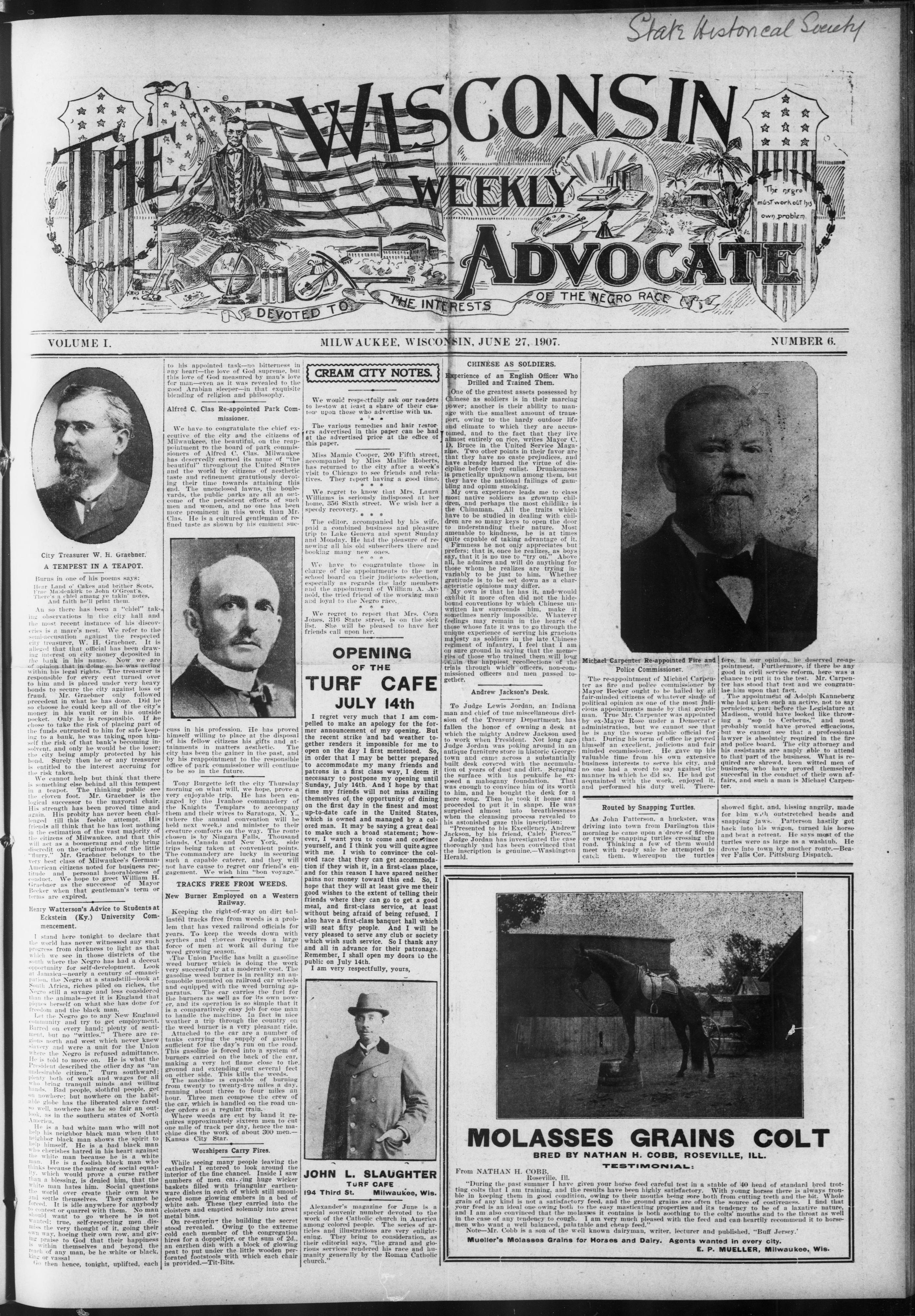
Wisconsin Weekly Advocate
Thursday, June 27, 1907
Milwaukee, Wisconsin
Page text (machine-generated)
WISCONSIN
WEEKLY
The negro
must work out his
own problem.
ADVOCATE
DEVOTED TO THE INTERESTS OF THE NEGRO RACE
[Name]
City Treasurer W. H. Graebner. A TEMPEST IN A TEAPOT.
Burns in one of his poems says:
Hear Land o' Cakes and brither Scots,
Frae Macdennirk to John O'Groat's.
There's a chiel amang ye takin' notes,
And titheh print them.
An so there has been a "chiel" taking observations in the city hall and the most recent instance of his discoveries is a mare's nest. We refer to the semi-accusation against the respected city treasurer, W. H. Graebner. It is alleged that that official has been drawing interest on city money deposited in the bank in his name. Now we are of opinion that in doing so he was acting within his legal rights. The treasurer is responsible for every cent turned over to him and is placed under very heavy bonds to secure the city against loss or fraud. Mr. Graebner only followed precedent in what he has done. Did he choose he could keep all of the city's money in his vault or in his outside pocket. Only he is responsible. If he chose to take the risk of placing part of the funds entrusted to him for safe keeping to a bank, he was taking upon himself the risk of that bank's becoming insolvent, and only he would be the loser; the city being amply protected by his bond. Surely then he or any treasurer is entitled to the interest accruing for the risk taken.
We cannot help but think that there is something else behind all this tempest in a teapot. The thinking public see the cloven foot. Mr. Graebner is the logical successor to the mayoral chair. His strength has been proved time and again. His probity has never been challenged till this feeble attempt. His friends all think that he has lost nothing in the estimation of the vast majority of the citizens of Milwaukee, and that this will act as a boomerang and only bring discredit on the originators of the little "flurry." Mr. Graebner belongs to the very best class of Milwaukee's German-American citizens noted for business rectitude and personal honorableness of conduct. We hope to greet William H. Graebner as the successor of Mayor Becker when that gentleman's term or terms are expired.
Henry Watterson's Advice to Students at Eckstein (Ky.) University Commencement
I stand here tonight to declare that the world has never witnessed any such progress from darkness to light as that which we see in those districts of the south where the Negro has had a decent opportunity for self-development. Look at Jamaica—nearly a century of emancipation, the Negro at a standstill—look at South Africa, riches piled on riches, the Negro still a savage and less considered than the animals—yet it is England that piques herself on what she has done for freedom and the black man.
Let the Negro go to any New England community and try to get employment. Barred on every hand; plenty of sentiment, but no "wittles." There are regions north and west which never knew slavery and were a unit for the Union where the Negro is refused admittance. He is told to move on. He is what the President described the other day as "an undesirable citizen." Turn southward; plenty both of work and wages for all who bring tranquil minds and willing hands. Bad people, slothful people, get on nowhere; but nowhere on the habitable globe has the liberated slave fared so well, nowhere has he so fair an outlook, as in the southern states of North America.
He is a bad white man who will not help his neighbor black man when that neighbor black man shows the spirit to help himself. He is a bad black man who cherishes hatred in his heart against the white man because he is a white man. He is a foolish black man who thinks because the mirage of social equality, which would prove a curse rather than a blessing, is denied him, that the white man hates him. Social questions the world over create their own laws and settle themselves. They cannot be forced. It is idle anywhere for anybody to contest or quarrel with them. No man should want to go where he is not wanted; true, self-respecting men dismiss the very thought of it, going their own way, hoeing their own row, and giving praise to God that their happiness is within themselves and beyond the reach of any man, be he white or black, king or vassal
Go then hence, tonight, uplifted, each
to his appointed task—no bitterness in any heart—the love of God supreme, but this love of God measured by man's love for man—even as it was revealed to the good Arabian sleeper—in that exquisite blending of religion and philosophy.
Alfred C. Clas Re-appointed Park Commissioner.
We have to congratulate the chief executive of the city and the citizens of Milwaukee, the beautiful, on the reappointment to the board of park commissioners of Alfred C. Clas. Milwaukee has deservedly earned its name of "the beautiful" throughout the United States and the world by citizens of aesthetic taste and refinement gratutiously devoting their time towards attaining this end. The unenclosed lawns, the boulevards, the public parks are all an outcome of the persistent efforts of such men and women, and no one has been more prominent in this work than Mr. Clas. He is a cultured gentleman of refined taste as shown by his eminent suc-
J. B.
cuss in his profession. He has proved himself willing to place at the disposal of his fellow citizens his gifts and attainments in matters aesthetic. The city has been the gainer in the past, and by his reappointment to the responsible office of park commissioner will continue to be so in the future.
Tony Burgette left the city Thursday morning on what will, we hope, prove a very enjoyable trip. He has been engaged by the Ivanhoe commandery of the Knights Templars to accompany them and their wives to Saratoga, N. Y., (where the annual convention will be held next week,) and minister to their creature comforts on the way. The route chosen is by Niagara Falls, Thousand islands, Canada and New York, side trips being taken at convenient points. The commandery are lucky in securing such a capable caterer, and they will not have cause to regret our friend's engagement. We wish him "bon voyage."
TRACKS FREE FROM WEEDS.
New Burner Employed on a Western Railway.
Keeping the right-of-way on dirt ballasted tracks free from weeds is a problem that has vexed railroad officials for years. To keep the weeds down with scythes and shovels requires a large force of men at work all during the weed growing season.
The Union Pacific has built a gasoline weed burner which is doing the work very successfully at a moderate cost. The gasoline weed burner is in reality an automobile mounted on railroad car wheels and equipped with the weed burning apparatus. The car carries the fuel for the burners as well as for its own power, and its operation is so simple that it is a comparatively easy job for one man to handle the machine. In fact in nice weather a trip through the country on the weed burner is a very pleasant ride. Attached to the car are a number of tanks carrying the supply of gasoline sufficient for the day's run on the road. This gasoline is forced into a system of burners carried on the back of the car, making a very hot flame close to the ground and extending out several feet on either side. This kills the weeds.
The machine is capable of burning from twenty to twenty-five miles a day, running about three to four miles an hour. Three men compose the crew of the car, which is handled on the road under orders as a regular train. Where weeds are cut by hand it requires approximately sixteen men to cut one mile of track per day, hence the machine dies the work of about 300 men. Kansas City Star.
Worshipers Carry Fires.
While seeing many people leaving the cathedral I entered to look around the interior of the fine chancel. Inside I saw numbers of men carrying huge wicker baskets filled with triangular earthenware dishes in each of which still smouldered some glowing embers in a bed of white ash. These they carried into the cloisters and emptied solemnly into great metal bins.
On re-entering the building the secret stood revealed. Owing to the extreme cold each member of the congregation hires for a doppeltjer, or the sum of 2d., an earthen dish with a block of glowing peat to put under the little wooden perforated footstools with which each chair is provided.—Tit-Bits.
CREAM CITY NOTES.
We would respectfully ask our readers to bestow at least a share of their custour upon those who advertise with us.
The various remedies and hair restorers advertised in this paper can be had at the advertised price at the office of this paper.
Miss Mamie Cooper, 209 Fifth street, accompanied by Miss Mallie Roberts, has returned to the city after a week's visit to Chicago to see friends and relatives. They report having a good time.
We regret to know that Mrs. Laura Williams is seriously indisposed at her home, 356 Sixth street. We wish her a speedy recovery.
The editor, accompanied by his wife, paid a combined business and pleasure trip to Lake Geneva and spent Sunday and Monday. He had the pleasure of renewing all his old subscribers there and booking many new ones.
We have to congratulate those in charge of the appointments to the new school board on their judicious selection, especially as regards the lady members and the appointment of William A. Arnold, the tried friend of the working man and loyal to the Negro race.
We regret to report that Mrs. Cora Jones, 316 State street, is on the sick list. She will be pleased to have her friends call upon her.
OPENING OF THE TURF CAFE JULY 14th
I regret very much that I am compelled to make an apology for the former announcement of my opening. But the recent strike and bad weather together renders it impossible for me to open on the day I first mentioned. So, in order that I may be better prepared to accommodate my many friends and patrons in a first class way, I deem it necessary to postpone my opening until Sunday, July 14th. And I hope by that time my friends will not miss availing themselves of the opportunity of dining on the first day in the finest and most up-to-date cafe in the United States, which is owned and managed by a colored man. It may be saying a great deal to make such a broad statement; however, I want you to come and convince yourself, and I think you will quite agree with me. I wish to convince the colored race that they can get accommodation if they wish it, in a first-class place, and for this reason I have spared neither pains nor money toward this end. So, I hope that they will at least give me their good wishes to the extent of telling their friends where they can go to get a good meal, and first-class service, at least without being afraid of being refused. I also have a first-class banquet hall which will seat fifty people. And I will be very pleased to serve any club or society which wish such service. So I thank any and all in advance for their patronage. Remember, I shall open my doors to the public on July 14th.
I am very respectfully, yours.
A. B.
JOHN L. SLAUGHTER
194 Third St. Milwaukee, Wis. Alexander's magazine for June is a special souvenir number devoted to the work of the Catholic church in America among colored people. The series of articles and illustrations are very enlightening. They bring to consideration, as their editorial says, "the grand and glorious services rendered his race and humanity generally by the Roman Catholic church."
A horse standing on a barrel in a barn.
MOLASSES GRAINS COLT BRED BY NATHAN H. COBB, ROSEVILLE, ILL.
"During the past summer I have given your horse feed careful test in a stable of 40 head of standard bred trotting colts that I am training, and the results have been highly satisfactory. With young horses there is always trouble in keeping them in good condition, owing to their mouths being sore both from cutting teeth and the bit. Whole grain of any kind is not a satisfactory feed, and the ground grains are often the source of costiveness. I find that your feed is an ideal one owing both to the easy masticating properties and its tendency to be of a laxative nature, and I am also convinced that the molasses it contains is both soothing to the colts' mouths and to the throat as well in the case of any tendency to cough. I am very much pleased with the feed and can heartily recommend it to horsemen who want a well balanced, palatable and cheap feed."
CHINESE AS SOLDIERS.
Experience of an English Officer Who Drilled and Trained Them.
One of the greatest assets possessed by Chinese as soldiers is in their marcing power; another is their ability to manage with the smallest amount of transport, owing to the hardy outdoor life and climate to which they are accustomed, and to the fact that they live almost entirely on rice, writes Mayor C. D. Bruce in the United Service Magazine. Two other points in their favor are that they have no caste prejudices, and have already learned the virtue of discipline before they enlist. Drunkenness is practically upknown among them, but they have the national failings of gambling and opium smoking.
My own experience leads me to class most native soldiers as grownup children, and perhaps the most childlike is the Chinaman. All the traits which have to be studied in dealing with children are so many keys to open the door to understanding their nature. Most amenable to kindness, he is at times quite capable of taking advantage of it. Firmness he not only appreciates but prefers; that is, once he realizes, as boys say, that it is no use to "try on." Above all, he admires and will do anything for those whom he realizes are trying invariably to be just to him. Whether gratitude is to be set down as a characteristic opinions may differ.
My own is that he has it, and would exhibit it more often did not the hidebound conventions by which Chinese unwritten law surrounds him, make it sometimes nearly impossible. Whatever feelings may remain in the hearts of those whose fate it was to go through the unique experience of serving his gracious majesty as soldiers in the late Chinese regiment of infantry, I feel that I am on sure ground in saying that the memories of those who trained them will long remain the happiest recollections of the trials through which officers, non-commissioned officers and men passed together.
Andrew Jackson's Desk
To Judge Lewis Jordan, an Indiana man and chief of time miscellaneous division of the Treasury Department, has fallen the honor of owning a desk at which the mighty Andrew Jackson used to work when President. Not long ago Judge Jordan was poking around in an antique furniture store in historic Georgetown and came across a substantially built desk covered with the accumulation of years of dust and dirt. Scraping the surface with his penknife he exposed a mahogany foundation. That was enough to convince him of its worth to him, and he bought the desk for a mere song. Then he took it home and proceeded to put it in shape. He was surprised almost into breathlessness when the cleansing process revealed to his astonished gaze this inscription:
"Presented to his Excellency, Andrew Jackson, by his friend, Caleb Pierce." Judge Jordan has investigated the case thoroughly and has been convinced that the inscription is genuine.—Washington Herald.
MOLASS
BRED BY
From NATHAN H. COBB,
Roseville, Ill.
"During the past summer I have ting colts that I am training, and the ble in keeping them in good condition grain of any kind is not a satisfactor your feed is an ideal one owing both and I am also convinced that the most in the case of any tendency to cough, men who want a well balanced, palate Note—Mr. Cobb is a son of the w
Mueller's Molasses Grains
State Historical Society
[Name not provided]
Michael Carpenter Re-appointed Fire and Police Commissioner.
The re-appointment of Michael Carpenter as fire and police commissioner by Mayor Becker ought to be hailed by all fair-minded citizens of whatever shade of political opinion as one of the most judicious appointments made by that gentleman. True Mr. Carpenter was appointed by ex-Mayor Rose under a Democratic administration, but we cannot see that he is any the worse public official for that. During his term of office he proved himself an excellent, judicious and fair minded commissioner. He gave up his valuable time from his own extensive business interests to serve his city, and no one had a word to say against the manner in which he did so. He had got acquainted with the work, enjoyed it, and performed his duty well. There-
Routed by Snapping Turtles
As John Patterson, a huckster, was driving into town from Darlington this morning he came upon a drove of fifteen or twenty snapping turtles crossing the road. Thinking a few of them would meet with ready sale he attempted to catch them, whereupon the turtles
NUMBER 6.
[Name]
fere, in our opinion, he deserved re-appointment. Furthermore, if there be any good in civil service reform, here was a chance to put it to the test. Mr. Carpenter has stood that test and we congratulae him upon that fact.
The appointment of Adolph Kanneberg who had taken such an active, not to say pernicious, part before the Legislature at Madison, would have looked like throwing a "sop to Cerberus," and most probably would have proved efficacious, but we cannot see that a professional lawyer is absolutely required in the fire and police board. The city attorney and his assistants are amply able to attend to that part of the business. What is required are shrewd, keen witted men of business, who have proved themselves successful in the conduct of their own affairs, and such a man is Michael Carpenter.
showed fight, and, hissing angrily, made for him with outstretched heads and snapping jaws. Patterson hastily got back into his wagon, turned his horse and beat a retreat. He says most of the turtles were as large as a washtub. He drove into town by another route.—Beaver Falls Cor. Pittsburg Dispatch
---
THE WISCONSIN WEEKLY ADVOCATE
MILWAUKEE, WIS.
R. B. MONTGOMERY, Editor and Proprietor.
Tea-Table Salad.
Related.
There are many large tales connected with small fish.—Chicago News.
In the Beef Zone.
Where They Bump the Bumps.
In Tooting, a London suburb, are two villas, side by side. One is named "Iodine" and the other "Arnica."—London Times.
Br'er Johnson's Way.
Br'er Johnson wuz a honey!
You hear him, late en soon:
"Somebody raise de money,
Please God, I'll raise de tune!"
—Atlanta Constitution.
With the Evidence Before Him.
"Can you look me in the face and deny that you married me for my money?"
"Nope; I might deny it; but I can't look you in the face and deny it."
—Houston Post.
"The Blessed Damosel."
Blest be the maid—
A queen, say I—
Who cannot cook—
And does not try!
—Buffalo News.
Behind the Scenes
"Why did the leading man suddenly break off his monologue and hurry behind the scenes?"
"He heard that they were dividing the receipts."—Flicgende Blaetter.
Demonstration.
Grace—And did you ever propose to a girl in a canoe?
Fred—Yes; and I'll never do it again.
The girl jumped at my proposal and upset the boat.—Harper's Weekly.
Finale
"He looks terribly sad.
"Yes, his engagement with Miss Perty has come to an end."
"Jilted him, eh?"
"No, married him."—Houston Post.
In the Atelier
There was a young artist named Sam,
Who thought the art critics a sham,
Said he, "Hully gee!"
It's easy to see
For me they don't care a—straw."
—Life.
Oblivious.
"Good night!" she sighed, and yet once
more
"Good night!" He cried "Adieu!"
The parlor clock struck one before
The flight of time struck two.
—Catholic Standard and Times.
Why Not?
Oblivious.
Why Not?
"A large number of people keep on talking when they have ceased thinking," says the Baltimore American. But would you make a voiceless solitude of our best society?—Cleveland Plain Dealer.
Mistress and Maid
"I have been told that you were love-making out in the field, and this greatly displeases me."
"Oh, ma'am, so it does me. I should prefer a nice drawing-room."—Motto per Ridere.
An Expensive Compliment.
"Excuse me, sir, but this is the sixth time you have gone away without paying."
"Oh, by dear young lady, when a man sees you he forgets everything else."—Eliiegende Blaetter.
A Fatal Situation.
"And so, Bummel, the student was almost drowned when he was in swimming yesterday. How did that happen?"
A Treasure.
Mrs De Hitt—The Dobsons at last have a girl they hope to keep. Mrs. De Witt—Absurd! Where is such a girl to be found? Mrs. De Hitt—She was born to them yesterday.—Harper's Weekly.
At the Marriage Broker's.
"Well, madame, I can offer you two suitors. To be sure, one of them has already been divorced from two wives, but he owns an automobile."
"Might I at least first see the automobile?"—Fliegende Blaetter.
Inexplicable.
Hotel Proprietor—Has not the man in No. 15 received his bill yet?
Head Waifer—Certainly! Fifteen minutes ago.
"Strange! I hear him still singing in his room!"—Meggendorfer Blaetter.
Changes of a Year.
"Ah, pater, I am no end glad to be home from college."
"What's that?"
"I am jolly well pleased, y' knaw."
"Hank, clean out the old stall! There's a new critter on the place.—Washington Herald."
Handicap for Dolly
She—Do you think that Dolly will be successful in comic opera?
He—She will if she has the three nec
He—She will if she has the three nec essary qualifications.
essary qualifications.
She—What are they?
He—Well, a good voice is one.—Somerville Journal.
Always Indistinct.
She—I see in some of the Chilian towns women are conductors on the street cars.
He—I suppose it is hard to tell, then, when she is calling out a street, whether she has not her mouth full of hairpins?
—Yonkers Statesman.
The Break-Down Sort.
"Jigley seems to be very fond of walking."
"Not at all. You know, he's just bought one of those cheap motor cars they're manufacturing—"
"Yes, that's what I mean."—Catholic Standard and Times.
On the Links.
Bunker—Miss Woodby is so eccentric in her golf playing since her return from Paris.
Miss Niblick—Is she, really?
Bunker—Yes, indeed. When she foozles now she invariably exclaims: "Hoot mon Dieu!"—The Reader.
"BEIN' AT HOME."
Bein' at home—why, that's the best!
Some place where you can laze
Around an' think, an' loaf, an' rest--
There where the home folks stays;
Where chairs is comfortebble to
A feller's back, an' seem
To snuggle up an' sheer with you
Th' softness of your dream.
Bein' at home—where you can set
Out on the porch, an' read
An' smoke an' talk to folks. I'll bet
There's times you think you need
A tonic, an' feel all run down,
An' all the sky's blue dome
Pears like is fretted with a frown—
But what you need is home.
Bein' at home—some place where folks
Has time to stop an' laugh
An' tell the same old worn-out jokes—
That ain't as old by half
As some o' those new-fangled ones!
An' where they ain't forgot
Your fav'rite song, an' how it runs—
That's one thing can't be bought!
Bein' at home—where grass and trees
An' mebbe one or two
Old-fashioned pink beds coax the bees,
A GIRL OF SPIRIT.
Great preparations were being made in the little village of Derrickfergus, county Tyrone, for the forthcoming marriage of Kathleen, only child of Phemius Derrick, squire of the place, with Capt. Carruthers, of the rifle brigade, and of Carruthers castle, Westmoreland—an eminently eligible young man, with a rent roll of £12,000 a year.
Kathleen's mother, who didn't like the squire out of her sight, and ruled that burly individual—weak woman though she was—with a rod of iron; he, too, was practically confined to his Irish home. But Kathleen, now and again, was allowed to visit friends in London; and she met, and became engaged to, Capt. Carruthers.
Her mother was much pleased by the engagement. It was a great satisfaction to feel that she was safely engaged to a man with £12,000 a year. The squire was less impressed by the thought of Carruthers casule and the big vent roll. All he cared about—for he idolized Kathleen—was that the girl should marry the man she loved and be happy with him. Kathleen's mother, having almost forgotten her ailments awhile in this new and exciting interest, reveled, for many weeks, in a bracing atmosphere of orange blossoms and satin gowns and bridal veils, and going-away frocks, and lace-trimmed under linen.
It had been arranged that Kathleen's wedding should be celebrated with festivities at Derrick hall. There was to be a big dinner party the night before the wedding and a ball on the evening of the auspicious day itself. The tenantry were to be entertained. In fact, everything was to be done to mark the great occasion.
There was only one fly in the ointment of Mrs. Derrick's satisfaction, and this was the fact that Capt. Carruthers, who was detained in England till the last moment by his military duties, when asked to send a list of his relatives and friends whom he wished to have invited, had sent the names of only five—his mother, his two sisters and an uncle and aunt; and that of these only one—his elder sister—had accepted the invitation, the others all excusing themselves on the plea of distance. This annoyed Mrs. Derrick. She regarded it as a slight—designed to show their disapproval of the match; and she made some caustic comments on the subject to the squire.
Two days before the wedding the bridegroom's advance guard arrived—his sister, Miss Carruthers, and his brother, Capt. Charles Carruthers (for both brothers were in the army and held the same rank), his best man. The latter was a good looking young fellow, strikingly like his elder brother, though not, perhaps, quite so handsome. He and his sister put up at the hotel in the adjacent town, where the bridegroom, who was to arrive next day, would also sleep on the night before his wedding.
On the morning of that day a very strange and startling thing happened. Capt. Charles Carruthers received a letter from his brother—a letter which caused him to proceed posthaste to Derrick hall, looking very nervous and upset. For the job his brother had set him was distressing and humiliating. The letter ran as follows "My Dear Charles—I hardly know how to write to you; but there are imperative reasons why I cannot—absolutely cannot—marry Miss Derrick.
"I ought to have broken off the engagement before. But—heaven forgive me—I lacked the courage. I have been nearly distracted for weeks past about it. But now a time has come when I must speak out. I love another woman, who is part of my life. I cannot—dare not—tear myself away from her.
"It has been a hideous mistake. But I should be doing Miss Derrick an even greater wrong by marrying her than by thus breaking it off at the last moment.
"See her, for me, Charles, I implore you, and tell her the truth. Beg her forgiveness, and ask her to think as kindly of me as she can. Your unhappy and distracted brother."
Poor Charles! No wonder he looked nervous and distressed, as, with this letter in his pocket, he drove over to Derrick hall.
He asked to see the squire alone; and when he had been with him in his study for a quarter of an hour, the squire rang the bell and sent a message to his wife.
She came, and a terrible scene ensued. Her rage knew no bounds. She inveighed against the renegade bridegroom and all his family, including the unhappy Charles—who was, however, too much ashamed of his brother and too much a gentleman himself to utter a word of protest.
"I shall never be able to look any of my friends in the face again." she kept saying. "It is making a public laughing stock of me. Such men ought to be thrashed—thrashed within an inch of their lives. All the guests invited! All the preparations made! I never heard of anything so infamous."
Kathleen was sent for; and, the terrible news having been broken to her by the squire as gently as he could, she was
given her faithless lover's letter to read. She turned pale as death; but her high spirit and strong, girlish pride, coming to her rescue, enabled her to bear the shock bravely. If there was pain in her eyes, there was also anger; scornful anger, and proud resentment. She held her head very erect and said in a voice that scarcely trembled, so bravely did she control it: "He might have let me know sooner. But it is better late than never. Yes! Anything is better than that I should have married such a man as his conduct proves him to be. I regard it as a fortunate escape."
"Oh, yes! It is all very well for you, Kathleen," broke out Mrs. Derrick whose rage and mortification were growing more uncontrollable every moment. "You seem only to think of yourself, you selfish girl. You appear to have no thoughts whatever for the public humiliation inflicted on me—and on your father——" "Really, my dear, really," remonstrated the squire.
"Hold your tongue, Phemius," cried the infuriated lady. "I say I am surprised at Kathleen's selfishness in taking it so calmly and thinking only of herself—when it is I who have issued all the invitations, and it is I who shall be made a public laughing stock of by having to cancel them. * * * You might have some regard for this aspect of the matter, miss, I do think."
"I am sorry for you and father, mother—very, very sorry. But what am I to do?" said Kathleen, her face white to the lips.
"Do! Do! You ought to—to—make the wretch marry you!" cried out Mrs. Derrick, absolutely beside herself.
"Oh, come! I say," protested Charles Carruthers, goaded into remonstrance by his pity for Kathleen.
"What business is it of yours, sir?" retorted Mrs. Derrick, now turning the full force of her fury upon him. "If you were half a man you'd do something instead of standing there and saying 'Oh, come!' like a poll parrot."
"Anything that I can do, I will do, believe me." said Charles Carruthers, earnestly. "I am deeply sensible of the wrong my brother has done you, and if you think that any action on my part can mitigate it, you have only to command me. I cannot say more.
It was now that Kathleen spoke. The girl's face was paler than before, and her carriage more proud and erect.
"You mean that, Capt. Carruthers?" she demanded, looking him steadily, unflinchingly in the eyes.
"I do," he replied.
"Then," she said, quietly, "will you take your brother's place and marry me tomorrow?"
It was a dramatic moment. Charles Carruthers was, for the instant, utterly taken aback. He could find no words in which to answer her.
"Will you?" she repeated, in the same quiet, emotionless voice, as of one who was past all caring.
He drew himself up—a fine figure of a straight, honorable man.
For some seconds dead silence reigned. This sudden, startling denouement had taken everybody by surprise; as people are often surprised at the audacity of what they have done on the impulse of a critical moment.
The squire was the first to find his tongue.
"Tut-tut! God bless my soul! But this is madness. I cannot allow it. You two—almost strangers, not loving one another—you must be out of your senses to think of such a thing."
"There is no question of love, dad." answered Kathleen. "Love within me is dead forever—that letter has killed it. But I will marry Capt. Carruthers, if he will have me, to share mother and you public humiliation, and also to let his brother see" (she laughed a hard, unnatural laugh) "how little I care."
"My dear," said the squire, turning to his wife; "my dear, we cannot—we must not allow this insane thing."
But Mrs. Derrick, who had already caught new hopes of escaping the unspeakable humiliation of canceling the wedding arrangements discerned in an instant all the advantages of the suggestion. Capt. George Carruthers was unknown by sight to any of the wedding guests (except his sister, who could doubtless be persuaded to keep her own counsel); and no one need know that Capt. Charles Carruthers was not the original bridegroom. So she said: "I don't agree with you at all, Phemius. I consider that Kathleen is behaving like a girl of spirit, and Capt. Carruthers like a man of honor. By all means let him take his brother's place tomorrow, I say. It is the best reparation he can possibly make.
"The only question is about the license; but I dare say a special license can be procured in time, if we set about it at once. There is time for Capt. Carruthers to go to London and return by mid-day tomorrow, if he starts at once. And I should think that that is the best course. What do you say, sir?"
"I am in your hands. I will start for London by the next train," replied the captain, quietly.
Once more the squire tried to raise his voice in protest; but his wife silenced him.
Then she rang the bell and ordered the carrage to be round in five minutes.
Charles Carruthers managed to procure the special license in time, and next day he led Kathleen Derrick to the altar.
As they drove away together, en route for Killarney, where they were to spend their honeymoon, Charles, with his arm round Kathleen, laughed merrily into her roguish eyes.
"Well, darling, we've put the job through all right," he said. "But I was in a blue funk all the while, lest some hitch should arise, I can tell you."
"It was the only way. though," answered Kathleen. "Mother would never have consented to my marrying you, a younger son, in the first instance. It was most awfully good of your brother to play up to our ruse as he did. And father—I say! Didn't he carry through his part splendidly? Dear old dad! I'm glad we took him into our confidence.
"But, I say," she added, "supposing you hadn't been able to get that special license in time—what then, Charlie?" Charles Carruthers laughed.
"Oh! There was no fear on that score," he replied. "I wasn't going to leave anything to chance. So I had taken care to procure the precious document before I first came over in my character of best man, and—in point of fact—I had it with me in my pocket all the time."—London Truth.
Advertise in Your Home Paper.
THE LOST ORATOR
I knew not what I was doing,
But I heaved out a sand-bag then,
And it struck on a farmer's shoulders
And he cussed nothing like amen.
I have tried, but I try all vainly,
To arouse those sounds divine,
But I always dump my sand-bags
On some milder fellow's spine;
It may be some other balloonist
Will hear that talk again,
And will write it on fireproof paper,
With a patent asbestos pen!
—Denver Republican.
MEN OF PROMINENCE.
GEORGE VON L. MEYER, the present postmaster general of the United States, was born in Boston, June 24, 1858, and is a graduate of Harvard with the class of 1879. His debut in politics was made in Boston in 1889, when he was elected a member of the common council. He next served with distinction in the Massachusetts Legislature, acting as speaker of the house for three of the five years he spent at the state capital. Gov. Wolcott appointed him chairman of the Massachusetts board of managers for the Paris exposition and in 1899 he was elected Massachusetts member of the Republican national committee. From 1900 to 1905 he was the American ambassador to Italy. In 1905 he was transferred to Russia, where he represented the United States at St. Petersburg until chosen by President Roosevelt as a member of his cabinet. Mr. Meyer is a man of great wealth and a controlling factor in many large industries in New England.
JOHN DILLON, member of the British Parliament and one of the leaders of the Irish Nationalists, was born in Ireland, June 25, 1851, and was educated at the Catholic university in Dublin, where he distinguished himself in mathematics, and became a fully qualified member of the Royal College of Surgeons in Ireland. His father before him was one of the leaders of the Young Ireland movement, which resulted in the rebellion of 1848. Ever since he was old enough to take an interest in politics and the welfare of his native country Dillon the younger has been an ardent disciple of home rule. In the interest of this movement he has been heard on the platform in America, Australia and other parts of the English-speaking world. Mr. Dillon first entered Parliament in 1880 as member for County Tipperary, and has held his present seat for East County Mayo since 1885.
WILLIAM THOMSON, Lord Kelvin, who is regarded as the greatest living scientist in Great Britain today, was born in Glasgow June 26, 1824. He received his early training from his father, who had raised himself from a humble position to a professor of mathematics at Glasgow university. William afterward studied at St. Peter's college, Cambridge, where he won the highest mathematical honors. At 22 years of age he became a professor at Glasgow university and for over half a century natural history at that institution. Among Lord Kelvin's great works may be mentioned his invention of the siphon recorder for ocean telegraphy; his fathering of the ocean cable; his practical application of the time limits within which geologists and biologists should confine their evolutionary application, which limited the age of the earth to a million years, a period of time formerly regarded as a second in the geological day; his invention of the mirror galvanometer and his navigational sounding machine and depth recorder.
ALPHEUS BEEDE STICKNEY, president of the Chicago Great Western railway, was born at Wilton, Me., June 27, 1840. After a common school education, he began teaching school at the age of 17. Later he studied law and was admitted to the bar. He soon afterward went west, where he abandoned the law for the large and commanding field of the railroad. In 1871 he organized and built the first section of the Northern Wisconsin railway, now a part of the Chicago. St. Paul and Omaha system. From 1879 to 1881 he was a superintendent of construction on the Great Northern and Canadian Pacific roads. Another road which he organized and built was the Wisconsin, Minnesota and Pacific railway, since merged into one of the larger systems. In 1883 he began the organization and construction of the Chicago Great Western road, with which he has since been connected and which he has maintained independently of all the greater mergers and combinations that have since joined the most of the western railroads into a few great systems. Another enterprise which stands as a monument to Mr. Stickney's marvelous energy and powers of organization are the St. Paul Union stockyards and packing houses, which he organized and built in 1882.
LYMAN JUDSON GAGE, who was secretary of the United States treasury from 1897 to 1902, was born in Madison county, N, Y., June 28, 1836. His schooling was received in the academy at Rome, N. Y., and after his graduation from that institution he began life as an office boy in a bank at Oneida. Here he remained until 1855, when he decided that the west offered a more promising field for his energies. He went to Chicago and his first employment in the western metropolis was as a clerk in a planing mill. This he soon gave up, however, to accept a position as bookkeeper in a bank, realizing that the business of finance was his real vocation. From the position of an assistant bookkeeper he rose until he became president of the First National bank of Chicago, one of the greatest financial institutions in the country. Mr. Gage continued with the First National bank until invited to accept the secretaryship of the United States treasury. In 1902 he resigned his portfolio in the cabinet to accept the presidency of the United States Trust company. Mr. Gage has taken an active interest in many public welfare movements and was three times president of the American Bankers' association.
SENATOR WILLIAM E. BORAH of Idaho, who has a conspicuous part in the prosecution of the Haywood case at Boise, was born June 29, 1865, at Fairfield, Ill. He was educated at the University of Kansas, and afterward read law at Lyons in that state. In 1888 he was admitted to the bar, and in 1891 he settled at Boise, where he has since made his home. Mr. Borah is a tireless student. He gives the closest attention to his profession, and never neglects any possible line of investigation to strengthen a case which may have been placed in his hands. But he does not permit the necessities of his profession to divert him from painstaking study in many other fields, and he is said to be one of the most widely read men of the northwest. In 1903 he received twenty-two votes of a necessary twenty-six in the election for
the United States Senate, and last year, when the question of nominating a candidate for senator in state convention was brought before the people, he was successful.
LORD ESHER, who has been described as one of the potent influences of the present day in England, was born in London, June 30, 1852. He was educated at Eton and at Trinity college, Cambridge. He first entered public life at the age of 26 as private secretary to the Duke of Devonshire, then the Marquis of Hartington. Lord Esher has declined the offer of several high positions in the government service, and the only office he now holds is that of lieutenant governor and deputy constable for Windsor castle. He enjoyed the favor of Queen Victoria and stands quite as high in the confidence and regard of King Edward. It is said to be doubtful if there is any one whose name carries a greater amount of weight with the king, who consults him upon every conceivable question, whether it be matters of state, or of finance, or of the domestic economy of the royal household.
IN THE FLOWER GARDEN
Cosmos is beautiful, grown in a locality free from early fall frosts. The seed germinates freely, the plants grow with great vigor and if the season permits an abundance of bloom may be had in September. An early flowering strain of dwarf cosmos has been on the market for several years and each year there is an improvement in size and color.
Cosmos flowers are borne on long stems, in the colors white and red, the latter in several fine shades. The foliage of the plant is fine. Seed should be sown in gentle heat in the greenhouse, hotbed or window early in April. The young plants should be transplanted when 2 inches high being set well down in the soil, with at least 3 inches allowed between plants as they are very likely to become spindly if crowded. When danger of frost is over set them out in a warm, well sheltered position, 3 feet apart. After the plants start into growth pinch out the top to induce a bushy growth. If situated where the wind can whip them, they should be supported by stakes.
Terraces.
Terraces may be desirable for two reasons—to hold a very steep slope or to afford an architectural base to a building. It is rarely necessary to make a terrace in a lawn. Even if the lawn is very steep it is better to make a gradual slope than to cut the area in two with a terrace. The terrace makes a place look smaller, it is hard to make and to keep in order, the grass is difficult to cut with a lawn mower, and unless the sod is very dense, the upper part tends to wash off with the rains and the foot to fill in.
Nature does not have abrupt banks unless they are made of rock. If it is necessary to terrace a lawn to hold it the terrace would better be at one side rather than in the middle. In that case it is possible to obtain a good breadth of lawn. If the terrace is at the outer side of the lawn next the street, a perpendicular, masonry retaining wall may be constructed. If on the inner side, it may be placed close to the building and made to appear as part of the architecture, practically the base of the building. If this is done there should be a balustrade around the edge of the terrace, if possible, to give it an architectural air, and the descent from the terrace to the lawn should be made by means of steps.
Terraces look best near buildings with many strong horizontal lines. They do not lend themselves so well to buildings in the Gothic style. The general tendency is to make too many terraces. The cases are relatively few in which they may not be dispensed with.
Character in the Eve
No two pairs of eyes are exactly alike, and it would be impossible to give any fixed set of rules for reading character from the eyes. A person must rely upon his own keen judgment for that. However, here are a few general hints on the characteristics that usually accompany different types of eyes: Large, clear, blue eyes usually denote sensibility of character and a capacity and willingness for work. Their owner is also likely to be fond of enjoyment, jealous and often inquisitive.
Deep set eyes receive impressions accurately and definitely.
Great thinkers usually have had cold gray eyes, for gray is the color of shrewdness and talent. Eyes of this description generally denote better heads than hearts.
Green eyes are rare, and are seen more frequently in women than in men. They denote courage, energy and pride. Occasionally they accompany a jealous, vengeful disposition.
Black eyes are difficult to read. They often show a quick disposition, and sometimes are treacherous.
Round eyed persons are not great thinkers. They are open-hearted, observant and often sensual.
People with narrow eyes see less, think more, and feel with greater intensity.
Brown eyes denote a loving though judicious temperament.
Women who have light brown eyes are fond of gayety, shrewd and often coquettes.—Saturday Evening Mail, New York.
A Kindergarten Play.
This delightful little play, given in a kindergarten, would do for a children's spring party at home: The different things named are enacted by the little children, who go through their parts as the story is told and soft music is played.
First it is fall and the little seeds go to sleep, nodding their heads. The bluebirds and robins, with blue and brown wings, fly lightly southward: Then the Snow King and the Snow Queen put on silver crowns and spread a big white blanket of snow over the seeds to keep them from being frozen. The wind blows hard and the seeds shiver until the snow falls over them. A little Bunny sticks his nose out to see what it is about. Soon spring begins to awake. The birds hear her call and come flying back. The sheet of snow melts and is carefully folded and put away. The seeds awake and arise. The pussywillows begin to bloom and the mother hen brings out her tiny chicks to scratch. The sun shines on the head of each seed and it immediately must be given water. Soon violets, primroses and daisies blossom on all the children's foreheads, and every one is singing and happy. The party ends with a flower hunt.
Two Cold Drinks
Spiced Tea.—Allow two or three cloves for each spoonful of tea, steeping the cloves with the tea; when cold add the juice of a lemon and two lumps of sugar to each pint of tea infusion, mix thoroughly and serve very cold. Chill by contact with ice, not by putting ice into the liquid.
Rhubarb Wine.—Cut in bits and crush five pounds of rhubarb; add the thin yellow rind of a lemon and one gallon of water and let stand covered two days; strain off the liquid and add four pounds of sugar; put this into a small cask with the bunghole covered with muslin, and let it work two or three days, then put in the bung and let stand four months, when it is ready to draw off and bottle
PROPER TREATMENT OF BURNS.
In cases of burns death may be due first to asphyxia; secondly, to shock and, thirdly, to septicaemia.
The medical man seldom gets to the case in time to treat the first condition; the second is essentially a general condition, while the whole success in preventing the third depends upon the immediate local treatment. It is therefore the last condition which must be considered here. Among the public it is a generally accepted idea that the thing to do in the case of a burn is to dust flour over it or to cover it with oil, and, indeed, even in some comparatively late test books on surgery a mixture known as "Carron oil" is advocated.
The use of such applications cannot be too strongly deprecated, and indeed if the lay mind could be taught that the best thing to put on a burn before the doctor is called is a hot compress which should contain some boracic acid, if there is any in the house, it is probable that the majority of deaths due to septicaemia after burns would be prevented.
For the whole aim and object of the local treatment is to prevent; sepsis; flour and olive oil may be soothing and may allay the pain, but there is no antiseptic property in them; rather they are excellent culture media for bacteria.—London Hospital.
The Money Power.
Jesse James, the noted outlaw's son is, at the age of 50, one of the most talented and respected lawyers in Kansas City. In a claims case that he recently won, Mr. James told an amusing story. "There was a woman," he said, "whose husband was killed in a railroad accident. The railroad, to avoid suit, gave her $5000 damages. "The sum satisfied the woman, but a month or two afterward, taking up a newspaper, she read about a man who had lost his leg in the same accident, and behold, this man was given by the company damages to the amount of $7500.
"How is this? Here you give a man $7500 for the loss of his leg, while you gave me $5000 for the loss of my husband."
"The claim adjuster smiled amiably, and said in a soothing voice:
"Madame, the reason is quite plain. The $7500 won't provide the poor man with a new leg, whereas with your $5000 you can easily get a new husband, and perhaps a better one."—Kansas City Star.
Some New York Climbers
When all has been there is no city on earth where merit is so quickly recognized and rewarded as in New York. A boy enters the service of a railroad corporation and at the age of 28 he is general manager of a great traction system. True, he has a distinguished lawyer and statesman for an uncle, but he starts at the bottom, and his promotion is due to his own exertion. Such is the career of Oren Root. H. H. Vreeland, a brakeman without pull, raises himself in a short period to the presidency of the Metropolitan Railway company. Within two generations all the spectacular fortunes of New York have been made from nothing.
Reward of merit comes quickly in other fields. Charles E. Hughes, a comparatively obscure lawyer, is selected to conduct an important investigation in which the whole country is interested. Without having previously held office, a very novice, he is made a governor.-New Broadway Magazine.
Unearthed a Buried Tree
About seventy years ago millions of tons of earth, boulders and gravel slid from the side of Mount Katahdin to Sourdnahunk stream, a distance of seven miles, and dammed the stream, forming what is known to West Branch lumbermen as Slide dam.
A repair crew of a paper company recently had occasion to remove a quantity of gravel from this deposit. At a depth of ten feet they found the trunk of a spruce tree bent like a bow, the top held down by a boulder weighing many tons. The trunk was sound, but the bark and foliage had been removed by the scraping the tree received when the slide occurred.
Another large tree with foliage intact was found in the pit. The foliage when first removed from the earth looked fresh green as if it had jjjust been removed from a growing tree, but faded somewhat in a few hours.—Kennebec Journal.
$ome Old $aws
The hand that works the ticker rules the world. You never miss the water till the stock goes down.
Strike while the public's in the market.
Wall street knows no law.
A guilty conscience needs no muckraker.
It matters not what you are thought to be, but what you have.
Make hay while the ticker ticks.
Exposures are odious.
Riches are better than good name.
He that is with me is against me.
A quiet market gathers no panic.
Evil communications require good incomes.
Charity is expensive.
In the midst of gain we are in loss.
Consistency doesn't buy jewels.
Treat your friend as if he were your enemy.—Bohemian.
Curls Over the Ears.
In the thirties of the last century, from which so many of the fashions for 1907 have been evolved, the belles of the day wore their hair parted in the center and bunched with curls above their ears. For the girl whose style of beauty is ingenuue this is again an exceedingly becoming vogue in a modified form.
No one wants the Dutch doll type of coiffure back, or the simpering prettiness of the prunes and prism age, so the curls of the new coiffures are raised some inches above the ears and the center parting is almost hidden by tresses raised in poufs upon either side.
Highly to be recommended for those who posses short, thick hair is this scheme, for the back tresses need only to be brought to the top of the head and there mingled with the rest in a mass of short curls to complete a very pretty effect.
Silver Roses
Fashionable are the gold and silver roses used upon evening corsages in the simple and delightful manner of old times, as the completion to the fichu, or to hide the fastening of a berthe. Dewdrop roses are an addition to a toilette and in millinery have been seen this spring, noticeably so in the case of a recent retinue of bridesmaids, whose white tulle hats were decorated with roses gemmed with dew.
Ask Plans for Natatorium.
The commissioners of public works have notified all of the architects that the plans for the proposed north side natatorium will be received up to 10:30 o'clock on July 31. The building will cost $45,000, and will be located at Richards and Center streets, in the Thirteenth ward.
GOSSIP FOR THE LADIES.
'Cross Lots.
Straight it ran through buttercups,
Blue eyed grass and timothy,
Clover, where the wild bee sups,
And the tall weed waving free;
Just a little trodden lane,
Narrow as a mower's swath,
Oh, to set my feet again
In that little brown footpath—
'Cross lots!
By a little well! it led,
Deep and dark, with mossy brink;
Half a mile my feet have sped
Just to get one cooling drink!
Daisies nodded, bright and wet
From the dipper's sprinkling bath.
Oh, once more my feet to set
In the little brown footpath—
'Cross lots!
Strawberries grew wild and sweet;
You could smell them in the grass!
Crimson red and the dewy feet
Sweetest note that music had Some glad morning, gay and blithe, I will find that brown footpath— 'Cross lots!
-Anna Burnham Bryant Selected.
Economizing in Love.
In love, as in business, economize judiciously. "Spooning" may grow nauseating.
Love without respite sickens. Keep something for the morrow.
Be above trifles and try to forget words spoken perhaps hastily.
Do not be so foolish as to believe, as many do, that quarrels strengthen love.
Wounded self esteem heals slowly. Sometimes it remains incurable.
The tongue that once lashed can no longer seem honeyed, and love driven away by anger, though for an instant only, returns each time with more reluctance, until one day it stays away forever.
Married Woman and Spinster.
Anne O'Hagan has been writing for Harper's Bazar some deeply interesting papers on the spinster. In the July number she compares the spinster and the married woman in words which should make the latter writhe! She says:
"So we were launched upon one of our never wholly yielded conflicts. With the supreme, sublime arrogance of the married woman—the average, the normal or typical married woman, the woman who is a domestic being even more than she is a human being—Maida denies a real place to all those experiences for which the marriage certificate is not a woman's traditional charter of rights. With magnificent, unconscious impertinence she bestows pity upon all who do not possess this. Not only Estella Nichols, burning with zeal, possessed by a sacred passion utterly outside the experience of most of us, Estella who has been down to the gates of hell in one of the historic terrors of all time, Estella who has dwelt familiarly in that wonderful crystallization of society which we call the oldest civilization in the world and which most of us know no more than we know fairyland—not only her does Maida hold to have missed 'the rich experience of life.' Retrospectively, my sister would not hesitate to bestow the patronage of a wife upon the Virgin Queen of England. Elizabeth, you see, merely had Henry VIII, for sire, Roger Ascham for tutor, Burleigh for adviser, Leicester for wooer, Howard for admiral, Shakespeare for playwright. What can an unmarried woman really know of men, asks Maida, telling how many lumps of sugar Frederick takes in his coffee. Elizabeth merely confirmed the secession from the Roman Catholic church which her father had instituted, merely drove Spain from the high seas, put to death a rival—poor, unmarried, inexperienced Elizabeth!"
Six Mosquito Rules.
It is possible to rid the premises of mosquitoes if one will undertake the work systematically. The municipal authorities may accomplish wonders, but after all the burden of extermination rests with individuals, with the housekeepers. Dr. Quitman Kohnke, president of the New Orleans board of health, has formulated the following "once a week," six simple rules for the extermination of the pest. It would be a move in the right direction for every housekeeper to post these rules conspicuously and to apply them religiously:—
1. Once a week, pour into every water surface on your premises not removable by drainage or stocked with fish, or screened from mosquitoes, a quantity of kerosene equivalent to one ounce (two tablespoonfuls) for each fifteen square feet of water surface.
2. Once a week, pour into the privy vault five cents' worth of crude carbolic acid, or five cents' worth of copperas dissolved in water, or five cents' worth of kerosene.
3. Once a week, empty and refill all vessels containing water, upon which oil should not be placed, such as fire buckets provided in cotton presses in accordance with insurance requirements.
4. Once a week, pour kerosene or crude petroleum (about one pint) where it will flow through your drain gutter into the street gutter.
5. Once a week, report to the board of health the presence of any stagnant water in vacant lots or any condition in the neighborhood not easily remedied by yourselves or your neighbors, and keep on reporting once a week until you get the nuisance abated or a satisfactory explanation.
6. Once a week, read over these rules and see if you have not neglected something that should have been done, and persuade your neighbor to do as you do.—Good Housekeeping.
Thoughts to Think About.
The services which cement friendship are reciprocal services. A feeling of dependence is scarcely compatible with friendship.—William Smith.
The years have taught some sweet, some bitter lessons, none wiser than this, to spend in all things else, but of old friends to be most miserly.—Lowell.
A friend whom you have been gaining during your whole life, you ought not to be displeased with in a moment. A stone is many years becoming a ruby; take care that you do not destroy it in an instant against another stone.—Saadi.
Blessed is the man who has the gift of making friends; for it is one of God's best gifts. It involves many things, but above all, the power of going out of one's self, and seeing and appreciating whatever is noble and loving in another man.
Thomas Hughes. The nearer one holds his friend, the less should he dream of failing to observe all the delicate attentions of good breeding, the more scrupulously should he refrain from possible intrusion, the more carefully should he hold all the fine and exquisite observances of life. Gail Hamilton.
Be true to thy friend. Never speak of his faults to another, to show thy own discrimination, but open them all to him, with candor and true gentleness. Forgive all his errors and his sins, be they ever so many; but do not excuse the slightest deviation from rectitude. Never forbear to dissent from a false opinion, or a wrong practice, from motives of kindness; nor seek thus to have thy own weakness sustained; for these things cannot be done without injury to the soul.—Lydia Marie Child.
True sympathy always purifies. It
cheers. It helps to right-seeing. It heals. It strengthens. It exalts and brings one nearer to God. It puts evil passions to sleep and awakens holy emotions. It quickens not the worst things, but the best things in a man. It has in it always a pulse of heavenly love. It never accelerates a wicked course. It stills the troubled waters. It rests and soothes the aching heart. It makes a man hate the mean and low, and love the good and high. It takes one forward into companionships which are above the stars. It is more palatable than food; it is more refreshing than light; it is more fragrant than flowers; it is sweeter than songs.—F. A. Noble.
If Common Sense
Were But More Common.
A show girl and the son of a lord ran away and were married the other day, and then they went and woke the brand-new papa-in-law up out of a ound sleep at 4 o'clock in the morning and told him what they had done. He turned them out of the house and ordered his son never to speak to him again.
Neither the son nor his wife will get very far in this world if they have to depend on their own tact and common sense to do it.
A woman who will let her brand-new husband wake his father up at 4 o'clock in the morning to tell him a piece of bad news has just about as much tact as a June bug.
I know a man who lost a sweet woman for a wife by his want of tact. The man was in love with the woman and she was going away and he was trying his best to get a chance to ask her whether there was any hope for him.
He met her downtown one rainy, sloppy, muddy, shivery day, and just as she came to a corner where the water was ankle deep she lost her glove in the puddle. He stooped and picked it up for her and asked her then and there if she would marry him. The woman was cold, and hungry, and cross, and vexed about her glove, and she stamped her foot and said:
"No, you stupid, I wouldn't marry you if you were the last man in the world."
Now, if that man had asked that same woman that same question some summer evening, when the moon was making a track of silver across the sparkle of the June waters, I believe that that woman would have said "yes."
I saw a little lost child in a street car the other day crying herself into hysterics, and all the passengers crowded around the child and stared at her and said over and over again in every kind of a voice from shrill falsetto to deepest bass, "Don't be afraid, dearie, nobody is going to hurt you," and every time the child heard that word "afraid" she stiffened out and went into a perfect paroxysm of tears.
A sensible woman leaned across the aisle, grabbing the child, held her up to the window and said: "Dear me, that's the funniest dog I ever saw; are those two tails he has?"
"Wh-wh-where?" said the baby, drying her tears in the shadow of an instant. Every time I hear a woman speaking of a man's faults to other people I think, "I don't blame him for being cross or indifferent or disorderly or whatever it is she's complaining about when he has a wife who has no more sense than to egg him on to do his very worst just to spite her." Common sense! Dear me, if common sense were just a trifle more common, what a nice, agreeable world we would live in to be sure."
The Wisdom of the Serpent
"Now, when you are married your troubles with your relations-in-law begin as a rule, and my marriage was no exception to the rule. My husband was a charming fellow, but his family were very stern, very proud, very conventional Virginians, and I came from noisy New York. Throughout my maiden days I had frequently been told that I was a most attractive young person; I knew that I was popular, and I never dreamed that my manner could ever be other than delightfully ingratiating until I went to visit in my mother-in-law's home. There, I confess to you, I received a shock. Everybody was civil, but it was as plain as could be made that they did not like me at all.
"At first I was astonished, and then hurt, and finally, a good deal irritated, for I had descended on the family fully prepared to be taken right into its bosom and made much of as a daughter and a sister. But I was not, and, woman-wise, my first inclination was to fly straight to my husband's confidence, and seek consolation.
"However, having some of the wisdom of the serpent, combined with a good deal of the harmlessness of the dove, I checked myself in time, and thereby avoided one of the big mistakes that wives frequently make."
I looked my confidante straight in the eye as I said this, whereat she guiltily hung her head.
"It is not either good form or good policy to complain to your husband of the way his family treat you. When you have a situation of this sort to meet, keep a stiff upper lip and silence, and look about as I did to see as nearly and as clearly as possible just where the trouble lies.
"I was not very long in sitting on my private committee of investigation before I was aware that some of the blame for the strained relations between myself and my husband's family was resting on my shoulders. The wrongs are rarely, as you know, all on one side."
"I had never stopped to realize how much I had hurt the family pride when I laughed at some of the ancestors' portraits, and failed to give my mother-in-law precedence in and out of the dining room, and addressed my husband's elderly maiden relative as 'Jane' instead of 'Cousin Jane,' and annoyed my nervous sister-in-law inexpressibly by bringing my pet dogs to the table with me, and laughed at the antiquated bonnet of a highly venerated neighbor: and in one way and another had taken liberties and assailed traditions and hurt sensitive feelings when I should have shown the utmost consideration and sweet thoughtfulness.
"That is where I find so many individuals, who are called upon to deal with the vexed question of their relatives by marriage, remiss and narrow-minded in their view of the situation. I should like to take all newly made wives aside and whisper low in their ears that the secret of success when making the acquaintance of their husband's family is to display toward every member thereof the most distinguished courtesy.—Adelaide Gordon.
Being One's Self.
I can hear somebody ask, "Why, who else could one be?" If you have never thought about it, or looked around among your friends, you very naturally suppose that the easiest thing and the simplest in the world is just to be one's ownself. Yet it depends a good deal on the individual. There are girls so sympathetic, so easily impressed and so sweet and amiable that they take the color of the pass-
ing moment and are apt to catch the tone of those around them, as a brook reflects the sun, and dimples in the breeze. They will without hesitation agree to the sentiments of their neighbors for the reason that they dislike to seem contradictory and perverse. You know that at times it makes one appear rather contrary and disputations to take the opposite side, and it is often much easier to agree with people than to disagree with them. Still, unless a girl has a will of her own and convictions about right and wrong and the habit of thinking and speaking sincerely, she does not amount to much. Of course, there are essentials and non-essentials.
It is never worth while to raise an issue about a mere trifle, but if a principle is involved, one should be as firm as Gibraltar. Anything is better than being as soft as putty and as unstable as fluid. Being yourself, in short, implies education, responsibility and character. The personal equation always counts. I was talking not long ago with a friend about a dear girl whom we had both known and loved. She had been wonderfully gentle and not in the least aggressive. She never insisted on having her rights and was ready to concede a great deal that others might be contented and happy. I have seldom met any one less selfish, nor any one more entirely self-poised.
To be self-poised, keeping the balance steady and doing one's duty pleasantly without fuss so that one may be relied upon in every circumstance, is a different thing from being self-centered.
The self-centered girl thinks first about Number One.
The self-poised girl puts Number One in the background and is reluctant to bring her forward or intrude her on the attention of other people.
This girl, of whom we were speaking, was often in the center of the stage, not because she wished to be, but because, notwithstanding her gentleness, she was a born leader. "She raised the tone of our whole class," said my friend, "because she was so true and direct and straightforward. She had no affections; she was always herself."
Kate Douglas Wiggin has done girlhood and womanhood a great service in her beautiful delineation of "Rebecca of Sunnybrook Farm." This fascinating little heroine is never anybody but "Rebecca," and yet one is sometimes tempted to say that there are a dozen Rebeccas enfolded in that one bewitching personality. This is so with a good many girls in real life. Being yourself does not limit you necessarily to being a single, dull, colorless individual.
I once heard a woman at a farmhouse door direct her little daughter to go to a shop in the village and buy a skein of thread. "Be sure you get me whity-brown,' she said. The kind of thread that may be described as whitty-brown, so far as color is concerned, would not compare very favorably with more beautiful and more definite shades. You do not need to be the sort of girl whom that color would match in order to be yourself.
Each of us on different occasions and in different moods shows a different aspect.
In your class or by your side in the office there may be a girl whose charm for you and for her friends lies in the fact that she so often surprises every one by some new and delightful development. Yet she is always the same Helen, Lillian or Marie.
In the "Autoerat of the Breakfast Table." Dr. Holmes wittily pointed out that each individual is invariably to be multiplied by three. But I can go father, for I am sure that I know girls who may be multiplied by thirty. The more there is of character and in individuality and enthusiasm about a person, the more potential she will be, especially if she is always herself.
Once in a while one meets a girl like "Dorothea Brooke" in "Middle. The more there is of character and in being herself, yet who has so modest an estimate of her powers and so exalted an idea of those of another that she is ready to be effaced and absorbed though pure altruism.
One should guard against this temptation.
I do not want to be too subtle, but a girl's ideal of herself may be a kind of angelic nondescript and she may try so hard to reach it that she may never be her real self at all.
However, among plain everyday people there are not too many like the beautiful "Dorothea." To live constantly copying a noble idea is far better than to have no ideal beyond getting one's own way and having a good time.
Do not misunderstand me. If you are yourself you may as well be a pleasing as a disagreeable self. You may cultivate the priceless gift of tact and you cannot begin to do this too early.
One of the loveliest girls I ever saw came up to me one evening where I had been facing an audience of 500 college girls in the very flower of the most beautiful years in life—the years between 18 and 22. She was a radiant vision.
With a blush and a smile she said, "I am afraid I haven't any talents to speak of, and I am sure I've never been within hailing distance of genius. You see when I'm at home there are a good many old people and lots of aunties and cousins and a host of little children among our kin, and they all come more or less to our house. I just fit in. I cheer up my grandmother and nurse my mother when she is ill and take care of the babies so that their mothers may go on trips and get rested, and I am so busy with such little things that I am afraid I'll never be able to do anything big."
I felt then and I feel now that few girls were better occupied than this sweet home daughter, who was being herself in a hundred tactful ways just where she was wanted most.
It was easy to see in this simple-hearted, sincere and tactful girl there dwelt the spirit that makes home happy and restful, for tired folk, the spirit of the true home-maker.
Besides tact, a girl should have an appreciation of justice.
She who is just will be far above all flattery and self-seeking. She will be as nobly true as Cordelia whose beautiful character as set forth in Lear, is in such marked contrast with that of the insincere Goneril and Regan.
A girl who is candid, tactful and just, a girl who combines these qualities in herself has no occasion to imitate other people.
She is a star in the firmament and shines with a steady luster.—Margaret E. Sangster in Exchange.
Bengal's Forest Products.
Among the minor products yielded by the state forests of Bengal in 1906 were: Bamboo, worth $15,434; sabaigrass for paper manufacture, $12,734; honey $3793; golputta thatching, $23,493; wax, $1162; mica, $1407; shells, $734; india rubber $521; coal. $392; nux vomen, $855; limestone, $775, and silk cocoons, $66.
If She Blushes She Knows.
Speaking at Cardiff, Wales, recently Miss Gawthorpe, a suffragette, stated that a bride's blushes are caused by the knowledge of the kind of man she is going to marry.
THE COLLECTORS
I wasn't but a little boy
When I collected butterflies;
And next I took to postage stamps,
And then cigar bands were the prize.
I had a lot of birds' eggs, too,
And horseshoes—some were red with rust.
My hornets' nests were thrown away—
The maid said they collected dust.
But mother whispered not to mind,
For she had a collection, too.
And showed me just the queerest lot—
A baby's cap, a small pink shoe,
A rubber cow, a yellow curl,
A ragged book of A B C,
A letter, thick with blots, I wrote
When she was once away from me.
I wouldn't give a quarter for
The stuff, but mother thinks it's fine,
And only laughed when I remarked
It wasn't valuable, like mine.
But when it comes to keeping things,
She gives me pointers, you can bet!
I sold or swapped mine long ago,
But mother has her rubbish yet!
—Eunice Ward in Harper's Magazine.
THE POINT OF VIEW
"She is absolutely perfect," said young Murray Groves.
"She mostly always is," said Jim. "It's quite the commonest type of She."
"Mind you, I'm not one to rave." Murray went on. "Some lovers do, I know; but I flatter myself I'm not that kind of man at all."
"Yes, you flatter yourself," muttered Jim.
"Eh? * * * Oh, I only wish you knew her!"
"I know hundreds of her."
in the first place, as I told you, she is perfect."
"And in addition to that?"
"Oh, you wouldn't understand. Jim, if she refuses me I shall die."
"Otherwise, I suppose, you have decided to remain immortal?"
"Jim, advise me. You're a man of the world."
"Which is why I shall do nothing of the kind."
"I wish you would. I assure you I'd be only too pleased to take your advice if——"
"If I advised you to do what you want to do. And what would be the use of that? It would be like spurring a bolting horse."
"Look here," exclaimed Murray, desperately, "I've a jolly good mind to speak to her point blank, and be done with it. At the worst she can only condemn me to a lifetime of misery."
"And what is a lifetime of misery, when it can easily be compressed into a few weeks? Take my case, for instance."
"You—?" Murray looked slightly incredulous.
"When I was a mere boy—ah, it must be some six months ago now," said Jim, solemnly, "I, too, was in love. But she told me she would always be my friend and that she hoped I would find someone more worthy." He sighed. "Well," he continued, "to cut a long story short, she was a better friend to me when she said that than she ever expected to be. And as for the 'someone more worthy'—none of them are quite worthy enough."
"I hate that kind of cheap talk, Jim," said Murray impatiently.
"So do I," replied Jim. "But they all say it. It's their way of letting you down lightly."
Murray gazed at him reproachfully. Jim rose and clapped him on the shoulder.
"My dear old chap," he cried; "the world isn't going to stop laughing because a girl has curly hair and a boy takes himself seriously about it. If you marry this girl—and equally if you don't—you'll soon be laughing again, yourself. I'm not one of those who would see Love butchered to make an Ally Sloper's half holiday, but all the same I'm not going to try to make you believe that you are not more than slightly ridiculous. Here is a girl—good and charming and all that, I've no doubt. And here are you—such as you are—pretty ordinary and right. You love the girl and want to marry her. Well, tell her so. Take my word for it, she is very ready to be told."
"Jim, old man." said Murray, smiling wanly; "I feel that I can't talk to you any more about this. It's too sacred. And you're so unsympathetic. You mean well, but you don't understand. It isn't as if she were one of your frivolous society girls."
"They are quite as much yours as mine," protested Jim.
"She is an angel," said Murray, with conviction.
"Not yet."
"I could die for her."
"To become an angel, also?"
"I know you think I'm a bit extravagant." said Murray. "But, really and soberly, I do believe there is something—something divine—about that girl."
"It's her expression," said Jim, gravely.
"How did you guess that?" cried Murray.
"It's either that or the way she sings."
"Yes," Murray responded. eagerly.
"She does sing, you know—only privately, of course."
"Not much, but often," Jim suggested.
It was the last straw. Murray picked up his hat. "I believe you are turning into a profound cynic, Jim," he said.
"A cynic is never profound," Jim retorted. "All the same, I wish you lots of luck. By the way, what is her name?"
"Her name?" stammered Murray.
"For purposes of reference and identification, you know," said Jim. "she must have a name, however unworthy." Murray whispered in his ear, and rushed from the room. Jim stood motionless before the fireplace. "The same girl!" he said, with a sigh. "Poor old Murray." And he filled his pipe. But she accepted Murray.
"Of course, she is six months older now," Jim reminded himself. "And a woman grows more and more liable to accept something less than perfection as time rolls by. It makes a difference!"
"And now you're the happiest man on earth?" he said, when Murray imparted the glad tidings.
"I suppose so," said Murray, adding hastily: "Of course I am!" He made a pause. "Her parents," he went on, slowly, "are all in favor of an early marriage."
"Lucky man!"
"And certainly," said Murray, "there is no doubt, as her father says, that the sooner we get it over the better." "Sort of cold bath business," thought Jim.
Murray went on, rather feverishly:
"Her father is a very sensible man, but rather depressing. He pointed out to me that a bachelor and a benedict are not precisely the same thing. So shrewd of him to discover that! Then he said that he hoped I would make his daughter happy. He said it as if he were hoping against hope. And then he wanted to pry into my past."
"And, of course," said Jim, "you never had such a thing."
"Exactly what I told him," chuckled Murray, with a wink.
"Much truth is spoken by accident," quoth Jim, "And then?"
"Then he said, as a sort of puff preliminary, that his daughter was a good girl. And he added that he couldn't bear to part with her. Yet he was in favor of an early marriage. Rather inconsistent—what?"
"He is a man. He knows what a lover's impatience is."
"That fossil!" cried Murray. "Man, I tell you he talked more like an auctioneer than a father!"
"Well, I can only congratulate you with all my heart," said Jim, cheerily.
"Thanks, old man," was the gloomy response. "I say, old man," Murray blurted out presently; "of course I'm awfully happy, and all that, and she is quite the dearest little girl in the world; but—this sort of thing makes a man think!—has it ever struck you that marriage is a little rough on the man?"
"Which man?" asked Jim, too innocently.
"Any man," said Murray.
"It's infernally rough on the man the girl won't have."
"And on the man she will, too." He sighed. "There's a whole scoop of things a fellow has to give up when he marries."
"But look what he gains!"
"There are certainly compensations. All the same, if you include among them a complete set of new relations—all more detestable than the old gang—I am not with you."
"He has a home of his own. A fireside."
"There was usually a more comfortable one at the club he has had to give up."
"One item more—a wife."
"Who is possibly more of a responsibility than an asset."
"Then, in years to come, children will flock about his knees."
"Not any of these knees, they won't."
"While the poor, selfish bachelor sits at his lonely meal——"
"At Romano's."
"And thinks of the life he has wasted——"
"Or the money he has saved."
Jim rose up in his wrath. "Murray," said he, leveling the finger of scorn at his friend, "she is absolutely perfect, remember. You said so yourself."
Murray tried to laugh. "That's not fair," he said. "Were you so terribly wise, then, when you were in love?"
"Oh, no," answered Jim. "But the woman was. She declined to come down from her pedestal."—Manchester Chronicle.
QUEER PLACES FOR TUBS.
English Methods of Providing Facilities for Bathing.
The notorious disregard of the necessity for bathing facilities in the English household, built in the past as well as those of the present day, which has created so much adverse criticism on the part of visiting Americans, is gradually being overcome. However, to an American the subterfuges for bathrooms are extremely amusing. In one case, and this is very recent, it was proposed in a "model" house to sink a bathtub in the floor of the kitchen and to cover it with a trapdoor when not in use, the supply of water being obtained from the nearby sink by means of a flexible hose connection.
A still more recent so-called "bath installation for small houses and cottages" which is advertised in the leading plumbers' trade journal of Great Britain consists of a galvanized iron bathtub arranged upon a platform which it is proposed to elevate bodily to the ceiling when not in use. It is explained that this makes an admirable installation for the "scullery or kitchen of the small house property." The bath is fixed upon a platform with feet, and by means of pulleys and steel ropes it is raised much as an elevator would be, upon uprights placed against an adjacent wall. Short lengths of hose are used to connect the bath with the hot and cold water pipes of the sink.
When it is desired to empty the bath it is raised above the level of the sink, a rubber hose allowing it to be emptied into the sink.—Philadelphia Record.
THE GENTLE CYNIC
Marriage is a lottery, and the only lucky gamblers are those who don't play.
Love is the wine of life; marriage is the morning after.
If women were only as perfect as they expect their husbands to be, heaven would be at our very doors.
There's a lot of difference between forgetting what we ought to know and knowing what we ought to forget.
When a man likes to be different from other people, the other people are generally quite satisfied to have him so.
Many a statesman loves his country with the disinterested affection felt by a foreign nobleman for an American heiress.
It is when duty calls that we are apt to send word we are out.
It isn't until a man lives to learn that he really learns to live.
Besides gathering no moss, a rolling stone gravitates down hill.
A woman may regard marriage as a tie, but it is never tongue-tied.
Brevity is the soul of wit, which is perhaps why so few preachers are witty. --New York Times.
Human Talons and Hair.
A London correspondent wishes to know whether he is right in thinking that his hair and his fingernails grow faster in hot weather. But this is not his only question about nails. For instance, do they grow continually, or do they come to a certain end, like the hair? Surely the former, says the London Chronicle; the hair falls out some time after it has reached its term (or would have reached it uncut), and the nail does not; and yet everything must be changed and renewed. The human talons then grow perpetually, and but for paring would be much in the owner's way. When we say that a cat is sharpening her claws, we are wrong, for she is wearing them down, and she does so diligently many times a day. But here is another puzzle—how is it that she never wears down her hind claws? For she never does.
RELIABLE RECIPES
Eggs a la Martin.—Cook six eggs three minutes, break off the shells carefully and set the soft boiled eggs in a shallow dish. Half cover them with a cream sauce, grate some cheese over and set in a very hot oven until the cheese is browned.
Stuffed Eggs.—Boil six eggs until hard and drop into cold water for a few minutes. Shell and cut in halves, then take out the yolks and mash with a little mustard, pepper, salt, and a teaspoon of butter and two tablespoons of vinegar. Mix well and fill the whites.
Light Griddle Cakes.—Beat the yolks of two eggs and one cup of milk and pour on to one and three-quarters cups of flour sifted with three level teaspoons of baking powder and a saltspoon of salt; add one tablespoon of melted butter, beat all well, then stir in lightly the whites of two eggs beaten stiff and dry. Bake on a hot griddle..
Tea Cake.—This is a good cake to serve fresh or not quite cool. Beat one egg, add one cup of sugar, one cup of sour cream and one-half level teaspoon of soda dissolved in two teaspoons of water and two cups of flour measured level after the flour is sifted. Bake in two layer pans and spread with jelly or with a filling of beaten, sweetened and flavored cream.
Peanut Cookies.—Cream one rounding tablespoon of butter with one-quarter cup of fine granulated sugar, add two tablespoons of milk, one well beaten egg, one-half cup of flour sifted with one level teaspoon of baking powder, a salt-spoon of salt and one-half cup of finely chopped peanuts. Drop, by teaspoons on to an unbuttered pan about an inch apart and bake in a slow oven.
Maple Meringues.—Beat five eggs until they are very light, add three-quarters cup of grated maple sugar, a pinch of salt and three cups of milk. Turn into custard cups and set these in a pan of hot water. Bake in a slow oven until the custard is firm, then cover with a meringue made from the whites of two eggs beaten stiff with powdered sugar and set in the oven for a few minutes to color slightly.
Creamed Rice Pudding.—This is an oldtime dessert, and if cooked with slow heat it is excellent. Put one-half cup of washed rice into a baking dish that will hold two quarts. Fill the dish with milk, add a pinch of salt and fully one-half cup of sugar. Stir to dissolve the sugar, then set in the oven and bake slowly four hours. It should be like thick cream when done and is a very digestible dessert. It is also nice to serve with fresh fruit.
Banana Ice Cream.—Cook two cups or sugar and two cups of water together for five minutes. Peel and press through a colander six large ripe bananas and add to the boiling syrup. Add the beaten yolks of three eggs and cook three minutes, stirring all the time. Take from the fire and set in a pan of ice or of ice-cold water, and beat the mixture ten minutes. When cold add one quart of cream and freeze. Pack and let stand to ripen two hours.
Tomato Tulip Salad.—Drop round ripe tomatoes into boiling water for a minute and take off the skin. Chill in the ice chest, cut from the top in five sections nearly through to the stem, and press the sections apart like the petals of a flower. Put each tomato on a bed of watercress that has been washed and drained or shaken free of water. Put one spoonful of mayonnaise in the center of each tomato or "tulip" and serve at once, as the tomato will liquefy the mayonnaise if left to stand.
Potato Bread.—Scald and cool two cups of milk, add a rounding teaspoon of salt, the same of sugar, one-half yeast cake dissolved in two tablespoons of lukewarm water and enough flour to make a drop batter. Beat smooth, cover and let rise. Cook three common sized pared potatoes in three cups of boiling water, drain and pour the water over two cups of flour. Mash the potatoes fine and light, add to the scalded flour and cool until lukewarm. Mix with the light sponge and add flour to knead. Knead well, cover and let rise. Then mold into loaves, let rise and bake.
Tongue in Aspic Jelly.—Cook a small tongue until tender, which will take between two and three hours, and much longer if it is large. Let the tongue cool in the water, then reheat a little and skin. Trim off the roots and make it shapely. Put a layer of aspic jelly into a mold, and when cool lay in the tongue and pour more aspic jelly round and over it. To make the mold look more attractive it will take longer, but after the jelly is first poured in and has become partly stiff put some slices of beet and carrot cut in fancy shapes, and if liked lemon stars and points and some green peas, making any design that suggests itself on the side of the dish. Put in the tongue and fill with great care not to dislodge the garnishes. When the second addition of jelly is firm put in more to cover all well. To make the jelly take one quart of canned bouillon heated, and add to it two-thirds box of gelatine soaked in two-thirds cup of cold water for half an hour. To serve the tongue unmold on a large platter and garnish with parsley.
MARJORIE WEBSTER.
Arcades Ambo.
Now I called upon a matron; at her house I paid my visit, and I found a bore thereat.
And he tarried.
And he tarried.
While his back was turned, while he discoursed of the weather and the theater and of Bernard Shaw, while he puffed himself up and vaunted his wisdom, lo, she yawned in her handkerchief; yea, she winked at me, wishing that he might depart; for we desired much to be alone together.—Smart Set.
London's Matinee Girls
I have heard people marvel at the number of women and girls who find time to attend the matinees at the London theaters, and even wait outside the doors for hours to obtain good seats in the cheaper parts. I must confess that the phenomenon "gives furiously to think" in these strenuous times, when so many women make such a point of taking life "seriously."—Lady's Pictorial.
THE WISCONSIN WEEKLY ADVOCATE
R. B. MONTGOMERY, Editor and Proprietor.
Entered as second-class mail matter at the Postoffice at Milwaukee, Wis.
The Wisconsin Weekly Advocate after three years' residence at 79 Fifth street, has moved its headquarters to 430 Cedar St., where we will receive our guests and trans-act our business in future.
Representative Journal Devoted to the Interest of All the People.
ADVERTISING RATES.
One inch, one year..... $15.00
Two inches, one year..... 25.00
Three inches, one year..... 35.00
Four inches, one year..... 42.00
For larger space, special rates.
Locals, 10 cents per line.
TERMS OF SUBSCRIPTION.
One year ..... $2.00
Six months ..... 1.00
Three months ..... .50
Direct all communications to
R. B. MONTGOMERY.
430 Cedar Street.
HOW TO SEND MONEY.—Post Office
Order, Express Order, Draft or Registered
Letter. R. B. Montgomery will not be
responsible for loss when sent in any other
way.
TO CONTRIBUTORS:
All communications must be sent with the name and address of the sender as an evidence of good faith, but not necessarily for publication. No manuscript returned if not accepted, unless accompanied by stamps.
EDITORIAL PARAGRAPHS.
"I know of the bravery and character of the Negro soldier. He saved my life at Santiago, and I have had occasion to say so in many articles and speeches. The Rough Riders were in a bad position when the Ninth and Tenth cavalry came rushing up the hill carrying everything before them. The Negro soldier has the faculty of coming to the front when he is needed most. In the Civil war he came 400,000 strong, and I believe he saved the Union."—President Roosevelt.
Dr. A. T. Cabot of Boston has obtained the consent of President Roosevelt to be honorary president of the American School Hygienic association.
President Robb of New York's Pennsylvania society is hopeful of success in getting that proposed William Penn memorial into Westminster Abbey.
In this age of wireless telegraphy, horseless carriages and novels without a story, the French are distinctly up to date with their nicotineless tobacco.
The Kaiser is said to have made a descent into the sea on a submarine. If this be true he has placed himself alongside of President Roosevelt as a naval inspector.
---
A case of lockjaw in Kenosha, as a result of a toy pistol wound, is a warning to parents to keep the child-slaying toy out of the hands of their children.
E. C. Whitbee, of Surrey, Me., has a sea chest which his great-great-grandfather carried with him in the flagship of Paul Jones, under whom he fought.
John T. Timmons, a blind man of Cadiz, O., has achieved a reputation as a naturalist which is not entirely local. A close student of nature, he is able to distinguish through sound many things missed by those with sight.
Nine independent breweries of St. Louis have combined with a capital stock of $8,000,000. This does not imply that beer is to go up in the Missouri metropolis; presumably it will go down in the conventional way.
At Muskegon two young men who rocked a boat to "scare the girls," overturned the craft and drowned themselves as well as their companions. If the girls could escape in instances like this, there would be small cause for regret.
Massachusetts is trying to arouse her public school pupils to interest in forestry, and the State Forester, F. W. Rane, has sent out to every school superintendent in the State a circular letter setting forth the desirability of further educating the children in caring for trees.
The Prince of Wales has had one more added to his long list of academic honors, the University of Glasgow having conferred upon him the degree of LL. D. The Prince probably possesses the right to wear a larger assortment of university hoods and gowns than any other Englishman of our time.
The first diving accident of the swimming season is reported from Utica, New York, where a 15-year-old boy broke his back by diving in shallow water and died in a short time. Casualties of this kind occur with remarkable regularity despite the warning which each one gives to thoughtless swimmers.
The proposed international memorial to Whistler, which is to be executed by Robin, is to be erected on Cheyne Walk, Chelsea embankment, near Whistler's old home. This site was recently decided upon by the London county council. The cost of the memorial is to be $10,000, of which the International Society of Sculptors and Gravers contributes $2500 out of the proceeds of the recent Whistler memorial exhibition.
Benjamin Warner, probably the oldest man in Connecticut, died at Woodstock a few weeks ago. He would have been 102 years old July 22. He was born in Providence and was married in 1832 to Sarah Gagley, who was born in 1810.
---
Two children were born to the couple, Mr. and Mrs. Warner celebrated their seventieth wedding anniversary in 1902 and Mrs. Warner died in that year.
Representative Cyrus Sulloway of New Hampshire is still the tallest member of Congress, although he has something of a competitor in "Dan" Anthony, the newly-elected congressman from Kansas, who is to fill the place left vacant by Senator Curtis. Anthony stands six feet four inches in his shoes, but according to accepted belief Mr. Sulloway stands six feet six inches in his socks, and the onor of New Hampshire is still safe.
---
Gen. Howard Carroll has been chosen president of the Joseph Jefferson Memorial association at a meeting of the executive committee held in New York. A letter was also read from Frederick Macmonnies, the sculptor, accepting the terms for designing the statue and announcing that he would come from Paris shortly to confer with the committee. The monument is to cost $50,000 and is to be of bronze.
The retirement of Mrs. Adelia Antoinette Field Johnston from active service on the faculty of Oberlin college is an event of great moment in the history of the college; for her membership in the faculty dates back to 1870, and she has thus completed a term of service eleven years longer than that of anyone else now connected with the institution and equalled only five times in the past—by Profs. Morgan, Dancomb, and Churchill, and Presidents Finney and Fairchiid.
---
William R. Smith, head of the national botanic garden at Washington, has the largest collection of the poetry of Burns, numbering 600 different editions, including all the first editions, and ranging in cost from $1000 down to the cheapest. In his library pictures of many sorts of Scottish scenery and the Burns country, among the rest many portraits of the poet, are on the walls. And it is said that he gives a copy of Burns' poems to each of his young friends who marry.
The body of one of the missing lieutenants of the British army who recently made a balloon ascent from Aldershot in the presence of King Edward and Prince Fushimi of Japan, has been found in the English channed, where the gas-bag was picked up several days after the ascension. Nothing will ever be known as to the exact manner in which the young officers met death, but the fact that they were drowned should warn amateur balloonists to be very careful when making ascents in the vicinity of the sea.
Georgia has earned distinction by selecting as her two sons most worthy to be represented by statues in Statuary hall in the capitol at Washington, two men who were neither soldiers nor statesmen. The first of the two chosen is the late Dr. J. L. M. Curry, who was minister to Spain under President Cleveland and devoted the greater part of his life to the cause of southern education. The second is Dr. Crawford W. Long, who a few years after the Civil war discovered the use of chloroform and was claimed to be the first to apply it to surgery. He made no attempt to make money out of the discovery and died a poor man.
---
Prof. Francis Humphreys Storer, professor of agricultural chemistry at Harvard and head of the Bussey institution since 1871, has resigned. Prof. Storer graduated at Harvard in the class of 1855. In 1865 he entered the service of the Massachusetts Institute of Technology as professor of general and industrial chemistry, a position which he occupied for five years. In 1870 he resigned to accept the professorship of agricultural chemistry in Harvard, and at once became dean of the Bussey institution. His services to the university have continued without intermission to the present date. His resignation will take effect on September 1, with the beginning of the next academic year.
---
The third Harvard professor to be designated as exchange professor with the University of Berlin is Prof. William Henry Schofield, the present head of the newly organized department of comparative literature. His Berlin term of service is for the academic years of 1907-08. Prof. Peabody, and now Prof. T. W. Richards, the one an authority on American sociological problems, and the other one of American's greatest living chemists, have preceded Prof. Schofield. Prof. Schofield is a Canadian, not yet 40 years old. He took his bachelor's degree at Harvard in 1893, and his doctor of philosophy degree there in 1895. His specialty has been old English, Anglo-Saxon and Scandinavian languages. He has studied at Paris, Christiania and Copenhagen. He was an instructor in Harvard from 1897 to 1902 when he was made an assistant professor. At the beginning of this year he was made full professor, charged with building up the department of comparative literature.
Shadows
A nervous man on his lonely homeward way heard the echoing of footsteps behind him, and dim visions of hold-up men and garroters coursed through his brain. The faster he walked the more the man behind increased his speed, and although the nervous one took the most roundabout and devious course he could devise, still his tracker followed. At last he turned into a churchyard.
"If he follows me here," he decided, "there can be no doubt about his intentions."
The man behind did follow, and quivering with fear and rage, the nervous one turned and confronted him.
"What do you want?" he demanded.
"Why are you following me?"
"Why are you following me?
"Do you always go home like this," asked the stranger, "or are you giving yourself a treat tonight? I am going up to Mr. Brown's, and the porter at the station told me to follow you, as you lived next door. Excuse my asking, but are you going home at all tonight?"—Philadelphia Public Ledger.
Patent Office Is Busy.
More patents were issued during 1906 and more money collected by the United States patent office than in any single year previous, with the exception of 1905, since the establishment of the patent offict in 1836.
DO ACROBATIC STUNTS
DO ACROBATIC STUNTS
TENANTS OF PARIS FLAT CLAIM TO BE BEWITCHED WHILE THERE.
Compelled to Walk on Hands—Magistrate Thinks to Overcome Difficulty by Disinfecting the Floors.
A dispatch from Paris says: An elderly woman dressed in black asked this morning to see the magistrate of the Ste. Marguerite district privately, and on being shown into his room said: "At the risk of being taken for a mad woman, I must inform you that no sooner do I enter the flat in which I live with my grown up son and my brother, than I am compelled by some kind of magnetic influence to walk about on my hands with my legs in the air."
Before the magistrate knew what she was going to do, the woman, whose name is Mme. Blerotti, attempted to give a practical demonstration of what happened in the flat. Supposing that he had to deal with a lunatic, the magistrate detained the woman and sent a policeman to her address in the Rue de Montreuil. The policeman returned with the woman's son, a commercial clerk, 27 years of age. "What's my mother has told you is perfectly true," he said. "I do not pretend to explain it. I only know that as soon as my mother, my uncle and myself enter the flat we are immediately impelled to walk about on our hands."
The third occupant of the flat, M. Paul Reiss, aged 50, was fetched. "It is perfectly true," he said; "everybody who enters our rooms is afflicted by the malady. Every time I go in I am irresistibly impelled to walk about on my hands—so," and suiting the action to the word M. Reiss threw himself on all fours and then began to walk about on his hands. The young clerk began to follow his example, and Mme. Blerotti herself, who had been brought back into the magistrate's room, joined in the general topsy turviness.
The concierge of the house was then fetched. "To tell the truth," he said, "I thought my tenants had gone mad, but as soon as I entered the rooms occupied by them I found myself on all fours and endeavoring to throw my feet in the air."
The magistrate came to the conclusion that everybody in the house was afflicted with some curious kind of malady, and ordered the whole floor to be disinfected by the municipal authorities. The applicants went away perfectly satisfied.
HYGIENIC BEDS AND BEDDING
The ability to sleep sound on the soft side of a flat rock is given to but few. Most people are highly sensitive to the quality of their beds and some are so supersensitive that no bed but their own will induce sleep or on the contrary perhaps a change of beds will help insomnia. With rare exceptions the feather bed is entirely discarded pow and those who must have a soft yielding bed can have a mattress that will be hygienic as well as comfortable. In no way can one get so much return value for money expended as in a good mattress which will give comfort for at least one-third of the twenty-four hours. Fashion has the most to do with selecting the kind of bedstead, the only consideration of real importance being the possibility of hiding places for vermin which are sometimes brought into the cleanliest homes from brushing against other occupants in the cars or possibly concealed in the folds of a newspaper. Finding these lodgers is not so great a housekeeping sin as failing to dislodge them. Generally speaking, a brass or iron bed is the best because it can be so easily cleaned.
Housekeepers sometimes find it impossible to place a bed properly or without having a draught across it, and they try a new position almost every sweeping day. In reality it seems as if bedrooms were built without reference to a bed and the only way out of the trouble is to buy a large screen and cut off the direct currents of air, for no sane person nowadays will sleep with closed windows.
Although heavy white spreads or counterpanes look well on a bed, they should never be kept on at night, for they are too heavy and impervious to ventilation. Some housekeepers open their beds every morning, yet seldom have them taken apart at the foot. To be well aired a bed should be literally taken to pieces and each sheet, blanket and pillow laid by itself. This is too much work in most households where one woman does all the work, but it might surely be done every other day. Well sunned bedding is conducive to sleep and on no account should a mustiness be allowed in a sleeping room. This often comes especially in warm weather from too great eagerness to get the work done in the morning. Even in the most crowded quarters there is surely some place where bedding can be exposed to sun and air if it be but one piece at a time. In the farmhouse musty, close bedrooms follow unpardonable neglect, yet strange to say they are often found there. A north side bedroom with its one seldom opened window, well shaded by trees, and a bed of plaintain or chickweed under it, is a common feature of too many country houses.
The Greatest City in History.
Thamesland is a region of delight, a realm of vast interest, the domain of those rural sports and pastimes which characterize the best phase of English life. Foreign visitors flock to it in great numbers. Whatever else they fail to visit, they always travel through Thamesland upon a natural tide of transit and of summer pleasures. Of course, everybody understands that Thamesland is dominated by London, the greatest city ever built by man. London is indescrible except to him who after a sojourn of fifteen minutes proceeds to write a book about it. Sir Walter Besant, its ablest and most industrious historiographer, worked at the task for thirty-two years and died.
Old Time Rehearsals.
The rehearsals for "A Winter's Tale" were a lesson in fortitude. They taught me once and for all that an actress's life (even when the actress is only 8) is not all fun and glory.
I was cast for the part of Mamilius and my heart swelled with pride when I was told what I had to do. But many weary hours were to pass before the first night. If a company has to rehearse four hours a day now it is con-
MUELLER'S MOLASSES GRAINS.
25. BROADWAY
They eat no oats, they eat no corn, they never indulge in bran;
But they pull and haul with as hearty will, as any good draft horse can;
We work them hard and we work them long; they haven't much time for play,
But we feed them well, and we treat them well, and we find the treatment pay.
They're plump of muscle and sleek of coat; they're always clear of eye;
They never are troubled with heaves or worms, we never have physic to buy.
They're always willing and always well; they're free from aches and pains,
And that's the sort of a horse we raise on MUELLER'S MOLASSES GRAINS
sidered a great hardship, and players must lunch and dine like other folk. But this was not Kean's way. Rehearsals lasted all day. Sundays included, and when there was no play running at night until 4 or 5 the next morning!
I don't think any actor in those days dreamed of lunch. How my poor little legs used to ache! Sometimes I could hardly keep my eyes open when I was on the stage, and often, when my scene was over. I used to creep into the green room and forget my troubles and my art (if you can talk of art in connection with a child of 8) in a delicious sleep.—Ellen Terry in McClure's Magazine.
Wizard's Warning.
The traditions connected with the historical residences of the British aristocracy are many and varied, but none perhaps is more curious than that related about Yester, the Scottish home of Lord and Lady Tweeddale. The old castle—now a picturesque ruin—referred to by Sir Walter Scott in "Marmion," contained a wonderful vaulted hall which Hugh Gifford, the magician, is said to have erected with one stroke of his wand.
But it was not a case of "easy come, easy go," and the wizard solemnly vowed that any man who attempted to tamper with the fair building should die swiftly and violently. The old tradition was recalled when the present Lord Tweeddale's eldest brother, Lord Gifford, was crushed to death by a falling tree. A short time before he had done some clearing operations that interfered with Hugh Gifford's hall.—Tit-Bits.
Advertise in Your Home Paper.
Special Discount of 10 per cent. to those mentioning this ad. seen in Wisconsin Weekly Advocate.
Before Starting on Your Travels Call on
GEO. BURROUGHS
& SONS
MANUFACTURERS OF
PREMIUM TRUNKS
Vallses, Sample Cases, Etc. 424 & 426 East Water Street, Milwaukee
Full Line of Staple and Fancy
GROCERIES
Confections and Fruits
GOOD GOODS LOW PRICES
JOS. ZAITOON & SONS
Phone Grand 1327 231 5th Street.
MILWAUKEE, WIS.
MONON ROUTE
NORTH OR SOUTH
Always ask for tickets
via the
MONON ROUTE
THE SHORT LINE BETWEEN
Chicago,
Indianapolis,
Cincinnati,
Louisville
Six trains daily between Chicago and the Ohio river.
For folders, rates, etc., call at any Monon ticket office or address
FRANK J. REED,
Gen'l Pass. Agent, Chicago.
S. B. JONES,
C. P. Agent, 232 Clark St., Chicago.
Mr. Alice H. Thomas, M.D. HAIR AND SCALP SPECIALIST
Poor, thin, short hair cultivated into a luxuriant healthy growth or money refunded. Thomas' Magic Hair Grower, the finest preparation on the market for dandruff and falling hair. Price $1.00.
Send 4 cents for sample. Agents
Hair Culture taught for $25. More
other business for women. Address
MRS. ALICE A. T.
3617 Dearborn Street, Flat 2
Mention This Paper
Send 4 cents for sample. Agents wanted. Hair Culture taught for $25. More money in hair than any other business for women. Address to
KERN'S SUCCESS Finest FLOUR Produced
AT ALL FIRST-CLASS GROCERS
ON'S
HAIR
SING
NELSON'S HAIR DRESSING
A Delightfully Perfumed Hair Pomade PREPARED ESPECIALLY FOR COLORED PEOPLE.
This old, reliable preparation has been in constant use for over ten years, and is considered thousands of homes. It is guaranteed free from NELSON'S HAIR DRESSING makes hair hair soft, plant and glossy, enables you up in any style consistent with its length. It By supplying the needed oils directly to the HAIR DRESSING tones up, invigorates and hair from falling out, increases its growth, splitting and breaking off at the ends, and gives NELSON'S HAIR DRESSING removes D and Scaling of the Scalp, etc. There is nothing experimental about Nelson thoroughly tested and is endorsed by thousands be convinced that it does all and more than what
WHAT THOSE WHO KNOW
aration has been in
years, and is considered a necessary toilet article in
guaranteed free from all injurious drugs or chemicals.
PRESSING makes harsh, stubborn, kinky, curly
glossy, enables you to comb it with ease and to do it
with its length. It is perfectly safe and harmless.
and oils directly to the roots of the hair, NELSON'S
is up, invigorates and nourishes the scalp, stops the
increases its growth, and prevents the hair from
at the ends, and gives the hair new life and vigor.
PRESSING removes Dandruff, cures Tetter, Itching
etc.
imental about Nelson's Hair Dressing; it has been
dorsed by thousands of satisfied users. Try a box and
and more than what we claim for it.
E WHO KNOW HAVE TO SAY:
This old, reliable preparation has been in constant use for over ten years, and is considered a necessary toilet article in thousands of homes. It is guaranteed free from all injurious drugs or chemicals.
NELSON'S HAIR DRESSING makes harsh, stubborn, kinky, curly hair soft, pliant and glossy, enables you to comb it with ease and to do it up in any style consistent with its length. It is perfectly safe and harmless.
By supplying the needed oils directly to the roots of the hair, NELSON'S HAIR DRESSING tones up, invigorates and nourishes the scalp, stops the hair from falling out, increases its growth, and prevents the hair from splitting and breaking off at the ends, and gives the hair new life and vigor.
NELSON'S HAIR DRESSING removes Dandruff, cures Tetter, Itching and Scalling of the Scalp, etc.
There is nothing experimental about Nelson's Hair Dressing; it has been thoroughly tested and is endorsed by thousands of satisfied users. Try a box and be convinced that it does all and more than what we claim for it.
WHAT THOSE WHO KNOW HAVE TO SAY:
Miss Isabelle Byrd, Battle Creek, Michigan, writes: "I recommend it wherever I go. It has done wonders for me."
Miss Willie L. Griffey, McMinnville, Tenn., writes: "I have used your Nelson's Hair Dressing for nearly four years and would not be without it. It is the most wonderful beautifier on the market for colored people. There are others, but none like Nelson's Hair Dressing."
NELSON'S HAIR DRESSING is put up in at all drug cannot get it at your drug store, send us 30c. in We want good agents (male or female). Address NELSON MANUFACTURING
ISSING is put up in 4-ounce square tin boxes and sold at all drug stores for 25c. a box. If you store, send us 30c. in stamps and we will mail you a box. (male or female). Write for prices, terms, etc. MANUFACTURING CO., Richmond, Virginia.
NELSON'S HAIR DRESSING is put up in 4-ounce square tin boxes and sold at all drug stores for 25c. a box. If you cannot get it at your drug store, send us 30c. in stamps and we will mail you a box. We want good agents (male or female). Write for prices, terms, etc. Address NELSON MANUFACTURING CO. Richmond, Virginia.
[Picture of a woman with a high updo hairstyle].
JBA KERN & SONS
49
CHOICE FLOUR
SUCCESS
WARRANTED-PLEASE
MILWAUKEE WISE
Mrs. C. Covenia, Fernandina, Florida, writes: "I have been an agent for your Nelson's Hair Dressing for nearly four months. It is the best selling article I ever sold."
Cora Resnoves, Indianapolis, Ind., writes: "It is the only Hair Dressing that the colored people ought to use. It is the only one that does my hair any good."
LE ay
fl “a C7 7)
ee) ©)
& ve) ee
@ Drink Pabst. Beer
With Your Meals
It is rich in the food
elements of Pabst exclu-
sive eight-day malt and
the tonic properties of
choicest hops. It nour- ‘
ishes the whole body.
Pabst, eight-day malt
gets all the good out of
the barley into the-beer.
Pabst
BlueRibbon
has highest food value
because made from Pabst
eight-day malt. This,
together with many ex-
clusive features of the
Pabst brewing process,
gives it that rich, mel-
low flavor found in no
other beer. :
Pabst Blue Ribbon
Beer is always pure and
clean, the most health-
ful beer and the best to
drink. It is the beer for
your family to. drink—
the beer to keep on hand
in your home.
AES JES.
G e aa
o tS
| Not because your hair is curly, |
a because your eyes are
piue,
But I have slowly learned to
Love You.
“JUST U.”
Because You Get Your Hair Cut
and Shave at
H.L.HOKE
and You Do Use Apho Hair Tonic
209N. ThirdSt, LaCrosse, Wis.
We Ask Our Patrons in La Crosse
to Place Their Orders With
Arctic Ice & Fuel Company
LOUIS C. JENKS, Proprietor
OFFICE 401 HAGAR ST.
Ice Houses & Yards Foot St.Cloud St.
Old Phone 231 LACROSSE, WIS. New Phone 231
== EGO TO
SANDY W. TRICE
& CO.’S DEPART
=
'
When in Chicago
LOCATED AT 2918 STATE ST.
There you will find every-
thing you are looking for
at lowest prices.
When visiting Chicago don’t
fail to call at Sandy W. Trice
& Co.’s Department Store,
2918 State Street. The only
store of its kind in Chicago
controlled by negroes.
NeMATE CL UMNASIOIS
of different professions solic-
iting meney in Wisconsin for
purposes unknown to any per-
son in that state and for use
elsewhere. Driven out of
other states they are overrun-
ning this. We think it an im-
perative duty on us as being
the only negro paper in the
state, to protect its generous
ghilanthropists. From now
on, we shall warn the mayor
and chief of police of every
citv in Wisconsin against such
adventurers.
COAL! CCAL! COAL!
Get Your Coal from
B. M. GLASPY,
2609—13 State St.,
CHICAGO.
Best in the City.
i rian 4
o. E PEAGOGK & SON
Funeral Directors
* AND
EMBALMERS
$3! Broadway, WILWAUKEF. WIS
i HAN | ie:
4 Ae we
SS eae:
> aa
es = HY i :
= eS ar
ZU WS oe
ZO4-0) b NY
4 le pra
eases
CHARACTER AND ITS BUILDING.
Re Archhishon Glennon.
a a | VS et te
and song recitals and graduating es-
says are days looked forward to with
pleasure on the part of pupils and
their parents, with anxiety on the part
of the teachers and with resignation
on the part of the many friends on
the invitation list. I say with resigna-
tion, because the audience is preju-
diced, feeling that however honorably
and laudibly the young entertainers
may acquit themselves, there is and
must be lacking initiative, variety or
novelty in their productions.
Similarly also is the audience preju-
diced against the “orator” of the day,
because they realize that his speecn to
the pupils and the graduates can be
little more than a series of platitudes
which appear and have appeared with
persistent regularity every succeed™mg
year.
- I have noted specially these later
years the oft-repeated reference to
) what the speaker calls “character” and
“character building” as a result of
‘scholastic training, and while the sub-
‘Ject is trite I may be permitted to say
a few words on it to-day, because of
your interest in education and educa-
tional results.
I am glad that the public to-day no
longer regards education in the nar-
row, limited way it did some years
ago, when education was looked upon
as something purely mechanical—so
many hours spent in study, so many
books to read, so many formulas mem-
orized, so many sciences investigated—
and as a result the pupil so trained
was looked upon as a machine, equip-
ped to make money or speeches, or
some other material task.
The breaking down of the machine
se frequently, and the utter inadequacy
in any instance of these machine-made
seholars to reach out or to lead on, or
even to hold their own, has driven
people to ask for something more than
a mere scientific training, something
that affects and perfects personality,
and that will set a principle higher
than a formula, and a man as more
than his work.
And this is what the orators to-day
mean when they speak of “character.”
Of course you will agree with me
that character and character building
should be a considerable feature of the
educational world of to-day; you also
would agree that the young men and
women leaving our colleges and con-
vents should bring back with them not
alone scientific attainments, but in a
very marked way consistent, noble,
Christian characters, And yet, as there
is no effect without a cause, there can
be no result in the order of character
building unless the principles that make
for it lie within the school curriculum,
so that the orator of to-day who would
insist on character and character for-
mation should carefully investigate how
and wherein the pupil had an oppor-
tunity of obtaining it.
If the work of a school 1s Hmited to
a purely senior training; if its curric-
ulum excludes the supernatural ; if that
which we call religion and allied prob-
lems are ignoted and outlawed; then
the best the speaker can ask for pupils
so trained is that as students of nature
they should obey nature’s laws; that
as they observe law in nature, and fate
to punish its law’s violation; It were
best for them to respect these laws
and obey them; that, in fine, all nat-
ural virtues should be theirs, and in
their character should be found temper-
ance, prudence and all the gentleness
of the flowers and the strength of the
oak tree.
Sometimes fond parents fancy, when
they hear these things exploited, and
gilded over by the genius of the speak-
er, that if their children were only to
attain the heights so luminously de
scribed, so eloquently pictured, nothing
more was left for their devoted ones to
cultivate nor themselves to hope for.
And yet what have these speakers
said to their pupil class that might
not, with equal propriety, be applied
to the graduate of the stock farm? Cer-
tainly in both cases nature's laws
should be observed, and similarly, too,
their violation brings on man and beast
a speedy punishment. Nature is good
and natural law is quite commendable,
yet if we limit education to the nat-
ural only, we leave man’s truest as-
pirations without Interpretation, and
his holiest hopes without any meaning.
We waste our energy in gilding tombs,
and spend our time in scattering flow-
ers that wither on the sad procession
that leads to the grave.
He only may speak of better things
to a graduating class who has as a
background the broad, liberal curric-
ulum of an education to appeal 0;
where God as well as nature finds a
place; where reason and revelation go
hand in hand to the training of the
pupil, and where there is spread out
draw them on streams from out eter-
nity, down from the throne of God. In
this character setting of his all those
aspirations of the soul would have their
recognition and encouragement; every
law, divine and human, its sanction,
and every worthy act and life its im-
mortality in God’s benediction.
So would you want your young peo-
ple situated these commencement days,
that thoughts such as these and princl-
ples as noble might be set up for their
delectation and observance.
But such may only be spoken to those
who, through the school year, have
learned with their daily lessons that a
wholesome fear of the Lord is the be-
ginning of wisdom, who have been
taught not alone the properties of mat-
ter, the principles of science and the
laws of nature, but who also have been
insistently told and taught that the
whisperings of conscience may not be
ignored, nor the laws of God rejected.
THE DEVIL OF EVIL SPEECH.
Bv Rev. Polemus H. Swif
Many a catastrophe has come to
struggling human life; many a heart
has been made to ache; many a splen-
did plan has been made to fail; many
a cup of hope ‘has been dashed from
the lips of yearning mortals; many a
victory has been turned to defeat;
many a reputation has been blasted;
many a life has been embittered and
many a home has been broken up in
consequence of the sins of the tongue.
There is the devil of falsehood. Ev-
ery lie is of the devil. There is no
bright future for the man who Cannot
be trusted. How many forms this
devil takes on! Now he is the com-
mercial liar, who sells goods for one
thing when he knows they are some-
thing else. Now he is the social liar,
who indulges in “white squibs” Now
he is the slander monger who delights
in circulating false reports because the
circulation will injure some one whom
he hates. Now he is the conscienceless
politician, who persists in repeating
reports that have been nailed as lies
days and days ago, because if the re
port can be kept in circulation it will
make votes for his candidate.
Then there is the devil of gossip.
How many demons of that type there
are in our day. How persistently they
keep at work. How diabolical their
business. The gossip goes about re-
peating an ill-founded tale or personal
remark in half confidence which exerts
a diabolical influence that can never
be taken back or counteracted. It is
oftentimes just a half criticism, a
slight fling, a suspicious word, a depre-
cating sentence, a whispered suspicion,
a half truth or a whole truth that
ought never to be spoken, an insinua-
tion that ought not to have amounted
to anything.
There is also the devil of unkind
speech. How common that demon Is.
You will find him in good homes. You
will meet him in office. He is not a
stranger at your club. His face Is not
unknown in your church. There are a
great many people who would scorn
to tell a lie, who would spurn slander,
who could not be charged with gossip,
to whom falsehood is an utter stran-
ger, who are yet guilty of making a
place for the devil of unkind speech
in their hearts.
Is it not strange that we speak the
unkindest words to those we love best?
That boys and girls will talk to their
mothers as they would not talk to any
other woman in the world? That girls
will speak to a brother as they would
not think of speaking to any other
girl’s brother?
Short Meter Sermons.
The graces do not grow in gloom.
A growing faith will shatter many
forms.
Start in with a splurge, end with a
dirge.
Dishonest thinking does not lead to
holy living.
It takes a strong man to stop doing
weak things.
There is little to admire in the man
| who despises the good.
Half of success is in seeing the sig-
| nificance of small things.
You must master your own moods be-
fore you can master men.
| To set a child’s face toward gladness
is to incline him to God.
att greedy hand never gathered
enough to feed its needy heart.
_ Faith is not built by failing to take
fair account of all the facts.
Salvation often means making man
over according to one’s pattern.
Red letter days are not made by
looking on the blue side of things.
Many a preacher says he is seeking
souls when he is chasing statistics.
You cannot weld folks to the good
by a frosty smile at the church door.
The possession’ of the vocabulary of
virtue often Is mistaken for its prac-
tice.
Convert preachers to absolute sin-
cerity and you can convert people from
their sins.
It’s easy to build ideal castles if
you'll let the contract for the roads to
them to others.
A lot of Sunday religion would put
up a better front If it was backed up
by weekday reality.
When your face is an advertisement
of failures, it’s no use talking of the
glory of your faith.
The important thing about a sermon
is not the impression {t makes on you,
but the expression you give to It.
You cannot have good society with
bad men, but you can have bad so-
ciety with good men if they fail in
their socia) obligations.
ZN E. J. THOMAS i
§ \Pere>| mmm §
a W
Py LAUNDRY 254-256 FIFTH STREET v
~ Telephone Grand 903 W
‘Wececceccecccesccccess cee
THE LIQUOR TRAFFIC
SHORT, IMPRESSIVE TEMPER-
ANCE SERMONS.
Serge eg mena nctvenieen,
sere Bere Bemwwet Down by the
An interesting address by Dr. E. O.
Taylor of Boston, delivered before the
recent Anti-Saloon League Convention,
held at St. Louis, Mo., gives the key-
note for American temperance reform.
Dr. Taylor spoke on the subject, “Sci-
ence versus Liquor,” and said in part:
“According to a conservative esti-
mate, 180,000 people are destroyed ev-
ery year in this country, directly or
indirectly, for lack of very little and
very simple knowledge touching the
nature of alcohol and its principal ef-
fects upon the living human body.
“We have temperance sentiment
enough in this country, such as It Is.
The brewer, distiller, drinker and
drunkard all alike believe in temper-
ance, none of them believe in intemper-
ance, and that is temperance senti-
ment. The trouble is that it is not in-
telligent; up-to<late, or scientific sen-
timent.
“The question with scientific men is
not distinctively one of beer or whis-
ky, but the question of alcohol, wher-
ever alcohol may be found. What is
this thing we call alcohol? Is it good
or bad in its nature? Does its charac-
ter, not its abuse, so-called, adequately
account for the badness of its fruit-
age? Let me refer to a notable fact.
In Europe they have an International
Temperance Congress. It started out a
few years ago to discuss the abuse of
beer and whisky—how to dispose of
such abuse. Quite recently that Con-
gress changed its name to the Inter-
national Anti-Alcohol] Congress, which
is now discussing the inherent badness
of alcohol—how to dispose of its use
for beverage purposes.
“Just as long as the people—the
masses—consider liquor as good in its
nature and its abuse only bad, will
they go on drinking it in spite of any
restriction you may advise, and just so
long will voters and legislators go of
temporizing with the traffic legislative-
ly. I would not have a whit less of
prohibitory legislation, but a thousand
fold more of fundamental educational
work by which to sustain such legisla-
tion.
“Dr, Hadley, president of Yale Uni-
versity, recently said: ‘As soon as
the common people get into their pos-
session the principal facts touching the
nature of alcohol, they will drive every
saloon out of the country.’ To impart
that necessary knowledge is conse
quently the first duty of the hour—
not the last. But such a process im-
plies education—scientifie education,
and that of a majority of voters. Sucb
education is only possible ultimately
through the medium of the public
school system where scientific instruc.
tion can be adequately given, and
where the majority of the future voters
are to be found.
“The inexorable logic of Dr. Hadley’s
statement, then is that the faithful,
systematic, progressive, scientific teach-
ing concerning the nature and conse-
quent effects of alcohol, beginning with
the primary grades and continuing
through the habit forming period of
the intermediate to the high school, is
essential to the ultimate and permanent
overthrow of the drink habit and traffic
in this country.”
W.T.GREEN
NOTARY PUBLIC
Rooms 216-217-218 Empire Building
TEL. GRAND 2235.
14 Grand Avenue, Milwaukee, Wis.
COAL! COAL! COAL!
eS ETS oS
WM. L. KINNER
| » 210 FIFTH STREET (Near Wells)
Is prepared to supply the public with coal by basket or ton,
and wood by beaks or cord. Prompt delivery guaranteed.
Large Moving Vans Rapid Express
Telephone White 9341.
NOTICE
To ALL actual! settlers who buy a quarter section of land from us
during the next six months: Come to our cattle ranch at Long
Lake, Chippewa county, Wisconsin, and get a young cow and calf free.
Two head of blooded stock given away with 160 acres of choice lgnd,
either in Chippewa or Gates counties, the best clover belt of the United
States. Terms of payment for the land, one-quarter down, balance on
jong time at 6 per cent. interest. Address,
J. L. GATES LAND CO., Milwaukee, Wis.
Dated March 1, 1905.
The laren’ land owners in the state. We have about 600 head of
blooded Polled Angus, Herefords and Durhams.
——Ww. J. CANNON=—=
seont-to HOUSEHOLD GOODS
Storage For Hcusehold Goods
JANESVILLE, = = - WISCONSIN
Pincus wean,
CANAR BROS.
LAUNDRY * %
State St. ereenaes. eee
Fatal to Lone Life.
In the Klinischen Jahrbuch, an offi-
cial Prussian publication, Professor
Guttstadt, of Berlin, publishes inves-
tigations regarding the mortality of
men engaged in drink trades, and com-
pares these deaths with the mortality
statistics of men engaged fn legitimate
occupations, and insured in the Gotha
Life Insurance Company. According to
these statistics a bartender has six
times the chance of dying before 4¢
that a clergyman has, Then as to dis-
eases, The deaths of 1,000 men over
25 years are taken as a standard. In
Prussia, of every 1,000 deaths 161 are
from tuberculosis. But of every 1,000
deaths among bar-tenders, 556 are from
tuberculosis ; among brewery employes,
345; school teachers, 143; physicians,
113; and clergy, 76. In the statistics ot
aceidents among the 134,753 miners, in
Ober-Schlesien, the sum total was 12,-
145, or 90 accidents to the thousand.
Among the 100,904 brewers and mal-
sters of Germany there were 11,968 ac.
cidents, or 18.6 per thousand. This ‘y
a higher average than in any other
trade, even the most perilous, and gives
point, as Professor Guttstadt remarks,
to the grim jest, which ascribes te
these men the name of “bier leiche”
(beer corpses). It is accounted for by
the fact that six to eight litres of free
beer daily are allowed al] the hands.
FORD’S HAIR’ POMADE
FORMERLY KNOWN AS @
“OZONIZED OX MARROW”
Makes the Hair Pliable, Soft and Easy to Comb
READ WHAT THE PEOPLE SAY
Key West, Fla., Aug. 28, 1904. West Chester, Pa., Mch. 20, 1905.
Tused only one bottle of your pomade and my _ Thad typhoid fever and my hati all came out:
hair has stopped breaking off and has greatly J used three bottles of your pomade and now my
improved. When I started using this wonderful hair is nine inches long and very thick and nice |
preparation my hair was seven inches long and and straight. Most every one seeing sou gut .
Raha slain, Kk" Gy haps eect
314 Southard St. NN . 7 ee a
Brookhaven, Miss., Ang. 13, 1898. ag Colvert. Tex., Meh, 31. 1905.
Gentlemen: I must confess I never BED poled er maples wags reg
tried any preparation so excellent for a ooh old thak oe et ae
thehair. Myhairwasturninggrayand fo without it. Ruopa Epwarps.
was rather deadly but since Ihave been) Goutiomen: Wane ty, ee.
using your hair pomade my hair has vos your pomade my hoad was. s0 bald f
tarned black like it was when I was a Ss = was ashamed myself, now my
irl and it has a lively, glossy color. 3 hairhas three inches all over my
i GL. Ronexrs. boo sof Rove Semmes onl ewe
A Ga., 1900.
Gentlemen: Ihave used your pomade and have found it todo more than it ie socrannenaet to
do, Itstops the hair from falling out and breaking off, and cleans the sealp and makes the hair
soft, pliable and glossy. Macaiz Renv.
I have seen the original letters and testify to the genuineness of the statements.
R. B. MONTGOMERY, Edtr., Wisconsin Weekly Advocate.
FORD'S HAIR POMADE, formerly known as “OZONIZED OX MARROW." so
straightens Kinky or Curly Hair that it can be put up in any style desired consistent
With its length. and is the only safe preparation known to us that makes Minky or Curly
Hair Straight, as shown above. Its use makes the most Stubborn, harsh, kinky or
curly bair Soft, pliable and easy to comb. These results may be Sere from one
treatment; 2 to 4 bottles are usually sufficient for a year. The useof nD’sS HAI
POMADE removes and prevents dandruff. relieves itching, invigorates the scalp, stops the
hair from falling out or breaking off. makes it grow. and by nourishing the roots. gives it new
life and vigor. Being elegantly perfumed and harmless, itis a toilet necessity for ladies,
gentlemen and children. FORD'S HAIR POMADE, formerly known as “Ozonized
Ox Marrow" has been made and fold continuously since about 1958, ‘and the label, "OZONIZED
Pord’aan aco gals ohaic SPAlGHT SOUT eu PLUABER: rat af tnhutie
as air
Remember that FORD'S HALE POMADE is put ur cols ia SOc. sins, and is os
only in Chicago and by us. The genuine has the signatare. Charles Ford, Prest. on each
package. Refuse all others. Full directions with every bottle. Price only 5c. Sold by
Gruggists and dealers. If your druggist or dealer cannot supply you, he can get it for you
from his jobber or wholesale dealer, or send us SOc. for one bottle, postpaid, or $1.40 for
three bottles, or ®%.5@ for six bottles, express paid. We pay postage and express charges
wall points in U. S. A. When ordering send postal or express money order, and mention
name of this paper. Write your ae address plainly to
THE OZONIZED OX MARROW CO. yous
153 E. Kinzie St., Chicago, 111. Ford
(Nowe genaine without my sizastare. Agents Wanted everywhere.)
Temperance on British Transporta-
tion Lines,
At an assembly of the United Tem-
perance Council at Great Yarmouth
Eng., recently, an important issue was
aoe regarding the sale of intoxicants
on trains and river steamers on all
British transportation lines. Strong
xenon was taken to the practice as
against the law, which permits drink
‘to be sold only on licensed premises by
leensed persons. Representations are
now being made to the government for
prohibition of drinking facilities on ali
British railway and river services and
‘the request is made that a clause tc
this effect be included In the proposeé
Licensing Bill.
Some men act as if they owned the
earth until the assessor comes along.
FARMERS CORNER
Automatic Wagon Brake.
A wagon brake which operates automatically has been recently patented by a Mississippi man. The ordinary arrangement of attaching a foot lever beneath the driver's seat, connecting with the brake, is entirely dispensed with. The driver is not required to handle the brake in any way, the simple halting of the horses only being necessary. As shown in the illustration, the brake is pivoted so as to come in contact with the rim of the rear wheel. On the extreme outer end of the shafts is a vertical pivoted lever, one end of which connects with a rod extending to the brake. The upper end of this lever is connected by a strap or chain to the harness on the horse. As shown,
LEVER AT
BND OF SHAPE.
THE
BRAKE
THE
ROD.
the top of this lever is normally in advance of the lever end. Obviously a pulling pressure exerted by a backward movement of the horses in stopping will force the brake against the rear wheel. The driver in stopping his horses in this way automatically throws on the brake.
Effect of Meat-Inspection Law.
Effect of Meat-Inspection Law. In an address delivered before the New York State Breeders' Association, at Syracuse, G. P. McCabe, of the United States Department of Agriculture, discussed the principal provisions of the United States meat-inspection law, the manner in which the provisions are enforced, and the bearing of the law upon the production and handling of meats.
"To secure the best results, the breeders and feeders of every State in the Union should take up vigorously the question of the extension of markets and should back the Department of Agriculture in an insistend demand for an absolutely efficient, vigilant, fair and square meat inspection. * * * If a due regard be had for cleanliness, decency and honesty in the preparation and marketing of our meat products, the United States will continue to lead the world in the livestock and meat trade."
Cost of Hauling Crops.
The bureau of statistics recently sent out a special inquiry circular to ascertain the cost of hauling farm crops to shipping points, and the compiled results representing replies from nearly 2,000 counties in different parts of the United States indicate that the quantity of farm produce annually hauled amounts to 49,000,000 tons. The cost of hauling the same is estimated at approximately $85,000,000, which is an average of 81/2 cents per hundred-weight.
In general, the hauling cost is to a large extent dependent upon the value of the articles hauled, the more valuable products taken to market oftener and in smaller loads, and therefore at a greater cost. Corn, wheat, hay and potatoes are hauled at from 7 to 9 cents per 100 pounds; tobacco and hogs at 10 cents per 100 pounds; cotton, 16 cents, and wool, 44 cents.
Prey of the Sparrow Hawk
Prey of the Sparrow Hawk.
The sparrow hawk almost invariably catches a flying bird for its meal, even striking down birds as large as the wood pigeon, though usually going no higher than a black bird. It does not exactly swoop like the larger hawks, yet it must have conditions of chase of its own choosing. That is why the small birds usually mob it with impunity when they are numerous enough to bewilder it. Once, however, I saw a sparrow hawk that had been molested for some minutes by a perfect cloud of green finches, dart among them and secure a victim.
The other day I had one of these birds pointed out as the one which, a few days earlier, had come close to the house toward dusk and caught a bat on the wing. That, however, is a very unusual meal.—London News.
Peaches and Plums.
The peach will not thrive on low ground, but prefers an elevated situation always; plums prefer a stiff, damp soil to a light one. Therefore, plum stocks are often used for an orchard of peaches where the latter are to be planted in low ground.
The Cow as a Machine.
As an illustration of the efficiency of a good cow, as a machine for the manufacture of milk and butter from grain, the record is given of a Holstein cow at the age of 3 years, which, during one year produced milk amounting to 18.
573 pounds, or over nine tons of milk containing 620 pounds of butter. The net profit figured in maintaining such a cow is stated to be about $156 per annum.
For Stacking Wheat.
To stack wheat before threshing so that it will be dry when that time comes, is the desire of every farmer who raises that cereal. Mr. C. T. Pritchard, of Randolph, Clay county, Mo., has a system that he has used for a generation, and he never lost a bit of wheat by dampness in the stack. He has a great reputation in his home for this class of work, and he spends a large part of his time in showing others how to do it. He gives a description of his method as follows:
"To stack wheat or oats so stack will not take water. Commence the stack or rick any way you wish. But when you have the stack five or six feet high, just reverse the usual way of stacking, and do it from the center to the outer edge, instead of from the outer edge to the center. When you begin at the center to stack out, lay two or three bundles so as to keep the center highest, with a good slant toward the outer edge. If at any time the outer edge gets too high, stop before you get there, and go back to the center and commence again. Be sure to keep the center highest, with a good slant to the outside.
"This way is just about the same as one shock on top of the other, only more slant to the bundles. "There is no slip or slide. It is fast and easy, and sure keeps the stack dry. If you are stacking the usual way, and the stack should begin to slip, just go to the center and work out, and see how quickly you stop the slipping. Mix it up a little—work from the center part of the time. Try it."
The Egg and the Chick.
That immutable law of physics that matter cannot be annihilated, or, vice versa, created out of nothing, appears to have some doubters even in this day of general education. The old query, which weighs the most, the egg or the chicken that is hatched from the egg, is a very good example of this lack of faith. To settle the matter for the hundredth time, experiments were recently undertaken at one of the agricultural stations engaged in poultry studies. It was found that a fertile egg during the process of incubation lost a little over 20 per cent in weight, while the chick hatched from such an egg weighed 30 per cent less than the egg before incubation. A sterile egg receiving similar treatment lost not quite 16 per cent in weight.
The Carson Apple.
The original tree of the Carson apple was obtained from an apple seedling nursery in Ohio, owned by a family named Carson. Its excellent record for productiveness, beauty and quality in northern Ohio for half a century renders it worthy of experimental planting through- I.
named Carson. Its excellent record for productiveness, beauty and quality in northern Ohio for half a century renders it worthy of experimental planting throughout the lake region and the New England States, both for the home orchard and as a commercial variety. In commending this variety William A. Taylor, bureau of plant industry, gives the following description: Form
oblate, sometimes slightly conical; size large; surface smooth, with occasional russet knobs and patches; color pale yellow, washed splashed and
11
narrowly striped with bright crimson; dots rather large, conspicuous and protruding; cavity medium, regular, deep, russeted; stem of medium length and rather slender; basin very large, deep, abrupt, furrowed and sometimes russeted; calyx segments converging; eye large, closed; skin thin, tough; flesh yellowish, with satiny luster when fresh cut; texture fine, tender, julcy; core small, broad, oval, clasping, nearly closed; seeds few, plump, medium brown; flavor subacid, pleasant; quality very good. Season November to March in northern Ohio. Tree vigorous and upright in habit, very productive.
A Word for Farm Groves.
The uses of farm groves are numerous. They add to the beauty of the landscape by breaking the monotony of the prairie, furnishing wood for various uses and for fuel, so we need not be dependent upon the coal trust. They shelter our premises from the cold northern blasts during winter, and in summer, when the thermometer is playing about the 100 degree mark, we linger in their cooling shade with a feeling of thankfulness.
The Gill Strawberry.
Gill still heads the list as a first early strawberry of rare merit at the Ohio experiment station. Its small stocky plants fairly bubble over with business and berries. The berries run small at the close of the season, but not until after it has produced an astonishingly heavy burden of fruit of fair size and mild, pleasant, good, though not high, flavor.
New Treatment for Lice.
Two hens, badly infected, were dipped in a bath of boiled elder flowers, twigs and leaves, the elder concoction being mixed with some soft soap. In both instances all the lice were killed and the plumage in nowise damaged.
Agriculture in France.
Agriculture gives employment to 7.800,000 persons in France, or one-fifth of the population.
THE Popular Pulpit
AN ATTRACTIVE FAITH.
By Henry F. Cope. "The beauty of holiness."—Psalms, 96:9. Religion ought to be the most natural, desirable, and attractive thing to man, for it simply stands for the development of the best in us, the coming into the full and rich heritage that is ours as spiritual beings, and the realization of our highest possibilities of character and service. He who ignores religion is cutting himself off from the best and most beautiful possibilities in his life.
Some have talked of the necessity of making religion attractive. It does not have to be made attractive; there is nothing more desirable than the peace, power and prosperity of the real life which it confers. It is the imitation, the false and prejudiced presentation of religion that men endeavor to dress up attractively. In that they never succeed, for cramping the soul and twisting the intellect ever is opposed by the best in us.
From the caricature of religion we turn with loathing. Mummeries and mockeries, fads and forms leave us empty and impatient. The heart of man goes out to things fair, lovely, joyous and uplifting., and they who find no God in the elaborate sermon or the service in the church somehow are thrilled with the feeling of the divine and inspiring in the woods and field and mountains.
All things good, all things attractive and lovely, uplifting and sublime have but one source. They touch our hearts because they come from the heart of all being; they reach our spirits because they are spiritual. Deep calls unto deep when the divine in man answers to the divine in the world without, in human affections, in noble aspirations, and in glorious deeds.
Too long have we believed that only the unpleasant, the gloomy and repellant could be right or religious. There is a type of conscience that determines action by the rule that if a thing is pleasant or beautiful it must be sinful and wrong. To such souls it is a sin to be sunny in disposition,' to delight in the Father's fair world, with its glowing riches and bounty dropping daily from his hand.
It would be safer to say that sin must be somewhere lurking wherever there is deformity, pain or discord—that, as a common phrase has it, the bleak and barren is the evidence of that which is forsaken of God. Things desolate are not divine. Religion is not repression but development into a fullness and beauty far beyond our dreams.
It is a good thing to see the divine in all things fair and lovely; to take them as evidences that the love that once pronounced this world good in its primeval glory still is working, still is seeking to enrich our lives and lead them out in fullness of joy. Why should not we, like the poets and preachers of ancient Israel, taste again of the gladness of living.
Character may need for its full development the storms and wintry blasts of life, but it needs just as truly and just as much the sunshine, the days when the heart goes out and joins in the song of nature, when something leaps within us at the gladness of being alive, and we drink in of the infinite love that is over all.
Just as the sun seems to call the flowers out of the dark earth and draw out their beauty, calls forth the buds and brings the blossom into perfect fruit, so there is a spirit of divine life in our world calling us out to the best, seeking to woo us to the things beautiful. Man needs not to repress his life, but to learn to respond to every worthy impulse, every high hope, to find the life beautiful.
The beauty of holiness is the beauty of character. It is the adjustment of life to nature and neighbor and heaven so that strength and harmony ensue, so that duty becomes a delight, labor a song of praise, and out of life's burden and battle the beauties of godliness, of love, and tenderness, joy and gratitude begin to bloom.
Lay hold on everything good and true, on all things glad and elevating; cherish every fair thought and aspiration; learn to see the essentially religious in whatever lifts up life, in whatever helps humanity, and so make life rich in heavenly treasure and glowing with the glory of other worlds.
VALUE OF DISADVANTAGES
By Rev. Charles F. Aked, D. D.
And Moses put forth his hand and laid hold of the serpent, and it became a rod in his hand—Exodus 4:5.
He put forth his hand, and the serpent, dangerous, destructive, deadly, became a rod, a stay, a support, a defense. In the hand of a strong man the precious thing became beneficent.
This is God's way in nature. The supremely destructive forces of the universe are among the supremely great and supremely blessed of the educative agencies of life. Man has entered into conflict with them, and, contending with them, has grown strong and wise.
Where nature is prodigal of her bounty, where a suit of clothes grows on every tree and a dinner is found under every bush, man, numbers. Where nature enters into conflict
Where nature enters into conflict
with man, bids him try conclusions with this old earth, its storms and seas, surrounds him with hardship and hazard, he finds himself. He puts forth his hand and the serpent becomes a rod.
But these forces of nature have their terrors. They crush, malm, blind, burn, destroy, overwhelm, appall. And no man becomes not only a stronger and cunninger man, but a better man. He is educated by adversity, and his heart is educated not less than his head. He learns pity. He enters into compassion. He develops philanthropy. The shipwreck launches the life-boat. The physician is bred of pestilence. Living men in our part hasten to die that dying men across the bar may live. The plague is stopped because the bacteriologist has lived and loved and died.
God's way in nature, God's way in history, is God's way for each of us in our own life. Let us grasp the serpent that it may become a rod.
This is the story of all glorious conquest of adverse circumstance. Strolling along the bank of my native Trent, I have seen a parable—with rod and line in its hands. Some townsman, magnificently equipped with outfit that must have cost a little fortune, flung his line in vain. The shadows of evening fell and his face lengthened, and there was never a fish in his creel. And beside him a ragged rascal of a village schoolboy, playing truant, with bare feet and unwashed hands, with his home-made rod and two-penny line, and penny float and half-penny tackle, swinging out the roach and dace or greedy perch at almost every swim. These things are written allegorically. It is not the costliest outfit which takes the biggest fish.
Cardinal Wolsey, Daniel De Foe and Henry Kirke White—it would be impossible to name in a breath three men more utterly unlike each other—were all the sons of butchers. Jeremy Taylor, one of the greatest of English preachers; Richard Arkwright, the real founder of our cotton industries, and Turner, the painter, were all barbers. John Bunyan was a tinker, Robert Burns a plowman, Ben Johnson a bricklayer, Livingston a weaver, Stanley a workhouse boy, Carey a cobbler, Copernicus was the son of a baker, Kepler came from a German inn, Whitefield was a barman at the Bell Tavern in Gloucester, Haydn was a wheelwright, Hildebrand a village carpenter, George Stephenson was an engine fireman and taught himself arithmetic on the side of colliery wagons, Wilkie learned art with a piece of chalk and a barn door, West made his first brushes out of a cat's tail, Watt constructed his first model out of an old syringe, Humphrey Davy extemporized his scientific appliances from kitchen pots and pans, and Farady his from glass bottles. Elihu Burritt mastered eighteen ancient and modern languages while earning his living as a blacksmith.
Believe then, that neither feeble health nor cramping poverty, nor crushing sorrow, nor accomplished sin, nor evil habits need paralyze the aspirations of your essential manhood, nor quench its immortality. Put forth your hand, my brother, and the serpent shall become a rod.
Short Meter Sermons.
Worry is a confession of weakness.
You cannot think carrion and live clean.
Kindness is the evidence of kingliness.
Preaching down to folks does not lift them up.
Sympathy is a key that fits the lock of any heart.
Soul health will not come by taking religion as a dose.
He who earns the crown needs not to put on any airs.
The surest way to impoverish your heart is to hoard up your love.
There always is something of the boy in the man who can lead men.
The man who is so wise that he never laughs is the greatest fool of all.
It's hard stirring the conscience that is under the narcotic of money.
Many a cloud that we call sorrow is but the shadow of our own selfishness.
Nothing makes wrong seem innocent more quickly than to acquire an interest in it.
No matter how eloquent the lips heaven is deaf to prayer when the heart is dumb.
The only way to have happiness as a permanent guest is to keep your door open to the helpless.
To live wholly for possessions is to paralyze the life to the possibility of permanently possessing anything.
It often happens that the man who is most particular about his own corns is least careful where he treads.
The man who always thinks of his rights is the first to forget that they always involve an equal number of responsibilities.
When a man blows a trumpet to call attention to the moral screen at his front door you can be pretty sure of finding the back door wide open all the time.
Self-Restraint.
Hawkins—O, well, Bjenks isn't such a bad fellow, after all.
Dawkins—What makes you say that?
Hawkins—Well, he wouldn't lend me the ten dollars that I asked him for, but he didn't take advantage of the opportunity to give me good advice.—Somerville Journal.
THE HOUSEHOLD
Attachment for Pans.
So many housewives have suffered burned fingers while examining the contents of a boiling pot that it is
small wonder they are anxious to procure some utensil which would obviate this disagreeable feature of housekeeping. An Ohio inventor seems to have attained the coveted utensil in the very simple attachment
```markdown
```
LEVER LIFTS COVER. shown in the illustration. As here shown the cooking pot is provided with a handle of more than the average length. In connection with the handle, in close reach of the user's hand is a small lever. By grasping the latter and forcing it down a connecting rod raises the lid of the pot, the lid being hinged to the edge of the post close to the handle. There is absolutely no danger of burning the fingers or hand. Another advantage is the fact that any liquid in the pot can also be drained off quickly and with ease.
A. Simple Steamed. Pudding.
A Simple Steamed Pudding.
Sift together one cup of entire wheat flour, half a cup of white flour, half a teaspoonful of salt, one teaspoonful of soda, one teaspoonful of cinnamon, mace and cloves mixed together. Beat one egg. Add half a cup each of molasses and milk and stir into the dry ingredients. Stir in four tablespoonfuls of melted butter and three-fourths of a cup of fruit (currants, sultana raisins, citron, candied peel, chopped figs, dates or prunes), either a variety or a combination of two or more. Steam two and one-half hours. Serve with hard sauce. The dry ingredients might be sifted into a mixing bowl and the fruit gotten ready beforehand, but the liquid should not be added until time of cooking.
Marble Spice Cake.
Cream three-quarters of a cup of butter with two cups of sugar, then divide into equal parts. Into one part put the beaten yolks of four eggs and the stiffened whites into the other half. Into the light part stir three-quarters of a cup of sweet milk and two small cups of flour sifted with a teaspoonful of baking powder. Into the dark part put a teaspoonful of allspice, one-half teaspoonful each of ginger, cloves and nutmeg, one teaspoonful of cinnamon and a teaspoonful of vanilla extract. Stir the two parts lightly together, not enough to blend them, but just enough to give the batter a "marbled" effect. Bake in a loaf tin.
Seasoning Apple Pies.
For the average-sized pie take three-quarters cup of sugar, a pinch of salt, for apples are always improved by salt, two level tablespoonfuls of flour to absorb the juice, and one-half level teaspoonful of cinnamon. Mix all the seasoning together, then sprinkle a part of it over the under crust before putting in any of the apple. Put the apples in three layers, with seasoning between; then moisten in the edges of the crust and press together well. Now cut several good gashes in the top crust, for the steam to escape; the juice will be taken up by the flour and none of the pie will be lost.
Cabbage and Pepper Salad.
Use a crisp, tender white cabbage; remove the wilted leaves, divide into quarters and cut off most of the core. Let stand in cold, salted water for one hour. Drain and slice as fine as possible. Drain it well and pour over a sour cream dressing. Mix two tablespoonfuls of lemon juice with one cup of sour cream, add a saltspoon of salt and two tablespoons of sweet green peppers minced fine. This dressing may be used on sliced tomatoes or cucumbers.
Ping-Pong Balls.
Two teaspoonfuls melted butter, one cup of sugar, two eggs, two and one half cups rolled oats, one teaspoonful baking powder, a pinch of salt and one teaspoonful of vanilla. Cream the butter and sugar, beat eggs and add vanilla and salt and mix all together; then add rolled oats and baking powder. Stir well and drop by spoonful into pan, pinching up into shape with fingers. Bake ten minutes in quite a hot oven. Do not brown too much.
To Clean Knives.
An easy way to clean knives is to use a small piece of old Brussels carpet, sprinkled well with either bath brick or emery powder and slightly moistened with menthylated spirit. Double over and rub the knives backward and forward, using the left hand to steady the carpet.
Roast Mutton
Have a leg of mutton larded with salt pork and season with pepper, sweet basil and sweet marjoram. While roasting, baste frequently with plenty of butter. About an hour before serving spread with currant jelly and brown in the oven.
To Keep Lemons Fresh
It is said that lemons will keep fresh for weeks if placed in a bag of cornmeal; or keep in cold water, changing it once a week.
MRS. DE PASSE OF NEW YORK CITY
"I Consulted Several Physicians, but they Did Me No Good. Pe-ru-na and Man-a-lin Helped Me."
A.
MRS. ALINE DEPASSE.
Mrs. Aline DePasse, 776 E. 165th St., New York, N. Y., writes:
"It gives me pleasure to testify to the curative qualities of Peruna and Manalin.
"I was afflicted for over seven years with catarrh of the head, throat and digestive organs. I consulted many physicians, but they did me no good.
"One day I happened to read some testimonials in your Peruna almanac. I decided to try Peruna and Manalin. I bought a bottle of each, and after taking them for a week I noticed a change for the better. So I kept it up, and after using twelve bottles I was perfectly cured."
"I also gave the medicine to my children and they had the same beneficial result. I would never be without these remedies in the house.
"I highly recommend Peruna and Manalin to all my friends, and in fact to everybody."
Miss Mildred Grey, 110 Weimar St., Appleton, Wis., writes:
"It gives me pleasure to recommend Peruna for catarrh of the stomach. I had this disease for a number of years, and could not enjoy a mouthful of food that I ate. It was indeed a great relief when I hit upon Peruna, and obtained decided results from the first. I took six bottles before I felt entirely cured of my trouble, but I had an aggravated case."
GOOD CROPS INCREASE IMPORTS.
Use of Agricultural Machinery on Grain in Poland.
The British consul general in Poland says that, thanks to the good harvest in 1906 in that country, the import of agricultural machinery, especially of steam thrashers, which are chiefly of British origin, increased considerably, although makers put up their prices for all descriptions of machinery. Several of the principal British makers were so busy, he reports, that they were unable to accept orders for prompt delivery, which were, therefore, secured by German firms who were better prepared to meet the demand.
Japan's Empress a Poetess.
Haru-Ko is not only a woman of great intelligence and erudition, but a poetess of talent; she will certainly take her place in the literary history of her country. Every Japanese child knows her poetry, says the London Bystander, by heart, and on all the important events of the reign she has written verses. Once, when the imperial palace had been destroyed by fire, the sovereigns accepted the hospitality of a daimio, who gave them his own palace while their own was being reconstructed. The royal party and suite were far from comfortable. But when the empress heard that the people were pitying her, she replied by a charming poem, the gist of which is this: "The luxury of life is of little consequence to me, for one dwelling only I crave—the hearts of the people." And her desire has been realized.
Tom Reed's Birthplace
The birthplace of the late Speaker Reed, which is about to be torn down, is in the heart of Portland's Italian quarter and is now a tenement, swarming with sons and daughters of sunny Italy. How much they are impressed with the greatness of their surroundings was shown last week when a visitor, desiring to get a look at the celebrated statesman's birthplace, asked a boy if he would show him the "Tom Reed house." "Tomma Reed! Tomma Reed! You mean Tomma Reed, da milkaman?"—Kennebec Journal.
Few Jewels for Edward.
King Edward's taste in jewelry is extremely quiet. A horseshoe or single pearl pin and a plain gold ring on his little finger are all that he ever wears, with the simplest possible links and studs.
COFFEE COMPLEXION
Many Ladies Have Poor Complexions from Coffee.
"Coffee caused dark colored blotches on my face and body. I had been drinking it for a long while and these blotches gradually appeared, until finally they became permanent and were about as dark as coffee itself.
"I formerly had as fine a complexion as one could ask for.
"When I became convinced that coffee was the cause of my trouble, I changed and took to using Postum Food Coffee, and as I made it well, according to directions, I liked it very much, and have since that time used it in place of coffee.
"I am thankful to say I am not nervous any more, as I was when I was drinking coffee, and my complexion is now as fair and good as it was years ago. It is very plain that coffee caused the trouble."
Most bad complexions are caused by some disturbance of the stomach and coffee is the greatest disturber of digestion known. Almost any woman can have a fair complexion if she will leave off coffee and use Postum Food Coffee and nutritious, healthy food in proper quantity. Postum furnishes certain elements from the natural grains from the field that Nature uses to rebuild the nervous system and when that is in good condition, one can depend upon a good complexion as well as a good healthy body. "There's a Reason." Read "The Road to Wellville." in pkgs.
THE STORY OF A WISCONSIN MAN IN WESTERN CANADA.
Three Years Ago Worth Only $2,000;
To-day Is Worth $13,000.
The following is a copy of a letter,
of which the agents of the Canadian
Government throughout the United
States receive similar ones many times
during the year:
Caylay, Alta., Dec. 7, 1906.
Agent Canadian Government, Watertown
S. D.
Dear Sir—Your letter dated Nov. 27 at hand, and was very glad to hear from you. I see that you are still at work persuading people to move into the Canadian Northwest. I must tell you that I owe you many thanks for persuading me to come out here; am only sorry that I wasn't persuaded sooner, and there is still plenty of good chances for many more right at the present time. I hope that you will be able to induce more to make a start out to this part of the country.
Now I must tell you what I have accomplished since I came out here, and it won't be three years till the 1st of July next. I shall shortly receive my patent for my homestead; the homestead cost me $10.00 in all; to-day it is worth $30.00 per acre, but it is not for sale. Then a year ago last May I bought 320 acres at $7.00 per acre and sold this fall for $20.00 per acre and cleared a profit of $4,160. How is that for the Northwest? I now have 320 acres of land and all paid for, 15 head of horses, 30 head of cattle, 22 pigs, 2 sheep and about 150 chickens and other poultry, and all new machinery, and everything is paid for. We also bought 8 lots in Calgary and 7 in High River. We gave $470 for the 15 lots and they are paid for. At present I consider myself worth $13,000, and when I left Wisconsin less than three years ago I had about $2,000. This year I threshed a little over 4,000 bushels of grain, have about 1,000 bushels of fine potatoes and about 500 bushels of turnips. Mrs. Beisiegel sold about $200 worth of garden truck and poultry this fall. Now there are lots of others in this community who did as well as I did in the same length of time.
The family and myself are all well at this writing and hope this letter will find you the same. Yours very truly.
Too High. Too High.
Wall street associates of the great "bear," James R. Keene, admit almost unanimously that the financier is seldom caught napping. They declare, however, that Mr. Keene is absent minded occasionally, and tell this story on him to prove it. Keene and his fellow "bull baiter," Washington E. Connor were at the Keene country place outside of New York. It was a beautiful summer evening, and Connor proposed a stroll through the magnificent grounds. Though the guest had left all the cares and worries of the street in the city, apparently the host had not. The two started on the walk, but Connor noticed that Keene was strangely uncommunicative. Suddenly the full moon appeared above the trees, and Connor regarded its splendor in silence for a moment. Then he turned to his companion:
"Isn't the moon beautiful, Keene?" he asked. "Yep, but it's too high, too high!" was the preoccupied answer, with a sigh.—Wall Street Journal.
Good Word for English Sparrows.
An army of locusts has made its appearance across the river from Centreville, in Shipp's Bend, and the citizens of that section are plagued by the din of the screeching serenaders. The pests have done little harm so far, but planters are apprehensive that the new-comers will devastate crops. English sparrows are having a feast, thus showing that they are good for something. Nashville Banner.
MRS. WINSLOW'S SOOTHING SYRUP for Children teething; softens the gums, reduces inflammation, allays pain, cures wind colic. 25 cents a bottle.
The cost of Russian caviar, a delicacy made from sturgeon roe, is rapidly advancing.
DOCTORS MISTAKES
Are said often to be buried six feet under ground. But many times women call on their family physicians, suffering, as they imagine, one from dyspepsia, another from heart disease, another from liver or kidney disease, another from nervous prostration, another with pain here and there, and in this way they present alike to themselves and their easy-going or overbusy doctor, separate diseases, for which he, assuming them to be such, prescribes his pills and potions. In reality, they are all only symptoms caused by some uterine disease. The physician, ignorant of the cause of suffering, keeps up his treatment until large bills are made. The suffering patient gets no better by reason of the wrong treatment, but probably worse. A proper medicine like Dr. Pierce's Favorite Prescription, directed to the cause would have entirely removed the disease, thereby dispelling all those distressing symptoms, and instituting comfort instead of prolonged misery. It has been well said, that "a disease known is half cured."
Dr. Pierce's Favorite Prescription is a scientific medicine, carefully devised by an experienced and skillful physician, and adapted to woman's delicate system. It is made of native American medicinal roots and is perfectly harmless in its effects in any condition of the female system.
As a powerful invigorating tonic "Favorite Prescription" imparts strength to the whole system and to the organs distinctly feminine in particular. For overworked, "worn-out," run-down," debilitated teachers, milliners, dressmakers, seamstresses, "shop-girls," house-keepers, nursing mothers, and feeble women generally, Dr. Pierce's Favorite Prescription is the greatest earthly boon, being unequaled as an appetizing cordial and restorative tonic.
As a soothing and strengthening nervine "Favorite Prescription" is unequaled and is invaluable in allaying and subduing nervous excitability, irritability, nervous exhaustion, nervous prostration, neuralgia, hysteria, spasms, St. Vitus's dance, and other distressing, nervous symptoms commonly attendant upon functional and organic disease of the uterns. It induces refreshing sleep and relieves mental anxiety and despondency. Dr. Pierce's Pleasant Pellets invigorate the stomach, liver and bowels. One to three a dose. Easy to take as candy.
WILLIE'S SUIT.
Cut from most exclusive cloth
Wonderfully built,
Warranted to never crack,
Crock, or fade, or wilt:
Ultra grace of line and fit,
Nobbiness and smack—
Note the martial shoulder
And the Louis XIV. back!
Terms that puzzle you or me
Willie knows for sure.
Herringbone and overplaid,
Thibet and velour.
Stay-tape, inter-lining, pleat
And, to deck his leg.
Willie knows a peg-top pant
From a semi-peg.
Willie's suit is not for you,
Nor, I fear, for me.
It is for "exacting" men
To the ninth degree.
Dressy men who know a false
From a centre vent.
And can read advertisements
With a real content.
Snappy fellows, up-to-date
Past the almanac—
Note the martial shoulder
And the Louis XIV. back!
—Brooklyn Life.
BRIEF NOTES OF GENERAL INTEREST
After a day of terror due to the finding of a stick of "dynamite" on the town dump at Somerville, Mass., the police gingerly picked up the supposed death dealing stick. It was a loaf of German bread.
While the citizens of New Memphis, Ill., were appealing to every city between Belleville and Chicago for bloodhounds to track 3-year-old Earl Roseberry, the boy was found by an obscure bulldog twenty hours after his disappearance.
As the result of being pecked on the hand by a setting hen on Thursday of last week Joseph B. Bryan, 69 years old, a retired building contractor of Anderson, Ind., is dead. Bryan undertook to lift the hen from her nest and she pecked him. Blood poisoning developed the following day.
It was reported at the convention of the Loyal Temperance Legion of this state at Wilkes-Barre, Pa., that the heels of members of the legion had during the year trampled into the dust or mud 6878 cigar stumps. Applause greeted the report. The anti-narcotic division having charge of this work found that urchins smoked a large number of the stumps which they picked out of the streets, and it was decided that the only practical way to prevent this was to destroy the stumps.
Albert Woltenade, cashier of the Alton branch of the Anheuser-Busch Brewing association at Alton, Ill., who has been missing for eight days, returned home after having traveled 2,500 miles without a purpose for making a pilgrimage. It was apparent from his appearance that he had suffered from a fever. He went to Texas, and after traveling around in that state engaged at Fort Worth to accompany a shipment of cattle to Chicago. In Chicago yesterday his brain became clear and he at once departed for his home.
J. E. Defebaugh, editor of the American Lumberman, at Chicago, will be called upon to choose between literature and a new time clock installed to keep tab on his forty-five employees.
Douoglas Malloch, head poet, said a true poet never would condescend to punch the coarse commercial time register. Leonard Bronson, head prose writer, expressed similar sentiments. The editorial force of fifteen men sent a letter to Editor Defebaugh, informing him a strike would be declared unless the order to punch the clock is rescinded.
Passengers on a trolley car crossing the Brooklyn bridge the other night were horrified when the rear window suddenly crashed in, admitting the form of a man who landed senseless and bleeding in the car aisle. Where the man came from is a mystery and he was dead when an ambulance surgeon reached the scene a few minutes later. The neck was broken and a fractured rib had pierced a lung. How he came to be thrown through the window into a car may never be known as the police after a thorough investigation failed to determine how such an accident was possible.
Louis J. Schultz of Toledo was married to his sister-in-law, Rosa Schultz, and the marriage brings an odd tangle in relationship in the family. Several years ago Louis Schultz was married to the sister of his bride, and his present bride some years ago was married to his brother. Louis and his brother were twins, and Rosa and her sister were twins. So twin sisters and twin brothers were married. First the wife of Louis died and left him a widower. Then a little later the husband of Rosa died, leaving her a widow. Now both are together.
The death of William R. Speare, a veteran undertaker of Washington, D. C., has disclosed that the government has for twenty-six years refused to pay the expenses incident to the funeral of President Garfield. Soon after the Garfield funeral Congress appropriated money to defray all expenses, and the secretary of the treasury appointed a commission to investigate bills. Claimants were required to file receipted bills. Speare, who had his own ideas about business, persistently refused to give a receipt in advance of receiving the money. The heirs have agreed to comply with the requirements and the bill will be paid.
Starting on a wedding trip, but not knowing where they were going, is a novel experience that is being enjoyed by Mr. and Mrs. Lester J. Charnock, who were married at Bridgewater, Mass.
Charnock's brother asked to be allowed to make arrangements for the wedding of the young couple and was granted permission. At the close of the reception at the home of the bride the groom was handed an envelope by his brother, who told him to go to Fall River and then open it.
The envelope contained tickets for somewhere and the necessary money to pay all expenses. No one knows where the couple are spending their honeymoon except Charnock's brother, and he won't tell.
A single United States silver dollar of the coinage of 1804 brought $3,600 at Philadelphia at the sale of the collection of the late M. A. Stickney, the best price during the sale except $6,200, which a dealer paid for a famous Brasher's New York doubloon, the face value of which is only $16. There are but six specimens of the 1804 dollar known to be extant, one of which is now at the mint in this city. Stickney received the rare coin on May 9, 1843, from the local mint in exchange for other coin.
It weighs a trifle less than 415 grains, and, having been kept in a chamoise bag, it is extremely fine and brilliant. Before it changed hands again at the end of sixty-four years, dealers and col-
lectors vied with one another in raising its value with their spirited bidding. Mr. Chapman, who finally carried it off, opened the bidding with $1,000. His competitors run the price up in jumps of $250 at a time, until the price had soared to $3,000. Then Mr. Chapman's bid of $3,600 got the treasure.
Equally interesting was the bidding for an 1815 United States half eagle, which was finally captured by S. H. Chapman for $2,000. This coin is of great rarity, there being only six extant.
Tiny, bright eyed Edna Haven, the 3-year-old baby who has been adopted by twelve society girls of Des Moines, has an opportunity to annex a father. Then she will have one father and twelve mothers, rather an unlucky combination, but one not distasteful to little Edna.
Col. Henry Birchby of Los Angeles, who claims to be worth a million, has written to Edna Smyres of Des Moines, who at the present time is "mothering" little Edna. Col. Birchby wants to marry any one of the dozen mothers. He says he isn't particular which one, since the devotion of the entire dozen to the little girl has deeply touched him.
"I know that I am in a position to give baby Edna such a home as she should have, a splendid education, both at home and abroad, and fill her leisure moments with joy and gladness," writes Col. Birchby. "As for the young lady who, under these circumstances, is willing to become Mrs. Birchby, I have only to refer her to the mayor of Los Angeles or any other prominent citizen here as to my qualifications for both a husband and father."
Col. Birchby's proposal has caused more excitement among the twelve mothers of Edna than any event since the young women adopted the child at the Iowa Children's home, where they found her an orphan.
"We might draw cuts to see which one will marry the colonel, just as we drew cuts to find which one should be the first mother to Edna. But I don't believe any of the girls has sufficient right to Edna to take her all by herself and go away off to Los Angeles," said Miss Smyres.
Col. Birchby's proposal has been "received and placed on file." None of the girls is likely to marry him.
HOUSEHOLD HINTS.
Cucumber Face Wash.—Cut fresh pared cucumbers into small pieces and squeeze out the juice. Heat this, cool and strain; use as a daily wash to take off tan and whiten the skin.
Wash for Tan.—Put equal parts of lemon juice, rose water and alcohol together, let stand for twenty-four hours and settle. Pour off the clear liquid and use as a lotion twice a day.
Sense of Taste.—The tip of the tongue is concerned mainly with pungent and acid tastes; the middle portion is sensitive to sweets or bitters, while the back or lower portion confines itself entirely to the flavors of rich, fatty substances.
Kerosene in Cleaning.—To clean paint or other woodwork put a tablespoon of kerosene oil in two-thirds of a pail of warm water and use no soap. This is excellent also for washing windows, although a little more kerosene may be used for glass.
Freckles and Tan.—An excellent but not very pleasant cosmetic is made from buttermilk and oatmeal flakes. Put a handful of any sort of steam cooked oats into one quart of sour buttermilk. Stir well and in fifteen minutes the mixture will be a soft paste. Spread it on the hands and face and let it dry. Wash off with water as hot as can be borne. The buttermilk must be sour to be efficacious.
Refrigerator Care.—Scrub the refrigerator out once a week with washing soda dissolved in boiling water, using a tablespoon to two quarts of water. Never lay food of any sort, fruit or vegetables directly on the ice or on the shelves. Bread, cake or doughnuts will quickly become dry if set in the ice box because of the circulation of air, and they are better kept in a cake box, covered stone jar or tin pail.
Laundering Curtains.—Soak lace curtains over night in a tub of lukewarm water to which is added two tablespoons of ammonia and one-quarter cake of laundry soap shaved fine. Drain off the water but do not lift out the curtains, as the water will make them heavy and liable to tear. Pour in another slightly warm water prepared in the same way. Move the lace about and squeeze it, then drain and put in a third suds. Drain and lift carefully into a rinsing water and then into a bluing water. Pass through a wringer, lay over a line until dry, then fasten into curtain frames to dry. To launder muslin curtains wash them carefully, starch, and iron on the wrong side to make them look like new cloth.
Superstitions About Babies
"You mothers," said a college girl disdainfully, "have the silliest superstitions about your babies. For my graduating thesis I am compiling the baby superstitions of the world's mothers. They're the most ludicrous things. Listen:
"In Russia they think a baby and a kitten can't thrive in the same house. They kill the kitten as soon as the baby comes.
"In Spain they won't let a baby under 3 see its reflection in a mirror. Otherwise they think it will grow up vain, proud and cruel.
"In Roumania babies all wear blue ribbons around the left ankle to ward off evil spirits.
"In Hungary they think that if you dress a girl baby in red she will turn out bad.
"In India it is good luck for a baby to fall out of bed."
"Irish babies keep strands of women's hair in their cradles to protect them from sickness."—Columbus Dispatch.
cool the rooms in hot weather with an electric fan. turn on the common electric light send a wireless message to your relatives on ship-board
set your watch by an electric clock purchase an electric automobile walk in safety in the city streets in
cook by electricity.
ride behind an electric locomotive.
do the family ironing out of doors
without fire.
drive all machinery with motors. live in a house without a chimney. keep warm by electric heat.
develop out-of-the-way waterpower and transmit that power to the cities.
take an electric massage or listen to
an electric phonograph.
WHEN CHIPMUNKS SING.
Vocalize in Spring at a Rate of 130 Chirps a Minute.
The chipmunk is not usually considered much of a song bird, but according to Ernest Thompson Seton he is quite a success in a vocal role.
In Manitoba the chipmunk comes above ground about the first or second week of April, says Mr. Seton in Success. Mounted on some log or root, it reiterates a loud chirpy "Chuck-chuck-chuck!" Other chipmunks run forth into the sunlight, and seeking some perch add their "Chuck-chuck-chuck" to the spring salute. They are active from this time of the year on and their sunny morning chorus is not by any means confined to that original outburst. On April 29, 1905, at Cos Cob, I heard a chipmunk in full song. He kept it up for eleven minutes without ceasing, and uttered 130 chirps to the minute. He got no reply, though he worked very hard and seemed tired toward the last. On May 28, 1905, at Cos Cob, I heard a chipmunk singing. He kept it up for three minutes, uttering three chirps to the second.
SARDOU'S ONE ADDRESS.
Noted Dramatist Spoke at Tomb of Dumas—Is Decorated.
M. Victorien Sardou, the famous French dramatist, has received the Grand Cross of the Legion of Honor. He has been grand officer of the Legion of Honor for six years, and his promotion was a New Year's compliment which has drawn scores of congratulations. To the proposal to celebrate the new distinction, M. Sardou says: "No banquet, please; no speeches! I do not mind a little dinner of intimate friends, but spare me speeches. I only accepted the presidency of the Authors' society on condition that no address would be expected from me. The only discourse of my life was the funeral oration I delivered at the tomb of Dumas. We had vowed that the survivor should discharge that duty, and it fell to me to perform the vow."
TWO TERRIBLE YEARS
The Untold Agonies of Neglected Kidney Troubles.
Mrs. James French, 65 Weir street, Taunton, Mass., says: "When I began using Doan's Kidney Pills I was so run down and miserable that I could hardly endure it. Terrible pains in the back attacked me frequently, and the kidney secretions were much disordered. I was a nervous wreck, and there seemed
run down and miserable that I could hardly endure it. Terrible pains in the back attacked me frequently, and the kidney secretions were much disordered. I was a nervous wreck, and there seemed
Sold by all dealers. 50 cents a box.
Foster-Milburn Co., Buffalo, N. Y.
OUR MACARONI WHEAT EXPORTS.
OUR MACARONI WHEAT EXPORTS. Countries Along Mediterranean Sea Take Largest Portion.
The quantity of durum or macaroni wheat exported from Atlantic and gulf ports from July 1, 1906, to March 15, 1907, was 14,358,671 bushels, or nearly twice as much as in the same period of 1905-'06. Most of it is bought by the countries along the Mediterranean sea, but shipments to Great Britain, Havre, Antwerp, Rotterdam, Hamburg and Bremen constitute an important part of the total—about one-third. Italy is the chief buyer (6,208,095 bushels), followed by France (2,803,518 bushels) and Germany (1,007,116 bushels).
ELEVEN YEARS OF ECZEMA
Hands Cracked and Bleeding—Nail Came Off of Finger—Cuticura
Remedies Brought Prompt Relief. "I had eczema on my hands for about eleven years. The hands cracked open in many places and bled. One of my fingers was so bad that the nail came off. I had tried so many remedies, and they all had failed to cure me. I had seen three doctors, but got no relief. Finally I got a cake of Cuticura Soap, a box of Cuticura Ointment and two bottles of Cuticura Resolvent Pills. Of course I keep Cuticura Soap all the time for my hands, but the one cake of Soap and half a box of Cuticura Ointment cured them. I recommend the Cuticura Remedies to all suffering with eczema. Mrs. Eliza A. Wiley, R. F. D. No. 2, Liscomb, Ia., Oct. 18, 1906."
Eagle Kite Fooled Kingfishers
Seven boys entered their miniature airships for the annual kite flying contest, open to children of the public and parochial schools, and took place recently in Genesee Valley Park. Interest was lent to the contest by an odd incident, showing that the birds of the air may be fooled by the cleverness of man. Aling Brown had a kite made in imitation of an American eagle, and when it spread its wings to the breeze and rode away into the air it looked like a real "king of the air."
Indeed, so perfect was the imitation that as the beautiful kite soared over one of the trees in the park in rising, two large kingfishers saw the strange fowl and, uttering their shrill cry of battle, left the tree and followed the kite high into the air. They wheeled and circled around their new enemy, but such was their awe of the majestic bird they did not venture to push hostilities to the actual point of contact. This eagle kite took the first prize.—Rochester Herald.
New York Has Largest School
New York city boasts the largest and finest public school building in the world. It is of fireproof construction throughout and cost $2,000,000. It has accommodation for 4000 pupils.
DODD'S
KIDNEY
PILLS
FOR ALL KIDNEY DISEASES
FOR RHEUMATISM
BRIGHT'S DISEASE
DIABETES. BACKACHE
1375 "Guaranteed"
INDIAN RELICS WANTED, of copper and stone. Write and tell me what you have H. P. NAMILTON, Two Rivers, Whi
900 DROPS
CASTORIA
ALCOHOL 3 PER CENT.
A Vegetable Preparation for Assimilating the Food and Regulating the Stomachs and Bowels of
INFANTS & CHILDREN
Promotes Digestion, Cheerfulness and Rest. Contains neither Opium, Morphine nor Mineral. NOT NARCOTIC.
Recipe of Old Dr. SAMUEL PITCHER
Pumpkin Seed -
Mix Seana +
Rochelle Salts -
Anise Seed +
Peppermint -
Ei Carbonate Soda +
Worm Seed -
Clarified Sugar -
Wintergreen Flavor.
Aperfect Remedy for Consiflation, Sour Stomach, Dlarrhoea Worms, Convulsions, Feverishness and LOSS OF SLEEP.
Fac Simile Signature of
Char. H. Flitcher.
NEW YORK.
At 6 months old
35 DOSES - 35 CENTS
Guaranteed under the Food and
CASTORIA
For Infants and Children.
The Kind You Have Always Bought
Bears the Signature of
Char. H. Flitcher.
In Use For Over Thirty Years
CASTORIA
THE CENTAUR COMPANY, NEW YORK CITY.
BOXES A MONTH, proving that the American people recognize, that what is BEST FOR THEM is none too good.
The answer is simple: Cascarets are pure, clean, sweet, mild, fragrant, harmless but effective little tablets for the treatment and cure of Constipation and all Bowel Troubles. They are put up in neat little enamel boxes, easy to buy, easy to carry (in vest-pocket or purse), easy to take and easy of action, always reliable, always the same, they "work while you sleep" and wake you up feeling fine in the morning.
They not only regulate the movement and stimulate the muscular walls of the bowels, but they keep the ENTIRE CANAL CLEAN and antiseptic, forcing out and destroying all disease germs that breed in the accumulated filth unless promptly and regularly discharged. Therefore, they are a great preventive of disease, and may be taken continuously as a precautionary measure.
The new Pure Drugs Act, adopted by Congress on June 30, 1906, and in effect January 1, 1907, is a GOOD LAW and means better and PURER drugs for the American People. We endorse it and will live up to it in SPIRIT and LETTER,—an easy task, as we have always been actuated by the same principles and no changes are required in our formula or package.
We adopted OUR OWN PURE DRUG LAW in 1896 when the first box of Cascarets came on the market and have lived and worked and produced under it ever since.
To-day, after a record of nearly 100,000,000 boxes sold, Cascarets STAND the greater in PURITY, QUALITY and MEDICINAL MERIT than any other preparation for Bowel trouble in all the world.
This should be a great argument for any one, to try Cascarets AT ONCE, and be healthier and happier for it. Some people have CHRONIC CONSTIPATION with all the horrors derived from it; others have HABITUAL CONSTIPATION from carelessness and neglect, but nearly EVERYBODY has OCCASIONAL CONSTIPATION, which, if not promptly taken care of is liable to result in its degeneration into the worse forms and cause great suffering and perhaps death.
Cascarets, if taken patiently and regularly, will remedy all of these awful troubles, but if taken promptly at the very first sign of an irregularity of the Bowels, will act as the FINEST PREVENTIVE ever discovered and will keep all the machinery running in good order.
We advise you to get a little 10c box of Cascarets TO-DAY and carry it in your purse or vest pocket. Take one when you feel anything unusual about your bowels. Your own druggist will sell you the little box, under GUARANTY of satisfaction or money refunded. All druggists 10c, 25c, 50c
Nothing Too
Good
For the
American People
BOXES A MONTH, proving that t
nize, that what is BEST FOR THE
Why this enormous patronage?
The answer is simple: Cascarec mild, fragrant, harmless but effective ment and cure of Constipation and are put up in neat little enamel box carry (in vest-pocket or purse), easy always reliable, always the same, the and wake you up feeling fine in the m.
They not only regulate the movement and the bowels, but they keep the ENTIRE CANADA out and destroying all disease germs that break promptly and regularly discharged. Therefore disease, and may be taken continuously as a pr.
The new Pure Drugs Act, adopted by C effect January 1, 1907, is a GOOD LAW for drugs for the American People. We endow SPIRIT and LETTER,—an easy task, as by the same principles and no changes are age.
We adopted OUR OWN PURE DRUG box of Cascarets came on the market and has duced under it ever since.
To-day, after a record of nearly 100,000,000 the greater in PURITY, QUALITY and M other preparation for Bowel trouble in all the
This should be a great argument for ONCE, and be healthier and happier for it. CONSTIPATION with all the horrors deri ITUAL CONSTIPATION from carelessness EVERYBODY has OCCASIONAL CON promptly taken care of is liable to result in forms and cause great suffering and perhaps Cascarets, if taken patiently and regular awful troubles, but if taken promptly at the city of the Bowels, will act as the FINEST B and will keep all the machinery running in
We advise you to get a little 10c box of it in your purse or vest pocket. Take one w about your bowels. Your own druggist will GUARANTY of satisfaction or money refund.
ALLEN'S A Powder for the Feet.
FOOT-EASE.
Shake into your Shoes
Allen's Foot-Ease, a powder for the feet. It cures painful, swollen, smarting, nervous feet and instantly takes the sting out of corns and bunions. It's the greatest comfort discovery of the age. Allen's Foot-Ease makes tight-fitting or new shoes feel easy. It is a certain cure for ingrowing nails, sweating, callons and hot, tired, aching feet. We have over 30,000 testimonials.
TRY IT TO-DAY. Sold by all Druggists and Shoe Stores, 25c. Do not take any substitute. Sent by mail for 25c. in stamps.
use Allen's Foot-Ease.
FREE TRIAL PACKAGE sent by mail. Address, ALLEN S. OLMSTEB, Le Roy, N.Y.
FREE
To convince any woman that Paxtine Antiseptic will improve her health and do all we claim for it. We will send her absolutely free a large trial box of Paxtine with book of instructions and genuine testimonials. Send your name and address on a postal card.
PAXTINE
cleanses and heals mucous membrane affections, such as nasal catarrh, pelvic catarrh and inflammation caused by feminine ills; sore eyes, sore throat and mouth, by direct local treatment. Its curative power over these troubles is extraordinary and gives immediate relief. Thousands of women are using and recommending it every day. 50 cents at druggists or mail. Remember, however, IT COSTS YOU NOTHING TO TRY IT. THE R. PAXTON CO., Boston, Mass.
All About the New State Oklahoma.
How to make money there. Send name; Magazine FREE six months. Address P. C. LAVEY, Box 997, Muskegee, Indian Territory.
WHEN WRITING TO ADVERTISERS please say you saw the Advertisement in this paper.
There is NOTHING TOO GOOD for the American people—that's why we started to make Cascarets Candy Cathartic. The first box made its appearance in 1896,and the enthusiastic endorsement of the people has been bestowed upon Cascarets ever since. The sale today is at the rate of OVER A MILLION
what the American people recog-
THEM is none too good.
Usage?
Cascarets are pure, clean, sweet,
active little tablets for the treat-
and all Bowel Troubles. They
all boxes, easy to buy, easy to
easy to take and easy of action,
ease, they "work while you sleep"
the morning.
Gent and stimulate the muscular walls of
CANAL CLEAN and antiseptic, forcing
that breed in the accumulated filth unless
therefore, they are a great preventive of
its a precautionary measure.
By Congress on June 30, 1906, and in
LAW and means better and PURER
endorse it and will live up to it in
work, as we have always been actuated
as are required in our formula or pack-
DRUG LAW in 1896 when the first
and have lived and worked and pro-
1,000,000 boxes sold, Cascarets STAND
and MEDICINAL MERIT than any
all the world.
It for any one, to try Cascarets AT
for it. Some people have CHRONIC
is derived from it; others have HAB-
relessness and neglect, but nearly
CONSTIPATION, which, if not
built in its degeneration into the worse
perhaps death.
Regularly, will remedy all of these
that the very first sign of an irregular-
TEST PREVENTIVE ever discovered
ing in good order.
Box of Cascarets TO-DAY and carry
one when you feel anything unusual
will sell you the little box, under
refunded. All druggists, 10c, 25c, 50c.
Libby's
in and
Stone
Libby's
Food
Products
Libby's Vienna Sausage unequalled for their delicious taste. They are put up in most convenient form for ready serving, requiring only a few minutes preparation. They have a fine flavor and freshness which will please every one.
An Appetizing Dish.—Drep a tin of Libby's Vienna Sausage in boiling water until heated (about 15 minutes) and serve as taken from the tin on a small plate garnished with lettuce leaves.
WANTED—Salesman in every county in the state to sell CONFER'S Completo Line of Household and Stock Remedies, Flavoring Extracts, Spices and Toilet Preparations, direct to consumers. Write for terms: only men need apply. Address THE 8, D, CONFER MEDICAL CO., Department A, Orangeville, Illinois
WANTED—Salesman in every county in the state to sell CONFER'S Complete Line of Household and Stock Remedies, Flavoring Extracts, Spices and Toilet Preparations, direct to consumers. Write for terms: only men need apply. Address THE S. D, CONFER MEDICAL CO., Department A, Orangeville, Illinois
FOR SALE OR RENT
—————— OOOO
Situated at a station of The M. R. & K. R. R. Lines with
all the accommodations for a Summer Resort, fitted
up with all modern improvements, one block from the
Kenosha Sanitarium Individual water supply, couatry
air, Fishing and Hunting Accommodations.
FOR INFORMATION ADDRESS:
MR, PETER KUSOR, "7? seve“ KENOSHA, WIS,
TELEPHONE 442. |
We spend money with those who spend money with us.
——GO TO——
518
Nir. FRED F. BERG, Wells St.
He Has ihe Finest Meat, Game
and Chickens in the Market.
He Will Use You Courteously.
iP TEPEEEREREERESERE CRED,
ae ae a
; :
WN THE ORIENTAL CLUB w
as OPEN DAY AND NIGHT vi
a W
is 196 FOURTH STREET MILWAUKEE, WIS. y
& J . 1434 em Vy
Wecceceecccceccecennece?
3 a “
OGne-Third Saving Sale
es Warranted Watches, Fewelry,
aes Silverware, Clocks, Opera Glasses,
Gage Cutlery, etc.
Cc. J. DEWEY, 234 WEST WATER ST.
THEE BARBER SHOP.
a ELIA LOGAN
GUS, 0, SCHMIDT JOSEPH WAAL
When Marketing Call at
North Side Meat Market |
SCHMIDT & WAAL, Prop’s.
Successors to C. A. Waal.
: Telephone 196
139-141 Washington St. Manistee, Mich, |
SAY! Are You Looking for Choice Groceries? If So, Go to
T. RIGAS & N. THANOS
—DEALERS IN—
CHOICE GROCERIES
Candies, Fruits, Cigars and Tobacco
Phone Grand 3898
428 WELLS STREET. MILWAUKEE, WIS.
g@e~ EE. L. HUSTING CO.
/ 7 SOLE BOTTLER OF
m |
a J(,) CocaCola
a oo Ss The 7 — of the
egro Race.
57, LAS Miz. of Soda, Ginger Ale,etc.
phone o.i77. COR. FIFTH AND VLIET STREETS
| WE CONTINUE TO WARN THE BENEVOLENT PUBLIC AGAINSY
| ‘THE NUMEROUS BEGGARS FOR ALLEGED CHARITABLE INSTITU.
, TIONS IN BEHALF OF THE NEGRO RACE. LOOK WELL TO THE CRE-
DENTIALS OF SUCH MENDICANTS AND iNQUIES OF SOME REPUDA-
| BLE NEGRO CITIZEN REGARDING THE TRUTHFULNESS OF THEIR
STATEMENTS.
THE FIELD OF BATTLE
INCIDENTS AND ANECDOTES OF
THE WAR.
The Veterans of the Rebellion Tell of
Whistling Bullets, Bright Bayonets,
Bursting Bombs, Bloody Battles,
Camp Fire, Festive Bugs, Etc., Ete.
Camp Fire, Festive Bugs, Btc., ite,
Sir William Howard Russell writes
In his “Recollections of the Civil War”
in the North American Review, record-
ing his observations during a trip to
Charleston and other places in the
South, including the capital of the Con-
federacy in its early days, namely,
Montgomery, Ala. Of his visit to
Charleston Sir William says:
“I found Gen. Beauregard at his
headquarters, writing at a table, sur-
rounded by officers in the new Southern
Confederacy uniforms, a squarely built,
lithe, active men of middle height,
broad chested, solid, with a xeen, well-
cut face, very intelligent, but not very
determined; a soldierly air and a look
which reminded me of that of an old
French friend, Col. Cler, of the
Zouaves, who fell in the Crimea.
Among his maps and plans were bou-
quets of roses and geraniums and other
flowers sent in by his admirers, and
vases filled with the same flanked his
dispatch boxes. He received me with
perfect courtesy. When some of those
present asked me what I thought of
the bombardment of Sumter, and I re
plied that ‘I had not seen it,’ Beaure-
gard waved his hand and said: ‘Mr.
Russell, you know, has seen the bom-
bardment of Sebastapol!’ Around me
were all the paraphernalia of an officer
commanding troops in the field, aides
de camp, staff officers, orderlies. Maps
and charts hung on the wall, copies of
genera] orders; and sentries were on
duty. I thought of the politicians,
Senators, Congressmen and all the
coteries whom I had left at Washing-
ton, so full of schemes of conciliation
and compromise, without, as far as I
could see, the smallest semblance of a
military force to oppose this flagrant
and buoyant rebellion.
“Beauregard talked at his ease with-
out reserve. He had not much sym-
pathy, I thought, with the cavalier pre-
tensions of the South Carolinians, and
eared but little for their aspirations,
but he believed religtously in the right-
eousness of secession and in the wick-
edness of the abolitionists. This Unit-
ed States officer, educated at West
Point, distinguished by his gallantry in
the war with Mexico, had left his civil
employment as an engineer to batter
down the fortress over which the flag
of the United States was floating. He
had become at once one of the foremost
figures in the Confederate States. What
he might have been had he won the bat-
tle of Shiloh or stopped and owr-
whelmed Sherman on his march to the
sea, who can say? But what he actual-
ly subsided into was the presidency of
a railway and the managership of a
State lottery.”
Taking leave of Gen. Beauregard, Sir
William dined at the Mills Hotel with
a number of prominent Southern gen-
tlemen to whom he had been intro-
duced. “Men of intelligence,” he states,
“well informed, polished, the equals of
the same class in any European so-
clety, they gave way to ridiculous
‘rodomontade.’ It was astonishing to
hear a man like Gov. Manning declare
that ‘the South never could be con-
quered.’ ‘We will welcome the world
in arms with hospitable hands to
bloody graves!’ One of the party de-
clared that his visit to Europe had
been spoiled by his anger at seeing
white men acting as servants! Even
well-educated men who read much, as
Beauregard did, could not understand
the sympathy in England for those who
were against ‘the domestic institution’
of slavery. The uprising in the North
was treated with ridicule. Beauregard
admitted he was surprised, and old
men like Huger and Pettigrew shook
their heads at it. ‘It’s a washy sort of
enthusiasm got up by lecturing and
spouting,’ said Beauregard. ‘It will not
stand fire!’ I thought of his words
afterwards when he was commanding
at Bull Run and fighting at Shiloh.
_ “I was ill advised enough by my ar-
‘gumentatlve spirit to ask, ‘Do you think
the French are brave? ‘Certainly;
what of that?’ ‘Do you think you will
defend yourselves against invaston bet-
ter than the French could?’ ‘We cer-
tainly would make Invasion by the
Yankees a pretty bad business for
them.’
“Suppose they come with an enor-
mous preponderance of men and ma-
terial, would you not be forced to sub-
mit?’
“*Never! The Yankees are cowardly
rascals; we have kicked them and
cuffed them till we are tired of it.
Besides, John Bull would step in; we
know him very well. He will make a
fuss at first, but cotton ts king, and
John will come off his pereh at once
when he finds he can't get cotton,’ For
some tine | was obstinate enough to
Challenge neoanmalitione of thie Bima hace
Visiting Port Rumter, “the bloodless
bombardment of whieh was the prelude
to one of the most seoguinary ware of
modern times,” Sir William made the
Acquaintance of Senator Louls T. Wig-
fall, of Texas, “A very voleanie man,
of the most daring eourage In the thick
of shot and shell at the height of the
Normbhor? me * seth WAR bee
flames, he put off in a skiff with a
white handkerchief on his sword point,
clambered up on the jetty, squeezed
through an embrasure and dropped
/down before the astonished federals
with a demand for the surrender of
the place. Would that I could pro-
pitiate his manes by a tardy but most
sincere expression of regret that I
caused him pain by ill-considered
words,
“Charleston volunteers were clearing
away the rubbish and debris in the
terre plein in a desultory fashion. “Why
don’t you employ your negroes at the
work?’ asked I, ‘Instead of these gen-
tlemen? ‘Niggers are so stupid they
would most likely blow themselves up,
and then the State would have to pay
the owners for them,’ ‘Then white men
are not so valuable as niggers? ‘Not
always. That's a fact.’”
Arriving at Montgomery, Sir William
went to call upon Jefferson Davis, the
President or the Confederacy. “The
house in which the President lived was
a modest villa, painted white, standing
in a small garden. But we did not
find the president at home, so we pro-
ceeded to the State Department, a large
brick building, with the Confederate
flag floating over it. On the first floor
the words, ‘The President,’ were print-
ed in bold characters on one of the
doors. In a minute more I was in in-
timate conversation with the leader
| who, Mr.. Gladstone said, ‘had made a
nation,’ a slight, light figure of a man
“erect and straight, with a fine broad
brow marked with innumerable wrin-
kles; regular features, eyes deep set,
large and full, one partly covered with
a film; thin and firm lips; chin square
and resolute. He was dressed in a
rustic suit of slate-colored tweed and
his well brushed hair and boots and
neat attire offered a contrast to the ap-
pearance of Senator Wigfall and of the
people crowding the passages. His
manner was simple; his address rather
formal; his face had a careworn, hag-
gard look, but his words were full of
confidence.”
“Mrs. Jefferson Davis, called by her
friends ‘Queen Varina,’ had a recep-
tion next evening, arid I was glad to
make the acquaintance of a very gra-
cious, ladylike woman of lively and en-
gaging manners, and to see her uncere-
monious little court in the modest villa
called the white house—not quite a
rival to that in Washington,” continues
Sir William. “The society was rather
heated. The report that a reward had
been set on the head of the Confed-
erate President (quite untrue, I be-
lieve) had ‘fired the Southern heart.’
Indee@, when I remarked that I did
not believe the Federal government was
eapable of such an act, I was regarded
with disfavor by the company, and I
promptly incurred Queen Varina's cea-
sure, ‘Indeed, but we know they are.
It was distressing to hear some of the
refined, elegant women at the white
house talking of what appeared to me
a brutal attack on the Massachusetts
regiment in passing through Baltimore,
but it was the opinion of the ladies
that the New England soldiers deserved
worse than death for their conduct.
They were glad, too, that the Yankee
soldiers in the United States forts were
being eaten alive by mosquitoes; they
raged with indignation at the idea of
the Yankees daring to blockade the
James river and Hampton roads, and
they said evil things of Gen. Scott, ‘old
fuss and feathers.’ It reminded me of
the man who spoke disrespectfully of
the equator.”
The Civil War and Baseball.
One prominent baseball writer claims
that he can prove that one of the found-
ers of the old Knickerbocker club came
on the field one day in the early forties
with the original game of baseball
worked out and described on a sheet
of paper, and that this game was tried
and liked so well that the game was
adopted then and there, and the Kniek-
erbocker club was organized to put it
into effect.
Certair it is that, with the organiza-
tion of the Knickerbockers, Septemb2r
23, 1845, the first rules of baseball were
published. Untii 1857 this club pre-
scribed the rules of the game, and then,
at a convention of those interested in
the sport held In New York, the Na-
tional Asscciation of Baseball Players
was formed. It was an amateur as-
sociation, comprising twenty-five clubs
—all from New York City and the near-
by country. Indeed, up to 1861 base-
ball was confined almost wholly to this
section. How the sport came to spread
throughout the country 1s peculiarly in-
teresting.
The Civil War broke out, and New
York sent her sons to the front. Among
them were many who had acqnired
skill m and a fondness for basebail.
Soon the game became a favorite pas-
time in camp. And It was not con-
fined to the Union army; for the sport
took root In the army of the Confed-
eracy, and was played by the boys in
xray. Thus it was, at the close of the
war, that the game was carried to every
section of the country—almost to every
town—by the returning seidiers, and It
was eagerly seized on by boys and men
north, south, east and west, as the
ideal outdoor sport Baseball, as a
widely recogniged pastime, dates from
the Civil War—from the time when the
country was reunited, and hence well
deserves the glory of being our national
| game. Henry Beach Needham tn Suec-
com Magnatne.
A new office has been created In Ber-
lin by the Britieh government to pro
vide for a regular selentifie investign-
tion of the condition of the Bertin
working classes, with a view of obtain
Ing ideas for the improvement of siml-
tae plaeene te Ens tqud.
Albert Fredericci, at one time a fa-
mous operatic barytone, now practical-
ly controls the roast chestnut trade of
New York.
| PROMPT DELIVERY TEL. GRAND 384! |
Buy Your Fuel by |
TON OR BASKET
———From the——— |
HANSET & SON COAL CO.
621 Wells = 590 E. Water St.
ee are te ee et eee tee
ew
When You Buy Your Flour Ask for
WABASHA ROLLER MILL CO.
Wabasha,..Minn.
Te EE
RE DE RE EE
ELITE LEDS EY LE EEE TE ELIE IO EEE SEEDY
Phone 352i Grand
GIVE Ss. R. BANKS
THE RELIABLE BARBER
=A CAL L—
| {S6% Fourth Sireet
| Courteous Treatment Al Work
in the desirable iocalities oi the country belore deciding
should consult
Gc. D. MARCO Bell Telephone No. 261 P. A. SATTLER
Real Estate, Investments, Western and Southern
Farm Lands a Specialty
Oifice 303 McMillan Building, LA CROSSE, WIS.
Our excursions leave LaCrosse every Tuesday. Cheap rates to home-seekers.
Join us and see for yourself. A trip will do you good. For further information
call, write or telephone.
Suits to Order $15.00)
CHURCH-WORKER|S’
FREE Boge | Bj
Or . oar
MONEVRAISEN
P RK “now To warse money”
(PRaipee 's the title of a vain- §
y A able, instructive book
f S4008 just’ published, ex-
f ae Plaining many’ new
/ Ay) and successful plana
f ; for raising sums of
Viprn NYS money from, $8.00 to
AXGiee $200.00, quickly and
es easily viteu! investment
\ am for churches, schools,
ie societies, charity or ony
: fs beak Te ove
SEND This sent absolutely
a tres, postage prepaid, te la-
FOR IT i ee
TODAY. 280, Manitewec, Wis.
When writing to advertisers please mention the Wisconsin Weekly Advocate
THE LITTLE SAVOY BUFFET
=——————
Imported Wines and Liquors
2634 STATE STREET
Telephone South 855 CHICAGO
pak
CO-OPERATIVE FYPRFSS en
Plano and Furniture Moving
== STORAGE —
Silico prone Main'se MILWAUKEE
After 6 P. M. Ring Up Residence Pnone.