Wisconsin Weekly Advocate
Thursday, July 4, 1907
Milwaukee, Wisconsin
Page text (machine-generated)
State Historic Event
WISCONSIN
WEEKLY
ADVOCATE
DEVOTED TO
THE INTERESTS
OF THE NEGRO RACE
VOLUME I.
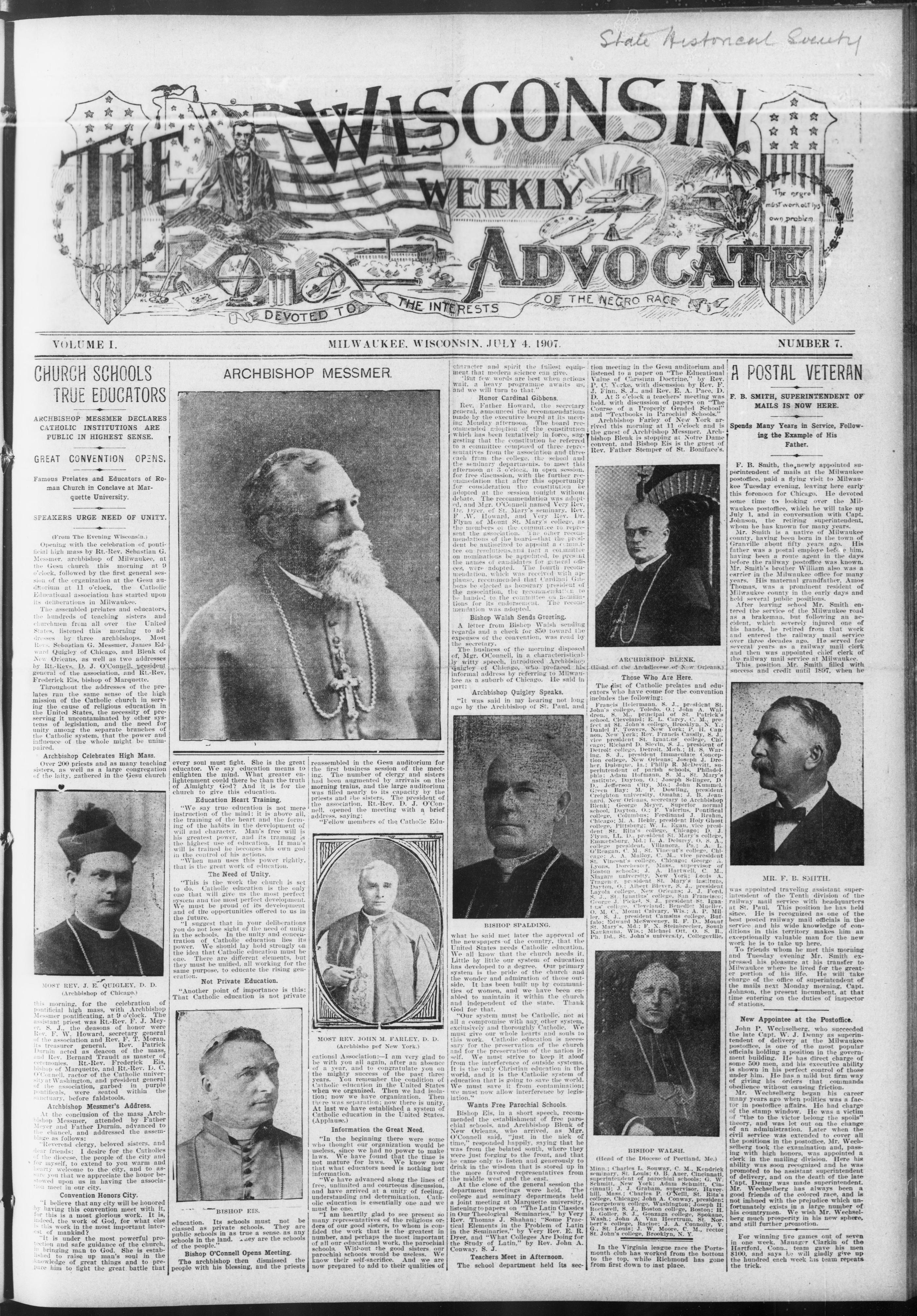
CHURCH SCHOOLS TRUE EDUCATORS
ARCHBISHOP MESSMER DECLARES CATHOLIC INSTITUTIONS ARE PUBLIC IN HIGHEST SENSE.
Famous Prelates and Educators of Roman Church in Conclave at Marquette University.
(From The Evening Wisconsin.)
(From The Evening Wisconsin.) Opening with the celebration of pontifical high mass by Rt.-Rev. Sebastian G. Messmer, archbishop of Milwaukee, at the Gesu church this morning at 9 o'clock, followed by the first general session of the organization at the Gesu auditorium at 11 o'clock, the Catholic Educational association has started upon its deliberations in Milwaukee.
The assembled prelates and educators, the hundreds of teaching sisters and churchmen from all over the United States, listened this morning to addresses by three archbishops. Most Revs. Sebastian G. Messmer, James Edward Quigley of Chicago, and Blenk of New Orleans, as well as two addresses by Rt-Revs. D. J. O'Connell, president general of the association, and Rt.-Rev. Frederick Eis, bishop of Marquette.
Throughout the addresses of the prelates ran the same sense of the high mission of the Catholic church in serving the cause of religious education in the United States, the necessity of preserving it uncontaminated by other systems of legislation, and the need for unity among the separate branches of the Catholic system, that the power and influence of the whole might be unimpaired.
Archbishop Celebrates High Mass.
Over 200 priests and as many teaching sisters, as well as a large congregation of the laity, gathered in the Gesu church
P.
MOST REV. J. E. QUIGLEY, D. D. (Archbishop of Chicago.) this morning, for the celebration of pontifical high mass, with Archbishop Messmer pontificating, at 9 o'clock. The assistant priest was Rt.-Rev. F. J. Meyer. S. J., the deasons of honor were Rev. F. W. Howard, secretary general of the association and Rev. F. T. Moran, its treasurer general. Rev. Patrick Durnin acted as deacon of the mass, and Rev. Bernard Traudt as master of ceremonies. Rt.-Rev. Frederick Eis, bishop of Marquette, and Rt.-Rev. D. C. O'Connell, ractor of the Catholic university at Washington, and president general of the association, garbed in purple pontificals, were seated within the sanctuary, before faldstools.
Archbishop Messmer's Address
At the conclusion of the mass Archbishop Messmer, attended by Father Meyer and Father Durnin, advanced to the chancel, and addressed the assemblage as follows:
"Reverend clergy, beloved sisters, and dear friends: I desire for the Catholics of the diocese, the people of the city and for myself, to extend to you warm and hearty welcome to the city, and to assure you that we appreciate the honor bestowed upon us in having the association meet in our city.
Convention Honors City.
"I believe that any city will be honored by having this convention meet with it, for this is a most glorious work. It is, indeed, the work of God, for what else is this work in the most important interest of mankind?
"It is under the most powerful protection and safe guidance of the church, in bringing man to God. She is established to raise up man's soul in the knowledge of great things and to prepare him to fight the great battle that
ARCHBISHOP MESSMER.
P.
P.
every soul must fight. She is the great educator. We say education means to enlighten the mind. What greater enlightenment could there be than the truth of Almighty God? And it is for the church to give this education.
Education Heart Training.
"We say true education is not mere instruction of the mind; it is above all, the training of the heart and the forming of the habits in the development of will and character. Man's free will is his greatest power, and its training is the highest use of education. If man's will is trained he becomes his own god in the control of his actions.
"When man uses this power rightly, that is the great work of education.
The Need of Unity.
"This is the work the church is set to do. Catholic education is the only one that will give us the most perfect system and the most perfect development. We must be proud of its development and of the opportunities offered to us in the future.
"I suggest that in your deliberations you do not lose sight of the need of unity in the schools. In the unity and concentration of Catholic education lies its power. We should lay hold strongly on the idea that Catholic education must be one. There are different elements, but they must be unified, all working for the same purpose, to educate the rising generation.
Not Private Education.
"Another point of importance is this. That Catholic education is not private
P.
education. Its schools must not be classed as private schools. They are public schools in as true a sense as any schools in the land. They are the schools of the people."
Bishop O'Connell Opens Meeting.
The archbishop then dismissed the people with his blessing, and the priests
MILWAUKEE, WISCONSIN. JULY 4. 1907.
POPE
reassembled in the Gesu auditorium for the first business session of the meeting. The number of clergy and sisters had been augmented by arrivals on the morning trains, and the large auditorium was filled nearly to its capacity by the priests and the sisters. The president of the association, Rt.-Rev. D. J. O'Connell, opened the meeting with a brief address, saying: "Fellow members of the Catholic Edu-
P.
MOST REV. JOHN M. FARLEY, D. D.
(Archbisho pof New York.)
cational Association:—I am very glad to be with you all again, after an absence of a year, and to congratulate you on the mighty success of the past three years. You remember the condition of Catholic education in the United States when we organized. Then we had isolation; now we have organization. Then there was separation; now there is unity. At last we have established a system of Catholic education in the United States.
(Applause.)
Information the Great Need
"In the beginning there were some who thought our organization would be useless, since we had no power to make laws. We have found that the time is not mature for laws. We know now that what educators need is nothing but information.
"We have advanced along the lines of free, unlimited and courteous discussion, and have arrived at a unity of feeling, understanding and determination. Catholic education is essentially one and we must be one.
"I am heartily glad to see present so many representatives of the religious orders of our good sisters, to whom is confided the work that is the greatest in number, and perhaps the most important of all our educational work, the parochial schools. Without the good sisters our parochial schools would be useless. We know their self-sacrifice. And we are now prepared to add to their qualities of
character and spirit the fullest equipment that modern science can give.
ment that modern science can give.
"But few words are best when actions wait, a heavy programme awaits us, and we will turn to that."
Honor Cardinal Gibbons
Rev. Father Howard, the secretary general, announced the recommendations made by the executive board at its meeting Monday afternoon. The board recommended adoption of the constitution which has been tentatively in force, suggesting that the constitution be referred to a committee composed of three representatives from the association and three each from the college, the school and the seminary department, to meet this afternoon at 3 o'clock, in open session, for free discussion, with the further recommendation that after this opportunity for consideration the constitution be adopted at the session tonight without debate. The recommendation was adopted, and Mgr. O'Connell named Very Rev. Dr. Dyer, of St. Mary's seminary. Rev. F.W. Howard, and Very Rev. Dr. Flynn of Mount St. Mary's college, as the members of the committee to represent the association. The other recommendations of the board—that the president be authorized to appoint a committee on resolutions, and that a committee on nominations be appointed, to present the names of candidates for general offices, were adopted. The fourth recommendation, which was received with applause, recommended that Cardinal Gibbons be elected as honorary president of the association, the recommendation to be handed to the committee on nominations for its endorsement. The recommendation was adopted.
Bishop Walsh Sends Greering.
A letter from Bishop Walsh sending regards and a check for $50 toward the expenses of the convention, was read by the secretary.
The business of the morning disposed of, Mgr. OConnell, in a characteristically witty speech, introduced Archbishop Quigley of Chicago, who prefaced his informal address by referring to Milwaukee as a suburb of Chicago. He said in part:
Archbishop Quigley Speaks.
"It was said in my hearing not long ago by the Archbishop of St. Paul, and
P.
BISHOP SPALDING. what he said met later the approval of the newspapers of the country, that the United States needs Catholic education. We all know that the church needs it. Little by little our system of education has developed to a degree. Our primary system is the pride of the church and the wonder and admiration of those outside. It has been built up by communities of women, and we have been enabled to maintain it within the church and independent of the state. Thank God for that.
"Our system must be Catholic, not at all a compromise with any other system, exclusively and thoroughly Catholic. We must give our whole hearts and souls to this work. Catholic education is necessary for the preservation of the church and for the preservation of the nation itself. We must strive to keep it aloof from the interference of outside systems. It is the only Christian education in the world, and it is the Catholic system of education that is going to save the world. We must save it from contamination; we must now allow interference by legislation."
Wants Free Parochial Schools.
Bishop Eis, in a short speech, recommended the establishment of free parochial schools, and Archbishop Blenk of New Orleans, who arrived, as Mgr. O'Connell said, "just in the nick of time," responded happily, saying that he was from the belated south, where they were just forging to the front, and that he came only to listen and generously to drink in the wisdom that is stored up in the more favored representatives from the middle west and the east.
At the close of the general session the department meetings were held. The college and seminary departments held a joint meeting at Marquette university, listening to papers on "The Latin Classics in Our Theological Seminaries," by Very Rev. Thomas J. Shahan; "Some Practical Elements in the Problem of Latin in the Seminaries," by Very Rev. E. R. Dyer, and "What Colleges Are Doing for the Study of Latin," by Rev. John A. Conway, S. J.
Teachers Meet in Afternoon.
The school department held its sec-
tion meeting in the Gesu auditorium and listened to a paper on "The Educational Value of Christian Doctrine," by Rev. P. C. Yorke, with discussion by Rev. F. J. Finn. S. J., and Rev. E. A. Pace, D. D. At 3 o'clock a teachers' meeting was held, with discussion of papers on "The Course of a Properly Graded School" and "Textbooks in Parochial Schools." Archbishop Farley of New York arrived this morning at 11 o'clock and is the guest of Archbishop Messmer. Archbishop Blenk is stopping at Notre Dame convent, and Bishop Eis is the guest of Rev. Father Stemper of St. Boniface's.
P.
(Head of the Archdiocese of New Orleans.)
Those Who Are Here.
The dist of Catholic prelates and educators who have come for the convention includes the following:
Francis Helermann, S. J., president St. John's college, Toledo, O.; John A. Waldron, S. M., principal of St. Patrick's school, Cleveland; E. L. Carey, C. M., prefect at St. John's college, Brooklyn, N. Y.; Daniel P. Towers, New York; P. H. Cannon, New York; Rev. Francis Cassil, S. J., vice president St. Ignatius' college, Chicago; Richard D. Slevyn, S. J., president of Detroit college, Detroit, Mich.; H. S. Waring, S. J., president immaculate Conception college, New Orleans; Joseph J. Dreher, Dubuque, Ia.; Philip R. McDevitt, superintendent of parish schools, Philadelphia; Adam Hofmann, S. M., St. Mary's institute, Dayton, O.; Joseph Selinger, D. D., Jefferson City, Mo.; John Kummel, Green Bay; M. P. Dowling, president Creighton university, Omaha; J. B. Jeannard, New Orleans, secretary to Archbishop Blenk; George Meyer, Superior normal school, Dayton, O.; F. Valerius, Pontifical college, Columbus; Ferdinand J. Brahm, Chicago; M. A. Hehir, president Holy Ghost college, Pittsburg; W. L. Egan, vice president St. Rita's college, Chicago; D. J. Flynn, LL. D., president St. Mary's college, Emmetsburg, Md.; L. A. Delurey, O. S. A., colleges president, Villanova, Pa.; A. L. O'Reagan, C. M., St. Vincent's college, Chicago; A. A. Malloy, C. M., vice president St. Vincent's college, Chicago; George A. Lyons, Dorchester, Mass., supervisor of Boston schools; J. A. Hartwell, C. M. Magna university, New York; Louis A. Tragener, president St. Mary's institute, Dayton, O.; Albert Biever, S. J., president Layola college, New Orleans; J. J. Ford, S. J., St. Ignatius' college, San Francisco; George J. Pickel, S. J., president St. Ignatius' college, Cleveland; Benedict Mueller, O. M. C. Mount Calvary, Wis.; A. P. Miller, S. J., president Camsius college, Buffalo; Edward McSweeney, R. F. D., Mount St. Mary's, Md.; F. X. Steinbrecher, South Kaukauna, Wis.; Michael Ott, O. S. B. Ph. Dd., St. John's university, Collegeville,
P.
Minn.; Charles L. Souway, C. M., Kendrick seminary, St. Louis; O. B. Auer, Cincinnati, superintendent of parochial schools; G. W. Schmitt, New York; Adam Schmitt, Cincinnati; J. J. Graham, supervisor, Haverhill, Mass.; Charles P. O'Neill, Rita's college, Chicago; John A. Conway, presiden; Georgetown college, Washington; Joseph H. Rockwell, S. J., Boston college, Boston; H. J. Goller, S. J., Gonzaga college, Spokane, Wash.; John A. Van Heertrum, St. Norbert's college, Racine; J. A. Connolly, V. G., St. Louis; J. W. Moore, C. M., rector St. John's college, Brooklyn, N. Y.
In the Virginia league race the Portsmouth club has worked from the bottom to the top, while Richmond has gone from first down to last place.
A POSTAL VETERAN
F. B. SMITH, SUPERINTENDENT OF MAILS IS NOW HERE.
F. B. Smith, the newly appointed superintendent of mails at the Milwaukee postoffice, paid a flying visit to Milwaukee Tuesday evening, leaving here early this forenoon for Chicago. He devoted some time to looking over the Milwaukee postoffice, which he will take up July 1, and in conversation with Capt. Johnson, the retiring superintendent, whom he has known for many years.
Mr. Smith is a native of Milwaukee county, having been born in the town of Granville about fifty years ago. His father was a postal employee before him, having been a route agent in the days before the railway postoffice was known. Mr. Smith's brother William also was a carrier in the Milwaukee office for many years. His maternal grandfather, Amos Thomas, was a prominent resident of Milwaukee county in the early days and held several public positions.
After leaving school Mr. Smith entered the service of the Milwaukee road as a brakeman, but following an accident, which severely injured one of his hands, he retired from that work and entered the railway mail service over three decades ago. He served for several years as a railway mail clerk and then was appointed chief clerk of the railway mail service at Milwaukee. This position Mr. Smith filled with success and credit until 1897, when he
W. H.
MR. F. B. SMITH. was appointed traveling assistant superintendent of the Tenth division of the railway mail service with headquarters at St. Paul. This position he has held since. He is recognized as one of the best posted railway mail officials in the service and his wide knowledge of conditions in this territory makes him an exceptionally valuable man for the new work he is to take up here.
To friends whom he met this morning and Tuesday evening Mr. Smith expressed his pleasure at his transfer to Milwaukee where he lived for the greater portion of his life. He will take charge of the office of superintendent of the mails next Monday morning, Capt. Johnson, the present incumbent, at that time entering on the duties of inspector of stations.
New Appointee at the Postoffice
John P. Weehselberg, who succeeded the late Capt. W. J. Denny as superintendent of delivery at the Milwaukee postoffice, is one of the most popular officials holding a position in the government building. He has direct charge of some 500 men, and his executive ability is shown in his perfect control of those under him. He has a mild but firm way of giving his orders that commands obedience without causing friction.
Mr. Wechselberg began his career many years ago when politics was a factor in postoffice affairs. He had charge of the stamp window. He was a victim of "the to the victor belong the spoils" theory, and was let out on the change of an administration. Later when the civil service was extended to cover all the positions in the postoffice. Mr. Wechselberg took the examination and, passing with high honors, was appointed a clerk in the mailing division. Here his ability was soon recognized and he was promoted to be assistant superintendent of delivery, and on the death of the late Capt. Denny was made superintendent. Mr. Wechselberg has always been a good friends of the colored race, and is not imbued with the prejudice which unfortunately exists in a large number of his countrymen. We wish Mr. Wechselberg much prosperity in his new sphere, and still further promotion.
For winning five games out of seven in one week. Manager Clarkin of the Hartford, Conn., team gave his men $100, and says he will gladly give up the hundred each week his team repeats the trick.
SCHMITZ 10 CELL;
CHEERS IN COURT.
HUNDREDS WILD WITH JOY WHEN
SAN FRANCISCO MAYOR GETS
FIVE YEARS.
THROW HATS IN THE AIR.
Lawyer of Gana Official Narrowly
Escapes Being Sent to Jail for
Contempt of Court.
SAN FRANCISCO, Cal., July 8—
Mayor Eugene E. Schmitz, convicted of
extortion, was today sentenced to five
years in the penitentiary. When the sen-
tence was pronounced there was a re-
remarkable outburst of applause from
the. hundreds of persons who crowded
Judge Dunne'’s court room.
Judge Dunne sentenced Schmitz to the
San Quentin penitentiary.
The sentence today followed the recent
conviction of Schmitz for extorting $1175
from French restaurant keepers of San
Francisco.
Cheers and Hat Throwing.
As the last words of the sentence fell
from the judge’s lips the great crowd
that had stood throughout the dramatic
scene, sent up a thunderous cheer.
“Good for you,” shouted a man in the
back of the room. His ejaculation was
ae bee an
ROP ies eee 4
pe eee
pe oe eo
oe Lee
pe te a Rage
eee aie re ee
ee |
ie
RR gay i.
me rr te
ose Bei Cage fe
Pe
Fe i Perea 8k
aes Rm ee reece
eee emia jr ye
Fags ee a Soe
OO pe
tS earateeS Cite ars dare rae |
Sn ES, < Looe rat maa
eae SS URN cc sham 0 an
ia fe ae mans ee etete 2)
ch Seem sae cae es
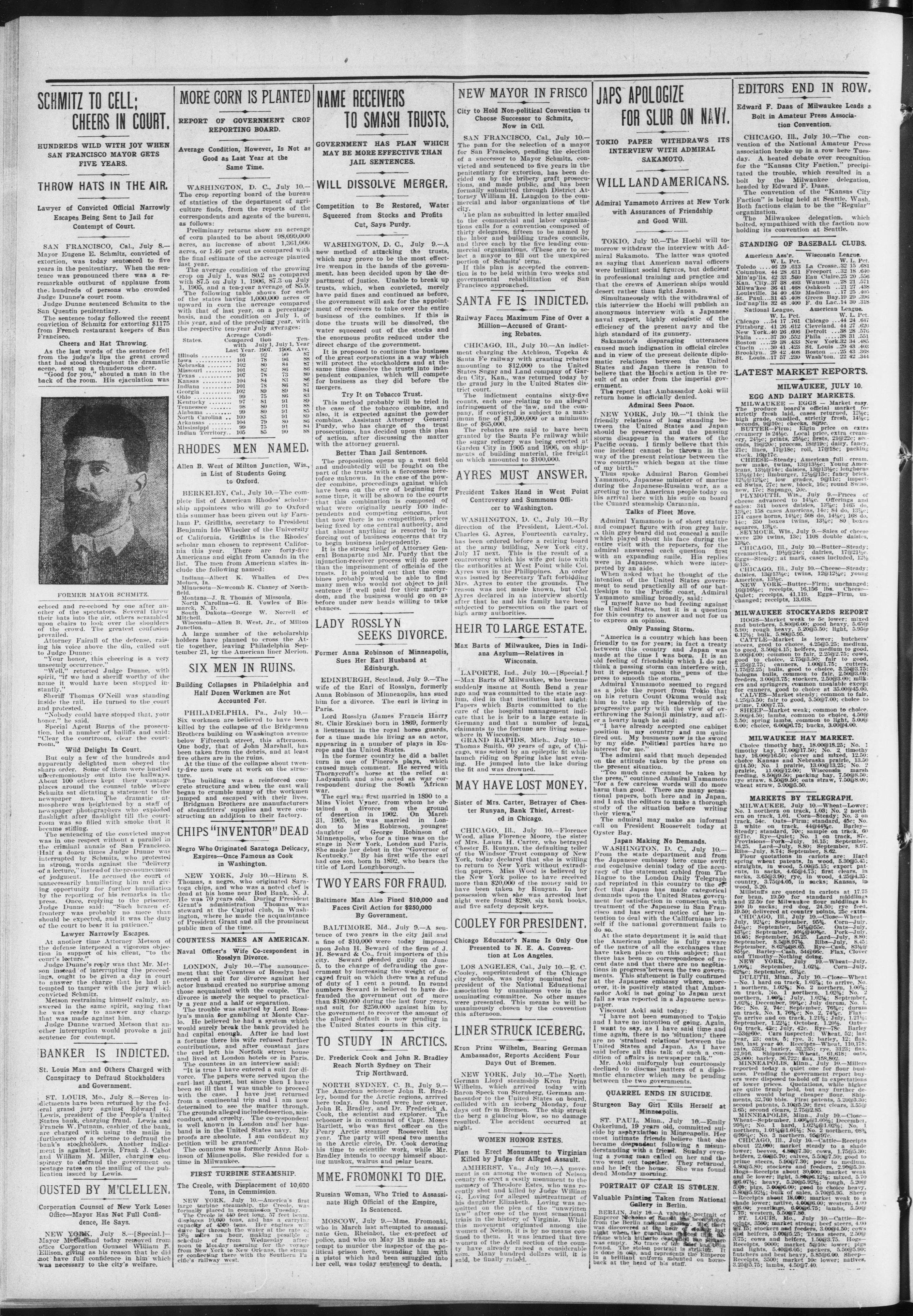
FORMER MAYOR SCHMITZ.
echced and re-echoed by one after an-
other of the spectators. Several threw
their hats into the air, others scrambled
upon chairs to look over the shoulders
of the crowd. The greatest confusion
prevailed.
Attorney Fairall of the defense, rais-
ing his voice above the din, called out
to Judge Dunne:
“Your honor, this cheering is a very
unseemly occurrence.”
“Well.” retorted Judge Dunne, with
spirit, “if we had a sheriff worthy of the
name it would have been stopped in-
stantly.””
Sheriff Thomas O'Neill was standing
inside the rail. He turned to the court
nnd protested.
“Nobody could have stopped that, your
honor.” he said.
Special Agent Burns of the prosecu-
tion, led_a number of bailiffs and said:
“Clear the courtroom, clear the court-
room.”
Wiid Delight In Court.
But only a few of the hundreds and
apparently delighted men obeyed the
sharp order. Some of them were hustied
ulecremoniously out into tne hallways.
About 100 others kept ther vantage
places xround the counsel table where
Schinitz sat dictating a statement to the
newspaper men. The dramatic at-
mosphere was heightened by a staff of
newspaper photographers who exploded
flashlight after flashlight till the court-
room was so filled with smoke that it
became stifling.
The sentencing of the convicted mayor
was in one respect without a parallel in
the criminal annals of San_ Francisco.
‘Half a dozen times Judge Dunne was
interrupted by Schmitz, who protested
in strong, words against the “delivery
.of a lecture,” instead of the pronouncement
of judgment. He accused the court of
runnecessarily humiliating him and giv-
ing opportunity for further humiliation
by the reporting of his remarks in the
press. Once, replying to the prisener,
Judge Dunne said: “Such brazen ef-
frontery was probably no more thar
should be expected, and it was the duty
of the court to bear it in patience.”
Lawyer Narrowly Escapes.
At another time Attorney Metson of
the defense interposed a vigorous objec:
tion in support of his client, “to the
court’s lecture.”
Judge Dunne'’s reply was that Mr. Met-
son instead of interrupting the proceed-
ings, ought to be given a day in court
to answer the charge that he had_at-
tempted to tamper with the jury which
convicted Schmitz.
Metson restraining himself calmly, an-
swered in the same spirit, saying that
he was ready to answer any charge
that was made against him.
Judge Dunne warned Metson that an-
other interruption would provoke a jail
sentenee for contempt.
BANKER IS_ INDICTED.
a ee
St. Louis Man and Others Charged with
Conspiracy to Defraud Stockholders
and Government.
, ST. LOUIS, Mo., July 8.—Seven in-
\dictments have been returned by the fed-
jeral grard jury against Edward G.
|Lewis, president of the People’s United
States bank, charging fraud. Lewis and
Francis W. Putnam, cashier of the bank,
are charged with using the mails in
furtherance of a scheme to defraud the
‘bank’s stockholders. Another indict-
ment is against: Lewis, Frank J. Cabot
and William M. Miller, charging con-
spiracy to defraud the government on
postage rates on the mailing of the pub-
lication issued by Lewis.
———————
QUSTED BY M’CLELLEN.
Corporation Counsel of New York Loses
Office—Mayor Has Not Full Confi-
dence, He Says.
NEW_¥ <, July 8.—[Special.]—
Mayor Meeleind today removed from
oftice Corporation Goussel William 5.
) Ellison, ching as his reason that he did
mot have full confidence in him’ which
‘was necessary to the city’s welfare.
MORE CORN 1S PLANTED
eae ae
REPORT OF GOVERNMENT CROP
REPORTING BOARD.
eee
Average Condition, However, Is Not as
Good as Last Year at the
Same Time.
WASHINGTON, D. C., July 10.—
The crop reporting board of the bureau
of statistics of the department of agri-
culture finds, from the reports of the
correspondents and agents of the bureau,
as follows:
Preliminary returns show an acreage
of corn planted to be about 98,099,000
acres, an increase of about 1,361,006
acres, or 1.46 per cent as compared with
the final estimate of the acreage planted
last year.
The average condition of the growing
crop on July 1, was 80.2 as compared
with 87.5 on July 1, 1906, 87.3 on July
1, 1905, and a ten-year average of 85.9.
The following table shows for each
of the states having 1,000,000 acres or
upward in corn the acreage compared
with that of last year, on a percentage
basis, and the condition on July 1, of
this year, and of the preceding year, with
the respective ten-year July averages:
pepe NR
States. Compared tion eee
with July1, July 1, Year
Last Year. 1907. 1906. Ave.
Ulinois .......... 99 92 oO St
LOWS caccds.cecas SOE 78 96. 38
Nebraska .....:.. 102 380 84 87
Missouri ......... 101 82 386 386
Texas ........... 107 78 73 30
Kansas .......... 104 S4 83 86
Indiana .......... 101 78 86 Si
Georgia .......... 102 89 89 B4
ORIG se svi sieshon ee ® 75 86 83
Kentucky 22.2.2... 97 81 91 89
‘Tennessee ....... 98 80 o1 88
Alabama ......... 99 80 ot 85
North Carolina .. 100 83 1 89
Arkansas ........ 104 79 80 86
Mississippi ...-... 99 red 91 St
Indian ‘erritory.. 105 85 20 38
eee
RHODES MEN NAMED.
ee aS
Allen B. West of Milton Junction, Wis.,
in List of Students Going
to Oxford.
BERKELEY, Cal., July 10.—The com-
plete list of American Rhodes’ scholar-
ship appointees who will go to Oxford
this summer has been given out by Farn-
ham P. Griffiths, secretary to President
Benjamin Ide Wheeler of the University
of California. Griffiths is the Rhodes’
scholar man chosen to represent Califor-
nia this year. There are forty-five
Americans and eight from Canada in the
list. The men from American states in-
clude the following named:
Indiana—Albert K. Whallen of Des
Moines, Ia.
adiinnesota—Newcomb K. Chaney of North-
eld.
Montana—J. R. Thomas of Missoula,
North Carolina—G. R. Vowles of Bis-
marck, N. D.
South Dakota—George W. Norrell of
Mitchell.
Wisconsin—Allen B. West, Jr., of Milton
Junction.
A large number of the scholarship
holders have planned to cross the At-
tie together, leaving Philadelphia Sep-
tember 21, by the American liner Merion.
_———
SIX MEN IN RUINS.
Building Collapses in Philadelphia and
Half Dozen Workmen are Not
Accounted For.
PHILADELPHIA, Pa., Jwy 10.—
Six workmen are believed to have been
killed by the collapse of the Bridgeman
Brothers building on Washington avenue
below Fifteenth street, this afternoon.
One body, that of John Marshall, has
been taken from the debris, and at least
five others are in the ruins.
At the time of the collapse about twen-
ty-five men were at work on the struc-
ture.
The building was a_ reinforced con-
crete structure and when the east wall
began to crumble many of the workmen
jumped and escaped with their lives.
Bridgman Brothers are manufacturers
of steamfitters’ supplies and were con-
structing an addjtion to their factory.
ad
tf y
CHIPS “INVENTOR” DEAD
pee reo
Negro Who Originated Saratoga Delicacy,
Expires—Once Famous as Cook
in Washington.
NEW YORK, July 10.—Hiram S.
Thomas, a negro, who originated Sara-
toga chips, and who was a noted chef is
dead at his home near Red Bank, N. J.
He was 70 years old. During President
Grant’s administration Thomas was
steward at the Capitol club, in Wash-
ington, where he made the acquaintance
of President Grant and all the prominent
publie men of the time.
$<
COUNTESS NAMES AN AMERICAN.
Naval Officer’s Wife Co-respondent in
Rosslyn Divorce.
LONDON, July 10.—The announce-
ment that the Countess of Rosslyn had
entered a suit for divorce against her
actor husband created no surprise among
those acquainted with the couple. The
divoree is merely the sequel to practical-
ly a year and a half or separation.
‘The trouble was started by Lord Ross-
lyn’s mania for gambling at Monte Car-
lo. He believed he had a system which
would surely break the bank provided he
had capital enough. After he had lost
a fortune there his wife refused further
contributions, and after constant jars
the earl left his Norfolk street house
and lived at London hotels or in Paris.
‘The countess in an interview said:
“It is true I have entered a suit for di-
yorce. ‘The papers were served upon the
earl.last August, but since then I have
been so ill that I was unable to proceed
with the case. I have just returned
from a continental trip and i am now
determined to see the matter through.
‘The grounds alleged includedesertion, mis-
conduct, and cruelty. The co-respondent
is well known in London and’ her hus-
band is in the United States navy. My
proofs are absolute. I am confident my
petition will be granted.”
The countess was formerly Anna Rob-
inson of Minneapolis. She resided for 2
time in Milwaukee.
FIRST TURBINE STEAMSHIP.
The Creole, with Displacement of 10,600
Tons, in Commission.
NEW YORK, July 10.—America’s first
large turbine Steamship, the Creole, wa=
formally placed in, commission Tuesday.
The Creole is 440 feet lonz. 57 feet beam
displaces 10,60) tons, and bas a carryin
capactty of 400. tens. Her engines ‘wil!
dave Der through the water at the rate o:
18% niles an hour, making possiljie =
schedule of from Wednesday — after.
noon te Monday merning for the yoyase
from New York to New Orleans, the steam
er confiecting there with the Southern Pa
cific’s railway west.
10 SMASH TRUSTS,
Se eel
GOVERNMENT HAS PLAN WHICH
MAY BE MORE EFFECTIVE THAN
JAIL SENTENCES.
eS aessesee
WILL DISSOLVE MERGER.
ee
Competition to Be Restored, Water
Squeezed from Stocks and Profits
Cut, Says Purdy.
WASHINGTON, D. ©, July 9—A
new method of attacking the trusts,
which may prove to be the most effect-
ive weapon in the hands of the govern-
ment, has been decided upon by the de-
partment of justice. Unable to break up
trusts, which, when convicted, merely
have paid fines and continued as before,
the government will ask for the appoint-
ment of receivers to take over the entire
business of the combines. If this is
done the trusts will be dissolved, the
water squeezed out of the stocks and
the enormous profits reduced under the
direct charge of the government.
It is proposed to continue the business
of the great corporations in a way which
will protect the stockholders and. at the
same time dissolve the trusts into inde-
pendent companies, which will compete
for business as they did before the
mergers.
Try It on Tobacco Trust.
This method probably will be tried in
'the case of the tobacco combine, and
also, it is expected against the ee
combine. Assistant Attorney eneral
Purdy, who has charge of the trust
prosecutions, has decided upon this plan
of action, after discussing the matter
| with the attorney general.
Better Than Jail Sentences.
- ‘The proposition opens up a vast field
/and undoubtedly will be fought on the
part of the trusts with a fierceness here-
‘tofore unknown. In the case of the pow-
der combine, proceedings against. which
have been on the eve of beginning for
‘some time, it will be shown to the courts
‘that this combination is composed of
what were originally nearly 100 inde-
-pendents and competing concerns, but
that now there is no competition, prices
being fixed by one central authority, and
that almost anything is resorted to in
forcing out of business concerns that try
to begin business independently.
It is the strong belief of Attorney Gen-
eral Bonaparte and Mr. Purdy that the
injunction-receiver process will do more
than the imprisonment of officials of the
trusts. It is pointed out that the com-
bines probably would be able to find
many men who would not object to jail
sentence if well paid for their martyr-
dom, and the business would go on as
before under new heads willing to take
chances.
LADY ROSSLYN
SEEKS DIVORCE.
Former Anna poniaoe of Minneapolis,
Sues Her Earl Husband at
Edinburgh.
EDINBURGH, Scotland, July 9.—The
wife of the Earl of Rosslyn, formerly
Anna Robinson of Minneaoplis, has sued
him for a divorce. The earl is living in
Paris. .
Lord Rosslyn (James Francis Harry
St. Clair Erskine) born in 1869, formerly
a lieutenant in the royal horse guards,
for a time made his living as an actor,
appearing in a number of plays in Eu-
mpe and the United States.
n the former country he did a ballet
turn in one of Pinero’s plays, which
caused much comment. He served with
Thornycroft’s horse at the relief at
Ladysmith and also acted as war cor-
respondent during the South ‘African
war.
The earl was first married in 1890 to a
Miss Violet Vyner. from whom he ob-
tained a_ divorce on the ene
of desertion in 1902. On March
31, 1905, he was_married in Lon-
don to Miss Robirson, youngest
daughter of George Robinson of
Minneapolis, who for a time was on the
stage in New York, London and Paris.
She made her debut in the “Governor of
Kentucky.” By his first wife the earl
had one son, born in 1892, who bears the
title of Lord Loughborough.
TWO YEARS FOR FRAUD.
ee ag
Baltimore Man Also Fined $10,000 and
Faces Civil Action for $250,000
By Government.
BALTIMORE, Md., July 9.—A sen-
tence of two years in the city jail and
a fine of $10,000 were today imposed
upon John H. Seward of the firm of J.
H. Seward & Co., fruit importers of this
city. Seward pteaded guilty on June
5, to the charge of defrauding the gov-
ernment by increasing the weight of de-
cayed fruit on which there was a refund
of duty of 1 cent a pound. In reund
numbers Seward is believed to have de-
frauded the government out of more
than $180,000 during the last four years,
and suit for $250,000 against him by
the government to recover the amount of
the alleged default is now pending in
the United States courts in this city.
een eaieneneenets
TO STUDY IN ARCTICS.
Dr, Frederick Cook and John R. Bradley
Reach North Sydney on Their
Trip Northward.
NORTH SYDNEY, C. B., July 9.—
The American schooner John R. Brad-
ley, bound for the Arctic regions, arrived
here today. On board were her owner,
John R, Bradley, and Dr. Frederick A.
Cook, the scientist and explorer. The
schooner is in command of Capt. Moses
Bartlett, who was first officer on the
Peary Arctic steamer Roosevelt last
year. The party will spend two months
in the Arctic circle, Dr. Cook devoting
his time to scientific work, while Mr.
Bradley intends to oceapy himself shoot-
ing muskox, walrus and pelar bears.
—_—_—_-—____—_
MME. FROMONKI TO DIE.
Se eg a aca
Russian Woman, Who Tried to Assassi-
nate High Official of the Empire,
Is Sentenced.
MOSCOW, July 9.—Mme. Fromonki,
who in March last attempted to assassi-
nate Gen, Rheinbot, the ex-prefect of
police, and who on May 18 made an at-
tempt to murder the inspector of the po-
litical prison here, wounding him with
a pistol which had been smuggled into
her cell, was today sentenced to death.
NEW MAYOR IN FRISCO
City to Hold Non-political Convention ts
Choose Successor to Schmitz,
Now in Cell.
SAN FRANCISCO, Cal., July 10.—
The pian for the selection of a mayor
for San Francisco, pending the election
of a successor to Mayor Schmitz, con-
victed and sentenced to five years in the
penitentiary for extortion, has been de-
cided on by the bribery graft prosecu-
tions, and made public, and has been
formally submitted through District At-
torney William H. Langdon to the com-
mercial and labor organizations of the
city.
‘she plan as submitted in letter smailed
to the commercial and labor organiza-
tions calls for a convention composed of
thirty delegates, fifteen to be named by
the labor and building trades councils,
and three each by the five leading com-
mercial organizations, “These are to. se-
lect a mayor to fill out the unexpired
portion of Schmitz’ term.
If this plan is accepted the conven-
tion is to be held within two weeks and
governmental rehabilitation of San
Francisco approached.
ee
SANTA FE IS INDICTED.
Railway Faces Maximum Fine of Over a
Million—Accused of Grant-
ing Rebates.
CHICAGO, Ul, July 10.—An_ indiet-
ment charging the Atchison, Topeka &
Santa Fe railway with granting rebates
amounting to $12,000 to the United
States Sugar and Land company of Gar-
den City, Kan., was returned today by
the grand jury in the United States dis-
trict court.
The indictment contains sity or
counts, each one relating to an alleged
infringement of the Yaw, and the com-
pany, if convicted is subject to a max-
imum fine of $1,300,000 or a minimum
fine of $65,000.
The rebates are said to have been
granted by the Santa Fe railway while
the sugar refinery was helng ercceed aut
Garden City in 1905 and 1906, on ship-
ments of building material, the freight
on which amounted to $100,000.
Saag eee tees
AYRES MUST ANSWER.
President Takes Hand in West Point
Controversy and Summons Offi-
cer to Washington.
WASHINGTON, D. C., July 10.—By
direction of the President, Lieut.-Col.
Charles G. Ayres, Fourteenth cavalry,
has been ordered before a retiring board
at the army building, New York city,
July 17 next. This is the result of a
controversy which his wife got into with
the nuthorities at West Point while Col.
Ayres was in the Philippines. An order
was issued by Seeretary Taft forbidding
Mrs. Ayres to enter the grounds. The
reason was not made known, but Col.
Ayres declared in an interview shortly
after that he and his family have been
subjected to persecution on the part of
high army authorities.
HEIR TO LARGE ESTATE.
a gee
Max Barts of Milwaukee, Dies in Indi-
ana Asylum—Relatives in
Wisconsin.
LAPORTE, Ind., July 10.—[Special.{
—Max Barts of Milwaukee, who became
suddenly insane at South Bend a year
ago and was committed to the state asy-
lum, died in that institution last night:
Papers which Barts committed to the
care of the hospital management indi-
cate that he is heir to a large estate in
Germany and that a number of legal
claimants to the fortune are living some-
where in Wisconsin.
GRAND RAPIDS, Mich., July 10.—
Thomas Smith, 60 years of age, of Chi-
cago, was seized by an epileptic fit while
launch riding on Spring lake last even-
ing. He jumped into the lake during
the fit and was drowned.
eases erga eee ss
MAY HAVE LOST MONEY.
ee ig aS
Sister of Mrs. Carter, Betrayer of Ches-
ter Runyan, Bank Thief, Arrest-
ed in Chicago.
CHICAGO, Ill, July 10.—Florence
Wood, alias Florence Moore, the sister
of Mrs. Laura H. Carter, who betrayed
Chester B. Runyan, the defaulting teller
of the Windsor Trust company of New
York, today declared that she is willing
to return to New York without extradi-
tion papers. Miss Wood is believed by
the New Sora. to have received
more than $20, of the money said to
have been taken by Runyan. In her
possession when she was arrested last
night were found $280, six bank books,
and five safety deposit keys.
—
COOLEY FOR PRESIDENT.
I ae
Chicago Educator’s Name Is Only One
Presented to N. E. A. Conven-
tion at Los Angeles.
LOS ANGELES, Cal., July 10.—B. ©.
Cooley, superintendent of the Chicago
city schools, was today nominated for
president of the National Educational
association by unanimous vote in the
nominating committee. No other names
were presented. This means he will be
unanimously chosen by the convention
this afternoon.
LINER STRUCK ICEBERG.
——>—
Kron Prinz Wilhelm, Bearing German
Ambassador, Reports Accident Four
Days Out of Bremen.
NEW YORK, July 10.—The North
German Lloyd steamship Kron Prinz
Wilhelm, which arrived today with
Baron Speck von Sternberg, German am-
bassador to the United States on board,
collided with an iceberg Monday, four
days out frem Bremen. The ship struck
the berg a glancing blow, so no damage
resulted. The accident occurred at
night.
Sg rea
WOMEN HONOR ESTES.
Plan to Erect Monument to Virginian
Killed by Judge for Alfeged Assault.
AMHERST, Va.. July 10.—A move.
ment is on among the women of Nelson
county to erect a cestly monument to the
memery of Theodore Estes, who was re-
cently shot and killed by Judge William
G. Loving for alleged mistreatment of
his danghter Elizabeth. Loving was ac-
quitted on the plea of the “unwritten
law” after one of the most sensational
trials in the history of Virginia. While
this movement originated among the
wemen of Nelson, it is by no means ¢on-
fined to them. It was learned that five
women of the Adell section of the coun-
ty have already raised a considerable
sum. Many hundred dollars will, it is
said, be finally rae.
JAPS APOLOGIZE =
FOR SLUR ON NAVI.
TOKIO PAPER WITHDRAWS ITs
INTERVIEW WITH ADMIRAL
SAKAMOTO.
WILL LAND AMERICANS.
Admiral Yamamoto Anions New York
with Assurances of Friendship
and Good Will.
TOKIO, July 10.—The Hoehi will to-
morrow withdraw the interview with Ad-
miral Sakamoto. The latter was quoted
assaying that American naval officers
were brilliant social figures, but deficient
in professional training and practice and
that the crews of American ships would
desert rather than fight Japan.
Simultaneously with the withdrawal of
this iuterview the Hochi will publish an
anonymous interview with a Japanese
naval expert, highly eulogistic of the
efficiency of the present navy and the
high standard of its gunnery.
Sakamoto’s disparaging utterances
caused much indignation in official circles
and in view of the present delicate diplo-
matic relations between the United
States and Japan there is reason to
believe that the Hochi’s action is the re-
sult of an order from the imperial gov-
ernment. aes
The report that Ambassador Aoki wiil
return home is officially denied.
Admiral Sees Peace.
NEW YORK, July 10.—“I think the
friendly relations of long standing be-
tween the United States and Japan
should be preserved and the passing
storm disappear in the waters of the
Pacific ocean. I firmly believe that this
one incident cannet be thrown in the
way of the present relations between the
two countries which began at the time
of my birth.” i
Thus spoke Admiral Baron Gombei
Yamamoto, Japanese minister of marine
during the Japanese-Russian war, as a
greeting to the American people today on
his arrival here with his suite on board
the Cunard steamship Carmunia.
Talks of Fleet Move.
Admiral Yamamoto is of short stature
and compact figure with iron grey hair.
+1 thin grey beard did not conceal a smile
which played about his face during the
entire visit with the reporters, for the
admiral answered each question — first
with an expanding smile. His replies
were in Japanese, which were inter-
preted by an aide.
When asked what he thought of the
intention of the United States govern-
ment to send practically all of our bat-
tleships to the Pacific coast, Admiral
Yamamoto smiling broadly, said:
“I myself have no bad feeling against
the United States, but it is a question
for this country to answer and not for us
to express an opinion.
Only Passing Storm.
“America is a country which has been
friendly to us for years; in fact a treaty
between this country and Japan was
made at the time I was born. It is an
old feeling of friendship which I. do net
‘think a passing storm can interfere with,
but it depends upon the pens of the
| press to smooth the storm.”
Admiral Yamamoto seemed to regard
ae a joke the report from Tokio that
on his return Count Okuma would ask
him to take up the leadership of the
progressive party with the view of oy-
erthrowing the Saionji ministry, and aft-
er a hearty laugh he said:
_ “I have already accepted one cabinet
position in my country and am quite
tired out. My business now is the sword
by my side. Politieal parties have no
interest for me.”
_ The admiral said that much depended
on the attitude taken by the press on
the present situation.
“Too much care cannot be taken by
the press,” continued Admiral Yamamoto
“for a few careless words will do more
harm than good. There are many sensa-
tional papers, both here and in Japan,
and I ask the editors to make a thorough
study of the situation before writing
their views.”
The admiral may make an informal
call on President Roosevelt today at
Oyster Bay.
Japan Making No Demands.
WASHINGTON, D. C., July 10.—
Krom the state department and from
the Japanese embassy here came swift.
and conclusive denial today of the aceu-
racy of the statement cabled from The
Hague to the London Daily Telegraph
and reprinted in this country to the 6
fect that Japan has made categorical
demands upon the United States govern-
ment for satisfaction in connection with
treatment of the Japanese in San Fran-
cisco and has served notice of her in-
tention to Geal with the Californians her-
self if the national government fails to
do so.
At the state department it is said that
the American public is fully aware
of the nature of all the exchanges that
have taken place on this subject; that
there has been no correspondence of re-
cent date and that there are no negétia-
tions in Ree re necnees the two govern-
ments. ‘This statement is fully confirmed
at the Japanese embassy where, more-
over, it-is positively stated that Ambas-
sador Aoki is net going‘to Japan next
fall as was reported in a Japanese news-
paper.
Viscount Aoki said today:
“I have not been summoned to Tokio
and I have no intention of geing. Again,
I want to sey; as I have said time and
time again, there is no ‘situation;’ there
are no ‘strained relations’ between the
United States and Japan. As I have
said before all this talk of such a con-
dition of affairs is newspaper talk.”
Mr. Aoki uniformly but courteonsly
declined to discuss~ matters of a diplo-
matie character which may be pending
between the two governments.
QUARREL ENDS IN SUICIDE.
Sturgeon Bay Girl Kills Herself at
Minneapolis.
ST. PAUL, Minn., July 16.—Emily
Oakerlund, 19 years old, committed sui-
cide by asphyxiation in Minneapolis. Her
most intimate friends believe that she
became despendent following a misun-
derstanding with a friemd. Sunday even-
ing a young man called on her and the
two went out together. They returned,
and he left the house. She was found
dead Monday morning.
ns
PORTRAIT OF CZAR IS ST®LEN.
Valuable Painting Taken from National
Gallery in Berlin.
BERLIN, July 16—A valu
Emperor Nicholas @f Rusa J booatgcr
from the Berlin nati : c ten
was discovered, atte dat
it as
ffs “which hitherto c
was empty. No trace of
found. ‘The. stolan portrait is stricta It
is dane in ae aud represents the Emperor
in a brilliant uniform mounted on horse-
back at the head of his staff.
EDITORS END IN ROW.
ad emai
Edward F. Daas of Milwaukee Leads a
Bolt in Amateur Press Associa-
tion Convention.
CHICAGO, IIL, July 10.—The con-
vention of the National Amateur Press
association broke up in a row here Tues-
day. A heated debate over recognition
for the “Kansas City Faction,” precipi-
tated the trouble, which resulted in a
bolt by the Milwaukee delegation,
headed by Edward F. Daas.
The convention of the “Kansas City
Faction” is being held at Seattle, Wash.
Both factions claim to be the “Regular”
organization.
The Milwaukee delegation. which
bolted, sympathized with the faction now
holding its convention at Seattle.
—
STANDING OF BASEBALL CLUBS.
American Ass’r. Wisconsin League.
W. L. Pet. W. L. Pet.
Toledo ....46 29 .613 La Crosse..32 15 .681
Columbus. 44 28 .611 Freeport ..32 18 .610
Min’ap'lis. 42 38 .560 Eau Claire.25 20 .556
‘Kan. City..87 88 .493 Wausau ...28 21 .571
Milwa’kee 36 41 468 Oshkosh ..21 27 .458
Louisville. 34 40 .459 Madison ..17 25 .405
St. Paul....31 45 .408 Green Bay.19 29 .396
Ind’nap'lis 32 48 400 F. du Lac..14 30 .31s
National League. American League.
; W. L. Pet. W. L. Pet.
Chicago ...54 17 .761 Chicago ...44 24 .617
Pittsburg. 41 26 .612 Cleveland. 44 27 .620
New York..40 26 .6U6 Detroit ...38 28 .576
‘Phila .....37 30 .552 Phila .....38 31 .551
Boston ....29 38 .433 New York.32 34 .485
Cincin ....30 41 .423 St. Louis ..29 43 .403
Brooklyn.. 29 42 .408 Boston ....25 43 .368
St. Louis...17 57 .230 Wash’ton. 22 42 .341
———
‘LATEST MARKET REPORTS.
pahaseiiei6 > A a
MILWAUKEE, JULY 10.
Eac AND DAIRY MARKETS.
MILWAUKEE — EGGS — Market easy.
The produce board’s official market for
strictly fresh laid, cases returned, 12ic;
high Ernie candied, strictly fresh, 14%c;
seconds, 9@10c; checks, S@¥C.
: BUTTER—Firm; Elgin price on extra
,creamery is 24%c. Local aay extra cream
ery, eer pe ete 25i6c; firsts, 21@22c; se
onds, 19@20c; process, 18@19c; dairy, fancy,
2ie;' lines, 17@18e; roll, 17@18e;° packing
Stuck. ae
CHEESE-—Steady; American full . cream.
new make, twins, 13@13%c; Young Amer-
icans, eee. daisies, 13@13%c; lonzhorns
13%@l14e; limburger, 12%@13c; fancy brick,
12Y@12%e; low grades, 9@11e; “import
ed Swiss, 27c; new, block, 16c; round Swiss,
new, 17e; Sapsago, 0c."
PLYMOUTH, Wis., Juiy 9.—Prices of
cheese advanced to 14%c. Offerings and
sales: 341 boxes daisies, 13%c; 1465 do,
18%; 158 cases Americas, 14c; $4 do, 13%,c;
174 cases horns, 144c; 508 do, 1446c; 168 do,
I4c; 350 boxes twins, 13%c; 80 boxes
squares, 13%c.
SEYMOUR, Wis., July 9.—Sales of cheese
were 230 twins, 13c; 1108 double daisies,
13%.
CHICAGO, IL, July 10.—Butter—Steady;
creameries, 19%@24e; dairies, 17@21}4¢.
Eggs—Steady; at mark, cases included, 122
Ise.
@OtIcaGo, Ti, July 10.—Cheese—Steady :
daisies, 13@13%c; twins, 12@12\%c; young
Americas, 13%6c.
NEW YORK—Butter—Firm; unchanged;
10q1oree; receipts, 16,156 Ibs. _ Cheess—
ig let; receipts, 41,119. Eggs—Firm, un-
‘changed; receipts, 13,618.
MILWAUKEE STOCKYARDS REPORT
mMOGS—Market weak to Se lower; mixed
ae peer: 5. B00 ON Ec eer: 5.60
90; rough heavy, 5.20@5.50; light, 5.95@
6.1246; bulk, 5.86@5.95.
CATTLE—Market is lower; butchers’
steers, good to choice, 4.25@5.25: medium,
to good, 3.50@4.15; heifers, medium to good,
oy common to fair, ae cows,
§ to choice, 2.75@3.50; fair to good,
apenas: ecanners, 1.00@1.75; cutters,
‘1.75@2.25; bulls, good to choice, Seso:
bologna bulls, common to fair, 2:! 3.00;
feeders, 3.00@3.75; stockers, 2.50@3.00; milk-
ers and springers, common unsalable except
for cannes Foor to. choice at 35.00@45.0).
CALVES—Market steady; common to fair.
4.25@5.50; fair to good, 5.50@7.00; choice to
prime, Lo
SHEEP—Market weak; common to choice.
3.00@4.50; lambs, common to choice, 4.50@
5.50; apres lambs, common to light, 5.0u@
6.00; choice, 6.00@6.75; bucks, 3. 00.
MILWAUKEE HAY MARKET.
Choice tmothy hay, 18.00918.25; No. | 2
timothy ray, 17.00@17.50; No. 2 timothy
hay, 16.00@16.50; clover and mixed, 12.50:
chotce Kansas and Nebraska ee. 13.50
@14.50; No. 1 prairie, 23.00@13.25; No. 2
eet sti ns it eee marsh
ng, 8. BO; cking + 7-50@S8.50;
Tye ethiwy 6 Gogo.b0r outs straw, 1-20U800;
wheat straw, 5.00@5.50.
MARKETS BY TELEGRAPH.
AMLWAULARE, July 1V.— wWneat—Lower,
No. 1 northern on track, 1.03; No. 2 north
ern on track, 1.01. _Corn—Steady; No. 3 on
frack, ofc. | Oats—Firms standard, ae; No.
white on rack, 44@44%ec. rley—
Steady; standard, 70c; sample on track, ou
@ile. Rye Quiet; No. 1 on track, Bic.
rovisions—Pork—July, 16.15; September,
16.25, | Lard july, 8.80; September, 8.97.
Ribs—July, 8.74; September, 3.62.
Bloor quotations in carlots are: Hard
phate : t parents, In = — yeaah
straights, in w x .15; export pat-
ents, in sacks, 46504 3+ frst Gears, in
sacks, eens rye, in wood, 4.25@4.35:
country, 3.75@4.05, in sacks; Kansas, ip
wood, 5.20.
Milistnffs are quoted in carlots at 17.75
for bran, 19.50 for standard middlings
and 22.50 for Milwaukee fiour middlings In
100 Ib sacks; red dog, 24.50; me feed,
19.50; delivered at country points, 25c extra.
CHICAGO, Til, July 10.—Close—Wheat-
July, 92%c; September, 95%. Corn—July,
6446; September, Sap@sae. Oats—July.
Se: September, rts . Pork—July,
16.05; September, 16.25. Lard—July, 8.80:
September, See Ribs—Jaly,” S45:
September, 8.624%4@8.65._Rye—Cash, 83%@
85igc._ Barley—Cash, 54@66c. Flax, Clover
and ‘Timothy Nothing doing.
NEW YORK, Stig 10:—Wheat—July,
1.00%; September, 1.02%. — Corn—July,
62%c; September, 63%c.
DULUTH, Minn., July 10.—Close—Wheat
—No. 1 hard on track, 1.03%; to arrive, No
1 northern, 1.02%; No. 2 northern, 1.00%;
on track, No. 1 northern, 1.02%; No. 2
northern, 1.00%; July, 1.02%; September,
1.02%; December, 99%c; July durum, No. 1,
76c; No. 2, T4c; September, 76%c;' durum
on track, No. 1, 76%; No. 2, 74%c. Flax
To arrive and on track, 1.21%; July, 1.21%:
September, 1.22%; October, 1.20%. Oats—
On track, 42c; July, 42c. Rye—78e. Barley
—53@60e, Cars inspected: Wheat, 52; last
year, 23; oats, 5; rye, 3; barley, 12; flax,
180, last year 40. ' Receipts—Wheat, 110,178:
oats, 5324; bariecy, 33,255: rye, 3123; flax,
37,916. ~ Shipments—Wheat, ° 61,615; ' oats,
28,000; barley. 36.722; flax, 158,862.
MINNEAPOLIS, Minn.,’ July 10.—Millers
reported today a quiet one for flour busi-
uess. Pending the government report buy
ers were disposed to-hold off in expectations
of lower prices. Quotations, while higher
are quite firmly held, but any further de-
clines would bring ‘cheaper flour. Ship
ments, 32,760 bbis. First patents, 5.20@3.%0:
second patents, 5.10@5.20; first clears, 3.55@
3.65; second clears, 2.75@2.85.
MINNEAPOLIS, Minn., July 10.—Close—
Wheat—September, 1.00%@1.00'4; December,
99%c; No. 1 hard, LOLMG1O2%4; No. i
northern, 1.01%4@1.61%4; No. 2 northern, 08%
@%4c; No. 3 northern, 95@97c.
CHICAGO, Ill, July 10.—Cattie—Receipts
about 22,000; market steady to a_ shade
lower; beeves, 4.80@7.30; cows, 1.75@5.30;
heifers, 2.60@5.70; calves, 5.50@7.50; good to
prime steers, 5.90@7.30; poor to medium,
4.80@5.80; stockers and feeders, 2.96@5.3))
Hogs—Receipts about 30,000; market weak
and Se lower; light, 5.80@6.12%; mixed, 5.70
Sees: heavy, 5.20@5.92%4; rough, 5.20@
Ege: pigs, oot ager goed to choice heavy,
5. 9244; bulk of sales, 5.70@5.95. Sheep
—Receipts abeut 18,080; market weak to a
shade lower; native, ioe: western, 4.000
00; yearlings, 6. 75; lambs, 5.50@
“15; western, 5.50@7.90.
ST. LOUIS, Mo., July 10.—Cattle—Re-
aE, 3500; market strong; beef steers, 4.00
15; stockers amd feeders, 3.00@4.50; cows
abd heifers, 3.00@5.25; Texas steers, 2.50@
5.75; cows and heifers, 1.50@3.75. Hogs—
gy ed 9000; market 5@10c lower; pigs
and lights, 5.40@6.05; packers, 5.50@5.90;
butchers and best heavy, 5.85@6.00. Sheep—
Receipts, 3500; market 10c lower; natives,
3.25@5.75; lambs, 4.50@7.40.
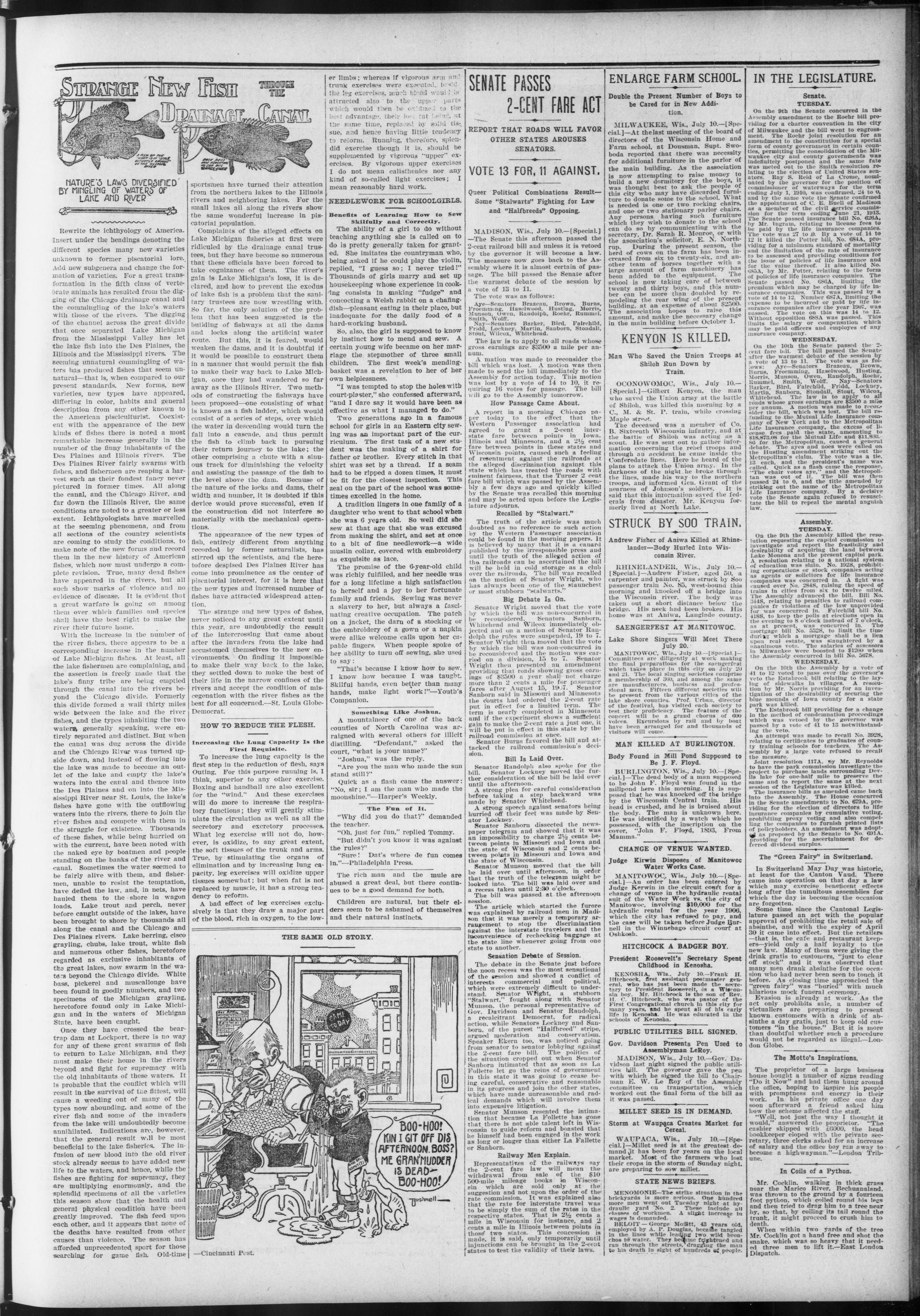
STRANGE NEW FISH THROUGH THE DRAINAGE CANAL
A FISH ON FISH WHAT IS OF STYLE BECOMES GROUND OF THE WATER
BOOK HARD ON HARDWARE FOR YOUR DIE
NATURE'S LAWS DIVERSIFIED BY MINGLING OF WATERS OF LAKE AND RIVER
---
Rewrite the ichthyology of America. Insert under the headings denoting the different species many new varieties unknown to former piscatorial lore. Add new subgenera and change the formation of varieties. For a great transformation in the fifth class of vertebrate animals has resulted from the digging of the Chicago drainage canal and the commingling of the lake's waters with those of the rivers. The digging of the channel across the great divide that once separated Lake Michigan from the Mississippi Valley has let the lake fish into the Des Plaines, the Illinois and the Mississippi rivers. The seeming unnatural commingling of waters has produced fishes that seem unnatural—that is, when compared to our present standards. New forms, new varieties, new types have appeared, differing in color, habits and general description from any other known to the American pisciculturist. Coexistent with the appearance of the new kinds of fishes there is noted a most remarkable increase generally in the number of the finny inhabitants of the Des Plaines and Illinois rivers. The Des Plaines River fairly swarms with fishes, and fishermen are reaping a harvest such as their fondest fancy never pictured in former times. All along the canal, and the Chicago River, and far down the Illinois River, the same conditions are noted to a greater or less extent. Ichthyologists have marvelled at the seeming phenomena, and from all sections of the country scientists are coming to study the conditions, to make note of the new forms and record them in the new history of American fishes, which now must undergo a complete revision. True, many dead fishes have appeared in the rivers, but all such show marks of violence and no evidence of disease. It is evident that a great warfare is going on among them over which families and species shall have the best right to make the river their future home.
With the increase in the number of the river fishes, there appears to be a corresponding increase in the number of Lake Michigan fishes. At least, all the lake fishermen are complaining, and the assertion is freely made that the lake's finny tribe are being emptied through the canal into the rivers beyond the Chicago divide. Formerly this divide formed a wall thirty miles wide between the lake and the river fishes, and the types inhabiting the two waters, generally speaking, were entirely separated and distinct. But when the canal was dug across the divide and the Chicago River was turned upside down, and instead of flowing into the lake was made to become an outlet of the lake and empty the lake's waters into the canal and thence into the Des Plaines and on into the Mississippi River near St. Louis, the lake's fishes have gone with the outflowing waters into the rivers, there to join the river fishes and compete with them in the struggle for existence. Thousands of these fishes, while being hurried on with the current, have been noted with the naked eye by boatmen and people standing on the banks of the river and canal. Sometimes the water seemed to be fairly alive with them, and fishermen, unable to resist the temptation, have defied the law, and, in nets, have hauled them to the shore in wagon loads. Lake trout and perch, never before caught outside of the lakes, have been brought to shore by thousands all along the canal and the Chicago and Des Plaines rivers. Lake herring, cisco grayling, chubs, lake trout, white fish and numerous other fishes, heretofore regarded as exclusive inhabitants of the great lakes, now swarm in the waters beyond the Chicago divide. White bass, pickerel and muscallonge have been found in goodly numbers, and two specimens of the Michigan grayling, heretofore found only in Lake Michigan and in the waters of Michigan State, have been caught.
Once they have crossed the beartrap dam at Lockport, there is no way for any of these great swarms of fish to return to Lake Michigan, and they must make their home in the rivers beyond and fight for supremacy with the old inhabitants of these waters. It is probable that the conflict which will result in the survival of the fittest, will cause a weeding out of many of the types now abounding, and some of the river fish and some of the invaders from the lake will undoubtedly become annihilated. Indications are, however, that the general result will be most beneficial to the lake fisheries. The infusion of new blood into the old river stock already seems to have added new life to the waters, and hence, while the fishes are fighting for supremacy, they are multiplying enormously, and the splendid specimens of all the varieties this season show that the health and general physical condition have been greatly improved. The fish feed upon each other, and it appears that none of the deaths have resulted from other causes than violence. The season has afforded unprecedented sport for those searching for game fish. Old-time
GAME TODAY
BOO-HOO!
KIN I GIT OFF DIS
AFTERNOON. BOSS?
ME GRAN'MUDDER
IS DEAD—
BOO-HOO!
pushnell
sportsmen have turned their attention from the northern lakes to the Illinois rivers and neighboring lakes. For the small lakes all along the rivers show the same wonderful increase in piscatorial population.
Complaints of the alleged effects on Lake Michigan fisheries at first were ridiculed by the drainage canal trustees, but they have become so numerous that these officials have been forced to take cognizance of them. The river's gain is Lake Michigan's loss, it is declared, and how to prevent the excedus of lake fish is a problem that the sanitary trustees are now wrestling with. So far, the only solution of the problem that has been suggested is the building of fishways at all the dams and locks along the artificial water route. But this, it is feared, would weaken the dams, and it is doubtful if it would be possible to construct them in a manner that would permit the fish to make their way back to Lake Michigan, once they had wandered so far away as the Illinois River. Two methods of constructing the fishways have been proposed—one consisting of what is known as a fish ladder, which would consist of a series of steps, over which the water in descending would turn the fall into a cascade, and thus permit the fish to climb back in pursuing their return journey to the lake; the other comprising a chute with a sinuous track for diminishing the velocity and assisting the passage of the fish to the level above the dam. Because of the nature of the locks and dams, their width and number, it is doubted if this device would prove successful, even if the construction did not interfere so materially with the mechanical operations.
The appearance of the new types of fish, entirely different from anything recorded by former naturalists, has stirred up the scientists, and the heretofore despised Des Plaines River has come into prominence as the center of piscatorial interest, for it is here that the new types and increased number of fishes have attracted widespread attention.
The strange and new types of fishes, never noticed to any great extent until this year, are undoubtedly the result of the intercrossing that came about after the invaders from the lake had accustomed themselves to the new environments. On finding it impossible to make their way back to the lake, they settled down to make the best of their life in the narrow confines of the rivers and accept the condition of miscegenation with the river fishes as the best for all concerned.—St. Louis Globe-Democrat.
HOW TO REDUCE THE FLESH
Increasing the Lung Capacity Is the First Reason.
To increase the lung capacity is the first step in the reduction of flesh, says Outing. For this purpose running is, I think, superior to any other exercise. Boxing and handball are also excellent for the "wind." And these exercises will do more to increase the respiratory functions; they will greatly stimulate the circulation as well as all the secretory and excretory processes. What leg exercise will not do, however, is oxidize, to any great extent, the soft tissues of the trunk and arms. True, by stimulating the organs of elimination and by increasing lung capacity, leg exercises will oxidize upper tissues somewhat; but when fat is not replaced by muscle, it has a strong tendency to reform.
A bad effect of leg exercises exclusively is that they draw a major part of the blood, rich in oxygen, to the low-
er limbs; whereas if vigorous arm and trunk exercises were executed, besides the leg exercises, much blood would be attracted also to the upper parts which would then be oxidized to the best advantage, their loss, fat being, at the same time, replaced by solid tissue, and hence having little tendency to reform. Running, therefore, splendid exercise though it is, should be supplemented by vigorous "upper" exercises. By vigorous upper exercises I do not mean calisthenics nor any kind of so-called light exercises; I mean reasonably hard work.
NEEDLEWORK FOR SCHOOLGIRLS.
Benefits of Learning How to Sew Skilfully and Correctly.
The ability of a girl to do without teaching anything she is called on to do is pretty generally taken for granted. She imitates the countryman who, being asked if he could play the violin, replied, "I guess so; I never tried!" Thousands of girls marry and set up housekeeping whose experience in cooking consists in making "fudge" and concocting a Welsh rabbit on a chafing-dish—pleasant eating in their place, but inadequate for the daily food of a hard-working husband.
So, also, the girl is supposed to know by instinct how to mend and sew. A certain young wife became on her marriage the stepmother of three small children. The first week's mending-basket was a revelation to her of her own helplessness. "I was tempted to stop the holes with court-plaster," she confessed afterward, "and I dare say it would have been as effective as what I managed to do."
Two generations ago in a famous school for girls in an Eastern city sewing was an important part of the curriculum. The first task of a new student was the making of a shirt for father or brother. Every stitch in that shirt was set by a thread. If a seam had to be ripped a dozen times, it must be fit for the closest inspection. This zeal on the part of the school was sometimes excelled in the home.
A tradition lingers in one family of a daughter who went to that school when she was 6 years old. So well did she sew at that age that she was excused from making the shirt, and set at once to a bit of fine needlework—a wide muslin collar, covered with embroidery as exquisite as lace.
The promise of the 6-year-old child was richly fulfilled, and her needle was for a long lifetime a high satisfaction to herself and a joy to her fortunate family and friends. Sewing was never a slavery to her, but always a fascinating creative occupation. The patch on a jacket, the darn of a stocking or the embroidery of a gown or a napkin were alike welcome calls upon her capable fingers. When people spoke of her ability to turn off sewing, she used to say:
"That's because I know how to sew. I know how because I was taught. Skilful hands, even better than many hands, make light work!"—Youth's Companion.
Something Like Joshua.
A mountaineer of one of the back counties of North Carolina was arraigned with several others for illicit distilling. "Defendant," asked the court, "what is your name?"
"Joshua," was the reply.
"Are you the man who made the sun stand still?" Quick as a flash came the answer: "No, sir; I am the man who made the moonshine."—Harper's Weekly.
"Why did you do that?" demanded the teacher.
"Oh, just for fun," replied Tommy.
"But didn't you know it was against the rules?"
"Sure! Dat's where de fun comes in."—Philadelphia Press.
The rich man and the mule are abused a great deal, but there continues to be a good demand for both.
Children are natural, but their elders seem to be ashamed of themselves and their natural instincts.
SENATE PASSES
2-CENT FARE ACT
REPORT THAT ROADS WILL FAVOR OTHER STATES AROUSES SENATORS.
Queer Political Combinations Result Some "Stalwarts" Fighting for Law and "Halfbreeds" Opposing.
---
MADISON, Wis., July 10.—[Special.]
—The Senate this afternoon passed the 2-cent railroad bill and unless it is vetoed by the governor it will become a law. The measure now goes back to the Assembly where it is almost certain of passage. The bill passed the Senate after the warmest debate of the session by a vote of 13 to 11.
The vote was as follows:
Aye—Senators Brazeau, Brown, Burns, Froemming, Haselwood, Husting, Morris, Munson, Owen, Randolph, Roehr, Rummel, Smith, Wolff.
Nay—Senators Barker, Bird, Fairchild, Fridd, Lockney, Martin, Sanborn, Stondall, Stout, Wilcox, Whitehead.
The law is to apply to all roads whose gross earnings are $3500 a mile per annum.
A mation was made to reconsider the bill which was lost. A motion was then made to send the bill immediately to the Assembly for action today. This motion was lost by a vote of 14 to 10, it requiring 16 votes for passage. The bill will go to the Assembly tomorrow.
How Passage Came About.
A report in a morning Chicago paper today to the effect that the Western Passenger association had agreed to grant a 2-cent interstate fare between points in Iowa, Illinois and Minnesota, and a $2\frac{1}{2}$ cent fare between points in these states and Wisconsin points, caused such a feeling of resentment against the railroads at the alleged discrimination against this state which has treated the roads with eminent fairness, that the Turner 2 cent fare bill which was passed by the Assembly a few days ago and quickly killed by the Senate was recalled this morning and may be acted upon before the Legislature adjourns.
Recalled by "Stalwart."
The truth of the article was much doubted as no reference to such action by the Western Passenger association could be found in the morning papers. It is believed by many that it is a canard published by the irresponsible press and until the truth of the alleged action of the railroads can be ascertained the bill will be held in cold storage as a club over the railroads. The bill was recalled on the motion of Senator Wright, who has always been one of the staunchest or most stubborn "stalwarts."
Big Debate Is On.
Senator Wright moved that the vote by which the bill was non-concurred in be reconsidered. Senators Sanborn, Whitehead and Wilcox immediately objected and on a motion of Senator Randolph the rules were suspended, 19 to 7. Senator Wright then moved that the vote by which the bill was non-concurred in be reconsidered and the motion was carried on a division, 15 to 7. Senator Wright then presented an amendment providing that roads showing gross earnings of $3500 a year shall not charge more than 2 cents a mile for passenger fares after August 15, 1907. Senator Sanborn said in Missouri and Minnesota the courts had ordered the 2-cent rate put in effect for a limited term. The term is nearly completed in Minnesota and if the experiment shows a sufficient gain to make the 2-cent rate a just one, it will be put in effect in this state by the railroad commission at once.
Senator Burns favored the bill and attacked the railroad commission's decision
Bill Is Laid Over.
Senator Randolph also spoke for the bill. Senator Lockney moved the further consideration of the bill be laid over until the afternoon. A strong plea for careful consideration before taking a step backward was made by Senator Whitehead. A strong speech against senators being hurried off their feet was made by Senator Lockney. Senator Sanborn dissected the newspaper telegram and showed that it was an impossibility to charge $2\frac{1}{2}$ cents between points in Missouri and Iowa and the state of Wisconsin and 2 cents between points in Missouri and Iowa and the state of Wisconsin.
Senator Munson moved that the bill be laid over until afternoon, in order that the truth of the telegram might be looked into. The bill was laid over and a recess taken until 2:30 o'clock. The bill was passed at the afternoon session. The article which started the furore was explained by railroad men in Madison that it was merely a temporary arrangement to stop the discrimination against the interstate travelers and the inconvenience of rechecking baggage at the state line whenever going from one state to another.
Sensation Debate of Session.
The debate in the Senate just before the noon recess was the most sensational of the session and showed a conflict of interests commercial and political, which were extremely difficult to understand. Senator Wright, a stubborn "Stalwart," fought along with Senator Munson, the personal representative of Gov. Davidson and Senator Randolph, a recalcitrant Democrat, for radical action, while Senators Lockney and Sanborn, of the purest "Halfbreed" stripe, argued moderation and conservatism. Speaker Ekern too, was noticed going from senator to senator lobbying against the 2-cent fare bill. The politics of the situation cropped out when Senator Sanborn intimated that as soon as La Follette let go the reins of government in this state it was going to cease being careful, conservative and reasonable in its progress and join the other states, which have made unreasonable and radical demands which will involve them into expensive litigation.
Senator Munson presented the intimation that because La Follette has gone that there is not able talent left in Wisconsin to guide reform and boasted that he himself had been engaged in the work as long or longer than either La Follette or Sanborn.
Railway Men Explain.
Representatives of the railways say the 2-cent fare law will mean the withdrawal from sale of the $10 500-mile mileage books in Wisconsin which are sold only at the suggestion and not upon the order of the rate commission. It was explained also that the rate for interstate travel was to be simply the sum of the rates in the respective states. That is $2 \frac{1}{2}$ cents a mile in Wisconsin for instance, and 2 cents a mile in Illinois between points in those two states. This concession is made, it is said, only temporarily until injunctions can be brought in the 2-cent states to test the validity of their laws.
ENLARGE FARM SCHOOL
MILWAUKEE, Wis., July 10.—[Special.]—At the last meeting of the board of directors of the Wisconsin Home and Farm school, at Dousman, Supt. Swoboda reported that there was necessity for additional furniture in the parlor of the main building. As the association is now attempting to raise money to build a new dormitory for the boys, it was thought best to ask the people of this city who may have discarded furniture to donate some to the school. What is needed is one or two rocking chairs, and one or two stationary parlor chairs. Any persons having such furniture which they wish to donate to the school can do so by communicating with the secretary, Dr. Sarah R. Monroe, or with the asosciation's solicitor, E. N. Northrup. During the present season, the herd of cows on the farm has been increased from six to twenty-six, and another team of horses together with a large amount of farm machinery has been added to the equipment. The school is now taking care of between twenty and thirty boys, and this number can be more than doubled by remodeling the rear wing of the present building, at an expense of about $2500. The association hopes to raise this amount, and make the necessary change in the main building before October 1.
KENYON IS KILLED.
Man Who Saved the Union Troops at Shiloh Run Down by Train
OCONOWOMOC, Wis., July 10. [Special.]—Gilbert Kenyon, the man who saved the Union army at the battle of Shiloh, was killed this morning by a C., M. & St. P. train, while crossing Manle street.
The deceased was a member of Co. B. Sixteenth Wisconsin infantry, and at the battle of Shiloh was acting as a scout. He was sent out to gather information concerning the rebel troops and through an accident he came inside the Conferedate lines. Here he heard of the plans to attack the Union army. In the darkness of the night he broke through the lines, made his way to the northern troops, and informed Gen. Grant of the nearness of Johnson's soldiers. It is said that this information saved the federals from disaster. Mr. Kenyon formerly lived at North Lake.
STRUCK BY SOO TRAIN.
Andrew Fisher of Aniwa Killed at Rhinelander—Body Hurled Into Wis-
consin River.
RHINELANDER, Wis., July 10.—[Special.]—Andrew Fisher, aged 50, a carpenter and painter, was struck by Soo passenger train No. 85, west-bound this morning and knocked off a bridge into the Wisconsin river. The body was taken out a short distance below the bridge. His neck had been broken. His home was at Aniwa, Langlade county.
SAENGERFEST AT MANITOWOC
Lake Shore Singers Will Meet There July 20
MANITOWOC, Wls., July 10.—[Special.]— Committees are diligently at work making the final preparations for the saengerfest which takes place in this city on July 20 and 21. The local singing societies comprise a membership of 300, and among the same are manufacturers, business and professional men. Fifteen different societies will be present from the various cities of the lake shore counties. Prof. Urban, director of the festival, has visited each society to test their proficiency. The feature of the concert will be a grand chorus of 600 voices. Exercisions by rail and by boat have been arranged for and thousands of visitors will come.
MAN KILLED AT BURLINGTON.
Body Found in Mill Pond Supposed to Be I. F. Floyd.
BURLINGTON, Wis., July 10.—[Special.]—The dead body of a man supposed to be John F. Floyd was found in the millpond here this morning. It is supposed that he was knocked off the bridge by the Wisconsin Central train. His head is crushed, and he is bruised about the body. The man is unknown here. He was identified by a watch which he possessed, with the inscription on the cover, "John F. Floyd, 1893, From Mamma."
CHANGE OF VENUE WANTED
Judge Kirwin Disposes of Manitowoc Water Works Case.
MANITOWOC, Wis., July 10.—[Special.]—An order has been entered by Judge Kerwin in the circuit court for a change of venue in the hydraulic rental suit of the Water Work vs. the city of Manitowoc, involving $10,000 for the hydraulic rental for the year 1906, which the city has refused to pay, and the case will be taken before Judge Burnell in the Winnebago circuit court at Oshkosh.
HITCHCOCK A BADGER BOY.
President Roosevelt's Secretary Spent Childhood in Kenosha.
KENOSHA, Wls., July 10.—Frank H. Hitchcock, first assistant postmaster general, who has just been made the secretary to President Roosevelt, is a Wisconsin boy. Mr. Hitchcock is the son of Rev. H. C. Hitchcock, who was pastor of the First Congregational church in this city for many years, and he spent all of his early life in Kenosha. He was educated in the schools of Kenosha.
PUBLIC UTILITIES BILL SIGNED.
Gov. Davidson Presents Pen Used to Assemblyman LeRov.
MADISON, Wis., July 10. Gov. Davidson last night signed the public utilities bill. The governor gave the pen with which he signed the bill to Chairman E. W. Le Roy of the Assembly committee on transportation, which worked out the final form of the bill as it was passed.
MILLET SEED IS IN DEMAND
Storm at Waupaca Creates Market for Cereal
WAUPACA, Wis., July 10.—[Special.]—Millet seed is at the greatest demand it has been for years on the local market. Most of the farmers who lost their crops in the storm of Sunday night, are preparing to sow millet.
STATE NEWS BRIEFS.
MENOMONIE—The strike situation in the brickyards is more serious. One hundred more men went out Tuesday night at hydraulic yard No. 2. These include all classes of workmen. A slight increase in wages is demanded. BELOIT—George Moulitt, 43 years old, employed by A. P. Douglas, became tangled in the lines while leading two wild bronchos to water. They became frightened and ran through the streets, dragging the man to his death in sight of hundreds of people.
IN THE LEGISLATURE.
On the 9th the Senate concurred in the Assembly amendment to the Roeh bill providing for a charter convention in the city of Milwaukee and the bill went to engrossment. The Roeh joint resolution for an amendment to the constitution for a special form of county government in certain counties, permitting the consolidation of the Milwaukee city and county governments was indefinitely postponed and the same fate was meted out to the Smith resolution relating to the election of United States senators. Ray S. Reid of La Crosse, nominated by the governor for the position of commissioner of waterways for the term ending July 1, 1910, was confirmed, 24 to 9, and by the same vote the Senate confirmed the appointment of C. E. Buell of Madison as a member of the civil service commission for the term ending June 21, 1913. The Senate passed insurance bill No. 626A, by Mr. Ingram, relating to license fees to be paid by the life insurance companies. The vote was 27 to 0. By a vote of 14 to 12 it killed the Potter bill, No. 684A, providing for a minimum standard of mortality and the limitation of the rate of insurance to be assessed and providing conditions for the issue of policies of life insurance and for the value thereof. It also killed No. 685A, by Mr. Potter, relating to the form of policies of life insurance companies. The Senate passed No. 686A, limiting the premium which may be charged by life insurance companies. This was passed by a vote of 14 to 12. Number 687A, limiting the expense to be incurred or paid by life insurance companies after the year 1907, was passed. The vote on this was 14 to 12. Without opposition 688A was passed. This limits the salary or compensation which may be paid officers and employees of any insurance company.
WEDNESDAY.
On the 10th the Senate passed the 2-cent fare bill. The bill passed the Senate after the warmest debate of the session by a vote of 13 to 11. The vote was as follows: Aye—Senators Brazeau, Brown, Burns, Froemming, Haselwood, Husting, Morris, Munson, Owen, Randolph, Roehr, Rummel, Smith, Wolff, Nay—Senators Barker, Bird, Fairchild, Fridd, Lockney, Martin, Sanborn, Stondall, Stout, Wilcox, Whitehead. The law is to apply to all roads whose gross earnings are $3500 a mile per annum. A motion was made to reconsider the bill, which was lost. The bill refunding to the Mutual Life Insurance company of New York and to the Metropolitan Life Insurance company, the excess of license fees paid the state, amounting to $18,873.08 for the Mutual Life and $11,803.86 for the Metropolitan, caused a general debate. The ayes and noes were called on the Husting amendment striking out the Metropolitan's claim. The vote was a tie, 13 each, and the president's name was called. Quick as a flash came the response, "The chair votes aye," and the Metropolitan was out of it. The bill was then passed 24 to 0, and the title amended by striking out the name of the Metropolitan Life Insurance company. By a decisive vote the Senate again refused to resuscitate the bill to repeal the mental anguish law.
TUESDAY
On the 9th the Assembly killed the resolution requesting the capitol commission to investigate and report the feasibility and desirability of acquiring the land between Lake Monona and the present capitol park. A resolution relating to a national system of education was slain. No. 1928, prohibiting corporations or stock companies acting as agents or solicitors for life insurance companies was concurred in. A fight was caused over No. 2848, raising the speed of trains in cities from six to twelve miles. The Assembly advanced the bill. Bill No. 3448, relating to penalties to railroad companies fr violations of the law unprovided for was concurred in. Fairchild bill No. 4188, to keep the polls at elections open in the evening to 8 o'clock instead of 7 o'clock, as at present, was concurred in. The mortgage bill No. 5528, to limit the time during which a mortgage shall be a lien upon real estate, was slaughtered by a unanimous vote. The salaries of assessors in Milwaukee were boosted to $1200 when the Assembly concurred in bill No. 5678.
WEDNESDAY
On the 10th the Assembly by a vote of 41 to 12 voted to pass over the governor's veto the Estabrook bill relating to the laying of sidewalks in villages. A resolution by Mr. Norris providing for an investigation of the desirability of securing the blue mounds of Iowa county for a state park was killed.
The Estabrook bill providing for a change in the method of condemnation proceedings which was vetoed by the governor was passed by a vote of 41 to 13 notwithstanding the veto.
An attempt was made to recall No. 392S, relating to certificates to graduates of county training schools for teachers. The Assembly by a large vote refused to recall the measure.
Joint resolution 117A, by Mr. Reynolds to have the park commission investigate the project to purchase lands surrounding Devils lake for one-half mile to preserve the same and to report the same at the next session of the Legislature was killed.
The insurance bills as amended came back into the Assembly. The House concurred in the Senate amendments to No. 679A, providing for the election of directors to life insurance companies by cumulative voting, prohibiting proxy voting and also compelling the companies to furnish printed lists of policyholders. An amendment was adopted as proposed by the Senate to No. 691A, providing for the ascertainment for deferred dividend surplus.
The "Green Fairy" in Switzerland.
In Switzerland May Day was historic, at least for the Canton Vaud. There came into operation on that day a law which may exercise beneficent effects long after the tumultous assemblies for which the day is becoming the occasion are forgotten.
Some time since the Cantonal Legislature passed an act with the popular approval of prohibiting the retail sale of absinthe, and with the expiry of April 30 it came into effect. But the retailers—that is, the cafe and restaurant keepers—yield only a half loyalty to the new law. Many of them were giving the drink gratis to customers, "just to clear off stock" and it was observed that many men drank absinthe for the occasion who had never been seen to touch it before. As closing time approached the "green fairy" was "buried" with much hilarious mock funeral ceremony.
Evasion is already at work. As the act only prohibits sale, a number of victuallers are preparing to present known customers with a drink of absinthe a day gratis, just to keep old customers "in the house." But it is more than doubtful whether such a procedure would not be regarded as illegal.—London Globe.
The Motto's Inspirations
The proprietor of a large business house bought a number of signs reading "Do it Now" and had them hung around the office, hoping to inspire his people with promptness and energy in their work. In his private office one day soon afterward a friend asked him how the scheme affected the staff.
"Well, not just the way I thought it would," answered the proprietor. "The cashier skipped with £6000, the head bookkeeper eloped with the private secretary, three clerks asked for an increase of salary and the office boy ran away to become a highwayman."—London Tribune.
In Coils of a Python
Mr. Cocklin, walking in thick grass near the Marico River, Bechuanaland, was thrown to the ground by a fourteen foot python, which coiled round his legs and then tried to drag him to a tree near by, so that, by coiling its tail round the trunk, it might proceed to crush him to death.
When within two yards of the tree Mr. Cocklin got a hand free and shot the snake, which was so heavy that it needed three men to lift it.—East London Dispatch.
THE WISCONSIN WEEKLY ADVOCATE.
R. B. MONTGOMERY, Editor and Proprietor.
Entered as second-class mail matter at the Postoffice at Milwaukee, Wis.
The Wisconsin Weekly Advocate after three years' residence at 79 Fifth street, has moved its headquarters to 430 Cedar St., where we will receive our guests and trans-act our business in future.
Representative Journal Devoted to the Interest of All the People.
ADVERTISING RATES.
One inch, one year.....$15.00
Two inches, one year.....25.00
Three inches, one year.....35.00
Four inches, one year.....42.00
For larger space, special rates.
Locals, 10 cents per line.
TERMS OF SUBSCRIPTION.
One year.....$2.00
Six months.....1.00
Three months......50
Direct all communications to
R. B. MONTGOMERY
430 Cedar Street.
HOW TO SEND MONEY.—Post Office Order, Express Order, Draft or Registered Letter. R. B. Montgomery will not be responsible for loss when sent in any other way.
TO CONTRIBUTORS:
All communications must be sent with the name and address of the sender as an evidence of good faith, but not necessarily for publication. No manuscript returned if not accepted, unless accompanied by stamps.
"I know of the bravery and character of the Negro soldier. He saved my life at Santiago, and I have had occasion to say so in many articles and speeches. The Rough Riders were in a bad position when the Ninth and Tenth cavalry came rushing up the hill carrying everything before them. The Negro soldier has the faculty of coming to the front when he is needed most. In the Civil war he came 400,000 strong, and I believe he saved the Union."—President Roosevelt.
Robert A. Smith, mayor of St. Paul, Minn., is 80 years old. He has held the place, with the exception of two terms, since 1887.
Rev. Edward Twichell Ware, Yale, 197, the new president of Atlanta university, is a son of Edmund Asa Ware, the first president of the institution.
Ware, Yale,
of Atlanta
Edmund Asa
of the institu
The New York Commercial asks "Will Wellman 'Bag' the Pole?" He is taking a big bag with him; or, rather, he is about to try to make the big bag take him to the pole.
After the friction that was aroused by a former plan of making a practice military march "from Atlanta to the sea," it is surprising that the idea has been revived.
Rev. T. E. Davies' gift to the Hartford Theological Seminary, according to his intention, will amount to $1,000,000. As yet it is only $50, but he stipulated that it be put in the savings bank till its interest brings it up to the larger amount.
Dr. George W. Clarke, now 90 years of age, between the years 1845 and 1880, taught many boys in New York who afterward gained celebrity. He once thrashed Roseoe Conkling. "He always said," remarked Dr. Clarke one day, "that the sound thrashing I gave him made him a United States senator."
Rev. Richard Hall, aged 90 years, who died at St. Paul, Minn., a few weeks ago, was born in Ipswich, N. H., in 1817, and graduated from Dartmouth college in 1847. He went to Minnesota in 1850, having been commissioned by the Home Missionary society as one of the first Congregational missionaries in the territory of Minnesota.
Rev. S. Baring-Gould, author of "Onward, Christian Soldiers," in spite of his 73 years, is as upright today as he was thirty years ago. He attributes his erectness to his invariable custom of writing at a high desk in a standing position. As a relaxation, Mr. Baring-Gould, like the late Mr. Gladstone, often spends a couple of hours chopping down trees.
---
Rev. David C. Reid of Cambridge, Mass., has accepted the call to the pastorate of the First Congregational church at Stockbridge. Mr. Reid is a graduate of Princeton university and Yale Divinity school. His first pastorate was in Minnesota. He was pastor of the Congregational church at Leicester for ten years, and for two years was pastor of Wood Memorial church at Cambridge.
Rev. Dr. William H. Rice, pastor of the John Heckewelder Memorial Moravian church of Gradenhutten, Ohio, was elected chaplain of the department of Ohio at the recent annual Grand Army of the Republic encampment at Canton. Dr. Rice served as chaplain of the 129th regiment, Pennsylvania Volunteer infantry, which belonged to Tyler's brigade, Humphreys' division of the fifth corps, Army of the Potomac.
---
A German army officer has left Berlin for the east coast of Africa, for the purpose of attempting an automobile journey across the continent to the west coast. This venture would indicate that road-building has been remarkably active and progressive in Africa during the past decade. It is only a comparatively few years since the transcontinental trip with caravans of natives on foot was heralded as a great achievement.
P.
FATHER N. D. BECKER
Pastor of St. Mary's Church, Milwaukee.
Pastor of St. Mary's Church, Milwaukee.
FATHER BECKER first saw the light in Neosho, Dodge county, Wis., September 30. 1856. His first schooling was obtained at the parochial schools of Neosho, under the instructions of his father. At the early age of 13 he became a student at St. Francis' seminary, near this city, graduating with the class of 79. He had previously, March 13, 1878, received the tonsure and minor orders from Archbishop Henni. Bishop Heiss, March, 29, 1879, created him a subdeacon by ordination, and on the succeeding day deacon. August 3, that same year, and not yet 23 years of age, he was ordained to the priesthood in the convent chapel at La Crosse by Bishop Heiss. He at once was assigned to the pastorate of the church in Pewaukee, where he remained some twenty odd years, until assigned to St. Mary's in Milwaukee, at which post "he still abideth" and will no doubt until his growing usefulness and continually expanding worth to the church may call him elsewhere.
It was the boast of Caesar Augustus that he found Rome brick and mud and left it marble. At the risk of carrying the parallel to extremes, those who know claim quite as much for FATHER BECKER. He found a poor, shabby, struggling, indigent church in Pewau-
RABBI V. CARO OF B'NE JESHURUN.
A Progressive Jewish Leader.
We have pleasure in presenting to our readers the portrait of one of Milwaukee's progressive citizens in the person of Rabbi V. Caro, the talented head of Bne Jeshurum temple, Milwaukee. Mr. Caro while a patriotic and devoted Hebrew has always taken an active part in anything tending towards the advancement of his adopted city, and the perter-
[Image of a man with a mustache and a suit].
ment of the people, irrespective of their creed or race. Mr. Caro was born in Germany, September 19, 1856, and is therefore in the full prime and vigor of intellectual manhood. He obtained his education in the best European schools and seminaries and early displayed the ability which has brought him into the first ranks of thinking men, looked up to and esteemed by all with whom he comes in contact. He is the best known and most popular rabbi in the city-popular not only with his own people, but also with ministers and members of Christian churches. He has drawn around him the largest Jewish congregation in the city. The learned rabbi has always taken the deepest interest in the Negro race, and understands their position probably more thoroughly than any man in this city. He has sincere sympathy with them in their trials and discouragements, and rejoices with them when anything happens to prove the progressiveness and upward tendency of the race. We wish him many years of usefulness and an overflowing reward for all the good which he has done the human race both by precept and example.
Dangerous Naval Launches.
The disaster resulting in the deaths of six midshipmen and five enlisted men at Hampton Roads will probably lead to a general overhauling of the small craft used in the navy. It is certain there will be issued some new regulations to govern the use of the launches. The navy has lost a considerable number of launches in this manner, or has been put to the trouble of raising them from the bottom. Moreover, these launches are veritable death traps in case of an accident in bad weather, because they carry a heavy, rooflike canopy, extending from the forecastle to the stern, and in rainy or rough weather the sides are completely inclosed by canvas curtains, securely lashed to the roof and the rail of the boat, thus forming a canvas deck house, which incloses all the occupants of the boat, both passengers and crew, and without a single opening, except a peep-
RABBL V. CARO.
kee, and left it, after years of heroic devotion and self-sacrifice—
"Shunning delights
And living laborious days,"
"a beacon on the hill," a bright particular star in the diocese of his labors. He was not only teacher and priest, but everywhere, all the time to ALL THE PEOPLE of Pewaukee and vicinity, regardless of sect or race, he became to be known as A FRIEND OF MAN, a counsellor in trouble, an advocate for RIGHT
Long ago these great qualities, marking him as a TRUE PRIEST OF GOD, had attracted the discriminating eyes of his superiors, and on the occasion of the need of St. Mary's demanding a spiritual head, a safe, sagacious and wise counsellor, a financier, a priest and teacher all in one, he was selected to fill the post, and as a true Catholic, alert, resourceful, loyal, he is so doing, and all that pertains to Milwaukee life, spiritually, morally and civically is bettered and strengthened by his presence.
His work at St. Mary's need no comment on our part. It speaks for itself. He has been a source of help and comfort to Arch' shop Messmer ever since the latter assumed control of this diocese. To Father Becker we are indebted for many acts of kindness and unvarying courtesy. Long may he be spared to his devoted congregation and may he finally reap the reward, the crown of glory and the greeting, well done, good and faithful servant.
hole in the forward end for the coxswain. The boats are built for comfort, and they accomplish the purpose of their design, as a passenger in rain, weather is as completely protected as though he were in a closed cab; but in case of accident while thus securely lashed in an expert swimmer provided with a lifebelt has no possible chance of escape, even though the boat sinks within easy swimming distance from the shore. He cannot even hope to be heard if he cries for help.
INDIAN NAMES IN OKLAHOMA
What Early Settlers Have Called Some of the Towns and Streams.
The cowsboys, plainsmen and early settlers of Oklahoma and the Indian territory were not possessed of a highly developed poetic sense. Some of the names they bestowed upon settlements and localities were more forcible than elegant, and were inspired by some incident of the moment or by a desire to perpetuate the name of an individual. In spite of this, says the Kansas City Star, however, many of the early white settlements received Indian names that delight the ear and are eminently suited to the locality and the country.
As samples of the titles given to some Indian territory waterways there may be mentioned Dog creek, Five Mile creek, Hell Roaring river, Mud, Oil and Polecat creeks. These are scarcely to be preferred to a couple with Indian names—Hiayona and We-Wo-ka. Some of the white man's names for towns mentioned are Bob, Grit, Amos, Bailey, Fame, Briartown, Owl, Fishertown, Beef Creek and Jimtown. These may be compared with some Indian names bestowed on other localities—Al-lu-we, Checotah, Laqoyah, Tahlequah, Wewoka, Konomis, quoyah, Tablequah, Wawoka, Konomis, Ochelata, Tiawah and Wetunka.
Oklahoma is likewise afflicted with many rough and ready names that may have seemed highly appropriate to the pioneer but hardly answer the purpose as permanent titles for communities that may some time become important cities. Archibald, Fry, Monk, Nail, Pawpaw and Kelleyville are a few. On the other hand there are such Indian names as Ataka, Kiamichi, Tologa, Waukomis, Waurika, Waynoka, Tonkawa and Ogeechee.
Washington College Girls Indignant.
When Bishop Scadding of the diocese of Oregon, in the Episcopal church, said that western girls are cheaper to entertain than the eastern variety, he was unaware that he touched a tender spot in the makeup of the girls at the University of Washington. The varsity young women say the bishop does not know whereof he speaks, or he would not make such assertions. The girls say that a gaze at Mount Rainier is not a substitute for ice cream and that they demand other articles or diet besides sea food. They also intimate that the bishop has not been in the habit of entertaining the sweet girl graduates of the land or he would not say they are cheap to feed.
The girls do not want the impression to get out. however, that they are expensive luxuries and that they "bleed" the youthful swains of the west. A happy medium is the keynote of their sentiments.—Seattle Times.
Of Interest to Little Women
The London Chronicle brings the information that tall women are the fashion this season. The costume is tall; the knob on the hatpin is bigger than it was; the hat feather takes an extra turn. This information properly belongs to the woman's page of The Globe, and apology for its appearance in this place is hereby made. It is what follows that is "our meat."
William J. Clothier was defeated in the middle states championship tournament at Orange, N. J., by Raymond D. Little.
MUELLER'S MOLASSES GRAINS.
M. H. H.
Some "Molasses Grains" Horses. Photo graphed at E. P. Mueller Drying Plant Milwaukee, Wis., June 12, 1905. They eat no oats, they eat no corn, they never indulge in bran;
And that's the sort of a horse we raise on MUELLER'S MOL ASSES GRAINS
Special Discount of 10 per cent. to those mentioning this ad. seen in Wisconsin Weekly Advocate.
Before Starting on Your Travels Call on
GEO. BURROUGHS
& SONS
MANUFACTURERS OF
PREMIUM TRUNKS
Vallses, Sample Cases, Etc.
424 & 426 East Water Street, Milwaukee.
MONON ROUTE
NORTH OR SOUTH
Always ask for tickets
via the
MONON ROUTE
THE SHORT LINE BETWEEN Chicago, Indianapolis, Cincinnati,
Louisville
Six trains daily between Chicago and the Ohio river.
For folders, rates, etc., call at any Monon ticket office or address
FRANK J. REED,
Gen'l Pass. Agent, Chicago.
S. B. JONES,
C. P. Agent, 232 Clark St., Chicago.
Full Line of Staple and Fancy
GROCERIES
Confections and Fruits
GOOD GOODS LOW PRICES
JOS. ZAITOON & SONS
Phone Grand 1327 231 5th Street.
MILWAUKEE, WIS.
S. F. PEACOCK & SON
Funeral Directors
AND
EMBALMERS
431 Broadway, MILWAUKEE, WIS.
COAL! COAL! COAL! Get Your Coal from
B. M. GLASPY,
?609-13 State St.,
CHICAGO.
Best in the City.
JBA KERN & SONS
49
CHOICE FLOUR
SUCCESS
WARRANTED PLEASE
MILWAUKEE WI
---
YOU COULD NOT DO BETTER THAN TRADE WITH
WM.RU
STAPLE AND
GROCER
TEL. GRAND 3093
MILWAUKEE
When in
A Good
MR. F
Restauran
He is up-to-date
give him a call
WM.RUEH
STAPLE AND FANCY
GROCERIES
EL. GRAND 3093 196 FIFTH STRE
MILWAUKEE, WIS.
When in Lake
A Good Place To E
MR. FISH
Restaurant and
He is up-to-date in his business
give him a call and you will
TEL. GRAND 3093 196 FIFTH STREET MILWAUKEE, WIS.
When in Lake Geneva A Good Place To Eat is at MR. FISHER'S Restaurant and Bakery He is up-to-date in his business. When in city give him a call and you will be treated well.
M.
Msr. Alice H. Thomas, M.D. HAIR AND SCALP SPECIALIST
Poor, thin, short hair cultivated into a luxuriant healthy growth or money refunded. Thomas' Magic Hair Grower, the finest preparation on the market for dandruff and falling hair. Price $1.00.
Send 4 cents for sample
Hair Culture taught in
other business for women
MRS. A
3617 Dearborn Street, FI
Send 4 cents for sample. Agents want
Hair Culture taught for $25. More m
her business for women. Address to
MRS. ALICE A. THOM
617Dearborn Street, Flat 2
Mention This Paper.
AIKENS.
THE LITTLE SAVOY
Imported Wines and
2634 STA
Send 4 cents for sample. Agents wanted. Hair Culture taught for $25. More money in hair than any other business for women. Address to
R. E. AIKENS.
THE LITTLE
Imported
THE LITTLE SAVOY BUFFET
Telephone South 855
---
FRESH EGGS AND DAIRY BUTTER A SPECIALTY
We receive a fresh lot of Dairy Butter and Fresh Eggs Twice a Week
ie|neva
s at
R'S
Bakery
When in city
treated well.
Thomas, M.D.
SPECIALIST
cultivated into
growth or money
Mic Hair Grower,
in the market for
r. Price $1.00.
in hair than any
Chicago, Ill.
W. B. FLOWERS
BUFFET
quors
ie ae ot: s * ise aS NR eae
sie conor ere
ees i mea ietiad SoA! sod ga ee ech
ee oe ee eran “ae aes
Beit RS ote PS ee ee oer ewe
i ee eat es ta Pha
i " . * Sal a PS
i ak ie.
=“
| A ues -
aces i £3
i R ‘ “y
. ee
H ad ae
re
- er Sie”
| SS ia Ne
i
- 9 A p ¢ 3 as
| EO a ee |
VIOLASSES GRAINS COLT
BR=D BY NATHAN H. COSB, ROSEVILLE, ‘LL.
TESTIMONIAL:
Frem NATHAN H. COBB, %
Roseville, Tl. ,
“During the past summer I have given your horse feed careful test in a stable of 40 head of standard bred trot-
ting colts that I am training, and the resuits have been highly satisfactory. With young horses there is always trou-
ble in keeping them in good condition, owing to their mouths being scre both trom cutting teeth and the bit. Whole
grain of any kind is not 2 satisfactery feed, and the ground grains are often the source of costiyeness. 1 find that
your feed is an ideal cne owing both to the easy masticating properties and its tendency to be of a laxative natare,
and Lam also convinmed that the molasses it contains is hoth soothing to the celts’ mouths and to the throat as well
in the case of any tendency to congh. Iam very much pleased with the feed and can heartily reconimend it to horse-
men who want a well balanced, palatable and cheap feed.” ‘
Note—Mr. Cobb is a vou of the well known dairyman, writer, lecturer and published, “Buff Jersey.”
Mueller s Mola3s23 Grains for Hor3se3 and Dairy. Ageats wanted in evory city.
E. P. MUELLER, Milwaukee, Wis.
NEGRO EQUAL TO WHITE
Se
INTERSTATE COMMISSION HANDS
DOWN DECISION.
ok ipa
Blacks Entitled to Accommodations in
Railway Trains Similar to Those *
Given Other Passengers.
WASHINGTON, D. C., July 8.—The
hterstate commerce commission in a de-
cision today in the case of Georgia Ed-
wards against the Nashville, Chattanoo-
ga & St. Louis railroad holds that where
, railroad provides certain accommoda-
tions for, a first class passenger of the
white race it is commanded by the law
that like accommodations shall be pro-
vided for negroes who have purchased
first class tickets.
It holds that in this case it is manifest
the railroad “has unduly and unjustly
discriminated in some particulars against
colored passengers,” and orders that
where the railway provides a washbowl
and towels in the coaches for white pas-
sengers and a separate smoking compart-
ment, similar. accommodations shall be
provided for negro passengers paying
similar fare.
The complainant, who had purchased
a first class ticket from Chattanooga,
Tenn.. to Dalton, Ga., was removed
from a car for white persons to ene for
negroes and complained that she was
discriminated against because of her
color and uot afforded equal facilities.
—
THE BREADFRUIT TREE.
Many Ways in Which This Strange Trop-
ical Plant Is Utilized.
The breadfruit. tree is a native of
Southern Asia, the West Indies, the
South Pacific islands and the Indian
archipelago. In appearance it resembles
somewhat the wild chestnut. It grows
to the height of forty or fifty feet and
has dark green leaves, many of them
two feet in length, which are deeply di-
vided into pointed lobes.
Hidden among the great leaves the
breadfruit grows, says the Baltimore
Sun. It is nearly spherical, often weighs
four or more pounds and has a_ thick
yellow rind. This fruit is the chief food
of the South Sea islanders. They sel-
dom eat a meal without it. The eatable
part lies between the rind and the core
and when fully ripe is yellow and juicy.
The fruit is better before it has fully
matured, and the natives gather it while
the pulp is white.
Before it is ready for table use it must
be roasted, when it looks like wheat
bread and_is both palatable and nu-
tritious. Usually the fruit is eut into
three or four slices and roasted or baked
in_an oven,
Frequently the people of a village join
in making a huge oven, in whieh several
hundred breadfruits may be baked at
one time. Thus they are all supplied
with bread without its costing any of
them much labor. Prepared in this way
the bread will keep for weeks.
The breadfruir is in season eight
months of the year. When the season
finally draws to a close the last fruits
are gathered and made into a sour paste
called “mahel.” This pasie will keep
good for months and is made into balls,
wrapped in leaves and baked, just as
needed.
Bread is not the only product of the
breadfruit tree. From it cement, cloth,
tinder and lumber are also obtained. A
glutinous, milky juice oozes from the
trunk of the tree, which makes an excel-
lent cement when boiled with cocoanut
oil, From the fibrous inner bark a kind
of coarse cloth is made, and the big
leaves make good towels. The lumber
is used for building houses and many
other purposes. Besides all this, the
dried blossoms are used as tinder when
fires are kindled.
Unprofitable Vineyards of South France.
A cry of dire distress is going up from
the south of France. The whole of the
Midi is in despair. Its vines, for de-
cades the wealth of its people, are now
their misery. Almost incredible stories
are told of the degree of depression into
which the industry has tallen, Vine-
yards which a few years ago yielded a
rental of £400 a year are now yielding
£80, and many cannot even be let for
the mere payment of taxes, while found
impossible to pay the interest. Even the
pick of the estates, such as that of the
late Baron Hirsch, do not yield more
than a quarter of their former value.
The reason given for this condition of
things is that the growers have to sell
their wine literally for less than it costs
to produce, and the explanation is more
than hinted that the cause is to be found
in the extent to which laboratory chem-
icals and the Sump have combined to re-
place the grape—London Globe.
eg
Octopus Taken in Net.
An octopus or devilfish, which is said
to be the largest ever captured in south-
ern California waters, was taken this
morning by Capt. Alf Swenson of the
launch Leone while returning from a trip
to the fishing banks. This sea monster
measures 12 feet from tip to tip of its
snake-like arms. It has a sharp, hard
mouth resembling a parrot’s bill. Its ten-
tacles are twice as big as the arm of an or-
dinary man. The giant devilfish was not
captured without a hard fight. It was
discovered dozing on top of the water
and the crew of the Leone cleverly man-
aged to surround it with a strong net.
After being awakened the monster
fought furiously and it required the
combined strength of the three brawny
fishermen to land it on the deck of the
Leone.—San Pedro Cor. Los Angeles
Times.
+
The “Sacred” Devil.
“Toodles.” a little Washington boy, is
4 years old, and his mamma and papa
think he’s just about the best boy that
ever lived; but the other day he got
a bit cross about something or other and
an “Oh, the devil!’ slipped out before
he knew it. Of course, his mother was
grieved and hurt, and she told Toodles
so. She meres that he mustn’t be
naughty, and that above all things he
must not swear, ‘But, mamma.” said
Toodles. “It ain’t swearing to say that,
“eause there is a devil.” “But my
dear,” said Toodle’s mamma, “you must
not make light of sacred things.”—Buf-
falo Commercial.
———
Jackdaw’s Thefts.
Following the los sof numerous wooden
labels attached to the plants in the city
park the Turro Corporation issued
numerous solemn warnings to children.
At a chapel near at hand, however, a
large pile of the missing labels has just
been found under a hole in the roof, hav-
ing been carried there by a jackdaw.—
London Daily News.
a eee beter
Three Big Boats for Japan.
Consul G. H. Scidmore reports that he
is informed by the general manager of
the Mitsu Bishi Dockyard and Engiue
works at Nagasaki, Japan, that his com-
pany has received an order to buiid three
steamships of about 6000 tons each for
the Osaka Shosen Kaisha.
OPENING
TURF CAFE
JULY {4th
I regret very much that I am com-
pelled to make an apology for the for-
mer announcement of my opening. But
‘the recent strike and bad weather to-
gether renders it impossible for me to
‘open on the day I first mentioned. So,
in order that I may be better prepared
to accommodate my many friends and
patrons in a first class way, I deem it
necessary to postpone my opening until
‘Sunday, July 14th. And I hope by that
time my friends will not miss availing
‘themselves of the opportunity of dining
on the first day in the finest and most
up-to-date cafe in the United States,
which is owned and managed by a col-
ored man. It may be saying a great deal
‘to make such a broad statement; how-
ever, I want you to come and coince
yourself, and I think you wil! quite agree
with me. I wish to convince the col-
ored race that they can get accommoda-
tion if they wish it, in a first-class place,
and for this reason I have spared neither
pains nor money toward this end. So, I
hope that they will at least give me their
good wishes to the extent of telling their
friends where they can go to get a good
meal, and first-class service, at least
without being afraid of being refused. I
also have a first-class banquet hall which
will seat fifty people. And I will be
very pleased to serve any club or society
which wish such service. So I thank any
and all in advance for their patronage.
Remember, I shall open my doors to the
public on July 14th.
I am very respectfully, yours,
a
Se
ia eS
JOHN L. SLAUGHTER
TURF CAFE
194 Third St. Milwaukee, Wis.
—
Witches’ Brooms Du Not Injure Trees.
Among the objects which, the leafless
season of the year makes conspicuous in
our woeds and hedgerows are certain
dark almost globular agszlomerations of
small twigs on the bows of many dif-
ferent kinds of trees which at first sight
look like birds’ nests. They are what
are popularily known as witches’ blooms
or brooms.
They are usually the result of some
bygone disturbance in the economy of
a shoot producing bud which caused
the bud to break up into several instead
of continuing its onward growth as a
single branch. The irritating intiuence
which produced this result was proba-
bly applied at a very early period of the
bud formation, while its development was
but little advanced,
Whether due to insect or fungal irrita-
tion these brooms are not infective to
* * west of the tree and do not cause de-
. .. rinjure the tree in any way beyond
uselessly consuming a certain amount of
sap. It is possible that some of the best
“brooms” are caused by the attacks of
mites which persist in their occupancy
and attack the spring buds every suc-
ceeding year.—Museum Gazette.
In a six-round go at Waterville, Me.
the ether night Kid Shea aud Kick
Pantz went to a draw.
CHURCH-WORKER|S’
FREE Boge ’
EE BOGE
CN Rd A
OF Y ey 1g
ee See BY
wav AZ OF RY eT TS .
ON EMER Rip ie een 2
a wi Pi siybiphoretembinba dy 9 8 4
PL Ano “HOW TO RAISE MONET"
(Tawaxeog «the title of a valu B
(gr tides able, instructive book
ie vera est published, ex:
(gee plaining many ne
Li RO and suscensfar plans
ya by ER fg for raising sums of
Mprn|: SI fae-ae money from $8.00 to
Vp ANG} _ fem $200.00, quickly and
KOs easily without investment,
SO for churches, schools, ald
Nee societies, charity or’ any
we: other purpose.
SEND This book is sent abso'utely
free, postage prepaid, to tn-
FOR IT 3 leasted persoes. ba
jsconsin Oe,
TODAY. “Sf 210, macitowes, Wis:
to advertisers please mention the Wisconsin Weekly Advocate.
oh. S
Owe ee
ey GnxS
Drink Pabst, Beer
With Your Meals
It is rich in the food
elements of Pabst exclu-
sive eight-day malt and
the tonic properties of
choicest hops. It nour-
ishes the whole body.
Pabst eight-day malt
gets all the good out of
the barley into the-beer.
Pabst
BlueRibbon
has highest food value
because made from Pabst
eight-day malt. This,
together with many ex-
clusive features of the
Pabst brewing process,
gives it that rich, mel-
low flavor found in no
other beer.
Pabst Blue Ribbon
Beer is always pure and
clean, the most health-
ful beer and the best to
drink. It is the beer for
your family to drink—
the beer to keep on hand
in your home.
Sa Gx
Qq—C
ewe Ot ITGSTOKS
ot different professions solic-
iting meney in Wisconsin for
purposes tnknown to any per-
,on in that state and for use
elsewhere. Driven out of
other states they are overrun-
ving this. We think it an im-
perative duty on us as being
he only negro paper in the
(ate, to protect its generous
»nilanthropists. From now
n, we shail warn the mayor
od chief of police of every
cy in Wisconsin against such
'venturers.
The Army Horse.
Kindness is the only way_to get a
horse to do what you want. If you are
fond of your horse, your horse will be-
come fond of you. You should teach
your horse to stand by himself while you
PROMPT seid ie 3841
TON OR BASKET
HANSET & SON COAL CO.
521 Wells St. 590 E. Water St.
—————eEEEEeEeEeEEeEeEeEeEeyeeeeEeeEeEEeEeEeEeEeEeEeEeEeEeEeEeEeEeEeEeEeEeEeEeEeEEOEOEeee
When You Buy Your Flour Ask for
WABASHA ROLLER MILL CO.
Wabasha, Minn.
RS TE
GLEE EEE A GLE SSIS:
Phone 3521 Grand
GIVE S. R. BANKS
THE RELIABLE BARBER
=——_—_———A CAL L——
{86% Fourth Street
| Courteous Treatment Al Work
in the desirable localities of the country before deciding
should consult
Oo. D. MARCO Bell Telephone No. 261 P. A. SATTLER
Real Estate, Investments, Western and Southern
Farm Lands a Specialty
Office 303 McMillan Building. 1.A CROSSE, WIS.
Our excursions leave LaCrosse every Tuesday. Cheap rates to home-seekers.
Join us and sce for yourself. A trip will do you good. For further information
tall, write or telephone
SANDY W. TRICE
& (0,’S DEPART-
'
When in Chicago
LOCATED AT 2918 STATE ST.
There you will find every-
thing you are looking for
at lowest prices.
When visiting Chicago don’t
fail to ca!l at Sandy W. Trice
& Co.’s Department Store,
2918 State Street. The only
store of its kind in Chicago
controlled by negroes.
Suits t0 Order $15.00
: oe
) a> ~
SEE ois
Pa 7
Y re,
| > 9 |
‘ ‘ QO XE
A Delightfully Perfumed Hair Pomatie BSEILY
PREPARED ESPECIALLY FOR COLORED PEOPLE. a
This old, reliable preparation has been in ‘
constant use for over ten years, and is considered a necessary toilet article in —
thousands of homes. It is guaranteed free from all injurious drugs or chemicals.
NELSON’S HAIR DRESSING makes harsh, stubborn, kinky, curly
hair soft, pliant and glossy, enables you to comb it with ease and to do it
up in any style consistent with its length. It is perfectly safe and harmles
By sup ying the needed oils directiy to the roots of the hair, NELSON’S
HATE PRESSING icacs up, lavieuates and oatiaes the Schley sinpe the
hair from falling out, increases its growth, and prevents the hair from _
splitting and breaking off at the ends, and gives the hair new life and vigor.
NELSON’S HAIR DRESSING removes Dandruff, cures Tetter, Itching |
and Scaling of the Scalp, etc.
There is nothing experimental about Nelson’s Hair Dressing; it has been
thoroughly tested and is endorsed by thousands of satisfied users. Try a box and
be convinced that it does all and more than what we claim for it. ‘
WHAT THOSE WHO KNOW HAVE TO SAY:
Miss Isabelle Byrd, Battle Creek, Michigan, | | Mrs. C. Covenia, Fernandina, Florida, writes :
writes: “I recommend it wherever I go. It has | “I have beem an agent for your Nelson's Hair
done wonders for me.”* | Dressing for nearly four months. It is the best
Miss Willie L. Griffey, McMinnville, Tenn., | Selling article Fever sold.”
rites: “I hav Nelson's Hai ing | i: ites:
Jer aeadly tour yeas tod woule not be witha | io aC Sen EE Soa ae lene neal
It is the most wonderta! beautifier on the market | Guontiouee. it is the only one that does my hai:
for colored people. There are others, but none like od
Nelson's.” | any good.
F’ is put up in 4-ounce square tin boxes and sold
NELSON'S HAIR DRESSING S HAIR DRESSING at ‘ail drug stores for 25c. a box. If you
cannot get it at your drug store, send us 30c. in stamps and we will mail you a box.
+ We want good agents (male or female). Write for prices, terms, etc. @
Address NELSON MANUFACTURING CO., Richmond, Virginia.
| Not because your hair is curly,
Not because your eyes are
blue.
But I have slowly learned to
Love You.
“JUST U.”
om You Get Your Hair Cut
and Shave at
H.L.HOKE
and You Do Use Apho Hair Tonic
209N. ThirdSt. LaCrosse, Wis.
We Ask Our Patrons in La Crosse
to Piace Their Orders With
Arctic Ice & Fuel Company
_ LOUIS C. JENKS, Proprietor
OFFICE 401 HAGAR ST.
Ice Houses & Yards Foot St.Cloud St.
01d Phone 231 LA CROSSE, WIS. New Phone 231
CO-OPERATIVE EXPRESS 60,
Piano and Furniture Moving
=———= _ STGRAGE ———
Sica Phone Mainsze MILWAUKEE
After 6 P. M. Ring Up Residence Phones.
ELK EXPRESS CO,
G. J. CHARLESTON, Mgr.
63 B. >ixth Street,
ST. PAUL, = - MING
HICKS' GIFT TO OSHKOSH UNVEILED.
BEAUTIFUL MONUMENT IN MEMORY OF SOLDIERS OF THE CIVIL WAR.
The Famous Artist Considers Memorial the Crowning Effort of His
OSHKOSH, Wis., July 8.—[Special.]
—With simple, impressive ceremonies the Hicks' monument to the Wisconsin heroes of the Civil war was unveiled in Opera House square this afternoon. A vast crowd of citizens assembled to listen to the programme and to gaze upon the beautiful column presented to the city of Oshkosh by Col. John Hicks, American minister to Chile, who commissioned Chevalier Gaetano Trentanove of Florence, Italy, to design it. The monument complete represents a cost of $10,000.
Monument Is Unveiled.
The programme this afternoon was in two parts, the opening exercises being in the square at the monument and the closing features being given in the opera house, adjacent. At 1:45 o'clock, while the crowds were gathering upon the scene, the Arion band of this city rendered a concert of about fifteen minutes duration, the crack musical organization playing a variety of spirited, patriotic airs. At 2 o'clock a bugle sounded "Assembly" and directly after this the draperies concealing the group of three figures were unfastened by Mrs. John W. Hume of this city, sister-in-law of the donor, and the splendid memorial stood unveiled to the admiring eyes of the spectators. Rousing cheers of an unusually demonstrative character greeted this act of freeing the monument from its covering, the crowd overcoming restraint in expressing its appreciation of the generosity of the donor and the success of the sculptor in placing in enduring bronze and exquisite marble an expression of the bravery and spirit of the union soldiers in the great civic strife, which will be a source of pride and admiration so long as it shall stand. In concluding the out-of-doors programme Cos. B and F of the Wisconsin National guard presented arms and went through a few maneuvers and the Arion band played "The Star Spangled Banner."
Gift Accepted by City.
Adjournment being taken to the opera house, the exercises were continued there. Rev. John E. Greenwood, rector of Trinity Episcopal church, gave the invocation and J. Howard Jenkins, president of the German National bank and a veteran of the Civil war, delivered the presentation address, paying an eloquent tribute to the patriotism the monument represents and praising the gift. The address of acceptance on the part of the city was made by Mayor John Banderob. Lieut.-Gen. Arthur MacArthur of Milwaukee gave a brief address appropriate to the occasion and was followed by the song "The Red, White and Blue," by a chorus of high school young ladies, led by W. H. Babcock.
The principal address was delivered by Bishop Samuel Fallows of Chicago, whose experiences in the war were varied, and who is one of the leading pulpit orators of the country. "America" was sung by the choir and audience and the concluding number was the pronouncing of the benediction by Rev. Edward H. Smith, pastor of the First Congregational church and chaplain of the Second regiment. W. N. G.
Seats in the fore part of the opera house were reserved for the veterans and in addition to the general invitation, special invitations were extended to the members of the two G. A. R. posts, John W. Scott, No. 241, and Phil E. Sheridan, No. 10; the Phil H. Sheriadn Relief Corps; the ladies of the G. A. R.; the Spanish War veterans; the Oshkosh guard Co's B and F, to be present in bodies at the unveiling and they all responded with large representations.
The donor, Col. John Hicks, was a conspicuous figure at the exercises, additional interest in his presence being from the fact that he returned but a few days ago, after spending two years in Chile in the diplomatic service of the United States government, having journeyed about 14,000 miles amount Cape Horn and through ports of Europe in order to take a two months' vacation and reach his home city in time for the unveiling.
Trentanove's Fine Work
The Hicks monument is considered the best work of Chevalier Trentanove who is the designer of some of the most noted monuments in the United States. The model was made in the studio of the sculptor at Florence, Italy, and the casting, in bronze, was accomplished at the foundry of Galli Brothers, at Florence,
C.
CHEVALIER TRENTANOVE.
(Distinguished Artist Who Designed the
Hlecks' Soldiers' Monument.)
In size the monument is a huge affair. It consists of a bronze group ten feet high and weighing four tons, surmounting a massive stone pedestal fifteen feet high and weighing twenty-five tons. There are three figures in the bronze group or monument proper and the figures are of heroic dimensions and wonderfully true to life in the minutest detail. The central figure is that of an officer with sword upraised and head turned as if urging on those behind. At his left side is a bugler, upon one knee, and in his hand is gripped a pistol which he appears to be about to fire. To the right of the officer is a private springing forward with bayonet in place. The intense determination of the men to do or die is strongly pictured on the faces and their appearance at once kindles a sense of the exalted cour
TO THE MEMORY OF
THE WISCONSIN MEN
WHO FOUGHT IN THE WAR
FOR THE UNION
1861 — 1865
ATLANTA
GETTYSBURGH
Memorial to the Soldiers of the Civil War Was Designed by Chevalier Gaetano Trentanove, the Famous Artist, and the Model Was Made in His Studio at Florence, Italy. The Casting in Bronze Was Accomplished at the Foundry of Galli Brothers in Florence
age and devotion which led the soldiers to fight for their country. Bravery, self-sacrifice and love of country and freedom are embodied in every line and curve of the figures. The dramatic moment is so well and aptly chosen that veterans of the civil war pronounce the posing and grouping as little short of inspiration. The realization of the sculptor's ideas and the placing of them in bronze are highly successful. The life-like realism of movement, the intensity of the poses and expressions are effective and impressive to the extreme. The lust and grimness of war are manifest by each of the figures in a different manner, yet there is nothing of bitterness or cruelty expressed.
Crowning Effort of His Career. Chevalier Trentanove is credited with saying that the Hicks monument is the crowning effort of his career thus far. Certain it is that the monument was the artistic sensation of Florence during the process of completion and the verdict of students and connoisseurs of art who were permitted to view the model pronounced it a work of extraordinary merit. The action expressed in the figure is robust full of vigor, but not strained.
The pedestal is composed of huge blocks of rose granite from Baveno, Lake of Garda, Italy. The stone is of beautiful, natural grain and is highly polished. On each face of the die or shaft of the pedestal there is an inscription, the carved lettering being brought out in bold relief by means of a treatment of gold leaf. On the front are the words: "To the memory of the Wisconsin men who fought in the war for the Union, 1861-1865." On two sides there are bronze laurel wreaths, in which are the names of the four leading battles in which Wisconsin troops engaged, "Atlanta" and "Gettysburg" are on one side and "Bull Run" and Pittsburg Landing" on the other. In the rear, in modest lettering, is the simple inscription "Presented to the city of Oshkosh by John Hicks, 1907."
STATE NEWS BRIEFS
HUDSON—Reports from the southern part of the county state that a severe hall storm ruined crops over a small area. A farmer named Segerstrom lost ten acres of cabbage, which he valued at $1000.
RICE LAKE—During a severe thunder and wind storm about 5 o'clock Sunday afternoon a section of the new canning factory was blown in; the tin roof was blown off the Excelsior factory; a warehouse was torn from the foundation, and a number of trees were blown down.
SUPERIOR WINS GRAIN WAR POINT.
State Commission Orders Railways to Open Their Elevators to Public.
MADISON, Wis., July 8.—The state railroad commission has issued an order requiring the railroads owning or leasing grain elevators at Superior to give the general public the use of them. This is a big victory for the Superior board of trade over the Duluth board of trade and is believed to insure the inspection of grain at Superior.
When the inspection law went into effect, the Great Northern and the Omaha roads leased their elevators which were then being operated as public warehouses and as a part of the equipment of the grain-carrying roads. The lessees, who were Duluth grain dealers, took private elevators and refused to receive grain from other dealers and threw the Wisconsin grain inspectors out.
An effort to enforce the inspection law resulted in the issuance of an injunction by Federal Judge A. L. Sanborn on the ground that the law was in violation of the United States constitution. The court of appeals sustained the injunction and the case is now back in Superior, where an effort will be made to take testimony and enter into the merits of the case.
At about the time the injunction was issued the board of trade of Superior complained to the railroad commission that the Great Northern, Northern Pacific and the Omaha railroads were discriminating in favor of certain individuals in their lease of elevator properties were not open to all the public as public warehouses.
The Great Northern and the Omaha had public elevators prior to the fall of 1904, but the Northern Pacific had none. The decision of the commission orders the Great Northern and the Omaha to open their elevators to the public either directly or through their lessees for purposes of storing grain under the same conditions and at the same rates that prevailed prior to the leasing of the elevators to private parties and their subsequent closing to public business. The application of the Superior board of trade as to the establishing of public elevators by the Northern Pacific is denied because that road had no public elevators prior to 1904.
An effort is to be made to carry the
case involving the constitutionality of the grain inspection law to the United States supreme court. The decision contains about 15,000 words.
ACCUSES CONNOR'S ROAD
Complaint of Nicholas Stieveler Is Heard by State Railway Commission at Madison.
MADISON, Wis., July 8.—[Special.]
The railroad rate commission this morning listened to evidence upon the complaint of Nicholas Stieveler, assistant sergeant-at-arms of the Assembly, against the logging railroad at Marshfield, of which Lieut.-Gov. W. D. Connor is president. The complaint alleges that the road is a common carrier and that its charges on freight are excessive; that the company refuses to carry less than carload lots and that no printed tariff schedule is published. The defense will attempt to show that this being a logging railroad, it is not a common carrier.
DAHL'S HOUSE ROBBED.
and Vest, Too.
MADISON, Wis., July 8.—[Special.]—State Treasurer A. W. Dahl's home was robbed last night. The burglars secured a gold watch belonging to Mr. Dahl which was twenty-five years old and much valued as a souvenir. A coat and vest belonging to Mr. Dahl and a straw hat-belonging to his son Harry and a pair of spectacles belonging to the deputy treasurer, Henry A. Johnson, were taken. Mr. Dahl borrowed the spectacles from Mr. Johnson over Saturday, his own being lost.
WILL GO TO SUPREME COURT
New Richmond Men to Appeal False Imprisonment Cases.
NEW RICHMOND, Wis., July 8. The suits for false imprisonment brought by young men of this city against Mayor S. N. Hawkins, Police Justice Sylvester S. Beebe and former Police Officer James E. O'Brien, are to be appealed to the supreme court.
aches, there are dragging-down pains, nervousness, sleeplessness, and reluctance to go anywhere, these are only symptoms which unless heeded, are soon followed by the worst forms of Female Complaints.
Lydia E. Pinkham's Vegetable Compound
keeps the feminine organism in a strong and healthy condition. It eures Inflammation, Ulceration, displacements, and organic troubles. In preparing for child-birth and to carry women safely through the Change of Life it is most efficient.
Mrs. Augustus Lyon, of East Earl, Pa., writes:—Dear Mrs. Pinkham:—"For a long time I suffered from female troubles and had all kinds of aches and pains in the lower part of back and sides, I could not sleep and had no appetite. Since taking Lydia E. Pinkham's Vegetable Compound and following the advice which you gave me I feel like a new woman and I cannot praise your medicine too highly."
Women suffering from any form of female weakness are invited to write Mrs. Pinkham, at Lynn, Mass. Out of her vast volume of experience she probably has the very knowledge that will help your case. Her advice is free and always helpful.
TIRED AND SICK YET MUST WORK
TIRED AND SICK YET MUST WORK
"Man may work from sun to sun but woman's work is never done," In order to keep the home neat and pretty, the children well dressed and tidy, women overdo and often suffer in silence, drifting along from bad to worse, knowing well that they ought to have help to overcome the pains and aches which daily make life a burden.
It is to these women that Lydia E. Pinkham's Vegetable Compound, made from native roots and herbs, comes as a blessing. When the spirits are depressed, the head and back
THE MAKINGS OF GLUE.
Not a Definite Organic Substance, But Product of Several Transformations.
Glue is not a definite, positive organic substance as most people suppose. Chemists tell us that glue does not preexist in any animal organism except under abnormal conditions—as in disease—but is the product of several transformations.
The first transformation takes place in drying the hide. If the green hide is boiled after being prepared in exactly the same manner by liming, etc., while it is yet green, an entirely different product of less consistency is secured than by drying the hide after liming and then boiling.
The second transformation seems to take place in boiling the material, probably from action of the heat. The third transformation occurs in the drying of the jelly secured in the boiling operation.
Still another transformation occurs in the drying of this jelly into actual glue, and this series of changes does not end here, for glue dissolved in water and again boiled sufficiently long loses its form once more and will not gelatinize, but will remain in liquid form.
Glue yielding substances are produced by the animal economy from proteine bodies, albumen, fibrine and caseine. The impossibility of preserving for any length of time the stock from which glue is made renders it necessary to adopt some system in choosing and preserving it until sufficient quantities are collected without fermentation or decomposition. Hence the refuse from tanneries consisting of the clippings of hides, ear and tail pieces of ox, calf and sheep, and from skins of other animals are preferred, because they can be dressed with lime, which removes the hair and acts as an antiseptic. The ordinary bone stock glue is made from the larger bones of cattle and horn piths, collected from different sources. A large quantity of waste bones is accumulated in the preparation of tinned provisions.
If these have not been overheated and are in good condition a considerable amount of glue can be obtained from them. The bones from the head, ribs and feet give a better yield than those of the thighs and legs. There is also the hoof glue, which is made from the hoofs of different animals. Then there is glue made from sinews and fleshings, and also a grade known as rabbit glue made from the skins of hares and rabbits. This glue makes a good water test, but should never be used to cement a belt. There is a large quantity of this glue made in this country, and a person not very familiar with it could easily be deceived.
The age of animals yielding glue stock has an important influence on the product. While from younger animals the production, as a rule, is of a lighter color, more abundant, and more easily obtained, it contains more chondrin, so that for solutions of equal strength those from mature animals will be found to be of the greater consistency and the glue more solid. Then, again, there is what is known as the pig stock glue, which is made from the feet of hogs. Next comes the fish glue or isinglass. Its varieties are numerous, and a thorough knowledge of them can only be obtained when one is personally acquainted with the different factories and stock from which they are made.
The best of this material, however, is made from the sounds or air bladders of the different species of fish. The air bladders of the common sturgeon and other fish caught in northerly climates makes the best.—Wood Craft.
COULDN'T KEEP IT.
Kept It Hid from the Children.
"We cannot keep Grape-Nuts food in the house. It goes so fast I have to hide it, because the children love it so. It is just the food I have been looking for ever so long; something that I do not have to stop to prepare and still is nourishing."
Grape-Nuts is the most scientifically made food on the market. It is perfectly and completely cooked at the factory and can be served at an instant's notice, either with rich cold cream, or with hot milk if a hot dish is desired. When milk or water is used, a little sugar should be added, but when cold cream is used alone the natural grape-sugar, which can be seen glistening on the granules, is sufficiently sweet to satisfy the palate. This grape-sugar is not poured over the granules, as some people think, but exudes from the granules in the process of manufacture, when the starch of the grains is changed from starch to grape-sugar by the process of manufacture. This, in effect, is the first act of digestion; therefore, Grape-Nuts food is pre-digested and is most perfectly assimilated by the very weakest stomach. "There's a Reason."
Made at the pure food factories of the Postum Co., Battle Creek, Mich. Read the little health classic, "The Road to Wellville." in pkgs.
A.
MRS. AUG. LYON
MARAUDING BLACK WOLF.
Colorado Cattlemen Want the Rascal Hunted Down.
An animal supposed to be a black wolf has been creating havoc among cattle pastured in the vicinity of Green Mountain, just south of Golden. J. M. Johnson, Jr., clerk of the district court, who has been the chief loser, has lost twenty head of stock during the last two months, six of which were attacked Wednesday night during the storm. C. C. Welch, Jr., has also lost several head in the same manner.
The animal does not confine itself to the calves for victims, but has mutilated several large cows so that they have either died or been killed to relieve their sufferings, and it has also caused the death of one horse. The method of attack is somewhat peculiar and has been the same in every case. It first hamstrings its victims and chews their noses so that, being unable to eat, they either die of starvation or have to be killed.
Several hunters have been out looking for the animal, which is supposed to have its den on Green Mountain, but they have not been able to get within shooting distance, although some claim to have seen it with a field glass. Attempts have also been made to kill it by placing poison on the carcasses of cattle which it has killed, but it seems smart enough to select a fresh victim when hungry instead of returning to an old one. Those who have seen the animal say that it is a large black wolf and can run faster than a deer. There is talk of getting a pack of hounds and organizing a large hunting party to go after it.—Denver Republican.
Grandfather's Cure for Constipation
Grandfather's Cure for Constipation
GREAT medicine,—the Sawbuck.
Two hours a day sawing wood will keep anyone's Bowels regular.
No need of pills, Cathartics, Castor Oil, nor "Physic," if you'll only work the Sawbuck regularly.
Exercise is Nature's Cure for Constipation and,—a Ten-Mile walk will do, if you haven't got a wood-pile.
But, if you will take your Exercise in an Easy Chair, there's only one way to do that, because,—there's only one kind of Artificial Exercise for the Bowels and its name is "CASCARETS."
Cascarets are the only means to exercise the Bowel Muscles without work.
They don't Purge, Gripe, nor "upset your Stomach," because they don't act like "Physics."
They don't flush out your Bowels and Intestines with a costly waste of Digestive Juice, as Salts, Castor Oil, Calomel, Jalap, or Aperient Waters always do.
No—Cascarets strengthen and stimulate the Bowel Muscles, that line the Food passages and that tighten up when food touches them, thus driving the food to its finish.
A Cascaret acts on your Bowel Muscles as if you had just sawed a cord of wood, or walked ten miles.
Cascarets move the Food Naturally, digesting it without waste of tomorrow's Gastric Juice.
* * *
The thin, flat, Ten-Cent Box is made to fit your Vest pocket, or "My Lady's" Purse. Druggists—10 Cents a Box.
Carry it constantly with you and take a Cascaret whenever you suspect you need one.
Be very careful to get the genuine made only by the Sterling Remedy Company, and never sold in bulk. Every tablet stamped "CCC."
SICK HEADACHE
CARTER'S
LITTLE
LIVER
PILLS.
these Little Pills. They also relieve Distress from Dyspepsia, Indigestion and Too Hearty Eating. A perfect remedy for Dizziness, Nausea, Drowsiness, Bad Taste in the Mouth, Coated Tongue, Pain in the Side, TORPID LIVER. They Burly Hearthy
CARTER'S
LITTLE
LIVER
PILLS.
Genuine Must Bear
Fac-Simile Signature
Brew Wood
REFUSE SUBSTITUTES.
The Knock-out Blow.
The blow which knocked out Corbett was a revelation to the prize fighters. From the earliest days of the ring the knock-out blow was aimed for the jaw, the temple or the jugular vein. Stomach punches were thrown in to worry and weary the fighter, but if a scientific man had told one of the old fighters that the most vulnerable spot was the region of the stomach, he'd have laughed at him for an ignoramus. Dr. Pierce is bringing home to the public a parallel fact; that the stomach is the most vulnerable organ out of the prize ring as well as in it. We protect our heads, throats, feet and lungs, but the stomach we are utterly indifferent to, until disease finds the solar plexus and knocks us out. Make your stomach sound and strong by the use of Doctor Pierce's Golden Medical Discovery, and you protect yourself in your most vulnerable spot. "Golden Medical Discovery" cures "weak stomach," indigestion, or dyspepsia, torpid liver, bad, thin and impure blood and other diseases of the organs of digestion and nutrition.
The "Golden Medical Discovery" has a specific curative effect upon all mucous surfaces and hence cures catarrh, no matter where located or what stage it may have reached. In Nasal Catarrh it is well to cleanse the passages with Dr. Sage's Catarrh Remedy fluid while using the "Discovery" as a constitutional remedy. Why the "Golden Medical Discovery" cures catarrhal diseases, as of the stomach, bowels, bladder and other pelvic organs will be plain to you if you will read a booklet of extracts from the writings of eminent medical authorities, endorsing its ingredients and explaining their curative properties. It is mailed free on request. Address Dr. R.V. Pierce, Buffalo, N. Y. This booklet gives all the ingredients entering into Dr. Pierce's medicines from which it will be seen that they contain not a drop of alcohol, pure, triple-refined glycerine being used instead.
Dr. Pierce's great thousand-page illustrated Common Sense Medical Adviser will be sent free, paper-bound, for 21 one-cent stamps, or cloth-bound for 31 stamps. Address Dr. Pierce as above.
SHOES OF WHALE HIDE.
Leather from One Carcass Would Stock a City Store.
Newfoundland whalers, seized with a spirit of enterprising economy, are reported to be attempting to place whale hide on the market for the manufacture of whale leather. It is not surprising that such an attempt should be made. It must vex the spirit of any whaler of well balanced mind to see, after all the hardship and danger of his calling, an enormous and altogether disproportionate bulk of his quarry cast away. From a large right whale of, say, forty-five to fifty feet in length, about 250 barrels of oil and one and three-fourths tons of baleen, or whalebone, may be obtained. The remainder of the gigantic carcass, which may be as much as fifty tons, has hitherto been considered useless.
The average whale hide if laid out on the ground would cover a surface of nearly 1500 square feet, at which rate one whale, if its hide could be made into boots and shoes, would well stock a west end boot shop.—London Express.
WHERE DOCTORS FAILED
An Interesting Case from Salem, the Capital of Oregon.
F. A. Sutton, R. F. D. No. 4, Salem, Ore., says: "Acute attacks of kidney disease and rheumatism laid me up off and on for ten years. Awful pains started from the kidneys and coursed down through my limbs. I sought the best medical treatment but in vain, and when I began using Doan's Kidney Pills I was walking with two canes and suffering continual pains.
PETER H.
headaches and sleepless nights. I improved quickly and after taking three boxes felt better than I had for 15 years. The effects have been lasting." Sold by all dealers. 50 cents a box. Foster-Milburn Co., Buffalo, N. Y.
DISTRESS SIGNAL FACTORY
Woman Invents and Manufactures for the Government.
Mrs. Anna F. Coston has on Staten island the oddest laboratory and factory known. It is where the distress signals, her own invention, used in the army and navy, the revenue service and the life saving and lighthouse bureaus are manufactured. The signal burns with a strong red-white red flame for two minutes and is visible twenty miles away. The formula for the signal light is kept in a vault, and there is no danger of its being lost.
Honolulu and the Army
A correspondent says: "At least one battalion in the army could be kept fully recruited with no effort if Honolulu were considered foreign service so men could draw extra pay and have it count double time. Men like it there and many would re-enlist under above circumstances; but as it is now they feel they gain nothing by their week's distance from the mainland. Honolulu is further away than either Cuba or Haines Missions. Can you not help to have it made a foreign duty station, or at least bring it to the attention of those who can? —Army and Navy Journal.
London's Charm.
One of London's most engrossing charms is that it is an epitome of the whole world—the cosmos in little. Whatever one may be in search of, or whatever one may wish to have definite information about, he can find it, if he will, in London—English Illustrated.
DODD'S
KIDNEY
PILLS
FOR ALL KIDNEY DISEASES
FOR RHEUMATISM
FOR BRIGHT'S DISEASE
DIABETES, BACKACHE
ER 375 "Guaranteed
AN OBVIOUS ERROR.
The Atlanta Georgian says that the name Taft presents serious obstacles to the political rhymester.—Daily Paper.
The Rhymster read this note and laughed. Said he: "That fellow must be daft If he can't see the case of 'Taft' To Poets fore, and Poets aft, In days like these, when men of craft, When men of deep and little draft, Go in for every kind of graft. Somebody must his nibs have chaffed, Or else his inky niblick's scaffed. As Editor he should be gaffed If he can't see the endless raft Of rhyming words to point the shaft With which the expert Poets waft The thoughts their Muse has paragraphed—For and against old Billie Taft! Go to, good sir! You've off your haft!" —Harper's Weekly.
SECRET UNDERGROUND PASSAGES
That Were Constructed on the American Estate of Joseph Bonaparte.
Plain truth seems mild when compared with the thrilling legends told in the past of the subterranean passages leading from the home of the ex-King of Spain to the river at Bonaparte park. Bordentown. In reality there were only two short underground passageways constructed by Joseph Bonaparte, but these, with the mansion observatory, gave rise to the fanciful stories that he had subterranean passages dug all through his grounds; that the passages had iron doors and could be closed and bolted on the inside.
When Joseph Bonaparte purchased the extensive park in Bordentown for his American home it included about 1000 acres, situated on the elevated plateau of Bordentown, on the south side of the Crosswicks creek and extending from the confiance of the creek and the Delaware to the White Horse bridge, more than a mile above.
After occupying for some time the substantial frame building which stood in the park Bonaparte built a mansion near the edge of the bluff and named it Point Breeze. From the cellar of this mansion was the first brick underground passageway, about ten feet wide and fifty feet long, leading to the side of the bluff, and from the entrance to this underground passage to the water's elge was an enclosed path of easy ascent. This subterranean passage was walled up and ceiled with brick, and it was afterward divided into two passageways where it entered the mansion, one leading to the cellar and one leading to an upper room in the mansion.
Later a third door gave entrance to the icehouse and still later another long underground passage was constructed to extend beyond the wall containing the doors to a great arch of substantial and massive structure which gave entrance to a "covered way" leading from the Bonaparte mansion to the Lake house—near the Trenton road entrance to the park—in which his daughter Zenaide resided.
The passage to the Lake house was built upon the side of the bluff, was faced with lattace work and afforded a shelter from the inclementy of the weather. The entrance also served as a shelterway in case of sudden showers for parties who had been pleasuring on the water; and with this idea the count had carved in Italian over the doorway, "Not ignorant of evil, I learn to succor the unfortunate."
Very few traces are now left of the underground gallery leading from the site of the original mansion to the Lake house, but the substantial brick walled passage leading from the site of the original mansion to the creek and thence to the Delaware river is the same today as when built nearly a century ago. It has of late years been walled up where it entered the cellar of the old house.—Philadelphia Public Ledger.
THOUGHTS ON LIBERTY
Safety lies in the balance of power.
People good enough for self-government have it.
The old world may be wrong, but it cannot be righted in a day.
Independence in men or in nations is an achievement, not a bequest.
Humanity enjoys more freedom today than ever before since the world began.
There is only one thing worth fighting for, talking for, writing for, and that is freedom.
Every government exists by the consent of the governed, and people get about the kind of government they deserve.
If some men had not questioned the justice of the law and defied the law, there would be today no such thing as freedom.
The law in America is for the people, of the people, and by the people, and when this is not the case the people are themselves to blame.
We are all just getting rid of our shackles. Listen closely anywhere, even among the honest and intellectual people, and you can detect the rattle of chains.
For the first time in the history of the world, it is the general feeling of mankind that freedom of thought and speech is a good thing, and that the masses can safely be trusted with it.
No power is great enough to bind the mind—though forever escapes. Give civil liberty to all, not by approving all religions, but by permitting in patience what Providence allows.—Elbert Hubbard in Lippincott's Magazine.
IN THE LABOR WORLD.
The telephone girls of Montreal have organized a union in affiliation with the Electrical Workers' union.
The waiters of Paris won their strike for a reduction of the fees payable for the privilege of working, and the right to wear moustaches.
The labor movement has taken hold in Egypt. The printers employed on a Cairo newspaper, Les Pyramids, are out for better conditions.
The recent miners' strike at Goldfield, Nev., was ended by an agreement of the miners to sever their connection with the Industrial Workers of the World.
Chicago members of the United Association of Plumbers, Gas Fitters and Steam Fitters are urging that the organization establish a home for the aged and infirm.
The establishment of a minimum wage in New Zealand doesn't prevent the best workers from getting a higher rate, according to a member of the Employers' association.
The government of South Australia has taken under consideration an offer from influential Jewish sources in Great Britain to settle 50,000 Jewish emigrants in the Northern territory.
The New South Wales railway commissioners have established seventy-three "rest houses" on the various lines for the convenience and comfort of en-
ginemen and guards when away from home.
The New Orleans breweries and the local unions of the International Brewery Workmen have reached an agreement by which the men receive a general increase in wages with a reduction of hours to inside workers.
A recent report shows that co-operative farming is making great headway in Germany. At the close of 1905 no less than 17,912 co-operative farming associations were in full swing, with a membership of over 1,000,000 farmers.
When the Electrical Workers' union was organized in St. Louis in 1891 wages ranged from $2.25 to $2 a day from sun-up to sun-down. Today the union has 50,000 members, who receive from $3 to $5 a day for eight hours.
Something new in labor injunctions was issued by Judge Loring of the supreme court in Boston recently, when he restrained the teamsters' union from paying the carfare out of the city of non-union men brought there to break the teamsters' strike.
Members of the San Francisco Teachers' federation have addressed a letter to the board of supervisors asking for an increase in pay and suggesting a minimum scale of $1200 a year.
It is reported that the National Foundrymen's association has decided to cooperate with the Pacific Coast Foundrymen's association in an effort to break the strike which exists in several branches of the iron trades along the coast.
The average union scale of the Amalgamated Association of Street and Electric Railway Employes is said to be 231/2 cents an hour, the average service day a fraction less than ten hours and the average number of days worked a year is 300.
FACTS WORTH REMEMBERING
The first steel pen was made in 1830.
Newspaper advertising began in 1652.
Ships were first "copper bottomed" in 1837.
Postoffices were first established in 1464.
The first balloon ascent was made in 1783.
Printed musical notes were first used in 1473.
The first iron steamship was built in 1830.
The first sulphur match was made in 1829.
Modern needles first came into use in 1545.
The first knives were used in England in 1559.
The first newspaper was published in England in 1588.
The first wheeled carriages were used in France in 1559.
The first watches were made at Nuremburg in 1477.
Kerosene was first used for lighting purposes in 1826.
Glass windows were first introduced into England in the Eighth century.
Tit for at.
Young Stevens was on his way north to spend the week end with his parents, and felt in a particularly jovial mood.
The train in which he was traveling had stopped at a small village. As a farmer who was sauntering up and down the platform came opposite Stevens' compartment he was asked by the youth if he knew that the Duke of Devonshire was in the train.
Immediately the man showed great interest and said:
"No! Is he?"
"I think he is not," answered Stevens.
"I only asked if you knew that he was."
The farmer said nothing, but continued his walk on the platform. As he came opposite the window again he remarked that their town had been experiencing some excitement.
"What's the matter?" asked Stevens. "The authorities wouldn't let some folks bury a woman," replied the farmer. "What was the reason for refusing?" "She wasn't dead," was the laconic reply. And then he strolled away, leaving young Stevens biting his lip.—Judge's Library.
Counted by the Noise.
An acquaintance remarked to "Jim" Withee, the veteran tavern keeper and horse trader, in the presidential campaign of 1900 that Bryan would be elected—that all the people were talking that way.
"Bryan!" snorted Jim. "Bryan! Bryan reminds me of a young farmer who came to my hotel one day and asked if I did not want some frogs' legs. "I told him I guessed not, but asked him how many he had. He said he had 'about a million,' whereupon I told him to bring in a few dozen and I would have some served, and if the boarders liked them I would buy more occasionally. He went away, and I did not see him for about two weeks, when he again appeared and wanted to sell some frogs' land legs. I asked him how many he had, and he replied, 'Six.'
"I said, 'Are you not the fellow who came in here before and said you had a million?' "Yes,' said he, 'I thought I had a million, but I was going by the noise they made.'"—Boston Herald.
Dog Brought Help.
C. B. Shockley, who lives across the river, was recently ploughing in some new ground near the edge of the river hills. He was accompanied by a half grown shepherd dog. The dog in hunting went over a small hill and soon came kiting back with a coyote close to his heels. Seeing the man the coyote ran back and the dog plucked up courage to follow.
Out of sight of his master he weakened and came back over the hill with the coyote after him. This was repeated several times, to the amusement of Mr. Shockley, who offered neither counsel nor assistance, meaning to see how the dog would figure it out.
He had not long to wait. The dog sat down and seemed to think over the situation, and then started for the house on a keen run. He was back in a very short time accompanied by a big dog whose reputation as a coyote fighter was established. The young dog led the old one over the hill and soon the coyote had disappeared.—Oklahoma Cor. Kansas City Journal.
The Supreme Test
"Here is a Missouri man who claims to be the best speller in the world." "Say, I'd like to see how he'd come out in a spelling match with Brander Matthews giving out the words."—Cleveland Flain Dealer.
Save the Babies.
INFANT MORTALITY is something frightful. We can hardly realize that of all the children born in civilized countries, twentytwo per cent., or nearly one-quarter, die before they reach one year; thirtyseven per cent., or more than one-third, before they are five, and one-half before they are fifteen!
We do not hesitate to say that a timely use of Castoria would save a majority of these precious lives. Neither do we hesitate to say that many of these infantile deaths are occasioned by the use of narcotic preparations. Drops, tinctures and soothing syrups sold for children's complaints contain more or less opium, or morphine. They are, in considerable quantities, deadly poisons. In any quantity they stupefy, retard circulation and lead to congestions, sickness, death. Castoria operates exactly the reverse, but you must see that it bears the signature of Chas. H. Fletcher. Castoria causes the blood to circulate properly, opens the pores of the skin and allays fever.
900 DROPS
CASTORIA
ALCOHOL 3 PER CENT.
A Vegetable Preparation for Assimilating the Food and Regulating the Stomachs and Bowels of
INFANTS & CHILDREN
Promotes Digestion. Cheerfulness and Rest. Contains neither Opium. Morphine nor Mineral. NOT NARCOTIC.
Recipe of Old Dr. SAMUEL PITCHER
Pumpkin Seed -
Alic Sennu +
Rochelle Salts +
Anise Seed +
Peppermint -
Di Carbondale Soda +
Worms Seed
Clarified Sugar
Watertweet Flavor.
Aperfect Remedy for Constipation, Sour Stomach, Diarrhoea Worms, Convulsions, Feverishness and Loss of Sleep.
Fac Simile Signature of
Cha H. Hitchter.
NEW YORK.
At 6 months old
35 DOSES - 35 CENTS
Guaranteed under the Food and
ALMOST A SOLID SORE
Skin Disease from Birth—Fortune Spent on Her Without Benefit—Cured Her with Cuticura.
"I have a cousin in Rockingham Co. who once had a skin disease from her birth until she was six years of age. Her father had spent a fortune on her to get her cured and none of the treatments did her any good. Old Dr. suggested that he try the Cuticura Remedies, which he did. When he commenced to use it the child was almost a solid scab. He had used it about two months and the child was well. I could hardly believe she was the same child. Her skin was as soft as a baby's without a scar on it. I have not seen her in seventeen years, but I have heard from her and the last time I heard she was well. Mrs. W. P. Ingle, Burlington, N. C., June 16, 1905."
Moving Dunes.
In the desert of Islay, near La Joya, Peru, there are thousands of crescent shaped sand dunes, formed by the winds, and slowly advancing across the level surface. Prof. Solon I. Bailey, the astronomer, measured one dune, the points of whose crescent were 160 feet apart, while the length around the convex side was 477 feet. The width at the widest part of the crescent was more than 100 feet. The weight of the sand composing the dune was estimated at 8000 tons, yet it moved 125 feet in a year. All the dunes have the same form, and all have their convex side toward the prevailing south winds.—Youth's Companion.
What Is Wholesale?
According to Acting Commissioner of Internal Revenue Robert Williams, Jr., it does not take much to make a "wholesale" sale in the liquor business. He says: "A shipment of one barrel and one case of an identical wine on a single order and in a single consignment constitutes a single sale in quantity such as may be disposed of by a wholesale dealer."
In a Pinch, Use Allen's Foot-Ease. A powder to shake into your shoes. It rests the feet, Cures Corns, Bunlons, Swollen, Sore, Hot, Callous, Aching, Sweating feet and Ingrowing Nails. Allen's Foot-Ease makes new or tight shoes easy. Sold by all Druggists and Shoe Stores, 25c. Sample mailed FREE. Address Allen S. Olmsted, Le Roy, N. Y.
The Retort Courteous
Mrs. Fiercepate—My husband and I met through correspondence. He proposed to me before ever he saw me. Miss Sharp—I don't doubt it.
FITS St. Vitus' Dance and all Nervous Diseases Permanently Cured by Dr. Kline's Great Nerve Restorer. Send or Free $2 trial bottle and treatise. DR. K. H. KLINE, Ltd., 921 Arch Street, Philadelphia, Pa
Britain's Food Importation
Food valued at $2175 is brought into Great Britain every minute of the day and night.
MRS. WINSLOW'S SOOTHING SYRUP for Children teething; softens the gums, reduces inflammation, allays pain, cures wind colic. 25 cents a bottle.
Lady Henry Somerset, who has devoted her life to temperance work, will retire from public life this spring.
Letters from Prominent Physicians addressed to Chas. H. Fletcher.
Dr. A. F. Peeler, of St. Louis, Me., says: "I have prescribed your Castoria in many cases and have always found it an efficient and speedy remedy." Dr. E. Down, of Philadelphia, Pa., says: "I have prescribed your Castoria in my practice for many years with great satisfaction to myself and benefit to my patients." Dr. Edward Parrish, of Brooklyn, N. Y., says: "I have used your Castoria in my own household with good results, and have advised several patients to use it for its mild laxative effect and freedom from harm." Dr. J. B. Elliott, of New York City, says: "Having during the past six years prescribed your Castoria for infantile stomach disorders, I most heartily commend its use. The formula contains nothing deleterious to the most delicate of children." Dr. C. G. Sprague, of Omaha, Neb., says: "Your Castoria is an ideal medicine for children, and I frequently prescribe it. While I do not advocate the indiscriminate use of proprietary medicines, yet Castoria is an exception for conditions which arise in the care of children."
Dr. J. A. Parker, of Kansas City, Mo., says: "Your Castoria holds the esteem of the medical profession in a manner held by no other proprietary preparation. It is a sure and reliable medicine for infants and children. In fact, it is the universal household remedy for infantile ailments."
Dr. H. F. Merrill, of Augusta, Me., says: "Castoria is one of the very finest and most remarkable remedies for infants and children. In my opinion your Castoria has saved thousands from an early grave. I can furnish hundreds of testimonials from this locality as to its efficiency and merits."
Dr. Norman M. Geer, of Cleveland, Ohio, says: "During the last twelve years I have frequently recommended your Castoria as one of the best preparations of the kind, being safe in the hands of parents and very effective in relieving children's disorders, while the ease with which such a pleasant preparation can be administered is a great advantage."
GENUINE CASTORIA ALWAYS
Bears the Signature of
Charles H. Hitchter.
The Kind You Have Always Bought
In Use For Over 30 Years.
THE CENTAUR COMPANY, 77 MURRAY STREET, NEW YORK CITY.
SPECIAL SUMMER EXCURSION RATES
NEW YORK
CENTRAL
LINES
"AMERICA'S GREATEST
RAILWAY SYSTEM"
BOSTON OLD HOME
From CHICAGO or ST. LOUIS—ONE
A Grand "OLD HOME WE
Seven Days of Public Festiv
Founders' Day; Patriots' Day; Great
Massachusetts Day; Women's Day;
Historic BOSTON will be "AT HOME" to a
BOSTON and RETURN
Fare from CHICAGO, $24.00
NEW ENGLAND RESORTS,
From CHICAGO or ST. LOUIS, One
CANADIAN RESORTS,
From CHICAGO or ST. LOUIS, One
Full Particulars may be obtain
NEW YORK C
BOSTON OLD HOME WEEK, JULY 25, 26, 27, 28 From CHICAGO or ST. LOUIS—ONE FARE plus $2.00 for the ROUND TRIP
Founders' Day; Patriots' Day; Greater Boston Day; New England Day Massachusetts Day; Women's Day; Military Day. During these Seven Days Historic BOSTON will be "AT HOME" to all her Sons and Daughters, wherever residing
BOSTON and RETURN, JULY 9, 13, 22, 23
AUG. 6, 10, 20, 24; SEPT. 10, 14, 24, 28
Fare from CHICAGO, $24.00 Fare from ST. LOUIS, $27.00
CANADIAN RESORTS, DAILY UNTIL SEPT. 30, '07 From CHICAGO or ST. LOUIS, One Fare Plus $2.00 for the Round Trip Full Particulars may be obtained from any Ticket Agent of the
WARREN J. LYNCH, Passenger Traffic Manager, CHICAGO
Sixty thousand messages are said to be spoken over the telephone every day in London. The number of words per message cannot be estimated. It varies with the language used while the subscriber is waiting.
Mica Axle Grease
lengthens the life of the
wagon—saves horse-
power, time and tem-
per. Best lubricant in
the world—contains
powdered mica
which
forms
a smooth,
hard coating on axle, and
reduces friction.
If you want your outfit
to last and earn money
while it lasts—grease
the axles with Mica
Axle Grease.
STANDARD OIL COMPANY Incorporated
WHEN WRITING TO ADVERTISERS please say you saw the Advertisement in this paper.
From CHICAGO Use
"LAKE SHORE"
OR
MICHIGAN CENTRAL
The Niagara Falls Route.
TO WEEK, JULY 25, 26, 27, 28
FARE plus $2.00 for the ROUND TRIP
"WEEK" Celebration and Reunion
cities, commencing JULY 28th
After Boston Day; New England Day
Military Day. During these Seven Days
all her Sons and Daughters, wherever residing
N, JULY 9, 13, 22, 23
AUG. 6, 10, 20, 24; SEPT. 10, 14, 24, 28
Fare from ST. LOUIS, $27.00
JULY 9, 13, 22, 23
AUG. 6, 10, 20, 24; SEPT. 10, 14, 24, 28
Fare Plus $2.00 for the Round Trip
S, DAILY UNTIL SEPT. 30, '07
Fare Plus $2.00 for the Round Trip
ed from any Ticket Agent of the
ENTRAL LINES
FREE
To convince any woman that Paxtine Antiseptic will improve her health and do all we claim for it. We will send her absolutely free a large trial box of Paxtine with book of instructions and genuine testimonials. Send your name and address on a postal card.
PAXTINE
cleanses and heals mucous membrane affections, such as nasal catarrh, pelvic catarrh and inflammation caused by feminine lilies; sore eyes, sore throat and mouth, by direct local treatment. Its curative power over these troubles is extraordinary and gives immediate relief. Thousands of women are using and recommending it every day. 50 cents at druggists or by mail. Remember, however, IT COSTS YOU NOTHING TO TRY IT. THE R. PAXTON CO., Boston, Mass.
The Daisy FLY KILLER destroys all the flies and affords comfort to every home—in dining room, sleeping room and all places where flies are troublesome. Clean, neat, and will not soil or injure any lining. Try them once and you will never be without them. If not kept by dealers, sent prepaid, 20c. Harold Somers, 149 DeKalb Ave., Brooklyn, N. Y.
All About the New State Oklahoma.
How to make money there. Send name; Magazine FREE six months. Address P. C. LAVEY, Box 997, Muskogee, Indian Territory.
If afflicted with Thompson's Eye Water sore Fyes, use
---
HOTEL AND RESTAURANT FOR SALE OR RENT
Situated at a station of The M. R. & K. R. R. Lines with all the accommodations for a Summer Resort, fitted up with all modern improvements, one block from the Kenosha Sanitarium Individual water supply, country air, Fishing and Hunting Accommodations.
MR. PETER KUSOR, 772 MILWAUKEE AVENUE, KENOSHA, WIS.
We spend money with those who spend money with us.
GO TO
Mr. FRED F. BERG, 518 Wells St.
He Has the Finest Meat, Game and Chickens in the Market.
He Will Use You Courteously.
DOUGLAS MOORE,
Proprietor.
FRED KINNER
Manager.
THE ORIENTAL CLUB
OPEN DAY AND NIGHT
196 FOURTH STREET
MILWAUKEE, WIS.
TELEPHONE 1434 GRAND.
One-Third Saving Sale
Warranted Watches, Jewelry, Silverware, Clocks, Opera Glasses, Cutlery, etc.
C. J. DEWEY
THE TURF HOTEL
317 WEL
Is Again Open for Business
ELIA
Hot and Cold Water Baths
GUS. C. SCHMIDT
C. J. DEWEY, 234 WEST WATER ST.
THE TURF HOTEL BARBER SHOP
317 WELLS STREET
Is Again Open for Business Under the Management of
ELIA LOGAN
Hot and Cold Water Baths Best of Work Guaranteed
When Marketing Call at
North Side
North Side Meat Man
SCHMIDT & WAAL, Prop's.
Successors to C. A. Waal.
Telephone 196
139-141 Washington St. Man
SAY! Are You Looking for
T. RIGAS &
-DEAL
CHOICE
Candies, Fruits,
Phone
You Looking for Choice Groceries?
BRIGAS & N. THA
—DEALERS IN—
CHOICE GROCERIES
es, Fruits, Cigars and T
Phone Grand 3898
STREET. MILV
SAY! Are You Looking for Choice Groceries? If So, Go to
CHOICE GROCERIES
Candies, Fruits, Cigars and Tobacco
Phone Grand 3898
428 WELLS STREET. MILWAUKEE, W
H
TRADE MARK
E.L.HUSTING
Mfg.of Soda,Ginger Ale,etc. COR. FIFTH AND VLIET STREETS
WE CONTINUE TO WARN THAT THE NUMEROUS BEGGARS FOR TIONS IN BEHALF OF THE NEGDENTIALS OF SUCH MENDICABLE NEGRO CITIZEN REGARDING STATEMENTS.
NUE TO WARN THE BENEVOLENT FUS BEGGARS FOR ALLEGED CHARIT
WE CONTINUE TO WARN THE BENEVOLENT PUBLIC AGAINST THE NUMEROUS BEGGARS FOR ALLEGED CHARITABLE INSTITUTIONS IN BEHALF OF THE NEGRO RACE. LOOK WELL TO THE CREDENTIALS OF SUCH MENDICANTS AND INQUIRE OF SOME REPUTABLE NEGRO CITIZEN REGARDING THE TRUTHFULNESS OF THEIR STATEMENTS.
Meat Market
for Choice Groceries? If So, Go to
& N. THANOS
ALERS IN-
GROCERIES
s, Cigars and Tobacco
ne Grand 3898
E. L. HUSTING CO.
SOLE BOTTLER OF
CocaCola
The Popular Drink of the
Negro Race.
Mfg. of Soda, Ginger Ale,etc. FIFTH AND VLIET STREETS
MILWAUKEE, WIS.
JANESVILLE NEGRO COUPLE OLDEST PEOPLE IN THE STATE
THE WOMEN OF THE WEST
FRANCIS AND HATTIE DAVIS.
Husband Says He Is 110 And His Wife Claims to Be At Least 107.
JANESVILLE. Wis., July 3.—[Special.]—Both claiming to be over a hundred years old, recounting tales of their days in slavery before the Civil war, of their following of the Wisconsin troops to freedom after "Mister Lincoln" made them free, Francis and Hattie Davis are spending their last days as inmates of the paid quarter of the Rock county poor farm.
Here he met his wife Hattie. She born in the opening year of the lately. She does not know the exact or place, but remembers that dural war of 1812 her mother washed soldiers stationed at Charleston a helped deliver the bundles. L. husband she joined the army of n when the emancipation proclamation made known to them and like band cooked and washed for W
Old Francis Davis claims 110 years of life. His wife 107. Davis says he was born at Chesterfield, S. C., in May of 1797. He remembers having had three masters, being sold on the block once and then came the Civil war and freedom. He followed the Union troops as soon as he could find them and once upon a time he cooked Gen. Grant's dinner. Of this he is very proud.
In the march from Atlanta to the Sea he was with the Wisconsin regiments, and it was due to this that he came to Wisconsin when the war was over. For years he lived with Capt. Guy Wheeler, father of United States District Attorney W. G. Wheeler.
SELF-SATISFIED YANKÊES.
Briton Declares We Think We Have a Monopoly of Freedom.
A carping Briton by the name of Whibley seems to be quite stirred up over the quality of the American brand of liberty and of patriotism.
"Liberty," says he, in the course of a few somewhat heated and overcapitalized remarks, in Blackwood's magazine, "is a thing which no one in America can escape. The old inhabitant smiles with satisfaction as he murmurs the familiar word. At every turn it is clubbed into the unsuspecting visitor.
"If an aspirant to the citizenship of the republic declined to be free he would doubtless be thrown into a dungeon, feitered and manacled, until he consented to accept the precious boon.
"You cannot pick up a newspaper without being reminded that liberty is the exclusive possession of the United States. The word, if not the quality, is the commonplace of American history. It looks out upon you—the word again, not the quality—from every hoarding. It is uttered in every discourse, but the truth is that American liberty is the mere creature of rhetoric.
"America's view of patriotism is distinguished by the same ingenious exaggeration as her view of liberty. She has as little doubt of her grandure as of her freedom. She is, in brief, God's own country, and in her esteem Columbus was no mere earthly explorer; he was the authentic discoverer of the promised land."
"Neither argument nor experience will ever shake the American's confidence in his noble destiny. On all other questions uncertainty is possible. It is not possible to discuss America's supremacy. In arms as in arts, the United States is unrivalled. It alone enjoys the blessings of civilization. It alone has been permitted to combine material with moral progress. It alone has solved the intricate problems of life and politics.
"It has the biggest houses, the best government, and the purest law that the world has ever known. Perfect freedom is its exclusive privilege, as skyscrapers and elevated railways are its exclusive possessions. Its universities surpass Oxford and Cambridge, Paris and Leipzig in learning, as its churches of the old world in the proper understanding of theology. In brief, to use its own phrase, America is 'It,' the sole home of the good and great."
Troubles of Italian Bankers.
"You cannot imagine what trouble I have in keeping track of my patrons and depositors." said a prominent Italian banker who has his place of business in the Italian colony. "It is a common joke that my countrymen change their names yearly after the migrate to this country, but it is amusing to watch the different influences that cause this changing of names. During last year four brothers, who were old friends and depositors of mine in old Italy, were among the immigrants that disembarked at Washington avenue wharf. The first one came over in January, 1906, and his name was Giovanni Celesta. Before he was here a month his name was listed on my books as John January. In June. September and December he was followed by his brothers, Rocco, Giuseppe and Pietro, respectively. In a very short time after they landed they were masquerading under the names of Frank
Here he met his wife Hattie. She was born in the opening year of the last century. She does not know the exact date or place, but remembers that during the war of 1812 her mother washed for the soldiers stationed at Charleston and she helped deliver the bundles. Like her husband she joined the army of refugees when the emancipation proclamation was made known to them and like her husband cooked and washed for Wisconsin soldiers, following them home when the war was over. The two former slaves were married in 1867, and with their savings bought a little farm near the city which they cultivated until too old for labor.
For years Davis and his wife have been driven in all the parades of any importance in the county, and at their personal request they are to be in the Fourth of July parade again this year. Whether their age is authentic is hard to say, but they both show having lived many years beyond the allotted space for humans. Their hair is white and while their figures are still tall and straight they show their great age.
June., Joseph September and Peter December—four brothers, with not a semblance of similarity in their names except that of the four months in which they arrived. Father and sons make this change of name frequently, and when a relative in an old town in Italy writes for information concerning one of these immigrants I often spend months in locating my man."—Philadelphia Record.
Gold in Other Lands.
We shall all be glad if the reported discovery of gold in Scotland should "pan out" into a payable prospect, says the London Chronicle. Wales had a little gold boom a few years ago, originated by Pritchard Morgan, sometime Liberal M. P. for Merthyr, a Welshman who had spent seventeen years on the Australian goldfields and had a thorough acquaintance with every department of the industry. Mr. Morgan complained bitterly of the obstacles thrown in his way by the laws and officials of this country—difficulties unknown in Australia. It is likely enough that if we had a minister of mines, as in Australia, at the head of a well equipped department, our mineral resources would be more sympathetically and effectively investigated and developed
Then there is the sister isle. Ireland once produced gold in considerable quantities, some big nuggets were unearthed in the County Wicklow, and if some enterprising capitalist started afresh in the old workings that may still be seen there he might be richly rewarded for his pains. During recent years old goldfields in Australia, too hastily abandoned in the feverish fifties and sixties of the last century, have been very profitably reworked. The late Mr. Parnell, whose home was in Wicklow, and who took an interest in mining, had at one time a scheme for reviving the gold industry, but nothing practical was done.
Use Only Half Our Brain.
Further and more decisive evidence that the size of the brain bears no necessary relation to mental capacity is the fact that, strictly speaking, all of us use in thinking only one-half of the brain we have. For the fact is that the brain is a pair organ consisting of two perfectly matched hemispheres, but only one of them becomes a human brain, that is, a brain with the special mental endowments that are human, while the other remains thoughtless for life. Indeed, cases have been reported by eminent neurologists who had made post-mortem examinations, of persons who had lived for years after the destruction of one entire hemisphere, without showing any mental defect. But in each case it was the thoughtless hemisphere that had been ruined.—Dr. William Hanna Thomson, in Everybody's.
Great Wool Clip of Nevada Ranges
The clip of wool on the Nevada ranges this season is the greatest that the state has ever known. More than 8,500,000 pounds have been clipped and shipped and a very good price has been received for all of it. One prominent sheep man stated yesterday that counting the sheep ranges tributary to Nevada there would be more than 13,000,000 pounds of wool shipped from the state this year.—Reno Cor. Sacramento Bee.
Pitcher Ed Smith of the St. Paul team has been sold to Sioux City in the Western league.
E. J. THOMAS
Gem
LAUNDRY
254-256 FIFTH STREET
Telephone Grand 903
210 FIFTH STREET (Near Wells)
Is prepared to supply the public with coal by basket or ton,
and wood by basket or cord. Prompt delivery guaranteed.
Large Moving Vans Rapid Express
Telephone White 9341.
NOTICE
TO ALL actual settlers who buy a quarter section of land during the next six months: Come to our cattle ran Lake, Chippewa county, Wisconsin, and get a young cow and Two head of blooded stock given away with 160 acres of either in Chippewa or Gates counties, the best clover belt on States. Terms of payment for the land, one-quarter down, long time at 6 per cent. interest. Address,
J. L. GATES LAND CO., Milwaukee
Dated March 1, 1905.
The largest land owners in the state. We have about blooded Polled Angus, Herefords and Durhams.
W. J. CANNON
DEALER IN
New and Second-Hand HOUSEHOLD GO
Storage For Household Goods
JANESVILLE, WISCO
P. CANAR.
CANAR BROS
LAUNDRY
522 State St. Telephone Main 357 Milw
FORD'S HAIR POMA
FORMERLY KNOWN AS
"OZONIZED OX MARROW"
Makes the Hair Pliable, Soft and Easy
READ WHAT THE PEOPLE SAY
a quarter section of land from us. Come to our cattle ranch at Long Island and get a young cow and calf free, away with 160 acres of choice land, the best clover belt of the United Island, one-quarter down, balance on Address,
CO., Milwaukee, Wis.
state. We have about 600 head of Durhams.
ANNON
ER IN
HOLD GOODS
household Goods
WISCONSIN
TO ALL actual settlers who buy a quarter section of land from us during the next six months: Come to our cattle ranch at Long Lake, Chippewa county, Wisconsin, and get a young cow and calf free. Two head of blooded stock given away with 160 acres of choice land, either in Chippewa or Gates counties, the best clover belt of the United States. Terms of payment for the land, one-quarter down, balance on long time at 6 per cent. interest. Address,
The largest land owners in the state. We have about 600 head of blooded Polled Angus, Herefords and Durhams.
R BROS.
ORY
ne Main 357 Milwaukee.
IR POMADE
KNOWN AS
OX MARROW"
Soft and Easy to Comb
THE PEOPLE SAY
FORD'S HAIR POMADE
West Chester, Pn., Meh. 30, 1905.
I had typhoid fever and my hair all came out.
I used three bottles of your pomade and now my hair is nine inches long and very thick and nice and straight. Most every one seeing how good your pomade did my hair, they too are anxious for it. My hair is an example to every one.
Yours respectfully, ELLY BYE.
Colvert, Tex., Meh. 31, 1905.
I have used one bottle of your pomade and my hair is now perfectly straight, soft and black as silk. I will not be without it.
RHODA EDWARDS.
Paris, Mo., July 15, 1899.
Gentlemen: When I began using your pomade my head was so bald I was ashamed of myself, but now my hair has grown three inches all over my head and I have been using it only two months.
IDA PRETER.
Gentlemen: I have used your pomade and have found it to do more than it is do. It stops the hair from falling out and breaking off, and cleans the scalp and soft, pliable and glossy.
I have seen the original letters and testify to the genuineness of the state.
R. B. MONTGOMERY, Edtr., Wisconsin Weekly Ad
FORD'S HAIR POMADE, formerly known as "OZONIZED OX straightens Kinky or Curly Hair that it can be put up in any style de with its length, and is the only safe preparation known to us that makes Kinky Hair Straight, as shown above. Its use makes the most stubborn, hair curly hair soft, pliable and easy to comb. These results may be objection; 2 to 4 bottles are usually sufficient for a year. The use of POMADE removes and prevents dandruff, relieves itching, invigorates the hair from falling out or breaking off, makes it grow, and by nourishing the re life and vigor. Being elegantly perfumed and harmless, it is a toilet need gentlemen and children. FORD'S HAIR POMADE, formerly known Ox Marrow" has been made and sold continuously since about 1858, and the late OX MARROW," was registered in the United States Patent Office in 1874. Ford's, as its use makes the hair STRAIGHT, SOFT and PLIABLE. Beware. Remember that FORD'S HAIR POMADE is put up only in 50c. s. only in Chicago and by us. The genuine has the signature, Charles Ford package. Refuse all others. Full directions with every bottle. Price on druggists and dealers. If your druggist or dealer cannot supply you, he can from his jobber or wholesale dealer, or send us 50c. for one bottle, postpaste three bottles, or $2.50 for six bottles, express paid. We pay postage and to all points in U. S. A. When ordering send postal or express money on name of this paper. Write your name and address plainly to
Atlanta, Ga., June 6, 1900.
We found it to do more than it is recommended to
ing off, and cleans the scalp and makes the hair
MAGGIE REND.
to the genuineness of the statements.
Wisconsin Weekly Advocate.
known as "OZONIZED OX MARROW," so
can be put up in any style desired con-
tin known to us that makes Kinky or Curly
makes the most stubborn, harsh, kinky or
ob. These results may be obtained from one
agent for a year. The use of FORD'S HAIR
believes itching, invigorates the scalp, stops the
arrow, and by nourishing the roots, gives it new
and harmless, it is a toilet necessity for ladies.
POMADE, formerly known as "Ozonized
ly since about 1858, and the label, 'OZONIZED
States Patent Office in 1874. Be sure to get
SOFT and PLIABLE. Beware of imitations.
DE is put up only in 50c. size, and is made
with every bottle. Price only 50c. Sold by
aler cannot supply you, he can get it for you
as 50c. for one bottle, postpaid, or $1.40 for
s paid. We pay postage and express charges
and postal or express money order, and mention
press plainly to
Gentlemen: I have used your pomade and have found it to do more than it is recommended to do. It stops the hair from falling out and breaking off, and cleans the scalp and makes the hair soft, pliable and glossy. MAGGIE REND. I have seen the original letters and testify to the genuineness of the statements. R. B. MONTGOMERY, Edtr., Wisconsin Weekly Advocate
FORD'S HAIR POMADE, formerly known as "OZONIZED OX MARROW," so straightens Kinky or Curly Hair that it can be put up in any style desired consistent with its length, and is the only safe preparation known to us that makes Kinky or Curly Hair Straight, as shown above. Its use makes the most stubborn, harsh, kinky or curly hair soft, plinkable and easy to comb. These results may be obtained from one treatment; 2 to 4 bottles are usually sufficient for a year. The use of FORD'S HAIR POMADE removes and prevents dandruff, relieves itching, invigorates the scalp, stops the hair from falling out or breaking off, makes it grow, and by nourishing the roots, gives it new life and vigor. Being elegantly perfumed and harmless, it is a toilet necessity for ladies, gentlemen and children. FORD'S HAIR POMADE, formerly known as "Ozonized Ox Marrow" has been made and sold continuously since about 1858, and the label, "OZONIZED OX MARROW," was registered in the United States Patent Office in 1874. Be sure to get Ford's, as its use makes the hair STRAIGHT, SOFT and PLIABLE. Beware of imitations. Remember that FORD'S HAIR POMADE is put up only in 50c. size, and is made only in Chicago and by us. The genuine has the signature, Charles Ford, Presst, on each package. Refuse all others. Full directions with every bottle. Price only 50c. Sold by druggists and dealers. If your druggist or dealer cannot supply you, he can get it for you from his jobber or wholesale dealer, or send us 50c. for one bottle, postpaid, or $1.40 for three bottles, or $2.50 for six bottles, express paid. We pay postage and express charges to all points in U. S. A. When ordering send postal or express money order, and mention name of this paper. Write your name and address plainly to
THE OZONIZED OX MARROW CO.
153 E. Kinzio St., Chicago, Ill.
(None genuine without my signature. Agents Wanted everywhere.)
---
P. CANAR.
Key West, Fla., Aug. 28, 1904.
I used only one bottle of your pomade and my hair has stopped breaking off and has greatly improved. When I started using this wonderful preparation my hair was seven inches long and now it is ten inches or more. Yours truly,
314 Southard St.
MINNIE FOASTER.
Brookhaven, Miss., Aug. 13, 1898.
Gentlemen: I must confess I never tried any preparation so excellent for the hair. My hair was turning gray and was rather deadly but since I have been using your hair pomade my hair has turned black like it was when I was a girl and it has a lively, glossy color.
C. L. ROBERTS.
```markdown
```
G. CANAR.
Charles Ford. Prest