Wisconsin Weekly Advocate
Thursday, August 8, 1907
Milwaukee, Wisconsin
Page text (machine-generated)
State Historical Society
WISCONSIN
WEEKLY
ADVOCATE
DEVOTED TO
THE INTERESTS
OF THE NEGRO RACE
VOLUME I.
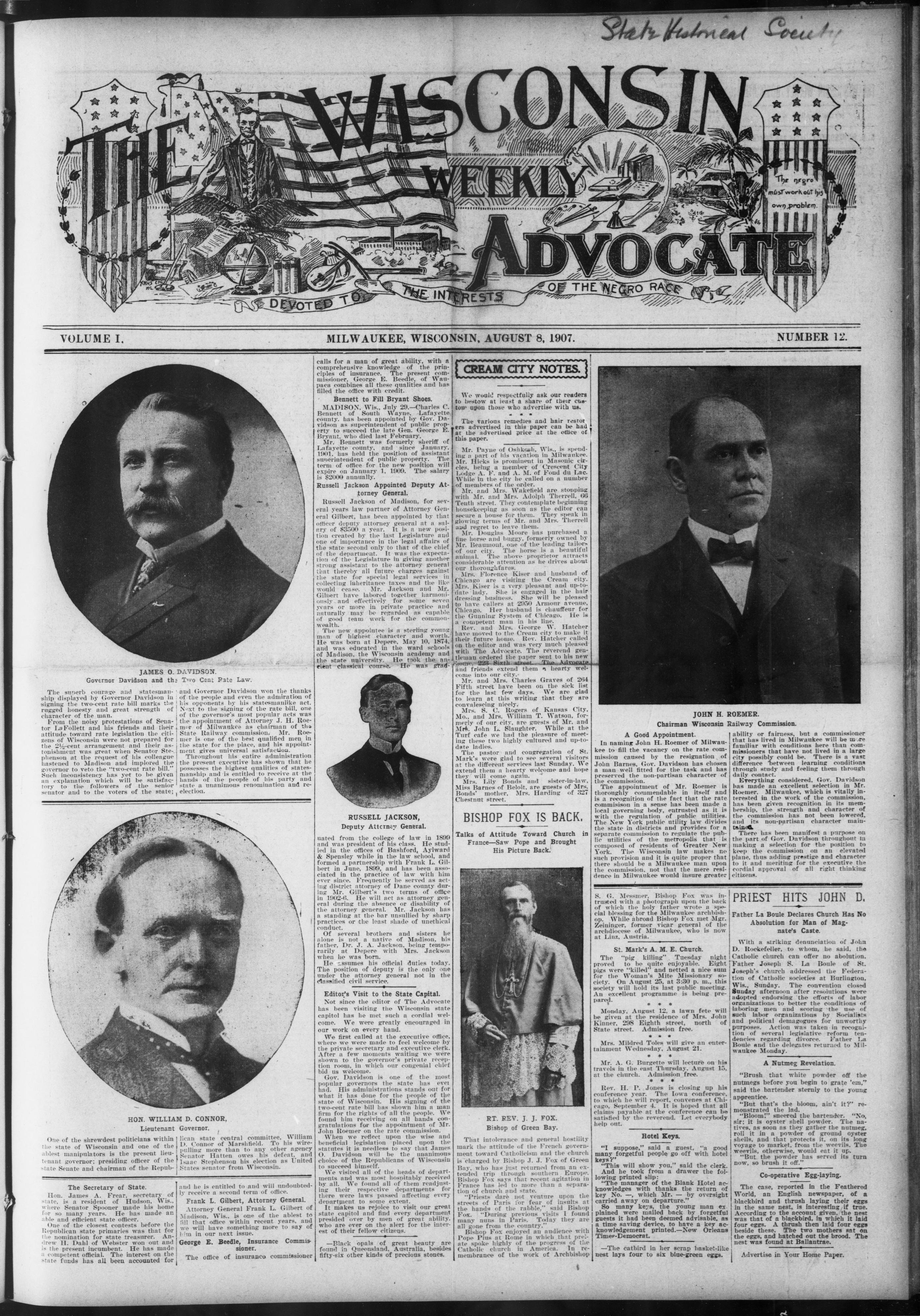
[Portrait of a man in formal attire with a mustache and a high-collared shirt and tie. The background is plain, with no visible text or distinguishing features.]]
JAMES O. DAVIDSON.
Governor Davidson and the Two Cent Rate Law.
The superb courage and statesmanship displayed by Governor Davidson in signing the two-cent rate bill marks the rugged honesty and great strength of character of the man.
From the noisy protestations of Senator LaFollett and his friends and their attitude toward rate legislation the citizens of Wisconsin were not prepared for the 2½-cent arrangement and their astonishment was great when Senator Stephenson at the request of his colleague hastened to Madison and implored the governor to veto the "two-cent rate bill." Such inconsistency has yet to be given an explanation which will be satisfactory to the followers of the senior senator and to the voters of the state; and Governor Davidson of the people and even his opponents by his Next to the signing of of the governor's most the appointment of Atmer of Milwaukee as State Railway commiser is one of the best the state for the placement gives universal.
Throughout his entitle the present executive possesses the highest of manship and is entitled hands of the people state a unanimous ren-election.
[Name]
[Name not provided]
WILLIAM D. CONNOR
HON. WILLIAM D. CONNOR,
Lieutenant Governor.
One of the shrewdest politicians within the state of Wisconsin and one of the ablest manipulators is the present lieutenant governor; presiding officer of the state Senate and chairman of the Repub-
The Secretary of State.
Hon. James A. Frear, secretary of state, is a resident of Hudson, Wis., where Senator Spooner made his home for so many years. He has made an able and efficient state officer. One of the closest contests before the Republican state primaries was that for the nomination for state treasurer. Andrew H. Dahl of Webster won out and is the present incumbent. He has made a competent official. The interest on the state funds has all been accounted for
---
and Governor Davidson won the thanks of the people and even the admiration of his opponents by his statesmanlike act. Next to the signing of the rate bill, one of the governor's most popular acts was the appointment of Attorney J. H. Roemer of Milwaukee as chairman of the State Railway commission. Mr. Roemer is one of the best qualified men in the state for the place, and his appointment gives universal satisfaction. Throughout his entire administration the present executive has shown that he possesses the highest qualities of statesmanship and is entitled to receive at the hands of the people of his party and state a unanimous renomination and reelection.
```markdown
```
lican state central committee, William D. Connor of Marshfield. To his wirepulling more than to any other agency Senator Hatten owes his defeat, and Isaac Stephenson his election as United States senator from Wisconsin.
and he is entitled to and will undoubted ly receive a second term of office. Frank L. Gilbert, Attorney General.
Attorney General Frank L. Gilbert of Madison, Wis., is one of the ablest to fill that office within recent years, and we will have something more to say of him in our next issue.
George E. Beedle, Insurance Commissioner.
The office of insurance commissioner
calls for a man of great ability, with a comprehensive knowledge of the principles of insurance. The present commissioner, George E. Beedle, of Waupaca combines all these qualities and has filled the office with credit.
Bennett to Fill Bryant Shoes.
MADISON, Wis., July 29.—Charles C. Bennett of South Wayne, Lafayette county, has been appointed by Gov. Davidson as superintendent of public property to succeed the late Gen. George E. Bryant, who died last February.
Mr. Bennett was formerly sheriff of Lafayette county, and since January, 1901, has held the position of assistant superintendent of public property. The term of office for the new position will expire on January 1, 1909. The salary is $2000 annually.
Russell Jackson Appointed Deputy At torney General.
Russell Jackson of Madison, for several years law partner of Attorney General Gilbert, has been appointed by that officer deputy attorney general at a salary of $3500 a year. It is a new position created by the last Legislature and one of importance in the legal affairs of the state second only to that of the chief of the department. It was the expectation of the Legislature in giving another strong assistant to the attorney general that thereby all future charges against the state for special legal services in collecting inheritance taxes and the like would cease. Mr. Jackson and Mr. Gilbert have labored together harmoniously and effectively for some seven years or more in private practice and naturally may be regarded as capable of good team work for the common-wealth.
The new appointee is a sterling young man of highest character and worth. He was born at Depere, May 10, 1874, and was educated in the ward schools of Madison, the Wisconsin academy and the state university. He took the ancient classical course. He was grad
J.
RUSSELL JACKSON, Deputy Attorney General. uated from the college of law in 1899 and was president of his class. He studied in the offices of Bashford, Aylward & Spensley while in the law school, and formed a partnership with Frank L. Gilbert in June, 1899, and has been associated in the practice of law with him ever since. Frequently he served as acting district attorney of Dane county during Mr. Gilbert's two terms of office in 1902-6. He will act as attorney general during the absence or disability of the attorney general. Mr. Jackson has a standing at the bar unsullied by sharp practices or the least shade of unethical conduct.
Of several brothers and sisters he alone is not a native of Madison, his father, Dr. J. A. Jackson, being temporarily at Depere with Mrs. Jackson when he was born. He assumes his official duties today. The position of deputy is the only one under the attorney general not in the classified civil service.
Editor's Visit to the State Capital.
Not since the editor of The Advocate has been visiting the Wisconsin state capitol has he met such a cordial welcome. We were greatly encouraged in our work on every hand. We first called at the executive office, where we were made to feel welcome by the private secretary and executive clerk. After a few moments waiting we were shown to the governor's private reception room, in which our congenial chief bid us welcome.
Gov. Davidson is one of the most popular governors the state has ever had. His administrations stands out for what it has done for the people of the state of Wisconsin. His signing of the two-cent rate bill has shown him a man firm for the rights of all the people. We found him receiving on all hands congratulations for the appointment of Mr. John Roemer on the rate commission.
When we reflect upon the wise and beneficial legislation placed upon the statutes it is needless to say that James O. Davidson will be the unanimous choice of the Republicans of Wisconsin to succeed himself.
We visited all of the heads of departments and was most hospitably received by all. We found all of them readjusting their respective departments for there were laws passed affecting every department to some extent.
It makes us rejoice to visit our great state capitol and find every department presided over by men of great ability, who are ever on the alert for the interest of their fellow citizens.
—Black opals of great beauty are found in Queensland, Australia, besides fifty-six other kinds of precious stones.
CREAM CITY NOTES.
We would respectfully ask our readers to bestow at least a share of their custom upon those who advertise with us.
The various remedies and hair restorers advertised in this paper can be had at the advertised price at the office of this paper.
Mr. Payne of Oshkosh, Wis., is spending a part of his vacation in Milwaukee. Mr. Hicks is prominent in Masonic circles, being a member of Crescent City Lodge A. F. and A. M. of Fond du Lac. While in the city he called on a number of members of the order.
Mr. and Mrs. Wakefield are stopping with Mr. and Mrs. Adolph Therrell, 66 Tenth street. They contemplate beginning housekeeping as soon as the editor can secure a house for them. They speak in glowing terms of Mr. and Mrs. Therrell and regret to leave them. Mr. Douglas Moore has purchased a fine horse and buggy, formerly owned by Mr. Beaumont, one of the leading tailors of our city. The horse is a beautiful animal. The above proprietor attracts considerable attention as he drives about our thoroughfares.
Mrs. Florence Kiser and husband of Chicago are visiting the Cream city. Mrs. Kiser is a very pleasant and up-to-date lady. She is engaged in the hair dressing business. She will be pleased to have callers at 2950 Armour avenue, Chicago. Her husband is chauffeur for the Gunning System of Chicago. He is a competent man in his line. Rev. and Mrs. George W. Hatcher have moved to the Cream city to make it their future home. Rev. Hatcher called on the editor and was very much pleased with The Advocate. The reverend gentleman ordered the paper sent to his new home. 223 Sixth street. The Advocate and friends extend them hearty welcome into our city.
Mr. and Mrs. Charles Graves of 264 Fifth street have been on the sick list for the last few days. We are glad to learn at this writing that they are convalescing nicely.
Mrs. S. C. Rogers of Kansas City, Mo., and Mrs. William T. Watson, formerly of our city, are guests of Mr. and Mrs. John L. Slaughter. While at the Turf cafe we had the pleasure of meeting these two highly cultured and up-to-date ladies.
The pastor and congregation of St. Mark's were glad to see several visitors at the different services last Sunday. We extend them a hearty welcome and hope they will come again.
Mrs. Lily Bonds and sister-in-law, Miss Barnes of Beloit, are guests of Mrs. Bonds' mother, Mrs. Harding of 327 Chestnut street.
Talks of Attitude Toward Church in France—Saw Pope and Brought His Picture Back.
P.
RT. REV. J. J. FOX.
Bishop of Green Bay.
That intolerance and general hostility mark the attitude of the French government toward Catholicism and the church is charged by Bishop J. J. Fox of Green Bay, who has just returned from an extended trip through southern Europe. Bishop Fox says that recent agitation in France has led to more than a separation of church and state.
"Priests dare not venture upon the streets of Paris for fear of insults at the hands of the rabble," said Bishop Fox. "During previous visits I found many nuns in Paris. Today they are all gone from the country."
Bishop Fox enjoyed an audience with Pope Pius at Rome in which that prelate spoke highly of the progress of the Catholic church in America. In remembrance of the work of Archbishop
[Picture of a man in a suit with a bow tie].
In naming John H. Roemer of Milwaukee to fill the vacancy on the rate commission caused by the resignation of John Barnes, Gov. Davidson has chosen a man well fitted for the task and has preserved the non-partisan character of the commission.
The appointment of Mr. Roemer is thoroughly commendable in itself and is a recognition of the fact that the rate commission in a sense has been made a local governing body, entrusted as it is with the regulation of public utilities. The New York public utility law divides the state in districts and provides for a separate commission to regulate the public utilities of the metropolis that is composed of residents of Greater New York. The Wisconsin law makes no such provision and it is quite proper that there should be a Milwaukee man upon the commission, not that the mere residence in Milwaukee would insure greater
S. G. Messmer, Bishop Fox was intrusted with a photograph upon the back of which the holy father wrote a special blessing for the Milwaukee archbishop. While abroad Bishop Fox met Mgr. Zeininger, former vicar general of the archdiocese of Milwaukee, who is now at Linz, Austria.
St. Mark's A. M. E. Church
The "pig killing" Tuesday night proved to be quite enjoyable. Eight pigs were "killed" and netted a nice sum for the Woman's Mite Missionary society. On August 25, at 3:30 p. m., this society will hold its last public meeting. An excellent programme is being prepared.
Monday, August 12, a lawn fete will be given at the residence of Mrs. John Kinner, 298 Eighth street, north of State street. Admission free.
Mrs. Mildred Toles will give an entertainment Wednesday, August 21.
Mr. A. G. Burgette will lecture on his travels in the east Thursday, August 15, at the church. Admission free.
Rev. H. P. Jones is closing up his conference year. The Iowa conference, to which he will report, convenes at Chicago, September 4. It is hoped that all claims payable at the conference can be satisfied by the reverend. Let everybody help out.
Hotel Keys.
"I suppose," said a guest, "a good many forgetful people go off with hotel keys?"
"This will show you," said the clerk.
And he took from a drawer the following printed slip:
"The manager of the Blank Hotel acknowledges with thanks the return of key No. —, which Mr. — by oversight carried away on departure."
So many keys, the young man explained were mailed back by forgetful guests it had been deemed advisable, as a time saving device, to have a key acknowledgement printed.—New Orleans Times-Democrat.
—The catbird in her scrap basket-like nest lays four to six blue-green eggs.
NUMBER 12.
ROEMER.
Railway Commission.
ability or fairness, but a commissioner that has lived in Milwaukee will be more familiar with conditions here than commissioners that have not lived in a large city possibly could be. There is a vast difference between learning conditions through study and feeling them through daily contact. Everything considered, Gov. Davidson has made an excellent selection in Mr. Roemer. Milwaukee, which is vitally interested in the work of the commission, has been given recognition in its membership, the strength and character of the commission has not been lowered, and its non-partisan character maintained.
There has been manifest a purpose on the part of Gov. Davidson throughout in making a selection for the position to keep the commission on an elevated plane, thus adding prestige and character to it and meriting for the executive the cordial approval of all right thinking citizens.
PRIEST HITS JOHN D.
Father La Boule Declares Church Has No Absolution for Man of Magnate's Caste.
With a striking denunciation of John D. Rockefeller, to whom, he said, the Catholic church can offer no abolition, Father Joseph S. La Boule of St. Joseph's church addressed the Federation of Catholic societies at Burlington, Wis., Sunday. The convention closed Sunday afternoon after resolutions were adopted endorsing the efforts of labor organizations to better the conditions of laboring men and scoring the use of such labor organizations by Socialists and political demagogues for unworthy purposes. Action was taken in recognition of several legislative reform tendencies regarding divorce. Father La Boule and the delegates returned to Milwaukee Monday.
A Nutmeg Revelation
"Brush that white powder off the nutmegs before you begin to grate 'em," said the bartender sternly to the young apprentice.
"But that's the bloom, ain't it?" remonstrated the lad.
"Bloom!" sneered the bartender. "No, sir; it is oyster shell powder. The natives, as soon as they gather the nutmeg, roll it in a powder of ground oyster shells, and that protects it, on its long voyage to market, from the weevils. The weevils, otherwise, would eat it up.
"But the powder has served its turn now, so brush it off."
Co-operative Egg-laying.
The case, reported in the Feathered World, an English newspaper, of a blackbird and thrush laying their eggs in the same nest, is interesting if true. According to the account given, the nest was that of a blackbird, in which it laid four eggs. A thrush then laid four eggs beside these. The two mothers sat on the eggs, and hatched out the brood. The nest was found at Ballantrae.
Advertise in Your Home Paper.
THE WISCONSIN WEEKLY ADVOGATE
R. B. MONTGOMERY, Editor and Proprietor.
Ss
2 # Tea-Table Salad. »* }
Father (to son, who is making a geod
deal of noise eating a cake)—The last
time I heard a noise like that was in
a sty.
Son—Who with ?—INustrated Bits.
Popular in Hades.
“Do you suppose peek-a-boos will be
worn in heaven?”
“I don’t know, but they ought to be
popular in the other place.”—Houston
Post.
Compensations.
Mary—Did she make a good match?
Ann—Splendid. Lots of money, good
social position, and all that. In fact,
the only drawback is the husband.—Illus-
trated Bits.
Relief in Sight.
Mrs. Post—Both the cook and wait-
ress have left.
Mr. Post—Good! Now I dare bring
some of the fellows home for dinner.—
Brooklyn Life.
Not Disturbed.
Mistress—Tell me instantly, Mina, did
the master kiss you last night?
Maid—Yes, ma’am, but don’t be upset
about it. I don’t mind it at all Blie-
gende Blaetter.
Break in the Firm.
“Why did you and Smjth dissolve
partnership?”
“Aw, he got an idea that he had a
half interest in the stenographer.”—
Cleveland Leader.
A Sure Sign.
Servant (with a: newly-married couple)
—Today master noticed for the first time
that I had been smoking his cigars.
That shows the honeymoon is over.—
Flicgende Blaetter.
Very Slow.
Jones (with indignation)—I hadn't
been talking to that man Brown ten
minutes when he called me a fool.
Smith—Ah! Took him ten minutes to
find it out, did it?—Jugend.
A Coming Critic.
She—I hear your little son has a good
ear for music, Mr. Twombley.
He—I think he must have. A hopeless
expression comes over his face when-
ever my wife sings.—Answers.
Jokeland Fashions.
“Bathing suits, in the jokes, will be
shorter this year.”
“So?
“Yes, and mother-in-law visits longer
than ever.”—Washington Herald.
A Big Inducement.
“How much are these Easter lilies?”
“A dollar each.”
“Pretty stee, ”
“Not when you consider that we throw
in the earth.’—Washington Herald.
There Is Hope.
Said the Peace Dove, “My brood at The
Hague
Is very distressingly vague,
For the man with the gun
Is still looking for fun,
But at least I have there laid an egg!”
—Lippincott’s.
A Delicate Tob.
Doctor—The increasing deafness of
your wife is merely an Indication of ad-
vancing years and you can tell her that.”
Husband—Hum! would you mind tell-
ing her that yourself, doctor?—Wiener
Salonwitzblatt.
Ethel Spoke Truly.
Dad (severely)—And, look here, Ethel,
you mustn’t encourage that young man
to stay so late every night. It's disgrace-
ful! What does your mother say about it?
Ethel—She says men haven't altered a
bit, dad!—Punch.
Warning to ’07 Girls.
“What's the matter with that ‘07 Bryn
Mawr girl? She’s very beautiful, yet
every chap on the beach avoids her.”
“Well, you see, she knows enough to
correct everybody’s mistakes, and she
doesn't know enough not to.”
Reasonable.
Stage Manager (to lessee of theater)—
Our scene shifter wants a holiday He
says he hasn’t been awav for three years.
Lessee—Well, tell him he can not have
one. He gets change of scenery enough
for anybody.—New York Mail.
There’s the Rub.
Crawford—What do you think of the
“return to nature” plan of going around
naked? : s
Crabshaw—Like many other things in
this world, it is poe all right un-
less you get caught at it—Life.
He Beat Canute.
“Roll on, thou deep and dark blue
ocean, roll!”
So spake the poet Byron far back in
the last century.
And the ocean, with praiseworthy obe-
dience, has continued to roll on ever
since,
Taken in One Way.
He—So you persisted in breaking off
the engagement?
She—Most decidedly. What do you
take me for?
He—Oh, about 40. Better think it
ever; it may be your last chance—Har-
per's Weekly.
From His Point of View.
“You say that the number of the auto-
mobile that ran over you was 66667"
oYea."”
“Well, my client's number is 9999."
“That’s all right. The auto turned
ae down when it fell on me.”"—
Cleveland Plain Dealer.
The New Excuse.
The farmer raised his shotgun.
“What are you doing up there on my
roof?” he roared.
“Excuse me,” said the housebreaker,
glibly, “but I am a member of the Aero
club. and have just had the misfortune
to fall out of my balloon.”
Not His Element.
“And if I give you money,” said the
philanthropist, “will you promise to go
and take a bath?” 5
Redface Leary drew himself up to his
full height.
“A bath? And is it a mermaid you
take me for?” he cried bitterly.
_
Advertise in Your Home Paper.
FREDA.
Life doesn’t seem the same to us
We taik about Ie every aight,
e talk a
An@ also every day.
‘The kitchen seems a cheerless place;
We hate to turn the knob
And look into that lonesome waste,
Since Freda yoomped her yob.
We miss our Freda dreadfully,
In fact for her we .
Her English was dis renee. but
Her breakfast rolls were fine.
And now we sit and think of her,
‘And in our throats a sob
Of sorrow rises at the thought
That Freda yoomped her yob.
Sbe won't come back. She's married new
She thinks she’s better off.
Perhaps she is—at any rate,
It does no good to scoff.
But every time we think of her
Our sad hearts give a throb.
It makes a difference in our house
Since Freda yoomped her yob!
—Somerville Journal.
—————
DESIRE AYERY’S MIRROR.
RY DOROTHY BLISS USHER.
mirror caressingly.
“I wish I could take this with me
Abbot,” she said, turning to the maid
“Something may happen to it while 1
am in Italy.”
“I hardly think so, Miss. and beside:
there is no room in the trunks for s¢
large a looking glass.”
Miss Marcia continued to look at the
nicror. It was of that kind dear to the
collector of antique furniture, with a
heavy gilded frame, at the top of which
was carved a stiff basket of pineapples.
But Miss Marcia cared for it as a family
relic, for this mirror had a history. In
1635, Desire Avery, the grandmother
seven generations back of the present
owner of the mirror, had brought it from
England ,on the ship Hopewell. She had
prized the mirror highly. and her name
was cut into the wood at the back.
When she died, her husband, a Capt.
Avery, packed the mirror and some of
her other choicest possessions away in
his seachest, and they had sailed with
him on the ocean for many years. At
his death, his chest was put into the at-
tic of a dreary old house in Saco, Me.,
and it was here that Miss Marcia, on a
visit to her cousin, Sophia Sprague, had
found the chest hidden in a dark corner
under the eaves, and had chosen the mir-
ror from its contents. When Miss Mar-
cia had borne the glass triumphantly
downstairs, Sophia, rubbing off the dust
with a bony forefinger, had declared, “It
isn’t any use to fuss with an old, broken,
wooden lookin’ glass,” but Miss Marcia
was determined, and when the frame
was regilded, and a new glass fitted in,
the mirror was certainly handsome.
Now Miss Marcia gave one last look
at it as she turned to direct. Abbot in the
packing, for she was about to start the
next day for a winter in Italy. Her sil-
ver and valuables were already safe in
the bank. Her keys were to go next
morning to her lawyer, and her New
York home looked lonesome enough
with pictures, rugs and furniture
shrouded in linen.
There are some people from New Eng-
land stock, transplanted into the aristo-
cratic side streets of lower New York.
who profess to become homesick even
during a two weeks’ absence—so great
is their love for the Knickerbocker City.
Miss Marcia was one of this type. Tall
and angular, with a certain tilt of the
head, and an expression of the mouth
which furnished a key to her character,
she was a most agreeable person in spite
of her New England peculiarities, if she
was always agreed with, but if anyone
attempted to argue with her, she was
impossible.
The following day she departed with
her faithful Abbot for her winter abroad.
(m her way she stopped at Gibraltar and
at Algiers, and sent home pleasant ac-
counts of her trip to her, limited circle
of friends.
But she had not been in Florence Jong
when she had a strange dream. She
dreamed that burglars had gotten into
her house, and had carried off the an-
tiaue mirror.
“I, a woman of 65, taking stock in a
dream! I, the vice president of the So-
rosis! What would my father say!” she
said to herself. Nevertheless the dream
troubled her, and when she dreamed the
same thing the next night, she confessed
to Abbot that she was “worried.”
“And why not write to Mr. Van Slyke
to look into the house, miss?”
“OQ, no, Abbot. They say dreams go
by contraries. Mr. Van Slyke would
think me a superstitious old woman, and
that is what I am, I suppose.”
On the third night Miss Marcia again
dreamed that her house had been robbed,
and this time the dream was more defi-
nite. Burglars were staying in the house
and carrying off her furniture piece by
piece, and among the rest she watched
them bear away the beloved mirror. It
was all so vivid that she now became
thoroughly alarmed in spite of herself,
and wrote to Mr. Van Slyke. In due
time an answer to her letter was re-
ceived. It ran as follows:
“My Dear Miss Avery: In accordance
with the request in your letter of Feb-
ruary 5, I sent a man to inspect your
house on Washington square. He brought
me back a strange report. He found that
men had been living there for over three
weeks, having gained an entrance to the
basement by means of the coal hole in
the sidewalk. Then, by breaking down
a door, they reached the front part of
the house. They had carried away sev-
eral oriental rugs, pictures, among them
your Watteau, and furniture, but a good
deal of it has already been found in
various second-hand stores. The men are
now under arrest, and I shall do all in
my power to recover everything that is
missing. Believe me, Very truly yours,
“Stuyvesant Van Slyke.”
When Miss Marcia finished reading
this letter, she held it out to Abbet, and
sank limply into a chair.
“So all that I dreamed was true,” she
kept saying to herself. “All true!
Thieves have taken my Watteau.” Then
she suddenly roused herself. “Abbot, he
doesn’t say anything about my mirror.
It is probably gone with the rest. My
Grandmother Desire’s mirror.”
“And what do you intend to do,
miss?”
“O, I can’t stay here. I must identify
my things. Mr. Van Slyke has nothing
but an inventory to eo them by.
We must start at onee, I presume. 0,
dear. this confuses me so, I cannot real-
ize that is not my dream still.”
Te ee et ee em een eet Bie ead
client at the dock in New York, and her
first words were concerning the mirror.
“4 beautiful antique mirror oat
above my bureau. ‘Desire’ was
on the back.”
The Jawyer shook his head. “I an.
afraid that it is gone, Miss Avery. It
is not in my inventory of articles now in
the residence. Your furniture was scat-
tered among all the second-hand stores
in the borough of Manhattan.”
With Miss Marcia as a guide, a few
more pieces of furniture were found, but
the mirror was still missing; and at last
she gave up all hope of finding it. Her
room looked so empty without it that
she purchased a handsome new one with
a wide mahogany frame, and hung it
above her chest of drawers. Abbot de-
clared it to be of even more perfect
workmanship than the lost glass, and
Miss Marcia in time almost forgot her
grief at losing Desire’s mirror, except
that she occasionally searched antique
shops on Fourth avenue, vainly hoping
to recover her prize.
Two years later the mirror reappeared,
and in a most surprising manner. Miss
Marcia received a letter from a young
cousin, newly married, Mrs. Alexander,
in which she quite raved over a mirror
that was one of her wedding presents.
She had never happened to hear of Miss
Marcia’s glass, but her description cor-
responded so closely with that of De-
sire’s mirror that Miss Marcia, forget-
ting her vow never to leave home again,
set out for an abrupt visit to her cousin
in St. Paul. After dinner, on the night
of her arrival, her hostess showed her
about the house, and pointed out sev-
eral wedding gifts.
“And here is the mirror I wrote of,”
she said, pausing before a handsome
glass hanging in the drawing room.
“Isn’t it a beauty, Cousin Marcia?”
“Humph, yes,” that» lady answered
shortly. “Where did you get it, Anne?”
“Cousin Horace Wells sent it from
Montreal. He wrote that it had be-
longed in an old French family. It must
have cost him a pretty sym of money.”
“Humph!” said Miss Marcia again. “I
think I will go upstairs now. Good
night, Anne. Good night, Richard.” And
she hurried away to conceal her emo-
tions. “French family, indeed! I should
like to see the back of that glass.”
‘The next morning she came down to
breakfast early, and as she was alone in
the room with the mirror, she walked
over to it, and quietly turned it around.
There was the name, printed clear and
big. With almost a sob Miss Marcia
clasped her hands round the mirror. “De-
sire,” she whispered. Then a new thought
came to her. “Why, I can’t take away
this mirror that was given to Ame, and
that she sets so much store by. I must
leave it here to be willed to that red-
haired Alexander baby and not to Avy-
erys. Still it sets my mind at ease to
know that: it’s in appreciative hands. 1
should hate to think that one of those
new-rich people, who flaunt their wealth
in other people’s faces, had it, or that a
copper king had bought it with his taint-
ed money.”
It was hard for Miss Marcia to leave
her prized mirror after almost gaining it
again, but under her taciturn exterior
was a very large New England con-
science. She had a strong love for her
frivolous young cousin and also a sense
of justice, and with these to back her
conscience, she saw her duty and did it;
and no one but Abbot ever heard the
sequel to the loss of Desire’s mirror.
SIS HOPKINS’ SAYINGS.
BY ROSE MELVILLE.
Ma says that many a sponge is hu-
man.
- Champagne often gives folks a real
one.
| A strawberry Sunday is good any day
in the week.
_ It isn’t much of a coup to marry a gir!
who can‘t fry an egg.
Pa says a good many local celebrities
are notorious, not famous.
Flirtatious females are like counter-
feit money—they never have the true
ring.
A summer girl would rather have a
clock on her stocking than one on the
shelf.
Ma says a girl who is reserved
doesn’t necessarily deserve to become an
old maid.
Ma says a “literary man, pure and
simple,” is often a dinged sight more
simple than pure.
There is a peach of a girl living at
Logansport who can’t understand why
some fellow doesn’t pick her.
Be careful when you tell your fel-
low that he is pure gold that he
doesn’t think you mean that he has a
yellow streak in him.
Pa says it beats all how much some
men can eat at a table d’hote, and
how little they care for at an a la carte
restaurant.
When an Indiana woman takes te
wearing fight shoes it is pretty cer.
tain that she is figuring on having some
dude squeeze her.
Ma says one sees pigs at a country
fair that you never saws raised on a
farm. and that you see women ,in
New York who make you wonder _ if
they had any raisin’ at all—New York
Evening Mail.
Animal Doctors.
“Animals are good amateur doctors,”
said a nature student. “They are better
amateur doctors than we are, though of
course with our professionals they can't
compete.
“Take the elephant. Wounded, the ele-
phant goes straightway to the water, and
as long as his fever lasts he bathes inde-
fatigably, for long, long hours standing in
the stream, squirting with his trunk the
cooling water over his head and back. It
is pathetic to see him at this work, hunt-
ers say. He is so patient over it, and
all the while he heaves such deep, sad
sighs. Furthermore, when an elephant
has a nasty open cut, he plasters it up
neatly with mud. ¢
“Dogs and cats, when they are ill,
know the medicine they need. You have
certainly seen sick dogs eating spear
grass, and it is quite as common to see
sick cats dosing themselves with valerian,
mnrum, or eatmint.
“All animals See eS to the salt licks
at certain seasons. hese are not licks
of rock salt, but of medicinal salts,
such as we frequently take ourselves.
“There have even been stories of bird
surgeons—birds that have set their bro-
ken legs, and tied them up with string.
These stories, though, I doubt. The
other ones are gospel truth.”
AUGUST.
Month of golden-rod
And posies;
Month of sneezes
And wet noses,
Month of sleepless
— and chilis;
Month of dopem
And doctor bills.
How we love you,
Gay deceiver,
August, bring us
Hay fever.
Month of eyes
Forever crying;
Red and wet
And never drying;
Month of stuffy
Heads and wheezing,
Month of constant
Racking, sneezing,
Month of August,
Know that I'm
Dreading your
Hay fever time.
Month of blood-shot
Eyes and leaking;
Month of gruff
And croaky speaking:
Month of coughing,
Month of aching,
Month of trouble
In the making.
August, not one
Joy that pleases,
Do you bring us—
Only sneezes.
Some there are
Perhaps who love you;
But July
Is way above you.
March is bad,
But better far,
August, than
I think yon are.
Rather wiuter's
Stormy breezes;
Than you, August,
Month of sneezes.
—Detroit Free Press.
{ GENERAL ee
After 690 veniremen had been called
a jury of twelve men has been found
who will hear the evidence at Los An-
geles, Cal., of Dr. G. S. Chan, a China-
man, charged with practicing medicine
without a license. Nearly all of the 678
veuiremen who did not qualify declared
they would not believe a Chinaman un-
der oath.
A trunk which was shipped over the
Louisville & Nashville railroad from Ap-
palachia, Va., exploded at the St. Louis
miion station, when dumped from the
train, injuring eight baggagemen, two
seriously. The explosive is supposed to
have been dynamite. A_ portion of a
Bible found after the explosion bore the
name of Iyan Denister.
Two years ago there was a tar and
feather party at Hudson, Mich., with
Mrs. Mae Post as the principal figure.
A party of men and women, some of
them prominent citizens, went to her
rooms, stripped her clothing from her,
eut off her hair and gave her a coat
of tar and feathers. Mrs. Post has be-
gun damage suits against the men who
took part. She asks $10,000 damages.
Because his fiancee, he alleges, asked
to see his bank book, Alexander Katz,
a real estate man of Washington, D. C.,
who was to have been married to Miss
Frances Dubb of Bridgeport, Conn.,
broke the engagement. He also retained
counsel to sue for the recovery of a
diamond ring which he had given her.
He said: ‘Miss Dubb’s demand was the
most sickening thing a woman could do.”
He has $7000 in the bank.
Social circles in Toledo were startled
when Mrs. Ray May Merrick, 35 years
old, filed suit in the Common Pleas court
agamst Dr, Parmalee, one of the oldest
and most prominent physicians of Tole-
do, for $10,000 as damages for kisses
she alleges he took without her consent.
She says the physician embraced her
when she visited him professionally last
January. Dr. Parmelee denies the charge
and says the suit is a blackmailing
scheme.
Samuel Brenner, a Yale senior, died
suddenly at New Haven, Conn. after
bathing for two hours at a shore resort.
Pneumonia was given as the cause of
death. The case is remarkable because
the disease developed and caused his
death within six hours. Brenner was 21
years old and was working his way
through Yale. His body was taken to
the home of his sweetheart. He planned
to be married the day after his gradua-
tion next June.
Suffocated in their hiding place in the
grain bin of their grandfather's barn,
the bodies of Etta and Frank Prior were
found at South Windsor, Conn., after
six hours’ search. Etta was 10 years
old and Frank 3. The boy was staying
on the farm of Henry Pease and his sis-
ter came to see him, She was told that
she must go home at 3 o’clock. The chil-
dren hid in the bin so that Etta would
not be obliged to go home, and were un-
able to get out. Their father is Fred
Prior, a well-to-do tobacco grower.
When burglars become butchers, steal
a cow, take it to a slaughter house, kill
it, and cut it up into quarters before
taking it away the good people of Ches-
ter, Orange county, New York, think the
limit has been reached. Such an_ inci-
dent occurred in Chester. Attacked with
lunger after their strenuous labors as
lutchers, the burglars went to the house
of Sidney Ackerman nearby and ran-
sacked jt thoroughly. They then went
to the ice box and got edibles and a
good meal, consuming a leg of ‘mutton.
With the completion of the school cen-
sus, Evanston, Ill, was startled to dis-
cover that race suicide has been thriy-
ing there, that there are only seven
more children within its borders than
there were a year ago, though the pop-
ulation has increased by 428. This con-
dition apparentiy is due to the wealthier
residents, in whose homes children ar-
rive only one-third as frequently as in
the neighborhoods inhabited by the
working classes. Hardly less startling
was the revelation that the city is ios-
ing its male population while an increase
in the number of women is recorded.
Mrs. Elizabeth Maydrech of St. Jo-
seph, Mich., returned to the house after
working in the garden the other evening
to find a burglar gathermg up her silver-
ware and jewelry.
“T'll shoot,” cried Mrs. Meydrech, as
she entered the room, and pointed her
forefinger as if it were the barrel of a
revolver.
The bluff worked. The burglar coy-
ered his face with his arms and fled,
dropping a sack containing silverware
and a pocketbook filled with money. 'The
woman pursued, but the robber got
away.
Wags of Atlantic City, N. J.. who
stole a barber pole several months ago
and forwarded it “colleet” to Ned Hous-
ton of an Ohio town as a souvenir of a
former visit, have just received word
that the souvenir pole has arrived in a
eoast city of Chile, South America.
where it was forwarded as a gift to a
former Atlantic Cityite. Since leaving
ema
——_——<——————
‘aped box, has journeyed to New York,
oe and several other cities of this
country, its traveling expenses always
being paid by proud recipients who be-
lieved that the box contained a valuable
gift.
Mrs, A. Nicholas, wife of a farmer
near Germania, N. J., had a premoni-
tion several weeks ago of: approaching
death and told her husband that, she
would not live until August. July 30th,
after working in the field until late, she
said: “My days and life’s work are
done, but before 1 die I will take my
last bath.” :
Her husband paid no attention to her
remarks, but aia he returned to the
house he found her dead in bed. Phy-
sicians said she died from natural caus-
es.
The woman was 60 years of age and
had always be2n in good health.
Master John Rentschler, Jr., of Mar:
shall, Mich., swallowed his “Teddy bear.
The much cuddled supplanter of dolls
nearly caused the death of Johnnie, and
it was only through an operation by Dr.
Canfield at the University pe ee that
“Teddy” was rescued, to be cuddled once
more and Johnnie saved to do the cud-
dling.
This particular member of the large
and ever growing “Leddy” family is but
an inch and three-quarters in length and
occupied a situation in human ornamen-
tation as a watch charm.
The little boy was hurried from Mar-
shall. For fear he might not live until
Ann Arbor was reached, a stop was
made at Battle Creek, where an effort
to remove the toy was unsuccessful. It
was accomplished there, however, and
“Teddy” and Johnnie are doing nicely.
Harvest hands are so searce in Ma-
rion, O., and the surrounding country”
that farmers are forced to pay $2 a day
and furnish cool beer instead of water
to drink.
Scores of harvesters have demanded
the amber fluid and to get their threshing
done as quickly as possible many farm-
ers have met the demand. ey
Farm hands practically are a prohibi-
tive quantity in this section of Ohio, and
the only class the farmers can draw from
is the tramps. These refused to work sim-
ply for the money, but when the farmers
offered cool beer as an additional in-
ducement the hobos flocked to work.
Eugene C. Mathivet, an attorney, has
begun action in the probate court at
Cleveland to regain possession of his
mother-in-law, Mrs. Bessie R. Robin-
son. Mathivet resorted to a habeas cor-
pus proceeding, declaring that Mrs. D.
B. Strickler has induced Mrs. Robinson
to leave the Mathivet home and remain
with her. He says that Mrs. Robinson,
on account of her age, is easily per-
suaded, and that all of his attempts to
see her have failed. All the parties con-
cerned in the action reside in the fash-
ionable East End neighborhood. Mrs.
Strickler is no relative of Mrs. Robin-
son, but the two have been lifelong
friends.
Millions of writhing worms that make
their home in ice have been discovered
in the Urania glacier by a party of sci-
entists from Chicago, headed by Prof.
John B. Flett of Tacoma and Professor
Cowles, who were making an ascent to
Mount Rainier.
The discovery astonished the scientists,
who could hardly believe their eyes un-
til they had cut into the hard ice and
removed some of the worms for miseros-
copic examination.
‘The worms are about an inch in length
and the size of a hair, and presented a
wriggling, squirming mass in the solid
ice. In places the iee was almost black
with them,
D. A. Romano, an Atlantic City bar-
ber, sold his luxuriant black moustache
to a New York visitor for $10, after a
lively five minutes of bidding on the
part of the stranger.
The purchaser of the hirsute appen-
dage of which the barber was most fond
followed outspoken admiration for the
moustache with an offer of $2.50 for its
ownership, but was coldly refused. Lat-
er, however, he returned and offered a
$5 bill to the barber to cut it off. This ;
offer was also refused, but when the
stranger increased his offer to a new $10
gold note the barber succumbed and
clipped off the moustache.
It was neatly wrapped up and deliv-
ered, and the stranger left the place with-
out giving any reason for his strange
whim.
Hiram Stoutenberg, an aged farm
hand living near Port Huron, Mich., is
one of the heirs to a $15,000,000 estate,
according to advices received by _him
from Walter G. Elliott, a New York
lawyer.
The letter states that Stoutenberg and
his four brothers and three sisters own
1500 acres within the corporate limits
of New York city, the lease for which,
made by his great great grandfather,
when New York was called New Am-
sterdam, has expired.
The other heirs in Michigan are John
Stoutenberg of Port Sanilac, James of
Cedardale, Albert of Augres, Jacob of
Prescott, Mrs. Melinda English of For-
estville, Mrs. Mary Ann Ernest of Ap-
plegate and Mrs. Elizabeth Hyman of
Port Sanilac.
The afternoon watch of the New York
ship news reporters made an effort with
unsatisfactory results to get John W.
Gates to say something about anything
before he sailed for Liverpool on the
Caronia. His son Charles was more
communicative, regretting that “Pop”
had “thrown the boys down.” The
young man said he and “Pop” were go-
ing to stay abroad about three months;
that chauffeurs with automobiles would
meet the family ‘and they would make a
tour of England and Scotland. He said
there was no truth in the rumor that
the Gates family were going to give up
America entirely. He said “Pop” hat |
The afternoon watch of the New York
ship news reporters made an effort with
unsatisfactory results to get John W.
Gates to say something about anything
before he sailed for Liverpool on the
Caronia. His son Charles was more
communicative, regretting that “Pop”
had “thrown the boys down.” The
young man said he and “Pop” were go-
ing to stay abroad about three months;
that chauffeurs with automobiles would
meet the family ‘and they would make a
tour of England and Scotland. He said
there was no truth in the rumor that
the Gates family were going to give up
America entirely. He said “Pop” had
won big money on the races and been
successful on the street, and that he and
Charles needed rest and recreation, and
that was why they were going to Eu-
rope.
Hezekiah Wright, a rich farmer of El-
wood, Ind., who, to induce farm-hands
to come to work for him said that they
might go buggy riding with his daugh-
ters, is being swamped with applications
for positions. Some of the applicants
for jobs apparently want a place for life
rather than just for the harvest season
and ask all sorts of questions of Wright.
Some of those asked most freqnently
are:
How much are Fined worth?
When are you likely to die?
Have you made your will, and, if so, is it
in favor of your daughters?
Are your’ daughters good looking, well
educated and companionable?
Are your daughters engaged or do you
think they would like to be?
. Many of the applicants send requests
for pictures of the Wright girls and ask
that jobs be kept apes for them until
‘they are able to see the photographs. Mr.
Wright has all the farm hands he needs
‘pow, however.
—
The town of Southington, Conn., is go-
‘ing to sue Richard Norton, chief of the
‘Plainville fire department, who rang the
| Southington fire alarm for no other ren-
son than that he wanted to have a little
conversation with the gallant flame fight-
ere of the Southington fire brigade.
tied Minette a ee ee
in which the red shirted volunteers of
three villages had united. The other
night he went to Southington for the
purpose of Fovagetens | with the firemen
there. Not one could he tind. The fire
quarters were locked up and, although it
was only 9 o'clock, the whole community
seemed wrapped in slumber. Therefore
Chief Norton, a man of resourcefulness,
strolled over to box 47 and pulled the
alarm. ‘
Forthwith there was a terrific uproar,
as Southington’s heroic firemen came
dashing to the scené. They found Chief
Norton see mm the hydrant waiting to
talk picnic. They were not pleased. At
a meeting held immediately after the
“Dare to Be True” company voted to
boycott the uffair.
The town of Southington has now or-
dered Chief Norton to pay $50 for turn-
ing in a false alarm, plus 25 cents for
each fireman who responded, under pen-
alty of arrest. The picnic is off.
————
The Scientist’s Victim.
A famous scientist, whose early home
had been in a country district, had long
promised to visit the scenes of his boy-
hood and deliver a lecture in aid of the
funds of one of the institutions of the
place. At last he fulfilled his promise
and the lectare was given.
When, at the close of his lecture, he
was conversing with some of the princi-
pal promoters of the affair, they warmly
congratulated him on the facility with
which he made rather technicai matter
interesting and clear to bis uncultured
audience.
“Oh,” said he, by way of explanation.
“J invariably fix my attention upon that
member of my audience who strikes me
as having the least intelligent face, and
I continue to explain any subject upon
which I touch until I see by that per-
son’s expression that he understands it.”
Almost uirectly afterward the leading
public official of the little town came
into the room and made his way to
where the scientist was standing.
“Sir.” he exclaimed, “you cannot pos-
sibly believe how much real pleasure you
haye given me tonight. It seemed to me
all the time as if your eye was never
away from me, that you spoke to me
alone and that your whole wish was to
make me understand every word you
eaid.’—Chicago Journal.
New Use for Lap Dogs.
Lap dogs really have a use these days,
other than that of ornamentation and
of systematic destruction of everything
within sight. Their mistresses are
lately finding them of more value than
that of a mere receptacle for candy,
caresses and other sweetmeats, and they
are now using them for other purposes
than company on their automobile tours
and as an outlet for their feelings of
annoyance and ennui; the little crea-
tures’ ears no longer smart quite so fre-
quently as they- used to.
One of the leaders of the exclusive set
has lately set the fashion, and a number
of her satellites have also taken it up.
The lady in question, being afraid that
some day her pet would die and leave its
fond mistress to struggle through this
cold world alone, ordered the . maid
whose duty it was to see to his Dogship’s
bath to cut his long curls once or twice
a week, and to preserve the clippings
carefully in a silken bag which was pro-
vided especially for that purpose.
When enough clippings had been ob-
tained, milady with her own fair hands
made them up into a sofa pillow, cover-
ing them with — silk aphicty exactly
matched in hue the blue-white hair of
her pet.
She declares that it is the softest pil-
low her aristocratic head has ever rested
on, so soft, in fact, that she is thinking
of using it altogether, not only in the
afternoon when she takes her siesta, but
also at night. When her pet has shuffled
off this mortal coil, this devoted mistress
will. in this way, have an ever present
memento of him.
Speeding Up the Bees.
| “Ye kin speed up a bee the same as
a man,” said the greybeard, chuckling
cruelly, “Why, I git. twicet as much
agin out o’ them thar sixty hives o” mine
as I would if I didn’t speed ‘em.
- “One way to speed yer bee is to bring
‘the flowers close to the hives. My flow-
ers, ye see, surrounds the hives, crowds
vem in. Sech a sight gives the bee a
fever. Before sech plenty he can’t work
hard enough. Nothin’ must be lost, an’
he gethers the honey, by gosh, till he
fair drops. I’m speedin’ him unbe-
knownst.
- “The young bee likes to stay home an’
make comb instead o’ goin’ out after
honey. Weil, I speed the young bee by
puttin’ axtificial comb in the hives. That
eaves him nothin’ to do—an’ he'll never
loaf—but to go out honey-getherin’, an’
so, with a sigh, out he goes.
“Another way to speed yer bee is to
keep the combs always nearly empty.
That worries him, He sees winter comin’
am an’ doubles his efforts to prepare for
it.
“I've heerd o’ speedin’ a bee. by keepin’
electric lights burnin’ about the hive, so
that the little critter would think it was
still daylight, an’ would work on 20 or
21 hours a day instead o’ the usual 17.
Electric speedin’, though, I don’t believe
in, It damages the health 0’ the bee.
It’s burnin’ the candle at both ends.”
Some Relief.
He had been going to see her for a
long time, but never stated the object of
his visits, and she was desirous of know-
ing something of the future. He met her
one night at the house of a mutual
friend, and seemed to be quite sad. After
several well-developed sighs he said:
“Life is full, very full, of bitterness,
isn’t it?” “Oh! I don’t know,” she re-
sponded. cheerily; “I haven’t much cause
to complain.” “Possibly not now, Mary;
but the bitter cup has been placed to
your lips.” “Yes, Henry, my parents
are dead.” “And is there no bitterness
in that, Mary? Is it not very, very sad
to be an orphan?” “Of course it is.
Henry; but you see”—and she blushed
vividly—“it relieves you of the embar-
rassment of asking father.” Henry's
heart was touched.—Sphere.
aetna
Ovium Dens.
The last of the opium dens in Pekin
has been closed. It is still early to dog-
matize, but, viewed impartially, the de-
velopment of the anti-opium movement
is encouraging. The movement is cer-
tainly popular, and is supported by the
entire native press, while a hopeful sign
is that the use of opium is fast becom-
ing unfashionable, and will become more
so when the first official denounced is
removed from office because of opium
smoking.—London Times Cor. in Pekin.
——
How Some Ships Are Lost.
The loss of many English fishing
boats is now said to be due to the fact
that the helmsman often carries a_spe-
cially forged fisherman’s knife. These
knives possess strong magnetic prop-
erties and will deflect a compass needle
two or three points. This means that
the helmsman may be apparently steam-
ing a true course, but is in reality much
out of the way.—Springfield Republican.
+
Redeeming Monev_
The amount of money which the gov-
ernment is called upon to redeem in the
course of the year reaches an almost
fabulous amount. In 1904, for instance,
it totalled $912,000,000. This redemp
tion is either for the purpose of secur
ing clean, fresh notes or to get change
of some other denomination.—Indian-
apolis News.
GOSSIP FCR THE LADIES.
The Quiet Time of the Soul. | pound of fish roe for ten min
“There is a quiet time, like evening, in| and drop into ice water for
my soul.”"—Jean Ingelow. ments, drain again, dry lig
z cloth, arrange in a baking dis!
A shadowy gleam in the golden west, small lumps of butter, sprink!
A cooling breeze in the trees; and pepper and cover with a
The low farewell of a parting guest, boiling tien Wy Riek a toon
The -dove’ in ves.
Phe ene rere beef extract has been added
The whip-o-will’s call from the woodland | twenty minutes in a moderate
a near. sott gleaias thie pe were the roe to a hot platter
‘The sta’ ; i
The dusk of night that creeps without fear ae ack un
On the night-wind's fragrant sigh. tikes well-nenten Gag salts it
Across the heavens a silvery band, til slightly thickened, pour ov
That trails far o’er the bine; and serve with cereal crisps.
And the: soon lone eee shadow-land,
To lghten ‘the eee ay | Heatth in Outdoor Life.
The sable robe falls away from Care, Camping in the woods, by
Joy's absents but Bence ta there, or on the seashore—what a we
In the quiet time of the soul. ss what a series of unalloyed
Aaah Pied ey one re is oe fe
x . to be able to steal away for a
The Gift of Making Friends. leaving street cars. electric li
Blessed is the man who has the gift
of making friends, for it is one of God’s
best gifts, It involves many things, but
above all is the power of going out of
one’s self and seeing and appreciating
whatever is noble and lovable in another
man.—Thomas Hughes.
Meditations of a Spinster.
The bald headed man’s wife likes to
remember it.
About now when you see a man look-
ing mad, it is a sign he is wearing some
sort of new fangled underwear his wife
bought for him at a bargain.
They tell me that after you are mar-
ried you feel the same regret many a
suicide does after the fatal dose is down.
When you tell a lie to some man, say-
ing he is good looking, leave it to him
to recognize the truth of it.
Many a woman after she has tried be-
ing a wife and mother, is not sorry to
remember that the only thing left on the
programme is death.
The Duty of Happiness.
I cannot but think that the world
would be better and brighter if our teach-
ers would dwell on the duty of happiness
as well as on the happiness of duty, for
we ought to be as cheerful as we can, if
only because to be happy ourseives is a
most effectual contribution to the happi-
ness of others. Every one must have
felt that a friend is iike a sunny day,
which sheds its brightness on all around,
and most of us can, as we choose, make
of this world either a palace or a prison.
There is no doubt some selfish satisfac-
tion in yielding to melancholy; in brood-
ing over grievances, especially if more or
less imaginary; in fancying that we are
victims of fate. To be bright and cheer-
ful often requires an effort; there is a
certain art in keeping ourselves happy;
m this respect, as in others, we require
to watch over and manage ourselves al-
most as if we were somebody else.—Lord
Avebury.
Give Girls a Chance.
Comparatively few girls do not wish to
try housework, and many girls never get
an opportunity for learning how to work
or how to cook, simply pecause they are
not given the opportunity, since it is
thought they may not properly do the
work, or else waste god material in mak-
ing dishes which no one could possibly
eat. It was a wise old father who said
to his daughter: “Learn how to make
bread out of my flour barrel, and if ever
you have a home of your own you will
know how to save what is in yours.”
Cooking comes naturally to most women,
but the best results are never reached un-
til one has made many experiments. Fin-
ally it dawns upon the girl that such and
such a thing was not right, that some-
thing would improve the work, so grad-
ually she learns the art of perfection.
One woman said she certainly intended
her daughters to know how to cook, sew
and keep house, for, when she started out
in married life, all she could cook was
cream puffs and cocoa; that she could
not sew a button on a garment and had
absolutely no idea how to properly sweep
a room.
Give the girl a chance. True, eggs are
expensive, the price of meat has gone up,
fiour is listed among the expensive gro-
ceries and butter increases in price; but
give the girl a chance. She may save
you many dollars some time when her
services in the home—when no one else
was there to do the work—would be of
greatest help.
Cleaning Sewing Machine.
It is impossible to do beautiful ima-
chine work when a machine is clogged
with dirt and grease. A great deal of
dirt can be removed from parts of the
machinery with the use of a_ bicycle
pump which forces out fine particles of
dust and lint. Coal oil is the best for
cleaning grease from the metal, after
which the pieces should be wiped with
a dry eloth and given a thoreugh clean-
ing with gasoline. It is seldom neces-
sary to add the regular machine oil for
some time after this treatment. Take
out the needle, examine to see if it is
rough or has a broken point. Often a
blunt needle end can be sharpened by
holding it against the rapidly-moving
upper wheel which smooths the rough
point. The lower part of the machine
needs attention, as it retains a great
deal of dust, which makes the machine
dificult to operate.
One frequently reads of using paper
beneath thin material to properly sew it
on the machine, but those who have
tried this means have almost ruined the
sewing machine as a result. So much
dust from the paper accumulates in the
delicate machinery that it is certain to
cause no little difficulty. If one must
sew in this manner the machine should
be thoroughly cleaned immediately after.
Speaking of the bicycle pump for clean-
ing the machine, you will also find it
equally good for cleaning the different
parts of an oil or small gasoline stove.
But oil is not so essential in doing the
rest of the work as strong soda water.
Breakfast Fish.
_ Rollemups—These little spicy rolls of
fish are a German conceit and most
tempting, particularly when served for
breakfast with French fried potatoes and
crisp radishes. To prepare, select plump
salt Holland herring; remove the back-
bone and divide lengthwise into fillets
and soak for six hours in cold water;
drain and on each piece lay three pepper-
corns, a tiny piece of bay leaf, a bit of
lemon peel, two or three cloves and half
a teaspoonful of chopped onion; roll up,
tie with thread or fasten with ed
skewers and place in a crock; heat suf-
ficient vinegar to cover the fish and pour
on it; repeat this process for three morn-
ings. when the rollemups will be ready
to serve. If the vinegar is sharp, dilute
with water to the amount of one-third.
Fish Savory—Cream a teaspoonful of
butter with the same quantity of flour,
thin with a cupful of milk to which a
pea-sized lump of baking soda has been
added: cook until smooth and then add
half a_cupful of strained tomato juice,
three drops of onion juice and a season-
ing of salt and pepper. Stir in three-
quarters of a pint of cold flaked fish.
heat thoroughly and serve on swiebach
slightly moistened with hot milk.
Fish Roe Custard—Parboil half a
pound of fish roe for ten minutes, drain
and drop into ice water for a few mo-
ments, drain again, dry lightly in a
cloth, arrange in a baking dish, dot with
smal! lumps of butter, sprinkle with salt
and pepper and cover with a cupful of
boiling water to which a teaspoonful of
beef extract has been added; cook for
twenty minutes in a moderate oven. Re-
move the roe to a hot platter and break
with a fork. Add a cupful of cream to
the stock left in the baking dish, stir in
three well-beaten egg yolks and cook un-
til slightly thickened, pour over the roe
and serve with cereal crisps.
Health in Outdoor Life.
Camping in the woods, by the stream
or on the seashore—what a wealth of joy,
what a series of unalloyed pleasures,
await every one who is so fortunate as
to be able to steal away for a few days,
leaving street cars, electric lights, city
noises, brick walls, dust and confusion
behind! “The love of Nature” may, by
years of contact with that which is ar-
tificial and unnatural, be partly stifled,
but it cannot be entirely destroyed. The
street urchin. brought up in the slums,
where, from one day’s end to another, he
may not see so much as a spear of grass
or a green leaf, has a love for the beau-
situ forms of nature. Brought up, though
one may be, amid conventional surround-
ings, a camping trip will demonstrate
that the things of nature have a strong
hold on the affections.
At home one enjoys, to a certuin ex-
tent, his meals, his work, his social re-
lations, and his studies, but on the
camping trip the mind seems to be more
appreciative, more alert, more in har-
mony with the surroundings. Pictures
will there be photographed on memory’s
camera to remain long after later im-
pressions have been effaced.
Nothing so stores the mind with pleas-
ant recollections as a bit of wild time,
a period of freedom from all that is
conventional, when one can be himself
and nestle close to nature’s bosom.
Every breath is a pleasure. Keen hun-
ger adds a zest to the meal that nothing
in the culinary art can imitate. Sleep
is sweeter, sounder and more restful.
Is it because of the novelty of camp
life that it has so many pleasant asso-
ciations and is followed by such bene-
ficial results? Possibly to a limited ex-
tent; but will a country boy spending a
few weeks in the city experience a sim-
ilar improyement in appetite, digestion
and sleep? Does the mountaineer or
the frontiersman lose his appetite after
the novelty wears off? Is it not rather
true that nature rewards most lavishly
those who live nearest to her, breathing
her pure air, feasting on her varied beau-
ties, and partaking of her products in
response to natural hunger.—Health Cul-
ture.
|Table Linen.
| The most expensive linen and the hand-
somest embroidered doilies and center
pieces often are ruined by careless wash-
ing. Have a laundry bag hung in a con-
venient place, and as fast as the soiled
linen accumulates place the pieces in it,
for it is not pleasant to think of their
being put in with the soiled clothing.
Prepare a suds of soft, warm water and
white soap. Wash through this, rubbing
lightly between the hands. If the linen
is plain, without any embroidery of any
kind, it may be put in a clean suds and
sealded a few minutes. If it is embroid-
ered, wash through two waters, rinse in
a clear, lukewarm water, then dip in
blue water to which a little boiled starch
has been added, and dry in the shade.
Nothing cleanses the linen so nicely with-
out injuring the delicate colors as wash-
ing this way.
To remove fruit stains dampen the
spots, rub soap on both sides, then apply
starch made into a paste with cold water.
Rub the starch into the stains and hang
the cloth in the sunshine several hours.
After the cloth is washed in the usual
manner the stains will disappear. In this
age of pretty things for the home there is
nothing in which the good housekeeper
takes more pride than her table linen.
Be sure to get a goodly quality of dam-
ask for tablecloths, for it will last a lon;
time and be more economical in the end
than a coarse, cheap piece. When tiny
breaks occur draw out the threads from
i piece of new linen, thread a needle
with one of these threads, and darn the
place carefully. It is better to do this
before the tablecloth is laundered, as the
washing is likely to fray the edges and
make the place larger. A ragged tear
should be mended by placing a piece of
linen under it and darning it down.
When fringed napkins and doilies are
used the friuge often becomes ragged and
uneven, while the linen centers are still
good. Cut the zing off and hem the
napkin by hand. he best parts of a
tablecloth which is considerably worn
may be cut in squares and neatly
hemmed and used for carving cloths for
everyday use or napkins for the chil-
dren’s lunches or for table napkins for
little folks.
Why It’s Wise for Opposites to Marry.
One of the old-fashioned sayings oft
repeated is that “opposite should mar-
ry.” For happiness it is argued grave
should mate with gay, dark with fair,
tall with short; for it is universally ac-
knowledged that coloring and appearance
generally may be taken as an index to
character and temperament. This being
so, persons who mate with contrasts
have perhaps more chance of living hap-
pily with them than with others who
,more closely resemble themselves in na-
ture.
If variety is truly the food of love,
there must be something monotonous
about black eyes gazing mto black, and
blue eyes sending passionate glances into
azure orbs. And when it comes to ¢a-
resses, what charm is there for a dark-
haired. sentimental Juliet in ruffling the
}locks of an equally raven locked and
| sentimental Romeo? No, in nine cases
jout of ten she will prefer the fiery tem-
| per and the fiery locks of a son of Mars:
while Romeo, for his part, would be all
the better for a shaking up from a more
matter-of-fact damsel.
It seems as if it is in the very order
of things to admire most what is lack-
ing in oneself, and this is really what a
true marriage should consist in, the find.
ing of one’s other half, the complement
to oneself. Thus, some of the happiest
marriages are made between two people
yery dissimilar, each supplying what the
other needs and cementing the bond of
mutual attraction into love.
|" Probably the pet aversion of the man-
jly man is the masculme woman, while
the womanly woman has a correspond.
,ing horror of the effeminate man. In
proportion as they are opposite, the
greater the charm of each sex for the
other, and this principle is really the
same when it comes to individuals.
| It affords an explanation, too, of
some seemingly incredible marriages,
marriages which puzzle friends and ac-
quaintances, and even the onlooker, whe
is supposed to see most of the game.
\ "Tt very often happens that a man or a
girl will posers some hidden pests or
defect, of which noone but themselves
is aware, and possibly they themselves
are only half conscious of it. Neverthe-
less, obeying some instinct. prompted bs
this secret feeling, taey will choose a life
partner, the choice of whom may aston.
tch the outside world, but who will prove
to be in exact accordance with their
needs,
Frequently one hears the phrase, “I
don’t know whai he sees in her,” or “I
can’t see what she sees in him.’ coupled
with expressions ot surprise in view of
a certain marriage or engagement.
These phrases really strike at the truth
'of the matter, for never will the world
be able to see the loved one with the
eyes of the lover.
| “Lovers invariably discern far more in
their beloved than meets the eye, and
therefore, sinouee such remarks are ut-
tered in the light of disparagement or
criticism, in reality they merely betray
the fact that the disinterested observer
cannot see what the lover sees. No; the
lover sees something more and b2yond
this, something that comes less within
the line of vision than within, the realm
of feeling.
Who would care to play the part of
Miles Standish in real life and depute
another to woo for him? Still less
would any man or maiden tolerate his
or her choice being dictated.
Eyen in Turkey, where bride and
bridegroom are not supposed to meet un-
til the wedding day, the Turkish damsel
is hard to find who has not contrived a
previous sly peep at her intended hus-
band and manifested her views on the
‘subject with great precision, a precision
which is rarely contradicted. _ »
Open to discussion and criticism, as
nearly every engagement and marriage
is, the fact remains that most persons
‘are well able to choose for themselves.
‘Mistaken contracts, no doubt, there are,
but, given a certain freedom of choice,
untrammeled to much by circumstances
or convention, a man will turn naturally
to the woman best suited to bim. and a
woman unerringly selects the man on
whom she can bestow a lifelong alle-
giance.
No woman ever vet entered on a mis-
taken marriage without seeing the long
shadow of it go before her, even before
she sealed her fate with irrevocable
words. Marriage does not always come
as the awakener.
Girls Who Marry Well.
It is certainly not the beauties of one’s
acquaintances who, as a rule, carry off
the nicest of men. How often do we not
see the belle of any particular cirele, who,
when she was young, was the center of
attraction at every dance and party, who
never sat out a single dane, who was feted,
flattered and made much of by men and
women alike, and yet in the end does not
marry at all, or else makes a match that
is anything but brilliant late in life!
Neither is it the flirt that men choose.
The flirt has a very amusing time for a
little while, but many a man who will.
ingly “flirts” goes away and marries “the
nice girl’ of his acquaintance a few
months afterward.
A girl who thinks it fun to “shock”
people is generally careless of the feel-
ings of others, and attracts but little
real affection from either sex.
Then there is the harum-scarum girl—
the girl who likes to shock people and
do and say wild things. People laugh
at her; at least, some laugh, while others
are repelled.
The nice girl doesn’t worry and fuss to
go to every party that comes in the way.
She isn’t tearful, cross and dull if cir-
cumstances should prevent her going.
Parties are very pleasant and amusing,
and make a fitting recreation for any one,
but how often do we see the party-going
girl left out in the cold, like the wicked
sisters in the fairy tale, while the little
Cinderella who was left at home marries
the Fairy Prince and lives happily ever
after!
The nice girl never allows herself to
run after any man, even a man to whom
she feels greatly attached. It is the
man’s part in life to do the wooing, and
he prefers to do it.
The nice girl doesn’t try to get a man
she likes away from the others in order
to talk to him alone. She knows that if
he wants to talk to her he will manage
it somehow,
But neither does the nice girl snub a
man she likes and laugh at his attempts
to be nice to her. If a girl likes a man
there is no folly equal to such behavior.
Nothing chills off a man and makes his
liking turn to disliking more quickly than
this sort of manner,
If you dislike and do not wish to en-
courage him, then it is quite easy to show
him by a simple, dignitied manner what
you mean without being unkind.
Winning Her Bov.
if mothers only knew what it meant
to be their son’s best friend it see.ns as
if more of them would struggle for the
place of honor,
How often it is with sons that are so
dear to us, that as they grow up, a wall
seems to grow with them which eventual-
ly shuts the nearest of kin from their in-
most life; though living with their fami-
lies, they are utterly unknown to them,
so are undiscovered countries of hopes,
fears, ambitions, passions, sorrows and
loves.
Is it, the boy’s fault or that of the
mother? It seems to be the mother’s
in most cases.
From babyhood until the fifteenth year
the mother has opportunity in which to
become her boy’s best friend, to nurse
and weld the links in the chain of this
priceless friendship. Few perhaps real-
ize the importance and infinite delicacy
of the task; taking the view point often-
times that it is “children’s duty” to love
and confide in their parents. While as a
matter of fact children see as a rule but
little of their father and find him rather
stern, a man of affairs, not companion-
able, a good father in all probability but
not a friend.
As for the mothers, every time they
say “run away dear, mother is busy” it
is a chance lost. That is not to say she
should stop her occupation to coddle the
boy, but with tact provide some occupa-
tion for him. Immediately mother is a
playfellow and fascinating beyond all
others for she is so resourceful. If a
mbtther falls into a teasing or twitting
habit upon the boy’s little fads, or pos-
sible peculiarities, it is like an icy breath,
to the little confidences that are the boy’s
surest protection. m
A willing ear, a little intuitive question
ing when mother and sen are alone, wil
bring forth the contests of a full heart
very quickly, for sharing a secret with
this tried friend is like having a bigger
place to carry it. ‘:
Above all things a boy should know his
parents have confidence in him. He i:
entitled to a certain amount of pocket
money, and should be started with i
early in life; it is part of his training
it is inereased with years and while it i:
a good idea to know in a general way
what becomes of it, still a little must g¢
foolishly, for that is youth. It is a most
unfortunate move to, through fear, den}
boys boating, fishing or swimming
Swimming should be the first accomplish
ment learned, as it makes water sport:
oll possible and safe.
The mother should be ever on guard, te
meet and destroy the undesirable traits it
their incipiency, while encouraging th
good and noble ones. It is not an easy
task, this being a son’s best friend, anc
it takes a deal of patience and tact. bu
if we are faithful it is a blessed privileg:
ond brings its reward.—Vogue.
Japanese Deer.
Deer are relatively numerous in vari-
ous parts of Japan, and in such show
places as Maru and Miyajima are held
as sacred, becoming so tame as to eat
from the hands of visitors. They are
generally smaller in size than the Ameri-
ean deer.— Baltimore American.
Deep Sea Tragedy.
rare it that the ocean moans?
t's what I'd like to know;
It may be that the lobster
Has pinched its under-tow.
—Chicago Journal.
And maybe it is just the pain
That thrills its bosom wide,
What time it shudders at the bar
And thinks of last night's tide.
—Clevelaiid Leader.
Perhaps you'd moan a bit yourself
if now and then a whale,
Reealty from a swordfish,
Should lash you with his tail.
—Philadelphia Ledger.
The fickle ocean wooed the moon,
‘They to a parson hied.
The sound you hear is only this:
The moaning of the tied.
—Lippincott’s.
Of course she moans, why wouldn't she
"Twould give you all a pain
To be beneath the seasick crowds
Who dine and sup in vain.
—Evening Wisconsin.
| PROMINENT PEOPLE. |
MAX NORDEAU, the famous author,
whose caustic criticisms in his recent
book, “Art and Artists,” attracted wide
attention, was born July 29, 1849, in
Budapest of Jewish parentage. He stud-
jed medicine in his native city, where he
took the doctor's degree in 1872. The
same year he started out on an extended
series of travels, which were continued
through the succeeding seven years. Aft-
er his return to Budapest in 1878 he
practised medicine in that city until
1880, in which year he removed to Paris.
His literary career began as far back as
1868, when he was still a student in
Budapest. From tkat year until 1872
he was connected in an editorial capacity
with a leading Vienna journal, and the
collected contributions to these journals
formed the material of his first books. A
number of his works have been publish-
ed in English translations, probably the
most notable and best-known among
them being “Degeneration.”
THOMAS J. O'BRIEN, the new am-
bassador from the United ‘States to Jap-
an, was born in Jackson, Mich., July 30,
i844. His parents were of Irish stock
and emigrated to Michigan in 1887. Un-
til his eighteenth year Mr. O’Brien’s edu-
cation was only such as he could obtain
from the district schools of the vicinity.
He began the study of law in 1862, He
conducted an extensive course of law
reading in an office and then attended
the law school of the University of Mich-
igan. At 21 years of age he was ad-
mitted to the bar and entered partner-
ship with John C. Fitzgerald at Mar-
shall, Mich. A few years later he re-
moved to Grand Rapids, where he re-
ceived much assistance from D. Darwin
Hughes, one of the most celebrated mem-
bers of the Michigan bar of those days.
At 28 years of age Mr. O’Brien became
assistant general counsel of the Grand
Rapids & Indiana Railroad and later be-
came the general counsel. He was ac-
tive in Republican polities and in 1905
was appoited minister to Denmark, from
which post he was recently transferred
to Tokio.
JOSEPH M. DIXON, who succeeds
William A. Clark as United States sen-
ator from Montana, was born _at Snow
Camp, N. C., July 31, 1867. He is con-
sequently but 40 years old and one of
the youngest members of the Senate. Mr.
Dixon was educated at Earlham college,
Richmond, Ind., and admitted to the
bar in 1892, since which time he has
been a resident of Montana. For the
last four years he has been Montana’s
only representative in Congress. Pre-
yious to his election to this office he
was successively assistant prosecuting
attorney of Missoula county, prosecuting
attorney, and a member of the Legisla-
ture. He was a delegate to the Repub-
lican national convention in Chicago in
1904. He is in sympathy with the pres-
ent federal administration and is a warm
personal friend of President Roosevelt.
LEVI ANKENY, United States sena-
tor frem the state of Washington, was
born August 1, 1844, near St. Joseph,
Mo. With his parents he removed to
the Pacific northwest in 1850. After
leaving school he engaged with his father
in the transportation business to and
from the mines. Some few years after
this he engaged in mercantile business in
Lewiston, Idaho, and was the first
mayor of that city. Later he removed
to Walla Walla, Wash., to engage in
the banking business, and in a few years
he was the head of a chain of banks
throughout Oregon and Washington. In
1895 and again in 1899 he was an un-
successful candidate for senator from
Washington. In 1903 he was again a
candidate and was elected.
MAJOR-GENERAL F. W. BEN-
SON, C. B., director of transports and
remounts in the British army, is a Can-
adian by birth, having been born at St.
Catherines, Ont., August 2, 1842. While
still a boy at Upper Canada college, he
had his baptism of fire, when he as-
sisted in repelling the Fenian raid. De-
ciding on a military carerr he entered
the Royal Military college at Sandhurst.
After completing his training at Sand-
hurst he served for eight years in India,
receiving various promotions, filling the
next three years until 1880 in the Staff
college. From 1881 to 1890 he was
again in India, doing useful work, which
was followed by two years in Egypt. In
the South African war in 1899 he be-
came chief staff officer to the division
commanded by Gen. Sir T. Kelly-Ken-
ny. This gave him hard work and heavy
responsibilities, but he was always found
equal to the oecasion. After the cap-
ture of Bloemfontein Col. Benson as-
sisted Gen. Kelly-Kenny in clearing and
subjugating the Orange River colony. In
1904 he was rewarded with the high ap-
pointment as director of transports and
remounts for the imperial army.
KUANG HSU, emperor of China, is
35 years old today. Born August 2,
1872, the present Emperor is probably
the least known of the great rulers of
the world, and this despite the fact that
his domain in extent and population has
few equals and his cowntry*is a center
of great attraction and interest for the
rest of the world, Kuang Hsu is said
to be popular with the intelligent ele-
ment among his subjects, and it is be-
lieved that were he able to shake off the
domination of the Dowager Empress he
would aid in bringing about liberal re-
forms in China. Foreign diplomats who
have resided at Pekin speak well of the
young Emperor. But so long as the old
Dowager retains her power there is little
hope of bringing about better conditions
in the Flowery Kingdom.
seer atanindene sat ttrone
The “Easy Marks” of the Scottish Stage.
Miss Rose Stahl tells this amusing
story in her “My Yesterdays.” in The
Bohemian about her first visit to Glas-
Miss Rose Stahl tells this amusing
story in her “My Yesterdays.” in The
Bohemian about her first visit to Glas-
gown. Her little Scotch dresser gave her
an insight into certain conditions. Miss
Stahl writes:
After my act she came to me and
said, “My certy, the folk in the gallery
were weel-behaved this nicht. An’ there
wasna a chorus oot’ there either!”
“What chorus?” I asked in wonder.
“Why this is the first week they haynes
had the chorus, three girls on each side
of the stage, so that when the lads in
,
the gallery dinna like the act they can
throw bottles an’ things at the chorus
and not hurt the actors and actresses.”
Well, they did not throw things at me
and they seemed quiet as mice, so IT sup-
pose I must have had a tremendous suc-
cess. Still I cannot quite get out of my
head that poor chorus that must sit ov
the stage and be thrown at, so that the
high-priced “artists” may not be maimed
by the gallery. I dare say the girls grow
to be expert dodgers in time, but it is
not a particularly inviting voeation.
2
| FOR THE LADIES.
FASHION HINTS AND IDEAS.
There are various ways of using scarfs
of chiffon or liberty. They are twice
passed around the waist and tied in a
great soft bow in the back. Others
are knotted between the shoulder blades,
tied again a hand lower down, and left
to float below the knees.
In tailored costumes, striped and zebra
effects are most noticeable. Coats that
are bound with braid have become a lit-
tle common, and now several rows of
machine stitching has become the proper-
er finish for the edges.
All hats so far this season have been
worn sliding off the back of the head,
and now the fashion has changed to just
the opposite. Everything must come over
the face. An astonishing hat trimmed
with a huge bird, is placed so far front
that the beak of the bird almost touches
oe wearer's nose,
. A striking costume of champague color
‘with a dark brown pin stripe, had a plain
skirt, except for two panels, the stripes
running horizontally, which were at the
side front seams. The coat was of the
one-button cutaway model, with short
circular sleeves reaching only to the el-
hows.
Softly tinted cloaks of French flannel
of ladies’ cloth are much worn over
thin gowns in the evening, especially at
the summer resorts. These pretty cloaks
have hoods gathered into a bag shape.
Pink, blue, gray and white, lettuce green
and many rose colored cloaks are seen
among the prettiest.
A very attractive parasol is of black
taffeta flowered over with Japanese
chrysanthemums. The ineurved petals
of pale pink or straw yellow or delicate
mauve are softly blurred upon the black
back ground. About 3 inches of the
plain black silk is allowed between the
flowered portion and the lower edge of
the sunshade.
Hints for the Fruit-Canner.
Before putting fruit in glass jars,
wash them in soap suds containing a lit-
tle soda. Then rinse well with scalding
water, and set in the sun to dry.
If you want the flavor of the fruit to
come out well, do not use an excess of
sugar.
Never use poor fruit for canning. The
best is none too good. Let is be as fresh
as possible, and not over-ripe.
Handle it as little as possible.
Have everything in readiness before
you begin operations. The woman who
has to run to pantry or kitchen every
time a thing is wanted makes herself
double the work that’s necessary.
Use the best grade of sugar. It may
cost a little more than the ordinary, but
it will make your fruit enough better to
pay the difference in cost.
Do not stir your fruit when it is cook-
ing. If you want to know how it is
coming along, take out a piece of it
without disturbing the rest.
Give it a brisk boiling. If allowed to
stand and simmer it will not retain its
shape well.
When the cans are ready for sealing,
see that the covers fit perfectly. Never
use one that does not hug down tightly
to the shoulder of the jar—From Eben
KE. Rexford in The Outing Magazine.
Transparent Skirts.
‘There are skirts to a gown of transpar-
ent material, where the lining is trimmed
instead of the overdress.
A particularly striking one of this fasi-
ion was made over white silk lining
which was trimmed with three bands cf
oriental silk.
‘These bands were from 2%4 to 4 inches
wide, and the broadest one was put on
between the others.
The slip-on jacket which was worn
with this gown had touches of the ori-
ental silk on the collar and cuffs.
Ridiculously High Collars.
Scme of the most modish Paris gowns
are seen with ridiculously high collars.
They fit snugly to the throat and up
eo the ears even to the roots of the
air.
The very high stocks are made in two
parts, the lower and narrower section
bemg fastened to the neckband of the
gown and completed with a carefully
shaped section which carries the orna-
mentation.
‘Lhese high stocks require skillful -bon-
ing to make them fit perfectly.
Lavender Is Smartest Shade.
The smartest shade just at present
is lavender. One must have a lavender
outfit whether or not the color is becom-
ing. Where it is becoming, it certainly
makes a charming picture.
Violet is a favorite color in millinery.
A violet colored straw wreathed with
violets and draped with a violet veil
was a beautiful hat worn the other day.
Another hat of purple straw in the Eight-
eenth century style was trimmed with
huge feathers.
Craze for Nets.
There is a decided craze for nets, of
both fine and coarse meshes. Some-
times the net is heavily embroidered
with metallic threads, and worn over
a solid color. Again it is worn over
flowered or striped silks or satins.
At a recent fashionable wedding a
gown of yellow net was worn, shot with
gold threals and elaborately embroid-
ered in gold in a wheat design. This
was worn over a lustrous yellow satin.
| Novel Little Rolero
A novel little Algerian bolero, which
may be worn over lace dresses is made
of four silk handkerchiefs. These are
connected in the back and on the shont-
ders with passementerie, and a large
macaroon of the same trimming fasteus
the fronts back, and shoulders. At each
of the corners is a long tassel.
Novelties in Chamois.
Among the novelties in chamois skin
are little butterfly bows to be worn with
the embroidered linen collars. Also iit-
tle string ties one-half inch wide which
tie in a small bow. 4
————
A Kansas Result of the Cold Spell.
The green bug and the cold weather
have caused the authorities at the Kan-
sas penitentiary to shut down their
twine shop a month earlier than usual.
They now have about 3,000.000 pounds
on hand, and the prospective failure of
the wheat crop has caused so many
farmers to cancel their orders for string
that the prison people were afraid of
getting overstocked.—Boston Transcript.
Recent Legal Decisions.
Corporate Liability For re to
Compel Employment of Union Laborers.
In the recent case of Aberthaw Con-
struction company vs.Cameron, 80 North-
eastern Reporter, 478, the supreme judi-
cial court of Massachusetts holds that a
corporation is not, on the ground of it be-
ing a corporation, immune from the con-
sequences of an unlawful combination
with others to compel a contractor to
employ only union workmen in the con-
struction of a building, under penalty of
a strike. As sapeeee authorities are
cited White vs. Apsley Rubber company,
80° Northeastern acue (Mass.) 500,
and Buffalo Oil company vs. Standard
Oil company, 106 New York, 669, 12
Northeastern Reporter, 826.
Repossession of Goods Sold on Install-
ment Plan.—The mere fact that a pur-
chaser of a bed on the installment pes
is sick will not prevent the seller from
repossessing the bed on default, accord-
ing to the decision of the Iowa supren*
eourt in Flaherty vs. Ginsberg, 110
Northwestern Reporter, 1050. The rules
governing the court lays down to be
that, in repossessing’ a bed conditionally
sold, the mere fact that the purchaser
has suffered some degree of ill health and
needs the bed does not make its retaking
under the contract wrongful. To have
such effect, the purchaser's needs must be
such as to deprive him of the bed would
be to expose him to increased sickness
and suffering, and such facts must be
known to Se demanding and re-
moving the Y
Damages For Being Blacklisted.—An
employe of a union depot company was
injured by an engine belonging to a rail-
road company using the depot. On his
recovery he was promised work by the
depot company, but when he reported for
work be was informed that he could not
receive employment unless he released
the railroad from all claim for damages
on account of his injury. The depot
company imposed this condition at the re-
quest of the railroad company’s claim
agent. The employe thereupon brought
suit for damages against the railroad
company. That he had a right of aetion
was the opinion of the Minnesota su-
preme court rendering the decision. Joyce
vs. Great Northern Railway company,
110 Northwestern Reporter, 975. The de-
cision is based on a statute, but the court
suggests that irrespective the statute
there should be a recovery.
Liability of Householder: for Refusing
ages to Sick Guest.—A householder
who refuses lodging to a person who has
come to his house on business, and who
is suddenly taken ill, does so at his peril,
according to the decision of the Minne”
sota supreme court in Depue vs. Flateau,
111 Northwestern Reporter, 1. In this
case the guest who was refused lodging
was discovered the next mosing nearly
frozen to death, some distance from his
home, and he brought action for dam-
ages. Applicable to the facts of the case
was held to be the rule that whenever
a person is placed in such a position in
regard to another that it is obvious that
if he does not use due care in his con-
duct he will cause injury to that per-
son, the duty at once arises to exercise
care commensurate with the situation by
which he is confronted to avoid sanaee,
and a Sealigest performance of his duty
makes him liable for the consequences.
Garage “Offensive to the Neighbor-
hood.”—A proposed garage designed to
accommodate about 125 automobiles of
large type, to be used in part for a re-
pair shop and es with a large
portable forge, and in which demonstra-
tion cars are to be kept, with demon-
strators to run them, is a_ building
“offensive to the neighborhood for dwell-
ing houses” within such a restriction
contained in a deed. Such is the deci-
sion of the supreme judicial court of
Massachusetts in Evans vs. Foss, 30
Northeastern Reporter, 587.
) es
Validity of Foreign Divorce Decree.—
Divorce decrees rendered in other states
by a constructive domicile are dealt a
‘body blow by the supreme court of South
Carolina in State vs. Westmoreland, 56
Southeastern Reporter, 673. In this case
the court holds an averment of the rec-
ord that plaintiff in a divorce suit was a
citizen of the state wherein the decree
was rendered is not conclusive, but that
such question may be inquired into in a
collateral proceeding. If plaintiff in the
divorce proceeding was not actually a
citizen of the foreign state when he ob-
tained the divorce, the decree will not
constitute a defense to a subsequent
prosecution for adultery in South Caro-
PASSING OF THE CHIHUAHUA DOG.
a ee ee ee eS eee
Becoming Extinct.
The Chihuahua dog, which as late as
twenty-five years ago was commonly to
be found in Mexico, is rapidly becoming
extinct. It is a curious little creature,
| popularly supposed to be a cross between
the prairie dog and the jack rabbit. The
animal resembles a small dog. Its weight
is sometimes not more than a pound and
a half, and it has a ewes
large head, bulging eyes and long ears.
The hair is usually scanty, showing the
pink skin underneath, and from this
characteristic it has been known as the
Mexican hairless dog. One of its char-
acteristic marks is said to be an unclosed
cranial fissure, through which the brain
can be felt throbbing beneath the skin.
The little animels are peculiarly de-
structive, and are constantly scratching
at things with their long claws. They
are easily tamed if taken young, and in
numerous instances the breed has been
domesticated, although they seldom show
the usual dog traits of sagacious und
intelligent attachment. In the last
twenty-five years, unfortunately, the
breed has become so largely mixed with
small dogs of various mongrel types that
it is now difficult to find in Mexico a
purely bred Chihuahua dog, and thosa
that are found are often sold at prices
oe from $100 upward. Even in
Chihuahua these dogs are rare. A few
specimens sold in Mexico City recently
are said to have been specimens of the
true breed.
“Pumpkin Knisley,” and Why.
The “boys” who have read about the
Tar Baby, Sis Cow, Brer Rabbit, ete.,
understand the lingo of Uncle Remus
and love to read the anecdotes about
his author, Joel Chandler Harris, and
his “Snap Bean” farm, see in Lem
Knisley, the Pope-Toledo driver, some-
thing which associates the two.
Lem has his farm, perhaps not as big
in acres as Harris’, but he is just as
proud of it. Lem has the “Harris wel-
come,” and like Harris, he prefers the
uiet and beauty of his own “Pumpkin
Farm” to a king’s garden, and a good
pumpkin dinne~ tastes better to him than
‘any banquet ever set. As soon as he
‘hits Toledo and reports to the factory,
he immediately starts for the farm, and
with his customary cigar stump, sits on
the front porch and admires bis pum
kin patch. Lem’s love for this vegetable
has grown in fame and now the boys on
se teak know him as “Pumpkin ‘Enis.
ey.”
—
| Advertise in Your Home Paper.
THE WISCONSIN
DYO iAi E
J ‘
Published once a week by
Rh. B. MONTGOMERY,
Editor and Treprietor.
Entered as sceend-class mail matter at
the Postofiice at Milwaukee, Wis. ;
The Wi-consin Weekly Advocate after three
years’ residence at 79 Fifth srreet. bas
moved its beadquarters to 420.
Cedar St, where we will re-
veive our guests and trans-
act onr business in
future.
& Representative Jovrnal Devoted to- the
Interest oc Al} the Pecple.
ADVERTISING RATES.
One inch, one Fear... cece cece eee oe $19.00
Fwo inches, one YOar........60+20+62 25.00
Three inches, ene year.........-+--+- 35.00
four inches, one’ pear............-+.. 42.00
For iarger space, special rates.
Lovais. 10 cents per line.
TERMS OF SUBSCRIPTION.
WINE SUA 2.6 ecco ceceecon ccnp vere cssenacsh UO
Bix Months 2.2.62. c ces ccsesec eee soeees 1.00
Three MOMthS — ........cecsecree-cesees OD
Oirect all communications to
RK. B. MONTGOMPRY.
430 Cedar Street.
HOW ‘TO SEXD MINEY.—Post Office
in-er, Express Order, Draft or Registered
Letter. R, B. Montgomery will not be re-
spensibie for loss when sent in any other
way.
¢ TO CONTRIBUTORS:
41 comsnanica‘ions must be sent with the
name and address of the seuder as an ev
dence of good faith, but not necessarily for
Piblication. No manuscript retwrued If not
accepted. unless accompanied by stamps.
EDITORIAL PARAGRAPHS.
“I know of the bravery and character
ot the Negro soldier. He saved my life
at Santiago, and I have had occasion to
say so in many articles and speeches.
The Rough Riders were in a bad position
when the Ninth and Tenth cavalry came
tushing up the hill carrying everything
vefore them. The Negro soldier has the
faculty of coming to the front when .e
1s needed most. In che Civil war he came
4e0,00e strong, and I believe he saved
the Unicn.”—President Rocsevelt.
__
FIRST OF AUGUST
CELEBRATION.
Sg
Big Barbecue and Picnic—Great, Good-
Natured Crowd—Excellent Music—
Speeches on Practical Subjects.
Pee et en oe Sis Oe, Oe SP eee
What was probably the largest crowd
ever turned out by Milwaukee on such
an occasion, went to Castalia Springs
park Thursday, August 1, for a barbecue
picnie outing and emancipation celebra-
tion under the auspices of the stewards
and stewardesses of St. Mark’s A. M. E.
church. Numerically beyond ai! question
the affair was a great success. What is
more it was a good natured crowd. The
Advocate representative was there all
the afternoon and evening. He went
early and stayed late, but he heard no
unbecoming language and saw no mis-
conduct, which speaks weli for the people
of Milwaukee and this in the light of the
fact that there was no officer of any
kind on the grounds is noteworthy.
And everybody had a good time—there
was plenty of good water to drink,
water from the famed Castalia springs,
there was soda pop for anybody who
could raise a nickel, and lemonade of
‘Tony Burgette’s best brew, and no
“spike” in it—but the strongest thing
on the “grounds” was coftee—so the good
cheer and good spirits of the crowd did
not come from the bow] that flows un-
Jess, perhaps, it was a bowl of bouillon
which came along with that.
Barbecued Dinner.
The ham and cabbage was good, like-
wise the “Irishman’s turkey,” — but
Brother Evan's barbecued beef, lamb
and pork was “done to a turn.” If
some folks “repeated” on their dinner
tickets it should not be entered in strict
judgment against them. It was just a
Way they had of paying their compli-
ments to the cooks. It was sweet meat
and all too soon we got close “to the
bone,” for before the last call could be
amade for supper meal tickets were of
fered for a bag of peanuts—about every-
thing else having gone with the dreams
of things that were. Sister Bland may
not be fully reeompensed for her efforts
in the amount of money realized, but if
its any consolation to her to know that
now we have an aching void that noth-
ing but barbecued meat will ever fill,
she is certainly welcome to it.
The only way that the Racine Giants
could save themselves from the fate met
by those other giants at the hands of
Jack the Giant Killer was by failing to
put in an appearance. Jackson was
ready with his speed spit balls, curves,
ete. to make them bite the dust, but
they kept at a safe distance. out of
harm's way. It will be a sad day when
those Racines cross bats with Banks
Milwaukee Giants—sad for Racine and
worse then sad if Milwaukee has Jack:
son in the box.
Weaver Brothers’ Orchestra
Had discoursed some of their finest for
quite 2 while and the best that the
crowd hed done wes to cast a wishful
eye and pat its feet, but some gentleman
from Racine, tall, graceful and athletic.
discoyered that there was no officer or
the grounds, led his lady to the middle
of the pavilion, “made obeisance” and
away he went, in a “dizzy whirl.” Ther
nearly everybody went a-whirling, and
say what you will about it, it was good
to see and we suppose better to partici
pate in. If it be not superfluous we may
add that if those Weaver brothers can’t
make you do wonders when they start
to play neither could Orpheus.
The Speeches
Were good. Assistant District Attorney
W. A. Hayes gave us some plain, prac-
tical advice es to money getting, home-
owning, ete. He wants that we shoul
take care of our health, put some money
in the bank end become independent,
eschew polities and be good citizens. Lt
was good, wholesome advice. The Adyo-
cate can see some things from our side
which of course Mr. Hayes does not see,
not being of us, but we shall say nothing
more of it here.
“Judge” W. T. Green called a_ spade
a spade ond not an implement. He told
the crowd that any woman who works
m the washiup or anywhere else and
gives her money to a good for nothing,
mizy man, is a tool. He toid us to work,
work, Work. It was sometimes blunt,
forceful, uncabeclished gospel wath, told
ja the “judge's” inimitame wey. We
wish we could quote hina at leugti, but
we Jack space. Let ic sufice to say
gudge wes never in becter vein,
ir, George W. Gaines believes in let-
ting the other ceilow marry whosoever
he plesses—other things eqguai—provided
only that he does not marry the doctor's
girl, This adrdess wes a closely drawn
argument, showing the injustice and fu-
dihy of the attempt ty make “social
equality’ a great bugabeo or to regulate
social affairs by law.
We cougratuiate those who managed
this affair upon their splendid and de-
served success, It was no stnall under-
taking and was, e!l things considered,
well carried cut. £
We were glad to hear the managers of
Castalia park say at the close of the
pienie “We have picnics here —neariy
every day, but we have never let our
grounds to a nicer, better behaved crowd
than you have hed here today.”
TURF CAFE.
ag
Sunday, Aug. 11.
DINNER.
Consomme Clear, Chicken a la Cream
ee.
Sliced Tomatoes, Cucumbers, Queen Ol-ves
Boiled Ox Tongue, Pecani Sauce.
Broled White Fish, Brown Butter,
Saratoga Chips.
Roast Prime of Beet, Dish Gravy.
Spring Lamb with Green Mint Sauce.
Roast Spring Duck Stuffed, Currant Jelly
Baked Macaroni with Cheese.
German Pancakes with Maple Syrup.
Mashed New Potatoes in Cream.
Corn on Cob, New Beets.
Apple, Cherry, Lemon, Cream Pie.
Mountain Sweet Watermelon,
Vun.La Ice Cream, Assorted Cake.
‘Yea, Coffer, Milk.
Bent Water Crakers and Roquefort Cheese.
—__—
The Sedan-Uhair.
Perhaps some expert in the Siamese
lnugnage will tell us what is its word
for “sedan-chair.” When the King of
Siam's minister, protesting against his
majesty’s favor toward moteriug, sug-
gested receutly that “the royal sedan-
chair” was always at his dispesal, it is
improbable that he used a word remi-
niscent of the French town. For it is
from the scene cf Napelecn LI.’s col-
lapse that the sedan-chair takes its name,
and perlkaps remote posterity will sup-
pose that it had some connection with
that event. But Sedan frst produced
these conveyances centuries ago, and
they were seen in England ir 1581. One
used by James I.’s Buckingham provoked
great popular outcry against the employ-
ment of men as beasts oi burden. Sir
S. Duncombe is credited with having in-
troduced them to London in 1634, And
Bath knows the Pickwickian sedan-
chair to this day.—London Chronicle.
——
Camphor Tree in Florida.
- As showing how favorable to the
growth of the camphor tree is the soil
and climate of Florida, says the Wade
City Democrat, an instance may be cited
of one grown by Capt. J. R. Renfroe of
Richland. It is a splendid camphor tree
17 years old that is 40 feet in height;
its branches cover 40 feet, and its di-
ameter 12 inches above the ground is +
feet. The splendid hills around Richland
seem to be specially adapted both in
soil and climate conditions to the growth
and development of the camphor tree in
its highest state. The tree becomes use-
ful for the production of the gum with-
in a few years after planting. The
growth mentioned is an indication that
the tree thrives well in this state.
——_———-
—The largest estate in the United
Kingdom is the lordship of Sutherland,
the property of the Duke of Sutherland.
The estate is no less than 739.200 acres.
ales siz)
y - iY ‘a
Drink Pabst. Beer
With Your Meals
It is rich in the food
elements of Pabst exclu-
sive eight-day malt and
the tonic properties of
choicest hops. It nour-
ishes the what body.
Pabst eight-day malt :
gets all the good out of
the barley into the-beer.
Pabst
BlueRibbon
has highest food value
because made from Pabst
eight-day malt. This,
together with «wary ex-
clusive featv®s at the
Pabst brewitig process,
gives it that Fick, mel-
low flavor found in no
other beer. =
Pabst Blue Ribbon
Beer is always pure and
clean, the most health-
ful beer and the best to
drink. It is the beer for
your family to. drink—
the beer to keep on hand
in your home.
fa R
Cant) Gas
o oS
<> ne oy Y
COAL! CGAL: COAL!
Get Your Coal from
B. M. GLASPY,
2609—13 State St.,
CHICAGO.
Best In the City.
6. E. PEACOCK & SON
Funeral Directors
EMBALMERS
€31 Broadway, MILWEUXSS. Wit
C Dollars fo , WEN
‘ ek S| for Yo = .
WES y ou Mr’ Ws
Pea i og ‘\
Vy Y Ss 7 se SF
=a 7/ a te PD
J oy x tisy Saat ay
Mueller 's Molasses Grains
Thousands of dollars expended annually in perfecting this most economical food.
e
A Balanced Ration
For your yorses and cattle compose of Natural Cereals: cooked and dried,
put UP in 100 \b. sacks: Guaranteed {ree from chemicals: Are you ready t
take gavantag® of the opportunity of pushing a good cause? pollars save+
by the feeder: Plave you seen oUF Specimen Contracts? Exclusive Agency:
A] Sold in carload \ots- They ate yours for the asking: Samples and prices
upon applicatiom Molasses Grains, Brewer S Grains and malt Sprouts
E. P- MUELLER
Milwaukee Wis. Norfolk, Va.
ROBT. M. sMiTH & CO» Genera! agents U.S» Richmond Wa.
American Lunch Room
FOR ALL NATIONS
325 Wells Street, Milwaukee
Open Day and Night. Meals 10c and 15¢
If You Wish Good Value in
Dress Goods, Silks & Linings
Big Varieties, Complete Stock, Lowest Priced in the City
New Showing of Summer Wash Goods
Embracing :h» handsomest designs in Swisses, Batistes, Lawns and Mulls.
TRADE WITH ae
| Grand Leader |
Corner Third and Prairie Streets.
PICKETT’S OLD FRIEND.
A Story Told of Abraham Lincoln’s Visit
to Richmond.
The day after the great fire following
the fall of Richmond, Lincoln, with a
small bodyguard, walked through the
streets of the charred city. As he ap-
proached the corner occupied by Gen.
Pickett’s residence he directed the guard
to wait, and to their astonishment ran
two setps at a time up to the door and
rapped. The servants had tied. The
“baby bride” had never seen President
Lincoln, but she had read his letters to
her husband and from him had learned
to hold in the highest esteem the great
northern President. With her baby in
her arms she opened the door, says the
World Today, and looked up at the tall,
gaunt man with the sad face and un-
couth ways.
Without s word of explanation he
asked:
“Is George Pickett about?”
To hear the husband's name bereft of
its title by a Yankee at that moment was
almost the limit, especially as many a
rumor had floated about Richmond con-
cerning the fate which awaited the lead-
ers of the confederacy. _
With all the proud dignity she could
command the baby bride replied:
“Gen. Pickett is not at home.”
The stranger seemed disappointed and
as he turned to go remarkad:
“I am Abrabam Lincoln, an old friend
of George's.”
“Not President Lincoln!” Mrs. Pick-
et exclaimed. The tall man shook his
head, repeating:
“No. Just Abraham Lincoln, George
ae Mrs, Alice H. Th
3 3]
2
E HAIR AND SCALP SPECIALIST
Say “| Poor, thin, short hair cultivated into
Bs omnes | a luxuriant healthy growth or money
-i ee §|| refunded. Thomas’ Magic Hair Grower,
Publicar? .
Ciksieeic.a|| the finest preparation on the market for
Ss dandruff and falling hair. Price $1.00.
Send 4 cents for samp'e. Agents wanted.
Hair Culture taught for $25. More money in hair than any
other business for women. Address to
MRS. ALICE A. THOMAS
$3617 Dearborn Street, Flat 2 Chicago, Iil.
Mention This Paper.
GC 2 § 9a. m. till 12 M. 4
Telephone Grand 4591 L. Office Houre:4 1p. m. till 4 p. m.
(7 p. m: till9 p.m.
f PROF. G. W. MURPHY
CHIROPODIST .
Room 219 Empire Building 14 Grand Avenue
(2nd Floor Take Elevator)
Be reiieved of pain and enjoy comfort! Consultation free
The Professor removes corns and bunions and ingrowing toe nails with-
out injury to the skin or any inconvience to the patient. All ailments
of the feet carefully treated. Special attention paid to club and deformed
toe na‘ls.
Will Cali at Any Part of City
Terms reasonable. Highest medical and Society references.
Sa ae ae ea
Following the instant promptings of
the heart which still governs her, the
baby bride thrust her baby boy into the
arms of the giant Yankee, as her best
effort to express her veneration and con-
fidence, saying:
“I am George Pickett’s wife and this
is George Pickett’s baby.”
ef
ad KERN’S
eS SUCCESS
| : mae " @ Finest F L.QOU Rproducea
To Dance Woodticks Out of Valley.
A social function, probably the first
event of the kind in the history of the
world, was given et Florence on a re-
cent evening. The affair was heralded
throughout the valley by means of pos-
ters. which read as foliows:
“Woodtick dance. To be given in
Woodmen hall, Florence, Saturday even-
ing, June 22, 1907. This dance is -for
the purpose of raising funds to burn
brush and other necessary measures tc
rid the west side of its pest, the wood.
tick. Tickets, including supper, $1.50."
The theory is generally accepted that
the so-called spotted fever is caused by
the bite of an infected woodtick.—Hamil.
ton Western News.
—————
Vulgar Fractions.
WE CONTINUE T® WARN THE BENEVOLENT PUBLIC AGAINSY
THE NUMEROUS BEGGARS FOR ALLEGED CHARITABLE INSTITU-
TIONS IN BEHALF OF THE NEGRO RACE. LOOK WELL TO THE CRE-
DENTIALS OF SUCH MENDICANTS AND INQUIRE OF SOME REPDTA-
BLE NEGRO CITIZEN REGARDING THE TRUTHFULNESS OF THEIR
STATEMENTS,
Everything that Bobby learned at
school he endeavored to apply in his
daily life and walk. When his mother
asked him if one of his new friends was
an hen $ child, Bobby looked wise and
triumphant.
“He's got just one sister.” said Bobby.
“He tried to catch me when he told me
he had two hbalf-sisters, but I guess 1
know enough fractions for that!’—Life.
CHOICE GROCERIES
Candies, Fruits, Cigars and Tobacco
Phone Grand 3898
128 WELLS STREET. MILWAUKEE, WIS.
Nicely Furnished Rooms Single and Double. Also Light Housekeeping. 427 Cedar Street, Milwaukee.
Call up Grand 783. You Can Be Accommodated At Any Time.
The Oriental Club 196 Fourth Street
H
TRADE MARK
E.L.HUSTING
SAY! Are You Looking for Choi
T. RIGAS & N
—DEALERS
CHOICE GR
Candies, Fruits, Cig
Phone Gran
428 WELLS STREET.
MRS. C. THOM
Rooming
Nicely Furnis
Single and Double. A
427 Cedar Street
Call up Grand 783. You Ca
Any Ti
The Orien
196 Fourth
Hot and Cold Water Ba
No Intoxicating Drinks Sold to Minors.
Special Discount of 10 per cent. to those mentioning this ad. seen in Wisconsin Weekly Advocate.
Before Starting on Your Travels Call on
GEO. BURROUGHS
& SONS
MANUFACTURERS OF
PREMIUM TRUNKS
Vallises, Sample Cases, Etc. 424 & 426 East Water Street, Milwaukee.
Not because your hair is curly,
Not because your eyes are
blue.
But I have slowly learned to
Love You.
"JUST U."
Because You Get Your Hair Cut
and Shave at
H.L.HOKE
and You Do Use Apho Hair Tonic
209 N. Third St. LaCrosse, Wis.
We Ask Our Patrons in La Crosse
to Place Their Orders With
Arctic Ice & Fuel Company
LOUIS C. JENKS, Proprietor
OFFICE 401 HAGAR ST.
Ice, Houses & Yards Foot St.Cloud St.
Old Phone 231 LA CROSSE, WIS. New Phone 231
GO TO
SANDY W. TRICE
& CO.'S DEPART-
MENT STORE
When in Chicago
LOCATED AT 2918 STATE ST.
There you will find everything you are looking for at lowest prices.
When visiting Chicago don't fail to call at Sandy W. Trice & Co.'s Department Store, 2918 State Street. The only store of its kind in Chicago controlled by negroes.
---
The Popular Drink of the Negro Race.
for Choice Groceries? If So, Go to
& N. THANOS
DRIVERS IN—
GROCERIES
Cigars and Tobacco
Grand 3898
MILWAUKEE, WIS.
THOMPSON'S
ing House
Furnished Rooms
Also Light Housekeeping.
Street, Milwaukee.
You Can Be Accommodated At any Time.
CENTAL CLUB
Fourth Street
Under Baths Day and Night
D. MOORE,
Prop.
MONON ROUTE
NORTH OR SOUTH
Always ask for tickets
via the
MONON ROUTE
THE SHORT LINE BETWEEN
Chicago,
Indianapolis,
Cincinnati,
Louisville
Six trains daily between Chicago and
the Ohio river.
For folders, rates, etc., call at any
Monon ticket office or address
FRANK J. REED,
Gen'l Pass. Agent, Chicago.
S. B. JONES,
C. P. Agent. 232 Clark St., Chicago.
Beware of Impostors
of different professions soliciting money in Wisconsin for purposes unknown to any person in that state and for use elsewhere. Driven out of other states they are overrunning this. We think it an imperative duty on us as being the only negro paper in the state, to protect its generous philanthropists. From now on, we shall warn the mayor and chief of police of every city in Wisconsin against such adventurers.
Full Line of Staple and Fancy
GROCERIES
Confections and Fruits
GOOD GOODS LOW PRICES
JOS. ZAITOON & SONS
Phone Grand 1327 231 5th Street.
MILWAUKEE, WIS.
Music As a Cure.
Where the trouble is physical, such as failure of an organ, indigestion, congestion of the liver and so on, strong, firm, martial music will give best results, according to Dr. Latson, editor of Health Culture. For this class of treatment the key of C-major is particularly recommended.
TEMPERANCE TOPICS.
HOMES ARE RUINED BY STRONG DRINK.
Thousands of Lives, Characters and Fortunes Are Annually Wrecked Along the Gilded Pathway, Having Its Beginning in Wine Room.
Few persons, saye Dr. T. D. Crothers, superintendent of the Walnut Lodge Hospital, Hartford Conn., can use spirits moderately in this country, in any form, regularly every day for any length of time. The so-called moderate drinkers and those who use wines or beers at the table are, with few exceptions, in the first stages of inebriety and alcoholism. Such persons may not develop chronic stages, but they are subject to toxic periods and nerve explosions, and frequently die from pneumonia or other intercurrent acute diseases. In a study and experience of over thirty years, I have never known any persons who were strictly moderate users of spirits for any great length of time. Those who claim to never exceed a minimum quantity daily have been found to have excesses at intervals usually concealed. The ordinary business man who calls himself temperate because he drinks sparingly, may possibly be able to keep within narrow limits, but he is the rare exception to the rule. Concealed drink excesses among this class are often the real causes of alleged disabilities and diseases.
A study of the so-called moderate drinkers indicates a higher mortality than amongst those whi drink to excess at intervals, and have a period of total abstinence. One of the reasons is that the steady drinker suffers from the cumulative anesthetic action of alcohol, which constantly depresses vitality and lowers the resisting forces to acute diseases. Such persons die suddenly from pneumonia, Bright's disease, hemorrhage and other acute affections, and when injured suffer from both physical and mental shocks. In addition to this the continuous use of alcohol increases the toxines formed in the body and those taken from without, also diminishes the power of elimination, the direct result of which is a great variety of maladies called rheumatisms, dsypepsias, and malarious states. If to relieve this condition the patient takes bitters or proprietary drugs, the injury is increased, and opium and other drug addictions with neurotics are certain to follow. The concealed use of drugs and spirits is increasing in this country, and such drugs are used to cover up states of exhaustion and strains.
It is the materialism of bitter experience spreading through all circles of industry, bringing startling confirmation to the theories that alcohol is an anesthetic and paralyzant in its effects on the organism. All the great captains of industry and the employer of labor and directors of business interests are demanding more imperatively that responsible and trusted men in all departments shall be total abstainers simply for business reasons. To them moderate drinkers are defective in judgment, capacity and physical vigor. The elements of risk, danger and loss are increased in the work they perform. The conclusion is not sentiment or moral theory, but the teaching of harsh experience and knowledge of the operation of inexorable laws. The movement in this direction is silently going on. There is no clash nor roar of revolution. It is the march of industrialism along the lines of least resistance toward a definite end.
Curse of Modern France.
Absinth drinking has frequently been characterized as the curse of modern France. Absinth, which is distilled from alcohol in which wormwood leaves have been crushed, is a peculiarly destructive drink. Its effects are so much worse than those of any other alcoholic beverage that a commission was appointed some time ago to recommend some way of checking the ravages of the habit. The committee has recommended that the manufacture of absinth shall cease in a year, and that after two years its sale shall be forbidden. This report has been adopted by the committee on hygiene of the Chamber of Deputies and reported to the Chamber. It does not yet appear whether the nation is sufficiently roused to the evil to make certain the passage of the necessary law. The absinth habit has a curious origin. The French soldiers in Algiers during the war of 1844-7 were advised to mix wormwood with their wine to prevent or cure the fevers to which they were liable in northern Africa. On their return to France they continued to put the wormwood in their wine, and introduced the drink to their friends, and soon the distillers put on the market what is now known as absinth, with the bitter taste of the wormwood disguised by anise.
Middleton Island, in the Gulf of Alaska, near longitude 146 and not far from the entrance to Prince William Sound, is becoming known as a garden spot. Last winter there was no snow and grass was green every month.
Simon Smith, an evangelist, cousin to Gypsy Smith, has been holding services for the last two years in London. He is a singer as well as a preacher.
Just as soon as you try to outdo your neighbors you begin to go broke.
The first step is all the difficulty.—French.
HOUSEHOLD TALKS
Boil a fowl until tender, adding salt to the water at the end of fifteen minutes. When done, strip the meat from the bones, chop it very fine, and season with cayenne and salt, adding a little garlic. Have ready made a thick paste of cornmeal mush. Make the meat into rolls, or balls, incase each in the cornmeal paste, and pack into the inner husks of Indian corn, first washing these in boiling water. Tie the husk securely around each ball, and drop all into the boiling liquor in which the chicken was boiled. Cook for fifteen minutes, then serve very hot.
Bread.
Into a quart of flour chop a tablespoonful of butter, wet with a quart of lukewarm water, add a tablespoonful of sugar and a half-cake of compresed yeast dissolved in warm water. Beat all together hard for ten minutes, then cover and set to rise over night. In the morning work in two quarts of salted flour. Knead steadily for fifteen minutes, cover and set to rise again, and, when double its original size, make into loaves; knead each of these for at least five minutes and set to rise for an hour, then bake.
Spice Layer Cake.
Cream one cup of brown sugar and two-thirds of a cup of butter, add the beaten yolks of four eggs, a cup of milk, a teaspoonful each of ground cinnamon and cloves and allspice, a half nutmeg, grated, two cups of flour, sifted, with two teaspoonfuls of baking powder, and mix well. Bake in layer tins. This cake is good with a cocoanut filling and the white layers make a pretty contrast to the dark cake. Cover with white frosting and lay halved English walnuts over the top of the cake.
Hot Water Sponge Cake.
Hot Water Sponge Cake.
Beat the yolks of three eggs until very light. Add one cup of sugar, beating constantly. Stir in a little at a time half a cup of boiling water. Add one and one-fourth cups of flour in which a teaspoonful of baking powder has been sifted, and a little salt. Lastly add the whites of two eggs beaten stiff and a teaspoonful of any preferred extract for flavoring. Bake in a rather quick oven and do not open the oven door until the cake has been baking nearly twenty minutes.
Lemon Ple.
Line a pieplate with crust, and, while baking, prepare the following mixture: Into a cup of sugar stir two teaspoonfuls of flour, mixing well; add the yolks of two eggs and one whole egg, well beaten. Next stir in the juice of one and one-half lemons and the grated rind of a half lemon, with a cup of cold water. Put into a double boiler and, when thick, fill the baked crust, cover with a meringue made with the whites of the two eggs and brown in a good oven.
Strawberry Flummery.
One quart of strawberries will be sufficient for six people. Hull them and cut each berry in half; cook to a sirup one pint of water, one cupful of sugar and one tablespoonful of lemon juice; as soon as boiling add three level tablespoonfuls of corn starch dissolved in one-half cupful of water, and stir until thick and smooth; add the berries, set over boiling water and cook ten minutes; then turn into a dish. Serve cold with cream.
Boiled Mutton.
Wipe the leg of mutton with a wet cloth, put into a kettle, cover with cold water and bring slowly to the boll. Simmer all the way through, as hard boiling toughens the meat. Allow fifteen minutes to each pound of mutton. Fifteen minutes before removing from the water, add salt to taste. Take from the liquor, drain very dry and serve with caper sauce.
Short Suggestions.
Never put salt into soup when cooking it until it is skimmed, as salt prevents the scum from rising.
The skin of baked potatoes should be broken as soon as they are removed from the oven. This permits the steam to escape and renders them dry and mealy.
Wash the coffee pot with a solution of a tablespoonful of sal soda and boiling water. It will not be necessary to boil the pot if this solution is used for washing it.
Some women say that a lump of orris root dropped into the boiler on wash day leaves a pleasant fragrance with the clothes even after they have been ironed. It is not generally known that the potato possesses great cleaning properties. Cold potatoes, when used instead of soap, clean the hands well and keep the skin soft. The water in which potatoes have been boiled is excellent for sponging out dirt from silk.
Where a large bottle of olives is opened and only a part of them used, the remainder, though left in the brine, becomes comparatively tasteless. To avoid this pour half an inch of olive oil on the top and cork well. The olives will then retain their flavor indefinitely.
HANSET & SON COAL CO. 521 Wells St. 590 E. Water St. THEY'LL SERVE YOU RIGHT
When You Buy Your Flour Ask for BIG JO
WABASHA ROLLER MILL CO. Wabasha, Minn.
GIVE S. R. BAN THE RELIABLE B A CALL 1961/2 Fourth Street
Treatment
ME SEEK
Durable localities of the country before
should consult
Bell Telephone No. 261
MERCO & SATTER
Lee, Investments, Western and
Farm Lands a Specialty
13 McMillan Building, LA CRO
leave LaCrosse every Tuesday. Cheap ra
or yourself. A trip will do you good. For
phone.
LE'S TAILORING
Courteous Treatment
HOME SE
in the desirable localities of the city should consult
O. D. MARCO Bell Telephone No. 1
MARCO & SA
Real Estate, Investments, W
Farm Lands a S
Office 303 McMillan Building
Our excursions leave LaCrosse every Tuesday
Join us and see for yourself. A trip will do you call, write or telephone.
PEOPLE'S TAIL
HOME SEEKERS
in the desirable localities of the country before deciding should consult
Farm Lands a Specialty
Office 303 McMillan Building, LA CROSSE, WIS.
Our excursions leave LaCrosse every Tuesday. Cheap rates to home-seekers.
Join us and see for yourself. A trip will do you good. For further information
call, write or telephone.
PEOPLE'S TAILORING CO.
JOS. POLACHECK, Prop.
Suits to Order
Leaders for This Week
UNCALLED FOR SUITS
NELSON'S
HAIR
DRESSING
to Order $15
s for This Week
LED FOR SUITS AT HALI
LSON'S
HAIR
RESSING
Suits to Order $15.00 Leaders for This Week UNCALLED FOR SUITS AT HALF PRICE.
A Delightfully Perfumed Hair Pomade PREPARED ESPECIALLY FOR COLORED PEOPLE
This old, reliable preparation has been in constant use for over ten years, and is considered thousands of homes. It is guaranteed free from NELSON'S HAIR DRESSING makes hair soft, pliant and glossy, enables you to up in any style consistent with its length. It By supplying the needed oils directly to the HAIR DRESSING tones up, invigorates and hair from falling out, increases its growth, splitting and breaking off at the ends, and gives NELSON'S HAIR DRESSING removes D and Scalling of the Scalp, etc. There is nothing experimental about Nelson thoroughly tested and is endorsed by thousands to be convinced that it does all and more than what WHAT THOSE WHO KNOW
table preparation has been in over ten years, and is considered a necessary item. It is guaranteed free from all injurious o HAIR DRESSING makes harsh, stubborn and glossy, enables you to comb it with consistent with its length. It is perfectly suited the needed oils directly to the roots of the HAIR tones up, invigorates and nourishes the go out, increases its growth, and prevents king off at the ends, and gives the hair new HAIR DRESSING removes Dandruff, cure the Scalp, etc. Using experimental about Nelson's Hair Dress and is endorsed by thousands of satisfied users it does all and more than what we claim for THOSE WHO KNOW HAVE T
NELSON'S HAIR DRESSING makes harsh, stubborn, kinky, curly hair soft, pliant and glossy, enables you to comb it with ease and to do it up in any style consistent with its length. It is perfectly safe and harmless. By supplying the needed oils directly to the roots of the hair, NELSON'S HAIR DRESSING tones up, invigorates and nourishes the scalp, stops the hair from falling out, increases its growth, and prevents the hair from splitting and breaking off at the ends, and gives the hair new life and vigor. NELSON'S HAIR DRESSING removes Dandruff, cures Tetter, Itching and Scaling of the Scalp, etc. There is nothing experimental about Nelson's Hair Dressing; it has been thoroughly tested and is endorsed by thousands of satisfied users. Try a box and be convinced that it does all and more than what we claim for it.
WHAT THOSE WHO KNOW HAVE TO SAY:
Miss Isabelle Byrd, Battle Creek, Michigan, writes: "I recommend it wherever I go. It has done wonders for me."
Miss Willie L. Griffey, McMinnville, Tenn., writes: "I have used your Nelson's Hair Dressing for nearly four years and would not be without it. It is the most wonderful beautifier on the market for colored people. There are others, but none like Nelson's."
NELSON'S HAIR DRESSING is put up in at all drug cannot get it at your drug store, send us 30c. in We want good agents (male or female).
Address NELSON MANUFACTURING
AIR DRESSING is put up in 4-ounce square at all drug stores for 25c. Our drug store, send us 30c. in stamps and we will send agents (male or female). Write for price. SON MANUFACTURING CO., Richmond
NELSON'S HAIR DRESSING is put up in 4-ounce square tin boxes and sold at all drug stores for 25c. a box. If you cannot get it at your drug store, send us 30c. in stamps and we will mail you a box. We want good agents (male or female). Write for prices, terms, etc. Address NELSON MANUFACTURING CO., Richmond, Virginia.
Phone 3521 Grand
SEEKERS
in the country before deciding
consult
Phone No. 261 P. A. SATTLER
SATTLER
is, Western and Southern
is a Specialty
Building, LA CROSSE, WIS.
Tuesday. Cheap rates to home-seeker
do you good. For further information
TAILORING CO.
$15.00
PARTS AT HALF PRICE.
made
AMPLE.
seen in
considered a necessary toilet article in
ease from all injurious drugs or chemicals.
makes harsh, stubborn, kinky, curly
uses you to comb it with ease and to do it
with. It is perfectly safe and harmless.
try to the roots of the hair, NELSON'S
tates and nourishes the scalp, stops the
growth, and prevents the hair from
and gives the hair new life and vigor.
moves Dandruff, cures Tetter, Itching
At Nelson's Hair Dressing; it has been
massands of satisfied users. Try a box and
can what we claim for it.
NOW HAVE TO SAY:
Mrs. C. Covenia, Fernandina, Florida, writes: "I have been an agent for your Nelson's Hair Dressing for nearly four months. It is the best selling article I ever sold." Cora Resnoves, Indianapolis, Ind., writes: "It is the only Hair Dressing that the colored people ought to use. It is the only one that does my hair any good."
t up in 4-ounce square tin boxes and sold
drug stores for 25c. a box. If you
10c. in stamps and we will mail you a box.
male). Write for prices, terms, etc.
RING CO., Richmond, Virginia.
AGRICULTURAL
C
In the home smoking of meat I have learned something by experimenting that is a great saver of work and of much more consequence—keeps the meat in better shape during the smoking process. I used a low smokehouse, and, handle the little necessary fire as best I could, it would sometimes heat the meat more than was good for it. I had the fire covered in a little pit in the center of the smokehouse. Then I tried a pit outside several feet from the building with an underground flue, but all the heat generated in that went into the smokehouse, so it was unsatisfactory.
I placed an old heating stove, with the legs taken off, on the ground about eight feet from the side of the smokehouse, put an elbow on the stove and ran a pipe in through the side of the smokehouse. Then I started a little fire in the stove, and as the smoke poured from the funnel it occurred to me to turn the smoke down, so I put on an elbow with mouth pointing down, and as that worked all right I put a length of pipe on that and watched to see what the smoke would do. In a moment it poured from the pipe right
NO HEAT. NO DANGER OF FIRE.
down near the ground. The end of the pipe is four or five inches from the ground and nearly on a level with the bottom of the stove. It works finely. The cooled smoke rising from the ground conveys no heat to the meat, though quite a little fire is kept in the stove. The fire needs but little attention, as the stove is kept about closed all the time. It is very satsifactory. Kansas Farmer.
The American Carriage Horse. The development of the American carriage horse at the Colorado Agricultural College and Experiment Station is progressing very favorably, says Prof. W. L. Carlyle of the Colorado Agricultural College, in the Twentieth Century Farmer. At the present time twenty-two brood mares are to be found on the farm, and of these nineteen are expected to foal this year. Fourteen very high-class yearling colts, by the stallion Carmon, are exemplifying the success of the work undertaken. At the present time seven very fine foals have come to hand this year and the indications are that they are superior to their brothers and sisters of last year. The station and college, in cooperation with the government, will increase the brood mares to thirty-five head during the summer, and only those of the very highest class will be secured.
Must Raise Many Crops.
Twenty years ago hundreds of North Dakota farmers bought butter, eggs and even potatoes and cabbages at the village stores, but they were not real farmers, merely wheat raisers. They depended entirely upon one crop, and when that failed, distress followed. James J. Hill quickly taught them the folly of that kind of farming, and to-day the State's diversified crops are equal to those of any other Northern State. The educational movement was not that Mr. Hill had any love for the farmers then, nor has now, but he had a big railway to feed and was forced to teach the farmer how to produce the freight. Now the experiment stations are carrying on the education commenced by Mr. Hill and are doing it better.
Algeria Wants Our Wasps.
The American wasp is to be used in a campaign of extermination of the horse fly in darkest Africa. By request to the Louisiana crop pest commission, Abraham Rosenheim, assistant entomologist, is sending a consignment of these "horse guards" from Cameron parish, La., where the wasps atttain unusual size and ferocity. A band of embryo stingers will be shipped from New Orleans by way of Havre on the steamship Louisiana July 12 in refrigerated baskets with the pupae of the insect.
Experiments in Cultivation.
Deep cultivation of some crops is equivalent to pruning the roots. This is especially the case with corn, which sends its roots in every direction, close to the surface of the soil. Experiments in cultivating show that when the roots were cut 2 inches, 4 inches and 6 inches below the surface the increase of crops was greatest when the cultivation was shallow, the greatest harm being done by deep cultivation at the last stages of growth of the plants.
The object should be to simply loosen the top soil when cultivating corn and to avoid cutting the roots as much as possible.
Food Cows Their Own Milk:
Feed Cows Their Own Milk. An endless chain arrangement that on its face appears to be the most economical scheme ever devised has been started by Prof. Erf, of the Kansas State Agricultural College. Prof. Erf takes the milk secured from cows on the college farm, converts it into a powder and feeds it to the cows, making what is declared to be the cheapest of all the cow foods.
The food invented by Prof. Erf is made of buttermilk. He has perfected a system of drying buttermilk and then converting it into a powder. This dried buttermilk contains about 70 per cent of protein, twice as much as cotton seed meal containns, and can be manufactured for one and a half cents a pound. Thus a food twice as rich as cotton seed can be manufactured at approximately the cost of the latter.
One hundred pounds of buttermilk will make from nine to ten pounds of the finished product and as the estimated waste of buttermilk in the creameries of Kansas is 500,000 pounds daily, it is figured that by the adoption of this progress a saving of $400,000 can be made yearly in Kansas alone.
How to Grow Celery.
Dr. S. B. Partridge of East Bloomfield, N. Y., is raising celery on a large scale on the bed of a reclaimed swamp. He set 125,000 plants last year, of the dwarf golden self-balancing, and produces from 1,500 to 1,800 dozen branches of celery per acre, marketable at from 20 to 30 cents per dozen. His celery kept for winter market is placed in trenches made by means of a crib, 16 feet long and 14 inches wide, which is placed in the row and filled with celery. Then a deep bank of earth is thrown up on either side to the celery, after which the crib is taken up and moved forward its length, and the same process is repeated. The trenches are left open at the top until the approach of cold weather, when they are covered with straw and earth.—New England Farmer.
Managing the Workers.
Managing the workers on a farm is a science in itself. It is a science that few have studied sufficiently. Planning out the work so that it may be done in the best manner and in the least time is equivalent to a saving in dollars and cents. Not only should the work be properly done and at the right time, but the time between different pieces of work should be as small as possible. Here is a point at which great waste occurs. It is like a man forgetting something at the store and having to drive back miles to get it. No man can properly manage a set of workers without putting some thought on it. Thinking is not so easy as it seems. To think in a logical manner requires effort.
A is of oak 2x4x33 inches; B is 2x4x 14 inches; C is 12 inches long, and lever D is 5 feet long, the short end being 1 foot. The drawing explains itself.
Productiveness of Strawberries.
As many as 10,000 quarts of strawberries have been grown on an acre. A plot of 50 feet square will produce over 600 quarts in the same proportion. It is not every grower who secures 5,000 quarts per acre, but a garden plot can be made to give larger proportionate yield than a field.
"Don'ts" Concerning the Cow.
Don't be unkind to the milk cow.
Don't allow cows to sleep in a muddy shed.
Don't permit the cow to drink immure water.
Don't use a club, but kind words instead.
Do not feed the milk cow "rotten" or decayed corn.
Don't allow your finger nails to grow long if you are a daily milker.
Don't allow any loafers around when milking, such as dogs, children or cats.
Don't fail to keep some sort of salt handy so the cow may have free access to it.
Don't, when milking, beat the cow for stepping backward when flies are numerous.
Don't expect a cow to give as much milk when half fed as when properly cared for.
Don't allow your cows to be chased by dogs or be hurried when going to or from pasture.
Don't milk until dusk during the hot months so as to avoid the presence of the flies which so vigorously attack the cow just before sundown.—Indiana Farmer.
THE Popular Pulpit
By Rev. Henry F. Cope.
"And the Lord said unto Cain, Where is Abel thy brother?"—Gen. iv., 9.
Social selfishness is the most serious charge against the church of our day. If the charge be sustained it simply indicates that the church has become subdued to the spirit and subservient to the method of the world, for the grave danger of this age is that it shall be dominated by social selfishness.
Yet the correctness with which this accusation is made against the church for failure to enter upon her work of regenerating and reconstructing society, the fierce invective freely poured on the individual or the corporation which for gain sells out the lives of men and women and disregards all human rights, the popular indignation against social wrong is the most promising sign of the time.
There is an awakening social conscience; as never before men are realizing that the old question, "Am I my brother's keeper?" must be answered in a clear and active affirmative. There never was a time when there was more serious search for the right way of discharging that responsibility which the individual has come to feel for humanity as a whole.
It would be a happy thing if we could sit down at our ease and say, all's well with this world, there is no good cause for popular discontent; but it is a horrible thing when we thus sit at ease and speak smooth words while things are far from right, when justice is thwarted by greed and the lives of children are devoured by the moloch of mammon, when the power of wealth to do wrong is coupled with the inability of poverty to do right.
It is a stunted intellect that says conditions are no worse in our day than they used to be. These things cannot be measured by former conditions; they must be measured by the present day conscience. They are better than they were, but they are utterly wrong and bad until they come to that standard we know to be right.
If you measure things by yesterday you will be satisfied with the backward look. But every age must have new standards. Humanity never can stand still. Standards of living and ideals in life continually must rise higher. The desire for betterment which you justify in yourself ought to be reflected in discontent with anything short of constant improvement in the lot of others.
Every man has a duty to society; he is debtor to all humanity; he is the inheritor of the high privilege of making the world better, fairer, happier. Most of all does this duty and indebtedness rest upon those who profess to follow the man of Nazareth, who came into the world to redeem society. The church will be measured not by the prevalence of her creeds but by the production of a type of character and the prevalence of ideal conditions for its perfection.
Is there any greater mockery to-day than that of a body bearing the name of him who came to save the world standing with hand outstretched begging the world to save it from poverty, to lift it to luxury, and to enable it to enjoy soothing sermons and rich furnishings? The deadly heresy is this living for ourselves, this selfishness that puts to sleep the social conscience.
Neither the church nor the individual can live in "a little garden walled around." We steadily are tempted to shield ourselves from the loathsome sights of poverty and the heavy drafts on our sympathies made by suffering. Walled in by respectability we hope to escape responsibility. Yet at the last we shall but hear the words, like a withering whirlwind, "Inasmuch as ye did it not to one of the least of these."
Nor is that all; every time we refuse to give ourselves, some of our thought and energy, our sympathy and love to others, we cut off that much of our own lives. The narrow, dwarfed soul is the one that is ever turned in on itself and never reaching out to others. He who lives to self-satisfaction is dead already; only he who lives to serve humanity is alive and lives more and more and forever.
HOW TO REACH THE PEOPLE.
By Rev. C. E. Aked.
The Christianity I try to teach is an appeal to the intelligence, the ideals, the hearts of men, the appeal for right thinking and living. Spurgeon once said the people he preached to were like a dust heap, but a dust heap filled with thousands of little steel filings. "I hold the magnet," he would say, "and I draw to it the little particles of steel in the dirt." He meant, of course, that he aroused in his hearers that something that inspired them to be better men and women.
How can the people be reached? Much is heard of so-called magnetism of public speakers. Is it not really a sympathy between the preacher and the listener? To me the preacher and his congregation bear an intimate relation, one to the other. The thoughts of the people I preach to seem to come to me as a mist which I must give back to them as a flowing stream. I receive from them, but I must return more than they give. A preacher must have
this sense of personal contact. A man preaching with his nose buried in a manuscript can do nothing.
It was said recently that one person in nine goes to church. In Manchester it is one in ten. Appeal to people through the things they feel and think about—their work, their public interests, their every day lives, but above all appeal to their common sense and their intelligence.
There is probably a difference between America and England in respect to non-churchgoers. I think Americans are the more open minded. It is wonderful what a grasp of affairs, what a broad horizon you have here. Americans are like a people turning to the light; a people with their eyes fixed on the east. One feels that in this country some new element, some electric spark has been added to the old peoples to lift them to bigger things.
LESSONS FROM THE BIRDS.
By Rev. H. M. Wharton, D. D.
They say the little English sparrows are a nuisance, and people try to kill them out because they drive other birds away. But God cares for the little sparrows and they are worthy of our attention also. I was hurrying along the street in Baltimore one rainy day, my umbrella over me and the rain pouring down, when, turning a corner, I saw on the old marble steps of a house two little birds. It was a large sparrow and a small one, which I took to be a mother and her child. The mother was trying every way to persuade her little one to fly up into a maple above them and get out of the rain, and out of danger, for it was the step of a public building, and the poor thing was likely to be trampled to death. But the young bird had but few feathers and they were wet, and do what it would it could not fly. The anxious mother would chatter away and tell how dangerous it was to be there, and how nice it was to be up in the tree. Then she would fly up in the tree to show the little bird what to do, but still it couldn't fly. I stood there looking on wondering what she would do next. The mother's tender care the persevering efforts to save her little one, the repeated example, flying up to teach her child to rise above danger, all seemed as plain to me as the efforts of a human being. After she had tried again and again and could not get the little one out of the rain, the mother bird came down and stood beside her child as close as she could get, and took the rain as it came. She seemed to say, "Well, my child, if you can't get away, mother will stay here with you." That is true sympathy; suffering with those who suffer.
A little girl came from school one day and said, "Mamma, Ada was there to-day; she has lost her mother, and she sat in the desk with me and put her face in her book and cried all day." "What will you do, my daughter?" "I just put my face in my book and I cried, too." Sympathy! Let us do like the bird, stand by our fellowmen in their sorrows and it will help them bear their burdens. It is what Jesus does for us. Sympathy is not feeling only, it is getting down and helping him bear it. "Rejoice with them that do rejoice and weep with them that weep." "Bear ye one another's burdens, and so fulfill the law of Christ."
One day a lady sat by the window sewing; suddenly she heard the cry of birds, in the deepest distress, and she looked out to see what was the matter. There was a great big snake that had crawled up a tree and was devouring the helpless little ones, while just above them the poor heart-broken mother fluttered about in the wildest distraction. But it was too late; her children were gone, and her home was left desolate, a sad reminder of her folly in building so near the ground. So I think it is with people who have no higher ambition than earthly pleasure, wealth or honors. They build too low. Their heart's home is in easy reach of death and the devil, and depend upon it the destroyer will come, soon or late. Let us build for God. Let us lay our foundations in the eternities, and we shall then be above and beyond all danger. "Lay up for yourselves treasures in heaven, where neither moth nor rust corrupt and where thieves cannot break through nor steal." Build on the Rock, and the winds and rains and floods of time or eternity will beat upon your house in vain.
Short Meter Sermons.
There never yet was a sermon that could have any force on a head full of fashion.
The burdens of earth demand that out hearts be nourished with the bread of heaven.
Some folks feel sure they are building on rock because their hearts are hard as flint.
The spirit of brotherhood never needs to hire billboards to have its good deeds made known.
There are too many people hungry for love for any one ever to talk of suffering from loneliness.
Some men think that the ladder to heaven has but three rungs, called wages, salary, and income.
It now is perfectly safe to prove your charity by giving away your wornout winter's clothes.
There always is a tendency to judge such things as love by the divorce records rather than by the many happy homes.
You cannot reach men helpfully so long as you have a sense of having to reach to them instead of standing right by them.
Lydia E. Pinkham's Vegetable Compound
made from simple native roots and herbs. For more than thirty years it has been helping women to be strong, regulating the functions perfectly and overcoming pain. It has also proved itself invaluable in preparing for child-birth and the Change of Life.
Mrs. A. M. Hagermann, of Bay Shore, L. I., writes:—Dear Mrs. Pinkham:—"I suffered from a displacement, excessive and painful functions so that I had to lie down or sit still most of the time. Lydia E. Pinkham's Vegetable Compound has made me a well woman so that I am able to attend to my duties. I wish every suffering woman would try Lydia E. Pinkham's Vegetable Compound and see what relief it will give them."
Mrs. Pinkham's Standing Invitation to Women
Women suffering from any form of female illness are invited to write Mrs. Pinkham, at Lynn, Mass. for advice She is the Mrs. Pinkham who has been advising sick women free of charge for more than twenty years, and before that she assisted her mother-in-law Lydia E. Pinkham in advising. Therefore she is especially well qualified to guide sick women back to health.
W. L. DOUGLAS
$3.00 & $3.50 SHOES BEST IN
THE WORLD
SHOES FOR EVERY MEMBER OF
THE FAMILY. AT ALL PRICES.
If I could take you into my large factories at Brockton, Mass., and show you how carefully W. L. Douglas shoes are made, you would then understand why they hold their shape, fit better, wear longer and are of greater value than any other make.
My $4 Gilt Edge and $5 Gold Bond Shoes cannot be equalled at any price. W.L. Douglas stamps his name and price on the bottom to protect you against high prices and inferior shoes. Take No Substitute. Sold by the best shoe dealers everywhere. Kurt Color. Exceles used exclusively. W.L. DOUGLAS, Brockton, Mass
O
MRS. A. M. HAGERMANN
Lydia E. Pinkham's W
made from simple native roots and
it has been helping women to be s
fectly and overcoming pain. It has
paring for childbirth and the Cham
Mrs. A. M. Hagermann, of Bai
Pinkham:—"I suffered from a dis
functions so that I had to lie de
Lydia E. Pinkham's Vegetable Comp
that I am able to attend to my du
would try Lydia E. Pinkham's Veget
it will give them."
Mrs. Pinkham's Standing
Women suffering from any form
Mrs. Pinkham, at Lynn, Mass. for a
has been advising sick women free
years, and before that she assisted
ham in advising. Therefore she i
sick women back to health.
W. L. DOU
$3.00 & $3.50 SHOE
SHOES FOR EVERY MEMBER
THE FAMILY, AT ALL PRICE
$25,000
Reward
To any one who ca
Douglas does not
more Men's $3 &
than any other m
THE REASON W. L. Douglas shoes are wow
in all walks of life than any other make, is
excellent style, easy-fitting, and superior w
The selection of the leathers and other mate
of the shoe, and every detail of the making
the most complete organization of superintend
skilled shoemakers, who receive the highest
shoe industry, and whose workmanship cann
If I could take you into my large factories a
and show you how carefully W. L. Douglas sh
would then understand why they hold their
wear longer and are of greater value than any
My $4 Gilt Edge and $5 Gold Bond S
W. L. Douglas stamps his name and price on
and inferior shoes. Take No Substitute.
Fast Color Eyelets used exclusively. Catalog mail
THE BOOM IN JAPAN
Tremendous Commercial Impetus Given by the Late War.
In the course of a remarkable article in Appleton's Magazine for June, Thomas F. Millard tells some strange truths about Japan. Incidentally he says: "The tremendous impulse given to commercial and industrial activities in Japan since the war has attracted much attention, and been the cause of much comment, usually optimistic. Since peace was declared (taking the latest official statement) there have been 314 new enterprises capitalized or old capitalizations increased, with an aggregate capital of $197,151,514 gold. This is nearly one-third the total capitalized industry of the country previous to the war. The enterprises represented in this enormous capitalization cover a wide field, but they nearly all belong in the category of what may be termed modern industries, in the sense applied in Japan. For instance, there are fifty-one new electrical companies with an aggregate capital of $55,000,000 gold; ten new navigation and dock companies, with a total capital of $20,000,000; 5 new insurance companies, with a total capital of $7,500,000. New banking concerns aggregate a capital of $11,000,000. There are eleven new steam railway companies, with $10,000,000 capital; fourteen new mining companies, with $6,500,000 capital; while old corporations have increased their capital $34,000,000. To many of them direct government assistance is being given, while nearly all of them have had or hope to secure stimulation through the government by indirect methods.
"This enumeration of the new commercial activities of the nation does not, however, include the greatest enterprise of all. This is the national corporation, with a proposed capital of $100,000,000 gold, for the purpose of pushing Japanese commerce and interests in Korea and Manchuria. This great company, in so far as its components have become public, is to include the government, with all the associated interests it can marshal, and is to be thrown open to popular subscription, with a view to inducing the common people and middle classes to invest, thus enlisting their sympathy and direct pecuniary interest in the success of the scheme."
New York's Daily Postal Receipts.
Manhattan's postoffice receipts amount to $54,370 daily.
SOAKED IN COFFEE
Until Too Stiff to Bend Over.
"When I drank coffee I often had sick headaches, nervousness and biliousness much of the time, but when I went to visit a friend I got in the habit of drinking Postum.
"I gave up coffee entirely and the result has been that I have been entirely relieved of all my stomach and nervous trouble.
"My mother was just the same way. We all drink Postum now and, without coffee in the house for two years, we are all well.
"A neighbor of mine, a great coffee drinker, was troubled with pains in her side for years and was an invalid. She was not able to do her work and could not even mend clothes or do anything at all where she would have to bend forward. If she tried to do a little hard work she would get such pains that she would have to lie down for the rest of the day.
"At last I persuaded her to stop drinking coffee and try Postum Food Coffee and she did so and has used Postum ever since: the result has been that she can now do her work, can sit for a whole day and mend and can sew on the machine, and she never feels the least bit of pain in her side; in fact, she has got well, and it shows coffee was the cause of the whole trouble.
"I could also tell you about several other neighbors who have been cured by quitting coffee and using Postum in its place." "There's a Reason." Look in package for the famous little book, "The Road to Weille."
ALL WOMEN SUFFER
from the same physical disturbances, and the nature of their duties, in many cases, quickly drift them into the horrors of all kinds of female complaints, organic troubles, ulceration, falling and displacements, or perhaps irregularity or suppression causing backache, nervousness, irritability, and sleeplessness. Women everywhere should remember that the medicine that holds the record for the largest number of actual cures of female ills is
Vegetable Compound
herbs. For more than thirty years
strong, regulating the functions per-
s also proved itself invaluable in pre-
age of Life.
Day Shore, L. I., writes:—Dear Mrs.
displacement, excessive and painful
down or sit still most of the time.
Compound has made me a well woman so
tuties. I wish every suffering woman
Vegetable Compound and see what relief
ing Invitation to Women
of female illness are invited to write
advice. She is the Mrs. Pinkham who
se of charge for more than twenty
her mother-in-law Lydia E. Pink-
lis especially well qualified to guide
JOHN WILLIAM HENRY
shoes cannot be equalled at any price. In the bottom to protect you against high prices Sold by the best shoe dealers everywhere. Red free. W.L. DOUGLAS, Brockton, Mass.
To an electrical engineer, remarks Popular Mechanics, the beauty of the falls is somewhat dimmed as he reflects that the 3,500,000-horsepower is worth more than $100,000,000 a year.
DYSPEPSIA
"Having taken your wonderful "Cascarets" for three months and being entirely cured of stomach catarrh and dyspepsia, I think a word of praise is due to "Cascarets" for their wonderful composition. I have taken numerous other so-called remedies but without avail and I find that Cascarets relieve more in a day than all the others I have taken would in a year."
James McGune, 108 Mercer St., Jersey City, N. J.
Best For The Bowels
Cascarets
CANDY CATHARTIC
THEY WORK WHILE YOU SLEEP
Pleasant, Palatable, Potent, Taste Good, Do Good, Never Sicken, Weaken or Gripe, 10c, 25c, 50c. Never sold in bulk. The genuine tablet stamped CCCG. Guaranteed to cure or your money back.
Sterling Remedy Co., Chicago or N.Y. 592
ANNUAL SALE, TEN MILLION BOXES
SICK HEADACHE
CARTER'S
LITTLE
LIVER
PILLS.
Positively cured by these Little Pills.
They also relieve Distress from Dyspepsia, Indigestion and Too Hearty Eating. A perfect remedy for Dizziness, Nausea, Drowsiness, Bad Taste in the Mouth, Coated Tongue, Pain in the Side, TORPID LIVER. They regulate the Bowels. Purely Vegetable.
CARTER'S LITTLE LIVER PILLS.
CARTERS
LITTLE
LIVER
PILLS.
Genuine Must Bear
Fac-Simile Signature
Brew Good
REFUSE SUBSTITUTES.
Mica
Axle
Grease
Helps the Wagon up
the Hill
The load, seems lighter—Wagon
and team wear longer—You make
more money, and have more time
to make money, when wheels are
greased with
Mica Axle Grease
—The longest wearing and most satisfactory lubricant in the world.
STANDARD OIL CO.
Incorporated
FREE To convince any woman that Paxtine Antiseptic will improve her health and do all we claim for it. We will send her absolutely free a large trial box of Paxtine with book of instructions and genuine testimonials. Send your name and address on a postal card. PAXTINE cleanses and heals mucous me mbrane at
fections, such as nasal catarrh, pelvic catarrh and inflammation caused by feminine ills; sore eyes, sore throat and mouth, by direct local treatment. Its curative power over these troubles is extraordinary and gives immediate relief. Thousands of women are using and recommending it every day. 50 cents at druggists or by mail. Remember, however, IT COSTS YOU NOTHING TO TRY IT. THE R. PAXTON CO., Boston, Mass.
FREAK EGGS.
One That Weighed Five Ounces—Another Undisturbed for 800 Years.
The stories told by poultry keepers in regard to the laying of eggs are in danger of becoming viewed by the public in the same suspicious light as the tall arms of fishermen.
It is announced that an egg laid by a hen belonging to a constuigards officer at Bridgeport measured 75 inches by 64 inches, while another of similar size picked up in a farmyard at Fenny Stratford was, on being opened, found to contain a perfectly formed second egg. The record monster chicken's egg is believed to be one of 84 inches by 7 inches and weighing 5 ounces.
The most freakish eggs are attributed to ducks. The Western Park Museum, Sheffield, has a duck's egg which contains another smaller one inside, the two being joined together end to end. In a museum at Paris a curious four footed goose lays an egg which is invariably mishapen and the shell of which is so brittle that it breaks if touched. All efforts to preserve these eggs have been futile. An egg apparently in a state of perfect preservation is reported to have been discovered embedded in the mortar of an ancient church near Paris. As the wall had been standing for fully 800 years the egg must have been undisturbed for all that long period—Molassine World.
TIRED BACKS
The kidneys have a great work to do in keeping the blood pure. When
he blood pure. When they get out of order it causes backache, headaches, dizziness, languor and distressing urinary troubles. Keep the kidneys well and all these sufferings will be saved you. Mrs. S. A. Moore, prøprietor of a restaurant at Waterville, Mo., says:
1
"Before using Doan's Kidney Pills I suffered everything from kidney troubles for a year and a half. I had pain in the back and head, and almost continuous in the loins and felt weary all the time. A few doses of Doan's Kidney Pills brought great relief, and I kept on taking them until in a short time I was cured. I think Doan's Kidney Pills are wonderful." For sale by all dealers. 50 cents a box. Foster-Milburn Co., Buffalo, N. Y.
AMERICAN IF BORN HERE.
Jewish Journal Takes Exceptions to Form of Prison Record.
The American Israelite, in the current issue, says: "According to the report published in the daily papers, 'Abe Hummel's penitentiary record reads: 'Place of birth, Boston; nationality, Hebrew.' If this is as reported it is high time that the custom which sanctions this offense should be abrogated. Every native of the United States is an American, whatever his religion or descent may be. It ought not to be difficult to bring about the change, as there can be no intention on the part of the state of New York to deprive us of the right to be counted as Americans, which is our birthright."
Ask Your Dealer for Allen's Foot-Ease
A powder to shake into your shoes. It rests
the feet, Cures Corns, Bunlons, Swollen,
Sore, Hot, Callous, Aching, Sweating feet
and Ingrowing Nails. Allen's Foot-Ease
makes new or tight shoes easy. Sold by all
Druggists and Shoe Stores. 25c. Sample
mailed FREE. Address Allen S. Oimsted,
Le Roy, N. Y.
River Life in Manila
Dr. A. D. Wilkinson of Nebraska describes a queer feature of life in Manila: "The river population of Manila is a class by itself. Not to be outdone by Canton, she has her sampans, known as cacoes and lorchas, supporting 15,000 people within the city limits, where thousands of children are born, grow, live and die on these floating cargo carriers. They never dream of any other world than that which floats about them. These boats are small, but accommodate a family of five to seven. They have a fire pot, a platform and rice kettle. The cabin or covered portion is very small—in fact, I don't see how they live—and it is a wonder to me that the children don't fall overboard and drown. You will loften see a woman sitting at the end of the boat, rowing with a child strapped on her back, looking for all the world like a little monkey."
FITS St. Vitus' Dame and all Nervous Diseases
Permanently tured by Dr. Kline's Great
Nerve Restorar. Send for Free $2 trial bottle and treatise.
DR. R. H. KLINE, Ld., 931 Arch Street, Philadelphia, Pa
—Black opals of great beauty are
found in Queensland, Australia, besides
fifty-six other kinds of precious stones.
A Most Valuable Agent.
The glycerine employed in Dr. Pierce's medicines greatly enhances the medicinal properties which it extracts from native medicinal roots and holds in solution much better than alcohol would. It also possesses medicinal properties of its own, being a valuable demulcent, nutritive, antiseptic and antiferment. It adds greatly to the efficacy of the Black Cherrybark, Bloodroot, Golden Seal root, Stone root and Queen's root, contained in "Golden Medical Discovery" in subduing chronic, or lingering coughs, bronchial, throat and lung affections, for all of which these agents are recommended by standard medical authorities.
In all cases where there is a westing away of flesh, loss of appetite, with weak stomach, as in the early stages of consumption, there can be no doubt that glycerine acts as a valuable nutritive and aids the Golden Seal root, Stone root, Queen's root and Black Cherrybark in promoting digestion and building up the flesh and strength, controlling the cough and bringing about a healthy condition of the whole system. Of course, it must not be expected to work miracles. It will not cure consumption except in its earlier stages. It will cure very severe, obstinate, hang-on, chronic coughs, bronchial and laryngeal troubles, and chronic sore throat with hoarseness. In acute coughs it is not so effective. It is in the lingering hang-on coughs, or those of long standing, even when accompanied by bleeding from lungs, that it has performed its most marvelous cures.
Prof. Finley Ellingwood, M. D., of Bennett Med. College, Chicago, says of glycerine:
"In dyspepsia it serves an excellent purpose. Holding a fixed quantity of the peroxide of hydrogen in solution, it is one of the best manufactured products of the present time in its action upon enfeebled, disordered stomach, especially if there is ulceration or catarrhal gastritis (catarrhal inflammation of stomach), it is a most efficient preparation. Glycerine will relieve many cases of pyrosis (heartburn) and excessive gastric (stomach) acidity."
"Golden Medical Discovery" enriches and purifies the blood curing blotches, plumps, creptions, scrofulous wellings and old sores, or ulcers.
Send to Dr. R. V. Pierce, of Buffalo, N. Y., for free booklet telling all about the native medicinal roots composing this wonderful medicine. There is no alcohol in it.
SANCTUARY.
So sweet with lyric fragrances
The drowsy breezes pass,
Some careless poet must have spilled
His rhymes upon the grass.
While this old book's quaint, yellow page
Where vagrant shadows dance,
Unfolds again the lost delights
Of beauty and romance.
What matter if the world without
Resounds with clam'rous strife,
Or if the busy, crowded streets
With haste and dust are rife.
Unheeding all the sordid cares
My weary soul forsook—
I find content and comfort in
My garden and my book.
—Charlotte Becker in New York Times.
A POWERFUL BLEND.
"There is nothing serious the matter, I assure you, Mr. Martin," said the doctor with a slight acerbity, for he had been asked the same question so many times, and, as his patient was only suffering from a feverish cold, such extreme anxiety seemed absurd to him. How could he know that John Martin, the man who had begun life as an errand boy, and now had more money than he knew what to do with, had only one dread, which was that the wife he adored, who had fought by his side through long years of hardship and helped him to win success, might be taken from him?
On this occasion Mrs. Martin had a bad cold, and the doctor had advised her to stay in bed for a day or two. With his wife confined to her room John Martin was absolutely lost. He had insisted on her having a trained nurse, and he spent all his time in wandering disconsolately about the house.
"You are quite sure," he said to the doctor, "perfectly certain there is nothing seriously wrong; she—she—is not sickening for anything."
Only the old man's intense anxiety prevent the doctor answering him quite sharply, but he replied again that Mrs. Martin had merely a severe cold.
"You'll come in and see her again this afternoon, won't you?" asked John Martin, as he accompanied the doctor to the door.
"I really don't think—" began the doctor, but something in the trusting blue eyes, more like those of a child than of a man who had looked on the world for seventy odd years, stopped him. "Very well, I will look in again," he said and went.
John Martin had a miserable, lonely luncheon and then betook himself to the library, where he sat in front of the fire and regretted that riches had come to him. In the old, far-off days when Mary had a cold he looked after her himself. Now, if he went into her room, the nurse seemed to resent it.
His thoughts went back longingly to the rare occasions when she had had a headache, and he had made her a special cup of tea, which always cured her. He smiled as he remembered she always said no one could make a cup of tea as he could. How Perkins, the immaculate butler, would scorn such a proceeding! Still, if his tea could cure Mary's headache, why should he not make some? Why should he not make tea if he so desired? He was master; he could do as he chose.
He looked at the fire; its glowing embers were ideal for toast, and Mary always liked a bit of hot buttered toast with her tea. And why not make it? Not in the kitchen, of course, under the disapproving eyes of the servants, but here, in the library, in secret and alone. There were difficulties certainly, but they could be overcome; he squared his shoulders and sat up very straight. He would do it. Mary should have tea, not the weak, washy stuff the housekeeper provided, but tea with a good, strong flavor about it such as they had enjoyed in the old days of poverty and freedom. He would buy the things and smuggle them into the library.
He decided that his purchases could not be made in the shops where the tradespeople knew him, so he walked for some distance till he came to a side street, and here he found what he wanted. And what a number of purchases were needed! Tea first, of course; half a pound at one and six a pound, good, pungent, black tea; a quarter of a pound of sugar, bread for the toast, and a quarter of a pound of "best fresh." Even milk he had to buy, so he bought a pennyworth and a bottle in which to carry it.
But this was not all; cups, saucers, plates, knives, toasting forks, all were needed. He might, he though, abstract two spoons from the dining room while Perkins was downstairs, and at the same time he might secure the silver teapot. But for the silver teapot he felt only scorn, his soul hankered to again see on the tea tray a little brown earthenware pot. So he bought a brown teapot and two blue cups and saucers, which reminded him of some Mary and he had bought when they were furnishing their cottage.
Fate was kind in allowing him to enter his home unobserved; he shut himself in the library and began preparations. With what joy he examined his purchases. Mary always said he cut bread for toast better than anyone else, and his hand trembled with conscious pride as he cut two even slices. Then he put the kettle (for he had bought a kettle, too), on to boil. How busy he was, how happy, how important! He sat down before the red coals to make the toast, holding it at exactly the right distance, so it would brown without burning.
He almost fancied himself back in the old house; he could see the dresser covered with blue plates and dishes, the whitewashed walls gay with pictures, the wide. old-fashioned fireplace, on one side of which sat Mary rocking a cradle. A sob choked in his throat; if the baby had only lived wealth would have been of some use, the money that he did not care about for himself would have been a joy and delight to spend on his son. His eye traveled to the window; he did not see the elaborate lace curtains or the dreary London street beyond, but over a row of pink geraniums in scarlet pots he saw through diamond-shaped panes a cottage garden bright with flowers; the singing of the birds rose above the roar of the traffic.
A strong smell of burning brought him back to the present. The toast was on the fire. He took another slice and devoted all his thoughts to it. When it was cooked to perfection, he buttered it and put it down on the fender to keep hot. Now the kettle was singing loudly; he heated the pot, put in a generous supply of tea and was just about to pour water over it when the door opened.
With a guilty start he looked, expect
ing to see Perkins. However, it was the doctor who stood there, and, before he had time to speak, John Martin, in a burst of confidence which surprised him, explained matters to him. And the doctor, who under all his professional dignity, was the most tender-hearted of men, understood. He saw the pathetic side, he comprehended the longing to do something for the loved one, the inability imposed by wealth, the perhaps ludicrous but thoughtful way which love had found out. And there was no trace of amusement in voice or face as he explained that he had called again, as promised, to see the patient.
"She is very much better," he continued, "and I am sure she would enjoy the tea you have made for her far more than anything else she could have. I will tell the nurse you are going to have tea upstairs with Mrs. Martin this afternoon." The doctor was certainly a friend worth having; how much he explained to the nurse is not known, but she was not visible when John proudly carried the tray upstairs, and it may have also been owing to the doctor's maneuvering that Perkins did not appear. And when John Martin was safely settled by his wife's bedside with a little table before him, and tea, his tea, upon it, the doctor said good-bye and went. As he closed the door behind him he heard Mrs. Martin say, in tones of enjoyment: "Why, John. dear, what lovely tea! (Where did you get it? It has some taste to it, not like that pale-colored stuff Mrs. Humphry always orders."
And she heard the old man's proud reply: "I bought it myself, one and six a pound. A powerful blend, 'syrupy and full flavored.' was the label. It is good, and the toast, too, isn't it, old woman?" The doctor smiled, but his eyes were very tender-looking. "A powerful blend," he said to himself as he shut the front door behind him; "surely love, added to anything, makes that." — Philadelphia Bulletin.
MUNICIPAL OWNERSHIP.
Some Projects That Have Failed—Costly Experiments in Lighting.
Among recent municipalownership failures may be enumerated:
tures may be enumerated. Muncie, Ind., plant abandoned and bonds not paid off. La Grange, Ill., plant sold to a company.
Elgin, Ill., municipal costs so high that contract was let to company.
Jonesboro, Ind., plant turned over to bondholders.
Alexandria, Va., plant leased to a company for thirty years. Ashtabula, O., $88,000 plant depreciated $50,000 in fourteen years, advertised for sale. Brunswick. Mo., plant sold for thirty-five cents on the dollar, city taking pay in light and water.
Casselton, N. D., plant sold for two-fifths cost.
Siloam Springs, Ark., $30,000 plant leased for $600 a year. Peru, Ind., council investigating committee found are lamps cost $207 a year and advised that the city abandon the business and sell the plant. Linton, Ind., plant leased for five years. Hamilton, O., gas plant shut down and state examiner reported deplorable financial conditions and abnormal costs due to faulty construction in electric light plant.
Bloomington, Ill., increase from $58 to $65 in yearly cost of arc lamps in ten years, although cost should have been less. Easton, Pa., mayor favors letting of private contract if city cannot maintain better service, and business men petition for such a contract.
Lakewood, O., expert accountant found cost of arc lamps about double the price offered by a private company.
In Massachusetts, according to the 1905 report of the commissioners, twenty-four of the fifty-six private electric light and power companies in the state paid no dividends; one paid a dividend of 2 per cent; one a dividend of 4 per cent; one a dividend of 4.5 per cent; four a dividend of 5 per cent; eleven a dividend of 6 per cent; three a dividend of 7 per cent; eight a dividend of 8 per cent; one a dividend of 9 per cent., and two paid dividends of 10 per cent.
and two paid dividends of 10 per cent. In some states with some kinds of corporations these statistics on dividends would give little indication of the per cent. of earnings on the actual investment, because of the common practice of issuing watered stock for which but a small per cent. of the face value has been paid. In Massachusetts, however, where securities for many years past have been issued only upon approval of the commission, to pay for actual improvements in a plant, these figures can safely be accepted as indicating very nearly the true state of affairs.
This statement as to dividends, of course, does not show what earnings may be put back into the property in the shape of new construction and extensions. In this latter connection it is of interest to note that the combined balance sheets of the Massachusetts companies show a surplus of 10.76 per cent. on the entire capital stock in the 1905 report, but this is less than the surplus showed the year previous.
These figures simply demonstrate what is known to every well informed man in the business, namely, that electric light companies when well managed and if in sufficiently large towns can be reasonably expected to pay the usual prevailing rate of interest on investment, and in some cases a little more than that, but that there are plenty of companies which either for the lack of good management or for some local reason are earning practically nothing. There is certainly nothing in these figures to indicate that enormous profits are to be pocketed by taxpayers as a result of a municipal electric light plant.-The World Today.
The Sincere Farmer's Advice
Miss Julia Sanderson, the dainty, little singer and dancer, tells of a situation which she was called upon to face during the earlier part of her career. Miss Sanderson, in order to get a thorough stage training, joined a repertoire company which was playing one night stands through the middle west. One of the plays this company put on had a scene in which Miss Sanderson, as the persecuted daughter of a brutal father was meeting clandestinely, her sweetheart, whom the old man disliked. The youthful lovers sat, holding hands in the garden of the father's home when the latter slipped up behind them without their noticing him.
In Springfield, O., among the audience was a long whiskered old farmer, who had allowed his feelings to keep pace with the thrills of the play. When the latter reached this climax, the old man could control himself no longer, and rising in his chair and shaking his first at the stage father, he cried to the unsuspecting lovers: "Hey, there, ye consarned idiots, don't you see ther old man sneakin' up on ye?"
Advertise Horseflesh
Horseflesh is very generally advertised in the German newspapers, especially in those of the large industrial centers, and most German cities have at least one market which makes it a specialty, claiming for it a higher percentage of nourishment than that of either beef, veal mutton or pork.
900 DROPS
CASTORIA
ALCOHOL 3 PER CENT.
A Vegetable Preparation for Assimilating the Food and Regulating the Stomachs and Bowels of INFANTS CHILDREN
Promotes Digestion. Cheerfulness and Rest. Contains neither Opium. Morphine nor Mineral. NOT NARCOTIC.
Recipe of Old Desamuel Pitcher
Pumpkin Seed -
Alice Senna -
Rachel Salis -
Anne Seed +
Poppyint -
H Curridge Soda -
Winn Sand -
Clarified Sugar -
Wontagreen Flavor.
Aperfect Remedy for Constipation, Sour Stomach, Diarrhoea, Worms, Convulsions, Feverishness and LOSS OF SLEEP.
Fac Simile Signature of
Charles H. Hitchner
NEW YORK.
At 6 months old
35 DOSES - 35 CENTS
Guaranteed under the Food and Exact Copy of Wrapper.
CASTORIA
The Kind You Have Always Bought, and which has been in use for over 30 years, has borne the signatnre of and has been made under his personal supervision since its infancy. Allow no one to deceive you in this.
All Counterfeits, Imitations and "Just-as-good" are but Experiments that trifle with and endanger the health of Infants and Children—Experience against Experiment.
What is CASTORIA
Castoria is a harmless substitute for Castor Oil, Paregoric, Drops and Soothing Syrups. It is Pleasant. It contains neither Opium, Morphine nor other Narcotic substance. Its age is its guarantee. It destroys Worms and allays Feverishness. It cures Diarrhoea and Wind Colic. It relieves Teething Troubles, cures Constipation and Flatulency. It assimilates the Food, regulates the Stomach and Bowels, giving healthy and natural sleep. The Children's Panacea—The Mother's Friend.
GENUINE CASTORIA ALWAYS
Bears the Signature of
Charles H. Hitchner.
The Kind You Have Always Bought
In Use For Over 30 Years
THE CENTAUR COMPANY, 77 MURRAY STREET, NEW YORK CITY.
FEARFUL BURNING SORES
Boy in Misery Twelve Years—Eczema in Rough Scales, Itching and Inflamed—Cured by Cuticure.
"Cuticura has put a stop to twelve years of misery I passed with my son. As an infant I noticed on his body a red spot and treated same with different remedies for about five years, but when the spot began to get larger I put him under the care of doctors. Under their treatment the disease spread to four different parts of his body. During the day it would get rough and form like scales. At night it would be cracked, inflamed and badly swollen, with terrible burning and itching. One doctor told me that my son's eczema was incurable, and gave it up. I decided to give Cuticura a trial. When I had used the first box of Cuticura Ointment there was a great improvement, and by the time I had used the second set of Cuticura Remedies my child was cured. He is now twelve years old, and his skin is as fine and smooth as silk. Michael Steinman, 7 Sumner Avenue, Brooklyn, N. Y., April 16, 1905."
Georgia Crackers.
De sayin' is, hell is paved wid good intentions, en de folks what step high in dis worl' is also high-steppers dar.
Money not only make de hoss go, but it has a powerful good way of frailin' stubbornness out er de mule.
De reason Satan gives folks so much rope is kaze he well know dey'll git deyse'f so tangled in it, hangin' will look lak' happiness.—Atlanta Constitution.
900 DROPS
CASTORIA
ALCOHOL 3 PER CENT.
A Vegetable Preparation for Assimilating the Food and Regulating the Stomachs and Bowels of Infants of Children
Promotes Digestion. Cheerfulness and Rest. Contains neither Opium. Morphine nor Mineral NOT NARCOTIC.
Recipe of Old Dr. SAMUEL PUTCHER
Pumpkin Seed -
Alc. Sodium +
Michelle Salts -
Anise Seed +
Papermint -
Eli Carenpale Soda +
Worm Seed -
Cloridized Sugar -
Wintagreen Flavor
Aperfect Remedy for Constipation, Sour Stomach, Diarrhoea, Worms, Convulsions, Feverishness and LOSS OF SLEEP.
Fac Simile Signature of
Charles H. Putcher
NEW YORK.
At 6 months old
35 DOSES - 35 CENTS
Guaranteed under the Food a
Exact Copy of Wrapper.
Alderman Penny of Wimbleton, London, was condemned the other day to pay $125 damages for having said that a certain local grocer put chicory in his coffee. Medical witnesses stated that chicory was a dangerous irritant.
—The Austrian salt mine at Wieliczka has 600 miles of galleries and 9000 miners. It has been worked for six centuries.
MRS. WINSLOW'S SOOTHING SYRUP for Children teething; softens the gums, reduces inflammation, allays pain, cures wind colic. 25 cents a bottle.
The telephone in France is little used by the public generally.
WINCHESTER
```markdown
```
Shotgun Shells "Leader"'and"Repeater"'and Repeating Shotguns
make a killing combination for field,fowl or trap shooting. No smokeless powder shells enjoy such a reputation for uniformity of loading and strong shooting qualities as "Leader" and "Repeater" brands do, and no shotgun made shoots harder or better than the Winchester. THEY ARE MADE FOR EACH OTHER
---
GOVERNMENT BRANDING.
System Authorized by the Army Regulations—Arrangement of Letters.
Whenever you see the letters "U. S." branded on the left fore shoulder of an animal make up your mind at once that the beast is or was at one time the property of our rich old Uncle Sam.
Then, again, if you knew the key to the system of branding utilized by the quartermater's department, U. S. A., you would in a moment, says the Washington Post, be able to tell the organization of the army to which that animal was assigned immediately after purchase by the government.
Last October, when the army of Cuban pacification was being embarked from Newport News, Va., many of the army horses and mules awaiting shipment became mixed with those of other organizations, but it only needed the knowledge of Sergt. Casey to decipher the hoof brands and dispatch the animals to their proper organizations. In other words, these brands serve as identification tags.
Branding public animals is not a matter of choice, but is provided for by the army regulations, which direct that public animals shall, upon the day received, be branded with the letters 'U. S.' on the left fore shoulder. Horses assigned to organizations will also be branded on the hoof of one forefoot. $1\frac{1}{2}$ inches below the coronet, with the designation of the company.
Branding irons of uniform sizes and design will be supplied by the quartermaster's department. Letters 'U. S.' to be 2 inches in height. Letters and numbers of hoof brands on the same line to be $ \frac{3}{4} $ of an inch high, the letter to precede the number, and blocked so as to penetrate the hoof 1-16 inch. For example, the hoof brands on horses assigned to band, Ninth cavalry, would be CB9; to Troop A, Fifth cavalry, would be A5; to Co A, Battalion of Engineers, would be BEA.
CAST
The Kind You Have Always Be
in use for over 30 years, he
and ha
sonal s
Allow
All Counterfeits, Imitations a
Experiments that trifle with
Infants and Children—Exper
What is CA
Castoria is a harmless subst
goric, Drops and Soothing S
contains neither Opium, Mo
substance. Its age is its gua
and allays Feverishness. It
Colic. It relieves Teething T
and Flatulency. It assimilat
Stomach and Bowels, giving
The Children's Panacea—The
GENUINE CAST
Bears the S
The Kind You Haw
In Use For Ow
THE CENTAUR COMPANY, 77 MUR
ONE FARE =
STOR
The Always Bought, and w
50 years, has borne th
and has been made
personal supervision si
Allow no one to deci
imitations and "Just-as-
trifle with and endange
iren—Experience again
is CASTOR
unless substitute for Ca
Soothing Syrups. It is
Dipium, Morphine nor
is its guarantee. It d
dishness. It cures Diarr
Teething Troubles, cur
It assimilates the Food
levels, giving healthy and
anacea—The Mother's F
CASTORIA
Years the Signature o
St. Flint
You Have Always
For Over 30 Y
COMPANY, 77 MURRAY STREET, NEW YO
RE = ROUN
VIA
ONE FARE=ROUND TRIP
ONE FARE=ROUND TRIP
NEWYORK
CENTRAL
LINES
"The Niagara Falls Route" "AMERICA'S GREAT RAILWAY"
SARATOGA, N.
ACCOUNT OF
GRAND ARMY
Tickets on sale Sept. 6-7.
Extension to Oct. 6th secured.
Tickets ROUTED VIA OUR LINE
pleasure by the BOAT LINES,
DETROIT, TOLEDO, CLEVELAND,
between ALBANY and NEW
SIDE TRIPS
SARATOGA to NEW YORK
SARATOGA to NEW YORK
STOPOVERS
at BATTLE CREEK,
FALLS, ON GOING JOURNEY
later than Sept. 9th.
CHAUTAUQUA and RAIL
Fare from CHICAGO, $17.50; PRICE
BOSTON and RETURN
Fare from CHICAGO, $24.00
NEW ENGLAND RESORT
From CHICAGO or ST. LOUIS, One
CANADIAN RESORT
From CHICAGO or ST. LOUIS, One
Any Railroad Ticket Agent will be glad to
NEW YORK CITY
WARREN J. LYNCH, Passenger
AMERICA'S GREATEST
RAILWAY SYSTEM
GA, N. Y. and
ACCOUNT OF MEETING
ARMY OF THE RE
sale Sept. 6-7-8—Good to Retu-
ct. 6th secured by deposit and d
ED VIA OUR LINES will be acco-
the BOAT LINES in either direc-
LEDO, CLEVELAND, and BUFF
ANY and NEW YORK.
TOGA to NEW YORK or BOSTON and R
TOGA to NEW YORK or BOSTON and R
ATTLE CREEK, DETROIT, SANDUS
ON GOING JOURNEY—Passenger
than Sept. 9th. ON RETURN JOUR
A and RETURN
AGO, $17.50; PEORIA, $22.30; ST
RETURN AUG. 6, 10
GO, $24.00
D RESORTS AUG. 6,
ST. LOUIS, One Fare Plus $2.00
RESORTS DAILY
ST. LOUIS, One Fare Plus $2.00
ent will be glad to give you full inform
RK CENTRA
CH, Passenger Traffic Ma
GRAND ARMY OF THE REPUBLIC
Tickets on sale Sept. 6-7-8—Good to Return to Sept. 17
Extension to Oct. 6th secured by deposit and fee of $1.00
Tickets ROUTED VIA OUR LINES will be accepted at your
pleasure by the BOAT LINES in either direction, between
DETROIT, TOLEDO, CLEVELAND, and BUFFALO. Also
between ALBANY and NEW YORK.
SIDE TRIPS
SARATOGA to NEW YORK or BOSTON and RETURN ... $5.00
SARATOGA to NEW YORK or BOSTON and RETURN to ALBANY ... $5.00
at BATTLE CREEK, DETROIT, SANDUSKY, WESTFIELD, and NIAGARA
FALLS, ON GOING JOURNEY—Passenger to leave last stopover point not
later than Sept. 9th. ON RETURN JOURNEY—10 days within transit limit.
CHAUTAUQUA and RETURN
Tickets on Sale DAILY until
Sept. 30; Limited to Oct. 31.
Fare from CHICAGO, $17.50; PEORIA, $22 30; ST. LOUIS, $27.80
BOSTON and RETURN
AUG. 6, 10, 20, 24; Sept. 10, 14, 24. 28
Fare from ST. LOUIS, $27.00
Fare from CHICAGO, $24.00
NEW ENGLAND RESORTS AUG. 6, 10, 20, 24; SEPT. 10, 14, 24, 28 From CHICAGO or ST. LOUIS, One Fare Plus $2.00 for the Round Trip
From CHICAGO or ST. LOUIS, One Fare Plus $2.00, for the Round Trip Any Railroad Ticket Agent will be glad to give you full information and ticket you via NEW YORK CENTRAL LINES WARREN J. LYNCH, Passenger Traffic Manager, CHICAGO
TO MEN OF QUALITY
Do you want to sell your people something that will make them your friends? Then keep away from uncertainties and sell only dividend paying securities. We handle only such and properties nearing the dividend stage. We want a responsible, live man in each country and will pay him well. Write at once giving references. THE WISCONSIN ASSOCIATION, Madison, Wis.
If afflicted with sore Eyes, use Thompson's Eye Water
—The fastest elevators run at a speed equal to about seventeen miles an hour.
---
---
GASOLINE'S EXPLODING QUALITIES
Must Have Proper Air Mixture to Allow Combustion.
A gasoline tank rarely explodes. It cannot unless it contains gasoline vapor and air in explosive proportions, which latter condition is almost never present. It does not explode because it contains too little air or too much gasoline. Even if a tank of gasoline were to burst from heat applied to its exterior, the confined heavy gas would not explode if in contact with flame or fire, but would burn instead. A tank of gasoline with no vent could do considerable damage were it to burst and thrown burning oil and flaming gas about, but 1000 gallons of gasoline in a vessel's bilges would not be so dangerous from explosion as a hundredth of that amount. The larger quantity would burn rapidly, while the smaller would be sufficient, if mixed with the proper amount of air, to demolish utterly almost any boat.
DODD'S
KIDNEY
PILLS
FOR ALL KIDNEY DISEASES
FOR RHEUMATISM
BRIGHT'S DISEASE
DIABETES. BACKACHE
N 375 "Guaranteed
ORIA
ought, and which has been
has borne the signatre of
has been made under his per-
supervision since its infancy.
no one to deceive you in this.
and "Just-as-good" are but
and endanger the health of
science against Experiment.
ASTORIA
Institute for Castor Oil, Pare-
syrups. It is Pleasant. It
arphine nor other Narcotic
guarantee. It destroys Worms
cures Diarrhoea and Wind
Troubles, cures Constipation
tes the Food, regulates the
healthy and natural sleep.
Mother's Friend.
STORIA ALWAYS
Signature of
Flitcher.
We Always Bought
over 30 Years
RAY STREET, NEW YORK CITY.
ROUND TRIP
Y. and RETURN
OF MEETING
OF THE REPUBLIC
- 8—Good to Return to Sept. 17
- by deposit and fee of $1.00
LINES will be accepted at your
S in either direction, between
LAND, and BUFFALO. Also
YORK.
BK or BOSTON and RETURN ... $5.00
BK or BOSTON and RETURN to ALBANY ... $5.00
DETROIT, SANDUSKY, WESTFIELD, and NIAGARA
JOURNEY—Passenger to leave last stopover point not
ON RETURN JOURNEY—10 days within transit limit.
RETURN Tickets on Sale DAILY until
Sept. 30; Limited to Oct. 31.
CALORIA, $22 30; ST. LOUIS, $27.80
AUG. 6, 10, 20, 24; Sept. 10, 14, 24, 28
Fare from ST. LOUIS, $27.00
RTS AUG. 6, 10, 20, 24; SEPT. 10, 14, 24, 25
Fare Plus $2.00 for the Round Trip
DAILY UNTIL SEPT. 30, '07
Fare Plus $2.00, for the Round Trip
give you full information and ticket you via
CENTRAL LINES
Traffic Manager, CHICAGO
The Daisy FLY KILLER destroys all the flies and affords comfort to every home—living room, sleeping room, and all places where flies are troublesome. Clean, neat, and will not soil or injure anything. Try them once and you will never be without them. If not kept by dealers, send prepaid, Give, Harold Somers, 149 DeKalb Ave., Brooklyn, N. Y.
WHEN WRITING TO ADVERTISERS please say you saw the Advertisement in this paper.
From PEORIA Take
Lake Erle & Western
OR
"BIG FOUR ROUTE"
E. J. THOMAS
Gem
LAUNDRY
254-256 FIFTH STREET
Telephone Grand 903
W.T.GREEN
LAWYER
NOTARY PUBLIC
Rooms 216-217-218 Empire Building
TEL. GRAND 2235.
14 Grand Avenue, Milwaukee, Wis.
210 FIFTH STREET (Near Wells) Is prepared to supply the public with coal by basket or ton, and wood by basket or cord. Prompt delivery guaranteed. Large Moving Vans Rapid Express
NOTICE
TO ALL actual settlers who buy a quarter section of land during the next six months: Come to our cattle ran Lake, Chippewa county, Wisconsin, and get a young cow and Two head of blooded stock given away with 160 acres of either in Chippewa or Gates counties, the best clover belt on States. Terms of payment for the land, one-quarter down long time at 6 per cent. interest. Address,
J. L. GATES LAND CO., Milwaukee
Dated March 1, 1905.
The largest land owners in the state. We have about blooded Polled Angus, Herefords and Durhams.
W. J. CANNON
DEALER IN
New and Second-Hand HOUSEHOLD GO
Storage For Household Goods
JANESVILLE, WISU
P. CANAR.
CANAR BROS
LAUNDRY
522 State St. Telephone Main 357 Milw
FORD'S HAIR POMA
FORMERLY KNOWN AS
"OZONIZED CX MARROW"
Makes the Hair Pliable, Soft and Easy
READ WHAT THE PEOPLE SAY
a quarter section of land from us
Come to our cattle ranch at Long
and get a young cow and calf free.
Away with 160 acres of choice land,
the best clover belt of the United
land, one-quarter down, balance on
address,
O., Milwaukee, Wis.
state. We have about 600 head of
Durhams.
ANNON
ER IN
HOLD GOODS
household Goods
WISCONSIN
G. CANAR.
R BROS.
DRY
ne Main 357 Milwaukee.
IR POMADE
KNOWN AS
OX MARROW"
Soft and Easy to Comb
IE PEOPLE SAY
TO ALL actual settlers who buy a quarter section of land from us during the next six months: Come to our cattle ranch at Long Lake, Chippewa county, Wisconsin, and get a young cow and calf free. Two head of blooded stock given away with 160 acres of choice land, either in Chippewa or Gates counties, the best clover belt of the United States. Terms of payment for the land, one-quarter down, balance on long time at 6 per cent. interest. Address,
The largest land owners in the state. We have about 600 head of blooded Polled Angus, Herefords and Durhams.
P. CANAR. G. CANAR.
CANAR BROS.
LAUNDRY
522 State St. Telephone Main 357 Milwaukee.
West Chester, Pa., Meh. 30, 1905.
I had typhoid fever and my hair all came out.
I used three bottles of your pomade and now my hair is nine inches long and very thick and nice and straight. Most every one seeing how good your pomade did my hair, they too are anxious for it. My hair is an example to every one.
Yours respectfully. ELLY BYE.
Colvert, Tex., Meh. 31, 1905.
I have used one bottle of your pomade and my hair is now perfectly straight, soft and black as silk. I will not be without it.
RHODA EDWARDS.
Paris, Mo., July 15, 1890.
Gentlemen: When I began using your pomade my head was so bald I was ashamed of myself, but now my hair has grown three inches all over my head and I have been using it only two months.
IDA PRETER.
Gentlemen: I have used your pomade and have found it to do more than it do. It stops the hair from falling out and breaking off, and cleans the scalp to soft, pliable and glossy.
I have seen the original letters and testify to the gentleness of the stair.
R. B. MONTGOMERY, Edtr., Wisconsin Weekly Advertiser
FORD'S HAIR POMADE, formerly known as "OZONIZED O'R straightens Kinky or Curly Hair that it can be put up in any style with its length, and is the only safe preparation known to us that makes K Hair Straight, as shown above. Its use makes the most stubborn, hair curly hair soft, pliable and easy to comb. These results may be our treatment; 2 to 4 bottles are usually sufficient for a year. The use of POMADE removes and prevents dandruff, relieves itching, invigorates the hair from falling out or breaking off, makes it grow, and by nourishing the life and vigor. Being elegantly perfumed and harmless, it is a toilet m gentlemen and children. FORD'S HAIR POMADE, formerly known Ox Marrow" has been made and sold continuously since about 1858, and the B OX MARROW." was registered in the United States Patent Office in 1874. Ford's, as its use makes the hair STRAIGHT, SOFT and PLIABLE. Bev Remember that FORD'S HAIR POMADE is put up only in 50c. only in Chicago and by us. The genuine has the signature. Charles Ford package. Refuse all others. Full directions with every bottle. Price of drummists and dealers. If your druggist or dealer cannot supply you, he from his jobber or wholesale dealer, or send us 50c. for one bottle, post three bottles, or $2.50 for six bottles, express paid. We pay postage and to all points in U. S. A. When ordering send postal or express money on name of this paper. Write your name and address plainly to
Atlanta, Ga., June 6, 1900.
We found it to do more than it is recommended to
give off, and cleans the scalp and makes the hair
MAGGIE REND.
into the genuineness of the statements.
Wisconsin Weekly Advocate.
You are known as "OZONIZED OX MARROW," so
can be put up in any style desired consistent
known to us that makes Kinky or Curly
makes the most stubborn, harsh, kinky or
rob. These results may be obtained from one
part for a year. The use of FORD'S HAIR
believes itching, invigorates the scalp, stops the
arrow, and by nourishing the roots, gives it new
and harmless, it is a toilet necessity for ladies.
POMADE, formerly known as "Ozonized
ly since about 1858, and the label, 'OZONIZED
States Patent Office in 1874. Be sure to get
SOFT and PLIABLE. Beware of imitations.
DE is put up only in 50c. size, and is made
at the signature, Charles Ford, Prest, on each
with every bottle. Price only 50c. Sold by
seller cannot supply you, he can get it for you
us 50c. for one bottle, postpaid, or $1.40 for
less paid. We pay postage and express charges
and postal or express money order, and mention
address plainly to
Atlanta, Ga., June 6, 1900.
Gentlemen: I have used your pomade and have found it to do more than it is recommended to do. It stops the hair from falling out and breaking off, and cleans the scalp and makes the hair soft, pliable and glossy.
MAGGIE REND.
I have seen the original letters and testify to the genuineness of the statements.
R. B. MONTGOMERY, Edtr., Wisconsin Weekly Advocate.
FORD'S HAIR POMADE, formerly known as "OZONIZED OX MARROW," so straightens Kinky or Curly Hair that it can be put up in any style desired consistent with its length, and is the only safe preparation known to us that makes Kinky or Curly Hair Straight, as shown above. Its use makes the most stubborn, harsh, kinky or curly hair soft, pliable and easy to comb. These results may be obtained from one treatment; 2 to 4 bottles are usually sufficient for a year. The use of FORD'S HAIR POMADE removes and prevents dandruff, relieves itching, invigorates the scalp, stops the hair from falling out or breaking off, makes it grow, and by nourishing the roots, gives it new life and vigor. Being elegantly perfumed and harmless, it is a toilet necessity for ladies, gentlemen and children. FORD'S HAIR POMADE, formerly known as "Ozonized Ox Marrow" has been made and sold continuously since about 1888, and the label, "OZONIZED OX MARROW," was registered in the United States Patent Office in 1874. Be sure to get Ford's, as its use makes the hair STRAIGHT SOFT and PLIABLE. Beware of imitations. Remember that FORD'S HAIR POMADE is put up only in 50c. size, and is made only in Chicago and by us. The genuine has the signature, Charles Ford, Prest, on each package. Refuse all others. Full directions with every bottle. Price only 50c. Sold by druggists and dealers. If your druggist or dealer cannot supply you, he can get it for you from his jobber or wholesale dealer, or send us 50c. for one bottle, postpaid, or $1.40 for three bottles, or $2.50 for six bottles, express paid. We pay postage and express charges to all points in U. S. A. When ordering send postal or express money order, and mention name of this paper. Write your name and address plainly to
THE OZONIZED OX MARROW CO.
153 E. Kinzie St., Chicago, Ill.
(None genuine without my signature. Agents Wanted everywhere.)
---
Key West, Fla.. Aug. 28, 1904.
I used only one bottle of your pomade and my hair has stopped breaking off and has greatly improved. When I started using this wonderful preparation my hair was seven inches long and now it is ten inches or more. Yours truly.
314 Southard St. MINNIE FOASTER.
```markdown
```
Brookhaven, Miss., Aug. 13, 1898.
Gentlemen: I must confess I never tried any preparation so excellent for the hair. My hair was turning gray and was rather deadly but since I have been using your hair pomade my hair has turned black like it was when I was a girl and it has a lively, glossy color.
C. L. ROBEETS.
Charles Ford Prest
SOLDIERS' STORIES.
ENTERTAINING REMINISCENCES OF THE WAR.
Graphic Account of Stirring Scenes Witnessed on the Battlefield and in Camp-Veterans of the Rebellion Recite Experiences of Thrilling Nature.
Frank L. Stanton, the popular Georgia poet, always speaks up for General Sherman when he hears any severe Criticism of that famous commander's methods.
The story told by Stanton has never found its way into print, but it deserves a place among the minor incidents and reminiscences of the war period.
"When Savannah fell," said Stanton, "I was a little chap about 8 years old. The confusion and tumult in the streets frightened me, and I was afraid to go very far from the house.
"Young as I was, I understood that something very serious had occurred. Instead of seeing Confederate soldiers parading the streets with a few Federal prisoners, I saw thousands of Federals swarming through the town, and they had a great many Confederates under guard.
"The situation had been reversed; that was plain, even to a child.
"My father was very ill, in the last stages of consumption, and my mother was worn out with anxiety and the cares of the household. Our neighbors were panic-stricken and everybody seemed to be expecting some awful calamity.
"Penned up there as we had been for a long time, without supplies and without any money except worthless Confederate currency, the outlook was gloomy enough. How was my sick father to get the things he needed? That was the problem with my mother.
"Somebody told General Sherman about my father, and mentioned the fact that he was a kinsman of a very distinguished and powerful officer on the Union side.
"One day when I entered my father's room I found three Federal officers sitting there in pleasant conversation with the invalid and my mother.
"I was scared and started to run, but one of the strangers, a middle-aged man with a roughly trimmed brown beard, called me back. He asked my name, and before I knew it had me on his knee, and he said so many nice things to me that I took quite a fancy to him.
"He was General Sherman, and he had called with two of his staff officers to see my father. When the visitors left the general told my mother at the door that he knew all about the inconveniences of a siege, and the difficulty of purchasing supplies, and insisted upon sending from the army stores something that would suit a sick man. "Under the circumstances such an offer could not be declined. It was a picnic for the children of the family, I can tell you.
"After that, while the general was in the city, something was sent to the house every day. Brandy, wine, loaf sugar, lemons, beef, chickens, coffee, vegetables, and I don't know what else, came in generous quantities. We had a plenty for the family and for our nearest neighbors.
"Nor was that all. The general sent one of the best physicians in the hospital service, and the last days of my father were made far more comfortable than we had hoped for under the adverse conditions of those dark days.
"General Sherman came to the house once more before he left Savannah. I cannot remember what he said, but he was sympathetic, and he said something about the pleasure it gave him to aid a relative of his distinguished friend at Washington.
"At that time I was very fond of a showy uniform, and it vexed my childish mind to see my friend the general always dressed so shabbily. His staff officers presented a better appearance, and some of them were really gorgeous in their spectacular rig.
"The other boys and the negroes agreed with me that the commander must be in very hard luck, or he would certainly dress better. Still, I was then convinced that he was a wonderfully wise man. With my pockets full of his loaf sugar, which I had surreptitiously abstracted from the pantry, I would have been ungrateful if I had formed any other opinion.
"Sherman left the city and marched onward through the Carolinas, and that ended the war.
"No, I never saw him again. My father died, and I lived in different places, my work keeping me so busy that I had no time to think of the general or anybody else not connected with my immediate business. I wish now that I had seen him before he passed away. As it is, I can only recall him as he appeared to my boyish and wondering eyes, under circumstances which did not give me an opportunity to study him. No matter what may be said of his conduct in war, I cannot help liking him. He was a good friend just when we most needed one."—Chicago Herald.
A Pathetic War Letter.
Of all relics of the Civil War the ones which most touch me are the faded, yellow letters from soldiers at the front or in hospitals, and those other letters from home to the soldiers, showing the marks and creases caused by being carried long in pocket and knapsack, until by some chance they drifted back home again across the lines of faction and war.
One of the most pathetic and yet no-
bly strong letter I remember to have read, is one from Mrs. Wallace, widow of the gallant Gen. William H. L. Wallace, who met death at Shiloh, after helping Prentiss to hold the center all of that terrible first day, when the whole Union army was crumpled up and crowded almost into the Tennessee River, only escaping by holding Pittsburg Landing until morning came, with Buell's advance on the field, and the dispirited troops of the day before ready for a new trial before the grim gods of war.
Mrs. Wallace, worried and anxious at home, had started to visit her husband in the camp at Shiloh, and she arrived at Pittsburg Landing on the steamer Minnehaha before daylight Sunday morning, April 6, 1862. The letter I am describing was written by Mrs. Wallace some ten days after the battle to a near relation.
She describes her arrival—the visit was to be a complete surprise to her husband—and she remained on board of the river steamer, after sending word to him that she was there, and as she awaited him, as the sun rose over the spring landscape, she heard firing, but thought nothing of it there, near the great war camp, where thousands of men were being drilled and trained in the uses of war.
Before very long she saw wounded soldiers being brought on board of her steamer, and then came more and more, bleeding and panic-stricken, and they all told the same story of the early morning attack and the driving in of the outer lines, and occupation by the enemy, of the outer camps.
Her husband, she was told, was on the field, in the very center of the raging battle. Vainly she tried to get another message to him. He was in the "Hornets' Nest," where no one could penetrate. Before noon the boat was crowded with wounded, and Mrs. Wallace tried to comfort and assuage their sufferings.
In the afternoon the Minnehaha was used to ferry over Nelson's regiments, the advance of Buell's reinforcements. At last, when the boat landed on the Pittsburg side, a message was brought to the anxious woman. Wallace's division, they told her, had been falling back, Wallace leading it, just having been flanked by the enemy. Just clear of the "Hornets' Nest," and as his command came into the road to the Landing, the general had been shot and had fallen from his horse and left for dead. One of his soldiers, an orderly, "one who loved him," had carried the body more than a quarter of a mile, and then to avoid death and capture, had to lay him down out of the way of trampling feet, and leave him.
All night Mrs. Wallace nursed the wounded on the steamer, and at 10 o'clock Monday morning word came to her that the general was still breathing, and that he was to be brought to her. Her dead was alive, and she rejoiced. She was allowed to take her husband to Savannah, a few miles away, on the river, and to nurse him for four days, before he breathed his last.
Gratefully she tells in her letter of the comfort it was to both that they could have these last days together. The general could not speak, but he showed to the last minute that he knew his wife, and by the faint pressure of his hand that she held told him much it was to him to have her by his side.
Such is the story told by the faded letter; to read it brings home to the heart and imagination what the men and women of the country suffered and endured, more than a generation ago, that the Union might live. Reverently I refer to this old letter from one of the women if Illinois. The survivors of Shiloh will hear of it with mournful interest, I am sure.—Ada C. Sweet in Chicago Journal.
Lincoln's "Cuss Word."
On one occasion, Lincoln, when entering the telegraph office, was heard to remark to Secretary Seward, "By jings, governor, we are here at last!" Turning to him, in a reproving manner, Mr. Seward said: "Mr. President, where did you learn that inelegant expression?" Without replying to the Secretary, Lincoln addressed the operators, saying: "Young gentlemen, excuse me for swearing before you. 'By jings' is swearing, for my good old mother taught me that anything that had a 'by' before it was swearing." The only time, however, that Lincoln was ever heard really to swear was on the occasion of his receiving a telegram from Burnside, who had been ordered a week before to go to the relief of Rosecrans, at Chattanooga, who was in great danger of an attack from Bragg. On that day Burnside telegraphed from Jonesboro, farther away from Rosecrans than he was when he received the order to hurry toward him. When Burnside's telegram was placed in Lincoln's hands he said: "Damn Jonesboro." He then telegraphed Burnside as follows:
"If you are to do any good to Rosecrans it will not do to waste time at Jonesboro. A. LINCOLN." —Century.
Speak little with others, much with thyself.—German.
The amount of coal taken into London each year is well over 9,000,000 tons.
Brevity is to be commended, but it is hard to be civil with a plain "yes" or "no."
King Edward has taken up with the primate the matter of revising the Prayer Book. It is sometimes forgotten that he is the head of the church.
DOUGLAS MOORE.
Proprietor.
FRED KINNER
Manager.
THE ORIENTAL CLUB
OPEN DAY AND NIGHT
196 FOURTH STREET MILWAUKEE, WIS.
TELEPHONE 1434 GRAND.
GUS. C. SCHMIDT JOSEPH WAAL
When Marketing Call at
North Side Meat Market
SCHMIDT & WAAL, Prop's.
Successors to C. A. Waal.
Telephone 196
139-141 Washington St. Manistee, Mich.
One-Third Saving Sale
We spend money with those who spend money with us.
GO TO
Mr. FRED F. BERG, 518 Wells St.
He Has the Finest Meat, Game and Chickens in the Market.
He Will Use You Courteously.
THE LITTLE SAVOY BUFFET
YOU COULD NOT DO BETTER
THAN TRADE WITH
WM.RUEHL
STAPLE AND FANCY
GROCERIES
TEL. GRAND 3093 196 FIFTH STREET
MILWAUKEE, WIS.
FRESH EGGS
AND
DAIRY BUTTER
A SPECIALTY
We receive a
fresh lot of
Dairy Butter
and Fresh Eggs
Twice a Week
When in Lake Geneva A Good Place To Eat is at MR. FISHER'S Restaurant and Bakery He is up-to-date in his business. When in city give him a call and you will be treated well.
```markdown
```
We spend
Mr. F
He H
ans
He W
R. E. AIKENS. THE L
W. B. FLOWERS. SAVOY BUFFET lines and Liquors 2634 STATE STREET
DID NOT DO BETTER
IN TRADE WITH
L. RUEHL
FINE AND FANCY
FOODIES
193 196 FIFTH STREET
LWAUKEE, WIS.
FRESH EGG
AND
DAIRY BUTTER
A SPECIALT
We receive
fresh lot of
Dairy Butter
and Fresh Egg
Twice a Week
in Lake Geneva
Good Place To Eat is at
R. FISHER'S
Restaurant and Bake
to-date in his business. When in city
a call and you will be treated well.
CHURCH-WORKER'S'
FREE BOOK
OF
MONEY RAISEING
PLANS
HOW TO RAISE MONEY"
is the title of a valuable, instructive book just published, explaining many new and successful plans for raising sums of money from $8.00 to $200.00, quickly and easily without investment, for churches, schools, aid societies, charity or any other purpose.
This book is sent absolutely free, postage prepaid, to interested persons. Address Wisconsin Mfg. Co., Dep't 280, Manitowoc, Wis.
SEND
FOR IT
TODAY.
EXPRESS CO. Fiture Moving AGE MILWAUKEE ELK EXPRESS G. J. CHARLESTON, 63 E. Sixth Street,
CHICAGO