Wisconsin Weekly Advocate
Thursday, August 15, 1907
Milwaukee, Wisconsin
Page text (machine-generated)
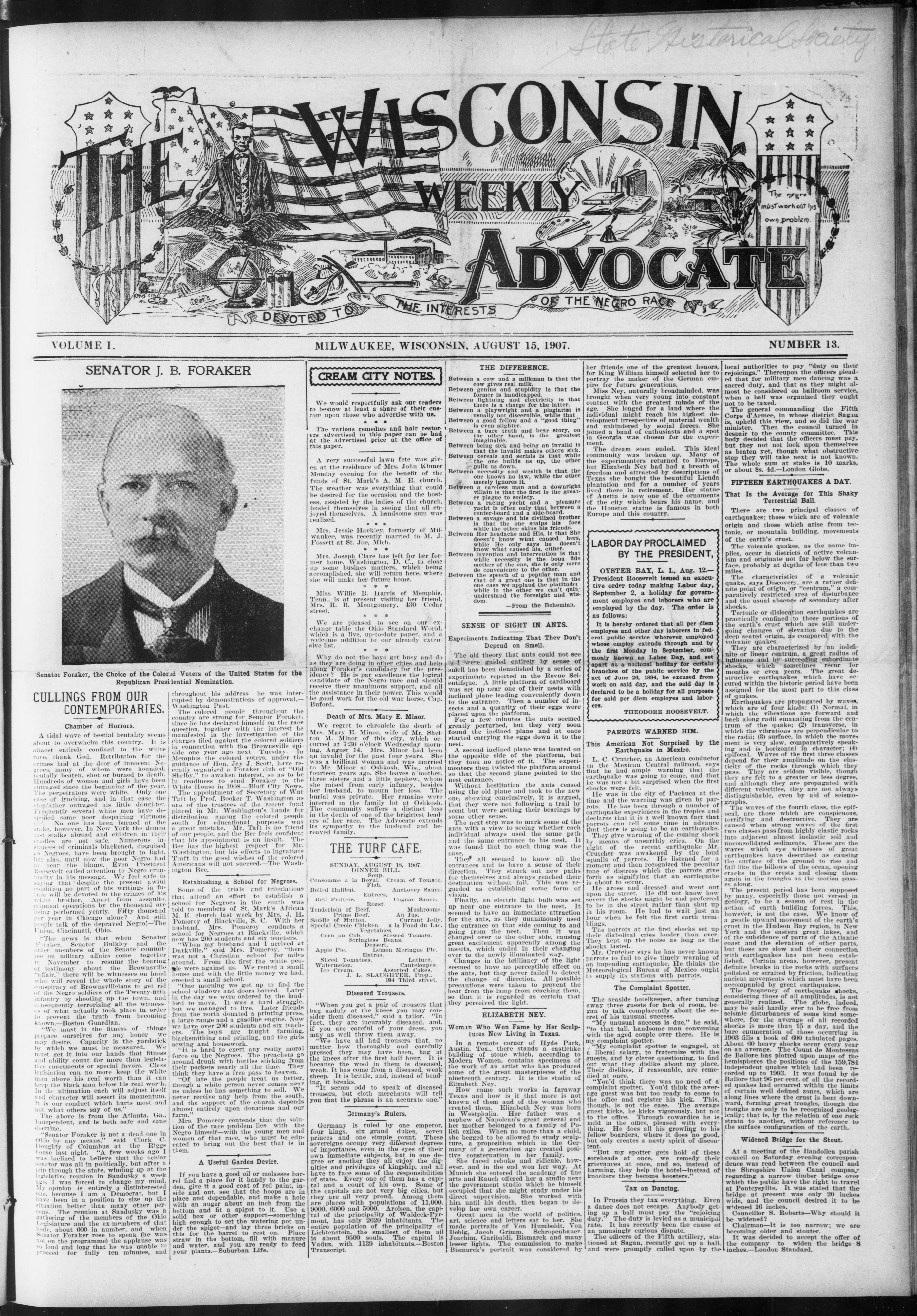
WISCONSIN
WEEKLY
ADVOCATE
DEVOTED TO THE INTERESTS OF THE WECRO RACE
SENATOR J. B. FORAKER
Senator Foraker, the Choice of the Colo-
Republican Pres
Senator Foraker, the Choice of the Colored Voters of the United States for the Republican Presidential Nomination.
CULLINGS FROM OUR CONTEMPORARIES.
CULLINGS FROM OUR CONTEMPORARIES.
Chamber of Horrors.
A tidal wave of bestial brutality seems about to overwhelm this country. It is almost entirely confined to the white race, thank God. Retribution for the crimes laid at the door of innocent Negroes, many of whom were hounded, brutally beaten, shot or burned to death. Hundreds of women and girls have been outraged since the beginning of the year. The perpetrators were white. Only one case of lynching, and in that case the stepfather outraged his little daughter. Frequently several white men have despoiled some poor despairing virtuous girl. No one has been burned at the stake, however. In New York the demon last stalks abroad and children in their cradles are not safe. Numerous instances of criminals blackened, disguised as Negroes, have been brought to light, but alas, until now the poor Negro had to bear the blame. Even President Roosevelt called attention to Negro criminality in his message. We feel safe in saying that despite the present awful condition no part of his writings in future will be devoted to the crimes of his white brother. Apart from assaults, criminal operations by the thousand are being performed yearly. Fifty thousand per year in Chicago alone? And still people talk of the depraved Negro!—The Union, Cincinnati, Ohio.
"The news is that when Senator Foraker, Senator Bulkley and the other members of the Senate' committee on military affairs come together in November to resume the hearing of testimony about the Brownsville "affair," there will be witnesses on hand who will reveal the whole story of the conspiracy of Brownsvilleians to get rid of the Negro soldiers of the Twenty-fifth infantry by shooting up the town, and consequently terrorizing all the witnesses of what actually took place in order to prevent the truth from becoming known —Boston Guardian.
"We must in the fitness of things prepare ourselves for any honor we may desire. Capacity is the yardstick by which we must be measured. We must get it into our hands that fitness and ability count for more than legislative enactments or special favors. Class legislation can no more keep the white man above his real worth than it can keep the black man below his real worth. In the ultimation each will adjust itself and character will assert its momentum. It is our conduct which hurts most and not what others say of us." The above is from the Atlanta, Ga. Independent, and is both safe and sane doctrine.
"Senator Foraker is not a dead one in Ohio by any means," said Clark C. Doughty of Columbus at the Riggs house last night. "A few weeks ago I was inclined to believe that the senior senator was all in politically, but after a trip through the state, winding up at the legislative reunion in Sandusky a week ago, I was forced to change my mind. My opinion is entirely a distinterested one, because I am a Democrat, but I have been in a position to size up the situation better than many other persons. The reunion at Sandusky was a gathering of the members of the Ohio Legislature and the ex-members of that body, about 600 in number, and when Senator Foraker rose to speak (he was not on the programme) the applause was so loud and long that he was unable to proceed for fully ten minutes, and
---
VOLUME I.
ed Voters of the United States for the
idential Nomination.
throughout his address he was interrupted by demonstrations of approval. Washington Past.
The colored people throughout the country are strong for Senator Foraker, since he has declared himself on the race question, together with the interest he manifested in the investigation of the charges filed against the colored soldiers in connection with the Brownsville episode one year ago next Tuesday. In Memphis the colored voters, under the guidance of Hon. Jay J. Scott, have recently organized a Foraker club of "Old Shelby," to awaken interest, so as to be in readiness to send Foraker to the White House in 1908.—Bluff City News. The appointment of Secretary of War Taft by Prof. Booker T. Washington as one of the trustees of the recent fund placed in Mr. Washington's hands for distribution among the colored people south for educational purposes was a great mistake. Mr. Taft is no friend of our people, and the Bee feels confident that his appointment is an insult. The Bee has the highest respect for Mr. Washington, but his efforts to ingratiate Traft in the good wishes of the colored Americans will not succeed.—The Washington Bee.
Establishing a School for Negroes. Some of the trials and tribulations that attend an effort to establish a school for Negroes in the south was told to members of St. Mark's African M. E. church last week by Mrs. J. H. Pomeroy of Blackville, S. C. With her husband, Mrs. Pomeroy conducts a school for Negroes at Blackville, which now has 200 students and six teachers. "When my husband and I arrived at Darkville," said Mrs. Pomeroy, "there was not a Christian school for miles around. From the first the white people were against us. We rented a small house and with the little money we had, erected a small school.
"One morning we got up to find the school windows and doors barred. Later in the day we were ordered by the landlord to move. It was a hard struggle, but we managed to live. Later friends from the north donated a printing press, a large range and a gasoline engine. Now we have over 200 students and six teachers. The boys are taught farming, blacksmithing and printing, and the girls sewing and housework. "It is hard to exert any really moral force on the Negroes. The preachers go around drunk with bottles sticking from their pockets nearly all the time. They think they have a free pass to heaven.
"Of late the people treat us better, though a white person never comes near us unless he has something to sell. We never receive any help from the south, and the support of the church depends almost entirely upon donations and our farm." Mrs. Pomeroy contends that the solution of the race problem lies with the Negro himself—with the young men and women of that race, who must be educated to bring out the best that is in them.
A Useful Garden Device.
If you have a good oil or molasses barrel find a place for it handy to the garden, give it a good coat of red paint, inside and out, see that the hoops are in place and dependable, and make a hole with an auger about an inch from the bottom and fit a spigot to it. Use a solid box or other support—something high enough to set the watering pot under the spigot—and lay three bricks on this for the barrel to rest on. Place straw in the bottom, fill with manure and water, and you are ready to feed your plants.—Suburban Life.
---
MILWAUKEE, WISCONSIN, AUGUST 15, 1907.
CREAM CITY NOTES.
We would respectfully ask our readers to bestow at least a share of their custom upon those who advertise with us.
The various remedies and hair restorers advertised in this paper can be had at the advertised price at the office of this paper.
A very successful lawn fete was given at the residence of Mrs. John Kinner Monday evening for the benefit of the funds of St. Mark's A. M. E. church. The weather was everything that could be desired for the occasion and the hostess, assisted by the ladies of the church, busied themselves in seeing that all enjoyed themselves. A handsome sum was realized.
Mrs. Jessie Hackley, formerly of Milwaukee, was recently married to M. J. Fossett at St. Joe, Mich.
* * *
Mrs. Joseph Clare has left for her former home, Washington, D. C., to close up some business matters, which being accomplished, she will return here, where she will make her future home.
* * *
Miss Willie B. Harris of Memphis, Tenn., is at present visiting her friend, Mrs. R. B. Montgomery, 430 Cedar street.
* * *
We are pleased to see on our exchange table the Ohio Standard World. which is a live, up-to-date paper, and a welcome addition to our already extensive list.
* * *
Why do not the boys get busy and do as they are doing in other cities and help along Foraker's candidacy for the presidency? He is par excellence the logical candidate of the Negro race and should receive their unanimous support, and all the assistance in their power. This would be good work for the old war horse, Cap. Buford.
Death of Mrs. Mary E. Minor
We regret to chronicle the death of Mrs. Mary E. Minor, wife of Mr. Shelton M. Minor of this city, which occurred at 7:30 o'clock Wednesday morning, August 14. Mrs. Minor had been an invalid for the past four years. She was a brilliant woman and was married to Mr. Minor at Oshkosh, Wis., about fourteen years ago. She leaves a mother, three sisters and a little nephew, whom she raised from early infancy, besides her husband, to mourn her loss. The burial was private. Her remains were interred in the family lot at Oshkosh. The community suffers a distinct loss in the death of one of the brightest leaders of her race. The Advocate extends its sympathy to the husband and bereaved family.
THE TURF CAFE.
SUNDAY. AUGUST 18, 1907.
DINNER BILL.
Soup.
Consomme a la Royal. Cream of Tomato.
Fish.
Bolled Halibut. Anchovey Sauce.
Entrees.
Bell Fritters. Cognac Sauce.
Roast.
Tenderloin of Beef. Mushrooms.
Prime Beef. Au Jus.
Saddle of Mutton. Currant Jelly.
Special Creole Chicken. a la Fond du Lac.
Vegetables.
Corn on Cob. Stewed Tomato.
Stringless Beans.
Dessert.
Apple Pie. Lemon Meringue Pie.
Extras.
Sliced Tomatoes. Lettuce.
Watermelon. Canteloupes.
Ice Cream. Assorted Cakes.
J. L. SLAUGHTER, Prop..
194 Third street.
Diseased Trousers.
"When you get a pair of trousers that bag unduly at the knees you may consider them diseased," said a tailor. "In fact, they are incurably diseased, and, if you are careful of your dress, you may as well throw them away.
"We have all had trousers that, no matter how thoroughly and carefully pressed they may have been, bag at the knees after the first half hour. It is because the wool in them is diseased, weak. It has come from a diseased, weak sheep. It is brittle, and, instead of bending, it breaks.
"It seems odd to speak of diseased trousers, but cloth merchants will tell you that the phrase is an accurate one."
Germany's Rulers.
Germany is ruled by one emperor, four kings, six grand dukes, seven princes and one simple count. These sovereigns occupy very different degrees of importance, even in the eyes of their own immediate subjects, but in one degree or another they all enjoy the dignities and privileges of kingship, and all have to face some of the responsibilities of state. Every one of them has a capital and a court of his own. Some of the capitals are not very big cities, but they are all very proud. Among them are places with populations of 11,000, 9000, 6000 and 5000. Arolsen, the capital of the principality of Waldeck-Pyrmont, has only 2620 inhabitants. The entire population of the principality of Lichtenstein, the smallest of them all is about 9500 souls. The capital is Vaduz, with 1139 inhabitants.—Boston Transcript.
---
THE DIFFERENCE.
Between a cow and a milkman is that the cow gives real milk.
Between genius and stupidity is that the former is handicapped.
Between lightning and electricity is that there is a charge for the latter.
Between a playwright and a plagiarist is usually not discernible, while that
Between a good fellow and a "good thing" is even slighter.
Between a bare truth and bear story, on the other hand, is the greatest imaginable.
Between being sick and being an invalid is that the invalid makes others sick.
Between cereals and serials is that while the one builds us up, the other pulls us down.
Between necessity and wealth is that the one knows no law, while the other merely ignores it.
Between a careless man and a downright villain is that the first is the greater plague to society.
Between a racing yacht and a pleasure yacht is often only that between a center-board and a side-board.
Between a savage and his civilized brother is that the one scalps his foes while the other skims his friends.
Between Her headache and His, is that She doesn't know what caused hers, while He only says he doesn't know what caused his, either.
Between invention and intervention is that while necessity is the bona tide mother of the one, she is only mere de convenience to the other. Between the speech of a popular man and that of a great one is that in the one case we applaud the platituden while in the other we can't quite understand the foresight and wisdom
SENSE OF SIGHT IN ANTS.
Experiments Indicating That Thev Don't Depend on Smell.
The old theory that ants could not see and were guided entirely by sense of smell has been demolished by a series of experiments reported in the Revue Scientifique. A little platform of cardboard was set up near one of their nests with inclined plane leading conveniently down to the entrance. Then a number of insects and a quantity of their eggs were placed upon the platform.
For a few minutes the ants seemed greatly perturbed, but they very soon found the inclined plane and at once started carrying the eggs down it to the nest.
A second inclined plane was located on the opposite side of the platform, but they took no notice of it. The experimenters then twisted the platform around so that the second plane pointed to the nest entrance.
Without hesitation the ants ceased using the old plane and took to the new one, showing conclusively, it is argued, that they were not following a trail by scent but were getting their bearings by some other sense. The next step was to mark some of the ants with a view to seeing whether each individual always used the same path and the same entrance to his nest. It was found that no such thing was the case. They all seemed to know all the entrances and to have a sense of their direction. They struck out new paths for themselves and always reached their destination without fail. This was regarded as establishing some form of vision.
Finally, an electric light bulb was set up near one entrance to the nest. It seemed to have an immediate attraction for the ants, as they unanimously used the entrance on that side coming to and going from the nest. Then it was changed over to the other side, causing great excitement apparently among the insects, which ended in their changing over to the newly illuminated way.
Changes in the brilliancy of the light seemed to have no perceptible effect on the ants, but they never failed to detect the change of direction. All possible precautions were taken to prevent the heat from the lamp from reaching them, so that it is regarded as certain that they perceived the light.
ELIZABETH NEY.
Woman Who Won Fame by Her Sculptures Now Living in Texas.
In a remote corner of Hyde Park, Austin, Tex., there stands a castellike building of stone which, according to Modern Women, contains specimens of the work of an artist who has produced some of the great masterpieces of the nineteenth century. It is the studio of Elizabeth Ney.
How came such works in faraway Texas and how is it that more is not known of them and of the woman who created them. Elizabeth Ney was born in Westphalia. Her father was a nephew of Napolean's great general and her mother belonged to a family of Polish exiles. When no more than a child, she begged to be allowed to study sculpture, a proposition which in the Germany of a generation ago created positive consternation in her family.
She faced rebuke and ridicule, however, and in the end won her way. At Munich she entered the academy of fine arts and Rauch offered her a studio next the government studio which he himself occupied that she might study under his direct supervision. She worked with him until his death, then began to develop her own career.
Great men in the world of politics, art, science and letters sat to her. She made portraits of Von Humboldt. Von Liebig, Jacob Grimm, Schropenhauer, Joachim, Garibaldi, Bismarck and many lesser lights. The commission to make Bismarck's portrait was considered by
---
her friends one of the greatest honors, for King William himself selected her to portray the maker of the German empire for future generations. Miss Ney, naturally broadminded, was brought when very young into constant contact with the greatest minds of the age. She longed for a land where the individual might reach his highest development irrespective of material wealth and unhindered by social forces. She joined a band of enthusiasts and a spot in Georgia was chosen for the experiment.
The dream soon ended. This ideal community was broken up. Many of the experimenters returned to Europe, but Elizabeth Ney had had a breath of freedom and attracted by descriptions of Texas she bought the beautiful Lienda plantation and for a number of years lived there in retirement. Her statue of Austin is now one of the ornaments of the city which bears his name, and the Houston statue is famous in both Europe and this country.
LABOR DAY PROCLAIMED BY THE PRESIDENT,
OYSTER BAY, L. I., Aug. 12. President Roosevelt issued an executive order today making Labor day, September 2, a holiday for government employees and laborers who are employed by the day. The order is as follows:
It is hereby ordered that all per diem employes and other day laborers in federal public service wherever employed whose employ extends through and by the first Monday in September, commonly known as Labor Day, and set apart as a national holiday for certain branches of the public service by the act of June 26, 1894, be excused from work on sald day, and the sald day is declared to be a holiday for all purposes for sald per diem employes and laborers. THEODORE ROOSEVELT.
PARROTS WARNED HIM.
This American Not Surprised by the Earthquake in Mexico.
L. C. Crutcher, an American conductor on the Mexican Central railroad, says that he had ample warning that the earthquake was going to come, and that he was not a bit surprised when the first shocks were felt.
He was in the city of Pachuca at the time and the warning was given by parrots. He has been through a number of earthquake experiences in the tropics and declares that it is a well known fact that parrots can tell some time in advance that there is going to be an earthquake.
They give warning of the coming shock by means of unearthly cries. On the night of the recent earthquake Mr. Crutcher was awakened by the loud squalls of parrots. He listened for a moment and then recognized the peculiar tone of distress which the parrots give forth as signifying that an earthquake is about to occur.
He arose and dressed and went out upon the street. He did not know how severe the shocks might be and preferred to be in the street rather than shut up in his room. He had to wait just an hour when he felt the first earth tremblings.
The parrots at the first shocks set up their diabolical cries louder than ever. They kept up the noise as long as the shocks lasted.
Mr. Crutcher says he has never known parrots to fail to give timely warning of an impending earthquake. He thinks the Meteorological Bureau of Mexico ought to supply its stations with parrots.
The Complaint Spotter.
The seaside hotelkeeper, after turning away three guests for lack of room, began to talk complacently about the secret of his unusual success.
"My unusual success is due," he said, "to that tall, handsome man conversing with the aged couple over there. He is my complaint spotter.
"My complaint spotter is engaged, at a liberal salary, to fraternize with the guests, and by clever questioning, to find out what they dislike about my place. Their dislikes, if reasonable, are remedied at once.
"You'd think there was no need of a complaint spotter. You'd think the average guest was but too ready to come to the office and register his kick. This, though, is not the case. The average guest kicks, he kicks vigorously, but not to the office. Through cowardice he is mild in the office, pleased with everything. He does all his growling to his fellow boarders, where it does no good, but only creates a nasty spirit of discontent.
"But my spotter gets hold of these soreheads at once, we remedy their grievances at once, and so, instead of harming, they help the hotel—instead of knockers they become boosters."
Tax on Dancing.
In Prussia they tax everything. Even a dance does not escape. Anybody getting up a ball must pay the "rejoicing duty." The duty is levied as a municipal rate. It has recently been the cause of an amusingly curious dispute. The officers of the Fifth artillery, stationed at Sagan, recently got up a ball, and were promptly called upon by the
NUMBER 13.
local authorities to pay "duty on their rejoicings." Thereupon the officers pleaded that for military men dancing was a sacred duty, and that as they might almost be considered on ballroom service, when a ball was organized they ought not to be taxed.
The general commanding the Fifth Corps d'Armee, in whose district Sagan is, upheld this view, and so did the war minister. Then the council turned in despair to the county committee. This body decided that the officers must pay, but they not not look upon themselves as beaten yet, though what obstructive step they will take next is not known. The whole sum at stake is 10 marks, or about 8s. 4d.—London Globe.
FIFTEEN EARTHOUAKES A DAY
That Is the Average for This Shaky Terrestrial Ball.
There are two principal classes of earthquakes; those which are of volcanic origin and those which arise from tectonic, or mountain building, movements of the earth's crust.
The volcanic quakes, as the name implies, occur in districts of active volcanism and originate not far below the surface, probably at depths of less than two miles.
The characteristics of a volcanic quake, says Discovery, are a rather definite point of origin, or "centrum," a comparatively restricted area of disturbance and the usual absence of secondary after shocks.
Tectonic or dislocation earthquakes are practically confined to those portions of the earth's crust which are still undergoing changes of elevation due to the deep seated origin, as compared with the volcanic quakes. They are characterized by an indefinite or linear centrum, a great radius of influence and by succeeding subordinate shocks, which sometimes recur for months or even years. The great destructive earthquakes which have occurred within the historic period have been assigned for the most part to this class of quakes.
Earthquakes are propagated by waves, which are of four kinds: (1) Normal, in which the vibrations are forward and back along radii emanating from the centrum of the quake; (2) transverse, in which the vibrations are perpendicular to the radii; (3) surface, in which the movement is very slow, comparatively speaking and is horizontal in character; (4) epifocal. Waves of the first three classes depend for their amplitude on the elasticity of the rocks through which they pass. They are seldom visible, though they are felt to a greater or less degree, and although they are propagated with different velocities, they are not always distinguishable, even by aid of seismographs.
The waves of the fourth class, the epifocal, are those which are conspicuous, terrifying and destructive. They are caused when strong waves of the first two classes pass from highly elastic rocks into adjacent almost inelastic soil and unconsolidated sediments. These are the waves which eye witnesses of great earthquakes have described as causing the surface of the ground to rise and fall like the billows of the ocean, opening cracks in the crests and closing them again in the troughs as the motion passes along.
The present period has been supposed by many, especially those not versed in geology, to be a season of rest in the action of earth building forces. This, however, is not the case. We know of a gentle upward movement of the earth's crust in the Hudson Bay region, in New York and the eastern great lakes, and of the subsidence of parts of the Atlantic coast and the elevation of other parts, but these are slow and their connection with earthquakes has not been established. Certain areas, however, present definite breaks in the rocks with surfaces polished or straited by friction, indicating ancient movements which must have been accompanied by great earthquakes.
The frequency of earthquake shocks, considering those of all amplitudes, is not generally realized. The globe, indeed, may be said hardly ever to be free from seismic disturbances of some kind somewhere, for the average of all recorded shocks is more than 15 a day, and the bare enumeration of those occurring in 1903 fills a book of 600 tabulated pages. About 60 heavy shocks occur every year on an average. The Count de Montessus de Ballore has plotted upon maps of the hemispheres the positions of the 159,784 independent quakes which had been recorded up to 1903. It was found by de Ballore that 96 per cent. of all the recorded quakes had occurred within the limits of certain well defined zones, which are along lines where the crust is bent downward, forming great troughs, though the troughs are only to be recognized geologically; that is, by the relation of one rock strata to another, without reference to the surface configuration of the earth.
Widened Bridge for the Stout
At a meeting of the Ilandollen parish council on Saturday evening correspondence was read between the council and the Shropshire Union Canal company regarding a narrow timber bridge over which the public have the right to travel at Pontcysyllte. It was stated that the bridge at present was only 20 inches wide, and the council desired it to be widened 16 inches. Councillor S. Roberts—Why should it be widened?
Chairman—It is too narrow; we are becoming older and stouter.
becoming older and stouter. It was decided to accept the offer of the company to widen the bridge 8 inches.—London Standard.
THE WISCONSIN WEEKLY ADVOCATE
R. B. MONTGOMERY, Editor and Proprietor.
Notes of Interest. Great Britain owns more land of North America than the United States. Japan is perhaps the only country in the world where the fashions in women's dress have not changed materially in 2500 years. As near as can be ascertained the unappropriated and unreserved public lands of this country amounts to 792, 238,707 acres.
The railroads of England and Ireland are of different gauge. Those of Ireland are 5 feet 3 inches; of England, 4 feet $8\frac{1}{2}$ inches.
The Leesville (Colo.) Light tells how the members of a lodge at Leesville "turned out enthusiastically" at a funeral of a lodge brother.
Lost in the Australian bush, near Port Darwin, for five days, Engineer Commander E. S. Silk was found alive and well by a black tracker.
The searchlight of the British Dreadnought has a new feature in that it projects beams at the same time in opposite directions to facilitate signaling.
The highest inhabited place in the world is the Buddhist monastery of Ilane in Thibe, which is situated about seventeen thousand feet above sea level.
There is a factory in Amsterdam, Holland, which cuts and polishes 400,000 diamonds annually. About twenty women do most of the actual cutting of the stones.
Daniel Osiris, the Jewish banker and philanthropist of Paris, who recently died, left a will in which he disposed of $13,000,000, giving $5,000,000 to the Pasteur Institute.
One of the most eloquent preachers in Wales is Rev. J. Paulston Jones. He has been blind since he was 2 years old, but graduated with high honors at the University of Glasgow.
Mr. Ernest Jardine, the purchaser of Glastonbury Abbey, has stated that he is willing to sell the abbey to the Church of England for the same price (£30,000) that he paid for it.
Five thousand pounds was paid at Christie's auction rooms, London, recently for a necklace. It was composed of fourteen emeralds, six large pearls and eighty marquise shaped brilliants.
The only woman who ever ruled for an American colony was Lady Carteret. Lord Carteret married for his second wife a New York widow, Mrs. William Lawrence. She was a woman of strong character, and was appointed regent during his absence from the colony. Many documents are extant signed by her as regent.
—Baggage belonging to a Chinese coolie who had landed at Singapore from Sumatra was being examined the other day when something hard was felt in a pillow. Upon opening the pillow the official found a skull and all the bones of a human skeleton. The coolie declared that the bones were those of his brother, and he was taking them to China for burial.
—Four countries grow 86 per cent. of the hop crop of the world. England is perceptibly in the lead with a production of 28.1 per cent. of the total. the crop of 1905 being adopted as the leading one for which information is available for all countries. Next in order stand Germany with 23.3 per cent., the United States with 20 per cent. and Austria-Hungary with 14.4 per cent.
Manager Toyowaka of the Japanese Mitsui Bishi bank says that women make most of the goods exported from Japan. Male workmen versed in mathematical and mechanical knowledge are becoming experts in new branches of industry, such as shipbuilding and ironworking, in which they display the greatest patience. In the tea, silk weaving and light industries female labor is invariably required.
The British government has recently given notable recognition of the excellence of American agricultural teaching and education by the selection of A. E. Parr of the Iowa State Agricultural college as director of agriculture and animal industry for British India. Prof. Parr will receive a salary of $10,000 a year for 10 years, and it is understood that he will then be eligible to retire and draw a pension for life $5000 a year.
Where Animals Beat Men
"Nature faking aside," said John Lover, the Zoo keeper, "mice won't eat oleo. It is a fact. Lay a pat of oleo and a pat of butter side by side, and in the morning the butter will be gone, but the oleo will remain untouched.
"Oh, yes, some animals are incredibly nice about their food. The otter, when living wild, will only eat one piece, one mouthful, out of each fish he catches. He will land a beautiful trout, but only one bite of it, from the back just behind the neck, is good enough for him. The rest he tosses aside. This epicure often kills a dozen fine big trout to make one meal.
"Chimpanzees have very delicate tastes. A banana or a pineapple that to you seems delicious, to a chimpanzee may be revolting. His taste is keener. Grapes grown in hothouses where sulphur fumes are used as an insecticide taste all right to a man, but a chimpanzee will have none of them.
"The ichneumon loves eggs. He can tell a fresh from a stale one simply by tapping the shell."
An Ugly Truth.
"If you have money to give away, give it for cancer research. Help mankind to escape from this cruel and hideous thing."
The speaker, a physician, resumed:
"Do you know that cancer is gaining on us? Do you know that it kills now nearly double the number of men and women it killed twenty years ago? Cancer never attacks people under the age of 35. Today one man in twelve and one woman in eight above that age die of cancer, whereas, twenty years ago, but one man in twenty-one and one woman in twelve so died. Sir William Church is my authority for this terrifying truth."
"Cancer is making dreadful strides among us. We know no cure, no remedy for it. Let us, then, if we are rich, give money for cancer research. Money alone is needed to reduce those awful figures, one in twelve and one in eight."
The Origin of Pall Mall.
Few, perhaps, know that Pall Mall derived its name from an old "Pail-maille" court which stood on the site three hundred years ago. This game was simply a slightly different form of roquet, and appears to have gone completely out of fashion in the Eighteenth century. Who revived it and how it came by its modern name is not known.—The Captain.
THE CAVALRY HIKE.
White and shining is the way,
Winding through the hills;
Bright and winelike is the day—
How the bugle thrills!
Now we reach the mountain brook—
Hear the streamlet brawl!—
Through, with ne'er a downward look,
We must clatter all.
Crashing through, splashing through—
Hear the clanking sword!—
Water clings to all like dew
When we make the ford.
Now the water dashes high
Over man and steed;
'Tis joyous hiking, wet or dry,
When such wild spirits lead;
Guidons through the spray are whirled,
Chargers' sides agleam;
'Tis grandest sight in all the world
When troopers ford a stream.
Crashing through, splashing through—
Hear the clanking sword!—
Who envies not our daring crew
When we make the ford!
—Denver Republican.
THE RED-COAT RACE.
" * * * no more fit to ride than a child, with his heart all wrong after that beastly 'flu'; but he's going to, and there's no stopping him." The men moved off, and Dorothy Kenyon, an unseen and unwilling listener, had the big hall to herself once more.
They had been talking, those men who knew, of the Heplow Point-to-Point races to take place today, and of Reggie Mortimer, who was to ride in the Red-Coat race. Reggie, who they said was "no more fit to ride than a child"—Reggie, who was riding for her, and not for Mrs. Hervey-Dorian. The girl's cheeks burned, and she clenched her hands tightly together. She had learned several things since yesterday.
Yesterday she had come to stay here with her cousins, the Robertsons, for the races, knowing no one else in the house party of twenty-four save Capt. Mortimer, her old friend and playmate, and Mrs. Hervey-Dorian, whom she hated with that healthy hatred only possible between two women. She had been permitted, by parental authority, to accept, in virtue of their old childish friendship, Reggie Mortimer's offer to run a horse under her nomination in the Red-Coat race. That the same old childish friendship no longer existed it seemed unnecessary to inform anyone. Nothing had been said at present; possibly neither fully realiezd that any change in their feelings had taken place. Still, Dorothy's anticipations of the Heplow races assumed huge proportions of delight.
The first blow fell when, some weeks before the day, Reggie went down with influenza. He was soon better—better, but not very fit, and was reluctantly obliged to get a brother officer to ride Come Along. Dorothy was disappointed; still, it was Reggie's horse, and he was running it for her. He and she would be at the races together.
The next blow fell when Mrs. Robertson, in writing voluminous details of times and trains, mentioned that Mrs. Hervey-Dorian would be of the party, and Dorothy's spirits sank from: 100 to zero. Did not "they" say that Reggie was very fond of this Mrs. Hervey-Dorian, and had not Dorothy, with her own jealous eyes, watched them sit out dance after dance together at the Hunt ball? True, Mrs. Hervey-Dorian had been very good to Reggie when he was down with fever in India last year, so "they" said again; but Dorothy tossed a curly yellow head and hated the other woman. It would spoil everything, her being at the Robertsons' too. And when she reached the house to hear that Reggie's substitute had been suddenly recalled from leave, and that Come Along had no rider, the solid earth seemed to sink beneath her feet.
The hall was full of people, chattering and laughing; but Dorothy saw no one Capt. Mortimer was looking nearly as distressed as herself, and Mrs. Hervey-Dorian, who seemed glued to his side, smiled wickedly; for Come Along was the favorite, and a most undesirable rival to her horse Tom the Piper.
"Such a pity for you, Miss Kenyon!" she said smoothly.
Dorothy shrugged her shoulders with a brave pretense of indifference.
"It can't be helped," she said, hoping she did not look as disappointed as she felt.
Reggie Mortimer was watching her narrowly.
"I'll tell you what," he said quickly, "it's all rot about my not being fit! I'll ride myself!"
Dorothy gave a little gasp of excitement.
"Oh! could you?" she said, her eyes shining. That settled it.
"I can and will!" he returned, smiling at her. "I'll go and wire about it at once."
But Mrs. Hervey-Dorian laid a white and much ringed hand on his arm.
"My dear boy," she protested, "I can't allow you to do this. Why, you're only just off the sick list. Miss Kenyon, perhaps, does not know how ill you've been."
The hot color rushed into the girl's cheeks. Who was this woman, to order about Reggie?—Reggie, her old friend and playfellow, and who was riding for her, Dorothy Kenyon, and not for Mrs. Hervey-Dorian. She drew herself up to her full height, which, after all, dear little soul, was only 5 feet.
"Capt. Mortimer is probably the best judge," she said colrly, and walked to the other side of the hall, where Janet Robertson was dispensing tea. She heard Mrs. Hervey-Dorian's irritating little laugh follow her, heard her say something in low tones to Reggie; but Reggie did not laugh.
The evening passed off badly for Dorothy. In her brief experience of two years since her coming-out she had seldom failed to have a success with most people, owing as much to a sweet unselfishness as to her undoubted prettiness. But tonight the party was uncongenial, and luck was against her. After dinner bridge was suggested, and those who did not play split up into couples and sat in corners of the carefully lighted conservatory. Mrs. Hervey-Dorian and Capt. Mortimer seemed to have a great deal to say to each other under a colossal palm. Dorothy could just see them from where she sat, finding herself at the mercy of her late dinner partner. He was an old-young man with a lisp and a pronounced fad on food. He had dined lightly off a Brussels sprout and a glass of warm milk, and was now anxious to demonstrate to Miss Kenyon the health-giving properties of this mixture. When presently Reggie came out of the conservatory and
rescued her she was on the verge of tears. "Enjoy your little self?" he said, in those persuasive tones of his, stretching his long legs in the chair vacated by the apostle of the sprout system.
She lifted piteous brown eyes to his, telling their own tale.
He laughed, and commenced talking of the old schoolroom days, when the young Kenyons and Mortimers had "done lessons" together. And Dorothy would have gone to bed happy, but that Mrs. Hervey-Dorian had taken care to remark, obviously in her hearing, "that the Kenyon girl was fairly running young Mortimer." Dorothy, with hatred in her heart and bright spots of color on her cheeks, made the resolve not to speak one unnecessary word to Reggie upon the following day.
The Red-Coat race was the second of the four events. Together with Reggie, Dorothy stood in a crowd on the top of the Robertsons bus and watched a local favorite win the lightweight. Then it was time for Reggie to go. He and she had had not one word together the morning. The girl seemed to be avoiding him, he thought, and puzzled his brain for a reason, not knowing that the words, so unhappily overheard the previous evening, were rankling in Dorothys mind and spoiling her day. "Running young Mortimer!" She wondered how many others thought that, too. "Wish me luck," said Reggie to her in a low voice, as he swung himself off the bus.
For one second her wistful eyes met his imploring ones; then her face hardened. Mrs. Hervey-Dorian was watching them from below, looking up with laughing, malicious eyes. The words that came to Dorothy's lips were entirely prompted by the sight of those eyes—gray, like their owner's dress—gray, impertinent and imperturbable.
"Bring me back the bracelet." was Dorothy's answer, with a strained little laugh.
Reggie gave her one quick look. He said nothing; but it was Mrs. Hervey-Dorian who walked past the long line of carriages with him—it was Mrs. Hervey-Dorian who told him to take care of himself, and wished him luck, as he got into the saddle. Dorothy, from the top of the bus, watched them both. Those nodding vivacious gray and mauve plumes in her rival's hat seemed to be everywhere, but always at Reggie's side. Now, as he rode off, she came on to the bus again.
Kindly Maj. Robertson stood by the girl's side and offered her his glasses. Perhaps he saw by her ingenuous face that this race meant a good deal more to her than the mere winning of a bangle—perhaps he had some dim glimmerings of the truth; for Fred Robertson had never liked his wife's great friend, Mrs. Hervey-Dorian. He told Dorothy now, in cheery tones, that Come Along was bound to win.
She smiled, and tried not to hear what the man on the other side of Mrs. Hervey-Dorian was saying—something about "that big fence at the bottom with an open ditch, a regular grave! Johnny and I went down to look at it. It'll take some getting over."
"Theyre off! She tried to follow with her eyes, then with Fred Robertson's glasses, which he patiently resigned to her. There were eight starters, but only three were in it from the first—Come Along, Tom the Piper (Mrs. Hervey-Dorian's hunter), and a big chestnut ridden by one of the Robertson's house party. Tom the Piper took the field for the first two miles at a merry pace, followed closely by Come Along; now they were coming to the big fence. Dorothy for one moment shut her eyes. "Someone's down," said Fred Robertson excitedly. He seiezd the glasses out of her hands.
"It's Johnny! He never has any luck," said Mrs. Hervey-Dorian indifferently. Johnny was riding the chestnut, but Dorothy could feel no interest in him. Come Along was going like a bird, and as they came up the last hill, Reggie took him to the front and won a good race by one length. The diamond bracelet was Dorothy Kenyon's!
They all congratulated her except Mrs. Hervey-Dorian and Maj. Robertson, who both disappeared as they saw Reggie ride in. The M. F. H. came up and, in a pretty little speech, presented Dorothy with the bracelet, the mere sight of which would have sent her into cestacies a few days before. She thanked him as well as she could. Would people never leave off talking to her? Where was Reggie? What should she say to him? She assented mechanically to the suggestion of one of the young men on the bus, that they should go down into the paddock. * * * In the distance nodded those gay gray plumes
Dorothy timidly thanked him for winning for her.
"I'm glad you got the bracelet," he said meaningly. He walked off with a woman who had triumph in her gray eyes.
They had been excellent races—everybody said so. Particularly the lucky winner of the diamond bracelet—particularly the successful jockey. People said to each other that he looked "uncommon ed." and whispered the word heart. They may have been right, but he paid no heed. He was wearing a buttonhole of violets as they drove home, and seemed to be in roaring spirits. * * * They had been excellent races. Everyone said so.—Black and White.
Appropriate Bath Places
Lame man-A limpid lake.
Deaf man-A sound.
Blind man-A sea.
Sick man-A well.
Baseball crank-A run.
Fireman-A stream.
Inebriate-A tank (or the Falls)
A crook-A strait.
Gambler-A pool.
Pawnbroker-A pond.
Shoemaker-A creek.
Burglar-The breakers.
An athlete-A spring.
Messenger boy-The rapids.
The Czar-The surf.
Beer Saloons for Women.
"When I was in Berlin," said a clergyman, "I had enough curiosity to visit one of the peculiar saloons for women that they have there. The place interested me, and I am bound to say that it was decently conducted.
"Berlin is the only city in the world that has these institutions. In our country, where the women are nearly all teetotalers, we don't need them. In England they don't need them because Eng-
lishwomen of the lower classes enter the public houses and lean against the bar to sip their beer with as much nonchalance as their husbands. "In this female saloon in Berlin about 25 females were gathered. They looked poor but respectable. Some were smoking—cigarettes and cigars—some read the papers, and in a corner a little group argued noisily over an article in a fashion magazine, much as men argue in their own saloons over politics.
"All had mugs of beer before them, and, as they drank quite steadily, the barmaid was kept busy filling the glasses and making change. The air was pale blue with tobacco smoke. The saloon resounded with eager voices—not deep, male voices, but the clear and silvery voices of women. Some of these dainty creatures drank in the course of the evening no less than nine beers.
"As I regarded the strange scene, I sighed and said to myself:
"'The twentieth is indeed the woman's century.'"
AUSTRALIAN TROPICAL BUSH
A Sportsman's Paradise That Has Serious Drawbacks.
The country around Port Darwin in which Engineer Commander Silk of H. M. S. Pyramus was lost for five days was well known to me nineteen years ago, and there has been very little change in the northern territory since that time. The mangrove swamps, that sometimes stretch unbroken by cliffs or beach for miles, are to the eye a low, dull green wall rising from the sea. Thousands of oysters cling to the fantastic roots and branches of the mangroves that are laved by the tidewaters, and on the bottom lie prawns, crabs and other shellfish of enormous size. Swordfish and sharks often play sad havoc with the nets, as also do the numerous alligators that wallow in the black slime brought down by the creeks which trickle through the dense wilderness of closely knitted boughs and leaves.
Each evening at sunset flocks of flying foxes in search of food stream from their haunts in the mangroves toward the open country; so black, eerie and mysterious do they appear in the glorious red and golden light as their heavy webbed wings flap slowly in their flight that to the imagination of any wanderer in the neighborhood they become harbingers of ill omened fate. Where the stretches of dazzling white beach approach the swamp one frequently comes on a quicksand; and I remember my horror when I rode unconscious of its existence into the one at Fannie bay; I felt my horse's feet sink over the fetlocks just as my companion's shout brought us back to firm ground.
The territory has been often described as a sportsman's paradise. At this time of the year the organized shooting parties find around the lagoons and jungles about 10 miles from Port Darwin myriads of different species of wild duck and geese, as well as ibis, native companions, various kinds of pigeons, cockatoos and parrots and emu and kangaroo. Black boys generally accompany the parties to retrieve from the tangle of lilies and other beautiful plants, by which the surface of the shallow waters are thickly covered, the birds that fall to the guns.
The thick belts of jungle are choked by an undergrowth of parasitic creepers that have flung their ropes around the trunks and into the branches of the great trees, to droop thence in a maze of tangled loops into which it is impossible to penetrate far without cutting a way. Clusters of white, starry flowers shine graciously among the green of fern and moss; a blaze of scarlet blossom clings around the tall pillar of a banyan; and the soft illumination of heliotrope orchids lights the diverse undergrowth that is only half revealed in the tender brooding twilight.
A friend relating an experience of the jungle described the soft dank heat and intense silence, the rare shafts of sunlight breaking through the canopy of the treetops, and the feeling of reverence and awe inspired in him by the beautiful Gothiclike arches and tracery; and told of his rude awakening when turning his head to the right he saw suspended from a branch an enormous python, swaying stealthily as it loosened its coils and slowly advanced its head toward him. The sight of the serpent in this glimpse of Eden, and one so muscular and of such evil intent, so terrified him that with a shout he rushed from the jungle to the open without even firing a shot.—Maury Eyre in Pall Mall Gazette.
They Eat Thermometers
The thermometer registered 97, and looking at it, the two men wiped their red, wet brows.
"Phew, it's hot," said the visitor. "But why have you got your thermometer all encased in heavy iron wire?"
"Because," replied the host, "it is a Guatemalan thermometer. In Guatemala they are all cased in wire like that."
"But why?"
"To prevent the natives from eating the mercury."
"It is a fact. In Guatemala the intense heat causes the natives to suffer dreadfully from torpid liver. They know that mercury is a liver specific, but they have no money to buy it, so they steal it. For their health's sake they steal it, poor sick creatures, out of thermometers. On any dark, hot night, if you hide near an unprotected thermometer, you will see a native, weak and thin, steal up to the instrument. He groans and presses his hand to his aching liver; then, with a quick look round, he breaks the glass and swallows the ball of mercury in one mouthful."
The listener smiled.
"I suppose that Guatemala," he said, "is the only place in the world where thermometers are looked on as an article of food."
Mexico's "Whitehouse."
The castle of Chapultepec, the official summer residence of the President of Mexico, is to be either rebuilt or abandoned entirely and another and more modern home is to be erected by the government for its chief executive. This same thing was talked of about sixteen years ago. At that time Jay Gould visited Mexico in search of a climate that would benefit his failing health. It was stated in published dispatches that he offered President Diaz $5,000,000 for the castle of Chapultepec, with the view of making it his home during a part of each year. The offer was refused. This ancient castle is the most noted and historic edifice in Mexico. It has a history dating far back into the days when Mexico was ruled by Spanish viceroys. It was originally erected as the official home of the viceroys, and following that it served in the same capacity during the days that Mexico was an empire, republic, empire, and republic again.
Love of Irish
For "getting on" in the world, in a commercial house, or outside Ireland, French or German would be infinitely more useful than Gaelic. But the fact remains that Irish boys and girls, and their teachers as a rule, do not care a fig for French or German, but they do care a great deal for Irish. They want to learn Irish, as they want no other language on earth.-Prof. Stanley Lane-Poole in the Fortnightly.
ALL "OVER."
Marie is in the mountains,
The precious little dove,
And she is (so Jane writes me)
Over her head in
And Daisy's at the seashore,
She's getting awful tanned.
Upon the beach she's lounging
Over her limbs
in
sand.
And Myrtle's on the prairies
(A tall romantic lass),
Out doors she's idly rambling
Over her knees
in
grass.
And father's in the city,
He's hustling hard, you bet,
Poor man! they say that he is
Over his ears
in
debt.
--From the Bohemian.
Tea-Table Salad.
All the world loves a lover except her father.—Town Topics.
The shake of the dice box causes many a throe.—Town Topics.
Forbidden fruit for the newly married: Dates and peaches.—Town Topics.
Ella—Is he a week-kneed fellow.
Stella—I don't know. I never sat on them.—Town Topics.
A philanthropist is usually a man who gives away something he should never have had.—Town Topics.
"Do you believe the British claim that Gibraltar is really impregnable?"
Nurse—Why, Georgie, your hands are all dirty!
Georgie—I don't care! This land is worth $2800 a front foot.—Puck.
Marks—Say, old man, did I ever tell you about the awful fright I got on my wedding day?
Parks—S-sh! No man should speak like that about his wife.—Life.
"Why did you mention Sunday particularly?" asked Mrs. Pepprey.—Tit-Bits.
Modern Scientific Research.
Anthropology Instructor-What effect has the climate on the Eskimo? Student-Cold feet.-Harvard Lampoon.
Life in Oklahoma.
Wanted-To rent 5 or 6-room house with stable for man and wife, no children or dogs. Address No. 28. Care Pointer office.-Oklahoma City Pointer.
Bound to Lose.
Howell—You seem to think that I will lose if I make the investment. Powell—My boy, it is just like indorsing a note for a friend.—Brooklyn Life.
Explained.
"Maud Muller, on a summer's day
Raked the meadow sweet with hay."
Her raking stunt was just a stall.
She had a date out here, that's all!
—From the Bohemian.
Limited Stock.
"What have you got in the shape of cucumbers this morning?" asked the customer of the new grocer's boy. Noticing best, he grocer's program."
The Summer Man
"Can't see anything. When he gets back to the city he'll find that they didn't."—Brooklyn Life.
It's Nice to Let Her.
Needles and pins,
Pins and needles.
The woman wins
Who pleasantly wheedles.
—New York Evening Sun.
Unappreciative.
"I've indited a poem," cried a callow-faced youth, suffused with excitement. And the editor said, as he gazed o'er the work: "You should certainly suffer indictment."—Town Topics.
Photographic
Nita—He and Eleanor have just come out of the dark room, where he had evidently developed a negative.
Guessing at It
"Bill, what is mousseline de soie?"
"Mousseline de which?"
"De Soie."
"Well, it's either a cheese or a cordial of some sort."—Washington Herald.
In His Line.
"Tootleby is a collector of antiques."
"Oh, that explains it."
"Explains what?"
"Explains why he married the ancient Miss Tinkler."—Cleveland Plain Dealer.
I remember, I remember,
The house where I was shorn;
The hallowed place where little lambs
Come peeping in at morn;
The playful bears, and friendly bulls,
Who wisely counselled me,
And where I bought at 88—
And sold at 23. —Life.
Stung.
"Did you play bridge at the party?"
"Yes—suspension bridge."
"What kind is that?"
"The kind in which you get hung up
for most of your winnings."—Town
Topics.
Charitable
Justice—Are you sure you didn't confound some other chauffeur with this one?
Victim—Yes, he was all alone and I confounded him good.—Cleveland Plain Dealer.
A Different Thing.
"Did I understand you to say that all rum selling has been stopped in your town?"
"Not at all. I merely said it was strictly prohibited."—Catholic Standard and Times.
A Short Month
"Why didn't you have her in February?"
Then the trouble startel.—Louisville Courier-Journal.
Making It Popular.
"Yes, he charges $5 a seat. All the would-be fashionables rush there every Sunday just to show they have the
price."—The Catholic Standard and Times.
"That younger lawyer friend of yours."
"Well?"
"Has he popped the question?"
"Only hypothetically." — Louisville Courier-Journal.
The Best Knowledge
"There's Jenkins, for instance; now he knows something about whisky." "Nonsense! He never drank a drop in his life." "That's what I mean."—The Catholic Standard and Times.
Variable
What is the color of Mabel's hair?
Is it of chestnutty auburn rare?
Maybe 'tis raven and shimmery black.
Or do golden rivulets hang down her back?
What is the color, I prithee say?
I haven't seen it since yesterday.
On the River.
"I suppose he clasped you in his arms when the canoe upset?"
"Yes; the canoe upset when he clapsed me in his arms."—Life.
His View of It
Father—How many seasons are there in the year?
Boy—Two, dad.
Father—How do you make that out?
Name them.
Between Friends.
Edith—Tom sent me a lovely valentine and a proposal. If you were in my place would you accept him?
Mayme—Why, if I had been in your place I would have accepted him last year when he proposed to me.
Possible.
"The trusts are bound to be killed eventually."
"Yes, but how?"
"Well, if they are not done for in any other way, they'll probably be talked to death."—Philadelphia Press.
True Enough.
"Marriage," said Mrs. Wysegye—Bryn Mawr, '06—"is a great educator." Wysegye, with a sigh, pushed away his peach tart untouched. "Yes," he muttered; "some women make a cooking school of it."
Accidents Will Happen.
Miss Gushington—I admit, Arthur, that this is not the first time I have been engaged; but I'm sure your noble, generous heart—
Little Brother—Sis, the baby's got your bag of engagement rings!—Judy.
Rubbing It In.
First Man—Yes, I suppose I have. We were engaged to the same girl; but you married her.—Philadelphia Inquirer.
On the Danger Line
ill. Is he out of danger yet?
Waggles—Well, he's convalescent; but
he won't be out of danger until that
pretty nurse who has been taking care
of him has gone away.—Philadelphia
Inquirer.
No Running Expenses.
"What is the running expenses of your army?" asked one South American ruler of another.
"Oh, I don't know," replied the one addressed; "the army hasn't had a chance to run for a long time, now."—Yonkers Statesman.
Something Had to Go.
Redd, stopping the twenty-third time for repairs—It seems funny about this gasoline. I only filled that tank yesterday. Green—Well, it goes fast, you know. "Yes, it seems to go a hanged sight faster than the machine?"—Yonkers Statesman.
Feminine Consistency
"What is Luella going to take as her graduation essay theme?"
"A woman's career versus marriage."
"What kind of a career is she planning for?"
"Oh, she isn't planning for a career. She is making the loveliest arrangements for a rose wedding in July."—Baltimore American.
There Are Others
"Little boy," said the good woman, "do you always tell the truth?"
"No'm."
"Don't you know it's very, very naughty to lie?"
"Yes'm."
"Then why do you do it?"
"I don't. Sometimes I'm too busy to talk."—Modern Society.
Forty Million Yards of Ribbon
Forty million yards of narrow ribbon have been ordered by a western brewery from a Philadelphia concern to be used for advertising purposes. The ribbon will be placed about the necks of the beer bottles, and it is estimated that four inches will be required for each bottle. Basing calculations upon this, it is estimated that 360,000,000 bottles of beer is to be brewed, while the ribbon, stretched out, would reach nearly twenty-three thousand miles, and, in the latitude of Philadelphia, would encircle the globe.—Philadelphia Record.
A New Tobacco Cure.
"The anti-spitting ordinance in Fulton did a good thing for me," said Claude Mountjoy, a Round Prairie township farmer, who was here last Saturday. "I happened to be in town one stock sales day, just after the law went into effect, and for fear I would spit on the sidewalk before I thought I failed to take a chew of tobacco all day and went without till I got home. I told my wife about it, and she suggested to me that if I could quit chewing that long I could quit altogether, and from that day to this I haven't used it."—Fulton Gazette.
Englishmen in France.
The Englishman who has a fancy for France will try to be French; the Englishman who admires France will remain obstinately English. This is to be particularly noticed in the case of our relations with the French, because it is one of the outstanding peculiarities of the French that their vices are all on the surface and their extraordinary virtues concealed. One might almost say that their vices are the flower of their virtues. —Illustrated London News.
India's Sacred Fires
India's sacred fires have not all been extinguished. The most ancient which still exist was consecrated twelve centuries ago in commemoration of the voyage made by the Parsees when they emigrated from Persia to India. The fire is fed five times every two hours with sandal wood and others fragrant materials. combined with very dry fuel.—Montreal Standard.
OF INTEREST TO THE LADIES.
Hollyhocks.
The gorgeous, glowing hollyhocks Which bloom beside our garden walks! They sway upon their slender stalks Like tropic birds upon the boughs
The splendid, showy hollyhocks!
Maroon and gold, their color mocks
The butterflies in brilliant flocks
Within a web of Eastern dyes.
Yea, here in closes calm and sweet,
Awhe allured by August heat,
The tropics and the Orient meet
Beneath our northern skies.
—Nellie Richmond Eberhardt in Ainslee's.
Latest Fashion Ideas.
In the very newest neckwear fagoting is applied in many different ways. Fagoted bands are much used to outline shaped collars of heavy Irish or Cluny lace.
Linen shoes in colors matching the gown are all the rage, with stockings in harmonizing tints worn with them. Colored leather is not as popular as in past seasons.
The elastic belt, imitating pompadour ribbon, is a novelty. The pink ones with flowers in dull pastel tints are particularly lovely, especially when worn with a gold buckle.
Petticoats of this summer are lovelier and more fluffy than ever before. Fine hand embroidery and masses of ruffles are the daintiest that can be worn with evening gowns.
Net, closely dotted, is tied in big fluffy bows, to be worn under the chin. Some of these are white with colored dots, and others are in the palest of pinks, lavenders and blues with matching dots.
There are very attractive tailored shirtwaists that are worn with a white tailored skirt, made with turndown collar and turnback cuffs, embroidered in a tiny design and scalloped on the edges.
A real lace blouse is a noticeable feature in this summer's fashions. These filmsy chmisettes are worn with the tailored costumes, and white waist belts, fastened with a broad oval or square gold buckle.
The decided color of the moment is green instead of Nattier of Copenhagen blue. Green in dark emerald lettuce, spinach or onion peel shades are the most popular. Bluish green is very fashionable for some gowns.
The cloche hat in old gold, pale pink, vieux blue, or willow green is extremely chic when trimmed with loops and bows of broad black taffeta ribbon. Some of the willow green hats are lined with black or whote under the brim.
The latest development in skeleton shoulder wraps is two white stoles, one thrown over each shoulder and strapped together under the arms back and front. The stoles are heavily embroidered, and finished at the end with linen fringe.
Linen is used for all tailored suits, semi-dress frocks, plain embroidered and braided, and in long coats for automobile and driving wear. Colored linen is a smart trimming for white serge suits, also for silk and muslin frocks.
The only trimming seen on some simple lingerie frocks is two or three-inch tucks bordered with bands of handkerchief linen in very pale shades of pink, blue or lavender or yellow. The belt and collar are also trimmed with the same color.
There is a new trimming for canvas, pique, or other wash gowns of a solid color, which is formed of bands of small patterned cretonne. Some soft crowned hats are being made of this cretonne, and look very well with a costume so trimmed.
White pique frocks for little girls are very pretty when trimmed with stitched bands of plaid gingham that has a good deal of bright red and blue in it. With a deep sailor collar that is finished with a four-in-hand tie of the plaid, the effect is excellent.
Yellow and ochre shades which are still popular, are by far the hardest colors to wear, for most women. A person having a clear, dark complexion, would look charming in a pale lemon chiffon or lionn grown, embroidered and trimmed with silver and fine Valenciennes lace.
The motor hats are prettier than ever, and are vastly becoming. They fit closely to the head and have strings to pin firmly in the back. A soft chip hat which can be bent down is just as serviceable and prettier than the motor hats. Many such hats are worn and also sailors, with a veil tied over them and pined at the nape of the neck.
Why Hair Turns Gray.
Although usually regarded as a sign of age, gray hair, or cannies, as it is called in the language of medicine, is not always so. It may appear early in life, even in the teens. In that case it usually affects young women rather than young men.
A peculiarity about the gray hair of the young is that it is almost always entirely white, and becomes so suddenly. All the hairs are equally affected, and one seldom sees the mixed color, or iron gray, so common in those of middle or advanced age.
Sometimes in the young, even in children, there is one gray lock like an island in the sea of normally colored hair about it. This is usually a family peculiarity, occurring in one generation after the other.
The cause of the hair turning gray is something that puzzles the doctors. The color of the hair is due to the deposit of pigment in the interior of each hair, and grayness follows the loss of this pigment. That is self-evident, but the puzzle is what causes the pigment to disappear. Some have believed that it is due to the drying of the hair, which causes a shrinkage of its fibers, and so allows the entrance of air bubbles, the refraction of light from which then gives the white appearance. The proof which is adduced in support of this belief is that if a gray hair is put into the receiver of an air pump and the air is then exhausted the color of the hair may return more or less completely.
Metchnikoff, the famous bacteriologist, says the cause of grayness is the penetration into the hair of wandering cells, resembling the white blood corpuscles. These cells, assisted by other cells, the aggregation of which makes the hair, seize upon the granules of pigment and destroy them. Nearly everyone has read of instances of the sudden bleaching of the hair—even in a single night—under the influence of fear, grief or some other intense mental emotion. That such cases have occurred is undoubted, but the explanation by either of the theories above mentioned is difficult. There is no cure for gray hair so far
as is known. The use of curling irons is said to retard its formation; perhaps, if Metchnikoff is right, by destroying the activity of the cells which consume the pigment.—Youth's Companion.
Best Choice of Gems
Don't scorn a stone because it is not real;" it may have real beauty and fulfill a mission if it supplies a needed tone. Don't forget that the gem, after all, is merely a high light, and should be associated with other stones and not stand alone. Don't fail to cultivate an intensely personal taste in ornament, but let that taste be uplifted by study and each year speak higher culture and truer relation. Don't wear any jewelry all the time, even rings. Save precious stones for precious occasions. Don't wear gems with rough materials —bronze and oxidized silver are more suitable.
More becoming than pigeon blood rubies, according to an authority, are the balas rubies, which are of comparatively small value, but fade almost to a pink sapphire, and are particularly charming when worn in necklaces of many pendants.
Rubies should never be worn with any blue in the dress, as a touch of blue turns the ruby to magenta, the most trying and unharmonizing of tones.
Few can afford to wear enough rubies to make any effect. They are always surrounded by glaring frames of too-large diamonds, as are all colored stones. A diamond flower, with a small red spot in its center, has no effect save as a show of ignorant wealth. If in a ring, let the ruby dominate and be surrounded with very small brilliants, or even rose-cut diamonds.
The ancient doublet—a thin slice of ruby backed by crystal—is of beautiful tone, and can be found in large enough size to count, but if a large ring is worn, be sure that several complex rings of tiny rubies or other red-tinged stones on the same hand give it background and association. Solitaires are crude, vulgar, assertive—they strike but one note.
The Woman Who Travels.
To begin with the most important item of clothes. Don't spoil your trip by arraying yourself in the dowdiest things you possess, feeling that it doesn't matter, "no one knows you." It does matter, all the more because no one knows you, and the impression you make at your journey's end is of the very first importance. Wear something quiet and inconspicuous (checked mohair is the ideal traveling gown), as it sheds some of the dust and doesn't show the rest. See that your hat is of the trimmest, smartest, most "brushable" kind. The jewel pockets of chamois or silk worn pinned inside the dress are of inestimable value for carrying money.
The question of trunks is usually settled by what one happens to possess in that line, but hand luggage is so cheap nowadays that there is little excuse for being hampered with heavy and cumbersome styles. The new overnight English bags, the suit cases of linen over steel frames, or grass matting and rattan over wood frames, are the handiest made. Those that open in the middle are preferable as they permit one to hunt among one's belongings without needless diving. It is well to see that the suit case is blessed with round shaped leather handles, as the raw-edged flat pieces of stitched leather which do duty for handles on some of the cheaper goods are peculiarly trying to one's gloves.
"Holdalls" are indispensable to the steamer passenger; umbrellas, canes, rugs, books, all may be securely carried in the holdall, while its sturdy brown canvas body is impervious to rain or spray.
The wisdom of carrying a small medicine case cannot be overestimated. These come in all sizes and may be had from 50 cents up.
Travelers' "housewifes"—little needlebooks containing all sorts of sewing requisites—are sure to be useful.
Pocket flasks, with cup attached, may be had from $1 up. A clothes brush, a fan and a small air cushion, will greatly add to the comfort of the journey, for nowadays the pendulum has swung back again, and it is only the untraveled rustic who fears to make himself comfortable upon a journey.
What Daintiness Means
Look around you as you ride in the street cars. Is one girl in fifty dainty? Not one in a hundred; not one in fifty is perfectly neat, and but a small number are even clean and wholesome looking. To be clean is not to be dainty; buttons off, placket gaping, skirt and waist divorced—even absolute cleanliness does not atone for these. Neatness is not daintiness. Then is daintiness equivalent to taste? Hardly. Daintiness is one of these and yet embraces them all—taste, neatness and cleanliness, and something more—lightness.
The girl who would be dainty perhaps had better take a peep into her room. Are your shoes peeping from under a carelessly made bed? Is the wee corner of a rug kicked up? Are the curtains white and fresh-looking? Is your dresser scarf soiled and littered? Are the drawers partly open, revealing confusion within, and are there any little threads of hair attached to the carpet or floor covering? Perhaps not the whole list, but a few, or one.
Leave the room alone, then, as a room, but turn your attention to the top of your dresser. Remove the cloth if it be soiled ever so little. If you haven't a dainty one, make one. Make two or three and watch them as a miser watches over his gold. If a tiny smut appears, send them to the washtub. But leave everything else alone—strictly alone.
You have heard the story of the washerwoman who was given the pot of hyacinth? She set it in the window and immediately noticed that the glass was dirty. She washed the glass and the sill looked doubly grimy; the sill washed, the floor looked offensive, and so on until the slovenly window became a model of neatness.
Women Carry Rural Mails
Postmaster Fetton is authority for the statement that the Boise postoffice has all other postoffice in the country beaten in one respect, and that is the employment of women as rural carriers. There are four rural routes out of Boise and three of these routes are carried by women now.
Beginning yesterday Mollie Stewart, who for years has claimed the undisputed title of champion broncho buster and trick rider of the northwest, took up the duties of delivering the mail for Rural Route No. 2, the heaviest route out of Boise. She is the third woman to break into the work here. Her route is twenty-six miles in length. Miss Stewart starts on her daily jaunt at 7 o'clock in the morning and carries a heavy mail, having on her route about 225 boxes.
Route No. 1 has been carried for the last month by Mrs. Laura Wiseman. This route is twenty-six miles in length, down the valley road and back by the foothills road. She serves 190 patrons daily. Mrs. Susan Hoagland has been carrying a rural route for the local postoffice for three months now. She carries No. 4. About 200 patrons are served. C. W. Crepster is now the only man carrying a rural route out of Boise. He carries Route No. 3, the second heaviest route. If he should resign Postmaster Fenton says that his successor will be a
woman. The postmaster is greatly elated with the work of his women carriers. "They are very particular and careful," he says, "and I have found them to be very popular with patrons. They get along much better than the average men carriers.—Idaho Statesman.
European Bathing Suits.
In Europe there is no lounging on the beach in bathing suits. On this point the foreigner is apt to criticize the American woman, and to point out that when the women in Europe put on bathing suits it is for the purpose of bathing, and not of sitting on the beach, high and dry, out of the reach of even the largest wave. There are many reasons for this. One is the consideration that prevents me from making any illustrations of them. They generally are not fit for sight or publication. It would take a very small wave indeed to thoroughly drench the most elaborate of the costumes commonly worn by the ladies throughout Europe when they go bathing. Of course the conditions are different. In Europe madame does not have to cross the beach in her scanty attire. When she enters her bath house she is in full street regalia, and as the house is then wheeled out into the water, when she emerges for her dip she is visible only for the brief time it takes to plunge into the water, and she enjoys her swim without the encumbrance of skirts. When her bath house is wheeled back, and she appears on the beach, she is again in street costume. Then, too, there are many beaches in Nordeney, where gentlemen are excluded until a certain hour of the day.—Charles F. Peters in The Bohemian.
Lingerie Is Important.
This season more attention is being paid to lingerie than ever before. There are fashions in this just as much as in dresses. Hand made lingerie is very lovely, if one has the time to spend on it.
Nainsook is used as much as any material for underwear, and valenciennes and beading are very attractive trimmings. Handkerchief linen and sheer batiste are those used next. Most of the nightgowns are made with no fastening but slip on over the head. The yokes are square or round with fine lace as a finish. The V-neck is usually unbecoming unless it is very wide. The sleeves are made elbow length and full. Beautiful are the petticoats made of nainsook and trimmed with insertion and lace and beading. Some of them have very deep flouces reaching almost to the hips.
Women as a Harvest Hand.
For the first time in the history of a labor bureau in St. Joseph, Mo., a woman, Mrs. Bradley Floyd of Highland, Kan., applied for labor as a harvest hand. She contracted for a job at shocking wheat at $3.50 a day, and, accompanied by her husband and others, started for the harvest fields of western Kansas.
"We are paying for a little farm," she said. "and by both of us earning good wages and getting our board free this summer, we can shave quite a little off the mortgage on the place."—Kansas City Journal.
Sauces for Meats.
With roast beef, grated horseradish.
With roast veal, tomato or horserad
ish sauce.
Roast mutton, currant jelly.
Roast pork, apple sauce.
Roast lamb, mint sauce.
Roast turkey, chestnut dressing, cranberry jelly.
Roast venison, black currant jelly or grape jelly.
Roast goose, tart apple sauce.
Roast quail, currant jelly, celery sauce.
Roast canvasback duck, apple bread, black currant jelly.
Roast chicken, bread sauce.
Fried chicken, cream gravy, corn fritters.
Roast duck, orange salad.
Roast ptarmigan, bread sauce.
Cold beef tongue, sauce tartare or olives stuffed with peppers.
Veal sausage, tomato sauce, grated parmesan cheese.
Pork sausage, tart apple sauce or fried apples.
Frizzled beef, horseradish.
Pork croquettes, tomato sauce.
Corned beef, mustard.
Lobster cutlet, sauce tartare.
Sweetbread cutlet, sauce bechamel.
Reedbirds, fried homlny, white celery.
Cold boiled fish, sauce pignant
Broiled steak, maitre d'hotel butter or mushrooms. Tripe, fried bacon and apple rings. Broiled fresh mackerel, stewed gooseberries. Fresh salmon, cream sauce and green peas.
Raspberry Mousse
Mix one quart of mashed, red raspberries with a pint of granulated sugar and set in the ice box until very cold. Soak half a box of gelatine in one cupful of cold water for one hour. Then add one cupful of boiling water and stir over hot water until thoroughly dissolved. Press the berries through a coarse strainer, add to them the dissolved gelatine, stir well, and set aside until cold. When the mixture begins to thicken whip in lightly a quart of sweetened, whipped cream. Turn into a freezer and freeze.
Creole Salmi of Ducks
Melt in a saucepan two tablespoonfuls of butter, and stir into this a half tablespoonful each of chopped parsley, with a tablespoonful of flour, a quarter of a teaspoonful of salt and a half teaspoonful of paprika. Stir for three minutes, then add a cupful of consomme, two cloves and a blade of mace. Simmer for an hour; strain and add to it two cupfuls of cold duck cut into neat pieces an inch long. Boil one minute, heat the meat thoroughly and serve. Garnish with sippets of fried bread.
Fans for Baby Coaches
The baby carriage had an electric fan fitted to it.
"Yes," said the salesman, "this is the newest thing, and it is selling well. It is a great comfort to a baby on a day like this.
"The fan not only keeps the baby cool, it also keeps the flies off it. Two physicians have promised me this week to order fan attachments for the coaches of several of their baby patients. This new idea in baby luxury is one that has undoubtedly come to stay."
A Weird Death.
"In our laboratories," said a chemist, "we make a good deal of cyanide of potassium. Men who handle this poison are too often seized with an insane desire to eat it.
"The white and beautiful crystals exercise on the mind a strange fascination, such as snakes are said to exercise upon small birds. Though you know that the stuff is deadly, you feel a horrible longing to crush a handful of it into your mouth.
"And many cases are recorded of men who were unable to resist this awful longing—happy, prosperous and young men found dead in the laboratory beside a glittering white heap of cyanide of potassium crystals.
"Hence in many chemical works the men are strictly forbidden to enter the cyanide house alone."
cytotoxic house arrest.
MEN OF PROMINENCE
KING HAAKON of Norway celebrated his birthday anniversary Aug. 3. Christianna was aglow with flags and bunting and there was popular rejoicing over the thirty-fifth anniversary of the King. Addresses of congratulation were received from cities and towns throughout Norway and to these were added the felicitations of all the sovereigns of Europe. The greetings of the latter were conveyed to the royal palace by the diplomatic representatives, who were received in person by the King.
The popular festivities in honor of the King's birthday afford but another proof of the strong hold he has secured on the affections of his subjects. The sincere regard of the Norwegians for their King and Queen is all the more remarkable since it is not yet two years that the young Danish prince and his English princess were invited to assume the sovereignty. In the modern history of Europe no parallel is to be found. King Haakon's uncle, Prince George of Denmark, accepted the throne of Greece and has occupied it nearly forty-five years. Yet the people of Greece entertain no real affection for him. And the same may be said of the German princes who have become the rulers of Roumania and Bulgaria. The case of King Haakon, in fact, affords the only example of an alien ruler who has been accepted with genuine loyalty and taken into the hearts of his new subjects.
It is but natural that the strong characteristics of King Haakon should win the attachment of his people. And the winning personality of Queen Maud and the charm of the little Prince Olaf, heir to the throne, have further endeared the royal couple to the Norwegian people.
But there is one trait possessed by the King that, perhaps more than any other, has pleased the Norwegians. This is his love for the sea. Like the famed Norse kings of old, King Haakon is a veritable son of the sea.
As a child he was set apart for a naval career. To this end he was educated by his father until he was 14 years old, when he passed the examination for admission into the Danish naval academy. There he spent the regulation four years, faring just as his comrades of non-royal blood fared, no better, no worse.
On leaving the academy he began his active career as a midshipman. That was in 1890. In the years that followed he slowly mounted to the throne of Norway. When at sea he was a hard worker, and he demanded hard work from all under him. Yet he was well liked by his officers, and the common sailors were known to hold him in high regard.
To this day his favorite associates are men of the navy, and much of his time is spent in the study of naval problems. On returning from a visit to Copenhagen or a sojourn in England, Queen Maud's home, his first task is to call in some of the high officials of the Norwegian navy and engage in lonk talks with them. Given his way, his one subject of conversation is always the sea and the things that appertain thereto.
And, as before stated, this love for the sea pleases the Norwegians immensely, for the men who have made their history have been men of the sea, largely.
LORD PEEL, who may be said to be the originator of the Temperance Legislation league in England, was born August 3, 1829, the youngest son of the great Sir Robert Peel, who was finally responsible for the adoption by England of the policy of free trade. Lord Peel was educated at Eton and Balliol college, Oxford. On leaving the university he traveled a good deal, and did not enter Parliament until he was 36 years of age. This was in 1865. During the next few years he filled a number of important official positions, among them secretary to the board of trade, patronage secretary to the treasury, and undersecretary to the home department. On the retirement of Sir Henry Brand in 1884, Mr. Peel was elected speaker, and continued to hold the post until 1895, amid general expressions of good will from all parties. In 1895 he was elevated to the peerage. During late years Lord Peel has given much of his time and attention to the cause of temperance, of which he is an ardent advocate. He is a man of magnificent presence, great dignity of bearing, and a fine command of persuasive eloquence.
GEORGE M. COHAN, the young American actor and playwright whose success in the past few years has been little less than phenomenal, was born in Providence, R. I., Aug. 4, 1878. He made his stage debut when ten years old in a little sketch written by his father. During the next six or eight years he appeared successfully in vaudeville as a member of "The Four Cohans," the others being his father, mother and sister. About eight years ago he abandoned vaudeville and has since been conspicuously successful with plays of his own writing, including such musical comedies as "Little Johnny Jones," "The Governor's Son," "Forty-five Minutes From Broadway," and "George Washington, Jr." He has written a number of sketches and plays for other actors and actresses and as a writer of popular songs he has also earned an enviable reputation. So successful has he been from a financial point of view, it is said, within the past four years he has earned a million dollars or more through royalties from his plays and songs.
REV. DR. MARCUS DODS, who recently succeeded the late Dr. Rainy as principal of the New college, Edinburgh, was born in Northumberland, August 5, 1834. Educated in Edinburgh, he was licensed to preach in 1858, but, surprising as it may seem, for seven years he failed to get a church, though he preached in no fewer than twenty-three vacancies. While today he is acknowledged to be one of the most potent forces in the Presbyterian church, there was a time when his influence was by no means regarded with favor. Fifteen years or more ago the soundness of his teaching was bitterly assailed, and he was branded as a heretic. He succeeded, however, in vindicating himself from the charge and since then his reputation and influence have steadily grown. Prior to going to Edinburgh he labored for twenty-five years in Glasgow, and there Henry Drummond came under his influence, which he acknowledged to be the greatest in many directions that had ever come across his life.
MOST REV. J. H. BLENK, Roman Catholic archbishop of New Orleans, was 50 years old today, having been was 50 years old Aug. 6, having been A little over a year ago he was appointed archbishop of New Orleans, to fill the vacancy caused by the death of Archbishop Chapelle. For some time prior to his elevation to the head of the New Orleans archdiocese he had served as bishop of Porto Rico. With the single exception of Archbishop Glennon of St. Louis, Archbishop Blenk is the youngest member of the Roman Catholic hierarchy in America.
The province of New Orleans, over which Archbishop Blenk presides, is one of the largest in the United States. It includes the states of Louisiana, Alabama, Mississippi, Arkansas, Oklahoma and Indian Territory, and reaches to the western part of Florida. When Archbishop Blenk was appointed a year ago the province included Texas, but a new archdiocese was made and the diocese of
Galveston was set aside as the province seat.
REAR ADMIRAL MISU, one of the Japanese naval heroes in the late war with Russia, was born in Kikone, Omi, on August 6, 1854. He took part in the Formosa expeditions in 1874, and the Talsuna revolution in 1877, and left for Australia for training in 1878. He was sent to England in 1885, helped to navigate the Naniwa to Japan, and as a gunnery expert was appointed an instructor in the Japanese naval academy in 1891. He was appointed the chief of the personnel section of the navy department in 1893, and attained captain's rank in 1894. After bringing home the Asahi from England in 1899 he was given the command of that battleship in 1900 and promoted the following year to the grade of rear admiral. At the outbreak of the war with Russia he was appointed commander of a division of the second squadron under Admiral Togo and took a prominent part in several of the most important naval engagements of the war.
John F. Dryden, former United States senator from New Jersey, was born near Farmington, Me., August 7, 1839. His father was a machinist and the younger Dryden himself worked as a machinist until the ambition seized him to go to Yale. He devoted himself closely to study at college, with the result of impairing his health, and by advice of his physicians he was compelled to give up his hopes of graduation. Leaving college he worked for ten years with a life insurance company. In 1873, with a very slim purse he went to Newark, N. J., and succeeded in interesting prominent financiers in the organization of a large life insurance company. Working for the company first as secretary, Mr. Dryden later became the head and controller of the company. Later he became interested in other big financial ventures, with the result that in a comparatively few years he became one of New Jersey's richest men. A Republican all his life, Mr. Dryden has taken an active interest in public affairs. In 1896 he was one of the New Jersey Republican electors, and served again in that capacity in 1900. Two years later he was elected United States senator and served until his term expired last March.
Charles Sanford Diehl, one of the best known press association men in America, was born at Flintstone, Md., August 8, 1854. When 2 years old he removed with his parents to Illinois and his education was received in the country schools near his home. When he reached his majority he located in Chicago, and after one or two ventures on his own account he became a newspaper reporter. For ten years he was on the staff of the Chicago Times, at that time under the control of Wilbur F. Storey, and one of the most famous newspapers in the country. While on The Times, Mr. Diehl reported the Sioux Indian campaigns of 1876 and 1877, and four years later the famous winter campaign against the Sioux. In 1883 Mr. Diehl entered the service of the Associated Press, with which organization he has continued since. He has filled the position of manager of the association in the Chicago, San Francisco and New York offices, and since 1893 has been assistant general manager, with headquarters in New York.
WILLIAM M. STEWART, former United States senator from Nevada, celebrated his eightieth birthday Aug. 9. To start out at the age of nearly four-score to make a third fortune, and to have the attempt crowned with success, is rather a strenuous undertaking for any one. And yet, that is what Mr. Stewart, once known as "the Silver King" of Nevada, has done.
Busy with plans for developing his mining and other properties, Senator Stewart allowed his eightieth birthday to pass almost unnoticed. He was reminded of the anniversary, however, by the receipt of several messages of congratulation from some of his former associates in public life, men whom he has met but seldom in recent years, but who still remember the lavish hospitality which the Nevada senator was wont to dispense during his many years of residence in the national capital.
Few men, even among the money kings of bonanza days, have had a more varied and wonderful experience than William M. Stewart. The accumulation and loss of two immense fortunes and the winning of a third at an age when the great majority of men are relegated to the retired list seems but minor incidents in his wonderful career. Among the roles he has filled in his time and the most of them with marked success have been those of senator, lawyer, editor, orator, Yale college man, Indian fighter, prospector, speculator and scientific farmer.
He was born in the state of New York, lived a while in Ohio, then went to Yale to study law. When the cry of "Gold in California" was raised in '49 he came West, and between the law and ore mining, grew so opulent that he became known as "the Silver King." But when he was elected senator from Nevada he plunged too deeply into the extravagances of capital life, and at the end of twelve years found himself poor. But he did not despair. Again he came back to the West for a fortune, dug it out of the earth in the form of precious ore and soon found himself again a millionaire. Power returned with fortune, and in 1887 he was again elected to the United States senate.
For a time he was a greater power in politics than before. He was at the head of that group of Republican delegates who withdrew from the St. Louis convention in 1896 because the majority refused to agree to a bimetallism plank and declared for the gold standard. Stewart was an ardent silver man and the success of the gold standard cause dealt him a hard blow. Unwise speculation and other unremunerative enterprises in a few years reduced him once more to the lower financial level. So, two years ago last March, his term ended, he bade good-bye to his friends in the senate and returned once more to the
scenes of his former triumphs to again wrest fortune from the rocks. When he returned to Nevada the last time it was known among his friends that he was almost "down and out" financially. But he went to work with his old-time courage and with his knowledge of mines and mining things ere long began to come his way again. He made several lucky strikes and investments and almost before a year had elapsed he had made a good start toward retrieving his fortunes. It is believed that he is now worth at least a quarter of a million and possibly much more. He has shelved his social and political ambitions and declares that this fortune—his third—will not go like the others.
Victuals And Drink
It is said that Americans are the greatest meat eaters in the world, despite the fact that they have the widest choice of vegetables. Statistics prove that $100,000,000 more is spent on meat than on vegetables each year in America.
A rabbit cannery is the very latest American enterprise. Rabbits are the most prolific of all meat producing animals, and the cost of the live stock will be comparatively insignificant. E. S. Sylvester of Echo Mountain, Ore., is to be at the head of this new industry. He expects to can rabbits by the thousands and from their meat he will produce chicken tamales, all kinds of canned chicken products, lobster salad and many kinds of famous "French" soups. The rabbit meat has been found to make the finest kind of tamales and the products are being shipped by the wholesale to New Mexico and California.
Sir Robert Cranston of Edinburgh, Scotland, has the camel beaten. For sixty-one years he went without a drink—that is, a drink of anything considered in Pittsburg as worth while—but now he is off the water wagon. With others of the distinguished guests, Sir Robert Cranston was in the bar of the Hotel Schenley, Pittsburg, when some one proposed a toast to the the laird of Skibo-Lord Cranston hesitated for a minute, and then, thinking over the oceans of mineral waters that he has consumed, he winked at the bartender and remarked: "A little claret, please. "I never had a drink of alcoholic liquor in my life until now," he said, "not even a Scotch whisky, but when the toast to Mr. Carnegie was proposed I broke my sixty-one years' thirst."
Whether or not a diet of bread and milk taken exclusively for forty years is responsible for the remarkable preservation from the effects of old age shown in the body of Mrs. Mary Fay, who recently died in New York at the age of 105, is causing intense interest among physicians. Coroner's Physician O'Hanlon has made 4500 autopsies, and he was so surprised at the physical perfection of Mrs. Fay's body, which was as well nourished as that of a woman of 30, that he called in all the other physicians and surgeons of the coroner's office to observe the unusual conditions.
Dr. O'Hanlon and others who saw the body are wondering whether or not they have a corroboration of the theory of Prof. Elie Metchnikoff of Paris, who has asserted that man does not live out his allotted time of life because of the cellular activities in the digestive tract which produce old age. He believes that by a diet of sour or curdled milk the germs of putrefaction, which according to his theory produce old age, may be successfully combated.
Two years ago a wise stomach specialist in Boston told William Goodman of Jackson, N. H., that he had a malady that could not be cured.
The malady had a long Latin name Goodman failed to remember more than five minutes, but it had such an awful sound that he believed the doctor was right.
"You can't live more than a couple of months," the physician said, "so you had better go home and take things easy."
Goodman went home, made his will and waited for death. While he was waiting an aunt from Concord, N. H., visited him and heard all about the terrible stomach disease. She wasn't convinced that her nephew had to die.
"I know a man in Concord who was a lot worse off than you are and he cured himself by drinking water," she said.
"He just slushed it down by the gallon."
Goodman had always fought shy of water, believing that it wasn't good for the system, but he now began to take large quantities of the fluid. In a few days he was surprised to find that he felt better.
At the end of a month the improvement was marked and at the expiration of six weeks he was considerably stronger and had gained two pounds. From this time on the gain was steady, until today the man is in perfect health and can eat a Welsh rabbit at midnight without feeling ill effects.
In the two years Goodman drank four quarts of water a day, being careful not to drink twenty minutes before eating or within an hour thereafter. He has thus consumed 2920 quarts of water. He has used neither tea, coffee nor spirits but has drunk a good deal of milk. He eats meat, potatoes, vegetables and sweets. In fact he dines on ordinary food, save that he abstains from pastry.—What to Eat.
Wine Fashions.
"There are fashions in wines, the same as in coats, bonnets, diseases and songs."
The speaker, a returned tourist, mucilaged to his suitcase a Ritz label that was peeling off. Then he rose and said:
"Yes, there are fashions in wines. When I struck London, I took my—er—lady friend to dine at the Carlton. It is very smart there, and seated in the great, pale restaurant, amid soft music and soft laughter, surrounded by tall, lean men and by tall, pretty women whose shoulders were as lustrous as the ropes of pearls about their white necks. I resolved to show everybody that I knew a thing or two about dining. Accordingly I ordered eleven kinds of wine.
"Yes, sir, that is what I did, and the waited opened his eyes. Eleven kinds of wine, by jingo. I had gotten them down by heart out of a book on etiquette."
"First, for appetizer, I ordered cocktails. Then, with the hors d'oeuvre of sardines and cavair and tart salads I ordered Sauterne. With the soup, sherry. With the entree of sweetbreads, Chianti. With the roast saddle of mutton, Burgundy. With the game, champagne. With the pastry, Madeira. With the cheese, port. With the fruit, Tokay. With the coffee, cognac.
"Eleven kinds of wine, sir, and my bill was something fierce. I only did it to be fashionable—they all tasted alike to me—and here when I came to look around the room, everybody—every single person without exception—was drinking but one kind of wine, champagne.
"Champagne is the only fashionable wine now, and you must stick to it all through dinner, and luncheon, and supper. I learned that at the Carlton, but it cost me dear."
Apples for Breakfast
An apple apiece for breakfast every morning would prove a great help in keeping a big household in health, and it is a little luxury which can be obtained at very small cost throughout the greater part of the year.—Hospital.
DOUGLAS MOORE,
Proprietor.
FRED KINNER
Manager.
THE ORIENTAL CLUB
OPEN DAY AND NIGHT
196 FOURTH STREET
MILWAUKEE, WIS.
TELEPHONE 1434 GRAND.
JOSEPH WAAL
SCHMIDT & WAAL, Prop's. Successors to C. A. Waal. Telephone 196
139-141 Washington St.
Manistee, Mich.
One-Third Saving Sale
ON
Warranted Watches, Jewelry, Silverware, Clocks, Opera Glasses, Cutlery, etc.
C. J. DEWEY, 234 WEST WATER ST.
We spend money with those who spend money with us.
GO TO
Mr. FRED F. BERG, 518 Wells St.
He Has the Finest Meat, Game and Chickens in the Market.
He Will Use You Courteously.
R. E. AIKENS.
W. B. FLOWERS.
THE LITTLE SAVOY BUFFET
Imported Wines and Liquors
One-Third Saving Sale
Warranted Watches, Jewelry, Silverware, Clocks, Opera Glasses, Cutlery, etc.
5
C. J. DEWEY, 234 WEST WATER ST.
Mr. FRED F. BERG, 518 Wells St. He Has the Finest Meat, Game and Chickens in the Market. He Will Use You Courteously.
W. B. FLOWERS.
R. E. AIKENS.
THE LITTLE SAVOY BUFFET
Imported Wines and Liquors
2634 STATE STREET
Telephone South 855
YOU COULD NOT DO BETTER THAN TRADE WITH
FRESH EGGS AND DAIRY BUTTER A SPECIALTY
WM.RUEHL
STAPLE AND FANCY
GROCERIES
TEL. GRAND 3093 196 FIFTH STREET
MILWAUKEE, WIS.
AND
DAIRY BUTTER
A SPECIALTY
We receive a
fresh lot of
Dairy Butter
and Fresh Eggs
Twice a Week
When in Lake Geneva
A Good Place To Eat is at
MR. FISHER'S
Restaurant and Bakery
He is up-to-date in his business. When in city
give him a call and you will be treated well.
CHURCH-WORKER'S'
We receive a fresh lot of Dairy Butter and Fresh Eggs Twice a Week
He is up-to-date in his business. When in city give him a call and you will be treated well.
FREE BOOK
OF
MONEY RAISEIN
PLANS
'HOW TO RAISE MONEY' is the title of a valuable, instructive book just published, explaining many new and successful plans for raising sums of money from $8.00 to $200.00, quickly and easily without investment, for churches, schools, aid societies, charity or any other purpose.
This book is sent absolutely free, postage prepaid, to interested persons. Address Wisconsin Mtg. Ca., Dep't 280, Manitowoc, Wis.
SEND
FOR IT
TODAY.
ELK EXPRESS
CO-OPERATIVE EXPRESS CO.
Office 115 Sycamore St.
Office Phone Main 526
MILWAUKEE
After G P. M. Ring Up Residence Phone.
Office Phone Main 526 ST. PAUL, MINN. After 6 P. M. Ring Up Residence Phone.
THE FIELD OF BATTLE
INCIDENTS AND ANECDOTES OF THE WAR.
The Veterans of the Rebellion Tell of Whistling Bullets, Bright Bayonets, Bursting Bombs, Bloody Battles, Camp Fire, Festive Bugs, Etc., Etc.
D. L. Ambrose, a lieutenant in Company H, Seventh Illinois Infantry, now of Canton, Ill., was in the battle of Allatoona Pass. Besides giving interesting points on that contest he has something interesting to say about the famous "Hold the fort" dispatch sent from Kenesaw to General Corse. Like everyone I have ever heard speak of it, Mr. Ambrose is strongly opposed to shattering that particular idol, and yet he says that "Hold the fort, for I am coming" were not the exact words used by General Sherman. He says: "The exact words were 'Hold Allatoona and I will assist you.' This has substantially the same meaning as 'Hold the fort, for I am coming,' though it is not as poetical, not as tuneful. As stated by Colonel Watrous, the dispatch was not signaled early in the morning; it came through the smoke and flame that enveloped the hill between 1 and 2 o'clock, about the time that General Corse was wounded. Not long after its receipt, as if to repeat General Sherman's order, Corse, who was prostrated by his wounds, every now and then would lift his head, stained with blood, and cry out, frantically: 'Hold Allatoona! Hold Allatoona!'" That reminds me of the story recently told in the Times-Herald, in which General Bragg, while wounded on the field, rose on his elbow as his brigadie commander came along and in a dazed condition cried out: "They are flanking the brigade and charging the battery!" For some time after he was wounded General Corse was so stunned that he seemed to be out of his mind. It was while in this condition that he frequently lifted his head and cried out, "Hold Allatoona! Hold Allatoona!" Though half crazed by his hurts he remembered his orders and realized the disaster a defeat meant.
Mr. Ambrose says that the communication which General Sherman had with Allatoona Pass early in the morning had no connection whatever with the famous "Hold the fort, for I am coming" dispatch. "The signal which General Sherman received from Allatoona the morning of the 4th, and of which he spoke when he said to his staff officers: "Gentlemen, we are all right. Corse has reached there and the rebels are unable to take the place," was received before the battle commenced, before General Sherman knew that 6,000 of the enemy were to storm the pass defended by 1,500. He knew that there would be a terrible battle, but he was confident that the outcome would be favorable. He knew General Corse and the troops under his command—knew the men of Iowa, Minnesota, Illinois and Wisconsin. He knew that our regiment, the Seventh Illinois, had armed themselves at their own expense, with sixteen-shooters. Knowing Corse and the men under him and about the sixteen-shooters enabled him to say, 'Gentlemen, we are all right. The Rebels are unable to take the pass.'
CHICAGO
"It was in the midst of the great battle," says Ambrose, "when lead, shot, shell and canister were pouring in upon us as if driven by a mighty tornado, that Sherman's other dispatch came: 'Hold Allatoona and I will assist you,' or, as the genius with a pen said, and said to the delight and profit of the world, 'Hold the fort, for I am coming.' Without the promised assistance, without Sherman's coming, Allatoona was held and a great victory was won: 1,500 men, nearly half of whose number had been killed or wounded, held at bay 6,000 picked veterans of the South. General Sherman, in speaking of the battle, said: 'For the number of troops engaged the battle of Allatoona Pass was the most hotly contested ever fought on the American continent.'"
W. G. Whitefield, first sergeant of Company D, Thirty-fifth Alabama, Scott's brigade, Loring's division, Stewart's corps, of the army of the Tennessee, C. S. A., writing from Paducah, Ky., talks on the same subject. His regiment was between Kenesaw Mountain and Allatoona Pass, and there was with that part of the Confederate army a signal officer who had discovered the key to the union signals and read the dispatches that were sent from Allatoona to Kenesaw and from Kenesaw to Allatoona. Between 10 and 11 the Confederates saw the message from Allatoona to General Sherman: "We hold out. General Corse here. Tourtelotte, lieutenant colonel commanding." Later another dispatch was sent: "We still hold out. General Corse is wounded." One of the dispatches sent from Kenesaw to Allatoona Pass was: "Tell Allatoona to hold on; General Sherman is working hard for you." Whitefield agrees with Lieutenant Ambrose as to the language of the dispatch General Sherman sent to General Corse which was converted into "Hold the fort, for I am coming." In the language of General Dix, let us all say. "If any man attempts to pull down 'Hold the fort, for I am coming,' shoot him on the spot."
There is much else of interest in the letter of my Confederate comrade. One thing that catches my attention and tickles my fancy appears at the beginning of the letter. "Please regard me as one of the truest Americans now on
top of the earth. We are all Americans and can safely defy any set of men of whatever nationality to put a foot on our grass. If the President were to call for men to defend the country there would be raised in Paducah and the country close to it, in a few days, 5,000 soldiers, mostly Confederate veterans and their sons, and no soldiers would fight better for our flag, the stars and stripes." That has the true ring to it. Continuing, he says: "I was in a fighting regiment from 1861. I was at Shiloh, Corinth, Baton Rouge, Port Hudson, Champion Hill, Vicksburg, Jackson, Big Black, and on the eGorgia campaign as far as Peach Tree Creek, where, July 20, 1864, I got mixed up with the Twenty-third New York and some other New York and Pennsylvania regiments and passed through them and got Bundy's battery. I didn't carry it off, for they shot me as I started to pass between the guns. I returned, however, in time for the evacuation of Atlanta; went with General Hood to Decatur, Columbia, Spring Hill, Franklin and Nashville; then south to Bentonville, where we ran up against Sherman's army again and hung around it until they gave us permission to return to the United States government. I expect to see another Grand Army encampment down South. Do not let your people get the notion that we cannot give them proper care when they come. Didn't we receive you with open arms and extend hospitality to you those four years of war? We are better prepared now, and want to see you, besides. Keep hammering and the boys of the two old armies will meet together, fraternize and hold their national gatherings in each other's sections. It will be good for both." Men in both armies who saw such service as Whitefield, did discovered long ago that the war is over.—J. A. Watrous, in Chicago Times-Herald.
Lieutenant General Longstreet, the famous Confederate leader, a few years ago was the orator at a celebration in Boston of the birthday anniversary of General Grant. He said in part:
"Of all the Union commanders he was the great leader, who accurately surveyed the great field of war, the elements of strength and points of error, and considered the vast means so necessary to solve the problem. He realized the importance of covering the granaries of the South, and applied his early energies and talents to holding Kentucky and Tennessee, moving swiftly to the capture of Fort Henry and Fort Donelson.
"The soldier had the comprehensive mind of the statesman. He knew that the South had neglected factories and only applied its energies and labor to improve agriculture; and bent his mind and power to the same blockade of our seaboard cities.
"I knew Grant as a cadet, and from boyhood to Mount McGregor, served in the Fourth United States Regiment of Infantry with him on his entrance into active army life, and we were together in Worth's division of Scott's army in Mexico, where he was known and esteemed as one of its most gallant and promising young lieutenants. He was on the staff of General Garland, my father-in-law. Our first meeting in combat during the internecine war was in the Wilderness May 6, 1864, where I received his mark that must go with me to the resurrection morn, but our personal feelings and relations were never changed. The first notice we had of him in the late war was his affair at Belmont in the autumn of 1861, when I remarked of him that he was the man of the North, who, if he came to be known, was most likely to conquer, and to-day, I may say, that no one but the subtle Lincoln could have found him.
"If he could have been in Chicago in May of last year and witnessed the unveiling of a monument over the dead Confederate prisoners of war and could have been with us at the dedication of the national park at Chickamauga in September last to witness the assembling of the blue and the gray in cordial, fraternal greetings, he could have known that his prophecy of peace was not a delusive hope, but a happy fruition, mirrored in the expressions of all his countrymen. God grant the peace prayed for in his generous heart may spread her gentle wings to rest lightly upon his happily united countrymen, and may their devout supplications ascend like incense for peace for the faithful soul departed! Alleluia!"
The average weight of a full-grown elephant is 6,000 pounds.
Paris derives a huge revenue from the sale of dolls' dresses.
The tide of emigration in England has turned from South Africa to Canada.
At last accounts the total number of women in this country over the age of 16 were 23,485,559.
Three-quarters of the Englishman's bread comes from abroad, and also two-fifths of his meat.
The Austrian salt mine at Wieliczka has 600 miles of galleries and 9,000 miners. It has been worked for six centuries.
The Korean government has decided to grant the right to work gold mines to citizens of England, Germany, France, the United States and Italy.
Deer are relatively numerous in various parts of Japan, and in such show places as Maru and Miyajima are held as sacred, becoming so tame as to eat from the hands of visitors. They are generally smaller in size than the American deer.
E. J. THOMAS
Gem
LAUNDRY
254-256 FIFTH STREET
Telephone Grand 903
210 FIFTH STREET (Near Wells)
Is prepared to supply the public with coal by basket or ton,
and wood by basket or cord. Prompt delivery guaranteed.
Large Moving Vans Rapid Express
Telephone White 9341.
NOTICE
TO ALL actual settlers who buy a quarter section of land during the next six months: Come to our cattle ran Lake, Chippewa county, Wisconsin, and get a young cow and Two head of blooded stock given away with 160 acres of either in Chippewa or Gates counties, the best clover belt on States. Terms of payment for the land, one-quarter down, long time at 6 per cent. interest. Address,
J. L. GATES LAND CO., Milwaukee
Dated March 1, 1905.
The largest land owners in the state. We have about blooded Polled Angus, Herefords and Durhams.
W. J. CANNON
DEALER IN
New and Second-Hand HOUSEHOLD GO
Storage For Household Goods
JANESVILLE, WIS
P. CANAR.
CANAR BROS
LAUNDRY
522 State St. Telephone Main 357 Milw
FORD'S HAIR' POMA
FORMERLY KNOWN AS
"OZONIZED OX MARROW"
Makes the Hair Pliable, Soft and Easy
READ WHAT THE PEOPLE SAY
a quarter section of land from us
Come to our cattle ranch at Long
and get a young cow and calf free.
away with 160 acres of choice land,
the best clover belt of the United
land, one-quarter down, balance on
address,
CO., Milwaukee, Wis.
state. We have about 600 head of
Durhams.
ANNON
ER IN
HOLD GOODS
household Goods
WISCONSIN
G. CANAR.
R BROS.
DRY
ne Main 357 Milwaukee.
IR' POMADE
KNOWN AS
OX MARROW"
Soft and Easy to Comb
THE PEOPLE SAY
TO ALL actual settlers who buy a quarter section of land from us during the next six months: Come to our cattle ranch at Long Lake, Chippewa county, Wisconsin, and get a young cow and calf free. Two head of blooded stock given away with 160 acres of choice land, either in Chippewa or Gates counties, the best clover belt of the United States. Terms of payment for the land, one-quarter down, balance on long time at 6 per cent interest. Address,
The largest land owners in the state. We have about 600 head of blooded Polled Angus, Herefords and Durhams.
W. J. CANNON
DEALER IN
New and
Second-Hand HOUSEHOLD GOODS
Storage For Household Goods
JANESVILLE, WISCONSIN
P. CANAR. G. CANAR.
CANAR BROS.
LAUNDRY
522 State St. Telephone Main 357 Milwaukee.
West Chester, Pa., Meh. 30. 1905.
I had typhoid fever and my hair all came out.
I used three bottles of your pomade and now my hair is nine inches long and very thick and nice and straight. Most every one seeing how good your pomade did my hair, they too are anxious for it. My hair is an example to every one.
Yours respectfully, ELLY BYE.
Colvert, Tex., Meh. 31. 1905.
I have used one bottle of your pomade and my hair is now perfectly straight, soft and black as silk. I will not be without it.
RHODA EDWARDS.
P.O. Box 1000
Paris, Mo., July 15, 1898.
Gentlemen: When began using your pomade on head, but now bald was ashamed of myself, but now hair has grown three inches all over my head and I have been using it only two months.
IDA PETER.
Gentlemen: I have used your pomade and have found it to do more than it do. It stops the hair from falling out and breaking off, and cleans the scalp soft, pliable and glossy.
I have seen the original letters and testify to the genuineness of the stains.
R. B. MONTGOMERY, Edtr., Wisconsin Weekly A.
FORD'S HAIR POMADE, formerly known as "OZONIZED OX straightens Kinky or Curly Hair that it can be put up in any style with its length, and is the only safe preparation known to us that makes Hair Straight, as shown above. Its use makes the most stubborn, curly hair soft, pliable and easy to comb. These results may be our treatment; 2 to 4 bottles are usually sufficient for a year. The use of H POMADE removes and prevents dandruff, relieves itching, invigorates the hair from falling out or breaking off, makes it grow, and by nourishing the life and vigor. Being elegantly perfumed and harmless, it is a toilet name gentlemen and children. FORD'S HAIR POMADE, formerly known Ox Marrow" has been made and sold continuously since about 1858, and the Ox MARROW." was registered in the United States Patent Office in 1874. Ford's, as its use makes the hair STRAIGHT, SOFT and PLIABLE. Been Remember that FORD'S HAIR POMADE is put up only in 50c. only in Chicago and by us. The genuine has the signature, Charles Ford package. Refuse all others. Full directions with every bottle. Price of druggists and dealers. If your druggist or dealer cannot supply you, he can from his jobber or wholesale dealer, or send us 50c. for one bottle, post three bottles, or $2.50 for six bottles, express paid. We pay postage and to all points in U. S. A. When ordering send postal or express money on name of this paper. Write your name and address plainly to
Atlanta, Ga., June 6, 1900.
We found it to do more than it is recommended to bring off, and cleans the scalp and makes the hair MAGGIE REND.
to the genuineness of the statements.
Wisconsin Weekly Advocate.
You known as "OZONIZED OX MARROW," so can be put up in any style desired consistent in known to us that makes Kinky or Curly makes the most stubborn, harsh, kinky or lab. These results may be obtained from one unit for a year. The use of FORD'S HAIR believes itching, invigorates the scalp, stops the arrow, and by nourishing the roots, gives it new and harmless, it is a toilet necessity for ladies.
POMADE, formerly known as "Ozonized only since about 1858, and the label," OZONIZED States Patent Office in 1874. Be sure to get SOFT and PLIABLE. Beware of imitations.
DE is put up only in 50c. size, and is made at the signature, Charles Ford, Prest, on each with every bottle. Price only 50c. Sold byaler cannot supply you, he can get it for you us 50c. for one bottle, postpaid, or $1.40 for us paid. We pay postage and express charges and postal or express money order, and mention address plainly to
Gentlemen: I have used your pomade and have found it to do more than it is recommended to do. It stops the hair from falling out and breaking off, and cleans the scalp and makes the hair soft, pliable and glossy. MAGGIE REND.
I have seen the original letters and testify to the genuineness of the statements.
R. B. MONTGOMERY, Edtr., Wisconsin Weekly Advocate
FORD'S HAIR POMADE, formerly known as "OZONIZED OX MARROW," so straightens Kinky or Curly Hair that it can be put up in any style desired consistent with its length, and is the only safe preparation known to us that makes Kinky or Curly Hair Straight, as shown above. Its use makes the most stubborn, harsh, kinky or curly hair soft, pliable and easy to comb. These results may be obtained from one treatment; 2 to 4 bottles are usually sufficient for a year. The use of FORD'S HAIR POMADE removes and prevents dandruff, relieves itching, invigorates the scalp, stops the hair from falling out or breaking off, makes it grow, and by nourishing the roots, gives it new life and vigor. Being elegantly perfumed and harmless, it is a toilet necessity for ladies, gentlemen and children. FORD'S HAIR POMADE, formerly known as "Ozonized Ox Marrow" has been made and sold continuously since about 1858, and the label, "OZONIZED OX MARROW," was registered in the United States Patent Office in 1874. Be sure to get Ford's, as its use makes the hair STRAIGHT, SOFT and PLIABLE. Beware of imitations. Remember that FORD'S HAIR POMADE is put up only in 50c. size, and is made only in Chicago and by us. The genuine has the signature, Charles Ford, Prest, on each package. Refuse all others. Full directions with every bottle. Price only 50c. Sold by druggists and dealers. If your druggist or dealer cannot supply you, he can get it for you from his jobber or wholesale dealer, or send us 50c. for one bottle, postpaid, or $1.40 for three bottles, or $2.50 for six bottles, express paid. We pay postage and express charges to all points in U. S. A. When ordering send postal or express money order, mention name of this paper. Write your name and address plainly to
THE OZONIZED OX MARROW CO.
153 E. Kinzie St., Chicago, Ill.
(None genalne without my signature. Agents Wanted everywhere.)
---
---
Key West, Fla., Aug. 28, 1904.
I used only one bottle of your pomade and my hair has stopped breaking off and has greatly improved. When I started using this wonderful preparation my hair was seven inches long and now it is ten inches or more. Yours truly,
314 Southard St.
MINNIE FOASTER.
Brookhaven, Miss., Aug. 13, 1898.
Gentlemen: I must confess I never tried any preparation so excellent for the hair. My hair was turning gray and was rather deadly but since I have been using your hair pomade my hair has turned black like it was when I was a girl and it has a lively, glossy color.
C. L. ROBERTS.
```markdown
```
Charles Ford. Prest
FARM AND GARDEN
A New Plum of Value.
Fruit growers are again indebted to Luther Burbank of California for a new variety of plum, which is exceedingly promising. The illustration shows the variety at about one-quarter its natural size. Mr. Burbank says the variety, which he has named Miracle, is a hybrid seedling, with the French prune as one of its parents. The variety is practically seedless, the stone being a small kernel near the stem end of the fruit.
The Miracle is dark in color with the heavy blue bloom so familiar in the Damson class. The flesh is yellow with a purplish tinge and is sweet and juicy with the highest flavor. The variety has not yet been fully tested outside of California, but Mr. Burbank speaks favorably of its ability to stand the more
THE NEW PLUM
THE NEW PLUM. rigorous climate to the North, and if it does, it will be a decided acquisition to the already long list of good sorts brought into being by Mr. Burbank.
Boards vs. Earth as Flooring:
At the West Virginia Experiment Station a few years ago a test was made of board floors versus earth floors for laying hens. The test commenced Nov. 24, and continued during the winter for a full period of five months. It was rather expected that the board floor would prove superior to earth floor, but such was not the case. There were thirty-six hens of three breeds on each kind of floor, and the hens on the earth floor laid nearly 30 per cent more eggs than those on the board floor. It was found that the earth floor was warmer during cold weather, and this alone might cause the difference in results. The only sickness of any kind during the test was a case of roup in each lot.
A. Bird Census
A. O. Gross and H. A. Ray walked across Illinois last fall from the Indiana line to the Mississippi River, taking a bird census as they went. In a strip of country 150 feet wide and 192 miles long they found 4,800 birds of 93 different kinds. "Two-thirds of the birds counted were English sparrows, and about one-sixth of the remainder crow blackbirds. The next most abundant species were meadow larks, cowbirds, crows, horned larks and mourning doves, ranging in the order named from about 10 per cent to 6 per cent of the whole number of native birds seen."—Hartford Courant.
A Point in Grafting.
The effect of the stock upon the scion is shown in a report recently sent out by the French Academy of Sciences. Two pear trees of the same variety, standing side by side, one grafted on a pear seedling and the other on a quince, bore fruit for a number of years. That from the pear stock was green, while that from the quince stock was a golden yellow, with a rose blush on the side toward the sun. The latter also weighed a third more per specimen, was more dense in both fruit and juice, and was richer in both acid and sugar.
Alfalfa for Hogs.
Wherever alfalfa can be raised, the best, as well as the cheapest, pork and bacon can be produced, for alfalfa gives growth to the muscle, making the lean meat that is the best and sells the best. And while growing in the alfalfa fields the hogs get the exercise needed for healthy development. The alfalfa can be raised in very many portions of Texas and wherever it will grow it may be made a highly profitable crop and one that will get out of the swine industry Its biggest possible results.
Chickens for Market.
Chickens sell in the market at as high a figure, compared with beef and mutton, as ordinarily, if they are in good shape and condition. Fancy fowls for breeders command as high figures as heretofore, whenever first-class specimens change hands, and every one who can turn out a better trio or two next fall than can his neighbors will find a ready market for them at even the advanced prices.
New Cisterns.
It is a hard matter to use the water from a newly cemented clistern. The common way is to let it fill up and then stand awhile, then draw the water out, and even then the next filling will taste of the cement. Instead of all this labor and waste of time and water, take pearline or salsoda, dissolve it, and scrub the cement thoroughly after it is hard. After scrubbing, rinse the clis-
tern out clean and remove the water. The cistern will then be ready for the water and will taste very little of the cement, and can be used at once.
Worms in Sheep.
The symptoms of infestation by stomach worms in sheep are briefly noted in a government bulletin. In preventing the infestation of lambs with stomach worms two general plans are usually applicable. The ewes may be kept in a bare lot from which the lambs may escape to non-infested pasture for grazing. The danger of infestation is thus reduced to a minimum. Again, wherever practicable, the danger of infestation from stomach worms is largely eliminated if the lambs come in the fall rather than in the spring.
Brief notes are given on the direct remedies for stomach worms, including coal-tar, creosote, bluestone and gasoline.
Timothy Hay.
Prof. Patterson of the Maryland Agricultural Station, who made tests to determine the digestibility of foods, is authority for the claim that timothy hay is less digestible by horses than by cattle. This will, no doubt, be a surprise to many, as it has heretofore been supposed that as a food for horses timothy hay was more suitable than any other. Timothy hay is seldom used for cattle, clover being fed to them in preference.
Ground Clover.
An article of food is now being put on the market which is largely used by those who have tried it—ground clover. Clover hay is ground as fine as meal, and poultrymen add it to the rations of poultry with beneficial results. It is also excellent for young calves and pigs. The ground clover is first scalded with boiling water and thickened with corn meal or any other ground food that may be preferred.
Hen Adopts Puppies.
A remarkable spectacle came to light recently at the residence of J. R. Robison of Audenried, near Hazletown, Pa. It consists of a half dozen puppies being matronized bw a clucking hen. It appears that the mother of the dogs deserted her offspring, whereupon the hen, with true motherly instinct, took them under her protecting wing.
Peaches Without Fuzz.
A Maryland fruit grower has succeeded in raising a crop of peaches with skins as devoid of the annoying fuzz as is an apple. Next year he proposes to raise peaches with a skin that can be removed like that of an orange.
For Smoking Meat.
A writer in the Dakota Farmer gives this account of his simple plan for smoking meat:
"After the meat has been in the brine about two weeks I take it out, put it in a tub of cold water one day and night, and it is then ready to smoke. Take a box about four feet high and two or three feet wide, and knock both
MEAT
BOX
TIM COVER
STOVE PIPE
COB
PIT
GROUND
PLAN OF SMOKE HOLE.
ends out. Dig a hole about $ 2 \frac{1}{2} $ feet deep and two feet square; then dig a trench the length of a stove pipe and eight inches deep. Dig a small hole at opposite end from the large hole, put in an old joint of stove pipe and cover over with dirt, then put box over the small hole and bank up with dirt. Put a tin over large hole; an old joint of pipe, uncoupled and flattened out, will do. Make a fire out of corncobs and you have a smoke box equal to any smoke house."
Farm Notes.
One robin can pick more cherries than two boys, any day.
Good seeds must not only look good, but be well bred.
Agricultural laborers in Germany receive from 42 cents to $1 a day and women from 30 cents to 60 cents.
In Denmark 70,000 farmers live on thirty to ninety acres and 160,000 farmers make a living on smaller farms.
If someone will invent a milk can that will not rust when given reasonable care, he and his can will be welcomed by the dairyman.
Those long, rapid growing sprouts or suckers which grow up beside the trunk of fruit trees are sapping food from the roots. Cut them down.
Farmers' exchanges are becoming quite popular and many such associations are in operation and are greatly improving the marketing of farm produce.
A farmer operating an extensive farm in Iowa has attested his faith in cement posts by buying enough of them to make ten miles of fence. The fence proposition has and is undergoing a rapid transition, surely.
Denatured alcohol is now selling at 37 cents per gallon by the barrel and at from 45 to 50 cents at retail. The first consignment under the new law was from the distilleries of Peoria, Ill., and consisted of 8,000 barrels.
A horse that does not naturally carry a high head cannot be made to do so gracefully by high checking. The elevation of the head depends on the slope of shoulder, which when abrupt prevents the neck from being thrown back.
THE Popular Pulpit
BELIEF IN LIFE HEREAFTER.
For what is your life?—James 4:14. Life, it is said, is not a "blind alley," but a thoroughfare; death, a bend in the road that stretches on through the undiscovered country. Bellef in God and in the future life makes men patient in suffering, hopeful in despair, calm under calumny, philanthropic, self-sacrificing, patriotic and heroic. It has inspired the greatest classics in literature. Moses, Homer, Virgil, Dante, Goethe, Bunyan, Milton, all write of heroes living beyond the present life.
The chief discoverers and inventors first saw by faith the invisible world. Socrates, Gallleo, Copernicus, Newton, Faraday, Watt, Fulton, Morse and Edison, the nearer they approached the Creator in their vast researches the more they believed the future to be a life for the adjustment of inequalities, for the continuance of development, of studies and discoveries and for the reunion of souls.
The tendency of those who decry the future as so problematical as to be unpractical is to sink down into materialism and animalism, desiring only food, fire, clothing and housing, reducing life to "getting a living," whereas life here is only the husk of the life beyond, the corn, the husk being valuable till the corn is garnered.
Christ's great power over mankind was because he truthfully exclaimed: "I am the resurrection and the life." Without the resurrection Christianity would have perished at its birth. Other religious worship at the tomb of dead leaders, while Christendom exclaims: "I know that my Redeemer liveth." Humanity everywhere craves life. Browning beautifully says: No life that breathes with human breath Has ever truly longed for death; 'Tis life whereof our lives are scant, O life, not death, for which we pant; More life and fuller, that I want.
Is not immortality really here and now and time but a fragment of the whole life? We are passing through eternal atmospheres, as the earth through air, unconsciously, while the eclipse of death is only a shadowy cloud before the light of the morning. Life should mean unending bliss or it is not worth living. The gates of God must open or all is a failure. Life must mean cheer, stereotyped in time for us and joy for ever more.
If character dies, it is the catastrophe of the universe, the failure of creation, the fall of the Godhead and the enthronement of chaos. Then the physical becomes grander than the spiritual. The sequoias of the Yosemite and the rocks from which they grow, become nobler than man, the masterpiece of God.
Ian MacLaren once said: "Let us reinforce this world with the world which is to come."
Lift off the roof from your low, narrow cottage, let the higher world in. The soul needs air from its native skies.
Think of the millions who have sin, poverty, want, disease, loss, bereavement and unnamed secret trials for their portion in the present life. Though a multitude of philanthropies are organized to relieve such suffering, God's mightiest philanthropy, the hope of eternal life, is greater than all humanitarian agencies and alone makes life worth living.
Robert Ingersoll said he did not believe in living here on skim milk that he might have cream in heaven, but Paul explained: "I have suffered the loss of all things that I might win Christ and the crown." Jesus himself endured the cross for the joy that was set before him, and now awaits our coming to his many mansioned home, where we may have "life more abundantly."
This world cannot satisfy the long-lags of the soul any more than a cage can satisfy a bird with wings. Life is truly called a voyage, a journey, a dressing-room, a vestibule, and therefore must have a destination, a home, a palace in the capital city of all worlds.
ETERNAL HOPE
By Rev. P. A. Halpin.
Who against hope believed in hope. —Romans iv., 18.
The most wretched of his species is the man without hope. He is more than wretched, he is inexcusably criminal because an offender against divine law, which the apostle emphasized in his masterly appeal to the Romans.
To hope and to hope always is a command so stringent that against hope we must believe in hope. The words of St. Paul suggest a picture in which Hope is portrayed supine and gasping while ministering Faith bends over it and arouses it into life and strength and commanding beauty. A miracle truly this is, but within the power of religion and attested by reason and experience.
That such marvel may be performed, nay, that it is not beyond the reach of any soul, is solace unspeakable. It means that any one may bar forever against himself the gates of despair. It is a trumpet call for highest courage and achievement. It implies a command which if unuttered by the Creator would pass by unheeded. But God wills it, therefore, it can be
obeyed. Though it calls for a fight of hope against itself, it is not a contradiction nor a paradox, but carried to its ultimate consequences it means triumph. It is universal in its application, bars no man from its sway and eliminates no combination of circumstances. It enjoins upon one absolute refusal to surrender save to the inevitable doom of us all.
Moreover, it finds a response in man's heart. "Never say die" is a cry as old as the race. All the mythologies reflect it. Christianity consecrates it. The old world felt its truth; to the new it was given to understand it. On sea and land, on every battlefield since the dawn of history has it been heard. Said a sea captain: "As long as there is one square foot of dry deck stick to the pumps."
The soldier as well as the general has exclaimed that "the old guard never surrenders" Yet, how many, unthinking or in cowardice, have lowered the flag! They were not men who squared their conduct according to the Christian spirit. God, while closing the portals of Eden upon our despairing progenitors, lit the torch of hope and gave it to them as an inheritance to be kept alive and transmitted to their posterity. The Redeemer intensified its light and broadened its flame so that to lose hope now is to sin against Divine Providence.
There has never been a mandate to despair. No matter what the environment, how dark the outlook, over and above all is the inspiration of hope. What man's voice prevails against the utterance of faith? When a man says theer is no hope, where is his guarantee?
The physician says: "The man will die with the dawn." The man lives yet. A man is in the clutches of adversity; he has lost his all. Lo! on the fragments of his fortune he builds a colossal independence.
The criminal staggers from depth to depth; he is fighting with the swine for their husks. Lo! he is on the road to his home, in his father's arms, the ring is on his finger and the princely mantle on his shoulders.
History has not chronicled every hopeful deed. Ships a-many, despaired of, have come to port; from many "last ditches" have been unfurled flags of victory. The "last chance" is a meaningless word. What man has the right to predict or determine it? No chance is the last one while a man lives. Inumerable and unseen doors are waiting the "open sesame" of Providence to come afar and reveal vistas undreamed, restoration, relief, redemption. Last chances have often blossomed into multitudinous opportunities.
The hope Paul speaks of is not supine, but active. It puts heart in a man as nothing else does. It is the mother of resurrection. God, the author and finisher of hope, be praised! For from Him comes the confidence which says: "There is a way out; if I cannot find it I will make it." This hope, heaven descended, approved by reason and sanctioned by experience, cannot be baffled. To hope against hope is the basis of character. The truest test of a man is to hope against hope and to pluck success out of the very heart of failure.
OUR NEIGHBORS.
By Rev. U. F. Swengel.
"Text—"Love thy neighbor as thyself."—Luke x: 27. Leviticus xlx: 18.
Next door neighbors. These live in our own state or nation. They are to be reached by home missionary work. They are the people from whose dooryards seeds of thistles and thorns blow into our own yards. Even from a selfish standpoint it pays to help them to weed out the evil and to supplant it with good seed.
Ideal neighbors. God told Jeremiah how to picture a beautiful, ideal neighborhood. See Jer. 31: 34. Who would not like to live amid such surroundings? It will come when all shall know the Lord.
Love of neighbors. Read I. Cor. 13, to learn what love is and what it will do. Is it not doing evil when we allow our neighbors to live in darkness while we are able to give them light? "Do unto others as you would have them do unto you."
What shall we do for our neighbors?
1. Hold rousing missionary meetings for information and enthusiasm.
2. Hold up the light of the Gospel in our own lives.
3. Pray earnestly for their evangelization.
4. Give freely for the support of missionaries and the development of mission fields.
5. Defraud not thy neighbor. Lev. 19:13. There are other ways of defrauding besides the matter of wages. Keeping from God what belongs to Him is robbery, according to His own Word. Keeping from our neighbor the Gospel when we can send it to him seems much along the same line.
Short Meter Setrmona.
Sympathy is the cement of society.
Your best self will be found only by self-sacrifice.
The soul needs deep plowing to turn under its weeds.
The only good things we keep are those we pass along.
The fundamental dignity of humanity is in its divinity.
Folks who sing off the key always sing above the choir.
The really careful man knows what cares he can afford to lose.
There can be no recreation in the indulgence that leads to regret.
THE HOUSEHOLD
Children's Fruit Pie.
Use a pudding dish of crockery or enamel ware and place in the center a teacup (without a handle) upside down. If you use peaches, peel and cut them in small pieces, filling up the dish all around the cup. Sweeten with sugar according to the tartness of the fruit. Add a few spoonfuls of water and a dredging of flour. When you use apples, cut them up fine and heap up the dish until a little above the cup. Sweeten and add some spice, either nutmeg or cinnamon, and put little pieces of butter all about the top and a little water. Cover the entire top of the dish with crust and cut slits at intervals or pick holes in the crust. Do not remove the cup until the pie is served at the table.
Pineapple Syrup.
A delicious pineapple sirup is made of two sugar-loaf pineapples, peeled and chopped fine, and mixed with two-thirds of their weight in sugar. Let them stand overnight, and in the morning cook a little and strain off the juice. Use the pulp of the pineapple strained out for marmalade. Cook the juice and bottle it. To make marmalade of the pulp, boil it down, and add about one-quarter of its weight in sugar. When a little of the mixture is cooled on a spoon, and it curls before the finger thrust through it, the marmalade is done.
Canned Asparagus.
Wash the asparagus and cut off the tough parts of the stalks. Lay in an asparagus boiler, cover with salted water and boil until tender, taking care that the tips do not get soft enough to break. Drain and stand on end in perfectly clean cans. Set the cans in a pan of boiling water on top of the range, boil up the liquid in which the asparagus was boiled and when the water in the pan has boiled for five minutes fill the cans to overflowing with the asparagus liquor, screw on the tops and seal tightly. Keep in a cool, dark place.
Strawberry Jelly:
Soak a half-box of gelatine in a gill of cold water for an hour. Mash a quart of strawberries and cover with sugar, allowing them to stand for two hours. Put into a saucepan two cups of boiling water, dissolve the gelatine in this, and, when this is all melted, stir in the juice which has been pressed from the sugared berries and the juice of a lemon. Strain through a flannel bag into a mold wet with cold water. Set in the ice chest when cool. Serve with rich cream.
Treating the Meat.
Meat is not tender nowadays, no matter what we pay for it, unless it has been kept for a certain length of time—well-hung is the proper phrase. Cooking will do something toward reducing toughness of fiber, and treatment will help out a bit. I never tried the effects of vinegar, but I know of families where indifferent cuts of steak are treated over night to a bath of vinegar and olive oil and are said by those who eat them to be delicious.
Spiced Peaches.
Peel late peaches, but do not take out the stones. To five pounds of peaches allow three pounds of granulated sugar, one quart of vinegar, one level teaspoonful each of ground cloves and allspice. Put all together in a preserving kettle; cook slowly for three-quarters of an hour. Take out the peaches and put back one at a time into a Jar, until it is nearly full. Then pour in the sirup to fill the jar to the brim. Seal while hot.
Frozen Strawberries.
Hull, wash and mash one quart of strawberries. Add one tablespoonful of lemon juice and let stand for half an hour. Boil together for three minutes, one quart of water and two cupfuls of sugar, strain and set aside until cold. Mix with the crushed berries, turn into a packed freezer and freeze until stiff. Take out the dasher, pack down the ice in the freezer, repack with ice and salt, and set aside for a couple of hours.
Cream Icing for Cake
Put two cups of granulated sugar, a tablespoonful of butter and two-thirds of a cup of good, rich milk into a saucepan and boil until as thick as cream, stirring it all the time after the ingredients have become blended. Remove from the fire, add a teaspoonful of vanilla extract and beat until it is cool enough to spread.
Lancashire Pic.
Take cold beef or veal, chop and season as for hash, have ready hot mashed potatoes, season as for the table, and put in a shallow dish first a layer of meat, then a layer of potatoes, and so on until the dish is full; smooth over top of potatoes, and make little holes, in which place little bits of butter; bake until a nice brown.
German Flour Soup.
Cook together in a frying pan a tablespoonful each of shortening and flour, and when well blended add a sliced or minced onion; fry this to a golden brown, then stir in five cups of soup stock or of warm water, stir until thick, pour upon a beaten egg and add salt, pepper and nutmeg to taste.
PRONOUNCING INDIAN NAMES
Easy According to This Rule—Meaning of Words.
Did you ever try to pronounce an Indian name and then wonder whether you had come anywhere near the correct pronunciation? Try this rule. Place a dash after each vowel in the word and then pronounce each syllable slowly. Note the smooth flowing sound produced and then gradually pronounce the syllables faster until you get the entire word grouped. You will be surprised both at the ease with which you get the word and the effect in pronunciation. The most difficult Indian name is readily pronounced in this manner.
Nearly all Indian names of towns and rivers have some particular significance. The names of towns in Indian territory will perpetuate Indian history for centuries. Only yesterday a new town was named Neha. This is a Creek word, and means oil town. It was given to a siding put in on the railroad a few miles south of Muskogee in the new oil field. "We" in Creek means water. It is found in many names in the territory and the significance attaches to the remainder of the word. For instance, here ter, the Wetumka means bounding water, and Wetumhka means bounding water. Both are towns on the Frisco railroad. Wealaka, the home of the Creek chief, means falling water. Wecharta means red water.
Okmulgee, which is the Creek national capital, means in Creek head of power, and the name was given the town of Okmulgee because it was the national capital. Tallahassee conveys to the Creek mind the same impression that deserted village does to the English. It was the name of a town in the eastern home of the Creeks and also a town of that name, or what was a town, is located in Indian territory. There is an Indian school there.
To the Creeks the Arkansas river was Wecharta, because the water is red, and Deep Fork was Hutchety Soofkey because it is deep. The Verdigris was Wascre Hutchety because the Osages came down that river and the Creeks called it "Osage Stream." The North Canadian was called Oklahutchey because it was full of sand. The village of Choska was so called because Choska means post oak, and around Croska post oaks grow in great profusion.—Kansas City Star.
A Surprise.
Gen. Wheeler's body was brought to Washington draped in the Confederate flag as well as the Stars and Stripes, under both of which he had served so efficiently. While the body lay in state, an old Confederate soldier who had fought under Gen. Wheeler in Gen. Early's division, having heard of the Confederate flag and wishing to see his dear old leader in the light of long ago, made strenuous effort and at last stood beside the coffin. But on reaching Washington the Stars and Bars had been removed by order of the President, and the veteran looked in vain for his old flag. Then he looked at the body clad in the blue uniform, and, solemnly shaking his head, muttered:
"Wall, by gee, gen'ul, when you git on t'other side and Jubal Early catches you in them togs, I'm bettin' you'll git the puttiest cussin' that ever cum your way!"—Lippincott's.
Will You Live Long?
In view of the diversified testimony of present day centenarians on the subject of longevity and its causes, it is interesting to get a little light on the subject from Queen Elizabeth's time.
"Bacon took a deep interest in longevity and its earmarks," says a physician, "and Bacon's signs of long life and of short life are as true today as they ever were.
"You won't live long, Bacon pointed out, if you have soft, fine hair, a fine skin, quick growth, large head, early corpulence, short neck, small mouth, brittle and separated teeth, and fat ears.
"Your life, barring accidents, will be very lengthy if you have slow growth, coarse hair, a rough skin, deep wrinkles in the forehead, firm flesh, a large mouth, wide nostrils, strong teeth set close together, and a hard, grisly ear."
Carrier Pigeon's Flight.
Sixteen carrier pigeons belonging to an Oakland club were released here yesterday morning at 5:10 by Wells-Fargo's agent, to whom they had been sent. Later in the day a telegram was received that the first bird had flown into the home cote at 9:15 or the airline flight from Kennett to Oakland had been made in four hours and five minutes. The airline distance is 190 miles. The speed was a little better than forty-six miles an hour.—Kennet Cor. Sacramento Bee.
This Is the Promised Land.
A statistical report recently published by the British government shows that there are 20,000 Jews in Cape Colony, 18,000 in India, 17,000 in Australia, 16,000 in Canada and 4000 in Ireland. A Yiddish paper commenting on the report says: "These figures look large, but they become small when compared with New York, where there are in two wards more American Jews than there are British Jews all over the world." High-Priced Meat
may be a
Blessing
If it gives one the chance to know the tremendous value of a complete change of diet.
Try this for breakfast:
A Little Fruit.
A dish of Grape-Nuts and Cream.
A Soft-Boiled Egg.
Some Nice, Crisp Toast.
Cup of Well-made
Postum Food Coffee.
That's all, and you feel comfortable and well-fed until lunch.
THEN REPEAT.
And at night have a liberal meat and vegetable dinner, with a Grape-Nuts pudding for dessert.
Such a diet will make a change in your health and strength worth trial.
"There's a Reason."
Read "The Road to Wellville." in pkgs.
---
ONLY ONE SERVICE A YEAR.
story of a Curious Little Church on an
English Hilltop.
eee te ee
There stands upon a hill in the village
of Uphill, im the county of Somerset, a
small and very old. fee which is sur-
rounded by caves in which the bones of
ail kinds of animals have been diseov-
ered. This historic place of od
which looks down upon Uphill Castle
and the village itself, was at one time
the only place of worship for miles
around.
For several years no Sunday services
have been held within its walls. and the
euly time that the public is allowed to
worship there is one night in the year—
on Christmas eve—when the vicar of
Uphill or some other clergyman officiates.
There is a footpath leading up the hill
to the church, but as the hill is a very
steep one and the distance eo very
few people visit the church. It is by or-
der of the ecclesiastical commissioners
that it is opened to the public once a
year.
* Curious stories are told regarding this
interesting edifice, one of which is to the
effect that the church was purposely
built on the top of the hill so that the
preacher could feel convineed of the sin-
cerity of the faith of those who accom-
plished the task of climbing it. The
church has been visited by people from
all) parts of the world. It is the only
building in England—probably in the
werld—in which divine service is con-
ducted only once a year.—London Tit-
ete
NO RELIEF FROM ECZEMA
For Over Two Years—Patent Medi-
cines, Quack Cures and Doctors
Fail—Cuticura Succeeds.
“I was very badly afflicted with ecze-
ma for more than two years. The
parts affected were my limbs below
the knees. I tried all the physicians
im the town and some in the surround-
ing towns, and I also tried all the pat-
ent remedies that I heard of, besides
all the cures advised by old women and
quacks, and found no relief whatever
until I commenced using the Cuticura
Soap, Cuticura Ointment, and €uticura
Resolvent. In the Cuticura Remedies
I found immediate relief, and was soon
sound and well C. V. Beltz, Tippe-
canoe, Ind., Nov. 15, 1905.”
—___-___.
Took His Bride’s Surname.
Dr. Annie R. Copelan was married to
Abraham LErett Copelan, formerly
Abraham _Erott, in the parsonage
of Rev. Dr. H. W. Schneeberger
yesterday after a peculiar romance. ye
stead of the bride changing her name,
it was vice versa, the man changing his
name. Dr. Copelan was graduated from
the Maryland university four years ago,
and in the meantime has built up a
practice in her neighborhood. Not
wishing to lose any of her practice by
changing her name when she married
Mr. Erott, who is a student in the den-
tal department of the Maryland univer-
sity, they decided that the best thing to
do was to have the court change his last
name of Copelan.—Baltimore Sun.
—
Considerate Robbers.
A letter from the south says that a
number of robber bands have posted no-
tices beside the road saying that as the
people are trying to pay off the public
debt it will be a shameful thing if any
more robbery is committed and they af-
firm that they will stop.—Korea Daily
News.
oe
Transvaal Holds Diamond Richts.
According to the new Transvaal dia-|
mond law the government has a right to
take up to 60 per cent. of the profiits of
any diamond mines found in the colony,
after ailowing for all capital expenditure
necessary to equip the mine.
———
Bad Symptoms.
The woman who has periodical head-
aches, backache, sees imaginary dark
spots or specks floating or dancing before
her eyes as nawing distress or heavy
full feeling jf Stomach, faint spells, drag-
ging-dow! ling in lower abdominal or
pelvic regt6n, easily startled or excited,
irregujér or painful periods, with or with-
out vie cal ‘h, is suffering from
weakni s andfierangements that should
have edfly arfention. Not all of above
symptorgs arf likely to be present in any
case at opie Aime.
Negl or badly treated and such
cases Afj4n run into maladies which de-
man; fe surgeon’s knife if they do not
resuly ey ‘
0 medicine extant has such a long
J numerous record of cures Tp “suc!
cases 28 Dr, Prerce’s Favorite Preserin-
jon © medicine has such _a_ strong
professional jndorsement or each or iis
eyeralingredients—worth more than an:
qumner of ordinary non-professional tes-
WOU he very best ingredients
known to medical science for the cure of
woman's peculiar ailments enter into its
composition. No aleohol, harmful, or
habit-forming drug is to be found in the
list of its ingredients printed on each
bottle-wrapper and attested under oath.
In any condition of the femafe system,
Dr. Pierce’s Favorite Prescription can do
only good—never harm. Its whole effect
is to strengthen, invigorate and regulate
the whole female syatem and especially
the pelvic organs. hen these are de-
ranged in function or affected by disease,
the stomach and other organs of digestion
become sympathetically deranged, the
nerves are weakened, and a long list_of
bad, unpleasant symptoms follow. Too
much must not be expected of this *Fa-
vorite Prescription.” It will not perform
miracles; will not cure tumors—no med-
icine will. It will often prevent them, if
taken in time, and thus the operating
table and the surgeon’s knife may be
avoided.
Womén suffering from diseases of long
standing, are invited to consult Doctor
Pierce by letter, free. All correspondence
is held as ee private and sacredly
confidential. Address Dr. R. V. Pierce,
Buffalo, N. ¥.
Dr. Pierce’s Medical Adviser (1000 pages)
is sent free on receipt of 21 one-cent
stamps for Deper cover: 31 stamps
for cloth-bound copy. Address as above.
“Having taken, your wonderful “Oascarete” for
three months and Dern entirely cured of stomach
catarrh and dyspepsiant shi § word of praige is
$50.80. Cascarete’ for thietr wondertu) composition.
{have taken numerous Osher so-called remedies
but wishous avail and f find that Cascarets relieve
more in aday than all the others 1 have takea
would in a year.”
James McGune, 198 Mercer St., Jersey City, N. 2.
Best For
The Bowels
, CANDY CATHARTIC
i) y
t WITS
aR
PL . Palatable, 1, Tr Dog
Rerer Sjoten, Renken gr Grizu So, Se, ba. ‘Sera?
Sad in palk, | The genuine ‘table quamped Oo
Guaranteed to cure or your money Back.
Sterling Remedy Co., Chicago or N.Y. 592
SONGS OF ARABY.
‘The pilgrims cry on entering Mecca:
“Labbe Allaktyaion Labbayk'!
La Sharika laka Labbayk’!’"
(Here am J, O Allah, here am 1! Thou
bast no partner; here am 1!)
Our camels droop beneath the sun,
A weary caravan is ours,
Yet Sons of Islam, every one,
At last we reach Al Meccah's Towers;
“Labbayk’ Allahumma Labbayk'!
La Sharika laka, Labbayk’!”
On Ararat the shadow falls,
(Here am I. O here am 1!)
Seven times round the Kaaba Walls,
Pacing slow we testify:
“Labbayk’ Allahumma Labbayk’!
La Sharika laka, Labbaya'!”
By the Prophet and the Book,
_ By the Ihram that we wear,
‘By the Stone whereon we look,
| Hear each True Believer swear:—
““Labbayk’ Allahumma Labbayk’!
La Sharika laka, Labbayk’!""
| —London Chronicle.
| ————
4 ,
THE WAY OUTS.
or more. Then I returned to England
* * * * to find to my infinite astonish-
ment that Lucey had become Lady Dain-
tree, and was but lately returned from
her honeymoon.
I was rather doubtful of ine propriety
of calling on her, seeing or what a dizzy
eminence in the social world she hed
risen; but, relying on our old friendship,
and on what I knew of her sterling char-
acter, I decided to risk it. And, as I
had hoped, 1 found that she was not in
the least charged—except, if that were
possible, for the better.
Inevitably, our talk was chiefly of her
husband. :
“We became acquainted in the—really,
you know—most unconventional way,”
said she.
“Do tel me about it,” I*urged her,
breathlessly, as she paused.
And she did—to this effect:
She had gone out one morning before
breakfast during her last summer vaca-
tion to gather wild flowers. She wore
an effective white muslin frock, with a
blue sash, and a burnt-straw hat, trim-
med with poppies. She surmised, de-
murely, that she looked far more charm-
ing and pretty thus arrayed than you
would have deemed it possible for her to
Jook had you seen her only in Ler work-
aday garments of severe gray serge.
Which seemed probable enough.
She strolled along, reveling in her un-
trammeled beauty, until she came upon
a disused chalkpit on the edge of the
road; and halfway down the steep side
of the pit was a wild rose bush, pink
with fragrant blossoms, and it tempted
her. She thought, quite rightly, that a
handful of the delicate bleoms would
add considerably to her general attract-
iveness, and gingerly she went after
them. She began to struggle with the
briars and brambles, and at last to get
rather hot, and even a little cross as the
thorns scratched and touzled her, while
the bush itself refused to yield up its
treasure, except grudgingly and unsat-
isfactorily, in form of showers of falling
petals. ;
And then a voice called sut to her:
“You will never do it that way.”
‘The voice came from below. It was a
man’s voice. She looked down througn
a web of branches and caught a glimpse
of the man—or, rather, of a segment of
his face under a shapeless, battered
straw hat, tilted rakishly over one eye.
He was smiling up at her with an ex-
pression of frank amusement on his sun-
browned countenance.
“You shonld bend the twigs back.” he
shouted. “Wait a moment, and I'll show
you how.
“I know perfectly well, thank you,
how-—”
She’ was beginning in her haughtiest
tone, when the dead stump to which she
had been clinging snapped off short in
her hand and she lost her balance. There
was only one course open to her then, if
she were to keep her teet, and that was
to yield to gravitation and plunge pell-
mell down the slope at full speed. And
this course she took, with the result that
she precipitated herself breathless and
disheveled, into the outspread welcoming
arms of the odious person at the bottem
of the hoHow. Instantly she wrenched
herself out of his embrace.
“How dare you, sir!’ she cried, well-
night weeping with mortification.
“I beg your pardon,” he said gravely.
“But it was necessary. You might have
hurt yourself, if I hadn’t——”
“If you had not been there I should
have been perfectly safe,” she flashed.
“Well, you're safe now,” he pointed
out.
Then they stood and confronted each
other; she, flushed and angry; he, cool
and suave.
She wondered how long he had been
watching her. He had quiet, shrewd
eyes, and a thin, dark face. She de-
cided that he was one of the least hand-
some men she had ever met, and cer-
tainly the worst-dressed. His clothes
were old and stained, and even ragged
and frayed, here and there. His hat
was nothing better than a broken, weath-
er-beaten ruin.
“Appearances are against me, I
know,” he observed, divining her unut-
tered thoughts, “and I regret it. If only
I were as disreputable as I look you
could, of course, reward me with the
customary two-pence for having saved
your life; but, unhappily, I am quite
respectable and solvent, really and
7 ”
“Saved my life!’ she repeated scorn-
fully. “I was in no danger whatever—
until you startled me.”
“I suppose I am a bit startling,” he
remarked, reflectively. x
She turned from him with a gesture
of disdain, and gazed about her. On
every hand the steep sides of the cup-
like chalkpit rose abruptly to the up-
per world. The edges were torn and
fretted with jagged fissures, and strag-
gling, low. growths of fern and furze,
showing blackly against the sun-flushed
sky. And gradually she was possessed
of a dread foreboding that she would
find it a most difficult task to scale those
precipitous, crumbling heights unaided.
The man stood regarding her with a
flickering, whimsical, unsubduable smile.
“Yes, 1 am afraid I shall have to help
you out,” he said. “Those high-heeled
shoes of yours—” ®
She withdrew them hastily into the
shadow of her growth—but somehow the
bitter retort that she yearned to utter
would not evolve itself. She had never
felt less equal to an occasion, i
“I can manage it all right,’ she said,
ec better show of confidence than she
elt.
“In that case I won’t Intrade on you
any longer,” said he. “Good morning.”
And he smiled and raised his battered
hat, and sauntered off toward the far-
ther side of the pit.
He began to make the sharp ascent,
and she watched him. Even he seemed
to find it most difficult. Indeed. had he
not been assisted by his walking stick.
which he dug deep into the chalk at each
upward step, it looked as if he never
would have been able to climb out at
al How then, was she to climb out?
poor Luey asked herself, despairfully.
“PN throw you my stick,” he said, im
hie epcensecionable matter-or-course way.
“You will find it helpful perhaps * * *
Jook out!” _
“I'll not use his stick, though,” said
Lucy.
But in the ond she found she had to
use it, the slippery, loose surface of the
pit-walls ous her to surmount them
at any poet whatsoever, and she tried
them all.
Nearly an hour she spent in abortive
attempts to escape from her absurd pre-
dicament. She grew hot and damp and
excessively cross; but it was not until
she was nearly exhausted that she gave
in. Stinging, one, tears of chagrin
trickled under her eyelids as she aa
and picked up the stick at last, nd
when that supreme moment arrived in
which, utterly spent, but exultant, she
stood once more on level ground, her
first act was to hurl the stick back into
the pit again. But, alas, for the femi-
nine aim that so often misses its object!
—the stick alighted on a tall bush only
|half way down the declivity, where it
reposed, mockingly—conciusive, glaring
evidence, not of her having been able to
do without it, as she had meant it to
| be, but of her consuming pique under
her ignominous capitulation.
“Ah, why did you do that?’
It was the voice of the man, of course.
She looked about for him immediately
on climbing out, but it appeared he had
been meanly hiding behind a tree,
“} was beginning to get a bit anxious
about you,” said he. “If my work had
not engrossed me so, I should have come
to your assistance before this.” Then
she perceived that he still held a paint
brush in his hand. He had not been
hiding, then, for the pleasure of gloat-
ing over her discomfiture. Oddly enough
she was glad to know that.
“Thank you for your tardy solicitude,”
she retorted stiffly, and made a mock
| curtsy. Then, as she caught sight of
ene leg of an easel close by, she ex-
elaimed impulsively, for she did a little
sketching herself, “Oh, is that your pic-
ture? * * * But, how fatuous? Of
course, it is.”
‘As if half-consciously, she had moved
toward the evsel.
“Of course, it is fatuous, as you say,”
he rejoined) “But I wish you hadn't,
jal the same, because—well, because,
spoiling canvas amuses me. And, do you
/know,” he aid, smiling again, “I am one
of those ridiculous persons who would
far rather be an amusing failure than
a dull success. I would, somehow. I
am _like that.”
“It’s very nice,” she murmured. After
all, he was not such an ogre. His smile
was pleasant, and he had beautiful,
white teeth.
There was a somewhat lengthy pause.
“Are you aware of the awful fact,”
she asked abruptly, “that you and I
ought not to be speaking to one an-
other like this?” And her cheeks dim-
pled, and her eyes were roguish.
“Perfectly aware,” he auswered. “Isn't
it jolly!”
“We don’t know one another.”
“I rather question that statement,” he
said, solemnly. “I fancy we know one
another far better than we should if
some unintelligible third party had mum-
Wed a formal introduction. But, if
it really matters, my name is—”’ And
he gave Lucy his surname, which at
once became her secret.
“And I,” said she, “am Miss Car-
michael.”
“And may I ask, Miss Carmichael,
what you are doing in this back-of-the-
world place?” he inquired.
Emanating from another sort of man
this inquiry might have smacked of im-
|p rtinence, but from him it seemed only
in the nature of a friendly, sonversa-
tional advance. So Lucy roped “Oh,
nothing at all at present. Good morn-
oe And she tripped away and left
nim.
“But—but you met again?” I cried,
when Lucy had finished her story.
She smiled. ‘Well obviously,” she an-
swered. playing with her new wedding
eae Pug in the London Chron-
cle.
at itt
HEARD IN WLiSHINGTON
Champ Clark, aceerding to an ex-
change, is an admirer of former Con-
gressman Johnson, of Indiana. He tells
this story to illustrate Johnson's skill in
debate and parliamentary procedure:
“Former Congressman Johnson, of In-
diana, iv debate called an Llinois Con-
gressmap an ass. ‘This was unparlia-
mentary and had to be withdrawn,
“Mr. Johnson said: ‘I withdraw the
language, Mr. Speaker, put I insist that
ee seatleman from Illinois is out of or-
ler.
“ ‘How am I out of order? yelled the
man from Illinois.
“Probably a veterinary surgeon could
tell you,’ retorted Johnson.
“This was admissible on the records.”
Rear Admiral Longnecker (retired), re-
marking recently on the subject of dis-
content among soldiers and sailors, said:
“Men are often discontented without
reason, but oftener they have good
ground for their grumbiing, and it is be-
cause their officers are stupid or lazy
that conditions do not improve.
“T remember once visiting a pompous,
handsome, stupid army officer.
“During my visit a private approached
the officer with a full cup and saucer in
his hand.
“*Well, Binks, my man,’ said the offi-
cer, in a condescending tone.
“ ‘Captain,’ said the private, saluting,
‘T’ll ask ye to taste this here. I won't
make no complaint. I'll just ask ye to
taste this a and if ye don’t say, by'—
“That will do, Binks,’ the captain in-
terrupted, in his dignified way, for Binks
was getting very eng and he took the
cup from the man, bent forward stiffly,
and swallowed a couple of mouthfuls of
the liquid.
“Then he looked at the private calmly.
“This is not bad,’ he said. ‘I can’t
taste anything wrong with this, Binks.
By the way, what is it? Tea or coffee.’ ”
It appears to be only too true that
every rose has its thorn. To put it an-
other way, both Unele Joe Cannon and
his cigar are well known the country
over, but some benighted individuals still
labor under the delusion that a “druy”
smoke is the only kind indulged in by
the gentleman from Danville. A day or
two ago Uncle Joe received a package
from a town in South Carolina—it
should have come from his native state
of North Carolina of course, but did not
--which on investigation was found to
contain a box of cigars.
“These cigars are not made to smoke,”
‘the sender of the gift wrote in_ effect
“and therefore they ought to suit you
exactly.” Notwithstanding his confiding
nature, Uncle Joe was a little suspicious.
“This ny be a plot to remove me from
the race for the nomination,” he mused
as he eyed the cigars with considerable
longing. “I'll try them on Busbey,” he
said to himself gleefully. “What's a see-
retary for, anyway?’
Forthwith the cigars were turned over
to Mr. Cannon’s right hand man with a
request that certain experiments be con-
ducted. Mr. Busbey gingerly lighted one,
or tried to, and after an_ ineffectual
struggle discovered that indeed the ci-
gars were “not made to smoke.” As a
matter of fact, they were so tightly
rolled as to resemble plug tobacco, and
no amount of puffing would make them
burn. Mr. Busbey found that by whit-
tling off a few shavings with a sharp
knife and placing them in a pipe the
offering from South Carolina could be
smoked, but in no other way.
Phe terped> was first made in 1777.
9
Use ALLEN ”
ir A powder to be shaken into the shoes. Your feet feel swollen,
& <} nervous, hot and get tired easily. If you have aching, smarting
‘ feet, try Allen's Foot-Ease. It rests the feet and makes new or
tight shoes easy ; always use it to Break in New Shoes. It cures
swollen, hot, sweating feet, blisters, Sn growing. nails and callous
} spots. Relieves corns and bunions of all pe and gives Rest
j and Comfort. It cures while you walk. We have over thirty
7 thousand testimonials. Try it to-day. Sold by all Druggists
a 9 everywhére 25 cents. Don’t accept any substitute for Allen's
ee Foot-Ease. Trial package FREE. Address, Allen S. Olmsted,
& fom bY Le Roy, N.Y. European Branch Office, Peterborough, England.
Ww ae « Success brings imitations. Scores of
EA ree WARNING: worthless imitations are sometimes
UN Ea offered for sale. Insist upon having Allen’s Foot-Ease. The
He aA, Original powder for the feet. Twelve years before the public.
a Zr Py Annual sales over two million packages. Do not accept
y Jo WS ma *\ spurious substitutes claimed to be “just as good.” Imitations
V2) ays 4X pay the dealer a larger profit otherwise you would never be
ooh \ ae bflered @ substitute for Allen’s Foot-Ease. Ask for Allen’s
Bae |). Foot=Ease, and insist upon having it.
SS is Remember, Allen’sFoot-Ease is sold only in 25 cent packages
—e . bearing yellow label with our trade mark and facsimile signature
« In a Pinch, Qin 382 ad
Use Allen’s Foot-Ease.”
ists © ere for 25 centa. For FREE Trial , also Free Sample of the
er or eeeerany GOBNCEAD, &@ new invention, sie aie 8. Olmsted, Le ae N.Y.
. “BLEST BE THE TIE.”
How the Familiar 014 Hymn Came to Be
Written.
ace ia tee % ines =
sing that ol ymn st be t
tie that binds” kuows the history of its
homely origin. 5
According to the Church Eclectic, it
was written by Rev. John Fawcett, who
in the latter part of the Eighteenth cen-
tury was the pastor of a poor little
church in Lockshire, England. His fam-
ily and eee were large, his
salary was less than $4 a week.
In 1772 he felt himself obliged to ac-
cept a call to a Lendon church. His
farewell sermon had been preached, six
wagons loaded with furniture and books
stood by the door. His congregation,
men, women and children, were in an
agony of tears.
Mr. Fawcett and his wife sat down on
a packing case and cried with the others.
Looking up, Mrs. Fawcett said:
“Oh, John, John, I cannot bear this! I
know not where to go!”
“Nor I either,” said he; “nor will we
go. Unload the wagons and put every-
thing back in its old place.”
His letter of acceptance to the Lon-
don chureh was recalled and he wrote
this hymn to commemorate the episode.
at
A TERRIBLE EXPERIENCE
How a Veteran Was Saved the Am-
putation of a Limb.
B. Frank Doremus, veteran, of
Roosevelt avenue, Indianapolis, Ind.,
says: “I had been
a showing symptoms of
Ag kidney trouble from
any, = the time I was mus-
he f tered out of the ar-
o349 my, but in all my life
avis) (I neve: suffered as in
Nw 1897. Headaches, diz-
ziness and sleepless-
ness, first, and then
dropsy. I was weak
says: “I had been
showing symptoms of
Ag. kidney trouble from
i a the time I was mus-
Ae mn tered out of the ar-
wae my, but in all my life
avis) (I neve: suffered as in
we Py 1897. Headaches, diz-
ziness and sleepless-
ness, first, and then
| dropsy. I was weak
and helpless, having
run down from 180 to 125 pounds. I
was having terrible pain in the kid-
neys, and the secretions passed almost
involuntarily. My left leg swelled un-
til it was 34 inches arqund, and the
doctor tapped it night and morning un-
til I ceuld no longer stand it, and then
he advised amputation. I refused, and
began using Doan’s Kidney Pills. The
swelling subsided gradually, the urine
became natural and all my pains and
aches disappeared. I have been well
now for nine years since using Doan’s
Kidney Pills.”
For sale by all dealers. 50 cents a
box. Foster-Milburn Co., Buffalo, N. Y.
COLLEGE COWBOYS AT SEA.
A Job on a Cattleboat as a Means to a
Vacation Abroad.
Cattleboating to England is rapidly be
coming the summer outing which, accord-
ing to the Travel Magazine, nowadays
aug favor with the collegian.
‘rom early spring of the present year
shipping agents along the Atlantic sea-
board were deluged with applications
from the colleges for positions as cattle-
men.
Every craft which in June put out of
Montreal, Boston, New York or Philadel-
phia with a shifty cargo of steers for
the British market carried a delegation of
highly educated youths to attend to the
wants of the longhorns. Reservations in
the forecastle became almost as common
as in the first cabin area.
The romance in the idea of donning
corduroys and playing master to wild
western bullocks may be cited as part of
the motive for the appearance of numbers
of collegians. in the cattle pens 'tween-
decks. Then, too, for many it was the
beef route alone which made wanderings
abroad possible.
Tecesspitielicaipiaecteterhes
Coins Found in Old Wall.
A remarkable discovery of a hoard of
gold and silver coins, ames in value
to about £300, has been made in the
townland of Anallonghey, near Aughchoy,
County Tyrone. The money was dis-
covered hidden in an old wall besides the
house which has been the property of
one family for generations.
The back of the wall at one time
formed a portion of the original house.
How or when the hoard was placed in
position where it was discovered is a
mystery, but from the dates on the coins
it must have been at least half a century
—_———_——_
Less Patriotic.
At every succeeding Fourth of July
celebration there are fewer flags and
more noise.—Atchison Globe.
——_—___+—__—_
Tide Has Little Flow.
The tide of the Mediterranean on the
Algerian coast never exceeds 34 inches.
epecnsijicascipiieiasieeteaiae)
MRS. WINSLOW'S SOOTHING SYRUP for
Children teething; softens the gums, reduces in-
‘fiammation, allays pain, cures wind colic. 23
cents a bottle.
—The length of the foot should be one-
sixth the height of a well-formed per-
son.
CASTORIA
For Infants and Children.
The Kind You Have Always Bought
on, Lact llitdae
W. L. DOUGLAS N
$3.00 & $3.50 SHOES wievion /
= THE WORLD .
i@S"SHOES FOR EVERY MEMBER OF- N
THE FAMILY. AT ALL PRICES. 8 ae 4 N
oOo one can prove W.
$25,000 ‘Toso who con prove WE. ] EAN
Reward (more Men's $3 & $3.50 shoes / . s re,
than any other manufacturer. ¢ Po te
THE REASON W, L.. Douglas shoes are worn by more people », Sie
in all walks of life than any other make, is because of their euges |
excellent style, easy-fitting, and superior wearing qualities. Y y
‘The selection of the leathers and other materials for each part Ae y
of the shoe, and every detail of the making is looked after by NY (]
the most completeorganization of superintendents, foremenan NS
skilled shoemakers, who receive the highest wages paid in the ¥
shoe indastry, and ‘whose workmanship cannot be excelled. ‘
If Icould take you into my large factories at Brockton. Mass., .
and show you how carefully W.L. Douglas shoes are made, you
would then understand why they hold thelr shape, Gt better, Fast Color ae
Ren Jonges and areof grester value nan any other make.” °° 'Bydlaa W exchstecly
amt jolted ond Shoes cannot ewes
ea amne Re fenuine have W. 1. Douglas name and price Searetna Gackt tebe
No Substitute. Ask your dealer for W. L. Douglas shoes. If he cannot supply you, send
direct to factory. Shoes sent everywhere by mail. Catalog free. W.L.Douglas, Bcakccechicans
CHEYENNE’S PILGRIMAGE.
Impelled by Religious Belief to Revisit
Old Home in Wvoming.
“After the Custer massacre on the Lit-
tle Big Horn,” said John H. Seger, who
has lived among the Cheyenne Indians in
Oklahoma for more than thirty years, to
an Arapaho correspondent of the Kansas
City Times, “a part of the Cheyennes
who expected to be punished severely by
the government came down here an
joined this southern band of Cheyennes
on the Washita river, near Arapaho.
“The climate was new to them and the
fever and chills took — many of
them. ‘hey longed for their old asso-
¢eiates and haunts and determined to re-
turn.
“These 900 Cheyennes, led by Dull
Knife, Wild Hog and Little Chief, scat-
tered out in three bands and made the
raid. The settlers opposed their march
and the whole ayailable military was
brought into the field against them. Had
the Indians been allowed to pass peace-
ably there would probably have been no
trouble, but every man along their path
took a shot at them and the Indians
returned the fire and several on both
sides were killed. But the Indians ex-
hibited remarkable ability in their march
across Kansas, Nebraska and two great
lines of railroad. Two of the bands got
through all right, but one was captured.
“It was a religious craze that impelled
thése Indians to go. They believed the
evil spirit was punishing them for run-
ning away when they should have stayed
to fight it out. They religiously believed
that if they stayed here the evil spirit
would put the last one of them into his
gtave.
“The authorities and the people did not
understand the movement and it resulted
badly all around. But the fact that
two of the bands got through in the
cold part of a bad winter and only one
band was captured after almosi reaching
its destination showed great strategy.
When it is remembered that the women
and children were carried along with all
the camp baggage it was a remarkable
march.”
| X-RAY KILLS DOCTOR.
Rochester Doctor Is Fourth Victim o!
Roentgen Apparatus.
The death of Dr. Weigel, a surgeon of
Rochester, from a disease due to constant
use of the X-rays makes the fourth whe
has lost his life from this cause. The
others were an asistant of Thomas Edi.
son, a Boston physician, and a woman of
San Francisco named Fleischman. I
the case of Dr. Weigel, since 1904, wher
his right hand and all but the thumt
and a finger of the left hand were re
moved, there had been four operation:
trying to save his life. The first removec
a part of the right shoulder; then a par
of the muscles covering the right breast.
Mystery completely envelops the cause of
death, the disease being unknown t
medical science, though it is believed t
involve some great principle of life. Dr
Weigel was president of the Rochester
Academy of Medicine and the Americar
Orthopedic society.
————__>+___—_
Rubbine Posts for Cattle.
Rubbing posts for cattle, made of
whale’s jaws, are to be seen in the vil-
lage of Hawsker, in England, and rep-
resent the whale trade formerly carried
on at that place. They stand twelve
feet or so above the ground.—Baltimore
American.
SSS :
foi a
= DODDS "4
i 4)
AM ae
ee
ie ee:
| Ty nUNNNsotis ’
— PAS
RSS aang
| gy ey
| B75 “GuaranD
‘SIKESTON DISTRIGT '2:223220>%j ==
| mapeand booklets: CM, mualth Hires. Sikeston, Me
See, INDIAN BELIO8 WANTED, «re
> SA RE
Boe w... mae NO. 33, 1907.
| TE rica ay you ow the ‘Advertisment
HEALTH NOTES FOR
| AUGUST.
Gia ERE
eS ee Sea EON
(alae
SS Gees SF. 33-38:
See a ae a
re SSE Berge | ae oe
Pe eae ee ee
Skea ny 2
| TESST eS ES negli
ey vt ee Se
fo RE eee Nae =
ok
G Rts a Ss
hi e BS i ° a
ae i aa a
OE Saaee
Ree ES
— BS SS ee
Dm enw. cA |
RU ar
Ey Sage ee 3
PP
SBS Sie
foe ae]
ad »EN Re
re SS
| BOATING: |
| ARE CAE ‘Ss
| Ras oe OO
a ee eee ee Ped
ce .S: oa eee
eo Betas SRE 2
eee
August is the month of internal
catarrh. The mucous mem-
branes, especially of the bowels,
are very liable to congestion,
causing summer complaint, and
catarrh of the bowels and other
internal organs. Pe-ru-naisan
excellent remedy for ail these
conditions.
5 . .
Born’s Park Sanitarium.
‘Sheboygan Kineral Woler Baths Cure Chronic
Gases Rheumatism, Nervousness, Skin Diseases
FATHER KNEIPP COLD WATER CURE.
TERMS MODERATE, WRITE FOR THEM.
eaaemes rae
| HOMES FOR NIGE BASIES |
Twenty-six nice babies, bove and
girls, for whom we want good homes.
Apply at the
STATE PUBLIC SCHOOL, Sparta, Wisconsin
To convince any
woman that Pax-
tine Antiseptic will
—— her health
and do all we claim
for it. We will
send her ems A free a large trial
box of Paxtine with book of struc-
tions and genuine testimonials. Send
your name and address on a postal card.
cleanses
and heals
mucous
mem-
fecti such as i asthe avi
jons, nasal os’ lo
catarrh ‘and inflammation Sauged by Tem
nine ills; sore eres sore throat and
mouth, by direct local tment. Its cur-
ative power over these troubles is extra-
ordinary and gives immediate relief.
Thousands 7 women are using and rec- |
ommending {t every day. 60 cents at
oe eaae ee Remember, however, |
IT COSTS YOU NOTHING TO TRY IT.
THE KR. PAXTON CO., Boston, Mass.
DOES ALLEN’S
FOOT-EASE
COOL THE
BLOOD?
Some doctors have
said so and many in-
dividuals have said,
that this dainty, an-
itiseptic powder, shak-
en daily into the
Shoes is Cooling to
the entire System.
Scores of nerves cen-
ter in the soles of the
feet and Allen’s Foot-
Ease soothes and
quiets these nerves.
Use every means to
keep cool and avoid
Heat Prostra tion.
Try this simple, pop-
ular remedy yourself
and see if it is not
instantly Cooling and
Refreshing. Sold by
all Druggists, 25¢.
Buy Your Fuel by
TON OR
HANSET & S
521 Wells St.
THEY'LL SERV
When You Buy Y
BIG
WABASHA RO
Wabash
N OR BASI
From the
ET & SON COA
ls St. 590 E. W
EY'LL SERVE YOU RIG
You Buy Your Flour A
IG J
SHA ROLLER MI
Wabasha, Minn.
Grand
VE S. R. BANK
RELIABLE BA
A CALL
When You Buy Your Flour Ask for BIG JO
WABASHA ROLLER MILL CO. Wabasha, Minn.
THE RELIAB
196 $ _{1/2} $ Fourth Street
TREATMENT
ME SEEKING
stable localities of the country before
should consult
Bell Telephone No. 261
MRCO & SATTI
e, Investments, Western and
Farm Lands a Specialty
B McMillan Building, LA CRO
leave LaCrosse every Tuesday. Cheap rate
yourself. A trip will do you good. For
phone.
LE'S TAILORING
Courteous Treatment
HOME S
in the desirable localities of
should
O. D. MARCO Bell Telepl
MARCO &
Real Estate, Investment
Farm Lands
Office 303 McMillan Bu
Our excursions leave LaCrosse every
Join us and see for yourself. A trip will
call, write or telephone.
PEOPLE'S TA
HOME SEEKERS
in the desirable localities of the country before deciding should consult
Real Estate, Investments, Western and Southern Farm Lands a Specialty Office 303 McMillan Building, LA CROSSE, WIS. Our excursions leave LaCrosse every Tuesday. Cheap rates to home-seekers. Join us and see for yourself. A trip will do you good. For further information call, write or telephone.
PEOPLE'S TAILORING CO.
JOS. POLACHECK, Prop.
Suits to Order
Leaders for This Week
UNCALLED FOR SU
NELSON'S HAIR DRESSING
A Delightfully Perfumed Hair Po
PREPARED ESPECIALLY FOR COLORED PE
This old, reliable preparation has
constant use for over ten years, and is
thousands of homes. It is guaranteed f
NELSON'S HAIR DRESSING in
hair soft, pliant and glossy, enab
up in any style consistent with its len
By supplying the needed oils direct
HAIR DRESSING tones up, invigor
hair from falling out, increases it
splitting and breaking off at the ends
NELSON'S HAIR DRESSING re
and Scaling of the Scalp, etc.
There is nothing experimental abo
thoroughly tested and is endorsed by th
be convinced that it does all and more
WHAT THOSE WHO
to Order $15
mts for This Week
LED FOR SUITS AT HALF
ELSON'S
HAIR
DRESSING
Perfumed Hair Pomade
Specially for COLORED PEOPLE.
Available preparation has been in
over ten years, and is considered a necesa-
tive. It is guaranteed free from all injurious o
HAIR DRESSING makes harsh, stubbo
nt and glossy, enables you to comb it wit
consistent with its length. It is perfectly
the needed oils directly to the roots of the
ING tones up, invigorates and nourishes th
ing out, increases its growth, and preve
aking off at the ends, and gives the hair n
HAIR DRESSING removes Dandruff, cure
the Scalp, etc.
thing experimental about Nelson's Hair Dress
and is endorsed by thousands of satisfied use
it does all and more than what we claim for
THOSE WHO KNOW HAVE T
Suits to Order $15.00 Leaders for This Week UNCALLED FOR SUITS AT HALF PRICE.
This old, reliable preparation has been in constant use for over ten years, and is considered a necessary toilet article in thousands of homes. It is guaranteed free from all injurious drugs or chemicals.
NELSON'S HAIR DRESSING makes harsh, stubborn, kinky, curly hair soft, pilant and glossy, enables you to comb it with ease and to do it up in any style consistent with its length. It is perfectly safe and harmless.
By supplying the needed oils directly to the roots of the hair, NELSON'S HAIR DRESSING tones up, invigorates and nourishes the scalp, stops the hair from falling out, increases its growth, and prevents the hair from splitting and breaking off at the ends, and gives the hair new life and vigor.
NELSON'S HAIR DRESSING removes Dandruff, cures Tetter, Itching and Scalling of the Scalp, etc.
There is nothing experimental about Nelson's Hair Dressing; it has been thoroughly tested and is endorsed by thousands of satisfied users. Try a box and be convinced that it does all and more than what we claim for it.
WHAT THOSE WHO KNOW HAVE TO SAY:
Miss Isabelle Byrd, Battle Creek, Michigan, writes: "I recommend it wherever I go. It has done wonders for me."
Miss Willie L. Griffey, McMinnville, Tenn., writes: "I have used your Nelson's Hair Dressing for nearly four years and would not be without it. It is the most wonderful beautifier on the market for colored people. There are others, but none like Nelson's."
NELSON'S HAIR DRESSING cannot get it at your drug store, send us We want good agents (male or f
Address NELSON MANUFACT
HAIR DRESSING is put up in 4-ounce square at all drug stores for 20c. Our drug store, send us 30c. in stamps and we od agents (male or female). Write for print. JESON MANUFACTURING CO., Richmond
NELSON'S HAIR DRESSING is put up in 4-ounce square tin boxes and sold at all drug stores for 25c. a box. If you cannot get it at your drug store, send us 30c. in stamps and we will mail you a box. We want good agents (male or female). Write for prices, terms, etc. Address NELSON MANUFACTURING CO., Richmond, Virginia.
Phone 3521 Grand
TEL. GRAND 3841
BASKET
the
ON COAL CO.
590 E. Water St.
E YOU RIGHT
our Flour Ask for
JO
LLER MILL CO.
A, Minn.
. BANKS
LE BARBER
ALL
AI Work
EEKERS
the country before deciding
consult
No. 261
P. A. SATTLER
SATTLER
, Western and Southern
a Specialty
ding, LA CROSSE, WIS.
Tuesday. Cheap rates to home-seekers
do you good. For further information
ILORING CO.
$15.00
PARTS AT HALF PRICE.
made
AMPLE.
been in
considered a necessary toilet article in
ce from all injurious drugs or chemicals.
takes harsh, stubborn, kinky, curly
is you to comb it with ease and to do it
with. It is perfectly safe and harmless.
try to the roots of the hair, NELSON'S
tates and nourishes the scalp, stops the
growth, and prevents the hair from
and gives the hair new life and vigor.
moves Dandruff, cures Tetter, Itching
At Nelson's Hair Dressing; it has been
thousands of satisfied users. Try a box and
can what we claim for it.
NOW HAVE TO SAY:
Mrs. C. Covenia, Fernandina, Florida, writes: "I have been an agent for your Nelson's Hair Dressing for nearly four months. It is the best selling article I ever sold."
Cora Resnoves, Indianapolis, Ind., writes: "It is the only Hair Dressing that the colored people ought to use. It is the only one that does my hair any good."
it up in 4-ounce square tin boxes and sold
drug stores for 25c. a box. If you
10c. in stamps and we will mail you a box.
male). Write for prices, terms, etc.
RING CO., Richmond, Virginia.
AI Work
SHORT TEMPERANCE
SERMONS.
Dr. Henry O. Marcy, of Boston, Mass., contributes a notable article on "Railways and Drink," to a recent issue of the Quarterly Journal of Inebriety of that city. After referring to the striking statistics collected by the Interstate Commerce Commission implicating alcoholic drink as one of the chief agents in causing the recent epidemic of railway accidents, the writer goes on to say:
"Until the very recent past, the medical profession believed and taught, and the great public religiously accepted as orthdoox, the advantages to be derived from the use of alcoholic beverages. Every individual, subject to special strain, either mental or physical, consciously believed that the difficult or danger period might be tided over with much greater safety by the use of alcohol in some form.
"Twenty-five years ago the engineer and fireman upon a train, subject to their long hours of exposure on duty, oftentimes demanded for a whole twenty-four hours of service without sleep kept the bottle handy in the cab for conscientious use. This was approved of by the authorities as beneficial to the men and adding safety to the trains in transit.
"Since then it has been clearly shown, and that by unprejudiced observers in different parts of the world, that alcohol even in moderate quantities, lessens the function of all the senses—that the soldier cannot march as far, or shoot as straight, or have as many hours in the year of able service, when permitted to take alcohol even in moderation. Enlightenment is now shown in the total abolition of stimulants in the army. This is equally true of the navy: not alone the army and navy of the United States, but of the civilized nations of the world. Though non-military, public safety demands of railway organizations even more stringent regulations regarding alcoholic drink.
"Germany is realizing this need. Dr. Ennis, of the University of Heidelberg, has declared that over fifty per cent of all accidents on the German railroads are due to the bewilderment of the operatives who have used stimulants, and that, if total abstainers only were employed, the expense of managing the road could be reduced very greatly. Such action is fundamental and far-reaching, since, for generations, the German has conscientiously believed that his beer was advantageous in the development and strengthening of both his mental and physical powers.
"Every railroad wreck involves a large loss. By statutory enactment every passenger killed represents a loss of five thousand dollars, and many that are permanently injured obtain much larger sums. The damage to equipment and freight is so enormous as to endanger the profits of the corporation itself. Therefore, it behooves these great companies not alone to especially train their important servants, watching carefully over their physical condition, seeing to it that, as far as possible, their duties are assigned to them at regular hours, with an insistence of taking proper rest and food, but to bring to bear every possible effort to secure from them the best and safest service—to demand of them when on duty the highest type of possible efficiency. It is not sufficient for trainmen to keep from drinking while on duty; they should be abstainers, otherwise their nerves will not be strong enough to stand the strain of their occupation. Most railroads do not go as far as this. Hence the wisest teachings of the effect of alcohol upon the human system should be disseminated, and established among these men the esprit de corps of the service."
Dr. Dressler, a noted physician of Kraschnitz, Germany, in a recent paper on the muscular power of alcohol, asserts that alcohol in all doses is depressing, and poisonous to the body. The effect of alcohol increasing the excitability of the motor nerves, may increase the first stage of muscular action, but this diminishes rapidly, and finally disappears. It forces the blood faster through the arteries, but gives no increased muscular power, but rather impairs it.
The fictitious strength which it creates is false, and cannot be confirmed by measurements with instruments of precision. The muscular energy and the acuteness of the senses are all lowered, and the power of endurance is diminished. The person is deceived and does not know it. There is no drug in common use so dangerous, and misleading and about which so many errors have gathered.
Drink.
A poem for boys to read. Was composed by a man in the penitentiary, put in for forging a check while intoxicated:
A bar to heaven, a door to hell;
Whoever named it, named it well;
A bar to manliness and wealth,
A door to want and broken health,
A bar to honor, pride and fame,
A door to sin and grief and shame;
A bar to hope, a bar to prayer,
A door to darkness and despair;
A bar to honored, useful life,
A door to brawling, senseless strife;
A bar to all things true and brave,
A door to every drunkard's grave;
A bar to joy that home imparts,
A door to tears and breaking hearts;
A bar to heaven, a door to hell;
Whoever named it, named it well.
LIQUOR LAWS IN NORWAY.
Private Profit Eliminated—Consumption of Alcohol Decreased.
New Norwegian liquor laws are successful. The Sondag system gives power to municipalities to grant all the retail spirit licenses which they deem necessary to a company which would bind itself to carry on the traffic in the interests of the community, with a fixed annual return of not more than 5 per cent. on its paid up capital.
In establishing the system the question of compensation does not appear to have presented much difficulty. The allotments of the profits are as follows: To the state. 65 per cent., to the municipality, in lieu of larger license duties, now abolished, 15 per cent., and to objects of public utility operating as counter attractions to the public houses in towns, 10 per cent. and in the surrounding districts, 10 per cent.
The profits of the trade under these restrictions have contributed $7,000,000 for objects of public interest since the founding of the system. During the last eight years the proportion accruing to the state has been increased and set apart till 1910 to form the nucleus of an old age pension fund, which now amounts to $2,300,000. The most remarkable fact in the history of Norway sobriety is that the consumption of alcohol per inhabitant has decreased about 45 per cent. in the last fifty years. The decrease has been most marked since the establishment of the Sondag system.
The aims and principles of the Sondag system are these: The elimination of private profit and securing the monopoly value for the public; insuring highest quality of liquors sold; the reduction of the number of licenses; the easy enforcement of the law; the destruction of the power of the spirit trade; and the furtherance of all progressive measures of reform.—Chicago Tribune.
PIRSE
B
SCHOOL LINK
Drink Pabst Beer With Your Meals
It is rich in the food elements of Pabst exclusive eight-day malt and the tonic properties of choicest hops. It nourishes the whole body.
Pabst BlueRibbon
has highest food value because made from Pabst eight-day malt. This, together with many exclusive features of the Pabst brewing process, gives it that rich, mellow flavor found in no other beer.
Pabst Blue Ribbon Beer is always pure and clean, the most healthful beer and the best to drink. It is the beer for your family to drink—the beer to keep on hand in your home.
GO TO
BRAST
B
BRAST MILK
SANDY W. TRICE & CO.'S DEPARTMENT STORE
When in Chicago LOGATED AT 2918 STATE ST. There you will find every thing you are looking for at lowest prices.
When visiting Chicago don't fail to call at Sandy W. Trice & Co.'s Department Store, 2918 State Street. The only store of its kind in Chicago controlled by negroes. COAL! COAL! COAL!
Get Your Coal from
B. M. GLASPY,
?609-13 State St.,
CHICAGO.
Best in the City.
Full Line of Staple and Fancy
GROCERIES
Confections and Fruits
GOOD GOODS LOW PRICES
JOS. ZAITOON & SONS
Phone Grand 1327 231 5th Street.
MILWAUKEE, WIS.
S. F. PEACOCK & SON
Funeral Directors
AND
EMBALMERS
131 Broadway, MILWAUKEE, WIS
---
Mrs. Alice H. Thomas, M.D. HAIR AND SCALP SPECIALIST
Mrs. Alice H. Thomas, M.D. HAIR AND SCALP SPECIALIST
Poor, thin, short hair cultivated into a luxuriant healthy growth or money refunded. Thomas' Magic Hair Grower, the finest preparation on the market for dandruff and falling hair. Price $1.00.
Send 4 cents for sample. Agents wanted.
Hair Culture taught for $25. More money in hair than any other business for women. Address to
Telephone Grand 4591 L. Office Hours: 9 a. m. till 12 M.
1 p. m. till 4 p. m.
7 p. m. till 9 p. m.
PROF. G. W. MURPHY
CHIROPODIST
Room 219 Empire Building 14 Grand Avenue
(2nd Floor Take Elevator)
Be relieved of pain and enjoy comfort! Consultation free
The Professor removes corns and bunions and ingrowing toe nails without injury to the skin or any inconvenience to the patient. All ailments of the feet carefully treated. Special attention paid to club and deformed toe nails.
Will Call at Any Part of City
Terms reasonable. Highest medical and Society references.
CHOICE GROCERIES
Candies, Fruits, Cigars and Tobacco
Phone Grand 3898
428 WELLS STREET. MILWAUKEE, WIS.
Single and Double. Also Light Housekeeping. 427 Cedar Street, Milwaukee.
Call up Grand 783. You Can Be Accommodated At Any Time.
The Oriental Club 196 Fourth Street
No Intoxicating Drinks D. MOORE, Sold to Minors. Prop.
WE CONTINUE TO WARN THE BENEVOLENT PUBLIC AGAINST THE NUMEROUS BEGGARS FOR ALLEGED CHARITABLE INSTITUTIONS IN BEHALF OF THE NEGRO RACE. LOOK WELL TO THE CREDENTIALS OF SUCH MENDICANTS AND INQUIRE OF SOME REPUTABLE NEGRO CITIZEN REGARDING THE TRUTHFULNESS OF THEIR STATEMENTS.
A.
Send 4 cents for sample
Hair Culture taught for
other business for women
MRS. A.
3617 Dearborn Street, Flat
Telephone Grand 4591 L.
PROF. G.
C
Room 219 Empire Building
(2nd
Be relieved of pain
The Professor removes co
out injury to the skin or any
of the feet carefully treated.
toe nails.
Will care
Terms reasonable.
JBA KERN & SONS
49
CHOICE FLOUR
SUCCESS
WARRANTED - PLEASE
NILWAUKEE WISE
H
TRADE MARK
E.L.HUSTING
PHONE G. 177. COR.
SAY! Are You Looking
T. RIGAS
Mention This Paper.
Office
G. W. MU
CHIROPODIST
building
2nd Floor Take Elevator
main and enjoy comfort! C
corns and bunions and
any inconvenience to the
need. Special attention
Call at Any Part of
Highest medi
9 a. m. till 12 M.
1 p. m. till 4 p. m.
7 p. m. till 9 p. m.
Office Hours:
L. G. W. MURPHY
CHIROPODIST
building 14 Grand Avenue
(2nd Floor Take Elevator)
Bain and enjoy comfort! Consultation free
corns and bunions and ingrowing toe nails with-
any inconvenience to the patient. All ailments
treated. Special attention paid to club and deformed
Call Call at Any Part of City
Highest medical and Society references.
KERN'S SUCCESS Finest FLOUR Produced
AT ALL FIRST-CLASS GROCERS
---
E. L. HUSTING CO. SOLE BOTTLER OF
Coc
CocaCola
The Popular Drink of the
Negro Race.
Mfg. of Soda, Ginger Ale,etc.
R. FIFTH AND VLIET STREETS
Mfg. of Soda, Ginger Ale, etc. R. FIFTH AND VLIET STREETS
Chicago, Ill.