Wisconsin Weekly Advocate
Thursday, August 22, 1907
Milwaukee, Wisconsin
Page text (machine-generated)
State Historical Society
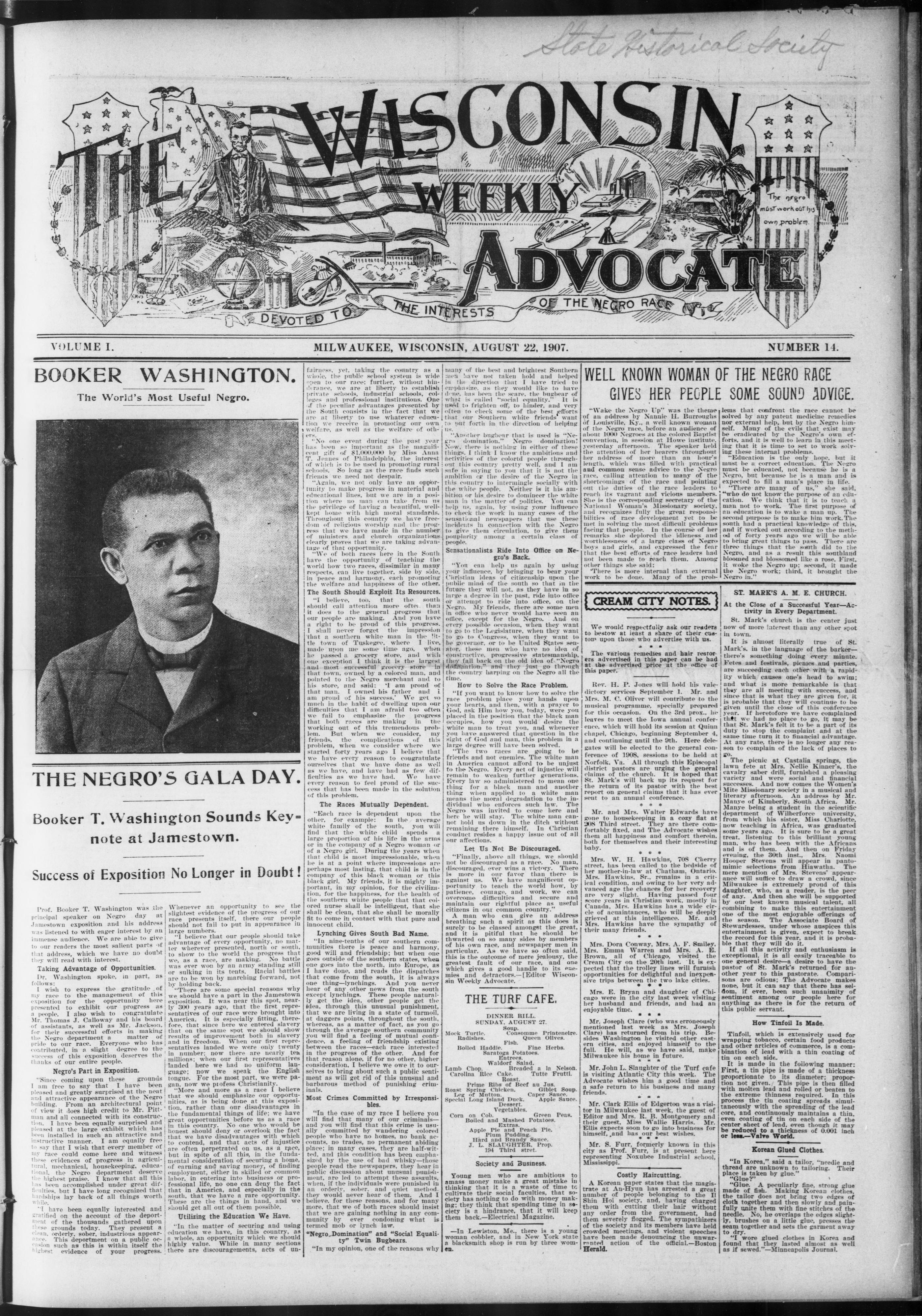
WISCONSIN
WEEKLY
ADVOCATE
DEVOTED TO THE INTERESTS OF THE NEGRO RACE
VOLUME I. BOOKER W
BOOKER WASHINGTON.
The World's Most Useful Negro.
THE NEGRO'
Booker T. Washington note at Ja
Success of Exposition
NEGRO'S GALA
er T. Washington Sound note at Jamestown.
s of Exposition No Longer in
THE NEGRO'S GALA DAY.
Booker T. Washington Sounds Key= note at Jamestown.
Success of Exposition No Longer in Doubt!
Prof. Booker T. Washington was the principal speaker on Negro day at Jamestown exposition and his address was listened to with eager interest by an immense audience. We are able to give to our readers the most salient parts of that address, which we have no doubt they will read with interest.
Taking Advantage of Opportunities.
I wish to express the gratitude of my race to the management of this exposition for the opportunity here presented to exhibit our progress as a people. I also wish to congratulate Mr. Thomas J. Calloway and his board of assistants, as well as Mr. Jackson, for their successful efforts in making the Negro department a matter of pride to our race. Everyone who has contributed, in a slight degree to the success of this exposition deserves the thanks of our entire people.
Negro's Part in Exposition.
"Since coming upon these grounds I am free to say that I have been pleased and greatly surprised at the neat and attractive appearance of the Negro building. From an architectural point of view it does high credit to Mr. Pittman and all connected with its construction. I have been equally surprised and pleased at the large exhibit which has been installed in such an attractive and instructive manner. I am equally free to say that I wish that every member of my race could come here and witness these evidences of progress in agricultural, mechanical, housekeeping, educational, the Negro department deserve the highest praise. I know that all this has been accomplished under great difficulties, but I have long recognized that hardships lay back of all things worth while.
"I have been equally interested and gratified on the account of the deportment of the thousands gathered upon these grounds today. They present a clean, orderly, sober, industrious appearance. This deportment on a public occasion such as this is within itself the highest evidence of your progress.
---
S GALA DAY.
Bingham Sounds Key=
Homestown.
No Longer in Doubt!
Whenever an opportunity to see the slightest evidence of the progress of our race presents itself, there our people should not fail to put in appearance in large numbers.
"I believe that our people should take advantage of every opportunity, no matter wherever presented, north or south, to show to the world the progress that we, as a race, are making. No battle was ever won by an army standing still or sulking in its tents. Racial battles are to be won by marching forward, not by holding back.
"There are some special reasons why we should have a part in the Jamestown exposition. It was near this spot, nearly 300 years ago, that the first representatives of our race were brought into America. It is especially fitting, therefore, that since here we entered slavery that on the same spot we should show results of improvement both in slavery and in freedom. When our first representatives landed we were only twenty in number; now there are nearly ten millions; when our first representatives landed here we had no uniform language; now we speak the English tongue. For the most part, we were pagan now we profess Christianity.
"More and more as a race I believe that we should emphasize our opportunities, as is being done at this exposition, rather than our disadvantages in the fundamental things of life; we have great opportunities before us as a race in this country. No one who would be honest should deny or overlook the fact that we have disadvantages with which to contend, and that acts of injustice are often perpetrated on us, as a race, but in spite of all this, in the fundamental consideration of securing a home, of earning and saving money, of finding employment, either in skilled or common labor, in entering into business or professional life, no one can deny the fact that in America, and especially in the south, that we have a rare opportunity. These are the things in hand, and we should get all out of them possible.
Utilizing the Education We Have.
"In the matter of securing and using education we have, in this country, as a whole, an opportunity which we should highly value. While in many sections there are discouragements, acts of un-
fairness, yet, taking the country as a whole, the public school system is wide open to our race; further, without hindrance, we are at liberty to establish private schools, industrial schools, colleges and professional institutions. One of the peculiar advantages presented by the South consists in the fact that we are at liberty to use whatever education we receive in promoting our own welfare, as well as the welfare of others. "No one event during the past year has been so important as the magnificent gift of $1,000,000 by Miss Anna T. Jeanes of Philadelphia, the interest of which is to be used in promoting rural schools. So long as the race finds such friends we need not despair.
"Again, we not only have an opportunity to make progress in material and educational lines, but we are in a position where no man can take from us the privilege of having a beautiful, well kept home with high moral standards. Throughout this country we have freedom of religious worship and the progress that we have made in the number of ministers, and church organizations clearly proves that we are taking advantage of that opportunity.
"We of both races here in the South have the opportunity of teaching the world how two races, dissimilar in many respects, can live together, side by side, in peace and harmony, each promoting the welfare and happiness of the other.
The South Should Exploit Its Resources.
"I believe, too, that the south should call attention more often, than it does to the general progress that our people are making. And you have a right to be proud of this progress. I shall never forget the impression that a southern white man in the little town of Tuskegee, where I live, made upon me some time ago, when he passed a grocery store, and with one exception I think it is the largest and most successful grocery store in that town, owned by a colored man, and pointed to the Negro merchant and to his store, and said: 'I am proud of that man. I owned his father and I am proud of his success.' We get so much in the habit of dwelling upon our difficulties that I am afraid too often we fail to emphasize the progress that both races are making in the working out of this tremendous problem. But when we consider, my friends, the complications of this problem, when we consider where we started forty years ago I believe that we have every reason to congratulate ourselves that we have done as well as we have, and have had as few difficulties as we have had. We have every reason to feel proud of the success that has been made in the solution of this problem.
The Races Mutually Dependent.
"Each race is dependent upon the other, for example: In the average white family of the south, you will find that the white child spends a large proportion of his life in the arms or in the company of a Negro woman or of a Negro girl. During the years when that child is most impressionable, when he is at a point where impressions are perhaps most lasting, that child is in the company of this black woman or this black girl. My friends, it is mighty important, in my opinion, for the civilization, for the happiness, for the health of the southern white people that that colored nurse shall be intelligent, that she shall be clean, that she shall be morally fit to come in contact with that pure and innocent child.
Lynching Gives South Bad Name
"In nine-tenths of our southern communities there is peace and harmony, good will and friendship; but when one goes outside of the southern states, when one goes into the north, into Europe, as I have done, and reads the dispatches that come from the south, it is always one thing—lynchings. And you never hear of any other news from the south except lynchings. These people naturally get the idea, other people get the idea, through this unusual punishment, that we are living in a state of turmoil, at daggers points, throughout the south, whereas, as a matter of fact, as you go through the average southern community you will find a feeling of mutual confidence, a feeling of friendship existing between the races—each race interested in the progress of the other. And for that reason alone, if for no other, higher consideration, I believe we owe it to ourselves to bring about such a public sentiment as will get rid of this unusual and barbarous method of punishing criminals.
Most Crimes Committed by Irresponsibles
"In the case of my race I believe you will find that many of our criminals—and you will find that this crime is usually committed by wandering colored people who have no homes, no bank accounts, no trades, no permanent abiding place; in many cases, they are half-witted, and this condition has been emphasized by the use of bad whisky—those people read the newspapers, they hear in public discussion about unusual punishment, are led to attempt these assaults, when, if the individuals were punished in an orderly, sober, and quiet method, they would never hear of them. And I believe, for these reasons, and for many more, that we of both races should insist that we are gaining nothing in any community by ever condoning what is termed mob or lynch law.
"Negro_Domination" and "Social Equality" Twin Bugbears.
"In my opinion, one of the reasons why
many of the best and brightest Southern men have not taken hold and helped in the direction that I have tried to emphasize, as they would like to have done, has been the scare, the bugbear of what is called "social equality." It is used to frighten off, to hinder, and very often to check some of the best efforts that our Southern white friends want to put forth in the direction of helping us.
"Another bugbear that is used is "Negro domination." Negro domination! Now, there is nothing in either of these things. I think I know the ambitions and activities of the colortd people throughout this country pretty well, and I am safe in saying to you that it is not the ambition or the desire of the Negro in this country to intermingle socially with the white people. Neither is it his ambition or his desire to domineer the white man in the matter of politics. You can help us, again, by using your influence to check the work in many cases of the sensational newspapers that use these incidents in connection with the Negro to give them circulation, to give them popularity among a certain class of people.
Sensationalists Ride Into Office on Negro's Back
"You can help us again by using your influence, by bringing to bear your Christian ideas of citizenship upon the public mind of the south so that in the future they will not, as they have in so large a degree in the past, ride into office or attempt to ride into office, on the Negro. My friends, there are some men in office who never would have seen an office, except for the Negro. And on every possible occasion, when they want to go to the Legislature, when they want to go to Congress, when they want to be governor, or to be United States senator, these men who have no idea of constructive, progressive statesmanship, they fall back on the old idea of "Negro domination," and they just go through the country harping on the Negro all the time.
How to Solve the Race Problem.
"If you want to know how to solve the race problem place your hands upon your hearts, and then, with a prayer to God, ask Him how you, today, were you placed in the position that the black man occupies, how you would desire the white man to treat you, and whenever you have answered that question in the sight of God and man, this problem in a large degree will have been solved.
The two races are going to be friends and not enemies. The white man in America cannot afford to be unjust to the Negro. Every act of injustice will remain to weaken further generations. Every law so administered to mean one thing for a black man and another thing when applied to a white man means the moral degradation to the individual who enforces such law. The Negro was invited to come here and here he will stay. The white man cannot hold us down in the ditch without remaining there himself. In Christian conduct resides a happy issue out of all our affections.
Let Us Not Be Discouraged.
"Finally, above all things, we should not be discouraged as a race. No man, discouraged, ever wins a victory. There is more in our favor than there is against us. We have magnificent opportunity to teach the world how, by patience, courage, and work, we can overcome difficulties and secure and maintain our rightful place as useful citizens in our common country."
A man who can give an address breathing such a spirit as this does is surely to be classed amongst the great, and it is pitiful that he should be thwarted on so many sides by members of his own race, and newspaper men in particular. As we have so often said, this is the outcome of mere jealousy, the greatest fault of our race, and one which gives a good handle to its enemies and detractors.—[Editor Wisconsin Weekly Advocate.
THE TURF CAFE.
DINNER BILL.
SUNDAY, AUGUST 27.
Soup.
Mock Turtle. Consomme Printenelire.
Radishes. Queen Olives.
Fish.
Boiled Haddie. Fine Herbs.
Saratoga Potatoes.
Entrees.
Waldorf Salad.
Lamb Chop. Breaded a la Nelson.
Carolina Rice Cake. Tutte Frutti.
Roast.
Prime Ribs of Beef au Jus.
Roast Spring Chicken. Giblet Soup.
Leg of Mutton. Caper Sauce.
Special Long Island Duck. Apple Sauce.
Dessert.
Vegetables.
Corn on Cob. Green Peas.
Boiled and Mashed Potatoes.
Extras.
Apple Pie and Peach Pie.
Plum Pudding.
Hard and Brandy Sauce.
J. L. SLAUGHTER. Prop.
194 Third stret.
Society and Business.
Young men who are ambitious to amass money make a great mistake in thinking that it is a waste of time to cultivate their social faculties, that society has nothing to do with money making; they think that spending time in society is a hindrance, that it will keep them back.—Electrical Magazine.
—In Lewiston, Me., there is a young woman cobbler, and in New York state a blacksmith shop is run by three women.
---
WELL KNOWN WOMAN OF THE NEGRO RAGE GIVES HER PEOPLE SOME SOUND ADVICE.
"Wake the Negro Up" was the theme of an address by Nannie H. Burroughs of Louisville, Ky., a well known woman of the Negro race, before an audience of about 1000 Negroes at the colored Baptist convention, in session at Howe institute, yesterday afternoon. The speaker held the attention of her hearers throughout her address of more than an hour's length, which was filled with practical and common sense advice to the Negro race, calling attention to many of the shortcomings of the race and pointing out the duties of the race leaders to reach its vagrant and vicious members. She is the corresponding secretary of the National Woman's Missionary society, and recognizes fully the great responsibilities of race development yet to be met in solving the most difficult problems facing that people. In the course of her remarks she deplored the idleness and worthlessness of a large class of Negro boys and girls, and expressed the fear that the best efforts of race leaders had not been made to reach them. Among other things she said:
There is more internal than external work to be done. Many of the prob-
CREAM CITY NOTES.
We would respectfully ask our readers to bestow at least a share of their custom upon those who advertise with us.
The various remedies and hair restorers advertised in this paper can be had at the advertised price at the office of this paper.
Rev. H. P. Jones will hold his valedictory services September 1. Mr. and Mrs. M. C. Oliver will contribute to the musical programme, specially prepared for this occasion. On the 3rd prox., he leaves to meet the Iowa annual conference, which will hold its session at Quinn chapel, Chicago, beginning September 4, and continuing until the 9th. Here delegates will be elected to the general conference of 1908, sessions to be held at Norfolk, Va. All through this Episcopal district pastors are urging the general claims of the church. It is hoped that St. Mark's will back up its request for the return of its pastor with the best report on general claims that it has ever sent to an annual conference.
* * *
Mr. and Mrs. Walter Edwards have gone to housekeeping in a cozy flat at 208 Third street. They are there comfortably fixed, and The Advocate wishes them all happiness and comfort therein, both for themselves and their interesting baby.
* * *
Mrs. W. H. Hawkins, 708 Cherry street, has been called to the bedside of her mother-in-law at Chatham, Ontario. Mrs. Hawkins, Sr., remains in a critical condition, and owing to her very advanced age the chances for her recovery are very slight. Having passed four score years in Christian work, mostly in Canada, Mrs. Hawkins has a wide circle of acquaintances, who will be deeply grieved at this intelligence. Mr. and Mrs. Hawkins have the sympathy of their many friends.
---
Mrs. Dora Conway, Mrs. A. F. Smiley, Mrs. Emma Warren and Mrs. A. E. Brown, all of Chicago, visited the Cream City on the 20th inst. It is expected that the trolley lines will furnish opportunities for delightful and inexpensive trips between the two lake cities.
ten the
Mrs. E. Bryan and daughter of Chicago were in the city last week visiting her husband and friends, and had an enjoyable time.
***
Mr. Joseph Clare (who was erroneously mentioned last week as Mrs. Joseph Clare) has returned from his trip. Besides Washington he visited other eastern cities, and enjoyed himself to the full. He will, as we have said, make Milwaukee his home in future.
Mr. John L. Slaughter of the Turf cafe is visiting Atlantic City this week. The Advocate wishes him a good time and a safe return to his business and many friends.
Mr. Clark Ellis of Edgerton was a visitor in Milwaukee last week, the guest of Editor and Mrs. R. B. Montgomery and their guest, Miss Wallie Harris. Mr. Ellis expects soon to go into business for himself, and has our best wishes.
Mr. S. Furr, formerly known in this city as Prof. Furr, is at present here representing Noxubee Industrial school, Mississippi.
Costly Haircutting.
A Korean paper states that the magistrate at An-Hyun has arrested a great number of people belonging to the II Shin Hoi society, and, having charged them with cutting their hair without any order from the government, had them severely flogged. The sympathizers of the society and its members have held crowded meetings, and violent speeches have been made denouncing the unwarranted action of the official.—Boston Herald.
NUMBER 14.
lems that confront the race cannot be solved by any patent medicine remedies nor external help, but by the Negro himself. Many of the evils that exist may be eradicated by the Negro's own efforts, and it is well to learn in this meeting that it is time to set to work solving these internal problems.
"Education is the only hope, but it must be a correct education. The Negro must be educated, not because he is a Negro, but because he is a man and is expected to fill a man's place in life.
"There are many of us," she said, "who do not know the purpose of an education. We think that it is to teach a man not to work. The first purpose of an education is to wake a man up. The second purpose is to make him work. The south had a practical knowledge of this, and if worked out according to the method of forty years ago we will be able to bring great things to pass. There are three things that the south did to the Negro, and as a result this southland bloomed and blossomed like a rose. First, it woke the Negro up; second, it made the Negro work; third, it brought the Negro in."
ST. MARK'S A. M. E. CHURCH
At the Close of a Successful Year—Activity in Every Department. St. Mark's church is the center just now of more interest than any other spot in town.
It is almost literally true of St. Mark's, in the language of the barker—there's something doing every minute. Fetes and festivals, picnics and parties, are succeeding each other with a rapidity which causes one's head to swim; and what is more remarkable is that they are all meeting with success, and since that is what they are given for, it is probable that they will continue to be given until the close of this conference year. If heretofore we have complained that we had no place to go, it may be that St. Mark's felt it to be a part of its duty to stop the complaint and at the same time turn it to financial advantage. At any rate, there is no longer any reason to complain of the lack of places to go.
The picnic at Castalia springs, the lawn fete at Mrs. Nellie Kinner's, the cavalry saber drill, furnished a pleasing variety and were social and financial successes. And now comes the Women's Mite Mission society in a musical and literary afternoon. An address by Mr. Manye of Kimberly, South Africa. Mr. Manye being a student in the scientific department of Wilberforce university, from which his sister, Miss Charlotte, now teaching in Africa, was graduated some years ago. It is sure to be a great treat, listening to this brilliant young man, who has been with the Africans and is of them. And then on Friday evening, the 30th inst., Mrs. Naomi Hooper Stevens will appear in pantomimic selections from Hiawatha. The mere mention of Mrs. Stevens' appearance will suffice to draw a crowd, since Milwaukee is extremely proud of this daughter, who, as a reader, is the peer of any. And then she will be supported by our best known musical talent, all combining to make this entertainment one of the most enjoyable offerings of the season. The Associate Board of Stewardesses, under whose auspices this entertainment is given, expect to break the record for this year, and it is probable that they will do it.
If all this activity and enthusiasm is exceptional, it is all easily traceable to one general desire—a desire to have the pastor of St. Mark's returned for another year to this pastorate. Comparisons are odious; The Advocate makes none, but it can say that there has selfdom, if ever, been such unanimity of sentiment among our people here for anything as there is for the return of this public servant.
How Tinfoil Is Made.
Tinfoil, which is extensively used for wrapping tobacco, certain food products and other articles of commerce, is a combination of lead with a thin coating of tin on each side.
It is made in the following manner: First, a tin pipe is made of a thickness proportionate to its diameter; proportion not given. This pipe is then filled with molten lead and rolled or beaten to the extreme thinness required. In this process the tin coating spreads simultaneously with the spreading of the lead core, and continuously maintains a thin, even coating of tin on each side of the center sheet of lead, even though it may be reduced to a thickness of 0.001 inch or less.—Valve World.
Korean Glued Clothes.
"In Korea," said a tailor, "needle and thread are unknown to tailoring. Their place is taken by glue."
"Glue?"
"Glue. A peculiarly fine, strong glue made of fish. Making Korean clothes, the tailor does not bring two edges of cloth together and then slowly and painfully unite them with fine stitches of the needle. No, he overlaps the edges slightly, brushes on a little glue, presses the seam together and sets the garment away to dry.
"I wore glued clothes in Korea and found that they lasted almost as well as if sewed."—Minneapolis Journal.
THE WISCONSIN WEEKLY ADVOCATE
MILWAUKEE, WIS.
R. B. MONTGOMERY, Editor and Proprietor.
Humorous Items.
Jennie—Did you hear of the awful fright Jack got on his wedding day?
Olive—Yes, indeed—I was there and saw her.—Tit-Bits.
Tom—My heart beats for you.
Miss Mouey Meow—I dare say; beats at so much purr.—Woman's Home Companion.
Ask the Man.
Female Picknicker—Look, Charley. There comes a man from a balloon. Her companion—I wonder what he wants with us.—Puck.
When He Listens.
A man may think he knows more than a doctor, but he is apt to listen when a lawyer tells him that he needs a change of climate.—Atchison Globe.
A Popular Girl.
Little Bo Peep has lost some sleep,
But she does not care a rap.
From sun to sun there is so much fun
That she has no time to nap.
—Birmingham Age-Herald.
In Society.
"I made my money honestly."
"But, pa, we could easily live that down if you would only stop telling everybody."—Washington Herald.
The Vegetarian.
For me existence is replete
With satisfaction deep,
I care not for the price of meat
So long as grass is cheap.
—Washington Star.
Proof.
"Is he intelligent and well-informed?"
"Is he? Why, he's been summoned as a talesman a dozen times and never got on a jury yet."—Philadelphia Ledger.
Hates to Leave.
The lover can't help showing
The girl he's calling on
That when he's slow in going
He's positively "gone."
—Catholic Standard and Times.
One Wav.
"How can I become as accomplished story teller?"
"Get married and practise staying out late at night with the boys."—Houston Post.
Summer Occupation.
Most everybody in this land
Is makin' something pay,
Some of us makin' speeches and
Some of us makin' hay.
—Washington Star.
Mamma Was Assured.
"Elizabeth, has that man any expectations?"
"Yes, mamma."
"What do they consist of?"
"Me"
The Eternal Question.
To live within one's salary
Is hard—no one can doubt it.
But there's no doubt 'twere harder still
To try to live without it.
—Smart Set.
Telegraph Pole Chatter.
First Sparrow—I hear it is very hard
to get into New York society.
Second Sparrow—Very. To this day
the Stork has not succeeded in getting in.
—Bohemian.
Diffidence.
Diffidence.
She pouted when he held her hand.
Frowned when he praised her charms,
But when he sought her lips to kiss
She got right up in arms.
—Town Topics.
Not What He Came for.
The Cop—How did you come to get hit
by the car?
The Reub—I didn't come ter git hit by
no car—I come ter visit my son-in-law.—
Cleveland Leader.
A Verse.
A verse to you, a verse from me,
And love, and love alone, its theme;
Beloved, 'tis brief as brief can be—
Just from a dreamer to a dream!
Accommodating
Egbert—I suppose you want me to say that people are just dying to ride in it! —Yonkers Statesman.
Tom—I suppose Yerner is deep in love's young dream—
Dick—Oh, he's past that stage. He's troubled with insomnia now.—The Catholic Standard and Times.
Disgusted Caddie.
Beginner at Golf—How many have I taken, my boy? Is it fifteen or sixteen? Disgusted Caddie—Ach, I dinna ken. It's no' a caddie ye need—it's a billiard marker—People's Journal.
Deceitfulness of the Mule
Georgia mule. Brother Dickey said.
"No man kin tell. En de mule is too stubborn en deceitful ter be candid wid you!"—Atlanta Constitution.
Her Finish
Charwoman (mending carpet)—I never thought as 'ow I should come to this, mum. Me that was that well edicated, that afore I was married I couldn't even make a beef pudden!—Punch.
Knock for Knox.
Mr. Knox-I believe Kicker's wife thinks more of her dog than she does of him.
Mrs. Knox-I suppose the dog growls less-St. Joseph (Mo.) News-Press
The Ocean Roared
"This breeze," said John, "is somewhat faulty.
Fairly.
It makes my mustache taste quite salty."
With smile demure, said pretty Sue:
"Yes, doesn't it! I thought so, too."
Speaking of Ivories
He—Is he a billiard player or a pianist?"
She—Neither; he's a dentist.—Yonkers Statesman.
This Happened in 2910
This Happened in 2910.
Howell—How did Rowell die?
Powell—He took a drop too much.
Howell—I didn't know he drank.
Powell—I didn't say he did; he got put off an airship for not paying his fare.—Town Topics.
Very Cool
Is this a cool neighborhood. "I should say it was cool. There's not a man within four blocks that doesn't borrow my hose and lawn mower regularly once a week without so much as a 'thank-you.'"
His Bete Noir.
"Pa," asked the senator's little boy, "what is a 'Nemesis'?" A 'Nemesis,' my son,' replied the senator, wearily, "is a female office seeker that you foolishly promised to assist." Philadelphia Press.
Breakers Ahead.
Rogers-I consulted a clairvoyant before my marriage and asked her if she saw any breakers ahead.
Fatal Sobriquet.
His zeal and vim
Won friends for him,
Who called him "Honest Bob."
The end was sad,
For then, egad,
He couldn't get a job.
—Washington Herald.
Without Cost to Him.
"I'm introducing an automatic machine," said the caller, "that will pay for itself in a year."
"I'll take one if it will do that," promptly said the manufacturer. "If it will pay for itself in a year?" "No; automatically pay for itself in a year."—Catholic Standard and Times.
An Eventful Day.
est day in the year just passed.
She—I am not sure of the date, either;
but I remember it was that day in
June when you called both in the morning
and afternoon'—Illustrated B'ts.
One on Him
"Please, sir, have you a match?" asked a small boy of a hurrying pedestrian.
"No, I have not!" snapped the man "Then buy some!" exclaimed the boy as he held out a handful of boxes—Answers.
Deceptive.
March had come in like a lamb.
"To carry out the simile," it remarked,
"of course. I must have a fleece."
or course, I must have a necec.
But the people, not understanding the snow, said to March, "You're not a lamb at all; you're a lynin."—Philadelliphia Ledger.
Had the Goods
Edyth—You ought to have heard Mr. Huggins' ringing speech last night. May—Why, I wasn't aware that he could make a speech. Edyth—Well, I can't repeat the speech, but I can show you the ring.—London Tit-Bits.
Real Trouble.
Mrs. Yawley—"What an awfully worried, anxious, despairing look Mrs. Goodsoul has." Mrs. Chatter—"Yes: I fancy she must have stopped doing her own work and taken to keeping a servant."—Philadelphia Inquirer.
Previous
"What's the row about?" asked an observer. "Hasn't peace been declared?" "Believe it has," replied a soldier, reaching for a cartridge; "but we thought then we were out of ammunition."—Philadelphia Ledger.
Memorial Light.
"Beautiful memorial window." remarked her husband as they left the church.
"I didn't notice particularly," said his wife; but the light from it fell on the Jones' pew, and it made her complexion a fright."—Modern Society.
For the Defense
Thawabey—But what have you against my friend, Selley?
Bawker—He has so many confounded new-fangled meters.
Thawabey—I admit he's original there; but his matier is all right. There's nothing new in that.—Town and Country.
Utilitarian
Parson (to new girl, who sings in the early morning)—Jane, I am delighted to see you know that beautiful hymn "Glory, glory!"
Girl—Why, lor bless yer 'art, sir, that's th' ymn I cooks th' heggs by—two verses for soft an' four for 'ard!—Judy.
Auricular Equipment.
"Be careful what you say about the servant," cautioned the housewife; "the walls have ears, you know."
With a thoughtfulness rare in his sex he plugged the keyhole.—Philadelphia Ledger.
He Was Wise
"I thought you said you would never see Sappy again?"
"So I did."
"But he says when he sent up a card, you came right down?"
"So I did; but it was not his card that he sent up; it was another man's."—Houston Post.
Torture.
"The Carthaginian mercenaries," he said, "encased their prisoners in a cement that, as it hardened, contracted. You can't imagine how uncomfortable this was."
"Oh, yes, I can," she answered. "I once had on a tight bathing suit when it began to shrink."
Sport for Sport's Sake
Fishermen have a more philosophic view of chance and fate than any other brotherhood.
"You'll find there are no fish in that pond."
"What did you tell me for? Now you've spoiled my whole day's fishing."
--Fliegende Blaetter.
She Knew
"And you say the duke has not proposed?"
"He has not."
"I don't know what to make of him."
"I'll make a monkey of him, to begin with," hissed the proud maiden, for she was furious, believing herself scorned.—Washington Herald.
Unfair
Miss Smith-I see that the Legislature has passed a law prohibiting the women from wearing stuffed birds or feathers on their hats.
Aunt Maria-It ain't fair. I've heard of how the men in the cities wear swallow-tail coats, and they never say a word against it.-Bohemian.
HIS WEAPONS
Here hangs his gauntlet by the door!
At thrice a hundred foemen's feet
He hurled this challenge to the floor,
And never stained it with defeat!
To me he dropt his eyes—no more—
And his the victory sweet!
Here, like a silver moon, his shield,
That fronted thrice a hundred foes.
But once, upon the tourney-field,
He cast it off to wear my rose.
He fought and fell; his wound, it heated;
But mine, it grows and grows!
Froze to the scabbard, hangs his sword
That smote the doughty foe to dust,
His token, like his promised word,
Forgotten in the years of rust;
But once he spoke; because I heard,
I trust him still—I trust!
—Aloysius Coll in Lippincott's.
MINSTREL AND MAID.
"The worst of it is." remarked the minstrel thoughtfully, "that this mysterious business lands a fellow—a modest fellow, like, er—well, like most fellows are, you know—in positions where his native modesty is apt to be so decidedly embarrassed."
"But," suggested his companion in a gentle tone, "it must be so delightful, so dignified, to feel that you are a mystery! I should have thought a man—even a modest man, like, er—well, like most men are, of course—would be willing to tolerate the trifling discomfort of having his modesty outraged by the—what shall I call it?—impertitent attentions of his fair admirers, in return for the satisfaction of being called a mysterious minstrel!"
"No," said the minstrel, weighing the epithet carefully. "I shouldn't call it impartinent—not exactly impartinent perhaps. Say, rather, injudicious."
The maid gave a soft laugh.
The minstrel raised himself on his elbow, as a sudden thought seemed to strike him. They were sitting—or rather, the maid was sitting, a dainty parasol poised over her graceful head, and the minstrel was reclining at full length—on the beach just below the line of bathing machines; the tide was at the ebb, the sun making its way leisurely toward the horizon, the hour about 6 on an August afternoon, the place a fashionable watering resort on the south coast.
"By the way," remarked the minstrel—"your aunt."
"Yes," said the maid, lifting he eyebrows.
An excellent, charming woman," said the minstrel, "but what are her views on the subject of our somewhat irregular acquaintance?"
"Oh," said the maid with a short laugh, "she—she was naturally rather shocked, of course."
"That's part of the mysteriousness," said the minstrel. "We all have to disguise our real identities as far as possible, you see. It would never do for any of us to be recognized. You would simply be astounded if you knew who we were."
"Dear me!" exclaimed the maid, arching her eyebrows into an expression of mock horror. "Are you all so—so very dreadful, then?"
"Well, we are not burglars—or escaped convicts, if that's what you mean," retorted the minstrel a little huffily.
"Oh, it would be so delightful if you were," she cried.
"I disagree with you entirely," said the minstrel. "There would be the constant fear of recapture, to begin with, and that would be quite destructive of artistic effort."
"But even as it is," persisted the maid, "do you not find the perpetual fear of being discovered—"
"Discovered?" said the minstrel.
"Not exactly terror," replied the ministrel conscientiously. "But there is, of course, a gnawing anxiety arising from the ever present apprehension or being spotted."
"Being—what?" asked the maid.
"Spotted—identified, as you call it. Someone, you see, might turn up here at any moment who knew one of us, and then—"
"Then?" cooed the maid.
"Oh, then the fat would be in the fire —I mean there would be the dickens to pay—infuriated relatives, social ostracism and all that sort of thing, you know."
"Infuriated? Why, the governor—my father, that is—would dishinherit me!" exclaimed the minstrel with solemn conviction. "He has no sense of humor whatever."
"Indeed, it seems to be a terrible risk you are running," she murmured sympathetically.
The minstrel nodded a tragic assent. "It is a risk, of course," he admitted, while reflecting on the extreme improbability of the paternal inheritance extending beyond an attack or two of gout in his old age.
"And if you were—disinherited, you would be a poor man—perhaps?" she hazarded timidly.
"A church mouse would be a comparatively wealthy rodent," said the minstrel with emphasis.
"And you might—under those distressing circumstances, perhaps—who knows?—be tempted to marry some rich woman for money instead of—love?"
"The maid's voice sank to a bashful whisper on the last word, as she watched as much of the minstrel's face as was visible from under the brim of his straw hat.
"If a rich woman were to come my way—even now," admitted the minstrel. "I wouldn't positively swear that I should reject a proposal from her without duly considering it."
"My title?" echoed the minstrel, suddenly jerking his hat back.
"Yes—Lord Farinash!"
"Hah!" exclaimed the minstrel tragically. "Then you have recognized me!"
"Oh, yes—almost from the very first!" laughed the maid. "Don't you think it was clever of me?"
"Simply frightfully clever," agreed the minstrel, gazing at her in solemn admiration. "I wouldn't have believed it possible. Only, for heaven's sake, don't whisper it to a soul! If the governor were to know—"
"Ah—the duke!" she said in an awed tone.
"Precisely; the—er—duke. You see, there would be the deuce and all to pay!"
She gave a little shy glance at him from under her parasol, seemed to hesitate a moment, and then, as on a sudden resolution, bent her pretty head slightly toward the brim of the minstrel's hat, and added, in a low tone— "Lord Farinash. I have guessed your secret—shall I tell you mine? Do you know what I am?"
A little wave of color mounted to the maid's cheeks, and she drew back her head.
"No!" exclaimed the minstrel with sudden interest. "Are you really?"
She nodded her head gravely. "Just as really as you are Lord Farinash!" she answered.
"By Jove!" said the minstrel. "I shouldn't have thought it. I never should. You are too pretty."
"What's that got to do with it?" she demanded, dropping her parasol slightly.
"Nothing, except that it is generally the ugly girls who own the lucre—Nation of compensation you know."
"Surely you would not sell yourself for a mere empty title!" he exclaimed in a tone of righteous disapproval. The maid gave a little rippling laugh. "Well, a title—even an empty one—is rather nice, you know." she replied reflectively. "For instance, Lady Farinash would sound so much, so very much better, don't you think, than, for example—than, let us say, Mrs. Archie Clavering?" The minstrel sat belt upright and his hat fell off. For an instant he gazed in silence at the mocking, beautiful young face looking down at his own. "And now," said the minstrel with a deep sigh, "since you have found me out in this—this absurd disguise, singing for coppers on the beach, I suppose you will have nothing more to say to me." "Oh, as to that," replied the maid, "it depends. Since you are not a lord at all—"
"And you," he broke in a little bitterly, "are an heiress?"
"I am not," she confessed with a penitent air.
"You told me just now—" began the minstrel in a tone of stern rebuke.
"I told you," she interrupted him, "that I was as really an heiress as you were a lord—which was, you must admit, a perfectly true statement of the case."
"Then" said the minstrel, "you are not an heiress, either."
She made him a little mock bow.
"No, my lord! I fear you must look to retrieve your fallen fortunes elsewhere!"
Then she rose to her feet and shook the sand from her skirts, while the minstrel slowly rose too.
"If only I were Lord Farinash!" he murmured.
"And I—an heiress!" she added.
"When I marry," said the minstrel firmly, "it will be—for love!"
"In a cottage," said the maid, gazing pensively toward the sea.
"I'm afraid it will have to oe something of that sort—at first," he admitter. "Would you mind?"
"Mind? Mind what?" she asked, fixing a pair of wondering blue eyes upon him.
"The cottage," said the minstrel unabashed.
"I don't understand you," said the maid with dignity.
"I certainly feel that I owe you an explanation," replied the minstrel, in his most conspicuous manner. "What I mean is—"
"But my meaning!" protested the minstrel. "It is imperative that you should grasp my meaning—" She threw a little backward glance at him over her shoulder. Her eyes danced with mischief, but her cheeks were prettily fushed. "I will promise," she said, "to try and—grasp it, when I get home!" and the next instant was tripping daintily over the shingle. The minstrel gazed after her and sighed. Then he lit a cigarette and smiled, for he had observed the sudden delicate wave of crimson in the maid's cheeks.—Emerie Hulme Beaman in The Sketch
That Standard Oil Fine.
They haven't yet determined how many trains it will take to carry the $29,240,000 from the Standard Oil's Wall street vaults to the government's treasury unless paid in silver. In such event there would be required 177 flat cars with a capacity of 33,000 pounds. It is twenty-nine times the capital stock of the Standard Oil company of Indiana, the corporation fined. It would build five first-class battleships or a new subway for New York city. It would make 914 tons of silver dollars, requiring 304 teams to transport it. It is 4,783 times the annual salary of Judge Landis, who imposed the fine.
and child in the whole country.
It is nearly one-half the number of silver dollars in circulation.
It is the income for one year at 4 per cent. on $731,000,000.
It is nearly one-half the capital of the Bank of England.
It is about 2 per cent of the national debt of 1906.
It would yield a perpetual income of $4,027 a day.
MUSINGS OF A GENTLE CYNIC
It sometimes happens that the better half doesn't believe in doing things by halves.
Marriage frequently demonstrates that it is difficult to combine business and pleasure.
There may be safety in numbers, and yet we are told too many cooks spoil the broth.
Lots of us spend all our lives wanting what we don't get and getting what we don't want.
When a fellow tries to put a ring on a girl's finger he often merely succeeds in putting his foot in it.
When it comes to deciding between a rich scoundrel and a penniless saint, a girl generally chooses the least saintly.
The small boy is apt to wonder why the young man had the shoulders of his coat padded instead of the seat of his trousers.
Trust's Clutch on Every Diamond Dug.
Messages received from London by diamond importers in New York in the last few days say the absorption of the Premier mines by the De Beers Diamond trust is only one of a number of developments by which the company's control of the business in all parts of the world is now absolute.
Besides getting control of the Premier mine the trust has closed contracts for the output of the two other independent mines, Voorspoed and the Roberts Victor, both of which have begun to yield diamonds of a superior quality. The Jagersfontein mine, giving the finest and the hardest of the blue-white stones, which are especially prized by the diamond buying public in the United States, is already under the De Beers control. Diamond dealers say the De Beers company has an emissary wherever there is reason to suppose diamonds may be found. These emissaries have investigated all the reports of diamond discoveries in California, Kentucky and other states in this country, and one is
---
now looking over the prospects of the Arkansas fields. One of the largest Maiden lane importers said there is now no possibility of serious competition, because the De Beers company has resources so great it could control the market. However, there are no diamond producing mines actually in sight and the trust is following the policy of maintaining the market at a high and advancing level. The total production of south African diamonds, according to the latest trade reports, is 3,500,000 carats, which bring nearly $38,000,000 at the mines. More than one-half the stones come to the United Statts, which bring over $35,000,000 from dealers, while the public pays twice as much, after the stones are cut, polished and set.
Simple Life of the Emperor at Cadinen. Near Elbing.
When the German Emperor took his Kiel guests to Cadinen they saw the house in which the German royal family lives most at home. In this north German retreat, only two miles from the commercial city of Elbing, all the ceremony of court life is put aside. The retirement and privacy in which the royal family lives here used to cause great anxiety among those intrusted with the care of their safety. The fact that the neighboring town of Elbing is almost entirely Socialist-Democratic did not tend to decrease their apprehension. The courtiers used always to see that the city was shunned on the journeys to Cadinen, although Elbing is the nearest railroad station. Formerly the Kaiser used to drive several hours up and down hill to Gueldenboden, where the royal train awaited him.
The Kaiser objected to this, and a number of armed policemen and detectives were sent from Berlin who, in various disguises, mingled with the people to insure the safety of the Emperor. Even then he was not allowed to take the train at Elbing, but had to go aboard several kilometers from the station. This was too much for the Kaiser, who announced that his courtiers must show more confidence in the population of Elbing, whatever the result might be. Nowadays the royal train brings its passengers into the station and they mingle with the population of Elbing so freely that the ordinary police of the town are sufficient to insure their safety.
Cadinen is not adapted to large parties, and if the Kaiser is imprudent and invites too many, as he did when the Czar came there two years ago, the officers of the suite have to live in the royal train. It was this large gathering that flustered the Kaiser so much he forgot to kiss his wife good-by which was a sorry interruption to the family spirit of this northern retreat. He bade farewell to his children and was about to give the order for the royal train to start when he suddenly jumped from the coupe and ran to the Empress. "Mother," he said laughingly to her, "there I was about to forget you entirely when you are really the most important person here."
He made up for his forgetfulness by several hearty kisses before he jumped into the train again.
THE PATIENT COTTONWOOD
Western Tree Endures Great Extremes of Temperature.
One of the largest cottonwoods in the west was cut down not long ago in Ray county, Missouri. It measured 65 feet from the ground to the first knot, and made more than 5000 feet of lumber. One of the largest and finest specimens is in the capitol ground at Topeka. It was a seedling which started in 1869, when the first wing of the state house was being erected. It was spared from the scythe and in twenty-five years attained a growth which gave its top a spread of over 100 feet. This tree was a great favorite with the late senators from Kansas, John J. Ingalls and Preston B. Plumb, and it is as dear to the hearts of the "Jayhawkers" as is the Washington elm to the people of Cambridge, for the Twentieth Kansas regiment of volunteers not only assembled under this tree, but, after making a record in the Philippines, the regiment and its intrepid commander bade farewell under its branches.
The cottonwood endures great extremes of temperature and when the roots can reach a good supply of moisture, it successfully withstands severe drouths. It is a fast-growing tree and demands plenty of light. On irrigated lands cottonwoods have been known to attain a diameter of 14 inches in eight years.
The cottonwood is extremely easy to cultivate from seed, cuttings, layers or grafts. The commonest way of securing them is from the natural nurseries which spring up along the sandbars of the western rivers. These nurseries are killed each year by inundation from the high waters, but they are also renewed annually by the seed floating on the water. A thousand roots intact can be pulled out of the sandbars, in the fall, in an hour. These seedlings are often planted closely together in furrows and in this manner several thousand can be planted in a day by two men using a team and polw.—Philip Eastman, in The World Today.
WISE AND OTHERWISE
Don't look at trouble through a magnifying glass.
Of two evils some people choose both as samples.
Wise men always look before they leap for joy.
People who live in glass houses ought to grow tomatoes.
It is the early bird who catches his sweetheart in curl papers.
Lots of people are suspicious of others because they know themselves.
How much trouble would be averted if women feared men as much as they do mice!
You find people ready enough to do the Samaritan without the oil and twopence.
Bullfights in Japan
"Few of us, however long we live in this country, know about all its customs and habits," writes a correspondent. "Bull fighting is the great semi-annual sport for the people in Uwajima and vicinity. The fights are generally held in the country on the mountain sides, where thousands of people can see the bulls gore each other. They are great, heavy rolling, fat animals, such as I have never seen in any other part of the empire. They are not allowed to kill each other, but are gored enough to do considerable damage. It is also dangerous for bystanders.
"A few months ago I saw five or six of them being led through the streets on their way back from the fight, and they were still snorting, and looked so fierce that I got out of the street till they passed. I was perfectly willing to give them complete right of way.—Kobe Herald.
Advertise in Your Home Paper.
Here is a story that comes all the way from Florida, a state that overflows with darkies. There was a small church wretchedly out of repair, with a terribly leaky roof, and the negro pastor fervently prayed for funds to make repairs. A collection was started. One brother put in ten cents. "Ten cents from Brudder Jones. De Lord bless Brudder Jones."
"Brudder Johnson a quartah. De Lord bless. Brudder Jones."
He put a twenty-dollar note into the hat.
The almost creathless collector said:
"Wha's de name, sah?"
"Never mind the name, I am a gambler from Chicago."
"Gamblah from Chicago, twenty dollahs," shouted the collector.
The pastor rolled his eyes up, and raising his hands, said, with a voice choking with emotion: "Twenty dollahs gamblah from Chicago. May de good Lo'd bless and prospah de noble gamblah from Chicago."—Exchange.
His Defense.
Mr. Redfreckle was sued for breach of promise. "You ought to be ashamed of yourself," said the judge.
"My lord, it was on account of my strong attachment that I fooled the girl. Suppose I had married her and she died; my life would be bathed in gloom. I thought about the matter, and I looked at the girl and mused. 'Suppose you were to become my wife and die; I should be stricken with sadness.' I can't stand anything like that. My brother married some time ago, and his wife died, and since then he has been unfit for business."
"But the young lady, sir," continued the judge, "is in remarkably good health, and the chances are that she will live longer than you will."
"Yes: and that was another objection, my lord. Suppose I were to marry her and die. Widow! Why, the word has a sad sound! I don't want to be instrumental in making anybody a widow." But the jury gave a verdict for £100 in favor of the girl.—Tit-Bits.
Queens Taller Than Kings.
It is a curious fact that at this time nearly all the sovereigns of Europe are shorter than their consorts. For example, Kind Edward is an inch shorter than Queen Alexandria. Czar Nicholas II. looks quite small by the side of the Czarina! the Kaiser is just a trifle shorter than the German Empress, and, for that reason, always insists that she shall sit down when they are photographed together; the King of Italy hardly reaches to the shoulder of Queen Helena; Queen Amelia of Portugal is a shade taller than Don Carlos, and Alfonso of Spain is half a head shorter than Queen Victoria Eugenie. In fact, the King of Norway and the Prince of Montenegro are the only two rulers who are very much taller than their wives.—London Tit-Bits.
The Wise Course.
"Sir," said the tramp. "I have not tasted food for seven days; another half an hour of fasting and I must die!" "Then," said the philanthropist, "you shall live. Take this ticket; it will admit you, in my stead, to a sumptuous banquet; course after course, meats, wines, and dessert—a feast three hours long; glorious company—Mr. Talkfor-hours, Mr. Tooefw, Mr. Longyard, and other eminent men."
Then the tramp handed back the ticket and crawled wearily away into a silent timber yard to die.—London Tit-Bits.
Tea Smoking Centuries Old
"With your tea cigarettes," said the antiquary sternly, "you young ladies think yourselves very modern and decadent. But look here." He took from a portfolio a French print of the Seventeenth century that portrayed two men, with cumbrous silver pipes, charging the same from a box of China tea. "This shows you," the old man said, "the antiquity of tea smoking. It was a common thing in France 200 years ago. Blegnt mentions it, and Grand d'Aussay, in his 'Histoire de la Vie Privee des Francais, describes it in detail. "An old vice, a dead vice for the French found that tea smoking racked the nerves; how very, very foolish you girls are to have revived it."—Minneapolis Journal.
Cheap Jewelry
A special agent of the Department of Commerce and Labor has been making an investigation of the trade in cheap jewelry in England, and has learned that the United States has but an insignificant share in it. Yet the demand for such ornaments is immense, and some of the consignments of American manufacturers have sold with surprising rapidity. Among the articles which are mentioned as particularly salable are lockets carrying two photographs, one on either side, silver-headed hatpins, hair combs (imitation tortoise-shell and set with paste stones), belt buckles and back-pieces, and men's cuff links (preferably of gold finish, without settings).—Leslie's Weekly.
Wise Smith.
Smith, Brown and Jones went to dine with Robinson the other night. On the way Smith said to his companions, "Oh, I say, beware of our host's wine."
As the result of this hint Brown and Jones took no wine, but they were surprised to see Smith imbibing it freely. On the way home they said to him.
"What was the matter with Robinson's wine that you advised us not to take any?"
"Nothing the matter with the quality," said Smita, coolly; "but I knew from experience that the quantity would be rather deficient—not enough to go round us all."—Sphere.
Pride
Doubtless Prince Fushimi of Japan made the acquaintance of highland pipers in the course of his visit to Scotland. It is recalled that Lord John Russell, when on a visit to Queen Victoria at Balmoral, asked her majesty's own piper to have some one play in his presence.
"What kind o' a piper do you want?" asked the man.
"Just such another as yourself," said the English statesman.
Drawing himself up, the musician said grandly: "There's plenty o' lords like yoursel' but very few pipers like me."—Cleveland Leader.
A certain man died and a clergyman was engaged to offer a eulogy. The worthy minister prepared a sermon of exceeding length and strength, but just before he entered the parlor to deliver it he thought that it might be advisable to learn what the dead man's last words had been. So he turned to one of the weeping younger sons and said:
GOSSIP FOR THE LADIES.
Be careful of your words, my dear,
For words are perilous things;
That can cause and wound us, soothe and
For words are persons things.
They can cut and wound, or soothe and cheer,
And each one is furnished with wings.
They never stay just where they fall,
But fly like a bird of the air,
And try as you may, you cannot recall;
They are gone, you know not where.
And will save much heartache and woe.
Kind words will live forever,
So let them e'er be spoken;
Joy they bring to souls that are sad,
And soothe the hearts that are broken.
—Mrs. N. D. Lipscomb in Advocate.
Ought Never Marry.
If I had a daughter at the marriageable age I'd shut her up in a convent or take her down to Tahiti and teach her to live in a grass hut before I'd let her fall in love with a "good fellow," who knows a lot of other good fellows and wants to talk about them all the time.
The good fellow is a fine friend, the best companion in the world, and more fun than one of George Ade's fables. But I'd just as son think of marrying one of them as I would think of marrying the Jack who jumps out of the box when you snap the lid.
On the whole, I'd prefer the Jack in the box, because I could keep the lid down over him, and I'd know where he was when the lid was down.
One of the greatest mysteries out of all the mysteries of human life is this: What does a "good fellow" marry for?
Why does he ever persuade himself that he can be happy or make any woman happy in the sort of a place he calls home? A "good fellow" is as much out of place married as a fish would be out of place in a poultry yard. Poor fish! you couldn't help feel sorry for it if you saw it trying to swim and float and dive in a burdock patch, could you? I never see a "good fellow" married but I shed two conscientious tears.
One of the tears is for the "good fellow" and the other tear is for the "good fellow's" wife. I don't know which tear is the biggest.
I know a "good fellow" who was desperately in love some five years ago.
He used to come and read me parts of his sweetheart's letters, and he spent most of his time when he wasn't reading those letters answering them.
He went to bed at 10 o'clock every night, so as to be up and waiting when the postman arrived.
He stopped drinking too much, and he said that he didn't understand how he could have lived such a hollow life so long.
Poor "good fellow!" The queen of the poultry yard had caught him in her net, and he didn't know enough to struggle.
I tried my best to make him understand what marriage would mean to him and to the sweet girl he was determined to marry. I only made him angry.
I sent the bride a wedding present when they were married, and one evening I went to see her. It was lovely. The "good fellow" was fairly radiant with happiness; he was having a lovely time having a cold and being coddled and petted and spoiled to his heart's content.
The little wife was so delighted with her husband and with herself and with the brand new pictures on the brand new walls and the brand new chafing dish on the brand new table, she couldn't possibly keep her brand new happiness to herself at all, and had to make a confidant of the milkman when there was no one else handy.
I went home stifling with remorse, "Imagine," I thought "what a fool I was. What if the 'good fellow' had listened to my advice?"
A year after the marriage I spent another evening at the "good fellow's" home. He had not been home to dinner, his wife said, and I was afraid she looked as if she had been crying. He came in about half-past 10, all apologies and explanations.
The next time I saw the "good fellow" he was in a cafe with a crowd of his friends. Just as he was telling a very good story the telephone called him away from the table. When he came back he looked rather a bad fellow. "Boys I'll have to go," he said, "that wife of mine thinks she's scared, or lonesome, or sick, or something."
About a year later I heard that Mrs. "Good Fellow" had gone home to her mother and that Mr. "Good Fellow" was having the time of his life, trying to forget that he had ever been married.
Now, this particular "good fellow" was really what a great many so-called "good fellows" are not. He was a good man, clean, decent, honest, truthful, kindly, clever and good-hearted, but he couldn't live without the things that make a "good fellow" comfortable.
Friends, good stories, good dinners, good wine, good clothes, late hours, little spins into the country by moonlight, and little arrivals at home by dawn. There was no harm in any of these things as long as he lived them alone, but he had absolutely no right to expect any woman to be happy at home alone while he was out having a good time with the boys. There were no girls for her to have a good time with, and she couldn't have had a good time with them if there had been, so she moped and cried and nagged and killed his love for her.
Poor "Good Fellow!" Poor Mrs.
"Good Fellow!"
Neither of you is the least to blame for the wreck of all your hopes. Mr. "Good Fellow" was a fish, and he made the mistake of marrying a pullet. What could either of them expect?
There are a great many compensations in the life of a "good fellow."
Why don't the "good fellows" make up their minds to go without marriage, if not for their own sake, for the sake of the poor women, who really ought to have some consideration in the matter?
-Winifred Black in Philadelphia Evening Bulletin.
Sachet Bags of Sweet Clover
Making sachet bags with which to scent one's personal belongings is a pretty and not necessarily expensive bit of work that helps to while away time on summer piazzas and accomplishes a most delightful result. To have one's frills, blouses, and indeed everything one wears give out a sweet and fresh odor is charming, and better done through the agency of sachet than of toilet waters or extracts that are likely to be too strong for this purpose.
Costing nothing at all for many persons, and exquisitely sweet when dried, is white clover. This grows in profusion in fields and along the country roads, and huge bunches of it can be cut in short time. When sun dried it smells like the sweet grass of which Indians make baskets, and its inexpensiveness renders it possible to use as much as one wishes.
To dry, it should be laid on a sheet firmly fastened down to a board on the floor to prevent blowing away. A week or more is none too much for the process, and the grass should be turned from time to time that all may be cured. If later, it smells rank when close to the postrils.
do not be alarmed. The odor it will impart to materials will be of the sweetest.
The best way of using it is in pads that are cut to fit bureau drawers. The materials for these may be fashioned from satin or silkoline, always remembering that the fabric must be thin.
If one wishes one may put embroidered designs over the top, and the edges may be run or feather stitched.
Only enough clover should be put in to cover the pad evenly, and it is well to tuft it at intervals to prevent the grass from working to one end or the other. When completed it is laid on the bottom of the drawer, and there may be two or three pads for each drawer, laying the scented strips between articles of clothing.
Trunks may be entirely lined in this way, by tacking the pads in each corner. Bed linen scented in the same way is delicious, and for this the pads should be cut the size of the cupboard selves. There is a superstition among old housewives that a bunch of dried sweet clover hung in a room will keep away flies, but I have never seen the method tested. The clover, by the way, is not to be confounded with the white kind that grows short, having a round blossom. Sweet clover becomes very tall, and the blossom is long, that is to say, the blossom stalk is long, and is covered with many tiny white flowers. Any country person will point it out. Dried lavender is another inexpensive but delicious way of scenting clothes, and should be done as is sweet clover.
A cheap potpourri that will sweeten garments, or may be used for a room is made of eight ounces each of dried lavender flowers and rose leaves, four ounces of orris root powdered, one ounce each of ground cloves, cinnamon and allspice, and half a pound of table salt. Mix all thoroughly and let stand a month in a tight glass jar before using.
The Home-Making Instinct
"Oh no, I am not boarding any more; I am housekeeping," said the young woman stonographer, smiling happily. "Come with me to my home."
The home was only one room—large and light, however. In the windows were blooming pot plants; on the walls were pictures, bright cards and groups of photographs, and in hanging shelves and on a little table were books and fancy articles taken from the trunk in which they had reposed during the years of boarding house life. The little green enameled bed in a corner covered by an old-fashioned green and white "Irish chain" quilt—the work of the grandmother in the country—looked restful and bower-like. All culinary paraphernalia was hidden by a pretty screen, but a peep behind the screen showed a little stove and a shelf of snowy dishes daintily clean. The girl laughingly disclosed other domestic secrets. She was as happy as a bird in a new nest.
Isn't it true that despite the place woman has won beside man as world's worker and wage-earner, yet the old sweet instinct of home-making asserts itself—the primitive woman peeps out?
That work outside the home is seldom satisfying to women is occasionally betrayed by the half-cynical utterances of business women. Recently a successful young newspaper woman in New York wrote—as though it were a third person speaking:
"I am quite sick of all this talk about the dignity of labor. Work in moderation may be dignified—it may be a joy, but the daily grind—the hard, continuous work that the world requires you to do as a condition to existence is neither joyous nor dignified. It is ruinous to mind, health and morals—and, most of all, of beauty." Truly a feminine climax!
A newspaper man who recognizes this disgust with the "daily grind" as an upheaval of the primitive woman, says that as long as women feel this way towards their work there is none of the danger, predicted by pessimists, that women in general will cease to be home keepers and become competitors with men in the business and professional field. And he adds, "The reason so few business women achieve success is that they regard their work as only temporary, while men, from the start, know that it is a life sentence they have. A woman marries and gives up her career; a man marries and doubles his exertions that he may maintain his establishment."
But there are many women working who do not look forward to marriage at all; there are others who, after marriage continue their career—from choice or necessity—sharing with their husbands the burden of support, and there are still other women who are in love with their work and who go about it with cheerfulness and zest.—M. E. B., Selected.
Disfavor of Haughty Girls.
Some really pretty girls are so foolish because they will persist in "hiding their light under a bushel," or, in other words, stowing away their charms under cover of a ridiculously haughty manner. When anyone addresses a girl of this type, she immediately raises her eyebrows, shrugs ner shoulders and replies, languidly:
"Oh, do you think so? I don't agree at all!"
Somehow you don't feel like talking to her any more, and you make an excuse and get away. Yet, strange to say, she still continues in the same fashion until, one by one, her acquaintances drop away from her. That girl doesn't seem to understand that it is her manner which is causing her the loss of her best friends. After all, it is the unaffected, simple girl who conquers in this world of ours, who is always ready with a bright, cheering smile, and to whom you can confide your most treasured secrets, being sure of receiving a whole-hearted sympathy. In sorrow or joy, in sickness or trouble, she is ready with a helping hand and a cheerful word to lessen the pain and bring home and happiness back to the aching heart.
Perhaps it is that the "haughty girl" believes her manner is "taking." Let me correct that error before it goes any further. A man prefers a girl with whom he can talk naturally and easily, feeling that she is listening and enjoying what he has to say, and not staring into the far distance with arched eyebrows and an expression which plainly says to him "I wish you would go away; you are boring me to death," even if she is far from thinking it. It isn't complimentary to the man, to say the least.
Men do not in the least appreciate a girl who is merely trying to look interested. Appearances in this case do not deceive. No girl, however clever, can deceive a listener into believing that she is deeply absorbed in hearing his troubles when actually she is totally disregarding all he says.
How to Choose a Husband.
Choosing a husband is really a more important question than deciding on an invitation to a dance, or settling one's mind about one's new summer hat.
Don't choose him because he is the handsomest man you know, and all the other girls are wild about him. Good looks are not, by any means, always the sign of a good heart. Some of the worst scoundrels the world has ever seen have been remarkably handsome.
Don't choose him because he dresses
well. That is his tailor's work, not his. At that rate you had better marry the tailor, for then you would always be gratified by the sight of well-made clothes, whereas your husband and his tailor once parted, that special claim to your favor may no longer exist. Don't choose him because he dances well. You won't spend the rest of your life in the ball room, and there is a prejudice in society against husbands and wives dancing much together, so you won't get much benefit out of the fact that his step and yours suit each other exactly.
Choose him because he has a good temper and a kind heart. These outlast all the good looks in the world, and are worth a thousand times more. When troubles come and sorrows threaten there will be more comfort to you in a man with a tender and kind heart, and a temper that bears a strain than in the handsomest face on earth and the best-dressed figure.
Choose him because he is good. That will help to make life with him happier than anything else. The man without principles cannot make any woman happy; avoid him if you don't want to be a miserable wife. You have nothing to lay hold of in a man who has no principles. Choose him because you love him. Money may go, but if love stays, all is not gone.
When She Needs Her Mother
I was impressed with a story I read this week of a motherless girl who was about to marry a man who had been kind to her, yet one whom she did not love. Personally I care nothing for love stories, though the heart yearning of the girl for her mother in this instance is as beautiful as it is pitiful. It shows the true instinct of every girl to fly to the sheltering love of a good mother when a mother is most needed. The girl who has no mother is the loneliest girl in the world, and she misses a joy which some girls hold lightly until too late. Every day we read of some tragedy in life in which some girl has done something to bring shame on her mother—something which lowers her in the estimation of her friends. Sometimes it is an elopement, sometimes trickery and deceit. One of the saddest things in life is when a girl begins to deceive her mother.
O, what a tangled web we weave.
When first we practice to deceive."
I recall a girl friend I had when I was in school, yet while we were still young she did something which I have never forgotten. I was passing her home when she slipped into my hand a bag of chocolates, asking me to carry them as if they were my own so that she would not have to give any of them to her own mother as we passed her sitting in her door. That was many years ago, but I always think of her as one who would practice deception on anyone, for it was fully evidenced in the deceit toward her mother. A girl may and will make many mistakes in life, for who lives that does not make them? But she will make fewer, and live a better, truer lie if she makes her mother a confidant. In the story the girl had only the mother's picture to look at, but she seemed to find in the eyes which looked down upon her a silent warning to wait until the right man came along. It was only a story, but it was a good one, for it breathed of mother love and girlish confidence.
The Story of a Proposal.
Some one was urging a newly married woman to tell how in the world she even managed to get a proposal out of the man she married, as he was known to be about the shyest man in ten states where women were concerned. Finally she made what she said was a confession. "He didn't propose to me," she said. "I proposed to him. It was this way. You know he was a very close friend of my first husband. One day, after I had been a widow about a year, he called on me. I was greatly surprised, because I knew he was more afraid of women than of the wrath to come. He stammered a bit, and finally told me he had been trying to call ever since the death of my husband, because he wanted to ask me a favor. 'I used to think a great deal of John,' he said. 'I want you to give me some little memento of him—something he left—that I may cherish as a keepsake.' It was my chance. 'How will I do?' I asked scarcely above a whisper, but he heard it. Of course he couldn't help himself; he had to take me." This provoked another story of a proposal.
Ideal Womanhood.
We hear and we read of the charming woman, yet we know that above all things a woman or girl who would be charming must possess a true and noble heart, full of love and sympathy for her fellow beings, and an intelligent mind to grasp the right idea at the right time. There is a beautiful girl who has many admirers, men and women. This girl is a splendid conversationalist and possesses a voice of sweet musical power. She attracts people, yet she never holds friends, and is ever on the lookout for new conquests. When you look her in the face you see beauty, but not soulful beauty, for her eyes are cold and not sympathetic. When she sings, beautiful as is her well modulated voice, the same coldness is noticeable. She is a fair one endowed with everything but that which makes her lovable or loved. If possessed with beauty of character, a true sympathetic nature, from these characteristics spring the many little virtues which make a woman loved, admired and needed by those around her. It was Milton, I think, who wrote the lines:
"Grace was in all her steps. Heaven in her eye, in every gesture dignity and love."
Turpentine Cleans Leather
Difficulty sometimes is found in cleaning successfully raised leather blotters and frames. Brown shoe polish, which sometimes is employed, is apt to darken the leather, much as it does in the matter of footgear. Turpentine, however, can be used safely as a polisher, and can be applied over and over again without any ill effects being noticeable, while it effectually removes any stains which may disfigure the leather. After rubbing on the turpentine a little crude oil should be applied vigorously with a piece of flannel, the object being to render the leather soft and pliable; turpentine, unless counteracted by oil, has the effect of hardening it to a certain extent. After this has been done a soft, clean cloth should be used as a polisher, and the surface rubbed gently backward and forward till the requisite shine has been attained.
To Cure Depression.
The best cure for depression and that weary, tired-out feeling in all its enervating phases is exercise. The more weary one feels the greater they need exercise. Eat lots of green things, lettuce, water cress, dandelions and romaine with a simple dressing of salt, pepper, lemon juice and oil—plenty of the oil and of the best quality. Cheap so-called olive oil is of absolutely no use for any purpose except cleaning metal.
Sleep in a room with the windows wide open. Take a cold shower on rising if your physician recommends it. It wakes one up and steadies their nerves. No tissue responds more quickly to the curvating and depressing state than the nervous tissue, which is directly benefited by contact with pure air and an improved circulation.
Clean Silver Without Powder
Silver spoons as well as other small
trinkets may be brightened easily without the addition of silver powder by placing them in an aluminium receptacle and pouring boiling water over them. Polishing should be effected by means of a piece of clean chamois leather, but in adopting this treatment it must be remembered that the silver never should be allowed to become tarnished.
Rugs from Bedspreads
Two old bedspreads were colored blue; cut in strips and woven, as for rag carpet, into rugs, one 4x6 feet and two others of less dimensions. A white fringe finished the ends and the velvety surface of the rugs when woven gave them an oriental appearance.
CURIOUS CONDENSATIONS
Small nostrils indicate weak lungs.
Railroad fares are cheapest in India.
Madrid's slums are the worst in the world.
Men tailors sew much better than women.
In Iceland it is considered wicked to whistle.
Red spectacles are said to cure seasickness.
In Algeria the horses outnumber the human beings.
The Tasmanians brew tea from 100 different plants.
The English pronounce "been" to rhyme with "seen."
In India pens are made of bamboo. They write pretty well.
The buildings most frequently struck by lightning are churches.
Mediaeval physicians prescribed dancing as a cure for many ills.
"Hamlet" has made more money than any other play in the world.
A Japanese cook never touches any article of food with his fingers.
The Viennese cop must understand telegraphy, swimming and rowing.
There are Philippine bats as big as cats, with a wing-spread of a yard.
The Sunda Islanders blacken all but the two front upper teeth, which they gild.
The birch bark used in its tanning is what gives Russian leather its delightful odor.
Taking a Flyer.
The secretary of an eastern company that some time ago was anxious to purchase a silver-lead mine in the northwest tells of an amusing incident in the negotiations for its purchase.
As the ore assayed well and everything looked propitious, a mining expert was sent to examine the mine. His report was favorable, too favorable, in fact, and aroused the suspicions of the would-be purchasers; so it was determined to investigate more closely.
At this point a well known mining man of Butte recommended that a certain rough-and-ready genius should be sent to look at the mine. "You can depend upon his judgment," the mining man said. "You can trust to his report, which, in all probability, will be brief and very much to the point."
The advice was followed. As predicted, the report was short and pithy. It read substantially as follows:
"Gents: I have made an examination of the X— mine, and report that the ore is there as represented; that it assays high; that it is there in plenty; but to get your supplies in and your ore out, you will need a "pack-train of bald eagles."—Harper's Weekly.
How Fireworks Are Made.
"The most solitary person in the world during working hours," says Rene Bache in the July Technical World Magazine, "is the maker of roman candles. He occupies an isolated cell, somewhat like that of an oldtime hermit, save that its precincts are more contracted, and nobody comes near him while he is engaged in his patient toil. The wages he gets are high, but not by reason of the ioneliness to which he is condemned; he is paid for the risks he is obliged to take.
"The quarters occupied by this eremite artisan are a tiny house, which might almost be called a hut, with a floor space not more than six feet square. Standing by itself, at least sixty yards from the structure, the little building is of wood, of the simplest imaginable architecture. If it were to be blown up the financial loss would be almost nil—a point of some importance, inasmuch as its diurnal tenant is obliged to use considerable quantities of explosives in the business which engages his attention. For a roman candle is a sort of magazine, or repeating gun, with a paper tube for a barrel and balls of fire for projectiles."
Rather Billiards Than Bible If They Save Souls.
"I would just as soon hear the click of billiard balls in a church as the reading of the Bible, provided it won a man to the cause of Christianity," declared Rev. Dr. Maurice P. Fikes, pastor of the First Baptist church of Franklin, Pa., in a sermon. His church is the wealthiest in the oil region.
Dr. Fikes, who has just returned from a trip around the world, was telling of his visit to a church that has club features for men and women.
"The church which would win men these days must be up and doing," continued Dr. Fikes, "and while I do not hold that it must offer them all the pleasures the world does, it must give them those which do not run counter to Christianity. This is particularly true of cities like London, New York, Chicago and Pittsburg.
"I know the idea of a billiard room on church property will shock trustees and deacons, but they must come to it or their church will lose its influence."
Some New York Figures.
Since the first day of the year 7300 new families have taken up their abode in New York city.
In the New York city tenements thirty-seven children under one years old are dying each day. Each man, woman and child in New York city consumes an average of four ounces of sugar each day. Records of false weights and measures used in New York city show that the people are cheated out of $13,000,000 a year by their use. There is no bridge on Bridge street to give it its name, but there was 100 yearsago, when what is Broad streetwas an inlet from the bay and was crossed by a rough wooden structure where the former street is.
New York city gives a larger continuous street car ride for 5 cents than any other city in the world. For that fare you can ride from the postoffie to Fort George, 12.37 miles, in one hour and thirty-seven minutes.
PROMINENT PEOPLE.
SIR FREDERICK HAINES. Great Britain's senior and oldest field marshal, was born August, 10, 1819. In 1839, when twenty years of age, he entered the British army as an ensign in the 4th King's Own. He saw his first active service with Sir Hugh Gough in the Sutlej campaign of 1845. Under Gough he displayed gallantry in service, which earned him several promotions. In the Crimean war he was present at Alma, Balaclava, Inkerman and Sebastopol. For a year—1879-1880—he acted as commander-in-chief in Afghanistan, where his services won the thanks of both houses of Parliament. He was fifty-eight years old when he was honored with knighthood and seventy-six when he got his baton. He has now completed sixty-eight years of active service in the army without a break. He is in good health for a man of his great age and is a familiar figure in London society and club circles.
JUSTICE JOS. M'KENNA was 64 years old Aug. 10. He is one of the three youngest members of the supreme tribunal and will not be eligible to retire until six years hence. Justice McKenna, though acknowledged to be one of the ablest men who ever sat on the supreme bench, is comparatively unknown to the general public. As attorney general in President McKinley's cabinet and also during his service in Congress he took a more prominent part in the social life of the national capital than has been the case since he was elevated to the supreme bench. Mr. McKenna and Justice Brewer are said to be the two most regular patrons of the street cars in Washington.
GOV. ROBERT B. GLENN of North Carolina, whose successful efforts to enforce the railroad rate law in his state have recently brought him prominently before the public, was born in Buckingham county, N. C., August 11, 1854. He was educated first in the high school at Leaksville, and then went to Davidson college for three years. For two years he was at the University of Virginia. He studied law under Chief Justice Pearson during 1875 and 1876, and was admitted to the bar in 1877. In 1881 he was sent to the legislature, and four years later was made district solicitor in the ninth judicial district. He was a Cleveland elector in 1884 and 1892, and substituted as a Cleveland elector in 1888. In 1885 he was appointed United States district attorney by President Cleveland and served for five years. In 1889 he was a state senator, and was member of the Senate committee that framed the North Carolina constitutional amendment. In 1904 he was elected governor and has three years more in office.
JAMES W. WADSWORTH. JR., speaker of the lower branch of the New York Legislature, was born August 12, 1877. His father was a member of Congress for more than twenty years and prominent in New York politics. The younger Wadsworth was graduated from Yale in 1898. When the Spanish-American war broke out a few weeks after he had received his degree, he enlisted as a private. For a short time he served in Porto Rico, and later saw active service in the Philippines. In 1899 he returned home and engaged in farming in Livingston county, N. Y. He was first elected an assemblyman in 1904, when 27 years old. Shortly after his graduation from college Mr. Wadsworth was married to Miss Alice Hay, daughter of the late secretary of state.
Dr. Goldwin Smith, the celebrated historian and publicist, was born August 13, 1823. He is an Englishman by birth, but has lived in Canada for nearly forty years. His education was received at Eton and Oxford. In 1864 he first visited the United States on a lecturing tour. Prior to that time he had become noted in England as a writer and educator. He met with an enthusiastic reception in America, and Brown university conferred upon him the honorary degree of LL. D. On his return home he published works dealing with the relations between England and America, and with the American Civil war. In 1868, having resigned his chair at Oxford, he settled in the United States as a professor at Cornell university. This post he occupied till 1871, when he removed to Canada, where he was for a time a member of the senate of the University of Toronto. For nearly forty years he has lived at "The Grango," near the city of Toronto. During that period his life has been devoted to literature, journalism, philanthropy and all the higher duties of citizenship. He has been and is still a prolific writer and his writings have covered a wide variety of subjects.
Prince Henry of Prussia, brother of Emperor William, was born on August 14, 1862, in Potsdam. He was at once destined for the naval career, to follow in the footsteps of his uncle, the first German admiral, Prince Adalbert, to whom the organization and spirit of the German navy are in large measure due. Prince Henry's love of the sea and his adventurous spirit were thoroughly gratified, when a youth, by several long cruises around the world. It was in 1884 that he was appointed to the rank of lieutenant captain, and in 1892 he attained to the rank of captain at sea, and on September 15, 1895, that of rear admiral. He was married, on June 24, 1888, to Princess Irene of Hesse, a granddaughter of the late Queen Victoria and a sister of the present Czarina of Russia. In 1902 Prince Henry made an extended tour of the United States and was everywhere accorded a most enthusiastic reception. At that time he visited Milwaukee.
Senator Albert J. Hopkins of Illinois, whose term will expire in 1909, and who is now fighting for re-election, was born in De Kalb county, Illinois, August 15, 1846. His education was received at Hillsdale college, in Michigan, and after graduating from that institution he studied law and was admitted to the bar. He began the practice of law at Aurora, which city he has ever since made his home. His first public office was that of state's attorney of Kane county, to which he was elected in 1872, and served four years. From 1878 to 1880 he was a member of the Republican state central committee of Illinois, and in 1884 was a presidential elector on the Blaine and Logan ticket. In 1885 he was sent to Congress by his district and served continuously until 1903, when he was honored with the United States senatorship.
W. A. GARRETT, president of the Seaboard Air Line Railway company. was born in Canton, Miss., August 16, 1861. Employed first as a messenger in the ticket office he became eventually the assistant superintendent of the St. Louis Union Depot company. In 1896 he became a division superintendent of the Wabash railroad, which position he resigned in 1899 to become a division superintendent of the Philadelphia & Reading railroad. In 1903 he became general superintendent of the Philadelphia & Reading, and in the same year was elected general manager of the Cincinnati, New Orleans, Texas & Pacific railway and the Alabama Great Southern. This position he resigned a year
ago to accept the presidency of the Seaboard Air Line in succession to the late Alfred Walter. Mr. Garrett is an enthusiastic advocate of temperance and one of his first acts upon assuming his duties as president of the railroad was to issue an order prohibiting drinking among the employes.
MENELIK II., Emperor of Shoa and Abyssinia, was born August 17, 1844, in his father's kingdom of Shoa. His mother was a beggar whom the king took a fancy to and married. He ruled in Shoa after having spent his youth in all sorts of wild adventures, and when King John of Abyssinia died in 1889 Menelik marched to Abyssinia, had himself crowned Emperor of Abyssinia and Shoa and proclaimed himself King of Kings. He was enabled to do this with Italian interference, but he later flung aside this alliance because, as he said, Italy desired to absorb his kingdom. The country he rules is very rich in gold, luxuriant in vegetation and in every way a desirable place. Its population is over 3,000,000. The heir to the throne is a boy 11 years old, called Jjsu, a son of Menelik's daughter. The situation in Abyssinia, however, is uncertain, and in the event of King Menelik's death a struggle for the succession is probable.
EMPEROR FRANCIS JOSEPH of Austria-Hungary was born August 18, 1830. He is the longest reigning monarch in the world, having succeeded to the throne in 1848, at the age of 18. He came to the throne through the, abdication of his uncle, Ferdinand I., in the midst of a revolution that threatened the foundation of the monarchy. On coming into power Francis Joseph promulgated a new constitution, but the course of events caused him later to return to a reactionary policy and for many years he ruled as a despotic monarch. His has been a troublous reign. In addition to a serious rebellion in Hungary he has in his long career been obliged to engage in war with France, Italy and Prussia, in which his country has suffered the loss of, much territory. It has been said that the venerable Emperor is the most tragic figure among living sovereigns. The three greatest personal disasters that have darkened his life were the execution of his brother, Maximillian, in 1867, whom Napoleon III. sought to establish as Emperor of Mexico; the suicide, in 1889, of his only son and heir, Prince Rudolph; and, lastly, the assassination, in 1898, of his wife, the Empress Elizabeth.
John D. Afraid of Burglars
Probably the most complete burglar alarm system in the world is installed in John D. Rockefeller's house at Cleveland. Both the burglar alarm and an intricate signalling system are tested nightly when the master is in the house, and if a defect is found an expert is immediately summoned to repair it.
It is reported, but not confirmed, that Mr. Rockefeller sieeps in a room on the top floor, the only entrance to which is through several other rooms in which trusted lieutenants are stationed. At night brilliant are lamps illuminate the grounds around the Rockefeller house and at least three men are always on duty patrolling the premises.
Mr. Rockefeller's fear of assassination is such that even in his own house he will not sit with his back to a window. When forced to travel he will never, if it can be avoided, enter the public waiting room of a railroad station, preferring to sit in the baggage room or some other secluded place. It was not vanity, it is said, which prompted him to buy his now famous wig, but the fact that his baldness made him too easily recognized. The oil magnate has two trusted bodyguards, one an Irishman and the other a Swiss. A century or more ago Irish and Swiss bodyguards were the favorites of royalty.—Cleveland Leader.
Automobile Routs a Bear
O. S. Johnson and B. A. Hill of Scranton, had a curious experience last week. They were automobiling in the wildest fastnesses of Bear creek, when a big black bear stepped out of the woods into the middle of the road, in front of them and about a hundred yards away. Old bruin stood up on his haunches and gazed in apparent astonishment at the devil wagon. The chauffeur put on steam and rapidly approached. When within 50 feet the bear, evidently thinking that discretion was the better part of valor, dropped on his four hind feet and ambled at a swift pace off into the woods.—Philadelphia Record.
Walking a Vanishing Art
As a walker the civilized man is rapidly degenerating. The remaining sturdy types are the patrolman, the postman, the lamplighter and others who are obliged to walk much. People who are always traveling on wheels will find but languid interest in the fact that the word's long distance walking record was recently beaten in England; but those who have good red blood in their veins will be pleased to know that a member of the London stock exchange walked from London to Brighton and return, a distance of $104\frac{1}{2}$ miles, in 18 hours 13 minutes and 27 seconds.—Philadelphia Ledger
English and French Roads.
In England it is almost impossible to attain speed with safety in motoring. The roads twist and turn and the walls and hedges prevent the driver's seeing what there is beyond a curve. An average pace of twenty-five miles an hour is fairly good time in England. Of course the country is settled much more thickly than France, which adds to the danger of speeding. Speed laws are enforced with severity in England, but if you will try the mettle of your motor, cross the Channel. In France the road is yours.—Travel Magazine.
Frieslander's Useful Shoes
It would be difficult to realize what the Frieslander would do without his klompen, or wooden shoes, for they have a hundred uses. With them he bails out his boat, corrects his children and scoops up a drink of water wherever he may be. He places in them his worms for fishing, uses them as missiles in a free fight, digs with them, measures dry goods with them, and a hundred other things. The klompen are cheap; they cost about fifteen pence a pair, man's size, and Dutchmen's feet are not Cinderellalike by any means.—Wide World Magazine.
Growth of Canada
Canada, like the widow's cruse of oil, seems to grow with the using. One supposes there is an ultimate frontier somewhere between wheat fields and eternal ice, but where shall we find it? The old geographers fixed it at the international boundary. Then it was supposed to be at Winnipeg. For years Edmonton was the "Last House," and yet 400 miles north of Edmonton good wheat is grown and milled. The fact is that no attempt has yet been made to fix the northern limit of the soil which invites agriculture and offers rich reward to the willing farmer.-National Magazine.
Day's Record in British Colliery
What is claimed to be a record day's winding for any colliery in the United Kingdom was made recently at the Bargoed colliery of the Powell Dyffryn company. The quantity of coal raised during the day was 3245 tons.
Send It To Pietsch If It's To Be Cleaned or Dyed.
THE WISCONSIN WEEKLY ADVOCATE
Published once a week by
R. B. MONTGOMERY.
Editor and Proprietor.
Entered as second-class mail matter at
the Postoffice at Milwaukee, Wis.
The Wisconsin Weekly Advocate after three
years' residence at 79 Fifth street, has
moved its headquarters to 480
Cedar St., where we will re-
ceive our guests and trans-
act our business in
future.
Representative Journal Devoted to the
Interest or All the People.
ADVERTISING RATES.
One inch, one year.....$15.00
Two inches, one year.....25.00
Three inches, one year.....35.00
Four inches, one year.....42.00
For larger space, special rates.
Locals, 10 cents per line.
TERMS OF SUBSCRIPTION.
TERMS OF SUBSCRIPTION.
One year ..... $2.00
Six months ..... 1.00
Three months ..... 50
Direct all communications to
R. B. MONTGOMERY,
430 Cedar Street.
HOW TO SEND MONEY.—Post Office
Order, Express Order, Draft or Registered
Letter. R. B. Montgomery will not be
responsible for loss when sent in any other
way.
TO CONTRIBUTORS:
All communications must be sent with the name and address of the sender as an evidence of good faith, but not necessarily for publication. No manuscript returned if not accepted, unless accompanied by stamps.
EDITORIAL PARAGRAPHS.
"I know of the bravery and character of the Negro soldier. He saved my life at Santiago, and I have had occasion to say so in many articles and speeches. The Rough Riders were in a bad position when the Ninth and Tenth cavalry came rushing up the hill carrying everything before them. The Negro soldier has the faculty of coming to the front when he is needed most. In the Civil war he came 400,000 strong, and I believe he saved the Union."—President Roosevelt.
City Built on Rubies
"Looking at the quaint, picturesque town of Mogok, Burmah, cradled in wooded hills dotted with temples and bungalows, who would dream that its life has been a life of dread mysteries and awful crimes?" So writes William Fitzgerald in the Technical World Magazine for July. "Yet the Ruby City has seen things not to be recounted, because of its treasures, from King Solomon's day to that of King Thebaw. Indeed, were it not for the red glowing stones a king would now be reigning at Mandalay.
"In Mogok they see everything in a ruby light, men, women and children. Every visitor must want to buy, they think. However hungry or thirsty the traveler may be on arrival, the first thing he hears spoken of is rubies. All Mogok seems to be fishing with bamboo hoisters. And they are fishing—for rubies, in the precious 'byon,' that rivals in richness the famous 'blue ground' of Kimberley."
Porcelain for Building.
The use of porcelain material has long been known in China, but it is now likely to make its appearance in western countries, and we are assured that the porcelain house is one of the possibilities of the near future. It is made practicable by the invention of a method of making large sheets of porcelain about an inch thick, which has the strength without the bulk of an ordinary brick
Send It To Pietsch If It
Dry Cleaning, Dyeing, Tailoring
of Cloth Cov
TELEPHONE
OTTO PIETSCH
Dry Cleaning,
GENERAL OFFICE AND WORK
EAST SIDE OFFICE: 116
built wall. Among its advantages is rapidly in building. With sheets of porcelain a good sized house can be constructed in a few days. It is damp proof, too, and is, of course, kept clean at the cost of very little labor. Colored glazes take the place of wallpaper, and pictures can be painted instead of being hung on the walls. Again, it is easily portable. A porcelain house can be taken down when the owner desires to move and re-rected on another site. When it comes, these advantages, combined with its cheapness, are bound to make it popular. Montreal Standard.
FIRE SUPERSTITIONS.
Curious Customs and Observances to Avert Impending Evil.
In the lake land of northern England there is a well known case of a fire that has been kept up for three generations. When it accidentally went out the householder went to some wood cutters who had lighted their fire from his, says the London Daily News, and brought back their fire to his own hearth in order that he might possess, as it were, the seeds of his ancestral fire. Undoubtedly this arises from the old belief that the house fire is derived from a sacred source. Then there are many house fires which are kindled from ceremonial fires once a year. Thus at Burghead all the fires are lighted from the "burning clavie," and kept alight continuously during the year, it being considered lucky to keep the flame from the clavie all the rest of the year. This clavie was lighted first of all at a fire of peat made by youths of the village who were sons of the original inhabitants. Every stranger was rigidly excluded from the ceremony and peat only could be used.
The ceremony takes place on New Year's eve, and after the clavie has been kindled one youth after another bears it in triumph around the bounds of the village. At certain houses and street corners a halt is made and a brand is whipped out of the burning clavie and thrown among the crowd, who eagerly catch its embers and from them kindle the fires on their hearth. Finally the remains of the clavie are placed in the centre hollow of a pile of stones, called the "Durie," and the remaining embers are distributed to the villagers, all of whom attend the ceremony.
Another curious feature of the observance is that the long nail which fastens the staves of the clavie is made of iron by the village smith, but the hammer must be a round stone. Such importance is attached to the ceremony that if the bearer should stumble during the perambulation of the village it is looked on as a dire calamity, foretelling disaster to the place and certain death to the bearer in the course of the next year.
There are quite a number of ceremonial fires lighted on St. John the Baptist's eve. In Nottinghamshire part of the Yule log is kept till the following year, to be burned upon the next Christmas eve. The method is first to put a
How Indians Tan Deer Skin.
The skin dressing of the Indians, both buffalo and deer skins, is generally very beautiful and soft. They stretch the skin either on a frame or on the ground, and after it has remained there for three or four days, with the brains spread over the fleshy side, they grain it with a sort of adze or chisel. After the process of graining, though the skin is apparently beautifully finished, it passes through another process—that of smoking. For this they hang the skin on a frame in a smokeproof house or tent. The fire is made at the bottom of rotten wood, which produces a strong and peculiar smell. The fire must be smothered to make the smoke.
The grained skins have to be kept in the smoke for three or four days and after this the skins will always remain the same, even after wet, which does not belong to the dressed skins in civilized countries.-Life Among the Indians.
Presence of Mind in Face of Death.
A remarkable instance of presence of mind in the face of death occurred on board the steam launch Queen of England on the Thames at Windsor on Sunday night. The boat, on which there was a party of about eighty, had almost reached Windsor bridge after a trip up the river, when the engines suddenly ceased working. The captain went below and there found Francis Butt, the engineer, lying unconscious. He died shortly afterward.
It is believed that Butt, feeling death approaching, had the presence of mind to shut off steam before he fell. He thus probably saved many lives.—London Daily Mail.
Dollars for You Mr. Dealer.
Why Not
Mueller's Molasses Grains
Thousands of dollars expended annually in perfecting this most economical food.
A Balanced Ration
For your horses and cattle composed of Natural Cereals, cooked and dried, put up in 100 lb. sacks. Guaranteed free from chemicals. Are you ready to take advantage of the opportunity of pushing a good cause? Dollars saved by the feeder. Have you seen our Specimen Contracts? Exclusive Agency. Sold in carload lots. They are yours for the asking. Samples and prices upon application. Molasses Grains, Brewer's Grains and Malt Sprouts,
E. P. MUELLER
Milwaukee, Wis.
ROBT. M. SMITH & CO., General Agent; U. S., Richmond, Va.
WHAT THE BIG MILWAUKEE PAPERS SAY OF THE TURF CAFE
Mr. John Slaughter
The interior decorations are artistic and unique, and the finest service and most courteous treatment is assured all patrons. The Cafe is second to none and a credit to the city. Mr. Slaughter will endeavor to merit the many encomiums bestowed upon him since the opening.—(Milwaukee Daily News.)
In opening up the New Turf Cafe Mr. Slaughter has supplied a want that both white and colored citizens of Milwaukee have felt for a long time. He has gone to an enormous expense in fitting and furnishing it with every modern equipment and we sincerely hope the people will show their appreciation by giving him their patronage.
American Lunch Room
FOR ALL NATIONS
325 Wells Street, Milwaukee
Open Day and Night. Meals 10c and 15c
The Eternal Wanderer
Unless we are to identify the Joseph of Roger of Wendover's story, who was before his conversion one Cartaphilus, doorkeeper to Pontius Pilate, with the Ahasuerus of later legend there is no trace of the folk-story of the Wandering Jew before 1602, says a reviewer in the London Tribune. In both cases the nucleus of the tale is the same: a man insults Christ on his way to crucifixion, and is recompensed with the awful decree that he
must wander on the face of the earth till the end of all things. But Cartaphilus is baptized with the name of Joseph, and passes his time "amidst bishops and other prelates of the church * * * a man of holy conversation and religious, while the Jewish cobbler, Ahasuerus, remains, not impenitent, it is true, but unsanctified, to the end, a grim and repulsive figure, with matted hair, beating his breast and sighing pitifully whenever Christ is named.
Billy Sunday, the baseball Evangelist, was hurt by being thrown out of a buggy at Oskaloosa, Ia., and will be laid up for a week.
Not because your hair is curly,
Not because your eyes are blue.
But I have slowly learned to Love You.
"JUST U."
Because You Get Your Hair Cut and Shave at
Special Discount of 10 per cent. to those mentioning this ad. seen in Wisconsin Weekly Advocate.
Before Starting on Your Travels Call on
GEO. BURROUGHS
& SONS
MANUFACTURERS OF
PREMIUM TRUNKS
Vallises, Sample Cases, Etc. 424 & 426 East Water Street, Milwaukee. Beware of Impostors
of different professions soliciting money in Wisconsin for purposes unknown to any person in that state and for use elsewhere. Driven out of other states they are overrunning this. We think it an imperative duty on us as being the only negro paper in the state, to protect its generous philanthropists. From now on, we shall warn the mayor and chief of police of every city in Wisconsin against such adventurers.
MONON ROUTE NORTH OR SOUTH
TEMPERANCE TALKS.
[| Mrs, Alice H. Th
ti Mrs. Alice, Thomas, w.a.
B ; HAIR AND SCALP SPEGIALIST
i ie ca: Poor, thin, short hair cultivated into
| ee | a luxuriant healthy growth or money
[eae | reiunded. Thomas’ Magic Hair Grower,
[sateen fe2 | the finest preparation on the market for
_____________! dandruff and falling hair. Price $1.00.
Send 4 cents for sample. Agents wanted.
Hair Culture taught for $25. More money in hair than any
other business for women. Address to :
| MRS. ALICE A. THOMAS
3617 Dearborn Street, Flat 2 Chicago, In.
Mention This Paper.
THE RUM TRAFFIC SHOULD BE
SUPPRESSED.
Dangers that Always Lurk tn the
Flowing Bowl—Many Bright and
Influential Men Have Been Dras-
ged Down by the Demon Drink.
The Nofth Carolina State Board of
Medical Examiners, has recently de-
cided to withdraw the license to prac-
tice medicine in that state of any
physician whose addiction to alcohol
or drugs bas unfitted him to properly
practice. The Circuit Court of Ne-
‘braska also, has lately sustained the
‘State Board of Health in a like meas-
ure in its power to de-license physi-
cians failing to properly perform their
duty from this cause!
| Dr. T. D. Crothers, Superintendent
of the Walnut Lodge Hospital, Hart-
ford, Coun., notes the aboye facts in
his “Journal of Inebriety,” and goes
on to say:
_ “Every physician should be a tem-
perance reformer in the broad sense.
and a teacher and leader in the study
of these problems in every community.
Inebriety from alcohol and the sale of
spirits as a beverage, is a sanitary
‘problem -of gnormous proportions,
Which the medical man of all others,
is trained to study.
“The medical man who would be
indifferent to diptheria, yellow fever,
or any other contagious disease, and
assume an attitude of indifference to
effurts to prevent these diseases, would
merit the severest condemnation.
There is no disease of evil whose en-
tailment of physical suffering and mor-
tality is so great, and so intimately
related to the home of every commu-
nity, as the alcoholic problem. There
is no physical condition so influential
in the growth and life of civilization
which a medical man is so well train-
ed to understand and to prevent.
“The medical man of all others,
should be a total abstainer, and a
temperance man in the broadest mean-
‘ing of this term, one whose personal
life and conduct approximates and sus-
‘tains his work and teaching. Of all
nen, physicians should be the leaders
‘in temperance work, to understand the
evils which follow from alcohol, and
“point out their destructive Influence,
and the means of prevention and
cure.”
Dr. Crothers further supplements his
own views on the subject by similar
statements of eminent European spec-
jlaists, and in conclusion, expresses
confidence that the final solution of
the alcoholic problem will be achieved
when the profession take it up as a
purely medical subject.
G §2a-m. till 12 M.
Telephone Grand 4591 L. Office Hours:+ 1 p. m. till 4p. m.
(7p. m. u9 p.m.
PROF. G. W. MURPHY
CHIROPODIST
Room 219 Empire Building 14 Grand Avenue
(2nd Floor Take Elevator)
Be relieved of pain and enjoy comfort! Consultation free
The Professor removes corns and bunions and ingrowing toe nails with-
out injury to the skin or any inconvience to the patient. All ailments
of the feet carefully treated. Special attention paid to club and deformed
toe nails.
Will Call at Any Part of City
Terms reasonable. Highest medical and Society references.
=f KERN'S
eS SUCCESS
pee? a Finest FLOUR Proaucea
~ _E. L. HUSTING CO.
SOLE BOTTLER OF
an
r i) CocaCola
st SF 5: _ The Popular Drink of the
<a aS Negro Race.
ING Miz. of Soda, Ginger Ale,etc.
PHONE G. 177. COR. FIFTH AND VLIET STREETS
Write it on the workhouse gate,
Write it on the schoolboy’s slate,
Write it in the copy-book
That the young man may on it look:
“Where there’s drink, there’s danger.”
Write it on the churchyard mound,
Where the rum slain dead are found;
Write it on the gallows high,
Write it for all passers by:
“Where there’s drink, there’s danger.”
Write it in the nation’s laws,
Blotting out the license clause;
Write it on each ballot white,
So it can be read aright,
“Where there's drink, there’s danger.”
Write it on the ships that sail,
Borne along by storm and gale;
Write it large in letters plain,
Over every land and main,
“Where there's drink, there’s danger.”
Write it over every gate,
On the church and halls of State,
In the hearts of every band,
In the laws of every land,
“Where there’s drink, there’s danger.”
—Frances E. Willard.
* A German Professor on Drink.
The following is from an address by
Dr. Kraepelin, the distinguished psy-
chologist, delivered recently to the stu-
dents of the University of Heidelberg:
“We would convince you that the
prevalent drink customs, especially
those of the students, are really noth-
ing but shady survivals from the mid-
dle ages which have come down into
our better, more enlightened times. The
German nation must, if it does not
wish to be trodden under foot by its
competitors, abandon these old injuri-
ous habits and find new ideals.
“The effects of half a litre to one
litre of beer on a person have been
proved by a great number of experi-
ments carried out with the finest scien-
tifie apparatus. It hgs been shown
without a doubt that the use of alco-
hol in this moderate quantity brings
about with great quickness a consid-
erable dulling and deadening of’ the
sense perceptions, a slowing down and
superficializing of the thought process,
an injury of the memory’s accuracy,
an inner perturbation which destroys
self-command and the steadiness of
will. This development of a condition
of poisoning is not perceived by the
drinker because of the clouding of his
intellect.”
SAY! Are You Looking for Choice Groceries? If So, Go to
T. RIGAS & N. THANOS
—DEALERS IN—
CHOICE GROCERIES
Candies, Fruits, Cigars and Tobacco
Phone Grand 3898
428 WELLS STREET. MILWAUKEE, WIS.
te 2 at Ae IP OR Se ae ie state ae ps eRe Bae SA eePU pe ing ee ee ee
MRS. C. THOMPSON’S
Rooming House
Nicely Furnished Rooms
| Single and Double. Also Light Housekeeping.
| 427 Cedar Street, Milwaukee.
Call up Grand 783. You Can as da ceulediiaahin At
Any Time.
The Oriental Club
; 196 Fourth sinent
Hot and Cold Water Baths Day and Night.
Joe Wolcott Knocked Out.
Joe Walcott, former welter-weight
champion, says licking heavy-weights
is easy work compared to fighting
whisky.
Recently hé was up in the municipal
court in!Boston charge’ with drunken-
ness. The Boston Globe says: “Joe
looked as though times had been hard
of late, for he was no longer the fash-
ion plate of old.
“There’s nothing im It,” said Joe.
“Do you know, up to a few years ago
you couldn't make me believe that man
or liquor could beat me, and to-day
I've been walloped by both for the
~ount.”
WE CONTINUE TO WARN THE BENEVOLENT PUBLIC AGAINSY
THE NUMEROUS BEGGARS FOR ALLEGED CHARITABLE INSTITU-
TIONS IN BEHALF OF THE NEGRO RACE. LOOK WELL TO THE CRE-
DENTIALS OF SUCH MENDICANTS AND INQUIRE OF SOME REPUTA-
BLE NEGRO CITIZEN REGARDING THE TRUTHFULNESS OF THEIR
STATEMENTS.
DOG TRAINS BECOMING RARE.
PROMPT Tanne oe 3841
TON OR BASKET
HANSET & SON COAL CO.
521i Wells a Se Si.
‘Now Seldom Seen in Lower Canadian
Towns—A Trapper’s Profit.
‘The appearance of a dog train of furs
on Edmonton's main thoroughfare this
morning was 2 picturesque sight, rem-
iniscent of the frontier days, and one
only to be seen at rare intervais now.
‘the four burly huskies in the train
showed signs of fatigue after their long
journey of 300 miles from Pelican rapids
on the Athubasca, accomplished in the
last five days with intervals of rest.
'The driver and owner, a square jawed,
capable looking Indian named Alexandre
Dezzerlais, preferred to bring his furs
and dogs directly to Edmonton instead cf
lenving his dogs at Athabasca janding,
as the average trapper does.
Dezzerlais, who is accompanied by an
Indian named Josef, has left his cargo
of furs at Ullman’s store in charge of
W. H. Jaeger, and they will be soid
thére to the highest bidder.
His furs include seven coyote skins,
six cross fox, eighteen red fox, two otter,
seventeen lynx, ten minx, seven marten,
three, weasel, one large black bear and
five moose skins.
Some idea of the value of Dezzerlais’
cargo may be had from the fact that
marten skins are worth from $10 to $25
each; mink and lyux, $8; to $9; otter, $15
to $25; cross fox and coyotes $3 to $5;
red fox, $5 to $7.
With the moose skins and bear skin
Dezzerlais’ furs will ‘total about $500.
A great part of this he will exchange
for supplies. and tomorrow wend his
way homeward with his dogs to the
silent north.—Edmonton Bulletin,
sear etee
SS ee ee ee oe ne
ETL ew
When You Buy Your Flour Ask for
WABASHA ROLLER MILL CO.
Wabasha, Minn.
LEP T DESE TS | T EEE
—There are 26,000 letters posted with-
out addresses in England every year.
SED EB
q to Gy 4
Drink Pabst. Beer
With Your Meals
It is rich in the food
elements of Pabst exclu-
sive eight-day malt and
the tonic properties of
choicest hops. It nour-
ishes the whole body.
Pabst eight-day malt
gets all the good out of
the barley into the-beer.
Pabst
BlueRibbon
has highest food value
because made from Pabst
eight-day malt. This,
together with ey ex-
clusive features of the
Pabst brewing process,
gives it that rich, mel-
low flavor found in no
other beer. 2
Pabst Blue Ribbon
Beer is always pure and
clean, the most health-
ful beer and the best to y
drink. It is the beer for
your family to. drink—
the beer to keep on hand
in your home.
1 GB
Sa sae
Soe Cee?
Phone 3521 Grand
GIVE Ss. R. BANKS
THE RELIABLE BARBER
=A 1 CALLS
| {S6% Fourth Street
| Courteous Treatment Al Work
:
in the desirable locaiities of the country before deciding
should censult
Oo. D. MARCO Bell Telephone No. 261 P. A. SATTLER
Real Estate, Investments, Western and Southern
Farm Lands a Specialty
Office 303 McMillan Building, LA CROSSE, WIS.
Our excursions leave LaCrosse every Tuesday. Cheap rates to home-seekers.
| Join us and see for yourscif. A trip will do you good. For further information
call, write or telephone
=== Go To
SANDY W. TRICE
& 00'S DEPART
& C0. E E
When in Chicago
LOGATED AT 2918 STATE ST.
There you will find every-
thing you are looking for
at lowest prices.
When visiting Chicago don’t
fail to call at Sandy W. Trice
& Co.’s Department Store,
2918 State Street. The only
store of its kind in Chicago
controlled by negroes.
PEOPLE’S TAILORING CO.
Sis to order $15.00
y = ~
fo
i Se
23 1
rs By
5 ¢
HAIR 4
% —.
YM ZSSAY
A Delightfully Perfumed Hair Pomade fy ZEILY
PREPARED ESPECIALLY FOR COLORED PEOPLE. x
This old, reliable preparation has been in «
constant use for over ten years, and is considered a necessary toilet article in
thousands of homes. It is guaranteed free from all injurious drugs or chemicals.
NELSON’S HAIR DRESSING makes harsh, stubborn, kinky, curiy
hair soft, pliant and glossy, enables you to comb it with ease and to do it
up in any style consistent with its length. It is perfectly safe and harmless.
By supplving the needed oils directly to the roots of the hair, NELSON’S
HAIR DRESSING tones up, invigorates and nourishes the scalp, stops the
hair from falling out, increases its growth, and prevents the hair from
| splitting and breaking off at the ends, and gives the hair new life and vigor.
NELSON’S HAIR DRESSING removes Dandruff, cures Tetter, Itching
and Scaling of the Scalp, etc.
There is nothing experimental about Nelson’s Hair Dressing; it has been
thoroughly tested and is endorsed by thousands of satisfied users. Try a box and
| be convinced that it does all and more than what we claim for it. ‘
| WHAT THOSE WHO KNOW HAVE TO SAY:
Miss Isabelle Byrd, Battle Creek, Michigan, | Mrs. C. Covenia, Pemandina, Florida, writes:
writes: “I recommend it wherever I go. It has | “I have been an agent for your Nelson's iizir
done wonders for me.”” | Dressing for nearly four months. It is the best
Miss Willie L. Griffey, McMinnville, Tenn., | *iling article I ever sold.”
writes: “I have used your Nelson's Hair Dressing | Cora Resnoves, Indianapolis, Ind., writes: “It
for neatly four years and would not be without it. | isthe only Hair Dressing that the colored peopl>
It Is the most wonderful beautifier on the market | Gueht to use. It is the only one that does my hair
for colored people. ‘There. are others, but none like | 2° poca.”
| Nelson's.” pervert
, is put up in 4-ounce square tin boxes and sold
NELSON'S HAIR DRESSING ® iit aiug stores for 25c.'a box. if sou
| cannot get it at your drug store, send us 30c. in stamps and we will mail you a box.
2 We want good agents (male or female). Write for prices, terms, etc. €
Address NELSON MANUFACTURING CO., Richmond, Virginia.
COAL! COAL: COAL!
Get Your Coal from
B. M. GLASPY,
2609—13 State St.,
CHICAGO.
Best in the City.
Full Line of Staple and Fancy
GROCERIES
Confections and Fruits
GOOD GOODS LOW PRICES
JOS. ZAITOON & SONS
Phone Grand 1327 231 Sth Street.
MILWAUKEE, WIS.
5. E PEACOCK & SON
Funeral Directors
EMBALMERS
431 Broadway, MILWAUKEF. WIS
FARMS AND
Handy Combination Hayrack:
Handy Combination Hayrack. The combination hayrack shown in the first illustration is a convenient one. TT are bed pieces of pine or other straight grained light wood fourteen or sixteen feet in length, eight inches wide and three inches thick; if of oak or other hard wood, two and one-half inches thick will give sufficient
COMBINATION HAYRACK.
strength. Four crosspieces, B, of hard wood one and one-quarter inches thick and six inches wide, are mortlised and firmly secured to the bed pieces. This constitutes the frame or foundation and is shown in the second cut. It is frequently used separately to haul rails, boards, stones, manure, etc., and is a convenient, strong and handy arrangement for the purpose. In the first cut is shown the rigging complete, of which its four crosspieces or arms, P, are seven and one-half feet in length, five inches wide and two and one-half inches thick.
If designed for a "sectional rigging" and to prevent side movement a half inch groove is cut into the lower sides of the cross arms, P, so that they fit closely upon the bed pieces. To prevent a forward or backward movement eight strong iron hooks are attached by staples to the sides of the cross arms and when placed upon the bed pieces are readily hooked into the staples, A. Thus arranged one man can easily place the rigging upon or take it from the wagon; or, if desired, bolts may be used to fasten all together by passing them through the cross arms and bed pieces. There is not 25 cents difference in the expense.
Standards, D, can be either stationary or hinged so as to be quickly lowered, raised or removed by a small bolt, as shown at Y. The standards should be six and one-half feet high and quite strong to withstand the pressure of the load as well as to serve as a ladder. The boards, X, should be of the same length as the bed pieces and one inch thick and six inches wide of straight grained light wood. Wooden pins or stakes, N, are inserted as shown and should be only slightly sharpened. Should the hind wheels project above the boards, X, bridge
FRAME OF BED PIECES. over them, as shown at S. Wash with petroleum and keep under shelter when not in use.—Country Gentleman.
The "Strength" of Flour.
Millers and bakers know that large differences exist among various sorts of wheat flour with regard to baking value, or strength, but it appears that only recently have complete chemical tests been made to determine why a given quantity of flour of one brand will produce a loaf and nearly one third larger than the same quantity of another brand. According to experiments by the Department of Agriculture at Cambridge, England, the volume of a loaf of bread depends in the first instance upon the relative amount of sugar in the dough. The addition of sugar always increases the size of the loaf, or, as the baker says, makes the flour stronger. There are other differences affecting such things as texture and color of bread, the chemical bases of which are yet under examination.
Breed and Feed.
Those who take the position that the "breed is in the feed" may learn something from the experiment made at the Illinois experiment station, where two cows were given the same treatment, both receiving the same quantity of food and both given an opportunity of showing what they could do, yet there was a great variation in the results, one cow largely excelling the other. Without proper food and a plentiful supply, no animal can produce to her fullest capacity, but it is a fact that the breed is an important matter, and some cows will yield twice as much as others, no matter how well fed both may be.
Weevil Optimism.
There are people who believe that the advent of the boll beevil will ultimately prove a good thing for the country and who regard the little insect as a blessing in disguise. We hope they are right. It is argued that the boll weevil will bring about a readjustment of labor conditions; will break up the cotton system and substitute diversified farming, truck and fruit growing.-Homer (La.) Guardian-Journal.
Green Food for Stock.
When the pastures begin to give out there will be a falling off of milk from the cows. This is due to the fact that the farmer does not supply the loss of
FARMERS
green food from the pasture. A plot of corn fodder, used as green food, being given the cows at night, will materially assist in preventing the loss of milk. A change of food from green to dry substances will nearly always cause the falling off in milk, for which reason the change from green to dry food should be gradual and never suddenly.
Growing Cucumbers for Pickling. Factories for pickling cucumbers are being established wherever the farmers can be induced to become interested. Small pickles, not over $2\frac{1}{2}$ inches long, usually bring about 50 cents per bushel, a bushel containing about 800 pickles. The average yield is estimated at 100 bushels per acre, though several hundred bushels may be grown upon an acre. The mildew destroys the vines in some sections, but this is kept down by spraying. The striped cucumber beetle, which can not be destroyed by paris green or ordinary insecticides, is a formidable enemy where it makes its appearance. The long green varieties of cucumbers are used. Plenty of manure should be applied. A fertilizer consisting of one part nitrogen, one part phosphoric acid and two parts of potash is about the proper formula for cucumbers. Cucumbers are salted with two quarts of salt per bushel of cucumbers, packed closely in tierces or barrels, and enough brine added to cover them. The brine should be added daily, as evaporation lowers the water in the vessel and exposes the cucumbers, which may damage them. Growers can co-operate, form a joint stock company, and sell the pickles on the market, thus securing the largest profit possible from growing them.
Safe Stepladder.
Build your stepladder like this, and it will never slip.
Build your stepladder like this, and it will never slip.
The Peanut Trade.
Peanuts have become an important article of American foreign commerce in the last six years, especially on the import side, in spite of the fact that we produce about 12,000,000 bushels a year. Peanut imports have grown in value from $6,000 in 1900 to $500,000 this year, while our exports thereof will approximate $300,000. When this fiscal year closes we shall have to list peanuts for nearly $1,000,000 of our total foreign commerce for the year, according to the Bureau of Statistics of the Department of Commerce and Labor.
The peanut acreage in this country increased 150 per cent and production 233 per cent between 1890 and 1900. There are under cultivation now 517. 000 acres, producing 11,905,000 bushels. The crop is concentrated in a few Southern States. Virginia supplying one-third of it, North Carolina another third.—New York Sun.
Poultry as a Business.
Is there progress in poultry keeping? Read the market reports. Look at the amount of poultry advertising done today as compared with five years ago. How did the winter prices of eggs in the last five years of the nineteenth century compare with those of the first five years of this? Thousands of people are to-day making a comfortable living and many have become independent by raising poultry and eggs for the market. It has been proven by experiments that it costs no more to produce a pound of poultry than it does to produce a pound of pork or beef, yet poultry is always worth more per pound than any other meat and sells just as readily.
Timber on the Farm.
Every farmer should have his acre or more of timber. It pays in many ways—providing protection, fuel and shade. More than that, there is such a tremendous demand for wood that the timber division of a farm could be made in time to yield a monetary profit. Of course, it will take time to start a forest, but once started, it will be an asset and will certainly add to the market value of the farm.—St. Joseph News-Press.
New Idea in Fertilizers.
The Southern Illinois Penitentiary is now preparing lime stone dust for distribution among farmers for fertilizing purposes. The dust is put up in sacks at the prison and is sold to farmers at 50 cents a sack. It is said to be one of the finest fertilizers known.—Chester Herald.
Money in Horses.
Good draft horses now bring from $200 to $300. It is little wonder, therefore, that well-advised farmers pay fancy prices for imported brood mares, when 3-year-olds bring such prices. Bethany Republican.
THE Popular Pulpit
---
I, therefore, the prisoner of the Lord, beseech you that ye walk worthy of the vocation wherewith ye are called.—Ephesians iv. 1.
The greatest hindrance to the spread of the Christian religion is not the attacks of its open enemies, but the lax and often vicious lives of its professed adherents. The Christian religion is a call to life, not to the mere intellectual acceptance of a system of philosophy, however beautiful and inspiring its teachings may be. The faith of the Christian in Jesus Christ must be shown by his living in a Christian manner.
In the very early days of his ministry our blessed Lord laid down certain fundamental principles which were to govern the lives of His disciples. They are to live in the world, yet not to be of the world; earthly mindedness is to be far from them; they are to seek first the kingdom of heaven and his righteousness. Their religion is to permeate the whole life, not to be put on for certain days and seasons and then laid aside. It should make itself felt in the house, the workshop, the office, the factory, the school. Every relation of life must feel its sanctifying touch. They are to be "the light of the world"—by their example to guide men's feet aright. They are to be "the salt of the earth," whose function is to purify and sweeten society.
When those without see many who profess and call themselves Christians living in apparent disregard of their vocation, is it wonderful that they turn away?
Surely never more than to-day have men needed the exhortation of the apostle, "I beseech you that ye walk worthy of the vocation wherewith ye are called."
In another place St. Paul expresses in a word the whole meaning of the Christian vocation; they are "called to be saints"—that is, they are devoted to God.
This calling is not received for the comparatively few who in every age of the church stand out conspicuously, towering above their fellows like lofty mountain peaks; it is for every Christions, however humble and simple he may be. Only here and there one attains to the height reached by those rare souls to whom the church delights to give the title "saint." but all are obligated to make the effort to do so. The example after which they patterned their lives is the pattern for all. He who gave them strength to gain the height stands ready to strengthen all who will receive and use the grace He offers.
If we would walk worthy of our vocation we will not wait for opportunity to do some great thing, but we will endeavor to do our duty each day as it comes to us. Those homely, everyday duties that so often seem irksome may be glorified if they are looked upon, as in reality they are, as stepping stones to heaven. We will patiently accept the trials that beset us. We will endeavor steadfastly to overcome the temptations of the world, the flesh and the devil. We will seek to live always as in the sight of the Lord and do all things for his glory.
YESTERDAY AND TO-MORROW.
"Forgetting the things which are behind, and stretching forward to the things which are before."—Phill. iii., 13.
The regret is vain that looks not to reconstruction. The best expression of sorrow for yesterday's wrongdoing is service for to-day's right. It is a good thing to look back, but only that we may push forward. There is no consolation for the individual, no betterment for society, in the gospel that goes not beyond repentance.
There are many who are eating out their own hearts with bitter repentings of past follies. The cheer is driven from every day by the memory of old wrongdoing; they fairly are haunted by a fearsome past. Perhaps, as a plain matter of fact, their sins are not as gross as they seem; imagination has magnified them. But dwelling on them, poring over them, they have paralyzed their own possibilities of present improvement.
It is true that no man can undo his past. It is true, as many know in bitterness and pain of spirit, that conscience and memory constantly pierce the hearts with the thorns that have grown from past sowing. But is there folly greater than that of the man or woman who permits regret for failing to prevent any attempt at rising again?
Every day is a new day. Every life may make new beginnings. All else is lost when hope is lost; the light fades from the eyes and the soul seems to perish within the man when he ceases to believe that he can make yet one more beginning. Heaven rejoices when we weep over our own wandering, but greater far is the joy when we arise and set our faces toward home again.
In the race of life many things may bring a man down, but he alone is responsible for it if he is both down and out. We, the competitors, may be ever ready to cry "Failure," but somehow we know that eternal justice will pro-
nounce no verdict till the course be done, and eternal love ever is yearning to see each fallen one again upon his feet and pressing forward in the race. In the school of life we may learn to forget the difficulties of the tasks once set before us, and even the disgrace when we failed at them in the joy of the strength that all the struggle of meeting and mastering these tasks has given. How foolish would he be who should refuse to tackle the larger problems of life because the little old slate on which he worked his sums in school is blurred with tear marks.
And so with our sorrows. Too many are living in the shadow of clouds long passed. Carrying in their hearts the gloom of days gone by, they rob to-day of it scourage and to-morrow of its glad confidence. Their backs are soon broken who do not know how to drop some burdens. There is a great difference between the fragrant memory of days that in their passing seemed most bitter, between those mists through which loved faces smile out of death's shadows and the carefully preserved palls and trappings of our woe.
So, too, do we imbitter our present with the cherishing of slights and injustices, malice and enmity, thought or done to us in days past. Memory and history easily become a chamber of horrors, a pit where dwell only foul and noisome things, and to-day's pleasure and to-morrow's promise alike are lost in contemplation of yesterday's pain.
God is ahead as well as behind. The universe is not heartless, a pitiled machine where past faults forever preclude the possibility of future perfection. The ever upspringing hope in the human breast is but the echo of the infinite, wooing us to new endeavors, calling men to arise and go to their Father.
They go forward who look forward. The best lives are the lives that seek ever the best. We owe it not only to ourselves that we lie not prone in the dust; we owe it to all others to begin again. What right have we to block the way of those who would press on, with our prostrate forms, or to cool their ardor with our groaning regrets?
The past has its lessons; but they only are learning them who are pushing forward. Failures must be as finger posts to future successes. Regretting the past, set it right as far as you may, then redeem yesterday by right doing to-day and right determination for to-morrow, and you shall find every force of good facing with you and strengthening heart and hand for better things.
CONFLICT OF THE AGES
By Rev. A. C. Dixon, D. D.
Text—"Howbeit, many of them which heard the word believed."—Acts iv. 4.
From the time Adam and Eve refused to believe God when he said, "Thou shalt surely die," there has raged a conflict between faith and unbelief. In the eleventh chapter of Hebrews we read the muster-roll of Faith, and, if it were written, we might have a roll, though not so illustrious, from Cain to Judas—the muster-roll of unbelief. Nations have fought for a decade, two decades and five decades, but at length the war came to an end. This war, however, has no truce; it has followed the light of the sun and the shadow of the earth around the globe every day; and we have in text and context the love of Christ leading the forces of faith against the forces of unbelief.
Note the call of unbelief—organization, learning, society, prejudice, self-interest and religion. Against organization stands individualism. Christ makes the individual conscious, magnifies the value of the immortal soul, and links love for himself with that of love for neighbor. He would not have the organization destroy the individual. Over against the learning of the schools is the wisdom and revelation of God. Over against the aristocracy of position is the aristocracy of character. Over against prejudice is truth; and in the battle between truth and prejudice, truth sooner or later will be victor.
Some time ago a party of us were climbing Mount Mitchell, one of the highest peaks east of the Rocky Mountains, and saw what one of the party called "the battle of the clouds." It was a scene never to be forgotten. We ascended gradually along the crest of the mountain nearly nine miles. On the east, to our left, the sun was shining in all its glory, but there had been a conflict of clouds on that side for a while. The wind blew from the east toward the sun. White soldiers of light stood on the crest and met the black soldiers of cloud as they marched to the attack. The conflict raged for half an hour. It was a scene that thrilled. By and by we saw the clouds begin to waver. They parted, opened, fell back, seemed to stagger, while the sunlight followed up the victory, pursuing the clouds as they fled, and vanquished them until every valley was filled with the glory of the sunlight. There is a battle between the while soldiers of faith and the black soldiers of unbelief. What we need is to get on the sunward side. "Have no fellowship with the unfruitful works of darkness." "Walk in the light." "Put on the armor of light," and the God of light will give you the victory.
Short Meter Sermons.
Our lives are the lips of the Most High.
Only a coward will hide behind his conscience.
Your superiority does not depend on your pedestal.
HOUSEHOLD TALKS
The housewife and baker knows that it is practically impossible to prevent dough sticking to the rolling pin when preparing the mixture for baking. To prevent the dough sticking a little dry flour is sprinkled over the dough before applying the rolling pin. This is successful only for a while. As the pin becomes warm.
preparing the mixture for baking. To prevent the dough sticking a little dry flour is sprinkled over the dough before applying the rolling pin. This is successful only for a while. As the pin becomes warm.
DOUGH CAN'T STICK. caused by friction, the more the dough is liable to stick. If the rolling pin can be kept cool the dough will not adhere. A Washington man has devised a scheme whereby the rolling pin can be kept cool and the dough thus prevented from sticking. He employs a hollow rolling pin, having an interior chamber for the reception of a cooling medium. At each end are detachable handles, providing an opening in the chamber for the introduction of the cooling medium, as shown in the illustration. The cooling medium would preferably be ice-water, which could be readily retained at a low temperature for a long time.
Broiled Squabs
Allow either a whole or half squab for each person, according to size. Split down the back, clean and feather each, turning the tip of the wing under the backbone, as in broiling chicken. Dip into melted butter which has been seasoned with a drop of tabasco, a few drops of Worcestershire and salt. Arrange in a buttered broiler and broil, flesh side downward first, for from twelve to fifteen minutes. Serve surrounded with peas, of which a quart (shelled) will be needed. Melt two tablespoonfuls of butter in a saucepan, with a lump of sugar, a scant teaspoonful of salt and a dash of pepper, add the peas and a few spoonfuls of boiling water and cook until tender. They should be served quite dry.
Cream Omelet.
Beat the yolks of three eggs with three teaspoons of cornstarch, a level teaspoon of salt, and a saltspoon of pepper; stir slowly into half a cup of milk or cream, and then add the stiffly beaten whites of the eggs. Pour the mixture into a pan in which there is a tablespoon of hot melted butter and cover the pan. Set where the eggs will cook slowly for five or seven minutes, being sure that the range is not hot enough to burn the egg. Fold the omelet over, lay a buttered platter on the pan, and invert both. Pour on a cream sauce, well seasoned with celery salt and onion.
Rice and Date Dessert.
Put two cups of milk and two cups of boiling water in a double boiler, and when hot add one cup of rice and cook until tender. The liquid will be absorbed in the cooking. Add powdered sugar to the taste and lemon flavoring, stirring it in lightly with a fork. Cook one cup of stoned dates with one cup of water and one-half cup of sugar until tender, and cool them. Turn the hot rice onto a dish, garnish with the dates and serve with whipped cream. The hot rice may be put into lightly buttered border mold and kept hot by setting in a pan of water. Turn onto a flat dish and fill with the dates.
Molasses Cookies.
Put a cup of molasses into a bowl and set at the back of the range until lukewarm, then add a half-cup of soft butter and beat to a cream. Add the juice of a half-lemon, a tablespoonful of ginger, and a half-teaspoonful of cinnamon. Beat in, gradually, a pint of flour sifted three times with an even teaspoonful of baking soda. Mix to a soft dough, roll out, cut into rounds and bake in a good oven.
Candied Cherries.
Make a sirup of a pound of granulated sugar and a gill of water and boil until a little dropped into iced water is brittle. Have ready firm, unstemmed cherries. Take a saucepan of sirup from the fire, set it in an outer pan of boiling water and dip the cherries, one at a time and quickly, into the sirup and lay on a waxed paper to dry. Stand in a warm place to dry.
Pedding Sauce
Warm in a saucepan a quarter pint of milk. Mix a dessertspoonful of cornstarch with a little milk and stir this into the milk in the saucepan. Continue stirring until it boils and is about as thick as cream, then add a dessertspoonful of sugar and a small piece of butter. Pour this around a pudding just before serving.
Pineapple Pudding.
Line bottom and sides of pudding dish with thin slices of sponge cake, place layer of pineapple strewn with sugar in bottom of dish, then cake, then pineapple, until dish is full. Pour over one cup of water and cover with slices of sponge cake dipped in pineapple juice. Cover and bake slowly two hours. This can be eaten with or without a sauce.
HAT PASSED FOR A BISHOP
Incident of a Collection Taken Up Among Cowboys. Bishop Talbot, the "cowboy bishop," who has recently told in his book of reminiscences, "My People of the Plains," of his strange life as bishop among the cowboys and miners of early Wyoming and Idaho, had many an amusing experience and made hosts of devoted friends. An incident at the close of one of his meetings in the dance hall of a mining town is thus described:
"Another hymn was given out and I was about to dismiss the congregation with my blessing when Colonel Burns, my landlord, stepped forward and in a low but distinct voice said: 'Bishop, haven't you forgot some-
"‘Bishop, haven't you forgot something?'
"What do you mean?' said I.
"Why, the hat,' replied the colonel. 'It won't do to forget the hat, for yesterday was pay day and these boys have a lot of money and if you don't get it the saloons will, and it is much better for you to have it.' "Very good,' I said. 'Have you any suggestions, colonel?' "Only this, bishop: I wish you would give us about five hymns. I want plenty of time. I do not want to be crowded. The boys are a little slow on collections.'
"I stepped over to the organ and we started in. The colonel presented the hat to the man immediately on my left. He was sitting on the edge of the platform. He brought out a silver dollar, called a 'wheel' in the language of the camp. The second and third men to whom the hat was passed followed the example of the first, each giving a dollar, but the fourth man seemed nervous and hesitated while he fumbled in his pocket. After considerable delay he brought out a quarter.
"Oh, put that back. Come, now, Bill, the bishop is not after small game to-day. White chips don't go here. He wants a wheel out of you. Hurry up."
"The hymns were being rapidly used up and at last the colonel returned to the platform with the hat. His face beamed with satisfaction. After the service I asked him why it took him so long.
"Oh,' he replied, 'bishop, you see, I charge up every feller accordlu' to his pile. I know these boys. Most on 'em grub with me. I made one feller cough up a $10 gold piece and you will find a good many fives in the hat.'
"I need not say that the collection was a generous one."—Harper's Magazine
HIPPO'S BATHING PLACES.
South African Lake for Which Big Beasts Have a Liking. A few miles from Muhokya we came to Kikarongo, a circular lake, once a crater, about half a mile wide, writes a correspondent of the Westminster Gazette from Uganda. The water is slightly salt, and is greatly appreciated by the hippos, who come here in large parties from Lake Ruisamba to bathe. The lake is shallow for a few yards only and then deepens rapidly, so the hippos, who do not like deep water, never go very far from the shore.
On a still day it is an amusing pastime to sit by the lake and watch the great brutes enjoying themselves. For a moment nothing is to be seen, then suddenly a score or more of huge heads burst through the water with loud snorts and squirting jets of water through their nostrils; they stare around with their ugly little piglike eyes, yawn prodigiously, snowing a fearful array of tusks and a cavernous throat, then sink with a satisfied gurgle below the surface, to repeat the performance a minute or two afterward.
Sometimes one stands almost upright in the water; then he rolls over with a sounding splash, showing a broad expanse of back like a huge porpoise. Or a too venturesome young bachelor approaches a select circle of veterans, who resent his intrusion and drive him away with roars and grunts. There is something irresistibly suggestive of humanity about their ungainly gambol. Only bathing machines are wanted to complete the picture.
Spider that Makes Fine Cobw
Spider that Makes Fine Cobwebs. The queen of spiders—the largest, handsomest and most capable workman of her tribe—is the orange-yellow and black creature known as orange Argiope. Hers are the most beautiful cobwebs made, hung low to catch the innumerable insects required for a rather large appetite, and you find them among the bushes and vines and in the fields. Dr. Henry C. McCook, president of the American Entomological Society, describes her habits and haunts. Argiope, as the author relates, captures and ties up her victims as ably as a cowboy might do with a lasso, and she excels the cowboy by manufacturing her own rope as she goes.
Cities wlth Wood Pavements.
The five cities in which the largest amounts of wood pavement are found are, in order, Indianapolis, New York, Minneapolis, Toledo and Boston. Together these cities have more creosoted wood pavement than all other cities in the United States combined. The total amount of this pavement in use in this country at the end of the year 1905 was about 1,400,000 square yards, equivalent to nearly eighty miles of pavement on a street thirty feet wide.
Memento.
Though generations pass, the marks Of their Indian origin appear.
For instance, there's the coppery hue—
A sort of Sioux vencer.
Puck
BABY TORTURED BY ITCHING.
Rash Covered Face and Feet—Would Cry Until Tired Out—Speedy Cure by Cuticura.
"My baby was about nine months old when she had rash on her face and feet. Her feet seemed to irritate her most, especially nights. They would cause her to be broken in her rest, and sometimes she would cry until she was tired out. I had heard of so many cures by the Cuticura Remedies that I thought I would give them a trial. The improvement was noticeable in a few hours, and before I had used one box of the Cuticura Ointment her feet were well and have never troubled her since. I also used it to remove what is known as 'cradle cap' from her head, and it worked like a charm, as it cleansed and healed the scalp at the same time. Mrs. Hattie Currier, Thomaston, Me., June 9, 1906."
Bread by the Loaf
Every one who remembers the funny feelings he felt the first time he was up before a large audience can readily sympathize with Johnnie, a small boy who was called upon in a Des Moines (Iowa) Sunday school not long ago to give the golden text. A union Sunday school of several churches was being held that morning, and some eleven hundred scholars were present. To make the services more impressive, it was decided to have Johnnie, an unusually bright, heavy voiced lad of five, repeat the golden text from the pulpit. The golden text that morning was, "I am the bread of life!" When Johnnie reached the platform and stood facing the great audience he was considerably frightened, and stood for nearly a minute unable to say anything. Finally, with all the dignity possible on the occasion, he blurted out, "I am a loaf of bread."—Judge's Library
An Authority.
During the early days of "Big Tim" Sullivan's service in the House of Representatives there occurred a discussion between him and Representative Alexander of Buffalo, touching the right of a third representative to pose as an authority on finance. Sullivan insisted that the member in question had every right to speak like an oracle.
"What is your definition of an authority?" suddenly asked Alexander.
"My notion of an authority," instantly retorted "Big Tim," "is a man who bluffs beyond my limit."—Cleveland Leader.
At Fushima, Japan, there is a gold-lined well, affording abundant water supply to a garrisoned castle.
FITS St. Vitus Dame and all Nervous Diseases Personally Cured by Dr. Kline's Special Nerve Restor. Send for Free $9 trial bottle and treatise. DR. R. H. KLINE, Ld., 931 Arch Street, Philadelphia, Pa.
—As a result of special work done by the Rev. S. Gray of Brighton, England, $3000 has been raised to provide a home for poor lepers in India.
MRS. WINSLOW'S SOOTHING SYRUP for Children teething; softens the guns, reduces inflammation, allays pain, cures wind colic. 25 cents a bottle.
-Von Moltke, the great German general, would never begin a battle on a Friday.
COMMON SENSE
Leads most intelligent people to use only medicines of known composition. Therefore it is that Dr. Pierce's medicines, the makers of which print every ingredient entering into them upon the bottle wrappers and attest its correctness under oath, are daily growing in favor. The composition of Dr. Pierce's medicines is open to everybody. Dr. Pierce being desirous of having the search light of investigation turned fully upon his formulae, being confident that the better the composition of these medicines is known the more will their great curative merits be recognized. Being wholly made of the active medicinal principles extracted from native forest roots, by exact processes original with Dr. Pierce, and without the use of a drop of alcohol, triple-refined and chemically pure glycerine being used instead in extracting and preserving the curative virtues residing in the roots employed, these medicines are entirely free from the objection of doing harm by creating an appetite for either alcoholic beverages or habit-forming drugs. Examine the formula on their bottle wrappers—the same as sworn to by Dr. Pierce, and you will find that his "Golden Medical Discovery," the great, blood-purifier, stomach tonic and bowel regulator—the medicine which, while not recommended to cure consumption in its advanced stages (no medicine will do that) yet does cure all those catarrhal conditions of head and throat, weak stomach, torpid liver and bronchial troubles, weak lungs and hang-on-coughs, which, if neglected or badly treated lead up to and finally terminate in consumption.
Take the "Golden Medical Discovery" in time and it is not likely to disappoint you if only you give it a thorough and fair trial. Don't expect miracles. It won't do supernatural things. You must exercise your patience and persevere in its use for a reasonable length of time to get its full benefits. The ingredients of which Dr. Pierce's medicines are composed have the unqualified endorsement of scores of medical leaders—better than any amount of lay, or non-professional, testimonials. They are not given away to be experimented with but are sold by all dealers in medicines at reasonable prices.
FREE
To convince any woman that Paxtine Antiseptic will improve her health and do all we claim for it. We will send her absolutely free a large trial box of Paxtine with book of instructions and genuine testimonials. Send your name and address on a postal card.
PAXTINE
cleanses and heals mucous membrane affections, such as nasal catarrh, pelvic catarrh and inflammation caused by feminine ills; sore eyes, sore throat and mouth, by direct local treatment. Its curative power over these troubles is extraordinary and glives immediate relief. Thousands of women are using and recommending it every day. 50 cents at druggists or by mail. Remember, however, IT COSTS YOU NOTHING TO TRY IT. THE R. PAXTON CO., Boston, Mass.
Twenty-six nice babies, boys and girls, for whom we want good homes.
Apply at the
PHYSICIANS AND SURGEONS' SALVE.
A never failing remedy for Burns, Cuts, Skin Diseases, etc. 25c Box.
Kramer Supply Co., 1626 FLATBUSH Ave.,
Brooklyn, N. Y.
OUR PRIZE GUNNERS.
Remarkable Improvement Made by the Pacific Squadron.
The result of the recent target practice shows a notable increase in the general efficiency of American naval gunners. The scores which have just been announced indicate that this year there are ten star ships (those whose final merit is at least 85 per cent. of that of the trophy winner of their class), whereas last year there were only three. Last year the average final merit of the ships was 64 per cent. of the highest final merit, while this year it is 71 per cent. Another remarkable fact in connection with the result is that the efficiency of the Pacific squadron, which was the smallest in final merit last year, is this year the highest of all the squadrons.
The ships which compose the second squadron of the Pacific fleet, and were last year the Pacific squadron, under command of Rear Admiral Swinburne, won all that they could win—that is, the cruiser, gunboat and torpedo boat trophies.
The battleship trophy, of course, went to the Atlantic fleet, as there is no battleship on the second squadron of the Pacific fleet. The final merit of Admiral Swinburne's squadron is 20 per cent. higher than that of the next highest squadron.—Navy.
TEN YEARS OF PAIN.
Unable to Do Even Housework Because of Kidney Troubles. Mrs. Margaret Emmerich, of Clinton street, Napoleon, Ohio, says: "For
con, Ohio, says: For fifteen years I was a great sufferer from kidney troubles. My back pained me terribly. Every turn or move caused sharp, shooting pain. My eyesight was poor, dark spots appeared before me, and I had
fifteen years I was a great sufferer from kidney troubles. My back pained me terribly. Every turn or move caused sharp, shooting pains. My eyesight was poor, dark spots appeared before me, and I had dizzy spells. For ten years I could not do housework, and for two years did not get out of the house. The kidney secretions were irregular, and doctors were not helping me. Doan's Kidney Pills brought me quick relief, and finally cured me. They saved my life." Sold by all dealers. 50 cents a box. Foster-Milburn Co., Buffalo, N. Y.
IMMENSE SWINE PAVILION.
Iowa State Fair to Have Three Acres of Hogs Under One Roof.
The largest "swine pavilion" in the world is the latest Iowa boast. It is being built on the State fair grounds at Des Moines and when finished will occupy three acres under roof. The judging ring occupies a square almost surrounded by pens. This will be the center of attraction for the Iowa people at their State exposition this year, says the Clinton Herald. Formers interested in swine breeding have been urging his improvement a long time. Last year they brought 2700 hogs to the exposition and many others were sent back for lack of space. This is a larger exhibit of hogs than at all other State fairs together. With these improvements the Iowa State exhibit will be kept not only at the head of the list but far in the lead of all others.
When American Meets American.
Tourists who do their touring abroad in an automobile escape opprobrium; they are not called "tourists," but "automobilists" or "motorists." (N. B. It is not absolutely necessary to have an automobile for this; often the clothes alone will suffice.) That is the only escape; for it is only in guide books and railway posters that he escapes the adjective famnatory. He is called "odious," "horrid," "low," etc. In this connection, one of the strangest things in the world is the inflection with which some of our countrymen speak the word "American," as if it meant something unpleasant or grotesque, and those who so use it are not always expatriates.
Half a dozen Americans stand at one end of an aisle of Notre Dame in Paris, another half dozen at the other end. The two parties exchange glances of hostility at first sight.
Says a lady of the first half dozen: "The place is spoiled. One can never come here without finding a lot of Americans!" Says a lady of the second half dozen, with a shiver: "Let us go. Here come a lot of Americans!"—Booth Tarkington in Everybody's.
Caught by a Shark.
Visitors to the bathing establishment at San Giorno, on Lesina Island, in the Adriatic, witnessed a ghastly scene recently. A woman teacher was swimming a little distance from the coast when a big shark was seen approaching. The unfortunate woman tried hard to escape, but was reached by the monster, which caught hold of her legs. In a moment the shark with its human prey had disappeared in the depth of the sea.—London Daily Chronicle.
In a Pinch, Use Allen's Foot-Ease. A powder to shake into your shoes. It rests the feet, Cures Corns, Bunlons, Swollen, Sore, Hot, Callous, Aching, Sweating feet and Ingrowing Nails. Allen's Foot-Ease makes new or tight shoes easy. Sold by all Druggists and Shoe Stores, 25c. Sample mailed FREE. Address Allen S. Olmsted, Le Roy, N. Y.
New Bull Ring in Guadaajajara.
A new bull ring to cost $60,000 and to have a seating capacity of 10,000 spectators, is being projected at Guadalajara by Niacino Parga of that city and it is said that $40,000 has already been subscribed to the capital of the enterprise. Modern Mexico.
Small Holdings
Though small holdings may not be the panacea some people think them, we must never lose sight of the need of providing an attainable aim for ambition if the laborer is to be kept on the soil—London Evening Standard.
Can Sleep in Waiting Rooms.
Swedish railway waiting rooms are provided with couches, and porters come around and wake slumberers ten minutes before the train is to start.
DODD'S
KIDNEY
PILLS
FOR ALL KIDNEY DISEASES
FOR RHEUMATISM
BRIGHT'S DISEASE
DIABETES. BACKACHE
FR 375 "Guaranteed
MID-SUMMER.
Daisies now a-glimmer
O'er the meadows fair,
Sunbeams seethe and simmer
In the blinking air,
Watering-places thrive with
Bathers at their play,
Atmosphere alive with
Insectivora.
Sunset visions ruddy
Daily now we see,
Thirsty mortals study
Fizz-ology,
Man, aquatic growing,
Starched apparel shucks,
Makes a dainty showing
In the guise of "ducks."
Contrawise, web-footed
Creatures now advance
Weather promptings suited
To the form of "pants,"
And the whole creation
Has the habit made
To the designation—
"Ninety in the shade."
—Boston Courier.
A monster kite is waiting in Nagasaki for the next hurricane. It is of the following dimensions: Fifty-seven feet from top to bottom and 180 feet in circumference with 31 guide lines. It took 2000 sheets of tough paper to cover it and its frames are all unsplit bamboo.
The noble families of Prussian Poland have become so numerous as almost to swamp the common people of the province. The priest of the village of Konitz replied to a circular issued by the government that every one of the 400 families in his congregation was of noble birth.—London Evening Standard.
Amos S. Miller, aged 83 years, and Susan B. McClay, aged 80, of Lancaster, Pa., were married Tuesday. They walked to and from the home of the justice who married them, four miles. Each one was married three times before. Miller lost two wives by death and one by divorce. Mrs. Miller's former husbands are dead.
Nicholas Shlentz, the wealthy Aurora Ill., citizen, who was charged with violating the state law by plumbing his own house without a license, was fined $9 and costs by a justice court jury here. The case was merely to test the law, and has been appealed to the upper court. The jury was out five hours before arriving at a verdict.
A Kobe newspaper gives the cost of the wearing apparel of a Japanese woman of fashion. She wears $13.80 worth of clothing under her kimono, which costs $25. The obi costs another $25. Numerous tying paraphernalia sum up to $17.50 and a set of footgear amounts to $9. Combs and hairpins, ornamented with gems, cost $245; a shawl, $7.50, a diamond neck clasp, $50; handkerchiefs, 25 cents each; a gold watch, $150—about $918 in all for a season. A middle-class woman wears about $150 worth of clothing each year, according to the same newspaper.
Festive wedding guests must never again throw rice at blushing brides and self-conscious bridegrooms departing on their honeymoon.
This is the order issued by Rev. Father Theodore B. Meyer, pastor of St. Mary's German Catholic church. Racine, around which the largest and wealthiest parish in the Belle city is centered. Father Meyer says the custom of throwing rice at weddings is descended from a semi-civilized people, and that it has no place in a modern wedding ceremony. He says that it is dangerous, as well as obnoxious, and the cause of much physical discomfort.
After four unsuccessful attempts to kill herself, Mrs. William Devereaux of Republic, Mich., who is visiting friends at Cedar River, Mich., swallowed two $20 bills and then leaped from the window of a moving train. Suffering from an attack of melancholia. Mrs. Devereaux drank a quantity of rat poison, and made two attempts to drown herself in the Big Cedar river. Finally when taken to Menominee she shee away from the officer in charge, throwing herself in front of a rapidly approaching passenger train at the station, the engineer bringing the train to a sudden stop a few inches from the body of the insane woman. The leap from the train resulted in some slight injuries to the demented woman.
Among a number of trophies taken by the Japanese in the late war and purchased by M. Isozaki of Sasebo were three flags which he learned were the imperial standards of the Czar and Czarina. A Japanese agent of a foreign firm induced him to sell these valuable flags to the Russian consul at Nagasaki. The consul was struck with astonishment when he saw them and, after bowing before them, offered $30,000 for the three. The bargain was nearly completed when the news reached the police, who at once proceeded to the consulate and seized the flags. Recently M. Isozaki, the owner, applied to the Japanese authorities through Admiral Uryu, offering to contribute the flags to the government as a present. The offer was accepted, so the flags will remain in Japan as memorials of the war.
This is not a fish story. It is the tale of an egg of tremendous size and of peculiar shape—a sort of prize box, as it were. for until the owner opened it he had no idea of the surprise that awaited him.
When E. G. White of Lincoln, Ill., went into his henhouse and found the egg, which was eight and three-quarter inches long and seven and three-quarter inches around the middle, in one of the nests he was amazed.
But there was something more in store for him.
He broke the egg and stood speechless with amazement. The big egg was filled with pure albumen, in which was floating a second egg of ordinary size. The second egg was built on the plan of the ordinary egg of commerce.
Mr. White is now searching for the hen that produced the giant egg.
A monument is planned for a rooster belonging to O. L. McCord of Vermilion county, Ill., which has just died at the age of 12 years.
It was claimed to be the champion of champions, having won first prize at eight successive state fairs, and also at the Pan-American exposition.
The fowl was valued at a high figure and was considered to be one of the finest blooded chickens in the country.
Of beautiful form and fine color, this rooster was one of the sights of this section of the country, and chicken fanciers from all over the United States came here to see him.
He had been taught many tricks by his proud owner, and would follow him around like a dog. It was not an unusual sight to see Mr. McCord walking along the street with the big rooster gravely stalking along behind him.
The problem of finding a needle in a haystack was outdone in St. Louis when Mrs. Hamilton P. Prather, 326 North Fuelid avenue, accomplished a more dif-
ficult task, that of recovering a necklace intrinsically worth more than $1000 and valued besides because it was an heirloom. For more than a year Mrs. Prather has felt that she might recover the valuable and now the habit of watching the jewelry worn by women was rewarded. In the flash of a street lamp near her home Mrs. Prather saw the heirloom on the neck of a fashionably gowned woman, snatched it from her throat and called the police. The woman wearing the valuable, Mrs. George A. Menkel, 576A Debalivere avenue, told Chief of Police Creecy that her husband bought the necklace for $15 from a stranger. No charge was made agains Mrs. Menkel.
Clang! Clang! sounded the bell of the Methodist church a' Clinton, N. J., early in the morning.
Instantly the village sprang from its profound sleep, nor the church bell is its fire alarm. Clinton has no fire department or water system, but every man there is a volunteer fireman, and when the church bell calls him helps to form a bucket brigade which draws from a well. So every man jumped into his clothes and ran toward the church.
No one could find the fire, but the bell kept on ringing spasmodically. Now it would peal half a dozen times rapidly, then remain silent for an interval, then toll slowly and mournfully.
Henry Van Ness, sexton of the church, and Giles Van Riper went to the church and climbed to the belfry. There they found a huge owl swinging from a loose strand of the bell rope. In its struggles to get free the bird had died by bursting a blood vessel.
Taking the chances of a long term in prison to discovery by his sweetheart that he was not really a young millionaire, Robert Stevens, 19 years old, has been stealing automobiles nightly at Des Moines, Ia., to take the young woman for fast drives into the country. Stevens was arrested the other evening just as he was starting out with a machine owned by H. M. Trisler.
Stevens was in the habit of taking the first automobile he could find without an owner, then taking a forty or fifty mile ride with the girl. After his evening drive, Stevens would abandon his machine.
The thefts continued with regularity and apparently the police were helpless until they discovered a bunch of sweet peas in the empty machine. In the bunch was one of a peculiar shade, which it was found was grown only in one garden in the city. Stevens was shadowed for several days by detectives.
The Peril of Diogenes
Three days after the statue of Diana had been stolen from the temple, Haukei, the Athenian chief of police, sent for Sleuthion, the detective assigned to the case. "Any clue?" he asked.
"I'll run him in."
"Who is he?" asked the chief.
"He is a philosopher by occupation."
"He is a philosopher by occupation.
"A philosopher? Ah! There isn't much money in that line of business. I can understand how a costly statue of Diana might come in handy to a good many philosophers."
"Where does he live?" asked the chief, after some further thought.
"In a tub."
"In a tub? Why does he live in a tub?"
"Well, my theory is that he is planning an acquittal on the ground of insanity, or maybe he wants people to believe that he despises the comforts and conveniences of life and wouldn't know what to do with money if he had it. If we accuse him of stealing the statue he may plead kleptomania."
"I see. Any other suspicious circumstances?"
"Yes. It is only a day or two since he was going around Athens in daylight with a lantern looking for an honest man."
"That settles it. If he hasn't any more confidence in human nature than that, he must be crooked. Or, maybe, he is some crank of a reformer. If he is, I'd just as soon run him in anyhow. But you don't seem to have any evidence to connect him with the theft of the statue."
"Well, no, not yet. I thought I'd get my man first and my evidence afterward."
"Good. There is a lot of detective work done on that principle. Jug him without delay."
And if the real culprit had not been accidentally discovered shortly afterward, there is no telling what might have happened to Diogenes.—From The Bohemian.
The Inviolable Rule.
Joseph H. Choate, the famous lawyer, adverted at a dinner in New York the English club rule that no club servant may ever, on any account, be tipped.
"When I lived in London," said Mr. Choate, "I heard and amusing incident based upon this rule.
"There was a certain club which did not permit gambling, but four members, at a loss one night for something to do, decided to have a quiet game of bridge—a small game—half a crown a hundred, or something of the sort.
"So they sought out a secluded corner and fell to. Soon, though, they noticed one of the club waiters hovering around them, casting stern and suspicious glances at their table. He was a veteran waiter, a club landmark, and they grew a little alarmed. He might tell. Finally they called the man over.
"Joseph," said the general, 'what you suspect is true. We are gambling. And we want you to keep mum. After all, Joseph, you have been with the club a good while, and I don't suppose this is the first time you have seen the rules broken."
"General," said Joseph quietly. "I have served the club for seven years and I have seen, sir, every rule broken but one."
"And what one is that?"
"And what one is that:
"The one, sir, against tipping the club waiters."
"Joseph then had the pleasure of seeing that rule broken, too."—San Antonio Express.
Church Yell Takes Place of Amens.
Religious enthusiasm at Wankee, In. unable to find vent in the "amens" and pious ejaculations of a former generation, has resulted in the evolving of a church yell, which has been introduced at a revival and which promises to be adopted permanently as an expression of religious fervor. Here it is:
Faith, hope, char-i-ty;
Faith, hope, charity,
Noblest Christian graces three;
We will ever practice thee;
Hallelujah, Rah, Roo, Ree.
An evangelist named Burch is responsible for this new slogan of holy enthusiasm, and both Methodist and Christian denominations can be heard giving the yell with a will some time during every religious service.
Record in Bookkeeping
Only one mistake found in the Kansas City (Kan.) election commissioner's books with a total vote cast of nearly 14,000 furnishes a new record for the handling of elections on the west side. The mistake was made in the writing of one name wrong.
n's
om
ed
women's health and is invaluable in
and during the period of Change
solicited and grateful testimonials on
Lynn, Mass., many of which are from
my special permission, give absolute evi-
kham's Vegetable Compound and Mrs.
Vegetable Compound
been curing Female Complaints, such as
ick, Falling and Displacements, In-
Organic Diseases, and it dissolves
storage.
Ling Invitation to Women
form of female weakness are invited to
foradvice. She is the Mrs. Pinkham who
free of charge for more than twenty
and her mother-in-law, Lydia E. Pink-
especially well qualified to guide sick
day, don't wait until too late.
other one medicine known. It regulates, strengthens and restores women's health and is invaluable in preparing women for child-birth and during the period of Change of Life.
ulates, strengthens and restores women's health
preparing women for child-birth and during the
of Life.
Third, the great volume of unsolicited and great
file at the Pinkham Laboratory at Lynn, Mass..m
time to time being published by special permis-
dence of the value of Lydia E. Pinkham's Vegetable
Pinkham's advice.
Lydia E. Pinkham's Vegetable
For more than 30 years has been curing Female
Dragging Sensations, Weak Back, Falling and
flammation and Ulceration, and Organic Diseases
and expels Tumors at an early stage.
Mrs. Pinkham's Standing Invitation
Women suffering from any form of female w
write Mrs. Pinkham, Lynn, Mass. for advice. She is
has been advising sick women free of charge for
years, and before that she assisted her mother-in-
ham in advising. Thus she is especially well o
women back to health. Write today, don't wait
W. L. DOUGLAS
$3.00 & $3.50 SHOES BEST IN
THE WORLD
SHOES FQR EVERY MEMBER OF
THE FAMILY AT ALL PRICES.
Third, the great volume of unsolicited and grateful testimonials on file at the Pinkham Laboratory at Lynn, Mass.. many of which are from time to time being published by special permission, give absolute evidence of the value of Lydia E. Pinkham's Vegetable Compound and Mrs. Pinkham's advice.
Lydia E. Pinkham's Vegetable Compound
For more than 30 years has been curing Female Complaints, such as Dragging Sensations, Weak Back, Falling and Displacements, Inflammation and Ulceration, and Organic Diseases, and it dissolves and expels Tumors at an early stage.
Mrs. Pinkham's Standing Invitation to Women
Women, suffering from any form of female weakness are invited to write Mrs. Pinkham, Lynn, Mass. for advice. She is the Mrs. Pinkham who has been advising sick women free of charge for more than twenty years, and before that she assisted her mother-in-law, Lydia E. Pinkham in advising. Thus she is especially well qualified to guide sick women back to health. Write today, don't wait until too late.
$25,000 To any one who can prove W. L. Douglas does not make & sell more Men's $3 & $3.50 shoes than any other manufacturer. THE REASON W. L. Douglas shoes are worn by more people in all walks of life than any other make, is because of their excellent style, easy-fitting, and superior wearing qualities. The selection of the leathers and other materials for each part of the shoe, and every detail of the making is looked after by the most complete organization of superintendents, foremen and skilled shoemakers, who receive the highest wages paid in the shoe industry, and whose workmanship cannot be excelled.
If I could take you into my large factories at Brockton, Mass., and show you how carefully W. L. Douglas shoes are made, you would then understand why they hold their shape, fit better, wear longer and are of greater value than any other make.
wear longer and are of greater value than any other make.
My $4 Gilt Edge and $5 Gold Bond Shoes cannot be equalled at any price.
CAUTION! The genuine have W. L. Douglas name and price stamped on bottom. Take No Substitute. Ask your dealer for W. L. Douglas shoes. If he cannot supply you, send direct to factory. Shoes sent everywhere by mail. Catalog free. W.L.Douglas, Brockston, Mass.
My $4 Gilt Edge and $5 Gold Bond Shoes cannot be CAUTION! The genuine have W. L. Douglas name and price No Substitute. Ask your denier for W. L. Douglas shoes. Direct to factory. Shoes sent everywhere by mail. Catalog free.
Shoes cannot be equalled at any price. Douglas name and price stamped on bottom. Take L. Douglas shoes. If he cannot supply you, send mail, Catalog free. W.L.Douglas, Brockton, Mass.
DYSPEPSIA
"Having taken your wonderful 'Cascarets' for three months and being entirely cured of stomach catarrh and dyspepsia, I think a word of praise is due to 'Cascarets' for their wonderful composition. I have taken numerous other so-called remedies but without avail and I find that Cascarets relieve more in a day than all the others I have taken would in a year."
James McGune, 108 Mercer St., Jersey City, N. J.
Best For
The Bowels
Cascarets
CANDY CATHARTIC
THEY WORK WHILE YOU SLEEP
Pleasant, Palatable, Potent, Taste Good, Do Good,
Never Sicken, Weaken or Gripe, 18c, 25c, 30c, Never
sold in bulk. The genuine tablet stamped OGC.
Guaranteed to cure or your money back.
Sterilizing Remedy Co., Chicago or N.Y. 592 ANNUAL SALE, TEN MILLION BOXES
CARTER'S LITTLE LIVER PILLS.
CARTERS
LITTLE
LIVER
PILLS.
Genuine Must Bear
Fao-Simile Signature
Brewkood
REFUSE SUBSTITUTES.
Don't Push
Mica Axle Grease
to the wheels.
No other lubri-cant ever made
wears so long
and savesso much
horse power. Next time
try Mica Axle Grease.
Standard Oil Co.
Incorporated
Born's Park Sanitarium.
Sheboygan Mineral Water Baths Cure Chronic
Cases Rheumatism, Nervousness, Skin Diseases
FATHER KNEIPP COLD WATER CURE.
TERMS MODERATE, WRITE FOR THEM.
BORN'S PARK CO., Sheboygan, WI
BALSY
BR KIDS
WHEN WRITING TO ADVERTISERS please say you saw the Advertisement in this paper.
If afflicted with sore Eyes, use Thompson's Eye Water
It pays to advertise.
---
---
STOP WOMAN AND CONSIDER
First, that almost every operation in our hospitals, performed upon women, becomes necessary because of neglect of such symptoms as Backache, Irregularities, Displacements, Pain in the Side, Dragging Sensations, Dizziness and Sleeplessness. Second, that Lydia E. Pinkham's Vegetable Compound, made from native roots and herbs, has cured more cases of female ills than any other one medicine known. It reg-
King Came to the Rescue.
At the time of the marriage of the Crown Prince of Sweden, Miss Emma Thursby, the American singer, and Mme. Christine Nillson were appearing on alternate nights at the Royal theater at Stockholm. Mme. Nillson would sing in opera one night and Miss Thursby in concert the next.
Both ladies were invited to the court ball given by King Oskar in honor of the Crown Prince and his bride, and both wished to attend. But neither had a court train, and they were at their wits' ends to know what to do. Every dressmaker in Stockholm was busy night and day; it was too late to order their trains from Paris. Mme. Nillson finally solved the difficulty.
"I will write to the King about it," she said. And she did.
"Your most gracious majesty," she wrote in her letter," Miss Thursby and I have no flaps to wear to the court ball. What shall we do?" "Come without them. Oskar," was the answer they got back the same day. They went to the ball and had a memorable time.—Philadelphia Press.
Poison Protectors.
Now that liquid air can be produced for as little as five cents a gallon, it is being called into service to aid in smoothing out the difficulties in business life. In ice factories and refrigerating plants the fumes of ammonia from a broken pipe are deadly poison, and many deaths result from inhaling them. To leave the breaks unstopped, means thousands of dollars of loss. Several sorts of air caps connected with the outside air by tubes have been in use to enable workmen to repair broken ammonia pipes. But the latest, and it is said the most satisfactory contrivance is a cap which fits over the head like a diver's helmet, connected with a tank of liquid air carried on the back. The liquid air evaporates, is warmed enough to breathe in its passage through the helmet, and leaves the workmen free to operate without fear of breaking the air tube.—Toledo Blade.
The Sad Sea.
The thin, pale man in the large bathing suit, standing knee-deep in the water, sighed.
"Why," we asked. "are you so sad?"
"Alas," he answered, "the sea is the grave of my first wife."
Our lip curled superciliously.
"But you married again," we murmured.
"Yes," said he, "and my second wife won't go near the water."
WHAT'S THE USE?
To Pour in Coffee When It Acts as a Vicious Enemy.
Fasters have gone without food for many days at a time but no one can go without sleep. "For a long time I have not been sleeping well, often lying awake for two or three hours during the night, but now I sleep and every night and wake up refreshed and vigorous," says a Calif. woman.
"Do you know why? It's because I used to drink coffee, but I finally cut it out and began using Postum. Twice since then I have drank coffee and both times I passed a sleepless night, and so I am doubly convinced coffee caused the trouble and Postum removed it.
"My brother was in the habit of drinking coffee three times a day. He was troubled with sour stomach and I would often notice him getting soda from the can to relieve the distress in his stomach; lately hardly a day passed without a dose of soda for relief.
"Finally he tried a cup of Postum and flaked it so well he gave up coffee and since then has been drinking Postum in its place, and says he has not once been troubled with sour stomach."
Even after this lady's experience with coffee her brother did not suspect for a time that coffee was causing his sour stomach, but easily proved it.
Coffee is not suspected in thousands of cases just like this, but it's easily proved. A ten days' trial works wonders. "There's a Reason." Read the famous little book. "The Road to Wellville," in packages.
Fast Color used originally
Positively cured, by these Little Pills. They also relieve Distress from Dyspepsia, Indigestion and Too Hearty Eating. A perfect remedy for Dizziness, Nausea, Drowsiness, Bad Taste in the Mouth, Coated Tongue, Pain in the Side, TORPID LIVER. They Purely Vegetable.
The horse can draw the load without help, if you reduce friction to almost nothing by applying
K E. J. THOMAS Wy
MN
‘ LAUNDRY 254-236 FIFTH STREET v
ri Telephone Grand 903 ae
Seccceccccececece c<cccec®
W.T.GREEN
=—— LAWYER=
NOTARY PUBLIC
Rooms 216-217-218 Empire Building
TEL, GRAND 2235.
14 Grand Avenue, Milwaukee, Wis.
COAL! COAL! COAL!
EE SE) aes (SE EES
WM. L. KINNER |
210 FIFTH STREET (Near Wells)
Is prepared to supply the public with coal by basket or ton,
and wood by basket or cord. Prompt delivery guaranteed.
Large Moving Vans Rapid Express
Telephone White 9341.
NOTICE
ae ALL actual settlers who buy a quarter section of land from us
during the next six months: Come to our cattle ranch at Long
Lake, Chippewa county, Wisconsin, and get a young cow and calf free.
Two head of blooded stock given away with 160 acres of choice land.
either in Chippewa or Gates counties, the best clover belt of the United
States. Terms of payment for the land, one-quarter down, balance on
long time at 6 per cent. interest. Address,
J. L. GATES LAND CO., Milwaukee, Wis
Dated March 1, 1905.
The ee laud owners in the state. We have about 600 head of
blooded Polled Angus, Herefords aud Durhams.
——wW. J. CANNON——
seman HOUSEHOLD GOODS
Storage For Heusehold Goods
JANESVILLE, - - - WISCONSIN
eee re
CANAR BROS.
LAUNDRY % %
2 State St. oe EN
FORD’S HAIR’ POMADE
FORMERLY KNOWN AS .
“OZONIZED OX MARROW” :
Makes the Hair Pliable, Soft and Easy to Comb
READ WHAT THE PEOPLE SAY
Key West, Fla., Aug. 23, 1904. West Chester, Pa., Meh. 36, 1905.
Tused only one bottle of your pomade and my | 1 had typhoid fever and my hair all eame out.
hairhas stopped breaking off snd has greatly I used three bottles of your pomade and now my
pa esed When [started using this wonderful hair is nine inehes long and very thick and nice
preparation my hair was seven inches long and and straight. | Most every one seeing how good
Row itis ten iuches or moro, pence Sealy Font Doane G4 may base. eed Sonar
hard St. ‘oasrer, for it. an example to evi 3
ae ‘Yours respectfully, Buy Bye.
Brookhaven, Miss., Aug. 13, 1898. gag Thave usoglvert, Tex, Meh, 31. 1905.
Gentlemen: I must confess I never = aud oe le of your pomade
tried any preparation so excellent for SIRaae ea BL Siok we slit ok eee
thehair. My hairwasturninggrayand [ol without it. Pare HgD4 Ebwanns,
was rather deadly but since [have been 74 Gicuma ee .
using your hair pomade my hair has #2 =a your pomads my head was'so bald f
tarned black like it was whon I was a =a 7 = mye, ae my
girl and it has a lively, glossy color. =F e inches all over my
aan. head and have been using it only two
Atlanta, Ga., June 6,
Gentlemen: Thave used your pomade and have found it to do more than it fesscopaeaaee to
do, It stops the hair from falling out and breaking off, and cleans the scaip and makes the hair
soft, pliable and glossy. Maceis REND.
Ihave seen the original letters and testify to the genuineness of the statements.
R. B. MONTGOMERY, Edtr., Wisconsin Weekly Advocate.
FORD'S HAIR POMADE, formerly known as “OZONIZED OX MARROW,” so
straightens Minky or Curly Hair that it cin be put up in any strig desired consistent
wa, its let " sad is the only safe preparation known to us that makes Kinky or Curly
air St it, as shown above. Its use makes the most stubborn, harsh, kinky or
eurly hair soft, —. and easy to comb. These results may be ret e
enti. 2 to 4 bottles are usually suMfcient for a year. The use of walk
Foun bE ‘removes and prevents dandru®. relieves ttehing. invigorates the sealp, stops the
hair from Saaing ove or ee off, maites it oy TE pe BY so wives tt new
life and vigor. nyt cl ni sa toilet necessity for iad
Ee a EE tn BORD'S MAIR POMADE, formerly known. ms “Ozonized
Ox Marrow” has been made and sold continuously since about 16s, and the label, “OZONIZED
PE MARROW was remistered (nthe United Statce Patent Omen in 1874. Be sure to got
®. as ite w the. ST peti eT and PL ee ware imitation:
Remember ian von Whe ow Abe put up only in sae. ‘size, and is made
Fer in Chicuto aad by we ‘The genuine bas the signature, Charles Ford, Preston oach
packnes. Refuse all others, Full dirvotions with every bottle, Prive only Se, Sold by
Grwee ts and dealers. if your druguist or deales cannot supply you, he can get ik for you
from ais jovber 06 yaoloaalo dealer, or send us 30€, tor one bottle, postpaid, or Ot ‘Te for
thre bottles, of 5 for six bottles express part We pay postage and empress charges
ford points in U. 8 A. When ordering sin! postal of express money order, ead mention
harne of this paper. Weite your nemeped addre « plainly to
THE OZONIZES OX MARROW CO. d
150 KE. Kinsio 8t., Chicago, 11. Chak. Ford Lead
deees qeuetne ethes! my dgntiare, bgrate Wanted ererpeter
HE BATTLE-FIELDS.
OLS SOLDIERS TALK OVER
ARMY EXPERIENCES.
The Blue and the Gray Review Inci-
dents of the Late War, and in a
Graphic and Interesting Manner
Tell of Camp, March and Battle.
Se, See ay fen ee eee,
in this State, was sparsely settled the
principal Industry was the hewing of
timber from the forests along the Sen-
eca canal, says the New York Tribune.
At a point known as Log Landing,mid-
way between Geneva and Waterloo,
the woodchoppers were wont to gather
and tell their stories of early Indian
fights. and here young Hyman John-
son, a farmer boy, first learned of the
impending disaster to the union if the
Southern States were allowed to with-
draw from their early affiliation. It
seemed war was imminent and specula-
tion was rife as to the time when the
actual hostilities would begin. “e
One day in 1861 Johnson, who was
then 20 years old, was mowing a lot on
the farm. A nelghbor drove up bear-
ing the tidings hat the call to arms
had been sounded. Without hesitation
the youth walked to the house and
placed his scythe in the crotch of a
young balm of Gilead tree. His mother
asked him what the matter wag, and
he said:
“Mother, Lincoln neds men. I am
going to war.”
“What, Hyman? You, my son, going
to enlist?”
“Yes, but do not fear any harm will
come to me. The war will be over in a
month. The Southerners cannot face
the troops from the North for more
than that time. When I return I will
mow the rest of the lot. Leave my
scythe in the tree until I return.”
His regiment marched to the front
to the stirring martial music and was
often in the fighting line. The mother,
true to the words of her boy, left the
scythe as it had been placed. Johnson
came home a year later on a furlough,
laughed at the admos shrdlu hffi shrd
and laughed at the almost forgotten
incident of the implement and its posi-
tion.
He inspired hope in the hearts of
those who thought of nothing else than
his safe return by saying: “I will yet
be back to mow that lot.”
Soon after returning he was cap-
tured in a skirmish and became a pris-
oner in a Southern pen, from which es-
cape was impossible. Disease laid hold
upon him and he died surrounded by
enemies. He was buried in an un-
known grave with hundreds of his com-
rades.
Meanwhile the tree grew apace and
the blade became partially imbedded in
the trunk of the tree. The handle rot-
ted away, but the steel remained fixed
in the wood.
A general proclamation was issued
from the White House declaring one day
should be set apart as a time for mem-
ory of those who had fallen while de-
fending their country. It was the first
Memorial day. Word of the proclama-
tion was carried to Mrs. Johnson, but
she had no grave to decorate. She
fain would strew a few flowers upon
the spot wherein her boy lay, but its
location must ever remain a mystery.
Kneeling in the garden, she offered a
short prayer. Then she plucked a few
lilies from the plot she tended dally,
and, making a wreath, she bore it to
the tree which gave such a grim re-
minder of her sacrifice to her country.
With a caress she reached up and hung
the wreath upou the scythe point.
Memorial day has long become an es-
tablished anniversary. Many years
have passed since Mrs. Johnson was
laid to rest in the village cemetery.
The old home, as It stood in the day
of the civil war, is exactly as it was
then, but Is occupied by another fami-
ly. Thomas Buck and those gathered
about his fireplace tell of the hanging
of the scythe to scores of eager listen-
ers each year.
Of the Johnson family a brother’s
widow and her children are all who
are left. Every year, early in the
morning of Memorial day, the remnant
of the family gathers beneath the scythe
and places thereupon a wreath of ever-
green and a tiny American flag. With-
in a few feet modern methods have
constructed a trolley line. Hundreds
carried by the cars gaze upon the tree,
the scythe, the wreath and the flag and
ask to be told the story of the brave
young soldier.
Ohio Pension Law.
It is mot generally known that al-
most every Southern State to-day has
a statute law pensioning disabled sol-
diers of the late Southern Confederacy.
There are people who may think that
such a law is not right, but neverthe-
less at a second thought, it strikes -ev-
ery conservatively inclined person as
humane, as it alleviates suffering. A
few of the Northern States have put
laws upon their statute books, granting
State pensions to the Union soldiers.
Among the Northern States that have
been prominent in this new departure
are found Idaho, California, Maine,
Missourl and Massachusetts.
The Pennsylvania Legislature recent-
ly enacted a similar law, favoring
Pennsylvania soldiers who served three
years, $10 per month, to be pald out of
the State treasury, The Governor of
Pennsylvania vetoed the Measure,
Obie is a progressive State, and has
accumulated millions in tte State treas-
ury, which money is put out of cirou-
lation, the money having been accu
mulated through State tax on corpora
toma The State cannot pass an net
more meritorious than to pass a State
pension law, for the benefit of our sol-
diers and their widows. By such an
act it will show the soldier or the wid-
ows of soldiers the respect and honor
due them. Beside it will put in circu-
lation a large sum of money now put
out of circulation, and not only be bene-
ficial to the soldier and widow, but to
the people in general, as no one will
dispute the theory the larger the circu-
lating medium the better the time. The
undersigned is now in corespondence
with officials In States having passed a
similar pension law, and from all those
laws codify and formulate a law, hav-
ing all the best features in pension
laws, legalized by various Northern
Legislatures. The honorable represen-
tative of Richland County, Robert
Hutchinson, desires the distinction and
honor to offer the soldiers State pen-
sion law, for enactment, on the first
day’s session of the next Legislature,
and the undersigned is working in con-
junction with our representative to this
end.—S. F. Stambaugh, in Shelby (0.)
Globe. , Mots wie
In the Face of Death.
It is one of the anomalies of war that
although it stirs the savage nature of
mankind, it also calls out the highest
qualities of courage, unselfishness and
devotion, Many a deed of martial hero-
ism is done in the name of mercy rath-
er than of the God of battle. No de-
scription of a fierce charge records
more determined valor than does the
story of Richard Kirkland as told by
General Kershaw.
Kirkland was a private who served
in the South Carolina Volunteers dur-
ing the Civil War. After the bloody
Battle of Fredericksburg his brigade
occupied the road near the field. One
hundred and fifty yards beyond the
field lay the Federal troops, and be-
tween the ground was covered by the
dead and dying. All day long the air
was rent with the cries and groans of
the wounded, and the pitiful calls,
“Water! Water!”
In the afternoon, as General Ker-
shaw sat in the upper room of his head-
quarters overlooking the field, Kirkland
asked permission to speak to him.
“General,” said the young man, “I
can’t stand it.”
“Stand what, sergeant?”
“All night and all day I’ve heard
those poor people crying for water. I
came to ask permission to give them a
drink.”
“Kirkland,” responded the general,
“don't you know that if you step over
that wall you'll get a bullet in your
head?”
“I know it, but I am willing to try.”
The general considered a moment.
“I ought not to allow you to run such
a risk,” he said, “but I cannot refuse
your request. Trusting God will pro-
tect you, you may go.”
The sergeant’s eyes lighted with
pleasure.
“Thank you, sir!” he said, heartily,
and ran down the stairs. When he
reached the bottom of the flight, he hesi-
tated, turned and ran up again,
“General, can I show the white hand-
kerchief?”
The general slowly shook his head.
“No, Kirkland, you can’t do that.”
“All right! I'll take the chance,”
and he was off again,
From the windows of the house the
officeis watched hint run across the
road and climb the wall. He made his
way quickly to the nearest sufferer,
raised the poor fellow’s head on his
arm, and gave him a long draft of cool
water.
From one be went to another, until
his purpose was so plain in the eyes of
the Federals that all danger was over.
From all parts of the field came the
piteous appeals; again and again Kirk-
land had to return for water, and he
spent an hour and a half in ministering
*_ the needs of the wounded. Then he
rejoined his company unhurt.
At Chickamauga Kirkland fell. His
example was one which dignified all
bumanity.
Worth Reading.
Taxes are lowest in China and high-
est In France,
In England 85,000 people live on
canal boats.
About 150 whales are captured year-
ly. Each whale averages 2,000 gallons
of off,
Four hundred tons of beet root will
yield from twenty-five to thirty tons of
sugar.
Of a million girl babies born, 871,266
are alive at twelve months. Of the
boys 30,000 fewer live through the first
year.
Some forms of animal life are so
tiny that 2,800,000,000 could be put in
a space of one-thousandth part of a
cubic inch,
Booker T. Washington says the 10,
000,000 negroes in the United States
are the most advanced Africans in the
world, especially in religion an4 in.
dustrial education.
Since 1880 more than 700,000,000,00¢
feet of timber have been cut In the
United States for lumber alone, includ.
ing 80,000,000,00 feet of coniferous
timber in excess of the total conifer.
ous stumpage estimate of the census
of 1880.
The tinkers of old, to prevent their
solder from running, borrowed a lum;
of dough from the housewife, with
which they made a dam about the hole
that was to be caulked up, When they
were done with the solled dough, which
was coiled « tinker'’s dam, they throw
it away beenuse it was utterly worth
loss, Hence, not to care “a tinker'’s
| dam” means not to care the least bit
and there le no profanity whatever jn
| thie phrase,
AX" “DOUGLAS MOORE. cekbewmeens Oy
“ Proprietor. Manager. v
* THEORIENTALCLUB Vy
< OPEN DAY AND NIGHT ¥
(196 FOURTH STREET MILWAUKEE, wis. \W
* TELEPHONE 1434 GRAND. WV
Wecceceeeceeceececerece®”
GUS, 0, SCHMIDT ss JOSEPH WAAL
When Marketing Call at
North Side Meat Market
SCHMIDT & WAAL, Prop’s.
Successors to C. A. Waal,
Telephone 196
139-141 Washington St. Manistee, Mich.
One-Third Saving Sale
—_—_—_————————— OD ———————O—————"
ame Warranted Watches, Fewelry,
Silverware, Clocks, Opera Glasses,
wees Cutlery, etc.
C. J. DEWEY, 234 WEST WATER ST.
We spend money wrth those who spend money with us.
—-—GO TO——
518
Mr. FRED F. BERG, Wells St.
He Has ihe Finest Meat, Game
and Chickens in the &farket.
He Will Use You Courteously.
R. E. AIKENS. W. B. FLOWERS.
THE LITTLE SAVOY BUFFET
Imported Wines and Liquors
2634 STATE STREET
Telephone South 855 CHICAGO
YOU COULD NOT DO BETTER
THAN TRADE WITH ee
DAIRY BUTTER
WM RU eR e aaa
a L
STAPLE AND FANCY oe
fresh lot of
GROCERIES = |. ourrsce:
and Fresh Eggs
TEL. GRAND 3093 196 FIFTH STREET Twice a Week
MILWAUKEE, Wis.
When in Lake Geneva
A Good Place To Eat is at
MR. FISHER’S
Restaurant and Bakery
He is up-to-date in his business. When in city
give him a call and you will be treated well.
CHURCH-WORKER
30 LA,
PLA inthe Hue ofS pele
ies
eee ee
- $o000, auiskly and
ecard]
SEND coat ebsetatety
a eae ee few
rE TODAY, foe ame ge
When writing to advertisers please mention the Wisconsin Weekly Advocate.
ELK EXPRESS CO.
6.
CO-OPERATIVE EXPRESS C0.
ned Soe! =
SHS URS, MNwAU KER