Wisconsin Weekly Blade
Thursday, June 8, 1916
Milwaukee, Wisconsin
Page text (machine-generated)
The Wisconsin Weekly Blade
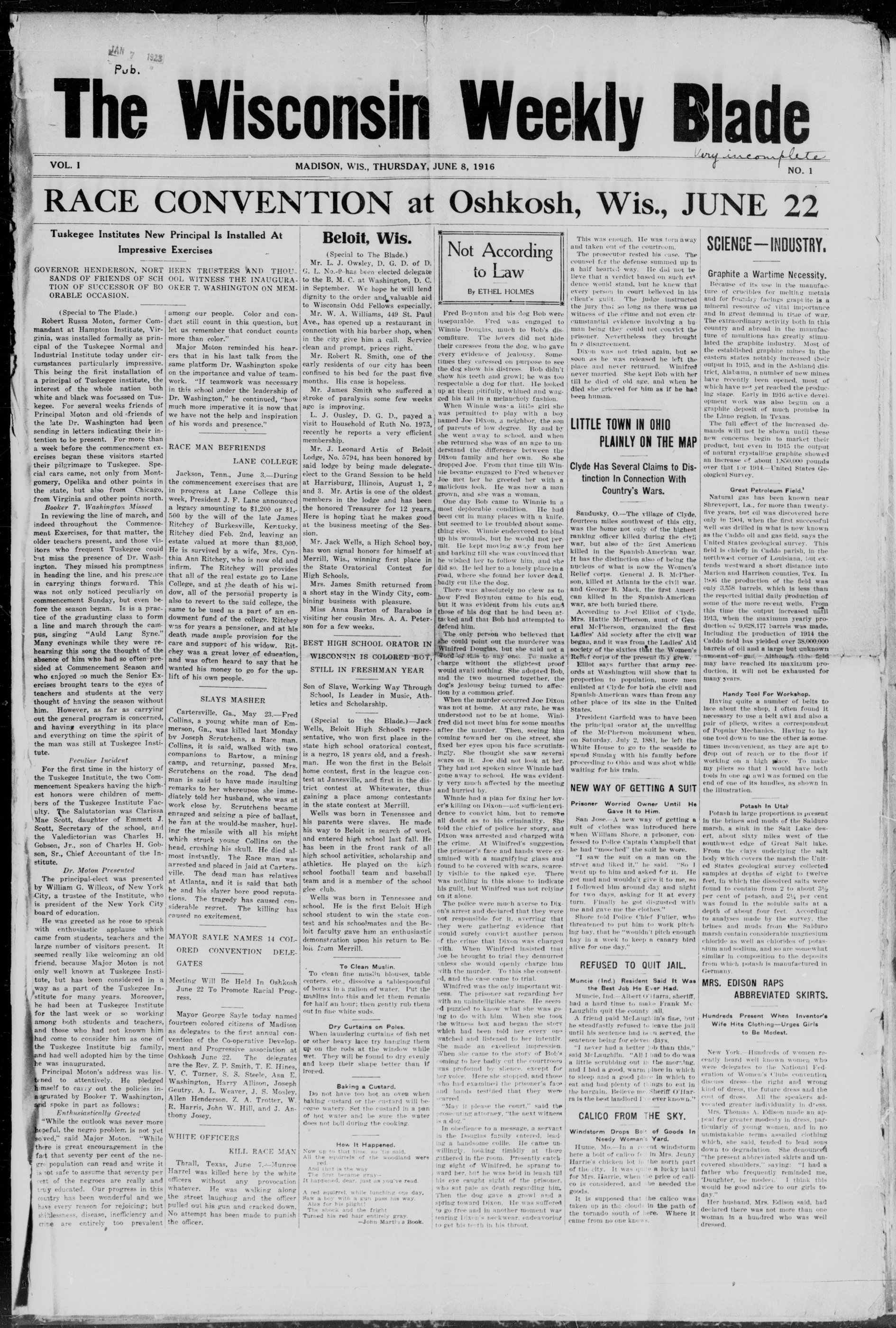
RACE CONVENTION at Oshkosh, Wis., JUNE 22
Tuskegee Institutes New Principal Is Installed At Impressive Exercises
JAN 7 1923
Pub.
The
VOL. I
RACE C
Tuskegee Institutes New
Impressive
VOL. 1
GOVERNOR HENDERSON, NORT
SANDS OF FRIENDS OF SCH
TION OF SUCCESSOR OF BO
ORABLE OCCASION.
Robert Russia Moton, former Commandant at Hampton Institute, Virginia, was installed formally as principal of the Tuskegee Normal and Industrial Institute today under circumstances particularly impressive. This being the first installation of a principal of Tuskegee institute, the interest of the whole nation both white and black was focussed on Tuskegee. For several weeks friends of Principal Moton and old friends of the late Dr. Washington had been sending in letters indicating their intention to be present. For more than a week before the commencement exercises began these visitors started their pilgrimage to Tuskegee. Special cars came, not only from Montgomery, Opelika and other points in the state, but also from Chicago, from Virginia and other points north.
Booker T. Washington Missed
In reviewing the line of march, and indeed throughout the Commencement Exercises, for that matter, the older teachers present, and those visitors who frequent Tuskegee could but miss the presence of Dr. Washington. They missed his promptness in heading the line, and his presence in carrying things forward. This was not only noticed peculiarly on commencement Sunday, but even before the season began. Is is a practice of the graduating class to form a line and march through the campus, singing "Auld Lang Syne." Many evenings while they were rehearsing this song the thought of the absence of him who had so often presided at Commencement Season and who enjoyed so much the Senior Exercises brought tears to the eyes of teachers and students at the very thought of having the season without him. However, as far as carrying out the general program is concerned, and having everything in its place and everything on time the spirit of the man was still at Tuskegee Institute.
Peculiar Incident
For the first time in the history of the Tuskegee Institute, the two Commencement Speakers having the highest honors were children of members of the Tuskegee Institute Faculty. The Salutatorian was Clarissa Mae Scott, daughter of Emmett J. Scott, Secretary of the school, and the Valedictorian was Charles H. Gobson, Jr., son of Charles H. Gobson, Sr., Chief Accountant of the Institute.
Dr. Moton Presented
The principal-elect was presented by William G. Willcox, of New York City, a trustee of the Institute, who is president of the New York City board of education.
He was greeted as he rose to speak with enthusiastic applause which came from students, teachers and the large number of visitors present. It seemed really like welcoming an old friend, because Major Moton is not only well known at Tuskegee Institute, but has been considered in a way as a part of the Tuskegee Institute for many years. Moreover, he had been at Tuskegee Institute for the last week or so working among both students and teachers, and those who had not known him had come to consider him as one of the Tuskegee Institute big family, and had well adopted him by the time he was inaugurated.
Principal Moton's address was listened to attentively. He pledged himself to carry out the policies inaugurated by Booker T. Washington, and spoke in part as follows:
Enthusiastically Greeted
Enthusiasmically Greeted
"While the outlook was never more hopeful, the negro problem is not yet solved," said Major Moton. "While there is great encouragement in the fact that seventy per cent of the negro population can read and write it is not safe to assume that seventy per cent of the negroes are really and truly educated. Our progress in this country has been wonderful and we have every reason for rejoicing; but shiftlessness, disease, inefficiency and crime are entirely too prevalent
HERN TRUSTEES AND THOUOOL WITNESS THE INAUGURA-OKER T. WASHINGTON ON MEM- among our people. Color and conduct still count in this question, but let us remember that conduct counts more than color."
Major Moton reminded his hearers that in his last talk from the same platform Dr. Washington spoke on the importance and value of teamwork. "If teamwork was necessary in this school under the leadership of Dr. Washington," he continued, "how much more imperative it is now that we have not the help and inspiration of his words and presence."
RACE MAN BEFRIENDS
LANE COLLEGE
Jackson, Tenn., June 3.—During the commencement exercises that are in progress at Lane College this week, President J. F. Lane announced a legacy amounting to $1,200 or $1,500 by the will of the late James Ritchey of Burkesville, Kentucky. Ritchey died Feb. 2nd, leaving an estate valued at more than $3,000. He is survived by a wife, Mrs. Cynthia Ann Ritchey, who is now old and infirm. The Ritchey will provides that all of the real estate go to Lane College, and at the death of his widow, all of the personal property is also to revert to the said college, the same to be used as a part of an endowment fund of the college. Ritchey was for years a pensioner, and at his death made ample provision for the care and support of his widow. Ritchey was a great lover of education, and was often heard to say that he wanted his money to go for the uplift of his own people.
SLAYS MASHER
Cartersville, Ga., May 23.—Fred Collins, a young white man of Emerson, Ga., was killed last Monday by Joseph Scrutchens, a Race man. Collins, it is said, walked with two companions to Bartow, a mining camp, and returning, passed Mrs. Scrutchens on the road. The dead man is said to have made insulting remarks to her whereupon she immediately told her husband, who was at work close by. Scrutchens became enraged and seizing a pice of ballast, he ran at the would-be masher, hurling the missile with all his might which struck young Collins on the head, crushing his skull. He died almost instantly. The Race man was arrested and placed in jaid at Cartersville. The dead man has relatives at Atlanta, and it is said that both he and his slayer bore good reputations. The tragedy has caused considerable regret. The killing has caused no excitement.
MAYOR SAYLE NAMES 14 COL
ORED CONVENTION DELE-
GATES
Meeting Will Be Held In Oshkosh June 22 To Promote Racial Progress.
Mayor George Sayle today named fourteen colored citizens of Madison as delegates to the first annual convention of the Co-operative Development and Progressive association at Oshkosh June 22. The delegates are the Rev. Z. P. Smith, T. E. Hines, V. C. Turner, S. S. Steele, Asa E. Washington, Harry Allison, Joseph Geutry, A. L. Weaver, J. S. Mosley, Allen Henderson, Z. A. Trotter, W. R. Harris, John W. Hill, and J. Anthony Josey.
WHITE OFFICERS
Thrall, Texas, June 7.—Munroe Harrel was killed here by the white officers without any provocation whatever. He was walking along the street laughing and the officer pulled out his gun and cracked down. No attempt has been made to punish the officer.
MADISON, WIS., THURSDAY, JUNE 8, 1916
Beloit. Wis.
(Special to The Blade.)
Mr. L. J. Owsley, D. G. D. of D. G. L. No. 2 has been elected delegate to the B. M. C. at Washington, D. C. in September. We hope he will lend dignity to the order and valuable aid to Wisconsin Odd Fellows especially.
Mr. W. A. Williams, 449 St. Paul Ave., has opened up a restaurant in connection with his barber shop, when in the city give him a call. Service clean and prompt, prices right.
Mr. Robert R. Smith, one of the early residents of our city has been confined to his bed for the past five months. His case is hopeless.
Mr. James Smith who suffered a stroke of paralysis some few weeks ago is improving.
L. J. Ousley, D. G. D., payed a visit to Household of Ruth No. 1973, recently he reports a very efficient membership.
Mr. J. Leonard Artis of Beloit Lodge, No. 5794, has been honored by said lodge by being made delegate-elect to the Grand Session to be held at Harrisburg, Illinois, August 1, 2 and 3. Mr. Artis is one of the oldest members in the lodge and has been the honored Treasurer for 12 years. Here is hoping that he makes good at the business meeting of the Session.
Mr. Jack Wells, a High School boy, has won signal honors for himself at Merrill, Wis., winning first place in the State Oratorical Contest for High Schools.
Mrs. James Smith returned from a short stay in the Windy City, combining business with pleasure.
Miss Anna Barton of Baraboo is visiting her cousin Mrs. A. A. Peterson for a few weeks.
BEST HIGH SCHOOL ORATOR IN WISCONSIN IS COLORED BOY, STILL IN FRESHMAN YEAR
Son of Slave, Working Way Through School, Is Leader in Music, Athletics and Scholarship.
(Special to the Blade.)—Jack Wells, Beloit High School's representative, who won first place in the state high school oratorical contest, is a negro, 18 years old, and a freshman. He won the first in the Beloit home contest, first in the league contest at Janesville, and first in the district contest at Whitewater, thus gaining a place among contestants in the state contest at Merrill.
Wells was born in Tennessee and his parents were slaves. He made his way to Beloit in search of work and entered high school last fall. He has been in the front rank of all high school activities, scholarship and athletics. He played on the high school football team and baseball team and is a member of the school glee club.
Wells was born in Tennessee and school. He is the first Beloit High school student to win the state contest and his schoolmates and the Beloit faculty gave him an enthusiastic demonstration upon his return to Beloit from Merrill.
To Clean Muslin
To clean fine muslin blouses, table centers, etc., dissolve a tablespoonful of borax in a gallon of water. Put the muslins into this and let them remain for half an hour; then gently rub them out in fine white suds.
Dry Curtains on Poles
When laundering curtains of fish net or other heavy lace try hanging them up on the rods at the window while wet. They will be found to dry evenly and keep their shape better than if ironed.
Baking a Custard.
Do not have too hot an oven when baking custard or the custard will become watery. Set the custard in a pan of hot water and be sure the water does not boil during the cooking.
How It Happened.
Not According to Law BY ETHEL HOLMES
Fred Boynton and his dog Bob were inseparable. Fred was engaged to Winnie Douglas, much to Bob's discomfiture. The lovers did not hide their caresses from the dog, who gave every evidence of jealousy. Sometimes they caressed on purpose to see the dog show his distress. Bob didn't show his teeth and growl; he was too respectable a dog for that. He looked up at them pitifully, whined and wagged his tail in a melancholy fashion. When Winnie was a little girl she was permitted to play with a boy named Joe Dixon, a neighbor, the son of parents of low degree. By and by she went away to school, and when she returned she was of an age to understand the difference between the Dixon family and her own. So she dropped Joe. From that time till Winnie became engaged to Fred whenever Joe met her he greeted her with a malldous book. He was now a man grown, and she was a woman. One day Bob came to Winnie in a most deplorable condition. He had been cut in many places with a knife, but seemed to be troubled about something else. Winnie endeavored to bind up his wounds, but he would not permit. He kept moving away from her and barking till she was convinced that she wished her to follow him, and she did so. He led her to a lonely place in a road, where she found her lover dead, badly cut like the dog.
There was absolutely no clew as to how Fred Boynton came to his end, but it was evident from his cuts and those of his dog that he had been attacked and that Bob had attempted to defend him.
The only person who believed that she could point out the murderer was Winifred Douglas, but she said not a word of this to any one. To make a charge without the slightest proof would avail nothing. She adopted Bob, and the two mourned together, the dog's jealousy being turned to affection by a common grief.
When the murder occurred Joe Dixon was not at home. At any rate, he was understood not to be at home. Winifred did not meet him for some months after the murder. Then, seeing him coming toward her on the street, she fixed her eyes upon his face scrutinizingly. She thought she saw several scars on it. Joe did not look at her. They had not spoken since Winnie had gone away to school. He was evidently very much affected by the meeting and hurried by.
Winnie had a plan for fixing her lover's killing on Dixon—not sufficient evidence to convict him, but to remove all doubt as to his criminality. She told the chief of police her story, and Dixon was arrested and charged with the crime. At Winifred's suggestion the prisoner's face and hands were examined with a magnifying glass and found to be covered with scars, scarcely visible to the naked eye. There was nothing in this alone to indicate his guilt, but Winifred was not relying on it alone. The police were much averse to Dixon's arrest and declared that they were not responsible for it, averring that they were gathering evidence that would surely convict another person of the crime that Dixon was charged with. When Winifred insisted that Joe be brought to trial they demurred unless she would openly charge him with the murder. To this she consented, and the case came to trial.
Winifred was the only important witness. The prisoner sat regarding her with an unintelligible stare. He seconded puzzled to know what she was going to do with him. When she took the witness box and began the story which had been told her every one watched and listened to her intently. She made an excellent impression. When she came to the story of Bob's coming to her badly cut the courtroom was profound by silence, except for her voice. Here she stopped, and those who had examined the prisoner's face and hands testified that they were scarred.
"May it please the court," said the prosecuting attorney, "the next witness is a dog."
In obedience to a message, a servant in the Douglas family entered, leading a handsome colle. He came unwillingly, looking timidly at those gathered in the room. Presently catching sight of Winifred, he sprang toward her, but he was held in leash till his eye caught sight of the prisoner, who sat pale as death regarding him. Then the dog gave a growl and a spring toward Dixon. He was suffered to go free and in another moment was tearing Dixon's neckwear, endeavoring to get his teeth in his throat.
This was enough. He was torn away and taken out of the courtroom.
The prosecutor rested his case. The counsel for the defense summed up in a half hearted way. He did not believe that a verdict based on such evidence would stand, but he knew that every person in court believed in his client's guilt. The judge instructed the jury that so long as there was no witness of the crime and not even circumstantial evidence involving a human being they could not convict the prisoner. Nevertheless they brought in a disagreement.
Dixon was not tried again, but so soon as he was released he left the place and never returned. Winifred never married. She kept Bob with her till he died of old age, and when he dled she grieved for him as if he had been human.
LITTLE TOWN IN OHIO
PLAINLY ON THE MAP
Clyde Has Several Claims to Distinction In Connection With Country's Wars.
Sandusky, O.—The village of Clyde, fourteen miles southwest of this city, was the home not only of the highest ranking officer killed during the civil war, but also of the first American killed in the Spanish-American war. It has the distinction also of being the nucleus of what is now the Women's Relief corps. General J. B. McPherson, killed at Atlanta in the civil war, and George B. Mack, the first American killed in the Spanish-American war, are both buried there.
According to Joel Elliot of Clyde, Mrs. Hattie McPherson, aunt of General McPherson, organized the first Ladies' Aid society after the civil war began, and it was from the Ladies' Aid society of the sixties that the Women's Relief corps of the present day grew.
Elliot says further that army records at Washington will show that in proportion to population, more men enlisted at Clyde for both the civil and Spanish-American wars than from any other place of its size in the United States.
President Garfield was to have been the principal orator at the unveiling of the McPherson monument when, on Saturday, July 2, 1881, he left the White House to go to the seaside to spend Sunday with his family before proceeding to Ohio and was shot while waiting for his train.
NEW WAY OF GETTING A SUIT
Prisoner Worried Owner Until He Gave It to Him.
San Jose.—A new way of getting a suit of clothes was introduced here when William Shore, a prisoner, confessed to Police Captain Campbell that he had "mooched" the suit he wore.
"I saw the suit on a man on the street and liked it," he said. "So I went up to him and asked for it. He got mad and wouldn't give it to me, so I followed him around day and night for two days, asking for it at every turn. Finally he got disgusted with me and gave me the clothes."
Shore told Police Chief Fuller, who threatened to put him to work pitching hay, that he "wouldn't pitch enough hay in a week to keep a canary bird alive for one day."
REFUSED TO QUIT JAIL
Munice (Ind.) Resident Said It Was the Best Job He Ever Had.
Municle, Ind—Albert O'Hara, sheffl,
had a hard time to make Frank McLaughlin quit the county jail.
A friend paid McLaughlin's fine, but he steadfastly refused to leave the jail until his sentence had been served, the sentence being for eleven days,
"I never had a better job than this," said McLaughlin. "All I had to do was a little scrubbing out in the morning, and I had a good, warm place in which to sleep and a good place in which to eat and had plenty of things to eat in the bargain. Believe me. Sheriff O'Hara is the best landlord I've ever known."
CALICO FROM THE SKY
Windstorm Drops Bolt of Goods In
Nedey Woman's Yard.
Hume, Mo.—In a recent windstorm
here a bolt of calico fell in Mrs. Jenny
Harrie's chicken lot in the north part
of the city. It was quite a lucky haul
for Mrs. Harrie, when the price of calico
is considered, and the needed the
goods.
It is supposed that the calico was
taken up in the clouds in the path of
the tornado south of here. Where it
came from no one knows.
Very incomplete
NO.1
SCIENCE—INDUSTRY.
Graphite a Wartime Necessity.
Because of its use in the manufacture of crucibles for melting metals and for foundry facings graphite is a mineral resource of vital importance and in great demand in time of war. The extraordinary activity both in this country and abroad in the manufacture of munitions has greatly stimulated the graphite industry. Most of the established graphite mines in the eastern states notably increased their output in 1915, and in the Ashland district, Alabama, a number of new mines have recently been opened, most of which have not yet reached the producing stage. Early in 1916 active development work was also begun on a graphite deposit of much promise in the Llano region, in Texas. The full effect of the increased demands will not be shown until these new concerns begin to market their product, but even in 1915 the output of natural crystalline graphite showed an increase of about 1,850,000 pounds over that for 1914.—United States Geological Survey.
Great Petroleum Field
Natural gas has been known near Shreveport, La., for more than twenty-five years, but oil was discovered here only in 1904, when the first successful well was drilled in what is now known as the Caddo oil and gas field, says the United States geological survey. This field is chiefly in Caddo parish, in the northwest corner of Louisiana, but extends westward a short distance into Marion and Harrison counties, Tex. In 1906 the production of the field was only 3,338 barrels, which is less than the reported initial daily production of some of the more recent wells. From this time the output increased until 1913, when the maximum yearly production of 9,628,177 barrels was made. Including the production of 1914 the Caddo field has yielded over 38,000,000 barrels of oil and a large but unknown amount of gas. Although the field may have reached its maximum production, it will not be exhausted for many years.
Handy Tool For Workshop.
Having quite a number of belts to lace about the shop, I often found it necessary to use a belt awl and also a pair of pliers, writes a correspondent of Popular Mechanics. Having to lay one tool down to use the other is sometimes inconvenient, as they are apt to drop out of reach or to the floor if working on a high place. To make my pliers so that I would have both tools in one awl was formed on the end of one of its handles, as shown in the illustration.
Potash In Utah
Potash in large proportions is present in the brines and muds of the Salduro marsh, a sink in the Salt Lake desert, about sixty miles west of the southwest edge of Great Salt lake. From the clays underlying the salt body which covers the marsh the United States geological survey collected samples at depths of eight to twelve feet, in which the dissolved salts were found to contain from 2 to about $3\frac{1}{2}$ per cent of potash, and $2\frac{1}{4}$ per cent was found in the soluble salts at a depth of about four feet. According to analyses made by the survey, the brines and muds from the Salduro marsh contain considerable magnesium chloride as well as chlorides of potassium and sodium, and so are somewhat similar in composition to the deposits from which potash is manufactured in Germany.
MRS. EDISON RAPS
ABBREVIATED SKIRTS.
Hundreds Present When Inventor's Wife Hits Clothing—Urges Girls to Be Modest.
New York.—Hundreds of women recently heard well known women who were delegates to the National Federation of Women's Clubs convention discuss dress—the right and wrong kind of dress, the future dress and the cost of dress. All the speakers advocated greater individuality in dress. Mrs. Thomas A. Edison made an appeal for greater modesty in dress, particularly of young women, and in no unmistakable terms assailed clothing which, she said, tended to lead sons down to degradation. She denounced "the present abbreviated skirts and uncovered shoulders," saving: "I had a father who frequently reminded me, 'Daughter, be modest.' I think this would be good advice to our girls today."
Her husband, Mrs. Edison said, had declared there was not more than one woman in a hundred who was well dressed.
Application made at Madison Wisconsin, as second-class matter.
Address all communications to THE WISCONSIN WEEKLY BLADE, 312 N. Henry St. Money sent by express money order, or registered letter at our own risk, otherwise at risk of the sender.
Z. P. Smith, Editor.
L. J. Ousley, Contributing Editor.
L. Anthony Josey, Manager.
SUBSCRIPTION:
One year ..... $1.50
Six months ..... 1.00
Three months ..... 50
LEADERS
We have hundreds of so-called Negro leaders teaching our people how to useful hewers of wood and drawers of water. We do not condemn these professions nor look upon them with scorn. As we think of them as being honorable.
The Negro though he has proved his ability to become a useful citizen in every walk of life, is the most scorned and discriminated against of all races on the face of the globe. For less pay he rendres the greatest service, hundreds of Negro clerks receive the salaries of porters.
Negro mechanics receive the salaries of helpers. Should this not alarm the thoughtful Negro to the extent of trying in some way to better such conditions in order that his unborn sons and daughters might not be drowned in the sea of discouragement?
The question is often asked, What is the Negro doing to help himself? The Blade can readily answer by saying he is contending against every evil foe, and out of his penury he is contributor to every charitable object.
The Negro who is thought to be a leader is telling his people to "Learn to work, get property, own homes, etc.
The Negro seekers of notoriety who in the lobbies of the Capitol, in the anterooms of the city council begging for crumbs, would shine brighter as a beacon light if from the pulpit and platform they would preach and teach the people the power of the Ballot.
Three hundred years of slavery plus fifty odd years of semi-slavedom, it seems to us is sufficient endurance.
The time is at hand when we must be a part of this great nation or else like the Aborigines, be driven to the depth of the Pacific.
The Negro of today is in the want of true leadership, a leader who will ask for all the privileges of manhood which franchise can bestow.
Be assured that the pretender who seeks to cockpot schemes for self aggrandisement and notoriety will fail and have engraved upon the slab which marks his last resting place, "Here lies an impostor," "Age unknown," Deceived many," Gone to"
"THE IGNORANT NEGRO"—WHO
WAS TO BLAME?
All the mistakes the southern Negro made during the early days of reconstruction of the states, were the results of the tuition of the white race.
The Negro was not trained to admire good morlas, cultured to no spirit of noble asperations — only dreamed of a better day in the sweet bye and bye; he was left asleep, intellectually to all the highest things of life; prejudice therefore guided him in all his manifestations, ignorance and superstition predominated him—who was to blame? to him this proud old Commonwealth owes much, especially to the southland.
He felled the trees, threw up the high ways, and bridged the rivers.
Truthfully, it can be said; the civil war veterans saved the Union, the Negro built the country and fed the world.
One by one these great and good men are passing into eternity, why not let them depart in peace, why dig up their innocent faults in the face of their detesting spirits?
Copyright, 1906, by the McClure Newspaper Syndicate.
One spring several years ago a naturalist, a mineralogist and a geologist went up into the mountains of Montana, for professional work, and they took with them as guide, cook and hunter a well known character named Tom Larsen. He had hunted grizzly bears in old Mexico, New Mexico, Utah, Idaho, Nevada and Montana. One night by the campfire he told us the following:
"Down in the lowlands, where I was taking a rest after a hard winter, a millionaire from Boston, who had come out on some railroad business and brought an arsenal of guns with him to kill game, offered me $500 for the pelt of a grizzly bear. The victim must be a big one, with fur in good condition and teeth and claws all right."
"After reaching my hunting ground
I spent two days cutting down trees
and building me a stout cabin.
I would make this cabin my headquarters
and hunt the country for thirty
or forty miles around.
"The grizzly is not a clean animal.
He gives out a bad odor. The cave
wherein one has passed, the winter out-
smells a Chicago slaughtering house.
It was the scent of a grizzly that came
to my nostrils on the evening of the
second day of my arrival.
"I continued to scent that grizzly for half an hour, but I could not get sight of him. He circled around me three or four times, and I am sure he came within 100 feet of me, and then he moved away so silently that not a twig rusted. Being tired out with my day's work, I went to sleep at an early hour, but along toward midnight I awoke all of a sudden and sat up on my bed of boughs. It was not so dark but that I made out an object sitting in the doorway which was not there when I turned in. A whiff of the rank odor reached my nostrils, and I knew that that object was Old Ephraim come back for another look at me. I grabbed for my gun, but he was off like a shot.
"About 5 o'clock the next afternoon as I sat smoking my pipe in the doorway that grizzly odor suddenly came to me again. I arose to my feet and took carefully around me, but was unable to see anything of bruin. Suddenly he growled from the depths of a thicket. It seemed to me that he wanted me to know that he was near. It was a growt full of menace, and for a moment I thought it would be followed by his appearance, but he did not show himself. When he moved away it was as silently as on previous occasions.
"After my morning meal I went down to a little cove where I had hobbled the mules and my horse that they might browse around and not stray too far. I found them buddled together and trembling in fear. They had caught the smell of Old Ephraim, and perhaps he had shown himself, but why didn't he inflict an injury? Here was prey, but he had passed it by. As I struck away from the cove, feeling mighty uncomfortable about the actions of that bear, I determined to be more than ever watchful for his presence. There was no breeze at all, and we stood an even chance regarding the scent question. I walked as softly as any Indian, and every minute or two I halted to peer about me. After two hours I had neither seen nor heard anything suspicious. Then I took a rest against a big bowler and figured that my enemy had dropped me for good.
"The next minute I was gazing into the eyes of that old bear. He had been hiding behind the bowler and walked out of his hiding place as cool as you please and like an old friend. It was a sudden jolt for me, but I did not lose my nerve. My rite was leaning against the bowler beside me, and I reached for it, but before I could bring it up the bear uttered a growl so full of menace and murder that it gave me a chill. I desisted in my efforts and faced him squarcey, and the hard glint in his eyes gradually softened. I dared not move away, and he seemed to have no desire to do so himself. How long did we face each other? Well, it might have been three, five or ten minutes. I did not have a wach to keep time on it. By and by I found myself stepping backward and then turning and walking away.
"It was several good miles to my cabin, and I am telling you that Old Ephriam followed in my footsteps all the way. At any time during the journey he could have fastened his teeth and claws in me, but he made no attack. When I reached the cabin he turned away and was soon out of sight. I sat down and called myself a coward nity times over. I had been afraid of that grizzly and was still in fear. He had acted so queerly that I was all unnerved.
"Next day I brought up the animals from the cave and packed my outfit on them and did not make camp again until I was fifty miles away. I may tell you that brain followed me a good ten miles on my journey, and when he turned back had his been a human face I might have detected a grin of satisfaction upon it.
"I had not yet pitched camp at the new place when an old she grizzly with two cubs sampering beside her came rushing down the mountain side with mouth wide open and eyes glaring, and I drowned the three of them with three shots. Oh, yes, the Boston man got his pit sure enough, and though it was off the wrong bear, he didn't kick about that."
We are about to speak and we wish your attention. In the first place we have started a newspaper and have named it "THE WISCONSIN WEEKLY BLADE". We have done this because we feel and believe that there is a demand for the kind of paper we propose to run. We have studied the matter carefully and we believe we are going to succeed. It will not be the mission of THE BLADE to PULL DOWN but rather LIFT UP. We have no intention to use our columns for personal abuse and we find as much as we can do in trying to give our readers a good clean paper. THE BLADE will cut but will cut only into the rank of ignorance and error, and for the purpose of opening up a path of truth and right.
We shall regard the rights of the humblest citizen as sacred as those of the highest. Let us have your support and we promise you we shall show ourselves worthy of it. Our columns will always be open to communications from any source except that we shall not allow any fights of a malicious nature to be carried on in them. We have made the price of subscription One Dollar and Fifty cents a year and we would appreciate it if you give us the same. We hereby respectfully ask your support.
The mission of a newspaper in these times is two-fold: to publish the news from the north, south, east, and west, as the letters of the word news imply, and also to help create a healthy public sentiment.
THE BLADE shall conscientlyly aim to accomplish these two results. We have no grudges to settle and shall avoid all internal church and society differences. We shall give an equal chance to each side in any controversy to state its case. "The greatest good to the greatest number" is our motto. We shall encourage all persons and organizations who are working for the uplift of the masses.
We believe the Negro has in his own hand his destiny; Self-help, Education, Morality, Organization, and practical Religion are the five cardinal points in his problem.
We crave the sympathy and support of all fair-minded men.
Passing of Russell Ford.
Pitcher Russell Ford, who was recently given his unconditional release by the New York American league club, was one of the greatest sensations of baseball history in his first major year. For the Yankees, who finished second to the Athletics, he won twenty-six and lost but six games back in 1910. He shared the limelight with King Cole of the Cubs. These were the first two young pitchers who had won more than 80 per cent of their games in their first year in fast company.
Favors National Stadium.
The congressional committee on appropriations has reported favorably on the Hulbert stadium bill, which provides for the construction of a national playground to include a stadium, in which national and international games can be conducted, in East Potomac park, Washington.
FROM NOW UP TO JUNE THIRTEENTH
WE HAVE A PLAN to help the women in the home keep the house spotlessly clean, without wasting energy, and to keep themselves and family cool and comfortable always electric vacuum cleaner will do the first, an electric fan the second. A special offer will enable you to have both.
From now up to June 13th inclusive, we shall give each purchaser of an electric vacuum cleaner one eight-inch electric fan, including plug and eight feet of cord. The cleaner is the type we have been handling all year. It retails for $25 and you may pay $5 down and $5 per month for four months.
The electric fans are the regular 8-inch fans, retailing at $9.75 and are on display in our windows.
Keep cool,keep clean,keep comfortable and receive $34.75 value for $25
On the same day we shall give a dollar credit towards the purchase price of a new electric flat-iron to anyone returning an old electric iron. We are obliged to limit these orders to the time mentioned, June thirteenth.
Phone 4400 - - - - - - - - 126 East Main Street
Favors National Stadium.
and we wish you
and have names
have done this be
the kind of pap-
fully and we beli-
THE BLADE t
ention to use our
can do in trying
will cut but will
the purpose of
tits of the humble
our support and
Our columns we
except that we
carried on in the
Fifty cents a-
We hereby re-
OUR AIM
per in these time
east, and west,
create a health
sciencesly aim
to settle and sha
shall give an eocase. "The gre
shall encourage
the uplift of the
s in his own ha
ation, and practi
and support of a
Grind two cupfuls of cooked veal, add salt, pepper, celery salt, one teaspoonful of onion juice. Make a cream sauce of one and one-half cupfuls of milk, four tablespoonfuls of butter, six tablespoonfuls of flour. Add sauce to seasoned veal. Cool, shape into pyramids, dip in crumbs. Fry in deep fat.
One cupful of suet after it is chopped fine, one cupful of molasses, one cupful of sweet milk, one egg, two cupfuls of flour, one teaspoonful of soda, one cupful of raisins. Steam two hours. Serve with lemon sauce.
h pro-
national
num. in
national
best Po-
To remove chocolate stains from
white dresses or table linen sprinkle
the stain thickly with borax, place a
saucer beneath it and pour on just
enough water to moisten. Leave for
several hours and then wash.
LISTEN!
Suet Pudding.
Chocolate Stains
Unify
"United we stand, divided we fall." Let the Negro as a race to adhere strictly to this motto. Let each and every one keep it in full view. What does Unity mean to us?
What project or enterprise can not be accomplished by the combined effort of a race. But one alone can do but very little toward the great cause of a would-be down-trodden race. Who dares to say that a Negroe's ambition is not equal to that of any nationality? Then to reach the height of that ambition UNITY must be the first consideration. If a people is bound so closely together that they have one aim in view and all make a united effort to reach the goal, then will success be the result.
But just so long as the Negro endeavors to climb the ladder of success alone, so long must he resume a back seat in the progress of the world.
Some one has said mankind was created for action, action for good and not for evil; constant vigilance is the guardian of liberty, or as is often said, "eternal vigilance is price of liberty."
A Peck of Peas.
A Peck of Peas.
1. Add P to a period of time and make what you are reading.
2. Add P to every one and make a covering for the dead.
3. Add P to a drink and make white.
4. Add P to an insect and make rapid breathing.
5. Add P to a large vessel and make inclosed ground for recreation.
6. Add P to a fabric composed of fine threads and make room.
7. Add P to a narrow road and make a level surface.
Answers. — 1. P.age. 2. P.all. 3. P.ale. 4. P.ant. 5. P.ark. 6. P.lace. 7. P.lane.
A Jingling Match.
The jingling match used to be very popular at the English country fairs. A large circle inclosed by a rope was occupied by nine or ten people, and all except one were blindfolded. This one was called the "jingler," because he held in his hand a small bell, which he rang incessantly. His companions, following the sound of the bell, tried to catch him. If at the end of an allotted time he was not caught he received a prize; otherwise the prize went to the catcher.
Harvard
Shoes
$2.50-$2.85
All Kinds--All Sizes
Come up stairs
and
Save a Dollar
Harvard Shoe Co.,
Second Floor
Washington Ave. and
MADISON, WIS.
HENRY LEWIS
DRUGGIST
STATE AND GILMAN STREETS
When you are sick and want a prescription filled buy your drugs at Lewis' Drug Store
FOR BAR GAINS IN SHOES GO TO
432 STATE ST.
MEN'S, LADIES', AND CHILDREN'S
FOOTWEAR
Mr. Wade H. Sheffy, Parkersville, W. Va., is in the city for the summer. He is one of the waiters at the New Park.
Trade with the Merchants who ask you for your patronage through the columns of The Blade.
Mr. Allen Batise of N. Henry St. was buried from Powers Undertaking parlors on last Wednesday. The Blade in common with its host of friends extend sympathy to the family, his wife, his daughter Pauline, and his son Benjamin.
Mr. and Mrs. A. T. Stewart will return to the city on or about the 15th. They are now in Indianapolis, Ind. Capt. Stewart was in charge of a watch at the New Park.
You will find special bargains at The Outlet? Read their ad in another column.
Mr. Henry Lewis, who has been in the service of the New Park Hotel as waiter, left on Tuesday for Chicago, Ill., and Terre Haute, Ind., enroute to Bridgeport, Conn., his home, to spend the summer.
Ripp's Shoe Store, 224 State St., are offering bargain. Call and inspect their stock. Polite and courteous attention.
Telephone your news to The Blade, Phone 3369.
Mr. Walter W. Carter of Dayton St. is visiting his parents at Danville, Ill. Before returning he will visit Detroit, Mich., Cleveland, Ohio, and Buffalo, N. Y.
The Dane County Colored Club, of which Messrs. Allen Henderson, T. E. Hines, Geo. E. Buckner and Asa E. Washington are the advisory board, are planning for its members and followers at 222 E. Main St., June 23rd. The occasion will be a full dress affair.
It is the request of the City Editor that you furnish him with local news.
Mrs. Madison Jones is indisposed from a severe fall breaking a rib. She is improving as we go to press.
Save a Dollar by buying Harvard Shoes, Wash. Ave. and Pinckney St.
St. Paul A. M. E. Sunday school, of which Mr. Thos. Horton is superintendent, are planning an elaborate program for Children Day. Mr. C. C. Scott is rehearsing the scholars.
Prof. Joseph L. Bowler, Wichita, Kansas, will resume his studies at the University Summer School. He is expected to arrive about the 15th.
Mr. and Mrs. Ashby N. Jackson who has been in St. Paul, Minn., all winter is in the city for a few days enroute East.
Send your name to The Blade if you contemplate attending the Race Conference at Oshkosh on the 22nd. Mr. T. E. Hines has been appointed chairman of the Transportation Committee.
Fresh and up-to-date drugs at Lewis, State and Gilman St.
A great reduction Shoe Sale at Weaver's Shoe Store, 432 State St.
Mr. Asa E. Washington was called to Chicago on account of the death of his sister.
Capital City Lodge, No. 72, F. & A. M., will initiate ten new members Saturday, commencing at 2:00 P. M. L. H. Palmer, D. G. D., of the 8th judicial district, will be in attendance to assist in deferring degrees.
Agent wanted to represent The Blade. Liberal terms.
The Blade is on sale at the following places: Mosley & Smith, 202 E. Washington Ave., Trotter & Hopkins, 222 E. Main St., Hill's Grocery Store, 649 E. Dayton St., Weaver's Grocery Store, 522 E. Mifflin St., and all Local News Stands.
Walter Johnson, the star pitcher of the Washington baseball club, is considered by all baseball fans to be one of the greatest pitchers the game has known. His work so far this season is up to the mark of previous years and a little better if anything. By his phenomenal pitching he has kept Clark Griffith's clan in the race for the pennant. Johnson's best year was in 1913, when he won thirty-seven games and lost seven. The following season he did not do so well, and in 1915 he was still below his best work. He is the swiftest of all pitchers and has thrown a ball 122 feet per second. Johnson is a native of Kansas and owns a fine ranch a few miles from
---
GOOD RESULT OF A BLUNDER
Bashful Lover Stirred to Action by Odd Mistake.
Roger Shook was a self made man who in his youth received no educational advantages. He made a fortune and had but one child, a daughter, to inherit it. This daughter, Amella, he sent to school and to college. She developed literary tastes, but of this her father knew nothing, for he had no knowledge whatever of literature. When he heard his daughter speak of "The Light of Asia" he supposed she referred to the illuminating substance used in that part of the globe. On hearing her say that she had spent the morning with "Dombey and Son" he told her to have the bill sent in as once, since he was closing up all outstanding accounts. "Very Hard Cash" he supposed a specie basis
So frequent were these blunders that Amelia dreaded to speak of anything beyond her father's ken, for he was liable to mortify her by blurting them out in the presence of educated people. Indeed, the old man was rather fond of taking the lead in conversation, and the less he knew about a subject the more anxious he was to prove his familiarity with it.
Mr. Shook, not having a son to whom to leave his business, had brought up a young man from office boy to succeed him in its management. This man, Thomas Jones, he desired should marry his daughter. Jones was a fine business man and a fine fellow, and Amelia liked him very well, though she didn't care to communicate the fact to her father or to Mr. Jones. Jones was even more anxious for the match than his employer. He was not insensible to its advantages and was desperately in love with the girl. But, while he did not fear to tackle any man on a business proposition, he had no courage whatever in telling a woman that he loved her. The consequence was that the match hung fire.
One afternoon Mr. Shook went home from the office to find his family gadding. Some one was ringing on the telephone. He took down the receiver. "Is Miss Shook in?" called the soft voice of a woman.
"No. Any message for her?"
"Tell her 'Adam Bede' has just come in."
"Adam who?"
"Bede-B-e-d-e."
There was an aside in the dialogue that was unexpressed by Mr. Shook.
"Well, I'll be jinged! I never thought that of Amelia. I didn't believe she'd meet any one in an underhanded way."
The phone was not working very well. There were some incoherent words, ending with "Nicholas Nickleby" next week."
"Great heavens!" muttered the father to himself. "Is she playing two of 'em?"
"Any more?" he asked, dissembling.
"Tristram Shandy' will" -- What followed was not to be distinguished.
"Please repeat the name."
"Tristram Shandy' [unintelligible words], 'Sterne.'"
"What Sterne?"
"Laurence."
"Just so. Now, will you listen to me?"
"Yes. What is it?"
"You have Thomas Jones there to
morrow afternoon at 3 o'clock, punctu-
al, and don't you forget it."
"Tom Jones, by Fielding?"
"Tom Jones by his father—Thomas
J. Jones, managing man of Shook &
Co."
"Who's talking?"
"I'm Miss Shook's father."
There was a brief pause, then, "All right, Mr. Shook; I'll do as you say."
A faint giggle accompanied the click that marked the hanging up of the receiver, but Mr. Shook was too much in earnest to notice it.
The next afternoon at 3 o'clock there was a telephone ring. Miss Shook responded.
"Mr. Jones is here."
"Where?"
"At the library."
Amelia was astonished. She was about to ask for an explanation when it occurred to her that the least said the soonest mended. She didn't care to let the librarian into any affair that had gone wrong. Her father was liable to interfere between her and Mr. Jones at any time. She would go and get the explanation from Mr. Jones herself.
"All right; I'll be over directly."
She found Mr. Jones pacing to and fro nervously. She led him into an alcove.
"Well," she said, "what can I do for you?"
"What can I do for you? The librarian sent me a line saying you would like to see me here at 3 o'clock."
There was a conference, during which Miss Shook went to the librarian and learned that the message had come from her father. Indeed, she drew forth the whole dialogue.
"Singular," she muttered, "that my name should be Amelia and his Tom Jones." Then she asked for a copy of Fielding's novel, "Tom Jones." The librarian, gave it to her, and she gave it to Mr. Jones. He took it home and read a love story of which the hero was Tom Jones and the heroine Amelia. It gave him courage to make a proposal for the real Amelia's hand. The old man, instead of spoiling it, had brought it about. When, long after the marriage, he was told of what he had done he merely remarked, "I thought them fellers had mighty queer names."
BADLY NEED HELP.
Morgenthau Says Condition In Turkish Empire Is Pathetic.
SIGHTS WOULD BRING TEARS.
Former Ambassador Declares if Americans Could Only See Distress as He Had Seen It the Need of Aid Would Be Fully Realized—Says Only Way to Express Sympathy is to Contribute.
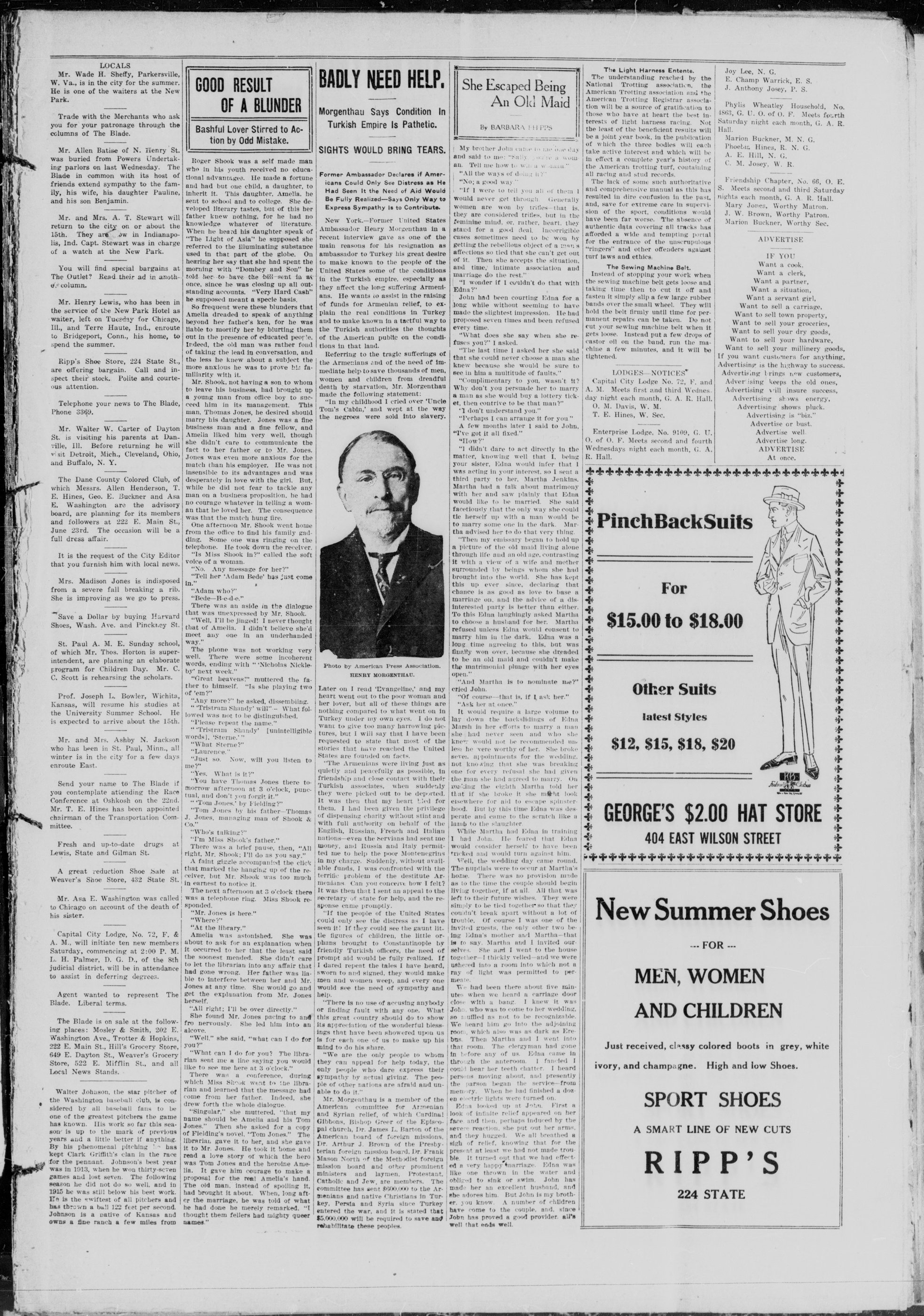
New York.—Former United States Ambassador Henry Morgenthau in a recent interview gave as one of the main reasons for his resignation as ambassador to Turkey his great desire to make known to the people of the United States some of the conditions in the Turkish empire, especially as they affect the long suffering Armenians. He wants to assist in the raising of funds for Armenian relief, to explain the real conditions in Turkey and to make known in a tactful way to the Turkish authorities the thoughts of the American public on the conditions in that land.
Referring to the tragic sufferings of the Armenians and of the need of immediate help to save thousands of men, women and children from dreadful death by starvation, Mr. Morgenthau made the following statement: "In my childhood I cried over 'Uncle Tom's Cabin,' and wept at the way the negroes were sold into slavery.
PETER H. HARRIS
Photo by American Press Association.
HENRY MORGENTHAU.
Later on I read 'Evangeline,' and my heart went out to the poor woman and her lover, but all of these things are nothing compared to what went on in Turkey under my own eyes. I do not want to give too many harrowing pictures, but I will say that I have been requested to state that most of the stories that have reached the United States are founded on facts.
"The Armenians were living just as quietly and peacefully as possible, in friendship and close contact with their Turkish associates, when suddenly they were picked out to be deported. It was then that my heart lied for them. I had been given the privilege of dispensing charity without stint and with full authority on behalf of the English, Russian, French and Italian nations—even the Servians had sent me money, and Russia and Italy permitted me to help the poor Montenegrins in my charge. Suddenly, without available funds, I was confronted with the terrific problem of the destitute Armenians. Can you conceive how I felt? It was then that I sent an appeal to the secretary of state for help, and the response came promptly.
"If the people of the United States could only see the distress as I have seen it! If they could see the gaunt little figures of children, the little orphans brought to Constantinople by friendly Turkish officers, the need of prompt aid would be fully realized. If I dared repent the tales I have heard, sworn to and signed, they would make men and women weep, and every one would see the need of sympathy and help.
"There is no use of accusing anybody or finding fault with any one. What this great country should do to show its appreciation of the wonderful blessings that have been showered upon us is for each one of us to make up his mind to do his share.
"We are the only people to whom they can appeal for help today, the only people who dare express their sympathy by actual giving. The people of other nations are afraid and unable to do it."
Mr. Morgenthau is a member of the American committee for Armenian and Syrian relief, of which Cardinal Gibbons, Bishop Greer of the Episcopal church, Dr. James L. Barton of the American board of foreign missions, Dr. Arthur J. Brown of the Presbyterian foreign mission board, Dr. Frank Mason North of the Methodist foreign mission board and other prominent ministers and laymen, Protestant, Catholic and Jew, are members. The committee has sent $600,000 to the Armenians and native Christians in Turkey, Persia and Syria since Turkey entered the war, and it is stated that $5,000,000 will be required to save and rehabilitate these peoples.
She Escaped Being An Old Maid
By BARBARA HIPPS
My brother John came to me one day and said to me: "rally, you be a woman. Tell me how to win a woman."
"All the ways of doing it?"
"No; a good way."
"If I were to tell you all of them I would never get through. Generally women are won by trifles—that is, they are considered trifles, but in the feminine mind, or, rather, heart, they stand for a good deal. Incorrigible cases sometimes need to be won by getting the rebellious object of a man's affections so tied that she can't get out of it. Then she accepts the situation, and time, intimate association and marriage do the rest."
"I wonder if I couldn't do that with Edna?"
John had been courting Edna for a long while without seeming to have made the slightest impression. He had proposed seven times and been refused every time.
"What does she say when she refuses you?" I asked.
"The last time I asked her she said that she could never choose a man she knew because she would be sure to see in him a multitude of faults."
"Complimentary to you, wasn't it? Why don't you persuade her to marry a man as she would buy a lottery ticket, then contrive to be that man?"
"I don't understand you."
"Perhaps I can arrange it for you"
"A few months later I said to John,
"I've got it all fixed."
"How?"
"I didn't dare to act directly in the matter, knowing well that I, being your sister, Edna would infer that I was acting in your interest, so I sent a third party to her, Martha Jenkins. Martha had a talk about matrimony with her and saw plainly that Edna would like to be married. She said facetiously that the only way she could tie herself up with a man would be to marry one in the dark. Martha advised her to do that very thing."
"Then my emissary began to hold up a picture of the old maid living alone through life and an old age, contrasting it with a view of a wife and mother surrounded by beings whom she had brought into the world. She has kept this up ever since, declaring that chance is as good as love to base a marriage on, and the advice of a disinterested party is better than either. To this Edna laughingly asked Martha to choose a husband for her. Martha refused unless Edna would consent to marry him in the dark. Edna was a long time agreeing to this, but was finally won over, because she dreaded to be an old maid and couldn't make the matrimonial plunge with her eyes open."
"And Martha is to nominate me?" cried John.
"Of course—that is, if I ask her."
"Ask her at once."
It would require a large volume to lay down the backslidings of Edna Marsh in her efforts to marry a man she had never seen and who she knew would not be recommended unless he were worthy of her. She broke seven appointments for the wedding, not knowing that she was breaking one for every refusal she had given the man she had agreed to marry. On rushing the eighth Martha told her that if she broke it she might look elsewhere for aid to escape spinsterhood. But by this time Edna was desperate and came to the scratch like a lamb to the slaughter.
While Martha had Edna in training I had John. He feared that Edna would consider herself to have been tricked and would turn against him.
Well, the wedding day came round. The nuptials were to occur at Martha's home. There was no provision made as to the time the couple should begin living together, if at all. All that was left to their future wishes. They were simply to be tied together so that they couldn't break apart without a lot of trouble. Of course I was one of the invited guests, the only other two being Edna's mother and Martha—that is to say, Martha and I invited ourselves. She and I went to the house together—I thickly veiled—and we were ushered into a room into which not a ray of light was permitted to permeate.
We had been there about five minutes when we heard a carriage door close with a bang. I knew it was John, who was to come to her wedding, so muffled as not to be recognizable. We heard him go into the adjoining room, which also was as dark as Erebus. Then Martha and I went into that room. The clergman had gone in before any of us. Edna came in through the anteroom. I fancied I could hear her teeth chatter. I heard persons moving about, and presently the parson began the service—from memory. When he had finished a dozen electric lights were turned on.
Edna looked up at John. First a look of infinite relief appeared on her face and then, perhaps induced by the severe reaction, she put out her arms, and they hugged. We all breathed a sigh of relief, knowing that for the present at least we had not made trouble. It turned out that we had effected a very happy marriage. Edna was like one thrown in the water and obliged to sink or swim. John has made her an excellent husband, and she adores him. But John is my brother, you know. A number of children have come to the couple, and, since John has proved a good provider, all's well that ends well.
The Light Harness Entente.
The understanding reached by the National Trotting association, the American Trotting association and the American Trotting Registrar association will be a source of gratification to those who have at heart the best interests of light harness racing. Not the least of the beneficient results will be a joint year book, in the publication of which the three bodies will each take active interest and which will be in effect a complete year's history of the American trotting turf, containing all racing and stud records.
The lack of some such authoritative and comprehensive manual as this has resulted in dire confusion in the past, and, save for extreme care in supervision of the sport, conditions would have been far worse. The absence of authentic data covering all tracks has afforded a wide and tempting portal for the entrance of the unscrupulous "ringers" and other offenders against turf laws and ethics.
The Sewing Machine Belt.
Instead of stopping your work when the sewing machine belt gets loose and taking time then to cut it off and fasten it simply slip a few large rubber bands over the small wheel. They will hold the belt firmly until time for permanent repairs can be taken. Do not cut your sewing machine belt when it gets loose. Instead put a few drops of castor oil on the band, run the machine a few minutes, and it will be tightened.
Capital City Lodge No. 72, F. and
A. M. Meets first and third Wednesday
night each month, G. A. R. Hall.
O. M. Davis, W. M.
T. E. Hines, W. Sec.
Enterprise Lodge, No. 9109, G. U.
O. of O. F. Meets second and fourth
Wednesdays night each month, G. A.
R. Hall.
PinchBackS
For
$15.00 to $18
Other Suits
latest Styles
$12, $15, $18, $
GEORGE'S $2.00
404 EAST WI
New Sum
MEN, WO
AND CH
Just received, classy col
ivory, and champagne. H
SPORT
chBackSuits
For
$5.00 to $18.00
Other Suits
latest Styles
2, $15, $18, $20
RGE'S $2.00 HAT ST
404 EAST WILSON STREET
New Summer Sh
PinchBackSuits
For
$15.00 to $18.00
Other Suits
latest Styles
$12, $15, $18, $20
GEORGE'S $2.00 HAT STORE
404 EAST WILSON STREET
---
New Summer Shoes
MEN, WOMEN AND CHILDREN received, classy colored boots in green champagne. High and low Shoes SPORT SHOES
Just received, classy colored boots in grey, white ivory, and champagne. High and low Shoes.
A SMART LINE OF NEW CUTS
RIPP'S
224 STATE
RIPP'S
224 STATE
Joy Lee, N. G.
E. Champ Warrick, E. S.
J. Anthony Josey, P. S.
Phylis Wheatley Household, No.
14863, G. U. O. of O. F. Meets fourth
Saturday night each month, G. A. R.
Hall.
Marion Buckner, M. N. G.
Phoebia Hines, R. N. G.
A. E. Hill, N. G.
C. M. Josey, W. R.
Friendship Chapter, No. 66, O. E.
S. Meets second and third Saturday
nights each month, G. A. R. Hall.
Mary Jones, Worthy Matron.
J. W. Brown, Worthy Patron.
Marion Buckner, Worthy Sec.
ADVERTISE
IF YOU
Want a cook,
Want a clerk,
Want a partner,
Want a situation,
Want a servant girl,
Want to sell a carriage,
Want to sell town property,
Want to sell your groceries,
Want to sell your dry goods,
Want to sell your hardware,
Want to sell your millinery goods,
If you want customers for anything,
Advertising is the highway to success.
Advertising brings new customers,
Advertising keeps the old ones,
Advertising will insure success,
Advertising shows energy,
Advertising shows pluck.
Advertising is "biz."
Advertise or bust.
Advertise well.
Advertise long.
ADVERTISE
At once.
uits
3.00
$20
00 HAT STORE
LSON STREET
mer Shoes
R --
DOMEN
ILDREN
red boots in grey, white
high and low Shoes.
SHOES
P'S
TATE
--- FOR ---
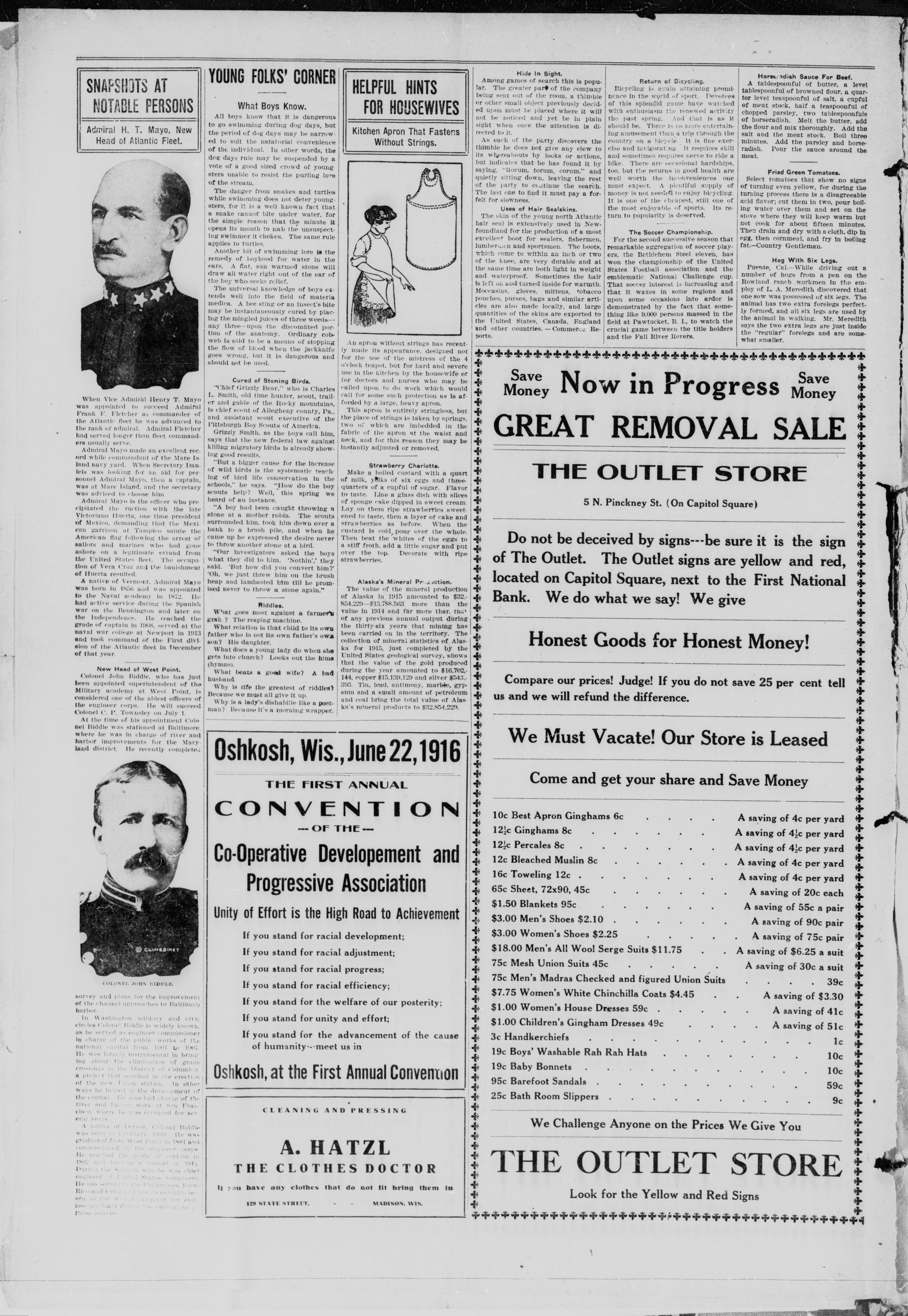
Admiral H. T. Mayo, New Head of Atlantic Fleet.
When Vice Admiral Henry T. Mayo was appointed to succeed Admiral Frank F. Fletcher as commander of the Atlantic fleet he was advanced to the rank of admiral. Admiral Fletcher had served longer than fleet commanders usually serve.
Admiral Mayo made an excellent record while commandant of the Mare Island navy yard. When Secretary Daniels was looking for an aid for personnel Admiral Mayo, then a captain, was at Mare Island, and the secretary was advised to choose him.
Admiral Mayo is the officer who precipitated the ruction with the late Victoriano Huerta, one time president of Mexico, demanding that the Mexican garrison at Tampico salute the American flag following the arrest of sailors and marines who had gone ashore on a legitimate errand from the United States fleet. The occupation of Vera Cruz and the banishment of Huerta resulted.
A native of Vermont, Admiral Mayo was born in 1856 and was appointed to the Naval academy in 1872. He had active service during the Spanish war on the Bennington and later on the Independence. He reached the grade of captain in 1908, served at the naval war college at Newport in 1913 and took command of the First division of the Atlantic fleet in December of that year.
New Head of West Point
Colonel John Biddle, who has just been appointed superintendent of the Military academy at West Point, is considered one of the ablest officers of the engineer corps. He will succeed Colonel C. 1. Townsend on July 1. At the time of his appointment Colonel Biddle was stationed at Baltimore, where he was in charge of river and harbor improvements for the Maryland district. He recently complete:
@ CLIMBINGST
COLONEL JOHN BUDDLE
survey and plans for the improvement of the channel approaches to Baltimore harbor.
In Washington military and civic circles Colonel Biddle is widely known, as he served as engineer commissioner in charge of the public works of the national capital from 1901 to 1907.
He was largely instrumental in bringing about the elimination of grade crossings in the District of Columbia a probed that resulted in the erection of the new Union station. In other ways he helped in the development of the capital. He also had charge of the river and harbor work at San Francisco, where he was occupied for several years.
A native of Detroit, Colonel Biddle was born in February 1850. He was graduated from West Point in 1851 and commissioned in the engineer corps. He reached the grade of captain in 1852 and became a colonel in 1914. During the Spanish war he was a engineer of United States volunteers. He has served in the Philippines, Puerto Rico and Cuba and has an enviable reputation in the war department for engineering tents during the conflicts, those tents.
Oshkosh, Wis., June 22, 1916
THE FIRST ANNUAL
CONVENTION
--- OF THE ---
Co-Operative Development and
Progressive Association
Unity of Effort is the High Road to Achievement
If you stand for racial development;
If you stand for racial adjustment;
If you stand for racial progress;
If you stand for racial efficiency;
If you stand for the welfare of our posterity;
If you stand for unity and effort;
If you stand for the advancement of the cause
of humanity--meet us in
Oshkosh, at the First Annual Convention
CLEANING AND PRESSING
A. HATZL
THE CLOTHES DOCTOR
If you have any clothes that do not fit bring them in
129 STATE STREET. MADISON, WIS.
YOUNG FOLKS' CORNER
What Boys Know.
All boys know that it is dangerous to go swimming during dog days, but the period of dog days may be narrowed to suit the natatorial convenience of the individual. In other words, the dog days rule may be suspended by a vote of a good sized crowd of youngsters unable to resist the purling lure of the stream.
The danger from snakes and turtles while swimming does not deter youngsters, for it is a well known fact that a snake cannot bite under water, for the simple reason that the minute it opens its mouth to nib the unsuspecting swimmer it chokes. The same rule applies to turtles.
Another bit of swimming lore is the remedy of boyhood for water in the ears. A flat, sun warmed stone will draw all water right out of the ear of the boy who seeks relief.
The universal knowledge of boys extends well into the field of materia medica. A bee sting or an insect's bite may be instantaneously cured by placing the mingled juices of three weeds—any three—upon the discomitted portion of the anatomy. Ordinary cobweb is said to be a means of stopping the flow of blood when the jackknife goes wrong, but it is dangerous and should not be used.
Cured of Stoning Birds
"Chief Grizzly Bear," who is Charles L. Smith, old time hunter, scout, trailer and guide of the Rocky mountains, is chief scout of Alleghegy county, Pa., and assistant scout executive of the Pittsburgh Boy Scouts of America.
Grizzly Smith, as the boys call him, says that the new federal law against killing migratory birds is already showing good results.
"But a bigger cause for the increase of wild birds is the systematic teaching of bird life conservation in the schools," he says. "How do the boy scouts help? Well, this spring we heard of an instance.
"A boy had been caught throwing a stone at a mother robin. The scouts surrounded him, took him down over a bank to a brush pile, and when he came up he expressed the desire never to throw another stone at a bird.
"Our investigators asked the boys what they did to him. 'Nothin', they said. 'But how did you convert him?' 'Oh, we just threw him on the brush heap and lambasted him till he promised never to throw a stone again."
Riddles.
What goes most against a farmer's grah? The reaping machine.
What relation is that child to its own father who is not its own father's own son? His daughter.
What does a young lady do when she gets into church? Looks out the hims (hymns).
What beats a good wife? A bad husband.
Riddles.
Why is life the greatest of riddles? Because we must all give it up. Why is a lady's dishabille like a postman? Because it's a morning wrapper.
Oshkosh, Wis.
THE FIRST CONVE
Kitchen Apron That Fastens Without Strings.
A
An apron without strings has recently made its appearance, designed not for the use of the mistress of the 4 o'clock teapot, but for hard and severe use in the kitchen by the housewife or for doctors and nurses who may be called upon to do work which would call for some such protection as is afforded by a large, heavy apron. This apron is entirely stringless, but the place of strings is taken by springs, two of which are imbedded in the fabric of the apron at the waist and neck, and for this reason they may be instantly adjusted or removed.
Strawberry Charlotte.
Make a boiled custard with a quart of milk, 3 milks of six eggs and three-quarters of a cupful of sugar. Flavor to taste. Line a glass dish with slices of sponge cake dipped in sweet cream. Lay on them ripe strawberries sweetened to taste, then a layer of cake and strawberries as before. When the custard is cold, pour over the whole. Then beat the whites of the eggs to a stiff froth, add a little sugar and put over the top. Decorate with ripe strawberries.
Alaska's Mineral Production.
Alaska is mineral production. The value of the mineral production of Alaska in 1915 amounted to $32,854,220—$13,788,563 more than the value in 1914 and far more than that of any previous annual output during the thirty-six years that mining has been carried on in the territory. The collection of mineral statistics of Alaska for 1915, just completed by the United States geological survey, shows that the value of the gold produced during the year amounted to $16,702,144, copper $15,139,129 and silver $543,393. Tin, lead, antimony, marble, gypsum and a small amount of petroleum and coal bring the total value of Alaska's mineral products to $32,854,220.
Save Money Now in Progress Save Money GREAT REMOVAL SALE THE OUTLET STORE
Do not be deceived by signs----be sure it is the sign of The Outlet. The Outlet signs are yellow and red, located on Capitol Square, next to the First National Bank. We do what we say! We give
Honest Goods for Honest Money!
Compare our prices! Judge! If you do not save 25 per cent tell us and we will refund the difference.
We Must Vacate! Our Store is Leased
We Challenge Anyone on the Prices We Give You
Look for the Yellow and Red Signs
Hide In Sight.
Among games of search this is popular. The greater part of the company being sent out of the room, a thimble or other small object previously decided upon must be placed where it will not be noticed and yet be in plain sight when once the attention is directed to it.
As each of the party discovers the thimble he does not give any clew to its whereabouts by looks or actions, but indicates that he has found it by saying, "Rorum, torum, corum." and quietly sitting down, leaving the rest of the party to continue the search. The last one to find it must pay a forfeit for slowness.
Uses of Hair Sealskins.
Uses of Hair Sealskins.
The skin of the young north Atlantic hair seal is extensively used in Newfoundland for the production of a most excellent boot for sealers, fishermen, lumbermen and sportsmen. The boots, which come to within an inch or two of the knee, are very durable and at the same time are both light in weight and waterproof. Sometimes the hair is left on and turned inside for warmth. Moccasins, gloves, mittens, tobacco pouches, purses, bags and similar articles are also made locally, and large quantities of the skins are exported to the United States, Canada, England and other countries. — Commerce Reports.
Return of Bicycling.
Bicycling is again attaining prominence in the world of sport. Devotees of this splendid game have watched with enthusiasm the renewed activity the past spring. And that is as it should be. There is no more entertaining amusement than a trip through the country on a bicycle. It is fine exercise and invigorating. It requires skill and sometimes requires nerve to ride a bike. There are occasional hardships, too, but the returns in good health are well worth the inconveniences one must expect. A plentiful supply of money is not needed to enjoy bicycling. It is one of the cheapest, still one of the most enjoyable of sports. Its return to popularity is deserved.
The Soccer Championship.
For the second successive season that remarkable aggregation of soccer players, the Bettlehem Steel eleven, has won the championship of the United States Football association and the emblematic National Challenge cup. That soccer interest is increasing and that it wakes in some regions and upon some occasions into ardor is demonstrated by the fact that something like 9,000 persons massed in the field at Pawtucket, R. I., to watch the crucial game between the title holders and the Fall River Rovers.
5 N. Pinckney St. (On Capitol Square)
Horseradish Sauce For Beef
A tablespoonful of butter, a level tablespoonful of browned flour, a quarter level teaspoonful of salt, a cupful of meat stock, half a teaspoonful of chopped parsley, two tablespoonfuls of horseradish. Melt the butter, add the flour and mix thoroughly. Add the salt and the meat stock. Boil three minutes. Add the parsley and horseradish. Pour the sauce around the meat.
Fried Green Tomatoes
Select tomatoes that show no signs of turning even yellow, for during the turning process there is a disagreeable acid flavor; cut them in two, pour boiling water over them and set on the stove where they will keep warm but not cook for about fifteen minutes. Then drain and dry with a cloth, dip in egg, then cormmeal, and fry in boiling fat.—Country Gentleman.
Hog With Six Legs.
Puente, Cal.-While driving out a number of hogs from a pen on the Rowland ranch workmen in the employ of L. A. Meredith discovered that one sow was possessed of six legs. The animal has two extra forelegs perfectly formed, and all six legs are used by the animal in walking. Mr. Meredith says the two extra legs are just inside the "regular" forelegs and are somewhat smaller.