Wisconsin Weekly Blade
Thursday, June 15, 1916
Milwaukee, Wisconsin
Page text (machine-generated)
The Wisconsin Weekly Blade
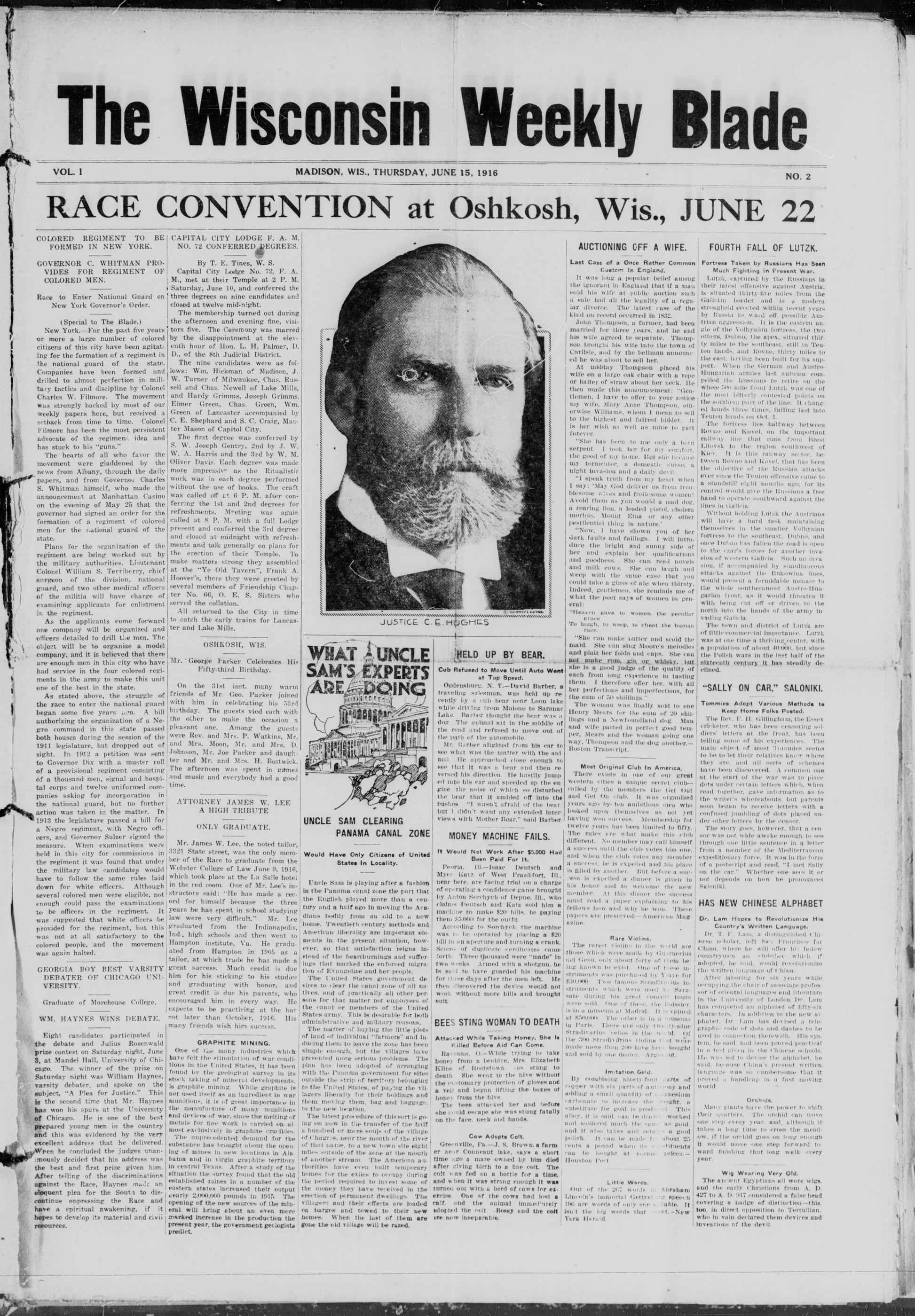
RACE CONVENTION at Oshkosh, Wis., JUNE 22
VOL. I
COLORED REGIMENT TO BE
FORMED IN NEW YORK.
GOVERNOR C. WHITMAN PRO-
VIDES FOR REGIMENT OF
COLORED MEN.
Race to Enter National Guard on
New York Governor's Order.
(Special to The Blade.)
New York.—For the past five years or more a large number of colored citizens of this city have been agitating for the formation of a regiment in the national guard of the state. Companies have been formed and drilled to almost perfection in military tactics and discipline by Colonel Charles W. Filmore. The movement was strongly backed by most of our weekly papers here, but received a setback from time to time. Colonel Filmore has been the most persistent advocate of the regiment idea and has stuck to his "guns."
The hearts of all who favor the movement were gladdened by the news from Albany, through the daily papers, and from Governor Charles S. Whitman himself, who made the announcement at Manhattan Casino on the evening of May 25 that the governor had signed an order for the formation of a regiment of colored men for the national guard of the state.
Plans for the organization of the regiment are being worked out by the military authorities. Lieutenant Colonel William S. Terriberry, chief surgeon of the division, national guard, and two other medical officers of the militia will have charge of examining applicants for enlistment in the regiment.
As the applicants come forward one company will be organized and officers detailed to drill the men. The object will be to organize a model company, and it is believed that there are enough men in this city who have had service in the four colored regiments in the army to make this unit one of the best in the state.
As stated above, the struggle of the race to enter the national guard began some five years ago. A bill authorizing the organization of a Negro command in this state passed both houses during the session of the 1911 legislature, but dropped out of sight. In 1912 a petition was sent to Governor Dix with a muster roll of a provisional regiment consisting of a thousand men, signal and hospital corps and twelve uniformed companies asking for incorporation in the national guard, but no further action was taken in the matter. In 1913 the legislature passed a bill for a Negro regiment, with Negro officers, and Governor Sulzer signed the measure. When examinations were held in this city for commissions in the regiment it was found that under the military law candidates would have to follow the same rules laid down for white officers. Although several colored men were eligible, not enough could pass the examinations to be officers in the regiment. It was suggested that white officers be provided for the regiment, but this was not at all satisfactory to the colored people, and the movement was again halted.
GEORGIA BOY BEST VARSITY
DEBATER OF CHICAGO UNI-
VERSITY.
Graduate of Morehouse College.
WM. HAYNES WINS DEBATE.
Eight candidates participated in the debate and Julius Rosenwald prize contest on Saturday night, June 3, at Mandel Hall, University of Chicago. The winner of the prize on Saturday night was William Haynes, varsity debater, and spoke on the subject, "A Plea for Justice." This is the second time that Mr. Haynes has won his spurs at the University of Chicago. He is one of the best prepared young men in the country and this was evidenced by the very excellent address that he delivered. Wren he concluded the judges unanimously decided that his address was the best and first prize given him. After telling of the discriminations against the Race, Haynes made an eloquent plea for the South to discontinue oppressing the Race and have a spiritual awakening, if it hopes to develop its material and civil resources.
CAPITAL CITY LODGE F. A. M.
NO. 72 CONFERRED DEGREES.
By T. E. Tines, W. S.
Capital City Lodge No. 72, F. A. M., met at their Temple at 2 P. M. Saturday, June 10, and conferred the three degrees on nine candidates and closed at twelve mid-night.
The membership turned out during the afternoon and evening fine, visitors five. The Ceremony was marred by the disappointment at the eleventh hour of Hon. L. H. Palmer, D. D., of the 8th Judicial District.
The nine candidates were as follows: Wm. Hickman of Madison, J. W. Turner of Milwaukee, Chas. Russell and Chas. Newell of Lake Mills, and Hardy Grimmes, Joseph Grimmes, Elmer Green, Chas. Green, Wm. Green of Lancaster accompanied by C. E. Shephard and S. C. Craig, Master Mason of Capitol City.
The first degree was conferred by S. W. Joseph Gentry, 2nd by J. W. W. A. Harris and the 3rd by W. M. Oliver Davis. Each degree was made more impressive as the Ritualistic work was in each degree performed without the use of books. The craft was called off at 6 P. M. after conferring the 1st and 2nd degrees for refreshments. Meeting was again called at 8 P. M. with a full Lodge present and conferred the 3rd degree and closed at midnight with refreshments and talk generally on plans for the erection of their Temple. To make matters strong they assembled at the "Ye Old Tavern", Frank A. Hoover's, there they were greeted by several members of Friendship Chapter No. 66, O. E. S. Sisters who served the collation.
All returned to the City in time to catch the early trains for Lancaster and Lake Mills.
OSHKOSH, WIS.
Mr. George Parker Celebrates His Fifty-third Birthday.
On the 31st inst. many warm friends of Mr. Geo. Parker joined with him in celebrating his 52nd birthday. The guests vied each with the other to make the occasion a pleasant one. Among the guests were Rev. and Mrs. P. Watkins, Mr. and Mrs. Moon, Mr. and Mrs. D. Johnson, Mr. Joe Parker and daughter and Mr. and Mrs. H. Bostwick. The afternoon was spent in games and music and everybody had a good time.
ATTORNEY JAMES W. LEE
A HIGH TRIBUTE
ONLY GRADUATE
Mr. James W. Lee, the noted tailor, 3321 State street, was the only member of the Race to graduate from the Webster College of Law June 9, 1916, which took place at the La Salle hotel in the red room. One of Mr. Lee's instructors said: "He has made a record for himself because the three years he has spent in school studying law were very difficult." Mr. Lee graduated from the Indianapolis, Ind., high schools and then went to Hampton institute, Va. He graduated from Hampton in 1905 as a tailor, at which trade he has made a great success. Much credit is due him for his sticking to his studies and graduating with honor, and great credit is due his parents, who encouraged him in every way. He expects to be practicing at the bar not later than October, 1916. His many friends wish him success.
GRAPHITE MINING
One of the many industries which have felt the stimulation of war conditions in the United States, it has been found by the geological survey in its stock taking of mineral developments, is graphite mining. While graphite is not used itself as an ingredient in war munitions, it is of great importance in the manufacture of many munitions and devices of war, since the melting of metals for fine work is carried on almost exclusively in graphite crucibles. The unprecedented demand for the substance has brought about the opening of mines in new locations in Alabama and in virgin graphite territory in central Texas. After a study of the situation the survey found that the old established raines in a number of the eastern states increased their output nearly 2,000,000 pounds in 1915. The opening of the new sources of the mineral will bring about an even more marked increase in the production the present year, the government geologists predict.
MADISON, WIS., THURSDAY, JUNE 15, 1916
C. W. H.
JUSTICE C.E. HUGHES
WHAT UNCLE
SAM'S EXPERTS
ARE DOING
UNCLE SAM CLEARING
PANAMA CANAL ZONE
Would Have Only Citizens of United States In Locality.
Uncle Sam is playing after a fashion in the Panama canal zone the part that the English played more than a century and a half ago in moving the Acadians bodily from an old to a new home. Twentieth century methods and American liberality are important elements in the present situation, however, so that satisfaction reigns instead of the heartburnings and sufferings that marked the enforced migration of Evangeline and her people.
The United States government desires to clear the canal zone of all natives, and of practically all other persons for that matter not employees of the canal or members of the United States army. This is desirable for both administrative and military reasons.
The matter of buying the little plots of land of individual "farmers" and inducing them to leave the zone has been simple enough, but the villages have presented more serious problems. The plan has been adopted of arranging with the Panama government for sites outside the strip of territory belonging to the United States, of paying the villagers liberally for their holdings and them moving them, bag and baggage, to the new location.
The latest procedure of this sort is going on now in the transfer of the half a hundred or more souls of the village of Chagres, near the mouth of the river of that name, to a new town site eight miles outside of the zone at the mouth of another stream. The American authorities have even built temporary homes for the exiles to occupy during the period required to invest some of the money they have received in the erection of permanent dwellings. The villagers and their effects are loaded on barges and towed to their new homes. When the last of them are gone the old village will be razed.
HELD UP BY BEAR.
Cub Refused to Move Until Auto Went at Top Speed.
Ogdensburg, N. Y.-David Barber, a traveling salesman, was held up recently by a cub bear near Loon lake while driving from Malone to Sarnacn Lake. Barber thought the bear was a dog. The animal sat in the middle of the road and refused to move out of the path of the automobile.
Mr. Barber alighted from his car to see what was the matter with the animal. He approached close enough to see that it was a bear and then reversed his direction. He hastily jumped into his car and speeded up the engine, the noise of which so disturbed the bear that it ambled off into the bushes. "I wasn't afraid of the bear, but I didn't want any extended interviews with Mother Bear," said Barber
MONEY MACHINE FAILS.
It Would Not Work After $5,000 Had Been Paid For It.
Peoria, Ill.-Isaac Deutsch and Myer Katz of West Frankfort, Ill., near here, are facing trial on a charge of operating a confidence game brought by Anton Sorchych of Depue, Ill., who claims Deutsch and Katz sold him a machine to make $20 bills, he paying them $5,000 for the outfit.
According to Sorchych, the machine was to be operated by placing a $20 bill in an aperture and turning a crank. Scores of duplicate certificates came forth. Three thousand were "made" in two weeks. Armed with a shotgun, he is said to have guarded his machine for three days after the men left. He then discovered the device would not work without more bills and brought suit.
BEES STING WOMAN TO DEATH
Attacked While Taking Honey, She Is Killed Before Aid Can Come.
Ravenna, O.-While trying to take honey from a beehive, Mrs Elizabeth Kline of Rootstown was stung to death. She went to the hive without the customary protection of gloves and a veil and began lifting the boxes of honey from the hive.
The bees attacked her and before she could escape she was stung fatally on the face, neck and hands.
Cow Adopts Colt
Greenville, Pa.-J. S. Brown, a farmer near Conneaut lake, says a short time ago a mare owned by him died after giving birth to a fine colt. The colt was fed on a bottle for a time, and when it was strong enough it was turned out with a herd of cows for exercise. One of the cows had lost a calf, and the animal immediately adopted the colt. Bossy and the colt are now inseparable.
AUCTIONING CFF A WIFE.
Last Case of a Once Rather Common Custom In England.
It was long a popular belief among the ignorant in England that if a man sold his wife at public auction such a sale had all the legality of a regular divorce. The latest case of the kind on record occurred in 1832.
John Thompson, a farmer, had been married for three years, and he and his wife agreed to separate. Thompson brought his wife into the town of Carlisle, and by the bellman announced he was about to sell her.
At midday Thompson placed his wife on a large oak chair with a rope or halter of straw about her neck. He then made this announcement: "Gentlemen, I have to offer to your notice my wife, Mary Anne Thompson, otherwise Williams, whom I mean to sell to the highest and fairest bidder. It is her wish as well as mine to part forever.
"She has been to me only a born serpent. I took her for my comfort, the good of my home. But she became my tormentor, a domestic curse, a night invasion and a daily devil.
"I speak truth from my heart when I say: 'May God deliver us from troublesome wives and froilosome women! Avoid them as you would a mad dog, a roaring lion, a loaded pistol, cholera morbus, Mount Etna or any other pestilential thing in nature.'
"Now, I have shown you of her dark faults and failings. I will introduce the bright and sunny side of her and explain her qualifications and goodness. She can read novels and milk cows. She can laugh and weep with the same ease that you could take a glass of ale when thirsty. Indeed, gentlemen, she reminds me of what the poet says of women in general:
"Heaven gave to women the peculiar grace
To laugh, to weep, to cheat the human race.
"She can make outter and scold the maid. She can sing Moore's melodies and plait her folds and caps. She can not make rum, gin or whisky, but she is a good judge of the quality of each from long experience in tasting them. I therefore offer her, with all her perfections and imperfections, for the sum of 50 shillings."
The woman was finally sold to one Henry Mears for the sum of 20 shillings and a Newfoundland dog. Man and wife parted in perfect good temper, Mears and the woman going one way, Thompson and the dog another.—Boston Transcript.
Most Original Club In America
There exists in one of our great western cities a unique secret club—called by the members the Get Out and Get On club. It was organized years ago by ten ambitious men who looked upon themselves as not yet having won success. Membership for twelve years has been limited to fifty. The rules are what make this club different. No member may call himself a success until the club votes him one, and when the club votes any member a success, he is expelled and his place is filled by another. But before a success is expelled a dinner is given in his honor and to welcome the new member. At this dinner the success must read a paper explaining to his fellows how and why he won. These papers are preserved.—American Magazine.
Bare Violins.
The rarest violins in the world are those which were made by Guarnerius del Gesu, only about forty of them being known to exist. One of these instruments was purchased by Ysaye for $30,000. Two famous Stradivarius instruments which were used by Sarasate during his great concert tours were sold. One of these, the Boissier is in a museum at Madrid. It is valued at $50,000. The other is in a museum in Paris. There are only twenty-nine Stradivarius cellos in the world. Of the 300 Stradivarius violins that were made more than 200 have been bought and sold by one dealer—Argonaut.
Imitation Gold
By combining ninety four parts of copper with six parts of antimony and adding a small quantity of magnesium carbonate to increase the weight, a substitute for gold is produced. This alloy, it is said, can be drawn worked and soldered much the same as gold, and it also takes and retains a gold polish. It can be made for about 25 cents a pound when its constituents can be bought at normal prices.—Houston Poet
Little Words
Out of the 267 words in Abraham Lincoln's immortal Gettysburg speech 196 are words of only one syllable. It isn't the big words that count. -New York Herald
NO.2
FOURTH FALL OF LUTZK.
Fortress Taken by Russians Has Seen Much Fighting in Present War.
Much Fighting in Present War.
Lutzk, captured by the Russians in their latest offensive against Austria, is situated thirty-five miles from the Galician border and is a modern stronghold erected within recent years by Russia to ward off possible Austrian aggression. It is the eastern angle of the Volhynian fortress, the two others, Dubno, the apex, situated thirty miles to the southeast, still in Teuton hands, and Rovno, thirty miles to the east, having been built for its support. When the German and Austro-Hungarian armies last autumn competed the Russians to retire on the whole 500 mile front Lutzk was one of the most bitterly contested points on the southern port of the line. It changed hands three times, falling last into Teuton hands on Oct. 1.
The fortress lies halfway between Rovno and Kovel, on the important railway line that runs from Brest Lilovsk to the region southwest of Kiev. It is this railway sector, between Rovno and Kovel, that has been the objective of the Russian attacks ever since the Teuton offensive came to a standstill eight months ago, for its control would give the Russians a free hand to operate southward against the lines in Galicia.
Without holding Lutzk the Austrians will have a hard task maintaining themselves in the smaller Volkynian fortress to the southeast, Dubno, and once Dubno has fallen the road is open to the czar's forces for another invasion of western Galicia. Such an invasion, if accompanied by simultaneous attacks against the Bukowina lines, would present a formidable menace to the whole southernmost Austro-Hungarian tront, as it would threaten it with being cut off or driven to the north into the hands of the army invading Galicia.
The town and district of Lutzk are of little commercial importance. Lutzk was at one time a thriving center, with a population of about 40,000, but since the Polish wars in the last half of the sixteenth century it has steadily declined.
"SALLY ON CAR" SALONIKI
Tommies Adopt Various Methods to Keep Home Folks Posted.
The Rev. F. H. Gillingham, the Essex cricketer, who has been censoring soldiers' letters at the front, has been telling some of his experiences. The main object of most Tommies seems to be to let their relatives know where they are, and all sorts of schemes have been discovered. A common one at the start of the war was to place dots under certain letters which, when read together, gave information as to the writer's whereabouts, but parents soon began to receive letters with a confused jumbling of dots placed under other letters by the censor.
The story goes, however, that a sensor was not wide awake enough to see through one little sentence in a letter from a member of the Mediterranean expeditionary force. It was in the form of a postscript and read, "I met Sally on the car." Whether one sees it or not depends on how he pronounces Salonikl.
HAS NEW CHINESE ALPHABET
Dr. Lam Hopes to Revolutionize His Country's Written Language.
Dr. T. F. Lam, a distinguished Chinese scholar, left Sa: Francisco for China, where he will offer his fellow countrymen an abstract which if adopted, he said, would revolutionize the written language of China.
After laboring for six years while occupying the chair of associate professor of oriental languages and literature in the University of London Dr. Lam has completed an alphabet of fifty-six characters. In addition to the new alphabet, Dr. Lam has devised a telegraphic code of dots and dashes to be used in connection therewith. His system, he said, had been practical in a test given in the Chinese schools. He was led to devise the alphabet, he said, because China's present written language was so cumbersome that it proved a handlecap in a fast moving world.
Orchids
Many plants have the power to shift their quarters. The orchid can move one step every year, and, although it takes a long time to cross the meadow, if the orchid goes on long enough it would move one step forward toward finishing that long walk every year.
Wig Wearing Very Old
The ancient Egyptians all wore wigs and the early Christians from A. D. 427 to A. D. 917 considered a false head covering a badge of distinction—this too, in direct opposition to Tertullian, who in vain declared them devices and inventions of the devil.
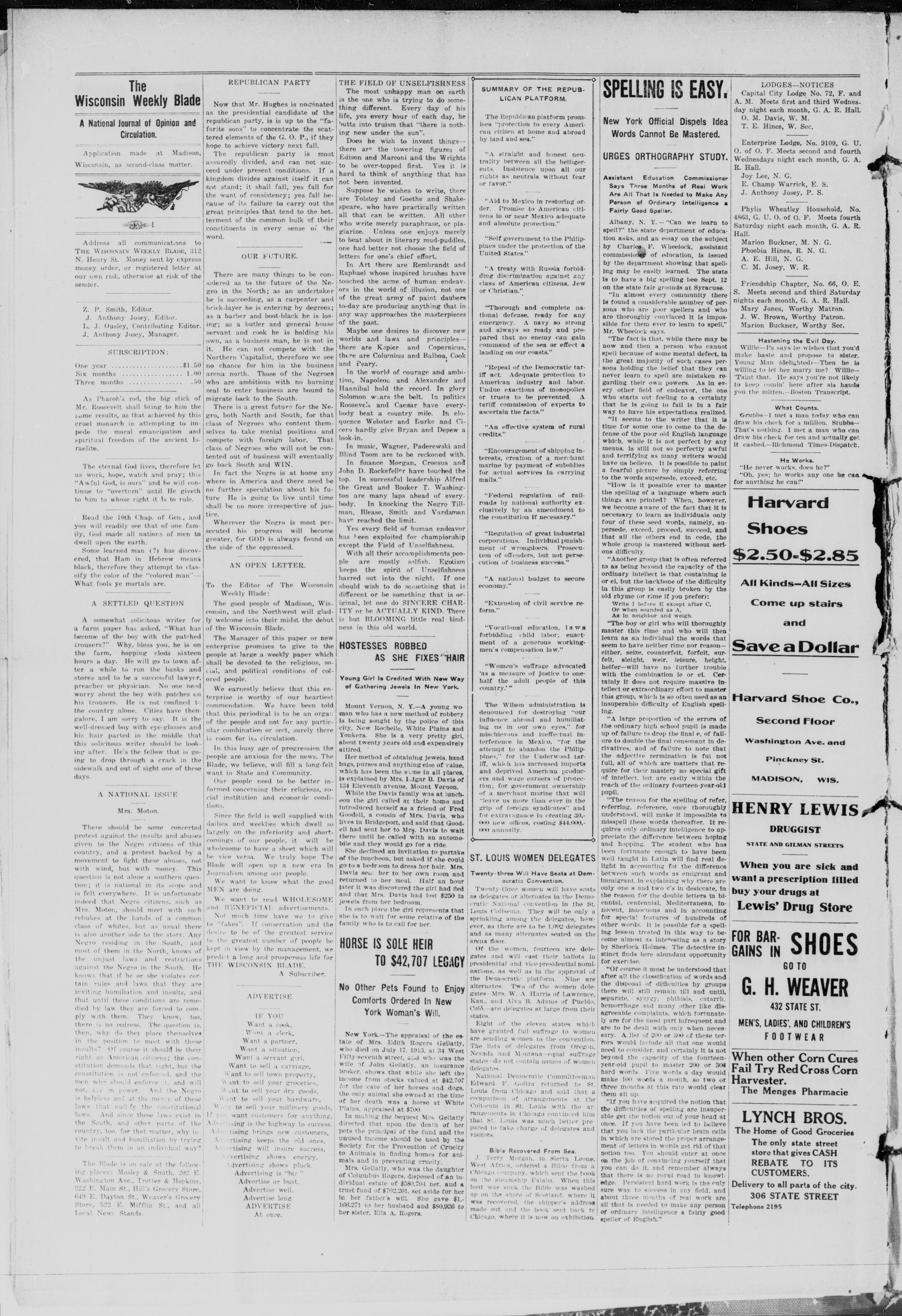
The Wisconsin Weekly Blade
A National Journal of Opinion and Circulation.
Application made at Madison Wisconsin, as second-class matter.
Address all communications to THE WISCONSIN WEEKLY BLADE, 312 N. Henry St. Money sent by express money order, or registered letter at our own risk, otherwise at risk of the sender.
Z. P. Smith, Editor.
J. Anthony Josey, Editor.
L. J. Ousley, Contributing Editor.
J. Anthony Josey, Manager.
SUBSCRIPTION:
One year ..... $1.50
Six months ..... 1.00
Three months ..... .50
As Pharoh's rod, the big stick of Mr. Roosevelt shall bring to him the same results, as that achieved by this cruel monarch in attempting to impede the moral emancipation and spiritual freedom of the ancient Israelite.
The eternal God lives, therefore let us work, hope, watch and pray; this "Awful God, is ours" and he will continue to "overturn" until He giveth to him to whose right it is to rule.
Read the 10th Chap. of Gen., and you will readily see that of one family, God made all nations of men to dwell upon the earth.
Some learned man (?) has discovered, that Ham in Hebrew means black, therefore they attempt to classify the color of the "colored man"—What tools ve mortals are.
A SETTLED QUESTION
A somewhat solicitous writer for a farm paper has asked, "What has become of the boy with the patched trousers?" Why, bless you, he is on the farm, hopping clods sixteen hours a day. He will go to town after a while to run the banks and stores and to be a successful lawyer, preacher or physician. No one need worry about the boy with patches on his trousers. He is not confined to the country alone. Cities have their galore, I am sorry to say. It is the well-dressed boy with eye-glasses and his hair parted in the middle that this solicitous writer should be looking after. He's the fellow that is going to drop through a crack in the sidewalk and out of sight one of these days.
A NATIONAL ISSUE
Mrs. Moton
There should be some concerted protest against the insults and abuses given to the Negro citizens of this country, and a protest backed by a movement to fight these abuses, not with wind, but with money. This question is not alone a southern question; it is national in its scope and is felt everywhere. It is unfortunate indeed that Negro citizens, such as Mrs. Moton, should meet with such rebukes at the hands of a common class of whites, but as usual there is also another side to the story. Any Negro residing in the South, and most of them in the North, knows of the unjust laws and restrictions against the Negro in the South. He knows that if he or she violates certain rules and laws that they are inviting humiliation and insults, and that until these conditions are remedied by law they are forced to comply with them. They know, too, there is no redress. The question is, then, why do they place themselves in the position to meet with these insults? Of course it should be their right as American citizens; the constitution demands that right, but the constitution is not enforced, and the men who should enforce it, and will not, see in power. And the Negro is helpless and at the mercy of these laws that nullify the constitutional laws. And since these laws exist in the South, and other parts of the country, too, for that matter, why invite insult and humiliation by trying to break them in an individual way?
The Blade is on sale at the following places: Mosley & Smith, 202 E. Washington Ave., Trotter & Hopkins, 222 E. Main St., Hill's Grocery Store, 649 E. Dayton St., Weaver's Grocery Store, 522 E. Mifflin St., and all Local News Stands.
REPUBLICAN PARTY
Now that Mr. Hughes is nominated as the presidential candidate of the republican party, is is up to the "favorite sons" to concentrate the scattered elements of the G. O. P., if they hope to achieve victory next fall. The republican party is most assuredly divided, and can not succeed under present conditions. If a kingdom divides against itself it can not stand; it shall fall, yes fall for the want of consistency; yes fall because of its failure to carry out the great principles that tend to the betterment of the common bulk of their constituents in every sense of the word.
OUR FUTURE.
There are many things to be considered as to the future of the Negro in the North; as an undertaker he is succeeding, as a carpenter and brick-layer he is entering by degrees; as a barber and boot-black he is losing; as a butler and general house servant and cook he is holding his own, as a business man, he is not in it. He can not compete with the Northern Capitalist, therefore we see no chance for him in the business arena north. Those of the Negroes who are ambitious with no burning zeal to enter business are bound to migrate back to the South.
There is a great future for the Negro, both North and South, for that class of Negroes who content themselves to take menial positions and compete with foreign labor. That class of Negroes who will not be contented out of business will eventually go back South and WIN.
In fact the Negro is at home any where in America and there need be no further speculation about his future. He is going to live until time shall be no more irrespective of justice.
Wherever the Negro is most persecuted his progress will become greater, for GOD is always found on the side of the oppressed.
AN OPEN LETTER
To the Editor of The Wisconsin Weekly Blade:
The good people of Madison, Wisconsin, and the Northwest will gladly welcome into their midst the debut of the Wisconsin Blade.
The Manager of this paper or new enterprise promises to give to the people at large a weekly paper which shall be devoted to the religious, social, and political conditions of colored people.
We earnestly believe that this enterprise is worthy of our heartiest commendation. We have been told that this periodical is to be an organ of the people and not for any particular combination or sect, surely there is room for its circulation.
In this busy age of progression the people are anxious for the news. The Blade, we believe, will fill a long-felt want in State and Community.
Our people need to be better informed concerning their religious, social institution and economic conditions.
Since the field is well supplied with dailies and weeklies which dwell so largely on the inferiority and short-comings of our people, it will be wholesome to have a sheet which will be vice versa. We truly hope The Blade will open up a new era In Journalism among our people.
We want to know what the good MEN are doing.
We want to read WHOLESOME and BENEFICIAL advertisements.
and BENEFICIAL advertisements.
Not much time have we to give to "fakes". If conservation and the desire to be of the greatest service to the greatest number of people be kept in view by the management, we predict a long and prosperous life for THE WISCONSIN BLADE.
A. Subscriber.
ADVERTISE
IF YOU
Want a cook,
Want a clerk,
Want a partner,
Want a situation,
Want a servant girl,
Want to sell a carriage,
Want to sell town property,
Want to sell your groceries,
Want to sell your dry goods,
Want to sell your hardware,
Want to sell your millinery goods
If you want customers for anything
Advertising is the highway to success
Advertising brings new customers,
Advertising keeps the old ones,
Advertising will insure success,
Advertising shows energy,
Advertising shows pluck.
Advertising is "biz."
Advertise or bust.
Advertise well.
Advertise long.
ADVERTISE
At once.
THE FIELD OF UNSELFISHNESS
The most unhappy man on earth is the one who is trying to do something different. Every day of his life, yes every hour of each day, he butts into truism that "there is nothing new under the sun".
Does he wish to invent things—there are the towering figures of Edison and Marconi and the Wrights to be over-topped first. Yes it is hard to think of anything that has not been invented.
Suppose he wishes to write, there are Tolstoy and Goethe and Shakespeare, who have practically written all that can be written. All other who write merely paraphrase, or plagiarize. Unless one enjoys merely to beat about in literary mud-puddles, one had better not choose the field of letters for one's chief effort.
In Art there are Rembrandt and Raphael whose inspired brushes have touched the acme of human endeavors in the world of illusion, not one of the great army of paint daubers to-day are producing anything that in any way approaches the masterpieces of the past.
Maybe one desires to discover new worlds and laws and principles—there are Kapier and Copernicus, there are Columbus and Balboa, Cook and Peary.
In the world of courage and ambition, Napoleon and Alexander and Hannibal hold the record. In glory Solomon wears the belt. In politics Roosevelt and Caesar have everybody beat a country mile. In eloquence Webster and Burke and Cicero hardly give Bryan and Depew a look-in.
In music, Wagner, Paderewski and Blind Toom are to be reckoned with. In finance Morgan, Croesus and John D. Rockefeller have touched the top. In successful leadership Alfred the Great and Booker T. Washington are many laps ahead of everybody. In knocking the Negro Tillman, Blease, Smith and Vardaman have reached the limit.
Yes every field of human endeavor has been exploited for championship except the Field of Unselfishness.
With all their accomplishments, people are mostly selfish. Egotism keeps the spirit of Unselfishness barred out into the night. If one should wish to do something that is different or be something that is original, let one do SINCERE CHARITY or be ACTUALLY KIND. There is but BLOOMING little real kindness in this old world.
HOSTESSES ROBBED
AS SHE FIXES HAIR
Young Girl Is Credited With New Way of Gathering Jewels In New York.
Mount Vernon, N. Y.—A young woman who has a new method of robbery is being sought by the police of this city, New Rochelle, White Plains and Yonkers. She is a very pretty girl, about twenty years old and expensively attired.
Her method of obtaining jewels, hand bags, purses and anything else of value, which has been the same in all places, is explained by Mrs. Edgar B. Davis of 134 Eleventh avenue, Mount Vernon.
While the Davis family was at uncleon the girl called at their home and introduced herself as a friend of Fred Goodell, a cousin of Mrs. Davis, who lives in Bridgeport, and said that Goodell had sent her to Mrs. Davis to wait there until he called with an automobile and they would go for a ride.
She declined an invitation to partake of the luncheon, but asked if she could go to a bedroom to dress her hair. Mrs. Davis sent her to her own room and returned to her meal. Half an hour later it was discovered the girl had fed and that Mrs. Davis had lost $250 in jewels from her bedroom. In each place the girl represents that she is to wait for some relative of the family who is to call for her.
HORSE IS SOLE HEIR
TO $42,707 LEGACY
No Other Pets Found to Enjoy Comforts Ordered In New York Woman's Will.
New York.—The appraisal of the estate of Mrs. Edith Rogers Gellatly, who died on July 17, 1913, at 34 West Fifty-seventh street, and who was the wife of John Gellatly, an insurance broker, shows that while she left the income from stocks valued at $42,707 for the care of her horses and dogs, the only animal she owned at the time of her death was a horse at White Plains, appraised at $700.
In making the bequest Mrs. Gellatly directed that upon the death of her pets the principal of the fund and the unused income should be used by the Society for the Prevention of Cruelty to Animals in finding homes for animals and in preventing cruelty.
Mrs. Gellatly, who was the daughter of Columbus Rogers, disposed of an individual estate of $58,704 net, and a trust fund of $702,201, set aside for her in her father's will. She gave $1,106,271 to her husband and $80,926 to her sister, Ella A. Rogers.
SUMMARY OF THE REPUB
LICAN PLATFORM.
The Republican platform promises "protection to every American citizen at home and abroad by land and sea."
"A straight and honest neutrality between all the belligerents. Insistence upon all our rights as neutrals without fear or favor."
"Aid to Mexico in restoring order. Promise to American citizens in or near Mexico adequate and absolute protection."
"Self government to the Philippines under the protection of the United States."
"A treaty with Russia forbidding discrimination against any class of American citizens, Jew or Christian."
"Thorough and complete national defense, ready for any emergency. A navy so strong and always so ready and prepared that no enemy can gain command of the sea or effect a landing on our coasts."
"Repeal of the Democratic tariff act. Adequate protection to American industry and labor. Undue exactions of monopolies or trusts to be prevented. A tariff commission of experts to ascertain the facts."
"An effective system of rural credits."
"Encouragement of shipping interests, creation of a merchant marine by payment of subsidies for actual services in carrying mails."
"Federal regulation of railroads by national authority exclusively by an amendment to the constitution if necessary."
"Regulation of great industrial corporations. Individual punishment of wrongdoers. Prosecution of offenders, but not persecution of business success."
"A national budget to secure economy."
"Extension of civil service reform."
"Vocational education, laws forbidding child labor; enactment of a generous working-man's compensation law."
"Women's suffrage advocated 'as a measure of justice to one-half the adult people of this country.'"
The Wilson administration is denounced for destroying "our influence abroad and humiliating us in our own eyes," for mischievous and ineffectual interference in Mexico, "for the attempt to abandon the Philippines," for the Underwood tariff, which has increased imports and deprived American producers and wage earners of protection; for government ownership of a merchant marine that will "leave us more than ever in the grip of foreign syndicates" and for extravagance in creating 30,000 new offices, costing $44,000,000 annually.
ST. LOUIS WOMEN DELEGATES
Twenty-three Will Have Seats at Democ-ocratic Convention.
Twenty-three women will have seats as delegates or alternates in the Democ-ocratic National convention in the St. Louis Coliseum. They will be only a sprinkling among the delegates, however, as there are to be 1,092 delegates and as many alternates seated on the arena floor.
Of the women, fourteen are delegates and will cast their ballots in presidential and vice presidential nominations, as well as in the approval of the Democ-ocratic platform. Nine are alternates. Two of the women delegates—Mrs. W. A. Harris of Lawrence, Kan., and Alva B. Adams of Pueblo, Coli—are delegates at large from their states.
Eight of the eleven states which have granted full suffrage to women are sending women to the convention. The lists of delegates from Oregon, Nevada and Montana—equal suffrage states—do not contain names of women delegates.
National Democratic Committeeman Edward F. Goltra returned to St. Louis from Chicago and said that a comparison of arrangements at the Coliseum in St. Louis with the arrangements in Chicago convinced him that St. Louis was much better prepared to take charge of delegates and visitors.
Bible Recovered From Sea
J. Terry Morgan, in Sierra Leone, West Africa, ordered a Bible from a Chicago company, which sent the book on the steamship Falaaba. When this boat was sunk the Bible was washed up on the shore of Scotland, where it was recovered, the shipper's address made out and the book sent back to Chicago, where it is now on exhibition.
SPELLING IS EASY.
New York Official Dispels Idea Words Cannot Be Mastered.
URGES ORTHOGRAPHY STUDY.
Assistant Education Commissioner Says Three Months of Real Work Are All That Is Needed to Make Any Person of Ordinary Intelligence a Fairly Good Speller.
Albany, N. Y. — "Can we learn to spell?" the state department of education asks, and an essay on the subject by Charles F. Wheelock, assistant commissioner of education, is issued by the department showing that spelling may be easily learned. The state is to have a big spelling bee Sept. 12 on the state fair grounds at Syracuse.
"In almost every community there is found a considerable number of persons who are poor spellers and who are thoroughly convinced it is impossible for them ever to learn to spell."
Mr. Wheelock says.
"The fact is that, while there may be now and then a person who cannot spell because of some mental defect, in the great majority of such cases persons holding the belief that they can never learn to spell are mistaken regarding their own powers. As in every other field of endeavor, the one who starts out feeling to a certainty that he is going to fail is in a fair way to have his expectations realized.
"It seems to the writer that it is time for some one to come to the defense of the poor old English language which, while it is not perfect by any means, is still not so perfectly awful and terrifying as many writers would have us believe. It is possible to paint a fearful picture by simply referring to the words supersedes, exceed etc.
"How is it possible ever to master the spelling of a language where such things are printed? When, however, we become aware of the fact that it is necessary to learn as individuals only four of these seed words, namely, supersede, exceed, proceed, succeed, and that all the others end in cede, the whole group is mastered without serious difficulty.
"Another group that is often referred to as being beyond the capacity of the ordinary intellect is that containing ie or el, but the backbone of the difficulty in this group is easily broken by the old rhyme (or rime if you prefer):
Write I before E except after C.
"The boy or girl who will thoroughly master this rime and who will then learn as an individual the words that seem to have neither rime nor reason—either, seize, counterfeit, forfeit, surfeit, sleight, weir, leisure, height, heifer—will have no further trouble with the combination ie or et. Certainly it does not require massive intellect or extraordinary effort to master this group, which is so often used as an insuperable difficulty of English spelling.
"A large proportion of the errors of the ordinary high school pupil is made up of failure to drop the final e, of failure to double the final consonant in derivatives, and of failure to note that the adjective termination is ful not full, all of which are matters that require for their mastery no special gift of intellect, but are easily within the reach of the ordinary fourteen-year-old pupil.
"The reason for the spelling of refer, referring, reference, once thoroughly understood, will make it impossible to misspell these words thereafter. It requires only ordinary intelligence to appreciate the difference between hoping and hopping. The student who has been fortunate enough to have been well taught in Latin will find real delight in accounting for the difference between such words as emigrant and immigrant, in explaining why there are only one s and two c's in desiccate, in the reason for the double letters in biennial, centennial, Mediterranean, innocent, innocuous and in accounting for special features of hundreds of other words. It is possible for a spelling lesson treated in this way to become almost as interesting as a story by Sherlock Holmes. The detective instinct finds here abundant opportunity for exercise.
"Of course it must be understood that after all the classification of words and the disposal of difficulties by groups there will still remain dill and until, separate, syzzyg, phthisis, catarrh, hemorrhage and many other like disagreeable complaints, which fortunately are for the most part infrequent and are to be dealt with only when necessary. A list of 200 or 300 of these terrors would include all that one would need to consider, and certainly it is not beyond the capacity of the fourteen-year-old pupil to master 200 or 300 hard words. Five words a day would make 100 words a month, so two or three months at this rate would clear them all up.
"If you have acquired the notion that the difficulties of spelling are insuperable get the notion out of your head at once. If you have been led to believe that you lack the particular brain cells in which are stored the proper arrangement of letters in words get rid of that notion too. You should enter at once on the job of convincing yourself that you can do it, and remember always that there is no royal road to knowledge. Persistent hard work is the only sure way to success in any field, and about three months of real work are all that is needed to make any person of ordinary intelligence a fairly good speller of English."
Capital City Lodge No. 72, F. and A. M. Meets first and third Wednesday night each month, G. A. R. Hall.
O. M. Davis, W. M.
T. E. Hines, W. Sec.
Enterprise Lodge, No. 9109, G. U. O. of O. F. Meets second and fourth Wednesdays night each month, G. A. R. Hall.
Joy Lee, N. G.
E. Champ Warrick, E. S.
J. Anthony Josey, P. S.
Phylis Wheatley Household, No. 4863, G. U. O. of O. F. Meets fourth Saturday night each month, G. A. R. Hall.
Marion Buckner, M. N. G.
Phoebia Hines, R. N. G.
A. E. Hill, N. G.
C. M. Josey, W. R.
Friendship Chapter, No. 66, O. E.
S. Meets second and third Saturday
nights each month, G. A. R. Hall.
Mary Jones, Worthy Matron.
J. W. Brown, Worthy Patron.
Marion Buckner, Worthy Sec.
Hastening the Evil Day.
Willie—Pa says he wishes that you'd
make haste and propose to sister,
Young Man (delighted)—Then he is
willing to let her marry me? Willie—
Taint that. He says you're not likely
to keep comin' here after sis hands
you the mitten.—Boston Transcript.
What Counts.
Grubbs—I met a man today who can draw his check for a million. Stubbs—That's nothing. I met a man who can draw his check for ten and actually get it cashed.—Richmond Times-Dispatch.
He Works.
"He never works, does he?"
"Oh, yes; he works any one he can for anything he can!"
Harvard
Shoes
$2.50-$2.85
All Kinds-All Sizes
Come up stairs
and
Save a Dollar
Harvard Shoe Co.,
Second Floor
Washington Ave. and Pinckney St. MADISON, WIS.
HENRY LEWIS
DRUGGIST
STATE AND GILMAN STREETS
When you are sick and want a prescription filled buy your drugs at Lewis' Drug Store
FOR BAR-
GAINS IN SHOES
GO TO
G. H. WEAVER
432 STATE ST.
MEN'S, LADIES', AND CHILDREN'S
FOOT WEAR
When other Corn Cures
Fail Try RedCross Corn
Harvester.
The Menges Pharmacie
LYNCH BROS.
The Home of Good Groceries
The only state street
store that gives CASH
REBATE TO ITS
CUSTOMERS.
Delivery to all parts of the city.
306 STATE STREET
Telephone 2195
Mrs. J. W. Brown is President of the Woman's Mite Missionary and is expecting to attend the meeting of that department, which meets in Minneapolis July 11th.
Mrs. Wesley Harris of Orchard street left Friday last, for a short visit in the east.
Trade with the Merchants who ask you for your patronage through the columns of The Blade.
Mrs. Thos. Horton and family have moved to 613 Clymer Place, on the West side.
Rev. L. J. Phillips, Pastor of the local A. M. E. church, J. W. Brown, Delegate; Misses Ester Horton, Gladys Buckner, Delegates of the Sunday School and Thos. Horton, President of the Sunday School.
You will find special bargains at The Outlet? Read their ad in another column.
Miss Sylvia Alexander has accepted the position as Lady Assistant with Prof. Strong.
A lawn Social was given by the delegates Monday evening on Mrs. Bennie Butts' lawn and quite a few were there. What was realized financially is not yet learned.
Ripp's Shoe Store, 224 State St. are offering bargain. Call and inspect their stock. Polite and courteous attention.
Prof. Strong, the expert Chiropadist, is nicely quartered in a beautiful office at 9 E. Main street. He is prepared to treat all foot troubles. Give him a call.
The Sunday Forum met last Monday evening at the A. M. E. church in a mass meeting. Business for the church and other business was transacted.
Telephone your news to The Blade, Phone 3369.
The District Conference of the A.
M. E. Church will be held at Elgin,
Ill., opening Wednesday, June 14th
Mr. and Mrs. John Smith have moved from the west side, now living at 114 N. Blair St.
The Dane County Colored Club, of which Messrs. Allen Henderson, T. E. Hines, Geo. E. Buckner and Asa E. Washington are the advisory board, are planning for its members and followers at 222 E. Main St., June 23rd. The occasion will be a full dress affair.
Friendship Chapter, O. E. S., will hold their annual services at the A. M. E. Church, Sunday evening, June 18th, 7:30 P. M. The Choir will render some very choice selections for the occasion. Rev. L. J. Phillips will preach the sermon.
It is the request of the City Editor that you furnish him with local news.
Send your name to The Blade if you contemplate attending the Race Conference at Oshkosh on the 22nd. Mr. T. E. Hines has been appointed chairman of the Transportation Committee.
Mrs. Essie Dortch Mack will furnish the readers of The Blade the news of her city, Louisville, Ky. Mr. and Mrs. Mack were once residents of Madison and made many warm friends.
Mr. A. N. Henderson, graduate of Knoxville College, Tenn., is in the city for the summer with the view of entering the University this fall. He is at the home of Mr. and Mrs. W. J. Powell, Blount St.
Save a Dollar by buying Harvard Shoes, Wash. Ave. and Pinckney St.
Mr. Chas. Anthony Mathews is visiting his parents in Sioux City, Iowa, for two weeks, before leaving his employees presented him with a watch. They are anxiously awaiting his return.
Mr. Joseph Gentry left this A. M. to accompany his wife as far as Chicago on her trip south.
Little Maxine Turner of Chicago is spending the summer with her aunt Mrs. Henry Walters.
Mr. Marva R. Shivers of Delly writes The Blade that he will be in attendance of the Race Convention at Oshkosh.
---
Mr. Geo. English, 768 W. Washington Ave., is spending his vacation visiting friends in Des Moines, Iowa.
Mr. John R. Davis of Kansas City is in the city as waiter at The New Park Hotel.
Mr. T. E. Hines, chairman of the transportation committee of the Race Convention at Oshkosh is planning to have Madison well represented. The list of those expected to attend is increasing daily. Send your name to The Blade, a full list will be published in next issue.
Mr. Earl Broughton, Tallahassee, Fla., is planning to enter 4C College. He is a recent graduate of the State College.
A great reduction Shoe Sale at Weaver's Shoe Store, 432 State St.
Calvin Smith has returned from the Janesville school and is now spending vacation with his father, Rev. Z. P. Smith, 548 W. Gorham St.
Fresh and up-to-date drugs at Lewis, State and Gilman St.
There was a musicale at the home of Mr. and Mrs. Billingsleas last evening, much to the delight of all present.
Agent wanted to represent The Blade. Liberal terms.
Mr. Elmer Green of Lancaster, Wis., paid our office a visit and was loud in praise of The Blade.
Mr. Philip Brown was in from Middleton shaking hands with his many friends.
Mr. Howard Sheppard was in Lancaster this week attending High School exercises. He was the guest of Mr. Ed. Sheppard and his cousin Miss Verra Green who was one of the graduates.
Mrs. Mildred Carter is up and out after an indisposition of several days.
The Blade is planning on issuing a special edition of Madison children. Let us have the photo of your boy or girl.
Rev. Thos. C. Devlin, former pastor of St. Paul M. E. church has been invited to deliver the sermon for Capital City Lodge, F. A. and M. on St. John Day.
The Blade is operating an employment agency; all kinds of work furnished.
The genial and affable Mr. J. R. Young will represent The Blade in Duluth, Minn., and furnish the local happenings of his city.
Miss Cleo Carey, Baxton, Iowa, is visiting Mrs. H. B. Green, Lancaster, Wis.
Mr. I. Brown of 413 State St. left last Tuesday for Superior, Wis., and Bay City, Mich.
Mrs. Daisy Gentry leaves today for a two months stay visiting her parents in Gourdin, Ark. She will stop in Chicago, being entertained by her many friends, before returning she will visit Louisville, Ky., Memphis, Tenn., and Oklahoma.
Mr. Madison Jones will join the party to attend the Race Convention at Oshkosh on the 22nd.
LET THE MADISON STEAM DYE WORKS DO YOUR CLEANING.
Remember the merchants appreciate your trade by advertising in The Blade.
Miss Verra Green, daughter of Mrs. Melissa Green and Niece of Mrs. O. M. Davis, graduated from the Lancaster high school last week. Miss Green will furnish news of Lancaster for The Blade.
Miss Mary Watkins, instructor of music in the institute for the blind at Little Rock, Ark., is in the city at the home of Mr. and Mrs. Jas. Jordan, 214 N. Hamilton St. Miss Watkins is the niece of Mr. W. R. Harris.
NOTICE TO READERS
All matter for publication must reach this office no later than Wednesday morning and be sent in the name of the Wisconsin Blade and not in the names of individuals if you wish same to have immediate attention.
Drafts or checks must be made out in the name of the Blade; NOT TO ANY INDIVIDUAL.
J. Josey, Manager.
RECRUITING NOW A DIFFICULT TASK
Officers Want a More Liberal Interpretation of Rules. STANDARD REMAINS HIGH.
Only a Few of the 30,000 Men Needed to Bring Army Up to Full Strength Have Been Accepted—Regulations Enforced to the Letter by Officers In Charge.
Unless more vigorous enlistment measures succeed in getting the men required under the new army bill there is likely to be a shakeup in the recruiting branch of the service. Some army officers are inclined to complain that too many applicants for the army are rejected because of strict technical interpretation of the requirements.
Responsibility for recruiting the army up to service requirements under the new army bill rests with Adjutant General H. P. McCain. Officers of the army general staff are determined that the necessary improvement in recruiting shall be effected, and if Adjutant General McCain cannot produce the results efforts will be made to find a successor who can.
General McCain is aware of the responsibility resting on him. He testified before the house military affairs committee last January that under the voluntary system of enlistment the maximum number of men that can be recruited, using all proper methods, in any one year would not exceed 50,000. This figure represents only a very slight addition to the army, as the war department has been required annually to recruit between 30,000 and 40,000 men to fill vacancies due to expiration of enlistments and other causes. The adjutant general is not prepared to say, in face of the country's new interest in the regular army strength, that 50,000 is the maximum number that can be enlisted in a year. He is prepared to assume responsibility for getting the men required.
"It's up to me to get the men," he said recently in this connection, "and I'm going to get them."
Many Rejections.
Many army officers doubt if the war department can, without any provision for compulsory service, get the additional men required under the bill for 175,000 fighting men except by decidedly more vigorous and expedient recruiting measures and possibly some change in the way applicants are tested under the present recruiting standards. Of the 168,182 applicants last year the war department rejected 123,731, making the enlistment total about 45,000. General McCain says that the great number of rejections is due to the high standard of the army requirements.
However, some criticism is heard to the effect that the standards are too rigidly enforced, and much more to the effect that the measures of recruiting are not the best possible. Applicants for first enlistment must be "between the ages of eighteen and thirty-five years, of good character and temperate habits, ablebodied, free from disease, and must be able to speak, read and write the English language." It is pointed out that these general requirements are subject to pretty broad interpretation and that possibly some candidates for the army have been required to read and write better than was actually necessary for even a first class soldier. It is known, of course, that some congress leaders have not been averse to seeing the size of the army kept down and the validity of many rejections has been no cause of anxiety to them.
In view of the adoption of the conference report on the army reorganization bill new methods of enlistment are under consideration. While no one is seriously proposing that the army requirements shall be materially reduced, it will occasion no surprise if those who have the recruiting in charge adopt a somewhat less technical attitude toward these requirements as well as new methods. One criticism as to method is that in New York city recruiting stations have been maintained on Fifth avenue while the possibilities of the ferry approaches have been neglected.
TO SAVE MIGRATORY BIRDS.
President Must First Approve Regulations Issued by Secretary Houston Proposed regulations for the protection of migratory birds, in effect Aug. 16 or whenever thereafter they are approved by the president, have been issued by Secretary Houston. Hearings will be held on any complaints filed after the public has examined the regulations. Two zones with different closed seasons are established for protection, one a breeding zone and the other a wintering zone. All states north of Delaware, Maryland, Virginia, Tennessee, Arkansas, Oklahoma, Texas, New Mexico, Arizona and California are declared in the breeding zone and the states named and those south of them in the wintering zone.
The closed season for waterfowl, including brant, wild ducks, geese and swans, is set as Dec. 21 to Sept. 6, inclusive, in the breeding zone and Feb. 1 to Oct. 14, inclusive, in the wintering zone, with exceptions in certain states.
HANDFUL HELD FORT VAUXA WEEK
A Thousand Frenchman Tried to Hold Off Horde of Germans.
HAND TO HAND FIGHTING
Besiegers Took to Using Liquid Fire and the Brave Defenders at Last Had to Give Way Before Tremendous Odds—Few Survivors Who Surrendered Were In Deepest Condition. Fort Vaux, which was taken by the Germans in their advance toward Verdun, France, had been practically besieged for ninety days before it fell. Paris newspapers estimate that it cost the Germans 100,000 men to capture the fort.
When the situation at last became critical the commandant, Chief of Battalion Raynal, a tried soldier, who had risen from the ranks, had hardly more than 1,000 men with whom to continue the defense. His task was to hold the half ruined fort against overwhelming masses of infantry, supported by more than 100 batteries of heavy guns. Re-enforcements could not reach him owing to the terrible efficacy of the German fire.
For a week, alone and unaided, he and his men held out against very great odds. Two companies of Germans were already installed in a ditch of the northern bastion, and after three days that position had to be abandoned by the French.
Raynal then withdrew to the central redoubt. He was still able to communicate at night with the main body, and one of the last messages sent was that whatever happened he would never surrender. He kept his word. Step by step the Germans advanced from the west and south, gradually narrowing the circle surrounding the fort.
Messengers Volunteer.
Every night Rayal dispatched volunteer messengers to General Nivelle to inform him of the progress of events. Not one in five of these messengers got through. At 3:50 o'clock one morning an officer from the French lines managed in the darkness to crawl through the German cordon and reach the redoubt where Rayal was building out. The German artillery was still pounding incessantly at the roofs of the vaults, where the garrison had taken refuge. The officer succeeded in returning to the French lines and reported the desperate condition of the survivors.
The fighting of the two previous days had been awful. Whole German regiments at one stage tried to advance against the western bastion, where two batteries of fieldpieces were posted. They were met with a point blank fire and annihilated. One company climbed to within sixty yards of the guns, but could get no farther. Several German assaults were repulsed only after violent hand to hand fighting.
When at last the assailants reached the principal entry they were met by a counterattack, the garrison making use of their rifle butts, knives and fists and even their steel helmets, which they held by the strap and swung like maces. The Germans employed lachrymosal shells, bombs and liquid fire throwers in great numbers.
Gave Way Inch by Inch.
Inch by inch the enfeebled defenders receded, and when at last, worn out by seven days' watching and fighting, they were incapable of further effort, fresh enemy troops rushed the fort and captured the handful of heroes who remained.
Nothing is known yet of the fate of Chief of Battalion Raynal, who was gazetted on Tuesday a commander of the Legion of Honor for his gallant defense. He has been wounded several times in the present war.
Seven days of terrific bombardment, added to many previous periods of bombardment of less intensity, had reduced the fort to little more than a ruin. Its possession is still a matter of importance to the Verdun operations, however, because of the height which it crowns and from which it had been able to sweep the ravine to the north as well as the slopes of the Meuse heights to the east.
Although the position, so far as natural defenses were concerned, was one of the most difficult to attack on this bank of the river, it was selected by the Germans in preference to other points of less natural strength because from its position on the extreme east of the line it received the least support from the flanking batteries on the other bank.
Facing the Germans on the right bank of the river is the line from Prolde Terre to the forts of Souville and Tavannes, both situated on heights of great natural strength.
Bible Often Translated.
Some of the languages the Bible has been translated into are Aecra, Anelytum, Arrawack, Aberbjian, Bulu, Calmuc, Chippewayan, Coptic, Dajak, Dikele, Eromangan, Gitano, Gujerati, Haussa, Italan, Ibano, Khusst, Kinika, Koordish, Kusalen, Lepcha, Lifa, Magsagy, Mallaset, Mandingo, Micmac Mpongwe, Muskokean, Mamaacu, Narringeri, Ojibwa, Otlycheherero, Pampang, Pangassiman, Pushtoo, Rorangan kuk, Scheetswa, Tcheremissian, Techuwash, Tschi, Wogul.
HINRICHS DRY GOODS CO.
SPECIALS ON SALE THIS WEEK
1000 yards, 36 inch Dress Percale
Extra Special 10c yard
600 yards Wash Goods, values to 18c
Closing Out Price 9c yard
75 Ladies' Voile Waists
Special at 59c each
HINRICHS DRY GOODS CO.
3 South Pinckney St., Madison, Wisconsin
---
GEORGE'S $2.00 HAT ST
404 EAST WILSON STREET
New Summer Sh
--- FOR ---
GEORGE'S $2.00 HAT STORE
404 EAST WILSON STREET
New Summer Shoes
MEN, WOMEN AND CHILDREN Just received, classy colored boots in gre
ory, and champagne. High and low Shoes SPORT SHOES
Just received, classy colored boots in grey, white ivory, and champagne. High and low Shoes.
A SMART LINE OF NEW CUTS
RIPP'S
224 STATE
HE GAS RANGE will be in your kitchen t
mer because it is clean, comfort-bring
convenient.
THE GAS RANGE will be in your kitchen this summer because it is clean, comfort-bringing and convenient.
IT IS CLEAN--for there are no ashes, no coal, wood or or kindling, no soot, no smoke. The range itself is neat and clean and easily kept so.
IT IS COMFORT-BRINGING for it makes the kitchen cool, by doing away with all unnecessary heat. It does away with cause for worry both in keeping fires hot and in results of cooking.
IT IS CONVENIENT for all heat wanted is ready at the turn of the valve.
The prices of the ranges are from $16 up. We have just the right size for your kitchen.
Madison Gas and Electric Company
126 E. Main Street
For
$15.00 to $18.00
Other Suits
latest Styles
$12, $15, $18, $20
--- FOR ---
224 STATE
1
AT STORE
STREET
Shoes
ts in grey, white
ow Shoes.
DES
S
Tricks of the Clever Crooks That Steal Automobiles.
DARING IN THEIR METHODS.
One of Their Pet Schemes Is to Disguise Themselves as Repairers and Openly Tow the Car Away—Ordinary Safeguards Are a Joke to Them.
The man who steals an automobile is one of the cleverest mechanicians in the country. He knows every make of car from the steering wheel to the tires, and there is scarcely any precaution taken by the owner of the car to safeguard his property that the automobile thief cannot beat.
Some car owners totally imagine that when they chain the wheel of their car with a fairly thick steel chain they have made it impossible for any crook to move the auto from its anchorage. The simplicity of this safeguard must cause bilarity among the motorcar crooks, for the ordinary steel chain can be cut in a second with the appliances that the motor thieves carry in their outfit.
But most car owners consider they have made the car immovable by merely locking the switch box. It will interest them to know that the car thieves can beat this precaution very easily. The clever mechanician who makes a business of stealing cars can cross wires so as to cause ignition and move the engine without bothering with the switch box at all. A method that is kindergarten to the car thief is to connect wires from the dry cell battery direct to the ignition coil, thus starting the motor without difficulty.
Some cars have devices by which the gasoline supply can be locked, and this is regarded by some owners as placing a hopeless barrier in the way of the thief who would run off with the standing car. For how can a car be moved when the supply of gasoline is shut off? Nothing easier. The motor car thief carries with him his own supply of gasoline in a flask. With this gasoline the automobile thief can negotiate a good run with the car by connecting his task of gasoline direct to the carburetor. Feeding the gasoline to the carburetor through a rubber hose, the automobile thief can send the car sufficiently far to enable him to put the gasoline tank and the car in regular commission and speed where he will to safety and a sale.
But the commonest and therefore the safest trick of the automobile thief requires no expert mechanical knowledge. It simply requires nerve, which these thieves possess to an unusual degree. This trick is the old one of driving up in an auto that looks like a garage repair wagon, hitching a rope to the car that is to be stolen and towing it away. The thieves dress for the part in oil soaked overalls. When they have selected the car to be stolen, picking one that is in a side street and not like to be under the eye of a policeman who may have been tipped to watch the car, the thieves come up to the scene in their old car, looking like the ordinary crew sent for from the garage to repair a car that is in trouble or isn't working as well as its fastidious owner would wish.
They alight from their own car and make a great pretense of examining the car that they intend to spirit away. They remove the hood and scrutinize the motor. They get out a kit of tools and tinker for awhile with some part of the machinery. If any one should happen to be watching these or looking on from a neighboring window all the men do has the appearance of natural work by honest workmen from the repair shop. Presently the men hold a consultation, pointing to some part of the motor machinery, and apparently come to the conclusion that the car cannot be started with the tools at their command. Then they hitch a rope to the car and tow it away at the end of their own car. Could anything be more simple?
How can you beat such a game as this? Carrying away part of the machinery does not prevent the thieves from towing the car away. One sure way to prevent robbery is to have the car watched. The policeman on that patrol will keep an eye on it if you are only going to make a visit to some office building and coming back in a short time. But if you keep your car in the street the entire day no one can watch it. You are simply taking a chance with the car thieves.
There are other ways of making the path of the motorcar crook as steep and difficult as possible. One motorist believes he has solved the thief problem by having a slot cut in the clutch pedal shutt. Through this he passes a bar which he looks. So far his car has not been stolen. Another way is to remove the rotor. This makes it very difficult for any thief to steal the car, for he would have to carry a number of rotors to be sure of having one that would fit that particular motor - Philadelphia, North American.
Dry and Moist Air
A cubic foot of dry air weighs more than a cubic foot of most air at the same temperature and pressure. The addition of vapor to a cubic foot of dry air enlarges the volume of the mixture if the air is free to expand, as in the atmosphere, and as the vapor has only about two thirds the density of dry air at the same temperature and pressure the density of the mixture is less than that of dry air.
Don't put off that blog till the stock is at least Irish. Proworth.
A TALE OF TURKEY.
Queer Things That Happened In the Name of the Constitution.
The ignorance of the Turkish masses concerning political questions, says Sir Edwin Pears in "Forty Years In Constantinople," is shown by certain incidents of the revolution of 1908. The hamals, or porters, in the towns, like the peasants in the country, when they heard that his majesty had sworn to be faithful to the constitution, inquired what it was. Was it a person? Was it a new calliph? And very few could give any clear explanation. The words "liberty" and "equality" meant something good, although they could not have said what. To some they signified general license.
Two English friends of mine were motoring outside Smyrna when a number of Turkish boys set upon them and flung stones at them. The Englishmen gave chase and caught the principal offenders. The eldest was asked why he had thrown stones.
"Hurriet var," was the reply,
"There's liberty. We can do what we like now."
The Englishman replied, "Hurriet var, and I am at liberty to give you a good thrashing, am I not?"
One of the boys said yes, he supposed that would be so, but he hoped the liberty would not be used. The Englishman replied that it would not be used that time, but if the offense were repeated he would use it to the fullest extent.
The workmen on a newspaper during that time asked for a large increase of wages.
"Because there is a constitution."
The tramway men struck for higher wages, and the only justification that they put forward was that there was now a constitution. Yet men of all classes cheered in the lustiest manner for the constitution. Throughout the month of August smuggled tobacco was openly sold in the streets at a very cheap rate, buyers and sellers alike considering that the constitution allowed men to set aside the law that had made the sale of tobacco a government monopoly.
DRY CLEANING
MADISON STEA
H. STRELOW, Prop.
112 S. PINCKNEY S
PAUL KINGSTON
Omnibus, Carriage, Ba PHONE
OFFICE: NEW PARK HO
Oshkosh, Wis
Oshkosh, Wis., June 22,1916
THE FIRST ANNUAL
CONVE
Co-Operative De-
Progressive
Unity of Effort is the H
If you stand for rac
If you stand for rac
If you stand for rac
If you stand for rac
If you stand for the
If you stand for uni
If you stand for the
of humanity-mee
Oshkosh, at the First
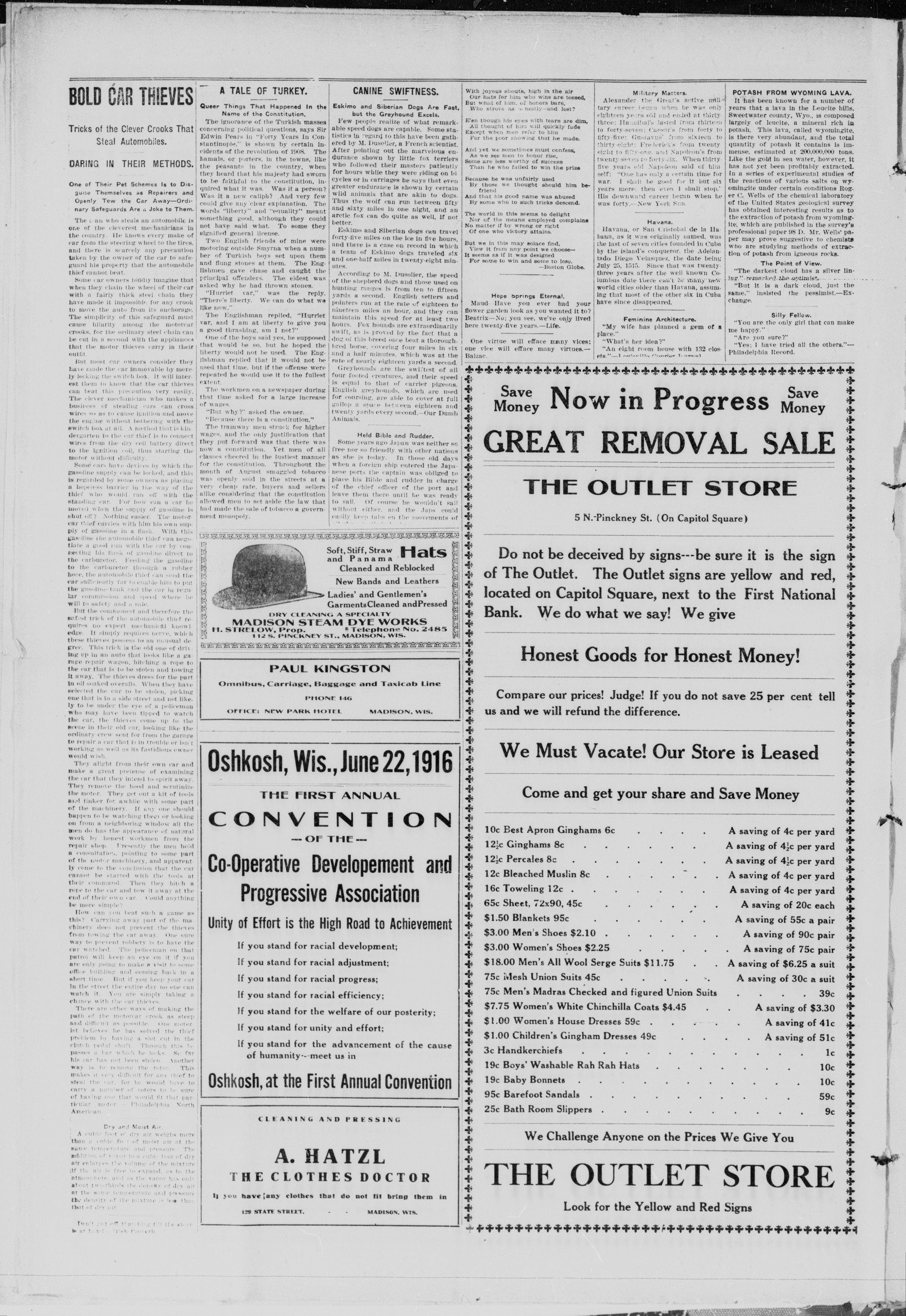
Unity of Effort is the High Road to Achievement If you stand for racial development; If you stand for racial adjustment; If you stand for racial progress; If you stand for racial efficiency; If you stand for the welfare of our posterity; If you stand for unity and effort; If you stand for the advancement of the cause of humanity---meet us in
Oshkosh, at the First Annual Convention
CLEANING AND PRESSING
A. HATZL
THE CLOTHES DOCT
If you have any clothes that do not fit bring
129 STATE STREET. MADISON.
CANINE SWIFTNESS.
Eskimo and Siberian Dogs Are Fast, but the Greyhound Excels.
Few people realize of what remarkable speed dogs are capable. Some statistics in regard to this have been gathered by M. Dusellier, a French scientist. After pointing out the marvelous endurance shown by little fox terriers who followed their masters patiently for hours while they were riding on bi cycles or in carriages he says that even greater endurance is shown by certain wild animals that are akin to dogs. Thus the wolf can run between fifty and sixty miles in one night, and an arctic fox can do quite as well, if not better.
Eskimo and Siberian dogs can travel forty-five miles on the ice in five hours, and there is a case on record in which a team of Eskimo dogs traveled six and one-half miles in twenty-eight minutes.
According to M. Dusolier, the speed of the sheepard dogs and those used on hunting ranges is from ten to fifteen yards a second. English setters and pointers run at the rate of eighteen to nineteen miles an hour, and they can maintain this speed for at least two hours. Fox hounds are extraordinarily swift, as is proved by the fact that a dog of this breed once beat a thoroughbred horse, covering four miles in six and a half minutes, which was at the rate of nearly eighteen yards a second. Greyhounds are the swiftest of all four footed creatures, and their speed is equal to that of carrier pigeons. English greyhounds, which are used for coursing, are able to cover at full gallop a space between eighteen and twenty yards every second.—Our Dumb Animals.
Held Bible and Rudder
Some years ago Japan was neither so free nor so friendly with other nations as she is today. In those old days when a foreign ship entered the Japanese ports the captain was obliged to place his Bible and rudder in charge of the chief officer of the port and leave them there until he was ready to sail. Of course he wouldn't sail without either, and the Japs could easily keep tabs on the movements of
Soft, Stiff, Straw Hats
and Panama
Cleaned and Reblocked
New Bands and Leathers
Ladies' and Gentlemen's
Garments Cleaned and Pressed
G A SPECIALTY
AM DYE WORKS
Telephone No. 2485
T., MADISON, WIS.
Baggage and Taxicab Line
146
TEL MADISON, WIS.
, June 22, 1916
INTION
THE---
Development and
Association
High Road to Achievement
al development;
al adjustment;
al progress;
al efficiency;
welfare of our posterity;
y and effort;
advancement of the cause
t us in
t Annual Convention
ATZL
ES DOCTOR
not do not fit bring them in
MADISON, WIS.
Save Money Now in Progress Save Money GREAT REMOVAL SALE
Do not be deceived by signs----be sure it is the sign of The Outlet. The Outlet signs are yellow and red, located on Capitol Square, next to the First National Bank. We do what we say! We give
Honest Goods for Honest Money!
Compare our prices! Judge! If you do not save 25 per cent tell us and we will refund the difference.
We Must Vacate! Our Store is Leased
Come and get your share and Save Money
10c Best Apron Ginghams 6c
A saving of 4c per yard
12c Ginghams 8c
A saving of 4½ per yard
12c Percales 8c
A saving of 4½ per yard
12c Bleached Muslin 8c
A saving of 4c per yard
16c Toweling 12c
A saving of 4c per yard
65c Sheet, 72x90, 45c
A saving of 20c each
$1.50 Blankets 95c
A saving of 55c a pair
$3.00 Men's Shoes $2.10
A saving of 90c pair
$3.00 Women's Shoes $2.25
A saving of 75c pair
$18.00 Men's All Wool Serge Suits $11.75
A saving of $6.25 a suit
75c Mesh Union Suits 45c
A saving of 30c a suit
75c Men's Madras Checked and figured Union Suits
$39c
$7.75 Women's White Chinchilla Coats $4.45
A saving of $3.30
$1.00 Women's House Dresses 59c
A saving of 41c
$1.00 Children's Gingham Dresses 49c
A saving of 51c
3c Handkerchiefs
19c Boys' Washable Rah Rah Hats
$10c
19c Baby Bonnets
$10c
95c Barefoot Sandals
$59c
25c Bath Room Slippers
We Challenge Anyone on the Prices We Give You
Look for the Yellow and Red Signs
With joyous shouts, high in the air
Our hats for him who wins are tossed,
But what of him, of honors bare,
Who strove as men mostly—and lost?
Even though his eyes with tears are dim,
All thought of him will quickly fude
Except when men refer to him
For the poor showing that he made.
And yet we sometimes must confess,
As we see men to honor rise,
Some are less worthy of success
Than he who failed to win the prize
Because he was unfairly used
By those we thought should him be
friend
And that his good name was abused
By some who to such tricks descend.
The world in this seems to delight
Nor of the means employed complains
No matter if by wrong or right
Of one who victory attains.
But we in this may solace find,
View it from any point we choose—
It seems as if it was designed
For some to win and some to lose.
-Boston Globe.
Hope Springs Eternal.
Maud—Have you ever had your flower garden look as you wanted it to? To Beatrix—No; you see, we've only lived here twenty-five years.—Life.
One virtue will efface many vices; one vice will efface many virtues.—Balzac.
Save N
Military Masters.
Alexander the Great's active military career begin when he was only eighteen years old and ended at thirty-three: Hannibal's lasted from thirteen to forty-seven; Caesar's from forty to fifty-five; Gustavus' from sixteen to thirty-eight; Frederick's from twenty eight to fifty-one, and Napoleon's from twenty-seven to forty-six. When thirty-five years old Napoleon said of him self: "One has only a certain time for war. I shall be good for it but six years more; then even I shall stop." His downward career began when he was forty—New York Sun.
Havana.
Havana, or San Cristobal de la Habana, as it was originally named, was the last of seven cities founded in Cuba by the island's conqueror, the Adelantado Diego Velasquez, the date being July 25, 1515. Since that was twenty-three years after the well known Columbus date there can't be many new world cities older than Havana, assuming that most of the other six in Cuba have since disappeared.
Feminine Architecture.
"My wife has planned a gem of a place."
"What's her idea?"
"An eight room house with 132 closets."
5 N.-Pinckney St. (On Capitol Square)
POTASH FROM WYOMING LAVA.
It has been known for a number of years that a lava in the Leucite hills, Sweetwater county, Wyo., is composed largely of leucite, a mineral rich in potash. This lava, called wyomingite, is there very abundant, and the total quantity of potash it contains is immense, estimated at 200,000,000 tons. Like the gold in sea water, however, it has not yet been profitably extracted. In a series of experimental studies of the reactions of various salts on wyomingite under certain conditions Roger C. Wells of the chemical laboratory of the United States geological survey has obtained interesting results as to the extraction of potash from wyomingite, which are published in the survey's professional paper 98 D. Mr. Wells' paper may prove suggestive to chemists who are studying methods of extraction of potash from igneous rocks.
"The darkest cloud has a silver lining." remarked the optimist.
"But it is a dark cloud, just the same," insisted the pessimist.—Exchange.
Silly Fellow.
"You are the only girl that can make me happy."
"Are you sure?"
"Yes; I have tried all the others."—Philadelphia Record.