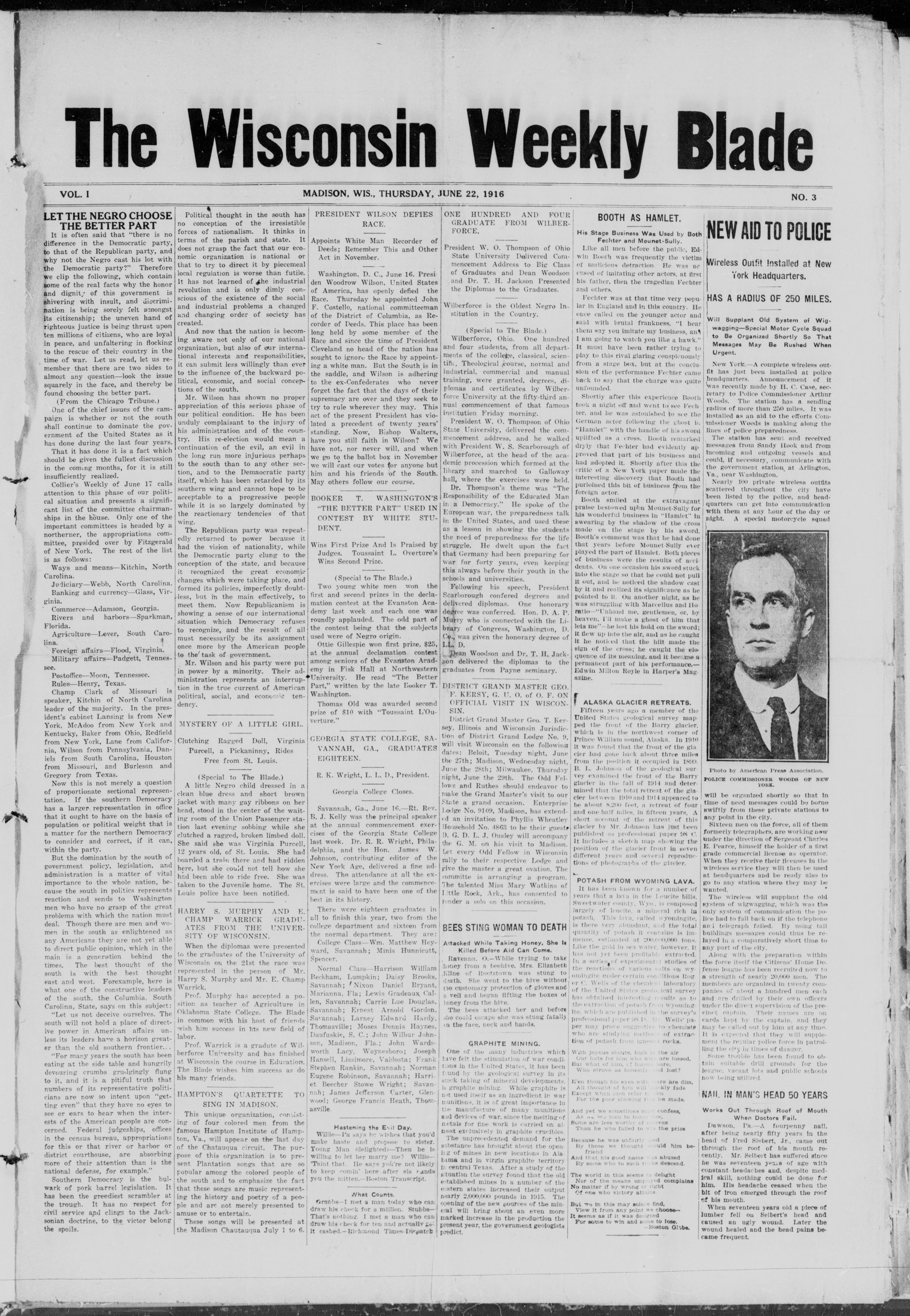
Wisconsin Weekly Blade
Thursday, June 22, 1916
Milwaukee, Wisconsin
Page text (machine-generated)
The Wisconsin Weekly Blade
VOL. I
LET THE NEGRO CHOOSE
THE BETTER PART
IT is often said that "there is no difference in the Democratic party, to that of the Republican party, and why not the Negro cast his lot with the Democratic party?" Therefore we clip the following, which contain some of the real facts why the honor and dignity of this government is shivering with insult, and diserimination is being sorely felt amongst its citizenship; the uneven hand of righteous justice is being thrust upon ten millions of citizens, who are loyal in peace, and unfaltering in flocking to the rescue of their country in the time of war. Let us read, let us remember that there are two sides to almost any question—look the issue squarely in the face, and thereby be found choosing the better part.
(From the Chicago Tribune.)
One of the chief issues of the campaign is whether or not the south shall continue to dominate the government of the United States as it has done during the last four years.
That it has done it is a fact which should be given the fullest discussion in the coming months, for it is still insufficiently realized.
Collier's Weekly of June 17 calls attention to this phase of our political situation and presents a significant list of the committee chairmanships in the house. Only one of the important committees is headed by a northerner, the appropriations committee, presided over by Fitzgerald of New York. The rest of the list is as follows:
Ways and means—Kitchin, North Carolina.
Judiciary—Webb, North Carolina.
Banking and currency—Glass, Virginia.
Commerce—Adamson, Georgia.
Rivers and harbors—Sparkman, Florida.
Agriculture—Lever, South Carolina.
Foreign affairs—Flood, Virginia.
Military affairs—Padgett, Tennessee.
Postoffice—Moon, Tennessee.
Rules—Henry, Texas.
Champ Clark of Missouri is speaker, Kitchin of North Carolina leader of the majority. In the president's cabinet Lansing is from New York, McAdoo from New York and Kentucky, Baker from Ohio, Redfield from New York, Lane from California, Wilson from Pennsylvania, Daniels from South Carolina, Houston from Missouri, and Burleson and Gregory from Texas.
Now this is not merely a question of proportionate sectional representation. If the southern Democracy has a larger representation in office that it ought to have on the basis of population or political weight that is a matter for the northern Democracy to consider and correct, if it can, within the party.
But the domination by the south of government policy, legislation, and administration is a matter of vital importance to the whole nation, because the south in politics represents reaction and sends to Washington men who have no grasp of the great problems with which the nation must deal. Though there are men and women in the south as enlightened as any Americans they are not yet able to direct public opinion, which in the main is a generation behind the times. The best thought of the south is with the best thought east and west. Foreexample, here is what one of the constructive leaders of the south, the Columbia, South Carolina, State, says on this subject: "Let us not deceive ourselves. The south will not hold a place of directive power in American affairs unless its leaders have a horizon greater than the old southern frontier...
"For many years the south has been eating at the side table and hungrily devouring crumbs grudgingly flung to it, and it is a pitiful truth that numbers of its representative politicians are now so intent upon "getting even" that they have no eyes to see or ears to hear when the interests of the American people are concerned. Federal judgeships, offices in the census bureau, appropriations for this or that river or harbor or district courthouse, are absorbing more of their attention than is the national defense, for example." Southern Democracy is the bulwark of pork barrel legislation. It has been the greediest scrambler at the trough. It has no respect for civil service and clings to the Jacksonian doctrine, to the victor belong the spoils.
Political thought in the south has no conception of the irresistible forces of nationalism. It thinks in terms of the parish and state. It does not grasp the fact that our economic organization is national or that to try to direct it by piecemeal local regulation is worse than futile. It has not learned of the industrial revolution and is only dimly conscious of the existence of the social and industrial problems a changed and changing order of society has created. And now that the nation is becoming aware not only of our national organization, but also of our international interests and responsibilities, it can submit less willingly than ever to the influence of the backward political, economic, and social conceptions of the south.
Mr. Wilson has shown no proper appreciation of this serious phase of our political condition. He has been unduly complaisant to the injury of his administration and of the country. His re-election would mean a continuation of the evil, an evil in the long run more injurious perhaps to the south than to any other section, and to the Demaocratic party itself, which has been retarded by its southern wing and cannot hope to be acceptable to a progressive people while it is so largely dominated by the reactionary tendencies of that wing.
The Republican party was repeatedly returned to power because it had the vision of nationality, while the Democratic party clung to the conception of the state, and because it recognized the great economic changes which were taking place, and formed its policies, imperfectly doubtless, but in the main effectively, to meet them. Now Republicanism is showing a sense of our international situation which Democracy refuses to recognize, and the result of all must necessarily be its assignment once more by the American people to the task of government.
Mr. Wilson and his party were put in power by a minority. Their administration represents an interruption in the true current of American political, social, and economic tendency.
MYSTERY OF A LITTLE GIRL.
(Special to The Blade.)
A little Negro child dressed in a clean blue dress and short brown jacket with many gay ribbons on her head, stood in the center of the waiting room of the Union Passenger station last evening sobbing while she clutched a ragged, broken limbed doll. She said she was Virginia Purcell. 12 years old, of St. Louis. She had boarded a train there and had ridden here, but she could not tell how she had been able to ride free. She was taken to the Juvenile home. The St. Louis police have been notified.
HARRY S. MURPHY AND E. CHAMP WARRICK GRADUATES FROM THE UNIVERSITY OF WISCONSIN.
When the diplomas were presented to the graduates of the University of Wisconsin on the 21st the race was represented in the person of Mr. Harry S. Murphy and Mr. E. Champ Warrick.
Prof. Murphy has accepted a position as teacher of Agriculture in Oklahoma State College. The Blade in common with his host of friends wish him success in his new field of labor.
Prof. Warrick is a graduate of Wilberforce University and has finished at Wisconsin the course in Education. The Blade wishes him success as do his many friends.
HAMPTON'S QUARTETTE TO
SING IN MADISON.
This unique organization, consisting of four colored men from the famous Hampton Institute of Hampton, Va., will appear on the last day of the Chatauqua circuit. The purpose of this organization is to present Plantation songs that are so popular among the colored people of the south and to emphasize the fact that these songs are music representing the history and poetry of a people and are not merely presented to amuse or to entertain. These songs will be presented at the Madison Chautauqua July 1 to 6.
MADISON, WIS., THURSDAY, JUNE 22, 1916
PRESIDENT WILSON DEFIES RACE.
Appointes White Man Recorder of Deeds; Remember This and Other Act in November.
Washington, D. C., June 16. President Woodrow Wilson, United States of America, has openly defied the Race. Thursday he appointed John F. Costello, national committeeman of the District of Columbia, as Recorder of Deeds. This place has been long held by some member of the Race and since the time of President Cleveland no head of the nation has sought to ignore the Race by appointing a white man. But the South is in the saddle, and Wilson is adhering to the ex-Confederates who never forget the fact that the days of their supremacy are over and they seek to try to rule wherever they may. This act of the present President has violated a precedent of twenty years' standing. Now, Bishop Walters, have you still faith in Wilson? We have not, nor never will, and when we go to the ballot box in November we will cast our votes for anyone but him and his friends of the South. May others follow our course.
BOOKER T. WASHINGTON'S "THE BETTER PART" USED IN CONTEST BY WHITE STUDENT.
Wins First Prize And Is Praised by Judges, Toussaint L. Overture's Wins Second Prize.
(Special to The Blade.)
Two young white men won the first and second prizes in the declaration contest at the Evanston Academy last week and each one was roundly applauded. The odd part of the contest being that the subjects used were of Negro origin.
Ottie Gillespie won first prize, $25, at the annual declaration contest among seniors of the Evanston Academy in Fisk Hall at Northwestern University. He read "The Better Part," written by the late Booker T. Washington.
Thomas Old was awarded second prize of $10 with "Toussaint L'Ouverture."
GEORGIA STATE COLLEGE, SAVANNAH, GA., GRADUATES EIGHTEEN.
R. K. Wright, L. L. D., President.
Savannah, Ga., June 16.—Rt. Rev. B. J. Kelly was the principal speaker at the annual commencement exercises of the Georgia State College last week. Dr. R. R. Wright, Philadelphia, and the Hon. James W. Johnson, contributing editor of the New York Age, delivered a fine address. The attendance at all the exercises were large and the commencement is said to have been one of the best in its history.
There were eighteen graduates in all to finish this year, two from the college department and sixteen from the normal department. They are: College Class—Wm. Matthew Heyward, Savannah; Minis Hunnicutt, Spencer.
Normal Class—Harrison William Beckham, Lumpkin; Daisy Brooks Savannah; / Nixon Daniel Bryant Marianna, Fla; Lewis Gradeaux Calen, Savannah; Carrie Lue Douglas Savannah; Ernest Arnold Gordon Savannah; Larney Edward Hardy Thomasville; Moses Dennis Haynes Daufuske, S. C.; John Wilbur Johnson, Madison, Fla.; John Wardsworth Lacy, Waynesboro; Joseph Hansell, Lissimore, Valdosta; Frank Stephen Rankin, Savannah; Norman Eugene Robinson, Savannah; Harriet Beecher Stowe Wright; Savannah; James Jefferson Carter, Glenwood; George Francis Heath, Thomasville.
Hastening the Evil Day.
Willie—Pa says he wishes that you'd make haste and propose to sister. Young Man (delighted)—Then he is willing to let her marry me? Willie—Taint that. He says you're not likely to keep comin' here after sands you the mitten—Boston Transcript.
What Counts.
Grubbs—I met a man today who can draw his check for a million. Stubbs—That's nothing. I met a man who can draw his check for ten and actually get it cashed—Richmond Times Dispatch
ONE HUNDRED AND FOUR GRADUATE FROM WILBER-FORCE.
President W. O. Thompson of Ohio State University Delivered Commencement Address to Big Class of Graduates and Dean Woodson and Dr. T. H. Jackson Presented the Diplomas to the Graduates.
Wilberforce is the Oldest Negro Institution in the Country.
(Special to The Blade.)
Wilberforce, Ohio. One hundred and four students, from all departments of the college, classical, scientific, Theological course, normal and industrial, commercial and manual training, were granted, degrees, diplomas and certificates by Wilberforce University at the fifty-third annual commencement of that famous institution Friday morning.
President W. O. Thompson of Ohio State University, delivered the commencement address, and he walked with President W. S. Scarborough of Wilberforce, at the head of the academic procession which formed at the library and marched to Galloway hall, where the exercises were held.
Dr. Thompson's theme was "The Responsibility of the Educated Man in a Democracy." He spoke of the European war, the preparedness talk in the United States, and used these as a lesson in showing the students the need of preparedness for the life struggle. He dwelt upon the fact that Germany had been preparing for war for forty years, even keeping this always before their youth in the schools and universities.
Following his speech, President Scarborough conferred degrees and delivered diplomas. One honorary degree was conferred. Hon. D. A. P. Murry who is connected with the Library of Congress, Washington, D. Co., was given the honorary degree of LL. D.
Dean Woodson and Dr. T. H. Jackson delivered the diplomas to the graduates from Payne seminary.
DISTRICT GRAND MASTER GEO.
F. KERSY, G. U. O. of O. F. ON
OFFICIAL VISIT IN WISCONSIN.
District Grand Master Geo. T. Kersey, Illinois and Wisconsin Jurisdiction of District Grand Lodge No. 9, will visit Wisconsin on the following dates: Beloit, Tuesday night, June the 27th; Madison, Wednesday night, June the 28th; Milwaukee, Thursday night, June the 29th. The Odd Fellows and Ruthes should endeavor to make the Grand Master's visit to our State a grand occasion. Enterprise Lodge No. 9109, Madison, has extended an invitation to Phyllis Wheatley Household No. 4863 to be their guests D. G. D. L. J. Ousley will accompany the G. M. on his visit to Madison. Let every Odd Fellow in Wisconsin rally to their respective Lodge and give the master a great ovation. The committee is arranging a program. The talented Miss Mary Watkins of Little Rock, Ark., has consented to render a solo on this occasion.
BEES STING WOMAN TO DEATH
Attacked While Taking Honey, She Is Killed Before Aid Can Come.
Ravenna, O.-While trying to take honey from a beehive, Mrs. Elizabeth Kline of Rootstown was stung to death. She went to the hive without the customary protection of gloves and a veil and began lifting the boxes of honey from the hive.
The bees attacked her and before she could escape she was stung fatally on the face, neck and hands.
GRAPHITE MINING.
One of the many industries which have felt the stimulation of war conditions in the United States, it has been found by the geological survey in its stock taking of mineral developments, is graphite mining. While graphite is not used itself as an ingredient in war munitions, it is of great importance in the manufacture of many munitions and devices of war, since the melting of metals for fine work is carried on almost exclusively in graphite crucibles. The unprecedented demand for the substance has brought about the opening of mines in new locations in Alabama and in virgin graphite territory in central Texas. After a study of the situation the survey found that the old established mines in a number of the eastern states increased their output nearly 2,000,000 pounds in 1915. The opening of the new sources of the mineral will bring about an even more marked increase in the production the present year, the government geologists predict.
BOOTH AS HAMLET.
His Stage Business Was Used by Both
Fechter and Mounet-Sully.
Like all men before the public, Edwin Booth was frequently the victim of malicious detraction. He was accused of imitating other actors, at first his father, then the tragedian Fechter and others.
Fechter was at that time very popular in England and in this country. He once called on the younger actor and said with brutal frankness, "I hear them say you imitate my business, and I am going to watch you like a hawk." It must have been rather trying to play to this rival glaring conspicuously from a stage box, but at the conclusion of the performance Fechter came back to say that the charge was quite unfounded.
Shortly after this experience Booth took a night off and went to see Fechter, and he was astonished to see the German actor following the ghost in "Hamlet" with the handle of his sword uplifted as a cross. Booth remarked dryly that Fechter had evidently approved that part of his business and had adopted it. Shortly after this the critic of a New York paper made the interesting discovery that Booth had purloined this bit of business from the foreign actor.
Booth smiled at the extravagant praise bestowed upon Mount Sully for his wonderful business in "Hamlet" in swearing by the shadow of the cross made on the stage by his sword, Booth's comment was that he had done that years before Mount Sully ever played the part of Hamlet. Both pieces of business were the results of accidents. On one occasion his sword stuck into the stage so that he could not pull it out, and he noticed the shadow cast by it and realized its significance as he pointed to it. On another night, as he was struggling with Marcellus and Hortatio—"Unhand me, gentlemen, or, by heaven, I'll make a ghost of him that lets me"—he lost his hold on the sword; it flew up into the air, and as he caught it he noticed that the hilt made the sign of the cross; he caught the eloquence of its meaning, and it became a permanent part of his performance.—Edwin Milton Royle in Harper's Magazine.
ALASKA GLACIER RETREATS.
ALASKA GLACIER RETREATS.
Fifteen years ago a member of the United States geological survey mapped the front of the Barry glacier, which is in the northwest corner of Prince William sound, Alaska. In 1910 it was found that the front of the glacier had gone back about three miles from the position it occupied in 1899 B. L. Johnson of the geological survey examined the front of the Barry glacier in the fall of 1914 and determined that the total retreat of the glacier between 1910 and 1914 appeared to be about 8,200 feet, a retreat of four and one-half miles, in fifteen years. A short account of the retreat of this glacier by Mr. Johnson has just been published as professional paper 98 C. It includes a sketch map showing the position of the glacier front in seven different years and several reproductions of photographs of the glacier.
POTASH FROM WYOMING LAVA.
It has been known for a number of years that a lava in the Leucite hills, Sweetwater county, Wye., is composed largely of laceite, a mineral rich in potash. This lava, called wyomingite is there abundant, and the total quantity of potash it contains is immense, estimated at 200,000,000 tons. Like the gold in sea water, however, it has not yet been profitably extracted. In a series of experimental studies of the reactions of various salts on wyomingite under certain conditions Roger C. Wells of the chemical laboratory of the United States geological survey has obtained interesting results as to the extraction of potash from wyomingite, which are published in the survey's professional paper 381 D. Mr. Wells paper may prove suggestive to chemists who are studying methods of extraction of potash from igneous rocks.
With joyous abouts, high in the air
Our hats for him who who are tossed,
But what of him, of honour bare,
Who strove as honestly and lost?
Een though his eyes with tears are dim,
All thought of him will quickly fade
Except when men refer to him
For the poor showing that he made.
And yet we sometimes must confess,
As so we men to honor sake,
Some are less worthy of success
Than he who failed to win the prize
The world in this seems to delight
Nor of the means employed complains
No matter if by wrong or right
Of one who victory attains.
But we in this may solace find,
View it from any point we choose-
It seems as if it was designed
For some to win and some lose.
—Boston Globe.
NO.3
NEW AID TO POLICE
Wireless Outfit Installed at New York Headquarters.
HAS A RADIUS OF 250 MILES.
Will Supplant Old System of Wigwagging—Special Motor Cycle Squad to Be Organized Shortly So That Messages May Be Rushed When Urgent.
New York.—A complete wireless outfit has just been installed at police headquarters. Announcement of it was recently made by H. C. Case, secretary to Police Commissioner Arthur Woods. The station has a sending radius of more than 250 miles. It was installed as an aid to the efforts Commissioner Woods is making along the lines of police preparedness.
The station has sent and received messages from Sandy Hook and from incoming and outgoing vessels and could, if necessary, communicate with the government station, at Arlington, Va., near Washington.
Nearly 100 private wireless outfits scattered throughout the city have been listed by the police, and headquarters can get into communication with them at any hour of the day or night. A special motorcycle squad
Photo by American Press Association.
POLICE COMMISSIONER WOODS OF NEW YORK.
will be organized shortly so that in time of need messages could be borne swiftly from these private stations to any point in the city.
Sixteen men on the force, all of them formerly telegraphers, are working now under the direction of Sergeant Charles E. Pearce, himself the holder of a first grade commercial license as operator. When they receive their licenses in the wireless service they will then be used at headquarters and be ready also to go to any station where they may be wanted.
The wireless will supplant the old system of wigwagging, which was the only system of communication the police had to fall back on if the telephone and telegraph failed. By using tail buildings messages could thus be relayed in a comparatively short time to any part of the city.
Along with the preparation within the force itself the Citizens' Home Defense league has been recruited now to a strength of nearly 20,000 men. The members are organized in twenty companies of about a hundred men each and are drilled by their own officers under the direct supervision of the precinct captain. Their names are on cards kept by the captain, and they may be called out by him at any time. It is expected that they will supplement the regular police force in patrolling the city in times of danger.
Some trouble has been found to obtain suitable drill grounds for the league, vacant lots and public schools now being utilized.
NAIL IN MAN'S HEAD 50 YEARS
Works Out Through Roof of Mouth When Doctors Fail.
Dawson, Pa.—A fourpenny nail after being nearly fifty years in the head of Fred Siebert, Jr., came out through the roof of his mouth recently. Mr. Selbert has suffered since he was seventeen years of age with constant headaches and, despite medical skill, nothing could be done for him. His headache ceased when the bit of iron emerged through the roof of his mouth.
When seventeen years old a piece of lumber fell on Selbert's head and caused an ugly wound. Later the wound healed and the head pains became frequent.
A National Journal of Opinion and Circulation.
Entered as second-class matter June 8, 1916, at the post office at Madison, Wis., under the Act of March 3, 1879.
Address all communications to THE WISCONSIN WEEKLY BLADE, 312 N. Henry St. Money sent by express money order, or registered letter at our own risk, otherwise at risk of the sender.
Z. P. Smith Editors.
J. Anthony Josey
L. J. Ousley, Contributing Editor
J. Anthony Josey, Manager.
Phones 6756—3369.
SUBSCRIPTION:
One year ..... $1.50
Six months ..... 1.00
Three months ..... 50
OUR ANCHOR IS IN THE RE-
PUBLICAN PARTY—NO HOPE
FOR US IN THE NATIONAL
DEMOCRATIC PARTY.
The past as well as the present tells us there is no hope for us in the National Democratic party. All of the jim crow car laws, all of the disfranchisement laws, all of the segregation laws, all of the animus that is heaped upon us as a race come from the National Democratic party. What can we hope for if Wilson is re-elected. Only an increase of persecution, more stringent laws to test our endurance. Already in the South our churches, schoolhouses and lodgerooms are burned down and not a word or effort put forth in our behalf. Midnight massacres, plunderers and murders are doing their work and not a word of protest against it by those in authority. Mobs and lynchers are well known by many of the citizens and of those in authority where it is done. But yet it is condoned and the Negro race is the sufferer. Then what can we hope for in the National Democratic party? Oh, it makes us sick to think that any Negro could for a moment forget how the Negro has suffered from the National Democratic party and then turn and kiss the hand that smites it. No, our anchor and hope is in the Republican party. Some of its leaders may prove truant, but we will stand by the party that has done is doing and will do the most for us.
A SETTLED QUESTION
A some solicitous writer for a farm paper has asked, "What has become of the boy with the patched trousers?" Why, bless you, he is on the farm, hopping clods sixteen hours a day. He will go to town after a while to run the banks and stores and to be a successful lawyer, preacher or physician. No one need worry about the boy with patches on his trousers. He is not confined to the country alone. Cities have them galore, I am sorry to say. It is the well-dressed boy with eye-glasses and his hair parted in the middle that this solicitous writer should be looking after. He's the fellow that is going to drop through a crack in the sidewalk and out of sight one of these days.
The Blade is on sale at the following places: Mosley & Smith, 202 E Washington Ave., Trotter & Hopkins 222 E. Main St., Hill's Grocery Store 649 E. Dayton St., Weaver's Grocery Store, 522 E. Mifflin St., and all Local News Stands.
ADVERTISE
IF YOU
Want a cook.
Want a clerk.
Want a partner.
Want a situation.
Want a servant girl.
Want to sell a carriage.
Want to sell town property.
Want to sell your groceries.
Want to sell your dry goods.
Want to sell your hardware.
Want to sell your millinery goods
If you want customers for anything
Advertising is the highway to success
Advertising brings new customers,
Advertising keeps the old ones,
Advertising will insure success,
Advertising shows energy,
Advertising shows pluck.
Advertising is "biz."
Advertise or bust.
Advertise well.
Advertise long.
ADVERTISE
At once.
AN EQUAL OPPORTUNITY.
While there are yet in all parts of the country many efforts being made to humiliate the Negro in ways of segregation laws and color lines in trade unions, the Negro seems to win over these things without any great fighting. If Madison is at all indicative of the steadily growing sentiment in favor of fairer treatment of the Negro politically and industrially, it will nail some of the prophecies and fears that have been made in the past few years to the cross of retraction. The Negro is here as a fixture and intend to help the good citizens of Madison make better by being here. The Negro is not contending or asking for anything but a man chance, an equal opportunity along all lines. The greatest problem or drawback to the Negro in Madison has been and is still one of employment and housing condition. He has been and is still denied the renting of houses on the account of his color. Surely Madison with its culture and education cannot afford to lower its average by keeping submerged any particular class.
A MOVE IN THE RIGHT DIRECTION.
RACE OF TRUE PATRIOTS.
General A. M. E. Conference Piedges
Allegiance to Country's Flag.
(To The Blade.)
The general conference of the A. M. E. church, which closed its session in Philadelphia on May 22, appointed a commission to memorialize congress to make lynching a federal offense. The commission is headed by Bishops W. D. Chappell, R. B. Parks and C. T. Shaffer. Resolutions favoring preparedness and in opposition to segregation and jimcrow laws were adopted. The resolution on preparedness reads thus: "As for preparedness, we wish to go unreservedly on record. "Naturally a people who furnished 188,000 soldiers when slaves for the salvation of the Union would now as free men recruit to its full manhood strength to protect the flag and country.
"We believe in mobilizing both men and industries and in putting at the head of this army in the president's chair a true and tried American patriot, a man who stands for a square deal for all classes and who believes in the Roosevelt doctrine "of all men up and not some men down."
AN OPEN LETTER.
To the Editor of The Wisconsin Weekly Blade:
The good people of Madison, Wisconsin, and the Northwest will gladly welcome into their midst the debut of the Wisconsin Blade.
The Manager of this paper or new enterprise promises to give to the people at large a weekly paper which shall be devoted to the religious, social, and political conditions of colored people.
We earnestly believe that this enterprise is worthy of our heartiest commendation. We have been told that this periodical is to be an organ of the people and not for any particular combination or sect, surely there is room for its circulation.
In this busy age of procreation the people are anxious for the news. The Blade, we believe, will fill a long-felt want in State and Community. Our people need to be better informed concerning their religious, social institution and economic conditions. Since the field is well supplied with daisies and weeklies which dwell so largely on the inferiority and short-comings of our people, it will be wholesome to have a sheet which will be vice versa. We truly hope The Blade will open up a new era in Journalism among our people. We want to know what the good MEN are doing.
We want to read WHOLESOME and BENEFICIAL advertisements. Not much time have we to give to "fakes". If conservation and the desire to be of the greatest service to the greatest number of people be kept in view by the management, we predict a long and prosperous life for THE WISCONSIN BLADE. A Subscriber.
A MEMBER OF THE CACE IS HONORED.
(To The Blade.)
Chicago, Ill. Mrs. Florence Cole-Talbert of Chicago, but formerly from Los Angeles, Cal., has the honor of being the first singer of the race to receive the diamond medal this year in the graduating class at the Chicago Musical College, which gives her the opportunity of singing a solo at the commencement exercises which take place Saturday evening, June 17th, at the Auditorium. The soloists will be accompanied by 75 members of the Chicago Symphony Orchestra.
AN OPEN LETTER TO THE AMERICAN PEOPLE BY NATIONAL CITIZEN CONFERENCE SIGNED BY PROMINENT MEN FROM ALL PARTS OF THE COUNTRY.
To the American People.
We, the representatives of ten million citizens of the United States, in session at Chicago, Ill., June 6, 1916, believing mob rule, lynching and segregation exert a baleful influence upon the honor of our country and in a general way militate against the safety of all American citizens, appeal to every fairminded citizen to assist in correcting these evils. We urge the Congress of the United States to establish equal representation for all sections of the country by apportioning seats in Congress in accordance with the actual voting population; to enforce the 13th amendment to the Federal Constitution of the United States by suppression of peonage; to make lynching a Federal crime; to secure to all a fair share in the benefits of public expenditures, including equal facilities in public schools. We feel, as American citizens, that we are entitled to equal opportunities in public office and public service, including national defense.
NATT' CITIZENS' CONFERENCE,
Beureagard F. M.oseley, Chairman,
6221 S. Halsted St., Chicago, Ill.
Morris Lewis, Secretary.
THE NEGRO BUSINESS MENT
LEAGUE.
National League Meeting
Tuskegee Institute, Ala., June 16. The National Negro Business Men's League will meet at Kansas City, Mo., August 16, 17 and 18. A fine program is being arranged for the occasion. Mr. Scott has received an invitation from Sears, Roebuck & Co. for the delegation passing through the city to or from the convention will be cordially invited to visit them at its plant in Chicago. For the southeastern territory it will be the purpose to arrange Pullman sleeping cars to be placed at Atlanta, Jacksonville, Nashville, Birmingham, Mobile and Evansville, and other cities.
CURIOUS CORDOBA
This Spanish Town Is So Compact It
Looks Like One Building.
LOOKS LIKE ONE BUILDING.
Cordoba is scheduled on the European itinerary as a half day stand. Those who go from Seville to Granada and those who go from Granada to Seville take Cordoba on their way. Fifteen minutes for the cathedral, five for the alcazar, an hour for luncheon and on to further discoveries—that is the Cordoba program. The hotels of Cordoba are, in consequence, unpalatial, a circumstance in itself which cures the little town to the judicious. I do not believe there is a lift in all Cordoba, and if your wife wishes for any reason to buy a new hat she must go out of the hotel for it, and then it will be three years old.
At night all the tourists are gone to Seville or Granada, and you and the Cordobans and the stars share the amenities of Cordoba's one boulevard, of which everybody is very proud, because it is much superior to anything that Paris or even Madrid can show. It was a lucky chance which caused them to build Cordoba so handily between Seville and Granada. It has provided a still little backwater for the traveler's repose, a spot where he may forget that American bars exist, eat his meals untroubled by the squeaking of a tango band and adventure himself among the mysteries of a bill of fare jelly printed in blue and illegible Spanish.
You could put your hat over Cordoba, and very little' voul'd attribute. It is the compactest little town. From the tower of the cathedral it all looks like one building. You can hardly perceive the streets, so closely do they wriggle among the houses. The roofs are yellow, brown, gray, red; the walls and their shadows every color in the world. Among the buildings the green of palms, orange trees, lemon trees, chestnuts, soothe the glare struck eye. The Gudatapivir snakes through its rich plains from the faraway flat hills cree, gray brown, yellow), and over all are the great sky of the south and the huse sum of the south, which imposes silence on the world till night shall set the guitars a buzzing. William Cafue in Century.
Useless Speeches
"Have you anything to say why se-
tence should not be passed on your"
"asked the judge"
"Not a word. I made speeches the
last three times. I was conquered and
they didn't seem to do me any good"
"replied the prisoner—Detroit Free
Press"
Cow Adopts Colt.
Greenville, Pa.—J. S. Brown, a farmer near Conneaut lake, says a short time ago a mare owned by him died after giving birth to a fine cott. The colt was fed on a bottle for a time, and when it was strong enough it was turned out with a herd of cows for exercise. One of the cows had lost a calf, and the animal immensely adopted the colt. Bossy and the colt are now inseparable.
SUMMARY OF THE REPUB
LICAN PLATFORM.
The Republican platform promises "protection to every American citizen at home and abroad by land and sea."
"A straight and honest neutrality between all the belligerents. Insistence upon all our rights as neutrals without fear or favor."
"Aid to Mexico in restoring order. Promise to American citizens in or near Mexico adequate and absolute protection."
"Self government to the Philippines under the protection of the United States."
"A treaty with Russia forbidding discrimination against any class of American citizens, Jew or Christian."
"Thorough and complete national defense, ready for any emergency. A navy so strong and always so ready and prepared that no enemy can gain command of the sea or effect a landing on our coasts."
"Repeal of the Democratic tariff act. Adequate protection to American industry and labor. Undue exactions of monopolies or trusts to be prevented. A tariff commission of experts to ascertain the facts."
"An effective system of rural credits."
"Encouragement of shipping interests, creation of a merchant marine by payment of subsidies for actual services in carrying mails."
"Federal regulation of railroads by national authority exclusively by an amendment to the constitution if necessary."
"Regulation of great industrial corporations. Individual punishment of wrongdoers. Prosecution of offenders, but not persecution of business success."
"A national budget to secure economy."
"Extension of civil service reform."
"Vocational education, laws forbidding child labor; enactment of a generous workingmen's compensation law."
"Women's suffrage advocated as a measure of justice to one-half the adult people of this country."'
The Wilson administration is denounced for destroying "our influence abroad and humiliating us in our own eyes," for mischievous and ineffectual interference in Mexico, "for the attempt to abandon the Philippines," for the Underwood tariff, which has increased imports and deprived American producers and wage earners of protection; for government ownership of a merchant marine that will "leave us more than ever in the grip of foreign syndicates" and for extravagance in creating 30,000 new offices, costing $44,000,000 annually.
HOSPITALITY IN SYRIA
A Custom That May Have a Bearing on a Passage In Scripture.
Approaching his hoped for guest, a Syrian engages him in something like the following dialogue, characterized by a glow of feeling which the translation can only falsely reveal: "Ennoble us by your presence."
"I would be ennobled, but I cannot accept."
"That cannot be."
"Yea, yea it must be."
"No. I sweat against you by our friendship and by the life of God. I love just to acquaint you with my bread and salt."
"I sweat also that I find it impossible to accept. Your bread and salt are known to all."
"Yea, do it just for our own good. By coming to us you come to your own home. Let us repay your bounty to us."
"Astaghfero Allah (by the mercy of God) I have not bestowed any bounty upon you worth mentioning."
Here the host seizes his guest by the arm and with an emphatic "I will no, let you go." pulls at him and would drag him bodily into his house. Then the guest, happy in being vanquished "with honor," consents to the invitation.
Do you now understand fully the meaning of the passage in the fourteenth chapter of Luke's gospel? "A certain man made a great supper, and bade many, * * * and they all with one consent began to make excuse. * * * And the Lord said unto the servant, 'Go out into the highways and hedges, and compel them to come in, that my house may be filled.'"—Abraham Mittrie Ribbany in Atlantic Monthly.
GIVES $1,000,000 TO WAR VICTIMS
FOOD FOR THE POPULATION
Neutral Commission to Be Organized and Fund Spent In Relieving Sufferers In Poland, Servia, Montenegro and Albania—Allies and Teutons to Aid.
The Rocketeller foundation has announced that it has appropriated $1,000,000 for war relief work in Poland, Servia, Montenegro and Albania.
This gift is made, according to the announcement, as an effort to hasten an agreement between the allies and the central powers whereby adequate provision can be made for feeding the millions of noncombatants of the countries which it is intended that this donation shall aid.
In a statement which accompanies the announcement of the gift the Rockefeller foundation tells of its efforts to relieve the situation in Poland. After stating that its original scheme, whereby it agreed to guarantee the administration expenses of a neutral commission for the distribution of foodstuffs to the extent of $120,000, fell through because of the impracticability of importing the food the foundation says:
A few months ago the German government invited one of the members of the war relief commission of the Rockefeller foundation, Frederie C. Walcott, to go to Poland with a representative of the commission for relief in Belgium in order that fresh and accurate information might be obtained as to conditions of destination and that new measures of relief might be devised. The result of this trip was that a scheme was again drawn up containing certain arrangements and guarantees whereby food might be imported into Germany from abroad, transported to Poland and distributed among the civil population under the protection, supervision and active management of a neutral commission directed by Herbert C. Hoover.
Terms of Scheme.
The terms of this scheme may be summarized as follows:
A neutral commission to be organized under the direction of Herbert C. Hoover, the head of the commission for relief in Belgium, and to carry on its operations according to the methods now obtaining in Belgium and northern France.
Germany to contribute 15,000,000 marks a month for the purchase and importation of the supplies.
Suitable guarantees to be furnished regarding the inviolability of food supplies while in transit through Germany into Poland, where the distribution is to be made through the Polish local committees under the supervision of the American government.
Importations of food by the neutral commission to be confined to the populations of Warsaw, 1 to 12, Schenzochov, Vilna, Kovno, Blala and Ettap (from 3,500-00 to 4,000,000 persons in and about these cities). Germany to provide a partial ration for these populations, as well as to supply of all other parts of the occupied territory.
Railroad transportation from Danzig, the port of importation, to the German-Polish frontier at half rate and thence without charge to the points of destination. Ocean transportation of supplies to be provided by German ships flying a neutral flag and manned and controlled by neutrals. With this tentative agreement in his possession Mr Waleck proceeded to London and made every effort, through the good offices of Ambassador Page and in co-operation with Mr. Hoover, to command the plan to the favorable consideration of the British government and its allies. As a result of these efforts the British government delivered to the American ambassador on May 11 a memorandum setting forth the terms and conditions upon which the blockade of German ports would be relaxed to the extent of permitting imports of relief supplies through a German port.
This memorandum stated that the consent of the British government to the proposed scheme of relief would be given only upon certain additional conditions, among which the most significant were the following:
The system of relief in Poland to be applied to the occupied territory as a whole. Any surplus of food food products in the occupied territory to be employed exclusively for the previsicing of northern Poland.
The constabulary in the occupied territory not to be permitted to requisition or purchase food imported by the commission.
No food supplies to be exported from Poland unless in the case of an excess of potatoes over and above the needs of the entire occupied territory, as certified by the neutral commission.
The German and Austro-Hungarian governments to undertake as part of the present effort to supply and care for the populations of Servia, Albania and Montenegro.
The next step to be taken was to ascertain whether the central powers would agree to the additional conditions imposed by Great Britain on behalf of the allied governments, and negotiations to this end are now going on. The appropriation of a million dollars by the Rockefeller foundation is made at this time in order that prompt advantage may be taken of a favorable termination of the negotiations, so that the stream of food may begin to pour into Poland with the least possible delay. At the same time under the terms proposed the effective relief of Servia and Montenegro and Albania would become possible.
LODGES—NOTICES
Capital City Lodge No. 72, F. and
A. M. Meets first and third Wednesday
night each month, G. A. R. Hall.
O. M. Davis, W. M.
T. E. Hines, W. Sec.
Enterprise Lodge, No. 9109, G. U.
O. of O. F. Meets second and fourth
Wednesdays night each month, G. A.
R. Hall.
Joy Lee, N. G.
Joy Lee, N. G.
E. Champ Warrick, E. S.
J. Anthony Josey, P. S.
Phylis Wheatley Household, No.
4863, G. U. O. of O. F. Meets fourth
Saturday night each month, G. A. R.
Hall.
Marion Buckner, M. N. G.
Friendship Chapter, No. 66, O. E.
S. Meets second and third Saturday
nights each month, G. A. R. Hall.
Mary Jones, Worthy Matron.
J. W. Brown, Worthy Patron.
Marion Buckner, Worthy Sec.
Domestic Strategy
Husband—I am not ready to go out yet. Wife—But I am, and we must go immediately. Husband—But, my dear, your hat is not on straight. Wife—Dear me! Isn't it? Put a minute till I go to my room and put it eight. Exit wife for half an hour, and her shrewd husband completes his work.
Argentina.
If the country has the same average potentiality for producing food as land similarly situated in North America or Europe, it would seem that Argentina can support 100,000,000 people easily, as only small parts of it lie outside the temperate zone.
Harvard
Shoes
$2.50-$2.85
All Kinds--All Sizes
Come up stairs
and
Save a Dollar
Harvard Shoe Co.,
Second Floor
Washington Ave. and
Pinckney St.
MADISON, WIS.
HENRY LEWIS
DRUGGIST
STATE AND GILMAN STREETS
When you are sick and want a prescription filled buy your drugs at Lewis' Drug Store
FOR BAR GAINS IN SHOES GO TO
432 STATE ST.
MEN'S, LADIES', AND CHILDREN'S
FOOT WEAR
When other Corn Cures Fail Try Red Cross Corn Harvester. The Menges Pharmacie
LYNCH BROS.
The Home of Good Groceries
The only state street
store that gives CASH
REBATE TO ITS
CUSTOMERS.
Delivery to all parts of the city.
306 STATE STREET
Telephone 2195
A full write-up of The Race Convention and those in attendance will
appear in our next issue.
Messrs. Asa Washington & Thos. Horton are in Camp Douglas awaiting orders to go to the borders in the interest of their country.
Trade with the Merchants who ask you for your patronage through the columns of The Blade.
Miss Mary Watkins delighted the Congregation at St. Paul A. M. E. Church Sunday night with the rendition of a very beautiful solo.
Ripp's Shoe Store, 224 State St., are offering bargain. Call and inspect their stock. Polite and courteous attention.
Mrs. J. B. Wilkerson of Minneapolis, Minn., will furnish the news of the City to the readers of The Blade.
Telephone your news to The Blade,
Phone 3369.
Mrs. John Thomas of Murray St.
is quite ill at the General Hospital.
It is the request of the City Editor
that you furnish him with local news.
Mr. Lewis Morton has returned to
the city.
Send your name to The Blade if
you contemplate attending the Race
Conference at Oshkosh on the 22nd.
Mr. T. E. Hines has been appointed
chairman of the Transportation Committee.
Mr. and Mrs. J. N. Wilson have
moved from 210 N. Blair St. and is
are now on S. Park St.
Save a Dollar by buying Harvard Shoes, Wash. Ave. and Pinckney St.
Rev. F. G. Hurd, former pastor of St. Paul A. M. E. church is in the city this week shaking hands with friends.
A great reduction Shoe Sale at Weaver's Shoe Store, 432 State St. Fresh and up-to-date drugs at Lewis, State and Gilman St.
Capitol City Lodge F. & A. M. will celebrate St. John Day at St. Paul A. M. E. church, Sunday, June 25th, at 3 P. M. Rev. T. C. Devlin of Oak Park, Ill., will deliver the sermon. Special music.
Mrs. A. T. Stewart joined Mrs. Daisy Gentry in Chicago and accompanied her to Arkansas to visit her relatives.
Agent wanted to represent The Blade. Liberal terms.
Mrs. Mamie Anderson was elected Noble Governor of Phyllis Wheatly Household of Ruth, No 4863, at their last meeting. Mrs. Phoebe Lawrence passed to M. N. G. and Miss Marion Buckner to P. M. N. G.
The Blade is operating an employment agency; all kinds of work furnished.
LET THE MADISON STEAM DYE WORKS DO YOUR CLEANING.
Remember the merchants appreciate your trade by advertising in The Blade.
Mrs. Madison Jones was in this week from across the lake to the delight of her many friends.
Mr. John A. Hall of Milwaukee is to be numbered among The Blade loyal supporters. We trust that through him and our Milwaukee Representatives The Blade will be placed in every colored home in the city. He is indeed quite genial and affable.
NOTICE TO READERS
All matter for publication must reach this office no later than Wednesday morning and be sent in the name of the Wisconsin Blade and not in the names of individuals if you wish same to have immediate attention. Drafts or checks must be made out in the name of the Blade; NOT TO ANY INDIVIDUAL. J. Josey, Manager.
Hope Springs Eternal
Maud—Have you ever had your flower garden look as you wanted it to? 3 Beatlx--No; you see, we've only lived here twenty-five years.—Life.
One virtue will efface many vices; one vice will efface many virtues.—Balzac.
Duties of Vice President
Duties of Vice President.
The duties of the vice president of the United States were defined by an Italian before a naturalization court in Fairmount, W. Va., as "washing windows and sweeping out the White House." With thirteen other applicants he was made a citizen of the United States.
By F. A. MITCHEL
John Brentwood of New York when the pan-European war broke out was studying aviation and determined to go to the war in the flying corps. He went to England, where he was commissioned an aviator and was sent to Belgium.
Brentwood became very expert with his machine and made many a valuable reconnaissance for British generals, but the most valuable work he did for his side was in another line entirely, though without his aeroplane and, for that matter, without an accident to it he would not have been in a position to accomplish the feat.
John was soaring one day while the enemy was making strewnous efforts to capture a British position of great value. The Germans had rained a halstorm of explosives at the position for thirty-six hours, then charged it. They took it, it and it was retaken and taken again several times. John was up in the air directing the British gunners where to fire when he saw a long ammunition train beneath him moving toward that part of the German line which was engaged. Signaling the fact and its location, it was bombarded, with the result that a number of the men operating it were killed.
While he was looking at the train something gave way in the machinery of his aeroplane, and he began to drop. He succeeded in starting up again just before landing, and this saved his life. He fell in a thicket of low growth bordering a creek, and before the Germans came up to seize his machine he succeeded in getting away from it and hiding under some rocks. It was not long, however, before he heard voices nearing him and concluded that he had better move on, for he was doubtless been hunted. Hearing the hissing of a locomotive, he knew he was near the ammunition train he had seen. He climbed up the bank, and, sure enough, there within a hundred feet of him was the engine standing on the track without any one visible in the cab.
John made up his mind to a bold dash. Running to the locomotives, he mounted to the cab, and there lay the engineer mutilated. He had been killed by a shell fragment. The missiles were still coming so thick that John did not expect to live very long himself. He determined to take that train away from where its freight was especially needed. He knew very little about a locomotive; but, always having been fond of machinery, knew enough to back up. This he did, slowly at first; but, gathering impetus, and then reaching a decline in the grade, he moved quite rapidly. He saw an officer galloping toward him, frantically waving his sword, doubtless as a signal for him to stop, but by this time John was going as fast as the rider and paid no attention to him. A switch had been left open, and the result was that two-thirds of the train was dumped into the creek.
This caused a halt, and John knew that it was time to get out before any one could reach him. It occurred to him that the best chance for him was to hide under the engine. He succeeded in getting there in time to escape detection. A few minutes later there was a babel of voices about him—officers, soldiers and train hands shouting and gesticulating. Finding the engineer's body in the cab, they supposed that he had been running the engine, and his being killed had caused all the trombone.
It occurred to John that if he could reach a point where the overturned cars were in the creek he might find a more permanent hiding place. Waiting till the crowd had left the engine he peeped and saw that the car next back of him was leaning against underbrush. He succeeded in getting from under the locomotive to this car without being seen, and then it was an easy matter to wriggle through the brush and down to the creek.
John was in the enemy's line, but there was no necessity for him to be suspected of wrecking the ammunition train. The chances of his getting back to his comrades were slight, and he made up his mind to surrender himself when he could do so without excluding any especial suspicion. He remained in the creek till night made his hiding more effective; then crawled up on to the opposite bank of the creek from the wrecked train.
All was still except periodic booms. There was no evidence of any one being near him, and it occurred to him to take his chances of getting into the British lines. This would ne essitate his approaching the German trenches from the rear, since the two forces were facing each other and very near together. Advancing, he soon came to the German trenches. He walked over one of them without their suspecting his not being one of them and maneuvered among the trees and brush till he suspected the position of the British. Crawling near to them, he whistled "God Save the King" in a low tone "Who's there?" came a voice and a simultaneous click of a rifle. Without replying at once John changed his position, then called in a low voice:
"Friend."
In another moment he was in the British lines.
When John related his adventure to his general and it was learned that it was through his foot that the Germans had discontinued their attacks he was offered anything he might ask for.
He asked for another machine.
HERO, BUT SIMPLE
HERO, BUT SIMPLE
Togo, Japanese Admiral, Modest In Tastes, Say Tradesmen.
PEOPLE REGARD HIM AS A GOD
Butcher, Baker and Barber Unite In Saying That the Japanese Nelson Is Firm Believer In Simplicity—Trims Own Beard and Pays 25 Cents For Hair Cut.
Tokyo.—Don't imagine that a Japanese newspaper man is a back number because he appears at ceremonial functions in an early Victorian Prince Albert and a derby hat or that he is unenterprising because at the same ceremonial functions he is chlvived about by the police like a naughty boy.
Admiral Togo, the victor of Tsu Shima, is the most taciturn man in Japan. He has never been interviewed. He never speaks about himself.
Except that they see him in a ricksha occasionally with his brass hat on when he is going to the palace, the public of Tokyo knows nothing of the Japanese Nelson.
So when the Katei Zasshi, a popular monthly magazine circulating among the middle classes, wished to get an article on the private life of Admiral Togo they sent a bright member of
[Name]
the staff out to interview the count's butcher and baker and candlestick maker, his barber and fishmonger and the man at the corner, and by paying particular attention to the amount of his monthly housekeeping bills they were able to arrive at the conclusion that the hero is a man of Spartan simplicity. First comes the man who keeps the sake (spirits) shop.
"I hear," he says, "that the admiral never complains of the food that he finds on his table and that he eats the same food as his servants. I get no orders for sake nowadays and only send in some soy (sauce) and miso (a curd made from beans and eaten for breakfast) of the commonest quality, occasionally. My monthly bill is never more than 75 cents and sometimes under 50 cents. I am ashamed to ask for payment, the bill is so small."
The greengrocer, a "young student-like man," is afraid to divulge very much, but finally says:
"The things I sell to the Togo family are of the same quality as those I sell to my humblest customer. When the early fruits come in I always offer them, but they are seldom bought. The simplicity of the admiral's life is astonishing. It would be great rudeness for a man like me to comment on a godlike man like Togo. My monthly bill amounts to 75 cents or so."
The fishmonger: "I have been allowed to enjoy the custom of the Togo family for many years, and there has been no change in the orders I get. Most officers when they return home from sea will soon be known by the special orders they give to the tradesmen around them and the increased activity of their kitchen. There is no special dinner for Admiral Togo when he returns after an absence. The life he leads is absolutely below the standard for so great a man. No wonder that the people regard him as a god. My monthly bill is insignificantly small."
The butcher: "Admiral Togo's meat order is very small. When he entertains guests he orders from some restaurant. Occasionally I get an order for his excellency's table, and for the rest the meat he buys is generally for his favorite dog. I believe the dog gets more meat than the master."
The barber: "I am called to the admiral's house twice a month, except when he goes to the imperial palace. When that happens I am called in even if it is only a week after his last haircut. His hair is cropped short, less than an inch long, with scissors. He cuts his own beard in the shape of a heart, and sometimes it is done very clumsily, but he will not allow me to touch it. He speaks to me rather kindly, but on the whole he is taciturn. In his parlor there is not a thing which can be called an article of luxury. He gives me 25 cents for each hair cut." All the tradespeople expressed sincere admiration of the admiral's frugality.
Cleveland Man Would Wed One and Will Provide Change For Ice Cream Sodas and the Movies.
Paterson, N. J.—"Young widows only need apply; old maids can save their postage stamps," wrote Gustave sane nell of 1427 East Thirty second street Cleveland, O., in a letter which John C. Bush, acting mayor of this city, recently received.
"Any young widow who wants a good home, a lively companion and a gay time, with lots of change for ice cream sodas and the movies, will find me the right husband," the letter stated.
"Young widows are sweet and jolly, and I understand there are a lot of them in Paterson. Old maids give me a pain. There are too many of them in Cleveland now.
"You will do any pretty young widow a big favor by handing to her my name and address and telling her to write and send photo. I own a good home and want a wife right away."
TOYS HIS FIRST GIFTS
TO GIRL HE COURTED
Bride, Twenty-three Years Old, Marries Father's Friend, Thirty-nine Years Her Senior.
New York.—A romance that had its beginning in the close friendship between the bride's father and the elderly bridegroom resulted recently in the marriage of Miss Mabel Evelyn Cristadoro of Flushing, N. Y., to Harrison Hodges, purchasing agent for the Long Island railroad. Mr. Hodges, whose home is at 58 West Fifty-seventh street, is sixty-two years old, while his bride is twenty-three. Mr. Hodges has passed practically his whole life in the railroad business and is very widely known. Many years ago Miss Cristadoro's father, Charles Cristadoro, also was engaged in the railroad business. A close friendship sprang up between the men, and almost from the day of her birth. Mr. Hodges evinced a deep interest in the daughter of his friend and companion.
At first, the bride said laughingly, Mr. Hodges' gifts to her were toys and the other "goodies" usually so accept able to children. In recent years, however, friends of Miss Cristadoro became convinced that there was some thing more than casual friendship for the young woman in the attentions be stowed upon her by Mr. Hodges. They were not surprised recently when it became generally known that they were to be married, although Mr. Hodges had been looked upon as a confirmed bachelor.
FOOT IN FROG: NOW DEAD
Directed Work of Rescue After Twenty-four Cars Mangled Him.
Altoona, Pa. - After preparing to make a coupling in the Pennsylvania yards here, Brakeman H. Ward Hall slipped from his car, and the next instant his right foot was caught in a switch frog. He struggled to free himself, but could not.
Then he tried frantically to save himself by signaling the engineer, who was pushing a draft of twenty-four cars toward him, but the man on the locomotive could not see him.
When members of his crew found him later his right arm and right leg had been severed and he was plinned under a big steel car, but still conscious. Every car had run over him.
He directed the work of the men who were rescuing him and was rushed to the hospital, where he died four hours later.
CHAINS HIS PRISONER.
Sheriff Takes No Chances as He Moves a Man.
Kansas City, Mo.-M. F. Moore, sheiff of Yates Center, Kan., doesn't take chances with prisoners. He dropped in at police headquarters the other morning on the way home from Colusso, Ill., leading Amos Wilkins at the end of a chain ten feet long.
"I want to leave this chap here while I see the town," said the sheriff.
"All right, but you'll have to pay for his meals," said a booking clerk.
"Let him have what he wants; I'll pay," said Sheriff Moore.
As soon as the sheriff turned his back the prisoner ordered ham and eggs, apple pie, coffee and other food.
Wilkins said he was going to plead guilty to forcing a twenty-five dollar check when he got back to Yates Center.
HIS TROUSERS A BARREL
Flames Burn Motorman's Clothing as He Tries to Fix Car.
Harrison. N. J.—When his trolley, after coming to a sudden stop at Harrison's venue and Fourth street, refused to stir another inch, John Lynch, the motorman, put his passengers aboard a rollef car and proceeded to investigate.
He diagnosed the symptoms as a disorder in the control box and proceeded to supply a cute. An inserted monkey wrench brought forth a blast of flame which kicked up Lynch's trousers. Assuming a "September Morn" pose—for it was an open car—he shouted for help. This came in the form of a barrel, and Lynch walked to another pair of trousers.
HINRICHS DRY GOODS CO.
SPECIALS ON SALE THIS WEEK
1000 yards, 36 inch Dress Percale
Extra Special 10c yard
600 yards Wash Goods, values to 18c
Closing Out Price 9c yard
75 Ladies' Voile Waists
Special at 59c each
HINRICHS DRY GOODS CO.
3 South Pinckney St., Madison, Wisconsin
PinchBackSuits
For
$15.00 to $18.00
Other Suits
latest Styles
$12, $15, $18, $20
GEORGE'S $2.00 HAT STORE
404 EAST WILSON STREET
New Summer Shoes
--- FOR ---
MEN, WOMEN
AND CHILDREN
received, classy colored boots in gre
nd champagne. High and low Shoe
SPORT SHOES
Just received, classy colored boots in grey, white ivory, and champagne. High and low Shoes.
A SMART LINE OF NEW CUTS
RIPP'S
224 STATE
THE GAS RANGE will be in your kitchen this summer because it is clean, comfort-bringing and convenient.
IT IS CLEAN--for there are no ashes, no coal, wood or or kindling, no soot, no smoke. The range itself is neat and clean and easily kept so.
IT IS COMFORT-BRINGING for it makes the kitchen cool, by doing away with all unnecessary heat. It does away with cause for worry both in keeping fires hot and in results of cooking.
IT IS CONVENIENT for all heat wanted is ready at the turn of the valve.
The prices of the ranges are from $16 up. We have just the right size for your kitchen.
---
By ELINOR MARSH
A coach load of tourists were "doing" the National park. There were young ladies and elderly men and women, but few young men. Indeed, the only two unmarried men were a couple of Englishmen, the one, Harrington, evidently a gentleman; the other Mudge, of the ordinary type of cockney, and an American commercial traveler named Meriweather.
Meriweather took up with Mudge, and the two fell to talking of the disposition of rich American girls to buy British titled husbands. Meriweather was a bit of a wag and when one of the girls of the party asked for information about Mudge told her that he was Lord Angleford traveling incoq; "But," he added, "he'll not acknowledge to anything more than plain Alexander Mudge. There's no use trying to get him to do so; therefore I would not try if I were you."
Nevertheless this young lady, Miss Gwendolen Stewart, who was of an age when it is sweet to do what is forbidden, addressed Mr. Mudge as Lord Angleford, much to that gentleman's astonishment. Of course he denied the impeachment, but that had no effect on the young lady.
"Do you know," she said to Mr. Harrington, "that we have one of your countrymen, a lord, among us?"
"No," replied the Britsher, evidently much interested. "Which one?"
"He who calls himself Mudge." Harrington repressed a smile. "You seem incredulous."
"Oh, I know nothing about the man. We are not traveling together. We are simply fellow members of this excursion by accident."
"Of course, now that you know that he is one of your privileged class, you will treat him with great respect."
"Certainly. I'll be very deferential," replied Harrington, with a twinkle in his eye.
Meriweather did not inform Mr. Mudge that he had started the report about him, and Mudge was at a loss to discover where it came from. In spite of his denial he was treated by the whole party with deference, several of the girls vicing with each other for his favor. However, Miss Stewart seemed rather in lined to favor Hartington. Harrington certainly seemed inclined to favor her. She had all the sprightfulness, the humor, the independence, of an American girl and was withal comely. Excursions are especially adapted to love affairs, and in this case all these two required to fall in love was to be thrown together. The party remained in the park for some time and became quite like one family.
One day Mudge showed some attention to Miss Stewart. Harrington saw plainly that he was not in favor with her, but, pretending jealousy, said to her:
"What is it about a title that is so attractive to you Americans?"
"Why do you ask?"
"Oh, I observed how pleased you were when this nobleman incog, joined you this morning! I felt like a penny alongside half a crown."
"His lordship is very agreeable," she replied, looking up at him archly.
"Which do you mean, the lord or the man?"
"If there is enough of the lord to outweigh the man, what matters it?"
"The Anglefords are an old family and, I believe, are large landholders in England. I fancy to be Lady Angleford a girl might marry a man of wood."
"Why discuss the matter? Quite likely Lord Angleford is expected to marry some nobleman's daughter in England, and none of us American girls who are not the Hon. Miss So and so will be invited to become my lady."
However, the next time Mudge sidled up to Miss Stewart she went back on all she had said, for she gave him the grand freeze, much to Mr. Harrington's delight.
The next day several of the party, including Mudge and Meriweather, proceeded on their way.
The immediate parity to which Miss Stewart belonged after leaving the park took train for the east. Harrington, who was going in the same direction, joined them, or, rather, he joined Miss Stewart, the affair between them having become by this time quite evident. During the journey his devotion to her rather increased than diminished, and by the time they reached the eastern border it was supposed they were engaged.
The truth was that Harrington had proposed, but Miss Stewart had determined giving him an answer until her father had been consulted and Mr Harrington's smudging in England socially and as a man could be investigated. He promised on reaching New York to be giving a friend who would vouch for him, after which the voucher might be confirmed in England. The day after their arrival Harrington called with his friend, who said.
"This is Edward Harrington, oldest son of the Marquis of Cragmore, a Scotch title dating back to 1542. His father, the marquis, is one of the richest men in Scotland."
To Miss Stewart this was a surprise. She had doubted the nobility of Mr. Mudge, but had not for a moment suspected that of Harrington. She amused her lover by saying
"Tell that to the marines."
However, the claim was confirmed and Gwendolin Stewart is now the Marchioness of Cragmore.
FORBADE HIS BURIAL
New Yorker, by Will, Provided For Death Tests, and Sarcophagus
New York.—In the will of Robert P. Lyon, who died on May 28, filed for probate recently in the surrogates' court, an estate valued at $75,000 was bequeathed in equal shares to the testator's wife, Mrs. Grace I. Lyon, and his two sons, Robert D. Lyon and Arthur S. Lyon. The will continued: "I desire to impress upon my wife and my executors that I have an intense dread of being buried alive. I therefore charge them and also such physicians as they may select after my apparent death to have my body subjected to thorough tests of death and to cause the radial artery at either wrist to be cut across by a competent surgeon. I understand that if the vessel is bloodless life has ceased."
The decedent also stated that he had "an intense aversion and dread" of being buried in the earth and requested that his body be placed in a receiving vault until a sarcophagus could be erected for it. Mr. Lyon left funds to pay for this vault.
JOHN D. BUYS A KISS.
Grandson Negotiates the Sale of a Smack For a Nickel.
Tarrytown, N. Y.-John D. Rockefeller was attending services recently at the Lyceum, Pocantico Hills, with his son, John D. Jr., and grandchildren. After the services Winthrop, the second grandson, beckoned to his grandfather and said he had a little matter to adjust with him. When his grandfather bent over to get the message the boy said:
"Grandpop. I've got a big kiss for you."
Mr. Rockefeller smiled, put his hand in his vest pocket, where he keeps his loose change, and, digging out a new nickel, gave it to his grandson, who already had his hand out. When the little fellow's fingers clasped the coin he put his arms around his grandfather's neck and gave him a smack, with many of the congregation looking on.
DRY CLEANING A
MADISON STEAM
H. STRELOW, Prop.
112 S. PINCKNEY ST.,
DRY CLEANING A SPECIALTY
DISON STEAM DYE WO
OW, Prop.
Telephone
12 S. PINCKNEY ST., MADISON, WIS
PAUL KINGSTON
OFFICE: NEW PARK HOTEL
Oshkosh, Wis.,
THE FIRST
CONVENIENCE
--- OF THE
Co-Operative Deve-
Progressive A
Unity of Effort is the High
If you stand for racial c
If you stand for racial a
If you stand for racial p
If you stand for racial e
If you stand for the wel
If you stand for unity a
If you stand for the ad
of humanity---meet u
Oshkosh, at the First
Josh, Wis., June 22
THE FIRST ANNUAL
CONVENTION
--- OF THE ---
Iterative Development
Progressive Association
Effort is the High Road to Accl
you stand for racial development;
you stand for racial adjustment;
you stand for racial progress;
you stand for racial efficiency;
you stand for the welfare of our po-
you stand for unity and effort;
you stand for the advancement o
humanity---meet us in
n, at the First Annual Con
Co-Operative Development and Progressive Association
Unity of Effort is the High Road to Achievement If you stand for racial development; If you stand for racial adjustment; If you stand for racial progress; If you stand for racial efficiency; If you stand for the welfare of our posterity; If you stand for unity and effort; If you stand for the advancement of the cause of humanity---meet us in
Oshkosh, at the First Annual Convention
CLEANING AND PRESSING
A. HATZL
THE CLOTHES DOCTOR
If you have [any clothes that do not fit bring
129 STATE STREET. MADISON.
A. HATZL
THE CLOTHES DOCT
are [any clothes that do not fit bring
STATE STREET. MADISON.
ALIVE IN ROCK'S CENTER.
Frog May Have Lived There For Centuries—Swelled Up When Freed.
Riverside, Cal.-A live frog, possibly centuries old, was found in the center of a solid granite bowler which was blasted open at the Bly quarries, five miles west of Riverside.
The frog, still alive, was brought to the chamber of commerce and has been offered to Professor Daggett of the Los Angeles museum. When first exposed to the air and light it was shriveled to about one-third its normal size. Within a few minutes it had swollen until its skin was puffed almost to bursting.
It blinks with perfect froglike intelligence and devoured a couple of flies that were offered as though they were familiar food.
The frog closely resembles the present generation of frogs, differing only in the shape or its head and in its blind quarters. It is lighter in shade than the ordinary frog, and is about two and one-half inches long and two inches across the back.
LOSES WOODEN LEG.
Commission Refuses to Give Olympia (N. Y.) Man Compensation For It.
Olympia, N. Y.-While the breaking of a leg ordinarily would be classed as a permanent partial disability under the workmen's compensation act, this is not true with a wooden leg, the industrial insurance commission recently decided.
George R. Stark, employed by a number company of Barneston, presented a claim for a fracture of the ankle of his wooden leg, stating it was caught in the conveyor of the mill on Aug. 9.
In the blank marked "Nature of in jury," Stark's claim says, "Busted wooden leg never will get well."
Courts For Forty Years.
Rutherford, Tenn. After a courtship of about forty years Mr. La Fayette Yates and Miss Bettie Reagor, people who have lived all their lives in a neighborhood about six miles east of this place, were united in marriage and are receiving congratulations.
Soft, Stiff, Straw Hats and Panama Cleaned and Reblocked New Bands and Leathers Ladies' and Gentlemen's Garments Cleaned andPressed A SPECIALTY M.DYE WORKS Telephone No. 2485 T., MADISON, WIS.
MADISON, WIS.
JUNE 22, 1916
ST ANNUAL
INTIION
THE --
Development and
Association
High Road to Achievement
development;
adjustment;
progress;
efficiency;
welfare of our posterity;
and effort;
advancement of the cause
us in
First Annual Convention
ATZL
MES DOCTOR
that do not fit bring them in
MADISON, WIS.
Save Money Now in Progress Save Money GREAT REMOVAL SALE
Do not be deceived by signs----be sure it is the sign of The Outlet. The Outlet signs are yellow and red, located on Capitol Square, next to the First National Bank. We do what we say! We give
Honest Goods for Honest Money!
Compare our prices! Judge! If you do not save 25 per cent tell us and we will refund the difference.
We Must Vacate! Our Store is Leased
Come and get your share and Save Money
We Challenge Anyone on the Prices We Give You
THE OUTLET STORE
Look for the Yellow and Red Signs
CAUSE OF RHEUMATISM.
Cavities Holding Pus, It Is Claimed, Breed the Dread Ailment. In the American Magazine is an article on rheumatism by Dr. Arthur R. Reynolds, who says:
"The cause of rheumatism is pus formed and imprisoned in some part of the body. It gets into the circulation and is carried by it to the region affected. These pus places may be in spots more or less closed up, so they are not easily drained. They may be located about the teeth, at the end of the roots of dead or diseased teeth, in the crypts of the tonsils, in some of the sequestered places in the nostrils, in the bony sinuses of the head. They may be in the bladder, the kidney, the gall ducts or other places. The pus producing spot may be as small or smaller than a pea or it may be larger. Its existence is frequently unknown to the patient, especially if it be hidden in soft tissue like the tonsil. It may even exist in the bony socket of a tooth without giving pain.
"Several different organisms produce pus, and any or all may produce rheumatism when transferred to the joints or the heart.
"The physician today seeks for the pus cavity when he meets a patient with rheumatism, and he endeavors to clean it up."
BEES BREAK UP SCHOOL.
Imprison Teacher and Pupils Until
R rescue Party Comes.
Oakdale, Cal.—Forty school children were held prisoners for half a day at Langworth school by a buzzing swarm of bees, which finally broke up school for the day.
The bees had bives in one corner of the roof for weeks and had been undisir turbed until some of the youngsters threw clods and dislodged the hive. The bees attacked their tormentors, who took refuge in the schoolhouse.
Miss Ida Warford, the teacher, put her head out of the door to see the cause of the commotion and was stung on the nose. Hundreds of bees swarmed into the half opened door, and the children sought refuge in the next room, while the teacher and the older boys battled with wet cloths and whatever weapons they had handy.
They, too, were finally forced into the other room, and the entire school was made prisoner until some of the parents, alarmed at the absence of their children, came to the rescue. They were forced to flee, too, but finally came back armed with sulphur, with which they routed the bees. A number of the children and the animals in near by fields were severely stung.
5 N. Pinckney St. (On Capitol Square)
Political Chances.
"I see when a man runs for office he has to put himself in the hands of his friends."
"Yes, my dear."
"If a woman ran would she have to put herself in the hands of her woman friends?"
"I suppose so."
"Well, I do not imagine many women will run. Think of taking such chances!"—Louisville Courter Journal.
Not a Bad Error.
She (with newspaper)—Here's a funny mistake in the report of that affair last night. It says that Mrs. Swellman appeared in a handsome "ampere" gown, instead of "empire." He—Well, "ampere" isn't very far off; her gown was a bit shocking.—Boston Transcript.
A Pleasure.
"I put through a big financial deal last week," remarked Mr. Dustin Stax.
"I thought you said you were going on a pleasure trip."
"Could there be any pleasure greater than putting through a big financial deal?" - Washington Star.
"Wafter, the steak is so tough I can't cut it with this knife."
"Very good, sir-I'll bring you an-