The Advocate
Thursday, February 14, 1907
Charleston, West Virginia
Page text (machine-generated)
A Large Delegation of Colored Citizens Protest to Committee Against Evans' Bill
About fifty representative colored cities of Charleston and other cities in the state were present in the room of the House Judiciary committee Friday night to give their moral support and encourage the three speakers who had been chosen to protest to the committee against the Mingo deletion and the Jim Crow bill, known as House Bill No. 18.
Once it was ready to be reported back to the house without recommendation was used on the Mingo deletion and the Jim Crow bill to go back to the committee for reconsideration at the request of chairman Naylor who stated there were several delegates not present that session of the committee, who wished to be heard on the subject.
Chairman Naylor went to his home at Wheeling to spend a few days and when he returned he found the committee had decided to report it back to the house with the recommendation that it do pass. It is said that he promised the colored people hearing on the hinge and when he returned he informed them that he reported back before it was reported back
The first protestant was State I. librarian S. W. Starks, in a masterly and convincing way presented the case of the people he represented. He showed the committee what a hardship the passage of the bill would cause of the state, who would be made to suffer for the actions of a few; that the Negro population is one to twenty of that of the state and that the necessity of such a repressive measure could not be urged upon the same grounds as in states having a population of two or three people. The recital of indignities to which the women of the race would be subjected, if needed together as the bill prescribed; and the humiliation every black man, who is arriving against great odds to better his condition, would feel, if the bill be presented, that the pression upon the committee and others who heard Mr. Starks.
President J. McHenry Jones, of the West Virginia Colored Institute, scored "the Republicans severely for making it necessary for the Negro to be allowed to race without question. He thought their actions as regard the bill savored of the basest ingratiude, in that it was by the Negro votes that the state had been placed under the jurisdiction of the committee that the bill was trying to fasten upon the colored people something that the Democratic party in their 25 years of rule in the state had refused time and again to pass. He said that men of color were not represented, John S. Naylor and Col. O'Brien, and other great leaders of the Democratic party were too knightly to retard a humble and helpless people in their attempts to rise to full citizenship. They were told that the said, were offered when the Democratic party was in power but in not a single instance were they allowed to get out of the committee rooms. For the first time in the history of the Negro race, they were defeated against equality before the law for all men, and it comes with bad grace from the house of our friends. Mr. Jones asserted, for when before in the history of party politics has one part of a great party attempted another part of its faithful adherents.
"The law is bad," continued Mr. Jones, "from a political standpoint, and nothing is to be gained from its passage, it will not bring any harm from it, and men from it because men are pot attracted to a party that forsakes its lifetime position. Such a law will discourage the party because it will discourage 17,000 of its loyal adherents, for who would be so disgusted that they do a doubtful half hearted friend?"
"As class legislation it is unconstitutional. It has been the pride of colored West Virginians that they have no Negro problem and that citizens are not so disgusted, fairly. They have loved the pleasing allusion of the soul, that West Virginians are always free. We are Americans with all of the American sensitivity against discrimination.Equal accommodation not so unfair as a car lining with gold no inducement to us if compelled to ride thereon on account of our color. It is not the car nor the accommodations; but the ever-recurring, aunting thought that we of all Americans expatriated in the land of our birth."
Rev. C. G. Cummings, of Simpson M. E. church, was the last speaker, and right well did he acquit himself in the trial that Cummings recited his experience of equal accommodation—Jim Crow laws in other states, and handed out some爽爽 lemons to those who were wrongly convicted in teaching of the Master's Golden Rule. He rejected with earn the sop throw out to the professional men and women, and pursues, were to be exempted from provisions of the bill. "We stand."
THE
said Rev. Cummings, "with the mass of our people. If they fall, we fall with them. If they are to be denied the privileges granted other men, we will be denied the privileges granted striving to teach them blow ideas, and working to make them better citizens." Adlegate was informed by several members of the committee that no action was taken upon the measure after the delegation had withdrawn and up to the time of going to press that bill was still in the hands of the committee.
Rev James Polndexter, Successbts to Pneumonia—A Useful Life.
Columbus, Ohio, Feb. 12.—Rev. James Poindexter, aged 87 years died at his home on North Fourth street in pumphonia. Deceased has been identified as Negro longer than any other man in America, not excepting Booker Washington, and was well known by her lessees and race. He was born in Richmond, Va., and came to this city in 1838. For years he was a barber and studied the sacreceae the Bible during his lifetime, 65 years, the pastor of the Second Baptist Church.
Dr. Poindexter was a lifelong Republican, and aside from being a member of the local Council and School Board, was often elected as a delegate in the Republican convention in Philadelphia in 1872, when Governor Dennison was a candidate for vice president. He counted many of the prominent men of the country as his friends. One of his pet institutes was the University of which he was a trustee for years. Two grandchildren survive him.
COLORED PYTHIANS,BUY VALUABLE PROPERTY.
Lynchburg, Va. . Feb. 3. — The Lynchburg colored Pythians have purchased a site on Park Avenue, now occupied by one of the local street railway company, which they propose to erect a modern brick business and lodge building. The price paid for the site was $6,000. In no manner what character of structure will be put on the property. The Negroes, in their several Pythian organizations, have upwards of 600 members in Lynchburg.
PEACE AND HARMONY
AFTER BITTER FIGHT AT THE
ASSOCIATION MEETING
National Convention To Be Held To Draft License Law.
Louisville, Ky., Feb. 12.—After a stormy session during which a bitter fight raged between the straight and blended whisky interests, peace over the cover of the unilateral association which engages in a national session here today. An attempt was made by the e straight interests to have the association reorganize, eliminating from membership all manufacturers of the blended article, the blended article, the convention forget its differences and call a national convention for the purpose of legislating against the keepers of low saloons. The legislation was endorsed and a resolution was passed for a national convention at Louisville to draft model license law to be submitted to congress. The resolution provides for the appointment of a committee which will take up the issue of dealing with the various liquor dealers association of the United States.
By Government in Criminal Cases Discussed in Genate.
Washington, Feb. 12.—The senate occupied dife day in argument on the bill granting the government the right to take an appeal on points of law in criminal cases. The opposition was mainly for the Senators Raynor and Spooner, of Marrytown Heyburn of Iowa. While elaborate defenses of the proposition were made by Senators Patterson, Knox, Nelson and Spooner, no action was taken on the measure. Senator Gove notice that he would move its consideration to Senator Lodge indicated that he should press the Philippine agricultural bank bill tomorrow. The District of Columbia appropriation bill carrying $10,724,532 increase of $687,289, over the amount it passed. The senate notice has been given that the bill will be put on its passage tomorrow.
Before Decision Can Be Reached on Publication of Thaw Testimony
Washington, Feb. 12.—After the cabin meeting today Postmaster General Cortelyon made a statement about the communication addressed in the letter, asking if it was feasible to bar from mailing newspapers printing the "disgusting particulars" of the Thaw trial. Cortelyon will discuss the matter later with the attorney general. The officials of the postoffice department practically admit that it is too late to do anything that can have a bearing on the publication on the Thaw trial, as by the time the attorney general has looked carefully in case the trial will be nearing an end.
NOTABLE NEGRO.
RIGHT OF APPEAL
TRIAL MAX END
The Senate Wakes Up.
The Senate Wakes up.
"That the United States State intends to take place at Cuba, the Senate affairs was clearly brought out Saturday in the Senate Chamber when a profound debate took place about Cuba and Cuban elections, in which most of the Senator took part. Those who spoke were not the only ones in their disapproval of the President's management of the situation, it took Tillman to wake 'em up."
"Look here," said the Senator, "what's all this rocket about. What I want to know is this, is the question, when?" And further, does the United States intend to take its army away from the island, and when?"
"The Senator," answered the venerable Cullom, "the Senator will know in due time overlord at the White House gets ready," replied the South Carolinian, and after awhile we'll be told its none of our business.
The Fairbanks campaign for the Republican nomination for the Presidency, is booming. It could be hid no longer, for Foraker, who is every entirely-sahoot large, too large, and Fairbanks got uncomfortable. Around New York for the past week, up and down Broadway, in and out of Wells Fargo, and in the Amen Corner at the Fifth Avenue Hotel, has been Charles G. Dawes, Comptroller of the Currency under McKinley, a shrewd politician, and to the extent that he has due the sweep which McKinley made of the Illinois delegation at the so
ADVOCATE.
South Convention in 1890: Mr. Dawes is making no objection to this business at this moment, we are making all within a politician's lineage, and that is wider than a诗社 to forward the Fairbanks Presidential boom, and create a demand for Bultenberg's Charley. With the leader Mr. Dawes has been in conversation with hustle for these gates, with whom shall here a few days ago the friend of fairbanks thought the Vice President was the candy-kid. It has turned up that Orsaken as much as the affection of Sooner students as Fairbanks, who runs a school in regard, for Leslie Shaw has used the great patronage of the Treasury Department in no alliance way. Sixteen months away it is but the preliminary Convention are hein held there. How The Seat Feels. As to how the Senate in Congress regard the contest now going on it can be said that they are imperial, seeing that two of their immediate associates are aspirants, one of whom presides over their deliberations and
In New York last Saturday, one of the most wildly known Senators had this to say of the situation: At the present moment it is all diving towards thanks and Foraker, but the senator belated or not is another story. But all talk of Roosevelt has ceased. Up to a month ago many Republicans believed that the situation might get into such a tangle, but the only satirical denomination that all this has departed, and now the favorite sons in sight besides Taft'sanks of Indiana are Taft of Ohio, Brewer of Ohio, Shaw of Iowa and Cannon of Illinois, who are himself in his State, but sometimes it thinks health is not as robust as it might be." So there is what the senate thinks of what the country is up in excitement about. There has been no contest for a nomination since 1885, and the senator wants to see a fight, and a fight it will assuredly see, and a hot one.
the Balinese be Power.
The Negroes have "Political mathematicalism" point out that in Connecticut, Delaware, Illinois, Indiana, New Jersey, New York, Ohio, Pennsylvania and West Virginia the Negroes holds the balance of power in the state. They resentful over the Brownville affair, turn these States over to the Democrats in the Presidential year of 1908. "We are not so powerful as we should to observe in return that not yet and not soon do the political masters understand the Negro voters. They are resentful enough all right about this Brownville affair, but not enough to do anything to disqualify the Negroes can't vote that way, and dare not do so now. The Democrats do not want him at this late day. The Negroes in the South were disfranchised not so much because of political stupidity. The Republican Party could go a long way in a bad horse, before the Negroes would feel outraged enough to turn in the Democrat, he would get little from his own party; he would get less from the Democrat.
The Rockefeller Gift.
The Rockefeller
Last year, Rockefeller gave
an additional $23,000 to the Geral
Education Board. Two years ago
he gave this organization $10,000
to be applied to the needs of the smaller
colleges. This new fund is to be appl
ed solely to smaller colleges and whit
and especially to the relief of colleges for women. It is giving away no secret to record
that a Negro was as instrumental in
urging Mr. Rockefeller to an interest
in the work of the General Education
Board. It was the late lamented William H. Baldwin, as any other individual force in
education. The wonder has been all
along why Booker T. Washington has
not been given a place on the board.
The Negro he feels, will be properly
looked after by Robert C. Ogden and
Dr. H. B. Frissell, of the Hampton
Institute, not to mention Hugh H. Hanna and Walter H. Page stanch friends of
the Negro, who would have added dignity in Mr. Washington's proclaimed membership.
This latest fund it is announced will be applied a great deal towards Southern education, and the Negro colleges will receive special consideration, and the Indian colleges will receive special consideration. The Indiana College Tougalo University the Atlanta Baptist College, and Straight University; will come in for sums sufficient to assure them against cramped circumstances. The men who are to manage the distribution fund are Daniel C. Gillman, Walter H. Page editor of World's Work; J. D. Rockefeller, Jr., Albert Shaw, editor of Review of Reviews; Starr J. Murphy, Hugh H. Hanna an Indianapolis man, Benjamin Andrews, president of the University of Nebraska; Edwin A. Alderman, president of the University of Virginia; Hollis B. Frissell, president of Hampton Institute, and Harry Pratt, acting president of the chairman, George Foster Peabody, treasurer; Wallace Butterick, secretary, and E C. Page, office secretary.
WESTERN UNION OPERATORS
Of Chicago to Vote on Question of
Going on Strike
Chicago, Feb. 12. - The Union telegraph operators employed by the Western Union in Chicago will take a standing position on strike to enforce certain demands that have been made on the company. The telegraphers made a and for a wage increase of 10 percent, but no deal of their fellow workers.
Washington, D. C., Feb. 11.—There will be “nothing doing” for several weeks in connection with the plan of the President to appoint a Negro to the Federal office in Ohio. The matter is not as important or as some wag expressed it today, in administrative cold storage, and will remain in that condition until the president can figure out just how he is going to treat the Negro. If a Negro is nominated for a President office it will be either in Touedo or Cleveland, with the chances in favor of the city on the Maumee. Should the president be the beneficiary of the President’s favor it will be a colored man will become collector of internal revenue to succeed George P. Waldorf. If the appointment goes to the president, means that one will succeed Charles F. Leach as collector of internal revenue. All this is authoritative.
As he has already been announced, it is definitely settled that no Negro will be appointed to one of the Presidential seats in Cincinnati. The President came to Cincinnati in a consideration for his son-in-law, Representative Nicholas Longworth, whose political future might be peopledardized were he to follow his original plan to appoint a Negro surveyor of customs Smith, Jr., former mayor of the city, as the successor of George H. Kolker, the appraiser of merchandise.
Many of the President's personal friends, and likewise friends of Mr. Longworth, advised Mr. Roosevelt to embassage to the First District tentative to have such a thing happen and this naturally led to his decision to go elsewhere to find a place for a representative to the First District. Should a Negro be named as collector of internal revenue at Toledo it will probably be regarded by some people as just retribution for the Republican District. A Democrat was elected there last fall when a Republican should have been chosen, and the defeat of the Republican candidate was not a victory that party. It was a bitter pill for the Republican leaders to see the Ninth District fall into the Democratic column after it had gone Republican plurality and when the normal plurality has been from 6,000 to 8,000. When apprehension is expressed that it would be harmful to the party to elect a Republican, it is not surprising that the answer is that the party could be in no worse shape than it is now or was last fall when General Isaac Sherwood was to carry off the Congressional plumb.
The situation in Cleveland does not inspire so much contumely as does that in Toledo because the Republicans made a fairly good showing there, and the likelihood is that if a Negro is appointed to a Presidential office it will be in Toledo rather than in Cleveland. Another reason is that the revenue collectors at the city remember the latter city was the maximum salary of $4,500 is paid. Moreover, the Republicans of Cleveland have been striving zealously for a number of years to overcome the chance to become Johnson, to have personal efforts to eradicate victories achieved there in recent years are largely due.
NEGRO BARBER, WELL KNOWN
TO WEAHLY MEN. IS DEAD
The funeral of Frank F. Scott, proprietor of the Security building barber shop, who died at his home 1123 Aubert avenue, St. Louis, Mo., Thursday morning from the effect of a paralytic stroke, received ten days of hospitalization before he will place this morning at 9 o'clock from St. Elizabeth's Catholic church, Fourteenth and Gay streets, where a requiem high mass will be celebrated for the repose of his soul. Scott was 50 years of age and was a native of Sherman, Tex. He came to the city in the early 1950s ago, and was very successful at a barber, and made many friends among the wealthy business men of this city. He was prominent and influential in colored social and political circles and was president of the board of directors of the Forum club, one of the most influential orators in the country state. He leaves a widow and one nephew, Hughlett Kirkpatrick, of Mattoon, IA.
MORMON CHURCH RERUKED
Berry Tells of Arkansans in Mountain Mendow Massacre.
Washington. Feb. 13. — Senator Berry chose to make what his colleagues smilingly regarded as his own recommendation to Reed Smoot to his seat. As Mr. Berry seldom makes set speeches, and as his loss of a leg in the civil war makes him a striking figure, he will more than ordinary attention. Disclaiming all personal feeling in the matter, and declaring that his relations with Mr. Smoot were of high quality, Berry has been content simply to have
voted to unseat-had it not been for his remembrance of the Mountain Meadow massacre, in which a score of Arkansas, people were slaughtered in Uttag by the Mormons and Indian leaders. In a confession made by John D. Lea, a Mormon leader, who was finally brought to trial. The senator said he was a boy of seventeen years at the time, but he never remove the impressions created by his desistite and fatherless and motherless children finally secured from the Mormons by the Arkansas authorities. "There was no more Inhuman, cruel and abhorrent cruelty than that," exclaimed Mr. Berry. He said Mr. Smoot was not born at the time and that he could not and would not have approved of the fact. "But," he declared, "Mr. Smoot has testified that the Mormon church was the same for all time, and thus indorsed the action of the church."
Mr. Berry's objections were directed against the influence exercised by the church in politics, the fact that he practiced polygamy, and the fact that Mr. Smoot, as an apostle, had condoned polygamy. For that reason he advised unseating the Utah senator as a notice to the Mormon church to defend polygamy in violation of law. In conclusion, he said that when Lee lied down his word at Appomattox, he promised 'peace and subjection' to the Mormon church has kept faith; but while the Mormons had promised, as one of the considerations of Statehood, that they would refrain from polygamy, they practiced it, and the president of the church defended it.
KILLED AT CROSSING
Train Runs into Funeral Coach, Killing Two Women.
New York, Feb. 12.—Two women were killed and two men badly injured at a railroad crossing in Long Island city today when a Long Island man mollished a funeral coach containing three persons besides the driver. Mrs. Nelle Tervillier and Miss Sarah Hallady of Jersey City were instantly killed and Ellott Tervillier, husband of one of the women, were driver of the coach, were serubly injured. Edward Ellott, the engineer of the train was arrested.
PRAISE FOR THE PRESIDENT.
Bryan Commends Him in Address Before Iowa Legislature.
Des Molines, Iowa, Feb. 13.—William J. Bryan; yesterday afternoon was given an ovation by the state legislature that is overwhelmingly resigned before the two hours on the gubernatorial assembly and made an address of nearly two hours in length, in which he discussed the entire range of political issues, which are accepted by the legislature. A tentative platform for the presidential campaign for 1908, Mr. Bryan was interrupted many times by applause. Especially enthusiastic was Mr. Bryan, who feared to Governor Cummings's bors to secure the popular election of United States senators. Mr. Bryan argued strongly for the popular election of United States senators, and shared himself in favor of the direct, primary. "In every legislative body today the contest is between great corporations on the one side and the people the other side," said Mr. Bryan, in discussing the subject of corporations.
"I say it deliberately. I say it calmly without passion, that if we could take the influence of the great power it would not require nearly such long sessions of the legislature and campaigns. The people would soon get together. Eliminate large representatives about every legislative issue, amateurs and republicans and members of all parties could agree upon necessary legislation. Lettingting to the dangers and evils of the swollen fortunes of modern times, Mr. Bryan commended President Roosevelt, saying: "Let me here thank the president of the United States for "what he has done to save this subject. I believe no one in this country feels more grateful to the president than I do; for since he has commenced to point out the dangers as much abuse as we used to get half as much abuse as we used to is now sharing this abuse with me."
POWERS BUILDING BIG SHIPS.
Last Addition to Our Navy Small Compared With Them.
Washington, Feb. 13.—Senator Hale has presented and had printed as a senate document some interesting figures as to the sizes of big battle ships in course of construction by powers as compared with the latest addition to the United States navy.
He showed that Russia is building four battle ships of 21,000 tons; Japan one of 19,800 and one of 19,200 tons; Germany four of 18,000 tons; France four of 18,000 tons; speed of nineteen knots each. England's Dreadnought is of 17,900 tons burden, but she has also projected three others of 18,400 tons, each with a speed of twenty-one knots.
The last battle ship to be added to the States navy has been the South Carolina, which also had 6,400 tons and a speed of eighteen and a half knots.
Washington, D. C, Feb. 11—Ming-Saunders, formerly First Sergeant of Company B, Twenty-fifth Infantry, before the Senate Committee on Milkweed today when it resumed its investigation of the shooting up of the town of Brownville, Texas, on the night of March 18. He is one of the most interesting crimes which was dismissed by the President, and has been used as the chief object of the alleged injustice of the discharging of the three companies. Sanders, who was 25 years, and participated in some of the engagements in Cuba in which the President himself took part. The ex-Sergeant's testimony was largely used and had been adduced during the graduation of previous witnesses. He said he was positive that the town was shot up by others than the colored soldiers, and that the host was based on the fact that he came toward the barracks from the town on the night of the Murray. The next witnesses to be examined will be Company C, which it is said contained the most evidence did the shooting.
Sanders said that while running from his quarters to Company B barracks several bullets whizzed over his head. He had a house to the left of the hospital. He was in front of the hospital. After he awakened by the shooting he noted that the men of Company C were excited and shouting to each other. Lieutenant Ogren. "I hear one well, 'fall in'," he said. Then some one shouted to get the gunman to the person answered that they could not be found with the racks were locked and the keys with the keys could not be found. Then Lieutenant Ogren — I knew his voice — said, 'Break those vans open.' It has been a great deal of testimony Company C, but no man has had positively before us in the which they were brawn. The many of SandersIndiana that the attack in good condition before the shooting by the command of one of the company officers.
Continuing his testimony, Sanders told of finding his own company in confusion, and of his efforts to straighten it out. He said his found of the men down on their feet and said that he had been the lantern, so that it would not furnish a target for persons to shoot at. "I told the men to stand up and be soldiers, and that it was better to be shot in the ranks than out.
"When the men didn't stand up I told them some other things I don't want to repeat here."
All Accounted For.
The calling of the roll and finding all of B. R. Sanders led for, the issuance of ammunition and other events of that night and the inspection the following morning were recited by Sanders, and on these points he corroborated the testimony of wifemen and family members on the various makes of arms. On that night it was "mixed ring," he said. He thought it came from six snotters, Winchester and Mauners. He said that he had nothing to do with the men he had had; did not suspect any one and had made diligent inquiries among the men to find out from them what if anything, they knew and has been unable to get any information. He devised information and that there was no conspiracy of silence.
Sanders stated that his gun was not in the rack at the time of the shooting, but in the Sergeant's room, and that he returned to this room for it. He was not required to be in the rack on account of peculiar duties.
He thought there was about nine guns out of the company's rack on the night of the shooting, but they were accounted for. Sanders' evidence was not concluded when the committee adjourned.
Occupied Greater Portion of Time
In House Yesterday.
Washington, Feb. 12. After the passage of a number of bills under unanimous consent, the house today resolved itself into a committee of the House to promulgate bill. A number of commendations of the naval appropriations committees were on points of order eliminated from the bill. The army appropriation bill, the fortifications bill and the number of naval conferences. When the house adjourned twenty pages of the naval bill were completed.
Jeffersonville,
party vote of 20
The Democrats
The Republicans
Correspondence :-
Isabell, daughter of Mr. and
John, Peirce is quite sick.
William, Wilson, who has been con-
sulted in room with gripe, is bet-
tled that he is Washington, teacher
for the dance group Saturday and Sun-
day home.
Missouri B. Davis returned home after leaving her school at Angel Creek.
Harvey Coles, of Raymond City, spent Saturday in town.
Mrs. Tille Preston accompanied by Tilda Preston visited the latter's grandmother at the Charleston Hospital.
Ernest Chambers, instructor of the Institute Bad was in town Saturday, and regular Band night, Howard Hall of M. Carbon, is home on account of bad weather.
John Wilson spent a few days at home.
Ida Wilson, was home to see her brother, William, who has been quite slok.
J. R. Crawford has been confined to his room with a crippled foot.
Thomas Rollins spent a few days at home.
Mrs. John Page, who has been quite sick in reported better. Mrs. Eva Strawther, who has been sick is able to be out again.
Rev. Nelson Barnett was in town last Tuesday.
WARD.
John Braxton spent Sunday at London the guest of friends.
Ed. Cabell spent, Sunday at Cedar Grove.
Rev. Stratton filled his pulpit here Sunday and proclaimed two excellent setmons.
Mr. Haston, of Mammoth, attended services here Sunday.
Mrs. Virgile Bland is reported better at this writing.
Mrs. Martha Shelton was shopping in Cedar Grove last Wednesday.
Miss Gertrude Parish spent Saturday at Cedar Grove the guest of Miss Emma Meadows.
Mrs. Bern Edmonds is still on the sick list.
Dr. L. F. White, of Montgomery, will here last Saturday on business.
She will be off Monday for Elkridge, where they expect to make their future home.
Thomas, Woodson, of, Columbus, Ohio, is the guest of his mother this week where he will remain several days.
Miss Millie Hayes and Miss Hazel Price, of W. V. C. I. are home on account of the building not being properly heated.
Mrs. Lydia Shores is better, but is yet confined indoors.
Miss Millie Woodson and Thomas Woodson made a flying trip to Charleston on account of Mrs. Ada Price was suddenly called to Charleston Friday on account of the illness of her daughter, Mrs. Susie Wanzer.
Mrs. Cornelia Cokes made a flying trip to St. Albans last week.
William Randolph is on the sick list this week.
Mr. and Mrs. Harvey, Coles were visiting friends and relatives at Plymouth, Sunday.
Caddon Somerville is on the sick list this week.
Mrs. M. A. Pierson made a business trip to Charleston last week.
Robert Payne is able to be out again after a severe attack of rheumatism.
The school here will close in March. A very interesting program has been prepared.
Mrs. Jerry Wymack still remains ill.
Mrs. Ella Eddens is on the sick list this week.
GUYANDOTTE.
William Bently, of Roanoke, Va., is visiting his cousin Henry Jackson for a few days.
Mr. and Mrs. W. A. Layne, of Capron, met Sunday morning. After a week with relatives.
Violet and Janet Layne were shopping in Huntington Friday.
Frank Bryant, Isiah Gordon and
Walter Rylgove, of Burlington, were
in town Saturday.
Miss Lottie Twyman went to Edm-
ard, Saturday on business and re-
turned Monday morning.
Mrs. Fannie Johnson, of Hunting-
ton, spent a few days with Mrs. Millie
Layne.
Mrs. Chicopee Brooks and Julia
Diltsie are convalescing.
Mrs. Dickerson, of Cattlesburg, is
visiting her son, Elijah Clark.
Mr. Chappel, of Huntington, was
calling on friends here Sunday.
Miss Annie Reed, of Huntington,
was calling on Mrs. Jackson Sunday.
Albert Wells was in Huntington,
on business Saturday.
OOMPTON, VA.
The K. of Ps 102 will have an entertainment Thursday Feb. 21, at Brown and Williams Hall and they hope to have a large attendance.
The Pine Street Circle met Thursday at Mrs. M. Price. A most enchanting letter was read from their enclosure Mrs. Harriel Johnson, of Christlansburg.
Mrs. Henry Wright, entertained at six o'clock dinner Tuesday, Mrs. Thomas James, of Lowlsburg, Mr. and Mrs. Hackett and Mrs. H. Denson, Mrs. Wright was a most pleasant hostess.
James Miller is improving nicely and we hope to see him out again.
Mrs. R. W. Reynolds, who has been complaining, was out and attended services Sunday.
Bet. W. J. Hackett filled his pulpit Sunday and in the morning spoke
from Psalms 43:3. In the evening from 2 Kings 4:6. Services well attended.
Mrs. William Newsome demeaned herself as a natural born hostess when she entertained at dinner Thursday, Mrs. Joseph Clark, Miss I. K. Pollard and Mrs. S. H. Denson. The guest of home being Mrs. Thomas James, of Lindsay.
Little Stanley Fuguy, age about 5 years, after an illness of several months died. Saturday and was buried Sunday. Little Stanley died of consumption contracted from his mother, who died of the dreaded disease some months ago.
Stanford Brown, who had his foot mashed, is better and able to be around on a cane.
Rev. V. S. Smith and Rev. W. J. Hackett will exchange pulpits next Sunday. Each congregation will receive treats the spiritual way.
Rev. Hackett spent several days in Clifton last week.
On the fourth Sunday, Rev. W. J. Hackett will preach a temperance sermon prior to local option election on Monday the 26th.
Mrs. Mallinda Hooker is preparing to go to Bluedief in a new days where she will make her home again indefinitely. Mrs. Hooker has lived there before, and her many friends there will welcome her. She will be missed here, as she and her brother have much impudus to the social life. Mrs. Lewis Harvey, of Wrightsville, is about well again of a gripe. Mrs. Sarah Hunter continues to improve daily and many hopes are entertained for her recovery. Mrs. Jennie Pollard came home Monday from Clifton where she has been visiting relatives. She was accomodated her son, Frank, who is employed there. Mrs. Delphia Young, who has been indoors with la gripe is convaicing.
FAIRMONT.
Miss Graycee Grayson, of Clarksburg, passed through our city Friday, en route to Morgantown. While here she was the guest of Mrs. Arch Mende. Mrs. Theo. Rolls and son, Emery, were the guest of relatives in Clarksburg Sunday.
Mrs. H. W. Meade is seriously ill at her home on Jefferson street. Mrs. W. W. McRick is the guest of hor ncle, J. E. Staley, and family. Walter Scott spent Sunday in Clarksburg.
Miss Lena Jackson is slightly ill at this writing.
Mrs. E. W. Lomax met with splendid success in soliciting money with which to purchase a silver communion set for Mt. Zion Baptist church for which the church and the pastor are very grateful.
The Ladies Aid Society and parsonage Committee of the M. E. church are arangling well a day one week beginning the 18th of this month.
Theodore the little son of Mrs. Chas. Nelson is improving slowly from an attack of fever.
Dr. E. W. Lomax has been slightly indisposed this past week.
Mrs. Ed. Holmes was ill a few days the past week.
Miss Eula Forney was absent from school a few days on account of illness.
Fred Meade, Jr., returned to Morgantown Wednesday after, spending a few days with relatives.
The public school is making preparations for an entertainment next week to make a start on books for their libery.
PT. PLEASANT.
Mrs. Jennie Kelley very handsomely entertained at dinner Sunday, Rev. V. Harriay, pastor of the M. E. church of this place, and Huntington, Mrs. Lizzie Pettaway, of New Orleans, and Miss Mosella Colston. The People's Orchestra is preparing for a grand musical entertainment for Friday. Lawrence Williams is manager of musical. He will also sing a baritone solo at this time. Will Williams spent Sunday on the Kanawha the guest of his mother, Mrs. Julia Williams. Rev. V. Harriidy, pastor of the M. E. Church of this place and Huntington, preached two very able and interesting sermons here Sunday. He remained over Monday night to install new officers in the Epworth League. Miss Katherine Jordan has returned after a pleasant visit with Mr. and Mrs. James Carlon and family, of Charleston. Miss Katherine Jordan has returned after a pleasant visit with Mr. and Mrs. James Carlon and family, of Charleston. J. Jordan, J. Colston, L. Williams and P. Alexander attended a play in Gallinolio, Monday night.
Joseph Alexander, Sr., who was reported quite ill last week, we are glad to announce is much better at present writing.
The Young Ladies' Embroidery Club meets with Miss Lida Bates, Wednesday evening. After the business hour the following young men: Laurence Williams, Charles James and Clyde Coliston, John Adams, Pearl Johnson, Fred Thomas, Jesse Craig, Lawrence Settles, Edward Lincoln and Bradley. Glenn Henderson, who is attending W. V. C. J., came home Thursday and remained until Sunday, the guest of his parents, Mr. and Mrs. Frank Henderson.
Great fun is anticipated at the valentine supper to be given by the ladies of the M. E. church, Thursday night Feb. 4.
HANDLEY.
Mrs. N. F. Hardy and Miss Lottie Steptoe were visiting Mrs. Mary O'Moree, Friday.
Miss Georgia Johnson returned Sunday from Montgomery where she has been visiting friends.
W. Harper, the tailor of Montgomery, made a business trip here Wednesday.
J. H. Brown, of Montgomery, was a visitor of J. H. Brooks' Sunday.
H. Poole made a business trip to Huntington Friday.
Mrs. M. J. Banks was visiting at Malden last week.
All miners employed in Chesapeake No. 2 stopped work Saturday at a.m. on account of the fan not being
in order to force fresh air in the mines.
T. W. Holmes, of Pratt, was up fast week.
win Smith, of Crow Hill, was up Friday.
We have quite a number just now on the sick list.
PARKERSBURG.
The musical given by The Williams and McClung Orchestra ast Thursday night week at Logan M. E. Hall was a decided success.
The selections rendered by the vardious singers were well chosen, and adably performed, and the pieces played by the orchestra showed that much time had been given in preparation for the event. A large and appreciative audience was present.
The program was as follows:
March, Orchestra.
Solo, When the Whipporwill Sings.
Sweet Margarete, Miss Jessie Wilson.
Overture, Orchestra.
Solo, Rossary, Mrs. Maud E. Calloway.
Solo, Consolation, Mr. Pearl Seals.
Selection, Orchestra.
Solo, In Slumberland, Miss Grace
Washington.
Selection, Orchestra.
Doet, I heard a voice, Mrs. Wm
Ferguson and Miss Anna McClung.
Selection, Orchestra.
Soio, Somewhere, Mr. Benj. Brown.
Jace, Orchestra.
The Orchestra consists of Zach
McClung, Cary Williams, Charles
Slash, Mrs. J. W. Shellcroft.
Harrington Carr, who has been con-
fined to his house for the past week on
account of sickness, is out and atten-
ding school again.
Master Edgar Carter spent several
days last week in Wheeling, the guest
of his cousin, Jesse Dixon. He went
to be present at Jessie's birthday
party.
The Friday Evening Card Party
was entertained by J. R. Jefferson. All
its members were present and seemed
to enjoy themselves.
Mrs. Grace Wells, again received the
first prize. The consolation prize fell
to Mrs. Carrie Jones. The evening
was enrich! and enlivened by the
excellent music of Dennis Jones'
phonograph. He has a rare selection
The Needle Work Club meets next Thursday afternoon with Mrs. Monroe, of Belpore, Ohio.
The entertainment given next Tuesday evening at Logan M. E. church promises to be an interesting one.
Miss Julia McClung was some kind of indulgence at this writing. Mrs. Alice Foundation will leave Saturday for Ashville, N. C., where her daughter Ernestine has been staying for the past year for her health.
The quarterly meeting held at the W. M. and A. M. E. churches were well attended last Sabbath.
P. E. West conducted the services morning and evening at the A. M. E. church. G. W. Jenkins presented in the afternoon.
Maceo Lodge K, of P. held a regular meeting Monday night. Much business was transacted.
DONWOOD.
There was a surprise party given Friday night to John Lovings, who has been on the sick list for some time. Those present were Mr. and Mrs. Wm. Wicks, Mr. and Mrs. S. H. Clark, Mr. and Mrs. Robert Tent, Mr. and Mrs J H Saunders, Mr. and Mrs W, R. Kinney, Mr. and Mrs. John McCory Mrs. George Jackson, Miss Hattie Mrs. Haitie Henderson, Shelvia Wicks, Joseph Price, Isaiah Moon Andrew Whilow, Marcellus Price George, Lynch and Paul Young. Mrs. Alex. Thaxton fall last Saturday and sprained herankle very badly, but is somewhat improved at this writing.
Arthur Richmond returned from the hospital last Friday some what improved but not well.
We were shocked to hear of the death of Mrs. Wm. Hargrow. The beaived family have our greatest sympathy.
Little Pearlie Boy, of Rush Run, is visiting Mrs. W. R. Kinney. Isaiah Moon got his foot mashed in mines last week.
Joseph Price, of Greenville, is visiting his aunt, Mrs. Wicks.
WINIFRED.
Brazil Alien spent Friday and Saturday in St. Albans on business.
J. C. Graves is able to be out after a short illness.
WINIFRED
Mr. Dingess, of Cedar Grove, spent Saturday and Sunday here with friends. J. W. Woods and son John, spent Saturday and Sunday at their home at Kanawawha City. A. Davis has been confined to her bed the past week with a complication of diseases. The friends of Mrs. Kate Mitchell were very much surprised to hear of her death. She was an old resident of this place until a short time ago, she moved to St. Louis, where she died. She嫁了 a husband five sons and three daughters and a sister to mourn their loss.
UNION.
Quite a large crowd attended service at the First Baptist church Sunday. Our pastor, Rev. Wm. Jackson, preached an excellent sermon at 11 o'clock on the Dire Results of Lying to God. At 2:30 p. m. he administered the Lord's Supper assisted by Rev. C. L. Campbell. After closing our pastor could be seen going from house another in company one sick room to another in company one sick room to Campbell and his good Christian wife holding prayer and administering the Lord's Supper to those of his members who were sick and speaking words of comfort to them. Rev. Jackson also preached again at 8 o'clock on "the courage of the apostles." Miss Juanita Mills is much improved.
Mrs. Martha Bailey is also better. Mrs. and Mrs. Oliver Twist, of Salt River Springs, are not so woll. Mrs. Springs, Small, better known as Mother Small, was in attendance at church S.unday.
The Woman's Missionary Club is still adding many new members to their number under the leadership of Mrs. Mary Campbell as well.
Miss Carolia Clavis, Miss Skipworth Campbell, Mrs. Nellie White
THE ADVOCATE
BEST FOR THE BOWELS
If you haven't yet purchased a container of the beverage every day, you will be missing the shape of a beverage open, be beaten up, or the shape of a wine bottle. An amoebic ointment, made just days of keeping the beverage glazed and clean, is an alternative.
CANDY
CATHARTIC
Cascarets
MY. EM. LEEK CANDY
Pleasant Grove, Taste Good, Do Good, Kew Gardens, West London, 91172, The Good 80 cents per box. Write to: Emily Sample, book-18 health. Address
438
Sterling Road, London, England or 438
Stirling Road, London, England
KEEP YOUR MEDOOD CLEAN
and Mrs. Mangle Twist are also Reading lights. Mrs. Lucy Black and Miss Sarah Rogers and Willie-Rogers worshiped at the First Baptist church Sunday. The Sunday school has increased to quite an overflowing attendance under the leadership of Miss Rosie Bailey. Mrs. Hester Miller, of Diamond Hill, is among the slick. "Prayer service was conducted by our pastor and feasible members, and an offering was taken for the widows and orphans at the evening service.
Under the six years' pastorate of Rev. Wm. Jackson our church has wonderfully improved spiritually, numerically and financially. We have been able to pay off several outstanding debts, have put on a new roof, put in new furniture and put carpet our church, also a coat of paint inside. We have also made around the church yard and also made a new fit in the county court for right of possession, and paid up all the attorney's fees, and kept our pastor's salary paid promptly every thirty days. At and have a goodly gum in the treasury, and also entertained the great New River Valley Association. Surely in union there is strength and the people of Union are a great people. The M. E. church has the pastor of the M. E. church wage against sin, our prayers go with him in this great struggle.
Rev. Griffin has closed his revival at Sutton. It was a very successful one. There were in all fifteen conversions. He will begin a series of meetings here in the near future.
Cecil Smith spent a few days of last week in Buckhannon.
Mary, daughter of Mrs. Violet Sibley was very sick several days last week.
The little son of Mr. and Mrs. Wesly Lacy was quite sick the latter part of the week.
Arnold Hutchinson met with a painful accident a few days ago. He fell on the sidewalk in the lower end of town and broke several ribs. It is hoped he will soon be all right again.
Mrs. Mollie Goss was quite all of last week. She returned to her work at the asylum, this morning.
Mrs. Leanna Powell was confined to her bed several days last week.
Next Sunday is Allen's Day at the A.M. Church which will be services as usual. Rev. Lacy will preach in the morning and Reynolds at night.
Mrs. Clara Catlippe has about recovered from her recent illness. She is again discharging her duties at the asylum.
CARBON.
J. A. Hughes returned Friday evening from a trip on Loup Creek. He is much improved in health.
The revival is still in progress under the leadership of Rev. Bush. Nine additions to the church and eight mourners still lingering on the way.
Charles Pack, of Kayford, was here Friday calling on his sister, Mrs. Smith.
Robert and George Alston and their wives were up to Sunday school Sunday.
Mrs. Ray, of Belleclair, was up to church Sunday night.
C. H. Carter was up from Charleston and spent Saturday night and Sunday with us returning Monday morning.
John Freeland, who has been with us for some time, we regret to say will soon leave for his home in Parkersburg.
Mrs. Emma Young is visiting out on the river this week.
Miss Hughes is some what indisposed at this writing.
Rev. T. H. Christian was in Charleston last week on business.
LONDON.
Mrs. Cora Hardgrove was found dead on the 6th, at her home, Mrs. Hardgrove had been sick for some time. The remains were taken to Lynchburg for burial. She leaves to a husband and four children to mourn their loss.
The father of Charles Cheatham deceased was here accompanied by his son Henry, but returnd to his home in Virginia. Mr. Cheatham is a retired soldier, and makes his home at the Soldiers' home.
Rev. D. D. Davis preached an able sermon Sunday morning. Being caller to Cedar Grove to preach a funeral Rev. B. D. Allen filled his appointment night may well. Mrs. Fred Wright, of Handley, was visiting friends in Huntington Sunday.
Mr. Powell, of Pratt, was here visiting his daughter, Mrs. Smith, Sunday.
Mr. Wheeler of Cannelton, was the guest of friends here Sunday.
D. G. Seay visited Handley on business Saturday.
Miss Allen, of Pratt, is spending some time here with friends. Mrs. Graves was visiting at Smithers last week. Andrew Pack is able to be out again after an attack of grip. Mrs. Flem and Oscar Anderson, of Hugheston, were in our town Sunday.
BLUERIELD.
An increased interest in music was made manifest at the Bluefield Institute several weeks ago by the arrival
West Virginia Colored Institute INSTITUTE WEST VA.
Regular Normal, Academic and Commercial Courses, also Regular Courses in Agriculture, Carpentry, and House Building, Steam Fitting, Smithing, Cabinet Making, Painting and Glazing, Dressmaking, Laundrying, Printing. A complete course in Military Training to Cadets. Rooms. Books, Fuel and Lights Free to Normal Students; and in addition Uniforms for State Students. We have a faculty of Twenty-two Teachers. Board only Eight Dollars per Month.
For catalogue and other information address J. McHENRY JONES, A. M. President. Institute, West Virgina.
of the music teacher, Miss. Francis Cooley, of Columbus, Ohio, who taught four years at Selma, Ala. A large number of students are taking in music as well as vocal, which is given at our school. The addition of 300 new books to the library makes quite an improvement. An equal number is yet to be added. The new outfit for the physical and chemical laboratory was recently received and is much appreciated by the staff. The young ladies of the Institute were delightfully entertained recently at a reception given by the members of the Y. M. C. A. of te Institute. During the evening an interesting program was rendered. Quite a number of the students have been and are being entertained by the unpleasant visitor. One of the lady teachers received the same guest.
Rev Dr. Long, of Bluefield, addressed the student body a short while ago. His theme was "Steadfastness in Educational Work." Every one enjoyed it and hope for a lecture from him again soon. He said Sims has been quite sick for the past two weeks, but is slowly improving. We hope he will be able to resume school duties soon. We were all shocked to learn of the death of Dr. R. B. Jackson, of Bluefield, on February 3rd, of cerebrospinal mengenglits. His w.i.e. Mrs. Rebecca Farlack Jackson, was formerly a professor at the institute. For several summaries, Sunday's Prof. J. D. Coleman, of the Institute, has twice daily supplied the pulpit of Rev. Edwards, of Scott Street Baptist church, who has been absent from the city for some time.
Several students have been called home recently on account of deaths and accidents in their homes. The literatures more and more interesting. The Young Men's Glee Club is waking up, and cheering us all up with its new music.
ADLERSON.
Miss Fannie Hopkins is much better at this writing.
Miss Nellie Easily died at her home here last Thursday morning of cancer of the stomach. She was about forty-six years old, and leaves a daughter several other relatives to mourn her death. Other relatives were carried to Fort Spring and interred in the Pt. Pleasant cemetery.
The Lincoln Day exercise was held at the M. E church last Sunday afternoon. The program was appropriately rendered. E. A. Bolling delivered the address and paid a fitting tribute to the memory of the great Emancipator. J. M. Trice, also spoke emphasizing the importance of our own remembering the greatness and the example of Lincoln. A. contribution was taken up for the Freedmen's Aid and Southern Educational Society.
sudden, spell of sickness last Friday night, but she is able to be out again. One of the most highly enjoyable openings of the Church Aid was spent at the home of Mrs. Taylor Crawford last Thursday. After the usual business routine the society was given a most delicious treat by Garfield Crawford. All the members gave him time to make the evening and even when the exening was growing late they departed with reluctance.
SEWELL
Mrs. Della Bennett entertained a number of her friends in honor of her birth day, those present report a pleasant time. Mrs. Emma Jones, of Glen Jean, was here Friday on business for the Court of Galanthe while here she was to guest of Mrs. L. B. Noel.
Mrs. Nannie Scott, of East end, was the pleasant guest of Mrs. G. W. Johnson Sunday. B. J. Jasper, of Pennbrook, was calling on relatives and friends in Sewell Saturday. Mrs. W. A. Freeland returned from
South Caperson, Tuesday. She was an
companied home by Mrs. Anne Johnson
and Willie Carrington, who re-
moved to Dayagay.
Mrs. Albert Harris, family were
guests of her sister, Mrs. L. B. Noel,
several days last week.
NOTICE TO SUBSCRIBERS
It is our intention to make the Advocate better this year than it has ever been. To do this we need money our subscribers, owe us. Please contact you owe at once to The Advocate Publishing Company, Charleston, W. Va.
Wants to Regain. Prestige
The President has been advised that the appointment of a colored man in that city would prove unpopular, and he is too sagacious a politician to do anything that would retard the earliest efforts of his party to regain possession of one of its strengthens. It is possible, as has been indicated here, that he will compromise with himself if she shaves a subordinate Federal position for negro, but it is as perplexing a problem to find that kind of an office as it is to select one of the big places that would be suitable for his purpose.
The House bill creating an additional federal Judgeship for the Southern District of Ohio has been referred to Senator Foraker as a subcommittee of one by the Committee on Judiciary, and he does not intend to report it until he is assured that his recommendation for the appointment of the new Judge will receive proper consideration at the White House. It was semi-icially intimated today that the President does not intend to make any bargain with the Senator in regard to a judicial nomination. This would signify that the proceedings of the passage of the bill at this session are not as good as they might be. However, the situation may change before March 4.
BERLIN BARS NEGROES
Berlin Cor. New York World.
The Berlin cafes are drawing the color line. A few nights a Negro was hustled out of one of the leading cafes for making eyes at a barmalde, following which a notice was posted on the door reading "Not allowed." Next morning two other well-known cafes followed this example, and it is expected that the boycott will extend to the whole of Berlin.
A short time ago, we complained that there was a woeful lack of vitality in the erstwhile National Negro Press Association, and hinted that President Cyrus Field Adams "get a move on himself, and call a convenant of the edifice, correspondants and publishers, not connection with the Afro-American Council, or anything else, to which it would have to stand as a slide show. Mr. Adams has not as yet seen fit to call a convention of the Association, but Col. Giles B. Jackson, director general of the Negro Department of the Jamestown Exposition has stepped manfully into the breach and named as his reason for the newspaper fraternity shall be invited to assemble in the Negro Building, discuss ways and means for strengthening that might bulwark of the people's liberties; the press. There are to be a number of special days, when various interests are to, get together and exchange views, and this is one of them. Such a meeting will doubtless be a four-rallors, as well as for the race and doubtless meet with the hearty approval of the craft everywhere.
GOING ABOUND
"There are several penalties for racing motor cars through Rhode Island. Well, luckily, it takes only a few minutes to make the detour."
ALWAYS BUSY.
A country life is just the thing;
It beats the city hovek.
You push a mower in the spring;
In wintertime you shovel.
DISEASE
and Health
REVIVO
RESTORES VITALITY
"Made a
Well Man
of Me."
THE
GREAT
F.M.VIVO E.R.M.B.D.Y
produces the results in 30 days. It acts
overfully and quickly. Cerebral when others fall.
Young men can regain their lost manhood, and
old men may recover their youthful vigor by
using F.E.VIVO. It quickly and quietly removes
Nervousness. Lost Vitality. Sexual
Weakness such as Lost Power, Failing Memory,
Wasting Diseases, and effects of self-abuse or
excess and indiscretion, which units one for
study, business or marriage. It not only cures
by starting at the seat of disease, but is a great
nerve tonic and blood builder, bringing
back the pink glow to pale cheeks and re-
storing the fire of youth. It wards off ap-
proaching disease. Insist on having REVIVO,
no other. It can be carried in yest pocket. By
many $1.00 per package, or six for $6.00. We
give free advice and counsel to all who wish it,
with guarantee. Oliveals free. Address
ROYAL MEDICINE CO., Marine Bldg., Chicago, IL
C. A. Potterfield, Druggist.
60 YEARS' EXPERIENCE
PATENTS
TRADE MARKS DEMONSTRATING
Ay on extending, search and description may
be on request. Our opinion free whan or an
invention is approved. LANDMARKS on Patents
tions strictly confidential. LANDMARKS on Patents
taken through Mdnn. Patents taken through Mdnn. Rescive
special notice without charge in the
Scientific American.
A handwritten illustration of the great
qualification of any scientific journal. The
year is four months. $1. Bold letter, newspaper,
MONN & Co. 381 Broadway, New York
Bramon O'Connor 685 F. Bl. w. st. louis, D.
Senator Miller's Revenue Bill Contains Important Provision.
Senator Miller's bill, No. 178, one of the revenue producers, is in a fair way to pass the senate, having been advanced Tuesday morning to its engrossment and third reading. This bill amends the existing laws relating to inheritances, deviates, distributes shares and legacies. It is in fact a direct inheritance tax on bequests of any amount in excess of $20,000. The state now has a collateral inheritance, from which it derives about $20,000 per year. The new law, if enacted, will increase the revenue about $60,000. If the property be transferred or devised for the use of the father, mother, husband, wife, child or line descent, the tax shall be one per person, a brother or sister, three per cent, if a grandfather or grandmother 5 per cent and if to any other person or corporation 7 per cent.
The bill was taken up in the morning as a special order. Senator Kildd objected to the classification and offered an amendment making the tax 7 per cent, in all cases. Later he asked that the tax be made 3 per cent on all allies alike. Senator Kildd, who has charge of the bill, made a speech in favor of it and against the amendment. Senators Blue and Brown also spoke for the bill and after Senator Littlepage, who also favors it, spoke against the amendment. It was withdrawn by Senator Kildd.
WHERE AFFECTION BALKED
"No," said the girl firmly. "I won't slope. I'd sacrifice almost anything for von, but that is too much." "Well," replied the man, his voice showing disappointment, "then I suppose I'm stuck with the cost of a wedding, but a girl ought to be willing to do that much for her father."
Our new skirts have most all come and consist of a beautiful selection. We are showing a very strong line at 85. Also extra sizes at 5.00, 6.50, 7.50 and 10.00. Our 10.00 and 12.50 Panarazs are by fan the present designs we have over had. An exceptionally pretty line of silks and volles at 10.00 to 18.00.
All new and stylish made and not the cheap kind but are cut full.
Drawers, 50c, 75c, 1.00 and 1.50. Corset Covers, 50c, 75c, 98c, 1.50 and 2.00. Gowns, 98c, 1.25, 1.50 and 2.00, long and short lengths. Chemise all prices. Also extra sizes in drawers and gowns. Let us show you our special line of Corsets, from 1.00 to 5.00.
A beautiful line of satin taffeta and taffeta-new thing in wash ribbons. Also narrow and wide and all colors in velvets.
NOTICE OF BOND ISSUE.
Whereas there is urgent need of additional accommodation for the children of school age in the city of Charleston, West Virginia.
And, Whereas, the value of the taxable property in said city, as ascertained by the assessment for state and county taxes for the year 1906 was $20,398,239.13.
And, Whereas, the bond issue herein contemplated, together with the existing indebtedness of the Independent Board of Education for the City of Charleston, West Virginia, does not exceed two and one-half per cent of the value of the taxable property in said City, as so ascertained.
Resolved: That the independent Board of Education for the City of Charleston, West Virginia, deems desirable to issue bonds of said Board, under the authority of Chapter 69 of the Acts of the Legislature of West Virginia of 1887, to the aggregate amount of $115,000.00 for the purpose of building and equipping school houses in said city as follows:
For the purpose of purchasing the necessary land in the Second Ward of said City, erecting a public school house thereon, and equipping the same.
For the purpose of purchasing the necessary land in the Seventh Ward of said City, erecting a public school house thereon, and equipping the same.
For the purpose of building an annex to the Garnett school house in said City and 'equipping the same.
Resolved; That all of said bonds shall be of the denomination of one hundred dollars, and multiplies thereof. Said bonds shall bear interest at the rate of 4 1-2 per cent per annum, payable annually on presentation of the coupons attached to, and issued with said bonds, to the sheriff of Kanawha County, West Virginia, at his office in said City. Said bonds shall be payable at the said office of said sheriff thirty years from their date. Provided; that they may be paid at any time after five years from the date thereof at the pleasure of said Board; and this provision shall be expressed in the face of the bonds. Said Board shall sign said bonds on behalf of said Board, and shall aix the corporate seal of said board thereto, and the Secretary of said Board shall countersign the same; and the interest coupons attached to said bonds shall bear the lithographed or engraved signature of said secretary.
If this resolution shall be ratified by three-fifths of the qualified voters of said City at the election herein provided for, said Board will, before
Whatever your line of work, Webster's International Dictionary will help you. It is "A Library in Itself" and will quickly and correctly answer your questions in science, religion, literature and art, biography, geography, fiction, etc.
By the diligent use of Webster's International Dictionary a liberal education may be obtained.
The volume contains 2380 quarto pages, and has 5000 illustrations, which greatly aid in defining words.
It has 25,000 New Words, completely revised Gazettier of the World, and completely revised Biographical Dictionary, etc.
The International received THE CRAND PRIZE (the highest award) at the World's Fair, St. Louis.
FREE "A Test in Promo
stance for the whole family
for the whole family.
Also illustrated pamphlet.
G. & C. MERIAM GO.
pamphlet.
SPRINGFIELD, MASS.
WINTER
STATION
DENMARK
offering any of said bonds for sale, by a proper loye upon the taxable property in said City, provide for the collection of an annual direct tax sufficient to pay, annually the interest on said bonds, and the principal thereof within, and not exceeding thirty years.
The 28th day of February, 1907, is hereby appointed as the day upon which an election shall be held by the qualified voters of said City, to decide whether they will ratify or reject this resolution, and this resolution, together with a full and accurate statement of the financial condition of said Board, as to both teachers' fund and building fund, and resolution and said statement to be made by the President and the Secretary of said Board, shall be published once a week for two weeks previous to the day of said election, in all of the newspapers published in said City; the fact of such publication to be verified by the availvits of the publishers or managers of said newspapers, and said availvits to be carefully preserved by said secretary, together with the certificate showing the result of said election.
STATEMENT, FEB. 12, 1907.
Total value of taxa
ness is as follows.
Lincoln 6% ..... 20,000.00
Funding 4 1/2% ..... 111,200.00
High School 4 1/2% ..... 50,000.00
Total ..... $181,200.00
Amount in sinking
fund ..... $24,000.00
Of which $20,000.00
is invested in the
6% Lincoln bonds.
BUILDING FUND
Balance on hand July 1st.
$24,000.00
1906 $ 6,806.14
15c levy for 1906 30,597.35
5c Add. High School 10,199.12
$47,602.61
DEDUCTIONS
Outstanding orders 448.03
Interest, Coupons 8,454.00
Sinking fund 6,000.00
Estimated delinquents, exonerations and sherits 2,500.00
Paid for employees salaries, supplies, repairs, fuel and other operating expenses 11,516.71
Estimated for balance of year to July 1st, 1907 12,800.00
$41,718.74
Balance 5,883.97
TEACHERS' FUND
Balance on hand July 1st
448.03
8,454.00
6,000.00
1906 ..... $ 9,413.34
15c levy for 1906 ..... 30,597.35
State fund ..... 9,713.10
$49,723.79
DEDUCTIONS
Paid teachers to this
date ..... $24,084.89
Estimated to July 1st,
1907 ..... 19,000.00
Estimated delinquents,
exonerations, sheffs'
com., etc. ..... 2,500.00
$45,584.82
$49,723.79
Balance $4,138.90
By order of the Board.
W. O. DAUM, Secretary.
J. E. CHAMBERLAIN, President.
COURT HOUSE NEWS.
There was no session of the circuit
court. Tuesday on account of the
illness of Judge Burdett's wife.
The appeal case of Reed vs. Cook
was called in the afternoon.
Marriage Licenses.
Jas. Glen, 30, and Maud Slack 19, both of Kainawha county.
Real Epete Transfers.
The Charleston Improvement Co. to R. F. Skeen, lot in Holly Hunt addition. Consideration, $650.
Blue Creek Lodge No. 147, K. of P. to Geo. F. Osborne, tract of land on north side of Elk street. Eik district. Consideration, $519.50.
I. Schwabe and wife and Sol May and wife, to J. B. Garvin, lot 17, between Garden and Orchard streets, Glenwood Heights. Consideration, $1,025.
3. Tukokogo, Institute, Ala.
4. Tukokogo, Institute, Ala.
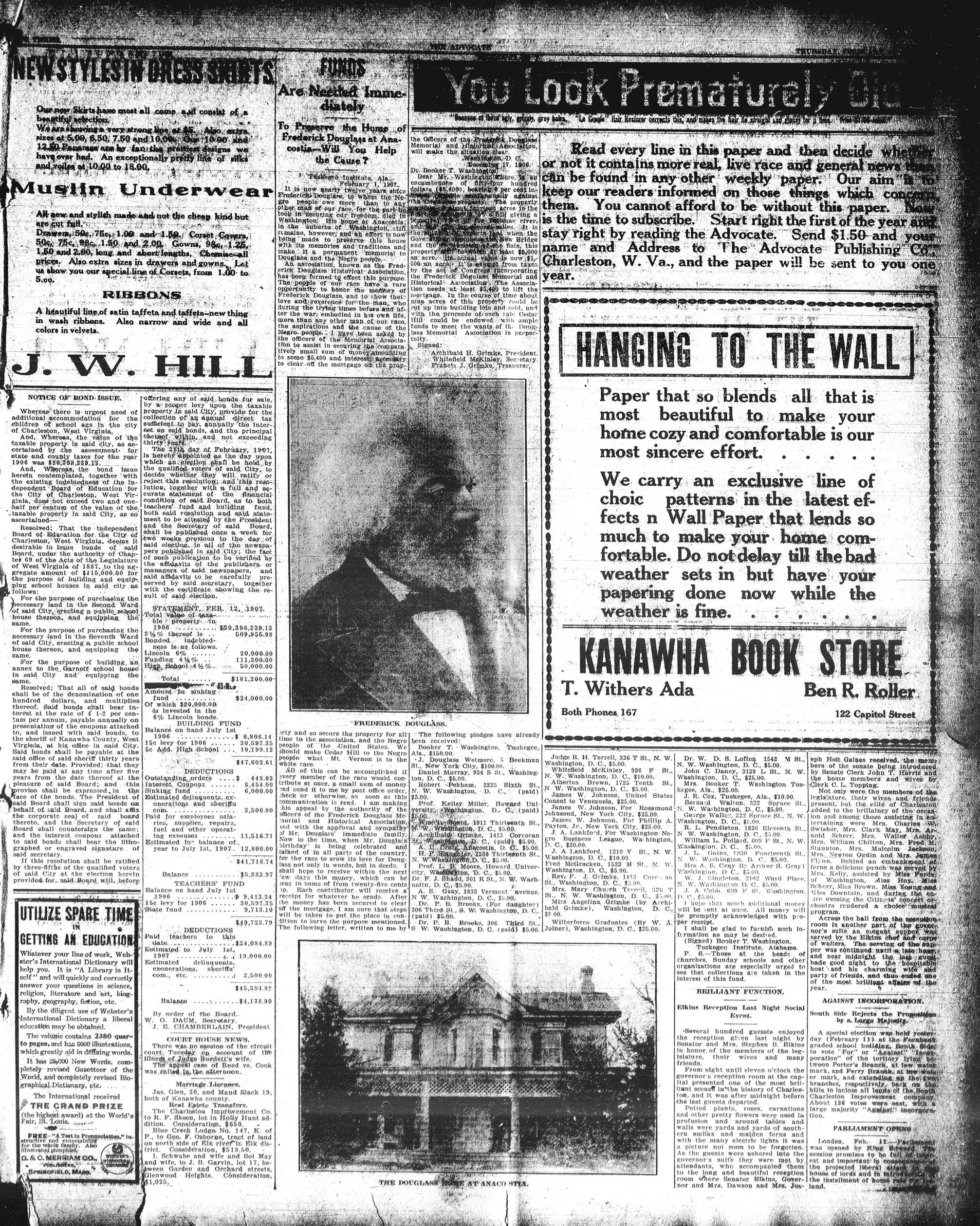
It is now nearly twelve years since Frederick Douglas, to whom the Negro people owe more than to any other man of race, for the park he took in securing a freedom, died in Washington. His hometown is in the suburbs of Washington, still remains, however, and an effort is now being made to preserve this house with its memories and traditions and make it a permanent memorial to Douglas and the Negro people.
An association, known as the Frederick Douglass Historical Association, has been formed to effect this purpose. The people of our race have a rare opportunity to honor the memory of Frederick Douglass, to show how their love and reverence for the people during the trying times before and after the war, embodied in his own life, more than any other man of our race, the aspirations and the cause of the Negro people. I have been asked by the officers of the Memorial Association, in securing the comparatively small sums amounting to some $5,400 and interest to clear off the mortgage on the prop-
The provided image is a graphic design and does not contain any chart or data.
THE LEGEND OF THE
MISSING MEMBER
FREDERICK DOUGLASS.
forty and so secure the property for all time to the association, and the Negro people of the United States. We should make Cedar Hill to the Negro people what Mt. Vernon is to the white race.
The folly been receive Booker 7 Ala., $150.0 J. Dough St. New Y.
All of this can be accomplished if every member of the race would contribute at once, a small sum of money and send it to me by post office order, check or otherwise, as soon as this communication is read. I am making appear to the authority of the officer of the Friar's Douglas Memorial and Historical Memorial and with the approval and sympathy of Mr. Douglas' immediate family. Now is the time, when Mr. Douglas birthday is being celebrated and talked of in all parts of the country, for the race to sow its love for Douglas not only in words, but in deeds. I shall hope to receive within the next few days this money, which can be sent in sums of from twenty-five cents to a contributor, will receive a receipt for the money. I shall hope the money has been secured to clear off the mortgage. I am sure that steps will be taken to put the place in condition to serve the purpose mentioned. The following letter, written to me by
---
THE HOME OF THE MAYOR
December 17, 1906.
Dr. Booker T. Washington
Dear Mr. Washington there is an encumbrance of fifty-four hundred dollars ($5,400), beating 0 per cent increase in the annual amount against the Douglass property. The property contains a farm near acres in the neighborhood. We will give a temporary show of the Douglass river, and the Douglass reservoirs. It is the opinion of Congress that when the Government completes the New Bridge and the construction of the flats, this property will be $500,000 an acre. The actual value is $500,000 an acre. It is exempt from taxes by the ack of Congress incorporating the Frederick Doggulas Memorial and Historical Association. The Association needs at least $5,400 to lift the mortgage. In the course of time about nine acres of this property could be cut up into building lots and sold, and with the proceeds of such sale Cedar Hill could be endowed with ample funds to meet the wants of the Douglass Memorial Association in perpetuity.
Archibald H. Grimke, President
Whitefield McKinley, Secretary
Francis J. Grimke, Treasurer
THE NEW YORK TIMES
The following pledges have already been received:
Booker T. Washington, Tuskegee,
Ala., $150.00.
$0.00
You Look Premature!
Read every line in this paper and then decide whether or not it contains more real, live race and general news that can be found in any other weekly paper. Our aim is to keep our readers informed on those things which concern them. You cannot afford to be without this paper. Now is the time to subscribe. Start right the first of the year and stay right by reading the Advocate. Send $1.50 and your name and Address to The Advocate Publishing Co. Charleston, W. Va., and the paper will be sent to you one year.
HANGING TO THE WALL
Paper that so blends all that is most beautiful to make your home cozy and comfortable is our most sincere effort.
We carry an exclusive line of choic patterns in the latest effects n Wall Paper that lends so much to make your home comfortable. Do not delay till the bad weather sets in but have your papering done now while the weather is fine.
KANAWHA BOOK STORE
T. Withers Ada Ben R. Roller
Both Phones 167
W. J. Sinclair, 2102 Ward Place,
N. W. Washington D. C., $5.00.
J. A. Cobb, 639 F. St. Washington,
D. C., $5.00.
I hope that much additional money
will be sent at once. All money will
be promptly acknowledged with proper
receipt.
I shall be glad to furnish such
information as may be desired.
(Sigel Baker, Washington,
Tuskegee Institute, Alabama.
P. 8.-Those at the heads of
churches, Sunday schools and other
organizations are especially urged to
see that collections are taken in the
interest of this fund.
BRILLIANT FUNCTION.
Elkins Reception Last Night Social Event.
Several hundred guessers enjoyed the reception given last night by Senator and Mrs. Stephen B. Elkins in honor of the members of the legislature, their wives and many friends. From eight until eleven o'clock the governor's reception room at the capital presented one of the most brilliant scenery in the history of Charleston, and it was after midnight before the last guests departed. Potted plants, roses, carnations and other pretty flowers were used in prairie and around tables and walls were used and yards of southern smilax and canes were with the many electric lights. It was a picture not soon to be forgotten. As the guests were ushered into the governor's suite they were met by attendants, who accompanied them to the long and beautiful reception room where Senator Elkins, Governor and Mrs. Dawson and Mrs. Jos-
122 Capitol Street
eph Holt Gatnes received, the members of the senate being introduced by Senate Clerk John T. Harris and the house members and wives by Clerk C. L. Topping.
Not only were the members of the legislature, their wives and friends present, but the elite of Charleaton added to the brilliancy of the occasion and among those assisting in entertaining were Mrs. Charles W. Swisher, Mrs. Clark May, Mrs. Arnold Scherr, Mrs. Walter Ashby, Mrs. William Chilton, Mrs. Fred M. Mrs. Newton Guln and Mrs. James Flynn. Behind the embankment of ferns a delicious punish of Mrs. Kelly, assisted by Miss Forder of Washington, Miss Hoy, Miss Scherr, Miss Brown, Miss Young and Miss Downtain, and during the entire evening the Citigas' concert or chostra rendered a choice musical program.
Across the hall from the reception room in another part of the governor's suite an elegant support was served by the Elkins chef and corps of waiters. The serving of the supper was continued until a late hour and near midnight the last guest had good night to the host and his charming wife and party of friends, and thus ended one of the most brilliant affairs of the year.
AGAINST INCORPORATION.
South Side Rejects the Promotion by a Large Majority.
A special election was held yesterday (February 11) at the Fernhank graded school building, South Bend to vote "For" or "Agalana" "Incorporation" of the territory lying between Porter's Branch, at low water mark, and Ferry Branch, at low water mark, and extending up the two branches, respectively, back on Abu hills to inclose all lands of the South Charleston Improvement company. About 126 votes were cast, with a large majority "Against" incorporation.
London. Feb. 12.—Parliament was opened by King Edward. The session promises to be full for longest and important in consequence of the projected liberal attack on the house of lords and in introduction to the installment of home rule for the land.
New York:
738 7th Avenue.
Washington:
1446 Q St., N. W.
Louisville:
1112 W. Madison St.
St. Louis:
3137 Pine St.
Philadelphia:
702 So. 15th St.
Baltimore:
502 W. Biddle St.
Boston:
94 a Harvard St., Cambridg
Pittsburg:
461 6th St., Braddock.
Columbus:
266 St. Clair Ave.
New Orleans:
226 So. Robertson St.
Jacksonville:
536 W. Union St.
Nashville:
706 Bass St.
Indianapolis:
1605 Alvord St.
Lexington:
567 N. Upper St.
San Francisco:
865 Union St., Oakland.
Detroit:
261 Elliot St.
El Paso:
332 Lion St.
RECONSTRUCTION AND RECONSTRUCTIONISTS.
It has become the fashion in late years to assail with bitterness those who took part in the work of Reconstruction at the South in the years following the War of the Rebellion; indeed the fashion has become a habit, the orators and writers, and publicists generally, with no knowledge of either the character or activities of those who occupied high places in the government of the South until the Shotgun substituted the ballot, because they have come up since those fearful days, speak neither wright of the principals of what we now, again, from habit, are pleased to style the Tragedy, without assuming that all they have read or heard of the viciousness of "the carpet-baggers" must be true, and that all testimony handed down in support of their patriotism is in nowise true or trustworthy. Even leaders of the Negro race, which immeasurably benefitted by the presence and counsel of many of those who remained in the South after the Rebellion, or came down after its close, have set their oratory against their one-time friends, or dipped their pen in the wrong ink when they would set down what they achieved for organized government, or failed to achieve. Be it said now, we take up the cudgel in defense of those Northerners who led the Negro in situations out of which developed hostility between the races at the South, or disgraced the South in the eyes of the Nation and the world. For, that class of white men, now passed away, we have no language harsh enough to describe its perfidy. He came to ravage, and ravaged he did; he came with evil designs; his purpose he accomplished and fled away, leaving his sins to be visited upon those he protested to befriend and lead out of the wilderness. But all, "carpet baggers" were not like these men. We dare affirm, the majority was very much unlike them, we dare to affirm, that the majority were high-minded, patriotic men who did the best they could, according to their light, and served the ends of peace and justice to the best of their ability.
Goldwin Smith, the eminent publicist, writing last week to The Nation, takes occasion to add his contempt for thorose who came into the slave states and attempted reconstruction. Mr. Smith professes to believe that President Lincoln had in his bosom a policy of reconstruction in the South very much unlike that followed after his death, and permitted by Grant, but which was put to an end when he was assassinated by Booth. Mr. Smith writes:
Never was crime a more fearful burden than was the assassination of Lincoln by a Southern hand. It proved the ruin of Reconstruction. I were thinking that Lincoln woke to the problem which he had to deal, taking f. rebellion, as he always did, much in fact was not a rebellion. But the sudden creation of a new nationality by a rupture which was inevitable and had been long fore-
seen. But the influence of his character on Reconstruction would have been inestimable. We know into which he was lost, Reconstruction "he."
How so learned a man as Goldwin Smith can permit himself to criticise Lincoln for treating secession as rebellion, when it was nothing slog of the most wicked rebellion in the annals of man, is puzzling to those of us who have followed him with faithful feet these many years. "A sudden creation of a new nationality" was not so sudden after all; a creation undeniably it was, just as all conclusions are primarily creations; but where in all history is there to be found a record of a more stubborn or a more exasperating rebellion against a creation, than the rebellion of the South against the inevitable position of this government as regard slavery? If Mr. Smith can point us to the book whose leaves record any thing like our Civil War, the purposes which actuated it, and the situations which contending forces sought to bring about, we will set him down on the tablet of our memory as the most learned of men. That Lincoln's influence on Reconstruction would have been inestimable, we neither question nor doubt. The lingering regret of those of us who have come up and studied the period of reconstruction, and saw how Wisdom was not, is that the master mind of his century was not spared to lend his wisdom and direction to that stupendous problem which presented its four sides only upon the close of the war. But who denied us thus boon? One who rebelled even after rebellion had been put down, one who rebelled against the life of that man who dared defy rebellion. Was Booth a rebel? If he was, so were they who sought to end the government directed against his kinsmen by his victim.
Of a truth, "we know into what hands, when he (Lincoln) was lost, Reconstruction fell!" Reconstruction fell, after Mr. Lincoln's death, into hands less wise, less steady, less calm, han the hands of mighty Abraham, but not less patriotic. There are many now living, who took part in the work at the South, that conducted themselves much as they thought Lincoln would have had them conduct themselves if he had been with us. But for the reconstructions who came into the South from other sections, we are persuaded that slavery under another name, in another dress, would have been revived. The reconstructionsists made mistakes, fearful mistakes, mistakes which we all know cost the Negro his political head, but he made them not until he began to offer and accept compromises with the ambitious ex-slaveholder. This is irrefutable history, not dwelt upon enough by those who profess to be enlightened as to what really took place in the slave states during the ten years after reconstruction began.
Some day the competent and impartial historian will arise and grasp his quill to write down for posterity the true story of the South after the War of the Rebellion; and he will write of the astounding wisdom of the Negro in legislative halls; the patriotism of the measures he placed upon the statute books; the magnanimity with which he met his former master; the ability he displayed in statesmanship; the eloquence with which he described his new-found liberty; the protection he offered the homes and firesides of every man that inhabited around; the loyalty with which he served the Federal government; he will write of the laws the Negroes framed and passed for the untrammmelled education of the whole people, and then dipping his pen into the ink, he will write in bold letters of the sacrificed and martyrdom: the toils and tribulations of the "carpet baggers" who came to a desolate and weeping section, and enriched it with their learning and patriotism, and a heritage still enjoyed, and never to be erased from the memory of those who cherish liberty until Time shall close its eyes.
PYTHIAN MUTUAL INVESTMENT
ASSOCIATION
The purchase of a twelve thousand dollar building at Huntington, this State, by the Pythian Mutual Investment Association, a corporation composed of Knights of Pythias and members of the Order of Calanthe, the Women's department of the Pythian Order, was announced in this paper last week.
Incorporated five years ago this month, the Association without the fanfare of trumpets and roll of drums, high salaried officers and expensively furnished offices, set about to accomplish its object—"carrying on mercantile and mutual insurance business, and encouraging industry, frugality and saving among its members, to procure, hold and deal in real estate, and to have, hold, enjoy, exercise and rights of such corporation under the laws of the State of West Virginia," as its by-laws state.
The organization was perfected with State Librarian S. W. Starke.
the head of the Pythlians in this state, as president and a systematic campaign was inaugurated to place the stock in the hands of members of the two Orders. In its third year a lot was purchased in this city across which the setting sun casts the shadow of the dome of the State House. Upon this lot the following year was erected a magnificent three-story, buff brick building, the superior of which for its size and purpose can not be found in this country. The investment was what would be termed in financial circles gilt-edged, as the six per cent. dividend eight months after the completion of the building will attest. Now comes the Huntington purchase and the Board of Directors tell us that they intend to press forward with the work till every important town in the state shall have within its limits a Pythian building, owned by colored Pythlians and Calautheans.
What an argument for the power of co-operation! What an example of the adage "In union there is strength." With this as a slogan, the agents of the Association, wherever the tri-colored banner of the Order waves within the state, have collected month by month a dollar here, two there and five yonder—according as the subscriber held one, two or five shares—till little by little the fund crept into the thousands and the most difficult part of the road was traveled.
It took time, yea, and courage and patience in the highest degree. Looking back over the road, is it any wonder that the chest of even the holder of one share swells with pride? Did they not have to gain the confidence of many who had been mulcted out of their little savings by get-rich-quick schemes? Were there not hundreds of doubting Thomases, awaiting with gleeful anticipations the failure of the undertaking, to be enlisted? Yes, it required time, patience and courage—how much only those at the head know
But that is all past now. Those who stood aloof to doubt and criticise are singing leading parts in the chorus of praise. From the miner, farmer, mechanic and professional man; from the washerwoman, nurse, housewife and teacher; from every employment in which our people are engaged come payments upon such stock as each feels himself able to carry, having learned the strength of union and knowing their investments are safe and returns soon.
FREDERICK DOUGLAS
February is honored in the calendar, in that during its short term it saw the birth of three great Americans: Washington, the father of his country, the brave soldier and constructive statesman, was born February 22nd; Lincoln, the emancipator and preserver of the Union, was born February. 12th; Frederick Douglass, the eloquent orator and, beyond all contradiction, the most distinguished Negro that the past generation produced, saw the light of day in the month of February. Passing over the lives of the first two, we wish to record a line or two concerning the merits of the third.
Mr. Douglass was distinctively an agitator. To this he was born and bred. He loved to be upon the firing line and give and manfully receive blows in the cause of freedom. It is true that he was only a talker, but what a talker. It is talk after all that moves the world to action. It was the unanswerable logic of the antislavery agitators that prepared men in mind for the sacrifices of a terrible internecine conflict. Mr. Douglass' talk was always right. He called a spade a spade. His defense of his race was invariably clear and indisputable. He did not know how to tawn for office; he was unskilled in the ways of the scycophant. His policy all the way through was like American diplomacy—rugged, but straightforward.
What he knew to be true he said, and his claion voice rang out clear and true for full and complete liberty for all men. His eyes had grown dim in the service of his race and he, therefore, could not see that there are some rights in the Republic that a Negro could not hope to attain. He was old-timed enough to believe In the Fourteenth and fifteenth Amendments to the Constitution and was not one of those to quietly submit to disfranchisement. He was a great man and his like we shall not see again soon. The other race has gown the high valuation it places upon the services of its two sons born in the same month as Douglass by preserving their birth places for future generations. Soon the Lincoln birthplace farm at Hodgenville, Ky., will vie with beautiful Mt. Vernon as a mecca for those who would do reverence to America's great son.
An association appeals in this number of The Advocate for funds to save the Douglass home at Anacostia. Shall its appeal be in valm? Surely the ten millions of Negroes in the United States will not rob its future generations of so rich a heritage. It will not allow the home of him, who fought the fight and kept faith during the dark days before Freedom, to pass into the hands of
THE ADVOCATE
strangers. A very small arm is needed. Will you not help?
THE LAST DITCH.
The desperation to which the opponents of the Primary Election bill have been reduced is manifest from the questionable methods they are pursuing to encompass its defeat.
Under the likeness of Jas. K. Smith, a well known Negro lawyer of the southwestern portion of the State, was a letter, in a local daily last week, alleged to have been written by him to a friend, in which he rejoiced over the approaching realization of a life-long ambition—a circuit judgeship. The letter stated that Smith has cherished two hopes, one was to be a bishop of his church, the other to preside over the circuit court of his district.
Good friends of Mr. Smith pronounce the letter a forgery, state that the halfstone was secured by trickery and denounce the whole as a scheme to swing the neutrals to the side of the opposition and kill the bill. To do this the delegates from the southwestern counties and their friends have resorted to the tactics of the demagogue and have joined hands with the "gentleman from Mingo" in stirring up the fires of race prejudice simply that the people may have no voice in naming those for whom they are to vote at the general elections. Friendly ties which hitherto have bound the two races together in West Virginia are being menaced by ruthless hands that the elective offices may be preserved for a few men who have handed them around at their own sweet will by virtue of their ability to pack conventions and "fix" primary officers.
The Primary Election bill may fall of passage through this Legislature, but, since the trend of the times is toward the disposition of the boss and rule of the people, it or some other must eventually be incorporated In our statutes.
The Legislature adjourns on the 22nd. Praise God from whom all blessings flow.
COMMUNICATED.
I have noticed that some well-meaning brother Knight has announced in one of our lively journals that I am buzking for the Sup. Keeper of Record of Seals ship. "Please announce or not, am not a candidate for any office at present." First. I think too well of our present officer or officer.
Second the work of preparing for our coming session is too great for me to be hustling. No office away from me. Many thanks to the brother however.
MISCENGENATION
(From The Dallas,Express.)
From The Texas Freedman we gather this,intering bit of news and submit it without comment:
A dispatch from Meridan, Miss, tells how district attorney J. H. Currie, who delivered the charge to the grand jury for the judge, scored the white men of the South for their unlawful referring to the Negro as an inhabitant of this country, Mr. Currie is quoted as saying:
"He came here an ignorant savage, full of laughter, good humor, story and song. If he had any virtue, it was the virtue of submission and obedience, and he made the greatest slave the world ever saw. As a slave he was beyond all the examples of history, beyond all the midst of the most sanguinary war of the ancient times, the patient, long-suffering Negro master, the home of his master and maintained the women and children of the South and at the same time supported the army that fought to fix his destiny in civilization without a murmur. I honor him for this, and the time will come when an impartial history record his loyal patience by the side of the heroic courage of his fiery master."
Turning to the subject of miscegnation, Mr. Currie says:
the accused shadow of misregregation hangs over the South today like a pall of hell. We talk much of the Negro question and all of its possible ramifications and consequences, but gentlemen, the trouble is not far affeld. Our own people, our white men and their black concubines, are destroying integrity of the Negro race, raising the race to a level lowering the standard of both men and preparing the way for riot, mob, criminal assaults, and finally, a death struggle for racial supremacy. The trouble is at our own door. We have tolerated this crime long enough, and if our country is not run by policy rather than by law, then it is time to rise up and denounce this sin of the earth. The white man who enters into sexual and social cohabitation we any race other than his own is an enemy to the peace of both races and a menace to the stability of our civilization."
To the white man he says:
"Any white man who deliberately breech down the law of race pride, and race rage, and drowned in a public trial, side by side with the victim of his unholly lust, and scourged by the law until he stands branded with the curse of Cain as a common enemy of both races and all society. This biting, eating, corroding sin had its Genesis in the shamles of slavery, when the Negro was a helpless chattel and the white man his dominant master, and this is one of of the many sins entailed by the accursed relation. The white man had no excuse then, and neither has now, and the black man has thick and fast on the backs of both. No many Negro who is conscious of his place in nature is shamed of the color of his skin, for the blackest he is the closer he is to the law of race, yet the shameful fact remains today.
and has existed for years, that the black Negro, the full-blooded Negro the type of a pure Negro race, is looked on as inferior to his mongrel brother, and if the black Negro could do so he would vote himself with straight identity as a race. Surely his own identity as a race. Such a racial integrity, such an utter want of racial pride, unfits the Negro for the struggle that civilization has imposed upon him." If the outside world only knew how white men, of all classes and stations, in the South, box and openly spend their time money and are seeking to debauch Negro girls and women, and how many of the "race wars" down there are the results of decent colored men resenting the insults to their women folks by the men of the superior race, it could not be suppressed by the Negro men, who are meant that the white women should for the white women, should be trained worse at attempting assault than they are reported to be.
The Jim Crow Recrudescence
By a party vote the Missouri senate has passed a bill to segregate persons of African blood when passengers on steam railway cars. The exclusion at present is not to extend to street railway cars, but the bill is evidently an entering wedge, even though it is not in describing humiliating and disfranchising a race. For a generation Negroes have been riding on steam cars in Missouri as provided for the public generally, and the question of rights in the case was supposed to have been as definitely settled as that of slavery. No right-minded pathway passenger seeks to be offended by the segregation of steam cars. A company of this nature is mainly composed of strangers to each other, and conduct themselves with the due restraints of propriety and courtesy. There is no complaint that the Negroes of Missouri have failed to observe the rules of department that frame themselves under such circumstances. Nevertheless, the Negroes have voted to place Negroes in a designated separate part of a car, to be divided from the rest by at least a bar, or perhaps a cord would suffice. The nature of the barrier mark is immaterial. It is the inferior classification, rendered distinct and insisted on as a visible sign, that forms an animus against the segregation of stigma on one race, regardless of the fact that it is of American citizenship and birth.
Consigning an American citizen, no matter how humble, to a deliberately provided inferior compartment, under the rule that it is the only place to which he will be admitted is manifestly a lowering of the standard of all American citizenship and a bluff on the basis of his own moral and social other allusions a superior class? A limbo for certain American citizens on account of their complexion is not an inspiring sight. The passenger car pen is a step backward toward the old slave pen, and rests precisely on the same moral and political basis. Jim Crow cars originated, in the guild states, where the Negro population is dense and far less intelligent. To the Missouri Negro the Jim Crow pen would be a strange and most painful innovation. It would take away from him a privilege to which he has been accustomed since slavery was abolished. Even before emancipation a free Missouri Negro was not committed to a special car pen. He paid his fare in full the same as others, and found for himself a place where he could escape the offense to others. How many men who read these words would be willing to enter such a special compartment, much less permit their wives and daughters to be set apart with inferiority proclaimed and accepted? There are railroads around Missouri as well as through it, and other means of transportation than any that can be identified with the car pen approved by the law. He would walk rather than, on compulsion, take a seat in such a corner of compliant degradation.
Only one Missourian in twenty is of African blood. The proportion of Negro steam railway passengers in this state is not over one in fifty. The senate bill was not inspired by any emergency or incident that suggested reactionary legislation of this kind. A deeper programme is questionably behind the movement. The next step would be to apply Jim Crow principles of the carousel policy and educational certification will be devised for voters and so manipulated, as in the gulf states, that the Negroes of Missouri will practically lose the ballot also. An address to the legislature has been issued by the general committee representing the 45,000 colored citizens of St. Louis and vicinity asking for justice as law-abiding, earnest American citizens. It is a respectful document, and the arguments are unanswerable. The plea is made with the fervor of American manhood that resorts to no harsh words though threatened with a great talkup. Jim Crow laws have a talkup of in Missouri legislatures before, but the menace this time is serious if not imminent. The senate has done its worst; the matter now rests with the house and Gov. Folk.
CHILD LABOR LEGISLATION.
Atlanta Georgian.
The south cannot afford to oppose a measure for the protection of the children of America. While in one industry the percentage of children employed is greater than in that of any other industry elsewhere, the number of these little child workers is greater in the north, there being more under sixteen in Pennsylvania than in the south. Why should we act as though our toes were being stepped upon, as though the matter were a sectional one. It is a national evil and it needs a national cure.
THE RATE PER CENT.
"Smith takes more interest in his business than any one I know."
"What's his business?"
"He runs a pawn shop."
Shortly before two o'clock this morning, fire was discovered in a room on the third floor of the St. Albert hotel, Kanawha street, and before it was gotten under control the upper stories were practically destroyed, while the two lower floors were almost equally damaged by the floods of water which it was necessary to pour into the upper stories in order to check the progress of the flames, which had been wholly accomplished at four o'clock. Nothing could be learned as to the probable origin of the flames but once started they spread with great velocity, by the time the fire department, which responded with its usual promptness, could get to work, had obtained a firm hold on the two upper floors.
The house was well filled with guests, but it is known that all escaped, many of them, however, being very slightly clad, and few escaping without loss either of wearing apparel or other property, and being very aroused guests presented decidedly appearances when they emerged from the burning building on the street. So far as known, J. H. Mack, of Baltimore, said to be a traveling man, was the only one of the guests injured, he having jumped from a fourth story near window to the ground, dying from his injuries a few hours later. Both fire engines were brought into requisition as well as several lines of fire connected directly with the fire plug, with many streams of water playing on the burning building from both front and rear, the effect was soon notable.
The St. Albert was one of the oldest and best known hotels in the city, and for many years ranked as its leading hostelry, until the erection of its more modern competitor, which has been remodeled throughout its interior, finally refurbished throughout at a comparatively recent date, and was the favorite stopping place for many of the people from the neighboring towns. It was purchased on the basis of the present year by Mr. T. R. Farley, purchase price being $27,500, exclusive to the town which already belonged to Mr. Farley, who has been conducting the hotel for some time past. He carried insurance to the amount of only $2,500, so that his loss will be quite heavy, although considerable due to the loss from the lower floors, office fixures etc. removed, in a more or less damaged condition to places of safety.
Full details were almost impossible to obtain, the guests being occupied in the effort to get together sufficient clothing to protect them from the weather or in seeking other quarters, and the proprietor natured having other matters to attend to than the guests, questions upon subjects as to which the guest not himself thoroughly informed. It was the most stubborn and costly fire which Charleston has experienced since the one which destroyed the block on Quarrier street several months ago, and but for the prompt response of the fire department and the excellent service performed by them might have had far more consequences. With the old equipment, for the purchase of the new engine and the rebuilding of the old one, nothing but a miracle could have averted the destruction of the entire block.
Coming To It.
Wheeling: Intelligencer.
If the esteemed Fairmont West Virginian will carefully read the Intelligencer again, it will find that nothing has been said in this paper to the effect that there was a defect, resulting from the tax laws. What was said, and what we repeat, is the new revenue must be provided, if the new tax is to be reduced below eight percent. To reduce the state tax, and not provide other sources of revenue, will create a defect.
THE EXECUTIVE JOKER
"What do you do?"
"Why, you remember his campaign promises?"
"Yes."
"Well, he meant 'em."
DEFECT OF OMISSION.
Baltimore American.
An anti-tipping law for Washington, D. C., is in progress of manufacture. It is very defective in that it does not prohibit giving tips on the races.
MR. TILLMAN'S NECKWEAR
Writing of Senator Tillman, a newspaper correspondent, remarks that he turned down collar. We judged that he wore a standing choler.
FROZEN.
The parlor jet has got no light.
The gas stove has no flame.
But when the monthly bills come
in
They'll get them just the same.
BEES AND BLUE FLOWERS.
Darwin's theory of "bees and blue flowers" or the evolution of "the largest and most brilliant flowers" by the preference of these of pollin distributing bees, is challenged by Mr. G. W. Bulman in the current Nineteenth Century. Darwin's view was thus expressed in his "Origin of Species:" "We may safely conclude that if insects had never existed on the face of the world the vegetation would not have been decked with beautiful flowers, but would have produced
THURSDAY, FEBRUARY 14, 1800
only such poor flowers as are now born by, our firs, nut, oak and ash trees, by the grasses, by spinech, docks and nettles."
Mr. Hulman adduces evidence that bees, far from resorting to pollen and nectar to flowers, tinged with blue, as averred by Lord Avebury, exhibit no especial preference for them, or for yellow, orange, green, black or white flowers; but will readen their hip pockets with honey from flowers, late despoiled of petals and color. The abundance of umbs of the limb the bully, the willow, the current and the ivy are all alike增强 with murmurous bees" appear, after all, to be strictly commercial.
Have Archie Guezing.
Grant County Press.
Senator jake Fisher created a surprise at Charleston the other day by refusing to accept the mileage allowed him, claiming he had come a nearer way and was not entitled to as many miles. Many of the other members could not understand what the fellow meant. The idea of not doing everything in sight was a new one, a new unequivocal investigation proved that Florida was rational when this breach of senatorial courtesy was committed and all are at sea as to why he introduced this unpopular innovation. Along this line we noticed an item that indicates Monongalla county is much larger than we supposed. This item has two delegates in the house and we have four organown paper the mileage allowed, hundred and twenty-five and the other six hundred. These gentlemen doubtless traveled different routes
SENATORIAL POVERTY.
Savannah News.
There has been much discussion lately as to who is the poorest senator in Washington. Notwithstanding his name, Senator Money, of Mississippi, claims the distinction of being poorer than any of his confreres. But that is merely a matter of dollars and cents. If there is a poorer senator in Washington than Clark, of Montana, who has more money than he knows what to do with, we have yet to hear of him.
LESSON FOR CONDUCTOR.
From the Cleveland Plain Dealer.
A Percheron size woman carrying a great many bundles prepared to alight from a Wade Park car at Eurometue and East Ninth street, yesterday stepping to the ground the car started on. "Oh, walt, wait," she cried, "I've got off at the wrong place." The car slowed up and she climbed back on. "I got back on to see if I could get you to wait until I got off before you exclaimed the exclaimed that moment she was shelled again." "I'll you wait now I will get off again." And off she clambered again.
EXPLAINED
"You state in one place that you were born in 1884?" "Yes, sir." "And in another that you were born in 1885?" "Yes, sir." "Isn't that inconsistent?" "Oh, no! smiled the witness. "I was born in and just stayed born. Why, I'm born." Then the great lawyer had to recognize that a novelty had been sprung on him.
The Premier.
Oshkosh!
There is a name to laud, hi-goosh!
Some yell, I know,
For Kokomo.
But that is plain, unvarnished bosh.
Oshkosh!
It makes one's very blood go swash!
Kalamazoo?
It will not do.
Its claim to fame I hereby quash.
Oshkosh!
Beneath my tongue thy name I
sloosh!
For tiffes queer
You have no peer.
You stand alone. And that's no
josh!
THE HUNTRESS.
"Grace, what sort of a fellow is
Mr. Grotrox?"
"He's very shy, Maude."
"Shy or gun-shy?"
FAIRBANKS AND SHAW
Principal Speakers At Lincoln Celebration in Baltimore.
Baltimore, Md., Feb. 12.—Lincoln's birthday was celebrated here today, the leading features being two banquets to night, one under the joint audience, on the League Club, and the Young Men's Club, and the other at the Greek Amphitheater. At the former Mayor Clay President Fairbanks responded to the toast "Abraham Lincoln," and Secretary of the Treasury Leslie M. Shaw of the Republican party." The Vice-President devoted himself to the eulogy of Lincoln.
INTO ELK RIVER
Oil Flows Six Miles From Clendennin.
Six miles from Clendennin on the grair farm in Kanawah county, the United States Gas and Oil Company, Monday stocked a fine flow of oil at a depth of fifty feet, 1,600 feet in the shallow sand. The company has been boring for gas in that region and were surprised when a large flow of oil was checked. The oil flow is so thick that it is nearby creek and thence into the river lake. The same company has a number of options on adjoining land.
BOND ELECTION FER. 28
School Board Proposes Issue of $115,000.
The Charleston school board met last night and decided that a bond issue of $115,000 would be necessary for the erection of the proposed new school buildings in the city. The question will be submitted to the people at an election on February 28.
THE TAILOR
708 Virginia Street.
Charleston, W. Va.
He
Makes
Your
Old
Clothes
Look Like New! Suit pressed like New only
50c
We also have a nice line of the latest styles of cloth for Suits and Pants made to your order at the LOWEST PRICES.
SUITS TO ORDER $10.00 and up.
PANTS TO ORDER
$3.50
and up.
GOOD FIT
GUARANTEED
We also do dyeing in all colors.
Bell Phone 547.
Home " 1012X
Crescent Steam Dye Works.
708 Virginia St.
GUS SCHNURMAN, Prop.
```markdown
```
The Restaurant
now managed by Harvey Lowery & Co. No. 417 Kanawha St., opposite Court House square, will after January 1st, 1607; be operated and conducted by
BOARDING AND LODGING
by the day, week or month.
A good meal served at all
hours, day and night. Don't
forget the place
417 Kanawha street
Opposite Court House Squar
M. Beamer, Prop
CHARLESTON
Mrs. Alice Bacchus, who has been ill for a number of months, died Sunday of dropay. The funeral was conducted at the First Baptist church by Rev. J. Eulian Bullock.
Little Mildred Randolph and Princess Stewart are ill with typhoid fever.
J. H. Noel, of Sewell, was a business visitor in the city Friday of last week.
Mrs. Romaine Burkes was seriously burned last Saturday. The clothing of her little daughter, Elizabeth, was ignited in some way and in attempting to extinguish the flames, Mrs. Burkes, as well as the little girl, was burned.
The Woman's Loyal Union met with Mrs. J. P. Caul Monday night. The program was well rendered and a most delightful time was enjoyed by all. The hostess served refreshments after the business of the session had been transacted. The next meeting will be held with Mrs. Abbie Campbell, of Elizabeth street, at which time it is hoped that all the members will be present.
A. J. Walker and Lester Bullock, of Stuart, are in the city on business. Miss Alice Jordan, an attendant at the Woston asylum for the insane, was here Wednesday to remove a patient to that institution. Mrs. D. W. Butler is slowly recovering from a serious illness. Miss Mabeile Anderson returned Saturday from Huntington, where she spent the week the guest of Mrs. Lynch. Dandridge, the little son of Mr. and Mrs. John A. Brown, is ill with typhoid fever. We lead the half goods to Mrs. Brown, 500 Capitol street. adv Born to Mr. and Mrs. Chastine Brown, on Monday of last week a daughter. A. P. Straughter, of Hinton, was a business visitor here a day. Mrs. Eliza Burks, of Elizabeth street, is able to be out after a short illness.
The Willing Workers of the Simpson M. E. church, were entertained by Mrs. Woodford at her home on Jacob street last week. An appetizing luncheon was served. Mrs. Walter Harris has been dangerously ill at her home, but is now very much improved. Mrs. John Campbell was hostess Thursday afternoon to the ladies of the 20th Century club. Mr. and Mrs. James Page's little daughter, Catherine, has been ill this week. The friends of Dr. H. E. Kingslow will be glad to learn that he is recovering from an attack of pneumonia. Mrs. Martha Parker is improving after an illness of three weeks.
The Charleston Woman's Improvement League was entertained Friday afternoon by Miss Ida M. King at the home of Mrs. B. F. Clarke, on Washington street. After the business session Miss King served a dainty lunch followed by ices and hot chocolate.
Miss Blanche E. Campbell teacher of the millinery class, is planning to have the opening Feb. 20th at the K. of P. hall. Many beautiful creations in chiffon, straw, braid, and velvet have been made and will doubtless surprise many.
Mrs. G. W. Cairr and her little daughter have returned from Lancaster, O.
The following report of collections was made by captains of he various clubs at the St. Paul A. M. E. church rally Sunday: Rev. W. E. Walker, pastor; $52.30; W. O. Lee; $50.00; Mrs. Mattie Moss; $20.30; Mrs. Lettle Johnson, $6.35; E. W. Washington, $11.00; Mrs. S. D. Cowser, $9.20; The Ladies Aid Society, $7.00; Mrs. Maggie Calhoun, $5.35; Miss Bessie Taylor, $7.35; H.
```markdown
```
The New Hotel Brown conducted on the European plan.
When completed will have reception parlors and both local and long distant phones. There are 32 rooms
THURSDAY, FRI
DAY AND SATUR
DAY AT LASKY'S
Prices have been cut and slas'd in order to make the rest of our Winter Goods go. Everybody come-This will be a great event.
Values are great and they will surely not disappoint you.
Read a few of the bargains that will insure you of the facts.
$1.50 Sateen Underskirts
at 95c.
R. G. Corset Make, in all
styles at 44c.
Remnants of all kinds at
your own prices.
$8 and $10 Ladies' coats
at $3.98 and $5.95.
Ladies' trimmed hats
your choice of any in
the house at 50c, 98c
and $1.98.
$1.50 Ladies all-wool
sweaters, some of
them solled. Must go
at $59c.
59c kimonas made of
flanelettes, at 38c.
$3.50 ladies' sample
shoes at $1.65.
$2.50 boys' suits, in all sizes, at $1.48.
Ladies $4 and $5 skirts of all descriptions at $2.95.
39c outing unkerskirt patterns at 19c.
$1.00 plaid waists at 69c.
$1.50 white lawn waists, the prettiest shown in the city, at 95c.
98c felt slippers, few pairs left at 49c.
Embroideries and laces at very low prices.
Come to our store if you want to save money. Bargains are the best we have shown this time of the year.
Lasky's
105 Capitol St.
K. Lewis, $1.35.; public collection,
$4.86; total $185.16. The rally is
being continued with the same captains.
As a result of the revival just
closed there were fourteen converts
and twenty-one additions to the
church.
GOOD FOR ARKANSAS.
Mosaic Guide.
The Negroes of Arkansas paid into the state treasury last year for real and personal property tax $260,-000 besides $50,000 poll tax making a total of $310,000 paid in the state treasury by Negroes as taxes for the year 1906. According to the census bureau at Washington, D. C., the Negroes of Arkansas own $30,000,-000 worth of property. This vast sum of money in property values does not represent his cash, bank and, savings accounts. We fall to see in these figures the worthless, shiftless side of the Negro problem.
Slowly, but surely the Negroes of Arkansas are solving their own problem: with cash, bank accounts and property. If they can accomplish so much in 40 years who can tell in 40 more years what the harvest will be? God and God alone can answer this question.
```markdown
```
including annex. Rates per day, 25,
50, and 75 cents. Located 500. Capitol
street.
Charleston, W. Va.
New phone 1098.
Honorable Sentinels and Members of the General Assembly
of the General Assembly:
We, the Colored Citizens of Missouri, present this overture for your serious and impartial attention. We enter a solemn and righteous protest against a Separate Coach Bill in any form. The Senate and Assembly are considering such a bill at this time, which (and the unlikely often happens) might become such a law, to separate the races on the steam railways in the State. We, your Colored constituents, are humiliated, justly grieved and even horrified at the thought of what such legislation would mean for us as a people in Missouri. The fact that we have to make such an appeal causes us to blush. The sense or fear that the highest law-making body in the State has no regard for our standing would segregate us on the public railways, thus singling us out and labeling us as objects of contempt and opprobrium, the sense that we have no one in your honorable body, or rather not a sufficient number of statesmen to represent us and voice, at this critical moment, the aspirations and sharp grief of our souls and the real facts in the case, so as to check such legislation or even prevent its serious consideration—this feeling of insecurity here on our native soil, where all foreigners, not of African descent, are welcomed and permitted to move with ease and self-respect, fills us with shame and a holy anger, an anger, however, that is not anarchistic.
A Vital Question
Can the native population here in Missouri of African descent, with the native population of English, German or French descent hope to rise and according to its own measure contribute its full strength to the wealth of the State, if we are discredited and our self-respect arbitrarily challenged by this State? Will you not allow the consciousness of manhood to lie as a quiet force at the base of our character and not roughly, by special legislation, force us to carry it as a chip upon our shoulders. Honored sir, because you are freemen and know the sacred fires their fears and hopes, their perils and aspirations, we make this complaint to you as freemen with a real grievance; and we make it upon the high ground of Justice and Fraternity. An appeal from the lower level would prove us unworthy, nor would it merit the respect of your honorable body. Should not the welfare of the people (all the people) be the supreme law of the State?
A Question of, Principle.
Whether it be a solid partition, a bar or a gunken thread separating the races in railway coaches of this State, it makes no difference. The underlying principle is the same, which we oppose. The principle of segregation in such laws is invidious and wrong. It is a prolific germ of all sorts of mischief. Such legislation would degrade the State and all the people, produce a bitter estrangement between the races and would stifle with an unvenomed discouragement the spirit of the Negro the juvenile, but up straddling and no mean portion of the State's population.
Will the Legislature Deny Its Own
Commendable Record?
Need we remind you, gentlemen, that the legislature of this State has contributed liberally in the past to Lincoln Institute, the State school for Colored youth located in the capitol city? This school has sent out many competent and high thinking teachers into all parts of Missouri. Such teachers have been sharpening the intellects, moulding the characters and elevating the thoughts of our colored youth. Will the legislature, now at this late day, go back upon its commendable record? With prosperity and plenty smiling upon us and a grand future beckoning us to the heights, is the legislature prepared to shock the moral sense of our great State and cripple her with a blurred vision and a leaden foot? The Separate Coach law, with all it implies, would dampen the sacred ardor and blight the hopes which this State has hitherto fostered in the breasts of the colored citizens, as well as of all her people.
Womanhood and Girlhood at Stake.
Gentlemen, you must know also that the elgithy thousand of, our women and girls would feel the humiliation and cruel blow of this law most crushingly. Is it not possible for you to feel yourselves in our place? We read the same Bible, and we have the same human feelings; can we not, therefore, expect that you will do for others and theirs what you would have others do for you and yours? The sort of legislation called "Jim Crow" law, does not mean merely a separate section on railway cars; it carries with it contempt, embarrassment, suppression and heartless boycott at very many other points. And by so much you make the path of the Negro to life, liberty and the pursuit of happiness rough and thorny; this path, even when conditions are equal and favorable requires the finest courage and the highest self-control. In spite of separating laws, we are all in the State necessarily related in the same general industrial and political order, which would make a boycott at once possible, stifling and terrible. The exclusion of trade unionism is bad enough without the added encouragement of legislative enactment.
Moderate Jim Crow Bill Most Dan-
Furthermore, gentlemen, the more gentle and moderate the terms of this bill, the more it is to be dreaded. A Separate Coach law, however, modified in its terms and limited in its application, means the introduction and recognition of this principle in legislation in this State, which is sure to be followed by the worst of its kind, both brutal in terms and universal in application. Separation on railway coaches only today, means separation in all railway stations and street cars tomorrow. The camels about today means his hump tomorrow. Of necessity, "Jim Crowism" would have to enter liberty loving Missouri, stealthily little by little; but once in, we know from the history of such legislation, to
what extent a low morale would fall, like a mildew upon the whole State and by little; but once in, we know from the history of such legislation, to what extent a low morale would fall like a mildew upon the whole State and upon our people in particular. The Fable.
The False Charge Against the Negro
As a race we are charged with retrograding in morals, being obnoxious in manners and unreliable in service which coupled with our numerical in crease justifies segregation for the comfort of the dominant race. ironized sirs: Will you consider the followin, statistics, taken from the Unite State Constell Bulletin No. 8, giving figure so recent as 1900. We shall attempt to show you that the substantial progrss of our people in Missouri in general has been most remarkable and commendable notwithstanding there may be many particular case abusing of us vice and shiffless ness. But is this not true of all races? We can be no exception
We simply ask for fair play, that the whole may not be judged by the part Can the "Jim Crow," or vicious elements of any, race be eliminated by victimizing the whole race?
Remarkable Figure. Bent
The total population in Missouri in 1900 was 3,106,85. That of the whites was 2,944,843, while that of the Negroes was only 161,234. To each 100,000 whites, there are only 5,000 Negroes. From 1890 to 1900—a period of ten years there was an increase in white population of 416,385, their rate of increase for the decade being 1.4 per cent. During that same decade the Negro population increased only 21,050, thir rate of increase being 21.4 per cent. The Negroes represent but 5.2 per cent of Missouri's entire population. The usual argument therefore, made by those who favor "Jim Crow" legislation, that of a congested Negro population cannot be produced here in the State of Missouri. Surely the legislature of a great State would not permit hatred for any element of the population, pure and simple, to be a controlling factor in its enactments.
The Negroes—Real Missourians.
Further, gentlemen, the Negroes of the State are Missourians, we live upon the soil which has been hallowed by the sweat and tears of our fathers. Shall the strangers who are but of yesterday, be taught to despise us in our own home? Whatever their antecedents and value to the State compared with us they are strangers. Of 162, 234 Negroes in this State 161,081 are native born; and the parents of 160, 425 of these were also born in this State. Hundreds of thousands of whites are in Missouri today by immigration from other States; but the Negroes were born here as were their parents. It is true we held the position in time past of slave to the white man. This relationship which neither race should be proud of today; but nevertheless in the house of bondage we had our joys and sorrows together; and together we tilled the forests of this wilderness, laying the foundation of the great wealth which gives to Missouri an enviable place among the States; in the furnace of fires of our freeing, we were both alike emancipated; we are kin by tie of sentiment. We know each other better today than ever. Providence has joined the races together, let us be friendly and mutual helpers.
Missouri Negroes Second to No Other Negroes.
The Negroes of Missouri, he it said to the credit of the State, are among the most substantially progressive and intelligent in the country, and as we will attempt to show you, sirs, among the most progressive elements, all things considered, of Missouri population today. In 1900 there were 24,790 Negro children in school in this State, 13,097 of these were girls. At that time, 1900, 28.1 of the Negro population of the State was illiterate; but ten years previous 1890, 41.7 per cent of the Negroes of the State was illiterate. Thus it appears that our literacy was reduced in the decade from 1890 to 1900, 13.6 per cent. This is a proof of Missouri's generous and impartial spirit and wise provision for the State's highest well being. Shall the legislature of this State permit a passing spasm of adverse sentiment toward the Negro in the country to throw the race and the State backward where it was forty years ago?
A Gratifying Comparison.
Now if we compare Missouri's decrease of Negro illiteracy with that of the various States of the South where separate laws have obtained for some time and where the relation of the races is more tense than here, we find that Missouri takes the lead with but few exceptions. The progress which the Negroes have made here has been the result of philanthropic, educational and Christian forces almost wholly from within. Missourians, white and black, have worked together serving and helping each other in the vitalizing air of freedom. The kindlest fellowship has characterized the two races for the most part in this State; the whites with chivalrous helpful sympathy toward the blacks, and the blacks with eager assimulating and appreciative reciprocity toward the whites. The governments of the State and municipalities have been most generous in providing educational opportunities and industrial openings for the Negro and for all.
None of the great denominational societies at the North sent thousands of dollars and their best brains and character into Missouri right after the war as they did other former slave States to found colleges and trade schools for the freedmen. Here, in Missouri, the former masters and exslaves and their children have worked together with credit and success upon their own educational, political and industrial problems. The great advance which this State has made upon all lines together with Negro racial progress and adjustment, has been the result of a just sentiment which in the last thirty years has stirred most Missourians. The Negro population, therefore, and all the better thinking people of the white population of this State are wholly unprepared for the handicap and set-back implied in "Jim Crow" law. Such legislation, in view of this record of race amity and rugged good sense, would be unwarranted, a note of discord in Missouri's hum of prosperity and a snag in her upward course.
Wealth of the Missouri Negro. Gentlemen. In conclusion take a glance at the material progress which the Negroes of this State have made under just and equal laws. Of the 115,163 Negroes in Missouri above the
We Are Receiving Daily th:
NEW
SPRING
STYLES
of Clothing, Hats
and Gent's
Furnishings
SCHWABE & MAY
Up-to-Date Outfitters
For First Class
Plumbing, Gas
Fitting and
Heating
Call and See
GEBHART PLUMBING
COMPANY
228 Capitol St. Charleston, W. Va.
NOTICE! K. OF
The 1907 Official Service or Program to be used on Anniversary or Thanksgiving Day, can be had for $2.00 for 100, $1.25 for 50, or 75c for 25. All lodges should have them Money must be sent with your order to S. W. STARKS Supreme Chancellor, Charleston, W. Va.
If you need badges order them
Johnson's
Skating Ri
Formerly known as Johnson's Rink
and Lee Sts., will be thrown open to
Morning Sessions 15c, including
and Gents 30c including admission.
cluding admission. General admis
n.s Big Roller Rink
Sisson's Rink located at the corner of Dickinson town open to the COLORED PEOPLE
5c, including admission...Afternoon, Ladies 20c admission. Nights, Ladies 25c, Gents 35c in-eral admission to spectators 10c.
If you need badges order them at once.
Johnson's Big Roller Skating Rink
Formerly known as Johnson's Rink located at the corner of Dickinson and Lee Sts., will be thrown open to the COLORED PEOPLE.
Morning Sessions 15c, including admission... Afternoon, Ladies 20c and Gents 30c including admission. Nights, Ladies 25c, Gents 35c including admission. General admission to spectators 10c.
age of ten years, there are 73,566 of this number who are bread winners to see his brother rise they should be inspiring; they are eloquent as a proof of the Negroes enterprise, second and wage earner.
this number who are bread winners and wage earners; two thirds of our population over ten years of age in this State are following gainful occupations, such as: agriculture, domestic service, the professions, trades and transportation service and manufacturing and mechanical pursuits. The labor has not been without results the most praiseworthy. The Negroes in Missouri own 9,535 homes, 5,908 of which are free of debt. They own 2,348 farm homes; 1,586 of which are free of debt. The Negroes in the State hire farm homes to the number of 2,301. In all the farms owned by Negroes are 271,333 acres; and 72.1 per cent of these farms is improved land. The total valuation of farm homes owned by Negroes in this State is $7,969,326. The value of the products from these farms in 1899 was $1,835,732. And the average value of each farm was $1,600. Over 2,000 of these farms contain more than 20 acres; more than 1,000 of them more than 50 acres; and more than 500 of them contain over 100 acres. These figures gathered six years ago and not covering property acquired since fall far short of the Gentlemen, these figures speak for Equal Justice.
to see his brother rise they should be inspiring; they are eloquent as a proof of the Negroes enterprise, economy and intelligent outlook. He is not a cipher in the industrial system, he is slowly but surely laying a foundation for himself as an intelligent trustworthy citizen.
And all this progress which the Negroes have made is both the result and handmade of the Christian religion for an intelligent ministry and a practical Christianity is the growing demand throughout the State.
Honored sirs, again, we impure you to use your great power in legislation to encourage and not hinder us. Do not listen to those who would strike a brother when he is down, or risk the runner of the race. We ask for no favors only to be not hampered by class legislation. We ask for freedom and equality before the law with all that implies of civil, political and industrial opportunity.
Portland Oregonian
Representative Champ Clark
makes half a dozen good suggestions
for President Roosevelt's future. Everybody worries about it. But Home
BAUER MEAT FISH COMPANY 8 AND 30 CAPITOL ST.
In our new dedrtment we now have the following line of fresh fish
Trout, Pickere, Mackerel, Herring, Salmon, Bue and atfish And the Sea Foods as follows:- Shrimp, Clams, Lobsters Deviled Crabs, Hard and Soft Shell Crabs, Turtles.
Also all kinds of Fancy Cheese, Summer Sausages, Bullions, Sauses, Olives Pickles, etc.
Don't Forget we clean all Fish ready for pan.
HOTEL JACKSON.
Montgomery, W. Va.
New Hotel the finest equipped hotel for Colored People in the State. Finely Furnished with all modern conveniences. Lighted by electricity
Sidney Jackson, Proprietor.
INCREASED PROSPERITY
The tide of prosperity is rising and carrying many men to wealth. Prepare yourself to be one of them--let us help you. Fill in and mail this coupon and we will tell you about it:
Ramawha Banking and Trust Co., Charleston, West Va.:
Mail particulars of your system of Savings by mail, and
blanks for opening an account.
Kanawha Banking & Trust Company Charleston West Virginia
On March 1st, exceedingly low rates will go into effect to all Pacific Coast points and all points in South West and North West. If you contemplate a trip to any point in the west, write to agents of the Ohio Central Lines for particulars, rates, time, connections, etc. All inquiries will be answered promptly.
The Cafe Dining Cars now in use on the trains of the Ohio Central Lines; are the "Best Ever," as is also the through sleeper service to Chicago via Toledo and Lake Shore to Michigan Southern Ry. This combination of dining cars and through sleepers has made this route to Chicago very popular. This, of course, not only applies to Chicago but to innumerable western points which are reached through this great Gateway. The dining cars are in the hands of the Truitt Catering Co., whose name alone is a guarantee of excellence. The Chicago Sleeper leaves Charleston on No. 5 at 11:20 A. M. arriving Chicago 7:50 A. M. next day. Charge for double lower berth Charleston to Chicago is $3.00. Give this route a trial the next time you travel and be convinced of the excellent service. Ask agents for particulars.
CHAS. B. DAUM, C. T. A., 504 Kanawha Street.
OVER 200 PERISH IN ICY WATERS
Block Island, R. I., Feb. 12.—A marine disaster with an appalling loss of life and entailing suffering almost beyond the limit of human endurance came to light today when a life boat of the Joy line steamer Larchmont, bound, from Providence to New York, drifted into Block Island harbor. In the boat were several bodies of men, who had died from the effects of long hours of exposure to the death dealing temperature. In the boat were eleven men whose sufferings were so intense that they seemed oblivious to the fact that death was in their midst, and they had escaped only by virtue of their ability to withstand the rigor of zero weather in an open boat. The boat brought a tale of disaster that has rarely been equalled in New England waters, and it is believed that when the final count is made it will be found that not less than 150 lives were lost.
Following in the wake of the solitary life boat came bodies, life boats and rafts cast upon the beach by the angry waters. Owing to the condition of the survivors it was impossible to get from them any estimate of the loss of life. From 75 to 150 persons went to death, and at a late hour tonight it was believed that the latter hydrants are heart correct. The steamship officials eimate that about 150 passengers and a crew of 50 were on board the steamer when she left Providence last night. Forty-eight bodies are reported on these shores today and a few were alive when taken from the life boats. Taking the estimated figures of the steamship officials as a basis there are still 128 persons to be accounted for. The only positive evidence of the steamer's victims is lying at the bottom of Block Island Sound. The list of passengers and crew, handed to the purser just before the steamer left. Providence was locked in a safe, and it was not recovered. The cause of the accident has not been satisfactorily explained. It occurred just off Watch Hill about 11 o'clock last night when the three masted schooner Harry Knowlton, bound from South Amboy for Boston with a cargo of coal crashed into the steamer's port side amidships.
Captain George C. Meyv, of the Larchmont, declares that the Knowlton suddenly swerved from her course, luffed up into the wind and crashed into his vessel. Captain Tley, of the Knowlton, declares the steamer did not give his vessel sufficient sea room.
The steamer, with a huge hole torn in her side, was so seriously damaged that no attempt was made to run for shore and she sank to the bottom in less than a half hour. The Knowlton, after she had backed away from the wreck, began to fill rapidly, but her crew manned the pumps and kept her afloat until she reached a point off Quonochontaug, where they put out the life boat and rowed ashore. There were no fatalities on the schooner
A majority of those on the Larchmont had retired for the night and when the collision occurred there were few with the exception of the crew prepared for the weather which prevailed. They hurried from the warm staterooms to the deck of the steamer and into zero weather. Chilled to the bone, many rushed headlong below to secure more clothing, while others, barefooted and bareheaded, clad only in night gowns, stood on the decks fearing that to go below would mean certain death.
It now appears certain that the loss of life was heaviest among those who had retired for the night. Despite the efforts which were made to leave no one on board, it would appear to be impossible that of the two hundred souls on board none were left behind. Those who had no opportunity to clothe themselves succumbed long before they reached the shore and even those who were fortunate enough to be fully dressed endured suffering of the most serious nature.
Block Island, R. L. Feb. 12—The Larchmont, a side wheel steamer which was only put into the Joy Line service during the present season left her dock in Providence last night with a heavy cargo of freight and a passenger list estimated at from 450 to 200. A strong northwest wind was blowing as the steamer plowed her way down through the eastern passage off Narragansett Bay, but the full effect of the gale which was blowing out in the sound was not felt until the
Leachmont rounded. Palm Judith then the side where pointed her nose in the very wart of the sale, and continued down through Block Island Sound without an unusual incident until she was well abream of Watch Hill and a large eye of six miles of Fisher's Island. Captain George McVey, who had remained in the pilot house until the vessel had been straightened out and was preparing to raft off a fjord around his ship where was started by several blasts of the steamers whistle. He rushed to the pilot house, where his pilot and quartermaster pointed out a three-stretched schooner calling on warp being a strong wind. The schooner which moved to be the Harry's Ripon, took it from South Amboy for Boston, had been howling along on her course when she sailed suddenly to lift up and head straight out to the steamer. Again several ships were bound on the steamer, whistle, pilot and quartermaster at the same moment whirling their wheel hard about in a mad endeavor to avert a collision. But as the Leachmont was slowly veering around in response to her help, the schooner came on with a speed that almost seemed equal to the sale that had been pushing her towards Boston.
Even before a warning signal could be sounded on the steamer's whistle, the schooner crashed into the port side of the Larchmont, and the impact of the big vessel was so terrific that the big clumy box of the sailing craft forced its way more than half the breadth of the Larchmont. When the force, of the impact had been spent the schooner temporarily remained fast in the steamer's side, holding in check for a moment the intrushing waters. But the pounding sea soon separated the vessel and as they backed away the water rushed into the gaping hole in the steamer with a velocity that could only mean the swift deoom of the passenger vessel. There was no water, tight compartments to be closed and therefore, the flood could not be confined to the damaged section and it poured in over the cargo, and down into the hold. As the water struck the beater room, great clouds of water across and the stricken passengers many of whom had been thrown from their hunks by the collision were first under the impression that a fire had broken out on board. Unfortunately the point of collision was in that part of the steamer when was located the signalling apparatus connecting the engine room where the pilot house, Captain McVey, standing in the pilot house, could not communicate with his subordinate officers below decks, and therefore was unable to determine the extent of the damage. The quartermaster was hurried below to make an investigation. The passengers meanwhile rushed to the deck. Few of them had waited to cloth themselves. Those who had not stopped to cloth themselves now found it impossible to return below, and dress. Their rooms were flooded soon after they had been deserted and the steamer, foundering around in the high seas, was sinking with a rapidity that sent terror to the hearts of the officers and crew. These men were prompt in answering, Captain McVey's call to quarters.
While some seamen held back the frantic passengers by brute strength others, were preparing to lower the life boats and rafts. There was no time to think of the comfort of any one. It was a physical impossibility for any but the most hardened to withstand the cold which turned ears and noses white with frost and which so benumbed their feet that both passengers and members of the crew stumbled rather than walked to the small craft in which they were to leave the sinking ship.
Shrieks of agonized pain drowned the roar of the inrushing water. Pandemonium reigned, but in spite of it the women on board, suffering more intensely than the men, were placed in the life boats, the male passengers and members of the crew selecting the unprotected rafts as their means of escape.
Captain McVay remained on the upper deck directing his officers and crew until every one on board appeared to have been cared for. He ordered all the life boats and rafts cut away and before stepping into his own boat stood on the upper deck a moment to see that his order was executed. Then he ordered that his boat, the largest on board, to be cleared away. The pitiful condition of the passengers was increased a hundred fold the moment they had launched the boats. Every wave sent its dash of spray over the boats and their contents. Soon a thin coating of ice enveloped ewed one. Those who were fully clothed suffered from frozen faces and numbed feet, but there were many who had on only their night clothes. One man in the captain's boat, although dressed warmer than many others was suddenly driven insane by intense suffering. He pulled a big clasp knife from his pocket and gashed his throat. Those who sat near him either were too dazed to interfere or looked upon the act of self destruction as justified. The unknown man's body fell to the bottom of the boat where it remained unheeded.
Fisher's Point, the nearest point of land, was not quite five miles to the westward of the point where the stammer went down, and every boat immediately headed for that place. A fifty mile gale blew on their backs as the men strained at the ice covered oars in a hopeless endeavor to overcome the handcaps against which they were struggling. The boats and rafts soon became separated and the only details of the terrible disaster which could be learned here were given when Captain McVey's boat came ashore. Captain McVey was so overcome by the enormity of the disaster that for a time he was unable to give a lucid account of what had happened. Shortly after his arrival here the captain said he had on board his ship between 10 and 200 passengers and a crew of 50.
Later he said there were between 50 and 75 passengers on board the steamer when she went down. The latter figure, however, is far below the estimate made by the offence of the Joy Line at Providence, who estimate the number of passengers at not less than 150. The exact number of passengers was given in a list which was handed the purser just before the Larchmont started
on her fatful journey, but it is he
loved it was lost when the ship
went down.
Captain McVey said that the crew bean able to make the against the northwest gate; they would have landed at Fisher's Point between 12 and 1. o'clock. The wind, however, was too strong to be overcome and there was nothing left for the suffering seamen had to turn around and head far Block Island, 15 miles away. It was shortly after 11 o'clock when the captain's boat cut away from the sluicing steamer and it was not until 6:30 o'clock in the morning that it arrived at Block Island. It seemed, the captain said, as though the seven hours struggle were an eternity, and not a soul in the boat expected to survive the ox-cruelting suffering to which they were subjected. Captain McVey assented with emphasis that the crew of the schooner was responsible for the wreck. He said that had the sailing vessel held true to the course which she was sailing when she was sighted, there would have been no possible change of the accident.
RACE NOTES
As the new building of the Good Samaritan Hospital at Lexington, Ky., is nearly completed, the Board of Trustees has offered the old building; quite a substantial structure, to the colored citizens of that place and vicky free of charge, if they will conduct it for the benefit of their race. If this offer is accepted, as it probably will be; the white and colored people will both have institutions for the treatment of their sick, entirely distinct and in different parts of the city. The proposition of the trustees included an offer to give the Negroes a liberal share of both the appropriations and contributions received, the Negroes have superintendent and nurses and physicians all of their own race. One of the difficulties of this plan is that their are no colored trained nurses, but the trustees propose to remove this difficulty by giving every assistance in their power in having a class of colored girls go through the course in the training school for nurses. Even if the proposition with regard to the building is not accepted by the colored people, it is understood that a class of Negro girls will be formed, which will be trained in the school for nurses, and when they are graduated they will take charge of the colored patients at the hospital proper. It is likely that this class will be trained at the Good Samaritan Hospital school and will be kept entirely separate from the white classes. The Good Samaritan hospital answers the purpose of a city hospital in Lexington, and receives annual appropriations from the city and county. If the proposed plans are carried out, the hospital in the Blue Grass State will be the first one in the country to have a separate institution for Negroes, and probably the first under white auspices, to graduate a class of trained nurses, unless we except Howard University at Washington.
Senator Bevridge and, Mr. Bryan have arranged to debate the burning issues of the day in one of the national periodicals, and it is opeeted that the argument will lay down the lineup on which the next Presidential campaign is to be fought out. The Indiana Senator is one of the country's finest orators, and clearest debaters, as well as a thinker of ripeness and cleanness on all public questions. Some of the subjects to be touched upon are the tariff, the trusts, swollen fortunes, centralization vs. State Rights, finance, corporations, the income tax, suffrage abuses and incidentally the race problem. The discussion promises to be one of universal interest and profit, and the people will watch it with absorbing interest. Bevridge and Bryan are foeen worthy of each other's steel.
T. Thomas Fortune, the veteran editor of the New York Age, after a lengthy stay at Red Bank, N. J., has become a citizen of the Empire State, and will soon begin twisting the tail of the Tammany tiger to warm up for the masterly struggle of next year's Presidential battle. Mr. Fortune has not declared his preference for the nomination, but we take it he is not for Rocevelt, not for Cannon, not for Mr. Shaw. The vigorous pencil-pusher gives us the impression that that he could snuggle up mighty comfortable-like to the Fairbanks land-wagon.
Maxie Copper, a former student of Traskgee Institute, now living at Selma, Ala., has invented a paint brush on the plan of a fountain pen, and it is thought by those familiar with patented articles that it will come into general use. Mr. Cooper's greatest success is in the line of electrical work. The largest and most modern buildings in Selma, have been wired under his direction. He installs elevators and electrical apparatus of all kinds. He has bought and paid for a nice home for his parents, with whom he lives at Selma.
Prof. W. H. Council, principal of the Normal Agricultural and Mechanical Institute at Normal, Ala., is spending a season at the Cottage Home Infirmary at Decatur, Ala., of which Dr. Willis E. Sterrs is propletor and chief of medical and surgical staff. Under the care of Dr. Sterrs, the professor is steadily recovering from a serious attack of nervous prostration, to which he has long been subject. The fact that a colored man of Council's standing and influence, can go to an institution for treatment and recuperation, where the building, grounds and equipment are all the property of a member of the race and where the consulting physicians and trained nurses are all collated, can phasizes most forcibly the need of many such institutions throughout the land. The time is coming when every thing the race needs from the cradle to the graze can be supplied promptly, reasonably and satisfactorily by some member of the dark-hued sons of men. Provident Hospital at Chicago, Citizens National at Louisville, Frederick Douglass at Philadelphia, and those at Richmond, Philadelphia, Tuskegee and Decatur, furnish a nucleus of a magnificent chain of Negro hospitals that is sure to grow with the growth of race intelligence, confidence in our professional men, and the knowledge of how to effecti-
GEM PHARMACY
is the fact that you are particular in and medicines: that you desire you maintain the purest and freshest ingestion utmost care and skill. Every Gem's facilities for keeping up the session of Pharmacy.
Gem White Pine, [Menthol and Tape for Coughs, Colds and Croup.
You want to be happy go to the Gem.
It convenient to call, Phone 1207 N. Messenger will call for your pre-attention ever you order.
Gem Pharma
Inner Washington and Dickinson St.
TON,
H. E. KINGSLOW. Phar. D. Mgr.
ORDER COLLEGE
Y's Ferry,
Appreciates the fact that you are particular about your drug needs and medicines that you desire your prescriptions to contain the purest and freshest ingredients put up with the utmost care and skill. Everyone should know of the Gem's facilities for keeping up this standard of the profession of Pharmacy.
The Gem White Pine, [Menthol and Tar is an excellent cure for Coughs, Colds and Croup.
If you want to be happy go to the Gem Soda Foun tain.
If not convenient to call, Phone 1207 New or 879 Old and our Messenger will call for your prescription or deliver what ever you order.
Corner Washington and Dickinson Streets. CHARLESTON. WEST V.A H. E. KINGSLOW. Phar. D. Mgr.
Courses
Academic, State Normal, Biblical, Vocal and Instrumental Music, Carpentry, Blacksmithing, Practical Gardening and Husbandry, Cookery, Serving and Dressmaking.
Equipment
Ample Buildings, Beautiful Car
braries of over 6000 volumes,
Hennery, Dairy, several acres
Hot Beds.
Expe
Books, Room Rent and Tuition
essary Expense not over $6.50
Buildings, Beautiful Campus, Laboratory, Over 6000 volumes, Communicable Bathery, several acres of of gr. Jens, Colo Expenses from Rent and Tuition free to West Virgina sense not over $6.50 per month to S
Ample Buildings, Beautiful Campus, Laboratory, Telescope, Libraries of over 6000 volumes, Comm. illus Barn, Piggery, Hennery, Dairy, several acres of gr. lens, Cold Frames and Hot Beds.
Expenses
Books, Room Rent and Tuition free to West Virginiaans. Necessary Expense not over $6.50 per month to State students
Special Features
Eight valuable scholarships and
Athletics, Band, Literary Societ
tertainments, Musical Clubs, Y.
Storer is a, Non-Sectarian, C
For Illustrated Catalogue son
Henry T. B
The membership of the
American Reach
has been trans
American Ec
a corporation chartere under
ginia with an authorized [cap
member? If not, join us TO
year's membership,
L. C. FAR
Sec'y and
501
vely combine our material resources.
table scholarships and six prizes award
and Literary Societies, frequent Lect
s, Musical Clubs, Y. M. C. A.
a Non-Sectarian, Christian Institution
trated Catalogue send to
Henry T. McDonald
ship of the
American Readers' Asso
has been transferred to the
American Economic
a chartere under the state law
authorized [capital of $5,000]
not, join us TODAY by sending
ership,
L. C. FARRAR,
Sec'y and Gen'l Manage
501 Brooks St. Cha
Eight valuable scholarships and six prizes awarded annually. Athletics, Band, Literary Societies, frequent Lectures and Entertainments, Musical Clubs, Y. M. C. A. Storer is a, Non-Sectarian, Christian Institution. For Illustrated Catalogue send to
a corporation chartere under the state laws of West Virginia with an authorized [capital of $5,000,00. Are you a member? If not, join us TODAY by sending 25c for one year's membership.
L. C. FARRAR,
Sec'y and Gen'l Manager
501 Brooks St. Charleston, W. Va.
An organization has been formed for the purpose of holding a National Negro Fair in the city of Mobile, Ala., during the month of October, this year. Rev. H. N. Newsome, D. D. Ph. D. has been elected president and general manager. D. G. Valentine, of Mobile, is secretary, L. J. Sager and J. A. Culpeper are treasurers, Prof. J. C. Banks, is corresponding secretary, and Dr. J. E. Shephard, of North Carolina, is foreign agent. Others prominently identified with the very creditable effort are Bishop, L. J. Coppin, Dr. R. D. Brooks, Dr. J. W. Walker, Rev. A. G. Alstork, J. T. Peterson, John C Dancy, Rev. A. E. Owens. Dr. Newsome says that 220 of the most influential men of the race in the Gulf States are interested in the movement, and up to this time the handsome sum of $100,000 has been subscribed, to develop the same. He says: "We want to conduct a fair with Negroes, by Negroes and for Negroes; hence, we desire to get every man and woman of color in America, who have a spark of pride in their hearts to lend the weight of their name and prestige to this exhibit of the progress and achievement of the Negroes of the Far South.
Communications for your correspondent should be addressed, in future, to R. W. Thompson, 920 10th street, Louisville, Ky., to insure prompt delivery.
The wife of Mr. William H. Porter, the well-known underwriter of Cincinnati, died last Friday, after an illness of several months. Mrs. Porter was a woman of extraordinary energy and force of character, and was a prime factor in every movement for the social and religious uplift of the race in the Queen City.
Booker T. Washington, of the Tuskegee Institute, is to deliver two of the lectures of the Buil Lecture Course, before the Philadelphia Divinity School students this winter.
Mr. George H. Jackson, who has been practicing law in Cincinnati, Ohio, for a number of years, and who
THURSDAY, FEBRUARY 14, 1908
you are particular about your that you desire your prescrip- est and freshest ingredients put and skill. Everyone should ties for keeping up this standardacy.
Pine, [Menthol and Tar is an ex- holds and Croup.
happy go to the Gem Soda Foun
call, Phone 1207 New or 879
will call for your prescription or er.
pharmacy
in and Dickinson Streets.
WEST V.A
LOW. Phar. D. Mgr.
COLLEGE,
West Va.
Campus, Laboratory, Telescope, Lifes, Commillous Barn, Piggery, tres of g. jeens, Cold Frames and expenses. tion free to West Virginians. Nec- 6.50 per month to State students
and six prizes awarded annually. Societies, frequent Lectures and En-
s., Y. M. C. A.
a, Christian Institution.
e send to
T. McDonald, Presl
Readers' Associat'n
transferred to the
Economic Ass'n.
Under the state laws of West Vir-
capital of $5,000,00. Are you a
TODAY by sending 25c for one
RRRAR,
and Gen'l Manager!
01 Brooks St. Charleston, W. Va.
is conceded to be ogo of the wealthiest colored men in the country, thus pur- clased a handsome residence. Of Cri- cago, and will make that city his future home. It is expected that he will continue the practice of law, and invest his money in a live business enterprise.
Prof. William R. Baker, a pianist of note, died January 26th at Phoenix, Ariz., where he had been spending a year in an endeavor to restore his shattered health. From early youth he had manifested a talent or music and devoted himself assiduously to the cultivation of his art. He was a native of Mississippi, but acquired his education in Indiana, and Washington, D. C., graduating from Howard University, at the National Capitol. His musical career covered a large experience in Buffalo, Chicago, Spokane and San Francisco. Although his fame rests chiefly upon his accomplishments as a pianist, he is a composer of no mean ability, the popular selection "Alma," being one of his more familiar productions. Prof. Baker's remains were taken to Jeffersonville, Ind., his old home for interment, accompanied by his widow, mother and two brothers, Henry E. and James A. Baker, of Washington, D. C., and Toledo, Ohio, respectively.
Mr. Charles E. H. Hal, now of Chicago, where, he was recently transferred from the Census Office, is the author of an interesting and novel bulletin on "The Clay Products of the United States." He was the first Afro-American clerk to be appointed in the Census Office, and was one of the most capable men in the service of the Government. It was at Mr. Hall's suggestion that Director of the Census North had compiled and published Special Bulletin No. 8, entitled: "Negroes in the United States," the first authentic compilation of statistics issued on this subject by the United States.
VERSED IN LAW.
"You were guilty of one matrimonial mistake. I shonln't think you would marry again."
"Oh, but you know a verdict of guilty usually leads to a second trial," replied the gay widow. Precipient, Not Popular.
We don't actually need any new customers, but they are always welcome "to the best in the house.
Best and swellest Clothes
Best Credit on earth
Best Prices for Cash or Credit
A
Remember, you can get the best here and don't pay one cent more for it than the noor kind. Then why not have the best?
Sidleight Views of Washington
In Washington
Washington, Feb. 13 — Now that a resolution has been introduced in the senate calling for detailed reports that will show approximately the amount the Philippines agree to, it is thought probable that Mr. Hale may make a speech on that interesting subject, and tell some things that will startle the country. It is known that the senator from Malawi has kept close tab on the direct and indirect expenditures authorized by an account of the Philippines, and has gladly welcome any practical suggestion looking to the alienation of the islands at the earliest, convention date. In a statement about a year ago, made in the course of a hearing before the committee on the Philippines on Secretary Taft's tariff bill, Mr. Hale declared that the total value of our commerce with the islands did not equal the value of a good potato crop in a single county in Maine, while a complete exhibit of expenditures on the Philippine account would be startling. Senator Hale is also saying that up to a year ago the Philippines cost the United States $400,000,000 or about $100,000,000 a year. Mr. Hale is a member of the committee on appropriations, chairman of the committee on naval affairs, and a member of he Philippine committees—three committee positions which afford him exceptionally good opportunities to keep track of the annual cost of the islands.
In substituting; Maj. Frank O. Briggs for John E. Dryden, New Jersey will send another silent Senator to congress. It is said that Maj. Briggs has never made a speech or written a public document of any kind. Nor has he had any legislative experience. For a long time New Jersey has been represented in the senate by men who have not displayed forensic ability. Mr. Kean, who is never participated in senate debates although he wields no small influence on the publican side. Mr. Dryden has delivered a speech during his service of five years and this he read from manuscript. It was in advocacy of the federalization of insurance companies.
Maj. Briggs was once mayor of Trenton, and was state treasurer by appointment of the governor when elected to the senate as a compromise candidate. He is a brother-in-law of the Roobellings, large steel and copper manufacturers, and resigned from the army thirty years ago to employ it. It is said that he is not the only person he is understood in New Jersey, and when he comes to Washington he cannot do the entertaining for which New Jersey's senators have been noted here for many years.
1. إعدادات التحكم
The correspondent of a Toledo paper was instructed yesterday to see Representative J. Adam Bede and learn upon what subject the Duluth statesman is to speak at the Lincoln celebration in Toledo next Tuesday. The orator from Duluth seemed frustrated by being called from the public duties, to answer such a question, "Upon what subject am I going to speak at the Lincoln celebration in Toledo?" he repeated when questioned by the correspondent, "Why tell your editor I'm not going to
To all Knights of Palatine, Courts of Calanthe, Grand and Subordinate Lodges, Officers, Members of the Order Greeting:
At the Twelfth Biennial Session of the Supreme Lodge held in the City of St. Louis, Sept. 1 to 5th, 1903, the following act was adopted.
Section 1. The twenty-sixth day of March being the anniversary of the organization of the Supreme Lodge, the nearest Sunday thereto shall be by all lodges under the jurisdiction of the Supreme Lodge of N. A. S. A. E. A. Anda is an annual Thanksgiving Day. On that day, each Lodge and Court shall have a sermon preached or hold religious services and render thanks to God for the blessing received, from his bountiful hands.
Sec. 2. It shall be the duty of the Supreme Chancellor, to issue a proclamation at least sixty (60) days prior to the day on which the service is to be held, commanding all Lodgees to observe the same, which proclamation shall be sent to all Lodgees under the immediate jurisdiction of the Supreme Chancellor, by the Supreme Chancellor, of each State, who shall be sent to each Lodge under his jurisdiction.
Sec. 3. It shall be unlawful for any Grand or Subordinate Lodge to hold such services on any day other than that fixed by the proclamation of the Supreme Chancellor, except a dispensation is first obtained to do so from the supreme Chancellor.
Sec. 4. Should a Grand Lodge desire a dispensation to hold its services on different day from that named by the Supreme Chancellor's proclamation, the same shall be ticker ($10) dollars. Show a borrowed Lodge desire such service, the ticker for the same shall be two ($2) dollars.
See, 5. The Supreme Chancellor shall ill no case grant a dispensation for a change in the date for Thanksgiving services unless the reason is poorly stated and ill his judgment fully stated and same.
Puritan to the above call I. W. Bristow, Supreme Chancellor of the Order of Knights of Bytasia of North America, South America, Europe, Asia, Africa and Australia, do designate Sunday, March 24th, 1987, the day for Annual Thanksgiving. All lodges are hereby committed to have appropriate religious services or that day.
There is much for which we should be thankful to the Great Supreme Ruler of the Universe. Our advancement during the past year has been steadied and rapid. Our membership bears the hundred thousand mark. Many vehicles of a most stubborn nature have been converted into new forms. Our material development is equally marked and we are of the truth rank of organizations from the standpoint of wealth. Our plans have been successful and we have become a most powerful agency in the work of unifying the race. While accomplishing these things we have not neglected the great work of Fllyendhif, Charity, and Benevolence and hundreds of thousands of dollars have been spent in relieving our widows and orphans and caring for the many other blessings which we have received let us assemble and render praise and thanksgiving to the Giver of all good and perfect gifts. At the same time let us pray for wisdom, harmony and strength that our usefulness may be increased.
Given under my hand and the sea
of the Supreme Lodge, at Charleston
this 20th day of January, 1907, Pyttian
Period the XLIII,
Attest:
S. W. STARKS,
Supreme Chancellor.
C: K. ROBINSON,
S. K. of R. and S.
speak on any subject. I'm just going
to explode into a brilliant pyrotech-
nic display. That's aah!
Richard Franklin Pettigrew, long of leg and stopped, like the crane, has been seen considerably of late in the chamber of his former triumphs and glories, the senate. Since politics went awry in South Dakota and public opinion there changed faster than he could keep up with it, Mr. Pettigrew has lived and lived and lived and said, he displays about as much agility in the stock market as any of the most seasoned builts and beams and has accumulated a pile of money behind the shelter of which he feels much more comfortable than he was ever able to feet while serving his fickle public in the senate, Mr. Pettigrew has not abandoned his citizenship or interest in South Dakota old friends in the senate he has intended to the democrats will carry that state in the next election and send him back to Washington to succeed Mr. Kittredge.
To Bar The Japs.
Washington, Feb. 12.—Late to night it was stated that President Roosevelt through Secretary Root has proposed to Speaker Camen and to the Chairman of the senate and house committees on immigration and other Republican leaders in Congress, that a clause be inserted in the immigration bill now pending in Congress which will bar Japan coolie labor from the United States, Mayor Schmitz's delegation favor such a provision.
Details Desired.
"Yes, my ancestors came over on the Mayflower." "First or second cabin?" inquired Mrs. De Style with a sniff.
JUDGE McWHORTER
An interesting case from Ohio county was decided yesterday morning by the judges of the supreme court who affirmed the decision of the circuit court in Ohio county in the case of Cox vs. National Coal & Oil Investment company.
Joseph A. Cox filed in the circuit court of Ohio county, his hill in equity against the investment company, asking for a resolution of his subscription to the stock of the National Coal & Oil Investment Company and for a decree against, each incorporator of the company for the sum of $1,000 with interest, being the amount paid by the plaintiff for the stock.
Mr. Cox alleges that he was induced to subscribe for stock by false and fraudulent representations on the part of the defendant, W. P. Robinson who was the promoter, and the defendant Sprugg, who sold the stock to the plaintiff.
The defendants appealed and in writing the opinion of, the court Judge McWhorth says:
1. While an amended, bill cannot be allowed containing allegations inconsistent with the nature and purpose of the original bill or changing the cause of suit, yet, by its allegation, it may be changed or modified and others added to the identity of the cause of suit be identified. 2. Where fraud is audited, alleged with proper parties to a bill demurrier will not life. 3. A "promoter" is a person who brings about the incorporation and organization of a corporation, who brings together the persons who be involved in the enterprise, in the subscriptions and sets it motion the delivery which leads to the formation of the corporation itself.
4. A person is a promoter who holds in his own name, and right, onions on certain coal in the mine and organizes a corporation for the ostensible purpose of developing the ores, plumping and marketing the coal the grateholders and directors of which corporation hold more quality qualification stock, and the holder of the options holding the same to the corporation.
6. A prospectus containing material statements concerning the condition of the corporation which are false, concocted by the promoter and directors of the corporation for the purpose of deceiving the public genius as to its condition, with the view of inducing it to purchase its shares, with the seen, believed, and acted upon by a member of the public, afford ground for avoiding his contract of subscription.
7. When sales are made of such stock so advertised and the promoter being in charge of the stock book of the corporation and issues the certificates of stock directly in the name of the purchaser and, in some instances signing the name of the president of the corporation thereto, such action is fraudulent and coupled with such false statements to induce the purchaser entitles the purchaser to stock to a cancellation of his subscription.
8. When a prospectus of such character has been issued, no other relation or privacy between the parties need be shown, except created by the wrongful and fraudulent act of the defendants in issuing and circulating the prospectus, and the resulting injury to the plaintiff.
8. Where a fraud is committed in the name of a corporation by persons having the right to speak for it, for their personal benefit, they will he answer personally for the injury inflicted by a fraud.
10. Where a purchaser of such stock, on discovering the false representations which induced him to subscribe, demands a rescission of his subscription and the return of his money, is induced by the promoter to wait until he can sell the options, and would be represented that he could and would be returned when his money and more would be turned to him, and where the rights of creditors or third parties have not intervened, and the purchaser brings his suit within six or twelve months to rescind, the promoter will be estopped from saying that "knowing the fraud puts the party defrauded by the fraud and by not taking action promptly on the discovery of the fraud he had lost his remedy.
11. It is not necessary in order to maintain a suit for restitution of money paid for stock purchased through false and fraudulent representations, to show that the defendant was in any way benefited by the making of such representations. 12. A court of equity has jurisdiction to afford relief to one who has been induced, through false and fraudulent representations of the promoters and oicers of a corporation, to become a subscriber to its stock and may rescind the contract
SPECIAL SALE!
$8,000.00 Worth Up-to-Date Footwear
Must be sold, and sold right away. Our Spring Goods are coming in and we are compelled to make room.
A look at our Window Display will show you the exceptional large bargains to be had here.
Bell Shoe Com'y.
708 KANAWHA STREET
brought fully executed and compel
plediction.
13. The presumptions are all in favor of the correctness of a decree of the lower court, and the same will not be reversed on appeal unless error affirmatively appears upon the face of the record.
In the house yesterday afternoon the following was done:
At the request of Mr. Cooper, house bill No. 167, relating to the independent school district of Parkersburg, was taken up out of its order, read a second time and advanced to a third reading.
Unanimous consent being refused, Mr. Cooper moved that house bill No. 168, relating to the charter of the city of Parkersburg, be taken up of its order and be read a first time, the motion prevailed and the bill was read a first time. The committee military reported favorably house bill No. 34, amending the military code.
The committee on taxation and finance reported favorably, house bill No. 288, relating to the collection of taxes.
The committee on enrolled bills reported several bills as being signed by the governor.
Mr. Sulphin from the committee on education reported favorably house bill No. 285, establishing the independent school district or Sisters' school. Mr. Navijor of the committee on judiciary reported favorably house bill No. 215, amending and re-enacting section two of chapter 62 of the code; house bill No. 231, fixing the time for holding the circuit courts in each county of the eighth judicial district; house bill No. 251, constituting and enacting of the state the attorney in chief of the foreign and non-resident domestic and house bill No. 250, concurring an attorney in fact. The committee reported unfavorably house bill No. 307, to amend and re-enact section 10 of chapter 36 and house bill No. 195, relating to license tax on corporations and the committee reported recommending House bill No. 18, the Federal
Mr. Evans offered a resolution, providing that owing to the shape of the calendar and the large number of local bills on the same, night sessions should be held by the house unfit the end of the session and that the local bills be taken up according to their position on the calendar and advanced as far as possible. The resolution went over one day in agreement with the rules. A number of bills were introduced and referred to the appropriate committees. Among those was house bill No. 316, the compromise Charleston chirter and under a suspension of the rules it was advanced to a second reading and will be printed. With the unanimous consent of the house, Mr. Staunton had house bills the original Charleston charter and No. 317 the substitute bill offered for house bill No. 318, osteopathic bill. Indefinitely postponed, thus removing them from the calendar.
Unanimous consent being, refused,
Mr. Ingram moved that house bill
No. 21, relating to the independent
school district of Martinburg he
be taken up out of its order. The
motion prevailed, the bill read a third
passed to take effect from its passage.
At the request of Mr. Hughes en-
grossed senate bill 75, the county
levy bill restricting county
courts to a maximum levy of 55
cents, was taken up and read a third
time and passed.
At the request of Mr. Midelburg,
A College and Normal Institute for colored students, located at Bluelield, the leading commercial town of the southern part of West Virginia on the Norfolk and Western railroad, 205 miles east of Kenova
BLUEFIELD
COLORED INSTRUCTOR
for male and female students; furnished rooms, a reading room supplied with the best current literature; a good library, and a physical and chemical laboratory. Healthful location and wholesome surroundings. Board $8.00 per month. Tuition free to state students, rates very low to non-resident students.
The Bluefield School offers an unequalled opportunity for young men to secure an education, for they can always find profitable employment when at shool, during vacation, holidays and on saturdays. For catalogue and, other information, write the Principle.
crossed senate bill No. 19, the pistol toting bill, which provides that upon satisfactory evidence, a county court may grant a license to persons with certain qualifications to carry a pistol, was read a second time and upon motion of Mr. Mason was indefinitely postponed. At the request of Mr. Kenney, house bill No. 111, providing for certain constructions by circuit courts to petition and taken up out of its order and read a first, a suspension of the rules, the bill was read a second time and ordered to a third reading. Being refused unanimous consent, Mr. Stanton moved that house bill No. 284, relating to taxes on real estates, be taken up out of its order, and reaffirming the motion prevailed and when the bill was completed on its first reading a motion to adjourn prevailed.
"I don't like it. What would you do?"
"Step on one of them. Then he may stop."
Bluefield, W. Va.
JAMESTOWN EXPO COMMITTEE.
Transaction of Business Delegated to in Executive Committee.
The West Virginia committee on the Jamestown Exposition, met at the state house Monday afternoon at four o'clock. The members present were Senator Ellins, Judge G. W. Atkinson, ex-Governor W. A. Mac Corkle and A. B. White, Hon. Fred Staunton, and Secretary Virgil A. Lewis.
Ex-Governor Fleming, the only absent member was detained at Fairmont by the death and burial of his daughter in law, Mrs. A. Brooks Fleming.
The coal, agriculture, history, and education exhibits were discussed at some length, and those in charge of these several departments were instructed to proceed with their work as rapidly as possible.
Steps were taken to place sufficient mounts in the hands of Treasurer Staunton to meet obligation to the contractor for the building, etc.
As the statute carrying with it the appropriation, provides that three members of the committee
shall constitute a quorum for the transaction of business, the three local members, MacDowick, White, and Staunton, had previously been appointed as an executive committee. To this office was delegated the transaction of all of the business of the commission for the immediate future.
There was an extended discussion of the various exhibits but all business concerning them were referred to either the executive committee or to the persons in charge of the work.
NEW OFFICERS
Capt. and Mrs. Shively have been appointed to take charges of the salvation Army work in this city. They have received a kindly welcome by the citizens, and expect great things pertaining to the building up of God's kingdom, and bringing cheer and comfort to suffering humanity. They solicit the aid of the public in the work. Some have generously aided this work in the past, and others when they come to know their motives and methods better will so doubt respond freely.
B. 11
Orchestra $1.00 Balcony 75c, on sale Wed. Matinee 25 and 50 cents
Another Echo of "Foraker Equal Accommodations" Amendment---The Negro Soldiers Having Their Day in Court. Senator Hemenway's Generous Judgement. Brighter Jutlook for the James-town Exposition. Recorder Dancy Scores Point
By R. W. Thompson
Be ye not deceived gentle reader; the South is not against Government ownership of railroads on the abstract merits—or demerits—of the proposition. Behind the whole question stands the grim spector of the inevitable race problem. The South knows that whatever is done to promote "the equality of all men before the law" as provided by the Constitution will be done by the general government and that the only drastic measures looking to the restriction of the blacks, must be done by the States. It further knows that in case of conflict, the Federal law will take precedence over any mere State regulation. In short John Sharp Williams the high priest and chief fugleman of the anti-government ownership crowd has let the cat out of the bag by confessing that the real bugbear threatened government ownership of the railroads lay in the almost certain abrogation of the separate coach law. As we have said before, the South is never able to assume an attitude on the economic issues that other sections divide upon, but over the ground to see if there is not concealed somewhere beneath the receptive folds of the proposed measure, some advantage that the Negra may seize hold of and move a few matches higher in the scale of citizenship. Since every measure that can possibly benefit any white man, North South, is bound to prove helpful to some Negro, few matters of general concern manage to escape Southern apprehval. in order to hold the Negro back the bourbon South is willing to deny to its white people the degree of progress to which they are legally entitled. What John Sharp Williams says is not of any great moment, for the nation would be intimately better off if he religiously held the altar of his own assimility, and to the altar of his own assimility, and to preserved as a record, we deem it worth while to quote the exact words of the Democratic floor leader of the National House of Represntatives where he occupies a seat obtained by bond and maintains the semblance of prestige by methods that the term demagogue, but faintly describes. Hear the bray of the donkeyish Mississippi man:
Says Williams, in part, giving the time away, as it were: "No one—not even my opponent governor Vardaman—will attempt to say that if the railroads become the
property of the Federal Government, State laws regulating the conduct or character of the trains would fail, ipso facto, because a State cannot regulate, control or limit the use of Federal property. "What is to prevent Congress from providing separate coaches for the two races?" the Governor asks. Nothing; absolutely nothing except Congress it itself—one lack of will upon the part of at least two-thirds of Congress, in each House, to do it."
Following this, Williams confirms the very argument your correspondent made last year when the hysterical gentlemen from New England made a grand-stand play against the Foraker amendment to the rate bill, on the ground that it legalized "Jim Crow" cars in the heretofore unrestricted North. The Mississippi takes the view we did that there is nothing now, except the lack of public sentiment to prevent separate coaches on the roads in Ohio, Illinois, or Massachusetts, and that the Foraker "equal accommodations" amendment had nothing to do with the case, and would have no weight except to compel the railroads to give cars of equal comfort and convenience for Negroes in States where the separate coach law was in force, as were given other races, for the same money. But let us return to Williams, and hear him for his cause:
"Every State in the North could have separate coaches now for whites and blacks, if the people of those States wanted them. They do not have the "Jim Crow" car because they do not want it, and the men reflecting the views of the people in Congress would not enact laws to provide for it, argues the inspired one. Williams then proceeds to expose the cloven hoof of his opposition to Government ownership in this wise;
"If we could look otherwise with any degree of confidence to Congress," says he, "in case of Government ownership of railroads to provide separate coaches for the two races, our confidence would be chilled by facts plain enough for all to see. Congress had absolute power in the Indian Territory and Oklahoma, where local opinion demanded racial separation, but it never exercised that power, because it did not want to. It has absolutely full power in New Mexico, Arizona, Porto Rico and the District of Columbia right now, and yet not one third of the votes in either House; none in fact, except the votes of the Southern States could be obtained for a proposition to engraft upon those
The Mirth Communicating Comedienne
The Play that made all Charleston talk
A Merry Gale of Laughter in Three Acts. The Biggest Comedy Hit in Years
criticories the separate coach law." The South, then is against the Government ownership of railroads, not because of anything inherently unsound in the idea, but because it would interfere with one of their sacred institutions—the Jim crow car. We are almost impelled to paraphrase the vulgar exclamation of the ex-tinguished Senator from South Carolina, in expressing our opinion of the peanut politicians, who attempt to represent a sovereign people in Congress, and say, "To hades with such statesmanship!" Some of these fine days the South, may find the Negro leaders all arrayed in favor of Government ownership, largely because the Williamses, Morgans, et al. are against it. They love the plan for the enemies it has made. Should the blacks support Government ownership to get rid of the Jim crow car, it will be funny to see Williams Jennings Bryan stumping the States of Mississippi Alabama and Georgia in advocacy of his pet scheme. There's some fun ahead.
By the coming Sunday all roads in the Southland will be leading to Tuskegee, where thousands will be instructed, interested and amused by scenes and incidents connected with the annual Negro Farmer's Conference; an indisputable feature of the life of that great institution. You should go.
The State of Alabama grants to the Tuskegee Institute for its maintenance, the meager sum of $3,000 per year. To this extent it is a State institution, and liable to examination at the hands of the state authorities. In order to cast a slur upon the management of Dr. Booker T. Washington, and to give some petty annoyance to an enterprise which reflects more credit upon Alabama than Alabama does upon it, the authorities have asked to peep into the books. To this no one is likely to offer any very strentuous objection. Some years ago, Mr. William H. Baldwin, Jr., put into operation the railroad system of accounting, and the periodical Smith, the auditor, showed that the books were kept in apple-pie order, and would bear any test to which the most expert accountant might subject them. A few weeks ago, Dr. Seth Low, ec-president of Columbia college and ex-mayor of Greater New York, himself an experienced accountant, made a critical examination of Tuskegee institute and the methods in vogue there and in a letter made public only last week, he pleased himself as exceedingly well pleased with all that he saw of the institution, and laid particular stress upon the accuracy and system which characterized the accounts of the school. If Tuskegee institute can secure the unsolicited endorsement of such an eminent authority on school and business management as Seth Low, it has nothing to fear from the "hay-seeds" of Alabama, who purpose to open the books, with the hope of finding something that will tend to discredit the men and women who run the state's most noted institution. The country is willing to accept the estimate placed upon Tuskegee's accounts by Messrs Low, Ogden, Peabody, Rockefeller, Hare, Warburg, and others of equally high standing in the world of education, philanthropy and commerce.
The testimony of the non-commissioned officers and enlisted men of the Twenty-Fifth Infantry shows pretty conclusively that the previous investigations conducted by Garling-
ton, Blockson, Lyon and Purdy were mere faeces, framed up to serve a purpose. Sergeant Mingo Sanders' evidence, submitted for the first time distinctly proves that the soldiers in the garrison had no guilty knowledge of the men who "shot up" the town, and the testimony of his comrades was positive and direct, convincing those open to conviction, that they was no collusion to suppress the facts—no "conspiracy of silence." Senator Foraker is doing the work of his life in conducting the defense, and his readiness to have the men cross-examined shows clearly that he has no axe to grind that will not be ground by the plainest exposure of the naked truth. Now that the evidence has taken a turn favorable to the Negroes, those, organs which so blatantly accused them of being murderers and flippantly justified their summary discharge, are conspicuously silent. The investigation is taking wide range, and it is not like
that it will be concluded for some time yet. That the innocent ones will be allowed to resume their places in the army there can be no doubt, and it is still probable that the responsibility for the crimes of last August will be fixed upon the right persons. There is no disposition to abuse the president. He acted hastily, but upon what were represented to him, to be facts. He trusted Garlington, et al, not wisely, but too well. He will be the first to attend the "glad hand" to the men who clear themselves from the false charges, and express regret for the error into which he was unwittingly led.
One of the most careful and levelheaded men in the United States senate is Hon. James A. Hemenway, the junior member from Indiana. He is not only a conscientious legislator on general principles, but he is a consistent friend to the Negro who tries to conduct himself in keeping the law and the demands of decency. He is a member of the committee on military affairs, before which the Brownville investigation is being carried on. Senator Hemenway has been watching the evidence very closely, and is inclined to give the men "a show for their white alley," and see to it that absolute justice is meted out, regardless of color or local prejudices. When the testimony in regard to Company D had been concluded Senator Hemenway expressed himself as being convinced that that company had nothing to do with the outrage. Said he:
"It is very plain to my mind that the soldiers of Company D had absolutely no part in the riot. In my opinion, the evidence is conclusive that not a man of Company D fired a shot. I do not know what evidence may be brought out in regard to the other companies, but company D<sub>1</sub> according to my opinion, has presented a clean bill of health."
This one expression amply justifies the wisdom of Senator Foraker's insistence upon an investigation. A stigma is being removed from the record of many men, who might otherwise have gone to their graves with the stain of national dishonor upon their garments. Let the sifting process go on until every shred of testimony is in hand. The innocent men should be cleared, even if the guilty ones are never found.
President Roosevelt has been assured that the Négro exhibits in the Negro building at Jamestown will be creditable both to the nation and the race. The situation looks better now
THE MUSEUM
ARE YOU WORKING FOR MONEY OR IS YOUR MONEY WORKING FOR YOU?
If you are working and saving your money and putting it in a bank where you go no interest, keeping it in a trunk or hiding it somewhere about your house---You Are Working for Money
If you are working and saving your money and investing it in a safe way, where it will be working day and night whether you are working or not, and making you at least six per cent interest---Your Money is Working for You.
The Pythian Mutual Investment Association was organized in order to give us an opportunity to put the money we could save together and then put it to work. The above is a picture of our building on the Capitol Square in Charleston. We have just purchased a splendid three story brick building on one of the main business streets in city of Huntington. The first floor is occupied by the Huntington Herald, the largest daily newspaper published in that section of the state. the second floor is used for office rooms, while the third floor is a large assembly and lodge hall. This building is sure to pay us well. After the Charleston building had been occupied only eight months our stockholders were paid a dividend of six per cent.
Stock is still on sale at $10.00 per share, either paid up or on the installment plan. Ask our agent in your locality about it or write to this office
Pythian Mutual Investment Association
than at any time since the project was ingratitude, and the showing of progress made to the president on behalf of the Negro development company in the preparation for the great international fair, was quite elaborate and convincing. Those constituting the delegation that visited the white house were Giles B. Jackson, of Virginia, director-general; Mrs. A. M. Curtis, Thomas J. Calloway, A. F. Hilyer, Arthur L. MacBeth, Robert Keiser, C. N. Johnson, William Hope, J. M. Cay, H. Williamson, D. E. N. Campbell, Arnold Hill, Miss Meta Warrick, and F. D. Lee. The commissioners have gone to work with renewed zeal, since the recent reorganization, and the enterprise now promises to be crowned with success far beyond the hopes of the original promoters. The Negro department has the full sympathy of President Roosevelt, and he will from time to time offer helpful suggestions and throw the weight of his vast influence wherever it is needed to bring about desired results. The colored people in all the states should lend a helping hand. The citizens of the world will be at the Jamestown exposition, and the American Negro should put his best foot foremost. It is everybody's fair, and everybody can do something to make it what it ought to be.
Hon. John C. Dancy, recorder of deeds for the District of Columbia, will probably carry his point in having the old and mutilated deeds recoped. The provision in the District bill allowing for this work has been approved by the district committee, and an appropriation of $1,500, has been ordered, to come out of the revenues of the recorder's office. Mr. Dancy also asks for the appointment of a cashier, suggesting $1,000 per annum as a fitting compensation. As the old deeds are valuable, they should by all means be preserved.
ARE YOU W
MONEY W
If you are working and no interest, keeping it in a trust Working for Money
If you are working and will be working day and night six per cent interest--Your L
The Pythian Mutual I opportunity to put the money is a picture of our building on a splendid three story brick tington. The first floor is our paper published in that section while the third floor is a large well. After the Charleston holders were paid a dividend Stock is still on sale and Ask our agent in your locality
LET YOUR
Py
Investr
S. W, STARKS, President
and as the revenues leave a hand some surplus, to be turned into the treasury, a cashier ought to be granted, if necessary to the proper discharge of the business on the office. If possible, the copyists, who now work by the piece, receiving one-third of the price paid in for each paper copied, should be provided with a straight salary of $50 per month, and kept constantly employed. The recorder's office is now under the rules of the civil service commission. Mr. Dancy has made a painstaking chief, but has been heavily handicapped for the larger portion of his term by precedents that are difficult to get rid of all at once.
New Albany, Ind., has a highly promising Knights of Pythias lodge of seventy members. It is known as Phillips lodge, No. 29, and expects to make a creditable showing at the Louisville grand council next August.
"The guilty flee when no man pursueth," says Holy Writ. Tom Watson, the irrepressible, delivered a speech to some of his Georgia adherents the other day, and ventured to give them some "wholesome advice" on the issues of the day. Among other things, ne touched upon the Negro problem, and tore his shirt, as it were, over the tendency of the race to "get together"—to organize for mutual protection along many beneficial lines. This spirit of organization frightened Tom, and this is what he had to say about it: "My friends, watch these Negro secret societies! Compel the legislature to pass a law requiring each society, white or black, to take out a license from the ordinary. Require each society to make a sworn statement of its purpose. Give to the ordinary visitorial power. Let it be within his province to supervise
WORKING F
OR IS YOUR
WORKING
and saving your money and putting trunk or hiding it somewhere and saving your money and invest whether you are working on Money is Working for You. Investment Association was org ay we could save together and on the Capitol Square in Charl building on one of the main occupied by the Huntington He on of the state the second f
these societies and to call in the aid of the sheriff and a posse whenever it becomes necessary to break up night meetings of a suspicious character. This thing of holding night meetings among Negroes, with armed sentinels on the watchout, should be stopped. No civilized community should tolerate conspirator-like methods of this kind. Compel the Negroes to do their political talking to the public, just as we do ours."
Verily, Tom, you are showing the yellow streak in your driving makeup. Getting scared, just because a few harmless colored people want to talk over some plans about taking care of the sick and burying the dead! The idea! We suggest to the timorous Watson that if he and his kind will-grant justice to every man, woman and child within their ball-wick, they will have no need to stand in fear of any Negro uprising or raid of reprisal. It is a hopeful sign that Watson has a conscience left that has enough of tenderness in it to feel the whips and scorns that beset the wicked.
Mr. Sylvester Russell, the well known dramatic critic, some times called the "Alan Dale in Ebony," has changed his habitat from Orange New Jersey, to Hazelton, Penn., from which point he will soon issue one of the most representative magazines ever placed before the reading public.
NOTICE TO SUBSCRIBERS.
It is our intention to make the Advocate better this year than it has ever been. To do this we need the money our subscribers owe us. Please send what you owe at once to The Advocate Publishing Company, Charleston, W. Va. ..... 1-10-4t