The Advocate
Thursday, June 27, 1907
Charleston, West Virginia
Page text (machine-generated)
With the Colored Voters in Ohio who are Lined up With the Foraker Forces
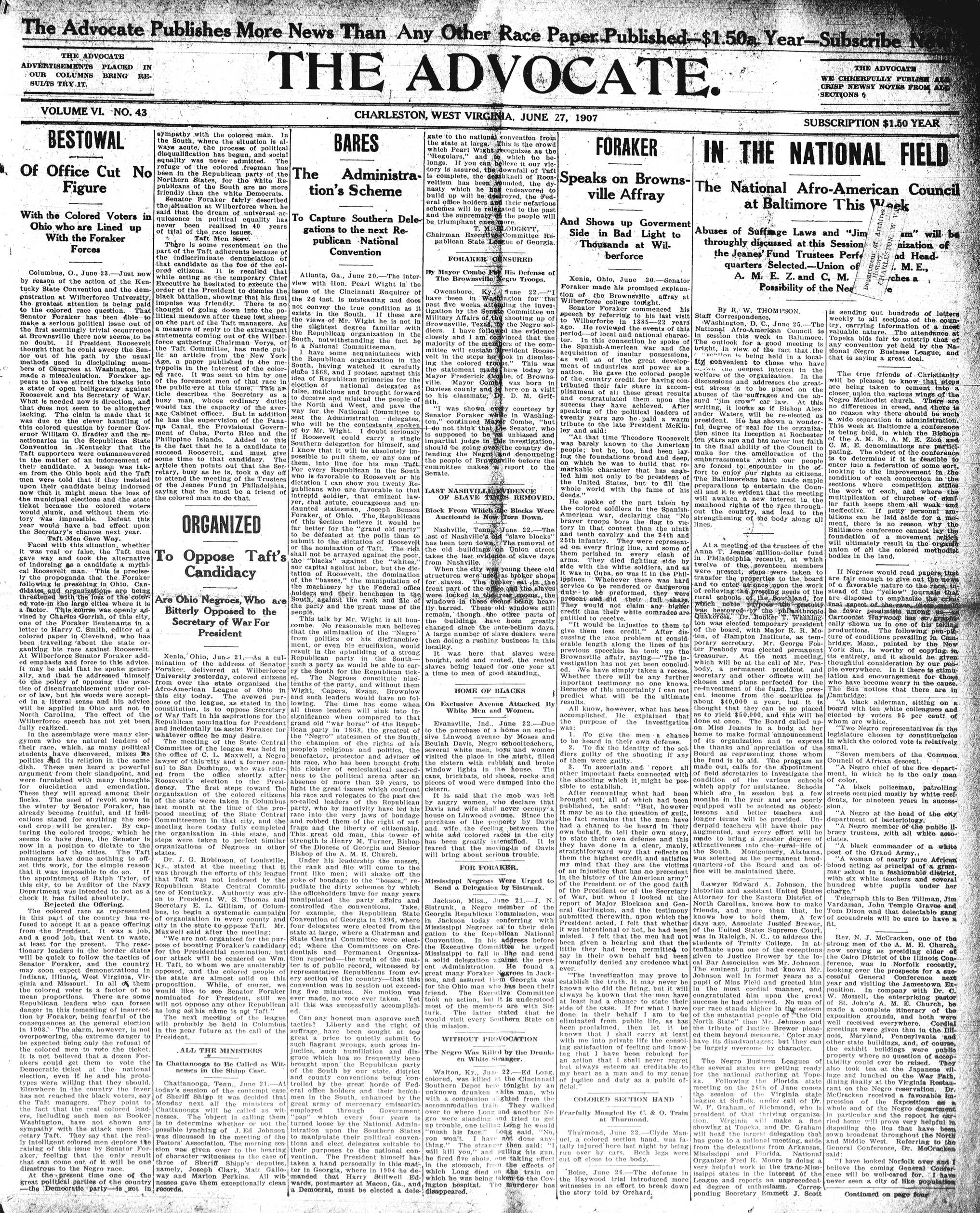
Columbus, O., June 23.—Just now by reason of the action of the Kentucky State Convention and the demonstration at Wilberforce University, the greatest attention is being paid to the colored race question. That Senator Foraker has been able to make a serious political issue out of the first seemingly trivial occurrence at Brownsville there now seems to be no doubt. If President Roosevelt thought that he could sweep the Senator out of his path by the usual method of displaining members of Congress of Washington, he made a miscalculation. Poor peas to have stirred the blacks into a state of open belligerency against Roosevelt and his Secretary of War. What is needed now is direction, and that does not seem to be altogether lacking. The claim is made that it was due to the clever handling of this colored question by former Governor William O. Bradley and the reactionaries in the Republic State Convention in Kentucky that the Taft supporters were outmaneuvered in the matter of an indorsement of their candidate. A lesson was taken from the Ohio book and the Taft supporters were told that if they insisted upon their candidate being indorsed now that it might mean the loss of the municipal elections and the state ticket because the colored voters would slunk, and without them victory was impossible. Defeat this year would have a bad effect upon the Secretary's chances next year.
Faced with this situation, whether it was real or false, the Taft men gave way and took the alternative of indorsing as a candidate a mythical Roosevelt man. This is precisely the propaganda that the Foraker following is prescribing in Ohio. Candidates, and organizations are being threatened with the loss of the colored vote in the large cities where it is a factor. This course was openly advised by Charles Gerrish, of this city, one of the Foraker lieutenants in a letter to Harry C. Smith, editor of a colored paper in Cleveland, who has been travelling about the state organizing his race against Roosevelt. At Wilberforce Senator Foraker added emphasis and force to this advice. If may be said that he spoke generally by the force he put in the policy of opposing the practice of disenfranchisement under color of law, but his words were accepted in a literal sense and his advice will be applied in Ohio and not in North Carolina. The effect of the Wilberforce speech has not yet been fully realized.
In the assemblage were many clergymen who are natural leaders of their race, which, as many political students have discovered, mixes politics and its religion in the same dish. These men heard a powerful argument from their standpoint, and were furnished with many thoughts for elucidation and emendation. These they will spread among their flocks. The seed of revolt sown in the winter by Senator Foraker, has already become fruitful, and if indications stand for anything the second crop will be greater. By capturing the colored troops, which he seems to have done, the Senator is now in a position to dictate to the politicians of the cities. The Taft managers have done nothing to offset this work, for the simple reason that it was impossible to do so. If the appointment of Ralph Tyler, of this city, to be Auditor of the Navy Department was intended to act as a check it has failed absolutely.
Rejected the Offering.
The colored race as represented in this part of the country has refused to accept it as a peace offering from the President. It was a job, and a good job, that went to waste, at least for the present. The reactionary leaders in the border state will be quick to follow the tactics of Senator Foraker, and the country, so imposing堤ensions in Indiana, Illinois, West Virginia, Virginia and Missouri. In all they the colored voter is a factor of no mean proportions. There are some Republican leaders who can forse danger in this fomenting of insurrection by Foraker, being fearful of the consequences at the general election in 1908. The alarm, however, is not overpowering, the extreme danger to be expected being only the refusal of the colored men to vote the ticket. It is not believed that a dozen Forakers could get them to vote the Democratic ticket at the national election, even if he and his prototypes were willing that they should. Elsewhere in the country the fever has not reached the black voters, say the Taft managers. They point to the fact that the real colored leaders, including such men as Booker Washington, have not shown any sympathy with the attack upon Secretary Taft. They say that the really intelligent colored men deplore the raising of this issue by Senator Foraker, feeling that the only result that can come out of it will be one disastrous to the Negro race.
At the present time one of the great political parties of the country — the Democrat party—is not in
sympathy with the colored man. In the South, where the situation is always acute, the process of political disqualification has begun, and social equality was never admitted. The refuge of the colored freeman has been in the Republican party of the Northern States, for the white Republicans of the South are no more friendly than the white Democrats. Senator Foraker fairly described the situation at Wilberforce when he said that the dream of universal acquiescence in political equality has never been realized in 40 years of trial of the race issues.
There is some resentment on the part of the Taft adherents because of the indiscriminate denunciation of that candidate as the toe of the colored citizens. It is recalled that while acting as the General Chief Executive he hesitated to execute the order of the President to dismiss the black battalion, showing that his first impulse was friendly. There is thought of going down into the political meadows after these lost sheep on the part of the Taft managers. As a measure of reply to the extravagant statements coming out of the Wilberforce gathering Chairman Vorsy, of the Taft Committee, has made public an article from the New York Age, a paper published in the metropolis in the interest of the colored race. It was sent to him by one of the foremost men of that race in the public eye at this time. This article describes the Secretary as a busy man, whose ordinary duties would tax the capacity of the average Cabinet officer. But in addition he has the supervision of the Panama Canal, the Provisional Government of Cuba, Porto Rico and the Philippine Islands. Added to this is the fact that he is a candidate to succeed Roosevelt, and must give some time to that candidacy. The article then points out that the Secretary, busy as he is, took a day off to attend the meeting of the Trustees of the Jeanes Fund in Philadelphia, saying that he must be a friend of the colored man to do that.
ORGANIZED
To Oppose Taft's
Candidacy
Are Ohio Negroes, Who are
Bitterly Opposed to the
Secretary of War For
President
Xenia,' Ohio, Jun. 21.—As a culmination of the address of Senator Foraker. delivered at Wilberforce University yesterday, colored citizens from over the state organized the Afro-American League of Ohio in this city today. The avowed purpose of the league, as stated in the War Taft Inaugural aspirations for the Republican nomination, is to assist Foraker and incidentally to assist Foraker for whatever office he may desire.
The meeting of the State Central Committee of the league was held in the office of C. L. Maxwell, a Negro lawyer of this city and a former consul to San Domingo, who was retired from the office shortly after Roosevelt's election to the Presidency. The first steps toward the organization of the colored citizens of the state were taken in Columbus last month at the time of the proposed meeting of the State Central Committeemen in that state, and the meeting here today fully completed the organization in this state, and steps were taken to perfect similar organizations of Negroes in other states.
Dr. J. G. Robinson, of Louisville, Ky., stated at the meeting that it was through the efforts of this league that Taft was not Indorsed by the Republican State Central Committee of Kentucky. Authority was given to President W. S. Thomas and Secretary E. L. Gilliam, of Columbus, to begin a systematic campaign of organization in every county and city in the state to oppose Taft. Mr. Maxwell said after the meeting: "We are not organized for the purpose of boosting Foraker's candidacy for the Presidential nomination; but our attack will be centered on Wm. H. Taft, to whom we are unalterably opposed, and the colored people of the state are almost solid on this proposition. While, of course, we would like to see Senator Foraker nominated for President, still we will not oppose any other Republican as long as his name is not Taft." The next meeting of the league will probably be held in Columbus in the near future at the call of the President.
ALL THE MINISTERS
In Chattanooga to Be Called as Wit
nesses in the Shipp Case.
Chattanooga, Tenn., June 21.—At today's session of the contempt case of Sheriff Shipp it was decided that Monday next all the ministers of Chattanooga will be called as witnesses. The 'object in calling them is to determine whether or not the possible lynching of J. Ed Johnson was discussed in the meeting of the Pastors' Association. The morning session was given over to the hearing of character witnesses in the case of three of Sheriff Shipp's deputies, namely, Joseph Chattanooga, way and Marlon Perkins. All witnesses gave them exceptionally clean records.
THE ADVOCATE.
CHARLESTON, WEST VIRGINIA, JUNE 27, 1907
Atlanta, Ga., June 20.—The interview with Hon. Pearl Wight in the issue of the Cincinnati Enquirer of the 2d inst. is misleading and does not convey the true condition as it exists in the South. If these are the views of Mr. Wight he is not in the slightest degree familiar with the Republican organization in the South, notwithstanding the fact he is a National Committeeman.
I have some acquaintances with the Republican organization in the South, having watched it carefully since 1868, and I protest against this idea of Republican primaries for the election of national delegates as false, mailclous and brought forward to deceive and mislead the people of the North and West, and pave the way for the National Committee to seat the Administration delegates, who will be the contestants spoken of by Mr. Wight. I doubt seriously if Roosevelt could carry a single Southern delegation for himself, and I know that it will be absolutely impossible to pull them, or any one of them, into line for his man Taft. For every Republican in the South who is favorable to Roosevelt or his dictation I can show you twenty Republicans who are favorable to that intrepid soldier, that eminent lawyer, that astute, courageous and understatesman, Joseph Benson Foraker, of Ohio. The Republicans of this secture believe it would be far better for the "grand old party" to be defeated at the polls than to submit to the dictation of Roosevelt or the nomination of Taft. The right shall not be arrayed against the poor, the "blacks" against the "whites," nor capital against labor, but the dictation of Roosevelt, the domination of the "basses," the manipulation of the machinery by the Federal office holders and their henchmen in the South, against the rank and file of the party and the great mass of the people.
This talk by Mr. Wight is all buncombe. No reasonable man believes that the elimination of the "Negro from politics or his disfranchement, or even his crucifixion, would result in the upbuilding of a strong Republican party in the South—such a party as would be able to carry the South for the Republican ticket. The Negroes constitute nineteenth of the party, and without them Wight, Capers, Evans, Brownlow and such leaders would have no following. The time has come when all these leaders will sink into insignificance when compared to that grand old "war horse" of the Republican party in 1868, the greatest of the "Negro" statesmen of the South, the champion of the rights of his people's religions and politics, the benefactor, protector and adviser of his race, who has been brought from his cloister of the cloisterial sacredness to the political arena after absence of more than 30 years to fight the great issues which confront his race and relegates to the past the so-called leaders of the Republican party, who by inactivity have led his race into the very jaws of bondage and robbed them of the right of suffrage and the liberty of citizenship. This great old man, this tower of strength is Henry M. Turner, Bishop of the Diocese of Georgia and Senior Bishop of the A. M. E. Church.
Under his leadership the masses, the rank and file will come to the front like men; will shake off the yoke of bondage to the "bosses," repudiate the dirty schemes by which the officeholders have for many years manipulated the party affairs and controlled the conventions. Take, for example, the Republican State Convention of Georgia in 1896, where four delegates were elected from the state at large, where a Chairman and State Central Committee were elected; where the Committees on Credentials and Permanent Organization reported—the truth of the matter is of public record, witnessed by representative Republicans from every section of the country—that this convention was in session not exceeding five minutes. No motion was ever made, no vote ever taken. Yet all this was successfully accomplished.
Can any honest man approve such tactics? Liberty and the right of suffrage, have been sought at too great a price to quietly submit to such flagrant wrongs, such gross injustice, such humiliation and disgrace which has so frequently been brought upon the Republican party of the South by our state, district and county conventions being controlled by the great horde of Federal office holders and their heenchmen in the South, enhanced by the great army of mercenary emissaries which passed through Government "pap" which four years ago is turned loose by the National Administration upon the Southern States to manipulate their political conventions and elect delegates suitable to their purposes to the national convention. The President himself has taken a hand personally in this matter in Georgia, where in 1904 he demanded that Harry Stillwell Edwards, postmaster at Macon, Ga., and a Democrat, must be elected a delegate.
gate to the national convention from the state at large. This is the obow which Pearl Wight recognizes as the "Regulars," and to which he belongs. If you can believe it our victory is assured, the downfall of Taft is complete, the deathknell of Roosevelt has beenounded, the dynasty which he has endeavored to will be preserved, the Federal office holders and the numerous schemes will be relegated to the past and the supremacy of the people will be triumphant once more. T. M. BLODGETT, Chairman Executive Committee Republican State League of Georgia.
By Mayor Combe For His Defense of the Brownsville Negro Troops.
Owensboro, Ky., June 22.—I have been in Washington for the past five weeks attending the investigation by the Senate Committee on Military Affairs of the shooting up of Brownsville, Texas, by the Negro soldiers. I have followed the evidence closely and I am convinced that the majority of the members of the committee will sustain President Roosevelt if the steps her book in dismissing the colored "Jews" was the statement made there today. Mayor Frederick Combe, of Brownsville. Mayor Combe was born in Davies county and is here on a visit to his classmate, Dr. D. M. Griffith.
"I was shown every courtesy by Senator Foraker while in Washington," continued Mayor Combe, "but I do not think that the Senator, who is supposed to be an unbiased and impartial judge in this investigation, is guilty of national country defending the Negro and defending the people of Brownville before the committee makes a report to the Senate.
Block From Which the Blacks Were
Auctioned is Now Torn Down.
Nashville, Tenn., June 22.—The last of Nashville's old "slave blocks" has been torn down. The removal of the old buildings on Union street takes the last evidence of slave days from Nashville.
When the city was young these old structures were used as broker shops for slaves. The broker sat in the front part of the office and the slaves were locked in the rear rooms, the windows in these rooms being heavily barred. These old windows still remain, though the other parts of building were given a changed since the ante-bellum days. A large number of slave dealers were then doing a rushing business in this locality.
It was here that slaves were bought, sold and rented, the rented slaves being leased for one year at a time to men of good standing.
HOME OF BLACKS
On Exclusive Avenue Attacked By White Men and Women.
Evansville, Ind., June 22.—Dau to the purchase of a home on exclusive Linwood avenue by Moses and Beulah Davis, Negro schoolteachers, several white men, boys and women visited the place in the night, filled the cistern with rubbish and broke window lights in the house. Tin cans, brickbats, old shoes, rocks and pieces of wood were dumped into the cistern.
It is said that the mob was led by angry women, who declare that Davies and wife will never occupy a house on Linwood avenue. Since the purchase of the property by Davis and wife the feeling between the white and colored races in the city has been greatly intensified. It is feared that the moving-in of Davis will bring about serious trouble.
FOR FORAKER.
Mississippi Negroes Were Urged to
Send a Delegation by Sistrunk.
Jackson, Miss., June 21.—J. N. Slatrunk, a Negro member of the Georgia Republican Commission, was in Jackson today conferring with Mississippi Negroes as to their delegation to the Republican National Convention. In his address before the Executive Committee he urged Mississippi to fall in line and send a solid delegation against the present Administration. He found a great many Foraker Negroes in Jackson, and assured them Georgia was for the Ohio man who has been their friend. The Executive Committee took no action, but it is understood most of the members are with Sisturk. The latter stated that he would visit every Southern State on this mission.
WITHOUT PROVOCATION
The Negro Was Killed by the Drunken White Stranger.
Watton, Ky., June 22.—Ed Long, colored, was killed at the Cincinnati Southern Depot here tonight by an unknown drunken white man, who with a companion alighted from the accommodation train. They walked over to where Long and another Negro were standing and tried to get up trouble, one telling Long he would "mash his face." Long said, "No, you won't. I have not done anything." The stranger then said: "I will kill you," and pulling his gun, he red five shots, one taking effect with the stunner. Of which Long died on the train, which he was being taken to the Covington hospital. The murderer has disappeared.
And Shows up Government Side in Bad Light to Thousands at Wilberforce
Xenia, Ohio, June 20.—Senator Foraker made his promised explanation of the Brownsville affray at Wilberforce college tonight.
Senator Foraker commenced his speech by referring to his last visit to Wilberforce in 1885—22 years ago. He reviewed the events of this period—of local and national character. In this connection he spoke of the Spanish-American war and the acquisition of insular possessions, as well as of the great development of industries and power as a nation. He gave the colored people of the country credit for having contributed their fair share in accomplishment of all these great results and congratulated them upon the success they have achieved. After speaking of the political leaders of twenty years ago he paid a warm tribute to the late President McKinley and said:
"At that time Theodore Roosevelt was barely known to the American people; but he, too, had been laying the foundations broad and deep, on which he was to build that remarkable character that has enabled him not only to be president of the United States, but to fill the whole world with the fame of his deeds."
He spoke of the part taken by the colored soldiers in the Spanish-American war, declaring that "No braver troops bore the flag to victory in that contest than the ninth and tenth cavalry and the 24th and 25th infantry. They were represented on every firing line, and some of them perished in every clash of arms, by armed fighting side by side with the white soldiers, and as it was in Cuba, so went in the Philippines. Whenever there was hard service to be rendered or dangerous duty to be performed, they were present and did their full shrap. They would not claim any higher credit than their white comrades are entitled to receive.
"It would be injustice to them to give them less credit." After discussing the race problem at considerable length along the lines of his previous speeches he took up the Brownville affair, saying—"The investigation has not yet been concluded. We have simply taken a recess. When we have any further important testimony we do one knows. Because of this uncertainty I can not predict what will be the ultimate results.
All know, however, what has been accomplished. He explained that the purpose of the investigation was:
1. To give the men a chance to be heard in their own defense.
2. To fix the identity of the soldiers guilty of the shooting if any of them are guilty.
3. To ascertaint and report all other important facts connected with the shooting which it might be possible to establish.
After recounting what had been brought out, all of which had been published, he said: "But, however it may be as to the question of guilt, the fact remains that the men have had a chance to be heard in their own behalf, to tell their own story, to state their own defense and this they have done in a clear, manly, straightforward way that reflects on them the highest credit and satisfies my mind that they are the victims of an injustice that has no precedent in the history of the American army" of the President or of the good faith of the President or of the Secretary of War, but when I looked at the report of Major Blockson and General Garlington, and the testimony submitted therewith, upon which the President acted, I felt that whether it was intentional or not, he had been misled. I felt that the men had not been given a hearing and that the little they had been permitted to say in their own behalf had been wrongfully denied any credence what ever.
"The investigation may prove to establish the truth. It may never be known who did the firing, but it will always be known that the men have at least had a chance to state their side of the case. If for what I have done in their behalf I am to be eliminated from public life, as has been proclaimed, then let it be known that I shall carry at least with me into private life the consoling satisfaction of feeling and knowing that I have been rebuked for an action that I shall never regret but always esteem as creditable to my heart as a man and to my sense of justice and duty as a public official."
COLORED SECTION HAND
Fearfully Mangled By C. & O. Train at Thurmond.
Thurmond, June 22.—Clyde Manuel, a colored section hand, was fatally injured here last night by being run over by cars. Both legs were cut off close to the body.
'Bolse, June 26.—The defense in the Haywood trial introduced more witnesses in an effort to break down the story told by Orchard.
Abuses of Suffrage Laws and "Jimism" will be thoroughly discussed at this Session. Organization of the Jeanes' Fund Trustees Perform Headquarters Selected.—Union of A. M. E. Z. and C. M. Possibility of the Nearest
By R. W. THOMPSON. is sending out hundreds of letters. Staff Correspondence.
Washington, D. C., June 25.—The National Afro-American Council is in session this week in Baltimore. The outlook for a good meeting is bright, in view of the fact that the convention is being held in a locally convenient to those who have the deepest interest in the welfare of the organization. In the discussions and addresses the greatest stress is to be placed on the abuses of the suffrages and the absurd "jim crow" car law. At this writing, it looks as if Bishop Alexander Waters will be re-elected as president. He has shown a wonderful degree of zeal for the organization since its inception at Rochester ten years ago and has never lost faith in the final ability of the Council to make for the amelioration of the embarrassments which our people are forced to encounter in the effort to enjoy our rights as citizens. The Baltimoreans have made ample preparations to entertain the Council and it is evident that the meeting will awaken a new interest in the manhood rights of the race throughout the country, and lead to the strengthening of the body along all lines.
At a meeting of the trustees of the Anna T. Jeanes million-dollar fund in Philadelphia recently, at which twelve of the seventeen members were present, steps were taken to transfer the properties to the board and to enter at once upon the works of relieving the pressing needs of the rural schools of the Southland, for which noble purpose the gratuity was bestowed by the philanthropic Quatetess, Dr. Bookker T. Washington was elected temporary president of the board, with Major R. R. Moten, of Hampton Institute, as temporary secretary. Mr. George Foster Peabody was elected permanent treasurer. At the next meeting, which will be at the call of Mr. Peabody, a permanent president and secretary and other officers will be chosen and plans perfected for the re-investment of the fund. The present income from the securities is about $40,000 a year, but it is thought that they can be so placed as to yield $50,000, and this will be done at once. The Board called upon Miss Jeanes in a body at her to make formal announcement of its organization and to express the thank you and appreciation of the Board as representing those who the fund is to aid. The program as made out, calls for the appointment of field secretaries to investigate the condition of the various schools which apply for assistance. Schools which are in session but a few months in the year and are poorly equipped will be selected as object-lessons and better teachers and longer terms will be provided. Underpaid teachers will have their pay augmented, and every effort will be made to bring a greater degree of attractiveness into the rural-life of the South. Montgomery, Alabama, was selected as the permanent headquarters of the Board and an office will be maintained there.
Lawyer Edward A. Johnson, the historian and assistant United States Attorney for the Eastern District of North Carolina, knows how to make friends, and more than that, he knows how to hold them. A few days ago, Associate Justice Brewer, of the United States Supreme Court, was in Raleigh, N. C., to address the students of Trinity College. In attendance upon one of the receptions given to Justice Brewer by the local Bar Association was Mr. Johnson. The eminent jurist had known Mr. Johnson well in former years as a pupil of Miss Field and greeted him in the most cordial manner, and congratulated him upon the great success he had achieved. No man of our race stands higher in the esteem of the substantial people of "the Old North State" than Mr. Johnson and the tribute of Justice Brewer pleased them beyond measure. Color may have its disadvantages; but they can be largely overcome by character.
The Negro Business League of the several states are getting ready for the national gathering at Topeka. Following the Florida state meeting on the 26th of June comes the session of the Virginia state league at Suffolk, under call of Dr. W. F. Graham, of Richmond, who is president of that thriving organization. Virginia will make a fine showing at Topeka, and Dr. Graham will head the largest delegation that has gone to a national meeting, aside from the delegations from Arkansas, Mississippi and Florida. National Organizer Fred R. Moore is doing a very helpful work in the trans-Mississippi states in the interest of the League and reports an unprecedented degree of enthusiasm. Corresponding Secretary Emmett J. Scott
NATIONAL FIELD
Afro-American Council
more This Week
Laws and "Jimmyism" will be
at this Session. Organization of
Trustees Perform and Head-
d.—Union of
and C. M.
of the Nea
is sending out hundreds of letters weekly to all sections of the country, carrying information of a most valuable nature. The attendance at Topeka bids fair to outstrip that of any convention yet held by the National Negro Business League, and that is saying a great deal.
The true friends of Christianity will be pleased to know that steps are being taken to cement into a closer, union the various wings of the Negro Methodist church. There are no differences in creed, and there is no reason why there should be such a wide separation in administration. This week at Baltimore a conference is being held, in which the Bishops of the A. M. E. A. M. E. Zion and C. M. E. denominations are participating. The object of the conference is to determine if it is feasible to enter into a federation of some sort, looking to the improvement in the condition of each connection in the multiplication competition stifles the work of each and where the multiplication of churches similar faith keeps them all weak and ineffective. If petty personal ambitions can be laid aside for a moment, there is no reason why the Baltimore conference cannot lay the foundation of a movement which will ultimately result in the organzion of all the colored methodist bodies in the land.
If Negroes would read papers that are fair enough to give out, the news of a favorable nature to the race, instead of the "yellow" journals that are disposed to emphasize the criminal aspect of the race, those would be fewer possimilates among us. Cartoonist Haywood has so graphically shown us in one of his telling productions. The following pen-picture of conditions prevailing in Cambridge, Mass., painted by the New York Sun, is worthy of copying in its entirety, and it should be given thoughtful consideration by our people everywhere. In it there is stimulation and encouragement for those who have become weary in the cause. The Sun notices that there are in Cambridge:
"A black alderman, sitting on a board with ten white colleagues and elected by voters 95 per cent of whom are white.
"Two Negro representatives in the legislature chosen by constituencies in which the colored vote is relatively small.
"Seven members of the Common Council of African descent.
"A Negro chief of the fire department, in which he is the only man of color.
"A black policeman, patrolling streets occupied mostly by white residents, for nineteen years in succession.
"A Negro at the head of the city department of bacteriology.
"A Negro member of the public library trustees, with all white associates.
"A black commander of a white post of the Grand Army."
"A woman of nearly pure African blood acting as principal of a grammar school in a fashionable district, with six white teachers and several hundred white pupils under her charge." Telegraph this to Ben Tillman, Jim Vickman, John Temple Graves and Tom Dixon and that delectable gang of scoundrels will be sure to have a fit.
Rev. N. J. McCracken, one of the strong men of the A. M. E. Church, now serving as presiding elder of the Cairo District of the Illinois Conference, was in Norfolk recently, looking over the prospects for a successful General Conference next year and visiting the Jamestown Exposition. In company with Dr. C. W. Mossell, the enterprising pastor of St. John's A. M. E. Church, he made a complete kinney of the exposition grounds, and both were well received everywhere. Cordial greetings were given thm in the Illinois, Maryland, Pennsylvania and other state buildings, and, of course, the exhibit buildings were public property where no question of acceptability could ever be raised. They also took tea at the Japanese village and lunched on the War Path, dining finally at the Virginia Restaurant on the Negro reservation. Dr. McCracken received a favorable impression of the Exposition as a whole and of the Negro department in particular and the report he carried home will prove very helpful in dispelling the lies that have been sown broadcast throughout the North and Middle West. Referring to the General Conference, Dr. McCracken said:
"I have looked Norfolk over and I believe the coming General Conference will be well-cared for. I have never seen a city of like population
Correspondence :-
```markdown
```
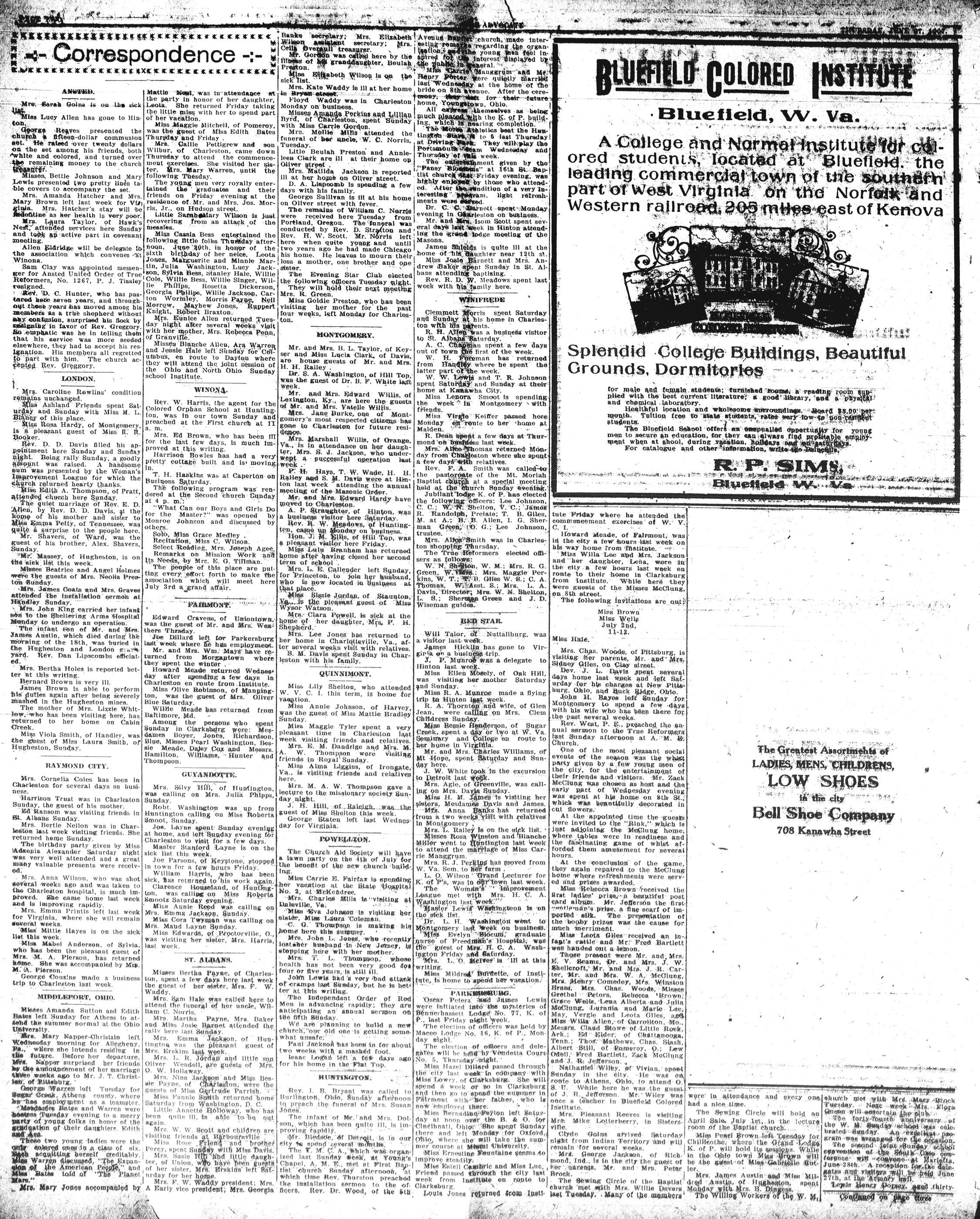
ANSTED.
Mrs. Sarah Goins is on the sick list.
Miss Lucy Allen has gone to Hinton.
George Reaves presented the church a fifteen-dollar communion set. He raised over twenty dollars on the set among his friends, both white and colored, and turned over the remaining money to the church organizer.
Misses. Bettle Johnson and Mary Lewis presented two pretty linen table covers to accompany the set.
Mrs. Amanda Hatcher and Mrs. Mary Brown left last week for Virginia. Mrs. Hatcher's stay will be indeline as her health is very poor.
Mrs. Laura Taylor, of Hawk's Nest, attended services here Sunday and took an active part in covenant meeting.
Allen Eldridge will be delegate to the association which convenes at Winona.
Sam Clay was appointed messenger for Ansted Unified Order of True Reformers, No. 1267, P. J. Tinsley resigned.
Rev. D. C. Hunter, who has pastured here seven years, and through out these years has moved among his members as a true shopherd without any confusion, surprised his book by assigning in favor of Rev. Greggory. So emphatic was he in telling them that his service was more needed elsewhere, they had to accept his resignation. His members all regretted to part with him. The church accepted Rev. Greggory.
LONDON
Mrs. Caroline Rowlins' condition remains unchanged.
Miss Ashland Friends spent Saturday and Sunday with Miss M. L. Blaney of this place.
Miss Rosa Hardy, of Montgomery, is a pleasant guest of Miss Gory. R. Booker.
Rev. D. D. Davis filled his appointment here Sunday and Sunday night. Being rally Sunday, a goodly amount was raised. A handsome sum was presented by the Woman's Improvement League for which the church returned hearty thanks.
Miss Edith A. Thompson, of Pratt, attended church here Sunday.
Mr. Shavers, of Ward, was the guest of his brother, Alex. Shavers, Sunday.
Mr. Massey, of Hugheston, is on the sick list this week.
Misses Beatrice and Angel Holmes were the guests of Mrs. Neolia Preston Sunday.
Mrs. James Coats and Mrs. Graves attended the installation sermon at Handley Sunday.
Mrs. John King carried her infant son to the Sheltering Arms Hospital Monday to undergo an operation.
The infant son of Mr. and Mrs. James Austin, which died during the morning of the 18th, was buried in the Hugheston and London graveyard. Rev. Dan Lipscombs officiated.
Mrs. Bertha Holes is reported better at this writing.
Bernard Brown is very ill.
James Brown is able to perform his duties again after being severely mashed in the Hugheston mines. The mother of mother, Lizzie Whitlow, who has been visiting here, has returned to her home on Cabin Creek. Miss Viola Smith, of Handley, was the guest of Miss Laura Smith, of Hugheston, Sunday.
RAYMOND CITY
Mrs. Cornelia Coles has been in Charleston for several days on business.
Harrison Trust was in Charleston Sunday, the guest of his mother.
Ed Ransom was visiting friends in St. Albans Sunday.
Mrs. Bertie Nellon was in Charleston last week visiting friends. She returned home Sunday.
The birthday party given by Miss Arizona Alexander Saturday night was very well attended and a great many valuable presents were received.
Mrs. Anna Wilson, who was shot several weeks ago and was taken to the Charleston hospital, is much improved. She came home last week and is improving rapidly.
Mrs. Emma Printis left last week for Virginia, where she will remain several weeks.
Miss Mitte Hayes is on the sick list this week.
Miss Mabel Anderson, of Sylvia, who has been the pleasant guest of Mrs. M. A. Pierson, has returned home. She was accompanied by Mrs. M. A. Pierson. George Cousins made a business trip to Charleston last week.
MIDDLEPORT, OHIO
Misses Amanda Sutton and Edith Bates left Sunday for Athens to attend the summer normal at the Ohio University. Mrs. Mary Napper-Gristain left Wednesday morning for Allegheny, Pa., where she intends residing in the future. Before her departure, Mrs. Napper surprised her friends by the announcement of her marriage three weeks ago to Mr. J. T. Christian, of Ritchesburg. George Warren left Tuesday for Sugar Creek, Athens county, where he has employment as a teamster. Madness Bates and Warren were hostess Tuesday evening to a merry party of young folks in honor of the graduation of their daughters. Edith and Ana.
These two young ladies were the only colored ones in a class of six. Each acquitting herself creditably. Mrs Warren discussed, "The Expansion of the American People," and Miss Hates told of "The Planet Maru." Mrs. Mary Jones accompanied by
Mattie Mori, was in attendance at the party in honor of her daughter, Leota. She returned Friday taking the little miss with her to spend part of her vacation.
Miss Maggie Mitchell, of Pomeroy, was the guest of Miss Edith Bates Thursday and Friday.
Mrs. Callie Pettigrew and son Wilbur, of Charleston, came down Thursday to attend the commencement exercises. She visited her sister, Mrs. Mary Warren, until the following Tuesday.
The young men very royally entertained the graduates and their friends on Friday evening at the residence of Mr. and Mrs. Jos. Morris, Jr., on Hudson street.
Little Sarah Mary Wilson is just recovering from an attack of the measles.
Miss Cassia Bess entertained the following little folks Thursday afternoon, June 20th, in honor of the sixth birthday of her niece, Loota Jones, Marguerite and Minnie Martin, Julia Washington, Lucy Jackson, Sylvia Bess, Stanley Hale, Willie Cole, Willie Bess, Willie Singer, Willie Phillips, Rosetta Dickerson, Georgia Phillips, Willie Jackson, Carton Wormley, Morris Payne, Nell Morrow, Mayhew Jones, Ruppert Knight, Robert Braxton.
Mrs. Eunice Allen returned Tuesday night after several weeks visit with her mother, Mrs. Rebecca Penn, of Granville.
Misses Blanche Allen, Ara Warren and Jessie Hale left Sunday for Columbus, en route to Dayton where they will attend the joint session of the Ohio and North Ohio Sunday school Institute.
WINONA
Rev. W. Harris, the agent for the Colored Orphan School at Huntington, was in our town Sunday and preached at the First church at II a. m.
Mrs. Ed Brown, who has been ill for the last few days, is much improved at this writing.
Harrison Bowles has had a very pretty cottage built and is moving in.
T. H. Haskins was at Caperton on Business Saturday.
The following program was rendered at the Second church Sunday at 4 p. m.:
"What Can our Boys and Girls Do for the Master?" was opened by Monroe Johnson and discussed by others.
Solo, Miss Grace Medley.
Recitation, Miss C. Wilson.
Select Reading, Mrs. Joseph Agee.
Remarks on Mission Work and Its Needs, by Mrs. E. G. Tillman.
The people of this place are putting every effort forth to make the association which will meet here July 3rd a grand affair.
FAIRMONT.
Edward Cravens, of Uniontown, was the guest of Mr. and Mrs. Weatherthers Thursday.
Joe Dillard left for Parkersburg last week where he has employment.
Mr. and Mrs. Wm. Mays have returned from Morgantown where they spent the winter.
Howard Meade returned Wednesday after spending a few days in Charleston en route from Institute.
Miss Olive Robinson, of Manpington, was the guest of Mrs. Oliver Blue Saturday.
Willie Meade has returned from Baltimore, Md.
Among the persons who spent Sunday in Clarkaburd were: Mesdames Boyer, Jones, Richardson, Blue, Misses Pearl Washington, Bessie Meade, Daley Cox and Messrs. Hamilton, Williams, Hunter and Thompson.
GUYANDOTTE.
Mrs. Silvy Hill, of Huntington, was calling on Mrs. Julia Philps, Sunday.
Robt. Washington was up from Huntington calling on Miss Roberta Smoot, Sunday.
Jos. Layne spent Sunday evening at home, and left Sunday evening for Charleston to visit for a few days.
Master Stanford Layne is on the sick list this week.
Joe Parsons, of Keystone, stopped in town for a few hours Friday.
William Harris, who has been sick, has returned to his work again. Clarence Houseland, of Huntington, was calling on Miss Roberta Smootz Saturday evening.
Miss Annie Reed was calling on Mrs. Emma Jackson, Sunday.
Miss Cora Twyman was calling on Mrs. Maud Layne Sunday.
Miss Edwards, of Proctorville, O., was visiting her sister, Mrs. Harris, last week.
ST. ALBANS.
Misses Bertha Payne, of Charleston, spent a few days here last week the guest of her sister, Mrs. F. W. Waddy.
Mrs. Sam Hale was called here to attend the funeral of her uncle, William C. Norris.
Mrs. Martha Payne, Mrs. Baker and Miss Josie Barnet attended the rally here last Sunday.
Mrs. Emma Jackson, of Huntington was the pleasant guest of Mrs. Erskins last week.
Mrs. L. R. Jordan and little son Oliver Wendell, are guests of Mrs. O. W. Hollaway.
Little Annette Holloway, who has been quite ill, is able to be out again.
Mrs. W. W. Scott and children are visiting friends at Barboursville.
Miss Rose Friend and brother Percy, spent Sunday with Miss Davis.
Mrs. Susie Hill and little daughter, of Union, who have been guests of her sister, Mrs. Erskins' left Saturday for her home.
Mrs. F. W. Waddy president; Mrs. A Early vice president; Mrs. Georgia
Banks secretary; Mrs. Elizabeth Wilson assistant secretary; Mrs. Cells Overall treasurer. Mr. Gordon was called here by the illness of his granddaughter, Beulah Preston. Miss Elizabeth Wilson is on the sick list.
Mrs. Kate Waddy is ill at her home in Bryan street.
Floyd Waddy was in Charleston Monday on business.
Misses Amanda Perkins and Lillian Byrd, of Charleston, spent Sunday with Miss Carrie Gordon.
Mrs. Mollie Mills attended the funeral of her uncle, W. C. Norris, Tuesday.
Little Beulah Preston and Annleen Clark are ill at their home on Oliver street.
Mrs. Matilda Jackson is reported ill at her home on Oliver street.
D. A. Liapoomb is spending a few days with his family.
George Sullivan is ill at his home on Oliver street with fever.
The remains of William C. Nerris were received here Tuesday from Portland, Oregon. The funeral was conducted by Rev. D. Stratton and Rev. H. W. Scott. Mr. Norris left here when quite young and until two years ago he had made Chicago his home. He leaves to mourn their loss a mother, one brother and one sister.
The Evening Star Club elected the following officers Tuesday night. They will hold their next meeting Mrs. R. Green.
Miss Goldie Preston, who has been visiting her mother for the past four weeks, left Monday for Charleston.
MONTGOMERY
Mr. and Mrs. B. L. Taylor, of Keyser and Miss Lucia Clark, of Davis, are house guests of Mr. and Mrs. H. H. Railey.
Dr. S. A. Washington, of Hill Top, was the guest of Dr. B. F. White last week.
Mr. and Mrs. Edward Willis, of Lexington, Ky., are here the guests of Mr. and Mrs. Vatelle Willis.
Mrs. Jane Burke, one of Montgomery's most respected citizens has gone to Charleston for future residence.
Mrs. Marshall Willis, of Orange, Va., is in attendance on her daughter, Mrs. S. J. Jackson, who underwent a successful operation last week.
P. H. Hays, T. W. Wade, H. H. Railey and S. M. Davis were at Hinton last week attending the annual meeting of the Masonic Order.
Mr. and Mrs. Edward Hardy have moved to Charleston.
A. P. Straughter, of Hinton, was a business visitor here Saturday.
Miss Lulu Branham has returned home after having closed her second term of school.
Mrs. L. E. Callender left Sunday, for Princeton, to join her husband, who is now located in business at that place.
Miss Sissie Jordan, of Staunton, Va., is the pleasant guest of Miss Wysor Watson.
Mrs. Clara Powell, is sick at the home of her daughter, Mrs. P. H. Shepherd.
Mrs. Lee Jones has returned to her home in Charlottesville, Va., after several weeks visit with relatives.
S. M. Davis spent Sunday in Charleston with his family.
QUINNIMONT.
Miss Lily Shelton, who attended W. V. C. I. this term, is home for vaqation.
Miss Annie Johnson, of Harvey, was the guest of Miss Mattie Bradley Sunday.
Miss Maggie Tyler spent a very pleasant time in Charleston last week visiting friends and relatives.
Mrs. E. M. Dandrige and Mrs. M. A. W. Thompson were visiting friends in Royal Sunday.
Miss Alma Liggins, of Irongate, Va., is visiting friends and relatives here.
Mrs. M. A. W. Thompson gave a lecture to the missionary society Sunday night.
J. H. Hill, of Raleigh, was the guest of Miss Shelton this week.
POWELLTON
The Church Aid Society will have a lawn party on the 4th of July for the benefit of the new church building. Miss Carrie E. Fairfax is spending her vacation at the State Hospital No. 2. at McKendree.
Miss Eva Johnson is visiting her
sister, Miss Laura Coleman.
Mrs. John L. Jones, who recently lost her husband in New Jersey, is stopping here with her mother.
Mrs. T. L. Thompson, whose health has not been very good for four or five years, is still ill.
John Lewis had a very bad attack of cramps last Sunday, but he is better at this writing.
The Independent Order of Red Men is advancing rapidly; they are anticipating an annual sermon on the fifth Sunday.
We are planning to build a new church, "our old one is getting somewhat unsafe."
Paul Jackson has been in for about two weeks with a mashed foot.
Isaac Logan left a few days ago for his home in the Flat Top.
HUNTINGTON
Rey, I. B. Bryant was called to Burlington, Ohio, Sunday afternoon to preach the funeral of Mrs. Susan Jones.
The infant of Mr. and Mrs. Dotson, which has been quite ill, is improving rapidly.
Mr. Bledside, of Detroit, is in our city to spend several months.
The Y. M. C. A., which was organized last Sunday week, at Young's Chapel, A. M. E., met at First Baptist church Sunday afternoon, at which time Rev. Thurston preached the installation sermon to the officers. Rey, Dr. Wood, of the fifth
tute Friday where he attended the commencement exercises of W. V. C. I.
Howard Meade, of Falmont, was in the city a few hours last week on his way home from Institute.
Miss Willa Lee and Mrs. Jackson and her daughter, Leha, were in the city a few hours last week en route to their home in Clarksburg from Institute. While here they were guests of the Misses McClung, on 8th street.
The following invitations are out!
Miss Hale
Mrs. Chas. Woods, of Pittsburg, is visiting her parents, Mr. and Mrs. Sidney Giles, on Clay street.
Dev. J. L. Davis spent several days home last week and left Saturday for his charges at New Pittsburg. Ohio, and Ruck Ridge. Ohio.
John H. Bayes left Sunday for Montgomery to spend a few days with his wife who has been there for the past several weeks.
Rev. West, P. E., preached the annual sermon to the True Reformers last Sunday afternoon at A. M. E. Church.
One of the most pleasant social events of the season was the whist party given by a few young men of the city, for the entertainment of their friends and visitors. Mr. Zack McClung was chosen as host and the early part of Wednesday evening was spent at his home on 8th St., which was beautifully decorated in cut flowers.
At the appointed time the guests were invited to the "Rink," which is just adjoining the McClung home, where tables were in readiness and the fascinating game of whilst afforded them amusement for several hours.
At the conclusion of the game, they again repaired to the McClung home where refreshments were served and prizes awarded.
Miss Rhecca Brown received the first ladies' prize, a beautiful post card album. Mr. Jefferson the first gentleman's prize, a fine scarf of imported silk. The presentation of the booby prizes was the cause for much merriment.
Miss Leota Giles received an infant's rattle and Mr. Fred Bartlett was handed out a lemon.
Those present were Mr. and Mrs. E. V. Seams, Dr. and Mrs. J. W. Shelleroff, Mr. and Mrs. J. R. Carter, Mr. and Mrs. W. A. McClung, Mrs. Henry Comedey, Mrs. Winston Brass, Mrs. Chas. Woods, Misses Grethel Peters, Rebecca Brown; Grace Wells, Leena Alberta and Julia McClung, Lurania and Marle Lee, May, Vergle and Leota Gilles, and Miss Willa Allen, of Carrollton, Mo. Mesars. Claud Sowe of Little Rock, Ark.; Ed Elder, of Chattanooga, Tenn.; Thos. Mathews, Chas. Slash, Albert Still, of Pomeroy, O.; Low Oddell, Fred Bartlett, Zack McClung and J. R. Jefferson.
Nathaniel Wiley, of Vivian, spent Sunday in the city. He was en route to Athens, Ohio, to attend O. S. U. While here he was the guest of J. R. Jefferson. Mr. Wiley was once a teacher in Bluefield Colored Institute.
Mrs. Pleasant Reeves is visting Mrs. Mike Lotterberry, in Sistersville.
Clyde Golns arrived Saturday night from Indian Territory and will remain for several weeks.
Mrs. George Jackson, of Richmond, Ind. is in the city the guest of her parents, Mr. and Mrs. Peter Brock.
The Sewing Circle of the Baptist church met with Mrs. Willie Devers last Tuesday. Many of the members
Avenue Barker church, made interesting remarks regarding the organisation, and the young men feel inspired for the interest displayed by the public in general.
Miss Charlie Manggrum and Mr. Henry Potter were quietly married last Wednesday at the home of the bride on 8th avenue. After the ceremony, they sent for their future home, Youngstown, Ohio.
All express themselves as being much pleased with the K. of P. building, which is hearing completion.
The North athletics beat the Huntington State, 9 to 5 last Thursday at Driving Park. They will play the Portsmouth team Wednesday and Thursday of this week.
The entertainment given by the "Pansy Blossoms" at 16th St. Baptist church last Friday evening, was highly enforced by those who attended. After the condition of a very interesting program, light refreshments were served.
Dr. C. C. Garnett spent Monday evening in Garrleston on business.
Mr. and Mrs. Isom Scott spent several days last week in Hinton attending the grand lodge meeting of the Masons.
James Shields is quite ill at the home of his daughter near 12th st.
Miss Josie Barnett and Mrs. Andrew Baker spent Sunday in St. Albans attending baptizing.
Rev. R. D. W. Meadows spent last week with his family here.
WINIFREDE
Clemmett Morris spent Saturday and Sunday at his home in Charleston with his parents. R. H. Allen was a business visitor to St. Albans Saturday.
A. C. Chapman spent a few days out of town the first of the week.
W. H. Foroman has returned from Handley where he spent the latter part of the week.
W. W. Lewis and T. R. Johnson spent Saturday and Sunday at their home at Kanawha City.
Miss Lenora Smoot is spending the week in Montgomery with friends.
Miss Virgle Keiffer passed here Monday en route to her home at Malden.
R. Dean spent a few days at Thurmond on business last week.
Mrs. Alice Thomas returned Monday from Charleston where she spent a few days with relatives.
Rev. F. A. Smith was called to the pastorate of the Mt. Moriah Baptist church at a special meeting held at the church Sunday evening.
Jubilant lodge K. of P. has elected the following officers: Lee Johnson, C. C.; W. N. Shelton, V. C.; Jämst R. Randolph, Prelate; T. B. Giles, M. at A.; B. B. Allen, I. G. Sherman Green, O. G.; Lee Johnson, trustee.
Mrs. Allen Smith was in Charleston shopping Thursday.
The True Reformers elected officers as follows:
W. N. Shelton, W. M.; Mrs. R. G. Green, W. M.; Mrs. Maggie Perkins, W. T.; T. B. Giles W. S.; C. A. Thomas, W. Asst. S.; Mrs. L. A. Davis, Director; Mrs. W. N. Shelton, L. S.; Sherman Green and J. D. Wiseman guildes.
RED STAR
Will Talor, of Nuttallburg, was a visitor last week.
James Hicklin has gone to Virginia on a business trip.
J. P. Munroe was a delegate to Hinton last week.
Miss Ellen Mosely, of Oak Hill, was visiting her mother Saturday and Sunday.
Miss R. A. Munroe made a flying trip to Hinton last week.
R. A. Thornton and wife, of Glen Jean, were calling on Mrs. Clem Childress Sunday.
Miss Bessie Henderson, of Sugar Creek, spent a day or two at W. Va. Seminary and Collage en route to her home in Virginia.
Mr. and Mrs. Charles Williams, of Mt Hope, spent Saturday and Sunday here.
J. W. White took in the excursion to Detroit last week.
Mrs. Agie, of Greenville, was calling on Mrs. Davis Sunday.
Miss H. M. James is visiting her sisters, Mesdames Davls and James.
Mrs. Anna Banks has returned from a two weeks visit with relatives in Montgomery.
Mrs. L. Railey is on the sick list.
Misses Rosa Winston and Blanche Miller went to Huntington last week to attend the marriage of Miss Carrie Manggrum.
Mrs. R. J. Perking has moved from W. Va. Sem. to her farm.
L. O. Wilson Grand Lecturer for K. of P's, was in our town last week.
The Woman's Improvement League met with Mrs. H. C. A. Washington last week.
Master Lewis Washington is on the sick list.
Dr. L. H. Washington went to Montgomery last week on business.
Miss Evelyn Blocum, graduate nurse of Freedman's Hospital, was the guest of Mrs. H. C. A. Washington Friday and Saturday.
Mrs. L. O. McIver is ill at this writing.
Miss Mildred Burdette, of Institute, is home to spend her vacation.
PARK HAMBURG
Oscar Peters, and James Lewis were initiated into the mysteries of Bonnerbassett Lodge No. 77, K. of P., last Friday night week.
The election of officers was held by Maceo Lodge No. 16, K. of P., Monday night.
The election of officers and delegates will be held by Vendetta Courn No. 5, Thursday night.
Miss Hazel Dillard passed through the city last week in company with Miss Lowry, of Clarksbury. She will spend a week or so in Clarksbury and then go to spend the summer in Fairmont with her father, who is now employed there.
Miss Bernadine Payton left Saturday at noon over the B. & O. for Cincinnati, Ohio. She spent Sunday there and left Monday for Oxford, Ohio, where she will take the summer course at Mount University.
Miss Ernestine Fountaine seems to improve steadily.
Miss Estell Cambric and Miss Luc.
Friend passed through the city last
week from Institute on route to
Clarksburg.
Louis Jones returned from Instt-
BLUEFIELD COLORED INSTITUTE
Bluefield, W. Va.
A College and Normal Institute for colored students, located at Bluefield. the leading commercial town of the southern part of West Virginia on the Norfolk and Western railroad. 205 miles east of Kenova
MILITARY HALL
Splendid College Buildings, Beautiful Grounds, Dormitories
for male and female students; furnished rooms, a reading room supplied with the best current literature; a good library, and a physical and chemical laboratory. Healthful location and wholesome surroundings. Board 8.00 per month. Tuition free to state students, rates vary low to non-affordent students.
The Bluefield School offers an unparalleled opportunity for young men to secure an education, for they can always find profitable employment when at school, during vacation, holidays and假日休假. For catalogue and other information, write the address.
Miss Brown Miss Wells July 2nd, 11-12.
Bluefield W. Va
The Greatest Assortments of LADIES, MENS, CHILDRENS, LOW SHOES in the city Bell Shoe Company 708 Kanawha Street
1
```markdown
```
were in attendance and every one had a nice time.
The Sewing Circle will hold an April Sale, July 1st, in the lecture room of the Baptist church.
Miss Pearl Brown left Tuesday for Chillicothe, where the Grand Lodge K. of P. will hold its sessions. While in the Ohio town Miss Brown will be the guest of Miss Gahringle Butler.
Mrs. James Austin and Miss Milford Austin, of Houghton, spent Monday with Mrs. B. Dingess.
```markdown
```
church mot with Mrs. Mary Brock
Tuesday Next week Mts. Eliza
Queen will entertain the club
The forty-fourth anniversary of the W. M. Sunday school was celebrated Sunday. An excellent program was arranged for the occasion. The second joint Sunday school convention of the South Ohio conference will come one at Marletta. June 28th. A reception for the delegates and visitors will be held June 27th, at the Armory hall. Lewis Henry Porsey, aged thirty.
Continued on page three
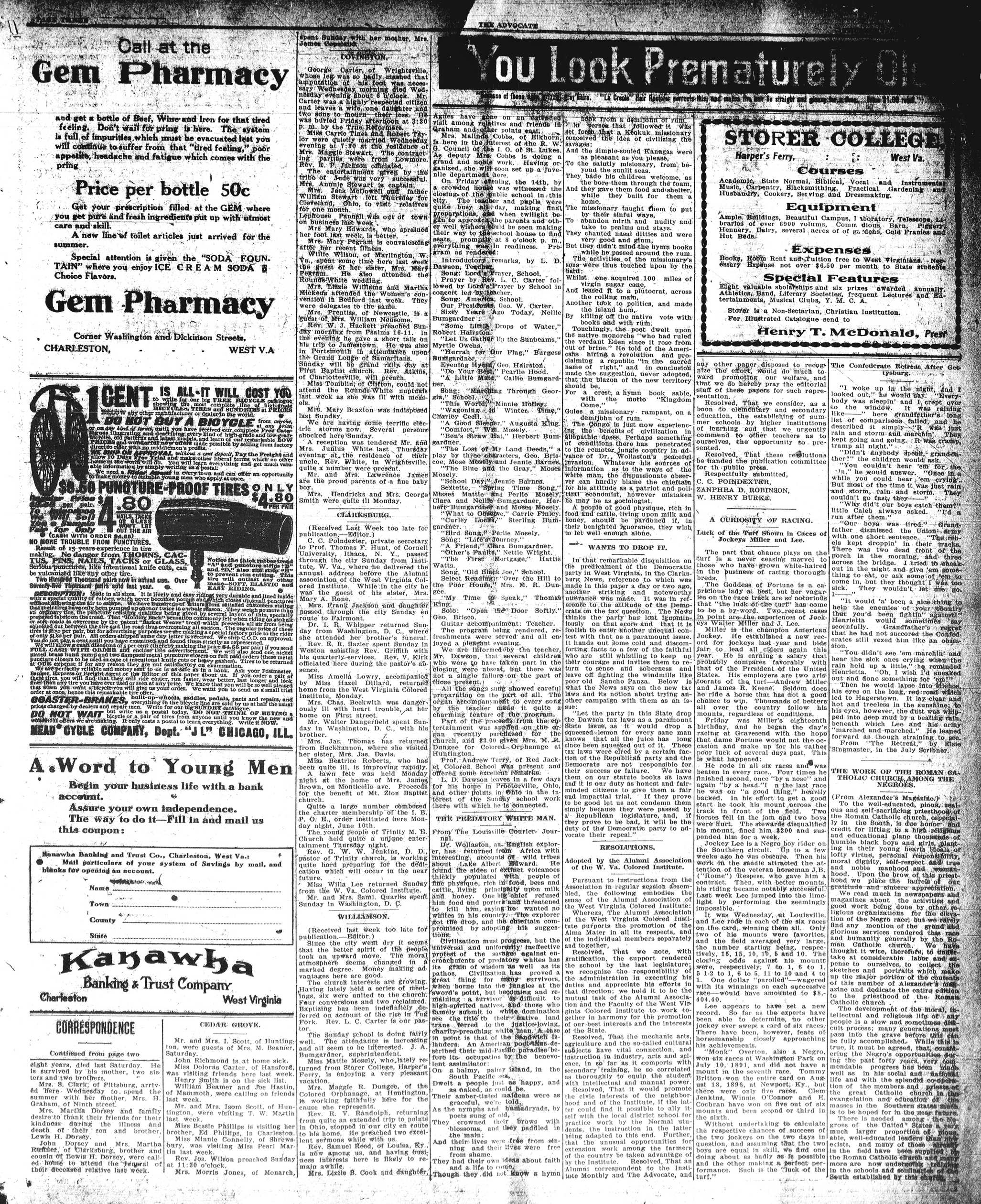
and get a bottle of Beef, Wine and Iron for that tired feeling. Don't wait for pring is here. The system is full of impurities which must be evacuated last you will continue to suffer from that "tired feeling," poor appetite, headache and fatigue which comes with the pring
Price per bottle 50c
Get your prescription filled at the GEM where you get pure and fresh ingredients put up with utmost care and skill.
A new line of toilet articles just arrived for the summer.
Special attention is given the "SODA FOUN. TAIN" where you enjoy ICE CREAM SODA Choice Flavors.
Gem Pharmacy
Gem Pharmacy
IS ALL+IT WILL COST YOU
to write down the big FREE BIOYOLE catalogue
showing the most complete line and types of
BIOYOLES, TERMS and SUNDRIES at PRICES
manufactures in the world.
BUY A BIOYOLE from anyone,
pay any
until you have received a complete Free
description, every kind of high-grade and low-grade
books and learn of our remarkable LOW
entry prices, possible by selling from factory
middlemen's profit.
OVERALL without a card deposit, Pay the Freight and
and obtain other liberal terms which no other
db. You will learn everything and get much
variety writing as a postal.
branch in every town and can offer an opportunity
the young men who apply at once.
CENT IS ALL-IT WILL COST YOU
to write for our big FREE BIGGER sale,
showing the most complete line of high-grade
MIDWOW any other manufacturer or dealer in the world.
DO NOT BUY A BIOYOLE from anyone, at any price. We are a kind of lovers until you have received our complete Free Catalogue illustrating and describing the high grade and low grade bicycles, old patterns and latest models, and learning FRIDES and wonderful new offers made possible by selling from factory direct to retail with no middlemen's profits.
NO PUNCTURE-PROOF TIRES ONLY
$4.80
PER PAIR
WHILE TENSE
OR GLASS
DON'T LET
OUT THE AIR
ORDER $4.80
FROM PUNCTURES.
ours experience in tire
making. No danger from THORNS, CACTUS, PINS, NAILS, TACKS or GLASS. Serious punctures, like intentional knife cuts, can be vulcanized like any other tire.
Two Hundred Thousand pairs now in actual use. Over Seventy Thousand pairs 'sold last year.
lively and easy riding, very durable and, lined inside decorates poroms and which closes up small punctures of woods in the winter. We, through customers stating or twice in a whole season, they regularly purchase this item being given by several layers of thin, specially designed poroms and which felt when riding on asphalt or stonework, too, prevents all airflow of debris overcoming all suction. The regular price of these items is making a special factory price to the rider in a day letter. We receive, within 6 (i.e.), an approval and found them strictly as represented. Either by making the price $4.56 per pair) if you send this advertisement, we will send a one nickel metal puncture closers on full paid orders (choose metal knife cuts or heavy gashes). Tires to be returned on us as safe as in a bank. Ask your Postmaster, or of this paper about us. If you order a pair of choker, run faster, wear better, last longer and look in the bicycle line are sold by us at half the usual price. We know what you know the new and a postal to learn everything. Write it NOW.
Dept. "J L" CHICAGO, ILL.
Young Men
mess life with a bank
in independence.
—Fill in and mail us
Co., Charleson, West Va.:
or system of Savings by mail, and
awha
Trust Company
West Virginia
DECORPATION: made in all sizes. It is lively and easy riding very durable and lined inside with a special quality of rubber, which never becomes porous and which closes up small punctures without showing the air to escape. We have hundreds of letters from satisfied customers stating that their tires have only been pumped up once or twice in a whole season. They weigh no more than an ordinary tire, the puncture resulting qualities being given by several layers of thin, specially prepared fabric on the tread. That "Holding Buck" sensation commonly felt when riding on asphalt or soft roads is overcome by the patent "Basket Weave" tread which prevents all air from being squeezed out between the tire and the road thus overcoming all suction. The regular price of these tires is $5.50 per pair, but for advertising purposes we are making a special factory price to the rider of only $4.80 per pair. All orders shipped same day letter is received. We ship C.O.D. on approval. You do not pay a cent until you have examined and found them strictly as represented.
will allow each discount of 5 per cent (otherwise making the price 6.66 per pair) if you send
the item to the manufacturer by payment. We will also send one nickel
plated brass hand hammer and two stamped metal purchase orders (the metal
purchase closers to be used in case of intentional knife cuts or heavy gashes). To be returned
at OUR expense if for any reason they are not satisfactory on examination.
reliable and money sent to us is as safe as in a bank. Ask your Postmaster, benger, keep your phone number, and your address. If you have these tires, you will find that, they will ride easier, run faster, wear better, last longer and look better than you want. We know that you will be so well pleased that when you want a benger you will give us your order. We want you to send us a small trial order at once, hence this remarkable tire offer.
GOASTER-BRAKES, built-up wheels, saddles, pedals, parts and repairs, and prices charged by dealers and repairmen. DO NOT WAIT but write us a postal today. DO NOT THINK OF BUYING a bicycle or a pair of tires from anyone until you know the new and
( CASH WITH ORDER ABB ) NO MORE TROUBLE FROM PUNCTURES.
CORRESPONDENCE
Continued from page two
eight years, died last Saturday. He is survived by his mother, two sisters and two brothers.
Mrs. S. Clark, of Pittsburgh, arrived Here. Wednesday to spend the summer with her mother, Mrs. H. Graham, of Ninth street.
Mrs. Martha Dorsey and family desire to thank their friends for their kindness during the illness and death of their son and brother, Lewis H. Dorsey.
John Dorsey and Mrs. Martha Ruffier, of Clarksbury, brother and cousin of Lewis H. Dorsey, were called home to attend the funeral of their deceased relative last week.
WEST V.A
Notice the shikok rubbets捆
"A" and puncture stipples "i"
and "D". also rim stitches "H"
to prevent rim entrap. This
must outlast any other
make--SOFT LASTIC and
EASY EIDING.
CEDAR GROVE.
Mr. and Mrs. I. Scott, of Huntington, were guests of Mrs. M. Beamier, Saturday.
John Richmond is at home sick.
Miss Dolores Carter, of Hansford, was visiting friends here last week.
Henry Smith is on the sick list.
William Beamer and Joe Hastin, of Mammoth, were calling on friends last week.
Mr. and Mrs. Isom Scott, of Huntington, were visiting T. W. Martin last week.
Miss Bessie Phillips is visiting her brother, Ed Phillips, in Charleston.
Miss Minnie Connelly, of Shrewsbury, was visiting Miss Pearl Martin last week.
Rev. Jos. Wilson preached Sunday at 11:30 o'clock.
Mrs. Morris Jones, of Monarch.
spent Sunday with her mother, Mrs. James Corsellis.
COVINETON.
George Carter, of Wrightsville, whose leg was so badly mashed that amputation of his foot was necessary; Wednesday morning died Wednesday evening about 6 h.clock. Mr. Carter was a highly respected citizen and leaves a wife, one daughter and two sons to mourn their loss. He was buried Friday afternoon at 8:30 p.m. by the True Reformers.
Miss Carrie Times and Robert Taylor were quietly married Wednesday evening at 7:30 at the residence of Mrs. Maggie Stewart. The contracting parties were from Lowmore. Rev. E. P. Jackson oblated.
The entertainment given by the tribe of Jude was very successful. Mrs. Annie Stewart is captain.
Mrs. Jack McDowell and father William Stewart left Thursday for Cleveland, Ohio, to visit relatives for one month.
Lephouse Paunel was out of town on business last week.
Mrs Mary Edwards, who sprained her foot last week, is better.
Mrs Mary Pegram is convalescing after the illness.
Willie Willett is visiting W. Va., spent some time here last week the guest of her sister, Mrs. Mary Pegram. He also attended the Round-White wedding.
Mrs. Tizle Williams and Martina Mickers attended the Women's convention in Bedford last week. They were delegates to the same.
Mrs. Prentiss, of Newcastle, is a guest of Mrs. William Nuisome.
Rev. W. J. Hackett preached Sunday morning from Psalms 16-11.
In the evening he gave a short talk on the history of St. John's Cottown. He was also in Portsmouth upon the Grand Lodge of Samaritans.
Sunday will be grand rally day at First Baptist church. Rev. Atkins, of Charlotteville will preach
Miss Toublin; of Clifton, could not attend the Rounds-White nuptials last week as she was ill with measels.
Mrs. Mary Braxton was indisposed last Sunday.
We are having some terrific electric storms now. Several persons shocked here Sunday.
A reception was tendered Mr. and Mrs. Junius White last Thursday evening at the residence of their husbands, Wightsville, quite a number were present.
Mr. and Mrs. Lawrence James are the proud parents of a fine baby boy.
Mrs. Hendricks and Mrs. George Smith were quite ill Monday.
CLARKSBURG.
(Received Last Week too late for publication,—Editor.)
C. C. Polndexter, private secretary to Prof. Thomas F. Hunt, of Cornell University, Ithaca, N. Y., passed through the city Sunday from Institute, W. Va., where he delivered the annual address before the Alumni association of the West Virginia Colored Institute. While in the city he was the guest of his sister, Mrs. Mary A. Rone.
Mrs. Frank Jackson and daughter passed through the city Sunday en route to Falmont.
Dr. I. R. Whipner returned Sunday from Washington, D. C., where she attended her brother's funeral
she attended her prom's funeral.
Rev. E. R. Bazer spent Sunday in his assisting Rev. Griffith with his quarterly services. Rev. V. Kirk officiated here during the pastor's absence.
Miss Amelia Lowry, accompanied by Miss Hazel Dillard, returned home from the West Virginia Colored Institute, Monday.
Mrs. Chas. Beckwith was dangerously ill with heart trouble, at her home on First street.
Mr. Walter Dangerfield spent Sunday in Washington, D. C., with his brother.
Mrs. Jas. Thomas has returned from Buckhannon, where she visited her sister, Mrs. Jas. Davies.
Miss Beatrice Roberts, who has been quite ill, is improving rapidly.
A lawn fete was held Monday night at the home of Mrs. James Brown, on Monticello ave. Proceeds for the benefit of Mt. Zion Baptist church.
Quite a large number combined the charter membership of the I. B. P. O. E., order instituted here Monday night, June 10th.
The young people of Trinity M. E. Church held quite a unique entertainment Thursday night.
Rev. G. W. W. Jenkins, D. D. pastor of Trinity church, is working quite hard preparing for the dedication which will occur in the near future.
Miss Willa Lee returned Sunday from the W. Va. Colored Institute.
Mr. and Mrs. Saml. Quarles spent Sunday in Washington, D. C.
WILLIAMSON
(Received last week too late for publication.—Editor.)
Since the city went dry it seems that the better spirit of the people took an upward move. The moral atmosphere seems changed in a marked degree. Money making advantages here are good.
The church interests are growing. Having lately held a series of meetings, six were united to the church. Four conversions and two reclaimed. Baptizing has been indefinitely defended on account of the rise in Tug Fork. Rev. L. C. Carter is our pastor.
The Sunday school is doing fairly well. The attendance is increasing and all seem to be interested. J. A. Bumgardner, superintendent. Miss Mattle Money, who lately returned from Storer College, Harper's Ferry, is enjoying a very pleasant vacation. Mrs. Maggie R. Dunge, of the Colored Orphanage, at Huntington, is working faithfully here for the cause she represents. V. R. Randolph, returning from quite an extended trip to points in Ohio, stopped in our city en route to his home. He preached two excellent sermons while with us.
Rey, Samuel Keed, of Louisa, Ky. is now among us, and having busi-
ness interests here is likely to remain awhile.
Mrs. Lizzie B. Cook and daughter
You Look Prematurely Ok
Agnes have gone on an extended visit among relatives and friends in Graham and other points east. Mrs. Malinda Cobbs, of Elkhorn, is here in the interest of the R. W. G. Council of the I. O. of St. Lukes. As deputy Mrs. Cobbs is doing a grand and noble work. Having organized, she will soon set up a juvenile department here.
On Friday evening, the 14th, by a crowded house was witnessed the closing of the public school in this city. The teachers and pupils were quite busy all day, making preparations, and when twilight began to approach the parents and other well wishers could be seen making their way to the school house to find seats, promptly at 8 o'clock p. m., everything was in readiness. Program as rendered:
Introductory remarks, by L. D. Dawson, Teacher.
night from a demijohn of rum. in courses that followed it was set forth. Mrs. in Kokuk missionary conceived the idea of civilizing the savages:
And the simple-souled Kanagas were as pleasant as you please.
To the saintly missionary, from beyond the sunlit seas.
They bade his children welcome, as the bore-them through the foam.
And they gave them food and shelter, while they built for them a home.
The missionary taught them to put by their saintful ways.
To abandon mirth and nudity and take to psalms and stays.
They chanted nasal ditties and were very good and glum.
But they didn't mind the hymn books while he passed around the rum.
The activities of the missionary's sons were thus touched upon by the
STORER COLLEGE
Harper's Ferry.
West Va.
Courses
Academic, State Normal, Hibical, Vocal and Instrumental Music, Carpentry, Blacksmithing, Practical Gardening and Husbandry, Cookery, Serving and Dressmaking.
Equipment
Ample Buildings, Beautiful Campus, I laboratory, Telescope, brasses of over 6000 volumes, Comm dious Barn, Pigger Hennery, Dairy, several acres of gardens, Cold Frames and Hot Beds.
Expenses
Books, Room Rent and Tuition free to West Virginia. No essayary Expense not over $6.50 per month to State student.
Prayer by Rev. L. C. Carter followed by Lord's Prayer by School in concert led by teacher.
Song: American School.
Song: Americas, School.
Our Presidents, Geo. W. Carter.
Sixty Years Ago Today, Nelle Bumgardner:
"Some Little Drops of Water," Robert Hafriston:
"Let Us Gather Up the Sunbeams," Myrtle Owens,
"Hurrah for Our Flag," Burgess Bumgardner.
Evening Hynd, Goo. Hairston.
"Do Your Best," Pearlie Hood.
"A Little Mist," Callie Bumgardner.
Song: "Marching Through Georgia," School.
"This World," Minnie Holley.
"Wagging in Winter, Time," Charley Cedell.
"A Good Sleeper," Augusta King.
"Comfort," Win. Mosely.
"Ben's Straw Hat," Herbert Bumgardner.
"The Lost of My Land Deeds," a play by three characters, Geo. Briscoe, Mose Mosely and Jennie Barnes.
"The Blue and the Gray," Moses Mosely.
"School Day," Jennie Barnes.
"Sweetheart," "Spring Time," Song.
Misses Muttle and Porlo Mosely. Clara and Nellie Bumgardner, Herbert Bumgardner and Moses Mosely.
"What to Obey," Carrie Finley.
"Curley Locks," Sterling Bumgardner.
"Bird Song," Perle Mosely.
Song: "Little Journey."
Song: Larry Journey
"A Friend," Glara Bumgardner
"A Friend," Gloria Bumgardner.
"Other's Faults," Nettle Wright.
"Her First Mortgage," Hattie Watta.
Song, "Old Black Joe." School.
Song, "Old Black Joe," School.
Select Reading, "Over the Hill to
the Poor House," Mrs. M. R. Dungee.
"My Time to Speak," Thomas King.
Sob: "Open the Door Softly," Geo. Brisco.
Guitar accompaniment: Teacher.
The program being rendered, refreshments were served and all enjoyed a pleasant evening.
We are informed by the teacher,
Mr. Dawson, that several children who were to have taken part in the closing were absent, but there was no failure on the part of those present.
All the songs sung showed careful preparation on the part of all. The organ accompaniment to every song by the teacher made it quite a charming feature of the program.
Part of the process from the entertainment was applied on the organ recently purchased for the church, and $3.00 given Mrs. M. R. Dungee for Colored. Orphanage at Huntington.
Prof. Andrew Terry, of Red Jacket, Colored. School was present and offered some excellent remarks. L. D. Dawson leaves in a few days for his home in Proctorville, Ohio, and other points in Ohio in the interest of the Sunday school work there with which he is connected.
THE PREDATORY WHITE MAN.
From The Louisville Courier-Journal.
Dr. Wollaston, an-English explorer, has returned from Africa with interesting accounts of wild tribes about Lake Albert, Edward. He found the sides of extinct volcanoes thickly populated with people of fine physique, rich in food, bees and cattle, living principally upon milk and honey. One his life he refused to kill, and Oyster and threatened to kill him, saying he wanted no whites in his country. The explorer got the drop, and the duetter compromised by adopting his suggestions.
Civilization must progress, but the universal and uniformly ineffective protest of the savage against encroachments of predatory whites has its grain of wisdom as well as its pathos. Civilization has proved a great thing for many survivors, when borne into the jungles at the sword's point, but becoming and remaining a survivor is difficult to high-spirited natives, and those who famely submit to white domination see the title to their native land transferred to the justice-loving, charity-preaching white man. A case in point is that of the Sandwich Islanders. An American poet has described their mid-Pacific paradise before its occupation by the benevolent assimilator:
On a balmy, palmy island, in the South Pacific sea. Dwell a people just as happy, and as naked, as could be.
as maked, as could.
Their amber-tinted maidens were as graceful, were told.
As the nymphs and hamadryads, by poets sung of old,
They crowned their brows with blossoms, and they paddled in the main;
And their lives were free from sinning and their lives were free from shame.
They had their own ideas about faith and a life to come.
Though they did not know a hymn
book from a demijohn of rum-
ture, the person that followed it was
set forth as a Mookuk missionary
conceived the idea of civilizing the
savages;
And the simple-souled Kanagas were as pleasant as you please.
To the saintly misionary, from beyond the sunlit seas.
The children welcome, as the bore them food through the farm.
And they gave them food and shelter, while they built for them a home.
The missionary taught them to put by their sinful ways.
To the
But they didn't mind the hymn books while he passed around the rum. The activities of the missionary's sons were thus touched upon by the bard: Whilst one acquired 100 miles of virgin sugar cane. And leased it to a plutoorat, across the rolling maid.
Another took to politics, and made the island hum.
By killing off the native vote with books and with rum.
Touchingly, the post dwelt upon the native monarchs "who had ruled the verdant Eden since it rose from out of brine." He told of the Americans hiring a revolution and proclaiming a republic "in the sacred name of right," and in conclusion made the suggestion, never adopted, that the blazon of the new territory should be a crest, a hymn book sable, with the motto "Kingdom Come."
Gules a missionary rampant, on a demitifion of rum.
The Congo is just now experiencing the benefits of civilization in silipattic doses. Perhaps something of conditions there has penetrated to the remoter jungle country in advance of Dr. Wollaston's peaceful invasion. Whatever his sources of information as to the ways of the white man, the dispassionate observer can hardly blame the chieftain for his attitude as a patriot and political economist, however mistaken he may be as geologist.
A people of good physique, rich in food and cattle, living upon milk and honey, should be pardoned if, in their benighted ignorance, they wish to let well enough alone.
WANTS TO DROP IT.
In that remarkable disquisition on the predicament of the Democratic party in West Virginia, in the Clarksburg News, reference to which was made in this paper a day or two ago, another striking and noteworthy utterance was made. It was in reference to the attitude of the Democrats on the tax question that thinks the party has lost ignominiously on that score and that it is foolish to enter another unequal contest with that as a paramount issue. It hands out Some cold and discomforting facts to a few of the faithful who are still whistling to keep up their courage and invites them to return to sense and soberness and leave off fighting the windmills like poor Sancho anza. Below is that the Nancey anza that laws and its notion about trying another campaign with them as an issue:
"Let the party in this State drop the Dawson tax laws as a paramount State issue, as it would drop a squeezed-lemon for every sane man knows that all the juice has long since been squeezed out of it. These tax laws were erased by a certain faction of the Republican party and the Democrats are not responsible for their success or failure. We have them on our statute books as laws and it is our duty as honest and fair-minded citizens to give them a fair and impartial trial. If they prove to be good let us not condemn them simply because they were passed by a Republican legislature, and, if they prove to be bad, it will be the duty of the Democratic party to advocate their repeal."
RESOLUTIONS.
Adopted by the Alumni Association of the W. Va. Colored Institute.
Pursuant to instructions from the Association in regular session assembled, the following embodies the sense of the Alumni Association of the West Virginia Colored Institute: Whereas, The Alumni Association of the West Virginia Colored Institute purports the promotion of the Alma Mater in all its respects, and of the individual members separately and together.
Resolved, That we note, with gratification, the support rendered the school by the last legislature; we recognize the responsibility of the administration in executing his duties and appreciate his efforts in that direction; we hold it to be the mutual task of the Alumni Association and the Faculty of the West Virginia Colored Institute to work together in harmony for the promotion of our best interests and the interests of the State.
Resolved, That the mechanic arts, agriculture and the so-called cultural subjects have vital connection, and instruction in industry, arts and science, in so far as it compacts with secondary training, be so correlated as thoroughly to equip the student with intellectual and manual power. Resolved, That it would promote the civic interests of the neighborhood and of the Institute, if the latter could find it possible to ally itself with the local district school for practice work by the Normal students, the instruction in the latter being adapted to this end. Further, that the unusual opportunities for extension work among the farmers of the country be taken advantage of by the Institute. Resolved, That an Alumni correspondent to the Institute Monthly and The Advocate, and
Academic, State Normal, Hibiblical, Vocal and Instrumental
Gardening and
Husbandry, Cookery, Setting and Dressmaking
Equipment
Ample Buildings, Beautiful Cairn
brasses of over 6000 volumes,
Hennery, Dairy, several acres
Hot Beds.
Expo
Books, Room Rent and Tultio
essary Expense not over $6.00.
Special
Eight valuable scholarships and
Athletics, Band, Literary Socie
tertainments, Musical Clubs, Y
Storer is a Non-Sectarian, G
For Illustrated Catalogue se
Henry T.
Ample Buildings, Beautiful Campus, I laboratory, Telescope, Libraries of over 6900 volumes, Comm durns Barn, Piggery, Hennery, Dalry, several acres of gardens, Cold Frames and Hot Beds.
Eight valuable scholarships and six prizes awarded annually. Athletics, Band, Literary Societies, frequent Lectures and Entertainments, Musical Clubs, Y. M. C. A.
Storer is a Non-Sectarian, Christian Institution.
For Illustrated Catalogue send to
any other paper, disposed to recognize the effort, would do much toward promoting our welfare, and that we do hereby pray the editorial staff of these papers for such representation.
Resolved. That we consider, as a boon to elementary and secondary education, the establishing of summer schools by higher institutions of learning and that we urgently commit to other teachers as to ourselves, the opportunity so presented.
Resolved. That these resolutions be handed the publication committee for th public press.
A CURIOSITY OF RACING.
Luck of the Tuff Shown in Caces of Jockeys Miller and Lee.
The part that chance plays on the turf is a never ceasing marvel to those who have grown white-haired in the business of racing thoroughbreds. The Goddess of Fortune is a capricious lady at best, but her vagaries on the race track are so notorious that "the lukk of the turf" has come to be a by-word. Two recent cases in point are the experiences of Jockeys Walter Miller and J. Lee. Miller is the champion American Jockey. He established a new record for jockeys last year and bide fair, to lead all riders again this year. He is earning a salary that probably compares favorably with that of the President of the United States. His employers are two artifactors of the turf—Andrew Miller and James R. Keene. Seldom does he ride a horse that has not a good chance to win. Thousands of betters all over the country follow his mounts, regardless of conditions.
Friday was Miller's eighteenth birthday, and he began the day's racing at Gravesend with the hope that dame Fortune would not the occasion and make up for his rather dark mark of days past. This is what happened:
He rode in all six races and was beaten in every race. Four times he finished second, once "by a nose" and again "by a head." I in the last race he was on "a good thing," heavily backed. In his effort to get a good start he took his mount across the track in front of the field. Two horses fell in the jam and two boys were hurt. The stewardis disqualified his mount, fined him $200 and suspended him for a week. Jockey Lee is a Negro boy rider on the Southern circuit. Up to a few weeks ago he was obscure. Then his work in the saddle attracted the attention of the veteran bison. ID ("Rome") Respess, who gave him a contract. Then, with better mounts, his riding became notably successful. Last week Lee jumped into the limelight by performing the seemingly impossible.
It was Wednesday, at Louisville, and Lee rode in each of the six races on the card, winning them all. Only two of his mounts were favorites, and the field averaged very large, the number starting being, respectively, 15, 15, 10, 10, 5 and 10. The closing odds against his mounts were, respectively, 7 to 1, 6 to 1, 5 to 1, 2 to 1, 6 to 5, 11 to 10 and 4 to 1. One dollar "parolled"—wagered with its winnings on each successive race—would have amounted to $8, 404.40.
It appears to have set a new record. So far as the experts have been able to determine, no other jockey ever swept a card of six races. There have been, however, feats of horsmanship closely approaching his achievements.
"Monk" Overton, also a Negro, won six races at Washington Park on July 10, 1891, and did not have a mount in the seventh race. Tommy Britton won the entire card on August 18, 1896, at Newport, Ky., but there were only five races. Clem Jenkina, Winnie O'Connor and E. Cochran have won on five out of six mounts and been second or third in the sixth. Without undertaking to calculate the respective chances of success of the two jockeys on the two days in question, and assuming that the two boys are equal in skill, we find one doing about as badly as is possible and the other making a perfect performance. Such is the "luck of the turf."
Respectfully submitted,
C. C. POINDEXTER,
ZANPHRA D. ROBINSON,
W. HENRY BURKE
Campus, Laboratory, Telescope, La
Comm dong Barn, Piggery
s of of gardens, Cold Frames and
denses
on free to West Virginia. Nex-
50 per month to State students.
Features
s six prizes awarded annually.
tries, frequent Lectures and En-
Y. M. C. A.
Christian Institution.
end to
McDonald, Prest
The Confederate Retreat After Ge-
tysburg.
"I woke up in the night, and I looked out," he would say. "Everybody was sleepin' and I crept over to the window. It was raining like——" here grandfather's long list of comparisons failed, and he described it simply—"It was just rain and storm and marchin'. They kept going and going. It was tramp, tramp all night." "Didn't anybody speak, grandfather?" the children would ask. "You couldn't hear 'em for the, the he would answer. "Once in a while you could hear 'em crying'. But most of the time it was just rain and storm, the storm. They couldn't go fast, they——" "Why did our boys catch them?" little Caleb always asked. "I'd a run after them."
"Our boys was tired." Grandfather dismissed the Union army with one short sentence. "The rebels kept droppin' in their tracks. There was two dead front of the porch in the morning, and three across the bridge. I tried to shake out in the night and give 'em something to eat, or ask some of 'em to come in, but they thought I was too sick. They wouldn't let me go." "It would 'a' been a nice thing to help the enemies of your country that you'd been nightin' against!" Henrietta would continue, say scornfully. Grandfather's that he had not succored the Confederates still vexed him like an obsession. "You didn't see 'em marchelin' and hear the sick ones crying when the rain held up a little," he remanded Henrietta. "Oh, I wish I'd sneaked out and done something for 'em!"
Then he would lapse into elichos, his eyes on the long, red road which led to Hagerstown. It lay clear and hot and treeless in the sunshine; to his eyes, however, the dust was whipped into deep mud by a beating rain, beneath which Lee and his army "marched and marched." He leaned forward as though straining to see. From "The Retreat," by Field
From "The Retreat," by Elsie Singmaster, in the July Scribner
THE WORK OF THE ROMAN CATHOLIC CHURCH, AMONG THE NEGROES.
(From Alexander's Magazine.)
To the well-educated, pious, zealous and self-sacrificing priesthood of the Roman Catholic church, especially in the South, is due honor and credit for lifting to a high religious and educational plane thousands of humble black boys and girls, planting their young hearts ideals of lofty virtue, moral dignity, self-respect and true and noble manhood and womanhood. Upon the brow of this priesthood we place the laurels of our gratitude and sincerity ammunition.
We read much in newspapers, and magazines about the activities and good work being done by other religious organizations for the elevation of the Negro rate; but we rarely find any mention of the grand and glorious services rendered this race and humanity generally by the Roman Catholic church. We have thought it wise, therefore, to undertake at considerable labor and expense to ourselves, to collect the sketches and portraits which make up the major portion of the contents of this number of Alexander's magazine and dedicate the entire edition to the priesthood of the Roman Catholic church.
The development of the moral, intellectual and religious life of any people is a slow and sometimes difficult process; many generations must pass into the grave before this can be fully accomplished. While this is true, it must be agreed, that, considering the Negro's opportunities during the past forty years, very commendable progress has been made well as in his social and national life and with the splended cooperation of the members and priests of the great Catholic church in the evangelisation and education of the missionaries. The Southern states much is to be hoped in the near future. There is needed by the Negroes of the United States a much larger proportion of good, well-educated leaders than preachers, and many of those already in the field have been supplied by the Roman Catholic church and many more are now undergoing training in the schools and seminaries of the South established by this church.
The Advocate is entered in the Post-office at Charleston, W. Va., as second class matter.
OFFICES.
New York:
738 7th Avenue.
Washington:
1325 12th St. N. W.
Louisville:
1112 W. Madison St.
St. Louis:
3137 Pine St.
Philadelphia:
702 So. 15th St.
Baltimore:
502 W. Biddle St.
Boston:
94 a Harvard St., Cambridge
Pittsburg:
461 6th St., Braddock.
Columbus:
266 St. Clair Ave.
New Orleans:
226 So. Robertson St.
Jacksonville:
536 W. Union St.
Nashville:
706 Bass St.
Indianapolis:
1605 Alvord St.
Lexington:
567 N. Upper St.
San Francisco:
865 Union St., Oakland.
Detroit:
261 Elliot St.
El Paso:
Chicago:
3519 Calumet Ave.
FORAKER AT WILERFORCE.
Of the candidates, prospective or avowed, for the republican presidential nomination Senator Foraker stands in a class by himself. None, unless we except Mr. Cannon, who suffered recently from a temporary aberration of the mind while in North Carolina, has had the hardihood to give his latitude and longitude on any unsettled domestic question, upon which his party is not in accord, in such unmistakeable terms as those used by Ohio's senior senator last Thursday; nor has any but he dared to question the divine right of the President.
Fairbanks, the highest type of conservatism this world affords, harps exclusively upon the unprecedented prosperity of the United States under republican administrations. Taft upon the Philippines and our relations with Cuba and kindred subjects has filled columns of the daily press. But they, as well as the other heirs apparent to the White House, are silent one and all—still excepting Uncle Joe—as to those policies which vitally affect ten millions of this country's population. It may be that way down in his heart each has a kindly feeling for the Negro and wishes him well in his aspirations for political equality, but fearing the ostracism of his peers which is the fate of him who espouses our cause, he avoids the black man as he would a leaper.
Not so with Mr. Foraker. Whether in Ohio or Tennessee, before republicans or democrats, white men or black men, as governor or senator, his attitude has been ever the came, furnishing an exhibition of consistency as courageous as it is rare in these days when "policy" is the guiding star of the great.
What he said regarding the Brownsville affray was but an incident in a general advisory recommendation to the race to make resistance to any and all invasions of its rights. There was no mistaking the character of the advice. In plain terms, it was to support no man politically who is not in sympathy with our demands for equality before the constitution and the law. There must be no truce, he said, with those who condone the nullification of the laws by others.
His address may well be denominated a discussion of the race problem of today, set forth in terms the plainest. After forty years of freedom there is still, said the senator, a feeling of prejudice against the colored man and the dream of universal acquiescence in the doctrine of political equality is further from its realization than when it first appeared to those who framed the constitutional amendments. He would have none of the various solutions of the vexing problem, as all must fall because of their denial of politician equality to a portion of the citizens of this republic.
As to his motive for taking the soldiers' part, he said:
"Why have I bothered myself about this matter? My critics have assigned a good many reasons, all of a reprehensible character. Let me tell you the real reason, and let me tell it in the language of Secretary Traff. I refer to what he said when Athens, Ohio, was shot up two or three years ago by a lot of white soldiers of the regular army, who
were encamped there with our National Guard. He sent representatives of the Government to look after the defense of the men who had been arrested for the crime. The citizens of Athens protested. He answered that 'an enlisted man is more or less a ward of the Government, and if the Government steps in merely to see that he is tried according to law it seems to me that it is an exercise of a discretion which the Government has.' "That answer was a credit to both his head and his heart. The reason that prompted him prompted me. I thought what a white soldier was entitled to at Athens, Ohio, a Negro soldier was entitled to at Brownsville, Texas."
Concluding, he said:
"The investigation may prove futile to establish the truth. It may never be known who did the firing, but it will always be known that the men have at least had a chance to state their side of the case. If for what I have done in this-behalf I am to be eliminated from public life, as has been proclaimed, then let it be known that I shall at least carry with me into private life the counseling dislike I may for her knowing that I have been rebuked for a action that I shall never regret, but always esteem as creditable to my heart as a man and to my sense of justice and duty as a public official."
If, as has been intimated, Mr. Foraker signed his political death warrant by opposing the President in the soldier controversy, he will not go down to his grave unwept and unsung. His grateful Negro admirers who have followed the investigation with an interest never manifested in any other question, will long remember the conspicuous part he played in it and will revere his name when those who took the opposite side shall have played their little parts and passed from the memory of men.
THE AFRO-AMERICAN COUNCIL.
The Afro-American Council, rising to the trumpet call of Bishop Alexander Waters, met at Baltimore yesterday, and after listening to some harrowing descriptions of the woes we suffer, will complete its labors Friday. If we could now and then have one practical fact come out of these yearly meetings, we might, in time, hope to have facts enough to make a chapter. The men who lead, as a general thing, are noted for their success in other lines of endeavor, but the problem which our separate life presents seems to be beyond their grasp.
We have said in season and out of season that the one need of the race is a union of efforts and that unison can only be gotten through our secret societies. If the great secret organizations could come to an understanding through the Friendly Society movement, then the force of our united effort in church, business and state, would be felt.
If our force could be combined, if it could be made to move true, to concentrate along any given line, we could move mountains. Let us come to an understanding that our race life must be developed from within, first in our own lives and wills and then by pulling together as other races do. We have met in various conventions—social, political, business and fraternal—from year to year for the past thirty years, passed resolutions upon resolutions, and what have we accomplished? what parsnips have we buttered? Who remembers the whereases and therefore-be-it-resolves of last year? Not even the persons who wrote them.
This is the age of combinations, and if we would be up to the times it behooves us to combine. By simply combining their efforts along one line one fraternity in this state has accumulated property valued at fifty thousand dollars, and the same method pursued by them all would soon place them among the factors recognized in financial circles, from which there is but a step to political recognition.
We are simply dissipating our energy and means under the system which now obtains and the sooner we get together the sooner will the evils of which we computir be corrected.
QUARANTINE AGAINST CONSUMPTIVES
If the state health officer of Texas carries out his pronounced intentions, it will not be long before all persons suffering from tuberculosis in an acute stage will be denied entrance to that state. A proclamation establishing a quarantine against the disease is soon to be issued.
No doubt this health officer thinks he is a remarkably progressive person. In one sense he is right. His progressiveness is, however, not intelligent, but unintelligent. He is acting much as the hotel keeper does, who long careless of all sanitary precautions, suddenly goes into a panic of fear over consumptives not because of any danger to health but because he is afraid that their presence will drive away other patrons. If Texas excludes consumptives, it will not be because of intelligent desire for self-protection, but because of some panicky fear of indirect evils, which are mainly of a "psychological" nature.
tion is an infections disease and that it is of the greatest importance to every community to stop its spread. But it is also true that practically the only means of conveying the infection is through the sputum, which, when dried and powdered, carries the bacilli through the air. Intimate personal contact, such as kissing, may also convey it, but that is not a danger against which public precautions need to be taken.
Consequently, if any state like Texas wants to get rid of consumption, it has no need of establishing a quarantine burdensome to itself as well as to the victims of the regulations. Its most effective measures will be to spread information as to the way in which the disease is conveyed, and as to simple precautions which alone are necessary to protect a community from any noticeable danger that may come to it from the presence of such diseased persons.
This more intelligent method of securing safety is not only more humane to the sufferers, but better for the community that adopts it.
The discovery of a serum which immunizes against typhoid fever is the latest in the medical world. If some one will discover a serum to immunize against cerebral elephantiasis and envy, we pledge ourselves to purchase the first gallon produced, and will ship it express prepaid to the editor of the In-look department of the Horizon.
AN ANACHRONISM
The Atlanta Independent said last week:
"We feel about the effort to legalize the theft of our votes like Plato did about Carthage. It made no difference what the nature of the meeting or the occasion was, the old Grecian would end his remarks in the statement that 'Carthage must be destroyed.' Plato firmly believed that the existence of Carthage meant a treat to Grecian civilization and he lost no opportunity to stir his people to destroy Carthage. The Independent, like Plato about Carthage, believes that disfranchisement threatens the very foundation of our citizenship, and cannot close a single issue without saying disfranchisement must be defeated."
It has been some little time since we saw an ancient history, but it strikes us that brother Davis is a little mixed. When we read history, Scipio Africanus was held responsible for the remarks he assigns to Plato, and Rome not Greece, was the rival of Carthage. But times have changed and it matters not now whether it was Plato and Greece or Scipio and Rome, The Independent's dissertation upon the duty of Georgia's Negroes to register is to the point.
Principal Booker T. Washington of the Tuskegee Institute has written for the World's Work, New York, two articles to appear respectively in the July and August numbers of that magazine on "Mound Bayou: A Negro Business Community," and "Wilberforce: A Negro College Town." The articles deal with the pioneer spirit and accomplishments of the group of Negro men who are building the Negro town of Mound Bayou in the heart of the Mississippi Delta, and with the older community which began its life long before the War of the Rebellion, as a refuge for Negroes who sought freedom from slavery.
Each article is designed to exhibit the spirit of progress which at present animates the Negro in his efforts to build a secure and safe civilization for himself and his children. The World's Work is one of the strongest of American magazines and the articles will reach and influence public opinion of the most commanding kind.
The American Magazine for July contains another of Mr. Ray Stannard Baker's articles of the "Following the Color Line" series. In this he deals with the problem of the races as he finds it in the black belt and the article is upon the same plane of fairness which characterizes those proceedings. There is no attempt to discuss the various phases of the question, the facts being simply stated as they appear to an impartial observer.
AN EDITOR'S DIARY.
The Indianapolis News claims to have discovered a Hoosier editor who has taken time, despite his heavy duties as "moulder of public opinion" to keep track of his material and mental progress during the year, and offers the following summary of his experience:
Been broke 300 times.
Had money 65 times.
Praised by the public 6 times.
Asked to drink 8 times.
Refused to drink 0 times.
Missed prayer meeting 52 times.
Been roasted 531 times.
Roasted others 52 times.
Washed the office towel 3 times.
Missed meals 0 times.
Taken for a preacher 11 times.
Taken for a capitalist 0 times.
Found money 0 times.
Taken bath 6 times.
Delinquents paid 27 times.
Paid in conscience 0 times.
Got whipped 0 times.
Whipped the other fellow 8 times.
Cash on hand at beginning $1,40;
where the colored people had better hotels and more comfortable homes. They are hospitable, as well as thrifty, and stand for solidity and genuine professional, business, social and industrial strength. Dr. Palge on Queen street, has the finest drug store that I have seen anywhere in the country owned by a colored man, and few white establishments can equal it in the average city of 65, 000. Dr. L. H. Reynolds, whom I greatly admire, is doing a phenomenal work in arranging homes for the delegates to the conference, and when he assures me that 'everything is a right, there is no more to be said. I look for fully 1,500 delegates and visitors, and I think there will be ample accommodations for even more than that, should they come this way next May.
Being asked his opinion as to the contest for the Bishopric, Dr. McCracken was averse to entering upon any discussion of so delicate a position that finally consented to allow the following statement to be made public;
"The contest will be a vigorous one, but I anticipate nothing savoring of bitterness. I expect to see four men elected for the home work and perhaps one for Africa, although Africa may get left if the pressure grows too strong for a fifth man for this continent. I would place Dr. H. B.' Parks first in the race, with Dr. E. W. Lampam as a close second. Dr. H. T. Johnson is reasonably certain to 'go up,' and at this time, it is very evident that Dr. J. S. Flipper has votes enough to win. Now, for the fifth place, I would say that Dr. L. H. Reynolds stands an excellent chance, and it would not surprise me if he stood higher on the list. Dr. Conner, Dr. Chappelle and one or three will be in the fight, and the result will be doubt until the official count is announced. As I said, I do not like to discuss the matters as an infallible prophet. What any one may give out on the subject, must be, in the nature of things, purely guesswork. I am hopeful of the election of a 'state' that will give general satisfaction."
Dr. McCracken paid a handsome compliment to Rev. L. E. Christy, pastor of St. Luke A. M. E. Church at East St. Louis, Ill., and editor of The Sentinel, the 'cleanest and most ably edited race paper in the state of Illinois.' He spoke of the herculean feat achieved by Rev. Mr. Christy in raising the largest sum of money that day minister had ever brought forward in East St. Louis, cutting down an enormous debt and paying all current obligations, when his predecessors had barely made a living there. This is highly significant in view of the fact that Rev. Mr. Christy, who is also the founder and still part owner of the Indianapolis World, is regarded as a strong candidate for the editorship of the Christian Reorder. It is also a well-known fact that Dr. McCracken is a favorite in the race for Secretary of Missions, to succeed Dr. H. B. Parks, and his friends say he is a "sure winner."
Prof. Charles Stewart, writing from Ocala, Florida, in the interest of the candidacy of Mr. Ira T. Bryant for the Secretaryship of the A. A. E. Sunday School Union at Nashville, hands a "hot one" to the so-called "ministerial combine" when he calls attention to the fact that every one now in the ministry was a layman before he became a minister, and they should, therefore, remember the layman kindly, and see to it that he gets his just dues as a fundamental element of the church. Prof. Stewart also makes forcible the point that a layman in the office of Sunday school secretary can get up the literature of that department just as capably as a minister (as Prof. Scarborough is now doing); and if he cannot do it himself or has not the time, he can with perfect propriety continue the present policy of drawing on the services of trained writers for that purpose. This is done by the heads of nearly all of the great national departments, from the President down. It is an open secret that few of the "editors" of our most influential newspapers actually edit them in person. They outline the policy and map out the general trend of the sentiment they wish to create and their intelligent and experienced subordnates do the rest. As Prof. Stewart gently intimates, Mr. Bryant has no necessity nor desire to make of himself an "Intellectual octopus." If there is a disposition anywhere to array the ministry against the laity, as alleged, it should be stopped at once, or the general church will suffer. The prosperity of the A. M. E. church depends wholly upon the sympathetic co-operation of the pulpit and the pew, and this very needful co-operation can only be secured by according to the laity "a square deal" in the matter of official recognition.
While in the Negro building a few days ago at the Jamestown Exposition, President and Mrs. Roosevelt gave enthusiastic evidences of their admiration for the beautiful collection of hand-painted china in the elaborately-decorated booth of Mrs. Frances B. Spencer-Dorkins. Both grasped her hand and warmly congratulated her upon her marked proficiency in a department of the fine arts in which only the most talented and earnest can hope to excel. Mrs. Dorkins is now a resident of Norfolk, but came from Pittsburg, where she was reared. She is a natural artist. When the superior quality of her work is observed, one can scarcely believe that she has had no special training. Loving the work, she devoted her whole soul to it, picking up her knowledge and practice as she could from time to time, until today she has no peer in the country in her line. Confessedly, Mrs. Dorkins' booth has come to be the main point of interest in the building for connoisseurs in decorated china, and art collectors besiege her parlor daily, arranging to have an order filled. This gifted young woman is thus capably serving both herself and she race in winning the
communication of an influential class of patrons whose friendship and approval are worth while. It seems to be a foregone conclusion that Mrs. Dorkins will easily win one of the cash prizes offered by the management for the most creditable exhibits.
The Knights of Pythias of New Orleans believe in "doing business on business principles." They have all the money on deposit for their new $75,000 building, which they propose erecting on one of the prominent corners of the Crépole city. This temple is to be six stories in height. Brick and stone are the materials to be used, and it will be modern in type and beautiful in general tone. On the first floor there will be a bank, drug store, law offices and a first-class barber shop. On the second floor, a grand auditorium will be fitted up for the theatrical and lecturing purposes, on the third floor, will be offices and the banquet hall; will be the fifth, sixth and seventh floors, there will be lodges rooms. The Louisianian Pythians have lodges and over 8,000 members. The collections average $5,000 per month, and the membership is still on the increase, new lodges being instituted all the time. Nowadays, it is a poor reason that cannot afford to have its own lodge and office building, and the Pythians are taking first rank in this progressive work of "home making."
Prof. J. H. Hathaway, who has just resigned the presidency of the Colored Normal School of the State of Kentucky at Frankfort, has been exonerated of the charges preferred against him by Rebecca Logan, a pupil, and the State Board of Education has given him a letter of recommendation, extolling his qualifications as a fine instructor, a superior executive officer and an ardent worker for the elevation of his race. The Board testifies that the retirement of Prof. Hathaway is voluntary, and will take effect July 1. Prof. Hathaway is already in receipt of several advantageous offers, and the beginning of the fall term of school will doubtless find him satisfactorily "placed."
Some time ago the Methodist Episcopal church removed the time limit on the pastorate of its ministers and the innovation is found to work well. And that brings up the thought, why should there be a time limit in any of the Methodist churches. The practice of moving a man, just for the sake of moving, is growing out of date, and is not regarded as beneficial to either the minister or the congregation. If a minister suits his people, and is getting results, there is absolutely no reason why he should be sent to a new work, for which he may not be so well adapted, or into an atmosphere which may not be at all congenial. If the minister does not suit, a change can be made at the option of the congregation. Changes are effected for good and sufficient reasons in the Baptist, Presbyterian and Episcopal churches, and by the exercise of a little tact there is seldom any confusion or ill-feeling. As an illustration the trend of populism against the populism of itineracy, it will be noticed that in the denominations where the time limit is still in vogue, the period of possible service at a given point is being gradually lengthened, and it is believed by many eminent churchmen that it is only a question of a few years when it will disappear altogether as a disciplinary regulation. A reform of this kind would not interfere with the present form of Bishopric supervision, for the Episcopal church, without the time limit, has plenty of work for her Bishops to do.
Hon. W. T. Vernon, Register of the Treasury, has returned to Washington, after a highly enjoyable tour of the West, visiting his school at Quindaro, Kansas, at commencement time, and speaking at points in Kentucky, Missouri, Illinois, Indiana, Ohio and Pennsylvania. Dr. Vernon, a graduate of the Columbia branch of the National Negro Business League and will be a delegate to the Topeka convention. R. W. THOMPSON.
JAMESTOWN EXPOSITION NOTES
The 4th of July has been selected as "Dedication Day," and the event will be the most significant demonstration of racial advancement that this generation has ever known. Prof. Kelly Miller, of Howard University, will be the principal speaker, and his address will be a "keynote," expressing the hopes, fears, aspirations and ideals of the best thinking Negroes of the land. A brilliant supplementary program will be presented in which some of the brightest lights in our musical and Literary life will participate. An immense crowd is expected and the Executive Committee is making ample arrangements to accommodate an unlimited number of visitors.
The exhibits, including those delayed through the pressure on the transportation lines, are now practically installed, and the exposition is taking on an air of completeness that is a pleasure to behold. The close proximity of the Negro building to the west entrance, which leads directly to the plers, the cars and the Pine Beach Amusement Park, makes it the most convenient for the sightseers to enter first in the park, and then from the south gate, the Negro building inspected as they pass from the grounds homeward or to the interesting park just across the avenue. No one, black or white, misses seeing the Negro building.
The Division of Manufactures is showing up more strongly every day, as the rapidly arriving exhibits are placed in position. Mr. A. L. Macbeth of South Carolina, whose unique agricultural display has so agreeably impressed the people, has had this department included in his work, and is pushing it with his usual vigor and originality, assisted by the tasteful and experienced Mrs. T. J. Calloway, of Washington, D.C., a volunteer worker, who is especially
helpful in the arrangement of the elaborate display of fine art productions. A detailed description of this collection will be made in due season.
The "kickers," who haven't seen the Negro building at all, are confounded by the favorable reports of those who have actually been on the ground and been delighted with the splendid location, the beauty of the structure and the unparalleled size and variety of the exhibits therein displayed. The exposition itself is the best witness for the defense. It must be seen to be appreciated. The doors are wild open to the world.
The model bank of the United Order of True Reformers, a branch of the substantial oil embankment at Richmond, was installed years under the direction of Mr. R. T. Hill, the energetic cashier of the Richmond bank. The fixtures are elegant, the wood being richly carved quartered oak, with counter rest of Vermont marble. The frame work is set off with fancy oxidized steel gratings, hammered glass and French plate, and the whole is enclosed by an ornate bronzed iron railing. Within the enclosure and outside of the bank proper is a magnificent collection of photos, showing the growth of the order, the many halls and stores operated by the organization, and statistics illustrating the advantages that have brought the True Reformers up to a total membership of over 80,000, and made it the strongest financial body of Negroes in the world. A regular banking business will be done in the Exposition branch, and visitors and employees will find it a great convenience. Its value to the True Reformers and to the race is beyond estimate.
The stage facing the auditorium on the second floor is "a thing of beauty." The "proscenium arch is not surpassed in any hall in the country in architectural design. It is made of handsomely embossed staff, white as marble, and on classic tablets in the center and at the angles are the inscriptions "Oratory," "Music," and "Drama," the three phases of the fine art to which the temple is dedicated.
Hon. H. F. B. Macfarland, Commissioner for the District of Columbia, commenting on his trip to the Jamestown Exposition on "District of Columbia Day" said: The exposition is remarkably good, considering all the difficulties and obstacles which the courageous and indefatigable management has surmounted. It is very attractive now and will be more and more so. I want to go back again to see more of the exposition than was possible in the exposition times we had, especially want to do. Columbia business men's exhibit and the District of Columbia exhibit in the Negro building when they are installed.
The intellectual growth of the Negro is emphasized in the wonderful array of exhibits from many schools and colleges conducted by and for our young people. Hamilton's substantial $5,000 display of what the brain and brawn of her students have done, are wagons, harness, clothing, shoes, and other useful manufactures from the St. Emma Industrial and Agricultural Institute at Rock Castle, Va., and the high-grade artistic work done by Uberforce labor force, are among the notable. Prof. C.H. Johnson of Ohio, has done some effective service in getting this educational department in creditable shape, and he has an excellent assistant in Mr. Elmer S. Imes, of Fisk University.
العربية
Messrs. T. M. Hunster, Samuel D. Milton and W. D. Nixon, of Washington, D. C., have been here, installing the exhibit of the schools of the District of Columbia.
Howard University makes a good showing.
Messrs. Franklin Nichols, Hilyer and Daniel Murray, Jr., are here from Washington. Mr. Hilyer will assist Mr. A. C. Newman with the division of inventions, and Mr. Murray will have general oversight of the literary department. Both are young men of rare talent and industry.
The newspaper, exhibit, arranged by Mr. R. W. Thompson, is coming in for a large share of attention. Hundreds of white people of the best standing are giving it close examination daily and express undisguised amazement that there are so many praiseworthy papers and magazines edited and published by Negroes in this country. Not a few Negroes are likewise surprised to note the number and progressive character of the nearly 400 race journals that are regularly issued in the various sections of the land.
The outlook for a successful season for the concessionaries is very bright. The amusement and refreshment booths will be in full blast by the first of July.
Governor R. B. Glenn, of North Carolina, accompanied by Col. Pogue, Commissioner-General of the North Carolina State Exhibit, were among the exposition's distinguished callers this week. Both gentlemen were immensely pleased with the evidences of race progress they saw everywhere, and were particularly struck with the magnificence of the Negro building, testifying, as many others are cheerfully doing, that it is the prettiest building on the grounds. They were gratified with the excellent showing that is being made by the Commissioners of the Negro exhibit, Rev. C. H. Williamson and Prof. C. N. Hunter. "Gov. Glenn was very proud of the fact that North Carolina had given $5,000 in aid of the Negro's effort to prove his worthiness, but regretted that no other state in the Union had been generous enough to do likewise. North Carolina has the most prominent reservation in the building and its exhibit will cover approximately 2,000 square feet of floor space. The work of the State's Colored Institution for the Blind, Deaf and Dumb
will be featured, and that progress of the Negro in the scholastic culture, in culture, in business and in the churches will all be fittingly exploited.
BROWNSVILLE.
Whatever it did it made, them
think. It made us think. It will
make us think. It will make to
register, the leading Uni-
tarian, orphan
One feature of the Brownsville discussion has impressed us peculiarly—the assumption of a conspiracy of silence on the part of the whole Negro troop at Brownsville. All have been held implicated in the offense, because none will give clue to the offenders. A few—say ten—committed the outrage; the remainder—say one hundred and sixty—with incriminating knowledge stubbornly withheld it. Of course this may be possible; but whether credible, there may be two opinions. One hundred and sixty in possession of a grave secret, and it can be probed out of one of them! One hundred and sixty incurring grave penalty from which one will bring reprieve, and not one will speak it! We should stand in mute voice in presence of constancy such as this. Such a secret in the possession of ten average white men would be extremely unsafe, and one hundred and sixty average Negroes! If to this length the Negroes will support one another, think what tributations are yet before us in dealing with them!
They will never support one another to this length. A fiction, however, may call our attention to a fact, and this one may open our eyes to a tendency among the Negroes worth while to observe. There is no mistaking the fact that they are learning to cohere, to cooperate, to stand by one another; that a race interest is growing among them. This, to one who knew them in the sixties, implies significant change.
Now what has been the agent of this change? Education? In part undoubtedly. Knowledge and servility do not dwell comfortably together. The agent in chief, however, has been the hard treatment the Negro has experienced. Its aim has been to "teach him his place." It has put him on his feet, with the consciousnessk that he must work out his own destiny. The submissionness and docility which gentleness might for long, have perpetuated, severity has very largely obliterated. In like manner we may explain the race interest on which we have lingered. In bondage, this hardly existed. With freedom it was sure to come, but through the bitterness of the Negro's experience it has been immensely hastened.
SPECIAL COFFIN BUILT FOR HEAVIEST WOMAN.
Kentucky Colored Woman Weighed 511 Pounds Last Time on the Scales.
Louisville, June 22.—Martha Johnson, colored, one of the heaviest human beings in the world, succumbed to fatty degeneration of the heart at her home in the rear of 434 Lampton street. The last time she was weighed she tipped the beam at 511 pounds. She was 62 years old and a native of Kentucky. Since she had been of mature age, she had been very large, weighing nearly 300 pounds. For the past two years she had an invalid on account of her immense weight and had gradually increased workupols.
A special strong hair was made for her, in which she spent all of her time.
Several times she had received offers of large sums from different shows if she would sign a contract to travel and be displayed as the largest woman in the world.
T. H. Hankins, an undertaker, who embalmed the body, said fluid sufficient to embalm half a dozen ordinary bodies was necessary to prepare the body. A special casket had to be ordered. It measured six feet in length, is 34 inches wide and 21 inches deep. Extra strong handles were placed on the coffin, which will be carried by 12 powerful Nexroes.
NATIONAL IRRIGATION CONGRESS.
Governor Dawson has been invited to attend the Fifteenth National Irrigation Congress to be held at Sacramento, California, September 2-7, next, and has been asked to appoint delegates from West Virginia to attend and participate in the proceedings of the congress.
The purpose of the congress is to discuss irrigation forestry with especial reference to the governmental policies of forest preservation, water conservation and irrigation construction.
The Governor is advised that the coming session promises to be the most important yet held, and it is the aim of the committee having the proceedings in charge to discuss the needs of the various interests of the country, including manufacturing, agriculture, irrigation, drainage, navigation with special reference to the bearing, upon these interests and each of them of a broad national policy, for forest protection, stream conservation, control and use land improvement and reclamation.
Governor Dawson is anxious to appoint as delegates to this meeting citizens of the State who feel an interest in these matters and who can attend at their own expense and participate in the meetings. Any of our readers who desire to write an pointment are invited to write to the Governor at Charleston.
WHAT DIFFERENCE DOES IT
MAKE?
Chicago Record Herald.
Somewhere the sun is shining.
Somewhere the skies are blue.
Somewhere there may be people
Whose cares are very few.
Somewhere there may be laughter
And somewhere me or a frown;
But you don't care much, do you.
When "She has turned you down?
Light-haired people live, longer
than dark-haired ones.
```markdown
```
THE MT. CLE
& MINERAL
AMERICAN AND EUROPEAN
Has opened its doors for
People that may come to M.
their health and treatment for
Hotel and Mineral Bath House
colored man at any of the
States
THE MT. CLEMENS HOTEL & MINERAL BATH HOUSE
Has opened its doors for the accommodation of Colored People that may come to Mt. Clemens in the future for their health and treatment for Rheumatism. It is the only Hotel and Mineral Bath House owned and conducted by a colored man at any of the health resorts in the United States WRITE FOR SPECIAL RATES.
M t. Clemens, Mich.
TRIPOLIA
Removes all stains, grease and dirt from bath tubs, toilets, marble tile, glass ware, wood floors and linoleum
I5c lb. can
COFFEY PLUMBING CO.
Quarrier St, no. Capito
CHARLESTON
Miss Fannie C. Cobb left Monday for Columbus where she will take a four weeks course in ceramics at Ohio State University.
S. W. Starks and J. M. Hazlewood left Wednesday morning for Chillicothe, Ohio, to attend the Grand Lodge of Knights of Pythias of that state.
Mr. and Mrs. F. H. Huskins have as their guests Mrs. Mary Hatter, of Harper's Ferry. Mrs. Hatter is en route to Overton, Neb., to join her husband.
G. W. Fitzgerald and Dr. C. C. Barnett, of Huntington, were business visitors here Monday night.
Mr. and Mrs. C. E. Mitchell, of Institute, are guests of Dr. and Mrs. R. L. Jones this week.
Green Viney, of Cincinnati, Ohio, is visiting his cousin, J. W. Viney.
Mr. and Mrs. S. H. Guss were guests of Mr. and Mrs. Ed. Tuck the first of the week.
Miss Maude Viney entertained last week complimentary to the graduating class of Garnett school. A very pleasant evening was spent by her guests.
Dr. W. G. Lawrence, of Montgomery, spent Thursday of last week here the guest of Dr. B. A. Crichlow.
Isaac Hathaway, of Lexington, Ky., who spent two weeks in this and neighboring towns giving exhibitions in rapid clay modeing, left Saturday for Montgomery en route to Jamestown, Va. Mr. Hathaway will have in the Negro building at the exposition replicas of some of his masterpieces, and will afford the public an opportunity to see the death mask of Paul Laurence Dunbar.
D. W. Butler left Tuesday to visit his parents at Paris, Ky. He will spend some days at Lexington and Harrisburg visiting friends.
Mrs. Richards, of St. Albans, is visiting relatives here.
Rev. and Mrs. R. W. Jennison and little daughter, of Anaconda, Mont. are in the city with a view of locating.
Let us fill your order for a beautiful switch. Mrs. Brown. 500 Capitol street.
Mrs. Louise Edwards, of Sentz street, as very ill as the result of a
MENS HOTEL BATH HOUSE
the accomodation of Colored
t. Clemens in the future for
Rheumatism. It is the only
owned and conducted by a
health resorts in the United
severe hemorrhage of the lungs Wednesday of last week .
The Ladies Loyal Union will have their public meeting Monday night, July 1st, at the Simpson M. E. church, Quarrier street.
Program.
Solo—Mrs. Rosa Thompson.
Recitation—Miss Maria Green.
Solo—Mrs. Mary Lewis.
Recitation—Miss Maydel Bradford.
Solo—Mrs. Frances Mays.
Recitation—Mrs. Matttie Jackson.
Solo—Mrs. Nora Caul.
Recitation—Mrs. Lillie Davis.
Solo—Mrs. Mary Anthony.
Journal—Mrs. Annie Smith.
The public is invited.
The ten-months old child of Mrs. Mary Brown died Tuesday night of whooping cough.
Lawson Davis, of St. Albans, was a business visitor to the city this week. Thos. Crutchfield is able to be out after an illness of several weeks. Rev. Bullock continues ill at his home on Washington street. The Ladies' Aid society of the First Baptist church was entertained Thursday afternoon by Mrs. Barnett. Dr. W. C. Metz, optician of Lexington, Ky., is in the city, registered at the Brown hotel. J. R. Carter and William Brown, assistant janitors at the capitol, left Thursday for Jamestown, where they will work in the West Virginia building. Mrs. J. M. Hazelwood very pleasantly entertained the members of the Charleston Woman's Improvement league at her home on Washington street Friday afternoon. Among the out of town members present was Miss Ida M. King.
Mrs. Mildred Randolph's daughter is very ill at her home on Jacob street.
NEGRO BUSINESS LEAGUE NOTES
The eighth annual session of the National Negro Business League is to be held at Topeka, Kansas, Wednesday, Thursday and Friday, August 14th, 15th and 16th, 1907. The Central Passenger Association is just preparing notice of its arrangement of one and one-third round trip rate to be joined by the other passenger associations of the country for the coming meeting of the League.
Mr. E. P. Booze, of Colorado Springs, Colorado, is arranging to secure a special car with a party of about twenty-five representative people of his section to attend the coming meeting of the League.
Mr. F. D. Patterson, Fourth VicePresident of the National League, and manager of the carriage building firm of C. R. Patterson & Sons; Groonfield, Ohio, is taking an active part in increasing the influence of the organization in the state of Ohio. A larger number of delegates from this section will likely attend the Topeka session of the League than at any previous meeting.
A unique feature of the coming meeting will be the presence, from the Business Course Department of Western University, Prof. Albert Ross, Director, of a number of Negro young men and women stenographers and typewriters, trained in this school, who are to be located in the convention hall, ready to take dictation for such business men who would want to correspond with their families in this way during their stay in Topeka.
The League will be tendered a grand picnic at the magnificent pleasure resort "Vinewood," about six miles from the city. On the evening of President Booker T. Washington's annual address, the meeting will be held in the Auditorium,—a large assembly hall seating four thousand five hundred persons. The League banquet, to be served by one of the leading caterers of the state, will also be held in the Auditorium.
The Topeka Choral Club of over half a hundred voices will entertain the visitors with their engaging mu-
The Topeka Choral Club of over Argentina has 245,000,000 acres half a hundred voices will entertain, of unoccupied land which is suitable, the visitors, with their engaging mu- for cattle grazing.
PHONE 245.
sical rendition during the sessions. Special selections are being rehearsed. All the citizens of Topeka are assisting in every way possible to make the meeting of the League a great success. The state and city officials are co-operating with the Negro Business League officers in preparation for the visitors and a hearty welcome on all hands awaits the delegates and friends. Among those who will formally welcome the league attendants are, Hon. E. W. Hooch, Governor of the State, Mayor William Green, and Hon. C. H. Holiday. The latter will represent the Commercial Club of Topeka.
The Committee on Home and Location have arranged for all visitors and League members to be taken care of at an average rate of $1.00 per day for board. There will be no attempt to hold up the delegates on this item. The officers of the Topeka League have just issued a special invitation to all members of the National League and their friends, urging them to attend the meeting and assuring them a profitable and interesting stay in Kansas. Detailed information along any line and especially, as to accommodations can be furnished by Mr. Ira C. Guy, Vice-President of the National Negro Business League, 311 West 14th Street, Topeka, Kansas.
QUEER RACE OF HEBREWS.
Jews in *Abyssinia* Are Black, But Preserve Religion.
Berlin Cor. Chicago Tribune
Some interesting facts regarding a strange Abyssinian Hebrew race are supplied by Pastor Roden, a Spanish missionary, who came to Berlin to revise the existing Abyssinian version of the Bible on behalf of the British Foreign Bible Society.
"Abyssinian Hebrews, dark skinned descendants of the original children of Israel," said Roden, "are the most unique racial phenomenon that Africa presents. Though colored they possess all the national Hebrew characteristics, including both facial peculiarities and economic tendencies.
"They are regarded contemptuously by the Abyssinian proper, because they lack the Abyssinian warlike qualities and are prone to follow exclusively pursuits of trade. It is curious, however, that, though adhering to the Jewish religion in every particular, they have totally outgrown the Hebrew language. Neither do they show any inclination to affiliate themselves with Jews in any other part of the world. oS far as known, none of them ever emigrated. They have no sympathy whatever with the Zionist movement for the establishment of an independent Jewish state in Palestine."
Roden declares that missionary life in Absinthia presents peculiar difficulties. There is not only greater prejudice against the foreign preacher than in almost any other country in the East, but the religious cults of Absylina are difficult of reform for the reason that they do not acknowledge that they are heathens. Their form of worship includes remnants of Christianity that have come down from the fourth century, but which are buried to an unrecognizable extent under outer layers of Mohammedanism and other forms of idolry.
Roden asserts that the progressive Emperor Menelik is personally well disposed towards the missionaries, and if allowed his own way would permit them considerable latitude, but the "abun", or Absylinian Pope, exercises a powerful influence over his majesty and insists that the missionaries remain in disfavor.
Germany's friendly advances to Absysinia, according to Roden, have been heartily welcomed. The Kaiser's gifts of automobiles and German beermaking machinery have created popular satisfaction. Arrangements are pending for a number of German mechanics and artisans, representing various trades, to settle in Menelik's domain for the purpose of teaching the natives industrial arts.
COLOR LINE IN BOOZE SHOPS.
From the Los Angeles Daily Times. The city authorities did a just thing when they ordered signs taken down in saloons which gave notice that drinks would not be served to colored persons. Of all the places on earth fitted to put up a barrier on the mere ground of color the saloon is about the last. Like everything else, there are saloons and saloons. But the best saloon is not a fashionable parlor nor a church. The churches, by the way, do not attempt to bar persons of any color from their membership, much less from attendance. Moreover, the grocery stores, butcher shops, clothing stores and all similar places make no discrimination on the color line.
Then the portions of the city where the saloon men tried to rule out the negroes are not those where in the most particularly-kept saloons are found. There are scores of so-called white men down in those regions who are not so fit for good company as some of those whose skin is dark.
In the everyday walks of life, as in political rights and before the laws, it is quite time to rub out this color line. Every man should be judged upon his personal merits, his intelligence, morals, good behavior, and good manners, not by his racial accidents, or the tint of his complexion. It is much more important to know a man is honest, that he observes the ordinary amenities of life, and indeed that he takes the hebdomadal bath, than to inquire closely into the pigment that underlies his cuticle, or the amount of kink in his hair. There are Negroes not fit to associate with the decent men of their own race; and there are white men only fit to associate with the worst Negroes.
CHICAGO GRAIN MARKET.
Chicago, June 26.—December wheat 97 3-4, corn 51 3-8, oats 27 7-8.
The New York Steam Cleaning & Dye Works
Of the Jamestown Exposition Will Be Dedicated With an Address by Secretary Cortelyou—Other Features of the Day.
Tax Commissioner A. B. White returned last night from his home in Parkersburg where he has been looking after business matters. The tax commissioner will leave this evening accompanied by Mr. Nell Robinson and family for the Jamestown exposition where they will remain until after West Virginia day.
In speaking to a Mail representative this morning Tax Commissioner White said: "Preparations are progressing nicely for West Virginia Day and we have been assured of a large attendance from this state and others in the Union. The program which has been published in the local papers will be carried out in full and the Jamestown officials believe that West Virginia day will be one of the most successful during the exposition owing to the day being so near the Fourth, which will be celebrated extensively at the fair.
"The coal column will be completed Saturday of this week and when the West Virginia party arrives at the exposition everything will be in readiness for the big celebration. The exercises at the grand stand presided over by Senator Scott, and the exercises at the coal column presided over by Mr. Neil Robinson and at the auditorium presided over by Senator Eikins, will take place as scheduled. Secretary Cortelyan will deliver the principal address at the coal column and Governor Tawson will make the leading address, at the auditorium. The reception by Governor and Mrs. Dawson at the West Virginia building will mark the formal opening of the building to the public and the West Virginia commissioners will endeavor to extend their hospitality to hundreds of guests on that day. The special feature of the day will be the review, which will be participated in by several thousand groups, representatives of the navy, marines, corps of the regular army, including the cavalry and the regiment of West Virginia and possibly some other organizations. It is possible that there will be representatives of foreign warships in the parade but it has not been definitely decided at this writing. Rear Admiral William H. Emory will have his squadron of battleships in Hampton Roads and there will also be four, or five battleships in the bay.
"There will be representatives from every county in the state," continued Mr. White, "and I presume that the majority of the West Virginians will remain until after the Fourth of July."
The commissioners will in a manne-keep open house at the West Virginia building until after the Fourth as the governor and his family will be at that building until after that time.
The members of the commission are not saying much for publication but are all very busy and will not leave a stone unturned to make West Virginia Day at the big fair one that will be long remembered by the thousands of visitors who will be on the grounds.
GIVES, PASSES WITH STOCK
Pennsylvania Railroad Offers Inductions to Shareholders. Washington, June 26. -According to information received by the Inter-
If you haven't a regular, healthy movement of the
bowels open, you will you reil or will be. Keep your
bowels open, and well. Kuvvie for the thins
violent physic or pill poison, is dangerous. The
smoothest, easiest, most perfect way of keeping
the bowels clear and clean is to take
CANDY
CATHARTIC
Cascade
THEY WORK WHILE YOU SLEEP
EAT 'EM, LIKE CANDY
Pleasant, Palatable, Potent, Taste Good, Do
Good, Never Sloken, Weaken or Gipe: 10, 25 and
40 ounces. Write for free sample, and book-
let on health. Address
Starling Remedy Company,
Chicago or New York.
KEEP YOUR BLOOD CLEAN
Disease and Health REVIVO RESTORES VITALITY "Made a Well Man of Me." THE GREAT
REVIVO REMEDY produces five results in 30 days. It acts powerfully and quickly. Cures when others are young. Men can regain their lost manhood, and old men may recover their youthful vigor by taking it quickly and quietly removes. Nervousness. Sexual weakness such as Lost Power, Falling Muscle, Wasting Diseases, and affects of self-abuse or excess and indiscretion, which unifies one for business or marriage. It not only cures by starting an exercise but is a great nerve tonic and blood build back the pink glow to pale cheeks and restoring the fire of youth. It wards off approaching disease. Insist on having REVIVO, carry it carried in the west pocket. By mail. $1.00 per package. Give free advice and counsel to all who wish it with guarantee. Circulars free. Address ROYAL MEDICINE CO., Marine Bldg., Chicago, IL.
C.A. Potterfield, Druggist,
50 YEARS' EXPERIENCE
PATENTS
TRADE MARKS DESIGNS
COPYRIGHTS & C.
Anyone sending -- sketch and description may quickly assortain our opinion free whether an invention is probably patentable. Communications strictly confidential. Warranted patent, sent free. Oldest agency for securing patent.
Patents taken through Munn & Co. receive special notice, without charge, in the Scientific American.
A handsomely illustrated weekly. Largest edition of any scientific journal. Targest 24 year; four months. $1. Sold by all newscasters.
MUNN & Co. 301 Broadway, New York
Branch Office: 25 F. St., Washington, D.C.
state commerce commission, every man, woman and child who buys a share of stock in the Kishcoquillas Valley Railroad company, of Pennsylvania, will be given a trip pass over the line. The Kishcoquillas road is nine miles long. It runs from Belleville to Reedsville, Pa. The general manager of the Kishcoquillas wrote a letter to the interstate commerce commission, in which he said that the road had never declared a dividend. It had been decided, therefore, to give trip passes with every share of stock issued.
The general manager wanted to know if passes so issued were in violation of law. The commission replied that if the road was wholly within the state of Pennsylvania, it had no jurisdiction. If it was an interstate road, passes could not be legally issued to shareholders unless they were employees. It costs eighteen cents to make a trip over the Kishcoquillas.
It is expected that its business will be boomed to the limit with the pass premium offered with every share of stock.
ONE-ARMED PREACHER
Parkersburg, W. Va., June 26. The sheriff of Marion county arrived here today with J. H. Graham, the one-armed preacher arrested in that county for stealing a horse and buggy from R. F. Evans, of that city. Graham has served one term in the penitentiary for horse stealing and the evidence in this case is so strong against him that another long term stares him in the face. He was run down and caught in Marion county after a search of several weeks.
Tha New
FRENCH ORGANDIES
Of extraordinary beauty, beautiful patterns to choose from and perfect color harmony. 25c values special at 18c yd.
DRAPE DE LINDE
A fine texture of silky finish, comes in colored dots and circles, or in solid colors. 25c values, special at 19c yd.
In very rich patterns and colorings, finest of texture, very effective, cool materials. 12 $ \frac{1}{2} $c values, special at 10c yd.
For party dresses this material will be found to be most acceptable. Comes in pink, blue, tan, mode, lavender, white, sells for 50c. We have marked it special at, an exceptional opportunity 33c yd.
500 Fancy Trimmed Street Hts reduced to, special $3.00
$9 and $10 Fancy Travelling and Street Hats beautifully trimmed at $5.00
SUMMER WASH SILK
A complete line of Hammocks to choose from for porch or lawn at a range of prices from $1.48 to $4.50
CHILDREN'S PARASOLS
A complete showing of Silk Parasols for Children in colors, white, tan, pink, blue and checksd 85c to $1.50
EMBROIDERED SWISSES
Don't fail to see our line of colored barr effects with a dainty embroidered dot in each square, worth 35c a yd., our price 21c yd.
CHARLES FISHER
MERCHANT TAILOR
25 PER CENT
DISCOUNT SALE
This Sale is forced by the unseasonable weather
and the prices are reduced accordingly
$30.00 SUITS - - - - $22.50
35.00 " - - - 26.25
40.00 " - - - 30.00
CHARLES FISHER
106 Capitol Street New Phone 1459
THE HOTEL
ARE YOU WORKING FOR MONEY OR IS YOUR MONEY WORKING FOR YOU?
If you are working and saving your money and putting it in a bank where you get no interest, keeping it in a trunk or hiding it somewhere about your house—You Are Working For Money.
If you are working and saving your money and investing it in a safe way, where it will be working day and night whether you are working or not, and making you at least six per cent. Interest—Your Money is Working For You.
The Pythian Mutual Investment Association was organized in order to give us an opportunity to put the money we could save together and then put it to work. The above is a picture of our building on the Capitol Square in Charleston. We have just purchased a splendid three story brick building on one of the main business streets in the city of Huntington. The first floor is occupied by the Huntington Herald, the largest daily newspaper published in that section of the state, the second floor is used for office rooms, while the third floor is a large assembly and lodge hall. This building is sure to pay us well. After the Charleston building had been occupied only eight months our stockholders were paid a dividend of six per cent.
Stock is still on sale at $10.00 per share, either paid up or on the installment plan. Ask your agent in your locality about it or write t othis office.
LET YOUR MONEY WORK FOR YOU Pythian Mutual Investment Association
S. W. STARKS, President
TROOPS SELECTED
Nine Companies to Visit Jamestown
WESTVIRGINIADAY
Late last night, general orders No. 17, relating to the trip to Jamestown, was issued from brigade headquarters. The following companies have been designated to compose the provisional regiment: From the First Infantry—First Regiment Band. Company A. of Weston, Captain Jackson Arnold.
Company H. of Fairmont, Captain
M. M. Neely.
Company K. of Clarksburg, Captain Duncan Boughner.
Company L., of Morgantown, Captain W. A. Parsons.
Company M, of Terra Alta, Captain B. F. Scott.
Second Regiment—Company D, of Spencer, Captain H. J. Simmons.
Company G, of Huntington, Captain Thomas Davis.
Company H, of Huntington, Captain Fred Lester.
Company M, of Charleston, Captain C. A. Woods.
Brigadier General W. W. Scott and the brigade staff will make the trip, leaving Charleston Saturday evening on a special car attached to No. 2 over the C. & O. Col Charles E. Morrison, of Second Infantry, has been designated as the commander of the provisional regiment, and has been ordered to report to the commanding officer of the camp at Jamestown.
The general order designates the following officers for the camp at Jamestown:
Col. Charles E. Morrison, Second Infantry, commanding. Lt. Col. Charles N. Simma, Second Infantry, Adjutant, Captain Thomas E. Cowles, Second Infantry, Quartermaster, Captain G. Rockwell, Second Infantry
First Infantry.
Chaplain, Rev. A. M. Buchannan,
First Infantry.
Sergeant Major, F. J. Conley, First
trell, Second Infantry.
Quartermaster Sergeant, L. J. Coi-
Commissary Sergeant, J. G. O.
Heavener, First Infantry.
Color Sergeant, Dickson W. Parsons,
First Infantry.
Color Sergeant, C. H. Ricketts,
Second Infantry.
Majors, Thomas E. Andick, First
infantry; R. L. Osborne, First
infantry.
Battalion Adjutants, Lt. Dana H.
Miller, First Infantry; H. B. Hogg,
Second Infantry; C. W. Gore, First
Infantry.
Battalion Quartermasters, Lt. E.
C. Scott, Lt. Ira H. Freese; Lt.
Cochrane.
According to the transportation
arrangements made Tuesday, first section will leave camp for Jamestown at 2 o'clock Saturday afternoon and the second section an hour later.
There will be 11 day coaches, four baggage cars and three tournissleepers.
The companies not designated for the trip to Jamestown will break camp early Friday morning and leave for their home stations. Naturally there will be a great many disappointments over the selection of companies for the Jamestown trip, but this could not be avoided. The selection was made on general efficiency after close observation.
THREE WILDCATS AT A SHOT.
25,000 Bees at His Window—First Mole Farm in America.
Carlisle, Penn., June 24.—Pennsylvania now allows to offer part of its annual contribution to natural history. The offerings of "close to the ground" stories from this great state are neither ophthalmical nor sporadic, and they never contain a hint of "nature faking." Consider these:
"The first mole farm in America will soon be established somewhere in the southern part of the Cumberland Valley by Thomas Thrush, a young Cottlebean man. There are but few such towns in the world; one of them is in England. Thrush intends to buy two acres of land for his mole farm. The animals thrive in gandy soil, and if such land cannot be obtained several acres will be scooped out to the depth of five feet and filled in with sand. The bottom of the plant will be of brick, cemented closely together. A three foot wall will be built to keep the moies in Moleskin is valuing
Charleston, W. Va.
be. The animal is a little larger than the rat, and is of about the same color. It eats potatoes, onions, and other vegetables.
"Three catamounts at single shot is Southern Pennsylvania's greatest gnawing story of the season. The story is verified beyond question. Three days ago Samuel Crouse, a reputable and respected farmer, residing at Upper Struqudsburg, a few miles over the Cumberland line, in Franklin county, was out with his dogs and rifle. The dogs treed three catamounts, which cat together on a single limb. Crouse took careful sight and fired, hitting it three. One of the wild beasts had to be clubbed after it fell. Crouse immediately brought the pelts to town.
"A business man in the neighboring town of York has resorted to a novel plan to supply himself with honey for his own table this summer. He recently received a consignment of 25,000 honey bees. He lives in an apartment house and has rigged up a beehive for his winged guests out of a second-story window, and expects them to be scouring the surrounding fields for honey while he is at his office in the daytime."
TWAIN'S HAT ON WITH KING.
But That Was Only Because the Queen Had so Ordered.
London, June 25.—"Is it true that you kept your hat on when you met the king yesterday, and slapped him on the back while you were talking and laughing with him?" I asked Mark Twain this afternoon, directing his attention to a paragraph in a London Sunday paper, in which these zeolcels were good-naturedly alleged against him.
"I'll tell you just what took place," said Mark Twain. "When I renewed my acquaintance with the queen I took off my hat and made my lowest bow. 'Put on your hat; put on your hat,' said the queen, fearing. A surprise, I'd catch cold. But I didn't obey her, and we continued our conversation. I remaining uncovered.
"Presently the queen told me again to put on my hat, and her tone was such that I couldn't, with gallantry, longer disregard her injunction.
"Almost immediately thereafter I was presented to King Edward, and remembering the queen's command, kept my hat on. I didn't feel at liberty to do anything different." "And did you slap the king on the back?"
Famous Blennnerhassett Mansion and John Brown Relics Shown In the State's Historical Display—School System Thoroughly Represented.
In the Historic Arts building at the Jamestown exposition West Virginia has reproduced the Blennnerhassett mansion, famous in history as the scene of the hatching of the Burr-Blennerhassett conspiracy in 1806. The house was on Blennnerhassett Island, in the Ohio river, Wood county, W. Va. In 1812 the mansion was destroyed by fire. Burr's daughter, Theodosia, spent a season there. She afterward married Governor Alston of South Carolina. When Burr returned to Boston from his exile abroad she sailed from the south in a vessel that was never again heard from.
The historic exhibit also holds a copy of the model of the first seamboat, that of James Humsey of Berkeley, in what is now Morgan county; W. Va. The original model was perfected as early as 1782. A pike carried in John Brown's raid on Harpers Ferry is shown, as is a shaft of the bolting apparatus of Cummhs Jackson's pouring mill at West Fork, Monongahela river, where Stonewall Jackson spent his boyhood days and often overloaded the mill.
Professor Lewin calls attention to the fact that West Virginia gave twelve general officers in the civil war, six to each side. These included three who were killed in battle. Thomas Jonathan (Stonewall Jackson, famous Confederate general who was killed at Chancellorsville in 1863, was born in what is now Lawls county, W. Va. General Albert Gallatin Jennings of the Confederacy, killed at Floyd Mountain May 9, 1864, and General Jesse Lee Reno of the Union army, killed at South Mountain in September, 1862; were both natives of West Virginia soil.
West Virginia shows pictures of these officers and of the other general officers, the Federals being General Thomas H. Harris, General Isaac H. Duval, General J. M. J. Lightburn, General Ben F. Kelly and General David H. Strother. The other Confederate officers, well Generals John McCansland, the only survivor of the twelve; John Phols, John M. Clarkson and William L. Jackson.
West Virginia is well represented in her school system, both as to her university and the public schools, including normal, high and primary schools.
Music at the Exposition.
music in the Jamestown exposition is one of the most important features of the celebration. Celebrated organists, pianists, and vocal artists render special programmes from time to time, while Innes orchestral band gives regular concerts in the splendid auditorium during the entire exposition period. Visitors are thus enabled to hear the very best productions of these famous tunes of harmony. West Virginia day, July 2; the musical features will be by no means unimportant parts on the general programme. In addition to Innes' band, Phinney's Marine band and the Mexican band will lend their music to the enjoyment.
Two days later Thomas Jefferson day, July 4, the musical programme will be equally important. That night a great spectacular carnival will be given, in which 10,000 people, choruses, military bodies and civic organizations, will participate. This undoubtedly will be one of the most distinctive features of the exposition and one that will be long remembered by those who are fortunate enough to be there.
Among the musical artists whose names appear upon the exposition programme are the following, all of whom have wide reputations: Sydney L. Wrightson, vocal; Fitzhugh C. Goldsborough, violin; Mme. Rive-King, piano; David Bishman, vocal; William H. Sherwood, piano; Misses Barnard and Asberfeit, vocal and piano; Miss Rosa Lyun and Joseph Maerz, vocal and piano; Herr Gobanski, piano; Professor Bauer, piano; Mme. Alberta, vocal; Earl Pfouts, violin, and Professor Happich, violin.
To Reach the Exposition.
While the opening days of the Jamesetown exposition witnessed considerable congestion of traffic to and from the exposition, this condition existed but a short time and soon adjusted itself to meet every emergency. Two double track trolley lines, one steam trunk line and connections and half a hundred steamer and launch lines are adequate to move thousands of visitors every few minutes. Boats make thirty-two regular daily trips between Newport News and the exposition and even more than that number of trips between Norfolk and the exposition. Old Point Comfort, Hampton, Phoebus, Portsmouth, Ocean View and all other nearby points are immediately connected by steamer with the Tercentennial.
West Virginia Art.
In the exhibit at the Jamestown exposition there are portraits of all the state officers from the formation of the commonwealth till the present times, together with pictures of the twelve West Virginians who were general officers during the civil war. There were six in each army. These pictures, drawings, etc., tell the historical story of West Virginia in art.
Sherman Bodkin of Cooper' Creek is in the city.
West Virginia Colored Institute
The only Industrial Institute for Colored Students in the State
Regular Normal, Academic and Commercial Courses, also Regular Courses in Agriculture, Carpentry and House Building, Steam ing, mithing, Cabinet Making, Painting and Glazing, Dressmaking, Laundrying, Printing. A complete course in Military Training to Cadets. Rooms. Books, Fuel and Lights Free to Normal Students; and in addition Uniforms for State Students. We have a faculty of Twenty-two Teachers Board only Eight Dollars per Month,
For catalogue and other information address J. McHENRY JONES, A. M. President. Institute, West Virginia
Attorneye Z. T. Vinson and W. R. Thompson, of Huntington. Attorney Hamill, of Columbus, Ohio, J. H. Hatcher and J. W. McCreary, of Beckley and the law firm of Brown, Jackson and Knight, of Charleston, held a conference here yesterday in regard to the indictments returned against the Ritter Lumber Company of Wyoming county and the Raleigh Lumber Company of Raleigh county. This array of lawyers will represent the defendants and without doubt it is the strongest line of legal talent to be found in the state.
Geo. W. Smith, the Chillicothe, O. capitalist, who formerly owned the Raleigh Lumber Company before it was sold to the Ritter Company last January and Harry M. Allen, who was the general manager of the Raleigh Lumber Company, but who is now the manager of sales for the Ritter Company at Indianapolis, Indiana, were here in conference with the attorneys and a notable legal battle is expected when the government attempts to convict the lumber companies of conspiracy to hold laborers in peonage and also with holding certain laborers in a condition of peonage.
Attorney Haillill, of Columbus, Ohio, where the general offices of the Ritter Lumber Company are located, is the general counsel for the Ritter Company and will take an active part in the defense of the Lumber companies. The firm of Brown, Jackson and Knight is considered to be the equal of any in the country, Attorneys Vinson and Thompson, of Huntington, are known throughout the state for their knowledge of law. Attorney Hatcher, was formerly the local counsel of the Raleigh Lumber Company and Attorney John W. McCreery, was formerly state senator and is now the United States special commissioner at Beckley. Opposed to this array of talent for the defense will be Assistant Attorney General Chas. W. Russell, of-Washington, Distriot Attorney Elliott Northcott of Huntington, and Assistant District Attorney H. D. Rummell of Charleston.
Judge Alston Dayton, who, in all probability will preside when the peonage cases are tried, will arrive in the city today for the purpose of hearing some preliminary motions
When the cases came before Judge Kellar they were continued with the consent of the opposing attorneys until July 10th, when Judge Dayton would come here to hear some motions in other cases. Judge Kellar refused to entertain the motion for a continuance as he is a stockholder in the Ritter Company and it was expected that the motion for a continuance would be argued before Judge Dayton on July 10th. However, it is said that it will be impossible for the learned judge of the northern district of West Virginia to be in Charleston on that date and it is unlikely that the cases will come up for trial before next September. With the arrival of Judge Dayton in the city today, it is likely that there will be some proceedings in federal court in reference to the celebrated cases and a day set forth for the trial of the cases. Harry M. Allen, the
on Ladies' Suits, Skirts and Millinery at
"That Popular Trading Place" JQEPH SCHWAB, Prop.
FRUITS, CANDIES, ICECRAM
Families Furnished with Ice Cream. Orders for shipment solicited. We make prompt delivery of Cream and Ices for unday orders.
general manager left last evening on No. 2 for Raleigh where he will remain for several days.
NEBRASKA IS ALL RIGHT.
Crop, Trade, Traffic and Money Conditions Satisfactory.
New York, June 26.—Disaster has not overtaken, nor is it likely to overtake Nebraska, according to an important dry goods merchant, who writes from that state: "The crop outlook is excellent. The season is a little backward, but up to date we have had an abundance of moisture and we are now having some very warm weather, which is just what is needed for forcing along the backward crops. Wheat, oats, rye and barley are all looking well in Nebraska, and from what I can learn they are doing well in Kansas, Missouri and Iowa. The corn is coming up nicely and while it is a little backward, at the same time, with warm weather, which we ordinarily have, and occasional rains, there is plenty of time to mature a bumper crop of corn before the average time of the arrival of frosts. Of course, it is too early to say definitely, but I think we will have at least an average crop of all kinds of grain, and it would not surprise me to see the corn crop the largest on record.
"Trade is very active and in our lines goods are advancing a little all the time. There is great difficulty in getting merchandise to fill orders with.
"The traffic on all the railroads is simply tremendous, and it is almost impossible for them to handle the business at all. On the Union Pacific road running out of Omaha, ordinarily 18 freight crews can handle all the business. At the present time 44
crews are employed, and if they could get the men they would employ still more, as 44 crews are not nearly ample for handling all the business offered. I can see no let-up in business in any way in the West up to the present time. "Money out here is still in plentiful supply for legitimate business and in spite of a backward cold spring the sales of merchandise have been enhanced, both in the hands of soldiers and refitters."
PRETENDED HE WAS A CRIPPLE
So a Policeman Carried a Schiming Beggar Five Blocks on Back.
New York, June 25. While Policeman Graughan, of the Clymer street station, Williamsburg, was passing the First Baptist church at Lee avenue and Keap street, early yesterday morning he came across a man who proved to be Michael Sullivan, 20 years old, of 118 Meeker street, lying on the sidewalk, all doubled up. The man seemed to be raffly able to speak, but led the policeman to believe that he had been assaulted by footpads and that his spine was injured.
The cop, fearing that Sullivan might die, carried him on his shoulders five blocks to the police station. Lidut. Rogers, after sending a hurry call for an ambulance to the Wittlamsbring hospital, tried in vain to straighten out the man. Dr. Vogt, who answered the ambulance call, was also unsuccessful. Rogers came to the conclusion that Sullivan was a fakti and he persuaded the doctor to stick him with a hypodermic needle. Scarcely had Dr. Vogt done this when Sullivan jumped to his feet and admitted he had fooled everybody. He danced and gave exhibitions of contortion.*
28 ANB 30 CAPITOL ST.
Inour new department we now have the following line of fresh fish
Trou ,Pickerel Mackerel,Herring, Salmon,Blue
And the Sea Foods as follows: Shrimp, Clams, Lobsters Devilled Crabs, Hard and Soft Shell Crabs, Turtles
Also all kinds of Fancy Cheese, Summer Sausages, Bullions, aSuces, Olives Pickles, etc.
we clean Fish ready for pan.
J. W.
Some good special values
skirts for this week. Lot of
skirts were $8.50 and $10.00 go
Underskin
In Black Satteen, different style
New lot of Feather Bloom S
black, wear better than silk
Shirt Wai
Special attractive line of wi
98c $1.25 and $1.50 bl
Silk Glow
For everybody, all sizes, bl
medium n d long, all woven tip
50c
Umbrellas
A good Gloria Silk U
Black Silk Umbrellas, tape
Also lot ot colors all dif
W. H.
good special values in ladies
this week. Lot of checks
a $8.50 and $10.00 go on sale
Underskirts
patteen, different styles
lot of Feather Bloom Skirts, col-
or better than silk
Shirt Waists
al attractiva line of white lawr
$1.25 and $1.50 black lawr
Silk Gloves
everybody, all sizes, black and
d long, all woven tip fingera
50c, 98c, $
Umbrellas
A good Gloria Silk Umbrella S
Silk Umbrellas, tape border
so lot ot colors all different pr
J. W. HILL
Some good special values in ladies' walking skirts for this week. Lot of checks and stripes skirts were $8.50 and $10.00 go on sale for $6.50
In Black Satteen, different styles 98c
New lot of Feather Bloom Skirts, come in
black, wear better than silk $2.50
For everybody, all sizes, black and white short, medium n d long, all woven tip fingers 50c, 98c, $1.25, $1.50
A good Gloria Silk Umbrella 98c
Black Silk Umbrellas, tape borders $1.50
Also lot of colors all different prices.
McCall's patterns for sale here.
J. W. HILL
NECROLOGY.
Amid the pleasures and gayety of the Alumni-reunion we are painfully reminded of the fact that one of our number is no more.
God, the ever just ruler, saw fit to call from our midst, a few months ago, Mrs. Janie Waters Trice, of the class of 1901.
Therefore, be it resolved, That we bow in humble submission to His will, realizing that our loss is Heaven's gain.
TOUGH.
In Xanuda did my pleasure home.
"But I'm losin' confided to his life of the backward propositions are
QUITT
"The Uncle, T
Friend after friend dopeps,
Who has not lost a friend?
There is no union here of hearts,
That finds not here an end.
MRS. ADA R. CALLOWAY,
MRS. ANNA M. ALEXANDER,
MISS VIRGIE KIEFFER,
Committee.
Fortunately the verbose Mr. Orchard
a Bouse is harred by the statute of
limitation from having stolen Charlie
Rosa.
values in ladies' walking
lot of checks and stripes
0.00 go on sale for $6.50
Skirts
at styles - - 98c
Bloom Skirts, come in
ilk - - - - $2.50
Waists
of white lawn waists
98c black lawn 98c
Gloves
ties, black and white short,
even tip fingers
50c, 98c, $1.25, $1.50
Cellas
Milk Umbrella 98c
ties, tape borders $1.50
all different prices.
here.
HILL
TOUGH LUCK.
In Xanuda did Kubla Khan a stately pleasure dome decree.
"But I'm losing money on it," he confided to his friends, "on account of the backward season. These park propositions are powerful uncertain."
"The Uncle Tom's Cabin' show is responsible for much."
"How so?"
"It worked up to six little Evas and thus saddled the stage with the sex-tel."
But even if we were to bolt our food as tightly as possible, it is not likely that it would hold the prices down.
Maybe if the physician who declares there is nothing worse than smoking were to quit for a few days he would change his mind.
QUITE TRUE.
West Virginia Day at Jamestown Exposition.
SECRETARY CORTELYOU WILL REVIEW THE PARADE AND DELIVER THE CHIEF ADDRESS.
Senator Elkins to Preside at the Exercises—Brilliant Reception in West Virginia Building—Speeches by Governors of the Two Virginias and Other Prominent Men—Dedication of the Great Cost Menu-ment—July 2 is the Great Day
JULY 2 is West Virginia day at the Jamestown exposition, and the selection of this date gives great satisfaction to the people of the state. June 20 is the gala day of the state, but at that time West Virginia university and other institutions of learning over the state were in the midst of their annual commencement exercises, and the wheat, oats and hay harvests were in full blast, so that it was decided to fix upon a date that would accommodate as many people as possible. For these seasons July 2 was selected, and it is predicted that there will be more West Virginia at the exposition on that day than at any other during the season.
An elaborate programme has been arranged to appropriately celebrate West Virginia day, and the prosperous daughter of the mother of states will be very much in evidence on that occasion. Addresses will be delivered by the governors of West Virginia and Virginia, the secretary of the treasury, the president of the Jamestown exposition, United States senators and other distinguished officials. Besides the regular exercises at the exposition auditorium and West Virginia building, there will be a dedication of the massive column built of West Virginia coal, and in the evening there will be a special reception at the
SAN MARCO
MALAYSIA
WEST VIRGINIA STATE BUILDING.
West Virginia building in honor of the secretary of the treasury and Mrs. Cortelyou. Governor Dawson of West Virginia will be accompanied by his staff in full uniform, and a regiment of West Virginia troops will be in attendance.
General Washington on the French on the u. a map made by the yevers when hunt fountain of the happ important point in t There is also an ode
West Virginia Day Programme
Following is the programme for the celebration of West Virginia day as arranged by Senator Stephen B. Elkins, ex-Governor Alfred G. White, ex-Governor A. B. Fleming, ex-Governor George W. Attkinson, Colonel Newton and Professor Virgil A. Lewis, comprising the state tercentennial commission, and Governor Dawson and Colonel Grosscup, fiscal agent of the United States to the exposition:
Colonel Fred Paul Grosscup master of ceremonies.
11. a. m.-Grand stand, Lee parade ground, United States Senator N. B. Scott presiding. Brief addresses by Hon. George Cortelyou, secretary of the United States Treasury, M. O. Dawson, governor of West Virginia, 12 noon.-Review of naval and military parade by Secretary of the Treasury Cortelyou, Major General Frederick D. Grant and Rear Admiral F. F. Harrington, governor of West Virginia coal column, Nell Robinson, Esq., West Virginia, presiding. Presentation address, ex-Governor William A. MacCorkle of West Virginia. Response on behalf of exposition authorities, President H. St. George Tucker of William M. O. Dawson of West Virginia Address by Hon. George B. Cortelyou, secretary of the United States treasury, President of the United States Tercentennial commission. Virginia day exercises in auditorium, United States Senator S. B. Elkins, president of the West Virginia commission, presiding. Addresses by President H. St. George Tucker of the Jamestown exhibition, Hon. William M. O. Dawson, governor of West Virginia, and Honor Claus A. Swanson, governor of Virginia.
5 p. m.—Reception at West Virginia building by Governor and Mrs. William Dawson in honor of Secretary and Mrs. Crawford in distinguished guests. Addition by card.
West Virginia's Showing.
It is doubtless gratifying to the people of the Little Mountain State to know that their state enjoys the dis- tinction of having more exhibits and of being represented in more places at the exposition than any other state. of prominence among the greatest of states of the American Union, and the showing made at the Jamestown exposition is but an indicator of the state's wealth and worth in every respect.
Tastes, differ, and although it may it gives a chance now, anyway. Not be quite hot enough for you, For that long nap on peek-a-boo
In addition to having one of the first state buildings on the grounds, West Virginia has a large coal mothurment, an agricultural and industrial exhibit in the States Palace, a mineral exhibit in the Mines Palace, an educational exhibit in the Palace of Education and a historical exhibit in the Palace of History.
The West Virginia building is one of the most substantial and attractive of all the state structures. It is colonial in style and occupies a place of prominence on the southward, overlooking Hampton Roads. This palatial mansion has been opened under very auspicious circumstances and is crowded daily with interested visitors. Among the number who enter the portals are many people of the Little Mountain State, who express profound admiration for the highsome structure and gratification at the creditable showing made by the commonwealth. Although possession of the building has been had for only a few days, the work of putting the place in order has proceeded very satisfactorily, and West Virginia headquarters are complete and ready for the guests of July 2, when the formal opening of the state building will occur. Among the relics of colonial times on display in the West Virginia exhibit at the exposition is the map used by
```markdown
```
General Washington, on the journey to the French on the upper Ohio in 1753, a map made by the Lord Fairfax surveyors when hunting for the first fountain of the Rappahannock river, an important point in the Fairfax survey. There is also an order for £1,000 issued by Lord Walpole, grand treasurer of the British empire, to pay the Fairfax surveyors for the running out of the Fairfax lines and locating the famous stone.
Pioneer Relics.
Another feature of the exhibit shows the home life of the pioneers of West Virginia in the years of long ago. There are copper molds used by the pioneers in making pewter spoons a hundred years ago, the old grease lamp with a cotton rag wick and the perforated tin lathern once the property of Joseph Johnson of Bridgeport, in Harrison county, who was the only West Virginia man that ever filled the gubernatorial chair of Virginia.
Among the articles, is the pack saddle used a hundred years ago in carrying salt from Wingchester to Clarksburg, the large spinning wheel, the reel, winding blade, reeds, the little flax spinning wheel, the flag brake, scutching knife and scutching block, implements used in making the jeans, linsey linen and tow linen which clothed the West Virginia pioneers in the early days of the republic.
Other Features
West Virginia is well represented in her school system, both as to her university and the public schools, including normal, high and primary schools. The school exhibit is in charge of 8. W. Moore, state horticulturist. The state has developed into a great fruit growing section and has a fine display of apples, pears, peaches and plums, also wheat, corn and potatoes.
Representing prosperity, push and progress, West Virginia takes a place of prominence among the greatest of the states of the American Union, and the showing made at the Jamestown exposition is but an indicator of the state's wealth and worth in every respect.
It gives a chance now, anyway.
For that long spent peek-a-boo.
West Virginia's Unique Display at Jamestown Exposition.
WILL BE DEDICATED JULY
Nineteen Soams, Representing the State's Rulal Strata, Make a Column One Hundred and Thirty-Nine Fast High—Gorgesbe With Electric Lights.
To represent her most important industry the state of West Virginia has erected at the Janestown exposition one of the most original monuments ever seen in the world. It is constructed of coal shipped from the mines of the Little Mountain State and consists of nineteen seams placed geologically, representative of the different strata which make West Virginia the second coal producing state in the Union.
This coal column occupies a commanding position along the water front near the West Virginia state building. It is 139 feet high, 16 feet square at the base and 13 feet square at the top. The work of engineering is said to have been one of the most difficult of the entire exposition. Neil Robinson of Charleston, W. Ya., was the contractor. Of the state appropriation but $7,000 was provided for the coal monument, and as this feature developed into a structure costing nearly $15,000 the members of the commission acted as guarantors of the additional amount until it was assumed by the railroads.
Four hundred tons of coal were used in its construction. The entire weight of the tower is 700 tons. It is outlined with strings of electric lights. A gigantic searchlight crowns the apex, the whole forming a landmark by day and a beacon by night. The illumination is visible across the roads, up the bay and even far out at sea. This monument is to be dedicated July 2, West Virginia day.
SANITATION IS PERFECT.
W. F. Morse, Consulting Engineer of New-York, Speaks of Jamestown.
The writer has had unusually good opportunities to note the plans and the progress of the sanitary work at the Jamestown exposition outlined by the medical director, Dr. Payne, and ably carried out by the chief of the sanitary department, Dr. Rupert Blue of the United States marine hospital service.
He can state confidently that every precaution and appliance known to the most advanced knowledge and skill in medical and sanitary science has been brought to bear to make sure of the perfect health protection of the thousands of guests of the exposition.
The liberal use of kerosene oil to kill the larvae of mosquitoes and the drainage of stagnant pools into water courses and provision for their constant inspection have avoided all danger from this source.
Certainly the air of this pernusula is emphatically beyond question the boat. The pennusula is swept by great volumes of salubrious air on three sides of its location. To find fault with this is to say that the Atlantic ocean and the broad Chesapeake bay are unhealthful and malarious, something which would be the height of absurdity. The water supply has been the subject of the most anxious care. There are two sources from which the supply comes. The first is the impounded water of streams, the watershed of which is the property of the city of Norfolk, and is most carefully conserved and protected.
An analysis made April 13, 1907, by the bureau of museums and laboratory of the war department shows the average of four separate samples to be "a good and safe water." The second source of supply is from the deep artesian wells of the county, some miles from the exposition grounds, and is thus described by the analysis: "The water shows no signs of contagion and appears to be an unusually pure water, which is quite safe for drinking purposes." Those official certificates from the best authority in the country as to the wholesomeness of the water should be sufficient for the most timid soul. The power of the general government, united to the energy and skillful care of some of the best sanitarians of this country, makes the Samstown exhibition the latest and best exhibition of sanitary science for the protection of the public health that has yet been seen at any exposition in this country. Very respectfully yours.
W. F. MORSE
Consulting Sanitary Engineer, New
York.
EXPOSITION NOTES
West Virginia is represented in more places at the exposition than any other state. She has a fine building, an exhibit in her building, a coal monument, an exhibit in the States Palace, another in the Mines Palace, one in the educational department and still another in the History building.
With a governor, four ex-governors and a famous United States senator, the governor of the mother state, the secretary of the treasury and many other noted persons as visitors, West Virginia will not lack for a good programme on July 2 at the Jamestown exposition.
Every West Virginian who visits the state exhibit in the States Exhibit Palace at the exposition is given a present of a fine apple from a barrel which stands open for that purpose.
West Virginia has a good exhibit in the Mines and Metalurgy building at the Jamestown exposition.
There is always Day break in Syr
guse.
WEST VIRGINIA ENTERPRISE
Splendid State Building and Great Coal Monument at Jamestown Fair. West Virginia really required no state appropriation to insure her receiving notice at the Jamestown exposition, for the simple reason that the big companies operating her coal mines made such, provision for a display in the Mines and Metallurgy building that she could not well be overlooked.
But West Virginia had no idea of being laid open to an charge of insurgence when Virginia undertook to operate a great exposition. The legislature of the youngest offspring of the mother of states appropriated $55,000, and today she shows a magnificent state building of the colonial style on the boulevard overlooking Hampton Roads, and close by is the giant coal monument. This is 139 feet high, sixteen feet wide at the base and thirteen feet at the top and shows the nineteen geologic eratics of coal found within the borders of the state, arranged in the order in which they occur. This monument, outfitted at night with electric bulbs and crowned with searchlights, flashes out to the world that coal is king in West Virginia.
West Virginia's building cost exactly $20,150, and she holds an option on the ground on which it stands. Because her commissioners have faith in the future value of the land that now serves as a gate for the Jamestown exposition, the state is likely to use the option and hold the property for a profitable sale. There are twelve rooms in the West Virginia building, and open house is maintained. Professor Virgil A. Lewis, secretary of the state commission, is commissioner in charge. Professor Lewis has the care of the state history exhibit, one of the most extensive collections of the kind ever before displayed by the state at an exposition.
West Virginia headquarters are complete and ready for the guests of July 2, when the formal opening of the building will take place, and West Virginia day ceremonies of an appropriate nature will be participated in by Governor W. M. O. Dawson and his staff, other distinguished residents of the state, Governor Swanson of Virginia, Secretary of the Treasury Cortelyou and a number of members of the exposition company.
West Virginia day will be commemorated at a very seasonable time, as it will allow visitors who attend the fair at that time an opportunity to witness the magnificent naval parade and Fourth of July celebration. Largely for this reason this date was decided upon instead of June 20, the anniversary of the day when the new domain was formed.
EDITORS INDORSE FAIR
National Association Passes Hoarty
Revaluations at Jarmarksville
Resolutions at Jamestown.
The National' Editorial association closed a very enjoyable session at the Jamestown Tercentennial June 15, and so highly pleased were the members with the exposition that they passed the following resolutions pertaining to the great celebration:
"That our thanks are tendered to the officials of the Jamestown Tercentennial exposition for the occasion of our presence and assembly here, a pleasure and an experience which will ever be roseate and rich in our memories as the years pass by; that we profoundly thank them for their tender and grant of all possible courtesies and generous, unstated hospitalities which have been so heartily appreciated and enjoyed, and in this expression of our sentiments we wish to bear testimony to the grand and exceptional array of attractions which will distinguish this splendid enterprise from the great expositions of the past, its central location amid the scenes of great and historical interest, its peculiar and intense educational environments, reviving the highest order of patriotic simulation and pride; the stupendous and unprecedented display and concentration of the steel clad navies of the world, an event unique and unparalleled and without probability of duplication for decades to come; the assembly and array of the soldiery of our land, embracing all arms of the service, and its exposition of the industries, manufactures, commerce and the arts, forming a potentiality of attractions that should bring every earnest, true and loyal American to its threshold."
West Virginia Commission
United States Senator Stephen B. Elkins is president of the commission from West Virginia to the Jamestown exposition. The other members are ex-Governor Alfred B. White, ex-Governor A. Brooks Fleming, ex-Governor George W. Atkinson of the court of claims of the United States, Colonel Newton, measurer, and Professor Virgil A. Lewis, who is secretary of the commission. Professor Lewis is state historian and archivist and was formerly state superintendent of schools. He is to remain at the exposition during its continuance. Wives of the members of the commission act as hostesses. Professor Lewis takes especial pride in an apartment, 60 by 25 feet, on the second floor of the state building devoted to history and archaeology.
Fine Historical Collection
The Point Pleasant, known as the Hess, collection has been delivered into the possession of the West Virginia archivist and historian, Professor Lewis, and has been shipped to the Jamestown exposition. It is the best and most complete of its kind in existence and will lend much to the attractiveness of the history exhibit of West Virginia, as the patriotic owner intends.
"Let us be!" cried Dave, "there's an ax between us!"
To Retain Their Grip on Our Democratic Organization Unless We Espouse the Cause of the College Nebraskan—Bryan Element League Up Strong.
Rumblings of an eruption, and heard in the ranks of the democracy party, and a new faction, mightier than all the rest, may arise to contend with Col. John T. McGraw, of Charleston, and his old time enemy Col. W. E. Chilton, of Charleston, for the leadership of the democracy in the state. "Too close to the corpse," is the charge brought against both the leaders, and the rank and file, too low, unskilled, and gagged by these wary leaders, that will tear even the hulk of the proud ship of democracy away from these leaders who have been content with defeat for several years.
The inwards of the party are now. They have no use for Chilton because it was during his administration that the republicans captured the state and McGraw in his course of leadership has never been equal to the occasion of redeeming the state. Although the old and distinguished leaders are ever watching an observation of the stage of the other, both are on commission in the matter of the selection of a student and prefer that the Hon. William Jennings Bryan should stay in the rear with his new issues.
When the Nebraska statesman returned from his ten months tour of the old world, there was joy and acclaim among both the Chilton and McGraw leaders. They believed him the man of the hour. Both hurried on to New York where the greater Madison Square Garden was filled by enthusiasts to welcome the tastful killer. He arrived and the poppiers shouted but it was for a few minutes only. Somewhere in the distant old world the germ of government ownership entered his system and drunk with the welcome that received he gave great vent to his unpopular idea and the gallant Colonel's returned home disgusted with the man whom they looked upon as an ideal Col. McGraw did not extend the invitation to the Nebraskan to visit him at Deer Park. Col. Chilton criticized him for his action on the government ownership question.
Now comes the restless spirit of the rank and file asserting itself in the central section of the state, denouncing the old leaders for their attitude and praising the twice defeated candidate as the champion of their people, asserting that the last democratic delegation to the St. Louis national convention was not representative of the democracy of the state and promising that Bryan should have the delegation to the next national convention. The fight will go on and these in the Bryan fold will endeavor to control the new state convention. If they succeed it terminates the rule of Chilton and McGraw.
Kanawha county may be the scene of an encounter if the movement in the central section of the state shows much headway. Hare Chilton has control of the democratic forces and is assisted by the democratic organization here in the city. However, his strength with the democrats in this section is due to the fact that he has heretofore been considered an advocate of the Peerless one and Bryan will serve to weaken his strength and hold upon the organization. The test of his real strength will likely be shown several months in the future when the Kanawha county delegation to the state democratic convention is selected.
In all probability there will be two candidates from this county for the gubernatorial nomination. Hon. Geo. Byrne has many admirers, who have insisted that when the proper time comes, he should enter the race. Then Senator Adam Litlepage, deemed a radical, but a close ally of Chilton is also being groomed by him. The Senator has received numerous letters of encouragement from every section of the state from friends who promise their support if he will consent to his name being used.
In the event of both being candidates, Senator Littlepage, would all probability receive the support of Chilton, and should he receive the Kanawha county delegation the other an forces would defeat him in the state convention because of/Chilton antagonism to the national leader Mr. Byrne with the Bryan party well in hand, would likely deal hard blow to the organization in Kanawha county and should he score his home delegation as a leader of the Bryan element, he would likely command the support of the McGraw wing, because of his friendiness to McGraw, and that with which is Bryan all through. In fact it is said, that Mr. Byrne might come the Bryan leader in the state taking the reins over from Coli. Graw in the management of parish affairs, as the Grafton colonel is able to be tiring of his strenuous game.
LIVE AND LEARN.
"I revere Indiana. " Riley is such sweet singer."
"Well," declared the old Hoover
"ye hafter go away from home to all
news. I never knew that Jim was
DE EMPIRE.
Flavoring for Soup.
The tender leaves and small ends of celery should never be thrown away. If dried, they are found excellent for flavoring soups.
Why It Becomes Green
The reason why black cloth becomes green with wear is that the dichromate of potash used in dyeing is converted by the action of the air into green chromic oxide.
To Freshen a Room.
An agreeable method of changing the atmosphere in an invalid's room is to pour some cau de cologne into a soup plate, and with a ligated match set fire to it. The spirit will make a pretty flame, and impart a delightfully fresh odor to the air.
Spiced Rhubarb
To 2 1-2 pounds of rhubarb, washed and cut in inch pieces, add one cupful of vinegar, 2 pounds of sugar and one tablespoonful each of cinnamon and cloves. Put all in a preserving kettle and boil steadily for half an hour. Put in jelly glasses, covering the tops with paraffin.
Mint Sauce.
For roast meat. Use the tips and tender leaves. Wash dry on a cloth, and chop very fine. To three tablespoonfuls of granulated sugar. Mix, and cover with six tablespoonfuls of vinegar. Leave an hour, squeeze and drain.
Strawberry Marmalade
Weigh the berries that are to be used and allow for every pound three-quarters of a pound of sugar. Free the fruit from the green hulls, put them in a colander, rinse off with cold water, drain and put them in a preserving kettle; boil twenty minutes without a cover; add the sugar and boil five minutes. Put in fruit jars, close and keep in a cool place.
Refreshing Strawberry Water
Strawberry water makes a cool, refreshing drink on a warm day. Take one cupful of ripe borries, remove hulls and mash with a wooden spoon. Aod a quarter of a pound of powdered sugar and half a pint of cold water. Strain till clear, add the juice of one lemon and one and one-half pints of cold water. Mix thoroughly and set in ice chest until wanted.
Chocolate Wafers.
One-half of a cupful of light brown sugar, one-half of a cupful of granulated sugar, one-half of a cup of grated bitter chocolate, one and one-half cupfuls of flour, one-quarter of a teaspoonful of salt, one teaspoon of varilla. Mix to a soft dough, roll out
THE GLOBE FU
610 Kanawha St.
Furniture Carp
Look at our special
Look us up and we w
We sell either for
Pay
The Silvers
THE GLOBE FURNITURE CO.
610 Kanawha St. Both Phones
Furniture Carpets and Stoves
We have cut the prices on our big stock and can save you money in all our departments.
Go.Carts and Porch and Lawn furniture at a big bargain.
Look at our special picture at 45c.
Look us up and we will save you money.
We sell either for Cash or Easy Payments.
The Silversmith's Art
has been taxed to the utmost in the production of silverware in the last six months. Never has there been so many beautiful and artistic articles of use and ornament offered for selection as during the present time.
We have such a wide variety of appropriate and acceptable articles that we know you can find "just the thing" if you have a wedding gift to buy this month.
EISENSMITH
EISENSMITH
Jeweler & Optician.
243 Capitol St.
Mint Sauce.
```markdown
```
—a little at a time—thin and cut in
to circles. Bake in a moderate oven.
Prune Pudding.
Mix three and a half cups of flour, one teaspoonful of salt, half a teaspoonful each of cinnamon and nutmeg mixed and rub into one cup of suet chopped fine, one cup of prunes stoned and cut small; add one cup of sweet milk, then one cup of molasses, with one teaspoonful of soda. Turn it into a buttered mold and steam three hours. Serve with snowy sauce.
Rhubarb Fool.
Two bundles of rhubarb, half a pound of sugar, half a pint of water, quarter of a pint of cream a little lemon rind. Cut the rhubarb into small pieces and stew gently with the water, lemon rind and sugar for about one hour; then rub it through a fine sieve and when quite cool add the cream.
"G-g-good evening!" said the young man who had come to speak to the girl's father.
"Good evening!" replied the old gentleman. "You look a little nervous. How do you feel?"
"Flattered," replied the young man. "I was afraid I'd look scared to death."—Catholic Standard and Times.
Artist. I want to get a frame for a rather important picture I've just finished.
Picture Dealer. Certainly, sir. For your own use?
Artist. No; I'm sending it to the exhibition.
Picture Dealer. Just step this way. Ive the very thing. There! You see the design of the frame is a nymph on each side! Absolutely excludes all danger of having the picture hung upside down.-Life.
The Motto's Inspiration.
London Tribune.
The proprietor of a large business house bought a number of signs reading "Do It Now" and had them hung around the office, hoping to inspire people with promptness and energy in their work. In his private office one day soon afterward a friend asked him how the scheme affected the staff. "Well, not just the way I thought it would," answered the proprietor. "The cashier skipped with £6,000, the head bookkeeper eloped with the private secretary, three clerks asked for an increase of salary and the office boy ran away to become a highwayman."
Sunflower Philosophy.
Atchinson (Kam Globe.
If a man gets the fishing fever
right bad there is only one cure for
it.
Content is like your eyes, nose or
any other feature: To have it, you
must be born with it.
Opp. State House
THE ADVOCATE
Sham Battle and a Reunion of Descendants of the Signers.
The Fourth of July will be celebrated at the Jamestown Tercentennial with features entirely new and of such nature as be of interest to the entire nation. The great feature of the day will be the first reunion of the descendants of the signers of the Declaration of Independence. The day will be ushered in at sunrise by the firing of salutes by artillery on shore and from vessels in Hampton Roan.
At 10:30 there will be a parade of all military and naval forces, followed by a review by distinguished guests and "descendants" from the grand stand on Lee's Parade. At the conclusion of the review all taking part in the parade will be drawn up in line on Lee's Parade, when bands in concert will render "America," followed by "Salute to the Colors."
Following is the programme for the reunion:
At 12 o'clock m., all being in readiness, exercises will begin by the singing of "America" by a specially organized chorus of 500, directed by Professor William Wall Whiddit, with organ and band accompaniment. ' The audience will join.
The signal to "commence slugging" will be the firing of a national salute from artillery on Lee's Parade, to be done by electrical connection with the United States naval observatory at Washington. The audience will then be called to order by Hon. J. Taylor Ellison, lieutenant governor of Virginia and governor of the department of history and education of the exposition.
Invocation, followed by introduction by Mr. Ellison of the presiding officer. Brief address by presiding officer, who will announce the secretary of the meeting (William Shields McKean, founder and secretary of the Thomas Jefferson Memorial association), who will read list of vice presidents to represent the thirteen original states (named by governors and regularly commissioned) and patriotic societies, all of whom are lineal descendants of signers of the Declaration of Independence from respective states, also list of assistant secretaries. Music by Band—"The Thomas Jefferson March," written and inscribed by Lieutenant William H. Santelmann, director of the band of the United States marine corps, to the Thomas Jefferson Memorial association of the United States.
Address of Welcome—Hon. Harry St. George Tucker, president of the Jamesstown exposition.
Reading—The Declaration of Independence, by Holllins N. Randolph of Atlanta, Ga., a great-great-great-grandson of Thomas Jefferson.
Music—"Hail, Columbia," chorus and organ.
Address—"July 4, a Day Revered by All True Americans," Hon. Charles E. Hughes, governor of the state of New York.
Music—"Jamestown Exposition Opening Hymn," chorus and organ (written by William M. Pegram of Baltimore, Md., and first sung at the official opening of the exposition on April 26).
Address—"The Author and Other Signers of the Declaration of Independence and Their Descendants." D Woodrow Wilson, president of Princeton university (vice president of the Thomas Jefferson Memorial association for New Jersey).
Music—"The Star Spangled Banner," to be sung as a solo and chorus, organ and band accompaniment, and other novel and inspiring features,
Benediction—Rev. Abram Simon, Washington, D. C.
At the conclusion of the programme in Convention hall a temporary organization of descendants will be made, then adjournment until next day, to organize on a permanent basis.
At night all the buildings and the exposition grounds will be illuminated by the marvelous electrical display and numerous novel features of illumination by colored fire, fireworks, etc.
During the day there will be a sham battle between militia companies, with a hundred other attractions.
Model Sanitary Conditions.
Dr. Rupert Blue, chief of the department of sanitation of the Jamestown exposition, reports on the health conditions at the exposition as follows: "As shown by the analyses made by the United States laboratory at Washington, the water supply of the Jamestown exposition is of unusual purity and is free from harmful constituents. The sewer and drainage systems have been carefully constructed and are superior to those of many of the largest cities. As yet no case of infectious disease has been found on the grounds, and it is doubtful if any occur unless imported. A sanitary surveillance of the hotels and restaurants is constantly maintained by an efficient corps of inspectors. The salubility of the climate of the exposition area is too well known to require a statement from the department of sanitation."
Accommodations at Exposition. Visitors to the Jamestown exposition have been very agreeably surprised on account of the reasonable accommodations in the vicinity. Many were led to expect the reverse by exaggerated stories of extortion, and it has been a source of great relief to feel by actual experience that living expenses are no higher at the exposition than anywhere else. Rooms by the hundreds are to be had in any of the surrounding cities at from 50 cents up and meals at from 25 cents up. Hundreds of private families have opened their homes to visitors and are charging these prices, which are as cheap as can be found anywhere in the country.
Pedigree
Copyrighted 1967 by
SCHLOSS BROS. A CO.
Fine Clothes Makers
Baltimore and New York
IF you were buying a fine horse or dog you'd probably be very careful about it's pedigree... you'd want to know where it came from, what kind of a reputation the breeder had, and all about it generally.
CLOTHES ought to be bought the same way. Its of the utmost importance for you to know who makes tse clothes you buy and the reputation the merchant has that sells them to you, and what kinds of materials and workmanship he is in the habit of having put into his garments. Our past record will speak for itself.
THE different kind of makes we are selling are positively guaranteed in all these respscts. Made in the first tailoring shops in the country cleverly designed and built by expert tailors from reliable fabrics, selected by us and specially made for us, they are "CLOTHES with a PEDIGREE that means SOMETHING. Try them; they are a pleasure to wear and a satisfaction to own.
Hats For the smart young dresser or the conservative man, in all shapes, styles and colors, the world knows no better hats for the money than the kind we are selling.
Harberdashery
A man gives more attention to his toggery at Spring and Summer time than at any other season. It's more in evidence. The Tie, the Shirt, the Hosiery and every other sort of trimming a man wears, stands out boldly during the summer months.
toggery here will get the smartest and latest production the market affords.
We've everything a high class furnisher can supply from
Head to Foot
$3.50 and $4.00 REGAL THE SHOE THAT PROVES
Our prices are as pleasing as our toggery.
Frankenberger & Co.
Only One Price Clothiers Outfitters From Head to Foot