The Advocate
Thursday, July 11, 1907
Charleston, West Virginia
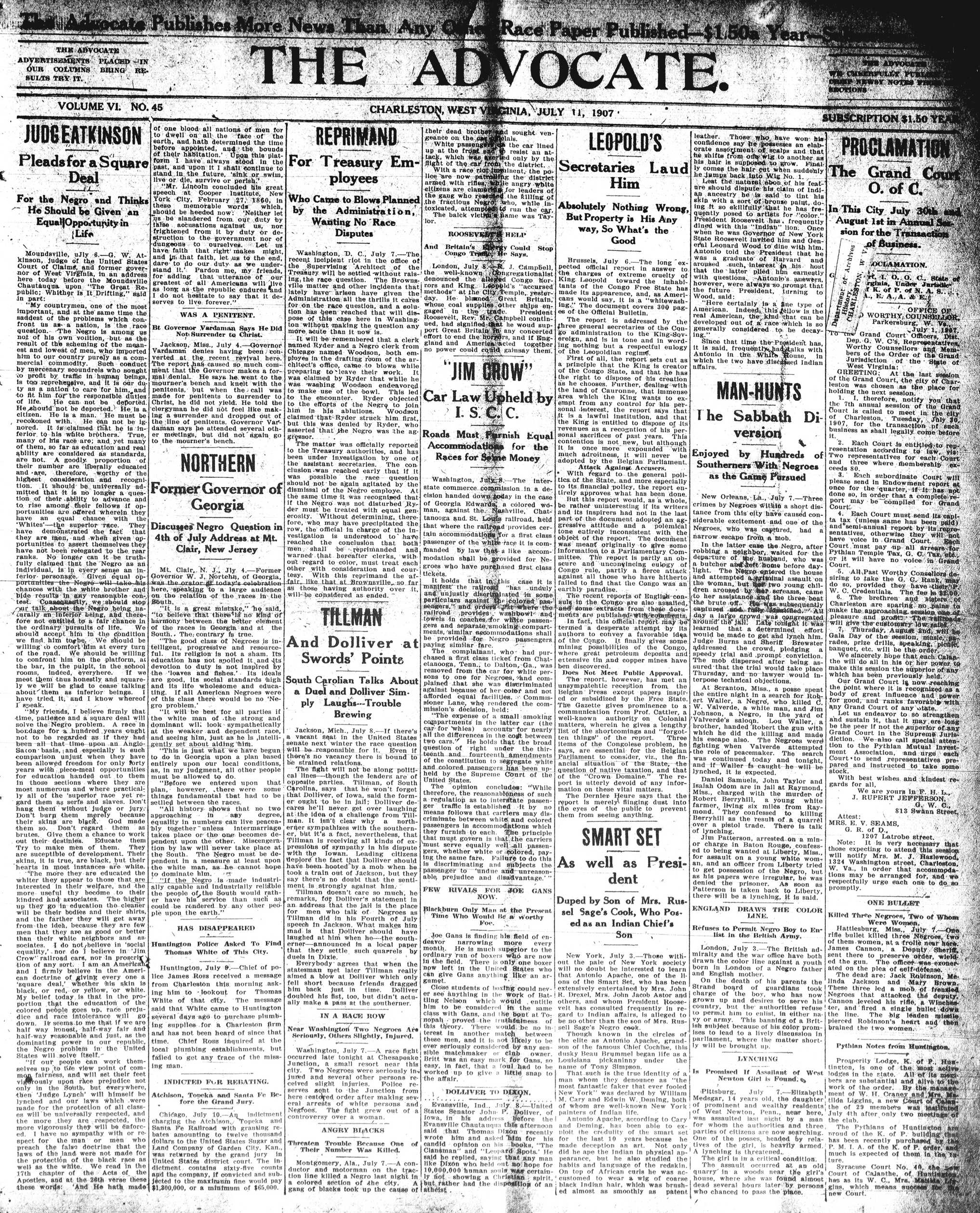
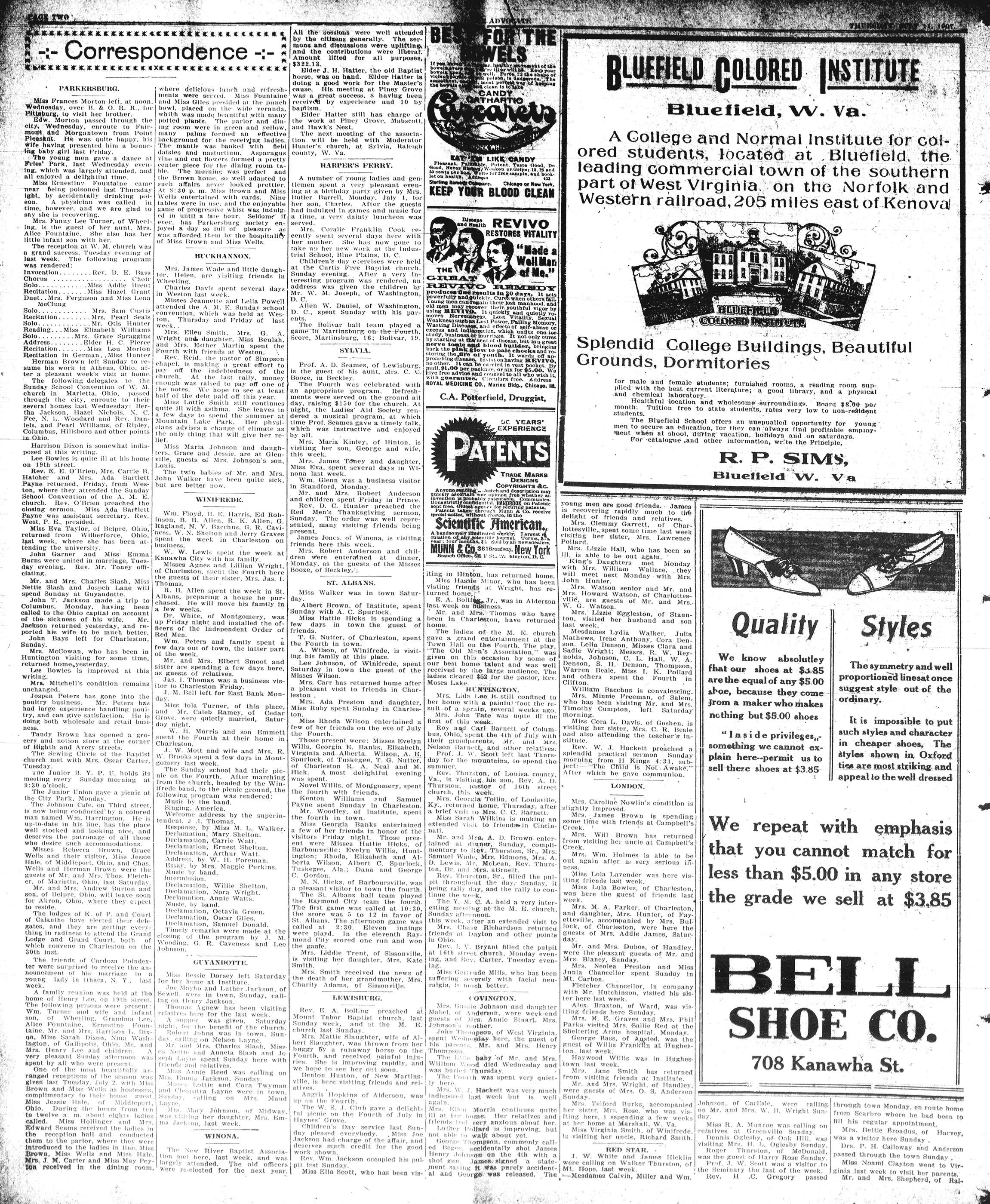
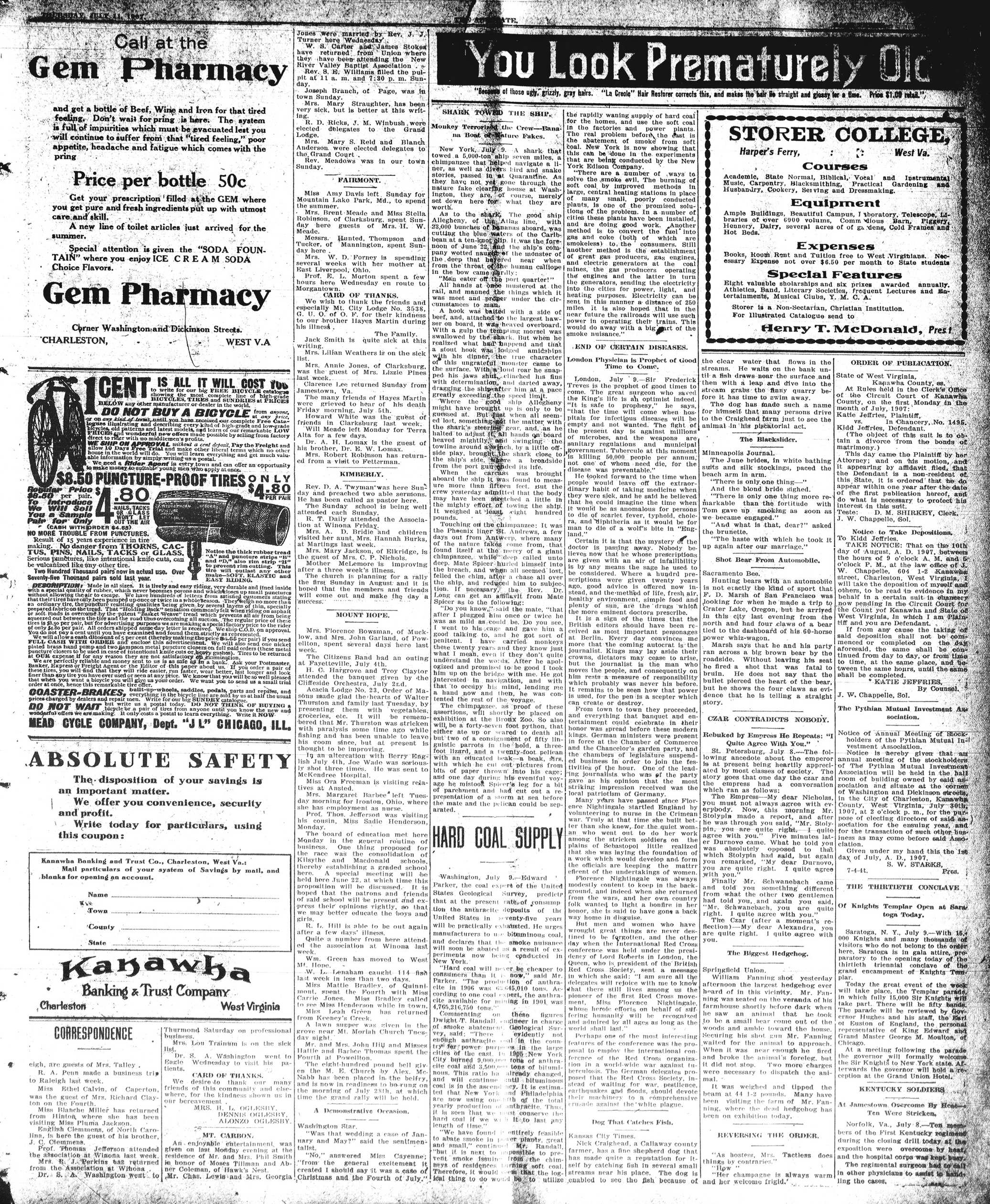
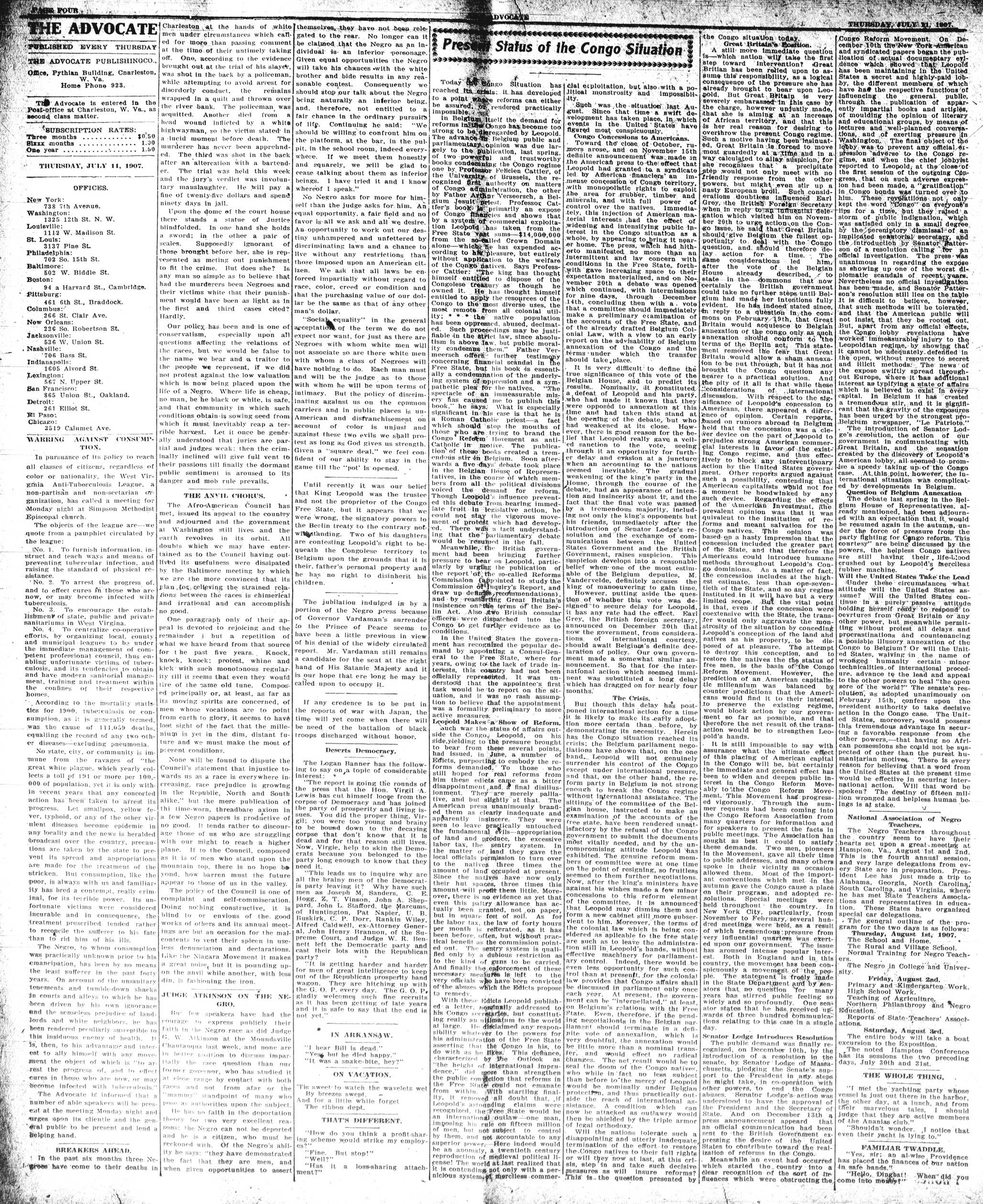
Page text (machine-generated)
THE ADVOCATE
ADVERTISEMENTS PLACED IN
OUR COLUMNS BRING RESULTS TRY IT.
Moundsville, July 6.—G. W. Atkinson, judge of the United States Court of Claims, and former governor of West Virginia, in an address here today before the Moundsville Chautauqua upon "The Great Republic; Whither is It Drifting," said in part:
"My countrymen, one of the most important, and at the same time the sadest of the problems which confront us as a nation, is the race question. The Negro is among not of his own voition, but as the result of the scheming of the maniest and lowest of men, who imported him to our country purely as a commercial commodity. Such conduct by mercenary scoundrels who sought to profit by traffic in human beings, is too reprehensive, and it is our duty to as a nation to care for him, and to as a nation to the responsible duties of life. He for the responsible duties of life. He should not be deported. He is citizen. He is a man. He must be recooked with. He can not be igored. It is claimed that he is inferior to his white brothers. True, many of his race are; and yet many of them, so far as education and real ability are considered as standards, are not. A goodly proportion of their number are liberally educated and are, therefore, worthy of the highest consideration and recognition. It should be universally admitted that it is no longer a question of their ability to advance and to rise among their fellowes if opportunities are offered wherein they have an equal chance with the Whites"—the superior race. They have demonstrated the fact that they are given opportunities to assert themselves that they have not been relegated to the rear ranks. No longer can it be truthfully claimed that the Negro as an individual, is in every sense an inferior personage. Given equal opportunities the Negro will take his chances with the white brother and hide results in any reasonable contest. Consonantly, we should stop our talk about the Negro being naturally an inferior being, and therefore not entitled to a fair chance in the ordinary pursuits of life. We should accept him in the condition we find him to be. We should be willing to comfort him at every turn of the road. We should be willing to come from him in the bar, in the pulpit, in the school rooms, indeed, everywhere. If we meet them thus honestly and squarely we will be glad to cease talking about them as inferior beings. I have tried it, and I know whereof I speak.
"My friends, I believe firmly that time, patience and a square deal will solve the Negro problem. A race in bordage for a hundred years ought not to be regarded as if they had been all that time upon an Anglo-Saxon basis, and especially is such comparison unjust when they have been allowed freedom for only forty years with piece-meal opportunities for education handed out to them in those sections where they are most numerous and where practically all of the 'superior race' yet cannot have their skins and veils don't hang them without judge or jury. Don't burn them merely because their skins are black. God made them so. Don't regard them as brutes. Give them a chance to work out their destinies. Educate them Try to make men of them. They are susceptible of development. Their skins, it is true, are black, but their hearts in most instances are white.
"The more they are educated the whiter they appear to those that are interested in their welfare, and the more useful thy become to their kindred and associates. The higher up they go in education the cleaner will be their bodies and their shirts and the farther they will get away from the idea, because they are few men that they are as good or better than their white neighbors and associates. I do not believe in 'social equality,' nor do I believe in 'Jim Crow' railroad cars, nor in proscription of any sort. I am an American and I firmly believe in the American doctrine of giving every one a 'square deal,' whether his skin is black, or red, or white or blue. My belief is that in the prosecution that the education of the colored people goes up, race prejudice and race intolerance will go down. It seems, to me that if we are half way honest, halfway fair and half-way reasonable and just, as the dominating power in our republic, the Negro problem in the United States will solve itself."
"If our people can work themselves up to the view point of common fairness, and will set their feet vigorously upon race prejudice not only in the South, but everywhere, then 'Judge Lynch' will himself be lynched and our laws which were made for the protection of all classes will be universally respected, and the more they are respected, the more vigorously they will be enforced. I have no sympathy with or respect for the man or men who preach the false doctrine that the laws of the land were not made for the protection of the black race as well as the white. We read in the 17th chapter of the Acts of the Apostles, and at the 26th verse these words: 'And He hade made
of one blood all nations of men for to dwell on all the face of the earth, and hath determined the time before appointed, and the bounds of their habitation. Upon this platform I have always stood in the past, and upon it I shall continue to stand in the future, 'sink or swim, live or die, survive or perish.'
"Mr. Lincoln concluded his great speech at Cooper Institute, New York City, February 27, 1860, in these memorable words, which, should be heeded now: 'Neither let us be slandered from our duty by false accusations against us, nor dislaced from it by duty or destruction by the government nor of dungeons to it; nor let us have faith that right makes light and in that faith, let us to the end, dare to do our duty as we understand it.' Pardon me, my friends, for adding that utterance of our greatest of all Americans will live as long as the republic endures and I do not hesitate to say that it deserves to live forever."
WAS A PENITENT.
Bt Governor Vardaman Says He Did
Not Surrender to Christ.
Jackson, Miss., July 4.—Governor Vardaman denies having been converted at the recent revival here. The report has caused so much comment that the Governor makes a formal denial. He says he went to the mourner's bench and knelt with the penitents, but when the call was made for penitents to surrender to Christ, he did not yield. He told the clergyman he did not feel like making a surrender and dropped out of the line of penitents. Governor Vardaman says he attended several other meetings, but did not again go to the mourner's bench.
NORTHERN
Former Governor of Georgia
Discusses Negro Question in 4th of July Address at Mt. Clair, New Jersey
Mt. Clair, N. J., Jly 4.—Former Governor W. J. Northein, of Georgia, was the orator of today's celebration here, speaking to a large audience on the relation of the races in the South.
"It is a great mistake," he said, "to believe that there is no kind of harmony between the better element of the races in Georgia and at the South. The contrary is true.
"The good class of Negroes is intelligent, progressive and resourceful. Its religion is not a sham. Its education has not spoiled it, and its devotion to duty is not inspired by the 'loaves and fishes.' Its ideals are good, its social standards high and its life wholesome and educating. In American Negroes were of this class there would be no 'Nego problem.' " It will be best for all parties if the white man of the strong and dominant will look sympathetically at the weaker and dependent race, and seeing him, just as he is, intelligently set about allying him. " This is just what we have begun to do in Georgia upon a plan based entirely upon our local conditions, as, in my judgment, all other people must be allowed to do. Negroes are ordered upon that plan, however, there were some things fundamental that had to be settled between the races.
"All history shows that no two approaching in any degree, equality in numbers can live peaceably together unless Intermarriage takes place or the one becomes dependent upon the other. Miscengation by law will never take place at the South. The Negro must be dependent in a measure at least upon the white man, as he cannot hope 'down here'." If the Negro is made industrially capable and industrially reliable the people of the South would rather have his service than such as could be rendered by any other people upon the earth."
HAS DISAPPEARED
Huntington Police Asked To Find Thomas White of This City.
Huntington, July 9.—Chief of police James Ross received a message from Charleston this morning asking him to lookout for Thomas White of that city. The message said that White came to Huntington several days ago to purchase plumbing supplies for a Charleston firm and has not been heard of since that time. Chief Ross inquired at the local plumbing establishments, but failed to get any trace of the missing man.
INDICTED FOR BERATING.
Atchison, Topeka and Santa Fe Before the Grand Jury.
Chicago, July 10.—An indictment charging the Atchison, Topeka and Santa Fe Railroad with granting rebates amounting to twelve thousand dollars to the United States Sugar and Land Company of Garden City, Kan., was returned by the grand jury in United States district court. The indictment, contains sixty-five counts and the company, if convicted and subjected to the maximum fine would pay $1,200,000, or a minimum of $65,000.
Washington, D. C., July 7. —The recent incipient riot in the office of the Supervising Architect of the Treasury will be settled without raising, the race question. The Brownsville matter and other incidents that lately have arisen have given the Administration all the thrills it cares for on the race question, and a solution has been reached that will dispose of this case here in Washington without making the question any more acute than it now is.
It will be remembered that a clerk named Ryder and a Negro clerk from Chicago named Woodson, both employees in the drafting room of the architect's office, came to blows while preparing to leave their work. It was Ryder that while he was washing Woodson endeavored to make use of Woodson. This led to the encounter. Ryder objected to the efforts of the Negro to join him in his abultions. Woodson claimed that Ryder struck him first, but this was denied by Ryder, who asserted that the Negro was the aggressor.
The matter was officially reported to the Treasury authorities, and has been under investigation by one of the assistant secretaries. The conclusion was reached early that if it was possible the race question should not be again agitated by the dismissal of the Negro employee. At the same time it was recognized that if the Negro was not disturbed Ryder must be treated with equal generosity. Without determining, therefore, who may have precipitated the row, the official in charge of the investigation is understood to have reached the conclusion that both men shall be reprimanded and warned that hereafter clerks, without regard to color, must treat each other with consideration and courtesy. With this reprimand the affair, like that at Brownsville, so far as those having authority over it, will be considered as ended.
TILLMAN
And Dolliver at Swords' Points
South Carolian Talks About a Duel and Dolliver Simply Laughs---Trouble Brewing
Jackson, Mich. July 8. If there's a vacant seat in the United States senate next winter the race question will be responsible for it. Even if there's no vacancy there is bound to be strained relations.
The fight will not be along political lines—though the leaders are of opposite parties. Tillman, of South Carolina, says that he won't forget that Dolliver, of Iowa, said the former ought to be in jail; Dolliver decares he'll never get over laughing at the idea of a challenge from Tillman. It isn't clear why a northern sympathizes with the southern, but it's a fact, nevertheless, that it is receiving all kinds of expressions of sympathy in this dispute with the former leading the plains the fact that Dolliver should have been hooted by a mob when he took a train out of Jackson, but they say there's no doubt that the sentiment is strongly against him.
Tillman doesn't care so much, he remarks, for Dolliver's statement in an address that the jail is the place for men who talk of. Negroes as Tillman did in his Fourth of July speech in Jackson. What makes him mad is that Dolliver should have laughed at him when he—the southern—announced in a local paper that they settle such quarrels by duels in Dixie. Everybody agrees that when the statesman met later Tillman really aimed a blow at Dolliver which only fell short because friends dragged him back just in time. Dolliver doubled his list, too, but didn't actually make a pass at the southern.
IN A RACE ROW
Near Washington Two Negroes Are Seriously, Others Slightly, Injured.
Washington, July 7. — A race fight occurred late tonight at Chesapeake Junction, a small resort near this city. Two Negroes were seriously injured and several other persons received slight injuries. Police reserves sent to the Junction from here restored order after making several arrests of white persons and Negroes. The fight grew out of a controversy over a woman.
ANGRY BLACKS
Threaten Trouble Because One of
Their Number Was Killed.
Montgomery, Ala., July 7. — A conductor and motorman on the traction line killed a Negro last night in columbus. The police said gang of blacks took up the cause of
their dead brother and sought vengeance on the car registals.
White passengers in the car lined up at the front end to resist an attack, which was started only by the flight of the car from the district.
With a race riot imminent, the police are now patrolling the district armed with rifles. While angry white citizens are clamoring for leaders of the gang who killed the killing of the fractious Negro who, while in tortoise, attempted to run the car.
The balck vietnam name was Taylor.
ROOSEVERY'S HELP
And Britain's Hitler Could Stop Congo Trade. He Says.
London, July 8 - R. J. Campbell, the well-known Congregationalist denounced the alleged Congo torrors and King, Leopold's "accursed methods" at the City Temple, yesterday. He blamed, Great Britain, whose coal supplies other ships engaged in the trade. President Roosevelt, Rev. Mr. Campbell continued, had signified that he woul support Great Britain in any concerted effort to end the horrors, and if England and America acted together no power could could gainss them.
"JIM GROW"
Car Law Upheld by
I. S. C. C.
Roads Must Parnish Equal
Accommodations for the
Races for Some Money
Washington, July 8. The interstate commerce commission in a decision handed down today in the case of Georgia Edwards, a colored woman, against the Nashville, Chattanooga and St. Louis railroad, held that where the railroad provides certain accommodations for a first class passenger of the white race it is commanded by law that a like accommodation shall be provided for Negroes who have purchased first class tickets. It holds that in this case it is manifest that the railroad "has unduly and unjustly discriminated in some particulars against the colored passengers," and orders where the railroad "provides" washbowl and in coaches for white passengers and separate smoking compartments, similar accommodations shall be provided for Negro passengers paying similar fare.
The complainant, who had purchased a first class ticket from Chateletanooga, Tenn., to Dalton, Ga., was removed from the car for white persons to one for Negroes, and complained that she was discriminated against because of her coter and not afforded equal facilities. Commissioner Lane, who rendered the commission's decision, held:
"The expense of a small smoking compartments in the latter car (the car for whiles) accounts for nearly all the differences in the cost between two cars." He holds that the broad question of right under the thirteenth and fourteenth amendments must be utilised to segregate white and colored passengers has been upheld by the Supreme Court of the United States.
The opinion concludes: "While therefore, the reasonableness of such a regulation as to interstate passenger traffic is established it by no means follows that carlers may discriminate between white and colored passengers in accommodations which they furnish to each. The principle that must govern is that the carlers must serve equally well all passengers, whether white or colored, paying the same fare. Failure to do this is discriminating and subjects the passenger to 'undue and unreasonable prejudice and disadvantage.'"
FEW RIVALS FOR JOE GANS NOW.
Blackburn Only Man at the Present Time Who Would Be a Worthy Foe.
Joe Gans is finding his field of endeavor narrowing more every month. He is much superior to the ordinary run of boxers who are now in the field. There is only one boxer now left in the United States who can give Gans anything like an argument.
Close students of boxing could never see anything in the work of Battling Nelson which would entitle him to be considered in the same class with Gans, and the bout at Tornopah proved the truthfulness of this theory. There is no interest in another match between these men, and it is not likely to be ever seriously considered by any sensible matchmaker or club owner. Britt is an easy mark for Gans, so easy, in fact, that a foul had to be worked up to give a little snap to the affair.
DOLLIVER TO DIXON.
Evansville, Ind., July 8—United States Senator John P. Doliver, of Iowa, in his address before the Evansville Chauquaun this afternoon said that Thomas Dixon recently wrote him and asked him for his candid opinion on his books, "The Clandman and 'Leopard Spots.' He said he replied, saying that any man like Dixon who held out no hope for 10,000,000 human souls was certainly not showing a Christian spirit, but rather had the disposition of an athlete.
Brussels, July 6.—The long expected official report in answer to the charges of extreme cruelty of King Leopold toward the inhabitants of the Congo Free State has made its appearance, and, as Ameri长 could say, it is a "whitewashing." The document covers 300 pages of the Official Bulletin.
The report is addressed by the three general secretaries of the Congo administration to King Sovereign, and is in tote and in wording nothing but a respectful eulogy of the Leopoldian regling
First of all, the report sets out as a principle that the King is creator of the Congo State, and that he has the right to dispose of his creation he chooses. Further, dealing-with the Congo province, that immense area which the King wants to exempt from any control of personal interest, the report says that it is a lawful institution, and that the King is entitled to dispose of its revenues as a recognition of his personal sacrifices of past years. This contention is not new, but although it is once more expounded with much adroitiness, it will never be adopted. At the Belgian Parliament.
Attack Against Accusers.
With regard to the general politics of the State, and more especially to its financial policy, the report entirely approves what has been done.
But it would be good as a whole, be rather uninteresting if its officers and its inspirers had not in the part of the document adopted an aggressive attitude and a polemical tone entirely inconsistent with the object of the report. The document was meant originally to give some information to a Parliamentary Committee. The report is partly an obscure and unconvincing eulogy of Congo rule, partly a fierce attack against all those who have hitherto failed to find that the Congo was an appropriate state.
The report reports of English consult in the Congo are also assailed, and some extracts from these documents are published with comments.
In fact, this official report may be termed a desperate attempt by its authors to convey a favorable idea of the Congo. It finally gives some mining possibilities of the Congo, where great petroleum deposits and extensive tin and copper mines have been discovered. Does Not Meet Public Approval. The report, however, has met an unsympathetic reception from the Belgian Press except papers inspired or subsidized by the Free State. The Gazette gives prominence to a communication from Prof. Cattler, a well-known authority on Colonial matters, wherein he gives a lengthy list of borrowings and "forgotten things" of the Congolese items of the Congolese problem. He says, are essential for the Belgian Parliament to consider, viz., the financial situation of the State, the question of native taxation, and that of the "Crown Domaine." The report is utterly devoid of any information on these vital matters.
The Dernier Heure says that the report is merely flinging dust into the eyes of the public to prevent them from seeing anything.
SMART SET As well as President
Duped by Son of Mrs. Russell Sage's Cook, Who Posed as an Indian Chief's
New York, July 3.—Those without the pale of New York society will no doubt be interested to learn that Antonio Apache, one of the Ilons of the Smart Set, who has been extensively entertained by Mrs. John R. Drexel, Mrs. John Jacob Astor and others, and whom President Roosevelt has consulted frequently in regard to Indian affairs, is alleged to be no other than the son of Mrs. Russell Sage's Negro cook.
Though known in the circles of the elite as Antonio Apache, grandson of the famous Chief Cochise, this dusky Beau Brummel began life as a child under the name of Tony Simpson.
That such is the true identity of a man whom they denounce as "the most fantastic faker that ever fooled New York" was declared by William M. Cary and Edwin W. Doming, both of whom are well-known New York painters of Indian life.
Antonio Apache, according to Cary and Deming, has been able to exploit the credulity of the smart set for the last 10 years because he made deception an art. Not only did he appear the Indian in physical appearance, but he also studied the habits and language of the redskin. On top of African curis he was accustomed to wear a wig of coarse black Indian hair, which was brushed almost as smoothly as patent
leather. Those who have won his confidence say he possesses an elaborate assortment of scals and that he shifts from one wig to another as his hair is supposed to grow. Finally comes the hair cut when suddenly he jumps back into Wig No. 1.
Least the natural obsei of his feature should dispute his claim of Indian ancestry he is said to tint his skin with a sort of bronze paint, doing it so skillfully that he has frequently posed to artists for "color." President Roosevelt has, frequently with this "indian" illum. Once when he was the governor of New York State Roosevelt invited him and General Leonard Wood to die with him. Antonio told the President that he was a graduate of Harvard and aroused such, interest in his host that the latter plied him earnestly with questions. Antonio's answers, however, were always so prompt that the future President, turning to Wood, said: "Here certainly is a fine type of American. Indeed, this fellow is the real American, the kind that can be developed out of a race which is so generally considered to be decaying.
Since that time the President has, it is said, frequently had talks with Antonio in the White House, in which the two have discussed Indian affairs.
New Orleans, La., July 7.—Three crimes by Negroes within a short distance from this city have caused considerable excitement and one of the Negroes, who was captured, had a narrow escape from a mob.
In the latter case the Negro, after robbing a neighbor, waited for the departure of the husband, who was a butcher and had home before daylight. The Negro entered the house and attempted a principal assault on the woman, but that two young children around by her screams, came to her assistance and the three beat the brute off. He was subsequently arrested and, later, identified. All day long, the woman was congregated around the jail. Like determined it was learned that a determined effort would be made to get and bachoff. Judge Burns and Sheriff Browster addressed the crowd, pledging a speedy trial and prompt conviction. The mob dispersed after being assured that the trial would take place Thursday, and no lawyer would interpose technical objections.
At Scranton, Miss., a posse spent the entire night in a search for Robert Waller, a Negro, who killed C. W. Valverde, a white man, and Jim Johnson, a Negro, in the yard of Valverde's saloon. Lou Waller, a brother, handed Robert the gun with which he did the killing and made his escape also. The Negroes were killing when Valverde attempted the peacemaker. The search was continued today and tonight, and if Waller is caught—he will be lynched, it is expected.
Daniel Samuels, John Taylor and Isaiah Odon are in jail at Raymond, Miss., charged with the murder of Robert Berryhill, a young white farmer, living six miles from Raymond. They confessed to killing Berryhill as the result of a quarrel over a pistol trade. There is talk of lynching.
Jim Patterson, arrested on a minor charge in Baton Rouge, confessed to being wanted at Liberty, Miss., for assault on a young white woman, and an officer from Liberty tried to get possession of the Negro, but as his papers were irregular, he was denied the prisoner. As soon as Patterson is taken back to Liberty, there will be a lynching, it is said,
ENGLAND DRAWS THE COLOR LINE.
Refuses to Permit Negro Boy to Enlist in the British Army.
London, July 3.—The British admiralty and the war office have both drawn the color line against a youth born in London of a Negro father and English mother.
On the death of his parents the Strand board of guardians took charge of the boy, who has now grown up and desires to serve his country, but the priorities refuse to permit him to enlist in the navy or army. This banning of a British subject because of his color promises to lead to a lively discussion in parliament, where the matter shortly will be brought up.
LYNCHING
Is Promised If Assailant of West Newton Girl is Found.
Pittsburg, July 7.—Elizabeth Medsgar, 14 years old, the daughter of prominent and wealthy residents of West Newton, Penn., near here, was assaulted last night by a man for whom the authorities and three parties of citizenia are now searching. One of the posses, hended by relatives of the girl, is heavily armed. A lynching is threatened.
The girl is in a critical condition. The assault occurred at an old quarry in a woods near the girl's house, where she was found almost dead several hours later by persons who chanced to pass the place.
To the Grand Court Officers, Dir.
Dep. G. W. C.'s, Representative,
Worthy Counsellors and Members
of the Order of the Grand
Jurisdiction of the State of
West Virginia:
GREETING: At the last session of the Grand Court, the city of Charleston was chosen as the place for holding the next session.
1. I, therefore, notify you that the 7th annual session of the Grand Court is called to meet in the city of Charleston, Tuesday, July 10, 1907, for the transaction of such business as shall legally come before it.
2. Each Court is entitled to representation according to law, viz. Two representatives for each Court and three where membership exceeds 80.
3. Each subordinate Court will please send in Endowment report at once for the quarter, if it has not done so, in order that a complete report may be compiled for Grand Court.
4. Each Court must send its capita tax (unless same has been paid) and semi-annual report by its representatives, otherwise they will not have voice in Grand Court. Each Court must pay up all theares for Pythian Temple Tax, G. C Tax, etc., or it will have no voice in Grand Court.
5. All Past Worthy Consellors desiring to take the G. G. Rank, may do so, provided they have their G. W. C. Credentials. The fee is $100.
6. The brethren and sisters of Charleston are sparing no pain to make the approaching session one of pleasure. The attendees will give the customers
We sincerely hope that each Galaah the will do all in his or her power to make this session the superior of any which has been previously held. Our Grand Court is now reaching as a body of great influence as power for good, and ranks favorably with any Grand Court of any state.
Let us endeavor to so strengthen and sustain it, that it may be long be the peer if not the superior of any Grand Court in the Supreme Jurisdiction. We also call special attention to the Pythian Mutual Investment Association, and urge each Court to send representatives prepared and instructed to take some stock.
With best wishes and kindest regards for all.
We are yours in F. H. L.
J. RUPERT JEFFERSON,
G. W. C.
813 Swann Street.
Attest:
MRS. E. V. SEAMS,
G. R. of D.
1207 Latrobe street.
Note: It is very necessary that those expecting to attend this session will notify Mrs. M. J. Hazlewood,
1324 Washington street, Charleston, W. Va., in order that accommodations may be arranged for, and we respectfully urge each one to do so promptly.
ONE BULLET
Killed Three Negroes, Two of Whom
Were Worries
Hattlesburg, Miss., July 7.—One rifle bullet killed three Negroes, two of them women, at a trot near her. James Cannon, a Deputy Sheriff, sent the preserve order, wielded the gun. The officer was unarmed on the plea of self-defense. The dead are: Jack Robinson, Melinda Jackson and Mary Brown. These three led a mob of framed Negroes that attacked the deputy. Cannon leveled his rifle, a Winchester, and fired a single bullet down the line. The big leaden mistake pierced Robinson's heart and then brained the two women.
Pythian Notes from Huntington.
Prosperity Lodge, K. of P., Huntington, is one of the most active lodges in the state. All of its members are substantial and alive to the work of the order. By the management of W. H. Craney and Mrs. Matilda Liggins, a new Court of Calanthe of 23 members was instituted July 4th after only two meetings of the club.
The Pythians of Huntington are proud of the K. of P. building that has been recently purchased by the P. M. I. A. of the K. of P. order, and much is expected of them in the future.
Syracuse Court No. 40, the new Court of Calanthe, of Huntington has as its W. C., Mrs. Matilda Liggins, which means success for the new Court.
Correspondence - -
PARKERSBURG
Miss Frances Morton left, at noon Wednesday, over B, O & R, R., four Pittsburgh, to visit her brother. Edw. Morton passed through the city, Wednesday, enroute to Fairmont and Morgantown from Point Pleasant. He was quite happy, his wife having presented him a bouncing baby girl last Friday.
The young men gave a dance at Fries' Park, last Wednesday evening, which was largely attended, and all enjoyed a delightful time.
Miss Ernestine Fountaine came near being poisoned last Thursday night, by accidentally drinking poison. A physician was called in time, however, and we are glad to say she is recovering.
Mrs. Fanny Lee Turner, of Wheeling, is the guest of her aunt, Mrs. Alice Fountaine. She also has her little infant son with her.
The reception at W. M. church was a grand success. Tuesday evening of last week. The following program was rendered:
Invocation.....Rev. D. E. Bass
Chorus.....Choir
Solo.....Miss Addle Brent
Recitation.....Miss Hazel Grant
Duet..Mrs. Ferguson and Miss Lena
McClung
Solo.....Mrs. Sam Custis
Recitation.....Mrs. Pearl Seals
Solo.....Mr. Otis Hunter
Reading.....Miss Elizabeth Williams
Solo.....Mrs. Grace Spraggins
Address.....Elder H. C. Pierce
Recitation.....Miss Lou Morton
Recitation in German..Miss Hunter
Herman Brown left Sunday to resume his work in Athens, Ohio, after a pleasant week's visit at home.
The following delegates to the Sunday School Convention of W. M. church in Marietta, Ohio, passed through the city, enroute to their several homes last Wednesday: Bertha Jackson, Hazel Nichols, N. C. Fee, N. L. Woodard and Rev. Daniels, and Pearl Williams, of Ripley, Columbus, Hillsboro and other points in Ohio.
Harrison Dixon is somewhat indisposed at this writing.
Lee Bowles is quite ill at his home on 19th street.
Rev. E. E. O'Brien, Mrs. Carrie B. Hatcher and Mrs. Ada Bartlett Payne returned, Friday, from Weston, where they attended the Sunday School Convention of the A. M. E. church. Rev. O'Brien preached the closing sermon. Miss Ada Bartlett Payne was assistant secretary. Rev. West, P. E., presided.
Miss Eva Taylor, of Belpre, Ohio, returned from Wilberforce, Ohio, last week, where she has been attending the university.
John Garner and Miss Emma Burns were united in marriage, Tuesday evening. Rev. Mr. Toney officiating.
Mr. and Mrs. Charles Slash, Miss Nettie Slash and Joseph Lane will spend Sunday at Guyandotte.
John T. Jackson made a trip to Columbus, Monday, having been called to the Ohio capital on account of the sickness of his wife. Mr. Jackson returned yesterday, and reported his wife to be much better. John Bays left for Charleston, Sunday. Mrs. McCowan, who has been in Huntington visiting for some time, returned home yesterday. Lee Bowles is improved at this writing. Mrs. Mitchell's condition remains unchanged. Jospen Peters has gone into the poultry business. Mr. Peters has had large experience handling poultry, and can give satisfaction. He is doing both wholesale and retail business. Tandy Brown has opened a grocery and notion store at the corner of Eighth and Avery streets. The Sewing Circle of the Baptist church met with Mrs. Oscar Carter, Tuesday.
The Junior B. Y. P. U, holds its meeting every Sunday morning at 9:30 o'clock.
The Junior Union gave a picnic at the City Park, Monday.
The Johnson Cafe, on Third street, is now being conducted by a colored man named Wm. Harrington. He is up-to-date in his line, has the place well stocked and looking nice, and deserves the patronage of all those who desire such accommodations.
Misses Rebecca Brown, Grace Wells and their visitor, Miss Jessie Hale, of Middleport, Ohio, and Chas. Wells and Herman Brown were the guests of Mr. and Mrs. Thos. Fletcher, of Marietta, Ohio, last Saturday.
Mr. and Mrs. Andrew Burton and son, of Belpre, Ohio, will leave soon for Akron, Ohio, where they expect to reside.
The lodges of K. of P. and Court of Calanthe have elected their delegates, and they are getting everything in radiness to attend the Grand Lodge and Grand Court, both of which convene in Charleston on the 30th inst.
The friends of Cardoza Poindexter were surprised to receive the announcement of his marriage to a young lady in 11thca, N. Y., last week.
A family reunion was held at the home of Henry Lee, on 19th street. The following persons were present: Wm. Turner and wife and infant son, of Wheeling, Grandma Lee, Alice Fountaine, Ernestine Fountaine, Mr. and Mrs. Harrison L. Dixon, Miss Sarah Dixon, Nina Washington, of Gallipolis, Ohio, Mr. and Mrs. Henry Lee and children. A very pleasant Sunday afternoon was spent by all who were present.
One of the most beautifully arranged receptions of the season was given last Tuesday, July 2, with Miss Brown and Miss Wells as hostesses, complimentary to their house guest, Miss Jessie Hale, of Middleport, Ohio. During the hours from ten to twelve a.m. about eighty ladies called. Miss Hollinger and Mrs. Edward Seams received the ladies in the reception hall and conducted them to the parlor, where they were introduced to the ladies in line, Miss Brown, Miss Wells and Miss Hale, Mrs. J. M. Carter and Miss May Peyton received in the dining room
where delicious lunch and refreshments were served. Miss Fountaine and Miss Giles presided at the punch bowl, placed on the wide veranda, which was made beautiful with many potted plants. The parlor and dining room were in green and yellow, many palms formed an effective background for the receiving ladies. The mantle was banked with field daisies and nasturtium. Asparagus vine and cut flowers formed a pretty center piece for the dining room table. The morning was perfect and the Brown home, so well adapted to such affairs never looked prettier. At 8:30 p. m. Miss Brown and Miss Wells entertained with cards. Nine tables were in use, and the enjoyable game of progressive whist was indulged in until a late hour. Seldom if ever, has Parkersburg society enjoyed a day so full of pleasure as was afforded them by the hospitality of Miss Brown and Miss Wells.
BUCKHANNON.
Mrs. James Wade and little daughter, Helen, are visiting friends in Wheeling.
Charles Davis spent several days in Weston last week.
Misses Jeannette and Lelia Powell attended the A. M. E. Sunday school convention, which was held at Weston. Thursday and Friday of last week.
Mrs. Ellen Smith, Mrs. G. A. Wright and daughter, Miss Beulah, and Mrs. Esther Martin spent the Fourth with friends at Weston.
Rev. Reid, the pastor of Simpson chapel, is making a great effort to pay off the indebtedness of the church. At the last rally, money enough was raised to pay off one of the notes. We hope to see at least half of the debt paid off this year
Miss Lottie Smith still continues quite ill with asthma. She leaves in a few days to spend the summer at Mountain Lake Park. Her physicians advises a change of climate as the only thing that will give her relief.
Miss Maria Johnson and daughters, Grace and Jessie, are at Glenville, guests of Mrs. Johnson's son, Louis.
The twin babies of Mr. and Mrs. John Walker have been quite sick, but are better now.
WINIFREDE.
Wm. Floyd, H. E. Harris, Ed Robinson, B. B. Allen, R. K. Allen, G. Ragland, N. V. Bacchus, G. R. Caviness, W. N. Shelton and Jerry Graves spent the week in Charleston on business.
W. W. Lewis spent the week at Kanawha City with his family.
Misses Agnes and Lillian Wright, of Charleston, spent the Fourth here the guests of their sister, Mrs. Jas. I. Thomas.
R. H. Allen spent the week in St. Albans, preparing a house he purchased. He will move his family in a few weeks.
Dr. White, of Montgomery, was up Friday night and installed the officers of the Independent Order of Red Men.
Wm. Peters and family spent a few days out of town, the latter part of the week.
Mr. and Mrs. Elbert Smoot and sister are spending a few days here, as guests of relatives.
Jas. I. Thomas was a business visitor to Charleston Friday.
J. M. Bell left for East Bank Monday.
Miss lola Turner, of this place,
and Mr. Caleb Ramey, of Cedar Grove, were quietly married, Saturday night.
W. H. Morris and son Emmett spent the Fourth at their home in Charleston.
J. W. Mott and wife and Mrs. R. W. Brooks spent a few days in Montgomery last week.
The Sunday school had their picnic on the Fourth. After marching from the church, headed by the Winifrede band, to the picnic ground, the following program was rendered:
Music by the band.
Singing, America,
Welcome address by the superintendent, J. L. Thomas.
Response, by Miss M. L. Walker.
Declaration, Mary Shelton.
Declaration, Carrie Watt.
Essay, by Mrs. Maggie Perkins. Music by band.
Intermission.
Declamation, Willie Shelton.
Declamation, Nora Wright.
Declamation, Annie Watts.
Music, Paul D.
Timely remarks were made at the closing of the program by J. M. Wooding, G. R. Caveness and Lee Johnson.
GUYANDOTTE
Miss Bessie Dorsey left Saturday, for her home at Institute.
Joe Mayho and Luther Jackson, of Sewell, were in town, Sunday, calling on Henry Jackson.
Thomas Agnew has been visiting relatives here for the last week.
A supper was given, Saturday night, for the benefit of the church, Robert Johns was in town, Sunday, calling on Nelson Layne.
Mr. and Mrs. Charles Slash, Misses Nettie and Anneta Slash and Joseph Layne spent Sunday here with friends and relatives.
Miss Annie Reed was calling on Mrs. Emma Jackson, Sunday.
Misses Lottie and Cora Twyman and Cleopatra Layne were in town, Sunday, calling on Mrs. Maud Layne.
Mrs. Mary Johinson, of Midway, was visiting her daughter, Mrs. Emma Jackson last week.
WINONA.
The New River Baptist Association met here, last week, and was largely attended. The old officers were re-elected for the next year.
All the sessions were well attended by the citizens generally. The sermons and discussions were uplifting, and the contributions were liberal. Amount lifted for all purposes, $322.13.
Elder J. H. Hatter, the old Baptist horse, was on hand. Elder Hatter is doing a good work for the Master's cause. His meeting at Piney Grove was a great success, 8 having been received by experience and 10 by baptism.
Elder Hatter still has charge of the work at Piney Grove, Mabscott, and Hawk's Nest.
The next meeting of the association will be held with Moderator Hunter's church, at Sylvia, Raleigh county, W. Va.
HARPER'S FERRY.
A number of young ladies and gentlemen spent a very pleasant evening at a birthday party given by Mrs. Butler Burrell, Monday, July 1, for her son, Charles. After the guests had indulged in games and music for a time, a very dainty luncheon was served.
Mrs. Coralie Franklin Cook recently spent several days here with her mother. She has now gone to take up her new work at the Industrial School, Blue Plains, D. C.
Children's day exercises were held at the Curtis Free Baptist church, Sunday evening. After a very interesting program was rendered, an address was given the children by Mr. W. M. Joseph, of Washington, D. C.
Allen W. Daniel, of Washington, D. C., spent Sunday with his parents.
The Bolivar ball team played a game in Martinsburg on the Fourth, Score, Martinsburg, 16; Bolivar, 19.
SYLVIA
Prof. A. D. Seames, of Lewishburg, is the guest of his aunt, Mrs. C. C. Booze, in Beckley.
The Fourth was celebrated with an appropriate program. Refreshments were served on the ground all day, raising $150 for the church. At night, the Ladies' Aid Society rendered a musical program, at which time Prof. Seames gave a timely talk, which was instructive and enjoyed by all.
Mrs. Maria Kinley, of Hinton, is visiting her son, George and wife, this week.
Mrs. James Toney and daughter, Miss Eva, spent several days in Winona last week.
Wm. Glenn was a business visitor in Standford, Monday.
Mr. and Mrs. Robert Anderson and children spent Friday in Princes.
Rev. D. C. Hunter preached the Red Men's Thanksgiving sermon, Sunday. The order was well represented, many visiting friends being present. James Jones, of Winona, is visiting friends here this week. Mrs. Robert Anderson and children were entertained at dinner, Monday, as the guests of the Misses Booze, of Beckley.
ST. ALBANS.
Miss Walker was in town Saturday.
Albert Brown, of Institute, spent Sunday with A. C. Spurlock.
Miss Hattie Hicks is spending a few days in town the guest of friends.
T. G. Nutter, of Charleston, spent the Fourth in town.
A. Wilson, of Winifrede, is visiting his family at this place.
Lee Johnson, of Winifrede, spent Saturday in town the guest of the Misses Wilson.
Mrs. Carr has returned home after a pleasant visit to friends in Charleston.
Mrs. Ada Preston and daughter, Miss Ruby spent Sunday in Charleston.
Miss Rhoda Wilson entertained a few of her friends on the eve of July the Fourth.
Those present were: Misses Evelyn Willis, Georgia E. Banks, Elizabeth, Virginia and Alberta. Wilson, A. E. Spurlock, of Tuskegee, T. G. Nutter, of Charleston R. A. Neal and M. Hick. A most delightful evening was spent.
Novel Willis, of Montgomery, spent the fourth with friends.
Kenton Williams and Samuel Payne spent Sunday in Charleston.
Mr. Woodley, of Institute, spent the fourth in town.
Miss Georgia Banks entertained a few of her friends in honor of the visitors Friday night. Those present were Misses Hattie Hicks, of Barboursville; Evelyn Willis, Huntington; Rhoda, Elizabeth and Alberta Wilson, Albert C. Spurlock, Tuskegee, Ala.; Dana and George C. Gordon.
M. N. Hicks, of Barboursville, was a pleasant visitor to town the fourth. The St. Albans ball team played the Raymond City team the fourth. The first game was called at 10:30, the score was 5 to 12 in favor of St. Albans. The afternoon game was called at 2:30. Eleven innings were playd. In the eleventh Raymond City scored one run and won the ganfe. Mrs. Liddie Trent, of Sissonville, is visiting her daughter, Mrs. Kate Smith. Mrs. Smith received the news of the death of her grandmother, Mrs. Charity Adams, of Sissonville.
LEWISBURG
Rev. E. A. Bolling preached at Mount Tabor Baptist church, last Sunday week, and at the M. E. church last Sunday.
Mrs. Mattie Slaughter, wife of Albert Slaughter, was thrown from her buggy by a runaway horse on the Fourth, and received painful injuries. She is improving rapidly, and we hope to see her out soon.
Benton Huston, of New Martinsville, is here visiting friends and relatives.
Angris Hopkins of Alderson, was up on the Fourth.
The W. S. J. Club gave a delightful picnic on the Fourth of July in Haynes' Grove.
Children's Day service last Sunday pleased everybody. Miss Joe Jackson had charge of the affair, and deserves much credit for the good work shown.
Rev. Wm. Jackson occupied his pit pit last Sunday.
Miss Ella Scott, who has been vis-
If you have a heavy car, healthy presents of the
food you eat can help you cook your
bowels well. For the best, the food
will poison, is dangerous. The
smoothed skin of the oil poison is
dangerous of keeping the bowels
clean and the clean is to take
CANDY
DATHARTIC
Decarets
NEW YORK WHITE STREET
EAT ICE LIKE CANDY
Pleasant, Palatable, Present Taste Good, Do Good, Never Blight, Weaken or Gripe 10, 25 and 50 cents per box. Write for free sample, and booklet on health. Address
433
Disease and Health REVIVO RESTORES VITALITY "Made a Well Man of Me." THE GREAT
REVIVO REMEDY produces results in 30 days. It gets powerfully and quickly. Cures when others fall, young men can regain their lost manhood, and older men can recover their youthful vigor by using REVIVO. It quickly removes Nervousness. Lost Vitiligo weakens such as Lost Power, Falling Memory, Wasting Disease, and effects of self-abuse or excess and indisposition, which unifies one for marriage. It not only cures by starting at the heart but is a great nerve toole and blood build back the pink glow to pale cheeks and restoring the life of youth. It wards off approaching disease. In assisting have REVIVO, you can be carried in vest bootlet. By mail, I can be carried for $5.00. We give free advice and counsel to with guarantee. Circulars free. Address ROYAL MEDICINE CO. Marine Blade, Chicago, IL
C.A. Potterfield, Druggist.
50 YEARS' EXPERIENCE
PATENTS
TRADE MARKS
DESIGNS
COPRIGHTS & C.
Anyone sending a sketch and description by
quickly ascertain our opinion free whether an
authority is probably patentable. Communications
strictly confidential. MUNN & Co. Patents
sont free. Guest agents for securing patents.
Patents aken. through Munn & Co. receive
special offers, without charge, in the
Scientific American.
A handsomely illustrated weekly. Largest
culation of any scientific journal. Terms.
¥4; year: four months. $1. Sold by all newdealers.
MUNN & Co. 361 Broadway, New York
Branch Office. 25 F. St. W. hington, D.C.
iting in Hinton, has returned home.
Miss Hassle Minor, who has been visiting friends at Wright, has returned home.
E. A. Bolling, Jr., was in Alderson last week on business.
Mr. and Mrs. Thomas who have been in Charleston, have returned home.
The ladies of the M. E. church gave a grand entertainment at the Town Hall on the Fourth. The play, "The Old Man's Association," was given on this occasion by some of our best home talent and was well received by the large audience. The ladies cleared $52 for the pastor, Rev. Moses Lake.
HUNTINGTON
Mrs. Lida Lee is still confined to her home with a painful foot the result of a sprain, several weeks ago. Mrs. John Tate was uqite ill the first of this week.
Roy and Carl Barnett of Columbus, Ohio, spent the 4th of July with their grandparents, Mr. and Mrs. Nelson Barnett, and other relatives. Prof. J. W. Scott left last Thursday for the mountains, to spend the summer.
Rev. Thurston, of Louisa county, Va., is visiting, his son, Rev. A. D. Thurston, pastor of 16th street church, this week.
Mrs. Georgia Tollin, of Louisville, Ky., returned home, Thursday, after a brief visit to Mrs. C. C. Barnett.
Miss Sarah Wilkins is making an extended visit to friends in Cincinnati.
Mr. and Mrs. A. D. Brown entertained at dinner, Sunday, complimentary to Rev. Thurston, Sr., Mrs. Samuel Wade, Mrs. Edmons, Mrs. A. D. Lewis, Mr. McLean, Rev. Thurston, Dr. and Mrs. aBrennett.
Rev. Thurston, Sr., filled the pulpit throughout the day; Sunday, it being rally day, and the rally to continue the week.
The Y. M. C. A. held a very interesting meeting at the M. E. church, Sunday afternoon.
this week, after an extended visit to Mrs. Chase Richardson returned friends at Dayton and other points in Ohio.
Rev. I. V. Bryant filled the pulpit at 16th street church, Monday evening, and Rev. Carter, Tuesday evening.
Miss Gertrude Mills, who has been suffering severely with facial neuralgia, is much better.
COVINGTON.
Mrs. Gussie Johnson and daughter Mabel, of Anderson, were week-end guests of Mrs. Annie Stuart, Mrs. Johnson's mother.
John Thompson, of West Virginia, spent Wednesday here, the guest of his parents, Mr. and Mrs. Henry Thompson.
The little baby of Mr. and Mrs. William Wood died Wednesday and was buried Thursday.
The Fourth was spent very quietly here.
Mrs. W. J. Hackett was very much indisposed last week but is well again.
Mrs. Ellen Morris continues quite ill at her home. Her relatives and friends feel very anxious about her. Luther Pollard is improving, but not able to walk about yet.
George Thompson, commonly called Begge, accidentally shot James Henry Johnson on the 4th with a shot gun. James signed a statement saying it was purely accidental and George was released. The
BLUEFIELD COLORED INSTITUTE
Bluefield, W. Va.
A College and Normal Institute for colored students, located at Bluefield, the leading commercial town of the southern part of West Virginia, on the Norfolk and Western railroad, 205 miles east of Kenova
BLUFFIELD
COLORED INSTITUTE
Splendid College Buildings, Beautiful Grounds, Dormitories
for male and female students; furnished rooms, a reading room supplied with the best current literature; a good library, and a physical and chemical laboratory.
Healthful location and wholesome surroundings. Board $8.00 per month. Tuition free to state students, rates very low to non-resident students.
The Bluefield School offers an unequaled opportunity for young men to secure an education, for they can always find profitable employment when at shool, during vacation, holidays and on saturdays.
For catalogue and other information, write the Bristol.
young men are good friends. James is recovering rapidly much to the delight of friends and relatives.
Mrs. Clemmy Garrett, of Charlottesville, spent some time last week visiting her sister, Mrs. Lawrence Pollard.
Mrs. Lizzie Hall, who has been so ill, is able to be out again.
King's Daughters met Monday with Mrs. William Wallace, they will meet next Monday with Mrs. John Hunter.
Mrs. Watson senior and Mr. and Mrs. Howard Watson, of Charlottesville, are guests of Mr. and Mrs. W. G. Watson.
Mrs. Lizzie Eggleston, of Staunton, visited her husband and son last week.
Mesdames Lydia Walker, Julia Mathews, Irene Anthony, Cora Denson, Lella Denson, Misses Clara and Sadie Wright; Messrs. R. W. Reynolds, Johnson, C. L. Hall, W. A. Denson, S. H. Denson, Thompson, Warren Beale, Miss I. K. Pollard and others spent the Fourth in Clifton.
William Racchus is convalescing. Mrs. Minnie Freeman, of Salem, who has been visiting Mr. and Mrs. Timothy Cumpton, left Saturday morning.
Miss Cora L. Davis, of Goshen, is visiting her sister, Mrs. C. R. Beale and also attending the teacher's institute.
Rev. W. J. Hackett preached a splendid practical sermon Sunday morning from II Kings 4:31, subject: "The Child is Not Awake." After which he gave communion.
LONDON.
Mrs. Caroline Nowlin's condition is slightly improved.
Mrs. James Brown is spending some time with friends at Campbell's Creek.
Mrs. Will Brown has returned from visiting her uncle at Campbell's Creek.
Mrs. Wm. Holmes is able to be out again after a very serious illness.
Miss Lola Lavender was here visiting friends last week.
Miss Lula Bowles, of Charleston, was here the guest of friends last week.
Mrs. M. A. Parker, of Charleston, and daughter, Mrs. Hunter, of Fayetteville, accompanied by Mrs. Bullock, of Charleston, were here the guests of Mrs. Addle James, Saturday.
Mr. and Mrs. Dubos, of Handley, were the pleasant guests of Mr. and Mrs. Blaney, Sunday.
Mrs. Neolea Preston and Miss Junia Cancellor spent Sunday in Mt. Carbon.
Fletcher Cancellor, in company with Mr. Hutchinson, visited his sister here last week.
Alex. Braxton, of Ward, was visiting friends here Sunday.
Mrs. M. E. Graves and Mrs. Phil Parks visited Mrs. Sallie Red at the Sheltering Arms hospital. Monday.
George Bass, of Ansted, was the guest of Willis Franklin at Hughes-
ton, last week.
Haywood Willis was in Hughes-
town last week.
Mrs. Jane Smith has returned
from visiting friends at Institute.
Mr. and Mrs. Wright, of Handley,
were guests of Mrs. O. S. Anderson
Sunday.
Mrs. Telford Burks, accompanied
her sister, Mrs. Rose, who was visit-
ing here, i sspending a few weeks
at her home at Marshall, W. Va.
Miss Virginia Smith, of Winifrede,
is visiting her uncle, Richard Smith.
RED STAR
J. W. White and James Hicklin were calling on Walker Thurston, of Mt. Hope, last week. —Mesdames Calvin, Miller and Wm.
```markdown
```
BELL SHOE CO. 708 Kanawha St.
Quality
We know absolutley that our shoes at $3.85 are the equal of any $5.00 shoe, because they come from a maker who makes nothing but $5.00 shoes
"I inside privileges," something we cannot explain here--permit us to sell there shoes at $3.85
We repeat w
that you canr
less than $5.0
the grade we
BE
SHO
708 Kane
Johnson, of Carlisle, were calling on Mr. and Mrs. W. B. Wright Sunday.
Miss R. A. Munroe was calling on relatives at Greenville Sunday. Dennis Oglesby, of Oak Hill, was visiting Mrs. H. L. Oglesby Sunday. Roger Thurston, of McBonald, was the guest of Harry Rose Sunday. Prof. J. W. Scott was a visitor to the Seminary the last of the week. Rev. H. J. C. Gregory passed
Styles
The symmetry and well proportioned linesat once suggest style out of the ordinary.
It is impossible to put such styles and character in cheaper shoes. The styles shown in Oxford ties are most striking and appeal to the well dressed
with emphasis not match for 0 in any store sell at $3.85 ELL E CO. awha St.
through town Monday, en route home from Scarbro where he had been to fill his regular appointment.
Mrs. Bettie Broadus, of Harvey, was a visitor here Sunday.
Drs. P. H. Calloway and Anderson passed through the town Sunday.
Miss Noami Clayton went to Virginia last week to visit her parents. Mr. and Mrs. Shepherd of Hol
Call at the Gem Pharmacy
and get a bottle of Beef, Wine and Iron for that tired feeling. Don't wait for pring is here. The system is full of impurities which must be evacuated lest you will continue to suffer from that "tired feeling," poor appetite, headache and fatigue which comes with the pring
Price per bottle 50c
Get your prescription filled at the GEM where you get pure and fresh ingredients put up with utmost care and skill.
A new line of toilet articles just arrived for the summer.
Special attention is given the "SODA FOUNTAIN" where you enjoy ICE CREAM SODA Choice Flavors.
Gem Pharmacy
IS ALL IT WILL COST YOU
to write for our big FREE BICYCLE catalogue
showing the most complete line of high-grade
BICYCLES, TRAILERS and SUNDEIES at FRIGES
manufacturer or dealer in the world.
BUY A BICYCLE at any price,
small, you have received the complete Free Cate-
describing it, and can describe it at the latest models, and learn of our remarkable LOW
new offers made possible by selling from factory
profits.
VALUE and make a cent deposit. Pay the Freight and
and make other liberal terms which no other
do. You will learn everything and get much valu-
able written at a cost.
E-PROOF TIRES ONLY
$4.80
CENT IS ALL IT WILL COST YOU
to write for our big high price BICYCLE catalog
showing the most complete line of high-
BICYCLES, TIRES and SUNDEIES at PRICES
BELOW any other manufacturer or dealer in the world.
DO NOT BUY A BICYCLE from anyone,
or on any kind of landmill you have received our complete Free Catalog
describing every kind of high-grade and low-grade
bicycles, old patterns and customizable LOV
PRICES and wonderful new offers made possible by selling from factory
direct to rider with no middlemen's profits.
WE SHIP ON APPROVAL without a cent deposit. Pay the Freight and allow 10 Days Free Trial and make other liberal terms which no other will do. You will learn everything and get much valuable information by simply writing us a postal.
We need a $100.
PER PAIR
FORD HORN
PUMP HOSE
PRODUCT
PER PAIR
making. No danger from THORNS, CACTUS, PINS, NAILS, TACKS or GLASS. Serious panitures, like intentional knife cuts, can be vulcanized like any other tire. Two Hundred Thousand pairs now in actual use. Over Seventy-five Thousand pairs sold last year.
ively and easy riding, very durable and if need inside comes porons and which loses up small punctures and indels of letters from satisfied customers stating twice in a whole season. They weigh no more than the size being given by several layers of thin, specially cok-sensation commonly felt when riding on asphalt et Weave's treat which presents all air from being overcoming all suction. The regular price of these we are making a special factory price to the rider day letter is received. We ship C&D, on approval, and found them strictly as represented.
This advertisement. We will also send one nickel metal product to our postage. We will also send one nickel metal knife cuts or heavy gustos. Tires to be returned to satisfactory on exemption.
us is so safe up in a bank. Ask your Postmaster or of this paper about us. If you order a pair of assort, run faster, wear better, last longer and look at post office. We know that you will be so well pleased your order. We want you to send us a small trial.
E SAFETY
a of your savings is
ier.
onvenience, security
or particulars, using
to., Charleston, West Va.:
system of Savings by mail, and
awba
ust Company
West Virginia
**DESCRIPTION:** Made in all sizes. It is lively and easy riding, very durable and fitted inside. We have porous porons and which closes up small punctures without allowing the air to escape. We have hind wheels and that their tires have only been pumped up once or twice in a whole season. They weigh no more than an ordinary tire, the pneumatic, requiring qualities being given by several layers of thin, specially designed rubber. The tire is covered with a layer of asphalt or soft roads is overcome by the patent "basket Wenwe" tread which prevents all air squeezed out between the fire and the road thus overcoming all suction. The regular price of these tires is $40 per pair. All orders shipped same day letter is received. We do not pay a cent until you have examined and found them strictly as represented. You do not
We will allow a cash discount of 5 per cent (thereby making the price $4.66 per pair) if you send full cash with the order and enclose this advertisement. We will also send one nickel plated brass hand pump and two campson metal puncture closers on full paid orders (these metal puncture closers to be used in case of intentional knife cuts or, hereby gashes). Tires to be returned at our expense if for any reason they are not satisfactory on examination.
We are perfectly reliable and money sent to us is as safe as in a bank. Ask your Postmaster, Banker, Express or Freight Agent or the Editor of this paper about us. If you order a pair of these tires, you will find that they will ride easier, run faster, wear better, last longer and look finer than any tire you have ever used or seen at any price. We know that you will be so well pleased that when you want a bicycle you will give us your order. We want you to send us a small trial order at once, hence this remarkable tire offer.
OOASTER-BRAKES, built-up-wheels, saddles, podals, parts and repairs, and everything in the bicycle line are sold by us at half the usual prices charged by dealers and repair men. Write for our big SUNDRY catalogue.
DO NOT MART but write us a postal today. DO NOT THINK OF BUYING
ABSOLUTE SAFETY
Kanawha Banking and Trust Co., Charleston, West Va.:
Mail particulars of your system of Savings by mail, and
blanks for opening an account.
( GASH WITH ORDER 6.4.68 )
NO MORE TROUBLE FROM PUNCTURES.
CORRESPONDENCE
eigh, are guests of Mrs. Talley,
R. A. Penn made a business trip
to Raleigh last week.
Miss Ethel Calvin, of Caperton,
was the guest of Mrs. Richard Clayton
on the Fourth.
Miss Blanche Miller has returned
from Hinton, where she has been
visiting Miss Pluma Jackson.
English Clemmens, of North Carolina,
is here the guest of his brother,
J. C. Clemmens.
Prof. Thomas Jefferson attended
the association at Winona last week.
Mrs. R. J. Perkins has returned
from the Association at Whona.
Dr. S. A. Washington went... to
WEST V.A
Notice the thick rubber treat "A" and puncture strips "B" and "D," also rim strip "H" to prevent rim cutting. This makes you untight any other make- SOFT, LASTIC and EASY RIDING.
Thurmond Saturday on professional business.
Mrs. Lou Traintum is on the sick list.
Dr. S. A. Washington went to Eagle Wednesday to visit his patients.
CARD OF THANKS.
We desire to thank our many friends of this community and elsewhere, for the kindness shown us in our bereavement.
MRS. H. L. OGLESBY,
DENNIS OGLESBY,
ALONZO OGLESBY.
MT. CARBON.
An- enjoyable entertainment, was given on last Monday evening at the residence of Mr. and Mrs. Phil Smith in honor of Moses Tilliman and Abner Coleman, of Hawk's Nest.
Mr. Chas. Lewis and Mrs. Georgia
Jones were married by Rev. J. J. Turner here Wednesday.
W. S. Carter and James Stokes have returned from Union where they have been attending the New River Valley Baptist Association . Rev. S. E. Williams filled the pulpit at 11 a. m. and 7:30 p. m. Sunday. Joseph Branch, of Page, was in town Sunday. Mrs. Mary Straughter, has been very sick, but is better at this writing. R. D. Ricks, J. M. Winbush, were elected delegates to the Grand Lodge. Mrs. Mary S. Reid and Blanch Anderson, were elected delegates to the Grand Court . Rev. Meadows was in our town Sunday.
FAIRMONT
Miss Amy Davls left. Sunday for Mountain Lake Park, Md., to spend the summer.
Mrs. Brent Meade and Miss Stella Robinson, of Clarksvsburg, spent Sunday here guests of Mrs. H. W. Meade.
Messrs. Hunted, Thompson and Tucker, of Mannington, spent Sunday here.
Mrs. W. D. Forney is spending seven weeks with her mother at East Liverpool, Ohio.
Prof. E. L. Morton spent a few hours here Wednesday en route to Morgantown.
CARD OF THANKS.
We wish to thank the friends and especially Mt. City Lodge No. 5538, G. U. O. of O. F. for their kindness to our brother Hayes Martin during his illness. The Family
Jack Smith is quite sick at this writing.
Mrs. Lilian Weathers is on the sick list.
Mrs. Annie Jones, of Clarksburg, was the guest of Mrs. Lizzie Pines last week.
Clarence Lee returned Sunday from Jamestown, Va.
The many friends of Hayes Martin were grieved to hear of his death Friday morning, July 5th.
Howard White was the guest of friends in Clarksburg last week. Will Meade left Monday for Terra Alta for a few days. Dr. A. H. Lomax is the guest of his brother, Dr. E. W. Lomax. Mrs. Robert Robinson has returned from a visit to Fetterman.
KIMBERLY.
Rev. D. A. Twywan was here Sunday and preached two able sermons. He has been called as pastor here. The Sunday school is being well attended each Sunday. R. T. Daily attended the Association at Winona Friday. Mrs. A. D. Bridie and children visited her aunt, Mrs. Hannah Burks, at Martins last week. Mrs. Mary Jackson, of Elkridge, is the guest of Mrs. C. P. Nichols. Other McLemore is improving after the keel's illness. The church is planning for a rally the first Sunday in August and it is hoped that the members and friends will come out and make the day a success.
MOUNT HOPE
Mrs. Florence Bowsman, of Mucklow, and Mrs. John Garland, of Powellton, spent several days here last week.
The Citizens Band had an outing at Fayetteville, July 4th.
H. C. Hargrove and Troy Claytor attended the banquet given by the Cliffside Orchestra, July 2rd.
Acacia Lodge No. 23, Order of Masons made glad the hearts of Walter Thurston and family last Tuesday, by presenting them with vegetables, groceries, etc. It will be remembered that Mr. Thurston was stricken with paralysis some time ago while fishing and has been unable to leave his room since, but at present is thought to be improving.
In an altercation with Berry English July 4th, Joe Wade was seriously shot three times. He was sent to McKendree Hospital.
Miss Ora Freeman is visiting relatives at Ansted.
Mrs. Margaret Barbee<sup>4</sup> left Tuesday morning for Ironton, Ohio, where she has employment as nurse.
Prof. Thos. Jefferson was visiting his cousin, Miss Sadie Henderson, Monday.
The board of education met here Monday in the general routine of business. One thing proposed for the race was the consolidation of Kilsythe and Macdonald schools, thereby establishing a graded school here. A special meeting will be held here June 22, at which time this proposition will be discussed. It is hoped that the patrons and friends of sald school will be present and express their opinions rightly, so that we may better educate the boys and girls.
R. L. Hill is able to be out again after a few days' illness.
Quite a number from here attended the association at Winona last week.
Wm. Green has moved to West Mt. Hope.
W. L. Lenaham caught 114 fish last week in less than two days.
Miss Mattie Bradley, of Quinnmont, spent the Fourth with Miss Carrie Jones. Miss Bradley called to see Miss Henderson while in town, Miss Leah Green has returned from Keeney's Greek. A lawn sunper was given in the grove near Mt. Morlah Church Tuesday night. Mr. and Mrs. John Hilly and Misses Hattie and Barbie Thomas spent the Fourth at Powellton. The eight-hundred pound bell given the M. E. Church by Alex. Nebah has been placed in the belfry, and is now in readiness to be rung on the morning of July 28th, at which time the grand rally will be held.
A Demonstrative Occasion.
Washington Star.
"Was that wedding a case of January and May?" said the sentimentalist.
"No," answered Miss Cayenne;
"from the general excitement it created I should say it was a case of Christmas and the Fourth of July."
ou Look Prematurely
"Because of those ugly, grizzly, gray hairs. "La Creole" Hair Restorer corrects this, and makes the hair no straight and glossy for a time. Price $1.00 retail."
New York, July 9. A shark that towed a 5,000-foot ship seven miles, a chimpanzee that helped navigate a liner, as well as divers and snake stories, passed in at Quarandine. As they have not yet gone through the nature fake clearing house at Washington, they are, of course, merely set down here for what they are worth.
As to the shark. The good ship Allegheny, of the Atlas line, with 23,000 bunches of bananas aboard, was cutting the blue waters of the Caribbean at a ten-ton ship. It was the foremoon of June 22, and the ship's com-mitted naught of the monster of the deep sea near when from the threat of the human callope in the bow came shortly.
"Man eater off the port quarter!" All hands at once mustered at the rail, and manned the things which it was meet and proper under the circumstances to man.
A hook was baited with a side of beef, and, attached to the largest hawser on board, it was heaved overboard. With a gulp the tempting morsel was swallowed by the shark. But when he realized what had happen and that a stout hook was lodged amidships with his dinner, the true character of this ungrateful monster came to the surface. With a loud roar he snapped his jaws shut, clinched his fus with determination, and darted away, dragging the ship after him at a pace greatly exceeding the speed limit.
Where the good ship Allegory might have brought up is only to be guessed at. But just when all seemed lost, something got the matter with the shark's steering gear, and, as he halted to adjust it, all hands on board heaved mightily, and swinging, the towline around a swich, by a little offside play, brought the shark close to the ship's side. Where a broadside from the port gun ended its life. When the carcass was brought about the ship it was found to measure more than feet, but the crew yesterday admitted the body may have been stretched a little to the mighty effort of towing the ship. It weighed at least eight hundred pounds.
Touching on the chimpanzee: It was the Phoenix liner St. Andrews, a few days out from Antwerp, where many of the nature takes come from, that found itself at the merry of a giant chimpanzee, while deep called unto deep. Mate Spicer hurried himself into the breach, and when all seemed lost, felled the chim, after a chase all over the ship, and reduced him to subjection. If necessary, the Rev. Dr. Long can get an affair from Mate Spicer as to the following: "Do you know," said the mate, "that after I plugged him once or twice he was as mild as could be. Do you see, I went to his cage and gave him a good talking to, and he got sort of penitent. I have carried monkeys these twenty years and they know just what I mean, even if they don't quite understand the words. After he apologized and promised to be good I took him up on the bridge with me. He got interested in navigation, and with that to occupy his mind, lending me a hand now and then, he was contented the rest of the voyage.
The chimpanzee, as proof of these assertions, will shortly be placed on exhibition at the Bronx Zoo. So also will, be a forty-seven foot python, that either ate up or scared to death all but two of a consignment of fifty linguistic parrots in the hold, a three-foot lizard, and a twenty-foot pelican, with an educated beak—a beak, sirs, with an ear outward pictures from bits of paper throw out into his cage; and one day during his eventful age he mistook Spiriter's leg for a bit of parchment and had cut out a representation of a storm at sea before the mate and the pelican could be separated.
HARD COAL SUPPLY
Washington, July 9.—Edward J. Parker, the coal expert of the United States Geological Survey, predicts that at the present rate of consumption the antitrust deposits of the United States in seventy-five years will be practically exhausted. He urges manufacturers to use bituminous coal, and declares that the smoke nuisance will soon be abated as a result of experiments now being conducted in New York. "Hard coal will never be cheaper to consumers than it is now," said Mr. Parker. "The production of authite in 1906 was 62,645,010 tons. According to one coal expert, the authite available for mining in 1901 was 4,765,216,750 tons."
Commenting on these figures Dwight T. Randall engineer in charge of smoke abatement Geological Survey, said: "There is evidently not enough anthracite coal in the country for power purposes in the large cities of the east. In 1955, New York City burned 9,000 tons of anthracite coal and 3,500 tons of bituminous. This ratio has already changed, and will continue until bituminous coal is in the ascendance. It is estimated that New York and Philadelphia are now using one-third of the total yearly production of anthracite. Thus it is seen that we must conserve the hard coal if we wish it to last any length of time."
"We have found it entirely feasible to abate smoke in power plants, great and small," continued Mr. Randall, "but it is next to impossible to prevent smoke issuing from the chimneys of residences burning soft coal. Therefore, it would seem that the logical thing to do would be to utilize
entirely feasible
ever plants, great
Mr. Randall
possible to pre-
from the chim-
ming soft coal
on that the log-
be to utilize
the rapidly waning supply of hard coal for the homes, and use the soft coal in the factories and power plants. The real problem before the dust is the abatement of smoke from soft coal, and it is now showing that this can be done in experiments that are being conducted by the New York Edison Company.
"There are a number of ways to solve the smoke evil. The burning of soft coal by improved methods in large, central heating stations in place of many small, poorly conducted plants, is one of the promised solutions of the problem. In a number of cities these plants have been installed, and are doing good work. Another method is to convert the fuel into gas and coke (both of which are smokeless) to the consumers. Still another method is the establishment of great gas producers, gas engines, and electric generators at the coal mines, the gas producers operating the engines and the latter in turn the generators, sending the electricity into the cities for power, light, and heating purposes. Electricity can be sent in this manner a distance of 250 miles it is also hoped that in the near future the railroads will use such power in operating their trains. This would do away with a big part of the smoke nuisance."
END OF CERTAIN DISEASES
London Physician is Prophet of Good Time to Come.
London, July 9.—Sir Frederick Treves is the prophet of good times to come. The great surgeon who saved the King's life is an optimist indeed. "It is safe to prophesy," he says, "that the time will come when hospitals for infectious diseases will be empty and not wanted. The fight of the present day is against millions of microbes, and the weapons are sanitary regulations and municipal government. Tuberculae at this moment is killing 50,000 people per annum, not one of whom need die, for the disease was preventable."
He looked forward to the time when people would leave off the extraordinary habit of taking medicine when they are sick, and he said he believed that he would save medicine the time when it would be as magnificent as to die of scarlet fever, typhoid, cholera, and diphtheria as it would be for man to die of a wolf's bite in "England."
Certain it is that the mystery of the doctor is passing away. Nobody believes now that he whose prescriptions are given with an air of infallibility is by any means the sage he used to be considered. Where a hundred prescriptions were given twenty years ago, good advice is offered now instead, and the method of life, fresh air, healthy environment, simple food and plenty of sun, are the drugs which the more eminent doctors prescribe.
It is a sign of the times that the British editors should have been received as most important personages at Berlin. Every day convinces me more that the coming autocrat is the journalist. Kings may lay aside their crowns, dictators may cease to arise, but the journalist is the man who moves the people, and consequently on him rests a measure of responsibility which probably was never his before. It remains to be seen how that power is used, for the pen is a scepter which can create or destroy.
From town to town they proceeded, and everything that banquet and entertainment could celebrate in their honor was spread before these modern kings. German ministers were present in force at the Chamber of Commerce and the Chancellor's garden party, and the chambers of legislature suspended business in order to join the festivities of the hour. One of the leading journalists who was of the party gave as his opinion that the most striking impression received was the local patriotism of Germany.
Many years have passed since Florence Nightingale startled England by volunteering to nurse in the Crimean war. Truly at that time she built better than she knew, for the quiet woman who went out to do her work among the stricken soldiers on the plains of Sebastopol little realized that she was laying the foundation of a work which would develop and form the officials are keeping the matratory of the undertakings of women. Florence Nightingale was always modestly content in her base, ground, and indeed when she returned from the wars, and her own country folk wanted to light a bonfire in her honor, she is said to have gone a back way home in disguise.
But men and women who have wrought great things are never destined to be forgotten, and the other day when the International Red Cross conference was held under the presidency of Lord Roberts in London, the Queen, who is president of the British Red Cross Society, sent a message in which she said: "I am sure all the delegates will rejoice with me to know that there still lives among us the pioneer of the first Red Cross movement, Miss Florence Nightingale, whose heroic efforts on behalf of suffering humanity will be recognized and admired by all ages as long as the world shall last."
Perhaps one of the most interesting features of the conference was the proposal to employ the international conference of the Red Cross organization in a world-wide war against tuberculosis. The German delegates proposed that the Red Cross Society, instead of waiting for war, pestilence, earthquakes and floods, should devote their machinery to a comprehensive crusade against the white plague.
Dog That, Catches Fish.
Kansas City Times.
Nick Craighead, a Callaway county farmer, has a fine shepherd dog that has made quite a reputation for itself by catching fish in several small streams near his place. The dog is enabled to see the fish because of
Courses
Academic, State Normal, Biblical, Vocal and Instrumental Music, Carpentry, Blacksmithing, Practical Gardening and Husbandry, Cookery, Sewing and Dressmaking.
Equipment
Ample Buildings, Beautiful Car-
braries of over 6000 volumes,
Hennery, Dairy, several acres
Hot Beds.
Expe
Books, Room Rent and Tuition
essary Expense not over $6.5
Ample Buildings, Beautiful Campus, Laboratory, Telescope, Libraries of over 6000 volumes, Commissional Barn, Piggery, Hennery, Dairy, several acres of of gardens, Cold Frames and Hot Beds.
Expenses
Books, Room Rent and Tuition free to West. Virginiaans. Necessary Expense not over $6.50 per month to State students
Special Features
Eight valuable scholarships and Athletics, Band, Literary Societertainments, Musical Clubs, Y Storer is a Non-Sectarian, C For Illustrated Catalogue se Henry T.
Eight valuable scholarships and six prizes awarded annually, Athletics, Band, Literary Societies, frequent Lectures and Entertainments, Musical Clubs, Y. M. C. A.
Storer is a Non-Sectarian, Christian Institution.
For Illustrated Catalogue send to
the clear water that flows in the streams. He waits on the bank until a fish draws near the surface and then with a leap and dive into the stream grabs the funny quarry before it has time to swim away. The dog has made such a name for himself that many persons drive to the Craighead farm just to see the animal in his piscatorial act.
The Blackslider.
The June brides, in white bathing suits and silk stockings, paced the beach arm in arm.
"There is only one thing—"
And the blond bride sighed.
"There is only one thing more remarkable than the fortitude with Tom gave up smoking as soon as we became engaged."
"And what is that, dear?" asked the brunette.
"The haste with which he took it up again after our marriage."
Shot Bear From Automobile.
Hunting bears with an automobile is not exactly the kind of sport that F. D. Marsh of San Francisco was looking for when he made a trip to Crater Lake, Oregon, but he arrived in this city last evening from the north and had four claws of a bear tied to the dashboard of his 60-horse power whiz-wagon.
Marsh says that he and his party ran across a big brown bear by the roadside. Without leaving his seat he fired a shot that was fatal to bruin. He does not say that the bullet pierced the heart of the bear, but he shows the four claws as evidence that he is telling a straight story.
CZAR CONTRADICTS NOBODY.
Rebuked by Empress He Repeats: "I Quite Agree With You."
St. Petersburg, July 8.—The following anecdote about the emperor is at present being heartily appreciated by most classes of society. The story goes that one day the czar and the empress had a conversation which ran as follows:
The Empress—My dear Nicholas, you must not always agree with everybody. Now, this morning Mr. Stolylph made a report, and after he was through you said, "Mr. Stolylph, you are quite right.—I quite agree with you." Five minutes later Durnovo came. What he told you was absolutely opposed to that which Stolylph had said, but again you remarked, "My dear Durnovo, you are quite right. I quite agree with you."
Finally Mr. Schwanebach came and told you something different from what the other two gentlemen had told you, and again you said, "Mr. Schwanebach, you are quite right. I quite agree with you."
The Czar (after a moment's reflection)—My dear Alexandra, you are quite right. I quite agree with you.
The Biggest Hedgehog.
William Fanning shot yesterday afternoon the largest hedgehog ever heard of in this vicinity. Mr. Fanning was seated on the veranda of his farmhouse shortly before dark when he saw an animal that he took to be a small bear come out of the woods and amble toward the house. Securing his shot gun Mr. Fanning waited for the animal to approach. When it was near enough he fired and broke the animal's foreleg, but it did not stop. Two more charges were necessary to dispatch the animal.
It was weighed and tipped the beam at 44 1-2 pounds. Many have been visiting the farm of Mr. Fanning, where the dead hedgehog has been on exhibition today.
REVERSING THE ORDER
"As hostess, Mrs. Tactless does things by contraries."
"How"
"Her champagne is always warm and her welcome frigid."
Minneapolis Journal.
Sacramento Bee.
Springfield Union
campus, Laboratory, Telescope, L.
Commissious Barn, Piggery,
of of gardens, Cold Frames and
denses
a free to West Virginians. Nec-
10 per month to State students
Features
six prizes awarded annually.
titles, frequent Lectures and En-
M. C. A.
Christian Institution.
and to
McDonald, Pres 1
ORDER OF PUBLICATION.
State of West Virginia,
Kentucky
Kanawha County, ss.
At Rules held in the Clerk's Office of the Circuit Court of Kanawha County, on the first Monday in the month of July, 1907:
Katie Jeffries, Plaintiff,
vs. In Chancery, No. 1495.
Kidd Joffries, Defendant.
This day came the Plaintiff by her Attorney; and on his motion, and it appearing by afidawt filed, that the Defendant is a non-resident of this State, it is ordered that he do appear within one year after the date of the first publication hereof, and do what is necessary to protect his interest in this suit.
Teste: D. N. HURKEK, Gur
Teste: D. M. SHIRKEY, Clerk,
J. W. Chappelle, Sol.
Notice to Take Depositions,
To Kidd Jeffries.
TAKE NOTICE: That on the 10th
day of August, A. D. 1997, between
the hours of 9 o'clock A. M. and 5
o'clock P. M., at the law office of
J. W. Chappelle, 604 1-2 Kanawha
street, Charleston, West Virginia, I
will take the deposition of myself and
others, to be read in evidence in my
behalf in a certain suit in chambers
now pending in the Circuit Court for
the Count of Kanawha and State of
West Virginia, in which I am Plaintiff
and you are Defendant.
I will not from any cause the taking of
said deposition shall not be commenced
or completed on the day
aforeased, the same shall be
tinned from day to day, or from time
to time, at the same place, and
between the same hours, until the same
shall be completed.
* KATIE JEFFRIES,
By Counsel.
J. W. Chappelle Sol.
The Pythian Mutual Investment Association.
Notice of Annual Meeting of Stockholders of the Pythian Mutual Investment Association.
Notice is hereby given that an annual meeting of the stockholders of The Pythian Mutual Investment Association will be held in the hall room of building owned by said association and situate at the corner of Washington and Dickinson streets, in the City of Charleston, Kannapolis County, West Virginia, July 30th, 1907, at 2 o'clock p. m., for the purpose of electing directors of said association for the ensuing year, and for the transaction of such other business as may come before said Association.
Given under my hand this the 1st day of July, A. D., 1907.
THE THIRTIETH CONCLAVE
Saratoga, N. Y., July 9.—With 15,000 Knights and many thousands of visitors who do not belong to the order here, Saratoga is in gala attire, preparatory to the opening today of the thirtieth triennial conclave of the grand encampment of Knights Templar.
Today the great event of the week will take place, the Templar parade, in which fully 15,000 Sir Knights will take part. There will be fifty bands. The parade will be reviewed by Governor Hughes and his staff, the Earl of Euston of England, the personal representative of King Edward and Grand Master George M. Moulton, of Chicago.
At a meeting following the parade the governor will formally welcome the Sir Knights to New York state. Afterwards the governor will hold a reception at the Grand Union Hotel.
KENTUCKY SOLDIERS
At Jamestown Overcome By Heat—
Ten Were Stricken,
Norfolk, Va., July 8.—Ten members of the First Kentucky regiment during the closing drill today at the exposition were overcome by heat;
and the hospital corps was kept busy.
The regimental surgeon had to call in other physicians to assist in handling the cases.
# SUBSCRIPTION RATES:
Three months ..... $0.50
Slxx months ..... 1.30
One year ..... 1.50
THURSDAY, JULY 11, 1907.
OFFICES.
New York:
738 7th Avenue.
Washington:
1325 12th St. N. W.
Louisville:
1112 W. Madison St.
St. Louis:
3137 Pine St.
Philadelphia:
702 So. 15th St.
Baltimore:
502 W. Biddle St.
Boston:
94 a Harvard St., Cambridge.
Fittsburg:
461 6th St., Braddock.
Columbus:
266 St. Clair Ave.
New Orleans:
226 So. Robertson St.
Jaeksonville:
536 W. Union St.
Nashville:
706 Bass St.
Indianapolis:
1605 Alvord St.
Lexington:
567 N. Upper St.
San Francisco:
865 Union St., Oakland.
Detroit:
261 Elliot St.
El Paso:
Chicago:
2519 Calumet Ave.
WARRING AGAINST CONSUM
In pursuance of its policy to reach all classes of citizens, regardless of color or nationality, the West Virginia Anti-Tuberculosis League, a non-partisan and non-sectarian organization, has called a meeting for Monday night at Simpson Methodist Episcopal church.
The objects of the league are—we quote from a pamphlet circulated by the league:
No. 1. To furnish information, instruct and teach ways and means of preventing tubercular infection, and raising the standard of physical resistance.
No. 2. To arrest the progress of, and to effect cures in those who are now, or may become infected with tuberculosis.
No. 3. To encourage the establishment of state, public and private sanitariums in West Virginia.
No. 4. To centralize co-operative efforts, by organizing local, county and municipal leagues to be under the immediate management of competent professional council, thus enabling fortunate victims of tuberculosis, and its tendencies to obtain and have modern sanitary management, training and treatment within the confines of their respective homes.
According to the mortality statistics for 1900, tuberculosis or consumption, as it is generally termed, was the cause of 111,659 deaths equalling the record of any two other diseases—excluding pneumonia.
No state, city, or community is immune from the ravages of "the great white plague, which yearly collects a toll of 191 or more per 100,000 of population, yet it is only within recent years that any concerted action has been taken to arrest its progress. Let smallpox, yellow fever, typhoid, or any of the other virulent diseases become epidemic in any locality and the news is heralded broadcast over the country, precautions are taken by the state to prevent its spread and appropriations are made for the treatment of the stricken. But consumption, like the poor, is always with us and familiarity has bred a contempt, really criminal, for its terrible power. Its unfortunate victims were considered incurable and in consequence, the treatment prescribed tended rather to reconcile the sufferer to his fate than to rid him of his ills.
The Negro, to whom consumption was practically unknown prior to his emancipation, has been by no means the least sufferer in the past forty years. On account of the unsuitable tenements and tumble-down shacks in courts and alleys to which he has been driven by his own ignorance and the senseless prejudice of landlords and white neighbors, he has been rendered peculiarly susceptible to this insidious enemy of health. It is, then, to his advantage and interest to ally himself with any movement the object of which is "to arrest the progress of, and to effect cures in those who are now, or may become infected with tuberculosis." The Advocate is informed that a number of able speakers will be present at the meeting Monday night and urges upon its clientele and the general public to be present and lend a helping hand.
BREAKERS AHEAD
In the past six months three Newrozes have come to their deaths in
Charleston at the hands of white men under circumstances which called for more than passing comment at the time of their untimely taking off. One, according to the evidence brought out at the trial of his slayer, was shot in the back by a policeman, while attempting to avoid arrest for disorderly conduct, the renalins wrapped in a quilt and thrown over the river bank. The policeman was acquitted. Another died from a head wound inflicted by a white highwayman, so the victim stated in a lucid moment before death. The murderer has never been apprehended. The third was shot in the back after an altercation with a bartender. The trial was held this week and the jury's verdict was involuntary manshaughter. He will pay a fine of twenty-five dollars and spend ninety days in jail.
Upon the dome of the court house there stands a statue of Justice blindfolded. In one hand she holds a sword; in the other a pair of scales. Supposedly ignorant of those brought before her, she is represented as meting out punishment to fit the crime. But does she? Is any man so simple as to believe that had the murderers been Negroes and their victims white that their punishment would have been as light as in the first and third cases cited? Hardly.
Our policy, has been and is one of conservatism, especially upon all questions affecting the relations of the races, but we would be false to the name we bear and a traitor to the people we represent, if we did not protest against the low valuation which is now being placed upon the life of a Negro. Where life is cheap, no man, be he black or white, is safe, and that community in which such conditions obtain is sowing seed from which it must inevitably reap a terrible harvest. Let it once be generally understood that juries are partial and judges weak; then the criminally inclined will give full vent to their passions till finally the dormant public sentiment is aroused to its danger and mob rule prevails.
THE ANYIL CHORUS.
The Afro-American Council has met, issued its appeal to the country and adjourned and the government at Washington still lives and the earth revolves in its orbit. All doubts which we may have entertained as to the Council having outlived its usefulness were dissipated by the Baltimore meeting by which we are the more convinced that its plan for believing the strained relations between the races is chimerical and irrational and can accomplish no good.
One paragraph only of their appeal is devoted to rejoicing and the remainder i but a repetition of what we have heard from that source for the past five years. Knock, knock, knock; protest, whine and kick with such monotonous regularity till it seems that even they would fire of the same old tune. Composed principally or, at least, as far as its moving spirits are concerned, of men whose vocations are to point from earth to glory, it seems to have lost sight of the fact that the millennium is yet in the dim, distant future and we must make the most of present conditions.
None will be found to dispute the Council's statement that injustice towards us as a race is everywhere increasing, race prejudice is growing in the Republic, North and South alike," but the mere publication of this time-worn, threadbare axiom in a few Negro papers is productive of no good. It tends rather to discourage those of us who are struggling with our might to reach a higher plane. If to the Council, composed as it is of men who stand upon the mountain top, there is no hope beyond, how barren must the future appear to those of us in the valley. The policy of the Council is one of complaint and self-commiseration. Doing nothing constructive, it is blind to or envious of the good works of others and its annual meetings are but an occasion for the malcontents to vent their spleen in useless denunciation and declarations. Like the Niagara Movement it makes a great noise, but it is pounding upon the anvil while another, with less din, is fashioning the iron.
JUDGE ATKINSON ON THE NE-
GRO.
But few speakers have had the courage to express publicly their faith in the Negro race as did Judge G. W. Atkinson at the Moundsville Chanquaita last week, and none are in better position to discuss impartially the race question than our former governor, who has studied it at close range by contact with both races and not from afar or the "mummy" standpoint of many who pose as authorities upon the subject. He has no faith in the deportation theory for two very excellent reasons; the Negro can not be deported and he is a citizen, who must be reckoned with. Of the Negro's ability he says: "they have demonstrated the fact that they are men, and when given opportunities to assert
themselves, they have not been relegated to the rear. No longer can it be claimed that the Negro as an individual is an inferior personage. Given equal opportunities the Negro will take his chances with the white brother and bide results in any reasonable contest. Consequently we should stop our talk about the Negro being naturally an inferior being, and, therefore, not entitled to a fair chance in the ordinary pursuits of life. Continuing he said: "We should be willing to confront him on the platform, at the bar, in the pulpit, in the school room, indeed everywhere. If we meet them honestly and squarely, we will be glad to cease talking about them as inferior beings. I have tried it and I know whereof I speak."
No Negro asks for more for himself than the judge asks for him. An equal opportunity, a fair field and no favor is all we ask and all we desire. An opportunity to work out our destiny unhampered and unfettered by discriminating laws and a chance to live without any restrictions than those imposed upon an American citizen. We ask that all laws be enforced impartially without regard to race, color, creed or condition and that the purchasing value of our dollar be the same as that of any other man's dollar.
"Social equality" in the general acceptance of the term we do not expect nor want, for just as there are Negroes with whom white men will not associate so are there white men with whom a class of Negroes will have nothing to do. Each man must and will be the judge as to those with whom he will be upon terms of intimacy. But the policy of discriminating against us on the common carriers and in public places is un-American and disfranchisement on account of color is unjust and against these two evils we shall protest as long as God gives us strength. Given a "square deal," we feel confident of our ability to stay in the game till the "pot" is opened.
Until recently it was our belief that King Leopold was the trustee and not the proprietor of the Congo Free State, but it appears that we were wrong, the signatory powers to the Berlin treaty to the contrary notwithstanding. Two of his daughters are contesting Leopold's right to be bequeath the Congoese territory to Belgium upon the grounds that it is their, father's personal property and he has no right to disinherit his children.
The jubilation indulged in by a portion of the Negro press because of Governor Vardaman's surrender to the Prince of Peace seems to have been a little previous in view of his denial of the widely circulated report. Mr. Vardaman still remains a candidate for the seat at the right hand of His Satanic Majesty and it is our hope that are long he may be called upon to occupy it.
If any credence is to be put in the reports of war with Japan, the time will yet come when there will be need of the battalion of black troops discharged without honor.
Deserts Democracy.
The Logan Banner has the following to say on a topic of considerable interest: "The report is going the rounds of the press that the Hon. Virgil A. Lewis has cut himself loose from the corpse of Democracy and has joined the party of prosperity and living issues. You did the proper thing, Virgil; you were too young and brainy to be bound down to the decaying corpse that did not that it is dead and that for that reason lives. Now, Virgile, help to skin the Democrats because you belonged to the party long enough to know that they need it.
"This leads us to inquire why are all the brainy men of the Democrat- is party leaving it? Why have such men as Joseph M. Sanders, C. E Hogg, Z. T. Vinson, John A. Shepard, John L. Stafford, the Marcures of Huntington, Pat Napier, U. B. Buskirk, C. P. Dorr, Rankin Wiley, Alfred Caldwell, ex-Attorney General, John Henry Brannon, of the Supreme Court, and Judge W. R. Bennett left the Democratic party and cast their lots with the Republican party?
"It is getting harder and harder for men of great intelligence to keep out of the Republican prosperity band wagon. They are hibernating in the G. O. P. every day. The G. O. P. gladly welcomes such fine recruits as it has been getting of late years and it is safe to say that the end is not yet."
IN ARKANSAW.
"I hear Bill is dead."
"Yes, but he died happy."
"It was a snake-bite, hey?"
ON VACATION.
'Tis sweet to watch the wavelets wet
By breezes swept, —
And for a little while forget
The ribbon dept.
THAT'S DIFFERENT
"How do you think a profit-sharing scheme would strike my employees?"
"Fine. But stop!"
"Well?"
"Has it a loss-sharing attachment?"
Status of the Congo Situation
Today the Congo Situation has reached its crisis: it has developed to a point where reforms can either be assured, or rendered practically impossible.
In Belgium itself the demand for reforms institute the Congo has become too strong to be disregarded by Leopold. The advance in Belgium public and parliamentary opinion was due largely to the publication, last spring, of two powerful and trustworthy books condemning the Congo regime one by Professor Felicien Cattier, of the University of Brussels, the recognized first authority on matters Congo administration, the other by Father Versersch, a Belgium Jesuit priest. Professor Cattier's book is primarily an expose of Congo finance and shows that by a system of commercial exploitation Leopold has taken the Free State vast sums—$14,000,000 from the so-called Crown Domain alone—which He has expended according to his pleasure, but entirely without application to the welfare of the Congo natives. Says Professor Cattier: "The king has thought himself entitled to dispose of the Congo to the most native uses, the most remote from all colonial utility; he the native population has been oppressed, abused, decimated. Such proceedings may be justifiable in the law, since absolutism is above public morality concerning financial scandal in the Free State, but his book is essentially a condemnation of the underlying system of oppression and a sympathetic plea for the natives. "The spectacle of an amnesiac misery has caused me to publish this book," he says. What is especially significant in this case is that he is a Roman Catholic priest—a fact which should stop the mouths of those who are trying to brand the Congo Reform movement as anti-Catholic in motive. The publication of these books created a tremulous stir in Belgium. Soon afterwards, days debate took place in the Belgium House of Representatives, in the Congress which members from all the political divisions voiced the demand for reform. Though Leopold's influence prevailed this debate from bearing immediate fruit in legislative action, he could not stay the vigorous movement of protest which had developed. There was a tact understanding that the parliamentary debate would be resumed in the fall.
Meanwhile, the British government had been bringing further pressure to bear on Leopold, particularly by urging the publication of the report of the so-called Reforms Commission (appointed to study the Commission of Inquiry's Report, and draw up definite recommendations), and by reassisting Great Britain's insistence on the terms of the Berger Act. Also two British consular officers were dispatched into the Congo to get further evidence as to conditions.
In the United States the government has recognized the popular demand by appointing a Consul-General to the Free State, where for years, owing to the lack of trade interests, this country had not been officially represented. It was understood that the appointee's first task would be to report on the situation, and it was no rash assumption to believe that the appointment was a formality preliminary to more active measures.
Leopold Makes a 'Show of Reform.
Such was the status of affairs outside the Congo, Leopold, on his side, yielding to the pressure brought to bear from these several points, had issued, in June, a number of Edficts, purporting to embody the reforms demanded. To those who still hoped for real reforms from him these edicts came as a bitter disappointment and a final disillusionment. They are merely palliative, and but slightly at that. The American press unanimously branded them as clearly inadequate and apparently insincere. They were seen to leave practically untouched the fundamentalills-appropriation of land and produce, the excessive labor tax the sentry system. In the matter of land they gave the local officials permission to turn over to the natives three times the amount of land at present. Since the natives have not only their but spaces, three times this amount will profit them little. Moreover, there is no evidence as yet that this paltry allowance has actually been granted, not on paper, but in square feet of soil. As for the labor tax, the law of forty hours per month is referred, as it has been before, often, but without practical benefit as the commission pointed out. The sentry system is qualified only by a dubious restriction as to the kind of guns to be carried. And finally the enforcement of these necessary measures is left to the very officials who have been convicted of the abuses which the Edficts propose to remedy.
With these Edith Leopold published a letter, nominally addressed to his Congo secretary, but constituting really an ultimatum to the world at large. He declared any responsibility whatever to the powers for his administration of the Free State asserting that the Congo is his, to do with as he likes. This defiance, characterized by the Outlook as "the height of international imprudence," did more than strengthen the public compaction that reforms in the Free State could not emanate from within. With startling finality, it removed all doubt that, if Leopold's astounding claims were recognized, the Free State would be an international outlaw—one man, imposing his rule on twenty million of men, but not subject to control by them, and not accountable to any superior power. Here indeed would be an anomaly, a twentieth century reproduction of medieval political license. The world at last realized that it is contending not only with a perilous systems of merciless commer-
cial exploitation, but also with a political monstrosity and impossibility. Such was the situation last August. Since that time a swift development has taken place, in which events in the United States have figured most conspicuously.
Congo Concessions to Americans. Toward the close of October, rumors arose, and on November 15th definite announcement was made in the American press to the effect that Leopold had granted to a syndicate American financiers an immense concession of Congo territory, with monoclonal rights to exploit the area for rubber, timber and minerals, and with full power of control over the natives. Immediately, this injection of American material interests had the effect of widening and intensifying public interest in the Congo situation as a whole, by appearing to bring it nearer home. The press, which had hitherto manifested no more than an intermittent and lav concern with conditions in the Free State, forthwith gave increasing space to their expectation materialized, and on November 20th a debate was opened which continued, with intermissions for nine days, through December 14th, by meeting with a vote that a committee should immediately make a preliminary amination of the accounts of the Free State, and of the already drafted Belgian Law, with a view to an early report on the advisability of Belgium annexation of the Congo and the terms under which the transfer should take place.
It is very difficult to define the true significance of this vote of the Belgian House, and to predict its results. Nominally, it constituted a defeat of Leopold and his party, who had made it known that they were opposed to annexation at this time and had taken this stand at the opening of the debate, but who had weakened at its close. However, there is good reason for the belief that Leopold really gave a veiled sanction to the vote, seeing through it an opportunity for further delay and evasion at a juncture when an accounting to the nations seemed inevitable. The gradual weakening of the king's party in the House, through the course of the debate, had an appearance of intention and insincerity about it, and the fact that the final vote was passed by a tremendous majority, including not only the king's opponents but his friends, immediately after the introduction of Senator Lodge's resolution and the exchange of communications between the United States Government and the British Government, raises suspicion, suspicion develops into a reasonable belief when one of the most estimable of the Belgium deputies, M. Vandervelde, definitely accuses the king of maneuvering to gain time.
However, putting aside the question of whether this vote was designed to secure delay for Leopold, it has any rate had the effect. Earl Grey, the British foreign secretary, announced on December 20th that now the government, from considerations of international courtesy, should await Belgium's definite declaration of policy. Our own government made a somewhat similar announcement. So that for the international action which seemed imminent was substituted a long delay which has dragged on for nearly four months'.
The Crisis
Will the nations tolerate such a disappointing and utterly inadequate termination of the effort to restore the Congo natives to their full rights or will they now at last, at this crisis, step in and take such decisive measures as will insure reforms? This is the question presented by
the Congo situation today. Great Britain's Position.
A still more immediate question is—which nation will take the first step toward intervention? Great Britain has been relied upon to assume this responsibility, as a logical consequence of the pressure she has already brought to bear upon Leopold. But Great Britain is very severely embarrassed in this case by the charge, however unjustly made, that she is aiming at an increase of African territory, and that this is her real reason for desiring to overthrow the present Congo regime. Such a motive has been instruited, Great Britain is forced to move most guardedly at a time, and way calculated to alter subjugation, for she recognizes that a precipitate step would not only meet with no friendly response from the other powers, but might even stir up a mazy European broil. Such considerations doubtless influenced Earl Grey, the British Foreign Secretary when in reply to an influential delegation which visited him on November 20th to urge action on the Congo question, he said that Great Britain should give Belgium the fullest opportunity to deal with the Congo question, and should therefore deaction for a time. The game considerations led him, after the vote of the Belgian House already described, to state in the communications that now certainly the British government could take his indeed steps with Belgium had made her intentions fully evident. He has indeed stated since, in commons on February 19th, that Great Britain would acquiesce to Belgian annexation of the Congo only as such annexation should conform to the terms of the Berlin act. This statement removed the fear that Great Britain would allow a sham annexation to be put through, but it has not brought the Congo question any nearer to a practical solution. And the pity of it all is that while these considerations of international discussion. With respect to the significance of Leopold's concession to Americans, there appeared a difference of opinion. Certain reports, based on rumors abroad in Belgium held that the concession was a clever device on the part of Leopold to provide strong American commercial interests in favor of the existing Congo regime, and thus effectively to block any interventionary action by the United States government. Other reports argued against such a possibility, contending that American capitalists would not for a moment be hoodwinked by any such device. Regarding the effects of the American Investment, the prevalent opinion was that it was equivalent to the institution of reforms and meant salvation for the Congo natives. This opinion was based on a hasty impression that the concession included the greater part of the State, and that therefore the Americans could introduce humane methods throughout Leopold's Congo dominions. As a matter of fact, the concession includes at the highest estimate, less than one-seventh of the State, and so any regime instituted in it will have but a very limited scope. But the vital point is that, even if the concession were consolive with the State, the transfer would only aggravate the monstrosity of the situation by conceding Leopold's concession of the land and natives as his priority to be disposed of at pleasure. The attempt to destroy this conception and to restore the natives the status of free men, is the basis of the Comprehensive Movement. However, the prediction of an American capitalistic millennium was balanced by counter predictions that the Americans would find it to their interest to preserve the existing regime, would block action by our government so far as possible, and that therefore the net result of the transaction would be to strengthen Leopold's hands.
It is still impossible to say with assurance what the ultimate effect of this placing of American capital in the Congo will be, but certainly the immediate and general effect has been to widen and deepen public interest in the Congo Reform Movement. This Movement has progressed vigorously. Through the summer requests had been coming into the Congo Reform Association from many quarters for information and for speakers to present the facts in public meetings. The Association has sought as best it could to satisfy these demands. Two men, pioneers in the Movement, gave all their time to public addresses, and many others spoke in their vicinity as occasion allowed them. Most of the important conventions which met in the autumn gave the Congo cause a place in the program, and adopted resolutions. Special meetings were held throughout the country. In New York City, particularly, from November to February, several hundred meetings were held, as a result of which tremendous pressure from very influential quarters was exerted upon our government. The issue has aroused intense popular interest. Both in England and in this country, the movement has been conspicuously a movement of the people. The statement is freely made in the State Department and by senators that no question for many years has stirred public feeling so widely and so profoundly. One senator states that he has received upwards of three hundred communications relating to this case in a single day.
Senator Lodge Introduces Resolution
The public demand was finally recognized, on December 10th, by the introduction of a resolution in the senate, by Senator Lodge of Massachusetts, pledging the Senate's support to the President in any steps he might take, in co-operation with other powers, to end the Congo abuses. Senator Lodge's action was understood to have the approval of the President and the Secretary of State on December 13th a press announcement that an official communication had been sent to the British Government, expressing the desire of the United States to contribute toward the realization of reforms in the Congo.
Meanwhile an event had occurred which started the country into a clear recognition of the sort of influences which were obstructing the
Congo Reform Movement. On December 10th the New York American and syndicated papers began the publication of actual documentary evidence which showed that Leopold has been maintaining in the United States a secret and highly-paid lobby, the different members of which have had the respective functions of influencing the general public, through the publication of apparently impartial books and articles, of moulding the opinion of literary and educational groups, by means of presses and well-planned conversations of working pressure in Washington. The first lobby was to prevent any official expression adverse to the Congo regime, and when the chief lobbyist reported to Leopold, at the close of the first session of the outgoing Congress, that on such adverse expression had been made, a "gratification" in Congo bonds was turned over to him. The these revelations not only on their words for a time, but they raised a storm of public indignation, by the peremptory dismissal of an implicated secretiary secretary, and the introduction by Senator Patterson's resolution calling for an official investigation. The press is unanimous in regarding the exposes as showing up one of the worst diplomatic scandals of recent years. Nevertheless no official investigation has been made, and Senator Patterson's resolution still lies on the table. It is difficult to believe, however, that such methods will be tolerated, and that the American public will not insist that they be rooted out. But, apart from any official effects, the Congo lobby revelations have worked immeasurable injury to the Leopoldian regime, by showing that it cannot be adequately defended in the open, without resource to secret the exposed methods. The news of the exposes spread throughout Europe, where additional interest as typifying a state which is believed to exist in every capital. In Belgium it has created a tremendous stir, and it is significant that the gravity of the exposures has been urged by the strongest pro-Belgium newspaper, "Le Patrolte."
The introduction of Senator Lodge's resolution, the action of our government in communicating with Great Britain, and the sensation created by the discovery of Leopold's American lobby, all seemed to promise a speedy taking up of the Congo case. At this point, however, the international situation was complicated by developments in Belgium.
The question of Belgium Annexation
The first spring in the Belgium House of Representatives, already mentioned, had been accompanied with an expectation that it would be resumed again in the autumn, under the force of pressure from the party fighting for Congo reform. This courtesy" are being discussed by the powers, the helpless Congo natives are still having their life-Blood crushed out by Leopold's merciless rubber machine.
Will the United States Take the Lead Under these circumstances what attitude will the United States assume? Will the United States continue in a purely passive attitude holding herself ready to respond to oeuvres from Great Britain or any other power, but, meanwhile permitting without protest all delays and procrastinations and countenancing a possible illusory annexation of the Congo to Belgium? Or will the United States, waiving in the name of wronged humanity certain minor technicalities of international procedure, advance to the lead and appeal to the other powers to heal "the open sore of the world?" The senate's resolution, as adopted unanimously on February 15, confers upon the president authority to take decisive action in the Congo case. The United States, moreover, would possess this tremendous advantage in securing a favorable response from the other powers,—that having no African possessions she could not be suspected of other than the purest humanitarian motives. There is every reason for believing that a word from the United States at the present time would be effective in securing international action. Will that word be spoken? The destiny of fifteen million wronged and helpless human beings is at stake.
National Association of Negro Teachers.
The Negro Teachers throughout the country seem to have their hearts set upon a great meeting at Hampton, Va., August 1st and 2nd. This is the fourth annual session, and very large delegations from every State are in preparation. President Lee has just made a trip to Alabama, Georgia, North Caroling, South Carolina, and Virginia, where he has met State Teachers Associations and representatives in education. These States have organized special car delegations.
The general outline of the program for the two days is as follows: August 1st, 1907. The School. The Rural and Village School. Normal Training for Negro Teachers.
The Negro in College and University.
Friday, August 2nd.
Primary and Kindergarten Work.
High School Work.
Teaching of Agriculture,
Northern Philanthropy and Negro Education.
Reports of State Teachers' Associations.
Saturday, August 3rd.
The entire body will take a boat excursion to the Exposition.
The noted Hampton Conference has its sessions the two preceding days, July 30th and 31st.
THE WHOLE THING.
"I met the yachting party whose vessel is just out there in the harbor, the other day, at a lunch, and from their marvelous tales, I should judge that they are active members of the Ananias club."
"Shouldn't wonder, I notice that even their yacht is lying to."
FAMILIAR TWADDLE
"Yes, sir; an al-wise. Providence has placed the finances of our nation in safe hands."
"Hello, Dingbat! When did you come into money?"
```markdown
```
THE MT. CLEM
& MINERAL BA
T. CLEMENS
NERAL BATH
THE MT. CLEMENSHOTEL & MINERAL BATH HOUSE
AMERICAN AND EUROPEAN PLAN.
Has opened its doors for the a
People that may come to Mt. Clem
their health and treatment for Rheu
Hotel and Mineral Bath House own
colored man at any fo the hea
States
WRITE FOR SPECI
GEO. I. HUTCHINSON, Prop.
Mt. Clemens,
and its doors for the accommodation may come to Mt. Clemens in the treatment for Rheumatism. Central Bath House owned and co-ent any for the health resorts.
WRITE FOR SPECIAL RATES.
MINSON, Prop. 48 WEST
Mt. Clemens, Mich.
Has opened its doors for the accommodation of Colored People that may come to Mt. Clemens in the future for their health and treatment for Rheumatism. It is the only Hotel and Mineral Bath House owned and conducted by a colored man at any fo the health resorts in the United States
CHARLESTON
Rev. and Mrs. Jennison, of Montana, have moved into their new home 1108 Washington street.
Mrs. Drucilla Knox returned Sunday from Cincinnati, where she has been in attendance upon a sick daughter.
After spending several weeks with relatives and friends in this city, Mrs. Richards has returned to her home at St. Albans.
Popular goods at popular prices at Mrs. Brown's, 500 Capitol St.
Abert Mitchell, of Cincinnati, and Miss Lucy Green, formerly of Ohio, were united in marriage last week and are at home to their friends on McCormick street.
Mrs. Francis Lowry entertained at dinner Sunday evening in honor of Mrs. Richards, of St. Albans, and Mrs. Hunter, of Fayetteville.
Mrs. J. P. Caul left Saturday for Winona to spend several weeks.
Mrs. Inez Green, accompanied by her daughter Mabel, will leave Sunday for a few weeks' visit to frinds at Lexington, Va.
Will Foy has rturned from Cleveland, Ohio.
Miss Bertha Lee, who is connected with the A. M. E. Book Concern, at Nashville, Tenn., passed through the city Wednesday en route to Institute where she will spend several weeks visiting Prof. and Mrs. S. H. Gap.
Mrs. W. E. Walker and children will leave Monday for a short visit to Winston-Salem, N. C.
Miss Ora Franklin is indisposed.
B. F. Graham, representing the Metropolitan Mercantile and Realty Corp. of New York, is in the city in the interest of his company.
Miss Ruffner Overaul, of St. Albans, is the guest of Mrs. Allen Barnett.
Miss Lulu Bowles was at London last week on business.
Mrs. Anna Hunter, of Fayetteville, spent a few days last week with her mother, Mrs. M. A. Parker.
Little Ola Hunter accompanied her mother home Monday.
Biron Allen, an old citizen, was
The New Cleanin
708 Vi
DOES THE BES
Entire Suit Pressed
The New
aning
708 Virginia
THE BEST
Suit Pressed Like N
SCHN
Phones--Bell 547
EMENSHOTEL BATH HOUSE
the accommodation of Colored
t. Clemens in the future for
Rheumatism. It is the only
owned and conducted by a
health resorts in the United
PECIAL RATES.
48 WELTS STREET.
ens, Mich.
here on business Monday.
Eva Parker will leave for Columbus in a few days, to visit relatives.
The Andi-Tuberculosis League of West Virginia will hold a public meeting at Simpson M. E. Church, Quarrier street, Monday night, July 15th at 8 p. m. There will be a number of good speakers. The league is doing heroic work in trying to rid the state of consumption. All persons interested in this work are requested to be present.
Owing to the absence of so many members of the Charleston Woman's Improvement League, they decided at a call meeting at Mrs. G. L. Cuzzens', July 2nd, to suspend their meetings, until Sept. 27th, at which time the meeting will be held with Mrs. Rhoda Muse, and desire all members to be present.
The Woman's Loyal Union met with Mrs. Annie Smith, on Lewis street, Monday. All of the old officers were re-elected: Mrs. Parker, president; Mrs. M. Cobb, vice president; Miss B. Mallory, sec'y; Miss B. Hall, asst. sec'y; Miss L. A. Rice, corresponding sec'y; Mrs. Anna Jefferson, chaplain; Miss M. Jackson, critic. The meeting will be held with Miss Bennie Mallory on Broad street next week.
Miss Patsy Randolph, the daughter of Mrs. Mildred Randolph, died at her home on Jacob street Thursday after a protracted illness. Impressive services were held over the remains at the home of her mother by Rev. W. E. Walker, pastor of A. M. E. Church. She is survived by her mother, two sisters, Mrs. Carrie Thomas and Miss Lula Randolph; one brother, Eugene Randolph, of Pittsburg, Pa., and a host of friends. All of her relatives were at her bedside at the time of her death. The members of the family wish to thank the friends who were so kind during the illness and death of daughter and sister.
Mr. and Mrs. Eugene Randolph, of Pittsburg, Pa., were called to the city by the death of their sister, Miss Patsy Randolph.
Mrs. M. A. Parker, Mrs. S. A. Parker, and Mrs. Annie Hunter spent Saturday at London visiting friends.
T. G. Nutter was the guest of the Misses Wilson at St. Albans on the Fourth.
Mrs. Preston and daughter, Ada.
Tha New
PHONE 245.
Commencing July 7th, excursion rate of 1.50 for the round trip will be in effect each Saturday night to Columbus. Train leaves Charleston 10:20 p. m. Arrives Columbus 5:30 a. m. Sunday. Returning leaves Columbus 8:40 p. m. Sunday. Arrives Charleston 3:15 a. m. Monday.
TICKET SALE LIMITED TO 120.
Excursion tickets will only be good in special excursion coaches.
NOT GOOD IN SLEEPING GARS.
Our new trains are on. Do you know about them? If not ask the agents.
804 Kanawha Street.
of St. Albans, were Sunday guests of friends in this city.
Misses Agnes and Lillian Wright spent last week at Winifrede with their sister, Mrs. J. I. Thomas.
A number of young ladies and gentlemen made up the party which enjoyed the hay ride to Institute last night.
Mrs. Wells, of Gallipolis, is visiting her daughter, Mrs. G. P. Porter.
Mrs. Ed C. Berry, of Athens, is in the city visiting her sister, Mrs. S. W. Starks.
M. W. Hall, of Eagle, and H. Wood, of Raymond City, were business visitors to the city this week.
Hotel Brown will open its doors to the public for service on the European plan, July 25th. Prices in the reach of all. The dining room has a seating capacity of fifty.
Small banquets of fifty can be served, receptions 200, sleeping capacity sixty, F. C. and A. M. Brown, Proprietors. Adv.
DISCARDS STEEL TIES.
The Pennsylvania Finds Them Too
Rigid for Use Around Curves.
Pittsburg, July 9. The Pennsylvania Railroad has decided that steel ties cannot take the place of wooden ties. It is alleged that the steel ties have not sufficient resiliency to stand, the heavy travel; that they are too rigid, especially around curves. The Pittsburg mills making steel ties have been notified that hereafter the Pennsylvania Railroad will not make any more experiments with steel ties, and no steel tie yet invented has made a proper showing. A large order has been placed for Georgia pine, and all steel ties have been ordered removed. After the Mineral Point wreck, which was eventually proven to have been caused by the rails tearing loose from the steel ties, the Carnegie Steel Companies insisted that the steel tie would yet prove superior to wooden ties. The Pennsylvania Railroad Company had a commission examine all the phases of the steel tie. A minority report was made that steel ties might prove durable on a straight line, but not about a curve.
---
DR. B. A. CRICHLOW
Washington and Dickinson Sts.
Electrotherapy, X-Ray examinations
and Vibro Massage by appointment.
Office hours after June 1st, 9 to 11
a. m., 2 to 4 p. m., 7 to 9 p. m.
A Large Amount of Work Mapped Out for these Two Progressive Organiza-
MONDAY, JULY 29th
8:30 P. M.
At Pythian Hall
Welcome Reception.
Program.
Tuesday, July 29th
10:30 a. m. At Pythian Hall.
Welcome Addresses.
On behalf of citizens and lodges,
C. W. Boyd.
On behalf of Courts of Calanthe,
Mrs. M. J. Hazewood.
Responses.
On behalf of Lodges, Rev. J. V.
Whitico.
On behalf of Courts, Mrs. Mary
S. Reed.
11:30 a. m.
Opening of Grand Lodge session
at Pythian Hall.
Opening of Grand Court of Calanthe,
at Simpson M. E. Church.
12:30 p. m.
Recess.
8:30 p. m.
At old K. of P. Hall corner of
Summers and Kanawha streets. Institution of the First Temple of the
Improved Dramatic Order Knights of Khorassan in the State of West
Virginia and Initiation of candidates therein.
At Pythian Hall.
Reception in honor of visiting
Ladies and Knights by the Ladies
Courts of Charleston.
Wednesday, July 31st.
9:30 a. m.
Business session of Grand Lodge
Grand Court.
12:30 p. m.
Recess
2:30 p. m.
Joint meeting of Grand Lodge
and Grand Court at Pythian Hall.
4:30 p. m.
Annual stock holders meeting of the Pythian Mutual Investment Association.
At Simpson M. E. Church. Public meeting and Memorial Services. Chorus Address—S. W. Green, S. V. C. and S. W. C. of New Orleans, La. Address—C. K. Robinson, S. K. of R. and S. St. Louis, Mo.
Invocation—Reu. J. H. Williams
Solo—Mrs. A. E. Davis.
After the exercise a social session will be held at the Pythian Hall.
Thursday, August 1st.
3:30 a. m.
Business session of Grand Lodge and Grand Court.
12:30 p. m.
Annual parade of te Grand Lodge, Grand Court, Uniform Rank, Dokle Team, Pythian Bands, Subordinate Lodges.
2 p. m.
Steamboat excursion to Institute. Boat will leave Charleston wharf at 2 o'clock sharp.
3 p. m.
Arrive at Institute. From time of arrival at Institute until 7 o'clock p. m. the committee have arranged all kinds of entertainments for those who attend, including prize drills, guard mounts, band concerts, base ball, tennis and a brilliant Pythian pyrotechnical display.
8. D. m;
Installation of Grand Lodge and Grand Court Officers In Hazlewood Assembly Hall, of the West Virginia Colored Institute.
Refreshments will be served in the dining hall of the Institute during the entire day.
9 p. m.
Boat will leave Institute for Charleston.
The arrangements made by the committee will give the visitors and those attending the Grand Lodge and Grand Court session an opportunity to see the West Virginia Colored Institute, the magnificent educational institution maintained by the State for colored people.
Executive Committee
S. W. Starks Chairman. Steam
Come early in the Cool of the Morning and Get Your share of the 100 Bargains at Cost Prices Are You Alive to Your Opportunities?
7c Autumn Lawns, colored floral effects, special at
12 1-2c Lawns, fine quality barred effect, at clearing price
15c fine Batiste, solid colors, and daintily flowered, sale price
16 2-3c fine Dimily in all new patterns, July Clearance sale at
25c French Organdies in all desirable designs, sacrifice at
50c Efluere, in all wanted shade, July sale price at
30c Crystal Chiffon in floral or plain effect, sale price at
25c Silk Mulls, in plain, dotted or floral patterns, July sale at
50c Silk Organdy in plain colors and fancy patterns at cost
15c Auto Cloth for skirts, frocks, jackets, suits, a bargain at
16 2-3c Dotted Swiss, all fine qualities, none better, this sale at
30c Colored Dress Linens, for your summer gown, July price at
25c shadow Voils, in pink, blue, black and plain, at cost price of
Special Bargain in Waists, Linen suits, Rugs, Hammocks, Mattings
Skirts
New Fall Styles in Walking
J. F. J. Clark, Vice Chairman.
George W. Bailey Treasurer.
Mrs. M. J. Hazlewood Secretary.
Mrs. Anna F. Davis, Mrs. R. A. James, G. P. Porter, Mrs. Mattie Viney, Mrs. Cora L. Terry, Mrs. Mattie Moss, Mrs. Fannie C. DeHonney,
J. M. Hazlewood, Jas. A. Campbell,
Mrs. Annie Bailey, Mrs. Kate Boyd,
J. W. Chappell, Henry Burke, Geo. E. Wagner.
Committee headquarters, third floor Pythian Bulding, corner Washington and Dickerson streets.
Note.
The representatives who intend to be present at the Grand Lodge session must notify S. W. Starks, Charleston, W. Va., and those who intend to be present at the Grand Court session must notify Mrs. M. J. Hazlewood, 1324 Washington street, Charleston, W. Va., at once otherwise the committee cannot be responsible for their comfort.
HOT WEATHER STORIES.
A special from Port Jervis, N. J., says:
Miss Bessie Brink, a city boarder on the New York side of the Delaware river, at Pond Eddy, Pa., went fishing on Saturday afternoon. Trying her line to the flow of the boat she settled down to read a magazine. Soon she was aroused by a movement of the boat and saw that she was being propelled through the water by some unseen power. Then she became frightened and cried for help. Several fishermen, coming up quickly, saw her boat whirling about the eddy as if it were a motor boat.
"She's caught a sturgeon!" yelled one of the fishermen as he bent to his oars. Then the fishermen started after Miss Brink's boat. The chase lasted for several minutes before the rescuers could get alongside. Charles Sawyer and William Brown mahaged to board Miss Brink's boat, which was then towed to shore. In the shoal water her fishing line was hauled in and a big fish brought to the surface. The men belabored the monster with oars and stones to stun it. It was a German carp weighing twenty-eight pounds and four ounces, the biggest specimen ever taken from these waters.
A story is related that some years ago a carp swallowed a pug puppy, the pet of a city boarder, which fell out of the boat. Miss Brink's catch is believed 'to be the fish that swallowed the dog, as a buckle similar to those attached to dog collars was found in its stomach.
New Haven, Conn., contributes the following:
In the caboose of a freight train which makes daily trips to this city is a pet lizard, which the train crew declares is a substitute for screens or blinds. When the caboose is light by at the terminals or other stopping places and the crew lie down for a siesta they say the lizard stands watch on the breasts of the sleepers. Coolly waiting its chance it snaps up files or insects which try to disturb the crew. The lizard is said to be such a favorite with the men they would fight any one who says a word against it.
The same crew say they have a remedy for bed-bugs, which infest their caboose after hoboes have paid it a visit. They get a jar of black ants, which they turn loose in the sleeping quarters. The ants seek out and destroy the bedbugs industriously.
The story of a battle between a squirrel and a large black snake is reported by a prominent farmer who lives north of Carrollton, says the Kansas City Journal. Mr. Withers has some pet squirrels on his farm, and a few days ago when he went to feed them he noticed a commotion going on in the squirrels' nest. In a few moments a red squirrel emerged from the hole in the tree, dragging a black snake. Both were fighting desperately. The snake was at a disadvantage, however, for the squirrel had a strange hold behind the snake's head and shook his unwieldy antagonist much as a dog would a rat. The snake endeavored to encircle the lit-
Skirts
New Fall Styles in Walking
Skirts in Panamas and Voiles
Our $5.00 line consists of new black Panamas, stripes
brown and Blues. Our $6.50 line comes in black, tan and
grey, with taffeta band around bottom. Very special lot of
Sample Voile Skirts in black, blue, tan and grey at $5.50
Positively no reorders on this line. Our $6.50, $6.75
$10.00 and $12.50 line of Panamas and Voiles are the
newest makes.
New Linen Skirts
in white and tan trimmed, cut band around skirt, $6.50 and
Gingham in all shades, 50c, 75c and
Umb
sor everybody, in black acid c $2.50 and $3.50. Black 98c,
HOSIERY---Tan Hose in pure lisle 50c, Silk Tan Hose
NEW POCKET BOOKS line of this class of goods, all
J. W.
In white and tan trimmed, cuffs and collars, also band around skirt, $6.50 and $8.50 per suit.
sor everybody, in black acid colors. Line of colors at $1.50 $2.50 and $3.50. Black 98c, $1.50 and $2.50 HOSIERY---Tan Hose in Silk Lisle at 25c, Tan Hose pure lisle 50c, Silk Tan Hose $1.00 NEW POCKET BOOKS---We are showing an elegant line of this class of goods, all new shapes, at 50c and up.
the squirrel with its coil, but could not do so, and presently both the snake and the squirrel fell to the ground, the squirrel still retaining his hold on the snake. The farmer stepped up and the squirrel released his hold and scampered back up the tree. The snake, which measured nearly six feet in length, was nearly dead, and was despatched at once.
The Stork and the Bear.
Sald the tall, slim Stork to the little
"Teddy Bear."
As they met in the nurseree,
"You never have to work—you never have, to care.
And go hikin' round nights, in the cold and damp.
In Summer and Winter, you'd see "Another guessed thing" than being cuddled up.
In an automobile, with a blue-eyed pup.
A-sailing round the countree."
Said the Little "Teddy Bear" to the tall, slim Stork;
"You needn't get a Kitty-cat fit.
Cause the girls all hug and the children lug
Me around, and I've 'made a hit'.
And ride in an auto, and the railroad train.
From the Golden Gate to the State of Maine—
I'd never be a slim stork (nit).
And go wadin' round in the ebbing tide.
"Well, perhaps you are," said the tall, slim stork.
And his beak went "Click, click, click,"
"I can fly ag fast as a railroad train,
And I never have 'no skick'
I kiln stand all day on just one leg,
And do it clean and ack
Aa most folks can on four, no doubt,
So don't git gay—you better look out
For Teddy's Great Big Stick."
fs and collars, also trimmed
$8.50 per suit.
Petticoats
98c, and are nicely made.
rellas
colors. Line of colors at $1.50
$1.50 and $2.50
Silk Lisle at 25c, Tan Hose
$1.00
--We are showing an elegant
new shapes, at 50c and up.
HILL
Guessed Correctly.
Parkersburg Dispatch-News
The position taken in this column the other day that the Parkersburg dispatch to a number of out of town newspapers announcing the probable candidacy of ex-Governor White, as an echo from the Jamestown gathering was either a serious pronouncement of a fact or a well considered "feeler" is verified in the light of events and by Mr. White's own words.
While denying that such a candidacy was then projected and particularly denying, any "State House Machine" was back of it no words were uttered to take the ex-governor out of future calculations.
Decidedly the contrary, in fact, will be read out of the authorised interview, and it will be accepted by all discerning politicians that Harcus is most willing if the conditions develop the least encouragement.
The. "feeger," is out and the tentative aspirant, is no doubt dainty and lusously scanning the response, it will be interesting to watch developments, and in the result will develop whether or not his former excellence will again tackle the big job.
Two Boys, When Arrested, Convicted and Produce the Goods.
Detective Howard C. Smith yesterday arrested the Johnson boys near Darar Grove. They are charged with stealing about 1,600 pounds of copper wire from the Sunday Creek Coal Company. The wire had been stolen from time to time by the Johnson boys until they had secured the money amount. Officer Smith placed the under arrest and they became frisked and told where the wire was concealed.
A man completely wrapped up in himself doesn't have to be locked a bundle of conceit; he is recounted at a glance.
144
ARE YOU WORKING FOR MONEY OR IS YOUR MONEY WORKING FOR YOU?
If you are working and saving your money and putting it in a bank where you get no interest, keeping it in a trunk or hiding it somewhere about your house—You Are Working For Money.
If you are working and saving your money and investing it in a safe way, where it will be working day and night whether you are working or not, and making you at least six per cent, interest—Your Money is Working For You.
The Pythian Mutual Investment Association was organized in order to give us an opportunity to put the money we could save together and then put it to work. The above is a picture of our building on the Capitol Square in Charleston. We have just purchased a splendid three story brick building on one of the main business streets in the city of Huntington. The first floor is occupied by the Huntington Herald, the largest daily newspaper published in that section of the state, the second floor is used for office rooms, while the third floor is a large assembly and lodge hall. This building is sure to pay us well. After the Charleston building had been occupied only eight months our stockholders were paid a dividend of six per cent.
Stock is still on sale at $10.00 per share, either paid up or on the installment plan. Ask your agent in your locality about it or write t to this office.
LET YOUR MONEY WORK FOR YOU Pythian Mutual Investment Association
. W.STARKS, President
BEFORE THE JURY
Detense Could Not Get Charge Against
JAMES McPARLAND
Boise, Idaho, July 9.—The defense in the Steuenberg murder case today charged that Detective James McParland had been guilty of an attempt to manufacture testimony against William D. Haywood, but was unsuccessful in getting the basis and details of the charge before the court and jury.
Alva A. Swain, a newspaper correspondent, who represents the Public Chieftain at Denver was called to the stand and questioned as to a conversation which he had with Detective McParland in Denver last fall. Senator Borah for the state objected to the conversation on the ground that no foundation had been laid for it. Clarence Darrow, for the defense, who was examining Swain, explained that the testimony was offered for the purpose of showing that there existed a conspiracy between the mine owners and the Pinkertons to secure the conviction and execution of the prisoner. McParland approached this witness in an attempt to manufacture testimony," he declared, "and I believe we have a right to show it."
Judge Wood said there was nothing in the evidence that furnished the proper foundation for the introduction of such testimony and sustained the state's objection. The defense took an exception and said that they would later make another attempt to secure the admission of
Swain's testimony. It is claimed by the defense that McParland told Swain that he had a letter from Harry Orchard saying that when Haywood paid him for the Vindicator job he took him to one of the Denver banks to draw the money and that when they came out of the bank Swain was standing at the door and saw them. It is said that Swain told McParland that he could not remember the incident, whereupon McParland impressed him with the importance of it as evidence and significantly urged him to recall it and become a witness in the case. Detective McParland denies that he ever suggested anything improper to Swain. He says that he got the letter as described by Orchard, who wrote that Swain was at the door of the bank on the day in question, there being a run on the bank, and that he believed Swain might remember having seen them. He says that when he went to see Swain, the latter said that he could not tell whether he remembered the incident or not and asked for another interview. McParland declares that he there dropped the matter and did not again see Swain.
Allen F. Gill, formerly master mechanic of the Tiger and Poorman mines, and later city engineer of Spokane, and his wife Mrs. Gill, were also witnesses for the defence today. They jointly related that Jarry Orchard attempted to sell them his interest in the Hercules mine in February and March, 1899, which was just prior to his departure from Couer D'Alene and Mr. Gill who saw Orchard in Spokane a month before he killed Steunenberg testified that Orchard said that it was because of Steunenberg that he lost his interest in the Hercules mine. Other than for the interest and relief afforded by the introduction of the three witnesses named, the entire day was given over to the reading of the San Francisco depositions.
E. B. Rose is in the city from Hinton.
TRACKS FREE FROM WEEDS.
New Burner Employed on a Western Railway.
Kansas City Star.
Keeping the right of way on dirt-ballasted tracks free from weeds is a problem that has vexed railroad officials for years. To keep the weeds down with scythes and shovels requires a large force of men at work all during the weed-growing season.
The Union Pacific has built a gasoline weed burner which is doing the work very successfully at a moderate cost. The gasoline weed burner is in reality an automobile mounted on railroad car wheels and equipped with the weed-burning apparatus. The car carries the fuel for the burners as well as for its own power, and its operation is so simple that it is a comparatively easy job for one man to handle the machine. In fact in nice weather a trip through the country on the weed burner is a very pleasant ride. Attached to the car are a number of tanks carrying the supply of gasoline sufficient for the day's run on the road. The gasoline is forced into a system of burners carried on the back of the car, making a very hot flame close to the ground and extending out several feet on either side. This kills the weeds.
The machine is capable of burning from twenty to twenty-five miles a day running about three to four miles an hour. Three men compose the crew of the car, which is handled on the road under-orders as a regular train. Where weeds are cut by hand it requires approximately sixteen men to cut one mile of track per day, hence the machine does the work of about 300 men.
Has Anybody Saw Him?
Fairmont West Virginian.
Governor Dawson is enjoying a much needed rest somewhere but the general public is not advised as to the place. The chief executive could have no rest if some people knew where he could be found, so we don't blame him for not letting it be known where he is.
Hot Air Fakirs.
Morgantown Post. That dispatch about the conference of politicians at Jamestown on West Virginia day was sent from Parkersburg to a democratic newspaper. Naturally it turned out to be almost exclusively hot air.
An Unusually Frank Statement of Failure by a Board of Public Service.
In an exhaustive report to the city council the board of public service of Bellefontaine, O. recommended the selling of the municipal gas plant on the following grounds:
"The gas plant is no longer necessary to and does not furnish any public service.
"The mains in the principal streets are very old and will require in the future expensive repairs.
"The plant is in as good condition today as it is possible to put the present system, and to change the system will require another board issue.
"The average price received from the sale of gas is very little if any lower than a private corporation would give to our people, but it is as low as any governing board the people may elect can make and keep the plant in its present condition and meet all the requirements and pay bonds and interest, as has been the policy of the present management.
"Four years ago it was necessary to issue $15,000 of bonds to build a new holder and install coal gas bench and necessary machinery, and another issue of bonds to the extent of $12,000 to pay overdrafts in the banks, and $5,000 more to put new mains in Sandusky street before it was paved. These bond issues should have been unnecessary if the plant had been operated with a view of self support, but gas was being furnished part of our citizens for much less than cost, and the remaining citizens, even if they did not use gas, were compelled to stand a bond issue for which each taxpayer became equally responsible to get the plant on its feet. And, as history repeats itself, you will find a request in the future, as in the past, for bonds to keep the plant in condition if the price of gas is lowered, and we wish to say in this connection that with the election for members of this board almost a year in advance there are candidates who are grooming themselves today with a view of catching popular favor and riding into office on the promise of cheaper gas, and if elected on that issue and their promises and pledges are carried out you may expect a request for a bond issue, and when we realize that we are now bonded to our legal limit, how will the money be furnished? And if the plant is permitted to get in the condition it was in four years ago, what would it be worth if compelled to sell it?
"Is it right or just to tax those people who do not use gas to keep up this plant, either by taxes or bond issues, when they derive no service, either personally or as citizens from public service, from the plant? Is it right to tax any citizen to keep up something that gives him no return as a taxpayer? And, on the other hand, is it right to compel the gas consumer to build, up a plant from revenues derived from the sale of gas for the people? As the people own this plant, would it not be more equitable to all the people to dispose of the plant and with the proceeds furnish a necessity by installing water mains and sewerage accommodation for all citizens? This, in our opinion, should find favor from both factions, both of whom at present have just cause for complaint."
SEVENTEEN PER CENT A YEAR.
Depreciation of the Electric Plant in a Minnesota Town—Interesting Holdup. The burning down of the municipal electric light plant of East Grand Forks, Minn., has probably settled the question of its abandonment, which was under discussion prior to the fire. A well informed correspondent writes that "the plant has furnished a somewhat indifferent service and did not earn enough to pay the fuel and labor accounts, to say nothing about interest on investment, depreciation, etc." in spite of its charging private customers $120 a year for 1,200 c. p. arcs on moonlight schedule.
As East Grand Forks is a border town and right across the line in North Dakota (a prohibition state) is the city of Grand Forks, about 90 per cent of the business houses in East Grand Forks are saloons. Many of these got their electric lights from a private company in Grand Forks, because the service was better and the price lower, until the council passed a resolution to the effect that no saloon would be licensed unless it patronized the municipal plant.
There is a curious discrepancy between the various reports as to the value of the plant. In January the city authorities reported that the plant had cost $32,000. Three months later they estimated the fire loss at $10,000, although we understand that the plant is entirely destroyed, and adjusted the loss at $5,000, the plant having been insured for $8,400. As it was installed in 1902, it looks as though the depreciation amounted to 84 per cent in five years, or 17 per cent a year. The plant will probably not be rebuilt.
Medford's Plant Out of Date
F. H. Farrar, superintendent of the city electric light plant, states that the plant is out of date and practically useless. According to his statement, the plant is worth about $10,000, and it would require an expenditure of $15,000 to make it serviceable, while a new plant would cost about $20,000. The majority of the council favor the employment of an electrical expert to make a thorough examination of the plant and report on the same—Electrical World.
The country has learned that after the tumult and the shouting of a popular election cry comes the still small voice of a treasury deficit, to be made good by increased taxes. — Trenton (N. J.) Times.
The Patient's Wife—Sure, sir, I allus makes him get out o' bed to drink it.
West Virginia Colored Institute
The only Industrial Institute for Colored Students in the State
Regular Normal, Academic and Commercial Courses, also Regular Courses in Agriculture, Carpentry and House Building, Steam Fltting, Smithing, Cabinet Making, Painting and Glazing, Dressmaking, Laundrying, Printing. A complete course in Military Training to Cadets. Rooms, Books, Fuel and Lights Free to Normal Students; and in addition Uniforms for State Students. We have a faculty of Twenty-two Teachers Board only Eight Dollars per Month,
For catalogue and other information address J. McHENRY JONES, A. M. President. Institute, West Virginia
For the Prevention of Tuberculosis
ORGANIZED HERE
Charleston anti-tuberculosis league. No. 1, was formed last night and a campaign will be prosecuted to acquire a large membership. The organization of, the first municipal league in the state is an honor which belongs to Charleston, and before the week is over, it i expected that a second league of colored people will be formed in the city. Dr. Eugene G. Davis, city health commissioner, is the president of the local league by virtue of the office which he holds.
The meeting held last night in the chamber of the house of delegates at the state house was pretty largely attended showing that the people of the city are interested in the campaign to be waged against the Great White Plague, and it is hoped to disseminate information over the state an arouse all the people of the commonwealth of the dangers that lurk in the pathway of this greatest of all plagues. President John K. Thompson, of Putnam county, of the West Virginia anti-tuberculosis league was not present last night and Dr. Eugene G. Davis presided in a very capable manner. Hon. O. B. Harper, of Pt. Pleasant, vice-president of the league was present as was Dr. Wallace Longstreth, the general field manager of the state league.
The West Virginia anti-tuberculosis league was formed about two weeks ago. at a meeting of representative men of the state for the purpose of furnishing information to prevent tuberculosis; to arrest the progress of, and effect cures in these who may be affected with the dreaded disease; to encourage the establishment of sanitariums and to centralize co-operative efforts by organizing local, county and municipal leagues. That the organization has already borne fruit was manifest by the meeting, and the enthusiasm displayed in the work by those present last night despite the warm weather.
Dr. Eugene G. Davis called the meeting to order last night and in his introductory remarks stated that West Virginia was one of the few states in the union that had not made any arrangements to take care of those afflicted with tuberculosis in the confines of the state, and he was of the opinion that by the time the next legislature of the state met in session the league would be in a position to ask the lawmakers to make an appropriation for the care of the afflicted. Dr. Wallace Longstreth was the next speaker and said: "Thirty-five per cent of all deaths from any and every cause in West Virginia are due to tuberculosis.
FRUITS, CANDIES, ICECRAM
Families Furnished with Ice Cream. Orders for shipment solicited. We make prompt delivery of Cream and Ices for unday orders.
Ten years ago the mortality was less than 25 per cent—a gain of ten per cent in ten years. Twenty-five thousand people in West Virginia tonight have consumption or tuberculosis, are infected with tuberculosis in the advanced stage. All of this can be prevented—every single one—and much of it could be cured if we physicians had the cooperation of the laity. We don't have it, and never have had it. In the first place the layman until the last few years has looked upon tuberculosis as an incurable disease; it is not; in fact, in the earlier stages, in the incipient, stages, the leading writers today in dealing with tuberculosis, decline to say that any case is incurable." Dr. Longstreth practiced in Charleston several years ago, but is now located at Terra Alta, Preston county. He will be here until the latter part of the week. He advised the establishment of a league in every city of the state.
Ex-Senator George W. Price was called upon by the chairman and made an excellent address and characterized th edisease as an insidious complaint th was today sapping the life of the people, and had grown in virulence and become such a menance to the health of the people of the state, that the steps now being taken were needed. He discussed the bacilli that was the cause of the disease, and asked that the physicians try not to conceal the disease from those who were afflicted, because then it was of no use to try and stamp it out. He commended the formation of the league and stated his willingness to assist it in its infancy that it may teach "our people the sanitary rules that will prevent the propagation of tuberculosis among us."
Rev. Dr. Roller, of St. John's Episcopal church, was the next speaker, and he heartily commended the objects of the league stating that it was of the greatest importance that this movement should proceed a once and with much vigor. He cited several instances where he had been called upon to bury members of a family who had died with the malady. Rev. Metrell also made an excellent talk calling attention to the fact that other states had begun war upon the Great White Plague and West.Virginia should do likewise.
Father Richard, of the Sacred Heart Catholic church was present and expressed his interest in the fight being made against tuberculosis. He told of spending eight years in the state of Kansas where the disease of tuberculosis and typhoid
TRIPOLIA
Removes all stains, grease and dirt from bath tub tile, marble tile, glass ware, wood floors and linoleum
15c lb. can
COFFEY PLUMBING CO.
Quarrier St. near Capitol
fever were practically unknown. He stated that he thought it very timely to look into the subject as all other diseases had been conquered with the skill of the physicians. "I heartily endorse this movement said Father Richard," and therefore pledged myself to give all my weight and authority as well as my co-operation to help combat this disease. Since it is so prevalent, some manner by which it must be stamped out must be known to the people, and this is the object of these leagues.
Rev. Ernest Robinson and Dr. T. L. Barber, of the state board of health, made impressive speeches showing their eagerness to assist in the prevention of this disease. Dr. W. A. MacQueen made quite an extensive talk on the subject showing that he had given the disease considerable study and gave his hearers several illustrations of the families that are depicted by the ravages of tuberculosis. He advised the appointment of a committee at an early date that they might select a location for a sanitarium to be sustained by the state for the care of these in the incipient stages of the disease and those also who were in the advanced stages.
THE BAUER MEAT & FISH COMPANY 28 AND 30 CAPITOL ST.
Inour new department we now have the following line of fresh fish
Trou ,Pickerel Mackerel,Herring. Salmon,Blue and Cattish
Shrimp, Clams, Lobsters Deviled Crabs, Hard and Soft Shell Crabs, Turtles
Also all kinds of Fancy Cheese, Summer Sausages, Bullions, aSuces, Olives Pickles, etc.
NEWS OF THE NATION'S
Washington, D. C., July 8.—The Baltimore meeting of the Afro-American Council created a str, and has been the talk of the town, especially among the leaders and their lieutenants. Bishop Walter's outspoken address made a good impression, and from his standpoint, the issues were very exhaustively and courageously presented. The Bishop preached morning and evening, Sunday, at Galbraith A. M. E. church, and on Monday evening he was tendered a grand reception by the citizens at the same church, which took the form of an echo meeting of the Council. Many distinguished persons were present. Lawyer W. H. H. Hart, of this city was chosen head of the Legal Bureau, and Mr. L. M. Hershaw, local leader of the Niagara Movement, and one of the editors of "The Horizon," was placed in harge of the Newspaper Bureau. The next meeting of the Council will be held in Columbus Ohio. Not a little significance is attached to the selection of Ohio's capital, as 1908 is presidential year, and a meeting of the Council in this political hotbed, on the eve of the national convention of the republican party, with the Taft-Foraker fight up preaching a climax, cannot fall to all a large place in the public eye.
Dr. W. V. Tunnel, recently appointed ed as supervising principal in our public schools, has resigned and will continue his work in the Theological department at Howard University. All though it is not known that he could be induced to consider such an assignment, there is a strong feeling that Mr. Thomas J. Calloway, the hard-working and thorough-giving chairman of the Negro department of the Jamestown Exposition, would make an executive supervise him. Dr. Thomas J. supervising principal, Miss Emma F. G, Merritt, Miss Kate G Lewis and others, are mentioned in connection with the principalship of the Normal School, which position has just been vacated by Miss Lucy E. Moton, after a long and capable incumbency.
Miss Henrietta Vinton Davis, the talented dramatic reader, who is just now filling a series of engagements in Baltimore, is booked for an early appearance at the Jamestown Exposition, through the Wetmore syndicate Miss Davis is a strong drawing card and managers will do well to communicate with her before her fall dates are taken. She can be reached at 1219 Linden street, northeast Washington, D. C.
Mr. Andrew F. Hilger, who has given service since instilling and satisfactory service since January as secretary treasurer of the Negro exhibit of the Jamestown Exposition, has resigned and is again at his desk in the Treasury Department. The work for which Mr. Hilger was duly by the government is practically completed and the place will not be permanently re
NATION'S CAPITAL filled. However, should an expert accountant be required to wind up the odds and ends for the next few weeks, no better man for the job could be found than Mr. R. W. Thompkins, who for many years has been the main-stay of the book-keeping division of the office of the Auditor of the Treasury for the War Department. Messrs. Thompkins and Calloway are men who would work together harmoniously, and in alliance they would make an invincible battery.
Mr. Ralph W. Tytler, Auditor of the Navy Department, has leased the handsome home of Mr. Whitfield McKinlay, at 1918 11th street, northwest, and will reside there during his term. His family are expected this week from Columbus, Ohio. Mr. Tytler, though a newspaper man, is extremely modest in demeanor, seducesly avoids the limelight, and is a hard target for the sensation mongers and reporters to get a line on. He attends strictly to his own business, knows how to do his work and does it to a "queen's taste." He has made a most favorable impression upon Washington's solid citizenry and is due a long lease of life here.
Mrs. A. M. Curtis is sojourning at the Jamestown Exposition.
Mr. Samuel W. Starks, Supreme Chancellor of the Knights of Pythias of the United States, was in the city last week, chaperoned among the executive departments and the local dignitaries by Mr. James Cubert Campbell, one of the Advocate's brilliant staff correspondents. Mr. Starks came primarily on important business connected with the order, and held a meeting of the leading factors, out of which doubtless grow fruitful results looking eventually to a happy consolidation of the two wings of Pythianism herabouts. Mr. Starks, who is also State Librarian of West Virginia, and a shining light in the political life of the Mountain State, is looking the picture of health, and seems good for an unlimited tenure in the office of Supreme Chancellor and a continued hold upon the affections of his friends and neighbors. Mr. Starks is a leader of the constructive type, and the race more of them. He says the indications point to a highly successful national encampment of the Knights of Pythias in Louisville in September.
Mrs. Mary Church Terrell is giving the race and community at large a splendid administration as school trustee—far better than those whose personal interests may now be sacrificed, are able to comprehend. She is bringing the greatest good to the greatest number, and it will take time for the masses to fully realize the harvest she is preparing for their benefit. She is shaking up the dry bones, prying loose a lot of barnacles that have done no good for the schools for years, and is instilling a new vig-
or throughout the entire system. If temperature, inspection, and equipment are made apparent, they will often be remedied in this season. Mrs. Terrell is a woman of fine perceptions, broad vision and indomitable courage, and understands more clearly than most that in revolutions high principles, rather than individuals must be considered. Only when the hurly-burly of the present reform movement has been allowed to subside will the true value of her constructive work be fully appreciated. She is a good waiter, and the paean of praise that are in store for her will amply repay her for the mistakes criticism she is now receiving in quarters. Though the conscientious officers of Messrs. John F. Cook and R. R. Murray is deserving of commendation, it cannot be cooked that the chief burden has fallen to the shoulders of Mrs. Terrell, and when the credit is to be given the lion's share of the bouquets must not urally be accorded her. Mrs. Terrell is most capably serving her day and generation, and it is hoped she will be retained on the board for as many terms as she is willing to accept.
Extensive improvements have been made at that 'standard hostelry, the Southern Hotel, by its energetic new proprietor, Mr. Floyd A. Roman, who is facetiously described by his patrons as "the noblest Roman of their all. The ever-genial, reautore, Mr. Robert Warner, is still on hand in the cafe, greeting old friends and making many new ones.
Miss Lucy T. Moten is spending the summer at Harper's Ferry, W Va.
Mrs. W. E. Hope and children go to the Jamestown Exposition in a few days.
Bishop G. W. Clinton passed through the city last week, en route for his home in Charlotte, N.
Dr. William Tecumseh Vernon, Register of the Treasury, statesman, orator and scholar, is "making good" at the nation's capital. From the beginning of his sojourn here he has cared himself with the dignity that high office demands and has won a host of the warmest admirers among the most substantial of our citizens. Though careful not to abuse his wonderful gifts of speech by speaking much, his voice has been ever at the disposal of causes that touched the marrow of race advancement, and his endorsement is of weight and moment, because he lends himself to nothing that does not stand for something definite and tangible. Numerous individuals owe their position here directly to his intervention with the authorities, and the same is true of more promotions than we could refer to at this time without violating the traditions, of official diplomacy. He has been a tower of strength to the Y. M. C. A. movement, the Bethel Library Society, the Negro Business League, and to the churches and schools of the community in general for he is broader than denomination or party in his dealings with mankind.
The banquet tendered here in his honor last spring was conceded to have been the finest and most representative in point of attendance and quality of address ever held in this city of banquets and large social functions. There are just a few the reasons and evidences of Dr. Vernon's well-earned popularity in the nation's capital. The Register has leased for a term of years the magnificent home of judge M. W. Glibert at 420 T street, northwest, in Le Droit Park, the heart of the aristocratic district of Washington, where he will occupy the earliest of well comes to all friends and also where, who may honor him with visit. Thre is not a finer residence in the city occupied by members of courage than this, and its ample grounding on two streets, broad verandas and spacious apartments, all suggest a most delightful retreat, in an ideal domestic atmosphere. You correspondent had the pleasure of being the guest of Dr. and Mrs. Vernon a few evenings ago, and we can not recall any visit that has been so enjoyable from every point of view. The Register is the soul of open-hand hospitality, and his accomplished wife is a charming hostess, diffusionsunshine throughout her beautiful homestead, and bringing to her entire social circle a most radiant personality. Register Vernon's new residence is commodious and handsome furnished with a single floor, how ever, to comfort rather than to purely ornamental. Dr. Vernon is a great admirer of Bishop Abram Grant and in this mansion one of the best rooms dedicated to his use when in the city and bears his name. Dr. and Mrs. Vernon take little stock in the flummeries of what is known to the superficial as "society," but they purpose to have an "open door" to their friends, extending a good old western welcome, and there is no doubt that their elegant establishment will be the real social center of Washington during their sojourn here.
The headquarters of Thompson's National News Bureau are located for the present at 1205 U street, N.W., Washington, D.C.
Mr. Ira T. Bryant, the recognized successor of Dr. Chappelle as Secretary of the A. M. E. Sunday School Union, has gone to Uniontown, Alabama, to attend the electoral college of the Alabama Conference. He will be endorsed by the college and be given the sole vote of the delegation for the Union next year at the Norfolk General Conference.
Mr. Cyrus Field Adams, Assistant Register of the Treasury, has been spending some time in Jeffersonville Ind., at the bedside of his sister, Mrs Penn, who has been critically ill.
Miss Marie C. James, our popular vocalist, was tendered an elegant dinner, Tuesday evening, by Mr. and Mrs. Emmanuel Murray, at their handsome U street cafe. Other guests of the occasion were Misses Alice C. Murray and Alberth Carter. Miss James leaves in a few days to take a special course in music.
Mr. W. Silney Pittman paid a flying visit to Norfolk, last week, to turn the Negro building over to the
Executive Committee and to close out his connection with the work of supervising the direction of the structure. The slight damage due to the building by the smoke and heat from the fire in - Rine Beach Park speedily repaired and everything is now in "appleple order" for the reception of vistitors. The Negro building is the prestigious structure on the Exposition grounds, and Chairman Calloway is greatly pleased with the successful manner in which Mr. Pittman's plans worked out. Mr. Pittman has scored another triumph in being awarded the contract to design the new $50,000 building of the colored Y. M. O. A. of Washington.
Sau Francisco and the Japanese.
The Japanese are objected to on the broad American ground of nonassimilability, but the Japanese question has been unfairly imprinted at this time. There is practically no racial prejudice, but the workingmen have been urged not to patronize, the Japanese restaurants; for instance, because they are conducted by non-union help, and when union men were found in a establishment they were rudely disciplined. This is a phase of the boycott, and does not rise to the dignity an international question. San Francisco may be exposed for these reasons to the turbulence,—a manifestation of "Western exuberance," or "frontier rumor," as it has been called—but shall we condemn the ain because it is the element of storms and hurricanes? These tempests which sweep over democratic communities sometimes clarify the atmosphere, and are soon over; and out of our local troubles will come a cleaner government, a better conception of the labor question by employer and employee, and a stronger loyalty to the law, which, like a rock, stands unshaken under the folds of the flag, guaranteeing a square deal, equal rights, and stable rule.—From "The Japanese in the strictest coexclusion," by ex-Mayor James D. Phraen in the American Monthly Review of Reviews for July.
JAMESTOWN EXPOSITION NOTES
The Fourth of July was celebrated at the Jamestown Exposition by the opening of the Negro Building with the thousands of dollars of valuable material representing the handwork of nearly three thousand exhibitors. Between four and five thousand visitors attended the services and inspected the exhibits with great delight. Prof. Kelly Miller, of Washington, D. C., delivered the oration of the day. The address was well received and closely listened to by an audience composed of both races. The Hampton Institute Band consisting of twenty-eight pieces, played for the delight of the audience and the Fisk Jubilee Singers, from Fisk University; Nasville, Tenn., sang Negro music in the form of jubilee songs to the bigz entertainment of all.
The exhibit of North Carolina, which has been made in a collective form, and the exhibits of Hampton Institute, Wilberforce University, Fisk University, and many others too numerous to mention all came in for warm praise.
There has been a great stream of visitors coming to visit the Negro Building from all parts. The average attendance in the past week has been over two thousand per day, the majority of whom were white people. Many who have visited the building once come again to hear some of the special features.
On the 3d, the Negro Building was honored by a visit from Hon. George B. Cortelyou Secretary of the United States Treasury, Hon. H. H. Edwards, Assistant Secretary of the Treasury, and Hon. H. St. George Fucker, President of the Jamestown Elevator Company. After inspecting the exhilarating machine one hour, they were entertained by many of the Fisk Jubilee Singers, at the close of which, Secretary Cortelyou spoke as follows:
"Mr. Chairman: I want to say to you that, I am delighted to have been able to visit you and I congratulate you most heartily on what you have done. I think in making this exhibit you have chosen the way of winning the confidence of right thinking people, because in making it you show capacity and capability signified progress, progress consistent with your self-respect, progress that has come through self-help, the kind of progress that wins its way in the world everywhere. You upon what you have already accomplished. May the leaders of your race, those who have your best interest at heart, lead you in the way of progress that you have indicated here and may people of all sections lend a helping hand as you strive to solve the problems that confronts you."
KING LEOPOLDE, DAUGHTERS
WANT CONGO STATE.
They WILL Content Hight to Bequeath Principality to the Country He Rules.
Brussels, July 6. The King of the eBlians' right to bequeath the Congo Free State to Belgium is to be contested by two of his daughters.
The Princess Louise of Sace-Cburg and the Countess Lonay, formerly Crown Princess of Austria, submit that the Free State is part of their father's personal property, and that he has no right to disinherit his children.
"My goodness," he exclaimed suddenly, "these's another flower on that century plant! Why, it seems but yesterday since I plucked a blossom from it."
He walked slowly toward an oak tree two hundred years old which he had tenderly raised from an acorn.
"Ah, me," he mused, "how time files!"
WHAT'S IN A NAME.
"We have no toadylam in America."
"No?"
"No; we call it respect for the office."
Returned Missionary Says Christianity Relieves Superstitious Dread of Death
Milwaukee, Wis., July 6—"Once an African is Christianized he is thoroughly reconciled to death, and, as the heathen African believes there is no such thing as natural death, the promise of everlasting life brings to the converted African a peace of mind he never before experienced," said Miss John Mackenzie, who has been doing missionary work in Western Africa in the Bantu tribes. Miss Mackenzie and her parents, Dr. and Mrs. Mackenzie, of New York City, are guests at the home of Mr. and Mrs. J. D. McLeod, 406 Keene Street
"The Africans are a superstitious people," continued Miss Mackenzie, "and a horrible and terrible fear of death has ever been present among the heathens. That is one of the chief things we have fought against. The Government has also done great work along this line. In the old days, death was given but one construction—it was the work of witchcraft, and the wise men would meet fix the blame. The penalty was always death, and sometimes several people would be killed because they were believed to be beheaded for the death of some one person. This practice is now carried on in only the most obscure parts of Africa.
"Yes, the Africans are emotional, but we do all we can to cure the emotional tendency among the converted natives. We are especially careful to admit only genuine Christians to membership in the churches, and we demand activity from the Christian Africans. African women are sold at an early age and this phase of life is the tragedy of the women in that country. Wherever the Government and the mission are influential the abuse of women has been lessened."
Taking the Ballot from the Negro
(From the Wheeling Intelligencer.)
If the fathers of reconstruction, who gave the ballot to the Negro, could view the results of their work today it is doubtful if they would feel entirely satisfied with the practical results. Little by little the fourteenth amendment to the Federal Constitution has been rendered almost a nullity, so far as many of the Southern States are concerned. Mississippi set the example of legislation designed to deprive the Negro of the ballot, and she has been imitated by most of the others. Governor Hoke Smith, of Georgia, now asks the legislature of the state to take a like action. Here are the limitations within which Governor Smith wishes to keep the right of ballot:
1. Soldiers who have served the United States, the Confederate States or the State of Georgia in any war.
2. The lawful descendants of such soldiers.
3. Persons of good character who understand the duties and obligations of citizenship.
4. Persons who can read and write correctly when read to them in the English language any paragraph of the Constitution of the United States or of the State of Georgia.
5. The owner of 40 acres of land on which he lives.
Georgia, as shown by the tax digest.
Election commissioners, composed exclusively of white men, are to be the judges of an applicant's right to vote under these limitations.
The effect will be to accomplish by law what has already been accomplished to some extent by limitation, namely, to keep the black voters away from the polls. If this is to be a white man's country, and we cannot avoid the hope that it will always be so, local government by white men in every section is necessary. The white men of the South who pay the largest proportion of the taxes, and maintain the schools, churches and charitable institutions can not be blamed for refusing to turn over the administration of their city, county and state affairs to a population which may be locally more numerous, but which is distinctly inferior.
'Granting this, however, by what rule of reason does a Southern district, in which perhaps less than five thousand white men vote, and in which the colored population is practically denied representation, demand and secure in the United States Congress equal representation with a Northern district with 40,000 intelligent voters? Is the colored race of the South to be denied the ballot, and still to be counted for the sole purpose of increasing the political importance of their white brethren? Other sections may overlook the peculiar conditions which require of the Southern white man to hold control of their State and government, but, in fairness they ought not to overlook a system which makes the vote of one white man in the South equal to three or four in the North.
The Southern States which have frankly passed laws aiming to keep the colored man from voting have invited the issue. Congress should take it up. Legislation of the Hoke Smith kind in every Southern state should be met with a proposition to limit state representation in proportion to the number of legitimate voters. It is just, and it may discourage some of the radical and unnecessary legislation aimed at the Negro.
CANT AFFORD OYSTERS.
'Why did Rockefeller dodge around so to avoid those subpoena servers.'
"Probably felt that he couldn't afford that trip to Chicago."
In making this special sale we desire to call attention to the extreme high prices on all kinds of merchandise, which is fully 30 to 40 per cent higher than last season and still going up.
Three special items in silks, that are way under value.
1st lot consists of twenty-two pieces of Foufard & printed India Silks, that were made to sell at 55 to 60c. yd. Sale price 29c yd.
2nd lot. White China Silk 36 inches wide. Just the article for white waists, white silk dresses & for children wear. Worth 75c yd. Sale price 48c yd.
3rd lot. 26 inch Black Taffeta silk worth $1.25 yd. Sale price 98c yd.
White Goods.
40 inch White India Lawn. 12½¢ yd. worth 16c. 36 inch White linen Finished "Auto" Cloth. 12½¢ yd. Worth 15c. 46 inch White Persian Lawn 17c yd. Worth 25c. 36 inch Waist Linen. worth 35c yd. sale price 25c yd. 36 inch soft finished "Long" Cloth. $1.50 for 12 yds. Worth $2.00. 22 pcs. Fancy Madras worth 25 to 35c yd. Sale price 15c.
Domestic Department.
Light Colored| Shirting Prints,
4 1/2 c. yd. worth 6 1/2 c. 36 inch. soft
finished Cambric Percales. 12 1/2 c. yd
worth 15c. Fancy Madras Gingham
8-1-3 c. yd. worth 12 1/2 c. 36 inch
soft finished Cambric Muslin 10c yd.
worth 12 1/2. 36 inch Long Cloth
worth 15c sale price 12 1/2 c. yd. 36
inch Bloached Muslin soft finish.
Worth 10. Sale price 8-1-3 c. yd.
Millinery Department
All the balance of our trimmed Hats at a big reduction. Many of these are the "Phipps" tailored Hats, that came in late they will be sold at about ½ price. Y
White Wash Suits.
You cannot buy the Material &
trimming for what we sell the White
tallored Costume nicely made up &
ready to wear.
Embroidery & Lace trimmed white
Suits. Manufactured to sell for $5.00.
Sale price $2.98
Embroidery and Lace trimmed
Suits. Manufactured to sell for
$6.50. Sale price $3.90.
Embroidery and Lace trimmed
Suits. Manufactured to sell for
$8.50 and $9.50. Sale price $5.90.
Embroidery & Lace trimmed suits
manufactured to sell for $12.50 to $13.50.
Sale price $9.90.
White Wash Waists.
We add to our 98c line of white wash waists, new styles, that have been selling at $1.50 & $2.00. also "Peter Pan" Waists, that were $1.50 & $1.75. Sale price 98c. New lines of white wash waists will be shown in this sale from $1.50 to $6.75, they are 1/4 off price.
Underskirts.
Blk. "Mistletoe" underskrirts "feels like silk" "looks like silk" and wears better than silk. Sale price 08c
White Aprons.
Last sale of White Lawn Aprons
with or without the bib at 25c each.
Muslin Underwear.
This will be our last special sale Muslin Underwear at these prices. The materials & trimings cannot be bought for what we are selling the ready to wear garments.
Corset Covers.
55 Dz. lace trimed Corset Covers
Special at 48c worth up to $1.00.
Gowns.
Your choice of a big line at 980
no duplicates under a $1.48.
Five styles Lace & Embroidery trimed skirts at 98c New price $1.48. Childrens Muslim Underwear at special prices. Drawers at 10c, 15c, 20c & 25c pr. Skirts at 28c, 38c, & 48c. Gowns at 48c, 58c & 68c.
Sterrett
112 and 114 C
(GOODS ON SALI
Fancy Notions.
Carpets and Rugs.
You will not duplicate a rug
we offer you for 25% advance, 9.2
10% ft Brussels Rug, worth $15,00
sale price $2,00
9x12 ft. Brussels Rugs, worth $16,00
sale price $12,50
9x12 ft Brussels Rugs worth $20,00
sale price $16,00
9x12 ft Axmuster Rug worth $25,50
sale price $21,50
9x12 ft. Velvet Rugs worth $25,00
sale price $19,00
100 Velvet Rugs 27x54 inches special
sale price $1,25
Long Gloves.
100 prs long lace Gloves, in black
& white. Sizes 6½ to 7½. Worth
$1.25 pr. sale price 85c
Womens Tailored Suits.
These big special in wash Tailored
Suits.
1st. Ladies Coat suit manufactured
to sell $6.50. Sale price $3.90.
2nd. Ladies Linen Coat suit, Manufactured to sell at $8.50. Sale price
$4.90.
3rd. Ladies all linen coat suit made to sell at $3.50. Sale price
$6.90.
Towel Bargains.
300 prg Large also Huck Towels
special at 150 each. 200 prs. Bath.
Towels special at 12 1/4 c each.
Linen Crashes
Huck Crash 6 1/2 c yd. worth 8-1-8c
Huck Crash 7 1/2 c yd. worth 10c
Huck Crash 8-1-3c yd worth 12c
Brothers.
Capitol Street.
C NOT CHARGED)
a me ee ee
{
A Clean-up Sale of Re
)
Heywood Go-carts:
30 GO-CARTS AT 20 PER CENT DISCOUNT |
a
From 1.50 to 10.00 Saved if. you buy Now
it We want to clean up our go-cart stock + i
ah CT)
Sees? to make roam for new fall lines, and in Cs Beye
pai order to do this we have cut the prices of gggup a ?
FE) every co-cart 20 PER CENT ga
e OK.) for this special sale. We offer you better ae Th,
I . Ci POY
RYO tian “END OF THE SEASON” prices now CPIM
Don’t Miss This Money Saving Chance f
ee —“‘“‘“‘<zaia‘isétC*S
GRAND RAPIDS
_. FURNITURE CO.
Semi-Annual Clearance Sale
Statted : oe
* , mrt
SATURDAY, JULY ‘6th:
Take_advantage of opportunities! |
. ne f
The Keynote of any man’s success is economy. Here is a
chance to practice if. You know the kind of weather we have:
had for the past two months; cold, wet days and unseasonable:
climate generally. Now all this has changed and the weather
man says the next three months will be a long---continued spell:
of sultry weather. ‘We have had a very successful season, |but-
neverthe-less have a large stock of light weights left to make;
your selection from. . S
Now that the change has come it is too late to recoup, for:
our fall goods have been ordered and must be made room for.
Our Summer Stock must go, and go quickly You all know
the character of goods we carry in this store, and you all know
that we never adopt half-way measures. ae
Therefore we started our
Clearance Sale Saturday
For Cash Only «gg
We include in this sale all our MEN’S LIGHT WEIGHT COAT & PANTS SUITS, Odd MEN’S™*
SUITS, Odd BOY’S SUITS, Odd YOUTHS’ SUITS, Odd CHILDREN’S SUITS, CHILDREN’S WASH
SUITS, and PANTS, and a Jarge line of MEN’S Odd PANTS in all sizes. =
SUITS. and PANTS, and a large line of MEN'S Odd PANTS in all sizes.
LARGE COLLECTION OF STRAW HATS
— ee EE TAT
Come early to make your selection, we are ready to accomodate all the people. 3
Frankenberger ¢& Co.,
——_————— ee
The only One Price Clothiers
Outfitters from Head to Foot :
PROCLAMATION
Calling the Supreine-Ladge
Knights of Pythias to Meet.
at Louisville September'3
is July 1st; 1907,
‘To all Knights of Pythlas, Grand ant
Subordinate Lodges, Supreme
Representatives, Officers and
Members of the Supreme Lodge
Greeting:
The Constitution of the Supreme
Lodge provides that the Supreme
Lodge shall meet bi-ennially at such
time as may be determined, The
place of meeting to be fixed at the
Preeding ‘session. At the last ses:
sion of the ‘Supreme Lodge it was
decided to hold the next. session In
the city of Louisville, Ky.,
Therefore be it known,
‘That the Supreme Lodge, Knights
of Pythlas of North America, South
America, Europe, Asla, Africa and
Australia is hereby cailed to meet
in its fourteenth biennial session in
the city of Louisville, Ky., at ten
o'clock a. mi., Tuesday, the third day
ot September, 1907.
The following instructions are giv-
en for the guidance of all concerned:
First—Each Grand Lodge must
forward its Supreme/Lodge tax, an-
/nual report and representatives” cre-
dentials to the S. K. of R. and 8.
within the time prescribed by law.
Second—All Subordinate Lodges
under the immediate jurisdiction of
the Supreme Lodge ‘will forward
their’ reports and taxes to the Su-
Preme Keeper of Records and Seal,
not later than July 25th.
Third—ANl lodges under the im-
mediate jurisdiction of the Supreme
Lodge and all lodges belonging to
the Supreme Endowment Bureau
must forward their Mndowment re-
port to this office not later than Ju-
ly 15th.
Fourth—Grand Vd Subordinate
Lodges faillng to fotward their re-
ports as above directed will be re-
ported to the Supreme Lodge as sus-
pended and will be so published.
Fifth—-Deputy Supreme Chancel-
lors will forward their commissions
toAhis office not later-than July 25th,
together with a full report of con.
ditions in their respective districts
and show the outlook for the order
in the future.
Sixth—For information relative
to hotel rates, quarters and other
matters pertaining to the session, ad-
dress C. L. Jones, See'y, 72¢° jith
street, Louisville, Ky.
Seventh——The ‘Supreme Keeper of
Records and Seal is negotiating with
the various railroads ot the country
for reduced rates. Instructions re-
garding same will be issued later,
Companies and lodges are urged
to rain special excursions as cheaper
rates can be secured in that way.
The approaching bi-ennial session
of our Supreme Lodge promises to
excel in every way all gatherings of
colored people ever held in America.
The advancemnt, progress and ac-
complishments of our ‘order along
fraternal and business lines have be-
come the marvel of the age. /
, In our short life, we nave reached
the position of leadership in all that
is: progressive and uplifting in fra-
terpal organizations, as heretofore,
the meeting of the ‘order at Louis-
ville will “be a gathering of the
brainy, practical men of our race
from all parts of the world, whose
purpose will be to pass such legisla-
tion as will further advance the or-
der and make it a greater power in
the work in which It has become
stich a potent factor—that of up-
lifting ourselves.
‘The Supreme Court of Calanthe
will hold its session at the same
time and it will be the greatest ses-
sion ever held by that splendid aux-
iliary body. The growth and ad-
vancement of this department has
also been phenomenal, and the com-
ing together of our ' representative
women at this session will be of great
importance to our order and race
work.
The indications are, that the
Fourth National Encampment of our
Pythian Army, the Uniform. Rank,
will more than double in nymbers
the one held at Pittsburg two’ years
ago.
‘The encampments held by the
Uniform Rank of our order demon.
strate as nothing else can our abill-
ty to organize and control great bod-
fes of men among ourselves. It hat
‘been the constant aim of the officer:
of this department to make each en-
campment surpass the last. In this
they have succeeded. Their alms for
this year are higher than ever be
fore and they warrant that the bril-
Nancy and splendor to ve displayec
by the thousands of Pythians whe
will be mobilized at Louisville ir
September, will be worth coming
thousands of miles to see.
Every Pythian who desires to wit
ness the progress which has beer
made by the order should attend thi
session of the Supreme Lodge. ,
Given under our hand and the gea
of the Supreme Lodge at Charleston
)W. Va., this 1st day of July, 1907
P,P. XLIV.
8. W. STARKS,
Supreme Chancellor,
Charleston, W. Va
Met's
Chicago, July 9.—An attempt was
made last night to blow up the home
of John Condon, a race track magnate
and leader /in the recent nght be-
tween the Western Jockey Cinb and
the American Turf Association. Either
dynamite or some other powerful ex-
plosive was used by the person or
persons who songht. to harm the own.
er of the place and his family. As a
result of the explosion a hole seven
feet in diameter was made in the
building, several windows in the
house shattered; costly bric-a-brac and
three large ofl’ paintings badly dam:
aged. None of the occypants suffered
any injury. At the time of explosion
the street in front of the honge was
crowded with automobiles and car-
rlages but no one saw any one in the
vicinity of Condon’s residence when
the explosion occurred.
PAN Salt SM SMM RES SA ON SATeE OIN CaMaGRERE ete TST
THE GLOBE FURNITURE GO.
“610 Kanawha St, «Both Phones
' Furniture Carpets and Stoves
ee sy PS. : We have cut the prices on
Cap uy) .. our big ‘stock and can save
arent, ~~ you money iv all our depart.
» RMR ome
7 yee 4 GoxCarte asd Porch “and
Teen ra ce) Lawn ‘furniture at a big bar-
ar
; : s
| Look at our special picture at 45c.
Look ua up and we will save you money.
2 ‘ $ '
| We sell either ‘for Cash or Easy
| - Payments, ‘
Ss eulae white sees ee eda y ian far)
Of the Physicians
and Surgeons
In This -City to Organize a
State Medical Association
on the 29th and 30th -
|. Morning session, July. 29, 11 a. m,
‘organization.
_ Afternoon session, 2:30 p, m,
Paper, Appendicitis, Dr. L. W. Bx-
um, Bluefiéta, 3
Discussed by Dr. T. H: Bryant, Ray
mond City, and Dr. U. S. Edwards,
Bluefield.
Paper, Physiological Therapy and
Static X-Ray Demonstrations, Dr. B
A. Critchlow, Charleston.
Discussed by Dr. J. W.-Shellerott,
Parkersburg, and Dr. B, Johnson.
Huntington,
‘Evening session, 8 p,m.
Paper, Syphilis, Dr. U. 8, Turner,
Clarksburg.
Discussed by Dr. M. T. Sinclair,
Bancroft, Dr. R. L. Gordon, Thur-
mond, and Dr. S. A. Washington,
Red Star.
Paper, Appendicitis, Dr. L. W. Hil
lard, Parkersburg.
Discussed by Dr. R. CG. Harrison,
Kimbab. and, Dr. G. C. Barnett,
Huntington,
Paper, Aids to Easy Paturition,
De. RB. L, Jones, Charleston,
Discussed by Dr. S. J. Bamfeld
Bluefield, and Dr. W. R. Franklin,
Huntington,
Morning session, July 30, 11 a. m.
- Surgical Clintic, Demonstrations
and Operations at’ Charleston Gen.
eral Hospital, Dr. John Hunter
Lecington, Ky.
Evening session, 8 p; m.
Discussion of Tubercolosis by Dr
H. F. Gamble, Charleston; Dr. G. W
Holley, Hinton; Drs. W. C. Law:
rence and B. F..’ White, Montgomery
and others.
| Reception in honor of visiting
physicians at ‘close. of discussion.
eer eatlae Cs Cece ne
AMERICAN MORAL FORCE.
(From St. Louis Post-Dispatch.)
The latest report of the American
Consul-Generatsto Liberia describes
it as a*land vf opportunity, where
“intelligence may easily extract for-
‘tune from improved conditions." He
roinfarces general information| with
appetizing detalls of the Liberian or-
ange crop, unequaled -for “size, fla-
vor, Jusctousness and — sweetness.”
But as an anti-climac for all this, we
have the information that “only
‘about fifty colored people from the
United States settled in iberia last
year,”
| As this fs the ztleth year of the
independence of: 4Mberia, its_useful-
nese as a “door of hope” through
witich to escape-the “race problem”
is, mantfestly over. It served its own
purpose with Henry Clay as. prest-
Gent of the Liberia Colonization So-
ciety, and with good men in Missou-
ti and every. other State in the Un-
jon working earnestly In’the — at-
tempt to keep it interposed between
the worst {n the polftics of thelr gon-
eration and the Civil War which they
saw as the.threat of the worst,
| A failure in that respect, it is stil
\2 distinguished success in another
‘and more {mportant respect. As a
|republe, it represents the only co:
lonization ever done by this country
[tinder a constitutional “colonial poll-
ey," with both the Declaration of In-
dependence and’ the Constitution
“following the flag.” It stands for
American’ moral force as power
against the world’s spirit of coer-
clon, :
| It 4s an American “colony” in the
trie sense, as it- was actually colon-
ized by: original settiers from the
: United States, peaceably and lawful-
ily. Conquests and tho "right of con-
quest” did not Agora in tts foundg
tion. It cost. ttle or nothing to ea.
tablish it and It has cost nothing at
all to “pacify” it.. All the American
money spent in putting ft on the
miap would hardly build a battleship.
jand it would certainly be too nitthe
to move an army Bf occupation across
ithe ocean under convoy of men-of
| war. Yet once placed on the map of
the world by the United States, It re-
maina there undisturbed through all
the turmotl of the division of the
,rest of Africa among the “powers.”
i It will so remain to show our initia
‘tive when the whole of Africa {a civ.
zed. The reason is clear. The
United States wished to ‘right. s
‘wrong. It founded the colony to Ilb-
“THURSDAY, TERY 14; 1002, |
erate It and make tt.an Independent.
republic. Every Buropean country
recognized that: the moral force of
the purpose involved was supreme
and respected it. The fatlure: of the
attempt for its specific purpose left’
it still in the eyes of the civilized
world one of the most ‘admirable
things done by the United Stites
since the publication of the Declara-
tion of Independence,
So, though only about fifty Amert-
can colonists now ‘settle annually in
Liberia, Liberia, with ‘no other sup-
port than this original moral sup-
port of the United States, staya on
the map as a republic through a pe~
riod when the Engiish colonial sys-
tem-wipes out the two strongest re-
publics of Africa. The Liberians, un-
der the self-government the United
States actually gave them, do not
lead a strenuous life. -If they work
no harder than, they can help, they
are as far from “lapsingAnto barbar-
ism” as they are from -developing ray
pacity as a feature of the strenuous
life.
This is Interesting, but the main
point is that though in political power
and ‘1 everything which makes a
country formidable, the little repub-
He Is a, Joke gt the expense of the
United States, the genuineness of the
Americanism in thelr purpose’ which
folinded it, makes it. still so respect-
able in the eyes of the civilized world
that its place on the map of Africa is
as secure as the place of the United
States on the map of North Amerl-
ca. Undisturbed in its apparent
helplessness, {tis a living example
of the meaning and the power of Am
erican moral force. oe
“HE LIKES HIS JOR.”
From Philadelphia Press.)
Mr. Booker Washington _ relates
that when recently he asked Presl-
dent Roosevelt whether he would ac-
cept another nomination; the Presi-
dent did not reply directly, but re-
marked that “he -Hked ‘hig job.”
"The remark is not unfamiliar. Oth-
ers have heard it. Mr. Washington's
credibility will not be impeached, for
there are corrobyrating witnesses.
President foprerelt. wich frank and
almost. boyish naivete, does not hes-
Itate to say that he Itkes his job. He
makes no affectation of reserve or
distrust or saeyifice. Most men In
his place would pat on an air of
doubt and coyness whether they real-
ly felt it or not. But President
Roosevelt makes no pretense of -un-
certainty. He likes his Job and, with
a refreshing candor which is entirely
charactrristic, he plainly. says 90.
All this has nothing to do with
the question of a third term. — If
Mr. Washington's statement implied
any doubt on that point, then he
was so far mistaken. The President
has repeatedly coupled his expression
of happiness in his Job with the déc-
laration that he would not. be a can-
didate to succeed himself. He is
Just as sincere in the one case as in
the other. His Joyous delight tn the
glories of the Presidency may be
freely treated without any misgiv-
ings that {t involves any lurking
thought of disregarding his ayowed
principle on the third term.
And why shouldn’t he like - his
job? He has the qualifications, me
temperament, the genivs for it.” He
enjoys its distinction, he revela in
its opportanities, he laughs at hié la-
bors, he sheds its annoyances, and to
him In all its phases It is one grand
sweet song. It fmposes constant, as-
| siduous, unceasing work, but he’ has
| # physical robustness for it. It’ re-
quires him to shake a million hands,
{but he has the muscle for It. It com-
[pela him. to make ten ‘thousand
Speeches, but he loves it and is a
| porenpial spring. It entails strug-
| gles 4nd contentions, but he erfoys
[a combat. ‘Lhelabors and. perplext-
ities of the office have burdened all
other Présidents and have killed sev-
eral, but he makes as ight of them
| ae he does of leaping fences: and
hunting bears. The fleld of empire
| attracts him no less than the do-
main of politics. His fertility. and
|tesources and versatility are iox-
hausble. He enforces peace be-
| tween. warring nations, brings the
'great trusts and corporations’- to
book, makes the Harriman and
| Rockefellers quake, tegulates the
world of football, checks race sui-
clde, promotes domestic peace. and
i foreign amity, and stands as the
shining example for all mankind.
| Why shouidn’t he like hig fob. +
ANOTHER WAR SCARE,
Milwaukee Sentinel.
A Mrs, Slocum, who commands
Col. Slocum, of the Thirteonth Cay-
tiry, declares the Japs ere abott to
throw, 60,000 soldiers into the’ Phit.
Ippines. “We trnat Mrs,.9. will have
the colonel throw them out Again,