The Advocate
Thursday, September 16, 1909
Charleston, West Virginia
Page text (machine-generated)
---
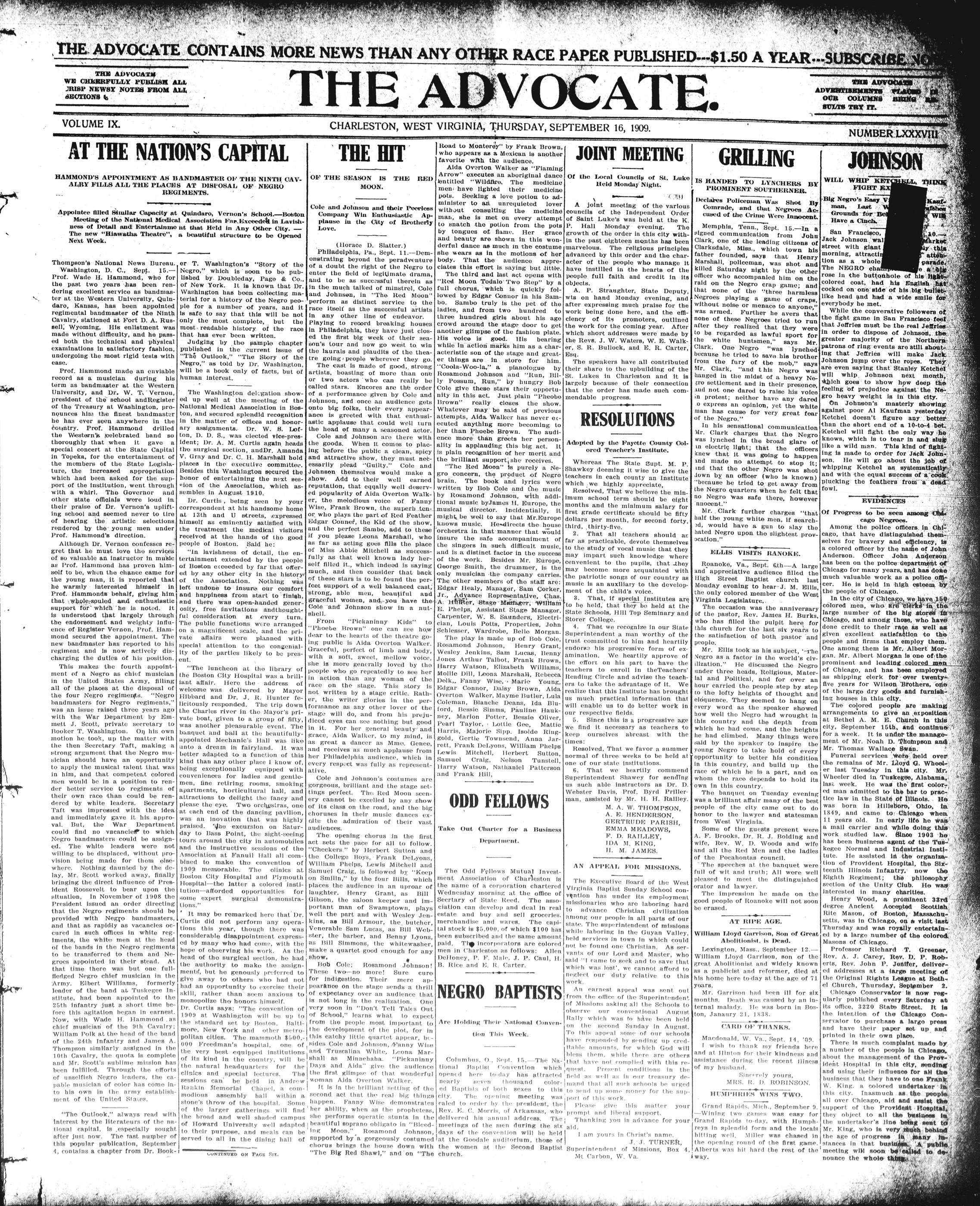
AT THE NATION'S CAPITAL
HAMMOND'S APPOINTMENT AS BANDMASTER OF THE NINTH CAVALRY FILLS ALL THE PLACES AT DISPOSAL OF NEGRO REGIMENTS
Appointee filled Similar Capacity at Quindaro, Vernon's School.—Boston Meeting of the National Medical Association Far. Exceeded in Lavishness of Detail and Entertainment that Held in Any Other City.—The new "Hiawatha Theatre", a beautiful structure to be Opened Next Week.
THE ADVOCATM
WE CHLERFULLY PUBLISH ALL
JRISP NEWSY NOTES FROM ALL
SECTIONS
VOLUME IX.
Thompson's National News Bureau. Washington, D. C., Sept. 15.—Prof. Wade H. Hammond, who for the past two years has been rendering excellent service as bandmaster at the Western University, Quindaro, Kansas, has been appointed regimental bandmaster of the Ninth Cavalry, stationed at Fort D. A. Russell, Wyoming, His enlistment was made without difficulty, and he passed both the technical and physical examinations in satisfactory fashion, undergoing the most rigid tests with ease.
Prof. Hammond made an enviable record as a musician during his term as bandmaster at the Western University, and Dr. W. T. Vernon, president of the school and Register of the Treasury at Washington, pronounces him the finest bandmaster he has ever seen anywhere in the country. Prof. Hammond drilled the Western's celebrated band so thoroughly that when it gave a special concert at the State Capital in Topeka, for the entertainment of the members of the State Legislature, the increased appropriation which had been asked for the support of the institution, went through with a whirl. The Governor and other state officials were loud in their praise of Dr. Vernon's uplifting school and seemed never to tire of hearing the artistic selections rendered by the young men under Prof. Hammond's direction.
Although Dr. Vernon confesses regret that he must love the services of so valuable an instructor in music as Prof. Hammond has proven himself to be, when the chance came for the young man, it is reported that he warmly interested himself in Prof. Hammonds behalf, giving him that whole-souled and enthusiastic support for which he is noted. It is understood that largely through the endorsement and weighty influence of Register Vernon, Prof. Hammond secured the appointment. The new bandmaster has reported to his regiment and is now actively discharging the duties of his position.
This makes the fourth appointment of a Negro as chief musician in the United States Army, filling all of the places at the disposal of the four Negro regiments. "Negro bandmasters for Negro regiments," was an issue raised three years ago with the War Department by Emmett J. Scott, private secretary to Booker T. Washington. On his own motion he took, up the matter with the then Secretary Taft, making a strong argument that the Negro musician should have an opportunity to apply the musical talent that was in him, and that competent colored men would be in a position to render better service to regiments of their own race than could be rendered by white leaders. Secretary Taft was impressed with the idea and immediately gave it his approval. But, the War Department could find no vacancies to which Negro bandmasters could be assigned. The white leaders were not willing to be displaced, without provision being made for them elsewhere. Nothing daunted by the delay, Mr. Scott worked away, finally bringing the direct influence of President Roosevelt to bear upon the situation. In November of 1908 the President issued an order directing that the Negro regiments should be provided with Negro bandmasters, and that as rapidly as vacancies occurred in such offices in white regiments, the white men at the head of the bands in the Negro regiments to be transferred to them and Negroes appointed in their stead. At that time there was but one fullfledged Negro chief musician in the Army. Elbert Williams, formerly leader of the band at Tuskegee Institute, had been appointed to the 25th infantry just a short time before this agitation began in earnest. Now, with Wade H. Hammond as chief musician of the 9th Cavalry; William Polk at the head of the band of the 24th Infantry and James A. Thompson similarly assigned in the 10th Cavalry, the quota is complete and Mr. Scott's sublime mission has been fulfilled. Through the efforts of unselfish Negro leaders, the capable musician of color has come in to his own in the army establishment of the United States.
"The Outlook," always read with interest by the literateurs of the national capital, is especially sought after just now. The tast number of this popular publication, September 4, contains a chapter from Dr. Book-
r T. Washington's "Story of the Negro," which is soon to be published by Doubleday, Page & Co., of New York. It is known that Dr. Washington has been collecting material for a history of the Negro people for a number of years, and it is safe to say that this will be not only the most complete, but the most-readable history of the race that has ever been written. Judging by the sample chapter published in the current issue of "The Outlook," "The Story of the Negro," as told by Dr. Washington, will be a book only of facts, but of human interest.
The Washington delegation showed up well at the meeting of the National Medical Association in Boston, and secured splendid recognition in the matter of offices and honorary assignments. Dr. W. S. Leoft, D. D. S., was elected vice-president; Dr. A. M. Curtis again heads the surgical section, and Dr. Amanda V. Gray and Dr. C. H. Marshall hold places in the executive committee. Besides this Washington secured the honor of entertaining the next session of the Association, which assembles in August 1910.
Dr. Curtis, being seen by your correspondent at his handsome home at 13th and U streets, expressed himself as eminently satisfied with the treatment the medical visitors received at the hands of the good people of Boston. Said he:
"In lavishness of detail, the entertainment extended by the people of Boston exceeded by far that offered by any other city in the history of the Association. Nothing was left undone to insure our comfort and happiness from start to finish and there was open-handed generosity, free invitations and thoughtful consideration at every turn. The public functions were arranged on a magnificent scale, and the private affairs were planned with special attention to the congeniality of the parties likely to be present.
"The luncheon at the library of the Boston City Hospital was a brilliant affair. Here the address of welcome was delivered by Mayor Hilbard and Dr. J. R. Hunter felicitously responded. The trip down the Charles river in the Mayor's private boat, given to a group of fifty, was another pleasurable event. The banquet and ball at the beautifully-appointed Mechanic's Hall was like unto a dream in fairyland. It was better adapted to a function of this kind than any other place I know of, being exceptionally equipped with conveniences for ladies and gentlemen, fine retiring rooms, smoking apartments, horticultural hall, and attractions to delight the fancy and please the eye. Two orchestras, one at each end of the dancing pavilion, was an innovation that was highly praised. The excursion on Saturday to Bass Point, the sight-seeing tours around the city in automobiles and the instructive sessions of the Association at Fanuli Hall all combined to make the convention of 1909 memorable. The clinics at Boston City Hospital and Plymouth Hospital—the latter a colored institution—afforded opportunities for some expert surgical demonstrations."
It may be remarked here that Dr. Curtis did not perform any operations this year, though there was considerable disappointment expressed by many who had come, with the hope of observing his work. As the head of the surgical section, he had the authority to make the assignments, but he genously preferred to give away to others who had not had an opportunity to exercise their skill, rather than seem anxious to monopolize the honors himself.
Dr. Curtis says: "The convention of 1009 at Washington will be up to the standard set by Boston, Baltimore, New York and other metropolitan cities. The mammoth $500,000 Freedman's hospital, one of the very best equipped institutions of its kind in the country, will be the natural headquarters for the clinics and special lectures. The sessions can be held in Andrew Rankin Memorial Chapel, a commodious assembly hall within a stone's throw of the hospital. Some of the larger gatherings will find the broad and well shaded campus of Howard University well adapted to their purpose, and meals can be served to all in the dining hall of
CONTINUED ON PAGE SIX.
THE ADVOCATE.
CHARLESTON, WEST VIRGINIA, THURSDAY, SEPTEMBER 16, 1909.
THE HIT
OF THE SEASON IS THE RED MOON.
Cole and Johnson and their Peerless Company Win Enthusiastic Applause in the City of Brotherly Love.
(Horace D. Satter.) Philadelphia, Pa., Sept. 11—Demonstrating beyond the peradventure of a doubt the right of the Negro to enter the field of legitimate drama, and to be as successful therein as in the much talked of minstrel, Cole and Johnson, in "The Red Moon" perform as distinct service to the race itself as the successful artists in any other line of endeavor. Playing to record breaking houses in Philadelphia, they have just closed the first big week of their season's tour and now go west to win the laurals and plaudits of the theatre going people wherever they go
The cast is made of good, strong artists, boasting of more than one or two actors who can really be called stars. Encores are the order of a performance given by Cole and Johnson, and once an audience gets onto big folks, their every appearance is greeted with that enthusiastic applause that could well turn the head of many a seasoned actor.
Cole and Johnson are there with the goods. When it comes to placing before the public a clean, spicy and attractive show, they must necessarily plead "Guilty." Cole and Johnson themselves would make a show. Add to their well earned reputation, that equally well deserved popularity of Aida Overton Walker, the melodious voice of Fanny Wise, Frank Brown, the superb tenor who plays the part of Red Feather Edgar Conner, the Kid of the show, and the perfect Sambo, add to these if you please Leona Marshall, who as far as acting goes fills the place of Miss Abbie Mitchell as successfully as that well known lady herself filled it., which indeed is saying much, and then consider that back of these stars is to be found the perfect support of a well balanced cast, strong, able men, beautiful and graceful women, and you have the Cole and Johnson show in a nutshell.
From "Pickaninny Kids" to "Phoebe Brown" one can see how dear to the hearts of the theatre going public is Aida Overton Walker. Graceful, perfect of limb and body, with a soft, sweet, mellow voice, she is more generally loved by the people who go repeatedly to see her in action than any woman of the race on the stage. This story is not written by a stage critic. Rather, the writer glories in the performance as any other lover of the stage will do, and from his prejudiced eyes can see nothing but good in it. For her general beauty and grace, Aida Walker, to my mind, is as great a dancer as Mme. Gence, and receives as much applause from her Philadelphia audience, which in every respect was fully as representative.
Cole and Johnson's costumes are gorgeous, brilliant and the stage settings perfect. The Red Moon scenery cannot be excelled by any show of its class on the road, and the big choruses in their music dances excite the admiration of their vast audiences.
The opening chorus in the first act sets the pace for all to follow. "Checkers." by Herbert Sutton and the College Boys, Frank DeLyons, William Phelps, Lewis Mitchell and Samuel Craig, is followed by "Keep on Smillin," by the four Bills, which places the audience in an uproar of laughter. Henry Grant, as Bill Gibson, the saloon keeper and important man of Swamptown, plays well the part and with Wesley Jenkins, as Bill Armour, the butcher, Venerable Sam Lucas, as Bill Webster, the barber, and Benny Lyons, as Bill Simmons, the whitewasher, make a quartet good enough for any show.
Bob Cole; Rosamond Johnson! These two—no more! Sure cure for indigestion. Their mere appearance on the stage sends a thrill of expectancy over an audience that is not long in the realization. One very soon in "Don't Tell Tales Out of School," learns what to expect from the people most important to the development of the plot, for in this catchy little quartet appear, besides Cole and Johnson, Fanny Wise and Truscalina White, Leona Marshall as Minnehaha. "Pickaninny Days and Alda" give the audience the first glimpse of that wonderful woman Alda Overton Walker.
It is in the brilliant setting of the second act that the real big things happen. Fanny Wise demonstrates her ability, when as the prophetess, she performs operatic stunts in the beautiful soprano obligato in "Bleeding Moon." Rosamond Johnson, supported by a gorgeously costumed chorus brings the house down with "The Big Red Shawl," and on "The
Road to Monterey" by Frank Brown, who appears as a Mexican is another favorite with the audience. Alda Overton Walker as "Flaming Arrow" executes an aboriginal dance entitled "Wildfire. The medicine men have lighted their medicine pots. Seeking a love potion to administer to an unrequited lover without consulting the medicine man, she is met on every attempt to snatch the potion from the pots by tongues of flame. Her grace and beauty are shown in this wonderful dance as much in the costume she wears as in the motions of her body. That the audience appreciates this effort is saving but little
The third and last act opens with "Red Moon Todalo Two Step" by a full chorus, which is quickly followed by Edgar Connor in his Sambo. Sambo truly is the pet of the ladies, and from two hundred to three hundred girls about his age crowd around the stage door to get another glimpse of the fashion plate. His voice is good. His bearing while in action marks him as a characteristic son of the stage and greater things are in store for him. "Coola-Woo-la," a pianologue by Rosamond Johnson and "Run, Billy Possum, Run," by hungry Bob Cole give these stars their opportunity in this act. Just plain "Phoebe Brown" really closes the show. Whatever may be said of previous attempts, Alda Walker has never executed anything more becoming to her than Phoebe Brown. The audience more than greets her personality in applauding this big act. It is plain recognition of her merit and the brilliant support she receives.
"The Red Moon" is purely a Negro concern, the product of Negro brain. The book and lyrics were written by Bob Cole and the music by Rosamond Johnson, with additional music by James H. Europe, the musical director. Incidentially, it might be well to say that Mr. Europe knows music. He directs the house orchestra in that manner that would insure the safe accompaniment of the singers in such difficult music, and is a distinct factor in the success of the work. Besides Mr. Europe, George Smith, the drummer, is the only musician the company carries. The other members of the staff are: Edgar Healy, Manager, Sam Corker, Jr., Advance Representative, Chas. A. Hillier, Stage Manager, William E. Phelps, Assistant Stage Manager, Carpenter, W. S. Saunders, Electrician, Louis Potts, Properties, John Schlesser, Wardrobe, Belle Moore.
The play is made up of Bob Cole, Rosamond Johnson, Henry Grant, Wesley Jenkins, Sam Lucas, Benny Jones Arthur Talbot, Frank Brown, Harry Watson, Elizabeth Williams, Mollie Dill, Leona Marshall, Rebecca Delk., Fanny Wise, Marie Young, Edgar Connor, Daisy Brown, Aida Overton Walker, Mayme Butler, Lula Coleman, Blanche Deans, Ida Bluford, Bessie Simms, Pauline Haukney, Marion Potter, Bessie Oliver, Pearl Taylor, Lottie Gee, Mattie Harris, Majorie Sipp, Isolde Ringgold, Gertie Townsend, Anna Jarrett, Frank DeLyons, William Phelps Lewis Mitchell, Herbert Sutton, Samuel Craig, Nelson Tunstell, Harry Watson, Nathaniel Patterson and Frank Hill,
ODD FELLOWS
Take Out Charter for a Business Department.
The Odd Fellows Mutual Investment Association of Charleston is the name of a corporation chartered Wednesday morning at the office of Secretary of State Reed. The association can develop and deal in real estate and buy and sell groceries, merchandise and wares. The capital stock is $5,000, of which $100 has been subscribed and the same amount paid. The incorporators are colored men in Charleston as follows: Allen Delfoney, P. F. Male, J. P. Caul, H. B. Rice and E. R. Carter.
NEGRO BAPTISTS
Are Holding Their National Conven tion This Week.
Columbus, O., Sept. 15.—The National Baptist Convention which opened here to-day has attracted nearly seven thousand colored Baptists of both sexes to this city. The opening meeting was called to order by the president, the Rev. E. C. Morris, of Arkansas, who delivered his annual address. The meetings of the men during the six days of the convention will be held at the Goodale auditorium, those of the women at the Second Baptist church.
JOINT MEETING
Of the Local Councils of St. Luke
Held Monday Night.
A joint meeting of the various
councils of the Independent Order
of Saint Luke's was held at the K.
P. Hall Monday evening. The
growth of the order in this city within
the past eighteen months has been
marvelous. The religious principles
advanced by this order and the character
of the people who manage it
have instilled in the hearts of the
people full faith and credit in its
objects.
A. P. Straughter, State Deputy, wts on hand Monday evening, and after expressing much praise for the work being done here, and the efficiency of its promoters, outlined the work for the coming year. After which short addresses were made by the Revs. J. W. Waters, W. E. Walker, S. R. Bullock, and E. R. Carter, Esq.
The speakers have all contributed their share to the upbuilding of the St. Lukes in Charleston and it is largely because of their connection that the order has made such commendable progress.
RESOLUTIONS
Adopted by the Fayette County Colored Teacher's Institute.
Whereas the State Supt. M. P. Shawkey deeming it wise to give the teachers in each county an Institute which we highly appreciate,
Resolved, That we believe the minimum school term should be eight months and the minimum salary for first grade certificate should be fifty dollars per month, for second forty, third, thirty-five.
2. That all teachers should as far as practicable, devote themselves to the study of vocal music that they may impart such knowledge where convenient to the pupils, that they may become more acquainted with the patriotic songs of our country as music is an auxiliary to the development of the child's voice.
3. That, if special Institutes are to be held, that they be held at the State Schools, Hill Top Seminary and Storer College.
4. That we recognize in our State Superintendent a man worthy of the trust committed to him and heartily endorse his progressive form of examination. We heartily approve of the effort on his part to have the teachers to enroll in the Teachers' Reading Circle and advise the teachers to take the advantage of it. We realize that this Institute has brought us much practical information that will enable us to do better work in our respective fields.
5. Since this is a progressive age we find it necessary as teachers to keep ourselves abreast with the times:
Resolved, That we favor a summer normal of three weeks to be held at one of our state institutions.
6. That we heartily commend Superintendent Shawley for sending us such able instructors as Dr. D. Webster Davis, Prof. Byrd Prillerman, assisted by Mr. H. H. Rallley.
M. A. W. THOMPSON,
A. E. HENDERSON,
GERTRUDE PARISH,
EMMA MEADOWS,
F. D. RAILLEY,
IDA M. KING,
H. M. JAMES.
The Executive Board of the West Virginia Baptist Sunday School convention has under its employment missionaries who are laboring hard to advance Christian civilization among our people in all parts of our state. The superintendent of missions while laboring in the Guyan Valley, held services in town in which could not be found one Christian. As servants of our Lord and Master, who said "I came to seek and to save that which was lost", we cannot afford to neglect our duty relative to this work.
An earnest appeal was sent out from the office of the Superintendent of Missions asking all the Schools to observe our conventional August Rally which was to have been held on the second Sunday in August. To this appeal some of our schools have responded by sending up creditable amounts, for which God will bless them, while there are others that have not complied with this request. Present conditions in the field as well as in our treasury demand that all such schools be urged to send up some money for the support of this work. Please give this matter your prompt and liberal support. Thanking you in advance for your aid.
I am yours in Christ's name.
J. J. TURNER,
Superintendent of Missions, Box
Mt Carbon, W. Va.
GRILLING
IS HANDED TO LYNCHERS BY
PROMINENT SOUTHERNER.
Declares Policeman Was Shot By
Comrade, and that Negroes Ac-
cused of the Crime Were Innocent.
Memphis, Tenn., Sept. 15.—In a signed communication from John Clark, one of the leading citizens of Clarksdale, Miss., which town his father founded, says that Henry Marshall, policeman, was shot and killed Saturday night by the other officer who accompanied him on the raid on the Negro crap game; and that none of the "three harmless Negroes playing a game of craps, without noise or menace to anyone," was armed. Further he avers that none of these Negroes tried to run after they realized that they were to be regarded as lawful sport for the white huntsmen," says Mr. Clark. One Negro "was lynched because he tried to save his brother from the fury of the mob," says Mr. Clark, "and this Negro was hanged in the midst of a heavy Negro settlement and in their presence, and not one dared to raise his voice in protest; neither have any dared to express an opinion, yet the white man has cause for very great fear of the Negro."
In his sensational communication Mr. Clark charges that the Negro was lynched in the broad glare of an electric light; that the officers knew that it was going to happen and made no attempt to stop it; and that the other Negro was shot down by an officer (who is known) "because he tried to get away from the Negro quarters when he felt that no Negro was safe there, however innocent." Mr. Clark further charges "that half the young white men, if searched, would have a gun to slay the hated Negro upon the slightest provocation."
ELLIS VISITS RANOKE
Roanoke, Va., Sept. 6th—A large and appreciative audience filled the High Street Baptist church last Monday evening to hear J. M. Ellis the only colored member of the West Virginia Legislature. The occasion was the anniversary of the pastor, Rev. James H. Burks who has filled the pulpit here for this church for the last six years to the satisfaction of both pastor and people.
Mr. Ellis took as his subject, "The Negro as a factor in the world's civilization." He discussed the Negro under three heads, Religious, Material and Political, and for over an hour carried the people step by step to the lofty heights of thought and eloquence. They seemed to hang on every word as the speaker showed how well the Negro had wrought in this country and the depth from which he had come, and the heights he had climbed. Many things were said by the speaker to inspire the young Negro to take hold of every opportunity to better his condition in this country, and build up the race of which he is a part, and on whom the race depends to hold its own in this country.
The banquet on Tuesday evening was a brilliant affair many of the best people of the city came out to do honor to the lawyer and statesman from West Virginia.
Some of the guests present were A. F. Brooks, Dr. R. J. Bolding and wife, Rev. W. D. Woods and wife and all the Red Men and the ladies of the Pocahontas council.
The speeches at the banquet were full of wit and truth; All were well pleased to meet the distinguished orator and lawyer.
The impression he made on the good people of Roanoke will not soon be erased.
AT RIPE AGE.
William Lloyd Garrison, Son of Great Abolitionist, is Dead.
Lexington, Mass., September 12.
William Lloyd Garrison, son of the great Abolitionist and widely known as a publicist and reformer, died at his home here to-day at the age of 71 years.
Mr. Garrison had been ill for six months. Death was caused by an internal malady. He was born in Boston, January 21, 1838.
CARD OF THANKS
Macdonald, W. Va., Sept. 14, '09.
I wish to thank my friends here and at Hinton for their kindness and assistance during the recent illness of my husband.
Grand Rapids, Mich., September 9. Wining two games was easy for Grand Rapids to-day, with Humphreys in splendid form and the locals hitting well. Miller was chased in the opening round of the first game. Alberts was hit hard the rest of the way.
NUMBER LXXXVIII
JOHNSON
WILL WHIP KETCHELL, THINK FIGHT EX
Big Negro's Easy V
man, Last W
Grounds for Bey
Have a Cinch
While the conversative followers of the fight game in San Francisco feel that Jeffries must be the real Jeffries in order to dispose of Johnson, the greater majority of the Northern patrons of ring events are still shouting that Jeffries will make Jack Johnson jump over the ropes. They are even saying that Stanley Ketchel will whip. Johnson next month, which goes to show how deep the feeling of prejudice against the Negro heavy weight is in this city. On Johnson's masterly showing against poor Al Kaufman yesterday Ketchel doesn't figure any better than the short end of a 10-to-4 bet. Ketchel will fight the only way he knows, which is to tear in and slug like a wild man. This kind of fighting is made to order for Jack Johnson. He will go about the job of whipping Ketchel as systematically and with the equal success of a cook plucking the feathers from a dead fowl.
EVIDENCES
Of Progress to be seen among Odoco
cago Neuroos.
Among the police officers in Chicago, that have distinguished themselves for bravery and efficiency, is a colored officer by the name of John Anderson. Officer John Anderson has been on the police department of Chicago for many years, and has done much valuable work as a police officer. He is held in high esteem by the people of Chicago.
In the city of Chicago, we have 150 colored men, who are clerks in the large number of the big stores in Chicago, and among those, who have done credit to their race as well as given excellent satisfaction to the people and firms that employ them. One among them is Mr. Albert Morgan. Mr. Albert Morgan is one of the prominent and leading colored men of Chicago, and has been employed as shipping clerk for over twenty-five years for Wilson Brothers, one of the large dry goods and furnishing houses in this city. The colored people are making arrangements to give an exposition at Bethel A. M. E. Church in this city, September 15th, and continue for a week. It is under the management of Mr. Noah D. Thompson and Mr. Thomas Wallace Swan.
Funeral services were held over the remains of Mr. Lloyd G. Wheeler last Tuesday in this city. Mr. Wheeler died in Tuskegee, Alabama, last week. He was the first colored man admitted to the bar to practice law in the State of Illinois. He was born in Hillsboro, Ohio, in 1849, and came to Chicago when 11 years old. In early life he was a mail carrier and while doing this work studied law. Since 1903 he has been business agent of the Tuskegee Normal and Industrial Institute. He assisted in the organization of Provident Hospital, the Sixteenth Illinois Infantry, now the Eighth Regiment; the philosophy section of the Unity Club. He was interested in many charities.
Henry Wood, a prominent 33rd degree Ancient Accepted Scottish Rite Mason, of Boston, Massachusetts, was in Chicago, on a visit last Thursday and was royally entertained by a large number of the colored Masons of Chicago.
Professor Richard T. Greener, Rev. A. J. Carey, Rev. D. P. Roberts, Rev. John P. Jonifer, delivered addresses at a large meeting of the Original Rights League at Bethel Church, Thursday, September 2. Chicago Conservator is now regularly published every Saturday at its office, 3220 State Street. It is the intention of the Chicago Conservator to purchase a large press and have their paper set up and printed in their own place.
There is much complaint made by a number of the people in Chicago, about the management of the Provident Hospital in this city, sending and using their influence for all the business that they have to one Frank W. King, a colored undertaker in this city. Inasmuch as the people all over Chicago, ald and assist the support of the Provident Hospital, they object to all the business in the undertaker's line being sent to Mr. King, who is very much behind the age of progress in many instances in that business. A public meeting will soon be called to denounce the whole thine.
CORRESPONDENCE
RONCEVERTE
D. W. Calaway left for Beckley Saturday to resume his school work.
Misses Josephine Jackson, Jennie Micken and Bossie Henderson attended teachers' examintition last week.
Alex Brown is spending his vacation at Atlantic City.
Mrs. R. D. Hickman, who visited her parents at Frankfort last week, left Sunday for a short stay at McKendree.
Mr. and Mrs. Chas. Brinkley, Mr. and Mrs. Lewis Brinkley, Mrs. Niley Marshall and Mrs. Debby Terrell attended the funeral of Richard Diggs at Fort Springs, Thursday.
Mrs. Virgile Jefferson and her little daughter Hazel, of Charleston, are visiting her mother, Mrs. Katie Eldridge.
Miss Gracie L. D. Williams left for Wake Forest Thursday.
Rev. Robinson filled his appointment here Sunday.
Chas. Perkins returned from Salt Sulphur Springs last week. Mrs. Katie Eldridge who has been indisposed is able to be out again. Prof. T. C. Edmunds of Bridge Water was a visitor here last week.
MT. HOPE.
Mrs. Clara Henderson gave a social in honor of her sister, Miss Harriet Coleman and son of Boston. All present seemed to enjoy themselves.
Five persons were initiated into the order of St. Lukes, Friday night.
A. P. Staughter, of Hinton, was a business caller here Friday.
A large number of teachers were last week in attendance at the uniform examination.
Misses Ora and Mattie Freeman have returned to Ansted after having spent a week visiting their sister, Mrs. Lizzie Brockman.
W. E. Stevenson, solicitor for the Advocate, was in town last week.
The week's services held at the Mt. Hope Baptist Church was a success. $50.25 was raised. The pastor, Rev. Stratton, deserves much credit.
The following students left Monday for the West Virginia Colored Institute: Misses Elizabeth Evans, Carrie Jones, Mary A. Thompson, and Messrs R. G. Thurston, J. R. Johnson, Herbert Banks, Basil Braxton, Clifford Harris, Manuel Hill and Thomas Taylor.
Mrs. Bell Clayborne was called to Nuttall Sunday on account of the illness of her daughter, Mrs. Lucy Woodson.
Mrs. Lorena Scott, who has been sick the past four months, remains quite ill.
Miss Lena Rice, of Charleston, who has been elected assistant teacher of Macdonald Public School is in town ready to resume her work.
Haptizing services were held by Rev. Deans, Sunday
BUCKHANNON
Batley Tanner, of Los Angeles, California, spent Thursday here. Miss Moss Clay, of Clarksburg, was the guest of friends here Sunday. Woman's Day was observed at Simpson Memorial M. E. Church, Sunday evening. An interesting program was rendered by the ladies
Miss Harriet Walker left Friday for Institute, where she will attend school.
Mrs. Joe Stewart, accompanied by her father, Dan Hall, returned to her home at Coal Center, Pa., Friday. Mr. Hall expects to make his home in Pennsylvania.
Mr. and Mrs. Clifford, of Zanesville, O., are the pleasant guests of Mr. and Mrs. J. W. Munford.
Chas. Davis is on the sick list
Chas, Davis is on the sick list.
Mrs. Georgiaiana Wright entertained the Ladies' Aid, Friday afternoon at her home on Latham street.
Mrs. O. T. Davis is somewhat indisposed at this time.
PT. PLEASANT.
Misses Marie and Virginia Lincoln, who have been the guests of the Misses Giles, of Brosia, for the past week, returned Friday.
Misses Bazette Jenkins, Alma Colman and Bennie Rison, of Gallipolls, and Miss Laura Jackson, of Mason City, spent Sunday in town the guest of friends.
Misses Mina Jones, Florence Moree and John Williams, of Henderson, were guests of Miss Anna Green, Sunday.
Mrs. George Jordan and daughter, Mrs. Chas. Hamilton visited friends in Gallipolls, Sunday.
John H. Davis, who has been em-
PATENTS
proptely obtained in all countries or NO PEE.
bought, purchased, and copyrights resi-
lated. Send sketch. Model of photo. for
FREE REPORT on patentability. Patent prac-
tice by MAYOR. Mail to: D. SWIFT & CO.
Band 2 cents in stamps for invaluable book
OF OBTAIN and SELL PATENTS,
which one will pay. Flow to an author
patent law and other valuable information.
D. SWIFT & CO.
PATENT LAWYERS.
803 Garvorth St., Washington, D.C.
played out of town for the past four years, is here the guest of relatives. Frank Bell spent Sunday in Gallipolis with friends. Friday, Sept. 10 being the eighteenth birthday of Miss Agatha Alexander, Mr. and Mrs. Joseph Alexander laid covers at six o'clock dinner for the following guests: Miss Anna Green, Messrs Russell Colston, John Davis and Ottie Adams, of Urbana, Ohio, after which a very pleasant evening was spent in music and card playing. At a late hour the guests departed wishing MissAgatha as many more birthdays and as happy returns returns from each. Miss M. Frances Morton, of Pomeroy, spent Thursday and Friday of last week in town the guest of Mrs. George Jordan'.
L. R. Jordan resigned his position as principal of Langston High School here, last week, and accepted the principalship of Clarksburg High School. The vacancy was filled by Prof. Robinson, former principal of Clarksburg.
Misses Hazel Emerson and Grace Carter, of Gallipolis, were in town Sunday visiting friends.
Misses Ida Craig, Mary Craig and Mithrie Colston spent Sunday with Shepherd Lewis and daughter, of Kanauga.
Mr. and Mrs. R. W. White left for Institute, Sunday.
Rev. G. A. Muse, of Charleston, who is pastor of M. E. Church here, preached a very able sermon Sunday evening.
John Lewis, who has been employed in Pennsylvania during the summer, returned Saturday.
FAIRMONT
---
Miss Anna Dawson left Sunday to enter school at Institute.
Mrs. Chas. Hamilton arrived home Monday after a two week's visit with her parents at Pt. Pleasant...Mrs. Hamilton leaves her mother much improved in health.
School opened Tuesday, Sept. 7th, with a large enrollment, and E. L. Morton and Miss Florence Cobb, teachers.
Miss Helen Meade returned Saturday from Mt. Lake park where she spent the summer with friends.
The entertainment given by Misses Nell Staley and Anna Washington for the benefit of M. E. Church was a success.
Mrs. Wm. Lee returned last week after a month's visit with relatives in Virginia.
Mrs. Jennie Adams arrived here last night after a pleasant visit in Cleveland. While here she is the guest of Mrs. Wm. Crenshawe. Preparations are being made for a picnic and ball at Traction Park Emancipation Day. Mrs. Janie Allen and daughter, Louise, left Friday for Baltimore to make their home. Mr. Allen has employment there. Chas, Florence, Clarence Black and Miss Vera Black left a few days ago after attending Teachers' Institute here. George Washington spent Sunday in Clarksburg with friends. Robert Martin and grandson, Charles Dawson, are guests of relatives in Wheeling and attending the State Fair. Don Jones is suffering with an attack of indigestion.
Mrs. Harry Jennings and little daughter, of Wheeling, are the guests of Mrs. Walter Scott.
Mrs. Gazetta Cobbs is improved at this writing.
Mrs. Harris, who has been the guest of her sister, Mrs. Harry Johnson, left Saturday for her home in Cumberland, Md.
RAYMOND CITY.
Rev. A. Massie, preached an interesting sermon at the Mt. Hermen Baptist church Sunday night.
Mrs. Elizabeth Keent, of Pomeroy, O., and Miss Bessie Norman, of Pt. Piccari, took charge of our school here Monday as teacher with a large enrollment.
Winston Coles, Harvey Coles, Mr. and Mrs. Taylor Tibbs, attended services at Bancroft Sunday.
Mrs. Arizona Carey, entertained a few friends at her home Saturday night at a card party complimentary to Beatrice Calhoun, of Charleston.
Mr. A. C. Chatman, of Winifrede, spent Sunday the guest of Miss Florence Coles.
Miss Beatrice Calhoun left Sunday for Charleston to resume her studies.
Miss Lucinda Coles is contemplating a trip to Templeton, Pennsylvania, to visit her brother.
Mrs. Lucy Hodge, of Montgomery, was here Monday, in the interest of True Reformers and Rosebud lodges. L. H. Duckwheel and Little son Carl were business visitors to Institute, Saturday. Rev. P. P. Holland, spent a few hours in our town Monday, en route to his home at Spring Hill. The Missionary Society will meet at the church Friday night. Mrs. Eva Walker returned home Sunday from Carbondale, where she accompanied Mr. and Mrs. John Lee. Miss Cora Garland, of Charleston, was the week-end guest of her sister, Mrs. Lydia Shores.
HUNTINGTON.
Rev. R. B. Hadley, of Charlottesville, Va., delivered two able sermons at the 16th St. Baptist church, Sunday.
Douglas school opened Monday with a "record breaker" enrollment, being 280, the first session Monday.
G. H. Barnett eame down from Holden Sunday and spent the day with his family, who have recently moved into their home on 14th St.
Miss Lavinia Norman one of the new teachers at Douglas School, is a graduate from the college department of Howard University, and will add much to the already efficient corps of teachers at Douglas.
' Willie Mills, who spent the summer with his parents, Mr. and Mrs. A. D. Mills, returned to Washington, D. C., to resume his study of dentistry at Howard University.
J. M. Hazlewood was a business visitor here, Thursday and Friday.
Miss Almira Riddle left for Carbon, Saturday, to take up her school.
Emancipation Celebration will be held at Clyffside Park this year. Besides the many amusements the park affords an interesting program has been arranged by the committee.
Mrs. Jno. Gillard and little son, joined her husband here last Tuesday and they will reside here in the future.
Little Kensle Ellis, who sustained a broken leg by falling from a tree last week, is getting along nicely.
Miss Nora Dickinson is able to 'be out again after her recent illness.
Mrs. Andrew Baker and neice, Miss Katie Cunningham, returned from Richmond, Va., Monday.
Quite a number from here attended the closing of Conference at fronton Sunday.
Mrs. C. H. Payne left Saturday to visit Columbus, Ohio. She will be accompanied by her sister, Mrs. Emma Washington, of Gallipolis, C
Mrs. Emma Jackson is quite ill at her home on 7th Ave.
Miss Evelyn Willis will leave for Chicago Sunday morning.
Rev. and Mrs. Thomas are visiting here a few days from Portsmouth, Ohio.
Mrs. E. A. Harvey and little daughter Mamie, returned home Saturday from a brief visit to Charleston friends.
Miss Lucy Ware, Matron of the Orphans' Home, is spending some time in Washington, Pa., on her vacation.
Mrs. Edwards is improving from a recent illness.
Prof. E. A. Viney returned from his vacation with his father at Lancaster, Saturday, to resume his work as director of music in Douglas school.
SEWELL.
Mrs. Nelly Vanhook returned to her home at Page Friday after spending a week with her parents.
Miss Lorena Gibson left Saturday for the West Virginia Colored Institute.
Mrs. Ernest Vanhook and children are at Fage tha's week guests of Mr. and Mrs. W. G. Vanhook.
H. B. Hundley, of McDonald, was here Saturday to meet the Masonic Lodge. While here he was the guest of E. Vanhook.
Mrs. P. B. Jasper and Miss Bell James, of Pennbrooke, were business visitors here Monday.
L. T. Freeland returned from Virginia Wednesday after spending some time there visiting relatives.
Andrew Faulkner and little son are in Virginia visiting relatives and friends.
Miss Nannie Herndon left for her home in Lynchburg, Va., after spending several months here with her parents. W. H. Jackson, of Kanawha City, spent several days here last week. Mrs. Lelia Anderson and children, of Hinton, are here to spend some time with Mrs. Anderson's parents, Mr. and Mrs. Edward Johnson.
CARBON
The K. of P. Lodge gave a supper last Monday night, which was well attended.
Mrs. Rebecca Carter arrived Saturday from an extended visit to friends in Gordonsville, Va.
A number from Wevaco attended the supper here Monday night.
Isaac Aliston, who has been with us for quite awhile moved to North Carbon, Monday.
Our pulpit was filled Sunday night by Rev. S. W. Mayo, who moved here last week, from Thayer. He preached an able sermon.
R. M. Miller, of Wevaco, was calling here Sunday.
Our school opened Monday morning. Miss Elmira Riddle, of Huntington, teacher.
BOOMER
Mrs. Ruby Buster Saunders celebrated her twentieth birthday Sept. 4. The dining room was beautifully decorated, the color scheme being white, yellow and blue. The amusements of the evening were music and games. At 11 P. M. a dainty luncheon was served to nineteen couples. Miss Carolyn Buster presided at the punch bowl, Guy Jones of Long Acre, toast master.
Jessie Wilson was calling on
Born—to Mr. and Mrs. A. D. Williams, a boy.
A. Coleman and Sam Cagle were on the sick list last week.
P. H. Hayes, of Montgomery, visited his daughter, Miss Mittle, Sunday.
Howard Womack, is on the sick list this week.
PEOPLE
FACTORY
Dunkirk Window Glass
Kana
Kenton Iron & Steel Co.
125 houses and
Church, School
under cons
Bridge now c
Buy now before the
Terms: 1-10 ca
Kanav
Room 501
South Charleston
ACTORIES EMPLOYE
by Glass Co.
Kanawha Chemjc
steel Co.
s and other buil
school House, Co
or construction, Na
now completed
ore the prices go
cars g
1-10 cash, balance i
Discount f
awha
from 501 Charleston
Dunkirk Window Glass Co. Banner Window Glass Co. Kanawha Chemjcal Engine Mfg. Co.
Buy now before the prices go up. They go up when the cars go in. Terms: 1-10 cash, balance in monthly payments to suit. Discount for all cash.
Kanawha Land Co.
Bell Phone 750; Home Phone 1214
Hill, Smith, Dickeson, S. Smith and Miss Hattie Smith, Messrs Hicks, Jones, Phillips, Brown, Smith and Dr. M. T. Sinclair.
Miss Lottie Winters of Gallipolis, Ohio is the guest of Mrs. H. A. Jones at Plymouth.
Our school opened on Tuesday, Sept. 7, with an enrollment of 27, with Mrs. M. T. Sinclair as teacher.
William Lewis and Chas. Lawson of Powellton were called to Bancroft on account of the continued illness of their father, Jas. Lawson.
The supper given by the Sunday school on Saturday evening was a success, realizing eighteen dollars.
Mrs. Richard Smith and daughter Miss Hattie were calling on friends at Black Betsey Sunday.
Messrs. Winston and Harvey Coles, Mr. and Mrs. Tibbs and Mrs. Wm. Booth of Raymond worshiped at Mt. Zion Sunday.
Sunday being our rally day, Rev. P. P. Holland filled the pulpit both morning and evening and through the efforts of him and the officers of the church much good was realized, both spiritually and financially.
Mrs. Jones of Cedar Grove is visiting her sister, Mrs. Moseby at Plymouth this week.
Mrs. Hattie Walters who has been visiting friends at Gallipolis and Plymouth has returned to her home at Gomoca.
Linsey Taylor of Black Betsey and Miss Barbra Blackwell, of Point Pleasant, were quietly married at the home of the bride, Wednesday, Sept. 8.
Miss Georgia Banks, of St. Albans, passed through our town Friday evening enroute to her home.
Mrs. John Cyrus and children were visiting friends at Bleck Betsey. Sunday.
Mr. Skanks has moved his family from Bancroft to Plymouth. Jas. Lawson, who suffered a relapse from his former illness, is able to be out again. John Brown, of Plymouth, made a trip to Charleston Sunday evening. John Ross, of Black Betsey, was called to St. Albans on account of the death of his sister, Mrs. Sim Trent, last week.
FUNERAL OF MRS. BUCKINGHAM.
Winfield, Sept. 9.—The funeral of Mrs. Emma Minter Buckingham took place from the Presbyterian church here yesterday. All the members of her immediate family being in attendance. She belonged to a family that was highly respected for their genuine worth and many virtues. She was married to Brady Buckingham June 29th, 190, and leaves besides her husband, mother, father, three brothers, Jas. Frank, Thos., Minter & two sisters, Mrs. John Hare, of Charleston, and Mrs. Elzabeth Morgan, of St. Albaus.
---
THE ADVOCATE
C. C. Woods, accompanied by his
his daughter Mac, went to Charleston
Saturday, where she is to attend
school this winter.
Miss Katherine Scott has returned
home to Charleston after a
month's visit with her cousin, Miss
Vivian Buster.
Mrs. Virginia Buster, of Montgomery and Mrs. Annette Boyd of
Tennessee were calling on Mrs. Floyd
Buster last week.
Master Floyd Wilson has returned
home after a two weeks visit to
Richmond.
Misses Rosa and Emma Hardy
passed through Boomer enroute to
Carbon.
Mrs. Ida Scott, Mrs. Mae Hale and
Mrs. Mary Teal spent Labor Day
with Miss Carolyn Buster.
Mrs. Ruby Saunders entertained at lunch, complimentary to her sister, Miss Carolyn Buster, Mrs. Ida Scott, Mrs. Mae Hale, Mrs. Mary Teal, of Charleston, Labor Day. Mrs. Bettie Kimbo made a trip to Gaulle Sunday, friends in Long Acre Wednesday. Mrs. Fred Thompson left for points in Ohio Monday. Mrs. Ruby Saunders, MissesAmanda Perkins and Carolyn Buster were shopping in Montgomery Monday.
ST. ALBANS.
Prof. J. W. Robinson went to Pt. Pleasant Tuesday to take charge of Lincoln High School which was made vacant by the resignation of Principal Jordan who has been elected to the principalship of the Waters St. High School at Clarksburg.
The Amandaville school commenced Tuesday morning with nearly all the children present. The St. Albans school will commence on the 20th of September.
Miss Gertrude Parkish left Monday morning for Harewood where she opened school Tuesday.
Miss Alberta Wilson went to Institute Friday on business.
Miss Rhoda A. Wilson left for Charleston Thursday where she resumed her work as teacher in the Garnett school on the thirteenth.
Rev. I. V. Bryant of Huntington preached two able sermons at the St. Paul Baptist Church Sunday, at which time forty-five dollars was collected for the benefit of the church.
Miss Etta Stewart of Charleston spent a few days with her uncle, Frank Morgan, last week.
Charley Price went to Montgomery last week on business.
Mrs. A.C. Branham will leave in a few days for New York city where she will attend her sick daughter.
BANCROFT.
Mrs. J. T. Tolliver, of New Haven,
Conn., who is visiting her sister,
Mrs. R. C. Smith at Plymouth, was
the hostess of a surprise party last
Wednesday night. Those present
were: Madames Hicks, Sawyers,
Phillips, Brooks, Cyrus, Mickens.
THERE APRIL 1, 1907
MES EMPLOYING OVER
Co. E
wha Chemjcal Engine M
other buildings in S
House, Concrete Si
truction, Natural Gas
completed and soon t
e prices go up. Th
cars go in.
ash, balance in monthly p
Discount for all cash.
wha La
Charleston National Bank
---
---
Beef, Veal, Mutton, Pork Fresh Pork Sausage OUR OWN MAKE.
Try our machine sliced
The best qualities in all the popular kinds of
We want your patronage for we have complete stock in our lines and you can get it when you want it most.
THURSDAY, SEPT. 10, 1902
estor
ON NOW
R 400 MEN
Banner Window
fg. Co.
eston
NOW
00 MEN
ner Window Glass Co.
Co.
Hemlock Lumber Co.
South Charles
e Walk, Sew
ings, Everything.
the trollly car
ey go up wh
ayments to suit.
and C
k Building
BAUER M
SH COM
D 30 CAPIT
Veal, Mutton
h Pork Sau
OUR OWN MAKE.
our machine
s and E
RS, FISH, PO
qualities in all th
kinds of
South Charleston.
Walk, Sewers,
Everything.
trolly cars.
go up when the
ments to suit.
nd Co.
Building
AUER MEAT
H COMPATY
30 CAPITOL ST.
al, Mutton, Pork,
Pork Sausage
UR OWN MAKE.
or machine sliced
and Bacon
FISH, POULTRY
lities in all the popular
kinds of
Cheese your patronage for stock in our line when you want
our patronage for we have back in our lines and you when you want it most.
PROSPEROUS TIMES FOR THE C. & O. RAILROAD SHOWN
In the Annual Report---Big Expansion of Earning Power, Economy in Operation, Liberal Policy of Maintainance, and Prospect of Property in Dividend-Paying Basis.
THURSDAY, SEPT. 16, 1909.
PROSPEROUS TIM
C. & O. RA
In the Annual Report---E
Power, Economy in Op
Maintainance, and Pro
idend-Paying Basis.
The annual report of the Chesapeake & Ohio railroad system is most gratifying to the management and ought to be to the stockholders. It shows expansion of earning power, economy in operation, a liberal policy of maintenance and a manifest determination on the part of the officials of the company to place the property on a dividend paying basis.
Chesapeake & Ohio earned 6.39 per cent on its $62,799,100 stock, compared with 4.45 per cent in the preceding year. The 1909 figure is the highest in the company's history. This is only one of the many records set up during the last year.
Gross and net earnings eclipsed all previous high marks. This in spite of the effects of the business depression during the early part of the fiscal year, which made every month's showing at that time compare poorly with the results of the preceding prosperous year. The increases in gross and net were $787,445 and $1,607,354, respectively.
Earnings Begin to Pick Up
As soon as business conditions throughout the country began to right themselves the earnings of the Chesapeake & Ohio began to pick up at a remarkable rate. This still continues. For the week ended August 21 the record reports a gain in gross of over $100,000, compared with the corresponding week a year ago.
Operating expenses consumed 61.5 per cent of gross earnings. A year ago the ratio was 66.5 per cent, five points higher. The importance of this saving may be easily figured. It means more than 2 per cent on the stock. It was brought about by lowering maintenance $464,729, and other expenses $355,180.
A study of the C. & O.'s maintenance accounts establishes the fact that, whatever decreases was made in the amounts applied to the upkeep of the property was fully warranted. An average of $1,635 per mile was spent to keep roadbed and structures in order during 1909. Maintenance of locomotives averaged $2,641 per unit, and maintenance of passenger and freight cars $951 and $77 each, respectively. All of the foregoing figures are ample. Comparison with the charges of other roads emphasizes this. For instance, the C. & O. spends about $300 more per passenger car each year than either the Boston and Maine or the New Haven, which do about as heavy a passenger business as any in the country. The C. & O.'s passenger business is light. This is one reason why its ratio of conducting transportation to gross earnings is extremely low.
Operating Expenses Moderate
Operating Expenses Moderate Traffic and transportation expenses absorbed only 29.2 per cent of the C. & O.'s gross in 1909, a reduction from the 32.9 per cent of a year previous. A low transportation ratio means economical operation. Few, if any roads operate more cheaply than the C. & O. Much of this is due to the fact that two-thirds of its tonnage is bituminous coal, which may be cheaply transported, and to its small passenger business. But not all the credit must be given fortuitous circumstances for the good showing; much is due the operating departments. Everywhere, among the traffic statistics, is better efficiency brought to light. The single fact of a saving in transportation costs when tonnage hauled increased by 2,000,000 and traffic density increased 227,000 ton miles per mile of road, is evidence, and it is backed up by such as 54 tons added to the average train load.
The C. & O.'s average rate for freight transportation is about the lowest in the country—4.10 miles per ton mile last year. The average rate for miscellaneous freight was 6.67 mills, but so much coal was
More Money For Colored People
This is one of the objects of this great Benefi-
cial and Protective organization. The I-L-U Grand Lodge aims to improve induction, in a financial way, as well as morally and educationally. The I-L-U Grand Lodge is as white. Higher Wages, Shorter Hours, Equal Opportunities, Self Betterment conditions generally, are among the things for which the I-L-U Grand Lodge is national Chartered Co-operative Society in every sense of the term. No matter where you live, or what job you are, you are married or single, employer or employee, or you are a member of the tage to join the I-L-U Grand Lodge. Members aid their unemployed brothers and sisters to secure employment, to stick or disabled, and where death occurs in the family.
Big Cash Benefits
At death of member, $100 cash is paid to beneficiary at death of member, beneficiary, member accrues $20. At death of member's child, $10 or of baby, $5. There are many other benefits not afforded by the organizations.
Membership is open to both sexes, including boys and girls over 15 years old. No discrimination as to nationality, color, politics or religion.
Over 10,000 man and woman have already joined our ranks, having found this the grandest and most uplifting Beneficial Protective ministry to our paper. You to join. Send 10c for copy of official paper to some Journal. Circular matter and full particulars.
If promptly, we will give you authority to travel. Remember, who can give their entire time to this work, good pay, including traveling expenses. Write at once!
The I-L-U Grand Lodge
105 I-L-U Bldg., Dayton, Ohio.
average was pulled down to the figure first mentioned. Here is one feature that might be improved upon. The C. & O. needs more merchandise freight. The road's new management is already working on the problem, and if Edwin Hawley lives up to his reputation as a traffic expert it will soon be solved. To what extent the C. & O. is improving the condition of its property and adding to its equipment out of its earnings will form the subject of a subsequent article. This will also deal with the C. & O.'s improvement in its financial condition.
WITH THE WEST VIRGINIA EDITORS
The Gas Tax and Extra Session Talk. (From Wheeling Intelligencer.) A number of Democratic papers in West Virginia seem to be unduly alarmed over the prospect of an extra session of the legislature. In his interview in the intelligencer, advocating a production tax on gas, Governor Glasscock made no mention of an intention to call an extra session of the legislature. The gas tax has no necessary connection with an extra session and it is probable that a legislature elected next year, after the question has been more thoroughly discussed will be more likely to take favorable action on the proposed gas tax than the present legislature.
Put to a popular vote, the proposition to impose a production tax on gas would carry in West Virginia by an enormous majority. Nevertheless it will not go through the West Virginia legislature easily. The great interests that will be compelled to pay this tax have already taken alarm and are beginning to make battle against the proposition. Interests no greater than these have more than once shown their ability to control the West Virginia legislature in spite of strongly expressed public sentiment. If we are to have a gas production tax it will be as the fruit of a campaign in which every voter is made to realize his particular interest in this important piece of legislation. So far as the intelligencer is concerned, it believes that it may be better to have the most thorough discussion of this subject and to elect a legislature next year whose members will be pledged to favorable action, rather than to attempt to force the issue at a special session next winter.
The Extra Session.
(From Wheeling News.)
Some uneasy folk appear to be alarmed over the possibility of Governor Glasscock's calling an extra session and express grave concern that the people's money may be wasted In fruitless deliberation over measures which the legislature has already reclined to enact into law. These nervous ones may rest their souls in peace and trust implicitly in the judgment of Governor Glasscock. That gentleman is not going to call an extra session unless he is positive that the matters he would submit to their consideration would be favorably considered. He is keeping his own counsels, but it is known that whatever he does in this respect he will not do until he has surveyed the situation thoroughly and obtained satisfactory information from all points of the compass.
Therefore, if we hear of a call for an extra session, we may rest assured that it will not cause a waste of money but will result in the enactment of wise legislation. There will be no assembling of the body on a blind chance.
No Program Yet.
(From Fairmont West Virginian.) Another week has come and gone and still we have no program from George Byrne or the Wheeling Register as to what the Democrats propose to do in the matter of large cuts in expenses in case they get control of the state government again. They complain much about expenses at the West Virginia University, but they steadfastly refuse to even offer a suggestion as to what part of the university would feel the keen edge of the pruning knife. Byrne had a long latter in the Register yesterday, but there was no Democratic program. The Register itself maintained the same silence which has characterized it ever since the program has been asked for. Has the Register lost its power of expression, or doesn't it feel that it can speak for the Democratic party any longer?
The Bailey Gas Bill.
(From Morgantown Post-Chronicle.)
The Parkersburg Sentinel quotes from The Post-Chronicle's editorial on the gas tax proposition and comments as follows:
As Joe McDermott cast the vote which killed the bill to tax the last time it was attempted, and as The Post-Chronicle is supporting McDermott for the state senatorship again, The Post-Chronicle doesn't seem to be doing very much to secure a tax on gas.
In fairness to all concerned two statements seem to be called for in answer to the Sentinel's challenge of The Post-Chronicle's consistency. The Bailey bill, against which Senator McDermott cast his vote in deciding a tie, was an ill considered measure and came from committee in a crude and unsatisfactory form. There is very good reason to believe that it
If you haven't a regular, healthy movement of the
bowels or you aren't ill or will be, Keep your
bowels open, and well. Poor in the shape of
silent physio or pill poison, is dangerous. The
smoothest, easiest, most perfect way of keeping
the bowels clear and clean is to take
OANDY
OATHARTIO
Encanto
THEY WORK WHILE YOU SLEEP
EAT 'EM LIKE CANDY
Pleasant, Palatable, Potent, Taste Good, Do
Good, Never Sicken, Weaken or Grip; 10, 25 and
60, Write for free sample, and booklet
on health. Address
Sterling Remedy Company. Chicago or New York.
KEEP YOUR BLOOD CLEAN
never could have passed the ordeal of the courts even if it had passed the senate. There were reasons enough why a senator who earnestly favored the taxation of gas production might hesitate to cast his vote for the passage of the Bailey bill.
In the second place The Post-Chronicle is not at this time "supporting McDermott for the state senatorship" except in the sense that it has afforded Colonel McDermott exactly the same facilities for making known the fact of his candidacy to the voters of the county which will be freely afforded every other Republican who aspires to receive the nomination for the senatorship in the party primary. When the Republicans of Monongalia county have selected a candidate for the state senate The Post-Chronicle will support that candidate for nomination in the Eleventh district convention and for election to the senate. It is a little too early for The Post-Chronicle to be "supporting" any Monongalia Republican for any office. The Republican voters of this county have formed a good habit of selecting their own candidates without any help either from the bosses or the newspapers.
At the same time The Post-Chronicle deems it one of the legitimate functions of a newspaper to discuss freely the issues on which the selection of candidates will turn. If the next state senator from the Eleventh district is to represent the political sentiment, of the best Republicanism of Monongalia county, he will favor a reasonable production tax on natural gas, submission of a prohibition amendment to the voters of the state for ratification or rejection, the passage of a local option law, the enactment of a direct primary law drawn on the lines of the Cooper bill, the passage of a measure similar to the Vinson bill providing for a public service commission, legislation for the control of the lobby, and a fair and just employers liability bill. This program of constructive and remedial legislation has been embodied in Republican platforms. It was urged by ex-Governor Dawson. It has the loyal support of Governor Glasscock, and the Republicans of Monongalia county want a senator from the Eleventh district who is able and willing to work and fight for it in the next session of the legislature. It is Monongalia's turn to make the selection. She will make it in a fair and honest primary, and the Republicans of the Eleventh district may rest assured that the nominee will be a loyal supporter of the administration and the Republican platform. His legislative activities will be directed from the third house at Charleston.
---
THIS DATE IN HISTORY
THIS DATE IN HISTORY
September 15
1776—The British, under Howe, entered New York City.
1817—Henry S. Frieze, third president of the University of Michigan, born in Boston. Died in Ann Arbor, December 7, 1889.
1834—William H. Crawford, statesman, who was the regular nominee of the democratic party in 1824, died in Elbert county, Ga. Born in Virginia Feb. 24, 1772.
1856—Three regiments of Missourians marched to attack Lawrence, Kansas.
1857—Clark Bissell, governor of Connecticut from 1847 to 1849, died in Norwalk. Born in Lebanon, Conn., in 1782.
1862—Harper's Ferry was captured by the Confederates.
1883—Public inaugural exercises at the University of Texas.
1886—Michigan College of Mines opened for reception of students.
1908—The republicans renominated Governor Hughes of New York.
THIS IS MY 51ST BIRTHDAY
(G. W. Wickersham.)
George W. Wickersham, attorney general of the United States, was born in Pittsburg, Pa., September 15, 1858. After taking an engineering course at Lehigh he decided upon a law career and entered the law department of the University of Pennsylvania. He graduated with the degree of L.L. B. in 1880. He established himself in Philadelphia as a lawyer, but went to New York in 1882 and became a member of the firm of Chamberlain, Carter and Hornblower. In 1887 he became partner of Strong & Cadwalader and was a prominent corporation lawyer when made attorney general.
George Gibson is making a swell showing with Pittsburg. He has caught nearly all the games the Pirates have played this year.
When President Taft visits Chicago September 16, he will be presented with a petition signed by every player in the American and National leagues asking for a pardon for Tom Taylor, the old Washington player now serving a term for wife murder in the Federal prison at Atlanta.
DANGER THAT THREATENS THE FUTURE OF AMERICA
Railroad Magnate J. J. Hill Tells Bankers of Impending Dangers Following Desertion of the Country For the City---A Real Peril Painted in Forceful Style.
Chicago, Sept. 15.—The warning issued by J. J. Hill, of the Great Northern railroad, of impending dangers to this country from the abandonment of the farm and rural life for the congested life in the city, in his speech late yesterday before the American Bankers' Association, has caused more than usual interest to attach to his words. This is not the first time Hill has made similar statements and given similar warnings, but never more clearly expressed or in a more forceful way. Mr. Hill said:
"The idea that we feed the world is being corrected; and unless we can increase the agricultural population and their product, the question of a source of food supply at home will soon supersede the question of a market for our own products abroad." This was the warning given by James J. Hill at the convention of the American Bankers' Association today, during a discussion of the decline of agriculture and its consequences. Mr. Hill's subject was "National Wealth and the Farm."
Food Supply Threatened
"We have," said the speaker, "almost reached a point where, owing to increased population without increased production per acre, our home food supply will be insufficient for our own needs; within ten years, possibly less, we are likely to become a wheat-importing nation; the percentage of the population engaged in agriculture and the wheat product per acre are both falling; at the same time the cost of living is raised everywhere by this relative scarcity of bread, by artificial increase in the price of all manufactured articles, and by a habit of extravagance which has enlarged the view of both rich and poor of what are to be considered the necessary of life. These plain facts should disturb and arouse not only the economic student but the men who are most intimately related to the wealth of the nation and most concerned that it shall not suffer loss or decreases."
Enhanced Cost of Living
Mr. Hill declared that never yet has enhanced cost of living, when due to agricultural decline and inability to supply national needs, failed to end in national disaster.
Mr. Hill said the farm is our main reliance and that every other activity depends on that. He asserted, however, that the majority of people fall to realize practically the declining status of agriculture in the country.
"They are misled by the statistics of farm values and products, mounting annually by great leaps, into thinking that this absolute increase implies a relative advance of this industry as compared with others," said he. "Exactly the opposite is the case. I refer not merely to the quality and results of our tillage, but to the setting of the human tide away from the cultivated field and toward the factory gate or the city slum. This is something whose consequences for evil are as certain as if the aggregate deposits in all the banks of this country were decreasing by a fixed percentage every ten years, while their loans were increasing by another percentage just as stable. You would know what catastrophe that assured by and by.
The Danger in the City
"It means the same thing, in kind and consequences, when the agricultural population, the producers and depositors in the great national treasury of wealth, is declining year by year, while the city population, which thrives only by drawing drafts upon the land and cannot live a year after these cease to be honored; rises at its expense. Yet not only is such a crisis approaching, but it is being hastened by legislative stimulation in favor of other industries while overlooking this.
"In 1790 only about 3.4 per cent of the American people lived in towns. At the time of the Civil War the percentage had risen to 16. In 1900 more than 31 per cent of our population was urban. The change is portentous; and there is no doubt that the coming census will show it to have proceeded in the last ten years with accelerated speed. In spite of the warnings of economists, the amelioration of farm life, the opening of new and attractive employment on the land through the spread of irrigation and the growth of the fruit industry, the encouragement of public men and the wider dissemination of agricultural education, the percentage of our population who work on the farm constantly declines. If that proceeds too far, it is as if, dry-rot had eaten through the timbers supporting some great structure. We should consider now the change accomplished and that impending.
The Drain On the Soil
"With our annual increase of over 1.5 per cent in population from natural causes, and immigration that has not been less than three quarters of a million any year since 1902, there will be from two to two and a half million more mouths to feed every year. Having in view this increase in population, the declining average yield per acre of cultivated land in the United States after it has been farmed for a few years, the rise of per capita consumption with a higher cost of living and the movement of the working population away from the land, the time is now approaching when
we shall not only cease to be a wheat-selling nation, but will find it necessary to import a portion of what we consume.
Basis of Our Foreign Trade
"Our foreign trade in the past has rested mainly on our exports of products drawn from the earth directly, or only once removed. Our manufactures for export are to a large extent natural products subjected to a few simple processes. How are we to meet the immense trade balance against us, how prevent financial storms of frequent occurrence and destructive force; how feed the coming millions, if the farmer, who pays most of the bills, has retired to the city or the country town in order that his children may the better enjoy their automobiles and enter into the delights of the social games.
"A stationary or declining product, a soil becoming annually less productive, a revolt against the life of the farm and a consequent rise in wages amounting, since 1895, to 55.6 per cent with board, compel such a rise of all prices as bears rulnously upon town and country alike. Our real concern is not so much to save the home market from the inroads of the foreigner as to keep it from destruction by an enlarged city life and a neglected country life, a crowded artisan population clamoring for food and a foreign demand for the product of their wages limited to fields where the competition of all the world must he met and overcome.
"The consumers of bread throughout the world increase by probably from four to five millions every year. In our own country we shall require from 13,000,000 to 15,000,-000 bushels more annually for seed and home consumption. The domestic supply cannot be maintained by present methods. Not only is the cultivation of the soil being neglected, but it is also notoriously ineffective. Our wheat product per acre from the older lands falls steadily. Our national average is less than half that of England or Germany, both of which have soil inferior to our own. Only by bringing rich new land under cultivation we have prevented the fall from becoming abrupt. Good farms in the Mohawk valley in New York state forty years ago were worth from $100 to $150 per acre; now many are sold at from $25 to $30. This is not because wheat has become cheap, for it is dear; not entirely because of western competition, but because there is neither good cultivation nor enough cultivation. The younger generation throngs the cities; and the land, rented by its owners to tenants careless of everything but immediate profit, is abused and robbed of its fertility. In New York state 20,000 farms are for sale. The southern central portion shows a progressive loss of population. If anybody imagines that this process of exhaustion and abandonment or transfer to other uses is peculiar to the East, let him look at Iowa, whose average wheat crop in the last five years, 1883-87, was 29,682,560 bushels, and in the five years, 1904-08, was 9,976,488 bushels. In 1908 it was 8,068,000.
Effect On the Farmer
"All this has come about notwithstanding economic changes favorable to the occupant of the farm. The perfection of our transportation-system has made a market accessible to every farmer, and carries his produce at the lowest rates in the world. His life has become more comfortable and desirable. But the increased cost of living bears most hardly upon him, while it entices his children to the centers where they think that the larger income now found necessary may be won more easily. And while the enhanced price of grain may induce him to enlarge his wheat acreage, it does not lead him to more careful tillage.
"You deal with wealth in its most condensed and universal form. That wealth is the slow accretion of many centuries. It changes its form and occupation with wonderful facility; but, so slight at all times is the margin between the world's production and its consumption, that its savings have been acquired almost as slowly and painfully as the miser's hoard. Practically only a few months lie between a universal cessation of production and the destruction of the human race by starvation. The marvelous diversity of modern industry and its products blinds us to the bare simplicity of the situation. Those who, like you, are main factors in supplying to industry the means to carry it on, who open up the main and lateral channels through which the fertilizing stream of capital may be turned upon the otherwise barren field of labor, should be always mindful of the first great source and storehouse of national wealth, and the most sensitive whenever it is depleted or endangered."
COLLEGE
6th St. and Penn Ave.
PITTSBURGH
Preparatory, Commercial Stenography,
Telegrammetry, Electricity, Engineering, Drafting,
Mathematical Languages and Civil Service. Day
and evening sessions all year.
Good Equipment, Best Location, Excellent Light, Able Faculty, Strong Courses of Study,
CATALOG FREE
MARTIN JENNINGS CATALOG, L. B. Press
SOMETHING FOR NOTHING
Deposit in our SAVINGS DEPARTMENT the money which you waste---if you have not already a Savings Deposit as an incentive to careful spending---and we will give it back to you in a sum which amounts to something when you need it most, with Compound Semi-Annual Interest added.
$1.00 or more opens an account at the
Kanawha Banking
"The Bank That You Can
CHARLESTON. V
Capital $250,000.
Wha Banking & Tru
the Bank That You Can Depend Up
CHARLESTON. W. VA.
50,000. Surplus
Kanawha Banking & Trust Co.
"The Bank That You Can Depend Upon"
CHARLESTON. W. VA.
Capital $250,000. Surplus $175,000.
OUR DISPLAY OF
Ladies' Misses' and Children's Ready-to- Wear garments, Millinery and Dress Fabrics Is the largest in the City and our Prices as usual the lowest that can be made up-to-date Merchandise.
DON'T NEGLECT YOUR EYES
The bright rays of the Summer's Sun is trying to the eye and slight defects of vision will grow rapidly worse. You cannot afford to neglect so important an organ as the eye. You can get along very well with a wooden leg or false teeth, but there is no substitute for the natural eye. Especially should the eyes of the young be looked after carefully. It costs nothing to have the eye examined by us.
Trust hone but the most CAREFUL and SKILLFUL optician. Traveling spectacle venderss not only will probably not help you, but will probably do you harm.
ERNST Jeweler and Mfg. Optician, Cor. Virginia St. and Arcade, CHARLESTON, W. VA.
We teach you thoroughly this new and well paid occupation, making you competent to drive and repair any make of automobiles. We assist our students to secure position. Classes for colored students.
NEGLEY MOTORING COMPANY,
211 S. Negley Ave.
Pittsburg, Pa.
9-16-177
$32
to
Pacific
Coast
From St. Louis to practically all points in Washington, Oregon, California and British Columbia. Correspondingly low rates from Southern points. Tickets sold at these rates are good in tourist sleeping cars, which are thoroughly comfortable and have all the conveniences of the standard sleeper at one-half the price.
Through Billings and the Great Northwest and via Scenic Colorado
The Burlington is the only line with through tourist car service to all important
Pacific Coast cities. It also runs personally conducted excursions in tourist
sleepers to California from St. Louis weekly.
I will be glad to quote you through rate from your home town through to destination,
and will not miss any of our excursions. We make your trip a thoroughly comfortable one. Write me today a post will do.
J. V. Clayman Traveling Pass, Act 307 Union Trust Bldg, Cincinnati, Ohio
THE ADVOCATE
PUBLISHED EVERY THURSDAY
THE ADVOCATE PUBLISHING CO.
Office, Pythian Building, Cnarleston,
W. Va.
Home Phone 923.
The Advocate is entered in the
Post-office at Charleston, W. Va., as
second class matter.
SUBSCRIPTION RATES:
Three months $0.50
Six months 1.00
One year 1.50
THURSDAY, SEPT. 16, 1900.
CONVENTIONS AGAIN.
Press reports are to the effect that seven thousand Negroes — Count them! SEVEN THOUSAND—are assembled at Columbus, O., this week on account of the National Baptist convention. These seven thousand, more or less, will talk, read papers, pass resolutions and return to their several homes, and then some local correspondent, in reporting to this or some other paper, will unwittingly tell the truth, the whole truth and nothing but the truth when he reports "Mr. or Rev. Blank has returned home from the National Baptist Convention and reports a good time."
Yes, he will have had a good time, very likely, for that is what draws the herd to the gatherings, but what about the purpose for which he was sent, the inspiration he was expected to receive and pass on to his constituents? Nothing doing.
We repeat the statement which has appeared before in these columns that the holding of this and many other conventions yearly is a mistake; that the same good would be accomplished if they were held at longer intervals, and the money expended in railroad fare be diverted to the uses for which funds are being eternally requested from their members. The Advocate, though liable to be classed among those who rush where angels fear to tread, would respectfully suggest that the National Baptist convention meet less frequently, and the money being given to the railroads annually be expended in furthering some of the good causes which it advocates. There is not an issue of its organ. The Baptist Herald, which is not brimful of tearful appeals for needy missionaries in foreign lands. A Macedonian cry for help comes from the woman's training school recently founded by the Baptist women at Washington. Negro papers are asked to publish these appeals and are told the Lord will bless them, as pay. In the teeth of this, delegates are called together every twelve months at an expense an hundredfold greater than that of the missionaries which the denomination has sent abroad to convert a continent.
Is this an exhibition of wisdom?
Not so much so that any one is likely to notice it.
The increased first-day enrollment in Negro city, district and state schools is gratifying to those who realize that our only hope for material advancement lies in education.
Every dollar spent in a Negro business is equivalent to a brick in the race building.
The dependable mechanic is as great a factor in the advancement of the race as the school teacher or preacher.
Why not get on the side that your conscience tells you is right and then stand? Stand, you rabbit!
Simply Drones.
There is one marked characteristic of the fellows who are always fletcherizing the lint about their efforts to elevate the race: there are no corns in their hands.
A man was recently sentenced to the penitentiary for taking unto himself nine wives. He should have been awarded a Carnegie hero medal.
Not Easily Done.
A liberal reward will be given to the first person who shows us the logical connection between the "whereas" and the first two "resolves" in the resolutions printed elsewhere in these columns.
A man named Clover has just been married—and soon there will be several blades of grass where there was formerly but one.
A Fashion Hint.
Decollette gowns are being worn just a trifle lower than formerly—the sheath gown will be split just a wee bit more—and now comes the seatless and "nuthin', nuthin'" gown. We men shall soon have to turn Christian scientists and just imagine we don't see anything.
"New Englanders are hot on Joe Bailey's trail," says the Savannah Press. Nothing colder has ever been on his trail, in all probability.
They shipped the Kirk Dik Dik and the Cheetah from South Africa, in brine because things like that have to be taken with a grain of salt.
That new play "The Dollar Mark" didn't appeal to New Yorkers. They want something like the million-dollar-mark.
Atlantic City simply refuses to be solemn while company is in the house.
The deposed Shah of Persia will have to wabble along on a pittance of only $180,000 annually. No wonder he is revising his harem downward.
Concrete fences for baseball parks is the latest suggestion. That would not be fair to the great American small boy.
Great things come in bunches nowadays. It will soon be quite possible to aviate to the north pole, in all probability.
"A New Jersey woman laughed at her husbands efforts to commit suicide," says the Savannah Press. That was heroic treatment, of course but we can think of nothing more likely to correct a trouble of that kind.
Mr. John L. Sullivan recently celebrated the fifth anniversary of the day he last climbed upon the water wagon and stayed there. Even Mr. Sullivan was forced to admit, after several years of valiant effort to "drink it all," that the manufacturers could turn it out a little faster than he could dispose of it.
The desire of Postmaster General Hitchcock to eliminate the annual postal deficit does him credit, and it is hoped that he will not abandon his purpose.
Mr. Bryan has apparently determined to shelve his other issue in favor of the tariff revenue only.
It is said that this year's cranberry crop will be a record breaker whereas and whereupon, we suppose, the turkey crop will be something more than a bank account breaker.
"Why, Adam and Eve never had a deed to Eden," says the Memphis News-Scimitar. Probably because that was before the lawyers were invented.
The oyster is in our midst, again.
William Allen White confesses that he tipped servants all over Europe. How can he come home and face the free and fearless citizens of Kansas.
Anyhow, the aeroplanes will not run over pedestrians.
No more free lunch hereafter in Michigan. Thus, one by one, does the ultimate consumer lose his privileges.
Texas pretends to be a prohibition state, yet a man down there breaks loose and tries to run Joe Bailey for President.
Hasn't the country had enough of tariff talk? Why wouldn't it be better now to say nothing and saw wood for awhile, and see how the Payne law works.
Chicago society was shocked because a clubman slapped his wife's face in the club room. It is a rule in good society that slapping when done must be in private.
An Indiana University professor denounces coffee as more harmful to the human family than whiskey. Next!
The state of Chili, which owns the railroads, is going to electrify. The Chilians have aptly been called the Yankees of South America.
Can't President Taft swing around the circle be extended to take in our new territorial possession—The pole.
The fall millinery openings run mainly to plumes, and XX with yellow backs.
Thoughtless being not to name that new glacier in Alaska "Fairbanks."
Our national "Cannon" sometimes makes a noise like a popgun.
Wall street acts like it has a fit of nervous indigestion.
Benozoe of soda seems to be some-where between salt and prussic acid, and Dr. Wiley and the Remsen board.
It is announced that there will be a real investigation of America by the English suffragettes. Some of them will get married if they don't look out, and then the poor husband gets all the talk.
Says a headline: "Frenchmen fly well when they use the American type of flying machine", also the North Pole is easily reached when they use the American explorer.
Bryan sees a number of winning issues midway between election years.
Senator Tillman is seeking rest and pocket cure on the Chautauqua circuit.
William Allen White likes Kansas better than Paris. Prefers Emporia to an emporium, as it were.
It is to be hoped that Dr. Wiley will be strongly supported by the public that the corrupt efforts of the coterie of food manufacturers to
Suggestive Questions on the Sunday School Lesson by Rev. Dr. I. Linscott for the International Newspaper Bible Study Club.
Copyright 1009 by Rev. T. S. Linscott. D. D.
Golden Text for the Quarter—So mightily grew the Word of God and prevailed.—Acts xix:20.
The following review can be used as a complete lesson in itself, or as a review of the eleven preceding lessons.
The date and title of each lesand where found, the Golden Text, and one question from each lesson follow:
July 4—Acts xv:36 to xvi:15 Paul's Second Missionary Journey—Antioch to Philippi. Golden Text, Acts xvi:9. Come over into Macedonia and help us.
Verses 37-39—If a man shows lack of courage, or tact, or faithfulness, in one position, does that in any measure disqualify him from getting another, or from success when in another position?
July 11—Acts xvi:10-40. Paul's Second Missionary Journey—The Philippian Jaller. Golden Text: Acts xvi:31. Believe on the Lord Jesus Christ, and thou shalt be saved.
Verse 16—In what class do you put those who, knowingly, either directly or indirectly, profit by the sins of fallen women
July 18—Acts xvii:1-15. Paul's Second Missionary Journey—Thessalonica and Berea. Golden Text: Psalm 119-11. Thy word have I hid in my heart, that I might not sin against thee.
Verse 2—Is it necessary for us to adopt all Paul's opinions, deductions and prognostications, in order to be well pleasing to God?
July 25—Acts xvi:16-34. Paul's Second Missionary Journey—Athens. Golden Text: John iv:24. God is a Spirit, and they that worship him must worship him in spirit and in truth.
Verse 18—Which brings the more lasting happiness and develops the nobler character, and why, the Epicurean philosophy, a life devoted to the pleasures of sense; or the Stoic, Christian philosophy, a life devoted to the service of others, and to self-denial? (This question must be answered in writing by members of the club.)
August 1—Acts xviii:1-22. Close of Paul's Second Missionary Journey. Golden Text: John xi:33. In the world ye shall have tribulation, but be of good cheer; I have overcome the world.
Verses 2-3—A goodly proportion of the membership of the church have the ability to preach; ought not this
evade the law and to get rid of him will be defeated.
The Omaha board of education has decided that pie is a brain food. Perhaps lack of brain nourishment is what alis the Democratic party.
---
What a perfectly lovely time Messrs, Cook and Peary will have catching up on the baseball news.
The United States filled the horizon with Cook, Curtiss, Wright and the Hudson-Fulton celebration, and here is Peary too!
Dr. Cook's patience, persistence, endurance, capacity, to resist hunger and other hardy qualified proves that he is a splendid type of a Democrat.
It was a mean Republican who suggested ex-Vice President Farbanks as a suitable marker for the north pole just discovered by Dr. Cook, being about the proper length, breadth and temperature.
The North Pole has had quite a busy season this summer.
"I just can't make my folks behave," says Atlantic City.
Arm a man with buckwheat cakes and he'd be bound to reach the North Pole.
If Barnum were living, he'd bring the Pole within reach of us all.
We're the greatest nation of dare-devils on the face of the earth.
When do watermelons get ripe at the North Pole?
Gov. Joseph Brown, Georgia's new executive, is entitled to great credit for his refusal to lend himself to the doctrine that there is one kind of law for the rich and influential and another for the poor and lowly.
CLARKSBURG.
Miss Lydia Brown, of Washington, D. C., who has been visiting her brother, has returned home to resume her school work.
Mrs. Anna Dawson and mother, of Fairmont, were visitors here Tuesday.
Mrs. Dale Dean has returned home after several weeks' visit with her parents at Frostburg, Md.
Mrs. Charles Brent died quite suddenly Wednesday evening of heart trouble. The funeral took place Friday afternoon.
Miss Maud R. Davis, of Buckhannon, was the guest of Miss Estella Cambric, last week.
on the Sunday School
Dr. Linscott for the
paper Bible Study Club.
v. T. S. Linscott, D. D.
ability to be developed, thus giving
to every local church several preachers
who could divide the preaching
between them, paying only one a salary, who would thus have plenty of time to act as pastor?
August 8 — I Thess. v.12-24.
Instructions to the Thessalonians.
Golden Text: I Thess. v:15. See
that none render evil for evil unto
any man; but ever follow that which
is good.
Verse 21—Can't the real truth ever be a hurt to a true man, and should not such a man be as glad to change his opinions, when he finds he is wrong, as to change a worn-out garment for a new one?
August 15—Acts xviii:23 to xix:22. Paul's Third Missionary Journey—Ephesus. Golden Text: Acts xix:17. The name of the Lord Jesus was magnified.
Verse 28—Why is it that God has conditioned all extension of human progress and betterment, including salvation itself, upon the zeal, ability, and goodness, of those who already enjoy its benefits?
August 22—Acts xlx:23 to xx51. Paul's Third Missionary Journey—The Riot in Ephesus. Golden Text. II Cor. xi:9. He said unto me, My grace is sufficient for thee; for my strength is made perfect in weakness, Verses 23-27—When the general welfare of the people is injured by the business of the few, is it, or not, the duty of the State to make such business illegal?
August 20—I Cor. xiii:13. Paul on Christian Love. Golden Text: I Cor. xiii:13. Now abideth faith, hope, love, these three; but the greatest of these is love.
Verses 4-7—Why is it that love tends to promote patience, politeness, kindness, gentleness, humility and every other virtue?
September 5—Acts xx:2-38. Paul's Third Missionary Journey—Farewells. Golden Text: Phil. iv:13. I can do all things through Christ, which strengtheth me.
Verses 7-12—Why is it that church members will listen, unwearied, for hours, to a political speech, and get tired of even a good sermon, if it lasts longer than thirty minutes?
September 12 Acts xxi:1-17. Close of Paul's Third Missionary Journey. Golden Text: Acts xxi:14. The will of the Lord be done. Verses 8-9 Should Christian parents train their children from infancy to know God, to be skilful in prayer, in faith and in good works? Lesson for Sunday, September 26 Temperance Lesson. I Cor. x:23-33.
of Washington, and Miss Maude Davis, of Buckhannon. The evening was quite pleasantly spent. The Eureka Club gave a delightful social at Smith's pavilion, Friday night, in honor of Miss Amelia Lowry and several other young ladies before their departure for school.
F. D. Cambric left last Wednesday for Charleston, where he will have charge of the commercial department of the high school.
Misses Inez Tuck and Mamie Recor gave a farewell dance, Wednesday evening to their young friends.
Mrs. Banks Farmer entertained Friday night, complimentary to her guest, Mrs. Annie Wright, of Charleston. A large number of friends gathered to meet Mrs. Wright and a very enjoyable evening was spent.
On Thursday evening entertainments were held at Trinity M. E. church and Mt. Zion Baptist church. Splendid programs were arranged for both places.
Miss Anna Dawson, of Fairmont, Ophelia Washington and Mary Jett and Amelia Lowry, of this place, left Sunday for Institute to attend school, Guy Ruffin and Myledus Walker will leave Saturday for Howard University to resume their studies. Mrs. Mattie Jones-Carroll left Sunday night for home at Washington, D. C., after a pleasant visit here. Mrs. Carroll being a former teacher, whose excellent work is thoroughly appreciated, received much social attention while here. Miss Inez Tuck left Monday morning for California, Pa., where she will attend school. She was accompanied as far as Morgantown by her mother, Mrs. Lutie Tuck.
James West left Monday for Brownsville, Pa., to spend a few days with relatives. From there he will go to Wilberforce University to resume his studies. The schools opened Moday with an attendance of 154 pupils. At a late date the resignation of Mr. Pleasants was accepted by the board and L. R. Jordan, principal of the Point Pleasant school, was chosen principal of Water Street School. All are hoping for a profitable year's work. 'The 39th Anniversary of Pride A. M. Church is going on this week. The opening affair was an open meeting by W. S. Kearney Court. Mrs. Elizabeth Brown was the speaker of the evening and in a bright and interesting way presented the work to the public. The program was thoroughly enjoyed by all present.
The orders will appear during the week as follows:
Tuesday night—Daughters of Sphinx.
Wednesday night—Knights of Pythias.
Thursday night—Masons.
Friday night — Odd Felows and Household of Ruth. The proceeds from this week of entertainment will be placed to the credit of the various orders In the rally next Sunday. Miss Edith Williams will leave this week for the West Virginia Institute to resume her studies.
Born—to Mr. and Mrs. James Hayes, a son.
Mrs. Ida Roberts is quite ill at this writing.
Miss Hattie Walker, of Buckhannon, was in the city Friday. Miss Walker was enroute to the West Virginia Institute.
Ashby Grayson has returned home after several months' stay in Pennsylvania.
John W. Robinson is home from Washington, D. C.
Mrs. M. W. Grayson is able to be about again after suffering from injuries received by a fall, Saturday.
Miss Hannah Meade passed through here Saturday enroute to Suton where she will teach this year.
ALDERSON.
Rev. Hackett filled the pulpit of the Shilo Baptist church Friday evening. A large crowd turned out to hear him. Mrs Emma Crawford and Mrs. Kenney were visitors to Covington, Va., last week. They have returned and report a pleasant trip. Mrs. Nanuie Huskls is visiting her mother and friends. R. Lee Wilson and Miss Lucretia Hill, of Cincinnati, are visitors of her mother and family. Friday evening they were invited to share a delicious supper prepared by and served at the home of Mr. and Mrs. Jessie Smith.
Alex. Brown visited his mother, Sunday.
Alex Brown and Garfield Crawford left Friday for a trip to New York City.
Mrs. Susie Hill and two children, Rister and Bulah, left Sunday for Institute to enter school.
Aunt Maria Waldron will go to National Baptist Convention which convenes at Columbus, Ohio.
Angus Hopkins and Clarence Wilson leave for Philadelphia on the 20th inst to spend a few days of pleasure, and from there to New York City where they will meet their friends Garfield Crawford and Alex. Brown. Then the "happy four" will return home for the winter.
Mr. and Mrs. Penick have returned from Martinsburg and report a pleasant trip.
Miss Susie Freeman is on the sick list. She is much better. Floyd Hopkins has lately opened a Cafe on corner of Washing and Maule streets. R. Lee Wilson and brothers have just completed a fine structure on Washington street which adds much beauty to the neighborhood. Angus Hopkins, Arthur Trice and Clarence Wilson spent a week at the Carnival held in Ronceverte. The church Aid met at Mrs. W. L. Banks' last week. A delicious table was spread after the ceremony. The following were present. Mrs. Jennie Wilson, Susie Hill, Mrs. Nannie Hopkins, Mrs. Emma Crawford and daughter, Angus Hopkins, James Hill, Austin Crawford, Clarence Wilson, Arthur Trice, J. M. Trice, Jas. Hargrove and Floyd Hopkins.
Mrs. Mildred Brown is visiting her daughter, Mrs. Smithers, in Hinton. A union picnic was held in the beautiful lawns of "Glen Ray" last week and the children and friends were pleasantly entertained.
The barring of Negroes from the motion picture show houses to which they have formerly had access, and their segregation in the peanut gallery of the opera house, except upon the appearance of a colored show, when they are admitted to the balcony, furnish an indisputable argument for the necessity of our having a place of amusement of our own. The five-cent houses are making no secret of their objection to our presence, the theatre management will tolerate us only under the most humiliating conditions, and the grand stand of the baseball park is for whites only, yet there are those of us of high position who cheerfully contribute to their maintenance whenever the opportunity presents itself.
There are two good reasons why we should provide ourselves with a place of innocent amusement: first, the churches must be relieved of the necessity of throwing their doors open to entertainments which detract from the sacredness of the house of God; second, it is our duty to provide some place, other than pool rooms, for the young boys who may be seen frequenting them since the saloons were closed. The conservatives may argue till the millennial dawn against this and other evils, but till something better is provided, we may expect to see our boys and young men seeking the amusement, which youth naturally craves, in Summers street pool rooms or places more questionable.
Clork-Carrier.
An examination for clerk and carrier will be held at the post-office in this city on November 20, 1909.
Age limit, 18 to 45 years, on the date of the examination.
Married women will not be ar-
NOTICE TO SUBSCRIBERS
We repeat for the benefit of our subscribers the law of the Post Office Department in regard to the payment of subscriptions. This notice giving these provisions was published about the first of Jan., 1908, when this law went into effect and most of our subscribers responded in compliance with the law and many who failed to do so were dropped from the list. As time has gone on it seems that this ruling of the department has been overlooked and some of our subscribers are getting delinquent beyond the time allowed by law and this is again to call their attention to the matter.
"Ordered, That the postal law and regulations be amended, effective January 1, 1908, as indicated below:
"Amend Section 434, paragraph 5, postal laws and regulations to read as follows:
"A reasonable time will be allowed the publishers to secure renewals of subscription, but unless subscriptions are expressly renewed after the term for which they are paid, within the following periods:
"They shall not be counted in the legitimate list of subscribers, and copies mailed on account thereof shall not be accepted for mailing at the second class postage rate of one cent a pound, but may be mailed at the transient second-class postage rate of one cent for each four ounces or fraction thereof, prepaid by stamps affixed. The right of a publisher to extend credit for subscriptions to his publication is not denied or questioned, but his compliance or non-compliance with this regulation will be taken in consideration in determining whether the publication is entitled to transmission at the second class postage rates."
The New York Sun, alluding to this subject, says:
"Hereafter, under the rulings of the department, publishers of weekly newspapers cannot carry subscribers in arrears more than one year, semi-weeklies more than six months, and dailies longer than three months. For each violation of this regulation publishers will be fined one cent for each four ounces."
There are other reasons why every paper is compelled to collect from its subscribers if it expects to continue its publication. The cost of publishing a paper is CASH to the publisher. The labor which is the principal cost that goes into the Advocate is paid each Saturday night. White paper which is now possibly as high in price as it was ever known before, is a staple product and commands cash in the markets. Postage is another item that has been increased by the Post Office Department requiring postage to be paid on all papers delivered over the rural routes which formerly circulated free in the county of publication, is, as everybody knows, cash with strict regularity.
It means something to have your money in "The Bank That You Can Depend Upon."
$250,000 Capital. Surplus, $175,000.
"Dailies, within three months.
"Tri-weeklies, within six months.
"Semi-weeklies, within one year."
"They shall not be counted in the and copies mailed on account thereof sitting at the second class postage rate of mailed at the transient second-class each four ounces or fraction thereof, right of a publisher to extend credit for tion is not denied or questioned, butance with this regulation will be taking whether the publication is entitled ond class postage rates."
The New York Sun, alluding to the
"Hereafter, under the rulings of weekly newspapers cannot carry subs one year, semi-weeklies more than six than three months. For each violation will be fined one cent for each four ounces."
ANOTHER REASON FOR COLLECTION THAT ARE FOUND
There are other reasons why every from its subscribers if it expects to cost of publishing a paper is CASH which is the principal cost that goes each Saturday night. White paper high in price as it was ever known be commands cash in the markets. Post been increased by the Post Office Depot be paid on all papers delivered over the lily circulated free in the county of knows, cash with strict regularity.
Nearly Half Million is the amount of Capital of every SAVINGS DEPARTMENT KANAWHA BANKING & CHARLESTON,
Savings Deposits here drenual Interest.
What a combination
SECURITY & It means something to the Bank That You Can Depend on $250,000 Capital.
If You Have
an interest in BOYS' S
this liberal offering.
About two hundred Boy
tire assortment which ha
their actual value.
$10, 8.50 and 7.50 Suits Reduced
$6.00 and 5.00 Suits Reduced
$4.50 and $4 Suits Reduced
Boys' Knee Pants
Good $1.25 and $1.00
$1.00 Straight Bottom T
Good 50c Pants Reduce
Schwabe
"FOR BETTER
mitted to the examination. This prohibition, however, does not apply to women who are divorced or those who are separated from their husbands and support themselves, but they are eligible for appointment only as clerk.
Applicants must be physically sound, and male applicants must be not less than 5 feet in height without boots or shoes, and weigh not
THURSDAY, SEPT. 16, 1909.
SUBSCRIBERS
For subscribers the law of the Post payment of subscriptions. This published about the first of Jan., and most of our subscribers re- and many who failed to do so have gone on it seems that this overlooked and some of our sub- and the time allowed by law and to the matter.
WASHINGTON, D.C.
and regulations be amended, of- ed below:
Ph 5, postal laws and regula-
allowed the publishers to secure subscriptions are expressly re- are paid, within the following
s.
the legitimate list of subscribers, if shall not be accepted for mail- of one cent a pound, but may be postage rate of one cent for prepaid by stamps affixed. The for subscriptions to his publica- his compliance or non-compli- en in consideration in determin- ed to transmission at the sec-
this subject, says:
If the department, publishers of subscribers in arrears more than six months, and dallies longer of this regulation publishers unices."
SELECTING SUBSCRIPTIONS DUE.
Every paper is compelled to collect continue its publication. The letter to the publisher. The labor goes into the Advocate is paid which is now possibly as before, is a staple product and stage is another item that has department requiring postage to the rural routes which former- publication, is, as everybody
If a Million Dollars
total and Surplus back
DEPOSIT in the
W. Va.
draw Compound Semi-An-
& PROFIT
I have your money in "The and Upon."
Surplus, $175,000.
SUITS take advantage of
Boys' Suits comprise the en- have been reduced to Half
dedced to - $5.00
ded to - 3.50
to - 2.50
KNICKER Pants - 75¢
Pants - 50¢
ded to - 35¢
& May
ER CLOTHES"
less than 125 pounds without overcoat or hat.
For application blanks and for full information relative to the examination, qualifications, duties, salaries, vacations, promotions, etc., address immediately
JOHN M. DERRICK,
Secretary Board of Civil Service Examiners, Post-office, Charleston
W. Va.
THE
MUSEUM
OF
ART
AND
SCIENCE
Are You Working for Money? Or is Your Money Working for You?
If you are working and saving your money and investing it in a safe way, where it will be working day and night whether you are working or not, and making you per least six per cent. Interest. Your Money is working For You.
The Pythian Mutual Investment Association was organized in order to give us an opportunity to put the money we could save together and then put it to work. The above is a picture of our building on the Capitol, Square in Charleston. We have just purchased a splendid three story block building on one of the main business streets in the city of Huntington. The first floor is occupied by the Huntington Herald, the largest daily newspaper published in that section of the state, the second floor is used for office rooms, while the third floor is a large assembly and lodge hall. This building is sure to pay us well. After the Charleston building had been occupied only eight months our stockholders were paid a dividend of six per cent.
Stock is still on sale at $10.00 per share, either paid up or on the installment plan. Ask your agent in your locality about it or write to this office.
Pythian Mutual Invesmtent Association.
WestVa.Colored Institute
INSTITUTE, : : : : WEST VA. The only Industrial Institute for colored Students in the State.
Regular Normal, Academic and Commercial Courses, also Regular Courses in Agriculture, Carpentery and House Building, Steam Fitting,Smithing,Cabinet Making, Painting and Glazing, Dressmaking, Laundering, Printing. A complete course in Military Training to Cadets. Rooms. Books, Fuel and Lights Free to Normal Students; and in addition Uniforms for State Students. We have a faculty of Twenty-two Teachers Board only Eight Dollars per Month.
HINTON.
Mrs. James Jackson and children will leave for Pennsylvania, next week.
Please notify office if you don't get your paper.
The Young People's Club of 2nd Baptist church are planning an entertainment, for September 22, which is Emancipation Day.
W. E. Stevenson left Monday for Lewisburg on business.
Ask your friends to subscribe for the Advocate. This will help all of us in a way to safeguard our interests.
Dr. C. H. Payne has been in Washington, D. C., the past week, where he accompanied E. G., Pack to Freedman's Hospital.
Miss Annie Simpson returned from Columbus, Charleston and other points, this week.
Miss Virginia Warren started a large class in music this week. We hope that all, who believe in encouraging our young people, will take advantage of this opportunity to learn music.
A. P. Straughter left the city Monday enroute to Columbus, O., where he is attending National Baptist Convention.
The members of Senior Club of 2nd Baptist Church will give an entertainment September 21st.
Mrs. Anna Bailey has been visiting relatives and friends the past week.
The Public School started Monday with the following teachers in charge: Miss Louise Smithers, Annie Simpson, Alfreda Smithers and Darthula Pack. It is expected that enrollment of scholars will be greater this year.
Chas. Williams will spend 90 days at Hill Top working on the Baptist Seminary building. Mr. Williams
Mrs. R. G. Moore, of Columbus, O., and daughter, Miss Jessie F. Embry, of Institute, were guests, Tuesday night at Hotel Brown. Mrs. Moore was en route to Boomer to recuperate, and was accompanied from Institute by her daughter who is instructress, in German and French at the West Virginia Colored Institute.
Miss Flora Haynes has returned from Indian Rock, Va., where she visited friends for six weeks.
Miss Cora MoDaniels, of Huntington, was the guest of Miss Ora Mitchell, last week.
Chas. Minter has returned to the city.
Mrs. Kate Colly, of Huntington, visited Mrs. M. O. Mitchell, last week.
Walter Jones and Miss Eliza Jones who spent a few weeks here last summer were married at the home of the bride's parents, at Dunbar, last week.
Mrs. Pearl Edwards has returned from a visit to Asbury Park, N. J.
Miss Virginia Cleveland, of Staunton, Va., spent the latter part of the week in the city the guest of Mrs. J. W. Waters, on Brooks St. Miss Cleveland was enroute to Institute, where she has a position as stenographer for President Jones.
Jno. Johnso nwas ill last week at his home in Washington Court.
Miss Sallie Hale has returned from the Old Sweet Springs where she spent the summer.
Mrs. Mattle Moss is ill at her home on Craig street.
A pleasant time was spent by several young ladies and gentlemen. Friday evening, at the home of Miss Esther Fulks. Those present were Misses Marie Woolfolk, Hazel Lucas, Maude Viney, Aristis Johnson, Rhoda Wilson and Esther Fulks; Messrs.
P. W. Randolph, J. B. Brown, T. G. Nutter, F. D. Cambric, J. A. Jackson, and Dr. C. H. Gray.
Lindsey Alexander left last week for Washington, D. C., and is in the Friedman Hospital taking treatment. Miss Charlotte Campbell arrived in the city Tuesday of last week from Chicago, Ill., where she has been pursuing a course in Domestic Science. David Bowles continues ill at his home on Caroline street. Mrs. Alice Walker, of New Jersey, is the guest of her mother, Mrs. Susan Payne, on Bradford St. Miss Viola Smith, of Handley, was the guest of Miss Ethel Smith, the first of the week. Edward Phillips has returned to the city after spending several months in Atlantic City, N. J.
The Pastor, Rev. J. W. Waters, conducted the usual services at Simpson M. E. Church last Sunday. Beginning the first Sunday in October the evening services will begin at 7:30. instead of 8 o'clock. The Willing Workers of Simpson M. E. Church will be entertained by Mrs. Mary Teal at her residence on Bradford St. The Thursday Night Aid of Simpson Church will entertain at Robert Lewis' on Crescent Road with a Tacky Party Friday night, September 17th. Mrs. Amanda Cooper who has been visiting at Middleport, returned home much refreshed by her visit. The Installation of Epworth League officers will be conducted at Simpson M. E. Church to-night.
Mr. and Mrs. C. O. Lowry are spending a few weeks at Benton Harbor, Michigan, visiting the former's relatives. They left Sunday.
Mrs. J. M. Hazewood returned Thursday from Cincinnati, where she spent a week on her return home from Kansas City, Mo.
The First Regiment K. of P. Band leaves Tuesday of next week to fill a four days' engagement at the Montgomery County Fair Mt. Sterling, Ky. The band is putting in three evenings weekly rehearsing and is sure to make a hit at the fair.
Miss Mattie Hackley returned Tuesday from a two weeks' vacation at Columbus, O.
Miss Marie A. Woolfolk, who spent the past month here visiting Mrs. Lillian Kent, returned to her home at Atlanta, Ga., Tuesday, to resume her dufies in the kindergarten department of the Institutional church. Mrs. Lillian Starks is visiting relations at Athens, O.
The opportune appearance of W. O. Terry at his place of business, the Gen. Pharmacy, Monday night, undoubtedly prevented its being burglarized. The would-be burglar, supposed to be a white man who was seen acting suspiciously around the K. of P. building that night, had effected an entrance into the drug store by cutting the wire netting over the rear door transom. Before he had an opportunity to carry out his designs, Mr. Tery appeared, on the scene, and the intruder made a hasty exit through the rear door.
R v. W. H. Thomas, D. D., Presiding Elder of the Wheeling District of the A. M. E. Church will preach at St. Paul A. M. E. church Sunday at 11 A M and 7:30 P M
Rev. W. E. Walker attended the North Ohio Annual Conference of the A. M. E. Church at Ironton, Ohio, last week.
Miss C. L. Hairston spent the week end at Leewood.
Mrs. Mattie Moss met with a serious accident by falling on the board walk in Craig's Alley. She is con-
has a reptation as a fine brick mason.
Welcome to the front with the very best of Boys $5.00 Suits. This is the popular price for a Boy's Suit and we are determined to offer always
The Best Suit That Can Be Bought For This Money
The materials are choice patterns of Durable Casimeres and Worsteds. Every seam is sewed as strong as it is possible to sew it. Buttons Put on to stay.
The suits double stayed at all points where there is any strain. No feature in the making that will add to the life of these suits is omitted. Sizes 6 to 17 years.
If you have never tested the excellence of our five dollar Boys suits you've been missing a splendid investment in Boys clothing.
One Price
Clothier
Henry Smith
722 Capitol Street
UNCLE SAM'S NEGRO OFFICERS.
Apropos of the rumored retirement of Chaplain William T. Anderson and Major John R. Lynch, the following historical tidbit from an exchange will prove of interest:
"Uncle Sam has on his long payroll eight Negro commissioned officers of the army, three of these being officers, while the others are chaplains and a paymaster.
By the Army Organization act of July 28, 1866, there were designated four regiments of Negroes. These organizations are now the Ninth and Tenth regiments of cavalry and the Twenty-fourth and Twenty-fifth regiments of infantry, and since their formation these Negro regiments had assigned to them Negro chaplains.
Probably the best known of all the Negro chaplains is Allen Allensworth. Chaplain Allensworth has seen much active duty, and his service with the "Fighting Twenty-fourth," which did good work in Cuba, has been continuous since his entry into the army on April 1, 1886.
Next to him as to age and service is Theophilus G. Steward, who was appointed on July 20, 1891, from the District of Columbia and assignel to that other fighting infantry regiment, the "Brunette Twenty-fifth." His service has also been continuous with the regiment to which he was first assigned.
The present chaplain of the Ninth Cavalry is George Washington Prioleau a native of South Carolina but appointed from Ohio. All of his service has been with the Ninth Cavalry, now stationed at Jefferson Baracks, Missouri. He has fourteen years of service before him.
The last of these chaplains is William T. Anderson, now with his regiment, the Tenth Cavalry, which has also seen service in Cuba and the Philippines.
The last of the Negro staff officers of the army is John R. Lynch of the pay department, who entered the service in June, 1898, as an additional paymaster of volunteers, with the rank of Major, which position he held for three years, until discharged in May, 1904, whn he was appointed to the permanent establishment as paymaster with the rank of Captain.
The only Negro officer of the army who is a West Pointer is Charles Young, at present on duty as Military Attache at Port au Prince, Hayti, Captain Young entered the Military fined to the bed, and is suffering intensely. Rev. W. E. Walker, assisted by other local ministers of the city, is conducting a series of revival meetings at St Paul A. M. E. Church this week.
Academy in 1884, and was not graduated until 1889, when he was commissioned an additional Second Lieutenant and assigned to the Tenth Cavalry, where he remained only about one month, when he was transferred to the Twenty-fifth Infantry as a Second Lieutenant. In this regiment he remained only twenty-seven days, when he was again transferred to the Ninth Caval-
ROOSEVELT'S AFRICAN QUEST.
It is now generally known that Scribner's Magazine is paying Theodore Roosevelt the highest price ever paid for any serial in any magazine for his forthcoming articles, which are to bear the general title, "African Game Trails: An account of the African Wanderings of an American Hunter Naturalist." The editors already have five of these articles in manuscript, the first of which, "A Railroad Through the Pleistocene," will appear in the October Scribner. They also have a large amount of illustrative material from Kermit Roosevelt, the official photographer of the expedition, all systematically arranged and labeled, showing a marked aptitude for the detail on the young man's part.
Meantime the popular interest in these articles is in itself a phenomenon that may well engage the attention even of Mr. Roosevelt's enemies. It is said that an enterprising concern in New York recently dressed up a lot of men in Rooseveltian costume and put them through an African lion hunt before the moving picture camera and that the receipts from the exhibit the first week were $15,000. I understand that the news dealers' orders for the October Scribner are 75 per cent larger than usual, the increase being about 50 per cent in the east and 100 per cent in the west.
But the surprising thing is that the interest on the other side of the Atlantic is almost equally keen. The London Telegraph has bought the serial use of Mr. Roosevelt's articles for a good round sum. The leading publishers in Paris, Hachette & Co., have bought both the serial and book rights, and the same is true of Berlin, so that the French and German translations will appear simultaneously with the American and English publications. In fact, each manuscript is prepared in triplicate for this purpose. The Scribners are also considering similar offers from Italy, Austria, and other countries including Australia. All these foreign offers, mark you, come from publishers who have not seen a line of Mr. Roosevelt's matter. They are willing to take it on
XTRAGOOD
atterns of Durable Cas-
ism is sewed as strong as
Put on to stay.
All points where there is
ing that will add to the
s 6 to 17 years.
of our five dollar Boys
investment in Boys
nith
722 Capitol
Street
faith, putting up thousands of dollars on the mere strength of the popular interest which his name arouses among their readers. Could there be a more striking proof of the appeal of his picturesque personality to the imagination of the age?
And all the while Mr. Roosevelt is having the time of his life, and the tone of his writing is said to indicate as much. His articles in the October Scribner will describe the start of his expedition, his meeting with Selous, the most famous of all big game hunters, and his ride on the cowcatcher of a Uganda railway engine through a region swarming with glaffes, rhinos, zebras, lions, hartebeestes, ostriches and other wild animals. Those who have seen the other manuscripts say the series is the most interesting Mr. Roosevelt has ever written. It is evident, at any rate, that one can flee to darkest Africa and still remain in the limelight if one be sufficiently strenuous.
SCHOOL TRUSTEES
With the opening of the schools, there comes to the fore the perennial question of the usefulness or uselessness of the trustees of the district schools, the teachers being, as in former years, the chief disputants.
Those opposed to the system which now obtains, and they are not few, make charges, which, if true, show a state of affairs demanding the attention of the highest school authorities. It is asserted that there are trustees of both white and colored schools who are governed in their selection of teachers not by their fitness, as is supposed to be the case, but by their religious, faith, their political belief, and none too infrequently, by family ties or the teacher's willingness to board with a specified family. It is also charged that there are instances, fortunately few in number, where applicants have received the impression that their cause would be forwarded by the judicious outlay of a small amount of cash. Many of the trustees are charged with ignorance of school matters and, in fact, of many other things essential to those holding such responsible positions.
appear american in fact, in tri- The simi- and australia. thank you, we not mat- it on these and some others are some reasons advanced for the abolishment of the trustee board, and their gravity and repetition enforce consideration. If they are found to be true in the main, the importance of the schools to the development of the state demands that the school laws be so revised as to deprive the trustees of the power to elect teachers, if not to abolish the trustee boards entirely.
Homes and Investments
FOR SALE—3,000 prop-
perties in this city and nearby
states. Free Sales List to buyers
and sellers. Additional property medical for new Sales List.
WASHINGTON SKETCH BOOK
124 pages, 1,000 pictures—public men, buildings, views,
etc. Ten cents for postage. See our Special Agent in your
town or for full information address
AMERICAN REALTY OO., WASHINGTON, D. O.
Moore's
118 Capitol Street, 118
West Virginia's Oldest and Largest Book Store
We can supply at Lowest Prices
Any Book Published
SOLE AGENTS FOR
BROWNIES
The low-priced but high quality cameras that have put amateur photography within the reach of everyone.
Prices from $1.00 to $12.00
LET US SHOW YOU
HOW YOU STAND LAMPS
Charleston Souvenirs 1c to $1.00
Moore's
118 CAPITOL ST. 118
COFFE Plumbing
Catalog of Kodaks and Brownie Cameras Free.
A little opt which will cost you probably save you at your ease of reading be sure we will chal for what new glasses tle in comparison you'll obtain.
le optical adv
l cost you nothing here
save you a headache, a
of reading and sewing
we will charge you some
new glasses you need, but
comparison with the b
ain.
A little optical advice
A little optical advice
which will cost you nothing here, will probably save you a headache, add to your ease of reading and sewing. To be sure we will charge you something for what new glasses you need, but little in comparison with the benefit you'll obtain. C. G. BERGMAN, 231 Capitol St., Charleston, W. Va.
HENRY T. M'DONALD,
President
Harper's Ferry, W. Va. Founded in 1867-
More than 400 men and women school in the state for Colored student high. Remarkably healthful. BUILDINGS BEING ADDED TO OLAR faculty of sixteen highly educated assistants.
Our Library catalogued accord the largest in the state.
FIRST GRADE CERTIFICAT BERS OF THE GRADUATING CL TO THE STATE BOARD OF EDUC in its faculty and student body. LIVING. Literary Societies, Christian Bands and Sane Athletics.
COURSES: Academic, State For illustrated catalogue and
100 men and women have graduated here. The
teacher for Colored students. Magnificent location,
markedly healthful. Ample buildings. THRING ADDED TO OUR PLANT THIS YEAR. Between highly educated, earnest teachers does not catalogued according to the Dewey System, a state.
DECERTIFICATES ARE GRANTED TO THE GRADUATING CLASSES WHO ARE RECORDED BOARD OF EDUCATION. Storer is Interdenominational student body. Its whole influence is toward Societies, Christian Organizations, Music Athletics.
Academic, State Normal, Industrial, Music.
ed catalogue and other printed matter write.
More than 400 men and women have graduated here. The oldest school in the state for Colored students. Magnificent location. Elevation high. Remarkably healthful. Ample buildings. THREE NEW BUILDINGS BEING ADDED TO OUR PLANT THIS YEAR. The regular faculty of fifteen highly educated, earnest teachers does not include assistants.
Our Library catalogued according to the Dewey System, is one of the largest in the state.
FIRST GRADE CERTIFICATES ARE GRANTED TO THOSE MEMBERS OF THE GRADUATING CLASSES WHO ARE RECOMMENDED TO THE STATE BOARD OF EDUCATION. Storer is interdenominational in its faculty and student body. Its whole influence is toward Christian living. Literary Societies, Christian Organizations, Musical Clubs, Bands and Sane Athletics.
COURSES: Academic, State Normal, Industrial, Music.
For illustrated catalogue and other printed matter write to
---
WAGE SIX
VOICE
OF THE NATIONAL NEGRO BUSINESS LEAGUE
Ringling Resolutions Adopted by the League at Louisville—A Clean-Cut and Practical Declaration
Louisville, Ky., Sept. 15.—Below is given a full text of the resolutions adopted unanimously by the National Negro Business League, in session at Louisville, Ky., August 18, 19, and 20. The committee reporting this ringing declaration of principles was made up of A. N. Johnson, of Tennessee, chairman; R. L. Smith, of Texas; Thomas J. Calloway, of the District of Columbia, secretary; E. H. McKissack, of Mississippi; W. T. Garnet, of Kentucky and H. A. Johnson, of Kentucky. In effective and eloquent voice, Mr. Calloway, on behalf of the committee, read the following statement of What the Business League Stands For.
The National Negro Business League representing the commercial forces of more than ten million American citizens, with due credit to all other agencies of race uplift, nine years of continued and increased strength and success, declare our faith in the individual who achieves success in commercial pursuits as the most sure and certain means of recognition as a part of the body politic of the nation.
We earnestly appeal to and urge our people in all parts of this country to acquire homes and landed estates, to enter the commercial arena and cover every phase of commerce and traffic and all other avocations which give the race wealth; becoming tax-paying citizens, the strongest and most effective force which can be employed to vouchafe our rights of American citizenship.
We have a new line of
GAS
STAND
LAMPS
Come in and look them over
COFFEY
Plumbing Co.
Quarrier St., near Capitol
tical advice
nothing here, will
a headache, add to
ing and sewing. To
arge you something
es you need, but lit-
with the benefit
N. C. BRACKETT, Treasurer.
have graduated here. The oldest
students. Magnificent location. Eleva-
ample buildings. THREE NEW
OUR PLANT THIS YEAR. The regu-
led, earnest teachers does not include
ing to the Dewey System, is one of
IES ARE GRANTED TO THOSE MEM-
MASSES WHO ARE RECOMMENDED
ATION. Storer is interdenominational
as whole influence is toward Christian
Organizations, Musical Clubs,
Normal, Industrial, Music.
other printed matter write to
The President
---
delegates from many sections that there is a tremendous awakening of the race along the lines of banking, insurance, agriculture, and to some extent in manufacture.
The Georgia Firemen's Strike.
We register our gratitude as American citizens to the arbitrators of the recent labor difficulties of striking firemen of Georgia, in which the principal was announced that in the opportunity to labor the chance should be open with absolute equality to all citizens and that the rate of pay to white and black should be the same.
Thanks for Liberian Commission.
We extend our thanks to the United States Government for sending a commission to the republic of Liberia, which is historically an offspring of this nation to study the condition of that republic, and we urge that whatever sympathy and co-operation for those struggling people can be extended, be given to the end that American Negroes may preserve this channel of reaching the millions of their race in Africa.
We believe that more thought should be given to the proper protection of the Negro servant girl in all that makes for their usefulness and that all employers should see to it that proper facilities are provided for their housing, their cleanliness and their moral safeguarding, and that all institutions and movements for the better training of the servant girl should be encouraged.
National Exposition in 1913.
Since the year 1913 will mark the close of a half century since the promulgation of the Emancipation Proclamation of the race, we recommend that a committee, of which the president of this league shall be chairman, be appointed at once to take in consideration a National Exposition, to commemorate the fiftieth anniversary of freedom, its location, scope and financing.
The Press to Show Race's Real Progress.
We respectfully request that in a larger measure than hithertofore, the Associated Press and other newspaper agencies regularly include in their regular dispatches and contributed articles some articles of public interest that will evidence the real progress of the race. Kentucky's Hospitality Appreciated. We tender our thanks to the Governor of Kentucky, the Mayor of Louisville, the Board of Trade, the colored branch of the Young Men's Christian Association, the officers and members of the Colored Methodist Episcopal Church of Louisville, the ladies clubs and auxiliaries, the Louisville Choral Society and to the individual people of Louisville for their unstinted hospitality during our stay in this city, and to the press for the full reports of our proceedings.
NOTICE.
NOTICE is hereby given that after thirty days from the first publication hereof, the undersigned, on behalf of themselves and associates, will make application to the Mayor and Common Council of the Town of Pratt, Kanawha county, West Virginia, to grant to the undersigned, their executors, administrators, successors and assigns, for themselves and associates, the right and privilege to use the streets, alleys, bridges, rights of way and other property belonging to the said Town of Pratt, or under the control of the Mayor and Common Council of the said Town of Pratt, for the period of fifty (50) years, for the purpose of constructing, equipping, maintaining and operating an interurban and street railway thereon.
CHARLES K. McDERMOTT.
W. E. BEARDSLEE.
9-16-4t.
"GRANDMA" BLUE.
A Former Slave, Dies at the Age of 125 Years.
Indianapolis, Ind., September 12.
—Mrs. Rosana Blue, known as "Grandma" Blue, died to-day at the Alpha Home for Aged Colored Women. Mrs. Blue was born on Bear Creek, Monroe county, North Carolina, about a century and a quarter ago.
Friends quote her as saying: "I was 62 years old when my old master sold me in a group of other slaves He said 'Rosana is too old to raise a crop,' I know I raised ten crops after that before the war broke out."
Of Civil War times, and especially of Massa Abe Lincoln, she had a distinct remembrance. She was considered an old woman at that time. Mrs. Blue came from a family noted for its longevity. Her mother lived to be 128 years of age.
Some Stage Gossip
Channing Pollock is to dramatize "The Inner Shrine."
It is said that "The Flag Lieutenant" has not stirred New York to its dramatic depths.
Frederica Going has been engaged as leading woman with Wright Lorimer in "The Shepherd King."
Puccini has completed his opera of "The Girl of the Golden West." It is to be produced this fall.
Winchell Smith is to write a new comedy for Charles Frohman, founded on the novel, "Love Among the Lions."
A loving cup is to be presented to Wells Hawks, in charge of the interests of Dreamland, by the members of the New York press.
THE ADVOCATE
National Capitol
the university. Thus every interest of the convention can be centered about Howard Hill, avoiding long detours around the city for accommodations. As every one knows, Washington is the nation's "show place," and there will be a thousand and one things of interest to see while here.
"Of course, the big banquet will be held at convention hall—but that great structure will not know itself when our committee gets through decorating it for the occasion. National Medical Association Week in Washington will be the event of a life-time, and I stake my reputation as a prophet that the attendance will break all records."
The medical profession here is united, and they will have the substantial support of the citizens in giving the N. M. A. a royal reception. Already the Medico-Chirurgical. Society is breaking ground for 1910 and will take the lead in the preliminary arrangements for the entertainment of the convention.
Revs. J. Milton Waldron, Walter H. Brooks, George W. Lee and W. J. Howard, well known Baptist divines of this city, are attending the National Baptist convention in Columbus, O. This convention is the largest Negro body in the world, and represents 2,300,000 communicants and 16,000 churches. Its Woman's Auxiliary, comprising several hundred delegates, will meet at Columbus at the same time. The president of the convention is Dr. E. C. Morris, of Helena, Ark., a man of commanding force and wonderful executive ability.
The new Hiawatha theatre, nearing completion at the corner of 11th and U streets, N. W., is to be opened to the public next Monday evening. It will be under the management of the Murray brothers, three level-headed, experienced and broad-gauged business men, who happily combine the energy of youth with the conservatism of age, and who know what the people want and are determined to give it to them if money will bring it forth.
The structure was built by the Colored Laborers' Building and Loan Association at a cost of about $9,000. It is substantially constructed, the entire front being galvanized iron of an attractive pattern. The architectural style is colonial, and the facade is decorated by the words, "The Hlawatha," in raised scroll letters. The auditorium is 35x70 and the seating capacity is estimated to be nearly 300. The exterior will be a blaze of electric lights, the front carrying 150 bulbs, while the interior will have sixteen wall clusters of lights, with four ceiling pieces. The chairs will be large and comfortable. They are of the latest opera pattern, set in iron frames. The architect is W. Sidney Pittman and the contractor is John W. Lewis, president of the Laborers' Building and Loan Association.
Managers Murray say they intend to put on a bill that will appeal to the most refined taste, and will include motion pictures of a varied character, stereopticon views of local business enterprises, well known persons, and typical homes will be shown from time to time. Competent vaudeville talent will be engaged and representative musical and dramatic artists are now being booked for appearances at the Hiawatha.
Dr. John F. Hurst, the affable financial secretary of the A. M. E. church, and Mrs. Hurst, his charming helpmeet, returned this week after an absence of two months, during which time they visited the former home of Dr. Hurst at Port-au-Prince, Halif, where they were royally received. Social courtesies were extended by President Simon, United States Minister H. W. Furniss and many citizens of international prominence. A number of leading Washingtonians, headed by a committee of which Lawyer J. H. Stewart is chairman, Dr. William Jenifer is secretary, and Architect J. A. Lankford is treasurer, are planning to tender Dr. and Mrs. Hurst a grand reception and banquet, to take place at the Metropolitan A. M. E. church Tuesday evening, September 21. The additional members of the committee on arrangements are J. W. Cromwell, Rev. D. G. Hill, Rev. P. J. Jordan, Rev. I. N. Ross, Rev. James G. Martin, Rev. P. W. Worthham, Rev. C. H. Stepteau and Rev. L. M. Beckett. A number of the general officers of the A. M. E. church and representative citizens of Washington, Baltimore and Philadelphia have signified their intention to be present to honor Dr. and Mrs. Hurst.
Major Arthur Brooks, of the White House staff, joined President Taft at Heverly, Mass., last week, and is now with his chief on the long tour across the continent. Major Brooks accompanied Mr. Taft to the Philippines when the latter was secretary of war, and the president never feels satisfied when his faithful assistant is not a member of the party when a big journey is to be undertaken. Major Brooks has long been the commanding officer of the First Separate Battalion, District National Guard, and military instructor, of the High School
Cadets. Rumor has it that the pressure of his duties at the White House may make it necessary for him to relinquish these important functions. If so, the retirement of Major Brooks is to be regretted, for his place will be exceedingly difficult to fill.
The death of Lieutenant General Henry C. Corbin removes one of the nation's most conspicuous military figures. He won his spurs as a volunteer in the Civil War, and by hard work reached the highest position attainable in the army establishment. In the Civil War, among other assignments, Gen. Corbin served as major of the 14th United States Colored Infantry. The bravery and fortitude of the colored soldiers under him laid the foundation of Gen. Corbin's brilliant military career, their unfagging support moving him up successively to lieutenant colonel, colonel and finally, the results of the famous campaign with Thomas in Tennessee, won for him the brevet rank of brigadier general. Later, in the regular army he rose to the proud distinction of lieutenant general. On the day of his funeral, in the pageant that wound its way to picturesque Arlington cemetery, was his loyal sergeant, Andrew Alexander, who, after serving him for many years as a personal messenger, as well as soldier, now led the General's favorite charger, with the reversed boots hanging to the empty saddle.
Dr. Midian A. Bousfield is making an exceptionally fine record as an interne at Freedman's hospital, and has won many encomiums at the hands of Surgeon-in-Chief W. A. Warfield and other officials with whom he is brought into contact. Dr. Bousfield is a native of Kansas City, and received his college training at the University of Kansas, finishing at the Northwestern University, at Chicago. He came to Washington to fit himself for the higher practice of medicine at the instance of his friend and patron, Register W. T. Vernon and is fully justifying the lofty expectations of his friends and advisers. A successful career awaits Dr. Bousfield.
By order of the War Department, Chaplain William T. Anderson, 10th Cavalry, with rank of major, has gone to Hot Springs, Ark., to report in person to the commanding officer of the Army and Navy Hospital, for observation and treatment. Major John R. Lynch, who has been leave of absence since June, has gone to Omaha and other western points. The veteran paymaster is improving in health and it is believed that the examination before the retiring board will find him "fit as a fiddle" for several more years of active duty. His station now is San Francisco.
R. W. THOMPSON.
Birmingham, Ala., Sept. 11.—For the first time in the memory of the oldest inhabitants of this part of the country a colored lawyer defended three white men in Alabama a few days ago on the charge of grand larceny, acquitted all three of the charge and was complimented by the Court on his masterly defense as set forth in what the white spectators at the trial pronounced one of the strongest speeches ever made before that tribunal.
H. V. Cashin is the name of the colored lawyer and the trial took place at Decatur, Ala. James Dodson, James Chandler and Pick Roden were the prisoners, and they were charged with stealing a barge and a large quantity of sub-marine cable wire and other supplies. Cashin was educated in the schools of Philadelphia.
A new play by Charles Klein is to be produced in November, called "The Next of Kin." It turns on the laws concerning widows and orphans.
Stuart Robson the second, who is still in his teens, is to make his debut on the stage in "Billy," in which his mother, Mrs. Stuart Robson, is playing.
A new play, reported to be a great success in London, is called "The Whip.' It has two big sensational scenes, one being a railway collision and another a race.
Mrs. Joseph Jefferson has written to Channing Pollock, apropos of his play, "Such a Little Queen," commending the sweetness and cleanliness of his play, quailies, she sald, which were always Mr. Jefferson's ideal.
"Foreign Exchange," by Booth Tarkington and Harry Leon Wilson, was produced this week in Buffalo, under the direction of the Liebler company. The plot turns on one of the favorite themes of the hour, international marriage, and shows the idea of the foreign husband, who expects to live as he pleases with absolute submission on the part of his American wife. The leading role of the wife was taken by Miss Percy Haswell, who made a big hit in it, and that of the husband by Byron Douglas. Others in the cast were Jeffreys Lewis, Kate Lester, Ruth Holt Bouclecault, E. M. Holland and H. B. Warner.
CHINA DISHES
We place on sale one lot Imported Sample these will be LESS THAN the regular Finest China Covered Liner FOR Finest Pitchers, FOR $1.00 Small lots fine 39c A At the same time FLOWN BLUE GOLD MOUNTED 1,000 doz. WHITE 300 doz. BLUE, ala Will O our Sale on PORCELAIN R See Show
DAN
We place on sale for Thursday only lot Imported Samples of Fine Chinaw these will be sold for LESS THAN ONE-HALF the regular value. China Covered Dishes, worth up to FOR 89c. Finest Pitchers, worth up to $5.00 FOR $1.00 TO $1.44. Small lots fine China odd pieces 39c AND 40c. At the same time we place on sale FLOWN BLUE OUPS for 55c set. GOLD MOUNTED CUPS for 50c set. 1,000 doz. WHITE OUPS for 25c set. 300 doz. BLUE, also WHITE PLATES. Will Continue our Sale of white-lined PORCELAIN KITCHEN WARE See Show Window.
DANIELS
on sale for Thursday only
tated Samples of Fine Chinaware;
these will be sold for
LESS THAN ONE-HALF
the regular value.
covered Dishes, worth up to $4.00
FOR 80c.
atchers, worth up to $5.00
FOR $1.00 TO $1.44.
bits fine China odd pieces
39c AND 40c.
same time we place on sale
IN BLUE OUPS for 55c set.
COUNTED CUPS for 50c set.
WHITE OUPS for 25c set.
BLUE, also WHITE PLATES.
Will Continue
for Sale of white-lined
BELAIN KITCHEN WARE
See Show Window.
ANIELS
We place on sale for Thursday only
one lot Imported Samples of Fine Chinaware;
these will be sold for
LESS THAN ONE-HALF
the regular value.
Finest China Covered Dishes, worth up to $4.0
FOR 80c.
Finest Pitchers, worth up to $5.00
FOR $1.00 TO $1.44.
Small lots fine China odd pieces
30c AND 40c.
At the same time we place on sale
FLOWN BLUE CUPS for 55c set.
GOLD MOUNTED CUPS for 50c set.
1,000 doz. WHITE CUPS for 25c set.
300 doz. BLUE, also WHITE PLATES.
Will Continue
our Sale of white-lined
PORCELAIN KITCHEN WARE
See Show Window.
VIXE
J&K
SHOE
combines foot comfort with style and beauty—a shoe that has won the hearts of hundreds of Charleston's women.
---
who have outgrown misses' sizes, the "Tramp" beats any other style known to the shoe world.
Get well acquainted with OUR 'TRAMP and you will be as enthusiastic about it as
Palmer &
TAFT STARTS
TRIP ACROSS
ner & Tho TARTS ON HIS ACROSS THE CON
& Thomas S ON HIS LONG SS THE CONTINENT
Palmer & Thomas
TAFT STARTS ON HIS LONG TRIP ACROSS THE CONTINENT
Hoston, Sept. 15.—President Taft closed his forty days' vacation today in excellent voice and started on his 13,000- mile swing around the country. The presidential party was driven from Hotel Touraine at 9:30 and boarded a special train of three cars, which soon left for the west.
The president was in a joyful mood as the train started. He is looking forward to a delightful two months in which he will meet thousands of people and to whom his voice will carry strength and conviction as to the purpose of the new administration. He will inaugurate his speech making at Chicago tomorrow.
Boston, Sept. 15.—President, Taft began his 13,000-mile tour of the west and south at 10 o'clock this morning. The departure from the South station in this city was without incident. The president, accompanied by Col. Butt, his military aide, and his assistant secretary, confidential messenger and secret service officers, reached the train five minutes before leaving time. The president was in a happy vein. As he alighted from his carriage at the entrance to the trainshred he smiled and raised his hat to the large crowd of spectators who had gathered to see his departure.
Patents in Button or Lace. $3.50
Patents in Button or Lace, $3.50
"Gun Metals" in Button or Lace, $3.50
THURSDAY, SEPT. 16, 1909.
Our "Tramp"
For School Girls
Your Shoe Men
In the station the public was barred behind the gates of the course, and those who surrounded the president's car of the special train were mostly officers and railroad employees. Just before the train moved out the president stopped from the observation room to the rear platform of the car and smilingly bowed his acknowledgments to the cheers of the crowd.
The president's first stop will be Chicago, where he is due to arrive tomorrow morning for a stay of nearly 24 hours. His itinerary for the remainder of the week will embrace Milwaukee, La Crosse, Winona and Minneapolis.
Chicago, Sept. 15.—The finishing touches to the preparation for the visit of President Taft were put on today. The president will arrive on the Lake Shore railroad at 11:30 o'clock tomorrow morning and will leave the train at Garfield boulevard. The program of the day will begin with a parade of 150,000 school children. The Commercial Club will tender the president a luncheon at the Congress hotel at 1 o'clock, at which he is expected to make a few informal remarks. At 2:30 he will visit the Art Institute. An hour later the Hamilton Club will take the president in charge and escort him to the West Side ball park, where he will see a game between the New York and Chicago teams of the National League.