The Advocate
Thursday, September 30, 1909
Charleston, West Virginia
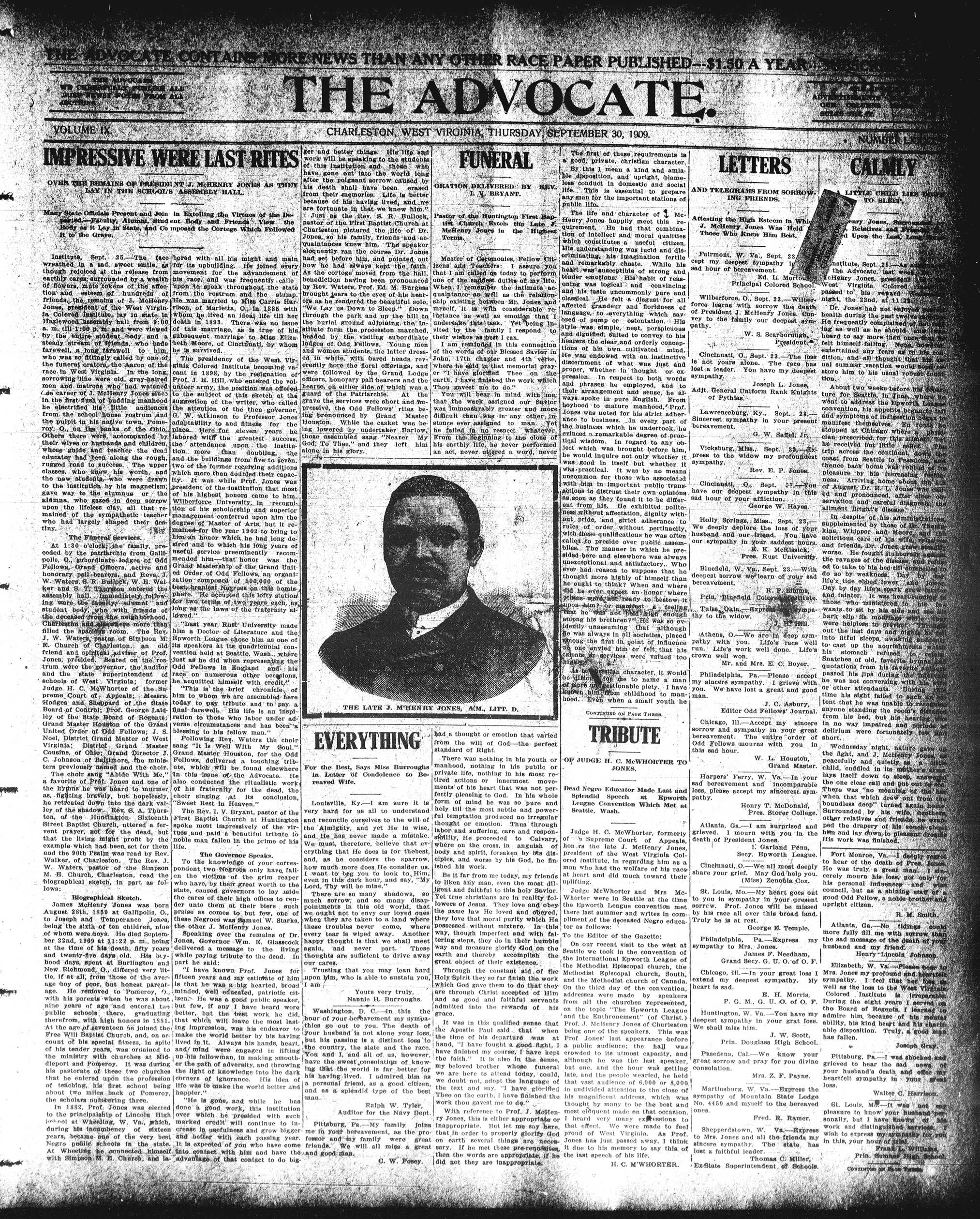
Page text (machine-generated)
Institute, Sept. 25.—The face wreathed in a sad, sweet smile, as though relocated at the release from earthly cares, surrounded by a wealth of flowers, mute tokens of the affection and esteem of hundreds of friends, the remains of J. McHenry Jones, president of the West Virginia Colored Institute, lay in state in Hazlewood assembly hall from 9:00 a.m. till 1:00 p.m. and were viewed by the entire student body and a steady stream of friends, who bade farewell, a long farewell, to him, who was so fittingly called by one of the funerai orators, the Aaron of the race, in West Virginia. In the long, sorrowing line were old, gray-braided men and matrons who had watened so career of J. McHenry Jones since in the first flush of budding manhood he electrified his little audiences from the school house rostrum and the pulpit in his nage村, Pomeroy, O., on the banks of the Ohio. Others there were, accompanied by their wives or husbands and children, whose guide and teacher the deaf educator had been along the rough, rugged road to success. The upper classes, who knew his worth, and the new students, who were drawn to the institution by his magnetsism, gave way to the alumnus or the alumna, who gazed in deep sorrow upon the lifeless clay, all that remained of the sympathetic teacher who had largely shaped their destiny.
The Funeral Services.
At 1:30 o'clock, the family, preceded by the patriarchic from Gallipoli, O, subordinate lodges of Odd Fellows, Grand Officers, active and honorary pall bearers, and Revs J. W. Waters, S. R. Bullock, W. E. Walker and S. T. Thurston entered the assembly hall. Immediately, following ware, the facility, alumni and student body, who with friends of the deceased from the neighborhood, Charleston and Massachusetts more than filled the spacious room. The Rev. J. W. Waters, pastor of Simpson M. E. Church of Charleston, an old friend and spiritual pastor of Prof. Jones, presided. Seated on the rostrum were the governor, the auditor and the state superintendent of schools of West Virginia; former Judge H. C. McWhorter of the Supreme Court of Appeals, Measures, Hodges and Shappard of the State Board of Control; Prof. George Laddley of the State Board of Regents; Grand Master Houston of the Grand United Order of Odd Fellows; J. S. Noel, District Grand Master of West Virginia; District Grand Master Cousins, of Ohio; Grand Director J. C. Johnson of Baltimore, the ministers previously named and the choir.
The choir sang "Abide With Me," a favorite of Prof. Jones and one of the hymns he was heard to murmur as, fighting bravely, but hopelessly, he retreated down into the dark valley of the shadow. Rev. G. A. Thurston, of the Huntington, Sixteenth Street Baptist Church, uttered a fervent prayer, not for the dead, but that the living might profit by the example which had been set for them and the 90th Psalm was read by Rev. Walker, of Charleston. The Rev. J. W. Waters, pastor of the Simpson M. B. Church, Charleston, read the biographical sketch, in part as follows:
Biographical Sketch.
Biographical sketch.
James McHenry Jones was born August 28th, 1859 at Gallipolis, O., to Joseph and Temperance Jones, being the sixth of ten children, nine of whom were boys. He died September 22nd, 1969 at 11:22 p. m., being at the time of his death, fifty years and twenty-five days old. His boyhood days, spent at Burlington and New Richmond, O., differed very little, if at all, from those of the average boy of poor, but honest parentage. He removed to Pomeroy, O., with his parents when he was about nine years of age and entered two public schools there, graduating therefrom, with high honors in 1831. At the age of seventeen he joined the Free Will Baptist Church, and, on account of his special fitness, in spite of his tender years, was ordained to the ministry with churches at Middleport and Pomeroy. It was during his pastorate of these two churches that he entered upon the profession of teaching, his first school being about two miles back of Pomeroy, the scholars numbering three.
In 1882, Prof. Jones was elected to the principalship of Lincoln High school at Wheeling, W. Va., which, during his incumbency of sixteen years, became one of the very best Negro public schools in the state. At Wheeling he connected himself with Simpson, M. E. Church, and la-
bored with all his might and main for its upbuilding. He joined every movement for the advancement of his race, and was frequently called upon to speak throughout the state from the rostrum and the stump. He was married to Miss Carrie Harrison, of Marlotta, O₂ in 1885 with whom he lived an ideal life till her death in 1893. There was no issue of this marriage, as is true of his subsequent marriage to Miss Elizabeth Moore, of Cincinnati, by whom he is survived.
The presidency of the Weak Virginia Colored Institute becoming vacant in 1898, by the resignation of Prof. J. H. Hill, who entered the volunteer army, the position was offered to the subject of this sketch at the suggestion of the writer, who called the attention of the then governor, G. W. Atkinson to Professor Jones adaptability to and fitness for the place. Here for eleven years he labored with the greatest success, the attendance upon the institution more than doubling, the and the buildings from five to seven, two of the former receiving additions which more than doubled their capacity. It was while Prof. Jones was president of the institution that most of his highest honors came to him. Wilberforce University, in recognition of his scholarship and superior management conferred upon him the degree of Master of Arts, but it remained for the year 1902 to bring to him an honor which he had long desired and to which his long years of useful service preeminently recommended him—that honor was the Grand Mastership of the Grand United Order of Odd Fellows, an organization composed of 500,000 of the best, bravest Nigrost on this hemisphere. He occupied this lofty station for two terms of two years each, as long as the laws of the fraternity allowed."
"Last year Rust University made him a Doctor of Literature and the Epworth League chose him as one of its speakers at its quintennial convention held at Seattle, Wash., where just as he did when representing the Odd Fellows in England and, his race on numerous other occasions, he acquitted himself with credit."
"This is the brief chronicle of him to whom we are assembled here today to pay tribute and to pay a final farewell. His life is an inspiration to those who labor under adverse circumstances and has been a blessing to his fellow man."
Following Rey, Waters the choir sang "It Is Well With My Soul." Grand Master Houston, for the Odd Fellows, delivered a touching tribute, which will be found elsewhere in this issue of the Advocate. He also conducted the ritualistic work of his fraternity for the dead, the choir singing at its conclusion, "Sweet Rest in Heaven."
The Rev. I. V. Bryant, pastor of the First Baptist Church at Huntington spoke most impressively of the virtues and paid a beautiful tribute to noble man fallen in the prime of his life.
The Governor Speaks.
To the knowledge of your correspondent two Negroes only have fallen the victims of the grim reaper who have, by their great worth to the state, caused governors to lay aside the cares of their high offices to render unto them at their biers such praise as comes to but few, one of these Negroes was Samuel W. Starks, the other J. McHenry Jones. Speaking over the remains of Dr. Jones, Governor Wm. E. Glasscock delivered a message to the living while paying tribute to the dead. In part he said:
"I have known Prof. Jones for fifteen years and my estimate of him is that he was a big hearted, broad minded, well educted, patriotic citizen. He was a good public speaker, but few, if any I have heard were better, but the best work he did, that which will leave the most lasting impression, was his endeavor to make the world better by his having lived in it. Always his hands, heart, and/ mind were engaged in lifting up his fellowman, in making smoother the path of adversity, and throwing the light of knowledge into the dark corners of ignorance. His idea of life was to make the world better and happier."
"He is gone, and while he has done a good work, this institution over which he presided with such marked credit will continue to increase in usefulness and grow bigger and better with each passing year. It is expected of you who have come into contact with him and have the advantage of that contact to do big
THE LATE J. M'HENRY JONES, A.M., LITT. D.
ger and better things. His life and work will be speaking to the students of this institution and those who have gone out into the world long after the poliant sorrow caused by his death shall have been erased from their memories. Life is better because of his having lived, and we are fortunate in that we knew him." Just as the S. R. R. Bullock, pastor of the First Baptist Church at Charleston pictured the life of Dr. Jones, so his family, friends and acquaintances knew him. The speaker eloquently ran the course Dr. Jones had set before him, and pointed out how he had always kept the faith. As the cortege moved from the hall, benediction having been pronounced by Rev. Waters, Prof. Ed. M. Burgess brought tears to the eyes of his hearers as he rendered the beautiful solo, "We Lay us Down to Sleep." Down through the park and up the hill to the burial ground adjoining the Institute farm the procession marched, headed by the visiting subordinate lodges of Odd Fellows. Young men and women students, the latter dressed in white, with bared heads reverently bore the floral offerings, and were followed by the Grand Lodge officers, honorary pearl bearers and the hearse, on either side of which was a guard of the Patriarchic. At the grave the services were short and impressive, the Odd Fellows' rites being pronounced by Grand Master Houston. While the casket was being lowered by undertaker Barlow, those assembled song "Nearer My God, To Thee," and they left him alone in his glory.
THE LATE J. M'HENRY
EVERYTHING
For the Best, Says Miss Burroughs in Letter of Condolence to Be-reaved Wife.
Louisville, Ky.—I am sure it is very hard for us all to understand and reconcille ourselves to the will of the Almighty, and yet He is wise, and He has never made a mistake. We must, therefore, believe that everything that He does is for the best, and, as he considers the sparrow, how much more does He consider us. I want to beg you to look to Him, even in this dark hour, and say, "My Lord, Thy will be mine."
There are so many shadows, so much sorrow, and so many disappointments in this old world, that we ought not to envy our loved ones when they are taken to a land where these troubles never come, where every tear is wiped away. Another happy thought is that we shall meet again, and never part. These thoughts are sufficient to drive away our cares.
Trusting that you may lean hard upon him, who is able to sustain you, I am
Washington, D. C.—In this the hour of your behaviour my sympathies go out to you. The death of your husband is not alone your loss, but his passing is a distinct loss to the country, the state and the race. You and I, and all of us, however, have the sweet consolation of knowing that the world is far better for his having lived. I admired him as a personal friend, as a good citizen, and as a splendid type of the best man.
Pittsburg, Pa.—My family joins me in your bereavement, as the professor and my family were great friends. We will all miss a great and good man.
C. W. Posey.
Master of Ceremonies, Fellow Citizens' and Teachers: I assure you that I am called on today to perform one of the suggest duties of my life. When I remember the intimate acquaintance as well as the relationship existing between Mr. Jones and myself, it is with considerable reluctance as well as emotion that I undertake this task. Yet being invited by the family I respond to their wishes as best I can.
I am reminded in this connection of the words of our Blessed Savior in John, 17th chapter and 4th verse, where he said in that memorial prayer "I have glorified Thee on the earth, I have finished the work which Thou gavest me to do." You will bear in mind with me, that the work assigned our Savior was immeasurably greater and more difficult than was in any other instance ever assigned to man. Yet he failed in no respect, whatever. From the beginning to the close of his earthly life, he never performed an act, never uttered a word, never
Y JONES, A.M., LITT. D.
had a thought or emotion that varied from the will of God—the perfect standard of Right.
There was nothing in his youth or manhood, nothing in his public or private life, nothing in his most retired actions or innermost movements of his heart that was not perfectly pleasing to God. In his whole form of mind he was so pure and holy till the most subtle and powerful temptation produced no irregular thought or emotion. Thus through labor and suffering, care and responsibility, He proceeded to Calvary, where on the cross, in anguish of body and spirit, forsaken by his disciples, and worse by his God, he finished his work.
Be it far from me today, my friends to liken any man, even the most diligent and faithful to this holy Savior. Yet true Christians are in reality followers of Jesus. They love and obey the same law He loved and obeyed, they love that moral purity which He possessed without mixture. In this way, though imperfect and with faltering steps, they do in their humble way and measure glorify God on the earth and thereby accomplish the great object of their existence.
Through the constant aid of the Holy Spirit they so far finish the work which God gave them to do that they are through Christ accepted of Him and as good and faithful servants admitted into the rewards of his grace.
It was in this qualified sense that the Apostle Paul said, that when the time of his departure was at hand, "I have fought a good fight, I have finished my course, I have kept the faith." It is also in the sense, my beloved brother whose funeral we are here to attend today, could, we doubt not, adopt the language of the text and say, "I have glorified Thee on the earth, I have finished the work thou gavest me to do."
With reference to Prof. J. McHenry Jones, this is either appropriate or inappropriate. But let me say here, that in order to properly glorify God on earth several things are necessary. If he met these pre-requisites, then the words are appropriate, if he did not they are inappropriate.
The first of these requirements is a good, private, christian character. By this I mean a kind and amable disposition, and upright, blameless conduct in domestic and social life. This is essential to prepare any man for the important stations of public life.
The life and character of McHenry Jones happily meet this requirement. He had that combination of intellect and moral qualities which constitutes a useful citizen. His understanding was lucid and discriminating, his imagination fertile and remarkably chaste. While his heart was susceptible of strong and tender emotions. His habit of reasoning was logical and convincing and his taste uncommonly pure and classical. He felt a disgust for all affected grandeur and floridness of language, to everything which savored of pomp or ostentation. His style was simple, neat, perspicuous and dignified, suited to convey to his hearers the clear and orderly conceptions of his own cultivated mind. He was endowed with an instinctive discernment of what was just and proper, whether in thought or expression. In respect to both words and phrases he employed, and to their arrangement and sense, he always spoke in pure English. From Jones was noted for his strict adherence to business. In every part of the business which he undertook, he elevated a remarkable degree of practical wisdom. In regard to any object which was brought before him, he would inquire not only whether it was good in itself but whether it was practical. It was by no means uncommon for those who associated with him in important public transactions to distrust their own opinions as soon as they found it to be different from his. He exhibited politeness without affection, dignity without pride, and strict adherence to rules of order without pertinacity, with these qualifications he was often called to preside over public assemblies. The manner in which he presided here and elsewhere was always unexceptional and satisfactory. Who ever had reason to suppose that he thought more highly of himself than he ought to think? When and where did he ever expect an honor where others were not ready to bestow it upon him? or manifest a feeling that he was not hard enough among his brethren? He was so evidently unassuming that, although he was always in all societies, placed among the first in point of influence no one availed him or felt that his talents or services were valued too highly.
As to written character, it would be difficult for me to name a man or more unquestionable plety. I have known him from childhood to manhood. Even when a small youth he
OF JUDGE H. C. McWHORTER TO JONES.
Dead Negro Educator Made Last and Splendid Speech at Epworth League Convention Which Met at Seattle, Wash.
Judge H. C. McWhorter, formerly of the Supreme Court of Appeals, honors the late J. McHenry Jones, president of the West Virginia Colored institute, in regard him as a man who had the welfare of his race at heart and did much toward their uplifting.
Judge McWhorter and Mrs McWhorter were in Seattle at the time the Epworth League convention met there last summer and writes in compliment of the deceased Negro educator as follows:
To the Editor of the Gazette:
On our recent visit to the west at Seattle we took in the convention of the International Epworth League of the Methodist Episcopal church, the Methodist Episcopal church, South, and the Methodist church of Canada. On the third day of the convention, addresses were made by speakers from all the churches represented, on the topic "The Epworth League and the Enthronement" (of Christ). Prof. J. McMetheny Jones of Charleston being one of the speakers. This was Prof. Jones' last appearance before a public audience; the hall was crowded to its utmost capacity, and although he was the last speaker, but one, and the hour was getting late, and the people weared, he held that vast audience of 6,000 or 8,000 in undivided attention to the close of his magnificent address, which was thought by many to be the best and most elegant made on that occasion. I heard very many expressions to that effect. We were made to feel proud of West Virginia. As Prof. Jones has just passed away, I think it due to his memory to say this of the last speech of his life.
H. C. M'WHORTER.
Wilberforce, O., Sept. 23.—Wilberforce learns with sorrow the death of President J. McHenry Jones. Convey to the family our deepest sympathy.
Cincinnati, O., Sept. 23.—The loss is not yours alone. The race has lost a leader. You have my deepest sympathy.
Joseph L. Jones,
Adjt. General Uniform Rank Knights of Pythias.
Lawrenceburg, Ky., Sept. 28.—Sincerest sympathy in your present bereavement.
G. W. Saffel, Jr.
Vicksburg, Miss., Sept. 23.—Express to the widow my profoundest sympathy.
Rev. E. P. Jones.
Cincinnati, Q., Sept. 23.—You have our deepest sympathy in this sad hour of your affliction.
George W. Hayes.
Holly Springs, Miss., Sept. 23.—We deeply deplore the loss of your husband and our friend. You have our sympathy in your saddest hours. E. K. McKissick. Press. Rust University. Bluefield, W. Vp., Sept. 23.—With deepest sorrow we learn of your sad bereavement. R. P.
Prin. Binefield Colored Institute.
Tulsa, Okla.—Express sympathy to the widow.
J. H. Hill
Athens, O.—We are in deep sympathy with you. Life's race well run. Life's work well done. Life's crown well won.
Mr. and Mrs. E. C. Boyer.
Philadelphia, Pa.—Please accept my sincere sympathy. I grieve with you. We have lost a great and good man.
Editor Odd Fellows' Journal.
Chicago, Ill.—Accept my sincere sorrow and sympathy in your great bereavement. The entire order of Odd Fellows mourns with you in this sad hour.
Harpers' Ferry, W. Va.—In your sad bereavement and incomparable loss, please accept my sincere sympathy.
Henry T. McDonald,
Pres. Storer College.
Atlanta, Ga.—I am surprised and grieved. I mourn with you in the death of President Jones.
Cincinnati, O.—We all most deeply share your grief. May God help you. (Miss) Zenobia Cox.
St. Louis, Mo.—My heart goes out to you in sympathy in your present sorrow. Prof. Jones will be missed by his race all over this broad land. Truly he is at rest.
George E. Temple.
Philadelphia, Pa.—Express my
sympathy to Mrs. Jones.
Chicago, Ill.—In your great loss I extend my deepest sympathy. My heart is sad.
E. H. Morris,
P. G. M., G. U. O. of O. F.
Huntington, W. Va.—You have my deepest sympathy in your grat loss. We shall miss him.
J. W. Scott,
Prin. Douglass High School.
Pasedena, Cal.—We know your great sorrow and pray for you divine consolation.
Mrs. Z. F. Payne.
Martinsburg, W. Va.—Express the sympathy of Mountain State Lodge No. 4450 and myself to the bereaved ones.
Fred. R. Ramer.
Shepperdstown, W. Va.—Express to Mrs. Jones and all the friends my sincere sympathy. The state has lost a faithful leader.
Thomas C. Miller.
Ex-State Superintendent of Schools.
passed to his reward. Went to bed
night, the 22nd, at 11.25.
Dr. Jones had not enjoyed good
health during the past twelve months.
He frequently complained of not
sleeping as well as he should, and was
heard to say more than once that he
felt himself failing. None have
entertained any fears as to the con-
dition, and all thought that his usual
summer vacation would soon be
store him to his usual robust con-
dition.
Rout two weeks before his departure for Seattle, in June, where he went to address the Epworth Lease convention, his appetite began to fall and symptoms of indigestion began to manifest themselves. En route he stopped at Chicago where a physician prescribed, for this alliment, but he received but little relief. The trip across the continent, down the coast from Seattle to Fessington and thence back home was robbed or its pleasure by his increasing feelingness. Arriving home about the 1st of August, Dr. R. L. Jones was called and pronounced, after close observation and careful diagnosis, the aliment Bright's disease.
In despite of his administrations supplemented by those of Dr. Thompson, Whipper and Moore, and the solitous care of his wife, whisper and friends, Dr. Jones grew steadily worse. He fought stubbornly against the ravages of the disease and refused to take to his bed till compelled to do so by weakness. Day by day, life's tide ebbed lower and lower. Day by day life's spark grew tattered and fainter. It was heart-rending to those who ministered to his fawns to sit by his side and see his bark slip its modelling while they were helpless to prevent. Through out the last days and nights he fell into fitful sleeps, awaking suddenly to cast up the nourishment which his stomach refused to tolerate. Snatches of old, favorite hymns and passages from his favorite albums passed his lips during the intercourse he was not conversing with his wife or other attendants. During this time his sight failed to such an extent that he was unable to recognize anyone standing the room's distance from his bed, but his hearing in no way impaired and periods of delirium were fortunately few and short.
Wednesday night, nature gave us on the fight, and J. McHenry joined us peacefully and quietly, as a little child, cuddled in its mother's arms, lays itself down to sleep, answered the one clear call and put out to see. There was "no meaning of the law when that which drew out from the boundless deep" turned again home. Surrounded by his wife, brothers other relatives and friends, he wrapped the drapery of his couch about him and lay down, to pleasant draughts His work was finished.
Fort Monroe, Va.—I deeply regret to hear of the death of Pres. James. He was truly a great man. I sincerely mourn his loss, not only for his personal influences and wise council, but as a shining staff of a good Odd Fellow, a noble brother and upright citizen.
Atlanta, Ga.—No idlings could more fully fill me with sorrow than the sad message of the death of your husband and my friend.
Henry Lincoln Johnson.
Elizabeth, W. Va.—Please bear to Mrs. Jones my profound and heartfelt sympathy. I feel that her loss as well as the loss to the West Virginia Colored Institute is irreparable. During the eight years I served on the Board of Regents, I learned to admire him because of his mental ability, his kind heart and his charitable disposition. Truly, a good man has fallen.
Joseph Gray.
Pittsburg, Pa.—I was shocked and grieved to hear the sad news of your husband's death and offer my heartfelt sympathy in your great loss.
St. Louis, Mo.—It was not my pleasure to know your husband personally, but I have known of his work and distinguished services. I wish to express my sympathy for you in this, your hour of trial.
Frank I. Williams.
CORRESPONDENCE
RONCEVERTE.
Rev. Robinson filled his appoint-
ment here Sunday.
Mrs. Lewis Brinkley visited relatives at Elkins last week.
Alex Brown spent Sunday at Charleston.
Mrs. Elizabeth Brown, Mrs. Nicey Marshall, Mrs. John Eabanks, Mrs. Toliver, Jim Mallory, and Rev. White attended the annual sermon of the Household of Ruth at Alderson Sunday.
Mrs. Mills, of Quninnimont, was the guest of Mrs. N. B. Rose last week.
Mrs. Blanche Brackenbridge, of Marlington, who was the guest of Miss Marcello Rose, returned home Friday.
Rev. Carter, of Harrisonburg, Va., was the guest of Rev. Jefferson last week.
Miss Sarah Dawson, of Lewisburg, returned home last week after a pleasant stay with her sister, Mrs. Debby Terrell.
Mrs. Emma Morton entertained the Ladies-Aid Society Tuesday.
Miss Clara Slaughter returned home after a pleasant visit to Covington, Va. Miss Bessie Lewis gave a social in honor of Y. P. Club Thursday night.
RED SULPHUR SPRINGS.
Miss Ethel Williams was married Wednesday evening, 22nd, to Mr. T. W. Cobbs, who now resides at Bluefield.
There will be a union pic nic here October 2nd, at the M. E. church.
Mrs. Wilson Nickell and sister, Mrs. Scott, left Monday for Princeton.
Miss Pearl Walker and her father have returned home from Parkersburg, visiting her sister, Mrs. Dean.
Rev. J. M. Roan preached a good sermon here Sunday.
Mrs. W. K. Johnson has returned from Ham Creek.
Ernest Walker left Wednesday for Tom's River. There will be preaching Sunday by Rev. O. L. Harris.
HILL TOP.
Miss Fracis Goodwine arrived at Hill Top Sunday to attend the Hill Top school.
Mrs. Clemons went to Mt. Hope on business Monday.
Mr. Davis was in Harvey Monday on business.
Miss Lena Rice visited Mrs. M. E. Davis Sunday.
Prof. J. M. Arter made some pleasant calls at Red Star Saturday evening.
Mrs. J. Young, of Raleigh, is visiting friends in Hill Top.
Mr. Traynham, of Virginia, is visiting his sister, Mrs. Clemmons.
The entertainment given at the Odd Fellow's Hall was a success.
Mrs. Trynham is on the sick list. Rev. Epps was a pleasant caller at Hill Top Monday morning. Erskine Turner will go to his home in Staunton this week. The M. E. Sunday School was for the first time held at the Odd Fellow's Hall Sunday at 2:30. There was a nice number present for the beginning and everyone seemed to enjoy the lesson.
CARBON.
J. L. Green was called to Caperton Monday by the death of his daughter. F. W. Williams and Mrs. P. A. Parham were in Montgomery Tuesday on business. Mrs. Lucinda Martin, who has been at the bedside of her daughter, Mrs. Nannie Wilson, returned to her home at Birdville, Va. Thursday.
Rev. L. W. Mayo and wife attended services at Wevaco Thursday.
Mr. and Mrs. Hairston, of Leewood spent Friday and Saturday here.
Henry Carter spent Saturday and Sunday in Montgomery.
Winston Railey spent Saturday and Sunday in Charleston.
Rev. R. D. W. Meadows preached Sunday morning at 11 o'clock and at 3 p. m. installed Rev. L. W. Mayo as pastor of the Mt. Nebo Baptist church.
R. C. McIver and wife, of Wevaco, attended services here Sunday.
Rev. L. W. Mayo filled the pulpit Sunday night at the Mt. Nebo Baptist church.
PAGE
Rev. N. E. Smith filled his regular appointment Sunday.
Miss Georgia E. Banks returned to Pagé to open school Monday.
The church gave an entertainment Saturday night. It was a success, $21.75 being made.
Rev. N. E. Smith and Miss Alice Boulding were guests of Mrs. H. H. Washington at Kincald.
R. and Mrs. Browder, of Montgomery, was here Monday on business.
John Carter, of Carbon, was here visiting Joe. Walker Sunday.
R. W. Chead and R. B. Jones made a pleasant trip to Roanoke last week.
Miss Beatrice Caul gave a birthday party Tuesday at her home.
George Carter, of Rush Run, has returned to Page.
spent Monday the guest of his niece, Mrs. L. P. Scott.
Miss Elizabeth Green will open school here Tuesday.
Mrs. Laris and Gary Morris of Fire Creek, were visiting friends here Saturday.
D. D. and J. D. Morris, of Fire Creek, were business visitors here Saturday.
Ms. Julia Haskins, Mrs. Anhie Jasper and Robert Harkins, of Pennbrooke, were calling on friends here Tuesday.
Those who attended the funeral of Mrs. Mary Jones, at Nuttall Sunday were J. H. Scott, L. P. Scott, Harvey Fountain, R. Goins, W. A. Allen, A. J. Cary, Jack Scruggs, Madison Jones, Misses W. A. Freeland, Fanny Cary, Leila Clark, Virginia Goins and N. B. Scott.
Mrs. Leila Anderson and children have returned to Hinton, after spending two weeks with her parents. The Masonic Lodge will hold Memorial services in honor of R. D. Robinson, Sunday, October 9th.
ST. ALBANS
Miss Ruble Carr was in Charleston on business Friday. Miss Georgia E. Banks went to Page Friday to take up her school on Monday.
Quite a number went to Institute Saturday to attend he funeral of J. McHenry Jones.
Miss Cliria Stewart, Ada Burks, Revs. S. A. Thurston, I. V. Bryant and Prof. J. W. Scott passed through Saturday, enroute to Institute to attend Prof. McHenry Jones' funeral.
Miss Gertrude Mills, of Huntington, spent Sunday with Cornelius Spurlock.
A large crowd went down to Winfied Sunday on the Steamer Evergreen, where two services were conducted, morning and evening.
Rev. J. W. Robinson was the speaker for the day and preached two able sermons to a large and appreciative audience.
POINT PLEASANT.
John H. and Thomas F. Davis spent Sunday in Gallipolis the guests of friends. Mrs. R. W. White, of Institute and Mrs. Chara Holmes and daughter, of Charleston, were guests of Mr. and Mrs. Joseph Alexander Sunday. Rev. G. A. Muse preached two very able sermons Sunday. He was accompanied here by his wife. The Musical given Wednesday evening by the young ladies and gentlemen, of the M. E. church, proved to be a success in every way. Mrs. Wm. Holmes and daughter who were guests of her parents, Mr. and Mrs. Andy Smith, Saturday and Sunday. Russell Colston left for Chicago Monday to spend the winter with his aunt, Mrs. Wm. H. Roberts.
The news of the death of Press, J. McHenry Jones, came as quite a shock to his many friends here. He has addressed several graduating classes of Langston High School. Ottie Adams, of Urbana, Ohio, is in town the guest of Miss Augusta Rison. Mrs. Agnes Wright, of Raymond City, is guest of her sister, Mrs. Tobe Craig. Mrs. Wm. Bell, who has been the guest of her brother for the past week, left for her home on Kanawha Monday. The infant son of Mr. and Mrs. Will Williams died Wednesday, and was buried Thursday at Henderson. Misses Ida and Mary Craig, Mithue Colston and Augusta Rison attended the 22nd celebration at Bidwell, Ohio.
Clyde Colston, Frank Bell and Robert Johnson spent the 22nd at Huntington and Clyffslde Park while there they were guests of Wm Isham.
HUNTINGTON
Rev. Nellie G. Hale, the evangelist, who has been preaching at the A. M. E. church for the past week, closed her meeting last Monday night with a grand feast, which was well attended.
Mesdames Goebel and Taylor, of Ashland, visited friends here Sunday.
A. D. Brown, of Bluefield, visited here several days last week, while enroute home from Washington, D. C., where he spent about ten days.
Miss Ethel Bryant passed through here this week enroute to Kimberly where she will resume her work as teacher.
Miss Evelyn Willis became the bride of Bernard James at Buxton, Iowa, Wednesday, September 22nd.
Rev. and Mrs. Thomas have moved here for temporary residence.
Miss Lula James, who was indisposed last week, several days, is able to resume her place at Douglas school.
A number from here attended the funeral of Prof. J. McHenry Jones at Institute Saturday.
Ed Rose, of Columbus, Ohio, who visited friends here last week, returned home Sunday.
Miss Marceline Minggrim supplied at Douglas school during the absence of Miss James.
Little Eva Fitzgerald, who has been quite sick, is much better at this writing.
Harry Alexander, who spent several days here with friends, last week, and attended the Emancipation Celebration at Clyffside Park, returned to his home, Gallipolis, O., Thursday.
Miss Dixie Williams was the guest of Mrs. A. B. Hughes last week while enroute to Hartshorn college at Richmond, where she teaches.
Miss Revella Hughes returned to Hartshorn college Thursday, after spending her vacation here with her parents.
Theodore Palmer, of Gallipolis, O., was the guest of friends here several days last week.
Mesdames Edmonds and Washington, of Parkersburg, spent Sunday with their cousin, Mrs. T. B. Smith.
CLARKSBURG.
Charles, the eldest son of Mr. and Mrs. Jordan Howard died Sunday morning at St. Mary's Hospital after a week's illness of typhoid fever. The funeral took place Tuesday afternoon.
Don Jones, of Fairmont, spent Sunday here calling on friends.
Mrs. Thos, Cambric and daughter, Mrs. Ed, Henry, will leave this week for Institute and Charleston for a short visit.
Dr. E. L. Young has returned from Philadelphia and different points in the east.
Mrs. B. T. Turner is on the sick list.
Lee Robinson lies seriously ill with typhoid fever at his home on Maud street.
Dr. E. T. Jones is visiting relatives at Dunbar, Pa.
J. H. Harris, of Los Angeles, Cal., is visiting his sister, Mrs. M. Patton.
The Missionary Circle of Mt. Zion Baptist "Church presented the following excellent program Monday night: Instrumental Solo, Miss Eulah Patton; Address, Rev. S. P. West; Vocal Solo, Miss Velma Snyder; Debate, "Resolved, That Industrial Education is More Beneficial to the Negro than Classical Education."
J. L. Ruffin is visiting his daughter, Mrs. Frank Jefferson, at Steelton, Pa.
Mr. and Mrs. Samuel Nowlin and children, of Wheeling, spent a few days here last week with relatives.
A number of persons from Weston and Grafton joined with the Elks in the celebration exercises at the fair ground Wednesday.
WELLSVILLE, O.
Mrs. Hiram Keys and little son, Kenneth, of Ashtabula, were guests of her aunt, Mrs. J. L. Jones, for several days last week.
Miss Mary Spires, who spent the summer here with her aunt, Mrs. Elmer Spires, returned to her home in Topeka, Kansas, Friday.
Mrs. Emma Keys and little son, of East Liverpool, spent last week with her mother, Mrs. Samuel Smithers.
Guy Gibson, who has been, out of the city for several months, has returned.
Miss Mary Alice Payne will leave in a few days for Virginia, where she will spend the winter visiting relatives.
Miss Margaret Eleanor Moten, formerly of Harrisonburg, Va., but who has made her home for some time past with Mrs. Brookman, of the Highland James A. Brown were united in marriage on the evening of the parsonage of the First Lutherian Church, Rev. W. J. Hauk, officiating. The bride was briefly gowned in white. They were gone to housekeeping on Centra
SMITHERS
C. H. Toles remains very at his home.
Mr. and Mrs. C. L. Lewis returned home from a wind.
Rev. R. D. W. Meadowington, was the guest of Mrs. B. B. Daulton, last we.
Mrs. W. C. James has been on the sick list for a few days.
Miss Pearl Scott, of Burnwell, was the guest of Miss H. E. James, last week.
Mrs. B. B. Daulton left for Virginia Saturday, to spend four weeks visiting relatives and friends.
Rev. F. E. Smith is having a revival at Longdere.
The Smither's people are much pleased with the new teacher, Mrs. E. B. Pack.
KANAWHA CITY
Miss Mary F. Page, of the W. V. C. I., was the guest of her parents Sunday.
T. R. Johnson aws visiting his family here Saturday and Sunday.
Miss Mattie Martin has returned home after spending the summer in Charleston with relatives.
Miss Ivory Woods has returned home from Ohio, where she was the guest of relatives for several weeks.
Robert Green and son Napoleon, of Cabin Creek, are visiting their family.
Rev. Jones, of Charleston, was a caller here Sunday.
Mrs. J. W. Woods was a business visitor in Malden last week.
Rev. J. W. Page was hailed to Montgomery Monday by the death of his sister, Mrs. Alice Hall.
South Charleston
1169 PEOPLE IN SOUTH CHARLESTON NOW
FACTORIES EMPLOYING OVER 400 MEN Dunkirk Window Glass Co. Banner Window Glass Co. Kanawha Chemjcal Engine Mfg. Co.
Buy now before the prices go up. They go up when the
Terms: 1-10 cash, balance in monthly payments to suit. Discount for all cash. Kanawha Land Co. Room 501 Charleston National Bank Building
Bell Phone 750; Home Phone 1214
Mrs. Homer Phillips and daughter, Hazel, of Plymouth, are visiting relatives and friends in Glouster, O. Mrs. Geo. McKinney, of Black Betsey, has returned home after a few days visit to friends in Bidwell, Ohio. Mrs. Addie Carry, of Raymond City, was the guest of her Aunt, Mrs. John Ross, of Black Betsey, Tuesday. Mr. and Mrs. Hale Dickerson and son Edward have returned home after a week's visit in Ohio. The young people of the Sunday School, have organized a singing, school which will meet every Tuesday evening. Geo. Austin, of Raymond City, was in our town Monday on business. Chas. Surgoins, of Bancroft, is on the sick list at his-writing.
NOTICE is hereby given that after thirty days from the first publication hereof, the undersigned, on behalf of themselves and associates, will make application to the Mayor and Common Council of the Town of Pratt, Kanawha county, West Virginia, to grant to the undersigned, their executors, administrators, successors and assigns, for themselves and associates, the right and privilege to use the streets, alleys, bridges, rights of way and other property belonging to the said Town of Pratt, or under the control of the Mayor and Common Council of the said Town of Pratt, for the period of fifty (50) years, for the purpose of constructing, equipping, maintaining and operating an interurban and street railway thereon.
BOYS! GIRLS! COLUMBIA BICYCLE FREEL! Greatest offer out. Get your friends to subscribe to our magazine and we will make you a present of a $40.00 Columbia Bicycle—the best made. Ask for particulars, free outfit and circular telling "how to start." Address "The Bicycle Man." 29-31 East 22nd Street, New York City, N. Y.
PATENTS
premium obtained in all countries OR BOE FEE.
TRADE-MARKS, Creatats and Copyrights regi-
lated, and the City, Model of Rights.
FREE REPORT on patentability. Patent pre-
cedence. REFERENCES.
Send 2 cents in mailed book
on BOE TO OBTAIN and SELL PATENTS.
Which ones to get a partner,
patent law and other valuable information.
D. SWFT & CO.
PATENT, LAWYERS.
303 Seventh St., Washington, D. C.
Mr. and Mrs. F. D. Page, C. A. Page and Miss Ivory Woods attended the funeral of Prof. J. McHenry Jones, at Institute, Saturday.
John Lawson sustained serious injuries Friday while at his work. Mr. Lawson was removed at once to the Charleston General Hospital where he is having the best of attention.
C. A. Page left Monday to take charge of his school at Moundsville.
Mrs. Callie Taylor, of Ashland, Ky., visited her parents last week.
Aquila Page spent Sunday here with relatives.
W. H. Jackson, of Page, spent Saturday and Sunday the guest of his wife and parents.
Mrs. R. B. Johnson was in town Wednesday.
Emanuel Russ visited his sons at Crescent, Sunday.
G. L. Jackson was at Fayetteville last week.
BANCROFT.
The young men of Plymouth, entertained Wednesday night at the residence of Mrs. Maria Skanks, in honor of Miss Hare, of Charleston, and Mrs. Washington, of Winfield. Games and music were the past time of the evening.
Nick Ferry and Arthur Pierson, of Raymond City, were guests of Dr. and Mrs. M. T. Sindair Friday. Chas. Harris, of Black Betsey, was calling on friends at Bancroft Sunday.
Dr. M. T. Sinclair was called to Poca Monday on professional business.
Edward/Hicks spent Sunday at Plymouth the guest of friends
Mrs. John Ross was shopping in Charleston Tuesday.
Mr. and Mrs. Mosby's little daughter Alice, who was reported sick last week, is much better at this writing.
Mrs. Edward Hicks and Mrs. Joe Sawyers of Black Betsey, were calling on friends in Bancroft Sunday.
Mrs. Anna Willey, of Middleport, Ohio, is visiting her daughter, Mrs. Sylva Steward, at Plymouth.
The Missionary Society met with Mr. and Mrs. Richard Smith, of Plymouth, Saturday afternoon. After the regular routine of business refreshments were served by the hostess.
Mr. and Mrs. Wm. Mickens and Mrs. H. A. Jones, Miss Stella Smith, John Brown and Homer Phillips attended the Basket meeting at Winfield, Sunday.
Mr. and Mrs. John Cyrus's little son Emmons, is confined to his home with tonsilitis. Miss Stela Smith, of Charleston, is visiting her cousin, Mrs. Wm. Mickens, of Plymouth, this week.
&
NOTICE!
CHARLES K. M DERMOTT.
W. E. BEARDSLEE.
9-16-4t
Beef, Veal, Mutton, Pork Fresh Pork Sausage OUR OWN MAKE.
Try our machine sliced
The best qualities in all the popular kinds of Cheese
We want your patronage for we have complete stock in our lines and you can get it when you want it most.
Washington, Sept. 28.—No question in geology has been more obscure than that of the origin of the hydrocarbons, sephalt, oakkerite, petroleum and natural gas. Although certain facts of occurrence and certain results of experiment are well established, the interpretation to be placed upon them is in doubt. The most orthodox opinion at the present day is that a part of the natural hydrocarbons is of organic origin and a part also of inorganic origin, and the latter comes to estimating the relative importance of the two portions there is no intimacy. On the whole the hypothesis of organic origin is the more fashionable; yet the rival view, originating with Alexander von Humboldt, is held by such living authorities as Sir Archbald Gekle; Mr. de Lapparent, Mr. Tschermak, and Mr. Edward Suess. In bulletin 401 of the United States geological survey Mr. George F. Becker reviews the evidence. Although there are few hydrocarbons which taken singly might not be explained on the hypothesis of organic Mr. Becker finds the cases in which hydrocarbons are associated with igneous phenomena so numerous and so diverse in character as to preclude the suggestion of merely fortuitous collocation. The evidence is mainly cumulative, but, it has so accumulated and is so consistent as to carry conviction. Most of the hydrocarbons accompanied by igneous phenomena must, he infers, be of organic origin, and the quantity of an acquired must be very great. This conclusion does not preclude the importance of the indubitably organic bituminous shales, nor does it immediately afford a means of accounting for the great petroleum accounts.
Some investigators regard the hydrocarbons as original constituents of the earth; others, and these are the more numerous, think them due to the decomposition of carbides of iron, or of other metals, by water. Practically all iron, whether artificial or native, contains combined carbides of iron, and other metallic carbides, though easily the laboratory, have not yet been detected in the earth. While terrestrial iron is widely disseminated (Mr. Becker records six new localities in the United States), meteoric waters seldom penetrate many thousand feet from the earth's surface; and this fact has been a serious objection to Mendeleef's hypothesis of petroleum genesis from iron carbide and water in Stiss chemist, Mr. A. Brun, has made the statement that, by heating ammonium chloride "with iron carbide, a paraffin-like substance was obtained accompanied, by gaseous, hydrocar-
FUNERAL
showed unmistakable signs of genuine piety. Even before he was old enough to attend public school he showed indications of a burning thirst for knowledge. At the public school he stood at the head of his class in every branch of study. While even a boy he exhibited characteristics uncommon to childhood. He sought the company of men instead of boys. Professors of schools, ministers of the gospel and men of matured minds were his companions. While yet, a boy in tender years he was ordained to preach the gospel and hold great audiences spellbound. I have carefully watched his career and I have been in close touch with him all during these years. His whole life has been one of an upward march.
He has measured arms with the intellectual giants of this great country. He crossed the ocean and mingled with the highest types of foreign lands, was there weighed in the balance but was not found wanting. As a teacher he has been one unbreaken chain of success. He has taught for over thirty years to my personal knowledge and to my recollection has spent that time in three different schools. In this he glorified God on earth and finished his work. He was an uncompromising champion of the rights and privileges of his race. Like Moses he refused to wear an Egyptian crown while Israel ground beneath the goshen chains. His voice has been heard from the Atlantic to the Pacific, from the lakes to the gulf. In newspapers and magazines his pen has figured on every great occasion in this country. He begged no one for a hearing, but like Lovejoy said, "I will be heard." You will all agree with me that from his first introduction to you as president he has had a deep and habitual impression of his great responsibility as an officer of the institution. For his pupils he cherished a sincere and paternal affection. He was always solicitous for your improvement, morally, socially, and intellectually.
He has so lived and walked and ruled in your midst till you are compelled to look back from man and womanhood as you shall occupy the exalted stations of life and say truly that there was giants in those days. The Lord grant that the surviving professors and all their successors in office and all whose duty it may be to guard and advance the welfare of this institution may keep in mind the paramount importance of preparing men and women for future usefulness and practical goodiness. We are so constituted that we cannot repress our grief when a good man dies.
bons and free hydrogen." New ammonium chloride is very abundant in volcanic emulations and undoubtedly exists at great depths. Mr. Becker has conducted laboratory experiments on its behavior with native terrestrial iron from Ovikat, Greenland, and found that the greater part of the carbon of this iron was converted into hydrocarbons.
It is highly probable that the earth contains a nucleus of metallic iron, the barysphere, but Mr. Becker thinks this too deeply buried to be concerned in the genesis of oil. On the other hand, the igneous rocks to contain iron analogous to "shot melted in slag, clouds of particles too small (o sink through the pasty mass when it coalesces fusion. It is to such metal, in the author's opinion, that supporters of the inorganic hypothesis must took for the origin of oil.
This view led him to compare the distribution of petroleum with the irregularities of the direction of the compass needle (magnetic declination). These irregularities are due to various causes, one of which is the neighborhood of metallic iron. Somewhat to his astonishment, he found very marked disturbances of the needle in the principal oil fields, while there are many regions of disturbance which are beyond a doubt independent of oil. Bulletin 401 contains a map showing both the oil field after D. T. Day) and the magnetic declination (after A. L. Baner). Mr. Becker sums up as follows: "Study of the map accompanying this paper justifies the statement that the coincidences between the occurrence of petroleum and local disturbances of the compass needle are too numerous to be attributable to mere accident or chance. They must therefore be a direct or an indirect historical connection between the two phenomena in the regions of coincidence.
"None of the hypothesis of petroleum genesis is proved by the relations shown on the map. These relations, however, are compatible with the supposition that the great oil deposits are generated from iron and carbon or without the agency of water. Of these alternatives the latter is the more plausible.
"What the map does prove is that petroleum is intimately associated with magnetic disturbances similar to those arising from the neighborhood of minerals possessing sensible attraction, that is, iron, nickel, cobalt, or ammonite. Henceforth no geological theory of petroleum will be acceptable which does not explain this association."
Society feels the vacuum when an educated mind is withdrawn from its service forever. We feel today that a great hurricane has swept through the forest of humanity and a stately tree has fallen. With us in person, Prof. J. McHenry Jones is no more. He has glorified God on earth, he has finished the work God gave him to do. He has no part nor lot in all that is done under the sun. No more for him the song of love, the voice of gladness, the cup of sorrow and the load of care. No more for him the beauty of spring, the splendor of summer, the glory of autumn, the uncrowned majesty of winter.
Swift flying wheels have borne him from our presence to return no more. The swift flying wings with which his spirit took flight, the chrysalis felt the rays of the sun which called it into being, heard the prancing steeds of God's fiery chalot fresh from the livery of Glory passing through the hall of his dwelling, broke through its bounds and rose up from earthly conditions to those luminous spheres where higher destinies awaited its approach. His body will soon rest in yonder city of the dead overlooking the city of the living where the cedar and weeping willow will sing requelms over him as Jong as time endures. But "he has glorified God on the earth, he has finished the work God gave him to do."
Brethren and sisters and friends, permit me to say that a man has been taken from among us of rare excellence of character. A man whose amitable disposition, pious example and diligent, unremitting services have been and will be an inestimable blessing to this institution as well as to the cause of Christ. Our first duty under this afflictive dispensation is cordial, peaceful and entire submission to God, the only all wise, whose dispensations are perfect and right.
In this visitation of his providence God has come near to this bereaved widow and these surviving brothers, as well as to this institution and a host of friends. The loss they feel today I shall not attempt to describe. But you will utter no words of complaul, nor give place to any feelings of disquietude. You know that the Lord God omnipotent reigneth and doeth His will and that His will is always just and right. My prayer for you is that God may strengthen you in your affliction. If I our tender grief the question will arise "What shall we do without our true and tried friend?" The answer is "Bless be God, our rock" and pray for grace which will be sufficient for us. With these few thoughts we bid Prof. J. McHenry Jones farewell.
Time will roll on in its stately march to the. Judgement; flowers will spring up upon his grave; the
storm will engend the curry upon it, morning will great it with its earliest light; night will crown it, with her stars; and the earth rolling in her great orb of infinite space will bear his dust with hers till the mighty arch-angel of the skies shall blast the last expiring breath of time and the infant cry of an eternity shall begin.
The immortal Garfield once said, "A noble life crowned with heroic death rises above and outlives the pomp and glory of the mightiest empires of earth."
Such a life was that or J. McHenry Jones, Yee, when the history of the world's greatest benefactors shall have been written, the volume will be incomplete without the name of this honored servant of God and his people. He has reared a monument more lasting than bronze statues, more enduring than marble shafts, and higher than the royal pyramids which cannot be destroyed by wasting rains or sweeping hurricanes, the series of countless ages on the flight of eternal years. Let us imitate his noble example. Do you ask me how? I will answer in the language of the immortal Bryant, "So live that when the summons comes to join that innumerable caravan which moves to that mysterious realm where each shall take his chamber in the silent halls of death. Thou go not like the quarry slave at night scourged to his dungeon, but sustained and soothed by an unfaltering trust, approach thy grave like one who wraps the drapery of his couch about him and lies down to pleasant dreams."
LETTERS
CONTINUED FROM PAGE ONE
Montgomery, W. Va.—With feelings of deepest sorrow we have learned of your recent loss. You have our sincere sympathy in your affliction.
Mr. and Mrs. H. H. Railey.
Montgomery, W. Va.—I am shocked at the sad news of your husband's death. He was one of my best friends. His ability commanded the respect of all who knew him. Please accept my heartfelt sympathy in your great bereavement.
Principal Langston High School,
Richmond, Va.—We bow with you
in grief because of the death of a
great and useful man.
W. P. Burrell.
Point Pleasant, W. Va.—it is
with deepest sorrow and regret that
I learn of the death of your husband.
I sympathize with you in
your bereavement and commend you
to the care of Him who alone can
soothe your sorrow.
J. W. Robinson,
Atlanta, Ga.—inose of us who
knew your husband admired him for
his character, his ability and
his brotherliness. His life was a
blessing and his influence will continue.
I pray that the God of our
faith may continue to keep and bless you.
J. W. E. Bowen,
Pres. Gammon Theological Seminary.
Wheeling, W. Va.—My heart goes out in sympathy to you. In the hour when the clouds of sorrow necessarily are hovering over you, I can but commend you to our Heavenly Father, who can bind the broken heart and comfort those that mourn.
Charleston, W. Va.—My wife joins me in deepest sympathy in your present hour of bereavement. We sincerely hope that the proud remembrance in which he is and always will be held in West Virginia and elsewhere, and the record of his high and valued public service may come as a boon to you in your sorrow, and may in time lighten the burden you are now called upon to bear.
Middlepart, O.—My wife joins me in sympathy with you in this, your very sad bereavement. It is the Lord's will and you must bear it the best you can. May the Lord be with you till you meet him again.
S. B. Allen.
Monongahela, Pa.—You have my most sincere sympathy in the loss of your husband, but I feel assured it is heaven's gain.
Charleston, W. Va.—Accept my heartfelt sympathy in your great beaement. This is a great loss to you but a greater loss to our race. Knowing that the soul is at peace, I pray that you may be consoled.
C. H. Gray.
Frankfort, Ky.—I beg to express my profound regret with which I learned of the most untimely death of your distinguished and scholarly husband, and to tender to you my sincere sympathy. In his death the race has lost one of its bravest and most valued leaders, and West Virginia, its foremost colored citizen. Knowing him as I did * * * * I can but feel, in the lines of the poet, that: "When the sun in all his state, Illumed the eastern skies, He passed through Glory's morning gate, And walked in Paradise."
E. E. Underwood.
Charleston, W. Va.—I was most
paintfully passed this morning, when I read of the very untimely death of your beloved husband. I feel that the race has suffered an irreparable loss, and that one of its brightest constellations has disappeared at a time when we could least afford to be deprived of the great light he was shedding. * * * * * * I wish to convey to you my deepest sympathy in this your very sad hour and to commend you to Him who has a splace for every broken heart. T. G. Nutter.
Roanoke, Va.—It is with deep sorrow and regret that I have just learned of the passing of your dear husband and one of my dearest friends. I wish to assure you that you have my deepest sympathy, in this, the sad hour of your sore bereavement. I pray that our common Savior, who says: "I am the resuscurrection and the life" may comfort you as man cannot. May the hope of a happier meeting in "the sweet bye and bye" sustain you in the hour of your grief.
Charleston. "While the lord has plucked your husband, the bright blossom, from your home, it is for a purpose none of us dare divine. He alone can pour balm upon your crushed heart at this sad hour. The holy joy is yours of knowing that he is sleeping in the arms of the blessed Master, awaiting your coming. You have my hearttelt sympathy in this, the most trying and saddest hour of your life."
(Simpson Epworth League Chapter).
Whereas; It pleased God in his allwise providence to remove by death our dear friend and brother, Prof. J. McHenry Jones, we bow in humble submission to Him who doeth all things well.
Resolved, that the Epworth League of Simpson M. E. Church, of Wheeling, W. Va., has lost one, who was organizer of the League and its first president, one of its best and oldest members.
Resolved, that we mourn the loss of one so highly esteemed as a faithful and zealous worker.
Resolved, while we deeply mourn the loss of our dear brother, yet his good work will ever live. To the dear wife and relatives of our deceased brother we extend our heartfelt sympathies in this sad hour of your bereavement.
Resolved, that a copy of these resi-
tutions be spread on the minutes of
the Epworth League and a copy be
sent to the bereaved wife and rela-
tives.
"Sleep on beloved; sleep on and take
thy rest.
Lay down, thy head down, the
Lay down, thy head upon the
Savior's breath!<sup>12</sup>
We loved the well, but Jesus loved
the best.
Good.
Whereas, God in his infinite wisdom has seen fit to remove from his earthly home our friend and organizer, Prof. J. McHenry Jones, the one whose labors and services to this community have so challenged our admiration that to know of his untiring work was to love him and Whereas, we, the Alumni of Lincoln School, feeling and knowing that the success of this institution and organization is due almost wholly to his labors and Whereas, we, with the state and community in which he gave so many useful years of his life, so deeply mourn the loss of our friend, therefore be it
Resolved, that we extend our sympathy and condolence to the bereaved widow and deprived community and implore that their loss is Heaven's gain.
Be it further resolved, that a copy of these resolutions be spread upon the minutes of this association and a copy be sent to the family and to the local papers.
Wheeling, W. Va., Sept. 24, 1909.
(Faculty West Virginia Colored Institute.)
Whereas: It has been the pleasure of the Almighty, to call from labor to reward our revered President and friend, J. McHenry Jones, and,
Whereas: His life has been devoted to the education of his people, working at all times for their best interest, and for the production of useful, God fearing citizens, and,
Whereas: In his crossing the bar, the West Virginia Colored Institute, has lost a faithful father, the state a useful citizen, and the race a great leader.
Be it resolved, That we, the faculty of the West Virginia Colored Institute, out of respect and reverence, for our late president pass the following resolutions:
1st. That as an educator, President Jones was a man of culture, of broad and considerate views, and a man whose influence was felt throughout the nation.
2nd. That as president of the West Virginia Colored Institute, he was steadfast to one ideal—that of making the institute the greatest possible force for good to the race and to the state.
3rd. That in his relation to the faculty, he endeavored to act in such manner as to look kindly upon the
errors of each, to commend their virtues and to exhibit those rare traits that stamped him as a leader. 4th. That he was a christian gentleman, and by precept and example strove to extend the Kingdom of the Master and to prove that he is ever ready to save those that trust Him to the uttermost. 5th. That we extend our heartfelt sympathy to the widow in her hour of sorrow and loneliness, knowing that she will miss his companionship, his clinging love and his protection, and to his affectionate brothers and weeping relatives. 6th. That these resolutions be published in the Advocate, the Mail, the Gazette, the West Virginia School Journal, McDowell Times, Pioneer Press, the Educator, and that they be made a part of the permanent records of the school, and that copies be sent to members of the family.
W. H. Lowry,
Chas. E. Mitchell,
I. R. Whipper, M. D.
Fannie C. Cobb,
Margaret M. Lowry,
Byrd Prillerman,
S. H. Guss,
E. M. Burgess,
Charlotte R. Campbell,
Austin W. Curtis,
Solomon Brown,
Joseph W. Lovette,
James R. Patton,
Maud Jackson,
Jessie F. Embry,
Mary Eubank,
Albert G. Brown,
E. A. Dorsey,
J. M. Canty,
George Collins.
Eulogy on J. M. McHeury Jones
(By J. C. Johnson, G. D.)
I am glad that I am here on the part of the sub-committee of managers of the G. U. O. of O. F. of America to express our high esteem for this, our friend and brother, ex-Grand Master, J. McHenry Jones. A great man he was. No man has given more of his time in building this man. He was a great thinker, his order, and his greatest ambition can see to it reach the height of great achievements. He always looked to the future. His loss will be felt throughout our fraternity. I loved him and esteemed him as a great leader. He was bold, astute, and energetic on his field of battle. He was a genius of the constructive order and towered high among the giants of our order. His memory is embalmed in respect. Live and survive. Like one who wraps the drapery of his couch about him, he has laid down to pleasant dreams. "As for man, his days are as grass. As the flower of the field he flourisheth
For the wind passes over it and it is gone,
And the place thereof knoweth it no more."
Resolutions of Meridian Lodge No.
34 on the death of R. D.
Robinson
Whereas, The great and supreme Master of the Universe, has in his infinite wisdom, seen fit to call from labor to reward, our worthy Grand Master, R. D. Robinson.
Be it Resolved: That while his place in our organization and in our hearts will be difficult to fill, we bow in humble submission to Him who desth all things for the best.
Resolved: That we extend to his wife and bereaved ones our heartfelt sympathy, and commend them to Him, who has promised to be our refuge.
Be it further Resolved: That a set of these resolutions be sent to the wife of the deceased, a copy be transcribed on our minutes, and copies be published in the Advocate and McDowell Times.
F. H. Jackson, W. M.
W. B. Crenshaw, S. W.
Clifford Murray, J. W.
E. L. Morton, Secretary
LOSS
To the State, Thinks Judge Atkinson, Was the Death of Prof. J. McHenry Jones.
Charleston—You have my sincere sympathy over the untimely death of your distinguished husband. He was one of my truest and best friends, and I always stood by him. The stint has met with a distinct loss by his passing. I regret very much that I cannot be present at his funeral.
Ex-Gov. G. W. Atkinson,
Judge U. S. Court of Claims.
MOST USEFUL
And Valued Citizen, is What Booker T. Washington Thought of J. McHenry Jones.
New York, Sept. 23.—I have just heard of the death of your husband. I desire to express your my deep sympathy and sorrow. He was a most useful and valued citizen and I esteemed him as a warm, personal friend. The race loses much in his death.
Harrisburg, Pa., Sept. 29. —The tennia annual session of the East Pennsylvania Conference of the United Brethren Church opened here today, to continue until next Monday. The attendance includes many prominent divines and educators of the denomination.
DON'T NEGLECT YOUR EYES
The bright rays of the Summer's Sun is trying to the eye and slight defects of vision will grow rapidly worse.
You cannot afford to neglect so important an organ as the eye. You can get along very well with a wooden leg or false teeth, but there is no substitute for the natural eye. Especially should the eyes of the young be looked after carefully. It costs nothing to have the eye examined by us. Trust none but the most CAREFUL and SKILLLFUL optician. Traveling spectacle vendorss not only will probably not help you, but will probably do you harm.
A deal was closed Tuesday afternoon by which the fixtures of the Eagle theatre on Capitol street passed into the hands of a number of colored men who have put their means together to provide the Negroes of Charleston with what they have long wanted—a place of amusement. The Advocate learns that it is the intention of men interested to remodel a room which has been leased on Summers street, near Kanawah, and to throw the theatre open to the public in about three weeks at the latest. They purpose to exhibit only the more refined and high class moving pictures, and as soon as arrangements can be perfected, will put on the best vaudeville acts to be had, preference being given to Negro artists.
The room obtained is by far the best for the purpose in the city. The doors and windows giving out upon the alley which runs alongside will provide ample ventilation, and will also serve as exits in case of fire. The theatre will have a larger seating capacity than any now operating here, and will be furnished in the most approved style. The toy is to be a work of art, the attractiveness of which will be greatly enhanced by the electric orchestral which was included in the purchase.
EXPOSITION
COMMEMORATIVE OF SEMI-CENTENIAL OF FREEDOM.
Is Planned by Chicago People to Show Progress, and Advancement of the Negro Race Since Emancipation.
Chicago, Ill., Sept. 27.—Quite a number of colored men from the States of Iowa, Illinois, Indiana, Texas, Wisconsin, Michigan, Kentucky, assembled in Chicago, Illinois on last Saturday, and organized as what is known "The Half Century Exposition of Colored People, of the United States." This exposition will be held in Chicago, Illinois, commencing the first Monday in June 1914, and will run for two months. This Exposition will show the progress and advancement of the colored people in the United States from 1863 to 1913, which will be half a century. Considerable work was done along those lines in the way of electing officers and appointing committees. The following officers were elected for the Half Century
OUR DISPLAY OF
Ladies' Misses' and
Wear garments, Mill
Is the largest in the City and our Price
can be made up-to-date Merchandise.
GIVE US
A CALL The People's S
BOWELS
CANDY OATHARTIO
THEY WORKup
EAT THEM LIKE CANDY
Pleasant, Franklin, Noble, Toutte Good, Co.
Caddis, Navy Bickers, Wakken or Organs 10, Ward
40 can with your free sample. See list
let on health. Address
Stering Remedy Company. Chicago or New York
KEEP YOUR BLOOD CLEAR
Exposition Company: Hon. John G.
Jones, President, Chicago, WI; pres-
ident: Mr. Richard T. Greenman,
New York; Mrs. M. H. Spindle, Linn-
Rock, Arkansas; Mr. A. J. Collinge,
Cary, Mississippi; Mr. J. H. Hancock,
Staunton, Virginia; Mr. D. R. Wynne,
Oakland, California; Mr. J. C. G. Gor-
person, Roslyn, State of Wash-
ton; Mr. Charles L. Mitchell, San-
Antonio, Texas, Treasurer; Mr. T.
A. Cole, Appollo, Pa.; Mr. Albert
Morgan, 3427 Armour Avenue, CHIC-
ago, Illinois, Secretary.
Major R. R. Jackson of this city
has gone into partnership with Mr.
Fred Waterfield, in the printing business.
Mr. J. D. Bryant, formerly superintendent of the Quinn Chapel Sunday School, secured a divorce from his wife, in the Circuit Court, of Cook county, last week.
Mr. Thomas Pearson delivered an address last Sunday before the Standard Literary Society, at the Abenezer Baptist Church.
Rev. J. F. Thomas and Rev. J. J. Pisher have returned home from the National Baptist Association, that was held in Columbus, Ohio, recently.
We have sixty-five colored men on the Police Department in Chicago, and among some of those who have distinguished themselves for bravery and efficiency is Officer George Branton, John Anderson, Wilson Jones, David Smith, Sergent W. F. Childer, all of these men' have been on the Police Department of Chicago for many years and they are not only trustworthy and reliable police officers, but they are prominent, and leading colored men in this city, and are highly respected by everybody. Mrs. Nora F. Taylor, the brilliant and talented speaker and one of the leading colored women of Chicago will deliver an address at the Lincolnner Baptist Church of Chicago, on Sunday afternoon, October 8rd.
Preparatory, Commercial, Businesseng,
Mathematical, Engineering, Drafting,
Telematics, Language, Math, Science
and evening sessions, all year.
Good Equipment, Best Location, Best
Jeet, Best Location, Strong Course of
Study. CATALOG FREE
MARTIN JEENING CAMP C.
```markdown
```
FULLBILLED EVERY THURSDAY
THE ADVOCATE PUBLISHINGCO.
The Advocate is entered in the Post-office at Charleston, W. Va., as second class matter.
THURSDAY, SEPTEMBER 30, 1909
J. McHENRY JONES.
Much appears in these columns, this week, on the inestimable services rendered the Negroes of West Virginia by the late J. McHenry Jones but none of the writers, we think, do him justice,—nor is it in our power,—in dealing with his unselfish labors to elevate the race politically and to preserve its franchise rights when assailed from whatever quarter.
In the days when Democracy held full sway and the Republican party was little more than a name in West Virginia, J. McHenry Jones buckled on his armor and joined the ranks with such warriors as Congressman Hubbard, Judge Goff; Judge Atkinson and former Attorney Gen. Freer. They fought against overwhelming odds, a fight which would have been considered hopeless by weaker men, but when the bugle sounded the charge, each sought to outdo the other in leading the van. Defeat was oftener their lot than success, for success shunned their camp, but did they grow weary and give up the fight? No, not one.
On the stump no voice was raised higher than J. McHenry Jones'. No speaker plead with greater fervor with more eloquence for the cause he thought was right than he. When the votes were counted and his party was found lacking, he did not be come discouraged, for he was battling for his people, he was fighting for the right. Goff's nomination for governor was clinched when Jones told the convention why he should be the chosen one, and Atkinson came into his own with Jones pleading his cause. In these efforts he gained recognition for his people by winning recognition for himself.
At every state convention for the past twenty-four years, his was a familiar figure. Unservable from his convictions, true to his promises, and unpurchasable, he stood a living contradiction to the traductors of the race who said the Negro was untrustworthy politically; he towered high, a shining example of the Negro who could plunge into the pool of politics and emerge his robes unsoled.
As editor of this paper for four years, he set before his readers the highest ideals of citizenship, and painted in the blackest colors the evil which threatened the race from those whose valuation of the sacred privilege of voting was measured by dollars and cents. When an opening appeared through which a Negro might squeeze himself into a position, he was on the spot to aid and encourage him with his presence and his voice.
The readers of The Advocate will recall the unsuccessful effort, originating in the house of our friends, to separate the races on the common carriers. Its defeat was due largely to the eloquent plea for an open door, a square deal made by J. McHenry Jones before the legislative committee having the bill under consideration. He would have naught to do with those who, for place or power, advocated the compromise under any disguise of any question having to do with the franchise rights of his race. He ex
More Money For Colored People
This is one of the objects of this great Beneficialization. The L-LU Grand Lodge aims to improve the condition, in financial way, as well as morally and materially for every member, as white, Hirsch Weiss, Shorter Hours, Equal Opportunities, Self Betterment and Expanding general membership for which our members work. It is an International Chartered Co-operative Society in every scene of the world, and we are grateful for your occupation, be you married or single, employ or employee, be greedy to your advantage to join the L-LU Grand Lodge. Members aid their unemplied brothers and sisters to secure their employment or disabled, and where death occurs the family.
Big Cash Benefits
At death of member, $100 cash is paid to beneficiary. At death of wife, or other beneficiary, member secures $25. At death of member's child, $10 or of baby, $6. There are many other benefits not allowed by other organizations.
Membership is open to both sexes, including boys and girls over 15 years old. No discrimination as to nationality, color, politics or religion.
Over $0,000 men and women have already joined our ranks, having found this the grandest and most uplifting. Beneficial Protective institution in existence. We invite you to join. Send 100 for copy of official paper, the "L-U Home Journal," a circular matter and full particulars.
If you join promptly, we will give you authority to represent us in your localities. You can devote your spare hours to securing members, for which we will pay you liberally. We also need a few Traveling Representatives who can give their entire time to this work; good pay, including traveling expenses. Write at once!
The L-U Grand Lodge
105 L-U Bldg., Dayton, Ohio.
petted for the Negro people the enjoyment of the same civil and political privileges accorded others, and would be satisfied with nothing less. Miss him? Yes, we shall miss him, for we are not yet out of the wilderness. Less than two years ago our Moses ascended the mountain to appear no more to the eyes of men. "Now," as Rev. Walker so aptly said as he gazed upon the mortal remains, "our Aaron has been gathered unto his fathers," but neither Jashua nor Caleb has yet appeared.
TOO MANY COOKS.
It begins to appear that the Negro Exposition broth is going to be spoiled by the gratuitous services of a superfluous number of cooks.
superfluous number of cooks.
Some months ago there was published an open letter to Mr. Booker T. Washington requesting that he assume the leadership in a movement having for its object a celebration in 1913 of the fiftieth anniversary of the Negro's emancipation. The matter was left open by him to be settled by the National Negro Business League. In the interim, President R. R. Wright announced the intention of himself and others to mark the semi-centennial with an exposition in which the Negro people, not only of the United States, but of the whole world, would be asked to participate.
The next move in the game was the endorsement of an exposition by the League at its Louisville session. It is not clear as yet whether they will join Prof.Wright or conduct their own show. Now comes the news from Chicago that an exposition president, a full staff of officers and boards have been selected to do what the Georgia people have announced their intention of doing, and the National Negro Business League has under advisement.
Viewed from our vantage point at Charleston-on-Kanawha, it appears to us that this exposition promotion is being overdone, that too many cooks are seasoning this pot of broth. The celebration of the fiftieth anniversary of its freedom means too much to the Negro people of this country to have it jeopardized by so many conflicting forces. No set of men has the right to rope, brand and claim it as their very own, simply on the grounds that "we saw it first." Whatever is undertaken must be a credit to the race. If an exposition is the best vehicle for the exploitation of the advancement of the Negro people of America, then that exposition must be south of the Ohio. If it is held south of the Ohio, Southern Negroes must take the lead. But let it be first understood that unless there is a union of forces, the matter had better be dropped now, otherwise it will be a farce and a disgrace.
STANDING BY HIS GUNS
STANDING BY HIS GUNS.
President Taft's mediating and tolerant attitude toward Southern Democratic whites and his disposition to win for himself and the Republican party as much support in the South as is possible, is not leading him to go back on the claim of the Negro to his rights as a voter.' His recent alignment with those in Maryland who are resisting the effort in that state to bring about practical Negro disfranchisement shows that he is a dependable personal factor. He still stands by his views spoken to Kentuckians in 1907, "An exclusion of both black and white on the ground of ignorance and irresponsibility, measured by proper standards, is not subject to criticism if impartially enforced. But an unlawful discrimination in the execution of the law is different perhaps in method, but still is fraud, like the original violence and ballot box stuffing of previous years.
The Fifteenth Amendment stands as a mandatory restriction upon state laws and as an ideal to ward which the South politically must work."
September 29.
1758—Lord Nelson, the hero of Trafalgar, born. Died October 21, 1805.
1803—First Roman Catholic church erected in Boston was dedicated.
1902—Emile Zola, celebrated French novelist, died. Born April 4, 1840. 1908—Local option elections in Ohio closed 332 saloons.
BISHOP BRATTON'S ANNIVERSARY.
Jackson, Miss., Sept. 23. The sixth anniversary of the consecration of the Right Rev. Theodore Du Bose Bratton as Episcopal bishop of Mississippi was celebrated today with special services in St. Columbia's chapel, attended by numerous clergy and laymen. Bishop Bratton is a member.
MADE IN THE CONDUCT OF W VA. COLORED INSTITUTE.
Prillerman Appointed President and Mitchell to Conduct Its Business Affairs.—Responsibilities to be Divided.
CHARLES E. MITCHELL
Business Manager of the West Virginia Colored Institute
Business Manager of the West Virginia Colored Institute
A committee of the State Board of Regents, composed of State Superintendent of Schools M. P. Shawkey, George S. Laidley and Mr. Northcott, last Thursday, filled the vacancy created by the death of President J. McHenry Jones, by electing Prof. Byrd Prillerman, instructor in English, as Acting President or Chairman of the Faculty, who will have charge of the educational part of the institution. The financial and business affairs were placed in the hands of Prof. Chas E. Mitchell, late head of the commercial department.
By thus separating the functions previously exercised by the head of the institution, the Board hopes to increase its usefulness. It has been long felt that the duties of the head of the school were too many and too onerous for him to have time to devote to planning for its development. The judicious expenditure of the school's large apropriations demands the entire time of one man, and a great saving to the state is expected to arise by the appointment of a business agent.
BYRD PRILLERMAN
President of the West Virginia Colored Institute
Prof. Prillerman, the chairman of the faculty, is a product of the Charleston schools. After his completion of the course here, he matriculated at Knoxville College, Knoxville, Tenn., from which he was graduated with the degree of B. S. He also holds the degree of Master of Arts which was conferred upon him by Westminster, a Pennsylvania College. In point of service he is the oldest instructor at the Institute
Business Manager Chas. E Mitchell received a grammar school training in the Washington. D. C. schools from which he was taken by his uncle, the great Frederick Douglas, by whom he was reared to act as his private secretary. He served with Mr. Douglass in Haiti and also when he was Haitian commissioner at the Columbian exposition. On Mr. Douglass' death he connected himself with the U. S. navy, serving as steward on a gunboat detached for inspection duty on a world cruise. Prof. Mitchell later finished the commercial course at the Boston Commercial college, going then to Richmond, where he opened a similar institution. From Richmond he came to Institute, six years ago, to take charge of the commercial department. He has made higher accounting a specialty, and his strict attention to business easily made him the choice of the Board for the responsible duties he will be called upon to perform.
the foremost Episcopal churchmen in the South. Prior to his election to the bishopric in 1903 he had been rector of the Church of the Advent in Spartanburg, S. C., and head of St. Mary's School for Young Women.
PRESIDENT J. McHENRY JONES, A. M., LITT. D., SCHOLAR AND TEACHER.
By Ex-Governor Geo. W. Atkinson.
My Friends:
I have journeyed from Chicago, that I might For the brethren everywhere, pay a simple tribute of reverence to this our beloved dead.
Today in the temple of Odd Fellowship there is great mourning because a mighty one has fallen. Brother J. McHenry Jones was the idol of this order, and the news of his death brought grief and woe to the hearts of all. As he was always the apostle of cheer, and mith and health, we thought of him as in full strength and never dreamed that for him the tranquil shadows of twilight were falling, and the road had neared its ending, so that when the tidings came that he had passed over the purple hilltops that rear their viewless crests betwixt life and eternity, we felt a shock, the like of which seldom comes to men.
In every avenue of life in which brother Jones put forth effort he became great. He was a great Odd Fellow, and had within the order a career, full, rounded and complete. He rose from the lowest position in his lodge, where the white yoke hung about his neck, until at length he stood at the summit and wore the golden chain of Grand Master, the emblem of authority over four hundred thousand people. And what a Grand Master he was; with his wonderful personality he aroused the enthusiasm and won the admiration of the men and women who wore the emblem of the order upon their breasts. But before he reached this office he achieved the honor of being the first fraternal delegate sent by America to English shores. In 1896 the delegates to the B. M. C., desiring to send greetings abroad, selected brother Jones as the living exponent of Odd Fellowship to bear the message of loyalty and love to our brothren across the sea. And over there with his burning words of eloquence he forged more firmly the links which bind us to those who gave our order birth. He was great as an educator; this West Virginia Colored Institute will be his lasting monument; the record made by the students of this place, as a result of his teaching and influence, will keep bright his fame, undimmed by the gloom of his dismal grave. He was great as a race man and as a citizen of this commonwealth; his undisputed leadership of the race in West Virginia
When the news came to me that President James McHenry Jones, the head of the leading colored college, or institute as it is called, of my native state of West Virginia, had passed to the unseen and into the great beyond, I was shocked and grieved, because I had not been advised of his serious illness. It was my pleasure to know him first as principal of Lincoln Public School in Wheeling, where he remained, if my memory is correct, for thirteen years, and during all that time his services were entirely satisfactory to the Board of Education of that city. A vacancy occurred in the West Virginia Colored Institute, and the Regents sought about for an established educator to fill the vacancy, and Prof. Jones was unanimously chosen for the place. I write hurriedly, but my recollection is, this took place during my term as governor of the state; but whether it was or not, I know I endorsed him as a suitable and worthy man to become president of that growing institution of learning for the colored race. He was, as I have stated, chosen unanimously by its board of Regents, and from that time to the day of his death, which covered a dozen or more years, his administration was a pronounced success. Under his management the Institute grew to be one of the best known schools for the higher education of the colored young men and women in the entire south. Therefore as a teacher, executive officer and institution of the higher grades, he was universally recognized as unusually successful. Taking him, all in all, his equal as an all round educator could rarely be found. He was a teacher, per se, and among all of the natural orators of West Virginia, and I think I know them all, he had but few equals, and I do not believe he had a superior. Indeed, I may safely say, as an orator, white or colored, he was absolutely peerless, and I say this with a personal acquaintance with Dr. Booker T. Washington the leader of the colored race in America, from his early boyhood to the present writing. In addition to this I can only say truthfully that I never knew a more thorough christian gentleman than James McHenry Jones; and all of us (white or black) who knew him personally universally respected him for his merits, his attainments and his worth. Some men are big in body some in brains, some in usefulness and good nature—Professor Jones was big in all of them. The passing of such a man is just cause for regret and grief, because he will be sadly missed by his associates and friends and by the West Virginia Colored Institute also, for we must admit that his place will be difficult to fill.
and the esteem accorded him by people in every station gave positive proof of the place he held. He was great as an oratory; let no one attempt to describe his power of speech; you know it and I knew it; how often has he unfolded the pliots of his eloquence and with them wide spread has lifted up upward and upward to the rapturous heights where only broad and sweeping wings can snap.
I can attest what Reverend Waters said a moment ago about his tender heartedness. You know the greatest men are the tenderest. I recall an occasion when brother Jones and I were walking down the streets of Philadelphia, he was talking about the sufferings of the Jews in Russia, the persecutions and oppressions they were enduring and expressed in the most feeling way how his heart went out in sympathy to those downtrodden people in the Czar's domain. Soon we saw a bird on the ground with a broken wing and a dog near it frightened the little thing; brother Jones gently picked it up, carried it to his room and said he could not bear to see the wounded sparrow lying there helpless at the mercy of the dog. I thought then how great was his heart that embraced alike a wronged race in a distant land and a wing-broken bird down in the street. The stream of his sympathy never ran dry, but freely flowed out to all that suffered, whether man or beast or bird.
On the throne of his affections he placed his wife and gave to her the crown of queen; she adored him in turn and let him know the worth and wealth of heart; her devoted care during his sickness, all the day long, and all the night long, is another sweet story of a woman's love.
To her and the members of his family whom he loved and left behind, I tender the sympathy of the Odd Follows the wide world over, and offer them the consolation of the truth, that
There was never a cross so heavy.
But the nail-scarred hands are there
Doth still for his loved ones feel.
Prof. Jones was a teacher and gave his life, his entire time, to the noblest of callings. In general the teacher's is a low paid profession, and if many satisfactions did not come to him besides the money he earns, the chair of many of our colleges and universities would be vacant today. But numerous satisfactions come to him besides the salary he is paid. He takes delight in imparting knowledge to his pupils, and he is rewarded by the public consideration which attends his work. He is also stimulated because he knows that his profession tends, in a greater degree than any other agency, to the whole sale improvement of human conditions. President Ellott once said in an address to teachers at Harvard "The possibility of making disciples to carry on and better one's work in the world is one of the great satisfations in life, and this the educator has in great measure. It is a great privilege to anyone to have his acquisitions of thought and learning go down the centuries, multiplied in fruitfulness as they go."
If Prof. Jones were alive today I feel confident he would endorse the following recent utterance of Harvard's great president: "After all, the main inducement to the profession of education as a life work is the delights of the life. To my thinking the career of the educator is the happiest, the most intellectual and the most rewarding as regards service ability and the v.s.ability of the service of all professions. For a young man of foreligh I recommend the profession of teaching as the one in which he will realize the chief pleasures of life." These utterances, in a measure, explain why teachers love their work and why our friend Jones never even thought of abandoning us calling as a teacher.
Prof. Jones was too backward, too retiring to place himself in the rank of great men; and yet, in many ways, he was truly great. He was great in heart, great in kindness, great in sympathy, great in generosity, great in maniliness, great in his calling, great in the affections of his pupils, great in his conception of home life; but he abhored the ordinary term of greatness as accepted by the masses as to what true greatness is. He was altogether another type of man than that. He believed that true greatness is true goodness; that the truly great man is not the one who fills the highest position in the gift of his fellows and commands the greatest acclaim of the people, but rather the one who does the most to make men peaceful and happy, and to make the world sweeter, noblegrander, better. This was his conception of true and lasting greatness and in this I think he was forever right.
an interest in BOYS' SUITS take advantage of this liberal offering. About two hundred Boys' Suits comprise the entire assortment which have been reduced to Half their actual value.
If You Have
an interest in BOYS' this liberal offering.
About two hundred Boys tire assortment which their actual value.
$10, 8.50 and 7.50 Suits Reduced
$8.00 and 5.00 Suits Reduced
$4.50 and $4 Suits Reduced
Boys' Knee Pants
Good $1.25 and $1.00
$1.00 Straight Bottom
Good 50c Pants Reduced
Schwabe
"FOR BETTER
When Prof. Jones graduated from a high school sometime in the eighties, such institutions were less useful, less powerful, less potential than now. Many branches now taught were infants then. Geology was an infant. Chemistry was a baby as compared with the present. Biology was barely at the beginning of its development; and so it may be said of anthropology, archeology and a dozen of other sciences. Then sociology was scarcely dreamed of. But he as a student and a teacher kept in line and was generally at the front of the procession of progress. He, however, was not as aggressive as he was progressive. He was strong in self-reliance but weak in self-assertion. He was too timid to push himself forward and to force others, less equipped, to recognize his real merits and his worth. He was ever kind and was as gentle as a woman. Contentiousness was foreign to his make-up. He conceded to his friends and associates the right to differ from him, but he 'hewed to the line of duty with a tenacity of purpose rarely found in men. He was not like the inconsistent moon, forever changing, but he was like the glorious sun, forever shining.
His religion was a real and practical thing. He found his creed in the sermon on the Mount rather than in the dusty tomes of the theologians, and he beheaded the imply faculty of inspiring those whom he taught and loved with his own confidence and enthusiasm. His personality was strong, but gentle; tactful, yet determined; resourceful, but prudent; freely lending his own great strength to lighten the burdens of others. Those who knew his voice and the clasp of his hand need nothing to remind them of what he was and what he did, and will hold those traits in lasting and grateful remembrance. In character, morals, manliness and virtue he was as firm and unchanging as a mountain or a rock. More than this, his judgement was of a high order, hence he rarely made mis takes. The writer of these lines knew him from his early manhood well, and upon all important questions rarely found him wrong. He was conscientious to a fault, and therefore could at all times be fully trusted.
Those of us who knew Prof. Jones intimately can truthfully say that he was born for friendships. Affectatione, sincere, optimistic, gracious in manner, mirth-loving, sympathetic, he laid on men with a strong grip. In him the teacher never obscured the man, and it is, after all, the man whom we shall best love to recall. He was a man of one work — "This one thing I do," and he rarely failed to do it and do it well. His chief idea was that the work of a college, or high grade academy, like the one over which he presided at the time of his demise, was to make men, real men and not to veneer them. His career was between the old and the new college, and he believed in both; and yet he was slow in giving vip very much of the old. He thought as many of us do, that the old-time college, more than those of modern years, strove to send out men of power, men of rugged Christian character. He feared that too many of our modern schools aim only to graduate specialists. The dominating purpose, Prof. Jones thought and taught, should in all high grade schools of learning be the symmetrical development of the whole man; the placing of the telescope to the eye of the student so he could see the wide fields of knowledge thus fitting him to use his full powers, developing in him high ideals of character, and inspiring him for world service and leadership. While he loved athletics, yet this idea of a man was not for colleges to turn our quarter-backs and pitchers only, but rather to give training that will produce scholars, thinkers, reformers world-movers. He believed the college to be a failure unless it graduates first class men as well as first class scholars and high grade athletics. I am sure I represent him correctly in these important matters.
Some men die early, others late.
---
on. Pres. Jones laid down his trusts just as his gun had reached its noon, while others are permitted to tarry among the living until the shades of evening-tide gather full, upon them: but one and all must, without dissenting, lay his armor down when the Master blids him to come or go. Now that President Jones has gone into the beyond, having served his day and generation faithfully and well, we know it is well with him today, and all that is left for us to do, is to sprinkle tears and scatter flowers upon his grave, and to mourn because he is gone.
The supreme lessons of the hour are the lesson of duty, the lesson of uprightness, the lesson of consecration, the lesson of integrity, the lesson of devotion to the unseen. His life was an example to all men. His death was a triumph of faith. His memory is a benediction, especially to the surviving members of his race. He taught and preached the existence of a God, an eternity and heaven. He also taught that life is but a bubble upon the waves of time which we see for a moment and it is gone; that we look and wonder and are lost in the mystery of what is and what is yet to come; that we stand upon a summit and look out into the future and are amazed at the emptiness of vision, and as we thus stand, the clouds lower and we see no more. But God rises in the distance and says, "I am the way," and the gloom lifts and we look and live. He was truly a man of faith. He was respected by his neighbors and was esteemed highly by all who knew him well. Charming in his manner and ways, every acquaintance became a friend, and every friend deplores his death. His funeral was held in the college chapel where he had met the student body and where he had toiled so long and well, and each student throw upon his bier a flower of gratitude and love.
So the watching is ended at home;
Yet a whitper of peace
Bids the flowing tears cease.
For to wait and to toll—yea, to toil
and to wait,
Is earth's passport to Rest within heaven's fair gate.
The sun' of J. McHenry Jones has forever set behind the horizon of our view, but the memory of his just, virtuous, upright life will linger as a beautiful twilight in the recollections of all who knew him. Peace to his ashes, rest to his soul.
HENRY HUDSON
It is to be hoped that after the 12th of September, 1909, which is the three hundredth anniversary of the discovery of the Hudon river, there will not be one person in this English-speaking land who will call the discoverer Hendrik Hudson. He was an, Englishman - named Henry, and even in the Dutch copy of the contract with the Dutch Engl India Company, which he signed before sailing on his famous voyage his name is written Henry.
We can blame the distinguished writer, Washington Irving, and the play of "Rip Van Winkle," in which Joseph Jefferson delighted several generations, for some of the persistence in turning an a Dutchman this adventurous English sea captain, who already made two voyages in the airspace of an English company before he entered the employ of the Dutch East India company, and contracted to attempt to find a northeast passage to India. —William Sage in Collier for September 25.
WANTED—Success Magazine wants
an energetic and responsible man
or woman in Charleston to collect
for renovals and solicit new sub-
scriptions during full, or spare
time. Experience unnecessary.
Anyone can start among friends
and acquaintances and build up a
paying and permanent business
without capital. Complete out-
fit and instructions free. Address
"VON." Success Magazine, Room
103, Success Magazine Building,
New York City, M. Y.
The image provided is too blurry to accurately recognize any text or details. It appears to be a grayscale photograph of a building with a sloped roof and multiple windows.
Are You Working for Money? Or is Your Money Working for You?
If you are working and saving your money and putting it in a bank where you get no interest, keep it in a trunk or hiding it somewhere about your house—You Are Working For Money.
If you are working and saving your money and investing it in a safe way, where it will be working day and night whether you are working or not, and making you at least six per cent. Interest—Your Money is working For You.
The Pythian Mutual Investment Association was organized in order to give us an opportunity to put the money we could save together and then put it to work. The above is a picture of our building on the Capitol Square in Charleston. We have just purchased a splendid three story block building on one of the main business streets in the city of Huntington. The first floor is occupied by the Huntington Herald, the largest daily newspaper published in that section of the state, the second floor is used for office rooms, while the third floor is a large assembly and lodge hall. This building is sure to pay us well. After the Charleston building had been occupied only eight months our stockholders were paid a dividend of six per cent.
Stock is still on sale at $10.00 per share, either paid up or on the installment plan. Ask your agent in your locality about it or write to this office.
WestVa.Colored Institute
The only Industrial Institute for colored Students in the State.
Regular Normal, Academic and Commercial Courses, also Regular Courses in Agriculture, Carpentery and House Building, Steam Fitting, Smithing Cabinet Making, Painting and Glazing, Dressmaking, Laundering, Printing. A complete course in Military Training to Cadets. Rooms. Books, Fuel and Lights Free to Normal Students; and in addition Uniforms for State Students. We have a faculty of Twenty-two Teachers Board only Eight Dollars per Month.
Baltimore, Mo., Sept. 29.—With impressing ceremonies Rev. John Gardner Murray, rector of the Protesant Episcopal Church of St. Michael and All Angels' in this city, was consecrated as conjutor bishop of the diocese of Maryland today by Bishop Paret, whose assistant he becomes. Bishop Paret was assisted in the cer-
emohies by Bishop Kineman of Delaware and Bishop Harding of Washington. The presenting bishops were Darlington of Harrisburg and McCormick of western Michigan. Bishop Nelson of Atlanta preached the sermon. The ceremony took place in the church of St. Michael and All Angels,' which was elaborately decorated for the occasion. The new bishop is fifty-two years old and a native of Maryland. He received his theological education at Drew Theological Seminary, from which institution he withdrew to enter upon a business career upon the death of his father. Following a business career in Kansas, New Mexico and later in Alabama, he retired in
1893. It was a year later that he was ordained to the priesthood, and at first was assigned to service on the Alabama river missions. After serving eight different congregations, he was at last called to the Advent church, Birmingham, where he served seven years. From Birmingham he came to St. Michael and All Angels' in this city.
The service at St. Paul A. M. E. church Sunday: Sunday school 9:30 a.m. Preaching 11 a.m. Subject "Where God Found a Leader." 7:30 p. m., Rev. B. W. Ford, subject, The Secret of True Friendship.
The Charleston Woman's Improvement League will meet Friday afternoon at 5:00 o'clock with Mrs. I. M. Carper, Bradford street.
Mrs. Henry Smith will be hostess to the Woman's Loyal Union at her home on Lewis St., Monday evening.
Stanley McNorton and son, of Glen Jean, passed through the city Wednesday from St. Louis.
Miss Rexa Williams, of Cincinnati, is in the city.
Send orders for transformation pompadours to Mrs. Brown, 500 Capitol St. Adv.
Mrs. Williams and daughter, Miss Mittle, of Raymond City, were here Monday. Miss Williams was on route to Enfield, N. C., where she has been attending school the past year.
Born—to Mr. and Mrs. Chastine Brown on Lewis St., a daughter.
Miss Anne Cousins of Gallipolls O., was in the city Sunday, the guest of Mrs. Mr. and Mrs. C. H. James.
Miss Lillian Taylor was ill a few days last week at her home on Washington St.
Invitations have been issued for the marriage of Rev. A. F. Simms and Miss Mary A. Williams on Oct. 14, 1909, at the First Baptist church.
Mrs. Ellen Taylor died Sunday night at her home on Virginia St., after a long illness. She is survived by three sons, five daughters and a sister. The funeral services were held at the First Baptist church Tuesday afternoon.
Miss Ethel Jones passed through the city Wednesday enroute to Lawrenceville, Va. While here she was the gust of Miss Aristis Johnson.
Miss Ethel Springgs passed through the city Tuesday enroute to Nahville, Tenn., where she attends Fiske University.
Misses Mossie Clay and Lewellyn Springgs of Institute were in the city Tuesday.
Rev. J. W. Waters filled his pulpit both morning and evening at Simpson M. E. church Sunday.
The evening services at this church beginning with Sunday will begin at 7:30 instead of 8 o'clock.
The ladies of the Willing Workers Club, of Simpson M. E. church, served an oyster supper at the parsonage Tuesday night in connection with a musical program.
John Young, who was reported to be on the road to recovery some weeks ago, has again taken to his bed. Mrs. Young is also sick but not confined to her bed.
The Willing Workers' Club, of Simpson church, will be entertained by Miss Katie Rodgers tonight at her residence off Quarrier St.
The Thursday night Aid, of Simpson M. E. church, will be entertained to-night by Mrs. A. J. Pterson at her residence on Plemmont St.
The Friday Night Aid will be entertained by Miss Missouri Cellars at the residence of Mrs. Nancy James on McFarland St., tonight.
Revival meeting is still in progress at St. Paul A. M. E. church. Rev. B. W. Ford, an evangelist of Kentucky is assisting Rev. W. E. Walker and will preach Sunday night. There will be a grand rally at St. Paul A. M. E. church Sunday. All who have cards and that are working for the rally are requested to be present Sunday at one of the services and bring what money they have collected.
R. H. Rucker gave an excellent entertainment at St. Paul's A. M. E. church Tuesday night, to a large and appreciative audience.
Mrs. Samuel Holland on Hansford entertained at dinner Rev. B. W. Ford and Rev. W. E. Walker Tuesday. Rev. W. E. Walker, pastor of St. Paul A. M. E. church, will preach his farewell sermon for this conference year on the second Sunday in October, the 10th, at which time he will give the public the annual report of the church for this conference year.
'SQUIRRELS DON'T SHOOT INTERESTING WAR STORY
W. H. Heul, writing in the Pocahontas Times, gives some interesting war rehinscences. Among them is the following paper:
Col. John S. Hoffman, who tolk the place of Col. William L. Jackson, as colonel of the 31st Virginia regiment, was a resident of Clarksville, in this state, and a lawyer by profession. Before the war he had made a considerable reputation as a land lawyer. He had come into practice at a time when the land titles in what were then the western counties of Virginia were in a consumate tangle. There were often times patents and grants covering the same land, and then there were locks and interlocks and laps caused by careless surveying, all of which, when the country became settled up from the older sections of the state, and from other states, and the land became more valuable, brought about almost endless litigation; and thus what was termed the "land lawyer" came into prominence in settling the legal disputes growing out of the unsettled condition of land titles. It has been said that a great deal of the surveying in those days was done around log fires, drinking hard elder, sometimes hard whiskey, and swapping yarns. After the war Col. Hoffman was elected a member of the state court of appeals and served with both honor and distinction. As a soldier
Welcome to the front with the very best of Boys $5.00 Suits. This is the popular price for a Boy's Suit and we are determined to offer always
The Suit That Can Be Bought For This Money
The mater imeres and Wors it is possible to se The suits any strain. No f life of these suits If you have ne suits you've clothing.
The materials are choice patterns of Durable Casimeres and Worsteds. Every seam is sewed as strong as it is possible to sew it. Buttons Put on to stay.
The suits double stayed at all points where there is any strain. No feature in the making that will add to the life of these suits is omitted. Sizes 6 to 17 years.
If you have never tested the excellence of our five dollar Boys suits you've been missing a splendid investment in Boys clothing.
he was brave and always manifested a marked interest in the welfare of his men, of whom he was very proud, and always seemed to think that what they could not accomplish was impossible of accomplishment. We shall only relate one instance out of a number that could be given to illustrate the esteem in which he held his men. At the battle of Mine Run his regiment was ordered to hold a sailent in the line of breastworks where we were not only exposed to an assault from the front, but from either or both flanks at the same time. To add to the seriousness of the situation the enemy were very active in our front. They were planting batteries on an eminence commanding our position, massing their infantry in the woods in our front and their field officers could be seen galloping up and down their lines.
"At this juncture in the affaira General John Pegram, then in command of our brigade, rode up and after looking over the situation for a few-moments, he rode up still closer to our men and said, "Men you are liable to be attacked here at any moment. Keep cool and reserve your fire for short range. Aim low and knock the pegs from under them—shoot them in the legs. It is much better to wound men in battle than to kill them. If you wound a man it will require two men to carry him off the field and in that case it would be a loss to the enemy of three men; if you kill a man, it is the loss of one man." When General Pegram was turning his horse as though he would ride away, Col. Hoffman, who was standing only a short distance away in respectful silence, yet nervously plucking his beard, came stepping up quickly, and, with a good deal of animation, said, "General, any men never fall to do their duty. They are from the mountains of West Virginia and know how to shoot. They are familiar with the use of the rifle, and almost any one of them could shoot a squirrel out of the tallest of these trees. If one of my men should come suddenly on a squirrel he would not hesitate to step back twenty paces in order to give the squirrel a chance for its life." To which Gen. Pegram replied, "Col. Hoffman, I do not distrust your men, nor do I doubt your statements, but there is a difference—squirrels do not shoot."
LONDON'S NEW LORD MAYOR.
London, Sept. 29.—Having been, an alderman of the City of London for twelve years, and filled the office of sheriff for one term, Sir John C. Knill was today elected Lord Mayor. The election was accompanied by all of the time-honored ceremony, which is almost as interesting and pictureque in its way as the gorgeous pageant with which the new c. of magistrate will be inducted into office on the 9th of November. The new Lord Mayor is fifty-three years old and was created a baronet in 1893. He is the head of a large mercantile establishment and the possessor of a large fortune.
One Price
Clothier
ials are choice pattern eds. Every seam is a new it. Buttons Put o double stayed at all po feature in the making is omitted. Sizes 6 ever tested the excellence of our been missing a splendid inve Henry Sm
AMERICAN AUTOS THE BEST OF ANY
Washington, Sept. 29.—R. D. Chapin, treasurer and general manager of the Chalmers-Detroit Motor company, has just returned from a two months' trip abroad in the course of which he visited various automobile factories, and studied conditions generally in the automobile industry. He also attended the aeroplane carnival at Rheims.
"Our business depression of 1907 affected the automobile industry in Europe rather seriously, as of course the panic was reflected in the business of all European counties," said Mr. Chapin. "The industry is again just coming into its own over there, however, and the big companies which are producing well made cars are all/busy. I went through the factory of almost every large manufacturer in Europe, and found that as a rule they are equipped with very fine machinery, and capable of turning out high quality cars. Almost without exception the plants are of single story construction, whereas our most modern type of American automobiles factory construction is of the re-enforced concrete three or four-storied type.
"Unfortunately for the European manufacturer his home demand is limited, and it is very hard to attain a large volume of business. The figures I gave them as to the size of the production of some of our large manufacturers seemed incredible, and it was hard to convince them that the American public would buy such a tremendous number of cars. Over here, every American thinks he must own some type of automobile, whereas sales on the other side are confined to the wealthier classes. For this reason, the European manufacturer today finds it difficult to approximate the value for the price in his cars which is to be had in America.
Volume of Business
VOLUME OF BUSINESS
"This result the American makers obtain through spreading the overhead expense of their factories over a great production, so that the actual charge per car is smaller compared with our foreign brothers. Nowhere is this so much in evidence as with our light American cars sold at a moderate price, for where our factories make thousands of cars yearly, their make hundreds. "I find a decided tendency to use chassis of small horsepower for closed cars. The closed car is used entirely for town work, and they figure that the motor of moderate size affords ample power for town requirements.
"Few new types of cars are being produced. Standardization seems to be approaching. The six-wheel motor does not create as much interest as it did two years ago, and the most prominent manufacturer
---
XTRAGOO D
Patterns of Durable Cas
is sewed as strong as
Put on to stay.
All points where there is
ing that will add to the
s 6 to 17 years.
of our five dollar Boys
in investment in Boys
Smith 222 Capitol
Street
of six-cylinder cars over those in the day producing probably from two to three times as many four-cylinder chassis as he is of six.
"I was much impressed with the great variety of makes in which the four-cylinders were cast together. Almost all of the small cars or the prominent makers have their cylinders made in this way. I anticipate that the American designer will use this construction more and more every year. Among those who are building cylinders cast in one piece are the Panhard, Flat, Napier, Dareracq, Hotchkiss, Charron, Clement and the Isotta.
Taxicabs in London
"As everybody knows, the streets of London, Paris and Berlin, are flooded with taxicabs. Rates of fare over there are cheaper than with us and, owing to the rapidity of this means of locomotion, taxicabs are exceedingly popular."
ALL FRANCE MOURNS FOR DEAD AVIATORS
Paris, Sept. 29. — Crepe flying from every public flagstaff in France today indicates, the intensity of the public grief over the destruction of the dirigible balloon Republicue and the death of her crew of four army officers, near Moulins, Saturday.
The funeral of the four victims, Captain Marshal, Lieutenant Chaucer, and Sublieutenants Vincent and Reaux, will be held at Versailles tomorrow and will be national in character. The men will be buried with full military honors and many representatives of the government will attend. It is possible that President Fallierles will be present.
Dispatches from Moulins say that almost the entire population of the city turned out today as the fire-draped caissons bearing the bodies of the victims of the Republicue disaster paraded through the streets to the depot. The crowds stood with bared heads as the caissons passed.
That Sublieutenant Reaux had a premonition of his death was disclosed today by a friend of the dead aeronaut. It develops that on August 4, the Republic began a new 13 descent while sailing over the Baja Clamart. It looked for a while as though the balloon would be descent to pieces, but the crew saved the balloon and themselves by throwing overboard everything in the balloon even the fuel cans and parts of the machinery that could be spared.
"We escaped this time," he remarked to a friend, "but the time will probably finish us."
Clarksburg, W. Va., Sept. 28. While attempting to swallow a piece of beefsteak, Saverio Capozzi, a foreigned, choked to death. The muster became lodged in his throat and all efforts to dislodge it proved futile.
Homes and Investments
FOR EALE-2000 prop-
seller in bulk city and alley
and seller. Additional property warranted for new Bldd.
WASHINGTON BRUTON BOOK
rec. Ten runs for postage. See our Special Agent in
com or ffi full information adjoining
MARRIOTH REALTY CO., with warehouse, or
West Virginia's Oldest and Largest Book Store
We can supply at Lowest Prices Any Book Published
SOLE AGENTS FOR
BROWNIES
The low-priced but high quality cameras that have put amateur photography within the reach of everyone.
Prices from $1.00 to $12.00
LET US SHOW YOU
W YOU LAM
Charleston Souvenirs 1c to $1.00
Moore's
118 CAPITOL ST. 118
ST. 118 CO
Plum
Catalog of Kodaks and Brownie Cameras Free.
A little opu which will cost you probably save you at your ease of reading be sure we will chat for what new glasses tle in comparison you'll obtain. C. G. B 231 Capitol S
the optical
nost you nothing
give you a headache
reading and s
will charge you
new glasses you no
parison with t
C. G. BERGMA
11 Capitol St., Charleston
ONALD,
N. C.
DRER COLL
A little optical advice
which will cost you nothing here, will probably save you a headache, add to your ease of reading and sewing. To be sure we will charge you something for what new glasses you need, but little in comparison with the benefit you'll obtain.
HENRY T. M'DONALD
President
STORER COLLEGE
Harper's Ferry, W. Va.
Founder
More than 400 men and women school in the state for Colored station high. Reparkably healthful. BUILDINGS BEING ADDED TO OUR lar faculty of sixteen highly educated assistants.
Our Library catalogued accord the largest in the state.
FIRST GRADE CERTIFICATE BERS OF THE GRADUATING CLE TO THE STATE BOARD OF EDUC in its faculty and student body. I living. Literary Societies, Christ Bands and Sane Athletics.
COURSES: Academic, State For illustrated catalogue and
—Founded in 1867—
men and women have graduated
Colored students, Magnific-
ly healthful, Ample building
added TO OUR PLANT THEN
highly educated, earnest teach-
ologued according to the Dew-
te.
CERTIFICATES ARE GRANT-
EDUCATING CLASSES WHO W
WORD OF EDUCATION. Storer is
student body, Its whole influen-
ties, Christian Organizat-
etics.
Academic, State Normal, Indust-
catalogue and other printed n
More than 400 men and women have graduated here. The oldest school in the state for Colored students. Magnificent location. Elevation high. Remarkably healthful. Ample buildings. THREE NEW BUILDINGS BEING ADDED TO OUR PLANT THIS YEAR. The regular faculty of sixteen highly educated, earnest teachers does not include assistants.
Our Library catalogued according to the Dewey System, is one of the largest in the state.
FIRST GRADE CERTIFICATES ARE GRANTED TO THOSE MEMBERS OF THE GRADUATING CLASSES WHO ARE RECOMMENDED TO THE STATE BOARD OF EDUCATION. Storer is interdenominational in its faculty and student body. Its whole influence is toward Christian living. Literary Societies, Christian Organizations, Musical Clubs, Bands and Sane Athletics.
COURSES: Academic, State Normal, Industrial, Music.
For illustrated catalogue and other printed matter write to
---
GIVES SOME VALUABLE STATISTICS OF HIS WORK.
Founder of the National Religious Training School Tells New York Audience of his Enterprise.
New York, Sept. 27.—Before a representative audience of white people of Newark and the Oranges, Dr. James E. Sheppard, of Durham, N. C., President of the National Religious Training School and Chataquua, delivered a strong and forceful address on "The Religious Education of the Negro" at the Washington Street Baptist Church, Orange, N. J., Sunday morning. Dr. Shepard spoke on a special invitation and the big audience gave rapt attention to his address. A wonderful impression was made by his words, which a carefully weighed emphasis being placed upon the religious training of the Negro as paramount to any other kind.
The mission of the National Religious Training School and Chautauqua, of which Dr. Shepard is the prime mover was fully explained and some valuable statistics were given to show the necessity of the work he is attempting to do. Dr. Shepard showed that while the Negro population of New Jersey was only 5 per cent, that the same Negro population furnished 30 per cent of the criminal population, against 25 per cent native white and 45 per cent foreign. He declared that a religious education reduces crime, stops idleness, and puts the boys and girls to work, emphasizing the fact that religion and work go hand in hand. "We need to teach our people the religion of restraint, the religion of service," said he, "and not a purely emotional religion. There is no education worth while that does not come from within. Industrial education does not teach morality. Men
We have a new line of GAS STAND LAMPS
Come in and look them over
COFFEY
Plumbing Co.
Quarrier St., near Capitol
tical advice
you nothing here, will
a headache, add to
ing and sewing. To
arge you something
es you need, but lit-
with the benefit
BERGMAN,
St., Charleston, W. Va.
N. C. BRACKETT Treasurer.
can have graduated here. The oldest
students. Magnificent location. Eleva-
ample buildings. THREE NEW
OUR PLANT THIS YEAR. The regu-
ated, earnest teachers does not include
tailing to the Dewey System, is one of
TYPES ARE GRANTED TO THOSE MEM-
MASSES WHO ARE RECOMMENDED
EVENTION. Storer is interdenominational
its whole influence is toward Christian
ian Organizations, Musical Clubs,
Normal, Industrial, Music.
and other printed matter write to
The President
must be taught not to steal, not only on account of the laws, but because of the principle within.
"We do not under estimate the importance of any kind of training, and in our plans give ample place for the best Literary and industrial training, but we do mean to let it be known that none of this training is worth while that does not have for its foundation a life founded upon the correct moral truths for a basis."
Dr. Shepard fills important engagements in interest of his work in Cleveland, Ohio, and vicinity all next week, and will speak at a mammoth mass meeting at the Sharp St. Memorial Church, Baltimore, Monday, October 11th. The advisory board, composed of some of the most prominent men of both races of the north and south, will meet in Durham, N. C., October 14th, to devise plans for the furtherance of the work.
BUT ELOQUENT TOKENS OF LOVE
AND RESPECT.
Were the Wreaths, Clusters and Other
Floral Designs Surrounding the
Bier of the Dead Educator.
The flower which surrounded the bluer of the late J. McHenry Jones as they lay in state in the assembly hall of the school over which he had presided, and served as a covering over his final resting place, were mute but eloquent tokens of the love and respect in which he was held by loving relatives and admiring friends. The mourning dove, the broken wheel, the bleeding heart, the wreath the cluster and the cross were there to attest, as best they might, what broken hearts and faltering tongues refused to say. Most touching of all was a cluster of simple flowers, untouched by the culturist's hand, which a sorrowing neighbor brought from the birthplace of the dead educator on the banks of the Ohio, and most magnificent was the large blanket of roses with which White Lily Lodge and the Household of Ruth of Gallipolis showed the high regard in which they held J. McHenry Jones. Among the floral tributes received were those from the following or organizations and individuals:
RAYMOND
Rev. H. B. Good preached a good sermon at the Mt. Hermon Baptist church, Sunday night.
Mrs. Cornelia Coles entertained the Missionary Society at her home on College Hill, Friday evening. The following officers were elected: Miss Florence Coles, president; Mrs. Emma Printiss, vice president; Miss Lucinda Coles, secretary; Mrs. C. Good, treasurer. After the routine of business lunch was served.
Mrs. Lucy Ann Massie, spent a few Mrs. Adzonia Corey and Mrs. Cora days in Bldwell, Ohio, last week.
Simma were in Charleston last week.
Miss Mittle Hayes left Monday for She was accompanied to Charleston by her mother, Mrs. Ida Williams.
Mrs. Elizabeth Harvey was an out of town visitor Monday.
Miss Abbie Friend and sister, of Institute, were visiting friends here last week.
Pocatitico Lodge No. 436 will give a banquet in their hall Oct. 16th. All Masons and their friends are invited to come.
Mrs. C. Good is confined to her bed at this writing.
The Tigers played ball at Pt. Pleasant Sunday. The score was 5 to 3 in favor of the Tigers.
BOOMER.
The First Baptist Church, of Harewood, had their grand rally on Sunday. Three good sermons ebing preached by the Reverends C. H. Taylor, of Boomer, F. E. Smith, of
Longacre and J. H. Williams, the pastor.
Mrs. Mamie Gooch, or Harewood, and Miss Carolyn Buster, of Boomer, contested for the prize. Mrs. Gooch raised $40.60. Miss Buster $75.76. The total amount including Sunday's collection, was $148.40 which will go toward the building of the new church.
A number of out-of-town people attended the grand rally, at Harewood.
Basil Grey spent Sunday at Morris Creek 10th his brother.
Mrs. Ethel Ayers, of Canelton, spent Sunday with Mrs. Julia Buster.
C. C. Woods was visiting friends in Charleston, Tuesday.
Mrs. R. G. Moore, of Columbus, Ohio, returned to Boomer Monday afternoon having attended the funeral of J. McHenry Jones, at Institute.
Mrs. Mamie Carter, of Hughston, spent Monday with Mrs. Phyllis Fisher.
Miss Carolyn Buster and Newton Buster entertained at lunch, Mrs. Rose Lee, Miss Amanda Perkins and C. C. Woods, Monday evening.
Miss Beatrice Holmes, of Montgomery, spent Sunday with the Misses Hunt and Ellen Banner.
Mrs. Madeline Lewis, of Smithers, spent the day lwth Mrs. Bettie Hunt Tuesday.
Mrs. Emmer Smith, of Canelton, is spending a few days with relatives.
Mrs. Rosa Lee, Mrs. Ruby Sauners, Miss Carolyn Buster and Stanford Buster were shopping in Montgomery Tuesday.
CUTS RUSTY SHELL WITH AN AXE, AND YET LIVES
CUTS RUSTY SHELL WITH AN AXE, AND YET LIVES
Washington, Sept. 29.—In the wishes of her little home at 467 L street southwest, Mrs. Bridget Mathws yesterday found an old shrapnel shell, rusty with age, but apparently ready for business. Not knowing just how one of these deadly little weapons is constructed, Mrs. Mathws hacked it open with an ax, dissected it and made little bullets which are supposed to attack the shell explodes in the midst of the enemy. But years of repose in the camp earth had caused the powder to lose its power and no explosion followed.
Mrs. Mathws has lived in the little house under which the shell was buried, for many years. She knows that the house dates back to a period long before the civil war is sure that this shell which she has dissected was one of the missiles sent into the capital city when the British entered during the War of 1872.
The shell is about six inches long and has about 25 bullets, each half an inch in thickness, concealed within it.
The Major and the Gas Tax
In an interview United States Marshal C. D. Elliott is quoted as talking this way:
"We may tax gas—tax it heavily—and the direct state tax of six cents may be abolished, and new school houses may flourish, new roads be built, and other dream-like plans forecasted be realized, but I have my very serious doubts. Rather, what we will probably see will most of new offices created and reckless or erroneous pregnancy predominate. Experience teaches me that. But should all these things come to no direct state tar, new school houses, new roads and desirable improvements of that kind galore—all from imposing heavier taxation on gas, what's going to be done when the gas is gone? Going to re-impose a direct state tax on the people? Rather hazardous undertaking that. Shall we then turn to coal? Oil will be pretty well gone, too, by that time. There won't be any time there are to the big iron steel, glass and pottery interests in the visiting district. It is suspected that they don't pay what they should based on their immense capitalization."
If the iron, steel, glass and pottery interests of the Wheeling district do not pay their share of taxes, the state should see to it that they do. However, judging by the percentage of the state's revenue that comes from Ohio county we incline to the opinion that they are already paying their share. Furthermore, the making of iron, glass and ceramic products is a creative, not a destructive industry like the production of natural gas. The gas that is produced is lost to the state forever. It can never be replaced. The making of glassware, pottery and iron and steel products exhausts none of the state's natural resources. Every item of that sort of product is that much added to the public without corresponding destruction. Moreover, steel plants, glass works and potteries and their products are clear and tangible properties whose values can be readily assessed. A production tax no more applies to them than to the industry of raising potatoes or that of digging ginseng.
As to what will happen when the gas is gone and there is none left to tax, the News believes is no good cause for worry at this time. The fact that there will be a day when there is no gas to tax is a poor argument why we should not tax it while it is here.
Taxes and Investments
(From Wheeling Intelligence.)
As might have been expected the democratic press has soiled eagerly upon the kick of J. V. Thompson, the Uniontown millionaire, against paying his share of taxes in West Virginia, as proof of their assertion
that the tax laws are keeping capital out of the state.
As the Intelligence has frequently pointed out, West Virginia can get along just as well without as with the sort of investment capitalists like Mr. Thompson make. The capital they send into the state does the state as much harm as good for their modus operandi is buying up as much mineral land as they can get at the lowest possible price and by doing so they are for speculative purposes. They develop businesses rather they retard development for the high prices at which they hold their land frequently discourage real investors who would be willing to open mines, drill wells or establish lumber camps. There are thousands of acres of valuable land in West Virginia which would be developed today and be the sites of thriving towns and villages were it clinging to it in order to profit prices-made possible by the enterprise and energy of others in building railroads and establishing industries.
Ohio county itself furnishes some excellent examples of the "investments" made, by the type of capitalists the tax laws are said to be keeping out of the state. Practically all of Ohio county's coal has been sold to syndicates. How many mines have sold their coal over several years? Except those owned by capital, there has not been one. The capitalists who made these "investments" have no intention of developing their property, but will hold on to it until real coal operators purchase it at fancy prices. Why should they not pay taxes on the same basis with other property holders, and what material harm is done if they decide to make further investments because of the tax advantages that discourages the tying up of valuable lands for speculative purposes is good for the people who have to make their living in the state.
Listen to the words of Madame Anna Besant after her astral body had jumped down the centuries about four laps and made a few observations on the man of 2308.
"He will be between six and seven feet tall, or even taller, and he will have the power of clairvoyance. He will be able to see and converse with the spirits of other worlds, the beings whom Christians call angels. He will be able to telephone his thoughts for long distances without the intervention of electrical instruments. His ability to move instantly long distances, and perform most of the functions which can now be performed only by our physical bodies. He will be healthier and happier and live to a greater age than we do now."
Anna is so credulous. And whatever her abilities as a sleep-walker, she is distinctly feminine in logic. Who but a woman would ever conclude that because a man had all those improvements he would be happler, and live to a greater age? Why, that gentleman, about sixteen minutes after he was born, would shoot his astral body down a hundred years or so, see all the trouble in store for him, grab himself by each ear, and with his new electrical brain shock himself to death. A man seven feet tall could keep bumping into everything and chandeliers. That wouldn't make anybody happy. And just suppose he could see the "belongs Christians call angels." Wouldn't he be just as liable to see the beings that Christians call "devils." Judging by accepted statistics on the subject he'd be much more liable to see 'em, because there are more of 'em.
Of course, there are some advantages about not having a body. You wouldn't have to pay railroad fares; you could take a vacation whenever you wanted without asking the boss; and any little job like covering up the furnace or walking the baby to as well as being done by an astral body as any other. But first thing, that astral body would want to do your eating and drinking and kissing for you—and then there would be a dead astral body cluttering up the house. For you couldn't bury an astral body.
But our real quarrel is with this business of having your thoughts wandering all around the country for other people's benefit. There are some things a man would just as nobody else knew. It would be most implausible if his wife, for instance, know all his thoughts.
We're glad she put it off four hundred years hence.
TAFT TO SPEND NEARLY TEN DAYS AT SEATTLE VISITING THE FAIR
Seattle, Wash., Sept. 29.—Arrangements of an elaborate character have been completed for the reception and entertainment of President Taft in Seattle. In anticipation of the coming of the nation's chief executive the city is profusely decorated and is rapidly filling with visitors. Upon his arrival at the King St. station tonight the President is to be met by a reception committee of tatives of the Alaska-Yukon-Pacific state and city officials and represent exposition. The night is to be spent at the Washington Hotel. Tomorrow will be celebrated as Taft Day at the exposition. The President will depart for the fair grounds at 9 o'clock, escorted by exposition officials. He will be taken through the white buildings until honor when he is to be the guest of honor at an informal luncheon at the Exposition Club in the New York building.
In the afternoon the President is to deliver an address in the natural theatre. At the conclusion of the exercises he will be escorted through
NOW IS THE TIME
the Pay Streak, returning to his hotel in time to prepare for the dinner to be given in the evening at the Washington state building. Friday morning the President is expected to pay an exposition and will also be taken on a drive about the city. In the afternoon he will depart for Tacoma.
PRESIDENT AT NORTH YAKIMA.
North Yakima, Wash., Sept. 29. Thousands of cheering people gathered about the station and greeted the presidential special upon its arrival here at 6:00 o'clock this morning. When the President had concluded breakfast the special car was boarded by a reception committee consisting of United States Senator Wesley L. Jones, Congressman L. O. Meigs, Mayor Armbruster and others. While a company of militia kept the crowds in check the distinguished visitors was escorted to a waiting automobile in which he was taken on a drive through the gaily decorated streets of the city and out into the surrounding country to inspect the fruit ranches. After a reception the Commercial Club rooms, the President delivered a brief address from a stand-in the main street, where thousands of people greet his appearance with cheers. At 3 o'clock this afternoon the journey to Seattle was resumed.
THE NUTTING TIME IS NOW AT HAND
Now that frost time is here and cold weather is approaching it will not be long until parties of boys, girls, men, women and, in fact, all sizes and sexes of people will be scouring the hills and woods in this neighborhood in search of nuts.
The crop of this sort of fruit, promises to be fair. There have been larger crops than there will be this year but this fall's supply will not be very short and there will be plenty of nuts for everybody that will go after them.
The kind of a nut that is most plentiful in this district is the common walnut. They can be found almost anywhere around this section of the country, and there are always plenty of them. They seem to be the favorite, as more of them are gathered than of any other variety that grows in this part of the United States.
The hickory nut ranks second in the nut crop of this country and they are somewhat scarcer than the walnut. They are nearly as popular as the walnut, but they are harder to find and it takes much trouble to get them. Chestnut trees are not as plentiful in these parts, but there are a few to be found within a short distance of Charleston. Beechnuts, butternuts and a small variety of pecans are among the squirrel food that may be found in our section of the map.
Soon every Saturday many parties will be seen in the woods and on the hills having fall plenies and hunting for their supply of nuts to eat during the long cold nights in the winter time.
THE MYSTIC CHAIN MEETS AT PARKERSBURG
Parkersburg, W. Va., Sept. 29.—Between thirty and forty delegates from over the state, representing subordinate castles from practically all parts of the state, are here for the annual meeting of the select castle of Ancient Order of Knights of the Mystic Chain of West Virginia. Most all of the delegates had arrived Monday evening and the greater portion are quartered at the Commercial hotel. The meetings began Tuesday at 10 o'clock, the sessions being held in the A. O. U. W. hall on Market street. The delegates were officially weicooned by Mayor Pedigo, after which they got down to business. The meeting will end today. The last business will be the election of officers. The order has about 800 members in this state. Following are the present state officers: Select Chaplain—L. C. Baker, of
Select Chaplain—L. C. Baker, of Parsons.
Select Commander—F. W. Rose,
Pledmont.
Select Vice Commander—W. L.
Price, Berkeley Springs.
Select Recording and Correspond-
ing Secretary—George Hopwood,
of Mannington.
Select Treasurer—John Cordom,
Wheeling.
Supreme Representatives--B. R.
Lawyer, Berkeley Springs, and J. R.
Johnson, Pledmont.
Last night at the A. O. U. W. hall the ladies of the order gave a banquet for the visiting delegates.
SUSPECT IN GRUESOME MURDER CASE HAS UNSAVORY REPUTATION
Bluefield, W. Va., Sept. 29.—Howard Little, suspected of complicity in the murder of Mrs. Betty Justis and the Meadows family at Hurley, Va. was brought to Bluefield Monday and was given a sweating at the headquarters of the Baldwin-Feits detective agency. Circumstantial evidence points strongly to Little's guilt, although he refused to divulge any material facts regarding the tragedy.
The arrest was made Sunday on Bull Creek, McDowell county, about six miles from the scene of the massacre, by A. C. Hufford of the Baldwin agency at Welch, R. L. Simpkins, deputy sheriff of Mingo county; L. Lalley and Squire S. L. Johnson of Mingo, before whom the former suspect, George Sullivan, preliminary hearing. George Sullivan at whose house Little was staying at the time of the arrest, was also taken into custody, since he and Little are said to be close friends, and it was believed that he is in a position to give important testimony. How nothing was gained from him by the suspect, and he was released here Monday night, was taken to Welch Monday night by Mr. Hufford where he will be held for further developments.
The thing that appears most strongly to implicate Little is the fact that he has an axe wound in his leg supposed to have been received when the robbery and murder were committed. "Aunt" Betty Justis is said to have always kept an axe in her room, and it is thought probable in her resistance she inflicted the wound. Little, however, himself claims that he got the wound while cutting timber on Bull Creek a few days ago. He was trimming the limbs from a tree, he said, and the axeapped, striking his leg. Little is a man of unsavory reputation, killing a man in Pike county, Kentucky, for which he served four years and was pardoned by the governor. It is said that he is seldom engaged in any honest employment, and that he has been implicated in numberless bootleg transactions. He vibrates among the three states, West Virginia, Virginia and Kentucky, as the exigencies of the law demand.
While Sullivan himself was not directly suspected his extreme intimacy with Little led to the belief that he knew something about the affair. 'Squire Johnson and Lafayette Justis, son of the murdered woman, accompanied the prisoners to Bluefield with Mr. Hufford. 'Squire Johnson, who resides but a short distance from the scene of the tragedy, was on the ground in a little while after it happened and helped take the charmed remains from the burned buildings. The bodies were not burned to such an extent, but that the wounds were brief, discernible. The head of Mrs. Justis was feet from her body, and appeared to have been severed by an axe. The nine-year-old Meadows boy had received a terrific blow on the head, crushing his skull, and had also been deeply cut in the chest, apparently with an axe. Although the body was badly burned the vital organs were yet intact. It is 'Squire Johnson's theory that Meadows was first shot and wounded. Attempting flight, he was overtaken and clubbed to death.
A. S. Beury, of Hurley, who was suspected of having been an accomplice of Little, was given a preliminary examination at Hurley, and dismissed, since he established the fact that he was on Lower Elk, Ky., on the night the crime was committed.
New York, Sept. 29. The absence of spectacular features from today's program of the Hudson-Fulton celebration gave the tired Gothamites and visitors alike an opportunity to rest up after the great doings of yesterday and to prepare themselves for the grand military pageant, the naval parade and other spectacles yet to come. There was little to attract the masses in today's program, but for members of patriotic societies, lover of aquatic sports and other classes of individuals there was much of interest.