The Advocate
Thursday, October 14, 1909
Charleston, West Virginia
Page text (machine-generated)
THE ADVOCATE
WE CHIREFULLY PUBLISH ALL
JRISP NEWSY NOTES FROM ALL
SECTIONS.
VOLUME IX.
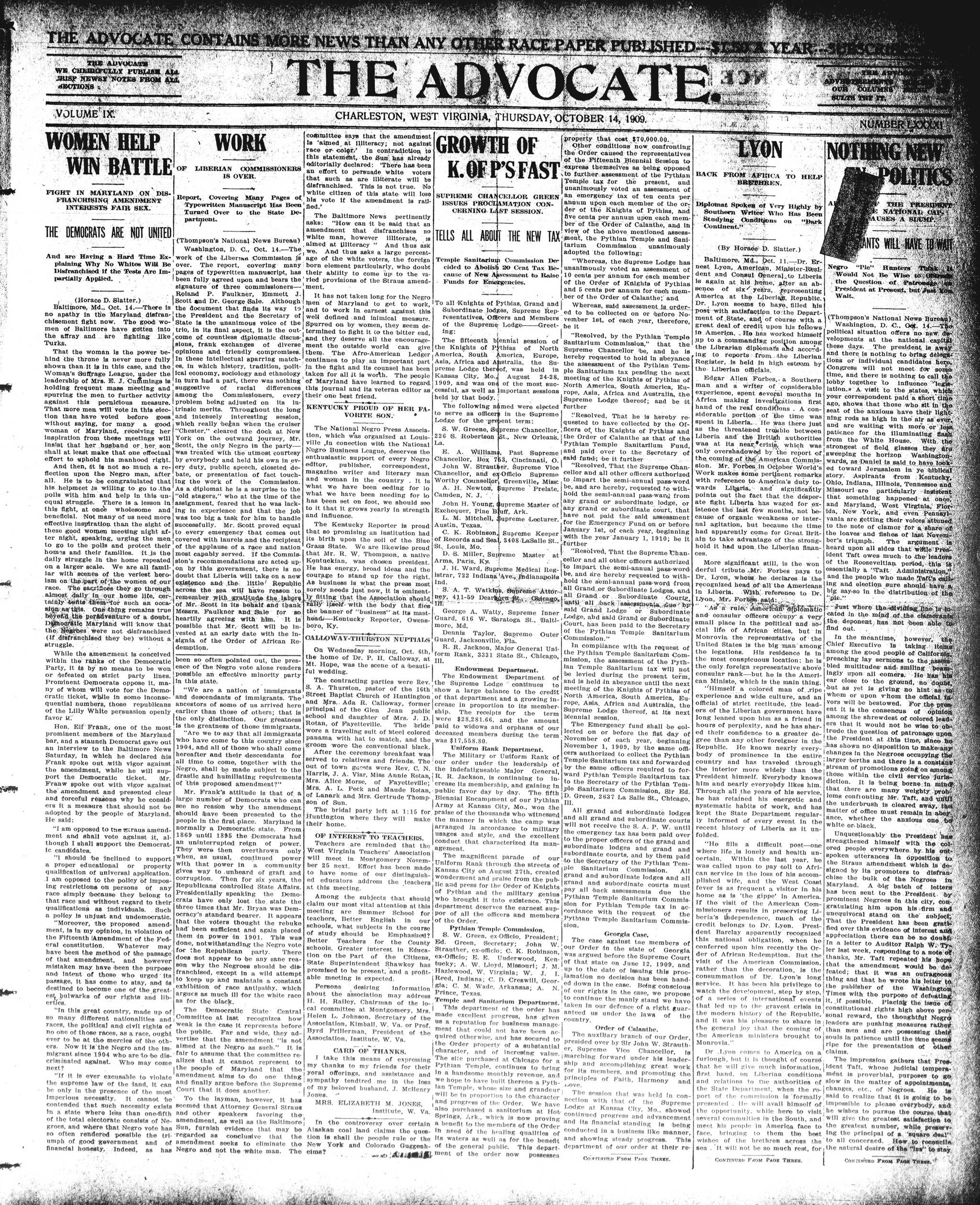
WOMEN HELP WIN BATTLE
FIGHT IN MARYLAND ON DIS
FRANCHISING AMENDMENT
INTERESTS FAIR SEX.
And are Having a Hard Time Explaining Why No Whites Will Be Disfranchised if the Tests Are Impartially Applied.
(Horace D. Slatter.)
Baltimore, Md., Oct. 14.—There is no apathy in the Maryland disfranchisement fight now. The good women of Baltimore have gotten into the affray and are fighting like Turks.
That the woman is the power behind the throne is never more fully shown than it is in this case, and the Woman's Suffrage League, under the leadership of Mrs. E. J. Cummings is holding frequent mass meeting and spurring the men to further activity against this pernicious measure.
That more men will vote in this election than have voted before goes without saying, for many a good woman of Maryland, receiving her inspiration from these meetings will insist that her husband or her son shall at least make that one effectual effort to uphold his manhood right.
And then, it is not so much a reflection upon the Negro man, after all. He is to be congratulated that his helpmeet is willing to go to the polls with him and help in this unequal struggle. There is a lesson in this fight, at once wholesome and beneficial. Not many of us need more effective inspiration than the sight of these good women meeting night after night, speaking, urging the men to go to the polls and protect their homes and their families. It is the daily struggle in the home repeated on a larger scale. We are all familiar with scenes of the veriest heroism on the part of the women of our race. The sacrifices they go through almost daily in our home life, certainly boots them for such an occasion as this. One thing remains true beyond the perseverance of a doubt, Democratic Maryland will know that the Negroes were not disfranchised (if disfranchised they be) without a struggle.
While the amendment is conceived within the ranks of the Democratic Party, it is by no means to be won or defeated on strict party lines. Prominent Democrats oppose it, many of whom will vote for the Democratic ticket, while in some inconsequential numbers, those republicans of the Lilly White persuasion openly favor it.
Hon. Elf Frank, one of the most prominent members of the Maryland bar, and a staunch Democrat gave out an interview to the Baltimore News Saturday, in which he declared his Frank spoke out with vigor against the amendment, while he will support the Democratic ticket. Mr. Franw spoke out with vigor against the amendment and presented clear and forceful reasons why he considers it a measure that should not be adopted by the people of Maryland. He said:
"I am opposed to theurrans amendment and shall vote against it, although I shall support the Democratic candidates.
"I should be inclined to support a proper educational or property qualification of universal application. I am opposed to the policy of imposing restrictions on persons of any race simply because they belong to that race and without regard to their qualifications as individuals. Such a policy is unjust and undemocratic.
"Moreover, the proposed amendment, is in my opinion, in violation of the Fifteenth Amendment of the Federal constitution. Whatever may have been the method of the passage of that amendment, and however mistaken may have been the purpose and intent of those who urged its passage, it has come to stay, and is destined to become one of the greatest bulwarks of our rights and liberties.
"In this great country, made up of so many different nationalities and races, the political and civil rights of no one of those races, as a race, ought ever to be at the mercies of the others. Now it is the Negro and the immigrant since 1904 who are to be discriminated against. Who may come next?
"If it is ever excusable to violate the supreme law of the land, it can be only in the presence of the most imperious necessity. It cannot be contended that such necessity exists in a state where less than one-fifth of the total electorate consists of Negroes, and where that Negro vote has so often rendered possible the triumph of good government and of financial honesty. Indeed, as has
WORK
Report, Covering Many Pages of
Typewritten Manuscript Has Been
Turned Over to the State
Department.
(Thompson's National News Bureau)
Washington, D. C., Oct. 14.—The work of the Liberian Commission is over. The report, covering many pages of typewritten manuscript, has been fully agreed upon and bears the signature of three commissioners—Roland P. Faulkner, Emmett J. Scott and Dr. George Sale. Although the document that finds its way to the President and the Secretary of State is the unanimous voice of the trio, in its final aspect, it is the outcome of countless diplomatic discussions, frank exchanges of diverse opinions and friendly compromises. In these intellectual aparring matches, in which history, tradition, political economy, sociology and ethnology in turn had a part, there was nothing suggestive of racial differences among the Commissioners, every problem being adjusted on its intrinsic merits. Throughout the long and intensely interesting session, which really began when the cruiser "Chester," cleared the dock at New York on the outward journey, Mr. Scott, the only Negro in the party—was treated with the utmost courtesy by everyone and held his own in every duty, public speech, closed debate, or presentation of fact touching the work of the Commission. As a diplomat he is a surprise to the "old stagers," who at the time of the assignment, feared that he was lacking in experience and that the job was too big a task for him to handle successfully. Mr. Scott proved equal to every emergency that comes out covered with laurels and the recipient of the applause of a race and nation most capably served. If the Commission's recommendations are acted upon by this government, there is no doubt that Liberia will take on a new existence and the little/ Republic across the sea will have reason to remember with gratitude the labor of Mr. Scott in its behalf and thank Messrs. Faulkner and Sale for so heartily agreeing with him. It is possible that Mr. Scott will be invested at an early date with the insignia of the Order of African Redemption.
been so often pointed out, the presence of the Negro vote alone renders possible an effective minority party in this state.
"We are a nation of immigrants and descendants of immigrants. The ancestors of some of us arrived here earlier than those of others; that is the only distinction. Our greatness is the greatness of those immigrants.
"Are we to say that all immigrants who have come to this country since 1904, and all of those who shall come hereafter and their descendants for all time to come, together with the Negro, shall be made subject to the drastic and humiliating requirements of this proposed amendment?"
Mr. Frank's attitude is that of a large number of Democrats who can see no reason why the amendment should have been presented to the people in the first place. Maryland is normally a Democratic state. From 1869 until 1895 the Democrats had an uninterrupted reign of power. They were then overthrown only when, as usual, continued power with that power in a community gives way to unheard of graft and corruption. Then for six years, the Republicans controlled State Affairs. Presidentially speaking the Democrats have only lost the state the three times that Mr. Bryan was Democracy's standard bearer. It appears that the voters thought the rebuke had been sufficient and again placed them in power in 1901. This was done, notwithstanding the Negro vote for the Republican party. There does not appear to be any sane reason why the Negroes should be disfranchised, except in a wild attempt to keep up and maintain a constant exhibition of race antipathy, which argues as much ill for the white race as for the black.
The Democratic State Central Committee at last recognizes how weak is the case it represents before the public. Far and wide, they advertise that the amendment "is not aimed at the Negro as such." It is fair to assume that the committee realizes that it cannot represent to the people of Maryland that the amendment aims to do one thing and finally argue before the Supreme Court that it does another.
To the layman, however, it has seemed that Attorney General Straus and other speakers favoring the amendment, as well as the Baltimore Sun, furnish evidence that may be regarded as conclusive that the amendment seeks to eliminate the Negro and not the white man. The
committee says that the amendment is 'aimed at illiteracy; not against race or color.' In contradiction to this statement, the Sun has already editorially declared: There has been an effort to persuade white voters that such as are illiterate will be disfranchised. This is not true. No white citizen of this state will lose his vote if the amendment is ratified.
The Baltimore News pertinently asks: "How can it be said that an amendment that disfranchises no white man, however illiterate, is aimed at illiteracy." And thus ask we. And thus asks a large percentage of the white voters, the foreign born element particularly, who doubt their ability to come up to the varied provisions of the Straus amendment.
GROWTH OF K.OF P'S FAST
SUPREME CHANCELLOR GREEN ISSUES PROCLAMATION CONCERNING LAST SESSION.
TELLS ALL ABOUT THE NEW TAX
Temple Sanitarium Commission Decided to Abolish 20 Cent Tax Because of New Assessment to Raise Funds for Emergencies.
property cost $70,000.00. Other conditions now confirm the Order caused the repressor of the Fifteenth Biennial Session express themselves as being to further assessment of the Temple tax for the present unanimously voted an assessor an emergency tax of ten cents an annum upon each member of the Order of the Knights of Pythia five cents per annum upon each heir of the Order of Calanthe, view of the above mentioned ment, the Pythian Temple and tarium Commission unanticipated the following:
"Whereas, the Supreme Locus unanimously voted an assessor 10 cents per annum for each heir of the Order of Knights of Pythia and 5 cents per annum for each heir of the Order of Calanthe."
It has not taken long for the Negro men of Maryland to get to work, and to work in earnest against this well defined and inimical measure. Spurred on by women, they seem determined to fight it to the bitter end, and they deserve all the encouragement the outside world can give them. The Afro-American Ledger continues to play an important part in the fight and its counsel has been taken for all it is worth. The people of Maryland have learned to regard this journal and its veteran editor as their one best friend.
KENTUCKY PROUD OF HER FA
VORITE SON:
The National Negro Press Association, which was organized at Louisville, in connection with the National Negro Business League, deserves the enthusiastic support of every Negro editor, publisher, correspondent, magazine writer and literary man and woman in the country. It is what we have been feeding for lo what we have been needing for lo has been set on foot, we should see to it that it grows yearly in strength and influence.
The Kentucky Reporter is proud that so promising an institution had its birth upon the soil of the Blue Grass State. We are likewise proud that Mr. R. W. Thompson, a native Kentuckian, was chosen president. He has energy, broad ideas and the courage to stand up for the right. As business is what the press most sorely needs just now, it is eminent by fitting that the Association should rally itself with the body that fills the banner of "business" at its masthead—Kentucky Reporter, Owensboro, Ky.
CALLOWAY-THURSTON NUPTIALS
On Wednesday morning, Oct. 6th, the home of Dr. P. H. Calloway, at Mt. Hope, was the scene of a beautiful wedding.
The contracting parties were Rev. S. A. Thurston, pastor of the 16th Street Baptist Church of Huntington and Mrs. Ada R. Calloway, former principal of the Glen Jean public school and daughter of Mrs. J. D. Rotan, of Fayetteville. The bride wore a traveling suit of steel colored panama with hat to match, and the groom wore the conventional black. After the ceremony breakfast was served to relatives and friends. The out of town guests were Rev. C. N. Harris, J. A. Viar, Miss Annie Rotan, Mrs. Alice Morse, of Fayetteville; Mrs. A. L. Peck and Maude Rotan, of Lanark and Mrs. Gertrude Thompson of Sun.
The bridal party left at 1:15 for Huntington where they will make their home.
OF INTEREST TO TEACHERS. Teachers are reminded that the West Virginia Teachers' Association will meet in Montgomery November 25 next. Effort has been made to have some of our distinguished educators address the teachers at this meeting. Among the subjects that should claim our most vital attention at this meeting are Summer School for teachers, Better English in our schools, what subjects in the course of study should be Emphasized? Better Teachers for the County schools. Greater interest in Education on the Part of the Citizens, State Superintendent Shawkoy has promised to be present, and a profitable meeting is expected.
Persons desiring information about the association may address H. H. Ralley, Chairman of the local committee at Montgomery, Mrs. Helen L. Johnson, Secretary of the Association, Kimball, W. Va. or Prof. Byrd Prillerman, President of the Association, Institute, W. Va.
CARD OF THANKS
I take this means of expressing my thanks to my friends for their oral offerings, and assistance and sympathy tended me in the loss of my beloved husband, J. McHenry Jones.
MRS. ELIZABETH M. JONES,
Institute, W. Va.
In the controversy over certain Alaska coal land claims the question is shall the people rule or the New York and Colorado Guggenheim's?
GROWTH OF K.OF P'SFAST
SUPREME CHANCELLOR GREEN
ISSUES PROCHAMATION CON-
CERNING LAST SESSION.
Temple Sanitarium Commission Decided to Abolish 20 Cent Tax Because of New Assessment to Ralse Funds for Emergencies.
To all Knights of Pythias, Grand and Subordinate lodges, Supreme Representatives, Officers and Members of the Supreme Lodge—Greeting:
The fifteenth biennial session of the Knights of Pythias of North America, South America, Europe, Asia, Africa and Australia, the Supreme Lodge thereof, was held in Kansas City, Mo., August 24-28, 1909, and was one of the most successful, as well as important sessions held by that body.
The following named were elected to serve as officers in the Supreme Lodge for the present term:
S. W. Greene, Supreme Chancellor, 226 S. Robertson St., New Orleans, La.
E. A. Williams, Past Supreme Chancellor, Box 753, Cincinnati, O.
John W. Straather, Supreme Vice Chancellor, and ex Officio Supreme Worthy Counsellor, Greenville, Miss.
A. H. Newton, Supreme Prelate, Camden, N. J.
John H. Young, Supreme Master of Exchequer, Pine Bluff, Ark.
L. M. Mitchell, Supreme Lecturer, Austin, Texas.
C. K. Robinson, Supreme Keeper of Records and Seal, 3408 LaSalle St., St. Louis, Mo.
D. S. Miller, Supreme Master at Arms, Paris, Ky.
J. H. Ward, Supreme Medical Registrar, 722 Indiana Ave., Indianapolis, Ind.
S. A. T. Watkins, Supreme Attorney, 411-59 Dearborn St., Chicago, IL.
George A. Watty, Supreme Inner
Guard, 616 W. Saratoga St., Baltimore, Md.
Dennis Taylor, Supreme Outer
Guard, Jacksonville, Fla.
R. R. Jackson, Major General Uni-
form Rank, 3331 State St., Chicago,
Ill.
Endowment Department.
The Endowment Department of the Supreme Lodge continues to show a large balance to the credit of that department and a growing increase in proportion to its membership. The receipts for the term were $28,281.66, and the amount paid to widows and orphans of our deceased members during the term was $17,558.80.
Uniform Rank Department.
The Military or Uniform Rank of our order under the leadership of the indefatigable Major General, R. R. Jackson, is continuing to increase its membership, and gaining in public favor day by day. The fifth Biennial Encampment of our Pythian Army at Kansas City, Mo., won the praise of the thousands who witnessed the manner in which the camp was arranged in accordance to military usages and style, and the excellent conduct that characterized its management.
The magnificent parade of our Uniform Rank through the streets of Kansas City on August 27th, created wonderment and praise from the public and press for the Order of Knights of Pythias and the military genius who brought it into existence. This department deserves the earnest support of all the officers and members of the Order.
Pythian Temple Commission.
S. W. Green, ex-Officio, President;
Ed. Green, Secretary; John W. Strauther, ex-Officio; C. K. Robinson, ex-Officio; E. E. Underwood, Kentucky; A. W. Lloyd, Missouri; J. M. Hazlewood, W. Virginia; W. J. L. Reed, Indiana; C. D. Creswill, Georgia; C. M. Wade, Arkansas; A. N. Prince, Texas.
Temple and Sanitarium Department.
This department of the order has made excellent progress, has given us a reputation for business management that could not have been acquired otherwise, and has secured to the Order property of a substantial character, and of increasing value. The site purchased at Chicago for a Pythian Temple, continues to bring in a handsome monthly revenue, and we hope to have built thereon a Pythian Temple, whose size and grandeur will be in proportion to the character and progress of the Order. We have also purchased a sanitorium at Hot Springs, Ark, which is now proving a benefit to the members of the Order in need of the healing qualities of its waters as well as for the benefit of the general public. This department of the order now possesses
property that cost $70,000.00.
Other conditions now confronting the Order caused the representatives of the Fifteenth Blenial Session to express themselves as being opposed to further assessment of the Pythian Temple tax for the present, and unanimously voted an assessment of an emergency tax of ten cents per annum upon each member of the order of the Knights of Pythias, and five cents per annum upon each member of the Order of Calanthe, and in view of the above mentioned assessment, the Pythian Temple and Sanitarium Commission unanimously adopted the following:
"Whereas, the Supreme Lodge has unanimously voted an assessment of 10 cents per annum for each member of the Order of Knights of Pythias and 5 cents per annum for each member of the Order of Calanthe; and
Whereas, sad assessment is ordered to be collected on or before November 1st, of each year, therefore, be it
"Resolved, by the Pythian Temple Sanitarium Commission," that the Supreme Chancellor be, and he is hereby requested to hold in obeyance the assessment of the Pythian Temple Sanitarium tax pending the next meeting of the Knights of Pythias of North America, South America, Europe, Asia, Africa and Australia, the Supreme Lodge thereof; and be it further
"Resolved, That he is hereby requested to have collected by the Officers of the Knights of Pythias and the Order of Calanthe as that of the Pythian Temple Sanitarium Fund, and paid over to the Secretary of said fund; be it further
"Resolved, That the Supreme Chancellor and all other officers authorized to impart the semi-annual pass-word be, and are hereby, requested to withhold the semi-annual pass-word from any grand or subordinate lodge, or any grand or subordinate court, that have not paid the said assessment for the Emergency Fund on or before January 1st, of each year, beginning with the year January 1, 1910; be it further
"Resolved, That the Supreme Chancellor and all other officers authorized to impart the semi-annual pass-word be, and are hereby requested to withhold the semi-annual pass-word from all Grand or Subordinate Lodges, and all Grand or Subordinate Court, until all back assessments, due by said Grand Lodge or Subordinate Lodge, and said Grand or Subordinate Court, has been paid to the Secretary of the Pythian Temple Sanitarium Commission."
Georgia Case.
The case against the members of our Order in the state of Georgia was argued before the Supreme Court of that state on June 12, 1909, and up to the date of issuing this proclamation no decision has been handed down in the case. Being conscious of our rights in the case, we propose to continue the manly stand we have taken in our defence of a right guaranteed us under the laws of the country.
Order of Calanthe
The auxiliary branch of our Order, presided over by Sir John W. Strauther, Supreme Vice Chancellor, is marching forward under his leadership and accomplishing great work for its members, and promoting the principles of Faith, Harmony and Love.
The session that was held in connection with that of the Supreme Lodge at Kansas City, Mo., showed continued progress and advancement and its financial standing is being conducted in a business like manner, and showing steady progress. This department of our order at their re-
CONTINUED FROM PAGE THREE.
(By Horace D. Slatter.)
Baltimore, Md., Oct. 11.—Dr. Ernest Lyon, American, Minister-Resident and Consul General to Liberia is again at his home, after an absence of six years, representing America at the Liberian Republic. Dr. Lyon seems to have filled his post with satisfaction to the Department of State, and of course with a great deal of credit upon his fellows in America. He has worked himself up to a commanding position among the Librarian diplomats and according to reports from the Liberian Register, is held in high esteem by the Liberian officials.
Edgar Allen Forbes, a Southern man and a writer of considerable experience, spent several months in Africa making investigations first hand of the real conditions. A considerable portion of the time was spent in Liberia. He was there just as the threatened trouble between Liberia and the British authorities was at its near crisis, which was only overshadowed by the report of the coming of the American Commission. Mr. Forbes in October World's Work makes some pertinent remarks with reference to America's duty towards Liberia, and significantly points out the fact that the desperate fight Liberia has waged for existence the last few months, not because of organic weakness or internal agitation, but because the time had apparently come for Great Britain to take advantage of the stronghold it had upon the Liberian finances.
More significant still, is the wonderful tribute Mr. Forbes pays to Dr. Lyon, whom he declares is the recognized head of all the Americans in Liberia. With reference to Dr. Lyon, Mr. Forbes said:
"As a rule, American diplomatic and consular officers occupy a very small place in the political and social life of African cities, but in Monrovia the representative of the United States is the big man among the legations. His residence is in the most conspicuous location; he is the only foreign representative above consular rank—but he is the American Minister, which is the main thing
"Himself a colored man of ripe experience and wide culture, and an official of strict rectitude, the leaders of the Liberian government have long leaned upon him as a friend in hours of perplexity, and he has shared their confidence to a greater degree than any other foreigner in the Republic. He knows nearly everybody of prominence in the entire country and has traveled through the interior more widely than the President himself. Everybody knows him and nearly everybody likes him. Through all the years of his service, he has retained his energetic and systematic habits of work, and has kept the State Department regularly informed of every event in the recent history of Liberia as it unfolded.
"He fills a difficult post—one where life is lonely and health uncertain. Within the last year, he was called upon to pay toll to African service in the loss of his accomplished wife, and the West Coast fever is as frequent a visitor in his home as is 'the gipe' in America. If the visit of the American Commissioners results in preserving Liberia's independence, much of the credit belongs to Dr. Lyon. President Barclay apparently recognized this national obligation, when he conferred upon him recently the Order of African Redemption. But the visit of the American Commission, rather than the decoration, is the consummation of Dr. Lyon's long service. It has been his privilege to watch the development, step by step, of a series of international events that led up to the gravest crisis in the modern history of the Republic, and it was his pleasure to share in the general joy that the coming of the American ministers brought to Monrovia."
Dr. Lyon comes to America on a furlough, but it is thought of course that he will give much information, first hand, on Liberian conditions and relations to the authorities of the State Department, when the report of the commission is formally presented. He will avail himself of the opportunity, while here to visit several communities in the South, and meet his people in America face to face, bringing to them the best wishes of the brethren across the sea. It will not be so much rest, for
CONTINUED FROM PAGE THREE.
(Thompson's National News Bureau).
Washington, D.C., Oct. 14. The political situation offers no new developments at the national capital these days. The president is away and there is nothing to bring delegations or individual candidates here. Congress will not meet for some time, and there is nothing to call the lobby together to influence legislation. A visit to the states, which your correspondent paid a short time ago, shows that those who sit in the seat of the anxious have their lightning rods as high in the air as ever, and are withering with more or less patience for the illuminating flash from the White House. With the strongest of field glasses they are sweeping the horizon Washington-wards, as Daniel is said to have looked toward Jerusalem in yeblical story. Aspirants from Kentucky, Ohio, Indiana, Illinois, Tennessee and Missouri are particularly insistent that something happened at once, and Maryland, West Virginia, Florida, New York, and even Pennsylvania are getting their voices attuned to the note of clamor for a share of the loaves and fishes of last November's triumph. The argument is heard upon all sides that while President Taft owes much to the leaders of the Rooseveltian period, this is essentially a "Taft Administration," and the people who made Taft's calling and election sure should have a big say so in the distribution of the "pile."
Just where the division line is located in the mind of the clearances the deponent has not been able to find out.
In the meantime, however, the Chief Executive is taking items among the good people of California preaching lay sermons to the assembled multitudes and smiling beamingly upon all comers. He has his ear close to the ground, no doubt, but as yet is giving no hint as to whom or upon whom the official favors will be bestowed. For the present it is the consensus of opinion among the shrewdest of colored leaders that it would not be wise to obtrude the question of patronage upon the President at this time, since he has shown no disposition to make any changes in the Negroes occupying the larger berths and there is a constant stream of promotions going on among those within the civil service jurisdiction. It is being borne in mind that there are many weighty problems confronting Mr. Taft, and until the underbrush is cleared away, the matter of office must remain in aberrance, whether the anxious one be white or black.
Unquestionably the President has strengthened himself with the colored people everywhere by his outspoken utterances in opposition to the Straus amendment which is designed by its promoters to disfranchise the bulk of the Negroes in Maryland. A big batch of letters has been sent to the President. by prominent Negroes on this city, congratulating him upon his firm and unequivocal stand on the subject. That the President has been gratified over this evidence of interest and appreciation there can be no doubt in a letter to Auditor Ralph W. Tyler last week, responding to a note of thanks, Mr. Taft repeated his hope that the amendment would be defeated; that it was an outrageous thing and that he wrote his letter to the publisher of the Washington Times with the purpose of defeating it, if possible. Plaeing the issue of constitutional rights high above personal reward, the thoughtful Negro leaders are pushing measures rather than men and are possessing their souls in patience until the time seems ripe for the presentation of other claims.
The impression gathers that President Taft, whose judicial temperament is proverbial, purposes to go slow in the matter of appointments, changes, etc., of Negroes. He is said to realize that it is going to be impossible to please everybody, and he wishes to pursue the course that will give the greatest satisfaction to the greatest number, while preserving the principal of a "square deal" to all concerned. How to reconcile the natural desire of the "lin" to stay
CONTINUED FROM PAGE THREE.
Howard Jackson, of Quincy, was in town Sunday the guest of friends.
Mrs. Hale, of Middleport, spent Thursday and Friday here the guest of her brother, Chas. Bell.
Miss Alice E. Jordan, of Weston, in town, visiting her mother, Mrs. M. L. Jordan.
Mrs. Chas. Harris and children, of Gallipolis, were guests of her sister. Mrs. Joseph Jordan, Saturday and Sunday.
Rev. G. W. Muse, of Charleston, came down Wednesday to assist the members of his church here with a stand during the celebration of the 135th anniversary and Home Coming.
Miss Bess Davis, of Gallipolis, has been the guest of Miss Julia Smith during the past week.
Dana English, of Mason, was in town Saturday guest of friends.
Mr. and Mrs. George Hall, of Gallipolis, assisted C. Henderson in his restaurant during the past week.
Prof. Robinson left for St. Albans holiday evening so as to be present at the church rally Sunday.
Samuel Lewis, of Middleport, attended the unveiling of the monument here Saturday.
Mr. and Mrs. George Stevens and children, of Spillman, were guests of Mr. and Mrs. Fred Roberts Saturday and Sunday.
Cal. Morton, of Pomeroy, was the guest of his daughter, Mrs. Joseph Jordan, Saturday.
Mrs. O. Buckingham and children, of Winfield, were guests of Mr. and Mrs. Fred Roberts a few days last week.
Wm. Holmes, of Gallipolis, assisted in the Lincoln Barber shop a few days of last week.
A very large number from all surrounding towns attended the celebration held here 7, 8, 9 and 10.
Mrs. Wm. Holmes and Miss Lida Banks, of Gallipolis, were guests of Mr. and Mrs. Andy Smith, Saturday.
Mr. and Mrs. Gus Young, of Columbus, were guests of their mother, Mrs. M. L. Jordan, a few days last week.
Mr. and Mrs. George Hare, of Charleston, spent a few days of last week in town.
T. Hubbard, John and Bradie Buckingham, Clarence Washington and Edward Watkins were visitors last week.
The officers of the Missionary Society were installed on Friday night by Dr. M. T. Sinclair. After the installation, refreshments were served, by the Society.
Rev. P. P. Holland filled his regular appointment Sunday both morning and evening.
Mrs. Jack Roberts and daughter Anetta spent the day Friday at Black Betsey the guests of Mrs. Joe Sawyers.
Mrs. Sylvia Stewart has returned after a few weeks' visit to friends at Middleport, Ohio.
Mr. and Mrs. John Cyrus' little son, Emmons, is confined to his bed with typhoid.
Mrs. Joe Sawyers was the pleasant guest of Mrs. Charles Sergoin Sunday.
James Brown, of Fayette, is visiting his brother, John Brown, of Plymouth.
Mr., and Mrs. John Ross' little daughter Syble is on the sick list at this writing.
Charles Harris is suffering from a boil on his neck.
Winston Coles, of Raymond City, was the guest of his daughter, Mrs. Little Dickerson, Saturday.
MONTGOMERY.
Rev. R. D. W. Meadows, of Huntington, was here Sunday.
Mrs. Smith Brown is on the sick list.
Miss Alpha Brooks, teacher at Houndley and Mrs. Eva B. Pack, teacher at Smithers, were the Sunday guests of Mrs. F. Donnally Railey.
Misses Minnie Carr and Henrietta James spent Sunday at Eagle.
Mrs. Archie McKinney is able to be out after a serious sick spell.
Rev. W. J. Hackett, of Covington, Va., was the guest of Mrs. C. W. Watson, last week.
Mrs. Samuel Buster has returned from a two weeks' visit to points in Virginia.
J. S. Noel was the guest of friends at Sewell, Sunday.
Mr. and Mrs. S. J. Jackson have returned from Orange, Va.
Bright Hope Lodge No. 12 and Hiram Lodge No. 26. of A. F. and M. held memorial services Sunday afternoon at the First Baptist church for the late Grand Master, R. D. Robinson. Most impressive music was furnished by the choir, Etiologies by J. V. Coleman, of Mt. Caldwell; I. M. Carper, of Charleston, J. H. Brown, A. W. Slaughter, and H. H. Railey of this town. Resolutions by R. E. Burrell, N. N. Willis and J. H. Brown were read. Massee P. H. Hays closed with remarks, and prayer by Edward Moss, of Mt. Caldwell.
Rev. Ford of the A. M. E. church carried on a series of meetings last week. A lively interest was manifested and some good accomplished. Mrs. Lula Jones and children, of Page, are spending a few days with her sisters, Mesdames Overaull and Carr. Mrs. Maryland Dawson and daughter, Miss Garnett, were calling on relatives and friends Sunday. Richard Harris, of Charleston, spent Sunday with his family. Those who were not at the 'Foot Party,' Saturday night, missed the rendition of a most excellent program. The Rally given at the St. Paul Baptist church Sunday, was a decided success. The church was divided up into nine clubs and the clubs reported as follows: Club No. 1, Rev. J.
W. Robinson, Captain, $90; Club No.
2. Ruth Greene, Captain, $25.29;
Club No. 4, Mrs. Emma Taylor, Captain,
$20.11; Club No. 5, Mrs. Kate
Erskine, Captain, $50.85; Club No.
6, Mrs. Alice Early, Captain, $27;
Club No. 7, Mrs. Celia Overall,
Captain, $51.32; Club No. 8, Mrs.
Eliza Brooks, Captain, $82.32; Club
No. 9, Mrs. Lizzie Grant, Captain,
$11.51; Club No. 10, Samuel Trent,
Captain, $6.55; general collection,
$4.15; total amount raised, $400.00.
KANAWHA CITY.
Rev. J. W. Page preached at South Ruffner Sunday.
W. H. Jackson returned to Sewell last week.
Miss Mary Wood, of Institute, will be the guest of he cousin, Miss Larealia Lewis, the last of the week.
Mrs. J. W. Woods was in Malden Saturday.
W. W. Lewis and T. R. Johnson returned to their work at Winifrede Monday.
Several from here visited John Lawson at the Charleston General Hospital Sunday and Tuesday.
Mr. Lawson is improving and it is hoped by his many friends that he will soon be able to be brought home.
Miss Annetine Johnson is visiting friends in Charleston.
Mr. and Mrs. W. W. Lewis entertained Rev. Vachel Harriday, Sunday.
G. L. Jackson visited friends at Sewell Sunday and Monday.
T. R. Johnson was a business visitor in town Saturday.
J. W. Woods visited his son Johnnie and his brother at Boomer Sunday.
Mrs. W. H. Jackson is visiting in Charleston this week.
Mrs. J. W. Woods, and daughters attended services at Snow Hill Sunday.
GUYANDOTTE
Mrs. Mildred Layne was called to Parkersburg Friday on account of the illness of her daughter, Mrs. Chas. Slash.
The friends of Mr. Alex Twyman and Miss Cleopatra Lane were very much surprised to learn that they were married in August.
Albert Wells attended church in Proctorsville, Ohio, Sunday morning.
Mrs. Lizzie Chappell, Mrs. Charlotte Brooks and daughters, Misses Theta and Charleta were in Huntington Saturday night.
Elbert Brilontine was in town Sunday calling on friends.
School started Monday with Miss Annie Peters as teacher. Miss Cora Twyman and Carrie and Florence Hurt were calling on Janetta Layne Sunday evening.
HILL TOP
The board of trustees met Monday to arrange for the finances of the West Virginia Seminary and College. Rev. D. C. Hunter preached two very able sermons Sunday. In the afternoon memorial exercises were held for R. D. Robinson. Rev. Austin has returned to school from his charge on New River.
Prof. Hatter made a business trip to Red Star Monday.
a business trip to Red Star Monday.
Thursday a number from here attended the Preachers and Deacon's Union at Sun.
Clean Childress and family moved to their home in Sylvia, Thursday.
The Woman's Improvement League met at Mrs. Dandridge's Thursday.
They were served after a very good program. Will meet next Thursday at Mrs. Melver's.
Mrs. Emma Pryor's baby, eighteen months old, died Wednesday and was buried Thursday.
Correspondents are requested to sign their letters.—Ed
MT. HOPE
Memorial services for R. D. Robinson were held by the orders of Masons and K. of P. and Court of Calanthe at the First Baptist church Sunday.
Rev. S. A. Thurston, pastor 16th Street Baptist church, Huntington, and Mrs. Ada Callaway, of this town were married Wednesday 6th, at the home of Dr. P. H. Callaway, by Rev. D. Stratton. Only the family and immediate friends were present. They left on the noon train for their home at Huntington.
R. E. Hill, who has been indisposed the past week is out again.
Mrs. Betty Ross and Children have
returned from a summer's visit to Virginia.
Attorney J. M. Ellis and wife attended the memorial at Macdonald Sunday.
Anthony Thompson and family left Tuesday for their home at Holden.
ALDENSON
The M. E. Church opened its doors last Sunday for a revival. The church was crowded to hear the opening sermon preached by Rev. Moore, of Clifton Forge, Va., assisted by Rev. Jefferson.
S. P. Penlok is dangerously ill with typhoid fever.
James Hill returned to Storer College last week, to resume his studies.
Miss Sadie Swope is able to be out after a severe attack of sickness.
Mrs. Lacy Robinson has returned from a visit in Virginia.
Pearl Banks has returned to Morgan College to resume his studies.
The Church Aid met at the home of J. M. Trice. It was well attended.
J. M. Price. It was well attended.
Clarence R. Wilson has gone to Richmond, Va., to work in St. Luke's department of printing.
Augris Hopkins went to Pittsburgh.
Thursday, to see the world's series of games. He returned Monday.
The Epworth League of the M. E. Church was well attended Sunday.
The program was as follows:
Song by choir.
Prayer.
Response with biblical quotations.
Scripture reading—Miss Nannie Comer.
Vocal Solo—Miss Alice Breckinridge.
Singing by choir.
Scripture reading—Miss Mary Scruggs.
A very interesting talk was given on the lesson by Clarence Wilson.
Closing hymn.
Doxology.
The services were then turned over to the pastor.
Mr. Rufus Freeman has moved to Quinnimont.
RAYMOND CITY.
Sunday was a busy day at Mt. Hermon Baptist Church. Sunday School at 9 o'clock, covenant meeting 11 o'clock and at 2:30 memorial services of the late R. D. Robinson were held by Pocataligo Craft No. 36. The following program was rendered. Opening address by J. A. Shores. Eulogy by L. C. McKinney.
Opening address by J. A. Shores.
Eulogy by I. C. McKinney.
Song by the choir.
Select reading by J. W. Hubbard.
Solo by Mrs. Cornelia Coles.
Eulogy by Giles Dickerson.
Song by the choir.
Quartette—L. R. Printiss, Mrs.
Cornelia Coles, John Chambers and
Mrs. Adzonia Carey.
Solo by Mrs. Emma Printiss.
Closing song by the choir.
Mrs. Woods addressed the Sunday School Sunday morning. She also gave a good talk on the Woman's Improvement League.
Mrs. M. A. Plerson, of Charleston, spent Sunday here.
Mr. and Mrs. Polindexter and daughter, Miss Claudia, of Virginia, are spending some time here with relatives.
Mrs. Nannie Walker and I. C. McKinney are indisposed at this writing.
Mrs. Sallie Trust, of Charleston, spent a few days here last week.
W. Coles made a trip to Bancroft Saturday.
Miss Florence Coles entertained at dinner Sunday, Mrs. Pearl S. Woods.
C. E. Saunders spent Sunday in Charleston with his family.
Jefferson Tyree is having a new house erected on Piedmont St.
SMITHERS.
Viola Keaton accidentally wounded herself last week with a nail. She is much improved at this writing.
Mrs. W. C. James made a business trip to Montgomery Tuesday.
The Sunday School Teachers were entertained at the home of Mr. and Mrs. Charles Williams. After a careful study of the lesson a dainty lunch was served.
The Sunday School will give an entertainment Monday evening.
The Church will have memorial services the third Sunday in honor of C. H. Toles:
Miss L. V. Bryant was the guest of Miss H. E. James Sunday afternoon.
The Sunday School will have a rally Sunday for mission work.
Rev. J. J. Turner was the guest of Mr. and Mrs. J. A. Keaton Sunday afternoon.
Mrs. L. D. Hodge visited the local
fountain G. U. of T. R. Monday night.
Rev. A. B. Gordon, of Arlington, Va., preached a good sermon to a large congregation, quite a number of out of town people being present. Mrs. Ruby Saunder and Misses Carolyn and Vivian Buster attended the funeral sermon of Charles Toles at Long Acre Thursday. Mr. Toles was a member of the K. of P.s. uniform rank and Court of Calanthe. Basil Grey accompanied his remains to Goshen, Va., for interment. Walter Lee spent a few days in Charleston last week. Miss Gertrude Parish was seen in our town Friday. Mrs. Mae Woods, of Charleston, was the week-end guest of her father C. C. Woods. Mrs. Bettle Kimbo entertained Sun-
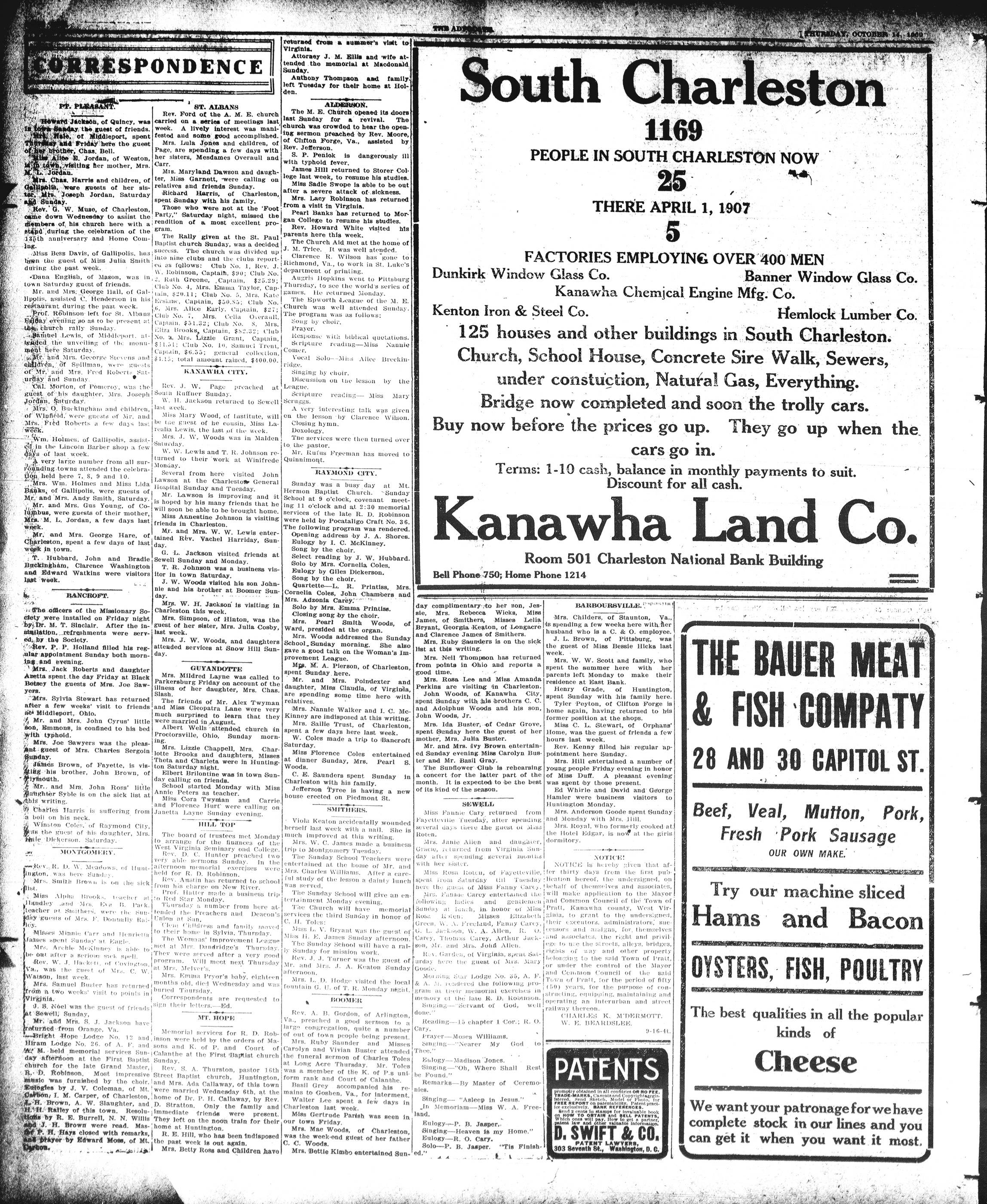
South Charleston
FACTORIES EMPLOYING OVER 400 MEN Dunkirk Window Glass Co. Banner Window Glass Co. Kanawha Chemjcal Engine Mfg. Co.
Terms: 1-10 cash, balance in monthly payments to suit. Discount for all cash.
Kanawha Land Co.
day complimentary to her son, Jessie, Mrs. Rebecca Wicks, Miss James, of Smithers, Misses Lelia Bryant, Georgia Keaton, of Longacre and Clarence James of Smithers.
Mrs. Ruby Saunders is on the sick list at this writing.
Mrs. Neil Thompson has returned from points in Ohio and reports a good time.
Mrs. Rosa Lee and Miss Amanda Perkins are visiting in Charleston. John Woods, of Kanawha City, spent Sunday with his brothers C. C. and Adolphus Woods and his son, John Woods, Jr.
Mrs. Ida Buster, of Cedar Grove, spent Sunday here the guest of her mother, Mrs. Julia Buster.
Mr. and Mrs. Ivy Brown entertained Sunday evening Miss Carolyn Buster and Mr. Basil Gray.
The Sunflower Club is rehearsing a concert for the latter part of the month. It is expected to be the best of its kind of the season.
SEWELL
Miss Fannie Cary returned from Fayetteville Tuesday, after spending several days there the guest of Miss Roten.
Mrs. Janie Alien and daughter, Grace, returned from Virginia Sunday after spending several months with her sister.
Miss Rosa Roten, of Fayetteville, spent from Saturday till Tuesday here the guest of Mass Fanny Carey.
Mrs. Fannie Carey entertained the following ladies and gentlemen Sunday at lunch, in honor of Miss Rosa Roten: Misses Elizabeth Green, W. A. Freeland, Fanny Carey, G. L. Jackson, W. A. Allen, R. O. Carey, Thomas Carey, Arthur Jackson, Mr. and Mrs. John Allen.
Rsv. Garden, of Virginia, spent Saturday here the guest of Mrs. Mary Goode.
Morning Star Lodge No. 35, A. F. & A. M. rendered the following program at their memorial exercises in memory of the late R. D. Robinson. Singing—"Servant of God, well done." Reading—15 chapter 1 Cor.; R. O. Cary. Prayer—Moses Williams.
Prayer—Moses Williams.
Singing—"Nearer My God to
Thee."
Eulogy—Madison Jones.
Remarks—By Master of Ceremonies.
Singing—"Asleep in Jesus."
In Memoriam—Miss W. A. Free land.
Eulogy—P. B. Jasper.
Singing—Heaven is my Home."
Eulogy—R. O. Cary.
PEOPLE IN SOUTH CHARLESTON NOW
Room 501 Charleston National Bank Building
Beef, Veal, Mutton, Pork Fresh Pork Sausage OUR OWN MAKE.
Try our machine sliced
The best qualities in all the popular kinds of
We want your patronage for we have complete stock in our lines and you can get it when you want it most.
25 THERE APRIL 1,1907
5
FACTORIES EMPLOYING OVER
Glass Co.
Kanawha Chemjcal Engine M
eel Co.
and other buildings in S
chool House, Concrete Sir
construction, Natural Gas
now completed and soon t
ore the prices go up. The
cars go in.
1-10 cash, balance in monthly p
Discount for all cash.
awha La
from 501 Charleston National B
hone 1214
BARBOURSVILLE.
Mrs. Childers, of Staunton, Va., is spending a few weeks here with her husband who is a C. & O. employee. J. L. Brown, of Pittsburg, was the guest of Miss Bessie Hicks last week.
Mrs. W. W. Scott and family, who spent the summer here with her parents left Monday to make their residence at East Bank.
Henry Grade, of Huntington, spent Sunday with his family here.
&
Miss C. L. Stewart, of Orphans' Home, was the guest of friends a few hours last week.
Rev. Kenny filled his regular appointment here Sunday.
Mrs. Hill entertained a number of young people Friday evening in honor of Miss Duff. A pleasant evening was spent by those present.
Ed Whirle and David and George Hamler were business visitors to Huntington Monday.
Mrs. Anderson Goode spent Sunday and Monday with Mrs. Hill.
Mrs. Royal, who formerly cooked at the Hotel Edgar, is now at the girls dormitory.
NOTICE!
NOTICE is hereby given that after thirty days from the first publication hereof, the undersigned, on behalf of themselves and associates, will make application to the Mayor and Common Council of the Town of Pratt, Kanawha county, West Virginia, to grant to the undersigned, their executors, administrators, successors and assigns, for themselves and associates, the right and privilege to use the streets, alleys, bridges, rights of way and other property belonging to the said Town of Pratt, or under the control of the Mayor and Common Council of the said Town of Pratt, for the period of fifty (50) years, for the purpose of constructing, equipping, maintaining and operating an interurban and street railway thereon.
CHARLES K. M'DERMOTT.
W. E. BEARDSLEE.
PATENTS
promptly obtained in all countries OR NO FEE.
TRADE-MARKS, Cavents and Copyright rights.
Interested. Send Worthy Mode or Flush on FREE REPORT on patentability. Patent practice exclusively. BANK REFERENCES.
Send 2 cents in stamp for invaluable book on HOW TO OBTAIN and SELL PATENTS.
Which ones will pay. How to get a partner, patent law and other valuable information.
D. SWIFT & CO.
PATENT LAWYERS,
303 Seventh St., Washington, D. C.
Cheese
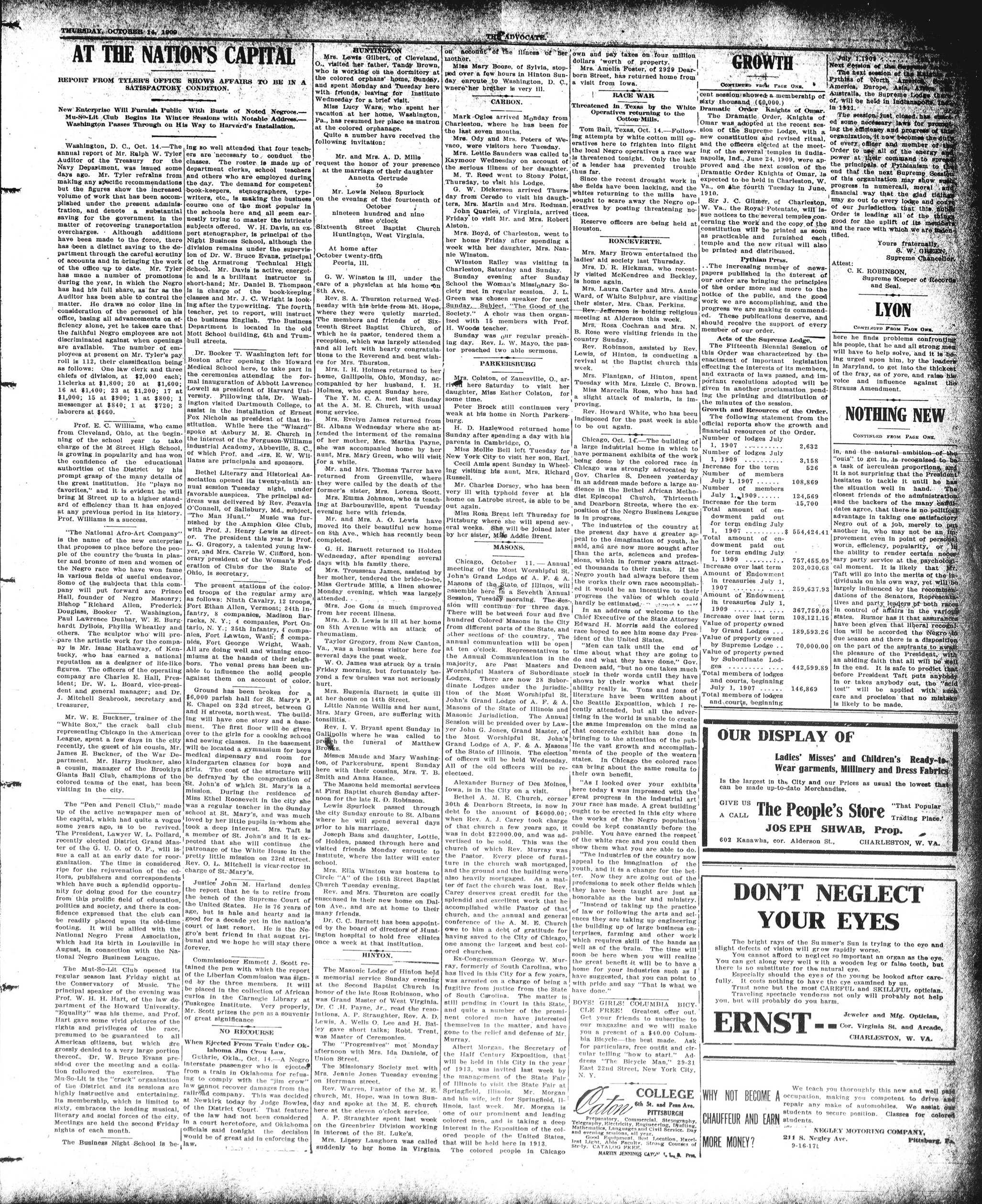
AT THE NATION'S CAPITAL
REPORT FROM TYLER'S OFFICE SHOWS AFFAIRS TO BE IN A SATISFACTORY CONDITION.
New Enterprise Will Furnish Public With Busts of Noted Negroes.—Mu-So-Lit Club Begins Its Winter Sessions with Notable Address.—Washington Passes Through on His Way to Harvard's Installation.
Washington, D. C., Oct. 14.—The annual report of Mr. Ralph W. Tyler Auditor of the Treasury for the Navy Department, was issued some days ago. Mr. Tyler refrains from making any specific recommendations but the figures show the increased volume of work that has been accomplished under the present administration, and denote a substantial saving for the government in the matter of recovering transportation overcharges. Although additions have been made to the force, there has been a distinct saving to the department through the careful scrutiny of accounts and in bringing the work of the office up to date. Mr. Tyler has made a number of promotions during the year, in which the Negro has had his full share, as far as the Auditor has been able to control the matter. He draws no color line in consideration of the personel of his office, basing all advancements on efficiency alone, yet he takes care that the faithful Negro employees are not discriminated against when openings are available. The number of employees at present on Mr. Tyler's pay roll is 112, their classification being as follows: One law clerk and three chiefs of division, at $2,000 each; 11clercs at $1,800; 20 at $1,600; 16 at $1,400; 23 at $1,200; 17 at $1,000; 15 at $900; 1 at $800; 1 messenger at $840; 1 at $720; 3 laborers at $660.
Prof. E. C. Williams, who came from Cleveland, Ohio, at the beginning of the school year to take charge of the M Street High School, is growing in popularity and has won the confidence of the educational authorities of the District by his prompt grasp of the many details of the great institution. He "plays no favorites," and it is evident he will bring M Street up to a higher standard of efficiency than it has enjoyed at any previous period in its history. Prof. Williams is a success.
"The National Afro-Art Company" is the name of the new enterprise that proposes to place before the people of the country the busts in plaster and bronze of men and women of the Negro race who have won fame in various fields of useful endeavor. Some of the subjects that this company will put forward are Prince Hall, founder of Negro Masonry; Bishop "Richard Allen, Frederick Douglass, Booker T. Washington; Paul Lawrence Dunbar, W. E. Burgardt DyBois, Phyllis Wheatley and others. The sculptor who will prepare the artistic work for the company is Mr. Isaac Hathaway, of Kentucky, who has earned a national reputation as a designer of life-like figures. The officers of the operating company are Charles E. Hall, President; Dr. W. L. Board, vice-president and general manager; and Dr. J. Mitchell Seabrook, secretary and treasurer.
Mr. W. E. Buckner, trainer of the "White Sox," the crack ball club representing Chicago in the American League, spent a few days in the city recently, the guest of his cousin, Mr. James E. Buckner, of the War Department. Mr. Harry Buckner, also a cousin, manager of the Brooklyn Giants Ball Club, champions of the colored teams of the east, has been visiting in the city.
The "Pen and Pencil Club," made up of the active newspaper men of the capital, which had quite a vogue some years ago, is to be revived. The President, Lawyer W. L. Pollard, recently elected District Grand Master of the G. U. O. of O. F., will issue a call at an early date for reorganization. The time is considered ripe for the rejuvenation of the editors, publishers and correspondents which have such a splendid opportunity for doing good for the country from this prolific field of education, politics and society, and there is confidence expressed that the club can be readily placed upon its old-time footing. It will be allied with the National Negro Press Association, which had its birth in Louisville in August, in connection with the National Negro Business League.
The Mut-So-Lit Club opened its regular season last Friday night at the Conservatory of Music. The principal speaker of the evening was Prof. W. H. H. Hart, of the law department of the Howard University, "Equality" was his theme, and Prof. Hart gave some vivid pictures of the rights and privileges of the race, presumed to be guaranteed to all American citizens, but which are grossly denied to a very large portion thereof. Dr. W. Bruce Evans presided over the meeting and a collation followed the exercises. The Mut-So-Lit is the "crack" organization of the District and its sessions are highly instructive and entertaining. Its membership, which is limited to sixty, embraces the leading musical, literary and social forces of the city. Meetings are held the second Friday nights of each month.
The Business Night School is be-
ing so well attended that four teachers are necessary to conduct the classes. The roster is made up of department clerks, school teachers and others who are employed during the day. The demand for competent book-keepers, stenographers, typewriters, etc., is making the business course one of the most popular in the schools here and all seem earnestly trying to master the intricate subjects offered. W. H. Davis, an expert stenographer, is principal of the Night Business School, although the division remains under the supervision of Dr. W. Bruce Evans, principal of the Armstrong Technical High School. Mr. Davis is active, energetic and is a brilliant instructor in short-hand; Mr. Daniel B. Thompson is in charge of the book-keeping classes and Mr. J. C. Wright is looking after the typewriting. The fourth teacher, yet to report, will instruct the business English. The Business Department is located in the old Mott School building, 6th and Trumbull streets.
Dr. Booker T. Washington left for Boston after opening the Howard Medical School here, to take part in the ceremonies attending the formal inauguration of Abbott Lawrence Lowell as president of Harvard University. Following this, Dr. Washington visited Dartmouth College, to assist in the installation of Ernest Fox Nichols as president of that institution. While here the "Wizard" spoke at Asbury M. E. Church in the interest of the Ferguson-Williams industrial Academy, Abbeville, S. C. of which Prof. and Mrs. E. W. Williams are principals and sponsors.
Bethel Literary and Historical Association opened its twenty-ninth annual session Tuesday night, under favorable aupesis. The principal address was delivered by Rev. Pezavla O'Connell, of Salisbury, Md., subject, "The Man Hunt." Music was furnished by the Amphion Glee Club, with Prof. J. Henry Lewis as director. The president this year is Prof. L. G. Gregory, a talented young lawyer, and Mrs. Carrie W. Cifford, honorary president of the Woman's Federation of Clubs for the State of Ohio, is secretary.
The present stations of the colored troops of the regular army are as follows: Ninth Cavalry, 12 troops, Fort Ethan Allen, Vermont; 24th Infantry, 8 companies, Madison Barracks, N. Y.; 4 companies, Fort Ontario, N. Y.; 25th Infantry, 4 companies, Fort Lawton, Washi; 8 companies, Fort George Wright, Wash. All are doing well and winning encomiums at the hands of their neighbors. The venal press has been unable to influence the solid people against them on account of color.
Ground has been broken for a $6,000 parish hall for St. Mary's P. E. Chapel on 23d street, between G and H streets, northwest. The building will have one story and a basement. The first floor will be given over to the girls for a cooking school and sewing classes. In the basement will be located a gymnasium for boys medical dispensary and room for kindergarten classes for boys and girls. The cost of the structure will be defrayed by the congregation of St. John's of which St. Mary's is a mission. During the residence of Miss Ethel Roosevelt in the city she was a regular teacher in the Sunday school at St. Mary's, and was much loved by her little pupils in whom she took a deep interest. Mrs. Taft is a member of St. John's and it is expected that she will continue the patronage of the White House in the pretty little mission on 23rd street. Rev. O. L. Mitchell is vicar-rector in charge of St. Mary's.
Justice John M. Harland denies the report that he is to retire from the bench of the Supreme Court of the United States. He is 76 years of age, but is hale and hearty and is good for a decade yet in the nation's court of last resort. He is the Negro's best friend in that august tribunal and we hope he will stay there forever.
Commissioner Emmett J. Scott retained the pen with which the report of the Liberian Commission was signed by the three members. It will be placed in the collection of African curios in the Carnegie Library at Tuskegee Institute. Very properly, Mr. Scott prizes the pen as a souvenir of great significance
NO RECOURSE
When Ejected From Train Under Oklahoma Jim Crow Law.
Guthrie, Okla., Oct. 14. A Negro interstate passenger who is ejected from a train in Oklahoma for refusing to comply with the "jim crow" law cannot recover damages from the railroad company. This was decided at Newkirk today by Judge Bowles, of the District Court. That feature of the law had not been considered in a court heretofore, and Oklahoma officials said tonight the decision would be of great aid in enforcing the law.
Mrs. Lewis Gilbert, of Cleveland, O., visited her father, Tandy Brown, who is working on the dormitory at the colored orphans' home, Sunday, and spent Monday and Tuesday here with friends, leaving for Institute Wednesday for a brief visit.
Miss Lucy Ware, who spent her vacation at her home, Washington, Pa., has resumed her place as matron at the colored orphanage.
Quite a number have received the following invitation:
Mr. and Mrs. A. D. Mills request the honor of your presence at the marriage of their daughter
Sixteenth Street Baptist Church
Huntington, West Virginia.
G. W. Winston is ill, under the care of a physician at his home On 8th Ave.
Rev. S. A. Thurston returned Wednesday with his bride from Mt. Hope, where they were quietly married.
The members and friends of Sixteenth Street Baptist Church, of which he is pastor, tendered them a reception, which was largely attended and all left with hearty congratulations to the Reverend and best wishes for Mrs. Thurston.
Mrs. I. H. Holmes returned to her home, Gallipolis, Ohio, Monday, accompanied by her husband, I. H. Holmes, who spent Sunday here.
Mrs. Evelyn James returned from St. Albans Wednesday where she attended the interment of the remains of her mother, Mrs. Martha Payne, she was accompanied home by her aunt, Mrs. Mary Green, who will visit for a while.
Mr. and Mrs. Thomas Tarrer have returned from Greenville, where they were called by the death of the former's sister, Mrs. Lorena Scott.
Mrs. Emma Johnson, who is teaching at Barboursville, spent Tuesday evening here with friends.
Mr. and Mrs. A. O. Lewis have moved it to their beautiful new home on 8th Ave., which has recently been completed.
G. H. Barnett returned to Holden Wednesday, after spending several days with his family there.
Mrs. Trousseau James, assisted by her mother, tendered the bride-to-be, Miss Gertrude Mills, a linen shower Monday evening, which was largely attended.
Mrs. Joe Goss is much improved from her recent illness.
Mrs. A. D. Lewis is ill at her home on 8th Avenue with an attack of rheumatism.
Taylor Gregory, from New Canton, Va., was a business visitor here for several days the past week.
W. O. James was struck by a train Friday morning, but fortunately beyond a few bruises was not seriously hurt.
Mrs. Eugenia Barnett is quite ill at her home on 14th Street.
Little Nannie Willis and her aunt, Mrs. Mary Green, are suffering with tonsillitis.
Rev. I. V. Bryant spent Sunday in Gallipolis where he was called to presbyter the funeral of Matthew Brown.
Misses Maude and Mary Washington, of Parkersburg, spent Sunday here with their cousins, Mrs. T. B. Smith and Anna Hance.
The Masons held memorial services at First Baptist church Sunday afternoon for the late R. D. Robinson. Lewis Spurlock passed through the city Sunday enroute to St. Albans where he will spend several days prior to his marriage. Joseph Bass and daughter, Lottie, of Holden, passed through here and visited friends Monday enroute to Institute, where the latter will enter school. Mrs. Elia Winston was hostess to Circle "A" of the 16th Street Baptist Church Tuesday evening. Rev. and Mrs. Thurston are cosily ensconced in their new home on Dalton Ave., and are at home to their many friends. Dr. C. C. Barnett has been appointed by the board of directors of Huntington hospital to hold free clinics once a week at that institution.
HINTON
The Masonic Lodge of Hinton hold a memorial service Sunday evening at the Second Baptist Church in honor of the late Ross Robinson, who was Grand Master of West Virginia, Dr. C. H. Payne, Jr., read the resolutions, A. P. Straughter, Rev. A. D. Lewis, A. Wells O. Lee and H. Bailley gave short talks; Robt. Trent, was Master of Ceremonies.
The "Progressives" met. Monday afternoon with Mrs. Ida Daniels, of Union Street.
The Missionary Society met with Mrs. Jennie Jones Tuesday evening on Herrman street.
Rev. Warren, Pastor of the M. E. church, M. Hope, was in town Sunday and spoke at the M. E. church here at the eleven o'clock service.
A. P. Straughter spent last week on the Greenbrider Division working in interest of the St. Luke's.
Mrs. Linsey Laughhorn was called suddenly to her home in Virginia
on account of the illness of her mother.
Miss Mary Booze, of Sylvia, stopped over a few hours in Hinton Sunday enroute to Washington, D. C., whence her brother is very ill.
Mark-Ogles arrived Monday from Charleston, where he has been for the last seven months.
John Quarles, of Virginia, arrived Friday to visit Mr. and Mrs. Robert Alston.
Mrs. Boyd, of Charleston, went to her home Friday after spending a week with her daughter, Mrs. Nannie Winston.
Winston Ralley was visiting in Charleston, Saturday and Sunday.
Sunday evening after Sunday School the Woman's Missionary Society met in regular session. J. L. Green was chosen speaker for next Sunday. Subject, "The Good of the Society." A choir was then organized with 15 members with Prof. H. Woods teacher.
Sunday was our regular preaching day. Rev. L. W. Mayo, the pastor preached two able sermons.
PARKERSBURG
Mrs. Colston, of Zanesville, O, arrived here Saturday to visit her daughter, Miss Esther Colston, for some time.
Peter Brock still continues very weak at his home in North Parkersburg.
H. D. Hazlewood returned home Sunday after spending a day with his parents in Cambridge, O.
Miss Mollie Bell left Tuesday for New York City to visit her son, Earl. Cecil Amis spent Sunday in Wheeling visiting his aunt, Mrs. Richard Russell.
Mr. Charles Dorsey, who has been very ill with typhoid fever at his home on Latrobe street, is able to be out again.
Miss Rosa Brent left Thursday for Pittsburgh where she will spend several weeks. She will be joined later by her sister, Miss Addie Brent.
MASONS
Chicago, October 11. — Annual meeting of the Most Worshipful St. John's Grand Lodge of A. F. & A. Masons of the State of Illinois, will assemble here in a Seventh Annual Session, Tuesday morning. The Session will continue for three days. There will be between four and five hundred Colored Masons in the City from different parts of the State, and other sections of the country. The annual communication will be open at ten o'clock. Representatives to the Annual Communication in the majority, are Past Masters and Worshipful Masters of Subordinate Lodges. There are now 28 Subordinate Lodges under the juridification of the Most Worshipful St. John's Grand Lodge of A. F. & A. Masons of the State of Illinois and Masonic Jurisdiction. The Annual Session will be presided over by Lawyer John G. Jones, Grand Master, of the Most Worshipful St. John's Grand Lodge of A. F. & A. Masons of the State of Illinois. The election of officers will be held Wednesday. All of the old officers will be re-elected.
Alexander Burney of Des Moines,
Iowa, is in the City on a visit.
in the city on a visit.
Bethel A. M. E. Church, corner 30th & Dearborn Streets, is now in debt to the amount of $6000.00; when Rev. A. J. Carey took charge of that church a few years ago, it was in debt $22000.00, and was advertised to be sold. This was the church of which Rev. Murray was the Pastor. Every piece of furniture in the church was mortgaged, and the ground and the building were also heavily mortgaged. As a matter of fact the church was lost. Rev. Carey deserves great credit for the splendid and excellent work that he accomplished while Pastor of that church, and the annual and general conference of the A. M. E. Church owe to him a debt of gratitude for having saved to the City of Chicago, one among the largest and best colored churches.
Ex-Congressman George W. Murray, formerly of South Carolina, who has lived in this City for a few years, was arrested on a charge of being a fugitive from justice from the State of South Carolina. The matter is still pending in Court in this State, and quite a number of the prominent colored men have Interested themselves in the matter, and have gone to the relief and defense of Mr. Murray.
Albert Morgan, the Secretary of the Half Century Exposition, that will be held in this City in the year of 1913, was invited last week by the management of the State Fair of Illinois to visit the State Fair at Springfield, Illinois. Mr. Morgan and his wife, left for Springfield, Illinois, last week. Mr. Morgan is one of our prominent and leading colored men, and is taking a deep interest in the Exposition of the colored people of the United States, that will be held here in 1913. The colored people in Chicago
own and pay taxes on four million dollars 'worth of property.
Mrs. Amelia Foster, of 1929 Dearborn Street, has returned home from a visit from Iowa.
RACE WAR
Threatened In Texas by the White Operatives returning to the Cotton-Mills.
Tom Ball, Texas, Oct. 14.—Following attempts by white cotton mill operatives here to frighten into flight the local Negro operatives a race war is threatened tonight. Only the lack of a leader has prevented trouble thus far. Since the recent drought work in the fields have been lacking, and the whites returning to the mills have sought to scare away the Negro operatives by posting threatening notices. Reserve officers are being held at Houston.
RONCEVERTE.
Mrs. Mary Brown entertained the ladies aid society last Thursday.
Mrs. D. R. Hickman, who recently visited McKendree and Beckley, is home again.
Mrs. Laura Carter and Mrs. Annie Ward, of White Sulphur, are visiting their sister, Mrs. Chas, Perkins.
Rev. Jefferson is holding religious meeting at Alderson this week.
Mrs. Rosa Cochran and Mrs. N. B. Rose were visiting friends in the country Sunday.
Rev. Robinson, assisted by Rev. Lewis, of Hinton, is conducting a revival at the Baptist church this week.
Mrs. Flanigan, of Hinton, spent Tuesday with Mrs. Lizzie C. Brown.
Miss Marcella Ross, who has had a slight attack of malaria, is improving.
Rev. Howard White, who has been indisposed for the past week is able to be out again.
Chicago, Oct. 14.—The building of a large industrial home in which to have permanent exhibits of the work being done by the colored race in Chicago was strongly advocated by Gov. Charles S. Deneen yesterday in an address made before a large audience in the Bethel African Methodist Episcopal Church, Thirteenth and Dearborn Streets, where the exposition of the Negro Business League is in progress.
The industries of the country at the present day have a greater appeal to the imagination of youth, he said, and are now more sought after than the arts, sciences and professions, which in former years attracted thousands to their ranks. If the Negro youth had always before them the works their own race accomplished it would be an incentive to their progress the values of which could hardly be estimated. In an address of welcome to the Chief Executive of the State Attorney Edward H. Morris said the colored race hoped to see him some day President of the United States.
"Men can talk until the end of time about what they are going to do and what they have done," Gov. Deneen said, "but no one takes much stock in their words until they have shown by their works what their ability really is. Tons and tons of literature have been written about the Seattle Exposition, which I recently attended, but all the advertising in the world is unable to create the same impression on the mind as that concrete exhibit has done in bringing to the attention of the public the vast growth and accomplishments of the people of the western states. In Chicago the colored race can bring about the same results to their own benefit.
"As I looked over your exhibits here today I was impressed with the great progress in the industrial art your race has made. A great building ought to be erected in this city where the works of the Negro population could be kept constantly before the public. You have earned the respect of the white race and you could then show them what you are able to do. "The industries of the country now appeal to the imagination of the youth, and it is a change for the better. Now they are going out of the professions to seek other fields which they have been taught are just as honorable as the bar and ministry. "Instead of taking up the practice of law or following the arts and sciences they are taking up engineering the building up of large business enterprises, farming and other work which requires skill of the hands as well as of the brain. The time will soon be here when you will realize the great benefit it will be to have a home for your industries such as I have suggested, that you can point to with pride and say "That is what we have done."
BOYS! GIRLS! COLUMBIA BICYCLE FREE! Greatest offer out.
Get your friends to subscribe to our magazine and we will make you a present of a $40.00 Columbia Bicycle—the best made. Ask for particulars, free outfit and circular telling "how to start." Address "The Bicycle Man," 29-31 East 22nd Street, New York City, N. Y.
COLLEGE
6th St. and Penn Ave.
PITTSBURGH
Preparatory, Commercial, Steganography,
Telegraphy, Electricity, Engineering, Drafting,
Mathematical Languages and Civil Service, Day and evening sessions, vary.
Good Equipment, Best Location, Excellent Light, Ability, Strength, Courses of Struly, CATALOG PRKE.
MARTIN JENNINGS CATALOG C. L. B. Prog.
2,652 in, and the natural ambition of the "outs" to get in, is recognized to be a task of herculean proportions, and it is not surprising that the President hesitates to tackle it until he has the situation well in hand. The closest friends of the administration and the backers of the many candidates agree, that there is no political advantage in taking one satisfactory Negro out of a job, merely to put another in, who may not be an improvement even in point of personal worth, efficiency, popularity, or in the ability to render certain necessary party service at the psychological moment. It is likely that Mr. Taft will go into the merits of the individuals on his own way, yet will be largely influenced by the recommendations of the Senators, Representatives and party leaders of both races in control of affairs in the various states. Rumor has it that assurances have been given that liberal recognition will be accorded the Negro in due season and there is a disposition on the part of the asprants to await the pleasure of the President, with an abiding faith that all will be well in the end. It is safe to predict that before President Taft puts anybody in or takes anybody out, the "solid test" will be applied with such care and precision that no mistake is likely to be made.
Ladies' Misses' and Children's Ready-to-
Wear garments, Millinery and Dress Fabrics
Is the largest in the City and our Prices as usual the lowest that
can be made up-to-date Merchandise.
DON'T NEGLECT YOUR EYES
The bright rays of the Summer's Sun is trying to the eye and slight defects of vision will grow rapidly worse. You must not afford to take an important an organ as the eye. You can get along very well with a broken leg or false teeth, but there is no substitute for the natural eye.
Especially should the eyes of the young be looked after carefully. It costs nothing to have the eye examined by us. Travelful will the doctor. Travelful will SKILLFUL optician. Traveling spectacle vendors not only will probably not help you, but will probably do you harm.
We teach you thoroughly this new and well paid occupation, making you competent to drive and repair any make of automobiles. We assist our students to secure position. Classes for colored students.
cent session showed a membership of sixty thousand (60,000.) Dramatic Order Knights of Omar. The Dramatic Order, Knights of Omar was adopted at the recent session of the Supreme Lodge, with a new constitution and revised ritual, and the officers elected at the meeting of the several temples in indianapolis, Ind., June 24, 1909, were approved and the next session of the Dramatic Order Knights of Omar, is expected to be held in Charleston, W. Va., on the fourth Tuesday in June, 1910. Sir J. C. Glimmer, of Charleston, W. Va., the Royal Potentate, will issue notices to the several temples concerning the work and the copy of the constitution will be printed as soon as practicable and furnished each temple and the new ritual will also be printed and distributed.
Pythian Press
The increasing number of newspapers published in the interest of our order are bringing the principles of the order more and more to the notice of the public, and the good work we are accomplishing, and the progress we are making its commended. These publications deserve, and should receive the support of every member of our order.
Acts of the Supreme Lodge.
The Fifteenth Biennial Session of this Order was characterized by the enactment of important legislation effecting the interests of its members, and extracts of laws passed, and important resolutions adopted will be given in another proclamation pending the printing and distribution of the minutes of the session.
Growth and Resources of the Order.
The following statement from the official reports show the growth and financial resources of the Order.
Number of lodges July 1, 1907 ... 2,632
Number of lodges July 1, 1909 ... 3,158
Increase for the term 526
Number of members July 1, 1907 ... 108,869
Number of members July 1, 1909 ... 124,569
Increase for the term 15,700
Total amount of endowment paid out for term ending July 1, 1907 ... $ 554,424.41
Total amount of endowment paid out for term ending July 1, 1909 ... 757,455.09
Increase over last term 203,030.68
Amount of Endowment in treasuries July 1, 1907 ... 259,637.93
Amount of Endowment in treasuries July 1, 1909 ... 367,759.08
Increase over last term 108,121.15
Value of property owned by Grand Lodges ... 189,593.26
Value of property owned by Supreme Lodge ... 70,000.00
Value of property owned by Subordinate Lodges ... 442,599.89
Total members of lodges and courts, beginning July 1, 1907 ... 146,863
Total members of lodges and courts, beginning
OUR DISPLAY OF
Ladies' Misses' and
Wear garments, Mill
Is the largest in the City and our Price
can be made up-to-date Merchandise.
GIVE US
A CALL
The People's S
JOS EPH SHWA
July 1, 1909
Next session of the Supreme Court
The next session of the British
Pythias of North America, South
America, Europe, Asia, Australia,
Australia, the Supreme Lodge there,
of, will be held in Indianapolis, Indiana
in 1911.
Pythias of North America, South America, Europe, Asia, Africa, and Australia, the Supreme Lodge thereof, will be held in Indianapolis, Indiana in 1921.
The session, just closed, has enacted some necessary laws for promoting the efficiency and progress of this organization, it now becomes the duty of every officer and member of the Order to use all of the energy and power at their command to spread the principals of Pythianism to the end that the next Supreme Session of this organization may show such progress in numeral, moral and financial way that the glad tidings may go out to every lodge and court of our jurisdiction that this noble Order is leading all of the things good for the uplift of its members and the race with which we are indebted.
Yours fraternally,
S. W. GREEN,
Supreme Chancellor.
Attest:
C. K. ROBINSON,
Supreme Keeper of Records
and Seal.
LYON
LYON
CONTINUED FROM PAGE ONE.
here he finds problems confronting his people, that he and all strong men will have to help solve, and it is being urged upon him, by the leaders in Maryland, to get into the thickest of the fray, as of yore, and raise his voice and influence against the Strauss Amendment.
NOTHING NEW
in, and the natural ambition of the "outs" to get in, is recognized to be a task of herculean proportions, and it is not surprising that the President hesitates to tackle it until he has the situation well in hand. The closest friends of the administration
CHURRED EVERY THURSDAY
IN ADVOCATE PUBLISHING CO.
The Advocate is entered in the office at Charleston, W. Va., as second class matter.
THURSDAY, OCTOBER 14, 1909
POPULAR ELECTION OF U. S.
SENATORS.
Entrenched as it is in an almost impregnable position, it is not reasonable to suppose that the United States Senate will sacrifice its security by voting for the popular election of its members, although more than three-fourths of the states have so requested through their legislatures.
The strength of the movement for a change in the method of choosing the members of the upper house will paradoxical as it may seem, cause its defeat. For if the demand were not so wide-spread, if it were not so persistent, the Senate might, for the sake of appearances, submit the question to the people. But who is there so ignorant of its policies as to suppose that the Senate will give any one a club to crack its own skull, as the submission of a constitutional amendment to the legislatures giving the people a direct voice in electing Senators would most certainly be doing?
No, the time is not yet ripe, public sentiment is not sufficiently crystallized on this question to make the demand so imperative as to render it equivalent to political suicide to ignore it. Though the House of Representatives has spoken in no uncertain language, and the people, through their several legislatures, have registered their will, the demand for the popular election of United States Senators yet lacks force. If the people and their legislatures are really in earnest, they must do what several other states have done—pass rigid primary election laws whereby their representatives will be pledged to send to the United States Senate that man whose election is desired and that desire expressed by the people at the poles.
NEGRO DOMINATION.
The historian of future years will be convinced that the Negro did really dominate the South for a decade or more, if the politicians of that section do not soon discontinue the pernicious habit they have of dragging us from the closet and holding us up in every campaign as a bugaboo to frighten the illiterate white voter.
Yes, there is Negro domination and has been since the founding of this Republic, but not in the sense that the agitators would have the public believe. As slaves, our ancestors dominated the thought of the framers of that famous instrument; as slaves, the descendants of the bondmen of the Revolutionary period, dominated the thoughts of the best minds North and South; and their descendants, most freemen only in name, yet are uppermost in mind whenever the statesmen or near-statesmen of the Southland have under consideration any question of public policy. They can not vote as their season dictates on any public question for fear of the Negro. They are Republicans as to protection, but Negroes are Republicans, hence they vote the Democratic ticket. They believe in compulsory education, but the Negro would be benefitted; therefore, they allow their own children to grow up in dense, pitiable ignorance. They confess that prohibition is good for all the people, still they attempt to delude themselves and the world by affirming that they favor it simply to protect the Negro from himself.
There is, indeed, Negro domination, and it will continue as long as the people of the North and of the South are influenced in their actions by fear and sentiment rather than by courage and reason. It is the white man who has made the Negro the dominant element, and the black man will remain in that lofty but unenviable position as long as the white man wills it. It is no desire of ours that we are the "main issue" in Maryland's campaign or, in fact, in any other campaign, unless it be one for our uplift. What we want, what we most earnestly desire is to be let alone, to get out of the limelight, to be allowed to live upright, honest, Christian lives unhampered as are other citizens of this Republic. This we can not do, if upon the slightest or no provocation, except the desire of a political party for power, our virtues are to
be extolled or our vices condemned when men's minds are clouded by lust for office.
IT'S UNCONSTITUTIONAL.
There has never yet been advanced a proposition to curtail the powers of the strong and mighty, and to give to the weak and humble their due, but there arose a false prophet to decry it and to proclaim its unconstitutionality. It is a matter of recent state history that the question of the equalization of taxes was opposed by certain influences on the grounds of unconstitutionality. The poor farmer, they argued, must continue to bear all the burden of running the government, because the constitution forbade the taxation of coal, oil and gas land at their actual worth. And it is these same influences which now oppose a production tax on gas, and for the same reason.
They advance a specious argument about the constitutionality of the legislation proposed by Governor Glasscock, but reduced to its final analysis, their argument is simply a plea for a continuation of power unjustly exercised by certain corporations. What matters to them that, as Tax Commissioner Townsend says, "the taking away of gas is a constant destruction and exhaustion of one of our most valuable natural resources?" The conservation of natural resources may go to the demnition bow-wows, say the corporations, so long as they are being benefitted.
Governor Glasscock, in a speech at Huntington Tuesday night, produced figures showing that, while the production of natural gas has steadily increased, its consumption in the state has decreased at an alarming extent. In other words, the commerce of other states is being benefited at the expense of West Virginia.
The life of a gas field is extremely short. It is not like a coal mine, a farm, or a house. If it is not compelled to bear its just portion of taxation while it is producing, there is no probability that it ever will. So, let's hurry and impose a tax, and leave the question of the constitutionality of the measure to the honorable judges of the Supreme Court of Appeals.
According to the Charletson Mail, the hook worm is not the least of the evils the Negro brought to these shores when, perforce, he accepted an invitation to leave the Dark Continent for an indefinite period, but the Mail is in error in saying that he is immune. He is not, for the Negro is infected even more commonly than the white man, although he does not suffer so much from the infection. But that's as it should be. If one insists upon the company of a flea-infested dog, he has but little ground for complaint, if the fleas annoy him more than they do their natural habitat.
BRIEF AND BREEZY.
Richard Croker's oft-quoted opinion that New York is the best $g_{0}$-verned city in the world has not tempted him to live there.
The late E. H. Harriman eclipsed even his record as an active financier when he drew up a will that is conceded to be absolutely lawyer-proof.
Spain spends considerable time and money keeping from being demolished.
That Mr. Taft possesses a sense of hum $g_{0}$ is proved by his assertion that the Republican party is not a free-trade party.
President Diaz, of Mexico, has had a wonderful uniform made in Europe to wear when he meets President Taft. In Europe, mind you. How's that to promote international equity to the satisfaction of the American tailors?
There is some true sportsmanship left in the world. The former holder of the half-mile running record wrote a friendly letter to the man who set the new mark, congratulating him on the achievement.
It looks as if the aeroplane will go through some legal battles before it takes part in real warfare.
The North Pole is a theory, but the controversy is a fact.
Spain has put off ending the Moroccan campaign until to-morrow. Same old Spain!
If a few more Congressmen will kindly take a fall out of "Uncle Joe" we shall more than half-way suspect Congressional sessions will be worth attending next winter.
President Taft has never expressde the hope that corporations would develop paroxysms of delight at the prospect of being taxed.
It is very doubtful that Congressman Tawney will benefit from the President's tariff speech in Winona, Mipn. Mr. Tawney's town. The Minnesota Republican press continues to be severely critical of both Tawney and the speech.
"Near Editorials"
Note and Comment That Reflect the Views of the Advocate.
BY R. W. THOMPSON.
ODE TO CHICAGO.
You meet Chicago ere you meet it;
You meet Chicago ere you greet it.
You wonder but to wonder
How life is life and death together,
How man and beast and work and
weather
Are blundering without a blunder.
You see Chicago, if you see it.
With sphere-bound eyes that wholly
free it
From forceless force's commanding.
You see its greatness throb in centers;
You see the doom of him who enters,
A-colning hope for understanding.
Chicago woos time's active hour
And turns its ashes into power
That makes today tomorrow,
Quickened with all life's stress compresses,
Lightened with all life's forethought blesses,
And burdened with sorrow's sorrow.
Joseph S. Cotter.
Louisville, Ky.
Yes, an "Ode to Chicago," by that genius-kissed poet, Joseph S. Cotter. We all like the "Windy City."
There's something the matter with the man who doesn't.
Since Dr. C. V. Roman delivered his wonderful apostrophe to Boston, every city in the country has an appetite for a sample of his Niagaralike flow of the rhetoric and adjectives. The "Near Editorial" man gives elsewhere Dr. Roman's wonderful diagnosis of New York, handed out to the expectant thousands on the occasion of the meeting of the National Mediaeval Association in the metropolis last year. Cities contemplating entertaining national organizations will do well to drop Dr. Roman a line at his Nashville emporium, and get a "sizzler" from his prolific vocabulary.
"Negro Disfranchisement and the Negro in Business" is the title of the fourth installment of Dr. Booker T. Washington's great "Story of the Negro," now running in "the Outlook." It is full of meat and must be read to be appreciated. The allusions, both personal and general, cover a wide range and are redolent with human interest.
Are you attending night-school, young man? If employed during the day at bread-winning, you can win more and better bread by taking advantage of the opportunity for advancement offered by the night-school.
"Bryan and Bailey" has a familiar ring. If these uninterrified democratic statesmen can be persuaded into a joint-debate on the tariff, wouldn't it be "the greatest show on earth?"
Selfish leaders do not last.
The Lamar Hospital at Augusta, Ga., is doing its share in giving to the country a fine aggregation of colored trained nurses.
We do not usually use this column for advertising purposes but being filled with a spirit of Christian charity and love for our fellow-man (woman included), we cannot restrain the impulse to give our love-lorn friends the benfit of whatever joy they can get out of the following notice in the Georgia Baptist, published at Augusta. Editor White says:
"The Georgia Baptist man is acquainted with an excellent widow lady, who, while not especially seeking a husband, is getting tired of running her farm and being obliged to look after the business herself. She has decided, after three years' trial alone, that it would be better for her to get help if she can get the right kind of help. This is an excellent chance for a good man, but his goodness must be assured before-hand."
A bright young man, who wants to win a home, should not lose any time in corresponding with the aforesaid "widow lady." Here indeed is a fine opening for the right party.
There is no rivalry for leadership between Dr. Booker T. Washington and Register W. T. Vernon. Some nondescript Washington correspondent has been filling the Brooklyn Eye with moonshine. Dr. Vernon has time and again expressed the highest admiration for Dr. Washington, and we feel sure there exists between them the sincerest friendship. Both understand the value of racial solidarity as a solvent for the problems that confront us today.
It never pays to coddle an enemy. Better pass him up as long as he keeps his fangs inside his mouth, but land on him like a load of bricks the moment he shows signs of getting ugly.
See to it that you are counted in the census. A correct official record testifying to our numbers and general development, is our only wit-
THE AVOCATE
If you haven't a regular, healthy movement of the bowels every day, you're ill or will be. Keep your bowels open, and be well. Force, in the shape of violent physio or pill poison, is dangerous. The smoothest, easiest, most perfect way of keeping the bowels clear and clean is to take
CANDY
OATHARTIO
Cascarets
TOO WORK WITH YOU SLEEP
ness for the defense when our capacity for civilization is attacked. Kentucky, West Virginia and Missouri manage to get along pretty well without a disfranchising law. Maryland can and must do the same.
---
The next meeting of the National-Negro Business League will doubtless be held in New York. The spokesman of the nation's metropolis at Louisville pledged a fund of $2,000 to start with—and more to follow—if the League should decide to come there in 1910. Two hundred of New York's most reliable business men entered into an iron-clad agreement to subscribe $10 each toward the expense account, and they will do as they say. New York should be selected by all means, for her citizens mean "Business" with a capital B every day in the year. The appointment of Mr. J. C. Thomas as a member of the executive committee is significant of the favor in which the little old town stands-with the magnates of the national organisation.
West Virginia has had more than its share of losses among the useful men of the race within the past year or so. The passing of two leaders like Samuel W. Starks, the national head of the Knights of Pythias, and J. McHenry Jones, the former grand master of the Grand United Order of Odd Fellows, constitute a misfortune from which it will take any Commonwealth many years to recover. Such extraordinary types of nature's noblemen are not born every day.
The Negro woman of talent is having her innings. Madam Carlotta Freeman, of Cleveland, Ohio, wife of the well-known musical genius, Prof. H. Lawrence Freeman, has been specially engaged by the management of the Buckingham Theatre, in that city to feature illustrated songs. She was formerly a member of Ernest Hogan's Company and won more than local reputation as a leader in the stock company at the Pekin Theatre in Chicago.
We have to thank Mrs. Letitia Mae Young, of Edwards, Miss., for a copy of the proceedings of the Grand Lodge F. and A. Masons of the state of Mississippi, who recently held their thirty-third annual communication at Jackson, Miss. The report shows the organization to be in a splendid condition financially, and the statement indicates that the order is doing a helpful work toward the moral and material uplift of the colored people throughout the state. The typographical neatness of the publication is due to the painstaking labor of the New Light Steam Printing establishment at Edwards.
The prince of traitors is he who assumes a friendly attitude only for the purpose of fastening the more securely the deadly fangs upon your reputation or pocketbook. Such scoundrels, be they so-called editors, statesmen, lodge officers or church workers, should be avoided by honest folk.
The June bride, of whom the poets rave, hasn't a thing on the October bride, who is now in the height of style. All brides are sweet—and some of the dear sex are sweet after they cease to be brides.
Bishop Alexander Walters ably and faithfully represented the Negro throughout the exercises attending the Hudson-Fulton Celebration in New York City. He bore the brunt of the preliminary arrangements among our people, drew together all discordant elements and was a conspicuous participant in the grand banquet which wound up the glorious occasion. Bishop Walters is easily Gotham's "first Afro-American citizen."
We are hearing very little nowadays about the union of the various brands of Negro Methodism. There isn't an lota of difference in their creeds, and their fields of endeavor are practically identical. What—aside from official ambition—is holding them apart? Why not a united African Methodist Episcopal Church?
There is always one/mischief-maker in a community who makes a specialty of stirring up strife. He divides churches, shatters life-long friends, fosters political factionalism, breaks up harmony in lodges and is a nuisance on general principles. What ought to be done with this class of fellows? S. Laing Williams is now a full-
fledged Assistant United States District Attorney, with station at Chicago. It is needless to say Mr. Williams feels better now. Does this take him out of the race for Registrar of the Treasury?
Bought influence isn't usually up to the standard, and the genuine article is not for sale. It is said that as soon as a man shows signs of being willing to sell his influence people get wise and he hasn't any—all of which is the gospel truth.
It is hoped that Matt Henson will abstain from any indulgence in "Peary Bitters," even if he does not care for the "Cook Cocktail."
"Rule or Ruin" folks must take a back seat, be it church, school management, press, society or what not. They are unmistakable citizens—with appropriate apologies to T. R.
It looks as if "Teddy" Roosevelt has been taken back to the Négro's heart again. There may be another term in the White House for Bwana Tumbo, the modern "Son of Destiny."
Governor P. B. S. Pinchback, the remaining relic of the "Old Guard," should be fittingly cared for by the national administration. Surely a snug berth can be found for him at Washington, where he has spent some of the best years of his life and with whose highest interests he has long been identified. The silver-haired Louisianian has given forty years of yoeman service for the republican party, and is good for a decade more, if treated well. Simple justice demands that he be given a place commensurate with his dignity, experience and personal worth, with a salary sufficient to make his declining years a season of peace and plenty. The young men of the race are for the "grand old man" with both feet, and want to see him land something fat.
No community in which the colored population runs into the thousands should not be without a Negro hospital. The Negro doctor, surgeon, dentist, pharmacist and trained nurse are all stronger in the regions where Negro hospitals have been established.
A. W. G. Sango, Oklahoma's favorite son, who is said to be an aggressive candidate for the Recordership of Deeds, has been having a big time hobnobbing with the "big guns" in and about Nashville, Tenn. If Mr. Sango should win out, his infectious and inimitable laugh will have lots to do with his victory.
The politicians at Washington are simply "marking time," waiting for the 10th of November to come.
Is Vardaman a democratic asset or a liability? The Bryanite book-keepers pause for a reply.
Wouldn't the election of Hearst as Mayor of Greater New York make a pretty mess of things in the Empire State for 1912?
There are signs that the Negroes of the nation intend to let the democrats alone for a season and pay their respects at once and in no uncertain tone to those arch-imps of the devil, the "illy-white" republicans of the South.
President Taft has not repudiated his speeches upholding the constitutional rights of the Negro. We cannot accept the speeches of others who pretend to reflect his sentiments. We deal only with headquarters.
The Negro continues to make good in the professions, as well as in other lines of useful endeavor. At the recent meeting of the North Carolina State Dental Board at Raleigh thirty-eight applicants took the examinations. Of this number five were Negroes, fresh from college. Twenty-eight white men passed and five failed. All five of the Negroes were successful. Three of them—Alexander A. Rivers, of Durham, N. C. E. R. Dudley, of Newburn, and T. Watkins, of Cambridge, Mass.,—were graduates of Howard University, and the other two—A. S. Hunter, of Durham, and C. A. Dunston, of Raleigh were graduates of the Meharry Dental School at Nashville.
The Baltimore Afro-American Ledger tells of a West Virginia man who complains that his wife won't let him kiss her enough, and adds: "If kissing will keep him true, she ought not to complain; most women complain that their husbands kiss other women too much." This is the first instance that has come under our observation where a West Virginia girl ever complained of getting too much in the kissing line. They are usually equal to all emergencies and never miss a point in the game.
Brother Chris. J. Perry is too good a man to be misled by reactionary influences touching the press association. He will, after studying out the situation, come to regard the Louisville convention as merely the nucleus of what can be made a powerful agency of light and leading for the Negro press, if supported by the right men and women. The Louisville effort was merely a start—not a finality. If experienced and capable journalists like Mr. Perry will lend the association the strength of their arms, instead of standing aloof in the corner of the unsympathetic critic and prophet of despair, the organization can accomplish many of the objects for which its promoters are striving. Past failures
an interest in BOYS' SUITS take advantage of this liberal offering.
Copyright 1909 by Rev. T. S. Linscott, D. D.
If You Have
an interest in BOYS' this liberal offering.
About two hundred Boys' tire assortment which have their actual value.
$10, 8.50 and 7.50 Suits Reduced
$6.00 and 5.00 Suits Reduced
$4.50 and $4 Suits Reduced
Boys' Knee Pants
Good $1.25 and $1.00
$1.00 Straight Bottom
Good 50c Pants Reduced
Schwabe
"FOR BETTER
Suggestive Questions on Lesson by Rev. Dr.
International Newspaper
Copyright 1909 by Rev.
October 17, 1909.
Paul a prisoner before Felix. Acts 24.
Golden Text—Herelin do I always exercise myself, to have a conscience void of offence towards God and toward men. Acts 24:16.
Verses 1-9—When a high priest, or a distinguished preacher has fallen away and espouses a bad cause, how should he be estimated?
This man Tertullus was much in the position of a modern lawyer, can you conceive it probable or possible, that he could be a consistent christian and yet hold a brief against Paul?
If a rich unscrupulous man, has a law-suit against a well known good man, why should a christian lawyer not accept the case for the prosecution?
Will an honest lawyer or an advocate of any cause, use false evidence to gain or advance his cause?
What accusations did they bring against Paul, and what part of the evidence, presented to Felix by Tertullius, was true and what part untrue?
Apart from the morality of lying, what good, or evil, does a lie accomplish for the liar or his cause?
Verses 10-23 Does a good cause ever need false evidence to strengthen its position, and if not why not?
Contrast the compliments paid to the governor by Tertullus and Paul, and state wherein Paul excels, both in truth and in skill.
What points did Paul urge in his defence to the accusations against him?
What socalled heresay did Paul admit of?
What is today "heresay" and what is "orthodoxy?"
What is implied in "having a conscience void of offence toward God and toward men" and how can such a condition be brought about?
How does Paul show in his defence that the heresy they accuse him of, is the Jewish doctrine which they have forsaken?
Verses 22-23—Who was Lysias, the chief captain that Felix wanted to examine, and what part had he taken in this matter?
Verses 24:25—Why did Felix send for Paul?
Is it probable that Felix was sincerely investigating the Christian religion?
Apart from the person of Christ, what are the chief-things which Christianity stand for? (This question must be answered in writing by members of the club.)
What is Christ himself the embodiment of in his personal character?
What made Felix tremble when Paul urged upon him righteousness and the judgement to come?
Would Felix likely have become a Christian if he could have kept on in his sin?
must not be accepted as a criterion of the future.
Dr. Washington is eminently correct in asserting that the true function of the doctor lies in keeping people well, rather than in curing them after disease has overtaken them, through neglect and procrastination. The "Wizard" has his physician examine him thoroughly every Monday morning. If there are signs of trouble, he has the evil corrected before it gets him flat of his back, with his system racked with pain. He realizes, as all public men should, that the way to keep one's work going, is to keep the physical man well—by making prompt repairs before the disease has taken firm root and impaired both mind and body. The doctor's main business is to keep people from getting sick.
---
Verses 26-27—What part does money generally play in preventing successful adults from becoming Christians?
When a man trembles on account of his sins, does that necessarily add anything to his credit?
What was a besetting sin of Felix and how would you size up the character of any man that wants to be bribed to do right?
Lesson for Sunday, October 24th, 1909.
Paul a prisoner—Before Festus and Agrippa. Acts 25:6-12; Chapter 26.
BRIEF AND BREEZY.
Where are the busted trusts of the yesteryears?
The frost is on the pumpkin and the moth ball days have gone.
Cuba is once more riding on the confidence wagon.
The frost catches most of us before we get our carpets beaten.
It begins to look as if Peary's bark was worse than his bite.
So far, all the circumstances have confirmed and coroborated Cook.
Step in and get your $15.00 suits marked up by the Payne Tariff to $25.00.
Mr. Peary says Mr. Harry Whitney "is of no importance whatever to the discussion". Whew! That was a hard jab. Not even of sufficient importance to be called a liar!
Mrs. Annie Besant says the coming man will be seven feet tall. What a horrible time that man is going to have crowding into a Pullman berth.
"Newport is suffering from a scarcity of lobsters", says the New York Mail. "Suffering", probably is the exactly descriptive word.
Sincerely hoping the theatrical trust will not be prompted to take any longer chances because of the rapidly advancing egg market, we remain, with great respect, etc., the trust's truly. The Common People.
Suggestions that "Uncle Joe" Cannon be sent to the North Pole with indefinite leave of absence are out of order. From latest reports, we gather that the north pole is anything but a standpatter.
More Money For Colored People
This is one of the objects of this great Benefit.
cultural and Protective organization. The L-J-U Grand Lodge aims to improve the L-J-U Grand Lodge, as an morally and industrially of the community, colored as white. Higher Wages, Short Hours, Equal Opportunities, Self Betterment for which our members work. It is an International Chartered Co-operative Society in every sense of the term. No matter where you live, or what job you are offered, the L-J-U Grand Lodge or employee, it will be greatly to your advantage to, join the L-J-U Grand Lodge. Members and their unemployed brothers and sisters to secure employment or be disabled, and where death occurs in the family.
Big Cash Benefits
At death of member, $100 cash is paid to beneficiary. At death of wife, or other beneficiary, memorial gift, $10, or baby $5. There are many other benefits not allowed by other organizations.
Membership is open to both sexes, including men and women, by discrimination as to nationality, color, politics or religion. Over 50,000 men and women have already joined our ranks, having found this the most rewarding experience in our institution in existence. We invite you to join. Send lie to for copy of official paper, the "I-L-U Home Lodgings" suit particulars. If you jointly arrange with us, you authority to represent us in your locality. You can devote your spare hours to securing your residence. We also need a few Traveling Repentients who can give different times to this work, good pay, including traveling expenses. Write at once.
The I-L-U Grand Lodg
165 I-L-U Bldg, Dyton, Ohio
1
Are You Working for Money? Or is Your Money Working for You?
If you are working and saving your money and putting it in a bank where you get no interest, keep it in it and bring it somewhere about your house—You Are Working For Money. '
The Pythian Mutual Investment Association was organized in order to give us an opportunity to put the money we could save together and then put it to work. The above is a picture of our building on the Capitol Square in Charleston. We have just purchased a splendid three story block building on one of the main business streets in the city of Huntington. The first floor is occupied by the Huntington Herald, the largest daily newspaper published in that section of the state, the second floor is used for office rooms, while the htrd floor is a large assembly and lodge hall. This building is sure to pay us well. After the Charleston building had been occupied only eight months our stockholders were paid a dividend of six per cent.
Stock is still on sale at $10.00 per share, either paid up or on the installment plan. Ask your agent in your locality about it or write to this office.
Let Your Money Work For You
Invesmtent Association. L. O.W ILSON, President, W. Va.
WestVa.Colored Institute
INSTITUTE, : : ; : WEST VA. The only Industrial Institute for colored Students in the State.
Regular Normal, Academic and Commercial Courses, also Regular Courses in Agriculture, Carpentery and House Building, Steam Fitting,Smithing,Cabinet Making, Painting and Glazing, Dressmaking, Laundering, Printing. A complete course in Military Training to Cadets. Rooms. Books, Fuel and Lights Free to Normal Students; and in addition Uniforms for State Students. We have a faculty of Twenty-two Teachers Board only Eight Dollars per Month.
For catalogue and other information address Bird Prillerman, A. M., Acting President Institute West Virginia
There appears to be more of a fuse than fusion in the harmonizing to beat Tammany.
What a windy time there will be if the hurricane and Cook and Peary get together.
When Senator Bailey challenges Mr. Bryan to a joint debate, Mr. Bryan finds that the unity of the Democratic party, etc., will suffer when two of its ablest champions start to maul each other.
Mr. Pinchot is satisfied; Mr. Ballinger is satisfied; Mr. Taft is satisfied. Mr. Glavis alone seems to be $p_0$ possessed of a lemon.
"A New York trolley car jumped the track and ran into a saloon'... says the Baltimore Nenws. That Fulton-Hudson jam got on its nerves, probably.
W. E. Corey declares that the steel business is about to make more money than ever before. Paris soctey should rejoice.
The tariff experts are to receive $7,500 a year each, with clerks, allowances, and the etceteras which go with soft snaps. And they aren't very expert, either, to tell the truth.
Louisiana poets who were going to read their latest little effusions to Mr. Taft have been dissuaded. If they had proposed essays on the beauties of the Aldrich tariff they would have been welcomed with open arms.
Miss Lillie Adams died Saturday, after a short illness of appendicitis, at her home on Brooks street. The funeral services were held Monday afternoon.
Mrs. Ada Langhorne was ill at her home on Lewis street a few days last week.
Miss Carrie Davis, of Buchanan, Va., was the guest of Mrs. Helen Mitchell last week.
Edward Humbles and Mrs. Lizzie Smith were united in marriage Monday evening at the A. M. E. Parsonage by Rev. E. W. Walker.
Mrs. Robert Simpson is ill at her home on Washington street.
Mr. and Mrs. Geo. Bailey and daughters have returned from a visit to friends and relatives at Union and Hinton.
Mr. and Mrs. Betty Mitchell entertained Monday evening at their home on Pemberton St., in honor of their guest, Miss Carrie Davis. A pleasant time was spent by all. Miss Davis left Tuesday for Buchanan, Va.
Miss Lillian Taylor continues ill at her home on Washington street.
Joel Taylor, E. C. James and B. P. Brownley are attending the series of baseball games between Detroit and Pittsburg that are being played at Detroit, Mich.
The Anti-Tuberculosis League will give an entertainment Monday, Oct. 18th at the First Baptist Church. Mr. Samuel Bowen, Dr. Irene Bullard and Dr. I. R. Whipper will be among the speakers of the evening. The public is cordially invited to attend. A silver offering will be taken at the door.
Lewis Spurlock, of Peoria, Ill., was a business visitor to the city Wednesday.
The usual hours of worship was observed at the Simpson M. E. Church Sunday. The Rev. J. W. Waters, pastor, preached both morning and night. The quarterly love feast was held Tuesday night of this week.
The Rev. D. A. Lewis of Parkersburg, will preach morning and evening for Womans' Day next Sunday. Rev. Lewis is a preacher of rare ability and everyone should hear him.
The Thursday night aid will be entertained by Mrs. B. A. Muse at her residence on Piedmont Road tonight.
Mrs. Sarah Henderson will entertain the Friday Night. Aid at her residence on Craig street tonight.
J. W. Essex is unable to leave his home for a few days on account of sickness.
Mrs. Annie Garland was a visitor to Mrs. Tazwell Teal, at Black Hawk Sunday.
Anthony Pate spent a few days in Barboursville last week.
Mrs. Ida Howard is visiting friends at Cincinnati, O.
Miss Maggie Robinson, who spend the summer with her father at Talcott, has returned to the city.
Services in memory of the late R. D. Robinson, Grand Master of the Masons, were held by Washington Lodge no. 6, A. F. & A. M. at the K. of P. hall Sunday afternoon. Eulogies were delivered by Rev. W. E. Walker and Rev. S. R. Bullock, the music being furnished by the Harmonic Club, of which G. L. Cuzzens is director.
Rev. S. R. Bullock preached his farewell sermon at the First Baptist church, Sunday evening, to a large congregation. It is reported that he will go from this city to Bluefield where he has been elected to pastor a church.
Miss Rosalynde Friend entertained at a six o'clock dinner, Friday evening of last week, at Hotel Brown, complimentary to Mrs. Hattle Henry, of Philadelphia, Pa. Others partaking of Miss Friend's hospitality were Mr. and Mrs. Lowry, of Institute, and F. B. Cambric, city.
Frank Taylor, Eddie Lewis and Fred Morris left last week for Storer College at Harper's Ferry.
Hiram Sorrel, of Baltimore, was in the city last week.
Woman's Day will be observed at Simpson M. E. church, Sunday, with the following program:
Morning, 11:00 O'clock.
Hymn No. 2—N. M. Waters.
Invocation—Amanda Neal.
Selection—Choir.
Responsive Reading—Freddie Pan
nell.
Gloria Patria—Choir.
Lesson 1: Cor. 13—Alice Board
Hymn No. 186—Kate Watkins.
Sermon—Rev. S. A. Lewis, of Par
Kersburg, W. Va.
Invocation—Alice Powell.
Afternoon, 2:00 O'clock.
Hymn No. 385—Mamie Taylor.
Invocation—Martha Stokes.
Selection—Choir.
Hymn No. 409—Nannie Huskins
Paper; subject: "Love of Church"
—Mrs. F. Hairston
Evening. 7:00 O'clock.
Hymn No. 499—Nettie Hackley.
Invocation—Mrs. Staunton.
Selection—Choir.
The program will be rendered under the direction of Mrs. N. M. Waters. Mrs. Lewis Gilbert, of Cleveland, O., was the guest of Mrs. J. M. Hazlewood last week.
THE STATE'S SEMI-CENTENNIAL CELEBRATION IS ENDORSED
(By Col. John E. Day.)
In presenting the matter to the Last June while engaged in penning some reflections on the forty-sixth anniversary of the birth of West Virginia it suddenly occurred to me that in four years this State would be fifty years of age, and that it would be eminently proper to emphasize a half century of existence with a celebration of that event in a manner worthy of its importance. If any credit is attached to the suggestion I made of this celebration through the columns of the newspaper I am connected with, it lies wholly with the early agitation of the subject obtained through the publicity given it.
It is more than likely as the event was almost upon us many of you would have been struck with the propriety of its observance, but at a time too short to properly prepare for an adequate celebration. So I contend, that the main merit is confined to the ample time we have for preparedness. We will find that three years is little enough time to arrange for an exhibition and an exploitation of the resources and progress of West Virginia, for it is going to take a tremendous amount of hard work to successfully carry this project through. What we want to do is to get at it, and keep everlastingly at it if we expect to accomplish anything worth while. To do things on time we must begin in time. This observation is made impressive when we remember that the great Columbian world's fair was in spite of the enormous energy engaged in that work it was impossible to open the gates at the time set; and, when they were opened, one year later, the exhibition was not complete in all its details. A more recent instance of unpreparedness was the chaotic state of affairs at the Jamestown exposition. If the State is to be properly represented in this celebration it will fall to the lot of the legislature of 1911 to make some adequate provision for such representation, and settle other matters of detail, and, as the meeting of that body is but fifteen months in the future, we have but a short breathing spell to decide on just exactly what we want, and how we are to get at. That legislature promises to be a very busy one, and among the distractions, will be the redistricting of the State for legislative and congressional purposes, and the election of a United States senator, and it behooves us to provide for some method of obtaining early recognition of the importance of the semi-centennial, and prompt action before it is lost in the political shuffle.
And now comes the question, who is to organize and direct this activity. At present the proposition stands out as a beautiful thought clothed with an attractive and compelling sentiment, but we are not going to accomplish anything by sitting down and admiring it, and speculating on the magnificent possibilities it contains. You may build a steam engine and spend your life admiring the beauty of its outlines and thinking of the machinery it is capable of driving, but it will remain absolutely useless until some force is applied to set it in motion. That is the condition of the semi-centennial celebration. It is awaiting the force, the power and the energy to drive it to a culmination, and I know of nowhere to look for these moving and driving factors than in the West Virginia Board of Trade, as this project surely comes within the
Rev. W. E. Walker left Wednesday morning for Morgantown to attend the annual convention of his church.
Work on the Majestic, the name by which the moving picture and vaudeville theatre on Summers street will be known, is progressing in a satisfactory manner, and the prospects are very bright for the opening on or about the 20th. Manager J. M. Hazlewood has engaged Miss Moss Clay as pianiste, and will probably secure a soloist at Cincinnati on his return from St. Louis, where he is looking up other attractions.
Business Manager Chas. E. Mitchell, of the West Virginia Colored Institute, was in the city Wednesday on business connected with his institution.
The entertainment given by the St. Lukes at the K. of P. Hall, Monday evening was well attended.
BRIEF AND BREEZY
(By our Associate Editor.)
The West Point curriculum should provide some form of occupation for students during the interval between their dismissal for hazing and their reinstatement.
Mr. Harriman, having left an estate of about $150,000,000, his older son has been entered at Yale, the family feeling reasonably confident that it can afford to pay his expenses in a first-class institution.
The Chicago News opines that as a result of our new tariff the Canadians will take the view that the
scope of your organization, and the very reason for your existence in the proper promotion and advancement of the State's interests and progress.
Before going further I wish to bear testimony to our distinguished governor's prompt action, and the lively sympathy he has manifested in the proposed golden jubilee. He is a loyal and appreciative son of West Virginia, and, as an evidence of his interest in this event, he has assumed the responsibility of appointing a commission to prepare a scheme which may aid him in suggesting the action of the legislature. The functions of that commission, as I understand it, are entirely advisory in character. Whatever it may do will not bear fruit until 1911, and it will relate almost wholly to the representation of the State in the celebration of the event. The State cannot stand alone in this matter. It is not sufficient to obtain official sanction, governmental participation, and incidentally, an appropriation. The people of the State must have a direct personal interest to carry it to a successful termination, and to secure this co-operation this body suggests an agency through which it may be accomplished. This board of trade should do something on its own account, and may proceed on educational lines to keep this matter always before the public. It can so act without in any manner interfering with the commission; indeed, it can be helpful to it. You are the proper body to take hold of this matter, nurse it and father it so that it may have some intelligent exploitation.
We are in favor of celebrating the semi-centennial of the State, and the thing for us to do as soon as possible is to support and promote that feeling. This board should stand sponsor for the creation of a semi-centennial society, which can be recruited or started within its membership. The endorsement of such a society by the State Board of Trade will at once inspire the confidence of the people of the State, and, it seems to me, that if the patriotic spirit and State pride of our people were properly aroused almost every citizen in the state would become a member in this enterprise. This suggestion is made in case it may be decided to hold, a commemorative exposition celebrating the attainment of fifty years of statehood.
I am not here to present any plan or outline of the character of the proposed celebration, but this is the golden opportunity to show the outside world what we are, and who we are, and this can be done in no better way than providing for an exhibition of our products, and a display of our resources and the progress we have made in the fifty years of our existence as a separate State. We have been talking of our marvelous resources and advantages long enough; let us now show the country and the world what we have been talking and bragging about in the assembling of our attractions under the name of an exposition, such as have been held in the various parts of the country of late. That exhibition will, necessarily, be of modest pretensions compared with Jamestown or Seattle, but it will not be less in importance.
Equally important with making the State known abroad is the opportunity this occasion will afford us of knowing our own State better than we do. I venture to say that very few have a complete knowledge of what is going on in the way of United States does not care for closer trade relations. The President, at any rate, cares more for "party solidarity."
It is said that the jack rabbits stood up like exclamation points when our President crossed the western plains after having indorsed the policies of "Nelson Aldrich" and "Joe Cannon".
Everyone seems to know all about "Artist" Earle's affinities but has anyone ever heard anything about his achievement as an artist?
"When Dr. Cook sighted land", says a contemporary, "his heart bulged with emotions." And when Peary sighted the headlines, his vocabulary bulged with invective.
It remains for the President to boost Speaker Cannon as the people's friend.
Now that Mr. John L. Sullivan has gone in for chicken raising, he will have to be more careful than ever to sit steady on the water wagon.
A large number of old grudges are bound to come to the surface whenever New York proceeds to the election of a mayor.
A New York city woman left her husband because he threw eggs at her. This was not only impolite, but extravagant.
Unless Peary gets to work industriously Dr. Cook will leave but little to be told about the North Pole.
development, and what we are learning on in the past fifty years is the extent and character of our national resources and the great need before us. It is time we were informed on these matters. The people of one section have madeuge only of their own progress, and are unenhlightened as to other parts of the State. We have accepted the statements of others and are able to believe what they say is true, but we can readily see the immense educational value of an expedition to the people of every quarter of the state. It certainly would tend to make prouder and better citizens of all of us, and bring us into a closer communion of patriotism, and knit the sections together in a stronger bond of sympathy.
On the other side of the mountains sits the old "Mother of Presidents," with whom we are equal heirs in all the great historical glories that make her comely face shine. We are part of the honor and fame reflected by the Father of our Country, and of the soil made sacred by his imperishable footprints. These things remind us that we have a history reaching farther back than the date of our admission as a separate commonwealth, and the thought comes to me that it would be a graceful act to ask the distinguished Motner to participate in the celebration of her vigorous daughter's anniversary, and help us extend the old Virginia hospitality to those who may come to see what her lusty offspring has accomplished in a half century of independent existence. Nor is this the only outside interest we can enlist in our cause. The erection of West Virginia as a sovereign State was of vital import to the nation at a critical period of its existence. President Taft has recognized the propriety of the semicentennial celebration, and it is possible that the national government may be induced to take part in our exposition. That feature can safely be intrusted to our senators and representatives in congress.
It is not within the province of this body to establish or ordain holidays, but I think it would be entirely proper and commendable in to use its influence with the governor and the legislature in having June 20th declared a legal holiday, and suggest that it be especially observed by the public schools of the State as "Admission Day," so that the youth may be informed how and why we became a separate State. An observance of this character throughout the State in 1911 and 1912 would do much in creating a state-wide interest in the eventful celebration of 1913.
Some timid persons have entertained the fear that the bitter enmities that attended the formation of West Virginia might be revived to some extent with this celebration. I cannot believe that any such catastrophe will overtake it. Passions have cooled and those early animosities have been forgotten. It certainly will be established on the broad and compliating basis that we are all West Virginians, without partisan blas or political prejudice, and that whatever may be necessary to say in connection with the history of the formation of the State can be so softened as to be uttered without she giving or the taking of offense. I take it that the present spirit and attitude of all of us is, or ought to be, that so eloquently expressed by Judge John W. Mason, that "the old men have forgotten and forgiven the quarrels and bitterness of the early contests and strifes, and the young men know but little about them, and should not be informed." That sentiment should be the impulse and inspiration of every action in connection with this great movement, presenting as it does a rare occasion, where
None is for the Party and All Are for the State.
In conclusion I commend this proposition to your earnest thought and consideration. The fifty years of Europe that were more desired than a cycle of Cathay are as darkened decades to the half century which we in West Virginia have lived—marvelous years of the magical conquests of science, the victories of invention and incredible discovery, and the opening of mysteries that have been sealed since the morning of Creation. An ancient builder found a city brick and left it marble. We have higher accomplishments to look upon. We were given a wilderness and have built up a lasting empire by thrift and industry. If we have not made it blossom like the rose we have planted more enduring things—things that make most for the happiness, contentment and progress of the people; and it is these achievements we wish to show to the world, and, for the Honor of ourselves, leave some stone prepared for builders yet unborn.
PENITENTIARY REPORT HAS BEEN RECEIVED
Governor Glasscock has received the penitentiary report for the month of September, as follows:
Population September 30,1909 1,068 Daily Average for month 1,086 1-3
A little optical advice
which will cost you nothing hee, will
probably save you a headache, add to
your ease of reading and sewing. To
be sure we will charge you something
for what new glasses you need, but lit-
tle in comparison with the benefit
you'll obtain.
C. G. BERGMAN,
231 Capitol St., Charleston, W. Va.
HENRY T. M'DONALD, N.C, BRACKETT,
. President ‘Treasurer,
a
Harper’s Ferry, W. Va.
—Founded in 1867-—
More than .400 men and women have graduated here. The oldest
school in the state for Colored students. Majsnificent location, Kleva-
tion high.. Remarkably healthful. Ample buildings. THREE NEW
BUILDINGS BEING ADDED TO OUR PLANT THIS YEAR. The regu-
Jar faculty of sitteen highly educated, earnest teachers does nol include
assistants,
Our LAbrary catalogued according to the Dewey System, Is one of
the largest in the state.
FIRST GRADE CERTIFICATES ARE GRANTED TO THOSE MEM-
BERS OF THE GRADUATING CLASSES WHO ARK RECOMMENDED
TO THE STATE BOARD OF EDUCATION. Storer is interdenominational
in its faculty and student body. Its whole influence is toward Christian
living. Literary Societies, Christian Organizations, Musical Clubs,
Bands and Sane Athletics.
COURSES: Academic, State Normal, Industrial, Music.
| For Illustrated catalogue and other printed matter write to
4 The President
ii.
i 2 a
"Petinmay ings moe arty tec,
“Veeptpenaeabee neience
B® irs por as os @
BU) rave wos”
Sy ‘SqueWnseauy pue saWOH A
Moore’s
(qi a EOD
118 Capitol Street, 118
3 West Virgiaia’s Oldest
and Largest
‘Book Store
We can supply at Lowest
Prices
Any Book Published
- SOLE AGENTS FOR
BROWNIES
Ge gh
a are
Wy et. \
ma 6 oj cS)
- y
The low-priced but high
quality cameras that have put
amateur photography within
the reach of everyone.
Prices from $1.00 to $12.00
Charleston Souvenirs tc to $1.00
Moore’s
118 CAPITOL ST. 118
Catalog of Kodaks and Brow-
nie Cameras Free.
—_—__ ge
was formed, Then the output. for
the entire country was about 14-
AIMS 10 SECURE MANUFACTURERS thought thet ia $0. youre West Vit
thought that in Su years West Vir
yinia alone’ would produce nearly
tour times that amount. ‘The: per-
10 CONSUME QUR RAW MATERIAL iods tn whteh iy nas doubled its pro
duction are given below:
1803 Net Go,ub0
, . ~ ast3 STII 2,000,0vu
Only a Fractional Portion of the Oil and Gas| iif 00S. pzsgioon
; ‘hie @ *. y, Bees e ese ee eens 222,665
Produced in This State Being Consumed Phere-fisa¢ 222022.0000000 22.047 401
in, and Two-Thirds of the Coal Mined in This|!3%% (ibithinatea) "221 L100%000‘000
State is Shipped Out; While Pennsylvania, Pro- Miho enone jouis” aha thas ake
ducing About a Third of All the Steam Coal] :#! ouur ot West Virginia has on
. « ‘nhited & . : ' an average increased about a mil-
Mined in the United States, Consumes Greater] lon tous a year and doubled In
3 ? s every seven years. While the same
Part of It. cals Gr Ea Lk oe ee
_ Huntington, W. Va, Oct. 13.— Among the notable addresses made
at the State Bourd of Trade meeting here yesterday was that of Hou,
Heury G. Davis, “The Grand Old Mun of West Virginia,” who spoke on
the subject of “West Virginin’s Future.” ‘The former senator's wide
nequaintance with the material resources of the State gave an added In.
terest to his industrial horoscope, His address follows:
—____..
"The Board of ‘Trade is non-parti-!of the leading men of the State, in
san and non-sectional, and has for Oe eat and eres ete
ain the canoeme, and it is an agency always available
its alm the general advancement of jv, ib)9 an agency always eae
the prosperity of the whole State.|intercsis can express themesine f
lt invites and encourages the indli-)regard to legislation, State adsin
vidual citizen to aad tne strength of istration and other matters of com
his endeavors to tie general effort mon interest. It is composed of
the board is making for the State's; twenty-one constitutent bouies, an.
improvement. By conference andj has about 6Q0 individual members
exchange of views, it brings ito un-|The local organizations are all. it
od and NadeccGs the bac Hasina BCSGRE WIG Ds Gh ce ke ace
pe SA EAARAASSSERSSEEE ES 9
iW e have
a new line of}
* 3
‘GAS
STAND
‘LAMPS
Come in and)
look them |
over |
| COFFEY
Plumbing Co. _
Quarrier St., near Capitc]
22223322 23222 >>2>2 >> >>» >2B:
}of the leading men of the State, in
}commercial and kindred matters,
land it is an agency always available
jthrough which the entire — business
| interests can express themselves in
regard to legislation, State admin.
[istration and other matters of com.
mon interest. It is composed of
.twenty-one constitutent bouies, anu
jhas about 600 individual members
|The local organizations are all in
,2ecord with the objcets of the State
board, and are working together for
the general welfare of the whok
commonwealth.
Need for Mannfactories,
They are bending thcir energie.
for the development of the State’:
great resources and directing thei:
attention, especiaily to the iner-asc
of manufacturing establishments to
|consume large quanuties of the cous,
joil and*gas, which now go to the
|Support of industries elsewhere. It
jis to be regretted that West Vir-
[sinin should not get the direct bene-
ft of these gifts of nature, so lav-
|ishly bestowed upon her. ff only a
small portion of vhe industrial activi-
[tes which are now sustained by the
fusl shipped away, were transferred
ito the State, it would add, in a
|large measure, to the wealth and
|well-being of the people. Only a
fractional part of the gas and oil
| produced in the State are used there-
|in, and it fs estimated that fully two-
|thirds of the coal that is mined is
|shipped to other States. Pennsyl-
|¥ania produces about a third of all
the steam coal mined in the United
| States; but her own industries con.
Jsume the greater part of it. It is
‘Thowever, more important that the
| eas produced in West Virginia
should be used in the State, “th
{ue posits of coal are so large that the
,|State can pare a considerable por
t|tion of it and the labor of its pro
;;duction and transportation require:
men and supplies in large numbers
{It is believed, however, that the gai
jSupply is more limited, and unles:
some steps are taken to control 01
prevent it, in a comparatively shor
time, it may become — exhausted
‘There is some agitation at this time
};48 to what course is best to pursne
to protect the State's interest in thi
matter. Two plans have been sug
[| sested=-the placing of a sman ta
on the production, and the regulat
ing of the pressure to limit piping
to ‘distant points. ‘The latter plar
y'may not be entirely feasible, ‘and
the State goverament would not re
ceive any direct benefit therefrom.
Semi-Centennial.
| In Jess than four years the pass
‘Jing of time will bring about the
semi-centennlal anniversary of the
‘;creation of the State, and what will
be the record of those fifty years’
Born during the war, we startec
r|with humble beginnings. Virgints
was the one State in that terrible
conflict to emerge with a loss of ans
of its territory. In fact, West Vir
ginih is the only State that was ever
created from another State since th
Union began. West Virginia did no
&o through the probationary perio¢
of a territorial form of government
but at once stopped into the dignity
and sovereignity of statehood. Man}
of its citizens had served in the leg
islature of the old State, and hac
achieved distinction therein, and ft
various other walks of public life
Some of them brought this knowl
ede and experience to bear to helt
forty and administer the affairs 0}
the now State,
Population
The population was then abou
| 100,000, and in 1943 St is estimates
jtat it will be 1,200,000, or thre
- | dimes as many; an average gain pe
_jtecade of 25 per cent, ‘This galt
,|comes: largely trom n-natarale tt
crease of the population, as the re
turns for the census of’ 1900 show
(iat West Virginia has the larges
ber cent of native white inhabitants
of ans State In the Union, This fs
5 consistent with the further fact
Di thar the numb:r of porsons tot
| |tamily was iarger than in any State
1 | exeept Texas
| Coal.
|. In 1882 the State produced less
jthan haifa million tons of coal, and
in 1912, aceording to the — present
[htte of increase, it will produce up:
Is ard of 50,000,400 tons, a hundred
limes as much as when the State
Without Railways. 1880 1909 Increase Pet.
Hardy v.c.ccccssedeer eves 2428122 4,506,112 2,007,090 a
Pendleton VV 1,587,958 4,368,588 21780583 176 |
Total oo ...cseeeeeeseres 4016075 8,874,648 4,868,578 "120
With Railways >
Handolph '.. 0. fe .¢eceeeees 1,102,473 24,518,837 23,415,860 2123
Tucker 20S. “479603 12/3917 12,509,424 9608
Total .... cee yederseres+ 1,582,166 , 87,607,464 .36,026,288 2907
S88 Apvocure
was formed, Then the output. for
the entire country was about 14,-
0UU,000 tons, aad it was little
thought that, in SU years West Vir-
ginia alone: Would produce nearly
tour times that amount. ‘Tho: per-
iods in which it has doubled Its pro-
duction are given below:
POON eee hee e eee eee 22,647,207
VOT sss cetece soe e 48,091,688
1914 (Bstimated) "2.2: 100,000,000
1921 (istimated) ©... 200,000,000
The above table shows that’ the
eval output of. West Virginia has on
an average increased about a mil:
lon tbns a year and doubled ir
every seven years. While the same
rate of increase may not continue,
yet if it should, the production in
1921 will be 200,000,000 tons. ‘The
Slate's output “has increased faster
than the country’s entire production
of bituminous coal, which in the
same period has doubled on an aver
age every ten years. Of its treas-
ures in ‘steam ‘producing power, it
has given freely and the prosperity
of many towns, cities and States is
due, in a measure, to the coals of
West Virginia, which cover a great-
er area than ‘the coals of Pennsyl-
vania,
Coke.
In 4860 there were but twenty-
‘one coke plants in the United States,
There are now more than 600, with
100,000 coke ovens, producing — in
1907 40,000,000 tons of coke. More
than half of’ these ovens and of the
production are in Pennsylvania,
while West Virginia comes eecond,
with about 20,000 ovens, and a pro-
duction in 1907 of 4,112,896 tons.
This industry is rapidiy increas-
ng, keeping step with the great
growth in the iron trade.
on. 5
When the State was formed its
veople were devoted largely to farm-
ing and stock raising, as very little
had been done towards developing
its mineral wealth. . While the ex-
istence of,.ofl apd. gas was known,
yet the extent of the flelds was un:
Known, and practically no develop-
‘ment had been made. Now, when
Afty years have nearly expired, West
Virginia is‘furnfshing oll not only
to nearly all parts of this country,
Wut practically to every portion of
the civilized glébe. Probably nc
one product, from any single local:
ity, has so wide’ a distribution — as
petroleum. By the present metho
of transportation, %t flowa fi a con.
tinuous stream hlandreds of miles t
the great refining works at the sea.
board. It is the'basis of one of the
greatest corporations in existence
and its production. gives employment
to an army of men, 2
Gas.
Not less important is the natura
gas industry. Man wad discovere¢
and utilized for-gome -time the ele
ment in fuel to make gas, but th
earth contained great accumutation:
of natural gas, largely local to Wes
Virginia, awaiting the hand of ma
to lead ‘it to the surface. Beside
its qualities. as an Mluminant, 5
proved to be an {deal fuel for heat
ing and manufacturing — purposes
‘The desire to reap immediate bene
fits from its sale Induced the own
crs of the gas to convey it heyon
the boundaries of the State, wher:
manufacturing was already ‘well es
labtished, and It now furnishes th
motive power to build up may o
the industries of meighboring States
Thus the riches of West Virgini:
were poured, and are being poured
into the laps of others instead 0
contributing direetly to her ows
greatness.
Railroads.
| When West Virginia was create
‘in 1863 there was practically bu
one railroad in the State, and thal
the oldest In the country.” The Bal
timore & Ohio passes through th
Slate on its way from the sea to the
Ohio River and the West. Stock
men ‘had to drive thelr cattle anc
farmers hauled thelr crops — lon;
distances to points of shipment. 1
was not uncommon .to go 100 mile
to a railroad. What would now bi
thought of a community so isolated:
At this time there are but. thre
counties In the State without a rail
road, and in 1913, it is probabl
there will be nearly 4,000 miles o
railroad in the State—enough, 1
they were in parallel Mnes runnin
Rast and West, to cross the Stat
every twenty-five miles. These ar
teries of commerce are what ha
made the State prosperous. The;
have made ayallable its natural re
sourees, and thus given value to it
lands and what they contain. With
out them, the timber on the hill
and the minerals beneath would b
comparatively useless and valuolese
The railroads hate: brought then
into market and made. them essen
tial factors in industrial life.
As an illustration of the effect
[railways upon values, compare th
asseasmenta of the counties of Hard:
|and Pendleton, whigh are withou
|rallways, with the nelgtiboring coun
ties of Randolph and Tucker, tha
en theso facilities.
| Without Railways od!
Flair
H ealth
ACTUALLY, POSITIVELY, IN
VARIABLY RESTORES GRAY
BAR TO TSE COLOR AND
, ViGoR OF Yours,
Y "tlook if haiti, faded,
dull and Bllow,” Hay'e Pluie Heath 7 bg
back he mal clita om ht es
eaeltee ‘Since ban
Makes the haie hy aod full of be-and
teaty—Bot a ac watecna dee
1 AND R, BOTTLES, AT pRromers,
petaiiensne es ema
Eee Aneto 2 etion oe
OPRibe Hay Spec. Co, Newarls, &. 3,
—EeE]]yE~——_—_—EE——=—=—==
The wealth of Hardy and Pendle-
counties in 1880 was nearly three
times that of Randolph and Tucker,
but in the meantime railways have
invaded the latter with the result
that they are now assessed at nine
times the amount of the other two
counties, which are still without
railways. The average increase in
wealth of the two counties withaut
railways since 1880 has been 120
per cent, while those with allways
has been 2207 per cent, more than
18 times as much. There are other
counties which through the Intro-
duction of railways have made equal
advances, notably Mercer and Mc-
Dowell. ‘In Braxton county the as-
sessed valuation of railroad — prop-
erty in 1904 was $242,276. Since
‘then the Coal & Coke railway has
been built through the county, and
the assessed valuation of such prop-
erty in 1908 was $2,546,960. The
assessed value of all property in the
county advanced in round numbers
from $2,800,000; in 1904 to $11,
800,000; in 1908, or more than four
times as much. ‘The Coal & Coke
railway last year pald over $12,000
taces in this county. West Virginia
owes much to the railways within
‘its borders, and to increase’ its pros-
perity and commerce should encour-
age by all proper means, the build-
ing of additional lines, the money
for which comes from other States.
Any new construction means the ad-
dition of just that much to the tax-
able property of the State.
According to its area, West Vir-
sinta is behind its mefghboring
States in railway mileage, as the fol-
lowing table will show:
Miles of railroad per 100 square
miles of territory:
West Virginia ..............18.62
Maryland siwesscesss soos 1adO
OMG wo nacpiwamuneneti uae eahiT6
Pennsylvania ...............25.20
Railways are the greatest of ail
agencies in the expansion and de-
|velopment of modern times. They
Ihave quickened tinmeasurably the
progress of civilization and brought
the world into closer relationship.
They make available the resources
of the country.
They create and increase values.
‘Yhey are permanent. institutions,
interwoven with our businesa and
personal affairs.
They make manufactures possible
by assembling material and supplies
and transporting the finished pro-
duets,
They shorten distances and save
people time and, money.
They require large capital and
keep money in circulation.
They are large consumers of all
Kinds of manufactures, especially of
steel and iron,
They give employment to large
numbers of persons,
‘They pay large amounts in taxes.
They Jessen the price of ‘household
goods and articles of consumption.
They bring within reach of the
many, what would otherwise be
luxuries for the few.
They make possible the present
efliciency of the mail service.
They aid in the preservation of
peace by mobilizing men.
They encourage discipline and
promote stability among the people
They lessen, by facility of trans-
portation, suffering and distress {n
time of public calamity. ,
They advance the cause of Chris.
tlanity,
They are the direct means of sup-
port of one of every ten persons In
the United States,
They constituted last. year more
than one-sixth of the assessed valua-
tion of all the real and _ personal
property In West Virginia. .
They pald in 1908 about one-
fourth of all the taxes collected in
West Virginia,
They brought into the State dur-
ing that year $40,000,000 for coal
transported therefrom, and gave
employment to a large portion of Its
people,
‘Towns,
When the State began {ts career,
there were but few towne of any
size, nearly the entire population
being engaged in agricultural pur-
suits. There are now about 150 in-
| corporated villages, towns and cities,
with a score or more containing
over 5,000 people. The new ones
are to be found along the railroads,
and principally where the mining in-
dustries have flourished, Not until
there is utilized within its borders
the valuable essential it contains of
manufacturing life, will thero grow
|up marts of trade and centers of ac-
tivity, such as have made the neigh.
boring State of Pennsylvania great
and powerful. We have spent near-
ly fifty years in demonstrating to
ithe world that we possess nearly all
ithe requisites of commercial great-
|ness, now let us begin the next hal
century with a determination — to
|use the material we have to bulld
our own, house Instead of our nelgh-
[bors across tho way.
80 1909 Increase Pet.
oO SORES HORN CAL. S ect te S GAAS ‘
LOAN SHARKS AND”
PAWNBROKERS _ :
Would soon go out of business if everybody had ne nee Ao
count in “The Bank That You Can Depend Upon,” ‘
i Such @. deposit ts an ever present help in time of need, ie
$1.00, Or more, opens an account which drawa: Compound
Sem!-Annual' Interest at the ae Wk a Dhl ik
Kanawha Banking & Trust Co.
'.;CHARLESTON.°W. VA.
Capital $250,000. Surplus SO
RY fae. 8 er eS
Beene ay a Sori Ren.
Ms ae es ia : ecte 2
RP rye to PBR ae 7
Meee See EE Ree Sa
Ae oo Frets Tae" eBay eRe at SOR,
BNE gE one FD amnure So eat
IN SRE ares 4 ete Se
RISA aes OOF ar pote ay
RO ee Be Stic SoBe
\ FEN FS Aes) y
Nai Ne ay Hea oY.
Wie3.0 17 W CURORNT HLA HANS
Woy ites J 8 *
can Sees 7
that is not affected by the weather
LL IS THE EXPERIENCE of every house-
Keeper that in sultry weather it is difficult to
obtain fluid milk in good condition, and equally
difficult to koe it sweet. Dairy cream is even
more readily affected by the bacteria with which
the air is laden at such times.
The only milk not thus affected is |
| BRAND Js\
MILK
In all kinds of weather, in sun or storm, in
heat or cold, in summer or winter, Every Day
Evaporated Milk, because it is sterilized,.is per-
fect on .
SUNDAY,
MONDAY,
TUESDAY,
WEDNESDAY,
THURSDAY,
FRIDAY,
SATURDAY.
Every Day Milk has a cream-like consistency
and flavor and takes the place of either dairy
cream or fluid milk at a lower cost.
SOLD BY ALL GROCERS
Wirte for our booklet, “Some Every Day Dishen end How to
THE JOHN WILDI EVAPORATED MILK CO.
HIGHLAND, ILLINOIS é
State Administration.
While we haye had, from time to
time, aggressive and exciting politl-
cal struggles in the State and each
party has fought for -the principles
It espouses, yet when the. confitots
were over there \was” submissive ac-
quiescence in the result, and the
people generally gave. loyal qupport
to the administration .of the State's
affairs. There "ha¥e been’ some ac-
‘ousations, ag is ‘matural, ‘and. sortie
investigation, all perhaps needful .t6
hold public “ officers to a strict’ av:
countability. ‘There have, however,
been no great scandals, no serioud
deflection of public funds from their
legitimate uses, and no defalcations
of any moment, but on the whole,
the State officers have been mon of
strict Integrity, of good ability. of
honesty of purpose, laboring for’ the
‘best interests of the commonwealth:
The State has been singularly treo
from extravagances and scandals
that have marred the career of a
number of other States. The reve-
ues have been sufficient to pay the
expenses of the State government,
and she has built and equipped near-
ly all of ther State institutions—some
26 In number, without creating a
state debt. .
Conclusion,
In closing, I desire to say a word
lu behalf of the work that Is being
done by the West Virginia Board: of
‘Trade, and especially in commenda-
tlon of the able and energetic ef-
forts of Its efficient secretary, who
4s doing much to“ keep alert ‘the .ac-
tivities of the board and broaden’ its
scope and usefulness. The monthly
Bulletin, which 1 now being issued,
is a step in'advance, and serves to
RURANAY, o6fane 3c thee
Phanthisade lain Bays cs a amc aS
Sore er er eatue tere
Ba SPY SEA corte ee,
IARKS AND.
3 if everybody bad. a Savings Ac
| Can Depend Upon,” :
' present help in time of need, ‘
account which drawa: Compound
Shana A hy
————
. 44 7
‘ing & Trust Co..
STON.’ W. VA.
Surplus $175,000. °
supply. the ‘members iad others with
information and suggestions of. mych
value to all. The local boards of
trade, besides the work they are do-
Ing in their. respective communities,
are important alds to the State board
in ite efforts for the. gpperal good.
\ ee
_. A LIBERAL OFFER.
We ara established right her whore you"
live. Now, iene eon ‘we would
fiot dare miketthe cftim that Rexall 03”
Hair Tonjé will cure dandruff, grow fae
and'prevent baltiness, exgept we are posi-
tive it will go so, Wash you to try this
remedy on our guayantes. Your money
back if not evista Two sizes, soc. and
$1.00.
ee.
NOTICH
h:| The undersigned together holding
po|@nd owning more than one-tenth
1s| (1 1-0) of the capital of the Wake
a| Forest Mining Company, a corpora-
e-|tion of West Virginia, ‘hereby call a
ne| Seneral meeting of the stockholders
it, {Of sald corporation to be held at: the
r.| Principal office of said corporation
ne{at Wake Forest, Kanawha County,
a| Wost Virginia, onthe 18 day of Oc:
tober, 1909, ‘at. 12 q’¢lock noon.
And ‘the undersigned hereby give
notice that at the sald meeting a
rd resolution will be offered to increase
uk | the authorized ‘capital stock of suid
of |corporation from 250 ghares of the
a-|par value of $100.00 each ‘to 500
sf-|shares of the par value of $100.00
ho- te so that the authorized capital
i} stack Of said ‘corporation shall there-
tg fatter. pe $59;000.00 instead ‘of $25,-
ay/000.00. ~~ 5 y
dy, £U,.R, THOMAS.
to 2 R, THOMAS, . Tridteo.
See
nes ny .
ae —
ie ee
eS fy fe
7 Sm ee. ao be
ca Dip es
Wee
=.) >) ae ”) foe