The Advocate
Thursday, November 30, 1911
Charleston, West Virginia
Page text (machine-generated)
THE ADVOCATE'S WE MESSUFULLY PUBLISH ALL CRISP NEWS NOTES FROM ALL SECTIONS.
VOLUME XI.
Republican Candidates
IN RACE FOR GOVERNOR ARE EXPECTED TO APPEAR WITH NEW YEAR.
Formal Announcement
Not Yet Made by any Any Aspirant,
But Friends of Swisher are Said
to Await Only a Word of Encouragement from Their Chief, Who
May Be Opposed by Dillon.
A local correspondent of the Enquirer has the following to say on the political situation in this state: "Within the next few weeks, before the first of the new year, there will be, two, and possibly three, announcements of entries into the publican state-wide primary for the gubernatorial nomination. And following the lead set by the gubernatorial candidates, a swarm of ambitious, aspiring citizens may conclude to enter the field for the lesser offices on the state ticket.
"It has been known for several months that former Secretary of State Swisher, who withdrew from the heated contest in 1898, a few months prior to the election, which action permitted the selection of William E. Glasscock as the republican standard bearer, again would be a candidate for the republican nomination, and within the next two weeks he will make formal announcement that he is ready for the fray. Four years ago Swisher announced his candidacy with a detailed statement of the platform for which he stood. Whether he will follow this course again or not is a matter of conjecture.
"The second candidate who probably will make a specific declaration of his intentions before the beginning of another year, is Charles Wess, ley Dillon, of Fayetteville, former State Tax Commissioner, who was suggested by many as a compromise candidate in the Swisher-Scherr contest of 1908. Dillon came to the capitol this week and admitted that he was studying the political situation with the view of entering the race and making a direct campaign before the voters, and advised his friends that he was of the same opinion now as he had been for several months—that he would be a candidate, although he was not ready to say when he could make a definite statement.
The thrild possibility is Judge Ira E. Robinson, of the Supreme Court of Appeals, who has a large number of friends appealing to him to forsake the ermine and once more enter the political game which he forsook in the second congressional district for the bench.
"Following the Parkersburg meeting of the republican state central committee it was charged that President H. D. Hatfield, of the state senate would be in the gubernatorial race, and it was asserted that the committee had framed a plan in his favor. But the friends of President Hatfield, who had been pressing him to announce his candidacy for governor, emphatically asserted then that there was no truth in these charges because Dr. Hatfield was not a candidate. Now the friends of the McDowell county senator are making an effort to induce him to take the nomination for Congress in the Fifth district, which, they declare, would be tendered him if he would accept.
Two very prominent republican leaders in Kanawah county, former Congressman Jos. H. Gaines and Malcolm Jackson, have been approached with offers of support if they would make the race for the republican nomination for governorship, but neither is inclined at the present time to take the whirl at the prize.
"While the republican politicians are beginning to be agitated over political nominations and prospects the democratic leaders have not commenced the process of fermentation. And until the official call for a meeting of the democratic state central committee is issued there will be little stir. While some of the leaders have discussed a probable meeting of the committee within the coming weeks, it is improbable that it will be held until after the meeting of the democratic national committee in January.
After the meeting of the national committee one meeting of the state committee will suffice for the calling of the state delegate convention for the nomination of a state ticket by the democrats who are hopeful and confident that they can repeat the verdict of 1910. That the democrats will hold a state convention is pretty well assured. The following led by Colonel John T. McGraw, according to some, may demand a primary, but it is predicted that a majority of the committee will stand
CONTINUED ON PAGE TWO.
THE
Clark, Who Will Look After Black Republica's Finances, Takes the Oath of Office Before Counsel General Lyon.
Baltimore, Md., Nov. 29.—Reed Palge Clark, the new receiver general for Liberia, was commissioned last Thursday by President Taft in Washington. The following day he took the oath of office in this city before Dr. Ernest Lyon, consul general to this country for Liberia. As receiver general Mr. Clark will have charge of the collection of Liberian customs, which amount to about $300,000 a year. The Liberian government recently floated a loan of $1,500,000, and will probably devolve upon Mr. Clark to arrange for the payment of this loan, when due. His salary will be $5,000 a year. Consul General Lyon, who spent eight years in Liberia as American minister, is thoroughly conversant with the needs of the little republic and predicts a bright future for it.
"Along with Mr. Walker," said Dr. Lyon to a representative of the Advocate, "I would advise those who wish to emigrate to Liberia to take along some capital, as it is largely an undeveloped country, and money, along with initiation, push is needed there. I stand ready to advise anyone who desires to go there to live. Late advices to me state that the people of that country are preparing to make the inauguration of Daniel Howard as president a big occasion in January. All elements of the population, even the aborigines, will be represented in the ceremonies. He is the head of the True Whig party and a most promising future now looms up for Liberia.
Rev. Dr. A. L. Gaines, pastor of Trinity A. M. E. church, has returned from a three-weeks visit to conferences in the south. He reports that the work of the denomination is in a most flourishing condition in the southland. Dr. Gaines is prominently mentioned to succeed Dr. R. R. Wright as editor of the Christian Recorder, the official organ of the A. M. E. church.
Special collection for the benefit of Provident Hospital were taken in local churches Sunday.
The funeral of Rev. A. B. Lesson, pastor of St. Monica's Catholic Church, was held here Tuesday. He died suddenly Saturday.
A rally, held three evenings in the week, has jujst ended at Sharp Street Memorial M. E. church. Over $1,200 was raised. Rev. A. C. Hughes is pastor of the church.
Clarence Cameron White, the violinist, gave a recital at Bethel A. M. E. church Monday night. He was assisted by Melville Charlton as organist. Prof. J. R. Paul Brock was the principal speaker in a mass meeting to arouse interest in local public night schools, Sunday evening. Attorney Warner T. McGuinn read an illuminating paper on "Woman Suffrage," before the Baltimore Literary and Historical Association last Friday night. Several white persons took part in the discussion. Joseph Douglass, the violinist, gave a recital in the St. John's A. M. E. church last Friday night.
Negro Thriving In Galveston, Tex.
Negro Thriving In Galveston, Tex.
Organizer of the National Negro Business League Finds Colored Citizens of Gulf City in Prosperous Condition.
The colored population of Galveston, Texas, is nearly 9,000 in about one fifth ratio of the whole. The races here are quite friendly. Many whites patronize business enterprises owned and managed by colored men, and otherwise give proof of their friendliness in responding to the aid and advancement of their colored fellow citizens.
In 1900, September 8th, the colored residents along with the whites lost almost all their property, as a result of the disastrous storm and flood that swept over and deluged the city that fateful night.
Their progress, therefore, today represents mostly their accumulations since the rehabilitation. The valuation of all their property, business holdings, real and personal, is conservatively estimated to be about one million dollars. The following list represents the various kinds of business enterprises followed by some of the race: 4 grocers, 17 barber shops (4 for white and 13 colored), 3 wood dealers, 20 restaurants and boarding houses, 3 furniture dealers, 1 drug store, 1 undertaking establishment, 1 shoemaker, 6 tailors, 2 blacksmiths, 2 fish dealers, 4 house renovators, 6 hauling contractors, 6 builders and house
CONTINUED ON PAGE TWO.
---
CHARLESTON, W
CHARLESTON, WEST VIRGINIA, THURSDAY, NOV. 30, 1911
```markdown
```
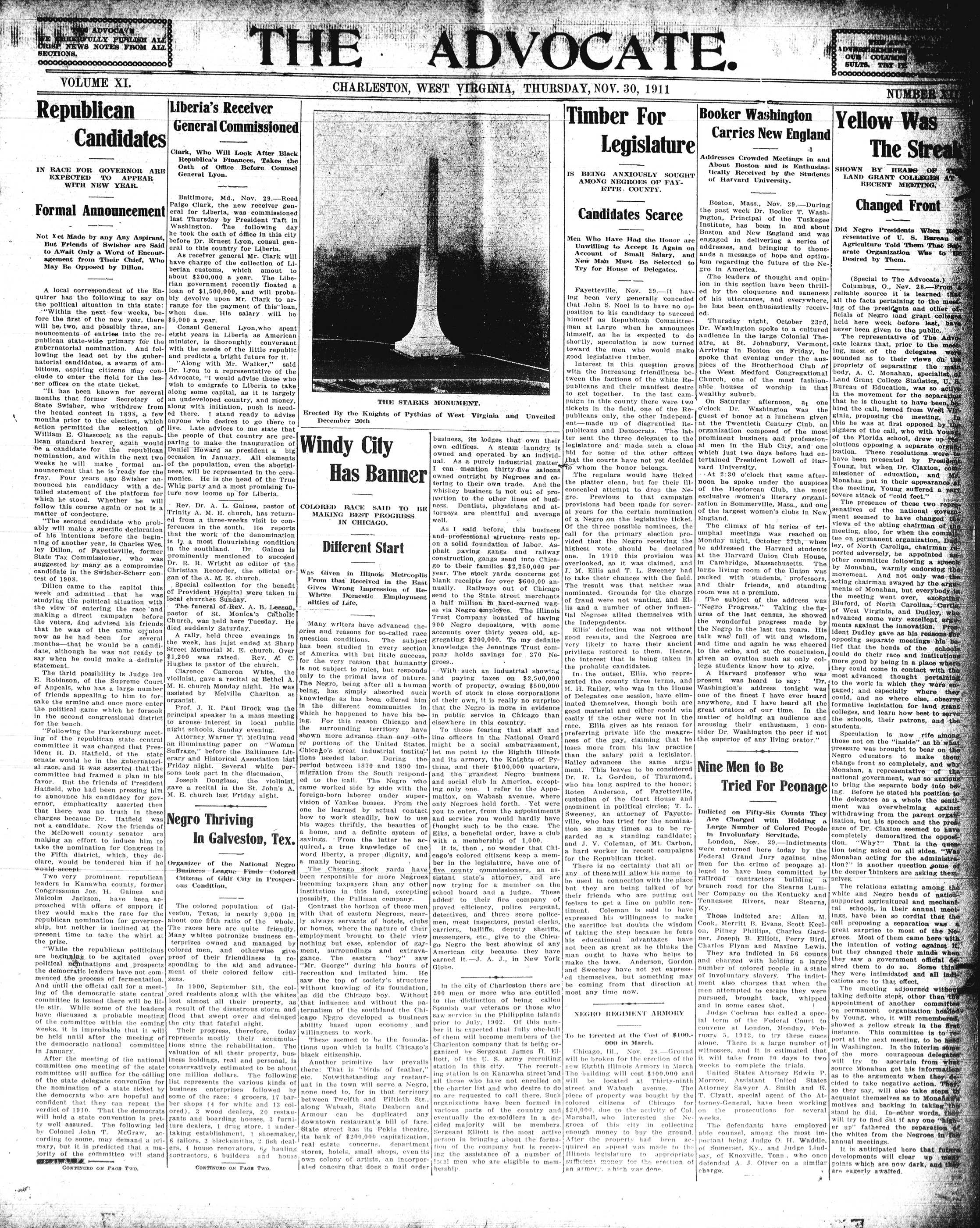
Erected By the Knights of Pythias of West Virginia and Unveiled December 20th
Erected By the Knights of Pythias of West Virginia and Unveiled December 20th
Windy City Has Banner
COLORED RACE SAID TO BE MAKING BEST PROGRESS IN CHICAGO.
Different Start
Was Given in Illinois Metropolis From that Received in the East Gives Wrong Impression of Re-Where Domestic Employment allities of Life.
Many writers have advanced theories and reasons for so-called race question conditions. The subject has been studied in every section of America with but little success, for the very reason that humanity is not subject to rules, but responds only to the primal laws of nature. The Negro, being after all a human being, has simply absorbed such knowledge as has been offered him in the different communities in which he happened to have his being. For this reason Chicago and the surrounding territory have shown more advance than any other portions of the United States. Chicago's great industrial institutions needed labor. During the period between 1870 and 1890 immigration from the South responded to the call. The Negro who came worked side by side with the foreign-born laborer under supervision of Yankee bosses. From the one he learned by actual contact how to work steadily, how to use his wages thriftly, the beauties of a home, and a definite system of savings. From the latter he acquired, a true knowledge of the word liberty, a proper dignity, and a manly bearing.
The Chicago stock vards have been responsible for more Negroes becoming taxpayers than any other institution in this land, excepting possibly, the Pullman company. Contrast the horizon of these men with that of eastern Negroes, nearly always servants of hotels, clubs or homes, where the nature of their employment brought to their view nothing but ease, splendor of garment, surroundings and extravagance. The eastern "boy" saw "Mr. George" during his hours of recreation and imitated him. He saw the top of society's structure without knowing of its foundation, as did the Chicago boy. Without that influence and without the paternalism of the southland the Chicago Negro developed a business ability based upon economy and willingness to work.
These seemed to be the foundations upon which is built Chicago's black citizenship.
Another primitive law prevails there: That is "birds of feather," etc. Notwithstanding any restaurant in the town will serve a Negro, none need to, for in that territory between Twelfth and Fiftieth Sts. along Wabash, State Deaborn and Armour can be duplicated any downtown restaurant's bill of fare. State street has its Pekin theatre, its bank of $200,000 capitalization, real estate concerns, department stores, hotels, small shops, even its own colony of artists, an incorporated concern that does a mail order
---
ADVOCATE.
THE STARKS MONUMENT.
---
business, its lodges that own their own edifices. A steam laundry is owned and operated by an individual. As a purely industrial matter, I can mention thirty-five saloons owned outright by Negroes and catering to their own trade. And the whiskey business is not out of proportion to the other lines of business. Dentists, physicians and attorneys are plentiful and average well.
As I said before, this business and professional structure rests upon a solid foundation of labor. Asphalt paving gangs and railway construction gangs send into Chicago to their families $2,250,000 per year. The stock yards concerns get blank receipts for over $600,00 annually. Railways out of Chicago send to the State street merchants a half million in hard-earned wages via Negro employees. The Illinois Trust Company boasted of having 900 Negro depositors, with some accounts over thirty years old, aggregating $200,000. To my definite knowledge the Jennings Trust company holds savings for 270 Negroes.
With such an industrial showing and paying taxes on $2,500,000 worth of property, owning $500,000 worth of stock in close corporations of their own, it is really no surprise that the Negro is more in evidence in public service in Chicago than elsewhere in this country.
To those fearing that staff and line officers in the National Guard might be a social embarrassment, let me point to the Eighth Illinois and its armory, the Knights of Pythias, and their $100,000 quarters, and the grandest Negro business and social club in America, excepting only one. I refer to the Appomattox, on Wabash avenue, where only Negroes hold forth. Yet were you to enter, from the appointments and service you would hardly have thought such to be the case. The Elks, a beneficial order, have a club with a membership of 1,000.
It is, then, no wonder that Chicago's colored citizens keep a member in the legislature, have one of five county commissioners, an assistant state's attorney, and are now trying for a member on the school board and a judge. These added to their fire company of proved efficiency, police sergeant, detectives, and three score policemen, meat inspectors, postal clerks, carriers, balliffs, deputy sheriffs, messengers, etc., give to the Chicago Negro the best showing of any American city because they have earned it.—J. A. J., in New York Globe.
In the city of Charleston there are 200 men or more who are entitled to the distinction of being called Spanish war veterans or those who saw service in the Philippine islands prior to July, 1902. Of this number it is expected that fully one-half of them will become members of the Charleston company that is being organized by Sergeant James ft. Elliott, of the U. S. army recruiting station in this city. The recruiting station is on Kanawha street and all those who have not enrolled on the charter list and who desire to do so are requested to call there. Such organizations have been formed in various parts of the country and eventually the ex-soldiers in a decided majority will be members. Sergeant Elliott is the most active person in bringing about the formation of the company but is receiving the assistance of a number of local men who are eligible to membership.
Timber For Legislature
IS BEING ANXIOUSLY SOUGHT AMONG NEGROES OF FAY-ETTE. COUNTY.
Candidates Scarce
Men Who Have Had the Honor are Unwilling to Accept It Again on Account of Small Salary, and New Man Must Be Selected to Try for House of Delegates.
---
Fayetteville, Nov. 29.—It having been very generally conceded that John S. Noel is to have no opposition to his candidacy to succeed himself as Republican Committeeman at Large when he announces himself, as he is expected to do shortly, speculation is now turned toward the men who would make good legislative timber.
Interest in this question grows with the increasing friendliness between the factions of the white Republicans and their manifest desire to get together. In the last campaign in this county there were two tickets in the field, one of the Republicans only, the other Independent—made up of disgruntled Republicans and Democrats. The latter sent the three delegates to the legislature and made such a close bid for some of the other offices that the courts have not yet decided to whom the honor belongs.
The regulars would have licked the platter clean, but for their ill-concealed attempt to drop the Negro. Previous to that campaign provisions had been made for several years for the certain nomination of a Negro on the legislative ticket. Of the three possible nominees, the call for the primary election provided that the Negro receiving the highest vote should be declared one. In 1910 this provision was overlooked, so it was clammed, and J. M. Ellis and T. L. Sweeney had to take their chances with the field. The result was that neither was nominated. Grounds for the charge of fraud were not wanting, and Ellis and a number of other influential Negroes allied themselves with the Independents.
Ellis' defection was not without good results, and the Negroes are very likely to have their ancient privilege restored to them. Hence, the interest that is being taken in the probable candidates.
In the outset, Ellis, who represented the county three terms, and H. H. Railey, who was in the House of Delegates one session, have eliminated themselves, though both are good material and either could win easily if the other were not in the race. Ellis gives as his reason for preferring private life the meagerness of the pay, claiming that he loses more from his law practice than the salary paid a legislator. Kalley advances the same argument. This leaves to be considered Dr. R. L. Gordon, of Thurmond, who has long aspired to the honor; Roten Anderson, of Fayetteville, custodian of the Court House and prominent in political circles; T. L. Sweeney, an attorney of Fayetteville, who has tried for the nomination so many times as to be regarded as a standing candidate; and J. V. Coleman, of Mt. Carbon, a hard worker in recent campaigns for the Republican ticket.
There is no certainty that all or any of these will allow his name to be used in connection with the place but they are being talked of by their friends who are putting out feelsrs to get a line on public sentiment. Coleman is said to have expressed his willingness to make the sacrifice but doubts the wisdom of taking the step because he fears his educational advantages have not been as great as he thinks the man ought to have who helps to make the laws. Anderson, Gordon and Sweeney have not yet expressed themselves, but something may be coming from that direction at most any time now.
NEGRO REGIMENT ARMORY
To be Erected at the Cost of $100,000 in March.
Chicago, IL., Nov. 28.—Ground will be broken for the erection of the new Eighth Illinois Armory in March The building will cost $100,000 and will be located at Thirty-ninth street and Wabash avenue. The piece of property was bought by the colored citizens of Chicago for $20,000, due to the activity of Col. Marshall, who interested the Negroes of this city in collecting enough money to buy the ground. After the property had been acquired an appeal was made to the Illinois legislature to appropriate sufficient money for the erection of an armory, which was done.
Booker Washington Carries New England
Addresses Crowded Meetings in and About Boston and is Enthusiastically Received by the Students of Harvard University.
Boston, Mass., Nov. 29.—During the past week Dr. Booker T. Washington, Principal of the Tuskegee Institute, has been in and about Boston and New England and was engaged in delivering a series of addresses, and bringing to thousands a message of hope and optimism regarding the future of the Negro in America.
The leaders of thought and opinion in this section have been thrilled by the eloquence and saneness of his utterances, and everywhere, he has been enthusiastically received.
Thursday night, October 23rd, Dr. Washington spoke to a cultured audience in the large Colonial Theatre, at St. Johnsbury, Vermont. Arriving in Boston on Friday, he spoke that evening under the auspices of the Brotherhood Club of the West Medford Congregational Church, one of the most fashionable houses of worship in that wealthy suburb.
On Saturday afternoon, at one o'clock Dr. Washington was the guest of honor at a luncheon given at the Twentieth Century Club, an organization composed of the most prominent business and professional men in the Hub City, and one which just two days before had entertained President Lowell of Harvard University.
At 2:30 o'clock that same afternoon he spoke under the auspices of the Heptorean Club, the most exclusive women's literary organization in Sonmerville, Mass., and one of the largest women's clubs in New England. The climax of his series of triumphal meetings was reached on Monday night, October 27th, when he addressed the Harvard students at the Harvard Union Club House, in Cambridge, Massachusetts. The large living room of the Union was packed with students, professors, and their friends, and standing room was at a premium.
The subject of the address was "Negro Progress." Taking the figures of the last census, he showed the wonderful progress made by the Negro in the last ten years. His talk was full of wit and wisdom, and time and again he was cheered to the echo, and at the conclusion, given an ovation such as only college students know how to give. A Harvard professor who was present was heard to say: 'Dr. Washington's address tonight was one of the finest I have ever heard anywhere, and I have heard all the great orators of our time. In the matter of holding an audience and arousing their enthusiasm, I consider Dr. Washington the peer if not the superior of any living orator."
Nine Men to Be Tried For Peonage
Nine Men to Be Tried For Peonage
Indicted on Fifty-Six Counts They Are Charged with Holding a Large Number of Colored People in Involuntary Servitude. London, Nov. 29.—Indictments were returned here today by the Federal Grand Jury against nine men for the crime of peopage alleged to have been committed by railroad contractors building a branch road for the Stearns Lumber Company on the Kentucky and Tennessee Rivers, near Stearns, Ky.
Those Indicted are: Allen M. Cook, Merritt B. Evans, Scott Keelon, Pitney Phillips, Charles Gardner, Joseph B. Elliott, Perry Bird, Charles Flynn and Maxine Lewis. They are indicted in 56 counts and charged with holding a large number of colored people in a state of involuntary slavery. The indictment also charges that when the men attempted to escape they were pursued, brought back, whipped and in some cases shot. Judge Cochran has called a special term of the Federal Court to convene at London, Monday, February 5, 1912, to try these cases alone. There is a large number of witnesses, and it is estimated that it will take from 10 days to two weeks to complete the trials.
United States Attorney Edwin P. Morrow, Assistant United States Attorney Sawyer A. Smith and E. T. Clyatt, special agent of the Attorney-General, have been working on the prosecutions for several weeks. The defendants have employed able counsel, among the most important being Judge O. H. Waddle, of Somerset, Ky., and Judge Lind-say, of Knoxville, Tenn., who once defended A. J. Oliver on a similar charge.
THE AUTO
ADVERTISMENT
OUR COLUMNS
SULTS. THE YE
NUMBER XII
SHOWN BY HEADS OF LAND GRANT COLLEGES RECENT MEETING
Did Negro Presidents When Representative of U. S. Bureau of Agriculture Told Them That Separate Organization Was to Be Desired by Them.
(Special to The Advocate.)
Columbus, O., Nev. 28.—From a reliable source it is learned that all the facts pertaining to the meeting of the presidents and other officials of Negro land grant colleges held here week before last, have never been given to the public.
The representative of The Advocate learns that, prior to the meeting, most of the delegates were sounded as to their views on the propriety of separating the main body, A. C. Monahan, specialist of Land Grant College Statistics, U. S. Bureau of Education, was so active in the movement for the separation that he is thought to have been behind the call, issued from West Virginia, proposing the meeting. In this he was at first opposed by the signers of the call, who with Young of the Florida school, drew up resolutions opposing a separate organization. These resolutions were to have been presented by President Young, but when Dr. Claxton, commissioner of education, and Mr. Monahan put in their appearance at the meeting, Young suffered a very severe attack of "cold feet."
The presence of these two representatives of the national government seemed to have changed the views of the acting chairman of the meeting, also, for when the committee on permanent organization, Dudley, of North Carolina, chairman reported adversely, he appointed another committee following a speech by Monahan, warmly endorsing the movement. And not only was the acting chairman swayed by the arguments of Monahan, but everybody in the meeting went over, excepting Bluford, of North Carolina, Curtis, of West Virginia, and Dudley, who advanced some very excellent arguments against the innovation. President Dudley gave as his reasons for opposing separate meetings his belief that the heads of the schools could do their race and institutions more good by being in a place where they could come in contact with the
most advanced thought pertaining to the work in which they were engaged; and especially where they could, and no where else, observe formative legislation for land grant colleges, and learn how best to serve the schools, their patrons, and the students.
Speculation is now rife among those not on the "inside" as to what pressure was brought to bear on the Negro educators to make them change front so completely, and why Monahan, a representative of the national government, was so anxious to bring the separate body into being. Before he stated his position to the delegates as a whole the sentiment was overwhelming against withdrawing from the parent organization, but his speech and the presence of Dr. Claxton seemed to have completely demoralized the opposition. "Why?" That is the question being asked on all sides. "Was Monahan acting for the administration?" is another question some of the deeper thinkers are asking themselves.
The relations existing among the white and Negro heads of nation-supported agricultural and mechanical schools, in their annual meetings, have been so cordial that the call proposing a separation was a great surprise to most of the Negroes. Most of them came here with the intention of voting against it, but they changed their minds when they saw a government official desired them to do so. Some think they were intimidated and all indications are to that effect.
The meeting adjourned without taking definite steps, other than the appointment of another committee on permanent organization headed by Young, who, it will remembered, showed a yellow streak in the first instance. This committee is to report at the next meeting, to be held in Washington. In the interim some of the more courageous delegates will try to ascertain from what source Monahan got his information as to the arguments when they decided to take negative action. They, so they say, will also take steps to acquaint themselves as to Monahan motives and backing in taking the stand he did. In other words, they will try to find out if any one "higher up" fathered the separation of the whites from the Negroes in the annual meetings.
It is anticipated here that future developments will clear up many points which are now dark, and they are eagerly awaited.
ORRESPONDENCE
C. Howard spent the week end
in swisburg, the guest of Miss
Isa Woodson.
V. and Mrs. J. J. Turner, of
Carbon were here on business
day.
V. and Mrs. E. Page will spend
week-end at Charleston and
tate.
V. and Mrs. H. M. Bailey, Rev.
Deans, Misses Lita Hall, Mary
and Henrietta James are at
the state teachers' associat-
tion at Kimball this week.
Isa Anna Ward, of White Sul-
ishe is here to spend the Winter
Mrs. O. J. Henderson.
Ethel Brown was hostess to
teacher's reading circle, Wed-
day.
Hattie Burke, visited reha-
l in Charleston Sunday.
Mas Minnie Hoard and Mrs. Mel Williams were shopping in Erleston last week.
Mrs. William Brown, who spent but three months at Mt. Clepans, Mich., for her health has reened home much improved.
Mrs. L. D. Hodge has returned no after spending a week in the stern part of the state.
Hiram Lodge No. 26. A. F. & A. am in regular session Thursday ning and elected officers for theuing term, as follows:
In Anthony Hall, Tuesday night, joint musical recital will be given George F. Bogle, pianist and J. Van Hulstryn. An extra force of carpenters is work making the necessary nanges for the installation of the theater works. The gasoline engine, pumps, andaint pneumatic tank, six feet in ammeter and twenty-four feet long, have attracted considerable attention among visitors. Howard University Academy and torer played their first game last day. This was the greatest name of the season for Storer's boys: Mr. Marshall, Howard University's coach, said that it was one of the best games of the season.
During the first quarter Howard made a touchdown. In the third quarter, Scott, Storer's R. T., kicked the goal from the field, which scored her three. The game ended with the men near the center of the field and the score 5 to 3 in favor of Howard.
One man was seriously injured on Howard's team. It is thought that his leg was fractured.
At seven o'clock in the evening a reception was given to H. Welling team by the foot ball boys. The Junior and Senior girls were especially invited to meet the Howard team.
EAGLE.
Rev. J. H. Williams, of Boormer, preached two sermons, Sunday.
Rev. Smith, of Indiana, was in town last week and called on Rev. E. C. Page, at the school building, He preached an able sermon, Wednesday.
Luther Brown entertained Rev. J. H. Williams at dinner, Sunday. Miss Louisa Brown is sick.
Mrs. James Ross and sister, Gladys L. W. Winston, were visiting Mrs. W. C. Lawrence, at Montgomery, last week.
Mrs. Jennie Johnson was shopping in Montgomery, last week.
Rev. Warner Brown, of Montgomery, was the substitute for Miss Ethel Brown a few days during a short illness.
Mrs. James Russ attended the Montgomery Improvement League last week, at the home of Mrs. Ella Johnson.
Rev. Robert Daniels passed through here last week enroute to Huntington to visit Rev. L. V. Bryant, and assist in a revival
RONCEVERTE.
Mrs. D. W. Calloway and children left for Beechley, last week.
Mrs. Berta Twine, who has been visiting here for the best month, returned to her home at Claremont, Saturday.
Rev. E. IW. Hester preached a Marlinton, last Sunday eight.
Mrs. Emma Thompson, who has been sick for some time, is much improved.
Mrs. J. M. French and daughter, who have been visiting at Gap Mills, returned home last week.
Rev. J. M. Roane, of White Sulphur, was a visitor here last week.
Rev. J. A. Reed filled his appointment at Alderson, Sunday.
Mrs. Julia Dillingham was the guest of her sister, Mrs. Hattie Pryer, last week.
Archur Trice, of Alderson, was in town last Monday.
Mrs. F. A. Reed was a business
Vicector at White Sulphur, Saturday,
Ralph, little son of Mrs. Blanche
Melanconridge, died Saturday, at
6:14 a.m. after an illness of four
others. Funeral services were held
Saturday at the residence of his
grand mother, Mrs. Ann Banks.
Rev. J. A. Reed officiated. Interment in Greenwwood cemetery.
PLYMOUTH.
R. C. Smith and D. M. T. Sinclair made a business trip to Winfield, Tuesday.
Rev. W. A. Woodard, of Bidwell, O., preached two interesting sermons Sunday. He is expecting to start a revival soon.
J. A. Brooks, who has been visiting his daughter, Mrs. Mae Jones, left Monday for his home in Gallipolis, Ohio.
Miss Elina Saxens was the honer guest, Thursday of last week, of a surprise party. She received several nice presents.
The Carnival Drill given under the management of Miss Laura C. Smith was a success.
Mrs. Sarah F. Smith was shopping in Black Pessey, Friday.
Mrs. M. F. Sinclare was visiting friends in Plymouth, Sunday.
Sunday was rally day with the missionaries. A neat sum was raised.
Mrs. George Brook, who has been sick for several days, is much improved.
Mr. and Mrs. Brown and children of Rocky Mount, Va., who have been visiting the former's brother, Joe Brown, left Saturday for Charleston, where he has employment
LEWISBURG.
There was a beautiful home wedding last Wednesday night, at the residence of Mrs. Lewis Garrison, sister of the bride. The contracting parties were Mr. Isaiah Bush, of Lewisburg, and Mrs. Harriet Carter, of Richmond, Va. The marriage ceremony was performed by Rev. E. A. Boiling, and the wedding march was played by Miss Annie L. Garrison, Mr. F. A. Perkins acted as best man.
Rev. J. C. Love closed a six-week revival last Sunday night with five conversions and reclaims.
Rev. MacLane, of North Carolina helped Rev. Love two nights in his meeting last week. He is an able speaker.
Cornelius Howard, of Montgomery, was a visitor last Saturday and Sunday.
The Lewisburg Reading Circle met Monday at Lewisburg Graded School. The discussion of the subjects before the meeting were very interesting.
J. C. Lewis left Saturday for Wheeling on a business trip.
Miss Brunette Brown who was called from her studies at the W. V. C. L. owing to the illness of her mother, will return to Institute next week.
Mrs. Randall Brown, who has been quite sick, is much improved. Thomas Freeman is sick.
Charlesto
Mrs. Seamus Honor Guest.—Mr. and Mrs. Charles Stephenson entertained at their home on Bilby St. Tuesday evening, in honor of Mrs. E. V. Seamus, of Parkersburg, their house guest. Among their other guests were Mrs. J. W. Viney, Mr. and Mrs. Charles Preston, Mr. and Mrs. Russell Forney, Mrs. Mason Burke, Mrs. B. F. Clark, Mr. and Mrs. C. H. James, Mr. and Mrs. Taos. Whittaker, Mrs. Ora Campbell, Misses Alice Whittaker, Maud Viney, Moss Clay, Hazel Lucas, Gerrande Campbell, Stella James, Rebecca Bullard, Lucinda Williams, Cornelia Davis, Mary Preston, Dr. J. C. Billi, Dr. Andrew Brown, Dr. J. B. Brown, T. G. Nutter, Edward James, Charles Payne, W. H. Wright, James Preston and Charles Harbey.
The Harrison Recital...Carnotti
that was comfortably filled, Mon-
ney night, when Richard P. Harrison
made his appearance in an elec-
tionary recital of which seven of
the eleven selections were from
Dunbar. Mr. Harrison's readings
fully sustained the expectations of
his audience, his delineation of the
Dunbar characters leaving nothing
to be desired. The Negro poet was
represented on the program by
"When Malinda Sings," "Little
Brown Baby," "In De Mornin'."
"How Larry Harkshild," "The Rivals," and "Encouragement." For
the deduction of the more critical
he gave the court scene from The
Merchant of Venice, and was rewarded
with unstinted applause. Mr.
Harrison made a distinct hit and
the size of the audience which
greeted him will likely encourage
the management to bring other
high artists to the city.
Nicotiana Causes Death.—The remains of Mrs. E. L. Mason, who died Saturday of scepticism at London, were brought to this city and interred, Monday, in Spring Hill cemetery after services at the First Baptist which were conducted by the pastor, Rev. B. R. Reed, Mrs. Mason was a native of New York and on removing her residence to this city took an active part in the affairs of the church from which she was buried, serving as a member of the choir. She is survived by her husband and seven children, the youngest being four weeks old.
Mrs. Moss Entertains. — Mrs.
Mattie Moss was hostess, Friday evening at a dinner to a few friends complimentary to Mrs. Scams. Covers were laid for the guest of honor, Mrs. J. M. Hazelwood, Mrs. J. W. Viney, Mrs. Robert Hammond, Mrs. Chas. Stephenson, Mrs. C. H. James, Mrs. Anderson, Miss Alice Whittaker and Miss Maude Viney.
Hotel Brown Guests.—The arrivals at Hotel Brown this week were: E. D. Huckers, Dorothy; Mr. and Mrs. Edward Tate, Decota; Mr. and Mrs. H. Chandler, Fun; H. Reed, Cabin Creek; S. H. Denson, Covinston, Va.; Wright Bros., Columbus, O.; W. T. Campbell, Ansted; Fred Morris, Ansted; Mr. and Mrs. Jas. Reed, Peytona; George Evans, Indianapolis, Ind.; J. H. King, Cedar Grove; G. H. Miller, Quincy, W. Pierson, Belle Ky.; Mr. and Mrs. H. Roberts, Columbus, O.; C. Williams, Washington, D. C.; and Mr. and Mrs. Mickens, Plymouth.
Committees Appointed.—As a direct result of the Advocate's agitation for participation of the colored churches in the Men and Religion Forward Movement, Simpson M. E. Church and the First Baptist Church will co-operate with the churches in stirring up a greater interest on the part of men for the church. On Bible Study, Simpson's committee is I. C. Cabell, J. W. Essex, and G. H. Beane; First Baptist: C. W. Boyd, J. A. Jefferson, J. F. Prillerman, R. H. Thomas and King Jackson. Social Service: Simpson: J. R. Helm, Chas. C. Lewis, and C. R. Nelson; First Baptist: L. C. Farrar, M. L. Fairfax, Percy Trent, R. M. Mayhew, and J. A. Langhorn. Home and Foreign Missionary; Simpson: A. O. Wells, J. W. Henderson, J. W. Chappelle; First Baptist: J. P. Caul, R. C. Melver, Roy Leftridge, Roy Edwards and Norman Haven. Evangelism; Simpson: George Franklin; First Baptist: F. C. Claire, Henry Taylor and Isaiah Brown, R. Q. Hill, E. R. Carter, David Boyles and C. H. James. Boy's Work; Simpson: Frank Boyle, Edward Wells and A. L. Garrett; First Baptist: J. F. Clark, Louis Patterson, Percy Harris, Engene Moss and Bernard Winston.
Ellis Gets Appointment.—Dr. J. E. Ellis was appointed, Tuesday, by Mayor Holley assistant city medical examiner and immediately assumed the duties of his office. The work is said to be not arduous and will in no wise interfere with his growing practice. The salary is in the form of fees and will not the Doctor from $20.00 to $25.00 per week.
Mitchell gives Board Pointers.—At the request of President Lakin of the W. Va. State Board of Control, the Chas. E. Mitchell, business Manager of the West Va. Colored Institute, met the Ohio State Board of Control here, Tuesday, and demonstrated the system in use for keeping accounts in his Institution.
Elks Memorial Service. The following program will be carried out by the Elks at the K. of P. hall, Sunday afternoon;
ELKS
Memorial Service
at K. of P. Hall, 230 P. M., Sunday
December 3, 1911.
Prelude ..... Schumar
Miss Lenora Cowser
Bass Solo ..Theodore Henderson
Opening Ceremonies by Lodge.
Great Ruler of the Universe.
All seeing and benign
Look down upon and bless our
work
And be all glory Thine.
Oh! Hear our prayers for our hon-
ored dead.
White bearing in our minds
The memories graven on each heart
For "Auld Lang Syne."
Invocation...Rev. Edward Umbles,
Quintette.
Messrs. C. H. James, Allen DeHoney,
G. L. Cuzzens; Mrs. Anna
Davis and Mrs. Rosa Thompson.
Meritorial Address
Prof. S. H. Guss, W. Va. Institute
Saxaphone Solo.....W. O. Terry
Face to Face.....G. L. Cuzzens.
Closing Ceremonies By Lodge
Closing Ode...Lodge and Audience
Praise God from Whom all blessings flow.
Praise Him all creatures here below.
Praise Him above for all that's good.
Praise Him for our true Brotherhood.
Benediction.....Rev. Ed. Umbles.
IN MEMORIAM.
S. W. Starks. Edward Ray.
Fleet Porterfield. J. E. Woods.
A. H. Hackley.
Mrs. F. W. Bryant has returned from a two weeks' visit to her parents at Ironion, O.
Mrs. R. L. Jones left Tuesday for Washington, D. C., where she will remain till after the Christmas holidays.
Miss Viola Smith, of Institute, will spend Thanksgiving with her mother, Mrs. Malinda Foreman, O'Connor's avenue.
Mrs. Ellen Phillips is suffering with the grip.
Mrs. E. R. Reed is indisposed.
Mrs. and Mrs. Macon, and son have returned from Riemond, Va., and are at their home on Bullitt street.
Mrs. Vlola Wright and Miss Lillie Smith entertained the Church Aid Society of the A. X. E. Church at Hotel Bprown, Friday evening. The public is invited.
Miss Kathryn Hawkins, of Elyria, O., is the guest of Miss Aurilla Anderson, Estill street.
Andrew Hall is ill with fever at his home on Wall street.
Mr. and Mrs. George Smith served a six-course dinner, Monday, at which Rev. and Mrs. E. W. B. Curry were honor guests.
Mr. and Mrs. C. E. Kimbrough are receiving congratulations on the birth of a daughter who arrived Wednesday of last week.
Mrs. Amanda McGhee was called to London, Saturday, by the illness of her daughter-in-law, Mrs. Mayme Musca.
Invitations are out for a dance at the K. of P. Hall tonight to be given by the Cog City Club.
Mrs. M. J. Preston was hostess to a dinner party, Sunday, in honor of Rev. and Mrs. Curry, Mrs. E. V. Seams, Rev. and Mrs. B. R. Reed and Rev. R. M.. Mayhew.
Rev. J. S. Carroll conducted the services at the S. teent Street Methodist church, Sunday, for Rev. Reed.
Mrs. Alice Board entertained the Litters' Club, Tuesday evening
Mrs. Cioo, Tuesday evening.
Mr. Hugh Miller and daughter,
Mrs. Dove Henderson, of Rendville,
Chio, were guests of Mrs. Mary
Starks, last week.
Mrs. J. M. Hazlewood and Mrs.
C. O. Lowry will spend Thanksgiving
at Pomeroy, O., with relatives.
Mrs. Carrie, Crichlow arrived in
the city last night to spend a few
days with her parents, Mr. and Mrs.
C. H. James.
STARTS MECH TROUBLE
If all people knew that neglect of constipation would result in severe indigestion, yellow jaundice or virulent liver trouble they would soon take Dr. King's New Life Pills, and end it. Its the only safe way. Besa for billiousness, headache, dyspepsia, chills and debility. 25c at all druggists. 11-2-5t
Republican Candidates
(Continued from Page One.) for the convention system of making the nominations.
"It is almost assured that each of the four democratic congressmen will receive a renomination with the exception of John W. Davis, of the First district. Davis is held to be very select gubernatorial timber-by some of the leaders of the party, and may be induced to step out of congress to make a try for the gubernatorial nomination. He has made no statement to indicate that he is willing to make the race, but he would have the preference among a number of others mentioned for the gubernatorial nomination.
"While denying that he has been commissioned by the supporters of Governor Judson Harmon to look after the interests of the Ohio presidential candidate in West Virginia, George L. Neal, for many years an active leader of the democracy in the southern section of West Virginia, is prolific in his praise of the Ohio executive, and unequivocally declares that he is for Harmon because he believes him to be the strongest democrat who could be nominated for the presidency.
This declaration is made by Neal in the city of Huntington, where the first Woodrow Wilson club in the state was organized. Neal, who is vice chairman of the democratic state central committee, says that he has been for Governor Harmon ever since his re-election as governor of Ohio.
"Some of the republican leaders who will not be as much interested in the personnel of the next republican state ticket as they are in the restoration of confidence in the party management, are going to devote considerable time before the June primaries in organizing for an election of a new state committee which will have the confidence of the republican electors of the state, and an earnest effort will be made, so it is said, to bring cut some of the best timber in the party for the places on the committee. It is argued by some that the selection of a new committee, in which confidence can be reposed, will do more toward welding the discordant elements that any other action that may be taken. In this connection the name of Colonel Isadore Schwabe, of Charleston has been suggested as a candidate for membership on the state committee from the Kanawha-Boone-Logan district. Colonel Schwabe has been prominent as a party leader, has been a member of the staffs of Governor Dawson and Governor Glasscock, but never has asked for party office, and probably would not make a contest for any office within the gift of his party, but his friends insist that he would make an ideal committeeman, fair and impartial toward all factions and elements and just in his decisions.
"Interest is being revived, in the appointment of a school book board of eight members, an act to be performed by the governor before the first of next April. Under the provisions of the act the Book Board has extensive powers, and will prescribe a uniform series of books to be used in the free schools of the state for a period of five years.
"In all probability the Republican
"In all probability the Republican state delegate convention, to be
Gold Flinted
Roman Gold Flush
1 Amethyst Desert
Free to Girls
This fine Ring or Sterling Silver Chased Lock and Key Bracelet for solely One Dozen Childs Red Cross Salve (at 25c per box). Send no money. We trust you until goods are sold. Your name on a postal will do, and goods will be promptly sent. Write today as you may not see this ad again.
CHILDS & CO.
CRANFORD, - NEW JERSEY. Department A.
called after the national committee issues a call for the national convention, will witness a contest in judicial offices. Two supreme court judges are to be nominated. Judge George Poffenbarger, of Mason County, will be a candidate for re-election. District Attorney Harold A. Ritz, of Bluefield, also will be a candidate. It is reported that Judge Chas. W. Lynch, of Clarksburg, and Judge H. M. Willis, of Wetzel county both of whom are now in the circuit bench, will ask for promotion to the supreme court of appeals.
"From the county of Preston comes the tidings that former-State Senator Samuel B. Montgomery will oppose Charley Fawcett Teter for the republican nomination for congressman at large, which, with Attorney General William G. Conley in the race for congress from the second district, would give to Preston two congressional candidates."
Negro Thriving
(Continued from page one)
movers, 6 cotton samplers, 3 ice men, 1 ice cream company, 2 insurance businesses, 6 doctors, 1 dentist, 2 newspapers, 2 printing companies, 4 lawyers, 1 junk shop, 1 real estate company, 1 mining company, 3 pleasure resorts, 3 public schools, 1 high school, 16 churches, 300 homes owned, 8 organizations own property valued at $60,000, 3 other organizations have bought property in the city limits valued at $30,000. There are about 45 different local secret societies.
The most important labor organization in the city is the No. 2 Cotton Screwmen's, which was formed thirty years ago. Their work, for the commercial interests of this port in the past ten years in storing away cotton vessels to be transported throughout this country and abroad has been estimated in value to amount to about one billion dollars, in other words, equal to the whole wealth of the race in the United States. The organization's strength in membership is 600, and many families of this community
Educational Notes
Fisk University, the Negro college of Nasnvine, Penn., has secured $119,000 of the $300,000 to be raised in order to receive the General Education Board's appropriation of $60,000; $200,000 of this fund is for endowment. This effort to put a first-class college on its feet deserves the co-operation of all.
1 Mr. Julius Rosenwald, the Chicago merchant who has given so much to colored, Y. M. C. A. Work, has been making a trip to the south. He visited Fiske University, Meharry Medical college and Tuskegee. While at Fiske he said, "I wish to express my optimism upon the colored people in America. We have every reason to feel that they are making strides forward. I am very glad to have the opportunity of seeing the work that I had no idea existed in the manner it does exist."
The entire student body of the State Agricultural and Mechanical college at Greensboro has been in open rebellion on account of the increase of industrial work at the expense of academic work, and the introduction of Saturday class work. On Tuesday, October 10, the Rev. M. W. Gilbert was inaugurated president of Selma University. Representatives of many colored institutions of the south were present and made addresses. The Missouri Negro Teacher's Association convened in Hannibal. The State Teachers' Association of Florida will meet at Jacksonville during the Christmas holidays. The South Alabama Colored Teachers' Association met in Mobile with several hundred people in attaendance.
In South Carolina Negro school children outnumber the whites; the cost of the respective school systems is, however as follows: whites, $1,684,976; Negroes, $268,802. In Texas there are 199,915 Negro children of scholastic age, for each of whom the state apportions $5.80 or a total of $1,359,422, and there are 791,494 white children, for whom there is apportioned $5,382.-159, making a total apportionment of the state available school funds by the state board of education for the current year of $6,741,581. This is the largest apportionment of state available school funds ever made in
THE BAUER MEAT & FISH CO.
28 AND 30 CAPITOL ST.
Beef, Veal, Mutton, Pork Fresh Pork Sausage OUR OWN MAKE.
The best qualities in all the popular kinds of
We want your patronage for we have complete stock in our lines and you an get it when you want more.
the history of the state for any scholastic year.
The new colored school at Ivy City District of Columbia, has been presented with a life size portrait of Alexander Crummel, after whom it is named, by the Negro society for Historical Research.
The new superintendent of New Orleans has recommended that all the colored public schools have colored teachers, but so far his recommendation has been ignored. Several of the New Orleans colored schools have white teachers.
The large increase of students at the colored high schools in Washington will lead to seven companies in the cadet battalion instead of six. It is possible, therefore, that the battalion may be organized as a regiment.
The cornerstone of Berca's new school for Negroes, to be known as the "Lincoln Institute of Kentucky," was laid in Shelby county, Ky., by the president of Berea. The school has 440 acres of land and the first buildings will cost $110,000. Other buildings will bring the cost up to over a million. The Negro Baptists of Texas have raised more than $17,000 for their own educational institutions during the last year. Miss Bessie Bruington, a colored girl, has been appointed to the public schools of Los Angeles, Cal.
The Tuskegee Normal and Industrial Institute, of which Booker T. Washington is principle, has just received a legacy of $10,000 from the estate of the late Maria Blachard, of Philadelphia, Pa.
WHAT IS IT?
Ten and twenty year combination distribution certificate of membership as devised by the American Workmen Fraternal Insurance Company, of Washington, D. C., one of the most liberal, strongest and reliable fraternal institutions in the field. For further particulars see
D. E. V. JORDAN
General Agent for West Va.
Office: Room 2, K. of P. Bidg.
Charleston, W. Va.
100 AGENTS WANTED.
---
NEW
NEW
THE SEWING
MACHINE
OF
QUALITY.
NOT
SOLD
UNDER
ANY
OTHER
NAME.
HOME
WARRANTED FOR ALL TIME.
If you purchase the NEW HOME you will
have a life asset at the price you pay, and will
not have an endless chain of repairs.
NEW HOME
Quality
Considered
it is the
Cheapest
in the end
to buy.
If you want a sewing machine, write for
our latest catalogue before you purchase.
The New Home Sewing Machine Co., Orange, Mass.
SHIRLEY
PRESIDENT
SUSPENDERS
M
The kind that most men wear. Notice the cord back and the front ends. They slide in frictionless tubes and move as you move. You will quickly see why Shirley President Suspenders are comfortable and economical for the working man or business man.
Light, Medium or Extra Heavy Weights—Extra Lengths for Tall Men.
Price 50 Cents from your local dealer or by mail from the factory.
Signed Guarantee on every pair
THE C. A. EDGARTON MFG. CG.
333 MAIN*STREET, SHIRLEY, MASS.
---
Washington, D. C., Nov. 30. J. C. Napier, register of the treasury, has returned from Macon, Ga., where he delivered the principal address on the occasion of the opening of the Georgia Colored State Fair. This exposition was under the direction of Prof. R. R. Wrist, president of the Georgia State Colored College, and is pronounced the largest and best enterprise of its kind ever carried on by colored people in this country. It is the first exposition under Negro auspices to present a comprehensive display of exhibits from the United States government. The introductory address of Register Napier was given much attention by the daily press of Georgia and the south, and is widely commended for the painstaking collation of statistics showing the achievements of the colored people in agriculture and mechanical arts, as well as in general education, and for the strong and sensible advice given to both races touching their relation to the economic uplift of the southland—their common home. He plead for a sympathetic co-operation along commercial lines, and held that the best results for all would be brought about by an encouragement to the colored people to be industrious, thrifty, intelligent, faithful and law abiding, and assuring to them proper returns for their labor and adequate protection under the laws of the land. The economic value of the Negro to the south was emphasized, and the critics of the race, who are prone to argue that the black man is a burden to Dixieland, were silenced by his proof that the bulk of the 12,000,000 bales of cotton produced by the south, and which constitutes the cornerstone of her prosperity, is the work of the black hands.
Toward the close of his address at Macon, Register Napier paid a high tribute to the national administration, of which he is a part, and gave it as his opinion that the Negro—all things considered—is closer to Mr. Taft than to any previous chief executive. With reference to President Taft, the Register said:
"Some of our friends are inclined to speak harshly of the course pursued by President Taft since he has become the occupant of the White House. It is claimed that his removal of the colored officials from the offices in the south has been a setback to our race. While this may have been contrary to the wishes judgment of the most of us, it cannot be denied that in the point of important places now held by Negroes, and honor attached to them, as well as the emoluments accruing from them, they are as great, of greater, now, than they were when President Taft went into office. Negroes Hold Many Places of Distinction.
"There are today," continued Mr. Napier, "more places of distinction held by Negroes in the city of Washington and in the states than ever before. There are more of our young people in the various departments than ever before."
"In the outset, President Taft made a significant statement when he said in his inaugural address that the Negroes are now American citizens, and it becomes our duty to make his path to complete citizenship as smooth and easy as possible.
"The President has spoken to more Negro schools and to more Negro assemblages, expressing his desire for their advancement than any other president. The Negro—
B. NUFORM CORSETS
THE Nuform is a popular priced corset, modeled on lines that perfect your figure. It defines graceful bust, waist and hip lines and fits at the back.
The range of shapes is so varied, every figure can be fitted with charming result.
All Nuform Corsets are made of serviceable fabrics—both heavy and light weight—daintily trimmed and well tailored.
Your dealer will supply you with the model best suited to your figure.
Nuform, Style 478. (As pictured). For average figures. Medium low bust, extra skirt length over abdomen and hips. Made of durable coutil and light weight batiste. Hose supporters. Sizes 18 to 30. Price, $1.00.
Nuform, Style 485. For average and well developed figures. Medium bust, extra length over hips, back and abdomen. Coutil and batiste. Hose supporters. Sizes 18 to 30. Price, $1.50.
form,Style 488. For average and well developed fig-
ique coat construction over hips, back and abdomen,
fort with modish lines. Made of excellent contil
se supporters. Sizes 19 to 30. Price, $2.00.
Sold At All Stores
BROS.,Makers, 34th St. & Broadway, New York
Nu-
ures. Use
insuring co-
and batiste. Hoe
WEINGARTEN
all things considered—stands closer to his administration than ever before in the history of the country. If the black man has complaint to make; if he has a claim to urge; or a request to make, he has only to let his wants be known to the President or any member of his cabinet, and, without hesitation or red-tape delay, he is patiently heard and his complaint or request or demand is carefully considered."
MacVeagh.
"Allow me to say further," said Mr. Napler, "that the thanks of the entire race are due to Secretary MacVeagh, another of the administration's strong forces, for his broad-minded zeal for the practical interest in the success of this exposition. It is to him that we owe this magnificent display of the various activities of the United States Government. This is the first instance where in any exposition carried on by colored men has been honored by an exhibit from the government, and it marks an epoch in our progress, besides indicating that we still have strong friends among those who know best our real value to the nation. To Secretary MacVeagh, his private secretary, Mr. F. W. Taylor, and chief clerk, Mr. J. L. Wilmeth, we owe the presence of this instructive and expensive government display. Not only did they grant with pleasure its use, but they saw that it was promptly gotten to these grounds and properly installed where it would redound to our greatest satisfaction and advantage.
"The Negro race is going forward. We have handicaps which greatly annoy us and impede our progress. But, the race is moving steadily to the front, and there are upon all sides concrete evidences of this steady advancement. Let us take new courage from them. Let us face the future with hopefulness. No race can permanently fall that clings to lofty ideals and strives earnestly for self-betterment. A race that is willing to help itself from within will find an abundance of help from without."
Register Napier warmly praised the parade that passed through the principal streets on the opening day of the fair. But for the inclement weather it would have been witnessed by 10,000 people. In introducing the speaker of the day, President Wright, of the fair association, took occasion to thank the white and colored people of the state for that co-operation that has made the fair a brilliant success.
Meeting of Republican National Committee
Everybody is talking about the forthcoming meeting of the republican national committee which is set for the 12th of December at the New Willard. After all the discussion that has been going on with reference to the chairmanship, it has been practically determined that the place will not be filled at this meeting. In accordance with the usual custom the committee will await the result of the nominating convention in June, and permit the standard bearer of the party to make the selection most suitable to him. With President Taft's renomination assured, the naming of a chairman is only a matter of detail. It is pretty generally assumed, and to this the rank and file of the party votes "aye," that the choice of the president for campaign manager will be his affable and efficient secretary, the Hon. Charles D. Hilles. He knows his chief; he knows the issues; he knows the temper of the people of
the country; he knows the men worth while; he knows more than anyone else; how to teach the colony people of the land and sympathizes more than anyone else with them in the peculiar disabilities that confront them politically and otherwise. While dismissing the chairmanship question for the time being, the committee and the country, as well as the Negro race, will keep Mr. Hilles in mind, and shape their course on the hypothesis that he will lead the forces to victory in the great battle of 1912.
No Change Probable as to Southern Representation.
The committee will have to wrestle again with the question, "shall the representation of the southern states in the national convention be reduced"? The point is being made by radical northerners that the south, without ability to return a single electoral vote for the nominee, should not be allowed a greater strength in making the selection of a candidate than their party vote justifies. Over against comes the proposition that such a change should carry with it it a corresponding reduction of representation in congress of the states that deny to their citizens a proper share of the suffrage. The old line republicans do not feel inclined to force a section of the country to suffer because of the villainous manipulation of the ballot laws by a bourbon olarchy, nor do they wish to set the seal of legal approval upon a system of suppression that nullifies the constitution of the United States. Taking chances on the south standing by the right man for the presidency—as it undoubtedly will, in this particular instance—it is likely that the present method of choosing delegates will be permitted to remain intact. To make assurances doubly sure, men of strong influence in the south, like Col. Judson W. Lyons, who as national committeeman has put this measure to sleep at least three times, will be on hand to contend for the welfare of their section. Col. Henry Lincoln Johnson, Col. Walter L. Cohen, Charles Banks, Editor W. E. King, of Texas, Editor M. M. Lewey, of Florida, Register J. C. Napier, former Recorder John C. Dancy and others are expected to be within reach, and may present arguments to the national committee against any reduction in the representation of the south in the convention next June. Forecasters are of the opinion that the proposition to elect delegates by the primary method will be defeated by an overwhelming majority.
No argument in favor of the primary system, it is claimed, will offset the fact that it is very expensive that there is no machinery to guarantee an honest election, restricted to bona fide republicans, and no law upon which such a plan may be enforced uniformly throughout the states. Th colored people, alive to everything that is going on, are frank to say they are opposed to nearly all of the innovations proposed, for the simple, but essential human reason that they are suggested in most part, by men not friendly to the political aspirations of the race. They are content, therefore, for the present, to "let well enough alone."
Chicago will be selected as the convention city, and the clans are anxious for an early call. The national committee is for Taft by a big margin, and his renomination will be favored by the body. It is not thought that former President Roosevelt will permit his name to be used as a candidate, and it is expected that, at the proper time, he will announce for Taft. The colored brother, office-holder and layman, will be on hand to make note of the proceedings. To a larger extent than has been true of any battle since 1896, the Negro will be a factor in the coming campaign. He will make his potency felt in all of the pivotal states. The stakes are big, as he sees it, and he is ready and anxious to get into the game. He is ready for the band to play.
Treasury Auditors Not to Be Abolished.
The plan suggested some time ago by the economy and efficiency commission looking to the abolishment of five of the treasury auditorships and consolidating the accounts of the government under a single auditor, will probably not carry, Judge R. J. Tracewell, comptroller of the treasury, in his annual report inveighs strongly against such a change, and shows why it would be unwise, in view of the growth of the government and the large personal responsibility that rests upon the accounting officers of the various departments. Says he: "The duties of an auditor are not confined to a mere addition of figures and other clerical work. An auditor, to properly perform his duties, must be not only a good business man, but should be an excellent lawyer and perfectly familiar with the history of the congressional appropriations."
The stand of the comptroller in this matter is of interest to the race because of the fact that the office of auditor for the navy department is held by a colored man. Aida Overton Walker at The New Howard. The New Howard theatre is offering the stellar bill of the season, and the heaviest attendance record at Manager Thomas' pretty playhouse is being broken into smithereens this week. The top-liner is the one, only and celebrated Aida
Office Hours
8 to 11, 1 to 4, 6 to 9
Overton Walker, with a company of ten talented artists, presenting an act that reaches the last word in vaudeville originality and intrinsic merit. Mrs. Walker has never appeared here to such excellent advantage, and has added to her immense popularity with the Washington people. More will be said of her act in our next letter. Other attractions on the long and varied bill are: Merryweather and Brown, held over from last week on account of general demand; Dodson and Lucas, McKisson and Shadley, Wilson and Burton, Alonzo Moore, magician and the usual photo plays. Manager Thomas is making good.
The Helpfulness of Richard Green.
A philanthropist "unto the manor born"—who in a quiet and unsuspecting way of doing a mine of good for humanity and the race—is Mr. Richard Green, chief of the messengers of the treasury department, for many years attach to the office of the secretary. He knows everybody in Uble Sam's great financial institution, and is always exerting his influence to help somebody in the way that is most needed. So broad is his mental horizon, and so big is his generous heart that he does not confine his benefactions to members of his own race. He is ever ready to assist white or black, Jew and Gentile, saint and sinner.
A few days ago the only son of Mrs. Virginia Troutman, a white employee of the department, was shot and killed under peculiarly depressing circumstances, although it was made plain that the killing was accidental. Mrs. Troutman's husband is blind, and upon her for years has devolved the entire support of the family. Noting that Mrs. Troutman's necessities demanded immediate relief, Mr. Green, on his own motion, set about to aid the unfortunate woman. He visited a number of the prominent officials of the treasury department, and laying her case before them, he raised in less than forty-eight hours after the death of young Troutman a purse of $85.00 and turned it over to the grief-stricken mother, in company with a co-worker, Mr. Henry Braxton. Mrs. Troutman was completely overcome by this unexpected token of sympathy and could but faintly express her gratitude in words. The letter of Mr. Green, transmitting the gift, and the letter of Mrs. Troutman, thanking the donors for the same, were couched in tender terms and were touching exchanges of sentiment between souls that had been made to suffer the loss of a loved one in similar accidents. It is a coincidental contrast that a son of Mr. Green was accidentally shot and killed by a white woman, and the son of Mrs. Troutman lost his life through the like accident at the hands of a colored boy. Where mutual bonds of sympathy are forged by kindness, racial chasms are bridged.
This noble action on the part of Mr. Greene and the treasury officials indicates that the love of man for man still abides in the human breast—that "one touch of nature makes the whole world akin," as of yore. Mr. Greene is eminently deserving of the warm commendation he is receiving upon all sides. He has shown himself to be of the stuff that real leaders of the people are made.
Colored Delegates to National Convention.
The problem of electing colored delegates to the next republican national convention is beginning to interest the natives in this neck o' the woods. General A. S. Burt, white, has announced his candidacy, but the aspirants for the colored end of the delegation is slow in making its appearance. Lawyer R. R. Horner, delegate in 1908, is said to be a candidate, but is ranked as a Progressive, and may not be acceptable to the regulars. Editor W. Calvin Chase is said to be willin', as was "Barki" once upon a time. Daniel Murray is also reputed to be in a receptive mood. It is thought there will be an ample field of candidates later on, when the issues settle somewhat. Maryland's colored contingent will ask for two delegates, according to the Baltimore Times. One of them, of course, will be genial Harry S. Cummings, who has a big councilmanic victory to his credit, besides a large share of the glory of sending a republican to the gubernatorial chair.
"For Sweet Charity's Sake."
The Charity Reception at Convention Hall Friday evening, December $th, is to be the biggest function of its kind ever held in this city. It is for the benefit of the building fund of the Social Settlement House on L street, southwest, for which $3,000 are urgently needed at this time. Patrochs are sending in their subscriptions daily to President John R. Francis, Mrs. L. B. Moore, chairman of the reception committee and to other officers of the association. The arrangements for the affair are approaching comple-
Office Room 5 K. of P. Building Cor. Washington & Dickinson Sts. Residence 413 Shrewsbury St.
tion. It is expected that President Taft will attend and make a brief speech in behalf of the social settlement movement. The United States Marine band will contribute its services for an hour's concert from eight until nine o'clock. Addresses will be delivered by Col. Henry Lincoln Johnson, recorder of deeds, W. H. Lewis, assistant attorney general; Dr. John R. Francis, Mrs. Mary Church Terrell, Mrs. Bettie G. Francis, and others. The Wilberforcean orchestra will furnish the music for the terpsichorean exercises of the evening. At eleven o'clock the grand promenade will take place. This will be a scene of transcendent beauty, and some stunning gowns will be shown. The managers expect an attendance of not less than 10,000 persons on the evening of the 8th.
Normal's Home and School Association
The Home and School Association of Normal School No. 2 held a final meeting last Friday night in the Summer School Hall. Dr. J. L. Norris spoke at length in favor of open air schools for students pre-disposed towards tuberculosis, and urged that more of them be established in the District. Dr. Lucy E. Moten, principal of the Normal school explained the system of marking in vogue there, and showed that under its workings opportunities for favoritism were reduced to a minimum. The annual election of officers resulted as follows: President, Dr. C. W. Childs; vice president, L. M. Hershaw; corresponding secretary, R. W. Thompson; recording secretary, Charles M. Thomas; treasurer, George D. Jeniffer; chairman of advisory council, Dr. Lucy E. Moten.
At the next meeting, December 15, Judge W. H. DoLacy, of the Juvenile court of the District, will speak on "The Work that is Worth While." The commissioner of education, Dr. P. P. Caxton, is booked for an early appearance.
Mr. Clark to Assist Liberia
Mr. Clark to Assist Liberia.
Reed Paige Clark, clerk of the Senate Committee on Agriculture and Forestry, has been designated general receiver of customs for Liberia, in accordance with the arrangements entered into between the United States and Liberia for the rehabilitation of the national finances of that country. In all probability this will open up some desirable places in the customs service which may be filled by competent colored men of this country and Liberia. The American representative of the Liberian government is Rev. Ernest Lyon, of Baltimore. For the very satisfactory adjustment of the issues leading up to the rehabilitation of the Liberian finances, the government owes much to the intelligent industry and sagacity of Mr. Emmet J. Scott, the colored member of the Liberian commission, the first Negro named for office by President Taft.
The News in a Nutshell
Mrs. Martha Broadus Anderson, a favorite here, comes from her home in Chicago, to sing the principal role in the oratorio of "The Messiah," to be given by Howard University December 20 and 21. All society will be out on that occasion and give Mrs. Anderson a royal welcome.
Joseph C. Manning, of Alabama, addressed a small audience at Bethel Literary Tuesday of last week. Register Napier said that while granting that many of the grievances complained of by Mr. Manning were true, thought the preacher might be more effective by preaching against the injustices of the south on southern soil, among the people of his own color, with whom he might be abe to exert a healthful influence.
Miss Nannle H. Burroughs spoke before Bethel Tuesday night.
Editor W. E. King, of the Dallas (Texas) Express, will be here to attend the meeting of the Republican National Committee.
Bishop Alexander Walters, now in North Carolina, will reach Washington next Tuesday. He is to give a grand reception on the 11th at Galbraith church.
Asbury M. E. church has just closed a celebration of its diamond anniversary. A new $60,000 building is being planned for.
Miss Mary Battle, class of 1910, of the Clarke Training School, has been appointed to a lucrative position as teacher of domestic art and domestic science in a leading school at Athens, Ga.
Carl R. Diton, the noted pianist, recently returned from Paris, is to give a recital at the New Heward Theatre Monday evening, the 11th, at 6 p. m. This is the first of a series of artists' recitals, to be given during the season by the Washington Conservatory of Music, of which Mrs. Harret Gibbs Marshall is principal.
The centenary of the birth of Wendell Phillips was celebrated Wednesday night at the Metropolitan A. M. E. church. Justice Wen-
CONTINUED ON PAGE FOUR.
A Value Unsequated. Sold on $1.00 Profit Margin.
FROM PACTORY TO USER
Write for prices and other styles. Send for Catalogue.
C. R. PATTERSON & SONS,
GREENFIELD, OHIO.
LARGEST NEGRO CARRIAGE CONCERN IN THE
HENRY T. M'DONALD,
President
STORER COL
Harper's Ferry, W. V.
CARRIAGE CONCERN IN THE
WALD, N.
RER COLL
Harper's Ferry, W. V.
CONCERN IN THE UNITED STATES.
N. O. BRACKETT.
Treasurer.
COLLEGE
Ferry, W. Va
STORER COLLEGE Harper's Ferry, W. Va
—Founded in 1867—
More than 400 men and women have graduated here. The oldest school in the state for Colored students. Magnificent location. Elsevier high. Remarkably healthful. Ample buildings. THREE NEW BUILDINGS BEING ADDED TO OUR PLANT THIS YEAR. The new lar faculty of sixteen highly educated, earnest teachers does not include assistants.
More than 400 men and women have graduated in the state for Colored students. Magnetization high. Remarkably healthful. Ample buildings BEING ADDED TO OUR PLANT to lar faculty of sixteen highly educated, earnest to assistants.
Our Library catalogued according to the I.D. the largest in the state.
FIRST GRADE CERTIFICATES ARE GRADERS OF THE GRADUATING CLASSES WHO TO THE STATE BOARD OF EDUCATION. Store in its faculty and student body. Its whole infu-living. Literary Societies, Christian Organize Bands and Sane Athletics.
COURSES: Academic, State Normal, Indu-For illustrated catalogue and other printers.
Have You Any Mantle Troubles?
USE INNERLIN LINE BLOCK PATENTS-REGISTERED AND YOUR TROUBLES ARE OVER.
Block Innerlin Lined Mantles give 50 per cent. more light and mantles. This means a saving of 75 per cent. on your COMPLETE GAS MANTLES IN ONE. Price, 25.
GET ONE TO TRY W.
Save the box covers from 12 Block V-10 and 15-cent grade of mantles sold or send them to us, and get a Block Vy-tal-ty and Block Innerlin Lined M China, Plumbing, Grocery and Dealers Write for Our Descriptive Cities.
The Block Light Co., (Sole Manufacturer)
Headquarters for Incandescent Mantles, description, Gas, Gasoline, Kerosene.
Prize Offers from Leading Mantles.
Book on patents. "Hints to inventors."
"Why some inventors fail." Send rough search of Patent Office records. Our Mr. Acting Commissioner of Patents, and as su- the U. S. Patent Office.
GREELEY & M.C.
PATENT ATTORNEY
WASHINGTON, D.
and women have graduated
colored students. Magnus
healthful. Ample bulb
led TO OUR PLANT
highly educated, earnest t
uued according to the D.
CERTIFICATES ARE GRATE
RATING CLASSES WHO
OF EDUCATION. Store
t body. Its whole infu-
nities, Christian Organiz-
ation, State Normal, Indu-
cation, dialogue and other printers.
My Mantle Trouble
BERLIN LIN
DO-REGISTERED
ROUBLES ARE OVER
give 50 per cent. more light and
ing of 75 per cent. on your
TLES IN ONE. Price, 25 c
ONE TO TRY W
box covers from 12 Block V-
cent grade of mantles sold-
to us, and get a Block
Kelly and Block Innerlin Lined M
China, Plumbing, Grocery and
Write for Our Descriptive C
Block Light Co.
(Sole Manufacturers for Inlandsecent Mantles, B
Description, Gas, Gasoline, Kerosen
TEN
from Leading Mantles
"Hints to inventors."
Corrs fail." Send rough
office records. Our Mr.
Ofer of Patents, and as su-
sice.
ALEY & M.C.I.
PATENT ATTORNEY
WASHINGTON, D.
I have graduated here. The oldest
dents, Magnificent location. Elevate
Ample buildings. THREE NEW
I PLANT THIS YEAR. The regu-
rated, earnest teachers does not include
ing to the Dewey System, is one of
ES ARE GRANTED TO THOSE MEM-
MES WHO ARE RECOMMENDED
ATION. Storey is interdenominational
is whole influence is toward Christian
an Organizations, Musical Clubs,
Normal, Industrial, Music.
other printed matter write to
Our Library catalogued according to the Dewey System, is one of the largest in the state.
FIRST GRade CERTIFICATES ARE GRANTED TO THOSE MEMBERS OF THE GRADUATING CLASSES WHO ARE RECOMMENDED TO THE STATE BOARD OF EDUCATION. Storey is interdenominational in its faculty and student body. Its whole influence is toward Christian living. Literary Societies, Christian Organizations, Musical Clubs, Bands and Sane Athletics.
COURSES: Academic, State Normal, Industrial, Music.
For illustrated catalogue and other printed matter write to
Troubles?
LIN LINED MANTLES
S ARE OVER
ent, more light and will outlast six ordinary
cent. on your mantle expense. TWO
E. Price, 25 cents
DO TRY WITHOUT COST
from 12 Block Vy-tal-ty Mantles—the best
of mantles sold—take them to your dealer,
and get a Block Innerlin Lined Mantle free.
Innerlin Lined Mantles are for sale at Hardware,
Grocery and Department Stores.
Our Descriptivo Circular and New Catalogue
Right Co., Youngstown, Ohio
Bole Manufacturers)
Descriptive Mantles, Burners and Supplies of every
Gasoline, Kerosene, High Pressure, etc.
ENTS
Leading Manufacturers
in inventors." "Inventions needed."
Send rough sketch or model for
s. Our Mr. Greeley was formerly
ents, and as such had full charge of
& Mc. INTIRE
ATTORNEYS
BOSTON, D. C.
Block Inneria Lined Mantles give 50 per cent. more light and will outlast six ordinary COMPLETE GAS MANTLES IN ONE. Price, 25 cents.
Book on patents. "Hints to inventors." "Inventions needed." "Why some inventors fail." Send rough sketch or model for search of Patent Office records. Our Mr. Greeley was formerly Acting Commissioner of Patents, and as such had full charge of the U. S. Patent Office.
GREELEY & M.C.INTIRE
PATENT ATTORNEYS
WASHINGTON, D. C.
CROWN AND BRIDGE WORK HOURS
A SPECIALTY
Dr. James B. B.
Dental Surgeon
James B. Br
ental Surgeon
B. Brown
urgeon
Office: Room 1, K. of P. Bldg.
THE CRYSTAL BAT
Owned and controlled by the Knights America, South America, Europe, Asia,
The only the United receiving its United State
STAL BAT
BATH HOUSE
THE CRYSTAL BATH HOUSE
Owned and controlled by the Knights of Pythias of North America, South America, Europe, Asia, Africa and Australia The only bath house of its kind in the United States for Colored People, receiving its hot water direct from the United States Government. Equipped with all the latest improvements. Experienced attendants. Steam heated throughout.
# 1930
$4.00 per course of 21 baths.
$2.00 per half course of 10 baths.
25 cers per single bath.
Knights of Pythias and members of the Court of Calanthe with certificates of good standing in their respective lodges are entitled to half the above rates.
Attendants' Fees $3.00 per cour
$1.50 per cour
Dr. C. M. Wade, Surgeon-
J. T. T. Warren, Auditor
Call on or Address
CRYSTAL BATH HOUSE- HOT
ees $3.00 per cour
$1.50 per cour
J. Wade, Surgeon-i-
Warren, Auditor
J.
HOUSE- HOT
00 per course of 21 Baths
50 per course of 10 Baths
Surgeon-in-Chief
Auditor
J. R. SMITH, Mgr.
HOT SPRINGS, ARK
Attendants' Fees $3.00 per course of 21 Baths $1.50 per course of 10 Baths
Dr. C. M. Wade, Surgeon-in-Chief
J. T. T. Warren, Auditor
Call on or Address J. R. SMITH, Mgr.
CRYSTAL BATH HOUSE- HOT SPRINGS, ARK
SEE THE LINK 7
MISSILE LAUNCHING
HOURS: 8:30 TO 1:30 P.M.
2:00 TO 6:00 P. M.
PRICE OF BATHS:
The President
Gear
Home Phone 429.
BUBLISHED EVERY THURSDAY
BY THE ADVOCATE PUB. CO.
Noe, Pythian Building, Charleston
W. Va.
Home Phone 923.
The Advocate is entered in the
Post-office at Charleston, W. Va., as
second class matter.
SUBSCRIPTION RATES:
Three months ..... $0.50
One month ..... 1.00
One year ..... 1.50
ONE STEP FURTHER:
In the announcement of the names of the members of the Negro church committees to participate in the Men and Religion Forward Movement, the Advocate sees the consummation of its efforts to have the people it represents share in the manifold blessings the Movement is expected to bring to those who engage in it. There is every reason to believe that, before The Advocate began the agitation for the Negro's participation, the intention, if not the desire, of the local promoters was to confine the Movement to whites only. Our query as to whether that was the desire, brought about a change of plans so as to include the Negro in the great campaign to bring men closer to the church.
The Advocate is not content, however, to let the matter rest with the announcement of the committees. It wants to see those who have been named take an active part, attend the several sectional meetings to which they have been assigned, and put into practice what they learn there. For the need is great for some effort along the lines of the Men and Religion Forward Movement. Especially is this true of the boys. We are rearing an increasingly large number of boys who have no respect for God nor fear of the devil and, therefore, no regard for the opinions of mankind. The number of these is growing with each generation and has now reached such magnitude as to demand serious consideration. To divert this current back into channels where it can be used to the glory of God and the uplift of humanity, there have been organized here companies of Boy Scouts who are nightly listening to talks delivered by men trained in the work. These meetings are not the "revivals" to which we are accustomed. They are both religious and educational—aimed to make many men.
What's the matter with having companies of Negro Boy Scouts? Aping the whites, some may object. True, but no such silly objection will deter any one having the good of the race at heart. If the Boy Scouts are a part of the Men and Religion Forward Movement, and if we are going to enlist in the Movement, let us adopt the Boy Scouts. If the organization is good for the whites, it is good for the Negroes. No other endorsement is necessary.
DISPLAYING THE YELLOW
As a correction of a news item appearing in The Advocate, last week, the following was received yesterday:
Greensboro, N. C.,
November 28, 1911.
Editor of The Advocate:—
In your last issue appears the statement, "Jim Crow" organization is perfected by Negro Presidents attending the convention of the government-supported industrial institutions" at Columbus, Ohio. This is a slight error. No such organization was perfected. It is not altogether certain that such an organization will ever be perfected.
In the light of more complete information, The Advocate was aware, before the receipt of President Dudley's letter, that it was in error in stating that the organization was perfected at Columbus. It is none the less glad, however, to publish his letter and to apologize for any overstatement of the facts connected with the meeting. But in justice to ourselves, Prof. Dudley is informed that the news item to which he refers was received from the gentleman who was made "permanent chairman of the conference," as stated therein, a source of information which we had every reason to believe reliable.
Having apologized for an unintentional error, if such it was, The Advocate would be pleased to receive for publication from President Dudley or any one else who attended the meeting a first-hand account of what was done.
Failing to get any information other than that which we publish this week, the public and The Advocate are going to believe that "there is something rotten in Denmark." What we all want to know is, why it was necessary to consider even the separation of the presidents and instructors of the Negro schools from the presidents and instructors of the white schools? Did the whites object to the continuation of association in the meetings with the Negroes? Did Monahan have an individual axe to grind? Was the ambition to hold office responsible for the attempt at segregation? Did any or all these factors enter into the proposed formation of the Jim Crow organization?
Whatever the reasons were for proposing that the Negro educators withdraw to themselves, there will be nothing bue the utmost contempt for those of them who changed.
front because a government employee cracked the whip. Believing as most of them certainly did before they assembled that they would be seriously handicapped if driven to themselves, why in the name of all that's good did they not stand by their guns?
As was said by President Dudley, "the heads of the schools could do the race more good by being in a place where they could come in contact with the most advanced thought pertaining to the work in which they are engaged; and especially where they could, as no where else, observe formative legislation for land grant colleges, and learn how best to serve their schools, their students and patrons? In an organization composed of themselves only, the Negro schools will soon be out of touch with the situation. They will not only lose the advantage which comes from contact with minds trained to solve the problems which confront them, but, as is always the case when one is absent, they will find that they are overlooked by those on the field in the distribution of benefits.
Fortunately there is ample time for reflection, and it is to be sincerely hoped that the time will be devoted by some of the presidents in growing backbone, by the others in strengthening themselves that they may be better able to aid their weakkned brethren.
BOOSTING BY KNOCKING
The Hon. Managing Editor—as he styles himself—of a paper in the southern part of the State is peeved because The Advocate expressed its pardonable pride in having been the only Negro paper to publish a full text of the primary election plan adopted by the Republican State Committee. "He asks if The Advocate were not printed where it is, would it have published the text of the plan.
It is strange how envious some little souls are. Without enterprise themselves, the evidence of it in another throws them into a childish rage. But The Advocate is always grateful for such little kind attention as its competitors feel inclined to pay it. Among the mottoes it cheerishes most highly is: "If your competitor talks about you, put him on your payroll. Never mind what he says so long as he talks."
Keep it up, friend!
Since the publication of the political records of certain gentlemen, now residing in Little Old New York, there is not so much being said about the records of others.
If any man ever deserved to be decorated with a Carnegie Hero Medal it is the one who had the nerve to marry a woman who speaks eighty-seven languages. Most men are afraid of the women who have the command of only one.
With 1,500 Negroes, Fajette county is hard put to find a half dozen candidates for the Legislature. If the same opportunity were offered in Kanawha or McDowell there would not be such a commendable display of modesty.
If Roosevelt should consent to allow his name to be used in connection with the Republican presidential nomination, wouldn't there be some disappointed Democrats?
Nation's Capital
(Continued from page three.) dell Phillips Stafford, of the District Supreme Court, delivered the historical oration. Prof. Kelly Miller, of Howard University, presided. Rev. Matthew Anderson, of Philadelphia, and Dr. W. P. Thirkield, president of Howard University, assisted in the devotional exercises. The Howard choir, directed by Miss Lulu Vere Childers, rendered musical selections. Henry C. Cornish, a colored clerk in the Census Bureau, worried over the prospect of an early discharge, committee suicide last week by shooting himself through the throat with a shotgun. And now a political organization of the Indians is talked of. It is said the states in which the Indians are an important factor cast 104 electoral votes.
Washington, Dec. 2.—Official society here read with interest of the wedding of Miss Carmel Egan and Gabriel O'Rilly, which, according to the cable despatches, was celebrated this morning in the Cathedral of St. Ansgar, in Copenhagen. Both of the contracting parties are well known in Washington. The bride is the daughter of Maurice Francis Egan, for many years a member of the faculty of the Catholic University here, and now the United Statess minister to Denmark. Mr. O'Reilly, the bridegroom, is one of the officials of the insular government in the Philippines. He is a native of North Dakota and was practicing law in Minneapolis when the war with Spain began. He went to the philippines with the Minnesota regiment, and remained in Manila when peace came. He was superintendent of the public schools of the islands and latter was given charge of the government department created to promote the native Filipino industries.
Gifts For the Home
All kinds of match scratchers have been made by the trade in artistic colorings and materials, but none of them seems to fill the place of the homemade "Scratch My Back."
The scratcher illustrated is built from an oblong of corrugated paper about five and a half inches long and three and a half deep. A postcard forms the front of the useful convenience, and the back is of sandpaper, with the wording in gold, "Scratch Here."
The edges are passe-partouted together, and a narrow ribbon makes the
B
THE SCRATCH MY BACK.
hanger. Black headed matches are fitted into the corrugated holes top and bottom of the scratcher.
A chocolate brown in Japanese crape from the upholsterer's is used for hemmed table covers, stenciled in most effective colors. These covers make stunning gifts.
On this soft brown a light putty color is used with a brick red, and the pattern is one of the simplest of the running stenell design.
These table covers are made of a square measured by the width of the crape, thirty inches, or else they represent two widths or even three, overcast together by hand with silk to match the crape and with stitches so fine as to be unnoticed. The hems also are not conspicuous, an eighth of an inch being one of the favorite ideas in hem measurement.
Blue crape has been most effectively used, gray-blue with a decoration of dull purple and sage green suggesting the colors of the iris.
White of a creamy tone is stencled with pale yellow and brilliant orange in conventional design. Four squares of yellow crape are joined with narrow gold lace insertion to form a large table cover, each corner of the finished piece being decorated in long Japanese stitches with gold thread in a wandering leaf design. The soft shades and the crape quality suggest almost endless possibilities for decorations.
Gifts For Housekeepers.
The woman who keeps house is not hard to give to. Something for the house always appeals to her. The embroidered pillowcase pictured will add handsomely to her linen closet. It is of fine linen. Above the deep hemstitched hem is an embroidered pattern done in satin stitch with mercerized white cotton. In the circle is worked the initial. Then there are many novelties for the kitchen, too, which she is sure to like. An alarm clock is rarely given, and if a handsome variety is given it makes a nice gift. Choose a face with large
```markdown
```
AN EMBROIDERED FILLLOW SLIP.
figures. Cooks find these clocks convenient to set at the hour when a cake or roast must be taken from the oven. Have you seen the new spice cases of nickel and glass? They are made of nickel rods one above the other, forming frames to hold glass bottles with nickel screw tops. The name of the spice is blown in the glass of each bottle. These come in various sizes, but a convenient one holds six bottles, three in a row, and gives room for nutmeg, ginger, allspice, cinnamon, cloves, mustard. The frames screw to the wall or inside a cupboard door.
AN AD IN ADVOCATE WILL BRING RESULTS
Several Qualit Concerts That Will Give Right the Replient.
The making of pincushions appears to many women of artistic inclinations, especially home workers, as the work gives opportunity for turning to account odds and ends of lace, dress materials and trimmings.
Pincushions for hanging should be divided for those intended to be laid on a table, a bureau, to rest either in a pocket, basket, a housewife or
```markdown
```
MATTRESS PINGUSHION.
bachelor's roll, or to stand upright in a cardboard or celluloid tube, or again to offer a combination of pincushion and needlecase or key rack. Those delicately painted form a class of their own. Almost all household utensils, game requisites, fruit and flowers, vegetables, animals, birds, butterflies, fish, leaves, have been represented by the pincushion caterer without omitting the gallery of national costumes composed of native dolls dressed from original sketches, and keeping company to a legion of fanciful conceits much admired for the beauty of their heads, bought detached from most dealers in dolls and toys. In this wise there is the always attractive baby with long clothes, in contrast with the lady in Louis XV. balloon skirt encircled with numerous frill flounces. An up to date fantasy is a small dolly in a Welsh milkmaid dress, bearing the yokes and pals, the latter filled respectively with a solid and a soft cushion, while the steeple net stands also as a cushion, and plus with glass knobs form the yoke and its pendant. Such pincushions can hardly be termed practicable, but they are fetching and ingenious.
The pincushion in the cut is made like a mattress and the material used in holly ribbon tied at one corner with a wide bow or red satin ribbon. In the middle of the cushion a design is formed of black and white pins with glass heads.
EVENING CAP FOR GIFT.
Most Girls Would Like This Dainty Headgear.
For the girl who goes out much in the evening a pretty cap to wear to
CAP OF SILK AND LACE.
the dance or the theater will be an appreciated gift. The dainty little piece of headgear illustrated may be made from bits of lace and silk one has about the house. The crown is of Dresden silk over a wire foundation. About this crown is a band of pink chiffon held with a buckle of pale blue chiffon roses. A fall of lace frames the face.
To Delight the Baby.
A girl is making as a Christmas present for the child of one of her friends a blanket rug that may prove a suggestion to young mothers.
The thought came to the girl when she heard her friend complain that she must not keep her baby in a chair or carriage so much, but must let it roll on the floor. As that floor is draffy the mother foresaw bad colds.
She bought the biggest and thickest gray blanket she could find. One that is part cotton washes better. The edges she has bound with a four inch strip of turkey red which first and the color set in it with sugar of lead. Glazed chintz such as is used for nursery furnishing was bought in remnants. This meant a varied assortment of Mother Goose, Greenaway and Dutch figures, which were cut out carefully, basted to the blanket in scattered intervals, then appliqued by buttonholing the edges in heavy red cotton.
This blanket will protect baby from the cold floors and at the same time amuse him for hours to greep after the pretty pictures.
AN AD IN ADVOCATE WILL BRING RESULTS
THE WEST VIRGINIA COLORED INSTITUTE Offers Three Literary Courses---English, Academic, and Normal.
```markdown
```
A RIVER SCENE AT INSTITUTE
FALL TERM BEGINS SEPTEMBER 20, 1911
Various Industrial Courses are Offered.
Climate Healthful, Surroundings Good
CATALOGUE FREE.
ADDRESS
BYRD PRILLERMAN, President,
Institute, West Virginia
A Polish Village In The Mountains
EXTRACTS FROM DR. BOOKER T. WASHINGTON'S FORTHCOMING BOOK, "THE MAN FARTHEST DOWN."
It was a Jewish trader who advised me to visit Jedlovka. He said that I would see the peasants living there now as they had lived for hundreds of years, in the simplest and most primitive fashion.
Jedlovka, I found, is a little straggling village at the foot hills of the Carpathians, the mountains which divide Galicia from Hungary busily scratching among the strata on the earth floor. As there was a most no ventilation the air in some of these houses was almost indescribable.
It was in this part of the country in the vicinity of the village tavern that I found people who were poor even by the very moderate standard of comfort that prevails in runs
High up, where the road, winding up out of the valley, leads out, into a high, cleatar space, at what seemed to be the top of the mountain, there is a church and this tavern and the church together with a few scattered log huts, is the village of Jedolvka and the end of our journey.
I had had a vague sort of notion that somewhere in this remote region I should meet peasants wearing sheep skin jackets, sandals and leggings, bound with thongs, driving their heds to pasture. I even had a wild hope that I should come upon some reusite festival, such as I had read about, when the young men and women would dance upon the green sword, to the music of shepherd's pipes. As a matter of fact, it chanced that our visit did fall upon feast day but there were no shepherds and no dances. What I saw was a crowd of women pouring out of the little church high upon the hill, and crowds of drunken men carousing at the tavern below.
The houses in this part of the country were, for the most part, smaller, more weather worn and decrepit, than those I had seen in other parts of the country. In fact, in some cases the green thatched roofs were so old, so overgrown with vegetation, and the little whitewashed frames of the buildings that supported them had so sunken into the soil that some of them looked like gigantic toad stools. As the day we visited that part of the country was a holiday we met along the way many of the peasants dressed in the quahint and picturesque garb of the country, passing in groups of two or three along the road.
I had before this visited a number of the peasant nouses and was familiar with the plan of arrangement of them. The intertitor of these houses is usually divided into two rooms, separated in most cases by an entrance or hallway. In one of these rooms the whole family, consisting of the parents and perhaps five or six children, live, eat and sleep. In this room there is usually a very large brick or stone oven, which on the cold winter nights, I learned frequently serves the purpose of a bed. In the other room are the cows, pigs, geese, chickens. If the farmer is well to do he will have a number of buildings arranged in a hollow square, having a goose pond in the center and, in that case, the servants will very likely sleep in the straw in the barns with the cattle.
The house I visited in the mountain contained only one room for the whole family, including the cow, the chickens and the rest of the animals. It was very cold on the north side of the mountain in winter and the peasants and cattle frequently live in the same room, I found, to keep warm.
In one of the little huts which I volunteered to enter I found two old women lying down apparently asleep on a heap of straw; a cow standing near them was peacefully, chewing her cur, while several chickens were
busily scratching among the straw on the earth foor. As there was almost no ventilation the air in some of these houses was almost indescribable.
It was in this part of the country in the vicinity of the village tavern that I found people who were poor, even by the very moderate standard of comfort that prevails in rural Poland. We passed on the drive up the valley a number of little huddling straw thatched huts. One of these, which did not seem to be inhabited I determined to explore. The building was of the prevailing type with the cow shed in one end and the living room in the other, but the thatch was no longer green, and age had imparted to the whole of the outside of the building a very dismal weatherworn appearance. The windows were evidently of skin of the same brown color as the building itself. The entrance was through what would evidently have been the cow shed, but this was empty. The door into the living room was open, and as I entered, I saw at first only a cow tied to a manger.
At the other end of the room hovering about a little open stone hearth on which a little fire of twigs burned, was an old man and woman. As is frequently the case in many parts of Poland there were no chimney and the rafters of the house were deeply encrusted with smoke which had accumulated in the peake of the roof and filtered out through the thatch or an opening at the end of the building. The old people seemed very poor and helpless and, as I was about to leave the room, they held out their hands and begged for alms. I should like to have stayed and talked with them, but unfortunately I had no one with me at that time who was able to speak the Polish language.
As I learned that a number of people had gone to America from this valley I suspected that these old people were some that had been left behind, and, perhaps, forgotten by the younger generation who had gone across the seas. I made some attempt later to learn if my suspicions were well founded, but no one whom I afterwards met seemed to know any
ALL CALLS PROMPTLY ATTENDED.
OUR PRICES ARE THE MOST REASONABLE.
For Promptness and Care Try Our Ambulance Service.
Open day and night. Phone 2472
609 SUMMERS STREET. CHARLESTON, W. VA.
Special Attention Given Out of Town Calls.
thing about the history of the old people.
The wealthiest landlord in the vicinity, as I learned, a Polish priest, who owned four different farms and most of the people in the neighborhood seemed to be his tenants. He lived in a big, bare, rambling house, surrounded by great barns filled with cattle and produce of various kinds. I stopped to call at his house, thinging that I might learn something from him about the poor people I have referred to, but the good priest was not at home and the people whom I found to be at his house did not seem to be able to tell me anything.
The tavern, which was a long, low log structure, built on the same general plan as the houses lín the village, was crowded with revelers and steaming with the fumes of beer. Men were standing about, swinging their arms and shouting at each other at the top of their lungs, and almost everyone of them was drunk. Several of the men present, including the proprietor, had been, as I learned, in America. One of them, who could speak a few words of English, gave us an especially hearty welcome. Some of the money which pours into Poland from America had reached even this remote corner, it seemed.
I asked the proprietor, who had lived in Newark, New Jersey, for a time and spoke a little English, whether he liked this part of the world better than America.
"It is easier to live here," he said. Then added, "when you have a little money."
"But when you haven't any money?" I suggested. He shrugged his shoulders. "Then we go to America" he said.
He told me a good deal of the land had been purchased in this part of the country with money earned in America. Land was worth from five hundred to one thousand guilders per "yoke," which lis about one hundred to two hundred dollars per acre a very large sum in a country where wages are, perhaps, not more than twenty-five or fifty cents a day.
At nightfall, as I was leaving the village I began to contrast the condition of these polish people with that of the Negroes in the black belt of the south. Even thirty years ago when I first went into the black belt I found no such squallier, no such object poverty, no such promiscuous living as I found to exist in the Polish village of Jedlovka.
CHARLES W. SWISHER
Who Has Announced his Candidacy for the Republican Nomination for Governor.
"Yes, I am a candidate for the securing the nomination, then I expect to help whoever is nominated for Republican nomination for Governor. West Virginia," said Hon. Chas. W. Swisher, former Secretary of State, to a representative of The Mall at the Kanawha, last evening, "and I expect to make formal announcement of my candidacy in all the Republican newspapers of the State on or about January first." Continuing, Mr. Swisher had the following to say:
"I feel that I would not be true to myself, my family, my party and my friends were I not a candidate. Three years ago I sacrificed my dearest ambition in what I believed then, and still believe to have been my party's best interests, notwithstanding that I had received the nomination for Governor from the regularly constituted convention of my party. I made the sacrifice on my own responsibility, without consulting my closest friends and supporters, because I felt that it was a matter that I alone could decide.
"I am glad that next year I will have the opportunity of going before the people themselves in a primary election. I placed myself on record more than two years ago as favoring the nomination of all candidates by the primary election method. Failing to secure a general primary election law by legislative action, firmly believe that the Republican party has availed itself of the next best method of nominating by calling a party primary election and thus permitting the people to say whom they will have as candidates.
"If I am elected by vote of the people as the nominee for the Governorship, I expect to thoroughly organize the State and carry the general election. If I am not successful in
New York, Dec. 1.—In the current issue of The Outlook there appears an article entitled "President's Own View, An Authorized Interview," in which the President discusses current topics with an interviewer, as follows in part:
"Speaking of the tariff issue, Mr. president, if you could begin your administration again, would you reat your Winona speech to morrow?" the interviewer asked.
"In phraseology, no; in effect, yes, and I known as much as I do now, I should have realized that there are some things one cannot leave to be taken for granted. I dictated that speech to a stepgrapher on the cars between two stations, andanced through it only enough to straighten its grammar; it was sent out by the press with corresponding little ceremony, so that papers received it in all sorts of shapes. If I had prepared it two or three weeks before and revised it deliberately as sought to have done, I should have carried several passages. And, particularly, I should have changed the sentence where I proclaim the Wayne Tariff Act the best ever passed. The comparative would have been a better description than the superlative; for, whatever its shortcomings, the Act still contains less to be criticized than its predessors, and it did, as a whole, reise the existing schedules downward.
No Fault to Find.
"I have no fault to find with either Democrat or Insurgents for trying to reduce any duties they chose; what I object to is disturbing the business of the country today, when there is better than guesswork to proceed upon, and then disturbing it afresh six months later when the best available information a-before us. I do not join in the charge of inconsistency against the Democrats for compromising with La Follette on the wool schedule in-
accuring the nomination, then I expect to help whoever is nominated to organize the State and to aid to the full extent of my ability in carrying the State for him in the general election.
"I do not want this nomination unless I can get it by consent of a majority of the voters of my party. I do not intend to enter upon any unseemly scramble to get it, either. I expect to make a fair and square fight, on four-square principles. I pledge myself to the utmost endeavor for an honest expression of the people's will in the primary election called for June 4th; for an honest deposit of the ballot and an honest return of the result, and I believe I will be heartily joined in this by every man who will be a candidate on the Republican ticket for State, district and county offices next year.
"As this primary election is to be held, so far as possible, under the rules and regulations of the State election law and the Corrupt Practices Act, which will permit me to spend not quite two thousand dollars in my candidacy for the nomination, I shall hold myself firmly bound to those regulations and observe the law to the letter. Aside from the cost of having my name placed on the primary ticket, my announcement in the newspapers and my travelling expenses, I do not intend to spend a penny to secure the nomination.
"I very earnestly hope to be given the nomination by the voters of my party. I feel that I deserve it. If chosen, I will put up the strongest fight of which I am capable, and if elected I will give to the four-year term as Governor the very best that is in me for my State and her people."
stead of standing by their own figures. If they could not get all the reduction they asked for, they were quite justified in taking what they could get. My chief criticism on their tariff activities last session was that they are willing to send to me legislation so crude and ill digested that they must have known, if they had paused to think, that I could not possibly approve it."
"Is your tariff reduction program based on the theory that it will bring about a corresponding reduction in the cost of living?" "I think that that effect is greatly over estimated. My chief objection to a needlessly high tariff is that it nourishes monopoly. It holds forth a constant temptation to the formation of little trusts, which often are more directly oppressive to the consumer than big ones."
"Mr. President, there is your Tariff Board. You have been sharply criticised for making it up of men who are not tariff experts."
Composition of Tariff Board.
"And that is true; they are not. If I had been appointing a board of tariff experts I could not have got along with less than twenty-five, in order to do justice to all branches of the subject. What I undertook to do was to make up a board of trained investigators, capable of managing a thorough inquiry into costs of production and of analyzing its elements. First, Mr. MacVeagh wrote to friends in leading universities, asking cach to give me a list of the economists considered by them best equipped for the task in hand. Professor Emery's name was on all the lists and at the top half of them, so I made him chairman of the Board. Page comes from the University of Virginia, Sandler is an authority on agriculture; Reynolds, in interpreting and enforcing tariff laws for four years, and presumably knows the ins and outs of that business; and Howard I regarded as the ablest Southern Representative in Congress in my day. These men made no pretense of being tariff experts; they employ all the expert help they need.
I fully realize, and wish our people would that the present prosper-
"Now that you have launched your project for a Constitutional amendment, you probably have in mind some particular form of general in come tax to recommend to Congress when it is free to act?"
Belleves in Income Tax.
"I in a way, yes. I believe, on principle, in a general income tax. The only good arguments against it are that it is inquisitorial, and that it offers a temptation to perjury, but I would not restort to the ordinary income tax except in an emergency like war, when I would it graduated, so that those citizens who had most at stake should bear a correspondingly large share of the burden of the common defense. In time of peace I would avoid temptation to perjury and would confine the Government to taxes that do not involve such inquisitorial methods in their collection."
Judicial Appointments.
"Mr. President, I suppose you have noticed Mr. Bryan's comments on your appointment of Chief Justice White?"
"All that I have to say about my judicial appointments is that I have regarded my duty in respect to them as the most sacred with which I am charged, and that I have spared no effort to secure for the Supreme Court and other courts the best men I could get, with the fullest appreciation of the fact that the Federal courts, and especially the Supreme Court, constitute the chief bulwark of the institutions of civil liberty; created by the Constitution."
"Now, Mr. President, something of the future. What do you purpose treating as your 'calendar of unfinished business' for the rest of your term?"
The Unfinished Calendar
The Unfinished Calendar.
"In the domestic field, I suppose reductions in the woolen and cotton schedules, and possibly in the metal schedule of the tariff, will go to the top of the calendar. These will be founded, as far as my recommendations are concerned, on the report of the Tariff Board. I have heard I insinuated that, Congress will not feed the suggestions of an executive board. As to that I have no means of judging in advance. What I shall do is to put the whole thing up to congress, and leave the members to settle with their constituents if they prefer not to act. In the House the Democratic majority have always professed themselves ready to accept any reductions they can get, and I am going to take them at their word in good faith. Where the Insurgents will stand I am not prophet enough even to surmise.
"For another thing, we ought to obtain some legislation which will enable Alaska to develop without infringing on our broad policy of conservation. Then there is the question of ratifying the peace treaties with England and France, and the fiscal treaties with England and France, and the fiscal treaties with Honduras and Nicaragua, which in their way are peace treaties also, as their purpose is to remove one of the most prolific causes of war.
"I assume that you know that it has been widely hinted that your tour was the opening of your campaign for re-election?"
The President Endcayors:
"Certainly, as is the case with all Administrations, much of what I have done since I have been in office has had some political color put upon it by those who were inclined to be critical. The truth is, however, that political considerations have not weighed heavily with me. I have tried to do in each case what seemed to me the wisest thing, regardless of its effect upon my own future. Indeed, in more than one instance I have been perfectly conscious whose bad blood would be stifred by some act or some refusal to act. The circumstance that the same persons who hail me, after one application of equal justice, as a far-seeing conservative patrol, denounce me after the next as an unreasoning radical, does not greatly disturb my equanimity. I set that down as 'all in a day's work.'
"I am very grateful for the honors the people have given me. I do not affect to deny the satisfaction I should feel, if, after casting up the totals pro and con, and striking a balance, they should decide that my first term had been fruitful enough of good to warrant their enlisting me for another. Any man would be proud of such a verdict. But I have not been willing, nor shall I be, to purchase it at the sacrifice of my freedom to do my duty as I see it. My happiness is not dependent on holding any office; and I shall go back to private life with no heartburning if the people after an unprejudiced review of my Administration, conclude that some one else can serve them to their greater advantage."
Howard University
WASHINGTON, D. C.
Wilbur P. Thirklead, L. F. Pros
Wilbur P. Thirkeld, L. L. D., Pres.
Located in Capital of the Nation.
Campus of over twenty acres. Advantages unsurpassed. Modern, scientific and general equipment. New Carnegie Library. New Science Hall.
Faculty of over one hundred. 1382 students from 37 states and 10 other countries. Unusual opportunities for self-government. No young manences. Graduates helped to posi- or woman of energy or capacity need be deprived of its advantages.
COLLEGE OF ARTS AND SCIENCES
Devoted to liberal studies. Courses in English , Mathematics, Latin Greek, French, German, Physics, Chemistry Biology, History, Philosophy, and the Social Sciences, such as are given in the best approved colleges. Sixteen Professors. Kelly Miller, A. M., Dean.
THE TEACHER'S COLLEGE.
Special opportunities for teachers.
Regular college courses in Psychology,
Pedagogy, Education, etc., with
degree of A. B., Pedagogical course
leading to degree of Ph. B. High-
grade courses in Normal training,
Music, Manual Arts, Domestic Seltions.
Lewis B. Moore, A. M., Ph.
D., Dean.
THE ACADEMY.
Faculty of 13. Three courses of four; years each. High-grade preparatory school. George J. Cumpings, A. M. Dean.
THE COMMERCIAL COLLEGE.
Courses in Bookkeeping, Stenography, Commercial Law, History, Civics, Ete., Business and High School education combined. George Wm. Cook, A. M. Dean.
SCHOOL OF MANAGEMENT AND
SCHOOL OF MANUAL ARTS AND
APPLIED SCIENCES
Furnishes thorough course. Six instructors. Offers four year courses in Mechanical and Civil Engineering and Architecture. PROFESSIONAL SCHOOLS
PROFESSIONAL SCHOOLS.
The School of Theology—Interdenominational. Five professors Broad and thorough courses. Advantages of connection with a great university. Students Aid. Low expenses. Isaac Clark, D. D., Dean.
The School of Medicine.—Medical Dental and Pharmaceutical College. Forty-nine professors. Modern laboratories and equipment. Connected with new F. Menken's Hospital, costing half a million dollars. Clinical facility not surpassed in America. Postgraduate School in Polycellin. Edward A. Ballloch, M. D., Dean, 5th and W Streets, N. W., W. C. McNeil, M. D., Secretary, 901 R Street, N. W.
The School of Law.—Faculty of eight. Courses of three years, giving a thorough knowledge of theory and practice of law. Occupies own building, opposite court house. Benjamin F. Leighton, L. L. B., Dean, 420 5th St. N. W.
8-3-12t
A FATHERS VENGANCE
would have fallen on anyone who attacked the son of Peter Bondy, of South Rockwood, Mich., but he was powerless before attacks of kidney trouble: "Doctors could not help him," he write, "so at last we gave him Electric Bitters and he improves wonderfully from taking six bottles its the best kidney medicine I ever saw." Backache, Tired feeling, Nervousness, Loss of Appetite, warn of Kidney trouble that may end in drops, d ibetis or Bright's disease. Beware: Take Electric Bitters and be safe. Every bottle guaranteed. 50c at all druggists. 11-2-5t
DIAMONDS combine three important qualities, all of which no other one thing possesses
1 Beauty
2 Durability
3 Investment Value
You can use them without decreasing their value. They have charm of beauty which no other gem possesses. As evidence of success in life they give prestige. They steadily increase in market value. We are offering attractive prices on choice diamonds.
The Jeweler & Mfg. Ofzahn
208 Capitol Street.
If you have a friend who travels much oversea make her a stateroom bag like the one illustrated and she'll be charmed with the present. It may be fashioned from any stout material, such as cretonne, denim or FOR SMALL STEAMER BELONGINGS.
the like, and is merely a width of the fabric neatly bound with tape and fitted with rings for hanging. Over this surface are placed pockets of the cretonne. The large pockets are for vells, bandkerchiefs and other articles of the sort. The small pocket is for halfpins, and a handy pincushion is ready for stray plus.
Hibbon Corset Bags.
The new ribbon corset bags make most acceptable presents for the woman who is fond of the dainty little conventions of this sort. They are easily made and more cheaply than when purchased at the stores. The flowered ribbons with the solid satin borders are the most popular for the bags. It takes four strips of the ribbon, featherstitched together or put together with the crocheted rings, leaving a turnover at the top, where the ribbons are cut in points and finished with sunflower bows. The hangers are of the narrow ribbons, with a big sunflower in the center to conceal the nail upon which the bag is hung. They hold two pairs of corsets and keep them free from dust. The sunflower rosettes are the sachets. Gartop bags to match are also among the new fads and are made like a large envelope, with a wide flap that fastens with a button and loop. They are hung with ribbon, finished with the rosettes, as the bags are.
A Helpful Gift.
Very smart to wear with the Irish lace turnover collars are the new buckle pins covered with Irish crochet lace. Any one who crochets can easily
BUCKLE FIN OF IRISH LACE.
make a pin like the one illustrated.
Such a gift will please the girl who is very fastidious about her neck dressing.
Some other helpful though humble gifts are going to appear on Christmas morning, the work of a mother of several business girls. She is making over stocks for her daughters, who have so much need of these articles. She has saved pieces of their shirt waistts and their summer skirts and has in some cases embroidered them in simple designs or is making them up simply tailored. When neatly laundered they will afford a sense of luxury to the girls which few gifts could lend.
A Handy Gift
An inexpensive gift for the woman who sews or embroider is a book made of stiff cardboard backs, 4 by 10 inches, and covered with heavy silk or an art linen in dull colors.
Embroider across the upper face the word "Silk." Run this in a diagonal direction and put a little spray of flowers around it.
On the back cover work the recipient's monogram or her three initials in a corded outline.
Inside the covers are a dozen manila envelopes, arranged with the flap to the outer edge of the book, that are destined to hold as many colors of silk. The make and number of the silk are to be marked on the outside of the envelopes. Three holes are cut through the covers and also in the envelopes. Tibbon is run through these holes and tied at the back in small bows.
The book is fastened together with a cord or ribbon to match.
Pretty Workbag.
A pretty workbag is made just like a pocketbook and is of denim or flued silk. Within are compartments in which are the usual things found in such a bag. The ends are gusseted so that the articles are easy to get at, and, moreover, the capacity of the bag is thus increased.
SUBSCRIBE FOR THE ADVOCATE AND GET THE NEWS.
For the lawyer, a brief case.
For the motorist, a license case.
For the tennis player, a racket press.
For the college boy, a leather covered soft pillow.
For the smoker, a box of his favorite brand.
For the physician, the little railroad time table guide issued once a month, with information about fares, distances and all changes in schedules up to date. It is bandy if he has suburban patients.
For grandfather, a reading glass.
For your fiance, a picture of yourself to fit his watch case or a flat folding
DESK SET OF POLISHED AND ROUGH COAL leather photo frame for your "cabinet." For the bookkeeper, an envelope, and stamp molstener.
For the literary worker, a desk set like the one illustrated, which is made of rough and polished coal. The treatment of this product for ornamental purposes is unique and very successful. The set is stunting.
Artistic Leather Gifts.
Some charming Christmas gifts can be made from colored soft leather skins, which are sold now in almost all shops. For an example of such homemade presents take magazine covers. They can be inexpensively constructed and are suitable, as far as good form goes, to give to men friends. Incidentally nothing could be simpler than the manufacture of these covers, for a woman has only to take the measurements of some book and then make the leather slip large enough to be shipped on easily. A that piece of leather is cut according to dimensions, there being a corresponding piece of silk, preferably the same color. There must be a piece of thin canvas stiffening, about half an inch wide, in a strip long enough to go around the outer edge of the leather.
This strip must be basted down carefully to keep the leather on a flat surface and thus avoid a pucker. The canvas must then be placed about half an inch from the edge. In this way an even, stiff line is made, and over it the soft leather must be turned. The silk is basted down, putting the raw edge in, and the whole carefully sewed on the machine.
This done, two ends must be folded so they will form pockets to hold the magazine. These pocket flaps, as one might call them, need not be more than four inches deep, for this width will hold the book securely and yet admit of its being removed without a struggle. The flaps must be stitched together on the machine. This completes the case.
A girl who has any knack at painting or poker work may make most effective round or square covers of leather by choosing her own designs or by having them outlined.
Bags of endless kinds also may be manufactured. The leather box illustrated, designed for collars and cuffs, has a drawer for holding studs and
LEATHER COLLAR AND CUFF BOX.
links and is an ideal gift for a man.
The expert worker in leather can turn
out such a box, but the average donor
of Christmas presents will buy this
receptacle.
Cravat Holders.
These are fashioned so the cravats will lie flat, being folded only once in the center, and there can be no danger of crumpled ties.
Two little pockets are stitched on on the inside of the holder, which have flaps held in place with glove fasteners. These are to hold the studs, collar buttons, scarfpins and cuff links.
The ties are simply laced in the holder smoothly. It is then folded over and stuff in the suit case, trunk or bag. It takes up little room and is very convenient.
TRY AN ADVERTISEMENT IN THE ADVOCATE.
DOLL DRESSING HINTS
Make the Stitches Be They Will Will
Off-The New Doll Mull.
It's a doll dressing time, and every
woman with a small toddler in her
own family or time enough to look
after, some of those in other families
is hard at it.
In making dresses for dolls it is the
wise woman who knows that the usual
order of the fitness of things should
be reversed and that for the poor
child the doll should have a silk dress,
while for the doll of the well to do
child the dress may be, of pretty or
gandle, null or dotted swiss trimmed
with narrow velvet ribbon.
A doll in a silk dress is the ten-
ment child's dream of bliss. To her
it is the unattainable and the glorious;
consequently rummage the scrap bag
of silk pieces when dressing her a
doll or use a discarded sash ribbon.
The child to whom silk is no rarity
is better pleased with the daintiness
of the organdle doll.
Such details as a sash with long loops and ends, bows on the shoulders and a jaunty one in the hair count for much in general effectiveness, and doll hats may be bought at many shops if one has not the ingenuity to make one of a bit of fancy braid and, velvet, which is easily done. A child's delight is to have a muff and boa resembling fur for the doll.
A boy is being carried by a donkey.
and these may be made of elderdown
channel with dashes of ink in imitation
of erumine.
Remember above all things that nobody sews the clothes on to stay now-
days. If you do not make the dolly's
outfit so that it will "button and unb
unbutton" als for the gratitude that you
will receive. Then, too, no dresser of
dolls in her sensa would brave the
scorn of the present day Maud or Mild-
died by presenting her with a doll that
mucked "really truly" shoes and stockings of good style.
The little tot herself will be perfectly "crazy" about one of the new
doll muffs. This affair is to be had
in regulation size for a child from
three to eight years old and is made
of white fur. It differs from the usual
muff because of the doll attachment.
Dolly's arms and hands show at the
top of the hand warmer, and her legs
and feet, clothed in fur, dangle down
at the bottom. Very cute is the rab-
bit pocketbook for the small girl's use
when she goes shopping.
A LAST MINUTE GIFT.
An Easily Made Bag of Dainty Cretone.
Nothing could be easier to make than the bag illustrated, and for this reason it is a splendid last minute gift.
All you have to do is to double in half about a yard of figured cretonne and where the turn is made in the ma-
AN BASILY MADE BAG.
terial overcast the edges together for half the length of the cretonne. In the center of the two sides of the cretonne gather the material to a piece of tape four inches deep, attach bows of some prettily colored ribbon, and when the hangers are sewed on the gift is completed.
Gift For Motorist
Your friend who owns an automobile will appreciate a gift of one of the new tourist's lunchoon or picnic outfits. These contain a half dozen small white enamel plates, knives, forks and spoons, collapsible drinking cups, paper napkins and various articles for use on a day's outing. These outfits are inclosed in leather or straw cases. Individual collapsible drinking cups are always acceptable to those who motor.
AN AD IN THIS PAPER WILL BRING RESULTS.
Very Useful Presents
One girl who believes in giving Christmas presents that can be used is making for several of her girl friends this year the daintest possible dannel skirts.
Petticoats are supposedly out of favor, but the sensible girl knows best.
```markdown
```
HANDMADE HANDKERCHIEF.
ter than to discard fannels. She insists, however, that they take up as little room as may be.
The skirts being made fill that need. They are of fine white flannel as wide as can be bought and are cut from a circular pattern, so as to fit snugly around the hips. The tops and bottoms are bound with inch wide wash ribbon in a delicate color, and the placket and back seam are catstitched in a color to match.
To avoid extra bulk the skirt fastens with a button and buttonhole rather than with ribbon ties.
One skirt, for the best friend, has a line or two of small embroidered dots done in pink mercerized cotton just above the pink satin binding at the bottom.
Another useful gift is handkerchiefs, of which one can never have too great a supply. The one illustrated is of fine handkerchief lined finished with a narrow hem, above which at intervals are two rows of hemsitching, between which are rows of feathersitching. The handkerchief has an edge of pretty princess lace.
Novel Coat Hanger.
Now don't say that you are sick and tired of the sight of coat and skirt hangers. Probably you have seen and made a number of them, but have you ever turned out a coat hanger like the one pictured? It is covered, to be sure, with the regulation flowered ribbon gathered along the edges of the frame,
PERFUMED COAT HANGER.
and the loop from which the useful contrivance hangs is wound with narrow ribbon. But just make a note of the four dalty little sachet bags that are attached to the loop with bunches of baby ribbon, and if the effect is not novel and pleasing then look up another trifle for your Christmas offering.
Shirt Waist Basket For Gift.
The new shirt waist baskets make a delightful present for maid or matron. They have taken the place of fabric covered boxes. The baskets have two trays placed one above the other, but so carefully fitted that the weight of the upper one does not in the least injure the freshness of whatever is placed in the lower one.
The first tray is designed for the best blouses, those that are most expensive to do up. This tray is first covered with a heavy white linen, then with a sheet of lavender scented cotton batting and finally with dotted swiss or embroidered muslin. Attached to the inner side of the tray are half a dozen little sheets or leaves of linen, one of which is laid over each freshly laundered blouse as it is placed in the basket.
The lower tray, which is several inches deeper than the upper one, is for the tailored waistls and the different sort of outing skirts, and while it is sachet lined its covering is of lawn and the sheets are of the same substantial material.
Fillet Lace Covers
Every woman is proud to own one or more soft cushion covers made from fine handkerchief linen and squares of fillet lace.
Nothing gives more distinction to a tea room couch than the addition of one of these cushions. Spreads for the bed can also be made of these lovely materials, which, if bought, would be quite beyond the average woman's pocketbook.
The fillet squares can be bought for little price. They show classic designs woven in solid, and often several different designs are used in the making of a bedspread. The work is done somewhat on the order of old fashioned patchwork, only it is much easier.
Strips of linen are sewed between the squares. The work is done on the machine if you are a busy woman, but if there is time to spare do it by hand, rolling the edges.
WASHINGTON'S SPRING STATION, MONUMENT, NEW OAK AND PARK
CHARLESTON PARTY CARRIED
TO LOCALITY BY K. & M.
RE-LOCATE SITE
Which Answers to all the Traditions Landmarks, Directions and Distances Given as a Basis.
Washington's Burning Spring, the marvel of the early pioneers, including George Washington himself, who left on record his surprise at the mystery and who intended to set aside the phenomenon and two acres surrounding to the public use forever, has again been located and the original intention of the "Father of His Country" will be carried out. If the burning spring that first made known to the pioneers that remarkable thing—natural gas—has long since disappeared, for reasons to be stated hereafter, the plat of ground upon which it was located, what appears to be evidences of the old trail near which it was situated, and the charred stump of the gigantic old oak that stood near it, were all located by a party of citizens of Charleston and K. & M. officials who yesterday went up to the spot to re-locate the site of the ancient wonder. Two methods of determining its location were adopted, each starting at opposite points with certain data, as a guido with the result that both ways brought the party to the same spot, thus removing any possible doubt in the minds of those who went on the quest.
Changes By Hand of Time.
Where the spring once stood is an old field; the forests that covered the bottom have gone, even the old salt furnace on the river bank, directly in front of the spring, whose existence was the cause of the disappearance of the spring, has also gone and left no trace except the old well at the foot of the river bank, which had evidently struck the subterranean channel that carried the water and gas to the old burning spring and which later furnished both water and gas to the furnace, thus draining the old spring dry and causing its obliteration. Still, tradition fairly well defines the spring's location and there are just enough of old landmarks around to point out with reasonable accuracy where the old burning spring once gushed forth. The site is about 300 feet back from the Kanawha river on the opposite side of a drain, in a few feet of the line that divides the old Tompkins homestead from the old Dickinson-Lewis farm. Near this division line and on about a line with the old spring, stood an old oak that has been standing within the memory of the living. Only its old charred stump now remains. Measurement across its base yesterday showed that in one direction its diameter is just one inch less than six feet and across at right angles to the former measurement the diameter is three inches less than six feet. It was under the spreading branches of this giant old monarch of the forest that tradition says the women of the old days used to do the family wash, while travelers along the old trail that crossed the bottom just a few yards above, were accustomed to camp around and about it, the location of the spring so close to the old trail making it an ideal camping place. The location of the spring lies just a little to the west of the Burning Springs hollow that leads up into the hills up which one can see the rusted rails of the old Burning Springs railroad. The Burning Springs locality preserves the name as well as the traditions.
Another Spring Near.
Another Spring Near.
A short distance across from the place where the party located the old burning springs site, on the Tompkins property, there is a small spring that pozes gently out near the bottom of the drain, but its location does not correspond with that defined for the old burning spring, and, if that spring was in existence at the time of the old Burning Spring, it could well have escaped mention, since the farse of the Burning spring rested not upon the fact that it was a spring—not an uncommon thing—but upon the peculiar, and in that age, wonderful and mysterious properties it possessed.
The Party and Its Object.
The object of the trip yesterday was not only to re-locate the famous spring but also to change the name of the station Heskett on the K. & M., which is near this place, to one that was more in keeping with the historic locality. The K. & M. railroad announced its willingness to give the station any name the committee of the Chamber of Commerce and of the Business Men's association might bestow upon it, and yesterday that road furnished a private coach attached to the 3:25 p.m. train and took the Charleston party to the grounds in quest of the old location. Those in the party were R. G. Hubbard, president of the Charleston Chamber of Commerce, George S. Laidley, superintendent of the Charleston schools, Mr. C. C. Lewis, Mr. John Dickinson, Mr. John G. Dickinson, Hon. Will
Hlam Seymour Edwards, Mr. J. F. Youse, general freight and passenger agent of the K. & M., Mr. L. P. Lewis, chief clerk of the passenger department, Mr. R. A. Lauch, Secretary DeVan, of the Chamber of Commerce, Mr. Joseph Ruffner, Mr. John F. Cork, representing the Gazette and Mr. R. H. Martin, of the mail staff. The party was in the efficient charge of Superintendent Lyons of the K. & M. The whole movement was the direct outcome of the article written some time ago by Hon. Wm. S. Edwards and published in this paper in which he advocated the re-locating of the historic spot, the changing of the name of Heskett to one that corresponded with the historic association of the locality and of some kind of a memorial that would forever mark the spot and also for an attempt to carry out the original intentions of George Washington to dedicate a portion of the surrounding ground to the perpetual use of the public—a design that was originally frustrated as was explained in Mr. Edward's former article. All these things are now well on their way to fruition.
Washington's Spring Station.
Washington's Spring Station.
As a result of the unanimous vote of the re-locating party after they had returned to the coach from their quest, the K. & M. officials announced that they took pleasure in renaming the station Heskett Washington's Spring station. The grounds have passed into the hands of the Timber & Myers real estate firm, but assurances were given that sufficient ground would be set aside to make the necessary park, while it is the intention to plant a young oak on the site of the old decayed monarch of the primeval forest and also to mark the re-location of the spring with a stone or concrete memorial of some kind.
K. & M. Officials Generous Hosts.
The K. & M. officials were not only very accommodating in furnishing a coach for the transportation of the party, but they also provided a delightful luncheon, which, served at six o'clock, after the party had spent several hours wandering about the brown fields searching for every clue of nature that had been left by the ravaging hands of time, and man, and had returned with appetites whetted by the keen air and exercise, was found to be most tempting and delicious. The K. & M. officials responded cheerfully to every request that was made, and of them to ask was but to receive.
The Historic Deed.
The deed made by Washington in which he intended to convey the spring and two surrounding acres perpetually to the public was defective in that, owing to the death of one of the officials whose signature was necessary to make it a legal document, never became effective and consequently the spring and the surrounding land went to the Washington heirs and, eventually, in the disposition of the lands of the Washington estate, became the property of Col. William Dickinson, grandfather of Mr. C. C. Lewis and also of Mr. J. Q. Dickinson of this city. Passing from the hands of a man named Wiley who purchased it from Mr. C. C. Lewis, to the hands of the Timber & Myers real estate company, the spring is now owned by that company. Mr. Lautch, secretary of the company which is laying out a townsite on the old Dickinson farm and who was present, stated that on the behalf of the company he would aid in giving the "two acres" or such part of it as should be suggested, to the public.
Mr. C. C. Lewis as Guide.
Mr. C. C. Lewis, who had learned through family connection of the location of the old spring and who was conversant with the traditions relating thereto, promptly led the party pretty close to what later was decided upon as the proper location. However, this decision was not reached until all other locations were closely examined, and the spot finally decided upon was reached by another route and from a different point. All the traditions, the landmarks, directions, distances and requisite conditions are fulfilled by the location unanimously agreed upon. In a two-hours tramp over the russet clad fields, climbing fences and jumping running streamsets, Mr. Lewis kept up with, and frequently led, the party and on his return to the coach, when asked by some of the members if he were fatigued, he replied was not and that perhaps he could outwalk some of the younger men of the crowd. His services to the re-locating party were invaluable, and it was to his knowledge of locations traditions and landmarks, more than anything else that enabled the party to reach a satisfactory conclusion.
I can start any honest or energetic boy or girl in a profitable and pleasant business if they are willing to do a little work after school hours. For information write Mr. A. R. Stewart, Tuskegee Inst., Alabama.
ITS JUST LIKE FINDING MONEY
THE FASHION OF THE TWENTIETH CENTURY
JAMES H. FARLEY
DOLLAR
1 WEEK
This Bond, if present at
JAMES H. FARLEY'S
Will be accepted as
cash on all purchases of
$10 or more.
THIS BOND IS WORTH $1.00. SELECT ANY ARTICLE IN OUR
STORE AMOUNTING TO $10.00 OR MORE, HAND THE SALESMAN
THIS BOND AND IT WILL BE ACCEPTED AS CASH. WE ACCEPT
IT THE SAME AS CASH FROM ANY ONE MAKING A PURCHASE OF
$10.00 OR MORE. BESIDES YOU GET THE ADVANTAGE OF OUR
BIG REDUCTION IN ALL DEPARTMENTS.
Greater Values Than ever in every Department
LADIES' SUITS, LADIES' COATS, LADIES' HATS, LADIES' WAISTS, LADIES' PETTICOATS, LADIES' SHOES, FUR SETS, LADIES' SKIIRS, WILLOW PLUMES. MEN'S SUITS, MEN'S OVERCOATS, MEN'S SHOES, MEN'S HATS, EXTRA TROUERS, MEN'S TOP COATS. YOUTHS' SUITS, YOUTHS' OVERCOATS, BOYS' SUITS, BOYS' OVERCOATS.
SAVED MANY FROM DEATH.
W. L. Mook, of Mock, Ark., believes he has saved many lives in his 25 years of experience in the drug business. "What I always like to do," he writes, "is to recommend Dr. King's New Discovery for weak, sore lungs, hard e olds, hoarseness, obstinate coughs, la grippe, croup, asthma or other bronchial affection, for I feel sure that a number of my neighbors are alive and well today because they took my advice to use it. I honestly believe its the best throat and lung medicine that's made." Easy to prove he's right. Get a trial bottle free, or regular 50c o r $1.00 bottle. Guaranteed by all drugists. 11-2-5t
Following Stabbing of a White Man by a Black.
Waco, Tex., Nov. 26.—Negroes are deserting Crawford, a small town 20 miles west of Waco today, as a result of the stabbing of Marcus Edwards, a white, by a Negro named Bibles. Following the stabbing a mob was formed, but the Negro was spirited away. The whites turned on the negro population and many left hurriedly.
The stabbing occurred Saturday night and Bibles was captured this morning about 11 o'clock. White men on their way to church turned aside, with the intention of lynching him. Tonight a school house and a church used by the Negroes were burned to the ground. No services were held in the church today.
The Negro's vetim may die.
AGENTS WANTED
to handle the very best proposition. Liberal commission allowed. Work pleasant and profitable. For information write Mr. A. R. Stewart, Tuskegee Institute, Alabama.
KILLED NEGROES; MUST HANG. St. Marys, Ga., Nov. 26.—For the murder of a Negro woman and her daughter near Kingsland, Ga., Geo. A. Bry, a white man will be hanged here tomorrow. That, it is believed is the first time in the history the state that a white man has been executed for killing a Negro.
BALKER AT COLD STEEL
BALKED AT COLD STEEL
"I wouldn't let a doctor cut my foot off," said H. D. Ely, Banatam, Ohio, "although a horrible ulcer had been the plague of my life for four years. Instead I used Bucklen's Arnica Salve, and my foot was soon completely cured." Heals, Burns, Boils, Sores, Bruises, Eczema, Pimples, Corns, Sures' Pile cure, 25c at all druggists. 11-2-57
JAMES H. FARLEY THE BIGGEST AND BEST CREDIT STORE
THE FASHION OF THE TWENTIETH CENTURY
we are giving in Men's pays the Bill. for $1 a Week
You must see to appreciate the great values we are giving in Men's and Ladies' Man Tailored Suits, And $1 a week pays the Bill.
226 CAPITOL STREET
ARE YOU WORKING FOR MONEY? OR IS YOUR MONEY WORKING FOR YOU?
If you are working and saving your money and putting it in a bank where you get no interest, keeping it in a trunk or hiding it some where about your house—You Are Working for Money.
If you are working and saving your money and investing it in a safe way, where it will be working day and night whether you are working or not, and making you least six per cent. Interest — Your Money is Working For You.
The Pythian Mutual Investment Association was organized in order to give us an opportunity to put the money we could save together and then put it to work. The above is a picture of our building on the Capitol Square in Charleston. We have just purchased a splendid three story brick building on one of the main business streets in the city of Huntington. The first floor is occupied by the Huntington Herald, the largest daily newspaper published in that section of the state, the second floor, is used for office rooms, while the third floor is a large assembly and lodge hall. This building is sure to pay us well. After the Charleston building had been occupied only eight months our stockholders were paid a dividend or six per cent.
Stock is still on sale at $10.00 per share, either paid up or on the installment plan. As your agent in your locality about it or write to this office.
LET YOUR MONEY WORK FOR YOU
PYTHIAN MUTUAL INVESTMENT
ASSOCIATION
L. O. WILSON, PRESIDENT WESTON, W. VA.
Subscribe for THE ADVOCATE