The Advocate
Thursday, March 28, 1912
Charleston, West Virginia
Page text (machine-generated)
[Name not visible in the image]
---
THE ADVOCATE.
WE CHEERFULLY PUBLISH ALL
CRISP NEWS NOTES FROM ALL
SECTIONS.
VOLUME XII.
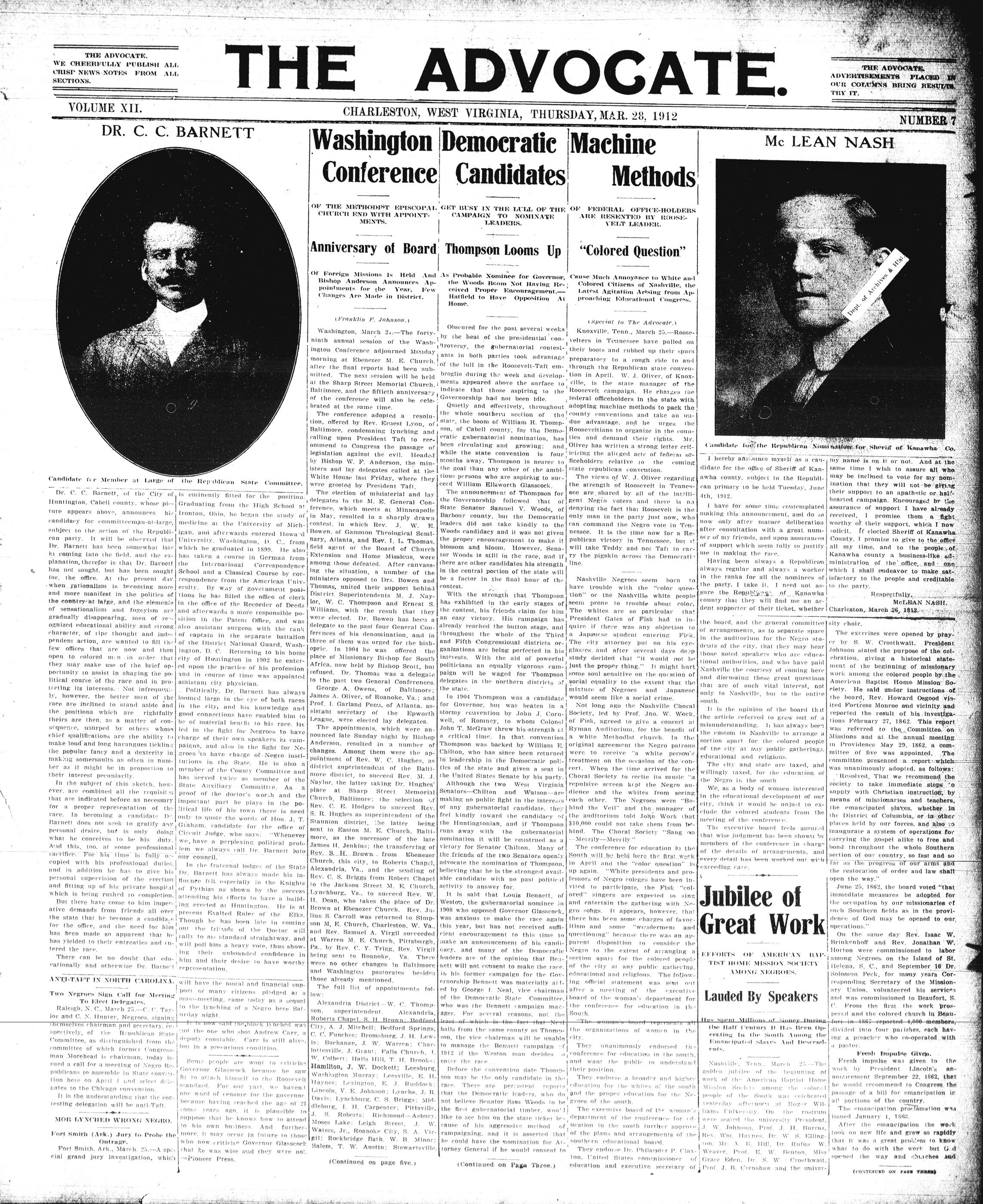
DR. C. C. I
Candidate for Member at Large of
Dr. C. C. Barnett, of the City of Huntington, Cabell county, whose picture appears above, announces his candidacy for committeeman-at-large, subject to the action of the Republican party. It will be observed that Dr. Barnett has been somewhat late in coming into the field, and the explanation, therefor is that Dr. Barnett has not sought, but has been sought for, the office. At the present day when rationalism is becoming more and more manifest in the politics of the country-at large, and the elements of sensationalism and fogeyism are gradually disappearing, men of recognized educational ability and strong character, of ripe thought and independent action, are wanted to fill the few offices that are now and then open to colored men in order that they may make use of the brief opportunity to assist in shaping the political course of the race and in protecting its interests. Not infrequently, however, the better men of the race are inclined to stand aside and the positions which are rightfully theirs are then, as a matter of consequence, usurped by others whose chief qualifications are the ability to make loud and long harangues tickling the popular fancy and a dexterity in making somersaults as often in number as it might be in proportion to their interest peculiarly.
In the subject of this sketch, however, are combined all the requisites that are indicated before as necessary for a proper representation of the race. In becoming a candidate Dr Barnett does not seek to gratify any personal desire, but is only doing what he conceives to be his duty. And this, too, at some professional sacrifice. For his time is fully occupied with his professional duties, and in addition he has to give his personal supervision of the erection and fitting up of his private hospital which is being rushed to completion
But there have come to him imperative demands from friends all over the state that he become a candidate for the office, and the need for him has been made so apparent that he has yielded to their entreaties and entered the race. There can be no doubt that educationally and otherwise Dr. Barnett
ANTI-TAFT IN NORTH CAROLINA
Two Negroes Sign Call for Meeting To Elect Delegates
Raleigh, N. C. March 25.—C. C. Taylor and C. N. Hunter, Negroes, signing themselves chairman and secretary, respectively, of the Republican State Committee, as distinguished from the committee of which former Congressman Morehead is chairman, today issued a call for a meeting of Negro Republicans to assemble in State convention here on April 1 and select delegates to the Chicago convention.
It is the understanding that the contesting delegation will be anti-Taft.
MOB LYNCHED WRONG NEGRO.
Fort Smith (Ark.) Jury to Probe the Outrage.
Fort Smith, Ark., March 25.—A special grand jury investigation, which
---
THE ADVOCATE.
is eminently fitted for the position. Graduating from the High School at Ironton, Ohio, he began the study of medicine at the University of Michigan, and afterwards entered Howard University, Washington, D. C., from which he graduated in 1899. He also has taken a course in German from the International Correspondence School and a Classical Course by correspondence from the American University. By way of government positions he has filled the office of clerks in the office of the Recorder of Deeds and afterwards a more responsible position in the Patent Office, and was also assistant surgeon with the rank of captain in the separate battalion of the District National Guard, Washington, D. C. Returning to his home city of Huatington in 1902 he entered upon the practice of his profession and in course of time was appointed assistant city physician.
Politically, Dr. Barnett has always loomed large in the eye of both races in the city, and his knowledge and good connections have enabled him to be of material benefit to his race. He led in the fight for Negroes to have charge of their own speakers in campaigns, and also in the fight for Negroes to have charge of Negro institutions in the State. He is also a member of the County Committee and has served twice as member of the State Auxiliary Committee. As a proof of the doctor's worth and the important part he plays in the political life of his town there is need only to quote the words of Hon. J. T. Giaham, candidate for the office of Circuit Judge, who says: "Whenever we, have a perplexing political problem we always call Dr. Barnett into our council."
In the fraternal lodges of the State Dr. Barnett has always made his influence felt especially in the Knights of Pythias as shown by the success attending his efforts to have a building erected at Huntington. He is at present Exalted Ruler of the Elks. Though he has been late in coming out the friends of the Doctor will rally to his standard straightway, and will poll him a heavy vote, thus showing their unbounded confidence in him and their desire to have worthy representation.
will have the moral and financial support of many citizens pledged at a mass-meeting, came today as a sequel to the lynching of a Negro here Saturday night.
It is now said the black knotted was not the one who shot Andrew Carr, a deputy constable. Carr is still alive, but in a precarious condition.
Some people are wont to criticise Governor Glasscock because he saw fit to attach himself to the Roosevelt standard. For our part, we haven't one word of censure for the governor, because having reached the age of 21 some years ago, it is plausible to suppose that he knows how to attend to his own business. And furthermore, it may occur in future to those who now criticise Governor Glasscock that he was wise and they were not. → Pioneer Press.
CHARLESTON, WEST VIRGINIA, THURSDAY, MAR. 28, 1912
Washington Conference
OF THE METHODIST EPISCOPAL CHURCH END WITH APPOINTMENTS.
Anniversary of Board
Of Foreign Missions Is Held And Bishop Anderson Announces Appointments for the Year, Few Changes Are Made in District.
(Franklin F. Johnson.)
Washington, March 24.—The forty-ninth annual session of the Washington Conference adjourned Monday morning at Ebenezer M. E. Church, after the final reports had been submitted. The next session will be held at the Sharp Street Memorial Church, Baltimore, and the fifth anniversary of the conference will also be celebrated at the same time.
The conference adopted a resolution, offered by Rev. Emnest Lyon, of Baltimore, condemning lynching and calling upon President Taft to recommend to Congress the passage of legislation against the evil. Headed by Bishop W. F. Anderson, the ministers and lay delegates called at the White House last Friday, where they were greeted by President Taft.
The election of maisterial and lay delegates to the M. E. General Conference, which meets at Minneapolis in May, resulted in a sharply drawn contest, in which Rev. J. W. E. Bowen, of Gammon Theological Seminary, Atlanta, and Rev. I. L. Thomas, field agent of the Board of Church Extension and Home Missions, were among those defeated. After canvassing the situation, a number of the ministers opposed to Drs. Bowen and Thomas, united their support behind District Superintendents M. J. Naylor, W. C. Thompson and Ernest S. Williams, with the result that they were elected. Dr. Bowen has been a delegate to the past four General Conferences of his denomination, and in three of them was urged for the bishopric. In 1904 he was offered the place of Missionary Bishop for South Africa, now held by Bishop Scott, but refused. Dr. Thomas was a delegate to the past two General Conferences. George A. Owens, of Baltimore; James A. Oliver, of Roanoke, Va.; and Prof. I. Garland Penn, of Atlanta, assistant secretary of the Epworth League, were elected lay delegates.
The appointments, which were announced late Sunday night by Bishop Anderson, resulted in a number of changes. Among them were the appointment of Rev. W. C. Hughes, as district superintendent of the Baltimore district, to succeed Rev. M. J. Naylor, the latter taking Dr. Hughes' place at Sharp Street Memorial Church, Baltimore; the selection of Rev. C. E. Hodges to succeed Rev. S. R. Hughes as superintendent of the Staunton district, the latter being sent to Easton M. E. Church, Baltimore, as the successor of the late James H. Jenkins; the transferring of Rev. S. H. Brown from Ebenezer Church, this city, to Roberts Chapel, Alexandria, Va., and the sending of Rev. C. S. Briggs from Robert Chapel to the Jackson Street M. E. Church, Lynchburg, Va., to succeed Rev. W. H. Dean, who takes the place of Dr. Brown at Ebenezer Church. Rev. Julius S. Carroll was returned to Simpson M. E. Church, Charleston, W. Va. and Rev. Samuel A. Virgil succeeded at Warren M. E. Church, Pittsburgh, Pa., by Rev. C. Y. Trigg, Rev. Virgil being sent to Roanoke, Va. There were no other changes in Baltimore and Washington pastorates besides those already mentioned.
The full list of appointments follow:
Alexandria District—W. C. Thompson,
superintendent. Alexandria,
Roberts Chapel, S. H. Brown; Bedford
City, A. J. Mitchell; Bedford Springs,
C. C. Funches; Bromsburg, J. H. Lewis;
Buchanan, J. W. Warren; Charlottesville,
J. Giant; Falls Church, J. W.
Colbert; Halls Hill, T. H. Brooks;
Hamilton, J. W. Dockett; Leesburg
Washington Murray; Leesville, E. H
Haynes; Lexington, E. J. Ruddock;
Lincoln, V. E. Johnson; Lynch, J. R
Davis; Lynchburg, C. S. Briggs;
Middleburg, J. H. Carpenter; Pittsville
J. S. Roberts; Richmond—Asbury
Moses Lake; Leigh Street, J. W
Waters, Jr., Roanoke City, S. A. Virgil;
Rockbridge Bath, W. B. Minor
Salem, T. W. Austin; Stewartsville
(Continued on page five.)
Democratic Candidates
GET BUSY IN THE LULL OF THE CAMPAIGN TO NOMINATE LEADERS.
Thompson Looms Up
ks Probable Nominee for Governor, the Woods Broom Not Having Received Proper Encouragement. Hatfield to Have Opposition At Home.
---
Obscured for the past several weeks by the heat of the presidential controversy, the gubernatorial contestants in both parties took advantage of the hull in the Roosevelt-Taft embroglio during the week and developments appeared above the surface to indicate that those aspiring to the Governorship had not been idle. Quietly and effectively, throughout the whole southern section of the state, the boom of William R. Thompson, of Cabell county, for the Democratic gubernatorial nomination, has been circulating and growing; and while the state convention is four months away, Thompson is nearer to the goal than any other of the ambitious persons who are aspiring to succeed William Ellsworth Glasscock.
The announcement of Thompson for the Governorship followed that of State Senator Samuel V. Woods, of Barbour county, but the Democratic leaders did not take kindly to the Woods candidacy and it was not given the proper encouragement to make it blossom and bloom. However, Senator Woods is still in the race, and if there are other candidates his strength in the central portion of the state will be a factor in the final hour of the contest.
With the strength that Thompson has exhibited in the early stages of the contest, his friends claim for him an easy victory. His campaign has already reached the button stage, and throughout the whole of the Third and Fifth Congressional districts organizations are being perfected in his interests. With the aid of powerful politicians an equally vigorous campaign will be waged for Thompson delegates in the northern districts of the state.
In 1904 Thompson was a candidate for Governor, but was beaten in a stormy convention by John J. Cornwell, of Romney, to whom Colonel John T. McGraw threw his strength at a critical time. In that convention Thompson was backed by William E. Chilton, who has since been returned to leadership in the Democratic politics of the state and given a seat in the United States Senate by his party. Although the two West Virginia Senators—Chilton and Watson—are making no public fight in the interests of any gubernatorial candidate, they feel kindly toward the candidacy of the Huntingtonian, and if Thompson runs away with the gubernatorial nomination it will be construed as a victory for Senator Chilton. Many of the friends of the two Senators openly advocate the nomination of Thompson, believing that he is the strongest available candidate with no past political activity to answer for.
It is said that Louis Bennett, of Weston, the gubernatorial nominee in 1908 who opposed Governor Glasscock, was anxious to make the race again this year, but has not received sufficient encouragement to this time to make an announcement of his candidacy, and many of the Democratic leaders are of the opinion that Bennett will not consent to make the race in his former campaign for the Governorship Bennett was materially aided by George L. Neal, vice chairman of the Democratic State Committee, who was the Bennett campaign manager. For several reasons, not the least of which is the fact that Neal hails from the same county as Thompson, the vice chairman will be unable to manage the Bennett campaign of 1912 if the Weston man decides to enter the race.
Before the convention date Thompson may be the only candidate in the race. There are persistent reports that the Democratic leaders, who do not believe Senator Sam Woods to be the first gubernatorial timber, won't like to see him on the state ticket because of his aggressive method of campaigning, and it is asserted that he could have the nomination for Attorney General if he would consent to
(Continued on Page Three.)
Machine Methods
OF FEDERAL OFFICE-HOLDERS ARE RESENTED BY ROOSEVELT LEADER.
'Cause Much Annoyance to White and Colored Citizens of Nashville, the Latest Agitation Arising from Approaching Educational Congress
( Special to The Advocate )
Knoxville, Tenn., March 25.—Roosevelters in Tennessee have pulled on their boots and rubbed up their spurs preparatory to a rough ride to and through the Republican state convention in April. W. J. Oliver, of Knoxville, is the state manager of the Roosevelt campaign. He charges the federal officeholders in the state with adopting machine methods to pack the county conventions and take an udue advantage, and he urges the Rooseveltians to organize in the counties and demand their rights. Mr. Oliver has written a strong letter criticising the alleged acts of federal officeholders relative to the coming state republican convention.
The views of W. J. Oliver regarding the strength of Roosevelt in Tennessee are shared by all of the intelligent Negro voters and there is no denying the fact that Roosevelt is the only man in the party just now, who can command the Negro vote in Tennessee. It is the time now for a Republican victory in Tennessee, but it will take Teddy and not Taft to carry the pigskin across the Democratic line.
Nashville Negroes seem born to have trouble with the "color question" or the Nashville white people seem prone to trouble about color. The whites are so particular that President Gates of Fisk had to inquire if there was any objection to a Japanese student entering Fisk. The city attorney put on his eyeglasses, and after several days deep study decided that "it would not be just the proper thing." It might hurt some soul sensitive on the question of social equality to the extent that the mixture of Negroes and Japanese would seem like a social crime.
Not long ago the Nashville Choral Society, led by Prof. Jno. W. Work, of Fisk, agreed to give a concert at Ryman Auditorium, for the benefit of a white Methodist church. In the original agreement the Negro patrons were to receive "a white person's treatment on the occasion of the concert. When the time arrived for the Choral Society to recite its music "a repulsive screen kept the Negro audience and the whites from seeing each other. The Negroes were "Behind the Veil" and the manager of the auditorium told John Work that $10,000 could not take them from behind. The Choral Society "Sang on—Merrily—Merrily."
The conference for education in the South will be held here the first week in April and the "color question" is up again. "White presidents and professors of Negro colleges have been invited to participate, the Fisk "colored" singers are expected to sing and entertain the gathering with Negro sohgs. It appears, however, that there has been some charges of favoritism and some "wederment and questioning" because there was an apparent disposition to consider the Negro to the extent of arranging a section apart for the colored people of the city at any public gathering, educational and religious. The following official statement was sent out after a meeting of the executive board of the woman's department for the conference for education in the South.
"The woman's board represents all the organizations of women in the city.
They unanimously endorsed the conference for education in the south, and want the public to understand their position.
They endorse a broader and higher education for the whites of the south and the proper education for the Negroes of the south.
The executive board of the woman's department of the conference for education in the south further approve of the plans and arrangements of the southern educational board.
They endorse Dr. Philander P. Claxton, United States commissioner of education and executive secretary of
Mc LEAN NASH
Candidate for the Republican Nom
Dept. of Archives & Hist.
Candidate for the Republican Nominator for Sheriff of Kanawha County
I hereby announce myself as a candidate for the office of Sheriff of Kanawha county, subject to the Republican primary to be held Tuesday, June 4th, 1912.
I have for some time contemplated making this announcement, and do so now only after mature deliberation after consultation with a great number of my friends, and upon assurances of support which seem fully to justify me in making the race.
Having been always a Republican always regular and always a worker in the ranks for all the nominees of the party, I take it. I need not assure the Republican of Kanawha county that they will find me an ardent supporter of their ticket, whether my name is on it or not. And at the same time I wish to assure all who may be inclined to vote for my nomination that they will not be giving their support to an apathetic or half-hearted campaign. Encouraged by the assurance of support I have already received, I promise them a fight worthy of their support, which I now solicit. If elected Sheriff of Kanawha County, I promise to give to the office all my time, and to the people of Kanawha county a business-like administration of the office, and one which I shall endeavor to make satisfactory to the people and creditable to the party.
Respectfully,
McLEAN NASH.
Charleston, March 26, 1912
the board, and the general committee of arrangements, as to separate space in the auditorium for the Negro students of the city, that they may hear those noted speakers who are educational authorities, and who have paid Nashville the courtesy of coming here and discussing these great questions that are of such vital interest, not only to Nashville, but to the entire south.
It is the opinion of the board that the article referred to grew out of a misunderstanding. It has always been the custom in Nashville to arrange a section apart for the colored people of the city at any public gatherings, educational and religious.
The city and state are taxed, and willingly taxed, for the education of the Negro in the south.
We, as a body of women interested in the educational development of our city, think it would be unjust to exclude the colored students from the meeting of the conference. The executive board feels assured that wise judgment has been shown by members of the conference in charge of the details of arrangements, and every detail has been worked out with exceeding care.
Jubilee of Great Work
EFFORTS OF AMERICAN BANK TIST HOME MISSION SOCIETY AMONG NEGROES.
Lauded By Speakers
Has Spent Millions of Money During the Half Century It Has Been Operating In the South Among the Emancipated Slaves And Descendents.
Nashville, Tenn., March 25—The golden jubilee of the beginning of work of the American Baptist Home Mission Society among the colored people of the South was celebrated yesterday afternoon at Roger Williams University. On the roostrum were seated the university President, J. W. Johnson, Prof. J. H. Burrus, Rev. W. Haynes, Prof. W. S. Ellington, Mr. A. E. Hill, Dr. Rufus W. Weaver, Prof. E. W. Beuton, Miss Grace Eden, Dr. S. W. Crosthwait, Prof. J. B. Crenshaw and the univer-
THE ADVOCATE.
ADVERTSEMENTS PLACED IN
OUR COLUMNS BRING RESULTS.
TRY IT.
Dept. of Archives & History
nation for Sheriff of Kanawha Co.
my name is on it or not. And at the same time I wish to assure all who may be included to vote for my nomination that they will not be giving their support to an apathetic or half-hearted campaign. Encouraged by the assurance of support I have already received, I promise them a fight worthy of their support, which I now solicit. If elected Sheriff of Kanawha County. I promise to give to the office all my time, and to the people of Kanawha county a business-like administration of the office, and one which I shall endeavor to make satisfactory to the people and creditable to the party.
Respectfully,
McLEAN NASH.
Charleston, March 26, 1812.
The exercises were opened by prayer by S. W. Crosthwait. President Johnson stated the purpose of the celebration, giving a historical statement of the beginning of missionary work among the colored people by the American Baptist Home Mission Society. He said under instructions of the board, Rev. Howard Osgood visited Fortress Monroe and vicinity and reported the result of his investigations February 27, 1862. This report was referred to the Committee on Missions and at the annual meeting in Providence May 29, 1862, a committee of five was appointed. The committee presented a report which was unanimously adopted, as follows:
"Resolved, That we recommend the society to take immediate steps to supply with Christian instruction, by means of missionaries and teachers, the emancipated slaves, whether in the District of Columbia, or in other places held by our forces, and also to inaugure a system of operations for carrying the gospel alike to free and bond throughout the whole Southern section of our country, so fast and so far as the progress of our arms and the restoration of order and law shall open the way."
June 25, 1862, the board voted "that immediate measures be adopted for the occupation by our missionaries of such Southern fields as in the providence of God may be opened to our operations."
On the same day Rev. Isaac W. Brinkenhoff and Rev. Jonathan W. Horton were commissioned to labor among Negroes on the Island of St. Helena, S. C., and September 16 Dr. Solomon Peck, for many years Corresponding Secretary of the Missionary Union, volunteered his services and was commissioned to Beaufort, S. C. From the first the work prospered and the colored church in Beaufort in 1867 reported 1,000 members, divided into four parishes, each having a preacher who co-operated with a pastor.
Fresh impulse given.
Fresh impulse was given to the work by President Lincoln's announcement September 22, 1862, that he would recommend to Congress the passage of a bill for emancipation in all portions of the country.
The emancipation proclamation was issued January 1, 1863.
After the emancipation the work took on new life and grew so rapidly that it was a great problem to know what to do with the work but G. G. opened the way and churches and
(CONTINUED ON PAGE THREE)
NUMBER 7
CORRESPONDENCE
PAGE TWO.
PARKERSBURG
Mr. Ferguson has returned from attending the Conference of the M. P. church.
The many friends of Rev Carroll regret very much to see that will not return to the presence of the M. P. church.
The Phoenix Literary Society meet Tuesday evening at the Wesleyan Church when the lowing program Debate: Nassau, Pine Ridge Judges is a Good Thing, off Prof. Jefferson and Rev negative, Rev. Poole and Rev wood. Music, Miss Esther Essay, Gay Brown, Budge Butler.
Mrs. Elizabeth Jackson, who is the charming guest of Miss Wendy Brown, has returned to the South Pittsburg.
Invitations are out for the horton on April the ninth to the central hotel waiters.
Mrs. Matilda Washington entered the Sewing Circle of the Ann St. Church at her home Tuesday evening.
The Zion Baptist church. Sewing Circle will meet Thursday evening at the Sunday School room of the church. All members are required to be present.
Mrs. Thomas, mother of Mrs. J. M. Jefferson, is very ill at her home on Swanna street.
Miss Rebecca Brown entertained the card club at her home on Nineveh street.
Mrs. Lilly Brown is very ill at the home of her sister, Miss Henry Lee.
Mr. Fletcher of Marletta, Ohio, attended the K. of Postual seminary here Sunday.
KIMBERLY
Rev. J. J. Turner preached the annual thanksgiving sermon for Sparkling Light Lodge No. 13 Sunday at 11 o'clock. He easily outlined the benefit of the order, which was listened to by a large gathering.
Mrs. Mittle Gilmore, of Malden, was the guest of Mrs. J. V. Coleman Sunday. A son was born to Mr. and Mrs. J. V. Coleman March Sunday.
John L. Lynch, of Harewood, attended the K. of P. sermon here Sunday.
Work has been very dull here in the coalfields, and it seems that all are expecting to lay-down their tools on March 30th.
EAGLE
Rev. R. D. W. Meadows, of Huntington, was in town a short while Monday.
Mrs. Wille Whiteing and Miss Mary Woode, of Montgomery, were visiting relatives here Sunday.
Sandy Saunders was calling in Montgomery Sunday afternoon.
W. H. Banner, of Boomer, was visiting here last week.
Luther Brown went to Boomer Sunday morning to attend the Pythia sermon. A number of others went to Montgomery Sunday afternoon for the same purpose, but for some cause Rev. J. V. Bryant, of Huntington, who was to preach, missed his train and the sermon was postponed.
Mrs. Eva B. Russ was visiting Mrs. W. C. Lawrence in Montgomery Sunday.
Aaron Williams, of New River, is visiting his family.
Miss Stella Cosby was shopping at Montgomery last week.
The Sunday School will give a rally Easter Sunday for the National Baptist Foreign Mission Board.
Mrs. Luh Andrews is visiting her mother at Elkhorn.
Miss Louisa Brown was shopping in Montgomery Saturday.
Fry Saunders made a busin ss trip to Montgomery Saturday evening.
HUNTINGTON
L. C. Farrar, of Charleston, spent Sunday in the city.
The choir of the First Church has a sacred concert Sunday night to a large and appreciative audience.
Miss Mabel Whiting, and Macaulay Stewart Gee, of Gallipolis, spent the week-end here as guests of Miss Claire Stewart.
The graduates of Howard Union on Wednesday afternoon and organized an alumni association. The following officers were elected: Lawyer Turner, president; Dr. Franklin, v.p. president; Miss Luvania Norman treasurer; Miss Josephine Barnett, secretary.
L. C. Farrar addressed the V. I. C. A. Sunday afternoon.
John Allen remains quite ill.
Miss Ossie McGhee has returned home from school in Nashville, Tenn. She reports a very successful term. Prof. J. M. Arter was a distinguished visitor in the city Sunday. Mrs. Eliza Cobbs entertained the Orlon Club Friday evening at her home on Eighth avenue.
FAIRMONT
Little Robert Jones is much improved at this writing.
Mrs A H Wilkinson and children,
Helen and Arthur Jordan, were called home on a occasion of the flood scare at Pt. Pleasant.
K L. Morrison returned home Wednesday after spending a few days at his home in Potterney.
Mr. and Mrs. Harry Brown have went to Bardmore after being in New York at dunbanks.
Mr. and Mrs. Morlily beginning New York conference at Washington.
Mr. and Mrs. Normanville, of Pennsylvania, went to New days here.
Mr. and Mrs. Wilkinson is all with courage.
Miss Victoria has received her
degree from several universities with
the highest honors.
The people who were here
with her from Clarke'sburg
the students of Misses Bessie
and Mrs. J. J.
The members of Clarke'sburg
sermon on the occasion of
No. 22 Knights of
Christmas and Bed Sisters after-
terment on Wednesday, 22nd May
Toney, at
Miss Victoria's church was
the first to attend and colle-
tioned.
The S. I. memorial is held at Trinity
Museum by the Senior and Junior
Sisters. The memorial was highly
received and admired.
Miss Lillie W. Williams of Clarkson's
was a little visiting last we go.
Miss Lillie W. Williams of Clarkson's
was visiting at
Clarkson's mansion.
Mr. O'Connor is visiting at
Clarkson's mansion.
From this kind of visitation.
LEWISBURG
Roy J. C. Love, pastor of the M. E. church, seems to have a strong hold on his members for when he left for Conference they gave him a fine suit of clothes and other handsome presents. They hope he will be sent buses by the Conference.
Thomas Freeman is still very ill.
Every colored man in Lowisburg is still in favor of Col. Roosevelt for president.
Mrs. Maggie Brown, who was in Charleston on business Saturday, returned home Monday.
Roy F. A. Holling, who attended conference in Washington last week, arrived home Monday and reports a good time. He was elected president of the Layman's Association of the Washington Conference.
Many improvements are to be made in our little city as soon as the weather permits. Miss Ellen Bollina is on the sick list.
RED STAR.
Proof, J. M. A. Atter preached in Huntington Sunday.
Miss. M. A. W. Thompson was out of town Friday.
The Teachers' Reading Circle held at HIL Top, Saturday, was excellent.
Nine teachers were present. Prof. Rana of McDonald, presiden. Prof. E. W. Jones, of Beckwith, was secretary. Instructions on Colgrove were asked for. Mrs. Ellis, of Greenstown, gave a more excellent number on current events, and a discussion followed. Their followed Proof, E. W. Jones' talk on History. Mrs. W. M. Atter took Colgrove. The class was interesting. Rumblks were made by Mr. Legrand. Two high school pupils were present near Amatia. Knight, of Laurel Harbor.
Lois S. A. Weh, who was called to
Laredo City Friday in professional
breaks.
W. B. Writz and Mr. A. M. Banks
are attending Conference this week.
PANCROFT
Mr. Charles S. Johnson of Charleston,
pent St. Mary's and old friends in
Plymouth and Burlington.
The Charleston Worker, Club of the
first triathlon contest held their regular
time on Monday night. An excellent
program was endowed. Retresh-
ments were made by the committee,
and in no other manner was realized.
Mr. A. A. Lockley of Paymouth,
who prepares for one time, has
been invited to the Charleston General
Hospital for treatment.
H. A. Jones, Pyle Dickerson and
Gene Broms attended the K. of P's annual
season Savings at Raymond.
J. W. Strawford, of Burlington, was here
Sunday.
Mrs. Charles S. Johnson led in this
writing.
4. Mrs. Maude Jones was a Successful
counsel in Betty Mottle.
5. The Ladies' Improvement League
meet with Mrs. William Mottle, of
Plymouth, "Tuesday." A large num-
ber being present, after the general
routine of business one hour was spent
on fancy work, after which refresh-
ments were served by the hostess.
HINTON.
Miss Lena Edwards, who has been in Hinton for nearly a year, left last Saturday for Richmond, Virginia, where she will make her home with her sister. While here Miss Edwards made her home with Mrs. Mattle Strange, the Hinton matron, who is especially nice to all young people. Miss Edwards is an up-to-date dressmaker, and always had on hand more work than she could do. She was a friendly young woman and made many friends here.
O. F. Bailey, of Fort Springs, who has been sick in the Holley Sanitarium for three weeks, was discharged Saturday, perfectly recovered and ready for duty in the C. & O. shops.
Mrs. Lucy Lewis is attending the M. E. Conference in Washington, D. C., guest of her brother, Rev. M. W. Clair. Mrs. George Smith is sick at her home on Summer street.
"The Progressives" met with Mrs. Georgia Bush Monday afternoon, on Bluff street.
"It was with deep regret that the news of Rev. Campbell's death was received here by his many friends, but he has been a long, faithful fight, and he has been only called from labor to reward.
Miss Mary Sodartha Booth was hostess to the "Merry Makers" Friday evening in honor of Miss Dorthula Pack's birthday. A jolly time, as usual, was enjoyed.
One of the most enjoyable entertainments given in Hinton for a long time was the one the night of the 19th in the Second Baptist church. Tableaus from different parts of the Bible and a drama of The Ten Virgins were the features of the evening. "Oward, Christian Soldiers," was tableaued by Mrs. Mattie Strange, Mrs. Mary Payne, Mrs. Ida Daniels, Mrs. Rosa Adams, Miss Haute Mickens and Miss Harriet Ritman. Each lady marched on the stage carrying a gold cross to the music of the hymn being played and sung softly behind the curtain, the effect was beautiful. They were all dressed in white. Other tableau were, "Queen Esther pleading for her people;" Mrs. Rosa Adams as Queen Esther and Kenneth Pack as King Aharserus. "Moses in the Bull Rushes," Mrs. Ida Daniels as Pharoah's daughter, Miss Ritman, as her maid, Mrs. Lucy Daniels as Moses' sister and little Virginia Daniels as Moses. "I am coming to the Cross," Mrs. Mary Payne; "Sweet Hour of Prayer," Miss Bertha Webster; "Rock of Ages," Mrs. Lucy Daniels. The regular tableau lights were used, which made the pictures real and beautiful.
"The Ten Virgins" was taken from the Bible in thought, but written to represent real life of today. The five wise virgins were: Mrs. Emma Brown Smithers as "Obedience" Mrs. Jennet Jones as "Faith"; Mrs. Lula Lee as "Humility;" Mrs. Clara Pack Wells as "Love;" Mrs. Rosa Trent as "Patience." The foolish virgins were: Miss Alfreda Smithers, "Wealth;" Miss Dorthula Pack, "Power;" Miss Louise Smithers, "Culture;" Mrs. Lizzie Nelson, "Beauty;" Miss Mary Booth, "The Law." Mr. Kenneth Pack was the keeper of the door that led to the Bridegroom's feast. The part of each one was well done, and the audience well pleased. Mrs. Russel Jackson furnished the music.
The object of the entertainment was to raise money to buy hymn books for the pews of the Second Baptist church to be given as an Easter offering. A sum of twenty-five dollars was realized. The committee on books is composed of the following ladies: Miss Mary S. Booth, chairman; Mrs. Mattie Strange, treasurer; Mrs. Lucy Lee, Clara Wills, Mrs. Jennie Jones, Mrs. Rosa Trent, Mrs. Lucy Lewis, Mrs. Mary Payne, Mrs. Winfield, Mrs. Lucy Daniels; Misses Louise and Alfreda Smithers, Dorthula Pack, Harriet Ritman, Hattie Mickens, Blanche Christian.
CHARLESTON
Hotel Brown Arrivals—There were registered at Hotel Brown, this week:
Mrs. Claude Hurt, Shrewsbury; Mrs. Minnie Hurt, Institute; C. R. Pack, Institute; Mr. and Mrs. W. C. Payne, Bluefield; Misses K. Lawson and Anna Gregory, Montgomery; Miss Maggie Smith, Covington, Va.; P. Haskins, P. Williams, Cabin Creek; E. McDonald, Covington, Va.; J. W. Blaney, London; Rev. W. H. Jackson, Hebron, Va.; Miss Elizabeth Green, Claremont; Zack Woolfolk, Columbus, O.; William Snyder, Thomas Gilliam, Aiken, S. C.; G. Miller, Williamson; Isaiah Kent, Malden; Miss Myrtle Franklin, Montgomery and C. B. Caloway, Eagle.
Club Largely Attended—Twenty-five visitors and members were present Tuesday night at the regular meeting of Missionary Section No. 2 with Mr. and Mrs. Frank Henley. Brief devotional exercises were conducted by Mrs. Percy Taylor and S. P. Goff, and Pres. J. M. Arter of the West Virginia Seminary and College delivered a timely address. Refreshments were served by Mrs. Malinda Foreman and Mrs. Mary Rollins. The next meeting will be held with Mr. and Mrs. S. P.
THE ADVOCATE.
Goff at their residence, on Elmwood avenue, Tuesday evening of next week. Ladies' Aid Society Meets—A. J. Morris entertained the Ladies' Aid Society of the First Baptist church at the home of Mrs. Fannie Lewis, Shrewsbury street, Thursday evening of last week. The opening exercises were conducted by Mrs. Dora Moss and a vote of thanks was tendered the committee having charge of the entertainment at the church, Tuesday night, which netted the society $14.95. Prof. H. B. Rice delivered a wholesome talk. Mrs. S. V. Mickey will be hostess to the next meeting.
Pythlians Hear Sermon.—In the absence of the pastor of Simpson M. E. church, Rev. E. Fort, pastor of St. Paul A. M. E. church, preached the annual sermon to the Knights of Pythias at the first named church, Sunday afternoon. A large number of the Order of Calanthe, the woman's auxiliary, and of the two local lodges, Capital City Iso. 1 and West Virginia No. 60 with their friends were prescant and heard an excellent sermon.
Plead for School—At the meeting of the Athens Club with Mrs. Sarah Williams, Morris street, Monday evening, six new members were enrolled and the following program was rendered: Solo, Miss Alice Liggins; select reading, J. A. Jefferson; solo, Mrs. Willie M, Ford; address, G. L. Cuzzens. Revs. B. R., Reed and J. P. Caul made splendid pleas for the West Virginia Seminary and College, urging united effort in the rally, Sunday, to raise $500.00 for the institution. They were ably seconded by Prof. J. M. Arter. Lunch was served by the hostess assisted by Miss Georgia Bryant. Miss Ford, Mrs. Sarah Ayers and Henry White will be hosts to the meeting at the parsonage Monday evening of next week.
Easter Program—The Sunday School of the First Baptist Church has prepared a special program for Easter Sunday to be rendered at 2:30 the afternoon of that day:
Following are the numbers: Singing, choir; recitation, Easter in Early Days, Frances Starks; recitation, Easter Time, Eunice Robinson; singing, choir; recitation, Give Flowers to Children, Ruth Stephenson; recitation, To the Flowers, Theodore Nash; dialogue, A Dunch of Lillies, ten little girls; recitation, Day of Joy, Mattie Martin; recitation, The Heavenly Visitor, Robert Hall; singing, choir, wreath drill, members of Galedai class. Palm Services at St. Paul—At St. Paul African Methodist Episcopal church palm services will be held Sunday morning at which time the pastor, Rev. E. Fort will preach from the theme: "Christ's Triumphant Entrance into Jerusalem." Some of the best musical talent in the city has been engaged for the special song service in the evening. The pastor extends a cordial invitation to the general public to participate in these services, palms being given to all those who are present in the forenoon.
Tribe of Joseph—The largest attendance in its history was present at the meeting of the Tribe of Joseph, Friday evening, with Mr. and Mrs. William Wright, Piedmont street. After the opening services by Mrs. Charity Wilson and Mrs. Mollie Mills there were select reading by Mrs. Lucy Pleasants, solo by Miss Beatrice Calhoun and an address by R. C. Melver. Refreshments were served by the sixty-seven members and visitors present and arrangements were perfected for the meeting of the club with similar organizations at the church Friday night when a united effort will be made to assist the denominational school at Hill Top. The hostess was assisted by Mrs. J. I. Thomas, Mrs. Lillian Isaacs and Misses Virginia and Nora Wright.
To Entertain Friends:—Invitations have been issued to the opening dance of the Physical Culture class Friday evening at the K. of P. hall. The affair is being given by the class for their own pleasure and that of a number of invited friends, and no pains or money is being spared to make it a success.
To Advertise Business—In order to acquaint the public with the excellence of her meals, Mrs. C. L. Burke offers dinner for twenty cents to all who will call at her dining room in Hotel Brown Annex, 504 Capitol St. Sunday afternoon between the hours of 4:30 and 5:30.
LOCALS AND PERSONALS.
A. P. Straughter of Hinton, was a business visitor here yesterday.
Phil Waters returned Monday from Washington, D.C. where he went to attend the M. E. conference.
E. R. Carter has been ill the past week with grip at his home on Washington street.
Mrs. M. A. W. Thompson, president of the Woman's Baptist State convention, was a business visitor here the latter part of the preceding week.
Mrs. J. L. Thomas of Wevaco, who has been visiting her parents, Mr. and Mrs. William Wright, returned home Monday.
L. C. Farrar, a teacher at Garnett school, spent the week-end with friends at Huntington.
The little son of Mr. and Mrs. Clarkson, Bibby Street, died this week.
Walter Banks leaves Saturday for
Oberlin, O., where he will pursue a commercial course.
Noble Mitchell, who underwent an operation at the general hospital, was removed to his home, Wednesday.
Misses Rebecca Bullard and Beatrice Calhoun with their classes entertained a large and appreciative audience at the First Baptist church on Thursday evening of last week.
Miss Ethel Bryant, who teaches at Boomer, visited relatives here Saturday.
Mr. and Mrs. William Banion, of Columbus, O., are visiting the latter's parents, Rev. and Mrs. E. J. Woodard, Elmwood avenue.
Miss Maydelle Bradford was a business visitor to the city last week. She was the dinner guest of Miss Hattie DeHaven, Friday.
Rev. R. D. W. Meadows of Huntington, was here on his regular missionary tour, Monday.
Mrs. Frances Lowry is ill at her home on Truslow st.
Golbert, the little son of Mr. and Mrs. Walter Harris, is seriously ill at their home on Sentz st.
Miss Lucinda Williams spent last week at Natural Bridge, Va.
ADVOCATE—SIXTEEN
Misses Ethel and Lewellyn Spriggs were shopping in town Saturday.
Miss Elizabeth Green, of Claremont, was in town Saturday and Sunday.
Misses Sadie Woods and Mattie Martin spent Saturday and Sunday in Kanawha City.
The W. C. T. U. met Tuesday evening with Mrs. Nettie Hardin on Donnally st.
Miss N. H. Clinton will entertain the Improvement League, Friday evening.
Miss Sophia Dickerson, died Wednesday morning at her home on Court street.
Mrs. Jacob Johnson continues ill at the home of Mrs. Mollie Parker, Jacob street.
Mrs. Ellen Conway is seriously ill at her home on Hansfords street.
CHARGES FALL FLAT
Henry Lincoln Johnson, Recorder of Deeds of Washington, Didn't Do it, Finds Department of Justice
Atlanta, Ga., March 28.—It is currently reported here that the charges that have been filed with the Department of Justice, at Washington, charging Henry Lincoln Johnson, recorder of deeds for the District of Columbia, with assessing officeholders, will not amount to a thing. Postmaster McKee, of this city, was one of the men who complained. The charges have been investigated by attachs of the Department of Justices, and it is said that they will recommend that Mr. Johnson is blameless. The charges grew out of the recent State Republican Convention, which declared for Taft and elected delegates-at-large. This convention cost over $4,000, and Recorder Johnson is said to have contributed $500 out of his own pocket toward the expenses of the convention. Postmaster McKee, who is said to have been partly responsible for the charges, draws a salary of $6,000 a year and is regarded as somewhat hostile to Johnson's leadership.
Mr. Johnson is now in the city looking after his private interests and arranging for three district conventions, which will be held in the near future. It is expected that he will line up these convocations for Mr. Taft.
LINING UP FOR ROOSEVELT
Baltimore. March 28.—John H. Murphy, editor of the Afro-American Ledger, will direct the Roosevelt fight in this city. He will be assisted by a number of prominent citizens. Hugh E. Macbeth, editor of the Baltimore Times, is one of the enthusiastic supporters of the Colonel.
The Republican organization of the Seventeenth ward met at the home of Councilman Harry S. Cummings a few weeks ago, and endowed President Taft for a renomination.
Every available space in John Wesley M. E. Church was taken last Sunday, when Rev. Ernest Lyon preached to local Knights of Pythias on Charity.
Attorney Thomas L. Jones, of Washington, was here this week looking after the interests of a client: Mr. E. Davidson Washington, son of Dr. Booker T. Washington, was in the city Monday.
ROOSEVELT DELEGATES Are Chosen By the Convention in Roane County, West Virginia.
Roane county, the first West Virginia county to elect delegates to the state delegate and district delegates' convention, from which delegates will be sent to the Chicago national convention, elected 16 delegates instructed for Colonel Roosevelt Saturday, according to A. W. Brown, the Roosevelt manager, in that county. Roane county is the home of former congressman Harry C. Woodyard, who has charge of the Taft campaign in West Virginia, and Woodyard was defeated in his own district. Woodyard claims six of the 16 delegates.
Nation's Capital
REJOICES OVER PRESIDENT
TAFT'S ACCEPTANCE OF SHEP-
HARD'S INVITATION.
Girl First in Music.
A Miss Achieves a Triump At Cornell—Women to Honor Mrs. Terrell—Assistant Supt. Bruce Is Vindicated.—The News in Brief.
(Thompson's National News Bureau.)
Washington, D. C. March 27.—There is rejoicing in the camp of the authorities of the National Religious Training School at Durham, N. C. Dr. James E. Shepard, who addressed an immense audience last night at the Metropolitan A. M. E. church, is jubilant over what promises to be the brightest episode in the life of the thriving, institution over which he presides.
President Taft has given assurance that he will visit the school in April or May, while on a southern tour now being arranged for. The President is to attend the celebration of the Hibernian Society at Savannah, and may make stops at other points during his sojourn in the Southland. The invitation to the President to visit the National Religious Training School was conveyed through Senator S. Overman, of North Carolina. He is a member of the Advisory Board of the institution and has manifested from the outset a deep interest in its welfare.
The news of the President's plan to include Durham in his itinerary spread throughout the city Monday, and President Shepard was besieged by friends anxious to extend coagulations. At the school, faculty and students suspended operations for a period to give full vent to their enthusiasm over the coming of the Chief Magistrate of the Nation. The occasion will be a "red-letter event" in the history of the institution, and no palms will be spared to make the visit of the President memorable from every point of view.
President Taft to Speak for Howard Alumni.
President Taft is also to speak for the Alumni Association of Howard
CROWN AND BRIDGE
HOURS: 8:30 A. M. to 1:
Dr. JAMES
Dental
CROWN AND BRIDGE WORK A SPECIALTY
HOURS: 8:30 A. M. to 1:30 P. M., 2:00 to 6:00 P. M.
Office: Room 1, K. of P. Bldg.
J. E. JOHN
FUNERAL DIRECTORS
All Calls Prom
Our Prices are the Most
For Promptness and Care
Our Ambulance Service.
808 SUMMERS STREET, CHARLESTON
SPECIAL ATTENTION CAL
All Calls Promptly Attended. Our Prices are the Most Reasonable. For Promptness and Care Try Our Ambulance Service.
SPECIAL ATTENTION GIVEN OUT OF TOWN CALLS.
HENRY T. MCDONALD,
President.
STORER O
Harper's Fence
Founded in
More than 400, men and women hail
in the state for Colored students. Mag
Remarkably healthful. Ample building
ING ADDED TO OUR PLANT THIS Y
teen highly educated, earnest teachers.
Our Library catalogued according
largest in the State.
FIRST GRADE CERTIFICATES A
BERS OF THE GRADIATING CLASS
THE STATE BOARD OF EDUCATION
its faculty and student body. Its who
ing. Literary Societies, Christian Org
STORER COLLEGE Harper's Ferry, W. Va.
Founded in 1867
More than 400, men and women have graduated here. The oldest school in the state for Colored students. Magnificent location. Elevation high. Remarkably healthful. Ample buildings. THREE NEW BUILDINGS BEING ADDED TO OUR PLANT THIS YEAR. The regular faculty of sixteen highly educated, earnest teachers does not include assistants.
Our Library catalogued according to the Dewey System, is one of the largest in the State.
FIRST GRADE CERTIFICATES ARE GRANTED TO THOSE MEMBERS OF THE GRADUATING CLASSES WHO ARE RECOMMENDED TO THE STATE BOARD OF EDUCATION. Storer is interdenominational in its faculty and student body. Its whole influence is toward Christian living. Literary Societies, Christian Organizations, Musical Clubs, Bands and Sane Athletics.
COURSES: Academic, State Normal, Industrial, Music.
For illustrated catalogue and other printed matter write to
University at a mass meeting to be held under the auspices of that organization April 9 at the Metropolitan A. M. E. Church, in the Interest of the gymnasium fund, toward which the Alumni Association has pledged to raise $10,000. The central gymnasium campaign committee is headed by Prof. Kelly Miller, with Robert A. Pelham as secretary-treasurer and Shelby J. Davidson financial agent. They have received very encouraging reports from the many branch associations located in every section of the country where Howard graduates abound, and it is believed that the effort to raise the desired amount will be successful.
The meeting which the President of the United States will address will go far to arouse nation-wide interest in the project, and the approval of Mr. Taft will attract favorable attention at the hands of the people most able to subscribe to such a commendable project. The President has the heartfelt thanks of the colored citizens all over the land, because of the practical assistance he is giving the race, both by his willingness to help Howard University and his readiness to inspire by his presence the National Religious Training School at Durham. It may be remarked in passing that President Taft has, up to this time, visited more colored schools and addressed more colored gatherings than any previous occupant of the White House. When the public services of this eminent statesman are taken into account, this important item should not be overlooked.
Washington Girl First in Music at Cornell.
Miss Clarice Jones, daughter of the well-known Washington attorney, Thomas L. Jones, has achieved a triumph in music at the Ithaca Conservatory of Music, a department of the famous Cornell University, and has added new laurels to the brow of the entire race. At the third public recital of the season of the advanced students of the conservatory at the spacious music hall, a varied program of the works of the old masters was presented, and it was conceded by the critical audience present, and by the press report of the occasion, that the honors of the evening had been rightfully won by the accomplished Miss Jones, who happens, by the way, to be the only colored member of the class.
To indicate the high quality of the music presented, it may be stated that
(Continued on page three.)
GE WORK A SPECIALTY
1:30 P. M., 2:00 to 6:00 P. M.
S. B. BROWN
Surgeon
HNSON CO.
RS AND EMBALMERS
emptly Attended.
best Reasonable.
are Try
e.
Open DAY and NIGHT Phone 2472
BATON, W. VA.
N GIVEN OUT OF TOWN
LLS.
COLLEGE
Jerry, W. Va.
in 1867
have graduated here. The oldest school
significent location. Elevation high.
ings. THREE NEW BUILDINGS BEYEAR. The regular faculty of six-
ers does not include assistants.
to the Dewey System, is one of the
ARE GRANTED TO THOSE MEM-
SES WHO ARE RECOMMENDED TO
OX. Storer is interdenominational in
whole influence is toward Christian liv-
organizations, Musical Clubs, Bands and
formal, Industrial, Music.
her printed matter write to
THURSDAY, MARCH 28, 1912.
Home Phone 429
N. C. BRACKETT
Treasurer.
The President
The WEST VIRGINIA COLORED INSTITUTE OFFERS THREE LITERARY COURSES ENGLISH, ACADEMIC, NORMAL
```markdown
```
Various Industrial Courses are Offered. Climate Healthful. Surroundings Good.
THURSDAY, MARCH 28, 1912.
Miss June Robertson appeared in the celebrated aria from "Madame Butterfly"; Miss Gillam gave a tone poem by Liszt; Miss Catherine Wintermute presented two Skylark selections, and the orchestra rendered excerpts from "Lucia di Lammermoor," and accompanied two violin moors. The first was Svendsen's Romance, played by James Campbell; and the second the Concerto in D major by Mozart, played by Mr. Van Vleet. The crowning event was the number offered by Miss Jones, whose appearance was a signal for hearty applause, and an oyation was given her at the close of her brilliant performance. Speaking of Miss Jones, the Ithaca Daily Journal, the leading paper of the college town, said:
"There were five piano numbers, and the very best was Miss Clarice Jones' delightful interpretation of the 'Variations' by Mendelssohn, a most difficult composition and one rarely heard, even at entertainments given by professional musicians. Miss Jones is entitled to great credit for her finished performance."
Miss Jones is a Washington girl who has gone to one of the nation's most representative schools of music and has nobly sustained the reputation for her race for character, capacity and culture. Sa typifies in her admirable personality and intellectual gifts the highest possibilities of our people, and a brilliant future is in store for her. All Washington is proud of her achievements, and a warm reception awaits her when she returns home to her family and host of friends.
Commissioner Claxton Talks on "Teachers."
Dr. P. P. Claxton, United States Commissioner of Education, delivered a highly interesting address Wednesday afternoon in the Assembly Hall of the Sumner Building, under the auspices of the Home and School Association of Normal School No. 2. His subject was "The Qualifications of a Teacher." A large audience of parents, teachers and pupils listened attentively to the valuable suggestions offered by the noted educator. Dr. C. W. Childs presided. Dr. Lucy E. Moten, the painstaking principal of Normal School No. 2, has been at the head of this helpful institution for more than twenty-five years and it has furnished able teachers for schools of the race in every part of the country.
Editor Duncy Charms the South.
Hon. John C. Dancy, editor of the Zlon Quarterly, is at home again, after a lengthy speaking tour of the South, hastened back to Washington to attend the dinner given Tuesday in honor of his friend and co-worker, Dr. J. E. Shepard. Mr. Dancy was greeted by large audiences everywhere. He spoke in his usual optimistic vein of the future of the race, and the people seemed to feel better for having heard his message of cheer. His itinerary included Norfolk, Va., Elizabeth City, Edenton Hertford, Windfall, Plymouth, Washington, Now Bern, Kinston, Goldsboro and Wilmington, N. C.
The Women to Honor Mrs. Mary
The women of Washington, grateful to Mrs. Mary Church Terrell, the peerless queen of the platform, for her vallant and effective services in behalf of humanity, her race and sex, are planning to give a grand reception in her honor on Wednesday evening, April 10, at Lincoln Temple, Congregational Church. Some of those actively identified with the movement are Miss Rachel D. Bell, Miss Eva A. Chase, Mrs. B. K. Bruce, Mrs. E. C. Williams, Rev. A. C. Garner, Prof. A. O. Stafford Prof. Kelly Miller and others. It is expected that addresses will be delivered by Capt. James F. Oyster, president of the Board of Education upon which Mrs. Terrell served with distinction for a number of years; Prof. R. C. Bruce, assistant superintendent of the public schools; and Dr. W. P. Thirkield, president of Howard University. As a lasting souvenir of their admiration, the women are to present Mrs Terrell with a beautiful piece of statuary.
Session of the M. E. Conference.
The forty-ninth session of the Methodist Episcopal Conference of the Washington and Baltimore jurisdiction brought together a magnificent body of Christian gentlemen and able workers for the uplift of humanity. The meetings were held in the Ebenezer M. E. Church, of which Rev. S. H. Brown is pastor. Bishop W. F. Anderson presided. This is the most important conference of the church in the country. Rev. W. S. Jackson, statistical secretary, reported an increase of 650 in membership for the year, and Rev. M. W. Clair, treasurer, showed that the conference had raised during the year $23,821 for the various benevolent causes. The only change in the local pastorate was the sending of Rev. W. H. Dean, of Lynchburg, Va., to succeed Rev. S. H. Brown, at Ebenezer Church, the latter being appointed to Roberts Chapel Alexandria, Va. Rev. M. J. Naylor goes to Sharp Street Church, Baltimore, exchanging places with Rev. W. A. C. Hughes, who succeeds him district superintendent of the Baltimore district. Revs. W. C. Thompson, Ernest S. Williams and M. J. Naylor were elected ministerial delegates to the general conference at Minneapolis in May, and I. Garland Penn, William Oliver, of Roanoke, and George H. Owens, of Baltimore, were elected lay delegates. The next session of the conference will be held in Sharp Street-Church, Baltimore.
The branch of the Taft Renomination Bureau is running at top speed in the Maceo Building, under the energetic direction of Mr. Charles J. Pickett. Chairman McKinley's reliable "right-hand man." Twenty-five persons are working night and day, and there is a busy hum of writing and wrapping every minute of the time. Huge mail bags are carted to the postoffice, filled with literature telling of the great things that have happened during the three years of the administration of William Howard Taft. A general idea of the volume of business that is being done, and of the great benefit Mr. Pickett has brought to the race by inducing Mr. McKinley to authorize this bureau, is found in the fact that the pay
A literary bureau is being organized, and from now on there will be plenty of action all along the line. Mr. Pickett is confident of the nomination of President Taft, and is or the opinion that he will be elected by a big majority in November.
"This sentiment-making work of today," said Mr. Pickett, "is simply preliminary to the greater work that is to come. Mr. Taft will be renominated, and there is no doubt in my mind as to his triumphant re-election. He will get the bulk of the Negro vote and carry all of the states in which our votes are a factor. He will grow upon the race as our campaign of education progresses. Our people do not know Mr. Taft as he really is. They will rally to him in a solid-phalanx when his many good deeds are properly emphasized through the Literary bureau that is now getting ready to spread the glad tidings."
Fisk Jubilee Singers at Congregational Church.
The world-famous Fisk Jubilee Singers captivated a large audience of prominent citizens Monday evening at the First Congregational Church. The plantation melodies, grown sweeter with age, pleased everybody and put them in a good humor to listen to the eloquent addresses about Fisk University and its work, presented by graduates of the school and others. An effort is being made to raise $25,000 toward the endowment fund of the institution, and Mr. T. J. Calloway is making commendable progress in the campaign he is conducting for that purpose. Hon. J. C. Napier, Register of the Treasury, presided and made an earnest plea for help for Fisk, which, he declared, is doing a work that cannot be so well done by any other institution, in the land, being located in the center of the most ambitious and thrift-loving Negroes to be found between the oceans. He was liberally applauded. Other speakers were Dr. S. H. Woodrow, pastor of the Congregational Church; Mr. T. J. Calloway, Mrs. Sterling N. Brown, and Dr. M. O. Dumas.
Dr. Booker T. Washington Stops Over.
Dr. Booker T. Washington stopped over for a brief period last Saturday morning, en route southward from a tour that covered a stretch of territory from Chicago to New England. He was looking well and held conferences with a number of friends. He expects a large gathering at the conference of races next month at Tuskegee.
Washington is the "Mecca" toward which all national leaders—and some others—bend their footsteps nowadays. Phil Waters, "our Phil," of Charleston, W. Va., facetiously styled "the boy orator of the Kanawha," came into town last week to attend the M.E. Conference, of which his father and brother are members. He is himself a distinguished layman, and has been a delegate to a number of the conferences of his church. His inspiring address on "The Layman's Duty in Promoting the Spiritual Uplift," was one of the notable features of the recent session. Mr. Waters has held more responsible positions under the state government.
THE ADVOCATE.
West Virginia than any other colored man, and is at present deputy clerk of the Supreme Court of Appeals of the State, drawing a handsome salary for his efficient labors. For years he was corporation clerk in the office of the Secretary of State. He is an expert penman, and his "big, round hand" adorns corporation charters all over the country, legalizing the manipulation of millions of dollars.
Other representative men who have been in town this week are A. E. Manning, editor of the Indianapolis World; J. H. Murphy, editor of the Baltimore Afro-American Ledger, and Franklin F. Johnson, of the same paper; Hugh E. Macbeth, of the Baltimore Times, and John S. Durham, of Philadelphia, engaged in sugar operations in Havana, Cuba.
Accompanying Dr. James E. Shepard to the city, to attend the dinner given in his honor at True Reformers' Hall, was a party of well-known North Carolinians, including Dr. C. H. Shepard, C. C. Spaulding, general manager of the North Carolina Mutual and Provident Association; C. C. Amey, superintendent of the Durham Textile Mills; Arcadeacon W. George Ayan, of the Protestant Episcopal Church, and Dr. J. E. Dellinger, of Greensboro, N. C.
A Federal Anti-Lynching Law Wanted.
At the session of the M. E. Conference last week, Rev. Ernest Lyon, of Baltimore, former Minister to Liberia, offered a resolution condemning lynching and asking President Taft to incorporate in his next message to Congress recommendations of a federal anti-lynching law. The resolution was adopted, and Dr. Lyon was appointed chairman of a committee to notify the President of the action taken. The members and friends of the conference called at the White House Friday afternoon, and were received by the President in the East Room of the Executive Mansion. The meeting was a pleasant one all around.
Assistant Superintendent Bruce Vindicated.
By a vote of 5 to 3, the Board of Education has voted to dismiss the charges filed some time ago against Prof. R. C. Bruce, assistant superintendent of the Washington public schools. It was decided that the allegations were indefinite and inconclusive and were not sustained by the evidence. Prof. Bruce's retention was recommended by Superintendent W. M. Davidson, and he was given larger powers in the management of the colored schools. This signal vindication gives pleasure to Mr. Bruce's friends and puts a quietus on the school muddle with which the community has been vexed for many months.
The News in Brief.
This is the "big week" in politics. Taft opens strong, gaining steadily. "You subscribe to my banquet, and I'll subscribe to yours." is the way the festive Washingtonian greets a friend while passing through U street these fine mornings. Bishop G. W. Clinton denies that he has signed any statement announcing his preference for any candidate for President of the United States. Judge Robert H. Terrell is conceded to be the best-informed jurist on the bench of the Municipal Court. Of the six judges, he is the only colored member.
W. P. Bayless, until recently connected with the Census Bureau, has started a weekly magazine at Columbus, Ohio, called "The Record." Associated with him is Mr. Finch, of Wilberforce University. Mr. Bayless is one of the race's best writers and is a young man of indefatigable energy and fertility of resource. His friends here are confident that he will prove a success in his new field.
Washington newspaper men, noting the formation of a City Press Bureau among the colored journalists of Chicago, are talking of a "get-together luncheon," to be pulled off in the near future. The capital has but one newspaper, The Bee, but it has a host of ex-newspaper owners and a legion of correspondents, who are doing excellent work in the publicity line. "Don't fret," says a promoter while business man of this city. "There will never be a 'jim-crow' street car in Washington, no matter how anxious certain southern Congressmen and nondescript police officers may be to provide separate services for the races. Common-carriers cannot discriminate under the present law and there will be no change. If there is trouble on the cars, we shall insist that the police settle it by enforcing the law impartially against any and all disturbers. That is the milk in the cocoanut."
Attorney-General Wickersham is being commended by all fair-minded people in the country for his determined stand in favor of the retention of Assistant Attorney-General W. H. Lewis, as a member of the American Bar Association. If Mr. Lewis is not sustained at Milwaukee in August, it is evident that the time-honored organization will be split in twain and go into history discredited because of
the reason that led to its disruption. A modicum of common-sense, however, can spare the Association this shameful record. It is to be hoped that the leaders of the nation's bar will be broad enough to meet the situation like true Americans and solve the problem in accordance with justice and equity. Champ Clark has been endorsed at meetings held by the Irish, Italians and Jews, but the newspapers have, as yet, carried no story of any ratification meeting for Clark, held by Negroes.
Democratic Candidates
(Continued from page one.)
allow his name to be used for that office. Another probable compromise talked in the vicinity of Huntington to keep Bennett out of the race for the gubernatorial nomination is the probable tender of a place on the judicial ticket to Judge William George Demett, brother of Louis Bennett. Judge Bennett is now the chairman of the Democratic State Committee. Two candidates are to be nominated in June at Parkersburg for the Supreme Court of Appeals.
Among the Republican brethren, the reported mutiny of some of the McDowell politicians has caused considerable speculation both as to cause and effect, and has stirred the Republican candidates now contending for the governorship. The McDowell contingent has had a disagreement with Senator H. D. Hatfield, the McDowell gubernatorial candidate, and will support one of the other candidates for the governorship, although nothing official has been given out to indicate whether Swisher or Dillon will draw the McDowell votes taken from the Hatfield candidacy.
Captain R. R. Smith, prosecuting attorney of McDowell county; W. W. Hughes, D. J. F. Strother, L. C. Anderson, General Edward O'Toole and a few others are leading the movement which is directed against Senator Hatfield. They have made efforts to have Judge Ira E. Robinson announce his candidacy for the gubernatorial nomination, but the Supreme Court jurist is not inclined to give an affirmative answer just yet, and they will support either Dillon or Swisher in preference to their home candidate
The cause of the McDowell split is reported to have been the distribution of the county offices and the effect of the disagreement is problematical. Those who are insurging against Dr. Hatfield say they will keep 50 per cent of the McDowell votes away from him. Dr. Hatfield has told his friends that he is not in the least worried over the situation and would do nothing to prevent his opponents from going as far as they like. Some assert that the antis will place an independent county ticket and an independent candidate for State Senator in the field.
Because of the uncertain conditions attending the holding of a state-wide primary, and because it is impossible to gauge the strength of the competing candidates in a majority of the counties of the State, the outcome of the Republican gubernatorial contest is much more uncertain than the Democratic situation, where the nominee will be chosen in a party convention. And in many counties sentiment has not crystalized in favor of any particular candidacy.
Awaiting the action of the counties which hold early conventions to select delegates to the District Delegate and State Delegate Conventions, where National Delegates are to be selected, there has been a full this week in the contest being waged between the supporters of President Taft and Colonel Roosevelt, each side claiming the delegates from the state.
Upon his recent trip to New York, where he was in conference with Colonel Roosevelt, Governor Glasscoek exacted a promise from the Sage of Saganore that he would make a day of speeches in West Virginia if possible, and it is believed he will plow through the First and Second Districts on April 2 on his return trip from the West. The coming of the Colonel has imbued the Roosevelt followers with new confidence. The attack of the Taft newspapers on the Roosevelt managers in the state has not been inclined to produce party harmony, and the Rooseveltites expect their chieftain to enliven matters some when he swings over the state from West to East.
Following the Roane County Conventions held on Saturday, and resulting in the selection of 16 delegates to the Parkersburg District, and the State Delegate Convention, Berke-
ley and Summers counties are next in line. These latter counties will select delegates on April 6, and the usual contests over the selection of the delegates in these counties are expected.
Speaker C. M. Wetzel, of the West Virginia House of Delegates, is a candidate for re-election to the Legislature from Jefferson County, and in the event of his renomination will
again seek to wield the gavel in his Cazononesque manner over the lower House. Speaker Wetzel has represented Jefferson county, with one exception, for a dozen years in the House of Delegates. In 1909 Wetzel, who had been the minority leader in the House, was defeated for renomination, but demonstrated the following year that he could come back, and he was elected to the Speakership at the succeeding session of the Legislature last summer. Speaker Wetzel, who had been active in opposition to the Republican plan to force through a primary bill, was expected to be a candidate for Commissioner of Agriculture, the newly created office which will be filled for the first time at the next election, but the Speaker will again be a candidate for the Legislature.
Another former member of the House of Delegates, who will try to come back this year is Chas. E. Midelburg, of Fayette county, who served two terms in the lower House. Midelburg was a candidate in 1910 in Fayette county, but the Democratic wave, re-forced by the independent movement in Fayette, topped over the big majority of the Fayette Republicans, and Midelburg came to Charleston tied with an independent Republican candidate for legislative honors. "Middy" was informed before the contest that if the dollar which was to be thrown into the air fell "tails up" he would secure the seat. The dollar bore a head on each side, but Midelburg played his hand and was ruthlessly kicked by the big Democratic majority down the Capital corridor. He believes he can reverse the verdict in 1912.
Another Democratic candidate for a state office appeared in the open this week when Attorney Gilbert D. Smith, of Pleasant County, announced his candidacy for Attorney-General. Smith has been active in politics for many years, is a good stumper and has had considerable encouragement to make the race for the nomination. He is a hotel proprietor, and is one of the best known political figures of the Fourth District.
Former Senator Davis Elkins, of Morgantown, who was the predecessor of Senator Watson in the United States Senate and would be his successor, was in Charleston during the week looking after his interests in the Blue Creek oil field, and conferring with the politicians in Kanawha county. Senator Elkins is not engaged just now in making his own fight, but will devote his time until after the election for party success, asserting that he would do as much as any other leader in the state for success in the election this fall and then allow the Republicans to settle their own differences after the opposition has been conquered.
Word comes from Randolph County that State Senator Howard Sutherland, of the Tenth District, will make the race for the nomination for Congressman at Large against Charles Fawcett Teter, of Philippi. For several weeks it was expected that former Senator Samuel B. Montgomery, the Roosevelt leader in the Second District, would get into the contest for the nomination, but the Preston leader made a statement during the week that he would not become a candidate, but would devote himself to the selection of Progressive delegates to the Chicago convention and immediately the report followed that Senator Sutherland would oppose Teter. However, Senator Sutherland has been mentioned as a probable candidate for several weeks.
There will be a judicial contest in the Raleigh-Summers circuit this fall worth going miles to see. Judge James H. Miller, who was elected in that circuit in 1904 through a tremendous slump in the Republican vote on the judgeship, will be opposed this year by Judge T. J. McGinniss, of Beckley. For several weeks the Republicans of Raleigh county have endeavored to get the consent of Judge McGinniss to make the race and this week he yielded to their entreaties. He is one of the most popular men in the southern section of West Virginia, a typical product of the mountain country, for whom the mountain men would start a revolution if necessary.
JUBiLEE OF GREAT
(Continued from page one.)
schools were opened in all important centers in the South, notably Washington, D. C., Norfolk, Va., Alexandria, Beaufort, Nashville, Memphis, Atlanta, New Orleans and many other places.
President Johnson stated that the Negro population of the South at the time of emancipation was nearly 5,000,000, but it is now nearly 10,000,000, or an increase of nearly 100 per cent.
He said the board spent on Southern
PAGE THREE
combine three important qualities, all of which no other one thing possesses;
1 Beauty
2 Durability
3 Investment Value
You can use them without decreasing their value. They charm of beauty which no other gem possesses. As evidence of success in life they give prestige. They steadily increase in market value. We are offering attractive prices on choice diamonds.
ERNST
The Jeweler & Mfg. Optician.
208 Capitol Street.
Negro education last year $132,000 and in the past fifty years $6,000,000, which had been transmuted into character. The work has taken a wide scope, embracing every state. He said the Southern white Baptist also contribute largely to the religious work, having given more than $8,000 last year.
Prof. E. W. Benton spoke on "Christian Education." He said the leaders of their people are the product of schools established by men and women from the North who came on the field before the smoke of battle lifted. The principal object of education is to prepare men and women with disciplined minds stored with general and specific knowledge to elevate the people of the communities in which they moved. Without these there would not have been any teachers to man the colored public schools
Mr. W. B. Hill, one of the trustees of the university, said: "The society did well when it turned the Roger Williams University over to the colored brethren to manage and conduct." Mr. Hill introduced Dr. Weaver, pastor of the Immanuel Baptist Church, who said the colored boy has a better chance in the work in the South than the white boy. He said this was made possible by the men
and women of the North who had done this educational and religious work at the time people of the South had neither the means nor the inclination to do it. He said the Negroes have used their opportunities well. He said the transferring of the control of Roger Williams brought on a new era for the Baptists in Tennessee and would produce a stronger people and stronger leaders, who must have culture equal to the best. The Home Mission Society never made a better investment than when it organized Roger Williams.
Dr. W. S. Ellington spoke on "An Educated Ministry," and said: "This subject appeals most to our needs. We need men as leaders to beckon the people on to a higher and grander life. More attention must be given to preparing men for the Christian ministry. God is guiding in this whole work.
Need for Religious Leaders.
"Every race that amounts to anything must have true religious leaders. True religious leaders give character to a race or nation. Schools to educate ministers must be built in the South where the people are." The Glee Club of twelve young man sang, "Awake, My Soul."
Prof. J. H. Burrus spoke on the achievements of denominational societies. He mentioned the work of the United Presbyterians, who established the old McKee School and later the Knoxville College at Knoxville; the M. E. church that established Central Tennessee College, now Walden University; the American Missionary Association, that organized Flask University; the co-operation of the Presbyterians and the Congregationalists. He also mentioned the work of the Christians, Episcopals and Roman Catholics, who are now taking hold.
When the war closed a new situation was created by the emancipation ADVOCATE—TWELVE
of millions, and somebody must prepare leaders for the new race. What would have been the result if the work which the South had neither the means nor the desire to do had been left undone?
Miss Linella Long sang "The Palms," by Faure.
Continued on Page Six
Published every Thursday by The Advocate Printing and Publishing Co., Inc.
J. C. GILMER, Editor.
J. M. HAZLEWOOD, Business. Mgr.
Entered as second class matter at the Post Office at Charleston, W. Va., under Act of Congress of March 30, 1879.
Office: Room 11 K. of P. Building.
Phone 2185.
RATES BY SUBSCRIPTION.
By mail, one year..... $1.50
By mail, six months..... $1.00
By Mail, three months..... .50
POOSEVELT'S RECORD.
laying upon the human weakness of forgetfulness, the opponents of Colonel Roosevelt belittle his accomplishments while in office and make much of the third term bugaboo, his "agratitude" to President Taft and his declaration that he would not accept another nomination.
We are told that Washington is his Farewell Address warned the republic against the danger of retaining any man in the presidential office for a longer period than two terms, and his refusal to accept a nomination are cited as a precedent for our guidance at this time. Though challenged time and again to prove the truth of this assertion, the anti third-termers content themselves and attempt to cloud the issue with its reiteration. They know, as does every other person who has gone to the trouble to get at the truth, that there is absolutely no foundation in fact for their statements; they know that. Washington was not only not opposed to the idea of a third term, but that he declined to consider it simply because he was broken in health.
The "ingratitude" issue is best met with the definition of "ingratitude": a state of ungratefulness for favors conferred. If President Taft has conferred any favors upon Colonel Roosevelt, no one has yet been found who is able to name them. Any thing to bear the Colonel, any thing to turn attention from President Taft's record of reactionary politics, inefficient leadership, protection of venal officials, subordination of great policies to petty personal controversies, and indecision when confronted with questions of great moment!
How refreshing it is to turn to Roosevelt's seven years of constructive statesmanship after three years of Ballinger, Wilson shillyshallying, appointment of Democrats to high places and subservience to Southern prejudices. Read the record of Roosevelt's accomplishments and thank your stars that the Grand Old Party is about to return to the ancient landmarks. What brighter pages are there in American history than those covering the:
Dolliver-Hepburn Railroad act:
Extension of Forest Reserve:
National Irrigation act:
Improvement of waterways and reservation of water-power sites:
Employer's Liability act:
Safety Appliances act;
Regulation of railroad employees' hours of labor:
Establishment of Department of Commerce and Labor:
Pure Food and Drugs Act;
Federal meat inspection;
Navy doubled in tonnage and greatly increased in efficiency;
Battleship fleet sent around the world:
State militia brought into co-ordination with army;
Canal Zone acquired and work of excavation pushed with increased energy;
Development of civil-government in insular possessions;
Second intervention in Cuba; Cuba restored to the Cubans;
Finances of Santa Domingo straightened out;
Alaska boundary dispute settled:
Reorganization of the consular service:
Settlement of the coal strike of
1902:
The government upheld in Northern
Securities decision:
Conviction of postoffice grafters and
public land thieves:
Directed investigation of the Sugar
Trust customs frauds and the resultant
prosecutions:
Suits began against the Standard
Oil and Tobacco companies and other
corporations for violation of the Sherman Anti-Trust act:
Corporation forbidden to contribute to political campaign funds:
Keeping the door of China open to American commerce:
Bringing about the settlement of the Russo-Japanese war by the treaty of Portsmouth.
Reduction of the interest-bearing debt by more than $90,000,000.
Inauguration of movement for conservation of natural resources:
Inauguration of the annual conference of Governors of States:
Inauguration of movement for im-provement of conditions of country life.
In the passing of Edward B. Kenna from his active sphere in the affairs of men, the Negro people of Charleston and of the State of West Virginia lost a sincere and influential friend. Those of our readers who recall what the attitude of the Gazette toward the Negro was before he assumed its editorship and what it was during his incumbency, will readily see the truth of this statement.
Born here in the valley of the Kanawha of a sympathetic parentage, closely related with Negro boys and the older Negro attendants of his father in his boyhood days when race prejudice was not so pronounced, he grew up in an atmosphere of understanding of their weakness and appreciation of their worth which more recent tendencies could not blight.
It was, therefore, repugnant to his nature and foreign to his training for blin, as many do, to believe in or to hope for a literal fulfillment of the course of Noah. He believed and often expressed that belief, that a man's a man for a' that. In consonance with that belief he lived, and thus living, he gained the esteem and affection of many who have only these to give.
As editor of one of the leading dailies in this section, it was within his power and to his political profit, perhaps, to tan the fires of race prejudice and to array the whites against the Negroes. Had he done this, he would have done no more than some of his predecessors did and for which they received some little transient notoriety. But Ed Kenna was not built upon such lines. He was too kind-hearted to impose upon the weak and defenseless; too indifferent to popular acclaim to win it by ways that are dark or tricks that are vain.
In the prime of his manhood and in the fullness of his power, his Creator saw fit to remove Edward Kenna from the ken of man. We know not whither or why, for it is not for the finite to know that which the Infinite does not impart. To those nearest and dearest to him left behind: "It is as if a silver chord Were suddenly grown mute. And life's song with its rhythm warred Against a silver lute.
Where bides the garnered sheaf.
And voices murmuring, 'It is well!
Are strifled by our grief.
"It is as if the gloom of night:
Had hid a summer day.
And willows, sighing at their plight:
Bent low beside the way.
"For he was part of all the best
That nature loves and gives.
And ever more on Memory's breast:
He lies and laughs and lives."
MAC* NASH FOR SHERIFF.
The attention of the readers of The Advocate is called to the announcement of Mr. McLean Nash, in this issue, for the Republican nomination for the office of Sheriff of Kanawha county, subject to the will of the voters of that party as expressed in a primary or by whatever method the nominees may be chosen.
Mr. Nash is the last and the youngest of the aspirants for the office to make announcement, but he is by no means the least. He has never asked before for any preferment at the hands of his party, contenting himself with helping others to pieces of emolition and power; but now, at the solicitation of many who have recognized his worth as an asset in the party's affairs, he presents his candidacy for their consideration with the assurance that, if elected, he will give a business-like administration.
Mr. Nash is of the youngest set of Republicans, but his record as a party worker compares favorably with that of many others who have been in the business longer and have received greater rewards. At every election since he passed his majority he has been active in the councils of the party and at the polls. As a commercial traveler, his duties have called him up every hollow and to every cross-roads in the county, and there he has never missed an opportunity to preach the gospel of Republicanism always returning, however, to Charleston to give his support in the hour of need.
As a young man he will naturally appeal to the younger and more progressive element in both parties. His elevation would be an inducement to them to give of the best in them knowing that their labors would eventually receive their reward. They are a factor that must be reckoned with in every election and this will be especially true of the one to be held next November. The party would therefore, be taking no chances if it should attempt the experiment of the infusion of young blood as typified by Mr. Nash
A BIT OF HISTORY
When the Republican State convention met in the wigwam here, four years ago, a proposition was passed increasing the number of committeemen-at-large from one to two. It was generally understood among the deter-
gates there assembled that the additional committeeman would be a colored man, and so he would have been had it not been for the unwarranted action of Howard Harper, of Keystone. Harper secured recognition from the chair and told the convention that the colored people did not want two committeemen and if two were given to them, they would get more than they really desired. His remarks were in line with the wishes of the majority of the white delegates, and Dr. C. C. Darnett, of Huntington, withdrew his name from before the convention, retiring in favor of J. S. Noel, whom he had promised not to oppose.
Now, four years later, after others in spite of him, have succeeded again in reserving two places for colored men, Harper bobs up and asks for the honor. He does not now believe that the colored people do not want the two places, nor did he believe it at that time. Then, the matter was proposed too suddenly for him to lay plans to secure the place for himself and he was too selfish to allow another to have it. Now, he hopes with the endorsement of a packed convention in his home county to secure the honor for himself which his selfishness withheld from another.
For a number of years the writer has been, with much pleasure and profit to himself, a constant reader of Collier's. The National Weekly. He has admired its bold and unselfish attacks upon Ballinger and the Guggenhiems, and the manufacturers of patient nostrums and misbranders of food stuffs. Its efforts for reform of judicial procedure and stricter and quicker enforcement of the law against murderers has been encouraging. Its attitude toward the movement having for its object a larger participation of the people in the government, has been most gratifying, but its silence upon the subject of lynching we do not profess to understand.
It would be unjust to expect any one agency to attempt to correct all the evils, to cure all the ills afflicting this republic. But when one evil has assumed the magnitude that lynching has and is so wide-spread and threatening to the very existence of the government, it is not unfair to Collier's to entertain the suspicion that "there's a reason." a potent reason, for its failure to call the nation's attention to the danger.
This silence may be in line with its policy to refrain from speaking editorially upon any phase of what is generally called the race problem, of which lynching forms a prominent part. It may be that Collier's is intentionally color blind, but it is extremely difficult to believe that it is swayed by any such prejudice.
For the sacred honor of the press, we deny that any editor has kicked against the proposed tax on incomes over $5,000 as a personal hardship.
Our idea of a pessimist is the man who is worrying about how hot it is going to be next August.
what the baby state really needs is an engineer.
Some of the presidential candidates talk like "white hopes."
The speaker of the new Arizona legislature is a railroad switchman but
DR. BARNETT FOR COMMIT-
TEEMAN AT LARGE
On its first page The Advocate presents the likeness of Dr. C. C. Barnett, of Huntington, who announces his candidacy for committeeman at large on the Republican State Committee. Dr. Barnett needs no lengthy introduction to the people of West Virginia because those of them acquainted with the political and medical history of the race here, know Dr. Barnett, and those who know him respect him for his ability and worth. For years he has been practicing the profession of medicine at Huntington, where his skill is acknowledged in medical circles by both colored and white. In politics he has been extremely active ever since he returned from school and has made his weight felt in the decision of all questions affecting the race.
In Dr. Barnett, The Advocate finds the type of man such as it thinks the race should put forward for places of trust and honor. Fully qualified, having the respect of his neighbors, entitled to preferment by his past activities, he combines within himself the qualities seldom found in those who aspire to places of power.
In a sense, the Negro people of West Virginia will be on trial on June 14, the date of the state-wide primary election. This will be the first opportunity ever offered them to choose from among their number men to sit in the highest council of the party. I behooves them to exercise their power with extreme caution. They must be careful to select two men who will fall short in no respect, men who will be able to measure up with the best on the committee. Such a man is Dr. Barnett.
IS THERE A REASON?
THE ADVOCATE.
Simultaneous outbreaks against of be a fleers of the law in New York, Virgin have in and Nebraska have prevented any awar- "sectional" mud-slinging recently. er, of
Whether Captain Amundsen beat in the Captain Scott to the South Pole or not, he certainly beat him in the race con- back.
Voice of the Press
Virginia Civilization
Exceeding anything in modern fiction or recent fact was the spectacular court massacre of last Thursday in Hillsville, Virginia. Surely Americans, of native birth can no longer talk with justification of the coarser crew that comes from Southern Europe. Neither Italians, nor Hungarians, neither Poles nor Russians, not even high binder Chinamen have done a deed in the history of this country so barbarous as that with which the Virginia outlaws, some of whom are doubtless members of the F. F. V., have startled the country. No longer can the South point to the criminality of the black. If missionary work is to be done, if uplift is necessary, the Caucasian of the Southern States must not be left without the pale.—Amsterdam News.
The colored people all over the country have got to learn to cultivate good habits, engage in some useful occupation save their earnings, however small, combine their limited means before they can demand anything tangible. The "jim crow," buzzard roost, happy-go-lucky and all-around-good time element will never amount to a moment's notice except when making fools of themselves. Some people are too quick to take up with the banjo playing class, who congregate on street corners, assemble at dancing halls and other places of cheap amusement. Teach the people higher ideals by presenting the brighter side of life.—Kentucky Reporter.
One of the race journals is trying to figure out retributive justice in the terrible happening at Hillsville, Va., where desperate men tried to wipe out the court. The crime was too awful to think of as an offset to anything that has happened in a racial way. What happened was the result of the determination of desperate men to protect one of their own at any expense. We cannot see that it was the outgrowth of lax conditions on the part of officials. Indeed, it was the other way. The court was determined to punish men guilty of wrong and thus incurred their displeasure. We see no chance to associate the happening with anything that comes to the race by way of the mob. Men are still building school houses in anticipation of the good and jail houses in the anticipation of the bad. It means crime, crime and crime until the end of time, and not as a logical outcome of any one given condition. —The Freeman.
Announcements
You are authorized to announce through the columns of the Advocate that I am a candidate for the Republican nomination for Governor subject to the will of the Republican voters in the State primary.
I hereby announce my candidacy for the nomination for Governor of West Virginia, subject to the decision of the Republican voters of the State as may be recorded in the State-wide Primary called for June 4th, 1912.
Respectfully,
CHAS. W. SWISHER
Charleston, W. Va.
FOR STATE AUDITOR
To the Republicans of West Virginia.
I hereby declare my candidacy for re-nomination and election to the office of State Auditor, subject to the decision of State-wide primary election to be held June 4th, 1912.
Respectfully,
J. S. DARST.
Charleston, W. Va., Feb. 12, 1912.
FOR STATE TREASURER.
Editor The Advocate:—
I hereby announce my candidacy
to the office of State Treasurer, subject
to the action of the Republican
Primary to be held June 4th.
I hereby announce my candidacy for re-nomination and election to the once of State Treasurer of West Virginia, subject to the approval or rejection of the Republican Primary Election, June 4th, 1912.
STATE SUPT. OF SCHOOLS
I hereby announce my candidacy for the nomination for State Superintendent of Free School; of West Virginia, subject to the decision of the
noqualified and unqualified
Respectfully.
M. P. SHAWKEY.
The Bright Side.
C. F. RATHBONE
ARE YOU WORKING FOR MONEY? OR IS YOUR MONEY WORKING FOR YOU?
If you are working and saving your money and putting it in a bank where you get no interest, keeping it in a break or hiding it some where about your house—You Are Working for Money.
If you are working and saving your money and investing it in a safe way, where it will be working day and night whether you are working or not, and making you at least six per cent, interest—Your Money is Working For You.
The Pythian Mutual Investment Association was organized in order to give us an opoprtunity to put the money we could save together and then put it to work. The above is a picture of our building on the Capitol Square in Charleston. We have just purchased a splendid three story brick building on one of the make business streets in the city of Huntington. The first door is occupied by the Huntington Herald, the largest daily newspaper published in that section of the state, the second floor is used for office rooms, while the third floor is a large assembly and lodge hall. This building is sure to pay us well. After the Charleston building had been occupied only eight months our stockholders were paid a dividend of six per cent.
Stock is still on sale at $10.00 per share, either paid up or on the installment plan. Ask your agent in your locality about it or write to this office.
PYTHIAN MUTUAL INVESTMENT ASSOCIATION
Charleston, W. Va., Feb. 2, 1912.
FOR SUPREME COURT JUDGE.
I hereby announce my candidacy
for Supreme Court Judge, subject
to the action of the Republican
State convention at Huntington on
May 16.
Respectfully,
H. M. WILLIS.
New Martinsville.
FOR SHERIFF
To the Republicans of Kanawha County:
I hereby beg to announce my candidacy for the Republican nomination for Sheriff of the County, my candidacy being subject to the decision of the voters as may be recorded in the primary election for nomination of county candidates.
COMMISSIONER COUNTY COURT I hereby announce my candidacy for the Republican nomination for Commissioner of the Kanawha County Court, subject to the decision of the voters in primary election or by such other method as may be decided upon.
FOR JUSTICE OF THE PEACE
I announce myself a candidate for Justice of the Peace of Charleston District, subject to the Republican primary, when held. I earnestly solicit the support of my friends.
A. M. PAULEY.
Subject to the approval of my party, I am herewith announcing my candidacy for the Republican nomination for Justice of the Peace in Charleston district, and solicit the support of my friends. If elected I shall be on the square. Yours in earnest.
JOHN H. BLOUNT.
I hereby announce to the voters of Charleston Magisterial District that I am a candidate for the Republican nomination for Justice of the Peace of said district, subject to the decision of the voters as may be rendered in primary election.
Respectfully,
Charleston, Feb. 13, 1912.
For Committeeman At-Large.
To the Republican Voters of West Virginia:
I hereby nannounce my candidacy for Committeeman at large, subject to the approval or rejection of the Republican voters of the state, in the primary election to be held, June the 4th, 1912.
I will heartily appreciate the support of my many friends and Republican voters of the party generally.
I hereby announce my candidacy for nomination of Justice of the Peace of Charleston Magisterial District, subject to the Republican Primary when held. Your support is earnestly solicited.
E. R. CARTER.
State Summer School for Colored Teachers.
State Summer School for Colored Teachers.
Third Session, June 17th, to July 26th, 1912. Institute, W. Va.
Two Distinct departments will be maintained: 1. The Academic, which will be devoted to thorough work on the branches of the school course, for which credit may be had in the various institutions. Also in this connection thorough drill classes for persons expecting to pass the examinations will be maintained. 2. The Professional, which is designed for principals, high school teachers, and other advanced students. Some of the best talent in the country has been secured for this school. Three of the most distinguished educators in this country have accepted places on the Summer School Faculty, viz: KELLY MILLER, A. M., W. E. B. Du BOIS, Ph. D., BOOKER WASHINGTON, LLD.
This is to be the Biggest and Best School Yet. Prepare now to enroll. For particulars address: Byrd Prillerman, Institute, W. Va., R. P. Sims, Bluefild, W. Va.; H. T. McDonald, Harper's Ferry, W. Va.; or M. P.-Shawkey, Charleston, W. Va.
FOR SAERIFF
To the Republican Voters of Kana-wha County;
I herewith announce myself a candidate for the nomination for Sheriff of Kana-wha County, subject to the approval or rejection of the voters in primary election. My record of three years service as County Commissioner is offered in evidence of my ability to administer the affairs of the office of Sheriff, if nominated and elected. Your support is earnestly solicited.
Respectfully
A. R. SHEPPARD.
March 5. 1912.
I hereby announce my candidacy for nomination for Justice of the Peace of Charleston District, subject to the Republican primary when held. I solicit the support of all Republicans, pledging the faithful administration of the duties of the office if elected.
Respectfully
MARION GILCHRIST
February 20, 1912.
To the Republicans of Charleston
District:
I am a candidate for the nomination
by the Republican party for Justice
of the Peace for Charleston District.
If nominated and elected I shall, to
the best of my ability, discharge the
duties of the office in an honest and
efficient manner. Your support will
be appreciated.
FOR SHERIFF OF FAYETTE CO.
Editor The Advocate:
Please announce through the columns of your paper, that I am a candidate for the nomination for the office of Sheriff of Fayette county, subject to the action of the Republican primary to be held June 4th, 1912.
To my friends I promise that they will have the honor of being with a winfer, or loser, but no quitter, as I now promise that I will stay until I am elected or defeated.
I further promise, if nominated and elected, that I will conduct myself and the business affairs of the office in a way that will bring no discredit to those who have honored me with their
THURSDAY, MARCH 28, 1912.
R MONEY?
ING FOR YOU?
where you get no interest, keeping it for Money.
way, where it will be working day and interest—Your Money is Working
give us an opoprtunity to put the future of our building on the Capitol clock building on one of the main bus-Huntington Herald, the largest daily for office rooms, while the third floor After the Charleston building had six per cent. allment plan. Ask your agent in your
FOR YOU
VESTMENT
WESTON, W. VA.
r School for
Teachers.
July 26th, 1912. Institute, W. Va.
will be maintained: 1. The Acad-
horough work on the branches of
it may be had in the various insti-
horough drill classes for persons
will be maintained. 2. The
or principals, high school teachers,
Some of the best talent in the
school. Three of the most dis-
tray have accepted places on the
KELLY MILLER, A. M., W. E.
WASHINGTON, LLD.
At School Yet. Prepare now to
Byrd Prillerman, Institute, W.
Va.; H. T. McDonald, Harper's
Yay, Charleston, W. Va.
support, and will do all in my power to administer the affairs of the office in a safe, conservative fair and business-like manner, treating all in an impartial manner.
Very truly yours,
T. J. DAVIS.
Montgomery, W. Va., March 7, 1912.
ORDER OF PUBLICATION
State of West Virginia, Kanawha County, ss:
At Rules held in the Clerk's Office of the Circuit Court of Kanawha County on the first Monday in the Month of March, 1912. Julia Williams, Plaintiff.
vs. (In Chancery, No. 3013,
George Williams, Defendaut.
(The object of this suit is to-obtain a divorce from the bonds of matri-
mony.)
This day came the plaintiff by his
attorney, and on his motion and it
appearing by affidavit filed, that the
defendant is a non-resident of this
State, it is ordered that he do appear
within one month after the date of
the first publication hereof, and do
what is necessary to protect his inter-
est in this suit.
Teste: IRA MOTTESHEARD,
Clerk.
EMORY R. CARTER, Solicitor.
Notice to Take Depositions
To George Williams:
Take Notice! That on the 6th day of April, A. D. 1912, between the hours of 9 o'clock A. M. and 4 o'clock P. M., at the law office of Emery R. Carter, '041-2 Kanawha street, Charieston, W. Va., I will take the deposition of myself and others to be read in evidence in my behalf of a certain suit in chancery now pending in the Circuit Court for the County of Kanawha and State of West Virginia, in which I am plaintiff and you are defendant.
If from any cause the taking of said depositions shall not be commenced or completed on the day aforesaid, the same shall be continued from day to day, or from time to time, at the same place, and between the same hours, until the same shall be completed.
JULIA WILLIAMS.
By Counsel.
rE. R. CARTER, Solicitor. 3-7-4t
BRUCE
THURSDAY, MARCH 21, 1912.
Washington
Conference
J. W. T. Wilson; Woodlawn, Fairfax King; South Richmond, John Heith. Annapolis District—Joseph Wheeler, superintendent, Annapolis, Asbury N. M] Carroll; Atholton, A. L. Jenkins; Baltimore, Centennial. D. W. Shaw; North Point, J. W. Lavatt; Eastern Chapel, S. R. Hughes; John Wesley. Ernest Lyon; S. Paul, S. H. Norwood; Holly Run and Brooklyn. Samuel Acquilla; Brooks and St Luke C. C. Brown; Broad Neck, J. W. Calloway; Chesapeake Beach, Frank Giles; Davidsonville, Joseph Henry; Eastport, Alexander Dennis; Ellicot City, J. H. Goodrich; Huntingtown. Daniel Collins; John Wesley and St Mark's, L. W. Briggs; Lancaster, Va. C. A. Randall; Morans, Va., J. W. Jackson; Magothy, H. A. Carroll. Mount Hope, J. T. Moten; Mount Zion B. F. Myers; Frederick, Elijah Ayers; Sparrows Point, R. R. Riggs; St John's, J. J. Cecil; Waterbury and Mount Tabor, B. W. Brown; Churchton, A. H. Tilghman; Canton and Carey Street Mission, C. H. Lowrey.
Baltimore District—W. A. C. Hughes, superintendent. Abington, J. L. Brown. Baltimore City—Ames Memorial, D. D. Terpeau; Asbury, C. G. Cummings; Metropolitan, J. A. Holmes; Mount Zion, Matthias Williams; St. Mathew's, E. W. S. Peck; Sharp Street Memorial, M. J. Naylor; Whateoat. Alfred Matthews; Belair, C. H. Matthews; Buckeystown, J. C. Norris; Centerville, W. H. Berry; Chase's, D. L. Washington; Fallston, J. T. Stanley; Federal Hill, Moses Opher; Frederick City—Asbury, L. J. Valentine; Gough's, C. E. Smallwood; Green Spring, W. T. Harris; Hagerstown—Asbury, Edward Moore; Hereford, E. P. Moon; Hullsville, C. B. Bishop; Libertytown, G. W. Cohen; Lutherville, William Brown; Michaelsville, E. D. Venture; Middletown, R. R. Boston; New Market; G. D. Young; New Windsor, C. E. Jones; Reisterstown, L. A. Carter; Sykesville, C. H. Arnold; Westminster, W. A. English; Williamsport, C. A. Brady.
Cumberland District—G. E. Curry, superintendent. Buckhannon, Simpson, Daniel Acquela; Charleston, Simpson, J. S. Carroll; Clarksburg, Trinity, J. H. Jenkins; Cumberland, McKendree, J. W. Waters, Sr.; Fairmont, C. G. Taylor; Frostburg, R. A.
Bolden; Gettysburg, A. H. Hailing; Grafton, R. D. Jennings; Harrisburg, Pa., C. A. Leflinch; Huntington, J. H. Watson; Keyser and Piedmont, J. M. Beane; Montgomery, A. F. Wallace; Moorefield, C. W. Matthews; Morgantown, Vachel Harriday; Parkersburg, C. C. Gill; Pittsburgs, Warren, C. Y. Trigg; Point Pleasant, Simpson, C. H. Whitfield; Romney, C. A. Johnson; Sharpsburg, J. H. C. McPherson; Sistersville, J. A. Peters; Washington, W. E. Jefferson; Wheeling, G. W. W. Jenkins.
Staunton District—C. E. Hodges superintendent; Bridgewater, J. W. Holkins; Charlestown, W. N. Holt; Covington, F. E. Nicholas; Douglas Grove, G. D. Lawrence; East Staunton, P. R. Vauls; Grottoes, J. B. Arter; Harpers Ferry, S. A. Lewis; Harrisonbutig, J. H. E. Carter; Harrisonburg Circuit, W. H. Jenkins; Hedgesville, C. D. Hughes; Hinton, J. H. Johnson; Inwood, E. M. Mitchell; Lewisburg, J. C. Love; Luray, J. W. Jackson; Martinsburg, S. M. Beane; McDowell, A. W. Jones; Mount Hope, B. B. Martin; Ronceverte, J. A. Reid; Shepherdstown, J. D. Brown; Siebert, John Keets; Staunton, R. W. S. Thomas; Strausburg, R. R. Robinson; Talcott, D. H. Moore; Union, R. S. Reed; Whynesboro, C. C. Young; West Staunton, W. H. Kent; White Sulphur, J. M. Roan; Williamsburg, Y. B. Dunable; Winchester, A. P. Shaw; Woodstock, G. D. Johnson.
Washington District—E. S. Williams, superintendent; Bowie, Nathan Ross; Boyds, R. P. Lawson; Brandwine, E. M. Dent; Charlotte Hall, C. E. Queen; Daisy, J. W. Jeakins; Emory Grove, B. T. Perkins; La Plata, G. R. Williams; Laurel, V. N. S. Hughes; Laytonville, Benjamin Gross; Linden, J. N. Yearwood; Marlboro, Virgil Carter; Mount Airy, Bradley Johnson; Nottingham and Croome, T. B. Snowden; Oxen Hill, G. H. Booze; Pomonkey, C. S. Harper; Pisgah, L. E. S. Nash; Rockville, J. E. Dotson; Sandy Springs, J. W. Carroll; Scotland, J. E. Carter; Shiloh, A. A. Brown; Sellman, J. S. Cole; St. Marys, J. T. Redd; Woodville, B. F. Coates.
Washington, D. C.—Asbury, M. W.
Clair; Bennings, W. J. Tyler; Central,
T. P. Thomas; Deanwood, A.
Randall; Ebenezer, W. H. Dean; Fairmount Heights, O. C. Spriggs; Haven
W. H. Barnes; Mount Vernon, J. E.
Roberts; Mount Zion, D. W. Hays;
Nash Memorial; G. A. Davis; Simpson Memorial, W. S. Jacksca; Tennally town, John Barnett; Union Mission
R. A. Hart; City Missionary, W. J.
Washington.
FRANKEL FIFTEEN
AMERICAS GREATEST FIFTEEN DOLLAR SUIT
THE STORY OF FRANKEL FIFTEEN
FRANKEL FIFTEEN, America's greatest $15.00 Suit for which we are Sole Agents here, is built to meet the demand of that great majority of men who wear clothes around this price---and higher. It presents at $15.00 a suit which expresses the ideals of higher priced clothes.
FASHIONS--Fifth Avenue, New York--created.
FABRICS--Absolutely all wool and thoroughly shrunk.
WORKMANSHIP--Hand-tailored throughout.
SERVICE--Warranted to give satisfactory wear, or a new garment free.
We have scoured the clothing markets, in the effort to find the best to offer at a price which hits the average man. Our final decision lies with FRANKEL FIFTEEN America's Greatest $15.00 Suit. Through FRANKEL FIFTEEN every man can be well dressed without the customary strain on his wallet. If only for inspection, call at our store and we will cheerfully exhibit to you FRANKEL FIFTEEN—the suit that set the standard for $15.00.
HENRY SMITH One Price Clothier 222 Capitol Street.
We would not spend the time to relate this horrible crime (at Harrisonville, Va.) if it did not paint in glaring and unquestionable colors the awful condition that prevails in a land where lynchings are winked at and crimes against the helpless condoned. The Allens only carried out the spirit of mob rule all too prevalent in the country. If Negroes can be killed because they are supposedly criminal, then why not other Negroes and if black men can be killed just to satisfy the ferocious instincts of a howling mob why can't white men be killed also and why not mob an entire court of this area of the law dare be uplifted to warrant the purposes of the lawless? It is so simple, there's no need of attempted logical deduction. Sure this remains if the mob is not creeked against Negroes, there will be no strength left to check it when against whites not even when outraging a court.—Star of Zion.
Lyching's Logic.
On last Thursday, in Hillsville, Virginia, a judge was sentencing a prisoner for taking another prisoner from the sheriff. The sentence, "one year at hard labor," was not severe and was pronounced only after a jury of twelve men had found the prisoner guilty. But there were present friends of the guilty man who were determined he should not be sentenced and before the judge finished, a volley of shots rang out and he fell wounded across his desk. A second later the prosecuting attorney fell dead with a dozen bullets in his body and, as the sheriff, usually quick in defense of his person, was in the act of drawing his pistol he too fell to the floor with bullets in his head and body. The court room was full of spectators, but only a half dozen others were wounded, though the direct representatives of the law—judge sheriff and prosecuting attorney—were dead. Christian Recorder.
The Virginia Republicans? Honor President Taft for the enemies he made in vetoeing ill considered Tariff bills, is the report embittering from the Roanoke Convention. But the truth of the matter is too well known to be that the few who met in the Magic City are supporting Taft for renomination mainly because of the political pie at his disposal. Those on the inside wish to be continued, and they know if they do not support Mr. Taft it will be political suicide
THE ADVOCATE
FRANK
AMERICAS GR
STORY
KEL FIFTEEN, America
is built to meet the demand
price---and higher. It pre-
ses.
DNS--Fifth Avenue, New York
SS--Absolutely all wool and the
MANSHIP--Hand-tailored thre-
EE--Warranted to give satis-
free.
Red the clothing markets, in the
which hits the average man.
KEL FIFTEEN America's
KEL FIFTEEN every n
ustomary strain on his wallet.
Section, call at our store and w
KEL FIFTEEN—the suit
ENRY
---
THE GUARANTEE
Every FRANKEL FIFTEEN Suit or Overcoat carries the Guarantee of its makers that a new one will be given Free of Charge in exchange for any that disappoints its purchaser in service or value.
They know by supporting the President now they have one more year's case of mind. On the contrary, I supporting other than Ms. Tail would mean the immediate "clapping off heads." Therefore they think that they have acted wisely.—New Century.
MCKERD
The Political Preacher.
The season is fast approaching when the political preacher, like the spring poet, will begin to thaw out.
We wish there were some way of suppressing the political preacher. If a minister or a bishop wants to weaken his influence in his church and in his community and state, he can so in no surer way than by going into active partisans' politics.
In nine cases out of ten, when a minister goes into politics, the public takes it for granted, either rightfully or wrongfully, that he is being paid for his services, and this question of pay, always tends to hurt the standing of the minister.
We wish that all of our Negro ministers would keep out of political activities except insofar as they have a right to vote and make speeches or special occasions in a dignified and proper manner. But the practice that has hitherto obtained among many of taking money for political purposes is damaging in the highest degree to the ministerial profession. - New York Age
THE NEW SAN FRANCISCO, LOOKING OVER THE CITY TO THE HARBOR, SCENE OF THE PANAMA-PACIFIC INTERNATIONAL EXPOSITION IN 1915.
ROGSEVELT CLUB
Composed of Nearly Every Voter in Hamlet is Organized.
AN ADVERTISEMENT IN THE ADVOCATE
Institute, March 26.—The overwhelming preponderance of Roosevelt sentiment here was demonstrated last night when a club composed of seventy-one members, practically every colored and white voter in the neighborhood, was organized. The district school house was used as a place of meeting and was far too small to accommodate all who wished to participate. Species were made by a number of the more prominent farmers and received with much enthusiasm. The officers elected were Richard Lowery, president, and W. N. Brown, s secretary. The club but pledged itself to have a strong delegation at the district convention which will elect delegates to the state delegate convention.
Advertise in the Advocate for the Best Results. If you are not a subscriber to the Advocate Now is the time to start.
THE BAUER MEAT AND FISH CO. 28 and 30 Capitol St.
Beef, Veal Mutton, Pork Fresh Pork Sausage, Our Own Make
Try Our Machine Sliced
The best qualities in all popular kinds of
We want your patronage for we have complete stock in our lines and you can get it when you want more.
Bluefield Colored Institute
Bluefield Colored Institute
A school in a healthful locality, with the best of school comforts and conveniences at the lowest possible cost.
Regular Normal and Academic Courses, vocal and instrumental music, sowing, cooking, gundering and woodmaking. Libraries and laboratories well equipped for the purposes for which they are required.
A Training Department with a Model School in which graduates who are to become applicants for certificates get actual experience in teaching.
Located at Bluefield, W. Va., on the main line of the Norfolk & Western Railway and easy of access from the Virginia.
PAGE SIX
THE BEEF MEAT AND FRESH PORTION
Beef, Mutton, Fresh Portion
Our Own
Try Our Meat
Hams and OYSTERS, FISH
The best quality popular CHEESE
We want you we have complete lines and you can you want more
Bluefield College
A school in a healthful local forts and conveniences at the
Regular Normal and Academic roads, sowing, cooking, and repair and laboratories well equipped.
A Training Department welcomes who are to become applied experience in teaching.
Located at Bluefield, W. Va. & Western Railway and easy
For VITAL WEAKNESS and KIDNEY TROUBLE
Try the old Saw Palmetto remedy,
and join the army of strong,
healthy, veen. (get
```markdown
```
old Saw Palmetto remedy,
and join
the army of strong,
healthy, vigorous men and women.
Get testimonials. Sold by
T. B. STALNAKER DRUGGIST.
612 Kanawha ST. Charleston, W. Va.
WHAT IS IT?
Ten and twenty year combination distribution certificate of membership as devised by the American Workmen Fraternal Insurance Company, of Washington, D. C., one of the most liberal, strangest and reclusive fraternal institutions in the field. For further information see
D. E. V. JORDAN
General Agent for West Va.
Office: Room 2, K. of P. Bldg.
Charleston, W. Va.
100 AGENTS WANTED.
R. P. SIMS, Principal
JUBILEE UF GREAT
JUBILEE UF GREAT
COURSE FORM PAGE THREE
Prof O. A. Jackson read a paper on the life and character of Dr. George Sale who, he said, was to be reversed in the highest degree for his faithfulness and devotion to the cause of education. His name is a household word among white and colored people throughout the South. His sixteen years' work at the Atlanta Baptist Seminary produced a most remarkable influence upon the Society of Atlanta. Scarcity of Educated Men. Rev. Wm. Haynes, pastor of the Sylvan Street Baptist Church, deplored the scarcity of educated ministers and expressed deep regret at the death of Dr. George Sale, who was working so sinnously to correct this evil condition when he passed into the other world.
Prof. J. B. Crenshaw spoke of the necessity of uniting the industrial with the spiritual educational life and illustrated his remarks by references to the life and work of the Lord Jesus.
Miss Grace Eden gave a very interesting talk on the life and character of Dr. Phillips, a former President of Roger Williams, giving many details illustrating God's providence in preparing him for the work to which he had been called.
Dr. C. L. White sent a telegram of regret.
The choir sang "A Mighty Fortress is Our Lord," which was Dr. Sale's favorite hymn.
1. Extension of forest reserve.
2. National irrigation act.
3. Improvement of waterways and reservation of water power sites.
4. Hepburn rate act.
5. Employers' liability act.
6. Safety appliance act.
7. Regulation of railroad employees' hours of labor.
8. Establishment of department of commerce and labor.
9. Pure food and drugs act.
10. Federal meat inspection.
11. Inspection of packing houses.
12. Navy nearly doubled in tonnage and greatly increased in efficiency.
13. Battleship fleet sent around the world.
14. State militia brought into co-ordination with army.
15. Canal zone acquired and work of exoavation pushed with increased energy.
16. Development of civil self government in insular possessions.
17. Second intervention in Cuba. Cuba restored to the Cubans.
18. Finances of Santo Domingo straightened out.
19. Alaska boundary dispute settled.
20. Reorganization of the consular service.
21. Settlement of the coal strike of 1902.
22. The government upheld in Northern Securities decision.
23. Conviction of postoffice grafters and public land thieves.
24. Directed investigation of the sugar trust custom frauds and the resultant prosecutions.
---
"PASSING THE WORD ALONG."
Taft's Texas Manager Shows How Patronage Club Is Wielded MACGREGOR'S ADVERTISEMENT
It Warns Against an Expression of Independent Preference and Bids For Support of Taft, With Federal Patronage as the Alluring Bait.
Four years ago Congressman William B. McKinley of Illinois was managing the campaign of Joseph G. Cannon, then speaker of the house of representatives at Washington, for the Republican presidential nomination, Mr. McKinley was exerting himself at that time to the extent of his ability to prevent the nomination of Mr. Taft.
The Great Patronage Dispenser.
When he was appointed director of the national Taft bureau in Washington and placed at the head of the campaign for the renomination of Mr. Taft this year, he expressed the opinion to some of his friends that it would be a very much easier job than he had had in 1908, for the reason that all he would have to do now would be to "pass the word along." Mr. McKinley meant, of course, that it was only necessary to convey the information authoritatively to the thousands of federal officeholders throughout the country and especially in the southern states that the president desired to be renominated and that it was the wish of the great patronage dispenser that all the federal officeholders should cooperate in forcing the election of Taft delegates to the Chicago convention.
A concrete illustration of the method of "passing the word along" used by the Taft managers was furnished recently by Mr. H. F. MacGregor, the Taft manager in Texas. The Republican state committee of Texas is composed of men not one of whom holds a federal office. Colonel Cecil Lyon, the state chairman and also the Republican national committeeman from Texas, recognizing the unavailability of Mr. Taft as a candidate for the presidency this year, because of the great revolt of Republican voters against him, sent out a circular letter to Republicans of Texas asking for expressions of their individual preference for their presidential candidate.
A Threat and a Promise.
A Threat and a Promise.
Mr. Lyon having been at the head of the Republican organization in Texas for several years, his recommendations had naturally had great weight in the selection of appointees to the numerous federal offices in Texas. The Taft managers affected to see in Colonel Lyon's circular an attempt to control the action of the federal officeholders in Texas with regard to the election of the delegates from that state to the Republican national convention. Thereupon Mr. MacGregor published his advertisement widely in papers that circulate throughout the Lone Star State.
This advertisement is both a threat and a promise. It brutally warns all persons concerned that they express an independent preference at their peril and at the same time it brazenly dangles the bribe of federal patronage for Taft support. Nothing like it has ever occurred in the history of American politics.
"Has Now No Influence."
This is a full copy of Mr. MacGregor's advertisement:
THE ADVOCATE
Thirty-three Notable Achievements of the Roosevelt Administration.
25. Directed prosecution of railroads and other corporations for violation of Sherman anti-trust law (the Harriman, tobacco and Standard Oil suits).
26. Keeping the door of China open to American commerce.
27. Bringing about the settlement of the Russo-Japanese war by the treaty of Portsmouth.
28. Avoiding the pitfalls created by Pacific coast prejudice against Japanese immigration.
29. Negotiating twenty-four treaties of general arbitration.
30. Reduction of the interest bearing debt by more than $90,000,000.
31. Paving the way for tariff revision.
32. Inauguration of movement for conservation of natural resources.
33. Inauguration of movement for improvement of conditions of country life.
POLICIES RECOMMENDED BY MR.
ROOSEVELT:
1. Reform of the financial system.
2. Inheritance tax.
3. Income tax.
4. Passage of a new employers' liability act to meet objections raised by the supreme court.
5. Parcels post.
6. Revision of the Sherman anti-trust act.
7. Legislation to prevent overcapitalization, stock watering, etc., of common carriers.
8. Legislation compelling incorporation under federal laws of corporations engaged in interstate commerce.
officially to send him money to defeat President Taft, under whom you hold a commission, and to file your allegiance to him within ten days. This is to notify you that the state chairman has now no influence in Washington and will not have if re-elected after President Taft's triumphant reflection.
"In some other southern states where complaint was made and where conditions were similar to those in Texas, the president had the Republicans of the state meet in conference and select a committee to make recommendations as to patronage, and you can rest assured that loyal Taft Republicans cannot be slaughtered by the state chairman.
"The recommendation of Taft Republicans will control the Texas situation in the matter of patronage and not the recommendations of those engaged in disreclining one of the best presidents the country has ever had and who are by their disloyalty endangering Republican success nationally.
"H. F. MAC GREGOR,
"Taft Texas Campaign Manager."
ROOSEVELT THE REAL LEADER
Kansas Progressives See In Him the Hope of the Common Man In This Struggle.
The action of a small minority of the state central committee of Kansas in adopting a snap call for a state convention and refusing the demand of the progressive Republican voters of the state for an opportunity to express their preference as to the presidential candidate of their party through a primary, resulted in the prompt formation of a progressive Republican Roosevelt organization for the whole state. This organization was perfected at Topeka and adopted a platform which lucidly expresses the principle for which the Roosevelt progressives are fighting throughout the country. That platform is worthy of the careful consideration of Republican voters in every state. It says:
"We believe that Colonel Roosevelt stands for the constructive progressive policies of the country. We believe that his policies have given a new life to our party and new patriotic impulse to our country and a new hope to the common people. Our party had its birth in such an impulse given to it by the leaders who brought the party into being and who guided it to its high destiny. The torch of liberty that Lincoln bore Roosevelt holds today. He is the hope of the common man in his struggle for political independence as a means to economic freedom.
"The fight for these great things finds in Colonel Roosevelt an intrepid leader. We believe that under his leadership we can turn the tide of distrust and defeat which has been running so strongly against our party during the three years last passed.
"We congratulate our brother progressives in North Dakota upon their splendid fight and magnificent victory; though it was under the banner of another leader it was in the common cause. We point to the vote of that primary as justification of the need to rescue the party from the tyranny of a minority as exemplified by the success in other states of patronage policies under the convention system.
"We demand that our party be put upon a representative basis as it is in North Dakota. We believe that the percentage of progressive sentiment indicated by the North Dakota primary is found all over the nation and that it calls for a change of leadership in our party. We believe that the first duty of a party is to represent the people; that self-government is the first end of a Republic; and therefore we pledge ourselves to work in our counties for the direct vote at the primaries which shall be held the preference of the people upon the presidency and shall indicate so far as possible the choice of the people of delegates to the Chicago convention from the several congressional districts."
Taft Trying to Have Supreme Court Decision Recalled.
CHIEF JUSTICE IS WITH HIM.
Rotary Mimeograph Case Gives Special Point to the Colonel's Columbus Speech—Administration Wants Congress to Overthrow Court's Action.
On Feb. 21 Colonel Roosevelt delivered before the constitutional convention of Ohio an oration on "A Charter of Democracy," in which he denounced the doctrine of the infallibility of the courts as a grave danger menacing American institutions and advocated a simplified method for the recall of court decisions by the people. At once he was assailed by the representatives of big business and of monopoly as an advocate of virtual anarchy and a living threat against the safety of property.
Of course at the time he was speaking more particularly of state courts, but in less than three weeks, on March 11, to be exact, the supreme court of the United States handed down a decision, coupled with the dissent of three members, including that of the chief justice, vindicating Colonel Roosevelt's attitude in every particular. The supreme court caught up with Roosevelt. And the severe comments drawn upon himself from the advocates of special privileges ought now in all justice to be passed on to the supreme court and especially to Chief Justice White, for if ever a human being voiced a demand for the recall of a decision of the courts Chief Justice White did so in his dissenting opinion.
The case was that of Sidney Henry, et al. vs. the A. B. Dick company. The Dick company owned the patent on a rotary mimeograph. It sold one of the machines to Miss Christina B. Skou of New York, under a stipulation that the ink, stenell paper and other supplies used with the invention must be bought from the Dick company. The Henry company sold Miss Skou ink for the mimeograph that was not Dick ink, and the Dick company sued the Henry company and Miss Skou for infringement of the patent on the mimeograph. On March 11, with only seven members of the United States supreme court sitting, four of them, constituting a majority, decided the case and held that when the Henry company sold the non Dick ink to Miss Skou and she used it, this constituted an infringement of the patent.
In a dissenting opinion, in which he was joined by Justices Hughes and Lamar, Chief Justice White denounced this extraordinary opinion in the most biting language. Stating that the patent did not cover the ink in any way, he demanded that the legislative department of the government amend the law so as to make it impossible for the precedent established by the decision to be maintained.
"Under this decision it is now the law," declared the chief justice, "that * * * the patentee has the power by contract to extend his patent rights so as to bring within the claims of his patent things which are not embraced therein, thus virtually legislating by causing the patent laws to cover subjects to which they could not reach, the result being to multiply monopolies at the will of an interested party."
The decision caused a laugh of derision throughout the national capital. The advocates of the doctrine of the infallibility of the courts were overcome with chagrin, while the supporters of Colonel Roosevelt inquired with suracratic emphasis whether the people at the polls, so frequently denounced as a "mob" by the advocates of special privilege, could ever do anything worse.
In the meantime the attorney general and other administration opponents of Colonel Roosevelt fluttered about in flabbergasted haste to find some speedy way to recall the opinion, for if sustained this opinion will take the life out of some of the most spectacular trust busting suits the administration has in its incubator. The attorney general notified the defeated litigants that if they were game to try to secure a rehearing of the case before a full bench of the supreme court the administration would be glad to lend all the assistance of which the department of justice was capable. At the same time the attorney general commenced the preparation of a bill for the amendment of the patent law with the intention of setting congress loose at the supreme court. Other steps for the recall of the decision were inaugurated by the commissioner of patents, who also began work on a bill to be handed to congress.
Apparently every legislator in congress wanted a copy of the decision, some for the purpose of enjoying themselves and others to study it in the search for a way to recall it. This is the second piece of sensational legislation perpetrated by the United States supreme court within a few months, but this later instance could not better serve as an indorsement of Colonel Roosevelt's plea for the recall of court decisions if it had been made to order for that purpose. The supreme court has indeed caught up with Colonel Roosevelt.
MUSIC COURSE VERY POPULAR
This Department of West Virginia University Is Coming More To the Front
ORCHESTRA IS AN OPPORTUNITY
Study in These Lines Not necessarily for Purpose of Following Profes-
One of the schools of the West Virginia University that is coming in for more and more recognition is the School of Music. This is due, not only to the effective work of the faculty of this school, but to the changing attitude of people generally toward music itself. In the past a simple tune set to some poem, the tune being repeated for each verse, was a song, and any instrumental performance that induced the auditor to wag his head or tap his foot on the floor was sufficient to satisfy music lovers.
More than ever before Americans are going in for music as a profession, and music is now taking a considerable place in American life.
The School of Music opens up possibilities in the University which are being appreciated by many students. A student of music is no more likely to follow it as a profession than is a student of literature likely to become a literary light. Music has its educational value, particularly in its theoretical side, for there is no better mental training than a study of Harmony or Counterpoint.
While the age is tending toward specialization, it is worth while to note the unease of a specialist in a company of people with whom he is thrown socially and among whom he stands alone in his profession; he may find sympathizers, but he finds no one with whom he may meet on common ground. The School of Music stands as a factor to meet just such conditions by giving to students, majoring in the sciences, a breadth and sympathy well worth having. It is not the school's aim to make musician and teachers of every pupil; and so it is arranged by the University that credit for work done in music is allowed toward literary degrees.
Two departments of the School of Music, the Orchestra and the Choral Society, are worthy of special mention.
The Orchestra, conducted by Miss Borne, with its nucleus in her own violin department and strengthened by members of the Cadet Band, affords opportunity for students, whether music or literary, who play instruments, to become acquainted, by actual playing, with orchestral works of the great masters. The orchestra often appears in concerts of its own and in conjunction with the Choral Society.
The other department, the Choral Society, directed by Director Black, of the School of Music, has an equally broad field. The society is composed of students who sing from all departments. It gives three concerts each year. The fall and spring concerts are given entirely by the society, the program either miscellaneous in character or some choral work, with soloists.
The change from three terms to two semester, which goes into effect next year, will bring with it many other changes. Among these there is one for which Director Black is bending his energies, which will bring the offerings of the School of Music more within the reach of the University students. This will be announced later.
INSTRUCTION IN LIBRARY METHODS.
The rapid increase of school libraries throughout the state, both in size and numbers, is an evidence of the importance attached to the library as an educational agency. The best results are obtained when libraries are in charge of persons who have had training for the work and who are capable of applying approved library methods in cataloguing, classification and in the other work of the library. In order to provide an opportunity for students to equip themselves for such work a credit course in Library Methods will be offered at the university next year. The course will continue throughout the year and will include practice in cataloguing and classification, use of reference books, binding and repair, selection and purchase of books, government documents, and other problems connected with the management of school libraries. It is designed to meet the needs of both the school superintendent who may desire a general knowledge of library methods and the high school teacher who may be called upon to act as librarian.
BASEBALL PRACTICE BEGUN AT WEST VIRGINIA UNIVERSITY.
The prospects for baseball this season at the university are fine. The candidates who are trying out for pitchers and catchers have already started indoor practice. The schedule is the strongest in years, possibly one of the hardest that any university team has ever coped with. There are games arrayed with Notre Dame, two with the Wheeling Central League, three with W. & J. and probably one with each of the Cuban Giants, and a m representing the College of Ha-
m representing the College of Ha-
l of Honolulu, China.
THURSDAY, MARCH 21, 1912.
HIGH SCHOOL DAY IN MAY.
"In order to promote scholarship literary proficiency and pure athletics among the public high schools of West Virginia, and in order to strengthen the friendly relations that already exist between West Virginia University and such high schools, the university has established an Annual High School Day."
Thus reads the preliminary circular issued by the university to all three and four-year high schools for the celebration of the second High School day on May 16th and 17th, 1912. Through the combined efforts of the university faculty, the students and the thirty representations from high schools last year, the first high school celebration held in May was marveously successful and it is hoped that this year it may be even more promotive of the feeling of good fellowship and closely allied interests.
Four seniors may be sent from any three or four-year high school and local entertainment will be furnished free. Six scholarships worth $50 each will be awarded as the result of examinations in two high school subjects, choice of subjects to be made by the applicant. Cash prizes to the amount of $85 for first prizes and $52.50 second prizes will be given for orations, essays, debates and declamations. In addition to these five medals will be offered for excellence on the athletic field in track events, field events and relay race.
B. & O. AGRICULTURAL TRAIN
MET BY LARGE CROWD8.
The Agricultural Extension division of the West Virginia University is much pleased over the remarkable attendance and success of the special agricultural train which ran for ten days over the B. & O. line. The train was equipped at the expense of the railroad company, and the instructors were furnished by the Agricultural College.
Notwithstanding the fact that the country roads were very muddy, and the rain poured down for several days, farmers, living from six to eight miles from the station, came with their families to attend the meetings.
The train passed through fourteen counties, made fifty stops and had an average attendance of 182 at each stop.
This was the fourth special agricultural train run by the Extension Division this year. One thousand three hundred miles have been traveled. 28 counties have been traversed, and about 30,000 persons have received agricultural instruction by this service.
MANUAL TRAINING COURSE FOR TEACHERS.
With the recent changes in the organization of the College of Engineering in West Virginia University greater emphasis is being placed on manual training courses for teachers and on special courses for mechanics. It is believed that in the past the people of the state have not realized the splendid opportunities which the university affords for training along these lines. The demand for manual training is being met by a number of high schools, but these schools are finding it difficult to secure trained teachers and in most instances such help has come from beyond the borders of the state. It is hoped that the introduction of manual training into the Summer School will result in a large number of teachers specializing in this work and a more general introduction of manual training in the schools throughout the state.
WEST VIRGINIA UNIVERSITY RECEIVES GREAT HONOR.
The annual statement of the Rhodes' Scholarships at Oxford University for 1910-11 has just been issued.
In the Final Honor Schools there are but two students reported in the first class. One of these is Thomas Porter Hardman, from West Virginia. The subject in which he received the honor was Jurisprudence. The other first class man is from Victoria, Australia. This is the second time that this distinguished honor has fallen to a former student of West Virginia University, the first having been won by Charles Frederick Tucker Brooke, now a member of the faculty of Yale University.
In the list of publications reported in the statement is one by Mr. Brooke, entitled "The Allegory in Llys' Endimion," issued from the Johns Hopkins Press, Baltimore.
ATHLETICS FOR THE WOMEN AT WEST VIRGINIA UNIVERSITY.
A much needed improvement in the athletic work at the university this year was brought about by fitting up two rooms in Woodburn hall as a girls gymnasium. The rooms are arranged with dressing rooms, bath, piano and full apparatus for work. The classes are not very large this year but the work is being thoroughly done. Tennis, tetherball and volleyball are planned for outdoor work for the girls in the spring.
SUMMER WORK IN THE GYMNA-81UM.
For the first time in the history of the university there will be given to the Summer School students of the university an opportunity to use the gymnasium and to take Physical Training. Mrs. Chez will give instruction in the Swedish system, play ground work games, and children's marches, while Director Chez will conduct work for those interested in high school athletics.