The Afro-American Advance
Saturday, June 2, 1900
Minneapolis, Minnesota
Page text (machine-generated)
TWIN CITY NEWS. MINNEAPOLIS ST. PAUL.
PIANOS
SOLD DIRECT TO
THE PEOPLE
CABLE CONOVER
KINGSBURY
WELLINGTON, SCHUBERT
And other Pianos less expensive
but good for prices asked.
From the Largest Manufacturers of Pianos in the World
THE CABLE CO..
Minneapolis Branch, 56 Seventh St. So., Bet. Nicollet
and Heinepin.
FRANK B. LONO, Manager.
VOL. II. NO. 15.
TWIN CIT
MINNEAPOLIS.
The residence of Mr. and Mrs. J. C.
Reid caught on fire last Tuesday from
an explosion of a gasoline stove; the
damage was slight.
Mrs. Sweares, of Chicago, is expected
in the city in the near future to visit
Mrs. L. B. Noels.
Mr. Sherman Ealy, who has been visiting
in the city, has returned to his
home in Mason City, Ia.
Mrs. L. B. Noels was entertained in St. Paul, Monday, by Mrs. A. Washington and others. Also Mrs. Noels made several calls.
Rev. and Mrs. Brooks returned home from a pleasant visit at the General Conference, Columbus, Ohio. Rev. Brooks is carried away with the intelligent people of the east.
Mr. Hunter, of Mississippi, lectured at St. Peter's Tuesday evening. Mr. H. is an able speaker. Every one was pleased with the lecture.
Last Tuesday night, the members and friends of the Wayman Home Circle filled the lecture room of St. Peters A. M. E. Church to entertain Prof. S. J. Hunter, principal Noxubee Industrial School, Macon, Miss, Mrs. W. W. Tucker, president of the circle, introduced James L. Curbs, the attorney, as chairman of the evening, who in fitting the audience introduced the professor to the audience. Prof. Hunter gave an elaborate and detailed discussion of the objects and purposes of his life work in the south.
While you are buying and spending your money spend it first among those firms that help you. See!
Go to Miller's, Fifth street and Nicolelet avenue, for your photographs.
For good cigars call at W. S. Conrad's, corner of First avenue south and Fourth street. He will suit you.
The Advance Restaurant, 214 Washington avenue south, is up to date in service and equipment. If you want a good meal in a clean place don't fail to go to the Advance Restaurant.
Go to John L. Neal, Real Estate, Loans and Insurance, 622 Boston Block.
Grand concert by the Twin City graduates to be given at Bethesda Baptist church, Monday evening, June 11th, 1000. An excellent and varied program will be rendered consisting of literary productions and music, among which will be the brilliant oration of Miss LuLa Blair, which she will deliver at the coming commencement exercises—this will be the event of the season. Don't miss it. Admission, 15 cents.
MISSION A. M. E. CHURCH
(405 Fifth Avenue South.)
Mrs. J. Will King left Sunday evening for her old home, in Fort Madison, Ia., to be gone a week or ten days. Rev. King is making arrangements to have another big camp meeting at Midway, commencing Sunday, July 1st. Rev. King expects to have Rev. David Bruce, a noted evangelist and singer, to help him in the meeting. Rev. King ended his series of sermons Sunday evening, of the Churches of Asia Minor, subject, "John's Return from the Island of Patmos, and What He Said." Mrs. Isaac Newton is some better, but is yet confined to her home.
Prof. S. J. Hunter, principal of Noxubee, Mice. is doing a grand work among the white people of our city, as well as the colored, financially, in behalf of his school. Prepared by the pastor at St. James' Sunday, at 11 a. m., Class. 12 m.
HEALTH AND BEAUTY
No need to ask where can one get a vapor or Turkish bath, the problem is solved.
Mrs. Victoria Webb has opened a very neat bath parlor where you can get all the benefits of a hot springs' treatment.
Rheumatism, kidney trouble, nervousness, female weakness and skin disease can be treated with success and in many cases cured. These baths also improve the complexion, reduce flesh, remove wrinkles and improve the health by simply making the blood pure in its circulation.
Mrs. Webb will be pleased to have any one desiring the benefits give her a call. Prices 75c and $1.00.
Hours 9:30 to 9:30 p. m. 29 Washington avenue; third floor.
Clam chowder is often productive of the deepest melancholy—Chicago Daily News.
LAWLE UNDERSTATING CUP
Funeral Directors & Embalmers
322 Wabasha street,
Betw. 3d & 4th Sts.
Telephone 508.
Day or Night.... St. Paul, Minn.
PIANO
SOLD DIRECT
THE PEOPLE
From the Largest Manufact
The Afro-American Advance.
Correspondence, letters, etc., must reach us by Wednesday for publication. 395 Thomas street. The "Advance" is prepared to do your job printing of all kinds at reasonable rates. Remember the place, 395 Thomas street. Kindly keep in mind that any item of news, social or otherwise, that you wish to publish will receive attention at 395 Thomas street also.
If you are living to eat, or eating to live, the Godirey Boarding House is the place for you. The best is served at a price you can afford. 148 East Ninth street.
Madam E. Luverne Adams' fashionable dress making parlors. 418 Wabasha street (upstairs).
Mrs. H. C. Simmons, of Anaconda, Mont. is located at home with Mrs. Chas. Allen. 527 Western avenue.
Mrs. Mary Bradford, mother of Mrs. Geo. Patterson and grandmother of Mrs. Henry High, returned last Saturday to her home in St. Louis, Mo.
The mother of Mr. Sam Brown is in the city visiting her son and daughter.
William Stevens' Lodge, A. F. & A. M., initiated a class Monday evening at their hall with the help of Minneapolis masons; a good time was had by all concerned.
Mrs. John Martin gave a dinner Sunday, in honor of her sister Mrs. Emma Hardin, of Mississippi; covers were laid for nine. Those present were: Mr. and Mrs. F. D. Parker, Mr. and Mrs. Geo. Duckett, Mrs. Seldon, Mrs. W. L. Johnson, Mrs. Emma Hardin.
Miss Maggie Garner is going to spend the summer at Lake Elmo.
Miss Gertrude Imogene Palmer, the exquisite solo violinist, who visited the Twin Cities during the holidays, is soon to graduate from the North Division after time she will be in this city, the guest of Mrs. Geo Duckett, on Thomas street.
Mr. John Buckner and family, of Robert street, are visiting their parents at Lincoln, Nebraska.
Mrs. Nelson Russell and mother are soon to move from St. Paul to Montreal, Can, to join Mr. Russell, who has employment there.
Mr. and Mrs. Chas. Morgan and daughter, Louise Jackson, were over to Minneapolis viewing the parade on Decoration Day. One of the most striking features to be seen in the parade was the colored Knights of Pythias, marching along in grand style, receiving as much attention as any organization in line.
There will be a children's concert given at Pilgrim Baptist church, Thursday, June 14th. Watch this space.
The next Redemption Rally will be held June 17th, instead of July 17th, as was reported last week.
Rev. D. S. Orner, left last Tuesday evening for Cleveland, Ohio, where he will preach next Sabbath in one of the leading and most flourishing churches in Ohio. He will visit his home while away and spend a few days with his beloved wife and old friends. We wish him a very pleasant visit. He will return about the 9th of June and remain in the city until the 11th, then firewall. We are loth to give him up, but the time always comes that the best of friends must part. Our loss will be some other city's gain.
A tew of our young men decided that they would finish Decoration Day in a truly pleasant way and that fact was demonstrated when after asking Mrs. T. R. King, of 6066 St. Anthony avenue, for the use of her home to wind up the evening in. Mr. Lalayette Mason presided at the piano, as only he can, and a very enjoyable time was had by all. At a late hour they departed wishing the young men would give them an opportunity of enjoying an affair of that kind once a month. Decoration Day, the Young Men's Party, with Mr. and Mrs. T. R. King, as host and hostess, will not soon be forgotten by the following young people who were present:
Mr. and Mrs. Addison Davis, Mr. and Mrs. F. L. McGhee, Mr. and Mrs. Chas, Coleman, Mr. and Mrs. Chas, Miller, Mr. and Mrs. W. T. Francis, Mr. and Mrs. W. V. Howard, Mr. and Mrs. S. Burnugh, and Mrs. Julius Pitts, Mr. and Mrs. W. Hilyard, Mesdames Florence Henley, Ira, Harris, Alice Golden, Bertha Wilson, Mrs. Wm Rogers, Mrs. Nellie Brown, Marie Anten French, Scottie Davis, Messrs. Wille and Allen French, Carlos Williams, Oro Hall, Sammy Turner, Lighttowr West, Edgar Hall, Charley Charleston, W. Curry, Henry Johnson, Lafayette Mason, Claude Jackson, Elmer Turner, W. Speaks.
There are some women who always use the same kind of judgment in allowing a poor steak to be passed off on them that they want to go in selecting a husband—Atishion Globe.
MINNEAPOLIS AND ST. PAUL, MINN., SATURDAY, JUNE 2, 1900.
CHICAGO
Chicago's best folk, socially speaking, was out in force May 28, at Mrs. John B. French's parlor musical benefit for the Old Fools' Home, was pronounced by all present to be a success, musically and financially. The program was distinctly classic. The artists were Madams Blair and McKinley, pianists, Madams French, Mabel Wheeler and Mr. waing, vocalists; Messrs. Pope and Gerge, readers; Master Roy French and Gertrude Palmer, violinists All seemed at their best, and made up a program calculated to make an impact on human being. The honors of the human being were carried by Gertrude Palmer, the violinist. She controls an audience completely, has a self-control which is beautiful, a beautiful singing tone, sympathetic and strong, a bow arm, combined with an almost faintless technique. She has a great future. May her planet continue to ascend.
A. M. E. BISHOPS TO WEAR
KOBES
Special to the Advance
Columbus, Ohio, May 23. -Rishawne Tyree, Moore, Smith, Shafer and Copper were ordained by the African Methodist Episcopal general conference today. At the business session a resolution was adopted that after June 30, bishops and ministers may wear robes. Friday, May 25, was set as adjournment day. Dr. Checks Morrow was voted $500. The women question was given a whirl by an effort to have Mrs. Sarah Edwards, of Pittsburg, seated in the place of a lay delegate who had gone home. The resolution was rejected almost unanimously.
The following general officers were elected: H. B. Parks secretary of missions; P. A. Hubbard financial secretary; H. T. Johnson, editor Christian Recorder; H. T. Keeling, editor Review; R. H. W. Leek, business manager; B. P. E. Watson, secretary church extension; J. R. Hawkins, secretary education.
A SNAP IN REAL ESTATE
Make an Offer
$000 cash will buy two lots $050,100 it,
one a corner lot, out on Grand avenue,
the most beautiful residence portion of
the city. It will pay you to look this
up. Owner can give you clear title.
Apply to Mrs. H. S. Jackson, 1212
Seventh street south, Minneapolis,
Minn.
JUST LOOK HERE
We will not insult your intelligence. We think you know that no man can continue in business unless he receives patronage from the people. An up-to-date meal, or a cosy room can be had at John Godirey's. 148 East Ninth Street.
WAIT A MINUTE
Have you noticed that the Wim. E. Nagel Understaking Company appreciates the business that you have been giving them by advertising in our paper. See their neat card at the foot of the column.
MINNEAPOLIS.
ST. PETER'S CHURCH.
The pastor will preach next Sunday morning and evening.
Bishop A. Grant is to be our next bishop.
The invitation has been extended to the members and friends to make large preparations for the entertainment of the ministers of the annual conference.
The Knights of Pythias made a grand showing down Park avenue last Sunday.
Miss Mai Williams has been quite ill during the past week.
Quarterly meeting next Sunday, June the 10th.
Mrs. Hale will have her annual recital during the month.
The Wayman Home Circle and the A M. E. O. C. have immortalized them selves this year.
CONDENSED TELEGRAMS.
The British occupied Johannesburg without opposition. A forced march surprised the Boers and they retreated without fighting.
The Philippine commission arrived at Hong Kong.
In a six-round contest at Chicago Kid McCoy was given a decision over Tommy Ryan.
Serious rioting occurred at St. Louis. The trouble was confined entirely to three places in the southern section of the city, and by nightfall the police records showed that fully a dozen persons had either received bullet wounds or been hurt by flying missiles.
Lord Roberts announced to his troops the annexation of the Free State, which hereafter will be called the Orange River State.
The transport Meade arrived at San Francisco from Manila with Gen. E. S. Otis on board.
The Prince of Wales' horse Diamond Jubilee won the race for the derby stakes Epsom. The purse is valued at 6,000 sovereigns.
The envoys from the South African republics paid a tribute to the memory of the soldiers of the republic soon after their arrival at Boston from New York by placing a wreath on the soldiers' monument on Boston common.
Two young women, armed with revolvers, giving their names as Gertie and Winnie Pigg, broke into and looted the residence of E. S. Noleman, at Irvington, Ill., in broad daylight. The family was absent.
During a bicycle race at Waltham, Mass., Harry E. Miles was thrown head foremost against an electric light pole and killed.
George Rogers, of Richland, Mo., while feeding hens, had a $200 diamond nipped from his hand by a fowl.
Judge Cantrill, of Frankfort, Ky., has directed the issuance of a bench warrant for the arrest of former Gov. W. S. Taylor.
The British have occupied Heidelburg, on the railroad connecting Johannesburg with the Transvaal frontier town of Volksrust, on the natal frontier, near Lalings Nek.
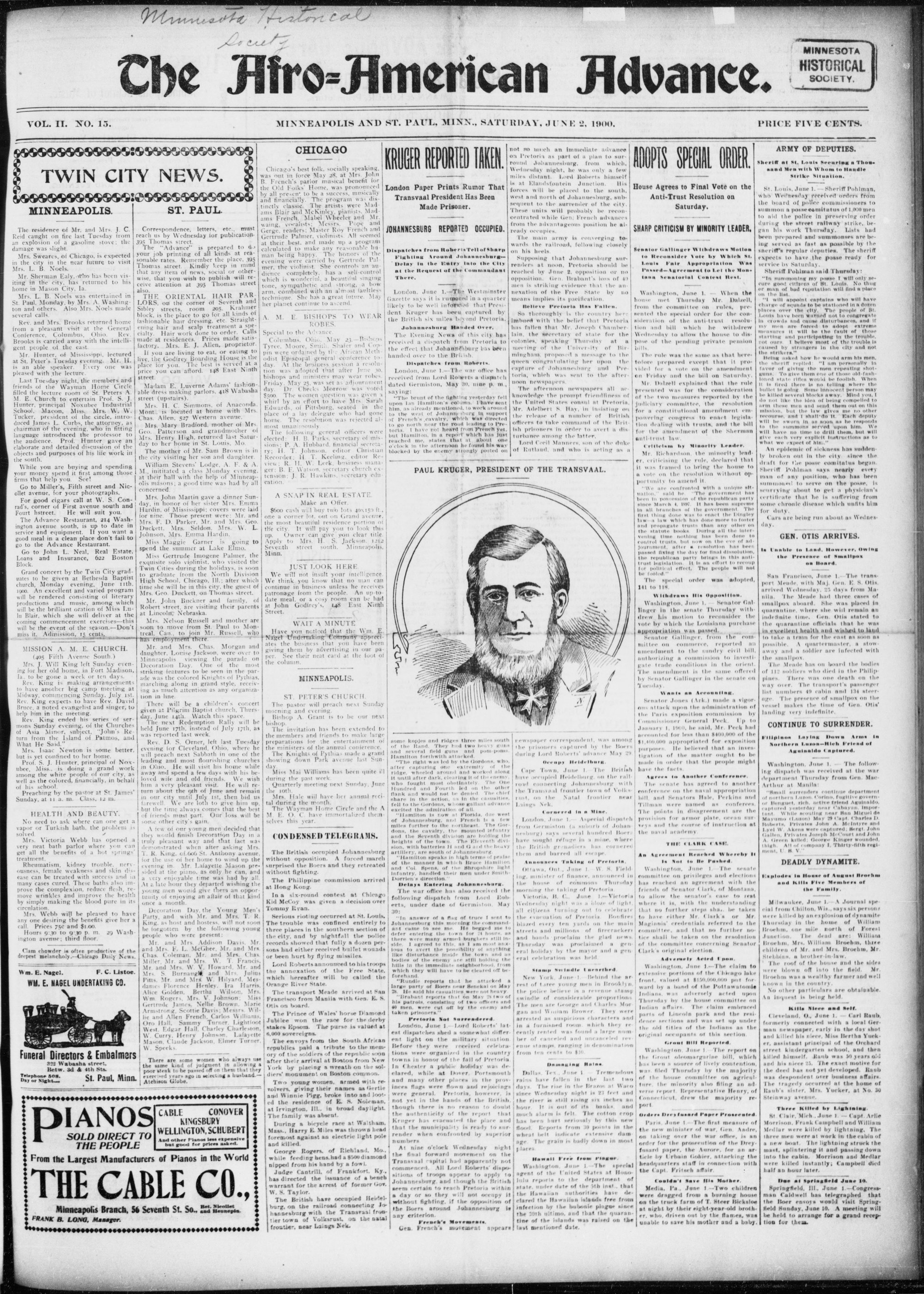
PAUL KRUGER, PRESIDENT OF THE TRANSVAAL.
M.
KRUGER REPORTED TAKEN
London Paper Prints Rumor That Transvaal President Has Been Made Prisoner.
JONHANNESBURG REPORTED OGCUPIED.
Dispatches from Roberts/Tell of Sharp Fighting Around Johannesburg—Delay in the Entry into the City at the Request of the Commandant There.
London, June 1.—The Westminster Gazette says it is rumored in a quarter likely to be well informed that President Kruger has been captured by the British six miles beyond Pretoria, Johannesburg Handed over.
The Evening News of this city has received a dispatch from Pretoria to the effect that Johannesburg has been handed over to the British.
Dispatches from Roberts.
London, June 1—The war office has received from Lord Roberts a dispatch dated Germiston, May 30, nine p. m., saying, "The brunt of the fighting yesterday fell upon an Hamilton's column. I have sent him, as already mentioned, to work around to the west of Johannesburg in support of French's cavalry, which was directed to go north near the road leading to Pretoria. I have not heard from French yet, but Hamilton, in a report which has just reached me, said he would block in the afternoon he found his way blocked by the enemy strongly posted on
PAUL KRUGER, PRESIDER
some kopies and ridges three miles south of the Rand. They had two heavy guns and several field guns and pom-poms. Hamilton forthwith attacked. They captured all of the Gordons, who, after capturing one extremity of the ridge, wheeled around and worked along it until after dark, clearing it of the enemy, who fought most obstinately. The One Gordon, who was the most flank and would not be denied. The chief share in the action, as in the casualties, fell to the Gordons, whose gallant advance excited the admiration of all. The One Gordon, due west of Johannesburg, and French is a few miles further to the northeast. The Gordons, the cavalry, the mounted infantry and the Seventh division are holding the heights of the town to the north and the heavy artillery, are south of Johannesburg.
“Hamilton speaks in high terms of praise of the manner in which Bruce Hamilton and Col. Spens, of the Shropshire light artillery, their men under Smith-Dorriens’ direction.”
Delays Entering Johnnesburg.
The war office has also received the following dispatch from Lord Roberts, under date of Germiston, May 30:
"In answer of a flag of truce I sent to Johannesburg this morning the commandant came to see me. He begged me to defer entering the town for 24 hours, as there were many armed men there. I am most anxious to avert the possibility of anything like disturbance inside the town and as bodies of the enemy are still holding the hills in the immediate neighborhood, from which they will have to be cleared off before." "Bundle reports that he attacked a large party of Boers near Senekal on May 28. He said his casualties were not heavy." "Drabant reports that on May 29 two of his patrols, consisting of two officers and 40 men, escaped off by the enemy and taken prisoners."
Pretoria, Not Surrendered
Pretoria Not Surrounded.
London, June 1—Lord Roberts' latest dispatches shed a somewhat different light on the military situation. Before they were received celebrations were organized in the country towns in honor of the fall of Pretoria. In Chester a public holiday was declared, while at Dover, Portsmouth and many other places in the provinces flags were flown and rejoicings were general. Pretoria, however, is not yet in the hands of the British, though there is no reason to doubt the authenticity of the report that Krueger has executed the place and that the municipality is ready to surrender when confronted by superior numbers.
At nine o'clock Wednesday night the final forward movement on the Transvaal capital had apparently not commenced. All Lord Roberts' dispositions of troops appear to apply to Johannesburg, and though the British seem certain to reach Pretoria within a day or so they will not occupy it without fighting, if the opposition of the Boers around Johannesburg is any criterion.
French's Movements.
Gen. French's movement appears
not so much an immediate advance on Pretoria as part of a plan to surround Johannesburg, from which, Wednesday night, he was only a few miles distant. Lord Roberts himself is at Elandstonetein Junction. His forces will be placed to the south, west and north of Johannesburg, subsequent to the surrender of the city. These units will probably be reconcentrated while Gen. French advances from the advantageous position he already occupies. The main army is converging towards the railroad, following closely on his heels. Supposing that Johannesburg surrenders at noon, Pretoria should be reached by June 2, opposition or no opposition. Gen. Brabant's loss of 40 men is striking evidence that the exnexation of the Free State by no means implies its pacification.
Believe Pretoria Has Failed.
So thoroughly is the country here imbued with the belief that Pretoria has fallen that Mr. Joseph Chamberlain, the secretary of state for the colonies, speaking Thursday at a meeting of the University of Birmingham, proposed a message to the queen congratulating her upon the capture of Johannesburg and Pretoria, which was sent to the afternoon newspapers.
The afternoon newspapers all acknowledge the prompt friendliness of the United States consul at Pretoria, Mr. Adelbert S. Hay, in insisting on the release of a number of British officers to take command of the British prisoners in order to avert a disturbance among the latter.
Lord Cecil Manners, son of the duke of Rattland, and who is acting as a
ENT OF THE TRANSVAAL.
newspaper correspondent, was among the prisoners captured by the Boers during Lord Roberts' advance May 29
Ocenny Heidelburg
Cape Town, June 1—The British have occupied Heidelberg on the railroad connecting Johannesburg with the Transvaal frontier town of Volkss rost, on the Natal frontier near Loings Nek.
Cornered in a Mine.
London, June 1.—Aspecial dispatch from Germiston (a suburb of Johannesburg) says several hundred Boers have sought refuge in a mine, where the British grenadiers has cornered them and barred all escape.
Announces Taking of Pretoria.
Victoria, B. C., June 1—Victoria Wednesday night was a blaze of light; all citizens turning out to celebrate the evacuation of Pretoria. Bonfires blazed every ten yards on the main streets and millions of firecrackers and bands proclaim the glad news. Thursday was proclaimed a general holiday by the mayor and a general celebration was held.
Stamp Swindle Locarthed
New York, June 1.—Beyond the arrest of three young men in Brooklyn, the police believe is a revenue stamp swindle of considerable proportions. The men are George and Charles Morgan and William Brower. They were arrested as suspicious characters and in a furnished room, which they recently rented was found a large number of canceled and uncanceled revenue stamps, ranging in denomination from ten cents to $10.
Damaging Rains
Dallas, Tex., June 1 — Tremendous rains have fallen in the last two days. The rise in the Brazos at Waco since Wednesday night is 22 feet and the river is still rising six inches an hour. It is out of its banks, and much alarm is felt. The cotton crop has been hurt seriously by this new flood. Reports from 30 points in the wheat belt indicate extensive damage. The grain is badly down in most places.
Hawaii Free from Vingar
Washington, June 1.—The special agent of the United States at Honolulu reports to the department of state, under date of the 30th inst., that the Hawaiian authorities have declared the Hawaiian islands free from infection by the bubonic plague since the 30th ultimo, and that the quarantine of the islands was raised on the last mentioned date.
ADOPTS SPECIAL ORDER
House Agrees to Final Vote on the Anti-Trust Resolution on Saturday.
SHARP CRITICISM BY MINORITY LEADER.
Senator Gallinger Withdraws Motion to Reconsider Vote by Which St. Louis Fair Appropriation Was Passed—Agreement to Let the Montana Senatorial Context Rest.
Washington, June 1. — When the house met Thursday Mr. Dalzell, from the committee on rules, presented the special order for the consideration of the anti-trust resolution and bill which he withdrew Wednesday to allow the house to dispose of the pending private pension bills.
The rule was the same as that herefore prepared except that it provided for a vote on the amendment on Friday and the bill on Saturday. Mr. Dalzell explained that the rule presented was for the consideration of the two measures reported by the judiciary committee, the resolution for a constitutional amendment empowering congress to enact legislation dealing with trusts, and the bill for the amendment of the Sherman antitrust law.
Criticism by Minority Leader.
Mr. Richardson, the minority leader, criticising the rule, declared that it was framed to bring the house to a vote on the resolution without opportunity to amend it.
"We are confronted with a unique situation," the government has been in possession of the republican party since March 4, 1897. It has been supreme in all branches of the government. The first thing done was to enact the Dingley law—a law which has done more to foster and propagate trusts than any other on the state book. The second thing has been done to control trusts, but now on the eve of adjournment, after a resolution has been passed fixing the day for final dissolution, the republican party brings in this anti-trust legislation. It is an effort to recoup for political effect. The people will not
The special order was adopted. 114 to 118.
Withdraws His Opposition.
Withdraws His Opposition.
Washington, June 1. — Senator Gallinger in the senate Thursday withdrew his motion to reconsider the vote by which the Louisiana purchase appropriation was passed.
Senator Gallinger, from the committee on commerce, reported an amendment to the sundry civil bill authorizing a commission to investigate trade conditions in the orient.
The amendment is the same offered by Senator Gallinger in the senate on Tuesday.
Wants an Accounting
Senator Jones (Ark.) made a vigorous attack upon the administration of the Paris exposition commission by Commissioner General Peck. Up to January 1, 1900, he said, Mr. Peck had accounted for less than $400,000 of the $1,400,000 appropriated for exposition purposes. He believed that an investigation of the matter ought to be made in order that the people might have the facts.
Agree to Another Conference.
The senate has agreed to another conference on the naval appropriation bill, and Senators Hale, Perkins and Tillman were named as conferences. The points in disagreement are the provision for armor plate, ocean surveys and the course of instruction at the naval academy.
THE CLARK CASE
An Agreement Reached Whereby It Is Not to Be Pushed.
Washington, June 1. The senate committee on privileges and elections has reached an agreement with the friends of Senator Clark, of Montana, to allow the senator's case to rest where it is, with the understanding that no further steps sha, be taken to have either Mr. Clark's or Mr. Maginis' credentials referred to the committee, and that no further notice shall be taken on the resolution of the committee concerning Senator Clark's original election.
Adversely Acted Upon.
Washington, June 1—The claim to extensive portions of the Chicago lake front, valued at $150,000,000 put forward by a band of the Pottawatomie Indians, was adversely acted upon Thursday by the house committee on Indian affairs. The claim embraced parts of Lincoln park and the residence sections and was set up under the old titles of the Indians as the original occupants of this section.
Grout Bill Reported.
Washington, June 1. The report on the Grout oleomargarine bill, which has been a source of lively contention, was filed Thursday by the majority of the house committee on agriculture, the minority also filing an adverse report, Representative Henry, of Connecticut, drew the majority report.
Orders Dreyfusard Paper Prosecuted.
Paris, June 1.—The first measure of the new minister of war, Gen. Andre, on taking over the war office, is an order for the prosecution of the Dreyfusard paper, the Aurore, for an article by Urbain Gohier, attacking the headquarters staff in connection with the Capt. Fritsch affair.
Couldn't Save His Mother
Media, Pa. June 1- Two children were dragged from a burning house on the truck farm of T. Steer Bickleson at night by their eight-year-old brother, who driven out by the flames, was unable to save his mother and a baby.
MINNESOTA HISTORICAL SOCIETY.
PRICE FIVE CENTS.
ARMY OF DEPUTIES.
Sheriff at St. Louis Securing a Thousand Men with Whom to Handle Strike Situation.
St. Louis, June 1. — Sheriff Pokhman, who Wednesday received orders from the board of police commissioners to summon a posse comitatus of 1,000 men to aid the police in preserving order during the street railway strike, began his work Thursday. Lists had been prepared and summonses are being served as fast as possible by the sheriff's regular deputies. The sheriff expects to have the posse ready for service by Saturday.
Sheriff Pokhman said Thursday:
"In summoning my posse I will only secure good citizens of St. Louis. No thug man of bad reputation will find a place on the list."
"I will appoint captains who will have charge of squads to be stationed in a dozen places over the city. The people of St. Louis will be stationed in crowds and cause disturbances, and if my men are forced to adopt extreme measures it will be the fault of those starting and participating in the trouble, and if my men are caused by strangers in the city and not the strikers." He asked how he would arm him his men, and he replied, "I am personally in favor of giving the men repeating shotguns. To give them one of those old-fashioned rifles would be foolish. When it is fired there is no telling where the gun is located. If the gun is killed several blocks away. Mind you, do not like the idea of being compelled to arm these men and send them on this mission, but the law gives me no other choice. If the gun is killed, the men will be sworn in as soon as he responds to the summons served upon him. We will have no time to drill them, but will give them instructions as to what we expect of him."
An epidemic of sickness has suddenly broken out in the city, since the draft for the posse comitatus began. Sheriff Pohlman says nearly every man of any position, who has been summoned to serve on the posse, is scouring about to get a physician's certificate that he is suffering from some chronic disease which unfits him for duty. Cars are being run about as Wednesday.
GEN. OTIS ARRIVES.
Is Unable to Land. However, Owing
the Presence of Smallpox
box.
San Francisco, June 1.—The transport Mende, with Maj. Gen. E. S. Otis, arrived Wednesday, 25 days from Manila. The Mende had three cases of smallpox aboard. She was placed in quarantine, where she will remain an indefinite time. Gen. Otis stated to the quarantine officials that he was in excellent health and wished to land to take a tran for the east as soon as possible. A quartermaster, a stowaway and a soldier are infected with the smallpox. The Mende has on board the bodies of 112 soldiers who died in the Philippines. There was one death on the way over. The transport's passenger list numbers 49 cabin and 134 steerage. The presence of smallpox on the vessel makes the time of Gen. Otis's landing very indefinite.
CONTINUE TO SURRENDER.
Filipines Laying Down Arms in Northern Luzon-Hitch Point of
Northern Luzon
Washington, June 1. — The following dispatch was received at the war department Thursday from Gen. Mac Arthur at Manila:
"Small surrenders continue department of northern Luzon Coron, fugitive governor, Benguet, rich, active friend Aguinaldo, captured yesterday near Cabayan, important. While scouting near San Miguel de Oro, Roberts, Private John A. McIntyre and Lyle W. Akena were captured, Bergt J. Gallen, Private Joseph McCourt and John A. Green killed, George Kinger wounded, company I, Thirty-fifth regiment, U. R. V."
DEADLY DYNAMITE.
Explodes in House of August Broehm and Kills Five Members of the Family.
Milwaukee, June 1.—A Journal special from Chilton, Wis., says six persons were killed by an explosion of dynamite Thursday in the home of William Brochm, one mile north of Forest Junction. The dead are: William Brochm, Mrs. William Brochm, three children of Mr. and Mrs. Brochm, Mr. Stebbins, a brother-in-law. The roof of the house and the sides were blown off into the field. Mr. Brochm was a wealthy farmer and well known in the country. No other particulars are obtaiable. An inquiry is being held.
Killie Niece and Self
Cleveland, O., June 1. — Carl Raub,
formerly connected with a local German
newspaper, early in the day shot
and killed his niece, Miss Bertha Yuecker,
assistant principal of the Orchard
street kindergarten school, and then
killed himself. Raub was 50 years old
and his niece 25. The exact motive for
the deed has not yet developed. Raub
was dependent over business affairs.
The tragedy occurred at the home of
Raub's sister, Mrs. Yucker, at No. 30
Steinway avenue.
Three Killed by Lightning
81 Clair, Mich., June 1 — Capt. Arlie Morrison, Frank Campbell and William Mediar were killed by lightning. The three men were at work in the cabin of a new boat. The lightning struck the mast, splintering it and passing down into the cabin. Morrison and Mediar were killed instantly; Campbell died half an hour later.
Due at SpringBeld June 10.
Springfield, Ill., June 1.—Congressman Caldwell has telegraphed that the Boer envoys would visit Springfield Sunday, June 10. A meeting will be held to arrange for a grand reception for them.
Minneapolis, . . . . . . . . . Minneapolis
Entered at the Post Office, at Minneapolis, Minn., as second-class matter.
Subscription Rates:
One Year - - - $1.00
Six Months - - - .60
Three Months - - - .35
Subscription Always Payable in Advance.
Special rates if ordered by the dozen. Orders for current issue should reach the office by Wednesday evening.
Advertising Hates.
Religious Notices (not over five lines),
free
Want* and *To Let* advertisements,
8 cents per line for each insertion.
Display, 40 cents per inch each insertion.
Special rates will be given for space by the year.
Editorial Announcements.
To secure the return of unsolicited manuscript postage should be enclosed.
Communications must reach the office by Wednesday of the issue in which they are to appear.
All communications, enclosing news for publication, must be written in a clear, legible form, but an evidence of good faith.
Contributions and lists of news concessions are requested from our readers.
Any communication unsuitable for publication.
Subscribers ordering addresses of their paper changed are requested to give their address to the AFRO-AMERICAN POST.
Address all communications and make all remittances to THE AFRO-AMERICAN POST.
214 Washington Ave., South,
Minneapolis, Minn.
MRS. J. B. KOGER, City Collector.
EDITORIAL.
A communication relative to a letter published in the Minneapolis Times, May 28, 1900
Editor of Afro-American Advance:—You must excuse my boldness, but I believe your paper is a medium through which the black race is reached, and a language that is difficult to face. I am very sorry for Senator B. R. Tillman, of South Carolina, he is trying to fill a place entirely too big for himself; he lacks education; uses bad grammar. I find that Mr. Webster does not use the word "nigger" in the mannen that Tillman uses it, in his great big dictionary. Tillman makes another inconsistent remark when he says "scratch the nigger, and you will find just beneath the skin a savage." In my opinion you don't have to scratch some white men before you find a murderer; leave it to the public to decide who has harmed the most lives, the savage "nigger" or the white midnight assassin.
Tillman says the "nigger" must be kept from the ballot box; I suppose his reason for so objecting is, that he does not get the black vote or his party. I can assure him if the negro had his rights he would not be sitting in the highest legislative body in these United States.
Mr. Tillman ought to resort to other resources to get his revenge for the loss of "his before the war" property and shaves. Murder and burning are the acts of savage men.
Mr. Tillman ought to know that it was men of his own race that brought about the war. My people were simply the victims of circumstances. Our loyalty, devotion and faithfulness all belong to an old book and a few brothers, men of the same country, does not save us from these latter day devils in human form. Nothing that our "black boys" did down in Cuba, in the saving of New York's famous governor and the Rough Riders, will prevent any blackguard from heaping insult at any time or place that they desire.
I want to say that the worm will turn some day, and beware we Tillmans, with your separate coach laws and disranchisement of the negro.
J. J. TURNER.
OF GENERAL INTEREST.
It is estimated that during the past fourteen months upward of 10,000 wolves have been killed in Wyoming in addition to mountain lions, lynx bear and coyotes.
On June 15 the seat of the national government in Washington will have been occupied 100 years, and a grand celebration is being planned to commemorate the event.
In its mineral productions there is no country in the world the superior of Canada. They include coal, gold silver, copper, iron, phosphates, salt nickel, mica and glipsum.
Adna Adams Treat, of Denver, Col., is probably the oldest mason in the world, having joined the order in February, 1823. Mr. Treat is now in his 103d year, and still in vigorous health
There are 1,500 persons upon the German emperor's list of employees, including 350 women servants, who are engaged in looking after the 22 royal palaces and castles that belong to the crown.
"Incercumscriptibleness," meaning incapable of limitation, has been admitted into Dr. Murray's new English dictionary, on the strength of its use by a covenanting Byfield of the seventeenth century.
In 1895 there were 1,030 savings banks in the United States, and the deposits in them amounted to $1,841,000,000. In 1899 there were 1,942 savings banks in the United States, and their deposits were $2,401,000,000.
There was shipped to the United States from the Dutch colonies coffee to the value of $427,000 in 1897, $307,000 in 1898, and $44,000 in 1899, and a smaller, but still considerable item of Dutch exportation, is to be found in cocon.
George Fred Williams is of German parentage. His father's name was George Weinigman, but had it changed by act of the legislature to Williams.
Labor organizations in England have presented a testimonial to Lord Averbury (Sir John Lubbock) in recognition of his services in shortening the hours of labor.
You never meet some men that they do not ask you to take a chance in a raffle--Atlacho Globe.
BAN ON THE CREAM PUFF.
The Injuries Effect of Pastry Diet Supplemented with Soda Water.
Women rarely learn that a pastry diet is injurious without a costly experience. At a church social in Philadelphia the other night the members engaged in a spicy debate on the merits of the question: "Resolved. That a majority of the young women employed as clerks in Philadelphia are unfitted for positions of trust and responsibility because of their enervating diet."
After the debaters had presented their arguments the judges decided in favor of the affirmative side of the question, says an exchange of that city. It is necessary to note that the successful debaters presented as their chief argument the fact that, as a rule, the midday meals of the young women employed as clerks in the big department stores and as stenographers and typewriters are composed of cream puffs, candies and soda water, instead of solid and substantial food.
As a test of the statement a reporter made inquiries of the managers of the principal light lunch restaurants. The managers corroborated the statements made by the debaters.
From a cashier at one of the principal restaurants it was learned that more than one-half of the trade at the Ninth and Filbert street branch was derived from women customers who bought nothing but sweet food.
"The things that they usually eat," said the cusher, "consists of such air delicacies as cream puffs, pies, chocolate eclaires and ice cream. The young girls mostly top off this repast with a glass of milk. Rarely, if ever, do the women order soup or meat."
A young man who draws soda water at one of the fountains in a large department store said:
"Why, there are scores and scores of young girls in this establishment who never look at eating anything sensible during the noon hour. Without looking at the clock I can always tell when it is time for lunch. At 12 o'clock sharp up trips the girls, and it is 'A strawberry soda' here and 'A cherry bounce' there. After quuffing these draughts, fit only for people with full stomachs and not poor girls who toil for their daily bread, the candy counter is visited."
Surely enough, when seen, a sauve young woman in charge of the candy counter gave a merry laugh and whispered: "Oh, pshaw! Don't you know that sweets are as dear to a woman, a young one at least, as pie was to Tom Tucker or as watermelon is to a 'coon?' For instance, take cream chocolates and bonbons as cake triumphs. What is more delicious, especially when they are made up in the most tempting flavors? As a proof of what I say you ought to hover near this counter between twelve and one o'clock on any day of the week. In fact, more than half of the girls here never think of buying sandwiches or anything substantial. Ice cream sodas and sweetmeats are good enough for them."
The reporter next visited a prominent physician who makes a specialty of stomach troubles. He was told what the restaurant cashier, the soda fountain expert and the sauve young woman at the candy counter had said.
"That is an old story to me," he said, "I might say, too, without fear of contradiction, that this foolish practice is causing nearly 80 per cent of the young women employed in stores and offices to degenerate into confirmed dyspeptics. It requires no great effort of the mind to arrive at this conclusion. While employed at work of any kind, whether heavy or light, the body requires nourishing food. It should be warm during certain seasons of the year, and of a solid character. This makes muscle and flesh.
On the other hand, pastry and outlandish drinks, ice cold at that, together with highly flavored candies, will make a physical wreck of any man, woman or child if indulged in any great extent. Under these conditions how can a young woman whose digestion is seriously impaired, and as a consequence whose nerves are like piano chords, successfully fill a position where a cool judgment and sound body are the chief qualifications? I say such a thing is next to impossible, except in rare instances. Even then the break-down comes without warning and the doctor steps in to remedy the evil."
FOUR RICH FOREIGN MISERS.
They Made Large Fortunes by Begging in Different Countries Across the Sea.
In Austria a man who was without feet or arms seven years ago, lacking two months, sentenced to hard labor for that term of years, is said to be well and hearty and with eager longing looks forward to the day when he shall be liberated. Simon Oppasch is his name. Born legged and armless, he managed in the course of 50 years to make purely by begging $60,000, and this huge sum he was in the habit of carrying about with him by day and hiding in the wall of the cellar where he slept by night. He got into trouble with the Austrian police by declaring that he was destitute and taking an oath to that effect, says a foreign exchange.
Lately in England died one Isaac Gordon, who had been a professional beggar, and when he was picked up lifeless out of the street it was found that he had $13,000 on his person. And a writing was likewise found that signifies that he had made a will. Volunteer heirs are coming forward in numbers.
The miser of the story book usually hoards his money in good red gold under the heartstone or in some uncomfortable spot. Real misers of to-day seem as a rule to prefer bank notes. They are certainly more easy to handle. Tori, a notorious Italian beggar and miser, who died a little time ago, after a life of gripping want and misery, left $400,000, all of which was hidden in boxes, tins and behind the tattered wall paper in his room. It was almost entirely in paper money. Another man of the same type who died at Auxerre, in France, in 1898, left a large sum in bonds, but most of his wealth he had invested in rare wine. No less than 400 bottles of one very choice vintage over 80 years old were found in the cellar he lived in. This he must have bought bottle by bottle. It was practically certain that he himself had never so much as tasted a drop of this liquid gold.
A PATHETIC STORY.
Related of a Scottish Missionary, Cannibal Indians, and Church of England.
A very remarkable story was told by Senator Vest, of Missouri, to the Washington Post a day or two ago.
"The most pathetic scene I ever witnessed in my life," he said, "was the outcome of a very singular and curious condition of affairs. Up in British North America there was a tribe of Indians under the control of native sorcerers, and practicing all manner of savage rites. Among other things, these Indians were cannibals. A Scotchman, named Duncan, went among them, and at the risk of his own life civilized them. He taught them every dogma of our religion except the Lord's Supper. His great work had been to win them from cannibalism, to teach them that capturing and then roasting and devouring human beings was barbarians. He was, therefore, afraid to acquaint them with the sacrament of the Lord's Supper, because they would, in turn, ask him why it was wrong to eat each other and yet a part of religion to eat their God. He doubted his ability to explain the matter satisfactorily to their untutored minds, and so for fear that they would regard him as an impostor and return to their barbarous ways, he let the matter rest.
"This was not satisfactory," continued Senator Vest, as he told the story, "to the governor of the province of Vancouver or the bishop of the English church, both of whom demanded that he should either administer the Sacrament or else give up his lay ministry in the church. Duncan explained the reasons which had actuated him, but they were not accepted as sufficient. He appealed to the highest authorities of the Church of England, and was overruled. He went back to his Indians and asked them if they would accompany him to Alaska, where they would be under a flag that guaranteed religious freedom. Almost the entire tribe of 1,200 Indians decided to follow him.
"When I was there the Indians were taking the doors off their houses, the sashes from their windows, and their seanty furniture from their rooms, preparatory to sailing away in their great canoes, in order to start life over again in a new country. It was as I have said, the most pathetic scene I ever witnessed. It was more than this," added Senator Vest, speaking with almost vehement emphasis. "It was the most conspicuous example of religious prejudice and fanaticism I have ever known."
Vane That Contradicts Nature
Vane That Contradicts Nature.
One of the big western beef packing houses has an office near the North river, in the upper part of this city. There is a weather vane above the building which is a big gilded steer. It is a pretty weather vane, says the New York Herald, and probably attends to its business all right, but the man who put it up did not know much about the habits of the plains cattle, the remains of which are being sold by the firm that owns the vane. This gilded steer is so arranged that as he turns in obedience to the changes of the wind he faces the direction from which the wind blows. On the plains, during a wind, rain or snow storm all the cattle subjected to its violence invariably turn fall to the wind and hump their backs. There they will stand almost immovable for hours if the direction of the storm does not change, patiently chewing their cuds, waiting for the storm to abate.
PATRONIZE ...
WM. JENKINS,
ROOMS FOR RENT
FIRST CLASS.
We Guarantee Superb Service. Prices
moderate. Tel. 2737-L-3 Main.
No. 9 Second St. No. Minneapolis.
J. GARNER. W. H. WELLER.
The Elite Buffet
3030 STATE ST.,
FINE WINES,
LIQUORS
AND CIGARS.
Chicago.
Chicago.
Cutting, Fitting and Making Over a Specialty. New York and Paris Fashions Always on Hand.
Pierers 628 Fourteenth Aoy. South.
DR. R. S. BROWN.
Physician and Surgeon.
Office: 405-6 Reeve Bldg. 408 Nickollett Av.
Telephone 2734-7 J-8.
Office Hours: 9:30 to 12:30; 2:00 to 4:00
p.m.: 5:30 to 7:00 p. m. Sundays: 9:30
to 11:00; 12:30 to 2:30.
Residence: 2839 Portland Ave.
Telephone 317-L-South.
MR. L. A. JOHNSON.
The gentlemanly and obliging Porter
at R. De Leo's Barber Shop, 200 Washington Av. South, is
Always Ready to Dress Your Shoes
in a thoroughly artistic manner, that is sure to win.
JAMES L. CURTIS.
603 Northwestern Bldg., Minneapolis.
Cor. 4th St. and Hennepin Av.
Telephone, Main 2460-L-1.
DROPSY
Treated free
Pensylvan CURS
Broadway
Kendall. Have
good many times
Treated free.
PRESENTED BY
with Vegetables.
Konfetti.
Nourished many
sand peas
and peas
announced baskets. From first dose arrangements canopy display,
booklet, two-basket two-drawer set of acrylic baskets FREE,
BOOK OF TEN DAYS TREATMENT FURNISHED FREE by mail
D. H. GREEN & NONS, Specialists, Atlanta, GA.
JARE IRE TAPE PAPER time you pay with
LAMB'S Throat Candy, one of the
best Convenience for Vocabals,
to LAMB MFG. CO., O'HARA, Canada, for ram pie baskets.
LAMB'S Throat Candy, one of the best Confections for Vocational, Dental, and Medical Use to LAMB MFG. CO., OTTAWA, CANADA, or sample pack.
$20 A hundred for your neighbors' addresses. Send 10 cents for contract and sample copy. ROMANCE MAGAZINE, NEW YORK.
DROPSY NEW DISCOVERY; gives quick relief and eases worst cases. Send for book of treatment tablets and 10 day's treatment Free. Dr. K. K. CRESS 3003, ALBERTA, WA.
GET RICH QUICKLY. Read for Best. "Invitations Wanted." SUGAR EAT & CO., 243 Broadway, New York.
THE ADVANCE CAFE 214 WASHINGTON AV. SOUTH. Restaurant and Lunch Counter
MANN & KOGER, Proprietors.
SOCIETY DIRECTORY.
Officers and Standing Committees of the Most Worshipful Grand Lodge A. F. and A. of Minnesota and jurisdictions.
Grand Master—John L. Neal, Minnesota.
Deputy Grand Master—Wade H. Hampter, Superintendent.
Grand Seniors Warden—H. B. Howard, St. Paul.
Grand Junior Warden—J. C. Garner, St. Paul.
Grand Treasurer—Daniel Roy, St. Paul.
Grand Secretary—William H. Morris, Minnesota.
Grand Lecturer—G. W. Day (7), Minnesota.
Deputy Grand Secretary—O. D. Howard (4), St. Paul.
Grand Chaplain—Isaac Crawford (6), Minnesota.
Grand Senior Deacon—John Martin (1), St. Paul.
Grand Junior Deacon—R. De Leo (7), Minnesota.
Grand Senior Steward—J. H. Dillingham (2), St. Paul.
Grand Junior Steward—Wm. Stevens (3), St. Paul.
Grand Tyler—T. Bush (3), St. Paul.
Grand Marshall—C. H. McDonald (5), Minnesota.
Pursuivant—G. W. Duckett (4), St. Paul.
Grand Sword-Bearer—J. Adams (1), St. Paul.
Grand Standard-Bearer—G. J. Charleston (2), St. Paul.
Grand Register—J. G. Sterett (6), Minnesota.
District Deputy Grand Master-First
District Deputy Grand Master-Second
District Deputy Grand Master-Second
District-E. H. Hamilton (6), Minneapolis.
District-F. H. Hamilton (3), Third
District-J. K. Polk (2), Duluth.
MINNEAPOLIS.
G. U. O. O. O. F.
St. Anthony Lodge, No. 2877.
Meets the first and third Wednesday in each month for the transaction of business, 1st avenue in Montgomery.
A. H. MYRICK, N. G.
JAMES A. SCOTT, P. S. P. K. O. Box 33.
KNIGHTS OF PYTHIAS.
Nat. Turner Lodge, No. 2, K. of P.
Meets the second and fourth Thursdays in each month. Brothers in good standing. Fourth and Eighth avenue south.
RALPH WATSON, K. R. and S. C.
Pride of Minnesota Lodge, No. 1, K. of P.
Meets the first and second Thursdays in each month. All brothers in good standing welcome. At Plummer Post Hall. First avenue north and Washington.
JAMES HUBER, C. G.
W. C. JEFFREY, K. R. and S.
K. HILYMID Lodge.
Meets the first and second month at Windom Block, Second avenue South and Washington. Masons in good standing always welcome. G. W. LILLARD, W. M. JASPER GIBBS, Sec. Guaranty Loan Restaurant.
A. Turner Lodge, No. 7, A. F. and A. M. Meets the first and second Monday in each month at Windom Block, Second avenue South and Washington. Masons in good standing.
J. A. SCOTT, W. M.
A. B. LEE, 2701 Aldrich avenue South.
ST. PAUL.
ODD FELLOWS.
Mars Lodge, M.S.
Meets second and third Wendy weeks in each month at Odd Fellows Hall, Wabasha street.
T. R. HICKMANN, P. S., 422 St. Anthrop.
F. D. DARKER, N. G., 256 Edmund St.
Household of Ruth, No. 553, G. U. O. of F.
Meets first and third Monday in each month at Odd Fellows Hall for instruction, at Odd Fellows Hall, 225 Wabasha.
MRS. BARAH C. KIRTLEY, M.N.G.
MRS. IDA JACKSON, W. R., 274 Summit place.
MOST WORSHIPFUL GRAND LODGE OF MINNESOTA, A. F. and A. M.
J. E. EARL, Grand Master.
WM. R. M. HILARY, Dairy.
87 Guaranty Loan Bldg., Minneapolis.
ST. PETER CLAYER'S SODALITY.
Meets the first and third Mondays of each month at Gardner Fees, J. S. Harps, Sec. A. T. Trus.
Pioneer Lodge, No. 1, A. F. and A. M.
Meets the first Monday in each month at Masonic Hall, southwest corner Fifth and Sixth Floor. Masons in good standing always welcome.
S. H. HADLEY, W. M.
W. A. HILYARD, Sec. 124 Atwater.
Minnesota Lodge, No. 2, A. F. and A. M.
Meets on the first and third Tuesday in each month at Masonic Hall, southwest Masonry Masons in good standing always welcome.
H. R. HOWARD, W. M.
J. S. STRONG, Sec. 12th and Robert st.
WM. STEVENES, No. 3. A. F. & A. M.
Meets second and fourth Monday in each month at Masonic Hall, southwest corral Masonry Masons in good standing always welcome.
WM. JOHNSON, W. M.
D. BEASLY, Ryan Hotel.
Perfect Ashler Lodge, No. 4, A. F. A. M.
Meets the second and fourth Tuesday in each month at Masonic Hall, southwest Masonry Masons in good standing always welcome.
B. K. DURANT, W. M.
461 Carroll.
Bethel Chapter, No. 28, R. A. M.
Meets the first and third Thursday in each month at Masonic Hall, southwest Masonry Masons in good standing always welcome.
DANIEL ROY, H. P.
W. T. GASSAWAY, Sec. State Capitol.
CHURCH DIRECTORY. MINNEAPOLIS.
**ST. PETER A. M. E. CHURCH**
Rev. W. S. Brooks, Pastor.
Cor. 225 st. 9th aven. South
Sunday; 3:00 p.m. Frequently,
11:30 a.m. ; Sunday School, 3:00 p.m.
evening services; 8:00 p.m. General prayer meeting,
hurried breakfast; 8:00 p.m. Way-
ward trip; 11:30 a.m. Weekly evening
different residences. Parsonage, 2205
Ninth avenue South
RETHESDA BISTHIST CHURCH
Pastor, Rev. John J. Paule, and Twelfth avenues.
Sunday services: Frequently, 11:00 a.m.
; Sunday School, 12:30 p.m. ; Christian
weekly service; 8:00 p.m. Wednesday evening.
prayer meeting, 8:00 p.m. Parsonage,
1200 Eighth street South
MISSION
Rev. John J. Paule, in charge.
615 Sixth avenue South.
Sunday service: 4:00 p.m. ; Sunday
School, 10:00 p.m.
**ST. JAMES A. M. E. CHURCH**
Rev. J. W. King, Pastor.
Between First avenue and Second street
Southeast, near Exposition Bldg.
Sunday; 3:00 p.m. Evening services;
8:00 p.m. General prayer meet-
ing, 8:00 p.m. Weekly meetings of
the Debating Club.
ST. PAUL
Cor. Fulher and Jay streets.
Sunday services: 11:30 a.m. ; 7:30 p.m.
Wednesday prayer meeting: 8:00 p.m.
WT. Church of the Nativity.
Pather Printon.
Cor. Farrington and Aurora avenues.
Sunday services: Mass. 8:00 a.m. High
morning. 10:30 a.m. Evening service at
o'clock.
PILGRIM BAPTIST CHURCH.
Rev. D. S. Orner, Pastor.
Sunday services: Preaching at 11:30 a.m.
and 14:30 p.m. Sunday School at 12:30
o'clock. Wednesday evening general
service.
ST. PHILLIPS' EPISCOPAL MISSION
63 Rice street, bet. Aurora and University
Sunday services: Morning prayer, Lit-
any and Sermon. 11:0 a. m.; Sunday
School and Children's Vespers 3:0 p. m.
Evenson's Evening Prayer and Lecture, 8:00
p. m.; Friday; Choir Rehearsal and
Brotherhood of St. Andrew, 8:00 p. m.
All are cordially invited. Seats free.
NOTICE—Changes and corrections will
be made upon notifying the office. If we
have neglected to place a notice of any
society in the above directory it is be-
cause we do not know of it or have not
known of it. Send notice of any
Lodge, place and time of writing
name of officers and it will be inserted.
OLSON EARL,
..UNDERTAKER.
Funeral Director and Embalmer.
Open Day and Night. Satisfaction Guar-
anteed.
1503 S. Franklin Ave. Minneapolis.
The Fuller Laundry Co.
Free Delivery to All Parts of the City and Lake Minnetonka.
Our Motto: First-class Work and Moderate
Prices.
Telephone: 0123456789 L.A.
S. P. EGGAN,
Crayon, Pastel and Water Colors a Specialty,
251-253 Cedar Avenue,
MINNEAPOLIS, MINNESOTA.
SEEDS OF FLOWERS Plants and Cut Flowers.
We can flower Flower plants on telegraph
orders any time, day or night. Budding or
House Plants in their season. Cut Flowers.
fresh and fragrant. Seeds that are good and
are easy to grow per packet. Our catalogue
is FREE, send for it.
MENDENHALL, FLORIST.
414 Nicollet Av., Minneapolis, Minn.
KLAFFKE'S
WHITE SEAL
FLOUR.
119 Central Ave., Minneapolis.
TEL. 2701-J-3. NEXT TO YERXA'S.
WONDERFUL
DISCOVERY
Curly Hair Made Straight By
A
This wonderful hair pomade is the only safe preparation in the world that makes kinky hair shine. It is the only pomade that prevents the hair from falling out and makes it grow. Sold over 40 years and used by thousands, Warranted harmless. Testimonials free on re-use. Warranted harmless. Straightening kinky hair. Beware of imitations. This is the genuine never fails to keep the hair pimple and beautiful. A toilet necessity for ladies and men. It is the only pomade that vantage of this wonderful pomade is that by its superior quality and lasting quality it is the most economical. It is not possible for anybody to wear it with every bottle. Only 50 cents. Sold by Money Order for $ 2 bottles, express paid. Write your name and address plainly to OZONIZED OX MARROW CO., 76 Wabash Ave, Chicago, Ill.
Magic Seeds
Awonderful Nerve
Remedy, that has no superior and
is guaranteed to cure all such nere-
ous diseases as Nervous Prostata-
tion, Weak Memory, Lack of Confidence, Wakefulness, Head ache, Nervousness, Lost Manhood, and all drains and loss of power in genera
either sex, caused by Overexertion, Youthful
Errors, Excessive use of Tobacco, Opium, or
Stimulants, which lead to Infinity, Consumption, and Insanity.
Magic seeds restore the nerve and vigor of youth. Easily carried in the vest pocket. Send prepaid in plain box by mail to any address, for $1,000, six boxes for $6,000 with a written guarantee to cure or money refunded. Write for free circular.
MAGIC MEDICINE CO.,
MANSFIELD, OHIO.
VICTORINE
THE WONDERFUL NEW
WASHING COMPOUND
VICTORINE
TRADE MARK
MFG. 1877.
THE GREATEST BLESSING TO
WOMANKIND
NO BOILING, NO RUBBING OF CLOTHES REQUIRED.
PREVENTS SHRINKAGE OF WOOLENS.
5c. a Package—Two Week's Washing.
BARBEAU & CALLAHAN,
SOLE MANUFACTURERS, CHICAGO U. S. A.
AGENTS WANTED WHERE NOT REPRESENTED.
A wonderful Nerve
Remedy, that
has no superior and
is guaranteed to
cure all such nervous
diseases as Nervous
Paresthesia, Pain
Lack of Confidence,
Wakefulness,
Headache,
Nervousness, Lost
Manhood, and all
drains and loss of
power in genera
Special Reduced Terms During May, June, July and August.
Piano, Organ, Violin, Elocution, Vocal, Chorus, Singing, Theory.
Thorough, Practical, Progressive Methods of Instruction for Beginners as well as Advanced Pupils.
LESSONS GIVEN DAY AND EVENING.
ANDREAS ROHNE, Musical Director.
WILL J. PARRY, Manager and Secretary.
D. H. BOONE, Pres.
N. JOSEPH LLOYD, Sec.
SPEND A PLEASANT EVENING AT THE NORTH STAR SOCIAL CLUB
BILLIARD AND POOL TABLES.
Rooms, Second Floor, 202 Hennepin Avenue.
SONS GIVEN DAY AND EVENING.
HNE, Musical Director.
WILL J. PARRY, Manager and Secretary.
res. N. JOSEPH LLOYD, Secy.
PEND A PLEASANT EVENING AT THE
H STAR SOCIAL CLUB
BILLIARD AND POOL TABLES.
oms, Second Floor, 202 Hennepin Avenue.
SPEND A PLEASANT EVENING AT THE NORTH STAR SOCIAL CLUB BILLIARD AND POOL TABLES. Rooms, Second Floor, 202 Hennepin Avenue.
DR. THOS. S. COOK.
OFFICE HOURS:
10 TO 12 A. M.; 2 TO 4 P. M.; 7 TO 8 P. M.
TELEPHONE 386.
12TH AND ROBERT STS.
Office Telephone 1498-4.
VAL DO TU
PHYSICIAN
Office Hours: 8 to 10 a.m.; 12 to 2 p.m.
Office, 27 E. 7th St., Kendrick Blk. Res.
25 YEARS' EXPERIENCE.
JAS. AM
Practical Undertak
123 Washington Ave.
All our goods are first-class, and the
SMOKE THE SIGHT
W. S. CONRA
400 FIRST
COX & HARRIS,
ROBERT STS., ST. PAUL, OVER DRUG STORE.
1498-4. Residence Telephone Dale 410-5.
AL DO TURNER, M. D.,
PHYSICIAN AND SURGEON.
40 a. m.; 12 to 2 p. m.; 4 to 6 p. m.
Kendrick Blk. Res. 333 Sherburna Ave.
ST. PAUL, MINN.
EXPERIENCE. TELEPHONE 755.
WAS. AMOR & CO.,
Special Undertakers and Embalmers.
223 Washington Ave. South, Minneapolis, Minn.
Are first-class, and the prices we guarantee will defy competition.
THE SIGHT DRAFT 5-CENT CIGAR.
S. CONRAD, Distributor,
400 FIRST AVENUE SOUTH.
ERRIS, AGENTS.
12TH AND ROBERT STS., ST. PAUL, OVER DRUG STORE
VAL DO TURNER, M. D., PHYSICIAN AND SURGEON.
25 YEARS' EXPERIENCE. TELEPHONE 755. JAS. AMOR & CO., Practical Undertakers and Embalmers. 123 Washington Ave. South, Minneapolis, Minn. All our goods are first-class, and the prices we guarantee will defy competition.
COX & HARRIS, AGENTS.
Twin City Club and
FURNISH
With the Most
BARBER SHOP
Where Meals are
126 Hennepin Ave.
Smoke "SUN
"BUCKIN
AND "PRIN
CHEW "PEACH A
STRICTLY UNION
MANUFACTURED BY J. J. D
PIPE FREE FOR "
City Club and Employment Bureau FURNISHED ROOMS With the Most Modern Conveniences. BER SHOP AND RESTAURANT Where Meals are Served at All Hours.
Twin City Club and Employment Bureau
e "SUN CURED" Cut Plug,
BUCKINGHAM" Cut Plug,
D. "PRIME MESS" Granu-
lated.
PEACH AND HONEY" FINE CUT
STRICTLY UNION LABEL TOBACCOS.
TURED BY J. J. BAGLEY & CO., DETROIT, MICH.
E FREE FOR "SUN CURED" LABELS.
MANUFACTURED BY J. J. BAGLEY & CO., DETROIT, MICH. PIPE FREE FOR "SUN CURED" LABELS.
Miller
ST. PAUL, 171-173 E. 7th St.,
Opposite Olympic.
The FOX $2.00 RAZOR is the best that experience and skill can produce. FREE TRIAL AT YOUR HOME. For 25c we will send a Fox Razor to your Express Agent, with instructions to allow you to take it home to try. Or, if you send full amount with your order, we send Razor prepaid, guaranteeing satisfaction or money back, and a FOX STYPTIC PEN-CIL FREE. State whether wide amount or narrow blade, square or round pock. Every Razor housed, stopped and set ready for use.
FOX CUTLERY Co., Mfrs., 48 Center St., New York City.
Address for the West: 928 Main St., Dubuque, Iowa.
"'The Fox Cutlery is perfectly reliable.' Editor."
Take it Ezy. Swing
NO ROPES TO BREAK!
Strong and Durable!
Finished in Red and Natural Wood and Fancy Striped Canvas.
MANUFACTURED BY
The Climax Tag Co.
$3.50 each.
DAYTON, O.
The FOX $2.00RAZOR is the best that experience and skill can produce. FREE TRIAL AT YOUR HOME. For 20c we will send a Fox Razor to your Express Agent, with instructions to allow you to take it to try. Or, if you send full amount with your order, we send Razor preset, guaranteeing satisfaction or money back, and a FOX STYPTIC PENICIL FREE. State whether wide or narrow blade, square or round point. Every Razor housed, stropped and set ready for use. FOX CULLEY CO., Mrs. 48 Center St., New York City. Address for the West: 928 Main St., Dubuque, Iowa. *The Fox Razor is professional available. Editors.*
The Take it
NO ROPES
Strong
Finished in Red
and Fancy
MANY
The C
$3.50
each.
Artistic Monument
Cost No More than Plain Ones
The Jake it Ezy. Swing
NO ROPES TO BREAK!
Strong and Durable!
Finished in Red and Natural Wood
and Fancy Striped Canvas.
MANUFACTURED BY
The Climax Tag Co.
$3.50
each.
DAYTON, O.
Marble is entirely out of date, granite soon gets mossgrown, described as requires constant expense and care, and eventually crumbles back to Mother Earth. Besides it is very expensive.
White Bronze is strictly everlasting. It cannot crumble with the action of frost. Mossgrowth is an impossibility. It is more artistic than any stone. It has been adopted for nearly one hundred public monuments, and by thousands of delighted customers in all parts of the country. It has been the most successful. We have designs from $4.00 to $4,000.00. Write at once for free designs and information. It puts you under no obligations. We deal direct and deliver everywhere.
The Monumental Bronze Co., 360 Howard Avenue, Bridgeport, Conn.
---
J. E. STEWART, SEC'Y
THE FOX RAZOR
FOR
HAVE
THIS
THIN
SHEET
OF
GROOVY
ELABORATION
Buddha
```markdown
```
DR. J. E. PORTER.
OFFICE HOURS:
9 TO 10 A. M.; 1 TO 3 P. M.; 6 TO 7 P. M.
AND NIGHTS.
HENRY MOSLEY, PRES.
Minneapolis, Minn.
PHOTOGRAPHER
Finest Work. Prices Right.
MINNEAPOLIS, 427-429. Nicollet Ave
Over Yerxa'.
CUNA KALA
UNCLE DAN'S ADVICE
"Never mind." Uncle Dan used to say, "Things'll come out all right; What if the clouds are dark to day? It may be clear by twolight! Drive in by face and what you must, Drive in the sky and His laws are just! Bear like a man what he gives you to bear, Launch! when your plans go wrong! A care the policeman that drives off care And there's poultry for pain in a song.
a never mind," Uncle Dan said to me.
When my savings were sweep away;
space yourself up and let folks see
that your nerve's right here to stay.
make a new hold and try it once more.
a plenty of others have had to before!
What might seem to be at their worst
they might.
Be a little worse yet, you know;
The day that's darkest may clear by
night.
And the sun may set in a glow."
Uncle Dan sat in the dentist's chair.
With his jaws propped wide apart;
I looked at the poor man wriggling there,
And was sorry, with all my heart!
But "Brace up and face what you must;
Gods in the sky and His laws are just—
Stand like a man what He gives you to
stand.
Smile when the probe stakes low;
Show that your nerve is right on hand—
It might be worse, you know.
"Brace yourself up and still be gay,
Things'll come out all right;
What's the day
Though life is a hard pull by day
And an aching void at night,
Still there may come—" but my Uncle
Jumped from the chair, wherefore Iran,
And he heard him muttering things I dare
Not put in my rhyme, and he
Said he would never chair,
But has quit his preaching to her!
-S. E. Kiser, in Chicago Times-Herald.
By Olive Winston Gage.
LETITIA HOUGHTON was going to be married; consequently many of her dear feminine friends said it was a shame, a scandal, for Letitia to think of such folly at her time of life. These same authorities declared she was 55 years old, adding there was no fool like an old one. Letitia was on the sunny side of 45, but did not look as if she were 40, being handsome, with a pretty home, a tidy income, a kind heart and a sound head.
The beneficiaries of her bounty had become accustomed to consider her a spinster, too confirmed a devotee to single blessedness to change her state. What right had that old thing to be taken in by an impeccable adventurer, when she had friends of her lifetime who naturally expected—she had no kinpeople—to be remembered in her will, not that they were mercenary, but that they had a sort of claim upon her.
Remarks of this kind were freely indulged in when the invitations were received. Twenty-five or thirty women talking at once is rather confusing, and as the speakers became excited the comments became more personal and assumed an ill-natured turn. It was at a church sewing circle, and tongues were flying faster than needles.
An exceedingly pretty and richly dressed woman, a guest of the society, now took up the cudgels in defense of the absent.
"Ladies, ladies, is this a modern school for scandal, or a church society held in the basement of a sacred edifice? You all have cause to be grateful to Letitia; why should you speak of her so bitterly now, because she exercises the right we have all claimed?" Mrs. Alyn Alden was a leader of society, whose dictum made or unmade a newcomer entering the charmed circle. Mrs. Jennie, as Mrs. Alden was generally called, was a power, and with promptitude they proceeded to eat their words with marvelous celerity. Mrs. Jennie smiled and bade them good morning. On the way to Miss Letitia's she made a gesture as if she had touched an ill-smelling weed. "What a power of harm such women can do at times! I do not pose as a reformer, but I really would like to recall the ducking stool for their benefit. Poor Letitia! I hope she has not chosen unwisely."
Her musings ceased as the cochman drew rein before the pretty old-fashioned garden of the Houghtons. Mrs Jennie was met in the yard by the bride-elect, whose fresh and fair complexion had defied the ravages of time. With her bright hazel eyes and wavy light brown hair, she might have passed for 35 at most.
"Come into the house, Jennie; it's lovely out here amongst the flowers, but I have some things I wish to show you; the dress has come; I am too old to be married in white satin, so I selected a pink brocade trimmed with lace. I have never had so many pretty clothes made at one time in my life, for I never needed to. I don't think I'm envious, but when I saw all my friends' hands some outfits it occurred to me that it would be an inducement to marry. Do you not like it?"
"But where did you meet the man you expect to marry, Letitia? I would not give my life into the keeping of an utter stranger."
"You needn't be uneasy about me; he's a very pleasant man, and I'm positive we will get on very well together; as for love, we are not young people, and have said nothing about that, but we will do well enough as friends. Did you notice that black and gold visiting silk, Jennie?" Mrs. Jennie perceived that the bride-to-be preferred to talk about her clothes instead of the man she had promised to marry, and made no other effort to drag him into the conversation. Miss Letitia brought every article for Mrs. Jennie's inspection.
"Do stay to lunch; I so much to tell you yet! I want it understood that I meant what I said when I wrote on the cards I didn't want presents; please make my friends understand that, will you? I know that they will want to give me presents; you can't know how glad I am that I am liked, Jennie."
Mrs. Alden would not shake Miss Letitia's faith in the professions of friendship she believed sincere, but when their spiteful comments were recalled it angered her afresh with them.
For that purpose Mrs. Jennie drove back by the church, where she found the society dispersing. She did not alight, but told them of Miss Letitia's wish. She of the sharp tongue gave a shrill little cackle and said:
"That means we must give them without fail; she's afraid we won't
give anything, and takes that means to make sure.
"Was that the reason you had 'no flowers' on the cards when your daughter graduated? Letitia's bouquet was weighted with a jeweled butterfly. So glad you enlightened me; I have wondered why that clause was inserted, but had no idea it meant exactly opposite what it said. It is never too late to learn—wisdom. Good morning. I must go home."
Mrs. Ponsonby gazed after the carriage and said to her dear familiar friend:
"Mrs. Alden does have the knack of taking one by surprise; she confuses a person so; of course, I didn't mean—that is, I didn't intend to own—"
"That you took that way of assuring Sophia a number of bouquets and presents? I thought you didn't mean to say that, dear, did you?" suggested the friend, sweetly.
Miss Letitia's wedding night had arrived. She was looking extremely handsome and accepted the effusive compliments of her friends in apparently good faith; they declared she did not look a day over 40.
As yet the groom had not made his appearance; Miss Letitia had excused herself a moment or two, but as the minutes lengthened into an hour without her returning, significant glances were exchanged and the buzz of many voices was heard.
It is astonishing how much pleasure some people derive from the distress or mortification of their friends. Mrs. Ponsonby and her coterie were insinuating that something was wrong; voicing pity which their eyes and countenance belied.
Thoroughly exasperated, Mrs. Jennie was about to give a crushing retort, when Miss Letitia reappeared.
She was slightly pale, her demeanor a mixture of regret and dignity, while a blending of defiance was depicted in her erect attitude.
"Ive had a telegram from Mr. Langworthy; business of a family nature, which I shall not be at liberty to divulge indiscriminately, compels him to start for Europe as he sent the message off; consequently there will be no wedding-to-night. That need not interfere with our enjoyment of the supper; the presents will be returned to their donors to-morrow. Mr. Alden, will you see me to the table? The minister will take you, Jennie."
Her astounding revelations called forth a chorus of ohs and abs, and a dozen excited women began to ply her with questions, protesting against her returning the presents, but she waved them aside.
She gave her guests no time to discuss her affairs in groups, but marched them into the dining-room, some wearing from the undiminished pangs of curiosity an expression as if they were being led to instant execution.
Miss Letitia was the life of the party, and the theory that she had been jilted did not gain ground; her explanation was accepted as true—as far as it went. More than one face became blank when Miss Letitia said: "Jennie, be sure to come around tomorrow and help me pack those presents; some are so—valuable I will not be satisfied until they are returned; fortunately all are labeled." "I will come, with pleasure, Letitia," replied Mrs. Alden, while Mrs. Ponsonby whispered dolefully: "If she would ask-me." Early next morning Mrs. Jennie accordingly put in her appearance, finding her friend in exceedingly good spirits. While tying up a gandy plated cake stand, a gift from Mrs. Ponsonby, Mrs. Alden said: "Letitia, why return the presents? Were you in earnest when you said there was not much likelihood of there being a marriage?"
Miss Leitia was bending over the bed, replacing a handsome silver ladle in its velvet box.
The constrained position may have been the cause of her heightened color. Her face, as she turned toward Mrs. Alden, wore conflicting expressions; triumph, shame, and over all a half sad, half defiant look. Her first words were apparently irrelevant:
"I've learned much. Jennie," she said, as she folded a dozen fine thread-cambric handkerchiefs and placed them with fingering regret in the costly box they came in: "how exquisite these are, and like the donor! Oh, yes, I was saying how much I had learned since I had sent out those tickets. I've always had a too-confiding disposition, and, while I'm not now a cynic, I've had eye-openers, plenty of them.
"Going about to different stores, riding windy days,驶着, on the cars, have given me an insight into people's character that has been both painful and profitable; I needn't tell you whom I mean, for I see you know. I'm not a sentimental fool; the only regret is self-contempt that I've been taken in them so long, but I've never outgrown a girlish pleasure in being liked.
"You had your husband and children, and I never begrudged wives and mothers their happiness, for my life had been a healthy, happy one, and so completely am I a spinster that I believe I was born one; I never seen the man I have ever imagined I could fancy, but there was one thing I did want."
Mrs Alden had listened sympathetically; as Miss Letitia paused for breath she ventured to speak. "What was that, Letitia?"
"You may laugh, Jennie, if you wish, but that was no more nor less than a trousseau!"
"What? Do you mean that—"
What? Do you mean that "i meap, and I know it will go no further, that I couldn't have a trouseau without a marriage, and that was why I sent out cards. Don't you understand, Jennie? The marriage could not take place—because there was no bridegroom at all; now it's out." For once Mrs. Alden was surprised beyond the power of expression, but when she did recover her merry laughter she was delightful to hear and was joined by Letitia. "What a good joke!" gasped Mrs. Jennie. "Wouldn't it make the Richmond dames open their eyes? It shall go no further, though I would like Alyn to know, if you have no objection. What would Mrs. Ponsonby say?" "Embellish it until we wouldn't know it; but there's one thing she won't enjoy any more; expectations of sharing my fortune. I shall leave my money as a fund for old maids' trousseaux."—Boston Globe.
Our Agricultural Interests at the Paris Exposition
The Corn Kitchen and Other Features Are Attracting Much Attention from Visitors
THE CORN MUSEUM
THE AMERICAN CORN KITCHEN AT THE PARIS EXPOSITION.
VERY visitor to the Paris exposition comments on the elaborate
sition comments on the elaborate displays made by the United States in every department. And well they may, for there is no other foreign nation represented inside the gates that has prepared such an elaborate exhibit as America. There is probably as much or more interest taken in the agricultural exhibits from America as the exhibits in other departments of the fair. This interest is shown by every class of visitor unless one excepts the society people of raris. As yet there has been but a small attendance of the peasant classes from the nations of Europe, but the few that I have seen within the grounds have turned to the American agricultural exhibit and examined it with care. To these people America is still the land of plenty, of glorious possibilities, of free homes. The land to which relatives or friends have gone and prospered. To them the agricultural exhibits are directly in their line of thought, and they view with wonder the products of the soil.
I have watched them and wondered if this exhibit would not tend to increase the immigration to our shores of these European peasant classes.
THE AMERICAN CORN KITCH
Will they not put forth greater efforts to reach a land where such products as we are displaying at this great expo-ision is possible?
Of all our agricultural exhibits none is proving more popular than the corn kitchen. It is located on the third floor of the agricultural building, and is in charge of one of the most expert cooks that could be found. Here is a reproduction of an American New England kitchen, all sorts of foods made from corn are prepared and served free. Corn cakes, muffins, puddings and a host of other goods made from this grain are cooked and baked, the idea being to show the many attractive dishes that can be made from corn.
In appearance this corn kitchen is a building within itself, and as I have looked at it I thought how well it would have appeared on the outside of the oig building in which it is situated, but it is serving its purpose quite well as it is. When the great fair is over I should like to know just how many people have been fed at this kitchen, how many bushels of corn have been consumed, for as yet no one has been turned away without some of the dainty morsels prepared from our American corn, and should we keep up this record the numbers fed will run well into the millions before the fair is over.
Aside from the impression our agricultural exhibits are ma-ing on the few of the peasant classes who have visited the exposition, our agricultural products are attracting attention from the importers of the old world. These men who buy for Europe are investigating carefully our agricultural resources and comparing our products with those of other selling nations, much to our advantage. I believe, and it is to be expected that our exhibits will be the means of increasing our exports of agricultural products.
The Parisians are above all things judges of wine and fashions, and if they approve of our vineyard products we should feel highly gratified at the success we have achieved. This exhibit is the feature of the government agricultural exhibit, and into it certain people are invited for the purpose of sampling the products of our wine presses. Great discretion is exercised in selecting visitors to sample these wines, and only such as are apt to prove importers and buyers of the beverages are asked to taste them. But to go back to the more strictly agricultural interests of the country.
It is expected that this exposition will prove of inestimable value to the farming interests of America, because of the demand that our exhibits will produce for American-grown products. With this idea in view everything possible has been done to show the excellence of American wheat, corn, rye and other cereal products, while equal attention has been given to displaying the best of our apples, pears and other fruits. It is believed that the Paris exposition presents a splendid opportunity to make all Europe well acquainted with the possibilities of this country as a grain and fruit producer. The agricultural department has gone into the present exhibition with the sole idea of helping the farming and export interests and it is believed that as a result of this exhibition a large foreign demand will be created for many of our goods which are now kept entirely at home.
Commissioner General Peck assured me that the preliminary work of selecting specimens for Paris was begun nearly a year ago. The department designated certain farmers in various parts of the country to furnish samples for Paris. These men were selected on account of their repultations as expert growers and pro-
EN AT THE PARIS EXPOSITION.
ducers of fine fruits and grains. In this way the department was assured of the very best specimens that could be produced, and in many instances the fruits were grown with the special idea in view of having them exhibited at Paris. The agricultural department has had charge of the installation of 1,400 collective exhibits at Paris. These goods have been furnished by the various agricultural men throughout the country, and have been arranged in the various buildings as our commissioners thought best. Commissioner Peek allotted space to 400 individual exhibitors, who shipped and installed at their own expense displays of fine agricultural products and various types of farming implements.
The exhibit in charge of the government officials is very extensive and includes wheat and corn in all stages of growth, as well as large quantities of the ripened grain samples of which are furnished for personal inspection. There is also a comprehensive exhibit of all varieties of vegetable food products, including rye barley, rice, millet, beans, peas, beets. The dairy interests are also fully represented and there are samples of American cheese butter and preserved milk. The inedible agricultural products include cotton, flax, hemp, fats, oils, etc.
Decidence.
"Where have you been all evening?
George? What has kept you out so late?"
"Why—why, mother, I was coming home, and I met a lot of the boys.
They said there was going to be a lecture at—the hall, you know, and after the lecture was over I missed the street car. That's why I am so late."
"O, George?" sighed the gray-haired matron. "your excuses are not nearly as good as your father used to make."—Chicago Tribune.
Let's Her Light Shine
"Mrs. Gabbe," observed a friend of the family, "is a very superior woman. She can converse intelligently, I believe, on a thousand different topics." "Yes," sighed Mr. Gabbe, "and she does." "Tit-Bits."
The Bird Don't Go
Taylor—I believe in calling a spade a spade.
Potter—So do I—there's no use in saying you have five clubs when one of them is a spade!—Puck.
A Novel Method of School Teaching in CHICAGO
There is not, in novel institution of
Chicago, a more learning than the University Elementary school, conducted by Prof. John Dewey, of the University of Chicago. Prof. Dewey's doctrine is that "education is a process of living, and not a preparation for future living"; and that "the process and goal of education are one and the same thing." The
Children Forming Proper Images
Children Forming and the same Proper Images thing." The school was founded for the purpose of carrying out Prof. Dewey's sociological ideas in so far as they touch upon school life in the primary grades; and the institution may be regarded as an educational laboratory wherein various pedagogical theories are tested. The casual observer would probably make neither head nor tail of the class instruction as it is carried on in this school, and would conclude that the children were enjoying a perpetual holiday. It is the opinion of Prof. Dewey that the only thing which a child gets out of any subject presented to him is simply the images he himself forms with regard to it. He further urges that "if nine-tenths of the energy at present directed towards making the child learn certain things were spent in seeing to it that the child was forming proper images the work of instruction would be indefinitely facilitated."
In Prof. Dewey's school there seems to be no immediate danger that the children will not be given a chance to form plenty of images, for a certain portion of the time devoted to each class is spent in the open air, and if images are not readily gained from the lessons at hand, there are many natural images which may easily be substituted by the children. In this respect the school is most fortunately located, for there are many vacant lots adjoining or near the ample school grounds themselves, and two large parks are within easy walking distance. It is the aim of the school to give the child a chance to be wholly himself and to immaculate him with learning in such small doses that he will be wholly unaware of the process
A School Without Books:
A **school without books!** This seems almost a misnomer; but the
seems almost a n
children who attent
tend Prof. John
Dewey's University
elementary school have little
use for individual
books. The
schoolrooms are
not treated as
places in which
to learn and
recite lessons,
but are really visiting
rooms where
teachers and pu
pils meet to comp
pare experiences
and exchange
A
questions and ideas. There are no rules which forbid whispering or low talking during school hours, and the children are expected to conduct themselves very much as they would at home.
The school contains a carpenter shop, laboratory, studio, gymnasium, library, kitchen and dining-room; a miniature textile factory for weaving, sewing, etc., and a small printing establishment. In these various departments groups of children, ranging in ages from four to thirteen years, may be seen, the children of each group gathered about their teacher in a friendly, social way, listening to the stories which she employs to impress upon them the lessons which she desires them to learn. If the ordinary public school pupil looks upon a difficult lesson something as he would view a bitter pill which he is compelled to swallow, he would certainly look upon the lessons taught in the Dewey school as sugar-coated pills and he might even mistake them for candy. Thus, for example, a half hour's informal chat on number work is succeeded by a half hour in the garden, where beds are laid out by exact measurement, are spaded and made ready to receive the seeds. The sprouts which appear will be watched jealously as the season progresses. Every plant as it develops will be studied from a botanical and scientific standpoint. The class will make little excursions to study the flora of the nearby parks and in its rambles will learn from the teacher's lips something concerning the characteristic flora of various corners of the globe. Thus unconsciously the pupils learn something of arithmetic, botany, science and geography while they are having the biggest kind of an outdoor picnic.
As History Is Taught
The ordinary pupil who attends the public school and who looks forward
who looks forward to a 2:30 o'clock history. I le w a m with just as much regularity as he does his dinner and with a great deal more anxiety would view with open eyes and mouth the methods by which history is taught in the Dewey school. For instance, he would see a knot of children gathered about a
DE LA FLEUR
History Pupils Build of children gath-
bondres
reed about a young woman, listening to her stories
as prehistoric races—of the adventures of the cave men and of the home life and crude inventions of primitive man. Then he would see the group leave the building and proceed to a
near-by lot. Here they would attempt to live out the stories they had heard. They would be given their choice of such occupations as the molding of clay vessels, the digging of caves or the building of brick stoves and the starting of fires. It is probably due to a natural weakness of youngsters in general that the children belonging to the history classes almost invariably elect to build bonfires. There is little fear but that the public school pupil would appreciate the gloriousness of the new method. In connection with the lessons in history, in primitive cooking and in the baking of clay vessels the pupils are taught to be very careful in the handling of fire. One little girl made the noteworthy discovery that "the fire is inside the ashes."
In more advanced history classes the teacher may perhaps read to her group of scholars—who are seated about her in easy attitudes—the history of the early pilgrim settlers, told in entertaining story form. The following day the children retail these stories to each other and to their teacher. One his history class manifested a good deal of interest in the story of the first wash day of the pilgrims in America.
"And Monday's been the washday ever since!" spoke up one boy.
"Yes." answered a second, soberly. Then, with a confidential tone, he continued: "But Tuesday's the meanest day. When the clothes are out you can't play in the back yard or throw stones or have any fun at all!"
The Drawing Class
Probably the most picturesque of all the groups in the Dewey school is the
the groups in the drawing class.
This class, with full drawing paraphernalia
sools, paints, brushes, water glasses and paper may be seen in the morning wending its way to some spot in the pasture which in the mind of the teacher is worthy to be perpetuated en the drawing tablets of her enthusiastic followers. Avoidin
Are Taught Printed
plies of Painting
lowers. Avoiding one or two cows which have been picketed out for a nibble of the new grass, the pupils at last reach a favorable spot and proceed to set up their camp stools and to get their materials ready for drawing. Then comes a discussion as to the color of the sky, of the ground and of the willows in the distance, and of the general perspective. By experience and from the patient explanations of the teachers the pupils learn how to reproduce these effects on paper—in short, they are taught the fundamental principles of landscape painting, and under the most favorable anpies. The little daily paper which is edited by the children contains many startling revelations and gives a history of the day's doings. The contributions are written by the children themselves and contain characteristic expressions. The following extract from the University Elementary School Paper reveals one occupation which follows along the line of the stories regarding early husbandry:
"We ground corn with two stones. We took one stone and put the corn on it and then put the other stone on that and rubbed it down, and that ground the corn. Then we sifted it to get the flour out." This issue also contains the information that the children are soon to make plans for a clubhouse, for which they already have a building fund of $50, and that the children themselves are to build as much of the house as possible.
In the Kitchen.
In the cooking department in the Dewey school, number work comes in to promo uned play, for all the ingredients are measured or weighed. Classes here receive instruction in cooking, setting the table, etc., and the social idea is carried out to the extent of having certain, classes prepare the midday luncheon. The boys seem to take no less pride in this accomplish. Taken Pride in the Accomplishment.
Takes Pride in the Accomplishment
ment than the girls, and are quite as neat and orderly in the kitchen. On the other hand, when it comes to work in the chemical laboratory, the girls are fully equal to the boys in making successful experiments. In the carpenter shop, also, there is no distinction between the two. In this connection the only thing which may seem a bit incongruous is the fact that all of the teachers in the carpenter shop are women. While they appear to be young women of energy, it is to be doubted if they have spent much time as apprentices to "sure enough" carpenters. If Prof. Dewey's school continues to be a success we may expect much in this line from the future woman; but until this happy change is brought about is it not to be feared that a woman driving a nail will still continue to be a woman, and not a carpenter, driving a nail? However, perhaps a bit of daylight through the joints will not seriously be desired to impress upon the children. It is hoped by Prof. Dewey that his school will lead children directly to the doors of the university.
MILTON B. MARK8.
A Layer of Nature
"Josian seems to love the grens and the trees," said Mrs. Corntossel.
saw him corrosion.
"Yes," an acreed, he branded.
There is time when I wish he was
n't quite so afectionate. He's that
skewed 'o' hurtin' 'em that he run
every time he sees a scythe or an aa.
—Washington Star.
Number "Sixteen."
In his history of New York, one of the classes of American authorships, Diedrick Knickerbocker (Washington Irving) wrote lovingly, yet with unconscious amusement, of the traditions of his loved New Netherlands, the traditions of his loved Hudson from Albany to Manhattan, the many legends with which the entire region abounds—notably that of Rip Van Winkle and his long sleep—and of the ancient names of the people who power in that locality. So far-reaching were the effects of the "History" that in time the name "Knickerbocker" became the popular one for the patron saint of New York City, he usually been represented as a benign character, but he was also the long stemmed clay pipe which Irving immortalized and gaved over his beloved City. Recognizing the vein of sentiment in the American people long ago a train service was built to which Father Knickerbocker lent his name and through the efforts of the line which introduced the service the "Knickerbocker Special" has become as familiar to the average traveled American as to the revered moon, the traveler is borne swift and safely to Father Knickerbocker's abode, traversing by daylight those scenes with which he was so familiar, arriving at New York the day it was in time for a leisurely preparation for the holiday.
So popular has the service proven that the Big Four has started a new train as a companion, it leaving St. Louis 8:00 A.M., receiving all Western and Southwestern connections and arriving in New York on the 10th. It was known as the New York and Boston Limited, but the wayfarer who travels much will call it Number Sixteen in emulation of his railroad brethren and inquire it "she is on time. A time to travel." The Big Four's motto is "Comfort in travel," and the train amply lives up to the motto, as a trip on it will prove to those who delicately convenience in travel. A letter to the General Office of the Big Four at Cincinnati about any of their trains was a receive a prompt and courteous reply.
Particular About His Shoes
A western couple who were on a visit to New York for the first time put up at the Waidford-Astoria during their stay in this city, and what was of left for their first day in New York was the decorations of the hotel. The myrtle room, the Astor gallery and the great ballroom were, viewed by them, and the magnificence of the appointments and applentions of the guests said little, however, in comment, but that awe was one of the feelings that what they had witnessed gave rise to was evidenced by the husband, who, upon retiring for the holiday, took his shoes off and spouse, if, according to his usual custom, he was not going to put his shoes outside to be blackened, emphatically replied: "Not much. If I did they d'gid them."—N. Y.
Mixed Emotions.
To illustrate the feeling of Ireland toward the predominant partner, an actor who has lately been touring the story of an old waiter in a Dublin hotel. “When are you going to get home rule in Ireland, John?” the old man, “the only way we'll get home rule for oud Ireland will be if France—an Russia—an Germany—an Austria—an maybe Italy—if they would all join together to give these biajgayards of English a rare chance to get home rule, home rule, annway.” Then, as he looked cautiously around, a twinkle of cunning and a smile of courtesy were added to the expression. “And the whole lot of em shoved together couldn't do it,” he said. “Ob-It’s a grand navy we've got!” -London Chronicle.
The Victims. In Boston.
"Yes," replied the Boston parent, "a boy soon acquires vicious habits if he is suffered to mingle with street boys. Once I thought otherwise, and permitted our Emerson to choose his playmates as chance should throw them in his way. It was a week, sir, until that boy, in spite of his hereditary traits, had been allowed to be held received, was asking me hypothetical questions that simply reeked with casuistry!" —Puck.
Quite a Toast.
Forty-five trumpeters accompany the king of Abassinia wherever he goes. Here is one man at least who doesn't have to tote his own horn to be heard of.—San Francisco Bulletin.
Remember that Glenn's Sulphur Soap presents all the advantages of sulphur baths. Try it.
Hill's Hair and Whisker Dye, Black or Brown, 50c.
A Girl's Estimate of Men.
A girl may have ten brothers, but her opinion of men is derived from reading of those in novel—Aitchison Globe.
You Will Never Know
what good ink is unless you use Carter's. It costs no more than poor ink. All dealers.
When a man is hopping mad he had best keep still—Chicago Democrat.
Calling terms—telephone rates.—Philadelphia Record.
Is not the question, but, how much you diest, because food does good only when it is digested and assimilated, taken up by the blood and made into muscle, nerve, bone and tissue. Hood's Sarsaparilla restores to the stomach its powers of digestion. Then appetite is natural and healthy. Then dyspepsia is gone, strength, elasticity and endurance return.
*Stomach Trouble* "My mother had a very bad stomach trouble. She weighed only 11 pounds. After taking four bottles of Hood's Sarsaparilla she weighed 180 pounds. She took it again after the grip and one bottle got her up." Miss Oise McCoy, 528 Lafayette Ave, Lebanon, Ind.
*Hood's Sarsaparilla*
In America's Greatest Blood Medicine.
LOOK OUT!
For your family's comfort
and your own.
HIRES Rootbeer
will contribute more to it than
tons of ice and amount of fun.
6 millions for 24 cents.
Write to list of premiums stored
in ice boxes.
CHARLES E. HIRES CO.
Malvern, Pa.
W. L. DOUGLAS
$3 & 3.50 SHOES UNION
MADE.
Worth $4 to $6 compared
with other makes.
Indorsed by over
1,000,000 wearers.
The premium W. L. DOUGLAS
name and price
stamped on bottom.
Take no substitute claimed to be
good. Do not buy. Should
keep them — if
not, will keep of price and set.
Not for carriage. State kind of leather,
in presentation than W. L. to Cot. Free
extra for carriage. W. L. DOUGLAS SHOE CO., Brooklyn, Mass.
The Question of Dessert
In easily and simply solved with a package of Burnham's Hasty Jellycon. It is only necessary to dissolve a package of it in boiling water and set away to cool. The result is a delightfully nice jelly, and an ideal dessert. The flavors are orange, lemon, strawberry, raspberry, peach, wild cherry and the unflavored "calffoot" for making wine and coffee jellies. All grocers sell it.
THE STORY TELLER
DROPPING PEBBLES.
Drop a pebble in th' water—jes a splash an' it is gone.
But th' a hundred ripples circlin' on an' on an on.
Spreadin' spreadin' from the center, flowin' in on out to the sea.
An' the thin line o' tellin' where the end is goin' to be.
Drop a pebble in the water—in a minute ye forget.
But th' a little waves a' flowin' an' the's rip' circlin' yet.
But th' a hundred ripples circlin' on an' on an on.
An' ye've disturbed a mighty river—jes by droppin' in a stone.
Drop an unkind word or careless—in a minute it is gone.
But th' a hundred ripples circlin' on an' on an on.
Th' keep spreadin', spreadin', spreadin' from the center na th' go.
An' the' ain't no way to stop em, once ye've started 'em to flow.
Drop an unkind word or careless—in a minute ye forget.
But th' little waves a' flowin' an' the's riples circlin' yet.
An' perhaps in some sad heart a mighty wave of life you've stirred.
An' disturbed like 'et's happy when ye dropped an unkind word.
Drop a word o' cheer an' kindness—jes a dash and it is gone.
But the's half a hundred rippler circlin' on an' on an on.
Bearin' hope an' joy an' comfort on each splashin', dashin' volume.
Till you tread music you've gave.
Drop a word o' cheer an' kindness—in a minute ye forget.
But th' a gladness still a swellin' an' the's joy a circlin' yet.
An' ye've spreadin' a wave of comfort whose sweet music can be heard.
Over miles an' miles o' water—jes by droppin' a kind word.
—Bismarck Tribune.
A Lesson in Art
"ADVICE-you'd like my advice, you say. Advice is the opinion of a friend which one asks when one has made up one's mind what course to pursue."
Mr. Fenton's smile broadened into a laugh as the pretty girl who stood before him fushed slightly, turning her head away with a little impatient movement.
"I thought that you were my friend," said Olive West, reproachfully, with her face still averted.
"And you were right there, my dear," said Mr. Fenton. "But you know perfectly well that you have made up your mind what course to pursue."
"How could I make up my mind without hearing what you have to say to me on the subject of my going to London?" said she. "My future is serious enough to me, Mr. Fenton, and I fancied that you might also—"
"And so I should, my little friend,
if I didn't know you as well as I do.
Come, now, tell me all that troubles
you. Is it art or Dick this time?"
"I like Dick," she said, "but—"
"Ah!"
"Yes, I like him very much, but—"
"Quite so. You mean that you shrink from the commonplace aspects of a future to be spent in this neighborhood. You long for the larger life—the wider horizon in the higher realms of art? Isn't that what your 'but' means?"
"Exactly," she cried. "I feel inclined to ask what is the good of being born into the world if one cannot achieve something higher than is within one's reach here?"
"I have now and again asked myself the same question," said Mr. Fenton. "If we could suggest any adequate answer to that question, we should have solved one of the greatest problems of the universe. Have you never heard of the waste of nature?"
"To live in Hazelbury is not to live in the world, it seems to me," said the girl. "I feel that I was made to do something in the world—the world—that is not Hazelbury. Hazelbury is hopeless."
"And yet Hazelbury has a reading society, hasn't it? If you don't get through a volume of Carlyle in a month you are fined a dime; if you are lured into reading a novel you have to pay a quarter."
"The reading society is a piece of foolishness."
"Then there is the Church Choral union."
Olive laughed.
"A rookery with a sore throat," she said. "Oh. I'm sick of Hazelbury. I want something larger—fuller—I want life. I want to live."
"And so you won't marry Dick Overton?" suggested Mr. Fenton.
"I'm afraid not," said Olive, shaking her head. "Marrying Dick would mean dooming myself to a future in Hazelbury."
"I can't deny that. His father's bank in here, and he is in the business. He'll be a partner in three or four years. Of course, if you don't marry Dick someone else will."
"There was a considerable pause before she said, with a little frown:
"I hope they will be happy."
"That's very kind of you, but I'd rather hear you express a wish to scratch her face. I suppose the girl will be Lottie Shepherd."
Olive's lips curled after her eyes had given a quick flash.
"I hope they will be happy," she said again, but in quite a different tone from that which marked her previous expression of the same hope.
"Ah, that sounds healthier; there's a promise of scratches in every word. Still, it might be Mary Marchmont."
"I hope not. If I cannot marry Dick myself."
"But you can."
She shook her head in a way that suggested a certain chastened pride. She knew that Dick wished for nothing better than to marry her.
"I see it is hopeless looking to you for advice," she said, sadly. "Even you do not understand me, though I fancied you did. I will not trouble you any longer, Mr. Fenton."
"Sit down again, and don't be a goose," said he. "I knew that you had made up your mind what to do, and yet you said you came to me for advice. Now it so happens that I quite agree with you in this particular matter. It would be ridiculous for a girl with such aspirations as you possess to marry the son of a banker at a place such
---
as this is; you would both be miserable for the rest of your lives."
"That is what I feel. I do feel it very deeply."
"Of course you do. What is the name of the young woman who was staying with you in the summer—the artist young woman?"
"Angela Power."
"Of course, that's her name. You learned a good deal from her, did you not?"
"A good deal? Everything! I learned everything from her. She taught me what life is—what art is."
"Quite so. What art is, and what Dick is not. And now you have made up your mind to go and live that ideal life in London; and as you have done the honor to ask my advice in the matter, it is most gratifying to me to be able to tell you that I believe you to be quite right."
"You advise me to go to London?"
"Undoubtedly I do. Why should you remain in a place where it is impossible that any work of art could receive the appreciation of which it is deserving?"
"I'm so glad you think so. Oh, I feel that I have got it in me to succeed as an artist. I cannot expect to have a studio of my own all at once, of course, but I mean to share one with Angela and a couple of other girls."
"That will be a capital plan at first. Later on, no doubt, you will think of building something palatial. But let me advise you not to do so in a hurry. I hear that one can pick up a good many palatial buildings nowadays for about a tenth part of the money spent in building them."
"I shall keep my eyes open, never fear."
"And open the eyes of other people, I'm sure—people in this neighborhood who have got as much idea of art and—and life as they have of the most suitable cuisine for the inhabitants of the planet Mars."
She gave a laugh. He knew from that laugh that he had rightly guessed what was in her heart. Life was not life so long as it did not make people open their eyes.
"I know I shall have to work hard," she said; "but what signifies working hard when it leads to appreciation?" "What, indeed? Why, it becomes as a dream of the night. And when do you mean to leave us?" "I feel that the sooner I get into harness the better it will be for all of us. Time is flying. I have wasted too many years of my life already. I shall be an old woman before I have begun to live."
"I think you are on the shady side of 20 already."
"Is it possible? Ah, yes, you'll have to make haste if you want to do anything before you are past work." The girl smiled the confident smile of 23 in the presence of 50.
"Oh, of course. Mothers sometimes have queer ideas. I shouldn't wonder if she questioned the possibility of your doing better for yourself than marrying Dick."
"That is exactly what she said, "cried the girl." "Marriage is the best career for a girl," poor mother said, when I told her all I hoped to do."
"Ah! that is so like a mother—marriage a career! Well, well!"
"And I promised her to be guided by what you would say, so now I can go home with a light heart."
"And I trust that it will remain with you when you leave your home, my child."
Mr. Fenton gave her his hand.
She glasped it in both her own quite prettily while she thanked him again and again. But when she got to the door she turned as if she had some
"I SHALL KEEP MY EYES OPEN
NEVER FEAR."
thing more to say. For some reason or other the words did not come at once. She kept her eyes fixed on the handle of the door, at which she worked. She seemed greatly interested in the mechanism. He waited patiently for her to speak.
"I-I—like Dick very much. Mr. Fenton," she said at last. "I only feel that—that—that—well. I'll be sorry to leave Dick."
"That's because you have a kind heart, my dear," he said. "But if I were you I wouldn't think too much about Dick's disappointment. I know what these young chaps are; they fancy, for the time being, that it would be impossible for them to think of any other girl than the one on whom they believe they have set their hearts, but, bless your soul, my child, they are over head and ears with another girl before the one that has treated them (as they suppose) unkindly has finished her afternoon tea. Don't worry your self about Master Dick; he'll find ample consolation for your absence before you are gone 24 hours, the young wascall."
There was another pause and some more twitching of the handle of the door before she said:
"I hope he may be happy."
And Dick was happy, for by the end of a year he had married the girl who had failed to find a career in London, and who has now concluded that mothers are sometimes right—Chicago Herald.
Japanese Coming In
In opening a Cuban orphans' fair in New York lately, the procession was headed by 80 Japanese, including a women and two girls in jinrikshas. The sudden increase in the Japanese population of this country is a notable circumstance.
A LITTLE NONSENSE.
A man never gets old or good enough not to have some pride in the mischief of his boyhood.-Chicago Democrat.
The Corned Philosopher.-"When the joke is on you," said the Corned Philosopher, "do not let it stay there. Laugh it off."-Indianapolis Press.
Traveler-"So that's the famous alpine horn, is it? Does it always make such a horrible noise?" Native-"No, only when you blow in it!"-Den Dorfbharier.
Mrs. Peck-"You know very well, Henry, that I'm a woman of few words." Henry-"True, my dear, but the few are shamefully overworked."-N. O. Times-Democrat.
"That deaf-mute guide seems to be very well posted on the institution," said the visitor. "Yes, indeed," replied the superintendent. "He has everything at his fingers' ends."-Baltimore American.
The Cheerful Idiot.—There's no use in a stingy man trying to run for office," said the shoe clerk boarder. "Seems to me." said the Cheerful Idiot. "he would be the very man to save the country." — Indianapolis Press.
"It almost kills me to stand," moaned the lady in the street car. "If I don't get a seat pretty soon I shall drop." And it was only the next day that she stood up two hours and a half while she had a dress fitted. But then that's a different thing—Boston Transcript.
HOW CITIES HANDLE GARBAGE.
Interesting Report from American Consuls on Methods Employed Abroad.
Some time ago the agricultural department became interested in the study of the disposal of garbage, sewage, etc., in foreign cities, and solicited the aid of the state department in obtaining information. The department, says the St. Louis Republic, directed the consular officers of the United States to forward all information obtainable. Among the first to respond was the consul at Marseilles. To a Frenchman's mind there was something very like in our words "garbage" and "cabbage," for the one to whom the consul applied gayly responded: "Garbage is one of the finest dishes of the place. Well cooked and nicely prepared, as they do it in this country, it is something very exquisite."
Writing from Santiago de Cuba, Consul Hyatt draws a lively picture of the unique way of disposing of matters in that place. He writes that "dead cattle, horses, mules and large dogs are hauled to the suburbs and dumped by the roadside the same as garbage. All other matter is thrown into the streets or on the neighbor's roofts, to be devoured by buzzards. Before throwing a dead cat or dog into the street it is customary to tie a cord to the tail of the animal; this insures having it hauled away from the door, as the children will play horse by dragging it around the streets, and seldom deliver it again to the owners."
An uncanny tale comes from Consul Fowler that makes the reader feel greedy. He says:
The cleanest cities in China are Hang-Chow and Ning-Pox. In the center of these two cities I have myself seen dogs eating bodies of babies; the rotting corpses of cholera cases, snakes slowly winding in and out; many dogs, slime, dead cats; in fact, the most horrible filth on one side, while across the way the glitter of gold, pomp and luxury; such are the principles of a Chinese street. The garbage collector is the beggar or the starving dog."
Consul Ragadale writes from Tien Tain that "all animal food is comparatively costly and the mass of the people are poor. The methods are from house-to-house collection. The work is done by private enterprise and the material deposited on vacant lots and in front of houses where the owners do not employ the collector. Tin cans are much prized by the natives and are a regular article of commerce. When beyond use as a bucket they are flattened out and made into anything from a candlestick to a bathtub—the latter being used only for foreigners. Broken glass is reheated and made into lamps and curios, snuff bottles, etc. All of this material is collected by private enterprise and the sorting is done in any place most convenient to the collector. Household waste waters are thrown into the empty pools at the side of the streets and eventually this water is used for street sprinkling. The streets and the passers-by are sprinkled by means of long-handled ladles.
"The street refuse collections are made by men and boys with a basket and a small long-handled ladle or shovel. The basket hangs on the back from the left shoulder and great skill is shown by some collectors in scooping up everything and throwing it into the basket without loss. This material is taken to some bright, sunny and convenient locality, mixed with two parts of street dust and made into cakes, the size of an orange. These cakes are sunsried and sold as fertilizers. The most convenient place for a foreigner to study the details of these methods is the stone bridge on Legation street. It is only a few hundred yards from the two foreign hotels and the French, German, Japanese, English, Russian and American legations. The bridge, being thus centrally located with a wind-swept stone floor exposed to the sun, possesses all of the requirements of a first-class fertilizer dryer. It is in daily use. The sewage system of Peking is certainly a combined system. Everything combines in the streets. No filters are used. The supply of street sweepings exceeds the demand by about three inches in depth."
Honestly Opposed to Progress.
The Chinese have no doubt begun to realize the fact that foreigners are determined to exploit their country, and also that they are too weak successfully to resist this action, and they are therefore reduced to putting obstructions in everybody's way. In doing this most of them are doing their country a service, and if they cannot keep out foreign civilization they should at least delay its entry as long as possible.
Hardly Kind.
"I have no money, Miss Irma—my
wit is my fortune."
"Don't you care—poverty is
no crime." - Fliegende Blaetter.
Sleep Changes the Verdict.
The jury in a recent law suit unanimously agreed upon the verdict, sealed it and went home to bed. After sleeping over it, it went home to bed. After sleeping over it, it shows the power of sleep to strengthen the human mind. Those who are troubled with insomnia should try Hostetter's Stomach Bitters. It puts the stomach in good condition and induces sweet, sound sleep. It is the best of desserts for kidney, liver and blood disorders.
Adding Color.
Larry—Do you remember our old coul-mat that wud run if a kitten looked at him? Will, he kink tih’ thou alley by himself now. *Dow—Ihwat brought about th’ change’* “Wae tolaed a gracil ribbon aroun’ his nick”—Chicago Evening News.
How's This?
We offer One Hundred Dollars Reward for any case of Catarrh that cannot be cured by Hall's Catarrh Cure.
F. J. Cheney & Co., Props., Toledo, O.
We, the undersigned, have known F. J. Cheney for the last 15 years, and believe him perfectly honorable in all business transactions and to carry out any obligations made by their firm.
West & Trux, Wholesale Druggists, Toledo, O.
Walding, Kinnan & Marvin, Wholesale Druggists, Toledo, O.
Hall's Catarrh Cure is taken internally, acting directly upon the blood and mucous surfaces of the system. Price 75c. per bottle. Sold by all Druggists. Testimonial tests
Hall's Family Pills are the best.
Mr. Homewood—Are you doing any gardening this spring?
Mr. Wilkinsburg—I have made a begin-
ning. I planted a cat under a pech tree
yesterday evening—Pittsburgh Chronicle
Telegraph.
Do Your Feet Ache and Burn?
Shake into your shoes, Allen's Foot-Ease,
a powder for the feet. It makes tight or new
Shoes Feel Easy. Cures Corns, Iching,
Swollen Feet, Cured Corns, More and
Stores sell it. All Druggists and
Stores sell it, 25c. Sample sent FREE.
Address, Allen S. Olmsted, Le Roy, N. Y.
Comedian—"They laughed very heartily
at my jokes to night." Critic—"Ah, yes,
the audience happens to be in good humor if
the audience happens to be in good humor
for laughing." Buffalo News.
820 Per Week.
We pay $20 per week for man or woman with rig to introduce our Poultry Mixture. Send stamp for terms. Excelsior Mig. Co., Parsons, Kan.
Mother (sternly)—"He kissed you twice, to my knowledge, and I don't know how after that I met Neither do I. ma. Was much good at mental arithmetic."—Philadelphia Press.
Love may laugh at locksmiths, but then, later on, not infrequently, so does the wolf at the door.—Puck.
Piso's Cure for Consumption is an infallible medicine for coughs and colds. N. W. Samuel, Ocean Grove, N. J., Feb. 17, 1900.
All that a man hath will be often give for something that another man hath.—Ally Sloper.
Sweat and fruit acids will not discolor goods dyed with PutNAM FADELESS DYES. Sold by all druggists.
You can't expect a bag of wind to stand up straight.—Ham's Horn.
Had our twine last year, and he and his neighbors want it this year
Had our twine last year, and he and his neighbors want it this year
LAKE, OHIO, April 9, 1000.
Montgomery Ward & Co., Chicago, IL.
Dear Sirs: I would like if you would send samples and prices of your binder twine again this spring. The twine I got of last year was a good a twine as I ever knew it. The twine of my neighbor is of my neighbor. I am me this time for twine.
L. L. GRAYBILL.
Says our twine is all one could expect
RIPPEY, IOWA, April 6, 1900
Montgomery Ward & Co.
I will write to you, your twine is all that you expect. Please send me samples of your twine, as I expect in order of your name. BENJ. SUMMERS
Twine pleased him last year and he wants it again this year
MATTESON, MICH., April 10, 1900
Montgomery Ward & Co.
Please send proof of your binding twine, also sample proof of twine last year and give good satisfaction, so I would love more this book. C. H. RICHARDS.
H. C. RICHARDS.
Says his twine last year was first class.
CAVETT, OHIO, April 11, 1900
Montgomery Ward & Co., Chicago.
Genllemmen: The twice ordered of you last summer
proved first class and there was no complaint. That
can send you钱包 and the price is K.
Your trusty, W. E. SUNDERLAND.
Our twine gave him satisfaction in every way
KANSAS, ILL., April 9, 1900.
Montgomery Ward & Co., Chicago, IL.
Dear Sirs: Would you like your very best prices on blonde wig. It is very expensive for you for two years and it has given us perfect satisfaction in every way.
Yours respectfully,
C. C. SHUMAKER.
Montgomery Ward & Co., Chicago, Ill.
Gentlemen. Send me samples to notice me prices on
their products. Send me prices for the past three
or four years. Have saved money by doing so and well
satisfied with tweed. Yours truly.
SWARTZ.
Montgomery Ward & Co., Chicago, Ill.
Dear Sister: Please give me the prices of your binder
twine, as the twine I got of your last year was the best I
had had yet.
Yours truly.
WOLMER
So well pleased with twine he got last year
that he will order again this year
CHARLES CITY, IOWA, April 2, 1900.
Mongolianyu write a write to find out what you can sell
Standard Twine this season. Send me samples and prices.
The twine I received from you last year was last year,
I have concluded to order more. WM. BOKEMEIER.
WM. BOKEMEIER.
Was well pleased with last year's twine and wants it again this year
Montgomery Ward & Co., Chicago, IL.
Dear Sirs: What will you put binder twine at this year! I purchased from you last year, and it gave perfect satisfaction, so I will make another deal with you if you are right in prices. I have found your goods to be what you recommend. Yours truly. H. Y. H. ABELS.
Montgomery Ward & Co., Chicago, IL.
Dear Sirs, I bought bounty cards of you last year,
and I wish you could have them like you would have
send me a sample of your twine, and also the prices of it.
Yours respectfully,
OTTO DRAKE
Gave him satisfaction and he wants our twine again this year
Mongomery Ward & Co., Chicago, IL.
Dear Sis: Please quote me twice, as soon as they are established, on your Bliss book, as used I last year and it gave great satisfaction.
Your truly.
M. E. FRISS.
Says, considering quality and price, it has no equal
Montgomery Ward & Co., Chicago, Ill.
Dear client, I have read this label Binder Twine for
the past two years, and it has been entirely satisfactory.
Considering quality and price it has no equal.
Yours truly,
R. CAMMACK.
Gentlemen: Please send me samples and prices of your binder twine as soon as ready. I have been using your twine for the last three seasons, and find it satisfactory and considerable cheaper than our dealers for ask for same. I sent you a large order last year and have received samples and prices. Wishing you every success, I remain.
Binder Twine
It has been predicted that there will be a serious shortage of twine this year, owing to the scarcity of hemp, largely due to the war in the Philippines.
More than 25,000 farmers purchased their binder twine of us last year, and we had less than twenty-five complaints all. No other brand of twine can show such a record.
Montgomery Ward & Co.
CHICAGO
Tried Blue Label Twine with different binders and always found it satisfactory
DAYTON, IOWA, Nov. 6, 1899.
Montgomery Ward & Co., Chicago, Ill.
We are quite satisfied with the Blue Label Binder Twine, and our opinion is that the Blue Label Twine is the best twine used by us for bunding grain with the Champion Binder, and also one of our neighbors used some of the Blue Label Twine that we furnished him, and expresses his satisfaction, his binder ties the Mackenzie Responsive Reporter.
BERGMAN PROS
Binder Twine at Low Prices.
If you want a special inside price on binder twine, either Sisal, Standard or Manila, cut this notice out and mail it to Sears, Roebuck & Co. (Binder Twine Department). Citation, stating about how much twine you will require and how soon you will want it, and they will save you money by quoting you a price that will either secure your item or compel the party who supplies you to sell to you at a lower price than he otherwise
The Proper Term
The Maid—Marriage is promotion.
promotion,
dont, try—Chicago, Evening News.
Free Government Lands.
There are still thousands of acres of government lands in the states of Washington and Oregon, also prairie and timber lands near railroad or water communication that can be bought for $0.00 per acre and upwards. Finest climate in the United States. No failure of crops. If you wish to raise grain or the finest stock on earth, you will find locations in these two states where you can do this to perfection. Take your choice. I have no lands for sale, but if you want information where it is best to locate, call on me when in St. Paul, or write me at cor. Third and Rosabel St., St. Paul, Minn. R. E. Workman.
The lazy man's motto: "Work not, that you be not worked."—Chicago Daily News.
The dear departed—Venison.—Yale Record.
Weary Women
Rest and help for weary women are found in Lydia E. Pinkham's Vegetable Compound. It makes women strong and healthy to bear their burdens, and overcomes those ills to which women are subject because they are women. Lydia E. Pinkham's Vegetable Compound
is known from coast to coast. It has cured more sick women than any other medicine. Its friends are everywhere and they are constantly writing thankful letters which appear in this paper. If you are puzzled write for Mrs. Pinkham's advice. Her address is Lynn, Mass. She will charge you nothing and she has restored a million women to health.
and his
10, 1000.
has used our twine for past three
cheaper in price to
Montgomery Ward & Co., Chicago, IL.
Gentlemen: Please send me samples and
I have been using your twine for the last t
sidereal cheaper than our dealers here ask
for myself and neighbors, and hope to send
receive samples and prices.
Wishing you
Yours
expect
10, 1000.
twine is all
of your
MERS.
wants
10, 1000.
also sam-
ood satis-
ARDS.
class
11, 1000.
summer
Think I
Binder
Will be scarce this year
It has been predicted that the
twine this year, owing to the
the war in the Philippines.
More than 25,000 farmers
us last year, and we had less
told. No other brand of tw
BLUE LABEL
BINDER TWINE
STANDARD
MONTGOMERY WARD & C4
CHICAGO
BLUE LABEL
BRAND
STANDARD
PULL FROM
THIS END
Montgomery Ward
A GO
CHICAGO
atts our
2. 1900
as they are
as I used it
FRISS.
it has Tried Blue Label Twine with d
it sat
10. 1899.
Montgomery Ward & Co., Chicago, Ill.
Dear Sirs. We are greatly satisfied with
is that the Blue Label Twine is the best
Champion Binder, and also one of our ne
that we furnished him, and expresses his
REPACK.
WALTHAM WATCHES
WALTHAM WATCHES
The factory of the Waltham Watch Company is the largest and most complete establishment of the kind in this or any other country.
Waltham Watches are the most accurate pocket time-pieces it is possible to make.
Waltham Watches are for sale by all retail jewelers.
the St. Lawrence River, White Mountains and the Atlantic Coast Resorts are among the more important points reached. Summer edition of "Book of Trains" showing specimen tours will be of interest in arranging for your trip. Sent free on application to F. M. BYRON, G. W. A., 144 Van Buren Street, Chicago.
THE NEW TWENTY-SIX HOUR BOSTON TRAIN
Is now in service.
$5.00 A DAY! We pay $0.50 a day with rite to introduce our goods in the country. Write International Manuf. Co. Parsons, Kansas. Use Certain Corn Cure. Price, $15.
HEDRICK, IOWA, March 26, 1900.
and prices of your binder twine as soon as ready,
at least three seasons, and find it satisfactory and con-
tract for same. I sent you a large order last year
when you a still larger order this spring as soon as I
want you every success. I remain
ours respectfully.
Ever Twine
year! Order it at once!
there will be a serious shortage of the scarcity of hemp, largely due to
users purchased their binder twine of less than twenty-five complaints all
twine can show such a record.
Oriental Binder Twine
Our Blue Label Binder Twine is the
best in the world. The average
breaking strength of our twine is 80
pounds and we guarantee every
pound to give satisfaction or we'll
refund your money.
Our 1900
Blue Label Twine
Is put up in 50-lb. flat bales, each
bale containing ten 5-lb. bails.
We do not break bales.
PRICES
Standard 485 to 525 feet to the pound, in 50-lb, flat bales, on board cars Chicago or Minneapolis, per lb llc
Sisal Pure white Sisal, 485 to 515 feet to the pound, in 50-lb, flat bales, on board cars Chicago or Minneapolis, per lb llc
Manila Averaging from 580 to 615 feet to the pound, in 50-lb, flat bales, on board cars Chicago or Minneapolis, per lb l3 $ \frac{1}{4} c
Our prices are net cash with order; no discounts to anyone for any quantity.
All orders must be sent to us at Chicago. We will be glad to quote freight rates to any point upon application. We have the twine in our warehouses at Minneapolis, and all twine shipped to points in Minnesota, North or South Dakota will be shipped from MINNEAPOLIS the day after the order is received at Chicago.
Gry Ward & Co.
CHICAGO
With different binders and always found satisfactory
DAYTON, IOWA, Nov. 6, 1899.
with the Blue Label Binder Twine, and our opinion best twine used by us for binding grain with the
DROPSY NEW DISCOVER! gives quick relief and cure sore waist
cause. Book of testimonials and 10 day treatment
Free Dr. H. H. GREEN'S 80% discount.
LOCAL AGENTS Wanted to take orders for
the latest ALUMINUM CARD CASE
wrappers, other ALUMINUM CARD CASE
wrappers, full outfit 16c. Economy Co. 20s Lake St. Chicago.
TEXAS MAP and Emigrants Information, 5th
Information Bureau; Box 1006, SAN ANTONIO, CA.
PISO'S CURE FOR
CURES WHERE ALL ELSE FAILS.
Best Cough Syrup. Tastes Good. Use
In time. Sold by druggists.
CONSUMPTION
A. N. K.-G. 1818
WHEN WRITING TO ADVERTISERS
please state that you saw the Advertise
ment in this paper.
LEWISVILLE, TEX., April 7, 1900
WOOD, G. & CHIANG
Montgomery Ward & Co., Chicago.
Dear Sirs: Please send me your notes on blender twister and send about 200 papers to my best prices, please. I don't care for any samples, as I know the twine is good.
Yours truly.
F. E. FOBB.
Used our twine for three years and saved money by doing so
VALLEY SPRINGS, S. D., April 4, 1900
Montgomery Ward & Co.
Montgomery Ward & Co.
Linen prices. Have used twine
from you for three years, and saved good
money. KYL5.
Twine was all right and prices lower than he could obtain elsewhere
VERMONTVILLE, MICH., March 25, 1900
Measurment Word & Co., Chicago, Ill.
Montgomery Ward & Co., Chicago, Ill.
Dear Sirs: How about binder twine for this war? We right right ahead. We could have bought it, although some predicted it would be no good.
Yours truly, JOHN MCCARTY
Has used our twine for several years and always found it good
BRISTOW, IOWA, March 30, 1900
Montgomery Ward & Co., Chicago, Ill.
Dear Sirs, Please send me prices on binder twine.
I have used it on your card and find it
all right. You very respectfully, J. W. PIPER
Says our Blue Label Binder Twine was the
best he ever used
HELENA, MINN., March 23, 1900
Montgomery Ward & Co., Chicago, IL.
Dear Sirs. Please send me samples and prices of your
tweens. I offered you a last year, and it gave me the best satisfaction. I was the best twen I ever had.
Yours truly, JOHN M. DEUTSCH.
Bought Binder Twine from us last year and
found it O. K.
DAWN, OHIO, March 29, 1900.
Montgomery Ward & Co., Chicago, IL.
Dear Sirs. Please send prices on binder twine for this
tweens. I found the twine bought for us to be all O. K.
Used it last year, was well pleased with it and wants more
Montgomery Ward & Co, Chicago, Ill.
Deat Sirs: Will you please send me samples and prices on binder twine. We used the Blue Label Standard last year, and were well pleased with it.
Yours truly, C. E. McCONNELL
Liked what he got last year and wants more
RED WING, MINN.
Montgomery Ward & Co, Chicago, Ill.
Deat Sirs: What is the price for twine this year. I bought some of you last year, and liked it first rate.
Please put the price on it.
Respectfully, OSCAR ANDERSON.
Don't care for samples as he knows twine is all right and wants it
MATTOO, ILL., March 10, 1900
Montgomery Ward & Co., Chicago, Ill.
Montgomery Ward's binder twine or about June 1. You needn't send samples. I used your twine for the last few years and I TEUBEN.
Likes twice and intends getting in his order early
GRANGEVILLE, IDAHO, Mar. 24, 1900
Montgomery Ward & Co., Chicago, Ill.
Dear Sirs! Please use your binder twine, also prices. Was well pleased with twine last year. Want to get order in early this year.
Yours respectfully. GEO. S. SHMADEMA
As good as the best, and much cheaper in price than that offered by local dealers
THOR, IOWA, Nov. 4, 1899
Montgomery Ward & Co., Chicago, Ill.
Gentlemen: Your Blue Label Binder Twine is all your claim for it. It is in good as the best binder twine I ever received. It is also the best two-sided twine both sold here, and it gave me satisfaction both in price and quality. I was a little afraid of your twine before, but will heresafter recommend it to you. HOLM
He and his neighbors were well pleased with our Binder Twine
MONITOR, W. VA., April 10, 1800.
Montgomery Ward & Co., Chicago, Ill.
Gentlemen: Will you kindly give me quotations for this
measure or better twice of what you last year for
myself and quite a number of my neighbors, and it gave
entire satisfaction.
Respectfully yours.
J. M. WINDELL.