The Afro-American Advance
Saturday, June 23, 1900
Minneapolis, Minnesota
Page text (machine-generated)
The Afro-American Advance.
TWIN CITY NEWS.
Satisfaction Guaranteed. Telephone Connection.
.. OLSON EARL...
UNDERTAKER
Funeral Director and Embalmer.
1503 E. Franklin Ave., Minneapolis, Minn.
PIANOS
SOLD DIRECT TO
THE PEOPLE
CABLE CONOVER
KINGSBURY
WELLINGTON, SCHUBERT
And other Pianos less expensive
but good for prices asked.
From the Largest Manufacturers of Pianos in the World
THE CABLE CO.,
Minneapolis Branch, 56 Seventh St. So., Bet. Nieollet
and Heanepin.
FRANK B. LONG, Manager.
VOL. II. NO. 18.
TWIN CIT
MINNEAPOLIS.
The Rev. Mrs. Brooks is on the sick list this week.
Go to Miller's, Fifth street and Nicole avenue, for your photographs.
The recital given by Mrs. Nellie Hale last Monday evening, at St. Peter's A. M. E. church, was a success in every respect, and the people showed their appreciation by filling the church.
For good cigars call at W. S. Conrad's, corner of First avenue south and Fourt hstreet. He will suit you.
The Rev. Mr. Witers, of Louisville, Ky., is visiting Bethesda church people.
Ky., is visiting Bethesda church people. The Advance Restaurant, 214 Washington avenue south, is up to date in service and equipment. If you want a good meal in a clean place don't fail to go to the Advance Restaurant.
Miss Mai Williams left Minneapolis this week, on a visit to friends in Des Moines, Ia.
Go to John L. Neal, Real Estate, Loans and Insurance, 622 Boston Block.
Miss Sarah O. O. returned to her home at Wilberforce, O., this week, after having spent some eight months in our city, attending our state university.
All persons desiring privileges at the camp meeting will send their bids, including $25, to W. S. W. Brooks, 2209 Ninth avenue south, Minneapolis, before next Tuesday.
Mrs. Mary Johnson is still quite sick at her home, Fourth street south.
Wm. R. Morris, Esq, and J. Frank Wheaton, Esq, attended the National Republican convention down at Philadelphia this week.
Fred L. McGhee immortalized himself before the Democratic state convention last Wednesday at the exposition building. He was the idol of the convention. The A. M. E. O. C. will give a grand concert next Wednesday evening with local talent assisted by Howard's brass band. Rev. J. Will King is making a flying trip to Chicago, Kansas City and Nashville, in the interest of the Union Camp Meeting. Phil T. Megaarden, sheriff, is entertaining the interstate Sheriff's Association, which is in session in this city this week. General Phil was re-elected secretary and treasurer of the association. Some people regard this as a bunch.
ST. PAUL
Now that your house cleaning is all over, suppose you visit THE ORIEN-TAL HAIR PARLORS, on the corner of Seventh and Sibley, room 203 Beahmer block, and get your hair cleaned. You will look good and feel good. Mrs. E. J. Allen proprietress.
The Van Sant state ratification meeting on the 28th will no doubt strike terror to the hearts of the Lindites.
After all Mayor Gray may have the good fortune to escape the sound drubbing laid up for the Democratic nominee for mayor as the Democrats seem inclined to lead another to the impending slaughter.
Hello! I want to tell Madam E. Lauerne Adams, the fashioned dress-maker on Wabasha street, No. 418, that I desire her to make me one of those summer creations, all over lace and tucks, that is so swell. I am going to Mrs. Newrich's musical and I must have it.
The public is listening for C. N. Dickey to break his long silence.
Correspondence, letters, etc., must reach us by Wednesday for publication, 395 Thomas street.
It is said that an old colored man, down in Virginia, who has a wife named Hanna(h), went home one night from his work not long ago, and said to his wife, "Look a' heah, Hanna(h), what you ben a' doin', ey ew what I go I hear white folks talkin' 'bout you.'
WM. E. NAGEL UNDERTAKING CO.
Funeral Directors & Embalmers
322 Wabasha street.
Betw. 3d & 4th Sts.
Telephone 508.
Day or Night.... St. Paul, Minn.
Satisfaction Guaranteed.
.. OLSON
UNDER
Funeral Director
1503 E. Franklin Ave.,
W. W. Tucker was the orator for the occasion.
The "Advance" is prepared to do your job printing of all kinds at reasonable rates. Remember the place, 395 Thomas street. Kindly keep in mind that any item of news, social or otherwise, that you wish to publish will receive attention at 395 Thomas street also.
It seems that Fred McGhee knew where he was at, when he undertook to convince the colored brethren of St. Paul that Robert A. Smith was about the proper person for mayor. Witness the appointment of the new jailer at Central police station.
If you are living to eat, or eating to live, the Godfrey Boarding House is the place for you. The best is served at a price you can afford. 148 East Ninth street.
Did the alleged meeting of colored citizens that endorsed Washburn's candidacy help nominate Roosevelt? At any rate it did not help the other fellow. There was no such meeting and no such indorsement to begin with.
Madam E. Luverne Adams' fashionable dress making parlors, 418 Wabasha street (upstairs). Mr. David Cotton is in the city visiting friends. Mrs. H. C. Petticard lies quite sick at St. Joseph's hospital. Mrs. R. B. Beard gave a children's party Wednesday afternoon in honor of the ninth birthday of her daughter Lorene. Twenty-three happy children enjoyed themselves from 3 to 6, as only children can. Little Miss Beard received a number of pretty gifts from the children. All of the Masonic orders and Eastern Star chapters of the city, are cordially invited to be present Sunday at 3 o'clock at Bethesda Baptist church, Minneapolis, to attend the annual Masonic sermon. Rev. W. S. Brooks will preach the sermon.
Have you called on Mrs. Amy Carter? She has one of the nicest booths on the street near the carnival entrance. This week has been a high week among the fraternal organizations of the city. St. Paul Chapter No. 9 O. E. S. installed their officers Tuesday evening, at their hall corner Rice and University. Perfect Ashlar, A. F. and A. M. No. 4 sent out invitations to several masonic lodges, namely: Pioneer Lodge, No. 1, Minnesota Lodge, No. 2, William Steven's Lodge, No. 3, and the women orders to meet with them at their hall on Wednesday evening. June 20, in a union installation. Pioneer Lodge, No. 1, William Steven's Lodge No. 2, and Amaranth chair No. 125, O. E. S., responded, and the officers of the several orders were installed by Gr. Master J. L. Neal, of Minneapolis, after which refreshments were served.
JUST LOOK HERE
We will not insult your intelligence. We think you know that no man can continue in business unless he receives patronage from the people. An up-to-date meal, or a cosy room can be had in Godfrey's, 148 East Ninth Street.
WAIT A MINUTE
Have you noticed that the Wm. E. Nagel Undertaking Company appreciates the business that you have been giving them by advertising in our paper. See their neat card at the foot of the column.
A SNAP IN REAL ESTATE
Make an Offer.
$600 cash will buy two lots 40x10 ft. one a corner lot, out on Grand avenue, the most beautiful residence portion of the city. It will pay you to look this up. Owner can give you clear title. Apply to Mrs. H. S. Jackson, 1212 Seventh street south, Minneapolis, Minn.
GOOD MORALS
Organized, a society with good morals as the fundamental principles has been launched by some of the first gentlemen of the Twin Cities, with a limited membership. The supposition is that this society will be composed of men whose names stand unattainted and free from all moral taint. The rigid rules that will govern isolates any member who becomes a victim to temptation after pledging himself to its support. This society anticipates building a club house in the near future for the pleasure of its members. A specific fee will be charged for admittance.
THE ORIENTAL HAIR PARLORS, on the corner of Seventh and Sibley streets, room 205. Krahmer block, is the place to go for all kinds of fashionable hair dressing, etc. Straightening hair and scalp treatment a specialty. Hair work done to order. Calls made at residences. Prices made satisfactory. M.E. E. J. Allen, proprietor.
MINNEAPOLIS AND ST. PAUL, MINN., SATURDAY, JUNE 23, 1900.
A POLITICAL POTPOURRI.
To those who ask you why you pay so much attention to the politics of a candidate for a local office, say for the same reason that one who has a slight cold does not wait until it develops into consumption before taking medicine to remove it.
There are those who would like to know if the uniform condemnations that the trusts are receiving from the Democratic party. Apply to the ice trust in New York. Do they go if Van Weyk hears them?
At Philadelphia a few days ago, there was a meeting of colored men, well known in political circles from different sections of the country, to consider the present political status of the Negro of this country. The consensus of opinion as expressed, was that the Republican party had not done its duty towards their race and was no longer entitled to their support; that the Democratic party was worse than the Republican party and hence unworthy of their sultrage; it was decided to organize and place before the voters of the country, a separate and distinct party, to be known as the Negro Protective Party and the picture of Lincoln is to be used as its emblem. Those mentioned for the office of president were Booker T. Washington and Andrew Johnson of Mass. D Augustus Straker of Mich., and Bishop Alexander Walters of New Jersey. It is the fervent hope of those who wish for the best results to the race, that this new child, conceived in sin and brought forth in iniquity, will have but a few days to live. "The Republican party is the only ship for the Negro. All else is sea."
Through a mistake of A. P. Sweet of the Fourth ward club, the wigwam, which was procured by the committee representing the Afro-American voters of the city for the purpose of giving a buffet banquet complimentary to Hon. J. Frank Wheaton, was rented to the Hennepin County Republican Association for Thursday night, the 14th, but the committee secured Plummer Post hall at the last moment and re-advertised the meeting, with the result that more than 200 colored citizens met at the last mentioned hall and had a veritable love feast. The tokens of esteem that "the boys" show upon the uninterrupted head. Frank must unwind the cockles of his heart. His speech was a gem and pleased the assemblage immensely. At the conclusion of his address the boys joined in singing "for he's a jolly good fellow." Speeches were also made by Rev. W. S. Brooks, Dc. R. S. Brown and James L. Curtis, Esq.
The colored Methodist churches of Minneapolis and St. Paul have united for the second annual camp meeting, which will be held in Midway from July 1 to August 7. Last year a very successful camp meeting was held by the Minneapolis churches, and this year, with the addition of the St. Paul churches, it is expected that all recitations will be sung. Sniff the colored evangelist of Chicago, will be at the meeting and will give daily leefures. Rev. J. Will King, pastor of the First A. M. E. church; Rev. W. S. Brooks, pastor of St. Peter's A. M. E. church; Rev. J. C. Anderson, pastor of St. James' A. M. E. church of St. Paul, and Professor S. J. Hunter, principal of the Noxubee school of Macon, Miss., will conduct services. The camp meeting will wind up an old-time southern barbecue. The opening day, July 1st, the consecration and setting of the altar at 3 p.m. The Knights of Pythias, of Minneapolis, will assist in the exercise.
All of the Masonic orders and members of the Eastern Star chapters of Minneapolis are cordially invited to attend the annual Masonic sermon preached at Bethesda Baptist church, Eighth street. Eleventh avenue south, Sunday, p. m. Mr. M. Master, A. F. A. M. Attorney J. L. Curtis appeared for Celestine Gordon, the colored woman who shot N. P. Charmon, in the municipal court Thursday morning, and waived examination.
Mr. and Mrs. W. W. Tucker entertained Mr. Scott Blake and Attorney James L. Curtis at dinner last Sunday. W. W. Tucker will have charge of the church camp meeting at Midway, beginning July 14. He will serve old-fashioned, southern dinner every Sunday afternoon and the afternoon of July 4th. Give hi ma call.
HEALTH AND BEAUTY
No need to ask where can one get a vapor or Turkish bath, the problem is solved.
Mrs Victoria Webb has opened a very neat bath parlor where you can get all the benefits of a hot spring's treatment.
Rheumatism, kidney trouble, nervousness, female weakness and skin disease can be treated with success and in many cases cured. These baths also improve the complexion, reduce flesh, remove wrinkles and improve the health by simply making the blood pure in its circulation.
Mrs Webb will be pleased to have any one interested in the benefits give her a car Prices 75c and $1.00.
Hours 9:10 to 9:30 p.m. 29 Washington avenue, third floor.
LITTLE, BUT OH, MY!
How a Low-Sized Lawyer Impressed
a Timid Servant with His
Laws
The following story is attributed to Senator Vest, says the Chicago Tribune:
"Before the war there was a lawyer in Independence, Mo, who was the counterpart in appearance of the picture of Pickwick, a brood of ducks. One day he nearly broke in the door of a residence by his vigorous use of the knocker. The disturbance was answered by a darky, who was frightened out of his boots as he opened the door. Where's your master? thundered the lawyer, and before the darky could answer the question, he opened the door. Then the darky replied that he was not in.
"I suppose not," thundered the lawyer again. Well, mind you, now, mind you, when he comes you tell him I want to see him—want to see him at once. Understand? Tell him J. Howey Hover, attorney at law, "With that Mr. Hovey turned and disappeared in a flutter. When the master came he asked his servant if anyone had called. The darky was still in his fright, and with his teeth chattering he replied. "Yes, sax. dar was a keen, funny-looking man. And I was told you dar Brown J. Hovey, de eternal Lord, want ter see you right away."
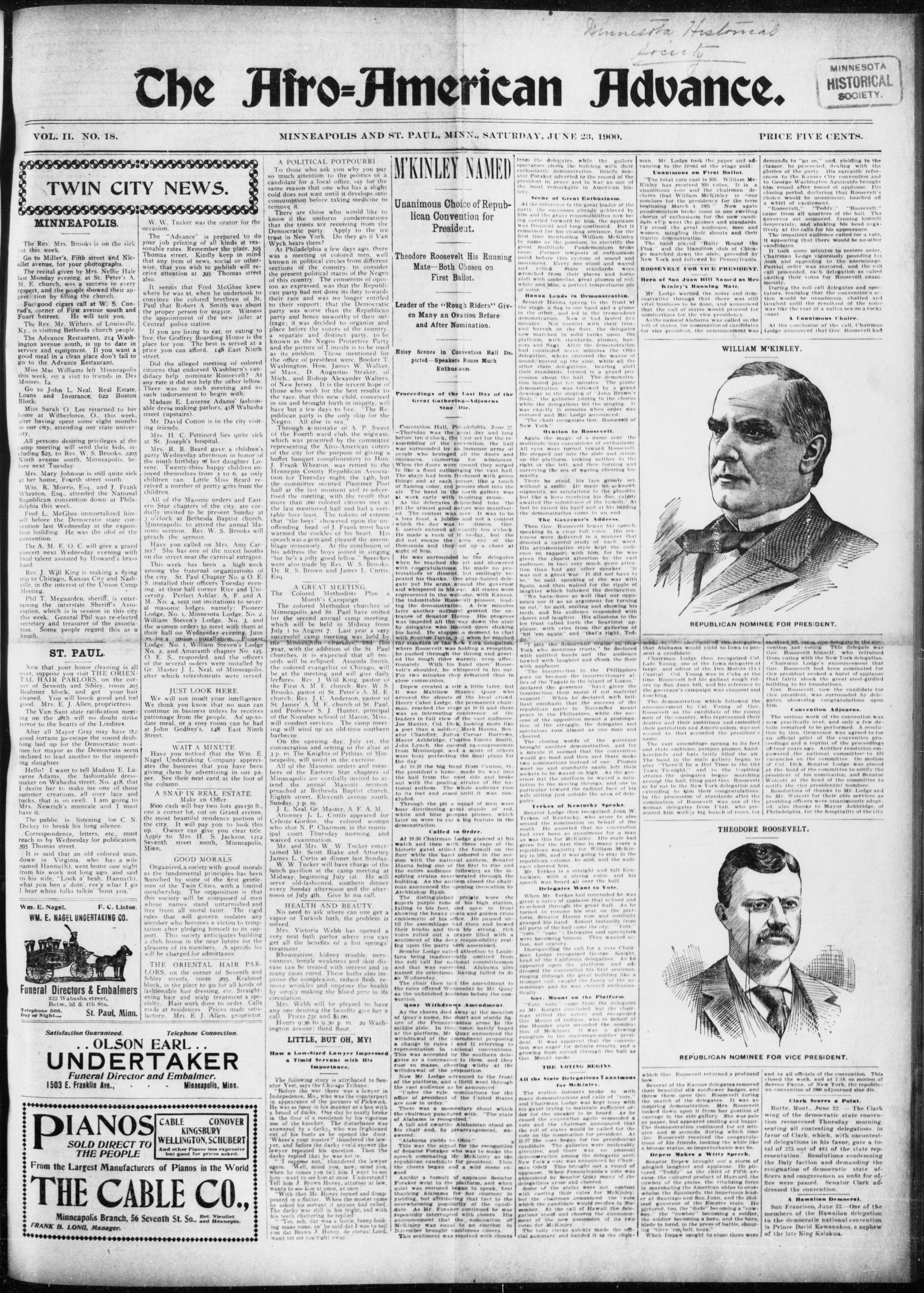
M'KINLEY NAMED
Unanimous Choice of Republican Convention for President.
Theodore Roosevelt His Running Mate—Both Chosen on First Ballot.
Leader of the "Rough Riders" Given Many an Ovation Before and After Nomination.
Noisy Scenes in Convention Hall Depicted—Speakers Rouse Much Enthusiasm.
Proceedings of the Last Day of the Great Gathering-Adjourns
Convention Hall, Philadelphia, June 22—Thursday was the great day and long before ten o'clock, the hour set for the reassembling of the convention, the hall filled with all the armies of people who besieged all the doors and entrances, clamoring for admission. When the doors were opened they surged in like a flood submerging the vast hall. The stage had been freshened with green grass and a flaming color, red peonies shot into the air. The band in the north gallery was at work early with insuring music. As the delegates debouched into the pit the utmost good nature was manifest. The crowd was a love feast, a jubilee and not a contest which the day was to fitness. Gov. E. Russell entered at exactly ten o'clock. He made a rush of it to day, but the not escape the keen eye of the sight and they set up a cheer at sight of him.
He was surrounded by the delegates when he reached the pit and showered with congratulations. He made no protestations or dissent, but smilingly rejoiced when he received the gate put his arms around the governor and whispered in his ear. All states were represented in the welcome, with Kansas, the indomitable Roosevelt pioneer, leading the demonstration. A few minutes later, the governor transected of Senator Hanna. His progress was impeded all the way down the aisle by delegates who insisted upon shaking his hand. He stopped a moment to chat with Senator Davis, a man when he reached the pit. He greeted where Roosevelt was holding a reception he pushed through the throng and greeted the rough rider warmly, even affectionately. With his hand upon Roosevelt's shoulder, he whispered in his ear, and then they remained thus in close communion.
Depew created a stir a little later, but it was Matthew Stanley Quay who around the shouts of the local crowd, Henry Cabot Lodge, the permanent chairman of the board, was an interesting conference of the leaders in full view of the vast audience. Joe Manley, Col. Dick, looking more like a poet than a soldier; Marian Hanna,Senior Vice President of the Mayor Ashbridge, Charles Emory Smith, John Lynch, the colored ex-congressman from Mississippi, and a score of others were busy perfecting the final plans for the band. At 19:20 the big band from Canton, O., the president's home, made its way into the hall from the west side and broke out with the pealing strains of the national anthem. The whole audience rose and stood until it was concluded. Through the pit a squad of men were busy distributing great stands of red, white and blue pomp plumes, which were to cut a big feature in the demonstration.
Called to Order.
AT 10:36 Chairman Lodge glanced at his watch and then with three rapes of the historic gavel stilled the tumult on the floor while the band ushered in the session with the national anthem. Senator Robert Reagan of the first to preside the entire audience following as the inspiring strains reverberated through the building. As the anthem closed the chairman announced the opening invocation by Archbishop Ryan. He presided before private wore the super purple robe of his high station, falling to his feet, and open in front showing the heavy chain and golden cross emblematic of his office. He paused until the assemblage had risen and bewed in a fervor. The voice rolled out a prayer filled with a sentiment of the deep responsibility resting upon the party here assembled. Senator Lodge called attention to Louisiana being inadvertently omitted from the presidential election and that was correct. Alabama also named its selections, having failed to do Wednesday. The chair then laid the rules offered Wednesday by Mr Quay unfinished business before the convention.
Quay Withdraws Amendment
As the cheers died away at the mention of Quay's name, the short and sturdy figure of the Pennsylvania arrose in the middle alley. In this voice, barely heard by the audience, he withdrawals of the amendment proposing a change in rules 1 and 12 referring to representation in national conventions. This was accepted by the southern delegates as a concession to them, and they attended the withdrawal of the amendment at the withdrawal of the proposition.
Now Mr. Lodge advanced to the front of the platform, and a thrill went through the vast audience as he announced:
"Under the rule, nominations for the office of president of the United States are made."
There was a momentary shout which the chairman punctured with: "The state of Alabama is recognized."
A tall and awarthy Alabaman stood on his chair and, by prearrangement, answered:
"Alabama yields to Ohio."
This was the signal for the recognition of Senator Poraker who was to make the speech nominating Mr. McKinley as the republican candidate for president. Then he began and a wild scene ensued.
Amidst a tumult of applause Senator Foraker went to the platform, and when quiet was restored began to speak, first thanked Alabama for her courtesy in yielding, but attributing that fact to the death of his wife, the date. As Mr. Foraker continued he was repeatedly interrupted with cheers. His announcement that the nomination of McKinley was equal to an election in November brought沥者 cheers.
This sentiment was received with cheers
from the delegates, while the gallery spectators shobk the building with their enthusiastic demonstration. Briefly Senator Poraker adverted to the record of the president in peace and in war as one of the most remarkable in American history.
Scene of Great Enthusiasm.
Scene of Great Enthusiasm.
At the reference to the great leader of the part, the successes already achieved by him and the successes carried forward by him, the applause was frequent and long-continued. But it remained for his closing sentence, for the reason that he was by name as the pominee, to electrify the great multitude Pandemonium broke loose. Former tempests of enthusiasm moved before this cyclone of sound and rage, which was wielded and yelled. State standards were wrenched from their places and borne aloft with umbrellas, great plumes of red, and blue, a perfect temperate sea of color.
Hannah Leads in Demonstration.
Senator Hannah Spring to the front of the stage, a flag in one hand and a plume in the other, and led in the tremendous applause. The audience was divided into minutes. Not content with their tense burial on the floor, the delegates now marched in solid ranks upon the platform with standards, plumes, banners, and a large flag. They had continued seven minutes the Ohio delegation, where centered the waves of sound; moved up the aisle, while all the other state delegations, bearing aloft their banners, pressed their attention about the hall. The demonstration lasted just ten minutes. The plume demonstration was followed by a grand doxology in the singing of "John Brown's rage" and a series of clapping, while the delegations led the singing. It was exactly 15 minutes when order was restored and Mrs. Lodge announced. "The chair recognizes Gov. Roosevelt of New York," she said.
Ovation to Roosevelt.
Again the magic of a name sent the multitude into convulsions of enthusiasm. All eyes were turned toward Rossetti. He stepped out into the alley and strode right, left, and back right or the left, and then turning and surveying the sea of waving cheering humanity, he stood his face grimly set without a smile. He made no acknowledgements, no salutations to the plaudits, but like a hero receiving his due, calmly awaited the subduition of the tumult. At the demonstration he demonstrated the demonstration came to an end.
The Governor's Address
Then day, Houselt began his speech, speaking in a clear full voice. His sentences were delivered in a manner that denoted a careful study of each word. His argumentative style kept the audience en rapport with him, and his emphasis attention by the vast audience, in fact very much more attention than had any other speaker. "It was not a great war. It did not have to be a great war," he said, anilining us out. "he said, anilining us out," he said, anilining us out. "he said, anilining us out." He responded with cheers and laughter. His allusions to the ice trust called forth the heartiest applause, with cries from the galeries of "hit em again" and "that's right, Teddy." "I pity the democratic drator in New York who mentions trust," he declared with uplifted hands and the audience howled with laughter and shook the floor
"The insurrection in the Philippines goes on because the insurrectional allies of the Tagalog in the island of Luzon," declared the governor, "and the militant if not material support." When he declared with brilliant emphasis that the success of the republican party in November meant peace to the Philippines, the opposition meant a prolongation of the struggle, the delegates and spectators rose almost as one man and cheered.
The losing words of the governor brought another demonstration, and for a minute it seemed that the convention would go mad and then and make two nominations instead of one. Plumer went up and stands on high. As the governor left the platform he waved a salutation to the moving throngs, and one in particular toward the radiant face of his wife sitting just outside the area of delicacy.
Narker of Kentucky Speaks.
Senator Lodge then recognized John W. Yerkes, of Kentucky, who arose to also second the nomination on behalf of the south. He asserted that no convention had ever been so unanimous for a man as was this man, who was the first time in many years a republican majority for William McKinley in 1866, and it was going to stay in the republican column, he said, and the audience cheered him. Mr. Yerkes is straight and tall Kentuckian, he is a strong voice, and his speech was heard all over the half.
Delegates Want to Vote.
When Mr. Yerkes had concluded he was given a salvo of applause that echoed and re-echoed through the great hall. As he turned to resume his seat on the platform, Senator Hanna rose and grinned as the instanty from the hall of the cary the "Vote," "vote," "vote." Delegates and spectators were becoming uneasy. They wanted action, not oratory. Disregarding the call for a vote Chairman organized George Knight, head of the California delegation. As he appeared upon the platform and addressed the convention his first sentence, ringing through the great building like a trumpet call, caught the fancy of the assemblage and he was cheered enthusiastically.
Gfx Mount on the Platform
"Vote, vote," came from the delegates as Mr. Knight concluded but the chairman stilled the oath and recognized Gov. Mount of Indiana, who in behalf of the Hoosier state seconded the nomination of McKinley. It was a glowing eulogium to the stateman-sophronist president. It was a message to the stateman who for definite results, and a humbling him spread through the hall as Gov. Mount spoke.
THE VOTING BEGINS
All the State Delegations Unanimous
for McKinley.
The revive listeners broke in with many demonstrations and calls of "vote," and Chairman Lodge was kept busy with his gavel trying to maintain sufficient order for the speaker to be heard. As he closed the convention, the chairman announced that the roll of states would be called for the vote on the nomination for president. At 12:37 the vote began for the presidential candidate. The galleries were noticeably attentive, attentive among the delegates until New York's vote was announced by Chairman Odell. This brought out a round of applause. When Pennsylvania's vote was announced by Senator Quay many of the delegates arose and were not content with casting their votes for McKinley, but the chairman announced the "vote which the candidate would receive in November. At the call of Hawaii the delegation announced the nomination of the new possession of the two votes for McKinley.
The tally clerks quickly made the official summary and handed it to the chart.
man, Mr. Lord牧时 the paper and advancing to the front of the stage said: "Unanimous on First Ballot." "The total vote cast is 330. William McKinley has received 350 votes. It is a unanimous vote and the chairman de- nominees for the presidency for the term beginning March 4, 1900." "Now again pandemonium broke loose in one swelling chorus of enthusiasm for the new canvass. Up stood the great audience, men and women, mingling their shouts and their frantic demonstration. The band played Halie Round the Club of Chicago marched down the able, preceded by New York and followed by Pennsylvania.
ROOSEVELT FOR VICE PRESIDENT
Hero of San Juan Juan Named as Me
Kinley's Hunning, Mate
Mr. Lodge warned the noisy and demonstrative throngs that there was still vital business to be done, and announced that he would be the host for nominations for the vice presidency. As the name of Alabama was called on the roll of states, for nomination of candidates for the presidency, Mr. Lodge
WILLIAM
WILLIAM M'KINLEY.
REPUBLICAN NOMINEE FOR PRESIDENT.
wrote in a letter to the delegation that Alabama would yield to Iowa to preside over the election of Col. Lafe Young, one of the Iowa delegates at large, and editor of the Des Moines (13.) Capital. Col. Young was in Cuba at the time he led a giant rough riffle up San Juan hill, and his reference to the governor's campaign was eloquent and touching.
The demonstration which followed the announcement of Col. Young. Gov. Roosevelt as the candidate of the young men of the country, who represented their desires and their ambitions and embodied their patriotism and Americanism, was not second to that accorded the president's official print of the received 93% votes, onevention not voting. The president was not voting from voting with the New Chairman Lodge's and Chairman Lodge's and vice president evoked a sense of pride in building to its foundation. Gov. Roosevelt, now vice president, was surprised, showing congruity.
Convention A
The serious work of the now practically over, and tails remained to be performed, was the official print of the
The vast assemblage sprang to its feet and state emblems, pampus plumes, handkerchiefs and hats fairly filled the air. The band in the main gallery began to play the national anthem, "To Right," and to the tespiring strains the delegates began marching around the ball, filing past Gov. Roosevelt as he sat in the New York delegation and extending to him their congratulations. In the procession of standards after the nomination of Roosevelt was one of the first ceremonies, a sentiment him with a big bunch of roses, for
THEODORE
REPUBLICAN NOMINEE
THEODORE ROOSEVELT.
REPUBLICAN NOMINEE FOR VICE PRESIDENT.
which Gov. Roosevelt returned a profound bow. Several of the Kansas delegates removed their beautiful silk sunflower badges, and threw them upon Gov. Roosevelt during the march of the delegates. It was an inspiring demonstration. Mrs. Roosevelt looked down upon it from her position of chair, and was happy as paper, but appeared smiling and happy. The demonstration continued for six minutes and 40 seconds, during which time Gov. Roosevelt received the congratulations of the Kansas delegates. Like a bronze statue, so impervious was be Depew Makes a Witty Speech.
Senator Depew brought out a storm of mingled laughter and applause. He pictured "Teddy" as the child of Fifth avenue, the cultured product of Harvard, the cowboy of the plains, the vitalizing force in marshaling the American ships to oversee the Kansas, the impetuous national at Santiago and San Juan, and the idolized governor of the Empire state. He pictured too, the "gude" becoming a "cowboy," the "cowboy" becoming a soldier, brine the knight, and the hero, blade in hand, in the press of battle, shouting "Give em, belt, boys."
and to all officials of the conv closed the work, and at 2:14, a convention of 1990 adjourned.
Clark Scores a Po
Butte, Mont., June 22. -- wing of the democratic wing reconvened Thursday seating all contesting deli favor of Clark, which, with delegations in his favor, totaled 275 out of 481 of the presentation. Resolutions to the Daly faction and the resignation of democratic flicers and congressmen as a fice were passed. Senator dressed the convention.
A Hawaiian Demo
San Francisco, June 22. -- members of the Hawaiian to the democratic national is Prince David Kauwakano
When Despaw sought to close there were
PRICE FIVE CENTS.
demands to "go on," and, yielding to the clamor, he proceed, dealing with the glorios of the party. His sarcastic references to the Kansas City convention and the Iowa convention him round after round of applause. His closing period, declaring that Roosevelt's choice would be unanimous, touched on a whirl of excitement ("I'll go," "Roosevelt" came from all quarters of the hall. The governor sat unmoved, fanning himself desperately, and shaking his head negatively at the calls for his appearance. It appearing that there would be no other candidates.
It took some minutes to restore order, chairman Lodge vigorously pounding his fist, and the rest of the partial order was restored, and the roll call proceed, each delegation as called casting their votes for Roosevelt unanimously. The roll call delegates and spectators, resulting that the convention's action would be unanimous, chatted and laughed until the resultant of the noise was like the roar of a sullen sea on a rocky
A Unanimous Choice.
At the conclusion of the call, Chairman
Lodge announced that Gov. Roosevelt had
M'KINLEY.
received 92%, voted, vice delegate in the convention not voting. This delegate was Gov. Roosevelt himself, who refrained from attending the Chairman Lodge's announcement that Gov. Roosevelt had been nominated for vice president evoked a burst of applause that fairly shook the great steel-gladiored crowd. Gov. Roosevelt, now the candidate for vice president, was surrounded by delegates, showering congratulations upon
Convention Adjourns
The serious work of the convention was now practically over, and only a few details remained to be performed. A resolution by Gen. Grosvenor was agreed to for an official print of the convention presentation, and the committee was tasked to record four years ago. Another resolution empowered, the national committee to fill vacancies on the committee. On motion of 'Ol' Dick. Senator Lodge was placed at the head of the committee to notify the vice president of the committee. Wolcott at the head of the committee to notify the vice president nominee. Resolutions of thanks to Mr. Lodge and to Mr. Wolcott for their able services as presiding officers were unanimously adopted, also thanks to Mayor Ashbridgill of the city.
ROOSEVELT.
CE FOR VICE PRESIDENT.
and to all officials of the convention. This closed the work, and at 2:16, on motion of Bereno Payne, of New York, the republican an convention of 1900 adjourned sine die.
Clark Scores a Point.
Butte, Mont., June 22. — The Clark wing of the democratic state convention reconvened Thursday morning, seating all contesting delegations in favor of Clark, which, with uncontested delegations in his favor, gave a total of 275 out of 481 of the state representation. Resolutions condemning the Daly faction and demanding the resignation of democratic state officers and congressmen as unfit for office were passed. Senator Clark addressed the convention.
A Hawaiian Democrat.
San Francisco, June 22.--One of the members of the Hawaiian delegation to the democratic national convention is Prince David Kawanakoa, a nephew of the late King Kalakua.
MINNESOTA
HISTORICAL
SOCIETY.
AFRO-AMERICAN ADVANCE.
Published every Saturday by the
ADVANCE PUBLISHING COMPANY
Entered at the Post Office, at Minne-
apolis, Minn., as second-class matter.
Subscription Rates:
One Year $1.00
Six Months $0.60
Three Months $0.35
Subscription Always Payable in Add-
Special rates if ordered by the dozen or the current issue should reach the office by 10:30 a.m.
Advertising Rates.
Religious Notices (not over five lines)
free.
"Want" and "To Let" advertisements
8 cents per line for each insertion. Disp
sale cents per inch each insertion.
Special rates will be given for space by
the year.
Editorial Announcements
To secure the return of unsolicited manuscript postage should be enclosed. Communications must reach the office by mail or fax. The issue in which they to appear.
Contributions and items of news concerning the progress of the colored race are requested from our readers. We welcome any communication unsuitable for publication. Subscribers ordering and accepted to give their former as well as their present address. Address all communications and make a remission to THE AFRO-AMERICAN ADVANCE. 214 Washington Ave., South, Minneapolis, Minn.
MRS. GEO. DUCKETT,
PUELISHER AND MANAGER
MRS. J. B. KOGER, City Collector.
When the sun is pounding down its rays upon the ocean at noonday, none of them penetrate to a depth of over 200 feet. Could a diver descend to that depth he would find himself shrouded in darkness as probud as though he were immersed in a sea of ink.
The cotton acreage this year will be the largest on record and will not fall far short of 26,000,000 acres. Cotton raisers also expect good prices, for last year's crop in India was almost a total failure, ours was small, and the present Egyptian crop is not promising.
Severity of hemlock bark is reported to have caused the almost total extinction of the once prosperous tanning industry in Maine. Though there is a large growth of hemlock in the state, it is so far from practicable tannery sites that the cost of hauling probibits its use.
Fire alarm boxes in New York are being coated with luminous paint in order that they may be easily located at night. The paint is made of white zinc. In some parts of New York, where there is little light, the alarm boxes can be distinguished at a distance of ten blocks.
The Boston board of health has classed tuberculosis as contagious, and requires reports from physicians of cases of the disease. In the past five years deaths from consumption in Boston have been about double the combined mortality from scarlet fever, diphtheria and typhoid fever.
Swainburne is deaf as a poet. He lives in a somewhat somber-looking house at Putney hill, the dining-room walls of which are covered with original pictures by Dante Gabriel Rosetti, which must be worth a fabulous sum. The famous poet is bald, with a thin, straggling, reddish beard, and has beautiful hands.
Mlle. Marguerite Cassini, daughter of the Russian ambassador to the United States, is the only woman in the diplomatic corps who handles her own automobile and she rides around Washington at a pace that causes consternation among her friends. She has a costume designed especially for mobile riding. It has a skirt of cream-colored cloth with a white silk waist, and one of the Ladysmith hats.
The mental collapse of Munkaye, the Hungarian painter, began with his picture of Mozart on his deathbed listening to the strains of his "Reque'm." Munkaye insisted on having an invisible orchestra behind his canvas, and often remained for hours together in a state of apparent ecstasy. His dintinguished fellow-countyman, Dr. Max Nordau, soon perceived that the symptoms were grave, if not incurable.
Ignace J. Paderewski, the Polish pianist, has the most valuable pair of hands in the world. When he sailed from New York recently he carried with him a check for $171,081, a portion of the earnings of his hands in the tour which he made through the United States in the season just closed. The total receipts for the trip amounted to $260,000. Deducting from this $60,000 for traveling expenses Paderewski carried away with him a net profit of $200,000.
Annie Trueheart Dillion, a pretty Kiowa girl, about 14 years old, daughter of Black Wolf, a noted chief of his tribe, is sole heiress to the entire fortune of $1,000,000 and more left by John Dillion, a rich cattle man, who about seven years ago was saved from death at the hands of a half-breed assassin by this little girl. The girl's education is to be begun at once under the supervision of the bishop of Monterey.
Traveling incognito and attended only by a lady in waiting, the Princess Aribert, of Anhalt, eldest daughter of her royal highness, the Princess Christian, and granddaughter of Queen Victoria, arrived in New York on the Majestic the other evening. The Princess Aribert is here as a tourist, solely for pleasure, and has preferred to remain incognito. She will visit the national capital and Canada. Her present intention is to return home in July.
SCHOOL AND CHURCH.
There are more than 100,000 children in the national schools of Germany who stutter.
There are 139 different religious denominations in the United States, 149, 868 ministers, 189,488 churches and 27,714,523 communicals.
Nearly every week, says the Boston Christian Register, we see in our contemporaries some reference to the "dead line" in the ministry. This talk about the dead line creates it. The most effective preachers in all churches, as a rule, are men past 50 years of age.
The collections of star fishes and sea urchins belonging to the museum of the University of Michigan are being arranged in a case on the second floor of the museum building.
Although not large the collection contains some interesting and valuable specimens.
One of the peculiar arguments which lately came to our notice, says the Boston Watchman, was that of a member of a pulpit committee of a church which in all its history has never kept a pastor more than four years. He objected to calling a minister 50 years old, because he feared that at the end of 15 or 20 years he would be worn out. The movement to ameliorate the condition of the discharged convict is rapidly gaining ground in England. St. Giles Christian mission, London, gave 21,224 discharged prisoners last year their first meal out of prison, finding work for 5,908 who were willing to accept it. In the last 22 years this association of Christian men and women has helped 361,000 prisoners after their liberation.
The University of the South, at Swansea, Tenn., has placed its 9,000-acre tract of hardwood timber near that town under the management of the division of forestry. An official of the division will mark all trees to be cut, and will draw up the logging contracts to provide for the preservation of young growth. It is intended to make the forest yield a permanent annual revenue to go towards the support of the college.
A BUFFALO DUEL.
In Whlen the Old Monarch of the Herd Is Overthrown by a Younger Member.
In his paper on "The National Zoo at Washington," in the Century, Ernest Seton-Thompson describes a duel between two buffalo bulls.
"The buffalo herd had so far reverted to a native state that the old bull ruled for several years, much as he would have done on the plains. He was what the keeper called 'not a bad boss,' that is, he was not malicious in his tyranny. One of the young bulls made an attempt to resist him once, and had to be punished. The youngster never forgot or forgive this, and a year or so later, feeling himself growing in strength, he decided to risk it again. He advanced toward the leader, John L., and shoo's his head up and down two or three times, in a style recognized among buffalo as a challenge. The big fellow was surprised, no doubt. He gave a warning shake, but the other would not take warning. Both charged, but, to the old bull's amazement, the young one did not go down. What he lacked in weight he more than made up in agility. Both went at it again, now desperately. After two or three of these terrific shocks the old one realized that he had not now his old-time strength and wind. As they pushed and parried, the young bull managed to get under the other, with a tremendous heave, actually pitched his huge body up into the air and dashed him down the hillside. Three times the old bull was thus thrown before he would yield, and then he sought to save his life by flight. But they were not now on the open plains; the pen was limited, and the victor was of a most ferocious temper. The keepers did what they could, but stout ropes and fences interposed were no better than straws. The old bull's body was at last left on the ground with 63 gashes, and his son reigned in his stead. This is one of the melancholy sides of animal life—the weak to the wall, the aged down by the young. It has happened millions of times on the plains, but perhaps was never before so exactly rendered for human eyes to see."
A FLORAL NOSEBLEED.
The Valgar Name of a Beautiful Flower Known as the Trillium.
Why speak of the lovely painted trilliums, with their three daintily crinkled petals, streaked with rose-purple? says Bradford Torrey, in the Atlantic. One after another I gathered them (pulled them, to speak with poetic literalness), each fresher and handsomer than the one before it, till the white stems made a handful.
"Oh," said a man on a hotel pizza,
as I returned. "I see you have nosebleed."
I was putting my hand to my pocket, wondering why I should have been taken so childishly, when it came over me what he meant. He was looking at the trilliums, and explained, in answer to a question, that he had always heard them called nosebleed. Somewhere, then, I omitted to inquire where, this is their "vulgar" name. In Franconia the people call them "Bemjamins," which has a pleasant Biblical sound—better than nosebleed, at all events—though to my thinking, trillium is preferable to either of them, both for sound and for sense. People cry out against "Latin names." But why is Latin worse than Hebrew? And who could ask anything prettier or easier than trillium, geranium, anemone and hepatica?
Handwriting Expert
"No," declared the defendant, "I couldn't have signed that note, because I can't write."
"Not even your name?" asked the prosecuting attorney.
"No. I just make my mark."
"Well, let's see you do that on this piece of paper." The defendant took the pen and made a crude X. Then above it he wrote "his" and below it "mark."—Philadelphia Press.
A Compliment That Failed.
Fond Mother—Johnhole, didn't I tell you that I would spank you if you did that again?
Johnnie—Yes, mother, you did; but I didn't believe that a woman as kind-hearted as you are would be cruel enough to do it.—Somerville Journal.
PUNGENT PARAGRAPHS.
Stox—“Do you use a horseless carriage?” Bonz—“You bet I do.” Stox—“Automobile or locomobile?” Bonz—“Neither—street car.” O. Times-Democrat.
“I this hope proposal of mine has not taken you completely by surprise, dearest?” “Well, yes, it has. I long ago abandoned all idea of it.”—Detroit Journal.
Loves His Fellow Men.—Switcher—“The new superintendent of the trolley road is a very humane man.” Ringer—“Is he?” Switcher—“Yes; he says he will run an ambulance behind every car.”—Boston Bazar.
“My wife is a very good cook.” “Oh, come, now! Her mother told me she was just taking her first lessons when you married her.” “Exactly, which proves she is very good not to continue the lessons on me.”—Philadelphia Press.
"One more kiss," pleaded the departing lover. "Here!" cried her father, who was the manager of a continuous performance house, "your act is limited to 25 minutes, and you are already ten minutes overtime!"—Philadelphia North American.
A young Irish lad on a market day in an Irish town was minding a donkey attached to a cart and had his arm around the neck of the animal when two recruiting sergeants passed. One of them, in an endeavor to be funny, said: "What are you hugging your brother so tightly for?" "Cause," was the rejoinder, "I was afraid he'd list." Evening Wisconsin. Neither Gets Them. "You seem to have a great taste for poetry," remarked the copyhook, observing the office goat sniffing around the editor's waste basket. "Yes," replied the goat, "but I like my poems well done, and I seldom find that sort here." "Huh!" exclaimed the copyhook, "the well-done poem that comes to me is very rare." Philadelphia Press.
HEARING BY SIGHT.
A New System of Lip Reading Thin
In Meeting with Much Favor
The latest method by which deaf people can communicate with their fellow beings is the "hearing by sight," a science better known as "lip reading." The system has been introduced into England and America, and has met with much favor by those who have had an opportunity to test its value, says the New York Tribune. An English expert in this line of instruction has stated that lip reading can even be practiced with facility by the blind, who become expert in the art. The individual learns to understand what is said by watching the lips of the speaker, and the blind accomplish this by holding the fingers lightly over the mouth of the speaker, whose conversation they can readily follow. This is one system practiced by Helen Kellar, who is deaf and blind, and until taught by Miss Sullivan to articulate was also dumb.
Lip reading, speech and writing are taught simultaneously by the system, and all signs or finger alphabets are done away with, as they have been found to hinder progress along new lines. The pupil endeavors to forget any previously used systems of communication and gives undivided attention to lip reading. The speaker does not need to expend any extra effort to speak distinctly in order that the deaf person may follow the motions of the lips, and exaggerated attempts to pronounce carefully result in grimaces that hamper the "hearer's" efforts to understand what is being said. Those who are placed under instruction during their youth acquire the system with much greater facility than units of maturer years.
The claim is made that hereafter the deaf who have studied lip reading will be enabled to mingle freely in society, and with one exception that the person who is "hearing by sight" must face the speaker, no bar to intelligent conversation on the part of the deaf will exist.
No Wisdom from Experience.
The Toper smiled sadly. "Yes, evidently care killed the cat, and of course has more lives than the cat. I have drowned any number of cats, but I find I cannot drown care. However, there's nothing like perseverance."—Syracuse Herald.
One on Murphy.
Jones—The police came in while Murphy was trying to beat up his wife last night.
Smith—Did they take him to the station house?
"No; to the hospital."—Detroit Free Press.
PATRONIZE ...
WM. JENKINS,
ROOMS FOR RENT
FIRST CLASS.
We Guarantee Superb Service. Prices
moderate. Tel. 237- L-3 Main.
No. 9 Second St. No.
Minneapolis.
J. GARNER. W. H. WELLER.
The Elite Buffet
3030 STATE ST.,
FINE WINES,
LAMBERTS,
AND CIGARS.
Chicago.
Cutting, Fitting and Making Over a Specialty. New York and Paris Fashions Always on Hand. Pair 628 Fourth Street Av. South.
Office: 405-6 Reeve Bldg., 408 Nicolet Av.
Telephone 2734-7-8.
Office Hours: 9:30 to 12:30; 9:00 to 4:00
p. m.; 5:30 to 7:00 p. m. Sundays: 9:30
to 11:00; 12:30 to 2:30.
Residence, 2839 Portland Ave. Tele-
phone 317-L-South.
CARTER'S INK
Is what the largest and best
school systems use.
$20 A hundred for your neighbors' addresses.
Home Laundry, Jewelry, and beauty shops.
ROMANCE MAGAZINE, NEW YORK.
GET RICH QUICKLY. Good for Bank. "Instructions Wanted."
BRUNE TATE & Co., 944 Broadway, New York.
THE ADVANCE CAFE
214 WASHINGTON AV. SOUTH.
Restaurant and Lunch Counter
MANN & KOGER. Proprietors.
SOCIETY DIRECTORY.
Officers and Standing Committees of the Most Worshipful Grand Lodge A. F. and A. G. of Minnesota and jurisdiction: Grand Lodge L. Neal, Minnesota. Grand Master Master—Wade H. H. Hampton, West Superior, Grand Senior Warden—H. B. Howard, St. Paul, Grand Junior Warden—J. C. Garner, St. Paul.
Grand Treasurer—Daniel Roy, St. Paul.
Grand Secretary—William R. Morris, Minnesota.
Grand Lecturer—G. W. Day (7), Minnesota.
Grand Secretary—O. D. Howard (4), St. Paul.
Grand Chaplain—Isaac Crawford (6), Minnesota.
Grand Senior Deacon—John Martin (1), St. Paul.
Grand Junior Deacon—R. De Leo (7), Minnesota.
Grand Senior Steward—J. H. Dillingham (2), St. Paul.
Grand Junior Steward—Wm. Stevens (3), St. Paul.
Grand Tyler—T. Bush (3), St. Paul.
Grand Marshall-C. H. McDonald (5), Duluth.
Grand Pursuivant—G. W. Duckett (4), St. Paul.
Grand Sword-Bearer-J. Adams (1), St. Paul.
Grand Standard-Bearer-J. G. Charles, Minnesota.
Grand Register—J. G. Sterett (6), Minnesota.
Deputy Grand Master-First District—James Woodfork (1), St. Paul.
District Deputy Grand Master-Second District—E. H. Hamilton (6), Minnesota.
Grand Master-Third District—J. K. Polk (3), Duluth.
MINNEAPOLIS.
G. U. O. O. O. F.
St. Anthony Lodge, No. 2877.
Meets the first and third Wednesday in
each month for the transaction of busi-
ness, 1st avenue in Charleston.
A. H. MYRICK, N. G.
JAMES A. SCOTT, P. S. P. O. Box 33.
KNIGHTS OF PYTHIAS.
Nat. Turner Lodge, No. 2, K. of P.
Meets the second and fourth Thursdays
in each month. Brothers in good standing
welcome. Labor Temple, Fourth
Way, 1200 N. 4th Ave., New York.
Meets the first and third Thursdays in each month. All brothers in good standing welcome Pumphin Hall. First avenue north of Washington. JAMES ROBERTS, C. C.
W. C. JEFFREY, K. R. and S.
J. K. HILYARD Lodge.
Meets for a second month at
Windom Block, Second avenue South and
Washington. Masons in good standing
always welcome.
W. LILLARD, W. M.
JASPER GIBBS, Sec., Guaranty Loan
Restaurant.
Anchor Lodge, No. 7, A. F. and A. M.
Mason for first and second Monday in
each month at Windom Block, Second avenue South and Washington. Masons in good standing welcome.
SCOTT, W. M.
A. B. LEE, 700' Aldrich avenue South.
ST. PAUL
ODD FELLOWS.
Meets second and fourth Wednesday in
monsoon at odd Fellows Hall. 525
Wabash Ave.
T. R. HICKMANN. P. S., 422 St. Anthony.
F. D. PARKER, N. G., 356 Edmund St.
Household of Ruth, N. 553, G. U. O.
of O. F.
Meets first and third Monday in each
month for business second Monday for
meetings, at Feway 520 W.
Wabasau.
MRS. ARAH C. KATTLEY M.N.G.
MIDDLE JACKSON, W. R., 374 Summit
place.
MOST WORSHIPFUL GRAND LODGE OF MINNESOTA, A. F. and A. M.
J. L. NEAL, Grand Master.
WM. R. MORRIS, Grand Secretary.
117 Guaranty Loan Bldg., Minneapolis.
ST. PETER CLAYER'S SODALITY.
Meets the first and lastMondays of each month.
Sec. A. Davis, Treas.
DANIEL ROY H. P.
W. T. GASSAWAY, Sec., State Capitol.
**ST. PETER A. M. E. CHURCH**
Rev. W. S. Brooks, Pastor.
Cor. 22d 8th, st. Ave. South
Sunday evening. 12:30 a.m.
m.; Sunday School. 3:00 p.m.; evening
services. 8:00 p.m. General prayer meet-
ing. Thursday evening. 3:00 p.m. Way-
ward service. 8:00 p.m. General prayer meet-
ing different residences. Parsonage. 2205
Ninth avenue South.
BETHESIDA BAPTIST CHURCH.
Bethany School. Twelfth avenues.
Bethany services: Preaching. 11:00 a.m.
m.; Sunday School. 12:30 p.m. Christian
Educator. Preaching. 11:00 a.m.
Wednesday evening prayer meet-
ing. Wednesday evening prayer meet-
ing. 8:00 p.m. Parsonage. 1120 Eighth street South.
**ST. THOMAS MISSION**
Rev. J. W. King, Pastor, in Charge.
615 Sixth avenue South.
Sunday service. 4:00 p.m.; Sunday
School. 3:00 p.m.
**ST. J. W. KING, M. E. CHURCH**
Rev. J. W. King, Pastor.
Between First avenue and Second street
Southeast. near Exposition Bldg.
615 Sixth avenue South.
Sunday School. 3:00 p.m.; evening
services. 8:00 p.m. General prayer meet-
ing Thursday evening. Weekly meetings
ST. PAUL.
ST. JAMES A. M. E. CHURCH,
Cor. Fuller and Jay streets.
Sunday services: 11:30 a. m.; 7:30 p. m.
Wednesday prayer meeting. 8:00 p. m.
WT. JAMES A. M. E. CHURCH.
Father Printon.
Cor. Farrington and Aurora avenues.
Sunday services: Mass. 8:00 a. m. High
m. a. m. Evening services at a
o clock.
PILGRIM BAPSTEST CHURCH
Rev. D. S. Oster, Pastor.
Cor. 12th and Cedar.
Sunday service. Frescolay at 11:30 a.m.
m. and 7:43 p. m. Sunday School at 12:30
o'clock. Wednesday evening general
prayer, morning
ER. PHILLIPS EPISCOPAL MISSION.
653 Rice street, bet. Aurora and Univer-
sity.
Sunday service: Morning prayer, Lit-
any and Sermon. 11:00 m. m.; Sunday School and Children's Vespers 3:00 p. m.; School and Children's Prayer 3:00 p. m.; Night Evening Prayer and Lecture, 8:00 p. m.; Friday; Choir Rehearsal and Brotherhood of St. Andrew, 8:00 p. m. All are cordially invited. Seats free.
NOTICE: Changes and corrections will be made upon request of the office. If you have reptiled to place a notice of any society in the above directory it is beware that you may not see its officers. Send name of any Lodge, place and time of meeting, name of officers and it will be inserted.
JAMES L. CURTIS
LAWYER
603 Northwestern Bldg., Minneapolis
Cor. 41th St. and Hennepin Av.
Telephone, Main 2460-L-1.
PATRONIZE THE BEST!
Free Delivery to All Parts of the City and Lake Minnetonka.
Our Motto: First-class Work and Moderate
Prices
Crayon, Pastel and Water Colors a Specialty.
251-253 Cedar Avenue,
MINNEAPOLIS, MINNESOTA.
SEEDS OF FLOWERS Plants and Cut
succulent flowers on telegraphite or mail
orders any time, day or night. Budding or
House Plants in their season. Cut Flowers,
fresh and dried. Good wood and
honest, at five cents per packet. Our catalogue is
FREE, send for it.
MENDENHALL, FLORIST,
37 S. 6th St., Minneapolis, Minn.
KLAFFKE'S
WHITE SEAL
FLOUR.
119 Central Ave., Minneapolis.
TEL. 2701-J-B. NEXT TO TERKA'S.
WONDERFUL
DISCOVERY
Curly Hair Made Straight By
```markdown
```
This wonderful hair pomade is the curly hair preparation in the world that makes kinky hair look smooth and shiny. It prevents the hair from falling out and makes it grow. Sold over 40 years and used by thousands. It was the first preparation ever sold for queen. It is the original Original Ox Marrow, the original Original Ox Marrow, and beautiful. A toilet necessity for ladies and men. It is the vantage of this wonderful pomade is that by its superior and lasting quality it is the best preparation to produce a preparation equal to it. Full directions with every bottle. Only 40 cents. Sold by mail. Money order for 2 bottles express paid. Money order for 2 bottles express paid. OZONIZED OX MARROW CO., 26 Wabash Ave., Chicago, IL.
Magic Seeds
A wonderful Nerve
Remedy, that
hasno superior and
is guaranteed to
cure all such nervous
diseases as
Nervous Prostration,
Weak Mem-
dence, Wakefulness,
Wakefulness,
Headache,
Nervousness, Lost
Menhood, and all
drains and loss of
power in genera
A wonderful Nerve Remedy, that has no superior and is guaranteed to cure all such nervous diseases as Nervous Prostitution, Weak Memory, Lack of Confidence, Wakefulness, Headache, Nervousness, Lost Moanhood, and all drains and loss of power in generative organs of either sex, caused by Overexertion, Youthful Errors, Excessive use of Tobacco, Opium, or Stimulants, which lead to Infinity, Consumption, and Insanity.
Magic Seeds restore the nerve and vigor of youth. Easily carried in the vest pocket. Sent prepaid in plain box by mail to any address, for $ \infty $ six boxes for $ \infty $ with a written guarantee to cure or money refunded. Write for free circular.
MAGIC MEDICINE CO.,
MANSFIELD, OHIO.
VICTORINE THE WONDERFUL NEW WASHING GOMPOUND
VICTORINE
TRADE MARK
REGISTERED.
THE GREATEST BLESSING TO
WOMANKIND
NO BOILING, NO RUBBING
OF CLOTHES REQUIRED.
PREVENTS SHRINKAGE OF WOOLLENS.
5c. a Package—Two Week's Washing.
BARBEAU & CALLAHAN.
BOLT MANUFACTURERS, CHICAGO U. S. A.
AGENTS WANTED WHERE NOT REPRESENTED.
D. H. BOONE, Pres. N. JOSEPH LLOYD, Sec'y SPEND A PLEASANT EVENING AT THE NORTH STAR SOCIAL CLUB BILLIARD AND POOL TABLES. Rooms, Second Floor, 202 Hennepin Avenue.
DR. THOS. S. COOK.
OFFICE HOURS:
10 TO 12 A. M.; 2 TO 4 P. M.; 7 TO 8 P. M.
TELEPHONE 386.
12TH AND ROBERT STS., S.
Office Telephone 1498-4.
VAL DO TUR
PHYSICIAN A
Office Hours: 8 to 10 a.m.; 12 to 2 p.m.; 4 to
Office, 77 E. 7th St. Kendrick Blk. Res. 33
25 YEARS' EXPERIENCE.
JAS. AMC
Practical Undertake
123 Washington Ave. S.
All our goods are first-class, and the pr
SMOKE THE SIGHT D
W. S. CONRA
400 FIRST AV
COX & HARRIS,
ART STS., ST. PAUL
R
GO TURNER
MUSICIAN AND SUP
12 to 2 p.m.: 4 to 6 p.m.
Skell Blk. Res. 353 Shorburst
ENCE.
AMOR
undertakers and
Washington Ave. South, Minn.
ass, and the prices we g
SIGHT DRAFT
MONRAD, I
O FIRST AVENUE
Y.
Sub and Emp
FURNISHED R
the Most Modern O
SHOP AND R
Meals are Served a
Ave.
RESIDENCE TELEPHONE Dale 410-5.
O TURNER, M. D.,
MUSICIAN AND SURGEON.
2 to 2 p.m. 4 to 6 p.m.
k Bik. Res. 883 Shorburn Ave.
ST. PAUL, MINN.
ENCE.
AMOR & CO.,
Undertakers and Embalmers.
Bington Ave. South, Minneapolis, Minn.
ass. and the prices we guarantee will defy competition.
SIGHT DRAFT 5-CENT CIGAR.
ONRAD, Distributor,
FIRST AVENUE SOUTH.
AGENTS.
12TH AND ROBERT STS., ST. PAUL, OVER DRUG STORE
26 YEARS' EXPERIENCE. TELEPHONE 755. JAS. AMOR & CO., Practical Undertakers and Embalmers. 123 Washington Ave. South, Minneapolis, Minn.
Twin City Club and
FURNISH
With the Most Me
BARBER SHOP A
Where Meals are S
126 Hennepin Ave.
ub and Employment Bureau
FURNISHED ROOMS
The Most Modern Conveniences.
SHOP AND RESTAURANT
Meals are Served at All Hours.
Ave. Minneapolis, Minn.
Twin City Club and Employment Bureau
Miller
ST. PAUL, 171-173 E. 7th St.
Opposite Olympic.
FOX $2.00 RAZOR is the FREE TRIAL AT YOUR Express Agent, with a fee, if you request full amount of satisfaction or money State whether wide or narrow honor stopped, stopped and s
FOX CUTLERY Co. for the West: 928 Main St.
"The Fox Cutlery
be it Ezy
O ROPES TO BE Strong and Durable
finished In Red and Natural and Fancy Striped G
MANUFACTURED BY
The Climax T
$3.50 each.
DAYTO
conuments
On Plain Ones in White Bronze
FOX $2.00 RAZOR is the best that experience and skill can pro-
TEE TRIAL AT YOUR HOME. For $25 we will send a Fox
Your Express Agent, with instructions to allow you to take it home,
if you send full amount with your order, we send Razor pread-
ing satisfaction or money back, and a FOX STYPTIC PENE-
State whether wide or narrow blade, square or round point
horned, stropped and set ready for use.
FOX CUTLERY Co., Mrs, 48 Center St., New York City,
or the West; 528 Main St., Dubuque, Iowa.
"The Fox Cutlery is perfectly reliable.' Editor."
Is it Eazy Swing
ROPES TO BREAK!
Strong and Durable!
Published in Red and Natural Wood
and Fancy Striped Canvas.
MANUFACTURED BY
The Climax Tag Co.
$3.50
each.
DAYTON, O.
The FOX $2.00 RAZOR is the best that experience and skill can produce. FREEL TAI AT YOUR HOME. For 250 we will send a Fox Razor to your Express Agent, with instructions to allow you to take it to home to try. Or, if you send full amount with your order, we send Razor prepal, guaranting satisfaction or money back, and a FOX STYPTIC PEN CIL FREE. State whether wide or narrow blade, square or round point. Every Razor honed, stopped and set ready for use.
FOX CUTLERY CO., Mirs, 48 Center St, New York City.
Address for the West : 928 Main St, Dubuque, Iowa.
"The Fox Outlet is perfectly available! Editor."
The Take it B
NO ROPES
Strong and
Finished in Red
and Fancy S
MANUFACT
The Cli
$3.50
each.
Artistic Monument
Cost No More than Plain Ones in
The Take it Ezy Swing
NO ROPES TO BREAK!
Strong and Durable!
Finished In Red and Natural Wood
and Fancy Striped Canvas.
MANUFACTURED BY
The Climax Tag Co.
$3.50
each.
DAYTON, O.
Marble is entirely out of date, granite soon gets mossgrown, discolored, requires constant and intense care, and eventually crumbles back. Marble is hard to bleed, it is very expensive.
White Bronze is strictly everlasting. It cannot mold growth is an impossibility. It is more artistic than any stone. Then why not investigate it? It has been adopted as the material for many investments, and be the models of delighted customers in all parts of the country. It has been on the market over twenty years and is an established success. We have designs for it, but we write at one for free design and information. It puts you under no obligations. We deal direct and deliver everywhere.
The Monumental Bronze Co., 360 Howard Avenue, Bridgeport, Conn.
HEALTH AND PLEASURE RESORT
In Tennessee, North and South Carolina, Georgia, Florida, North and Nassau, are be most easily reached via the Nashville, Chattanooga & St. Louis Over which line and its connections the
NS,
RENT
HEALTH AND
PLEASURE RESORTS
In Tennessee, North and South Carolina, Georgia
Florida, South Florida, Rhode Island, and Nassau, are belated
most easily reached via the
Nashville, Chattanooga & St. Louis Ry.,
Over which line and its connections the
PATRONIZE...
WM. JENKINS,
ROOMS FOR RENT
FIRST CLASS.
We Guarantee Superb Service. Prices
moderate. Tel. 2737-L-3 Main.
No. 9 Second St. No. Minneapolis.
J. GARNER. W. H. WELLER.
The Elite Buffet
HUFET
R. C. COWARDIN, W. P. A., Louis
811 Merchants Exchange Boulevard, L.
D. M. JOHNSON, N. E. P. A.,
90 West 4th Street, Cincinnati, O.
B. R. BURKE, Marquette Blvd. Chicago, Il.
232 Marquette Blvd. Chicago, Il.
W. L. DANLEY, G. P. & T. A.,
Kannapolis, Tenn.
Chicago.
MRS. J. B. WATSON,
Fashionable, Dressmaker.
Cutting, Fitting and Making Over
Specialty. New York and Paris Fashions Always on Hand.
Pierce, 628 Fourteenth Ave. South.
Office: 405-6 Reeve Bldg. 408 Nicolet Av.
Telephone 2734-J-5.
Office Hours: 9:30 to 12:30; 2:00 to 4:00
p. m.; 5:30 to 7:00 p. m. Sundays: 9:30
to 11:00; 12:30 to 2:30.
Residence, 2859 Portland Ave. Telephone 317-L-South.
CARTER'S INK
Is what the largest and best school systems use.
$20
A hundred for your neighbor's addresses.
BUSINESS MAGAZINE in NEW YORK
---
---
---
J. E. STEWART, SEC'Y
THE FOX RAZOR
FOR THE
MARK DIEHL
FURNITURE
FURNITURE
FURNITURE
THE STATUE OF THE
MARTYR OF THE
WESTERN STATUE
OF THE
WESTERN STATUE
3030 STATE ST..
DR. J. E. PORTER.
OFFICE HOURS:
9 TO 10 A. M.; 1 TO 3 P. M.; 6 TO 7 P. M.
AND NIGHTS.
PHOTOGRAPHER
Finest Work. Prices Right.
MINNEAPOLIS, 427-429. Nicollet Ave.
Over Yerra's.
with through Reception Pullman Palace, Butler Street cars are run daily the year round, between St Louis and Jacksonville. Chase Street cars are run daily from Chase Street and Louisville, offering a delightful daytime ride to most Historical and pictureque section of the South via Lookout Mountain. Cheap Homesites run daily from Lookout Mountain for a month, for full information maps, folders and a matter pertaining to Tourist Rates to these results.
DROPSY
Treated free
Painful Cream
Dilute Vitamins
Benzene
Benzene many
nounced hyposp.
From Gratitude armpouses rapidly dispersed
BLOCKS of two-thirds of all required
BOOKS, two-thirds of all required
TEN DAYS TREATMENT FURISHED FREE by
DR. H. H. GREEN & DONS, Specialties, Atlanta, Ga.
BUTTON TEN PAPER easy one you with
Weeks Scale Works,
RAY, COAL STOCK, GRAIN, BUFFALO, N. Y.
LAMB'S Throat Candy, one of the
best Confections for Veggies
to LAMB MFG. O. Ottawa, Canada, for sample use
RHEUMATISM Ouired for 250
Tables. Not sold by dealers, beamed by mail by MFG.
Mc. Ribblerland, Wits. & boxes. $1.00
DROPSY NEW DISCOVERY, great
quick relief and cure
treatment free. Dr. H. H. GREEN DONS, Atlanta,
Ga.
FREE A BOOK TREATING ON CANCER
AND TURMOR by absorption at home.
Dr. MAGNOLI, Chattanooga, New York.
HENRY MOSLEY, PRES.
SAMUEL B. BURGESS
1820-1905
National Convention Assembles in Philadelphia.
The Temporary and Permanent Organizations—Text of the Lengthy Platform—Ticket Likely to Be McKinley and Roosevelt.
pittsburgh, June 21—The republican national ticket will in all probability be Kirkley and Roosevelt. President McKinley will be renominated to-day by acclamation. In spite of an earnest effort to prevent his own nomination for vice president, Gov. Roosevelt, of New York, will be renominated to-day by acclamation of delegates from all states is so strongly for him that his wishes will be ignored. Friends of Doliver, Long, Scott and other candidates have labored hard to turn the tide toward their favorites but with no avail. York will be renominated to-day by the governor's desires, indorsed the candidacy of Lleut, Gov. Woodruff, of New York. Yet the delegates insisted upon Roosevelt. Wednesday the rival candidates agreed to place their fate in the hands of Senator Hanna and abide by his instructions. However, the governor issued a statement in which he declared that the administration had had no favorite for second place, and had all along insisted that the selection of a candidate should be left entirely to the convention. However, he decided what was best to do, and after a thorough canvass of the situation, and in deference to the strong sentiment in favor of Gov. Roosevelt, he felt that, as President McKinley would be renominated without a dissenting vote, he would decide what was best should be made with the same unanimity. There is little doubt that this will be done to-day (Thursday) and the convention will then adjourn. Gov. Roosevelt declared, after reading Senator Hanna's statement, that he had done all his work to prevent the governor from having nothing more to say. It is the universal belief that he will accept.
THE OPENING SESSION.
Senator Wolcott Temporary Chair
Bau-4 Roosevelt Demonstration.
Philadelphia, June 20.-Chairman Hanna surveyed an imposing spectacle when he met the convention to order in the Export expedition building in West Philadelphia at 12:35 Tuesday. Fully 15,000 men and women were present. The convention Hanna was ready to drop his gavel, Gov. Roosevelt entered and the vast audience was electrified. He stalked in at the main door. The applause that announced his appearance swept over the vast amphitheater and the crowd followed him toward the seats of the New York delegation. Fully two minutes it took for him to traverse the length of the hall to his place near the stage. All that time the roar followed him and the handkerchiefs he wore like the wings of oars over a summer sea.
Convention Called to Order.
Chairman Hama at 12:38 called the convention to order. The prayer was then offered. Col. Dick then stepped forward and read the formal call for the convention. After the reading, Hama addressed welcome. He said no mistake had been made in bringing the convention to Philadelphia. Mr Hama went on: "Here was the tale of liberty, of freedom, of liberty. Here also had the republican party seen its birth, and here, too, was the center of that great, throbbing idea—the protection of American industry." A wave of applause swept over the convention principle, and as it subsided Mr Hama proceeded: "We are on the eve of another great struggle. Already we are beginning to form our battalions, under the great statesman-Gen. William McKinley.
McKinley's Name Cheered.
That was the signal, and for the first time the convention broke forth in a whirlwind of enthusiasm, applauding the feet, delegates spectators, staid and distinguished guests all animated by a common purpose to honor to the president. Flags and handkerchiefs waved everywhere in billows of color, and the crowd kept up, and then, with a wave of the hand, the national chairman bade the assemblage resume their seats and left him proceed.
As Mr. Hanna closed his speech with a triumphant colleagues on the national committee, and a reference to the close of his chairmanship, he spoke of the sterling service of the senator from Colorado, Mr. Wolcott, to his party, and presented him to the convention as tem
Wolcott's Address.
The address of Senator Wolcott, which followed, lasted an hour and ten minutes. Senator Wolcott aroused unbounded envy among his colleagues, but he predicted the triumphant election of the republican ticket in November the audience surrendered, and when he first mentioned President McKinley's name he could not proceed for a minute owing to the absence of a representative. As he rehearsed the history of the four years of republican administration, the prosperity which had blessed it, the vice-president, was reduced to the Spanish-American war, the campaign of misrepresentation in connection with the Philippines which its enemies had inaugurated and which it had met, the convention repeatedly broke into applause.
When he said that the old issue of the democrats was dead and that they were driven to find new issues in a war which he believed would not take place, the convention cheered, but the outburst was even greater when he declared that the division among the republicans of the east and the west on the issue of expansion was past and that those who had left the party four years ago in the west were returning on the issue of expansion. The first mention of expansion was also the greatest demonstration occurred when he said that we would establish law and order in the Philippines, and that the last thing to be considered was to give up the position. Mr. Woolcott received many hearty handshakes from those about him, and then turned to the business of the convention, announcing the long list of secretaries and officials previously agree
The chairman recognized Gov. W. S. Taylor, of Kentucky, and called him to the platform. The much-discussed man from Kentucky moved up the middle aisle to the platform, receiving a cheer as Sen. Taylor seconded the nominations of the various officials who had been announced, and this done, left the stage. The nominations were made unanimous. Rev. Edgar M. Levy, who delivered the invitation at the first republican convention in white-haired and feeble, delivered a benediction upon the convention. The whole convention arose to receive his blessing, and then, at exactly three o'clock, the convention adjourned until noon Wednes-
THE SECOND DAY.
Platform Is Adopted. But Nominations Are Deferred.
Convention Hall, Philadelphia, June 20. He was almost 11 o'clock when the advance team had a great army of visitors crossed the Scholliell gate and the doors of the convention hall. "Our Chauncey" was not overlooked Willey, and there was a great flutter of hat and a smile. Roosevelt entered, but it was again Gov. Roosevelt who set the convention wild. Still weariness rough rider hat, he appeared as on Tuesday, the main entrance, and instantly the crowd rushed to him. As on Tuesday, as he pushed his way to his seat, his progress was impeded by the astonishing greeting of the delegates. Serena, governor did not appear so sternly an
tere as on Tuesday. He smiled right and left to the plaudits of the multitude. Convention Called to Order. At 12:36 Senator Wolcott rapped for order. Immediately the band started up the "Star-Spangled Banner," and the vast audience rose en masse. Gov. Rosewood sent a message to Senator Wolcott again rapped for order, as the swelling strains floated away, welding the heavy mallet with his left hand. When the confusion had subsided, Rev Charles M. Boswell opened the door. A remarkable tribute to the flag and to the pioneers of the republican party now occurred. Mr. Wolcott stepped forward and stated that 15 survivors of the first republican convention, called at Pittsburgh, were age ago, and prevailed a large share of the convention.
At that moment a file of white-haired patrishers appeared from the rear, bearing at their head a faded American flag, tattered and barely held together by a band of red tape. They were audience rose, delegates, spectators and guests, and a deafening salute went up for the faded standard and its venerable upholders. The 15 white-headed men ranged in size by side, looking toward the sea of faceless men, flag one another standard bore the legend: "National Fremont Association, Republican Party, Organized February 22, 1866 at Pittsburgh, Pa." The group of applause had subsided the delegation read a resolution, declaring the unwavering allegiance to the party they had helped to bring forth. This incident over, the chairman recognized Representative Sereno 15, Payne, of the party, for his credentials, who mounted the platform and read the report of the committee. Under the rules under which the convention was operating, 20 minutes were allowed on a side for debate, but no one was allowed to speak. The report was put through with a whirl.
Permanent Organization.
Gen. Grovenstein, of Ohio, chairman of the committee on permanent organization, then presented that committee's report. This report was also put through with a whirl. The chair announces as a committee to escort Senator Henry Cabot Lodge to the chair." Mr. Wolcott, "Gov. Shaw of Iowa, and Gov. Theodore Roosevelt of New York."
Mr. Lodge's Address.
His reference to Hawaii and the presence of representatives of that new acquisition, brought the delegates to their feet in a lusty greeting to the Hawaiians. Mr. Bingham referred to Hawaii, Kentucky, the delegates from that state yelled their approval and the other states added a sympathetic demonstration. Mr. Lodge's references to the policy of the United States toward Cuba and the Philippines brought out frequent manifestations of approval. His brilliant tribute to the American soldiers fighting in the tropics closed with the well-rounded sentence: "It was the signal for a hearty demonstration, in which Gen. Gibson, of Tennessee, was seen amid the delegates, waving his hand to the soldiers and to Senator Lodge concluded . . . 137. He had spoken 50 minutes. Then followed the usual gavel presentations. Gen. Bingham, of Pennsylvania, was now recognized to present the unanimous vote that in the main the rules of four and eight years ago had been adopted, leaving it for the convention to make any marked departure from the former pro-
Quay Offers Amendment.
Senator Quay, in a light suit, with vest unbuttoned, was recognized as the reading of the report was concluded and was greeted enthusiastically as he stepped into the middle aisle to offer an amended version of the proposition to reduce the representation from the several states, giving one delegate for each 10,000 votes cast, with four delegates at large for each state.
Mr. Quay suggested that as the report was printed in the afternoon papers, action upon his proposition, which only affected rules 1 and 12, be postponed until Thursday and that the remainder of the report be adopted. He backed his suggestion in John R. Lynch, a colored delegate from Mississippi, stood on his chair and secured recognition for a substitute to the Quay amendment. This recited that in any state where the right to vote was suspended, the condition of servitude, the representation in congress should be reduced in proportion to the extent of the disfranchisement.
A point of order was presumably made that the condition was not germane and Chairman Lodge sustained the point.
At this point the convention threatened to get into a parliamentary tangle over the adoption of the rules and proposed amendments to the prevailed that rules 1 and 12, with his amendment, go over until Thursday, after which the other rules were agreed to
Platform Presented.
banks of Indiana, chairman of the committee on resolutions, was recognized to present the platform to the convention. Senator Fairbanks concluded the reading of the convention, and that the platform be adopted and on that motion demanded the previous question. The demand was seconded by Senator Hansbrough of North Dakota and Senator Sewell of New Jersey. The demand was seconded by the motion then was declared by Chairman Lodge to be unanimously adopted. After the applause had subsided Senator Foraker was recognized to make his motion to adjourn until ten o'clock Thursday. The motion prevailed with dissent and at 3:18 p.m. the convention adjourned.
THE PLATFORM
Full Text of the Length Declaration of Principles
Philadelphia, June 21.—The platform of the republican party as presented to the convention was unanimously adopted. It was the first time the party had at the "unsurpassed record of achievements of the party during the past four years," declaring that every expectation and pledge had been fulfilled. That business was not new, as the party valued four years ago had given place to "prosperity more general and more abundant than ever known before." The party's McKinley is indorsed, and in asking the American people to indorse the republican record and renew the commission of the party expression is given to the following
Rea firm Gold Standard.
"We renew our allegiance to the principle of the gold standard and declare our confidence in the wisdom of the legislation of the Fifty-sixth congress by which the parity of all our money and the size of our business has been secured. We recognize that interest rates are a potent factor in production and business activity, and for the purpose of further equalizing and of further lowering the rates of interest we must be able to will enable the varying needs of the season and of all sections to be promptly met in order that trade may be evenly sustained, labor steadily employed and commerce enlarged. The volume of money in circulation has never so great per capita as it is to-day.
Opposed to Free Silver Coinage.
"We declare our steadfast opposition to the free and unlimited coinage of silver. No measure to that end could be taken, which is why we port of the commercial countries of the world. However firmly republican legislation may seem to have secured the country against the peril of base and discredited currency. We could not fail to impair the country's credit and to bring once more into question the intention of the American people to maintain upon the American dollar circulation. The democratic party must be convinced that the American people will never tolerate the Chicago platform."
Trusts Condemned.
"We recognize the necessity and property of the honest cooperation of the members of the community and conditions.
especially to extend our rapidly-increasing foreign trade, but we condemn all conspiracies and combinations intended to limit production or to control prices, and favor such legislation as will effectually restrain and prevent all such abuses, protect the rights of producers, laborers and all who are engaged in industry and com-
Protection Policy
"We renew our faith in the policy of protection to American labor. In that policy our industries have been established, diversified and maintained. By that protection has been stimulated and production cheapened. Opportunity to the inventive genius of our people has been secured and wages in every department of labor make inroads in our labor before, always distinguishing our working people in their better conditions of life from those of any competing country. Enjoying the blessing of American common schools, secure in the right hands the occupancy of their own markets, their constantly-increasing knowledge and skill have enabled them finally to enter the markets of our industry. The policy of reciprocity so directed as to open our markets on favorable terms for what we do not ourselves produce in return for free foreign markets.
Immigration
"In the further interest of American workmen, we favor a more effective restriction of the immigration of cheap labor from foreign lands, the extension of opportunities of education for working children, the raising of the age limit for children, and the extension known as against contract convict labor and an effective system of labor insurance.
Shipping.
"Our present dependence upon foreign shipping for nine-tenths of our foreign carrying is a great loss to the industry and we must be more careful to our trade, for its sudden withdrawal in the event of European war would seriously cripple our expanding foreign trade, and we must have naval efficiency of this country, moreover, supply a compelling reason for legislation which will enable us to recover our former place among the trade carry-
Pension Laws.
"The nation owes a debt of profound gratitude to the soldiers and sailors who have fought its battles, and it is the government's responsibility to providevivors and for the widows and orphans of those who have fallen in the country's wars. The pension laws, founded in this country, should be liberally administered, and preference should be given wherever practicable with respect to employment opportunities for veterans and to their widows and orphans.
Civil Service
"We commend the policy of the republican party in maintaining the efficiency of the civil service. The administration has acted wisely in its effort to secure the rights of the citizens of Hawaii and the Philippines islands, only those whose fitness has been determined by training and experience. We believe that employment in the public service in Hawaii is far less difficult than in the faras practicable to their inhabitants.
"It was the plain purpose of the fifteenth amendment to the constitution to prevent discrimination on account of race or national origin in the civil service. Devices of state governments whether by statutory or constitutional enactment to avoid the purpose of this amendment are revolutionary and should be abolished."
"Public movements looking to a permanent improvement of the roads and highways of the country meet with our national authorities and subject to the earnest consideration of the people and of the legislatures of the several states."
"We favor the extension of the rural freeway service wherever its extension may be justified.
Free Homes.
In further pursuance of the constant policy of the republican party to provide free homes on the public domain, we recommend adequate national legislation to protect the rights of States, reserving control of the distribution of water for irrigation to the respective states and territories.
We favor home rule for and the early admission to statehood of the territories of New Mexico, Arkansas and Oklahoma.
War Revenue.
The Dingley act amended to provide sufficient revenue for the conduct of the war has so well performed its work that the government is able to debt in the sum of $400,000. So ample are the government's revenues, and so great is the public confidence in the integrity of the government. Two per cent, bonds sell at a premium. The country is now justified in expecting and it will be the policy of the republican party to bring about a reduction of the debt.
Isthmian Canal.
"We favor the construction, ownership, control and protection of an Isthmian canal by the government of the United States. In the interest of our expanding economy, we want to create a department of commerce and industries in the charge of a secretary with a seat in the cabinet. The United States consular system should be reorganized and new department upon such a basis of appointment and tenure as will render it still more serviceable to the nation's increasing trade. We will stimulate the women of America upon their splendid record of public service in the Volunteer Aid association, and as nurses in camp and hospital during the recent campaigns of our armies in the Eastern and Western India, and we will continue to work in all works of education and industry.
"President McKinley has conducted the foreign affairs of the United States with distinguished credit to the American peo-ler, releasing us from the vexatious conditions of the government of Samoa, his course is especially to be commended. By securing to our undivided control the most important island of the Samoan group, and the most important American island, the American interest has been safeguarded.
"We approve the annexation of the Ha-
Monroe Doctrine Reaffirmed
"We commend the part taken by our government in the peace conference at The Hague. We assert our steadfast adherence to the policy announced in the Monroe doctrine. The provisions of The Treaty of Paris, when President McKinley tendered his friendly offices in the interest of peace between Great Britain and the South African republic. While the American government must continue the policy presupposed by the Treaty, succeeding president and imposed upon us by The Hague treaty, of non-intervention in European controversies, the American people earnestly hope that a way may soon be found, honorably alike to the treaty, to terminate the strife between them.
Our Island Responsibilities.
"In accepting by the treaty of Paris the just responsibility of our victories in the war against Spain, we have Senate vote the undoubted approval of the American people. No other course was possible than to destroy Spain's sovereignty throughout the Western Indies and in the Philippines islands. That course created our responsibility for the maintenance of international population whom our intervention had freed from Spain, to provide for the maintenance of law and order, and for the establishment of good government and for the performance of international duties, which were less than our responsibility, and wherever sovereign rights were extended it became the high duty of the government; to maintain its authority, to put down armed insurrection and to counter the allied invasion. All the rescued people. The largest measure of self-government consistent with their welfare and our duties shall be secured to them by law. To Cuba independence and self-government were assured in the same voice by which war was fought. And the letter this pledge shall be performed."
"The republican party upon its history and upon this declaration of its principles and policies confidently invokes the driving power of the American people."
NO ACCOMMODATION TRAIN.
A Party from the Back Country Who Was Rather Hard to
He had driven from a backwoods hamlet to the station, and, after making an inquiry of the conductor, boarded the train for Philadelphia, says the Philadelphia Inquirer. Then well on the way he stopped the blue-ducked official and asked, in all seriousness:
"I'm sorter hungry. Will ye tell me jes
where the eatin' car is."
"There is none on its train. Will the an-
ean be there on its train does not require
'Huh!' grunted the questioner. "Wich
of yer kers is the one that jees loll
around in an turn and twist yer cheer any
way ye plaque. Don't imagine that because
we are even then. But I don't
know all about these things."
"You probably mean the Pullman, We haven't any attached."
"Well, bu'sin' squashes! We're'er sery cigar stand, so' is I can be buyin' a weed an' lightin' up."
"We don't have such a thing, man."
"An' ye've no place fer me ter git my shoes shined, ter be sure?"
No, sir.
"I'll 'd I be erary ter think yer might have a barber laid aboard?"
"We have'n't any."
The rural gentleman subjected the conductor to a menacing scrutiny from head to foot and back again. Then he drawn out in his hands the knife. "Well, sufferin' corn meal I thought ye said this wuz an accommodation tran't!"
LITTLE, BUT OH, MY!
How a Low-Sized Lawyer Impressed a Timid Servant with His Importance.
The following story is attributed to Senator
Vest, says the Chicago Tribune:
"Before the war there was a lawyer in Independence, Mo., who was the counterpart in appearance of the pictures of Pickwick. He was as jussy in his manner as a hen with a brood of ducks. One day he nearly broke in the door of a residence by his vigorous laugh. He answered by a darky, who was frightened out of his boots as he opened the door. 'Where's your master?' thundered the lawyer, and before the darky could answer the lawyer repeated his question. Then the darky replied that he was not. He answered by the lawyer again. 'Well, mind you, now, mind you, when he comes you tell him I want to see him—want to see him at once. Understand? Tell him J. Brown Hovey, attorney at law, wants to see him at once, at once. When he disappeared in a flutter. When the master came he asked his servant if anyone had called, the darky was still in his fright, and with his teeth chattering he replied: "Yes, sah, dar was a funny-looking man, as he said dat I was to tell you dat Broome in the internal Lord, want ter see you right away."
Appearances Not Deceptive.
The office boy, with his legs curled round those of the chair, was tilted in the corner glancing over the. The Midnight Murder, the Mafia Murder, the Mafia Murder, entered. The boy had heard his step in the passage, and was calmly expecting him when the door opened. "What in it?" asked the visitor. "What in it?" asked the visitor. "The boy looked at him with an almost contemptuous expression, and was slow to reply. 'What in it?' snapped the visitor, "is the envoy in?"
"That's a pretty question to be asking me, ain't it? Don't you know be ain't?"
ain't it? Don't you know he isn't? "How should I know?" inquired the astounded caller. "Do you think I'd be tucked up here reading this book if the old man was in? Well, I would say not—hardly. Come in again to-morrow. And the boy once more plunged into the man—Chicago Inter Ocean.
The Typewriter Invention.
A Statistician has proved that the invention of a typewriter has given employment to 500,000 people in cases of weak stomachs and dyspepsia it has induced. All people of sedentary occupation need Hotter's Stomach Bitters. It helps with constipation and it is a wonderful medicine. No one realizes that more keenly than the man or woman who has been cured of stomach ailments.
A Very Bad Spell.
The new reporter opened his account of the fever epidemic by writing: "The health board reports 50 new cases of typhoid fever." The city editor, in a mild manner, as though he was a reporter, told the news reporter that his spelling was very bad. Whereat the new reporter explained: "I had a bad spell of typhoid when young and it never got out of my system" Next day he was studying the "help wanted" columns again.-Baltimore America.
A Sermon in Brief.
A man met a bull in a field. "I'll toss you to see who stays," said the bull. He tossed, and the man lost. The moral is, that it is never safe to induce in games of chance, especially when all the odds are against you.-Philadelphia North American. $30.30.
N. E. A. Convention at Charleston, S. C. in July, tickets good going via Cattanooga, Knoxville, Asheville and Spartanburg, and returning via Norlok. Old Point Comfort, Richmond and White Sulphur Springs, Va. Tucker, White Sulphur, address J. C. Tucker, 234 Clark street, Chicago.
Successful in One Way
A Paris physician tried on himself a long-life elixir he had compounded, with the result that his life in the other world will be longer than he anticipated—Boston Globe. I do not believe Pino's Cure for Consumption has an equal for coughs and colds—John F. Boyer, Trinity Springs, Ind, Feb. 15, 1900. Some people fish for compliments with bated breath—Philadelphia Record. The end of the busy little bee is usually a painful one—Chicago Daily News.
To Us
STAN
SISAI
MAN
treat all our custo
To Users of BINDER TWINE
We must ask all who have purchased of us to be a little lenient about their refund, as we have already supplied some 20,000 farmers with twins and the clinical work of re-checking and refunding will take several days.
Please.
30.30.
Supreme Court Sustains the Foot-Ease Trade-Mark.
Justice Laughlin, in Supreme Court, Buffalo, has ordered a permanent injunction, with costs, and a full accounting of sales, to issue against Paul B. Hudson, the manseizable Foot Powder*, and the powder called "Dr. Clark's Foot Powder", at the auction of the foot of Brooklyn, restraining them from making or selling the Dr. Clark's Foot Powder, which is declared, in the decision of the Court, an imitation and infringement of the trademark of the individual who shoes for tired, aching feet, now so largely advertised and sold all over the country. Allen S. Olmsted, of Le Roy, N. Y., is the owner of the trade-mark "Foot Ease", and an individual who ever advertised a foot powder for the extensive use of vertising, in placing upon the market a spurious and similar appearing preparation, labeled and put up in envelopes and boxes like Foot Ease. Similar suits will be brought against others who are now intriguing on the Foot Ease trade mark and common law rights.
Mr. Smapeigh—I believe I will visit a man reader and allow him to experiment with me.
Miss Gabby—If you do he will think, he is reading a bicycle advertisement—Baltimore American.
Homeseekers' Excursions Via Chicago & Eastern Illinois Railroad.
On the first and third Tuesdays of June, July and August the Chicago & Eastern Illinois Railroad will place on sale Homeekesers' Excursion tickets to various points in Alabama, Arkansas, Florida, Georgia, Kentucky, Louisiana, Mississippi, Missouri, North Carolina, South Carolina, Tennessee.
One Fare (plus $2.00) for the Round Trip. Tickets are limited on going trip nineteen days from date of sale with stop over privileges in Homeekesers' Territory. Return tickets are limited twenty-one days from date of sale. Remember that we now have in service a new wide vestibulated train between Chicago and Waco and Pt. Worth, Texas, leaving Chicago daily at 1:50 P. M. Through Pullman Sleeping Cars and Free Reclining Chair Cars. For further particulars call on or address any agent Chicago & Eastern Illinois or C. L. Stone, G. P. and T. A. Chicago.
An Illustration
An Irishman was telling me that Irish men are creatures of impulse. "An Irishman would kill a man in one minute," he said. "I would chill a drink the next." - London Pick Me Up.
Fourth of July Rates.
Be patriotic and take a holiday trip on Independence day. Cheap rates in every direction are offered by the Chicago Great Western railway. One fare and a third fare allow children half trips. Tickets on sale July 3 and 4; good to return July 5. For further information inquire of any Agent C. G. W., or address F. H. Lord, G. P. & T. A., 113 Adams street, Chicago.
When most men cast their bread upon the waters, they have a large dinnet ready.—The Criterion.
To Cure a Cold in One Day
Take Laxative Bromo Quinine Tablets. All druggists refund money if it fails to cure 25c.
Don't try to condense the milk of human kindness.—Chicago Democrat.
Hall's Catnatch R cure
Is taken Internally. Price 75c.
A penny in the hand is better than a nickel in the slot.—Chicago Daily News.
Mrs. Pinkham
The one thing that qualifies a person to give advice on any subject is experience — experience creates knowledge.
No other person has so wide an experience with female illis nor such a record of success as Mrs. Pinkham has had.
Over a hundred thousand cases come before her each year. Some personally, others by mail. And this has been going on for 20 years, day after day and day after day.
Twenty years of constant success — think of the knowledge thus gained! Surely women are wise in seeking advice from a woman with such an experience, especially when it is free.
If you are ill get a bottle of Lydia E. Pinkham's Vegetable Compound at once—then write Mrs. Pinkham, Lynn, Mass.
WHEN WRITING TO ADVERTISE THE PLEASE
state that you saw the Advertisement in this
ers of Bll
quote you prices as follows, on b
NDARD
ILA
mers alike, and the early buyer is su
We quote you prices as follows, on board cars at Chicago or Minneapolis:
---
Wheels.
The National Convention.
Democratic at Kansas City, July 4, 1000.
Tickets on sale, July 24.
The road to take to attend these Conventions is the Chicago Great Western Ry., the popular "Maple Leaf Route," with its vestibulated trains, free chair cars, satisfactory dining car service, and its unsurpassed sleeping car accommodations.
Only One Fare for The Round Trip.
For further particulars apply to any Agent of the Chicago Great Western, or address F. H. LORD, G. P. & T. A., 113 Adams street, Chicago.
"Their married life seems to be perfectly happy." "Yes. He told her his mother never made any fit eat to." "Indianaapolis Journal.
When some people lose their positions they look around for sympathy instead of a new job. - Aitchison Globe.
CAST
For Infants
Bears
The Signature
Of
Chal H.
WALTHAM
Over twenty-five
American Waltham
stated that "350,00
Watches are speak
in the pockets of
To-day EIGHT
Waltham Watches
use throughout th
Waltham Watches are for
CHEAP NEWS
A news ink that IS CHE
The Queen Ci
Cine
Who have had 40 years'
TO MEET THE
Such as, the Speed of
Temperature of the Press Ro
to the look of a paper—a
CAL, which is THE TEST
This is
HISTORY
For Infants and Children
R. H. Hitchcock
The Kind You Have
RENTAUR COMPANY, ST MURRAY STREET, NEW YORK CITY
WALTHAM WATCH
twenty-five years ago
on Waltham Watch Co.
that “350,000 Waltham
watches are speaking for them
ockets of the people.”
HEIGHT MILLION
in Watches are in
throughout the civilized w
Watches are for sale by all retail f
ink that IS CHEAP is manufactured
Queen City Printing
Cincinnati, Ohio
we had 40 years' experience in making
MEET THE REQUIRED
on the Speed of the Press—the Texture of
of the Press Room, etc. it goes FAR
look of a paper—and IS CHEAP or at least
which is THE TEST for the word CHEAP.
This is printed with THAT ink.
WS INK Makes LOOK
RANCH PROP
CASTORIA
For Infants and Children
Bears
The
Signature
Of
In Use
For
Over Thirty Years
The Kind You Have Always Bought
WALTHAM WATCHES
Over twenty-five years ago the American Waltham Watch Company stated that "350,000 Waltham Watches are speaking for themselves in the pockets of the people." To-day EIGHT MILLION Waltham Watches are in use throughout the civilized world. Waltham Watches are for sale by all retail jewelers.
The Queen City Printing Ink Co. Cincinnati, Ohio
Who have had 40 years' experience in making NEWS INK
TO MEET THE REQUIREMENTS
Such as, the Speed of the Press—the Texture of the Paper—the Temperature of the Press Room, etc. it goes FARTHER—ADDS to the look of a paper—and IS CHEAP or at least ECONOMICAL, which is THE TEST for the word CHEAP.
FINE RANCH PROPERTY
FOR SALE
800 acres in the best
Good buildings, protection
of unfailing hay land;
can be broken and crop
accommodate 500 head
limited in time and m
of at once. For map
immediately to
WINO
FACTORY
No black powder shells on the market
formity and strong shooting qualities. S
WINOHESTER REPEATING ARMS CO.
INDER TV
board cars at Chicago or Minneapolis
On board
per pound hi
in the best part of North
ings, protected by timber;
may land; large lake; pa-
n and cropped for feed. I
be 500 head of stock. T
ime and must be taken
For maps and particu-
to C.A.GRETT
800 acres in the best part of North Dakota. Good buildings, protected by timber; 600 acres of unfailing hay land; large lake; part of land can be broken and cropped for feed. Ranch will accommodate 500 head of stock. This offer is limited in time and must be taken advantage of at once. For maps and particulars write immediately to C.A.GRETTUM.
WINCHESTER
"NEW RIVAL"
FACTORY LOADED SHOTGUN
cells on the market compare with the "NEW
pointing qualities. Sure fire and waterproof.
NG ARMS CO.
2 TWINE
o or Minneapolis:
On board cars at Omaha, 1/4 c
per pound higher.
No block powder shells on the market compare with the "NEW RIVAL" in uniformity and strong shooting qualities. Sure fire and waterproof. Get the genuine.
WINOHESTER REPEATING ARMS CO. - - - - Now Haven, Conn.
This twine is all our wellknown Blue Label Brand, and is guaranteed, as it always has been, to give satisfaction to the user. Order quickly, as our supply will not last long at these prices.
All who ha
of us this seac
ure will be re
ence in pri
erely entitled to as much protection
NTGOMERY WARD
ORIGINATORS OF THE MAIL ORDER B
CHICAGO
All who have purchased twine of us this season at a higher figure will be refunded the difference in price, as we wish to such protection as the late one.
WARD & CO.,
MAIL ORDER BUSINESS
CAGO
$18 Per Week
A salary of $18 per week and expenses to man with rig to introduce our Poultry Compound and Lice Killer among Farmers. Au n with stamp, Acme Mg. Mf. Co. Des Moines, la
In the game of matrimony every man should take the hand of a good woman—Chicago Daily News.
Have you ever experienced the joyful sensation of a good appetite? You will if you chew Adams' Pepas Tutti Frutti.
Men don't always have to climb to fame—the bridge jumper, for instance.—Chicago Democrat.
PUTNAM FADELLED DYES do not spot, streak or give your goods an unevenly dyed appearance. Sold by all druggists.
Porcupine—"I'm little, but if you think you can sit on me, you better try."—N.Y. Herald.
TORIA
and Children
In Usa For
Over Thirty Years
The Kind You Have Always Bought
MURRAY STREET, NEW YORK CITY.
WATCHES
five years ago the
Imm Watch Company
1000 Waltham
king for themselves
the people."
MILLION
are in
the civilized world.
sale by all retail jewelers.
EAP is manufactured by
City Printing Ink Co.,
Innati, Ohio
experience in making NEWS INK
REQUIREMENTS
the Press—the Texture of the Paper—the
m, etc. it goes FARTHER—ADDS
and IS CHEAP or at least ECONOMI-
for the word CHEAP.
printed with THAT ink.
INK Makes a Paper
LOOK THE PART
PROPERTY
part of North Dakota.
feed by timber; 600 acres
large lake; part of land
ped for feed. Ranch will
of stock. This offer is
must be taken advantage
and particulars write
A. GRETTTUM,
RUGBY. N. DAK.
CHESTER
NEW RIVAL"
LOADED SHOTGUN SHELLS
compare with the "NEW RIVAL" in uni-
re fire and waterproof. Get the genuine.
New Haven, Conn.
WINE
olis:
cars at Omaha, 1/4 c
are purchased twine
son at a higher fig-
funded the differ-
ence, as we wish to
as the late one.
O & Co.,
BUSINESS
THE STORY TELLER
SONG OF UNKNOWN HEROES.
Let me sing a song for the hero
Who fell unnamed, unknown—
The common soldier, lying
Beneath no costly stone—
Who fough the whereof was strongest
And, after the day was done,
Was merely among "the missing
Nine hundred and sixty-one."
Let me sing a song for the hero
Who knelt at the rail to pray
While the boats with the weeping women
And children were rowed away—
Who, being a man and gitted
With the strength God gives to men,
Was one and a hundred sailors"
Who will nee er tread decks again.
Let me sing a song for the hero
We weary, wad, wan, wasn-
Wilde the gloe and the wounded against him-
bear the brave, veloy on-
Who, robbed of earth's pleasant pleasures-
Could smile as he wrought away,
And lies with the unnamed millions
Awitting the Judgment Day.
L' me sing the song of the heroes
And clank the brave
And my song shall be of the brave
That Death and the grave 'e'er claimed!
And my song shall live the longest
At the brave song of the heroes
And still she song of heroes
When the last sad knelt is rung!
- S. E. Kiser, in Chicago Times-Herald.
THE girl in the Broadway flower
girl to the girl with the waxy
chestnut hair and the very white hands
that are acutely observed and mentally
plauced when she pins the blithe car-
nation to the masculine coat lapel-
lapsed in a reverry of words the other
afternoon.
"I do feel so sorry for men som-
times," she said, in a tone that was
not at all sorrowful. "The poor things
are so very amusing and yet so unco-
sciously pathetic that—well, do you
know, I often think that few of them,
saving your presence—nothing per-
sonal—are, what d'yce call it—exactly
right—all there—correctly adjusted—
properly geared—on straight—"
"For why?"
"O. they do such funny things, and
they are such very, very easy money.
My little brother taught me that, and
I can't help it. They are so extremely
tractable before, you know, and, from
what I hear, so utterly fractions after,
that I is a wonder to me they—"
"Before and after what?"
"Why, the church affair of 'Lohengrin' music, weeps and rice, of course. True, I only know of the fractioniness of the after from hearsay, but I have been here for two years, and I do know the trustableness of the before like I don't know my catechism. O, they are so dead easy!" and the flower shop girl with the wavy chestnut hair picked up a loose tucked of the same and deflytucked it behind her left ear.
"All of them, you know, are more or less mentally unhungled during the before stage," she went on. "But a man who came in here during the noon hour on a day a couple of weeks ago—I waited on him, for the proprietor and all of the girls except myself had gone for lunch—had about the worst case of
"ALL RIGHT, ILL TAKE THEM."
it I've yet seen. He was such a sensible, fine-looking man, too—a giant from the west, with a bronzeed face and that fine prairie way of talking, like he knew he wasn't in church and didn't have to whisper or mumble his words—so many New York men do that dreadfully nowadays, don't they? —and big, strong hands, and that sombrero style of dress that makes you think of the Harry Castlemon and Ned Buntline stories that you read when you were little.
"Well, he walked up to the counter like a man does when he goes into a cigar store, and his eye caught sight of the bunch of bride roses that I was awdilling up with white ribbon.
"How much are those?" he asked me.
"Fifteen dollars a dozen." I told him.
"How many dozen just like that have you got in the shack?" he inquired.
"About ten dozen." I replied.
"All right—I'll take 'em,' he said, and then he began to look at the other flowers. When he saw a vase of American Beauty roses as big as double chrysanthemums he asked me: 'What is the figure for these?'
"Two dollars aplcee," I told him.
"Put about 50 of 'em with the others,' he said.
"Then he came to the tray of violets.
"How much?" he inquired.
"Do lar a hundred," said I.
"Got plenty of them?"
"Tnousands."
"I'll take about 2,000 of 'em,' he said.
"Anything else?" I asked him.
"Well, I don't know," he said, rubbing his chin like a man in a quandary. "What do you think?"
"Well," I said, "you're already bought quite a few flowers, you know. What is it to be—dinner, five o'clock ten, ball, reception, wedding."
"No, no, no, not a wedding—not just yet, anyhow," he said, hurriedly, blushing like a big schoolboy. "Later, maybe. Hope so," and for a moment he looked so awkward and sheepish that I felt sorry for him. Then he shook himself together again.
"No, it's not any of those things you mention," he went on, in a confidential tone. "I just want to send some flowers up to her house, you know. I'm only back here from the ranch on a visit, you understand. Well, while I was up at her house
I last night, two or three bunches of flowers came to her from young snipes of Willie boys she seems to have become acquainted with since I went away. It struck me then that I hadn't thought: to send her any flowers—outfits are too far apart for that kind of thing out in the cattle country, and there's nothing but prairie flowers, anyhow, and so a fellow gorgers, you see. And so I only want to send her a few flowers—' "A 'few'!' said I, and I really couldn't help laughing. ' "Why, what's the matter?" said the poor man, with an apprehensive look on his big, good matured face. 'Haven't I picked out enough-'
"O, quite enough," said I, "and just the right kind, too," and just then the proprietor came in, and the big man from the west handed him a $500 bill. The flowers were sent up to the home of a debentate of last senson, in a special wagon. The announcement of the engagement was made a few days later. Now, didn't he need a guardian? Don't they all need guardians? Goodness gracious me, I do so pity the poor things!" and the girl wilt the wavy chestnut hair again belied the pity she said she felt by her smiles.
"And what do you think of a man who sends flowers, and beautiful ones, too to his wife every day in the year? Sundays and holidays included," she went on, matching a heliotrope orchid with a piece of heliotrope ribbon. "Well, we have such a customer. He first came in here a little over a year ago, and ordered an expensive box of flowers to be sent to the home of a lady who lives across from the park, and who had 'Mrs. prefixed to her name. After that he dropped in, rain, snow or shine, every day, and selected a beautiful lot of flowers to be sent to the same 'Mrs.' He, of course, never had any occasion to give his own name, and, of course, none of us in the store dreamed that he was sending the flowers to his wife. So hopelessly improbable, that, you know. All of us girls decided that he was a bachelor, or widower—he was a middle-aged man—cultivating the good graces of an attractive widow, probably wealthy, and we wondered if she were good looking and all that. One day, after he had been sending her flowers regularly for seven months, he failed to come in, and so the proprietor sent up a handsome basket of flowers to the address of 'Mrs.' anyhow. The next day he came in.
"My wife was a trifle indisposed yesterday," he said to the proprietor, and, of course, I could not leave her. I thoroughly appreciate your sending the flowers without my ordering them, and so does my wife."
"The proprietor looked at him in rather a puzzled sort of way.
"Had I but known at the time of your wedding—" he began.
"Wedding," said the regular customer. "I don't believe I quite—"
"Surely, your marriage has been quite recent?" the proprietor said, and then an exceedingly well-bred chuckle came from our regular customer.
"I'll give you the order to decorate our house when we celebrate our silver wedding early next year," he said, between very broad smiles, and then he went out. He has been in every day since with his orders for flowers for his wife, and—"
"And, therefore, presumably stands in need of a guardian?"
"Have I not just been telling you that he is married? And then the poor sillies—I mean the young ones in the before stage again—d'ye know they really and truly believe the girls when the girls tell 'em that they 'press every flower you send me in my copy of Tennyson." Actually believe every word of it, they do! They never stop to think that no volume of Tennyson **big** as the Doomsday book has ever been published, 'How'll they press?' is the question that lots of the poor, deluded things ask me when they are picking out roses to be be sent to the onliest ones. O, so easy!—"N. Y. Sun.
He Knew About George.
The American youngster is the pride and joy of his parents and his country. A typical specimen is "Jack" Richards, aged eight, son of the solicitor general of the United States and Mrs. John K. Richards. While his parents and he were being shown through the beautiful country seat of Hampton Court, in England, in company with a high English nobleman, little Jack was playing about and learning a great many lessons. The custodian was telling his usual tales, and in the vinery he pointed out a vine planted by George III. He explained that the grapes from that particular specimen were reserved for the queen herself, and that no lesser personage tasted them. Turning, with a patronizing air, to Young American, who was gazing at the vine, he said: "I suppose you do not know who George III. was?"
"Oh, yes. I do; he was the George that fought our George; but our George licked him, and licked him good."—Margaret B. Downing, in Success.
Motherly Solitude
A woman employed at a Yorkshire factory took her five-year-old boy to the hospital and asked the surgeon to look at his hand. By some freak of nature his finger and thumb had interlocked, causing him great pain at times. "Why didn't you come here earlier, my good woman?" said the surgeon, in a tone of sharp reprimanda. "The little chap has evidently been suffering from this extraordinary defect since the day of his birth. If you had brought him soon after he was born I might have done something for him, but I very much fear I cannot now." The woman, aware that she was sadly to blame, but loth to take the full responsibility, im:mediately turned upon her unfortunate offspring. "Dost ta hear what the gentleman says. Tommy?" she cried. "The ought to 'ave mentioned it five years sin'. Oh've no patience wi' folk 'at suffer an' say nowt." — London Spare Moments.
The Irish Judge.
A well-known Irish judge in the insolvent court once detected a witness kissing his thumb instead of the Book in taking the oath, and in refusing him, sternly, said: "You may think to deceive God, sir, but you won't deceive me."—Lleisure Moments.
OUT OF CHICAGO ON A WAY FREIGHT TRAIN
There is a rich, productive country surrounding Chicago, peopled by a
ago, peopled by a prosperous people who demand much of the good things of life, and for these things they look to Chicago to supply.
+
The western metropolis is a veritable supply depot for a great territory, a territory that in some lines of merchandise extends to practically the civilized world. While its great
From the Cupola of civilized world. a Way Car. While its great manufacturing concerns are supplying the world with their products, its wholesale houses are finding profitable trade within the immediate surrounding territory. To these houses the commercial traveler who makes the small cities and villages within 100 miles or so of the city bring in the orders from which the profits are realized. Collectively these orders call for a vast quantity of merchandise. Some idea of the business of Chicago may be had from the fact that no less than 2,500 cars of merchandise are shipped out of the city every day in the year. This merchandise is scattered to points far and wide, but much of that which is carried on the outbound way freights goes to points that are almost within the boundaries of the city.
There is no better way to study the commercial relations of Chicago with the surrounding territory than a trip aboard one of these way freights. From the cupola of the way car one can see many things of interest, and it was from such a point of vantage on a Northwestern line way freight that I studied the conditions in what might be termed the suburbs of Chicago a few days ago. It was not a long ride, only 92 miles, from Chicago to Rockford, but in that distance I saw many things that interested me, and that tend to prove the importance and rapid growth of Chicago.
Loyal to Its Local Merchante.
Does the department store of the city kill the business of the suburban
erry but the busin merchant? is a question that has agitated students of social economy for just so long a time as the department store has existed. On my way freight trip I found a new argument for the negative side of the controversy.
BANK BRIDGE
Oak Park is one of the best of Chicago's Speaks Well for suburbs. It is a Their Loyalty. pretty little city of some 8,000 people, lying just west of the city limits. From the center of the suburb to the shopping district of Chicago is a ride of about 40 minutes, which may be made for a five-cent fare on the elevated railroad. Goods purchased of the department stores in the city will be delivered free of charge to the residents of the suburb.
It is a residence and not a manufacturing suburb; so far as I know there is not a factory of any kind within its limits, and yet the freight receipts of the Northwestern road at that point run from $10,000 to $12,000 per month. This is for freight on goods consumed within the homes of Oak Park. It is an average of nearly $1.50 in freight charges per month for every man, woman and child in the suburb, and is in addition to the amount of goods transported by the wagon express companies that make daily trips to and from the city for the transporting of such freight as they can get to carry. That these lines of express carry a great quantity of goods is evidenced from the fact that they exist, for their charges are small.
Such a record as this either speaks well for the loyalty of the residents of Oak Park for their local merchants, or else refutes the oft-repeated assertion that all the retail business of the large cities is being concentrated in the department stores, and so cheapening the real estate on the business streets in the suburbs.
Beautiful Suburban Homes. Another thing that is liable to impress one when studying conditions
from the cupola of a way car is the manner in which the suburbanites of Chicago live. To the resident of the city, cooped up as he is in a few rooms in an apartment building, the beautiful places maintained by the suburbanites is a glimpse into Paradise.
A Chicago Suburban Home
Riding west for some 30 miles one
some 30 miles one passes these beautiful homes. They are surrounded by trees, with spacious lawns, and charming rustic seats that look unusually inviting in the early springtime.
At a little station just beyond Oak Park my train stopped, as way freights have a way of doing, and there were unloaded from one of the long string of box cars two mowing machines. I had not yet seen what seemed to be the end of Chicago, and it seemed strange to see this agricultural machinery being unloaded within the bounds of the city. To satisfy my curiosity I asked the station agent if he knew what they were intended for, and if they were purchased by farmers.
"These two are for lawn mowers." he replied. "They are for two gentlemen living on the banks of the river over there."
The two homes for which these mowers were intended were typical of many of the suburban homes of that neighborhood. There were ten acres in the grounds surrounding each of them. It was laid out in tennis courts, in croquet grounds, in broad lawns, in golf courses, with an abundance of natural shade trees everywhere. The two men who owned these places are not classed among the rich of Chicago, and yet their homes bespoke pleasures of which the rich of the city are in ignorance. It would certainly need a mowing machine to keep such places in the perfect order in which I saw them.
Boom to Grow
Along the line of the Northwestern suburban towns, practically a part of
suburban towns. Chicago, stretch from the city limits of Elgin, 40 miles away. Everyone of these towns have a railroad and some have half a dozen of them, with a countless number of suburban trains in the city daily.
```markdown
```
Between the seetowns are beautiful farms of rolling land, the fortunate owners of
Crops Between the Rows of Trees.
ing land, the for- Crops Between the tenuate owners of Rows of Trees. which have fortunes within their grasp, and fully realize their opportunities. Some day these farms will give way to a continuous city that will cover this 40 miles of territory, but until the time is ripe for the sale of town lots the wise farmers prefer to hold their property as farming land.
As farming land they are required to pay taxes on a valuation of from $75 to $100 per acre. If a subdivision had been announced, and the property put on the market in town lots the valuation would be doubled many times. But while the subdivision of these farms has not been announced yet, the work of such a subdivision has been practically completed. Streets have been laid out by the planting of long double rows of young trees, which will add much to the value of the property within a few years. Between these rows of trees roadways are being built, and in the blocks formed by this process there are planted crops of corn, of wheat, of oats and other agricultural products, and the man who plants them is the typical farmer with his Blue jeans trousers, his broad-brimmed straw hat, and his cowhide boots. In another decade he will be living a life of ease from the proceeds of the sale of his land.
When one stops to think of the wonderful growth of the city of Chicago:
the city of Chicago; of its being the second city in America, and with a history of but threescore years behind it, and then when one looks at the rapidly-growing suburban towns that are fast closing the gaps between themselves and the city, one can easily picture the city of Chicago before the close of another century.
or to be the second city in America, and with a history of but threeseore years behind it, and then when one looks at the rapidly-growing suburban towns that are fast closing the gaps between themselves and the city, one can easily picture the city of Chicago before the close of another century.
The farms which are to-day being platted into city lots, and which will bring to their fortunate owners the wealth of a millionaire, are in many cases the homeesteads filed upon by the owners of to-day but little more than half a century ago, and in some cases less.
An old man of 80 years, living but 18 miles from the business district of Chicago, holds the title to 160 acres of land which he has refused $2,000 per acre for, and which in less than ten years from now will be worth double that price. He secured the land which will make of him a rich man when he sells it from the United States government as a homestead claim when Chicago could hardly be classed as even a village, and when he first settled upon it the Indians begged food and tobacco of him at his cabin door. The old man still farms his land, and says that he will continue to do so as long as he is able to see to it properly. He enjoys his farm, and will not sell until he can no longer till his land.
The day is soon coming when Chicago will stretch as far west as it now does north and south, and will be a city of about 30 miles square, with the greatest population in this country. That it will soon include all of Cook county is a recognized fact, and then will come a demand for the annexation of adjoining counties.
WRIGHT A. PATTERSON.
Much Like Demosthenes.
"Woman," he said, "really ought to be a better orator than man."
"Why so?" she asked.
"Because," he replied, "to a certain extent at least she follows the methods of that famed orator, Demosthenes."
"In what way?" she inquired, still busy with the finishing touches of her toilet.
"You remember," he answered, "that Demosthenes used to practice talking with his mouth full of pebbles."
She hastily took the pins out of her mouth and informed him that he was a mean old thing anyway.—Chicago Post.
Faced to Heavy Burden.
"I want to hire half a dozen men who are used to bearing heavy burdens. Do you know of any such?" "Not especially; but you'll find lots of married men looking .or a job."—Harper Bazar.
His Idea.
Kelly- Shure a bachelor is a small part av a man!
Casey Vis; and a married man is a
small part of a woman—Puck.
HUMOROUS
If you would know how a girl thinks she books, read the description of the heroine in her favorite novel—Detroit Journal.
"How did that fight between the bridge tenders end?" "It was fought to a draw—and they both fell in."—Cleveland Plain Dealer.
"Your lawyer made some pretty severe charges against the other fellow, didn't he?" "Y-e-e-s; but you ought to see how he charged me."—Green Bag.
Tom—"Why is Jones so unpopular in political circles?" Dick—"He's launched a boom for himself as the popular candidate."—Philadelphia Press.
"That office boy of yours has a thoughtful cast of countenance." "Hasn't he? He's thinking up some new excuses for getting away to the ball games."—Cleveland Plain Dealer.
"That girl," said the postmistress, "is carrying on a clandestine correspondence with some young man." "How do you know?" asked the neighbor woman. "She never uses postal cards any more."—Philadelphia Press.
"Where is the American section?" asked the visitor to the Paris show, "Oh, monsieur," replied the polite attendant, "ze Americanes! Zey are such great peoples—and we love them so much—it is all yours—effery section!"—Philadelphia North American.
At the Country Post Office—Summer Visitor—"Is it sure that the postmaster is supposed to read all the postal cards that come through the office?" The Postmaster—"I's pose so; but it's mighty hard to read some of 'em. City folks are glib enough at talkin', but when it comes to writin' they can't come up to the boys in the lowest class in our country schools."—Boston Transcript.
OVERAWED THE STRIKERS.
Thompson Showed Them That He Was a Dead Shot and Vio- lence Ceased.
"Whenever I read of strike riots," said a civil engineer recently, according to the New York Sun, "I recall a small one that I witnessed years ago which was an object lesson. This strike was ordered in a big coal yard on the lower west side of town, which was owned by a friend of mine whom I may call Thompson. Thompson was not a big man, but he was an expert revolver shot. It was his pet fad and he spent a lot of time and burned much powder to perfect himself in it. He could hit coins thrown in the air and do all the well-known tricks with a revolver. In his coal yard were employed 25 or 30 husky coal handlers and when they were ordered on strike they started in to make trouble at once.
"Thompson engaged a new gang of men and sent them round to his yard, but they were beaten off by the strikers. Several very serious assaults occurred there on the first day of the trouble and Thompson was warned to stay away if he valued his life. He sent back word that they might expect him early the next morning and that he wanted to see air of the strikers in his yard to talk to them. The gang assumed that this meant capitulation on his part and they celebrated accordingly. Thompson invited me to go to the yard with him next morning and see the fun. We found the strikers there to a man. They looked confident. Thompson told the men to stand at one side of the yard. They obeyed, wondering what he proposed to do. He stepped over to the side of a big shed and with a piece of chalk drew roughly the outlines of a man. Walking back about 50 feet he said to the strikers:
"I understand that you have handled some men pretty roughly in this neighborhood and you threatened to do me up if I didn't yield. Now, I am not that sort of a man. You follows have made a mistake. I came here this morning to settle this matter and I am going to do it without the aid of the police. In an hour's time I expect a new gang of men here and I will see to it that you don't interfere with them."
"The strikers were ugly at this unexpected statement, but before they could advance Thompson pulled his revolver and fired five shots as fast as he could pull the trigger. Every shot went into the head of the man drawn with chalk. He loaded his revolver and put next five shots into the chest of the chalk man. Then reloading his revolver he turned to the strikers and said:
"Now, you loafers, get out of here. I don't want to have to shoot you, but I will do it if you make a break at me or at any of my new men. Clear out, now, quickly."
"They did clear out and when the new men arrived Thompson was on the walk to meet them. Not one of the strikers dared to interfere. Some of the strikers came back later, but none of them ever offered any violence to Thompson. He had made his point."
Qnk Shutters in Riot Times
"I reckon there are enough police men in New York to squelch any old riot that you might have," said a western man who, according to the New York, Sun, had been studying Broadway, "for I don't see any old-time shutters on the windows of the stores. In my town, as well as many others in the west, during the civil war, where we had no police, the old-fashioned shutters were all the protection the business men had against jawhawkers and bushwhackers. The shutters were made of oak and were screwed in front of the windows at night and taken down in the morning. When the jawhawkers and bushwhackers came yelling down the street, our merchants rushed out and put up the shutters, if they had time. The enemy knew better than to try to batter the shutters or shoot through them, for they couldn't do it. When the merchants put up the shutters in such an attack, they locked the door and fled to the cellars and stayed there until the disturbance was over. Cellars were as safe from jawhawkers and bushwhackers as they are from cyclones. Cellars and oak shutters are great protection. But I haven't seen any oak shutters in New York."
He Needs the Earth
Unless the farmer is given the earth, he can do nothing.—Chicago Daily News.
THE DREAM OF A POET.
In Which He Experiences the Delight of Having His Verses Well Paid For.
"Is the poetry editor in?" The tall, pale-faced, intellectual looking man, with the high forehead and the shabby black frock coat flapping about his emaciated form, stood hesitatingly in the doorway as he put the question, says the Washington Star. A stout, well-fed, well-groomed man, seated at a carved mahogany desk, rose from his chair in an attitude of salutation, and said:
"Sir, I am the editor of the poetry column."
The intellectual looking man drew forth from the inside pocket of his shabby coat a dog's-eared bundle of manuscript.
"I beg to submit," said he, "a few miscellaneous verses that I have jotted down at intervals during the past few months. I should like to commend them to your most attentive consideration. did I not feel that it were forward on my part to do so. Many of them are on the subject of the beautiful spring season, which is now unfolding."
The stout, well-fed, well-groomed man eagerly snatched up the bundle of manuscript and turned over the pages like a man in a play who is searching for a missing will in a moth eaten book of recipes. Then he took the intellectual looking man enthusiastically by the hand.
"My dear sir," said he, in a voice full of emotion, "I pray you to be seated. I have often heard of your work in the poetic line, and I have frequently been upon the verge of writing to inquire if you would not let us have what verses you did not care to use elsewhere. Your arrival is exceedingly timely. I have been distracted to find some suitable verses on the subject of spring for our big edition next week, and anything that you submit I feel confident must be more than worthy the consideration, not only of our publication, but of the world in general. Sir, I beg to assure you that you flatter us beyond our worth in thus coming to our rescue at a critical time, and you shall not go unrewarded. I shall, with your permission, accept this entire lot of verses that you have submitted, and I leave it to you to set whatever figure upon them that you think is equitable and proper."
"I beg you to spare me the humiliation of appraising these children of my brain and soul in cold luce," said the intellectual looking man. "Any amount that you may see fit to render in payment for them will be quite satisfactory to me."
The poetry editor reached into one of the drawers of his carved mahogany desk and drew forth a small book of pale pink cheeks. Seizing a diamond incurred pen he hastily dashed off a check for $5,000 and handed it over to the intellectual looking man.
"I consider that simply a bagatelle in payment for such exquisite versification as I know this package of manuscript contains," said the poetry editor, again fervently squeezing the hand of the intellectual looking man, "but when that is gone I pray you not to hesitate to call upon us, or draw upon us, for any amount. Good morning, my dear sir—good morning."
Then the intellectual looking man fell out of bed with such a resounding bump that the Hibernian landlady rushed up to his garret room and notified him that he'd have to seek other quarters if he intended to continue to wake up honest people below him in the middle of the night.
PRACTICED BY ANCIENTS.
The Corner Stone of Rome's Rebuilt Capitol Was Laid with Great Ceremony.
Lanciarni, the Roman arheacologist, has discovered that it was the custom in old Rome to lay the corner stone of a public building with elaborate ceremonies, and he cites proof that this was a universal practice in the ancient world. At the laying of the corner stone when the capitol of Rome was rebuilt a procession of vestal virgins robed in white surrounded the stone and consecrated it with libations of water. A prayer to the gods followed and then the magistrates, priests, senators and knights had hold of the ropes and moved the mighty stone to its proper position. In a hollow cut in the stone were placed ingots of gold, silver and other metals which had not been melted in any furnace. With the Jews the corner stone was considered an emblem of power, and they also performed ceremonies at its laying. in medieval times the rite was taken up by the Order of Free Masons and has by them been brought down to modern days. The masonic ceremony of laying a corner stone is symbolic. The form of the stone, a square on the surface, and a perfect cube; its place, at the northeast corner of the structure; the testing of it with a square, level and plumb, and the pouring of libations of corn, wine and oil it—all have their hidden meaning. The custom of laying the corner stone with ceremonies is usually observed at the commencement of any public building, when coins of the current year, newspapers and important documents are placed within the stone to serve as valuable historical relics when the building shall be destroyed.
Prince of Wales as a jockey
The prince of Wales once rode and won a horse race. This event took place in Ireland nearly 40 years ago. The horse's name was Rupee and the distance run was a mile and a-half. To the spectators the jockey was known as "Capt. Melville," but in reality it was his royal highness the prince. His colors on this occasion were all white. Rupee was the prince's own horse. He determined to ride him himself and, if possible, to win. This he did in excellent style.
Love at First Sight
Goldstein—You may believe it or not, you vos der only girl—
Miss Flamberg—Oh, don't gif me dot!
"Der only girl I met met vot der first thing I wanted to know vos not how mooch moneysh hat she got"—Puek.
A Golden Truth.
Green—I know a kind of money that does not talk.
Eaven—What kind is it?
"Hush moneysh—Judge.
No Remedy Equals Peruna, So the Women All Say.
Miss Susan Wymar.
Miss Susan Wymar, teacher in the Richmond school, Chicago, Ill., writes the following letter to Dr. Hartman regarding who he has suffered as I have, can know what it is to be able to find relief in Pe-runa. This has been my experience. A friend in need is a friend indeed, and every bottle of Pe-runa proved a good friend to me." - Susan Wymar.
Mrs. Margaretha Dauben, 1214 North Superior St., Racine City, WI, writes: "I feel so well and good and happy now that Pe-runa is everything to me. I have taken every step of Pe-runa for female complaint. I am in the change of life and it does me good." Pe-runa has no equal in all of the irregularities and emergencies peculiar to women around me. Address Dr. Hartman, Columbus, O, for a free book for women only.
For Shooters and Fishermen
The new 1900 edition of "Shooting and Fishing Along the Line of the Great North Ern railway" is without an equal among books of this class. It is handsomely bound in colored covers, of new and attractive white paper in two colors, is beautifully illustrated with photographs reproduced in half-tones and is in all respects a magnificent specimen of the printer's art.
Complete information is given about all sorts and conditions of sport, from lion and goat hunting, including every fish that swims in the marsh and rivers of the wide North western states.
All the little details of lakes, boats, bays, distances, etc., have been carefully compiled by practical sportsmen, and will be found a great convenience to anyone planing a trip to the Northwest. This encyclopedia in three colors is bound into each book.
The hunter or fisherman who is the fortunate possesser of this encyclopedia of sport in the Northwest needs no further guide to tell him where to go a fishing or shooting. By mail for two cents from P.L. Paul, Minn.
His Honor's Joke.
Sam Bedford辅助 a good joke that occurred at Calhoun this week in Judge Owen's court. A case was on trial, and the judge told him to keep moving about in the rear of the courtroom, lifting chairs and looking under benches. "A man," Judge Owen called, "you are making a great deal of unnecessary noise. What are you about?" "Your honor," replied the man, "I have lost my overcoat and am trying to find it." "And the judge," people often lose whole suits, "is that disturbance." —Owensboro Inquirer
Must Respect Tradition.
Constance, the beautiful maiden, struggles desperately in the water.
"Save me!" she shrieks.
Harold, the brave youth, standing upon the throne, throws aside his coat.
"Are you sinking for the third time?" he asks.
"Oh, dear!" I forgot to count! How stupid of me!" Constance cries, in much confusion.
Harold is as brave as a lion, truly, but he is a career risk violating what is perhaps the most cherished convention of romance.—Stray Stories.
The Parson's Revenge.
It had been the custom of an Atchison man all his life to time his preacher at church, and when the preacher had taken 5 minutes the Atchison man thought it was time to preach. He did recently, and the preacher took an advantage of the fact that the knocker of his sermons couldn't get away, and pressed a runeral sermon lasting an hour and 15 minutes.
A Dark Secret
American—None of them will tell—Puck.
Persons that fail to see a joke should not always be sure that the fault is with the joke. The News.
ABSOLUTE
SECURITY.
Genuine
Carter's
Little Liver Pills.
Must Bear Signature of
Bren Wood
See Pac-Simile Wrapper Below.
Very small and as easy
to take as sugar.
CARTER'S
LITTLE
LIVER
PILLS.
FOR HEADACHE.
FOR DIZZINESS.
FOR BILIOUSNESS.
FOR TORPID LIVER.
FOR CONSTIPATION.
FOR SALLOW SKIN.
FOR THE COMPLEXION
Price
All Cases
Purify Vegetable
CURE SICK HEADACHE.
Labor Saving Dessert.
Dissolve in hot water contents of a pack
age of Burnham's Hasty Jellyleon, set away
in a cool place until wanted and you will
have the most brilliant, pleasing jelly. The
flavors are: lemon, orange, strawberry, ra-
berry, wild cherry and peach, or if a
delicious wine or coffee jelly is desired, be
"calffoot" Jellyleon. Your grocery selections.
ALLEN'S IRON
TONIC BITTERS
Blood Purifier, Lives Lavender, Tonic App-
etizer. The bitters that cure DYESMERIA
ALLEN MEDICINE CO. ST. PAUL, MINN.
Use Certain Cough Cure. Price, 25 cents.
RISO'S CURE FOR
CURES ALL ELSE FAILS.
Dissolve in hot water contents of a pack
age of Burnham's Hasty Jellyleon, set away
in a cool place until wanted and you will
have the most brilliant, pleasing jelly. The
flavors are: lemon, orange, strawberry, ra-
berry, wild cherry and peach, or if a
delicious wine or coffee jelly is desired, be
"calffoot" Jellyleon. Your grocery selections.
ALLEN'S IRON
TONIC BITTERS
Blood Purifier, Lives Lavender, Tonic App-
etizer. The bitters that cure DYESMERIA
ALLEN MEDICINE CO. ST. PAUL, MINN.
Use Certain Cough Cure. Price, 25 cents.
RISO'S CURE FOR
CURES ALL ELSE FAILS.
Dissolve in hot water contents of a pack
age of Burnham's Hasty Jellyleon, set away
in a cool place until wanted and you will
have the most brilliant, pleasing jelly. The
flavors are: lemon, orange, strawberry, ra-
berry, wild cherry and peach, or if a
delicious wine or coffee jelly is desired, be
"calffoot" Jellyleon. Your grocery selections.