The American Citizen
Friday, August 31, 1900
Topeka, Kansas
Page text (machine-generated)
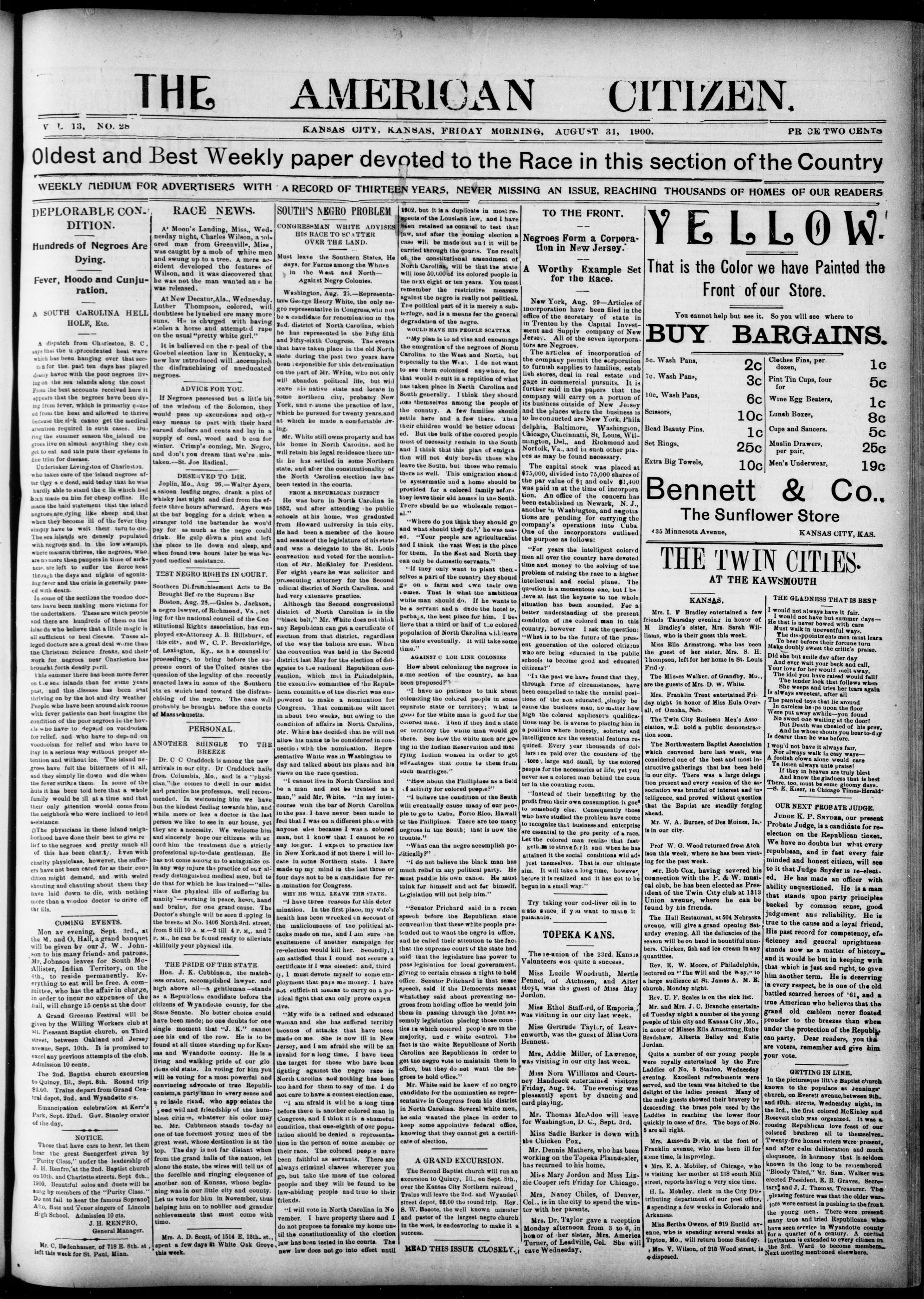
Oldest and Best Weekly paper devoted to the Race in this section of the Country
WEEKLY MEDIUM FOR ADVERTISERS WITH A RECORD OF THIRTEEN YEARS, NEVER MISSING AN ISSUE, REACHING THOUSANDS OF HOMES OF OUR READERS
V L 13, NO.28
DEPLORABLE CON- DITION.
Hundreds of Negroes Are Dying.
Fever, Hoodo and Cunjuration.
A SOUTH CAROLINA HELL HOLE, Eto.
A dispatch from Charleston, S. C., says that the u-precededate heat wave which has been hanging over that section for the past ten days has played deadly havoc with the poor negroes living on the sea islands along the coast. From the best accounts received here it appears that the negroes have been dying from fever, which is primarily caused from the heat and allowed to thrive because the slik cannot get the medical attention required in such cases. During the summer season the island negroes live on almost anything they can get to eat and this puts their systems in fine trim for disease.
Undertaker Livingston of Charleston who takes care of the island negroes after they a deed, said today that he was hardly able to stand the c ills which had been made on him for cheap coffins. He made the bald statement that the island negroes are dying like sheep and that when they become ill of the fever they simply have to wait their turn to die. The sea islands are densely populated with negroes and in the low swamps, where maimar thrives, the negroes, who are no more than paupers in time of sickness, are left to suffer the fierce heat through the days and nights of agonizing fever and the crisis is generally passed with death.
In some of the sections the voodoo doctors have been making more victims for the undertakers. These are witch people and there are hundreds of them on the islar ds who believe that a little magic is all sufficient to heal cisease. These alleged doctors are a great deal worse than the Christian Science freaks, and their work for negroes near Charleston has brought forth deadly peril.
This summer there has been more fever on the sea islands than for some years past, and this disease has been swat thriving on by the hot and dry weather. People who have been around sick rooms with fever patients can best imagine the condition of the poor negroes in the hovels who have to depad on vocodoom for relief, and who have to depad on vocodoom for relief and who have to stay in a serious way without proper attention and without ice. The island negroes have felt the bitterness of it all, and they simply lie down and die when the fever strikes them. In some of the huts it has been told here that a whole family would be ill at a time and that their only attention would come from the neighbors who were inclined to lend assistance.
The physicians in these island neighborhood have done their best to give relief to the negroes and pretty much all of this has been charity. Even with charity physicians, however, the sufferers have not been cared for as their condition might demand, and with weird shouting and chanting about them they have laid down to die, with nothing more than a voodoo doctor to drive off the rills.
COMING EVENTS
Mon av evening, Sept. 3rd., at the M. and O. Hall, a grand banquet will be given by our J. W. Johnson to his many friends and patrons. Mr Johnson leaves for South McAllister, Indian Territory, on the 4th., to reside permanently. Everything to eat will be free. A committee, who has the affair in charge, in order to incur no expenses of the hall, will charge 15 cents at the door. A Grand Greenian Festival will be given by the Willing Workers club at Mt. Pleasant Baptist church, on Third street, between Oakland and Jersey avenue, Sept. 10th. It is promised to excel any previous attempts of the club. Admission 10 cents. The 2nd. Baptist church excursion to Quincy, Ill., Sept. 8th. Round trip $3.00. Trains depart from Grand Central depot, 2nd, and Wyandette Central.
Emancipation celebration at Kerr's Park, Sept. 22nd. Gov. Stanley orator of the day.
NOTICE
Those that have ears to hear, let them hear the great Saengerfest given by "Purity Class," under the leadership of J. H. Renfro, at the 2nd. Baptist church on 10th, and Charlotte streets. Sept 6th, 1900. Beautiful solos and duets will be sang by members of the "Purity Class." Do not fail to hear the famous Soprano Alto, Bass and Tenor singers of Lincoln High School. Admission 10 cts. J. H. RENFRO, General Manager. Mr. C. Bodenhamer, of 718 E. 8th. st. left this week for St. Paul, Minn.
THE
RACE NEWS.
A Moon's Landing, Miss., Wednesday night, Charles Wilson, a colored man from Greenville, Miss, was caught by a mob of white men and swung up to a tree. A mere accident developed the features of Wilson, and it was discovered that he was not the man wanted and he was released.
At New Decatur, Ala., Wednesday, Luther Thompson, colored, will doubtless be lynebed ere many more suns. He is charged with having stolen a horse and attempted rape on the usual "pretty white girl."
It is believed on the reappeal of the Goebel election law in Kentucky, a new law introduced will accomplish the disfranchising of uneducated negroes.
ADVICE FOR YOU
If Negroes possessed but a little bit of the wisdom of the Solomon, they would pass up excursions and other easy means to part with their hard earned dollars and cents and lay in a supply of coal, wood and b con for winter. Crimp's coming, Mr. Negro, and don't you dream that we're mistaken.--St. Joe Radical.
DESEVERED TO DIE.
Joplin, Mo., Aug 26. — Walter Ayers, a saloon loafing negro, drank a pint of whisky last night and died from the effects three hours afterward. Ayers was at the bar begging for a drink when a stranger told the bartender he would pay for as much as the negro could drink. He gulp down a pint and left the place to lie down and sleep, and when found two hours later he was beyond medical assistance.
TEST NEGRO RIGHTS IN COURT.
Southern Disfranchisement Acts to Be Brought Bef to the Supreme: Bar Boston, Aug. 28.—Gales S. Jackson, a negro lawyer, of Richmond, Va., acting for the national council of the Constitutional Rights association, has employed ex-Attorney A. B. Hillsburst, of this city, and W. C. P. Breckinridge, of Lexington, Ky., as has counsel in proceeding, to bring before the supreme court of the United States the question of the legality of the recently enacted laws in some of the Southern states which tend toward the disfranchising of the negro. The case will probably be brought before the courts of Massachusetts.
PERSONAL.
Dr. C C Craddock is among the new arrivals in our city. Dr Craddock hails from Columbia, Mo., and is a "physician" he comes to dwell in our midst and practice his profession, well recommended. In welcoming him we have but the kindest feeling towards him, and while more or less a doctor is the last person we like to see in our house, yet they are a necessity. We welcome him and sincerely hope our citizens will record him the treatment due a strictly professional up-to-date gentleman. He has not come among us to antagonize or any way injure the practice of our already distinguished medical men, but to do that for which he has trained—"alleviate the physical ills of suffering human"—working in peace, heart, hand and brain, for one grand cause. The Doctor's shingle will be seen flipping in the breeze at No. 1406 North 3rd. street, from 8 till 10 A.M.—2 till 4 P.M., and 7 P.M., he can be found ready to alleviate killfully your physical ills.
THE PRIDE OF THE STATE
THE PRIDE OF THE STATE.
Hon. J. K. Cubbinson, the matchless orator, accomplished lawyer, and high above all—a gentleman—stands as a Republican candidate before the citizens of Wyandotte county, for the State Senate. No better choice could have been made; no one doubts for one single moment that "J. K. " cannot nie his end of the row. He is to be found at all times standing up for Kansas and Wyandotte county. He is a living and walking pride of our glorious old state. In voting for him you will be voting for a most powerful and convincing advocate of true Republicanism, a party man in every sense and a reable riot, who appreciates the good will and friendship of the humblest citizen, whatever his color may be. Mr. Cubbinson stands to-day as one of the foremost young men of the great west, whose destination is at the top. The day is not far distant when from the grand halls of the nation, let alone the state, the wires will tell us of the forcible and ringing elequence of another son of Kunsas, whose beginning was in our little city and county. Let us vote for him in November, thus helping him on to nobilier and grander achievements that must come with time.
Mrs. A. D. Scott, of 1514 E. 12th st.,
spent a few days at White Oak Grove
this week.
AMERICAN
KANSAS CITY, KANSAS, FRIDAY MORNING, AUGUST 31, 1900.
SOUTH'S NEGRO PROBLEM
CONGRESSMAN WHITE ADVISES
HIS RACE TO SCATTER
OVER THE LAND.
Must leave the Southern States, He
Says, for Farms among the Whites
in the West and North—
Against Negro Colonies.
Washington, Aug. 25. — Representative George Henry White, the only negro representative in Congress, will not be a candidate for renomination in the 2nd district of North Carolina, which he has represented in the fifty fifth and fifty-sixth Congress. The events that have taken place in the old North state during the past two years have been responsible for this determination on the part of Mr. White, who not only will abandon political life, but will leave his native state and locate in some northern city, probably New York, and resume the practice of law, which he pursued for twenty years. and at which he made a comfortable living.
Mr. White still owns property and has his home in North Carolina, and he will retain his legal residence there until he has settled in some Northern state, and after the constitutionality of the North Carolina election law has been tested in the courts.
FROM A REPUBLICAN DISTRICT
He was born in North Carolina in 1852, and after attending the public schools at his home, was graduated from Howard university in this city. He had been a member of the house and senate of the legislature of his state and was a delegate to the St. Louis convention and voted for the nomination of Mr. McKinley for President. For eight years he was solicitor and prosecuting attorney for the Second judicial district of North Carolina, and had very extensive practice.
Although the Second congressional district of North Carolina is in the "black belt," Mr. White does not think any Republican can get a certificate of election from that district, regardless of the way the ballots are cast. When the convention was held in the Second district last May for the election of delegates to the national Republican convention, which met in Paihladelphia, the executive committee of the Republican committee of the district was empowered to make a nomination for Congress. That committee will meet in about two weeks, but owing to the condition of affairs in North Carolina, Mr. White has decided that he will not allow his name to be considered in connection with the nomination. Representative White was in Washington to day and talked about his plaus and his views on the race question.
"I cannot live in North Carolina and to be a man and not be treated as a man," said Mr. White. "In my intercourse with the bar of North Carolina in the pas. I have never been made to feel that I was on a different place with anyone else because I was a colored man, but I know that I cannot be so any longer. I expect to practice law in New York, and if not there I will locate in some Northern state. I have made up my mind in the last three or four days not to be a candidate for renomination for Congress.
WHY HE WILL LEAVE THE STATE.
"I have three reasons for this determination. In the first place, my wife's health has been wrecked on account of the maliciousness of the political attacks made on me, and I am sure the excitement of another campaign for re-election would kill her. Secondly, I am satisfied that I could not secure a certificate if I was elected; and, thirdly, I must devote myself to some employment that pays me money. I have not sufficient means to carry on a political fight that can only prove expensive.
"My wife is a refined and educated woman and she has suffered terribly because of attacks that have been made on me. She is now ill in New Jersey, and I am afraid she will be an invalid for a long time. I have been the target for those who have been fighting against the negro race in North Carolina and nothing has been too hard for them to say of me. I do not care to have a contest election case.
"I am afraid it will be a long time before there is another colored man in Congress, and I think it is a shameful condition, that one-eighth of our population should be denied a representation in the person of some member or their race. The colored people have been faithful as servants. There are always criminal classes wherever you go, but take the mass of the colored people and they will be found to be law-abiding people and true to their frieds.
"I will vote in North Carolina in November. I have property there and I do not propose to forsake my home until the constitutionality of the election law has been tested in the courts. The new law does not go into effect until
1903, but it is a duplicate in most respects of the Louisiana law, and I have been retained as counsel to test that law, and after the coming election a case will be made out and it will be carried through the courts. The result of the constitutional amendment of North Carolina, will be that the state will lose 50,000 of its colored people in the next eight or ten years. You must remember the restrictive measure against the negro is really not political. The political part of it is merely a subterfuge, and is a means for the general degradation of the negro.
"My plan is to ad vise and encourage the emigration of the negroes of North Carolina to the West and North, but especially to the West. I do not want to see them colonized anywhere, for that would result in a repetition of what has taken place in North Carolina and South generally. I think they should lose themselves among the people of the county. A few families should settle here and a few there, when their children would be better educated. But the bulk of the coorored people must of necessity remain in the South and I think that this plan of emigration will not duly benefit those who leave the South, but those who remain there as well. This emigration should be systematic and a home should be provided for a colored family before they leave their old homes in the South. There should be no wholesale removal."
"Where do you think they should go and what should they do?," he was asked. "Your people are agriculturalist and I think the vast West is the place for them. In the East and North they can only be domestic servants." "If they only want to plant themselves a part of the country they should go on a farm and own their own homes. That is what the ambitious white man should do. If he wants to be a servant and a date the hotel is, perba, the best place for him. I believe that a third or half of the colored population of North Carolina will leave the state eventually. It will take some time."
"I have no patience to talk about colonizing the colored people in some separate state or territory; what is good for the white man is good for the colored man. Then if they had a state or territory the white man would go there. See how the white men are going in the Indian Reservation and maturing Indian women in order to get advantages that come to them from such marriages."
"How about the Phillipines as a field of activity for colored people?"
"I believe the condition of the South will eventually cause many of our people to go to Cuba, Forto Rico, Hawaii or the Philippines. There are too many negroes in the South; that is now the trouble."
"What can the negro accomplish politically?"
"I do not believe the black man has much relief in any political practice. He must paddle his own canoe. He must think for himself and act for himself. Legislation will not help him."
"Senator Prichard said in a recent speech before the Republican state convention that these white people pretended not to want the negro in office, and he called their attention to the face that the supreme court of the state had said that the legislature has power to pass legislation for local government, giving to certain classes a right to hold office. Senator Prichard in that same speech, said if the Democrats meant what they said about preventing negroes from holding office he would join them in passing through the joint assembly legislation placing those counties in which coerced people are in the majority, and r white control. The fact is the white Republicans of North Carolina are Republicans in order to get the negro vote to maintain them in office, but they do not want the negroes to hold office."
Mr. White said he knew of no negro candidate for the nomination as representative in Congress from his district in North Carolina. Several white men, he said wanted the place in order to keep some appointive federal office, knowing that they cannot get a certificate of election.
A GRAND EXCURSION
The Second Baptist church will run an excursion to Quincy, Ill., on Sept. 8th, over the Kansas City Northern railroad. Trains will leave the 2nd. and Wyandot street depot, $8.00 the round trip. Rev. S. W. Bacote, the well known minister and pastor of the largest negro church in the west, is endeavoring to make it a success.
READ THIS ISSUE CLOSELY.
CITIZEN
TO THE FRONT.
Negroes Form a Corporation in New Jersey.
A Worthy Example Set for the Race.
New York, Aug. 29—Articles of incorporation have been filed in the office of the secretary of state in Trenton by the Capital Investment and Supply company of New Jersey. All of the seven incorporators are Negroes.
The articles of incorporation of the company permit the corporation to furnish supplies to families, establish stores, deal in real estate and gage in commercial pursuits. It is further said in the papers that the company will carry on a portion of its business outside of New Jersey and the places where the business is to be conducted are New York, Phila delphia, Baltimore, Washington, Chicago, Cincinnati, St. Louis, Wilmington, Del., and Richmond and Norfolk, Va., and in such other places as may be found necessary.
The capital stock was placed at $75,000, divided into 75,000 shares of the par value of $1 and only $1,400 was paid in at the time of incorporation. An office of the concern has been established in Newark, N. J., another in Washington, and negotiations are pending for carrying the company's operations into Cuba. One of the incorporators outlined the purpose as follows:
"For years the intelligent colored men all over the country have devoted time and money to the solving of the problem of raising the race to a higher intellectual and social plane. The question is a momentous one, but I believe at last the keynote to the whole situation has been sounded. For a better understanding of the present condition of the colored man in this country, however I ask the question: "What is to be the future of the present generation of the colored citizens who are being educated in the public schools to become good and educated citizens?"
In the past we have found that they, through force of circumstances, have been compelled to take the mental positions of the non educated, simply be cause the business man, no matter how high the colored applicants' qualifications may be, is averse to placing him in a position where honesty, sobriety and intelligence are the essential features required. Every year thousands of dollars are paid over the counters of the tore, large and small, by the colored people for the necessities of life, yet you never see a colored man behind the counter in the counting room.
"Instead of their benefitting by the profit from their own consumption it goes to somebody else. Consequently those who have studied the problem have come to recognize that business and enterprise are essential to the pro perity of a race. Let the colored man realize that fastgeth to strive for it and when he has attained it the social conditions will adjust themselves. That is our ultimate aim. It will take a long time, however, before it is realized and it has got to be begun in a small way."
Try taking your cod-liver oil in to mate since if you want to make it palatable.
TOPEKA KANS.
The union of the 23rd. Kansas Volunteers was quite a success.
Miss Lucile Woodnuth, Mertle Pennel, of Atchison, and Alter Hoyt, was the guest of Miss May Jordon.
Miss Ethel Stafford, of Emporia, was visiting in our city last week.
Miss Gertrude Taylor, of Leavenworth, was the guest of Miss Cora Bennett.
Mrs. Addie Miller, of Lawrence, was visiting in our city last week.
Miss Nora Williams and Courtney Handcock entertained visitors Friday, Aug. 24. The evening was pleasantly spent by dancing and card playing.
Mr. Thomas McAdoo will leave for Washington, D.C., Sept. 3rd.
Miss Sadie Barker is down with the Chicken Pox.
Mr. Dennis Mathers, who has been working on the Topeka Plaindealer, has returned to his home.
Miss Mary Jordon and Miss Lizzie Cooper left Friday for Chicago.
Mrs. Nancy Chiles, of Denver, Col., is in the city to spend the winter with her parsnits.
Mrs. Dr. Taylor gave a reception Monday afternoon from 3 to 6, in honor of her sister, Mrs. America Turner, of Leadville, Col. She will eave Wednesday.
YELLOW
That is the Color we have Painted the Front of our Store.
BUY BARGAINS.
5c. Wash Pans, 2c Clothes Fins, per dozen, 1c
7c. Wash Pans, 3c Pint Tin Cups, four for 5c
10c. Wash Pans, 6c Wine Egg Beaters, 1c
Scissors, 10c Luneh Boxes, 8c
Bead Beauty Pins, 1c Cups and Saucers, 5c
Set Rings, 25c Muslin Drawers, per pair, 25c
Extra Big Towels, 10c Men's Underwear, 19c
KANSAS.
Mrs. I. F Bradley entertained a few friends Thursday evening in honor of M Bradley's sister, Mrs. Sarah Williams, who is their guest this week.
Miss Ella Armstrong, who has been the guest of her sister, Mrs. S. H. Thompson, left for her home in St. Louis Friday.
The Misses Walker, of Grandby, Mo., are the guests of Mrs. D. W. White.
Mrs. Franklin Trent entertained Friday night in honor of Miss Eula Overall, of Omaha, Neb.
The Twin City Business Men's Association, will hold a public demonstration soon.
The Northwestern Baptist Association which convened here last week, was considered one of the best and most instructive gatherings that has been held in our city. There was a large delegation present and every session of the association was brimful of interest and intelligence, and proved without question that the Baptist are steadily forging ahead.
Mr. W. A. Burnes, of Des Moines, Ia. is in our city.
Prof W. G. Wood returned from Atchison this week, where he has been visiting for the past week.
Mr. Bob Cox, having severed his connection with the P. & W. musical club, he has been elected as President of the Twin City club at 1313 Union avenue, where he can be found by his friends.
The Hall Restaurant, at 504 Nebraska avenue, will give a grand opening Saturday evening. All the delicacies of the season will be on hand in bountiful numbers. Chicken, fish and ice cream in any quantities. Rev. E. W. Moore, of Philadelphia, lectured on "The Will and the Way," to a large audience at St. James A. M. E. church, Monday night. Rev. U. F. Scales is on the sick list. Mr. and Mrs. J. C. Branche entertained Tuesday night a number of the young people of this city and Kansas City, Mo., in honor of Misses Eila Armstrong, Ruby Bradshaw, Alberta Bailey and Katie Jordan.
Quite a number of our young people were royally entertained by the Fire Laddies of No. 5 Station, Wednesday evening. Excellent refreshments were served, and the team was hitched to the delight of the ladies present. Many of the male guests showed their bravery by descending the brass pole used by the Laddies in reaching the lower floor quickly in case of fire. The boys of No. 5 are all right.
Mrs. Amanda D.vis, at the foot of Franklin avenue, who has been ill for some time, is improving.
Mrs. E. A. Mobiley, of Chicago, who is visiting her mother at 138 south Mill street, reports having a very nice time.
H. L. Mobiley, clerk in the City Distributing department of our post office, spending a few weeks in Colorado and Arkansas.
Miss Bertha Owens, of 219 Euclid avenue, who is spending several weeks at Tipton, Mo., will return home Sunday, Mrs. V. Wilson, of 215 Wood street, is disposed.
PR CETWOCENTS
the Country
HOMES OF OUR READERS.
LOW.
we have Painted the
our Store.
So you will see where to
ARGAINS.
Clethes Fins, per
dozen, 1c
Pint Tin Cups, four
for 5c
Wine Egg Beaters, 1c
Luneh Boxes, 8c
Cups and Saucers, 5c
Muslin Drawers,
per pair, 25c
Men's Underwear, 19c
& Co.,
ower Store
KANSAS CITY, KAS.
IN CITIES.
AWSMOUTH
THE GLADNESS THAT IS BEST
I would not always have it fair.
I would not have but summer days—
He that is never bowed with care
Must walk in uneventful ways.
The disappointments men must learra
To bear before their fortune turn
Make doubly sweet the critic's praise.
Did she but smile day after day
The tender look that follows when
She weeps and tries her tears again
Is always sweetest, after all
The painted toys that lie around
In careless he -ps upon the floor
Were put away awhile -you found
No sweet one waiting at the door!
But Death was cheated of his prev.
And he whose shouts you hear to day
Is dearer than he was before.
I won't not have it always fair.
Nor always walk in easy ways-
A foolish clown alone would care
To listen always unto praise!
If they in heaven are truly blest
And know the gladness that is best
There, too, must be some gloomy days-
S. E. Kiser, in Chicago Times-Herald*
OUR NEXT PROBATE JUDGE
JUDGE K. P. SNYDER, our present Probate Judge, is a candidate for re-election on the Republican ticket. We have no doubts but what every republican, and in fast every fair minded and honest citizen, will see to it that Judge Snyder is re-elected. He has made an officer with ability unquestioned. He is a man that stands upon party principles backed by common sense, good judgement and reliability. He is true to the cause and a loyal friend. His past record for competency, efficiency and general uprightness stands now as a matter of history, and it would be but in keeping with that which is just and right, to give him another term. He is deserving in every respect, he is one of the old battled scarred heroes of '61, and a true American who believes that the grand old emblem never floated prouder to the breezes than when under the protection of the Republican party. Dear readers, you that are voters, remember and give him your vote.
GETTING IN LINE
In the picturesque little ltte Baptist church known to the populace as Jennings church, on Everett avenue, between 9th and 10th streets, Wednesday night, in the 3rd, the first colored McKinley and Rosevett club was organized. It was a rousing Republican love feast of our colored brethren all to themselves. Twenty-five honest voters were present, and after calm deliberation and much eloquence, in harmony that is seldom known in the long to be remembered "Bloody Third," Mr. Sam. Walker was elected President, E. B. Graves, Secretary and J. J. Thomas, Treasurer. The pleasing feature was that the older warriors were earnest in pushing to the front the young men. There were present many true and tried Republicans who have seen service in Wyandotte county for a quarter of a century. A cordial invitation is extended to every citizen in the 3rd. Ward to become members. Next meeting mentoned elsewhere.
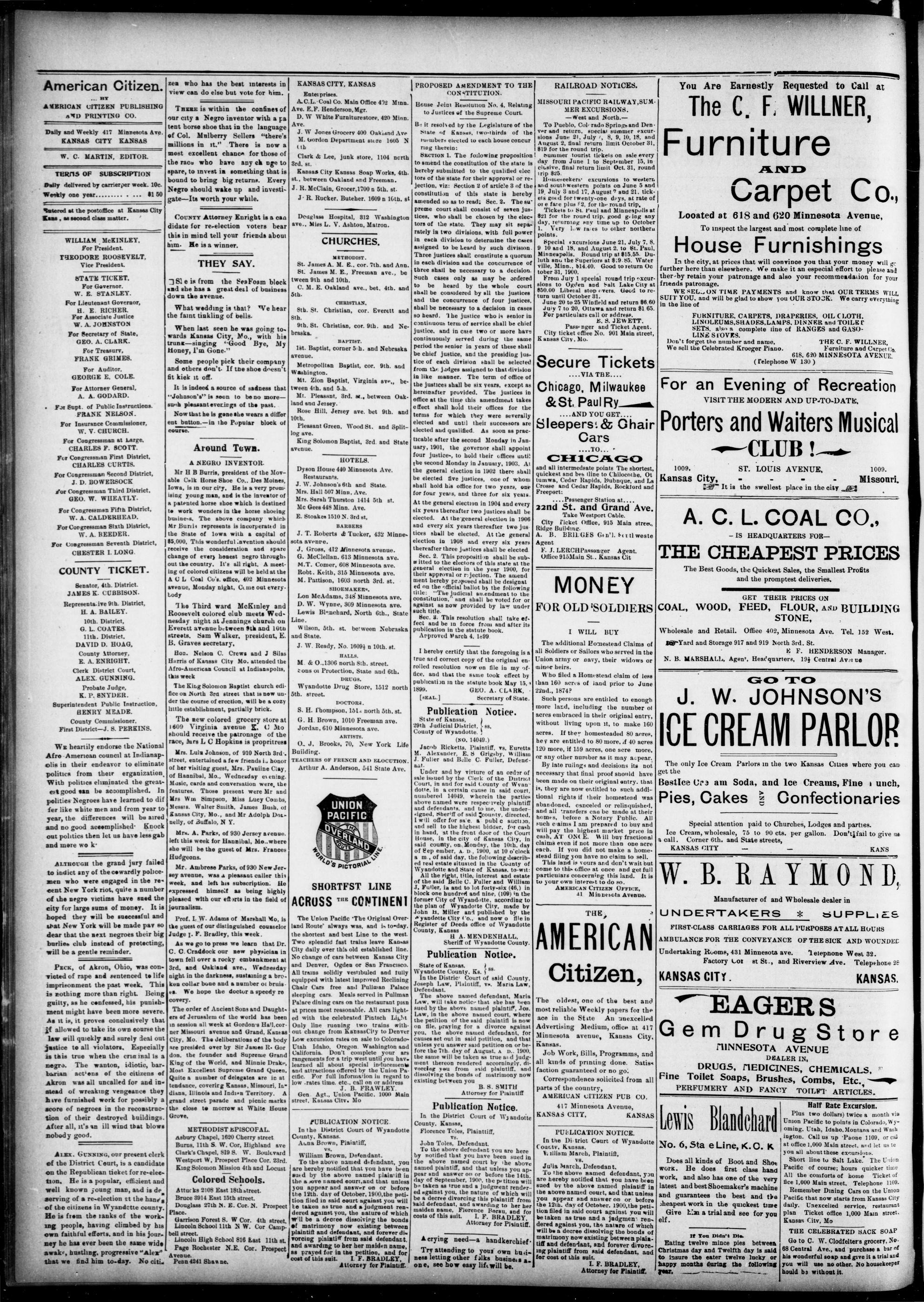
AMERICAN CITIZEN PUBLISHING
AND PRINTING CO.
Daily and Weekly 417 Minnesota Ave.
KANSAS CITY KANSAS
W. C. MARTIN, EDITOR.
TERMS OF SUBSCRIPTION
Daily delivered by carrierper week. 10c.
Weekly one year..... $1 50
Entered at the postoffice at Kansas City
Kans , as second class matter.
WILLIAM, McKINLEY,
For President.
THEODORE ROOSEVELT,
Vice President.
STATE TICKET,
For Governor.
W. E. STANLEY.
For Lieutenant Governor,
H. E. RICHER.
For Associate Justice
W. A. JOHNSTON
For Secretary of State,
GEO. A. CLARK.
For Treasury,
FRANK GRIMES.
For Auditor,
GEORGE E. COLE.
For Attorney General,
A. A. GODARD.
For Supt. of Public Instructions.
FRANK NELSON.
For Insurance Commissioner,
W. V. CHURCH.
For Congressman at Large,
CHARLES F. SCOTT.
For Congressman First District,
CHARLES CURTIS.
For Congressman Second District,
J. D. BOWERSOCK
For Congressman Third District,
GEO. W. WHEATLY.
For Congressman Fifth District,
W. A. CALDERHEAD.
For Congressman Sixth District,
W. A. REEDER.
For Congressman Seventh District,
CHESTER I. LONG.
COUNTY TICKET.
Senator, 4th. District.
JAMES K. CUBBISON.
Representa-ive 9th. District,
H. A. BALEY.
10th. District,
G. L. COATES.
11th. District,
DAVID D. HOAG,
County Attorney,
E. A. ENRIGHT.
Clerk District Court,
ALEX. GUNNING.
Probate Judge,
K. P. SNYDER.
Superintendent Public Instruction,
HENRY MEADE.
County Commissioner.
First District—J. S. PERKINS.
Wk heartily endorse the National Afro-American council at Indianapolis in their endeavor to eliminate politics from their organization. With politics eliminated the greatest good can be accomplished. In politics Negroes have learned to differ like white men and from year to year, the differences will be aired and no good accomplished. Knock out politics then let us have less gab and mere wo k.
ALTHOUGH the grand jury failed to indict any of the cowardly policemen who were engaged in the recent New York riot, quite a number of the negro victims have sued the city for large sums of money. It is hoped they will be successful and that New York will be made pay so dear that the next negroes their big burles club instead of protecting, will be a gentle reminder.
PECK, of Akron, Ohio, was convicted of rape and sentenced to life imprisonment the past week. This is nothing more than right. Being guilty, as he confessed, his punishment might have been more severe. As it is, it proves conclusively that if allowed to take its own course the law will quickly and surely deal out justice to all violators. Especially is this true when the criminal is a negro. The wanton, idiotic, barbarian actions of the citizens of Akron was all uncalled for and instead of wreaking vengeance they have furnished work for possibly a score of negroes in the reconstruction of their destroyed buildings. After all, it's an ill wind that blows nobody good.
ALEX. GUNNING, our present clerk of the District Court, is a candidate on the Republican ticket for re-election. He is a popular, efficient and well known young man, and is serving of a re-election at the hanes of the citizens in Wyandotte county. He is from the ranks of the working people, having climbed by his own faithful efforts, and in his journey he has ever been the same wide awake, hustling, progressive "Alex" that we find him to-day. No citi-
zen who has the best interests in view can do else but vote for him.
THERE is within the confines of our city a Negro inventor with a patent horse shoe that in the language of Col. Mulberry Sellers "there's millions in it." There is now a most excellent chance for those of the race who have any change to spare, to invest in something that is bound to bring big returns. Every Negro should wake up and investigate—Its worth your while.
COUNTY Attorney Enright is a candidate for re-election voters bear this in mind tell your friends about him. He is a winner.
THEY SAY.
Sle is from the SeaFoam block and she has a great deal of business down the avenue.
What wedding is that? We hear the faint tinkling of bells.
When last seen he was going towards Kansas City, Mo., with his trunk—singing "Good Bye, My Honey, I'm Gone."
Some people pick their company and others don't. If the shoe doesn't fit kick it off.
It is indeed a source of sadness that "Johnson's" is soon to be no more—such pleasant everings of the past.
Now that he is gone she wears a different button—in the Popular block of course.
Around Town.
A NEGRO INVENTOR.
Mr H B Burris, president of the Movable Calk Horse Shoe Co., Des Moines, Iowa, is in our city. He is a very promising young man, and is the inventor of a patented horse shoe which is destined to work wonders in the horse shoeing business. The above company which Mr Buriss represents is incorporated in the State of Iowa with a capital of $5,000. This wonderful invention should receive the consideration and spare change of every honest negro through out the country. It's all right. A meeting of colored citizens will be held at the A C L Coal Co.'s office, 402 Minnesota avenue, Monday night. Come out everybody.
The Third ward McKinley and Roosevelt colored club meets Wednesday night at Jennings church on Everett avenue between 5th and 10th streets. Sam Walker, president, E. B. Graves secretary.
Hon. Nelson C. Crews and J Silas Harris of Kansas City Mo. attended the Afro-American Council at Indianapolis, this week
The King Solomon Baptist church office on North 3rd street that is now under the course of erection, will be a cozy little establishment, partially brick.
The new colored grocery store at 1609 Virginia avenue K. C Mo should receive the patronage of the race, Mrs L C Hopkins is proprietress
Mrs. Lulu Johnson, of 910 North 3rd street, entertained a few friends is honor of her visiting guest, Mrs. Pauline Clay, of Hannibal, Mo., Wednesday evening. Music, cards and conversation were, the features. Those present were Mr and Mrs Wm Simpson, Miss Luey Combs, Messrs. Walter Smith, James Bush, of Kansas City, Mo., and Mr Adolph Donnelly, of Buffalo, N Y.
Mrs. A. Parks, of 930 Jersey avenue, left this week for Hannibal, M..where she will be the guest of Mrs. Frances Hudgeons.
Mr. Ambrose Parks, of 930 New Jersey avenue, was a pleasant caller this week, and left his subscription. He expressed himself as being highly pleased with our efforts in the field of journalism.
Prof. I. W. Adams of Marshall Mo, is the guest of our distinguished counselor Judge I. F. Bradley, this week.
As we go to press we learn that Dr. C. C. Craddock our new physician in town fell over a rocky embankment at 3rd, and Oakland ave., Wednesday night in the darkness, sustaining a broken collar bone and a number of bruises.
We hope the doctor a speedy recovery.
The order of Ancient Sons and Daughters of Jerusalem of the world has been in session all week at Gordon's Hall, corner Missouri avenue and Grand, Kansas City, Mo. The deliberations of the body are presided over by Sir James R. Gordon, the founder and Supreme Grand King of the World, and Minnie Drake-Most Excellent Supreme Grand Queen, Quite a number of delegates are in attendance, covering Kansas, Missouri, Indiana, Illinois and Indian Territory. A grand street parade and picnic marks the close to morrow at White House Grove.
METHODIST EPISCOPAL
Abury Chapel, 1620 Cherry street
Burns, 11th S. W. Cor, Highland ave
Clark's Chapel, 1819 S. W. Boulevard
Westport W, Prospect Place Cor. 23rd
King Solomon Mission 4th and Locust
Colored Schools.
Attacks 2108 East 18th street.
Bruce 3914 East 15th street.
Garrison Forest S. W Cor. 4th street,
Lincoln School 11th N W. Cor Camp-
bush
KANSAS CITY, KANSAS
Enterprises.
A.C.L. Coal Co. Main Office 492 Minn.
Ave. E.F. Henderson, Mgr.
D. W White Furniturestore, 420 Minn.
Ave.
J. W Jones Grocery 400 Oakland Ave.
M. Gordon Department store 1605 N
1th
Clark & Lee, junk store, 1104 north
3rd, st.
Kansas City Kansas Soap Works, 4th.
st., between Oakland and Freeman.
J. R. McClain, Grocer,1700 n 5th, st.
J. R. Rucker, Buteher, 1609 n 10th, st
Deglass Hospital, 312 Washington
ave., Miss L. V. Ashton, Matron.
CHURCHES.
METHODIST
M. HODGIST.
St. James A. M. E., cor. 7th. and Ann.
St. James M. E., Freeman ave., between 9th and 10th.
C. M. E. Oakland ave., bet. 4th. and 5th.
CHRISTIAN.
8th St. Christian, cor. Everett and 8th.
9th St. Christian, cor. 9th. and Nebraska.
BAPTIST.
1st. Baptist, corner 5th. and Nebraska avenue.
Metropolitan Baptist, cor. 9th. and Washington.
Mt. Zion Baptist, Virginia ave., between 4th. and 5.h.
Mt. Pleasant, 3rd. st., between Oakland and Jersey.
Rose Hill, Jersey ave. bet 9th. and 10th.
Pleasant Green, Wood St. and Split-log ave.
King Solomon Baptist, 3rd. and State avenue.
Dyson House 440 Minnesota Ave.
Restaurant
J. T. Roberts & Tucker, 432 Minnesota avenue.
J. Gross, 412 Minnesota avenue.
G. McClellan, 613 Minnesota ave.
M.T. Comer, 608 Minnesota ave.
Robt. Keith, 315 Minnesota ave.
M. Pattison, 1603 north 3rd. st.
SHOEMAKER.
Lon McAdams, 348 Minnesota ave.
D. W. Wynne, 309 Minnesota ave.
Lewis Blenchard, North 6th., State Line.
Wilson, 5th. st. between Nebraska and State.
J. W. Ready, No. 1609 $ _{1} $ n 10th. st.
HALLS.
M. & O.1306 north 8th. street.
Cons on Protection, State and 6th.
DRUGS.
Wyandotte Drug Store, 1512 north 5th. street.
S. H. Thompson, 1514 north 5th, st.
G. H. Brown, 1010 Freeman ave.
Jordan, 610 Minnesota ave.
ARTISTS.
O. J. Brooks, 70, New York Life
Building.
TEACHERS OF FRENCH AND ELOCUTION
Arthur A. Anderson, 541 State Ave.
UNION
PACIFIC
THE
OVERLAND
ROUTE
WORLD'S PICTORIAL LINE.
SHORTFST LINE ACROSS THE CONTINENT
The Union Pacific 'The Original Overland Route' always was, and is to-day, the shortest and best Line to the west. Two splendid fast trains leave Kansas City daily over this old established line. No change of cars between Kansas City and Denver, Ogden or San Francisco. All trains solidly vestibulated and fully equipped with latest improved Recycling Chair Cars free and Pullman Palace sleeping cars. Meals served in Pullman Palace dining cars on the restaurant plan at prices most reasonable. All cars lighted with the celebrated Pintsch Light. Only line running two trains without change from KansasCity to Denver Low excursion rates on sale to Colorado Utah Idaho, Oregon Washington and California. Don't complete your ars rangeries for a trip west until you have learned all about special inducement and attractions offered by the Union Pacific. For full information in regard to low rates time. etc. call on or address
Gen. Agt., Union Pacific. 1000. Main street, Krasa City, Mo
PUBLICATION NOTICE.
In the District Court of Wyandotte County, Kansas.
Ana Brown, Plaintiff,
vs.
William Brown, Defendant.
To the above named defendant, you are hereby notified that you have been sued by the above named plaintiff in the a sive named court, and that unless you appear and answer on or before the 12th, day of October, 1900, the petition will be taken as true and a judgment rendered against you, the nature of which will be a decree dissolving the bonds of matrimony now existing between plaintiff and defendant, and forever divorcing plaintiff from said defendant, and awarding to her her maiden name, as prayed for in the petition, and for cost of this suit.
I. F. BRADLEY,
Attorney for Plaintiff.
PROPOSED AMENDMENT TO THE
CONSTITUTION.
House Joint Resolution No. 4, Relating
to Justices of the Supreme Court.
Be it resolved by the Legislature of the
State of Kansas, two-thirds of the
members elected to each house concur-
ring therein:
Sec. 3. This resolution shall take effect and be in force from and after its publication in the statute book.
Approved March 4, 1899
I hereby certify that the foregoing is a true and correct copy of the original enrolled resolution now on file in my office, and that the same took effect by publication in the statute book May 15, 1899.
GEO. A. CLARK,
[SEAL.]
Secretary of State.
Publication Notice.
State of Kansas,
29th Judicial District,
County of Wyandotte.
(NO. 14049.)
Jacob Rickett, Plaintiff, vs. Euretta M. Alexander, E. S Grigsby, William J. Fuller and Belle C. Fuller, Defended.
Under and by virtue of an order of sale issued by the Clerk of the District Court, in and for said County of Wyandotte, in a certain cause in said court, numbered 14049, wherein the parties above named were respectively plaintiff and defendants, and to me, the undersigned, Sheriff of said county, directed, I will offer for sale a public auction, and sell to the highest bidder, for cash in hand, at the front door of the Court House, in the city of Kansas City, in said county, on Monday, the 10th day of Sep ember, A. D., 1900, at 10 o'clock a m., of said day, the following described real estate situated in the County of Wyandotte and State of Kansas, to-write: All the right, title, interest and yield of the held by William J. Fuler, as to lot for four (4) blocks one hundred and ninety (109) in the former City of Wyandotte, according to the plan of Wyandotte City, made by John H. Miller and published by the Wyandotte City Co., and now o file in Register of Deeds office of Wyandotte County, Kansas
H A. MENDENHALL.
Sheriff of Wyandotte County.
Publication Notice.
State of Kansas. } ss.
Wyandotte County. Ks.
In the District Court of said County,
Joseph Law, Plaintiff, v. Maria Law,
Defendant.
He above named defendant, Maria
Law, will take notice that she has been
sued by the above named plaintiff, Jos.
Law, in the above named court, where
the petition of the said plaintiff is now
on file, praying for a divorce against
you, the above named defendant, for
causes set out in said petition, and that
unless you answer said petition on or
before the 7th day of August, A. D. 1900,
the same will be taken as true and judge
ment thereon rendered accordingly, dig-
tive from said plaintiff, and dissolving the bond of matrimony now
existing between you
B. S. SMITH
Attorney for Plaintiff
Publication Notice
In the District Court of Wyandotte County, Kansas.
Florence Toles, Plaintiff, vs.
John Toles, Defendant.
To the above defendant you are here by notified that you have been sued in the above named court by the above named plaintiff, and that unless you appear and answer on or before the 14th day of the petition the petition will be taken as true and a judgment rendered against you, the nature of which will be a decree divorcing this plaintiff, which said defendant, and awarding to her maiden name, Florence Forau, and for costs of this suit. I. F. BRADLEY
Attorney for Plaintiff
Try attending to your own business letting other folks business a one, see how easy life will be.
RAILROAD NOTICES.
To Pueblo, Colo. radio Springs and Denver and return, special summer excursions June 21, July 7, 8, 9, 10, 18, and August 2, final return limit October 31, $19 for the round trip.
Summer tourist tickets on sale every day from June 1 to September 15, inclusive, final return limit Oct. 31, round trip $25.
Homeeekers excursions to western and southwestern points on June 5 and 19, July 3 and 17, August 7 and 21, tickets good for twenty-one days, at rate of o farce plus $2, for the round trip.
Tickets to St. Paul and Minneapolis at $21 for the round trip, good g ing any day, returning any time up to October 1. Very low rates to other northern points.
Special excursions June 21, July 7, 8, 9, 10 and 18, and August 2 to St. Paul, Minneapolis. Round trip at $15.55. Duvall and the Superiors at $9.85. Water villa and the Superiors at $4.40. Good to return October 31, 1900.
From July 1 special round trip excursions to Ogden and Salt Lake City at $50.00. Liberal stop orders. Good to return until October 31.
June 20 to 25 Winfield and return $6.60
July 7 to 20, Ottawa and return $1.65.
For particulars call or address.
E. S. JEWETT.
Passenger and Ticket Agent.
City ticket office No. 901 Main street,
Kansas City, Mo.
Secure Tickets
...VIA THE....
Chicago, Milwaukee
& St. Paul Ry
...AND YOU GET....
Sleepers: & Ghair
Cars
...TO....
CHICAGO
and all intermediate points The shortest,
quickest and besil lime to Chilocothe, Otumwa, Cedar Rapids, Bubnque, and La Crosse and Cedar Rapids, Rockford and Freeport:
....Passenger Station at...
22nd St. and Grand Ave.
Take Westport Cable.
City Ficket Office, 915 Main street,
Ridge Building.
A. B. BRILGES Gin'. Southwest
Agent
F. J. LERCHPassenger Agent.
Office 915Main St. Kansas Cit.
MONEY
FOR OLD'SOLDIERS
I WILL BUY
The additional Homestead Claims of all Soldiers or Sailors who served in the Union army or navy, their widows or minor heirs.
Who filed a Homestead claim of less than 160 acres of land prior to June 22nd, 1874?
Such persons are entitled to enough more land, including the number of acres embraced in their original entry, without living upon it, to make 160 acres. If they homesteaded 80 acres, they are entitled to 80 more, if 40 acres 120 more, if 159 acres, one acres more, or any other number as it may apear.
By late rulings and decisions its not necessary that final proof should have been made on their original entry, that is, they are now entitled to such additional rights if their homestead was abandoned, canceled or relinquished, and all transfers can be made at their homes, before a Notary Public. All such claims I am prepared to buy and will pay the highest market price in cash, AT ONCE. Will buy fractional claims even if not more than one acre each. If you did not make a homestead filing you have no claim to sell. This land is yours and don't wait but come to this office at once and get full property. It is to your own interest to do so. AMERICAN CITIZEN OFFICE. 41 Minnesota Avenue.
AMERICAN Citizen,
The oldest, one of the best and most reliable Weekly papers for the ace in the State An unexcelled Advertising Medium, office at 417 Minnesota avenue, Kansas City, Kansas.
Job Work, Bills, Programms, and all kinds of printing done. Satiss faction guaranteed or no go.
Correspondence solicited from all parts of the country,
AMERICAN CITIZEN PUB CO.
417 Minnesota Avenue,
KANSAS CITY, KANSAS
PUBLICATION NOTICE.
In the District Court of Wyandotte
County, Kansas.
William March, Plaintiff,
vs.
Julia March, Defendant.
To the above named defendant, you
are hereby notified that you have been
sued by the above named plaintiff in
the above named court, and that unless
you appear and answer on or before
the 12th, day of October, 1900, the petition
filed in said court against you will
be taken as true and a judgment rendered
against you, the nature of which
will be a decree dissolving the bonds of
mariemony now existing between plaintiff
and defendant, and forever divorcing
plaintiff from said defendant, and
for cost of this suit.
I. F. BRADLEY,
Attorney for Plaintiff.
You Are Earnestly Requested to Call at The C. F. WILLNER, Furniture AND Carpet Co.
Looated at 618 and 620 Minnesota Avenue,
To inspect the largest and most complete line of
House Furnishings
In the city, at prices that will convince you that your money will go
further here than elsewhere. We make it an especial effort to please and
ther-by retain your patronage and also your recommendation for your
friends patronage.
WE SELL ON TIME PAYMENTS and know that OUR TERMS WILL
SUIT YOU, and will be glad to show you OUR STOCK. We carry everything
in the line of
FURNITURE, CARPETS, DRAPERIES, OIL CLOTH,
LINOLEUMS, SHADES, LAMPS, DINNER and TOILET
SETS, also a complete line of RANGES and GASO-
LINE STOVES.
For an Evening of Recreation VISIT THE MODERN AND UP-TO-DATE.
1009. ST. LOUIS AVENUE. 1009.
Kansas City. Missouri.
It is the swellest place in the city.
- IS HEADQUARTERS FOR—
THE CHEAP
The Best Goods, the Quickest and the priciest
GET THE COAL, WOOD, FEED,
Wholesale and Retail. Officee 402;
Yard and Storage 917 and 919 N.
N. B. MARSHALL, Agent, Headquarter
GO
J. W. JO
ICE CREAM
The only Ice Cream Parlors in the get the BestIce Cream Soda, and Pies, Cakes AND
Special attention paid to Ice Cream, wholesale, 75 to 90 c a call. Corner 6th, and State street KANSAS CITY
W. B. RA
CHEAPEST PRICE
at Goods, the Quickest Sales, the Smallest Prices
and the promptest deliveries.
GET THEIR PRICES ON
FOOD, FEED, FLOUR, AND BU
STONE,
Retail. Office 402, Minnesota Ave. Tel-
storage 917 and 919 North 3rd. St.
E F. HENDERSON
ALL, Agent, Headquarters, 192 Central Ave.
GO TO
W. JOHNSON
CREAM PARLORS
Cream Parlors in the two Kansas Cities
Cream Soda, and Ice Creams, Fruit
akes AND Confection
attention paid to Churches, Lodges and p
holesale, 75 to 90 cts. per gallon. Don't
8th, and State streets,
TY
B. RAYMO
THE CHEAPEST PRICES
The Best Goods, the Quickest Sales, the Smallest Profits and the promptest deliveries.
COAL, WOOD, FEED, FLOUR, AND BUILDING STONE,
J. W. JOHNSON'S ICE CREAM PARLOR
The only Ice Cream Parlors in the two Kansas Cities where you can get the BestIce Cream Soda, and Ice Creams, Fine lunch, Pies, Cakes AND Confectionaries
Special attention paid to Churches, Lodges and parties. Ice Cream, wholesale, 75 to 90 cts. per gallon. Don't trail to give us a call. Corner 6th. and State streets, KANSAS CITY
W. B. RAYMOND.
Manufacturer of and Wholesale dealer in
UNDERTAKERS * SUPP
FIRST-CLASS CARRIAGES FOR ALL PURPOSES AT AN
AMBULANCE FOR THE CONVEYANCE OF THE SICK A
Undertaking Rooms, 431 Minnesota ave. Telephone W
Factory Cor st St., and Riverview Ave.
KANSAS CITY.
EAGERS
Gem Drug St
RTAKERS * SUPP
CARRIAGES FOR ALL PURPOSES AT ALL
FOR THE CONVEYANCE OF THE SICK AVE.
Looms, 431 Minnesota ave. Telephone W
Toryce Corst St., and Riverview Ave.
ITY.
EAGERS
n Drug St
MINNESOTA AVENUE
DEALER IN.
DRUGS, MEDICINES, CHEMICALS, Fine Toilet Soaps, Brushes, Combs, Etc., PERFUMERY AND FANCY TOILET ARTICLES.
DRUGS, MEDICINE Fine Toilet Soaps, Brush PERFUMERY AND FANG Lewis Blandchard
BUGS, MEDICINES, CHEMICAL
It Soaps, Brushes, Combs, Et
ERY AND FANCY TOILFT ART
No. 6, Sta e Line, K.C. K
Does all kinds of Boot and Shoe work. He does first class hand work, and also has one of the very latest and best Shoemaker's machine and guarantees the best and the cheapest work in the quickest time
Give him a trial and see for you elf.
If You Didn't Die.
Eating twelve mince pies between Christmas day and Twelfth day is said to insure the eater twelve lucky or happy months during the following year.
BEST PRICES
On Sales, the Smallest Profits
highest deliveries.
OUR PRICES ON
FLOUR, AND BUILDING
STONE,
Minnesota Ave. Tel. 152 West.
North 3rd. St.
E F. HENDERSON Manager.
Porters, 19th Central Avenue.
TO
JHNSON'S
M PARLOR
e two Kansas Cities where you can
Ice Creams, Fine lunch,
Confectionaries
churches, Lodges and parties.
ats, per gallon. Don't fail to give us,
KANS
YMOND,
SUPPLIES
ALL PURPOSES AT ALL HOURS
ANCE OF THE SICK AND WOUNDED
ave. Telephone West 32.
and Riverview Ave. Telephone 25
KANSAS.
ERS
ug Store
NES, CHEMICALS,
ches, Combs, Etc.,
BY TOILFT ARTICLES.
Half Rate Excursion.
Plus two dollars) twice a month win Union Pacific to points in Colorado, Wyoming, Utah, Idaho, Montana and Washington. Call us up 'Phone 1090, or call at office 1,000 Main street, and let us te you all about these excursions.
Short line to Salt Lake. The Union Pacific of course; hours quicker time All the comforts of home Ticket of fice 1,000 Main street, Telephone 1109. Remember Dining Cars on the Union Pacific that now starts from Kansas City daily. Unexcelled service, restaurant plan Ticket office 1,000 Main street. Kansas City, Mo
THE CELEBRATED SACK SOAP Go to C. W. Clodfelters grocery, No. 68 Central Ave., and purchase a bar of his wonderful soap and give it a trial and you will use no other. No housekeeper should be without it.
KANSAS.
Annual Product of Honey.
The United States produces more money than any other nation. As long as thirty years ago the product was 15,000,000 pounds annually. Twenty years ago it had risen to 25,000,000 pounds and ten years ago it was 65,000,000 pounds. At the present time Iowa produces 9,000,000 pounds of honey annually, and many states, including California, produce from 4,000,000 to 5,000,000 pounds a year.
Yellow Fever in Mexican Ports
Yellow Fever in Mexican Ports.
Americans who propose making pleasure trips to Central America or West Indies should be careful where they go. Yellow fever is epidemic all along the Mexican ports and at Panama. Port Limon (Costa Rica) is suffering from an outbreak of smallpox, and in Cuba there is much sickness of various kinds. Jamaica was thoroughly healthy at last reports.
Where Women's Ages Are Known.
When women go to buy a dress in Japan they tell the shopkeeper their age, and state whether they are married or single, because there are special designs for married women as well as for different ages. The Japanese women do not take it amiss that their ages and relationships are disclosed to strangers.
Crane's Idea of Death
A friend who parted with Stephen Crane at Dover, on his way to Baden-Wellen, in the Black Forest, where he died, reports this saying of his: "When you come to the hege that we must all go over, it isn't bad. You feel sleepy, and you don't care. Just a little dreamy curiosity as to which world you're really in--that's all."
Ordered to the Stocks.
A quaint procedure followed a hundred years ago is still observed at the court of the manor at Frognal, Hampstead, England. An absentee member was recently muted in the sum of 1 shilling, and the balliff was formally ordered to place him in the stocks. As it happens, however, there are no stocks.
Plush Uncomfortable in Hot Weather
One of the unexplainable things is railroad equipment during the hot weather is the use of heavy plush-covered chairs in the so-called drawing-room cars. Plush is the most uncomfortable covering for chairs that can be selected for hot weather. It collects dirt and it seems to radiate heat — Exchange.
Treg1 In Double Service
The telegraph poles along the Savannah and Stateboro railway in Georgia are growing. They are made of cypress and must have been planted with the roots. They are sprouting at the top and serve a double purpose. They are shade trees as well as a support for the wires.
Liquor Sign of Civilization
The English cynic's remark that "the first sign of civilization in a savage country is often to be seen over a whisky shop door" is recalled by the announcement that a New York architect is preparing plans for a $500,000 brewery which is to be built by British capital somewhere in the Transvaal. American beer is to be manufactured and the capacity of the brewery is to be 200,000 barrels per year.
Ten Years Pain
"I am a school teacher, have suffered agony monthly for ten years.
"My nervous system was a wreck. I suffered with pain in my side and had almost every ill known. I had taken treatment from a number of physicians who gave me no relief.
"One specialist said no medicine could help me, I must submit to an operation.
"I wrote to Mrs. Pinkham, stating my case, and received a prompt reply. I took Lydia E. Pinkham's Vegetable Compound and followed the advice given me and now I suffer no more. If any one cares to know more about my case, I will cheerfully answer all letters."—MISS EDNA ELLIS, Higginsport, Ohin.
TOWER'S
FISH BRAND
POMMEL
SLICKER
The Best
Saddle Coat.
Keeps both rider and saddle per-
fectly in hardest of cases.
substitute wildlife spool. Ask for
19th Fish Brand Pommel Slicker—
If entirely new. If not for sale in
your town, write for catalogue to
A.J. TOWER, Boston, Mass.
When Answering Advertisements Kindly
Me mention This Papeet.
W. N. U. Kansas City, No. 35, 1900
PISO'S CURE FOR
SUICES WHERE ALL LINE FAILS.
Best Owner system applied. Use
in time. Sold by urgency.
CONSUMPTION
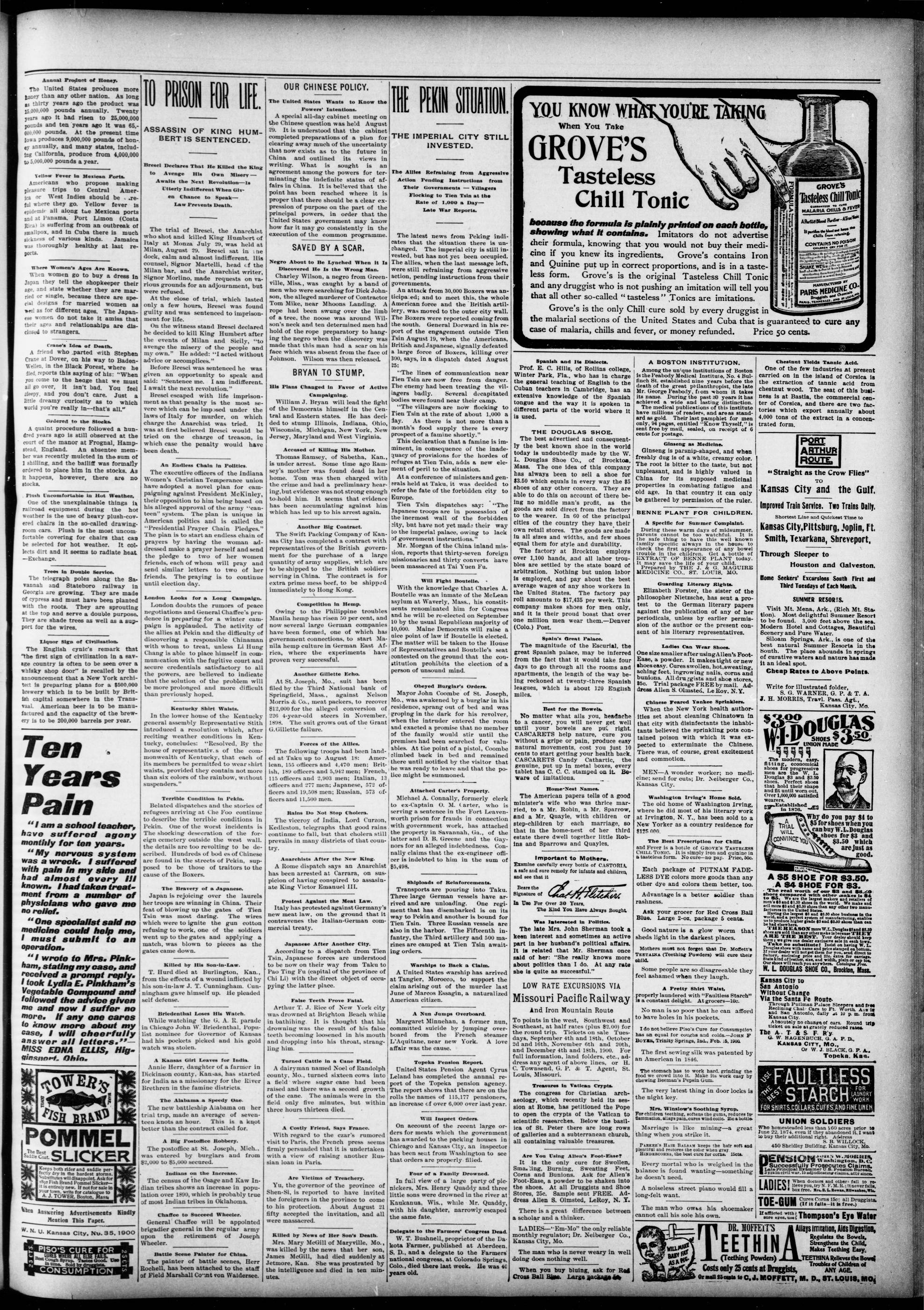
ASSASSIN OF KING HUMBERT IS SENTENCED.
Bresci Dechares That He Killed the King to Avenge His Own Misery—Awalts the Next Revolution—Is Utterly Indifferent When Given Chance to Speak—Law Prevents Death.
The trial of Bresci, the Anarchist, who shot and killed King Humbert of Italy at Monza July 29, was held at Milan, August 29. Bresci sat in the dock, calm and almost indifferent. His counsel, Signor Martelli, head of the Milan bar, and the Anarchist writer, Signor Morlino, made requests on various grounds for an adjournment, but were refused.
At the close of trial, which lasted only a few hours, Bresci was found guilty and was sentenced to imprisonment for life.
On the witness stand Bresci declared he decided to kill King Humbert after the events of Milan and Sicily, "to avenge the misery of the people and my own." He added: "I acted without advice or accomplices."
Before Bresci was sentenced he was given an opportunity to speak and said: "Sentence me. I am indifferent. I await the next revolution."
Bresci escaped with life imprisonment as that penalty is the most severe which can be imposed under the laws of Italy for murder, on which charge the Anarchist was tried. It was at first believed Bresci would be tried on the charge of treason, in which case the penalty would have been death.
An Endless Chaln in Politics
The executive officers of the Indiana Women's Christian Temperance union have adopted a novel plan for campaigning against President McKinley, their opposition to him being based on his alleged approval of the army "canteen" system. The plan is unique in American politics and is called the "Presidential Prayer Chain Pledges." The plan is to start an endless chain of prayers by having the woman addressed make a prayer herself and send the pledge to two of her women friends, each of whom will pray and send similar letters to two of her friends. The praying is to continue until election day.
London Looks for a Long Campaign.
London doubts the rumors of peace negotiations and General Chaffee's prudence in preparing for a winter campaign is applauded. The activity of the allies at Pekin and the difficulty of discovering a responsible Chinman with whom to treat, unless Li Hung Chang is able to place himself in communication with the fugitive court and secure credentials satisfactory to all the powers, are believed to indicate that the solution of the problem will be more prolonged and more difficult than previously hoped.
Kentucky Shirt Waists
In the lower house of the Kentucky general assembly Representative Stith introduced a resolution which, after reciting weather conditions in Kentucky, concludes: "Resolved, By the house of representativ. of the commonwealth of Kentucky, that each of its members be permitted to wear shirt waists, provided they contain not more than six colors of the rainbow, without suspenders."
Terrible Condition in Pekin.
Belated dispatches and the stories of refugees arriving at the Cfoo continue to describe the terrible conditions in Pekin. One of the worst incidents is The shocking desecration of the foreign cemetery outside the west wall, the details are too revolting to be described. Hundreds of bodes of Chinese are found in the streets of Pekin, supposed to be those of traitors to the cause of the Boxers.
The Bravery of a Japanese
Japan is rejoicing over the laurels her troops are winning in China. Their feat of blowing up the gates of Tien Tsin was most daring. The wires which were to ignite the gun cotton refusing to work, one of the soldiers went up to the gates and applying a match, was blown to pieces as the gates came down.
Killed by His Son-In-Law
T. Hurd died at Burlington, Kan., from the effects of a wound inflicted by his son-in-law J. T. Cunningham. Cunningham gave himself up. He pleaded self defense.
Brledenthal Loses His Watch
While watching the G. A. R. parade in Chicago John W. Briedenthal, Populist nominee for Governor of Kansas had his pockets picked and his gold watch was stolen.
A Kansas Girl Leaves for India. Annie Herr, daughter of a farmer in Dickinson county, Kan-as, has started for India as a missionary for the River Brethren in the famine districts.
The Alabama a Speedy One. The new battleship Alabama on her trial trip, made an average of seventeen knots an hour. This is a knot better than the contract called for.
A Big Postoffice Robbery.
The postoffice at St. Joseph, Mich.. was entered by burglar and from $2,000 to $5,000 secured.
Indians on the Increase.
The census of the Osage and Kaw Indian tribes shows an increase in population over 1890, which is probably true of most Indian tribes in Oklahoma.
Chaffee to Succeed Wheeler
General Chaffee will be appointed brigadier general in the regular army upon the retirement of Joseph Wheeler. _____
Battle Scene Painter for China.
The painter of battle scenes, Herr Rochelle, has been attached to the staff of Field Marshall Count von Waidserde.
OUR CHINESE POLICY.
The United States Wants to Know the Powers' Intentions.
A special all-day cabinet meeting on the Chinese question was held August 29. It is understood that the cabinet completed preparations of a plan for clearing away much of the uncertainty that now exists as to the future in China and outlined its views in writing. What is sought is an agreement among the powers for terminating the indefinite status of affairs in China. It is believed that the point has been reached where it is proper that there should be a clear expression of purpose on the part of the principal powers, in order that the United States government may know how far it may go consistently in the execution of the common programme.
SAVED BY A SCAR.
Negro About to Be Lynched When It Is Discovered He Is the Wrong Man. Charley Wilson, a negro from Greenville, Miss., was caught by a hand of men who were searching for Dick Johnson, the alleged murderer of Contractor Tom Mike, near Mhoons Landing. A rope had been swung over the limb of a tree, the noose was around Wilson's neck and ten determined men had hold of the rope preparatory to hanging the negro when the discovery was made that this man had a scar on his face which was absent from the face of Johnson. Wilson was then released.
BRYAN TO STUMP.
His Plans Changed in Favor of Active Campaigning.
William J. Bryan will lead the fight of the Democrats himself in the Central and Eastern states. He has decided to stump Illinois, Indiana, Ohio Wisconsin, Michigan, New York, New Jersey, Maryland and West Virginia.
Accused of Killing His Mother.
Thomas Ramsey, of Sabetha, Kan,
is under arrest. Some time ago Ramsey's mother was found dead in her
home. Tom was then charged with
the crime and had a preliminary hearing, but evidence was not strong enough
to hold him. It seems that evidence
has been accumulating against him
which has led up to his arrest again.
Another Big Contract.
The Swift Packing Company of Kansas City has completed a contract with representatives of the British government for the purchase of a large quantity of army supplies, which are to be shipped to the British soldiers serving in China. The contract is for extra prime mess beef, to be shipped immediately to Hong Kong.
Competition In Hemp.
Owing to the Philippine troubles Manila hemp has risen 50 per cent, and now several large German companies have been formed, one of which has government connections, to start Manila hemp culture in German East Africa, where the experiments have proven very successful.
Another Gillette Echo
At St. Joseph, Mo., suit has been filed by the Third National bank of Springfield, Mass., against Nelson Morris & Co., meat packers, to recover $12,000 for the alleged conversion of 226 4-year-old steers in November, 1898. The suit grows out of the Grant G.Gillette failure.
Forces of the Allies.
The following troops had been landed at Taku up to August 18: American, 155 officers and 4,470 men; British, 189 officers and 5,942 men; French, 115 officers and 2,903 men; Italian, 13 officers and 277 men; Japanese, 572 officers and 19,508 men; Russian, 573 of officers and 11,500 men.
Balns Do Not Stop Cholera
The viceroy of India, Lord Curzon, Kedleston, telegraphs that good rains continue to fail, but that cholera still prevails in many districts of that country.
Anarchists After the New King.
A Rome dispatch says an Anarchist has been arrested at Carrara, on suspicion of having conspired to assassinate King Victor Emanuel III.
Protest Against the Meat Law
Italy has protested against Germany's new meat law, on the ground that it contravenes the Italian-German commercial treaty.
According to a dispatch from Tien Tsin, Japanese forces are understood to be now on their way from Taku to Pao Tung Fu (capital of the province of Chi Li) with the direct object of occupying the latter place.
False Teeth Prove Fatal
Arthur T. J. Rice of New York city was drowned at Brighton Beach while in bathhiking. It is thought that his drowning was the result of his false teeth becoming loosened in his mouth and dropping into his throat, strangling him.
Turned Cattle in a Cane Field
A dairyman named Noel of Randolph county, Mo. turned sixteen cows into a field where sugar cane had been raised and there was a second growth of the cane. The animals were in the field only five minutes, but within three hours thirteen died.
A Costly Friend, Says France.
With regard to the czar's rumored visit to Paris, the French press seems firmly persuaded that it is undertaken with a view of raising another Russian loan in Paris.
Are Victims of Treachery
Yu, the governor of the province of Shen-Si, is reported to have invited the foreigners in the province to come to his protection. About August 21 fifty accepted the invitation, and all were massacred.
Killed by News of Her Son's Death.
Mrs. Mary McGill of Maryville, Mo., was killed by the news that her son, James McGill, had died suddenly at Jetmore, Kan. She was prostrated by the intelligence and died in ten minutes.
THE PEKIN SITUATION.
THE IMPERIAL CITY STILL INVESTED.
The Allies Refraining from Aggressive Action Pending Instructions from Their Governments — Villagers Flocking to Tien Tsin at the Rate of 1,000 a Day— Late War Reports.
The latest news from Peking indicates that the situation there is unchanged. The imperial city is still invested, but has not yet been occupied. The allies, when the last message left, were still refraining from aggressive action, pending instructions from their governments.
An attack from 30,000 Boxers was anticipa-ed; and to meet this, the whole American force and the British artillery, was moved to the outer city wall. The Boxers were reported coming from the south. General Dorward in his report of the engagement outside Tien Tsin August 19, when the Americans, British and Japanese, signally defeated a large force of Boxers, killing over 300, says, in a dispatch dated August 25:
"The lines of communication near Tien Tsin are now free from danger. The enemy had been treating the villagers badly. Several decapitated bodies were found near their camp.
"The villagers are now flocking to Tien Tsin at the rate of about 1,000 a day. As there is not more than a month's food supply there is every prospect of a famine shortly."
This declaration that a famine is imminent, in consequence of the inadequacy of provisions for the hordes of refuges at Tien Tsin, adds a new element of peril to the situation.
At a conference of ministers and generals held at Taku, it was decided to refer the fate of the forbidden city to Europe.
Tien Tsin dispatches say: "The Japanese troops are in possession of the inermost wall of the forbidden city, but have not yet made their way to the imperial palace, owing to lack of government instructions."
Mr. Morgan of the China inland mission, reports that thirty-seven foreign missionaries and thirty converts have been massacred at Tai Yuen Fu.
Will Fight Bontelle.
With the knowledge that Charles A. Boutelle was an inmate of the McLean asylum at Waverly, Mass., his constituents renominated him for Congress and he will be re-elected on September 10 by the usual Republican majority of 10,000. Maine Democrats will raise a nice point of law if Boutelle is elected. The matter will be taken to the House of Representatives and Boutelle's seat contested on the ground that the constitution prohibits the election of a person of unsound mind.
Obeyed Burglar's Orders
Mayor John Coombe of St. Joseph, Mo., was awakened by a burglar in his residence, sprang out of bed and was groping in the dark for his revolver, when the intruder entered the room and exeusted a promise that no member of the family would stir until the premises had been searched for valuables. At the point of a pistol, Coombe climbed back in bed and remained there until notified by the visitor that he was ready to leave and that the police might be summoned.
Attached Carter's Property
Michael A. Connally, formerly clerk to ex-Captain O. M. Carter, who is serving a sentence in the Fort Leavenworth prison for frauds in connection with government work, has attached the property in Savannah, Ga., of the latter and D. B. Greene and the Gaynors for an alleged indebtedness. Connally claims that the ex-engineer officer is indebted to him in the sum of $5,498.
Shiploads of Reinforcements.
Transports are pouring into Takaio. Three large German vessels have arrived and are unloading. One regiment that has disembarked is on its way to Fekin and another is bound for Tien Tsin. Three Russian vessels are also in the harbor. The Fifteenth infantry, the Third artillery and 500 marines are camped at Tien Tsin awaiting orders.
Warships to Back a Claim
A United States warship has arrived at Tangier, Morocco, to support the claim arising out of the murder last June of Marcos Essagin, a naturalized American citizen.
A Nun Jumps Overboard
Margaret Minnechan, a former nun, committed suicide by jumping over board from the French steamer L'Aquitane, near new York. A love affair was the cause.
Topeka Pension Report-
United States Pension Agent Cyrus Leland has completed the annual report of the Topeka pension agency. The report shows that there are on the rolls the names of 115,177 pensioners, an increase of over 6,000 over last year.
Will Inspect Orders
On account of the recent large orders for meats which the government has awarded to the packing houses in Chicago and Kansas City, an inspector has been sent from Washington to see that orders are properly filled.
Four of a Family Drowned.
In full view of a large party of picnickers, Mrs. Henry Quaddy and three little sons were drowned in the river at Kaukanua, Wis., while Mr. Quaddy, with his daughter, narrowly escaped the same fate.
Delegate to the Farmers' Congress Dead. W. T. Bushnell, proprietor of the Dakota Farmer, published at Aberdeen. S. D., and a delegate to the Farmers' national congress, at Colorado Springs, Colo. died there last week. He was 40 years old.
GROVE'S Tasteless Chill Tonic
because the formula is plainly printed on each bottle, showing what it contains. Imitators do not advertise their formula, knowing that you would not buy their medicine if you knew its ingredients. Grove's contains Iron and Quinine put up in correct proportions, and is in a tasteless form. Grove's is the original Tasteless Chill Tonic and any druggist who is not pushing an imitation will tell you that all other so-called "tasteless". Tonics are imitations.
Spanish and Its Dialects.
Prof. E. C. Hillis, of Rollins college, Winter Park, Fla., who has in charge the general teaching of English to the Cuban teachers in Cambridge, has an extensive knowledge of the Spanish tongue and the way it is spoken in different parts of the world where it is used.
THE DOUGLAS SHOE
The best advertised and consequently the best known shoe in the world today is undoubtedly made by the W. L. Douglas Shoe Co., of Brockton, Mass. The one idea of this company has always been to sell a shoe for $3.50 which equals in every way the $5 shoes of any other concern. They are able to do this on account of being no middle man's profit, as the goods are sold direct from the factory to the wearer. In 60 of the principal cities of the country they have their own retail stores. The goods are made in all sizes and widths, and few shoes equal them for style and durability.
The factory at Brockton employs over 1,100 hands, and all labor troubles are settled by the state board of arbitration. Nothing but union labor is employed, and pay about the best average wages of any shoe workers in the United States. The factory pay roll amounts to $17,435 per week. This company makes shoes for men only, and it is their proud boast that one million men wear them.—Denver (Colo.) Post.
Supalp's Great Palace
The magnitude of the Escurial, the great Spanish palace, may be inferred from the fact that it would take four days to go through all the rooms and apartments, the length of the way being reckoned at twenty-three Spanish leagues, which is about 120 English rules.
Best for the Bowels.
No matter what ails you, headache to a cancer, you will never get well until your bowels are put right. CASCARETS help nature, cure you without a gripe or pain, produce easy natural movements, cost you just 10 cents to start getting your health back. Cane, Candie, Cathartic, the genuine, put us in metal boxes, every tablet has C. C. C. stamped on it. Beware of imitations.
Home-Nest Names.
The American papers tells of a good minister's wife who was thrice married, to a Mr. Robin, a Mr. Sparrow, and a Mr. Quayle, with children or step-children by each marriage, so that in the home-nest of her third estate there dwell together little Robins and Sparrows and Quayles.
Important to Mother
Examine carefully every bottle of CASTORIA,
a safe and sure remedy for infants and children,
and see that it
Bears the
Signature of
Charles H. Flutcher
In Use For Over 30 Years.
Was Interested in Politics?
The late Mrs. John Sherman took a keen interest and sometimes an active part in her husband's political affairs. It is related that Mr. Sherman once said of her: "She really knows more about politics than I do. At any rate she is quite as successful."
To points in the west, Southwest and Southeast, at half rates (plus $2.00) for the round trip. Tickets on sale Tuesdays, September 4th and 18th, October 2d and 16th, November 6th and 20th, December 4th and 18th, 1900. For full information, land folders, etc., address any agent of above lines, or H. C Townsend, G. P. & T. Agent, St. Louis, Missouri.
Treasures in Vatican Crypts.
The congress for Christian archaeology, which recently held its session at Rome, has petitioned the Pope to open the crypts of the Vatican to scientific researches. Below the basilica of St. Peter there are long rows of galleries and a subterranean church, all containing valuable treasures.
Are You Using Allen's Foot-Ease?
It is the only cure for Swollen Sma. King, Burning, Sweating Feet, Corns and Burning. Ask for Allen's Foot-Ease, a powder to be shaken into the shoes. At all Druggists and Shoe Stores, 25c. Sample sent FREE. Address Allen S. Olmsted, LeRoy, N. Y.
There is a great difference between a scholar and a thinker.
LADIES—"Em-Mo" the only reliable monthly regulator; Dr. Neiberger Co., Kansas City, Mo.
The man who is never weary in well doing does nothing well.
When you buy bluing, ask for Red Cross Ball Blue. Large package
DR. MOFFETT'S TEETHINA (Teething Powders) Allays Irritation, Aids Digestion, Regulates the Bowels, Strengthens the Child, Makes Teething Easy. TEETHINA Relieves the Bows Troubles of Children of ANY AGE. Costs only 25 cents at Druggists, Or mail 25 cents to C. J. MOFFETT, M. D., ST. LOUIS, MO.
A BOSTON INSTITUTION.
Among the unique institutions of Boston is the Peabody Medical Institute, No. 4 Bulbous in the great pillarhouses, before the death of the great pillarhouses Mr. George Peabody, from whom it takes its name. During the past 30 years it has achieved a master's and lasting distinction. The medical institute has millions of readers, and are standard as gold. Their last pamphlet for men only 94 pages, entitled "Know Thyself," is issued in sealed, on receipt of 6 cents for postage.
Glosseng as Medicine
Ginseng is parsnip-shaped, and when freshly dug is of a white, creamy color. The root is bitter to the taste, but not unpleasant, and is highly valued in China for its supposed medicinal properties in combating fatigue and old age. In that country it can only be gathered by permission of the ruler.
BENNE PLANT FOR CHILDREN.
A Specific for Summer Complaint.
During these warm days of midsummer, parents cannot be too watchful, the sassies are too well known family specific always in the house to be careful not to trouble in the children. Get a bottle of EXTRACT OF BENNE PLANT today. It may save the life of your child. Give the medicine FIGURE MEDICINE CO. ST. LOUIS, MO.
Guarding Literary Rights
Elizabeth Forster, the sister of the philosopher Nietzsche, has sent a protest to the German literary papers against the publication of any of her periodicals, unless by earlier permission of the author or the present consent of his literary representatives.
Ladies Can Wear Shoes
One size smaller than using Allen's Foot-Ease, a powder. It makes tight or new shoes easy. Cures swollen, hot, sweating, aching feet, ingrowing nails, corns and skin. Cures shoe stores. 85c. Trial package FREE by address Allen S. Olmsted, Le Roy, N.Y.
Chinese Feared Yankee Sprinklers
When the New York health authorities set about cleaning Chinatown in that city with disinfectants the inhabitants believed the sprinkling pots contained poison with which it was expected to exterminate the Chinese. There was, of course, great excitement and commotion.
MEN—A wonder worker; no medicine; send for cuts; Dr. Neiberger Co., Kansas City.
Washington Irving's Home Sold.
The old home of Washington Irving, where he did most of his literary work at Irvington, N. Y., has been sold to a New Yorker as a country residence for $125,000.
The Best Prescription for Chills and Fever is a bottle of GROVE'S TASTELESS CHILL TONIC. It is simply iron and quinine in a tasteless form. It no cure—no price. $500.
Each package of PUTNAM FADELESS DYE colors more goods than any other dye and colors them better, too.
Advantage is a better soldier than
rashness.
Ask your grocer for Red Cross Ball
Blue. Large 2-oz, package 5 cents.
Good nature is a glow worm that
sheds light in the darkest places.
Mothers must not forget that Dr. Moffett's
TERTAINA (Teething Powders) will cure their
child.
Some people are so disagreeable they
feel ashamed when they laugh.
A Pretty Shirt Waist.
No man is so poor that he can afford to have holes in his pockets.
I do not believe Piso's Cure for Consumption has an equal for coughs and colds—JOHN F BOYER, Trinity Springs, Ind., Feb. 15, 1900.
The first sewing silk was patented by an American in 1841.
The stomach has to work hard, grinding the food we crowd into it. Make its work easy by chewing Heeman's Pepsin Gum.
The very latest thing in door locks is the night key.
Mrs. Winslow's Soothing Syrup.
For children teething, softens the gums, reduces inflammation, pain, pain, pain wind cools. Be a bottle.
Marriage is like mining—a great thing when you strike it.
PARKER'S HAIR BALSAM keeps the hair soft and keeps the color when gray HINDEROWS, the best cure for corn. 15cts.
Every mortal who is weighed in the balance is found wanting—something he doesn't need.
A noiseless street piano would fill a long-felt want.
The man who owes his shoemaker cannot call his soie his own.
WILL MAKE BABY FAT AS A PIG.
DR. MORG TEETE (Teething P Costs only 25 cents Or mail 25 cents to C.
Chestnut Ylelds Tannic Acid.
One of the few industries at present carried on in the island of Corsica is the extraction of tannic acid from chestnut wood. The seat of this business is at Bastia, the commercial center of Corsica, and there are two factories which export annually about 4,000 tons of the extract in a concentrated form.
Shortest Line and Quickest Time to Kansas City,Pittsburg, Joplin, Ft. Smith, Texarkana, Shreveport,
Home Seekers' Excursions South First and
Third Tuesdays of Each Month.
SUMMER RESOR!S.
Visit Mt. Mena, Ark., (Rich Mt. St.
Station). Most delightful Summer Resort
to be found, 3,000 feet above the sea,
Modern Hotel and Cottages, Beautiful
Scenery and Pure Water.
Siloam Springs, Ark., is one of the
best natural Summer Resorts in the
South. The place abounds in springs
of curative waters and nature has made
it an ideal spot.
Cheap Rates to Above Points.
Write for illustrated folder,
S. G. WARNER, G. P. & T. A.
J. H. MORRIS, Travl. Pass. Agt.
Kansas City, Mo.
$300
W.I. DOUGLAS
SHOES $350
UNION MADE
PETER H.
The modern, easy-
fashion shoes for progressive
men are the W. L.
Shoes. The W. L.
Shoes. Perfect shoes
that hold their shape
and it warts out work,
often satisfied
wearers.
Established in 1816.
A TRIAL WILL CONVINCE YOU
Why do you pay $4 to $5 for shoes when you can buy W.L. Douglas shoes for $3 and $3.50 which are just as good.
A $5 SHOE FOR $3.50.
A $4 SHOE FOR $3.
---
INTERESTING CHAPTERS FOR
OUR RURAL READERS.
How Successful Farmers Operate This
Department of the Farm—A Few
Hints as to the Care of Live Stock
and Foultry.
Guernsers
Origin and History—The island of Guernsey is the second in size of the Channel Islands, and lies farthest to the west in this group. It is triangular in shape, being nine miles long and about four in greatest width, with rough, rocky coasts, containing 16,000 acres, and has a population of 35,000, half of whom live in the principal town, St. Peters. Market gardening is the chief occupation of the country people, and dairy cattle form a secondary interest. There are only about 5,000 cattle owned upon the island. By a long-continued policy of excluding all live cattle from without its limits, the stock of the island has been built up into a distinct breed. The origin and history of Guernsey and Jersey cattle are practically the same, but in the development of the former more of the characteristics of the parent stock of Normandy, France, have been retained. At present, however, Guernses can be better compared with Jerseys than with any other cattle. It is difficult to say which Guernsey cattle began to come to the United States, but a few are known to have been owned near Philadelphia prior to 1850. In America, as in England, all Channel Island cattle imported were long called "Aldernays," irrespective of the island where they came. Pure as they were at home, each within its own limits, the distinction was not properly preserved after they reached this country. But between 1870 and 1875 the Guernsey became recognized here as a breed, and for twenty years importations have been made nearly every year. The breed has steadily increased in numbers and as steadily has gained in favor wherever introduced.
Characteristics.-Guernseys are a size larger than Jersey, stronger-boned, and a little coarser in appearance. They are claimed to be harder and larger milkers, but both these points are stoutly disputed. They are generally very handsome and attractive cow. The head of the Guernsey is rather long, the neck slender, the body large, deep and rangy, the rump prominent, the flanks thin, thighs incurved, and twist open and roomy. Altogether the animal is at once recognized as businesslike and belonging to the pronounced dairy type. They are light in color, yellow and orange predominating, with considerable white, usually in large patches on the body and on the legs. Darker shades, approaching brown, are found upon some cows and are quite common on bulls. The muzzles are almost invariably buff or flesh-colored, surrounded by a fillet of light hair. Occasionally a black light is found, showing the influence of some distant ancestor from Brittany. The horns are small, curved, fine, thin-shelled, and waxy in appearance, often showing a deep, rich yellow for a third of their length from the base. A characteristic of this breed is a very generous secretion of yellow coloring matter, which pertains to the whole skin, but is seen especially where the hair is white, in the ears, around the eyes, and about the udder. This gives a "richness" to the animal which is very noticeable and causes the butter produced to be of a higher color at all seasons of the year than that of any other breed. The udder and teats are large and admirably shaped and placed, in selected specimens, but those and other dairy markings do not, throughout the breed, appear to be as fixed as in the case of Jersey, which have been subjected to a longer course of careful breeding. The Guernsey possesses a nervous temperament, and yet the cows are extremely quiet and gentle when properly handled, and less trouble is reported in the management of aged bulls than with Jersey of like age.
Milk and butter records.—The cows of this breed produce liberal quantities of milk, and it is of uncommon richness in butter fat and in natural color. They are to be especially recommended for butter cows, as well as for market milk where quality secures a relatively high price, and they are noted for rich production combined with especial economy in feeding. They possess great power of assimilating food and converting it into milk, yet are delicate feeders rather than gross, and will not generally bear much forcing. The grades, offspring of a Guernsey bull and well-selected cows of no particular breeding, usually make very satisfactory dairy stock. Guernsey cows average 1,000 pounds in weight or a little more, and thus, be heavier than Jerseys, they are expected to give more milk.—Farmers' Bulletin 106, Department of Agriculture.
Goats as Brush Eater.
Col. William L. Black, in his comprehensive treatise on "The Angora Goat and Mohair Industry of the United States," says: "The brush question is a most serious one in a great many of our states. As long as land can be kept under cultivation the brush can be kept down; but, when it is once thrown open to pasture, briars and brush of all description begin to grow, and soon cover the entire surface. Even in our own state of Texas many millions of acres in the west are growing up into brush thickets, and will, sooner or later, become worthless for pasturing cattle; and, in many of the western territories the same conditions exist. Is is supposed that this has been produced by an increase in the rainfall; but, I am inclined to think it is not altogether due to this fact. The brush and trees are indigenous to many of our so-called, arid districts can be very easily proven by the great quantities of roots that the present inhabitants dig out of the ground for fuel purposes. Not a tree can be seen for hundreds of miles, yet these great roots can be found almost everywhere, on the prairies, and are a substantial witness to the fact that there was an abundance of trees there at some time or other. Before this portion of the United States was occupied by the white man it was a common practice of the Indians to burn the high prairie grass
every fall, or winter, in order to hunt wild game that was so abundant in this part of the country. Buffalo and deer were as common then as cattle and sheep are now, but the grass was so high, in places, they could not be seen, and the Indian would burn it off to be able to hunt them more readily. This, undoubtedly, destroyed much of the growth of trees; and, in my opinion, is the true explanation of the roots that are now found in many parts of west Texas, New Mexico and other western territories. The question is a very important one, and if the goat can be used to keep this growth back it is certainly well worth the attention of many of our land owners, who may, in a few years, find their land practically worthless.
Dairy Notes
At the Pan-American Exposition to be held at Buffalo next year it was proposed to have competitive tests of all the dairy breeds. Reports now indicate that all the breeds except the Holstein-Friesian will decline to participate. The Holstein-Friesian men claim that the owners of other breeds of cows are afraid to meet them in competition.
...
American dairymen are well acquainted with the methods of enriching skim milk for calves by the addition of oil meal and the like. But according to recent reports the New Zealanders are actually using in their milk cod liver oil at the rate of two ounces per calf per day. The report says that where separator skim milk is used the farmers have found it necessary to add something, especially when the calves are to be grown into beebes. Crude cod liver oil can be bought in that country for about 75 cents per gallon, and each gallon contains 100 ounces of oil. This permits them to feed two ounces per day for a period of eight days, after which the use of the oil is discontinued.
...
Whether or not a dairyman should have his cows come in fresh in the fall must depend to a very large extent on the disposition he is making of his milk. If he is supplying a creamy or cheese factory that runs only during the summer months it is manifestly to his advantage to have his cows come in fresh in the spring, so the milk will be available for use during the summer season. But in most cases, especially it the dairyman be well fixed for his business, a good number of the cows should drop their calves in the fall months. This is to the advantage of the man that sells milk and cream in the city, as well as of the man that makes butter. In both cases the winter is the time when a good flow of milk means most money.
They are trying to settle the question of good milk in Denmark by grading it when it comes to the cheese factories and creameries. The standards for grading are: Ten points are given for all milk without any faults. The most points given are 12, but only for milk, beside being clean, well aerated and cool, must have a good fresh aroma. Milk with 9 points is not less fresh. Eight points milk has not been treated so clean as could be wished for, or is beginning to turn sour. By 7 points the fault is so pronounced that the supplier is made acquainted with and requested to correct it as soon as possible. Six points milk is returned. In some of the factories the milk has been paid for not only in proportion to the quantity of butterfat but also by the quality according to the grading, so the supplier who takes some extra trouble to bring his milk to the factory in a first-class condition, gets fully repaid for it. In other factories the grading system has no influence on the payment, the grading itself causing a sort of race between the suppliers, as a matter of honor not to get less than 10 points. The milk is examined every day and the grading done once a week by the manager.
Poultry Briefs
When fowls have the run of the farm there is little danger of overfeeding, unless it be with corn. The corn crib should not be left to the free use of the fowls at any time.
Poultry-keeping is especially adapted to women, for the reason that cleanliness is of supreme importance, and that is one of the strong points in the education of women. A poultry establishment kept perfectly clean and a flock kept free from lice and mites are almost certain to be a success.
It is probably true, as has been asserted by some, that when fancy fowls are sent to market it should be in clean, bright epochs. Old, second-hand affairs will not do. The buyer is influenced very much by the condition of the whole combination when it is on sale.
---
Every person that keeps poultry should have them in yards large enough to prevent the ground becoming filthy. Some recommend that this end be attained by frequently scraping over the ground or spading it up. That may do in a country where land is so high-priced that everything has to be done on a large scale, but in our great Western country land is too cheap to make this method advisable. Give the fowls enough room and nature will look after the cleaning.
A poultry writer says: "Grease the hens well, under the wings, breast and fluff feathers as soon as the chickens are taken off, with ointment made of lard and carbolic acid; one tablespoonful of lard to ten drops of acid." We fail to see the need of using the carbolic acid, as the grease will do all the work. We sometimes see it advocated to use lard and kerosene, but believe even kerosene to be unnecessarily harsh on the tender skin of fowls. This is especially the case with young chicks.
South Dakota rejoices in the proof that this season has afforded that good crops of clover and timothy can be raised in that state. After land has been in cultivation a few years it appears to be well adapted to those crops.
Some of the western sheep buyers express the opinion that the Idaho lamb crop will not be as good as that of last year.
THE AMERICAN MINISTER AGAIN REPORTS.
Announces the Arrival of Several Members of the Chinese Foreign Office at Pekin—Two Thousand Germans Also Arrive—Allies Not to Enter Imperial Palace for Forbidden City.
The following message was received in Washington August 27. "From Taka, August 27. Secretary of State, Washington: No important movements since last dispatch. Military is trying to restore. No representative of the Chinese government encountered yet. Several ministers of the Tsung Li Yamen reported in the city and are expected to appear soon. Generals decide not to enter imperial palace, leaving it practically vacant. Two thousand Germans arrived to-day.—CONGER."
A significant statement in Minister Conger's dispatch is that respecting the expected appearance in Pekin of some of the members of the tsung-liyamen. A natural construction to be given to this statement is that these ministers wish to undertake to represent the Chinese government formally in negotiations with the powers. It having been found impossible, up to this moment, according to Mr. Conger's statement, to meet any representatives of the Chinese government in the city of Pekin who was competent to open negotiations, it may be inferred that, if these ministers actually appear with proper credentials, one of the problems connected with the present difficulty in China will be solved. With some responsible person or persons to deal with it may be possible for the United States to come to some agreement as to a settlement of the Chinese trouble.
The allies, resuming aggressive operations, have taken the district west of Pekin. This statement, on Chinese authority, is cabled from Shanghai. From the same place comes the further statement that Li Hung Chang wasired the empress dowager at Hsian-Fu requesting the arrest of Prince Tuan and the disarmament of the Boxers, in order to give him an opening for negotiations with the powers. The illuminations projected at Shanghai in celebration of the relief of Pekin have been abandoned, lest they should cause a native outbreak.
STEVENSON IN TOWNE'S PLACE
Populist National Committee Decided on It After a Long Debate.
At a meeting of the People's party national committee in Chicago August 17 the declination of Charles A. Towne is the vice presidential nominee of the party was accepted and the name of Adalai E. Stevenson was put in his place. This result was obtained after a long debate, beginning at 2 p.m. and ending about 6:30 p.m. In the beginning there were three courses advocated by different members of the committee, viz.: to nominate a Populist, to leave the place blank, or, lastly, to indorse Mr. Stevenson, Senator Marion Butler, chairman of the committee, in a warm speech of some length, advocated the place blank, contending that Bryan and Stevenson would receive more Populist votes than if a candidate for vice president were named. But one test vote was taken. A motion was made to indorse Mr. Stevenson. For this motion, Mr. Washburn of Massachusetts moved, as a substitute, that a Populist be placed upon the ticket. The substitute was lost on a call of the roll by a vote of 124 yays to 71 nays. The original motion was then adopted by a viva voco vote. There were 124 members of the committee present or represented by proxy.
Storm Damage in Sedalia
A storm bordering closely on a tornado struck Sedalia, Mo., at noon Monday and did much damage. Three brick buildings on Main street were blown down, Wood's opera house was partially unroofed, many small stores were unroofed and fences, bill boards and signs were swept away. Hundreds of shade trees were broken and torn up by the roots.
A $7,000 "Hold-Up" in Denver
Dr. Joseph Baennett and Mrs. Flora M. Betts, both of Denver, Col., while while driving in the suburbs, were held up by masked men, who secured over 87,000 in money and diamonds. Mrs. Betts was beaten into insensibility and Dr. Baennett was very roughly handled.
Emigrating to Oregon
A party of thirty-five persons will leave Clarmore, Ind. Ter., in a few days for Hood River, Ore., to settle there.
The Pope Still Claims Rome.
A circular note from the vatican has been sent to all Catholic governments declaring that the pope renounces none of the papal rights over the Rome provinces and that until Italy recognizes the holy see the pope will recognize the new king only as king of Sardinia.
A. Breacher Bullman Dear
Rev. Dr. Royal H. Pullman, oldest brother of the late palace car magnate, George M. Pullman, died suddenly of paralysis at Camp Royal Weekly, Thousand Islands, last week.
Drowned in a Buggy.
Mr. John Purtle and Mrs. Nannie Shifflet, of Lowry City, Mo., were drowned in Gallinipper Creek while returning to their homes from Osceola in a buggy.
Denver's Population 133-859
The population of Denver, Col., is 133,859, against 106,713 in 1890. This is an increase of 27,146 or 25.44 per cent.
Senator Baker's Wife Dangerously Ill.
Mrs. Lucien Baker, wife of the senator, is dangerously ill at her home in Leavenworth, Kan.
THE MARKETS.
Kansas City, Chicago and St. Louis.
KANSAS CITY.
CATTLE—Best beees. $ 5 00 @ 5 40
Stockers. 4 20 @ 4 50
Native cows. 3 50 @ 4 00
Feeders. 4 00 @ 4 40
Western steers. 5 00 @ 5 30
Texas and Indian steers 3 00 @ 5 20
HOGS—Fair to bevy. 5 00 @ 5 20
SHEEP—Fair to choice. 4 50 @ 5 00
WHEAT—No 2 red. 71% @ 72
No 2 hard. 66 @ 68%
CORN—No 2 mixed. 66 @ 68%
OATS—No 2 mixed. 24 @ 24%
HAY—Choice timothy. 9 00 @ 9 50
Fancy prattle. 6 50 @ 7 00
BUTTER—Choice creamery. 15 @ 18
EGGS—Choice. 12
CHICAGO.
CATTLE—Com to prime. $ 5 45 @ 6 10
HOGS—Pickin and ship. 5 00 @ 5 35
SHEEP—Fair to choice. 4 00 @ 4 25
WHEAT—No 2 red. 73 @ 73%
CORN—No 2. 40 @ 41
HAY—Fairy. 16 @ 22%
BUTTER—Creamery. 10 @ 20%
LARD. 6 70 @ 6 75
PORK. 11 00 @ 11 10
ST. LOUIS.
CATTLE—Native and ship. $ 4 50 @ 5 85
Texans. 275 @ 4 50
HAY—Heavy. 5 20
SHEEP—Fair to choice. 4 00 @ 4 25
WHEAT—No 2 red. 69 @ 69%
CORN—No 2 mixed. 38 @ 39
OATS—No 2 mixed. 21 @ 21%
Horses—Choice heavy draft. $100 @ 140; fancy
chocolate chunks. $150 @ 100; coach horses. $130 @ 250;
chocolate chunks. $100 @ 110; choice Southern
horses. $80 @ 80.
Mules—Best price ranges from $55 to $135
according to size and weight.
BESIEGED A WOMAN'S HOUSE.
Two Killed and Four Wounded In an Il-
inois Town.
At Gilman, Ill., August 27, two men were killed and three wounded, one woman wounded and her house burned in an all night battle between a mob and Mrs. Dr. C. W. Wright, who was accused of the murder of Desie Salter, the 16-year-old daughter of a citizen of Gilman.
The dead are: John Myers, laborer, employed by Mrs. Dr. Wright; Michael Ryan, citizen, serving as deputy constable. The wounded are: Lawrence Ryan, brother of the dead man, wounded in abdomen; George Willoughby, citizen, shot through left lung; Mrs. Dr. C. W. Wright, shot through right shoulder, bullet taking downward course; Peter Hauer, member of citizens' attacking party, shot through stomach.
Mrs. Dr. Wright is about 50 years of age. It is stated that she was formerly an actress. For some time she has been conducting a private hospital on the outskirts of Gilman.
NAVAL DAY FOR THE G. A. B.
Naval Veterans and Ex-Prisoners of War Open G. A. R. Encampment.
Monday was the day of the Chicago G. A. R. encampment set aside for the men of the navy. Two thousand strong, the men who fought with Farragut, Dupont and Porter marched through the streets which were packed with a cheering, applauding multitude. Beside the men who fought afloat from '61 to '63 the younger generation helped to demolish Montojo's fleet in Manila bay, and met Cervera when he sailed out of Santiago harbor to defeat. With the veterans of the navy marched a band of men whose lot during the war comprised the worst of hardships. These were the members of the Association of ex-Prisoners of War, who received an enthusiastic greeting as they marched along.
A Congressman "Held-Up."
M. E. Benton, of Neosho, congressman from the Fifteenth Missouri district, was held up and robbed of $15 and half a dozen railroad passes near the depot at Second and Wyandotte streets, Kansas City, Mo. Three negroes took part in the hold-up and in the encounter Congressman Benton was knocked down, receiving a heavy blow over the right eye.
United States' Plan
It is said in administration circles that, in the event of the ability of the powers to agree upon a Chinese policy that will preserve the integrity of the empire, the plan most likely to be adopted will provide for international administration of the customs service. This is the plan of the United States.
A. Boom in Enlistments
Enlistments in the army have been phenomenal since the beginning of the trouble in China. Young men in all parts of the country have flocked to the recruiting stations anxious to see active service in a foreign land.
May Try to Take Pekln.
A dispatch from Tokio says General Yanaguchi reports that the Chinese have not abandoned hope of retaking Pekin, and that 9,000 men with fifteen guns were advancing toward Pekin from Shan Tung, probably intending to cut the allies' communications.
Clrcus Tent Blown Down.
A heavy rain and wind storm struck Bolivar, Mo., and blew down the tents of John Robinson's shows. They did not exhibit at all, but pulled for Springfield.
New Storm Center in China
The Japanese have been landing marines for three days at Amoy, China, not only without provocation, but against the protest of the consuls. The landing of the marines by the Japanese breaks the agreement of the powers with the viceroys.
Karson Killed by Lightning
Roy Smith, aged 22, was struck by lightning at his home northwest of Abilene, Kan., and killed. High winds accompanying the storm did considerable damage.
Aged Couple Killed.
An aged couple, Mr. and Mrs. W. H. Beason, were killed near Gladbrook Iowa, at a crossing of the Chicago Great Western railroad, their buggy being struck by a passenger train. The woman was instantly killed and the man died about twenty minutes later
Negro Press Association.
The national Afro-American Press association opened in Indianapolis, Monday. A resolution to indorse the administration of President McKinley was voted down by a vote of 7 to 3.
Kansas News Notes.
Sumner county raised 6,000,000 bushels of wheat.
Ellsworth shows the first circus murder of the season in Kansas.
Mrs. Susan Coody, of Coffeyville has been credited by the census taker with 111 years.
Governor Stanley has issued a proclamation setting apart Monday, September 3, as Labor day.
The earth at Burlington declines to give up any gas, though two wells, 1,500 feet deep, have been drilled.
It is probable that the government census of Kansas towns, for 1900, will not be announced for a month or two.
Major John A. Rafter-, who was chief surveyor of the Twentieth Feas, has returned to Manila for another carload of curios.
W. H. Simpson of Chicago, formerly of Topeka, has been made the advering agent for the entire Santa Fe system.
Lyman Naugle, who used to run the People's Voice at Wellington, has bought a Republican paper in California.
The Iola Register tells that a citizen of Marion fell from a hay loft and that when discovered he was mingling his moans with the new mown hay.
Sidney Clark of Oklahoma City was a former resident of Kansas. In the balletting which resulted in sending John J. Ingalls to the Senate the first time, Mr. Clark received two votes.
The postoffice department has sent to Wichita $200 for the reward of Henry Sutton and Park Massey for the capture of the robber who riffed the Cheney postoffice some time ago.
An advertisement of a new swimming hole in the Kaw river in Lawrence takes this optimistic view of the situation: "This resort possesses all of the natural advantages of the sea without any of the salty water."
Rev. C. M. Sheldon is writing a novel while resting at an eastern summer resort. It will deal largely with his conduct of the Topeka Capital as Jesus would have run it.
It is just two years since George Kimmel, the Arkansas City bank cashier, disappeared. Not the slightest clue has ever been discovered. His books have been examined and re-examined. There is absolutely nothing the matter with his accounts.
At the annual Modern Woodman log rolling at Wetmore 8,000 people gathered from Nemaha, Brown and Jackson counties. Speeches were delivered by Mrs. Lizzie Grouinger of St. Joseph, Mo. Rev. Mr. H. L. Murray of Bloomington, Ill., and Alexander Bennett of Goffs, Kan. In a ball game between Corning and Wetmore nines, Corning won by a score of 9 to 7.
While Kansas has 111 cities with a population of over 1,000, it has but five with 15,000, and therefore but five which under the law are entitled to be called cities of the first class. These five, with their population, are as follows: Kansas City, 47,864; Topeka, 36,782; Wichita, 23,786; Leavenworth, 21,556; Atchison, 16,617.
According to Rand-McNally there are 134 creeks in Kansas, not including Whisky creek at Atchison. Many of these creeks are named for the particular kind of timber that grew on their banks, or animals, birds or reptiles that found a habitat in their vicinity in territorial days—Ash, Brush, Cedar, Cherry, cottonwood, Elm, Hackberry, Hickory, Mulberry, Oak, Pawpaw, Plum, Walnut and Willow; Bear, Beaver, Buffalo, Coon, Cow, Dog, Fox, Horse, Otter and Wolf; Duck, Eagle, Fly, Goose, Grouse, Owl, Rattlesnake, Turkey and Turtle.
John J. Ingalls said: "The names of the dead Kansas newspapers outnumber the living; her acts of incorporation for forgotten cities, towns, railroads, ferries, colleges, cemeteries, banks, fill ponderous volumes; the money that has been squandered in these chimerical schemes would build the capitol of polished marble and cover its domes with beaten gold. But notwithstanding this random and spasmatic activity our solid progress has been without parallel. No community in the world can show a corresponding advancement in the same time and under similar circumstances."
Adjustant General S. M. Fox, of the Kansas National guard, has received a letter from the war department at Washington giving the number of Kansans now serving in the volunteer army in the Philippines. According to it there are 1,295 Kansas soldiers in the volunteer service. The volunteer army is composed of 35,000 men, so Kansas has much more than her quota at the front. There are 392 Kansans in the Fortieth infantry, 334 in the Forty-second infantry and 260 in the Forty-fourth infantry. The rest are scattered among the Thirty-fourth, Thirty-sixth, Thirty-seventh, Forty-eighth and Forty-ninth infantry and the Eleventh cavalry. Kansas also has thirty-four commissioned officers in the volunteer service in the Philippines.
Kansas raised prize fruit as far back as 1860, and a gold medal awarded the state by the American Pomological society is in the Historical society's strong box.
B. P. Waggener entertained 2,000 children with an anouting at Forest park, Atchison, last week. In the evening the Atchison Globe entertained grown people with a band concert and fireworks.
Morris county has a citizen, Fred Dierking, whose father commanded a British brigade under Wellington at Waterloo.
John J. Ingalls carried two policies, of $10,000 each, in the New York Life Insurance company. They were both taken out in 1885, and are fifteen payment policies. It is believed that the two policies referred to are all the life insurance he carried.
It is estimated that it will require 10,000 cars to move the Kansas wheat, crop to market this year, and the railroads have borrowed cars from every place they were to be had.
In most towns in Kansas the population figures of the assessor will be believed rather than those of the census takers, who found about 10 per cent fewer people.
MORE ABOUT FIRE INSURANCE
Two Correspondents Attempt to Answer the Questions of "Property Owner."
Mr. Editor:—I read with interest a letter addressed to you and printed in your recent issue, signed "A Property Owner," in which he inquires why capital remains in the fire insurance business and why fire insurance companies increase in size, if as was stated in the article headed "Business Men's Ideas of Fire Insurance," also published in your paper, there is little profit.
Being a property owner myself, and also possessing a small amount of fire insurance stock, I have investigated the question of profit in insurance companies.
In the first place "Property Owner" is laboring under a serious misreprehension because he does not distinguish between the capital stock and assets of a fire insurance company. Men may subscribe $200,000 as capital stock to start a company. For every premium received 50 per cent of it has to be put up as a reinsurance reserve if it is an annual policy, and much more if it is written for a longer term. This reserve is held to protect the policy holder so that if his policy is cancelled he can get the unearned premium. The assets of a company are its actual holdings, its own money. It invests them in stocks, bonds or any approved security. Dividends to stockholders are not paid on the assets which earn these dividends largely, but on the amount of capital stock which has been used to start and organize a company.
I know of one company that pays 17 per cent dividends and people cite it as an example of enormous profits in fire underwriting. On the surface it appears to be true, but let us examine further. This company was organized before 1850 and has never increased its original capital, $200,000, but the assets of the company now amount to over $2,000,000, representing the gradual accretions from year to year. Stockholders get no benefit of any income save dividends. Seventeen per cent of this company's stock equals less than 2 per cent on its actual investment assets.
If a man buys a farm it is his capital. He works then to build a surplus, which represents that which he really possesses after deducting all he owes. His investment is his land and he desires to get reasonable returns. If he can add to his surplus his credit is that much better. He wants it large enough to meet any emergency. If he fails to do this and has to mortgage his farm to meet expenditures people will not be free to give him credit. So with a fire insurance company. If it did not make money and grow people would wisely be wary of it. Hence the stockholders allowy profits it makes to accumulate, they merely getting reasonable dividends on their original investment. During protracted periods of fire losses a large surplus is essential for a company to hold the faith of its policy-holders.
For example, since January last, in a period of six months, several companies have lost over $200,000 in their surplus and only two show even normal gains. As all commercial transactions are dependent on fire insurance, and all business of a material nature has to have fire insurance to get credit, it is plain that a fire insurance company needs to build up a safe net surplus.
People do not realize that there are two parts to a fire insurance company, first the investment of its own funds on which interest is carried, and second, the selling of its policies.
The public has nothing to do with the first, although the interest and the compound interest are great factors in building up a company's surplus and stockholders usually are paid dividends on the capital stock from the interest earnings. They could divide the assets and invest them individually if they desired.
The second part only concerns the public as it is from the profits on the sale of policies which determines whether the people are paying too high rates for their fire insurance. The underwriting profit consists of the difference between the total premiums received on policies each year and the losses paid together with expenses paid for conducting the business.
I have carefully gone over the official figures of fire insurance companies which are made under oath and reported to our state insurance department at Topeka. I find for the last eight years these companies show only an actual underwriting profit of $1\frac{1}{4}$ per cent, that is, on every dollar
---
Settlement in the Southern Pacific continues apace. The annexation of the Solomon islands by Great Britain was followed by an inrush of enterprise. The future trade of the Solomon islands bids fair to become an important item in Australasian commerce.
Russians Learning to Read
"Sunday schools" organized in 1863 by Mme. Altchevsky of St. Petersburg, are now in operation all over Russia. These schools give book instructions, in prescribed courses, to any who wish to make use of the opportunity and who occupy the other days of the week with work which cannot be interrupted. The students are mostly grown men and women, and the books used have been edited specially to suit the needs of those young in study, although perhaps advanced in years.
Thy Heaviest B160
The heaviest military rifle in Europe is that of the Austrians, which weighs 9 pounds 11 ounces. The British, French, Danish and Russian rifles all weigh a little over 9 pounds 6 ounces; Spanish, 8 pounds 14 ounces; Turkish and Belgium, 8 pounds 10 ounces; German, 8 pounds 6 ounces, and Italian, 8 pounds 2 ounces. The Italian rifle throws a bullet which only weighs 162 grains, while that of the French rifle weighs 222 grains; the German 227 grains; the British 215 grains, and the Russian, 214 grains.
of premiums received the companies have made 1½ cents. This does not include the companies that have failed, which have been many. I trust I have made this clear to "Property Owner." As to his queries regarding valued policy and anti-compact laws I am not qualified to speak in fact, I would like to be enlightened myself.
BUSINESS MAN.
The following letter gives another man's views:
Dear Sir—Noting articles in recent issues of your paper relative to fire insurance leads me answer in part at least "Property Owner," who inquires why capital continues in fire insurance if the business is unprofitable.
The bulk of the world's commerce is conducted on credit, necessitating fire insurance. The wholesale merchant and manufacturer can and do trust to the honesty of their customers, but they cannot risk the loss of property by the elements. Therefore, insurance is not a matter of choice, but a prerequisite, and what is known as stock insurance is about the only variety that can be used as collateral. Stock insurance requires capital, and business men form companies more for the purpose of protecting their commerce than in the expectation of any direct profit out of underwriting itself. As an illustration: It will take from fifty to sixty millions of dollars to handle this year's Kansas wheat crop alone. Grain men have to borrow money for this purpose, and the banks have to have insurance policies as collateral to protect themselves and their customers from possible loss by fire, lightning, and tornado. The same is true of the retail merchant when he buys goods, or the owner of a lot or farm when he wants to borrow money with which to build.
The sixty leading fire insurance companies doing business in this country for the ten years ending on the 31st of December, 1898, made a net profit out of underwriting of 2.51 per cent. Since then the fire insurance losses on this business have wiped out all this profit, and much more, yet capital does not withdraw from the business for the simple reason that it cannot as long as the commerce of the country is carried on on its present basis.
A stock fire insurance company has a paid-up cash capital and surplus. On the wisdom with which its assets are invested depends the profit. The most successful companies distribute but a small amount of the profits on these investments to their stockholders, instead, allowing them to accumulate as a protection to their policy holders, and this accounts for how companies have doubled their assets, the object being protection for their policy holders in the event of confaguration or unusual fire losses.
There is probably no business in proportion to the money invested in which there has been as much failure as in fire insurance. Certainly none in which there has been more. It is attributable to various causes, among others, to confagrations and abnormal individual fires (such as this year), and especially to fire companies, unlike life companies, having no combined statistics showing what the average loss in a series of years has been on any class of property, the experience of an individual company being worthless, and hence having to guess at a rate, the fierce competition in the business rendering same as a rule below the profit line.
The best evidence that the business of fire insurance has not been profitable is the fact that there is less than one-fortieth of the American companies doing business today in this country that were in existence twenty-five years ago. The capital thus invested was either lost in the business or placed in enterprises where it would not be liable to be wiped out by confragations or reckless competition.
Most states have laws regulating the manner in which insurance companies are to invest their assets, and all states have laws regulating how much reinsurance reserve each company has to maintain for the protection of its policy holders. All stock companies have annually to furnish sworn statements to the various insurance departments of their financial condition, clearly and minutely setting forth of what these assets consist and how invested, and which statements can be verified by examination. There is no other business subject to such surveillance, necessitating showing clearly from what its sources its profit or loss annually has accrued.
Dealing in various kinds of collateral, especially fire insurance policies, requires my keeping posted on this class of business, and the foregoing is the result of my investigations.
August 18th 1900
Bernhardt's Ideal Holiday.
Sarah Bernhardt, on being asked to give her notion of an ideal holiday, wrote the following: "To go to bed in a quiet room, stay there during the day, reading and dozing, dine in slippers and dressing gown in the evening and as soon as convenient thereafter go back to bed."
Steamboat Taken to Elevated Lake
The engineering feat of transporting a steamboat of 550 tons from Scotland to Lake Titicaca—the most elevated lake in South America—has just been completed. It was constructed in Scotland and then taken in sections to Molendo, Peru, from which place it was carried in twenty-two cars to the railroad skirting the steep sides of the Andes to the lakeside, nearly 13,000 feet above the sea level. There the sections of the vessel were put together again and the boilers and engines installed.
A horse will live twenty-five days without solid food, merely drinking water. A bear will go for six months, while a viper can exist for ten months without food. A serpent in confinement has been known to refuse food for twenty-one months.
Humility Good Manners
Among other things a burglar at a Sydenham house recently took a bath. Then he took breakfast and afterward his departure, leaving the word "Thanks" spelled in cherry stones on the window sill—London Express.
KANSAS CITY, - - KANSAS.
Rough Rider Had the Friendship of the Cattlemen.
Quaint Orders Given to the Cow Puncheers—His Experience with a Broncho—The Colonel Won— Test of Friendship.
In a most interesting letter in the Chicago Record, dated at Medora, N. D., William E. Curtis repeats many of the stories told him by the ranchmen and cowboys of North Dakota and eastern Montana relative to Gov. Roosevelt He says they remember him most kindly and consider him one of themselves. Among others Mr. Curtis relates the following:
A. T. Packard, now of Chicago, was editor of the Bad Lands Cowboy when Roosevelt was ranching up on the Little Missouri, and has many pleasant recollections of those days. Said he: "You cannot pay a higher compliment to Theodore Roosevelt than to say that he won the friendship of every cowboy in the Bad Lands. There isn't on earth a more independent, self-thinking lot of men than these same cow-punchers. They have the faculty of shucking a man out of his crust and looking his real character squarely in the face. If they like him it is a pretty safe guess that the man will pass muster anywhere for his sterling worth, and it is just as safe for any one who differs from such a conclusion about Roosevelt to keep his opinion to himself in the Bad Lands. The cowboy is perfectly willing at all times to back up in any way his friendship for Roosevelt. I wonder what would have happened to Altgeld if he had delivered his Toledo speech at a Bad Lands round-up?
"Roosevelt had just established his Chimney Butte ranch and was driving in some cattle when I landed at Medora, so that I was cotemporary with him. His name was a little too much for the average cowboy, and at first he was generally known as Roosenfelder. That he was destined to popularity was shown by an almost immediate change to nicknames, chief of which were 'Old Four Eyes,' because he wore spectacles with enormous glasses, and 'Skin Tooth,' which has been sufficiently explained by the cartoonist.
"Nothing amused the cowboys more than Roosevelt's choice of words and manner of speech. He was the purist in language, and at first was unable to tackle the cow-punchers' slang. While driving the first bunch of cattle to his Chimney Butte ranch a number of them started up a coulee. An experienced foreman would have shouted: 'Get a git on you there and head them steers,' or 'Hit the high places and turn 'em.' Roosevelt's order, while equally sharp, nearly paralyzed the flying cow-puncher. It has been treasured and told and retold wherever two or more cow-punchers have gathered together. Standing in his stirrups, he opened his steel-trap mouth and yelled: 'Hasten quickly forward yonder.' The wonder was it didn't stampede the herd.
"In the Chimney Butte horse herd," continued Mr. Packard, "was a broncho named Devil. When you find a horse in the West with such a name you can be sure he has earned it. Devil had. One after another the cowboys had tried their best to 'stay with the leather' on him, and none had succeeded, even with the aid of a 'life-preserver' and hobbled stirrups. He had been given up as a 'spoiled' horse, especially after he had acquired the playful habit of trying to bite and jump on the rider after he had thrown him.
"Roosevelt decided to ride Devil and tame him for a saddle horse. It took three men to rope and tie him down while the blind and saddle were being put on, and he was then led to the edge of the Little Missouri and headed for a quick-sand. Roosevelt mounted, jerked off the blind, and then began what was called at the time 'the gaul durdest panoramaer the Bad Lands has ever saw.' The first jump took Devil into the middle of the quicksand and Maconnies' fountain became a squirt gun by comparison. Sand, water, Roosevelt and Devil seemed merged into solid body. Finally there was a separation and Roosevelt 'ascended to take a look at Wyoming,' as Bill Jones incautiously remarked. The next day and the next and the next there was the same 'panoramaer,' but finally came a day when Roosevelt 'stayed with the leather' and brought Devil, thoroughly tamed, back to the ranch. It may not sound like much in the telling, but a man who can tame a horse with Devil's reputation can divide the last chew of tobacco with a cow-puncher. And that is a final test of friendship. He at once became 'Teddy' to every cowboy in the Bad Lands.
The Prosperity Alphabet.
Abundance of work.
Better times.
Calamity dethroned.
Duty performed.
Expansion realized.
Free silver exposed.
Gold standard continued.
Hawaii annexed.
Independence to Cuba.
Justice to all.
Knowledge promoted.
Liberty extended.
McKinley's re-election.
National honor upheld.
Opportunities improved.
Protection assured.
Quantities of employment.
Roosevelt a winner.
Stability of credit.
Trade extended.
Union forever.
Values unheld.
Wages increased.
"Xe" more plentiful.
Yankee Doodle Dandy.
Zenith of prosperity.
"I tell you, increase and multiply and expand is the law of this nation's existence. You cannot limit this great republic by mere boundary lines, saying "Thus far shalt thou go and no further." Just so far as our interests require additional territory, in the North, in the South, or on the islands of the ocean, I am for it."—Stephen A. Douglas, one of Lincoln's opponents in the election of 1800.
"I prefer to trust McKinley and influence the policy of my party later in a way to give the distant lands the best and freest government possible. I cannot trust a party that has been instrumental in forcing the adoption of the treaty in the Senate and now holds the President responsible for doing his duty. I cannot trust a party which is so anxious for the rights of the Filipinos, and tramples these sacred rights under foot in our land in the South."—Rabbi Hirsch.
"What I want to say is this: We are on the eve of a campaign second in importance to none other in the history of our party, a campaign on the issues of which depend our future prosperity. I don't propose to discuss these issues, but I want to say a few words to sound a note of warning which the importance of this campaign justifies me in saying, not only to the Republicans of New Jersey, but to the Republicans of the whole country. It is your duty and the time is at hand when every man, no matter how humble, how prominent or influential, is called upon to contribute all the efforts, all the influence in his power to perpetuate this administration. * * * I tell you, my friends, in all sincerity and honesty, it will not do to take anything for granted, not to neglect a single effort, nor miss a trick. We are confronted by a desperate foe. The fate of Bryanism hangs in the balance. If killed now, it is killed forever."—M. A. Hauna, in Asbury Park speech.
"Our business, that is, the retail house for which I speak, has each year for several years, handsomely surpassed its predecessors. The last six months have shown greater sales by a large percentage, and there is more general satisfaction than has ever been shown heretofore. Our pay roll is much larger than
A man in a cowboy hat is carrying a bucket and a shovel in his hands. He is walking on a dirt path in a rural area with houses and a windmill in the background.
ALLY IMPERIAL
THE FOREIGN VOTE
Mapted from Chicago, Ill.
NOT TO BE CAUGHT WITH CHAFF
My Dear Boy—You say that you have read Mr. Bryan's speech at Indianapolis and that "there are some things in it that appear to be reasonable."
Well, Mr. Bryan is a very pleasant speaker and can make a plausible showing when he has a very weak case. He is a clever, respectable gentleman who "earns his bread by the sweat of his jaw," and he has learned his trade very well. But let me call your attention to a few solid facts for you to consider before you feel inclined to yield your mind to his brilliant generalities about imperialism.
1. Mr. Bryan's record proves him to be an unsafe leader. He is a theorist rather than a practical man of affairs. In every campaign in the past and upon every issue heretofore presented to the people for settlement, Mr. Bryan has been mistaken. The results have proved that he was mistaken. The natural presumption is that he is mistaken now. When a Democratic Congressman and also a Populist leader in 1892, Mr. Bryan was very sure that free trade was the thing needed to insure prosperity in the United States. He was sure that the "robber tariff" was making it hard for the farmer and the wage earner to live. He and those who believed as he did succeeded in convincing the people, and the Wilson bill, a free trade measure, was adopted and became a law. Three years of bitter experience proved that Mr. Bryan and his friends were mistaken. Factories were closed laboring men were without employment; capital found no productive investment, and the produce of the farm brought no adequate return to the farmer from 1893 to 1897 while this free trade bill was the law.
In 1896 Mr. Bryan and his Democratic Populist following dropped the tariff issue like a hot potato and took up that of free silver. During that campaign he declared that if the free coinage of silver at the ratio of 16 to 1 was not adopted, if a gold standard continued to be the law and became the fixed policy of the country, "that prices will go down as as certain as the law of gravitation;" that "the rich will grow richer and the poor poorer;" that "there will be a decrease in the amount of money in circulation;" that "the army of the unemployed will continue to increase."
Results have proved that Mr. Bryan was again mistaken. Every one of his predictions turned out to be false. We have now a protective tariff and the gold standard law. Prices have gone up instead of down, while the rich have grown richer, the poor have shared in the general prosperity, the amount of money in circulation has largely increased, and labor was never more generally employed nor more adequately rewarded than now. Is it not fair to presume that the gentleman who has always been mistaken upon every other leading issue is mistaken about imperialism, which he declares
at any period in our history, on account of more help being employed and also because of higher salaries. In fact, the general average of wages is higher to-day than at any time within my knowledge. Anticipating, I might say that the general outlook for all trade is very good and we have at this moment no reason to question the satisfactoriness of the last six months of the present year."—E. A. Selridge, of Marshall Field & Co.
"Go into any city or town east of the Missouri and north of the Ohio rivers, and you will find 80 per cent of the business men hostile to the supremacy of the Democratic party. I have not seen one business man who is not confident that President McKinley will be re-elected, and this very confidence may prove disastrous. Over-confidence is the only danger which threatens the Republicans. If the business interests were not so sure of success there would not be any doubt about the result in November. There is a sense of absolute security in the business world which is highly complimentary to the Republicans, but over-confidence may be agget apathy. That is the only thing we have to guard against."—Chairman Henry C. Payne.
"Originally, Croker was a genteel tough. He had his uses. Then he grew rich, the devil knows how, and set up for a vulgar swell. Now he is the merest flash sport of the la-da-da variety, all shirt front and shiners, and quite bereft of brains. In the long run, what Hill will do to him will be a-plenty."—Henry Watterson (Democrat).
Germans Commend Expansion.
Commenting on the recently published report of international trade, the Weser Zeitung says that expansion pays gloriously in the case of the United States, and advises Germany to pattern herself after the new world. It points out that four years ago the trade of the United States with Cuba amounted to only $7,000,000, while it now reaches $18,000,000. Likewise four years ago the trade with Porto Rico, Hawaii and the Philippines was $2,000,000, $4,000,000 and $500,000 respectively. Now the Porto Rican commerce amounts to $4,000,000, that of Hawaii to $13,000,000, and that with the Philippines to $2,500,000.
Money Is Cheap.
Western towns and counties now borrow money at about $3 \frac{1}{2}$ per cent. Truly prosperity benefits everybody.
THE FOREIGN VOTE
Magnificent from
Chicago, Illinois.
to be the "paramount issue of this campaign?"
2. Your father remembers two campaigns before this when imperialism and militarism were the keynote of the Democratic war cry. The first was in 1864, when the mighty Lincoln, whose name you bear, was a candidate for re-election. I was not quite old enough to vote for him, although I was carrying an Enfield rifle in the Union army, and I remember how unjust it seemed to me because I was old enough to fight and not old enough to vote. I remember that our Democratic friends said that the re-election of Lincoln meant the downfall of the republic and the establishment of an empire by force of arms.
The same cry came to the front in 1872 when Gen. Grant was a candidate for re-election. "Caesarism," "nepotism" and "military tyranny" were the sum and substance of every Democratic speech, and the downfall of the republic was predicted if Grant should be elected.
Well, the logic of events proved that our Democratic friends were mistaken. Lincoln and Grant were elected, but the republic lived on. No empire was established. No army tyrannized over the people. The nation grew and prospered. Free speech, free schools and a free press not only continued, but enlarged their privileges and powers.
In this letter I have shown you that the presumption is against the Democratic position. The campaign for forty years the logic of events has proved that the Democrats were wrong and the Republicans right. It is not unfair to presume that such is the case this year.
Germany Prosperous Under Protection
Germany adopted the protective policy in 1878 and in 1881 and again in 1888 the tariff was made higher and the enforcement more stringent. Ernest E. Williams in the National Review (English) contrasts the development under the protective policy.
In 1855-69, under free trade, the average annual production of coal was 23,942,000 tons; in 1895-99 it was 85,290,000 tons.
In 1855-69 the pig iron production averaged 1,165,000 tons; in 1899 the production was 8,142,000 tons.
Prosperity follows protection.
Eating on 15 Cents a Day
A New York yellow journal is vigorously advocating the election of William J. Bryan for President, and at the same time daily printing articles to prove that it is possible for a man to live on fifteen cents a day wages. This is a very consistent thing to do under such circumstances. With Bryan President there might soon be such a state of affairs that the working man would be glad to earn fifteen cents a day, and it is a good thing for him to be informed that he can live well and grow fat and prosperous on that income—according to the yellow Democratic organ in question.
YOUR FATHER.
A Story in Nine Chapters, as follows
1. The sign on the house.
2. Supply and demand.
3. Simon's fight for his honor.
4. Cynthia grows skeptical.
5. The road to the poorhouse missed.
6. The Spanish-American war.
7. Vinnie Grey's remarkable speech.
8. The ideas of the Irishman.
9. Healing of the breach.
CHAPTER I
It was an everyday occurrence to see Simon Grey standing on the street corners of Boonsville, making wild gestures with his hands. If the one he was conversing with was on the opposite side in politics, Simon was always in a state of excited earnestness. "Political" Simon, he was often called. If any one wished to be posted on any political question of the day, he was ever ready to explain the subject, and you could see, by the all-wise and self-confident expression of his face, that he enjoyed himself in so doing.
In his household politics was still his topic. He was ever talking to the family of the "free and unlimited collage of silver at the ratio of 16 to 1," till his children began to think that anything so grand and good must come from God.
"Pa's gettin' happy again," shouted his little son Jimmie, as he passed out of the door one day with a paint brush. We shall learn later what he did with the brush. Simon Grey did not notice him, so absorbed were his thoughts in the man who was to be the "next President of the United States" Cynthia, Simon's wife, was so busy peelin' apples and listening to her better half that she also failed to notice Jimmie and the brush.
Cynthia was proud of her husband. She knew he had an uncontrollable temper; yet his wisdom o'erbalanced that defect. Her daughter Vinnie was highly educated, and most everyone said she was "naturally smart," and then it was invariably added, "she takes after her father."
It was the talk in Boonsville that Vinnie Grey would be nominated for County Superintendent of Public Schools in Warble County. Simon said if she was nominated he would 'lectioner' for her from morning till night, every day till election; that no Republican humbug would ever defeat her. Simon had already been trying to prove to the people of Boonsville that his daughter Vinnie the one Warble County needed for Superintendent. She had been away to college; had taught school in Warble County for three successive years, and the citizens of Boonsville knew her by "experimental knowledge" to be a good teacher. She was now instructor of the grammar department of the Boonsville city schools, and many claimed she should have the high school, though the young professor, Glen Harrington, was "well liked."
It seemed evident that Vinnie would receive the nomination; but as Cynthia said, "You can never tell; don't count your chickens before they're hatched." "You always look on the dark side, Cynthia," said Simon. "Wish I had a wife with a more cheerful disposition, and a better knowledge of the questions that so concern our welfare." "Well, I guess as long as I bake your bread, mend your socks, and make your apple pies, and as long as you have enough wisdom for two, we can get along all right." Their conversation was here interrupted by Vinnie entering the room. She had just returned from school. Vinnie Grey was indeed pretty. Whenever she came home her smile seemed to make the old home brighter. This evening disgust was depicted on her usually bright countenance.
"Father," she said, "I was ashamed of my home to-night. For the first time in my life I felt humiliated when I came in sight of the house."
"Vinnie," said her father, "is it possible that because the young professor, Glen Harrington, has been paying attentions to you for some time, and because he is sort of well-off, that you cherish hopes of a so much better residence that you are ashamed of your home?
"I am astonished!" said Vinnie. "Whoever thought of such a ridiculous idea! What made me ashamed of my home was the word "Bryan," in big black letters, over the front door. How did it happen to be there?
"I knew nothing about it, Vinnie. You must be mistaken."
"Indeed, I am not. If you know nothing about it, then Jimmie must be the perpetrator of the crime."
"Crime!" repeated Simon. "Would you consider that a crime? If he had have painted McKinley there you might so consider it, but such a noble name as Bryan looks well any place. It will show to the world that we are on the side of right."
"It is a disgrace," said Vinnie. "What will the Republicans think of us, and even the Democrats and Populists will know that is not the place for his name. As far as showing that we are on the side of right, time may prove that we
are on the side of wrong. I believe that Free Silver is what we need, but I have never studied the subject much, and it may be a mistake."
"Vinnie," interrupted Simon. "Haven't you been readin' the papers I take? Don't them noble papers of mine convince you that it isn't a mistake? Why in those countries where they have the silver standard of money, they are away ahead of us in riches and civilization."
"The Mexicans and natives of heathen India, ahead of us in civilization?" repeated Vinnie. "Why, then, do we send them missionaries?"
"I guess we don't send any missionaries to Mexico."
"But what about India." "They may send them there, but it is very likely that it's a Republican scheme to make people think they don't know anything." "It can't be possible, father, for it is the church that sends missionaries, and in regard to their riches, I am told that the laborers work for 6 cents a day. We are continually hearing of the famishing people there. Charley Reynolds has traveled in Mexico, and you know what he says concerning their condition. Their laboring classes live in extreme poverty."
"I don't want you to mention what old man Reynolds has said. These Republicans will tell you anything for a devilish purpose. I dare say those Mexicans wouldn't trade their conditions for ours. If they're not all rich down there, it's their own fault, but here in this infernal country a fellow can work day and night, selling 10-cent corn and 2-cent hogs and then, see the mortgage carry away his farm. Them rich fellows in Washington are gettin' richer off of our skin. O, it riles me to think of it! I do hope Coxey will make things hot for 'em. I shudder to think of McKinley's fate, if he's elected, and makes times ten times as bad as they are now. The only reason I should like to see McKinley elected is to see these Republicans like Reynolds and old man Harrington squirm. My! Wouldn't they twist if hogs went still lower and wool went down to nothing, where it would go, if it went any lower than it is now. Old Joe Harrington sells lots of eggs and butter, and if they declined any more, he'd have to sell his cows and chickens; that is, if he could find a buyer for 'em.
"Nevertheless, seeing I am a patriot and not a man of spite, I hope to glory that Bryan will sink McKinley clear out of sight in November, and he will, so help me God!"
Vinnie laughed to see her father's earnestness. His voice had increased in volumes 'till the "So help me God!" rang out with awful clearness.
"Simon," said Cynthia, "anybody would think you was swearin."
"Let 'em think it if they want to. I guess its nobody's business if I call on God to help me down McKinley. I have been thinkin' of sending for my brother Ezra, back in Pennsylvania, to come out here, and help me down the Republicans in Warble County. Now, none of my folks ever saw Ezra, and if you did, you'd be astonished with his great intelligence. He is a well-educated man, and honest as the day is long. Father gave him a better schooling than he did me, which probably accounts for the difference in us at present. He made enough in his younger days by his good skill and careful management to keep him the rest of his days. Ah! I wish you could see Ezra. I do wish he would come out here, and lecture in the cause of Free Silver during the campaign. Of course, he never was a real orator, but he is a good talker—used to make stump speeches at school to amuse the boys. Something like Abe Lincoln in that respect."
"Be a joke on you, Simon," said Cynthia, "if he was like Abe Lincoln in politics, and he might be, for all you know."
"Have you lost your reason?" said Simon, impatiently. "Abraham Lincoln didn't live in this age of the world. It wasn't quite such a disgrace to be a Republican then as it is now. To be sure, Ezra has never told me his politics, but my reason tells me that a man as noble, as honest, and as intelligent as he is, could be nothing else but a Populist."
Simon continued to eulogize his brother for some time, and then started for Boonsville to get the evening mall. Cynthia proceeded with the "milkin' and feedin' calves." If she had been more intellectual, more like Simon, she meditated, she might get along with more pleasure and less work. But Cynthia was quite contented, though humble her surroundings. If Bryan was elected, Simon had said, everything would be changed, she wouldn't have to drudge all her life. Nor did she believe that such a calamity ever could come, as the election of McKinley, which Simon had said would mean that "all but the classes would starve to death."
"Now, Vinnie," she meditated, "kinder hangs toward the Republicans. I heard her tellin' Anna and Mary (they were the twin girls of the household) that she intended to make a study of the silver question, and that she
wouldn't be surprised if pa was wrong. Anyway, she was goin' to let time prove all things to her. If McKinley was elected and times got better then she'd know that our money system doesn't need changing, but if times got worse, then she'd think the Populists were right, or if Bryan was elected she'd watch his administration just the same. Anna had said that surely would be the simplest way of proving which side was right, but Mary, she knew right now that 16 to 1 was just what we needed, that it meant sixteen dollars where we have one now, and anybody ought to know that would be a good thing, and then Vinnie and Anna laughed and said she had better find out the true meaning of 16 to 1 before she commenced to argue."
"I hope," Cynthia thought to herself, "that Vinnie will be loyal to the Populist party, for they may give her the candidacy for Superintendent."
Cynthia had now finished milkin' and gone to the kitchen, to help the girls with the evening work. Suddenly the door flew open, and Simon plunged into the room. He had returned much sooner than usual, and Cynthia wondered what could be the matter. He seemed "mad," and without saying a word to explain his distorted appearance, threw a postal card on the table. With a heavy crash his fist came down after it. From the noise produced, she might have thought he used a sledge hammer. "Simon Grey, you'll break that ta-
"Simon Grey, you'll break that table Are you crazy?"
"No, sir! But darn the luck! Read that infernal card and find out for yourself."
Crythia, picking it up, read these words:
"W—, Pa., Sept. 10, 1890."
"Mr. Simon Grey, Boonsville:
"Dear Brother—I am coming to make you a visit. Will arrive Wednesday on the west-bound train."
"Hurrah for McKinley!!!"
Supply and Demand.
Five days had passed by since the postal card from Ezra Grey was received. It was now the day for him to arrive in Boonsville. The County Convention of the People's Independent party had been held, and Vinnie Grey was successful in receiving the nomination. She was now candidate for County Superintendent of Public Schools in Warble County on the Populist ticket. Political Simon was very proud of his daughter, and only one thing marred his happiness—the awful fact that his brother Ezra was Republican.
His first impulse after reading that "Hurrah for McKinley," followed by three exclamation points, was to give his brother a cool welcome, but after much thought and consideration he decided to treat him all right as long as Ezra didn't let his neighbors know that he was Republican. He felt if it became known in Boonsville it would disgrace the Grey family, especially as he had said so much about sending for his brother to give a series of lectures in favor of Free Silver.
It was a bitter cup for him to swallow, but there was no way to escape. So when Ezra Grey stepped from the platform of the train Simon grasped his hand and gave it a hearty shake, at the same time taking a secret survey of his clothes to see if he had a McKinley button on. To his satisfaction there was nothing about his person to inform people of the awful truth; so with real delight he introduced him to all he met as his brother, Mr. Grey, from Pennsylvania.
Just as they were preparing to start for home Ezra Grey's keen ear heard a group of men, near by, discussing him. One of the men, evidently a Populist, was heard to remark:
"Talk about the Populist party being composed of ignorant men, and then look at that fellow's face. Would you call him an ignorantus?"
By this time the two brothers had started up the dusty road, and Ezra Grey heard no more of the conversation.
"Say, Simon," he said, "did you hear those fellows discussing me? They seem to have the impression that I am a Populist. Wonder how they ever happened to think that?" he said, laughing.
"Blame me for that," said Simon. "I told them that I had a brother back in Pennsylvania capable of making speeches, and I thought of sending for him to lecture for Free Silver in these parts through the campaign. This was before I received your card, of course. Is it possible, Ezra, that you have not yet seen the light?"
Ezra Grey chuckled, in spite of Simon's solemnity.
"The light? Is that the name they have for the silver delusion in this part of the country? So you are a 'Pop,' are you, Simon?"
"Indeed I am. I am proud of that distinction."
"Well, Simon. I am truly sorry that you have been led into the silver trap. I have spent much time studying the subject, and I am thoroughly convinced that free silver is not what we need and that it is a fraud."
(To be continued.)
Why He Will Vote for Bryan.
Why He Will Vote for Bryan.
Prosperity has made labor scarce in Kansas and the thriving farmers are compelled to import men to harvest the crops these days, said a well-known wheat farmer who has just harvested 100,000 bushels which brought him $70,000. He said in the course of conversation he told McKinley four years ago, "I was this year. I was Bryan. I asked him why, if conditions were so prosperous. "Well," he said, "four years ago I could get all the labor I wanted at a dollar a day, but now I have hard work getting men at $3 and even $5, and we farmers are too busy paying off mortgages to hunt the men up." It strikes me that some people are hard to satisfy.
BRYAN'S MANAGER, JONES, ON "IGNORANT FOREIGNERS"
He Said that "Ignorant Foreigners" Comprised Fully One Half of the Number of Votes Received by McKinley.
Deliberate Assertion of Democratic National Chairman Jas. K. Jones, that "He Believed Devoutly that Bryan Had Been Elected and Was Swindled Out of the Presidency."
"He Believed that in 1900 the Bimetallic Forces Would Win a Great Victory His Declaration That the Principles of 1896 Are Absolutely Essential to the Welfare of the Country."
(Extracts from the address of United States Senator James K. Jones, chairman of the Democratic national committee, before the Legislature of Arkansas.)
JONES ABUSES FOREIGN VOTERS
Bryan's manager, J. K. Jones, said: "Hundreds of thousands of ignorant foreigners, who were here taking bread out of the mouths of honest labor, voted at the last election at the dictation of Me-
JONES A
Kinley's supporters. These foreigners comprised fully one-half of the number of votes received by McKinley."
These are the words of the man who conducted the Democratic campaign in 1836. The same man is the present chairman of the Democratic national committee. He owes his position to the wish of Mr. Bryan.
The language quoted above was used in a speech. It is no remembered scrap of idle conversation. It was uttered in no heat of discussion. It was a deliberate expression.
"Hundreds of thousands of ignorant foreigners," said Chairman James K. Jones of the Democratic national committee, "who came here taking bread out of the mouths of honest labor, voted at the last election at the dictation of McKinley's supporters. These foreigners comprised fully one-half the number of votes received by McKinley."
And then on this basis that the Republican party owed success in 1896 to "ignorant foreigners," Chairman Jones proceeded to hold out the hope of success in 1900.
"Can there be any doubt," he asked, "as to which shall prevail, the six and one-half millions of intelligent Bryan voters or the three and one-half millions 'ignorant foreigners' who voted for McKinley?"
It will seem to sensible people almost incredible that the chairman of the Democratic national committee could make such statements in a public speech. But the Honorable Jas. K. Jones did it. More than two months after the election of 1896 he uttered the assertion quoted.
The occasion was no less serious than an address before the Legislature of Arkansas. Senator Jones had just been elected to his third term in the United States Senate. On the 20th of January, 1897, the Senator appeared before an informal joint session of his State Legislature at the capitol in Little Rock. He returned his thanks to the people of Arkansas through their representatives, the Legislature, and then he proceeded to discuss the defeat of Bryan, speaking as the chairman of the Democratic national committee and the head of the management of the Democratic campaign. He said that he "believed devoutly that Bryan had been elected and was swindled out of the presidency."
He declared his belief "that in 1900 the bimetallic forces would win great vic-
---
tory." This still makes 16 to 1 the paramount issue.
He reasserted his conviction "that the principles he spoke for were absolutely essential to the welfare of the country." That is 16 to 1.
BUSES FOREIGN
The Senator spoke for over an hour. Running through his speech were two principal thoughts. One was this idea, that Republican success had been achieved through the "ignorant foreigners," a result which the Senator resented in the name of the native Southern population which was "more American." The other central idea with the Senator was the injustice of the unequal distribution of wealth. Upon this he dwelt with almost the emphasis which he gave to the "ignorant foreigners."
"What has been the cause of this great struggle?" the Senator asked. "The people are as honest and as industrious as they ever were. What, then, was the matter? The last census report shows that the wealth of the country was $5,000,000,000, or about $5,000 to each family of five members." The Senator quoted figures to show the inequality in the distribution of wealth. "Why was Massachusetts so much better off than Arkansas? Were they more industrious and more deserving?" He considered that the Southern people rank fully up to, if not ahead of, the people in the balance of the country. The Southern people are more completely Anglo-Saxon than those of the other States and therefore more American. At this point the chairman of the Democratic national committee made one of the most remarkable of this series of startling statements for Arkansas consumption. He illustrated his assertion that the Southern people are "more American" than the rest of the country, in this way:
"It took the people of the combined North and East four years to conquer the Southern people, and the latter had built for them a pension list that was appalling."
The Senator's speech bristled with assertions intended to incite the spirit of class prejudice. He said:
"Millionaires and paupers grow on the same bush. When you make a millionaire you make dozens of paupers."
The men who advocated the gold standard the Senator described as "no better than a vile thief."
The argument by which he led up to this conclusion is interesting. The Senator said that in 1865 the national debt "amounted to $2,820,829,000." He showed "how many bales of cotton would have paid this debt then and how many now." Then he proceeded:
"The men who took the bonds then gave greenbacks worth about 50c in gold. Now they are paid in gold, thus doubling the burden upon the people. While 18,000,000 bales of cotton would have paid the debt when it was contracted, it would take 30,000,000 bales now to pay it, without interest." Senator Jones said "that he who undertook to make the people pay more than they had contracted to pay was no better than a vile thief." "The rich Northern States," the Senator said, "yet after this sort of a contest Bryan received more than a million voters in excess of what Cleveland received in 1892. He believed devoutly that Bryan
had been elected and was swindled out of the presidency. He told how the railroads, the banks and the bondholders, arrayed against Bryan with a campaign fund the like of which was never before seen in this country, and which was used lavishy. Business men were intimidated by the threats of the money power. The Senator said, with great pride, he would never forget the liberal responses from the people of Arkansas to the Democratic campaign fund." Predicting that the Republican party would drop the idea of the gold standard and endeavor to bring about bimetallism, the Senator said "the McKinleyjes saw the handwriting on the wall." "What has become of the promised prosperity?" the Senator asked.
"Mr. McKinley seems to be advancing, but the prosperity is not coming with him." Senator Jones said "the goldites had been put on notice." He believed "that in 1900 the bimetalic forces would win a great victory. Rising prices always bring prosperity, declining prices adversity. The repeal of the Sherman act had been followed by a decline of 10 per cent in prices. The cause of it was the striking down of one-half of the metallic money of the world." Senator Jones concluded by asserting his belief "that the principles he spoke for were absolutely essential to the welfare of the country."
In the midst of the enunciation of such views as these the Senator accounted for the election of the Republican ticket by declaring:
"HUNDERDS OF THOUSANDS OF IGNORANT FOREIGNERS, WHO ARE HERE TAKING THE BREAD OUT OF THE MOUTHS OF HONEST LABOR, VOTED AT THE LAST ELECTION AT THE DICTATION OF M'KINLEY'S SUPPORTERS. THESE FOREIGNERS COMPRISED ONE-HALF OF THE NUMBER OF VOTES RECEIVED BY M'KINLEY." On the day after delivery the Senator's speech was reported in Arkansas Gazette, the principal Democratic paper of the State and the organ of the Democratic party. From that report, the accuracy of which has never been questioned by the Senator, the above is taken.
VOTERS
IRISH
GERMAN
FRENCH
DEMOCRATS UNFIT TO GOVERN.
Why Ex-Senator W. A. Peffer Is Supporting McKinley.
In a published letter issued at Topeka, Kan., ex-U. S. Senator Peffer of that State says one of the principal reasons why he leaves the Demo-Populist party is that it is not fit to govern the country. His exact words are:
"The Democratic party is not fit to govern this country under modern conditions of universal freedom. Look back upon the second administration of President Cleveland. Upward of $250,000,000 in United States bonds were sold without special authority of Congress to procure gold for the redemption reserve. Most of the bonds were sold to or through syndicates of speculators at enormous profits.
"The Republicans were wiser. The war with Spain made large expenditures necessary; Congress authorized the borrowing of money, and $200,000,000 of 3 per cent bonds were sold to our own people in sums of $25 to $500. This is the fourth year of the McKinley administration, and not one dollar of gold has been bought or borrowed. The treasury now holds nearly, if not quite, $450,000,000 in gold coin and bullion, and there is plenty of money in the country for the transaction of the people's business."
On the Philippine question Mr. Peffer says: "The insurrection of Agninaldo and his followers must be completely and permanently suppressed before civil government can be permanently established. In the meantime the President is exerting every effort to preserve order and protect all peacefully disposed persons.
"As before stated when one sovereign power cedes territory to another, the allegiance of the inhabitants is transferred to the new sovereign. "The same act which transfers their country transfers the allegiance of those who remain in it." That is the language of the Supreme Court of the United States in the case of the American Insurance Company vs. Canter, 1 Peters, 511.
"Our national title to the Philippines is as good in law as the titles we hold for our homes; and the allegiance of the Filipinos to the United States is due the same as that of the people of Alaska or Hawaii or New Mexico, Arizona or Oklahoma.
"A commission of able and conscientious men, headed by Judge Taft of Ohio, an eminent jurist, is now at work in the Philippines, opening the way for free government and collecting information for the use of Congress when that body takes up the work of determining the 'civil rights and political status of the native inhabitants,' as provided in the treaty.
"We got into the Philippines as an incident of war. We are holding them because, after due deliberation, the American people concluded that that was the best thing to do for the Filipinos and for ourselves."
BRYAN'S THEORIES AND PRACTICES.
Shouting About the Consent of the Governed.
Bryan's Utterances Wholly Inconsistent with the Practice of Democrats, Who Have Invariably Suppressed the Colored Vote
The verification of theory is practice, the test of sincerity is conduct. When a person or a party preaches one thing and practices another, there is no excuse for being deceived as to his honesty. Four years ago when Mr. Bryan captured the Chicago convention by his eloquent "cross and crown" speech on the free coinage of silver, there was plenty of room for doubting the soundness or even the sanity of his proposition, but it was difficult to question his sincerity or the sincerity of the party which nominated him. However bad their logic, their theory accorded with their practice. The party as then organized, so far as it had the power had practiced what it was then preaching.
The Southern States are the backbone and body of the Democratic party in practice. They are the States where the party is most completely devoted to Mr. Bryan and his doctrine, and they are also the States where the party is and has always been in most supreme control. It is in these States, thereof, that we must look for the practice verifying party principles. These States were the home of the greenback movement, of the wildcat banks, and they were and are the hotbed of free silver; therefore in advocating 16 to 1, Government paper money and the overthrow of the national banks, Mr. Bryan is entirely consistent with the practice of his party as at present organized.
In his speech accepting the nomination for President, at Indianapolis, however, he preaches a new gospel for Democracy. It is not money and banking this time, but it is "Liberty," the "consent of the governed," and "equal political rights," regardless of race, etc. Here are a few extracts. How do these professions accord with Democratic practice, where its control is supreme?
THEORY.
"It was God Himself who placed in every human heart the love of liberty," made a race of people known in the scale of civilization or intelligence that it would welcome a foreign master."
PRACTICE.
Then why does Mr. Bryan's party resort to force and fraud to disfranchise the colored "race" in this country?
PRACTICE.
Why does Mr. Bryan party resort to force disfranchise the colored "race" in this country?
"We cannot repudiate the principles of the government in the full implementation of our weakening that principle here."
"A republic can have no subjects. A subject is possible only in a government resting upon force; he is unknown in a government just powers from the consent of the governed."
"The Democratic party disputes this doctrine of 'vassalage') and denounces it as repugnant to both of letter and spirit of our organized law."
"If governments derive their just powers from the governed, it is impossible to secure title to people either by force or purchase."
Nor can we "repudiate the principle of self-government in the full implementation that principle throughout the republic."
Mr. Bryan's party has made millions of citizens into "subjects," practicing government by force without the "consent of the governed."
"The Democratic party disputes this doctrine" in words it is enforcing in a quarter of the States of the Union.
Very true, but in what States where Mr. Bryan's power to prevent it do "governments derive their just powers from the consent of the governed." When and where did it try to practice this pre-
"Men may dare to do in crowds what they would not dare to do as individuals, but the moral character of an act is not determined by the number of those who join in it. Force can defend a right, but force has never yet created a right."
"Rights never conflict; duties never clash. Can it be our duty to usurp political rights which belong to others?"
"There are degrees of proficiency in the art of self-government, but it is a reflection upon the Creator to say that He denied to any people the capacity of self-
"Once admit that some people are capable of self-government and others are not, and that the capable people have a right to seize upon and govern the inland make force — b r u t e force—the only foundation of government and invite the reign of We would tread in the paths of tyranny, Nor rock the tyranny most? Who taketh another's liberty, His Freedom is also wrong. Would we win as the strong has ever won Make ready to pay for For the God who reigned over Babylon Is the God who is reigned yet."
While Mr. Bryan was saying this his party was using fraud, force and legislation to deprive a whole race of their political rights, and establishing "the reign of despot" in this country.
Yes; and the South, which has been affected by Democratic rule, is paying "the liberty of others has sacrificed its own progress. Verily, the God who reigned over Babylon Is the God who is reigning yet."
Babylon Is the God who is reigning yet."
"If we are to govern them without their consent and give terminating the taxes they must pay, we dare not educate the United States without to read the Declaration of Independence, and it that "dare and the Constitution not educate them less learn to read the United States and mock us for our inconsistency." Independence and the Constitution of the United States and mock us for our inconsistency."
A very brief glance at Mr. Bryan's eloquent utterances and the thirty years' practice of his party conclusively demonstrates one of two things: either that
Mr. Bryan is insincere and is merely using these "liberty phrases" to catch votes where political rights are more advanced than in the Democratic States, or else he does not represent the Democratic party at all. The party's practice for a generation speaks infinitely louder than Mr. Bryan's words. What the party has always done and is now doing, it may be relied upon to do if elected to power. Until the States where Mr. Bryan's party reigns supreme show some intention of practicing these "golden precepts," their declaration in national platforms and candidates' speeches, may properly be taken as only so much material for political deception.
It is not a question of whether the enfranchisement of the negro was a wise or unwise policy, but it is a question of common political honesty. If the party believes, as its practice shows, that the negroes are an inferior race and cannot with safety to our institutions be admitted to political rights, to proclaim the doctrine that the "Creator never denied to any race of people the capacity of self-government," is obvious hypocrisy. Some of the Democrats in the South, who are more frank and honest than Mr. Bryan, are already repudiating any pretense of seriously living up to his ethereal political declarations. The Macon, Ga., Telegraph, for instance, frankly declares its unwillingness to take Mr. Bryan seriously in this "consent of the governed" talk and says:
"It is all sweet and nice enough to indulge on Fourth of July occasions in the generalities about the 'consent of the governed', about 'unalienable rights', about the equality of men, about the rights of forefathers did who owned slaves and who robbed the Indians of their land, but it is another matter when you try to apply it to the South. We are going to Filipino. We of the South are contending for our own, and we are going to have it. The Negro has nothing that we want that was not taken from us by force and given to us. We are not right, no heritage—nothing but a right to help goven which was given wrongfully to him. When we take the ballot from him we leave him in a far better condition than he was when we took it. We are a result of Yankee thrift and speculation."
The Macon Telegraph, with real Southern frankness, tells the simple truth about the Democratic position on this subject. Its statement is supported by both the theory and practice of the party wherever it is in power. Moreover the Democratic party has never been dishonest enough to pretend to believe in the political enfranchisement of the inferior races, and Mr. Bryan's sudden admiration of Lincoln and advocacy of Garrisonian principles is a personal flight in political oratory, which has no relation to the past practice or future intention of the present Democratic party. If Mr. Bryan should be elected the offices would be filled and the Government conducted by people who, like the Macon Telegraph, jeer at these "equality phrases" as empty generalities. They evidently regard these utterances as so much verbal bait for new votes in the "enemy's country." But here Mr. Bryan's cunning is not as wise as the Telegraph's frankness. Honesty is always respected and such cheap cunning as Mr. Bryan's Indianapolis speech reveals will fail to deceive. The American citizens are not ignorant Filipinos, they are too well informed on the policy and practice of the Democracy on this subject to be caught by Mr. Bryan's rhetorical if not hypothetical phrases. The name of "Lincoln" and "fictional liberty" are too sacred to be flippantly used in such a cause. The American people have some sense of the fitness of things.
HALUCINATIONS. HOBGOBLINS.
Senator Stewart Tells What Ails the Nebraska Colonel.
Senator Stewart of Nevada, the stalwart silver leader, will vote and work for McKinley this year. He is tired of Bryan and Bryanism and here is why he has left the Popocatéfol fold: "Mr. Bryan's unparalleled campaign for the principles of the Chicago platform and his insistence on the adoption of that platform at Kansas City," said Senator Stewart, "induced the people to suppose the campaign of 1900 would be conducted on the issues of 1886. In this way they were mistaken. An hallucination induced Bryan to make war on an army of ghosts and hobgoblins, which a diseased brain created. His instinct, which has formerly led him to consider realities, departed. He sought his closet in pursuit of phantoms, and strung together ten thousand words, which he gave to the public at Indianapolis. He omitted all mention of the issues of 1886 and summarized the paramount issue of the present campaign in a pledge to the Talag Guerrillas."
Whatever the direct result of Senator Stewart's secession from the fusion alliance in Nevada, the rapid spread of the Western revolt against Col. Bryan's Indianapolis program introduces an element of doubt into the canvass in Nevada, Colorado, Montana, Idaho and Utah which was wholly lacking four years ago. Put on the defensive in one and all these former strongholds by an attempted change of issues, and gaining no material strength elsewhere by the sudden about face of his acceptance speech, it is easy to see the stamp of genuine inspiration on Mr. Stewart's prophecy that the Nebraska leader's present "ant-imperialistic" canvass is doomed to defeat.
Nevada silverites, what are left of them, are bothered about the determination of Senator Stewart to support the policy of the administration. Surveyor General Kelly says: "I think Jones will go next," and Sam Davis, the acrobatic humorist who conducts the Carson Appeal, is State controller and engages in various occupations, meanwhile expresses his ideas in the one sentence: "The Appeal will blister Stewart."
WHY CORN PRICES ARE HIGHER:
Republican Policy Has Enabled the Workers to Eat More.
In 1896 there was a record-breaking crop of corn, amounting to 2,288,751,165 bushels. The highest price, however, corn reached that year in Chicago was $30\frac{1}{2} cents per bushel, during the month of April. During no other month did the price touch 30 cents. In September, at the height of the Bryan boom, it got as low as $19\frac{1}{2} cents, and through the rest of 1896 it did not touch higher than $25\frac{1}{2} cents, the record for the second half of the year being made shortly after the announcement of McKinley's election. In 1899 there was the largest crop of corn since 1896, it amounting to 2,078,143,933 bushels, which was 205,731,232 bushels, or about 9 per cent under the crop of 1896. The Chicago price of corn, however, during the whole of 1899 did not touch 30 cents a bushel, which was only $\frac{1}{2}$ cent a bushel below the high
FACTS ABOUT THAT "BRITISH ALLIANCE."
Investigation by Father Malone, the American Priest.
Lord Salisbury's Diplomatic Plans President McKinley's Independent Policy—Our Course Regarding China Tells the Story.
Rev. Thomas H. Malone of Denver writes from London his information and opinion on the relations between the United States and Great Britain. The letter is the more significant because four years ago Father Malone's sympathies were strongly with the free silver cause and his influence was cast on the side of Bryan. For some time this widely known priest has been abroad and his facilities for judging of what are the actual relations between the two governments have been exceptionally good. The letter is addressed to Mr. R. C. Kerens, the Missouri member of the Republican national committee. Father Malone writes:
"Mr. McKinley's attitude during the present crisis in China must be sorely disappointing to such men as Hon. Bourke Cockran and others who have a special object in making it appear that the President has really if not nominally entered into an alliance with England, "Mr. Cockran and those who think with him are well aware that if the popular mind can be led to believe Mr. McKinley's administration is committed to the fortunes of England the Irish and Germans of the country would resent his attitude to the extent of throwing their votes against him at the poils, "But in considering this question one should be actuated by higher motives than partisan advantage, for the welfare of our country, regardless of party, must depend upon the patriotic impulses of the people.
"I, too, would resent any alliance between the United States and England, but I would equally resent the charge that such an alliance exists until it shall have been proven beyond the peradventure of a doubt. Now, what are the facts in the case as demonstrated by recent developments? The Chinese troubles, which at the present writing are in a most acute stage, furnish the key to the position of the United States Government in so far at least as any alleged alliance with England is concerned.
"Mr. Hay's note to the powers sets forth clearly the President's policy, and, looking at it from this side of the ocean, I confess that it seems to disarm the critics who for the past year have been profligate in charging undue sympathy for England on the part of our Government.
"From the English point of view this policy, it is frankly admitted here in London, has been keenly disappointing. It was assuredly the desire and intention of the British Government to so use the United States and Japan as to conserve its own interests at home and abroad. This would readily have been done by throwing these two countries between China and Russia so as to thwart and weaken the latter, and thus gain a timely advantage over the allied powers.
"Indeed I speak advisedly when I say that it was confidently hoped that Mr. McKinley, in consideration of England's attitude during the Spanish-American war, would readily acquiesce in Lord Salisbury's well-laid plans for action in China and allow our Government to be pushed to the front and thus shield the British Government in an hour of trying need. Had the President consented to commit the United States to a policy of joint action with the powers England would have been highly elated, for in that case we would soon find ourselves in open opposition to Russia, and, while nominally protecting American lives and interests, we would in reality be fighting the battles of the British Empire.
"But Mr. McKinley's more prudent course, as outlined in Mr. Hay's note, has not been received with cordial good will in England, whose position may be inferred from a paragraph in to-day's Globe which expresses amazement that the United States will suffer the whole campaign to be rendered abortive in order to gratify what it is pleased to call 'the cold and calculating designs of Russia.'
"One feels from the atmosphere that the United States Government is in no mood for an alliance of any kind with England. That 'Barkis is willin' on this side of the ocean there is no shadow of doubt.
"Hence, looking at the President's policy from the point of view afforded in England, I am convinced that he meant what he said at the dinner of the Ohio Society in New York when he affirmed that his policy was both to avoid entangling alliances with as well as hostiling to any other nation. And I am moreover convinced that the British Empire is receiving neither encouragement nor sympathy at this time from the Government at Washington.
"THOMAS H. MALONE.
"London, England."
record price of 1896. For six months of the year it did not get below 32½ cents a bushel. After Sept. 1 the range was between 31½ and 35 cents a bushel, which was over 10 cents a bushel better, or from 25 to 30 per cent better, than the range for the same period in 1896. That the farmers in 1899 could get from one-quarter to one-third better prices for their corn than in 1896, with only about one-tenth less corn to sell, shows how greatly they benefited by the broadened markets the Republican policy of filling the city workman's dinner pail had given them. The spokesmen of the Democratic party contend that the present prosperity has come from the large crops of the last four years, and is not due in any measure to Republican policies. In 1896, however, with a record-breaking bumper crop of corn there were hard times, not prosperity, in the corn belt. In 1899, with a 10 per cent less corn crop than in 1896, there was prosperity heaped down and running over