The Broad Ax
Saturday, July 6, 1901
Chicago, Illinois
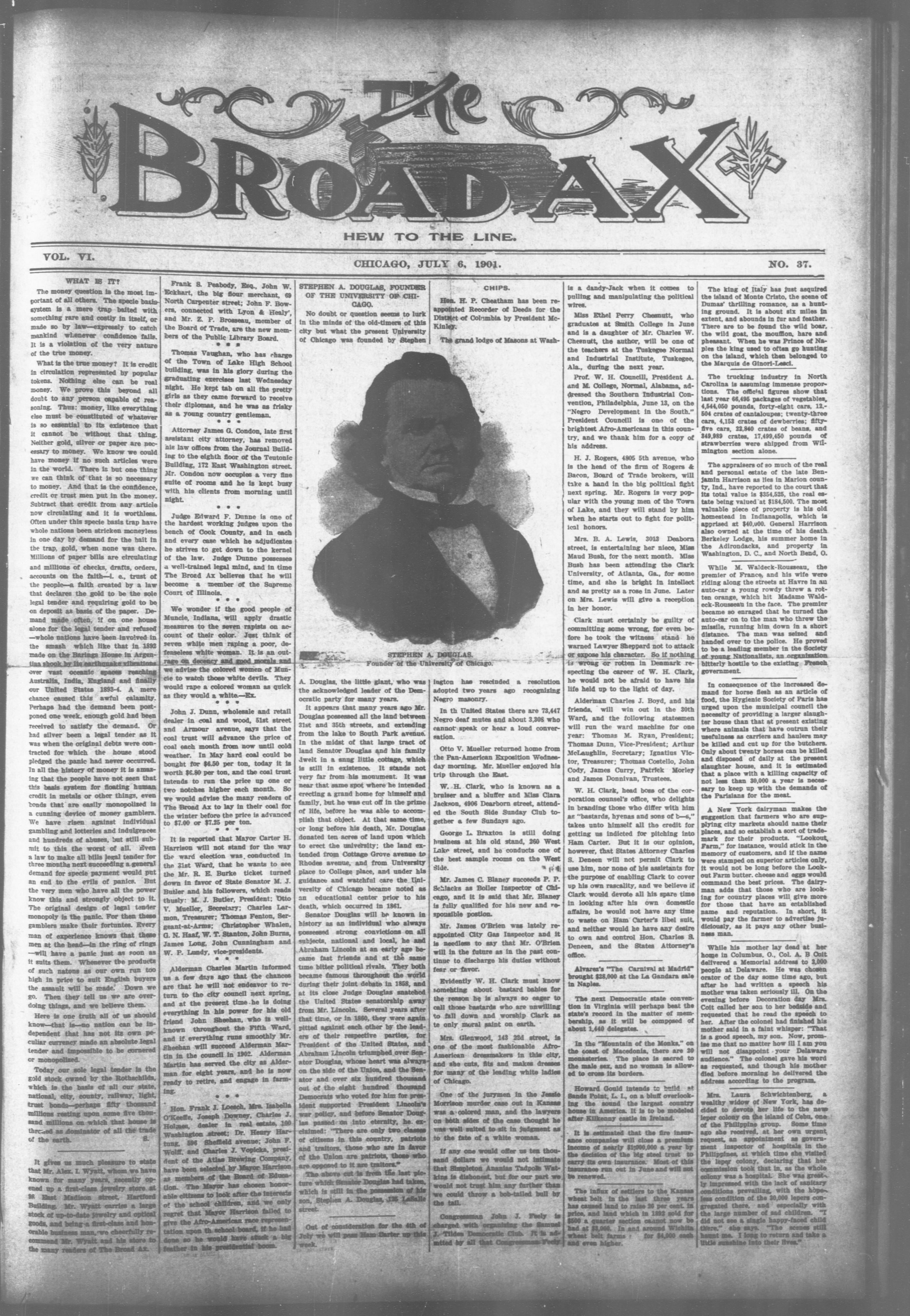
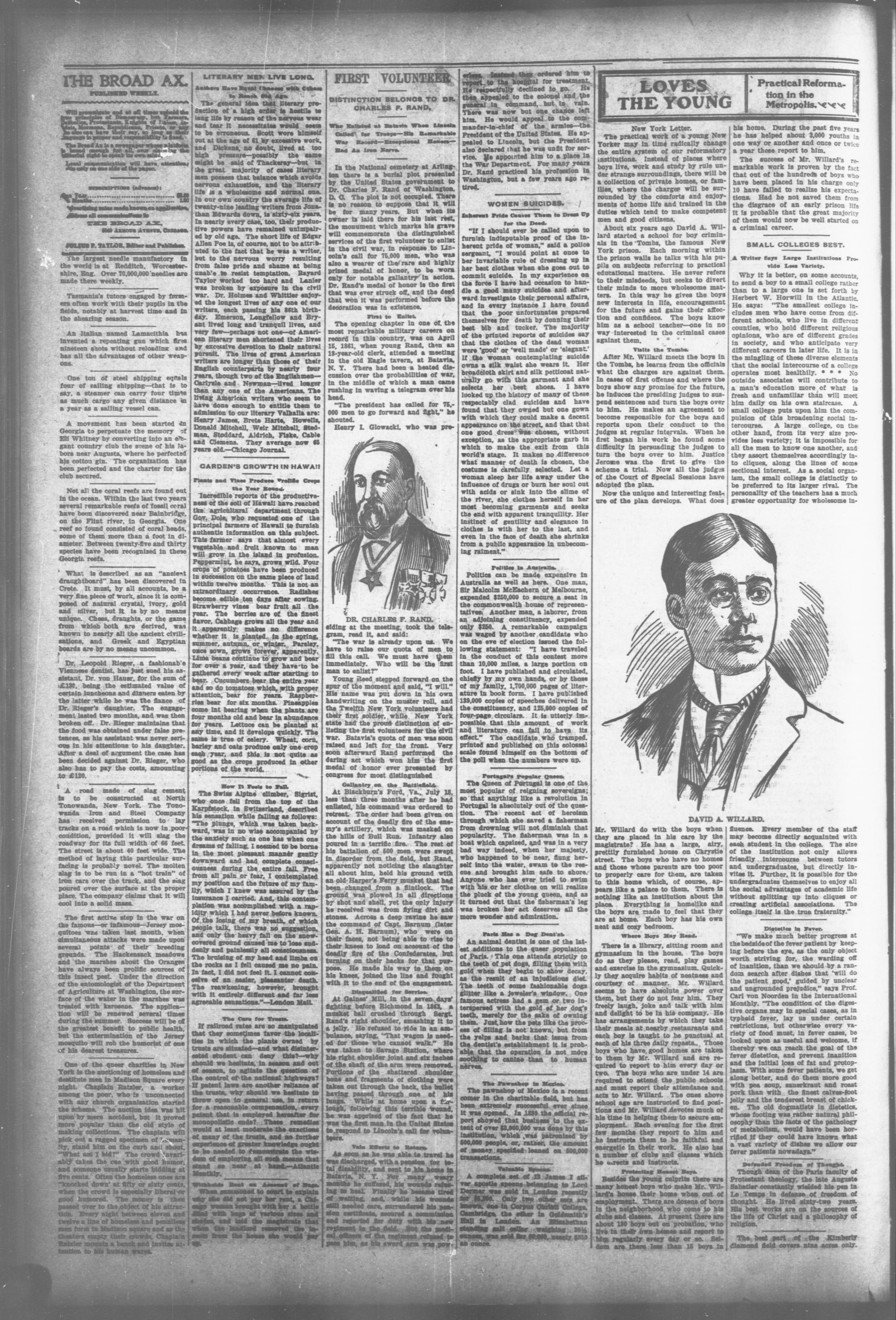
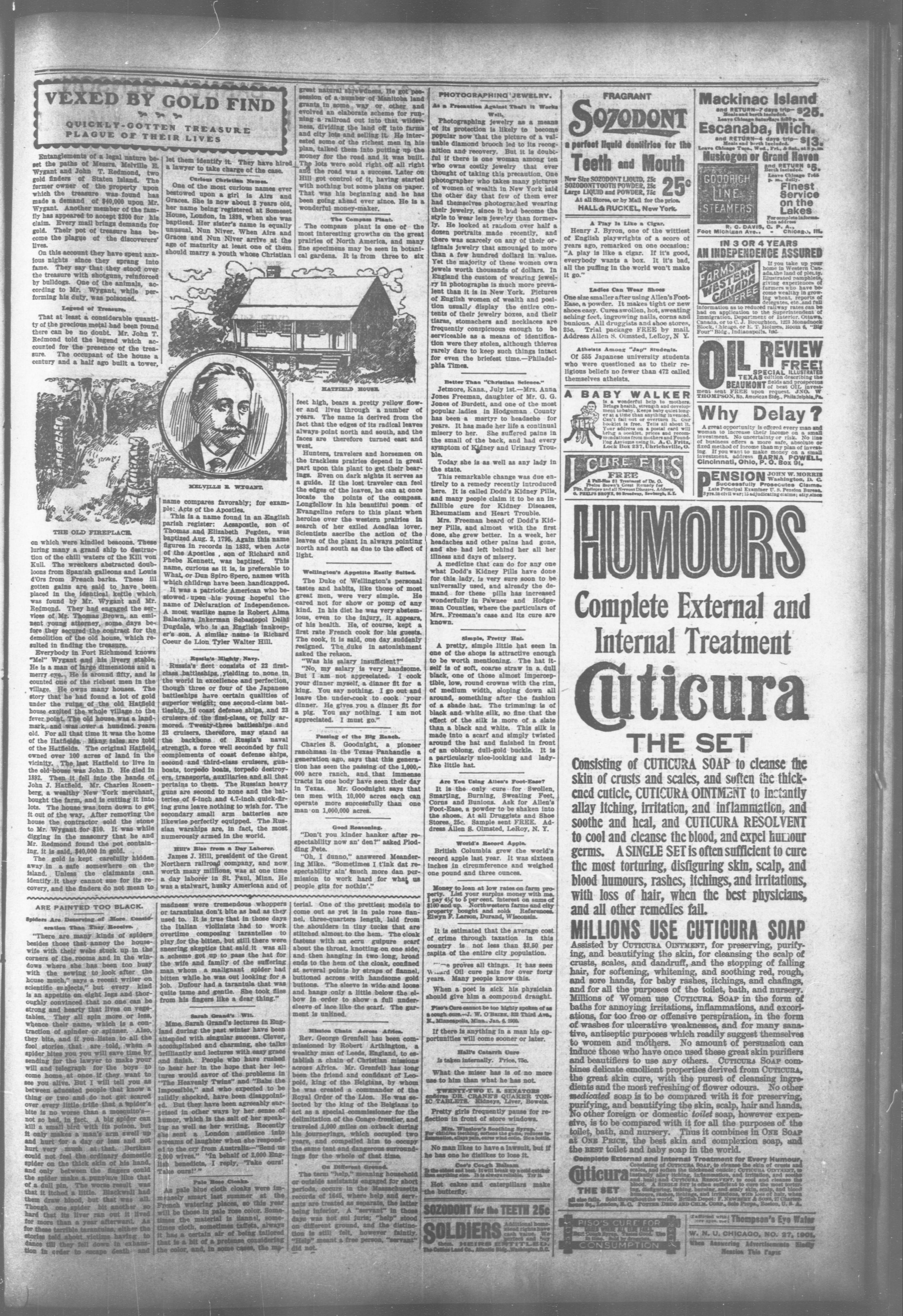
Page text (machine-generated)
THE BROAD AX
HEW TO THE LINE.
WHAT IS IT?
The money question is the most important of all others. The specie basis system is a mere trap baited with something rare and costly in itself, or made so by law—expressly to catch mankind whenever confidence fails. It is a violation of the very nature of the true money.
What is the true money? It is credit in circulation represented by popular tokens. Nothing else can be real money. We prove this beyond all doubt to any person capable of reasoning. Thus: money, like everything else must be constituted of whatever is so essential to its existence that it cannot be without that thing. Neither gold, silver or paper are necessary to money. We know we could have money if no such articles were in the world. There is but one thing we can think of that is so necessary to money. And that is the confidence, credit or trust men put in the money. Subtract that credit from any article now circulating and it is worthless. Often under this specie basis trap have whole nations been stricken moneyless in one day by demand for the bait in the trap, gold, when none was there. Millions of paper bills are circulating and millions of checks, drafts, orders, accounts on the faith—l. e., trust of the people—a faith created by a law that declares the gold to be the sole legal tender and requiring gold to be on deposit as basis of the paper. Demand made often, if on one house alone for the legal tender and refused—whole nations have been involved in the smash which like that in 1892 made on the Barings House in Argentina shook by its earthquake vibrations over vast oceanic spaces reaching Australia, India, England and finally our United States 1893-4. A mere chance caused this awful calamity. Perhaps had the demand been postponed one week, enough gold had been received to satisfy the demand. Or had silver been a legal tender as it was when the original debts were contracted for which the house stood pledged the panic had never occurred. In all the history of money it is amazing that the people have not seen that this basis system for floating human credit in metals or other things, even bonds that are easily monopolized is a cunning device of money gamblers. We have risen against individual gambling and lotteries and indulgences and hundreds of abuses, but still submit to this the worst of all. Even a law to make all bills legal tender for three months next succeeding a general demand for specie payment would put an end to the evils of panics. But the very men who have all the power know this and strongly object to it. The original design of legal tender monopoly is the panic. For then these gamblers make their fortunes. Every man of experience knows that these men at the head—in the ring of rings—will have a panic just as soon as it suits them. Whenever the products of such natons as our own run too high in price to suit English buyers the assault will be made. Down we go. Then they tell us we are overdoing things, and we believe them.
---
Here is one truth all of us should know—that is—no nation can be independent that has not its own peculiar currency made an absolute legal tender and impossible to be cornered or monopolized.
Today our sole legal tender is the gold stock owned by the Rothschilds, which is the basis of all our state, national, city, county, railway, light, trust bonds-perhaps fifty thousand millions resting upon some five thousand millions on which that house is thresed as dominator of all the trade of the earth. 8.
It gives us much pleasure to state that Mr. Alex. I. Wyatt, whom we have known for many years, recently opened up a first-class jewelry store at 98 East Madison street, Hartford Building. Mr. Wyatt curries a large stock of up-to-date jewelry and optical goods, and being a first-class and honorable business man, we cheerfully recommend Mr. Wyatt and his store to the many readers of The Broad Ax.
---
Frank S. Peabody, Esq., John W. Eckhart, the big flour merchant, 69 North Carpenter street; John F. Bowers, connected with Lyon & Healy' and Mr. Z. P. Brosseau, member of the Board of Trade, are the new members of the Public Library Board.
Thomas Vaughan, who has charge of the Town of Lake High School building, was in his glory during the graduating exercises last Wednesday night. He kept tab on all the pretty girls as they came forward to receive their diplomas, and he was as frisky as a young country gentleman.
Attorney James G. Condon, late first assistant city attorney, has removed his law offices from the Journal Building to the eighth floor of the Teutonic Building, 172 East Washington street. Mr. Condon now occupies a very fine suite of rooms and he is kept busy with his clients from morning until night.
Judge Edward F. Dunne is one of the hardest working judges upon the bench of Cook County, and in each and every case which he adjudicates he strives to get down to the kernel of the law. Judge Dunne possesses a well-trained legal mind, and in time The Broad Ax believes that he will become a member of the Supreme Court of Illinois.
We wonder if the good people of Muncie, Indiana, will apply drastic measures to the seven rapists on account of their color. Just think of seven white men raping a poor, defenseless white woman. It is an outrage on decency and good morals and we advise the colored women of Muncie to watch those white devils. They would rape a colored woman as quick as they would a white.—Ex.
John J. Dunn, wholesale and retail dealer in coal and wood, 51st street and Armour avenue, says that the coal trust will advance the price of coal each month from now until cold weather. In May hard coal could be bought for $6.50 per ton, today it is worth $6.80 per ton, and the coal trust intends to run the price up one or two notches higher each month. So we would advise the many readers of The Broad Ax to lay in their coal for the winter before the price is advanced to $7.00 or $7.25 per ton.
It is reported that Mayor Carter H. Harrison will not stand for the way the ward election was conducted in the 31st Ward, that he wants to see the Mr. R. E. Burke ticket turned down in favor of State Senator M. J. Butler and his followers, which reads thusly: M. J. Butler, President; Otto V. Mueller, Secretary; Charles Larmon, Treasurer; Thomas Fenton, Sergeant-at-Arms; Christopher Whalen, G. N. Haaf, W. T. Stanton, John Burns, James Long, John Cunningham and W. P. Landy, vice-presidents.
Alderman Charles Martin informed us a few days ago that the chances are that he will not endeavor to return to the city council next spring, and at the present time he is doing everything in his power for his old friend John Sheehan, who is well-known throughout the Fifth Ward, and if everything runs smoothly Mr. Sheehan will succeed Alderman Martin in the council in 1902. Alderman Martin has served the city as Alderman for eight years, and he is now ready to retire, and engage in farming.
Hon. Frank J. Loesch, Mrs. Isabella O'Keeffe, Joseph Downey, Charles J. Holmes, dealer in real estate, 100 Washington street; Dr. Henry Hartung, 596 Sheffield avenue; John F. Wolff, and Charles J. Vopicka, president of the Atlas Brewing Company, have been selected by Mayor Harrison as members of the Board of Education. The Mayor has chosen honorable citizens to look after the interests of the school children, and we only regret that Mayor Harrison failed to give the Afro-American race representation upon th school board. If he had done so he would have stuck a big feather in his presidential boom.
CHICAGO, JULY 6, 1901.
STEPHEN A. DOUGLAS, FOUNDER OF THE UNIVERSITY OF CHICAGO.
No doubt or question seems to lurk in the minds of the old-timers of this city but what the present University of Chicago was founded by Stephen
STEPHEN
Founder of the U
STEPHEN A. DOUGLAS.
A. Douglas, the little giant, who was the acknowledged leader of the Democratic party for many years.
It appears that many years ago Mr. Douglas possessed all the land between 31st and 35th streets, and extending from the lake to South Park avenue. In the midst of that large tract of land Senator Douglas and his family Jwelt in a snug little cottage, which is still in existence. It stands not very far from his monument. It was near that same spot where he intended erecting a grand home for himself and family, but he was cut off in the prime of life, before he was able to accomplish that object. At that same time, or long before his death, Mr. Douglas donated ten acres of land upon which to erect the university; the land extended from Cottage Grove avenue to Rhodes avenue, and from University place to College place, and under his guidance and watchful care the University of Chicago became noted as an educational center prior to his death, which occurred in 1861.
Senator Douglas will be known in history as an individual who always possessed strong convictions on all subjects, national and local, he and Abraham Lincoln at an early age became fast friends and at the same time bitter political rivals. They both became famous throughout the world during their joint debate in 1858, and at its close Judge Douglas snatched the United States senatorship away from Mr. Lincoln. Several years after that time, or in 1860, they were again pitted against each other by the leaders of their respective parties, for President of the United States, and Abraham Lincoln triumphed over Senator Douglas, whose heart was always on the side of the Union, and the Senator and over six hundred thousand out of the eight hundred thousand Democrats who voted for him for president supported President Lincoln's war policy, and before Senator Douglas passed on into eternity, he exclaimed: "There are only two classes of citizens in this country, patriots and traitors, those who are in favor of the Union are patriots, those who are opposed to it are traitors."
The above cut is from the last picture which Senator Douglas had taken, which is still in the possession of his son, Stephen A. Douglas, 125 LaSalle street.
Out of consideration for the 4th of July we will pass Ham Carter up this week.
```markdown
```
CHIPS.
Hon. H. P. Cheatham has been reappointed Recorder of Deeds for the District of Columbia by President McKinley.
The grand lodge of Masons at Wash-
A. DOUGLAS.
University of Chicago.
ington has rescinded a resolution adopted two years ago recognizing Negro masonry.
In th United States there are 73,447 Negro deaf mutes and about 3,308 who cannot speak or hear a loud conversation.
Otto V. Mueller returned home from the Pan-American Exposition Wednesday morning. Mr. Mueller enjoyed his trip through the East.
W. H. Clark, who is known as a bruiser and a bluffer and Miss Clara Jackson, 4906 Dearborn street, attended the South Side Sunday Club together a few Sundays ago.
George L. Braxton is still doing business at his old stand, 260 West Lake street, and he conducts one of the best sample rooms on the West Side.
Mr. James C. Blaney succeeds P. P. Schlacks as Boller Inspector of Chicago, and it is said that Mr. Blaney is fully qualified for his new and responsible postion. Mr. James O'Brien was lately reappointed City Gas Inspector and it is needless to say that Mr. O'Brien will in the future as in the past continue to discharge his duties without fear or favor.
Evidently W. H. Clark must know something about bastard babies for the reason he is always so eager to call those bastards who are unwilling to fall down and worship Clark as te only moral saint on earth.
Mrs. Glenwood, 143 22d street, is one of the most fashionable Afro-American dressmakers in this city, and she cuts, fits and makes dresses for many of the leading white ladies of Chicago.
One of the jurymen in the Jessie Morrison murder case out in Kansas was a colored man, and the lawyers on both sides of the case thought he was well suited to sit in judgment as to the fate of a white woman.
If any one would offer us ten thousand dollars we would not intimate that Simpleton Ananias Tadpole Watkins is dishonest, but for our part we would not trust him any further than we could throw a bob-tailed bull by the tail.
Congressman John J. Feely is charged with organizing the Samuel J. Tilden Democratic Club. It is admitted by all that Congressman Feely
is a dandy-Jack when it comes to pulling and manipulating the political wires. Miss Ethel Perry Chesnutt, who graduates at Smith College in June and is a daughter of Mr. Charles W. Chesnutt, the author, will be one of the teachers at the Tuskegee Normal and Industrial Institute, Tuskegee, Ala., during the next year.
Prof. W. H. Councill, President A. and M. College, Normal, Alabama, addressed the Southern Industrial Convention, Philadelphia, June 13, on the "Negro Development in the South." President Councill is one of the brightest Afro-Americans in this country, and we thank him for a copy of his address.
H. J. Rogers, 4805 5th avenue, who is the head of the firm of Rogers & Bacon, Board of Trade brokers, will take a hand in the big political fight next spring. Mr. Rogers is very popular with the young men of the Town of Lake, and they will stand by him when he starts out to fight for political honors.
Mrs. B. A. Lewis, 3013 Deaborn street, is entertaining her niece, Miss Maud Bush, for the next month. Miss Bush has been attending the Clark University, of Atlanta, Ga., for some time, and she is bright in intellect and as pretty as a rose in June. Later on Mrs. Lewis will give a reception in her honor.
Clark must certainly be guilty of committing some wrong, for even before he took the witness stand he warned Lawyer Sheppard not to attack or expose his character. So if nothing is wrong or rotten in Denmark respecting the career of W. H. Clark, he would not be afraid to have his life held up to the light of day.
Alderman Charles J. Boyd, and his friends, will win out in the 30th Ward, and the following statesmen will run the ward machine for one year: Thomas M. Ryan, President; Thomas Dunn, Vice-President; Arthur McLaughlin, Secretary; Ignatius Victor, Treasurer; Thomas Costello, John Cody, James Curry, Patrick Morley and James Donnivan, Trustees.
W. H. Clark, head boss of the corporation counsel's office, who delights in branding those who differ with him as "bastards, hyenas and sons of b—s," takes unto himself all the credit for getting us indicted for pitching into Ham Carter. But it is our opinion, however, that States Attorney Charles S. Deneen will not permit Clark to use him, nor none of his assistants for the purpose of enabling Clark to cover up his own rascality, and we believe if Clark would devote all his spare time in looking after his own domestic affairs, he would not have any time to waste on Ham Carter's libel suit, and neither would he have any desire to own and control Hon. Charles S. Deneen, and the States Attorney's office.
Alvarez's "The Carnival at Madrid" brought $28,000 at the La Gandara sale in Naples.
The next Democratic state convention in Virginia will perhaps beat the state's record in the matter of membership, as it will be composed of about 1,440 delegates.
In the "Mountain of the Monks," on the coast of Macedonia, there are 20 monasteries. The place is sacred to the male sex, and no woman is allowed to cross its borders.
Howard Gould intends to build at Sands Point, L. L., on a bluff overlooking the sound the largest country house in America. It is to be modeled after Kilkenny castle in Ireland.
It is estimated that the fire insurance companies will close a premium income of nearly $1,000,000 a year by the decision of the big steel trust to carry its own insurance. Most of this insurance run out in June and will not be renewed.
The influx of settlers to the Kansas wheat belt in the last three years has caused land to raise 20 per cent. in price, and land which in 1892 sold for $500 a quarter section cannot now be had at $3,000. In and around Wichita wheat belt farms: for $4,000 each and even higher.
NO. 37.
The king of Italy has just asquired the island of Monte Cristo, the scene of Dumas' thrilling romance, as a hunting ground. It is about six miles in extent, and abounds in fur and feather. There are to be found the wild boar, the wild goat, the moufflon, hare and pheasant. When he was Prince of Naples the king used to often go hunting on the island, which then belonged to the Marquis de Ginori-Lesci.
The trucking industry in North Carolina is assuming immense proportions. The official figures show that last year 66,495 packages of vegetables, 4,544,050 pounds, forty-eight cars, 12,504 crates of cantaloupes; twenty-three cars, 4,153 crates of dewberries; fifty-five cars, 22,840 crates of beans, and 349,989 crates, 17,499,450 pounds of strawberries were shipped from Wilmington section alone.
The appraisers of so much of the real and personal estate of the late Benjamin Harrison as lies in Marion county, Ind., have reported to the court that its total value is $354,525, the real estate being valued at $184,500. The most valuable piece of property is his old homestead in Indianapolis, which is apprised at $40,000. General Harrison also owned at the time of his death Berkeley Lodge, his summer home in the Adirondacks, and property in Washington, D. C., and North Bend, O.
While M. Waldeck-Rousseau, the premier of France, and his wife were riding along the streets at Havre in an auto-car a young rowdy threw a rotten orange, which hit Madame Waldeck-Rousseau in the face. The premier became so enraged that he turned the auto-car on to the man who threw the missile, running him down in a short distance. The man was seized and handed over to the police. He proved to be a leading member in the Society of young Nationalists, an organization bitterly hostile to the existing French government.
In consequence of the increased demand for horse flesh as an article of food, the Hygienic Society of Paris has urged upon the municipal council the necessity of providing a larger slaughter house than that at present existing where animals that have outrun their usefulness as carriers and haulers may be killed and cut up for the butchers. Only about twenty horses can be killed and disposed of daily at the present slaughter house, and it is estimated that a place with a killing capacity of not less than 30,000 a year is necessary to keep up with the demands of the Parisians for the meat.
A New York dairyman makes the suggestion that farmers who are supplying city markets should name their places, and so establish a sort of trademark for their products. "Lookout Farm," for instance, would stick in the memory of customers, and if the name were stamped on superior articles only, it would not be long before the Lookout Farm butter, cheese and eggs would command the best prices. The dairyman adds that those who are looking for country places will give more for those that have an established name and reputation. In short, it would pay the farmer to advertise judiciously, as it pays any other business man.
While his mother lay dead at her home in Columbus, O., Col. A. B Coit delivered a Memorial address to 2,000 people at Delaware. He was chosen orator of the day some time ago, but after he had written a speech his mother was taken seriously ill. On the evening before Decoration day Mrs. Coit called her son to her bedside and requested that he read the speech to her. After the colonel had finished his mother said in a faint whisper: "That is a good speech, my son. Now, promise me that no matter how ill I am you will not disappoint your Delaware audience." The colonel gave his word as requested, and though his mother died before morning he delivered the address according to the program.
Mrs. Laura Schwichtenberg, a wealthy widow of New York, has decided to devote her life to the new leper colony on the island of Cebu, one of the Philippine group. Some time ago she received, at her own urgent request, an appointment as government inspector of hospitals in the Philippines, at which time she visited the leper colony, declaring that her commission took that in, as the whole colony was a hospital. She was greatly impressed with the lack of sanitary conditions prevailing, with the hopeless condition of the 30,000 lepers congregated there, and especially with the large number of sad children. "I did not see a single happy-faced child there," she says. "The scenes still haunt me. I long to return and take a little sunshine into their lives."
Will promulgate and at all times uphold the one principles of Democracy, but Farmers, Lutherans, Protestants, Knights of Dauw, Indians, Mormons, Republicans, Priests, or any he also can have their say, no long as their language is proper and responsibility is fixed.
The Broad Ax is a newspaper whose platform is broad enough for all, ever claiming the inferior right to speak its own mind.
Local communication will have attention; the only one on one side of the paper.
The largest needle manufactory in the world is at Redditch, Worcestershire, Eng. Over 70,000,000 needles are made there weekly.
Tasmania's tutors engaged by farmers often work with their pupils in the fields, notably at harvest time and in the shearing season.
An Italian named Lamacithia has invented a repeating gun which fires nineteen shots without reloading and has all the advantages of other weapons.
One ton of steel shipping equals four of sailing shipping—that is to say, a steamer can carry four times as much cargo any given distance in a year as a sailing vessel can.
A movement has been started in Georgia to perpetuate the memory of Eli Whitney by converting into an elegant country club the scene of his labors near Augusta, where he perfected his cotton gin. The organization has been perfected and the charter for the club secured.
Not all the coral reefs are found out in the ocean. Within the last two years several remarkable reefs of fossil coral have been discovered near Bainbridge, on the Flint river, in Georgia. One reef so found consisted of coral heads, some of them more than a foot in diameter. Between twenty-five and thirty species have been recognized in these Georgis reefs.
What is described as an "ancient draughtboard" has been discovered in Crete. It must, by all accounts, be a very fine piece of work, since it is composed of natural crystal, ivory, gold and silver, but it is by no means unique. Chess, draughts, or the game from which both are derived, was known to nearly all the ancient civilizations, and Greek and Egyptian boards are by no means uncommon.
Dr. Leopold Rieger, a fashionab'e Viennese dentist, has just sued his assistant, Dr. von Hauer, for the sum of £130, being the estimated value of certain luncheons and dinners eaten by the latter while he was the flance of Dr. Rieger's daughter. The engagement lasted two months, and was then broken off. Dr. Rieger maintains that the food was obtained under false pretences, as his assistant was never serious in his attentions to his daughter. After a deal of argument the case has been decided against Dr. Rieger, who also has to pay the costs, amounting to £120.
A road made of slag cement is to be constructed at North Tonowanda, New York. The Tonowanda Iron and Steel Company has received permission to lay tracks on a road which is now in poor condition, provided it will slag the roadway for its full width of 66 feet. The street is about 40 feet wide. The method of laying this particular surfacing is probably novel. The molten slag is to be run in a "hot train" of iron cars over the track, and the siag poured over the surface at the proper place. The company claims that it will cool into a solid mass.
The first active step in the war on the famous—or infamous—Jersey mosquitoes was taken last month, when simultaneous attacks were made upon several points of their breeding grounds. The Hackensack meadows and the marshes about the Oranges have always been prolific sources of this insect pest. Under the direction of the entomologist of the Department of Agriculture at Washington, the surface of the water in the marshes was treated with kerosene. The application will be renewed several times during the summer. Success will be of the greatest benefit to public health, but the extermination of the Jersey mosquito will rob the humorist of one of his dearest treasures.
One of the queer charities in New York is the auctioning of homeless and destitute men in Madison Square every night. Chaplain Ratzler, a worker among the poor, who is unconnected with any church organization started the scheme. The auction idea was hit upon by mere accident, but it proved more popular than the old style of making collections. The chaplain will pick out a ragged specimen of humanity, stand him on the curb and shout, "What am I bid?" The crowd invariably takes the cue with good humor, and someone usually starts bidding at five cents. Often the homeless ones are "knocked down" at fifty or sixty cents, when the crowd is especially liberal or good humored. The money is then passed over to the object of his attraction. Every night between eleven and twelve a line of homeless and penniless men form in Madison square and as the theaters empty their crowds, Chaplain Ratzler mounts a bench and invites attention to his human warm
LITERARY MEN LIVE LONG
Authors Have Equal Chances with Others
to Reach Old Age
The general idea that literary production of a high order is hostile to long life by reason of the nervous wear and tear it necessitates would seem to be erroneous. Scott wore himself out at the age of 61 by excessive work, and Dickens, no doubt, lived at too high pressure—possibly the same might be said of Thackeray—but in the great majority of cases literary men possess that balance which avoids nervous exhaustion, and the literary life is a wholesome and normal one. In our own country the average life of twenty-nine leading writers from Jonathan Edwards down, is sixty-six years. In nearly every case, too, their productive powers have remained unimpaired by old age. The short life of Edgar Allen Poe is, of course, not to be attributed to the fact that he was a writer, but to the nervous worry resulting from false pride and shame at being unable to resist temptation. Bayard Taylor worked too hard and Lanier was broken by exposure in the civil war. Dr. Holmes and Whittier enjoyed the longest lives of any one of our writers, each passing his 86th birthday. Emerson, Longfellow and Bryant lived long and tranquil lives, and very few—perhaps not one—of American literary men shortened their lives by excessive devotion to their natural pursuit. The lives of great American writers are longer than those of their English counterparts by nearly four years, though two of the Englishmen—Carlysle and Newman—lived longer than any one of the Americans. The living American writers who seem to have done enough to entitle them to admission to our literary Valhalla are: Henry James, Brete Harte, Howells, Donald Mitchell, Weir Mitchell, Stedman, Stoddard, Aldrich, Fiske, Cable and Clemens. They average now 65 years old.—Chicago Journal.
GARDEN'S GROWTH IN HAWAII
Plants and Vines Produce Prolific Crops the Year Round.
Incredible reports of the productivity of the soil of Hawaii have reached the agricultural department through Gov. Dole, who requested one of the principal farmers of Hawaii to furnish authentic information on this subject. This farmer says that almost every vegetable and fruit known to man will grow in the island in profusion. Peppermint, he says, grows wild. Four crops of potatoes have been produced in succession on the same piece of land within twelve months. This is not an extraordinary occurrence. Radishes become edible ten days after sowing. Strawberry vines bear fruit all the year. The berries are of the finest flavor. Cabbage grows all the year and it apparently makes no difference whether it is planted, in the spring, summer, autumn, or winter. Parsley, once sown, grows forever, apparently. Lima beans continue to grow and bear for over a year, and they have to be gathered every week after starting to bear. Cucumbers bear the entire year and so do tomatoes which, with proper attention, bear for years. Raspberries bear for six months. Pineapples come int bearing when the plants are four months old and bear in abundance for years. Lettuce can be planted at any time, and it develops quickly. The same is true of celery. Wheat, corn, barley and oats produce only one crop each year, and this is not quite as good as the crops produced in other portions of the world.
How It Feels to Fall.
The Swiss Alpine climber, Sigrist, who once fell from the top of the Karpfstock, in Switzerland, described his sensation while falling as follows: "The plunge, which was taken backward, was in no wise accompanied by the anxiety such as one has when one dreams of falling. I seemed to be borne in the most pleasant manner gently downward and had complete consciousness during the entire fall. Free from all pain or fear, I contemplated my position and the future of my family, which I knew was assured by the insurance I carried. And, this contemplation was accomplished with a rapidity which I had never before known. Of the losing of my breath, of which people talk, there was no suggestion, and only the heavy fall on the snow-covered ground caused me to lose suddenly and painlessly all consciousness. The bruising of my head and limbs on the rocks as I fell caused me no pain. In fact, I did not feel it. I cannot consolve of an easier, pleasanter death. The reawkening, however, brought with it entirely different and far less agreeable sensations."—London Mail.
If railroad rates are so manipulated that they sometimes favor the localities in which the plants owned by trusts are situated—and what disinterested student can deny this?—why should we hesitate, in season and out of season, to agitate the question of the control of the national highways? If patent laws are another reliance of the trusts, why should we hesitate to throw open to general use, in return for a reasonable compensation, every patent that is employed hereafter for monopolistic ends? These remedies would at least moderate the exactions of many of the trusts, and no further experience of greater knowledge ought to be needed to demonstrate the wisdom of employing all such means that stand so near at hand.—Atlantic Monthly.
Withholds Bent on Account of Bugs. When summoned to court to explain why she did not pay her rent, a Chicago woman brought with her a bottle filled with bugs of various sizes and shapes, and told the magistrate that when the landlord removed the insects from the house she would pay us.
Whe Enlisted at Batavia When Lincoln Called for Troops—His Remarkable War Record—Exceptional Honors— Had An Iron Norve
In the National cemetery at Arlington there is a burial plot presented by the United States government to Dr. Charles F. Rand of Washington, D. C. The plot is not occupied. There is no reason to suppose that it will be for many years. But when its owner is laid there for his last rest, the monument which marks his grave will commemorate the distinguished services of the first volunteer to enlist in the civil war, in response to Lincoln's call for 75,000 men, who was also a wearer of the rare and highly prized medal of honor, to be worn only for notable gallantry in action. Dr. Rand's medal of honor is the first that was ever struck off, and the deed that won it was performed before the decoration was in existence.
First to Enlist.
The opening chapter in one of the most remarkable military careers on record in this country, was on April 15, 1861, when young Rand, then an 18-year-old clerk, attended a meeting in the old Eagle tavern, at Batavia, N. Y. There had been a heated discussion over the probabilities of war, in the middle of which a man came rushing in waving a telegram over his head.
"The president has called for 75,000 men to go forward and fight," he shouted.
Henry I. Glowacki, who was pre-
S.
DR. CHARLES F. RAND.
DR. CHARLES F. RAND.
siding at the meeting, took the telegram, read it, and said:
"The war is already upon us. We have to raise our quota of men to fill this call. We must have them immediately. Who will be the first man to enlist?"
Young Reed stepped forward on the spur of the moment and said, "I will." His name was put down in his own handwriting on the muster roll, and the Twelfth New York volunteers had their first soldier, while New York state had the proud distinction of enlisting the first volunteers for the civil war. Batavia's quota of men was soon raised and left for the front. Very soon afterward Rand performed the daring act which won him the first medal of honor ever presented by congress for most distinguished
Gallantry on the Battlefield.
Gallantry on the Battlefield. At Blackburn's Ford, Va., July 18, less than three months after he had enlisted, his command was ordered to retreat. The order had been given on account of the deadly fire of the enemy's artillery, which was masked on the hills of Bull Run. Infantry also poured in a terrific fire. The rest of his battalion of 500 men were swept in disorder from the field, but Rand, apparently not noticing the slaughter all about him, held his ground with an old Harper's Ferry musket that had been changed from a flintlock. The ground was plowed in all directions by shot and shell, yet the only injury he received was from flying dirt and stones. Across a deep ravine he saw the command of Capt. Barnum (later Gen. A. H. Barnum), who were on their faces, not being able to rise to their knees to load on account of the deadly fire of the Confederates, but turning on their backs for that purpose. He made his way to them on his knees, joined the line and fought with it to the end of the engagement.
Disqualified for Service.
At Gaines' Mill, in the seven days' fighting before Richmond in 1862, a musket ball crushed through Sergt. Rand's right shoulder, smashing it to a jelly. He refused to ride in an ambulance, saying, "That wagon is needed for those who cannot walk." He was taken to Savage Station, where his right shoulder joint and six inches of the shaft of the arm were removed. Portions of the shattered shoulder bone and fragments of clothing were taken out through the back, the bullet having passed through one of his lungs. While at home upon a fallough, following this terrible wound, he was apprised of the fact that he was the first man in the United States to respond to Lincoln's call for volunteers.
Vain Efforts to Return
As soon as he was able to travel he was discharged, with a pension for total disability, and sent to his home in Batavia, N. Y. For many weary months he suffered, his wounds refusing to heal. Finally he became tired of waiting, and, while his wounds still needed care, surrendered his pension certificate, secured a commission and reported for duty with his new regiment in the field. But the medical officer of the regiment refused to pass him, as his sword arm was pow-
eriena. Instead they ordered him to report to the hospital for treatment. He respectfully declined to go. He then appealed to the colonel and the general in command, but in vain. There was now but one chance left him. He would appeal to the commander-in-chief of the armies—the President of the United States. He appealed to Lincoln, but the President also declared that he was unfit for service. He appointed him to a place in the War Department. For many years Dr. Rand practiced his profession in Washington, but a few years ago retired.
WOMEN SUICIDES.
Inherent Pride Causes Them to Dress Up for the Dead.
"If I should ever be called upon to furnish indisputable proof of the inherent pride of woman," said a police sergeant, "I would point at once to her invariable rule of dressing up in her best clothes when she goes out to commit suicide. In my experience on the force I have had occasion to handle a good many suicides and afterward investigate their personal affairs, and in every instance I have found that the poor unfortunates prepared themselves for death by donning their best bib and tucker. The majority of the printed reports of suicides say that the clothes of the dead woman were 'good' or 'well made' or 'elegant.' If the woman contemplating suicide owns a silk walst and silk petticoat naturally go with this garment and she selects her best shoes. I have looked up the history of many of these respectably clad suicides and have found that they owned but one gown with which they could make a decent appearance on the street, and that that one good dress was chosen, without exception, as the appropriate garb in which to make the exit from this world's stage. It makes no difference what manner of death is chosen, the costume is carefully selected. Let a woman sleep her life away under the influence of drugs or burn her soul out with acids or sink into the slime of the river, she clothes herself in her most becoming garments and seeks the end with apparent tranquility. Her instinct of gentility and elegance in clothes is with her to the last, and even in the face of death she shrinks from a public appearance in unbecoming raiment."
Politics in Australia
Politics can be made expensive in Australia as well as here. One man, Sir Malcolm McEachern of Melbourne, expended $250,000 to secure a seat in the commonwealth house of representatives. Another man, a laborer, from an adjoining constituency, expended only $250. A remarkable campaign was waged by another candidate who on the eve of election issued the following statement: "I have traveled in the conduct of this contest more than 10,000 miles, a large portion on foot. I have published and circulated, chiefly by my own hands, or by those of my family, 1,700,000 pages of literature in book form. I have published 139,000 copies of speeches delivered in the constituency, and 125,000 copies of four-page circulars. It is utterly impossible that this amount of work and literature can fail to have its effect." The candidate who tramped, printed and published on this colossal scale found himself on the bottom of the poll when the numbers were up.
Portugal's Popular Queen
The Queen of Portugal is one of the most popular of reigning sovereigns; so that anything like a revolution in Portugal is absolutely out of the question. The recent act of heroism through which she saved a fisherman from drowning will not diminish that popularity. The fisherman was in a boat which capsized, and was in a very bad way indeed, when her majesty, who happened to be near, flung herself into the water, swam to the rescue and brought him safe to shore. Anyone who has ever tried to swim with his or her clothes on will realize the pluck of the young queen, and as it turned out that the fisherman's leg was broken her act deserves all the more wonder and admiration.
Paris Has a Dog Den'tah
An animal dentist is one of the latest additions to the queer population of Paris. This one attends strictly to the teeth of pet dogs, filling them with gold when they begin to show decay, as the result of an injudicious diet. The teeth of some fashionable dogs glitter like a jeweler's window. One famous actress had a gem or two interspersed with the gold of her dog's teeth, merely for the sake of owning them. Just how the pets like the process of filling is not known, but from the yelps and barks that issue from the dentist's establishment it is probable that the operation is not more soothing to canine than to human nerves.
The Pawnshop in Mexico
The pawnshop of Mexico is a recent comer in the charitable field, but has been extremely successful ever since it was opened. In 1899 the official report showed that business to the extent of over $3,000,000 was done by this institution, which was patronized by 500,000 people, or, rather, the amount of money specified loaned on 500,000 transactions.
Valuable Broken.
A complete set of 13 James I all-var apostle spoons belonging to Lord Dermer was sold in London recently for $9,200. Only two other sets are known, one in Corpus Christi College, Cambridge, the other in Goldsmith's Hall in London. An Elizabethan standing salt collar weighing 29½ ounces, was sold for $9,000, nearly $850 an ounce.
LOVES THE YOUNG
New York Letter. The practical work of a young New Yorker may in time radically change the entire system of our reformatory institutions. Instead of places where boys live, work and study by rule under strange surroundings, there will be a collection of private homes, or families, where the charges will be surrounded by the comforts and enjoyments of home life and trained in the duties which tend to make competent men and good citizens.
About six years ago David A. Willard started a school for boy criminals in the Tombs, the famous New York prison. Each morning within the prison walls he talks with his pupils on subjects referring to practical educational matters. He never refers to their misdeeds, but seeks to divert their minds to more wholesome matters. In this way he gives the boys new interests in life, encouragement for the future and gains their affection and confidence. The boys know him as a school teacher—one in no way interested in the criminal cases against them.
After Mr. Willard meets the boys in the Tombs, he learns from the officials what the charges are against them. In cases of first offense and where the boys show any promise for the future, he induces the presiding judges to suspend sentences and turn the boys over to him. He makes an agreement to become responsible for the boys and reports upon their conduct to the judges at regular intervals. When he first began his work he found some difficulty in persuading the judges to turn the boys over to him. Justice Jerome was the first to give the scheme a trial. Now all the judges of the Court of Special Sessions have adopted the plan.
Now the unique and interesting feature of the plan develops. What does
```markdown
```
DAVID A. WILLARD.
Mr. Willard do with the boys when they are placed in his care by the magistrate? He has a large, airy, prettily furnished house on Chrystle street. The boys who have no homes and those whose parents are too poor to properly care for them, are taken to this home which, of course, appears like a palace to them. There is nothing like an institution about the place. Everything is homelike and the boys are made to feel that they are at home. Each boy has his own neat and cozy bedroom.
There is a library, sitting room and gymnasium in the house. The boys do as they please, read, play games and exercise in the gymnasium. Quickly they acquire habits of neatness and courtesy of manner. Mr. Willard seems to have absolute power over them, but they do not fear him. They freely laugh, joke and talk with him and delight to be in his company. He has arrangements by which they take their meals at nearby restaurants and each boy is taught to be punctual at each of his three daily repasts. Those boys who have good homes are taken to them by Mr. Willard and are required to report to him every day or two. The boys who are under 14 are required to attend the public schools and must report their attendance and acts to Mr. Willard. The ones above school age are instructed to find positions and Mr. Willard devotes much of his time in helping them to secure employment. Each evening for the first few months they report to him and he instructs them to be faithful and energetic in their work. He also has a number of clubs and classes which he directs and instructs.
Protecting Honest Boys. Besides the young culprits there are many honest boys who make Mr. Willard's house their home when out of employment. There are dozens of boys in the neighborhood who come to his clubs and classes. At present there are about 180 boys out on probation, who live in their own homes and report to him regularly every day or so. Seldom are there less than 15 boys in
---
Visits the Tombs.
Where Boys May Read.
his home. During the past five years he has helped about 3,000 youths in one way or another and once or twice a year these report to him.
The success of Mr. Willard's remarkable work is proven by the fact that out of the hundreds of boys who have been placed in his charge only 10 have failed to realize his expectations. Had he not saved them from the disgrace of an early prison life it is probable that the great majority of them would now be well started on a criminal career.
SMALL COLLEGES BEST.
A Writer Says Large Institutions Provide Less Variety.
Why it is better, on some accounts, to send a boy to a small college rather than to a large one is set forth by Herbert W. Horwill in the Atlantic. He says: "The smallest college includes men who have come from different schools, who live in different counties, who hold different religious opinions, who are of different grades in society, and who anticipate very different careers in later life. It is in the mingling of these diverse elements that the social intercourse of a college operates most healthily. No outside associates will contribute to a man's education more of what is fresh and unfamiliar than will meet him daily on his own staircase. A small college puts upon him the compulsion of this broadening social intercourse. A large college, on the other hand, from its very size provides less variety; it is impossible for all the men to know one another, and they assort themselves accordingly into cliques, along the lines of some sectional interest. As a social organism, the small college is distinctly to be preferred to its larger rival. The personality of the teachers has a much greater opportunity for wholesome in-
WILLARD.
fluence. Every member of the staff may become directly acquainted with each student in the college. The size of the institution not only allows friendly intercourse between tutors and undergraduates, but directly invites it. Further, it is possible for the undergraduates themselves to enjoy all the social advantages of academic life without splitting up into cliques or creating artificial associations. The college itself is the true fraternity."
"We make much better progress at the bedside of the fever patient by keeping before the eye, as the only object worth striving for, the warding off of inanition, than we should by a random search after dishes that 'will do the patient good,' guided by unclear and ungrounded prejudice," says Prof. Carl von Noorden in the International Monthly. "The condition of the digestive organs may in special cases, as in typhoid fever, lay us under certain restrictions, but otherwise every variety of food must, in fever cases, be looked upon as useful and welcome, if thereby we can reach the goal of the fever dietetics, and prevent inanition and the initial loss of fat and protoplasm. With some fever patients, we get along better, and do them more good with pea soup, sauerkraut and roast pork than with the finest calves-foot jelly and the tenderest breast of chicken. The old dogmatists in dietetics, whose footing was rather natural philosophy than the facts of the pathology of metabolism, would have been horrified if they could have known what a vast variety of dishes we allow our fever patients nowadays."
International Business Machines
Though dean of the Paris faculty of Protestant theology, the late Auguste Sabatier constantly wielded his pen in Le Temps in defense of freedom of thought. He lived sixty-two years. His best works are on the sources of the life of Christ and a philosophy of religion.
The best part of the Kimberly diamond field covers nine acres only.
---
Practical Reformation in the Metropolis.
Diatomics in Fever.
Entanglements of a legal nature beset the paths of Messrs. Melville E. Wygant and John T. Redmond, two gold finders of Staten Island. The former owner of the property upon which the treasure was found has made a demand of $40,000 upon Mr. Wygant. Another member of the family has appeared to accept $200 for his claim. Every mail brings demands for gold. Their pot of treasure has become the plague of the discoverers' lives.
On this account they have spent anxious nights since they sprang into fame. They say that they stood over the treasure with shotguns, reinforced by bulldogs. One of the animals, according to Mr. Wygant, while performing his duty, was poisoned.
Legend of Treasure
That at least a considerable quantity of the precious metal had been found there can be no doubt. Mr. John T. Redmond told the legend which accounted for the presence of the treasure. The occupant of the house a century and a half ago built a tower
```markdown
```
THE OLD FIREPLACE
on which were kindled beacons. These luring many a grand ship to destruction of the chill waters of the Kill von Kull. The wreckers abstracted doubloons from Spanish galleons and Louis d'Ors from French barks. These ill gotten gains are said to have been placed in the identical kettle which was found by Mr. Wygant and Mr. Redmond. They had engaged the services of Mr. Thomas Brown, an eminent young attorney, some days before they secured the contract for the demolition of the old house, which resulted in finding the treasure.
Everybody in Port Richmond knows "Mel" Wygant and his livery stable. He is a man of large dimensions and a merry eye. He is around fifty, and is counted one of the richest men in the village. He owns many houses. The story that he had found a lot of gold under the ruins of the old Hatfield house excited the whole village to the fever point. The old house was a landmark, and was over a hundred years old. For all that time it was the home of the Hatfields. Many tales are told of the Hatfields. The original Hatfield owned over 100 acres of land in the vicinity. The last Hatfield to live in the old house was John D. He died in 1892. Then it fell into the hands of John J. Hatfield. Mr. Charles Rosenberg, a wealthy New York merchant, bought the farm, and is cutting it into lots. The house was torn down to get it out of the way. After removing the house the contractor sold the stone to Mr. Wygant for $10. It was while digging in the masonry that he and Mr. Redmond found the pot containing it is said $40,000 in gold.
The gold is kept carefully hidden away in a safe somewhere on the island. Unless the claimants can identify it they cannot sue for its recovery, and the finders do not mean to
ARE PAINTED TOO BLACK.
Spiders Are Deserving of More Consider-
"There are many kinds of spiders besides those that annoy the housewife with their webs stuck up in the corners of the rooms and in the windows where she has been too busy with the sewing to look after the house much," says a recent writer on scientific subjects," but every kind is an appetite on eight legs and thoroughly convinced that no one can be strong and hearty that lives on vegetables. They all spin more or less, whence their name, which is a contraction of spinder or spinner. Also, they bite, and if you listen to all the fool stories that are told, when a spider bites you you will save time by sending for the lawyer to make your will and telegraph for the boys to come home at once if they want to see you alive. But I will tell you as between educated people that know a thing or two and do not get scared over every little trifle that a spider's bite is no worse than a mosquito's—not so bad, in fact. A big spider can kill a small bird with its poison, but it only makes a man's arm swell up and hurt for a day or less and not hurt very much at that. Bertkau could not feel the ordinary domestic spider on the thick skin of his hand, and only between the fingers could the spider make a puncture like that of a dull pin. The worse result was that it itched a little. Blackwall had them draw blood, but that was all. Though one spider bit another so hard that its liver ran out it lived for more than a year afterward. As for these terrible tarantulas, either the stories told about victims having to dance till they fell down in exhaustion in order to escape death and
```markdown
```
let them identify it. They have hired a lawyer to take charge of the case.
Curious Christian Names.
One of the most curious names ever bestowed upon a girl is Airs and Graces. She is now about 3 years old, her name being registered at Someset House, London, in 1898, when she was baptlezd. Her sister's name is equally unusual. Nun Niver. When Airs and Graces and Nun Niver arrive at the age of maturity at least one of them should marry a youth whose Christian
MELVILLE R. WYGANT.
name compares favorably; for example: Acts of the Apostles. This is a name found in an English parish register: Acsapostle, son of Thomas and Elizabeth Pegden, was baptized Aug. 2, 1795. Again this name figures in records in 1883, when Acts of the Apostles, son of Richard and Phebe Kennett, was baptized. This name, curious as it is, is preferable to What, or Dun Spiro Spero, names with which children have been handicapped.
It was a patriotic American who bestowed upon his young hopeful the name of Declaration of Independence. A most warlike name is Robert Alma Balaclava Inkerman Sebastopol Delhi Dugdale, who is an English innkeeper's son. A similar name is Richard Coeur de Lion Tyler Walter Hill.
Rustle's Mighty Navy.
Russia's fleet consists of 22 first-class battleships, yielding to none in the world in excellence and perfection, though three or four of the Japanese battleships have certain qualities of superior weight; one second-class battleship, 16 coast defense ships, and 23 cruisers of the first-class, or fully armored. Twenty-three battleships and 23 cruisers, therefore, may stand as the backbone of Russia's naval strength, a force well seconded by full complements of coast defense ships, second and third-class cruisers, gunboats, torpedo boats, torpedo destroyers, transports, auxiliaries and all that pertains to them. The Russian heavy guns are second to none and the batteries of 6-inch and 4.7-inch quick-firing guns leave nothing to wish for. The secondary small arm batteries are likewise perfectly equipped. The Russian warships are, in fact, the most numerously armed in the world.
HUH's Rise from a Day Laborer
James J. Hill, president of the Great Northern railroad company, and now worth many millions, was at one time a day laborer in St. Paul, Minn. He was a stalwart, husky American and of
madness were tremendous whoppers or tarantulas don't bite as bad as they used to. It is true that in those days the Italian violinists had to work overtime composing tarantelles to play for the bitten, but still there were sneering skeptics that said it was all a scheme got up to pass the hat for the wife and family of the suffering man whom a malignant spider had bitten while he was out looking for a job. Dufour had a tarantula that was quite tame and gentle. She took files from his fingers like a dear thing."
Sarah Grand's Wlt
Mme. Sarah Grand's lectures in England during the past winter have been attended with singular success. Clever, accomplished and charming, she talks brilliantly and lectures with easy grace and finish. People who have rushed to hear her in the hope that her lectures would savor of the problems in "The Heavenly Twins" and "Babs the Impossible," and who expected to be raidly shocked, have been disappointed. But they have been agreeably surprised in other ways by her sense of humor, which is the salt of her speaking as well as her writing. Recently she sent a London audience into screams of laughter when she responded to the cry from Australia—"Send us 2,000 wives." "In behalf of 2,000 English benedicts, I reply, 'Take ours! Take ours!' "
As pale blue cloth cloaks were immeasely smart last summer at the French watering places, so this year will be those in pale rose color. Sometimes the material is diannel, sometimes cloth, sometimes taffeta, always it has a certain air of being tailored that is a bit of a pretense considering the color and in some cases, the mg-
great natural shrewdness. He got possession of a number of Manitoba land grants in some way or other and evolved an elaborate scheme for running a railroad out into that wilderness, dividing the land off into farms and city lots and selling it. He interested some of the richest men in his plan, talked them into putting up the money for the road and it was built. The lots were sold right off all right and the road was a success. Later on Hill got control of it, having started with nothing but some plans on paper. That was his beginning and he has been going ahead ever since. He is a wonderful money-maker.
The Compass Plant
The compass plant is one of the most interesting growths on the great prairies of North America, and many fine specimens may be seen in botanical gardens. It is from three to six
HATFIELD HOUSE
feet high, bears a pretty yellow flower and lives through a number of years. The name is derived from the fact that the edges of its radical leaves always point north and south, and the faces are therefore turned east and west.
Hunters, travelers and horsemen on the trackless prairies depend in great part upon this plant to get their bearings. Even on dark nights it serves as a guide. If the lost traveler can feel the edges of the leaves, he can at once locate the points of the compass. Longfellow in his beautiful poem of Evangeline refers to this plant when heroine over the western prairies in search of her exiled Acadian lover. Scientists ascribe the action of the leaves of the plant in always pointing north and south as due to the effect of light.
Wellington's Appetite Easily Suited.
The Duke of Wellington's personal tastes and habits, like those of most great men, were very simple. He cared not for show or pomp of any kind. In his diet he was very abstemious, even to the injury, it appears, of his health. He, of course, kept a first rate French cook for his guests. The cook, it is said, one day suddenly resigned. The duke in astonishment asked the reason.
"No, my salary is very handsome. But I am not appreciated. I cook your dinner myself, a dinner fit for a king. You say nothing. I go out and leave the under-cook to cook your dinner. He gives you a dinner fit for a pig. You say nothing. I am not appreciated. I must go."
Passing of the Big Ranch
Charles S. Goodnight, a pioneer ranchman in the Texas Panhandle a generation ago, says that this generation has seen the passing of the 1,000,-000 acre ranch, and that immense tracts in one body have seen their day in Texas. Mr. Goodnight says that ten men with 10,000 acres each can operate more successfully than one man on 1,000,000 acres.
Good Reasoning.
"Don't you kinder hanker after respectability now an' den?" asked Plodding Pete.
"Oh. I dunno," answered Meandering Mike. "Sometimes I t'ink dat respectability ain' much more dan permission to work hard for what us people gits for nothin'."
terial. One of the prettiest models to come out as yet is in pale rose flannel, three-quarters length, laid from the shoulders in tiny tucks that are stitched almost to the hem. The cloak fastens with an ecru gulpure scarf about the throat, knotting on one side, and then hanging in two long, broad ends to the hem of the cloak, confined at several points by straps of flannel, buttoned across with handsome gold buttons. The sleeve is wide and loose and hangs only a little below the elbow in order to show a full under-sleeve of lace like the scarf. The garment is unlined.
Mission Chain Across Africa
Rev. George Grenfell has been commissioned by Robert Arthlington, a weakly man of Leeds, England, to establish a chain of Christian missions across Africa. Mr. Grenfell has long been the friend and confidant of Leopold, king of the Belgians, by whom he was created a commander of the Royal Order of the Lion. He was selected by the king of the Belgians to act as a special commissioner for the delimitation of the Congo frontier, and traveled 1,000 miles on oxback during his journeyings, which occupied two years, and compelled him to occupy the same tent and dangerous surroundings for the whole of that time.
On Different Ground.
The term "help," meaning household or outside assistants engaged for short periods, occurs in the Massachusetts records of 1645, where help and servants are treated as separate, the latter being inferior. A "servant" in those days was not sul juris; "help" stood on different ground, and the distinction is still felt, however faintly. "Help" meant a free person, "servant" did not.
```markdown
```
PHOTOGRAPHING JEWELRY.
As a Precaution Against Theft it Works Well.
Photographing jewelry as a means of its protection is likely to become popular now that the picture of a valuable diamond brooch led to its recognition and recovery. But it is doubtful if there is one woman among ten who owns costly jewelry that ever thought of taking this precaution. One photographer who takes many pictures of women of wealth in New York said the other day that few of them ever had themselves photographed wearing their jewelry, since it had become the style to wear less jewelry than formerly. He looked at random over half a dozen portraits made recently, and there was scarcely on any of their originals jewelry that amounted to more than a few hundred dollars in value. Yet the majority of these women own jewels worth thousands of dollars. In England the custom of wearing jewelry in photographs is much more prevalent than it is in New York. Pictures of English women of wealth and position usually display the entire contents of their jewelry boxes, and their tiaras, stomachers and necklaces are frequently conspicuous enough to be serviceable as a means of identification were they stolen, although thieves rarely dare to keep such things intact for even the briefest time.—Philadelphia Times.
Better Than "Christian Science."
Jetmore, Kans., July 1st.-Mrs. Anna Jones Freeman, daughter of Mr. G. G. Jones of Burdett, and one of the most popular ladies in Hodgeman County has been a martyr to headache for years. It has made her life a continual misery to her. She suffered pains in the small of the back, and had every symptom of Kidney and Urinary Trouble. Today she is as well as any lady in the state.
This remarkable change was due entirely to a remedy recently introduced here. It is called Dodd's Kidney Pills, and many people claim it to be an infallible cure for Kidney Diseases, Rheumatism and Heart Trouble. Mrs. Freeman heard of Dodd's Kidney Pills, and almost with the first dose, she grew better. In a week, her headaches and other pains had gone, and she had left behind her all her illness and days of misery.
A medicine that can do for any one what Dodd's Kidney Pills have done for this lady, is very sure soon to be universally used, and already the demand for these pills has increased wonderfully in Pawnee and Hodgeman Counties, where the particulars of Mrs. Freeman's case and its cure are known.
Simple. Pretty Hat.
A pretty, simple little hat seen in one of the shops is attractive enough to be worth mentioning. The hat itself is of soft, coarse straw in a dull black, one of those almost imperceptible, low, round crowns with the rim, of medium width, sloping down all around, something after the fashion of a shade hat. The trimming is of black and white silk, so fine that the effect of the silk is more of a slate than a black and white. This silk is made into a scarf and simply twisted around the hat and finished in front of an oblong, dull-gold buckle. It is a particularly nice-looking and lady-like little hat.
Are You Using Allen's Foot-Ease?
It is the only cure for Swollen, Smarting, Burning, Sweating Feet, Corns and Bunions. Ask for Allen's Foot-Ease, a powder to be shaken into the shoes. At all Druggists and Shoe Stores. 25c. Sample sent FREE. Address Allen S. Olmsted, LeRoy, N. Y.
World's Record Apple.
British Columbia grew the world's record apple last year. It was sixteen inches in circumference and weighed one pound and three ounces.
Money to loan at low rates on farm property. List your surplus money with me. I pay 4 1/2 to 5 per cent. interest on sums of $100 and up. Northwestern farms and city property bought and sold. References. Elwyn F. Larson, Durand, Wisconsin.
It is estimated that the average cost of crime through taxation in this country is not less than $3.50 per capita of the entire city population.
proves all things. It has seen
Wizard Oll cure pain for over forty
years. Many people know this.
When a poet is sick his physician
should give him a compound draught.
Piso's Cure cannot be too highly spoken of as
a cough cure.—J. W. O'Brien, 822 Third Ave.
N., Minneapolis, Minn., Jan. 6, 1900.
If there is anything in a man his opportunities will come sooner or later.
What the miser has is of no more use to him than what he has not.
HUMOURS
Complete External and
Internal Treatment
Citicura
THE SET
Consisting of CUTICURA SOAP to cleanse the skin of crusts and scales, and soften the thickened cuticle, CUTICURA OINTMENT to instantly allay itching, irritation, and inflammation, and soothe and heal, and CUTICURA RESOLVENT to cool and cleanse the blood, and expel humour germs. A SINGLE SET is often sufficient to cure the most torturing, disfiguring skin, scalp, and blood humours, rashes, itchings, and irritations, with loss of hair, when the best physicians, and all other remedies fail.
MILLIONS USE CUTICURA SOAP
Assisted by CUTICURA OINTMENT, for preserving, purifying, and beautifying the skin, for cleansing the scalp of crusts, scales, and dandruff, and the stopping of falling hair, for softening, whitening, and soothing red, rough, and sore hands, for baby rashes, itchings, and chafings, and for all the purposes of the toilet, bath, and nursery. Millions of Women use CUTICURA SOAP in the form of baths for annoying irritations, inflammations, and excoriations, for too free or offensive perspiration, in the form of washes for ulcerative weaknesses, and for many sanative, antiseptic purposes which readily suggest themselves to women and mothers. No amount of persuasion can induce those who have once used these great skin purifiers and beautifiers to use any others. CUTICURA SOAP combines delicate emollient properties derived from CUTICURA, the great skin cure, with the purest of cleansing ingredients and the most refreshing of flower odours. No other medicated soap is to be compared with it for preserving, purifying, and beautifying the skin, scalp, hair and hands. No other foreign or domestic toilet soap, however expensive, is to be compared with it for all the purposes of the toilet, bath, and nursery. Thus it combines in ONE SOAP at ONE PRICE, the best skin and complexion soap, and the BEST toilet and baby soap in the world.
Complete External and Internal Treatment for Every Humour,
Cuticura
THE SET
Consisting of CUTICURA SOAP, to cleanse the skin of crusts and
scales, and soften the thickenedicle; CUTICURA OINTMENT, to
instantly alley itching, indamination, and irritation, and soothe
and heal; and CUTICURA REOLVENT, to cool and cleans the
blood. A SINGLE SET is often sufficient to cure the most tortur-
ing, disgirling, itching, burning, and scaly skin, scalp, and blood
humour, rashes, itching, and irritations, with loss of hair, when
all also falls. Sold throughout the world. British Depot: F. NEWBREY & SONS, 27 Char-
house Sq., London, R. G. POTTER DRUG AND CULM. CORP., Sole Prepa, Boston, U. S. A.
FRAGRANT
SOZODONT
a perfect liquid dentifrice for the
Teeth and Mouth
New Size SOZODONT LIQUID, 25c
SOZODONT TOOTH POWDER, 25c
Large LIQUID and POWDER, 75c
25c
At all Stores, or by Mall for the price.
HALL & BUCKEL, New York.
A Play Is Like a Cigar.
Henry J. Byron, one of the wittiest of English playwrights of a score of years ago, remarked on one occasion: "A play is like a cigar. If it's good, everybody wants a box. It it's bad, all the puffing in the world won't make it go."
Ladies Can Wear Shoes
One size smaller after using Allen's Foot Ease, a powder. It makes tight or new shoes easy. Cures swollen, hot, sweating aching feet, ingrowing nails, corns and bunions. All druggists and shoe stores, 25c. Trial package FREE by mail. Address Allen S. Olmsted, LeRoy, N Y.
Atheists Among "Jap" Students.
Of 555 Japanese university students who were questioned as to their religious beliefs no fewer than 472 called themselves atheists.
A BABY WALKER is a wonderful help to mothers. Brings health, strength and development to baby. Keeps baby quiet longer at a time than anything invented. Can't fall out or overturn it. Our booklet is free. Tells all about it. Your address on a postal card will bring a booklet, prices and recommendations from mothers and Founding Asylums using it. A. C. Fritz, Lock Box 237, Uhrlechsville, O.
I CURE FITS
FREE
A Full-Size $1 Treatment of Dr. O.
Phelps Brown's Great Remedy for
Plis, Epilepsy and all Nervous Diseases. Address
O. PHILPS BROWK, 88 Broadway, Kewburgh, K.L.
HUMOR
Complete External and Internal
Citicura
THE SET
Consisting of CUTICURA skin of crusts and scales, ened cuticle, CUTICURA allay itching, irritation, soothe and heal, and to cool and cleanse the germs. A SINGLE SET is the most torturing, disfluent blood humours, rashes, with loss of hair, when and all other remedies for MILLIONS USE OF Assisted by CUTICURA OINTMining, and beautifying the skin, crusts, scales, and dandruff, hair, for softening, whitening and sore hands, for baby rash and for all the purposes of the Millions of Women use CUTICURA baths for annoying irritations,ations, for too free or offensive of washes for ulcerative weak tive, antiseptic purposes which to women and mothers. No induce those who have once used and beautifiers to use any other bines delicate emollient property the great skin cure, with the dients and the most refreshing medicated soap is to be compared purifying, and beautifying the No other foreign or domestic give, is to be compared with it toilet, bath, and nursery. Thr at ONE PRICE, the best skin the BEST toilet and baby soap is
Complete External and Internal
Consisting of CUTICURA scales, and soften the instantly alley itching, and heal; and CUTICURA blood. A SINGLE SET, disgirling, itching, humours, rashes, itching all else falls. Sold throughout the world. Brittle house Sg., London, R. G. POTTER DEUG AND C
PISO'S CURE FOR
HURT WHEN ALL THE TALKS.
Rare Dough Bryan. Tastes Good. Use
in time. Sold by druggists.
CONSUMPTION
GOODRICH
LINE
STEAMERS
IN 3 OR 4 YEARS AN INDEPENDENCE ASSURED
FARMS WESTERN CANADA FREE If you take up your home in Western Canada,the land of pleaty. Illustrated pamphlets, giving experiences of farmers who have become wealthy in growing wheat, reports of delegates, etc., and full information as to reduced railway rates can be had on application to the Superintendent of Immigration, Department of Interior, Ottawa, Canada, or to C. J. Broughton, 1223 Monadnock Block, Chicago, or E. T. Holmes, Room 6, "Big Four" Bldg., Indianapolis, Inc.
OIL REVIEW FREE!
SPECIAL ILLUSTRATED
TEXAS edition describing the
BEAUMONT fields and prospectus
of best OIL invest-
ment sent FREE upon request. JNO. W
THOMPSON, No. American Bldg., Philadelphia, Pa.
Why Delay?
A great opportunity is offered every man and
woman to increase their income on a small
investment. No uncertainty or risk. No line
of business offers a more safe, absolute or
fixed method of income than my plan of invest-
ing. If you want to make money on a small
investment, address BARNA POWELL,
Cincinnati, Ohio, P. O. Box 91.
PENSION JOHN W. MORRIS Washington, D. C. Successfully Prosecutes Claims Late Principal Examiner U. S. Pension Bureau. Syrs. in civil war; 15 adjudicating claims; atty.since
OURS
External and Treatment
CURA SET
CURA SOAP to cleanse the
ses, and soften the thick-
OINTMENT to instantly
and inflammation, and
CUTICURA RESOLVENT
blood, and expel humour
is often sufficient to cure
figuring skin, scalp, and
itchings, and irritations,
when the best physicians
fail.
CUTICURA SOAP
MENT, for preserving, purify-
n, for cleansing the scalp of
and the stopping of falling
ing, and soothing red, rough,
rushes, itchings, and chafings,
the toilet, bath, and nursery.
CUTICURA SOAP in the form of
ses, inflammations, and excori-
ve perspiration, in the form
sknesses, and for many sana-
th readily suggest themselves
to amount of persuasion can
used these great skin purifiers
others. CUTICURA SOAP com-
parties derived from CUTICURA,
the purest of cleansing ingre-
g of flower odours. No other
coated with it for preserving,
the skin, scalp, hair and hands.
toilet soap, however expen-
t for all the purposes of the
hus it combines in ONE SOAP
and complexion soap, and
in the world.
All Treatment for Every Humour,
CURA SOAP, to cleanse the skin of crusts and
thickened onicle; CUTICURA OINTMENT, to
inflammation, and irritation, and soothe
CURA RESOLVENT, to cool and cleanse the
is often sufficient to cure the most tort-
ing, burning, and scaly skin, scalp, and blood
ings, and irritations, with loss of hair, when
fish Depot: F. NEWBERT & SONS, 27 Charles
O CHEM. CORP., Solo Prepa, Boston, U. S. A.
W. N. U. CHICAGO, NO. 27, 1901.
When Answering Advertisements Kindly
Mention This Papers
WITH THE SAGES.
By work you get money, by talk you get knowledge.—Haliburton.
Worst begets in base minds envy; in great souls emulation.—Fielding.
Zeal without knowledge is like expedition to a man in the dark.—John Newton.
The confession of evil works is the first beginning of good works.—St Augustine.
The space between a man's ideal and the man himself is his opportunity.—Margaret Deland.
What you keep by you, you may change and mend; but words once spoken can never be recalled.—Roscommon.
If you would be pungent, be brief; for it is with words as with sunbeams—the more they condensed the deeper they burn.—Southey.
A good man and a wise man may at times be angry with the world, at times grieved for it; but be sure no man was ever discontented with the world who did his duty in it.—Southey
The best rules to form a young man are, to talk little, to hear much, to reflect alone upon what has passed in company; to distrust one's own opinions, and value others that deserve it—Sir William Temple.
Let us be silent as to each other's weakness, helpful, tolerant, nay, tender towards each other. Or, if we cannot feel tenderness, we may at least feel pity! May we put away from us the satire which scourges and the anger which brands; the oil and the wine of the good Samaritan are of more avail—Amiel.
The little I have seen in the world teaches me to look upon the errors of others in sorrow, not in anger. When I take the history of one poor heart that has sinned and suffered, and represent to myself the struggles and temptations it has passed through, the brief pulsations of joy, the feverish inquietude of hope and fear, the pressure of want, the desertion of friends. I would fain leave the erring soul of my fellow men with Him from whose hand it came.—Longfellow.
Bestow thy youth so that thou mayst have comfort to remember it, when it hath forsaken thee, and not sight and grieve at the account thereof Whilst thou art young thou wilt think it will never have an end; but behold the longest day hath his evening, and that thou shalt enjoy it but once, that it never returns again; use it therefore as the springtime, which soon departeth, and wherein thou oughtest to plant and sow all provisions for a long and happy life.—Sir Walter Raleigh.
FRANKLIN'S PROVERBS.
He that cannot obey, cannot command.
Happy's the wooing that's not long a-doing.
As charms are nonsense, nonsense is a charm.
But I mean such wives as are none of the best.
A good man is seldom uneasy, an if one never easy. $ ^{*} $
If you would be reveng'd of your en emy, govern yourself.
A wicked hero will turn his back to an innocent coward.
Do good to thy friend to keep him to thy enemy to gain him.
An innocent plowman is more worthy than a vicious prince.
Teach your child to hold his tongue; he'll learn to speak fast enough.
Busephalus, the horse of Alexander hath as lasting fame as his master.
Don't value a man for the quality he is of, but for the qualities he possesses
There have been as great souls unknown to fame as any of the most famous.
There's nothing more heroic than the ability to say no to yourself occasionally.
He that is rich need not live sparingly, and he that can live sparingly need not be rich.
Grief for a dead wife and a troublesome guest continue to the threshold and there are at rest.
STRANGE, BUT TRUE.
St. Petersburg cabs charge half the fare for women that they do for men. Bananas with purple leaves and seedless fruit have been introduced into British conservatories. Western Australia is the only colony under the commonwealth that does not pay its members of the legislative assembly. The Russian government is said to be contemplating the construction of a waterway from the Gulf of Finland to the White sea.
Swiss cow bells have been introduced into the Himalayas as a protection for cattle against tigers. The tigers run as soon as they hear the bells. One of the strangest botanical curiosities in the world is the "wonderwonder" flower found in the Malay peninsula. It is simply a blossom without leaves, vine, or stem, and grows as a parasite on decayed wood. This extraordinary flower is something like a yard in diameter and has a globular cup in the middle with a capacity of five or six quarts.
JACKS1 RAWS.
"Book"-keepers-A theatrical company.
It seems strange, but it's the fast colors that don't run.
A youth don't own land just because he comes into manhood's estate.
The active undertaker at work suggests a well-known novel-"The quick and the Dead."
"I sing low," said the great basso, "but my voice comes high, nevertheless."
When you ask the middleman how he feels, he ought to say, "Ok middling!"
Another illustration of mental telepathy in literature, is the present boom in the stories of the Russian novelist, Maxim Gorky. Gorky, as his stories easily prove, is no more conventional in his life than in his writings. His tastes are not unlike those of Josiah Flynt as he spends a good part of his life among tramps. He does not surround himself by any of the luxuries of life, but writes anywhere that he happens to be, and usually in his shirtsleeves without collar or necktie.
Sir Edwin Arnold, writing to a friend in this country a short time ago, says: "I am now totally blind and able to walk only with assistance, but I never despair, and go on with my work, thanking heaven for my unimpaired mental powers." Notwithstanding the fact that he cannot see and that he would be unable to hold a pen even if he could see he has dictated an epic poem of about 4,000 lines, called "The Voyage of Ithobal," which will be published in this country some time during the fall.
One of the most notable examples of precocity is that of Miss Margaret Horton Potter of Chicago, who has written three books of varied success, and yet she is not more than 20 years of age today. Each book that Miss Potter has written has been an improvement on the one before it. Her "House of de Mallly" being one of the best historical novels that has been written in the last five years. It is not all sword-thrust and blood-letting, though there is some of that in the story. It is a novel of plot and incident and clever character study.
Whenever a young man or a young woman writes a novel that becomes a popular success people raise their eyebrows with astonishment that so young a person should have done so remarkable a thing. But it is as old as the hills for young writers to be successful. In fact, success comes at no particular age in literature. Some find it while they are young, and some not until after they have passed middle age. Jane Austin wrote "Pride and Prejudice" at the age of 21; Miss Runkle wrote "The Helmet of Navarre" at the same age. Chatterton died when he was 18, yet fame did not come to Edwin Markham until his hair and beard were white. Fame is a capricious lady.—Jeanette L. Gilder.
STORYETTES.
Senator Hoar, when asked recently to contribute to the aid of a Worcester church, said he would give $5 to the solicitor if the latter could recite the second couplet of a hymn after hearing the senator recite the first couplet. The senator retained his $5, the unfamiliar hymn he had in mind beginning: "Let men of high conceit and seal."
It was at a wedding, and as the agon-to-be wedded couple walked down the aisle of the little church embarrassment was plainly written on the faces of both; but when, in response to the question by the minister if either of them knew any reason why they should not lawfully be joined together, there came boldly forth from each the answer, "I do!" the evident embarrassment on their part was changed to one of real on the part of the clergyman.
An editor has been inspired, after looking over his list of delinquent subscribers, to compose the following: "How dear to your heart is the silver dollar, when some kind subscriber presents it to view; the liberty head without necktie or collar, and all the strange things which to us seem so new; the wide-spreading eagle, the arrows below it, the stars and the words, and the strange things they tell; the coin of our fathers, we're glad that we know it, for some time or other 'twill come in right well; the spread-eagle dollar, the star-spangled dollar, the old silver dollar we all love so well."
POINTED PARAGRAPHS.
A streak of luck is never greased to order.
A cabinetmaker is one of the circumstances that alter cases.
The man who makes trouble between two women gets more enjoyment out of it than the women do. Green and red go well together. Give a man plenty of greenbacks and he can paint the town a deep red. It is one of the unsolved mysteries how two men can exchange umbrellas and each invariably get the worst of it. It is better to make good use of what little you know than it is to know a great deal that is of no earthly use. Chicago News.
Our own heart, and not other men's opinions, forms our true honor.—Coleridge.
He who imitates evil always goes beyond the example that is set; he who imitates what is good always falls short.—Guleclardini.
He is guilty of impertinence who considers not the circumstances of time, or engrosses the conversation, or makes himself the subject of his discourse, or pays no regard to the company he is in.—Cleero.
RENFROE BROS.
Dealers in
WOOD, COAL, FEED AND ICE.
187 West Forty-Seventh St.
CHICAGO.
DR. H. C. FAULKNER,
Physician and Surgeon,
OFFICE: 6258 HALSTED STREET,
CHICAGO.
Office Hours: Phone 818 Went
10 to 12 a. m., 2 to 4 p. m
6 to 7:30 p. m.
TELEPHONE EXPRESS 472.
PROF. W. E. DORSEY,
1958 La Salle St.
Leader and Manager
K. P. Military Band and Orchestra
Music Furnished for Balls and Receptions. Prices Reasonable. Call and see me.
DR. L. M. FENWICK.
(A. M., M. D., E. M.)
PHYSICIAN AND SURGEON.
6212 S. Halsted St., 2nd Floor.
HOURS: 8 to 10 a. m., 12 to 2 p. m., 7 to 8 p. m.
Sunday, by appointment.
Tel. Wentworth 627. CHICAGO, ILL.
Estimates and Specifications Furnished ... Prompt Attention Given to Jobbing
C. J. BOYD,
Practical Plumber and Gas fitter
Steam and Hot Water Heating,
Iron and Tile Drainage .....
Telephone Yards SIA.
709 WEST 47TH STREET.
DR. JOSEPH JEFFREY,
Physician and Surgeon,
4898 Dearborn Street. CHICAGO.
Hours: 8-10 a. m., 2-4, 6-8 p. m.
If your nearest druggest does not have the Original Ozonized Ox-Marrow he can get it for you from any wholesale druggist in the city. It straightens kinky hair. Warranted harmless. Only 50 cents a bottle. The Ozonized Ox-Marrow Co., 76 Wabash Ave., Chicago, Ill.
HIGH PRICE FOR LOGS.
There Is More Money in Pulp Than There Is in Timber.
Maine is now the state of pulp, not of timber. At least one-half of the logs cut in this state will be consumed by grinders instead of by saw. The pulp men are able to pay more than the lumbermen for the logs because a thousand feet of logs will yield more value in pulp than in timber, and thus the pulp men are masters of the job market. When prices of timber are high, the sawmill men can afford to pay good prices, but the timber market is subject to violent fluctuations, and this spring timber is selling at low figures, while the great demand for logs to feed the pulp mills has sent the price of logs to the highest pitch on record. Few of the sawmill men own any timberland on the Penobscot, and they are compelled to buy all their logs and the prices this spring have ranged from $14.50 to $15, while the small lots now remaining unsold are held at the heretofore unheard-of price of $16.50 a thousand feet. At the same time the price of spruce timber in New York ranges from $16 to $18.50 a thousand feet for the various widths at random, while the price in Bangor is $12.50 to $15, or less than the price of the logs. The only thing that makes sawing possible in these conditions is the fact that logs and lumber are measured by different scales, a thousand feet of logs yielding from 1,150 to 1,250 feet of timber. This overrun and the money received for the waste, which now goes to the pulp mills, enable the timber manufacturers to come out about even, or possibly to make a small profit when all conditions are favorable and there are no losses. It is said that the pulp men can pay $20 a thousand feet for spruce logs and still make a good profit.—Lewiston (Me.) Journal.
John and Mary Burkett, of Kokomo, Ind., began marrying each other about forty years ago, and have kept it up at intervals ever since. They have had three divorces and four weddings, neither having wedded another in the meantime. Kokomo also reports another couple, Henry and Myrtle Mohn, who have been married to each other three times, and are now living happily.
Thomas F. Soully,
Attorney at Law,
79 Clark Street, CHICAGO.
Roof 14.
JOSEPH A. McINERNEY
LAWYER
SUITE 706-708
CHICAGO OPERA HOUSE
CHICAGO
Beauregard F. Moseley,
LAWYER.
Practice in all Courts.
Main Office 6256 Halsted St,
Down Town Office 260 S. Clark St., Room 431
Hours from 12 to 2 P. M.
Phone: 2533 Harrison.
Telephone Yards 797 Residence, 118 Garfield Bd.
JOHN FITZGERALD
JUSTICE OF THE PEACE
4787 S. HALSTED STREET,
.....CHICAGO
ALBERT B. GEORGE LAWYER.
423 Ashland Block, Chicago.
Tel. M. 2025.
EDWARD H. WRIGHT
LAWYER
Suite 421, 260 S. Clark St.
Telephone, Harrison 2533. CHICAGO
GEO. W. W. LYTLE,
Attorney and Counselor at Law
Telephone Central 3558.
Suite 60, Grand Opera House,
Notary Public 87 & 89 S. Clark St.
Chicago.
Lawrence M. Ennis,
Advocate and Counselor at Law,
Suite 726 Opera House Block.
S. W. Corner Clark and Washington St.
TELEPHONE MAIN 178a.
G. E. EVANS,
Desigar in All Kinds of
HARD AND SOFT COAL,
Wood, Charcoal, Coke and Ice,
Expressing and Moving a Specialty.
332 29th St. - Chicago, Ill.
Read and subscribe for The Broad Ax,
the only newspaper in Chicago which
"hews to the Line."
Amusing and Instructive Game Devised by a Young Woman. An amusing and more or less instructive game has been devised by a young woman, who once a week entertains a company of boys and girls for the afternoon.
She writes on sheets of paper several stanzas of good poetry, leaving a wide space between the lines. She then cuts up the sheets, leaving one line on each strip. After that she hides the strips in many different places in the two rooms in which she is to entertain her guests, reserving the first line of each verse. These reserved strips she distributes among the girls and boys, and each one proceeds to hunt for the rest of his stanza. The hostess usually selects stanzas from different poems, so that the variations in rhythm and metre may help her young guests to select the lines that belong to them; but sometimes, to make the test more difficult, she chooses several stanzas from the same poem. The number of lines in a stanza is indicated on the slips reserved for distribution. Sometimes amusing misplacements of lines are made, but the hostess is pleased to notice that as the weeks go on her guests are growing more and more clever in seizing upon what belongs to them. When all the lines have been collected each one reads his stanza, and to her delight the hostess finds that the interest of the search, and the constant repetition of a line to see what will fit next to it has often made a boy or girl so familiar with a stanza that it can be recited without a glance at the slips.
Nest in a Hertisham
Thirteen old horseshoes were hanging one day on the back of a garden wall close to an old boiler which workmen were removing and replacing by a new one, a very noisy piece of work, when, in no wise deterred by this, a pair of wrens built their nest in the midst of the cluster of horse shoes and then brought up their young. The mother bird having been found one day drowned in a pail of water standing near, her mate tended and cared for the young until they were fledged and flown. The horseshoes containing the neat still hang on the wall at Everthorpe hall, East Yorkshire, England.
```markdown
```
HEAVY MACHINERY. Smoke Stacks, Cupolas and Monuments Erected. Hoisting and Placing of all kinds of Beams and Girders for architectural work. Office, 31 South Canal St., Chicago TELEPHONE MAIN 4928
...The Mutual Reserve
Fund Life or New York...
OVER $41,000,000 PAID IN LOSSES.
Insurance for the Protection of the family at actual cost
E. P. BARRY, M'g'r. JULIUS F. TAYLOR, Special Agt.
410 Roanoke Bldg., 145 La Salle St. 5040 Armer Ave.
Citizens Brewing
COMPANY
ARCHER AVE. AND MAIN STREET.
CHICAGO
Telephone Canal 279
POOL AND
BRAXTON'S
....PLACE
SAMPLE ROOM
Fine Wines and Liquors
Imported and Domestic Cigars
260 West Lake St.
JIM
BILLIARDS
GEORGE
Jas. J. McCormick, SAMPLE ROOM
IMPORTED AND DOMESTIG WINES, LIQUORS AND CIGARS 8462 SOUTH HALSTED STREET,
Driving, Draft and General Business Horses
Always on Hand
1197 Milwaukee Ave. Near Robey St.
Telephone West, 1028. OHIO
PULLED OVERBOARD BY FISH.
Senate Doorkesper Escapes Drowning
and Lands Big Stargee
When the sturgeon fishing season opened at Bayside, N. J., John A. Denn was one of the first men to come here from his home in Penns Grove and join in the fishing colony. Denn is one of the best known men in the country, and at the last session of the legislature he was doorkeeper of the senate. The fishermen have had very poor luck this season and many of them have given up in disgust and returned to their homes. Denn and his partner, however, decided to stick it out and trust to luck to make them whole. They were out in the bay trying once more to land something of value yesterday. Their net had been out for hours, and they were about to pull ashore in despair when they saw the big floats suddenly swish around under the impetus of a heavy body. They knew at once that they had made a strike, and no small one at that, and they began to pull in with renewed hope and energy. Denn was at the front hauling on the net and trying to suppress his excitement while he toled on the lines and whistled for luck. He was gradually drawing the big fish to the boat when it gave an extra heavy lunge and started off to reach deep water and liberty again. The pull was too much for Denn. He tugged with all his might, but the fish tugged hardest, and over into the river went fisherman, net and all. Leaving the boat to care for itself, Denn's hardy partner sprang nimbly to the rescue, and after a deal of effort finally succeeded in getting a hook fast in the net and a line out to Denn. The two men then worked together and landed the biggest sturgeon of the season. It weighed 300 pounds and besides the flesh, yielded a full keg of caviar, worth $70 a keg.—Philadelphia Record.
Waves Checked by Nets.
Baron Benvenuto d'Alessandro, an Italia, has invented a means of checking the force of waves by means of nets made of waterproof hemp. One recently tried with success at Havre was 360 feet long and fifty feet wide, with meshes eleven inches apart. The nets will break the waves at sea, and will also be a bulwark for hydraulic works against heavy surf.
JOSEPH STRAUSS
NORTHERN
CHANGE STABLE.
General Business Horses
On Hand
IN TABLE.
Courses
OHICAGO, III.
CURLY HAIR
MADE STRAIGHT
BY THE
TAKEN FROM LIFE.
BEFORE AND AFTER TREATMENT.
WONDERFUL DISCOVERY
ORIGINAL
OZONIZED OX MARROW
[COPYRIGHT.]
Will straighten your hair, quickly and easily
so that you can do it yourself at home no matter how kinky or curly it is. This wonderful hair pomade has been made and sold many years giving perfect satisfaction to everybody.
It is the only safe preparation in the world that straightens kinky hair as shown above. Nourishes the scalp, cures dandruff, prevents falling and makes hair protective for many years. Warranted harmless. Testimonials free on request. It was the first preparation ever sold for straightening kinky hair. Beware of imitations. Get the Original Ozonized Ox Marrow as the genuine never fails to keep the hair pliable and beautiful. A toilet necessary for ladies and gentlemen. Elegantly perfumed. Owing to its superior and lasting quality it is the most economical. It is not possible for anybody to procure equal to it. Full directions with every bottle. Only 50 cents. Sold by dealers or we will ship you express paid one bottle for 65 cents or three for $1.40. Send postal or express money order, as we do not send goods C. O. D. Write your name and address plainly to OZONIZED OX MARROW CO., 76 Wabash Ave., Chicago, IL.
NEWSPAPER LAW.
Any person who takes the paper regularly from the postoffice, whether he is a subscriber or not, is responsible for the pay. The courts have decided that refusing to take newspapers and periodicals from the postoffice, or removing and leaving them unscalled for is prima facie evidence of intentional fraud.
The Broad Ax desires to engage the services of one or two popular young women as collectors, subscription and advertising solicitors. Good salary paid to active workers. Call or address JULIUS F. TAYLOR, 5040 Armour avenue.
```markdown
```
```markdown
```