The Broad Ax
Saturday, September 14, 1901
Chicago, Illinois
Page text (machine-generated)
THE BROAD AX
HEW TO THE LINE.
VOL. VI.
PRESIDENT McKINLEY IS RAPIDLY RECOVERING FROM THE EFFECT OF THE MURDER-
At this writing all the people residing in all parts or sections of the civilized world are perfectly familiar with all the details of the attempted assassination of President William McKinley at Buffalo, last Friday, by Leon F. Czolgosz, an anarchist, who shot the President twice, while he was standing in the Temple of Music engaged in shaking hands with the multitude. The people, also, are well aware of the fact that if it had not been for James F. Parker, a Negro, who was standing close up to the President at that time, that his life would have been snuffed out by the red-handed anarchist.
It is useless to state that all true Americans, regardless of their political creed or faith deprecate and deplore the act or the work of the maniac who fancies that he has been called or had a mission to perform in killing the ruler of this great nation. This disdardly attempt to end the life of President McKinley has stirred not only the whole of the United States, but also the whole world; excitement has run very high ever since the heinous crime was committed; in fact, it has been at fever heat. Many of the admirers of the President, including ministers of the Gospel, have been swept along with the tide of excitement, so that they, in common with the hot-heads are now and have been in favor of subjecting the would-be assassin to unspeakable torture; some have suggested that he should be thrown into a vat of red-hot oil, that his tongue ought to be cut out, and thrown to the dogs to feast upon, that his ears should be cropped off, that he should be subjected to many indignities in order to pay the penalty of his terrible and revolting crime.
Cool-headedness on the part of the people, right now, seems to be out of the question, and many of them are entirely willing to commit a greater crime against society by resorting to violence in this direction, than what was committed by Czolgosz. For crime begets crime and crime can never be checked nor decreased as long as men in high stations or positions in life are not adverse to setting aside the established laws of the land for the purpose of enabling themselves to reap vengeance on those who violate the statutes. In short, we believe that no individual is capable of committing any crime which would warrant those other than the constituted authorities to administer the laws and to deal out the punishment commensurate with the crime committed, and this work cannot, nor it must not, be performed by mobs made up of the rabble who are generally led by gentlemen who are criminals at heart.
President McKinley displayed his magnanimity when he emplored and plead with those who were around him at the time he was wounded, hot to abuse, maltreat, mob or lynch the poor creature who had inflicted such pain upon him, which may yet end his life. The President, although wounded near unto death, no doubt thought that if Czolgosz was put to death then and there a much greater crime would be committed by the populace than what had been committed by Czolgosz.
In reviewing the attack on President McKinley by this single anarchist, it may be well to recall the fact that in 1896, Herr Most, through the columns of his red-anarchist sheet and his fellow anarchists, warmly supported Major McKinley for President of the United States as against Col. William J. Bryan, that Herr Most and his associates were all welcomed with a shout of joy into the ranks of the Republican party; that those anarchists assisted Major McKinley, Mark Hanna & Co., in branding Colonel Bryan and six and a half million freemen as anarchists and repudiators. But now it appears that this viper of anarchy has coiled itself up in the lap of the Republican party, and it now threatens the very life of this once glorious Republic.
To our mind anarchy, or anarchism, has reigned supreme in this country for some years; every person who commits an unlawful act or violates any of the laws is an anarchist; those who compose the mobs that engaged in murdering, lynching and burning innocent men, women and children at the stake, and cut up and sell chunks of their quivering flesh to the highest bidders for cash, are anarchists pure and simple; the great millionaire tax-dodger and the immense banking institutions and kindred concerns who own and control millions and millions of dollars, but who in reality only pay taxes on a few hundred dollars, are the highest types of anarchists.
The first class of anarchists have within the time that Major McKinley assumed control of the affairs of this government, wantonly and ruthlessly put to death many hundred inoffensive and law-abiding citizens, and these crimes have been winked at by those who should be the first to put their seal of condemnation upon them. In the meantime the last class of anarchists have greatly increased and multiplied, and are fast becoming richer and more powerful. Therefore, if this condition of affairs continues to exist, which makes it possible to trample upon the laws without any fear of being brought to judgment; if it is right or just to place a millionaire or a billionaire on one end of the plank and a poor, honest, povertystricken tramp or workman on the other, then it will not be long until this Republic, heretofore the fairest of all the republics or governments, will be blotted out in blood and revolution.
PUBLIC CREDIT.
Matters of familiar everyday's handling are often the most difficult to be thoroughly understood in their every aspect. The subject of money is one of these most difficult ones. The idea that gold pieces of a certain ascertained purity and made legal tender are superior to all other forms of money. is a fallacy easily shown. Its value changes with the more or less quantity of gold thrown on the market. This seems incredible because the dollar of gold is always 100 cents and seems never depreciated. The fact that the purchasing power of the dollar is greater or less as the metal becomes more or less abundant in market proves that it does change in value. And this must be the case with any form of money created out of commodity. Nor is the gold piece a lawful tender if it lacks one half cent in weight of purity. If the debtor offers a worn gold or silver piece the creditor may reject it. The government daily refuses payments in worn metallic coins. It weighs them and exacts the deficiency from the payer. On the other hand the paper acceptance of the creditor when offered by his debtor is payment absolute, law or no law. The acceptances of any person, firm, city, state in the hands of their debtors or tax payers are legal tender. Hence the highest and only true form of money among commercial people is the acceptance issued by themselves through their own agents, for the revenues due and owing by them to their police, their soldiers, contractors, pensioners et al. Every citizen is bound for them. When we analyze this form of money we find it to be the public credit in circulation through the acceptances (due bills, greenbacks, etc.) of the public.
If the people prefer to stamp their credit upon some metal pieces of a costly character and liable to waste in using; or to give their credit to bankers and borrow it back at interest or impose other useless burdens on themselves and grant favors to special persons—that is another matter. But let us not deceive curselves. The public credit is the mightiest source of wealth this age knows of and monetary tokens based on that are the most certain and lasting, and are payment absolute far above anything else expressed on metal or paper. But of all forms of money the worst, most deceptious and dishonest is the paper promise to pay on some contingency or in some commodity. The mighty revenues of this nation are constantly
accruing as a debt due from the people to their servitors and pensioners in the sum of nearly eight hundred million dollars yearly. These revenues are the most precious and quick form of public credit. How long shall it be abandoned to a nest of Wall street money jobbers? here that the lynched victim speak, to speak through post mouths, made so as much hatred and pure cussedness a ful crime. The party of the part can petition here and claims aired to the world that can see man's inhumanity to
HOLT.
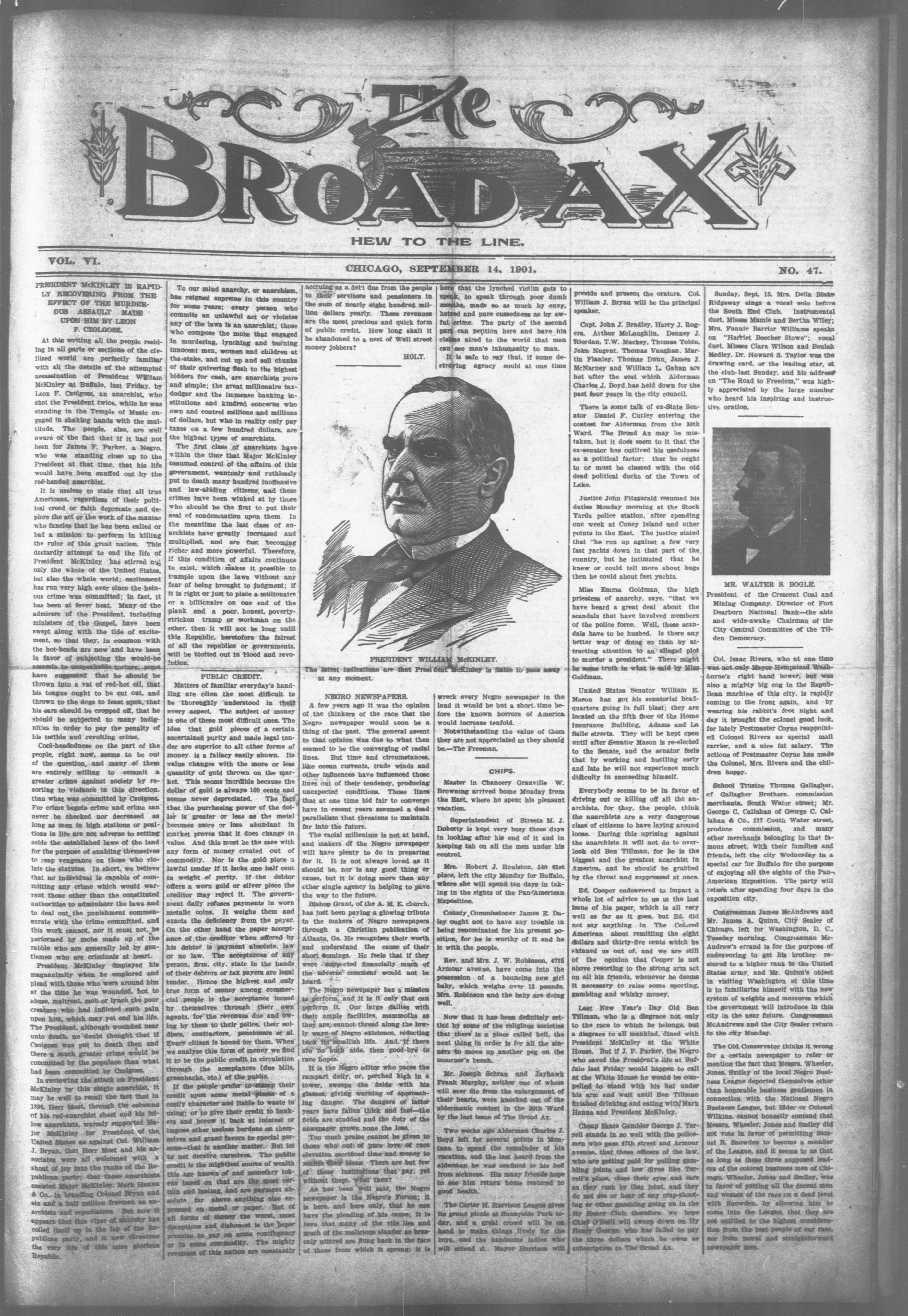
PRESIDENT WILLIAM M. KENNEDY
PRESIDENT WILLIAM McKINLEY.
The latest indications are that Presi at any moment.
NEGRO NEWSPAPERS.
A few years ago it was the opinion of the thinkers of the race that the Negro newspaper would soon be a thing of the past. The general assent to that opinion was due to what then seemed to be the converging of racial lines. But time and circumstances, like ocean currents, trade winds and other influences have influenced those lines out of their tendency, producing unexpected conditions. Those lines that at one time bid fair to converge have in recent years assumed a dead parallelism that threatens to maintain far into the future.
The racial millenium is not at hand, and makers of the Negro newspaper will have plenty to do in preparing for it. It is not always loved as it should be, nor is any good thing or cause, but it is doing more than any other single agency in helping to pave the way to the future.
Bishop Grant, of the A. M. E. church, has just been paying a glowing tribute to the makers of Negro newspapers through a Christian publication of Atlanta, Ga. He recognizes their worth and understand the cause of their short comings. He feels that if they were supported financially much of the adverse comment would not be heard.
The Negro newspaper has a mission to perform, and it is it only that can perform it. Our large dailies with their ample facilities, mammoths as they are, cannot thread along the lowly ways of Negro existence, reflecting back its smallish life. And, if there are no such aids, then good-bye to race hones.
It is the Negro editor who paces the rampart daily, or, perched high in a tower, sweeps the fields with his glasses, giving warning of approaching danger. The dangers of latter years have fallen thick and fast—the fields are studded and the duty of the newspaper grows none the less.
Too much praise cannot be given to those who out of pure love of race elevation sacrificed time and money to realize their ideas. There are but few of these institutions that pay, yet without them, what then?
As has been well said, the Negro newspaper is the Negro's Forum; it is here, and here only, that he can have the pleading of his cause; it is here that many of the vile lies and much of the malicious slander so brazenly uttered are flung back in the face of those from which it sprang; it is
---
here that the lynched victim gets to speak, to speak through poor dumb mouths, made so as much by envy, hatred and pure cussedness as by awful crime. The party of the second part can petition here and have his claims aired to the world that men can see man's inhumanity to man. It is safe to say that, if some destroying agency could at one time
J.
wreck every Negro newspaper in the land it would be but a short time before the known horrors of America would increase tenfold.
Notwithstanding the value of them they are not appreciated as they should be.—The Freeman.
CHIPS.
Master in Chancery Granville W. Browning arrived home Monday from the East, where he spent his pleasant vacation.
Superintendent of Streets M. J. Doherty is kept very busy these days in looking after his end of it and in keeping tab on all the men under his control.
Mrs. Robert J. Roulston, 540 61st place, left the city Monday for Buffalo, where she will spend ten days in taking in the sights of the Pan-3American Exposition.
County, Commissioner James E. Daley ought not to have any trouble in being renominated for his present position, for he is worthy of it and he is with the people.
Rev. and Mrs. J. W. Robinson, 4715 Armour avenue, have come into the possession of a bouncing new girl baby, which weighs over 12 pounds. Mrs. Robinson and the baby are doing well.
Now that it has been definitely settled by some of the religious societies that there is a place called hell, the next thing in order is for all the sinners to move up another peg on the mourner's bench.
Mr. Joseph Schran and Jayhawk Frank Murphy, neither one of whom will ever die from the enlargement of their hearts, were knocked out of the aldermanic contest in the 30th Ward by the last issue of The Broad Ax.
Two weeks ago Alderman Charles J. Boyd left for several points in Montana to spend the remainder of his vacation, and the last heard from the alderman he was confined to his bed from sickness. His many friends hope to see him return home restored to good health.
The Carter H. Harrison League gives its grand picnic at Sunnyside Park today, and a great crowd will be on hand to make things lively for the boys, and the handsome ladies who will attend it. Mayor Harrison will
```markdown
```
HOLT.
CHIPS
preside and present the orators. Col. William J. Bryan will be the principal speaker.
Capt. John J. Bradley, Harry J. Rogers, Arthur McLaughlin, Denney J. Riordan, T.W. Mackey, Thomas Tobin, John Nugent, Thomas Vaughan, Martin Flanley, Thomas Dunn, James J. McNarney and William L. Gahan are hot after the seat which Alderman Charles J. Boyd has held down for the past four years in the city council.
There is some talk of ex-State Senator Daniel F. Curley entering the contest for Alderman from the 30th Ward. The Broad Ax may be mistaken, but it does seem to it that the ex-senator has outlived his usefulness as a political factor: that he ought to or must be classed with the old dead political ducks of the Town of Lake.
Justice John Fitzgerald resumed his duties Monday morning at the Stock Yards police station, after spending one week at Coney Island and other points in the East. The justice stated that "he run up against a few very fast yachts down in that part of the country, but he intimated that he knew or could tell more about hogs then he could about fast yachts.
Miss Emma Goldman, the high priestess of anarchy, says, "that we have heard a great deal about the scandals that have involved members of the police force. Well, these scandals have to be hushed. Is there any better way of doing so than by attracting attention to an alleged plot to murder a president." There might be some truth in what is said by Miss Goldman.
United States Senator William E. Mason has got his senatorial headquarters going in full blast; they are located on the fifth floor of the Home Insurance Building, Adams and La Salle streets. They will be kept open until after Senator Mason is re-elected to the Senate, and the senator feels that by working and huctling early and late he will not experience much difficulty in succeeding himself.
Everybody seems to be in favor of driving out or killing off all the anarchists, for they, the people, think the anarchists are a very dangerous class of citizens to have laying around loose. During this uprising against the anarchists it will not do to overlook old Ben Tillman, for he is the biggest and the greatest anarchist in America, and he should be grabbed by the throat and suppressed at once.
Ed. Cooper endeavored to impart a whole lot of advice to us in the last issue of his paper, which is all very well as far as it goes, but Ed. did not say anything in The Colored American about remitting the eight dollars and thirty-five cents which he skinned us out of, and we are still of the opinion that Cooper is not above resorting to the strong arm act on all his friends, whenever he deems it necessary to raise some sporting, gambling and whisky money.
Last New Year's Day Old Ben Tillman, who is a disgrace not only to the race to which he belongs, but a disgrace to all mankind, dined with President McKinley at the White House. But if J. F. Parker, the Negro who saved the President's life at Buffalo last Friday would happen to call at the White House he would be compelled to stand with his hat under his arm and wait until Ben Tillman finished drinking and eating with Mark Hanna and President McKinley.
Cheap Skate Gambler George J. Terrell stands in so well with the policemen who pass 47th street and Armour avenue, that these officers of the law, who are getting paid for pulling gambling joints and low dives like Terrell's place, close their eyes and ears as they rush by that joint, and they do not see or hear of any crap-shooting or other gambling going on in the Hy Henry Club, therefore we hope Chief O'Neill will swoop down on Hy Henry George, who has failed to pay the three dollars which he owes as subscription to The Broad Ax.
NO. 47.
Sunday, Sept. 15, Mrs. Della Blake Ridgeway sings a vocal solo before the South End Club. Instrumental duet, Misses Mamie and Bertha Wiley; Mrs. Fannie Barriar Williams speaks on "Harriet Beecher Stowe"; vocal duet, Misses Clara Wilson and Beulah Medley. Dr. Howard S. Taylor was the drawing card, or the leading star, at the club-last Sunday, and his address on "The Road to Freedom," was highly appreciated by the large number who heard his inspiring and instructive oration.
MR. WALTER S. BOGLE. President of the Crescent Coal and Mining Company, Director of Fort Dearborn National Bank—the able and wide-awake Chairman of the City Central Committee of the Tilden Democracy.
Col. Isaac Rivers, who at one time was not only Mayor Hempstead Washburne's right hand bower, but was also a mighty big cog in the Republican machine of this city. is rapidly coming to the front again, and by wearing his rabbit's foot night and day it brought the cclonel good luck, for lately Postmaster Coyne reappointed Colonel Rivers as special mail carrier, and a nice fat salary. The actions of Postmaster Coyne has made the Colonel, Mrs. Rivers and the children happy.
School Trustee Thomas Gallagher, cf Gallagher Brothers. commission merchants, South Water street; Mr. George C. Callahan of George C. Callahan & Co., 217 South Water street, produce commission, and many other merchants belonging to that famous street, with their families and friends, left the city Wednesday in a special car for Buffalo for the purpose of enjoying all the sights of the Pan-American Exposition. The party will return after spending four days in the exposition city.
Congressman James McAndrews and Mr. James A. Quinn, City Sealer of Chicago, left for Washington, D. C., Tuesday morning. Congressman McAndrew's errand is for the purpose of endeavoring to get his brother restored to a higher rank in the United States army, and Mr. Quinn's object in visiting Washington at this time is to familiarize himself with the new system of weights and measures which the government will introduce in this city in the near future. Congressman McAndrews and the City Sealer return to the city Monday.
The Old Conservator thinks it wrong for a certain newspaper to refer or mention the fact that Messrs. Wheeler, Jones, Smiley of the local Negro Business League deported themselves other than honorable business gentlemen in connection with the National Negro Business League, but Elder or Colonel Wilkins, cannot honestly contend that Messrs. Wheeler, Jones and Smiley did not vote in favor of permitting Samuel R. Snowden to become a member of the League, and it seems to us that as long as these three supposed leaders of the colored business men of Chicago, Wheeler, Jones and Smiley, was in favor of putting all the decent men and women of the race on a dead level with Snowden, by allowing him to come into the League, that they are not entitled to the highest consideration from the best people of our race, nor from moral and straightforward newspaper men.
a
——
‘FBLIVG P. TAYLOR, Béiver cad Peblishen,
: SSapieas een cureasuee tame ine
‘beapened the cost of harvesting
grain m the immense California fields
‘that wheat can be raised there at less
ectual cost than in the Argentine Re-
public.
‘The frequent walks across the Swiss-
Ttalian frontier of girls of a seminary
mear Maslianco, says a Rome dispatch,
‘@roused the suspicious of the customs
‘@ficers, who finally stopped a proces-
ion of 40, walking two by two, and
‘@scertained that each girl was smug-
gling cigars or cigarettes. The aggre
egate value was $30,000. ‘
A prize of 3,000 marks presented to
the Berlin Academy of Science by the
Marquis de Chasseloup, a Parisian of
partial American descent, for the best
modern work on American history,
bas been awarded to James Ford
Rhodes, a native of Cleveland and a
brotherid-law of Senator Hanna. Mr.
Rhodes was so honored on account of
Bis “History of the United States from
the Compromise of 1850.”
A writer im the London Spectator
remembers to have seen the border
country of Essex lighted
se Diazing ricks,
asa against the introduc
tion of machines. Where,
today, he asks, is the man under fifty
‘who can use a flail? The question is
‘only an emphatic way of referring to
leborsaving machinery. Imagine for
@ moment an attempt to harvest West-
@u crops without a reaper.
A resident of Springfield, Ohio, was
recently robbed of $16, and one “Dan”
Sullivan was arrested. When the man
‘was searched the money could not be
found. The officers were confident
they had the right man, and after
‘watching him for a short time noticed
that “Dan” was carefully guarding his
corncob pipe. He had it in his mouth.
filled with tobacco, but it was not light-
ed, and, striking a match, Lawless put
it to the pipe and told “Dan” to enjoy
bmself. He obeyed the order, but af-
ter smoking a few seconds weakened
and told the other that the money was
concealed in the bottom of his pipe.
Fifty caske of a special design and
the strongest possible construction will
soon be sent to Bering Sea by the
United States Revenue Marine service,
and placed upon the highest hum-
mocks of the flow-ice. It is hoped by
tracing their future course to test thc
direction of the currents that cross
the polar regions. The casks are twen-
ty-eight inches long and sixteen inch-
es in diameter, so as to be seen easily.
Inside of each are directions printed
im several different languages, asking
the fim er to write to the nearest Unit-
ed States consul, giving the latitude
and longitude in which the cask was
found, and the date. Admiral Melville,
who designed the casks, believes that
it will be possible in this way ‘to de-
termine whether the ice-packs -drift
trom the Arctic westward, or south
and east to the Aflantic
The Ashville (N. C.) Citizen says:
“Those who have read of the recent
deeds of violence committed by ne.
groes in Louisiana while banded to
gether under the pretense of being or-
ganized for religious and benevolent
Purposes are not surprised to learn
that a negro mafia is about to be start-
ed. The negroes in that vicinity have
been becoming very insolent and self.
important and seem to have the idea
that a sectet organization is ail that
is necessary to enable them to accom-
plish their purpose of dealing out
death to every white man who may
ssizike a negro or become an object of
their malice. The new order is said
to be under the leadership largely of
negro preachers, who, having no use
for the ordinary virtues that are sup-
‘posed to be advocated from the pulpit,
‘have been devoting their questionable
‘talents to the preaching of lawless
ness.
The movement for the preservation
of British scenery resulted in the
formation of the National Trust for
Places of Historic Interest and Nato-
ral Beauty. A London editor suggests
hat the trust profit dy a few of the
“superfiuous millions” of Mr. Andrew
(Carnegie, by inducing him to buy Ex-
moor, or the English Lakes, or the
River Thames, or the Snowdon Dis
trict, or the ‘Trossachs. The trust
would see to ft that builders and ad-
‘vertising ‘firms 4id no injury. There
‘are tracts without number in our own
country, the beauty of which ought to
sae gartemBbezn9 overfiow-
a ae well as m oatue aon
» of them.to mar and de-
‘Waters Suddenly Turned Inte &
_ Brief reference is made in nearly all
school books to the Bay of Fundy and
its remarkable tides; but in none is
justice done to the most remarkable
manifestation of its kind in the world
Most notable of all its features is the
reversible falls of the St. John river
near St. John, N. B. Imagine a. per-
fectly placid surface of water, so placid
‘that ft mirrors all the surrounding
shores, suddenly converted into a rag-
ing torrent ‘and tumbling waterfall.
‘The St. John river, or, rather the
harbor, contracts here to a beautiful
Tocky gorge, spanned by two handsome
suspending bridges. Above this gorge
the river broadens out again. But dur-
ing the 24 hours there are only four in-
tervals of 20 minutes each when ship-
Ping can pass through the gorge. On
each change of tide there is at slack
water a period of 20 minutes during
which the water in the gorge is on a
level with that of the harbor and the
Tiver and perfectly placid. During
those 20 minutes the shipping hurries
through.
Suddenly, ‘without the slightest
warning. without so much as a trem-
ble or quiver of the surface, a streak of
white flashes across it and a second
later a roaring waterfall and a catar-
act is pitching headlong into the har-
bor from under the bridges if the tide
be running out, and into the river
above if the tide be om the flood. Such
are the reversing falls of the St. John
river. It is doubtful if a more dra-
matic change occurs with such un-
varying regularity anywhere else in
nature. It is made all the more im-
pressive by the beauty of the land-
scape. The suddenness with which the
landscape, as reflected in the placid
water, disappears is like the ruthless.
smashing of a mirror.
ANOTHER DISTORTED VISION.
Man with Queer Name Foresees the End
of the World.
This is sad news which Prof. Lud-
wig Marienburger puts on the wires,
says the Chicago Record-Herald. He
declares that the end of the world is
near at hand. He has discovered that
our little old planet has jumped its
orbit and is wobbling around in space
like a drunken man in the middle of
the street at 6 a. m., or words to that
effect. This irregularity on the part of
Mother Earth, the professor explains,
causes our summers to become hotter
and hotter and our winters to be colder
and colder. Before long, according to
bis figures, things are going to be so
bad that nobody will be able to make
the transit from one extreme to the
other, and the first thing we know the
human race will go zip. It may be that
Prof. Marienburger has special oppor-
tunities for finding out (¢hings con-
cerning the earth's travets that no
other scientist could know about; it is
&@ good deal more probable, however,
that he. has just pulled out a guess and
that he has several more coming. If
J. Pierpont Morgan were to come out
and say that the world’s trolley was
off or that there was a hot box some-
where people might be justified in feel-
ing nervous.
But what has Prof. Marienburger to
do with the earth? It isn't his, and he
isn’t running it. Therefore we earn-
estly advise the public to treat his an-
nouncement with the scorn it deserves,
The man who has already paid for his
coal for next winter needn't suffer a
pang. He will probably need it, Prof
Marienburger’s prediction of a speedy
end of all things to the contrary not-
withstanding. o
‘Two Miles = Minute.
In England the advocates of great
speed in transportation predict that in
a few years they will have a single rail
line on which trains will be run at the
rate of 110 miles an hour. In Germany
an electric railroad is proposed, over
which cars are expected to move 120
miles in 60 minutes. Americans are
not slow, but they are not impatient
for transit so rapid as to exceed the
bounds of reason. A mile a minute is
fast enough for the great majority of
sober-minded and practical people.
‘Medals for British Trococ.
‘The medal department of the British
mint has been reinforced and now has
capacity for turning out 10,000 medals
per week. During the last half of the
last year the preparation of military
medals was pushed on, “the bulk of
those struck being on account of the
war in South Africa, in anticipation of
its early termination.” By the end of
the year 102,042 South African medals
had been struck and issued, to be en-
graved with the names of the recip-
fente.
Salt Water Fick tn Lake Sanertcc,
Four years ago the United States
Fish Commission began to plant in
Lake Superior the steelhead salmon of
‘the Pacific. It was believed that this
salt water fish would thrive in the cold,
fresh waters of the great lake, and fish
of this kind weighing five pounds have
recently been caught. As modified in
tb 6 NE 008 Adent
— The planting will proceed rap-
Wew French Code Declan.
The new French duel code, which is
the work of Prince Bibesco, provides
that in the future no duei can end
without the shedding of blood, and no
account of the proceedings shall be
published if the insult causing the duel
was not made public. —
Krupp, the German gunmaker, has
® fortune of nearly $50,000,000, an in-
come of $4,000,000 and a payroll of 80,-
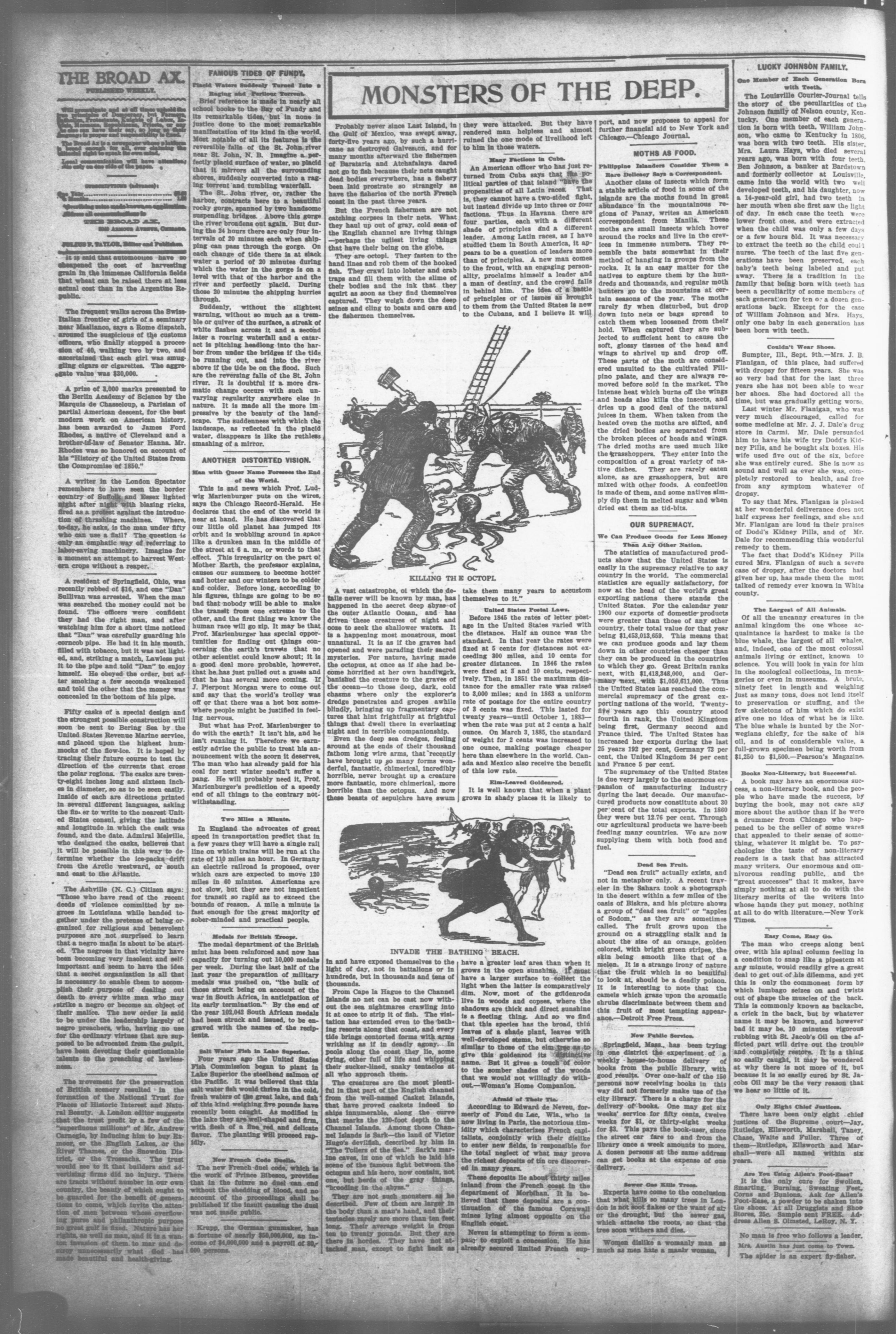
‘MONSTERS OF THE DEEP.
Probably never since Last Island, in
‘the Gulf of Mexico, was swept away,
forty-five years ago, by such a hurri-
cane as destroyed Galveston, and for
‘many months afterward the fishermen
‘of Barataria and Atchafalaya dared
‘Rot go to fish because their nets caught
Gead bodies everywhere, has a fishery
Deen Iaid prostrate so strangely as
have the fisheries of the north French
coast in the past three years.
But the French fishermen are not
catching corpses in their nets. What
they haul up out of gray, cold seas of
the English channel are living things
—perhaps the ugliest living things
that have their being on the globe.
‘They are octopi. They fasten to the
hand lines and rob them of the hooked
fish. They crawl into lobster and crab
traps and fill them with the slime of
their bodies and the ink that they
squirt as soon as they find themselves
captured. They weigh down the deep
seines and cling to boats and oars and
the fishermen themselves.
Hi}
(f}
[th
{7
HH
Le [A
s fF
PrN leew) SF
Fe a ee
ene y as ff: Tea RS iki S 2
¢ a ee % > al
ces Rx¢ = A
&, e Fee
re ape tee 8=| Rae
z 7 3 S ”
Kg JsOeT
As: & 4 : €
SNe — = > <
bes KILLING THE OCTOPL ot
__A vast catastrophe, of which the de-
‘falls never will be known by man, has
happened in the secret deep abyse-of
‘the outer Atlantic Ocean, and has
@riven-these creatures of night and
Ooze to seek the shallower waters. It
is a happening most monstrous, most
unnatural. It is as if the graves had
opened and were parading their sacred
mysteries. For nature, having made
the octopus, at once as if she had be-
come horrified at her own handiwgrk,
‘banished the creature to the graves of
the ocean—to those deep, dark, cold
chasms where only the explorer’s
dredge penetrates and gropes awhile
blindly, bringing up fragmentary cap-
tures that hint frightfully at frightful
things that dwell there in everlasting
night and in terrible companionship.
Even the deep sea dredges, feeling
around at the ends of their thousand
fathom long wire arms, that “recently
bave brought up go many forms won-
Gerful, fantastic, chimerical, incredibly
horrible, never brought up a creature
more fantastic, more chimerical, more
horrible than the octopus. And now
these beasts of sepulchre have swum
> ;
ae ae Pa i o4¢ }
ET er gE ~ * ne ae
SS a v 1
«4 ; —
INVADE THE BATHING * BEACH. 7
in and have exposed themselves to the
light of day, not in battalions or in
hundreds, but in thousands and tens of
thousands.
From Cape la Hague to the Channel
Islands no net can be cast now with-
out the sea nightmares crawling into
it at once to strip it of fish. The visi-
tation has extended even to the ‘bath-
ing resorts along that coast, and every
tide brings contorted forms with arms
writhing as if in deadly agony...in
pools along the coast they le, some
dying, other full of life and whipping
their sucker-lined, snaky tentacles at
all who approach them.
The creatures are the most plenti-
ful in that part of the English channel
from the well-named Casket Islands,
that have proved caskets indeed to
ships innumerable, along the curve
that marks the 120-foot depth to the
Channel Islands. Among those Chan-
nel Islands is Sark—the land of Victor
Hugo's devitfish, described by him in
The Tollers of the Sea.” Sark's mar-
ine caves, i one of which be laid his
scene of the famous fight between the
octopus and his hero, now contain, not
one, but herds of the gray things,
“brooding in the abyss.” 3
-are not such monsters af he
a. Few of them are. in
‘than a man’s hand, and
tents are more than ten feet
Jong. "See ey
‘tacked man, except to fight Back as
they were attacked. But they have
rendered man helpless and almost
ruined the one mode of livelihood left
to him in those waters.
wreew Wactions ian Cabe.
An American officer who has just re-
turned from Cuba says 5
pore grt
propensities of all Latin races. That
is, they cannot have a two-sided fight,
but instead divide up into three or four
factions. Thus. in Havana there are
four parties, each with a different
shade of principles dnd a different
leader, Among Latin races, as I have
studied them in South America, it ap-
pears to be a question of leaders more
than of principles. A new man comes
to the front, with an engaging person-
ality, proclaims himself a leader and
a man of destiny, and the crowd falls
in dehind him. The idea of @ Battle
of principles or of issués a brought
to them from the United States is new
to the Cubans, and I believe it will
take them many years to accustom
themselves to it.”
United States Postal Laws.
Before 1845 the rates of letter post-
age in the United States varied with
the distance. Half an ounce was the
standard. In that year the rates were
fixed at 5 cents for distances not ex-
ceeding 300 miles, and 10 cents for
greater distances. In 1846 the rates
were fixed at 3 and 10 cents, respect-
ively. Then, in 1851 the maximum dis-
tance for the smaller rate was raised
to 3,000 miles; and in 1863 a uniform
rate of postage for the entire country
of 3 cents was fixed. This lasted for
twenty years—until October 1, 1883—
when the rate was put at 2 cents a half
ounce. On March 3, 1885, the standard
of weight for 2 cents was increased to
one ounce, making postage cheaper
here than elsewhere in the world. Can-
ada and Mexico also receive the benefit
of this low rate.
| Elm-Leaved Goldenrod.
It is well known that when a plant
grows in shady places it is likely to
po ae
ee .
rw
have a greater leaf area than when it
grows in the open sunshine, 1f mast
have a larger surface to ¢olléet the
light when the latter is comparatively
dim. Now, most of the gdldenrods
live in woods and copses, where the
shadows are thick and direct sunshine
is a fleeting thing. And so we find
that this species has the broad, thii
leaves of a shade plant, leaves with
well-developed stems, but otherwise so
similar to those of the t
sive this goldenrod its “aig
name. But it gives a color
to the somber shades of the woods
that we would not willingly do with-
out—Woman’s Home Companion.
Afraid of Their Tia.
According to Edward de Neveu, for-
merly of Fond du Lac, Wis, who is
now living in Paris, the notorious tim-
idity which characterizes French capi-
talista, conjointly with their dislike
to enter new fields, is responsible for
‘the total neglect of what may prove
pe open cance Sam gh ge hare ree
| ‘These deposits lie about'thirty miles
inland from the French ¢oast in the
[eet Morbthan. It Is be-
‘Heved deposits are a con-
‘tinuation Gras tan Cae
prea 5 al sn “oni
none
_ Neveu is attempting to form 2 com-
‘pany to exploit a concession. He has
already secured limited French sup-
port, and now proposes to appeal for
further financial aid to New York and
Chieago.—Chicago Journal.
<etaenetiipliabaaay > F
MOTHS AS FOOD.
Philippine Islanders Consider Them =
Rare Delicacy Says = Correspondent.
Another class of insects which form
a stable article of food in some of the
a
fn the mountainous re-
gions of Panay, writes an American
correspondent from Manila These
moths are small insects which hover
around the rocks and live in the crev-
ices in immense numbers. They re-
semble the bats somewhat in their
method of hanging in groups from the
rocks. It is an easy matter for the
natives to capture them by the hun-
dreds and thousands, and regular moth
hufiters go to the mountains at cer-
tain seasons of the year. The moths
rarely fly when disturbed, but drop
down into nets or bags spread to
catch them when loosened from their
hold. When captured they are sub-
jected to sufficient heat to cause the
soft, glossy tissues of the head and
wings to shrivel up and drop off.
These parts of the moth are consid-
ered unsuited to the cultivated Fili-
pino palate, and they are always re-
moved before sold in the market. The
intense heat which burns off the wings
and heads also kills the insects, and
dries up a good deal of the natural
juices in them. When taken from the
heated oven the moths are sifted, and
the dried bodies are separated from
the broken pieces of heads and wings.
The dried moths are used much like
the @rasshoppers. They enter into the
composition of a great variety of na-
tive dishes. They are rarely eaten
alone, as are grasshoppers, but are
mixed with other foods. A confection
is made of them, and some natives sim-
ply dip them in melted sugar and when
dried eat them as tid-bits.
OUR SUPREMACY.
‘We Can Produce Goods for Less Money
Than Any Other Nation.
The statistics of manufactured prod-
ucts show that the United States is
easily in the supremacy relative to any
country in the world. The commercial
Statistics are equally satisfactory, for
mow at the head of the world’s great
exporting nations there stands the
United States. For the calendar year
1900 our exports of domestic products
were greater than those of any other
country, their total value for that year
being $1,453,013,659. This means that
we can produce goods and lay them
down in other countries cheaper than
they can be produced in the countries
to which they go. Great Britain ranks
next, with $1,418,348,000, and Ger-
‘many Next, with $1,050,611,000. Thus
the United States has reached the com-
mercial supremacy of the great ex-
porting nations of the world. Twenty-
fife years ago this country stood
fourth in rank, the United Kingdom
being first, Germany second and
France third. The United States has
increased her exports during the last
25 years 192 per cent, Germany 73 per
cent, the United Kingdom 34 per cent
and France 5 per cent.
The supremacy of the United States
is due very largely to the enormous ex-
pansion of manufacturing industry
during the last decade. Our manufac-
tured products now constitute about 30
“cent of the total exports. In 1860
icy mess att 90 ge cant Maascgt
our agricultural products we have-beeh
feeding many countries. We are now
supplying them with both food and
fuel.
Dead Sea Fruit.
“Dead sea fruit” actually exists, and
not in metaphor only. A recent trav-
eler in the Sahara took a photograph
in the desert within a few miles of the
oasis of Biskra, and his picture shows
@ group of “dead sea fruit” or “apples
of Sodom,” as they are sometimes
called. The fruit grows upon the
ground on a straggling stalk and is
about the size of an orange, golden
colored, with bright green stripes, the
skin being smooth like that of a
melen. It is a strange irony of nature
that the fruit which is so beautiful
to look at, should be a deadly poison.
It is interesting to note that the
camels which graze upon the aromatic
shrubs discriminate between them and
this fruit of most tempting appear-
ance.—Detroit Free Press.
New Pubile Service,
_ Springfield, Mass, has been trying
4p ome district the experiment of a
weekly - house-to-house delivery of
books from the public Hbrary, with
good results. Over one-half of the 150
‘persons now receiving books in this
way did not formerly make use of the
city library. There is a charge for the
elivery of books. One may get six
weeks’ service for fifty cents, twelve
weeks for $1, or thirty-eight weeks
for $3. This pays the book-user, since
the street car fare to and from the
library once a week amounts to more.
A dozen persons at the same address
can get books at the expense of one
‘Gelivery.
Sewer Ges Kille Trees.
Experts have come to the conclusion
that what Kills so many trees in Lon-
don is not boot flakes or the want of at>
or the drought, Dut the ‘sewer gas,
which attacks the roots, so that the
tree soon withers and dies.
‘Women dislike a womanly man a9
touch a3 men bate a manly woman,
LUOKY JOHNSON FAMILY.
Que Member of Each Generation Bor,
with Teeth.
‘The Louisville Courier-Journal te!!s
the story of the peculiarities of the
Johnson family of Nelson county, Ken-
tucky. One member of each genera-
tion is born with teeth. William Jonn-
son, who came to Kentucky in 1306,
was born with two teeth. His sister,
Mrs. Laura Hays, who died severaj
years ago, was born with four teeth.
Ben Johnson, a banker at Bardstown
and formerly collector at Louisvillc,
came into the world with two welj
developed teeth, and his daughter, now
a 14-year-old girl, had two teeth in
her mouth when she first saw the light
of day. Im each case the teeth were
lower front ones, and were extracted
when the child was only a few days
or a few hours Old. It was necessary
to extract the teeth so the child couli
nurse. The teeth of the last five gen-
erations have been preserved, each
baby’s teeth being labeled and put
away. There is a tradition in the
family that being born with teeth has
been a peculiarity of some members of
seach generat‘on for ten o> a dozen gen-
erations back. Except for the case
of William Johnson and Mrs. Hays,
only one baby in each generation has
been born with teeth.
Couldn't Wear Shoes.
Sumpter, Ill, Sept. 9th.—Mrs. J. B.
Flanigan, of this place, had suffered
with dropsy for fifteen years. She was
so very bad that for the last three
years she has not been able to wear
her shoes. She had doctored all the
time, but was gradually getting worse.
Last winter Mr. Flanigan, who was
very much discouraged, called for
some medicine at Mr. J. J. Dale's drug
store in Carmi. Mr. Dale persuaded
him to have his wife try Dodd's Kid-
ney Pills, and he bought six boxes. His
wife used five out of the six, before
she was entirely cured. She is now as
sound and well as ever she was, com-
pletely restored to health, and free
from any symptom whatever of
dropsy.
To say that Mrs. Flanigan is pleased
at her wonderful deliverance does not
half express her feelings, and she and
Mr. Flanigan are loud in their praises
of Dodd's Kidney Pills, and of Mr.
Dale for recommending this wonderful
remedy to them.
The fact that Dodd’s Kidney Pills
cured Mrs. Flanigan of such a severe
case of dropsy, after the doctors had
given her up, has made them the most
talked of remedy ever known in White
county.
The Largest of All Animals.
Of all the uncanny creatures in the
animal kingdom the one whose ac-
quaintance is hardest to make is the
blue whale, the largest of all whales,
and, indeed, one of the most colossal
animals living or extinct, known to
science. You will look in vain for him
in the zoological collections, in mena-
geries or even in museums. A brute,
ninety feet in length and weighing
just as many tons, does not lend itself
to preservation or stuffing, and the
few skeletons of him which do exist
give one no idea of what he is like.
The blue whale is hunted by the Nor-
wegians chiefly, for the sake of his
oil, and is of considerable value, a
full-grown specimen being worth from
$1,250 to $1,500.—Pearson’s Magazine.
Books Non-Literary, bat Saccessf al.
A book may have an enormous suc-
cess, a non-literary book, and the peo-
ple who have made the success, by
buying the book, may not care any
more about the author than if he were
a drummer from Chicago who hap-
pened to be the seller of some wares
that appealed to their sense of some-
thing, whatever it might be. To psy-
chologize the taste of non-literary
readers is a task that bas attracted
many writers. Our enormous and om-
nivorous reading public, and the
“great successes” that it makes, have
simply nothing at all to do with the
literary merits of the writers into
whose hands they put money, nothing
at all to do with literature—New York
Times.
ene
Easy Come, Easy Ga
The man who creeps along bent
over, with his spina! column feeling in
& condition to snap like a pipestem at
apg minute, would readily give a great
deal to get out of his dilemma, and yet
this is only the commonest form by
which lumbago seizes on and twists
out of shape the muscles of the back.
This is commonly known as backache,
@ crick in the back, but by whatever
name it may be known, and however
bad it may be, 10 minutes vigorous
rubbing with St. Jacob's Oil on the af-
fiicted part will drive out the trouble
and completely restore. It is a thing
so easily caught, it may be wondered
at why there is not more of it, but
because it is so easily cured by St. Ja-
cobs Ofl may be the very reason that
we hear so little of it.
Only Elebt Chief Justices.
There have been only eight .chief
justices of. the Supreme , court—Jay,
Rutledge, Ellsworth, Marshall, Taney,
Chase, Waite and Fuller. Three of
them—Rutledge, Elisworth and Mar-
shall—were all named within six
years.
care
Smarting, Burning, Sweating Feet,
Corns and Bunions. Ask for Allen's
Foot-Ease, a powder to be shaken into
tie shoes. At all Druggists and Shoe
Stores, 26c. Sample sent FREE. Ad-
Gress Alien 8. Olmsted, LeRoy, N. ¥.
——_——_—_—_—_
No man is free who follows a leader.
‘Mrs. Austin has just come to Town.
= a eat
The spider is an expert fiy-fisher.
AN ANCIENT SHRINE.
fee Sse
THAT STANDS IN THE HEART oF
ST. Louis.
Was Butit in 2839—One wf Its Founders
Is Stitt Alive—She ‘Ts Caltea the
Mother of Methodism im the South-
west.
tee Ne ee im St
Louis, Mo., Centenary Church,
founded in 1839. - The old structure is
now undergoing renoration at a cost
of $30,000. When October comes, and
the work is finished, a bishop is to at-
tend, or perhaps several bishops, and a
rededivation ceremony will take place,
which is intended to be the most mem-
orable that the Wenomination has
ever held in that section.
One of the founders of Centenary
a oe Eee ee
Mrs. Mary Gordon . She is
in her Sist year, is in perfect health
and vigor and is known as the Mother
of Methodiem inthe southwest. In
Centenary’s early days Mrs. Goodfel-
low was a leader in the Female Cen-
tenary Society, which accomplished a
great deal for church work. The so-
ciety raised $1,000 a year for many
years. It was done by sewing and by
a large annual fair and festival. She
says that there was a greater readiness
to contribute money 50 years ago than
now. In this connection she tells a
story of the evangelist, John Newland
Mafitt. This minister, who was one
of the most eloquent preachers of h's
day, had-made a glowing appeal for
funds for Centenary in 1839, and he
promised his St. Louis congregation
that if they would do their part he
would himself contribate $500. He was
not a rich man, and it is doubtful if
all his possessions were so much as
$500. He left St Louis to go to New
Orleans, taking one of the elegant
steamers which plied the river in those
days. The boat was filled with wealthy
planter, and John Newland Mafitt
preached to them. They could not es-
cape from him, even had they wished
to do so, and when, the tears rolling
i x
q
MRS. MARY G. GOODFELLOW, OF
ST. LOUS.
(Who is’ the Mother of Methodism in
the Southwest.)
down his cheeks, he besought them to
give of their abundance to this pioneer
church, money was poured out at his
feet. He filled his engagement at New
Orleans. and returned to St. Louis with
the $5) at the appointed time.
POORLY PAID SOLDIERS.
Britishers Who Served in South Africa
Are Compisining.
One occasionally hears Englishmen
boasting that they belong to the rich-
est nation under heaven, writes a
London correspondent. The boast is
not a particularly pretty one, and it
is not particularly wise, because for a
Tich nation it does some uncommonly
mean things. Among the meanest
must be classed the way in which it
Pays its soldiers. The war office has
been heaping up wrath and indigna-
tion against itself for a long time, but
it has not done anything lately to stir
the nation’s blood like its treatment of
the Imperial Yeomanry in the matter
of their pay. These men went out to
South Africa on the understanding.
that they would be away a year. They
were promised in some cases that their
situations would be held vacant for
them a year. The war office kept
them in South Africa for about eight-
een months, and now some of the men
have come home to find out that their
situations are no longer waiting for
them, and that the-money which has
been earned at the risk of their lives,
and would come in most useful while
they are looking for work, cannot be
squeezed out of a reluctant state.
20vn te Besser ss (eee
The municipal council of the French
town of Grenoble has recently voted «
on
erecting a bronge statue to, the famous
chimpangee, named Charlemagne, wlio
Rot lomg age.died there. For nine years
the chimpanzee, which was brought
to Grenoble by am African explorer,
had enjoyed the freedom of the town,
being privileged to enter practically
every house and to help himself to any-
thing he fancied in fruit and vegetable
shops. The ¢hief reason of the town's
great regard for the chimpanzee was
that about five years-ago he rescued «
child trom drowning in a well. Char-
mpeg en pong ee ige
him to swing over the top of
ne eS ee
Descending by rope used
buckets, be eoel the child and
Guickly carried her back to her friends,
Increaacd his populanty. by spending
two hours im the children’s hospital of
the town, playing in different wards
and amusing the children who were all
very fond of him. ‘Im such respect vrs,
this ee held that when be
died the Seabdiaate ot te Some,
kere his remains to the grave.
ME-NEVER erumercr.
ee
President
Charles M. Schwab, of the United
show @ good many persons who may
not Know why President Schwab be-
came what he is, says a Pittsburg cor-
respondent. The tale was told by an
Dor eerrior “hom Mr. Schwab, as a
> carried chain. Everybody
own here knows how Mr. Schwab be-
gan life as a grocery clerk at Brad-
dock, Next he carried a chain at
Homestead and later a draughtsman in
the Carnegie works. While holding
that place young Schwab came under
the notice of Capt. William R. Jones,
who was general manager of the Car-
ne peek en ara
ymous here with everything good
manly. Capt. Jones was killed at
Homestead by accident a few years
ago.
The story is that Capt. Jones at that
time needed the services of an expert
draughtsman. He applied to the head
of the draughting department for a
man, asking for the best man in the
“I have no best man,” said the chief.
“They are all good.”
Capt. Jones went away.The next day
an order was issued that to complete a
certain piece of work all of the
@raughtsmen should work two hours
over-time each day for Several weeks
without pay. All of the draughtsmen
grumbled except one man. Capt. Jones’
came along the next day and said to
the chief of the draughting depart-
ment: “How do the men like that or-
der?”
“They don’t like it and are all grum-
bling except one man,”-was the reply.
“Who is that man?” asked Capt.
Jones.
“Schwab.”
“Give me Schwab,” said Capt. Jones.
From that day the young draughts-
man’s success began. The man who
told ‘this story was asked what he
thought of President Schwab. He said:
“Charlie Schwab has no equal as an
executive in the steel world to-day.”
ROYAL FINANOIERS.
European Crowned Heads Who Have In-
vestments in America.
Many European royalties have in-
vestments in this country. The Em-
peror of Russia is a stockholder in the
Pennsylvania, the Northern and Cana-
dian Pacific, the New Jersey Central
and the New York Central Railroad
Companies to the amount of $6,000,000,
the most of it invested in the last four
years on the advice of a well-known
American diplomat. On it he draws
an average of $500,000 annually, or
eight per cent interest on his money.
King Edward VII. has found means
to put $5,000,000 in American indus-
tries. They are said to average him 1t
per cent a year—something simply gi-
gantic in view of the low European
rate of interest. It is even told how
he borrowed a large part of this cap-
ital to make these investments.
The Duke of York, the Kings of Italy
and Greece, Denmark and Belgium, the
Sultan and the Shah of Persia have
salted down great sums from their pri-
vate fortunes in the American securi-
ties which gives such large returns
and are so safe and far away from
European complications. Even poor
Spain—i. e., the rich Queen Regent—
figures on the list for $2,000,000. The
Kaiser has $3,000,000 invested in Atch-
ison & Topeka, Illinois Central, Louis-
ville & Nashville, and Union and
Northern Pacific Railroad Companies
stocks. The Empress Augusta Vic-
toria had $500,000 and the princes of
the house of Prussia have $1,000,000 in
the same securities.
Reformed.
Many young ladies have found it
necessary to improve, or rather to al-
ter, the spelling of the names with
which they were originally blessed.
Babel becomes Babelle, Jessie becomes
Jessica, Mary becomes Marie,.and so
forth. A brother lately received a let-
ter from his young sister at a fashion-
able boarding school. It was signed
Jessica. He answered: “Dear Sister
Jessica—Your welcome letter received.
Papaica and mammaica are well. Aunt
Maryca and Uncle Georgica started for
Buffaloca yesterday. I have bought
new horse. You ought to see it; it's a
beauty. It’s name is Maudica. Your
affectionate brother, Samica.” The sis-
ters next letter was signed Jessie.
-_—<$$—<—$—$<———
ween Prer of Wild Animeais.
a ee eae aeeaene
dia 1899 shows that for that year
25,587 human lives fell a prey to wild
animals. By far the largest number—
24,621—were killed by snakes. Tigers
were responsible for 899 deaths, wolves
for 238, leoperds 225 apd, 1402 wer)
killed by elephants, hyenas, jackals,
and crocodiles together. The deaths
ue to serpents were much more nu-
merous than during preceding years,
———
‘What-It Costs to Light Paris.
‘The lighting of Paris is a work of
magnitude to which the ordinary way-
farer perhaps seldom gives a thought.
There are no less than 60,000 lamps,
and it takes 6,000 men to attend them
The cleaning alone occupies no fewer
than 2,763 men; and the cost of this
army of lamplighters, cleaners and at-
tendants is nearly 25,000,000 francs a
year.
————
@ad Theory Beversed. -
Tt is reported by the Indian commis-
sioner’s office that the 300,000 Indians
of the country are peaceable and con-
tented and that they are giving the de-
partment no trouble. This ts a re-
versal of the former theory that in or-
der to be good am Indian must neces
sarily be defunct.
SOZODONT insures your Teeth 25°
Ai all Stores, or by Mall for the pries. “MALL & RUCKEL, How York,
“_ Cotidetation ‘and ‘Comfort
‘Who i it that does not wish to be
out in the open air or alive in some
field of sport, whether it be with the
‘Dat, rod or gun; whether we go coast-
Ang over the bills and vales on the
‘Wheel or sailing over rough waves or
{nto serene coves, it is all sport, and
the springing muscles seem to need it
Tt ts bound to happen that some mis-
hap will occur. Thus it is that we
have sprains in abundance. Light
Sprains, sprains that cripple, sprains
that give great pain, sprains that rob
us of sleep, but sportsmen of all kinds
have come to know that there is noth-
Ing better than the old reliable St.
Jacob's Ol. Have it with you for use;
you may rely on its cure of the worst
‘Sprain and restoration to. the com-
torts of life.
—_—___
‘Why the Conrcreraticn Stied_
One young theological student is
wondering if he will ever become a
successful minister. He has his
foubts, for his sermons are often ren-
fered ludicrous by an- unfortunate
Usp. He was called to fill a temporary
vacancy in a village church last Sun-
day and gave out as his text: “He
was called to fill a temporary vacancy
tn a@ village church last Sunday and
fave out as his text: “He that per-
verteth a shinner from the error of
bis ways, shall shave his shoul to life
and cover a multitude of shins.” Yet
be wondered why his congregation
smiled—New York Times.
Apsewers Absent Minded Wen
| Augustus Hare tells this story in
his autobiography of a friend, who in
‘some ways, was one of the most ab-
sent-minded men in the world. One
day, meeting a friend, he said: “Hello,
what a long time it is since I've seen
you! How's your father?” “Oh, my
father’s dead.” “God bless me! I’m
very sorry.’ The next year he met
the same man again, and had forgot-
ten all about it, so began with: “Hello!
what a long time since I've seen you!
How's your father?” “Ob, my father’s
dead still.”
A Belt Hint.
Here is a tip for keeping your patent
leather belt fresh and bright. It was
gleaned while talking to the leather
goods buyer for one of the city's big
Stores. This accommodating buyer
stated that patent leather can be reju-
venated by polishing the surface with
& canton flannel cloth on which has
been dropped a small quantity of olive
ofl
. Veteran's Pictures Sell Well.
Sidney Cooper, the veteran English
painter, now imhis ninety-elghth year,
recently traveled from Canterbury to
Windsor to receive a decoration from
King Edward. Although Cooper’s pic-
tures are ridiculed by some critics,
four of them were shown at the Royal
Academy this year, and three of them
were sold for $5,875.
Ladies Can Wear Shoes
One size smaller after using Allen's Foot-
Ease, a powder. It makes tight or new
aching feet, ingrowing nails, corns
bunions. All druggists and shoe stores,
25e Trial package FREE by mail
Address Allen S. Olmsted, LeRoy, N ¥.
Historian's Old Home.
‘The old home of Francis Parkham,
the historian, near the pond at
Jamaica Plain, is now included in the
park system of Boston. The spot is
to be marked by a memorial.
ee ee ee
The state which produced the larg-
est corn crop last year was Illinois,
‘with 247,000,000 bushels.
Half an houris all the time to
dye with PUTNAM PADELESS DYES.
Sold by druggists, 10c. per package.
A man in Calaveras county, Call-
fornia, is hatching pheasants. in in-
cubators.
Piso's Cure cannot be too highty spoken of ag
scough cure—J. W. O'Barex, 322 Third Ave,
A. Minneapolis, Minn. Jan. 6 1900,
Mosquitoes have no pedigree, yet
they are often full-blooded.
Hall's Catarrh Cure
isa constitutional cure. Price, 75a.
‘The more solid comfort is the softer
time a man seems to have.
pea ert.
ma Seotheng. coltens ie. Gums, sounene fe
Comes round in time—the hour
hand. Sele See
Mrs. Austin has just come to Town.
A bard case—the mummy.
PAINT RISKS
. ‘he zisks in painting ‘are
‘three: materials, mixing, put-
tingon. With best lead and
oil you take two; with ordi-
nary mixed paint three; with
Devoe ready paint none. On
each package is this label:
or after in the
Een
7 and us the
ities [einen a coeur
Paint-safety for you- in
Devoe asin no other.
+ Pamphlet on painting free if you
mention this paper. 7
GOOD-PAINT DEVOE, CHICAGO.
FLAT-HOUSE CULTURE.
Adeut Neighbor's Comfort.
Job Hedges says: “Three wise men
discussed the highest civilization. One
‘opined that an appreciation of art and
muste marked the most cultured man.
The second said that the philosopher
appeared to have the firmest grasp
upon civilication—a Darwin, a Tyn-
dail, a Huxley, a Spencer. The third,
‘whose life seemed saddened, remark-
ed: ‘My brothers, you are theorists.
The end of civilization is happiness.
The highest civilization, therefore, is
found in actual life by people who are
not concerned about the comforts of
others. .To my mind that family
which in the ordinary course of hous>-
keeping can succeed in making the
most hideous rumblings and noises in
trundling their carpet sweepers, which
they have brought from the country,
etc., and who, not allowing books or
newspapers to bind them down to
miserable quiet, sit Sunday afternoon
and every evening thumpigg upon
floor or wall in such manner as to ex-
cite the admiration and envy’ of the
neighbors—that family, I say, possess-
ed of such angelic adolescence and
zealous tact, can lay claim to a higher
degree of civilization than your art
connoisseur and philosopher.’”—New
York Press.
New York and Pennsylvania pay
members of the legislature $1,500 a
year; Maine pays them $150 a year.
Dropsy treated free by Dr. H. H. Green's
Gons, of Atlanta,Ga. The greatest dropsy
specialists in the world. Read their adver-
Gsement in another column of this paper.
Henry Til. of Germany had a com-
plexion so dark that he might easily
have been mistaken for a negro.
For frost-bite, chilblains, sore and
lame joints, stiffness of muscles, try
Wizard Oil._It won't disappoint you.
If the victims remain single there
can be no objections to love at sight.
Mrs. Austin has just come to Town.
Short-sighted people are naturally
close observers.
IN WET WEATHER
A WISE MAN
Ha CX * Psy yan
Ocak OLED
MRL NEP YOU DRT OTN ELSE WIL
a EA itt
— EPhnarioga:
a
ST. MARY’S ACADEMY
Notre Dame, Indiana.
Conducted by the Sisters of the ey
Cross. Chartered 1855. Thoroug!
— and Classical education. Reg-
In Prete here tains students
Figsteal "and Chemical Eaboretories
End Schon ot Art Gymmesionn ender
——— — graduate of Boston ee
‘The 47th year will open Sept. 5, 1901,
Address DIRECTRESS OF THE ACADEMY,
St. Mary's Academy, Notre Dame. indiana,
College and Academy,
DUBUQUE, 10WA.
Conducted by Sisters of Charity, B. V. M.
Academy accredited to the Univer-
sity ef Iowa. Excellent fucilities
offered for the Education of Young
‘Women and Children. Conservatory
ef Music and Art on European pian.
One mile from Dubuque City. Direct railroad
connections with leading cities, St. Paul, Min-
Reapolis, ete. Commands view of lows, Wis-
consin and Mlinois. Grounds cover 2) acres.
Golf links, tennis courts, groves and pineries.
Finely equipped buildings: private rooms.
‘Three general courses of study. English and
Normal for pupils preparing to take teachers”
€xamipations. English and Classical and Eng-
igh apd-Gctentific Thorough Business course,
Private pupils received.
Session begins Wednesday, Sept. 11, 1901. For
SISTER SUPERIOR,
Mount St. Joseph, Dubuque, lows.
eens
prea Seer
0,8. DUFFY sees
‘Myre experience. 4 yrs en examiner in U. 6. Pat Office
FARMERS!
iat Sates
COLORADO COLONY CO.,
WBO Seventeenth Street, Denver, Colorado.
AO RANCH 2728 =
Epes
atten presrcnes oat
Pe a8
A METHODIST BISHOP AE
GIVES PE-RU-NA GREAT CREDIT.
| |
i \\
Ny \ "
Vy WS : A
Was S
WSS
\} \ ~ S ))
\ Ng
On C 2
: e Yd!
Hi\ <
Prevented by Shampoos of CUTICURA SOAP
_ and light dressings of CUTICURA, purest of
emollient skin cures. This treatment at orce
stops falling hair, removes crusts, scales, and
dandruff, soothes irritated, itching surfaces,
stimulates the hair follicles, supplies the roots
— energy and nourishment, and makes the
ir Ww upon a sweet, wholesome, healthy
nal aien all else fails, 7
MILLIONS USE CUTICURA SOAP
Assisted by Curicuna Onrruent, for preserving, purifying, and beautify-
ing the skin, for cleansing the scalp of crusts, scales, and dandruff, and the
of falling hair, for softening, whitening, and soothing red, rough,
pal ete keaton: ena etnias ont ea aad eonaoieoens
poses of the toilet, bath, and nursery. Millions of Women use CuTicuRa
Soar in the form of baths for annoying irritations, inflammations, and
excoriations, for too free or offensive perspiration, in the form of washes for
ulcerative weaknesses, and for many antiseptic purposes which readily sag-
gest themselves to women and mothers. No amount of persuasion can
induce those who have once used these great skin purifiers and beantifiers
to use any others. Curicura Soap combines delicate emollient properties
Stent Sane Cmucens, Sn meet thle sag tO eae of cleansing
ingredients, and the most refreshing of flower odours. ou
eT ks cubed nants soca pain eaten
the skin, scalp, hair, and hands. No other foreign or domestic toile} soap,
however expensive, is to be compared with it for all the purposes of the
toilet, bath, and nursery. Thus it combines, in Owe Soap at Oxe Puce,
the Bust skin and complexion soap, and the BEst toilet and baby soap in
the world.
Complete External and internal Treatment Sor Every 0
Gian
orange ee |
| -Dave axp CaEMICAL ComroRarion, Sole . . :
6 SOE af
5 De ay .
— ee Kg y)
YR oe
Rd
Pe RS af 7
> BISHOP GRANT, OF INDIANAPOLIS. 3
4nd., writes the loliowing letter: ,
3349 N. Pennsylvania Street.
Perana Medicine Co., Columbus, O.:
rams toreuterve and can chewrtl roo.
cameed your remedy to who
your anyone
wants # good medicine.’’—A. Grant.
Prominent members of the clergy are
giving Peruna their unqualified en-
dorsement. These men find Peruna es-
pecially adapted to preserve them from
catarrh of the vocal organs which has
always been the bane of public speak-
ers, and general catarrha! debility in-
cident to the sedentary life of the
clergyman. Among the recent utter-
ances of noted clergymen on the cura-
tive virtues of Peruna is the above one
from Bishop Grant.
HOWE SCALES)
an eee ot Seen mes |
=|
BORDER & SELLECK CO."332ci32 |
CICS hisiee ss
"Sv aaent Thowretn’s Exe Water
Writes His Recommendation
for the Famous Catarrh
Remedy, Pe-ru-na.
The day was when men of promi-
Dee to ceeennekien anes
to proprietary medicines pub-
lication. cae meee aie
runa has become so justly famous, its
merits are known to so many people of
high and low station that none hesi-
tates to see his rame in print recom-
mending Peruna.
The following letters from pastors
who use Peruna speak for themselves:
Rev. E. G. Smith, pastor of tne Pres-
byterian Church, of Greensboro, Ga,
“My little boy had been suffering for
some time with catarrh of the lower
bowels. Other remedies had failed, but
after taking two bottles of Peruna the
troublealmost entirely disappeared. For
this special malady I consider it well
nigh a specific.”—Rev. E. G. Smith.
Rev. A. S. Vaughn, Eureka Springs,
Ark., says: “I had been prostrated by
congestive chills and was almost dead;
as_soon as able to be about, I com-
cies en cae I took five
; my strength returned rapidly
and I am now enjoying my usual
health.”—Rev. A. S. Vauhgn.
If you do not derive prompt and sat-
istactory results from the use of Pee
runa, write at once to Dr. Hartman,
giving a full statement. of your case
and he will be pleased to give you his
valuable advice gratis.
Address Dr. Hartman, President of
The Hartman Sanitarium, Columbus, Q@
DROPSY = aruest
YESR DG Mod GREEWY $088. Box i stem Ge
SE Ee
W. N. U. CHICAGO, NO. 37; 1901,
Whea Aasweriag Advertisemests Kiedly
Beation This Faper.
———————————$—$—$—$—$—$——L
> PISO’S CURE FOR
c vIES Uf ERE ran
CONSUMPTION
The Enterprise, of Omaha, seems very much put out because the Republican state convention of Nebraska failed to pass resolutions condemning the wholesale disfranchisement of the Negro in the South. It may not be improper to remind the Enterprise that the Republican state convention of Maryland also ignored the colored brother, although the lily-white leaders of the party had something to say on all other issues, which means that the Negro will always be the under dog in the fight as long as he hugs the delusive idea that the lily-white leaders of the Republican party will right his wrongs, and in time he will learn that he must rely on his own strong arms to do that.
Oct. 4 the twenty-fifth annual congress of the American Secular Union and Free Thought Federation convenes in Teck's Theater, Buffalo. All liberals in religion are invited to attend this important session, which lasts three days, from Oct. 4. Reduced fares can be obtained from all points to Buffalo, for this gathering. The object of the American Secular Union and Free Thought Federation, as is well known, is to secure the total seperation of church and state, to the end that equal rights in religion, genuine morality in politics and freedom may be established throughout the country. Right now is the time for all liberals to have the courage to stand up and work for the cause of true liberalism in all things, and for the future welfare of all the sons and daughters of humanity.
A writer in The Freeman says: "There was considerable discussion in the National Negro Business League as to why the average Negro was not a success in business, and why one colored person did not want to work for another. Now I will say that the answer is very easy to give, and it is this: The average Negro has never learned to pay his honest debts promptly, or, in other words, when they are due, and in too many instances he does not pay them at all. If the Negro ever expects to do business he must learn to pay his debts when they are due."
The above item is full of truth, for it is no exaggeration to say that no other race of people on earth delight in escaping from paying their honest debts to the same extent as the Negro race. It is also true that generally the Negro will cheerfully pay the debts which he owes to the white man; but if he can get out of it he would rather not pay what he owes to his colored brother, for he does not want to make him rich. In company with one of our doctor friends, we attended the reception given in honor of the members of the National Negro Business League, and it was really amusing to us to see swell dressed men and women who want to be known as ladies and gentlemen, darting and hiding like jack-rabbits in order not to come in contact with the doctor and ourselves, for they knew that they had failed to keep their promises in adjusting their doctor and newspaper hills.
Just how long pensions may continue illustrated by the fact that there are still four widows of revolutionary soldiers on the rolls. According to the same continuation and considering the average of life increasing, this government may be paying pensions on account of the Spanish war as late as 2018. It will not be for any lack of applications, which already number 44,000, of which nearly 4,000 have been granted. And the revolutionary wards are not the only ones with long lives, for within the past year two widows of the war of 1812 and 325 widows of the Mexican war were added to the list.
Souls can not be estimated in shekels, says the Evangelist, and yet there does seem to be an unwelcome significance in the fact that, as some one has estimated last year, the sum of $3,300,000 was expended in Greater New York for the current expenses of Protestant churches, while the increase in membership was only 5,278. Yet the fault, continues the Evangelist, of these facts is not to be blamed wholly upon the members of the churches, as so many very glibly say, but in large measure to be attributed to the desperately wicked worldliness of great masses of our time, who, in spite of all manner of gospel advantages and appeals, go on their way, like Gallio of old, caring for none of these things.
The butter of Denmark is considered superior to that of all other countries. It brings the highest price in fancy markets, and can be found all over the world in shops where luxuries are sold. In South America, South Africa, in the East and West Indies, in India, Egypt, and in tropical countries generally it is used by epicures, who pay $1 a pound for it in tins of one, two and three pounds' weight. No other country has been able to produce butter that will stand changes of climate so well. In Holland and Sweden attempts are made to compete with the Danish dairymen, but the butter from those countries is worth only half as much and does not keep half as well, while the efforts of dairymen in the United States have practically failed with a few isolated exceptions.
HOME MADE PHILOSOPHY.
A boy and a cat never forget a deception or an injury.
It is the early worm that catches the eye of the hungry bird.
The blue laws are for the poor, the long green are for the wealthy.
Some statesmen make better citizens on the cooling board than they do in congress.
The greatest sinner in the world is the fellow who is too honest to hide his faults.
I suppose the mouse often wonders why God doesn't feed the cat on hay or corn fodder.
Some people would rather give a dollar to charity than an extra dime a day to the hired girl.
The labor unions of today have a greater tendency to divide labor, than to unite laboring men.
There are men and newspapers that condemn nothing that is wrong, nor praise anything that is right.
The woman who is too anxious to show her modesty, hasn't got much of the article to put on exhibition.
The most selfish man I ever knew didn't even call his wife to see him die. He wanted to enjoy it all by his lonely self.
I don't mind so much about the American eagle going abroad if she didn't take so many human vultures along.
The women and the rag man like to deal together, because both parties feel that they got something for almost nothing.
Hoarding up wealth is like building up a pyramid of sand along the turbulent river; when the flood comes it is soon washed away.
Some people shed too many political tears over oppressed humanity, and shed too little truth in regard to the process of oppression.
If the day never comes when men will divulge their secrets to each other, the day of perfect civilization will never dawn on earth.
The vainest man I ever saw, was the fellow who would call his wife at midnight and make her light the lamp to see him suffer with toothache.
The wind turns the weather vane, but the best weather vane can't turn the wind. Just so with men who pretend to make political conditions.
The flea that interrupts the dog that is chasing the rabbit, is like the corporation that pays starvation wages to its men—robbing the creature from which it sucks its blood. Sheep and laboring people were not exactly created to be shorn, but they seem to enjoy the process better than starving.—Finnickey Finnukin, in Pennsylvania Grit.
LESSONS FOR CHILDREN.
The least part of children's education is that which they get from books. They should be taught a thousand things at home in early life to make them good members of society. They should be taught to treat their elders with respect. They should be taught to wipe their boots when they come in on wet days. They should be taught to speak softly, and answer when spoken to, and not to contradict. They should be made to sit still on occasions when they are in the drawing room with grown-up people.
They should be taught to use their forks and spoons judiciously, not to spill their food, or to make unpleasant noises in eating.
They should be taught not to expect to hear their own voices on every occasion, and not to interrupt older people's conversation.
They should be taught to shake hands with people in meeting or parting, and to bow to people they know in the streets.
They should be taught not to stare rudely or to make audible remarks upon persons and things about them.—Milwaukee Wisconsin.
WORDS OF THE WISE
Economy is the good genius whose presence guides the footseps of every prosperous man.—Dr. Wise.
Shallow men believe in luck, believe in circumstances. Strang men believe in cause and effect.—Emerson.
Hundreds of people can talk for one who can think, but thousands can think for one who can see.—Ruskin.
Remember all who have ever shown us any kindness. May we never forget to be grateful.—Henry Ward Beecher.
The obese man who is anxious to lose a little flesh should try a safety razor.
A baking powder manufacturer ought to succeed in getting up in the world.
"Doctor, your tonic made a new man of me." "A new man? Well, how is he off financially?"
Joe—If you have anything mean to say about a man say it to his face. Billy—Oh, it will get around to him almost as quick.
One day an Irishman who had got his legs broken in a railway accident was advised to sue the railway company for damages. "Sue them for damages, is it?" said he. "Sure Ol've damages enough already; but Ol'll sue them for repairs."
DR. JOSEPH JEFFREY,
Physician and Surgeon,
409 Dearborn Street, CHICAGO.
Hours: 8-10 a. m., 8-4, 6-8 p. m.
JAMES T. CRAIG,
Coal, Wood & Ice
General Expressing and Moving.
5001 ARMOUR AVE. CHICAGO, ILL
C. E. DOSWELL
BARBER, SHAVING.
Hair Cutting and Shampooing done in artistic style. Basors put in order.
118 West 51st Street, Chicago.
If your nearest druggest does not have the Original Ozenized Ox-Marrow he can get it for you from any wholesale druggist in the city. It straightens kinky hair. Warranted harmless. Only 50 cents a bottle. The Ozenized Ox-Marrow Co., 76 Wabash Ave., Chicago, Ill.
NEWSPAPER LAW.
Any person who takes the paper regularly from the postoffice, whether he is a subscriber or not, is responsible for the pay.
The courts have decided that refusing to take newspapers and periodicals from the postoffice, or removing and leaving them unscaled for is prima facie evidence of intentional fraud.
Read and subscribe for The Broad Az, the only newspaper in Chicago which "hews to the Lima."
THE FOX AND THE CROW.
A crowd, having secured a piece o. cheese, flew with its prize to a lofty tree, and was preparing to devour the luscious morsel, when a crafty fox, halting at the foot of the tree, began to cast about how he could obtain it. "How tasteful," he cried, in well-feigned ecstasy, "is your dress; it cannot surely be that your musical education has been neglected. Will you not oblige?" "I have a horrid cold," replied the crow, "and never sing without music, but since you press me—— At the same time, I should add that I have read Aesop, and been there before." So saying she deposited the cheese in a safe place on the limb of the tree, and favored him with a song. "Thank you," exclaimed the fox and trotted away, with the remark that Welsh rabbits never agreed with him, and were far inferior in quality to the animate variety. Moral.—The foregoing fable is supported by a whole Gatling battery of morals. We are taught (1) that it pays to take the papers; (2) that invitation is not always the sincerest flattery; (3) that a stalled rabbit with contentment is better than no bread, and (4) that the aim of art is to conceal disappointment.—Lanigan's Fables.
A test of a cannon that throws a shell designed to scatter oil on boisterous waves was made by Mr. F. F. Kaufmann of Camden, N. J., in the Delaware river near Riverton. The shell is of wood and conical in shape. It contains two gallons of fish oil. At one end of the projectile is a vent. This is covered with paper, which is blown off as the shell leaves the piece, allowing the oil to escape. In this way it is the purpose of the inventor to calm a rough sea for the distance of a mile, making a smooth path for a lifeboat to make her way to disabled vessels.
Beauregard F. Moseley,
LAWYER.
Practice in all Courts.
Main Office 6256 Halsted St,
Down Town Office 260 S, Clark St., Room 421
Hours from 12 to 2 P, M.
Phone: 263 Harrison.
JOHN FITZGERALD
JUSTICE OF THE PEACE
4787 S. HALSTED STREET,
....CHICAGO
ALBERT B. GEORGE
LAWYER.
423 Ashland Block, Chicago.
— Tel. M. 2025. —
EDWARD H. WRIGHT
LAWYER
Suite 421, 200 S. Clark St.
Telephone, Harrison 2383. CHICAGO.
GEO. W. W. LYTLE,
Attorney and Counselor at Law
Telephone Central 3558.
Suite 60, Grand Opera House,
Notary Public 87 & 89 S. Clark St.
Chicago.
Lawrence M. Ennis,
Advocate and Counselor at Law,
Suite 726 Opera House Block.
S. W. Corner Clark and Washington St.
TELEPHONE MAIN 1762.
HARD AND SOFT COAL,
Wood, Charcoal, Coke and Ice,
Expressing and Moving a Specialty.
832 29th St. Chicago, Ill.
WONDERFUL
DISCOVERY
Curly Hair Made Straight By
TAKEN FROM LIFE;
BEFORE AND AFTER TREATMENT.
ORIGINAL
This wonderful hair pomade is the only safe preparation in the world that makes ithy or early hair air sights as shown above. It imitates the scalp and prevents the hair from falling out or breaking off, cures dandruff and makes the hair grow long and silky. Sold over forty years and used by thousands. Warranted harmless. Testimonials free on request. It was the first preparation ever sold for straightening kinky hair. Beware of imitations. Get the Original Grown On OX Marrow as the genuine never falls to keep the hair straight, soft and beautiful. A toilet necessity for ladies, gentlemen and children. Elegantly perfumed. The great advantage of wonderful pomade is that by its use you can maintain your own hair at home. Owing to its superior qualities it is the best and most economical. It is suitable for anybody to produce a preparation equal to it. Full directions with every bottle. Only &¢ coins. Sold by drugstores and dealers or send us &¢ coins for one bottle or $1.&¢ for three bottles. We pay all express charges. Send postal or express money order. Write your name and address plainly to
OZONIZED OX MARROW CO., 76 Wabash Avenue, Chicago, Illinois.
The Titles of Women.
In old times the man was lord of creation indeed, doing all the fighting and the resting, while his slave or wife did all the work, as one may judge by looking over her titles. The title "lady" comes from the words laf, which means bread, and dian, to serve—one who serves food, the waitress. "Spinster" is a word to remind the unmarried woman that in old times she had to spin with her own hands a complete set of bed linen before she could get a husband to reign over her. Wife means a weaver—one who can weave clothes for her man. Mrs. or missus is mistress, which means masteress; and lass is ladess, or la'ss—a feale in leading strings. Madame is "my lady," which really means "my waitress." One can easily see that the men invented those titles, not the women.
```markdown
```
HEAVY MACHINERY. Smoke Stacks, Cupolas and Monuments Erected. Hoisting and Placing of all kinds of Beams and Girders for architectural work. Office. 31 South Canal St., Chicago TELEPHONE MAIN 4928
The Mutual Reserve
Fund Life or New York...
OVER $41,000,000 PAID IN LOSSES.
Insurance for the Protection of the family at actual cost
E. P. BARRY, M'g'r. JULIUS F. TAYLOR, Special Agt.
440 Roanoke Bldg., 145 La Salle St. 5040 Armor Ave.
POOL AND BILLIARDS
BRAXTON'S ....PLACE
SAMPLE ROOM
Fine Wines and Liquors
Imported and Domestic Cigars
260 West Lake St.
JIM GEORGE
IMPORTED AND DOMESTIG WINES, LIQUORS AND CIGARS 8462 SOUTH HALSTED STREET,
Driving, Draft and General Business Horses
Always on Hand
1197 Milwaukee Ave. Near Robey St.
Telephone West, 1028. CHIOAGO, IL.
Butter, Poultry, Eggs, Game, Veal, Etc. 217 SOUTH WATER STREET, CHICAGO.
TELEPHONE MAIN 3292
There are three things that a child may do with the world that surrounds him. He may appropriate it; he may run away from it; he may fight it. These three types of action sum up the efforts of a man's life, from the cradle to the grave. They spring from three emotions, the most fundamental and the most difficult to control. These are sympathy, fear and anger. What a child sympathizes with, what he fears, what he gets mad at—this will determine very largely what he shall become. The training of these emotions should, therefore, be the primary aim of every parent and teacher. This fact has not been generally recognized. And because it has not, the world is full of men and women who sympathize unwisely, fear unwisely, fight unwisely and live miserably.—Pennsylvania Grit.
A Holy Brick.
The Italian steamship Regina Margherita, lately arrived at Buenos Ayres from Italy, has brought one of the most extraordinary parcels that has ever appeared is the manifest of any vessel, i. e., a holy brick. We do not mean a jolly friar in holy orders. He would not be manifested. We mean a real brick, a squared mass of burned clay, declared to be holy because it was taken from the Holy Gate in the vatican. The parcel is forwarded by the pope to Argentina as a mark of special distinction.—Argentina Times.
John D. Cory
154. LaSalle Street.
Timid Children.
Many children, especially highly strung children, are troubled with their nerves. Night terrors are very common among imaginative children. The little one will be tucked up quite comfortably perhaps and seem sleeping and then begin to imagine that there is a bear or a wolf in the room. One bright youngster used to lie in mortal terror that an earwig would come out of a hole into his brain. There he used to lie, the clothes tightly held over his little head, shaking with fear, wet with perspiration, ashamed to tell his fears. Some children, however, cannot contain themselves after a certain time, but give vent to piercing screams and yells, or, having fallen asleep, wake sobbing.—Detroit Free Press.
It is remarkable how the fashion for wearing sandals has developed. At a single shop belonging to a firm which has been devoting itself to sandal-making orders have been taken during the last eight weeks for no fewer than 12,000 pairs. These have, however, not been from wholesale houses, but from private individuals. These sandals are not, as might be supposed, merely intended for children's wear, but a great many men and women have gone in for them, and the watering places may therefore be confidently expected to blossom forth with pilgrims shod with sandals.—Manchester Courier