The Broad Ax
Saturday, October 11, 1902
Chicago, Illinois
Page text (machine-generated)
THE BROAD AX
HEW TO THE LINE.
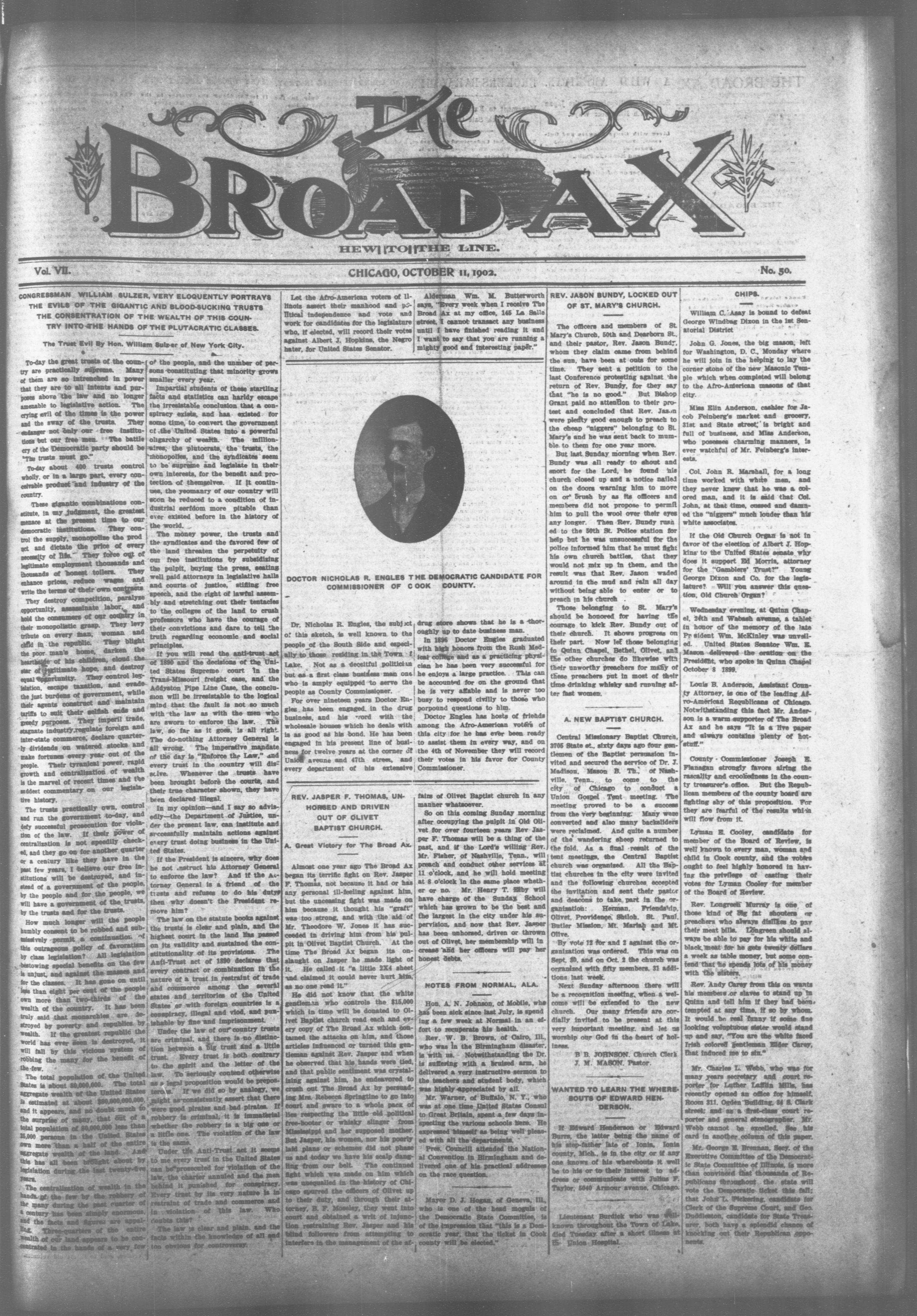
CONGRESSMAN WILLIAM SULZER, VERY ELOQUENTLY PORTRAYS THE EVILS OF THE GIGANTIC AND BLOOD-SUCKING TRUSTS THE CONSENTRATION OF THE WEALTH OF THIS COUNTRY INTO THE HANDS OF THE PLUTACRATIC CLASSES. The Trust Evil By Hon. William Sulz er of New York City.
To-day the great trusts of the country are practically supreme. Many of them are so intrenched in power that they are to all intents and purposes above the law and no longer amenable to legislative action. The crying evil of the times is the power and the sway of the trusts. They endanger not only our free institutions but our free men. The battle cry of the Democratic party should be "The trusts must go."
To-day about 400 trusts control wholly, or in a large part, every conceivable product and industry of the country.
These gigantic combinations constitute, in any judgment, the greatest menace at the present time to our democratic institutions. They control the supply, monopolize the product and dictate the price of every necessity of life. They force out of legitimate employment thousands and thousands of honest toilers. They enhance prices, reduce wages and write the terms of their own contracts
They destroy competition, paralyze opportunity, assassinate labor, and hold the consumers of our country in their monopolistic grasp. They levy tribute on every man, woman and child in the republic. They blight the poor man's home, darken the heartside of his children, cloud the star of legitimate hope, and destroy equal opportunity. They control legislation, escape taxation, and evade the just burdens of government, while their agents construct and maintain tariffs to suit their selfish ends and greedy purposes. They imperil trade, stagnate industry, regulate foreign and inter-state commerce, declare quarterly dividends on watered stocks and make fortunes every year out of the people. Their tyrannical power, rapid growth and centralization of wealth is the marvel of recent times and the saddest commentary on our legislative history.
The trusts practically own, control and run the government to-day, and defy successful prosecution for violation of the law. If their power of centralization is not speedily checked, and they go on for another quarter or a century like they have in the past few years, I believe our free institutions will be destroyed, and instead of a government of the people, by the people and for the people, we will have a government of the trusts, by the trusts and for the trusts.
How much longer will the people humbly consent to be robbed and submissively permit a continuation of this outrageous policy of favoratism by class legislation? All legislation bestowing special benefits on the few is unjust, and against the masses and for the classes. It has gone on until less than eight per cent of the people own more than two-thirds of the wealth of the country. It has been truly said that monarchies are destroyed by poverty and republics by wealth. If the greatest republic the world has ever seen is destroyed, it will fall by this vicious system of robbing the many for the benefit of the few.
The total population of the United States is about 80,000,000. The total aggregate wealth of the United States is estimated at about $80,000,000,000, and it appears, and no doubt much to the surprise of many, that out of a total population of 80,000,000 less than 25,000 persons in the United States own more than a half of the entire aggregate wealth of the land. And this has all been brought about by legislation during the last twenty-five years.
The centralization of wealth in the hands of the few by the robbery of the many during the past quarter of a century has been simply enormous, and the facts and figures are appalling. Three-quarters of the entire wealth of our land appears to be concentrated in the hands of a very few
o$^{f}$ the people, and the unimber of persons constituting that minority grows smaller every year.
Impartial students of these startling facts and statistics can harldy escape the irresistable conclusion that a conspiracy exists, and has existed for some time, to convert the government of the United States into a powerful oligarchy of wealth. The millionaires, the plutocrats, the trusts, the monopolies, and the syndicates seem to be supreme and legislate in their own interests, for the benefit and protection of themgelves. If it continues, the yeomanry of our country will soon be reduced to a condition of industrial serfdom more pitable than ever existed before in the history of the world.
The money power, the trusts and the syndicates and the favored few of the land threaten the perpetuity of our free institutions by subsidizing the pulpit, buying the press, seating well paid attorneys in legislative halls and courts of justice, stifling free speech, and the right of lawful assembly and stretching out their tentacles to the colleges of the land to crush professors who have the courage of their convictions and dare to tell the truth regarding economic and social principles.
If you will read the anti-trust act of 1890 and the decisions of the United States Supreme court in the Trans-Missouri freight case, and the Addyston Pipe Line Case, the conclusion will be irresistable to the logical mind that the fault is not so much with the law as with the men who are sworn to enforce the law. The law, so far as it goes, is all right. The do-nothing Attorney General is all wrong. The imperative mandate of the day is "Enforce the Law," and every trust in the country will dissolve. Whenever the trusts have been brought before the courts, and their true character shown, they have been declared illegal.
In my opinion—and I say so advisedly—the Department of Justice, under the present law, can institute and successfully maintain actions against every trust doing business in the United States.
If the President is sincere, why does he not instruct his Attorney General to enforce the law? And if the Attorney General is a friend of the trusts and refuses to do his duty then why doesn't the President remove him?
The law on the statute books against the trusts is clear and plain, and the highest court in the land has passed on its validity and sustained the constitutionality of its provisions. The Anti-Trust act of 1890 declares that every contract or combination in the nature of a trust in restraint of trade and commerce among the several states and territories of the United States or with foreign countries is a conspiracy, illegal and viod, and punishable by fine and imprisonment.
Let the Afro-American voters of Illinois assert their manhood and political independence and vote and work for candidates for the legislature who, if elected, will record their votes against Albert J. Hopkins, the Negro hater, for United States Senator.
1860
DOCTOR NICHOLAS R. ENGLES THE DEMOCRATIC CANDIDATE FOR COMMISSIONER OF COOK COUNTY.
Dr. Nicholas R. Engles, the subject of this sketch, is well known to the people of the South Side and especially to those residing in the Town Lake. Not as a deceitful politician but as a first class business man one who is amply equipped to serve the people as County Commissioner.
For over nineteen years Doctor Engles has been engaged in the drug business, and his word with the wholesale houses which he deals with is as good as his bond. He has been engaged in his present line of business for twelve years at the corner of Union aveune and 47th street, and every department of his extensive
A. Great Victory for The Broad Ax.
Almost one year ago The Broad Ax began its terrific fight on Rev. Jasper F. Thomas, not because it had or has any personal ill-feeling against him, but the unceasing fight was made on him because it thought his "graft" was too strong, and with the aid of Mr. Theodore W. Jones it has succeeded in driving him from his pulpit in Olivet Baptist Church. At the time The Broad Ax began its onslaught on Jasper he made light of it. He called it "a little 2X4 sheet and claimed it could never hurt him; as no one read it."
He did not know that the white gentleman who controls the $15,000 which in time will be donated to Olivet Baptist church read each and every copy of The Broad Ax which contained the attacks on him, and those articles influenced or turned this gentleman against Rev. Jasper and when he observed that his hands were tied, and that public sentiment was crystalizing against him, he endeavored to crush out The Broad Ax by persuading Mrs. Rebecca Springtime to go into court and aware to a whole pack of lies respecting the little old political free-booter or whisky slinger from Mississippi and her supposed mother. But Jasper, his women, nor his poorly laid plans or schemes did not phase us and today we have his scalp dangling from our belt. The continued fight which was made on him which was unequalled in the history of Chicago spurred the officers of Olivet up to their duty, and through their attorney, B. F. Moselay, they went into court and obtained a writ of injunction restraining Rev. Jasper and his blind followers from attempting to interfere in the management of the af-
Alderman Wm. M. Butterworth says, "Every week when I receive The Broad Ax at my office, 145 La Salle street, I cannot transact any business until I have finished reading it and I want to say that you are running a mighty good and interesting paper."
drug store shows that he is a thoroughly up to date business man. In 1896 Doctor Engles graduated with high honors from the Rush Medical college and as a practicing physician he has been very successful for he enjoys a large practice. This can be accounted for on the ground that he is very affable and is never too busy to respond civilly to those who porpound questions to him.
Doctor Engles has hosts of friends among the Afro-American voters of this city for he has ever been ready to assist them in every way, and on the 4th of November they will record their votes in his favor for County Commissioner.
fairs of Olivet Baptist church in any manner whatsoever.
So on this coming Sunday morning after occupying the pulpit in Old Olivet for over fourteen years Rev Jasper F. Thomas will be a thing of the past, and if the Lord's willing Rev. Mr. Fisher, of Nashville, Tenn., will preach and conduct other services at 11 o'clock, and he will hold meeting at 8 o'clock in the same place whether or no. Mr. Henry T. Elby will have charge of the Sunday School which has grown to be the best and the largest in the city under his supervision, and now that Rev. Jasper has been unhorsed, driven or thrown out of Olivet, her membership will increase and her officers will pay her honest debts.
Hon. A. N. Johnson, of Mobile, who has been sick since last July, is spending a few week at Normal in an effort to recuperate his health. Rev. W. B. Brown, of Cairo, Ill., who was in the Birmingham disaster, is with us. Notwithstanding the Dr. is suffering with a bruised arm, he delivered a very instructive sermon to the teachers and student body, which was highly appreciated by all.
Mr. Warner, of Buffalo, N. Y., who was at one time United States Consul to Great Britain, spent a few days inspecting the various schools here. He expressed himself as being well pleased with all the departments. Pres. Council attended the National Convention in Birmingham and delivered one of his practical addresses on the race question.
Mayor D. J. Hogan, of Geneva, Ill. who is one of the head moguls of the Democratic State Committee, is of the impression that "this is a Democratic year, that the ticket in Cook county will be elected."
REV. JASON BUNDY,LOCKED OUT OF ST. MARY'S CHURCH.
The officers and members of St. Mary's Church, 50th and Dearborn St. and their pastor, Rev. Jason Bundy, whom they claim came from behind the sun, have been at outs for some time. They sent a petition to the last Conference protesting against the return of Rev. Bundy, for they say that "he is no good." But Bishop Grant paid no attention to their protest and concluded that Rev. Jason were plenty good enough to preach to the cheap "niggers" belonging to St. Mary's and he was sent back to mumble to them for one year more.
But last Sunday morning when Rev. Bundy was all ready to shout and snort for the Lord, he found his church closed up and a notice nailed on the doors warning him to move on or brush by as its officers and members did not propose to permit him to pull the wool over their eyes any longer. Then Rev. Bundy rushed to the 50th St. Police station for help but he was unsuccessful for the police informed him that he must fight his own church battles, that they would not mix up in them, and the result was that Rev. Jason waded around in the mud and rain all day without being able to enter or to preach in his church.
Those belonging to St. Mary's should be honored for having the courage to kick Rev. Bundy out of their church. It shows progress on their part. Now let those belonging to Quinn Chapel, Bethel, Olivet, and the other churches do likewise with their unworthy preachers for many of these preachers put in most of their time drinking whisky and running after fast women.
A. NEW BAPTIST CHURCH.
Central Missionary Baptist Church, 3705 State et., sixty days ago four gentlemen of the Baptist persuasion invited and secured the service of Dr. J. Madison, Mason B. Th., of Nashville, Tenn., to come to the city of Chicago to conduct a Union Gospel Tent meeting. The meeting proved to be a success from the very beginning. Many were converted and also many backsliders were reclaimed. And quite a number of the wandering sheep returned to the fold. As a final result of the tent meetings, the Central Baptist church was organized. All the Baptist churches in the city were invited and the following churches excepted the invitation and sent their pastor and deacons to take part in the organization: Herman, Friendship, Olivet, Providence, Shiloh, St. Paul, Butler Mission, Mt. Mariah and Mt. Olive.
By vote 12 for and 2 against the organization was ordered. This was on Sept. 30, and on Oct. 2 the church was organized with fifty members, 31 additions last week. Next Sunday afternoon there will be a recognition meeting, when a welcome will be extended to the new church. Our many friends are cordially invited to be present at this very important meeting, and let us worship our God in the heart of holiness.
B. B. JOHNSON. Church Clerk J. M. MASON. Pastor.
If Edward Henderson or Edward Burrs, the latter being the name of his step-father late of Ionia, Ionia county, Mich., is in the city or if any one knows of his wherebouts it well be to his or to their interest to address or communicate with Julius F. Taylor, 5040 Armour avenue, Chicago.
No. 50.
William C. Asay is bound to defeat George Windbag Dixon in the 1st Senatorial District
John G. Jones, the big mason, left for Washington, D. C., Monday where he will join in the helping to lay the corner stone of the new Masonic Temple which when completed will belong to the Afro-American masons of that city.
Miss Elin Anderson, cashier for Jacob Feinberg's market and grocery, 31st and State street,' is bright and full of business, and Miss Anderson, who possesses charming manners, is ever watchful of Mr. Feinberg's interests.
Col. John R. Marshall, for a long time worked with white men, and they never knew that he was a colored man, and it is said that Col. John, at that time, cussed and damned the "niggers" much louder than his white associates.
If the Old Church Organ is not in favor of the election of Albert J. Hopkins to the United States senate why does it support Ed Morris, attorney for the "Gamblers' Trust?" Young George Dixon and Co. for the legislature? Will you answer this question, Old Church Organ?
Wednesday evening, at Quinn Chapel, 24th and Wabash avenue, a tablet in honor of the memory of the late President Wm. McKinley was unveiled. United States Senator Wm. E. Mason delivered the oration on the President, who spoke in Quinn Chapel October 8 1899.
Louis B. Anderson, Assistant County Attorney, is one of the leading Afro-American Republicans of Chicago. Notwithstanding this fact Mr. Anderson is a warm supporter of The Broad Ax and he says "It is a live paper and always contains plenty of hot-stuff."
County·Commissioner Joseph E. Flanagan strongly favors airing the rascality and crookedness in the county treasurer's office. But the Republican members of the county board are fighting shy of this proposition. For they are fearful of the results which will flow from it.
Lyman E. Cooley, candidate for member of the Board of Review, is well known to every man, woman and child in Cook county, and the voters ought to feel highly honored in having the privilege of casting their votes for Lyman Cooley for member of the Board of Review.
Rev. Longreen Murray is one of those kind of big fat shouters or preachers who always dislikes to pay their meat bills. Longreen should always be able to pay for his white and black meat for he gets twenty dollars a week as table money, but some contend that he spends lots of his money with the sisters.
Rev. Andy Carey from this on wants his members or slaves to stand up in Quinn and tell him if they had been tempted at any time, if so by whom. It would be real funny if some else looking voluptuous sister would stand up and say, "You are the white faced Irish colored gentleman Elder Carey, That induced me to sin."
Mr. Charles L. Webb, who was for many years secretary and court reporter for Luther Lafflin Mills, has recently opened an office for himself, Room 311. Ogden Building, 24 S. Clark street; and as a first-class court reporter and general stenographer. Mr. Webb cannot be excelled. See his card in another column of this paper.
Mr. George B. Brennan, Secy. of the Executive Committee of the Democratic State Committee of Illinois, is more than convinced that thousands of Republicans throughout the state will vote the Democratic ticket this fall; that John L. Pickering, candidate for Clerk of the Supreme Court, and Geo. Duddleston, candidate for State Treasurer, both have a splendid chance of knocking out their Republican opponents.
Will promulgate and at all times uphold the true principle of Democracy, but Catholics, Protestants, Priests, Indians, Farmers, Single Taxes, Republicans, Knight of Labor, or any one else can have their say, so long as their language is proper and responsibility is fixed.
The Broad AX is a newspaper whose platform is broad enough for all, ever claiming the editorial right to speak its own mind.
Local communications will receive attention. Write only on one side of the paper.
Subscriptions must be paid in advance.
One Year.....$2.00
Six Months.....1.00
Advertising rates made known on application. Address all communications to
THE BROAD AX
800 Armour Avenue, Chicago.
JULIUS F. TAYLOR, Editor and Publisher.
Entered at the Post Office at Chicago, ill., as Second-class Matter.
BOSTON TRA-PARTY BOWL.
Rhode Island Collector Has the Vem-sable Relie That Figured in the Won Tossing Event.
The famous historical punch bowl of the Boston tea party has just fallen into the hands of a Rhode Island collector of antique furniture, colonial blue ware and original and early Shakespeare prints, reports the Boston Globe.
On the 19th of last December Marsdon J. Perry, a Providence railway magnate and a banker with a fortune of several millions, married Mrs Mariam Lincoln Bogert at Wancaster, Mass., and they went to Providence to reside permanently in the residence of Mr. Perry, at George and Benefit streets, on the aristocratic East side of that city.
The new home of the bride was a marvel in its interior decorations, and there were many very attractive and costly articles of ornamentation, together with an elaborate display of valuable colored ware incidental to the foundation of the United States and its early history. The existence of such a collection in her new home caused Mrs. Perry to suggest to her wealthy husband that within his group was the celebrated punch bowl of the revolutionary period, when high priced and overtaxed tea was cast upon the waters of Boston bay, and there was a celebration and great rejoicing incidental thereto.
The great man of Boston of that day had a feast after the tea tasting episode, and the affair was not rounded out in true Yankee fashion until the punch had all disappeared from the bowl, which had been furnished for the notable occasion by one of the distinguished ancestors of the present Mrs. Perry. As soon as the Gammall mansion, now undergoing refurbishment by carpenters, painters and decorators, is completed, the punch bowl is to have a conspicuous place in a great sideboard which Mr. Perry intends to have constructed, and then there will be patriotic days when the friends of the millionaire are to quaff the finest vintages from the Boston tea party punch bowl.
The mansion in question is one of the earliest of the colonial in the state of Rhode Island, and it fell into the hands of Mr. Perry about a year ago. Parts of the house were constructed more than 100 years ago and when the trade of New England was a good deal in the line of rum and narges the mansion of the Browna and their descendants figured in the social life of the town and the plantations established by Roger Williams. Hence, when the Boston tea party punch bowl is finally nestled away in Providence it will have a fitting roof over its wide earthenware rim, and the timbers of the old mansion can vie with the history of the bowl in claims of distinguished pedigrees and honours.
The punch bowl, it is learned, came down safely to the days of the twentieth century through the care and painstaking of the forefathers of Mrs. Perry. They were the Lincoln and they have figured in the history of Massachusetts for quite a little more than 200 years.
GOOD ENOUGH REASON.
Why There Was No Conversation Between the Witness and Mr.
"Your honour," said the solicitor for the defense, relates Tit-Bita, "I wish to prove by this question that the witness is a man of quarrelsome disposition, hard to get along with, and on bad terms with his neighbors. Now, sir," he continued, turning again to the witness, "Fd. like to know whose farm is next to youra?"
"Well," answered the witness, "there is the Billings' farm, and the—"
"Stop there. One at a time. Are you on friendly terms with Mr. Billings?"
"I can't say I am."
"Are you even on speaking terms with him?"
"No, sir."
"Whose fault is it?"
"It's his fault, I reckon."
"Oh, yes! I'm his fault, you reckon. How long has it been since you have spoken to him?"
"About 14 years, as near as I can remember."
"Now, sir, I want you to tell this jury why you have not spoken to Mr. Billings for 14 years."
"Gentleman," said the witness, turning to the jury, "the reason why I haven't spoken to Mr. Billings for 14 years is because that's about the length of time he's been dead."
```markdown
```
In a paper on defectives, read by Dr. Martin W. Barr, chief physician of the Pennsylvania school for feeble minded children, before the summer school of philanthropy at the charities building, a remarkable instance was mentioned by him of eccentricity that has caused comment in scientific circles. It was the case of an American multimillionaire who is living in far eastern countries and leading a life of such peculiarity as to be almost incredible, says a New York report.
According to Dr. Barr, this man is a neurotic. It is estimated that his fortune is in the neighborhood of $10,000,000, but no attempt has been made to have him declared incompetent; he is left free to run his course. His family are refined and socially prominent. Whenever they speak of the son's course, they refer to it as his "nervousness." They will not admit that he has a deranged intellect, though he has left friends and position here to take up a life among the "Hanins," the grave diggers and social outcasts of the far east.
"He was a physician, rich, handsome, cultured, of aesthetic tastes," said Dr. Barr in his paper, "a graduate of one of the most prominent medical colleges in America, and a man who had made a pronounced hit as a specialist.
His fortune enabled him to assure every medical appliance known to science and for some years he enjoyed phenomenal success. Wine and women proved his bane. He sank lower and lower. His peculiarities no longer tolerated at home, he drifted from capital to capital of Europe, and finally established himself in Japan. With an appetite still unsatisfied, he exhibited new phases of moral degeneration, causing his body to be tattooed with wonderful skill, every picture a work of art. His hack bore a huge dragon, the shading of every scale showing perfection of detail. This, on revisiting America, with utmost vanity he shamelessly exposed. He was turned out of the clubs.
Returning to Japan, he bought a performing bear and wandered from place to place clad in the gash of Hanjin, exhibiting himself and his bear, and distributing photographs of each and all in endless variety.
"This master of eccentricity," said Dr. Barr, "shocking both Europe and America, and astounding even Japanese next hired a squad of Japanese boys, practically buying them outright from their parents, who, attired in full uniform, are trained in military exercises. To these are opposed an equal number of monkeys, dressed as Chinese soldiers, and the war of China and Japan is constantly renewed for the entertainment of himself and his satellites, who watch in the ecstasy of delight the suffering of the poor brutes. Rewards are offered, and the more bloody the contest and the greater the atrocities, the more intense the gratification."
AN EXTRAORDINARY COW.
Josephine's Remarkable Display of Intelligence Greatly Pleased Her Proud Owner.
"It does me good to ride downtown with Slick in the morning," remarked a middle-aged citizen, according to a story in the Detroit Free Press. "He lives out in the suburbs and there is always something doing out there. Before Dick left town his wife and baby were the smartest on earth, and now that he has become a country jake his horses, cows, dogs and shickens are the smartest on earth. 'There he is now; just you go and sit by him and start him on his cow.'
"Hello, Dick, how are you? How's the farm? How's your sow?" asked the mean man, who went over to sit by the farm novice.
"Oh, the farm's all right; and the cow—" replied Dick; "wall, she ought to be teaching school—that's a fact. She's the smartest cow I ever saw. Last night, sir, when she came up to be milked—she's not one of these silly, feeble-minded cows that have to have somebody drive them up to get their feed—no, sir, when Josephine came up she was alone—the little Jersey heifer, Daisy, that we bought to keep her company in the pasture, was not with her. We didn't worry, for we thought Daisy had loitered and would come along soon.
"But Josephine acted strangely. We couldn't get her in the barn at all; she stood in the lane looking toward the pasture and bawled and bawled and bawled. We thought she was only selling Daisy to hurry up and come home. Still she wouldn't go in and still she kept on bawling. Then somebody suggested that Daisy might be in trouble of some kind; so we all left Josephine and went down into the pasture.
"She stopped bowling as we started down the lane, and, sure enough, at the farthest corner of the pasture, in a little triangle of land where three wire fences cross each other, making a queer little pan, was Miss Daisy. She had got in, out of girlish curiosity, and couldn't get out. We had to pull down a piece of fence to get her out. Now, wasn't Josephine smart? I think so."
The other men all said that Josephine ought to have a telephone out in the pasture so she could call up the house when Daisy got in trouble.
There is a movement among brokers in New York to amuse women from their business houses and to deny them the privilege of speculating in stocks. Femininity, they say, has been given a fair chance to show its adaptability in "the street," and has failed miserably, reports the New York Times.
For a long time many brokers have considered women undesirable patrons for a multitude of reasons. Of late the opposition has crystallized, and several prominent firms have taken a bold, determined stand to ostracise those members of the fair sex whose gaming instinct and desire to get rich quick prompt them to speculate on the markets.
The following is a copy of a letter sent out by a well-known firm of stock brokers. It shows plainly the attitude of brokers, and it is not unlike letters that have been sent out recently by other firms:
Dear Madam! We regret to inform you that in future we shall be unable to afford you the privilege of calling at our office on Blank street. We find that some of our best customers consider it undigested for woman to frequent brokers' offices, and for that reason beg to ask that in future you will kindly communicate with us only by letter or telephone. In this matter we have used no discrimination. Every woman who has an account or who has done business with us will receive similar notice by the same mail. You're very truly,
"A woman is a nuisance anywhere outside of her own home," said a well-known reputable stock broker to a reporter who called on him at his office in a lower Broadway skyscraper the other day.
"In the first place, a broker's office is no place for a woman. The average woman knows little about brokerage. Business instinct is not innate in the woman, ordinarily speaking, and, worse than that, she can't learn. Tell her all you know about stocks and market conditions and practices, and the next day she will ask you the same thing again.
"Another thing: The woman who desires to trade in stocks, knowing nothing of them or the business, wants the broker to become her confidant, to tell just where and when to buy or sell. If she makes something out of an investment made on a broker's advice, she gloats over her shrewdness 'on the street,' and the broker gets no credit whatever. Should she lose, and every broker must go wrong in predictions once in awhile, then there's the devil to pay."
Brokers say that a woman does not seem to be able to realize that there is a possibility of losing in speculating in stocks. Therefore she is what a gambler would call a "bad loser." Of course, there is an occasional woman who knows the market and its sinuosities, and is as "game" as any man on the street. But she is mighty scares. The ordinary woman speculator and trader makes an awful fuss when she makes a losing investment.
Sometimes the spectacle is ludicrous in the extreme, but more frequently it is a sad one. Many women with the gaming instinct, who, besides seeking the excitement attendant upon the speculation, hope to get wealthy in a few days, go into it when the money they stake is needed for the necessaries of life for themselves and their families. The result of the failure in the latter instance is pitiable. To the broker it is nerve-racking.
The New Boer Nation.
The Boers have accepted British sovereignty in good faith, and the British have conceived an almost exaggerated respect and admiration for the character of the Boers, whom they frankly despised at the beginning of the war. There is one remarkable historical paradox to be noted in the outcome of this lamentable struggle. In the loss of their beloved independence, in the defeat of their cause, and in their seeming extinction or absorption, the Boers have really come into a new birth as a nationality. It is not written that a young people capable of such heroism shall, after practically dictating terms to the greatest empire in the world, permit themselves to forget that they have had a great part in the making of history. This is not a day when small nationalities are assimilated and yield up their identity; and so, far from this being the end of the Boer nation, the peace of Pretoria is the beginning of it. These Boer farmers were the most obscure people of European stock in the whole world. They were far less known than the Icelanders. To-day they are passionately admired throughout every nook and corner of the civilized world.—Review of Reviews.
"No," wearily replied the girl who was already in her third season. "He thinks you are too slow."—Chicago Post.
NO POUND WEIGHTS IN TROY. The Measure Makes Only in the
"Did it ever occur to you," said a college professor to a Chicago goldsmith, "that you have no such thing as a pound weight?"
It had; but the professor is willing to bet that not one graduate of a high school out of twenty has an idea that there is not a metal weight of 12 ounces to represent the Troy pound. But there is no such thing. Twelve Troy ounces make a pound, but there is no such material unit of measurement. There are the grain, the scruple, the drachm, and the ounce weights, but nothing more. The man who has ten pounds of gold in reality has only 120 ounces, and for him to go into the gold market and speak of gold as by the pound would be for him to be laughed at.
Incidentally these units of measurement in the Troy scale look a good deal more like Greek or Chinese coins than they look like weights, says the Chicago Tribune. For the average high school graduate to pick up a set of these weights would be to bewilder him. It is the contemplation of such absurdities of the English tables of weights and measurements that bring the student to the metric system as the same solution of it all.
WOMEN VOTERS.
Aro More Conscientious Regarding Their Franchise Privileges Than Men.
An Australian newspaper tells of some curious facts shown by the new electoral rolls of South Australia. The number of men on the rolls has shrunk in a little over three years from 83,640 to 76,767. On the other hand the women voters have increased during the same period from 68,375 to 71,682. In the three chief metropolitan districts the men voters have dropped from 36,587 to 30,484, a reduction of nearly 16 per cent. Women voters in the same district have slightly increased their numbers, and now count no less than 32,801. The women seem to be growing more conscientious in the fulfillment of their political duties and the men more careless.
When equal suffrage was granted in New Zealand the estimated number of adult women in the country was 139,915. Of these, 109,461 registered to vote. Of the women who registered, 83 per cent. voted; of the men who registered, only 67 per cent.
According to the report of the Wyoming secretary of state, 90 per cent. of the women vote. In Denver, at the election last November, 31,780 men voted and 23,449 women.
HUMAN BEINGS NOT IMMUNE
Records Show That Contagious Diseases Frequently Attack People a Second Time.
It is a fallacy, widespread but nevertheless a fallacy, for anyone to suppose that a person who has once had smallpox, measles, scarlet fever or other contagious disease is thereby made immune to that particular disease for the rest of his life. A Swiss physician has been examining the records of such diseases, and in the statistics at his disposal—which are very defective, as comparatively few physicians take the trouble to report such observations to the medical journals—he finds no less than 526 persons who have had smallpox twice, nine who have had it three times and one who has had it seven times. For scarlet fever he finds 144 double and seven triple attacks. A hundred and three persons had two and three had seven attacks of measles; 203 had typhus twice, five thrice, one four times, and even cholera shows 29 second and three third attacks. The natural inference is that during the prevalence of an epidemic one should not rashly expose himself to contagion even if he has already had the disease.
MAKE BEGGING A BUSINESS.
Two Young Men Who Raise Money for Charitable Institutions for a Percentage.
Two of the most energetic and successful young men of Philadelphia follow the odd business of petitioning money for charities, says the Record of that city.
You, for instance, are interested in an orphan asylum that has a deficit this year of $8,000. You go to the young men and tell them you want the money.
And they master that literature and then they visit the asylum and inspect it thoroughly. By this time they acquaint themselves with the character of the institution in question, learning whether or not the benavolent rich would be likely to help it if its case were laid before them. According to that likelihood they set their price, saying they will "beg" for the place if they are given ten, twenty, or thirty per cent. of all the money they solicit.
Wonderful Marksmanship.
The most marvelous shot in the world is M. Gaston Bordeverry. Taking several repeating carbines, and standing ten yards from a piano, he "plays," or, to speak strictly, he shoots in very brilliant style, a complicated selection from "Cavalleria Rusticana." The piano is "armored" for its novel experience.
"Am I," said the waiter, "the only man who takes tips? No, not at all. You, for instance, tell your tobaccoist that in a few days Smith, the millionaire, will be in to see him that Smith was looking for a good dealer, and you recommended him to go there. Well, Smith goes there and leaves a heavy order. Hence you are not surprised when you receive a little later a box of fine cigars, with your tobaccoist's compliments but if those cigars are not a tip, what are they?
"Brown is a buyer for a big manufactory. The firm he patronizes is sending him every week or two boxes of toilet soaps, cases of perfumery, dozens of golf balls, and barrels of clams. Those are Brown's tips—the gratuities he gets for his patronage.
"Robinson sends a rich friend to his tailor with a note of introduction, and the rich friend buys four suits. Isn't Robinson being tipped when the tailor, the week following, makes him a present of a set of English fiannels?"
The waiter made a disdainful gesture, says the Philadelphia Record, and ejaculated:
"Pish! Tipping, they say, is un-American, and a waiter. of proper pride and independence would scorn to accept a quarter or a half in return for the serving of a meal. But I say that tipping runs clean through our social system, from top to bottom, and all of us, excepting only the elevator man, are taking tips of one sort or another all our lives."
IS GROWING IN FAVOR.
Tendency Toward Disposition of Human Dead by Cremation Be- coming More Popular.
The custom of cremation prevailed throughout the civilized world before the Christian era, excepting among the Egyptians, Chinese and Hebrews, and recent statistics show that there is a constant and growing tendency to return to the custom.
The disposition of the human dead by incineration has been meeting with more and more favor, that has in no wise been retarded since the first cremation society was formed in London in 1874. That same year a crematory was erected in Milan and two years afterward one was built in Lodi, Italy. In two years more there was one in Gotha, Germany, and afterward they began to appear in all lands.
The first one in this country was erected in Washington, Pa., in 1883, and the one in Fresh Pond, L. I., came two years afterward. In this latter eight bodies were cremated the first year and 76 in the second year. In 1900 the total has passed the 600 mark, and during last year it reached 654.
There are now 26 crematories in the United States. In the year that New York's first crematory was opened only 46 bodies were cremated in the entire country, while last year the number was 2.645.
PESTS OBJECT TO YELLOW.
Mensquitoes Will Avoid a Person Who Wears Clothing of That Color, It Is Said.
Mosquitoes have their prejudices and one of these is a repugnance to yellow. For this reason residents in mosquito-infested parts are strongly recommended to wear as much yellow and to have as much yellow about them as possible. This advice comes from a French scientist who has been investigating the psychology of the little pest. One of the tests was as follows: He took a certain number of boxes and lined their interiors with cloth of different color, and different shades of the same color. Then he liberated in the room a large number of mosquitoes, believing that the colors in the box would attract them.
At the end of a certain time he closed his boxes and then began to count. He found that the insects had a decided liking for dark colors in preference to white and that the most were found in the box which had been lined with dark blue. Not a single one was found in the box which contained yellow. This test may not be conclusive, but it seems to prove that there is something in the tradition that dark stockings attract more mosquitoes to the ankles than do light ones.
Offore from the skin.
A French medical review asserts that the human skin possesses a certain odor which varies according to the individual, the age and the race. This was noted by Bider Haggard in "Allan Quatermain." When Umilopogae and Quatermain sat in the tree together waiting to kill elephants on a dark night the Zulu moved away from the lee of the white man, not relishing the white man's personal essence. The nervous system is said to exert much influence over the odor of the cutaneous secretions. Hammond cites the cage of a woman who always gave out the odor of pineapple when she was in temper, and that of another who emitted a violet odor when suffering from hysterical attack.
One-Bow Cornfield. A Kingman county (Kan.) farmer is growing a row of corn 25 miles long, not because he has to, but because it amuses him. It colls around a 50 acre field, beginning at a corner and ending in the middle.
Hammoth Industry.
In the United States more than $60,000,000 are invested in making fertilizers.
DE WET TO HIS MEN
The Famous Beer General's Remarks to His Soldiers After the Surrender.
An Englishman who was present when De Wet addressed the men and women in a concentration camp after the signing of peace, sends a summary of his remarks, says the bianchester Guardian. The speech was a remarkable and strong mixture, displaying at once De Wet's natural chagrin and his determination grimly to abide by the promise he had given, "Knowing," he writes, "the Dutch so well as I do, I could see De Wet still had injured feelings, although he gave them (the men and women) a proper talking to. He said. 'Of course you will all like to ask me the question: 'Have we lost?' In a word I must say 'Yes.' Our flag is fallen. It is dead and buried, never to rise again, and we are now under a new government whom we have to serve, not as well as we served our own, but a great deal better. Hunger,' he went on, 'compelled me to give in, but I stood till the rifle was taken out of my hand. I could point my finger to a good many cowards here who were going to shoot the English in this way and that way, but who never fired a shot and simply aurendered. I, indeed, thought more of you would remain loyal, as some of us did and were true to the last. But as it is, if ever I hear of anything wrong among you (that is disloyal to the new government), I. Christian De Wet, will be the first to arrest you and have you well punished.'"—Manchester Guardian.
LICENSES FOR CATS.
Authorities of Berlin, Germany impose Restrictions on the Polline Tribe.
It has recently been discovered that there are about 30,000 cats in Berlin, and, full of their knowledge, the German Society for the Protection of Animals, has conceived a thoroughly Teutonic idea, says a Berlin correspondent of the Chicago Inter Ocean. According to its carefully conceived plan, the town council of the city is to take the matter in hand, and to issue licenses for cats, just as they do for dogs.
Cats are only to perambulate the city when wearing their authorized little badges, hanging, locket-like, from their throats. There is nothing in principle to be said against the issue of the licenses, but what puzzles reasonable people is the list of penalties that these ingenious people have drawn up. The owner of a cat is to be fined if the latter "be found wandering in the public gardens of the city; or if the birth of a kitten, or litter of kittens, be not punctually reported to the authorities; or, if a citizen's pet is discovered prowling about the streets without its distinctive official badge, etc." This word "etc." sticks in one's throat, after the enumeration of the previous offenses.
DAMAGED BY SEA WATER.
Steel Mails Suecumb Rapidly to Currosion in the Tropics Near the Sea.
Mr. Bricks, one of the engineers in charge of the railroads owned by the French government, recently read a paper in which he said that sea water, particularly in tropical countries, has a very destructive influence on steel rails. A few weeks ago the same observation was made by Mr. Delprat, the engineer in charge of the Dutch railroad in Sumatra.
This gentleman says that the short railroad at Port Emma, on the coast of Sumatra, which has been in operation for ten years, and which occupies a position only a little above mean high tide, has been greatly damaged by sea water, the rails having been largely eaten away by rust. The rails on one of the shorter branches of this road, which runs over a breakwater, have been diminished in weight by about two and a half pounds for every three and a half feet of the length of the rails. He says that every year these rails are losing about four per cent. of the weight of new rails. The width of the rail surface has been diminished about one inch.
How Long Island Farmers Used to Go Bathing in Their Big Wagons.
It is not so many years ago when surf bathing of a very primitive kind prevailed at the eastern end of Long Island and, for aught I know, at other points, saves a writer in Outing.
Every Saturday morning or afternoon as the tide willed, throughout the summer, big farm wagons trundled down to the beach and were swung around abreast of the line of breakers. Old fish houses served the purpose of modern bathing pavilions, and the sea costumes were those of last year's village street. A long rope was drawn from under the seats and hitched to the wheel, and then some sturdy whaler or life crew man, in red flannel shirt and old trousers tied at the ankles, slipped his wrist through the loop at the end of this primitive life line, and, wading out, kept it as taut as circumstances permitted, while the women and children hung to it and revelled and wallowed and shrieked, rejoicing in their "Saturday tub."
Lorem Ipsum
Some of the students in Paris, when perusing ancient books in the national library, project themselves with muzzles. This is done to prevent the inhalation of dangerous microbes, said to infect old volumes.
For catching bass at dusk the following plan is sometimes tried in the upper part of the state. The fisherman anchors in comparatively deep water outside the lily pads. He rigs an extra rod and attaches a nine-foot leader to the end of the line. At the end of the leader he ties a heavy sinker, and about five feet above the sinker a large bob on place of cork, which has previously received a heavy coat of phosphorus, says the New York Sun.
Without hook or bait he casts this line well in toward the pads, the line being held in place at the surface by a second cork.
The line is reeled out, and the rod laid on the side of the boat. Then selecting a lively minnow he bait his casting rod and drops the minnow within a foot or two of the other line. He then Hghts his pipe and awaits developments. From time to time as the minnow swims away from the lure a new cast is made.
The explanation of the success of this plan of catching bass is that the fish are attracted by the phosphorescent bob and in swimming around it find the bait. The plan has proved successful when small frogs or crawfish were used instead of minnows.
An inventive genius, who first saw the lure in use at Upper St. Regis lake, sent to New York for a battery, waterproof wire and ground glass electric bulbs. For some reason the elaborate apparatus was not a success.
Those who made the experiment say the lure is equally effective when used in trolling. For this purpose the lure is made of cork or light pine. It is attached to the line about ten feet in front of the hooks.
PENGUIN PUGILISM
It was curious, says Prof. C. E. Borchgrevink, writing of penguins in Leslie's Monthly, to see how some of the lazy birds would quickly make off with the pebbles with which they build their nests, and which through great care and work, had been accumulated by one of the band, the moment the owner happened to turn his back. The ostentatious attempt of the culprit to look innocent when caught in the act amused us mightily. The rightful owner of the pebble was sure to pursue the thief and then the two would fight desperately till blood covered their slippers. Sometimes they stood up to each other like pugilists, giving and taking punishment like men, and they exhibited surprising efficiency in the art of hitting. Sometimes they seemed to remember the pebble, the cause of the quarrel, but I noticed that the one who first gave in generally walked off with the pebble, while the other, blinded by success, was left with the honor. Meanwhile the conqueror would return to his nest and find that his kind neighbors had used the opportunity to pebble their nests from his possessions while he had been away struggling no valiantly to catch the thief of one single pebble.
A well-known civil engineer, H. B. Carpenter, who has recently completed the survey of the southern line of Utah, says the boundary between that state and Arizona does not cross a foot of cultivated land. It traverses a desert, which is cut up by great canyons that are almost impassable. The length of the line is 277 miles. Landmarks along the line will make it possible for the boundary to be located without any difficulty in the future. Just east of the Colorado river a sandstone butte rises 1,000 feet above the plain, and the very peak of this butte is exactly on the boundary. Mr. Carpenter named the peak State Line butte. Not far from this butte is another, which stands 1,300 feet above the plain, and was named Tower peak. These two gigantic stones will always be a guide to persons who have enough curiosity to penetrate the desert in search of the state line.
Lived Down His Reputation.
The king of Italy was unpopular at the time of his coming to the throne, because of the stories of his extreme economy, but has lately shown that, though he is circumspect in his expenditure, he is liberal and benevolent. He gives largely to charity, both organized and individual, and in his social life seems ready to make an outlay that is necessitated by his position. Among his recent benefactions was a gift of 100,000 lire to the town of Palermo, to be distributed among the poor and three charitable institutions. Of this sum 50,000 lire is to go to the poor, 30,000 lire to the town hospital, 10,000 lire to the marine hospital, and 1,000 lire to the Red Cross society.
The London academy is authority for the news that Rudyard Kipling might have been knighted along with Gilbert Parker and Conan Doyle, but that he declined the offer. The academy further states that Mr. Locky returned a postage, contenting himself with membership in the new Order of Merit.
The maple sugar season lasts only five or six weeks, but it yields American farmers over a million dollars a year. Paper coal is a form of lignite found near Bonn, in Germany. It splits naturally in films as thin as paper. Seventy-eight profit sharing enterprises, affecting 53,526 workpeople, were in operation in Great Britain last year.
The sanitation of the city of Ahmedabad, India, is so bad that the mortality is 70 per 1,000, with no epidemic to account for it.
A white badger, which is almost as great a rarity as a white blackbird, was killed recently by the Axe Vale (England) badger hounds.
Signor Schlaparelli the Milan astronomer, has been elected an associate of the French academy of science in the room of the late Baron Nordenskiold.
A Roman bowl of Samian make, said to be 2,000 years old, has been brought up from the sea bottom off Beachy Head by a Brightlingsee oyster dredger. Maiden Bower, a pre-Roman earthwork, near Dunstable, England, is in danger of being destroyed by the ex- enon of a chalk quarry, which has dr- dy been worked to within a few yards of the ancient rampart.
The Pasteur institute for the treatment of persons bitten by rabid animals in Calcutta is rapidly gaining in popularity among the natives. In the eight months ended May 31 last, 352 persons were treated, and the mortality was only eight per cent. Sericulture, the raising of silk worms, does not appear to increase in France. The official returns for last year show that 132,634 persons were engaged in the industry, as compared with 136,214 in 1900. In 1897 the number was 133,252. The yield of cocoons varies with the seasons. In the last five years it has ranged from 6,898,033 to 9,180,604 kilos.
BOER TONGUE TROUBLES.
There is no question in South Africa of suppression of the language of the people. The language of the Boer people of South Africa is a patois called Taal, based on the seventeenth century Holland Dutch, with a mixture of many strange words, Kaffir and English, and with the omission of most grammatical inflections. In that happy tongue you are permitted to say "I is." It is needless to say there is no literature in this patois, as there is in Holland Dutch of this century. The official recognition of Hollander Dutch dates from 1882 in the Cape Colony, and is a result of a political propaganda of the Afrikander Bund, says the Pall Mall Gazette. It was openly announced and hailed as the "thin end of the wedge" to prevent the fusion of the Boer and British strains of the European people, and to drive the British into the sea.
The vold Boer does not understand Hollander Dutch; he dislikes the Hollander outlander only a degree less than the British outlander, or than the French, Italian, German or any other outlander. He only bears the Hollander tongue, or, rather, the seventeenth-century predecessor of it, in the text from the seventeenth-century Dutch Bible read out in the churches on Sundays by the predilkan, or in the hymns chanted by his fathers of the low lands, who worsted Alva, prosecutor of the saints of the Lord.
A very minute proportion of the Boers have any business to transect in the law courts or public offices, unless such as are fully acquainted with English. For a generation before Majuba hill the Boers, desiring to give their children a fair start in their business dealings with the business people of the town, had their children taught English. The English governess was an institution among Boers of any position. At the present moment there are none of the Boer leaders who cannot speak English; there are many, of course, who will not. After so many years of active political propaganda of the Hollander Dutch language, in the year before the war in Pretoria there were only five per cent. of the cases in the law courts between non-English-speaking people. All business transactions were conducted in English; sales and mortgages of farms, sales of mining options, dealings in stocks and shares, purchases in shops of imported goods, sales in the market squares of agricultural produce. Every Boer professional man, every Boer politician, had, as a necessity of life, to be acquainted with English.
Prime for Ugliest Gift.
From Germany comes a story of novelty and charity. In the town of Haechmann prizes are offered yearly for men who will marry the ugliest or most crippled women and also women over 40 who have been jilted as least twies. The money for the prizes was left by a rich financier, who provided that out of the funds an income of not less than $80 should go to the ugliest girl and $60 to a cripple.—London News.
Batting for Charity's Sake.
Betting on the results of the recent municipal elections at Home was permitted by the government. The profits were devoted to charitable purposes.
—N. Y. Sun.
The Real Henson.
Blanche—Did you part owing to a misunderstanding?
Rose—Goodness me, not. We understood each other too well—London Tit-Bits.
HOW EGYPT IS GOVERNED.
The government of Egypt in under the direction of a khedive, the seventh ruler of the dynasty of Mahombt AH, who was appointed governor of Egypt in 1806 and made himself, in 1811, absolute master of the country by force of arms. The control of the khedive was gradually increased, and in 1873 he was given the privilege of concluding commercial treaties with foreign powers and maintaining armies. From 1879 to 1883 two comptrollers general—appointed by France and England—had considerable power in directing the affairs of the country, but in 1882, in consequence of a military rebellion, England intervened in behalf of the khedive, and, as this intervention was not joined by France, the joint control was abolished and a decree signed by the khedive giving to England the right to appoint an English financial adviser, without whose concurrence no financial decision can be taken, and since that time an English officer has cooperated in the direction of financial affairs in Egypt. A number of representative institutions, including a legislative council and general assembly, were created by the khedive in 1883, and the legislative council, which is a consultative body of 30 members, 14 of whom are nominated by the government, meets once a month to examine the budget, and may propose laws, but cannot initiate legislation.
SNAILS FOR THE TABLE.
Some Sent to Paris Are Fed on Aromatic Herbs to Improve Their Flavor.
The popularity of the snail as an article of food is not confined to Paris, but extends throughout southern Europe and some parts of Africa. Dr. Edward, a French writer, in a pamphlet, says that 90,000 pounds of snails are sent daily to Paris from the gardens at Poltou, Burgundy, Champagne and Provence. Those reared in gardens are fed on aromatic herbs to improve their flavor. Their market price is from 2 francs 50 centimes to 3 francs 50 centimes a hundred, while those from the hedges, woods and forests bring only 2 francs to 2 francs 50 centimes. The proprietor of one snailery in the vicinity of Dijou nets over 7,000 francs annually. The snail is reared and fattened with great care in some cantons of Switzerland as an article of luxury, and is exported in a pickled state. It is also eaten as a relish and nutritious article of food in Austria, Spain, Italy and in some sections of the United States. The Ashantees and other African tribes smoke them and eat them as daily food all the year around. In Algeria, in the markets, large heaps of snails are sold by the bushel and the hundred as an article of food. Vendors hawk them in the streets of Cairo. In modern Rome fresh-gathered snails are hawked by women from door to door.
PRESERVE WEDDING GOWE.
A woman's wedding gown is seldom worn except on anniversary occasions after the day upon which the nuptials are celebrated. Most woman regard this garment as especially sacred and take extraordinary means to preserve it in all its pristine purity. The wedding gown box is a recent fad for the well-to-do bride to adopt, and it bids fair to have quite a vogue. That every bride possessed of any sentiment wishes to keep her wedding gown in a state of preservation is a foregone conclusion, and this elegant receptacle is admirably suited to the purpose for which it was designed. It is made of light wood anamedeed white and having the bride's initials in silver letters on the outside. A lining of tufted white satin is revealed on opening the box, and locks of silver and white leather straps fasten it. A photograph of the wedding gown is often taken by the modiste before sending it home and making a collection of the photographs of wedding gowns or any other distinctive costumes is one of the present fads, the idea being to preserve the pictures as momentous for future generations and also as illustrations of present-day fashions.
Human remains recently unearthed at Girga, in Egypt, consist of a continuous series extending backward over at least 8,000 years. The bodies are so well preserved, owing to the dryness of the atmospheres in the region and to the perfection of interment, that not only can the hair, the nails, the ligaments, be made out, but also the muscles and the nerves. In almost every case the brain also is preserved, and the climax has been reached in two cases where the eyes, with the lens in good condition, are present. There are now unearthed a series of later prehistoric graves ranging throughout the first 15 dynasties, others of the eighteenth, and yet others of the Paeolmaic and early and recent Coptic periods.
Superstitious Miners.
Three hundred miners the other day refused to go down the Glyncorryg colliery, near Port Talbot, in Walsom, because they said it was haunted. It was asserted that the figure of a woman bearing a lighted lamp had been seen in the workings and the screams of a woman heard.
Illinois River Carp. Peoria ships annually to New York over $1,000,000 worth of German carp. taken from the Illinois, for consumption as food by the Russian Jews. This is an industry by itself.
WAYS OF THE WOODCHUCK.
Perhaps no wild mammal is more familiar to country people than the woodchuck, says a writer in Country Life in America. Every hillside and meadow is dotted with the small piles of earth which mark the doorway to his home. The woodchuck prefers a hillside or a knoll in which to dig his hole, for here he can easily make the end of his den higher than the beginning, thus avoiding the danger of being drowned out. What could be more unlike in general appearance than a woodchuck and a squirrel? Yet they are cousins, both belonging to the same family of mammals. The trim body, sharp claws and agility of the squirrels make it possible for them to lead an arboreal life, jumping recklessly from branch to branch, while the flabby form and short legs of the woodchuck better adapt him for digging than for running or climbing.
The nature of the food of the woodchuck is such that he cannot lay up stores as the chipmunks do, nor is it of such a kind that it can be obtained during the winter. The case of this creature during the winter seems to be, therefore, one of "sleep long and soundly or starve." During the winter's sleep or hibernation life processes go on very slowly. Breathing is reduced, and the heart beats become so slow and feeble that they cannot be felt. They come from their winter's sleep about March 1 in New York.
SEA POWER OF THE NATIONS.
Great Changes Have Been Made in Some, but England Is Still in the Lead,
In a review of the sea power of the great nations the Naval Annual shows that in the ten years from 1892 to 1902 these changes have occurred:
1. Russia, Germany and the United States have all become the owners of as many battleships as France, which ten years ago was in that respect second only to Great Britain.
2. Japan's navy has been created and, for Asiatic purposes, is united with Great Britain's.
3. The British and Japanese navies together number 47 armorclads of the first-class—three more than the combined total of Russian, French and German warships of that class.
4. France has made armored cruisers the prime feature of her new construction and will shortly count 13 of them.
5. Great Britain has well maintained her lead over her two most probable adversaries and now counts 29 first-class battleships ready for action, against 17 for France and Russia combined.
Assuming that the United States does not join it the Naval Annual concludes that no combination of naval powers could be made strong enough to destroy British sea power.
HAMMOCK SWINGING AN ART.
Pointers Regarding Correct Attitudes and Poses for the Dainty Summer Girl.
The art of swinging gracefully in a hammock is acquired. It does not come naturally. It is on a par with learning to ride a bicycle or rowing a boat. It takes considerable practice, much presence of mind and skill to become proficient. Awkward positions are easily taken while reclining or sitting in hammocks and the most graceful may fall far short while in one of these most treacherous, though comfortable, adjuncts to a summer outing.
To make a pretty picture a young woman should perch lightly on the edge of the swing and poise herself easily. The only true way to recline is to cross the feet gracefully and allow her skirt to hang freely over the edge. The most trying ordeal for the hammock girl is that of alighting from the swing. This is always an embarrassing moment, but quickness and a little dexterity will extricate the young woman from the trying position.
Capt. W. Russell Watson, of the New South Wales detachment of the Australian coronation corps, wiring to the London Times, says: "It may not yet have come to your knowledge that one of the gracious acts of his majesty the king before his departure to Cowes was the signing of his autograph on the handkerchief used as a flag of truce when I demanded the surrender of the Boer capital, Pretoria, June 4, 1900. Her majesty, the queen, also signed, so that this handkerchief is now perhaps one of the most historical mementoes of the war, bearing as it does the autograph of their majesties, the prince of Wales, Earl Roberta, Viscount Kitchener and the British generals who were present next morning to receive the surrender of the city.
There were 1,071 strikes during 1901 in Germany, involving 141,220 persons, as against 1,463 strikes of 298,819 persons in 1900. In 200 cases in 1901 the strikes were successful. In 285 cases they were partially successful, and in 571 cases they failed.
A Queer Bird.
Sidney Smith described the ornithorhynchus paradoxus as a quadruped as large as a cat, with the eyes, color and skin of a mole, and the bill and feet of a duck, an eccentric kind of bird bitten with the ambition of being a quadruped.
PUNGENT PARAGRAPHS.
"What is the proper diet for prizzi-ghiers," asked Dukane. "Pound cake." —Pittsburg Chronicle-Telegraph.
"Manish sort of girl." "Is she, really?" "Very. She used the telephone for the first time in her life to-day, and she didn't giggle once." —Philadelphia Press.
"Is he as devoted as he was before they were married?" "Yes, indeed. He has not even begun to think about whether they can afford things or not." —Indianapolis News.
Unheard - Of Extravagance. — "J. Pierpont Morgan has 700 books that cost him a million and a quarter." "Gosh! He must be a mighty poor buyer. I can take $700 and buy a million and a quarter books with it." —Chicago Tribune.
Verification of Bank.—"Did the count speak to your father?" "Yes." "What was the result?" "Oh, papa is so cautious. I couldn't quite make it all out, but I think papa told him he wanted to see a properly certified abstract of title."—Chicago Post.
First Summer Boarder—"Jenkins must be in sore financial straits; I heard him say last night that he found a great many bills against him since he came down here." Second S. B.—"Oh, he merely referred to mosquitoes."—Ohio State Journal.
Working Him.—Borroughs—"Say, old man, can you break a twenty, so I can get a five-dollar bill out of it?" Markley—"Sure; here you are. Where's your twenty?" Borroughs—"Oh, you misunderstood me! I thought you had a twenty. Thanks! One five will do."—Philadelphia Press.
"Doing It Proper."—The reporter was interviewing the western millionaire. "Is it true that you are going to endow a chair in that university?" "Endow a chair?" he thundered; "why, b'gosh, I can give a whole set o' furniture, an' I'll do it, too. Say that in yer paper! There ain't nothin' cheap about me."—Baltimore Herald.
HOW CHOP SUEY IS MADE.
Famous Chinese Deficiency That Is Becoming a Popular Dish in the United States.
Chop suay, the national dish of China for at least 25 centuries, bids fair to become a standard food in this country. There are some 60 Chinese restaurants scattered over the different boroughs of Greater New York whose chief attraction is this popular composition, and several American restaurants have endeavored to take advantage of its popularity by adding it to their daily bill of fare. There is a ridiculous amount of mystery concerning the dish. It is simple, economical and easily made, according to the New York Post. The general formula is as follows: One pound of moderately lean fresh pork, cut into pieces a quarter of an inch thick, a half an inch wide and an inch long. Two chicken livers, chopped up to the size of dice, two chicken gizzards, cut into slices the size of a nickel, and each ring pinked with the linas almost meeting in the center.
The heat of cooking causes the fibers to shrink, and converts the circle into a many-pointed star. A quarter of a pound of celery cut into slivers, a quarter of a pound of canned mushrooms, and a quarter of a pound of green peas, chopped string beans, asparagus tips, bean sprouts, or salsify. These are thrown into a frying-pan over a hot fire, covered with a cup of water, four tablespoonfuls of peanut oil, olive oil, or melted butter, a tablespoonful of chopped onion, half a clove of garlic, grated salt, white pepper and red pepper.
If the fire is hot enough, these will cook in five minutes. The contents of the pan should be stirred to prevent burning, and the moment the water boils out, fresh water should be added in small quantities to prevent frying. The dish should be served promptly, and is not only palatable but wholesome and easily digested. In place of pork, mutton can be employed, while chicken liver and gizzard may be replaced by those of turkey. Some Chinese cooks use the Indian soy, which is sweeter. The effect can be imitated by adding a teaspoonful of Worcestershire sauce and another of brown sugar or a teaspoonful of molasses. An agreeable modification results from the use of asparagus tips along with the other vegetable ingredients, while the Singapore variety is obtained by stirring in a tablespoonful of curry paste. In the Chinese restaurants the cost varies from 10 to 25 cents a plate, the more expensive dish containing a fair amount of the best imported French mushrooms.
She had just commenced housekeeping, with the laudable intention of paying ready money upon all occasions, and she entered a high-class poulterer's shop in a London suburb to purchase a spring chicken. She selected one, and while she was fumbling in her pocket for her purse the shapman politely inquired: "Trussed, madam?"
You seem to take it easy enough, commented the passing stranger. "Dat's what it looks like," returned Weary Willie, "but 'tain't so soft as it looks. W'y, a feller can't lie in the shade of a tree more'n an hour or two store the shadow shifts an he has to move over to keep in it." —Chicago Post.
Good Times in the United States Swells Tide of Immigration.
Immigration has become very heavy as a consequence of the good times enjoyed by the United States since 1898, but it continues to be of about the same character which it had when the movement of population across the Atlantic was comparatively small. There is no sign that the old conditions existing when most of the immigrants came from Germany, the British Isles, and Sweden and Norway will ever be restored, states the Cleveland Leader.
In the year ending June 30, about 648,700 entered the country. Nearly all of this multitude were from Europe, the rest being natives of Asia, mainly Japan and Turkey, the West Indies, Canada, and other countries, in various parts of the world. The immigrants from Europe constituted more than 98 per cent of the total.
Twenty years ago the Europeans would have been chiefly natives of the British Isles, the German empire, and the Scandinavian peninsula. Those countries would have furnished probably 75 per cent. of the whole number. Italy, Austria and Russia were then just beginning to make large contributions to the population of the United States.
Now 171,980 of the European immigrants who landed in the fiscal year are credited to the Austro-Hungarian empire. No fewer than 178,375 came from Italy. Over 107,000 were natives of the Russian empire. The total for these three countries was about 457,000. Only 191,000 remained for the rest of the world, including the sources of nearly all of the immigration received down to 1880.
The British Isles sent less than 50,000 immigrants. Germany contributed about 28,000. Sweden and Norway gave the American republic 48,000 of their people, in round figures. Little Greece sent over 1,000 emigrants in the single month of May, or more than France, Holland, Belgium and Spain taken together. It is not long since a Greek was a curiosity, even in the largest cities of the United States.
These changes are making the American nation more than ever a condensation or amalgamation of the civilized world. The elements of the population which were formerly in almost exclusive possession of this country are receiving comparatively few accessions from Europe, while the large additions made to the American nation are from parts of the old world which have been least adequately represented in the great composite which is the chief hope of human progress.
It is a part of the general equalling process going on all over the world. The countries which are most progressive are leading others upward, and those which are most backward are struggling toward better conditions than they have known in the past. They are sending many of their most enterprising sons and daughters to distant lands, and the currents of migration and commerce alike are doing a vast work for the development of civilization and the welfare of the human race.
STEALING IN CUBA BEGINS.
"The effects of the American occupation of Cuba are being rapidly effaced," said a man who, until recently, was one of the officials helping to administer the government of the island, according to the Washington Post. "I don't predict revolution and civil war and all that sort of thing, but I say that Cuba will not be long in forgetting the lessons she learned since Spain gave way to the United States. A good many of the sanitary improvements and municipal regulations are disappearing and in a year or two we shall see the same old Cuba, but allee sames, free and independent.
"Just to give you an example of the way things are going I will relate what happened in a town not far from Havana. During American occupation the streets of the island were lighted by oil lamps set upon lamp-posts, as is the case in many small towns in this country. For the past three years the people have had well-lighted streets at night, and we thought they had grown so accustomed to our methods that they would continue them when we left.
"But the lights in this town were not burning three nights after the island had been turned over to the Cubans. I knew that a car load of oil had arrived at this town only a day or two before we left, and as a matter of mere curiosity I went out there to see why the streets were not lighted. The oil had disappeared from the municipal warehouse, but I had no trouble locating it at several stores, the proprietors of which said they had bought the illuminant from the alcoal. I then went to the alcoal and expected to receive a denial of the story told by the merchants. Instead of this, he unblushingly admitted his appropriation of the oil, and said that under the Spanish regime it would have been one of his perquisites, and he thus regarded it. I unofficially reported the matter, but nothing will be done about it. The grab for these 'perquisites' is going to cause trouble in Cuba, for all will want their share."
Mrs. V. N. Blackwell, 2906 Calumet avenue, whose house the police threatened to pull one night last summer for the reason that too much noise and "ragtime music" floated out on the evening stillness, attended the late meeting held at Olivet Baptist church for the purpose of taking notes, but owing to the confusion and racket Mrs. Blackwell left the church before the meeting busted up.
Sunday afternoon the corner stone of the Berean Baptist church, 49th and Dearborn streets, was laid with masonic ceremonies. Mount Hebron Lodge, A. F. and A. M., St. George's Commandery of K. P's., which was rounded up by the Eight Regiment Band, joined in the exercises $245 was collected in on the ground and turned over to the holder of the money bag belonging to Berean.
Mrs. Mary Hersey, 3642 Armour avenue, brought suit against big Dan Jackson and his uncle or Dady last week for selling the body of her husband to the Northwestern University Medical College. It appears that Mrs. Hersey paid $28 to the Jacksons to hold her husband's body for awhile which they did but in time they sold the body and held on to the $28. Justice Everett gave Mrs. Hersey judgment against Dan and his gang of souls.
Mrs. Genevieve Trainor was divorced from her husband, Attorney Trainor, this week, and while on the witness stand Mrs. Trainor declared that she "felt very bad because Mr. Trainor had kissed her once before they were married." That was too bad for Mrs. Trainor to think that she did not like to be kissed by a humrid man or lover. It is true we are from away out in Missouri but it has always occurred to us that the vast majority of the ladies never run very fast in order to get away from being kissed and hugged by the boys.
The dominion of Canada has another and peculiar grievance against this country. Canada is a land in which frogs multiply and grow fat because of the immense stretches of waste places, yet because of the enormous demand for their legs in the United States the Canucks are fearful that unless restrictions are placed upon the killing of their native croakers there will be none left in the country.
The dominion department of marine and fisheries can do nothing practical, it appears, to stop this destructive export of froga' legs until they determine whether the frog is fish or game. If a frog is a fish the department at Ottawa has the power to institute a close season for it. If, however, it should be decided that the frog comes under the category of game the question of a close season must be settled by the provincial authorities.
If the law officers of the different governments interested fail to come to an agreement on the subject the matter will probably be submitted to a committee of experts. Everybody agrees that something must be done to prevent the total destruction of a valuable article of both food and commerce. If it should be decided that the frog is neither fish nor game, it may be necessary, in order to secure a law for its protection, to obtain from the imperial parliament the passage of an amendment to the act of British North America.
F. W. BOYD DEALER IN COAL, WOOD AND ICE MOVING AND EXPRESSING All Orders Promptly Attended to Cash on Delivery Telephone Blue 28g 4656 Armour Avenue, CHICAGO.
There is really such a thing as getting too much for one's money, as, for instance, when one buys lettuce at five cents a bunch and has a menagerie and a flower garden thrown in.
Even the casual consumer of salads occasionally has a temporary loss of appetite from the discovery of a large white scale or a small green worm among the crisp crinkles of his lettuce.
SAMPLE ROOM
But these discoveries are only a faint suggestion of the glories of animal life which lurk undetected in those same inviting leaves. A man by the name of Ceresole, having found more than the usual number of insects pasturing upon his plate of salad, went out into the market place and bought samples of lettuce, andive, radishes, celery and the like.