The Broad Ax
Saturday, November 8, 1902
Chicago, Illinois
Page text (machine-generated)
Tuesday, Nov. 4th, the great political battle was fought out between the Democratic and the Republican parties in many states of the Union. The Republican party will continue to control both branches of Congress and most of the Northern, Eastern and Western states which have for some time past rolled up large Republican majorities. Here in this state and county the perusers of this paper were more directly interested in the political contest which has just come to a close
The Grand Old Party will still manipulate the affairs of this state and Cook county aside from the sheriff's office, although four Democratic county commissioners, Mesers, Flanagan, Thielen, Engels and Cruise, were saved out of the wreck.
In looking back over the political field to the Democratic county convention June 14th, it is more apparent to us now than ever that the ticket nominated by that convention was not put up to win. That there is a secret compact or understanding between the leaders or the managers of the two political machines of this county. That it is so arranged between these bosses for the Republicans to retain the county and its patronage and the Democrats to retain control of the city, and the fat which they can squeeze out of the people.
At that time we called the readers of The Broad Ax attention to the fact that the Republican county convention failed to nominate a candidate for Judge in opposition to Henry M. Shepard, that the leaders of the Democratic party gave two Judges for one, when they refused to name candidates to run against Judges Carter and Cutting of the Probate and County Courts. That trick or scheme on the part of the leaders of both parties was well planned and carried out, and a blind man can see through it. We believe, however, that if candidates had been named by the Democrats for the judgeships mentioned that the Republican majority in this county would have been greatly reduced and that more of the Democratic candidates would have been elected.
Prior to the convening of the County Convention we urged the leaders of the party through the columns of The Broad Ax to nominate an honest upright Afro-American Democrat for County Commissioner. That if they failed to do so they would be unable to control the new County Board. Our suggestions along that line were spurned aside with contempt by Boss Robt. E. Burke, Mayor Carter H. Harrison, and the other smart men who think they know all about the game of politics and that "Niggers" only know how to grin and show their teeth, and the result is that instead of the Democrats controlling the new County Board, only four of its Commissioners were elected, two less than in 1900.
The managers of the convention fell at the feet of the laboring men and put four or five of its members on the ticket in order to catch the labor vote. But the laboring men repudiated all of their own candidates excepting one lone man. How much better it would have been if the leaders of the party would have nominated one Afro-American for County Commissioner in order to catch the Afro-American vote. If they had done so the chances are that they would have been able to control the new Board of County Commissioners. The leaders of the party may in the future as in the past continue to load the ticket down with German-Americans, Irishmen, Policks and other nationalities whose outlandish names no one can pronounce, but they can never elect the ten commissioners in the city of Chicago until they make up their minds to nominate an Afro-American and if they fail to do so in 1904 after that date no Democrats will draw any pay as County Commissioners.
Thomas E. Barrett, the new Sheriff of Cook county, is not beholding to the machine for his election. He conducted his own successful cam-
palign. Shortly after his nomination he opened up his own headquarters in the Briggs House. He welcomed Afro-Americans to them the same as other voters and he informed all commers that he desired their votes and support in every way and its returns show that thousands and thousands of Afro-Americans loyally supported him, and he will do the right thing by them. He visited all sections of the county and had heart to heart talks with the people. He was on the go night and day and the result of this vigorous campaign knocked out the calculations of the managers of both machines, for it was not a part of the plan or game to come right down to the facts in the case that Thomas E. Barrett or any other portion of the Democratic ticket was to be elected and the returns from many of the Democratic wards or strongholds plainly back up our assertion in this respect.
COL. S. B. TURNER IS ON THE WAR-PATH.
Several weeks ago an article appeared in The Broad Ax respecting "Jailor John L. Whitman and the Color Line in the Cook County Jail" in which reference was made to Old Dan Healy who was put to sleep Tuesday by Thomas E. Barrett, and the week after our article made its appearance the outfit which conducts The Junior Church Organ, which devotes most of its worthless space to white-washing dead-game sports and whisky drinking, tobacco chewing preachers, rushed to the defense of Old Dan Healy, who has grown rich from eating at the public crib, and in commenting on the article last week which appeared in the Junior Organ, not thinking that we were liable to be murdered in cold blood for doing so, reference was made in our comment on it to Col. "Sandbag" Turner, who is a good Baptist saint or Christian, and who it appears ought to be sporting women's knee pants or wearing petticoats, instead of pantalongs, wrote us the following, letter which speaks for itself:
CHICAGO NOV. 1 1902.
Julius F. Taylor Esq. Ed. Broad Ax,
5040 Armour Ave., City.
Dear Sir: —
I demand a correction in your next
issue where you say "Sand-bag"
Turner. If you do not I shall hold
you personally responsible to myself.
Very truly yours
S. B. TURNER.
After receiving the above letter we thought the world was coming to an end, and we wish to assure Col. Turner that we did not mean to lower him in the estimation of the public by referring to him as a "sandbag," for it seems that is the nick-name bestowed upon him by his friends, and we have also noticed that other newspapers have referred to the Colonel as "Sandbag" Turner, and we never heard of him wanting to shoot or stab them to death for doing so, but down deep in his deceitful heart Col Turner hates the writer because The Broad Ax is getting ahead of the Junior Church Organ.
Col Turner being a pettifoging lawyer, whom we highly esteem, ought to know that according to Webster the word "Sandbag" means a bag "filled with sand, and used in fortifications," and we did not mean to convey the idea that Col. S. B. Turner was engaged in goin around and knocking people down with a sandbag.
Rev. Pie-eating Hubert, who spends some of his time in one of the saloons at 35th and State St., is engaged in bolstering up Rev. Longreen Murray, through the columns of the Old Church Organ. This is nothing, for Longreen and Pie-eater Hubert both like all kinds of women and if Hubert takes a big glass of whisky, Longreen will wipe his mouth, and if Longreen kisses the sisters fat Pie-eater Herbert will say amen.
3. D. S. B. K. O. L. M. U.
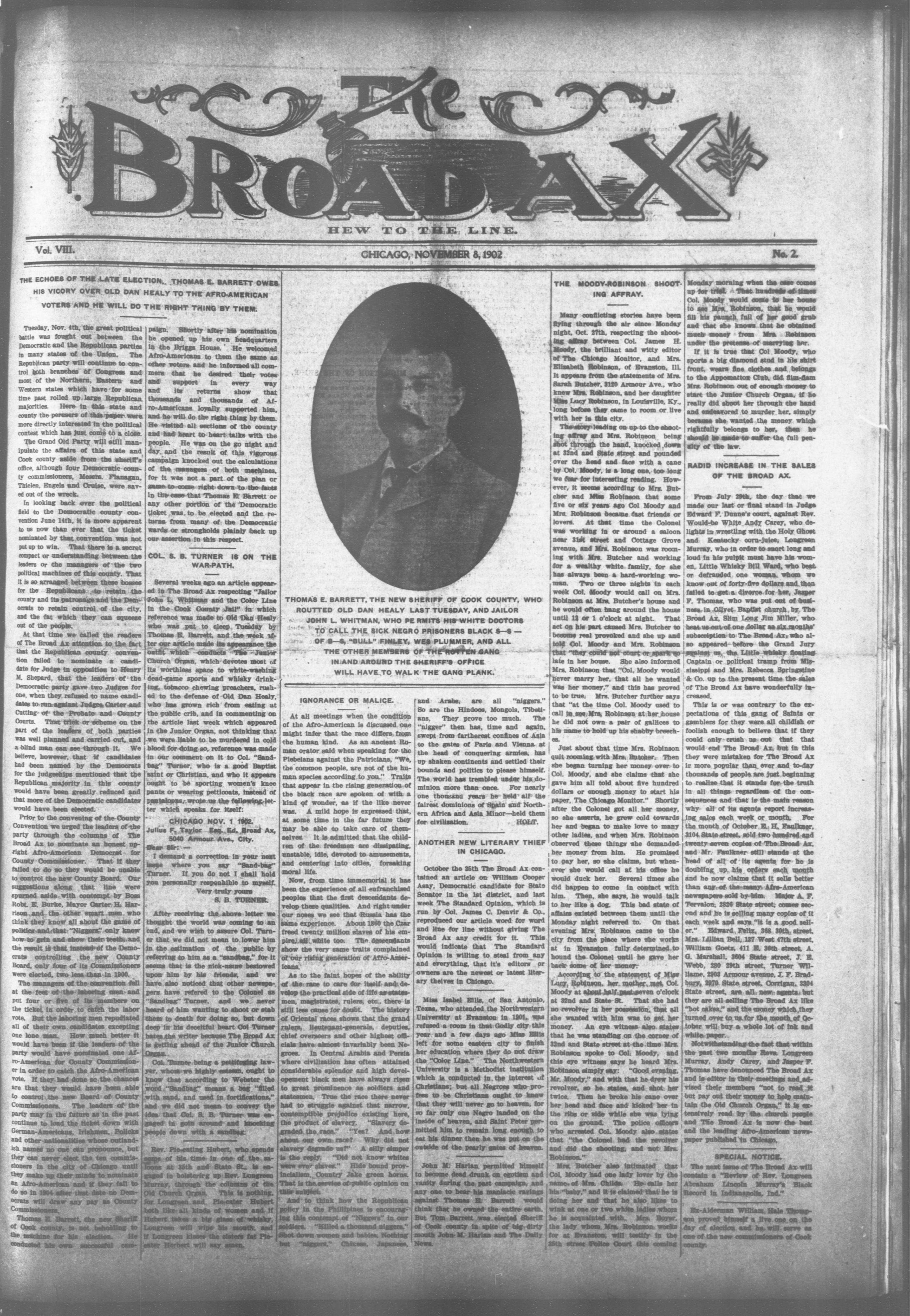
THOMAS E. BARRETT, THE NEW SHERIFF OF COOK COUNTY, WHO ROUTTED OLD DAN HEALY LAST TUESDAY, AND JAILOR JOHN L. WHITMAN, WHO PERMITS HIS WHITE DOCTORS TO CALL THE SICK NEGRO PRISONERS BLACK S—S OF B—S, "BULL" FINLEY, WES PLUMMER, AND ALL THE OTHER MEMBERS OF THE ROTTEN GANG IN AND AROUND THE SHERIFF'S OFFICE WILL HAVE TO WALK THE GANG PLANK.
IGNORANCE OR MALICE.
At all meetings when the condition of the Afro-American is discussed one might infer that the race differs from the human kind. As an ancient Roman orator said when speaking for the Plebeians against the Patricians, "We, the common people, are not of the human species according to you." Traits that appear in the rising generation of the black race are spoken of with a kind of wonder, as if the like never was. A mild hope is expressed that, at some time in the far future they may be able to take care of themselves. It is admitted that the children of the freedmen are dissipating, unstable, idle, devoted to amusements, and centering into cities, forsaking moral life.
Now, from time immemorial it has been the experience of all enfranchised peoples that the first descendants develop these qualities. And right under our noses we see that Russia has the same experience. About 1860 the Czar freed twenty million slaves of his empire, all white too. The descendants show the very same traits complained of our rising generation of Afro-Americans.
As to the faint hopes of the ability of the race to care for itself and develop the practical side of life as statesmen, magistrates, rulers, etc., there is still less cause for doubt. The history of Oriental races shows that the grand rulers, lieutenant-generals, deputies, chief overseers and other highest officials have almost invariably been Negroes. In Central Arabia and Persia where civilization has often attained considerable splendor and high development black men have always risen to great prominence as soldiers and statesmen. True the race there never had to struggle against that narrow, contemptible prejudice existing here, the product of slavery. "Slavery degraded the race." "Yes? And how about our own race? Why did not slavery degrade us?" A silly simper is the reply. "Did not know whites were ever slaves." Hide bound provincialism, Country Jake green horns. That is the service of public opinion on this subject.
And to think how the Republican policy in the Phillipines is encouraging this contempt of "Niggers" in our soldiers. "Killed a thousand niggers." Shot down women and babies. Nothing but "niggers." Chinese, Japanese.
and Arabs, are all "niggers." So are the Hindoos, Mongols, Tibetans, They prove too much. The "nigger" then has, time and again, swept from fartherest confines of Asia to the gates of Paris and Vienna at the head of conquering armies, has up shaken continents and settled their bounds and politics to please himself. The world has trembled under his dominion more than once. For nearly one thousand years he held all the fairest dominions of Spain and Northern Africa and Asia Minor—held them for civilization. HOLT.
ANOTHER NEW LITERARY THIEF IN CHICAGO.
October the 25th The Broad Ax contained an article on William Cooper Asay, Democratic candidate for State Senator in the 1st district, and last week The Standard Opinion, which is run by Col. James C. Denvir & Co., reproduced our article word for word and line for line without giving The Broad Ax any credit for it. This would indicate that The Standard Opinion is willing to steal from any and everything, that it's editors or owners are the newest or latest literary theives in Chicago.
Miss Isabel Ellis, of San Antonio, Texas, who attended the Northwestern University at Evanston in 1901, was refused a room in that Godly city this year and a few days ago Miss Ellis left for some eastern city to finish her education where they do not draw the "Color Line." The Northwestern University is a Methodist institution which is conducted in the interest of Christians; but all Negroes who profess to be Christians ought to know that they will never go to heaven, for so far only one Negro landed on the inside of heaven, and Saint Peter permitted him to remain long enough to eat his dinner then he was put on the outside of the pearly gates of heaven.
John M. Harlan permitted himself to become dead drunk on egotism and vanity during the past campaign, and any one to hear his maniac ravings against Thomas B. Barrett would think that he owned the entire earth. But Tom Barrett was elected Sheriff of Cook county in spite of big dirty mouth John M. Harlan and The Daily News.
Many conflicting stories have been flying through the air since Monday night, Oct. 27th, respecting the shooting affray between Col. James H. Moody, the brilliant and witty editor of The Chicago Monitor, and Mrs. Elizabeth Robinson, of Evanston, Ill. It appears from the statements of Mrs. Sarah Butcher, 3120 Armour Ave., who knew Mrs. Robinson, and her daughter Miss Lucy Robinson, in Louisville, Ky., long before they came to room or live with her in this city.
The story leading on up to the shooting affray and Mrs. Robinson being shot through the hand, knocked down at 32nd and State street and pounded over the head and face with a cane by Col. Moody, is a long one, too long we fear for interesting reading. However, it seems according to Mrs. Butcher and Miss Robinson that some five or six years ago Col Moody and Mrs. Robinson became fast friends or lovers. At that time the Colonel was working in or around a saloon near 31st street and Cottage Grove avenue, and Mrs. Robinson was rooming with Mrs. Butcher and working for a wealthy white family, for she has always been a hard-working woman. Two or three nights in each week Col. Moody would call on Mrs. Robinson at Mrs. Butcher's house and he would often hang around the house until 12 or 1 o'clock at night. That act on his part caused Mrs. Butcher to become real provoked and she up and told Col. Moody and Mrs. Robinson that "they could not court or spark so late in her house. She also informed Mrs. Robinson that "Col. Moody would never marry her, that all he wanted was her money," and this has proved to be true. Mrs. Butcher further says that "at the time Col. Moody used to call to see Mrs. Robinson at her house he did not own a pair of gallices to his name to hold up his shabby breeches.
Just about that time Mrs. Robinson quit rooming with Mrs. Butcher. Then she began turning her money over to Col. Moody, and she claims that she gave him all told about five hundred dollars or enough money to start his paper, The Chicago Monitor." Shortly after the Colonel got all her money, so she asserts, he grew cold towards her and began to make love to many other ladies, and when Mrs. Robinson observed these things she demanded her money from him. He promised to pay her, so she claims, but whenever she would call at his office he would duck her. Several times she did happen to come in contact with him. Then, she says, he would talk to her like a dog. This bad state of affairs existed between them until the Monday night referred to. On that evening Mrs. Robinson came to the city from the place where she works at in Evanston fully determined to hound the Colonel until he gave her back some of her money.
According to the statement of Miss Lucy Robinson, her mother, met Col. Moody at about half past seven o'clock at 32nd and State St. That she had no revolver in her possession, that all she wanted with him was to get her money. An eye witness also states that he was standing on the corner of 32nd and State street at the time Mrs. Robinson spoke to Col. Moody, and this eye witness says he heard Mrs. Robinson simply say: "Good evening, Mr. Moody," and with that he drew his revolver, so he states, and shot her twice. Then he broke his cane over her head and face and kicked her in the ribs or side while she was lying on the ground. The police officers who arrested Col. Moody also states that "the Colonel had the revolver and did the shooting, and not Mrs. Robinson."
Mrs. Butcher also intimated that Col. Moody had one lady lover by the name of Mrs. Childs. He calls her his "baby," and it is claimed that he is doing her and that he also likes to wink at one or two white ladies whom he is acquainted with. Mrs. Boyer, the lady whom Mrs. Robinson works for at Evanston, will testify in the 35th street Police Court this coming
Monday morning when the case comes up for trial. That hundreds of times Col. Moody would come to her house to see Mrs. Robinson, that he would fill his paunch full of her good grub and that she knows that he obtained much money from Mrs. Robinson under the pretense of marrying her.
If it is true that Col Moody, who sports a big diamond stud in his shirt front, wears fine clothes and belongs to the Appomattox Club, did slim-flam Mrs. Robinson out of enough money to start the Junior Church Organ, if he really did shoot her through the hand and endeavored to murder her, simply because she wanted the money which rightfully belongs to her, then he should be made to suffer the full penalty of the law.
RADID INCREASE IN THE SALES OF THE BROAD AX.
From July 29th, the day that we made our last or final stand in Judge Edward F. Dunne's court, against Rev. Would-be White Andy Carey, who delights in wrestling with the Holy Ghost and Kentucky corn-Juice, Longgreen Murray, who in order to snort long and loud in his pulpit must have his women, Little Whisky Bill Ward, who beat or defrauded one woman whom we know out of forty-five dollars and then failed to get a divorce for her, Jasper F. Thomas, who was put out of business, in Olivet Baptist church by The Broad Ax, Slim Long Jim Miller, who beat us out of one dollar as six months' subscription to The Broad Ax who also appeared before the Grand Jury against us, the Little whisky floating Captain or political tramp from Mississippi and Mrs. Rebecca Springstine & Co. up to the present time the sales of The Broad Ax have wonderfully increased.
This is or was contrary to the expectations of this gang of Saints or gamblers for they were all childish or foolish enough to believe that if they could only crush us out that that would end The Broad Ax, but in this they were mistaken for The Broad Ax is more popular than ever and to-day thousands of people are just beginning to realize that it stands for the truth in all things regardless of the consequences and that is the main reason why all of its agents report increasing sales each week or month. For the month of October E. H. Faulkner, 3104 State street, sold two hundred and twenty seven copies of The Broad Ax, and Mr. Faulkner still stands at the head of all of its agents for he is doubling up his orders each month and he now claims that it sells better than any of the many Afro-American newspapers sold by him. Major A. F. Tervalon, 2826 State street, comes second and he is selling many copies of it each week and says "it is a good seller." Edward Felix, 368 30th street, Mrs. Lillian Bell, 137 West 47th street, William Goetz, 411 E. 36th street, A. G. Marshall, 3604 State street, J. E. Webb, 280 29th street, Turner Williams, 2903 Armour avenue, J. F. Bradbury, 2970 State street, Corrigan, 3304 State street, are all new agents but they are all selling The Broad Ax like "hot cakes," and the money which they turned over to us for the month of October will buy a whole lot of ink and white paper.
Notwithstanding the fact that within the past two months Revs. Longreen Murray, Andy Carey, and Jasper F. Thomas have denounced The Broad Ax and is editor in their meetings and advised their members "not to read it but pay out their money to help maintain the Old Church Organ." It is extensively read by the church people and The Broad Ax is now the best and the leading Afro-American newspaper published in Chicago.
Will promulgate and at all times uphold the true principles of Democracy, but Catholics, Protestants, Priests, Indulges, Farmers, Single Taxors, Republicans, Knights of Labor, or any one else can have their say, so long as their language is proper and responsibility is fixed.
The Broad Ax is a newspaper whose platform is broad enough for all, ever claiming the editorial right to speak its own mind.
Local communications will receive attention. Write only on one side of the paper.
Subscriptions must be paid in advance.
One Year..... $2.00
Six Months..... 1.00
Advertising rates made known on application. Address all communications to
THE BROAD AX
8040 Armour Avenue, Chicago.
JULIUS F. TAYLOR, Editor and Publisher.
Entered at the Post Office at Chicago, Ill., as Second-class Matter.
FRENCH WOMAN A POWER.
Countess de Loignees Wields as Great Political Influence as Did Mme. de Maintenon.
Mme. la Comtesse de Loignees still keeps up the only great political salon in Paris. She has a gorgeous home in the Avenue de Champs Elysees and her political power is as great to-day as ever was that of Mme. de Maintenon.
Count de Mun is the only member of the chamber of deputies who can afford not to attend her receptions. Ladies leave her severely alone, but men of power are forced to file before her every Thursday from four to seven and to offer incense to this political goddess. Mme. Adam once wielded a similar power, but she has been politically deserted since Gambetta said he could not be seen in her salons again, and yet she retained her power for years.
But Mme. de Loignes controls them all. Waldeck-Rousseau consulted her before retiring; she told Paul Deschanel not to contest the presidency of the chamber of deputies. She advised the three Castellane brothers to stand for the chamber.
Such is her power that President Loubet calls upon her, to the great chagrin of Mme. Loubet, who is an excellent housewife but not a politician.
Frenchmen are superstitious about the political power of women, says the Detroit News-Tribune. White-haired senators fear her, with the possible exception of Mr. Clemencean. With her will die the political influence of the French salon.
YOUR SHARE OF MONEY.
The Amount of Cash Back Person of Our Population Should Have to Be Even.
Have you $28.66? If you have not you are short your per capita share of the money circulation of the United States, and some one has what would be coming to you if the money that is in circulation were equally divided. This statement is made without reservation, on the authority of the latest report of the treasury department, says the New York Herald.
Another thing; you are entitled to seven cents more than you were one year ago, according to this same report, even though there has been allowed for an increase of 113,000 in the population, for in that same time there has been an increase of more than 65,000,000 in the money in circulation. So you see you are better off than you were a year ago—if you get your dues.
In fact, you are getting better off all of the time. What has happened since 1879? The population has increased 58 per cent., and the money in circulation has increased 176 per cent., and more than one-half of that increase in circulation has been in gold or in gold certificates.
Snack the Martesen
A correspondent writing to the Chicago Tribune says: "A number of years ago the bones of a mastodon were found in a swampy farm near Three Oaks, Mich. The university was notified, and some men came to disinter the 'remains.' I was standing next to the old farmer who owned the land, when it suddenly occurred to him that he could throw light on the subject, and he remarked: 'Waal, naouw, I thought I smelt somethin' last summer when I was daoun here plowin'."
An Ohio minister traveled 300 miles to get home to vote at the local option election recently. He went 146 miles by rail, 17 miles by carriage, 130 miles on a bicycle and 7 miles afoot. He led the prayer meeting jollifying over the result.
Immigration statistics for the last fiscal year are of interest, because of the great increase in the number of new arrivals. Of the total of 494, 800, the month of May brought the most, 82,054; and in the past four months the arrivals numbered 266, 607, or considerably over one-half. Austria-Hungary, Italy, Germany and Russia sent the most immigrants. It is of interest to note that only one-fourth of the whole number were women, and that not the newer parts of the country, but New York, Pennsylvania and New Jersey were the destinations of the majority of the incomers. Many went far west, even to California.
Crematories for Diseased Animals. Crematories for the destruction of animals which have died from infections and contagious diseases have been erected in several parts of Biliesia.
"Beans are the soldiers' mainstay," says Thomas P. Dillon, a retired United States cavalry officer, according to the Philadelphia Record. "The American soldier, at a pinch, can equal the performance of an Arab on a handful of dried dates—he can ride and fight all day on a more handful of beans, properly prepared. There is nothing to equal the army baked bean. Your celebrated 'Boston baked' are but a poor imitation of the succulent article turned out by a regular army cook. There's an art in cooking them that nobody but an army man can ever acquire. I've been on service when for a week at a time our menu consisted of beans for breakfast, beans for dinner and beans for supper; and did the troopers tire of the monotony? Not a bit of it. They sang for more, and in spite of hard work and lack of variety at mess the fellows actually got fat. That demonstrated to me the nutritive quality of beans, and I made it a point to get into the good graces of the cook and learn how to bake them. It isn't such an elaborate process, but there's a trick in doing it right. My friends are all fond of beans the way I cook them, and many a time I've been asked for the recipe, but that's a thing I don't give away to everyone. You see, people enjoy a dish all the better when they know it's something that not everybody can get up. It might take some of the zest away if they could say of my beans: 'I know how to make them.'"
KNOWLEDGE WAS POWER.
New familiarity with the Chinese Language Made a Woman a Countess.
One of the unmarried women in diplomatic circles at Washington is Countess Marguerite Cassini, the accomplished niece of the Russian ambassador, who is a countess in her own right, not by heredity, but by special grace of the czar, and a curious story is told of the manner in which she won her title. It was when Count Cassini had his fateful conference with Li Hung Chang at Peking, long before the Boxer trouble. The count's interpreter was away, for Li's call was unexpected, and as the Chinese statesman could not speak Russian and the Russian diplomat did not understand Chinese the conference came to a deadlock. The count's niece, who had picked up something of the language, stepped into the breach and the affair was arranged to the satisfaction of both parties. The Chinese empress loaded her with presents, the czar's government made a note of the service performed, and when there was a question a couple of years ago of the young lady's precedence at Washington, where the count was then ambassador, the czar himself counfounded her rivals by making her a countess. This was something like rapid promotion for the lady.
CHINESE ARMY ROLLS.
They include with the Soldiers, Their Horses and Every Article of Equipment.
Now that China has Russia for a near neighbor, it remains to be seen how successfully, or otherwise, the middle kingdom will continue to practice its favorite game of bluff. How it has reenforced its army is shown by the Swedish explorer, Hardin, says Youth's Companion.
The Chinese have a most extraordinary way of enumerating troops. They are not content with counting the soldiers only, but reckon in also their horses, rifles, shoes, breeches and so forth, so that the resultant total is a long way above what it ought to be.
They apparently go on the supposition that the rifle is at least as valuable as the man, and by an analogous train of reasoning they argue that a man is of little use if he has to travel on foot, that he cannot go about naked, and so on. Hence they count the whole kit, horse, rifle, breeches and all.
By this peculiar process of arithmetic they fancy they deceive the Russians into believing their garrisons much stronger than they are.
NEGROES DON'T MIGRATE.
There were 6,500,000 colored persons in the United States in 1880, 7,500,000 in 1890, and 8,800,000 in 1900. A "general movement" of colored inhabitants from one state to another or from one section of the country to another, due to economic, political or hygienic reasons, has been declared to be in progress at intervals of two or three years since the close of the civil war.
But the figures of each succeeding census prove that the colored population of the United States is by no means migratory; it changes little year by year except as the result of the ordinary increase in population. Various ambitious projects of leaders to "colonize" certain states have failed entirely. In Kansas, for instance, there are only 9,000 more colored inhabitants than there were 20 years ago, though Kansas has long been the mecca of many colored colonizers.
The Philosopher's Stone.
An Italian having written a book upon the art of making gold, dedicated it to Pope Leo X., expecting a good reward. His holiness, finding that the man constantly followed him, at length gave him a large, empty purse, saying: "Sir, since you know how to make gold, you can have no need of anything but a purse to put it in."
AMERICAN PRECIOUS STONES.
Hardly a State in the Union in Which There Is Not Some Trace of Them.
When we think of the mining of precious stones our thoughts are quite certain to leap into South Africa, over to the orient, among the mountains of Asia and Europe, or perhaps to South America, but we are not likely to think of our own land yielding them; but the fact is that no insignificant value in gems is taken from the soil right here at home. The report of the geological survey, just compiled for 1901, shows that during the year we mined in the United States precious stones to the value of about $300,000, reports the New York Herald.
Diamonds represent only $100 of this amount, but the fact that they are found at all gives encouragement to the hope that paying fields of them may some time be found. Last year one diamond was found in Lee county, Georgia, where diamonds were not before known to exist. New Mexico furnished $18,000 in turquoises, and these have been placed on the market. Montana gave us $90,000 in sapphires, which come next. They came from Fergus county. Granite county is now being explored for fancy colored sapphires, that give evidences of being there in paying quantities.
Fine and extensive rhodolite garnet deposits are found in Mason county, North Carolina. Many dark green, blue and yellow beryls, as well as amethysts and emeralds, were found in that state. There is hardly a state of the union in which there is not some trace of precious stones, and it appears not at all unlikely that before many years we may be competing with the old world in furnishing gems.
ANCIENT AMERICAN BOOK.
When hieroglyphs are mentioned one naturally thinks of the records of ancient Egypt; yet before Columbus landed on these shores the Aztecs of ancient Mexico had a most elaborate system of writing in hieroglyphs. They formed long strips of deerskin into books folded screen-fashion, on which were depicted signs and representations of ceremonials. These old pre-Columbian books the Spaniards greedily collected and burned so that only ten are known to-day in the whole world.
One of these has only recently been found in one of the libraries of Europe and an exact copy presented to the American Museum of Natural History in New York, where it will shortly be placed on exhibition. The text represents the history of the lives of several individuals. One recounts the life of the Lady Three-Glints, who has two husbands and a child and goes through elaborate ceremonies.
Another portion of this old "Codex," as it is called, says the New York Times, treats of the life of a great lord and conqueror named Fire Deer, who, in company with other chieftains, makes many conquests. This old book proves most conclusively how love, religion and warfare went hand in hand in the lives of the ancient Mexicans, just as in people's lives to-day.
GOTHAM'S COURTING CLUB.
The city of New York boasts a club which has for its object the promotion of courtship in so far as matrim. concerned. A number of young men there have banded themselves together to make love to damsels, who, instead of looking for proposals, are content with what is called "a good time."
Their knights escort them to theaters, picnics and other amusements, make them presents, and are generally attentive to even a greater degree than the ordinary enamored swain. Couples who break the rules of the club by marrying have to pay a fine of $50 and are forever banished from the club. One or two couples have already paid this fine says the Detroit News-Tribune, and entered into the forbidden state, a dinner for each occasion being held by the club to console the members for their loss.
An equally curious club has for some time been in existence in Chicago. It is composed of young men, all of whom bear the Christian name of Joseph, and who have entered into a solemn compact to woo no girls except those bearing the Christian name of Mary. The club has considerable membership, and it is a noteworthy fact that, so far, its rule has never been broken.
Girls for Farm Work. There are employed on the farms near Calumet 300 Finnish girls, who work in the hay and grain fields like hired men, says the Detroit Tribune. The farmers say they are cheaper than male help and give more complete satisfaction. The larger number of these farm girls have worked in the crop fields in the old country and prefer the open air to the narrow kitchen confines. The girls work faithfully and show no inclination to dally and look the other way to be "surprised" with a kiss from a big, sweating hired man. Their employers like them on this account; also, because there is no competition.
Weaving for the Blind. Typewriting and mat weaving have been successfully taught to the blind, and it is believed that they could even learn to make lace, and thus gain a new means of livelihood.
A COMEDY JAIL.
Town Guardhouse in Pennsylvania What Is Morely a Convenience Ser Prisoners.
Elimbathtown, the county seat of Essex, in the Adironducks, possesses a comedy jail, according to the Philadelphia Ledger. It is small, having windows secured by wooden bars and a jailyard inclosed by a solid fence of three-quarter-inch boards, which a healthy male could push over with his shoulder. But the prisoners rarely, if ever, attempt to escape. Some good stories are told by Judge Kellogg, Judge Hand and other residents. It is a custom to allow the prisoners out on parole, so that they may cut the grass on neighboring lawns, do garden work, or repair roads for the village or county. Recently one prisoner, who should have returned at eight o'clock, did not apply for admission until nearly an hour later. The warden angrily demanded to know the reason, and added: "Don't let this occur again, or I will not allow you to come in. I lock the door at eight o'clock, and won't open it in the future for you." Another accused of and awaiting trial for manslaughter, overstayed his parole and pleaded as an excuse that as it was Saturday he thought he would go and spend Sunday with his wife, returning to the jail on Monday morning.
MIGRATION OF THE SNIPE.
Tons of Land Ore Fired at the Artful Badger as Me Wings His Way Southward,
The snipe, properly Wilson's snipe, Gallinago Delicata, but commonly known as English snipe and wrongfully called half a dozen other names, is a widely distributed species. It visits every state at some season; its northward migration extends within the arctic circle, while it is known to go southward to northern South America and the West Indies. Comparatively few of the birds which move northward from February until May breed south of the international line. It is quite true there are breeding grounds at various points of the northern states, but the great breeding range extends from latitude 42 degrees north to some undetermined point much nearer the pole than most sportsmen will venture.
Some time in September the first south-bound birds pass below the Canadian grounds, and soon most of the suitable marshy bits of east and west have their share of long-billed prizes. Then begins an astonishing attack which extends from ocean to ocean and generally sweeps southward from Canada to California. Probably tons of lead, half of which is wasted, are fired at the artful defenses.
CARIBOU MURDER
Image Companies That Slaughter Hundreds of the Animals in Newfoundland.
Newfoundland is probably the only country in the world where venison, salted or fresh, is a staple article of diet for the masses. The coast folk make their plans with method and deliberation, says Outing. From the harbors where they reside they go in their boats to the rivers and fords which strike into the interior. When navigation is no longer possible they debark and continue on foot to the deer country. They carry barrels filled with salt and sometimes go in large companies.
When the rendezvous is reached they camp. Then they ambush themselves along a promising "lead" or deer track, armed with a long, six-foot muzzle-loading sealing guns, which they charge with about "eight fingers" of coarse gunpowder and "slugs" of lead, fragments of iron or bits of rusty nails, whichever they may have. They fire point blank into a herd of caribou, as it passes, and being usually good shots, contrive to kill almost anything they aim at, or to wound it so badly with these dreadful missiles that it soon collapses. Then they skin and cut up the meat, for these men know a little of every trade, and pack it in the barrels with the salt as a preservative.
NOVEL PRISON REFORM.
Itly Proposed Compensation for Men Who Have Been Unjustly Condemned.
A new criminal bill is about to be discussed in Italy, and it is thought in Rome that it will be passed. It proposes to concede to those found to have been unjustly condemned to prison an indemnity, to be decided upon by the courts, says a report to the Chicago Tribune.
If the person has been in prison through a real judicial error the indemnity will in some way correspond to the financial loss which he and his family have sustained, while if he has been condemned through the bad faith of a third person, through false testimony. (for which, of course, the court which condemned him is not responsible), the indemnity will be less, but at least he will have the wherewithal to begin life anew.
It has been proposed to indemnify those living when the law passes who have already been released from unmerited condemnations, or the families of those who have died while undergoing unjust sentence.
Thomas France and John Johns, sailors in the United States navy, are full-blooded Iroquois Indians, who grew up together on an Indian reservation. They left home about ten years ago and never met until a week or so ago, both having sailed all over the world meantime. To their tribe they are known respectively as Leaping Deer and White Feather.
FISHES' FACES DECEIVING.
One Cannot Always Tell by Their Expression What Their Characters Are.
"Fish are a good deal like people," said Superintendent Spencer, of the New York aquarium. "You can't always tell by their countenances what to expect of them. Look at that fellow there, now!" He pointed to a tiger fish which was butting its nose against the glass of its tank. No more villainous face of the pugnacious sort could be found in a day's search in the haunts of the third-rate pugilists.
"Looks as if he would fight at the wriggle of a fin, doesn't he?" the superintendent continued. "See those jaws! Bad eye, too. Well, sir, that is the most gentle fish in the aquarium—one of the clinging kind, that seeks affection and kindness. Now over there is a lady fish. Just observe those brilliant colors, and that dear, innocent face, and notice the coaxing, graceful movements of its tail. You'd think it would eat out of your hand, and droop if you scolded it.
"On the contrary, it's the most unladylike fish in this collection; its temper is shrewish, and its habits are bad, and if you give it a chance it would bite you like a savage bull pup. It's a vicious fish, and doesn't deserve all those fine airs it has." Mr. Spencer put his hand near the glass front of the tank, says the New York Mail and Express. There was an instant commotion; the insinuating tail lashed the water, and that angelic mouth bumped sharply against the barrier in a swift effort to nip the tip of the superintendent's finger.
"Would you ever think it?" said Mr. Spencer. "Lady fish, indeed!"
SHOE TRADE OF CUBA.
From statistics relating to the boot and shoe trade of Cuba, while under United States control, as shown by the last commercial summary of the island for May, 1902, published by the bureau of insular affairs of the war department, it appears that for the period mentioned purchases, including sandals, were made to the amount of 9,545,098 pairs, valued at $6,812,017, the importations coming chiefly from Spain and this country in the ratio of 73 per cent. for the former, against 26 per cent. for the latter, though a comparison by years discloses the fact that under an equitable adjustment of the tariff rate on merchandise of this class, in effect prior to United States intervention, American manufacturers of boots and shoes have largely increased their trade with Cuba.
In connection with this statement the fact is mentioned that during each month of the three calendar years, 1899, 1900 and 1901, the total importations of boots and shoes into the island were $880,621, $335,643 and $467,778, respectively, considerably in excess of the shipments from our customs houses destined for all Europe (excepting the United Kingdom), the exportation from the United States for this trade being $812,935, $285,172 and $400,431 during the periods mentioned.
DAINTY WOMEN OF JAPAN.
The Picturequee Little Ladies Containly Cannot Be Accused of the Sin of Overeating.
The almond-eyed, dainty little female of Japan is easily satisfied in the matter of food. She begins the day by eating when she wakes a couple of little green plums pickled in vinegar and rolled in sugar. This traditional breakfast of Japan is completed by a cup of tea. The dinner, which is brought on a red lacquer tray, is the drollest affair. The viands are in tiny cups with covers and among them are such dainties as a hashed sparrow, a stuffed prawn, a salt sweetmeat, seaweed with sauce and a sugared chili. After these dishes, which are mere "frills," the substantial part of the meal is begun. A wooden bowl, bound with copper, is brought in, filled to the brim with rice plainly boiled in water. From this the flower of Japan fills her bowl—a capacious one—and, having mixed it with a black sauce-flavored with fish, she then lifts it to her mouth and crams it down with the aid of her chopsticks. Thus ends her dinner.
AUTO CLIMBS A TOWER.
Two Hundred Pound Machine in Copenhagen Performs a Most Remarkable Fent,
A curious performance was lately accomplished by an automobile in Denmark. Copenhagen possesses a circular tower 100 feet in height, which was formerly used for astronomical purposes. Its top is only reached by ascending a spiral passage 12 feet broad which winds between the outer wall of the tower and an inner circular wall. From the base to the top it is entirely without steps, and the gradient is seven inches per all. An automobile of five-horse power, weighing 200 pounds, and carrying three persons, ascended the tower the other day, taking one minute for the journey, and afterward making the much more dangerous descent with equal success. It is of interest to recall that the Czar Peter the Great, on visiting Copenhagen in 1716, made the same ascent and descent in a carriage drawn by four horses.
NAPOLEON'S MAGIC TABLE
Wonderful Place of Furniture Which Was the Pride of the French Emperor.
Napoleon's magic table is one of the greatest curiosities from the time of the great emperor, who had it in his study at the castle of St. Cloud. After the death of Napoleon it was bought in London by Baron Rehausen, Swedish ambassador to the court of St. James at that time. It is now owned through inheritance by one of the foremost families of the Swedish nobility, says the Strand Magazine. Inside the drawer of the table is pasted an old slip on which is printed a description, which in modernized English reads as follows: "The Emperor Napoleon was highly delighted with this extraordinary work of art. It formed the surface of one of the tables in his study, and was always shown to all foreigners of distinction who visited the imperial court. It is a painting whose resemblance to what it represents is the most elusive ever produced by the genius of man. One may look at this strange production of art in different lights—the pieces of money, the fragments of broken glass, the penknife, water and cards retain an equally illusive appearance as the observer moves round the table—but it requires a very minute examination to discover all the truly magical wonders it possesses." In these times when relics of Napoleon I. are eagerly sought for, the present whereabouts of this masterpiece should certainly interest all connoisseurs.
SECOND-HAND FOOD BARRED
Leavengu of Rich Men's Banquet Must Not Be Eaten by the Poor of Paris.
"What is one man's meat is another's poison" is a proverb just now borne out in literal fact by the police raid upon the arelquins of Paris, reports a London paper. The arelquins are the keepers of small restaurants at the market, whose supplies are provided from the broken remains of repasts at different fashionable restaurants.
The proprietor takes each morning a tour of the fashionable quarters and by paying a small amount to different maitres d'hotel he has the privilege of selecting a menu for his house from what is left of a swell dinner the day before. This he serves up to his customers for two cents and the latter have the privilege of eating what the aristocrats had set before them.
The elegance of the courses, however, is outweighed by their unwholesome effects. So many maladies are laid at the door of these second-hand feasts that the police have undertaken to protect the public stomach from possible indiscretions. The arelquins will soon be a picturesque feature of the past, for as their licenses expire they will fade from existence.
MODERN SURGERY.
Everything Depends Upon the Cleanliness and Exclusiveness of the Operation.
Your modern surgeon of note is a "sterile" man. The operating room, almost hermetically sealed and at a temperature of 100 degrees or thereabouts, is purified daily by means of a hose throwing a solution of bichloride of mercury over ceiling, walls and floors. The surgeon arrives in an anteroom in his civilian's garb. He is required to be clean shaven, like a monk, says the New York Press. His clothes are removed. Two attendants in the sterilizing room hand him a white duck gown reaching from collar to heel, and a cowl of the same material, which covers tightly every part of his head except eyes, nose and mouth. The sleeves of the gown reach to his elbow. He incases his hands in the thinnest, finest sterilized rubber gloves. These garments are handed to him in sterilized tongs. There has been no human contact. Thus equipped, he is prepared to saw and slice.
INVENTOR OF THE BATON.
How It Caused the Death of the Man Who First Introduced the Band Leader's Wand,
The inventor of the baton has been discovered. According to the investigations of a Frenchman the credit belongs to Lully, the composer, who eventually had cause to regret his invention. Before he adopted the baton, conductors were in the habit of pounding on the floor with their feet or clapping their hands to mark the time. Lully found it wearisome to keep his foot constantly in motion, and so used a stick to strike the floor and beat time. He used a pole six feet long.
One day he brought down the pole with such force that it struck his foot and made a deep wound. He paid no attention to the matter. The wound grew worse and ultimately caused his death.
After his time conductors tried more and more to improve the baton and it was ultimately brought to its present form.
Tall Men in Indiana
A record of the height of Indiana soldiers in the civil war shows that out of 118,254 there were 15,047 5 feet 10 inches high, 8,706 5 feet 11 inches, 6,679 6 feet high, 2,614 6 feet 1 inch, 1,357 6 feet two inches, 406 6 feet 3 inches, and 336 over 6 feet 3 inches. Commenting on these statistics, Dr. Gould, actuary of the United States sanitary commission, writes: "It is evident from our statistics that the Indiana men are the tallest of all natives of the United States and these latter the tallest of all civilized countries."
The fairy tale of money growing on bushes was lately realized along the right of way of the Burlington railroad between Hyannis and Alliance, says a Lincoln (Neb.) report. A gang of section men were at work, when one of them noticed something that looked like a bill waving from the tangled top of a sunflower growing by the roadside. He investigated. It was a treasury note for $10. He walked a few steps farther and there, nodding from a branch of a bit of dog fennel, was another bill of similar denomination.
He called to his companions, and the entire gang threw down their tools and started on a money hunt. For three hours they searched up and down the right of way and far afield. At almost every yard their trouble was rewarded by finding either a five or a ten-dollar bill. Some bills were tangled in the tops of weeds, others half hidden in bushes along the fence, and still others in the stubble of the field.
The entire day's clean-up of the eight was $2,135. When the find was reported, word came from headquarters that a money pouch containing $3,500 had been lost from an express shipment the day before.
The supposition is that the bag fell out of the open car door and was ground to pieces under the wheels, and the contents were scattered to the winds. This hypothosis is supported by the later discovery of portions of the damaged pouch.
RELIGION OF THE BLANKET.
The Navajo Squaw Prays as She Weaves the Threads of New Beautiful Production
It is a religion to make a Navajo blanket. Through the kinky, bristling twine of the warp are woven the hopes and aspirations of an immortal soul. In the warm colors are expressed the ardors of passionate hearts, the sandstorms they have faced, the cloudbursts under which their backs have bent, the smiling sunshine that has dried their wool, all the adverse and good fortunes that have befallen are wrought into the intricate designs. The squaw prays as she pushes the wool cart, and she prays as she twirls the distaff in her hands or rolls it on her thigh; she prays as she arranges the healds; she prays as she lustily pounds down the woofstrands with her scrub oak batten, says the Southern Workman.
A blanket is all a prayer, a human document, a biography bright with the joy tints of canary yellow, dark with the olive green of pain. One is drawn to it because one's heart is moved by its ineffable, intangible humanness. One is strangely moved to both laughter and tears by its exquisitely variant colors, each expressing an emotion by its warmth of blended fibers, each throbbing to a note of triumph or of woe.
THE FRUIT PLETHORA.
Fine Apples Fed to the Pigs Because of the Superabundant Product of the Orchards.
Earley, if ever, has there been such a superabundance of fruit as now abounds in the New England orchards. The limbs of the apple and pear trees hang heavy under the weight of their enormous yield, and the ground beneath the trees is covered with the decaying droppings. In some localities fine apples may be had for the picking, and an offer of half a dollar a barrel for the fruit on the tree is eagerly accepted in the rural districts. Thousands of bushels are being fed to the cattle and pigs and the cider mills are glutted with raw material for the presses. It seems a pity to see such a large quantity of fine fruit going to waste. It is almost superfluous to offer suggestion in the line of thoughtful philanthropy to Dr. Hale, but the glutted condition of the orchards suggests that it might be a good idea to renew his farmers' fruit offering scheme, which furnished such a liberal supply of free fruit to the poor people of Boston when it was originally undertaken. Undoubtedly a great many bushels of apples can now be had for the asking.
The leading haberdasher shops employ only clerks who are expert in arranging cravat shapes. Make-up neckwear is adopted for provincial trade, as a rule. Among the duties of such assistants is to attend weddings and other house functions. The bridegroom nowadays presents his "best man" and usher with cravats and gloves for the ceremony. The haberdasher's clerk reports at the proper place in due time and adjusts these cravats uniformly, placing the scarfpins in correct position, etc. He also fits the gloves in each case. His employer collects a handsome fee for this professional service.
Buddhists in America. It is stated that San Diego, in southern California, is fast becoming the Buddhistic center of America. In one house there has been erected a shrine to Buddha, and the owner, a woman of means, has brought a Buddha priest from India, who gathers a large congregation together every week.
Increased Receipts Minted.
The largest increase in postal receipts in the history of the service was shown in the reports of 50 leading post offices for September. That was the month, says the Chicago Record-Herald, in which the people who were away on vacations wrote home for money to get back with.
WASHINGTON'S STONE TROUGH
Picturesque Basin in Philadelphia, from Which the General Watered His Harves.
The famous old stone basin from which Washington watered his horses in revolutionary days is no longer used as a pump trough. It has been removed from the obscurity of the old frame pump house adjoining the Bartram mansion (where for nearly a century it collected the waters from the cooling springs of the old well) and has been given a position of honor just outside of the historic mansion, says the Philadelphia Record.
At first glance it seems to have been placed thus in order to serve as a huge stone eistern to collect the rain water from the projecting caves, but closer inspection shows that the rain spout is turned away from it, and it is not intended to serve any practical purpose, but is simply preserved as a treasured relic. In giving it a position of honor, where it will attract the attention of the visitor soon after entering the famous gardens, the place has been carefully chosen. For although it had been taken from the old well which, perhaps, seemed a more appropriate place for it, where it stood when Washington's horses drank from it, it has been placed near the famous "Washington arbor" on the river front of the Bartram house. Only a few yards away in the long ago there stood the Washington arbor, overlooking the shining stretch of Schuvelkill.
Close by this mammoth stone basin or trough, on the lawn on the river front of the house, are two noble boxwood trees sent from Smyrna, Turkey, to Mr. Bartram by the earl of Bute, over 160 years ago. Appropriate surroundings these for the historic old stone trough.
STREADY GOING VOLCANO
Small One in Santa Barbara County, California, That Has Been Active for Many Years.
Santa Barbara county is naturally divided into a northern and a southern half by a range of rugged mountains varying from 2,000 to 4,000 feet high. The city of Santa Barbara, Montecito and other health resorts are along the coast in the southern half. Los Alamos is near the middle of the great valleys comprising most of the northern part of the country, and is about 60 miles from the city of Santa Barbara, with a big mountain range intervening, says the San Francisco Chronicle.
For many years there has been a small, active volcano on the Los Alamo side of the mountain. It is almost within sight of the old Los Alamos-Santa Barbara stage road that crosses the mountain by the San Marcos pass. Hunters and cattlemen of the vicinity and prospectors are familiar with it. Smoke and steam constantly issue from various fissures along the summit of a plateau or shelf near the northern slope of the mountain. Viewed from the distance of the old stage road, these manifestations appear like small campfires. They have never developed any alarming tendencies and have attracted very little direct investigation. And yet they may become vent holes from which long-confined ashes and lava will spout.
VERY LONG PLUMB LINES.
Two of Pine Wires 4,660 Feet in Length Suspended in Michigan Mine Shafts.
Some singular experiments have been carried out recently by hanging what are probably the largest plumblines ever used anywhere in two of the shafts of Tamarack mine at Columbet, Mich. At first two lines of No. 24 piano wire, each 4,250 feet long, and carrying a cast iron bob weighing 50 pounds, were suspended about 12 feet apart in shaft No. 5. Careful measurements showed that the lower extremities of the lines diverged eleven-one-hundredths of a foot, or three-quarters of an inch. This was a surprising circumstance for which various explanations were offered. To avoid possible magnetic repulsion, bronze wires, carrying 60-pound lead bobs, were hung in shaft No. 4. These wires were 4,440 feet in length. They showed a slight convergence at the bottom, but when they were hung in shaft No. 5, instead of converging, they diverged, as the steel wires had done. These facts, together with other considerations, led to the conclusion that the cause of the divergence was neither gravitation nor magnetism, but the influence of almost imperceptible air currents in the shafts.
An Interesting Moment.
A German has discovered, according to the London Express, that on Saturday, August 2, in the early morning, at one minute and one second past one o'clock, a most interesting moment arrived. It was the second second of the second minute of the second hour of the second day of the second week of the second month of the second half of the second year of the second decade of centuries A. D.
Diseases in Alaska.
An English physician who has been making a study of diseases in Alaska reports that cerebro-spinal meningitis is very prevalent, scorbutus is widespread, rheumatism is frequent, pneumonia is almost unknown, strange to say, and insanity is by no means rare. His report indicates that a vigorous physique is required to resist the Alaskan climate.
JUMPING THE DEER.
One of the Most Thrilling Experiences Which Defall the Hunter of Big Game.
"Jumping a deer" is a highly-attractive phrase, quite apt to make a tingling in the back hair of the tenderfoot who hears it for the first time. It is also intensely satisfactory to the chap who always has to shave before wooing nature, says Outing. You may, indeed, get a good shot in this way, and it is generally the only way to see the grandest of all the sights of the woods—deer running through a windfall. To see the glossy curves of fur curl over the lofty logs that lie piled on each other in boundless confusion is well worth a trip to the woods, while for him who loves the rifle as I do, more for what cannot be done with it than for what can, there is no such target elsewhere. But for the tyro who is dying to get that first deer "jumping a deer" generally means out of sight and out of hearing both. For the deer that goes off to lie down after feeding does not go to sleep, but to ruminate and take life easy.
Once in a great while one falls into a dose, but almost always the head is well erect and all senses keen for danger. And even if one is in a dose it may slip away without your suspecting its existence, for sleep deadens little of the senses of this wary animal. The man who "wouldn't shoot such an innocent creature as a deer" should by all means see one getting out of a heavy windfall, while the man who loves game that can get away can here find the attraction of the woods at its climax.
WOODEN INDIANS MUST GO.
Tobacco Store Signs That Are Con-
demned to Retirement In
New York City.
One of New York's busy municipal commissioners says the wooden Indian must get off the walk. If the cigar dealer needs him in his business he will be obliged to take him inside and give him house room. Anyway, he cannot be allowed to encumber the sidewalk, say the Cleveland Plain Dealer.
Of course it may be possible that the commissioner is moved by an honest desire to keep the walks clear, and then again he may be under the influence of the Society for Prevention of Cruelty to Aged Wooden Indians. And, really, it must be admitted that there are cases where interference would seem to be justified. There are wooden Indians of extreme age who are still forced to do their servile duty at all seasons of the year, and in the most inclement weather. With cramped muscles and ossified limbs they have stood on guard for many decades.
Many of them are gray and dingy and weather beaten, but they never complain. Some of them have cracked open and lost their feathers, and warped their fingers, and dropped their wampum. Why, there are cigar dealers so unfeeling as to refuse them even a coat of paint when the mercury drops to zero.
PLAY BILLIARDS
French Physicians Are Sorry That the Game Is Declining in the French Hells.
Somebody has discovered that people in France are not playing billiards so much as they did formerly. Over this announcement has arisen a lamentation. Physicians have joined in it as well as lay-admirers of the game. They declare that its disappearance would be a misfortune from a sanitary point of view.
The game, they say, gives just the exercise they need to a great number of people who without it would take no exercise at all. While involving no severe physical exertion, it keeps the muscles in shape, stimulates the circulation, helps the digestion and requires just enough mental effort to give the nervous system a rest from the ordinary worries of life. In proof of all of which they cite the good spirits usually exhibited about a billard table.
For elderly people, for the stout who cannot take much exercise, billards is pronounced an excellent tonic. So the friends of the game are preaching a revival of its popularity.
Unconscious Human
Certificates of death are not documents where one usually seeks for humor, but there is frequently to be found in them much of the unconscious variety, says Pearson's Weekly. Here, for instance, is how the cause of death is stated in the case of a laborer: "Died from injuries received through a bull accidentally kneeling on his chest." The consideration shown for the feelings of the bull is a fine touch, and suggests grave questions on the moral responsibility of the lower animals. Again, a man is stated to have died "from the effects of injuries received after being run over by a railroad train in motion, owing to a misunderstanding between deceased and an engine driver." This description of a rather ordinary railway casualty is excellent; it, too, is so tender toward the feelings of the living.
Lost Jewelry in Laundry.
Before sending linen to the laundry look every piece over for forgotten collar buttons and stick pins. The laundries are repositories of more lost articles of this description than is dreamed of by the public. Every day quantities of gold and jeweled articles are picked up. Some of them are identified and restored, but more are simply pocketed by the finders. Money was frequently found in the pockets of washable waistcoats worn
JERSEY'S PURCHASE PRICE.
Historic Document Which Shows That the State Was Sold by Indians for Rum, Guns, Eta.
Carefully locked away in one of the fireproof safes of the New Jersey Historical society there now are two valuable documents that tell of the early colonization of the state, says the New York Times.
The first is a deed on parchment from Charles II. to his brother James, duke of York, afterward king of England, giving him a grant of all lands from the St. Lawrence river to Chesapeake bay. The only two names on the grant that Americans of to-day would recognize are Nantucket and Cape Cod, which are spelled as they are to-day. The St. Lawrence river is designated as "The Great River in Canada."
The deed is beautifully written in Gothic lettering, and the document is in excellent condition. Under each line of writing is a ruling of red, evidently done with a quill. The parchment is over two feet in length, and to the bottom is attached what was once a large seal of wax.
Gold and silver cords are fastened to the seal. In an upper left-hand corner is an engraving of Charles II., and the borders of the deed are filled with pen and ink designs, delicate and beautiful. The document is dated from Westminster in the seventeenth year of King Charles' reign. While the deed is apparently the original, for the amount of work expended on it would not be given to a copy, no signatures appear, and apparently none was ever placed on it.
CENTURY OF PATENT ISSUES.
Beginning July 31, 1790, the Number
Granted in This Country Has
Been 428,021.
The census bureau lately issued a report dealing with the cooperative relation of patented inventions to manufactures, which shows that New York, though third in population and patent rank for the first decade of the 100 years has since been first in both, as well as manufactures. It is an interesting fact, in considering the list of states presented in the report, that the manufacturing rank of a state as a rule approximates its patent rank, says the New York Sun. The report says:
The first patent granted by the general government was to Samuel Hopkins, July 31, 1790, for an improvement in pot and pearl ash manufacture. The last patent granted for the year 1889, at the close of the first 100 years of patent issues, was to Wilhelm Dreyer, December 31, 1889, for an electro-magnetic typesetting machine. These two patients are suggestively symbolical of the progress of the century in invention and manufactures—the first akin to the primitive industries of a new country and the last serving the exacting demands of a highly organized industrial system. The total number of patents issued during this century of invention was 428,621."
A feature of the report is the steady growth shown in the numbers of patents granted to citizens of foreign countries.
NOT THE SAME NAMES.
In reviewing a book about "Beasts and Birds in America," the London Spectator warns English readers against the confusion that may arise in their minds by the application of the same name to different birds in England and the United States. "The consequence," it remarks, "is that the critical English schoolboy who reads of robins pecking a wicked squirrel ('Meeko') to death will perhaps toss the book away as untrustworthy—unless he is a reader of Wendell Holmes, and remembers the allusion to the day when young Americans were mined by the English books with local color not fitting the new country. In the books that came from England the robin was a little domestic bird that fed at table instead of a great fidgety, jerky, whooping thrush."
But the whooping thrush (Tardus migratorious) of North America had a red breast like the robin of England, and so the name was given to him, and it was a mob of whooping thrushes, and not robin redbreasts, that did "Meeko," the mischief maker to death. And so, it may be added, the ancient misunderstanding and controversy between English and American tourists at the Atlantic liners' tables as to what is a partridge, a pheasant, a grouse, etc., will go on to the end of time.
Responsive Kindergarten
A singular case is that of Patrick Logue, of Altoona, Pa., who has been prosecuted for cruelty to animals, his offense consisting of excessive kindness. Logue is so fond of an intelligent horse owned by him that he will not allow the horse to work or even be exercised. For four years the horse has not been out of the stable. Logue feeds it and cares for it tenderly, but he has steadfastly refused to take it out. Consequently the Humane society has brought suit to force him to give the horse some work or exercise it daily at least.
John W. Mackay, the Irish-American multi-millionaire, who died recently in London, had a fine tribute paid to him once by a friend. "Mackay," said he, "is one of the few rich men I should like to know if he were poor."
Emigration of Jews.
During the last year 80,000 Jews emigrated from Roumania.
"A whole lot of ideas with which we grow up change when we get into another country," said a New York man who has just came back from a three months' trip in the southwest, according to the Sun. "Now, one of the things we have heard of all our lives is that if a man's hat blows off he is a fool to run after it, for there is always somebody around polite enough to pick it up and hand it to the owner, if he has to walk a block to do it.
"I have seen it done. I have read about it more times than I have had hats.
"But it is not the custom at Reno, Okla. I was sitting on the veranda of the hotel in that town, watching the various articles which one of those sandstorms whirled through the air.
"The hat of a citizen was raised and carried against a place on the other side of the street. A strapping fellow, who had been picking his teeth with a match as he sat near me on the veranda, got up, whipped out a navy revolver and fired a shot at the hat, nailing it to the fence.
"The owner came up, pulled the hat from its impalement, waved his hand at the man on the veranda and proceeded on his way.
"It saves time runnin' after it,' said the man on the veranda, 'and it don't hurt the hat.'"
AMERICAN SURGERY PRAISED.
The late Prof. Virchow, the eminent German physician and scientist, had a high notion of American doctors and American medical scientists generally, reports the Chicago Inter Ocean. When interviewed some time ago the professor said, in the course of the conversation, that several young medical students from the United States had passed through his hands whose attainments were certainly on a very high level and whose brightness and alertness could not be excelled.
"I have a great admiration of American surgery," he added. "The men in America are as good as any we have here in Europe and in some departments they are better. I do not think, though, that the American specialists are as good as the best men in London, Paris, Berlin and Vienna, but they are making big strides. No penurious spirit rules the United States. Everything is on a large, liberal scale, and the splendid university endowments there are bound to tell in the near future. The American laboratories are excellently equipped and the students have enormous advantages over those who study at some of the inadquately equipped schools in Europe."
Although there is nothing inherently improbable in the circumstance, it is not generally known that the race of troglodytes is not yet extinct, and that there are at least quite a number of cave dwellers in modern Britain. The inhabitants are by no means half savages.
At Kinver Edge, near Birmingham, are two rows of modern villas, formed mainly out of the "immemorial caves hollowed out of the hill," with stone-front projections. These dwellings are said to be "far more comfortable and luxurious than the less-original houses to be found in more pretentious neighborhoods." The rooms are "spacious and rain-proof" and the people of Enville, "as the village formed by these houses is called, are justly proud of their quaint homes, and speak with patriotic affection of Holy Austin rock, the stone from which their dwellings are hewn."
There are several remarkable cave dwellings in Knaresborough, in Yorkshire, says the Detroit News-Tribune, the "proprietor" of one of which has adorned the various levels of his hillside cave home with battlements and calls it Fort Montague.
SENATOR CLARK'S WIT.
How the Western Millionaire Got Back at a Tennorial Artist Who Had "Nerve."
A story is going the rounds in Butte which quite aptly represents the business methods adhered to by United States Senator W. A. Clark, the multimillionaire miner, banker and manufacturer.
Upon his return from the east the senator visited a barber shop for the purpose of having his hair trimmed. He inquired for a certain barber whose ability had been recommended to the senator by his son, Charles W.
Upon the completion of the job the senator inquired the amount of the bill, whereupon the tonsorial artist calmly replied:
"Charley usually gives me five dollars."
The senator was taken by surprise, but, regaining his wits, asked: "But what is the usual charge for such a service?"
"Fifty cents," responded the barber.
"Well," said Senator Clark, with a smile, according to the New York Times, "Charley has a rich father and I have not," whereupon he handed the barber 50 cents and departed.
Glaciers in Montana.
But few people are aware that there are in Montana some of the finest glaciers in the world.
CIGAR IN A CHEESE.
Magular Happening in a Paris Shop Which Precipitated a Remarkable Battle,
There was an extraordinary occurrence recently in a cheesemonger's shop in the Avenue Parmentier, Paris relates Pearson's Weekly. One of the tradesman's customers, who had invited five friends to dinner, had purchased a large cheese, and when it was cut into the stump of a half-smoked cigar was found in the middle. The host and his guests marched round in a body to the cheesemonger to demand an explanation and the return of the money or the substitution of another cheese, but the tradesman refused all three propositions, and even suggested that they ought to be satisfied, as they had not only the cheese, but half a cigar as well. One of the guests then threatened to report the cheesemonger for selling tobacco without permission. High words followed, and at length the customer picked up the offending cheese and hurled it with correct aim at the dealer's head. A regular battle ensued. The shopkeeper was backed up by his wife and three assistants and the customer by his friends. The counter was piled with cheeses of various kinds, and these were converted at once into missiles, while the butter also came in handy. The uproar attracted the attention of a policeman, who arrived just as a large Dutch cheese crashed through the window and caught him on the chest. When the officer had recovered his breath he separated the combatants and took them to the police station, where they were discharged with a caution.
LOBSTER CLIMBS TREES
Inland Sea Captures of the East India Islands That Are Fond of Cocosnuts.
In the East Indian islands is found a curious lobster which climbs trees. Although it prefers a home on land it at times feels a longing for the water, where it goes to moisten its gills; and here the eggs are laid, and the young are raised on the coast, where they have the benefit of salt air, always good for children. But most of their time is spent inland, living at the roots of trees where they have burrowed deep hollows which they carpet luxuriously with fibers stripped from cocoanuts.
They come out of these homes at night to climb the palm trees, for although it seems funny to us, their climbing is quite a serious business to them, since it is in this way that they secure the cocoanuts of which they are so fond and on which they live principally.
To get at the contents of the nut the lobster first tears away the fiber which covers the three "eyes." (You must all have noticed those black spots on one end of a cocoanut that makes it look like the wierd face of a monkey.) It hammers away with its claws at these spots or "eyes" until a hole is made, when it extracts the kernel by means of its smaller pincers. Sometimes after drilling through the perforated "eye" it grasps the nut in its claws and breaks it against a stone.
STUCK TO HIS EYEGLASS.
Becently a party from the embassies at Constantinople went to inspect the international lifeboat service on the Black sea coast. At one of the lifesaving stations they thought they would like to test the conditions of life-boat work, so, clothing themselves in bathing costumes and cork jackets, they each took an oar in a lifeboat, to the huge delight of the Turkish boatmen.
One of the secretaries of the British embassy is never seen without an eyeglass, and is said even to sleep with it. On this occasion he was faithful to his eyeglass and solemnly embarked in a cork jacket and eyeglass. All the proper exercises were gone through, and finally the boat was capsized and righted again by its own crew. As they crept out from under the capsized boat a howl of surprise came from the Turks, for the secretary's head appeared, with the eyeglass firmly fixed in its proper position, its owner taking it as a matter of course that it should be there.
ONLY A LITTLE CLIP.
A short time ago someone put on the market an ingenious device for holding sheets of paper together. It took the place of the pin, says the New York Press. By "short time" is meant a matter of some five or six years. Today there are more than 20 different kinds of clips, selling from 60 cents per 1,000 to 25 cents per 100, and considerable capital is invested in their manufacture. The same general principle is followed in all, and it is assumed that each improvement is patented. Corporations have been formed to make nothing but clips, and competition is lively. The original patentee will no doubt become a millionaire, though he may make only one cent on each 1,000 sold. It is the simple, dirt cheap invention that brings the big returns—something so inexpensive that all the millions of us want it.
Uncle Sam's Salt-Water Farm. For 30 years the United States commission of fish and fisheries has been making a study of Uncle Sam's salt-water farm, its products and the man who work it.
Miss Marguerite A. Britton, Public Stenographer, suite 412, 59 Dearborn street, is getting along very nicely with her work, and being polite and affable she is making new friends every day.
William H. Weber and Adam Wolf, members of the Board of Assessors, had the confidence of the voters throughout Cook county and they had no trouble in holding on to their positions.
Miss Portia Washington, daughter of Prof. Booker T. Washington, failed in her music lessons at Wellesley University recently, and Miss Washington will now persue her studies at another institution.
Alderman John J. Bradley, who worked very hard for the election of Dr. Nicholas R. Engels as County Commissioner, has opened up a real estate office in one of his buildings on Halsted St., near 47th St.
White men should stay out of our back alleys and horse lots at night and thereby Negro women would have less trouble with mulatto bastards. The Tribune-Press, Pueblo, Colo.
James A. Brown, 2818 Armour Ave., who has the records of many so-called big Negroes of Chicago, has secured among his friends more than fifty new subscribers to The Broad Ax within the past two months.
Doctor Nicholas R. Engles received the loyal support of The Broad Ax in his fight for County Commissioner and he made a home run last Tuesday and as predicted he will make a valuable member of the County Board.
The Broad Ax was unable to head off Ed Morris, Attorney for the "Gamblers Trust," in the first senatorial district, and if he lives he will cast his vote in the State Legislature for Albert J. Hopkins, the Negro hater for United States Senator.
We sincerely regret that County Commissioner Rollin B. Organ was defeated on last Tuesday. For the past two years he has been a faithful servant of the people, and they made a serious mistake by failing to retain him as a member of the Board of County Commissioners.
Dan Morgan Smith, late Democratic candidate for Congress from the 3rd Congressional district, says that "his defeat simply demonstrates that the 3rd district is hopelessly Republican." All the Democrats and many independent voters gave him hearty support. The race Mr. Smith made will be a benefit to him, as he made many new friends, and learned to fully appreciate the many friends he already had.
While in conversation with Sheriff elect Thomas E. Barrett and his able political manager Ex-Alderman John J. McGillen in the Briggs House, Wednesday both gentlemen expressed their hearty appreciation of the service rendered the new Sheriff by the Afro-America voters of this city and county, and we believe that Sheriff Barrett will appoint a worthy Afro-American Democrat as one of his Deputies.
Rev, Jasper F. Thomas preached his farewell sermon to his miss-guided flock last Sunday and he will soon be out on the bricks. At the time The Broad Ax began its fight on him he stood up in his pulpit and boasted that if "could not hurt him," but he was the first big preacher to fall on the outside of the breast-works, and we warn Revs. Andy Carey and Longgreen Murray to step mighty light for they may meet with the same fate
if he does these things it will surely cat-hop him.
Col. John R. Marshall and Mush Mouth Johnson no doubt by this time realize that they are not the whole thing among the Afro-American voters of this city and county, for thousands of colored men refused to vote for Col. Marshall, who thought he would run ahead of his ticket, on account of his close association with Mush Mouth Johnson. Col. Marshall laughed at The Broad Ax for fighting him. He claimed "it was a little 'nigger' sheet, and that it could do him no harm." He did not know that the editors of the Evening News, The Record-Herald, and the editors of many of the other daily papers read The Broad Ax each week and as the two first named papers refused to endorse the Col. hence he was defeated. If the leaders of the Republican party had nominated H. N. Harbin for county commissioner instead of Col. Marshall The Broad Ax would have gladly supported Mr. Harbin, as long as the leaders of the Democratic party refused to nominate a worthy Afro-American for county commissioner, for he is a clean, honest man, a credit to the Afro-American race, and he does not train nor run with gamblers or black-Jegs.
It is all interesting to the last degree to watch and see how the ingenuous cod, which a few weeks ago swam happily in his native waters off the banks of Newfoundland, is transformed before your very eyes some of him into codfish cakes (they call the little squares, which are cut to fit the small boxes, "cakes") and the rest of him carefully preserved to make oil, glue and fish guano. Verily, as a witty summer boarder remarked, "every part of the cod is used except the smell."
Certainly, after a visit to Gloucester you have increased respect for the fish cake. You realize the part it has played in the world's history; how it has brought about treaties between great nations—for American fishermen had to get from England the right to fish off the banks—how it has erected lighthouses and placed buoys all along the cruel shores says Lealie's Weekly. You realize, too, the tragedies it has caused, the widows and orphans it has made, the loving hearts it has broken—for the cruel need of Norman's Woe, where the wreck of the Hesperus occurred; lies in plain sight just at the entrance to the harbor; and you hear heartbreaking stories of boats that have gone down with all on board, in the very harbor itself, before the eyes of loving ones on shore. Truly, the romance of the codfish cake is no idle sound—after you have been to Gloucester. But all the same after you have made the acquaintance of the cod in the processes of its evolution, and with the recollection of its odor still in your memory, you are quite, quite sure that you will not want any codfish cakes for a very long time.
From on and after this date all Afro-Americans, who are confined in the Cook County jail, and the other penal institutions of this county, who have seen tricked or defrauded out of their money by scheming and unscrupulous white and black lawyers or alleged lawyers under the pretensa of signing their bonds or securing their release or freedom are requested to communicate with Julius F. Taylor, editor of The Broad Ax, 5040 Armour av, City.
LAWRENCE A. NEWBY
ATTORNEY-AT-LAW
Room 6, 128 LaSalle St.,
CHICAGO
RESIDENCE 2623 WABASH AVE
William Howard Fitzgerald
LAWYER
Room 402 Reaper Block, CHICAGO
JOSEPH A. McINERNEY
LAWYER
SUITE 708-708
CHICAGO OPERA HOUSE
CHICAGO
Beauregard F. Moseley,
LAWYER.
Practice in all Courts.
Main Office 6256 Halsted St.
Bown Town Office 260 S. Clark St., Room 491
Hours from 12 to 2 P. M.
Phone: 3533 Harrison.
ISRAEL COWEN
ATTORNEY AT LAW
613 TACOMA BUILDING
'Phone Main 717. 9 CHICAGO
WILLIAM RITCHIE
ATTORNEY AND COUNSELOR.
Suite 818-800 Oxford Building
84 LA SALLB ST., CHICAGO
Telephone Main 1646.
JOHN FITZGERALD
JUSTICE OF THE PEACE
4707 & HALSTED STREET,
....CHICAGO
J. GRAY LUCAS
ATTORNEY-AT-LAW
Suite 412 Real Estate Board Bldg
59 Dearborn St. Cor. Randolph
CHICAGO.
THOMAS & HARRIS
TWO BIG STORES
5101-3 Wentworth Ave.
5650-4 S. Halsted Street
WONDERFUL DISCOVERY
Curly Hair Made Straight By
TAKEN FROM LIFE:
BEFORE AND AFTER TREATMENT.
ORIGINAL
OZONIZED OX MARROW
(Copyrighted.)
This wonderful hair pomade is the only safe preparation in the world that makes kinky or curly hair straight as shown above. It nourishes the scalp and prevents the hair from falling out or breaking off, cures dandruff and makes the hair grow long and silky. Sold over forty years and used by thousands. Warranted harmless. Testimonials free on request. It was the first preparation ever sold for straightening kinky hair. Beware of imitations. Get the Original Ozonized OX Marrow as the genuine never falls to keep the hair straight, soft and beautiful. A toilet necessity for ladies, gentlemen and children. elegantly perfumed. The great advantage of this wonderful pomade is that by its use you can straighten your own hair at home. Giving to its superior and lasting qualities it is the best and most economical. It is not possible for anybody to produce a preparation equal to it. Full directions with every bottle. Only & only costs. Sold by drummists and dealers or send to us & our for one bottle or $1. & for three bottles. We pay all express charges. Send postal or express money order. Write your name and address plainly to
OZONIZED OX MARROW CO.,
76 Wabash Avenue, Chicago, Illinois.
Don't imagine that all hair preparations are alike. Quite the contrary. Some never do what is claimed for them. The Original Ozonized Ox Marrow has been on the market for so long that there is no doubt it will do everything we claim for it. It is the most genteel preparation that any one can use on their hair. It is most delicately perfumed and when thoroughly rubbed into the scalp and well brushed through the hair it cannot fail to cure dandruff and make the hair straight, soft and beautiful. It invigorates the scalp producing new growth and stops the hair from falling out. Try a bottle and you will be sure to be pleased. Only 50 cents, express paid, to any address in the United States. Druggists also sell it. Address: Ozonized Ox Marrow Co., 76 Wabash Ave., Chicago, Illinois.
FOR SALE. Three story brick building, lot 25x 125, vacant lot adjoining same length, brick cottage rear of corner lot. Rent $80 per month. This property is located on Halsted s'rect near 35th and it is a great bargain at $13,000. For further particulars call on or address Julius F. Taylor, 5040 Armour avenue,
WILLIAM C. KUESTER. SUPERINTENDENT.
N. Western Ave., Ch Telephone Lake View 270. HENADEL B
Ave., Chicago. Lake View 270. DEL BROS.
211-213 Madison Street
CHICAGO
Telephone Main 3300
UNIFORM CALL
FOR
Hirmen,
Barriers,
Stormmen,
Wagonmen,
Street Car Employees,
Telegraph Messens,
Railroad Emp,
Bellboys, Wa
GEO. C. CALLAHAN & CO.
PRODUCE COMMISSION
Butter, Poultry, Eggs, Game, Veal, Eto.
WATER STREET,
COB FEINBEN
Market and Grocer
Telephone 565 South
State Sts.
Higginbothan
25th Street
Mas
Gen
C
T. BOYD DEALER
WOAL, WOOD AND
EXPRESSING
promptly Attended to
Cash on Deliver
4656 Armour Avenue, CHI
as. J. McCormick
EMPLE ROO
IMPORTED AND DOMESTIC
WINES, LIQUORS AND CIGARS
HALSTED STREET.
GREAT NORTHERN
AND EXCHANGE STA
ving, Draft and General Business Horse
Always on Hand
Ave. Near Robey St.
West, 1028.
ARNEY BENSO
and Fire Wreath
MOVER of All Kinds of
HEAVY MACHINERY
Stacks, Cupolas and Mo
Hoisting and Placing
of Beams and Girders
architectural work.
31 South Canal St., C
TELEPHONE MAIN 4928
FORM CAPS
Street Car Employes,
Telegraph Messengers,
Railroad Employes,
Bellboys, Watchmen, Etc.
LAHAN & CO.
COMMISSION
Game, Game, Veal, Eto.
CHICAGO
EINBERG
and Grocery
565 South
CHICAGO
Gothan Mason and General Contractor
CHICAGO
DEALER IN
FOOD AND ICE
to Cash on Delivery
our Avenue, CHICAGO.
Cormick,
E ROOM
AND DOMESTIC
ERS AND CIGARS
CHICAGO.
JOHNPE STRAWN
NORTHERN
CHANGE STABLE.
General Business Horses
on Hand
CHICAGO, IN
BENSON,
Fire Wrecking.
All Kinda of
MACHINERY.
olas and Monuments
and Placing of all
and Girders for
ural work.
Canal St., Chicago
MAIN 4928
Pollicemen, Firemen,
Letter Carriers,
Elevatormen,
Janitors, Wagonmen,
Street Car Employes,
Telegraph Messengers,
Railroad Employes,
Bellboys, Watchmen, Eta
GEO. C. CALLAHAN & CO.
PRODUCE COMMISSION
Butter, Poultry, Egge, Game, Veal, Eto.
247 SOUTH WATER STREET, CHICA60
JACOB FEINBERG Market and Grocery
COAL, WOOD AND ICE MOVING AND EXPRESSING Cash on Delivery All Orders Promptly Attended to Telephone 4656 Armour Avenue, CHICAGO. Blue 28g
SAMPLE ROOM
IMPORTED AND DOMESTIC WINES, LIQUORS AND CIGARS 8462 SOUTH HALSTED STREET. CHICAGO
GREAT NORTHERN SALE AND EXCHANGE STABLE. Driving, Draft and General Business Horses Always on Hand 1187 Milwaukee Ave. Near Robey St. Telephone West, 1028. CHICAGO, IL
HOUSE AND LOT WANTED.
Anyone having a good house and lot for sale on easy payments located between 59th and 69 Halseed and Ashland avenue, will find it to their advantage to address Julius F. Taylor, 6040 Armour avenue, Chicago.
venue, Chicago, Ill.
---