The Broad Ax
Saturday, December 20, 1902
Chicago, Illinois
Page text (machine-generated)
SOME OBSERVATIONS ON REV. LONGREEN ABRAHAM LINCOLN MURRAY AND THE MEMBERS OF BETHEL CHURCH.
Since we began our warfare on Rev. Longreen Abraham Lincoln Murray many of the members of Bethel church have up-braided us for daring to write one line unfavorable to Rev. Longreen Abraham Lincoln Murray. They say that even "if everything is true which has appeared in The Broad Ax from time to time respecting or touching on his moral or lack of moral conduct, no one has the right to refer to or speak of it unless they have the Grace of God in their hearts and belong to Bethel Church or to some other church."
In a nut-shell that is the argument advanced by those who claim or pretend to be christians in favor of Rev. Longreen Abraham Lincoln Murray. They are so blind or swayed by religious prejudice or emotions that seemingly they feel that he nor no other minister is able or worthy to preach the word of God, unless they are capable or guilty of violating all the moral laws and committing other crimes that decent and honest people would never for one minute think of committing. It is really pitiful to listen to the absurd ideas or excuses which they bring forward for the purpose of endeavoring to bolster up their side and to cover over or up all the horrible stench or rottenness which has come to the surface in relation to Rev. Longreen Abraham Lincoln Murray.
Many of Rev. Longreen Abraham Lincoln Murray's advocates or supporters maintain that "Inasmuch as he claims to be "annointed from on high and is full of the Holy Ghost that he cannot fall nor sin, that he being a representative of the race it is absolutely wrong, harmful or injurious to the entire Afro-American race to print or publish such things in newspapers which are likely to fall into the hands of White people, that by doing so they, the whites, will further refuse to assist worthy and respectable Afro-Americans in their landable or praiseworthy enterprises." It is incomprehensible to us how any Negro who possesses one grain of intelligence can permit himself to believe that there is one spark of truth such a foolish or childish idea or proposition. Therefore any Negro who is only able to arrive at such conclusions, it is self-evident that his intellectual capacity is very small, hardly as large as the reasoning capacity of a monkey.
If this position which is maintained by many of the members of Bethel church is true in reference to the detestable or the abominable acts of Rev. Longreen Abraham Lincoln Murray, then it would be just as reasonable or as logical for the editors or the publishers of newspapers conducted in the interest of the whites to say "it will not do for us to have one word or anything to say in the columns of our newspapers respecting the immoral acts or the short-comings of our people, for if we do the colored people will read it, then they will make up their minds or conclude that all our best women are fumigated harlots, our leading preachers drunken libertines, and they, the colored people might construe these things as a confession of down-right weakness on the part of all the members of our race, which would be very detrimental to our entire race in the eyes of the world."
This simple illustration aught to convince the average Negro or the members of Bethel Church that he or they have no foundation upon which to stand, and if he or the members of Bethel Church are or can ever wake up long enough to open their stupid eyes they would have no trouble in observing that the editors and publishers of white newspapers are continually striving or putting forth their best efforts to beat back or to in the rear all the undesirable or repulsive characters who attempt to force themselves to the front as leaders of the people, and they never take into consideration the fact that such characters happen to belong to their race. This can be proven in more
ways than one. In 1884, James G. Blaine, the "Plumed Knight of Maine" ran for President of the United States, and being a public man seeking the highest public office within the gift of the people, the newspapers of that day or time had the right to comment on all his past acts: one of the greatest papers in this country informed all the world through its columns "that Mr. and Mrs. Blaine, were only married a few months before their first child was born," the owners of that white newspaper did not feel that they were pulling down all the members of the white race by publishing the truth concerning the acts of Mr. and Mrs. Blaine, and their first baby, and the whites were not blood-thirsty to mob or lynch that editor, but if he had been so unfortunate as to belong to the Afro-American race, and had written about or told the truth on some immoral whisky drinking preacher—the blind followers of the preacher would have cut or hacked the body of the Negro editor up into a million pieces for possessing the courage to adhere to the truth and they would have canonized the immoral whisky drinking Negro preacher into a Holy Saint.
For some cause or reason those who belong to Bethel Church—the majority of the other Afro-American church members of this city and throughout the county to all appearances are eager and willing to assist in covering up or over the dirty or the immoral acts of their preachers, and if any one happens not to agree with them in this respect they are ready to murder them or crush them beneath their feet for presuming to express their disapproval of the low or degrading acts of such preachers.
October last the white methodist conference of this state unfrocked one of its able preachers, on account of his immoral acts but if it had been an Afro-American A. M. E. conference and if Rev. Longreen Abraham Lincoln Murray, had been brought up before it charged with committing the same immoral acts: the controlling spirits of the conference would have cleared his skirits of all the black charges which would have been filed against him and he would have been selected as the head bishop of the church.
In conclusion the members of Bethel Church may be honost god-fearing Christians, but we hardly think so far if they are real good christians they would grab Rev. Longreen Abraham Lincoln Murray the nape of his big neck and him through the rear window of Old Bethel.
To-day Little Revs. Whisky Bill Ward, whom Judge Abner Smith threatened to send to prison for robbing a poor colored woman out of forty-five dollars and then refusing to get a divorce for her, Andy Jackson Carey, who receives thirty dollars a week as table money, lives in grand style on Forest avenue, among the rich white folks in a house which the members of Quinn chapel pay thirty-five dollars rent for each month and furnish him free coal in order to aid him and his family to play white, Jasper F. Thomas, who hates to be reminded of his first wife and children who are still living down in Kentucky, Longgreen Abraham Lincoln Murray, who dislikes to have his immoral acts held up to the public gaze, Dandy Ranling Wilkins and Company, will appear before the Cook County Grand Jury for the purpose of getting Julius F. Taylor indicted.
We again urge and request all the lady friends and readers of this paper who contemplate keeping open house and receiving callers on New Year's Day, to drop a postal card in the mail box addressed to The Broad Ax giving the names of those who will assist them in receiving and their names will appear in the Christmas issue free of charge. All names must reach us by Wednesday morning, Do number 24th.
M.
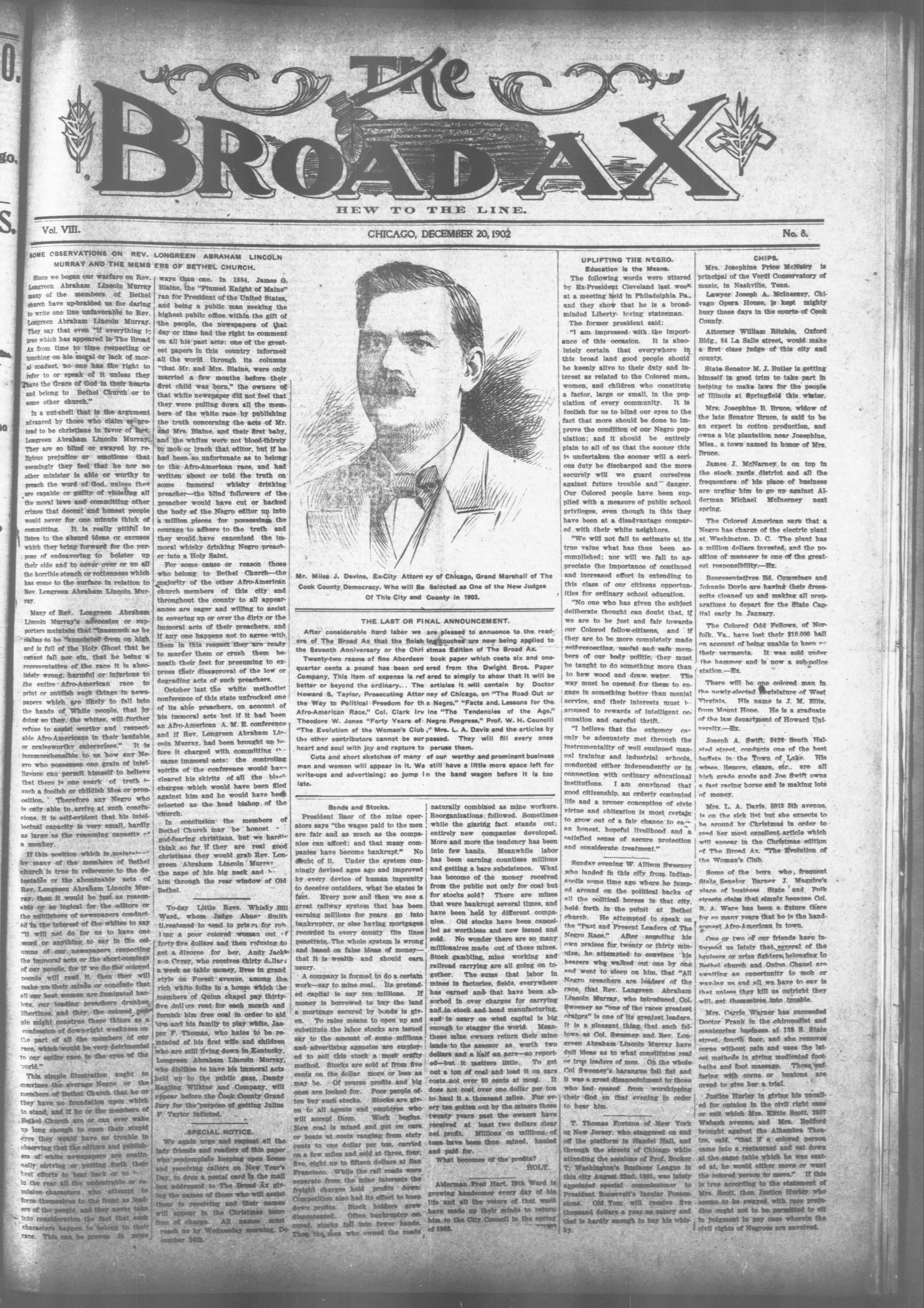
Mr. Miles J. Devine, Ex-City Attorn ey of Chicago, Grand Marshall of The Cook County Democracy. Who will Be Selected as One of the New Judges Of This City and County in 1903.
After considerable hard labor we are pleased to annuounce to the readers of The Broad Ax that the finishing touches are now being applied to the Seventh Anniversary or the Christmas Edition of The Broad Ax. Twenty-two reams of fine Aberdeen book paper which costs six and one-quarter cents a pound has been ordered from the Dwight Bros. Paper Company. This item of expense is referred to simply to show that it will be better or beyond the ordinary... The articles it will contain by Doctor Howard S, Taylor, Prosecuting Attorney of Chicago, on "The Road Out or the Way to Political Freedom for the Negro," "Facts and Lessons for the Afro-American Race," Col. Clark Irv ine "The Tendencies of the Age," Theodore W. Jones "Forty Years of Negro Progress," Prof. W. H. Councill "The Evolution of the Woman's Club," Mrs. L. A. Davis and the articles by the other contributors cannot be surpassed. They will fill every ones heart and soul with joy and rapture to peruse them.
Cuts and short sketches of many of our worthy and prominent business men and women will appear in it. We still have a little more space left for write-ups and advertising; so jump in the band wagon before it is too late.
Bonds and Stocks.
President Baer of the mine operators says "the wages paid to the men are fair and as much as the companies can afford; and that many companies have become bankrupt." No doubt of it. Under the system cunningly devised ages ago and improved by every device of human ingenuity to deceive outsiders, what he states is fact. Every now and then we see a great railway system that has been earning millions for years go into bankruptcy, or else having mortgages recorded in every county the lines penetrate. The whole system is wrong and based on false ideas of money—that it is wealth and should earn usury.
A company is formed to do a certain work—say to mine coal. Its pretended capital is say ten millions. If money is borrowed to buy the land a mortgage secured by bonds is given. To raise means to open up and substitute the labor stocks are issued say to the amount of some millions and advertising agencies are employed to sell this stock a most crafty method. Stocks are sold at from five cents on the dollar more or less as may be. Of course profits and big ones are looked for. Poor people often buy such stocks. Stocks are given to all agents and employees who will accept them. Work begins. New coal is mined and put on cars or boats at costs ranging from sixty cents to one dollar per ton, carried on a few miles and sold at three, four, five, eight up to fifteen dollars at San Francisco. While the rail roads were separate from the mine interests the freight charges held profits down. Competition also had its effect to keep down profits. Stock holders grew discontented. Often bankruptcy occurred, stocks fell into fewer hands. Then the men who owned the roads
naturally combined as mine workers. Reorganizations followed. Sometimes while the glaring fact stands out; entirely new companies developed. More and more the tendency has been into few hands. Meanwhile labor has been earning countless millions and getting a bare subsistence. What has become of the money received from the public not only for coal but for stocks sold? There are mines that were bankrupt several times, and have been held by different companies. Old stocks have been cancelled as worthless and new issued and sold. No wonder there are so many millionaires made out of these mines. Stock gambling, mine working and railroad carrying are all going on together. The sums that labor in mines in factories, fields, everywhere has earned and that have been absorbed in over charges for carrying and in stock and bond manufacturing, and in usury on wind capital is big enough to stagger the world. Mean these mine owners return their mine lands to the assesor as worth two dollars and a half an acre—so reported—but it matters little. To get out a ton of coal and load it on cars costs not over 80 cents at most. It does not cost over one dollar per ton to haul it a thousand miles. For every ten gotten out by the miners these twenty years past the owners have received at least two dollars clear net profit. Millions on millions of tons have been thus mined, hauled and paid for.
What becomes of the profits?
HOLT.
Alderman Fred Hart, 29th Ward is growing handsomer every day of his life and all the voters of that ward have made up their minds to return him to the City Council in the spring of 1903.
UPLIFTING THE NEGRO. Education is the Means. The following words were uttered by Ex-President Cleveland last week at a meeting held in Philadelphia Pa., and they show that he is a broadminded Liberty- loving statesman. The former president said:
"I am impressed with the importance of this occasion. It is absolutely certain that everywhere in this broad land good people should be keenly alive to their duty and interest as related to the Colored men, women, and children who constitute a factor, large or small, in the population of every community. It is foolish for us to blind our eyes to the fact that more should be done to improve the condition of our Negro population; and it should be entirely plain to all of us that the sooner this is undertaken the sooner will a serious duty be discharged and the more securely will we guard ourselves against future trouble and danger. Our Colored people have been supplied with a measure of public school privileges, even though in this they have been at a disadvantage compared with their white neighbors.
"We will not fail to estimate at its true value what has thus been accomplished; nor will we fall to appreciate the importance of continued and increased effort in extending to this class of our citizens opportunities for ordinary school education.
"No one who has given the subject deliberate thought can doubt that, if we are to be just and fair towards our Colored fellow-citizens, and if they are to be more completely made self-respecting, useful and safe members of our body politic, they must be taught to do something more than to hew wood and draw water. The way must be opened for them to engage in something better than menial service, and their interests must be aroused to rewards of intelligent occupation and careful thrift.
"I believe that the exigency can only be adequately met through the instrumentality of well equipped manual training and industrial schools, conducted either independently or in connection with ordinary educational institutions. I am convinced that good citizenship, an orderly contented life and a proper conception of civic virtue and obligation is most certain to grow out of a fair chance to earn an honest, hopeful livelihood and a satisfied sense of secure protection and considerate treatment."
Sundav evening W. Allison Sweeney who landed in this city from Indianapolis some time ago where he jumped around on the political backs of all the political horses in that city, held forth in the pulpit at Bethel church. He attempted to speak on the "Past and Present Leaders of The Negro Race." After sounding his own praises for twenty or thirty minutes, he attempted to convince his hearers who walked out one by one and went to sleep on him, that "All Negro preachers are leaders of the race, that Rev. Langreen Abraham Lincoln Murray, who introduced Col. Sweeney as "one of the races greatest orators" is one of its greatest leaders. It is a pleasant thing that such fellows as Col. Sweeney and Rev. Longreen Abraham Lincoln Murray have dull ideas as to what constitutes real or true leaders of men. On the whole Col Sweeney's harangue fell flat and it was a great disappointment to those who had ceased from worshipping their God on that evening in order to hear him.
T. Thomas Fortune of New York or New Jersey, who staggered on and off the platform in Handel Hall, and through the streets of Chicago while attending the sessions of Prof. Booker T. Washington's Business League in this city August 22nd, 1991, was lately appointed special commissioner to President Roosevelt's Insular Possessions. Old Tom will receive five thousand dollars a year as salary and that is hardly enough to buy his whisky.
No. 8.
Mrs. Josephine Price McNairy is principal of the Verdi Conservatory of music, in Nashville, Tenn.
Lawyer Joseph A. McInermey, Chivago Opera House, is kept mighty busy these days in the courts of Cook County.
Attorney William Ritchie, Oxford Bldg., 84 La Salle street, would make a first class judge of this city and county.
State Senator M. J. Butler is getting himself in good trim to take part in helping to make laws for the people of Illinois at Springfield this winter. Mrs. Josephine B. Bruce, widow of the late Senator Bruce, is said to be an expert in cotton production, and owns a big plantation near Josephine, Miss., a town named in honor of Mrs. Bruce.
James J. McNarney is on top in the stock yards district and all the frequenters of his place of business are urging him to go up against Alderman Michael McInerney next spring.
The Colored American says that a Negro has charge of the electric plant at Washington, D. C. The plant has a million dollars invested, and the position of manager is one of the greatest responsibility.—Ex.
Representatives Ed. Cummings and Johnnie Doyle are having their dresssuits cleaned up and making all preparations to depart for the State Capital early in January.
The Colored Odd Fellows, of Norfolk, Va., have lost their $10.000 hall on account of being unable to keep their payments. It was sold under the hammer and is now a sub-police station.—Ex.
There will be one colored man in the newly-elected legislature of West Virginia. His name is J. M. Ellis, from Mount Hone. He is a graduate of the law department of Howard University.—Ex.
Joseph A. Swift: 5428 South Halsted street, conducts one of the best buffets in the Town of Lake. His wines, honors, cigars, etc., are all high grade goods and Joe Swift owns a fast racing horse and is making lots of money.
Mrs. L. A. Davis. 5012 5th avenue, is on the sick list but she expects to be around by Christmas in order to read her most excellent article which will appear in the Christmas edition of The Broad Ax. "The Evolution of the Woman's Club.
Some of the boys who, frequent State Senator Barnev J. Maguire's place of business State and Polk streets claim that simply because Col. R. A. Ware has been a fixture there for so many years that he is the hand-somest Afro-American in town.
One or two of our friends have informed us lately that several of the bruisers or prize fighters belonging to Bethel church and Quinn Chapel are awaiting an opportunity to mob or wav-lay us and all we have to say is that unless they kill us outright they will get themselves into trouble.
Mrs. Carrie Warner has succeeded Doctor Frank in the chiropodist and manicuring business at 133 S. State street, fourth floor, and she removes corns without pain and uses the latest methods in giving medicated footbaths and foot massage. Those suffering with corns or bunions are urged to give her a trial.
Justice Hurley in giving his uncalled for opinion in the civil right case or suit which Mrs. Kittle Scott, 2807 Wabash avenue, and Mrs. Bedford brought against the Alhambra Theatre, said, "that if a colored person came into a restaurant and sat down at the same table which he was seated at, he would either move or want the colored person to move." If this is true according to the statement of Mrs. Scott, then Justice Hurley who seems to be swayed with race prejudice ought not to be permitted to sit in judgment in any case wherein the civil rights of Negroes are involved.
Bess wae sags
aim promaigate unt ta
Beas
Brosd * whose
Rae
wise nateaw,
Subscriptions must be paid tn advance.
ae
Sapetieey setae ante eoee So copuantion.
_ ‘THE BROAD AX
ne Reeeeee Belang, A.
JULIUS F. TAYLO®, Béitor and Publisber.
EE
Eatered at the Post Office at Chicago,
“IIL, as Second-class Matter.
| ADVICE FOR “A WarTzr. *y
Bow = Dimer Made Sure That the
Maz Weuld Remember Bim
} Bert Tima “4
One Chicago msn, laboring under
‘the digsdvantage of extreme provo-
cation, recently found a novel way
of informing an arrogant waiter that
his method of serving was wholly un-
satisfactory, says the Chicago Trib-
une. i>? ;
‘The meal had been an exasperating
one. ee ee ee
ed he could not be When he
Was not wanted he was hovering
about the table attempting to hear
what was being said.. The host and
bis friends had been compelled to
ask (emphatically for every secom-
paniment of the meal, even down to
‘knives, forks and spoons, so by the
time the coffee and cheese had been
shoved aside they were in anything
but s pleasant frame of mind. Still,
throughout ‘the nies] the man who
was doing the honors retained bis
composure, and did not once find
fault with the waiter in the latter's
presence. But he was reserving his
ammunition for future delivery.
He asked for his check. The wait-
x brought it with « gracious bow
‘and it was paid. Then the host arose
with considerable dignity, and, reach-
sing in his pocket, extracted a quar-
ter, which he handed to the anxious
looking waiter.
“Now,” asked the host, after Be
had paid the customary tip, “do_you
think you would remeniber me if I
came in here again?”
“O,-yes, sir, yes, sir, I'm sure I
would,” replied the waiter, with s
suave Smile of satisfaction.
“Well,” continued the exasperated
guest, “I want you to remember me.
Take one more good look at me, so
you will make no mistake. And if
you ever see .me in this place in the
future you will keep just as far sway
from me as the walls will allow. If
you should attempt to wait on me
Ne a ee
rm one of these oak chairs
' off the top of your head.”
With this parting shot the ont-
raged guest on his heel and
onal anticaen toate The
waiter did mot recover for half an
BO oo a. e
DICTATING SORE THROAT.
& Ourtees Malady Whick Aditets
Many Persons Who Eampley Sten-
' egraphers ia Their Ofiecs
‘ Dietating sore throat is an affection
of the vocal cords that business men
get from the odd, strained, high voices
@het they use in dictating to their
stenographers. ae ee
is," a» physician seid the other 7:
“but nearly every man when he dic-
tates puts his natural, easy voice aside
>and uses.a high-pitched, feverish note
thafiplays the very deuce with the vocal
. cords as it grates over them. A man
of big interests will dictate over 100 let-
_ ters o Guy st times. - His throat is so
sore when he 4s done that he bas to
take some oleaginous and soothing
‘medicine.
“The disease is distinctly a modern
one,” said the physician, according to
the Philadelphia Record, “e sign of
these complex modern times, and it
has been called, for want of better
name, dictating sore throat. The only
cure for it is to teach men to dictate
in their nstursl voices (a thing that
seems to be impossible) or to compel
them to cease dictating altogether.”
LEFT IN DEPOSIT BOXES,
* pos ee 2
Some Straage Revotmtions Are Made
WWhen They Are Opened by
cs Wauk Oficiais, '
Tt oftem happens that deposit boxes
rented im bank vaults are opened on
account of arrears in payment on the
apart of the renters, who cannot be
found. Then strange are the reveis-
“tions of 6 box’s contents. -
/. A young women hed a box in a down-
town bank and ye pag edige ner
ond year’s rent. she disap-
peared from her former residence the
Dex was opened recently. All it con-
‘tained was a pair of baby shoes.
see ete = manly
rchoned, on being opened for the usual
@ diamond brooch worth at
ang pte onn angel pela ed
; the man or his heirs will one day
‘lal Me ee S
‘Ofien these boxes contain interest-
‘ord, fom. 8 70 an to his eweet-
ae ee
(“EINES IN MAPLEWOOD. —
Mie Only War fo Find (he Steers
Ta te Cut into the ;
j Pree ;
Sobody seems to know what cause ft
eRe sacs tern en
Dbesutifal im maple, known as
Some people think they
eae lis ee bentrete of Little
‘branches which shoot out over the
‘trunk of the tree as soon as a clearing
fs made around it. Expert timbermen
ay that is not the case. The only wey
to tell « bird's-eye maple tree is to cut
it. ‘There are no outward signs by
which onecan judge. The Railroad Ga-
sette telle a story of the late George
M. Pullman. Many years ago he was
offered a mahogany log for $3,000, to
be ¢ut into vencers. It was supposed
‘to be a very fine piece of wood, but this
could only be determined by cutting it.
He declined the offer, but agreed to
take the log cut into veneers for what
it was worth. The owner had it sawed
and was paid $7,000 for his veneers.
Anyone who can discover the secret
of determining the interior nature of
wood from the outside will have s for
_ .
OPERATING MARIONETTES.
Remarkable Ingenutty and Siti Die-
played by Onc Man tm the
a a Bastnews
“The ingenuity of some of the han-
dlers of marionettes,” said « show-
man, “is incredible. I knowa man who
conducts a marionette theater, where-
in an orchestra of eight pieces plays
under marionette leadership, while in
the boxes a dozen marionette specta-
tors laugh and applaud, and on the
stage a marionette drama briskly en-
acts itself.
“The conductor of all this stands, ex-
posed to the waist, at the back of the
stage, and apparently he is motionless,
though really each finger of both
hands and the majority of the toes of
both feet are working with unexampled
rapidity. For each marionette is con-
negied by a string with atoe or 8
finger of the operator, and this string
sometimes has as many as ten or fif-
teen branches, joined to the manikin's
faee, body, arms, legs, etc., so that it
may dance, smile, wave its arins and do
8 number of other lifelike things. One
of these figures, indeed, is connected by
32 strings to the operator.
“It is bewildering to think of the
number of strings there must be alto-
gether,” concluded the showman, ac-
cording to the Philadelphia Record,
“and really it is impossible to conceive
of the dexterity and the thought re-
quired in the artistic manipulation of
a band of marionettes.”
BEAUTIFUL TROPICAL FISHES.
any Dime Specimen: Gathered ta
+ fimo Beomuéas for the Aquast-
us was of AM Leads.
' Eis edllection of tropical fishes for
various aquariums throughout the
world, and especially for the American
squariums, is now & recognized in-
Gustry in the Bermudas, says the Phil-
edelphia Press.
It is carried on at all sessons, though
for obvious reasons the fish are
shipped north only in the summer
months. As there sre more than 150
vericties of fish in Bermudan waters,
and_every variety is found in abun-
dances, it is not a diffictlt problem to
secure good specimens. Only a few
varieties reach this country, for the
Teason that tropical fish, as a rule,
‘are unable to stand the trials of
‘transportation. The ones on exhibi-
tion are the finest that can be caught.
‘The native fishermen go far’ and
senna ne eminem tor Be
will pay only for the best.
Possibly the most voracious fish
Sas Rage t0:deal with ‘ore the grovp-
os morays. The groupers have
peculiar habits. During the month
of June, which is their spawning or
“snapping” season, they gather at two
“Grouper gre " re
grounds,” and rarely are
Pa aaree. ’
fot many tropical fish are as fero-
eious as the moray, but most of the
larger varieties are truly sporting fish.
WORKING IN THE DARK.
Discuméerts of Mining Betore the in-
peation of a Lamp Suitable tor
_ Underground Use.
‘The Giffculties under which coal
mining operations were carried on be-
fore the scientist Davy had invented
his safety lamp must have been very
grest. In many mines the only al-
ternative the medieval miner had to
pitch darkness was the phosphores-
cent gleam from dried fish. The min-
ers implements, originally of stone
or hard oak, gradually improved; but
he waa forced to work in alimiost com-
plete darkness until Sif Humphrey
Davy by his remarfable invention en-
abled him to light his way through
the tunnels he had excavated with
comparative safety, seys & mining
journal. 3
‘Agricola, en author who wrote
about the middle of the sixteenth cen-
Tea este nn Sette treatise ca
mining as was practiced during
the middie ages. From this we learn
‘that the horsegin, which to
he present day in some of the mining
Seite of Great Britain and norta-
Europes, was engine chiefly
Pe lat-
é x by wind-
JERSEY'’S PURCHASE PRICE.
Historic Decament Whick Shows
‘That the State Was Sold by 18-
L. @tans for Rum, Gans, Ete. :
4 sg
Carefully locked away in one of the
acveene defers of the New Jersey His-
society there now are two valu-
able documents that tell of the early
coldnization of the state, says the New
‘York Times. , 4
The first is a deed on parchment
from Cherles_II, to his brother James,
duke of York, afterward king-of Eng-
land, giving himi a grant of ell lands
from the St. Lawrence river to Chesa-
peake bay. The only two names on the
grant that Americans of to-day would
recognize are Nantucket.and Cape Cod,
which are spelled as they are to-day.
The St. Lawrence river is designated
@s “The Great River in Canada.”
The deed is beautifully written in
Gothic lettering, and the document is
in excellent condition. Under each
jine of writing is a ruling of red, evi-
dently done with a quill. The parch-
ment is ovér two feet in Iength, and to
the bottom is attached what was once
@ large seal of wax.
Gold and silver cords are fastened
‘0 the seal. In an upper left-hand cor-
‘ner is an engraving of Charles II., and
the borders of the deed are filled with
pen and ink designs, delicate and beau-
tiful. The document is dated from
Westminster in the seventeenth year
of King Charles’ reign. While the
deed is apparently the original, for the
amount of work expended on it would
not be given to a copy, no signatures
appear, and apparently none was ever
ear heed
CENTURY OF PATENT ISSUES.
Beginning July 31, 1790, the Number
Granted in This Country Mas
ul Been 435,621,
' ‘The eensus bureau lately fseued a
report dealing with the cooperative
relation of patented inventions to
manufactures, which shows that New
York, though third in population and
patent* rank for the first decade of
the 100 years has since been first in
both, as well as manufactures. It is
an interesting fact, in considering
the list of states presented in the
report, that the manufacturing rank
of a state as a rule approximates its
patent rank, says the New York
Sun. The report says:
The first patent granted by the
general government was to Samuel
Hopkins, July 31, 1790, for an im-
provement in pot and pearl ash
manufacture. The last patent grant-
ed for the year 1889, at the close of
the first 100 years of patent issues,
was to Wilhelm Dreyer, December
31, 1889, for an _ elettro-magnetic
typesetting machine. These two pat-
ents are suggestively symbolical of
the progress of the century in in-
vention and manufactures—the first
skin to the primitive industries ot
® new country.and the last sefving
the exacting demands of a highly or-
ganized industrial system. ‘The total
number of patents issued during this
century of invention was 428,621.”
A feature of the report is the
steady growth shown in the numbes
of patents granted to citizens of fom
eign countries. .
NOT THE SAME NAMES.
Nomenclature for Birds in England
and America Is Not at Ali
the Same,
In reviewing a book about “Beasts
end Birds in America,” the London
Spectator warns English readers
against the confusion thet may arise
in their minds by the application of
the same name to different birds in
Engiand and the United States. “The
consequence,” it remarks, “is that the
critical English schoolboy who reads
of robins pecking a wicked squirre!
(‘Meeko’) to death will perhaps toss
the book away as untrustworthy—un-
less he is a reader of Wendel! Holmes,
and remembers the allusion to the
day when young Americans were mis-
led by the English booke with local
color not fitting the new country. In
the books that came from Englané the
robin was a little domestic bird that
fed at table instead of a great fidgety,
jerky, whooping thrush.”
But the whooping thrush (Tardus
migratorious) of North America hada
red breast like the robin of England,
and so the name was given to him,
and it was mob of whooping thrush-
es, and not robin redbreasta, that did
“Meeko,” the mischief maker todeath.
And so, it may be added, the ancient
misunderstanding and controversy be-
tween English and American tourists
at Pe liners’ tables as to
whet ® partridge, » pheasant, a
groure, etc., will go on to the end of
r " ‘Buqessive Kinduecss,
A singular case is that of Patrick
Logue, of Altoona, Ps., who has been
prosecuted for cruelty to animals, his
offens+ consisting of excessive kind-
ness. Logue is so fond of an inteili-
gent horse owned by him that he will
not allow the horse to work or even
be exercised. For four years the
horse has not been out of the stable.
Logue_feeds it and cares for it ten*
deriy, but he has steadfastly refused
to take it out. Consequently the Hu-
mane, society has. brought suit to
foree him to give the horse some
work or exercise it daily atleast
Fine Tribute to Mackay. ~
John W. Mackay, the Irish-Amer
ican ntulti-millionaire, who died re-
cently in London, had s fine tribute
paid to him once by a friend. “Mack-
ay,” said he, “is one of the few rich
poor.’ > . oe
Emigration ef Jews,
During the last year 80,000 Jews
emigrated from Roumania, -_-
fis Prepared by the Expert Miltary
“het,” They Area Most Pala-
a. table Food, me
“Beans are the soldiers’ mainstay,”
saya Thomas P. Dillon, « retired Unit-
ed States cavalry officer, sccording to
the Philadelphia Record. “The Amer-
ican soldier, at ee equal bas
performance of an Arsb on a bandfu
of dried dates—be can ride and fight
all day on a mere handful of beans,
properly prepared. There is nothing
to equal’ the army beked bean. Your
celebrated ‘Boston baked’ sre but s
poor imitation of the succulent articlé
turned out by s regular army cook.
‘There’sanart in cooking them that no-
body but an army man can ever ac
quire. I've been on service when tor
& week at s time our menu consisted of
beans for breakfast, beans for dinner
and beans for supper; and did the
troopers tire of the monotony?
Not a bit of it. They sang for more,
and in spite of hard work and lack of
variety at mees the fellows actually
got fat. That demonstated to me the
nutritive quality of beans, and I made
it 2 point to get into the good graces
of the cook and learn how to beke
them. It ian’t such an elaborate proe-
ess, but there's s trick in doing it
right. My friends are all fond of beans
the way I cook them, and many a time
T've been asked for the recipe, but
that’s a thing I don't give away to
everyone. You see, people enjoy &
dish all the better when they know it’s
something that not everybody can get
up. K might take some of the sest
away if they could say of my beans:
‘I know how to make them.’”
KNOWLEDGE WAS POWER.
Hew Familiarity with the Chinese
Language Made a Woman
@ Countess.
One of the unmarried women in dip-
lomatéie cireles at Washington is
Countess Marguerite Cassini, the se-
complished niece of the Russian am-
bassador, who ie s eountess in her
own right, not by heredity, but by spe-
eial grace of the ezar, and s curious
story ie told of the manner in which
she won her title. It was when Count
Caseini had his fateful conference with
li Hung Cheng at Peking, long before
the Boxer trouble. The counts inter-
preter was away, for Li's call wae un-
expected, and as the Chinese states-
man could not speak Russian and the
Russian diplomat did not understand
Chinese the conference came to 8
deadloek. The count’s niece, who had
picked up something of the language,
stepped into the breach and the affair
was arranged to. the satisfaction of
both parties. The Chinese empress
loaded her with presente, the czar's
government made a note of the service
performed, and when there wae «
question a couple of years ago of the
young lady's precedence at Washing-
ton, where the count was then ambas-
eedor, the czar himself counfounded
her rivals by making her a countess.
This was something like rapid promo-
tion for the lady.
CHINESE ARMY ROLLS.
They Inctude with the Soldiers, Their
Meorees and Every Article of
Beuipmeat.
‘Now that Chins hee Russie fore near
neighbor, it remains to be seen how
successfully, or otherwise, ine middle
kingdom will continue to practice ite
favorite game of bluff. Mow it has
reenforced ite army is shown by the
Swedish explorer, Herdin, says Youth's
Companion.
The Chinewe have a most extraor-
dinary way of enumerating i
They are not content with counting fhe
woldiers only, but reckon in also their
horees, rifles, shoes, breeches and so
forth, so thet the resultant total ise
jong way above what it ought to be.
~ They apparently go on the supposi-
tion that the rifle is at least as valuable
es the man, and by an analogous trein
of reasoning they argue thatg man ie
of little use if he has to travel on foot,
that he cannot go about naked, and so
on. Hencé they count the whole kit,
horee, rifle, breeches and all. .
By thie peculiar process of arith-
metic they fancy they deceive the Rus
sians into believing their garrisons
anpueh stronger than theyare. -
HEGROES DON’T MIGRATE.
feome Interesting Facts About the
Molored Race Revealed by the
Beeent Coasus.
‘There were 6,500,000 colored persons
in the United States in. 1980, 7,500,000 in
1690, and 8,800,000 in 1900. A “general
movement” of colored inhabitants from
ome state to another or from one sec-
tion of the country to anothe?, due to
economic, political or hygienic reasons,
hae been declared to be in progress at
intervals of two or three years since
the close of the civil war.
But the figures of each succeeding
census prove that the colored popula-
tion of the United States is by no means
migratory; it changes little year by
year except ag the result of the ordi-
ary increase in population. Various
‘ambitious projects of leaders to “col-
onize” certain states have failed entire-
jy. In Kansas, for instance, there are
ealy 9,000 more colored inhabitants
than there were 20 years ago, though
Kansas has long been the mecca of
many colored colonizers.
Set
The Philosopher's Seance,
4m italian having written a Book
upon the art of making gold, dedi-
tated it to Pope Leo X., expecting «
good reward. His holiness, finding
that the man constantly followed
him, at length gave him « large, emp*
ty purse, saying: “Sir, since you
ee nee you can
have no-need of anything but a purse
to put it in” byt , ee
PRAISES AMERICANS.
China’s Late Minister, Wu Ting-
Fang, Gives His Impressions.
Speeks im High Terms of the Eater
prise aad AdaptabMity of the
Average American aad Mis
Acoom plishments. ’
‘Americans are known, in wiiatever
quarter of the world chance hap-
pens to throw them, by their mar-
velous self-reliance and independence.
A typical American is never at ao
loss what to do with himself, writes
Wu Ting-Fang in Success. If, by
some enchantment he were whisked
away over night and sét down in the
middle of Timbuctoo, he would,
doubtless, when he should awake the
next morning, be astonished, but be-
fore luncheon he would be busily en-
gaged in some business enterprise, so
readily does he adapt himself to cir-
cumstances. In every instance he
knows how to take care of himself,
but perhaps the real secret of his
success is that he knows how to make
the most of his opportunities.
An American student usually real-
izes that education is the stepping-
stone to achievement. He studies
with the expectation of fitting him-
self for the profession or occupation
he is ultimately to enter. He makes
the most of himself as @ student,
that he may be able to make the
most of himself in his chosen career.
All through his course of study this
idea is instilled into his mind, end
the consequence is that he leaves his
college or university well prepared to
enter upon life’s activities. He is sure
of himself. I may also add that the
schools of the United States, both
public and collegiate, are the crown-
ing glory of this young and great re-
public. No words can bestow upon
them too high praise. No estimate
can be put upon the goof which they
are accomplishing in training young
women as well as young men for fu-
ture usefulness. Systematic educa-
tion is reaching its highest form in
this country. Its results are so prac-
tical that the eountry eannot help
but advance.
The intelligence of the average
American is worthy of'note. This, I
take it, is due in large measure not
only to the excellent schools, but
also to the innumerable newspapers
and other publications. I have found,
in all parts of the country, that in
every town of any size there is pub-
lished a daily paper, and that the
metropolitan publications circulate
in the homes of the most remote cor-
ners of the land.
The abilities to seize his opportu-
nities, which is characteristic of the
American, is seen in the business en-
terprises of the country. Its indus-
trial machinery is adjusted to the
production of its wealth on a scale
of unprecedented magnitude. This
is a valuable condition. American
brains‘and American capital are
are ens out to control the markets
of the world, and, with good reason,
other nations are watching the ef-
forts with keen interest. China is
but awakening to its vast possibilf
ties, and more and more will she wel-
come the American merchant and
American commerce within her bor-
ders. American enterprise is now
building a railway from Hankow to
Canton, and, no doubt, other roads
will soon be building. China's rivers
and harbors are to be improved, and
there will be more and more demand
for American steel, rails and other
products. -
STATUES HAVE SMALLPOX.
Eptdemte of Disease Among Broase
Pigeres i Athens—How Thay
be Ane Affected, .
most extraordinary disease, ex-
tremely infectious and resembling
smallpox among human beings, has
broken out among the statues in the
Egyptian room of the National mu-
seum here, says an Athens (Greece)
correspondent of the New York
Times. A few days ago the distin-
guished politician and archaeologist,
Mr. Stephanos Skouloudes, noticed
some strange green marks on one of
the bronze statues of the famous
Egyptian collection presented to the
museum in 1881 by Mr. Demetrios, of
Alexandria. He at once communi-
eated his discovery to the curator,
who called in experts to examine the
statue in question. They pronounced
the marks to be due to an infectious
eomplaint, to which bronze is liable,
and which gradually spreads from
the surface of the object affected to
the inside, till the whole crumbles
away into dust. The other bronze
statues in the same room were then
inspected, with the result that they
were all found to be more or less
tainted with the disease, while five
of them had taken it in a mogt ag-
gtavated form. These five are the
statues of Anta, the goddess of war;
6f Maout, wife of Jupiter Ammon;
of Isis, and two statues of Osiris, one
eat ae nai lee, arma
that” that, infection has spread
oe to Mieitanitn-eoeen, aaa
tains the results of the late Dr.
Schliemann's excavations in 1876.
There a dagger, which was found in
the fourth and finest of the six
seman or lity = Dap on
. Altogether about fifty statues
are badly affected, and the loss will
be enormous unless the plague can
us stayed. A leading Athenian
chemist pronounces the cause of the
oar thas odes egos der aa
3 ‘ot bate, Mes Mouphe:
matos, the minister under a
sods scaePs <yrcegemeng say Oe
SOAP_IN THE GINGERERRy
AB ProGuct of the Maine Forty,
Is Regarded by the L. I
. oy Se —.
“Did ye ever eat hot
with soap im i...” ssked Frank
the oldest camp cook on the
Branch, who, according t the
York Sum, boasts thet he hay
Tore than 2,000 barrels of flow
cream of tartar bread in the
of 26 winters in the forest, “y
hain’t et it, you don’t know
“Why, s lum!
% berman would
think of eating alagetlctad c1
soap into it than he would think,
drinking new rem without mo
They always go togetior—soap
the gingerbread and molasses
the rum, and both are jeat
good as is made. ——
“My rule is to dissolre hank
hard soap as big as 5 ben's agg
gallon of water, then pour ing
lon of molasses, « half pound of
ing powder and stir in the flour
the dough will almost ron.
grease yer pans, slap in the
and chuck it into a re!-hot oven _
“When it comes dut ail fo
brown and full of sweet Dbubbi
that smoke when you break thy
open—the man who won't ot my
food isn’t fit to live or die.
“You can’t tell me that soap a
gerbread ain't fit to eat. I've ay
more than 25 years, and I'm jens,
sound to-day as I was when I 4
tasted the food.”
INCREASE IW SUICIDES,
Wigures Colleeted by an
Company Prove That Selt-aun
dee Grows More Common,
In the Spectator, an ingurancs
nal, the statistician of an
company gives sn analysis of the
cide record for the year 1901. Hiy
ures are taken from 50 cities, and
an average slight increase over
ratio for the preceding decade of
ly one per cent., from 15.7 to 166
100,000 population. He estimate
spproximate annual mortality by
cide of 10,000 in the eountry asa
The implied conclusion is that s
ther increase in the rate of
tendency in the cities of this
may be expected during the next
ade, and the suicide question, like
son in fire insurance, i thus
ing more and more one of the
importance to life imeursnes
panies. ‘
He also gives ancther table
the experience of one company
the last 55 years, @fviding it into
periods, including males only, as
female suicide statistics are too
nificant to be tabulated. This shi
percentage of suicides in the total
tality of 2.4 in the later as com;
with 1.9 in the earlier period. The
of suicides seems also to have |
as the suicides under 45 increased
2.1 per cent. to 3.9 per cent in the
period, and there was sn actual
erense of those in advanced life.
OUR SHOES IN MEXICO
They Are Much Liked by the Bativs
But the Prices Are Bmeca>
‘ ively High.
‘According to United Stetes
Canada at Vera Cruz, trade c
in that part of Mexico have unde:
great change within the past teny
especially with respect to Ameri
shoes. In former years it was inj
sible to buy anything in Vera Cruz’
the line of shoe leather except that
native stock and manufacture,
ready-made shoes for Americans
not to be had st all.
United States shoes have,
within a very short time mades
for themselves, and, the consul
were it not for the excessively
prices asked for them they would
iy drive all others out of the
As it is, however, he adds, only
better classes can enjoy the luxury
our shoes, and the great mass of
people is debarred from thas pri
The principal obstacle to s hes’
business is the high import duty
the fluctuations in the vslue of
ver. Theduty on the cheapest sh:
the same as on the finest productions
GAVE A LARGE REWARD
Sa Fhought the Bestower sof
Young Here Who Recstved
_ the Moener-
“The following story will illustrst#
mumber of things,” said the Detral
ship owner who narrated %, Her
chiefly will it show bow the valued
money varies with the supply.
“A boy was telling me of his prow
eas as 8 swimmer. He could dive,
“ ‘Once,’ anid he, ‘I dived dows #
the bottom of the river end pulled s
Bittle boy out.”
“Bravo!” ssid L
chat I tall you bo oontinenl
ps wee giad! give me s dollares
e-quarter.’ ~
“Both the father and the hero in
in @ beighborhood the cecupssts a
which are sometimes knows 22 ‘what
rate’—the neighborhood or the docks
I have no doubt,” coneluded the si
owner, secording to the Detroit Fret
Prese, “that the dollar-end<qusr™
was 4s laage to the masa oe 0 #
Seemedeaned for Yawniae
‘A Japanese MP. Mr. Tonks ©
name, hag been sentenced to 15 a?
confinement and a fine of ten shilling?
for yawning in parliament. Thecrows
goaeensen wamtais ied thet in 33
eee ere ates Be 8° ooo
man act of s by siologiesl
Spee Meade hr asetralie!. as the
Sireietaciomenen . Bad yawned 26
ne the government ™*™
ae aE tn ganiatales ad
There are in Paris 1,316 factories. The world's output of coal in 1900 was 767,636,000 tons. A large factory in Jena, Germany, utilizes its surplus hot water in such a way as to afford the laborers nearly a thousand baths per week.
In some German cities it is customary to fee street car conductors, who are thus enabled to add from four to six dollars a month to their income. The richest farm in the world is an acre worth $288,000 in the heart of New York's ultra-fashionable district, between West End avenue and Riverside drive. It is tilled regularly and the produce is sold at the nearest market. During the civil war the site was covered by a government recruiting station.
A research steamer belonging to the Norwegian government recently carried on the North sea some experimental fishings which yielded important results. In three days 117 halibut and 300 large cod were caught at a depth of 200 fathoms, thus proving the existence of large quantities of these fishes at a time of the year when they are not to be found on the coast of Norway.
Many people imagine that the incandescent electric light gives out little or no heat, but it is found that of the energy consumed only six per cent. is converted into light, while 95 per cent. goes into heat. A lamp immersed in water will bring the water to a boil, and many cases of fire have been caused by carelessness in letting inflammable substances rest in contact with the lamp.
Prof. James Dewar, president of the annual meeting of the British Association for the Advancement of Science at Belfast, has pointed out in the boldest language that while Englishmen have repeatedly discovered scientific principles and laws of great importance, the Germans and Americans have been making the practical applications of them, leaving England behind in reaping the advantages.
COMPLAIN OF STAMPS.
Let Recently Sent Out by Post Office Department That Stuck Too Well.
Many complaints have been made to the post office authorities that the stamps sold in books of 24 and 48 have had a way of sticking to the paraffin paper that was supposed to protect the mucilage on them. An investigation was made, with the result that a circular was issued authorizing the redemption of stamps so glued to the sheets in books.
It was explained that "by mistake" the contractor who made the books had used a poor quality of paraffin paper. Postmasters were instructed to return to the department at Washington all books of stamps made with this inferior quality of paraffin fly leaves which they had on hand. Under this order about $12,000 worth of damaged books have been turned in, and it is thought that there will be little more trouble of the kind.
This is not the only stamp trouble of the post office. Particularly from the south and along the Atlantic coast there came many complaints that the ordinary one and two-cent stamps stuck to everything they touched. A sheet of 50 or more was turned in at the New York post office this week. They had been sent loose in a letter from the south and were hopelessly glued to the paper.
Whether the trouble is due to something wrong with the mucilage or the abnormally wet season in the south and along the coast has not been determined. There is no provision for the redemption by postmasters of damaged individual stamps.
The duel, though prohibited by law, still exists in Switzerland, but the practice is confined to the students in the Swiss German universities. Even these fire-eaters are beginning to realize the absurdity of the practice, for a meeting was held at Zurich lately at which student delegates from all parts were present, to discuss the duel and courts of honor. A proposition by the president to abolish the duel altogether was rejected by a large majority. The consequence was that a large number of duels which were previously arranged and whose principles were awaiting the result of the vote took place at Bremgarten, near Berne. Many students received severe rapier cuts, chiefly in the face, but nobody was seriously wounded. The police, though they know the practice exists, and are often aware of the "affair," seldom interfere, for they look upon the duel, as practiced by the students, as a sporting and harmless matter. It is certain that nobody has ever been seriously hurt in these affairs of honor.—London Times.
The Ingenious Invenger.
"The market is overrun with substitutes for this food and that," asserts the capitalist. "I see no justification for backing your new health food."
With a naive smile the inventor turns to him and suggests:
"But it may also be used as a substitute for coal."
Then the capitalist displays unusual activity in sending for patent attorneys and clerks to draw up articles of partnership.—N. Y. Times.
Chromos.
Belcher—"What was the use in showing Nuritch through your art gallery? He couldn't appreciate your paintings."
Kulcher—"Geel what a lot of 'em you've got. You must 'a' bought an awful lot o' tea in your time."—Philadelphia Press.
The number of people who voluntarily shuffled off this mortal coil in American and other cities during last year has been investigated by some deliver in statistics and the following figures indicate the results: San Francisco leads with the largest ratio, 39.1 per 100,000 of population. Next comes another Pacific coast city, Los Angeles, with a ratio of 29.8. The reader has naturally been looking for Chicago, and that city does, in fact, come next with a ratio of 24.0, followed by the neighboring city of Milwaukee, whose ratio is 22.2. New Orleans was the scene of the self-destruction of 21.8 persons per 100,000 of population, and Cincinnati followed close with 21.2. New Haven is next with 20.9, and then comes the borough of Manhattan with 20.0, though greater New York as a whole is well down the list with a ratio of only 13.6. This is less than Rochester, Indianapolis, Philadelphia, Pittsburg, Baltimore, Boston, Detroit, Omaha and Louisville, besides all of those specifically enumerated above. As to the foreign cities, Paris leads the list with a ratio of 42, followed by Berlin 36, Vienna 28 and London 23. There were more suicides in Saxony than in any other country, 31.1 per 100,000. In Denmark the ratio was 25.8, in Austria 21.2, in France 15.7, in the German empire 14.3, and Sweden, Norway, Belgium, Great Britain, Italy, the United States and Spain followed in the order given.
The table referring to American cities is somewhat difficult to explain. Why the city of the golden gate, and California, with its glorious climate, its sunshine, its fruit and its flowers, should show the greatest number of suicides seems a mystery, unless the presence of a large Chinese population explains it. The high suicide rate of Chicago is, perhaps, accounted for by the rush and struggle of that great city and the large foreign element it contains—a foreign element, moreover, which comes mainly from those countries where suicide is most frequent. The same is perhaps true of Milwaukee and of Cincinnati. The high rate at New Orleans may possibly be attributed to its relation to France and the ideas and traditions brought here from Paris, the suicide capital of the world. But New York city casts a cloud over some of these explanations. Here are the large foreign populations, the stress and strain of living and working, the poverty, the excitement. Yet Philadelphia, the sleeping city of the humorous paragraphers, has a higher ratio of suicides than greater New York. And how is it to be explained that New Haven leads all the other New England cities in the number of suicides? St. Paul and Minneapolis lie side by side, but in Minneapolis the ratio is 11.4 and in St. Paul it is but 6.5. It seems that the conclusions must be that there is no method in suicide madness and that the effort to reduce it to rule is doomed to failure.
CARP OUSTING WILD DUCK.
The singular complaint comes from various parts of northern Ontario that fish are responsible for the disappearance of certain kinds of game. In localities which were formerly noted for the excellent duck shooting which they offered the birds are now not to be had at all.
The ducks, geese and other aquatic birds were formerly in the habit of frequenting the large fields of wild rice in the lakes and streams of parts of Ontario, but now these fields have been, in many instances, destroyed by the German carp, which has found its way into these waters. The vegetarian diet of this detestable fish not only ruins the flavor of its own flesh, but exhausts the food supply of some of the most desirable forms of feathered game, says the New York Sun.
The Ontario inspector of fisheries, who has been in northern Ontario for the last few weeks, reports that the German carp has not only become dangerous to other fish, as has been frequently claimed, but that in Cook's bay, Lake Simcoe, where there were formerly hundreds of acres of wild rice, not a spear of that plant is to be seen to-day. The same is true of the Holland river, where there were at one time 1,500 acres of rice. The carp have eaten it root, branch and seed.
The almost incredible part of it is that the fish have entirely destroyed the fields in one year. The aquatic birds which visit the locality, finding that all their usual feeding grounds have disappeared, cut short their visit and move away in search of others. The local sportsmen complain, too, that the carp have attacked the beds of wild celery, and that they, too, are almost completely destroyed.
It remains to be seen what the effect of this wholesale destruction of aquatic vegetation will be upon the game fishes of the locality. The fishery overseer of the district declares that it is a question whether the spawn of the muskallonge can be protected and developed without the rice beds. He does not accuse the carp of eating the eggs of the other fish, but states that they keep the water continually disturbed, and that to their presence in these waters must be attributed the decrease in the number of muskallonge frequenting them for spawning purposes.
Weigth three pounds four ounces, circumference forty-five inches, is the description of another monster mushroom which has been gathered at Braconash, Norwich, England.
She—"Why do they call it 'an arm of the sea?' " He—"Because it hugs the shore, I guess."—Indianapolis News.
A Thespian Catastrophe.—"So your Hamlet made a great hit?" "Well, hardly. The audience made the hit; I was the target."—Detroit Free Press.
"What kind of a stove did the prehistoric man use?" asked the little Ostend. "Probably he used a mountain range."—Philadelphia Record.
"They caught a man robbing the public library till in a New England town." "How did they punish him?" "Made him read all the historical novels."—Cleveland Plain Dealer.
"How sweet it would be to live alone with you in yonder lighthouse!" he whispered, tenderly. "Yes," she murmured, abstractedly, "and do light housekeeping."—Smart Set.
Beryl—"Well, all I've got to say is that Ethel is a two-faced creature." Sibyl—"Yes, and she'd look better if she'd use the other face instead of the present one!"—Baltimore Herald.
Beetem—"Pahaw! I must have $20 by noon to-day, and I left all my money at home in my other clothes. Can't you help me out?" Wiseman—"Sure. I'll lend you carfare to go home for it."—Philadelphia Press.
Barnes—"I hear your house was broken into t' other night and lots of silver plate and jewelry stolen." Shedd—"Yes! but the rascals entirely overlooked the ten tons of coal in the cellar."—Boston Transcript.
A Satisfactory Man.—New Man—"Here are some poetic contributions which came in to-day's mail. I am not up on poetry." Editor—"Good! I don't want you to be up on it. I want you to be down on it."—N. Y. Weekly.
END OF A STAGE CAREER.
Now One Man's Admiration for the Stage Was the Cause of His Roman Nose,
"My wife tells me that our 15-year-old boy is stage-struck," said a man, smoking his after dinner cigar over on another man's piazza, according to the Detroit Free Press. "She is worried about it, but I tell her to take it easy—it will all come right. I was stage-struck once myself, and that's how I came to have this handsome Roman nose, and to be a respected and prosperous lawyer."
"Roman nose," repeated the other man, "I can't see the connection between a Roman nose and your being stage-struck."
"Well, the connection is there, all right," continued the other man, fondly caressing the little arch in the middle of his large, ornamental nose. "At 1? I was badly stage-struck; and, of course, my parents bitterly opposed all such notions on my part. The fever continued to increase, however, and with two other young men of the same age, I secretly organized an amateur comic troupe to go on the road when the time was ripe. As a starter we decided to try our great entertainment on a country town not many miles away. We eloped with our outfit, guitars and gaudy wardrobes one day, and had no trouble in getting together a pretty fair audience that night, at ten cents each. The songs, dances and dialogues went off all right. They were really funny, I believe, even now; but at the close of the entertainment I met with bad luck.
"In going out to announce another appearance the next week I elumsily caught my foot in the folds of our impromptu drop-curtain, and pulled the heavy curtain pole or roller down on my straight Grecian nose—the pride of my mother's family, and mine by inheritance.
"I was assisted to my father's roof the next day, with a fractured nose and two very black eyes. By the time I was well again my ardor for the stage had abated; and I believe my son will get over the mania, too. My wife, however, has not heard the story of the Roman nose, and she rather admires it."
The Conserva Season.
This is the season of the year when the wife of the Italian laborer begins to think of laying in her winter stock of conserva. Conserva is a dish without which no Italian family would think of passing the winter. Every year about this time the average Italian housewife may be seen buying large quantities of tomatoes. The tomatoes need not be overchoice and sometimes the softer they are the better conserva they make. The tomatoes are taken home, put in a press and then squeezed until every drop of juice has been extracted. The pulp which remains spread upon a board and placed in the sun to dry. When it has attained the consistency of putty it is scraped together and placed in airtight jars for the winter. It is used for making sandwiches and sometimes forms the staple of the laborer's meal—London Exchange.
Chance Saved the Champion.
Like many another popular idol, Cresceus was of humble origin, and worked unusually hard for his honors. His trainer, the celebrated horseman, John McCartney, tells us that, as a colt, Cresceus "was plain looking, awkward in all his movements and had little of the appearance of a coming champion." As a yearling, the colt injured himself so badly that "his owner, Mr. George H. Ketcham, a wealthy young business man, of Toledo, O., who had engaged in the horse breeding business on account of failing health, ordered the colt killed, says the National Magazine. The farm superintendent forgot his orders, the colt was allowed to run in the paddock several days and it recovered before he remembered the orders of Mr. Ketcham. Thus it was by an accident that Cresceus, 2:02%, the greatest trotting horse the world ever knew, escaped being killed."
Recent Court Ruling on This Method of Compelling Accused Persons to Tell What They Know.
Here is a recent court decision in the court of appeals of the District of Columbia, West vs. United States, which shows what a violation of the legal rights of accused persons the so-called "sweatbox" methods of the police are:
Where an officer, having a prisoner in custody, said to him: "You have been telling me a pack of lies; now, you had better tell the truth," whereupon the prisoner made a confession, it was held that the confession was involuntary, and it was error to admit it in evidence and to submit to the jury the question whether or not it was voluntary. Under the law, as properly administered, a confession, if forced, cannot be used against a person charged with the commission of crime. The sweatbox method of obtaining confessions to be used against the parties making them is not sanctioned by the court. The court said that words of exhortation to a confession seemed often to be innocent enough, and cited the following, all of which had been held sufficient to vitiate the confessions. "You are under suspicion and you had better tell all you know," "It would be better for you to speak out," "You had better tell the truth" and "You had as well tell all about it."
TWO DECADES OF BIG SHIPS.
Some of the Great Ocean Lions That Have Been Built Within the Last Few Years.
A striking illustration of the rapidity with which marine architecture has developed during recent years is to be had in the case of the old Anchor Einer City of Rome, which was built in 1881, and for 12 years enjoyed the distinction of being the largest Atlantic steamship. She is being towed now in England to an obscure port to be broken into junk, says the Washington Star. It is with difficulty that one recalls the City of Rome as a holder of records of any kind, although when she was in her prime her name was familiar to the people on both sides of the ocean. When she was displaced from top rank in point of size by the Lucania and the Campania, in 1893, there was much marveling and many predictions that these vessels would for a long time hold the head of the lists. But once the era of big vessels opened it produced a rapid succession of "largest ships," and during the past five years there has been such an impetus in the steamship building line, especially in Germany, that the announcement of another monster excites comparatively little attention. Just at present the Oceanic and the Celtic are the largest vessels in service, and alongside of them the City of Rome would seem a pygmy.
MARY LEITER'S ELEPHANTS.
Former Chicago Girl Owns More of the Big Animals Than Any Other Caucasian.
Lady Curson, too, has one distinction that is unique. She is the possessor of more elephants than any other Anglo-Saxon or European in the world, for more than one of her dusky admirers has sent her ladyship an elephant, sometimes two, says London Household Words. One of these is an immense creature, with the kind of wonderful sagacity about which we all read in school readers in the days of our youth. Its unwieldy form, with Lady Curson in a white and gold howdah on its back, is often to be seen in the native bazaars, and when the beast sees anything for which it has a fancy that article is promptly handed up to its mistress. One day last year he made a very queer present, nothing less than a small brown baby two or three years old. It was the son of the great beast's keeper, and no sooner did the elephant see it trotting along with its mother than he seized it gently and lifted it into the air. The next moment Lady Curson was gazing in astonishment upon a small brown baby clothed in a string of beads. Needless to say, it descended a richer and happier baby.
Kick on Manners.
Are bad manners on the increase among us? Riding the other day on a suburban train there were five men sitting without their coats within the immediate range of the writer's vision, and it was not an inordinately warm day, either, says Harper's Weekly. One of these gentlemen had gone so far as to roll up his sleeves and take off his collar, a pair of red suspenders being much in evidence. There were also three women in the same car who divested themselves of gloves and hats with the utmost unconcern, and who were possibly prepared to go further, had the thermometer been a few degrees higher. Five, or even three years ago, such spectacles were confined to the smoking car and to the day coaches of immigrant trains.
Looky Old Maids
Woman insure against being old maids in Denmark, says the New York Mail and Express. If they marry before they are 40 what they have paid goes to the less fortunate, and these last are pensioned for the remainder of their lives on a scale proportioned on what they paid in.
Starving in Galicia.
In Galicia the wage of the farm laborer has been so reduced that he is starving to death on a pittance of from three to 16 cents a day.
Index of Cleanliness. The average French person uses six pounds of soap in a year; the average English person uses ten pounds.
Both Have Their Fallings, But, According to This Writer, Men Are at a Disadvantage.
Women were put here to make the world look pretty, though the fashion papers have never guessed this, say a facetious writer.
They are fond of dressing, except at dances and dinner parties. A great traveler once met a lady friend, whom he had not seen for many years at a dance. "Why, how you have altered," said the lady. "I declare I should not have known you from Adam." "Nor I you," retorted the man, "from Eve." Another hobby is talking. They are quite as garrulous when sober as men are when in their cups, and their conversation is often just as well worth hearing.
As a rule, they have more heart than head. This is apt to render them thoughtless. A woman will walk to the end of a street, then turn sharply round without looking to see whether there is anyone immediately behind her, and as a consequence, gouge your eye out with the end of her sunshade. Sometimes she will beg your pardon, but I have known one to just flip the eye of the ferrule into the gutter and sail serenely on without saying a word.
Men are what women marry. They drink and smoke and swear, and have ever so many pockets, but won't go to church. Perhaps if they wore bonnets they might. They are more biological than women, and also more zoological. Both men and women have sprung from monkeys, but the women certainly sprang farther than the men.
VERY STRONG TOBACCO.
Perique, Grown in the South and Put Dp in Ropea, Is Too Powerful for Most Smokers.
In many of the tobaccoists' shops perique tobacco, chopped into granulated form, is displayed for use by pipe smokers. This is the same perique that has been grown by Frenehmen and Spaniards in Louisiana since before our revolutionary war, says the New York Herald. It is a jet black, intensely strong tobacco, famous for its flavor and its ability to wreck the nerves.
It is grown and made in St. James' parish, Louisiana, and the crop only amounts to about 100,000 pounds a year.
The makers follow the primitive processes which were in use 150 years ago. The stems are taken from the leaves and the latter put into a box, under a heavy gradual pressure. This causes the juice to run out, even through the wood of the boxes. A gradual process of fermentation and curing takes place.
At the end of three months the tobacco is rolled into "carrots" and wrapped in cloths, tightly bound with ropes. It is left in that way for a year before it is ready for market. The flavor of perique is considered delicious by all pipe smokers, but is too strong. The tendency of smokers is continually toward lighter and lighter tobacco, and perique is now used almost solely for mixing with very mild tobaccos to flavor it.
NINETY-YEAR-OLD BABY.
Giant Tortoise in the New York Bay That Is One of the New Relics of the Pleocene Age.
All things considered, the biggest baby among all the wild animals owned by the New York Zoological society is an infant that is not an animal at all, but a reptile—one of the herd of testudo, or giant tortoises, natives of the Galagapos islands, says Woman's Home Companion. With his four companions he forms one of the few relics we have left to us of the life of the Pleocene age; these tortoises are the sole survivors of the prehistoric reptiles. The young testudo is the smallest in the herd; he weighs only 66 pounds. His exact age is not positively known, but it is variously estimated that he must have seen from 80 to 100 years. That seems rather old for a baby, but he is a child in arms compared with his relative—a testudo vicina—who carries on her broad back (it is four feet three inches by four feet seven and one-half inches) the weight of something over four centuries, and who tips the scale at 885 pounda.
Americas in Canada
A newspaper correspondent who says that he has watched the changes in the population of Canada for 50 years denies that there has been a very large immigration from the United States to the western provinces, and makes the additional charge that the Canadian census is regularly padded. He says that the reports claimed an increase of 1,000,000 all of foreign birth between 1881 and 1891, while the statistics of immigration showed that but 38,000 persons of foreign birth had entered Canada during that period. He does not believe that more than 20,000 or 30,000 Americans have settled in western Canada.
The Youngest Gurtaxed Duke.
Not for a century has the Garter been bestowed upon so young a man as the duke of Marlborough, Consuelo Vanderbilt's husband. Four of his seven predecessors in the dukedom got the Garter, as did six of the seven dukes of Rutland, six of the 11 dukes of Bedford, four of the ten dukes of Leeds, and all of the eight dukes of Devonshire.
Gen. De Wet, the Boer leader, contends that the name of De Witt or De witt, so common in this country, originally was the same as his. Therefore, he claims to have many distant kinsman in the United States.
Now Breed of Dogs Whipped by Wolves That Are Superior for the Tending of Flocks.
German shepherds, having had difficulty in getting dogs that were not lazy and pampered, the German Collie club attempted to improve the breed. The best dogs in the country were collected and bred with wolves from the Ardennes, with the result that a stronger race of sheep dogs came into existence. Two specimens of these dogs have been brought to this country by Samuel W. Portyce, a St. Louis railroad man, who is a dog fancier. These dogs, says the New York Herald of recent date, are very much like the wolf in their appearance. They have the pointed ear, the keen eye and the restless ways of their wild ancestors. The elder of the two, Stella, is two years old and is of a tawny yellow color. Wolf is well-named, for he has all the characteristics of his grandmother, a she wolf. He is nine months old. Both of the dogs have been trained to take care of sheep, and they can round up a flock in short order. Like the wolf, they refuse to sleep but in daytime and never so happy as when circling around their charges at night.
Bringing of the specimens to this country was attended with difficulty. They were purchased from shepherds in the neighborhood of Mannheim, who were not inclined to part with them until a large sum had been offered, as they said that animals of any real value were scarce.
DESERT PLANT RESERVOIRS.
A Species of Cactus That Stores Up Water in a Stronghold Within Steele.
Many a traveler in desert lands, when in danger of dying from thirst has been saved by the plant known as the water or fishhook cactus. During the moist season it stores up a large quantity of water for the subsequent dry one, when all the ground is parched with heat, and only channels filled with stones mark the course of former rivulets, save the Portland Telegram.
So well has this cactus provided for the safety of its precious liquid that it is no easy task to obtain it. The exterior skin is more impenetrable than the toughest leather, and, besides, it is protected with long wiry spines curved into hooks at the end, yet so strong and springy that if a large rock be thrown against them they remain uninjured. If the spines be burned off one may, by long and tedious effort, cut through the rind with a stout knife; otherwise nothing but an ax will enable him to get at the interior of this well-armored plant.
When the top is removed and a hollow made by scooping out some of the soft inner part, it immediately fills with water—cool and refreshing, though a blistering sun may have been beating upon the tough skin above it all day. The water when first obtained has a whitish or smoky tint, but when settled in as clear as crystal.
TATTOOING FOR HORSES
Owners of pure-bred registered animals are often bothered by the question of how best to mark them, to distinguish them in case they stray, and to establish their identity under any circumstances. The central experiment farm at Ottawa, Ont., suggests tattooing in place of the more usual branding. The branding iron not only frequently leaves an unsightly and disfiguring scar, but it fails to serve every purpose, since it indicates the owner rather than particularly identifies the animal. The tag and button devices commonly used in the ear are usually a source of annoyance, due to the aptitude they display for attaching themselves to everything they may be brushed against.
Various Hive stock associations, says the Springfield Republican, have devised at one time and another more or less ingenious, and less or more satisfactory devices to insure identification, but nearly all are open to the objection that they fail in a short time to serve the end in view.
Where do the "little German bands" come from? A writer in Blackwood's Magazine says: "Inhabitants of the northwest Palatinate generally are of a roving disposition. The shoe hawkers of Pirnacena, the brush dealers of Romberg and the showmen and peddlers of Karlsberg are to be met with all over the valley of the Rhine. But these must yield the palm in numbers and enterprise to the musikanten, of the Hartz mountains, who have made the whole world their own. They are not so often seen on the continent as they formerly were, but they go to England, the Cape, Australia, the states, Canada, Brasil, Argentina, and one band has ventured as far as Chili. I have known of only two bands that did not come from this district. The one was from Nassau, the other from Pforzheim, in Baden."
The New Zealander is universally honest. Nobody tries to steal from travelers. Hotel room doors are never locked; many have no locks. Hats, coats and valises are left around indiscriminately, and the owneralways find their property where they put it. Neither does the waiter, nor the bell boy, nor the chambermaid hold up the traveler. They do everything asked of them, and do it cheerfully. As there are no indoor robbers, neither are there many highway robbers, and the percentage of murders is very small:
MEET ME AT THE BIG STORE Headquarters for Toys and Holiday Goods.
CHIPS. At Richmond, Va., last week suits were begun for $5,000 each against the Governor of Virginia, all members of the late constitutional convention, and its election officers, for disfranchising the Negroes. These suits were brought in the United States court. Edgar Poe Lee, of Richmond and Anthony N. Pinner, of Norfolk are the plaintiffs.
Tuesday evening, Dec. 23, 1902 the Associated Clubs of Business Men and Bachelors will give a grand Xmas Ball at Arlington Hall, 31st street, and Indiana avenue. It will be attended by business men, teachers and college students from the East and the South. Music by Proi. Armant's Orchestra. It will be one of the best balls of the season.
P. J. King, who won over $100,100 in going up against the races last summer is now residing with his family in his new mansion on Washington Boulevard. He is taking life easy for he is on easy street. P. J. is all right, he never turns his back on colored people, those wwwho are worthy to receive assistance, and he is a friend and reader of The Broad Ax.
John P. Hopkins, John J. McGillen Sheriff Thomas E. Barrett, Thomas Gahan, Roger C. Sullivan, Thomas P. Flynn, Ross C. Hall, and some forty or fifty of their followers met around the banquet table at the Grand Pacific hotel Saturday night and they then and there decided to go after Mayor Carter H. Harrison, his hall forces, good and strong in spring.
The "Broad Ax" of Chicago, in the issue of the 6th instant makes some serious charges against Rev. Murray of Bethel church. We know not if these charges are true, but if they are, Rev. Murray is unfit to preach; and if they are not true, the Reverend ought to see that The Broad Ax is stopped. One or the other is wrong.—The State Capital, Springfield, Ill.
Why, asks an exchange, is it that the Negro race will not encourage their journals to the extent that they may be made powerful. We answer: For the same reason that they do not encourage their competent professional men, they have no confidence in colored business men or professional men, no matter how deserving they may be. The colored people have yet to learn that color has nothing to do with ability.—Ex.
Monday evening the City Council confirmed the appointment of ExBuilding Commissioner Peter Kiolbassa as a member of the local Board of Improvements. His successor has not yet been selected. Mr. Kiolbassa's friends earnestly hope that he will meet with better success on the Local Board of Improvements than he did while serving as Commissioner of Public Buildings.
Mrs. Elenor F. Earley, who was injured by a fall through the sidewalk at 24th and Dearborn street several years ago, has finally won her suit against the city for $5,000. The case was decided in her favor in the Circuit Court in June, 1901, but the city went on to the appellate court with it and this week that court sustained the decision of the lower court and as the result Mrs. Earley is happy.
Mrs. Tervalon, 2826 State street, says, "that a few days ago she observed her husband, Maj. A. F. Tervalon, promenading past their cigar store on the opposite side of the street with a fine looking lady," When we confronted the Major with this statement he declared that the lady was his sister-in-law. But Mrs. Tervalon and The Broad Ax never knew that he had or owned a sister-in-law.
Miss Grace Hart was united in marriage to Mr. Claude Alexander Wednesday night at St. Thomas church. Rev. Father Lealted tied the knot good and tight. The bridal party consisted of Mr. and Mrs. A. Woodard, Mr. and Mrs. J. Hockley Smiley, Mr. and Mrs. Robert Harden and Miss Adie
Captain of Pittsburg Pa. After the wedding in the church a reception was held at the home of the brides parents 36th and Dearborn street, which was largely attended by the bon tons of the city.
There Is a Strict Enforcement of the Law to Make Owners Regardful of Others.
In one respect, at least, the persecution of the automobilists is indirectly serving a useful purpose, reports London Truth. The majority of the victims belong to a class which has hitherto had little sympathy with the discontent of humbler folks at the quality of justices' justice. Now that the wealthy motorist is coming into personal contact with this kind of justice, he is beginning to revise his opinions. He sees that policemen are capable of making grievous mistakes and even deliberate misstatements, and that magistrates often exhibit the grossest incompetence and allow their judgments to be awed by the most stupid prejudices.
It then occurs to the motorist that poachers and other delinquents may sometimes have equally good cause to complain of police evidence and magisterial bias, and so he comes finally to the conclusion that the administration of the law by the Great Unpaid is, after all, not undeserving of the contumely that has so long been poured upon it.
Robert M. Mitchell
Suite 9, No. 77 South Clark St.
Telephone Main 751
CHARLESL. WEBB
Court Reporter,
811 Ogulon Bldg. 34 Clark St.
General Steenographer Chicago.
FRIENDLY ADVICE FREE.
From on and after this date all Afro-Americans, who are confined in the Cook County jail, and the other penal institutions of this county, who have been tricked or defrauded out of their money by scheming and unscrupulous white and black lawyers or alleged lawyers under the pretense of signing their bonds or securing their release or freedom are requested to communicate with Julius F. Taylor, editor of The Broad Ax, 5040 Armour av, City.
AGENTS FOR THE BROAD AX.
From on and after this date The Broad Ax can be found on sale at the following places:
E. H. Faulkner, dealer in cigars and tobacco, 3104 State street.
A. G. Marshall, news stand and book store, 3604 State street.
A. F. Tervalon's Cigar Store and News Stand, 2826 State street.
Edward Felix's Cigar Store, 368 30th street, N. E. Corner Armour Ave.
J. A. Geary's Confectionery and Cigar Store, 4800 State St.
T. B. Hall's Cigar Store and Laundry office, 281 29th St.
Mrs. H. Hart, Cigar and Confectionery Store, 417 E. 35th St.
C. E. Hunter's News Stand and Cigar Store, 134 W. 51st St., near Dearborn.
J. E. Webb's Cigar Store, 280, 29th Street.
Turner William's Cigar and News Stand, 2908 Armour Ave.
J. F. Bradbury's News Depot, 2970 State Street.
William Goetz, dealer in cigars and tobacco, 411 E. 36th street.
Corrigan's Cigar Store and News Stand, 3304 State street.
C. C. McLain, R. R. ticket broker and News Stand, 428 Dearborn Street.
M. H. Watts, dealer in cigars and tobacco, 3742 State street.
News items and advertisements left at these places will find their way into the columns of The Broad Ax.
A. D. GASH
Attorney at Law,
84-86 La Salle Street, Chicago.
Suite 615 to 619.
Telephone Main 3077.
JOHN E. OWENS
Attorney at Law,
LUTTE 621 ASHLAND BLOCK,
89 B. Clark Street. . . CHICAGO
FREDERICK W. JOB
ATTORNEY AT LAW
882 MARQUETTE BUILDING
Telephone 2310 Central CHICAGO
FEDERICO M. BARRIOS Attorney & Counsellor at Law Suite 501 Firmenich Bldg.
N. E. Cor. Fifth Avenue and Washington Street Chicago.
ATTORNEY-AT-LAW
Room 6,128 LaSalle St.,
CHICAGO
RESIDENCE 2623 WABASH AVE
William Howard Fitzgerald
LAWYER
Room 402 Reaper Block, - CHICAGO
JOSEPH A. McINERNEY
LAWYER
SUITE 708-708
CHICAGO OPERA HOUSE
CHICAGO
Beauregard F. Moseley,
LAWYER.
Practice in all Courts.
Main Office 6256 Halsted St,
Down Town Office 260 S. Clark St., Room 421
Hours from 12 to 2 P. M.
Phone: 2538 Harrison.
ISRAEL COWEN
ATTORNEY AT LAW
615 TACOMA BUILDING
'Phone Main 717. 9 CHICAGO
WILLIAM RITCHIE
ATTORNEY AND COUNSELOR
Suite 519-580 Oxford Building
84 LA SALLE ST., CHICAGO
Telephone Main 1646.
JOHN F. WATERS. C. H. JOHNSON
WATERS & JOHNSON
Lawyers
Practice Limited to the Trial of Personal Injury Cases
Suite 801 Kedzle Building
120 E. Randolph St.
Telephone Central 4293 OHICAGO
Telephone Yard 101 Residence, 110 GaxBuild Bd.
JOHN FITZGERALD
JUSTICE OF THE PEACE
4707 A. HALSTED SHERMIZ,
CHICAGO
J. GRAY LUCAS
ATTORNEY-AT-LAW
Suite 412 Real Estate Board Bldg
59 Dearborn St. Cor. Randolph
CHICAGO.
S. A. McELWEE
...LAWYER...
36 S. Clark St., CHICAGO.
Room 706 Ogden Building
Residence, 3153 Forest Av.
ALBERT B. GEORGE
LAWYER.
428 Ashland Block, Chicago.
Fifty-First St. and Armour Ave. RAIL YARDS: 1st St. & L. S. & M. S. Ry. 52nd St. and Armour Ave. CHICAGO
Geraghty Mfg. Co.
CAMPAIGN BUTTONS
AND BADGES....
61 La Salle St., CHICAGO
Telephone Main 4493
ALEX I. WATT,
JEWELER AND OPTICIAN
Manufacturer of
OPTICAL AND REFRAOTING GOODS
Watches and Jewelry Repaired, Prices
Reasonable. Eyes Tested Free. .....
98 E. Madison St near Dearborn Chicago
BERNARD J. MAGUIRE,
BUFFET.
430 STATE ST., Cor Polk.
IMPORTED WINES, LIQUORS
AND CIGARS A SPECIALTY,
TEL. 973 Harrison, CHICAGO
MRS. A. G. MARSHALL
BAKERY, Confectionery, Groceries,
Notions and Stationery, Imported
and Domestic Cigars, Tobaccos,
Etc. Milk, Cream, Butter and Eggs.
{OPEN EVENINGS}
UNTIL 9:30 P.M.
3604 State Street, CHICAGO.
Telephone Blue 4632
Work Called for
and Delivered...
A. HOFFMAN, CLEANER, DYER AND PRESSER. 5125 State St. Expert Workmanship Moderate Prices.
WONDERFUL DISCOVERY Curly Hair Made Straight By
TAKEN FROM LIFE:
(Copyrighted)
This wonderful hair pomade is the only safe preparation in the world that makes kinky or curly hair straight as shown above. It nourishes the scalp and prevents the hair from falling out or breaking off, cures dandruff and makes the hair grow long and silky. Sold over forty years and used by thousands. Warranted harmless. Testimonials free on request. It was the first preparation ever sold for straightening kinky hair. Beware of imitation. Gosh, not unusual! Good Marrow as the genuine never fails to keep the hair straight, soft and beautiful. A toilet necessity for ladies, gentlemen and children. Elegantly perfumed. The great advantage of this wonderful pomade is that by its use you can straighten your own hair at home. Owing to its superior and lasting qualities it is the best and most economical. It is not possible for anybody to produce a preparation equal to it. Full directions with every bottle. Only 50 cents. Sold by dreggists and dealers or send a box cent for one bottle or $1.40 for three bottles. We pay all charges. Send postal or express money order. Write your name and address plainly to
OZONIZED OX MARROW CO.,
76 Wabash Avenue, Chicago, Illinois.
Don't imagine that all hair preparations are alike. Quite the contrary. Some never do what is claimed for them. The Original Ozonized Ox Marrow has been on the market for so long that there is no doubt it will do everything we claim for it. It is the most genteel preparation that any one can use on their hair. It is most delicately perfumed and when thoroughly rubbed into the scalp and well brushed through the hair it cannot fail to cure dandruff and make the hair straight, soft and beautiful. It invigorates the scalp producing new growth and stops the hair from falling out. Try a bottle and you will be sure to be pleased. Only 50 cents, express paid, to any address in the United States. Druggists also sell it. Address: Ozonized Ox Marrow Co., 76 Wabash Ave., Chicago, Illinois.
MRS. A. WILSON. Nicely furnished rooms to rent for gentlemen. Reasonable rates, 2252 Indiana aveune.
Mrs. Kittle Scott.
Choice furnished rooms to rent to ladies and gentlemen. 2807 Wabash Ave.
Rooms for Rent.
Elegantly furnished rooms for rent with bath and gas at 3232 Wabash avenue.
ROOMS FOR RENT.
Two comodious nicely furnished rooms for rent to gentlemen only. Inquire at 2623 Wabash avenue.
ILLINOIS BRICK CO.
ILLINOIS BRICK CO.
WILLIAM C. KUESTER,
SUPERINTENDENT.
1994 N. Western Ave., Ch
N. Western Ave., Ch
1994 N. Western Ave., Chicago.
Telephone Lake View 270. HOHENADEL B
HENADEL BR
HOHENADEL BROS.
211-213 Madison Street CHICAGO Telephone Main 3300
Manufacturers of ... UNIF
Pollicemen, Firemen,
Letter Carriers,
Elevatormen,
Janitors, Wagonmen,
GEO. C. CAL
PRODUCE C
Butter, Poultry, Egg
217 SOUTH WATER STREET,
JACOB F.
Market an
Telephone
UNIFORM CAR
FOR
Firemen,
Barriers,
Patrolmen,
Janitors, Wagonmen,
Street Car Employees,
Telegraph Messengers,
Railroad Employees,
Bellboys, Waters
GEO. C. CALLAHAN & CO.
PRODUCE COMMISSION
Butter, Poultry, Eggs, Game, Veal, Eto.
WATER STREET,
COB. FEINBERG
market and Grocer
Telephone 565 South
Pollicemen, Firemen, Street Car Employees,
Letter Carriers, Telegraph Messengers,
Elevatormen, Railroad Employes,
Janitors, Wagonmen, Bellboys, Watchmen,
GEO. C. CALLAHAN & CO.
PRODUCE COMMISSION
Butter, Poultry, Eggs, Game, Veal, Eto.
217 SOUTH WATER STREET, CHICAGO
JACOB FEINBERG
Market and Grocery
31st and State Sts.
226 East 25th Street
F. W. BOYD
COAL, WO
MOVING AND EXPRESSING:
All Orders Promptly Attended
Telephone
Blue 28g
4656 Armo
Jas. J. Mc
SAMPLE
IMPORTED A
WINES, LIQUOR
8403 SOUTH HALSTED STREET
A. JOSEPH
GREAT NO
SALE AND EXCH
Driving, Draft and Gen
Always o
1197 Milwaukee Ave. Near Robey St.
Telephone West, 1028.
BARNEY
House and F
MOVER of A
HEAVY MA
Smoke Stacks, Cupo
Erected. Hoisting
kinds of Beams
architectu
Office. 31 South
TELEPHONE
Higginbothan
Mason
General
Co.
25th Street - - - CH
W. BOYD DEALER
WOAL, WOOD AND
EXPRESSING
Promptly Attended to Cash on Deliver
4656 Armour Avenue, CHI
as. J. McCormick
SAMPLE ROO
IMPORTED AND DOMESTIG
WINES, LIQUORS AND CIGARS
HALSTED STREET.
GREAT NORTHERN
AND EXCHANGE STA
living, Draft and General Business Horse
Always on Hand
E Ave. Near Robey St.
One West, 1028.
BARNEY BENSO
Fire and Fire Wrec
MOVER of All Kinds of
HEAVY MACHINERY
Stacks, Cupolas and More
L. Hoisting and Placing
s of Beams and Girders
architectural work.
31 South Canal St.. C
TELEPHONE MAIN 4028
COAL, WOOD AND ICE MOVING AND EXPRESSING All Orders Promptly Attended to Cash on Delivery Telephone Blue 289 4656 Armour Avenue, CHICAGO.
SAMPLE ROOM
IMPORTED AND DOMESTIG WINES, LIQUORS AND CIGARS 8402 SOUTH HALSTED STREET. OHICAGO
SALE AND EXCHANGE STABLE.
Driving, Draft and General Business Horses
Always on Hand
1197 Milwaukee Ave. Near Robey St.
Telephone West, 1028. OHICAGO, III
BARNEY BENSON,
HEAVY MACHINERY. Smoke Stacks, Cupolas and Monuments Erected. Hoisting and Placing of all kinds of Beams and Girders for architectural work. Office, 31 South Canal St., Chicago TELEPHONE MAIN 4928
AGENTS AND CORRESPONDENTS WANTED. The Broad Ax desires to engage agents and regular correspondents in all the leading cities and towns in Illinois and throughout the other sections of the country. The highest commissions paid to live hustlers Sample copies furnished. For further information address Julius F. Taylor 5040 Armour avenue, Chicago, Ill.
```markdown
```
---
n Ave., Chicago
DEL BROS
FORM CAPS
FOR
Street Car Employes,
Telegraph Messengers,
Railroad Employes,
Bellboys, Watchmen, Etc.
BELLAHAN & CO.
COMMISSION
Maggs, Game, Veal, Eto.
CHICAGO
EINBERG
and Grocery
565 South
DEALER IN
FOOD AND ICE
to Cash on Delivery
our Avenue, CHICAGO.
McCormick,
THE ROOM
AND DOMESTIC
ERS AND CIGARS
T. OHICAGO
JOSEPH STRAUN
NORTHERN
CHANGE STABLE.
General Business Horses
on Hand
OHICAGO, IL
BENSON,
Fire Wrecking.
All Kinds of
MACHINERY.
Dolas and Monuments
and Placing of all
and Girders for
natural work.
Canal St.. Chicago
MAIN 4028
HOUSE AND LOT WANTED. Anyone having a good house and lot for sale on easy payments located between 69th and 69 Halsted and Ashland avenue, will find it to their advantage to address Julius F. Taylor, 5040 Armour avenue, Chicago.
---
CHICAGO Mason and General Contractor