The Broad Ax
Saturday, January 10, 1903
Chicago, Illinois
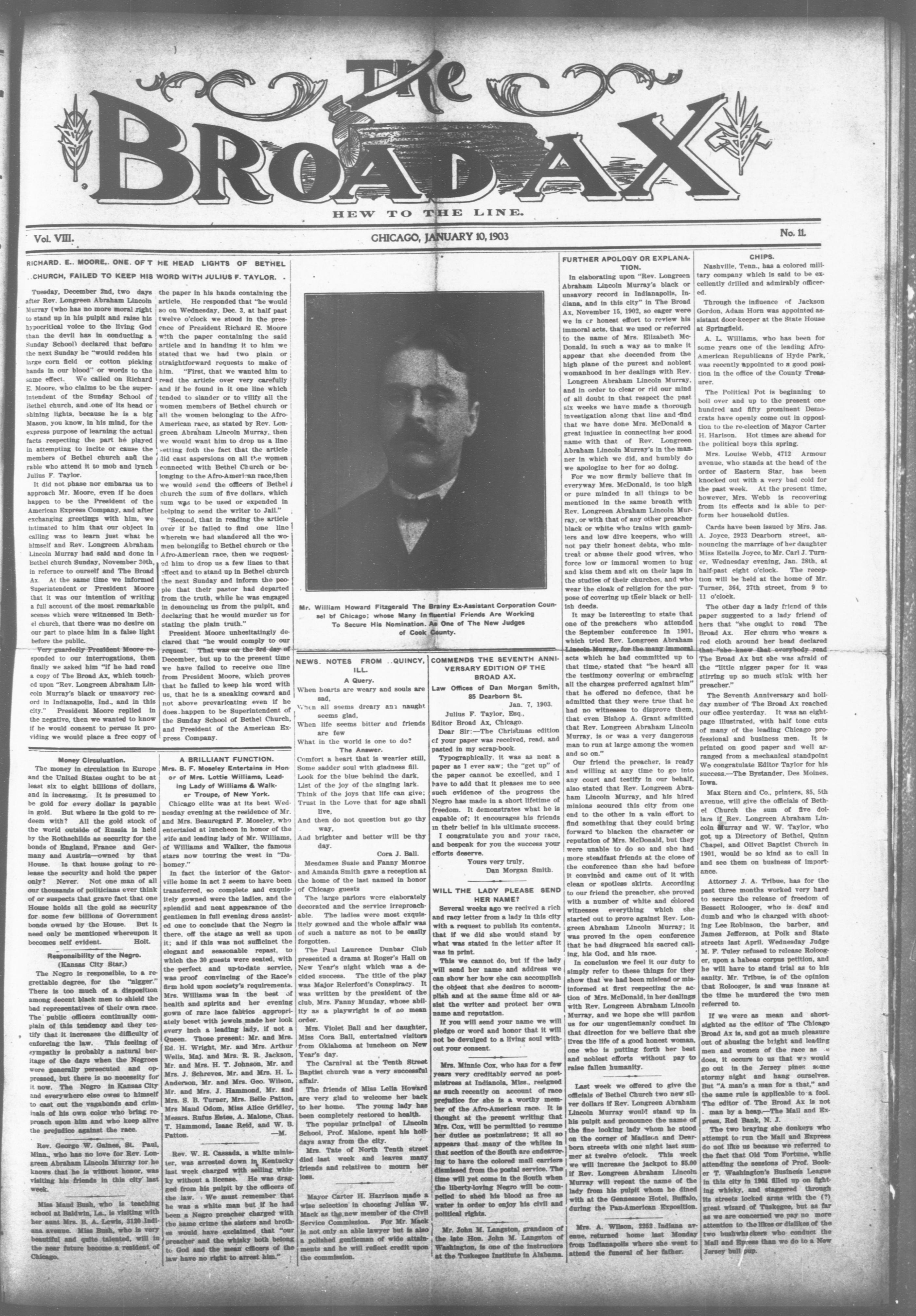
Page text (machine-generated)
Tuesday, December 2nd, two days after Rev. Longreen Abraham Lincoln Murray (who has no more moral right to stand up in his pulpit and raise his hypocritical voice to the living God than the devil has in conducting a Sunday School) declared that before the next Sunday he "would redden his large corn field or cotton picking hands in our blood" or words to the same effect. We called on Richard E. Moore, who claims to be the superintendent of the Sunday School of Bethel church, and one of its head or shining lights, because he is a big Mason, you know, in his mind, for the express purpose of learning the actual facts respecting the part he played in attempting to incite or cause the members of Bethel church and the rable who attend it to mob and lynch Julius F. Taylor.
It did not phase nor embaras us to approach Mr. Moore, even if he does happen to be the President of the American Express Company, and after exchanging greetings with him, we intimated to him that our object in calling was to learn just what he himself and Rev. Longreen Abraham Lincoln Murray had said and done in Bethel church Sunday, November 30th, in reference to ourself and The Broad Ax. At the same time we informed Superintendent or President Moore that it was our intention of writing a full account of the most remarkable scenes which were witnessed in Bethel church, that there was no desire on our part to place him in a false light before the public.
Very guardedly President Moore responded to our interrogations, then finally we asked him "if he had read a copy of The Broad Ax, which touched upon "Rev. Longreen Abraham Lincoln Murray's black or unsavory record in Indianapolis, Ind., and in this city." President Moore replied in the negative, then we wanted to know if he would consent to peruse it providing we would place a free copy of
Money Circulation.
The money in circulation in Europe and the United States ought to be at least six to eight billions of dollars, and in increasing. It is presumed to be gold for every dollar is payable in gold. But where is the gold to redeem with? All the gold stock of the world outside of Russia is held by the Rothschilds as security for the bonds of England, France and Germany and Austria—owned by that House. Is that house going to release the security and hold the paper only? Never. Not one man of all our thousands of politicians ever think of or suspects that grave fact that one House holds all the gold as security for some few billions of Government bonds owned by the House. But it need only be mentioned whereupon it becomes self evident. Holt.
Responsibility of the Negro. (Kansas City Star.)
The Negro is responsible, to a regrettable degree, for the "nigger." There is too much of a disposition among decent black men to shield the bad representatives of their own race. The public officers continually complain of this tendency and they testify that it increases the difficulty of enforcing the law. This feeling of sympathy is probably a natural heritage of the days when the Negroes were generally persecuted and oppressed, but there is no necessity for it now. The Negro in Kansas City and everywhere else owes to himself to cast out the vagabonds and criminals of his own color who bring reproach upon him and who keep alive the prejudice against the race.
Rev. George W. Gaines, St. Paul, Minn., who has no love for Rev. Longgreen Abraham Lincoln Murray tor he knows that he is without honor, was visiting his friends in this city last week.
Miss Maud Bush, who is teaching school at Baldwin, La., is visiting with her aunt Mrs. B. A. Lewis, 3120 Indiana avenue. Miss Bush, who is very beautiful and quite talented, will in the near future become a resident of Chicago.
the paper in his hands containing the article. He responded that "he would so on Wednesday, Dec. 3, at half past twelve o'clock we stood in the presence of President Richard E. Moore with the paper containing the said article and in handing it to him we stated that we had two plain or straightforward requests to make of him. "First, that we wanted him to read the article over very carefully and if he found in it one line which tended to slander or to vilify all the women members of Bethel church or all the women belonging to the Afro-American race, as stated by Rev. Longgreen Abraham Lincoln Murray, then we would want him to drop us a line setting foth the fact that the article did cast aspersions on all the women connected with Bethel Church or belonging to the Afro-American race, then we would send the officers of Bethel church the sum of five dollars, which sum was to be used or expended in helping to send the writer to Jail."
"Second, that in reading the article over if he failed to find one line wherein we had slandered all the women belonging to Bethel church or the Afro-American race, then we requested him to drop us a few lines to that effect and to stand up in Bethel church the next Sunday and inform the people that their pastor had departed from the truth, while he was engaged in denouncing us from the pulpit, and declaring that he would murder us for stating the plain truth."
President Moore unhesitatingly declared that "he would comply to our request. That was on the 3rd day of December, but up to the present time we have failed to receive one line from President Moore, which proves that he failed to keep his word with us, that he is a sneaking coward and not above prevaricating even if he does.happen to be Superintendent of the Sunday School of Bethel Church, and President of the American Express Company.
A BRILLIANT FUNCTION.
Chicago elite was at its best Wednesday evening at the residence of Mr. and Mrs. Beauregard F. Moseley, who entertailed at luncheon in honor of the wife and leading lady of Mr. Williams, of Williams and Walker, the famous stars now touring the west in "Dahomey."
In fact the interior of the Gatorville home in act 2 seem to have been transferred, so complete and exquisitely gowned were the ladies, and the splendid and neat appearance of the gentlemen in full evening dress assisted one to conclude that the Negro is there, off the stage as well as upon it; and if this was not suficinet the elegant and seasonable repast, to which the 30 guests were seated, with the perfect and up-to-date service, was proof convincing of the Race's firm hold upon society's requirements. Mrs. Williams was in the best of health and spirits and her evening gown of rare lace fabrics appropriately beset with jewels made her look every inch a leading lady, if not a Queen. Those present: Mr. and Mrs. Ed. H. Wright, Mr. and Mrs. Arthur Wells, Maj. and Mrs. R. R. Jackson, Mr. and Mrs. H. T. Johnson, Mr. and Mrs. J. Schreves, Mr. and Mrs. H. L. Anderson, Mr. and Mrs. Geo. Wilson, Mr. and Mrs. J. Hammond, Mr. and Mrs. S. B. Turner, Mrs. Belle Patton, Mrs Maud Odom, Miss Alice Gridley, Messrs. Rufus Estes, A. Malone, Chas T. Hammond, Isaac Reid, and W. B Patton. —M.
Rev. W. R. Cassada, a white minister, was arrested down in Kentucky last week charged with selling whisky without a license. He was dragged from his pulpit by the officers of the law. We must remember that he was a white man but if he had been a Negro preacher charged with the same crime the sisters and brothes would have exclaimed that "our preacher and the whisky both belong to God and the mean officers of the law have no right to arrest him."
HEW TO THE LINE.
[Name]
And then do not question but go thy way.
And brighter and better will be thy day.
Cora J. Ball.
Mesdames Susie and Fanny Monroe and Amanda Smith gave a reception at the home of the last named in honor of Chicago guests
The large parlors were elaborately decorated and the service irreproachable. The ladies were most exquisitely gowned and the whole affair was of such a nature as not to be easily forgotten.
The Paul Laurence Dunbar Club presented a drama at Roger's Hall on New Year's night which was a decided success. The title of the play was Major Relerford's Conspiracy. It was written by the president of the club, Mrs. Fanny Munday, whose ability as a playwright is of no mean order. Mrs. Violet Ball and her daughter, Miss Cora Ball, entertained visitors from Oklahoma at luncheon on New Year's day.
The Carnival at the Tenth Street Baptist church was a very successful affair.
The friends of Miss Lelia Howard are very glad to welcome her back to her home. The young lady has been completely restored to health.
The popular principal of Lincoln School, Prof. Malone, spent his holidays away from the city.
Mrs. Tate of North Tenth street died last week and leaves many friends and relatives to mourn her loss.
Mayor Carter H. Harrison made a wise selection in choosing Julian W. Mack as the new member of the Civil Service Commission. For Mr. Mack is not only an able lawyer but is also a polished gentleman of wide attainments and he will reflect credit upon the commission.
COMMENDS THE SEVENTH ANNIVERSARY EDITION OF THE BROAD AX.
Law Offices of Dan Morgan Smith,
85 Dearborn St.
Jan. 7, 1903.
Dear Sir:—The Christmas edition cf your paper was received, read, and pasted in my scrap-book. Typographically, it was as neat a paper as I ever saw; the "get up" of the paper cannot be excelled, and I have to add that it pleases me to see such evidence of the progress the Negro has made in a short lifetime of freedom. It demonstrates what he is capable of; it encourages his friends in their belief in his ultimate success. I congratulate you and your race, and bespeak for you the success your efforts deserve.
WILL THE LADY PLEASE SEND
HER NAME?
Several weeks ago we recived a rich and racy letter from a lady in this city with a request to publish its contents, that if we did she would stand by what was stated in the letter after it was in print. This we cannot do, but if the lady will send her name and address we can show her how she can accomplish the object that she desires to accomplish and at the same time aid or assist the writer and protect her own name and reputation.
If you will send your name we will pledge or word and honor that it will not be devulged to a living soul without your consent.
Mrs. Minnie Cox, who has for a few years very creditably served as postmistress at Indianola, Miss., resigned as such recently on account of race prejudice for she is a worthy member of the Afro-American race. It is thought at the present writing that Mrs. Cox, will be permitted to resume her duties as postmistress; it all so appears that many of the whites in that section of the South are endeavoring to have the colored mail carriers dismissed from the postal service. The time will yet come in the South when the liberty-loving Negro will be compelled to shed his blood as free as water in order to enjoy his civil and political rights.
Mr. John M. Langston, grandson of the late Hon. John M. Langston of Washington, is one of the instructors at the Tuskegee Institute in Alabama.
FURTHER APOLOGY OR EXPLANATION.
In elaborating upon "Rev. Longreen Abraham Lincoln Murray's black or unsavory record in Indianapolis, Indiana, and in this city" in The Broad Ax, November 15, 1902, so eager were we in cr honest effort to review his immoral acts, that we used or referred to the name of Mrs. Elizabeth McDonald, in such a way as to make it appear that she decended from the high plane of the purest and noblest womanhood in her dealings with Rev. Longreen Abraham Lincoln Murray, and in order to clear or rid our mind of all doubt in that respect the past six weeks we have made a thorough investigation along that line and find that we have done Mrs. McDonald a great injustice in connecting her good name with that of Rev. Longreen Abraham Lincoln Murray's in the manner in which we did, and humbly do we apologize to her for so doing.
For we now firmly believe that in everyway Mrs. McDonald, is too high or pure minded in all things to be mentioned in the same breath with Rev. Longreen Abraham Lincoln Murray, or with that of any other preacher black or white who trains with gamblers and low dive keepers, who will not pay their honest debts, who mistreat or abuse their good wives, who force low or immoral women to hug and kiss them and sit on their laps in the studies of their churches, and who wear the cloak of religion for the purpose of covering up their black or hellish deeds.
It may be interesting to state that one of the preachers who attended the September conference in 1901, which tried Rev. Longreen Abraham Lincoln Murray, for the many immoral acts which he had committed up to that time, stated that "he heard all the testimony covering or embracing all the charges preferred against him" that he offered no defence, that he admitted that they were true that he had no witnesses to disprove them, that even Bishop A. Grant admitted that Rev. Longreen Abraham Lincoln Murray, is or was a very dangerous man to run at large among the women and so on."
Our friend the preacher, is ready and willing at any time to go into any court and testify in our behalf, also stated that Rev. Longreen Abraham Lincoln Murray, and his hired minions scoured this city from one end to the other in a vain effort to find something that they could bring forward to blacken the character or reputation of Mrs. McDonald, but they were unable to do so and she had more steadfast friends at the close of the conference than she had before it convined and came out of it with clean or spotless skirts. According to our friend the preacher, she proved with a number of white and colored witnesses everything which she started out to prove against Rev. Longreen Abraham Lincoln Murray; it was proved in the open conference that he had disgraced his sacred calling, his God, and his race.
In conclusion we feel it our duty to simply refer to these things for they show that we had been mislead or misinformed at first respecting the action of Mrs. McDonald, in her dealings with Rev. Longreen Abraham Lincoln Murray, and we hope she will pardon us for our ungentlemanly conduct in that direction for we believe that she lives the life of a good honest woman, one who is putting forth her best and noblest efforts without pay to raise fallen humanity.
Last week we offered to give the officials of Bethel Church two new silver dollars if Rev. Longreen Abraham Lincoln Murray would stand up in his pulpit and pronounce the name of the fine looking lady whom he stood on the corner of Madison and Dearborn streets with one night last summer at twelve o'clock. This week we will increase the jackpot to $5.00 if Rev. Longreen Abraham Lincoln Murray will repeat the name of the lady from his pulpit whom he dined with at the Gennessee Hotel, Buffalo, during the Pan-American Exposition.
Mrs. A. Wilson, 2252. Indiana avenue, returned home last Monday from Indianapolis where she went to attend the funeral of her father.
No.11
Nashville, Tenn., has a colored military company which is said to be excellently drilled and admirably officered. Through the influence of Jackson Gordon, Adam Horn was appointed assistant door-keeper at the State House at Springfield. A. L. Williams, who has been for some years one of the leading AfroAmerican Republicans of Hyde Park, was recently appointed to a good position in the office of the County Treasurer.
The Political Pot is beginning to boil over and up to the present one hundred and fifty prominent Democrats have openly come out in opposition to the re-election of Mayor Carter H. Harrison. Hot times are ahead for the political boys this spring.
Mrs. Louise Webb, 4712 Armour avenue, who stands at the head of the order of Eastern Star, has been knocked out with a very bad cold for the past week. At the present time, however, Mrs. Webb is recovering from its effects and is able to perform her household duties.
Cards have been issued by Mrs. Jas. A. Joyce, 2923 Dearborn street, announcing the marriage of her daughter Miss Estella Joyce, to Mr. Carl J. Turner, Wednesday evening, Jan. 28th, at half-past eight o'clock. The reception will be held at the home of Mr. Turner, 364, 27th street, from 9 to 11 o'clock.
The other day a lady friend of this paper suggested to a lady friend of hers that "she ought to read The Broad Ax. Her chum who wears a red cloth around her head declared that "she knew that everybody read The Broad Ax but she was afraid of the "little nigger paper for it was stirring up so much stink with her preacher."
The Seventh Anniversary and holiday number of The Broad Ax reached our office yesterday. It was an eightpage illustrated, with half tone cuts of many of the leading Chicago professional and business men. It is printed on good paper and well arranged from a mechanical standpoint We congratulate Editor Taylor for his success.—The Bystander, Des Moines, Iowa.
Max Stern and Co., printers, 85, 5th avenue, will give the officials of Bethel Church the sum of five dollars if Rev. Longreen Abraham Lincoln Murray and W. W. Taylor, who got up a Directory of Bethel, Quinn Chapel, and Olivet Baptist Church in 1901, would be so kind as to call in and see them on business of importance.
Attorney J. A. Tribue, has for the past three months worked very hard to secure the release of freedom of Bessett Rolooger, who is deaf and dumb and who is charged with shooting Lee Robinson, the barber, and James Jefferson, at Polk and State streets last April. Wednesday Judge M. F. Tuley refused to release Rolooger, upon a habeas corpus petition, and he will have to stand trial as to his sanity. Mr. Tribue, is of the opinion that Rolooger, is and was insane at the time he murdered the two men referred to.
If we were as mean and shortsighted as the editor of The Chicago Broad Ax is, and got as much pleasure out of abusing the bright and leading men and women of the race as does, it occurs to us that we would go out in the Jersey pines some stormy night and hang ourselves. But "A man's a man for a that," and the same rule is applicable to a fool. The editor of The Broad Ax is not man by a heap.—The Mail and Express, Red Bank, N. J.
The two braying she donkeys who attempt to run the Mall and Express do not like us because we referred to the fact that Old Tom Fortune, while attending the sessions of Prof. Booker T. Washington's Business League in this city in 1901 filled up on fighting whisky, and staggered through its streets locked arms with the (?) great wizard of Tuskegee, but as far as we are concerned we pay no more attention to the likes or dislikes of the two bushwhackers who conduct the Mall and Epress than we do to a New Jersey bull pup.
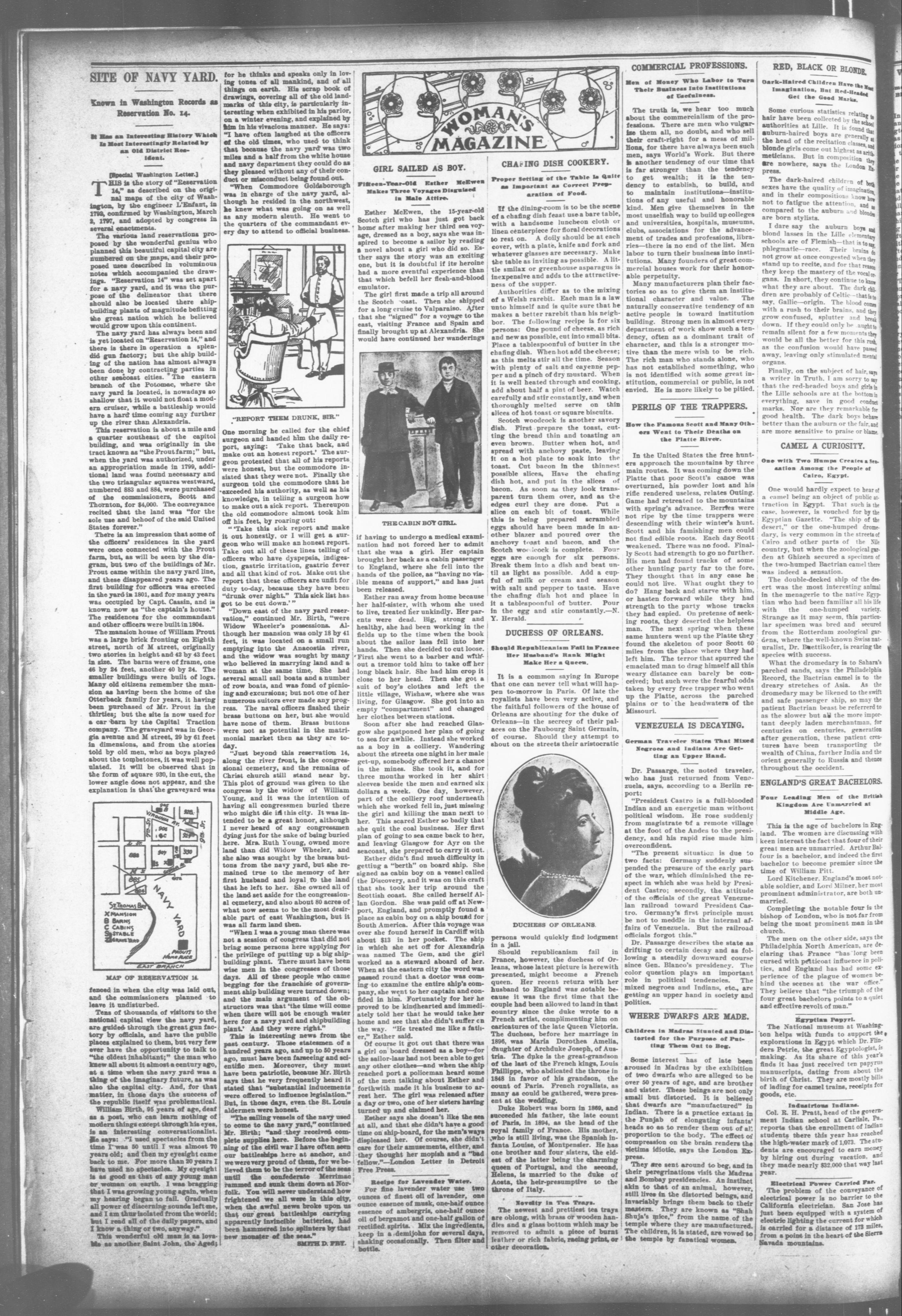
SITE OF NAVY YARD.
Known in Washington Records as
Reservation No. 14.
St Has an Interesting History Which
Is Most Interestingly Related by
an Old District Res-
° ident.
~~ = ees eee
HIS is the story of “Eeservation
I 14,” as described on the origi-
mal maps of the city of Wash-
ington, by the engineer L'Enfant, in
1798, confirmed by Wesbington, March
2, 1797, and adopted by congress in
several epactanenis.
The various land reservations pro-
posed by the wonderful genius who
planned this beautiful capital city are
numbered on the maps, and their pro-
posed uses described in voluminous
notes which accompanied the draw-
ings. “Reservation 14” was set apart
for # navy yard, and it was the pur-
pose of the delineator that there
should also be located there ship-
building plants of magnitude befitting
the great nation which he believed
would grow upon this continent.
The navy yard has always been and
is yet located on “Reservation 14,” and
there is there in operation a splen-
did gun factory; but the ship build-
ing of the nation has almost always
been done by contracting parties in
other seacoast cities. “The eastern
branch of the Potomec, where the
navy yard is located, is nowadays so
shallow that it would not float a mod-
ern cruiser, while a battleship would
have a hard time coming any further
up the river than Alexandria.
This reservation is about a mile and
® quarter southeast of the capitol
building, and was originally in the
tract known as “the Proutfarm;” but,
when the yard was authorized, under
an appropriation made in 1799, addi-
tional land was found necessary and
the two triangular squares westward,
numbered 883 and 884, were purchased
of the commissioners, Scott and
Thornton, for $4,000. The conveyance
recited that the land was “for the
sole use and behoof of the said United
States forever.”
There is an impression that some of
the officers’ residences in the yard
were once connected with the Prout
farm, but, as will be seen by the dia-
gram, but two of the buildings of Mr.
Prout came within the navy yard line,
and these disappeared years ago. The
first building for officers was erected
in the yard im 1901, and for many years |
was occupied by Capt. Cassin, and is
known now as “the captain’s house.”
The residences for the commandant
and other officers were built in 1804.
The mansion house of William Prout
was a large brick fronting on Eighth
street, north of M street, originally
two stories in height and 42 by 43 feet
im size. The barns were of frame, one
4 by 24 feet, another 40 by 24. The
mmaller buildings were built of logs.
Many old citizens remember the man-
sion as having been the home of the
Otterback family for years, it having
been purchased of Mr. Prout in the
thirties; but the site is now used for
® car barn by the Capital Traction
company. The graveyard was in Geor-
gia avenue and M street, 29 by 61 feet
im dimensions, and from the stories
told by old men, who as boys played
about the tombstones, it was well pop-
ulated. It will be observed that in
the form of square 930, in the cut, the
lower angle does not appear, and the
explanation is that'the graveyard was
ee best
GSS:
| ale
PS
mot 4
Pe
fenced in when the city was laid out,
and the commissioners planned to
leave it undisturbed.
Tens of thousands of visitors to the
national capital view the navy yard,
are guided through the great gun fac-
tory by officials, and have the public
places explained to them, but very few
ever have the opportunity to talk to
“the oldest inhabitant;” the man who
knew all about it almost a century ago,
st a time when the navy yard was
thing of the imaginary future, as was
also the capital city. And, for that
matter, in those days the success of
the republic itself was problematical.
William Birth, 95 years of age, deaf
as & post, who can learn nothing of
modern things except through his eyes,
is an interesting conversationalist.
ie says: .“I used spectacles from the
time I-was 50 until I was almost 70
yearsold; and then my eyesight came
back to me. For more than 20 years |
hkeve used no spectacles. My eyesight
is es good as that of any young man
or_woman on carth. I was bragging
that I was growing young again, when
a of discerning epost
power me,
Sat {reed all of dhe Qaily =
: papers, anc
1 know a thing or two, anyway.”
‘This wonderful old man is as love
for he thinks and speaks only in lov-
ing tones of all mankind, and of all
things on earth. His scrap book of
drawings, covering all of the old land-
marks of this city, is particularly in-
teresting when exhibited in his parlor,
on a winter evening, and explained by
him in his vivacious manner. He says:
“I have often laughed at the officers
of the old times, who used to think
that because the navy yard was two
miles and a half from the white house
and navy department they could do as
they pleased without any of their con-
duct or misconduct being found out.
“When Commodore Goldsborough
was in charge of the navy yard, al-
though he resided in the northwest,
he knew what was going on as well
as any modern sleuth. He went to
the quarters of the commandant ev-
ery day to attend to official business.
ie
yO
“REPORT ‘THEM DRUNK, SIR.”
One morning he called for the chief
surgeon and handed him the daily re-
port, saying: “Take that back, and
make out an honest report.’ The sur-
geon protested that all of his reports
were honest, but the commodore in-
sisted that they were not. Finally the
surgeon told the commodore that he
‘exceeded his authority, as well as his
knowledge, in telling a surgeon how
to make outa sick report. Thereupon
the old commodore almost took him
off his feet, by roaring out:
“*Take this sick report and make
it out honestly, or I will get @ sur-
geon who will make an honest report.
Take out all of these lines telling of
officers who have dyspepsia, indiges-
tion, gastric irritation, gastric fever
and all that kind of rot. Make out the
report that these officers are unfit for
duty to-day, because they have been
“drunk over night.” This sick list has
got to be cut down.’”
“Down east of the navy yard reser-
vation,” continued Mr. Birth, “were
Widow Wheeler’s possessions. Al-
though her mansion was only 18 by 41
feet, it was located on a small run
emptying into the Anacostia river,
and the widow was sought by many
who believed in marrying land and a
woman at the same time. She had
several small sail boats and a number
of row boats, and was fond of picnic-
ing and excursions; but not one of her
numerous suitors ever made any prog-
ress. The naval officers flashed their
brass buttons on her, but she would
have none of them. Brass buttons
were not as potential in the matri-
monial market then as they are to-
day.
“Just beyond this reservation 14,
along the river front, is the congres-
sional cemetery, and the remains of
Christ church still stand near by.
This plot of ground was given to the
congress by the widow of William
Young, and it was the intention of
having all congressmen buried there
who might die if this city. It was in-
tended to be a great honor, although
I never heard of any congressmen
dying just for the sake of being buried
here. Mra. Ruth Young, owned more
land than did Widow Wheeler, and
she also was sought by the brass but-
tons from the navy yard, but she re-
mained true to the memory of her
first husband and loyal fo the land
that he left to her. She owned all of
the land set aside for the congression-
al cemetery, and also about 80 acres of
what now seems to be the most desir-
able part of east Washington, but it
was all farm land then.
“When I was a young man there was
pot a session of congress that did not
bring some persons here applying for
the privilege of putting up a big ship-
building plant. There must have been
wise men in the congresses of those
days. All of these people who came
begging for the franchise of govern
ment ship building were turned down;
and the main argument of the ob-
structors was that ‘the time will come
when there will not be enough water
here for a navy yard and shipbuilding
plant.” And they were right.”
‘This is interesting news from the
past century. Those statesmen of a
| hundred years ago, and up to 50 years
ago, must have been farseeing and sci-
| entific men. Moreover, they must
have been patriotic, because Mr. Birth
says that he very frequently heard it
stated that “substantial inducements
were offered to influence legislation.”
But, in those days, even the St. Louis
aldermen were honest.
“The sailing vessels of the navy used
to come to the navy yard,” continued
plete the
ning of the civil war I have often seen
our battleships here at anchor, and
we were very proud of them, for we be-
lieved them to be the terror of the seas
until the confederate Merrimac
tammed and sunk them down at Nor-
feightened = all in this ae.
we were fs
= the awful news broke upon us
apparently invincible batteries, had
been hammered or ot ashen
ew monater the seas.” ee,
Se se ee ga |
Ee SpaoMansy “py
A PR BONS 4
> —/ MAGAZINE \—)
GIRL SAILED AS BOY. | CHASING DISH COOKERY.
Esther McEwen, the 15-year-old
Scotch girl who has just got back
home after making her third sea voy-
age, dressed as a boy, says she was in-
spired to become a sailor by reading
@ novel about a girl who did so. Es-
ther says the story was an exciting
one, but it is doubtful if its heroine
had a more eventful experience than
that which befell her flesh-and-blood
emulator.
The girl first made a trip all around
the Scotch -oast. Then she shipped
for a long cruise to Valparaiso. After
that she “signed” for a voyage to the
east, visiting France and Spain and
finally brought up at Alexandria. She
would have continued her wanderings
| se " aes
Mie oe hea
oe JP
eet 4
3
e i
ac Ce
apes:
HP ‘
4
a 7 # Ke j
a ak &
if having to undergo a medical exami-
nation had not forced her to admit
that she was a girl Her captain
brought her back as a cabin passenger
to England, where she fell into the
hands of the police, as “having no vis-
ible means of support,” and has just
been released.
Esther ran away from home because
her half-sister, with whom she used
to live, treated her unkindly. Her par-
ents were dead. Big, strong and
healthy, she had been working in the
fields up to the time when the book
about the sailor lass fell into her
hands. Then she decided to cut loose.
‘First she went to a barber and wftht
out a tremor told him to take off her
long black hair. She had him crop it
close to her head. Then she got a
suit of boy’s clothes and left the
little village, Wishaw, where she was
living, for Glasgow. She got into an
empty “compartment” and changed
her clothes between stations.
Soon after she had reached Glas-
gow she pgstponed her plan of going
to sea for awhile. Instead she worked
as a boy in a colliery. Wandering
about the streets one night in her male
get-up, somebody offered her a chance
in the mines. She took it, and for
three months worked in her shirt
sleeves beside the men and earned six
dollars a week. One day, however,
part of the colliery roof underneath
which she worked fell in, just missing
the girl and killing the man next to
her. This scared Esther so badly that
she quit the coal business. Her first
plan of going to sea came back to her,
and leaving Glasgow for Ayr on the
seacoast, she prepared to carry it out.
Esther didn’t find much difficulty in
getting a “berth” on board ship. She
signed as cabin boy on a vessel called
the Discovery, and it was on this craft
that she took her trip around the
Scottish coast. She called herself Al-
lan Gordon. She was paid off at New-
port, England, and promptly found a
place as cabin boy on a ship bouad for
South America. After this voyage was
over she found herself in Cardiff with
about $13 in her pocket. The ship
in which she set off for Alexandria
was named The Gem, and the girl
worked as a steward aboard of her.
When at the eastern city the word was
passed round that a doctor was com-
ing to examine the entire ship’s com-
pany, she went to her captain and con-
fided in him. Fortunately for her he
proved to be kindhearted and immedi-
ately told her that he would take her
home and see that she didn’t suffer cn
the way. “He treated me like a fath-
er,” Esther said.
Of course it got out that there was
a girl on board dressed as a boy—for
the sailor-lass had not been able to
any other clothes—and when the Lp
reached port a policeman heard some
of the men talking about Esther and
forthwith made it his business to ar-
rest her. The girl was released after
a day or two, one of her sisters having
turned up and claimed her.
Esther says she doesn't like the sea
at all, and that she didn't have a good
time on ship-board, for the men’s ways
displeased her. Of course, she didn't
care ee ee
-they mopish a “bad
Sener teades Letter in Detroit
Free Press.
Recipe for Lavender Water.
For fine lavender water use two
ounces of finest ofl of lavender, one
ounce essence of musk, one-haif ounce
essence of ambergris, one-half ounce
oil of bergamot and one-half gallon of
rectified spirits. Mix the ingredients,
keep in a-demijohn for several days,
shaking occasionally. Then filter and
bottle
CHAFING DISH COOKERY.
Proper Setting of the Table le Quite
an Important as Correct Prep-
aration of Feod.
If the dining-room is to be the scene
of a chafing dish feast usea bare table,
with a handsome luncheon cloth or
linen cénterpiece for floral decorations
to rest on. A doily should be at each
cover, with a plate, knife and fork and
whatever glasses are necessary. Make
the table as inviting as possible. A lit-
tle smilax or greenhouse asparagus is
inexpensive and adds to the attractive-
ness of the supper.
Authorities differ as to the mixing
of a Welsh rarebit. Each man is a law
unto himself and is quite sure that he
makes a better rarebit than his neigh-
bor. The following recipe is for six
persons: One pound of cheese, as rich
and new as possible, cut into small bits.
Place a tablespoonful of butter in the
chafing dish. When hot add the cheese;
as this melts stir all the time. Season
with plenty of salt and cayenne pep-
per and a pinch of dry mustard. When
it is well heated through and cooking,
add about half a pint of beer. Watch
carefully and stir constantly, and when
thoroughly melted serve on thin
slices of hot toast or square biscuits.
Seotch woodcock is another savory
dish. First prepare the toast, cut-
ting the bread thin and toasting an
even brown. Butter when hot, and
spread with anchovy paste, leaving
it on a hot plate to soak into the
toast. Cut bacon in the thinnest
possible slices, Have the chafing
dish hot, and put in the slices of
bacon. As soon as they look trans-
parent turn them over, and as the
edges curl they are done. Put a
slice on each bit of toast. While
this is being prepared scrambled
eggs should have been made in an-
other blazer and poured over the
anchovy toast and bacon, and the
Scotch woo lcock is complete. Four
eggs are enough for six persons.
Break them into a dish and beat un-
til as light as possible. Add a cup-
ful of milk or cream and season
with salt and pepper to taste. Have
the chafing dish hot and place in
it a tablespoonful of butter. Pour
in the egg and stir constantly.—N.
Y. Herald. e
DUCHESS OF ORLEANS.
Should Republicanism Fatl im France
Her Husband's Rank Might
Make Her a Queen.
It is a common saying in Europe
that one can never tell what will hap-
pen to-morrow in Paris. Of late the
royalists have been very active, and
the faithful followers of the house of
Orleans are shouting for the duke of
Orleans—in the secrecy of their pal-
aces on the Faubourg Saint Germain,
of course. Should they attempt to
shout on the streets their aristocratic
(. ND \
a
~ »
SN 2
fF a oe ”
a
ie
: be |
=
\ oe ey
Sa ,
£ ae j
ri P
DUCHESS OF ORLEANS.
persons would quickly find lodgment
in a jail.
Should republicanism fail in
France, however, the duchess of Or-
leans, whose latest picture is herewith
presented, might become a French
queen. Her recent retura with her
husband to England was aotable be-
cause it was the first time that the
couple had been allowed to land in that
country since the duke wrote to a
French artist, complimenting him on
caricatures of the late Queen Victoria.
The duchess, before her marriage in
1896, was Maria Dorothea Amelia,
@aughter of Archduke Joseph, of Aus-
tria. The dpke is the great-grandson
of the last of the French kings, Louis
Phillippe, who abdicated the throne in
1848 in favor of his grandson, the
count of Paris. French royalists, as
many 8s could be gathered, were pres-
ent at the wedding.
Duke Robert was born in 1869, and
succeeded his father, the late count
of Paris, in 1894, as the head of the
royal family of France. His mother,
who is still living, was the Spanish in-
fanta Louise, of Montpensier. He has
one brother and four sisters, the eld-
est of the latter being the charming
=." Portugal, and the second,
is married to the duke of
Aosta, the heir-presumptive to the
throne of Italy.
" Mevelty in Tea Trays.
‘The newest and prettiest tea trays
sre oblong, with brass or wooden han-
dies and a glass bottom which may be
removed to admit a piece of burnt
leather or rich fabric, racing print, or
Other decoration.
COMMERCIAL PROFESSIONS.
Men of Money Who Labor to Tarn
‘Their Business Into Institutions
ef Usetulness.
The truth is, we hear too much
about the commercialism of the pro-
fessions. There are men who vulgar~
ize them all, no doubt, and who sell
their craft-right for a mess of mil-
Hons, for there have always been such
men, says World’s Work. But there
fs another tendency of our time that
is far stronger than the tendency
to get wealth; it is the ten-
dency to establish, to build, and
to maintain institutions—institu-
tions of any useful and honorable
kind. Men give themselves in the
most unselfish way to build up colleges
and universities, hospitals, museums,
clubs, associations for the advance-
ment of trades and professions, libra-
ries—there is no end of the list. Men
labor to turn their business into insti-
tutions. Many founders of great com-
mercial houses work for their honor-
able perpetuity.
Many manufacturers plan their fac-
tories so as to give them an institu-
tional character and value. The
naturally conservative tendency of an
active people is toward institution
building. Strong men in almost every
department of work show such a ten-
dency, often as a dominant trait of
character, and this is a stronger mo-
tive than the mere wish to be rich.
The rich man who stands alone, who
has not established something, who
is not identified with some great in-
stitution, commercial or public, is not
envied. He is more likely to be pitied.
PERILS OF THE TRAPPERS.
How the weoanaecicaael Many Oth-
ers Went to Their Deaths on
the Platte River.
In the United States the free hunt-
ers approach the mountains by three
main routes. It was coming down the
Platte that poor Scott’s canoe was
overturned, his powder lost and his
rifle rendered useless, relates Outing.
Game had retreated to the mountains
with spring’s advance. Berrfes were
not ripe by the time trappers were
descending with their winter’s hunt.
Scott and his famishing men could
not find edible roots. Each day Scott
weakened. There was no food. Final-
ly Scott had strength to go no further.
His men had found tracks of some
other hunting party far to the fore.
They thought that in any case he
could not live. What ought they to
do? Hang back and starve with him,
or hasten forward while they had
strength to the party whose tracks
they had espied. On pretense of seek-
ing roots, they deserted the helpless
man. The next spring when these
same hunters went up the Platte they
found the skeleton of poor Scott 60
miles from the place where they had
left him. The terror that spurred the
emaciated man to drag himself all this
weary distance can barely be con-
ceived; but such were the fearful odds
taken by every free trapper who went
up the Platte, across the parched
plains or to the headwaters of the
Missouri.
VENEZUELA IS DECAYING.
German Traveier States That Mixed
Negroes and Indians Are Get-
ting an Upper Hand.
Dr. Passarge, the noted traveler,
who has just returned from Venc-
zuela, says, according to a Berlin re-
rt:
PecPresident Castro is a full-blooded
Indian and an energetic man without
political wisdom. He rose suddenly
from magistrate tf a remote village
at the foot of the Andes to the presi-
dency, and his rapid rise made him
overconfident.
“The present situation is due ‘to
two facts: Germany suddenly sus-
pended the pressure of the early part
of the war, which diminished the re-
spect in which she was held by Presi-
dent Castro; secondly, the attitude
of the officials of the great Venezue-
Jan railroad toward President Cas-
tro. Germany’s first principle must
be not to meddle in the internal af-
fairs of Venezuela. But the railroad
officials forgot this.”
Dr. Passarge describes the state as
drifting to certain decay and as fol-
lowing a steadily downward course
since Gen. Blanco’s presidency. The
color question plays an important
role in political tendencies. The
mixed negroes and Indians, ete. are
getting an upper hand in society and
politics.
WHERE DWARFS ARE MADE.
Children in Madras Stunted and Dis-
terted for the Purpose of Put-
ting Them Oat to Beg.
Some interest has of late been
aroused in Madras by the exhibition
of two dwarfs who are alleged to be
over 50 years of age, and are brother
and sister. These beings are not only
small but distorted. It is believed
that dwarfs are “manufactured” in
Indian. There is a practice extant in
the Punjab of elongating infants’
heads so as to render them out of al:
proportion to the body. The effect of
compression on the brain renders the
wietims idiotic, says the London Ex-
press.
‘They a@re sent around to beg, and in
their peregrinations visit the Madras
and Bombay presidencies. An instinct
akin to thet of an animal, however,
still lives in the distorted beings, and
invariably brings them back to their
masters. They are known as “Shah
a from the name of the
temple they are manufactured.
The children, it is stated, are vowed to
the temple by fanetica] women.
ae
RED, BLACK OR BLOND,
Oark-Hatred Children Fave the Wey
Imagination, But Red-Headeg
Get the Geed wari.
Some curious statistics r¢)
hair have been collected by ae
authorities at Lille. It is ‘oun
suburn-haired boys are general
the head of the recitation classes’,
blonde girls come out highest snare
meticians. But in composition they
@re nowhere, says the London &
press.
The dark-haired children of bog
sexes have the quality of imagination,
and in their composition: KNOW hoy.
not to fatigue the attention, and y
compared to the auburn and Dlondy
are born stylists.
I dare say the auburn boys ay
blond lasses in the Lille clementay
schools are of Flemish—that i to say,
phlegmatie—race. Their braing &
not grow at once congested when they
stand up to recite, and for that Teo,
they keep the mastery of the vocal,
gans. In short, they continue to know
what they are about. The dark ay
dren are probably of Celtic—thatigty
say, Gallic—origin. The blood comy
with a rush to their brains, and they
grow confused, splutter and break
down. If they could only be aughtty
remain silent for a few moments they
would be all the better for this mg
as the confusion would have pass
away, leaving only stimulated menty
organs.
Finally, on the subject of hair, say
a writer in Truth. I am sorry to say
that the red-headed boys and girls iy
the Lille schools are at the bottomig
everything, save in good condnet
marks. Nor are they remarkable for
good health. The dark boys behay
better than the auburn or the fair, ang
are more sensitive to praise or blame
CAMEL A CURIOSITY.
One with Two Humps Creates a Sex.
aation Among the People of
Cairo, Egypt.
One would hardly expect to hear of
a camel being an object of publie at-
traction in Egypt. That such is the
case, however, is vouched for by the
Egyptian Gazette. “The ship of the
desert,” or the one-humped drome
dary, is very common in the streets of
Cairo and other parts of the Nil
country, but when the zoological gar-
den at Ghizeh secured a specimen of
the two-humped Bactrian camel there
was indeed a sensation.
The double-decked ship of the des-
ert was the most interesting animal
in the menagerie to the native Egyp
tian who had been familiar all his life
with the one-humped variety.
Strange as it may seem, this particu-
lar specimen was bred and secured
from the Rotterdam zoological gar-
dens, where the well-known Swiss nat-
uralist, Dr. Buettikofer, is rearing the
species with success.
What the dromedary is to Sahara's
parched sands, says the Philadelphia
Record, the Bactrian camel is to the
dreary stretches of Asia. As the
dromedary may be likened to the swift
and safe passenger ship, so may the
patient Bactrian beast be referrerd to
as the slower but all the more impor-
tant deeply laden merchantman, for
centuries on centuries, generation
after generation, these patient crea-
tures have been transporting the
wealth of China, farther India and the
orient generally to Russia and thence
throughout the occident.
ENGLAND’S GREAT BACHELORS.
Four Leading Men of the British
Kingdom Are Unmarried at
Middle Age.
This is the age of bachelors in Eng-
land. The women are discussing with
keen interest the fact that four of their
great men are unmarried. Arthur Bal-
four is a bachelor, and indeed the first
bachelor to become premier since the
time of William Pitt.
Lord Kitchener. England’s most not-
able soldier, and Lord Milner, her most
prominent administrator, are both un-
married.
Completing the notable four is tbe
bishop of London, who is not far from
being the most prominent men in the
church.
‘The men on the other side, says the
Philadelphia North American, are de
claring that France “has lorg bee®
cursed with petticoat influence in poli-
ties, and England has had some ¢X
perience of the plague of women be-
hind the seenes at the war office”
They believe that “the triumph of tbe
four great bachelors points toa quiet
and effective revolt of man.”
Egyptian Pepyri.
_ The National museum at Washing-
‘ton helps with funds to support the,
explorations in Egypt which Dr. Flix-
ders Petrie, the great Egyptologist, is
making. As its share of this year’s
finds it has just received ten papyT’*
manuscripts, dating from about the
birth of Christ. They are mostly bills
of lading for camel trains, receipts for
goods, ete.
Industrious Indians.
Col. R. H. Pratt, head of the gover?”
ment Indian school at Carlisle, Ps.
reports that the enrollment of Indian
students there this year has reached
the high-water mark of 1,073. Thestt
dents are encouraged to earn money
by hiring out during vacation, and
they made nearly $32,000 that way last
year.
Blectrical Power Carried Fs* _
The problem of the conveyance
electrical power is no barrier to the
California electrician. San Jose bes
just been equipped with « syste™ of
electric lighting the current for which
is carried for a distance of 173 miles.
from s point in the heart of the Sier™®
Savada mountains.
VIGOROUS APPLE TREES.
im Connecticnt That Were
Blows Down, But Survived for
qwaree Score Yeare After. -
In the yeer 1727 an apple tree was
ted in Connecticut, near Ston-
mn. Three years afterward it
grafted, as is supposed, with
from @ Roxbury russet tree.
the great September gale of 1815
tree was blown over, but lived
threescore years longer before
body succumbed to decay. At
same time one of the branches
touched the ground took root
a vigorous sprout grew up. Grad-
y the old trunk decayed and ten
later was entirely rotted away,
ie, like the mantle of Elijah fall-
on Elisha, the whole treetop was
resting upon the young sprout,
its new, strong roots. The tree,
its prolonged life of a century
three-quarters, is, or was re-
tly, flourishing with renewed vig-
and bearing fruit.
The orchard of the writer's father
tained an apple tree which was
ted in the same memorable
of 1815, says a Hartford corre-
ent of the Farmer, but a mass
earth which was torn up adhered
the roots. This kept them from
ing up to some extent and socn
_« roots were thrown downward
the tree tenaciously retained its
id on life. The writer well remem-
rs of eating, when a boy, the large
heeked apples which it bore, of
own name. The tree “survived
e fall” and for many years yielded
much fruit as any in the orchard.
it had one merit, at least—no ladder
s required from which to gather
a *ruit.
THE SMELLING EXPERT.
Valeable Man in the Perfumery
Line Earns His Living by Fol- .
lewing His Nose.
One of the curious trades of New
York is that of the smelling expert,
s man who earns his living literally
by following his nose. He is em-
ployed by manufactarers of perfum-
ery. It is his business to judge of the
character, quality and value of the
materials that go to the making of
perfumes, says the New York Sun.
Much of the perfumery made in this
country is imported from France in
the form of pomatums, and extracted
lwith alcohol. The smelling expert
ages the quality of pomatums. An-
other and even more remarkable part
f his business is to examine a popular
ported perfume, determine from
e smell of what it is made, and en-
ble his employer to produce it here.
Like the experts of the distillers,
ho will take any given wine or spir-
its, and after examination produce a
erfeit which only a connoisseur
uld detect as such, the smelling ex-
rt by means of his unerring nose
es possible the production here of
y perfume that it is desired to imi-
te.
Possessed of so valuable a nose, he
takes the utmost care of it. He does
his best to avoid taking cold, end
guards himself with special care when
the influenza comes round. A single
bad cold may disable his nose for
weeks and throw him out of employ-
ment. He avoids also, as far as possi-
ble, all strong odors, good or bad, to
preserve the delicacy of his olfactories.
The profession on the whole is less
injurious to health than that of the
tea taster or the wine taster.
| WHAT REAL PROPERTY IS.
Picees of Paper in a Bank Vault or
Deposit Book Are Equal to
Land is Heldizng.
What a wonderful change has
passed over our entire conception of
the word “property!” The writer is
old enough to remember when noth-
ing except land and houses was re-
garded as true property; but now a
man may be a millionaire and own
nothing that he can see, says the Lon-
don Spectator. A few pieces of paper
in a box at his banker's, or better still,
an inscription in a book of which he
knows nothing except that it exists,
constitute him a man rich beyond the
dreams of avarice, and, moreover, &
man who has not to guard his prop-
erty, and who can realize it—which
the rich men of old could not do—in
half an hour. It is a very curious
change, and one the full results of
which we have yet to perceive; but we
suspect that among them will be an
immense increage in the amount of
wealth at the disposal of industry and
enterprise, and an astonishing de-
crease im the permanence of the
wealthy families. It is so easy to
Spend shares or bonds, and there are
80 few to notice whether you spend
them or not. It took years to spend
@ great landed estate; but a fortune
in bonds may disappear, as many Ger-
men families have recestly lootned, Se
& year of unlucky speculation, or
the early lifetime of one spendthrift
American Astronomers.
Within 25 years American astrono-
mers have won as many annual med-
als of the Royal Astronomical soci-
ety of England as astronomers of all
other countries, except England, com-
binea
When Cigarettes Ge Out.
An anti-cigarette orator predicts
that the cigurette will be extinet in
ten years. And by that time a good
many of the boys who smoke it will be
Sttinct, too.
oi eat nari
Thirty-one huge exceedingly
strong Hevana cigars is the daily al-
lowance of King Carlos, of Portugal,
the biggest and the fattest of all the
Teigning monarchs of the old worki. —
FOUL AIR IN RAILROAD CARS.
Something Which Affords Experts on
Ventilation an Opportunity to
Distinguish Themselves,
A great many people have a way of
talking of how sleepy traveling makes
them. They say that they cannot be
Jong in a railway train and remain
aweke. This phenomenon is attrib-
uted somehow to the act of travel-
ing, but the plain fact is that it is due
to more or less asphyxiation, says the
Hartford Courant. The car needs not
to be in motion. It is emough to enter
it and begin upon the experience.
Whoever-does travel much has to be
struck with the shocking condition of
the atmosphere in whatever car he
may enter. It is the first thing one
thinks of when he passes the door.
Then he looks about and sees how
many of the passengers are drooping
in their seats, more or less doped, and
all of them used up.
_ Now the whole trouble is with the
Ventilation of @he car. There is no
other human habitation, not even the
theaters and the churches, that begins
to be so ill or so little ventilated as
the railroad car. This is not right.
For much of the time the car is in mo-
tion, and there must be some easy
way to change the air ina moving
chamber.
The closeness and discomfort of the
Pullman are attributable to the indi-
rect influence of the warm climate of
Africa. That country is put in con-
trol of the car, and proceeds to estab-
lish the African climate there. But
other cars fare little better. They
are all of them devoid of ventilation,
ai of them stuffy and unhealthy, and
all of them a discredit to the makers
and managers. There ought to be some
sensible crank on ventilation (most of
the ventilation cranks are so ultra as
to escape the charge of being sensible)
to open a reasonable agitation on the
subject that shall compel attention
to the present pernicious conditions
and secure improvement.
VIRTUES OF THE ESKIMO DOG.
An Invaluable Servant and Food Re-
serve to the People of the
Frosen North.
Of the Eskimo dog I could write a
book. In ell probability descended
from the wolf, it is the Eskimo’s one
domestic animal, but is of as much
val@e to him as all the domesticated
animals of more favored races put to-
gether, writes Commander Robert E.
Peary, in Leslie’s Monthly. It drags
him and his family and their chattels
from place to place, hauls to his door
the meat of seals or walrus; leads him
with unerring scent to the tiny ori-
fice in the snow, which indicates the
breathing hole of a seal; drags him
for miles in pursuit of the bear, and
finally brings the huge brute to bay;
rounds up the musk-oxen till his mas-
ter can come up for the kill, and then,
perchance, in the darkness of some
long winter night, when the hand of
hunger grips the settlement relent-
lessly, he yields up his life to feed
his master and his family, and ‘his
coat to keep them warm.
Though mixed now with other
strains, so that black and reddish and
spotted dogs are to be seen as well
as the pure-blooded grays and whites,
this animal still retains to a large
degree the strength, endurance and
fierce lust for blood when in pursuit
of game that characterizes its wild
ancestors. Combined with these traits
are an intelligence and faithfulness
that make many of these animals the
peer of any of their more favored
brothers in more genial climates.
ALMOST A NONDESCRIPT.
When a Second Licutenant Gets Mar-
ried His Standing with Superior
Officers Saffers.
To the commanding officers, the
married second lieutenant is almost
a nondescript. There is never the in-
terest felt in the youngster there
would be if he were free or without
@omestic entanglement. From the
start they know what his trials are
to be. They know he has all he can do
without having the attentions of high-
er officers directed to his struggles.
They do not take the same interest
in his advancement, because they
know full well there is the weight of
outside cares that will interfere with
the single interest which every com-
manding officer desires in the career
of the young officers, says Town Top-
ies. It is enough that they learn first
how to be soldiers without learning
at the same time how to be husbands.
They think one “boss” is enough for
the little lieutenant. The orders of
one are bound to conflict with the or-
ders of the other. The military “boss”
will not go to the domestic boss to see
that orders are carried out, but the
domestic boss never hesitates for a
minute to go to the highest ranking
general if she feels that her rights
are trodden upon. It is sometimes
very wonderful, the colossal courage
of the young wife who is just lears-
ing military discipline. She dares to
do and to say what the older cam-
paigners never dream of doing or
saying. And thst is another block in
the career of the infant officer.
A Polish War Fund.
It has just been discovered that
there exists at Rapperswyl, Switzer-
land, a fund consisting of nearly. $50,-
000, which has been subscribed by
Poles in various purts of the world
for the purpose of waging war on
Russia when a propitious time shall
arrive.
Cuba's Corn Crops.
Four crops of corn are produced
yearly in Cube. The first crop is
planted in December, and the fourth
‘crop is harvested in December.
OLD MAIDS AS LISTENERS.
Patiedt Souls Inte Whose Bars the
Countless Confidences of Oth-
ers Are Poured.
The good listeners, om the other
hand, are the old maids to whose
speech nobody pays any attention,
yet to whom everybody talks, writes
Miss Lillie Hamilton French, in Cen-
tury. And I wonder, considering
how many confidences men have
poured into their ears, and how, many
other things men have found to say
about them, that not a gentleman
has yet been found good and gener-
ous enough to pay tribute to this
surpassing excellence in spinsters—
an excellence so dear to the mascu-
line mind. How many old-maid
aunts, indeed, have nephews not be-
guiled? How many old-maid sisters
have not opened their ears to the
self-praise of their unsuccessful
brothers who have missed a hearing
at the bar, or in the pulpit, or wher-
ever there was competition among
men?
Patient souls, these old maids, lis-
tening to each of us as a mother
only listens to her own, and who
have listened so long that at last
they have the air of never expecting
anyone to pay attention to them.
They venture into speech on their
own account, as timid mice into par-
lors, ready on the instant to whisk
about and seek cover again. These,
though, are the old maids for whom
corners are never lacking, so eager
are the very least among men to
assure themselves of a hearing some-
where.
ORIGIN OF “CHESTNUT.”
‘The Term May Be Traced to Edwin
A. Abbey, the Celebrated
Portrait Painter.
The word “chestnut” as an expres-
sive bit of slang has been of doubtful
origin ever since it was first intro-
duced into the English language a
dozen or fifteen years ago, and, al-
though the Century dictionary gives
it a place, and numerous explanations
have been offered in extenuation of its
existence as a credited word, its origin
has ever been in doubt, says the Phila-
delphia Record. According to a Phila-
delphia art patron the use of the word
as typifying a passe story may be
traced to Edwin A. Abbey, the artist,
who, since studying at the academy
of fine arts in this city, has arisen to
the prominence of painting a picture
of the coronation of King E@ward VII.
at the king’scommand. After leaving
Philadelphia for New York Mr. Abbey
was @ prominent member of the Tile
club, and at the meetings he always
tolé the same story. It was a point-
less story about a man who had a
chestnut farm, who never made any
money because he couldn't resist the
temptation to give his cropaway. Mr.
Abbey always began this story in a
different way, but would gradually
lead up to it until his hearers would
recognize it and cry: “Chestnuts!”
And in that way, according to the art
patron, the word gradually assumed
its slang significance.
ANTIPATHIES OF PEOPLE.
Strange Effects of Certain Sensations
and Sights Upon Nervous
Persons.
“Unaccountable,” said a physician,
according to the Philadelphia Record,
“are the antipathies of some people.
Do you know that I have had for pa-
tients a dozen men who would faint
on being shut up in a room with any
sort of large bird?
“There is a certain odd nervous dis-
ease which creates an aversion to eggs
—so strong an aversion that an egg
placed on the skin of one of the af-
flicted persons brings on convulsions.
“On some highly-organized consti-
tutions nose-bleed is produced in the
strangest way. The medical books
tell of Chesne, secretary to Francis L.,
who bled at the nose on sight of an
apple, and of Diego Rodriguez, a Cuban
recently deceased, who would bleed at
the nose whenever he smelt the flower
of the heliotrope.
“The sight of raw fish gives some
people a fever. The proximity of acat
gives some a headache. The sight of
blood—but this is common—makes
some swoon. The touch of velvet
gives some a violent chill.
“These cases I have cited are well
authenticated. They are interesting.
We doctors are always very glad to
come upon them.”
CONDUCTOR’S HONEST RAKEOFF
Takes In Many Coins with Premiums
on Them and Turns Them to
Geeod Account.
A conductor of a Sixth avenue car,
during a lull in the ringing of fares,
stood passing coins from one hand
to the other, turning up the date
of each coin as he did so, relates the
New York Times. “There are more
ways of making money than by
‘knocking down’ fares,” he remarked,
noting the inquiring look on a pas-
senger’s face. “Any greenhorn can
pocket a dozen nickels in collecting
120 fares in a car built for 48 pas
sengers. but a man has got to know
something to spot a coin that has
a premium value. It’s surprising how
many more or less rare coins pass
current without falling into the
hands of some one who knows their
value. This was suggested to me
one day, and I took to studying the
catalogues of dealers in rare coins
and memorizing the dates of those
that are worth more than the prices
stamped on them. Since then I have
picked out of the money I have taken
in fares several hundred coins with a
premium value ranging from a few
cents to five dollars, and have re
deemed them with my own money
and sold them to dealers in coins.”
MARRIAGE MAKES DIFFERENCE
The Timid Wife Is Cherished, But
the Timid O14 Maid Is
Laughed Ac.
Marriage, indeed, does make a dif-
ference to women, and we who are
the old maids might just as well learn,
writes Miss Lillie Hamilton French,
in “My Old Maid’s Corner,” in
Century. My own first awakening
came when I saw my married
sisters calling to their stalwart
young husbands to help them over
some puddles in the road. And what
a fuss they made! When they had
been helped over, they went on and
left me, the youngest, behind. I
called for assistance, too, it seemed
8o agreeable to command it. One of
my sisters, her hand still in that of
her husband's, looked back and said:
“Tt’s easy. Step on a stone and jump.”
Then cuddling closer to her husband,
she walked on, not turning again.
I can remember, too, the wife of
some college professor who had been
asked to meet me when I was perhaps
28. “Why, I thought you were mar-
ried,” she gaid to me as we shook
hands. “If I had known you were
single, I never would have worn a long
dress.” It was her only long dress, I
learned afterward—that was why she
said “a” and not “my”—a black silk
dress, by the way, which she had worn
for years, and whith she made “low
neck” for dinner parties by unfasten-
ing the few top buttons. These early
experiences, and my having married
sisters, taught me much. Probably
every other old maid has learned, too,
that timidity and helplessness, for in-
stance, so engaging im wives, are con-
sidered ridiculous in spinsters. Is not
a timié old maid laughed at the world
over, and is not a timid wife cher-
ished?
THE BEGGARS OF PARIS.
Deputy Plays Detective and Makes
Extraordinary Discoveries
Among Them.
M. Paulian, one of the permanent
secretaries of the chamber of depu-
ties, has carefully studied the word
“paupericulture,” invented by Abra-
ham Dreyfus, and has, in various
disguises, followed the profession of
beggar all over Paris, says a Paris
letter to the New York Times.
According to M. Paulian, the beg-
gars of that city make an average of
nearly 20 frames a day. They are di-
vided into district guilds, their cen-
tral authority being represented by
two lithographed sheets entitled “Le
Grand Jeu” and “Le Petit Jeu,”
which gives lists and special coun-
sels to subscribers.
Some of these are humorous and
instructive. One rich patron can only
be softened by the plea of no rent
and threatened expulsion. Another
gives no money, but never refuses
clothes. The clergy and pious peo
ple can be got at with babies await-
ing baptism, and young people re
quiring the clothes to make their
first communion. A wealthy repub-
lican, on the other hand, only gives
to those who are sharp enough tc
explain that they are the victims o!
the cures.
The acknowledged patriarch of the
beggars is a Populo, whose auxiliary
is the former proprietor of an an-
archist paper. His chief task is tc
write clever begging letters or sham
recommendations to influential per-
ian ein.
STREET CAR BROKERS.
Not im the Classified Trades Direc-
tory, But Dealing in Second-
Band Cars Right Along.
New lines of industry are constant-
ly springing up suggested by all
sorte of modern improvements, and it
is hard to keep track of them. There
is the street car broker, for instance,
says the Philadelphia Record. You
probably won't find him classified
under a separate heading in the
business directory, but he exists. In
the current issue of a trade journal
devoted to transportation are the ad-
vertisements of men who deal in sec-
ond-hand street cars. One dealer an-
mounces “a special bargain lot of
six 40 feet long over all, seating 40
passengers on cross rattan walk-over
seats, with electric motors in good
shape, and practically new.” An-
other says he has six varieties to
choose from, and from 12 to 20 in a
lot. Still others advertise that they
will either buy or sell second-hand
street carg. This vousiness, accord-
ing to one of the officials of the Phil-
adelphia Rapid Transit company, is
assuming quite ‘arge proportions.
Improvements in the rolling stock of
the trolley lines, particularly in the
larger cities, have become so rapid
that within a short time a car is out
of date. These cars, which are gen-
erally still good for general use,
come im handy for the companies op-
erating in the small towns, and that’s
where the car broker comes in.
Railway to Build Huge Hotel.
It was learned to-day on the Vest
authority that the plans of the
Pennsylvania railrosd for its new
certtral station in the heart of Man-
hattan include the construction of
a huge skyscraper hotel, which will
probably be the biggest of the many
grand hostelries projected in this
city. Four square blocks of city
property owned by the railroad
company are available for this sta-
tion hotel, but only two of these will
be utilized.
‘The Shab Cash.
It is said that the shah of Persia has
more hard cash put by than other
sovereign. kdestgebens ahs
the “king of kings” oN pei
have a sum estimated at in
ONE MAN'S HOBBY.
Se Thinks That No Child Should Be
Given More Than One Nameand
Gives Reasons.
“I have a friend, a most amiable
and accomplished man, who has a
hobby that he seems never to tire
of,” said Mr. W. A. Villiers, of New
York, to a Washington Post re-
porter. “His hobby is that no child
should be given a double name. He
says that two given names are not
only unnecessary, but a positive
handicap in the battle of life. He
will talk all day long on this head if
he can only get an auditor, and will
reenforce his argument by instancing
departed great ones who only bore
one name.
“George Washington, Thomas Jeffer-
son, James Madison, Alexander Hamil-
ton, Benjamin Franklin, and scores of
others, are cited to prove that the
single name suffices. and that in fact
it is vastly to be preferred. A man
who is very much in earnest and
who can make a good presentation
of his cause never lacks disciples,
and so my friend has created an im-
pression in his circle of acquaint-
ances by reiteration of his theory.
In fact, not long ago quite a worthy
citizen, who fell under his spell, be
came convinced of the danger of the
double name and concluded to elimi-
nate one. Those of us who are ip
doubt are waiting to see if any good
luck will follow the amputation, and
should it, we may conclude to do
Hieewies *
LEFT-HANDED BARBERS.
Most Men Have a Creepy Feeling
When Under the Edge of
Their Rasors.
“I have struck all kinds of barbers
im my trips about the country,” said
the man who travels, relates the New
York Times, “but the one kind that
always makes me feel as if 1 was
balanced on the very brink of eterni-
ty is the left-handed barber. I have
been shaved by several of their class
in the past year. They have been
good barbers, too, every one of them,
but no matter how well they knew
their business they always gave me
a bad turn, and every time they drew
the razor across my face I felt as if
life and I were about ready to part
company. Of course it is foolish,
but nowadays when I find myself
assigned to a left-handed barber |
leave the shop on some pretext or
other and go elsewhere to be beauti-
fied. Other men whom I have sound-
ed on the subject have confessed
to the same weakness, and women
have told me that they have a like
unexplained dread of left-handed
hairdressers. In tne dressmaking
business, too, I am told, a left-
handed cutter and fitter is pretty
sure to give the customer a crop of
goose flesh, while even a harmless
occupation like manicuring can al-
ways be relied on to produce real
shivers if pursued by a person whose
cleverness lies in her left hand.”
ICONOCLASTS IN HAVANA.
‘The City’s Old Landmarks Are Glv-
ing Way to Many Moderna Im-
provements.
The city of Havana is rapidly being
made a modern city in such a way that
it will soon be so that the many sights
which draw tourists from the United
States to Cuba will be removed, says a
correspondent of the Baltimore
American. The old landmarks, such as
the old city walls, which are always a
sight of great interest to all tourists
as showing old Spanish architecture,
and are almost worth their weight in
gold to the city as drawing cards to
tourists, are fast being removed, and
the’ stone sold for a mere pittance to
contractors. At the present time the
old city wall et the Punta and its sur-
roundings known as Lon Fosos, where
the reconcentrados of Gen. Weyler
were herded together, are being re-
moved. This always used tocommand
the attention of tourists, and none ever
left the city without insisting on see-
ing the Fosos. Now nothing remains
of the place but a modern driveway,
a thing that can be seen in every mod-
ern city in the United States. The
old city walls between Zulueta and
Monserrate street are also being rap-
idly removed and being sold for build-
ing stone.
MOSQUITOES HARD TO KILL.
Eges That Have Been Deposited iz
Ponds That Dry Up Live tor
Many Months.
Dr. T. W. Dupree, who has been mak-
ing investigation of mosquitoes in
Louisiana, has reported to the Louis-
iana Society of Naturalists that he has
found that the eggs of mosquitoes
often hatch months after they are laid,
especially if they are deposited in
ponds which subsequently dry up, re
ports the New York Sun.
The conclusion reached by Dr. Du-
pree is that the methods which have
been used in getting rid of the mosqui-
toes by oiling or otherwise treating
the ponds during March and April,
when the eggs are supposed to be
hatching, are productive of little ben-
efit, as the hatching is going on all
the time.
Dr. Dupree found 24 varieties of
mosquitoes in Louisiana ponds, most
of them in the same ponds. The spe-
cies vary from year to year, some va-
rieties being abundant one year and
others the next.
@Geed. for an Maditer.
An Indianapolis editor lately shot 2
large deer in the Maine woods with ar
old-fashioned shotgun which he had in
a spirit of fun loaded with a good
charge of powder and a few pebbles
picked from the bed of « stream.
JAPANESE FORESIGHT.
Three Thousand Yen Invested for @
Period of 250 Years to Pre-
duce 1,206,411,179.
The Dai-ichi Cingo in 1900 -re-
ceived a deposit of 3,000 yen which
will remain fixed for 250 years, from
Mr. Goichi Abe, dealer in coal and
eoke, at 4 Minami Shimboricho Ni-’
chome, Kyobashi-ku, Tokyo. The
bank has contracted to pay the sum
of 1,208,411,179 yen at the end of 250
years, dating from 1900 inclusive, re-
ports the Tokio (Japan) Times: The
father of the depositor was a 'rkisha-
man, and he himself was an iceboy
some 20 years ago. Then his mother
was seriously ill, and three days be-
fore her death she said that she
would like to eat soba, which is a
cheap dish, but a luxury for the poor.
He, then only eight years old, pur
chased some from the sale of ice,
and was carrying it home when he
was encountered by his father. He
and his mother were then scolded
for their luxuriousness. His mother
died and he was employed as an er
rand boy for the next six years by
12 different masters. Meanwhile the
father and son did not know of each
other’s whereabouts. It was only
by accident that the son read in a
newspaper that his father, who was
named Ki-ichi Abe, was employed by
Mr. Soichiro Asano. The son
searched for his father, and was
able to find him out again. After
this the son was given a place in Mr.
Asano’s establishment. Lately the
father lost a ship (he had become
‘rich enough to own a ship) in &
storm. The ship had been insured
for 3,000 yen. The fact of the insur-
ance was unknown to him, for the
| policy-holder was the son. But the
father and son settled between them-
selves that the money should be de
posited on behalf of their posterity,
and hence the long term contract.
BREEDING ARMY HORSES.
England to Establish Immense Stock
Farms in Australia and
Pretoria.
The British authorities have decided
to have immense stud farms here, be-
ginning with horses and afterward ex+
tending the breeding establishments
to cattle, sheep, goats, donkeys and
mules. The first order for brood mares
will be given in this country to the
military authorities, who will sell
them to the civil authorities. It is
ascertained that 4,000 mares are thus
to be acquired with, of course, stal-
lions. After a time these will be im-
ported from good stock, but there is
plenty of blood in the country tomake
a beginning, writes a Pretoria corre-
spondent of the Pall Mall Gazette.
The mares to be handed over by the
military authorities are mostly ac-
climatized now. Many of them will
be of the Boer mare breed, a hardy
light little animal which breeds well
and@ is very useful in the long grass
and stony veldt and kopje—just the
animals, in fact, to carry @ man
around his farm and brizg his produce
to market in quick time over long
distances.
One of the largest breeding estab-
lishments will be at Standerton. Brit-
ish and Australian men versed in
horses are to be appointed, and sev-
eral of these breeding depots, and sev-
eral well-known men who have made
the horse a study have already been
appointed to select the mare and stab
lion grounds for the commencement.
PARROT AT THE TELEPHONE.
The Sound of Loved One's Voice Sets
the Mocking Bird to Talking
His Best.
Not all parrot stories are pretty,
but here is the prettiest that ever
was told—and fact, too, says the
Boston Transcript. Caddie is the one
of all the family with whom the
parrot really cares to talk, and to
her his confidences and his criticisms
of the various members of the house-
hold are ever ready and voluminous,
Silence, long unbroken, had fallen
for days on his corner, and, to tell
the truth, was not unwelcome, alto-
gether, considering the satirical]
rogue’s sneering laughter when out
of sorts as he was during Caddie’s
absence, or when for any reason a
prey to gloomy views of life and its
mysteries. At last one day Caddie
got back to within telephone range
of home, and called up the bird after
talking with the rest of the family.
The moment he heard her gay and
familiar hail the parrot was almost
beside himself, fluttering about and
rapidly retailing his whole stock of
observations, calls, shrieks, whistles
and nicknames; all the while he eyed
the telephone with that cold air of
suspicion and contempt mixed with
curiosity peculiar to the oblique
glance of the creature, and then pro-
ceeded, followed by the family at
@ careful distance on the sly, to
“rubber” through the various rooms,
up stairs and down, in search of the
real presence of Caddie.
Losses at Sea.
The report of the life-saving service
shows that there were 388 accidents to
registered vessels in this country last
year. Out of 23,424 persons in denger
only 19 in all were lost, and the prop-
erty loss was about $2,300,000. There
are 272 life-saving stations, of which
195 are on the Atlantic and Gulf coasts,
60 on the great lakes and 16 on the Pa-
cific coast. The cost of maintaining the
service was $1,650,000.
Gel4 Dredging in New Sealand.
There are now at work in the rivers
of the middle island of New Zealand
about 240 dredges, each costing from
$25,000 to $70,000, with the object of
extracting gold from the deposits is
the beds of streams.
American Brick Co.
President and Treasurer, THOMAS CAREY. Vice-President, JOHN SHELHAMER, Secretary, WILLIAM SULLIVAN.
45th and Robey Sts.
Yards running winter and summer, equipped with the latest improved Wolf Dryer.
Output of Winter Yards ..... 140,000 per day
Output of Summer Yards..... 300,000 per day
Telephone Yards 128.
Read and Subscribe for THE BROAD AX, the only live newspaper for the Afro-American
Will promulgate and at all times uphold the true principles of Democracy, but Oathless, Protestante, Priests, Insulds, Farmers, Single Taxes, Republican, Knights of Labor, or any one else can have their say, so long as their language is proper and responsibility is fixed. The Broad Axe is a newspaper whose platform is
Local communications will receive attention. Write only on one side of the paper.
Subscriptions must be paid in advance.
One Year.....$2.00
Six Months.....1.00
Advertising rates made known on application.
Address all communications to
THE BROAD AX
6040 Armour Avenue, Chicago.
JULIUS F. TAYLOR, Editor and Publisher.
Entered at the Post Office at Chicago,
Ill., as Second-class Matter.
CHIP8.
They say that Rev. Jack-leg Preacher St. David Ranting Wilkins, whose relations with women would not look very well in print, and Mrs. Pasty Dean will appear before the next Cook County Grand Jury for the purpose of getting Julius F. Taylor indicted. Let them go right ahead and our attorneys will warm their jackets if we ever get them on the witness stand.
Mr. and Mrs. Henry Lee, 5709 Grove avenue, have not been able to sleep well neither night nor day for the past two weeks for the reason that some sneak thief stole The Broad Ax from their mail box. If Mr. and Mrs. Lee will both watch real sharp for the scoundel who got away with the last two copies of their Broad Ax we will endeavor to assist them in sending the party or the parties to jail.
or
Some one has said that our old friend Col. B. F. Moseley received three hundred dollars for freezing Rev. Jasper F. Thomas out of Olivet Baptist Church," but it is claimed that in order for the Col. to do the job up brown he had to call a white lawyer by the name of Miller to assist him. If all reports are true Col. Moseley and Edward H. Wright are the leading lawyers for Rev. Longreen Abraham Lincoln Murray.
#
It is said that not a great while ago Alderman "Thomas J. Dixon indorsed a note for one hundred and fifty dollars for Rev. Longreen Abraham Lincoln Murray which fell due a few days ago, but it is asserted that owing to the last named individual mixing up with so many women he had no money to pay the note, and in order to protect his good name Alderman Dixon was compelled so they say to dig up one hundred cold bucks or dollars and turn them over to Mr. Harper, the holder of the note.
or
Rev. Longreen Abraham Lincoln Murray seems to be losing his weak mind, for while he is engaged in snorting and ranting in the pulpit which is mistaken for preaching by the ignorant rable who turn out to hear him. He will stop short in the midst of his ravings and shout out in a loud voice,
CHARLESL. WEBB Court Reporter,
311 Ogden Bldg. 34 Clark St. General Stenographer Chicago
American President and Treasurer, TH Vice-President, JO Secretar MANUFACT Common and
"Walt a minute until I change my voice." Then he will jump up and down like a big white monkey, which will cause some of the poor washwomen who are foolish enough to turn their hard earned money over to him, to exclaim, "God bless Brother Murray for he is so sweet, and is so full of the Holy Ghost that it is running outen him!"
Rev. Dan Ranting Wilkins, who it seems has for some time had a hankering after other men's wives, Rev. Longreen Abraham Lincoln Murray, who was never known to turn his back on the lovely ladies or to throw them over his shoulders, Mrs. Alberta Smith, Hale G. Parker, who is ever ready to furnish plenty of wind and water, Richard E. Moore, who could tell an interesting story on "how to make money by manipulating Masonic Lodges," and John G. Jones, were at a meeting held at Bethel Church last Sunday selected as a committee to petition the President and congress to take some action in the way of erecting a building at the St. Louis Fair for Negro Exhibits.
Special Notice.
We still have a number of copies of the Seventh Anniversary edition of The Broad Ax which will be sent to any address in the United States for 5 cents per copy. J. E. JONES
LAWYER
79 Clark Street
Room 9 Chicago
JAMES E. WHITE
LAWYER
Residence 4232 Wabash Ave
Suite 411-59 Dearborn St.
Tel Main 1690 Chicago
AGENTS FOR THE BROAD AX.
From on and after this date The Broad Ax can be found on sale at the following places:
E. H. Faulkner, dealer in cigars and tobacco, 3104 State street.
A. G. Marshall, news stand and book store, 3604 State street.
A. F. Tervalon's Cigar Store and News Stand, 2826 State street.
Edward Felix's Cigar Store, 398 30th street, N. E. Corner Armour Ave.
J. A. Geary's Confectionery and Cigar Store, 4800 State St.
T. B. Hall's Cigar Store and Laundry office, 281 29th St.
Mrs. H. Hart, Cigar and Confectionery Store, 417 E. 35th St.
C. E. Hunter's News Stand and Cigar Store, 134 W. 51st St., near Dearborn.
J. E. Webb's Cigar Store, 280, 29th Street.
Turner William's Cigar and News Stand, 2903 Armour Ave.
J. F. Bradbury's News Depot, 2970 State Street.
William Goetz, dealer in cigars and tobacco, 411 E. 36th street.
Corrigan's Cigar Store and News Stand, 3304 State street.
C. C. McLain, R. R. ticket broker and News Stand, 428 Dearborn Street.
M. H. Watts, dealer in cigars and tobacco, 3742 State street.
J. C. Campbell, 145 W. 47th street., Cigars, Tobacco, Staple Groceries.
Wm. H. Monroe, cigar and newsstand, 486 State street.
News items and advertisements left at these places will find their way into the columns of The Broad Ax.
Brick Co. --
THOMAS CAREY.
JOHN SHELHAMER,
RY, WILLIAM SULLIVAN.
TURERS OF
Sewer Brick
MILES J. DEVINE JEREMIA.1 B. O'CONNELL DEVINE & O'CONNELL
SUITE 318-320 REAPER BLOCK Clark and Washington Sts. Telephone. Mzln 940. CHICA00
A. D. GASH
Attorney at Law,
84-86 La Salle Street, Chicago.
Suite 615 to 619,
Telephone Main 3077.
JOHN E. OWENS
Attorney at Law,
LUTTE 621 ASHLAND BLOCK,
60 E. Clark Street, . . CHICAGO
FREDERICK W. JOB
ATTORNEY AT LAW
882 MARQUETTE BUILDING
Telephone 2310 Central CHICAGO
TELEPHONE MAIN 2804
FEDERICO M. BARRIOS
Attorney & Counsellor at Law
Suite 501 Firmentch Bldg.
N. E. Cor. Fifth Avenue
and Washington Street
Chicago.
LAWRENCE A. NEWBY
ATTORNEY-AT-LAW
Room 6, 128 LaSalle St.,
CHICAGO
RESIDENCE 2623 WABASH AVE
William Howard Fitzgerald LAWYER Room 402 Reaper Block. CHICAGO
JOSEPH A. McINERNEY
LAWYER
SUTTER 705—705
CHICAGO OTTAWA HOUVER
Beauregard F. Moseley,
LAWYER.
Practice in all Courts.
Main Office 6256 Halsted St,
Down Town Office 260 S. Clark St., Room 4n
Henre from 12 to 2 P. M.
Phone: 569 Harrison.
WILLIAM RITCHIE
ATTORNEY AND COUNSELOR.
Suite 519-580 Oxford Building
84 LA SALLE ST., CHICAGO
Telephone Main 1644.
Robert M. Mitchell
Attorney at Law
Suite 9, No. 77 South Clark St
CHICAGO
JOHN F. WATERS. C. H. JOHNSON
WATERS & JOHNSON
Lawyers
Practice Limited to the Trial of Personal Injury Cases
Suite 801 Kedzie Building
120 E. Randolph St.
Telephone Central 4293 OHICAGO
Telephone Nords 707 Residence, 123 Garfield Bd.
JOHN FITZGERALD
JUSTICE OF THE PEACE
4707 S. HALLOWED STREET,
.....CHICAGO
J. GRAY LUCAS ATTORNEY-AT-LAW Suite 412 Real Estate Board Bldg 59 Dearborn St. Cor. Randolph CHICAGO. Phone Randolph 35
S. A. McELWEE
...LAWYER...
36 S. Clark St., CHICAGO.
Room 708 Ogden Building
Residence, 3183 Forest Av.
ALBERT B. GEORGE
LAWYER.
428 Ashland Block, Chicago.
```markdown
```
Established 1877. Phone Oakland 1350-1351
John J. Dunn
COAL &
WOOD
Wholesale
and Retail
Dealer in..
Fifty-First St. and Armour Ave.
RAIL YARDS: 51st St. & L. S. & M. S. Ry.
52nd St. and Armour Ave.
CHICAGO
Established 1893. Capacity 200,000 per day.
Geraghty Mfg. Co.
CAMPAIGN BUTTONS
AND BADGES.....
61 La Salle St., CHICAGO
Telephone Main 4498
ALEX I. WYATT,
JEWELER AND OPTICIAN
Manufacturer of
OPTICAL AND REFRAOTING GOODS
Watches and Jewelry Repaired, Prices
Reasonable. Eyes Tested Free. .....
98 E. Madson St. near Dearborn Ohioago
BERNARD J. MAGUIRE,
BUFFET.
430 STATE ST., Cor Polk.
IMPORTED WINES, LIQUORS
AND CIGARS A SPECIALTY,
TEL. 973 Harrison,
CHICAGO.
MRS. A. G. MARSHALL
BAKERY, Confectionery, Groceries, Notions and Stationery, Imported and Domestic Cigars, Tobaccos, Etc. Milk, Cream, Butter and Eggs.
{OPEN EVENINGS}
UNTIL 9:30 P.M.
3604 State Street, CHICAGO.
A. HOFFMAN,
CLEANER, DYER
AND PRESSER.
5125 State St. Expert Workmanship
Moderate Prices.
WONDERFUL DISCOVERY Curly Hair Made Straight By
TAKEN FROM LIFE:
BEFORE AND AFTER TREATMENT.
ORIGINAL
OZONIZED OX MARROW
(Copyright.)
This wonderful hair pomade is the only safe preparation in the world that makes kinky or curly hair straight as shown above. It nourishes the scalp and prevents the hair from falling out or breaking off, cures dandruff and makes the hair grow longer. Sold for overweight women by thousands. Warranted harmless. Testimonials free on request. It was the first preparation ever sold for straightening kinky hair. Beware of imitations. Get the Original Ozonized OX Marrow as the genuine never fails to keep the hair straight, soft and beautiful. A toilet necessity for ladies, gentlemen and children. Elegantly perfumed. The great advantage of this wonderful pomade is that by its use you can straighten your own hair at home. Owing to its superior and lasting qualities it is the best and most economical. It is not possible for anybody to produce a preparation equal to it. Full directions with every bottle. Only 50 cents. Sold by druggists and dealers or send us 50 cents for one bottle or $1.40 for three bottles. We pay all express charges. Send postal or express money order. Write your name and address plainly to
OZONIZED OX MARROW CO.,
76 Wabash Avenue, Chicago, Illinois.
Don't imagine that all hair preparations are alike. Quite the contrary. Some never do what is claimed for them. The Original Ozonized Ox Marrow has been on the market for so long that there is no doubt it will do everything we claim for it. It is the most genteel preparation that any one can use on their hair. It is most delicately perfumed and when thoroughly rubbed into the scalp and well brushed through the hair it cannot fail to cure dandruff and make the hair straight, soft and beautiful. It invigorates the scalp producing new growth and stops the hair from falling out. Try a bottle and you will be sure to be pleased. Only 50 cents, express paid, to any address in the United States. Druggists also sell it. Address: Ozonized Ox Marrow Co., 76 Wabash Ave., Chicago, Illinois.
MRS. A. WILSON.
Nicely furnished rooms to rent for gentlemen. Reasonable rates, 2252 Indiana aveune.
Mrs. Kittle Scott.
Choice furnished rooms to rent to ladies and gentlemen. 2807 Wabash Ave.
Rooms for Rent.
Elegantly furnished rooms for rent with bath and gas at 3222 Wabash avenue.
ROOMS FOR RENT.
Two comodious nicely furnished rooms for rent to gentlemen only. Inquire at 2623 Wabash avenue.
WILLIAM C. KUESTER
SUPERINTENDENT.
1994 N. Western Ave., C
N. Western Ave., Ch
1994 N. Western Ave., Chicago.
Telephone Lake View 270. HOHENADEL BE
HENADEL BE
211-213 Madison Street
CHICAGO
Telephone Main 3300
Manufacturers
UNIF
Pollcemen, Firemen,
Letter Carriers,
Elevatormen,
Janitors, Wagonmen
GEO. C. CAL
PRODUCE C
Butter, Poultry, Eg
217 SOUTH WATER STREET,
JACOB FI
Market an
UNIFORM CAR
FOR
Firemen, Street Car Employees,
Barriers, Telegraph Messens
Airformen, Railroad Emp
Janitors, Wagonmen, Bellboys, Wa
GEO. C. CALLAHAN & CO.
ODUCE COMMISSION
Butter, Poultry, Eggs, Game, Veal, Eto.
WATER STREET,
COB FEINBER
market and Grocer
Manufacturers of... UNIFORM CAPS
Pollcemen, Firemen, Street Car Employea,
Letter Carriers, Telegraph Messengers,
Elevatormen, Railroad Employes,
Janitors, Wagonmen, Bellboys, Watchmen.
PRODUCE COMMISSION Butter, Poultry, Eggs, Game, Veal, Eto. 217 SOUTH WATER STREET, CHICAGO
JACOB FEINBERG
Market and Grocery
Telephone 565 South
31st and State Sts.
226 East 25th Street
F. W. BOYD
COAL, WO
MOVING AND EXPRESSING
All Orders Promptly Attended
Telephone
Blue 28g
4656 Arm
Jas. J. Mc
SAMPLE
IMPORTED A
WINES, LIQUOR
8402 SOUTH HALSTED STREET
A. JOSEPH
GREAT NO
SALE AND EXC
Driving, Draft and Ge
Always
1197 Milwaukee Ave. Near Robey St.
Telephone West, 1028.
BARNEY
House and F
MOVER of A
HEAVY MA
Smoke Stacks, Cup
Erected. Hoisting
kinds of Beams
architect
Office. 31 South
TELEPHONE
AGENTS AND CORRESPONDENTS
WANTED.
Higginbothan
Massey
General
Co.
25th Street
W. BOYD DEALER
WOAL, WOOD AND
EXPRESSING
Promptly Attended to Cash on Delivery
4656 Armour Avenue, CHI
as. J. McCormick
SAMPLE ROO
IMPORTED AND DOMESTIG
WINES, LIQUORS AND CIGARS
HALSTED STREET.
GREAT NORTHERN
FIRE AND EXCHANGE STA
living, Draft and General Business Horse
Always on Hand
The Ave. Near Robey St.
One West, 1028.
BARNEY BENSO
Fire and Fire Wreath
MOVER of All Kinds of
HEAVY MACHINERY
Stacks, Cupolas and Mo-
d. Hoisting and Placing
Tools of Beams and Girders
architectural work.
31 South Canal St.
TELEPHONE MAIN 4028
CORRESPONDENTS
WANTED.
HOUSE AND LOT
F. W. BOYD DEALER IN COAL, WOOD AND ICE MOVING AND EXPRESSING Cash on Delivery All Orders Promptly Attended to Telephone 4656 Armour Avenue, CHICAGO. Blue 28g
IMPORTED AND DOMESTIG WINES, LIQUORS AND CIGARS 8462 SOUTH HALSTED STREET.
Driving, Draft and General Business Horses
Always on Hand
1197 Milwaukee Ave. Near Robey St.
Telephone West, 1028. OHIOA80,
BARNEY BENSON,
Smoke Stacks, Cupolas and Monuments Erected. Hoisting and Placing of all kinds of Beams and Girders for architectural work. Office. 31 South Canal St. Chicago TELEPHONE MAIN 4022
The Broad Ax desires to engage agents and regular correspondents in all the leading cities and towns in Illinois and throughout the other sections of the country. The highest commissions paid to live hustlers. Sample copies furnished. For further information address Julius F. Taylor 5040 Armour avenue, Chicago, Ill.
---
---
Ave., Chicago
DEL BROS.
ORM CAPS
OR
Street Car Employees,
Telegraph Messengers,
Railroad Employees,
Bellboys, Watchmen,
LAHAN & CO.
COMMISSION
Games, Game, Veal, Eto.
CHICAGO
EINBERG
d Grocery
DEALER IN
FOOD AND ICE
to Cash on Delivery
our Avenue, CHICAGO.
Cormick,
E ROOM
AND DOMESTIC
RS AND CIGARS
OHICAGO
JOSSEPH SHEAR
NORTHERN
CHANGE STABLE.
General Business Horse
on Hand
OHICAGO, N
BENSON,
Fire Wrecking.
All Kinds of
MACHINERY.
Olases and Monuments
and Placing of all
and Girders for
natural work.
Canal St.. Chicago
MAIN 4028
HOUSE AND LOT WANTED.
Anyone having a good house and lot for sale on easy payments located between 59th and 69 Halsted and Ashland avenue, will find it to their advantage to address Julius F. Taylor, 5040 Armour avenue, Chicago.
---
CHICAG0
Mason and General Contractor