The Broad Ax
Saturday, May 2, 1903
Chicago, Illinois
Page text (machine-generated)
"THE SOULS OF BLACK FOLK," BY PROF. W. E. BURGHARDT DU BOIS
Vol. VIII.
The most remarkable book so far produced by any Afro-American in any age of the world is the new book entitled "The Souls of Black Fork," by Prof. W. E. Burghardt Du Bols, of the Atlanta, Ga., University. Prof. Du Bols was born in New England, received his education in the best schools and colleges in the eastern states, and finished his education at the University of Berlin, Germany. He is therefore one of the best educated Afro-Americans in the United States. For many years Professor Du Bols taught school in the South. He has been for some time one of the instructors in the Atlanta University, and it is admitted by the greatest educators that he has no superiors on economic and social problems; He has contributed many able and logical articles to the leading journals and magazines of America.
By reason of these facts Prof. Du Bois is thoroughly qualified to discuss every or all phases of the "Race Problem" in the South, which he does with dramatic effect. We have not the ability to convey to the readers of these lines an intelligent idea of his masterful contribution to the literary world. In one of his chapters Prof. Du Bois says: "Away back in the days of bondage few men ever worshipped freedom with half such unquestioning faith as did the American Negro for two centuries. To him, so far as he thought and dreamed slavery was indeed the sum of all villainies, the cause of all sorrow, the root of all prejudices. Emancipation was the key to the promised land of sweeter beauty than ever stretched before the eyes of wearied Israelites." Again he says that "when the Negro emerged from slavery the red stains of bastardy, and two centuries of systematic legal defilement of Negro women had stamped upon his race, meant not only the loss of ancient African chastity, but also the hereditary weight of a mass of corruption from white adulterers, threatening almost the obliteration of the Negro home." Prof. Du Bois, in closing his chapter on "Our Spiritual Strivings," further says, "The power of the ballot we need in sheer self-defence, else what shall save us from a second slavery?"
Prof. Du Bois, in referring to the Freedmen's Bureau, utters these words: "The passing of a great human institution before its- work is done, like the untimely passing of a single soul, but leaves a legacy of striving for other men. The legacy of the Freedmen's Bureau is the heavy heritage of this generation. Today, when new and vaster problems are destined to strain every fiber of the national mind and soul, would it not be well to count this legacy honestly and carefully? For this much all men know, despite compromise, war, and struggle, the Negro is not free. In the back woods of the Gulf States, for miles and miles, he/may not leave the plantation of his birth. In well-nigh the whole rural South the black farmers are peons, bound by law and
There are some good men in the ministry—but unless a speedy reform—unless some preachers stop separating man and wife; unless they stop ruining girls' characters; unless they stop telling so many lies; unless they stop drinking whisky; unless they stop being church grafters; unless they stop mingling with dirty politics; unless they throw off the garb of the hypocrite—hell will be so full of preachers until there will not be standing room for the congregation. Now if you hear any preacher kicking about this article, he is the guilty party.—The World, Oklahoma City, Oklahoma.
Will Revs. Abraham Lincoln Murray, D. R. Wilkins, Archibald James Carey, Jasper F. Thomas and Pleasing Hubert please stand up and lead in prayer?
custom to an economic slavery, from which the only escape is death, or the penitentiary. In the most cultured sections and cities of the South the Negroes are segregated servile caste, with restricted rights and privileges. Before the courts, both in law and custom, they stand on a different and peculiar basis. Taxation without representation is the rule of their political life. And the result of all this is, and in nature must have been, lawlessness and crime."
"I have seen a land right merry with the sun, where children sang, and rolling hills lie like passioned women wanton with harvest. And there in the King's Highway sat and sits a figure veiled and bowed, by which the travellers' footsteps hasten as they go. On the tainted air broods fear. Three centuries' thought has been the raising and unveiled of that bowed human heart, and now behold a century new for the duty and the deed. The problem of the twentieth century is the problem of the color-line."
Prof. Booker T. Washington comes in for his share of criticism by Prof. Du Bois, respecting his views or position on the settlement of the "Race Problem." The author maintains that Prof. Washington's teaching or programme practically accepts the alleged inferiority of the Negro race, that he favors withdrawing the high demands of Negroes as men and American citizens," but in "the history of nearly all other races and peoples the doctrine preached at such crises has been that manly self-respect is worth more than lands and houses, and that a people who voluntarily surrender such respect, or cease striving for it, are not worth civilizing," so says Prof. Du Bois.
On the other hand Booker T. Washington claims that the "Negro can survive only through submission," and Prof. Washington "distinctly asks that black people give up three things at least for the present. First, political power, second, insistence on civil rights; third, higher education of Negro youths. Prof. Du Bois asserts that the returns on Booker Washington's preaching so far is "1. The disfranchisement of the Negro. 2. The legal creation of a distinct status of civil inferiority for the Negro. 3. The steady withdrawal of aid from institutions for higher training of the Negro."
If time and space permitted, it would be our greatest delight to give the numerous readers of The Broad Ax further insight into "The Souls of Black Folk," which consists of 265 pages printed on fine Aberdeen book paper with bold face type. It sells for $1.20. It is published by A. C. McClurg Co., Chicago, and it should find its way into every home black and white, throughout this land for ultimately it will revolutionize public sentiment on the "Race Problem," and spur the Negro on to greater or more heroic efforts to come into the full possesion of his civil and his political rights.
NOTES FROM NORMAL, ALA. Normal was visited last week by Fathers McCough and Bowman of Chicago. They inspected the grounds and afterwards the Fathers made some very encouraging remarks to the faculty, which was in session. They expressed themselves as being highly pleased with the work.
Mrs. Almira Steele, who founded the great Steele Orphan Home in Chattanooga and who has so nobly and successfully conducted it for nineteen years, paid Normal a visit Tuesday. She delivered a very interesting lecture to the teachers and student body which pleased all. She has often visited Normal.
HEW TO THE LINE.
M.
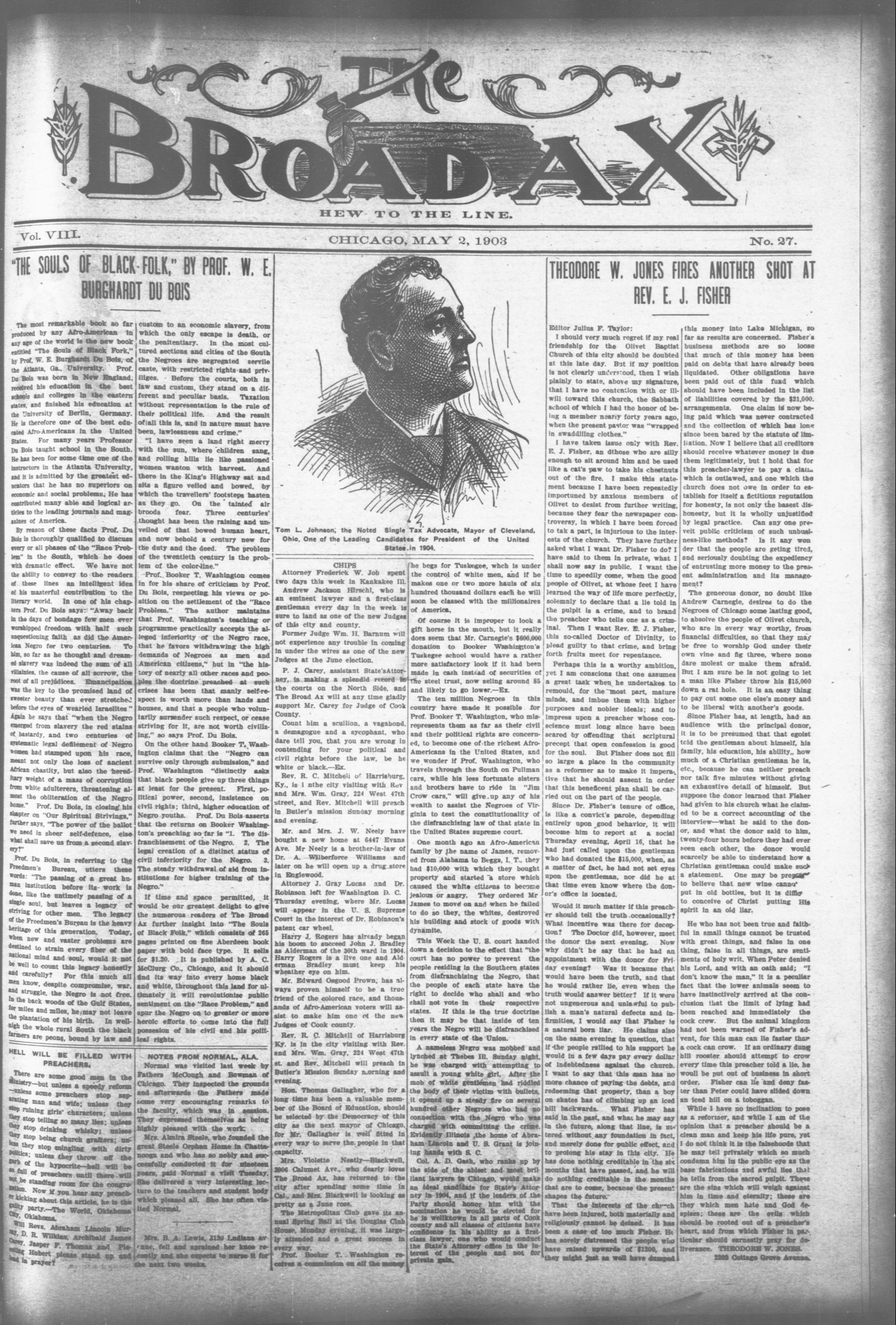
Tom L. Johnson; the Noted Single Tax Advocate, Mayor of Cleveland, Ohio, One of the Leading Candidates for President of the United States in 1904.
Attorney Frederick W. Job spent two days this week in Kankakee Ill. Andrew Jackson Hirschl, who is an eminent lawyer and a first-class gentleman every day in the week is sure to land as one of the new Judges of this city and county. Former Judge Wm. H. Barnum will not experience any trouble in coming in under the wires as one of the new Judges at the June election.
P. J. Carey, assistant State'sAttorney, is making a splendid record in the courts on the North Side, and The Broad Ax will at any time gladly support Mr. Carey for Judge of Cook County. Count him a scullion, a vagabond, a demagogue and a sycophant, who dare tell you, that you are wrong in contending for your political and civil rights before the law, be he white or black.—Ex.
Rev. R. C. Mitchell of Harrisburg, Ky., is inthe city visiting with Rev and Mrs. Wm. Gray, 224 West 47th street, and Rev. Mitchell will preach in Butler's mission Sunday morning and evening.
Mr. and Mrs. J. W. Neely have bought a new home at 6447 Evans Ave. Mr Neely is a brother-in-law of Dr. A. Wilberforce Williams and later on he will open up a drug store in Englewood.
Attorney J. Gray Lucas and Dr. Robinson left for Washington D. C. Thursday evening, where Mr. Lucas will appear in the U. S. Supreme Court in the interest of Dr. Robinson's patent car wheel.
Harry J. Rogers has already began his boom to succeed John J. Bradley as Alderman of the 30th ward in 1904. Harry Rogers is a live one and Alderman Bradley must keep his wheather eye on him.
Mr. Edward Osgood Prown, has always proven himself to be a true friend of the colored race, and thousands of Afro-American voters will assist to make him one of the new Judges of Cook county. Rev. R. C. Mitchell of Harrisburg Ky. is in the city visiting with Rev. and Mrs. Wm. Gray, 224 West 47th st. and Rev. Mitchell will preach in Butler's Mission Sunday n.orning and evening.
Hon. Thomas Gallagher, who for a long time has been a valuable member of the Board of Education, should be selected by the Democracy of this city as the next mayor of Chicago, for Mr. Gallagher is well fitted in every way to serve the people in that capacity. Mrs. Violette Neatly-Blackwell, 2006 Calumet Ave., who dearly loves The Broad Ax, has returned to the city after spending some time in Cal., and Mrs. Blackwell is looking as pretty as a June rose.
The Metropolitan Club gave its annual Spring Ball at the Douglas Club House, Monday evening, it was largely attended and a great success in every way. Prof. Booker T. Washington receives a commission on all the money
he begs for Tuskegee, which is under the control of white men, and if he makes one or two more hauls of six hundred thousand dollars each he will soon be classed with the millionaires of America.
Of course it is improper to look a gift horse in the mouth, but it really does seem that Mr. Carnegie's $600,000 donation to Booker Washington's Tuskegee school would have a rather more satisfactory look if it had been made in cash instead of securities of the steel trust, now selling around 85 and likely to go lower.—Ex.
The ten million Negroes in this country have made it possible for Prof. Booker T. Washington, who misrepresents them as far as their civil and their political rights are concerned, to become one of the richest Afro-Americans in the United States, and we wonder if Prof. Washington, who travels through the South on Pullman cars, while his less fortunate sisters and brothers have to ride in "Jim Crow cars," will give up any of his wealth to assist the Negroes of Virginia to test the constitutionality of the disfranchising law of that state in the United States supreme court.
One month ago an Afro-American family by the name of James, removed from Alabama to Beggs, I. T., they had $10,000 with which they bought property and started a store which caused the white citizens to become jealous or angry. They ordered Mr James to move on and when he failed to do so they, the whites, destroyed his building and stock of goods with dynamite.
This Week the U. S. court handed down a decision to the effect that "the court has no power to prevent the people residing in the Southern states from disfranchising the Negro, that the people of each state have the right to decide who shall and who shall not vote in their respective states. If this is the true doctrine then it may be that inside of ten years the Negro will be disfranchised in every state of the Union.
A nameless Negro was mobbed and lynched at Thebes Ill. Sunday night, he was charged with attempting to assult a young white girl. After the mob of white gentlemen had riddled the body of their victim with bullets, it opened up a steady fire on several hundred other Negroes who had no connection with the Negro who was charged with committing the crime. Evidently Illinois, the home of Abraham Lincoln and U. S. Grant is joining hands with S. C.
Col. A. D. Gash, who ranks up by the side of the ablest and most brilliant lawyers in Chicago, would make an ideal candidate for State's Attorney in 1904, and if the leaders of the Party should honor him with the nomination he would be elected for he is wellknown in all parts of Cook county and all classes of citizens have confidence in his ability as a first-class lawyer, one who would conduct the State's Attorney office in the interest of the people and not for private gain.
THEODORE W. JONES FIRES ANOTHER SHOT AT REV. E. J. FISHER
Editor Julius F. Taylor: I should very much regret if my real friendship for the Olivet Baptist Church of this city should be doubted at this late day. But if my position is not clearly understood, then I wish plainly to state, above my signature, that I have no contention with or ill will toward this church, the Sabbath school of which I had the honor of being a member nearly forty years ago, when the present pastor was "wrapped in swaddling clothes."
I have taken issue only with Rev E. J. Fisher, an dthose who are silly enough to sit around him and be used like a cat's paw to take his chestnuts out of the fire. I make this statement because I have been repeatedly importuned by anxious members of Olivet to desist from further writing, because they fear the newspaper controversy, in which I have been forced to tak a part, is injurious to the interests of the church. They have further asked what I want Dr. Fisher to do? I have said to them in private, what I shall now say in public. I want the time to speedily come, when the good people of Olivet, at whose feet I have learned the way of life more perfectly, solemnly to declare that a lie told in the pulpit is a crime, and to brand the preacher who tells one as a criminal. Then I want Rev. E. J. Fisher, this so-called Doctor of Divinity, to plead guilty to that crime, and bring forth fruits meet for repentance.
Perhaps this is a worthy ambition, yet I am conscions that one assumes a great task when he undertakes to remould, for the most part, mature minds, and imbue them with higher purposes and nobler ideals; and to impress upon a preacher whose conscience must long since have been seared by offending that scriptural precept that open confession is good for the soul. But Fisher does not fill so large a place in the community as a reformer as to make it imperative that he should assent in order that this beneficent plan shall be carried out on the part of the people.
Since Dr. Fisher's tenure of office, is like a convict's parole, depending entirely upon good behavior, it will become him to report at a social Thursday evening, April 16, that he had just called upon the gentleman who had donated the $15,000, when, as a matter of fact, he had not set eyes upon the gentleman, nor did he at that time even know where the donor's office is located.
Would it much matter if this preacher should tell the truth occasionally? What incentive was there for deception? The Doctor did, however, meet the donor the next evening. Now why didn't he say that he had an appointment with the donor for Friday evening? Was it because that would have been the truth, and that he would rather lie, even when the truth would answer better? If it were not ungenerous and unlawful to publish a man's natural defects and infirmities, I would say that Fisher is a natural born liar. He claims also on the same evening in question, that if the people rallied to his support he would in a few days pay every dollar of indebtedness against the church. I want to say that this man has no more chance of paying the debts, and redeeming that property, than a boy on skates has of climbing up an iced hill backwards. What Fisher has said in the past, and what he may say in the future, along that line, is uttered without any foundation in fact, and merely done for public effect, and to prolong his stay in this city. He has done nothing creditable in the six months that have passed, and he will do nothing creditable in the months that are to come, because the present shapes the future.
That the interests of the church have been injured, both materially and religiously cannot be deined. It has been a case of too much Fisher. He has sorely distressed the people who have raised upwards of $1200, and they might fast as well have dummed
No.27.
this money into Lake Michigan, so far as results are concerned. Fisher's business methods are so loose that much of this money has been paid on debts that have already been liquidated. Other obligations have been paid out of this fund which should have been included in the list of liabilities covered by the $21,000. arrangements. One claim is now being paid which was never contracted and the collection of which has long since been bared by the statute of limitation. Now I believe that all creditors should receive whatever money is due them legitimately, but I hold that for this preacher-lawyer to pay a claim which is outlawed, and one which the church does not owe in order to establish for itself a fictitious reputation for honesty, is not only the basest dishonesty, but it is wholly unjustified by legal practice. Can any one prevent public criticism of such unbusiness-like methods? Is it any wonder that the people are getting tired, and seriously doubting the expediency of entrusting more money to the present administration and its management?
The generous donor, no doubt like Andrew Carnegie, desires to do the Negroes of Chicago some lasting good, to absolve the people of Olivet church, who are in every way worthy, from financial difficulties, so that they may be free to worship God under their own vine and fig three, where none dare molest or make them afraid. But I am sure he is not going to let a man like Fisher throw his $15,000 down a rat hole. It is an easy thing to pay out some one else's money and to be liberal with another's goods.
Since Fisher has, at length, had an audience with the principal donor, it is to be presumed that that egoist told the gentleman about himself, his family, his education, his ability., how much of a Christian gentleman he is, etc., because he can neither preach nor talk five minutes without giving an exhaustive detail of himself. But suppose the donor learned that Fisher had given to his church what he claimed to be a correct accounting of the interview—what he said to the donor, and what the donor said to him, twenty-four hours before they had ever seen each other, the donor would scarcely be able to understand how a Christian gentleman could make such a statement. One may be prepared to believe that new wine cannot put in old bottles, but it is difficult to conceive of Christ putting His spirit in an old liar.
He who has not been true and faithful in small things cannot be trusted with great things, and false in one thing, false in all things, are sentiments of holy writ. When Peter denied his Lord, and with an oath said; "I don't know the man," it is a peculiar fact that the lower animals seem to have instinctively arrived at the conclusion that the limit of lying had been reached and immediately the cock crew. But the animal kingdom had not been warned of Fisher's advent, for this man can lie faster than a cock can crow. If an ordinary dung hill rooster should attempt to crow every time this preacher told a lie, he would be put out of business in short order. Fisher can lie and deny faster than Peter could have slided down an iced hill on a toboggan.
While I have no inclination to pose as a reformer, and while I am of the opinion that a preacher should be a clean man and keep his life pure, yet I do not think it is the falsehoods that he may tell privately which so much condemn him in the public eye as the base fabrications and awful lies that he tells from the sacred pulpit. These are the sins which will weigh against him in time and eternity; these are they which men hate and God despises; these are the evils which should be rooted out of a preacher's heart, and from which Fisher in particular should earnestly pray for deliverance. THEODORE W. JONES.
Will promulgate and at all times uphold the true principles of Democracy, but Catholic, Protestant, Priest, Infidel, Farmers, Single Taxes, Republicans, Knights of Labor, or any one else can have their say, so long as their language is proper and responsibility is fixed.
The Broad Ax is a newspaper whose platform is broad enough for all, ever claiming the editorial right to speak its own mind.
Local communications will receive attention.
Write only on one side of the paper.
Subscriptions must be paid in advance.
One Year..... $2.00
Six Months..... 1.00
Advertising rates made known on application.
JULIUS F. TAYLOR, Editor and Publisher. Entered at the Post Office at Chicago, Ill., as Second-class Matter.
Could Do Better.
Harold had received his first five dollar bill. He was told that it was to be deposited in the bank, and the details were explained to him. Harold accompanied his mother to the bank, and when ready the book was handed to him. He looked at it a moment, and then throwing the book across the room exclaimed:
"Such a small book for five dollars! Why, I can get a bigger one than that for five cents."—N. Y. Times.
Poor Pass.
"I didn't know until last night," said Mrs. Gayman, "that you were so thoughtful and considerate of dumb animals."
"That so?" said Gayman, cautiously mindful of his condition upon returning home from the club.
"Yes," continued his wife, with a twinkle in her eye, "this morning in your sleep you continually cried: 'Don't forget the kitty.'"—Philadelphia Press.
A Prophecy.
Phrenologist—Madam, I think I can assure you that this boy is now born to be hung.
Fond Parent (grinning)—Indade, sor.
Phrenologist—No, I do not think he will ever be hung. In view of the fact that he lives in this state, I think it probable that he will be electrocuted.
—Brooklyn Life.
In Search of Knowledge.
Father—Halloa! where did you get all those toys?
Son—I bought 'em with the money you gave me.
"But I gave you that money to teach you how to save."
"Yes, pa; I kept it for three weeks until I learned all about saving, and now I'm learning how to shop."—Tit-Bits.
On the Owl Car
Dolly—Gracious! Why does Mrs. de Styles always refer to Mr. de Styles as her "late husband," when everyone knows her husband is alive?
Polly—The reason she calls him her late husband is because of the late hours he wanders home in the morning.—Baltimore Herald.
Her Animals.
Mrs. Peeksly (to church usher)—Give me a seat in pew number 60, please.
Mrs. Peeksly (to herself)—Mrs. Gorgus sits in number 59, and I want to be back of her so I shall not have to look around to see her hat.—Brooklyn Life.
Understands Himself.
The Minister's wife—I'm afraid Mr. Skinflint does not realize that the Lord loves a cheerful giver. The Minister—Oh, I don't know. The less he gives the more cheerfully he gives it.—Town and Country.
Passing Relief
Maj. Burbon—I really don't know, suh, how old this whisky is; had it in mah cellah for 20 yeahs, but— Col. Kaintuck—Mah land, majah, how did that happen, suh; did yo' mislay it?—Philadelphia Press.
IncFactual.
"He's a wonderful mathematician." "Yes," answered Mr. Cumrox; "but what's the use? He can think up a string of figures as long as your arm, but he can't put a dollar mark in front of them."—Washington Star.
It Distressed Her
"I let him hold my hand last evening," she told her dearest friend. "Well?" "Well," she said, with a regrètful sigh, "he was satisfied with that." Chicago Post.
Men Teachers Sources
The number of men employed as teachers in the public schools of this country is slowly but steadily decreasing. According to William T. Harris, United States commissioner of education, the percentage of male teachers in the public schools in 1870 was 41 per cent. In 1900 the percentage was only 29. The reasons for this decrease are easily found. The work does not offer as great inducements to men as it once did. Teachers in secondary schools are now required to be specialists, and the salaries are not enough to attract men to make a life career in this field. Women in increasing numbers have gradually taken their places. In point of training they are as well fitted for the work, and in point of temperament better adapted to handle children.
Forty thousand birds, mostly sand pipers, are reported to have been killed recently on the North Carolina coast for millinery purposes.
STICKS TO OLD CUSTOMS.
The Supreme Court of the United States Is Wedded to No Traditions.
The supreme court of the United States does business on an antiquated plan. While it undoubtedly is the most dignified body of men in this country, if not in the world, it has its peculiarities, and they are striking ones, says the Indianapolis Sentinel. One of the traditions of the court prevents newspaper correspondents from attending the sessions of the court in their professional capacity. Provision is made for a representative of each of the great press associations, but the correspondents have to push and crowd in behind the rear railing with the hundreds of other spectators. Usually they have to stand up, and if they are seen taking notes an attendant escorts them to the door. The result is that the 200 or more correspondents have to depend on their memory for their reports of proceedings in the supreme courtroom.
There is another custom of the court which prevents correspondents from seeing the opinions handed down until they have secured authority from the judges who severally deliver them from the bench. This authority is not always given, the judge exercising his own discretion about it. Not infrequently the correspondent has to go to the home of the judge to get the written authority, and perhaps by the time he gets back to the capitol the office of the clerk of the court is closed.
PLACED DUTY BEFORE WORK.
Man in Need of Employment Refused Job to March with the Un-
A London preacher had an interesting experience not long ago with a hungry man. The mendicant explained that he had found it absolutely impossible to get work. He had applied everywhere, always to be turned away, and at last nothing remained for him but to beg from door to door for the food that was necessary to keep life in his body.
The clergyman's heart was filled with pity. The poor man seemed to be honest, and after being furnished with a good meal he was asked where a message would reach him. He gave an address and went away.
Then the preacher sat down to think the matter over. He knew of no work that he could find for the man, but he decided to invent a job.
Accordingly the next day the preacher sent a message to the luckless man, saying:
"Come at once. I have a position for you. We need a man to clean our school house and keep it in order."
He received an immediate reply as follows:
"Sorry I can't come. I have to march with the unemployed to-day. Would to-morrow do?"
PITTSBURG WITHOUT THE "H."
Variation in Spelling the City's Name Is Often PunsMing to Railway Men.
Is it Pittsburg or Pittsburgh, anyway? Of 23 companies indexed in the official guide with the names of that city forming a part of their title, five say "burg" and 18 say "burgh." The aitches, or old-stylers, appear to have it, supposing the official guide to be as inerrant as usual, says the Railway Age. The city papers differ, the majority aspiring to the aspirate—to which the progressive Post seems in its title to say Gee! But referring again to the guide, it appears that 16 cities named in railway titles, which have the diaputed final syllable, those beginning with New, Pratts and Middle call themselves burghs, where Fitch, Blooms, Rose, Flemings, Gettys, Harris, Ham, Lorda, Ogden, Stras, Philips, Vick and Waynes are plain burgs—13 against three. So the Gees appear to have it here. But aggregating the Pitts and other burgs and burghs in the 39 railway titles examined it is found that the burghs have a majority of three. Nevertheless the Railway Age votes for the commonsense burg, and demurs to wasting paper and ink on the superfluous h.
MOONSHINERS OF FRANCE
Hundreds of Thousands of Families Distill LIquors for Household Consumption.
The recent agitation of the bouilleurs de eru, or private distillers, of France, against the proposals of M. Rouvier, the minister of finance, to tax their franchise has disclosed the immense power of this vested interest among the peasantry. It is estimated that no fewer than 1,000,000 to 1,800,000 families avail themselves of the privilege to distill from the pears, apples, damsons and cherries of their orchards spirituous liquors for household consumption, says a London paper. But as every hectoliter of nonexempt liquor—worth, perhaps, some $10—is taxed to the tune of $44, there is every inducement to the enterprising peasant to distill more than his household can consume, in order to do an illicit business with his neighbor, and in this way some $30,000,000 to $40,000,000 per annum escapes the treasury. In the orchard land of Normandy the privately distilled liquor is, indeed, quite a recognized medium of exchange, and the bouilleur de eru often pays his workmen, his tailor, his butcher, and his land in terms of alcohol.
High Freight Rates
It costs almost twice as much to send boxed goods from New York to San Francisco by rail direct as it does via London, the Suez canal, Hong-Kong and Yokohama by steamer.
BOOKER T. WASHINGTON FAVORS THE DISFRA CHISEMENT OF THE NEGRO IN THE SOUTH
In this age of commercialism when it is possible to place a multi-millionaire at one end of the plank, and an honest hard-working man or woman who can scarcely earn enough money to keep the wolf from the door at the other end: when, people converse about billionaire trusts; monopolies or huge combinations of wealth, which are constantly robbing and plundering them by increasing the prices on all the necessaries of Life, with as much ease as an ordinary individual would take a drink of water, when it has become possible or a common thing for extremely rich or arrogant men to muzzle or subsidize the small weekly newspapers as well as the daily Press; it is considered the height of presumption on the part of any Afro-American who is unwilling to look upon Prof. Booker T. Washington as a god or as the infallible Leader of ten million people; in all things pretaining to their material welfare and their final destiny.
Booker T. Washington's advocates and shouters contends that no one has the moral right to criticise him nor his acts or his theory of the solution of the "Race Problem" unless they have accomplished as much as he has in the way of establishing and maintaining an industrial school. No fair minded person will ever attempt to under estimate the great work performed by Booker T. Washington, in behalf of industrial education for the Negro; but when it comes to jeopardizing the civil and the political rights of the Negro in order to carry out his pet theory respecting the settlement of this momentous or far reaching question that is an entriely different or distinct proposition.
It does seem that if Prof. Washington holds in his hands the golden keys which will unlock the "Race Problem." it would be so appearent to all men that he would not be driven to the necessity of waging a hurrah campaign all the time in order to keep his theory before the public; for the purpose of maintaining or increasing his popularity with the whites of the south and with the monied class of the North at the expense of the Negro, Prof. Washington, recently declared that "Every revised constitution through out the Southern States has put a premium upon intelligence, ownership of property thrift and character; those are most truly free who have passed through the greatest discipline." In this wonderful flight of eloquence on the part of Booker Washington, it plainly indicates that he is in favor of the disfranchisement of the Negro in the South, for those revised constitutions which he refers to were revised by the Southern People with the sole object of curtailing and abridging the civil and the politicaal rights of the Negro.
Thus it will be seen that Prof. Washington is so full of the spirit of commercialism that he believes in placing the dollar beyond and above the man; that dollars or property owned by the Negro will eat away all the injustice which is at the present time heaped upon him; that while he is endeavoring to accumulate dollars and prop-
She Got the Money.
"Eut, my dear," he protested, "that's nearly all the cash I have on hand at the present moment, and I had planned to use it to take up a note."
"Oh, well," she returned, carelessly, "if you think the man who holds the note can make things any hotter for you than I can, why, go ahead."
Thus it happened that she got the money.—Chicago Post.
There is a cheerful liar that every man should love;
For when you're feeling rockier than usual he meets And greets you with, "Old`man, you're looking well!" -Cincinnati Commercial Tribune. ON FLORIDA SANDS.
---
"When you came south for your health, why didn't your wife come with you?" "Oh! well, you see my doctor advised complete rest and quiet."— Louisville Courier-Journal
erty he must not concern himself in relation to his civil or Political rights that he must submit to being deprived of his citizenship or the ballot which is the most powerful weapon of defence in the world and without it in a free country men are simply slaves or serfs; that until all the Negroes come into the possession of dollars or property, they must without one word of protest on their part permit men to rule or govern them whom they have no voice whatever in assisting to select. In the discussion of the disfranchising of the Negro, Prof. Washington, loses sight of this one undisputable fact that from the President of the United States on down to the lowest officer of any state, have no time to waste nor favors to bestow on no one or on a collective number of individuals who have no voice in the affairs of the national or the various state governments.
Why should Prof. Washington favor the disfranchisement of the Negro and remain silent as to the propriety of permiting ignorant white men to exercise the right of suffarge; is it his desire to base the right to vote on the color of the skin? is he of the opinion that it is much better in the long run to permit ignorant white men who enjoy this priceless privilege and deprive the Negro from enjoying it, simply because his skin happens to be black? does he not see that his Philosophy is based on false premises that no grave question has or can ever be settled in this country until it is settled right that by adopting his theory of disfranchiseing the Negro is only a temporary make shift which will not permanently settle anything, and if the Negro is to be made to feel that he is an alien in a strange land with no civil nor political rights guaranteed to him by the Constitution of the United States nor by the states wherein he resides, he will soon cease to think that he is an American citizen and like the Indian he will become an uncertain factor. No flag to serve, no home to call his own. No interest to protect, no country to shed his blood for and manifest his loyalty and undying devotion. The result must inevitably be that he will be drawn into the ranks of the anarchists, to seek revenge for the insults or wrongs which have been showered upon him for the past two hundred and fifty years.
Verily do we honestly believe deep down in the bottom of our heart that Prof. Booker T. Washington is engaged in subordinating the best interest of the Negro for the purpose of enabling him to successfully collect money with which to run his school that if the Negro tamely permits himself to be disfranchised and is compelled to pay-taxes, and assist to fight the battles of this government which to a great extent treats him as an cut-cast and a criminal; in less than ten years if he possesses the least desire to walk abroad or any ambition to be known as an American citizen, he will be forced to stand up and exclaim in the language of the immortal Patrick Henry, "Give me Liberty or Give me Death!"
A Vision of Nine.
Rastus—Ah dreamed ob heaben las' night.
Zeke—Am dat so? An' whut did it look like!
"A monst'us big chicken roost in de middle ob a watermillion patch!"—San Francisco Bulletin.
He—That love affair has affected his head.
She—Can it be possible?
"Oh, yes; he never used to comb his hair at all before he met her, and see how carefully it's brushed now."
—Yonkers Statesman.
She Couldn't Wait
Flubdubbe—When Dashitall called upon his fiancee the other evening he discovered her kissing another fellow. Pinhedde—What did he do? Flubdubbe—Apologized for being late.—N. Y. Herald.
"You know he married Miss Millions."
"And they do not get along?"
"No. They can't agree about what portion of the wife's income the husband ought to have."—Puck.
GLIMMERINGS OF WALL
Bad blood may be shown, but it is a crime to spill it.
Men who stop to count the cost are slow to propose.
It is better to be handsome in deed than in photograph.
Much optimistic talk is used as a cover for perplexity.
Every man is an idiot who pursues his own way in spite of us.
It seems impossible to train the young idea without using a stick.
The advantage of the smile cultivated by women is that it does not interfere with digestion.—Sionx City Journal.
CURIOUS BITS OF SCIENCE.
Ivy growing on a house, so far from making the house damp, as is usually supposed, actually extracts all moisture from the walls. That meteors contain gold has been demonstrated before the Royal Society, New South Wales. This suggests that the thousands of tons of meteoric dust which fall upon the earth each year deposit gold everywhere.
The milky sea, as it is known to mariners, is not yet fully understood. It seems to be most common in the tropical waters of the Indian ocean, and is described as weird, ghastly awe-inspiring, and as giving the observer on shipboard the sensation of passing through a sort of luminous fog in which sea and sky seemed to join and all sense of distance is lost. The phenomenon is probably due to some form of phosphorescence.
Non-actinic white light, first made known by a French photographer some years ago, is produced by filtering sunlight through a colorless solution of three parts of nickel chloride and one part of cobalt chloride, ultraviolet rays being absorbed by coating the containing vessel with collodion mixed with sulphate of quinine slightly acidulated with sulphuric acid. Sensitive paper has been exposed to this filtered white light for a week without change.
There was an indoor snowstorm on a very clear, cold evening recently at a party given in Stockholm, Sweden. Many people were gathered in a single room, which became so warm as to be insufferable. The window sashes were found frozen and a pane of glass was smashed out. A coldair current rushed in, and at the same instant flakes of snow were seen to fall to the floor in all parts of the room. The atmosphere was so saturated with moisture that the sudden fall in temperature produced a snowfall indoors.
Many strange forms of the hen's egg have been collected by Clement L. Webster. In one an elongated large egg is connected by a narrow neck to a small egg, both parts being soft-shelled, while only the smaller has a yolk. Another elongated egg is club-shaped, while a similar one has the small end bent up like that of the crookt neck gourd. A triple egg, consisting of three distinct eggs joined, has a hard shell and contained only albumen, with no yolk; while a large normal-shaped egg contained three yolks. In one egg was a second complete egg, including the shell.
IN ASIA.
Neither Hindus nor Japanese will ever willingly sleep with their heads to the north.
Very stringent laws have been enacted in Japan in regard to secret proprietary medicines.
The natives of India never allow a fakir—of whom there are three million who live by begging—to starve.
Ceylon now nearly equals India in tea production. It grows over 160,000,000 pounds, against India's 195,000,000 pounds.
350 square miles have been added to the British empire by the rectification of the frontier between India and Thibet.
Tigers did as much damage as usual in India last year, killing 943 persons. Over 17,200 wild beasts were destroyed for which bounties were paid of 104,000 rupees.
A curious railway accident is reported from India by Cosmos. About two kilometers (11-4 miles) from Rampore Hat, says the journal, "a train composed of an engine, 13 passenger cars and three others cars, was seized and overturned by a tornado. The phenomenon was absolutely local, since nothing was noticed at the station just left by the train, and except for the upsetting of a few native huts, there appears to have been no other damage done. The number of the wounded is not exactly known, for the Hindu passengers fled panic-stricken in an instant. Thirteen persons were killed and 15 wounded are known. Some of the cars were turned end for end, indicating a whirlwind."
QUAKER PHILOSOPHY.
You can't measure a genius by the length of his hair.
The man who agrees with nobody things everybody else is wrong.
Some people don't care what happens so long as it doesn't happen to them.
Women who use cosmetics don't believe the devil is as bad as he is painted.
A whitewashed reputation doesn't endure any longer than a whitewashed fence.
The most polite people in the world are those who have gold bricks to sell you.
When a fellow has money to burn he may do it because he is afraid of the microbes.—Philadelphia Record.
WHAT THE SPORTS SAY
St. Paul and Minneapolis, with twin friendliness, are quarreling again, this time over the state bowling championship.
Sandow, the strong man, is reported as taking great interest in the traction question in Philadelphia. He has an automobile.
Just now Oxford and Cambridge and Yale and Harvard diplomats are endeavoring to decide, without a serious breach in international athletic relations, and at 31 cents per word, which side shall send a challenge for a track meet at London next July. Wouldn't that, asks the Chicago Tribune, separate the buttons from your waistcoat?
Not What He Wanted to Say.
Miss Clara Winterbloom—Mamma, this is Mr. Tutter. I want to introduce him to you. Do you know that he was under the impression that I was the only daughter, and I have just been telling him that I have two sisters.
Mrs. Winterbloom—Oh, yes. You must meet Mauq and Estelle, Mr. Tutter. They are both of them older than Clara there.
Young Tutter (wishing to say the right thing)—I didn't suppose it possible, Mrs. Winterbloom, that you could have any daughters older than Miss Clara.—Tit-Bits.
Unthinking Freshman
Who fell down four flights without mean- ing:
The janitor swore as he struck the ground
floor:
"Twil take all the afternoon cleaning?"
—Columbia Jester.
```markdown
```
"Mr. Brown made his wife promise that she wouldn't marry again."
"He always was kind to his fellow men."—Chicago American.
Next Improvement.
Dame Nature ought to follow now
The scientific train,
And not omit, before it fails,
To stérilize the rain.
And Called Him "It."
"And what did that howwid tough say to you, Reggie, after he had taken youah watch and money away?" asked Willyboy.
"He added insult to wobbery," spluttered Reggie. "He said his motto was: 'Do it now,' and I was the only it he saw."—Cincinnati Commercial Tribune.
A Remembrance.
"Did he leave you anything when he went away?" they asked of the landlady's grief-stricken daughter, to whom the youth had been most devoted.
"Yes," she sighed; "he left a board bill."—Chicago Post.
The Homely Man's Advantage.
"Why is it that most of the world's great men were homely?"
"The other men wouldn't have turned in and made them great if they had been handsome enough to cause jealousy."—Chicago Record-Herald.
Elephantine.
"Yes, Jones has been awarded the contract for weighing and registering the weight of all the elephants for the new circus." "H'm! He must be doing business on a large scale."—Baltimore News.
A Sinecure.
Bowe Heaux—I'd like to live in a place where there was no such thing as work. Wouldn't you?
Hoe Beaux—Yes, and I'd like to have the job of director of public works.—Pennsylvania Punch Bowl.
Nice Sort of Comfort
"It must be a great comfort to you to own such splendid furniture."
"Comfort? There isn't but one comfortable chair in the whole lot, and my wife invariably wants to sit in that."—Tit-Bits.
Vivid Suggestiveness
Mrs. Slimdiet—No; I don't believe in French cooking. My idea is to have every dish suggest its chief ingredient. New Boarder—Yes; I notice this gelatine tastes like glue.—N. Y. Weekly.
A Reason for It
Visitor at School—What rapt look that dear little fellow wears!
Dear Little Fellow (overhearing)—Teacher just hit me over the knuckles with a ruler, ma'am.—Princeton Tiger.
Too Elegant
"Why keep me in suspense? Why not give me an answer now?"
"Oh, dear, no! You propose so beautifully that I want to give you a chance to do it all over again."—N. Y. Journal.
Ill-Timed.
"You say your playing created great deal of talk?" said the friend. "Yes," answered the pianist, "but, unfortunately, it was mostly during my performance."—Washington Star. His Choice.
His Choice.
Mother—Only good little boys go to Heaven.
Bobby—Then I guess I'll be bad and go with the rest of the family.—Brooklyn Life.
"The idea of his accusing me of making a lie out of the whole cloth." "Ridiculous! You're too economical for that."-Philadelphia Press.
Matter of Form
Edith—I wish I knew how to improve the shape of this gown.
Ethel—Suppose you let me wear it awhile.—Cincinnati Enquirer.
Quite Right.
"Tight shoes," remarked the Observer of Events and Things, "have made many a woman fit at teen."—
```markdown
```
Very Few Women Are Families with It, Although It Is a Comparatively Easy Tunk.
Before commencing the actual packing of a trunk it is a very good plan to collect in one room and in plain view everything that is to be placed in the trunk. You will then see exactly what you have to find accommodation for, and nothing will be forgotten.
Something soft and flat should pave the trunk-a warm petticoat, which you may or may not require, is suitable for this purpose. On this anything flat and heavy should be laid, remembering that only necessaries should be taken if weight is a consideration. The writing case also occupies this layer, and any small spaces can be filled up with rolled stockings and other small objects. The boots and shoes, each in a holland bag, may come next, and form a layer of their own, which can be shared with the brush and comb and sponge bag.
Then linen and woolen underwear, between which any jewelry you may be taking can be placed; also your hand glass, scent bottles, or anything else of a breakable nature. The dress skirts come next, and should be folded at the hips, so as to get as much length as they can. Do not turn them inside out. Jackets and capes follow, the former lying flat on their backs, with the sleeves laid across their fronts. Capes should be spread out as much as possible. The tray is reserved for hats, dress bodices and skirts, and light, small things such as veils and neckties.
The bodices will repay any trouble spent upon them in the way of stuffing with crumpled paper by emerging uncrushed at the end of the journey. Long sash ends, if attached to the bodices, should be rolled up, and bowloops ought to be stuffed with balls of paper. Gloves are laid flat. If the hats are trimmed with upstanding feathers it is better to take them out and let them travel flat.
Do not attempt to squeeze your things into a trunk too small for them; but, on the other hand, the trunk should not be too roomy, or the contents will shake about and run great risk of damage.—Chicago American.
MRS. JEFFERSON DAVIS.
Widow of Confederate President Lives in a Modest Way in a New York Family Hotel,
Mrs. Jefferson Davis, the widow of the late leader of the southern confederacy, is living in a little world of her own. She has taken up her residence in New York and for economic reasons will probably spend the remainder of her days there. She has an apartment in the old Hotel Gerard, in West Forty-fourth street, and lives on the fourteenth floor. Her windows overlook the surrounding roofs, and only on few occasions does she ever leave her rooms. She walks with difficulty and does not have to visit, as her friends pay court to her as if she were a royal personage. Mrs. Davis uses a tall cane as people did 100 years ago, and the head is of tortoise shell and gold. She has as a companion a sweet-faced southern woman who is always with her. On Wednesday afternoons the famous woman sits in a
[Image of a woman with white hair and a dark coat, looking directly at the viewer. The background is a solid black oval.]]
MRS. JEFFERSON DAVIS.
high-backed chair that came from Beauvoir, the Davis homestead, and then she receives the long file of admiring women who call. These are notable gatherings and there are as many northerners as women from south of the Mason and Dixon line. On these occasions Mrs. Davis wears stiff black silk, with old lace at her throat, and despite her years her white hair is abundant and glistens brilliantly in the afternoon light. The companion serves tea and Mrs. Davis, who is a noted conversationalist, holds the attention of everyone without an effort. Her mind is remarkably alert and she keeps abreast of the topics of the day. In her interesting rooms nothing is so engrossing as the portrait of Miss Winnie Davis, her daughter. It is an excellent likeness and the former child of the confederacy is depicted wearing the royal robes of the queen of Mardi Gras. The picture is surrounded by incandescent bulbs, and before this portrait the mother spends much of her time gazing and thinking. In the portrait Miss Davis is smiling and it is the same expression that endeared her to people when she was alive. Mrs. Davis' other daughter, Mrs. J. A. Hays, is in the west, but she visits New York frequently.
When Pets Are Discolored.
If teapots or coffeepots become discolored on the inside, boil in a strong solution of borax for 15 or 20 minutes. Borax is excellent for cleansing discolored hairs of any kind.
He looked like a truthful man, yet nobody would believe him when he said he did not know where the trunks were going, relates the New York Times. "It is very strange that you don't know," said the landlady. "You are the expressman. If you don't know, who does?" "The fellow that will finish the hauling, probably," he returned, serenely. "Aren't you going to do the whole job?" she asked.
"No, only half of it. I will take the things to our office and somebody else will take them the rest of the way. The boss at the desk will know the address. I don't know it. The moving is done on the installment plan to keep you folks here from finding out where the other people went. They were afraid to trust me with the number for fear you might worm it out of me, so they told it to nobody but the manager. Lots of people who move often make the trip in sections like that. Half the time when I take a trunk away from a boarding-house I don't know where it will wind up. That is generally done when there has been a row and the folks who leave don't want to be followed. Been a little trouble here, I imagine," he added, tentatively. "Yes," sighed the landlady, "a little."
OVER A MOUNTAIN RANGE.
Aerial Tramway for the Transportation of Tea in the Island of Ceylon.
One of the most interesting aerial rope ways has recently been constructed on the island of Ceylon, British India, for the transportation of tea, this up-to-date system dispensing with the services of hundreds of men and beasts which were formerly maintained and employed in carrying the tea over the miles of mountainous country. The tramway, which runs in almost a direct line, says the Philadelphia Record, is three miles long; the road which was followed by the flesh and blood carriers was a much greater distance.
This three miles of tramway passes over several ridges, one of which has a considerable elevation. The tea leaves, in bags, are placed in the great carriers, which are in the form of a hanging cage, as the latter pass the driving terminal, by wire-rope transmissions from a turbine three-quarters of a mile distant. The labor required to work the entire line need not exceed six men. The tramway has been in use for four months and has given the most satisfactory service The delivery of the tea is performed quite as reliably as heretofore and is done in much less time and much more cheaply.
MUST SIT UPON RUGS.
If We Would Avoid the Danger That Is Said to Lurk in High-Backed Chairs.
A contemporary which is devoted to the discussion of hygienic subjects makes a somewhat alarming suggestion. It maintains that high straight-backed chairs are responsible for a great many of the ills to which woman are prone. Neuralgia, backache, headaches, depression, and so on may be directly traced to troubles engendered internally by the postures we are compelled to continually assume on these chairs. The suggestion is put forth, therefore, that we should lie about on soft rugs on the floor, adapting these, as fancy dictated, to our own ideas of comfort.
This eastern seraglio kind of arrangement would give us our much-needed rest, as well as suppleness of form, we are assured, but how would it fit in with out fashions, our mode of entertaining, and our general household arrangements?
The spectacle of the average matron slopping about with a number of smartly-attired guests on the drawing room 'oor does not present itself to the mind's eye in other than a grotesquely comical form.
DIDN'T KNOW KING EDWARD.
Shopkeepers In Paris Would Not Accept English Coin Bearing His Name.
A correspondent of the London Express in Paris describes his experiences in trying to change a sovereign with the king's head on it for French money. The first place was at a stall of a leading Parish bookseller.
"It is not good," said the woman behind the counter.
"Yes, it is," was the reply. "It is an English sovereign and is worth 25 francs."
"Ah, no; it is a medal."
"No, no; good English money."
"But I have not seen one like it, I am afraid."
"Never mind whether you have seen one like it. It is the head of Edward, the new king, and the gold is good."
"No, no. I want to see the queen's head, and then I will take it."
Finally the woman said she would give 20 francs for it. Four other people who were tried argued in a similar manner, and were all afraid to take the risk. The sovereign was eventually changed at a restaurant.
Americanus Getting Contracts. The Birmingham Post calls the attention of British manufacturers to the fact that contracts involving the sum of $65,000,000 have been obtained by American interests during the last few weeks for the construction of electric traction systems in England, Russia and Holland.
PEANUT-EATERS IN CARS.
A Public Notice That Most People Would Like to See Put Down and Out.
"If I could have my way about it," said a sensitive citizen, according to the New York Sun, "I would have a law passed forbidding the eating of peanuts in elevated or surface cars, and requiring the guards or conductors to eject from the cars any person so offending.
"Men, strange as it may seem, not children, are the chief offenders in this direction. You may see grown men sitting in a car, and, regardless of their fellow passengers, calmly eating peanuts and dropping the shells on the floor.
"To many persons the odor of peanuts within a confined space, as in a railroad car, is unpleasant, as the sight of the litter of shells on the floor must be to all. But the men peanut eaters go.right on eating, and so disposing of the shells. Why, I have seen a district messenger boy eating peanuts in a car do better than they in one way anyhow. This boy put his empty shells back into the paper bag from which he had emptied the peanuts into his pocket.
"I have seen men eat apples in an elevated car and throw the core under the seat. I have seen a man eat an orange in an elevated car and not even take the trouble to do that with the orange peel, but just lay that down on the vacant seat beside him. But such men as those I regard as fine gentlemen as compared with the grown man who eats peanuts in an elevated car and drops the shells on the floor. Him I regard as—
"Well, the peanut eater I would have firmly, even if gently, put off the car."
WHITE WATER IN THE OCEAN.
Singular Phenomenon Witnessed at Rare Intervals in the Tropical Regions.
Of the many sights witnessed in the oceans of the globe, one of the most curious and most weird is that described by sailors as "the milky sea," ships being surrounded for several hours by water that appears to be a snowy whiteness. Compiled from experiences recorded during the last 70 years, an interesting account of the phenomenon is given on the North Atlantic and Mediterranean Pilot Chart. The spectacle is restricted to the darkness of night and rare occasions, and, while it is limited mainly to the warmer waters of the tropical belt, it appears to be more common in the Indian ocean than in the Atlantic and Pacific. From the white water the light is so strong that ordinary newspaper print can be read on board ship, but the scene all around is of an awe-inspiring description. The horizon is blotted out, sea and sky seem to become one in a sort of universal luminous fog, which, like a London fog, robs the observer of the sense of distance and direction, the deck being lit up with a ghastly, shadowless light. Last June off the west coast of South America a bucket of the white water emptied back into the sea resembled molten lead. This curious sight has interested scientific investigators, Darwin among them; but while it is, no doubt, related to the many phosphorescent displays common at sea, there is no difficult explanation forthcoming of this particular manifestation or of the singular atmospheric effects resulting from it.
FIRST BOOK OF LAWS.
Statutes Drawn Up by King of Babylon Five Centuries Before Laws of Moses.
The well-known assyriologist. Dr. Hugo Winckler, says the London Express, has published an account of the legation promulgated by King Amraphel of Babylon, which, so far as is known at present, was the first book of laws ever given to the world. King Amraphel lived 2,250 years B. C., and is mentioned in the bible as a contemporary of Abraham, so that his statutes were drawn up fully five centuries before the laws of Moses. They number 282, and contain the following:
"If a woman who sells beverages gives bad value for the money paid her, she shall be thrown into water.
"If a wife be a spendthdift, or if she otherwise neglects her duties, her husband may put her away without compensation; but if a man put away his wife for no other reason than that she has no children, he shall return her whole dowry.
"If a betrothal be rescinded, the man shall pay the woman compensation.
"A widow with grown-up children may not marry again without permission from a judge."
Municipal Ownership in England. A comprehensive return of the financial workings of the "public utilities" undertakings in British towns and cities has just been given to the public through a government board. It covers the four years ended March, 1902. The principal undertakings carried on by 299 corporations were: Markets, 223; waterworks, 193; cemeteries, 143; baths, 138; electricity, 102; gasworks, 97; tramways, 45; harbors, 43. The aggregate net profits were $23,417,522.
Size of Families.
William E. Curtis contributes to the "race suicide" question some real figures. Consulting the census statistics, Mr. Curtis finds that the average number of persons in a family has fallen from 5.6 in 1850 to 4.7 in 1900. The decline has been gradual but steady. In 1850 the average number in a family was 5.6; in 1860, 5.3; in 1870, 5.1; in 1880, 4; in 1890, 4.9; in 1900, 4.7.
Too Great a Risk. She met him at the kitchen door with a rolling pin in her hand, and she brandished it menacingly.
"Madam." he began.
"Well, what do you want?" she demanded aggressively. "What are you hanging round here for?" "Madam," he explained, backing away, "I called to see if I could place an accident insurance policy on your husband, but after seeing you I am satisfied he is too great a risk."—Tit-Bita.
successful
"Didn't you ever attempt to lay down the law in your own home?"
"Certainly," answered Mr. Meekton, and with entire success. I gave instructions to the family and to the servants that Henrietta was to have her own way in every particular, and Henrietta sees to it that my instructions are implicitly carried out."—Washington Star.
Testimonial of Channel
In a rural justice's court in Georgia an old negro whose testimony had been questioned by the lawyer delivered this defense of his character:
"Jedge, I'm a good man. I been a-livin' 'roun' heah ten yeahs. I ain't never been lynched, en'de only hoss I ever stole frowed me en bruk my laiga."—Youth's Companion.
Preparations.
"I really think that father is getting ready to run for congress," said the bright girl.
"There hasn't been anything about it in the newspapers."
"No. But he's cutting out all the anecdotes about great men he can find, and learning them by heart."—Washington Star.
A Gentle Hint.
Hungry Higgins—Pardon me, ma'am, but I'm a clock regulator. If your clock runs fast or slow I can set it for you. It's exactly 12:30 now.
Mrs. Hauskeep—Indeed! And how do you know?
Hungry Higgins—I know 'cause I always gets hungry at 12:30.—Philadelphia Press.
Cruel Man.
Wife (to her husband, who is a great criminal lawyer, and who has found fault with the dinner): "There you go again, always finding fault with my cooking. You never see any redeeming qualities in me, and yet you have an excuse for every murderer that comes along."—Tit-Bits.
The Value of Experience.
"You don't seem to be at all nervous about going to ask papa for me," she said.
"Oh, no," he replied. "I've had experience both as a book agent and life insurance solicitor. This'll be easy."
—Chicago Record-Herald.
The Occult.
"Larry, did you learn anything from the fortune teller you went to consult the other day?" "Well, sor, she sized me up all right. She looked at me hands, and said I was a coal hauler."—Chicago Tribune
The Voice of Experience.
"A woman may get mad as a hornet," remarked the Observer of Events and Things; "but there is one difference—a woman never sits down when she is mad, but I've had good reason to believe a hornet always does."—Yonkers Statesman.
The Connection.
Po speak of a "duck of a bonnet"
May seem rather meaningless; still
There's something in this, think upon it-
A duck has a pretty big bill.
-Philadelphia Press.
A woman reading a newspaper in a chair.
Mrs. Peck—Here's an account of a man who had three wives, Henry! Now what do you suppose they'll do with him?
Mr. Peck—Try him for lunacy, m'dear, I should think!—Chicago Daily News.
Mutual Kindness.
"Time is kind to you," said I.
"Oh, yes," responded she.
"I always meet him with a smile
And pass him cheerfully."
—Puck.
"So, young man, you wish to marry my daughter. Aren't you making a mistake?"
"Not at all, sir. I've looked you up in Bradstreet."—Chicago American.
No Improvement.
Old Inhabitant—I can remember when hogs ran loose on Broadway.
Young Inhabitant—They ride on the cars now.—Puck.
A Suro Sign.
Whip—Do you believe there's good luck in finding a horseshoe?
Snaffle—Yee, when you find it on the winning horse.—N. Y. Herald.
Punctual.
"What's your hurry?"
"I promised my husband I would meet him at one o'clock."
"But it's only two now."—Life.
MILITARY AND NAVAL.
Great Britain is this year providing for the construction of three great vessels of 18,000 tons displacement, or 2,000 tons more than the large vessels congress has just authorized. The San Francisco Dry Dock company has just completed at Hunters Point one of the finest dry docks in the world. It is large enough for two battleships at one time and can be pumped out in two hours.
It is as well understood in the navy as it is in the merchant marine that the larger the ship the greater efficiency per ton of ship. Each ton of the 16,000 tons of the Connecticut represents vastly more fighting power than each ton of a 12,000-ton Alabama.
The only ex-officer of the confederate army who clings to his uniform is Gen. George F. Alford, of Dallas, Tex. He has never discarded his colors since he donned them to go into the army in the early '60s. Pedestrians turn to look at him, peering at his badges, scanning his gold belt and trying to decipher the letters on his old army hat. Gen. Alford has been a judge, a legislator and a congressman.
In a test of the electro-magnetic cannon of Prof. Birkland, the Norwegian physicist, a 22-pound projectile from a $2\frac{1}{2}$-inch bore was made to penetrate to a depth of 16 inches; and it is claimed that a projectile of 1,100 pounds could be discharged from a 12-inch gun with a speed of more than 200 yards per second, without flame or explosion. The special advantage is that projectiles can be discharged with a force that would destroy the gun if ordinary explosives were used.
RECENT COURT DECISIONS
The publication of an article advocating the murder of rulers and the destruction of organized society is held, in people vs. Most (N. Y.), 58 L. R. A. 509, not to be protected by a constitutional provision that every citizen may freely publish his sentiments on all subjects, being responsible for the abuse of that right.
A certificate of stock of a corporation, expressed on its face to be transferable only on the books of the company at its office, personally or by attorney, or surrender of the certificate, and transferred in blank upon its back, is held, in Farmers' bank vs. Diebold Safe and Lock company (Ohio), 58 L. R. A. 620, not to be a negotiable instrument.
One who stores water along a stream which is a natural highway for running logs and discharges it for the purposes of aiding a drive, so as to increase the natural volume of the stream and overflow and wash away the banks, is held, in Brewster vs. J. & J. Rogers Co. (N. Y.), 58 L. R. A. 495, to be liable for the injury thereby caused to riparian owners.
If one in charge of an electric car, seeing that a horse is frightened by the approach of the car, and that its driver is in danger, continues to sound the gong or ring the bell, and further frightens the horse and causes it to run away, the car company is held, in, Oates vs. Metropolitan Street Railway company (Mo.) 58, L. R. A. 447, to be liable for the injuries thereby caused to the driver.
THE ANIMAL KINGDOM.
There is said to be only one musk-ox in captivity. This is in the zoo at Hamburg.
Cata hate water because their fur has nothing oily about it, and consequently takes a long time to dry.
Wax is not gathered from flowers nor from any other source, but is a natural secretion of the bees and is only produced by them during heavy honey flows.
That mosquitoes are responsible for malaria was apparently known long ago to a certain African hill tribe which gave the same name, "Mbu," to mosquitoes and to malaria.
Wolves can, and often do, run 50 to 60 miles in a night. Foxes travel great distances in search of food. Nansen saw an arctic fox out on the ice 480 miles from the Asiatic coast.
When feeding, the stride of an ostrich is from 20 to 22 inches; when walking, but not feeding, 26 inches, and when terrified 11 and a half to 14 feet, or at the rate of about 25 miles an hour.
New kinds of living butterflies can be produced from existing forms by greatly increasing or decreasing the temperature of the place where the butterflies are kept. A difference in coloring and even in form has thus been obtained by Prof. Fischer in recent experiments.
MERELY MENTIONED.
The estimated cost of a bridge over the Straits of Dover is $170,000,000.
Americans are making an effort to establish a steel plant at Flushing, Holland.
An incubator in use in Australia has a capacity of 11,440 ducks' eggs or 14,080 hens' eggs.
Spain's quicksilver mines are falling off. Only 12 tons was got last year, against 23 the year before.
Marseilles, the great market for olive oil, imported in December 2,909 tons of cottonseed oil. Nearly all of it was from the United States.
Casks of corkwood weigh only 80 pounds, and a similar cask of ordinary wood weighs 80 pounds. These casks, which were recently invented by a resident of Algeria, are nonconductors of heat and cold, and the staves do not warm
MINT IN THEIR COFFEE.
Mistake of a Society Leader Taken
for the Real Thing by Am-
bitionous Emulators.
That the advice, "Watch how others
do and then do likewise," is not always
good to social aspirants, was illu-
strated the other evening at a dinner
given by a young maastron in honor of
a guest of acknowledged social stand-
ing, relates the Chicago Tribune.
When coffee was served, and with it the indispensable chocolate mints, the guest was seen to take one of the sweets and toy with it gracefully over her coffee cup. Instantly every woman at the table did likewise. Evidently some new wrinkle of fashion was about to be exhibited. Every eye was on the guest and on the mint drop. Determination to follow the leader and give no sign that they were not in the habit of doing this new trick every day was written on every face. The sudden calm caused the guest to look up, and as she did so she inadvertently dropped her mint into the tiny cup. To her surprise a series of clinks ran around the table as each of the rural ones followed her mistake.
Appreciating the situation, the guest hastily gulped down her coffee to hide her mirth.
Later in the evening she heard one woman remark to another:
"I don't care if it is swell, I don't like mint in my coffee."
"Oh, dear," replied the other, loftily, "it is really delicious. I never think of taking my demitasse without it."
THE COUNTRY NEGRO.
Some of the Advantages He Enjoys Which Are Denied to His City Brother.
The average city negro grows up in the shade. He is completely overshadowed by his overtowering environment. As one walks along the streets of our great cities and views the massive buildings and sky-seeking structures, he finds no status for the negro above the cellar floor. The city negro of education and culture is forced into menial employment because higher forms of occupation are preempted by the more favored class. There are a dozen competitors for every dollar in sight, and in the great majority of cases, the negro is handicapped by his color, says the Southern Workman.
The country negro, on the contrary, is on terms of equality with his environment. He is not confronted by suggestions of inequality at every turn. Nature is a mother who is equally kind and beneficent to all of her children. An acre of ground will yield as much for the black as for the white tiller. The markets are colorblind. No one inquires into the color of the producer of the best produce in the market, except as a matter of idle curiosity. No labor organization has yet placed a boycott upon negro farm labor. The farm offers for the negro the only really unhampered field which is open to him on an unlimited scale.
DOG WITH GOLD TOOTH.
Philadelphia Canine of the "Bull" Breed Has Remarkable Mouth Adorment.
A well-known Philadelphia pet stock dealer some years ago hit upon a very odd and effective way to identify a dog, says the Philadelphia Record. The owner of this dog called on him and said:
"Jack, my valuable bull, is running away all the time. So far he has been traced and found in each of his flights, but it has been amatter of difficulty, and I am afraid that some day he will be irretrievably lost because of the lack of some positive and striking mark of identification."
"You want," said the dealer. "a good identifying mark? Well, I'll tell you what to do. Go to a dentist and have a gold crown put on one of the dog's front teeth. The crown won't hurt the tooth; on the contray, it will preserve it; and always it will be a mark whereby your dog will be readily known."
The other did as the dealer advised, and since then there have appeared from time to time advertisements in the newspapers that began:
"Lost—A bulldog with a gold front tooth."
Cradle of American Genius
Eight governors, three United States senators, three generals of the civil war, one of the world's greatest engineers, a distinguished painter and sculptor, two novelists who are read wherever the English language is known, a poet whose songs have thrilled millions of hearts, a rear admiral and a gallant commander whose heroic and tragic death is known to everyone, together with almost innumerable state legislators and a number of financial magnates, constitute Brookville's (Ind.) contribution to the genius of the world, writes Landon Knight, in National. Of the eight governors, James B. Ray was the first.
About the Pepper Plant.
The pepper plant-piper nigrum which produces the white and black pepper of commerce, is a climbing vine-like shrub, found growing wild in the forests of Travancore and the Malabar coast of India. Pepper is entirely tropical in its requirements. The white pepper is the black pepper decorated by maceration and rubbing.
New X-Ray Machine.
A nickel-in-the-slot X-ray machine has been invented. The observer places a coin in the slot, moves a lever, puts his hand, or whatever he wishes to examine, into a box without any sides, and looks down at it through a flourescent screen which forms the top of the box.
American Brick Co.
and Treasurer, THOMAS CAREY. Vice-President, JOHN SHELHAMER Secretary, WILLIAM SULLIVAN. MANUFACTURERS OF
45th and Robey Sts.
Yards running winter and summer, equipped with the latest improved Wolf Dryer.
Output of Winter Yards ..... 14,00.0 per day
Output of Summer Yards..... 300,00.0 per day
Telephone Yards 128.
Judges Theodore Brantano, John Gibbons, Edmund W. Burke, Elbridge Dancey, Richard S. Tuthill, Oliver Horton, Charles G. Neely, lawyers Fred A. Smith, W. S. Elliott, Jr., Lorin C. Collins Jr., Andrew Jackson Hirschl, Jesse A. Baldwin, A. M. Fence, and Daniel J. Schuyler, have been nominated by the managers of the Republican party to make the race for Judges of Cook County. Some very good men are included in the above list, and some are not so good, some of them will be elected and some will fall by the way side.
Dr. L. W. Lewis, who has for some time been one of the Afro-American society bloods of this city, was last week united in marriage to Miss Hunter of Ione Miss., who was Postmistress at that point, and who owns a line of steamers and is an heiress. Their wedding reception was held in the K. P. Hall, Vicksburg Miss. More than three hundred guests were present at the reception, which was a grand affair. Dr. Lewis, his beautiful bride, his best man, Dr. Bert Anderson of Chicago, travelled from Ione to Vicksburg in a private car. His bride brought her maid or servant with her. Dr. and Mrs. Lewis will be home after May 9, 3719 Forrest
SPECIAL NOTICE.
Owing to the great demand for the last issue of The Broad Ax containing our article on "Prof. Booker T. Washington and The Disfranchisement of the Negro in the South" we are forced to reproduce it in this issue.
T. J. HUNTER REMOVED.
T. J. Hunter 3235 state street, dealer in ladies and gents clothing of all kinds which he sells for cash or easy terms, has removed his stock of goods to his residence 3149 State street second floor and from henceforth he will make personal calls on his customers at their homes and fill all orders with promptness.
'TWIXT SUMMER AND AUTUMN
It Is Difficult to Determine the Status of August, Especially in the East.
"One thing that has been puzzling me ever since I struck this part of the country is the easterner's division of the seasons," lamented the man from Milwaukee, according to the New York Times. "Out where I come from we always count August as a summer month, but the New York and New England population—and especially the theatrical portion thereof—evidently classify it otherwise.
"I have reached the conclusion by reading the advertisements on the billboards. You may travel the length of any prominent theaterical street in every good-sized eastern city and take occasional peeps into the adjoining streets, and at the entrance to almost every theater not now doing business you will see this sign: 'Closed for the summer. Will reopen in August.'
"Now what I want to know is, what is the status of August in this part of the country? Is it a summer month, or a fall month, or a winter month, or has it been lopped off from all the divisions of the year established by the calendar and been made to constitute a season by itself?"
The startling charge that many New York children are born blind in subterranean apartments under great office buildings in New York because their mothers for years have never seen the light of day is made by Rev. Dr. David M. Steele, one of the curates of St. Bartholomew's parish. Dr. Steele says: "How many know that some of the great office buildings have under them apartments for 50 families, and that in these families children are sometimes born blind, because their mothers for whole years never see daylight? How many know that on the roofs of these buildings there are families of janitors whose six-year-old children have never stepped upon the ground?" Dr. Steele is an authority on life on the east side and in the tenement districts.
Charles Dickens' office table, chair and looking glass and another highback chair he used in the editor's office of All the Year Round were sold at auction in London lately for 1425. They were given at Dickens' death to his housekeeper, and sold by her to a collector.
The Siberian Railway.
Foreigners will not be permitted to travel over the Siberian railway without special Russian authorization. This has been officially announced by the Russian consul at Shanghai.
NO COFFEE HOUSES HERE.
Plan Which Worked Readily in Bug- land Is Not Taken Up in the United States.
The coffee house is a temperance substitute for the inn in England, says Gunton's Magazine. It furnishes, minus the intoxicating stimulants, similar social features, but it is tacked on to the same social habits that the inn developed. In this country those habits were not formed by the saloon experience, and the attempt to establish the coffee house as a substitute for the saloon necessarily lacks that social incentive which exists in England. The coffee house here takes on the feature of the restaurant rather than either the German beer garden or the English inn. The Americans have never learned to go to these places for their leisurely intercourse and amusements and hence do not find it when coffee is substituted for beer. They have gone to the theaters or to the clubs for this social outlet.
It is, therefore, not surprising to the careful student of European and American traditions that the coffeehouse plan does not work in this country, though it worked well in England. To be successful, social and economic as well as political institutions must largely grow out of the habits, customs and desires of the people. They cannot to any considerable extent be transplanted from one country to another.
AGENTS FOR THE BROAD AX.
From on and after this date The Broad Ax can be found on sale at the following places:
The Afro-American News Office, 3104 State Street.
A. G. Marshall, news stand and book store, 3604 State street.
A. F. Tervalon's Cigar Store and News Stand, 2826 State street.
Edward Felix's Cigar Store, 368 30th street, N. E. Corner Armour Ave.
T. B. Hall's Cigar Store and Laundry office, 281 29th St.
Mrs. H. Hart, Cigar and Confectionery Store, 417 E. 35th St.
C. E. Hunter's News Stand and Cigar Store, 134 W. 51st St., near Dearborn.
J. E. Webb's Cigar Store, 280, 29th Street.
Turner William's Cigar and News Stand, 2903 Armour Ave.
J. F. Bradbury's News Depct, 2970 State Street.
William Goetz, dealer in cigars and tobacco, 411 E. 36th street.
M. H. Watts, dealer in cigars and tobacco, 3742 State street.
J. C. Campbell, 145 W. 47th street., Cigars, Tobacco, Staple Groceries.
Wm. H. Monroe, cigar and news stand, 486 State street.
H. N. Drake, 3246 State Street, Cigar Store and News Stand.
L. Levy, 506, 37th Street, dealer in Cigars and Tobacco.
The Chicago Shoe Shining Parlor, 3123 Cottage Grove Ave.
Geo. Blaine, cigars, tobacco and news stand, 3420 Dearborn street.
T. H. Smith, 419 36th street, Cigar store store, News stand and Bakery.
Whiteley Bros., 2724 State street, cigars, and news stand.
Mrs. Florence Granger, 2940 Dearborn Street. Cigars, Laundry Office and News Stand.
Mrs. Stephen Doll, cigars and news stand, 4944 State street.
Harris & Hallock, cigars and news stand, 2960½, State Street.
T. J. Hill, cigars and stationery store,, 5220 Lake Ave.
Wm. Dixon 2638 State Street cigars, tobacco, and news stand.
News items and advertisements left at these places will find their way into the columns of The Broad Ax.
ATTORNEYS AT LAW
SUITE 3:18-320 REAPER BLOCK
Clerk and Washington Sts.
Telephone, Main 940. CHICA00.
A. D. GASH
Attorney at Law,
84-86 La Salle Street, Chicago.
Suite 615 to 619.
Telephone Main 3077.
JOHN F. OWENS
Attorney at Law,
LUTT 621 ASHLAND BLOCK,
80 S. Clark Street, CHICAGO
FREDERICK W. JOB
ATTORNEY AT LAW
832 MARQUETTE BUILDING
Telephone 2310 Central
CHICAGO
FEDERICO M. BARRIOS
Attorney & Counsellor at Law
Suite 501 Firmenich Bldg.
N. E. Cor. Fifth Avenue
and Washington Street Chicago.
LAWRENCE A. NEWBY
ATTORNEY AT LAW
Room 55, 155 Washington St.
CHICAGO
William Howard Fitzgerald
LAWYER
Room 402 Reaper Block, CHICAGO
PHONES { Office, M in 1157
Rea. Brown 42
STEPHEN A. DOUGLAS
LAWYER
Suite 200, 128-125 Lil Salle Street
CHICAGO
JOSEPH A. McINERNEY
LAWYER
SUITE 706-706
Ontario Opera House
CHICAGO
WILLIAM RITCHIE
ATTORNEY AND COUNSELOR.
Suite 519-520 Oxford Building
84 LA SALLE ST., CHICAGO
Telephone Main 1646.
Robert M. Mitchell
Attorney at Law
Suite 9, No. 77 South Clark St.
CHICAGO
JOHN F. WATERS. C. H. JOHNSON
WATERS & JOHNSON
Lawyers
Practice Limited to the Trial of Personal Injury Cases
Suite 801 Kedzie Building
120 E. Randolph St.
Telephone Central 4293 CHICAGO
Telephone Yards WI Residence, 118 Garfield BD,
JOHN FITZGERALD
JUSTICE OF THE PEACE
4787 S. HALSTED STREET,
CHICAGO
J. GRAY LUCAS
ATTORNEY-AT-LAW
Suite 412 Real Estate Board Bldg
59 Dearborn St. Cor. Randolph
CHICAGO.
J. E. JONES
LAWYER
79 Clark Street
Room 9 Chicago
S. A. McELWEE
...LAWYER...
36 S. Clark St., CHICAGO.
Room 708 Ogden Building
Residence, 3153 Forest Av.
LAWYER. 428 Ashland Block, Chicago.
For Sale or Rent.
Houses, flat buildings, and lots in city and suburbs, on easy monthly installments. Fire Insurance and Furniture Loans at lowest rates.
CEO. W. FAULKNER & CO.
Phone 2831 Brown. 2935 State St.
Fifty-First St. and Armour Ave.
RAIL YARDS: 51st St. & L. S. & M. S. Ry.
52nd St. and Armour Ave.
CHICAGO
Phoenix Oil & Mineral Co.
OF ARIZONA
$200,000 CAPITAL
Pays dividends 1 per cent. monthly or
12 per cent per annum.
Stock now selling at 10c per share,
full paid and non-assessable. For
further particulars address
THE DAVIES INVESTMENT COMPANY
614 First National Bank Bldg., Chicago
'Phone Central 3026.
Face Massage, Shampooing, Scalp Treating
Mrs. Warner
Chiropodist and Manicuring
Removes Corns Without Pain
Medicated Foot Baths and Foot Massage
138 State St, 4th Floor, Chicago
Telephone Blue 4632 Work Called for and Delivered...
A. HOFFMAN,
CLEANER, DYER
AND PRESSER.
Suits Sponged and Pressed lc
5125 State St. Expert Workmanship
Moderate Prices.
Mrs. Florence Miller
FASHIONABLE
DRESSMAKER
PERFECT FIT GUARANTEED
PRICES REASONABLE
3151 State Street CHICAGO.
CHARLES L. WEBB COURT REPORTER 77 South Clark St., Room 9 CHICAGO. General Stenographer
WONDERFUL DISCOVERY Curly Hair Made Straight By
TAKEN FROM LIFE:
BEFORE AND AFTER TREATMENT.
This wonderful hair pomade is the only safe preparation in the world that makes kinky or early hair straight as shown above. It nonsuccesive scalp, prevents the hair from falling out, and makes the hair grow long and silky. Sold over forty years and used by thousands. Warranted harmless. It was the first preparation ever sold for straightening kinky hair. Beware of imitations. Get the Original Ozonized Ox Marrow as the genuine never fails to keep the hair straight, soft and beautiful, giving it that healthy, life-like appearance so much desired. A toilet necessity for ladies, and a beautifully perfumed. Owing to its superior and less queasy quality is the best and most economical. It is not possible for anybody to produce a preparation equal to it. Full directions with every bottle. Only 50 cents. Sold by druggists and dealers or send us 50 cents for one bottle or $1.40 for three bottles. We pay all express charges. Send postal or express money order. Please mention name of this paper when ordering. Write your name and address plainly to
OZONIZED OX MARROW CO..
76 Wabash Ave., Chicago, Illinois.
AGENTS AND CORRESPONDENTS WANTED.
The Broad Ax desires to engage agents and regular correspondents in all the leading cities and towns in Illinois and throughout the other sections of the country. The highest commissions paid to live hustlers Sample copies furnished. For further information address Julius F. Taylor 5040 Armour avenue, Chicago, Ill.
ROOMS FOR RENT.
Two comodious nicely furnished rooms for rent to gentlemen only. Inquire at 2623 Wabash avenue.
MRS. A. WILSON.
Nicely furnished rooms to rent for gentlemen. Reasonable rates, 2252 Indiana aveune.
Rooms for Rent. Elegantly furnished rooms for rent with bath and gas at 3232 Wabash avenue.
Mrs. Kittle Scott.
Choice furnished rooms to rent to ladies and gentlemen. 2807 Wabash Ave.
ILLINOIS BRICK CO
WILLIAM C. KUESTER. SUPERINTENDENT. N. Western Ave., Ch Telephone Lake View 270.
HENADEL BR
HOHENADEL BROS
211-213 Madison Street
CHICAGO
Telephone Main 2300
Policemen, Firemen, Street Car Employes,
Letter Carriers, Telegraph Messengers,
Elevatormen, Railroad Employes,
Janitors, Wagonmen, Bellboys, Watchmen,
JACOB FEINBERG
81st and State Sts. CHICAGO
Tel. Yards 693 Nota y Publ
John J. Bradley
Real Estate, Insurance and Loans Property managed. Abstracts examined. Renting. Legal papers prepared 4709 South Halsted Street Chicago
T.J.HUNTER
Fashionable Dressmaking, Ladies' Tailoring, Dress Goods and Trimmings Furnished
JACKETS AND CLOAKS
Phone Calumet 7761 CASH OR FASY TERM
Open from 8 a.m. till 9 p.m.
8285 State Street Chicago
226 East 25th Street - - - CHICAGO
F. W. BOYD DEALER IN
COAL, WOOD AND ICE MOVING AND EXPRESSING All Orders Promptly Attended to Cash on Delivery Telephone Blue 289 4656 Armour Avenue, CHICAGO.
Junk's Brewery
M. JUNK, Proprietor JOS. P. JUNK, Manager 3700-3710 South Halsted Street and 897 to 929 Thirtyseventh Street CHICAGO
Jas. J. McCormick, SAMPLE ROOM
IMPORTED AND DOMESTIC
WINES, LIQUORS AND CIGARS
8463 SOUTH HALSTED STREET. OHICAGO
A. JOSEPH JOSEPH STRAUS
SALE AND EXCHANGE STABLE.
J.M.Higginbothan
Chicago
BROS
CAPS
Employes,
Messengers,
and Employes,
s, Watchmen, B
BERG
cery
CHICAGO
Nota y Publ
dley
and Loans
ral papers prepared.
Chicago
ER
Clothing
mings Furnished
AKS
FOR FASY TERM
Chicago
Mason and General Contractor
CHICAGO ALER IN ND ICE