The Broad Ax
Saturday, October 10, 1903
Chicago, Illinois
Page text (machine-generated)
ATTORNEY
P. J. O'
Refutes the Un
Advantage
"THE DO
On the Mix
Crossing
Ra
P. J. O'SHEA Refutes the Unsound Argument Advanced by
"THE DOCTOR" On the Mixing or the Crossing of the Races.
"The Doctor" has made some mistakes in his last article on the Race question. As for myself I believe if the colored citizen is left severely alone he will take good care of himself. But he is not left alone. Society does not treat him justly—and the law does not treat him justly. An Irish defendant in an English court appeared very gloomy and the Judge, to comfort him, told him he would get justice in his court. "Yes," said the Irishman. "That is what I'm afraid of."
If a colored man is a defendant in many of our states he is sure to get justice. And this in a republic where all men are born equal! What a lie. All men are not born equal.
"The Doctor" says I am evidently a believer in the Bible. While I regard the Bible as a good and most admirable book, I do not believe all its contents literally.
I said if the Bible be true all the children of men originated from Adam. Science is not opposed to this. Every scientific man believes that all the races of man have descended from common ancestors. But the origin of the race is perhaps a branch of the question of the age of the earth.
We know that the earth is very many thousands of years old. For instance the Andes Mountains in South America, and many other mountain ranges are composed almost wholly of matter which must have been countless ages in process of formation. I have in my possession many thousands of specimens of dust from all over the world—and this dust the microscope shows to be exceedingly beautiful shells called diatoms.
But the great age of the earth can be proved by incontestable evidence. So also man has been on this earth thousands of years—yes hundreds of thousands of years.
"The Doctor" speaks of the fatal consequences of violating a law of nature. A law implies a legislator or legislature. What do we know about laws of Nature? We are in the infancy of knowledge. It is only a few years since men have been permitted to study untrammeled. The church or the state discouraged the pursuits of science. And now almost every month some chemist or physician makes discoveries which defy so-called laws of nature. Radium, the X-ray, which enables one to see through a solid wall—the discovery of ether, chloroform, the telegraph, the telephone—and countless other wonders, some of them at least appear to defy and contradict laws of nature, as they were understood.
De Candolle, in his admirable work on cultivated plants, page 14, says: "We find the fruit of a wild tree small and of a doubtfully agreeable flavor; the grain of a cereal in its wild state small, the tubercles of a wild potato small; the leaves of indigenous tobacco narrow." But man has interfered with nature and developed these things to their present much improved condition. The cow as seen in some portions of the earth in a state of nature gives milk only a few weeks each year and is small; but man has interfered and made her rich in the production of flesh and milk.
Countless incidents could be mentioned where man has interfered with Nature in the vegetable and animal worlds, so called, always for the better. I have read most of the literature in the English language on Ethnology and no where have I read that the crossing of races leads to infertil-
---
lity. On the contrary, all, so far as I remember, state that crossing increases fertility and the new races are hardier, longer-lived, more prolific. more powerful than the old.
Where are the "Doctor's" authorities? "The Doctor" says all real Africans are black. Are the Egyptians black? Or the Arabs, or the Abyssinians, or the inhabitants of Soudan, or the elevated plains of the South? In fact the great majority of the Africans are not black. And he frequently makes use of the expression "African taint." This depends on the point of view. I was brought up away down east, about 3,000 miles east of New York, in a place called Ireland. There we knew a Arab as an Arab, an Egyptian as an Egyptian, and the Negro nations by their own proper local name—as Hottentot, etc. And instead of taint, the word mixture would be used. Many Africans would be tainted by mixing with some Europeans and vice versa.
It is true in some sections, that large families do not occur among Mulattos. But it is also true that in many quarters among whites and blacks children are no longer fashionable. In Ireland, France, Germany and Canada a generation or two ago large families were common. But the present generation, it seems to me at least in the United States, France and England, acts as though race suicide were contemplated.
In the United States we find all the races of Europe crossed. Would the "Doctor" ascribe the comparative infertility of the children or grand children of these people to genuine inherent infertility, or to the deliberate design of the people themselves. It is notorious that small families among the majority results from design and if the "laws of nature" were not interfered with, large families would be seen as of old. Perhaps the Mulattos whom the "Doctor" says have small families belonged to this class of people. Isolated instances prove nothing. I obtained a divorce a few months ago for a white lady from her white husband. The charges were cruelty and drunkenness. Her first husband was a Negro, but she said he was always a gentleman, and always kind and affectionate. This, of course, proves nothing, except, perhaps - a white "taint" in her second marriage.
Let the Afro-American alone and he will get along all right. The trouble in this land of the free and home of the brave-he is not yet free, not even in theory. In some states they must have separate schools, cars, hotels, restaurants, and
The plious whites send thousands to convert the poor heathen in Africa and think he has a soul to be saved, but here he has a soul to be damned. In Europe, Cowper wrote, "lands intersected by the narrow frith abhor each other; mountains interposed make enemies of nations who had else like kindred drops been mingled into one." The people of the United States pretend to be better informed than the Europeans, yet the way the Negro is treated here is shameful.
The Roman Republic in its palmies days was a product of the union of three great races. And the republic of the United States will also be the result of the union of the great races of Wwone and Africa.
HEW TO THE LINE.
which under the microscope is flat like a ribbon. I suppose those cells were developed through natural causes. It would perhaps require thousands of years to show decisive influences of climate. The Negro has not had a chance yet in America. He will develop however, and some mixture with whites must take place. The only law violated by their union is the present social law. The result of deep-rooted prejudice and ignorance.
It is only a few years since he was a chattel and sold like any other article of personal property. Yet now thousands of them are highly respected, and stand high everywhere, blacks and Mulattos. Th best people in Australia to-day are the great grandchildren of convicts—people sent there from England and Ireland, as utterly unworthy of being permitted to live in their own countries.
The best families in Va. are the descendants of the convicts exiled there from England. If any reader is annoyed at this statement I refer him to the "History of Moll Flanders," by De Foe, the author of Robinson Crusoe, and he will be treated to many surprises.
I have great faith in the future of the Afro-American people. The spread of knowledge will efface the petty prejudices that now appear so great and unsurmountable. The race struggle going on will develop their characters and tend to make them great and greater as the persecutions of the Jews by the Christians, who themselves worship a Jew, have made the Jews the richest people in the whole world.
1910
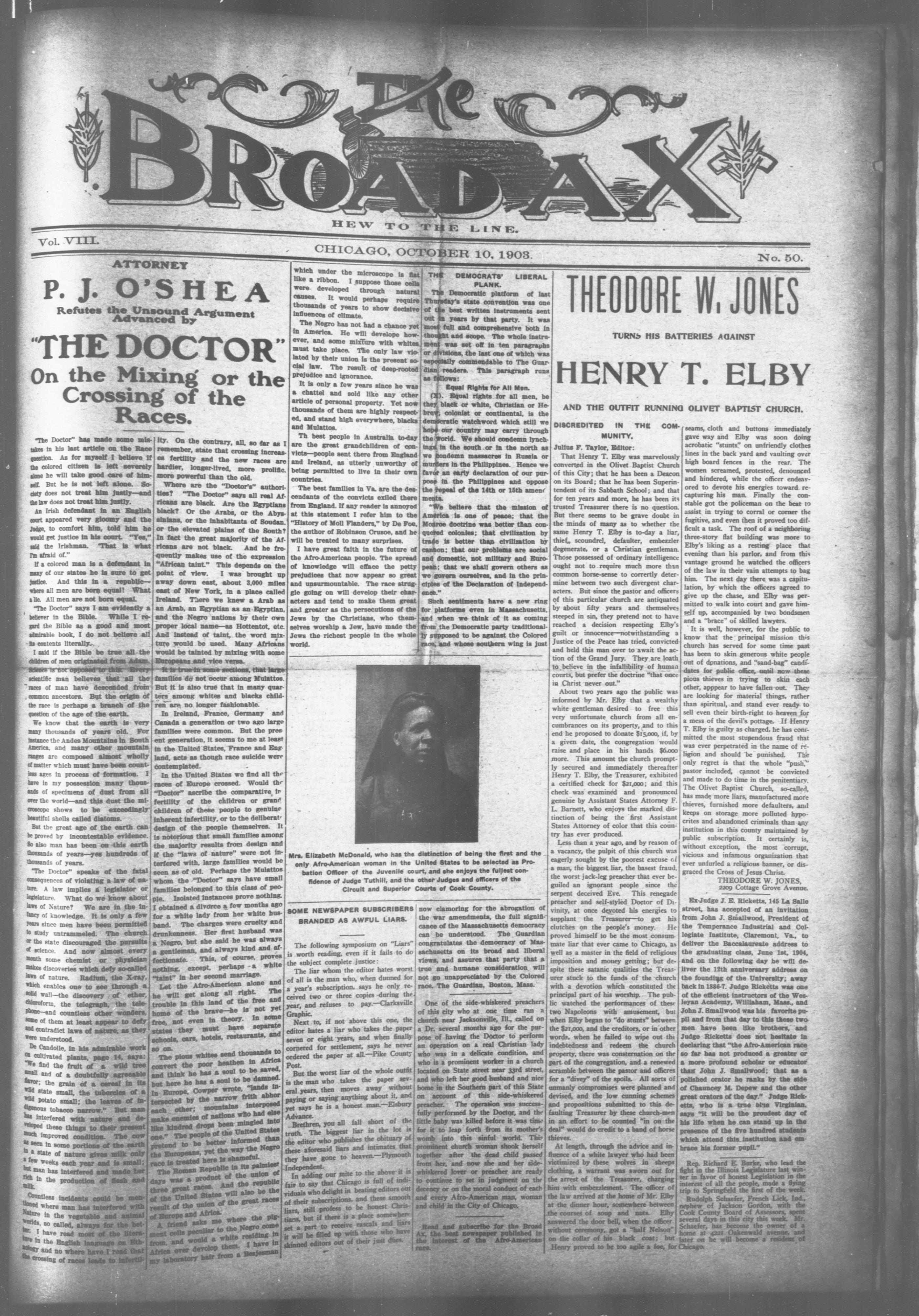
Mrs. Elizabeth McDonald, who has the distinction of being the first and the only Afro-American woman in the United States to be selected as Probation Officer of the Juvenile court, and she enjoys the fullest confidence of Judge Tuthill, and the other Judges and officers of the Circuit and Superior Courts of Cook County.
SOME NEWSPAPER SUBSCRIBERS BRANDED AS AWFUL LIARS.
The following symposium on "Liars" is worth reading, even if it fails to do the subject complete justice:
The liar whom the editor hates worst of all is the man who, when dunned for a year's subscription, says he only received two or three copies during the year, and refuses to pay.—Clarksville Graphic.
Next to, if not above this one, the editor hates a liar who takes the paper seven or eight years, and when finally cornered for settlement, says he never ordered the paper at all.—Pike County Post
But the worst liar of the whole outfit is the man who takes the paper several years, then moves away without paying or saying anything about it, and yet says he is a honest man.—Elsbury Advance. Brethren, you all fall short of the truth. The biggest liar in the lot is the editor who publishes the obituary of these aforesaid liars and intimates that they have gone to heaven.—Plymouth Independent.
In adding our mite to the above it is fair to say that Chicago is full of individuals who delight in beating editors out of their subscriptions, and these smooth liars, still profess to be honest Christians, but if there is a place somewhere set a part to receive rascals and liars it will be filled up with those who have skinned editors out of their just dues.
THE DEMOCRATS' LIBERAL PLANK.
The Democratic platform of last Thursday's state convention was one of the best written instruments sent out in years by that party. It was most full and comprehensive both in thought and scope. The whole instrument was set off in ten paragraphs or divisions, the last one of which was especially commendable to The Guardian readers. This paragraph runs as follows:
(X). Equal rights for all men, be they black or white, Christian or Hebrew, colonist or continental, is the democratic watchword which still we hope our country may carry through the world. We should condemn lynchings in the south or in the north as we condemn massacres in Russia or murders in the Philippines. Hence we favor an early declaration of our purpose in the Philippines and oppose the repeal of the 14th or 15th amendments.
"We believe that the mission of America is one of peace; that the Monroe doctrine was better than conquered colonies; that civilization by trade is better than civilization by cannon; that our problems are social and domestic, not military and European; that we shall govern others as we govern ourselves, and in the principles of the Declaration of Independence."
Such sentiments have a new ring for platforms even in Massachusetts, and when we think of it as coming from the Democratic party traditionally supposed to be against the Colored race, and whose southern wing is just
now clamoring for the abrogation of the war amendments, the full significance of the Massachusetts democracy can be understood. The Guardian congratulates the democracy of Massachusetts on its broad and liberal views, and assures that party that a true and humane consideration will not go unappreciated by the Colored race. The Guardian, Boston, Mass.
One of the side-whiskered preachers of this city who at one time ran a church near Jacksonville, Ill., called on a Dr. several months ago for the purpose of having the Doctor to perform an operation on a real Christian lady who was in a delicate condition, and who is a prominent worker in a church located on State street near 33rd street, and who left her good husband and nice home in the Southern part of this State on account of this side-whiskered preacher. The operation was successfully performed by the Doctor, and the little baby was killed before it was time for it to leap forth from its mother's womb into this sinful world. This prominent church woman shook herself together after the dead child passed from her, and now she and her side-whiskered lover or preacher are ready to continue to set in judgment on the decency or on the moral conduct of each and every Afro-American man, woman and child in the City of Chicago.
Read and subscribe for the Broad Ax, the best newspaper published in the interest of the Afro-American race.
THEODORE W. JONES
TURNS HIS BATTERIES AGAINST
HENRY T. ELBY
AND THE OUTFIT RUNNING OLIVET BAPTIST CHURCH. DISCREDITED IN THE COM MUNITY. seams, cloth and buttons immediate gave way and Elby was soon doi
That Henry T. Elby was marvelously converted in the Olivet Baptist Church of this City; that he has been a Deacon on its Board; that he has been Superintendent of its Sabbath School; and that for ten years and more, he has been its trusted Treasurer there is no question. But there seems to be grave doubt in the minds of many as to whether the same Henry T. Elby is to-day a liar, thief, scoundrel, defaulter, embezzler degenerate, or a Christian gentleman. Those possessed of ordinary intelligence ought not to require much more than common horse-sense to correctly determine between two such divergent characters. But since the pastor and officers of this particular church are antiquated by about fifty years and themselves steeped in sin, they pretend not to have reached a decision respecting Elby's guilt or innocence—notwithstanding a Justice of the Peace has tried, convicted and held this man over to await the action of the Grand Jury. They are loath to believe in the infallibility of human courts, but prefer the doctrine "that once in Christ never out."
About two years ago the public was informed by Mr. Elby that a wealthy white gentleman desired to free this very unfortunate church from all encumbrances on its property, and to this end he proposed to donate $15,000, if, by a given date, the congregation would raise and place in his hands $6,000 more. This amount the church promptly secured and immediately thereafter Henry T. Elby, the Treasurer, exhibited a certified check for $21,000; and this check was examined and pronounced genuine by Assistant States Attorney F. L. Barnett, who enjoys the marked distinction of being the first Assistant States Attorney of color that this country has ever produced.
Less than a year ago, and by reason of a vacancy, the pulpit of this church was eagerly sought by the poorest excuse of a man, the biggest liar, the basest fraud, the worst jack-leg preacher that ever beguiled an ignorant people since the serpent deceived Eve. This renegade preacher and self-styled Doctor of Divinity, at once devoted his energies to supplant the Treasurer—to get his clutches on the people's money. He proved himself to be the most consummate liar that ever came to Chicago, as well as a master in the field of religious imposition and money getting; but despite these satanic qualities the Treasurer stuck to the funds of the church with a devotion which constituted the principal part of his worship. The public watched the performances of these two Napoleons with amusement, but when Elby began to "do stunts" between the $21,000, and the creditors, or in other words, when he failed to wipe out the indebtedness and redeem the church property, there was consternation on the part of the congregation, and a renewed scramble between the pastor and officers for a "divey" of the spoils. All sorts of unmanly compromises were planned and devised, and the low cunning schemes and propositions submitted to this defaulting Treasurer by these church-men in an effort to be counted "in on the deal" would do credit to a band of horse thieves.
At length, through the advice and influence of a white lawyer who had been victimized by these wolves in sheeps clothing, a warrant was sworn out for the arrest of the Treasurer, charging him with embezzlement. The officer of the law arrived at the home of Mr. Elby at the dinner hour, somewhere between the courses of soup and nuts. Elby answered the door bell, when the officer without ceremony, got a "half Nelson" on the collar of his black coat; but Henry proved to be too agile a foe, fo
E W. JONES
T. ELBY G OLIVET BAPTIST CHURCH.
seams, cloth and buttons immediately gave way and Elby was soon doing acrobatic "stunts" on unfriendly clothes lines in the back yard and vaulting over high board fences in the rear. The women screamed, protested, denounced and hindered, while the officer endeavored to devote his energies toward recapturing his man. Finally the constable got the policeman on the beat to assist in trying to corral or corner the fugitive, and even then it proved too difficult a task. The roof of a neighboring three-story flat building was more to Elby's liking as a resting place that evening than his parlor, and from this vantage ground he watched the officers of the law in their vain attempts to bag him. The next day there was a capitulation, by which the officers agreed to give up the chase, and Elby was permitted to walk into court and gave himself up, accompanied by two bondsmen and a "brace" of skilled lawyers.
It is well, however, for the public to know that the principal mission this church has served for some time past has been to skin generous white people out of donations, and "sand-bag" candidates for public office, until now these pious thieves in trying to skin each other, appear to have fallen out. They are looking for material things, rather than spiritual, and stand ever ready to sell even their birth-right to heaven for a mess of the devil's potage. If Henry T. Elby is guilty as charged, he has committed the most stupendous fraud that was ever perpetrated in the name of religion and should be punished. The only regret is that the whole "push," pastor included, cannot be convicted and made to do time in the penitentiary. The Olivet Baptist Church, so-called, has made more liars, manufactured more thieves, furnished more defaulters, and keeps on storage more polluted hypocrites and abandoned criminals than any institution in this county maintained by public subscription. It certainly is, without exception, the most corrupt, vicious and infamous organization that ever unfurled a religious banner, or disgraced the Cross of Jesus Christ.
Ex-Judge J. E. Ricketts, 145 La Salle street, has accepted of an invitation from John J. Smallwood, President of the Temperance Industrial and College Institute, Claremont, Va., to deliver the Baccalaureate address to the graduating class, June 1st, 1904, and on the following day he will deliver the 12th anniversary address on the founding of the University; away back in 1886-7. Judge Ricketts was one of the efficient instructors of the Wesleyan Academy, Williaham, Maass., and John J. Smallwood was his favorite pupil and from that day to this these two men have been like brothers, and Judge Ricketts does not hesitate in declaring that "the Afro-American race so far has not produced a greater or a more profound scholar or educator than John J. Smallwood; that as a polished orator he ranks by the side of Chauncey M. Depew and the other great orators of the day." Judge Ricketts, who is a true blue Virginian, says "it will be the proudest day of his life when he can stand up in the presence of the five hundred students which attend this institution and embrace his former pupil."
Rep. Richard E. Burke, who lead the fight in the Illinois Legislature last winter in favor of honest Legislation in the interest of all the people, made a flying trip to Springfield the first of the week. Rudolph Schaefer, French Lick, Ind., nephew of Jackson Gordon, with the Cook County Board of Assessors, spent several days in this city this week. Mr. Schaefer, has become the owner of a home at 4221 Oakenwald avenue, and later on he will become a resident of Chicago.
Catalog
No. 50.
es 7 “PUBLISHED WEEKLY. ~~ ¥ ne
Saveur sae
tonite
Bubscriptions must be paid ip advance.
SES mranneerseocnesaorenaaine 40
Sg pertictag vetee made known om equtieation.
THE BROAD AX
‘40 drmour Avenue, Chicago.
JULIVS F. TAYLOR, Editor and Publisher.
——————————————
Eatered at the Post Oilfice at Chicago,
. HL, as Second-ciass Matter.
——EEEOE_=
“There goes a tean,” said the sad-
‘eyed grocer, with a sigh, “that parted
me and my wife.”
“Is that so? queried the drummer.
“Why, be doesn’t look like a deep-dyed
‘Villian.”
“Who said anything about a vilian?”
asked the man behind the counter.
“Thet man's all right; he's a judge in
the divorce court."—Cincinnati En-
quirer. .
Ne Doubt of It.
“Rather a clever poem,” said the
editor, handing back the manuscript;
“do you know who is the author of
these lines?”
“Of course,” replied the proud
father; “didn’t I tell you my son wrote
‘en?”
“But are you sure he did?”
“Bure! Don’t you suppose I know
his handwriting?”—Philadelphia Press.
Se Wes Tee Strenx.
“My boy tells mt you discharged
hhim,”. said the late office-boy’s mother.
“You advertised for a strong boy, and
I certainly thought he was strong
enough.”
“Madam,” replied the merchant, he
‘was too strong. He broke all the rules
- of the office and some of the furniture
im the two days he was with us."—Tit-
Bits.
Why They Settle.
‘Wife—Who-can doubt the power of
wornan’s love? Think of the thousands
of wild youths who have settled down
into staid and respectable citizens as
goon as they married.
_ Husband—Good lands! they couldn't
afford to be anything else after they
got married —N. Y. Weekly.
Bet Pretty.
Fred—Of course, she poses a good
eal, but she’s awfully pretty.
May—Oh, did you hear of the mean
trick Mr. Kammerer played on her?
Fred—No. - What was it?
‘May—He took a snapshot of her while
she was in the act of eating corn off the
cob.—Philadelphia Press.
Pesee Assured.
“Aren't there some jealousies in your
Brogressive euchre club?” :
“No, indeed,” answered young Mrs.
‘Torkins; “when we buy prises we are al-
‘ways careful to-select things that no one
really wants, so that the winner will not
Bean object of envy.”—Washington
Star.
One or the Other.
“Gee whiss!” exclaimed the nervy
@ailer, “I haven't another match, and
way cigarette has gone out.”
“Well,” replied the polite young
‘wortan, who could stand it no longer,
“you would have had to if it hadn’t”"—
Catholic Standard and Times.
Saw His Finish.
Bifkine—So Mra. Bosswick is going to
marry again, eh? -
Mifkins—Yes; and her fiance boasts
of being a self-made man.
Bifkine—Well, it's doughtnuts to
fudge she'll make him over agein —Chi-
_cage Daily News.
imprudent Nimrod.
Bobby—What's the matter with
Jimmy Jones?
_ Benny—He went out in the farmer's
field to shoot birds.
Bobby—Did the farmer kick?
Benny—No, but the:gun did —Chi-
ago Daily News.
The Weman of It. ‘
‘The girl who keeps her birthday,
‘When & merry little elf,
Keeps tt still when she grows up—
She keeps tt to herself.
—Cincinnat! Enquirer.
~ “Papa, I don’t like to hurt your ieel-
ings, but it always makes me angry
‘when folks say I resemble you so much.”
“Don’t worry, daughter. I get toler-
ably mad about it, too.”—Chicago Trib-
‘ane. _
. Changed Conditions.
‘Hie once was making money,
“s ‘Much more than he could use;
go
Small Wender.
‘“E brought home a friend to dinner
vast might and there was an awful
ae
_ “Didn't you notify your wife?”
"Oh, yes; bat she forgot to notity
“What is that nickname you have
given your boy?”
“‘Wiyin’ Machine,” answerec Far-
mer Cormtossel. “You see, he's mighty
‘4nterestin’ an’ promisin’, but he won't
_work.”—Washington Star.
Wife—t wonder why the fashions for
‘women change so often’
Husbané—Probably for the purpose
of enabling them to correspond with
‘Rad Esgquirer. a
~ gohan P: Fischer, 2 oreh stra le
Carew Wi. tao roomed a $600
aes 2 :
, Thirsty members of congress at the
next session will be somewhat incom-
moded because of the fact that no liquor
‘will be sold in the capitol building.
Washington tailors, fully realizing what
this inconvenience means, are doing
‘what they can to make large hip pock-
ss popular, so that the legisaters may
‘be able to carry with them a reasonable
supply of wet goods. $
The right or otherwise of a shirtwaist
‘man to enter the dining-room of a hotel
is about to be settled in a Philadelphia
court. “One hot day last July De Wolf
‘Norman, a Quaker city man of social
note, entered a dining-room minus coat
and waistcoat, but wearing a neat shirt-
waist end’belt. He was informed that
gentlemen so attired would not be served
‘there, and despite his protests he was
ejected. -Mr. Norman consulted his law-
yer, who has begun a suit for damages
against the hotel man.
_« The body of Bronson B. Tuttle, a mil-
fionaire, who was buried a few days ago
at Naugatuck, Conn., was placed in a
casket inclosed in a burglar-proof metal-
lic box or vault, so constructed that once
the lid was shut and the locks snapped
into place the vault could not be opened
antil after several hours of work unless
with dynamite. The lid of the vault is
fastened by automatic locks and bars,
every one of which must be forced be-
fore the coffin can be reached. In addi-
tion to all this a watchman keeps guard
over the grave by night.
a op ett eee
"There is a merchant at Nevada, Mo.,
Bamed Gosh. His friends swear by him.
Congressman Sulzer, of New York, is
credited with having uttered this gem of
‘mixed metaphor: “They will keep cut-
ting the wool from the sheep that lays
the golden egg until they pump it dry.”
Gen. James Grant Wilson, of New
York, and daughter, Miss K. M. Wilson,
bave not exchanged a word in several
years, thuogh they continue to live un-
fer the same roof and eat at the same
‘table. Fatherand daughter met ina rail-
‘road depot the other day and boarded the
‘same train, but neither gave the other
even a look. The estrangement is said to
date from the time when the general re-
fused to allow Miss Wilson to marry the
man of her choice. .
A man who gets intoxicated only on
legal holidays does not fall into the
drunkard category, according to Judge
Harper, of the common pleas court of
Stark county, Ohic. In a divorce suit
brought’ by Minnie Rerick against-Wil-
tam Rerick, the allegation was made that
‘the husband fs a habitual drunkard. The
defendant testified that he got drunk on
national holidays only and that the wife
could prove nothing else. The judge in
summing up the case declared the plain-
tiff had failed to sustain her chief aliege-
tion and he refused to grant her sepere-
POINTERS ON BUSINESS LAW
Tt is a frand to conces! a fraud.
Ignorance of the law excuses no one.
‘Notes bear interest only when s0
stated.
‘The acts of one partner bind all the
others.
An agreement without consideration
is void.
Contracts made on Sunday cannot
be enforced.
A contract made with a minor or
tunatic is void.
Principals are responsible for the acts
of their agents.
Signatures made with a lead pencil
are good in law.
“A note being lost or stolen does not
release the maker.
" Bach individual in a partnership is re-
sponsible for the whole amount of the
debt of the firm. 2
It is not legally necessary to say on a
note, “for value received,” but it should
be done in Missouri.
STUDIO NOTES.
‘The first ofl portrait of the pope will
be by the Hangarian painter, M. Berthod
Lippay.
The French Grand Prix in sculpture
provides the successful artist with means
of support for four years in Rome or
‘Athens.
| A statue of Cervantes is to be erected
in Paris as a mark of gratitude towards
‘the Spanish admirers of Victor Hugo,
‘who erected a statue to him in Madrid.
‘The finest paintings of the late Rob-
ert Mols, of Antwerp, decorate the house
of bis sister, Mme. Osterrieth, in Brus-
sels. He is noted for the minute real-
ism of his pictures of ships.
Alfred Gilbert, the English sculptor,
has undertaken an art school of unusual
magnitude at Bruges. He has hired an
enormous disused factory, which yields,
besides great studios, living accommo-
dation for about 300 pupils. He proposes
to do all his work in the presence of his
classes. — fe
_- FROM THE FATHERLAND.
| During the month of July 839 horses
‘were slaughtered for food in Berlin.
Owing to the Berlin hansoms having
‘India rubber tires complaint was made of
danger to the public, and they have now
been supplied with bells.
A German Roman Catholic bishop bas
ordered that couples in bis diocese who
‘wish to be married shall be examined in
Teligious knowledge before the ceremony
is performed.
"Owing to the protest by church organ-
zations in Germany against the use cf
the word “baptism” in naming ships, the
naval department has order that it shall
Bo longer be used.
_At Cologne recently a thief chased by
ee ee
< ener. sake
i
“He bake Gane, ent oo Bs ‘
‘Was honored at thebamk
Knew Where He Was. |
“Here's a mesiage from your bus-
band,” said the medium to the woman
‘who had paid her good dollar. =~.
“Where is he?” asked the widow.
| “He doesn’t say, but here's a picture
he sent you.” ;
“Well, I guess I know where be is, all
fight; that’s a flashlight picture!"—
Yonkers Statesman.
His Effort.
“What I like,” said the beautiful crea-
ture, “is a man who can do something
original.”
‘Whereat he caught her in his arms
and kissed her,-foolishly thinking no
other man had ever done that béfore.—
Chicago Record-Herald.
. Wias te Deo ft.
“Quilipoint is a queer chap. He seems
to see something that no one else can
see in every picture he looke at.”
“He can’t help it. He makes puzzle
pictures for a living.“—Cincinnati Com-
mercial Tribune.
A Remedy.
He—The doctor told Jack that he had
been studying too hard lately.
She—And what did he recommend?
He—Oh! He advised him to go into
society a little more and give his brain
@ rest—Brookly. Life.
da
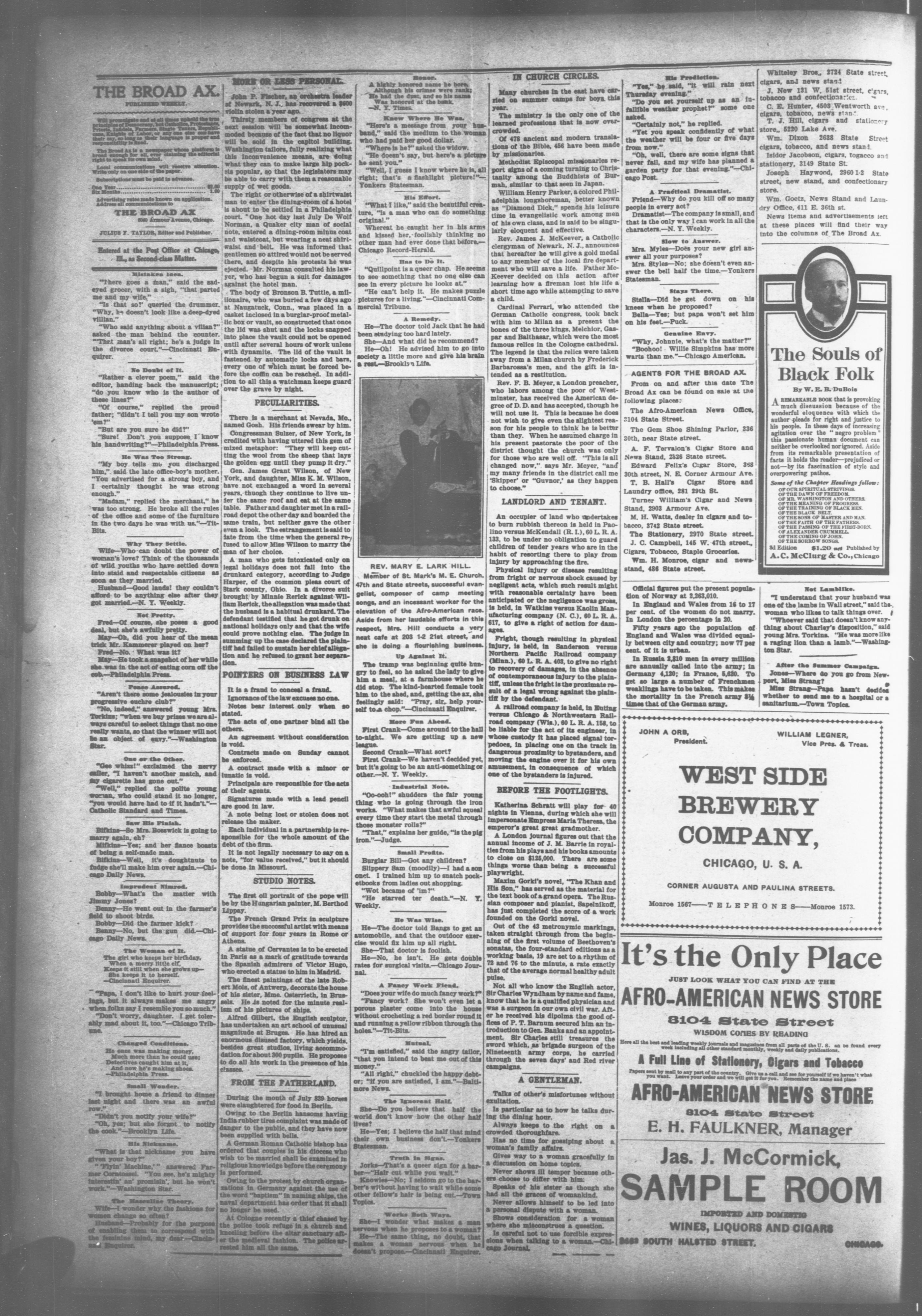
Member of St. Mark's M. E. Church,
47th and State streets, successful evan-
gelist, composer of camp meeting
songs, and an incessant worker for the
elevation of the Afro-American race.
Aside from her taudabie efforts in this
respect, Mrs. Hill conducts a yery
neat cafe at 203 1-2 2ist street, and
she is doing a flourishing business.
Up Against It.
‘The tramp was beginning quite han-
gry to feel, so he asked the lady to give
him a meal, at a farmhouse where he
id stop. The kind-hearted female took
him to the shed, and, getting the ax, she
feclingly said: “Pray, sir, help your-
self to.a chop.”—Cincinnati Enquirer.
Sees Bea Aboad
First Crank—Come around to the hall
to-night. We are getting up a new
league.
Second Crank—What sort?
First Crank—We haven't decided yet,
Dut it’s going to be an anti-something or
other.—N. Y. Weekly.
‘Indestrial Note.
“Oo-coh!” shudders the fair young
thing who is going through the iron
works. “What makes that awful squeal
every time they start the metal through
those monster rolls?”
“That,” explains her guide, “is the pig
fron.” —Judge.
eee ete
Small Profits.
Burglar Bill—Got any children?
Slippery Sam (moodily)—I had a son
onet. I trained him up to snatch pock-
etbooks from ladies out shopping.
“Wot became of "im?"
“He starved ter death”—N. Y.
Weekly.
Be Wes Wier.
He—The doctor told Bangs to get an
automobile, and that the outdoor exer-
cise would fix him up all right.
She—That doctor is foolish.
He—No, he isn’t. He gets double
rates for surgical visits.—Chicago Jour-
nal.
A Fancy Work Fiend.
“Does your wife do much fancy work?”
“Fancy work? She won't even let a
porous plaster come into the house
without crocheting a red border round it
‘and running a yellow ribbon through the
holes.”—Tit-Bits.
Mutual,
“T'm satisfied,” said the angry tailor,
“that you intend to beat me out of this
money.”
“All right,” chuckled the happy debt-
or; “if you are satisfied, I am.”—Baiti-
more News. 2
The temoresnt Hails,
She—Do you believe that half the
world don’t know how the other half
lives?
He—Yes; I believe the half that mind
thelr own business don't—Yonkers
Cem
Trath in Signs.
Jorks—That's a queer sign for a ber
ber—“Hair cut while you wait.”
"_ Kpowies—No; I seldom go to the bar
ber’s without having to wait while some
other fellow’s hair is being cut.—Town
yar —— ;
x ‘Werks Both Wars.
cee ee ee see
Rervous when he proposes
_ He—The same thing, no t
‘JN CHURCH CIRCLES.
‘Many churches in the east have car
vied on summer camps for boys this
year. ; .
‘The ministry is the only one of the
learned professions that is now ovsr
crowded. %
Of 478 ancient and modern transla-
tions of the Bible, 456 have been made
by missionaries.
Methedist Episcopal misajonaries re-
port signs of a coming turnitig to Chris-
tanity among the Buddhists of Bur-
mab, similar to that seen in Japan.
‘William Henry Parker, a colored Phil-
adelphia longshoreman, better known
as “Diamond Dick,” spends his leisure
time in evangelistic work among men
of his own class, and is said to be singu-
larly eloquent and effective.
Rev. James J. McKeever, a Catholic
clergyman of Newark, N. J., announces
‘that hereafter he will give a gold medal
to any member of the local fire depart-
ment who will save a life. Father Mc-
Keever decided on this action after
learning how a fireman lost his life a
short time ago while attempting to save
a child.
Cardinal Ferrari, who attended the
German Catholic congress, took back
with him to Milan as a present the
bones of the three kings, Melchior, Gas-
par and Balthasar, which were the most
famous relics in the Cologne cathedral.
The legend is that the relics were taken
away from a Milan church by Frederick
Barbarossa’s men, and the gift is in-
tended as a restitution.
Rev. F. B. Meyer, a London preacher,
who labors among the poor of West-
minster, has received the American de-
gree of D. D. and has accepted, though he
will not use it. This is because he does
not wish to give even the slightest rea-
son for his people to think he is better
than they. When he assumed charge in
his present pastorate the poor of the
district thought the church was only
for those who are well off. “This is all
changed now,” says Mr. Meyer, “and
my many friends in the district call me
‘Skipper’ or “Guvnor,’ as they happen
to choose.”
LANDLORD AND TENANT.
An occupier of land who undertakes
to burn rubbish thereon is held in Pao-
lino versus McKendall (R. I.),60 L. R. A.
133, to be under no obligation to guard
children of tender years who are in the
habit of resorting there to play from
injury by approaching the fire.
Physical injury or disease resulting
from fright or nervous shock caused by
negligent acts, which such result might
with reasonable certainty have been
anticipated or the negligence was gross,
is held, in Watkins versus Kaolin Man-
ufacturing company (N. C.), 60L. RA.
617, to give a right of action for dam-
ages.
Fright, though resulting in physical
injury, is beld, in Sanderson versus
Northern Pacific Railroad company
(ifinn.), 60 L. R. A. 403, to give no right
to recovery of damages, in the absence
of contemporaneous injury to the plain-
tiff, unless the fright is the proximate re-
sult of a legal wrong against the plain-
tiff by the defendant.
A railroad company is held, in Buting
versus Chicago & Northwestern Rail-
road company (Wis.), 60 L. R. A. 158, to
be liable for the act of its engineer, in
whose custody ft has placed signal tor-
pedoes, in placing one on the track in
dangerous proximity to bystanders, and
moving the engine over it for his own
amusement, in consequence of which
one of the bystanders is injured.
BEFORE THE FOOTLIGHTS.
Katherina Schratt will play for- 4¢
nights in Vienna, during which she wil!
impersonate Empress Maria Theresa, the
emperor's great great gradmother.
A London journal figures out that the
annual income of J. M. Barrie in royal-
ties from his plays and his books amounts
to close on $125,000. There are some
things worse than being 2 successful
playwright.
Maxim Gorki's novel, “The Khan and
His Son,” has served as the material for
the text book ofa grand opera. The Rus-
sian composer and pianist, Sapelnikoff,
has just completed the score of a work
founded on the Gorki novel.
Out of the 43 metronymic markings,
taken straight through from the begin-
ning of the first volume of Beethoven's
sonatas, the four-standard editions as a
working basis, 19 are set to a rhythm of
72 and 76 to the minute, a rate exactly
that of the average normal healthy adult
pulse,
Not all who know the English actor,
Sir Charlies Wyndham by name and fame,
know that he is a qualified physician and
was a surgeon in our own civil war. Aft-
er he received his dipolma the good of-
fices of P. T. Barnum secured him an in-
troduction toGen. Banks and an appoint-
ment. Sir Charles still treasures the
sword which, as brigade surgeon of the
Nineteenth army corps, he carried
through the seven days’ and Red river
campaigns.
A GENTLEMAN.
Talks of other’s misfortunes without
exultation.
Is particular as to how he talks dur-
ing the dining hour.
to the t
Always keeps right on a
Has no time for gossiping about
woman's famfly affairs. .
Gives way to a woman gracefully in
& discussion on home topics. .
Never shows {ll temper because oth-
ere choose to differ with him: |
Speaks of his sister as though she
had all the graces of womankind.
_ Never allows himself to be led into
® personal dispute with a woman.
Is careful not to use forcible expres-
talking to 8 woman—Chi-
ee Ee
JOHN A ORB, Be
President. Vice Pres. & Treas.
WEST SIDE
BREWERY
COMPANY,
CHICAGO, U. S. A.
CORNER AUGUSTA AND PAULINA STREETS.
Monroe 1567——-T EL E PHO N E S——Monrce 1573.
It’s the Only Place
AFRO-AMERICAN NEWS STORE
se a
Renee ea a anc ay, ea ay ast **
Resear
AFRO-AMERICAN NEWS STORE
E. H. FAULKNER, Manager
- Jas. J. McCormick,
SAMPLE ROOM
Bis Prediction.
“Yes,” be ssid, “it will rain next
‘Thereday evening.” £
“Do you set yourself up as an in-
fallible weather prophet?” some one
asked. r
“Certainly not,” he replied.
“Yet you speak confidently of what
the weather will be four or five days
from now.”
| “Ob, well, there are some signs that
‘never fail, and my wife has planned 8
garden party for that evening.”—Chi-
cago Post.
A Praétical Dramatist.
Frienéd—Why do you kill off so many
people in every act?
Dramatist—The company is small, and
that is the only way I can work in all the
characters.—N. Y. Weekly.
Slew to Anmsewer.
Mrs. Myles—Doés your new girl an-
swer all your purposes?
Mrs. Styles—No; she doesn’t even an-
swer the bell half the time.—Yonkers
Statesman,
Stays There.
Stella—Did he get down on his
knees when he proposed?
Bella—Yes; but papa won't set him
on his feet—Puck. :
Genuine Envy.
“Why, Johnnie, what's the matter?”
“Boohoo! . Willie Simpkins has more
warts than me.”—Chicago American.
AGENTS FOR THE BROAD AX.
From on and after this date The
Broad Ax can be found on sale at tne
following places:
The Afro-American News Office,
2104 State Street.
The Gem Shoe Shining Parlor, 336
30th, near State street.
A. F. Tervaion’s Cigar Store and
News Stand, 2826 State street.
Edward Felix’s Cigar Store, 348
30th street, N. E. Corner Armour Ave.
T. B. Hall's Cigar Store and
Laundry office, 281 29th St.
Turner William's Cigar and News
Stand, 2903 Armour Ave.
M. H. Watts, dealer in cigars and to-
bacco, 3742 State street.
The Stationery, 2970 State street.
J. C. Campbell, 145 W. 47th street,
Cigars, Tobacco, Staple Groceries.
Wm. H. Monroe, cigar and news
stand, 486 State street.
Offcial figures put the present popula-
tion of Norway at 2,263,010.
In England and Wales from 16 to 17
per cent. of the women do not marry.
In London the percentage is 20.
Fifty years ago the population of
England and Wales was divided equal-
ly between city and country; now 77 per
cent. of it is urban.
In Russie 2,810 men in every million
are annually called into the army; in
Germany 4,120; in France, 5,620. To
get so large a number of Frenchmen
weaklings have tobe taken. This makes
the mortality in the French army 8%
‘times that of the German army.
Whiteley Bros, 2724 State etree:
cigars, and news stas‘
| J. New 131 W. Sist street, ¢'girs,
tobacco and confectionaric:. ~
©, B. Hunter, ee are,
cigars, stan.
t. "Hi, cigars and statione-y
store,, 5220 Lake Ave.
Wm. Dixon 2638 State Strect
cigars, tobacco, and news stani.
Isidor Jacobson, cigars, togacco an}
stationery, 3149 State St.
Joseph Haywood, 29601-2 State
street, new stand, and confectionary
store.
Wm. Goetz, News Stand and Laun-
dry Office, 411 E. 36th st.
News items and advertisements tert
at these places will find their way
into the columns of The Broad Ax.
= }
By W.E. B. DuBois
REMARKABLE BOOK that is provoking
A much discussion because of the
wonderful ——— with which the
author pleads for right and justice to
his people. In these days of increasing
agitation over the “ negro problem”
this passionate human document can
neither be overlooked nor ignored. Aside
from its remarkable presentation of
facts it holds the reader—prejudiced or
not—by its fascination of style and
overpowering pathos.
Some of the Chapter Headings follow:
OF OUR SPIRITUAL STRIVINGS.
OF THE DAWN OF FREEDOM.
OF MR. WASHINGTON AND OTHERS.
OP THE MEANING OF PROGRESS.
OP THE TRAINING OF BLACK MEN.
OP THE BLACK BELT.
OF THE SONS OF MASTER AND MAN.
OF THE FAITH OF THE FATHERS.
OF THE PASSING OF THE FIRST-BORS.
OF ALEXANDER CRUMMELL.
OF THE COMING OF JOHN.
OF THE SORROW SONGS.
‘8d Edition $1.20 wet Published by
A.C. McClurg & Co.,Chicago
Net Lambitke.
“I understand that your husband was
one of the lambs in Wall street,” said the.
woman who likes to talk thingsover. {|
“Whoever said that doesn’t know any-
thing about Chariey’s disposition,” said
young Mrs. Torkins. “He was more like
& raging lion than a lamb.”—Washing-
ton Star.
———_—_——
After the Summer Campaign.
Jones—Where Go you go from New-
port, Miss Strang? = a
Miss Strang—Papa hasn't decides
whether to send me to a hospital or s
sanitarium.—Townr Topics.
Doings of the National Capitol That Are of Timely Interest.
Interesting Figures from the Morgue of the Post Office Department—Stupendous Tasks Performed by Some Government Officials.
Washington.—Over at the post office department there is a place called the Morgue. That is the eminently appropriate name commonly applied to the dead letter office—the destination of all the letters that go astray in the mails.
A Page for Life
Few people have an adequate conception of the amount of business that is transacted in this establishment; but the annual report of First Assistant Postmaster General Wynne.
the official keeper of the Morgue, contains some interesting information. It appears that during the year just closed no less than 10,155,146 pieces of mail found their way into the dead house. That was 854,795 more pieces than were reported during the previous year-35,000 a day year in and year out, and the number constantly increasing. A little over one-thirtieth of this number was delivered unopened. That means that the skilled clerks in the office succeeded in deciphering more than 300,000 apparently unintelligible addresses and starting them safely on their way again.
The clerks found $48,634 in money in misdirected letters which were opened, and drafts, checks and money orders representing a face value of $1,493,563. Some of this money was finally delivered to the persons for whom it was intended, but the larger portion went to swell the postal receipts.
To handle this business there are 135 clerks, and some of them are marvels in the skill with which they can decipher writing that apparently has no meaning. The most skillful of all of them is a woman who draws a salary of $1,800 a year. There are few chirographical enigmas which she cannot master.
In the unexpected death of Sir Michael Herbert Washington loses the most charming diplomat who has ever been detailed to represent a foreign country here as an ambassador.
M.
Sir Michael had been in Washington as the British ambassador less than a year, and yet he had won a popularity that amounted to affection. He was gentle, cultured, mag
netic, and fascinating in manner. Although an Englishman to the finger tips, he had yet an instinctive understanding of American ways and a sympathy with Yankee idiosyncrasies which gained for him a cordial regard everywhere he went.
Perhaps the fact that he was married to an American wife had something to do with it, but that was not all, Sir Michael was genuinely, heartily, spontaneously, sympathetic and kindly. It is hardly conceivable that Great Britain can send another ambassador here who can win so high a place in so short a time. It is only a little more than a year since Sir Julian Pauncefote disappeared from the scene after thirteen years of service in Washington, and there were many men who thought that sturdy old English squire had made a record which could never be equalled; but Sir Michael was already on the road to winning a place in Washington which even Sir Julian never occupied.
The British ambassador in America is a far more important personage now than the British minister was 20 years ago. Great Britain now feels it incumbent upon her to send her very best man, and the Washington embassy is regarded as the prize assignment in the entire diplomatic service. It is not so very long ago that it was regarded as something of a humiliation for a British diplomat to be sent here; but things have changed mightily of late.
Diplomatic Washington is also to lose Count Cassini, the Russian ambas-
A Diplomat of Discus tion.
Count Cassini has been here several years, and he has the reputation of being one of the most accomplished diplomats in Europe; but somehow or other he has always had the ill fortune to be mixed up in a fuss in every capital to which he is assigned. At Peking he is credited with having stirred up the troubles which
finally resulted in the grievous diplomatic tangle of three years ago in connection with the Boxer uprising. He is held responsible also for much
of the ill feeling which grew out of the Kishineff affair last summer. The count is a man of striking personal appearance and of great accomplishments, but it is no secret that the state department would not grieve greatly if the Russian government were to decide that his services would be of greater value to the empire elsewhere.
It is of great importance that Russia should be represented here during the next few years by an ambassador who thoroughly understands the United States, and who can make himself personally acceptable to the powers with whom he is forced to come in contact. Our relations with Russia are becoming year by year more complicated, and they contain possibilities of international trouble unless they are handled with consummate skill. The Russian ministers of the czar realize this as well as our own secretary of state, and we may expect to see Count Cassini succeeded by somebody of infinite tact and diplomatic astuteness.
One of the most notable things in Washington recently has been the suc-
cess with which Secretary Cortelyou has managed to get the new department of commerce and labor into effective running order.
J. B.
It was a far more complicated task than it could have seemed to an outsider who was not familiar with the routine of administration
ministration in Frank H. Hitchcock, government departments, and for that reason Mr. Cortelyou will probably never receive the full credit which belongs to him for what he has done. He has taken a great many bureaus and independent divisions belonging to various departments or perhaps standing by themselves, and he has amalgamated them into the new department, lopping off superfluities, adjusting jurisdictions and fixing relative responsibilities.
It is doubtful whether anybody could have come in from the outside and succeeded in this. It is due to Secretary Cortelyou's intimate acquaintance with all government departments and with administrative routine gained while in the post office department and at the white house that it has been possible to bring order out of chaos. It is doubtful, too, whether he could have done it if he had not been fortunate enough to select at the very beginning a chief clerk who is almost as much a master of administrative detail as Cortelyou himself.
Frank H. Hitchcock, who has been the secretary's right hand man in this preliminary work, and who has been compelled to attend to the greater part of the detail of the reorganization, is a young Harvard graduate, who made a great reputation as a statistician in the agricultural department before Cortelyou picked him up. He is one of the most promising young men in the entire government service to-day.
A quiet, modest, keen-witted army officer who is doing a great work without fuss or feathers is Lieut. Col. Clarence R. Edwards, the chief of the bureau of insular affairs in the war department.
MILITARY OFFICER
Col. Edwards has been at the head of the bureau of insular affairs ever since it was created as an outgrowth of the war with Spain, and under him it has
under him it has developed into one of the most important bureaus of the government. There are times when the work that falls to his lot would be worthy of a cabinet officer, and he has never yet failed to meet every emergency as it arises.
Col. Edwards is a young man. He was graduated at West Point in 1883, and he has seen service in Cuba and the Philippines. He has the head of a veteran and the manners of a prince of the blood. To see him at work one would not imagine that he had a serious problem to consider or any task of consequence to complete, and yet he is continually deciding knotty questions and accomplishing important results. He has to be familiar with problems of currency and the tariff as related to the Philippine islands and with every other detail of colonial administration. He is in effect a secretary of the treasury, a secretary of state, a secretary of agriculture and attorney general for the Philippines rolled into one. All the publications for the Philippines pass through his hands. He presides over a bureau of statistics and a general information bureau. He has charge of the records and the archives containing the papers which have been brought from the Philippines from time to time. In short, he is the representative in Washington of the Philippine government, and he goes about it all with the modest unobtrusiveness of a looker on. LOUIS A. COOLIDGE.
Care of Table Linen.
Look over both table cloth and napkins before they are put to soak. Place the stained portion of the linen over a deep bowl and pour boiling water through it, repeating the operation until the stain disappears. Soap will set stains made by fresh fruit, so it is necessary that they should be taken out before being laundered.—Cincinnati Gazette.
Cheyennes and Arapahoes Have Always Been More or Less Closely Associated.
From a very early period the Cheyennes and Arapahoes have been more or less associated with each other, says the Arapahoe Bee. They seemed to have lived more or less in the same localities, moving from time to time from the same general causes. Their language is essentially different, so they do not understand each other, except as they have learned each other's language. This, in many cases, they have done, largely through the sign language, which is common to western Indians. These two tribes have largely intermarried. These intermarriages have existed for many years. There are many cases of men 50 years old and more, speaking both languages, who can say that they are half Cheyenne and half Arapahoe.
Like the Cheyennes, the Arapahoes have been divided, a portion of the Arapahoes now being on a reservation in Wyoming, while others associated with the Cheyennes are now in Oklahoma. The Arapahoes are more submissive to the white man's rule and obey more readily the government orders. Under wise and beneficent management on the part of the white man they are capable of being made an industrious and self-supporting people. They are, in their way, a religious people. The Arapahoes have a large number of songs more or less religious. They are also now very much diseased. Tuberculosis in its various forms abounds. The death rate in recent years from various causes is large.
TRUE, BUT NOT BIBLICAL
Many Proverbs Credited to Good Book Which Are Not in It—Some Notable Instances.
There are scores of wise saws, all containing more or less of truth, which are almost universally supposed to be in the Bible which cannot be found in its pages. One of the chief of these sentences is: "He tempers the wind to the shorn lamb." You would search the Bible pretty thoroughly before you would find that sentence in it. Where you would find it would be in Sterne's "Sentimental Journey."
Sterne gets a good deal of praise for the origination of this sentence, says the Chicago Chronicle, but it was originated, as a matter of fact, before he was born. In a collection of French proverbs published in 1594 we find: "Dieu mesure le vent a la brebis tondue." That convicts Sterne of plagiarism.
"In the midst of life we are in death"—everybody thinks that is in the Bible. It isn't, though; it is in the burial service.
"That he who runs may read." This is another sentence supposed, wrongly, to be Biblical. It is not Biblical, though the Bible has something very like it—namely: "That he may run that readeth."
"Prone to sin as the sparks fly upward." The Bible nowhere contains those words.
"A nation shall be born in a day." The nearest thing to that in the good book is: "Shall a nation be born at once?"
OPIUM IN DIVERSE FORMS
Devotes of Drug Choose Various Ways
of Obtaining the Effective Snacks
Customers of opium are not all of the same kind. There are slaves of the pipe, slaves of the syringe and slaves of the powder that is swallowed to give surcease of pain or of mental worry. There are those who take the drug in the form of a medicinal preparation, such as laudanum, paregoric and the extract of laudanum; those who smoke it and inhale the fumes into the lungs, and those who take hypodermic injections of morphia. The second class—the smokers—comprises the largest number of victims.
Dr. Jeliffe, of the New York city hospital, estimates that fully 30,000 people in that city are addicted to the opium habit in some form. The annual sale of opium in Vermont is equivalent, according to the doctor, to a grain for every adult in the state, an amount obviously far greater than can be accounted for by its consumption for medicinal purposes. Some slaves to the drug take it regularly every day; others have periodical sprees similar to those of the alcohol drinker.
Latest Sea-Serpent Story.
A recent sea-serpent story coming from England tells how a marine monster apparently tried to swallow the good ship Glengrant, of Fraserburgh. At the first onslaught it lifted the vessel "at least six feet" as it dived underneath her, but, fortunately, when it came on again the only sailor man who kept his head dashed below and got a gun. It is not known whether he hit it; at any rate, the monster had had enough and cleared off. The sailors say this serpent was nearly 200 feet in length, with a head like a seahorse, a long mane, great green, glistening eyes and an enormous mouth and teeth.
Positions for Sharpshooting. Standing, kneeling, sitting and lying down are the four positions prescribed for firing by the army regulations. The lying position alone is prescribed for the 800 and 1,000-yard ranges, while at all other ranges up to 200 yards the lying a-d sitting positions are used. At 100 and 200 yards the sitting and standing positions are prescribed. Wherever the sitting position is prescribed the kneeling may be substituted, but for the majority of persons the sitting is by far the better position of the two.
HOW HE LEARNED TO SHOOT. Raw Kentucky Recruit Could Bear Best of Army Markamen—Secret of His Knack.
"Among a big batch of recruits assigned to my company a while ago," said a captain of infantry stationed at a far western post, according to the Washington Post, "was a gaunt, gawky Kentucky lad, of the mountaineer class, and not much above 20 years of age. He was growing so fast that he was as clumsy as a St. Bernard pup, and he fell all over himself in drill. Notwithstanding his perfect willingness, he was so inapt a soldier that I attached him to my quarters in the capacity of dog-robber or striker. Soon afterward my company was sent out for target practice on the ranges. My striker from Kentucky beat out every man in my company, some of them veterans wearing the 'distinguished marksman' medals, in a common canter. He was as crackerjack a rifle shot as I ever saw in the army and I'd be willing to bet that there's not a shootist in that team that lately won the Palma trophy in England that could outshoot him. The gawky Kentucky boy's performance on the range filled me with amazement, as it did everybody-else who watched his marvelous shooting, and when he was through I said to him:
"Look here, boy, where did you ever get a chance to practice such fine shooting?"
"Pinkin' rev'noo officehs, suh,' he replied with a grin. 'Yo' all fuhgits, suh, that Ah'm f'om Kentucky.'"
IMPORTS OF FRUITS.
Vast Quantities of Lemons, Oranges and Bananas Reach New York Each Year.
Mr. Frank W. Hawthorne, in an article on "Feeding a Great City," in Pearson's, gives some surprising statistics. He says that for the first six months in 1903 New York's lemon imports were 72,356,340 pounds, valued at $1,367,074—all from Italy. From all sources New York received in the year from July 1, 1902, to July 1, 1903, 1,875,000 boxes of lemons.
Imports of oranges at New York during 1902 reached 24,412,424 pounds, valued at $411,307. More than half of them came from ports in the British West Indies, the bulk of the remainder from Italy; but in scattering lots Cuba, Mexico and Costa Rica figure, as well as Great Britain, Spain, the Netherlands and Germany, and Hong Hong sent us 3,418 pounds. For the first six months of 1903 New York's imports of oranges aggregated 7,328,074 pounds, valued at $123,264—nearly all from Italy.
New York imported in 1892 a total of 5,329,711 bunches of bananas valued at $1,636,274. The British West Indies sent 2,862,728 bunches, Costa Rica 1,152,100 bunches, Colombia 877,249, San Domingo 82,455, and Cuba 355,179. For the first six months of 1903 the receipts at this port were 2,537,551 bunches, valued at 876,779.
TERM HAD A QUEER ORIGIN.
How a Quarter of a Dollar Came to Be Known as "Two Bits"—The "Thrip."
"Did you ever hear the expression 'two bits' used as an equivalent for a quarter of a dollar?" asked a New Yorker of a reporter for the New York Mall and Express. "The term is commonly used in the south and west. Not one person in 1,000 even of those who habitually use the term knows its origin.
"Even as late as the close of the eighteenth century the silver coinage of the United States had not superseded the Spanish 'milled' dollar in the west and south. Fractional currency was particularly scarce and to obtain this the Spanish 'milled' dollar was cut up to make change. Halves and quarters, of course, suggested their own names, but when the quarters were cut in two the word 'eighth' was discarded for 'bit,' a small slug having the value of 12½ cents. Many curio collectors have these slugs in their possession, although, of course, they have long since gone out of use as currency.
"So with 'thrip,' used in New Orleans and the vicinity as an equivalent for the nickel or five-cent piece. 'Thrip' is merely an abreviation of 'threepence,' the coin of that value once in general use, representing about the same amount of money as a five-cent piece."
BOTH WRONG.
Missing Time Between Greenwich and Paris Found at Last After Painstaking Investigations.
The investigations concerning the longitude differences between Greenwich and Paris have now been completed. The work has been of a particularly arduous and protracted nature, necessitating enormous calculations, says the Scientific American. Altogether, the English and French observers have carried out 230 observations, equivalent to 80 nights' work each. Two English and two French observers have been engaged upon the task. The observations were made at Greenwich and Paris simultaneously, and, in order to obtain similar results, the instruments were frequently interchanged.
The results of these observations have proved both the Greenwich and Paris existent meridians to be erroneous, the calculations finally worked out just between the two.
The discrepancy, however, is very minute, being only a small fraction of a second.
Level Stretch of Ocean Bed.
The bottom of the Pacific between Hawaii and California is said to be so level that a railway could be laid for 500 miles without any grading whatever.
HEROIC LITTLE WOMAN.
Clara Barton's History Is One of Devotion to Suffering Humanity Everywhere.
An American woman who will never be forgotten is Miss Clara Barton, life president of the National Red Cross. A short distance from the nation's capital, in a charming location called Glen Echo, is her home. Here in a unique structure, which serves also as the headquarters for the National Red Cross, Miss Clara Barton resides with her stenographer and Red Cross staff.
About 73 years ago, a soldier's home at Oxford, Mass., was brightened by the coming of a tiny daughter whom the parents called Clara Barton. She received her education in a private school at Clinton, N. Y., and when very young began teaching, founding a free school at Bordenton, N. J. Next she held a government position in the patent office at Washington. But she was destined for a wider sphere and when word came that our boys had been fired upon and wounded at Baltimore on their way to the capital, Miss Barton, among others, volunteered to go and care for them. There is no need to repeat the story of
A.
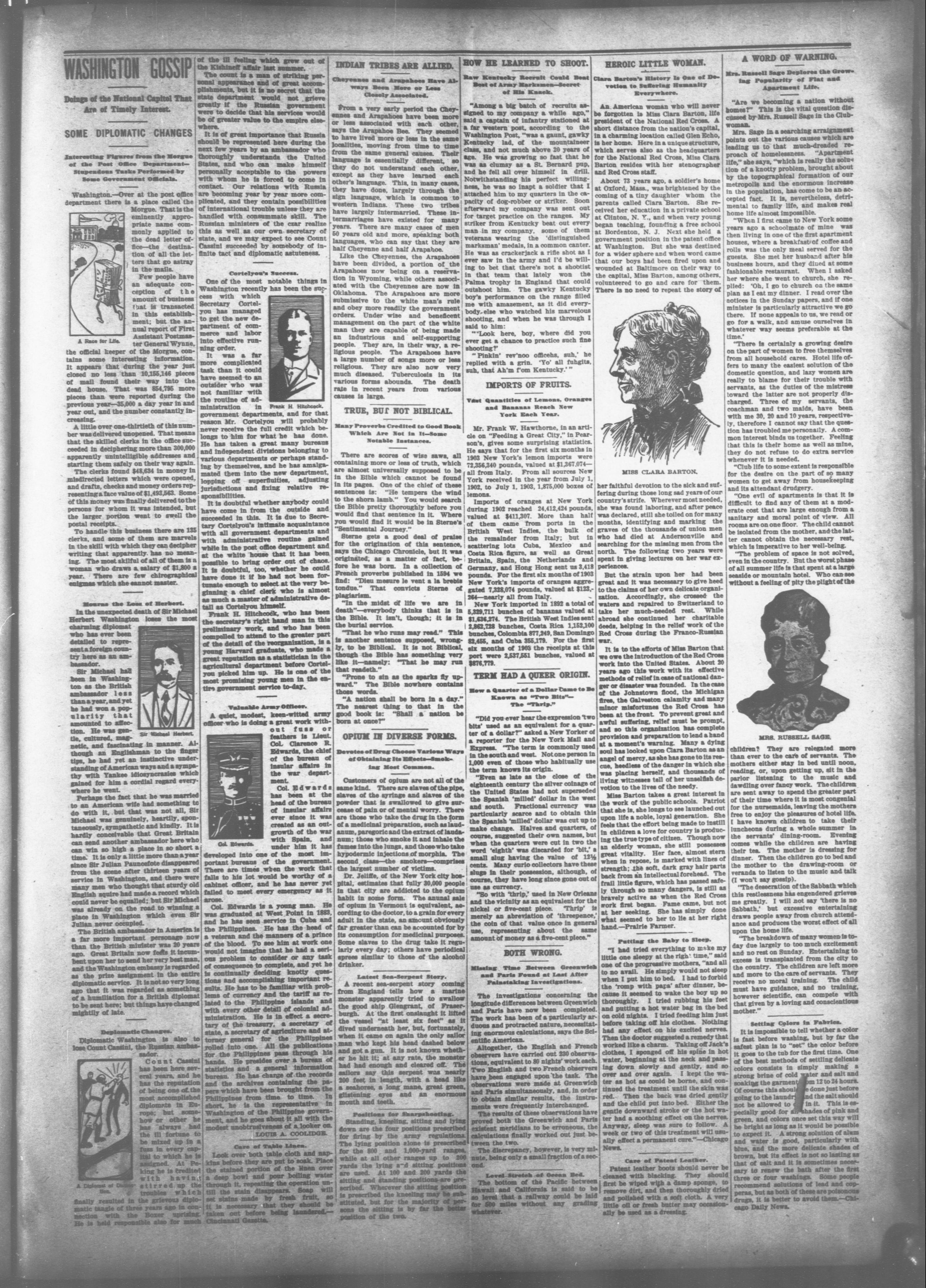
MISS CLARA BARTON.
her faithful devotion to the sick and suffering during those long sad years of our country's strife. Wherever most needed, she was found laboring, and after peace was declared, still she toiled on for many months, identifying and marking the graves of the thousande of union men who had died at Andersonville and searching for the missing men from the north. The following two years were spent in giving lectures on her war experiences.
But the strain upon her had been great and it was necessary to give heed to the claims of her own delicate organization. Accordingly, she crossed the waters and repaired to Switzerland to take her much-needed rest. While abroad she continued her charitable deeds, helping in the relief work of the Red Cross during the Franco-Russian war.
It is to the efforts of Miss Barton that we owe the introduction of the Red Cross work into the United States. About 20 years ago this work with its effective methods of relief in case of national danger or disaster was founded. In the case of the Johnstown flood, the Michigan fires, the Galveston calamity and many minor misfortunes the Red Cross has been at the front. To prevent great and awful suffering, relief must be prompt, and so this organization has complete provision and preparation to lend a hand at a moment's warning. Many a dying soul has looked upon Clara Barton as an angel of mercy, as she has gone to its rescue, heedless of the danger in which she was placing herself, and thousands of living witnesses tell of her unselfish devotion to the lives of the needy.
Miss Barton takes a great interest in the work of the public schools. Patriot that she is, she longs to see launched out upon life a noble, loyal generation. She feels that the effort being made to instill in children a love for country is producing the true type of citizen. Though now an elderly woman, she still possesses great vitality. Her face, almost stern when in repose, is marked with lines of strength; the soft, dark gray hair parts back from an intellectual forehead. The frall little figure, which has passed safely through so many dangers, is still as bravely active as when the Red Cross work first began. Fame came, but not at her seeking. She has simply done what seemed to her to lie at her right hand.—Prairie Farmer.
Putting the Baby to Sleep.
"I had tried everything to make my little one sleepy at the right time," said one of the progressive mothers, "and all to no avail. He simply would not sleep when I put him to bed. I had to forbid the 'romp with papa' after dinner, because it seemed to wake the boy up so thoroughly. I tried rubbing his feet and putting a hot water bag in the bed on cold nights. I tried feeding him just before taking off his clothes. Nothing had any effect on his excited nerves. Then the doctor suggested a remedy that worked like a charm. Taking off Jack's clothes, I sponged off his spine in hot water, beginning at the neck and passing down slowly and gently, and so over and over again. I kept the water as hot as could be borne, and continued the treatment until the skin was red. Then the back was dried gently and the child put into bed. Either the gentle downward stroke or the hot water had a soothing effect on the nerves. Anyway, sleep was sure to follow. A week or two of this treatment will usually effect a permanent cure."—Chicago News.
Care of Patent Leather. Patent leather boots should never be cleaned with blacking. They should first be wiped with a damp sponge, to remove dirt, and then thoroughly dried and polished with a soft cloth. A very little oil or fresh butter may occasionally be used as a dressing.
A WORD OF WARNING.
Mrs. Russell Sage Deplores the Growing Popularity of Flat and Apartment Life.
"Are we becoming a nation without homes?" This is the vital question discussed by Mrs. Russell Sage in the Clubwoman. Mrs. Sage in a searching arraignment points out the various causes which are leading us to that much-dreaded reproach of homelessness. "Apartment life," she says, "which is really the solution of a knotty problem, brought about by the topographical formation of our metropolis and the enormous increase in the population, has come to be an accepted fact. It is, nevertheless, detrimental to family life, and makes real home life almost impossible.
"When I first came to New York some years ago a schoolmate of mine was then living in one of the first apartment houses, where a breakfast of coffee and rolls was the only meal served for the guests. She met her husband after his business hours, and they dined at some fashionable restaurant. When I asked her where she went to church, she replied: 'Oh, I go to church on the same plan as I eat my dinner. I read over the notices in the Sunday papers, and if one minister is particularly attractive we go there. If none appeals to us, we read or go for a walk, and amuse ourselves in whatever way seems preferable at the time.'
"There is certainly a growing desire on the part of women to free themselves from all household cares. Hotel life offers to many the easiest solution of the domestic question, and lazy women are really to blame for their trouble with servants, as the duties of the mistress toward the latter are not properly discharged. Three of my servants, the coachman and two maids, have been with me 30, 20 and 10 years, respectively, therefore I cannot say that the question has troubled me personally. A common interest binds us together. Feeling that this is their home as well as mine, they do not refuse to do extra service whenever it is needed.
"Club life to some extent is responsible for the desire on the part of so many women to get away from housekeeping and its attendant drudgery.
"One evil of apartments is that it is difficult to find any of them at a moderate cost that are large enough from a sanitary and moral point of view. All rooms are on one floor. The child cannot be isolated from the mother, and the latter cannot obtain the necessary rest, which is imperative to her well-being.
"The problem of space is not solved, even in the country. But the worst phase of all summer life is that spent at a large seaside or mountain hotel. Who can see without a feeling of pity the plight of the
```markdown
```
MRS. BUSSELL SAGE
children? They are relegated more than ever to the care of servants. The mothers either stay in bed until noon, reading, or, upon getting up, sit in the parlor listening to the music and dawdling over fancy work. The children are sent away to spend the greater part of their time where it is most congenial for the nursemalds, leaving the mothers free to enjoy the pleasures of hotel life. I have known children to take their luncheons during a whole summer in the servants' dining-room. Evening comes while the children are having their tea. The mother is dressing for dinner. Then the children go to bed and the mother to the drawing-room or veranda to listen to the music and talk (I won't say gossip).
"The desecration of the Sabbath which this restlessness has engendered grieves me greatly. I will not say 'there is no Sabbath,' but excessive entertaining draws people away from church attendance and produces the worst effect of all upon the home life.
"The breakdown of many women is today due largely to too much excitement and no rest on Sunday. Entertaining to excess is transplanted from the city to the country. The children are left more and more to the care of servants. They receive no moral training. The child must have guidance, and no training, however scientific, can compete with that given by a loving and conscientious mother."
It is impossible to tell whether a color is fast before washing, but by far the safest plan is to "set" the color before it goes to the tub for the first time. One of the best methods of settling delicate colors consists in simply making a strong brine of cold water and salt and soaking the garment from 12 to 24 hours. Of course this should be done just before going to the laundry and the salt should not be allowed to dry in it. This is especially good for all shades of pink and green, and colors once set this way will be bright as long as it would be possible to expect it. A strong solution of alum and water is good, particularly with blue, and the more delicate shades of brown, but its effect is not so lasting as that of salt and it is sometimes necessary to renew the bath after the first three or four washings. Some people recommend solutions of lead and copperas, but as both of these are poisonous drugs, it is better to avoid them.—Chicago Daily News.
i et ee
~‘Yeuns of Joliet, Tl, tas become = rea
| OP aiid ‘ea ft The |
- Yate of Marlin, Tex, is meeting wit
"| great ‘success in the practice of bi
_ ‘préfession since removing to this city
- “Se Devil is the black sheep of th
of the church God, with a single
word, could annihilate ‘him, but
careful not to de so.—Voltaire.
Mrs. P. B Kopperl, 4762 Armouw
avenue, is home from a six. Weeks
visit to St. Louis, Mo, and Mrs. Kop
perl lived on the fat of the land while
im the World's Fair City. me
Rev. John W. Robinson, pastor of
St Mark's chureh, 47th and State £¢.,
jeft Thursday“ evening for southern
Indiana and Kentucky where he will
spend his well earned vacatiun.
- Bdward M. Lahiff, City Collector and
Joha-E. Owens, ExCity- Attorney of
“$0 Ireland and the continent, they had
“an enjoyable'time, and many of the
~doath to see them depart for America. _
Mrs. B. W. Fitts, 2803 State street,
renders her husband great assistance
4m his printing business. Mrs. Fitts
an ron a job press much better than
‘™msny men who claim to be printers,
‘end she is 2-level headed business
‘women. “
Justice John Fitzgerald, who Jets no
‘violator of the law escape in the Stock
Yards District, did not take his outing
the past summer, but he has bought 3
Rew suit of under and top clothes, and
‘during the winter months he will go on
@ jaunt to New-Orieans, La.
Mrs. Gannaway, Louisville, Ky., is
stopping at the home of Richard
Moore, 2974 Wabash avenue. Mra.
Ganpaway is « trained nurse. She is
2 friend of Mrs. Robert A. Williams,
3644 Dearborn street, and she comes
to this city highly recommended.
Mr. and Mrs. Claude Alexander, af-
ter bringing reproach upon themselves|
and their friends in a pubiic manner,|
have commenced married life over|'
again. ‘They have gone to house-keep-|
ing at the bome of Mrs. Fietcher,|
5619 Wabash avenue. :
The colored Physicians’ and Sur-|!
geons’ Association of América will!’
hold a meeting.in Nashville, Tenn.,|
beginning November i2th This is|'
expected to be the largest and most |‘
important meeting of colored medical '
men ever held im this country. ;
Mrs. Perry Bates, 6224" Dearborn|’
street, returned home Wednesday from | ‘
Omaha, Neb. and ‘while visiting her|'
meny warm friends in those two wes-| ‘
tern citiés, tally-ho parties and swell! *
receptions wefe:givén i her honor. |*
Jobn Lyons, head bailiff at the Har-}
risqm street police station, has_thous-| }
aniis of friends “among the Afro-Amer-| ©
leans of Chicago, who -would gladly | °
sioner of Cook County in 1904 if the! *
leaders of his party will honor him| #
with the nomination. ~- .
Aldernian James M- Dailey, 4th Ward, | ?
is coming up to the expectations ‘of afl} *
fhose-who “so loyally. supported him|
when hemade the race for the <ity|™
council, and he stands solid with the} ,
voters of his ward, and as a city dady
te stands ‘pat for everything which will
penehit the:city-of Chicago. | g
Ex-Congressman John J. Feely, who
ecupies elegant quarters on the 1/th
loor of the Unity Building, is ‘de-| C
oting all his time to his law busi-j 2
ess, but next spring he will jump into| &
he political arena in the Zist ward| @
ad support Alderman P. J. O'Connell} ©
or the city, and Hon-M. J. Butier for} t
he State Senate. o
Alderman William. J... Moran; igth}
Ward, can hold down his seat in the citw}
ouncil. justas fong as he wants to-for} %
¢ is one. of thé valuable members of| P
hat body, and at all times he is ready | ¥*
nerests.. These are the things which | D
“ irae
| loctie 2 gambling den over City}
SE eens A. Quinn's shat tore,|
ah che ent sity pealer-has again | °°
i dee tine dso eee =
iuaihathchirac ea nti
Pe ee ee ee St aS .
"H.C. Blake, manager for Wm. A.
‘ Kinchborger & Cn. 189 8 Clark street
the only exclusive uncalled tor cloth
“fag house in the city, and the leading
artistic merchant tafiors, always wears
“a pleasant smile on his face-and Mr.
best class of colored people of this
made by Wm. A. Kirchberger & Com-
pany... ~ Dt
Mrs. Priscilla Thomas, Kansas City.
Mo,, has for the past six weeks been
Mr. and Mrs. John Hagans, 6031
Shields avenue, while in this city Mrs.
Thomas was delightfully entertained
by many of the friends of Mr. and
Mrs Hagens. After witnessing the
great parade and the other interesting
sights in connection with the Centen-
nial Jubilee she returned to her home
in Kansas City Monday.
Alderman John J. Bradley, is seeing
to it ‘that the paring of 434 street is
being rushed along, and if nothing
happens it will be completed before
cold weather sets In. Too much
praise cannot be given to Alderman
Bradley for the interest he has mant
fested in. improving and cleaning all
arts Of the 30th ward, and it is a
ifty to-one shot ‘thet ‘he will te re-|
urned to the city council in the spring
e 1904. |
Bonnie Scotch. Tweed Suits to Order
$16." Any Style. 4
WM. A. KIRCHBERGER @ CO,
189 So. Stark St, - — Chicago, ill.
Many men rush to Quinn Chapel to
hear Rev. Archibald James Carey jump
on the gospel with his unsteady feet, be-
cause he never condemns whisky drink-
ing, on the part of bad preachers, and
lots of the sisters who are rather in-
clined to be 2 little wicked with their
hips, flock to Bethel Church to listen to
Rev. Abraham Lincoln Murray butcher
up the gospel and with the hope that
some of them may be struck by his long
Praying lightning rod.
It is reported that Elder or Gol. D.
R. Wilkins, of the Old Church Organ,
and Mrs.-¥F. B. Williams have parted.
company. For a long time Col Wil-
‘wins could be seen almost any day
running { and out the rooms occu
Died by.the United Brotherhood, 3245
State street, and Mrs. Williams wad
always busy in writing effusions for
the Old Church Organ but seemingly
all is changed for it is intimated that
the handsome, sidewhiskered Col. is
almost “ready to reach out after his
late friend, Mrs: Williams, through the
columns of his Old Church Organ.
“St. Mark’s M. HB. Church, 47th and
State street, through. the ‘hard work
of Rev..and- Mrs. John ‘W. Robinson
and niany of its faithful members, is
mortsags, which lung ovér it for 90
long, was burned up in the presence
of its members and friends and there
was great rejoicing among them. Mrs
Robinson raised dhe hundred ahd thir
ty-five ddllars herself towards help-
ing to lift the mortgage, and she was
rewarded for her good work by being
presented with a-small goid watch
which: was offered.as = prise to the
money. + ce
‘All Wool Scotch Suits Tailor Made,
Unealied-for, $8.50. =
WM. A, KIRCHBERGER & CO.,
189. So. Clark St, - Chicago, it
Thomas E_ Barrett, Sheriff of Cook
County, has so far parceled out about
200 good positions to his followers, bu:
Gp to the present time not one of the
«many thousand Afro-American Demo-
crats, Iexve not received a smell of any-
ing.ia the way of a job from the hands
oie Barrett, it is true _ loud-
mouthed West Plummer, is still holding
down his job aroutid the jail for no
other ‘reason than that he is Ex-Judge
Pat. Hanecy’s tool, and worked and
voted dor. Old Dan. Healy on the day of
It seems.that as far as the ‘colored
ee concrened Sheriff Bar-
ret. ‘not —propose to give them -
_ Aldermen Herrmann, Belifuss, Fries-
tedt. Zimmer, Dizon, Jones, Minwegen,
Leachman ami Jorwiskowiski have
been chosen by Mayor Harrison to
ferret out all_the big and little
“Grafters” who, according to his honor
are infesting the City Hali, and if the
rotten oF as Corrupt as he pictures
them” Out to be, then many of thes
will be om their way to the “Pen” ot
tng to navoen” hie ee os
Dloves and “rafters?” Such « state
. mat onthe asian Che Sacouw aiden!
spacer coh ; se pds
on Se abinibes AGRI AR Seed
it Me coe nee
Genuine Home Spun. Suiting te Order,
WM. A. KIRCHBERGER @ £0," >
THN COME:
Sgurre 6-320 REAPER mock
“a Gark sod Washingtoc Ste =
Yetepbous, fain 940, eal
A. D. GASH |
_Altorney at Yaw, _
CESS te Ree otren, Chicago,
Telephone Main 3077,
FREDERICK W. JOB _
id
SRS SS a
Sen Csonan
SS heeecaeamen tt eae th
FEDERICO M. BARRIOS —
Attomey & Counsellor at Law |
Seite 501 Firmentch Bldg.
a ela Chicago.
Willie toward Fitzgerald
LAWYER —
Run G2 Rep baa, - Ga
ee rereee
PHONES { M00. MiSs: 3387
STEPHEN A. BOUGLAS
LAWYER
Suite 200, 128-125 LA Galle Street
CHICAGO |
ee ee
OHN FITZGERALD
wesTICE OF THE PEACE:
78 6. HALSERD PYAR,
— SOAS
-- J. GRAY LUCAS
- - ATTORNEY-AT-Law
Suite 412 Real Estate Board Bidg
€® Dearbern St. Cor. Randelph
CHICAGO.
Phone Randoiph 55 5
‘J. J. HENNESSY,
Justice-ofthe-Peace,
~ * €go1_S.. Halsted St.
WILLIAM TREXLER, CLERK.
Potice Magistrate Englewood Police’
: Court.
: P. ‘J. -O’SHEA | =
ATTORNEY AT LAW
zs Suite 1444 Unity Building ~*
792 Dearborn St: . "Chicago.
Notary Pablic. : . ope Cestral.
- BOWARD G ALEXANDER
ATTORNEY AT LAW.
1p Dearborn Stret, _ CHICAGO.
Robert M. Mitchell
: Attorney at Law — 2
Saite 9, No. 77 South Ciatk So
ee |
WILLIAM RITCHIE
ATTORNEY AND COUNSELOR,
| Baits 528-28 Oxers Babding
casas at. CHICAGO,
| Tatepmone Bicte 16-46. :
aa eee et
# JB. JONES 3
LAWYER Sa
- 79 Clark Street 2g
Room 9 Chica
~ — 7
S. A. McCELWEE
ooLAWYER...
36 5. Clark St, CHICAGO,
-_ Reem 708 Opsen Behan
ALBERT 8. GEORGE
a re
ing Private antésrooms, 3149 Stato
ILLINOIS BRICK CO.
WILLIAM C. KUESTER.
e SUPERINTENDENT.
1994 N. Western Ave., Chicago.
S Telephone Lake View 270.
‘Metabtished 177. «Phone Cak¥and 1590-1557
Joba J. Dunn
weet Woop
Bari WOOD
Phenix Oil & Mineral Co.
OF anizOns
$200,000 CAPITAL
Pays diviaends | per cent. monthly or
12 per cent per ann +m.
Sock now selling at Ic per share,
full paid and nun assessable. For
further particula: a dress
THE OANES HRVESTMENT. COWPANT
61s First Natonal Baok Bidg., Chicago
]
HOHENADEL BROS.
ae. UNIFORI CAPS
"Phone Central 3028,
Peco Massage, Shampo-ing, Scalp Treating
Mrs, Warner
Chiropoarst and Manicuring
Removes -orns Without Pain
Medicated Foot Baths 214 Foot Mastage
136 State St, 4th Floor, Chicago
A. HOFFMAN,
CLEANER, DYER |
AND PRESSER.
Suits Sponged and Pressed sc
s125 State St. Brute
JACOB FEINBERG
Market and Grocery
Telephone 565 South
8ist and State Sts. CHICAGO
= PUBLIC. Office Phone, M, 751
Residence Phone, Blue 428s.
W. G. ANDERSON,
ATTORNEY AT LAW.
J.Q. GRANT& CO.
Collections, Loans and Insurance,
61,119 LASALLE
Residence, 3232 Wabash Avenue,
CHIC.GO.
John J. Bradley
Real Estate, Insurance and Loans
Mwitmian oS
Theodore C. Mayer
JUSTICE OF THE PEACE
Mortgages, Deeds, Notes and Legal Documents Drawn
and Acknowledged. Room 22, 27 North Clark Street.
Wiost Climpe Ao Feaes ¢ Court 427 Barling. Stret
a 8 Mason and
J.M.Higsinbothan =="
Eas
226 East 25th Street - - - CHICAGO
| WONDERFUL
DISCOVERY
: Curly Hair Made Straight By
2
OZONIZED: OX MARROW
oe ot
nee ees
ces
F.W. BOYD —dEAterixn_
“COAL, WOOD AND ICE
MOVING AND EXPRESSIN :
All Orders Prompthy Attouted to | Cash on Delivery
my 4656 Armour Avenue, CHICAGO.
lnk Brewer
: ~ MRS. A. WILSON.
Nicely furnished rooms to reat for
gentlemen. Reasonabie rates, 2252
Indiana aveune.
Mrs. Anna L. Newby.
_ itst class furnished rooms, for rent
to ‘gentleman anf ladies, with bath
and gas. 2623 Wabash avenue.
- American Brick Co. -
"Prien end Dreamer, THOMAS CAREY.
| Secretary, WILLIAM SULLIVAN.
: mOneracroerst OF
Gommonr and Sewer Brick
. ee Office and Yards:
45th and Robey Sts.
MRS. T.P. HILL.
_ Richly furnished rooms to rent to
married couples and single gentlemen ;
gs, bath, and steam heat; 30:7 and
3126 Wabash avenue.
Rooms for Rent.
with bath and. gas at 3232 Wabash