The Broad Ax
Saturday, October 24, 1903
Chicago, Illinois
Page text (machine-generated)
The Religions or the Teachings of JESUS AND MAHOMET Compared.
Vol. VIII.
The Relig
the Tea
JESUS AND
Comp
It has been asserted and maintained by the adherents, the devotes, and the followers of the meek and lowly Jesus, that he never uttered or gave expression to one word or sentiment which was intended to wound the feelings of those whom he came in contact with. That he entertained the greatest respect for the religious opinions of others, "but as we proceed, we will endeavor to prove beyond the peradventure of a doubt that such was not the case and that Jesus was swayed and controlled by the same passions and prejudices which have always controlled the actions of those who have endeavored to establish a new system of religion or to reform the system which had become implanted in the minds of the people.
Jesus was not unlike the other Jewish Prophets, for he and they were most extraordinary beings. They would speak like angles, but acted entirely different. For instance Isaiah walked in a nude condition through the streets of his village. Jeremiah and Hosea conducted themselves like wild beasts and they were very much depraved in their moral habits, but they pronounced curses upon all who dared to dispute their authority.
As Jesus progressed in his work or mission he did not differ in temperment or in character from those we have referred to. He preached as they did. He poured forth invectives against the rulers and the rich as they did. He believed in all the current fancies respecting the approaching destruction of the world. The conquest of the evil spirit or power or the reign of his God, the same as the Prophets of old. He was carried away with these ideas and labored under the impression that he was the only true son of God, who would be sent to prepare this world for his kingdom, that he would be appointed for the special purpose of judging the souls of men and to reign over them on earth.
These ideas followed him to his grave. It was his belief that God reigned in heaven and Satan ruled on earth. He pronounced eternal punishment on all who refused to join him and upon those who accomplished anything to merit the esteem of their fellowmen. He did not hesitate in consigning them to hell-fire. Said he: "He that believeth and is baptized shall be saved, and he that believeth not shall be "damned." He pronounced his condemnation upon a 4g tree because it bore no fruit although it was out of season for fruit. He retorted to those who accused him of breaking the Sabbath that he was above the Sabbath. He was extremely ungallant to his mother. On one occasion when she approached him he exclaimed, "Woman what have I to do with thee!"
It is an undisputable fact, that he completely failed in making any impression upon the people of Jerusalem and he abused his successful rivals, the Pharisees. He called the learned doctors a generation of vipers, whited sepulchers and serpents, he declared that they should not escape the torments of hell, because they would not accept his teachings. He informed his disciples that whoever spoke against the Holy Ghost it would not be forgiven him, either in this world or in the world to come. He taught his devotes or followers that they must forsake their fathers, mothers, wives, sisters, and brethren and trample all family ties under foot if they desired to march under his banner, or if they wished to inherit a
---
seat in his kingdom, for according to his teachings, very narrow and crooked is the road which leads to heaven, but broad and very smooth is the road which leads to damnation or destruction. His religion or the religion of the cross is unlike the religion of Mahomet, for wherever the latter prevails, drunkenness, licentiousness and all forms of vice disappear, but wherever the religion of the former prevails there licentiousness, drunkenness, slavery, dishonesty and vice of every kind has always flourished.
Mahomet, who was as modest as a beautiful maiden, was a poor boy and a mule driver, but today many hundred million people believe in his teachings for he rendered greater service to mankind than any other religious teacher. Mahomet taught that "God had no daughters, for how can God have daughters when he has no spouse?" But the adherents of Jesus teach us that their God traveled millions and millions of miles from his abode in the unknown world to this earth, in order to form the acquaintance of Mary, the wife of Joseph, who gave birth to two or three other children after she brought forth Jesus.
Mahomet never frequented the wine shop, neither did he taste wine or whisky, nor look at the dancing girls. He was very kind to little children. He visited the sick, the poor or the needy, and was very humble. He admonished his followers to administer to the widows and the orphans—to show mercy to dumb animals, to have no depraved thoughts, to abstain from the use of wine or whisky and to refrain from gambling. He exclaimed that "when a man dies people will ask how much property has he left behind?" But the angels in heaven will ask what good deeds has he sent before him? He never struck any one in his life, and he was opposed to the enslavement of his fellowmen, when he was asked to curse some one he said, "I have not been sent to curse but to show mercy to mankind." He always waited on himself, mending his own clothes and milking his own goats. But Jesus had women to wash his feet and turned water into wine so that his followers might eat, drink and be merry.
He proclaimed that the "Gods will not reward those who do good from the fear of being deprived of sharing in the glory of the next world." This great teacher impressed the idea upon the minds of his hearers that "the Ghosts or the souls of men will not be condemned to eternal misery nor exalted to everlasting bliss, but as the tree falls, so shall it lie."
That man was not sent upon this earth to trample all of its beauty and grandeur under his feet while vainly striving to save his undefineable little soul, so that he can migrate with it to some unknown world located somewhere in space billions and billions of miles beyond the starry firmament, but it is his true mission to subdue it—to cultivate or prepare it as a fit habitation for all the sons of men.
Therefore we must conclude that Mahomet possessed more rational or practical ideas pertaining to religion than Jesus, for he enjoined upon his followers that they must sever all their family ties and give up everything which is dear to them in order to follow him, and if they fall to do so they will be punished or tortured throughout eternity.
---
HEW TO THE LINE.
[Name]
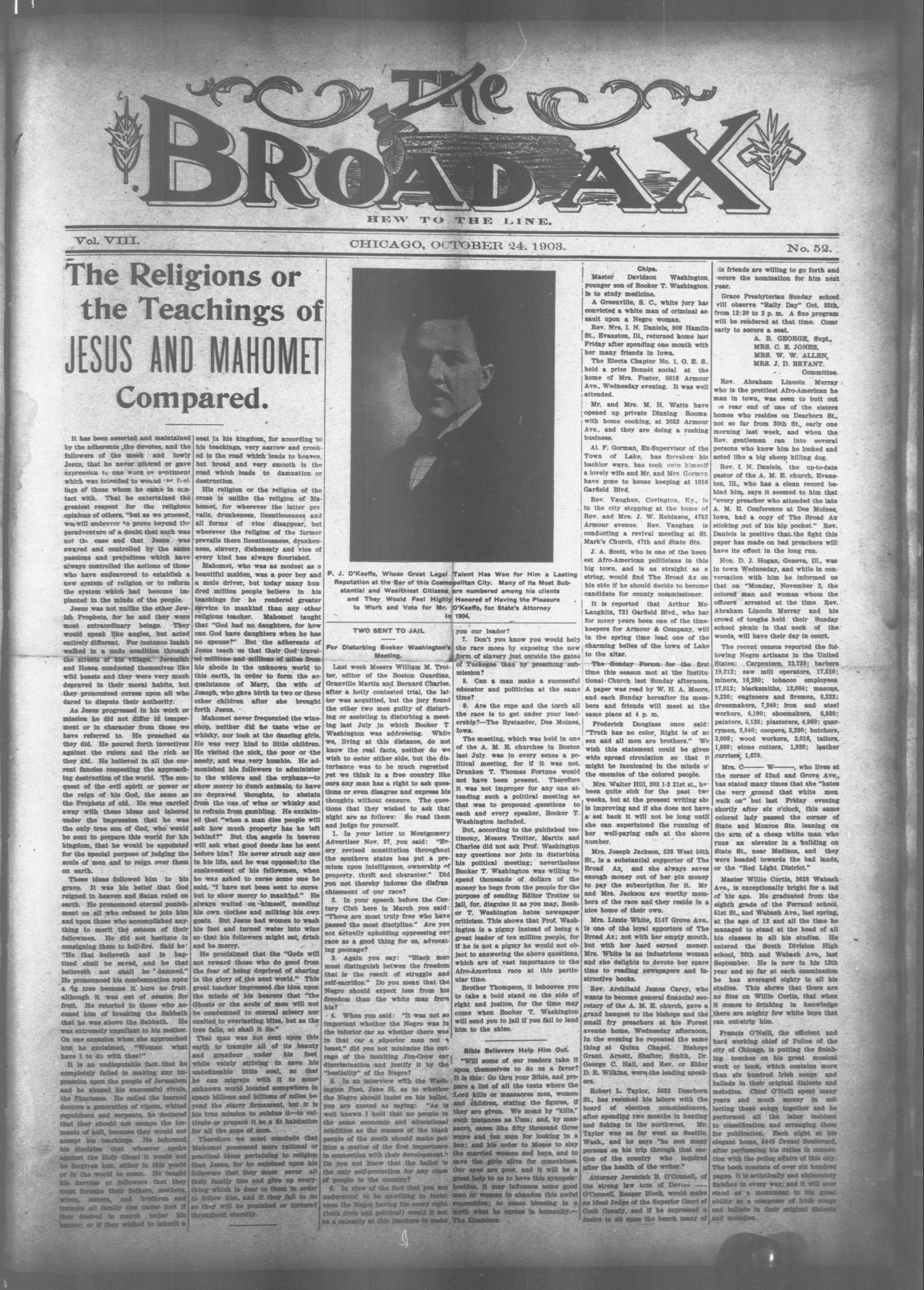
P. J. O'Keeffe, Whose Great Legal Talent Has Won for Him a Lasting Reputation at the Bar of this Cosmopolitan City. Many of its Most Substantial and Wealthiest Citizens, are numbered among his clients and They Would Feel Highly Honored of Having the Pleasure to Work and Vote for Mr. O'Keeffe, for State's Attorney
Last week Messrs William M. Trotter, editor of the Boston Guardian, Granville Martin and Bernard Charles, after a hotly contested trial, the latter was acquitted, but the jury found the other two men guilty of disturbing or assisting in disturbing a meeting last July in which Booker T. Washington was addressing. While we, living at this distance, do not know the real facts, neither do we wish to enter either side, but the disturbance was to be much regretted yet we think in a free country like ours any man has a right to ask questions or even disagree and express his thoughts without censure. The questions that they wished to ask that night are as follows: So read them and judge for yourself.
1. In your letter to Montgomery Advertiser Nov. 27, you said: "Every revised constitution throughout the southern states has put a premium upon intelligence, ownership of property, thrift and character." Did you not thereby indorse the disfranchisement of our race?
2. In your speech before the Century Club here in March you said: "Those are most truly free who have passed the most discipline." Are you not actually upholding oppressing our race as a good thing for us, advocating peonage?
3. Again you say: "Black men must distinguish between the freedom that is the result of struggle and self-sacrifice." Do you mean that the Negro should expect less from his freedom than the white man from his?
4. When you said: "It was not so important whether the Negro was in the inferior car as whether there was in that car a superior man not a beast," did you not minimize the outrage of the insulting Jim-Crow car discrimination and justify it by the "bestiality" of the Negro?
5. In an interview with the Washington Post, June 25, as to whether the Negro should insist on his ballot, you are quoted as saying: "As is well known I hold that no people in the same economic and educational condition as the masses of the black people of the south should make politics a matter of the first importance in connection with their development." Do you not know that the ballot is the only self-protection for any class of people in the country?
But, according to the published testimony, Messrs Trotter, Martin and Charles did not ask Prof. Washington any questions nor join in disturbing his political meeting; nevertheless Booker T. Washington was willing to spend thousands of dollars of the money he begs from the people for the purpose of sending Editor Trotter to jail, for, disguise it as you may, Booker T. Washington hates newspaper criticism. This shows that Prof. Washington is a piggy instead of being a great leader of ten million people, for if he is not a piggy he would not object to answering the above questions, which are of vast importance to the Afro-American race at this particular time.
Brother Thompson, it behooves you to take a bold stand on the side of right and justice, for the time may come when Booker T. Washington will send you to jail if you fail to laud him to the skies.
Bible Bellevers Help Him Out. "Will some of our readers take it upon themselves to do us a favor? It is this: Go thru your Bible, and prepare a list of all the texts where the Lord kills or massacres men, women and children, stating the figures, if they are given. We mean by "kills," such instances as Uzza; and, by massacre, cases like fifty thousand three score and ten men for looking in a box; and his order to Moses to slay the married women and boys, and to save the girls alive for concubines. Our eyes are poor, and it will be a great help to us to have this synopsis besides, it may influence some good man or woman to abandon this awful supersition; to cease blessing in a myth what he curses in humanity. The Examiner.
---
A Greenville, S. C., white jury has convicted a white man of criminal assault upon a Negro woman.
Rev. Mrs. I. N. Daniels, 909 Hamlin St., Evanston, Ill., returned home last Friday after spending one month with her many friends in Iowa.
The Electa Chapter No. 1. O. E. S.. held a prize Bonnêt social at the home of Mrs. Foster, 5018 Armour Ave., Wednesday evening. It was well attended.
Mr. and Mrs. M. H. Watts have opened up private Dinning Rooms. with home cooking, at 2032 Armour Ave., and they are doing a rushing business.
Al. F. Gorman, Ex-Supervisor of the Town of Lake, has forsaken his bachlor ways, has took unto himself a lovely wife and Mr. and Mrs. Gorman have gone to house keeping at 1016 Garfield Blvd. Rev. Vaughan, Covington, Ky., is in the city stopping at the home of Rev. and Mrs. J. W. Robinson, 4752 Armour avenue. Rev. Vaughan is conducting a revival meeting at St. Mark's Church, 47th and State Sts.
J. A. Scott, who is one of the keenest Afro-American politicians in this big town, and is as straight as a string, would find The Broad Ax on his side if he should decide to become candidate for county commissioner. It is reported that Arthur McLaughlin, 731 Garfield Blvd., who has for many years been one of the timekeepers for Armour & Company, will in the spring time lead one of the charming belles of the town of Lake to the altar.
The Sunday Forum for the first time this season met at the Institutional Church last Sunday afternoon. A paper was read by W. H. A. Moore, and each Sunday hereafter its members and friends will meet at the same place at 4 p. m.
Frederick Douglass once said: "Truth has no color, Right is of no sex and all men are brothers." We wish this statement could be given wide spread circulation so that it might be inculcated in the minds of the enemies of the colored people.
Mrs. Walter Hill, 203 1-2 21st st., have been quite sick for the past two weeks, but at the present writing she is improving and if she does not have a set back it will not be long until she can superintend the running of her well-paying cafe at the above number.
Mrs. Joseph Jackson, 528 West 56th St., is a substantial supporter of The Broad Ax, and she always saves enough money out of her pin money to pay the subscription for it. Mr and Mrs. Jackson are worthy members of the race and they reside in a nice home of their own.
Mrs. Lizzie White, 5147 Grove Ave.. is one of the loyal spporters of The Broad Ax; not with her empty mouth, but with her hard earned money. Mrs. White is an industrious woman and she delights to devote her spare time to reading newspapers and instructive books.
Rev. Archibald James Carey, who wants to become general financial secretary of the A. M. E. church, gave a grand banquet to the bishops and the small fry preachers at his Forest avenue home, Wednesday afternoon. In the evening he repeated the same thing at Quinn Chapel. Bishops Grant. Arnett, Shafter, Smith, Dr. George C. Hall, and Rev. or Elder D. R. Wilkins, were the leading speakers.
Robert L. Taylor, 3632 Dearborn St., has resumed his labors with the board of election commissioners, after spending two months in hunting and fishing in the northwest. Mr. Taylor was as far west as Seattle, Wash., and he says "he met many persons on his trip through that section of the country who inquired after the health of the writer."
Attorney Jeremiah B. O'Connell, of the strong law arm of Devine .... O'Connell, Reaper Block, would make an ideal Judge of the Superior Court of Cook County, and if he expressed a desire to sit upon the bench many of
No.52.
his friends are willing to go forth and secure the nomination for him next year.
Grace Presbyterian Sunday school will observe "Rally Day" Oct. 25th, from 12:30 to 2 p. m. A fine program will be rendered at that time. Come early to secure a seat.
A. B. GEORGE, Supt.,
MRS. C. E. JONES,
MRS. W. W. ALLEN,
MRS. J. D. BRYANT.
Rev. Abraham Lincoln Murray who is the prettiest Afro-American he man in town, was seen to butt out rear end of one of the sisters homes who resides on Dearborn St., not so far from 30th St., early one morning last week, and when the Rev. gentleman ran into several persons who knew him he looked and acted like a big sheep killing dog.
Rev. I. N. Daniels, the up-to-date pastor of the A. M. E. church, Evanson, Ill., who has a clean record behind him, says it seemed to him that "every preacher who attended the late A. M. E. Conference at Des Moines, Iowa, had a copy of The Broad Ax sticking out of his hip pocket." Rev. Daniels is positive that the fight this paper has made on bad preachers will have its effect in the long run.
Hon. D. J. Hogan, Geneva, Ill., was in town Wednesday, and while in conversation with him he informed us that on "Monday, November 2, the colored man and woman whom the officers arrested at the time Rev. Abraham Lincoln Murray and his crowd of toughs held their Sunday school picnic in that neck of the woods, will have their day in court.
The recent census reported the following Negro artisans in the United States: Carpenters, 22,739; barbers 19,212; saw mill operators, 17,510; miners, 16,280; tobacco employees, 17,012; blacksmiths, 12,004; masons, 9,220; engineers and firemen, 8,322; dressmakers, 7,240; iron and steel workers, 6,190; shoemakers, 6,930; painters, 5,128; plasterers, 4,960; quarrymen, 3,840; coopers, 3,290; butchers, 3,008; wood workers, 2,016, tailors, 1,880; stone cutters, 1,920; leather curriers, 1,670.
Mrs. C—— W——, who lives at the corner of 52nd and Grove Ave., has stated many times that she "hates the very ground that white men walk on" but last Friday evening shortly after six o'clock, this same colored lady passed the corner of State and Monroe Sts. leaning on the arm of a cheap white man who runs an elevator in a building on State St., near Madison, and they were headed towards the bad lands, or the "Red Light District."
Master Willie Curtis, 2628 Wabash Ave., is exceptionally bright for a lad of his age. He graduated from the eighth grade of the Ferrand school, 51st St., and Wabash Ave., last spring, at the age of 12 and all the time he managed to stand at the head of all his classes in all his studies. He entered the South Division High school, 26th and Wabash Ave., last September. He is now in his 13th year and so far at each examination he has averaged eighty in all his studies. This shows that there are no flies on Willie Curtis, that when it comes to drinking in knowledge there are mighty few white boys that can out-strip him.
Francis O'Neill, the efficient and hard working chief of Police of the city of Chicago, is putting the finishing touches on his great musical work or book, which contains more than six hundred Irish songs and ballads in their original dialects and melodies. Chief O'Neill spent many years and much money in collecting these songs together and he performed all the labor incident to classification and arranging them for publication. Each night at his elegant home, 5448 Drexel Boulevard, after performing his duties in connection with the police affairs of this city. The book consists of over six hundred pages. It is artistically and elaborately finished in every way, and it will ever stand as a monument to his great ability as a composer of Irish songs and ballads in their original dialects and melodies.
THE BROAD AX.
Will promulgate and as all times uphold the true principle of Democracy, but Catholicism, Protestantism, Pristina, Indelida, Farmers, Stingle Taxes, Republicans, Knights of Labor, or any one else can have their say, so long as their language is proper and responsibility is fixed.
The Broad Ax is a newspaper whose platform is broad enough for all, ever claiming the editorial right to speak its own mind.
Local communications will receive attention. Write only on one side of the paper.
Advertising rates made known on application. Address all communications to
JULIUS F. TAYLOR, Editor and Publisher.
Entered at the Post Office at Chicago, Ill., as Second-class Matter.
A Change for the Better.
"Farewell, them," he cried, melodramatically, "you will regret your refusal of my proffered love. I shall take to drink, and then—suicide!"
"Oh, don't say that!" the fair girl pleaded.
"I am resolved," he said. "I shall not chance my plans unless—"
"Oh, change them just a little. I should hate to think I drove you to drink; try suicide first."—Philadelphia Ledger.
First Tramp—Weary Willie stole an auto an' run over a man an' killed him!
Second Tramp—Wot did dey do to Weary?
First Tramp—Fined him ten dollars for killin' de man an' give him ten years for stealin' de auto.—Judge.
A Hunting Expedition.
Although he got no game at all,
He felt quite lucky in the end.
By no stray bullet did he fall,
Nor did he shoot some trusting friend.
—Washington Star.
Mr. Farwest—There was a feller the board of trade last night with the durndest ideas anybody ever heard of.
Wife—What was the meeting about?
"To devise ways an' means to boom the town."
"Well, what did the stranger propose?"
"The foolishest thing! You'd never guess. He got up and said, says he: 'The best way to boom a town,' says he, 'is to make it fit to live in.'"—N. Y. Weekly.
"This," smiled the fond young wife as she passed a plate of dessert to her husband, "is cottage pudding. I made it myself."
The man tasted of it.
"I'd known it was cottage pudding," he asserted.
"You would?" she asked, delighted.
"Yes. I can taste the plaster and the wall paper. What did you do with the shingles and the bricks for the chimney?"
—Judge.
"Z. O. U."
"L. O. U."
Y is it some folks want to c
If it b that you know them?
They l u almost constantly
If you should chance to o them.
Judge
Prof. Broadhead—The faculty of earning your bread by the sweat of other people's brows, my son.—Puck.
A Good Character.
The Ladies—What sort of a person is Mrs. Newcome, Mr. Hopper?
The General Dealer—She's a perfect lady—doesn't know one brand o' goods from another—Judge.
Described.
"What sort of a woman is she?"
"Well, every time I see her I feel like congratulating the man whose proposal of marriage is rejected."—N. Y. Times.
A Reasonable Deduction.
"If honesty is the best policy—"
"Well?"
"Why, then, most politicians ain't politic."—Chicago Post.
Differenf Opinions.
"So young Robinson wants to marry you, eh? Such impudence!"
"Why, papa! I think he shows very good taste."—Chicago American.
An Exception.
Gladys—That Mrs. Talkmuch always gets in the last word.
Elsie—Except when she's talking to another woman.—Brooklyn Life.
Optical Illusion.
A malfun got a speck in her eye,
And at once proceeded to creeye.
"Dear," said Jack, "I've to doubt
I can kiss the thing oubt."
"All right," sobbed the malfun.
All right," sobbed the maid. "You may
treye!"
—Chicago Tribune.
Possibly You Have.
"Have you ever noticed," inquired the
thoughtful theorist, "that the rich man
who says there's no happiness in wealth
never seems to be disposed to change
places with his poor neighbor?"—Brooklyn Eagle.
"Yes. I went out to the track one day with $10 that I intended to bet and didn't."—Chicago Record-Herald.
Proved Again.
Jack—The chump! He has sent her flowers. But I will have revenge. I'll send her candy.
Tom—Ah, then, the revenge is sweet.—Chicago Daily News.
All There Is.
"What is a bride?" asked the teacher.
"A bride," answered the boy, whose sister had been married a short time before, "is the whole thing on her wedding day."—Chicago Post.
```markdown
```
WOMEN LAWYERS IN FRANCE.
Since the Paris bar has been open to women, not a few members of the fair sex have taken advantage of the new privilege accorded to them to plead at the Palais de Justice, says an exchange.
The pioneer in this direction was Mile. Chauvin, whose debut as "advocate" excited a great deal of attention, and whose presence in the cap and gown made a great sensation at the palais. Her debut, moreover, had the effect of setting the fashion among Parisiennes of wearing the white cravat of the French lawyers. Since Mile. Chauvin's debut in 1839 curiosity has died out to a great extent, and no bad effects of the law have been noticed. It is even possible that, if the good results could have been anticipated, the law would have passed the chambers by a unanimous vote, instead of by 319 to 174. As a rule, women lawyers have had men as their opponents at the bar, and one could imagine himself in a sort of judicial salon, if compliments and gallant speeches were the criterion.
But the other day two women lawyers found themselves antagonists in a case. It was funny to see the embarrassment of the judges, for each lawyer did her best to captivate the bench. Unhappily the bench could not get out of the scrape by awarding the victory to both sides, so the chivalrous judges took refuge under a well-known formula and reserved their decision for a fortnight.
SCOTLAND'S GREAT CANAL
Undertaking Will Save Hundreds of Miles and Cost $50,000,000-Big Engineering Font.
As was recently stated in a cable dispatch, the plans for the construction of a ship canal between the Firth of Forth, on the east of Scotland, across to the River Clyde, on the west, have been definitely arranged. The canal will cost $50,000,000, but powerful support is expected from the British government. One of the great engineering features of the scheme will be the carrying of the canal near the Loch Lomond end. Frequent passing places will be made.
An indication of the saving in distance that would be effected by the canal, says an exchange, will be gained from the following figures: From the Clyde to ports on the east coast of Scotland, northeast of England, and northwest of Europe the distance saved would be from 529 miles to 238 miles. From the Firth of Forth to ports on the west coast of Scotland, northwest of England, Ireland, America and the Mediterranean the distance saved would be from 487 to 141 miles. From Tyne ports to the St. Lawrence river the distance saved would be 150 miles. From the west of Britain and northeast of Ireland to middle western ports of the continent the distance saved would be from 377 to 98 miles.
RECORD-BREAKING RUN.
Engineer Was Offered Fifty Dollars a Minute for Every Minute Gained Over the Schedule.
There is a little story connected with the record-breaking run of the Lowe special over the Santa Fe, Chicago to Los Angeles, in less than 53 hours, which is not generally known.
It is related that Mr. Lowe offered the engineer who hauled the train from San Bernardino to Los Angeles—on the home-stretch of 60 miles—the sum of $50 a minute for every minute gained over the schedule. Engineer Warboy turned the wheels at a 50-second clip for each mile to Pasadena, but had to slow down in the suburbs of Los Angeles. He pulled into La Grande station, Los Angeles, just 62 minutes after leaving San Bernardino, gaining nine minutes on the whirlwind schedule and thereby earning $450 extra pin money.
The Santa Fe passenger department will soon publish a pamphlet giving full details of the swift flight of the Lowe special, which in several instances exceeded 90 miles an hour. An average of nearly 43 miles an hour was maintained, in the face of having to cross four high ranges of the Rockies, and with little previous selection of engines or crews.
MENACE OF THE FOREST.
Continent Will Dry Up If Present Destructive Processes Continue Experience of Old World.
The climatic history of the old world will repeat itself in America, says the National Magazine. If forest destruction, at its present rate of recklessness, should continue much longer, our continent will have to dry up. So will an orator who should venture to urge that fact upon a boodle legislature, in this era of lumber trusts. But the fact remains, and its significance may be inferred from the experience of the Mediterranean coast lands, where thousands of god gardens have been turned into Gehennas of wretchedness and desolation. By tree destruction alone a territory of 4,500,000 square miles has been withdrawn from the habitable area of our planet. The physical history of the eastern hemisphere is the history of a desert that originated somewhere near the cradle of the Caucasian race—in Bactria, perhaps, and, spreading westward and southward, has blighted the Edens of three continents like a devouring reef and is now scorching the west coast of Africa and sending its warning sand clouds far out to seaward.
The price of sugar in France has recently been reduced by less than half, and the consumption has been nearly doubled. Formerly sugar was a luxury which rarely reached the homes of many workingmen, but now its use is much more common.
A Changed Man. Caller—Since your husband began taking that anti-fat medicine he has changed wonderfully. He doesn't look like the same man. Hostess—He isn't—by 97 pounds. Chicago Tribune.
The Count—What think of ze proposition to tax bachelors?
The Baron—It do not interest me, my friend. But I think it would be a very good thing to tax ze unmarried heiresses!—Puck.
Not Very Complimentary.
"It's only a week since I met you, Miss Mabel, yet I feel as if I'd known you for years and years and years."
"Well, you needin' pile the years on so thick. I'm only 19."—Chicago Amer lean.
A
Alderman Wm. H. Ehemann, of the 24th ward, who was united in marriage to Miss Mamie Christ, by Rev. George Thomas, of St. Alphonsus church, Lincoln and Southport avenues, Thursday afternoon. The Alderman—his lovely, popular and wealthy bride, will be kept busy for the next month in receiving the congratulations of their numerous friends.
Rather.
"Do you believe in luck, Mr. Pimpleton?"
"Don't make me smile! You see Mrs. Crushley over yonder?"
"Do you mean that fat, red-faced, husky-voiced, vulgar, over-bearing woman in blue and yellow, drinking bottled stout at the refreshment bar?"
"The same, sir. Well, 20 years ago I asked that woman to be my wife—and she refused! Do I believe in luck, indeed! Do I believe in daylight!"—Ally Sloper.
"Yes," mused the person who lets out an occasional audible thought, "he certainly makes hay while the sun shines."
"What haymaker do you refer to?" asked his friend, who was afflicted with the rubber habit.
"Why, the man who marries a grass widow," replied he of the clamorous thoughts.—Cincinnati Enquirer.
Yea, Verily.
The biggest men and biggest fruit Are always found on top.
His Chance.
"Before marriage," asserted the soft-spoken, epigrammatic lecturer, "woman is an ideal; after marriage she is a fact."
At this point there was an interruption by Henry Penhecker, who had been compelled to attend the lecture in company with his intellectual wife. Mr. Penhecker, realizing that he was safe in a crowd, jumped to his feet and cried:
"And facts are stubborn things!"—Judge.
The All Powerful Hat
"Now, my dear," said the indulgent husband, "I have managed to save up enough money to justify us in building a new home. But, first, I am going to give you a choice between that and the new fall hat you so much desire."
"Well," said the beautiful wife, "you know I can't wear the house on my head."—Millinery Trade Review.
Cholly—I wonder if I have any show of winning Miss Roxie Uppisch?
Miss Peppery—From a remark I heard her make I think you're her choice.
Cholly—Ah! my gwacious! What did she say?
Miss Pepprey—She said nobody was good enough to be her husband.—Philadelphia Press.
What Would Happen.
"What would happen to-day," said the thoughtful citizen, "if Diogenes were to go through one of our great cities with a lantern looking for an honest man?"
"That's easy," answered the Chicago man. "Some one would steal his lantern before he had gone three blocks." —Washington Star.
As the World Does.
Mrs. Bender—John, you are too much of a rounder for a married man.
Mr. Bender—Martha, didn't you say I was all the world to you?
Mrs. Bender—Yes.
Mr. Behder—Well, then, if I'm all the world you mustn't object to my going around.—Chicago Daily News.
Pretty Near It.
"Ah!" sighed Miss Antique, with a languishing glance in the direction of Mr. Oldboy, "if I had been born in the days of chivalry!"
"Well," he said, as he scratched the bald spot on the top of his head, "you came pretty near it."—Tit-Bits.
"But yonder figure in dimity, surely it is no lie."
"That must be what is called a white lie"—Detroit Free Press.
Ever Notice It?
Love is blind, do we are told,
Yet we know, 'tis true.
Love can see on one small chair
Sufficient room for two.
—Cincinnati Enquirer.
THE LAW LAID DOWN.
Notice of dishonor of a promissory note is held in Oakley vs. Carr (Neb.), 60 L. R. A. 431, to be sufficient if sent to the last indorser by the first mail of the day following dishonor, even though such indorser is an agent for collection merely. Since the national bankruptcy law contains no provisions for involuntary proceedings against persons it engaged chiefly in the tillage of the soil, it is held, in Old Town bank vs. McCormick (Md.), 60 L. R. A. 577, that it does not supersede the provision of the state law authorizing such proceedings.
The mere separation of jurors impaneled to try a capital case from their fellows without the attendance of an officer, although an irregularity, is held, in Gamble vs. State (Fla.), 60 L. R. A. 547, not to be a sufficient cause for setting aside the verdict if the court is satisfied that the prisoner has not sustained any injury from such separation.
The attempt of a street railway company to operate its cars during a strike of its employees is held, in Fewings vs. Mendenhall (Minn.), 60 L. R. A. 601, not to be negligence so as to make it liable for an injury to a passenger struck by a stone thrown from the street into a car by a strike sympathizer in no way under the control or direction of the company.
The right to the custody and to decide upon the place of burial of the body of a deceased unmarried person is held, in McEntee vs. Bonacum (Neb.), 60 L. R. A. 440, to reside ordinarily in his next of kin; and it is held that the courts will not treat this right as having been waived or relinquished except upon clear and satisfactory evidence of conduct indicative of a free and voluntary intent and purpose to that end.
BREVITIES OF SCIENCE
It is reported that a hot spring has been struck in the workings of the Simplon tunnel, and the increased heat is unbearable. About two miles remains to be bored. A small specimen of radium was recently put on exhibition at the American Museum of Natural history, and has attracted wide attention. The specimen weighs about two grains, and was shown in the gem room on the fourth floor of the building. The two grains cost about $300.
Dr. Frank Snow, with a small party of Kansas university students, has been bug-catching in southwest Arizona. They brought back 15,000 specimens, all pinned and labeled, of which some 100 are new to science. Of these 5,430 are bettles, 4,500 are flies, 1,926 are butterflies and moths, and the rest run the list of bees, wasps, bugs and insects. The butterflies and moths were collected at night by spreading on a tree near the camp a mixture of beer and molasses.
Henri Moissan has succeeded in reducing tantalum acid in the electric furnace with powdered carbon and has obtained tantalum in a fused state. Hitherto the metal had been known only as a more or less pure powder with a density of 10.50. The electrical product has a brilliant metallic appearance, and a density of 12.79. It is very hard, easily scratching glass and quartz, has a crystalline fracture, and is unfusible in the oxyhydrogen blowpipe. Certain reactions class it with the metalloids rather than with the metals proper.
ON VARIOUS SUBJECTS.
Eucalyptus gum is the agent in a new quick-tanning process, said to be a great success, in Victoria, Australia. It increases the rapidity of the work by 40 per cent. A Pittsburg man whose old home had to be moved to make way for a railroad line, has undertaken the unusual task of raising the house bodily to the top of a steep hill, 150 high.
Three summer homes for working girls are conducted by Miss Emily M. Morgan, the author and philanthropist. Two of these are in Connecticut; the third, at Blandford, Mass., in an old farmhouse, which accommodates 20 young women, the charges being but two dollars a weak.
A cowboy for 12 years, head of a big rice plantation for three years, and at the age of 30 elected president of a railway corporation representing a capital of $8,000,000 and 200 miles of track, is the record of Ross L. Clark, recently elected president of the Rice Belt Railway company, of Texas, giving him the distinguished honor of being the youngest chief executive of a railway in the United States. Though but 30 years of age, and starting with but few advantages, Clark has forged to the front until he now represents a rice growing company with 5,000 acres under cultivation.
ALL SORTS.
Japan's army in time of peace includes 8,135 officers and 84,241 privates.
In several Russian trains second-class sleeping carriages are now provided.
A notable result of the recent census of church attendance in London is the discovery that prayer meetings, which were once regarded as the vital breath of the life of the church, have almost ceased to exist.
There are three waters in the state of Indiana which actually impart magnetic powers to needles, knife blades and the like. Any considerable quantity of one of these waters will deflect the needle of the compass.
But 8.3 per cent. of the German born males in the United States have failed to become naturalized, while 13 per cent. of the English, 35 per cent. of the Russians, 53 per cent. of the Italians, and 80 per cent. of the Japanese are still allens.
In the opinion of the editor of a paper printed in British India, "American womanhood is admittedly the finest, the best, physically and intellectually, of all the womanhood of the world. An ideal American woman is the ideal of the world's womanhood."
"Yes," he said, "it will rain next Thursday evening."
"Do you set yourself up as an infallible weather prophet?" some one asked.
"Certainly not," he replied.
"Yet you speak confidently of what the weather will be four or five days from now."
"Oh, well, there are some signs that never fall, and my wife has planned a garden party for that evening."—Chicago Post.
Friend—Why do you kill off so many people in every act?
Dramatist—The company is small, and that is the only way I can work in all the characters.—N. Y. Weekly.
Mrs. Styles—No; she doesn't even answer the bell half the time.—Yonkers Statesman.
Stays There.
Stella—Did he get down on his knees when he proposed?
Bella—Yes; but papa won't set him on his feet.—Puck.
"Why, Johnnie, what's the matter?"
"Boohoo! Willie Simpkins has more warts than me."—Chicago American.
From on and after this date The Broad Ax can be found on sale at the following places:
The Afro-American News Offices,
2104 State Street.
The Gem Shoe Shining Parlor, 336
30th, near State street.
A. F. Tervalona's Cigar Store and
News Stand, 2826 State street.
Edward Felix's Cigar Store, 398
30th street, N. E. Corner Armour Ave.
T. B. Hall's Cigar Store and
Laundry office, 281 29th St.
Turner William's Cigar and News Stand, 2903 Armour Ave.
M. H. Watts, dealer in cigars and tobacco, 3742 State street.
The Stationery, 2970 State street.
J. C. Campbell, 145 W. 47th street.,
Cigars, Tobacco, Staple Groceries.
Wm. H. Monroe, cigar and newsstand, 486 State street.
Official figures put the present population of Norway at 2,263,010.
In England and Wales from 16 to 17 per cent. of the women do not marry. In London the percentage is 20.
Fifty years ago the population of England and Wales was divided equally between city and country; now 77 per cent. of it is urban.
In Russia 2,810 men in every million are annually called into the army; in Germany 4,120; in France, 5,620. To get so large a number of Frenchmen weaklings have to be taken. This makes the mortality in the French army 81% times that of the German army.
JOHN A ORB,
President.
WEST
BREW
COMPA
CHICAGO, U. S. A.
CORNER AUGUSTA AND PAULINA S
Monroe 1567—TELEPHONES—
It's the Only
JUST LOOK WHAT YOU CAN KIND
CORNER AUGUSTA AND PAULINA STREETS.
A Full Line of Stationery, G gars and Tobacco
Papers sent by mail to any part of the country. Give us a call and see for yourself if we haven't what you want. Leave your order and we will get it for you. Remember the name and class.
Genuine Envy.
Whiteley Bros., 2724 State street, cigars, and news stand
J. New 131 W. 51st street, cigars, tobacco and confectionaries
C. E. Hunter, 4503 Wentworth ave., cigars, tobacco, news stand
T. J. Hill, cigars and stationery store., 5220 Lake Ave.
Wm. Dixon 2638 State Street cigars, tobacco, and news stand.
Isidor Jacobson, cigars, togacco and stationery, 3149 State St.
Joseph Hayword, 2960 1-2 State street, new stand, and confectionary store.
Wm. Goetz, News Stand and Laundry Office, 411 E. 36th st.
News items and advertisements left at these places will find their way into the columns of The Broad Ax.
The Souls of
Black Folk
By W. E. B. DuBois
REMARKABLE BOOK that is provoking much discussion because of the wonderful eloquence with which the author pleads for right and justice to his people. In these days of increasing agitation over the "negro problem" this passionate human document can neither be overlooked nor ignored. Aside from its remarkable presentation of facts it holds the reader—prejudiced or not—by its fascination of style and overpowering pathos.
Some of the Chapter Headings follow:
OF OUR SPIRITUAL STRIVINGS.
OF THE DAWN OF FREEDOM.
OF MR. WASHINGTON AND OTHERS.
OF THE MEANING OF PROGRESS.
OF THE TRAINING OF BLACK MEN.
OF THE BLACK BELT.
OF THE SONS OF MASTER AND MAN.
OF THE FAITH OF THE FATHERS.
OF THE PASSING OF THE FIRST-BORN.
OF ALEXANDER CRUMMELL.
OF THE COMING OF JOHN.
OF THE SORROW SONGS.
3d Edition $1.20 net Published by
A.C. McClurg & Co., Chicago
"I understand that your husband was one of the lambs in Wall street," said the woman who likes to talk things over.
"Whoever said that doesn't know anything about Charley's disposition," said young Mrs. Torkins. "He was more like a raging lion than a lamb."—Washington Star.
After the Summer Campaign.
Jones—Where do you go from Newport, Miss Strang?
Miss Strang—Papa hasn't decided whether to send me to a hospital or a sanitarium.—Town Topics.
WILLIAM LEGNER,
Vice Pres. & Treas.
SIDE
ERY
ANY,
PAULINA STREETS.
ONES—Monroe 1573.
Only Place
CAN FIND AT THE
Not Lamblike.
Strong Drawing Card.
Bookkeeper (telephone company)—Customers are ordering their telephones out all over the city. They say they don't pay.
Superintendent—Humph! Something must be done. Write an item for the newspapers, saying that by attaching telephone wires to the water pipes it is possible to hear what is being said in the next house.—N. Y. Weekly.
Destruction of Property.
"Look at Jinks! What's he all bandaged up for?"
"Didn't you know? He's been writing a funny column for the newspapers."
"But what sent him to the hospital?"
"His friends caught him in the act, and swore they'd crack every joke in his body."—Cincinnati Commercial-Tribune.
A man and a woman in a bar. The man is sitting in a chair, holding a glass of wine, while the woman is standing behind him, holding a trash bin.
"Charley never thinks of playing the races any more," said young Mrs. Torkins.
"I'm glad to hear it," said the friend.
"How did you persuade him to quit?"
"I didn't persuade him at all. I accepted it in a spirit of patient resignation and told him that if he lost any more I was going to do the cooking myself."—Washington Star.
The Shark
The shark enjoys no man's respect,
And doesn't wish to claim it—yet
It may be said for him that he
Flaunts no pretentious plenty
In grabbing all that he can get,
—Chicago Record-Herald.
Perfectly Delightful.
"Do you," said the learned counsel,
"swear that you will tell the truth, the
whole truth, and—"
"Oh, how lovely!" the fair witness interrupted; "shall I really be allowed to talk all the afternoon if I want to?"—Tit-Bita.
Two of Them.
"You talk," said the tiresome optimist, "as if you thought the world wasn't good enough for you."
"No," replied the depressing president, "I merely try to avoid acting as if I owned the earth."—Chicago Record-Herald.
What He Thought.
"I'm going to tell him what I think of him," said the angry man. "What do you think of it?"
"I think," was the reply, "that he must be a smaller man than you are or else you think pretty well of him."—Chicago Post.
A Test of Strength.
"Say, pa," queried little Johnny Bumpernickle, "was Samson the strongest man that ever lived?"
"I don't know, my son," replied the old man. "I never heard of his trying to lift a mortgage."—Cincinnati Enquirer.
In the Corner Grocery.
"Mamma told me tc buy some breakfast food, but I can't remember the name of it."
Two of a Kind.
She—Who is that man you just bowed to?
He—Oh, he's an artist.
She—And who is the one with him?
He—He hasn't any money either.—Journal Amusant.
One Indication.
"Do you know whether that stranger who is going to settle down in this block has a large family or not?"
"I am quite sure he has. He has rented the smallest house in the neighborhood." Chicago Tribune.
"And is it true that your ancestors were once poor?"
"Yes, comparatively," frankly replied the young quadmillionaire. "My great grandfather was merely a millionaire."—Philadelphia Press.
Rather Unusual.
She—Have you noticed that young Shortleigh is paying a good deal of attention to Miss Gotrox?
He—Yes; and it's the first time I ever knew him to pay anything—Cincinnati Enquirer.
Indirectly.
Nockem—I suppose you find it necessary to mind the baby occasionally.
baby to mind the baby occasionally
Peckham—Y—yes; that is, I find it necessary to mind my wife when she tells me to mind the baby.—Cincinnati Enquirer.
These Dear Girls.
Phyllis—I want you to know that I don't stand on trifles.
Elvira (glancing at her feet)—No, dear; I see you don't.—Cincinnati Enquirer.
SALARIES IN STAGELAND.
Annie Russell has a salary of $500 a week and a small share in the profits. Ethel Barrymore, who during her first years as a star acted for Mr. Frohman for only $80 a week, now has a salary of $300 and a small percentage. Robert Hilliard earns so much more in vaudeville than in the regular theaters that he plays in it most of the year. His regular salary in dramatic productions is $200, but he is not often engaged in this kind of work.
Maude Adams has probably never cleared less than $50,000 a year since her first season in "The Little Minister." By her contract with Charles Frohman she gets a fixed salary of $500 a week and about 50 per cent. of the profits. And any other manager would be glad to take the contract off Mr. Frohman's hands.
Mrs. Carter gets from David Belasco $1,400 a week and a share of the profits naturally no large share, as her manager takes on himself the financial burden of the performances in which she appears. The Carter plays have been so successful during the past four seasons that even a small share of the profits represents a large weekly income.
Lawrence d'Orsay, who is the star of "The Earl of Pawtucket" if ever an actor was star of a play, had the usual experience of being a full-fledged star of the most popular play in New York at a salary of $75 a week. He was receiving that salary from Charles Frohman when Kirke La Shelle borrowed him for the part of the earl. Miss Tyree was getting $250 a week, and D'Orsay, who was the star, got $75 until the close of the season. Now, of course, he has an equable contract by whelh he gets $250 a week and a share.
Viola Allen, when she became a star with the Liebler company, was not looked upon by other managers as an especially promising proposition. She had a larger degree of confidence in herself than the managers had in her, for by her contract with the Lieblers she arranged for a salary of only $100 a week, but she got a very large percentage of the profits. Every play she appeared in was a success, and out of "The Christian" alone she earned more than $150,000. "In the Palace of the King," "The Eternal City" and "The Hunchback" were all immensely profitable for her.
CAMPUS AND CLASSROOM.
Iowa Wesleyan college is now free from debt.
Rev. Dr. R. B. Miller, of Boston, has accepted the chair of Biblical literature in the Red River Valley university. North Dakota.
Prof. V. K. Chestnut has been selected for the chair of chemistry in the Montana agricultural college at Bozeman to fill the vacancy caused by the resignation of Dr. F. W. Traphagen.
Postmaster Arthur, of Bryn Mawr, Fa., has sent four wagonloads of mall for the girls at Bryn Mawr college. It was second and third class matter that had arrived at Bryn Mawr during the summer, when the college was closed.
The first Boer student who ever entered Cornell university, and one of the first delegation sent to this country from the universities of South Africa, has taken up graduate work at the Ithaca institution. His name is Leopold Refnecke and he halls from Wellington, Cape Colony. He is of Dutch descent, with a slight admixture of German blood, and has spent all his life so far in South Africa. Until this year no student from that region has ever entered an American university.
DOCTORS AND SCIENTISTS.
A French physician has been successful with a much larger percentage of vaccinations on the leg than on the arm. The Louisiana leper colony will be moved from Indian Camp, which is 80 miles above New Orleans, to a point near that city. In the London Lancet Dr. Atkinson, of Hong-Kong, gives an account of six cases of bubonic plague treated successfully by large doses of carbolic acid given internally. Dr. Bellisario Sasa, a prominent surgeon of Lima, Peru, has started for New York to study the latest advances in medicine and surgery and then report his observations.
M. Sotiriades, the archaeologist, who is excavating in the old province of Aetolia, Greece, has discovered some tombs containing various artistic objects, gold and silver coins and rings, as well as mythological figures.
It is recalled since Sir Michael Herbert's death that his eldest brother, the late earl of Pembroke, also died of consumption, having traveled for years in all parts of the world in his steam yacht in the endeavor to escape it.
PIGSKIN PARAGRAPHS.
The college boy is thinking more of pigskin than sheepskin these days. Washington Post. The football field of the Chicago university and the hospital adjoin. No remarks. Cincinnati Times-Star.
There is a certain fitness in the contemporaneous appearance of the football soffiture and the chrysanthemum.—Des Moines Register.
The University of Michigan has 22 college presidents among its alumni, and, what is more interesting in this autumnal weather, 11 football coaches.—Detroit Journal.
The opponents of football as a part of the college course never seem to consider the fact that the football player would probably never be valedictorian, anyway.
MIRACLE OF CONSTRUCTION.
Oroya Railroad in Peru Cost $311,694
Per Mile—Obstacles That Hnd
to Be Overcome.
The two Americans who construct-
ed the Oroyo road, Messrs. Meiggs and
Thorndike, were considered nearly
crazy when they proposed it, says the
World's Work.
It was necessary to carry the road- oed for miles through galleries cut in the solid face of the rock, and the workmen engaged in cutting the galleries were in many cases lowered in cages from the cliffs above. More than 60 tunnels had to be cut in the course of construction, one the famous Galera tunnel, one and one-half miles in length, the highest engineering project of its kind on earth.
It is on this road that the signal achievement of constructing a lofty steel bridge connecting two tunnels was accomplished. In building this bridge, which spans a crevice 575 feet wide and hundreds of feet deep, it was necessary to lower all material from the top of the cliffs by wire cables. The whole stupendous task was made possible only by the liberal use of the "V switch" or "switchback." In one instance of the Peruvian railroad it was found necessary to construct a switchback in the side of the mountain, the train heading in on the lower level and backing out through an upper tunnel almost exactly above. The cost of the Oroya railroad, when completed, was $43,000,000, or $311,594 a mile, making it one of the most costly roads in the world.
PUZZLES THE WISEST MEN.
Why the Intestines Do Not Digest Themselves Is a Problem—Conclusions of One Scientist.
The digestive tube is filled with ferments capable of attacking, of destroying and of transforming the food with which they come in contact, but these ferments attack neither the walls of the intestines nor the parasites which often live in abundance on these walls, says Public Opinion. What causes this condition? The question has often been discussed and now the researches of M. E. Weinland on the tryptic, ferment again bring the matter forward.
In 1891 Frenzel stated that he believed the protection enjoyed by the intestines was due to the antiferments which are secreted by the living tissues. An experiment of M. Weinland along this line is very interesting. A mixture was made of fibrine and of trypsine or of pepsin and the whole was placed to digest after a little juice of ascaris was added. No digestion occurred. The experiment may be prolonged indefinitely, but the ferment does not attack the fibrine when the anti-ferment is present. Thus it is not the living tissues which resist digestion, but the juices which impregnate them and which they secrete.
NEW IDEAS ON SUNSTROKE.
After-Dinner Work In Staguant Heat
"Stagnant indoor heat is more oppressive than outdoor heat," writes Dr. F. L. Oswald, in the Home Science Magazine. "Indoor warmth, intensified by stove fires, often approaches the horrors of the Calcutta black-hole, or the swelter den of Dante's Inferno;' and to that combination of discomforts civilized men doom their sisters and mothers. In midsummer the sunstroke wards of New England hospitals are crowded with male patients, who often have worked only on the shady side of the streets, and with a still larger number of women, who cannot plead guilty to outdoor imprudence of any kind. They have been overcome by the heat, and in nine out of ten cases by the afternoon heat of ill-ventilated kitchens and washrooms, dining-rooms and nurseries, by vitiated air cooperating with the exhausting effects of a high temperature, at a time when the resisting ability of the system was impaired by the exigencies of digestion. In other words, sunstrokes and all their premonitory symptoms are the effects of hard after-dinner work in warm weather."
NO MORE BLACK DIAMONDS.
Supply Still Exists, But Electrically Manufactured Article Has Entirely Replaced Them.
The trade in carbonado, or Brazilian black diamonds, which, so late as five years ago, was worth nearly $4,000,000 a year, is at present practically dead.
These stones, first discovered in 1843, are a kind of black, opaque and imperfectly crystallized diamond, found only in Brazil. They are less dense than the white diamond, but actually harder, and were found of immense value for mounting in the steel crowns of rock-boring drills.
It was the electric furnace, worked by the tremendous water power of Niagara, which put an end to the carbonado trade, says Stray Stories. A mixture of sand, coke, sawdust and salt melted together in this amazing heat resulted in the formation of masses of beautiful crystals, ranging from blood-red to paleblue. These have been named carborundum. They are almost as hard as the diamond, and indeestructible in acids to which the diamond yields. They cost less than a quarter of carbonado, and so have displaced it.
Little Platinum Left.
The $2,142,207 worth of platinum extracted in the Gorotjagodatsi district of Russia last year is practically the world's supply of that metal.
Curious Item in War Budget.
According to an official report, the British war office spent last year $115 on powder puffs.
AUTHORS AND BOOKS.
The correct way to pronounce the name of Maeterlinck, the Belgian author and dramatist, is Maherlinck.
Rabbi Glazier, of Des Moines, Ia., whose synagogue is the oldest west of Chicago, is compiling a history of the Jews in Iowa.
A firm has been engaged to compile and print the old English records referring to the history of the city of New York under British rule. The cost will be $4,611.
Italy is soon to celebrate at Asti and Florence the centenary of a great tragic poet, Alfieri. He is buried at Florence. Alfieri narrowly escaped being guillotined in Paris during the revolution.
John Morley has just completed his life of Gladstone and gone to Scotland for a rest. Mr. Morley was on intimate terms, personally and politically, with the great commoner for many years and is regarded as the fittest man in England to write a biography of the deceased statesman. Dr. George Wyld, in his "Notes of My Life," gives a charming sketch of Prof. Blackie, of whom he writes that mentally his popularity was due to his affectionate, loving and perfectly truthful nature, his free and outspoken, But never bitter, speech, and his habit of frequently bursting into song, a custom somewhat alarming on occasions.
Dickens' old publishers, Messrs. Chapman & Hall, have lately got out a curious edition of "Barnaby Rudge." The volumes are bound in old oak, which formed the door at Newgate attacked by the Gordon rioters. When the prison was demolished recently, this door was purchased by a lover of Dickens, who remembered that the story of the attack upon it it had been told in "Barnaby Rudge."
When the project of erecting a monument to the poet Shelley in Italy was discussed, Gabriele D'Annunzio, Edmund De Amicis and other prominent Italian men of letters gave their approval. None of them, however, attended the unveiling of the monument at Viareggio on September 15. The speeches were of a political rather than a literary character. Eighty-one years have elapsed since Shelley was drowned at Viareggio.
MEN KNOWN ABROAD.
In trying to obtain an interview on South African matters with Lord Milner, a Viennese journalist only got the following sentence: "For six years and a half I have worked like a slave."
Menotti Garibaldi, who died the other day, resembled his illustrious father in everything—in physiognomy, build and constitution. He had also the same moral attributes, the same simplicity, frugality, modesty and love for the most humble poor. In his family he was all peace and work.
Prof. Koch, of Heidelberg, is the only instructor at any German university who lectures on journalism. He has for several years delivered lectures on this subject at that university, and has now been invited to repeat his course on the "History, Nature and Significance of Public Opinion, the Press and Journalism in Germany," at Cologne.
Paul Loubet, son of the French president, lives in the Elysee, where he acts as private secretary to his father. He is rarely heard of, being a quiet, retiring, though tactful man, with no particular fondness for public life. His admiration for his sturdy father amounts almost to worship and when, in the troubled Dreyfus days, President Loubet was hooted and insulted by the nationalists, it was the son who was the more indignant.
NATURAL HISTORY NOTES.
A wild elephant has a keen sense of smell. At a distance of 1,000 yards it can scent an enemy.
The condor keeps its young longer in the nest than any other bird. Fully 12 months elapse before the young condors can fly.
Spiders always come out of their holes shortly before rain, being advised by their instinct that insects then fly low and are easily taken.
It is a curious fact that the wildest members of the animal kingdom generally make the tamed pets, and vice versa. The curlew, for instance, is one of the wildest of birds, but in captivity few creatures are tamer. The sparrow, on the other hand, is an exceedingly difficult bird to tame.
A second specimen of the African quadruped known as the okapi, discovered by Sir William Johnston, has been secured by Mr. Walter Rothschild for his extensive zoological museum at Tring, England. A special expedition was organized in Central Africa to secure a specimen from Congo Forest, dead or alive. That which has been received by Mr. Rothschild is the skin and skull of an adult okapi.
SOME BOYS—
Take on absurd airs if a woman treats them as men. Regard early rising as one of the greatest trials of life.
Assume the ways of their superiors without regard to conditions.
Barely give their family the pleasure of their presence in the evening.
Make so much noise that their absence would be considered a favor. Operate on the theory that no one else has rights which they are compelled to respect. Go to their daily business place as though they were the victims of a conspiracy. Show a sad lack of tact in dealing with those who are above them in position. Philadelphia Bulletin.
"THE FATHER OF THE BANJO."
Frank B. Converse Made That Instrument Popular But Lived to See Its Decline.
The man who made the banjo popular and who lived to see it decline in favor died the other day in New York city. He was Frank B. Converse, and he was known as "the father of the banjo," says the New York Sun.
Mr. Converse was born at Westfield, Mass., in 1837. He came of a musical family. His brother, Charles Converse, has written many hymn tunes and anthems.
The family moved to Elmira when Mr. Converse was a boy, and there he was educated. At 16 he left his home to become a musician. He drifted into a minstrel company, traveled over the country and appeared later in London with Pony Moore and the Christy company.
It was as a performer on the banjo that Mr. Converse was known principally, and he composed for the instrument and wrote for it. He continued to teach the instrument after he retired from the stage a quarter of a century ago, and most of the noted old-time players were his pupils.
The banjo was a very simple contrivance when he began to use it in his minstrel turns, and he did much to develop it into what it is to-day.
Mr. Converse's widow is Harriet Maxwell Converse, the author, lecturer and authority on Indian lore.
The decline of the banjo followed soon after the public interest in minstrel performances began to decrease. It is rarely heard on the stage now, even in vaudeville performances, and even the college clubs have lost their old enthusiasm for it. Now it is not even used to tie ribbons on.
WOMEN GOOD WORKERS.
Many Drive Wagons Over Lonely Rural Malt Factory, Other Parks
The largest number of women employees in any line of work are employed in the United States postal service. Some of the highest salaried women in the world are employed thus. More than one-third of them are past middle age, and many are past 70 years, says the Chicago Tribune. Many of the women are mail wagon drivers, having long and lonesome trips in uninhabited parts of the country. In great numbers they are employed in the rural free delivery.
Nearly all the experts in the dead letter office are women. They have to perform tasks which to the average person would seem impossible. It is their duty to take charge of the 6,000 pieces of mail which go astray every year, and they must see that these waifs get to their proper destinations, if possible, and if not they are returned to the senders.
Many of the rural post offices are filled by women. The reasons why a large number of these rural post offices are intrusted to women are not hard to find. The work is usually light and is such as can be handled by a woman. It is the general opinion that women in such positions have given the best work to the department.
GREATEST CHEESE MARKET.
Alkmaar, Holland, Holds World's Record in Quantity of Cheese Shipped to Other Points.
Alkmaar is not only the greatest cheese market of Holland, but also of the world, says What to Eat. From this town yearly 10,000,000 pounds of cheese are sent out, yet the visitor, even on market Friday, finds no amount of business commensurate with these figures going on in the quiet town of 10,000 inhabitants. The reason is that the cheese is made in the dalries in the country round about Alkmaar, and only brought into town to be shipped away. On market day the peasants from the surrounding country begin to flock into town very early, bringing with them loads of red and yellow balls of cheese. The high, clumsy carts with long curving tongues, on one side of which the horse is hitched, are quite as picturesque as the peasants themselves in gala attire. After unhitching and caring for their horses, unloading the cheese and piling it in an orderly pile in the open square, they wander about visiting with their neighbors, while they wait their turn in the weigh house.
Southern Ports Are Gaining.
Compared with 1901, the exports from North Atlantic ports have decreased heavily. Boston lost $55,000,-000; New York, $24,000,000; Philadelphia, $6,000,000; Baltimore, $25,000,000; Newport News, $7,000,000, and at Norfolk the loss was nearly $2,000,000. All ports further south gained. The increase at Washington, N. C., was $2,000,000; at Savannah, $8,000,000, and Galveston, $8,000,000. Exports across the Mexican border have increased $5,-000,000; from Pacific ports, $10,000,000, and from the northern border and lake ports the increase has been $18,006,000. In imports, however, the Atlantic seaboard is increasing its commanding lead. In the year 1903, out of the total imports into the United States of $1,025,000,000, 80 per cent. came in through the Atlantic ports.
The ax had its beginning in a pounding implement of rough stone. It gradually developed into a tool with an edge for hacking and a pole for pounding. Its efficiency was finally increased by the addition of a handle. It has remained a combined pounding and cutting implement up to the time of the manufacture of the double-bitted steel ax.
We Live Longer Now.
In the years 1854 to 1880 the average life of Englishmen increased about four years.
Singular and Unexpected Method of Enforcing the Game Laws in New Hampshire.
A young New York fisherman who went into northern New Hampshire to try his luck early last summer ran across a new way of enforcing game laws. The New Hampshire statutes make it an offense to have in one's possession a trout under six inches in length, but the New Yorker didn't know this, says the Sun.
He was returning by train from a good day's sport, when the conductor, after taking up his ticket, strolled back and started a conversation. He asked the fisherman what luck he'd had, and finally asked to see the catch.
The conductor looked long and carefully at the fish. Finally he said:
"Young man, I'm a game warden of this state, an' some o' them fish are under size. I'll have to measure them."
The fisherman didn't know the trick of the native, who, when he hauls out a trout that's under length, cuts off the tail and defies the warden to tell how long it was when caught.
NOVEL MILITARY RIDE
Condition of the Horses to Count More Than Speed in New Contest.
Sir Evelyn Wood has invented a military ride under new conditions, which are to be tested over Salisbury plain, reports Country Life. The conditions are 25 miles of distance to be covered, the riders steering by compass, and horses to be brought in in such good condition as to show no spur marks and be able to eat a feed of corn within half an hour of coming to the winning post.
Among the most important of the minor conditions attached to this ride is that which provides that the horse ridden shall have been the property of his rider for at least a fortnight, or if he be a government horse shall have been ridden regularly by the man who mounts him in the competition for a previous fortnight.
In order to give competitors no advantage from local knowledge, the ride is to be over a course that will be indicated to the riders by the markers posted at different places along its devious line, and each marker will indicate to the rider only so much of the course as will suffice to take him to the next of these living signal posts.
THE POWER OF RADIUM.
An Ounce Would Drive a 50-Horse Power Motor Car Around the World.
The consular reports published by the department of commerce quote from the Anglo-Indian Review, "and interesting and illuminating account" of the possible future applications of radium. The report says:
"The area where success is practically assured is at present not very large, but in the medical field it is already fairly extensive. In the working of X-rays and in the marvelous results achieved in the treatment of cancer and blindness we have every hope for great and universally benefiting results. In its industrial application we are somewhat restricted by the extremely limited supply of radium available, but it is stated that a small fraction of an ounce, properly employed, would probably provide a good light sufficient for several rooms and would not require renewal during the present century. It has been calculated that the energy stored up in one gram of radium is sufficient to raise 500 tons weight a mile high. An ounce would, therefore, suffice to drive a 50 horse-power motor car at the rate of 30 miles an hour around the world."
COSTLIEST OF ALL KNIVES.
Piece of Cutlery Made in Sheffield,
England, Said to Be
Worth $4,500.
The most valuable knife in the world is to be seen in the collection of a famous firm of cutlers in Sheffield, reports London Answers. It is large enough to fit the pocket of none but a giant and contains 75 blades, which can close up like those of an ordinary knife. Each of the larger blades is elaborately engraved and among the subjects of these strange pictures are views of Sheffield college, the city of York, Windsor castle, Arundel castle and a score of other famous scenes. The hafts are of mother-of-pearl, carved with great skill. On one side the artist has depicted a stag hunt and on the other a boar hunt. When asked as to the value of this knife, the firm replied: "Well, we calculated it up to £920, but that was before it was finished, and then we ceased to estimate what it had cost."
Pearls in Indian Territory. Pearls of great value have been discovered recently in Elk creek, near Muskogee. There is much reason to believe that pearl fisheries similar to those which have been developed in Arkansas will be found extensively in Indian territory. In many of the streams of the territory are immense beds of mussel, which authorities say are of the pearl-bearing variety.
Losses to Italian Fishermen. Swiss and Italian fishermen on the shores of Lake Lugano have suffered serious losses owing to a disease which has already killed at least a million fish, valued at $12,000. It is caused by a bacillus which comes into the lake with the sewage of Lugano and other towns.
1
EE ete i ee
“preacher who one time ran a one-
‘4s stil! living in the house on Dearborn
“street, not far from 32nd street, wiih
the short or the Kinky haired widow.
A Witle bird tnmformed us that there
is only one bed in the house; that the
old side whiskered preacher, who is
becoming as hot after the sisters as
Rev./Abraham Lincoln Murray, sleeps
om the floor nedr the bed which is
occupied by the widow.
¥ St
Bonnie Scotch Tweed ‘Suits. to Order
$15. Any Style.
WM. A. KIRCHBERGER & CO,
$89 Go. Clark Gt, - macon
“Tn the last issue of the Old Churel
‘Organ “uncle Rube” says if “be
‘wants ‘to ‘he will write sbout Dan R
‘Wilkins, of Ky. If “Uncle Rube” will
promise to write and publish in the
‘columns of the Ojd Church Organ the
record of Elder D. R. Wilkins while
he was engaged in running a church
at Jacksonville, Il, we will present
“Uncle Rube with a brand new twenty
@ollar overcoat. Will you do it
“Uncle Rube?” We pause for s
reply! -
Ex-Alderman Fred Hart, and Joseph
P. Junk, of the 29th ward, it is said,
‘will spend ten thousand dollars next
spring to help prevent the return of
Alderman Thomas Carey to the city
council The populer ex-Alderman is
making. lots of money in his various
business enterprisés and Joseph Junk
the wealthy brewer, has money to burn
and they can well afford to spen¢
twenty thousand doljars in the inter-
est of a good German-Americ=n, whom
they will support for Aldermen of the
29th Ward.
Col or Elder D. R. Wilkins, of
he Old Church Organ and his hand
‘some side whiskers, are holding down
& Job in the office of the County Clerk
It was thought that many of the tin-
‘horn politicians that Col. ot Elder Wil-
kins was making so much money in
Fanning his Old Church Organ and
white-washing jackleg and whisky
@rniking preachers that he would be
above splitting his ministerial or
‘woman's mouth from ear to ear in
order to induce his white or biack
political master to permit him to pick
up a few crumbs in the office of the
County Clerk.
Genuine Home Spun Suiting to Order,
$18, Fit Guaranteed.
WM. A. KIRCHBERGER 4 CO.,
109 So. Clark St, - Chicago, Ill.
Mrs. Harry J. Rogers, 5303 Prince
ton Ave, whose husband is one of our
idest Chicago friends, is one of the
a@eany lady admirers of this paper.
While calling at their cosy home
last Saturday evening, Mrs. Rogers,
‘who is a nest or an excellent house-
keeper, declared “that she greatly
enjoys persuing the spicy contents of
‘The Broad Ax, as well as her hus
band.’ Mrs. Rogers ie completing a
fancy bed spread, which she very
Kindly permitted us to inspect, and
‘when it is finished it will be ever so
lovely or exquisite and worth well on
to one hundred dollars.
‘Thursday -evening, October 29th
® silver jubilee for the benefit of the
building fund of St. Thomas church,
‘will ‘be given by the Triangle and In-
mer Circle Clubs, at the First Regt
‘Ment Armory, 16th street and Mich-
igan-evenue. It will consist of music
‘and oratory. This interesting feature
“Will begin at.8:30 to 10:30 p.m. At
‘that time the floor will be turned over
‘to Mr. or Prof. Noah D. Thompson
floor manager of the clubs, and danc-
ing ‘will be in order until 2:30 a m.
‘Tickets of admission to the silver
fabilee and the dance are selling for
the small sum of Fifty Cents. |
Dan Macon, 2435 Armour Ave., who
is connected with the Pittsburg
‘Plate Glass Company, and who is an
old time newspaper man himself, says
“that The Broad Ax is the only news-
paper published in the interests of
the Afro-American that he ever thinks
‘about resding..That he likes it be-
ent of ‘the race ‘and ts bitterly op
‘posed to bad or immoral preachers
Staggering im and out their pulpits,
Selves and the entire race” Mr.
‘Macon, like thousands of the best
‘snd the brightest Afro-Americans all
ae oe * ‘knows « good
i a re
oe ald Secretary of the
ee aoe Calon ‘sas tant
Eawert eeainnt the Beart of He-
i eee acetal
watown district and
large revennes in
. Mahe tn a owe:
‘why all churches or religious socities
of whatever denomination should not
pay their just proportion of taxes on
their real estate holdings.
All Woo! Scotch Suits Tailor Made,
Unealied-for, $8.50.
WM. A. KIRCHBERGER 4 CO.
789 So, Clark St, - ‘Chicago, tl.
eee cae tena
its first annual meeting at Bethel
church, Sunday evening. It was ad
dressed by Col Edward H. Morris.
attorney for “The Gamblers’ Trust”
who was never known to spend one
dollar of his money for the advance.
ment or for the improvement of the
Afro-American race, Major Franklin
A. Denison, and Doctor Charles E.
Bentley. The church was crowded,
but the speakers or no one else seemed
tobe familiar with the aim or the
Object of the meeting. Col. or Eider
D. R. Wilkins, who at one time ran
@ church at Jacksonville, Tl, Hon
John G. Jones, and many citisens
equally as prominent occupied con-
spicuous seats In the pulpit.
CURIOUS OBSERVATIONS. |
A bare foot—i2 inches,
Standing well in the eyes—tears.
nny ee ey © beace woot mae
Never sought for, but often reached
old age.
To have a good ear for the drum one
‘wants a good drum for the ear.
A left-handed man is often right, but
@ right-handed man is oftener left.
When single you have your own way.
‘When married you halve your own way
—perhaps.
Prodigious strength makes the race
horse all the harder to pass; not so with
the butter. -
| & Georgia paper made mention of a
megress 99 years old and referred to her
as Aunty Belle. In another column it
mentioned a negro, Elijah Houston, 100
years.old, and referred to him as ante-
bellum.—N. Y. Herald.
HOVELTIES IN TEWELRY.
Gatpins having hand-painted china
heads are seen. .
. Enameled mandolins, guitars, tennis
rackets and other like things are seen
among the belt buckle designs.
A beautifal brooch is in the form of a
Hzard and is made of small diamonds.
Down the center of the back is a row of
emeralds and the eyes are rubies.
A pretty piece of jewelry is a large
bowknot of diamonds, with the long
ends and loops drooping downward and
having ateach end a large solitaire.
‘To hang on the long chains are small
spheres about as large as an English
walnut, which come in gold, silver or
gun metal. These small balls unscrew
and display hidden in their centers lit-
tle powder puffs.
ile i
> “It must hurt a man's credit to wips
out his debts by going through bank-
Tuptey.”
“Ob, it may tm some cases, but the
‘wise man doesn’t go through bankruptcy
until be has worked his credit to the
limit."—Chicago Post.
Hard Cenditions.
“Don't yes open yer mout’, Flana-
gn, or Of! bate yer head aff, an’ if
yes kape sittin’ there t'inkin’ evil
oughts av me an’ sayin’ niver a
wur-rd, it’s a uppercut in th’ jaw O1'll
let yes hov.”—N. Y. Times.
The Lesser Evil.
‘The Danghter—But, mamma, if I
marry for money, I am afraid I will get
eens s font ae.
‘The Mother—But that isn’t balf so
‘bad a8 marrying some one you do like
bees gate emo
Seietiog Mee Ben’.
/ apt. Peed succeed in concealing
ber for = long while,” remarked
the observer of events and things, “bu!
when she gets her first engagement ring
she's always willing to show her hand.”
—Yonkers Statesman.
~ Dead Giveaway.
“Uncle Henry,” said little Robert, “do
you absorb water?”
“How absurd!” replied Uncle Heary.
“Do you think I am a towel?”
“No, but pa said you were a sponge.”—
Chicago Daily News.
| Some People Did.
‘Skids—Did your friend, Chesterius
MeRanter, the tragedian, enjoy his va-
cation?
_ Beads—tI can't say as to whether he
enjoyed it or not, but the public did —
Boston Journal.
; ee ce See ee ee
Ward Heeler—Do you hate the oppo-
site party?
Zealous Voter—Hate it! I bate it al-
most as badly as I do the other fac-
tion of my own party.—Baltimore
American.
Doctor—Well, Pat, did you take the
box of pills I sent you? ‘
Pat—I did that, yer honor, but I don’t
feel any betther; I expect the lid haven't
come off yet.—Ally Sloper, ~
- inside bis watch
‘He carried sate
of bis sweetheart’s face,
aoe sore
“A great big, able-codied man Like you
ought to be ashamed to ask a stronger
for money,” said the well-to-do citizen.
“I know I ought,” answered Meander-
ing Mike. “But, mister, Pm jac’ natural-
ly ‘00 kin@-bearted to tep ‘im on de
beaé ané teke it away from him
Washington Star.
A, D. GASH
Aittomney at Taw,
a mere
Telephones Main 3077.
FREDERICK W. JOB
ATCOMEEY at una
“amnteead” CHICAGO
ni
FEDERICO M. BARRIOS
Attorney & Counsellor at Law
Saite 501 Firmentch Bldg.
EnsaEesme _ Chicago.
LAWYER
Rem 402 Reaper Bh, = GBA
II rn wwe er
Puones {2m Mgt
STEPHEN A. DOUGLAS
LAWYER
Suite 200. 123 125 L& Salle Street
CHICaGO
Gateghows Yards SG fechas 4 So steed ie
JOHN FITZGERALD
WSTICE OF. THE PEACE:
6701S HALSTED STRMNT.
—UBICL@O
d. GRAY LUCAS
ATTORNEY-AT-LAW
Suite 412 Real Estate Board Bidg
{9 Dearborn St. Cor. Randelph
_ @HICAGO.
Phone Reséelph 55
J. J. HENNESSY, -
Justice-ofthe-Peace,
6301 S. Halsted St. <
WILLIAM TREXLER. CLERK.
TELEPHONE WENTWORTH 4403.
Police Magistrate Englewood Police
Court.
Telephone Main 3558.
P. J. O’SHEA
ATTORNEY AT LAW
Suite 1444 Unity Building
79 Dearborn &t. Chicago.
Notary Public. 5072 Central.
EDWARD G ALEXANDER
ATTORNEY AT Law.
agp Kheacborn fitment, : _ CHICAGO.
Rebert M. Mitchell
| Attorney at Law
- Suite 9, Ne. 77 South Clark $0.
cmcaco
WILLIAM RITCHIE
ATTORNEY AND COUNSELOR.
(Bute Nd-e88 Ortere Bubting
84 LASALLE ST., cHtIcago
‘Tatesmone Mat: 1644
# J.E. JONES #
| LAWYER
= 79 Clark Street
ee Chicago
S. A. McELWEE
| eoLAWYER...
36 S. Clark St., CHICAGO,
Room 706 Ogden Suticing
| batdenes, 5168 Fersstar.
ALBERT 8. GEORGE
LAW YER.
423 Ashiand Biook, Chicage.
Sek Sons.
eteeesineaticeesieeeenteneianasinieemesiaeses
pe T. 4, AUNTER.
Dealer in-ls@ies’ and gent’s cloth-
ing. Private salesrooms, 3149 State
St. Phone, Dougias 2961.
we BRICK CO.
JohnJ. Dunn
WwooD
Fifty-First St. and Armour Ave.
Rate Vanne:| SS AOS
| . CHICAGO
Phenix Oil & Mineral Co.
$200,000 CAPITAL
eevee er
Soe eee
THE BAVIES (AVESTMERT COWPAIY
614 First Nat onal Baok Bldg., Chicago
HOHENADEL BROS.
“=or" UNIFORM CAPS
JACOB FEINBERG.
Market and Grocery
Telephone 565 South
81st and State Sts. CHICAGO
pray PUBLIC. Office Phone, M, 751
Residence Phone. Blue 5835.
W. G. ANDERSON,
ATTORNEY AT LAw.
J.Q. GRANT& CO.
Colfections, Loans and in«urance,
SUITE 61,119 LASALLE
Residence, 3232 Wabash Avenue,
CHICs GO.
John J. Bradley
Real Estate, Insurance and Loans
Property managed. Abstracts examined. Renting. Legal papers prepared.
4709 South Halsted Street Bee oe Chicago
Theodore C. Mayer |
JUSTICE OF THE PEACE
Fieckgnmes, hecie| Nadew anit agai Wacieasinne tiles
and Acknowledged. Room 22, 27 North Clark Street.
ese’ ‘Chirage Avs. Potce Court 37 Durteg Strect
WONDERFUL
DISCOVERY
Curly Hair Made Straight By
MARROW
ee gs
Seana
foe
8 s : Mason and
UM Higginbothan ==
Sa ees
| 226 East 25th Stret - - - CHICAGO.
F. W. BOYD —seacex mm —
~ COAL, WOOD AND ICE
All Orders Promptly Attended to Cash on Delivery
hkveee = 4656 Armour Avenue, CHICAGO.
If Brewer
M. JUNE, Propristor J
JOS. P. JUNK, Manager
3700-3710 South Halsted Street
_ and 897 to 929 Thirtyseventh Street
Mrs. Anna L. Newby.
First class furnished rooms, for rent
to gentleman and iadies, with bath
and gas. 2628 Wabash avenue.
~- American Brick Co. -
% MANUFACTURERS OF
Gommor and Sewer Brick
Office and Yards:
45th and Robey Sts.
__ sii ees apron Wal jes
Ope of Somme Ya: a, lee ae
Telephone Yards 128. -
MRS, T. P. HILL:
Richly furnished rooms to rent to
married couples and singie gentlemen;
gas, bath, and steam heat; 3017 and
3126 Wabash avenue.
Rooms for Rent. ‘
Elegantly furnished rooms for rent |
with bath and gas at $232 Wabash
srenue.
pec ec iiees Se o
sf SOM Sees SS.
Spe Pate peemeie ee B BC oo.