The Broad Ax
Saturday, December 26, 1903
Chicago, Illinois
Page text (machine-generated)
Once again we have the return of Christmas. All may alike observe this festival. The character of the man, in whose memory it is observed, has forced the human heart to throb in admiration. The great free thinker, Thomas Paine, paid the highest honor to this sublime character, and the sceptics of all natoins are in accord in this respect. No matter whether the man Christ ever lived, it is the lessen given to our race by the character as drawn for us by fable and tradition. No amount of testimony could establish in any court the claims as to the delipic conception and virgin birth. And even were such claims recognized as probable, the facts asserted in this case are fundamentally too weak to be seriously considered, as no chain can be stronger than its weakest link so no claim to property or heirship can be stronger than the weakest foundation fact alleged to sustain it. We may all admit that, a suffered virgin, after her marriage to a respectable old gentleman, Joseph, was found by him to be well advanced towards maturity, as he alleges, but when he farther asserts his dream of what the Angel Gabriel or any number of angels told him to sustain a claim as to the fatherhood of the expected infant, the whole claim falls down. No court on earth would pass the title to one dollar of property on such testimony. "We do not believe our own dreams," the judges would say, "why then shall we credit a dream reported nearly two thousand years ago, by one Matthew, though a reputed saint?" As to the wise men from the East, who saw the star and followed it till they saw it descend into the place of the childs birth reported by the same saint—even were it admissable, the very same custom prevails in Mongolia and Tibet to this day. Every time the Jama or Grand Priest of a Buddic Lamesary dies three wise old men of the Lamesary set out to follow a star leading them West, till it falls over a house where they find a new born child into the body of which the soul of the old Lama has reincarnated. So solemnly declare the missionaries Huc and others. See Huc's Tibet.
By this and other accounts that are utterly foreign to the customs and other relations in the society of Syria we can see that much has been borrowed and applied to Jesus Christ. This will explain many strange statements in the gospels. Indeed religion has borrowed from the East as much as has philosophy. The striking resemblances between Buddic and Catholic ceremonials has been noted by the Jesuit fathers. But that the person we call Jesus Christ existed and had his little family of hearers and worshipers in Galliee we have not the slightest doubt. Joseph tells us there were a thousand disturbances and any number of pretended Messiahs (a la Dowle and Joe Smith) in these days. The paragraph in his work about Christ may be a forgery—we care not, nor do we care if he was born in the days of Herod, the King as Matthew says, or long after the taxing under Cyrenius, after Herod and his son Archelaus had passed away, as Luke says; but we do care when bold, blatant pulpit drummers dare to tell the people that every line of the Bible is the truth of God. The Bible is a very honest, simple work and relates impossibilities and self-contradictions with all the gravity of Sindbad in the Arabian Nights or of Esop's Fables. But of all the wonders and miracles passing understanding, is the grand fact that, in such a world of splendid savagery and brutality, given over to the lusts of flesh and eye, and pride of life, one should come in humble garb with meek address, proclaiming such doctrines as Paul in 5th Galileia and Christ himself repeatedly claims is the whole law and gospel—namely, "thou shalt
love thy fellow man as thyself—this is all," and that after leading his obscure, lonely life die upon the gallows—and leave a fame to resound over the universe, as though some beam from glory had dropped in the infinite ocean of life to widen into ever larger increasing circles through all the ages of eternity. Who, living then and witnessing that deplorable scene on Calvary, the epitome in itself of all the mean base savagery and wild beast like cruetly ever being practiced by the lofty against the lowly, could have dreamed of the tremendous results and that the sacrifice there made of one poor man should carry his doctrine of humanity and love then so seemingly wild and contrary to the human heart, down through all ages and peoples; building grand temples of worship to the victim where even the mightiest potentates and conquerors bow in tender tearful adoration?
That is the wonder of all wonders. And now the minds most independent in religious views will exclaim with the sceptic Renan, at the end of his beautiful work "Jesus' as he contemplates that life so ended. 'Repose at last in all thy glory, O Noble Founder. Thy work is finished—thy divinity established. Hereafter beyond the reach of weakness, thou shalt assert from the heights of a peace divine on the infinite results form thy actions. At the price of a few suffering hours that have not touched thy great soul then part achieved thy most complete immortality for end less ages the world shall try to raise itself to thee! Ensign your contradictions thou art the signal around which we shall deliver our most burning contests. A thousand times more alive, a thousand times more beloved by followers since thy death than while living here below, you shall become the very key stone of the arch of humanity so that the mere attempt to drag thy fame from the world would overturn it from its very foundations. Between you and God thy Father mankind will make no distinction hereafter. Full vanquishes of death take perumen of thy realm whither shall follow thee over the royal path thy feet have, trod endless ages of adoring worshippers. Glorious above all other beings, other men have been placed among gods; you alone have been made god.
MRS. SCOTT OF MISSISSIPPI
Did Not Urge the Officers of the Law to Arrest Her Husband.
The following letter from Mrs. Scott, of Macon, Miss., to W. F. Taylor, the druggist, shows that she has not turned her back on her husband, and that she is ready and willing to assist him in every way to extract himself from his financial troubles. Macon, Miss., Dec. 19, 1903. Mr. W. F. Taylor, 2842 Armour Ave., Chicago, Ill.
Dear Sir:—I take advantage of this opportunity to write to you concerning the article printed in the Conservator stating that James A. Scott's wife had her husband arrested for deserting her and his children. Let me say that just here that there never was a bigger lie told. I knew nothing of the matter of his arrest until I saw it published in the Memphis Appeal.
J. A.
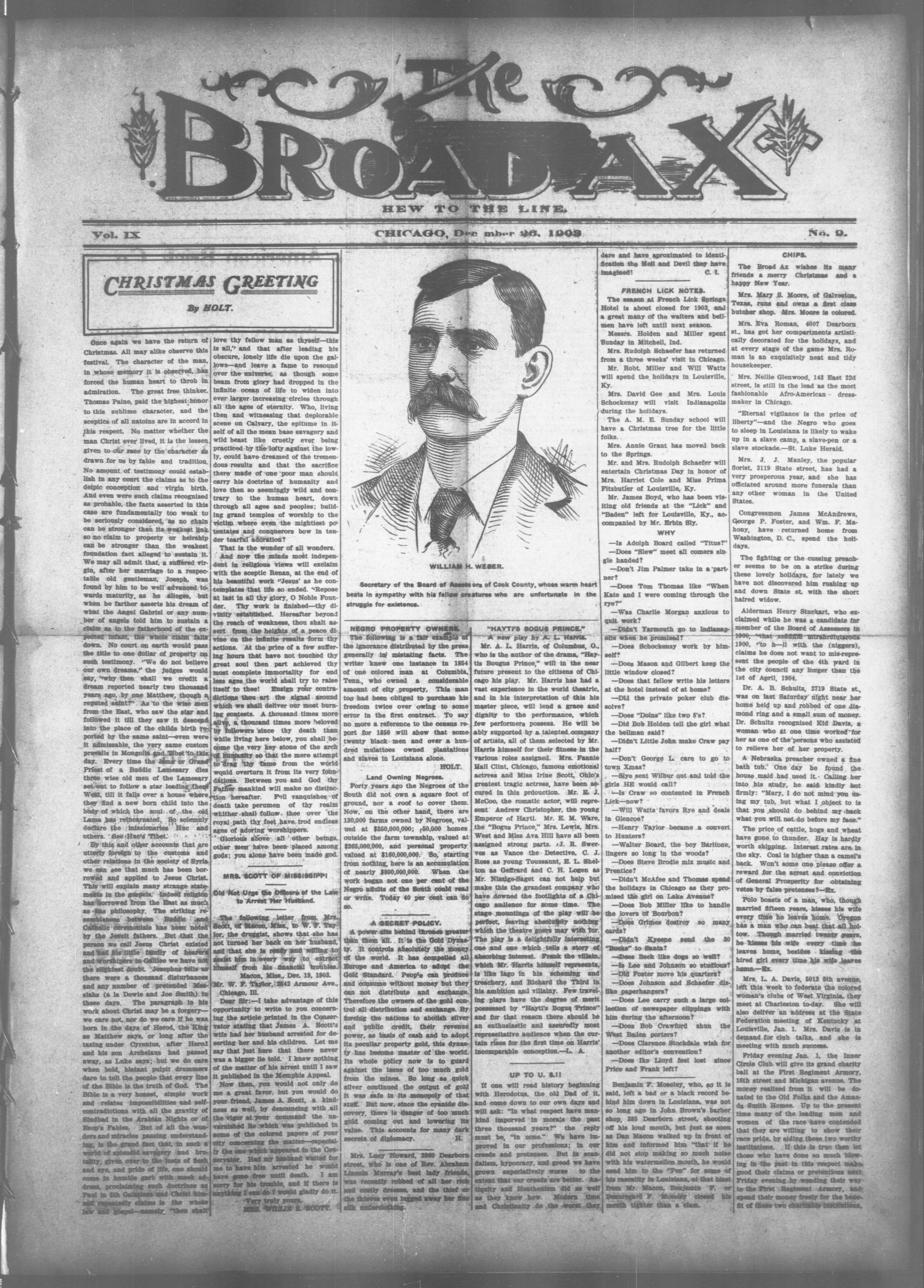
WILLIAM H. WEBER.
Secretary of the Board of Assessors of Cook County, whose warm heart beats in sympathy with his fellow creatures who are unfortunate in the struggle for existence.
NEGRO PROPERTY OWNERS. The following is a fair example of the ignorance distributed by the press generally in mistating facts. The writer knew one instance in 1854 of one colored man at Columbia, Tenn., who owned a considerable amount of city property. This man too had been obliged to purchase his freedom twice over owing to some error in the first contract. To say no more a reference to the census report for 1850 will show that some twenty black men and over a hundred mulattoes owned plantations and slaves in Louisiana alone.
Land Owning Negroes.
Forty years ago the Negroes of the South did not own a square foot of ground, nor a roof to cover them. Now, on the other hand, there are 130,000 farms owned by Negroes, valued at $350,000,000; 50,000 homes outside the farm township, valued at $265,000,000, and personal property valued at $160,000,000. So, starting from nothing, here is an accumulation of nearly $800,000,000. When the work began not one per cent of the Negro adults of the South could real or write. Today 40 per cent can do so.
A power alts behind thrones greater than them all. It is the Gold Dynasty. It controls absolutely the money of the world. It has compelled all Europe and America to adopt the Gold Standard. People can produce and consume without money but they can not distribute and exchange. Therefore the owners of the gold control all distribution and exchange. By forcing the nations to abolish silver and public credit, their revenue power, as basis of cash and to adopt its peculiar property gold, this dynasty has become master of the world. Its whole policy now is to guard against the issue of too much gold from the mines. So long as quick silver continued the output of gold it was safe in its monopoly of that stuff. But now, since the cyanide discovery, there is danger of too much gold coming out and lowering its value. This accounts for many dark secrets of diplomacy. H.
Mrs. Lucy Howard, 2960 Dearborn street, who is one of Rev. Abraham Lincoln Murray's best lady friends, was recently robbed of all her rich and costly dresses, and the thief or the thieves even lugged away her fine silk underclothing.
A SECRET POLICY.
"HAYTI'S BOGUS PRINCE."
A new play by A. L. Harris.
Mr. A. L. Harris, of Columbus, O., who is the author of the drama, "Haytis Bougus Prince," will in the near future present to the citizens of Chicago his play. Mr. Harris has had a vast experience in the world theatric, and in his interpretation of this his master piece, will lend a grace and dignity to the performance, which few performers possess. He will be ably supported by a talented company of artists, all of them selected by Mr. Harris himself for their fitness in the various roles assigned. Mrs. Fannie Hall Clint, Chicago, famous emotional actress and Miss Irine Scott, Ohio's greatest tragic actress, have been secured in this prdouction. Mr. E. J. McCoo, the romantic actor, will represent Andrew Christopher, the young Emperor of Hayti. Mr. E. M. Ware, the "Bogus Prince," Mrs. Lewis, Mrs. West and Miss Ava Hill have all been assigned strong parts. J. R. Swerves as Vance the Detective, C. J. Ross as young Toussaunt, E. L. Shelton as Geffrard and C. H. Logen as Mr. Nissige-Saget can not help but make this the grandest company who have downed the footlights of a Chicago audience for some time. The stage mountings of the play will be perfect, leaving absolutely nothing which the theatre goers may wish for. The play is a delightfully interesting one and one which tells a story of absorbing interest. Frank the villain, which Mr. Harris himself represents, is like lago in his scheming and treachery, and Richard the Third in his ambition and villainy. Few traveling plays have the degree of merit possessed by "Hayti's Bogus Prince" and for that reason there should be an enthusiastic and assuredly most represitative audience when the curtain rises for the first time on Harris' incomparable conception.—L. A.
If one will read history beginning with Herodotus, the old Dad of it, and come down to our own days and will ask: "In what respect have mankind imported in morals the past three thousand years?" the reply must be, "in none." We have improved in our professions; in our creeds and pretenses. But in scandalism, hypocracy, and greed we have grown superlatively worse to the extent that our creeds are better. Antiquity and Heathenism did as well as they knew how. Modern time and Christianity do the worst they
UP TO U. 8.11
dare and have aproximated to identification the Hell and Devil they have imagined! C. I.
FRENCH LICK NOTES.
The season at French Lick Springs Hotel is about closed for 1903, and a great many of the waiters and bellmen have left until next season.
Messrs. Holden and Miller spent Sunday in Mitchell, Ind.
Mrs. Rudolph Schaefer has returned from a three weeks' visit in Chicago.
Mr. Robt. Miller and Will Watts will spend the holidays in Louisville, Ky.
Mrs. David Gee and Mrs. Louis Schockensy will visit Indianapolis during the holidays.
The A. M. E. Sunday school will have a Christmas tree for the little folks.
Mrs. Annie Grant has moved back to the Springs.
Mr. and Mrs. Rudolph Schaefer will entertain Christmas Day in honor of Mrs. Harriet Cole and Miss Prima Fitzbutler of Louisville, Ky.
Mr. James Boyd, who has been visiting old friends at the "Lick" and "Baden" left for Louisville, Ky., accompanied by Mr. Erbin Sly.
WHY
—Is Adolph Board called "Titus?"
—Does "Slew" meet all comers single handed?
—Don't Jim Palmer take in a partner?
—Does Tom Thomas like "When Kate and I were coming through the rye?"
—Was Charlie Morgan anxious to quit work?
—Didn't Yarmouth go to Indianapolis when he promised?
—Does Schockensy work by himself?
—Does Mason and Gilbert keep the little window closed?
—Does that fellow write his letters at the hotel instead of at home?
—Did the private poker club dissolve?
—Does "Doins" like two 8's?
—Did Bob Holden tell the girl what the bellman said?
—Didn't Little John make Craw pay half?
—Don't George L. care to go to town Xmas?
—Slye sent Wilbur out and told the girls HE would call?
—Is Craw so contented in French Lick—now?
—Will Watts favors Rye and deals in Glencoe?
—Henry Taylor became a convert to Hunters?
—Walter Board, the boy Baritone, lingers so long in the woods?
—Does Steve Brodie mix music and Prentice?
—Didn't McAfee and Thomas spend the holidays in Chicago as they promised the girl on Lake Avenue?
—Does Bob Miller like to handle the lovers of Bourbon?
—Does Grimes destroy so many cards?
—Didn't Kyeene send the 30 "Bucks" to Santa?
—Does Beck like dogs so well?
—Is Lee and Johnson so studious?
—Did Foster move his quarters?
—Does Johnson and Schaefer dislike paperhangers?
—Does Lee carry such a large collection of newspaper clippings with him during the afternoon?
—Does Bob Crawford shun the West Bailen porters?
—Does Clarence Stockdale wish for another editor's convention?
—Does Ike Lloyd feel lost since Price and Frank left?
Benjamin F. Moseley, who, so it is said, left a bad or a black record behind him down in Louisiana, was not so long ago in John Brown's barber shop, 385 Dearborn street, shooting off his loud mouth, but just as soon as Dan Macon walked up in front of him and informed him "that if he did not stop making so much noise with his watermellon mouth, he would send him to the "Pen" for some of his rascality in Louisiana, at that blast from Mr. Macon, Benjamin F. or Beauregard F. Moseley closed his mouth tighter than a clam.
```markdown
```
No. 9.
CHIP8.
The Broad Ax wishes its many friends a merry Christmas and a happy New Year.
Mrs. Mary S. Moore, of Galveston, Texas, runs and owns a first class butcher shop. Mrs. Moore is colored.
Mrs. Eva Roman, 4007 Dearborn st., has got her compartments artistically decorated for the holidays, and at every stage of the game Mrs. Roman is an exquisitely neat and tidy housekeeper.
Mrs. Nellie Glenwood, 143 East 22d street, is still in the lead as the most fashionable Afro-American dressmaker in Chicago.
"Eternal vigilance is the price of liberty"and the Negro who goes to sleep in Louisiana is likely to wake up in a slave camp, a slave-pen or a slave stockade.—St. Luke Herald.
Mrs. J. J. Manley, the popular florist, 3119 State street, has had a very prosperous year, and she has officiated around more funerals than any other woman in the United States.
Congressmen James McAndrews, George P. Foster, and Wm. F. Mahony, have returned home from Washington, D. C., spend the holidays.
The fighting or the cussing preacher seems to be on a strike during these lovely holidays, for lately we have not discovered him rushing up and down State st. with the short haired widow.
Alderman Henry Stuckart, who exclaimed while he was a candidate for member of the Board of Assessors in 1900, "that xzfffffml intrahrdiutaroda 1900, 'to h-ll with the (niggers), claims he does not want to mis-represent the people of the 4th ward in the city council any longer than the 1st of April, 1904.
Dr. A. B. Schultz, 2719 State st., was on last Saturday night near her home held up and robbed of one diamond ring and a small sum of money. Dr. Schultz recognized Kid Davis, a woman who at one time worked for her as one of the persons who assisted to relieve her of her property.
A Nebraska preacher owned a fine bath tub. One day he found the house maid had used it. Calling her into his study, he said kindly but firmly: "Mary, I do not mind you using my tub, but what I object to is that you should do behind my back what you will not do before my face."
The price of cattle, hogs and wheat have gone to thunder. Hay is hardly worth shipping. Interest rates are in the sky. Coal is higher than a camel's back. Won't some one please offer a reward for the arrest and conviction of General Prosperity for obtaining votes by false pretenses?—Ex.
Polo boasts of a man, who, though married fifteen years, kisses his wife every time he leaves home. Oregon has a man who can beat that all holtow. Though married twenty years, he kisses his wife every time he leaves home, besides kissing the hired girl every time his wife leaves home.—Ex.
Mrs. L. A. Davis, 5012 5th avenue, left this week to federate the colored woman's clubs of West Virginia, they meet at Charleston to-day. She will also deliver an address at the State Federation meeting of Kentucky at Louisville, Jan. 1. Mrs. Davis is in demand for club talks, and she is meeting with much success.
Friday evening Jan. 1, the Inner Circle Club will give its grand charity ball at the First Regiment Armory, 16th street and Michigan avenue. The money realized from it will be donated to the Old Folks and the Amanda Smith Homes. Up to the present time many of the leading men and women of the race have contended that they are willing to show their race pride, by aiding these two worthy institutions. If this is true then let those who have done so much blowing in the past in this respect make good their claims or pretentions next Friday evening by wending their way to the First Regiment Armory, and spend their money freely for the benefit of these two charitable institutions,
Will promulgate and all times uphold the true principles of Democracy, but Catholica, Protestants, Priests, Inclubs, Farmers, Single Taxes, Republicans, Knights of Ladror, or any one else can have their say, no longer their language is proper and responsibility is fixed.
The Broad Ax is a newspaper whose platform is broad enough for all, ever claiming the editorial right to speak its own mind.
Local communications will receive attention. Write only on one side of the paper.
Subscriptions must be paid in advance.
One Year $2.00
Six Months 1.00
Advertising rates made known on application.
THE BROAD AX
1040 Armour Avenue, Chicago.
JULIUS F. TAYLOR, Editor and Publisher.
Entered at the Post Office at Chicago,
Ill., as Second-class Matter.
An Unfortunate Interruption.
"I think," she complained, "that Arthur would have proposed to me last night if you hadn't come in the parlor just when you did."
"What reason have you for believing that?" her mother anxiously returned.
"He had just taken both of my hands in his. He had never held more than one of them at a time before."--Chicago Record-Herald.
Sisterly Solitude.
"Mr. Spoonamore," asked the little girl, "how long have you been coming to see my sister?"
"O, a month or two, Kitty," replied the young man.
"Well," she said, after a moment of serious reflection, "I suppose it's too soon to ask you if you have any serious intentions."—Chicago Tribune.
"Business."
Tis now the honest farmer packs
His apples up to town.
This is the top row in the sacks,
O O O O O O O O
And this is lower down.
—Petoskey (Mich.) Lyre.
seasonable.
Now doth the wind the flescy cloud
Chase o'er the turquoise sky;
Now doth the youngster cry aloud
For more home-made mince pie.
—Cincinnati Enquirer.
Catering to Dame Fashion.
Man Dressmaker—Well, what now?
Apprentice—I have discovered a way
to make a woman's dress so that she will
look like a hump-backed baboon with
bat's wings.
Man Dressmaker—Glorious! It will become the rage.—N. Y. Weekly.
As Usual.
"Has he any occupation?"
"Well, he has had one."
"What?"
"Trying to be 'a good fellow.'"
"Did he succeed?"
"As long as his money lasted, yes."—Chicago Post.
The Sort of Fellow He Is.
Knippe—What sort of a fellow is Johnson?
Tucque—Oh, he is one of that kind of men who are always remarking: "It looks as though we'd have a little rain before night."—Syracuse Herald.
The Ohnes of Good Order.
Wife—Dear me, you can never find a thing without asking me where it is. How did you get along before you were married?
Husband—Things stayed where they were put then.—N. Y. Weekly.
Unmisonte,
Sanford—Is your father as enthusiastic upon the subject of free masonry as he used to be?
Merton—Yes, he threw the thermometer out of the window because it got over 38 degrees.—N. Y. Times.
Nothing But the Best.
"Has your husband provided a mansoleum for you?" asked Mrs. Oldcantle.
"Oh, my, no! Josiah was bound to have hard wood floors all through the house."—Chicago Record-Herald.
Missed the Fun.
"Did you have a good time in the city?" they asked when he returned.
"Naw!" was his reply. "Why, I was there two days an' there wasn't a bunco steerer come near me."—Chicago Post.
Ready for a Revolution.
"So you believe in rotation in office, so you?" queried the voter.
"Sure thing," replied the offenseseaker, "and I'm willing to take my turn."—Chicago Daily News.
An Erroneous Impression.
"The world moves and we've got to move with it."
"True, but the trouble is too many of us get the idea that we're moving it."—Chicago Post.
Unquestioning Obedience.
"Oh, Patrick! What has happened to the lawn? There's not a green spot on it!"
"Yes told me to take th' weeds out, mum."—Brooklyn Life.
A Discriminating Dog.
"Bridget, did the dog eat much when he got into the pantry?"
"Shure, mum, he ate everything but the dog biscuit."—San Francisco Wasp.
Sure Thing.
Pamela—I just dote on a real, real man. The man I marry must, above all, have—courage.
Fits—I should say so.—Tit-Bite.
Passed Away in Peace.
"Was his wife with him when he died?"
"No; he had a peaceful death."—Town Topica.
Opinion.
"I'm stack on this ring Jack gave me."
Lady Durand, wife of the new British ambassador of Washington, has long been in delicate health, and her daughter will act as hostess at all the social fusions given at the embassy during the present season.
Mrs. Marcus Hanna has acquired an air and society manner generally to which she was a comparative stranger when the senator first became prominent in public life. She has fairly mastered the fine art of dress. In the part she was noted for rather too striking color schemes, but now she has a fondness for black and white. Her hair, which is silver gray and plentiful, is worn in a high knot, and her hair dresser waves it becomingly.
John W. Savage, a prominent member of the Philadelphia bar, was an usher at the wedding of Evelyn Collins and Miss Mildred Thrope in New Brunswick, N. J., last week. The groom is the oldest son of Sir John C. Collins, an English member of parliament. At the wedding breakfast Mr. Savage was called upon for a toast and gave the following: "Here is health, wealth and happiness to the won one, to the one who won one, to the one who was won by one, to the two, too, who now are won ones, to the won two."
Mrs. Ogden Goelet has sent to Police Commissioner Green, of New York, a check for $150 in acknowledgment of her appreciation of the police service on the occasion of her daughter's marriage to the duke of Roxburghe. Mrs. Goelet wished that the money should be given to the officers who were on duty at the wedding, but the police rules did not permit of this, so it was turned over to the riot relief fund. It is understood that some of the women who were in the crush regard this as a proper disposition of the money.
The first "boudoir council" of the Washington social season was held November 30, when Mrs. Roosevelt and the women of the cabinet met and discussed the programme for the winter. It has been decided to curtail the number of white house functions. Last winter Mrs. Roosevelt extended so many hospitalities that several of the cabinet women broke down before the season was half over. This winter Mrs. Rocsevelt has reserved Fridays for her personal reception and no entertainments of a private character will be given on any other day.
WOMEN AT WORK
For the first time the board of trustees of the Carnegie institute, of Pittsburg, has elected a woman, Miss Sara E. Weir, to a position in the institute. She has been made assistant secretary. Miss Jennie Phillips, a young woman who lives on the line of the Trenton trolley, between Lawrenceville and Princeton, manages a 750-acre farm, dons bloomers and works in the field with her hired help. Miss Phillips has managed this farm ever since her father died, seven years ago. She is making the farm produce more money than ever before.
Mrs. Amaryllis Perry, of Prairie du Sac, Sauk county, Wis., is approaching her eighty-ninth birthday, but a few days ago went out into the field, and facing an ordinary target put two out of three rifle bullets into a two-inch bull's eye at 100 feet. She used "open sights" and performed the feat unaided by glasses. Mrs. Perry's first husband, David King, was a gunsmith, who was in business 60 years ago in Baraboo. His wife alced him in his work and early in life showed cleverness in handling firearms.
That Mrs. Elizabeth Cady Stanton was a philatelist of many years' standing has just come to light by the discovery of a stamproom in her old home at Woodcliff, N. J. In a recess of one of the rooms more than 18,000 stamps were found hung on the walls. Portions of the walls and the ceiling were covered with stamps of every country, and some of them are of great value, according to the estimates of stamp financiers. No two are alike. There are indications that most of the stamps were detached from letters received by Mrs. Stanton herself. She carried on a volumnious correspondence with friends whose homes were located in almost every part of the civilised world.
GLEANINGS OF FACT.
The violet was not as conspicuous this year as in former seasons at the New York horse show. There appears to be some difference of opinion as to who was the first motorist to enter the Yosemite valley in a car. The fact that it has been entered, is of interest to the public as pointing out the fact that but few portions of land surface of the globe may be considered really inaccessible to the enterprising owner of an auto car.
Incited thereto by the mysterious disappearance of the young millionaire, Wentz, in southwest Virginia, a bill has been introduced by a member of the legislature of that state making the crime of kidnapping for a ransom punishable with death. The alternative, at the discretion of the jury, is confinement in the penitentiary for not less than eight nor more than 18 years.
READING FOR THE YOUNG.
He who loves not books before he comes to 20 years of age will hardly love them enough afterward to understand them.—Clarendon.
Good books are to the young mind what the warming sun and the refreshing rain of spring are to the seeds which have lain dormant in the frosts of winter.—Horace Mann.
Thou mayst as well expect to grow stronger by always eating, as wiser by always reading. It is thought and digestion which makes books serviceable and gives health and vigor to the mind.—Fuller.
THEATRICAL NOTES.
The real name of Gabriel d'Ampunzio, whose "Mitta Corta" has been prohibited by the censor, is Gaetano Rapagnetto. The dramatist is a son of Duchess Maria Gallese de Romia. He is a musician as well as a playwright, and has a son who has certain celebrity as a mandolinist.
Albert Carre, of the Paris Opera Comique, has begun war on the theater ticket speculators. The fight was brought about by the speculators suing Carre because he refused to accept their tickets at the theater. He has sued them in turn and the chances are favorable that he will win his fight.
Blanche Weaver was playing in "The Lady of Lyons" with E. H. Sothern in a city not far from here some time ago. One of her speeches ended with the words, "No divorce can separate a mother from her son." One evening an absurd transposition suggested itself, and before Miss Weaver could get rid of the notion she had said in her most loving tones: "Ah, Claude, no divorce can separate a Sothern from his mon." The audience smiled, snickered, roared in wild crescendo, and it was some minutes before the play could proceed.
M. Mounet-Sully, the famous tragedian of the Comedie Francaise, is applying for admission to the Academy of Fine Arts. The actor states that he is starting his candidature for a seat in the academy mentioned by way of test. He says that in old times some actors were members of that body, but after Grandmesnil's death, in 1816, no more players were admitted. M. Mounet-Sully now wants to see if an actor like himself, honorably known, as he thinks, an officer of the Legion of Honor and senior member of the Comedie Francaise, cannot raise a claim to enter the Academie des Beaux Arts division of the French institute as well as painters and composers.
MEN IN PUBLIC LIFE
The French ambassador and Mme. Jusserand will go to New Orleans soon, when there is to be a celebration of the one hundredth anniversary of the transfer of Louisiana from France to the United States. It has been remarked that few men who come to congress from the Pacific coast are natives of that region. One of the few is John Newton Williamson, of Oregon, whose wife was also born in the thirty-third state of the union.
Very few are aware that William H. Taft, prospective secretary of war and now governor of the Philippines, got his start in life through performing the dangerous feat of whipping an editor. His father, after a distinguished public career, had just formed a law partnership in Cincinnati, when a weekly paper attacked his private life in a scandalous way. The young man, fresh from Yale, at once called at the newspaper office and in a few minutes had polished off his man in fine style.
Sir Mortimer Durand, the new British minister to this country, seems to be somewhat democratically inclined. In New York on Thanksgiving day, he went to a popular "dissenting" church with an American friend, instead of going to Sir Percy Sanderson's stately pew in Trinity. He walked to church across Central park and later joined his friend in a walk to Gen. Grant's tomb. Sir Mortimer impresses one as being a whole-hearted fellow, in many ways resembling Sir Thomas Lipton.
BRAINS AND EXERCISE.
William M. Evarts, who died at a very old age, attributed his long life to the fact that he never exercised. The philosopher, Leibnitz, who lived 70 years, passed most of his days sitting in a chair. He didn't believe in taking exercise, and after a walk of a mile he was unable for two or three days to get his mental powers into proper working order.
Joseph Chamberlain doesn't believe in physical exercise. He never walks when he can ride; he doesn't play golf; there are no Indian clubs or dumb bells in his room and he declares that he never feels well after indulging in physical exertion of any kind. Mr. Chamberlain was born in 1836, and looks to be about 40 years of age.
There is not a more athletic figure in all the senate than that of Mr. Aldrich, of Rhode Island. He is always trained down to fighting weight; his step is as quick and elastic as a boy's; his bearing that of a muscular man. So easily active and unconsciously strong is the Rhode islander that there is a fascination in watching him on the senate floor. The secret is said to be in his devotion to the ancient game of golf. Near his residence in Providence he possesses expansive acres on which are his own private links. Many a morning during the long summer and autumn months finds him bright and early whacking the elusive ball and chasing it up hill and down dale.
BUNCH OF STACKED CARDS.
"De man dat's game to bet his lag' dollar on a hoss race," said Uncle Eben, "Is purty sure to git de chance of doin' it sooner or later."
"Are races coming to town?" "I don't know," answered young Mrs. Torkins. "My husband hasn't yet said anything about our having to economize."
"When a man comes roun' tellin' me how easy it is to beat de races," said Uncle Eben, "I allus feels like I had jen' read de fus' chapter of a hahd luck story."
"In de light of human experience," said Uncle Eben, "I can't understan' how it is dat a man manages to work up sech a case of surprise every time he goes broke on de races."
"One of man's best friends is the horse." "Yes," responded the man with the race track habit. "But did you ever notice what a terrible faculty your best friends have of disappointing you in an emergency?"—Washington Star.
O
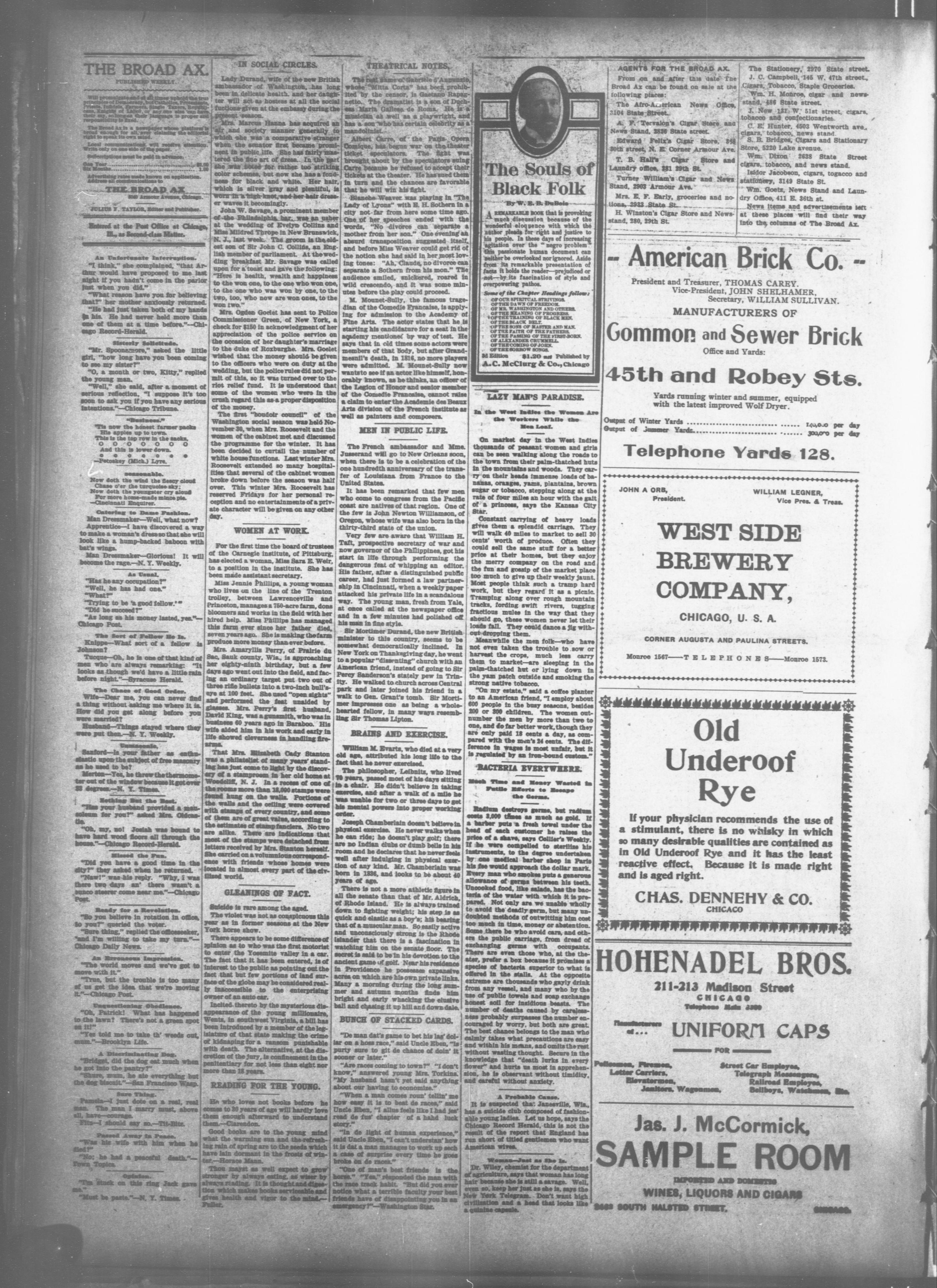
The Souls of Black Folk
By W. E. B. DuBois
A REMARKABLE BOOK that is provoking much discussion because of the wonderful eloquence with which the author pleads for right and justice to his people. In these days of increasing agitation over the "negro problem" this passionate human document can neither be overlooked nor ignored. Aside from its remarkable presentation of facts it holds the reader—prejudiced or not—by its fascination of style and overpowering pathos.
Some of the Chapter Headings follow:
OF OUR SPIRITUAL STRIVINGS.
OF THE DAWN OF FREEDOM.
OF MR. WARHINGTON AND OTHERS.
OF THE MEANING OF PROGRESS.
OF THE TRAINING OF BLACK MEN.
OF THE BLACK BELT.
OF THE SONS OF MARTER AND MAN.
OF THE FAITH OF THE FATHERS.
OF THE PASSING OF THE FIRST-BORN.
OF ALEXANDER CRUMMELL.
OF THE COMING OF JOHN.
OF THE SORROW SONGS.
3d Edition $1.20 net Published by
A.C. McClurg & Co., Chicago
LAZY MAN'S PARADISE.
In the West Indies the Women Are the Workers While the Men Leaf.
On market day in the West Indies thousands of peasant women and girls can be seen walking along the roads to the town from their palm-thatched huts in the mountains and woods. They carry on their heads immense loads of bananas, oranges, yams, plantains, brown sugar or tobacco, stepping along at the rate of four miles an hour with the gait of a princess, says the Kansas City Star.
Constant carrying of heavy loads gives them a splendid carriage. They will walk 40 miles to market to sell 30 cents' worth of produce. Often they could sell the same stuff for a better price at their homes, but they enjoy the merry company on the road and the fun and gossip of the market place too much to give up their weekly jaunt. Most people think such a tramp hard work, but they regard it as a picnic. Tramping along over rough mountain tracks, fording swift rivers, tugging fractious mules in the way that they should go, these women never let their loads fall. They could dance a jig without dropping them.
Meanwhile the men folk—who have not even taken the trouble to sow or harvest the crops, much less carry them to market—are sleeping in the palm-thatched hut or lying down in the yam patch outside and smoking the strong native tobacco. "On my estate," said a coffee planter to an American friend, "I employ about 600 people in the busy seasons, besides 200 or 300 children. The women outnumber the men by more than two to one, and do far better work, though they are only paid 18 cents a day, as compared with the men's 24 cents. The difference in wages is most unfair, but it is regulated by an iron-bound custom."
BACTERIA EVERYWHERE.
Much Time and Money Wasted in Futile Efforts to Escape the Germs.
Radium destroys germs, but radium costs 3,000 times as much as gold. If a harber puts a fresh towel under the head of each customer he raises the price of a shave, says Collier's Weekly. If he were compelled to sterilize his instruments, to the degree undertaken by one medical harber shop in Paris his fee would approach the dollar mark. Every man who smokes puts a generous allowance of germs between his teeth. Uncooked food, like salads, has the bacteria of the water with which it is prepared. Not only are we unable wholly to avoid the deadly germ, but many undoubted methods of outwitting him cost too much in time, money or abstention. Some there be who avoid cars, and others the public carriage, from dread of exchanging germs with occupants. There are even those who, at the theater, prefer a box because it promises a species of bacteria superior to what is offered in the stalls. At the opposite extreme are thousands who gayly drink from any vessel, and many who by the use of public towels and soap exchange honest soil for insidious beasts. The number of deaths caused by carelessness probably surpasses the number encouraged by worry, but both are great. The best chance belongs to the man who calmly takes what precautions are easy and within his means, and omits the rest without wasting thought. Secure in the knowledge that "death lurks in every flower" and hurts us most in apprehension, he is observant without timidity, and careful without anxiety.
It is suspected that Janeville, Wis., has a suicide club composed of fashionable young ladies. Let us hope, says the Chicago Record Herald, this is not the result of the report that England has run short of titled gentlemen who want American wives.
Woman—Just as She Is.
Dr. Willey, chemist for the department of agriculture, says that woman has long hair because she is still a savage. Well, even so, keep her just as she is, says the New York Telegram. Don't want high civilization and a head that looks like a quinine capsule.
```markdown
```
American Brick Co.
President and Treasurer, THOMAS CAREY. Vice-President, JOHN SHELHAMER, Secretary, WILLIAM SULLIVAN. MANUFACTURERS OF Common and Sewer Brick Office and Yards:
45th and Robey Sts.
Yards running winter and summer, equipped
with the latest improved Wolf Dryer.
Output of Winter Yards ..... 140,000 per day
Output of Summer Yards..... 300,000 per day
Telephone Yards 128.
JOHN A ORB,
President.
If your physi- a stimulant, so many desire in Old Under- reactive effect and is aged rig
CHAS.
WEST SIDE BREWERY COMPANY,
BORNER AUGUSTA AND PAULINA STREET
1567—TELEPHONES—MONT
Old
Underoof
Rye
our physician recommends the
ulant, there is no whisky in
very desirable qualities are contai
Underooof Rye and it has th
e effect. Because it is mad
aged right.
HAS. DENNEHY & C
CHICACO
ENADEL B
CORNER AUGUSTA AND PAULINA STREETS. Monroe 1567—TELEPHONES—Monroe 1573.
If your physician recommends the use of a stimulant, there is no whisky in which so many desirable qualities are contained as in Old Underoof Rye and it has the least reactive effect. Because it is made right and is aged right.
HOHENADEL BROS.
211-213 Madison Street
CHICAGO
Telephone Main J300
Manufacturers of ... U
men, Firemen,
tatter Carriers,
Elevatormen,
Jonitors, W
UNIFORM CA FOR Street Car Employees Telegraph Messe Railroad Em
WILLIAM LEGNER,
Vice Pres. & Treas.
SIDE
ERY
NY,
S. A.
LINA STREETS.
E S——Monroe 1573.
mends the use of
whisky in which
are contained as
it has the least
it is made right
HY & CO.
L BROS
CHICAGO, U. S. A.
M CAPS
ar Employees,
graph Messengers,
Railroad Employees,
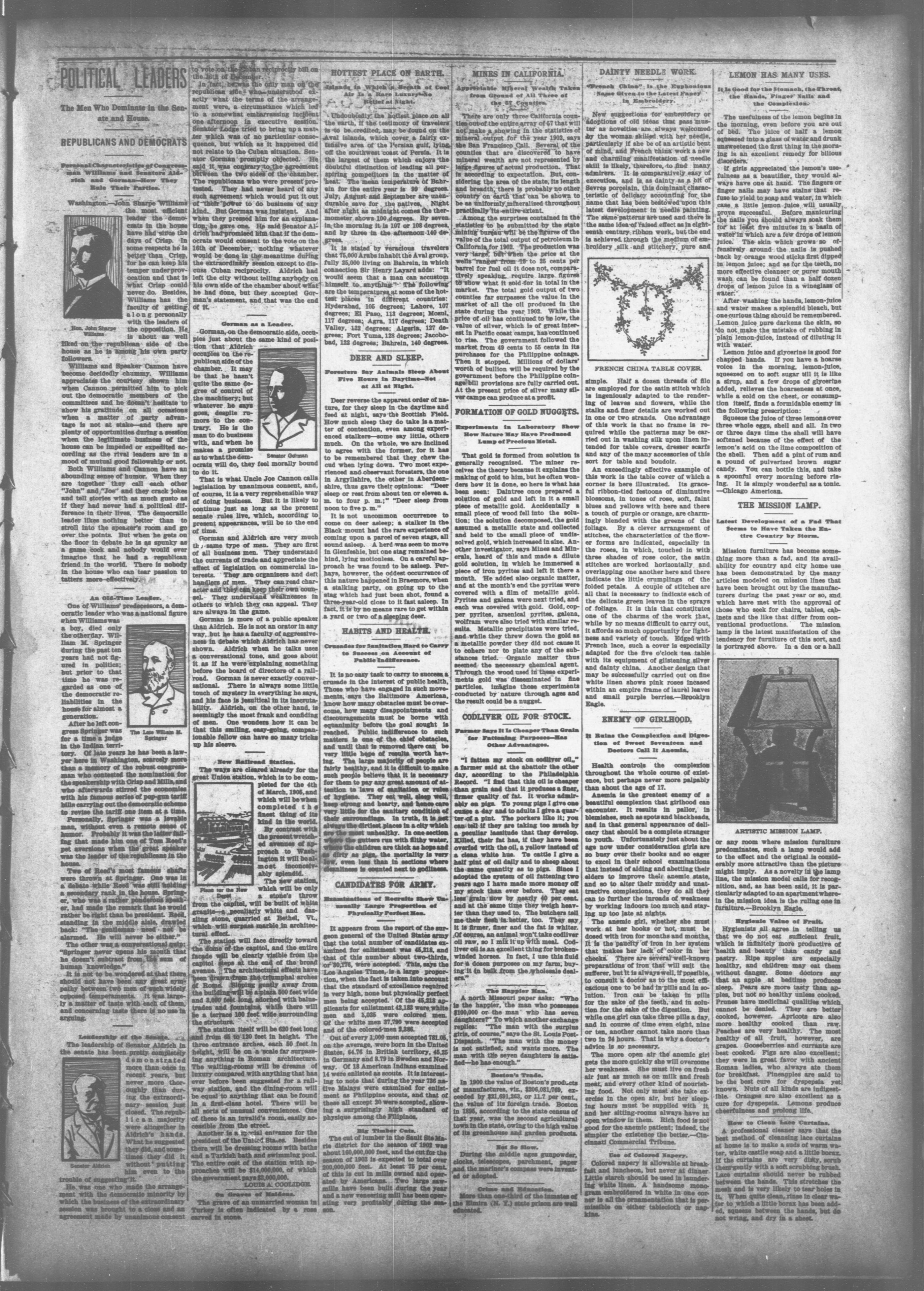
the most efficient leader the democrats in the house have had since the days of Crisp. In some respects he is better than Crisp, for he can keep his temper underprovocation and that is what Crisp could never do. Besides, Williams has the faculty of getting along personally with the leaders of the opposition. He is about as well
Hon. John Sharpe
Williams
liked on the republican side of the house as he is among his own party followers. Williams and Speaker Cannon have become decidedly chummy. Williams appreciates the courtesy shown him when Cannon permitted him to pick out the democratic members of the committees and he doesn't hesitate to show his gratitude on all occasions when a matter of party advantage is not at stake—and there are plenty of opportunities during a session when the legitimate business of the house can be impeded or expedited according as the rival leaders are in a mood of mutual good fellowship or not.
Both Williams and Cannon have an abounding sense of humor. When they are together they call each other "John" and "Joe" and they crack jokes and tell stories with as much gusto as if they had never had a political difference in their lives. The democratic leader likes nothing better than to stroll into the speaker's room and go over the points. But when he gets on the floor in debate he is as spunky as a game cock and nobody would ever imagine that he had a republican friend in the world. There is nobody in the house who can tear passion to tatters more effectively.
One of Williams' predecessors, a democratic leader who was a national figure when Williams was a boy, died only the other day. William M. Springer during the past ten years had not figured in politics; but prior to that time he was regarded as one of the democratic reliabilities in the house for almost a generation.
[Illustration of a man in a suit with a beard].
After he left congress Springer was for a time a judge in the Indian terri-
The Late Willain M.
Springer
tory. Of late years he has been a lawyer here in Washington, scarcely more than a memory of the robust congressman who contested the nomination for the speakership with Crisp and Milla, and who afterwards stirred the economies with his famous series of pop-gun tariff bills carrying out the democratic scheme to revise the tariff one item at a time. Personally, Springer was a levable man, without even a remote sense of humor. Probably it was the latter failing that made him one of Tom Read's pet aversion when the great speaker was the leader of the republicans in the house.
Two of Reed's most famous shafts were thrown at Springer. One was in a debate while Reed was still holding a secondary rank in the house. Springer, who was a rather ponderous speaker, had made the remark that he would rather be right than be president. Reed, standing in the middle alale, drawled back: "The gentleman need not be alarmed. He will never be either." The other was a conversational quip: "Springer never opens his mouth that he doesn't subtract from the sum of human knowledge."
It is not to be wondered at that there should not have been any great sympathy between two men of such widely opposed temperaments. It was largely a matter of taste with each of them, and concerning taste there is no use in arguing.
Lewership of the Senate
The leadership of Senator Aldrich in the senate has been pretty completely
demonstrated more than once in recent years, but never more thoroughly than during the extraordinary session just closed. The republican majority were altogether in Aldrich's hands. What he suggested they did, and sometimes they did it without' putting him even to the
Senator Aldrich
trouble of suggesting it.
He was one who made the arrangement with the democratic minority by which the business of the extraordinary session was brought to a close and an agreement made by unanimous consent
to vote on the Cuban reciprocity bill on the 16th of December.
In fact, he was the only man on the republican side who understood exactly what the terms of the arrangement were, a circumstance which led to a somewhat embarrassing incident one afternoon in executive session. Senator Lodge tried to bring up a matter which was of no particular consequence, but which as it happened did not relate to the Cuban situation. Senator Gorman promptly objected. He said it was contrary to the agreement between the two sides of the chamber. The republicans who were present protested. They had never heard of any such agreement which would put it out of their power to do business of any kind. But Gorman was insistent. And when they pressed him for an explanation, he gave one. He said Senator Aldrich had promised him that if the democrats would consent to the vote on the 16th of December, nothing whatever would be done in the meantime during the extraordinary session except to discuss Cuban reciprocity. Aldrich had left the city without telling anybody on his own side of the chamber about what he had done, but they accepted Gorman's statement, and that was the end of it.
Gorman as a Leader.
-Gorman, on the democratic side, occupies just about the same kind of posi-
tion that Aldrich occupies on the republican side of the chamber. It may be that he hasn't quite the same degree of control of the machinery; but whatever he says goes, despite rumors to the contrary. He is the man to do business with, and when he makes a promise as to what the dem-
M. B.
Senator Gorman
as to what the democrats will do, they feel morally bound to do it. That is what Uncle Joe Cannon calls legislation by unanimous consent, and, of course, it is a very reprehensible way of doing business. But it is likely to continue just as long as the present senate rules live, which, according to present appearances, will be to the end of time.
Gorman and Aldrich are very much the same type of men. They are first of all business men. They understand the currents of trade and appreciate the effect of legislation on commercial interests. They are organizers and deft handlers of men. They can read character and they can keep their own counsel. They understand weaknesses in others to which they can appeal. They are always in the game.
Gorman is more of a public speaker than Aldrich. He is not an orator in any way, but he has a faculty of aggressiveness in debate which Aldrich has never shown. Aldrich when he talks uses a conversational tone, and goes about it as if he were explaining something before the board of directors of a railroad. Gorman is never exactly conversational. There is always some little touch of mystery in everything he says, and his face is Jesuitical in its inscrutability. Aldrich, on the other hand, is seemingly the most frank and confiding of men. One wonders how it can be that this smiling, easy-going, companionable fellow can have so many tricks up his sleeve.
New Railroad Station.
The ways are cleared already for the great Union station which is to be com-
which is to be completed for the 4th of March,1905,and which will be when completed the finest thing of its kind in the world.
A
By contrast with the present wretched avenues of approach to Washington it will be almost inconceivably splendid. The new station, which will be only a stone's throw from the capitol, will be built of white granite—a peculiarly white and dazzling stone, quarried at Bethel, Vt., which will surpass marble in architectural effect.
The station will face directly toward the dome of the capitol, and the entire facade will be clearly visible from the capitol steps at the end of the broad avenue. The architectural effects have been drawn from the triumphal arches of Rome. Sloping gently away from the building will be a plaza 500 feet wide and 3,000 feet long, adorned with balustrades and fountains, while there will be a terrace 100 feet wide surrounding the structure.
The station itself will be 620 feet long and from 65 to 120 feet in height. The three entrance arches, each 50 feet in height, will be on a scale far surpassing anything in Roman architecture. The waiting-rooms will be dreams of luxury compared with anything that has ever before been suggested for a railway station, and the dining-room will be equal to anything that can be found in a first-class hotel. There will be all sorts of unusual conveniences. One of these is an invalid's room, easily accessible from the street.
Another is a special entrance for the president of the United States. Besides there will be dressing rooms with baths and a Turkish bath and swimming pool. The entire cost of the station with approaches will be $14,000,000, of which the government pays $3,000,000.
LOUIS A. COOLIDGE.
On Graves of Malden.
The grave of an unmarried woman in Turkey is often indicated by a rose carved in stone.
HOTTEST PLACE ON EARTH.
Islands in Which is Breath of Cool
Air Is a Rare Luxury-No
Undoubtedly the hottest place on all the earth, if the testimony of travelers is to be credited, may be found on the Aval islands, which cover a fairly extensive area of the Persian gulf, lying off the southwest coast of Persia. It is the largest of them which enjoys the doubtful distinction of leading all perspiring competitors in the matter of heat. The mean temperature of Bahrein for the entire year is 99 degrees. July, August and September are unendurable save for the natives. Night after night as midnight comes the thermometer shows 100 degrees. By seven in the morning it is 107 or 108 degrees, and by three in the afternoon 140 degrees.
It is stated by veracious travelers that 75,000 Arabs inhabit the Aval group, fully 25,000 living on Bahrein, in which connection Sir Henry Layard adds: "It would seem that a man can accustom himself to anything." The following are the temperatures at some of the hottest places in different countries: Hyderabad, 105 degrees; Lahore, 107 degrees; El Paso, 113 degrees; Mosul, 117 degrees; Agra, 117 degrees; Death Valley, 122 degrees; Algeria, 127 degrees; Fort Yuma, 128 degrees; Jacobobad, 122 degrees; Bahrein, 140 degrees.
DEER AND SLEEP.
Foresters Say Animals Sleep About Five Hours in Daytime-Not at All at Night.
Deer reverse the apparent order of nature, for they sleep in the daytime and feed at night, says the Scottish Field. How much sleep they do take is a matter of contention, even among experienced stalkers—some say little, others much. On the whole, we are inclined to agree with the former, for it has to be remembered that they chew the cud when lying down. Two most experienced and observant foresters, the one in Argyllshire, the other in Aberdeenshire, thus gave their opinions: "Deer sleep or rest from about ten or eleven a. m. to four p. m.;" "Deer sleep from noon to five p. m."
It is not uncommon occurrence to come on deer asleep; a stalker in the Black mount had the rare experience of coming upon a parcel of seven stags, all sound asleep. A herd was seen to move in Glenfeshie, but one stag remained behind, lying motionless. On a careful approach he was found to be asleep. Perhaps, however, the oddest occurrence of this nature happened in Braemore, when a stalking party, on going up to the stag which had just been shot, found a three-year-old close to it fast asleep. In fact, it is by no means rare to get within a yard or two of a sleeping deer.
HABITS AND HEALTH.
Crusades for Sanitation Hard to Carry to Success on Account of Public Indifference.
It is no easy task to carry to success a crusade in the interest of public health. Those who have engaged in such movements, says the Baltimore American, know how many obstacles must be overcome, how many disappointments and discouragements must be borne with equanimity before the goal sought is reached. Public indifference to such matters is one of the chief obstacles, and until that is removed there can be very little hope of results worth having. The large majority of people are fairly healthy, and it is difficult to make such people believe that it is necessary for them to pay any great amount of attention to laws of sanitation or rules of hygiene. They eat well, sleep well, keep strong and hearty, and hence care very little for the sanitary condition of their surroundings. In truth, it is not always the dirtiest places in a city which are the most unhealthy. In one section where the gutters run with filthy water, where the children are thick as hops and as dirty as pigs, the mortality is very low, even less than in sections where cleanliness is counted next to godliness.
CANDIDATES FOR ARMY.
Examinations of Recruits Show Unusually Large Proportion of Physically Perfect Men.
It appears from the report of the surgeon general of the United States army that the total number of candidates examined for enlistment was 45,218, and that of this number about two-thirds, or 80,176, were accepted. This, says the Los Angeles Times, is a large proportion, when the fact is taken into account that the standard of excellence required is very high, none but physically perfect men being accepted. Of the 45,218 applicants for enlistment 42,183 were white men and 3,035 were colored men. Of the white men 37,790 were accepted and of the colored men 2,388.
Out of every 1,000 men accepted 781.05 on the average, were born in the United States, 64.76 in British territory, 45.25 in Germany and 8.79 in Sweden and Norway. Of 18 American Indians examined 14 were enlisted as scouts. It is interesting to note that during the year 736 native Malays were examined for enlistment as Philippine scouts, and that of these all except 20 were accepted, showing a surprisingly high standard of physique among the Filipinos.
Big Timber Cuts.
The cut of lumber in the Sault St Marie district for the season of 1892 was about 160,000,000 feet, and the cut for the season of 1903 is expected to total over 200,000,000 feet. At least 75 per cent. of this is cut in mills owned and operated by Americans. Two large sawmills have been built during the year and a new veneering mill has been operating very profitably during the season.
MINES IN CALIFORNIA. Appreciable Mineral Wealth Taken from Ground of All Three of the 57 Counties.
There are only three California counties out of the entire array of 57 that will not make a showing in the statistics of mineral output for the year 1902, says the San Francisco Call. Several of the counties that are discovered to have mineral wealth are not represented by large figures of actual production. That is according to expectation. But, considering the area of the state, its length and breadth, there is probably no other country on earth that can be shown to be as uniformly mineralized throughout practically its entire extent.
Among the surprises contained in the statistics to be submitted by the state mining bureau will be the figures of the value of the total output of petroleum in California for 1902. The production was very large, but when the price at the wells ranges from 15 to 25 cents per barrel for fuel oil it does not, comparatively speaking, require large figures to show what it sold for in total in the market. The total gold output of two counties far surpasses the value in the market of all the oil produced in the state during the year 1902. While the price of oil has continued to be low, the value of silver, which is of great interest in Pacific coast camps, has continued to rise. The government followed the market from 49 cents to 55 cents in its purchases for the Philippine coinage. Then it stopped. Millions of dollars' worth of bullion will be required by the government before the Philippine coinage bill provisions are fully carried out. At the present price of silver many silver camps can produce at a profit.
FORMATION OF GOLD NUGGETS.
Experiments in Laboratory Show How Nature May Have Produced Lump of Precious Metal.
That gold is formed from solution is generally recognized. The miner receives the theory because it explains the making of gold to him, but he often wonders how it is done, so here is what has been seen: Daintree once prepared a solution of gold and left in it a small piece of metallic gold. Accidentally a small piece of wood fell into the solution; the solution decomposed, the gold assumed a metallic state and collected and held to the small piece of undissolved gold, which increased in size. Another investigator, says Mines and Minerals, heard of this and made a dilute gold solution, in which he immersed a piece of iron pyrites and left it there a month. He added also organic matter, and at the month's end the pyrites were covered with a film of metallic gold. Pyrites and galena were next tried, and each was covered with gold. Gold, copper pyrites, arsenical pyrites, galena, wolfram were also tried with similar results. Metallic precipitates were tried, and while they threw down the gold as a metallic powder they did not cause it to cohere nor to plate any of the substances tried. Organic matter thus seemed the necessary chemical agent. Through the wood used in these experiments gold was disseminated in fine particles. imagine those experiments conducted by nature through ages and the result could be a nugget.
CODLIVER OIL FOR STOCK
Farmer Says It Is Cheaper Than Grain for Patterning Purposes—Has Other Advantages.
"I fatten my stock on codliver oil," a farmer said at the abattoir the other day, according to the Philadelphia Record. "I find that this oil is cheaper than grain and that it produces a finer, firmer quality of fat. It works admirably on pigs. To young pigs I give one ounce a day and to adults I give a quarter of a pint. The porkers like it; you can tell if they are taking too much by a peculiar lassitude that they develop. Killed, their fat has, if they have been overfed with the oil, a yellow instead of a clean white hue. To cattle I give a half pint of oil daily and to sheep about the same quantity as to pigs. Since I adopted the system of oil fattening two years ago I have made more money off my stock than ever before. They eat less grain now by nearly 40 per cent. and at the same time they weigh heavier than they used to. The butchers tell me their flesh is better, too. They say it is firmer, finer and the fat is whiter. Of course, an animal won't take codliver oil raw, so I mix it up with meal. Codliver oil is an excellent thing for broken-winded horses. In fact, I use this fluid for a dozen purposes on my farm, buying it in bulk from the wholesale dealers."
The Happier Man.
A north Missouri paper asks: "Who is the happier, the man who possesses $100,000 or the man who has seven daughters?" To which another exchange replies: "The man with the surplus girls, of course," says the St. Louis Post-Dispatch. "The man with the money is not satisfied, and wants more. The man with the seven daughters is satisfied—he has enough."
Boston's Trade.
In 1900 the value of Boston's products of manufactures, viz., $206,081,769, exceeded by $21,691,263, or 11.7 per cent., the value of its foreign trade. Boston in 1895, according to the state census of that year, was the second agricultural town in the state, owing to the high value of its greenhouse and garden products.
Not So Slow.
During the middle ages gunpowder, clocks, telescopes, parchment, paper and the mariner's compass were invented or adopted.
Crime and Education. More than one-third of the inmates of the Elmira (N. Y.) state prison are well educated.
DAINTY NEEDLE WORK.
"French China" is the Euphonious Name Given to the Latest Fancy in Embroidery.
New suggestions for embroidery or adoptions of old ideas that pass muster as novelties are always welcomed by the woman skilled with her needle, particularly if she be of an artistic bent of mind, and French china work a new and charming manifestation of needle skill is likely, therefore, to find many admirers. It is comparatively easy of execution, and is as dainty as a bit of Sevres porcelain, this dominant characteristic of delicacy accounting for the name that has been bestowed upon this latest development in needle painting. The same patterns are used and there is the same idea of raised effect as in eighteenth century ribbon work, but the end is achieved through the medium of embroidery silk and stitchery, pure and
FRENCH CHINA TABLE COVER
simple. Half a dozen threads of filo are employed for the satin stitch which is ingeniously adapted to the rendering of leaves and flowers, while the stalks and finer details are worked out in one or two strands. One advantage of this work is that no frame is required while the patterns may be carried out in washing silk upon linen intended for table covers, dresser scarfs and any of the many accessories of this sort for table and boudoir.
An exceedingly effective example of this work is the table cover of which a corner is here illustrated. Its graceful ribbon-tied festoons of diminutive blossoms, in tones of rose, soft, faint blues and yellows with here and there a touch of purple or orange, are charmingly blended with the greens of the foliage. By a clever arrangement of stitches, the characteristics of the flower forms are indicated, especially in the roses, in which, touched in with three shades of rose color, the satin stitches are worked horizontally and overlapping one another here and there indicate the little crumplings of the folded petals. A couple of stitches are all that is necessary to indicate each of the delicate green leaves in the sprays of foliage. It is this that constitutes one of the charms of the work that, while by no means difficult to carry out, it affords so much opportunity for lightness and variety of touch. Edged with French lace, such a cover is especially adapted for the five o'clock tea table with its equipment of glistening silver and dainty china. Another design that may be successfully carried out on fine white linen shows pink roses incased within an empire frame of laurel leaves and small purple berries.—Brooklyn Eagle.
ENEMY OF GIRLHOOD.
It Ruins the Complexion and Digestion of Sweet Seventeen and Doctors Call It Anemia.
Health controls the complexion throughout the whole course of existence, but perhaps never more palpably than about the age of 17.
Anemia is the greatest enemy of a beautiful complexion that girlhood can encounter. It results in pallor, in blemishes, such as spots and blackheads, and in that general appearance of delicacy that should be a complete stranger to youth. Unfortunately just about the age now under consideration girls are so busy over their books and so eager to excel in their school examinations that instead of alding and abetting their elders to improve their anemic state, and so to alter their muddy and unattractive complexions, they do all they can to further the inroads of weakness by working indoors too much and staying up too late at nights.
The anemic girl, whether she must work at her books or not, must be dosed with iron for months and months. It is the paucity of Iron in her system that makes her lack of color in her cheeks. There are several well-known preparations of iron that will suit the sufferer, but it is always well, if possible, to consult a doctor as to the most efficacious one to be had in pills and in solution. Iron can be taken in pills for the sake of the teeth, and in solution for the sake of the digestion. But while one girl can take three pills a day, and in course of time even eight, nine or ten, another cannot take more than two in 24 hours. That is why a doctor's advice is so necessary.
The more open air the anemic girl gets the more quickly she will overcome her weakness. She must live on fresh air just as much as on milk and fresh meat, and every other kind of nourishing food. Not only must she take exercise in the open air, but her sleeping hours must be supplied with it, and her sitting-rooms always have an open window in them. Rich food is not good for the anemic patient; indeed, the simpler the existence the better.—Cincinnati Commercial Tribune.
Use of Colored Nanery.
Colored napery is allowable at breakfast and luncheon, but never at dinner Little starch should be used in laundering white linen. A handsome monogram embroidered in white in one corner is all the ornamentation that is permissible on either tablecloth or napkin.
It Is Good for the Stomach, the Threat, the Hands, Finger Nails and the Complexion.
The usefulness of the lemon begins in the morning, even before you are out of bed. The juice of half a lemon squeezed into a glass of water and drunk unsweetened the first thing in the morning is an excellent remedy for billious disorders.
If girls appreciated the lemon's usefulness as a beautifier, they would always have one at hand. The fingers or finger nails may have stains that refuse to yield to soap and water, in which case a little lemon juice will usually prove successful. Before manicuring the nails you should always soak them for at least five minutes in a basin of water in which are a few drops of lemon juice. The skin which grows so offensively around the nails is pushed back by orange wood sticks first dipped in lemon juice; and as for the teeth, no more effective cleanser or purer mouth wash can be found than a half dozen drops of lemon juice in a wineglass of water.
After washing the hands, lemon-juice and water makes a splendid bleach, but one curious thing should be remembered. Lemon juice pure darkens the skin, so do not make the mistake of rubbing in plain lemon-juice, instead of diluting it with water.
Lemon juice and glycerine is good for chapped hands. If you have a hoarse voice in the morning, lemon-juice, squeezed on to soft sugar till it is like a sirup, and a few drops of glycerine added, relieves the hoarseness at once, while a cold on the chest, or consumption itself, finds a formidable enemy in the following prescription:
Squeeze the juice of three lemons over three whole eggs, shell and all. In two or three days time the shell will have softened because of the effect of the lemon's acid on the lime composition of the shell. Then add a pint of rum and a pound of pulverized brown sugar candy. You can bottle this, and take a spoonful every morning before rising. It is simply wonderful as a tonic. Chicago American.
THE MISSION LAMP.
Latest Development of a Fad That Seems to Have Taken the Entire Country by Storm.
Mission furniture has become something more than a fad, and its availability for country and city home use has been demonstrated by the many articles modeled on mission lines that have been brought out by the manufacturers during the past year or so, and which have met with the approval of those who seek for chaira, tables, cabinets and the like that differ from conventional productions. The mission lamp is the latest manifestation of the tendency for furniture of this sort, and is portrayed above. In a den or a hall
```markdown
```
ARTISTIC MISSION LAMP. or any room where mission furniture predominates, such a lamp would add to the effect and the original is considerably more attractive than the picture might imply. As a novelty in the lamp line, the mission model calls for recognition, and, as has been said, it is particularly adapted to an apartment wherein the mission idea is the ruling one in furniture.—Brooklyn Eagle.
Hygienic Value of Fruit.
Hygienists all agree in telling us that we do not eat sufficient fruit, which is infinitely more productive of health and beauty than candy and pastry. Ripe apples are especially healthy, and children may eat them without danger. Some doctors say that an apple at bedtime produces sleep. Pears are more tasty than apples, but not so healthy unless cooked. Prunes have medicinal qualities which cannot be denied. They are better cooked, however. Apricots are also more healthy cooked than raw. Peaches are very healthy. The most healthy of all fruit, however, are grapes. Gooseberries and currants are best cooked. Figs are also excellent; they were in great favor with ancient Roman ladies, who always ate them for breakfast. Pineapples are said to be the best cure for dyspepsia yet known. Nuts of all kinds are indigestible. Oranges are also excellent as a cure for dyspepsia. Lemons produce cheerfulness and prolong life.
How to Clean Lace Curtains.
A professional cleaner says that the best method of cleansing lace curtains at home is to make a suds of warm water, white castile soap and a little borax. If the curtains are very dirty, scrub them gently with a soft scrubbing brush. Lace curtains should never be rubbed between the hands. This stretches the mesh and is very likely to tear holes in it. When quite clean, rinse in clear water to which a little borax has been added, squeeze between the hands, but do not wring, and dry in a sheet.
Se A
gr cee ees on aie eae
% © past has en ee eee
Colored ' nn ia tity, will »
jinn a cabot
‘assist in raising a special fund for the
Benet of the Home for Aged ‘and i
‘Hitihe Yor
at ell ef their former ¢
‘hey “ie Teboring “are b
fers
ro pon ae ay win
ss, if am opportunity is given
them ‘to do -s0, therefore this club of
‘worthy vace loving men ‘ask ‘thet
every Colored man, woman, and child
4m this City unite with them on New
‘Year's night and show to the people
of this city and state that we can
{as a race) and will assist and care
for our own worthy poor.
The club has engaged Prof. N. Clark
Smith and his celebrated ‘smyhony
orchestra‘for this occasion, and have
had rearranged and remodeled the
coat rooms, so that their guests and
patroms can have their wraps cared for
by a large number of cost room at-
tendants.in-order and without con-
fusion. -Refreshments of the season
will be served during the evening.
Admission’ (560) fifty cents.
The Inner Circle Club thanks their
many friends for their assistance in
the past and earnestly solicits their
patronage and asalstamce on New
Year's night.
‘The club ‘is composed of the foilow-
ing well known gentlemen: |
Jas. W. “Camp, president; T. J.
Napier, vice-president; W. D. Moore,
secretary; Oscar De Priest, treasurer;
John ©. Buckner, W.-H. Jackson,J. R.
MeAllister, 8. L. Park, C. R. Johnson,
F L. Céffee,G. N. Snowden, E. M
Suttin ND. Tohmpson. *
CHIPS.
Alderman ‘Lewis D. Sitts, who ably
represents ‘the People residing in the
17th ‘ward im the city council, is one
of the active business men of Chicago.
‘The alderman is one of the leading
wholesale commission merchants on
South Water st. and his word is his
bond.
State Senator Bd ‘J. Rainey may
be induced to-go up against the Hon.
George P. Foster in the 2nd. Congres-
sional District in 1904 ‘aud Senator
Rainey, has many ioyal admirers in the
district ‘Who would lke to ‘see ‘him
enter thé contest against Congressman
‘Mx. W. ‘T, Delthant, . president’ of
303 Dearborn st, is compdsed of the
ee a me ws the
Uke Mt_Detibant to ‘¢thit: part
of the ticket it would be. suctessfu!
even in the national contest.
W. H. Huston, the would-be editor
of the Cohservator, Sedalia, ‘Mo.; did
Rot-bave brains enotigh to write ‘an
as Mrs. Fred-
Douglass,” so he snatched our
article fram the columas of The Broad
Ax gpd.ran ft through his paper as
a ‘thd “there ‘fs “an “Ul
anPcly thE “At < haey |
Miss Huwkius, ese‘of tie ‘first ‘mat-
rons of the colored orplian asytun: at
ito, Yih side tae abvtat
= Spltliaia “git ‘ot the building now,
is worth at least $2,000. The
asylum tas steadily grown ‘under the
a ee at Or Ok
an‘ghsWér bas come to the institution,
sccommoiation of the many hungry
children begging to come in.
established by Provident Hospital at
38th and Dearborn streets. The
patients will be eared for by the Provi-
dent nurses. In connection with this
enw aricon eran
stituted on Tuesday and Fridays from
2 to 4 p.m, when all infants and
beet aes ae
Jude Gary, for aying voters in | oa
Sei Weak Sek #0 tei Seed ah te
rs Ward tor 50 cen June. Alderme
ae te ERS AE Eager pave se dil
Tere a eee eet eee
onan ete vaetcom naan
to and mm aca are
te ab und jor hohorable gentic
m to, reside in an tong as its Alder
’ 3 high oficials are Ge-
et ‘ Pay the small sum
EE Me mg: tke a bea tt ys
‘Major Lawrence M. Ennis, Chicago
‘House Block, says that “within
shane orareic aaa
fone over stand to politica
h ‘Sean Tata ete epee
ft “dnd © Taal, dnd at “hie ‘anit
jo ea
‘sti ‘tor him to continue.
Dy “Gov. ‘Tates was a ‘Very ‘falr
Proms aceee
that Littie
ee Fosediihaes for overtly of Tm
‘Rois. Y
‘Thomas Gihan, ‘momber of the
Bemocratic ‘National Committee,
John P. Hopkins, chairman of the
Democratic Committee of Til, Roger
C. Sullivan, Edward M. Labiff, John
B. Treeger, John J. Feely, Williem
Legner, Edward M. Cummings, Wil-
liam F. Brennan, Ross C. Hall, and
many otlier influential Democrats are
putting forth their very best efforts
to induce the members of the National
Committee, when it meets in Wash-
ington, D. C., Jan. 12, to cast their
votes In favor of holding thé national
convention of 1904 in this city, and
it would not be surprising to us to see
Chicago capture the prize, for after
all there is no place 90 centrally lo-
eated. lik this city, and it should be
chosen by the National Committee
without the least hesitancy, as the
most suitable place to nominate the
next president and vice-president of
the United States.
AGENTS AND CORRESPONDENTS
WANTED.
The ‘Broad Ax Wesires to engage
agents and regular corsespondents in
all the leading cities and towns In Il-
linols and throughout the other sec-
tios of the country. The highest
commissions paid to live hustlers.
Sample copies furnished. For further
information address Julius F. Taylor,
5040 Armour avenue, Chicago, Tl.
‘An exchange says a girl recently
sent her photograph to her best fel-
low and wrapped it up in a newspaper
on which was printed an advertise
ment of a stove firm. A portion of
the print adhered to the photograph
amd the-yotng man was much startled
to see staring him in the face in bold
pica ‘type the following words: “See
Permanent Cure Eflected.
Bacon—You used to eat pie” every
morning for your breakfast?
Hub—Yes. wer
“But you don't nowt”
“No.” wah oe
“When did you quit?”
“When T married.” '
’“When your wife asked you . to
“No; when she began making the
pies.”—Yonkers Statesman.
7 —————
with my cigars”
“Yes, sir; the missus told. me. to
break some of ‘em and put ‘em under
bought some mice fresh ones for 25
cents a dosen and filled up the box
‘again.”—Chicago American.
‘Bet a Gosd One.
»“Phwat’s the matter wid ye?” asked
ays bit nose-tlesd OF bv,”
saint Msoodkn, the Bremer, “ha
"ahd "asm ohn 9 piv
4 "t fl
are if ye can’ a |
eee
e on .of Clevernems,
mos us ot Me. Gums “Bee
7 ever man” ‘
“7 5 Sats Saee Set 5 em
el and things nowadsys.”—
| BE New ‘at It. ‘
“Tou Saven't public office
sine tan pactomasean ene
“What makes you think so?” returned
‘the new incembent.
__ “Ease you're working just as though
you expected your salary to be Cut of
if you didn't earn it.“—Chicago Record-
Herald.
| A Reasonable Request.
He—We had best elope about two a
wl. I will bring my “auto” to the next
corner, and— p
She—Oh, couldn't you make it a lit-
Ue earlier, dear—pa and ms.do so
‘want to see us off and I don’t like to
keep them up so late!—Puck.
The Scoret of It, |
% ie s ‘nee Be ee .
- 7 es]
nS 2h ee
in
a. 0. asH
Oe |
fee-So ralmam Sees, Umit
ee a
PREDENECK W.
eee
Sr emeneh
‘Teuermows Mane soy <
FEDERICO MH. BARRIOS
Attorney & Counsellor at Law
Satte 501 Firmentch Bldg.
SS Chicago.
William Howard Fitzgerald
. LAWYER
Ren @2nepr tea. - |«Oe
repd PHONES {Q2°%, wen aa
STEPHEN A. DOUGLAS
LAWYER
Suite 200, 128-125 LA Salle Street
CHICAGO
weeticc OF THE PEACE
Ott 6 MALSSERD OTM,
—_teeme
_ J. GRAY LUCAS ©
@TTORNEY-AT-LAW
§® Dearborn St. Cor. liandeiph
Phone Readaiph 55
J. J. HENNESSY,
fusticercithe Peace,
6301 S. Halsted St.
WILLIAM TREXLER, CLERK.
Court.
Telephone Main ags8. ? ta
es a O’SHEA . ;
ATTORNEY ATItaw
' Suite i444 Unity Building
70 Dearborn 8. - | Phieago.
Notary Public. oo Contest.
BROWARD G. ALEXANDER _
ATTORNEY aT Law.
‘igo Dekrbora Street, cHicaco.
bert M. Mitchell
mini aa
‘ici i ~ = ss ?
| i ~—
WILLIAA RITCHIE
AMB COUMSELOR
ese BEES ose aah +
"WEALER sr. ‘CHICAsO
‘Fulinpieaec Mex: Med.
# JE. JONES #
LAWYER 4
79 Clark Street
poem? Chicago
$$ $
ALBERT 8. QEORGE
LAWYER _
sere eg ie
"lS. HUNTER.
Dealer in Indies’ and gent's cloth-
Rt ‘Shene Docs 002°
LINIS BRICK CO.
wittaM ©. KUESTER.
| ?Pcaorrespeerr.
C Western Ave., Chicage.
Telephone Late View 270
John J. we
aesiSUep
wmiticccaee
Phoenix il & Mineral Co.
e200j000 CAPITAL
1 per out,
ee
particular: & dress
ees...
JAGOB FRINBERG
Market and Grocery
Telephone 563 South :
Sist and State Ste. a _ CRFCAGO
FRISCO COAL AND
‘MINING CO.
LEOPOLD PFAELSER, Pass.
ee a
Coal and Wood. 2001 Ibs. to the Ton
Gitoun ave. TEL. GARLAND 705,
CHICAGO,
—=wres wPenrwaries|
TS
eS)
SEALE.> FT REET:
Dry Goods and Everything to Wear
: For '
Man, Woman and Child
yorasr PURLIC. Office Phone, M. 751
Residence Phone. Blue 5355,
W. G. ANDERSON,
ATTORNEY AT LAW.
eee
J.Q. GRANTS CO.
Collections, Loans and Insurance,
SUITE 61,119 LASALLE
Residence, 3232 Wabash Avenue,
CHICAGO.
John J. Bradley
Real Estate, Insurance and Loans
Se aA ee
A. HOFFMAN,
CLEANER, DYER
AND PRESSER.
Suits Sponged and Pressed 25
Stas State St EES eteemt
Theodore C. Mayer
JUSTICE OF THE PEACE
Mortgages, Deeds, Notes and Legal Documents Drawn
and Acknowledged. ‘Room 22, 37 ‘North Clark Street.
a
WONDERFUL
DISCOVERY
Curly Hair Made Straight By
OZONTZED DOS. MARROW
sess
eres
Seaege: a, gee
Set a8
are Wereae es
Metropole Hall
: 5 FOR THE SEASON iigog-4°
|. Every Tuesday and Friday :
~ * Wander New Management
, ~ ‘Mr. Alex. Armant ana
Mr. Horace Clinten.
‘MUSIC BY ARMANT'S ORCHESTRA
M. JUNE, Proprietor j
JOS. P. JUNE, Manager
8700-3710 South Halsted Street
and 897 to 929 Thirtyseventh Street
| CHICAGO
F. W, BOYD
‘ie. A Witton.
Reasonabie rates, 2353
Indiana sveune.
Mrs. Anna L. Newby.
First class furnished rpoms, for rent
to gentleman and indies, with bath
“Mrs. J. J. Maniey.
Florist.
Funeral designs of every descrip-
tion, latest and most stylish decora-
tions, for churches and weddings.
‘Palms to rent for all social functions,
‘3119 Btate St, Chicago.
" *
: Roome for Rent.
“Blegant!y turitished ‘rooms tor reat