The Broad Ax
Saturday, February 17, 1906
Chicago, Illinois
Page text (machine-generated)
THE BROAD AX
HEW TO THE LINE.
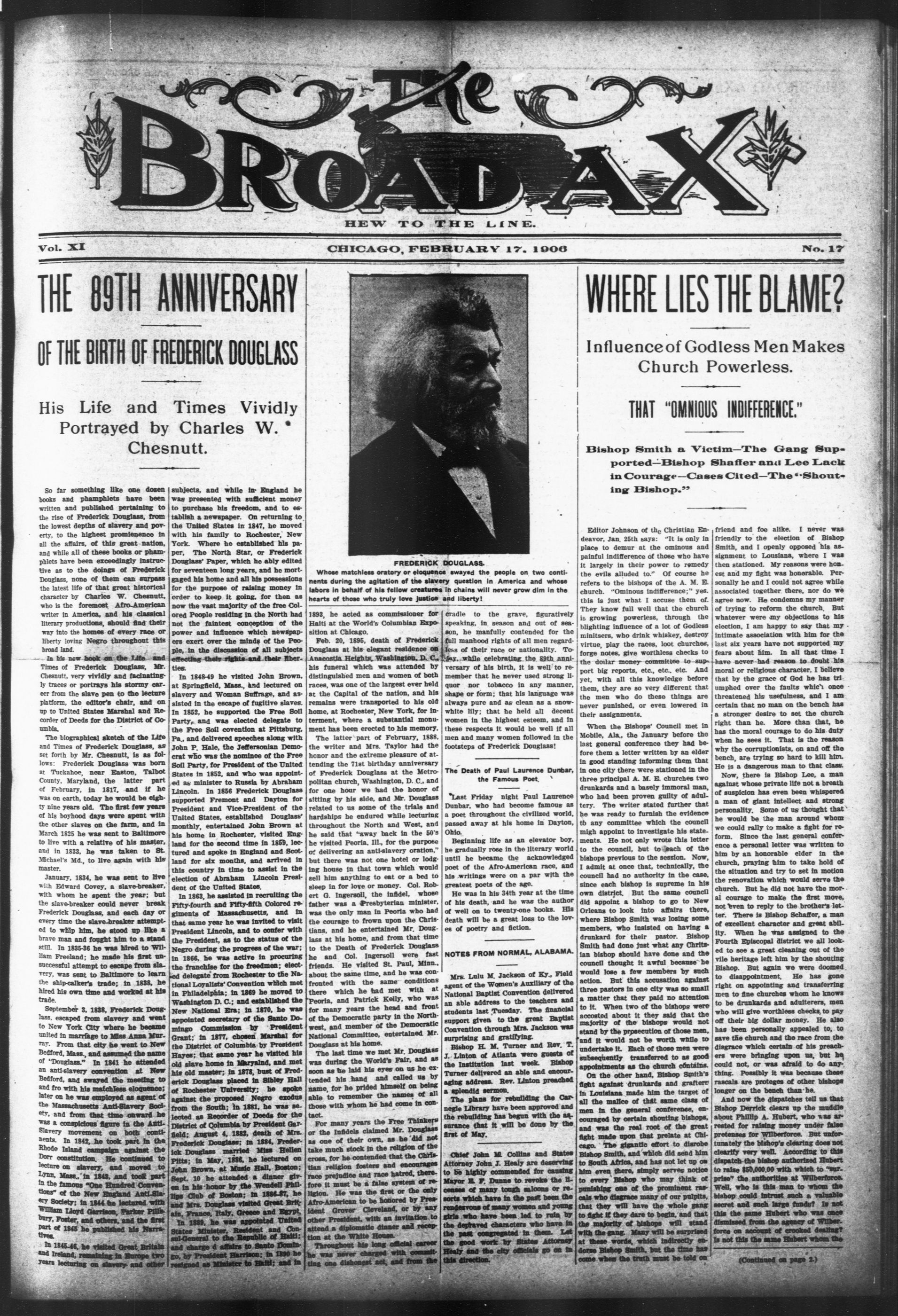
THE 89TH ANNIVERSARY OF THE BIRTH OF FREDERICK DOUGLASS
His Life and Times Vividly Portrayed by Charles W. Chesnutt.
THE 89TH A
OF THE BIRTH OF FF
His Life and
Portrayed by
Ches
So far something like one dozen books and phamphlets have been written and published pertaining to the rise of Frederick Douglass, from the lowest depths of slavery and poverty, to the highest prominence in all the affairs, of this great nation, and while all of these books or phamphlets have been exceedingly instructive as to the doings of Frederick Douglass, none of them can surpass the latest life of that great historical character by Charles W. Chesnutt, who is the foremost Afro-American writer in America, and his classical literary productions, should find their way into the homes of every race on liberty loving Negro throughout this broad land.
In his new book on the Life and Times of Frederick Douglass, Mr. Chesnutt, very vividly and fascinatingly traces or portrays his stormy career from the slave pen to the lecture platform, the editor's chair, and on up to United States Marshal and Recorder of Deeds for the District of Columbia.
The biographical sketch of the Life and Times of Frederick Douglass, as set forth by Mr. Chesnutt, is as follows: Frederick Douglass was born at Tuckahoe, near Easton, Talbot County, Maryland, the latter part of February, in 1817, and if he was on earth, today he would be eighty nine years old. The first few years of his boyhood days were spent with the other slaves on the farm, and in March 1825 he was sent to Baltimore to live with a relative of his master, and in 1833, he was taken to St. Michael's Md., to live again with his master.
January, 1834, he was sent to live with Edward Covey, a slave-breaker, with whom he spent the year; but the slave-breaker could never break Frederick Douglass, and each day on every time the slave-breaker attempted to whip him, he stood up like a brave man and fought him to a stand still. In 1835-36 he was hired to William Freeland; he made his first unsuccessful attempt to escape from slavery, was sent to Baltimore to learn the ship-calker's trade; in 1838, he hired his own time and worked at his trade.
September 3, 1838, Frederick Douglass, escaped from slavery and went to New York City where he became united in marriage to Miss Anna Murray. From that city he went to New Bedford, Mass., and assumed the name of "Douglass." In 1841 he attended an anti-slavery convention at New Bedford, and swayed the meeting to and fro with his matchless eloquence; later on he was employed as agent of the Massachusetts Anti-Slavery Society, and from that time onward he was a conspicuous figure in the Anti-Slavery movement on both continents. In 1842, he took part in the Rhode Island campaign against the Dorr constitution. He continued to lecture on slavery, and moved to Lynn, Mass., in 1843, and took part in the famous "One Hundred Conventions" of the New England Anti-Slavery Society; in 1844 he lectured with William Lloyd Garrison, Parker Pillsbury, Foster, and others, and the first part of 1845 he published his Narratives. In 1845-46, he visited Great Britain and Ireland, remaining in Europe two years lecturing on slavery and other
```markdown
```
subjects, and while in England he was presented with sufficient money to purchase his freedom, and to establish a newspaper. On returning to the United States in 1847, he moved with his family to Rochester, New York. Where he established his paper, The North Star, or Frederick Douglass' Paper, which he ably edited for seventeen long years, and he mortgaged his home and all his possessions for the purpose of raising money in order to keep it going, for then as now the vast majority of the free Colored People residing in the North had not the faintest conception of the power and influence which newspapers exert over the minds of the People, in the discussion of all subjects effecting their rights and their liberties.
In 1848-49 he visited John Brown at Springfield, Mass., and lectured on slavery and Woman Suffrage, and assisted in the escape of fugitive slaves. In 1852, he supported the Free Soll Party, and was elected delegate to the Free Soll covenation at Pittsburg, Pa., and delivered speeches along with John P. Hale, the Jeffersonian Democrat who was the nominee of the Free Soll Party, for President of the United States in 1852, and who was appointed as minister to Russia by Abraham Lincoln. In 1856 Frederick Douglass supported Fremont and Dayton for President and Vice-President of the United States, established Douglass monthly, entertained John Brown at his home in Rochester, visited England for the second time in 1859, lectured and spoke in England and Scotland for six months, and arrived in this country in time to assist in the election of Abraham Lincoln President of the United States.
In 1863, he assisted in recruiting the Fifty-fourth and Fifty-fifth Colored regiments of Massachusetts, and in that same year he was invited to visit President Lincoln, and to confer with the President, as to the status of the Negro during the progress of the war; in 1866, he was active in procuring the franchise for the freedmen; elected delegate from Rochester to the National Loyalists' Convention which met in Philadelphia; in 1869 he moved to Washington D. C.; and established the New National Era; in 1870, he was appointed secretary of the Santo Domingo Commission by President Grant; in 1877, chosen Marshal for the District of Columbia by President Hayes; that same year he visited his old slave home in Maryland, and met his old master; in 1878, bust of Frederick Douglass placed in Sibley Hall of Rochester University; he expose against the proposed Negro exodus from the South; in 1881, he was selected as Recorder of Deeds for the District of Columbia by President Garfield; August 4, 1882, death of Mrs. Frederick Douglass; in 1884, Frederick Douglass married Miss Hellen Pitts; in May, 1888, he lectured on John Brown, at Music Hall, Boston; Sept. 10 he attended a dinner given in his honor by the Wendell Phillips Club of Boston; in 1886-87, he and Mrs. Douglass visited Great Britain, France, Italy, Greece and Egypt. In 1889, he was appointed United States Minister, Resident and Consul-General to the Republic of Haiti; and charge d affairs to Santo Domingo, by President Harrison; in 1890 he resigned as Minister to Haiti; and in
HEW TO THE LINE.
M. D. R.
FREDERICK DOUGLASS.
Whose matchless oratory or eloquence swayed the people on two continents during the agitation of the slavery question in America and whose labors in behalf of his fellow creatures in chains will never grow dim in the hearts of those who truly love justice and liberty!
1893, he acted as commissioner for Haiti at the World's Columbian Exposition at Chicago.
Feb. 20, 1895, death of Frederick Douglass at his elegant residence on Anacostia Heights, Washington, D. C. his funeral which was attended by distinguished men and women of both races, was one of the largest ever held at the Capital of the nation, and his remains were transported to his old home, at Rochester, New York, for interment, where a substantial monument has been erected to his memory.
cradle to the grave, figurative speaking, in season and out of season, he manfully contended for the full manhood rights of all men regardless of their race or nationality. The day, while celebrating the 89th anniversary of his birth, it is well to remember that he never used strong liquor nor tobacco in any manner shape or form; that his language was always pure and as clean as a snow white lily; that he held all decent women in the highest esteem, and if these respects it would be well if a
The latter part of February, 1888, the writer and Mrs. Taylor had the honor and the extreme pleasure of attending the 71st birthday anniversary of Frederick Douglass at the Metropolitan church, Washington, D.C., and for one hour we had the honor of sitting by his side, and Mr. Douglass related to us some of the trials and hardships he endured while lecturing throughout the North and West, and he said that "away back in the 50's he visited Peoria, Ill., for the purpose of delivering an anti-slavery oration," but there was not one hotel or lodging house in that town which would sell him anything to eat or a bed to sleep in for love or money. Col. Robert G. Ingersoll, the infidel, whose father was a Presbyterian minister, was the only man in Peoria who had the courage to frown upon the Christians, and he entertained Mr. Douglass at his home, and from that time to the Death of Frederick Douglass he and Col. Ingersoll were fast friends. He visited St. Paul, Minn., about the same time, and he was confronted with the same conditions there which he had met with at Peoria, and Patrick Kelly, who was for many years the head and front of the Democratic party in the Northwest, and member of the Democratic National Committee, entertained Mr. Douglass at his home.
The last time we met Mr. Doulglas was during the World's Fair, and as soon as he laid his eyes on us he extended his hand and called us by name, for he prided himself on being able to remember the names of all those with whom he had come in contact.
For many years the Free Thinkers or the Infidels claimed Mr. Douglass as one of their own, as he did not take much stock in the religion of the cross, for he contended that the Christian religion fosters and encourages race prejudice and race hatred, therefore it must be a false system of religion. He was the first or the only Afro-American to be honored by President Grover Cleveland, or by any other President, with an invitation to attend a diplomatic dinner and reception at the White House. Throughout his long official career he was never charged with committing one dishonest act, and from the
se swayed the people on two conti- tory question in America and whose in chains will never grow dim in the and liberty!
cradle to the grave, figuratively speaking, in season and out of season, he manfully contended for the full manhood rights of all men regardless of their race or nationality. Today, while celebrating the 89th anniversary of his birth, it is well to remember that he never used strong liquor nor tobacco in any manner, shape or form; that his language was always pure and as clean as a snow-white lily; that he held all decent women in the highest esteem, and in these respects it would be well if all men and many women followed in the footstens of Frederick Douglass!
The Death of Paul Laurence Dunbar
the Famous Poet.
Last Friday night Paul Laurence Dunbar, who had become famous as a poet throughout the civilized world, passed away at his home in Dayton, Ohio.
Beginning life as an elevator boy, he gradually rose in the literary world until he became the acknowledged poet of the Afro-American race, and his writings were on a par with the greatest poets of the age.
He was in his 34th year at the time of his death, and he was the author of well on to twenty-one books. His death will be a great loss to the loves of poetry and fiction.
NOTES FROM NORMAL, ALABAMA
Mrs. Lulu M. Jackson of Ky., Field agent of the Women's Auxiliary of the National Baptist Convention delivered an able address to the teachers and students last Tuesday. The financial support given to the great Baptist Convention through Mrs. Jackson was surprising and gratifying.
Bishop H. M. Turner and Rev. T. J. Linton of Atlanta were guests of the institution last week. Bishop Turner delivered an able and encouraging address. Rev. Linton preached a splendid sermon.
The plans for rebuilding the Carnegie Library have been approved and the rebuilding has begun with the assurance that it will be done by the first of May.
Chief John M. Collins and States Attorney John J. Healy are deserving to be highly commended for causing Mayor E. F. Dunne to revoke the licenses of many tough saloons or resorts which have in the past been the rendezvous of many women and young girls who have been led to ruin by the deprived characters who have in the past congregated in them. Let the good work by States Attorney Healy and the city officials go on in this direction.
WHERE LIESTHE BLAME?
Influence of Godless Men Makes Church Powerless.
THAT "OMNIOUS INDIFFERENCE."
Bishop Smith a Victim-The Gang Supported-Bishop Shaffer and Lee Lack in Courage-Cases Cited-The "Shouting Bishop."
Editor Johnson of the Christian Endeavor, Jan. 25th says: "It is only in place to demur at the ominous and painful indifference of those who have it largely in their power to remedy the evils alluded to." Of course he refers to the bishops of the A. M. E. church. "Ominous indifference;" yes, this is just what I accuse them of. They know full well that the church is growing powerless, through the blighting influence of a lot of Godless minitsers, who drink whiskey, destroy virtue, play the races, loot churches, forge notes, give worthless checks to the dollar money committee to support big reports, etc., etc. etc. And yet, with all this knowledge before them, they are so very different that the men who do these things are never punished, or even lowered in their assignments.
When the Bishops' Council met in Mobile, Ala., the January before the last general conference they had before them a letter written by an elder in good standing informing them that in one city there were stationed in the three principal A. M. E. churches two drunkkards and a basely immoral man, who had been proven guilty of adultery. The writer stated further that he was ready to furnish the evidence to any committee which the council migh appoint to investigate his statements. He not only wrote this letter to the council, but to each of the bishops previous to the session. Now, I admit at once that, technically, the council had no authority in the case, since each bishop is supreme in his own district. But the same council did appoint a bishop to go to New Orleans to look into affairs there, where Bishop Smith was losing some members, who insisted on having a drunkard for their pastor. Bishop Smith had done just what any Chrissian bishop should have done and the council thought it awful because he would lose a few members by such action. But this accusation against three pastors in one city was so small a matter that they paid no attention to it. When two of the bishops were accosted about it they said that the majority of the bishops would not stand by the prosecution of those men, and it would not be worth while to undertake it. Each of those men were subsequently transferred to as good appointments as the church contains.
On the other hand, Bishop Smith's fight against drunkards and grafters in Louisiana made him the target of all the malice of that same class of men in the general conference, encouraged by certain shouting bishops, and was the real root of the great fight made upon that prelate at Chicago. The gigantic effort to disrobe Bishop Smith, and which did send him to South Africa, and has not let up on him even there, simply serves notice to every Bishop who may think of punishing one of the prominent rascals who disgrace many of our pulpits, that they will have the whole gang to fight if they dare to begin, and that the majority of bishops will stand with the gang. Many will be surprised at these words, which indirectly endorse Bishop Smith, but the time has come when the truth must be told on
THE BLAME?
Widless Men Makes Powerless.
IS INDIFFERENCE."
tim—The Gang Sup-
Shaffer and Lee Lack
es Cited—The "Shout-
friend and foe alike. I never was friendly to the election of Bishop Smith, and I openly opposed his assignment to Lousiana, where I was then stationed. My reasons were honest and my fight was honorable. Personally he and I could not agree while associated together there, nor do we agree now. He condemns my manner of trying to reform the church. But whatever were my objections to his election, I am happy to say that my intimate association with him for the last six years have not supported my fears about him. In all that time I have never had reason to doubt his moral or religious character. I believe that by the grace of God he has triumphed over the faults which once threatened his usefulness, and I am certain that no man on the bench has a stronger desire to set the church right than he. More than that, he has the moral courage to do his duty when he sees it. That is the reason why the corruptionists, on and off the bench, are trying so hard to kill him. He is a dangerous man to that class.
Now, there is Bishop Lee, a man against whose private life not a breath of suspicion has even been whispered a man of giant intellect and strong personality. Some of us thought that he would be the man around whom we could rally to make a fight for reform. Since the last general conference a personal letter was written to him by an honorable elder in the church, praying him to take hold of the situation and try to set in motion the renovation which would serve the church. But he did not have the moral courage to make the first move, not even to reply to the brother's letter. There is Bishop Schaffer, a man of excellent character and great ability. When he was assigned to the Fourth Episcopal district we all looked to see a great cleaning out of the vile heritage left him by the shouting Bishop. But again we were doomed to disappointment. He has gone right on appointing and transferring men to fine churches whom he knows to be drunkards and adulterers, men who will give worthless checks to pay off their big dollar money. He also has been personally appealed to, to save the church and the race from the disgrace which certain of his preachers were bringing upon us, but he could not, or was afraid to do anything. Possibly it was because these rascales are proteges of other bishops longer on the bench than he.
And now the dispatches tell us that Bishop Derrick clears up the muddle about Phillip A. Hubert, who was arrested for raising money under false pretenses for Wilberforce. But unfortunately the bishop's clearing does not clearly very well. According to this dispatch-the bishop authorized Hubert to raise $50,000.00 with which to "surprise" the authorities at Wilberforce. Well, who is this man to whom the bishop could intrust such a valuable secret and such large fund? Is not this the same Hubert who was once dismissed from the agency of Wilberforce on account of crooked dealing? Is not this the same Hubert whom the
(Continued on page 2.)
——eeeeeee
bets ea, ag se cot ‘proper
2S
ana
‘Subseriptions most be paid in advance.
te = Newereemmnr es roomemeendy |
eee
‘THE BROAD AX
: ‘00 Arment Avenne, Cheng.
FULIOR 7. TAYLOR, Ratter and Putitener.
Eatered vt the Post Oifice at Chicage,
"Hh as Second-clam Matter.
—_—_—_—_—_—_—___
CHiPs
ee ee ee
itive that “he will be reelected to the
city council, from the second ward,
‘with both hands down!”
The Bachelor Club, entertained
about 20 couples at a dancing party
Feb, 14th at the residence of Mrs,
Lawrence Newby, 2628 Wabash ave.
Justice Theodore C. Mayer, who is
as honest and as conscious as the year
i long, will be nominated and elected
‘as one of the Judges of the new Mun-
fetpal Court.
‘Hon. Charles E. Randall, bas made
gn ideal member of the Cook County
Board of Assessors, and he should be
renominated and re-elected to his pre-
ent position,
Mrs. A. W. Curtis 5757 La-Fayette
ave. announces the engagement of
her daughter Mary Harriet to Dr. John
B. Hall of Boston, Mass. The mar-
riage to take place in June.
Alderman Michael D. Dougherty,
who is as honest as the day is long,
and is a valuable member of the City
Council, will be re-elected to that
dody this spring from the 23nd ward.
‘The Berean Home and Foreign Mis-
sionary Society meets the ist and 3rd
Fridays in each month. The interést
im the work is gradually growing and
the attendance is increasing.
‘The Uttle son of Rev. and Mirs, W.
8, Braddan, 5008 Fifth avenue, has
for the past three weeks been at
death's door, but owing to the skillful
treatment of Dr. Erward S. Miller
the is on the road to recovery.
Congressman William Sulzer, of
New. York City, has favored the writ-
x, with a copy of the latest edition
of the Congressional Directory for
‘which we hope the eloquent Congtess-
‘man, ‘will accept our thanks,
‘The Supreme Court of Iilinois this
week handed down a decision affirm-
ing the validity of the New Chicago
charter, which means that twenty-
‘eight municipal courts will be estab-
lished in this city, and that the next
Mayor will be elected for four years.
“The Berean Baptist church was
crowded to its utmost capacity last
‘Sunday evening to listen to the Sac-
red. concert given under the auspices
‘of the Ideal Club of the church. The
program was excellent in every par-
‘teular.
‘The Phyllis Wheatley Ciub will
test Wednesday, Feb. fist, at Dous-
lass Center. The programme will be
rendered by the Philanthropy section,
and Mrs. Hattie Robinson, of Duluth,
‘Minn, will talk oti the work of the
clubs out west. #. L. Davis, Pres.
Alderman Peter Reinberg of the
26th ward who has been ever willing
‘to faithfully serve his constituents
‘and te labor for the adancement and
‘the improvement of Chicago in all
‘Bhings will be reelected to the City
“Qouncii this coming April.
"here is one sap or monkey-beaded
Jwould-be Negro lawyer in this town
“who has always posed as 2 reformer,
“jut.at the present time he delights
‘to train with gamblers and Plug-ag-
‘Jen, who may hear something drop
ae “Special Musical apd Literary
Program” in honar of Frederick Doug:
Tags, 89th birthday at thé Dougiess
eaterrc wart
4 una Grunt ete tenatas oer
a pout to heart
a
eee a aan.
eaaettnd ‘0. public coveptics: 0 ut
} poe epeudseg ners
. Si te ee
wee ae saat res
F es Pee ee
‘Ward, may haves Tittle scrap on.
hls hands at the primaries with John
A, Haney on Saturday Feb. 24th, But
the more than popular and honest Al-
éetman will be a winner just the
same, ,
John H, Coleman and Company, Er-
press and Van Moving, Tile and Slate
Hauling & specialty 2540 State st.
‘Tel, 699 South, are still engeged In
presenting their many customers an1
friends with beautiful Calendars for
1906,
‘Mr. A, W, Miller who is one of the
Dig leaders of the Republican Party,
on the West Side, will have no trouble
im being reelected as a member of
the Board of Assessors of Cook Coun-
ty, for in the past he has proven him-
self to be a first class official.
Judge Richard A. Dawson, who was
one of the old time Afro-American
Democrats, and was well Known
among all the Politicians, passed
away Saturdey morning at 2939 Ar
mour ave, and on Monday, his re-
mains were laid to rest in Union
Ridge Cemetery.
Dr. R. H. Hardin and Mr. Clifford
Johnson have been appointed perma-
nent ushers at St. Thomas Episcopal
church with special instructions from
the rector, not to seat attendants dur-
ing the sermon, This is at it should
be in all churches, for nothing dis-
turbs the speaker and listeners more
than the “late comers” who prome-
nade to the front, in order to show
their new appendages etc., etc.
Alderman Charley Martin, and Wil-
Nam B. Brown, Sergeant-At-Arms of
the city council, fiimflammed honest
and country looking Aledrman P. J.
O'Connell out of $10, it appears that
they conspired together and induced
Alderman O'Connell, to put up his ten
spot, last Tuesday afternoon, on some
kind of a shell or skin game, and af-
ter they got his money they divided
it up among themselves, and now the
easy mark Alderman from the Sist
ward, may hafl them before Mayor
Dunne, Chief Collins, and the city
council for gambling in the city hall,
‘The Freeman has no objection to
The Broad Ax clipping its articles
entire, headlines, and all, but it does
seem that anything “broad” should be
broad enough to give proper credit.
Otherwise The Broad Ax should
change its name to hatchet or toma-
hawk—The Freeman, Indianapolis,
xy “
The editorial writers of The Free-
man accuses us of dishing up Rev, D.
A. Graham's letters or articles as orig-
inal matter, which is untrue, His
first article to appear in these col-
qumns was clipped from, The Bystan-
der, Des Moines, Iowa, and not know-
ing it was from The Freeman, we
supposed it was credited up to ex-
change, and the two Iast letters have
been duly credited to the Journal from
which they were appropriated. Hop-
ing this explanation will be sufficient
to satisty The Freeman as we are not
in the stealing business,
FREDERICK .DOUGLASS .CENTER,
3082 WABASH AVE.
‘The Young Peoples’ Lyceum carried
out a very interesting Douglass an-
niversery program last night with ap-
propriate addresses, songs and reci-
tations. Tomorrow 3 p. m. the anni-
versary season will be continued with
an address by Mrs. Ida B. Wells-Bar-
nett, The Douglass Funeral March
composed by Prof, N. Clark Smith wilf
be rendered and « few of the favor-
orite Jubilee songs 80 much enjoyed
by him. The Singers are Miss Anna
Garrett, soprano; Mrs, Delia Blake
Ridgeway, contralto; Prof. Smith,
tenor, and Mr. W. 0. Brown basso,
‘The committee to take charge of
the work of a vacation school at Keith
ig earnestly working. The first of
a series of Sunday evening meetings
‘will be beid at Bethel church Sunday.
Feb. 25. Mrs. L NX, Blackwelder a
member of the committee on vacs
tion schools will give the address.
‘Mrs. D. H. Williams is chairmen of
‘this committee and ie ably sssisted
by Mrs. Wells, Mrs. Laff, Miss Gon:
nie Hancock and Mrs. Frank George.
Monday $ p.*m,, the men’s foram
‘will meet. ,
~ The Woman's Club will be address
ed by Miss Hllen Starr of Hull House
on “The Cross fm Art, and Literatare”
Tietey 2pm
‘The Phyllis Wheatly Club holds tts
‘meeting Wednesday 2 p. m
[The speaker will be Mra. Wald of the
Juvenile Cs a tae
| antes if + oe eee ee
sees a fm te sie
ee ee Ae
ae ta dawns dae
eth = as ena Laon
er cE Oa sche.
aes kite Sige ie agi pee
Where Lice the Blame?
(Contineeé from page 1)
Towa conference in 1902 refused to
give missionary papers on account of
complaints made against him for bad
conduct, but whom Bishop Grant did
subsequently give papers of autbority,
im spite of the action of the annual
conference? Is not this the same Hu-
ert who im the fall of 1904 was ar
rested in Lincoln, Neb. for rape, was
tried, convicted end served time for
the same? Certainly there was &
Rev. P. A. Hubert who made such a
record. Now what does Bishop Der-
rick mean by taking ,up this fellow
and making him a special, secret
‘agent for Wilberforce, and allowing
him to run for eighteen months with-
out making any report, or without the
proper authorities knowing that “he
was collecting money for the school?
Of course Hubert's word cannot be
taken for anything; but the way the
prosecuting attorney looked at this
beautiful surprise led him to tell Pres-
ident Jones that he had better drop
the prosecution, for he could not send
Hubert to the pen without sending
three of the highest dignitaries in the
church to keep him company, To
save the church the disgrace President
Jones reluctantly accepted $400.00
from Hubert for Wilberforce and let
him go.
Remember, I am prepared to prove
every statement I make. Remember
also that all the bishops have treated
me well, and hence I have no personal
grievance against a single one. I am
not fighting men, but I am fighting sin
in high places.
Information is pouring in upon me
from every quarter showing how vice
and iniquity are being fostered all
through the church, and how little
the authorities care for the laws of
the church. I know that the condi,
tions were awful before I began to
write, but I see that I did not know
nearly all. Here, for instance, is a
letter from a prominent layman in
the East, unfolding the sad state of
affairs in the First district, The news.
papers have given us plenty, but they
have not given half the truth. No
wonder there is rebellion and deflance
of authority. What else can we ex-
pect from pedple who have enlight-
ened consciences? They demand that
the preachers and bishops practice
what they preach, and when they eee
such flagrant departures from this
Tule, and that bishops do not require
such things, they do not bow to the
judgment of such men. *
And so Dr. Johnson says that there
is an “oninous indifference” on the
part of the bishops, and the public
adds “an gminous silence.” It is this
very indifference that brings me to
say that they are largely responsible,
as the good doctor admits. They have
gone on so long and become so tang-
Jed up with these bad men that they
see no way to cut loose from them
without condemning themselves. But
this is just what they are called upon
to do, confess their sins, whether of
omission or of commission and make
@ new start in their episcopal life.
‘They cannot regain the confidence of
the public in any other way. A lay-
man of the last two general conferen-
ces says that the only mistake I
made in my first article was in say-
ing that “the church would not last
twenty-five years, in its present conds
tion.” He says that it will not last
twelve years unless the bishops come
down and make a new start. This
is the only way to restore confidence.
‘Will they have the moral courage to
do it, or will they go blindly on as aid
the Russians against the Japs?
In my next I will take up the flag-
rant misappropriations of the dollar
money.
_ D.« GRAHAM.
‘Detroit, Mich.
Furnished Room To Rent.
Modern furnished front room to
rent. Steam heat, Telephone service.
3634 Calumet ave.
Just « Few.
“All men make fools of themssives
a number of times ia this Ifa”
“Oh, I don’t know; some men love
bat once.”—Houston Post.
‘Watch Werks,
An ordinary watch contains about
150 pieces, but complicated repeaters,
‘chromographs, etc, as many as 800,
and in one case 975 pieces. :
‘Unnecessary.
‘We'd think = good deal better of
‘tome people if they didn’t think so
‘well of themselves as' to make i un
pecensary.—Puck. i
etna
‘person per ammum ts
Ci
"Fin tans tn pone a
Sr
a, SO OMB oy |
‘Islanders Leaving.
Owing to the emigration of 1,000
persons during the past three months
from Bt. Pierre and Miquelon—isiands
tmmediately south of Newfoundland—
out of a total population of 6,500, the
French authorities are beginning
fear that the colony is threatened with
extinction. The rush of emigration is
likely to continue. The poorer inbab-
ftants advocate the transfer of St
Pierre by France to Newfoundland,
Betitied to Honorable Mention.
“You believe in old-age pensions, do
yout” said the passenger with the
‘skull cap. “Well, that depends. Take
your case, for instanct. What claim
have you on the country? What have
you ever done or suffered for it?”
“I've got the tobacco, heart from
contributing to its internal revenue de-
partment,” said the passenger with the
sandy goatee, “and I've raised 14 boys,
D’gosh!"—Chicago Tribune.
Insecure Security.
James Richardson, of Rodger Mills
county, tendered a mule the other day
as a chattel to a Cheyenne money
lender in order to get funds with which
to get = marriage license and pay the
preacher. He had ridden the mule in
—18 miles—and expected to walk beck
home in time for the wedding.—Guth-
rie (Okla.) Gazette.
Fortune Made Miser.
Father Aeby, a noted miser, has died
at Berne, age 70. When he was 22 a
fortune was bequeathed him, and from
Deing a spendthrift Re at once became
a miser. He lived on bread and wa-
ter at a cost of three cents a day, and
left $750,000. The sum of $100,000 in
gold and silver was found under his
bedroom floor.
Getting Her Loquacious.
“My daughter is so taciturn,” com-
plained Mra. Blanktoo-Black. “What
ought I to do? Consylt some special-
ist?”
“Not at all, not at all,” replied Mr.
‘Wurldly-Wiseguy. “Have her given in-
struction in whist and take her fre
quently to the opera” -
‘Silver trom Voleances.
Sliver bas been thrown out by vol-
canoes in two instances recorded by
J. W. Malet. Ash trom an eruption of
Cotopaxi in 1885 showed one part of
silver jn 83,000 and that ejected in
1886 by Tungurague, in the Andes of
Bouador, contained one part of silver
‘tm 107,200.
—>__—__
Skeleton Scare
‘The shadow of a dangling skeleton
on @ window shade created great ex-
citement in a London street the other
night. An inquiring polieeman learned
that an ambulance doctor was deliver
ing @ lecture on first aid to « room-
ful of railway employes.
tet Gene Gade
J. J. Miller is the oldest clerk in the
serviee of the national government.
For more than 60 years he has been
connected with the life saving service.
‘He was born in Philadelphia in 1821,
‘and educated in the private schools of
that etty. :
a '
‘Up-to-Date Indians. |
‘The Indians of Elko, Nev., have
abandoned the dances of their fore-
fathers, have built a dance hall, and re-
enti eae ak See oe ae
thelr squaws and many invited pale
faces waltzed in the most modern fash-
fon. |
ore ee
Cross-Breeding Plants,
It is only within a century that hy-
bridization or the cross-breeding of
plants has been practice. Yet it seems
to have been in Lor¢ Bacon's mind, as
a thing to be achieved, more than 200
years ago.
eae
Garibaldi’s Gaiter.
According to La TMbuna di Roma
ne of the gaiters worn by Garibaldi
when he was wounded in the battle of
Aspromonte, August 28, 1862, has been
presented to te mayor of Rome.
ee
‘What's the Answer?
- Johnay—Isn’t a tin born made of tin,
‘mamma?
Mamma—Certainly it is.
“Then how is it that s fog hora isn’t
made of fog?’—N. Y. Times.
fame Old Bye.
Asked in a London court the other
day where he got his black eye, the
skipper of a coasting schooner replied:
“Oh, that's an old one. I've had it for
two years.”
SSS
In the Tyrol tae government still
pays for the extermination of poisonous
‘snakes. It is the one Buropean govern-
ment which now does.
London's Charity.
Lenders tet merece have during
ast decade collected more than
'$100,000,000 for charitable and bensvo-
lent parposes.
‘Mevada Auto Line.
‘Betwesa Topopah and Manhattan,
‘Nev. 60 miles, there is an automobile
Round trip, $25.
10 wis her sonin-iaw.—N.
d ;
“David” Bation.
PIANOS WINTER KILLED.
More Susceptible to Extreme Heat
or Cold Than Human
Beings.
“Winter killing of pianos,” says an
expert tuner who has done work for
Paderewski, Hoffman, Arthur Whiting
and © host of other celebrated musi-
cians, “ig something that most owners
of musical instruments take no account
of. Yet it is as serious as the-winter
kuuing of shrubbery and needs to be
as carefully guarded against.
“Especially since ‘all the world has
come to live im steam-heated houses
and flats. the business that the plano
tuner ought to get, and often doesn’t,
bas increased immensely. A piano is
really more susceptible to excess of
beat and lack of moisture than human
beings are.
“It fs bad enough, of course, that
‘men and women will live all winter
Jong in rooms at 80 degrees, with every
particle of moisture baked out of the
air. They naturally get colds and
pneumonia from the experience. Mean-
time {t's just as fatal to the piano,
which cannot properly stand more
than 72 degrees of the artificial heat.
“During the American closed season,
‘as our English cousins like to call it,
hundreds of thousands of musical in-
struments go to rack and ruin. The
moisture is dried out of the sounding
board and all the other wooden parts,
which warp and twist and disastrous-
ly affect the action.
“It is surprising, anyway, how negll-
gent people are in their treatment of
instruments for which they pay a great
deal of money. There's a lesson for
the amateurs in the firmness with
whiqp professionals insist that their
pianos shall be kept right up to the
mark and not allowed to get out of or
der in the slightest particular.
“In a music school, too, the teachers
have to be particular in having the in-
struments frequently attended to. The
pianos in the New England Conserva-
tory of Music, for example, are all
tuned at least every five weeks.”
I$ TWO ANIMALS IN ONE.
One Half of a Chameleon May Be
‘Wide, Awake and the
Other Asleep.
To all appearances and according
to the researches of those best capa-
ble of forming an opinion on the sub-
ject the nervous centers in one lateral
balf of the chameleon go on independ-
ently of those on the other, and it
has two lateral centers of perception
sensation and motion—besides the
common one in which must reside
the faculty of concentration, says the
Selentific American.
‘The eyes move independently of
me another ‘and convey separate im-
pressions to their respective centers
Of perception. The consequence is
that when the animal is agitated its
movements resemble those of two an!-
mals or rather perhaps two halves of
animals glued together. Each half
Wishes to go its own way and there
4s no concordance of action.
‘The chameleon, therefore, is the
only four-legged vertebrate that is un-
able to swim; it becomes so fright-
ened when dropped into water that
all faculty of concentration is lost
and the creature tumbles about as if
in a state of intoxication.
‘When a chameleon is undisturbed
every impulse to motion is referred
to the proper tribunal and the whole
organism acts in accordance with its
‘decrees.
The chameleon, moreover,’ may be
fast asleep on one side and wide
awake on the other. Cautiously ap-
proached at night with a candle so as
not to awaken the whole animal at
once, the eye turned toward the light
will open, begin to move and the cor-
responding side to change color,
whereas the other side will remain for
a longer or shorter time in s torpid,
motionless and unchanged state, with
fits eye fast shut.
HE GOT A WARMER SEAT.
Glever Ruse of Tavern Guest Cleared
the Crowd from Around
the Stove.
One bitter cold night recently a sol-
emn-faced man drove up to a tavern
near Westchester and made his way to
the sitting-room after seeing that hig
horse was taken to the stable, relates
the New York Press. There was a
large crowd of guests huddled arownd
the stove and he had to take a distant
seat where it was not much warmer
than outside. As soon as a waiter ap-
peared the man said:
“Get two dozen oysters on the half
‘shell and take them out to my horse.”
_ When the waiter passed through the
room on his way to the stable every-
‘body but the new guest followed him
to see the remarkable horse feed on
raw oysters. In a few moments the
disgusted crowd, headed by the waiter,
returned to the room to find the own-
ex of the horse comfortably seated by
the stove.
“The horse wouldn't look at the oys-
ters,” saiq the waiter.
“{'didw't think he would,” replied
the man. “Hand them to me and bring
te a bottle of ale.”
a Sig
‘Sei
Mr, Biltus—No dinner ready? What
oa earth te ho matter with you, aap
Mrs. Billus—Oh, John! Mrs. Binks,
‘who lives next door, has the loveliest
‘new. set of furs I ever saw, and I have
‘Rp appetite. —Clwveland Plain Dealer,
e ‘Proot Positive.
“Bo Jones #2 prolific writer?”
rn Say, I'd like to have the
bays as return postage,”—
ees hy ,
RARE ORCHID AGAIN FOUND
Plant Long-Sought Has Been Redis-
covered on Recent Thibet
‘Expedition.
4m orchid which for 50 years has
baffled all the attempts of collectors
to find its matfve haunts has been re-
iscovered. This orchid is the cypri-
pedium Fairieanum, which is one of a
random collection made in Assam in
1857, semt to London in the same year
and bought by a Mr. Fairie, of Liver-
pool, in whose possession it bloomet
and was daily hailed and descried in
orchid literature as one of the most
beautiful orchids hitherto known. Sev.
eral other plants of the same orchid
came with it, and the species was 2.
once named Fairieanum, after Mr.
Fairie,
From the day of its first discovery.
in spite of scores of expeditions and
perilous journeys by collectors, no: a
single plant was found until som
member of the Thibet expedition, 4
few months ago, discovered a whole
bunch of the plants. He sent them
along to Calcutta, whence two were
dispatched to Kew, and others are
gradually coming through to Englan:!
“Probably arfother 60 years will
elapse ere more Fairieanum are found.”
said a British speciaifst, “for no pri
vate collecting expedition is likely to
venture into such @ country. My own
belief 1s that unless another military
expedition traverses the same ground
there will never again be a chance of
getting plants.”
‘The plant flowering at Kew has five
growths and two flowers. The second
‘plant is developing five blooms. The
flower has a slender, hairy scape about
tem inches jn height, a prominent and
‘charming dorsal sepal, one and three.
quarters inches in length by one and
one-quarter inches in breadth, with 3
white ground beautifully veined with
violet purple and with brownish green
veins near the center and whitish hairs
around the margins. The petals droop
and have an upward curve at the tips;
they are one and one-half inches in
length, with a white ground streaked
with purple and yellow. The upper
margin of the petals is much undulated
and covered with prominent purple
hairs. The pouch {s rather small,
greenish-brown in color, veined with
brownish red and covered with short
hairs.
GOT HER MONEY'S WORTH.
Drug Store Customer Took Postage
‘Stamps Instead of Hair
Bleach.
‘The pretty girl whom the drug
clerk recognized as a customer en-
tered the store rather diffidentiy and
approached the clerk with the air
of one about to ask a favor, relates
the Rehoboth Sunday Herald.
“Do ydu ever exchange things?” she
asked, appealingly.
“Well, it depends. We try to be
accommodating,” he replied. “What
do you want to exchange?”
She brought forth a bottle, which
she handed him.
“I—I decided not to use this,” she
said, “and I'd like to return it”
“This” was a bottle of peroxide of
hydroges, and the girl's hair was still
brown.
“Certainly we'll take it back,” said
the clerk. “What do you want in-
stead?”
She thought a minute and looked
around at all the mysterious giast
bottles and jars. Then an inspiration
Ut up her pretty face.
“You are so kind,” she sald. “I'll
take it out in postage stamps.”
AMERICAN WOMAN GUIDE.
Touring Parties in Ancient Athens
Shown the Sights by
‘Young Lady.
‘There is in Athens, Greece, a young
American girl, Miss Florence Stone,
who makes a good living as a profes-
sional guide. Some time ago, while
traveling in Europe with her mother,
Miss Stone received word that theit
fortune had suddenly been lost. Hap-
ening to be in Athens, she determined
to remain there and do what she could
toward their support. She tried teach-
ing English for a while, but was not
particularly successful in getting
pupils.
‘Then, at the suggestion of a promi-
nent American woman whom she had
‘Sccompanied on one or two sightsee-
ing expeditions, she offered her ser-
vices to parties of tourists as a pro-
fessional guide and has made a suc-
cess of it. With education and cul-
ture as well as a perfect knowledge
of modern Greek. she is better xble to
impart interesting historical tnforms-
tion than the ordinary foreign guide.
Gee Gulenda
“Well, I'll tell you the trouble with
Sterling. I admit that he’s a fairly good
Dusiness man, but there's a pretty bis
element of luck tm his success. He's
tnsufferably conceited, too, and then it’s
merely his hypecrisy that—”
“You seem to know him pretty well.”
“Oh, yes, we're great friends.”—Phil-
adelphia Press.
‘Too Much So.
Feddle—You know Stocks, dort
‘Doctor—Yes, indeed. He is now &
patient of mine.
Sele tee Seemann to
de’ ;
, Doctor—1 siioulé say so. I'm treat-
tag him for insomnia. —Stray Stories.
=
“They sa OPT eects ott ca
a chal y creme
the jase the. grufters."—
+ Pe ae
WASHINGTON GOSSIP
ODOR OF MOTH-BALLS CLINGS BOUND THE UNIFORMS.
White House Offices Uncomfortable,
Unhealthful and Ugly—Represen-
tative Longworth Laboring
for Needed Reform.
WASHINGTON.—
The scent of the
moth ball will
soon be out of
Washington at-
mosphere. There
is only one more
reception at the
White House and
after that the ma-
jority of the
young officers
and old ones, too
A S H I N G T O N.—The scent of the moth ball will soon be out of Washington atmosphere. There is only one more reception at the White House and after that the majority of the young officers, and old ones, too.
for that matter, in the army, navy and marine corps can put away their dress uniforms in cedar closets and chests and fortify them with camphor and moth balls. The odor of these moth destroyers and preventers is first noticed on New Year's day, when every officer of the army and navy and revenut cutter service within the city is expected to put on his finest dress uniform and repair to the White House to greet the president and his wife.
During the Spanish-American war an order was issued requiring officers to wear their uniforms while on duty, and they all became so accustomed to doing so that their official clothing was in use most of the time. Gradually the order came to be ignored, and to-day army and navy officers holding positions in Washington go about their duties in civilian dress and the blue and drab uniforms which are costly affairs are kept safe from moth and rust. When the New Year's reception is on it is no exaggeration to state that the odor of moth balls can be detected a square away from the White House. Then come the official evening receptions, which are given fortnightly, and again the officers must turn out in full regalia, so that the sweet odor of the flowers decorating the executive mansion and the delicate perfumery affected by the ladies must contend with the sharper and more insistent smell of camphor.
These official receptions are now over, and the thrifty officers can once more don civilian dress and attend evening functions in the formal black dress suit. Officers as a rule grow very tired of the color of their uniforms and are very glad to lay them aside for civilian dress.
Reforms at the White House.
RESIDENT
ROOSEVELT
has worked a reform in the matter of evening receptions at the White House. In the old days the invitations issued for each reception would fill the executive mansion with such a
P
throng as to ruin gowns and tempers. Since the Roosevelts came to the White House a different system has been in force, under which there is a judicious division of invitations, so that everybody who ought to be invited will get at least one invitation to each reception. The capacity of the old mansion is limited, despite the wide-famed East room, which is supposed to accommodate thousands. Every function at the White House proclaims loudly the necessity of an executive building where the presidential offices could be located and a large hall be provided for official receptions, leaving the present mansion exclusively for the private use of the president and his family.
The idea of a grand executive building is at present kept in the background, although the insignificant executive offices where the president does his work were erected as temporary quarters in expectation that congress would take up the matter and provide a proper place for executive headquarters. There is not a day passes that the inadequacy of the White House offices is not emphasized. There is no more beauty about the building than there is about the average country railroad station. The rooms are uncomfortable, ugly and not very healthful.
The worst feature about these temporary quarters is that the president is separated from the public by only one or two doors, and noises in the outer offices penetrate easily into the cabinet room or into his own office. The deplorable Mrs. Morris incident could not have occurred in a building that had been constructed for protection as well as use of the president. She raised a row within ten feet of the president's room, something she could not have done in a properly constructed building.
Longworth a R thing as a member
Man of Action.
PRESENT A TIVE NICHOLAS LONG WORTH
does not propose to go down into history merely as the husband of A 11ce Roosevelt.
The young man has political ambition and laudable desire to accomplish a me of the house. He
that he is capable of taking good care of himself in debate and he can make an interesting and informative speech. His experience on his Philippine tour last summer was not altogether that of love-making. He studied intelligently conditions in the islands, and when the Philippine tariff bill was up in the house he had an opportunity to display his knowledge of the whole subject. He does not hesitate to speak plainly about the Philippines, and declares that the United States will be well rid of them when they can be properly governed by their own people.
Mr. Longworth is now advocating a very important measure which, if it becomes a law, will distinguish him as a man who has accomplished a real reform. His bill provides for the purchase of land and the erection of embassies and legation buildings for our representatives in foreign lands. His own travel abroad in Europe and in the orient has impressed him with the very shabby showing the United States makes in the matter of homes for her diplomats. For posts in Europe very wealthy men have to be selected as ambassadors in order to do credit to the government in the matter of embassies and in entertaining. Whitewalt Reid, at London, pays $35,000 a year merely for the rental of a mansion, or twice the salary he receives from his government.
Compared with the generous salaries paid foreign ambassadors in Washington and the liberality of their home governments in purchasing for them permanent quarters here, the United States cuts a very sorry figure abroad.
A Canadian Yankee.
A Canad
NE of Canada's bright railroad men was observed in Washington recently, and the capital city is all the better for his visit. This is George H. Ham, a special agent of the Canadian, Pacific railway, who has left a trail of "glad hands" all
the way across the continent and wherever his big system of railroad goes, and who is a Canadian Yankee in with, humor and enterprise. Mr. Ham is one of those rare characters that a big corporation gets hold of sometimes, whose personality counts for more than the name of the company. He has made 29 trips from Montreal to Victoria in the interest of the Canadian Pacific railroad, and they have resulted in a wider diffusion of knowledge regarding the wonderful territory this system serves than has been accomplished by any other means.
Mr. Ham personally conducts tours of homeseekers, investigators and investors, with an occasional party of newspaper men, across the continent, and there is scarcely a mile of the 3,000-mile trip with which he is unacquainted. He can give the depths of soil in every section, and the acre of the big 1,000-mile square wheat farm in northwestern Canada, and can tell within a thousand feet of the output of the lumber in eastern Canada as well as on the Pacific slope. Wherever he goes a bright light is shown for the Canadian Pacific railroad, or, as many of the natives in Canada are in the habit of calling it, the "C. P. R. railway." While Mr. Ham was in Washington he did not neglect to call attention to the advantages of his home country of Canada as a winter resort as well as summer.
Cheap Intoxicants
S
ELECT and common council for the District of Columbia are now in session. In other words, congress is assembled in the national capital and is for a large part of the time engaged in managing the affairs of the district. As the peo
ple in this ten-mile square territory have no franchise, they are the wards of congress. The two district committees of the house and senate look after affairs in Washington just as the branches of councils or boards of aldermen would do in any other municipality. It seems to be a rather trifling business for bodies representing the entire country to have their time occupied in discussing the opening of streets, the laying of pavements, building schoolhouses, etc. The system, however, cannot well be changed, the sad experience of a territorial form of government 20 or 25 years ago precluding the thought of changing back to that form.
Just now there is a good deal of talk concerning the prohibition of the sale of intoxicating liquors in the district or the imposition of an extremely high license. The great capital of the nation, supposed to be the center of statemanship, art and literature, is no better off in the matter of common drunkenness than a manufacturing center. A United States official has written to the excise board stating that conditions are deplorable on account of cheap beer and the bucket trade. He declares that most of the alley fights, assaults and other violations of the law are traceable to cheap beer and to the habit of "rushing the growler." The matter will be brought up before congress and an attempt made to cut off the trade in cheap intoxicants and to do away with a multitude of low groggeries where the colored element of the city get their inspiration for all sorts of misdulces.
CHILD'S FIRST TEETH.
Letting baby suck and chew, on a stale crust or a stale piece of cora pone will do a great deal to assist in bringing the teeth through; and the teeth that have arrived will also be benefited by this very simple means. In stale bread all of the gas which might create disturbance in the little stomach has evaporated, the starch granules have ripened and burst, and the bread itself is in the best condition to be digested and absorbed into the system. Just a little lime water in the milk will often aid in establishing good teeth, and where the little princess' first teeth have not been especially good, either as to color, shape or arrangement, the matter can readily be corrected by careful attention, first to the cleanliness of the mouth and teeth, and next by diet.
Upon the care of the first teeth will depend the quality and the beauty of the second or permanent set. Only too often do even the wisest of mothers imagine that the first teeth do not require dentists' care, arguing that as they are but temporary it were money thrown away to see to their filling and the like.
If the first set be in any way irregular or faulty the defect must be corrected immediately, for "as the twig is bent, so is the tree inclined;" and as the first teeth are faulty or perfect so will the teeth that the little beauty carry with her through life be affected.
The habit of letting the baby suck its thumb or its fist is a fruitful source of irregularities of the gums and teeth. It is bad enough when only the thumb is constantly sucked; but when the whole of the little fist is thrust into the tiny mouth the gums are drawn out of shape and the teeth grow outward in a painfully projecting fashion. The use of those so-called pacifiers, too, is another source of dental troubles, and this scribe would joyfully see their manufacture and sale prohibited by act of legislature. They are seldom or never properly cleansed, the rubber of which they are made is porous and absorbs all sorts of germs and bacteria, and their use is almost invariably attended by sore mouth, bad breath and digestive and intestinal troubles.
When the little girl has reached, say, two years old, she may be taught to use her little toothbrush herself under due supervision, of course. Small brushes now come especially for the little folk, the edges of the bristles carefully serrated so that they penetrate into the interstices between the teeth and remove every particle of detritus that may lodge there.
Little miladi must be taught to use her small brush after each meal, before going to bed at night and the first thing on rising in the morning. She must learn to rinse the mouth thoroughly and often, and she must be taught to gargle, too, for the faucial tonsils are often traps for the catching and holding of unmasticated particles of food, and this gives rise to an unpleasant odor on the breath.
HANDSOME HANDMADE LACE
Pattern Here Given Very Good One Piece of Lace May Be Used Variously.
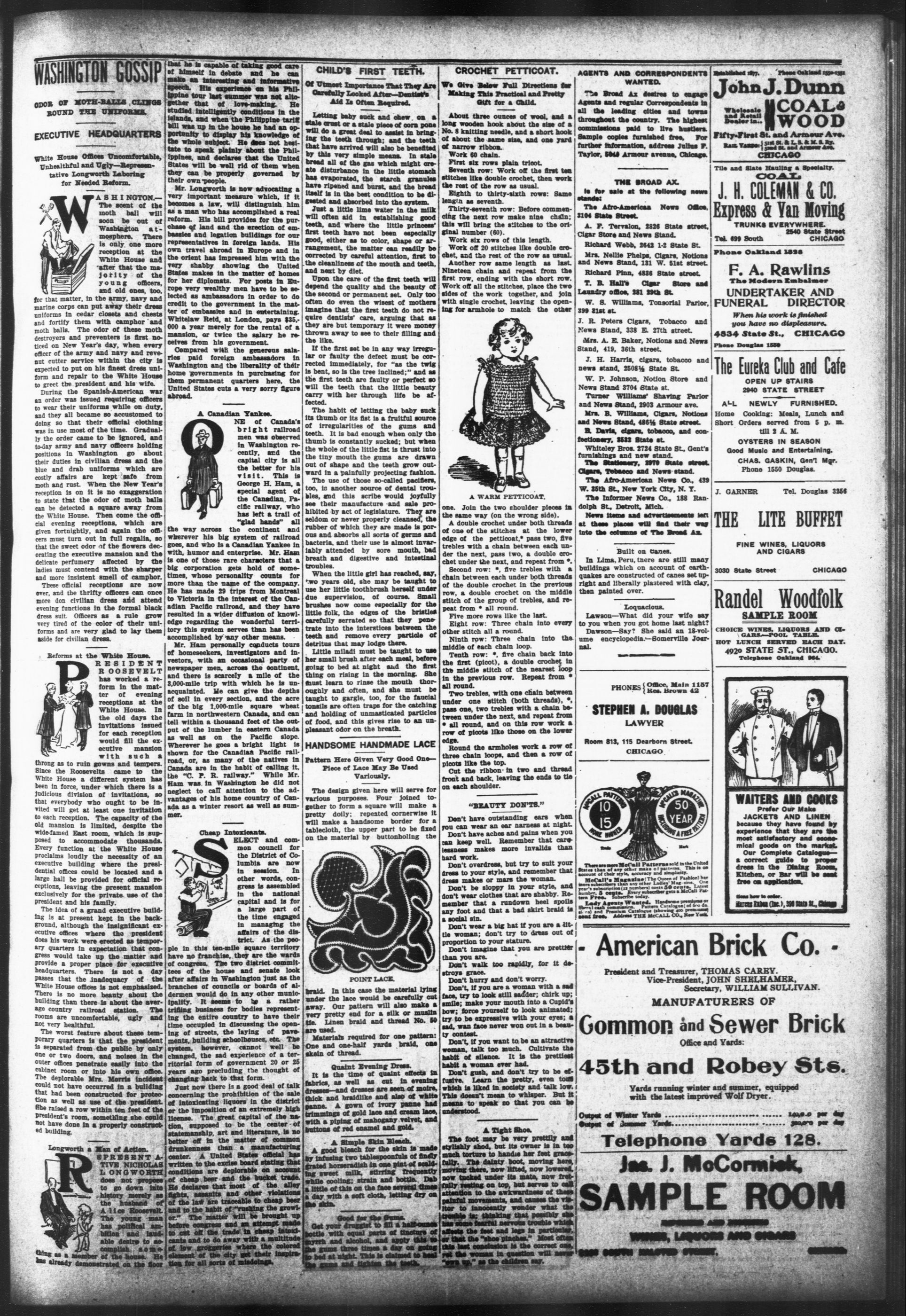
The design given here will serve for various purposes. Four joined together to form a square will make a pretty dolly; repeated cornerwise it will make a handsome border for a tablecloth, the upper part to be fixed on the material by buttonholing the
POINT LACE.
braid. In this case the material lying under the lace would be carefully cut away. Our pattern will also make a very pretty end for a silk or muslin tie. Linen braid and thread No. 50 are used.
Materials required for one pattern:
One and one-half yards braid, one skein of thread.
Quaint Evening Dress.
It is the time of quaint effects in fabrics, as well as cut in evening dresses—and dresses are seen of moire, thick and braidlike and also of white panne. A gown of ivory panne had trimmings of gold lace and cream lace, with a piping of mahogany velvet, and buttons of red enamel and gold.
A Simple Skin Bleach.
A good bleach for the skin is made by infusing two tablespoonfuls of finely grated horseradish in one pint of scalding sweet milk, stirring frequently while cooling; strain and bottle. Dab a little of this on the face several times a day with a soft cloth, letting dry on the skin.
Good for the Gums
Get your driest汁 to fill a half-bounce bottle with equal parts of tincture of myrrh and alcohol, and apply this to the gums three times a day on going to bed at night. This is claimed to heal the gums and tighten the teeth.
CROCHET PETTICOAT.
We Give Below Full Directions for Making This Practical and Pretty Gift for a Child.
About three ounces of wool, and a long wooden hook about the size of a No. 8 knitting needle, and a short hook of about the same size, and one yard of narrow ribbon.
Work 60 chain.
First six rows plain tricot.
Seventh row: Work off the first ten stitches like double crochet, then work the rest of the row as usual.
Eighth to thirty-sixth rows: Same length as seventh.
Thirty-seventh row: Before commencing the next row make nine chain; this will bring the stitches to the original number (60).
Work six rows of this length.
Work off 20 stitches like double crochet, and the rest of the row as usual. Another row same length as last. Nineteen chain and repeat from the first row, ending with the short row. Work off all the stitches, place the two sides of the work together, and join with single crochet, leaving the opening for armhole to match the other
10
A WARM PETTICOAT.
one. Join the two shoulder pieces in the same way (on the wrong side).
A double crochet under both threads of one of the stitches at the lower edge of the petticoat. * pass two, five trebles with a chain between each under the next, pass two, a double crochet under the next, and repeat from *.
Second row: *, five trebles with a chain between each under both threads of the double crochet in the previous row, a double crochet on the middle stitch of the group of trebles, and repeat from * all round.
Five more rows like the last.
Eight row: Three chain into every other stitch all a round.
Ninth row: Three chain into the middle of each chain loop.
Tenth row: * five chain back into the first (picot), a double crochet in the middle stitch of the nearest loop in the previous row. Repeat from * all round.
Two trebles, with one chain between under one stitch (both threads), * pass one, two trebles with a chain between under the next, and repeat from * all round, and on this row work a row of picots like those on the lower edge.
Round the armholes work a row of three chain loops, and then a row of picots like the top.
Cut the ribbon in two and thread front and back, leaving the ends to tie on each shoulder.
"BEAUTY DON'TS."
Don't have outstanding ears when you can wear an ear narness at night.
Don't have aches and pains when you can keep well. Remember that carelessness makes more invalids than hard work.
Don't overdress, but try to suit your dress to your style, and remember that dress makes or mars the woman.
Don't be sloppy in your style, and don't wear clothes that are shabby. Remember that a rundown heel spoils any foot and that a bad skirt braid is a social sin.
Don't wear a big hat if you are a little woman; don't try to dress out of proportion to your stature.
Don't imagine that you are prettier than you are.
Don't walk too rapidly, for it destroys grace.
Don't hurry and don't worry. Don't, if you are a woman with a sad face, try to look still sadder; chirk up; smile; make your mouth into a Cupid's bow; force yourself to look animated; try to be expressive with your eyes; a sad, wan face never won out in a beauty contest. Don't, if you want to be an attractive woman, talk too much. Cultivate the habit of silence. It is the prettiest habit a woman ever had. Don't gush, and don't try to be effusive. Learn the pretty, even tones which is liked in society and talk low. This doesn't mean to whisper. But it means to speak so that you can be understood.
A Tight Shoe
The foot may be very prettily and stylishly shod, but its owner is in too much torture to handle her feet gracefully. The dalty boot, moving her moving there, now lifted, now lowered, now tucked under its mate, now fretfully resting on top, but serves to call attention to the awkwardness of these painful movements, and causes the visitor to innocently wonder what the trouble is; thinking that possibly she has some fearful nervous trouble which affects the foot and legs in partition, so that the "shoe pinches." Most often this last condition is the correct one, not the woman in question will never "wear up" as the children say.
American Brick Co.
AGENTS AND CORRESPONDENTS WANTED.
The Broad Ax desires to engage Agents and regular Correspondents in all the leading cities and towns throughout the country. The highest commissions paid to live hustlers. Sample copies furnished free. For further information, address Julius P. Taylor, 5049 Armour avenue, Chicago.
THE BROAD AX.
is for sale at the following news stands:
The Afro-American News Office,
3104 State Street.
A. F. Tervalon, 2826 State street,
Cigar Store and News Stand.
Richard Webb, 2642 1-2 State St.
Mrs. Nellie Phelps, Cigars, Notions
and News Stand, 131 W. 51st street.
Richard Pinn, 4836 State street.
T. B. Hall's Cigar Store and
Laundry office, 281 29th St.
W. S. Williams, Tonsorial Parlor,
399 21st st.
J. R. Peters Cigars, Tobacco and
News Stand, 338 E. 27th street.
Mrs. A. E. Baker, Notions and News
Stand, 419, 36th street.
J. H. Harris, cigars, tobacco and
news stand, 2508½ State St.
W. P. Johnson, Notion Store and News Stand 3704 State st.
R. Davia, cigars, tobacco, and confectionery, 3532 State st.
Whitley Bros. 2724 State St, Gent's furnishings and new stand.
The Stationery, 2970 State street.
Cigars, Tobacco and News stand.
The Afro-American News Co., 439
W. 35th St, New York City, N. Y.
The Informer News Co., 188 Randolph St, Detroit, Mich.
News items and advertisements left at these places will find their way into the column of The Broad Az.
Built on Canes.
In Lima, Peru, there are still many buildings which on account of earthquakes are constructed of canes set upright and liberally plastered with clay, then painted over.
Lawson—What did your wife say to you when you got home last night?
Dawson—Say? She said an 18-volume encyclopedia.—Somerville Journal.
PHONES { Office, Main 1157
Koe. Brown 42
STEPHEN A. DOUGLAS
LAWYER
Room 813, 115 Dearborn Street.
CHICAGO
MCCALL PATTERN
10
15
HOME HIGHER
MCCALL MAGAZINE
50
YEAR
INCLUDING A FREE PATTERN
Mark
There are more McCall Patterns sold in the United
States than any other kind of pattern. This is on
account of their style, accuracy and simplicity.
McCall's Magazine (The Queen of Fashion has
more subscribers than any other Lady Magazine. One
year's subscription (as numbers) costs $8 cents. Latest
number, 5 cents. Every subscriber gets a McCall Pattern
Free. Subscribe today.
Lady Agents Wanted. Hardcover premiums or
Irregular cash promotion. Pattern Catalogue of 600 de-
signs and Premium Catalogue (showing 400 premiums)
sent free. Address THE McCALL CO., New York.
- American
President and Treasurer, THE
Vice-President, J.
Secretra
MANUFAT
Common and
Office a
Fifty-First St. and Armour Ave.
Rail Yard: 31st St. & L. B. & M. S. Ry.
2nd St. and Armour Ave.
CHICAGO
Tile and State Hauling a Specialty.
COAL
J. H. COLEMAN & CO.
Express & Van Moving
TRUNKS EVERYWHERE.
2540 State Street
Tel. 699 South
CHICAGO
Phone Oakland 1828
F. A. Rawlins
The Modern Embalmer
UNDERTAKER AND
FUNERAL DIRECTOR
When his work is finished
you have no displeasure.
4834 State St., CHICAGO
Phone Douglas 1550
The Eureka Club and Cafe
OPEN UP STAIRS
2940 STATE STREET
ALL NEWLY FURNISHED.
Home Cooking: Meals, Lunch and
Short Orders served from 5 p. m.
till 2 A. M.
OYSTERS IN SEASON
Good Music and Entertaining.
CHAS. GASKIN, Gen'l Mgr.
Phone 1550 Douglas.
J. GARNER Tel. Douglas 3256
THE LITE BUFFET
FINE WINES, LIQUORS AND CIGARS
3030 State Street CHICAGO
Randel Woodfolk
CHOICE WINES, LIQUORS AND CIGARS—POOL TABLE.
HOT LUNCH SERVED EACH DAY.
4920 STATE ST., CHICAGO.
Telephone Oakland 864.
CHEF
WAITERS AND COOKS
Prefer Our Make
JACKETS AND LINEN
because they have found by
experience that they are the
most satisfactory and economical goods on the market.
Our Complete Catalogue—a correct guide to proper dress in the Dining Room, Kitchen, or Bar will be sent free on application.
Home how to order.
Marcus Kline (Inc.), 330 State St., Chicago
Brick Co. -
THOMAS CAREY.
JOHN SHELHAMER,
RY, WILLIAM SULLIVAN.
URERS OF
Sewer Brick
First Stereotyper.
The first man to stereotype a newspaper was Charles Crane, formerly of St. Marks avenue who died the other day in Woodbridge, N. J., at the age of 83. He did this great thing in 1852, at the enunciation of Horace Greeley, and the result of course, was a great though gradual change in newspaper printing, for it was years before it was the general practice. Mr. Crane had carried on the craft of stereotyping and electrotyping in New York for more than 50 years, his company being in Pearl street.
History of Coal.
The history of coal is comparatively modern. It seems to have been used first in England in the ninth century. London has no record of it until the thirteenth century and that is in the form of opposition. Parliament in 1318 petitioned the king, the second of the Edwards, to prohibit the burning of an article claimed to be injurious to health and a royal proclamation was issued forbidding it. But the high price of wood compelled the Londoners to resort to it again.
Channel Tunnel Scheme
According to the London Graphic, the present year will witness a revival, on the part of French engineers and commercial men, of the channel tunnel scheme. The engineers and their scientific friends in the Institute of France have just given the first symptom of it, in celebrating the memory of M. Potier, the engineer who initiated the project, now more than 30 years ago.
Eightful King of Poland.
Though an American citizen now, Col. John Sobieski, once Prohibition candidate for governor of Missouri, indisputably is rightful king of Poland. He lives at present in California. He was born in Poland in 1842 and he and his daughter are the only known direct descendants of the warrior king of Poland, John Sobieski.
Thickness of Human Skin.
The skin of the men and women of some nations is much thicker than that of others, particularly in hot countries. The Central African negro has a skin about half as thick again as that of a European. That of a negro is thickest over the head and back—evidently to form a protection against the sun.
Football Did It.
A young man of Gloucester, England, received such a shock on hearing of his father's death that he lost the power of speech. Recently he went to a football game. In his excitement he tried to cheer and succeeded in doing so. He can speak as fluently as ever now.
Contact
"As a poet and literary man," said the grasping publisher with enthusiasm, "I'll put you against the world." "That isn't necessary," muttered the struggling author. "I'm up against it already, good and hard."—Chicago Tribune.
Absent-Minded.
"How's the market to-day?" inquired the senior partner, who hadn't been down town.
"Bullish on violets," answered the junior partner, who was in love. "On theater tickets and candies, normal."
Conscientious Answer.
"Does de white fo'ks dat lib in youth neighborhood keep eny chickens, Brother Rastus?"
"Well, Brother Johnsing," after considerable deliberation, "dey does keep a few."
Exclusive.
Cordella—How is it that Mrs. Crush always has so many people at her functions?
Amelia—Because her functions are so exclusive—N. Y. World.
Famine in Japan.
A grievous famine is reported in Japan, in three of the northern provinces. A population of nearly 8,000,000 has been reduced to the necessity of living on shrubs, roots and bark.
Playing a Return.
"Whmt! Drunk again! I thought on New Year's day you said farewell to the flowing bowl."
"I did, but it was a Patti farewell."
Great Apple Country.
British Columbia promises to become a dangerous rival of Oregon an apple-growing region. During last season 600,000 trees were planted.
Tuberculosis Congress.
Dr. Laurence I. Flick, an expert on tuberculosis, is planning an international convention, to be held in Washington, in 1908.
Somewhat Swift.
A ray of light, it is said, could move eight times around the globe between the ticks of a watch.
Trouble Coming.
"May I ask what you call these?"
asked the british visitor, turning to the man sitting next to him at the hotel table.
"The cook, I believe," answered the other, "calls them 'buckwheat cakes.' The visitor tasted them and took out his notebook.
He had found material for a whole chapter in his forthcoming work on America—Chicago Tribune.
Necessary Preparation.
"Laura," said Mr. Ferguson, "what kind of a looking girl is this Miss Wilmerson who is coming to visit you next week?" "She's the handsomest girl of my acquaintance," answered Mrs. Ferguson. "Well that means that I've got to take that cracked mirror off the bureau and put a new one in its place." —Chicago Tribune.
The Coming Aristocracy.
Visitor (in penitentiary)—Who is that distinguished looking convict?
Warden—He is known here as No. 1,147.
"He seems to hold himself aloof from his fellows."
"Yes; you can hardly expect him to associate with the common herd. His trial cost the state $200,000."—Chicago Tribune.
Establishing a Basis
Tuffold Knutt (at the kitchen door)
—Hev ye got a pipe organ that needs tunin,' ma'am?
Woman of the House—Pipe organ?
Of course not!
"Well, ma'am, seein' I hain't got no chanst to earn a meal, would ye mind jest givin' me a bite of somethin' to eat?"—Chicago Tribune.
Obituary Slander.
Wilhelm Schmied, of Unteralb, Germany, who instructed a stonemason to inscribe on his wife's tombstone the words: "Here rests the body of Marie Schmied, who died, after much suffering, from the effects of unscrupulous treatment," has been sentenced to a month's imprisonment for slandering the doctor in the case.
How a Woman Reasons.
A woman never loses interest in the man she might have married, says the Council Grove (Kan.) Guard. If he succeeds she prides herself on the fact that she could have had him. If he falls she is equally proud of the fact that she had foresight enough to turn him down.
Returned to Punishment
A man of Cardiff, Wales, was accused of stealing lead from a roof, and broke jail and fled. After he had traveled 26,000 miles he surrendered and was tried on the charge of theft and acquitted. But he was held for trial for escaping from prison.
Oldest Woman Author.
Mrs. Francis Alexander, of Florence, Italy, is one of the oldest women, if not the oldest, writing to-day. Mrs. Alexander is in her ninety-third year, and has just translated from the Italian more than 120 miracle stories and sacred legends.
Automobilitis.
At Geelong, New South Wales, a man has been committed to an insane asylum who thinks he is a runaway automobile. When he was arrested he was black and blue from colliding with trees, fences and walls.
Not So Blind.
"Dis here Cupid chile may be blind," said Uncle Eben, "but it do seem to me dat he kin manage to spy out a heap o' beauty an' lovableness dat ain' visible to de disinterested bystander."—Washington Star.
Died for Dell.
Marie Favre, five years old, dropped her doll into Lake Neufchatel, and at once plunged in to rescue it. The doll was clasped in her arms when her body was recovered.
The late Jacob Litt, who acquired a large fortune in a short time, had the unique distinction in the theatrical business of never having paid a royalty to an author.
Russian Asiatic possessions are three times the size of Great Britain's, but hold only 23,000,000 inhabitants, as compared with England's 297,000,000 subjects.
We thought that the citizens of Athens respected and desired freedom of the press. Apparently they do not, says the Athens (Kan.) Eagle. James B. Parker, whose wife is taking the part of Juliet in the charity series, objected to our calling her skinny, and waited for us at the theater last night. Fortunately we caught him one on the eye, which destroyed some of the effect his objection might otherwise have borne. J. Parker is a danger to the community. She is skinny, anyhow.
"Animalness" of Doyle.
Here is a pen portrait of Sir Arthur Conan Doyle as drawn by a spectator at a recent London meeting, in which the author took a prominent part: The massive figure, the sun-scored, crimson cheeks and the entire healthy animalness of the man were unavoidably conspicuous, giving the lie in stentorian tones to the oft-repeated fabrication that brains can only be cultivated at the expense of the body.
Readened Him.
To an official of the Sudan railway in Africa there came a telegram from an outlying station: "Stationmaster has died. Shall I bury him?" The reply was sent as follows: "Yes, bury stationmaster, but please make sure he is really dead before you do so." In due time back came the message: "Have buried stationmaster. Made sure he was dead by hitting him twice on the head with a fishplate."
A Firm Stand.
"Young ladies," said the presidentess of Wassar college, severely, "it has come to my knowledge that upper classwomen have refused to give recipes for making fudge to lower classwomen. This must be stopped. Having will positively not be tolerated at this institution."—Chicago Sun.
Murdered Missionaries
It now appears that the recent murder of the five American missionaries at Lienchou, China, was due to the anti-American sentiment which exists strongly in southern China. Two of the missionaries, bride and groom, had been on the field only three days.
Wolf in Town.
A girl aged five was seated on the doorstep of her mother's home at Victor, Col., the other day and was about to eat a piece of bread and butter, covered with sugar, when a large gray wolf dashed up, snatched the bread out of her hand and went off with it.
Canada's Immigrants.
According to E. B. Osborne, who lectured recently at the Royal Colonial Institute, London, Canada's immigrants are best in the following order: Scotsmen, Americans, Englishmen, Scandinavians, Germans and Doukhobors.
Missionary Honored.
A high honor has been paid by the British government in India to an American missionary, Rev.D.J.C.R.Ewing, of Lahore, in making him chairman of the relief work among the sufferers from the recent earthquake.
Long Time in Debt
An English debtor has been allowed to pay off a debt of about $80 at the rate of one penny a month. It will require 209 years to complete the payments. The sum was due a money lender, which explains the decision.
Odd Coincidence.
Babies arrived last Good Friday in the homes of twin sisters, living within a block of each other on Colgan street, Louisville, Ky. There was but 56 minutes difference in the time of the births.
Ban on Suicides.
In view of the frequency of suicide at Dover, England, the local clergy have agreed not to use the prayer book order of burial at the funerals of those who have taken their own lives.
J. A. O'Donnell, H. D. Coghlin,
O'Donnell & Coghlin
Attorneys at Law
Phone 264 Main Metropolitan Block
N. W. Cor. LaSalle & Randolph Sts.
Chicago
GRAY & MORAN
ATTORNEYS AT LAW
Suite 1114 Ashland Block, Clark and
Randolph Sts. Tel. Central 569.
CHICAGO.
Residence 57 Macallister Place
Telephone Ashland 263
Office Telephones
Central 1339 Automatic 5940
MILES J. DEVINE
ATTORNEY AT LAW
Suite 312-320 Reeper Block
CLARK AND WASHINGTON STS.
CHICAGO.
A. D. GASH
Attorney at Law,
84-86 La Salle Street, Chicago.
Suite 615 to 619.
Telephone Main 3077.
JOHN E. OWENS
ATTORNEY & COUNSELOR
AT LAW
323 ASHLAND BLOCK
TELEPHONE CENTRAL 908 CHICAGO
Telephone Yards 6016.
John Fitzgerald
JUSTICE OF THE PEACE
4737 SOUTH HALSTED STREET.
Residence
118 W. Garfield Beul. CHICAGO
J. GRAY LUCAS
Attorney at Law
Suite 611 167 Dearborn St., Cor. Monroe.
Chicago.
Tel. Cent. 2708. Res. Tel. Went. 4899.
Phone 194 South
A. B. SCHULTZ, M. D.
PHYSICIAN AND SURGEON.
2719 State Street
Hours: 9 to 12 A.M.
3 to 6 and after 6 P.M. CHICAO
W. Kemper Harreld
TEACHER OF
VIOLIN
6625 CHAMPLAIN AVE.
Tel. Went. 2821.
Hall's Laundry
2975-77 STATE ST.
Phone, Douglas 1235
CHICAGO
HILLMAN'S STATE & WASHINGTON STS. Chicago's Most Modern, Most Complete and Most Convenient Department Store
Jacob Feinberg
81st and State Streets
BRADLEY & FIELDS REAL ESTATE, LOANS AND INSURANCE
Theodore C. Mayer
JUSTICE OF THE PEACE
Mortgages, Deds, Notes and Legal Documents Drawn
and Acknowledged. Room 22, 27 North Clark Street.
POLICE MAGISTRATE RESIDENCE
East Chicago Ave. Police Court 337 Burling Street
C. H. Smiley, Pres. and Treas.
76 H. TWENTY
Two Phones, South 584.
Phone M
SANDY W. TR
INCORPORATED UNDER
2918 STATE S
Now is your chance.
The Company will open a Depa-
State St. Namely Sandy W. Trice
complete line of Men and Womens L
tions. Shares ten dollars. A limi-
Company's Secy. office.
CHICAGO
Treas.
TWENTY-SECOND
C. H. Smiley, Pres. and Treas.
J. Hockley Smiley, Secy.
Smiley
Caterer
76 E. TWENTY-SECOND STREET,
Two Phones, South 584.
CHICAGO.
Phone Douglas 6531.
SANDY W. TRICE & COMPANY
INCORPORATED UNDER THE LAWS OF ILLINOIS. 2918 STATE STREET, CHICAGO.
Now is your chance. A joint stock company.
The Company will open a Department Store in the near future at 2918 State St. Namely Sandy W. Trice & Company. The company will carry a complete line of Men and Womens Furnishing Goods Shoes, Hats and Notions. Shares ten dollars. A limited number of shares are on sale at the Company's Secy. office.
ILLINOIS
ILLINOIS BRICK CO.
Sandy W. Trice, Pres.
Milton J. Trice, Vice Pres.
Mary J. Trice, Vice Pres.
R. R. Warner, Vice Pres.
Dear Parker, Trustee.
J. M. Fields
ELDS
ANS
E
CHICAGO
Mayer
PEACE
events Drawn
North Clark Street.
RESIDENCE
337 Burling Street