The Broad Ax
Saturday, May 11, 1907
Chicago, Illinois
Page text (machine-generated)
THE BROAD AX
"The Following of the Color Line A Clash of the Races In a Southern City
THE PREJUDICE OF THE SOUTHERN WHITES AGAINST ALL AFRO-AMERICANS VIVIDLY PORTRAYED.
IN THE MAY NUMBER OF THE AMERICAN MAGAZINE BY RAY STANNARD BAKER.
Vol. XII
"The Following
the
A Clash of the Races
THE PREJUDICE OF THE SOUTH
ALL AFRO-AMERICANS VI
IN THE MAY NUMBER OF THE
BY RAY STANNA
I arrived in Atlanta, Georgia, on the first day of last November. The riot, which I described a month ago, had taken place about six weeks before, and the city was still in the throes of self-examination and reconstruction. Public attention had been peculiarly riveted upon the facts of race-relationship not only in Atlanta but throughout the South, and all manner of remedies and solutions were under sharp discussion. If I had traveled the country over, I could not have found a more favorable time or place to begin following the color line.
I had naturally expected to find people talking about the Negro, but I was not at all prepared to find the subject occupying such an overshadowing place in Southern affairs. In the North we have nothing at all like it; no question which so touches every act of life, in which everyone, white or black, is so profoundly interested. In the North we are mildly concerned in many things; the South is overwhelmingly concerned in the one thing.
And this is not surprising, for the Negro in the South is both the labor problem and the servant question; he is pre-eminently the political issue, and his place, socially, is of daily and hourly discussion. A Negro minister I met told me a story of a boy who went as a sort of butler's assistant in the home of a porminent family in Atlanta. His people were naturally curious about what went on in the white man's house. One day they asked him:
"What do they talk about when they're eating?"
The boy thought a moment; then he said:
"Mostly they discuss us culled folks."
What the Negroes Talk About.
The same consuming interest exists among the Negroes: A very large part of their conversation deals with the race question. I had been at the Pledmont Hotel only a day or two when my Negro waiter began to take especially good care of me. He flecked off imaginary crumbs and gave me unnecessary spoons. Finally, when no one was at hand, he leaned over and said:
"I understand you're down here to study the Negro problem."
"Yes," I said, a good deal surprised. "How did you know it?"
"Well, sir," he replied, "we've got ways of knowing things."
He told me that the Negroes had been much disturbed ever since the riot and that he knew many of them who wanted to go North "The South," he said, "is getting to be too dangerous for Colored people." His language and pronunciation were surprisingly good. I found that he was a college student, and that he expected to study for the ministry.
"Do you talk much about these things among yourselves?" I asked.
"We don't talk about much else," he said. "It's sort of life and death with us."
Another curious thing happened not long fterwards. I was lunching with several fine Southern men, and they talked as usual, with the greatest freedom in the full hearing of the Negro waiters. Somehow, I could not help watching to see if the Negroes took any notice of what was said. I wondered if they were sensitive. Finally, I put the question to one of my friends:
"Oh," he said, "we never mind them; they don't care."
One of the waiters instantly spoke up:
"No, dont mind me; I'm only a block of wood."
First Views of the Negroes.
First Views of the Negroes. I set out from the hotel on the morning of my arrival to trace the color line as it appeared, outwardly, in the life of such a town.
Atlanta is a singularly attractive place, as bright and new as any Western city. Sherman left it in ashes at the close of the war; the old buildings and narrow streets were swept away and a new city was built, which is now growing in a manner not short of astonishing. It has 115,000 to 125,000 inhabitants, about a third of whom are Negroes, living in more or less detached quarters in various parts of the city, and giving an individuality to the life interesting enough to the unfamiliar Northerner. A great many of them are always on the streets, far better dressed and better-appearing than I had expected to see—having in mind, perhaps, the tattered country specimens of the penny postal cards. Crowds of Negroes were at work mending the pavement, for the Italian and Slav have not yet appeared in Atlanta, nor indeed to any extent anywhere in the South. I stopped to watch a group of them. A good deal of conversation was going on, here and there a Negro would laugh with great good humor, and several times I heard a snatch of a song: much joller workers than our grim foreigners, but evidently not working so hard. A fire had been built to heat some of the tools, and a black circle of Negroes were gathered around it like files around a drop of molasses and they were all talking while they warmed their shins—evidently having plenty of leisure.
As I continued down the street, I found that all the drivers of wagons and cabs were Negroes; I saw Negro newsboys, Negro porters, Negro barbers, and it being a bright day, many of them were in the street—on the sunny side.
I commented that evening to some Southern people I met, on the impression, almost of jollity, given by the Negro workers I had seen. One of the older ladies made what seemed to me a very significant remark:
"They dont sing as they used to," she said. "You should have known the old darkeyes of the plantation. Every year, it seems to me, they have been losing more and more of their care-free good humor. I sometimes feel that I don't know them any more. Since the riot they have grown so glum and serious that I'm free to say I'm scared of them!"
One of my early errands that morning led me into several of the great new office buildings, which bear testimony to the extraordinary progress of the city. And here I found one of the first evidences of the color line for which I was looking. In both buildings I found a separate elevator for Colored people. In one building, signs were placed reading:
"For Whites Only."
In another I copied this sign:
Curiously enough, as giving an in-
CHICAGO, MAY 11, 1907.
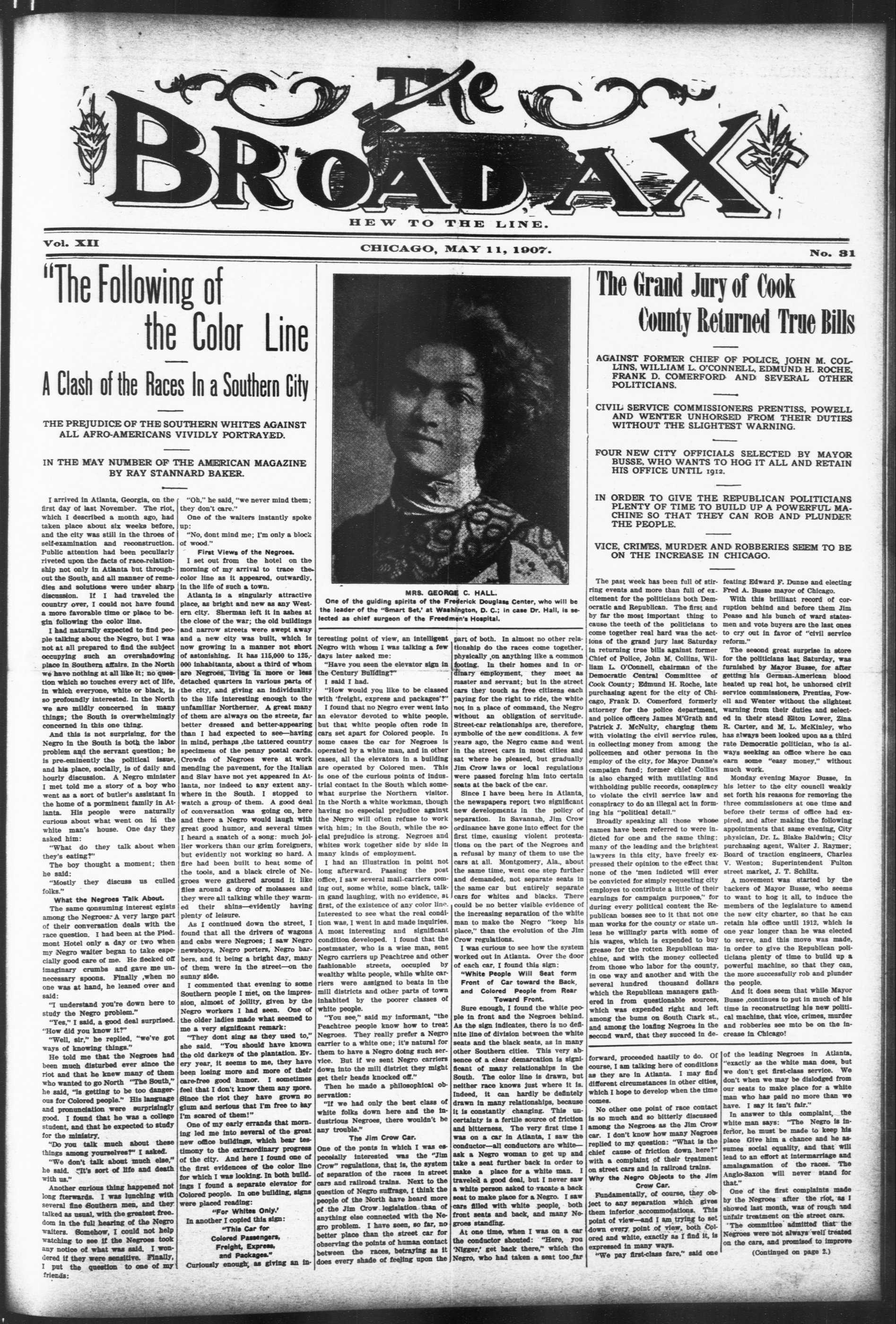
MRS. GEORGE C. HALL.
One of the guilding spirits of the Frederick Douglass Center, who will be the leader of the 'Smart Set,' at Washington, D. C.; in case Dr. Hall, is selected as chief surgeon of the Freedmen's Hospital.
teresting point of view, an intelligent Negro with whom I was talking a few days later asked me:
"Have you seen the elevator sign in the Century Building?"
I said I had.
"How would you like to be classed with 'freight, express and packages'?"
I found that no Negro ever went into an elevator devoted to white people, but that white people often rode in cars set apart for Colored people. In some cases the car for Negroes is operated by a white man, and in other cases, all the elevators in a building are operated by Colored men. This is one of the curious points of industrial contact in the South which somewhat surprise the Northern visitor. In the North a white workman, though having no especial prejudice against the Negro will often refuse to work with him; in the South, while the social prejudice is strong. Negroes and whites work together side by side in many kinds of employment.
part of both. In almost no other relationship do the races come together physically on anything like a common footing. In their homes and in ordinary employment, they meet a master and servant; but in the street cars they touch as free citizens each paying for the right to ride, the white not in a place of command, the Negro without an obligation of servitude. Street-car relationships are, therefore symbolic of the new conditions. A few years ago, the Negro came and went in the street cars in most cities and sat where he pleased, but gradually Jim Crow laws or local regulation were passed forcing him into certain seats at the back of the car.
Since I have been here in Atlanta the newspapers report two significant new developments in the policy of separation. In Savannah, Jim Crow ordinance have gone into effect for the first time, causing violent protests on the part of the Negroes and a refusal by many of them to use the
I had an illustration in point not long afterward. Passing the post office, I saw several mall-carriers coming out, some white, some black, talkin' and gand laughing, with no evidence, as first, of the existence of any color line. Interested to see what the real condition was, I went in and made inquiries. A most interesting and significant condition developed. I found that the postmaster, who is a wise man, sent Negro carriers up Peachtree and other fashionable streets, occupied by wealthy white people, while white carriers were assigned to beats in the mill districts and other parts of town inhabited by the poorer classes of white people.
"You see," said my informant, "the Peachtree people know how to treat Negroes. They really prefer a Negro carrier to a white one; it's natural for them to have a Negro doing such service. But if we sent Negro carriers down into the mill district they might get their heads knocked off."
Then he made a philosophical observation:
"If we had only the best class of white folks down here and the industrious Negroes, there wouldn't be any trouble."
One of the ponds in which I was especially interested was the "Jim Crow" regulations, that is, the system of separation of the races in street cars and railroad trains. Next to the question of Negro suffrage, I think the people of the North have heard more of the Jim Crow legislation than of anything else connected with the Negro problem. I have seen, so far, no better place than the street car for observing the points of human contact between the races, betraying as it does every shade of feeling upon the
part of both. In almost no other relationship do the races come together, physically, on anything like a common footing. In their homes and in ordinary employment, they meet as master and servant; but in the street cars they touch as free citizens each paying for the right to ride, the white not in a place of command, the Negro without an obligation of servitude. Street-car relationships are, therefore, symbolic of the new conditions. A few years ago, the Negro came and went in the street cars in most cities and sat where he pleased, but gradually Jim Crow laws or local regulations were passed forcing him into certain seats at the back of the car.
Since I have been here in Atlanta, the newspapers report two significant new developments in the policy of separation. In Savannah, Jim Crow ordinance have gone into effect for the first time, causing violent protestations on the part of the Negroes and a refusal by many of them to use the cars at all. Montgomery, Ala., about the same time, went one step further and demanded, not separate seats in the same car but entirely separate cars for whites and blacks. There could be no better visible evidence of the increasing separation of the white man to make the Negro "keep his place," than the evolution of the Jim Crow regulations. I was curious to see how the system worked out in Atlanta. Over the door of each car, I found this sign: "White People Will Seat form Front of Car toward the Back, and Colored People from Rear Toward Front."
Sure enough, I found the white people in front and the Negroes behind. As the sign indicates, there is no definite line of division between the white seats and the black seats, as in many other Southern cities. This very absence of a clear demarcation is significant of many relationships in the South. The color line is drawn, but neither race knows just where it is. Indeed, it can hardly be definitely drawn in many relationships, because it is constantly changing. This uncertainty is a fertile source of friction and bitterness. The very first time I was on a car in Atlanta, I saw the conductor—all conductors are white—ask a Negro woman to get up and take a seat further back in order to make a place for a white man. I traveled a good deal, but I never saw a white person asked to vacate a back seat to make place for a Negro. I saw cars filled with white people, both front seats and back, and many Negroes standing.
At one time, when I was on a car the conductor shouted: "Here, you 'Nigger,' get back there," which the Negro, who had taken a seat too far
The Grand Jury of Cook County Returned True Bills
AGAINST FORMER CHIEF OF POLICE, JOHN M. COLLINS, WILLIAM L. O'CONNELL, EDMUND H. ROCHE, FRANK D. COMERFORD AND SEVERAL OTHER POLITICIANS.
CIVIL SERVICE COMMISSIONERS PRENTISS, POWELL AND WENTER UNHORSED FROM THEIR DUTIES WITHOUT THE SLIGHTEST WARNING.
FOUR NEW CITY OFFICIALS SELECTED BY MAYOR BUSSE, WHO WANTS TO HOG IT ALL AND RETAIN HIS OFFICE UNTIL 1912.
IN ORDER TO GIVE THE REPUBLICAN POLITICIANS PLENTY OF TIME TO BUILD UP A POWERFUL MACHINE SO THAT THEY CAN ROB AND PLUNDER THE PEOPLE.
VICE, CRIMES, MURDER AND ROBBERIES SEEM TO BE ON THE INCREASE IN CHICAGO.
---
The past week has been full of stirring events and more than full of excitement for the politicians both Democratic and Republican. The first and by far the most important thing to cause the teeth of the politicians to come together real hard was the actions of the grand jury last Saturday in returning true bills against former Chief of Police, John M. Collins, William L. O'Connell, chairman of the Democratic Central Committee of Cook County; Edmund H. Roche, late purchasing agent for the city of Chicago, Frank D. Comerford formerly attorney for the police department, and police officers James M'Grath and Patrick J. McNulty, charging them with violating the civil service rules, in collecting money from among the policemen and other persons in the employ of the city, for Mayor Dunne's campaign fund; former chief Collins is also charged with mutilating and withholding public records, conspiracy to violate the civil service law and conspiracy to do an illegal act in forming his "political detail."
Broadly speaking all those whose names have been referred to were indicted for one and the same thing; many of the leading and the brightest lawyers in this city, have freely expressed their opinion to the effect that none of the 'men indicted will ever be convicted for simply requesting city employees to contribute a little of their earnings for campaign purposes," for during every political contest the Republican bosses see to it that not one man works for the county or state unless he willingly parts with some of his wages, which is expended to buy grease for the rotten Republican machine, and with the money collected from those who labor for the county, in one way and another and with the several hundred thousand dollars which the Republican managers gathered in from questionable sources, which was expended right and left among the bums on South Clark st. and among the loafing Negroes in the second ward, that they succeed in de-
forward, proceeded hastily to do. Of course, I am talking here of conditions as they are in Atlanta. I may find different circumstances in other cities, which I hope to develop when the time comes.
No other one point of race contact is so much and so bitterly discussed among the Negroes as the Jim Crow car. I don't know how many Negroes replied to my question: "What is the chief cause of friction down here?" with a complaint of their treatment on street cars and in railroad trains. Why the Negro Objects to the Jim Crow Car.
Fundamentally, of course, they object to any separation which gives them inferior accommodations. This point of view—and I am trying to set down every point of view, both Colored and white, exactly as I find it, is expressed in many ways.
"We pay first-class fare," said one
No. 81
Y of Cook
Returned True Bills
A OF POLICE, JOHN M. COLLNNELL, EDMUND H. ROCHE, AND SEVERAL OTHER
MONERS PRENTISS, POWELL PERSED FROM THEIR DUTIES TEST WARNING.
ALS SELECTED BY MAYOR TO HOG IT ALL AND RETAIN 2.
REPUBLICAN POLITICIANS BUILD UP A POWERFUL MAY CAN ROB AND PLUNDER
AND ROBBERIES SEEM TO BE CHICAGO.
---
feating Edward F. Dunne and electing Fred A. Busse mayor of Chicago. With this brilliant record of corruption behind and before them Jim Pease and his bunch of ward statesmen and vote buyers are the last ones to cry out in favor of "civil service reform." The second great surprise in store for the politicians last Saturday, was furnished by Mayor Busse, for after getting his German-American blood heated up real hot, he unhorsed civil service commissioners, Prentiss, Powell and Wenter without the slightest warning from their duties and selected in their stead Eilton Lower, Zinaem R. Carter, and M. L. McKinley, who has always been looked upon as a third rate Democratic politician, who is all the ways seeking an office where he can earn some "easy money," without ins much work.
Monday evening Mayor Busse, in his letter to the city council weakly set forth his reasons for removing the three commissioners at one time and before their terms of office had expired, and after making the following appointments that same evening, City physician, Dr. L. Blake Baldwin; City purchasing agent, Walter J. Raymer; Board of traction engineers, Charles V. Weston; Superintendent Fulton street market, J. T. Schiltz.
A movement was started by the backers of Mayor Busse, who seems to want to hog it all, to induce the members of the legislature to amend the new city charter, so that he can retain his office until 1912, which is one year longer than he was elected to serve, and this move was made, in order to give the Republican politicians plenty of time to build up a powerful machine, so that they can, the more successfully rob and plunder the people.
And it does seem that while Mayor Busse continues to put in much of his time in reconstructing his new political machine, that vice, crimes, murder and robberies see mto be on the increase in Chicago!
of the leading Negroes in Atlanta, "exactly as the white man does, but we don't get first-class service. We don't when we may be dislodged from our seats to make place for a white man who has paid no more than we have. I say it isn't fair."
In answer to this complaint, the white man says: "The Negro is inferior, he must be made to keep his place Give him a chance and he assumes social equality, and that will lead to an effort at intermarriage and amalagamation of the races. The Anglo-Saxon will never stand for that."
One of the first complaints made by the Negroes after the riot, as I showed last month, was of rough and unfair treatment on the street cars. "The committee admitted that the Negroes were not always well treated on the cars, and promised to improve
(Continued on page 2.)
rootisneD WEEE.
eee
SS
See ee
So oe es
See Sera sore
Teg oet ce premers sae
Sota
Joeman
anon
eee 8
————
THE BROAD AX
= nae
supe 7, zarion pane mt ene
Batesed vt the Pest Office at Chicage,
“ Th, as Second-class Matter.
——
PERSONAL MENTION.
Walter M. Farmer, for 16 years an
honored member of the bar in St
Louis, Mo., is now engaged in the
general practice of law, Suite 708,
171 Washington street, Phone Main
4153. Residence 4856 Langley avenue
Phone Drexel 6302.
JEALOUS OF THE NEGRO.
Egotism and immodesty are not
specially characteristic of the south-
ern people, but Gustaf R. Westfeldt,
member of the board of administrators
‘of Tulane university in New Orleans,
seems to have his full share of these
traits.
‘Mr. Westfeldt has written a letter
to the British ambassador at Washing-
ton complaining that a Pennsylvania
‘Negro has beeen appointed to one of
the ‘Cecil Rhodes scholarships at Ox-
for university . He gives the ambassa-
dor fair warning that the appointment
of Negroes to these scholarships will
make them very unpopular in the
South. The reply of the ambassador
to this somewhat impudent note has
not been made public, but in the mean-
while The Chronicle will say a few
things which the ambassador would
do well to adopt.
In the first place, nobody in the uni-
verse outside of the south cares
whether these scholarships are unpo-
pular in the South or not. Beggars
must not be choosers. The scholar-
ships are in the nature of a charity
and if the South does not want them
it can leave them alone, but it is an
exhibition of monumental cheek in the
Southern people to accept them and
then undertake to say who else shall
receive them and finally threaten not
to receive them if they are bestowed
on someone else.
‘This ungrateful and absurd letter oi
‘Mr. Westfeldt would not have been
quite so bad if the Negro in question
hhad been a New Orleans Negro or a
Southern Negro, but he was a Penn-
sylvania Negro, and still the Southern
‘man assumes to dictate his status in
conformity with Southern notions and
threaten Southern displeasure if any-
one objects to his mandate. In other
words, the South wishes to fix the 80
cial status of the Negro not only for
the South but for the North and for
Great Britain as well.
‘Mr. Westfeldt might just as well un-
derstand that his letter will excite fx
the North both resentment and con
tempt—resentment because it is an
impertinent meddling with matters in
the North that do not concern him
and contempt because it shows that
some of the Southern people are jeal
ous of the Negro. Evidently they are
afraid that if the Negro fs allowed tc
have university education certain
white men will be eclipsed.
‘The South can isolate itself and re.
main 500 years behind the rest of the
world if it chooses, but the prejudice
against race for race's sake is dea:
everywhere else. An equal chance for
all in the race of life is the moderr
idea. Social equality with Negroes o:
anybody else is a matter of individua’
choice, but equality before the law and
a fair chance to rise in the scale o!
humanity is humanity’s programms
for the future.
If the South knows what is good fo
its own highest interest it will quit
its foolishness and join in the proces
sion—The Chicago Chronicle, May 5
1907.
‘The whole thing or situation in the
Southern states, in relation to the No
gro aspiring to acquire practieal edu
cation has been stated in a nutshell
in the above editorial, for with few
exceptions, the vast majority of the
whites in the South, are jealous of
every Negro, who is not a crap-shooter
and who will not act in the capsctty
of @ servant! ny
BLACKS LEAVE FOR CALIFORNIA.
Georgia Colered People Find Condl-
tions Better. Race Problem Feit.
Special to The Citizen:
~kmericus, Ga., Friday —The emigrs-
tion of Negroes from Americus snd
smeighboring territory to Southern Calt-
fornia may determine the mee pro
‘Diem here to a limited extent. Recent-
ay alt a hundred Americus Colored
“people have departed for Los Angeles.
‘@nd encouraging letters of conditions
prevailing there and inducing others
to go. .
‘Another party of several will make
the pilgrimage across the continent to
morrow. The Colored people there al-
ready receive remunerative compensa-
tion as laundrymen, house servants
and gardeners.—The Citizen, Menm-
phis, Tenn.
‘The Colored people are acting wise
—that is the most enterprising among
them in leaving the hell-holes of the
South and scattering themselves
throughout the various sections of the
North, the West and the Southwest,
where they will receive much better
treatment, in every way, and receive
more money for their labor, thereby
enabling them to become independent
ea citizens. —Editor.
FIRES HOT SHOT AT BUSSE.
Rev. M. P. Boynton Makes Bitter Ar-
raignment of Mayor.
Mayor Busse was bitterly arraigned
as “Chicago's prince of the lobby” by
ee ‘Melbourne P. Boynton in a pre-
lude to his sermon in the Lexington
‘Avenue Baptist church last Sunday
night. In the course of his remarks
he said:
“Chicago, the second greatest city
in America, is blushing with shame
that her mayor has taken to himself
the title of prince of the lobby by
reason of his recent visit to Spring-
field on behalf of the most vicious
legislation proposed in the present ses-
sion of the legislature.
Terms Action “Disgraceful.”
“When Mayor Busse appeared be-
fore the committee and used the great
influence of his office to secure an
‘open Sunday for Chicago and so-called
home rule on the saloon question he
was guilty of the most disgraceful
‘conduct that has ever characterized
‘an occupant of the mayor's chair in
the history of this city. This action
‘on his part is the more disgraceful
when it is remembered that he repre-
sents, not the city of which he was
elected mayor, but only an element in
the population. which element is for-
eign in its birth, foreign in its ideals,
foreign in its ideas of American liber-
ties and a menace to American insti-
tutions. When he pleads for an open
Sunday he allies himself with those
forces of our city which are making
the name of Chicago a hissing and «
byword throughout the world. He
comes out squarely as the enemy of
the better element of our population
and gives his administration as mayor
a most inauspicious beginning.
“It this is a prophecy of what we
are to have under the present adminis
tration then Chicago will add to her
ill fame and become a place to be
shunned by decent people. Already
we have had an old-fashioned prize
fight under what is alleged to be de
cent auspices. Already rumor {s
abroad in this city that racing will be
peremitted again. There is a-smile
on the faces of the men who exploit
the weaknesses of humanity for filth;
luere.
| Ally, He Says, of the Vicious.
“How unspeakably shocking it 1:
[oe Se ae oes mere, who doe:
not fear to ally himself with the sa
Hoon interests on the side of looseness
and license and fails to appreciate the
high dignity of the office he occupies
‘and does not seem to have the least
‘conception of the mighty service hé
could have rendered the city that ha:
honored him with her highest elective
office.
“No, we want no prince of the lob
by. Let the mayors of this state sta)
at home and let the legislators do the
work they were elected to do by the
people of ths sovereign state.”
“JIM CROW.” CIVIL SERVICE.
, John A. Mellhenny, the Democratic
Civil Service Commissioner from
‘Louisiana, appointed by President
‘Roosevelt is much disturbed because
the young white men and women of
the South do not enter the Civil Ser-
vice Examinatoins, while the young
pose a oS
‘The democratic commissioner is about
to make an extended tour of the
‘South for the purpose of finding out
the cause of the fewness of white ap-
plicants.
Tt has been suggested to him that
the whites are keeping aloof, because
they are brought in competition with
the Negroes, and Mr. MclIhenny in-
elines to this belief. If, upon inves-
tigation this is found to be the cause,
he will attempt to have Negroes and
whites examined in different rooms
‘and on different dates.
Should we come to “jim crow” civil
service examinations at the behest of
a Southern Democratic Civil Service
‘Commissioner, appointed by a Repub-
‘ican president, we will not be one
bit surprised or shocked. We are jim
crowed and disfranchised because the
Republican party desires it. We are
robbed of our civil and political rights
‘as citizens becanse a Republican pre-
sident sworn to enforce the Constite.
tion permits the nullification of the
Conatitetion and knows that nearly 2
million black men are disfranchised,
while this same president, and this
same party turn heaven and earth ov-
er to educate and protect the citizens
of other lands.
‘And yet the Negro is expected to
vote for Theodore Roosevelt or some
man named by him for president in
1908.
| Will we? Will we? Just wait!—The
. Luke, Herald, Richmond, Va.
BROWNSVILLE BIG STICK.
A big stick, silver mounted, set with
45 precious stones for the States, and
‘band carved with nearly 400 figures
and emblems, is a gift the citizens of
Brownsville, Texas, have prepared for
President Roosevelt. It is intended as
an acknowledgment of his action in dis-
missing from the army the Negro sol-
diers charged with having committed
the midnight attack upon Brownsville.
‘This is a pretty good indication of the
sentiment of the people of Brownsville
‘toward the Colored troops that were
{quartered there. If they feel so ju
biliant as to send the president this
“big stick,” it may be readily presum-
ed that they would have exerted them-
selves strenuously to get rid of the
| soldiers while there, and concocted al
most any sort of a plot to throw the
blame on the troops, whom, being
Negroes, they regard as having no
rights which white men are bound to
respect—The Age, Portland, Oregon.
MORE NEW SUBSCRIBERS TO THE
BROAD AX.
Several weeks ago, the names of the
many new subscribers to The Broad
‘Ax, were published in its columns,
and in the intervening time the fol
lowing persons have become subserib-
ers to it, which shows that nothing
can retard its progress, and that elec
tions may come and elections may g0;
‘but The Broad Ax continues to run
just the same:
| Offcer J. V. Lacy; the Gerald 26th
and State street; officer Lacy is more
‘than a first-class thoroughbred for he
freely gave up five dollars at one time
‘to pay his subscription in advance for
‘two years and a half, which proves
‘that he has the uttermost faith in our
ability to conduct a newspaper: I. B.
-Barefleld, real estate and investments,
‘room 814, 84 La Salle st.; N. Pent.
cost, 18 South Homan ave: Alber
Morgan, 3427 Armour ave.; Mrs. J. H.
[carr, 6452 Evans ave.; R. T. Dett
‘Prop. of the Hotel Vancouver, Nias.
‘aa Falls, New York; E. P. Eastman.
505 East Jackson st., Vicksburg.
[Miss.; M. J. Bailey, 1218 Pasture st.
|Pittsburg, Pa.; Mrs. Q. T. Smith, fa.
“shlonable hair dresser, 806 Main st.
La Fayette, Ind.; Edward Morris o
| see enene eaty,
ELECTION BY JEWISH WOMEN,
couneit Chooses Officers and Hears
Annual Reports.
No opposition was offered to the of-
ficial ballot in the annual election of
officers held by the Chicago section of
the Council of Jewish Women at Sinat
temple Monday afternoon and officers
for the comng year were unanimous-
ly elected. A board of directors com-
posed of twelve members was also
chosen.
Besides the principal business of the
‘afternoon a number of reports from
‘the various committees were read,
showing the work that has been ac-
complished by the society during the
past year. The result of the election
was as follows:
President—Mrs, M. A. Weinberg,
4948 Washington Park place.
Vice president—Mrs. Henry Gerst.
ley, 4235 Michigan avenue.
Recording secretary—Mrs. Isaac B.
Lipson, 4947 Vincennes avenue.
Corresponding secretary—Mrs. Li.
Man Kramer, 2912 Prairie avenue.
‘Treasurer—Mrs. A. W. Hamburger,
5134 Woodlawn avenue.
Auditor—Mrs. Ignace Rels, 24 East
Forty-sixth street.
A board of directors was also chos.
en at the meeting—The Chicago
Chronicle, May 7.
DEATH OF ROBERT A. WILLIAMS.
At 12:20 Thursday Robert A. Wil-
Mams 3544 Dearborn st., who had hosts
of friends throughout Chicago; quiet-
ly and peacefully passed away after a
Jong and serious illness.
High mass, was held over his re-
mains at St. Monica's church 36th and
‘Dearborn st., Friday morning, and in
the evening his remains were taken
to his old home Youngstown, Ohio for
interment, accompanied by his con-
stant and devoted wife Mrs. Elizabeth
L. Williams and a few sorrowing
friends of the family.
Mr. Williams was & good man who
loved his home and his death will be
greatly lamented by those who were
near and dear to him.
FREDERICK DOUGLASS ON JOUR-
NALISM.
“It is not to be concealed, however,
that the maintenance of such s journ-
‘al (Dougiass Weekly) has been a
‘work of much difficulty, and could all
the perplexity, anxiety and trouble
attending it have been clearly fore-
seen, I might have shrunk from the
“—Lite of Douglass by
‘himself.
A FAREWELL RECEPTION.
‘The members of the Phyllis Wheat-
ley Club tendered a farewell reception
to Mrs. Ida May Taylor, one of the
charter members, at the residence of
the President, 3226 Prairie avenue,
last Saturday from 2 to 5.
‘A beautiful silver loving cup with
‘an appropriate inscription waB pre-
sented to Mrs, Taylor as a token of
theif appreciation of her sterling
worth and helpfulness. Mrs. Lulu M.
Farmer gave the presentation speech
in her usual pleasing style.
Mrs. Taylor left for her future home
at Oklahoma City, Oklahoma, Mon
day, May 6.
‘The Club will hold its regular meet.
ing Wednesday, May 15, at the F. D.
Centre, 3032 Wabash avenue, Program
under the auspices of the Literature
Section Miss Lena Perry Ch.
Do not fail to come to the Chicker
‘and Waffle dinner given under the
‘auspices of the Home Section, Dr. An
na R. Cooper, Chairman, at 3107 Prat
rie avenue, Thursday, May 16, from :
to 10 p. m. “
DOUBLE FUNERAL SERVICES
HELD OVER THE REMAINS OF
MRS. POPE AND MRS. DE
GRAY, AT QUINN
CHAPEL.
Editor Julius F. Taylor.
Dear Sir:—Sad in the extreme
and unparallelled in the history
of the church was the double
funera lat Quinn Chapel last Sunday
afternoon at 1 o'clock. The services
were conducted by Revs. A. J. Carey
and D. P. Roberts over the remains
of Mrs, Harriett Pope, Samuel E.
White's grand mother, who died April
30, at Augusta, Ga. Born at Edgefield,
8. C. about 1826, she came to Chicaxo
1893, during the World's Fair and re
mained here as a regular member o!
Quinn Chapel ever since. The death
of her sister, just four days previous
was too much of a shock for her. In.
terment at Oakwood cemetery.
"Mrs, DeGray, 3617 Calumet avenue
‘was the other faithful soul whom the
Lord in his wise providence saw fit tc
take unto Himself. She was 88 years
‘of age, and she, like Mrs. Pope. Tw
old guard-mothers, members of the
same Sunday school and communior
classes were sadly but truly an
ommend at rest from the same altar
—C. H. Dyess.
| WEST SIDE NEWS.
By Prof. A. L. Simpeon.
Miss Lillian Porter, of Maplewood
avenue, who has been on the sick list
for some time, has departed this earth.
A dear mother mourns her loss.
Mr. Clarence Miller a popular West
side young man has settled down in
life and has taken with him a bride
of much importance. We wish them
Gods speed.
The West side is very prond of the
recent marriage on the Q. T., of Mr.
James Gordon to Mrs. Georgie Broa.
ate They are a very happy couple
and have a bright future, and live in
their own mansion.
Prof. A. L, Simpson the West side
‘most eminent Chiropodist is still at
the foot and can put you on your feet
on short notice. If you have any
trouble. Residence Phone, Ashland
4453. Office Phone, Monroe 2611.
Mr. H. N. Fields is certainly the
real goods over here. He seems to
like things real well over here.
Mr. Chas. H. Wheeler is still in the
laundry business and will clean you
from head to foot. Give him a trial.
Mr. Jones a noted police officer of
the South side stirred the West side
‘Young Men and Women’s Sunday Club
to their utmost on last Sunday with a
‘very fine paper on the race.
Mr. Geo. O. Jones the West side
most popular undertaker is still fn
line, and is doing a good business and
‘a great credit to his people.
The Wilson sisters are still serving
home cooked meals at 920 W. Lake
street. A trial is sufficient.
Mrs. M. Burroughs, of 920 W. Lake
street, who has been on the sick list
for a long time is improving very fast
and has great hopes of being on her
feet again.
‘Mr. Samuel Taylor is in the city
again after a two weeks visit in Obic
with-his father. (And Sam laughed.)
Shadows avaunt what barbarism!
They lynched a Negro at Trezevant,
‘Tenn, for “sassing” a young white
man. We have fallen on terrible times.
‘The white man’s religion and sense
of justice are both nauseating —(Chat-
tanooga) Herald.
And yet there are white men from
the South roaming over the country
saying that when Negroes stoy AS-
SAULTING WHITH WOMEN, lynch-
ing will stop. But, the world knows
now, that Negro men and women are
lynched upon the most trivial causes.
And with it all, the Negro is today
jas industriously engaged in spending
[his money, banking his money and
upbullding those who murder him,
just as if they are his best friends.
A “sassy Nigger” lg bad enough,
‘but “a fool Nigger” is a thousand
times worse—The St. Luke Herald,
‘Richmond, Va. 1"
FOLLOWING “THE COLOR LINE.”
(Concluded from page 1.)
SS. ie
condition Charles T. Hopkins, a
leader in the Civic League and one of
the prominent lawyers of the city, tola
me that he believed the Negroes
should be given thelr definite seats io
very car; he said that he personally
made it a practice to stand up rather
than to take any one of the four back
seats, which he considered as belong-
ing to the Negroes. Two other lead-
ing men, on a different occasion, tol¢
me the same thing. It is, however, a
rare practice.
‘One result of the friction over the
‘Crow regulations is that many Ne
groes ride on the cars as little as pos-
sible. One prominent Negro I met
said he never entered a car, and that
he had many friends who pursued the
‘same policy; he said that Negro street
car excursions, familiar a few years
ago, had entirely ceased. It is signif-
cant of the feeling that one of the
features of the Atlanta riot was an at-
tack on the street cars in which all
Negroes were driven out of their seats.
One Negro woman was pushed
through an open window, and, after
falling to the pavement, she was
dragged by the leg across the side-
walk and thrown through a shop win-
dow. In another case when the mob
stopped a car the motorman, instead
of protecting his passengers, went 1n-
side and beat down a Negro with his
brass control-lever.
Story of an Encounter on a Street Car.
I heard innumerable stories from
both white people and Negroes of
encounters in the street cars. Dr. W.
F. Penn, one of the foremost Negro
physicians of the city, himself partly
white, a graduate of Yale College, told
me of one occasion in which he en-
tered a car and found there Mrs. Cros-
man, wife of the Colored president of
Clark University. Mrs. Crogman is a
mulatto so light of complexion as to
‘be practically undistinguishable from
white people. Dr. Penn, who knew
her well, sat down beside her and be-
gan talking. A white man who occu:
pied a seat in front with his wife
turned and said:
“Here, you ‘Nigger,’ get out of that
seat. What do you mean by sitting
down with a white woman?”
Dr. Penn replied somewhat angrily:
“It's come to a pretty pass when 2
‘Colored man cannot sit with a woman
of his own race in his own part of the
car.”
‘The white man turned to his wife
and said:
“Here, take these bundles. I'm go
ing to thrash that Nigger.”
In half a minute the car was in ar
uproar, the two men struggling. For.
tunately the conductor and motormas
were quickly at hand, and Dr. Pent
slipped off the car.
(To be Continued.)
CHIPs.
- Dr. W. Dickenson, of New Bedford,
Mass. spent a few days in the city
last week.
| ‘The examinations for Internes was
held at Provident Hospital Monday
and Tuesday.
Messrs, Mitchen & Buckner have
opened a first class club house at 3026
State street.
Dr, Brown, of Boston, Mass., is in
the city visiting friends stopping at
3532 Wabash avenue.
The Pekin Stock Co. will produce
“The Bachelor” next week, from the
pen of T. Alfred Anderson.
A volume etitled “The Negro Doc-
tor,” Dr. Majors author, will soon be
on the market.
‘Mr. W. E. Wright, 1912 Dearborn
street, is confined to his bed in Provi-
dent Hospital.
Mr. Charles Lewis, 3445 Dearborn
street, is confined at Provident Hos-
pital with pneumonia.
‘Mrs. Luther Moore, 5128 Indiana
avenue, left the city Tuesday to spend
a month in Little Rock, Ark.
‘W. H. Pierce, 1499 West Adams
street is one of the many new sub-
iseribers to The Broad Ax.
It is rumored that Mr. Charlie
Washington, 6448 EWvans avenue, Is
soon going to lead one of our Chicago
belles to the altar.
‘Mr. Joseph Jenkins, 6650 Evans
avenue is spending the week at West
Baden, Indiana, where he hopes to be
benefited by the mud baths.
‘The Physicians, Dentists and Phar-
macists Club, held their monthly meet
ing Friday night at the Reno Cafe. A
paper on Pneumonia was read and
discussed.
‘The Felix Welr Recital given at
Bethel Church, Saturday avening, un-
der the direction of Mr. Julius N.
Avendorph, was attended by about 100
‘people. eae ie |
Petar en OO ty She Soe eI cap
Mrs. Robt. Harper has written a
play, entitled “The Man on the
Blocks,” which will be produced a:
one of our local theaters in the near
future.
| Mr. and Mrs. Fred Clifton, 43.
Langley avenue, entertained abon:
fifty couple with a dancing party Woe.
nesday night, in honor of their guest,
Miss Josephine Fish, of Madison, Wi;.
The Grand United Order of Odi
Fellows wiil have their annual ser.
mon and parade next Sunday. ‘The
line of march will be about as usual
from the hall to Quinn Chapel and
return.
Col. James Hamilton Lewis, who
has been dubbed the “first gentleman
of the land,” by Major B. B. Tolman,
has opened up law offices on the 141
ftooor of the New York Life Buildin:
Ex-Mayor Edward F Dunne, will be
tendered a dinner at the Chicaco
Athletic Association Clubhouse, Sat.
urday evening, May 25. Many promi
nent citizens and policicians will be
present.
‘The Ladies’ Catholic Order of For-
esters, Augustine Tolton Court, No,
391, will give a May Party May 27, a:
Douglas Club House, 3518 Ellis Ave.
Musie by Bowman's Orchestra. Ad
mission 35 cents.
John K. Prindiville, who formerly
held forth at the Harrison street ps
lice station, now has a nice suite of
law offices in the Chamber of Com-
merce Building and he is doing 4
rushing business.
Edward M. Cummings one of the
old wheel horses of Democracy in the
Town of Lake, is holding down a res-
ponsible position in the City Treasur-
er’s office, which is pleasing to his
and the friends of John E. Traezer.
Prof. W. Kemper Harreld, who
seems to be unable to look an honest
dog in the eye and who puts in much
of his time in hanging arouna the
Frederick Douglass Center, has never
permitted the five spot to slip our
way.
A bride was sued in London the
other day for refreshments supplied
for her wedding feast. The list was
as follows: “Four and a half gallors
of beer, one quart Scotch, one pint
Irish, one bottle of gin, one quart of
port, one pint of sherry, one bottle of
claret, sodas, lemons.”—Ex.
Services of St. Thomas Episcopal
Church were held in the basement of
their new church at 38th and Wabash
avenue, last Sunday. The edifice is
undergoing a thorough renovation by
first class decorators and it will not
be long before the Episcopolians will
be the proudest sect in this commun-
ity.
On Monday afternoon Frank Dorsey,
6610 Vernon avenue, age 13 years, de-
parted this life after a few weeks con-
finement, caused by spinal menen-
gitis, Frank was since the first of
Jan, last, employed as a clerk in the
Post office. He lived with his parents
and had many friends among his
working mates. The funeral took
place Wednesday morning. Services
directed by Rev. C. Goggins of the
Hyde Park Methodist church. Inter-
ment Oakwoods Cemetery.
Attorney Hale G. Parker, 81 Clark
street, was relieved of his $60 over:
coat, while sitting in Judge Honore’s
Court in the Monadnock Blk., Monday
by a Colored gentleman named Georse
Perkins, and after an exciting chase
|the thief was captured with Mr.
Parker's coat on his back. Perkins who
claimed to reside at 1477 State street,
has only been married about thre:
weeks and his wife pleaded with
|Judge Fake at the Harrison street
police station to let her husband
‘off easy, and His Honor complied t9
‘|her request be sending him to the
Pridewell for one year.
FIGHTS WHITE MAN; LYNCHED.
Pine Bluffs, Ark, May 7—Sam
Fleming, a Negro bartender, was
lynched from a tree in the center of
the town because he fought with
Henry Vaughan, a white bartender.
and bested him.
It must be remembered that Flem-
ing was not charged with raping
some white woman who might not be
adverse to being raped by some good
looking black man with plenty of
money. —Eilitor.
“Is it not lovely, when husband and
‘wife are always of the same opinion?”
“Certainly; only it makes such 8
great difference whose opinion it is.”
Sa
HUSTLING COLORED MAN WANT-
TED TO SELL SUBURBAN REAL
= ESTATE.
‘Wanted a good representative Co!-
‘ored man to sell choice lots in a North
‘Shore suburb to Colored people ca”
make $100.00 to $200.00 per week. No
capital required, must be man of
lability and ‘education. References
° ‘Address “J.” care Biiitor
Se sia ‘Ax, 0040 ‘Armour ave.
HUMOR
AND CHAIN TOO.
Story of a Most Laconic Deaf and Dumb Man.
"The most laconic man I knew of is a deaf and dumb man in our town," said a man to a San Francisco Argonaut writer the other day. "He never writes on his little pad more than enough to convey his meaning. It happened he was a good poker player and one night won a watch and chain from a young man of the town. The young man's father, a very pompous individual, heard of it and, meeting the successful gamester on the street next day, stopped him. The deaf and dumb man produced his little pad. On it the irate and pompous father wrote, 'I understand you won Bob's gold watch the other night.' He handed it to the deaf and dumb man, expecting to see him change countenance and offer to give up his spoil. The latter did not quite do that, however. Instead he took the pad, wrote two words carefully on it and returned it. The pompous father read inscribed thereon, 'And chain.'
The Hypothetical Question.
"Miss Prittly," said the young lawyer with the high brow and the Henry Clay forelock, "let me ask you a hypothetical question. Suppose that a young man of excellent habits and increasing income—a young man who believed himself fully capable of making a woman happy—were to appear before a young woman who had eyes of rare and radiant luster and hair of the texture and glory of spun gold, whose lips were more perfect than Hogarth's line of beauty, whose cheeks held a tint that put to shame the magnificent pink of the rose petal—a young woman whose culture and charm easily placed her immeasurably above all other women in the world—and he were to ask this young woman if she would"—
"Oh, Mr. Blackstone!" she whispered, sinking into his arms. "Yel!"—Judge.
Fooled the Carpenter
A carpenter called at a flat to make some repairs and knocked on the door. "Who's there?" asked a voice. "The carpenter," was the reply.
"Come in," was the response.
The carpenter tried the door, but it was locked.
"Open the door," said the carpenter.
"Haw, haw, haw!" came the voice from the inside.
The carpenter was getting very mad.
Then the woman who lives in the flat on the opposite side opened her door and said:
"There is no one at home there except the parrot." -New York Globe.
Mixed His Lines.
The manager of the great war drama was furious.
"Blockhead!" he thundered as he rushed into the theatrical office. "What do you mean by sending me an actor who used to work in the kitchen of a cook house?"
"How do you know he used to work in the kitchen of a cook house?" faltered the agent.
"How do I know? Why, in the battle scene outside of the fortress instead of shouting 'Scale the walls!' the num-skull bellowed 'Scale the fish!'
Disguised.
"Look here, waiter," said a New York drummer at the breakfast table of a small Texas hotel, "how are these eggs cooked?" "Dat's a cheese om'let, boss. I know yo' axed fo' a plain om'let, but dem eggs was promiscus, boss-jes' a little bit promiscus—an' so de cook jes' thrown in a little cheese."—Woman's Home Companion.
Approaching the Limit
"Mrs. Henpeck seems to have her husband so well trained that he'd jump through a hoop if she held it up and gave him the word."
"It's worse than that. She even makes him help her celebrate the anniversary of her marriage to her first husband."—Chicago Record-Herald.
Not Guilty.
"Ive lost my leg, guv'nor."
"Well, my good man, I haven't got it."—Datter
Mrs. Gossip—Mrs. Richleigh has so much embonpoint, hasn't she?
Mrs. Comeup (judiciously) — Well, now, she might have if she wasn't so fat—Baltimore American.
Nearly "Brake"
This—My face is my fortune.
Stella—Haven't you ever had any
more money than you have now?
New York Press
CHOICE MISCELLANY
Dangers of Smokeless Powder
Dangers of Smokeless Powder. Modern smokeless gunpowder is dangerous stuff to store. A scientist remarks: "In all probability the recent terrible disaster to the French battleship Jena will be found to have been due to the explosion of her after magazines as the result of spontaneous combustion of the powder. Such an accident at the close of the recent war tore out the side of the Japanese battleship Mikasa at a time when, like the Jena, she was at one of the government dockyards. The best of modern powders are liable under certain conditions to decomposition, which, if it proceeds to a certain point and be accompanied by certain conditions of temperature, may result in the explosion of the magazine and the loss of the ship or arsenal, as the case may be. Our modern smokeless powders when in storage are the occasion of a degree of anxiety and watchfulness which was never felt in the days of the brown or black powders."
Passing of the Bison.
In the United States we have 1,053 pure blooded bison, of which all but twenty are in captivity. In Canada are 351 pure blooded animals, of which 300 are in the wild state, making a total of 1,404 pure blooded American bison left out of the countless thousands that but little more than a quarter of a century ago covered great areas of the western prairie. Nothing like it ever has been recorded in the world of animal life. It reads like a fairy tale. In Europe there are about 107 pure blooded examples of the American bison, of which number England has 32, Germany 44, Hungary 10, France 1, Netherlands 12 and Russia 8, and there are about 20 hybrids in Europe, of which England has 15 and Russia 5—Outing Magazine.
American Cleanliness.
It has always been our boast that the English are the apostles of cleanliness. Perhaps it would now be advisable to reconsider that contention. The American has replaced our dingy, dirty looking tram cars with clean, alry and roomy vehicles. He has transformed our dismal and filthy underground railways into reasonably bright and well ventilated systems, and he has substituted for our dreary private hotels the speckless palaces we have seen arise almost as if by magic. All those improvements we could have effected ourselves if we had really been so devoted to cleanliness as we imagine we are. How surpassingly charming we Englishmen would be were we not so perfect—in our own estimation—London Truth.
Enormous Flow of Words.
A committee clerk at the house end of the capitol estimates that as a result of the deliberations of the recent short session of congress the literature of the year has been enriched by the addition of 9,000,000 words. This stupendous verbal output was printed in the Congressional Record and consisted of speeches, reports of various kinds and the presidential messages, of which, for one reason and another, there were an unusual number and variety. The session consumed only seventy-one legislative days, the average duration of which was a little less than five hours each. Thus the verbal output per hour of the nation's statesmen the past winter was 24,000, a record, it is believed, unsurpassed in the modern history of parliaments.
Working Out His Poll Tax.
This is the story of the difficulty of compelling a Tonkawa Indian to work out his poll tax: "Kaptitan worked about fifteen minutes and then struck for a four hour day. This was granted. In another fifteen minutes he struck again for lemonade to drink instead of water. This was allowed. Then the street commissioner got a gun and told Kap the striking season was over. So Kap worked until noon. Just as the school bell rung for 12 o'clock Kap ran a twenty penny nail through his foot. The boss wanted to pull it out, but Kap said: 'No, you don't; not in the noon hour. Wait until 1 o'clock.' Kap had a sunstroke in the afternoon, but otherwise he got through the day very pleasantly." - Nardin (Okla.) Star.
"Motor Heart" In Dogs.
"Motor heart" in dogs is a new disease," says one of the king's veterinary surgeons. "The motor car possesses a curious fascination for dogs. They enjoy the swift motion, the exciting, scorching rush through the air as much as their masters. But the veterinary surgeon in many cases is obliged to curb this canine fondness for the car, because of the injurious effect the sport has on a dog's heart."
The symptoms of "motor heart" in dogs are enlargement, flabbiness and general weakness of that organ. The dog looks restless and excited. The heartbeats are rapid and weak. Breathing is difficult and distressed. The only cure is total abstinence from car rides—London Mall.
Magnetite Lamps.
Among the more recent forms of arc lamps are those in which a stick of magnetite is substituted for carbon in the negative terminal. The magnetite lamp is the result of efforts to find a substance capable of withstanding exposure in an open arc and giving a white light instead of the orange color of the brilliant flame carbon lamps. To increase its efficiency a small percentage of other metallic oxides is added to the magnetite. It is found that the flame in these lamps is fed only by the negative electrode, the magnetite stick, which alone needs to be replaced from time to time, the positive terminal, composed of copper, not being consumed. Youth's Companion.
WOMAN AND FASHION
In Princess Style
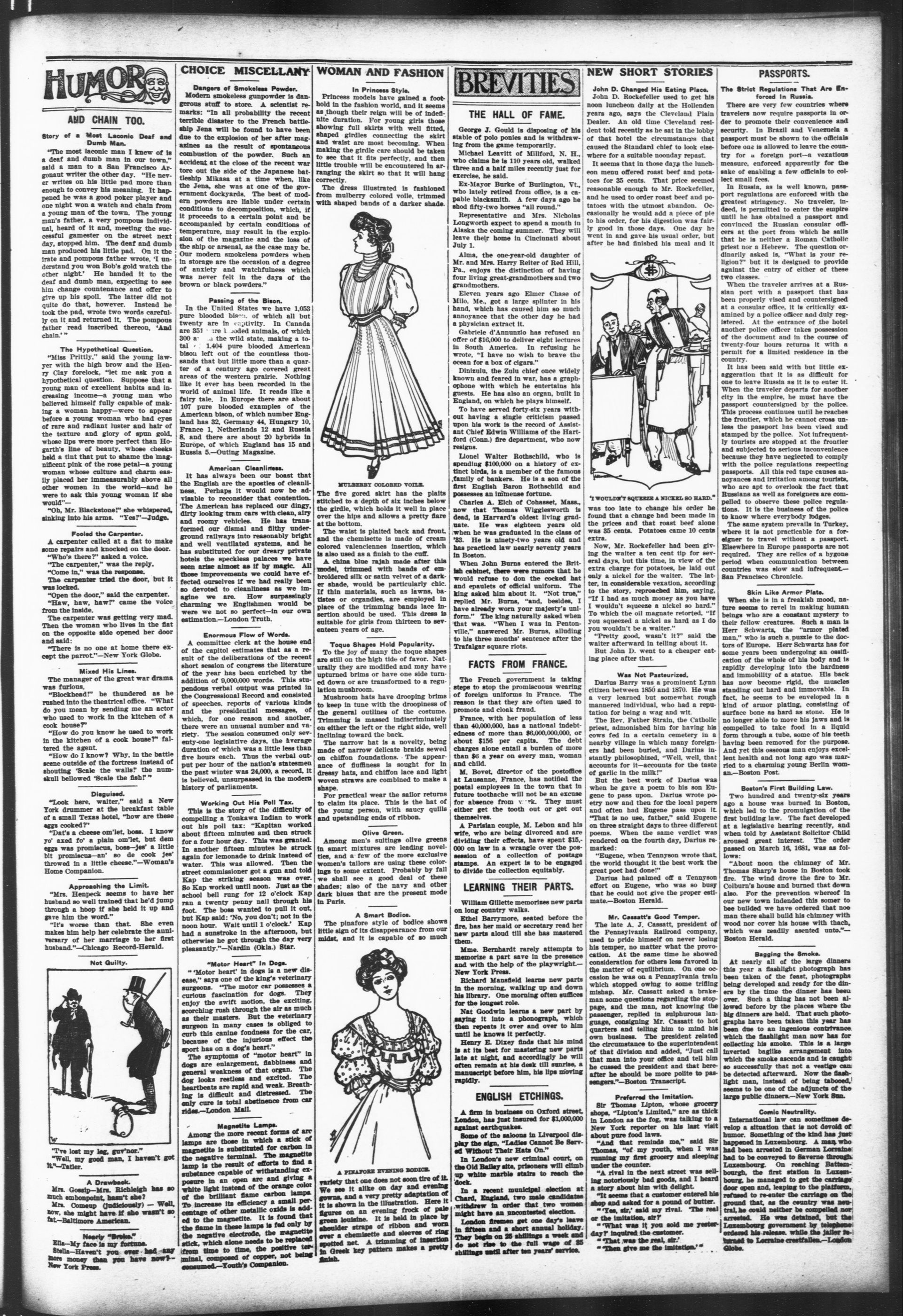
Princess models have gained a foothold in the fashion world, and it seems as though their reign will be of indefinite duration. For young girls those showing full skirts with well fitted, shaped girdles connecting the skirt and waist are most becoming. When making the girdle care should be taken to see that it fits perfectly, and then little trouble will be encountered in arranging the skirt so that it will hang correctly.
The dress illustrated is fashioned from mulberry colored volle, trimmed with shaped bands of a darker shade.
```markdown
```
MULBERRY COLORED VOILE.
The five gored skirt has the plaits stitched to a depth of six inches below the girdle, which holds it well in place over the hips and allows a pretty flare at the bottom.
The waist is plaited back and front, and the chemisette is made of cream colored valenciennes insertion, which is also used as a finish to the cuff.
A china blue rajah made after this model, trimmed with bands of embroidered silk or satin velvet of a darker shade, would be particularly chic.
If thin materials, such as lawns, batistes or organdles, are employed in place of the trimming bands lace insertion should be used. This dress is suitable for girls from thirteen to seventeen years of age.
Tongue Shapes Hold Popularity.
To the joy of many the toque shapes are still on the high tide of favor. Naturally they are modified and may have upturned brims or have one side turned down or are transformed to a regulation mushroom. Mushroom hats have drooping brims to keep in tune with the droopiness of the general outlines of the costume. Trimming is massed indiscriminately on either the left or the right side, well inclining toward the back. The narrow hat is a novelty, being made of narrow delicate braids sewed on chiffon foundations. The appearance of fluffiness is sought for in dressy hats, and chiffon lace and light woven straws are combined to make a shape. For practical wear the sailor returns to claim its place. This is the hat of the young person, with saucy quills and unstanding ends of ribbon.
Olive Green.
Among men's suitings olive greens in smart mixtures are leading novelties, and a few of the more exclusive women's tailors are using these colorings to some extent. Probably by fall we shall see a good deal of these shades; also of the navy and other dark blues that are the present mode in Paris.
A Smart Bodies.
the pinafore style of bodice shows little sign of its disappearance from our midst, and it is capable of so much
F
A PINAFORE EVENING BODICE
variety that one does not soon tire of it.
We see it allike on day and evening
gowns, and a very pretty adaptation of
it is shown in the illustration. Here it
figures on an evening frock of pale
green louisine. It is held in place by
shoulder straps of ribbon and worn
over a chemisette and sleeves of ring
spotted net. A trimming of insertion
in Greek key pattern makes a pretty
finish.
BREVITIES
THE HALL OF FAME
George J. Gould is disposing of his stable of polo ponies and is withdrawing from the game temporarily.
Michael Leavitt of Millford, N. H., who claims he is 110 years old, walked three and a half miles recently just for exercise, he said.
Ex-Mayor Burke of Burlington, Vt., who lately retired from office, is a capable blacksmith. A few days ago he shod fifty-two horses "all round."
Representative and Mrs. Nicholas Longworth expect to spend a month in Alaska the coming summer. They will leave their home in Cincinnati about July 1.
Alma, the one-year-old daughter of Mr. and Mrs. Harry Retter of Red Hill, Pa., enjoys the distinction of having four living great-grandmothers and two grandmothers.
Eleven years ago Elmer Chase of Milo, Me., got a large splinter in his hand, which has caused him so much annoyance that the other day he had a physician extract it. Gabriele d'Annunzolo has refused an offer of $16,000 to deliver eight lectures in South America. In refusing he wrote, "I have no wish to brave the ocean for a box of cigars." Dinluzul, the Zulu chief once widely known and feared in war, has a graphophone with which he entertains his guests. He has also an organ, built in England, on which he plays himself.
To have served forty-six years without having a single criticism passed upon his work is the record of Assistant Chief Edwin Williams of the Hartford (Conn.) fire department, who now resigns.
Lionel Walter Rothschild, who is spending $100,000 on a history of extinct birds, is a member of the famous family of bankers. He is a son of the first English Baron Rothschild and possesses an immense fortune. Charles A. Elch of Cohasset, Mass., now that Thomas Wigglesworth is dead, is Harvard's oldest living graduate. He was eighteen years old when he was graduated in the class of '83. He is ninety-two years old and has practiced law nearly seventy years in Boston.
When John Burns entered the British cabinet, there were rumors that he would refuse to don the cocked hat and epaulets of official uniform. The king asked him about it. "Not true," replied Mr. Burns, "and, besides, I have already worn your majesty's uniform." The king naturally asked when that was. "When I was in Pentonville," answered Mr. Burns, alluding to his three months' sentence after the Trafalgar square riots.
FACTS FROM FRANCE
The French government is taking steps to stop the promiscuous wearing of foreign uniforms in France. The reason is that they are often used to promote and cloak fraud. France, with her population of less than 40,000,000, has a national indebtedness of more than $6,000,000,000, or about $156 per capita. The debt charges alone entail a burden of more than $6 a year on every man, woman and child. M. Bovet, director of the postoffice at Lausanne, France, has notified the postal employees in the town that in future toothache will not be an excuse for absence from work. They must either get the tooth out or get out themselves.
A Parisian couple, M. Lebon and his wife, who are being divorced and are dividing their effects, have spent $15,000 on law in a wrangle over the possession of a collection of postage stamps. An expert is to be engaged to divide the collection equitably.
LEARNING THEIR PARTS.
William Gillette memorizes new parts on long country walks.
Ethel Barrymore, seated before the fire, has her maid or secretary read her new parts aloud till she has mastered them.
Mme. Bernhardt rarely attempts to memorize a part save in the presence and with the help of the playwright.—New York Press.
Richard Mansfield learns new parts in the morning, walking up and down his library. One morning often suffices for the longest role.
Nat Goodwin learns a new part by saying it into a phonograph, which then repeats it over and over to him until he knows it perfectly.
Henry E. Dixey finds that his mind is at its best for mastering new parts late at night, and accordingly he will often remain at his desk till sunrise, a manuscript before him, his lips moving rapidly.
ENGLISH ETCHINGS.
A firm in business on Oxford street, London, has just insured for $1,000,000 against earthquakes. Some of the saloons in Liverpool display the sign, "Ladies Cannot Be Served Without Their Hats On." In London's new criminal court, on the Old Ballay site, prisoners will climb up white marble stairs to reach the dock. In a recent municipal election at Chard, England, two male candidates withdrew in order that two women might have an uncontested election. London firemen get one day's leave in fifteen and a short annual holiday. They begin on 25 shillings a week and do not rise to the full wage of 25 shillings until after ten years' service.
NEW SHORT STORIES
John D. Changed His Eating Place.
John D. Rockefeller used to get his noon luncheon daily at the Hollenden years ago, says the Cleveland Plain Dealer. An old time Cleveland resident told recently as he sat in the lobby of that hotel the circumstances that caused the Standard chief to look elsewhere for a suitable noonday repast.
It seems that in those days the luncheon menu offered roast beef and potatoes for 35 cents. That price seemed reasonable enough to Mr. Rockefeller, and he used to order roast beef and potatoes with the utmost abandon. Occasionally he would add a piece of pie to his order, for his digestion was fairly good in those days. One day he went in and gave his usual order, but after he had finished his meal and it
#
"I WOULDN'T SQUEEZE A NICKEL SO HARD."
was too late to change his order he found that a change had been made in the prices and that roast beef alone was 35 cents. Potatoes came 10 cents extra.
Now, Mr. Rockefeller had been giving the waiter a ten cent tip for several days, but this time, in view of the extra charge for potatoes, he laud out only a nickel for the waiter. The latter, in considerable vexation, according to the story, reproached him, saying, "If I had as much money as you have I wouldn't squeeze a nickel so hard." To which the oil magnate retorted, "If you squeezed a nickel as hard as I do you wouldn't be a waiter."
"Pretty good, wasn't it?" said the waiter afterward in telling about it.
But John D. went to a cheaper eating place after that.
Was Not Pasteurized.
Darlus Barry was a prominent Lynn citizen between 1850 and 1870. He was a very learned but somewhat rough mannered individual, who had a reputation for being a wag and wit.
The Rev. Father Strain, the Catholic priest, admonished him for having his cows fed in a certain cemetery in a nearby village in which many foreigners had been buried, and Darius instantly philosophized. "Well, well, that accounts for it—accounts for the taste of garlic in the milk."
But the best work of Darius was when he gave a poem to his son Eugene to pass upon. Darius wrote poetry now and then for the local papers and often had Eugene pass upon it. "That is no use, father," said Eugene on three straight days to three different poems. When the same verdict was rendered on the fourth day, Darius remarked:
"Eugene, when Tennison wrote that, the world thought it the best work the great poet had done!" Darius had palmed off a Tennison effort on Eugene, who was so busy that he could not give the proper estimate—Boston Herald.
Mr. Cassatt's Good Temper.
The late A. J. Cassatt, president of the Pennsylvania Railroad company, used to pride himself on never losing his temper, no matter what the provocation. At the same time he showed consideration for others less favored in the matter of equilibrium. On one occasion he was on a Pennsylvania train which stopped owing to some trifling mishap. Mr. Cassatt asked a brakeman some questions regarding the stoppage, and the man, not knowing the passenger, replied in sulphurous language, consigning Mr. Cassatt to hot quarters and telling him to mind his own business. The president related the circumstance to the superintendent of that division and added, "Just call that man into your office and tell him he cussed the president and that hereafter he should be more polite to passengers."—Boston Transcript.
Preferred the Imitation.
Sir Thomas Lipton, whose grocery shops, "Lipton's Limited," are as thick in London as the fog, was talking to a New York reporter on his last visit about pure food laws.
"And that reminds me," said Sir Thomas, "of my youth, when I was running my first grocery and sleeping under the counter.
"A rival in the next street was selling notoriously bad goods, and I heard a story about him with delight.
"It seems that a customer entered his shop and asked for a pound of butter.
"Yes, sir," said my rival. "The real or the imitation, sir?"
"What was it you sold me yesterday? Inquired the customer.
"That was the real, sir."
"Then give me the imitation."
PASSPORTS.
The Strict Regulations That Are Enforced In Russia.
There are very few countries where travelers now require passports in order to promote their convenience and security. In Brazil and Venezuela a passport must be shown to the officials before one is allowed to leave the country for a foreign port—a vexatious measure, enforced apparently for the sake of enabling a few officials to collect small fees. In Russia, as is well known, passport regulations are enforced with the greatest stringency. No traveler, indeed, is permitted to enter the empire until he has obtained a passport and convinced the Russian consular officers at the port from which he sails that he is neither a Roman Catholic priest nor a Hebrew. The question ordinarily asked is, "What is your religion?" but it is designed to provide against the entry of either of these two classes.
When the traveler arrives at a Russian port with a passport that has been properly vised and countersigned at a consular office, it is critically examined by a police officer and duly registered. At the entrance of the hotel another police officer takes possession of the document and in the course of twenty-four hours returns it with a permit for a limited residence in the country.
It has been said with but little exaggeration that it is as difficult for one to leave Russia as it is to enter it. When the traveler departs for another city in the empire, he must have the passport countersigned by the police. This process continues until he reaches the frontier, which he cannot cross unless the passport has been vised and stamped by the police. Not infrequently tourists are stopped at the frontier and subjected to serious inconvenience because they have neglected to comply with the police regulations respecting passports. All this red tape causes annoyances and irritation among tourists, who are apt to overlook the fact that Russians as well as foreigners are compelled to observe these police regulations. It is the business of the police to know where everybody lodges.
The same system prevails in Turkey, where it is not practicable for a foreigner to travel without a passport. Elsewhere in Europe passports are not required. They are relics of a bygone period when communication between countries was slow and infrequent—San Francisco Chronicle.
Skin Like Armer Plate
When she is in a freakish mood, nature seems to revel in making human beings who are a constant mystery to their fellow creatures. Such a man is Herr Schwartz, the "armor plated man," who is such a puzzle to the doctors of Europe. Herr Schwartz has for some years been undergoing an ossification of the whole of his body and is rapidly developing into the hardness and immobility of a statue. His back has now become rigid, the muscles standing out hard and immovable. In fact, he seems to be enveloped in a kind of armor plating, consisting of surface bone as hard as stone. He is no longer able to move his jaws and is compelled to take food in a liquid form through a tube, some of his teeth having been removed for the purpose. And yet this osseous man enjoys excellent health and not long ago was married to a charming young Berlin woman—Boston Post.
Boston's First Building Law.
Two hundred and twenty-six years ago a house was burned in Boston, which led to the promulgation of the first building law. The fact developed at a legislative hearing recently, and when told by Assistant Solicitor Child aroused great interest. The order passed on March 16, 1681, was as follows:
"About noon the chimney of Mr. Thomas Sharp's house in Boston took fire. The wind drove the fire to Mr. Colburn's house and burned that down also. For the prevention whereof in our new town indended this somer to bee builded we have ordered that noe man there shall build his chimney with wood nor cover his house with thach, which was readily asented unto."—Boston Herald.
Bagging the Smoke
At nearly all of the large dinners this year a flashlight photograph has been taken of the feast, photographs being developed and ready for the diners by the time the dinner has been over. Such a thing has not been allowed before by the places where the big dinners are held. That such photographs have been taken this year has been due to an ingenious contrivance which the flashlight man now has for collecting his smoke. This is a large inverted baglile arrangement into which the smoke ascends and is caught so successfully that not a vestige can be detected afterward. Now the flashlight man, instead of being tazed, seems to be one of the adjuncts of the large public dinners—New York Sun.
Comic Neutrality.
International law can sometimes develop a situation that is not devoid of humor. Something of the kind has just happened in Luxembourg. A man who had been arrested in German Lorraine had to be conveyed to Saverne through Luxembourg. On reaching Battembourg, the first station in Luxembourg, he managed to get the carriage door open and, leaping to the platform, refused to re-enter the carriage on the ground that, as the country was neutral, he could neither be compelled nor arrested. He was detained, but the Luxembourg government by telephone ordered his release, while the jailer returned to Lorraine crestfallen—London Globe.
Fifty-First St. and Armour Ave.
RAIL YARD: 1st St. & L. S. & N. S. RY.
Good St. and Armour Ave.
CHICAGO
50,000
BOOKS FREE By Mall
treating on all the
DISEASES PECULIAR TO MAN.
THIS BOOK contains many illustrations and is a storehouse of knowledge for both old and young who are suffering from excesses, lost vitality, nervous disorders, blood poison, stomach, kidney and bladder diseases. It explains how you can successfully cure yourself at home.
DR. JOS. LISTER & CO.
40 Dearborn St. A-10. Chicago, ILL.
J. H. COLEMAN & CO.
Express & Van Moving
TRUNKS EVERYWHERE.
2540 State Street
Phone 699 Calumet
CHICAGO
F. A. Rawlins
The Modern Embalmer
UNDERTAKER AND
FUNERAL DIRECTOR
When his work is finished
you have no displeasure.
4834 State St., CHICAGO
Phone Douglas 1559
ICE CREAM CIGARS, TOBACCO
SHIRT WAISTS KIMONAS
NOTIONS
419-36TH STREET
Underwear a
Specialty CHICAGO
J. GARNER Tel. Douglas 325
THE ELITE BUFFET
FINE WINES, LIQJORS
AND CIGARS
10
15
50
YEAR
INTERNATIONAL
MUSEUM
Museum of Modern Art
The Museum of Modern Art is an art museum located in New York City. It is a major cultural institution that showcases a wide range of art from around the world. The Museum of Modern Art is known for its diverse collection of modern art, including paintings, sculptures, installations, and mixed media. The museum also hosts various exhibitions and events throughout the year, including art festivals and cultural events.
Waiters and Cooks
Prefer Our Make
JACKETS AND LINEN
because they have found them
satisfactory.
Write for complete Catalogue
FREE.
giving full instructions how
to order.
Marcus Ruben (Inc.)
390 State St., CHICAGO.
READY FOR THE PRESS
CHICAGO CAVE DWELLERS
Not for Preachers
320 Pages, Cloth, $1.00
PORT PAID
A Story of the Underworld
and the Overworld
By Parker H. Serccombe,
Editor To-Morrow
Magazine, Chicago.
Only a limited edition of
this remarkable book will be
printed. Each copy will be
signed by Serccombe Him-
self and automatically num-
bered from 1 up. First
orders in will get the low
numbers in rotation except
No. 1, which goes to Mrs.
Serccombe.
Address
TO-MORROW MAGAZINE,
For the Business and Adventure and The New Cyclopedia.
2228 Calumet Ave.
Chicago, Illinois.
10 CENTS THE COPY. $1 A YEAR.
---
FACTS IN FEW LINES
Switzerland has a hotel keepers' school, where hotel keeping is taught in all its branches.
Australia has arranged for the repatriation of a thousand discouraged Australians now in South Africa.
A Baltimore scientist now claims to have discovered that natural gas was used on the altars of many primitive temples.
A Tokyo newspaper remarks "that one day's pay for an American workman in San Francisco represents a fair monthly stipend for a Japanese."
Of the 95,000,000 yards which still remain to be excavated before the Panama canal is finished 43,500,000 are concentrated in the famous Culebra cutting.
Mrs. J. B. Hines of Washington swept her dining room and threw the dust into the kitchen stove. The dust exploded with a loud report and blew the stove to fragments.
What is regarded as the world's shearing record has been established by nine men on Hawkes bay station, Australia. They succeeded in shearing 2,394 sheep in nine hours.
The two new Cunarders are the first vessels to exceed the Great Eastern in beam. They are eighty-eight feet wide as against the eighty-three feet of the leviathan of fifty years ago.
Mrs. James E. Mansfield of Newark, N. J., while on her deathbed wrote this, which has been admitted to probate: "This is my last will. Property, both personal and real, to my husband."
In the thirty-five years that William J. Wheeler of South Paris, Me., has been an insurance agent he has made settlements for damage done by lightning in eleven out of the twelve months of the year.
The fact that $117 a square foot has recently been paid for land in New York city recalls the other alleged fact that the entire Manhattan island was originally bought from the Indians for $24 worth of gewgaws.
A small table that had been many years in an almshouse at Bristol, England, was sent recently with other discarded furniture to an auction room, where it was recognized as a Chippendale and sold for $367.50.
A pack of English foxhounds were recently in full cry after a fox and the field was having a fine run when all at once two sheep dogs jumped out, killed reynard and ended the day's sport there and then to the general disgust.
Richard J. O'Mulrenin, M. A., of Dublin by his will left the violin which was played on Vinegar hill the night before the battle in 1798 to the museum in Kildare street, Dublin. His library was bequeathed to the Gaellic league.
Edward B. Condon, who went to Tanana, Alaska, without a dollar three years ago, now owns mining properties worth a million. At a recent dinner given in his honor he burst into tears when presented with a gold watch, for he declared it was the only gift he had ever received.
Sewer system, new water system, fire alarm boxes, electric railways, telephones, new and increased electric light plant, bridges, most extensive harbor improvements and no port dues—all this going on at the one time in Manila means that the city is becoming the American Hongkong, Shanghai or Yokohama.
Fifth avenue, New York, is sometimes spoken of in art circles as "Picture lane" because of the numerous dealers' galleries there or in the side streets just off the avenue. Art, however, is not limited to any one of the city's thoroughfares. Fourth avenue has its share of galleries, and they are also to be found west of Fifth avenue and uptown.
Eben Appleton of New York city has in his possession the "star spangled banner" which flew over Fort McHenry and which inspired Francis Scott Key to the composition of his national ode. It is his intention at his death to leave the flag to either one of the national museums at Washington or the Massachusetts Historical museum at Boston.
The men who mechanically handle large sums of money seem to lose the sense of relative value. A customer asked the paying teller of a New York downtown branch bank, "How much money do you usually have on hand when the bank opens?" "Not very much," was the answer; "not over $300,000 or $400,000. We keep the most of it in the main bank uptown."
There is now a canal connection between Milan and Pavia, about twenty-five miles long, through an ancient channel, which has been in use for more than 600 years. Thousands of canal boats from the Po go to Milan every year, pass through the city's canal system, which is founded on the old defensive moats of the middle ages, and proceed northward to the Italian lakes, or vice versa.
Probably the oddest scrapbook in New England is that of William F. Fernald of Old Orchard, Me. It is a big book, devoted exclusively to the preservation of news lore pertaining to appendicitis. Every person, great or small, who has had an attack of appendicitis and a newspaper notice within range of Mr. Fernald acquires a space of record in his book. All phases of the case are noted.
A wonderful family of barbers is that of Benjamin M. Youells, who lives at Easton, Pa., and who, although eighty-seven years old, still wields a razor. Of his nine children, all of whom are living, the three sons are barbers, and two of his six daughters can handle a razor as skilfully as a man. The other four daughters are married to barbers; Nine of his seven grandchildren are barbers, and his seven great-grandchildren say they will become knights of the razor.
Pairing Off.
"Let's make a bargain."
"Well?"
"If you won't talk about your new auto I won't talk about my new baby."
—Cleveland Leader.
Quick Corrections.
He—Let me propose to you—
She—Oh, Indeed, I'll accept—
He—That we get out of the rain—
She—Your suggestion. — Baltimore American.
Mrs. Bocker-No. He comes in the theater between drinks.-Judge.
Mike's Choice.
Footpad—Your money or your life!
Mike—Take me lof. Qi need the money.—Kansas City Times.
The Sad Part.
"Man wants but little, here below," she was the innocent song.
Alas, that for that little he
So often has to long!
He has to long so long, alas,
But for that little bit
And unless it afflicts off
Without a-getting it!
—Woman's Home Companion.
A 8mash.
"The McBangs have had a marital bust-up, haven't they?" "I should say so. McBangs exploded with rage, his wife burst into tears and was all cut up about it, and now they have broken with each other."—Cleveland Leader.
Opposed to It.
"Really," said Mrs. Subbubs, "we ought to have one of those burglar alarms put in"— "What!" exclaimed Subbubs. "And have the goof go off at night and wake the baby? Not much!"—Philadelphia Press.
Unavoidable.
"The trouble with that man is that he takes small matters seriously." "Yes," answered Miss Cayenne, "but you could not expect him to do otherwise without sacrificing his self esteem."—Washington Star.
Heard In the Restaurant. "I haven't spoken to my wife for three years," said the hepecked man. "Why? asked some one. "I didn't want to interrupt her," he said—Houston Post.
BRIGHT BOYS AND GIRLS WANT-
ED TO SELL THE BROAD AX.
Bright boys and girls can make money in every community by selling The Broad Ax. It will cost you nothing to begin, as we will send you a supply of papers for the first week free. If there are any bright boys and girls in any section of the country who want to start in business for themselves, make money and be independent, write to us at once, and we will send you ten papers free of charge. You can sell them for five cents each, this will give you the capital which you can buy more papers at the newsdealers' rate, allowing you a good profit.
Thinking and progressive people read the Broad Ax. Your father, brothers, uncles and friends will buy the paper from you. If you mean business write to Julius F. Taylor, 5040 Armour avenue, Chicago.
THE BROAD AX.
is for sale at the following news
stands:
---
HILLMANS STATE & WASHINGTON STS.
MILES J. DEVINE
ATTORNEY AT LAW
Suite 318-330 Resper Block
CLARK AND WASHINGTON STS.
CHICAGO.
Jacob Feinberg
Wholesale and Retail
MARKET AND GROCERY
TELEPHONE DOUGLAS 565
81st and State Streets
J. J. Bradley
800 ASHLAND BLOCK
TELEPHONE CENTRAL 800 CHICAGO
Sandy W. Trice & Co. 2918 State Street
Telephones
Oakland 1489, Gray 3331, Blue 3983
W. E. Carlmore & Co.
REAL ESTATE
LOANS AND FIRE INSURANCE
Money Loaned on Mortgages
OFFICES
120 W. 51st St. 5252 State St.
4901 Dearborn St.
CHICAGO
L. L. JONES. S. GRAY.
New
Why don't
Store? Every
ing Stamps wi
We carry
sets. A spiene
Laces, Ribbons
We make
Walstcoats, Pa
A beautifu
Why don't you get in the habit of doing your trading in the New Store? Every Tuesday and Friday special sales-day and two of Fish Trading Stamps with each 10c purchase.
We carry a swell line of Ladies' Shirtwaists, Underwear and Concepts. A spiendid assortment of Shoes, Hosiery, Gloves, Belts, fine Purses. Laces, Ribbons, Gowns, Bracelets, Millinery and everything you wear.
We make a specialty of Men's Baibrigan Underwear, Hosiery, swell Waistcoats, Pants, Shoes, Fedora and Derby Hats.
See our Novelties in Jewelry, Watch-chains, Fobs, Cuff-buttons, Studs and Safety Pins.
Boys' Suits, Pants, Hats, Shoes and Shirts.
American Br
President and Treasurer, THOMAS
Vice-President, JOHN SE
Secretary, WILLIAM
MANUFATURED
Common and Sev
Office and Yards:
45th and Rol
Yards running winter and sum-
with the latest improved Wolf
output of Winter Yards
output of Summer Yards
Telephone Yard
ILLINOIS BRID
American Brick Co.
Common and Sewer Brick Office and Yards:
45th and Robey Sts.
Output of Winter Yards ..... 144,000 per day
Output of Summer Yards ..... 300,000 per day
ILLINOIS BRICK CO.
994 N. Western Av
1994 N. Western Ave., Chicago.
Telephone Yard Junk'a Dn
Junk's Brewery
Lanouist & Hlsley Co.
General Contractors
393 NORTH CLARK STREET.....CHICAGO
M. JUNK, Proprietor JOS. P. JUNK, Manager 3700-3710 South Halsted Street and 897 to 929 Thirtyseventh Street CHICAGO
GRAY & MORAN
GRAY & MORAN
ATTORNEYS AT LAW
Suite 1114 Ashland Block, Clark and
Randolph Sts. Tel. Central 569.
CHICAGO.
Residence 57 Macallister Place
Telephone Ashland 363
Office Telephones
Central 1239 Automatic 5960
A. D. GASH
Attorney at Law.
94-86 La Salle Street, Chicago
Suite 615 to 619.
Telephone Main 3077.
JOHN E. OWENS
ATTORNEY & COUNSELOR
AT LAW
Tel. Douglas 1565 Notary Public
REAL ESTATE, LOANS AND
RENTING
FIRE INSURANCE
Bates Building
3637 STATE STREET CHICAGO
The Twentieth Century
Barber Shop
Agent for the Black Diamond De-
velopment Company. Stock for
sale now 50c Per Share.
Fine Stock of Cigare.
3842 STATE STREET CHICAGO
Phone Douglas 4314.
Phone 194 South
A. B. SCHULTZ, M. D.
PHYSICIAN AND SURGEON.
2710 State Street
Hours: 9 to 12 A.M.
3 to 5 and after 6 P.M. CHICAGO
SOUTH SIDE TAILORING CO.
George M. Oatts, Prop.
SUITS made to Order $15.00 up.
PANTS made to Order $4.00 up.
Cleaning, Dyeing and Repairing.
Strict Attention paid Ladies' work.
Telephone Hyde Park 5927.
3444 COTTAGE GROVE AVENUE
5501 LAKE AVE. CHICAGO
Special Announcement
From on and after this date all announcements of entertainments, etc., for which an admission is charged, will be considered advertising, and will be charged for at the rate of 12 cents a line, seven words to a line. The money must accompany the matter and reach the editor no later than Thursday morning of the week intended for publication. This rule will also apply to all personal items and matter for which no charges will be made. In other words, all news matter must reach us either on Wednesday evening or early Thursday morning in order to find its way into the columns of this paper the same week it is written.
Write plainly on one side of the paper only, and address all communications to The Broad Ax, 5040 Armour avenue.
D. M. Stronach, a native of Forres, and until lately employed by G. S. Nicoll, Glasgow, has been entertained to dinner in the Grosvenor Hotel on leaving for Africa, a large number of his fellow-employees attending to do him honor.
WHERE EVERY PATRON Saves ON EVERY PURCHASE
BRADLEY & FIELDS REAL ESTATE, LOANS AND INSURANCE
American Brick Co..
Client and Treasurer, THOMAS CAREY.
Vice-President, JOHN SHELHAMER,
Secretary, WILLIAM SULLIVAN.
MANUFATURERS OF
Lemon and Sewer Brick
Office and Yards:
H and Robey Sts.
Yards running winter and summer, equipped
with the latest improved Wolf Dryer.
Water Yards ..... 140,00 per day
Summer Yards ..... 300,00 per day
Telephone Yards 128.
NOIS BRICK CO.
President and Treasurer, THOMAS CAREY.
Vice-President, JOHN SHELHAMER,
Secretary, WILLIAM SULLIVAN.
MANUFATURERS OF
Yards running winter and summer, equipped with the latest improved Wolf Dryer.
Telephone Yards 128.
WILLIAM G. KUESTBR.
SUPERINTENDENT.
N. Western Ave., Chicago.
Telephone Lake View 270.
Telephone Yards: 718
Telephone Yards: 718
J. M. Fields
CHICAGO